* A Distributed Proofreaders Canada eBook *
This eBook is made available at no cost and with very few restrictions. These restrictions apply only if (1) you make a change in the eBook (other than alteration for different display devices), or (2) you are making commercial use of the eBook. If either of these conditions applies, please contact a https://www.fadedpage.com administrator before proceeding. Thousands more FREE eBooks are available at https://www.fadedpage.com.
This work is in the Canadian public domain, but may be under copyright in some countries. If you live outside Canada, check your country's copyright laws. IF THE BOOK IS UNDER COPYRIGHT IN YOUR COUNTRY, DO NOT DOWNLOAD OR REDISTRIBUTE THIS FILE.
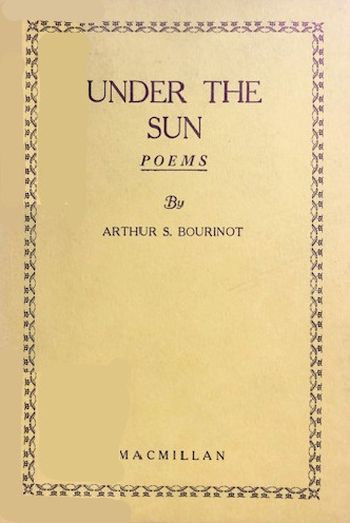
Title: Under the Sun
Date of first publication: 1939
Author: Arthur Bourinot (1893-1969)
Date first posted: October 20, 2026
Date last updated: October 20, 2026
Faded Page eBook #20261040
This eBook was produced by: John Routh, Cindy Beyer & the online Distributed Proofreaders Canada team at https://www.pgdpcanada.net
BY
Arthur S. Bourinot
Laurentian Lyrics
Poems
Lyrics from the Hills
Pattering Feet
Ottawa Lyrics and Verses for Children
Sonnets in Memory of My Mother
Selected Poems
La Salle
Rhymes of the French Regime
Eleven Poems
Under the Sun
UNDER THE SUN
POEMS
BY
ARTHUR S. BOURINOT

TORONTO: THE MACMILLAN COMPANY OF
CANADA LIMITED, AT ST. MARTIN’S HOUSE
1939
“And there is no new thing under the sun. . . . When
I returned and saw all the oppressions that are done
under the sun. . . .”—Ecclesiastes.
Copyright, Canada, 1939
BY
ARTHUR S. BOURINOT
All rights reserved—no part of this book
may be reproduced in any form without
permission in writing from the publishers,
except by a reviewer who wishes to quote
brief passages in connection with a review
written for inclusion in a magazine or
newspaper.
PRINTED IN CANADA
T. H. BEST PRINTING CO., LIMITED
TORONTO, ONT.
To My Wife
ACKNOWLEDGMENTS
“Autumn”, “River by Night”, and “Maples”
have appeared in Saturday Night. “Nicolas
Gatineau”, “Midas’ Daughter” and “Hepaticas”
in the Canadian Poetry Magazine, “Outcasts” in
Canadian Forum, “Lincoln and Anne Rutledge”
in Dalhousie Review, “Train at Night”
in Canadian Bookman, “Autumn”, “Train at
Night” and “Maples” in the anthology
New Harvesting.
| CONTENTS | ||
| PAGE | ||
| Nicolas Gatineau | 1 | |
| Outcasts | 3 | |
| Antoine Daniel | 4 | |
| Machinery | 10 | |
| Not Long Ago | 14 | |
| Rink, Radio City | 16 | |
| Profligate | 17 | |
| Midas’ Daughter | 18 | |
| Transients | 20 | |
| A Beech Tree | 23 | |
| Place Names | 24 | |
| François Bigot | 25 | |
| Trucks | 30 | |
| Wrestling Match | 31 | |
| A Death | 33 | |
| Voyageurs Adieu | 35 | |
| The Little Inn at Bethlehem | 37 | |
| Mr. Wander | 39 | |
| I Shall Take My Skis | 41 | |
| Train at Night | 45 | |
| Autumn | 46 | |
| Maples | 47 | |
| River By Night | 48 | |
| The Moon is a Great Bonfire | 49 | |
| Snow Shadows | 50 | |
| White Trilliums | 51 | |
| Cat Bird | 52 | |
| October in Canada | 54 | |
| Summer Woods | 55 | |
| Hepaticas | 56 | |
| Flying Geese | 57 | |
| Three Sisters | 58 | |
| John Ridd | 60 | |
| Lincoln and Anne Rutledge | 66 | |
Delve deep amongst the musty muniments
The archives of the Courts at Trois Rivières
The old Notarial files of Montreal
Sneeze with the long lying dust and tire your eyes
With scanning of old script, perchance you’ll find
The name of Nicolas Gatineau, Sieur du Plessis,
Greffier of the Court, tabellion,
Once with the Hundred Associates, trader of furs,
The penner of dry documents, a scrivener
Of legal terms; and were that all, you’d say
“Why tempt the dusty sneeze, the tired eyes
To find perhaps a deed to one La Salle?”
But is that all? The record shows scant else
And yet the fact remains, the fact remains
A great and lovely river bears his name
And sings it to the sun and to the stars.
Tiring of musty tomes he roamed the woods,
Coursed with the Coureur de Bois the lakes and streams
To hoard himself small gold, a patrimony,
That he might turn again to his Belle France
And live his life in safe and quiet content.
Fate intervened and wrote a different tale
Marked “finis” to the life of Gatineau;
But it’s not told in musty tome or deed
What mishap, what chance accident upset
His long-laid plans, but legend says
The great and lovely river took his life,
Not satisfied nor sated took his name
And bears it to this day, a good return,
Fair interest on the investment of a life,
More profit than he ever hoped to gain—
The increment of immortality.
We are the outcasts
we with the sodden bulging boots
the broken feet
the dirty pack slung on the back
the eyes that dare not meet
our fellows’ eyes.
We are the outcasts
we with the hungry empty hearts
the griping pain
the slouching walk the dirty talk
bodies that long have lain
in sodden fields.
We are the outcasts
we of the furtive shifty glance
the whining tone
the canned heat drink the sweaty stink
and food of a dog’s soup bone
in the jungle.
We are the outcasts
we of the young but grim creased face
battered with grime
the hopeless search the final lurch
and thrust of impetuous crime
to a barren grave.
The summer wind
Blew through the maple tree
Growing beside the little church
In the Jesuit Mission of St. Joseph
And the branches shivered,
Quivered
And shook
And the little bell
Hanging there
To call the Hurons to their worship
Softly tinkled,
Sprinkled
Its notes amongst the trees
Of the great wilderness.
Then the breeze died,
A bird cried
And the notes were lost,
Tossed
Into oblivion
Lost, lost;
And the bell tinkled no more
In the belfry tree
Spreading its green branches
In benediction
Over the Mission of St. Joseph.
Dawn burned,
Cast a scarlet glow in the sky
Of countless camp fires
Flaming,
Licking the clouds with lapping tongues of fire,
Drinking night with insatiable thirst
And unappeased desire
Until all darkness was consumed,
Obliterated;
Then safely raised the sun his head
And shone with kindly face upon the Mission of St. Joseph
In the land of the Hurons.
And with the dawn came Father Daniel
Returned from meditation, rest,
A week’s retreat at Sainte Marie
Amongst his confrères Brebeuf, Massé, Lalemant,
Where he had visions seen,
A great cross burning in the Iroquois land
And sailing through the sky to Sainte Marie
And visions too, perhaps,
Of martyrdom.
And so he came, his heart renewed
To face the task at hand
And save his heathen souls
From the devil’s grasp.
The mission bell is rung.
Swiftly they gather
The braves, the squaws, the children,
And now they kneel in prayer, the Mass is said
In the little church
Decorated with brightly coloured pictures,
Images,
Tinsel,
Ornaments,
Baubles to please the savage eye,
The fancy of a child.
And Father Daniel smiles upon his naked flock
And blesses them
And thanks his God for all his goodness shewn,
For all his mercy to the savage hordes
Who now give homage;
And for the peace and quiet of the day.
And now the prayer is done, the Hurons rise
Prepared to leave
When suddenly without the palisades
The war cry of the Iroquois is heard
And swift they come,
A howling swarm,
An ocean wave
That rises with the tide,
Retreats,
Comes on again,
Goes back,
Then with a final fling,
An overwhelming rush
Breaks all the barriers down,
Sweeps all before it.
And so they came;
And Father Daniel standing there
At the door of his little church,
Bravely he faced them,
His flock behind him,
Robed in his vestments,
The Cross held high,
A light on his face,
Transfigured,
Bravely he faced them,
Telling his people to flee,
No thought of flight for himself,
“Today,” he said to them,
“We meet in heaven.”
And something about him,
The unflinching courage,
The Cross,
The vestments,
The light on his face,
Held the fiends back for a moment
And silent the Iroquois stood
Gazing on him in bewilderment;
And then the cry was raised once more
And pandemonium broke,
The bows were strung,
A host of arrows pierced the valiant priest,
A bullet found his heart
And the horde was upon him
Stripping him naked,
Drinking his blood
In the false hope
Of absorbing his valour,
Tearing his flesh,
Dead to the torment.
And so he fell at the door of the little church
In the Mission of St. Joseph
In the land of the Hurons.
Sunset flamed,
Casting a glow in the sky
Of countless camp fires
Flaring
And a rival fire
Reached for the sky,
Reddened the dusk;
The burning walls
Of the Mission of St. Joseph
Fired by the Iroquois
Reddened the dusk
With a fearful light
Making the night
Hideous to behold,
A holocaust,
A funeral pyre
For Antoine Daniel
And his little flock
In the Mission of St. Joseph
In the land of the Hurons.
The autumn wind
Blew through the belfry tree
Growing beside the charred ruins
Where once stood the little church
Of the Mission of St. Joseph.
And the maple leaves were touched with frosty fire
And scarlet they glowed,
Blood crimson they showed
When the breeze stirred them
And the branches trembled,
Shook,
Stirred the little bell
Still hanging there,
Till it tinkled,
Sprinkled its notes on the autumn air
But no one came to its summons,
No voice answered its call,
All was silent and still
And the bell tinkled no more
From the maple tree
Robed in red vestments,
Raising its arms in supplication
Before the scarlet altar lamps of autumn
In the loneliness and desolation
Of the Mission of St. Joseph.
Ah yes, machinery,
the beauty,
the savagery
of moving machinery,
that’s a sight
should give delight
to all men’s eyes.
See the pistons
smoothly move
in a groove;
see the wheels
turning round
ceaseless sound;
hear the pound
of mighty hammers
with their clamours,
rising, falling,
never stalling;
watch the knife
so bright and clean
cutting like a guillotine;
hear the presses
crush and crunch,
eat greedily
their metal lunch;
see the fires
that fiercely burn
near the boiler’s
Grecian urn.
Behold the men,
who, pygmies, stand,
watching, waiting,
every hand
poised and ready,
always steady,
pulling levers,
sweating, working,
never shirking,
listening,
listening,
ears agog
lest some machine
should slip a cog.
Behold the men
dwarfed and small,
dreamed a goddess,
now her thrall.
See them polish,
watch them shine,
worshippers
machinery’s shrine
where sometimes
they make sacrifice
but why tell that
it’s not so nice.
Machinery’s
a goddess cold
who has no heart
so it is told.
Here’s her altar
sing the mass,
mass production,
sing it well,
that will save
a soul from hell,
mass production,
a tradition
that should save us
from perdition
and should save
both me and you,
answer, goddess,
is that true?
See the goddess
slyly smile,
surely she would not
beguile
all the worshippers
who kneel
and cringe
beneath
her spurning heel.
She gives no answer,
pays no heed
to those who supplicate
in need.
Is it because
her heart is cold
or has she got
a heart of gold?
The answer
time will soon decide
so let’s forget
the ugly side,
watch the beauty
full of pride,
praise the rhythm
sing the speed,
count carloadings,
lose the greed,
forget the flaws,
the sacrifice,
ignore the things
that aren’t so nice.
Machinery
is just a toy,
a plaything
for the growing boy;
ah, that’s the talk,
sing what a joy
to tend and feed
the perfect toy.
Ah yes, machinery,
the beauty,
the savagery
of moving machinery.
Feet, feet,
Marching feet,
Hear them
Marching down the street,
Marching, marching,
There they go,
As they went
Not long ago.
Feet, feet,
Marauding feet,
See them
Trampling down the wheat;
Trampling, pillaging
They go,
So the Hun
Not long ago.
Feet, feet,
Ghostly feet,
Are they
Phantoms in the street?
Silent, muffled,
Hushed they go
Out to meet
A ghostly foe.
Feet, feet,
Youthful feet,
The earth
Re-echoes to their beat,
Marching, marching,
Proud they go,
So they went
Not long ago.
Where Atlas holds the earth on high
And buildings rush to meet the sky,
A little skating rink doth lie
Below the millions passing by.
The windowed hills it dwells among,
Well swept and honoured, yet unsung,
As though a god had careless flung
A mirror from his chain unstrung.
Men, women, children skate around
This miniature the world’s playground,
Between the City’s ceaseless sound,
Inferno where the subways pound.
I couldn’t help but stand and stare;
The City’s life was pictured there;
For some go round without a care
But many struggle, some despair.
The moon
Is a silver dollar
Burning a hole
In the pocket
Of profligate night
And soon
She will take it
And break it
And spend it
And squander the change
Recklessly,
Fecklessly,
In a largess of stars
Tossed into pool
Into lake
And the river
Will quiver
And shake
With exquisite light;
Birches
Will bend
Appallingly white,
Frail flesh
In a mesh
Of shadow
And light.
Oh the gold of her
the molten gold
the cataract
of orient hair
enough to make Cellini
stand and stare!
The craftsman’s soul
of Benvenuto would have flamed
at all the richness lavished
all the gold
would have stirred
until he told
and beat
her beauty into metal
fashioned and fastened for all time
the face and form that lured his hands
to artificer’s toil.
But Benvenuto’s dead these many years.
Beauty has beaten her raiment
rich as the revelling leaves that swirl
beneath stark naked trees
in autumn.
Beauty has beaten her raiment
lovelier than Helen ever bore
or lost Susanna
when the Elders looked with lustful eyes
and wished her ill.
Beauty has beaten her raiment
garnered old gold
and all the misers’ riches
winnowed with profligate splendour
sheave on sheave
and massed the molten avalanche of her hair.
The night is cold
the stars are cold
and we though young
are old
too old
our clothes are torn
by wind and thorn
and some have died
and no one cried
Oh, we are old
too old.
The days are long
the nights are long
and we though young
are strong
too strong
for we must go
both to and fro
world without end
and death’s a friend
but we are strong
too strong.
The streets are mired
our feet are mired
and we though young
are tired
too tired
for we must walk
where people mock
compelled to roam
we have no home
Oh, we are tired
too tired.
We thumb our way
we bum our way
and we though young
are gray
too gray
we would not shirk
if there was work
we curse our birth
and have no mirth
for we are gray
too gray.
The nights we dread
the days we dread
for we though young
are dead
half dead.
O God above
show us some love
a woman’s breast
our heads to rest
for we are dead
half dead.
Men’s hearts are cold
our hearts are cold
and we though young
are old
too old
our greatest crime
to beg a dime
our greatest scorn
that we were born
Oh, we are old
too old.
Lovely in the springtime with the first green showing,
Lifts its youthful branches, the beech tree on the hill,
Lovely in the autumn, with the lost leaves blowing,
Brown as maidens’ tresses, the leaves upon her still.
Slender as a maiden with her white limbs shining,
Stepping down the hillside to bathe beside the mere,
Slim as any maiden, Oh beauty past divining,
Stands the slender beech tree with no companions near.
Beautiful in winter, her sere leaves ashiver,
Draining golden sunshine, soft shadowing the snow,
Beautiful in winter, her white limbs aquiver,
Dreaming on the hillside until the snow will go.
The place names of our country
Are music on the lips,
The sound of them comes singing
As sing the sails of ships.
The place names of our country
Are music on the tongue,
Their magic sings the burden
Of sagas yet unsung.
And Bigot laughed, taking a pinch of snuff,
He loudly sneezed and touched his bulbous nose
Delicately with a handkerchief of lace
Then smiled again pointing across the street
Where people stood before the cheat, Friponne,
Waiting patiently their meagre dole of bread.
“You say, my dear Péan, the people starve,
That Montcalm writes the King again complaining,
But facts speak for themselves, see, a generous King
Feeds like a fond father his trusting flock;
Admittedly with some slight benefit
To me and mine and this being so
To you; forget the people, they can well
Fend for themselves; enough, I hold you back
And you in haste to leave for Montreal:
Good luck, give my regards to all our friends;
I’ll see your wife’s not lonely while you’re gone.”
And Bigot smiled again and Péan left.
The Intendant gazed from the Palace window
But did not see the people waiting there
Nor did he hear them murmur in dismay
When told that no more bread was to be had;
Nor did he hear a footstep in the room,
A light and running step that nearer came
Then paused and quietly stole upon him
Dreaming there in the great Palace window.
The two small feet soon stopped and raised themselves
On tip-toe; two small hands blinded his eyes
In fun and a sweet cajoling voice cried out,
“François, François, guess and say who it is.”
And Bigot smiled this time a different smile
And turning quickly seized her in his arms
And held her there and kissed her waiting lips,
Looking on her in wonder and dismay.
“You seem surprised,” she whispered breathlessly,
“Are you not pleased? If not, I’ll go at once.”
And with a show of leaving him she raised her arms
To shove him from her with a futile strength,
But Bigot crushed her close exultantly.
“Yvette, Yvette, your husband has but left
This bare half hour and here was I dreaming
Of you and now my dream’s come true.—
How came you here so soon? I did not hope,
My love, to see you till the dinner hour was come.”
And Yvette snuggling closer answered him.
“The carriole was waiting at the door
When he returned and so I saw him off
At once, for the King’s business cannot wait
So I’ve been told,” and laughter lit her eyes.
“My patriot, my little patriot,
True words are often spoken in a jest
And prophecy upon an aimless tongue
Sometimes comes tripping unaware; I would
At times that I did serve my King, but stop—
I serious grow. Oh seal my hungry lips once more
With those red seals of silence that I love.”
Outside the crowd still murmured and the dusk
Fell, filling the street and all the city
With sudden silence and then a bugle blew
Far off and faintly came the sound of guns.
Far down the river intermittent musketry
Tapped with cold fingers at the window pane;
Then again came silence but a dog’s bark
Brought down their thoughts to earth again.
“Ma foi, the English, drat them,” Bigot said,
“They always break my trend of thought, but then
I should be thankful to them for they fill
My coffers with pure gold although they know
It not! but that’s not here nor there; those guns
We heard are theirs, so stop your pretty ears
Lest you be frightened home, my Patriot.”
“The English, bah,” making a pretty face—
But as she did so a commotion rose
In the street, loud stamping of feet was heard
And voices raised in anger, running feet
Beat on the floor of the Palace hall
Without the room and swiftly they beat nearer.
Harshly a woman shrieked, “I’ll see him now,
You or yours can’t stop me.” Swift the curtains
Burst apart, revealed a haggard woman
With hair unkempt and ragged dirty clothes
And a maniac gleam in her wild eyes
That held them where they were as though a frost
Had suddenly congealed their rigid limbs.
Then Bigot paled, got up, “What do you want?
How came you here?” His voice was blunt and harsh.
The woman laughed, but mirthless was the sound,
Then raised a bony finger pointing at him.
“You’re at your tricks again, I see,” she sneered,
“You’ll make of her what you have made of me,
A trollop and a woman of the street
Whom people cross the road to pass
Lest their fine linen should be soiled by touch
Of mine; take heed, Yvette, take warning now
Before it is too late; look well at me
For I was once like you, but youth’s now gone,
My beauty broken when he cast it down
To shatter in the gutter while he turned
To other fields to solace his sad heart.”
Her voice broke on a sob and she half fell
And would have fallen had she not grasped
The curtain where she stood, and all the while
Bigot was speechless, Yvette was silent,
Pale and white save for her scarlet lips
That cut her face like a grim and livid scar.
Now Bigot swift took action. “Ho there, guard!”
And at his voice dull heavy feet came running.
“Seize her, men!” Quick they grasped her either side
And waiting further orders; loud she screamed;
“Take heed, brave François Bigot, what you do,
The English come, the burdened people starve
While you grow fat by robbing of the King.
Your time will come, I say, your time will come.
The lillied flag of France will soon be struck,
The English Wolfe is waiting at the door
And will not be denied. Oh, how I’ll laugh
To see you dragged in chains to the Bastille—
Your time is near I warn and prophecy,
And sweet the taste of vengeance on that day.”
“Take her away,” snarled Bigot, while his lips
Curled in disgust as the soldiers dragged her off.
And then he turned, “I’m sorry for this scene,
Yvette,” then paused for no one else was there,
The room was empty and no voice replied.
Giving a careless shrug he took some snuff
And walked towards the door, delayed.
“These women, oh these women, how they rant;
Thank God there’s plenty of ’em, plenty more
To take the place of those who run away.
I wonder what she could have meant?” he mused.
“ ‘To see you dragged in chains to the Bastille’—
To say the least a pleasant thought,” he smiled,
“But then the woman’s mad; enough of this;
I’ll go and see the door’s well locked
Against this English Wolfe she raved about.”
And chuckling to himself he left the room.
Dragons
Fiercely flashing
Glaring eyes
Both red and green
Devouring
The quiet
Of night
With champing
Maws;
Tramping
With insolent
Ceaseless tread
And feet of lead
Upon retreating
Trembling
Vanquished earth
While houses shake
And people wake.
Tangled carcasses
straining,
struggling,
on a butcher’s block,
inextricably tangled,
moving in the slow motion
of death’s last spasm,
bounding apart
in sudden
jumping paroxysm,
tottering,
falling,
gasping,
grunting,
shambling to the grand finale
in the slow tense motion
of death’s
great agony.
Roar of the crowd,
roar of the crowd,
frantic men,
frenzied women,
the Roman Arena,
lusting for blood,
lusting for the kill,
impatient at the slow motion
of the carcasses
writhing their last long writhe,
thrusting thumbs down
with inordinate, gloating pleasure,
draining the last ounce of sadistic satisfaction
from the dying despair,
garrulous groan,
the penultimate pang.
Roar of the crowd,
roar of the crowd,
exultant,
goading,
exhorting,
frenzied acclaim,
tumultuous applause,
crying of “shame”,
impatient,
waiting,
the final fling,
the sickening
ultimate thud
on the sacrificial block.
Roar of the crowd,
roar of the crowd.
Hands, hands,
haunting hands,
marauding lecherous hands
endured tormenting years
with unresisting passion
grope in the air,
float in the air
before her dimming eyes,
gliding with snaky fingers in the gloom
to seek her out,
to find her out.
Loved hands,
hands lost
long ago
before tormenting years took toll
return like apparitions from the past.
Phantoms, phantoms,
fading
fade
and are lost
again.
Hands, hands,
harrying hands
everywhere, everywhere;
interminable hands,
wraiths of the air, plunderers,
haunt her fast dimming eyes
seeking, seeking
with the old relentless lust
to find her flesh,
to find her flesh.
And then the hands of death
swoop down,
O healing touch,
mighty, powerful,
invincible,
swoop down,
down through the dark
of endless tormenting years
to softly close
and seal
her eyes
in gentle
dreamless
sleep.
Great river take my body
Upon thy peaceful breast;
O sky and air my spirit
To its determined rest.
Great world I loved you ever
And take my last farewell
I go to join my fellows
In a land no one can tell.
O earth when springtime wakens
And trilliums white thy floor
Recall that to thy beauty
I opened once the door.
Great river take my body
And chant your way along
Enfold me in your waters
And sing your marching song.
Go march with me forever
For travellers both are we,
One journeying to the ocean
One to eternity.
Great river take my body
Upon thy waters deep
Enfold me as a mother
Who sings her child to sleep.
Great river take my body
And grant it rest and peace;
O sky and air my spirit
To you I now release.
The little inn at Bethlehem
Was crowded to the door,
The little inn at Bethlehem
Had room for no one more.
Travellers, merchants from Chaldea
Who came to barter, sell,
A spy of Herod one of them,
Whose purpose none could tell.
And there was noise and merriment
And singing in the street;
A ragged leper with his bell
Limped by with shuffling feet.
Two travellers from Nazareth
Came with the failing light,
With aching limbs and weary hearts
Sought shelter for the night.
The landlord had no room for them
And said they could not bide,
Joseph a simple carpenter
With Mary by his side.
A common stable harboured them
And there they lay till morn;
Amongst the scattered hay and straw
Was little Jesus born.
Then came the Wise Men from the East
With gifts from lands afar,
To find the Babe of Bethlehem,
Led by a huge white star.
The people mused and marvelled much
And whispering spread abroad,
Had Bethlehem’s unworthy inn
Refused the Son of God?
The little inn at Bethlehem
Had room for no one more.
The little inn at Bethlehem
Was crowded to the door.
I live in a haunted house;
The wind blew the door open,
Whistle, bang.
In walked Mr. Wander;
Thump, thump.
Went his stump in the porch, in the hall,
Thump, thump,
Came the sound of his weird footfall,
Thump, thump,
Went the peg of the ghost’s wooden leg
Then he paused at the bottom of the stairs.
Silence a moment, then the wind blew,
“I’ve come to call, how do you do!”
Said Mr. Wander.
Looking over the railing
There I saw him standing
Waiting on the landing
Looking up at me
And his eyes met mine
And twinkled merrily.
“I’ve come to call,” said Mr. Wander,
Pausing on the landing
And though it was rude
There I left him standing
For I just couldn’t bear the wild look in his eyes.
And then, after all, he was a surprise
So I rushed to the study,
Banged and bolted the door,
And oh, how I prayed I would hear him no more.
“I bid you good day,” chortled pale Mr. Wander,
Turned on one heel and paused just to ponder.
“Don’t you be frightened, I used to live here,
I always come back once or twice every year,
I’ll see you again,” he called as he went
And I’m only afraid lest he said what he meant.
Thump, thump,
Went his stump on the stair, down the hall,
Thump, thump,
Came the sound of his eerie footfall,
With a whistle and bang
The wind slammed the door.
Mr. Wander had left
I heard him no more.
I shall take my skis and go to the hills today.
Routine and work must wait for a duller morn For today
The world is white and new and clean,
Fresh blanketed with snow
That fell last night
And a warm March sun
Glows in the sky
As only a March sun can;
And the sky is blue
As nothing else is blue
On earth
Except, perhaps,
A field of cornflowers
In the sun of June.
I shall cross the treeless uplands
Swept by unwearying winds in unremitting toil
Where snow birds come to find scant mullein seeds
In pods turned black by buffets of the wind
And where upon a solitary oak
Dishevelled leaves
Shiver and scrape
And shake
With chattering cry
In the cold.
I shall climb to the heights through the woods
Where rabbit tracks cross and recross
To form a frenzied pattern in the white
And where a piece of fur, some scuffled snow
Denote but one more woodland tragedy.
The prattling chickadees
Will gossip by the trail
That leads up to the highest point
Whence slopes descend
Through wood
And field
To valleys
Far below.
Down the slopes I shall speed
Without care or heed
With the wind in my face
I shall run the good race
At a pace,
At a pace
Tries the nerve
With the swerve
At an unknown curve
And the thrill
Of the spill
And the bumps and the jumps
While the lilt
And song
Of the snow
On the ski
Sing to me,
Sing to me
Riding free,
Riding free.
The swish,
The swirl,
Of the snow, of the snow
Will whisper, will follow
Wherever I go
As downward, swift downward
I vanish headlong.
The wind is my fellow
And sings a mad song
As downward, still downward
Untrammelled I go,
Coursing and flying
On wings of the snow
To the far waiting valleys,
The far waiting valleys
In the depths
Far below.
I shall reach the treeless uplands
When the night is burdened with stars
And a virgin moon
Wanders the heavens unheeded
To meet the youthful dawn;
And high above the sleeping hills
The Northern Lights will wave
Their ghostly, greenish cerements,
Their tattered spectral cerements
Phosphorescent from the grave,
Until pale fingers
Reaching high
Grasp them,
Pull them from the sky,
Drag them down
And cast them down,
Those grisly greenish cerements,
To vanish slowly out of sight
In the caverns,
In the craters,
Deep abysses
Of the night.
I shall take my skis and go to the hills today.
Routine and work must wait for a duller morn
For today
The world is white and new and clean,
Fresh blanketed with snow
That fell last night.
I shall take my skis and go to the hills today.
Sometimes at night
I hear a train
Far off
Shunting in the yards,
And half asleep, half awake,
Dreaming,
I see a great giant
Striding the mountains,
Shuffling his huge feet
Along the valleys,
Puffing wearily,
Tired from a long day’s hunt,
Whistling eerily
As he trudges,
Shuffles
Home.
Now doth the old earth turn to take her rest
And clasp great quilts of colour to her breast,
With here a patch of red, a burst of gold,
And there a blaze of yellow fold on fold;
Patches of bronze and ochre, riot of flame
Resplendent as the banners of high fame.
All these and many more she gathers round
Then, like an Indian brave whose hunting ground
Lies not far off, she rolls her blankets tight,
Stretching her feet to the flickering fires of night
That constant and unwearying vigil keep,
Contentedly she turns her to her sleep.
The maples hang their crimson lamps
At the gate of the green forest
Fabulous lanterns aflame
Lighting the traveller’s steps
To the door of the deep wood.
The river’s lovely arm
braceleted, jewelled
with a million lights
enfolds the city’s form
and will not let it go.
A tourniquet of bridges
cannot stem
the turbulent, recurrent roar
of the life blood flow
as with impassioned pulse,
exultant leap
it surges madly on
fired from its usual slow lethargic pace
by the touch
of the city’s breast.
The river’s lovely arm
braceleted, jewelled
with a million lights
enfolds the city’s form
and will not let it go.
The moon
is a great bonfire
burning
at the rim of the sea
and the edge of night
kindled
by the Stars’ torches,
smoky,
smouldering
at first,
then
comes a burst
of flame
and the smoulder
growing bolder
flares into fire
and a pyre
flames fiercely a moment,
is consumed,
rises in silver smoke,
floats in the sky
and is gone.
Lost in the clouds
is the silver smoke
of the moon’s great bonfire
burning
at the edge
of the sea
and the rim
of night.
Shadows crouch,
cats curled up
asleep
upon the snow.
Comes afternoon
and soon
the cats
with slow
and leisured ease
awake,
bestir,
stretch out their feline length
luxuriously,
then slink
in gliding,
hurrying,
scurrying
flight
to some dark
assignation
in the night.
Here where the hermit watched his apple trees
White plum blooms hazed the clearing in a twist
Of smoke upcurled, and higher, like a mist
Upon the hillside, vagrant in the breeze
A band of tramping trilliums, at their ease,
Had pitched their tents to loll beneath the sun
In gypsy festival to sway and run
And wander through the woodlands as they please.
The sun went down, a wayward wind swift blew
The plum-tree smoke far in the shadowed wood;
The trilliums to their darkening tents withdrew
Until the clearing emptied and there stood
Only deep silence watching earth and stone,
Deep silence left unutterably alone.
I heard you whistling cheerily,
Whistling near the lilac tree,
And I wondered to myself,
Who’s the madcap, spirit, elf,
Whistling with abandon, joy,
Whistling like a school-free boy;
Then I saw you, slate-gray cat bird,
You who always have the last word,
And I stopped to hear your song,
Hear you warble notes, prolong
The warble, hold it in your throat,
Till out it comes a different note,
And then you whistle,
Pause until
Light as thistle
Floats the trill:
Then the warble once again
But the warble’s not the same.
Then a slow note,
Deep and slow
Floats the way the others go
Like the echo from a bell
Hidden in a fairy dell,
Struck centuries ago.
And now your throat that caught the sound
Vibrates the rhythm newly found,
You’re the master of the air,
Vagrant singer without care,
Singing, oh so carelessly,
Singing, oh so endlessly,
Singing, oh so rapturously,
Life embodied melody.
That’s your mating song
When you prolong
The warble and the whistle
Light as thistle;
That’s the side
You turn towards your bride—
Old Robert Browning said,
He of the leonine head,
The meanest of God’s creatures
Boasts two features
One to face the world with—
One to face his love with—
And that’s the face
With which you grace
The mating time,
O song sublime!
But what of the other face?
Alas, a sorry case;
The song you sing when you’re perturbed
Should undoubtedly be curbed,
But then, from it you gained your name,
And sadder still, you owe your fame
To singing plaintively “Meow,”
But that’s the world’s way, anyhow!
Beauty awakes,
Beauty awakes!
See how the artist Autumn shakes
The colours of the spectrum on the hills,
How lavishly he spills
His tubes of red and brown and gold
And bold, bold,
He smears the canvas with Tom Thomson’s brush,
And with his passion
Does he fashion
As if he heard the rush
Of the cold wind of winter in his ears
And the same fears
That chilled the heart of Keats bid him make haste,
For all must waste
And die
With the cry
Of the cold wind of winter.
The ancient and the deep, green wood
Hems the house with a high wall of silence
Spills a flood,
An avalanche of rushing green
That from the height
Of the half-seen sky,
The far-off light,
Flows with unceasing verdure
To earth’s sanctuary;
Building a barrier to the summer heat
That with incessant beat
And pipe of shrill cicadas
Storms without hope
The ancient and gray pillared wood
Hemming the house with a high wall of silence.
On sunny banks in springtime
Their faces shine star-white,
Whoever finds hepaticas
Has touched the stars of night.
Whoever finds hepaticas
When Spring goes by his door
Lives in a lost ecstasy
Is haunted evermore.
The geese
flying northward
daub
upon the clean
white slate of sky
with sprawling brush
of shimmering wings
a whirring blob
of black
that overhead becomes
a slim, swift triangle
that sings
one single note of music
in ecstasy
erratic as the spring
but beating,
beating
with the thrill
and pulse of life
until the sponge
of distance
rubs,
blurs,
dims
and finally
erases,
wipes the sky’s slate
white again.
Three sisters kept the village store—
One of those places where the lore
And gossip of the countryside
Is told nightly by men astride
A barrel. ’Twas the meeting place
For the people of the neighbourhood.
For many years the shop has stood
And borne the buffet of the wind
Marked as a man who’s gravely sinned.
A pine tree, planted years ago,
Has climbed above the roof, to grow
And cover all the house with shade.
One sister, timidly afraid,
Ran away with a city man,
Such is life since the world began.
Her sisters said she lived in sin.
Round the village many a chin
Fell down and gaped with wonderment
And feigned surprise the night she went.
The other two remained to pray,
The jet black hair soon turned to gray.
They went about with downcast eyes
And furtive whispers; timid sighs
Were heard from them as they tended store
Where the bell still tinkled above the door.
One of the others soon began
“To see things,” ran away in fright
At the least sound, had to have light
In her room or she could not sleep.
A slow lethargy began to creep
Through her limbs, seized her in its grip
Until her mind commenced to slip.
The mad-house held her finally
And only one remained of three.
One day as I walked the village street,
Before the store was a whole fleet
Of farmers’ rigs; a car with cross
Told the tale of the final loss.
And now the store is shuttered and closed—
Life from its door has been deposed;
Only the pine tree rears its head,
Whispers low for the sisters dead.
The shutters rattle and weirdly sway
And I have heard the villagers say
Steps are sometimes heard on the stair
And a voice will cry, “Where, oh where?”
Then there’s silence, nothing stirs,
Only a night hawk eerily whirrs,
A bat goes by in phantom flight,
The house is wrapped in deepest night
And then the voice will cry once more,
The bell will tinkle above the door,
Hands will fumble and try the lock,
Softly, softly will come a knock—
No answer—quiet within, without,
A faltering step that turns about.
High in the blue Laurentians dwelt John Ridd,
A man of great physique and ponderous bulk
Who held his car upon the rutty roads
By force of his brute strength, and if there was
At any time a doubt of Darwin’s theory
Here in his flesh was proof personified.
The land he farmed sloped to the shore of a lake
And by its edge a little timbered house
Turned two dull eyes, an open gaping mouth
To watch the waves unwearying beat the shore.
The unsecluded swimming of the stars
At night and vigilant Borealis
Illuminate the heavens with darting beam,
Turning great searchlights in his sweeping quest
To spot some furtive wanderer from afar.
The land was John Ridd’s soul, his every aim
To make it bear and burgeon fruitfully.
Each year the waiting womb received the seed,
Each year the fertile mother swift conceived,
Each year she lay in labour to beget
Such children as would please her master’s eye,
The ripening corn that rippled in the wind,
The golden wheat bound up like golden hair,
The ruddy apples ripening on the trees
And all the riches that the harvest brings.
At first this pleased and satisfied his heart
But as the years went on he felt a lack,
A need for someone else to share his home
And bear him children like the fruitful earth;
And with the thought was born desire that grew
And growing banished from his seething brain
All other thought except that he must act.
And so John Ridd went courting Mary Stone
Whose name belied the frailty of her form,
The muted mellow voice, laughing but seldom,
The haunting eyes that gazed on a lovely world
And looked upon John Ridd, then pausing, wondered,
Then looked again and in that look were lost.
Like a wind from the hills that blows upon the corn
And bends it to its will tempestuous
So stormed his love the granary of her heart,
Broke all the barriers down and bore her off
Triumphant, helpless as a little child.
Years passed and with each year the pregnant soil
Brought forth anew its teeming progeny
But Mary’s womb was barren as her name;
No child had come to consummate their love.
And John Ridd looked at her enflamed with hate,
To have his wish so thwarted brought contempt,
His will to have his own seed work the land
He loved with every fibre of his heart.
His voice was harsh and Mary cringed in fear,
He blamed her for the lack of daughters, sons,
His taunting words consumed her like a fire
That burned relentlessly unquenched by tears
And her eyes were the eyes of a hunted beast
Whose agony aghasts the shuddering wood.
One April when the whistling blue-birds flew
Along the gray stump-fences’ zig-zag trail,
Raccoons were wailing in the midnight wood
And bloodroot caught the colour of the stars,
There came to John Ridd’s farm as hired man,
Jim Tophet, young, fair-haired, with eyes as blue
As the backs of those same blue-birds flying by,
Who worked with Ridd amongst the fields all day
Turning at night with unreluctant step
To the little house for supper and to sleep.
To Mary with the miracle of spring
There came new life, she bloomed and woke again
With burgeoning bud and blossom, flying bird,
And Tophet’s eyes met hers and held her glance
And spirit spoke to spirit, youth to youth.
But John Ridd taunted her anew and shame
Mantled her cheeks while Tophet’s eyes blazed wrath
And smouldering ire at all the pity of it.
And pity turned to love the times she shrank
And cringed beneath the bully’s withering words.
There came the day when Mary was with child
And John Ridd laughed exultant, rubbed his hands,
Seeing a son beside him in the fields
Who’d follow in his footsteps when old age
Had tied him tired and helpless in his chair
To smoke and yarn and dream beside the stove.
And Tophet’s eyes met Mary’s, held her glance,
And John Ridd watching them, suspicion sowed
The seed that grew into an evil flower
Whose roots reached down their tiny tentacles,
Enmeshed his brain, devouring it by slow
Incessant feeding till the parasite
Expelled from it all thought except the one
That Tophet was the father of the child.
He nursed this thought that stabbed him like a knife,
Sadistically he turned it in the wound
Until his mind could bear the pain no more
And then the storm broke loose. In sudden wrath
He struck at Mary standing by the stove
And like a tree the woodsman swiftly fells,
She trembled, tottered, crashed upon the floor.
And John Ridd laughed a mad and mirthless laugh.
His little eyes were cunning as a cat’s
That stalks its prey and follows silently,
And so he watched Jim Tophet where be bent
Over the form of Mary, muttering
Mad words of endearment, fatal and hopeless.
With a light step for all his weight he moved
Across the room to seize the waiting axe,
Turning about on stealthy, silent feet
He sped to where Jim Tophet murmuring lay.
Raising it high the blade glinted a moment
Then fell with all the fury of his arm
And set a fearful silence on his lips.
And John Ridd laughed a mad and mirthless laugh,
Stormed from the house and banged the door behind
As though the banging door would close the past
And shut it from his vision and his thought.
For so men sometimes hope to hide their deeds
Shutting them up behind locked doors and iron walls
Till Fate, the prowler, with unerring ear,
Detects the combination, springs the lock,
Throws wide the door and lets the daylight in.
Raving he ran to the high and solemn hills
Who closed their arms about him, quieted him.
Only a far faint echo came of his mad voice
Then it too died and silence’ gentle cloak
Slid from the hills and wrapped the little farm
As softly fall the heavy flakes of snow
And footsteps soon are muffled, voices die
And earth’s a vacuum white and desolate.
And when the neighbours found them Mary moved
But Tophet was beyond the help of man,
And John Ridd’s fleshless bones were later found
Broken upon the rocks where he had fallen
Or cast himself demented from the cliff.
And Mary lay for many days and nights
In that dim land between this life and death
Where voices call, faint shadows come and go,
The past and all the present merged and lost
In a dread nothingness, in nothingness the soul.
Slowly she came from darkness and the mist
And as she stirred she felt the stir of life
Within, giving her hope to live and faith,
Courage to face the world, begin anew
The battle for herself and for her child.
Lincoln was a young man
In New Salem days,
Lincoln was a tall man
Born to country ways.
Lincoln found Anne Rutledge,
Fell in love with her,
Beautiful Anne Rutledge
Made his pulses stir.
Beautiful Anne Rutledge
Dreamed a dream and died,
“Oh, my heart lies with her,”
Broken Lincoln cried.
Anne Rutledge, Anne Rutledge,
Was it you gave Lincoln his fame?
Was it born the day that you died,
When he cried, “O my Anne,
The snow and the rain will fall
On your grave, and it breaks my heart,
Breaks my heart”?
The ways of God are strange
And move in a way that passeth understanding,
That passeth the mind of man.
But slowly, surely
He works his plan.
Miracles are done
Under the sun.
On the strong anvil of years
Man’s soul is beaten and shaped,
You can hear the hiss of his tears,
As the great blacksmith works,
Pounds with mighty laughter,
To shake the heavens’ rafter,
And then the moment after
With slow strokes and sure
He tempers mirth with sorrow,
Lest the morrow
See man a laughing, useless thing,
To be flung aside like a broken spring.—
And last, the finishing strokes
Swift and faint and light
Soft as the fall of night,
Soft as the fall of night.—
The ways of God are strange
And move in a way that passeth understanding
That passeth the mind of man.
“The way of a man with a maid”
So it was said,
In the day of the prophet.
The way of a maid with a man,
So it began.
And a seed was sown in rugged soil
And after much toil
It burgeoned and grew
And the winds blew
And the rains fell
And cast their spell
And the seed was turned to a mighty tree
And its branches spread
Broad overhead
Making a shelter over the land
For the time of storm.
And then like a stroke
Of lightning, the tempest broke
And beat on the tree,
But steadfastly
It stood on the hill
And swayed and tossed,
But nothing was lost,
For the roots were strong,
The roots were long
And clenched in the soil.
And the storm subsided, the heavens cleared
And the tree still stood, but was gnarled and seared.
Anne Rutledge, Anne Rutledge,
Did you know, did you dream
When you bade farewell,
That you’d be the urge, the gleam
That would hold your man to his purpose?
Who can tell?
For the ways of God are passing strange
And man dreams
And plans,
And God fans
The spark, and the flame shoots up
And consumes his soul,
And he sees his goal
Far ahead in the light of the skies,
And he follows and stumbles and follows
Until he dies,
Until he dies.
O beautiful Anne Rutledge,
Lincoln’s fame is your fame,
Your name linked with his name.—
Dreamers together
You dreamed a dream,
You were the source,
Lincoln the stream
That forced the way to fulfilment.—
O beautiful Anne Rutledge,
Lincoln’s fame is your fame
Your name linked with his name
Forever.
TRANSCRIBER NOTES
Misspelled words and printer errors have been corrected. Where multiple spellings occur, majority use has been employed.
Punctuation has been maintained except where obvious printer errors occur.
[The end of Under the Sun, by Arthur Bourinot.]