* A Distributed Proofreaders Canada eBook *
This eBook is made available at no cost and with very few restrictions. These restrictions apply only if (1) you make a change in the eBook (other than alteration for different display devices), or (2) you are making commercial use of the eBook. If either of these conditions applies, please contact a https://www.fadedpage.com administrator before proceeding. Thousands more FREE eBooks are available at https://www.fadedpage.com.
This work is in the Canadian public domain, but may be under copyright in some countries. If you live outside Canada, check your country's copyright laws. IF THE BOOK IS UNDER COPYRIGHT IN YOUR COUNTRY, DO NOT DOWNLOAD OR REDISTRIBUTE THIS FILE.
Title: Golden Horn
Date of first publication: 1932
Author: Francis Yeats-Brown (1886-1944)
Date first posted: October 19, 2026
Date last updated: October 19, 2026
Faded Page eBook #20261037
This eBook was produced by: Al Haines, Cindy Beyer & the online Distributed Proofreaders Canada team at https://www.pgdpcanada.net
This file was produced from images generously made available by Internet Archive.
by
FRANCIS YEATS-BROWN
Author of
Bengal Lancer
LONDON
VICTOR GOLLANCZ LTD
14 Henrietta Street Covent Garden
1932
Printed in Great Britain by
The Camelot Press Ltd., London and Southampton
To
E. F. BENSON
AUTHOR’S NOTE
TO “GOLDEN HORN”
Thirteen years ago I wrote a book called Caught by the Turks, of which fewer than a thousand copies were sold. Few people therefore read it, and fewer still will remember it.
In the present book I have incorporated (between pages 107 and 268) a good deal of material from those forgotten pages, but with large revisions in both matter and manner. If any reader should come across passages which seem familiar I shall offer him my apologies, and be surprised and flattered.
F. Y.-B.
London, July 22nd, 1932.
| CONTENTS | ||
| Chapter I. | In Yildiz Kiosk (1908) | page 9 |
| II. | The End of the Red Sultan (1909) | 34 |
| III. | Vultures of Christendom (1912) | 67 |
| IV. | The Day of Wrath (1914) | 91 |
| V. | Baghdad (1915) | 107 |
| VI. | Mosul (1915) | 131 |
| VII. | Out of Great Tribulation (1915-1918) | 154 |
| VIII. | Constantinople (July 1918) | 183 |
| IX. | Josephine (July-September 1918) | 202 |
| X. | An Emergency Exit (September 1918) | 230 |
| XI. | Stambul Submits (October 1918) | 269 |
| Epilogue | 280 | |
Know ye the land where the cypress and myrtle
Are emblems of deeds that are done in their clime,
Where the rage of the vulture, the love of the turtle,
Now melt into sorrow, now madden to crime?
Where the virgins are soft as the roses they twine,
And all save the spirit of man is divine?
’Tis the clime of the East, ’tis the land of the Sun—
Can he smile on such deeds as his children have done?
Byron.
On a summer evening in the year of the Hejira 1326, being the year of Grace 1908, Abdul Hamid II, the Damned, the Red Sultan, the Great Assassin (as Europe called him) the Lord of Two Continents and Two Oceans, the Shadow of the Most High, the Protector of Kings (as he called himself) sat at a piano in the Little Mabeyn[1] of his Palace of Yildiz Kiosk, playing an air from Mozart to a rather frightened slave-girl.
He was smoking a fragrant, freshly-rolled cigarette, prepared by Mustafa, his chief go-between, who sometimes inserted the djournal of a spy in his Sublimity’s private tobacco box. The last message had been that the situation in Salonika was very grave; and Abdul Hamid felt that unless he took some respite from the cares of State he would go mad, like his uncle and his elder brother, the last two Sultans. For more than thirty years he had been pulling strings to keep his ramshackle Empire together, and now they had entangled him: he was impotent, harassed, infirm through overwork, although he was only sixty-six. Qui trop embrasse, mal étreint.
Not that Abdul Hamid had ever indulged in excesses like his predecessors. He had always been careful of his health. In his younger days he had ridden magnificent Arab stallions, carpentered, rowed on the artificial lake of Yildiz Kiosk, studied zoology and black magic, and had been so expert with a revolver that he rarely missed a thrown orange. To-day he was still a skilful carver, and a dead shot, but he worked so hard that he had few amusements. The white odalisques from Georgia and Circassia who came as yearly tribute to the Palace were neglected; indeed, of late years he had discouraged the supply of concubines, of whatever colour, deeming them unsuitable for a modern monarch. The child beside him this evening (whom he had seen dancing at his eldest daughter’s house) was no more to him than one of his charming Angora cats.
Abruptly Abdul Hamid stopped playing and faced round to the door with a jerk, his hand flying to the pocket where he always kept a loaded revolver.
It was his Highness the Grand Eunuch, Djevher Agha, Dar-us-sadet-us-sharif-aghassy, Guardian of the Gates of Felicity, who had entered, and now advanced towards the Sultan, bending his immense body almost double in loop upon loop of low salaams.
Arrived at the correct distance from his master, he stood with head abased, his innumerable chins melting into a mountain of flesh. Incongruously, the hands that were crossed upon his paunch were as thin-wristed as a girl’s. In them he held a document: an urgent despatch no doubt, or he would not have ventured into the Little Mabeyn at such an hour.
“See what he wants, Mesté Alem,” said the Sultan to his companion.
The child took a paper from his enormous Highness, and carried it to the Sultan, who glanced at the seal before accepting it, to see if the wax had melted. It had done so, which was a proof that it had passed through the disinfecting oven; otherwise he would have refused to break it. Microbes were his second obsession: assassins the first.
The document was an official report from Salonika, whose tenor disturbed him greatly. He forgot the eunuch, forgot Mesté Alem (she had hoped for much from that evening) and remembered only to light another cigarette.
Who was this Major Niazi Bey, who had looted four thousand medjidiehs[2] from a battalion treasure-chest (leaving a receipt therefor and an insolent declaration that he was taking up arms on behalf of reforms for Moslems and Christians alike) and gone blustering and gallivanting away to the hills of Resna with a couple of hundred soldiers and brigands? The latest news from Macedonia was that this Niazi and a certain Enver Bey had set up a government on their own account. Should they be enticed to the Palace for the usual bowstring and cup of poisoned coffee, or could they be more conveniently blotted out in the mountains of Albania?
His spies had moved clumsily, damn their livers, and their reports to him had been nothing but lies. Their instructions had been to arrest the officers of the Third Army Corps in Macedonia who belonged to a secret society called the Committee of Union and Progress. Instead of doing so, they cowered in the bazaars of Salonika, afraid to move, because their errand had become known to the Committee directly they arrived.
Were there, then, traitors in the Palace itself? Abdul Hamid did not doubt it. The Committee, he knew, was affiliated to the Masonic Order of the Grand Orient, and maintained two flourishing Lodges—Macedonia risorta and Labor et lux—which he had not dared to close for fear of complications with the Italian Ambassador. That international octopus the Grand Orient—so different from Anglo-Saxon Masonry—had tentacles everywhere, from the boot-blacks of New York to the lickspittle Levantine pashas of Constantinople. Even here in his Palace he was surrounded by knaves and fools.
There was no one he could trust: not his relations, nor his women, nor his thousand servants, nor his five thousand pampered Albanian troops. As to his Ministers—what Sultan for the last hundred years had been even fairly well served? Of the creatures whom he had found installed as Palace Pashas when he girded on the Sword of Othman,[3] one had been bought by his mad uncle in the slave-market of Constantinople to gratify some natural or unnatural whim of the reigning Sultan, another had been taken out of a Punch and Judy show, and yet another had been a pimp. Nor were his present councillors made of nobler clay: their Excellencies of the Palace were puppets, with medals on their padded uniforms as thick as scales upon a herring, but with neither brains above nor bowels of mercy beneath the glitter.
“There must be a Council,” said Abdul Hamid. “Send for the Grand Vizier, the Commander-in-Chief and my two Chief Secretaries.”
The Guardian of the Gates of Felicity bowed to the ground.
Mesté Alem stared at him, thinking how like a black jelly-fish he looked. She wondered how her friend, the little Egyptian slave who was his mistress could tolerate such a lover? True, Djevher Agha was rich and there was a fascination about the subtle ways of the unsexed . . . But——!
“Send for the Astrologer also,” said the Sultan.
Djevher Agha backed out of the room to execute these commands. The Sultan sighed, turned to the piano again, picked up another cigarette.
Mesté Alem ran towards him with a lighted match, but he shrank back from her in sudden horror and hate, his hand clutching his pistol again.
Mesté stopped. The Sultan quickly recovered himself, knowing now that she did not intend to strangle him. But he signed to her to keep her distance and lit his own cigarette.
“You should have danced for me, little girl,” he said, “and I should have enjoyed it, if I had had the time. But now I must attend to politics.”
Mesté Alem rose to go, and stood before her master with her heart in her gold-brocaded slippers. With her pretty colour, trembling mouth, downcast eyes, she seemed a picture of innocence, but the epithets that passed in her mind concerning the Young Turks were not those that would occur to a young woman in the West.
“Stop a moment,” said the Sultan, pinching her ear. “Do you know what a Constitution is, little girl?”
She did know, for there had been whispers of it even here in the harem, but wisely she shook her head.
“A Constitution,” said the Sultan, “means that I am to declare that in this country the donkey and the donkey-driver are equal. To please that murderer Midhat Pasha, I promulgated a Constitution when I came to the throne thirty-three years ago. And the ungrateful deputies, as soon as they were elected, wanted to cut down my Civil List. My Civil List, although I am the most economical ruler that Turkey has ever had! That was the only result of the Constitution; that and the murder of my uncle, the late Sultan Abdul Aziz. You know the story? It happened long before you were born, but history repeats itself.”
Mesté Alem watched her master, wide-eyed now.
“There was a Conference of Ambassadors in 1875,” mused the Sultan, more to himself than to her, “planning reforms for us, even as to-day the Chancelleries of Europe are discussing how to cure the Sick Man of Europe. But the doctors are not really interested in a cure: they are only keeping the patient alive until they can decide amongst themselves how to divide up his property. It has always been the same. Democracy is like a drug with which addicts try to pervert others. They say it is the gate to bliss. They want me to take a small dose to begin with, enough to enable me to see visions of a better world; but I know those visions and the anarchy that is their end.”
“But I was telling you,” he continued, “how the reforms of 1875 were forced on me. The leader of the Young Turks of those days was Midhat Pasha. Finding that my uncle, Sultan Abdul Aziz, was opposed to his plans, he drove him from the throne saying that he was insane. My uncle was distracted with grief at the manœuvres of the reformers, but he was sane enough, and remained careful of his personal appearance to the end. On the day of his death—only five days after his deposition—he had borrowed a pair of pointed Persian scissors from the Queen Mother in order to trim his beard. That was the opportunity for the conspirators. Three men, who had been watching at the keyhole of his room, broke in and seized His Majesty. One of them held him by the shoulders and another by the legs, while the third drove a penknife into the inside bend of each of his elbows in turn, just where the big artery comes close to the skin. In a few minutes His Majesty had bled to death. The Persian scissors were left beside him, as if he had used them on himself. But no one has ever been able to explain how he could have cut the artery of his right arm if he had already severed that of his left.
“I was suspicious from the first of the theory of suicide, but I waited two years before I had evidence on which to accuse the conspirators. Then one day, when I was enquiring into the salaries paid at the Palace, I discovered that I was supporting a wrestler and a gardener who had no duties of any kind. Gradually the whole story came out: these men were the hired assassins of the reformers. Midhat Pasha was condemned to death, but I pardoned him, and exiled him to Taif, where he died of grief for his many sins.”
Mesté Alem had heard the tale told differently. The current version was that Midhat Pasha had been arrested on a trumped-up charge and condemned to death in order that the Sultan should rid himself of a troublesome Parliamentarian. Rumour added that he had been strangled, and that his head had been sent to the Sultan in a box labelled “Japanese ivories. With care.” Moreover, she believed, as did everyone in Turkey, that the present Sultan’s path to power had been through black magic.
Abdul Hamid’s grandmother had been a sorceress. When he had been Heir Apparent, she and he had contrived a wax doll to represent the reigning monarch, and stuck it full of pins; this effigy they had sent to a magician in Stambul who had flagellated it with rose-brambles and cursed it while seated on the Holy Koran, so that the progress of the then Sultan’s illness might be accelerated.
But Mesté Alem neither knew nor cared whether these things were true. Her place was to listen, since love-making seemed out of the question.
The Czar of Russia and the King of England, said the Sultan, had met in the waters of a Northern sea in order to discuss the future of Turkey. They had decided that Macedonia was to be divided up between them, and that the country should be Christianised.
“They want Macedonia for themselves,” he said, “and they will set about stealing it in the usual way. First they will institute an international police force to keep order there. Then they will want their own customs officers to raise taxes to pay for the police. Finally a British or a Russian Governor will be required to supervise these officials and to make the country into another Egypt. All this they will do in the name of Peace, Progress, and Democracy. Up there in the fogs of the North they talk fine big words in Parliaments and about Parliaments, but they have no idea of the damage their half-baked idealisms will do when transplanted here. Or are they deliberately trying to ruin Turkey with the poison of Western political institutions? I wouldn’t put it past them. All my life I have watched the intrigues of the Great Powers. They have tried to filch Bulgaria and Bosnia and Egypt and Crete from me. They have encouraged the Arabs to mutiny in the Yemen, and the Druses in the Lebanon, and the Kurds and the Devil Worshippers in Mosul, and the Greeks in Crete, and the Armenians in Erzerum and Van and Bitlis and Adana. The Armenians, the whining bastards, are in league with the Jews of Salonika. If I have any more trouble with them, the Marmora will be red with the blood of every Armenian in Constantinople. I told that to the Patriarch the other day, and he wept.”
Mesté Alem shivered. Her Lord was indeed a Slayer of Infidels.
“A foreigner has written,” continued the Sultan, “that I am ‘a poisonous grey spider in the centre of a web of intrigue,’ and that ‘Stambul of the Moslem warrior is fast hurrying to its inevitable doom.’ But the giaours haven’t defeated me yet. Ever since Mahomed the Conqueror (peace to my ancestor!) took the crown of the Virgin in Aya Sophia in order to give its jewels to his Queens, my line has guarded this city linking East and West. I have upheld the traditions of my predecessors and kept their territories intact. And I have been a father to my people.”
Mesté Alem agreed in a devout and daughterly way, but in her heart she wished that the Sultan would be less paternal and more uxorious. Why did he go on talking about those sons of bitches of infidels?
The root of the matter went deep, far beyond Mesté Alem’s understanding. Turkey’s decadence, the intrigues of Europe for the command of the Straits and Constantinople and all the small personal happenings here related may be ascribed without undue fantasy to the domestic habits of past rulers of the House of Othman. Cherchez la femme. If Turkish pashas had not followed the example of their masters and kept large harems they would not have been so much in need of money, and so venal: Turkey might have become a nation instead of a hunting-ground for concessionaires. Against a strong Ottoman Army and Navy Russia would not have hoped to rule at the Golden Horn: Austria-Hungary would not have been so jealous of Slav influence in the Balkans: Turkey would probably have remained neutral in the Great War . . . Then this book would not have been written.
Abdul Hamid could hardly have been other than he was. On the night that he had been conceived, his mother—an Armenian dancing-girl—had insinuated herself into the foot of Abdul Medjid’s bed, and crept upwards from the Sultan’s feet, little by little, with the abject ceremonial of the harem. In times past, a snore had greeted her, or a hiccough, kick, or curse, but that night the Sultan had been awake, and sober enough to make her into a Queen.
Hence Abdul Hamid. Until his birth, he had been in peril from abortionists: babies were an expense in a populous harem, and there were many jealous women. Throughout childhood and youth he had been in constant danger of assassination (one of his ancestors had made a clean sweep of nineteen possible successors, some of them still infants at the breast) and after he had come to the throne he did not fail to remember that seventeen of the thirty-four rulers of Turkey had died by impalement, poison, strangling, and in other sudden and disagreeable ways: he had passed his life haunted by the dread of being the eighteenth victim.
Suddenly he stopped his musing prowl and stared at his little confidante.
“What do you know of these things?” he asked.
“Nothing, my Lord,” said Mesté Alem.
“Then I advise you not to bother your head about them. You can go now. Peace be with you.”
Mesté Alem uncrossed her legs quickly, rose, bowed low, touched the carpet with her henna-tinted finger-tips, and then her head.
Abdul Hamid clapped his hands. Two Ethiopians immediately appeared, and taking her by the arms, guided her backwards to the door.
Here she salaamed once again. The Sultan returned her salute with an indulgent gesture, but his last words had a double edge: “I will tell the Twisted Beard Pasha,” he said, “that you have been a good little girl and can hold your tongue.” (One of the duties of Twisted Beard, who was Comptroller of the Household, was to sew up obstreperous odalisques in a sack, and drop them in the Bosphorus.)
That was the last time Mesté Alem was to see the Sultan. Her hour had passed. She had been born beautiful, and she had been educated to be loved, but it had been all for nothing.
Allah had brought the cup of ambition to her lips only to dash it away again. The Ethiopians handed her over to two deaf-mutes, who took her back to her mistress, the Princess.
* * * *
The Sultan greeted his councillors pleasantly enough, and handed to each a cigarette, but it was obvious to them that he was in one of his scolding moods.
“Now, Effendimiz,” he said, “I want the Grand Vizier to tell us plainly what he wants done in Macedonia: let him give us his conclusions first and his reasons later.”
Ferid Pasha had a clear, quick brain, and decided to put his cards on the table.
“Sire,” he answered, “an immediate grant of the Constitution is the only means of saving the country.”
The Sultan frowned.
“I have saved the country before,” he said, “but not with a Constitution. Do you think those half-fledged bimbashis[4] in Salonika know better than I what is good for the Empire?”
“Your Majesty, we have just heard that the Great Powers are circulating cipher telegrams between themselves concerning the joint action they propose to take with regard to Macedonia. We have done all we could to cajole the Ambassadors and to sow dissension amongst them; but the Russians stand firm, and so do the French and English. Our friends the Germans cannot act against the Concert. We lose Macedonia to the Great Powers unless we introduce reforms of our own. And if we do introduce reforms of our own, we must do it with the help of the Young Turks.”
“That is where I disagree with you,” said the Sultan. “I can—and have—and shall again introduce reforms at the right time. But to do so now would be to open the flood-gates of anarchy.”
“We cannot turn back the tide, Your Majesty,” said the Grand Vizier. “ ‘The hand you cannot cut, kiss, and press to your forehead.’ We must bow to the will of Allah. The Russians and Persians have been given the vote, and the blacks in the Philippines. Even the women in England are fighting with hat-pins for it. Allah has sent into the world this taste for Parliaments. At first, at the beginning of Your Sacred Majesty’s auspicious reign, it seemed as if railways and telegraphs would bind this wide Empire more closely together. But it was not so written in the book of fate. Communications have corrupted your sublime rule instead of strengthening it. Four-fifths of the Valis[5] have been changed in the last two years. Provincial administration is in a state of anarchy. Perhaps we have tried to concentrate too much power in the hands of the Palace. In all our towns there exist centres of sedition which are continually being fed by new exiles, so that to-day there are more disaffected people in the provinces than the remnant of those faithful to Your Majesty. What has happened in Salonika will happen all over the country.”
“I wish I had sent every Young Turk to the bottom of hell!” said the Sultan.
“Indeed, Your Majesty has been too merciful,” agreed Ferid (words buttered no parsnips), “but we must face the facts as they are to-day. The troops in Macedonia have revolted. We cannot quell the mutiny by force, for the Fetva Eminé[6] is against us. Only a fortnight ago we promoted two thousand loyal officers and retired an equal number of suspects. But that has not frightened the old officers or satisfied the new. These Young Turks want a Constitution, by fair means if they can get it, by foul if not. Practically the whole of the Third Army Corps in Macedonia has joined them. An officer or soldier receives a message, sealed, but never signed, telling him that if he wants better pay and quicker promotion, he must go to a certain house at a certain time. If he goes, he meets three masked men there, who ask him to swear fidelity to the Committee upon the Holy Koran. All orders come to him from these three men. The real leaders are unknown except at the centre of the conspiracy. One of them is said to be a certain Taalat Effendi, a Jewish telegraphist. Amongst the young officers implicated in the movement I have been given the names of Enver, Djemal, Niazi, and Mustafa Kemal. Whoever the chiefs are, they have marked their rise with a trail of blood.”
“We should meet force with force,” said Izzet Pasha, the Second Secretary, thinking to gain the Sultan’s favour by advocating a strong hand: “Your Sublime Majesty’s grandfather exterminated the Janissaries without much difficulty: it was merely a matter of choosing the right time and place. When the populace could tolerate them no longer the whole ten thousand of them were hunted through the streets and shot or drowned; and the same thing could be done with the Young Turks, who are fewer in number.”
“It is not only Young Turks who are against us,” said the Sultan, “but the Christians and Jews, and behind them the whole Concert of Europe. You are a fool, Izzet,” he added irritably, “as I have often told you before.”
“Sire, my only desire is to serve Your Majesty.”
“Your only desire,” said the Sultan, “is to make money. You have become a millionaire through the bribery of Europe, and now Europe has the insolence to tell me that my country is corrupt. I know quite well that you take a commission of from ten to twenty per cent. on every Government contract that passes through your hands. But there will be no more contracts for you if the Young Turks come to Constantinople. You will have to escape in order to live to enjoy the five million dollars you have invested in the United States.”
Izzet Pasha bowed with a humility that was half mock. He was a subtle courtier when it suited his purpose, but now, with the Empire crashing about their ears, he saw no purpose in not being frank.
“Your Majesty also has some investments abroad——” he began.
“Haidé,” snapped the Sultan, pointing to the door. “Go to the telegraph office and bring back the latest despatches from Macedonia. The Inspector General was to report at this time.”
“The situation is confusing,” said old Abdul Houda, the Court Astrologer, after Izzet had gone. “Can the Grand Vizier tell us exactly what has happened in Salonika during these last weeks?”
He pretended to know only what the Sultan allowed him to hear, but his real object in seeking a recapitulation of events was to convince the Sultan that he must take the Grand Vizier’s advice.
“The crisis,” said Ferid Pasha, “was reached on the third of July, when Niazi Bey took to the mountains of Resna with some soldiers and several hundred bashibazouks.[7] Then Enver Bey deserted from Resna with a hundred and fifty men, and installed himself on the heights of Ochrida. We ordered two battalions from Monastir to go in pursuit of them, but they refused to march. Enver is a very able officer, by all accounts, and I am afraid that we shall hear more of him. Every day we have received news that recruits are flocking to the camps of these two young men. We sent Shemshi Pasha against them. What happened? Shemshi was shot coming out of the telegraph office at Resna, just after he had sent Your Sublime Majesty a telegram to say that he was starting to suppress the rebellion. The murderer has not been found, although Shemshi was killed in broad daylight in front of a crowd. To cap all, when the great Osman Pasha arrived at Monastir, he was kidnapped, and we don’t know exactly where he is at this moment. What we do know is that there have been a dozen murders of our agents within a week, and that mutinies have broken out in practically every garrison in Macedonia and Albania.”
Ferid Pasha paused to strike a match, then added gloomily: “There is no knowing what may happen next!”
“You fear for your head, my Pasha?” sneered Abdul Hamid.
“No one is safe, Your Majesty. I cannot be answerable for the consequences unless Your Majesty at once grants Your subjects the privileges which You gave them, in Your wisdom, thirty years ago.”
“Perhaps someone else will be answerable for the consequences,” said the Sultan. Were the Germans supporting the Young Turks, he wondered? Could he play the English against the Germans? It was a forlorn chance,—but if he could gain time something might happen in his favour: it often did.
Abdul Hamid called on the First Secretary to give his advice. Tahsin Pasha, however, had none to offer. He was a superlative bureaucrat, who rarely left the Palace and worked so hard while at his desk that he used to declare that he only knew when it was summer by the fact that his wives gave him strawberries. He was droning on when Izzet Pasha re-entered.
“Your Majesty, three telegrams have arrived which demand immediate attention,” he said. “The first is from Uskub and states that eight thousand Albanians have gone there by special train, and have sworn on the Bible and Koran to proclaim and maintain the Constitution. The second is to threaten us with reprisals: it is from the Committee in Salonika, who announce that all our General Officers in Macedonia will be murdered unless we release the members of the Committee whom we have imprisoned in Constantinople. The third is from our Inspector General, saying that he is a prisoner in the hands of the Young Turks, and is being held as a hostage. Unless your Majesty declares the Constitution, he will be condemned to death, and six troop trains and a warship will leave Salonika immediately for Constantinople. We are lost.”
Silence.
All present were nervous. Izzet believed that the Sultan might shoot down the Minister who advised a Constitution; Tahsin that he would abdicate; Riza Pasha, the Commander-in-Chief, that he would raise the Green Standard of the Prophet and betake himself to Asia. Ferid felt sure that there would be a change of Grand Viziers, as indeed there was. But no one could tell what was really in Abdul Hamid’s mind.
“Send a message to Salonika to say that a full Council will meet to-morrow to consider the grant of a Constitution,” said the Sultan. “Release all the Committee officers in Constantinople, with my blessing, curse them! Now go, all of you. You are a helpless crew. Why didn’t you send troops against the Albanians, Commander-in-Chief? And you, Grand Vizier, you cannot even prevent the walls of your own Sublime Porte from being placarded with the ridiculous manifestoes of the Committee! I’m disgusted with you both. You can only watch events. If watching were enough, dogs would be butchers.[8] You haven’t the guts to be butchers.”
He rose and lit his hundredth cigarette.
Next morning, the Sultan dismissed Ferid Pasha, and put Said Pasha in his place, thinking that by appointing a Minister who was friendly to the British he might stave off the reforms. But the bleak wind of facts, from every corner of the Empire, chilled his hopes of compromise or procrastination. Telegrams poured into the Palace announcing brigandage, murder, conspiracy, refusal of recruits, refusal of taxes. It was hard for him to understand how a handful of idealists could accomplish in a few weeks what the Great Powers, severally and collectively, had failed to achieve in thirty-two years. Yet so it was. The idealists had won. He must be an idealist too.
“Ne yapmalin? What shall we do?” asked the Sultan at the last Council under the old régime.
He seemed at his wits’ end.
“You know my opinion, Your Majesty,” said the new Grand Vizier.
“So you are all of you in favour of granting the Reforms?” said the Sultan.
No reply was forthcoming, but Said Pasha quoted a Turkish proverb that silence gives consent.
The smoke from the cigarette in Abdul Hamid’s thin hand curled steadily upward.
“You are agreed?” he said at last.
Then, since no one replied, he added in the deep, slow voice that had so often impressed its hearers: “I am myself heartily in favour of a Constitution. Let it be granted immediately!”
* * * *
Before dawn on that momentous 24th of July, while the telegraph office in the Palace was disseminating the news that brought Turkey with a jump from the middle ages to the modern world, an old man with a hooked nose and a huge red fez on the back of his head sat on the roof of the Little Mabeyn, restless, sleepless, smoking. Sometimes he put his glittering, suspicious eyes to a powerful pair of field glasses fixed on a tripod before him and scanned now the Bosphorus for imaginary enemies, now the house of the Heir Presumptive, whom he suspected of Liberal tendencies. But the Bosphorus reflected only the glory of moonlight and nascent day, while Mehmed Reschad Effendi and his household slept guiltless of treasons and conspiracies.
What would be the effect of a Constitution on his Empire? In the cockpit of Macedonia, would Albanians and Greeks and Jews and Bulgars and Roumanians and Kutzo-Vlacks lie down together? Would the Arabs eschew insurrection, and the Kurds stop massacring Armenians? Would Europe ever tolerate a reformed Turkey, if reform were possible?
Abdul Hamid doubted it. On one excuse or another the double-headed Eagle intended to fly down the Bosphorus with the Cross in its beaks. Germany’s drang nach Osten was plain. France was eager for control of schools, mines, banks. Italy had just succeeded in getting him to build a useless cruiser at Ansaldo’s yard in Genoa. England weaved platitudes from Whitehall, and gave unpalatable advice copiously, but she would not lift a finger to help, though she had taken Cyprus on the understanding that Turkey was to be saved from any further loss of Asiatic territory. Greece had named her next King Constantine, and her national hope was that he would live to revive the glories of Byzantium by attending Mass in Aya Sophia. Albania would soon want her independence. Crete was clamouring for annexation to Greece. Ferdinand, the Fox of the Balkans, waited but the hour to be crowned King of Bulgaria. Surrounded by enemies, within and without, what was Abdul Hamid to do?
The idealists of Paris and Salonika, with Comte in one hand and a pistol in the other, imagined him to be a tyrant. They little knew how advanced his views were!
Going back to his study, he found a commonplace-book in which he had written his thoughts for the future:
“I believe we shall have to adopt monogamy. It would be good for the nation.”
And: “It is time we had the Gregorian Calendar.”
And: “It is not easy to learn our writing. Perhaps we ought to make the task easier by adopting the Latin alphabet. Undoubtedly there would be difficulties with certain sounds in our language, but they could be surmounted. No sensible man can doubt it.”
And much else that seemed to him to be progressive, sensible, shrewd. Historians, he told himself, would not call him a tyrant, but a realist who refused to allow the country to be hustled into reforms beyond the length of its cable-tow.
He did not often pray, but he prayed then, and not for himself, but for the Turkey he had served so long in his oblique and bitter fashion.
* * * *
Not far away, Mesté Alem sat at a window which also overlooked the Bosphorus; and cried because there was a scented wind from the gardens behind her, and a silver road before her, leading nowhere.
For five years (that is, since attaining puberty) she had hoped that the time might come when she would be the elect of the Sultan. Her chances of being chosen had been slight, for Abdul Hamid paid little attention to his three hundred official wives, and Mesté was not one of them, but only a dancing girl to a Princess. Still, she was lovely to look at, and an artist in all that pertained to the senses: if diligence had been a passport to success she would have been a Queen.
For five years she had studied the technique of an ancient cult that was taught at this day at Yildiz Kiosk even as it had been in China when Marco Polo wrote of the domestic arrangements of the Manchu Emperors, and in India when Vatsyayana compiled his erotic lore. During this novitiate, Mesté Alem had learned to wear the blue muslins that caught her master’s fancy, to emulate the springy grace of a she-camel of the Nejd, to pluck her eyebrows like Zuleikha and to dress her hair like Roxalana. She knew the artifices that experience can give to passion, and the seductions that have been added to the senses since Adam kissed Eve: the stillnesses that prolong ecstasies, the movements that accompany raptures, the rhythms and restraints of love, the solace as well as the delirium that may be conveyed by hands, and lips, and eyes. In theory, and not entirely in theory, for she was young and some of her instructresses were ardent, she was an adept in all the arts of pleasing. But now she had no one to please except herself.
That morning, when His Highness Djevher Agha had arrived to announce to her that she was the object of the Sultan’s favour, she had become a great lady in the twinkling of the subtle eyes that watched and envied her. Her mistress herself had taken her to the bath, had supervised her shampooing and hairdressing, and had chosen an exquisite attar for her anointing. Dreaming of her future, Mesté had driven to the Little Mabeyn in a closed brougham, with two deaf-mute footmen[9] standing behind her and four great slaves on horseback as her escort. In the Palace glory might be awaiting her, for the woman who bore a child to the Sultan became a Cadine.
In the presence of His Sublime Majesty, she had trembled so that she could hardly stand, but not with the feelings that a girl of eighteen might entertain for a lover three times her age. The hunched little man, whose slippers she had touched in obeisance, was King of all the Kings of the Earth, Commander of True Believers, the star of her faith and hope. For him her body had been prepared and her soul exalted beyond that of other women.
He had worn tight trousers, a dark blue waistcoat edged with fur—for even in this weather he was chilly—and a plum-coloured cape had been thrown round his stooping shoulders. His voice had been vibrant with enthusiasm as he had talked of his favourite operetta, La Fille de Madame Angot, and then of Mozart.
But he had only played to her for half-an-hour when that obscene jelly fish, the Grand Eunuch, had floated in upon a flood-tide of intrigue.
Mesté Alem was alone now, and forgotten. She was only a little girl who had dreamed greatly and done nothing.
She remembered that when she had first come to Constantinople from her native Circassia as a child of seven, Yildiz Kiosk had been a paradisal nursery and Zoo combined. There had been lovely toys there for her, and kind black nurses, and strange entrancing foods; there had been zebras and bears to feed, and champing horses, and gorgeous parakeets to admire. She had been happy then.
One day, she had been driven down from the Palace to see the linked cities of Pera, Stambul, Scutari. She had passed the glittering shops of the European quarter in the Grand’ Rue de Pera, had tripped down the steep steps of the Jews’ quarter holding tightly to the hand of her African nurse, crossed the long plank bridge into Stambul of the great mosques, wandered through the bright and dark bazaars, stood outside the shabby Sublime Porte where the affairs of State were conducted (“but everything of importance is done at the Palace” her nurse had told her) gaped through the railings of the Ministry of War where a corpse hung on a gibbet, and visited a pastrycook’s where she had been regaled on etmek-kadaif and imam-bayildi.[10] And once they had been rowed in a caique up the Golden Horn to the Sweet Waters of Europe, where Judas trees flamed against the cypresses (for it was May) and had prayed at the Mosque of Eyoub, where the Sultans are enthroned. Here they had found a black-avised witch who had told their fortunes. Then she and her chaperon had been rowed back, under the two bridges, and out amongst the ships at anchor in the Marmora. Looking northwards, up the glinting Bosphorus, she had beheld Galata and Pera in front of her, with Yildiz Kiosk hidden amongst the heights beyond. Behind her were the domes and minarets of Stambul, with the mosque of Suleiman the Magnificent overtopping all. To her right Scutari lay clustered on the shores of Asia.
It was a great and glorious world, and at its midmost she might have been a Queen. But now she knew that Yildiz held nothing for her but despair, and the gulf between her past hopes and her present frustration made her bite the pillow of the divan and clutch at it with capricious fingers, whose nails gleamed red.
She wanted to drink of the wines of love, whose vintages her lips had touched. She wanted everything that the harem denied her: ambition fulfilled with a companion at her side, authority in her own home, motherhood. She wanted to strike and slay all in the Palace, hacking her way out of this forcing-house of the senses, where there was every incitement but no release to passion. How hideous was man’s lust of possession! In her world, as in the great world outside, a storm was rising. The Young Turks were right. She was one with the wind that swept from Salonika to Basra, from Smyrna to Van.
Here in Yildiz Kiosk the women, the eunuchs, the soldiers, the innumerable beasts, even the lakes and streams were perverted from their natural purpose, and confined between walls built by an immense, insane fear, an idiotic, artificial civilisation. Animate and inanimate alike were twisted and caged to no purpose, for the Sultan round whom this world revolved was too tired and anxious to enjoy it.
Was God like that too? If not, why had He given her a body of beauty and desire, and then condemned her to live without love, or with only its counterfeit of sterile caresses?
“O God,” she prayed, “Who seest into men’s hearts, and women’s also, and makest all this world of glory and greatness, give the Young Turks courage to raze Yildiz Kiosk to the ground! Thou knowest the agony of Thy slaves whose lives must come to flower in barrenness, and the woes of the eunuchs, who are Thy children too. Most merciful and Most High, let me know love before I die, and let me see daggers and dynamite in this den of iniquity!”
What became of her, we do not know. She may have lived long enough to see her wish fulfilled. She may have found a friend. She may have paid for some delinquency at the hands of the deaf-mutes, or been taken for a row on the Bosphorus by Twisted Beard Pasha.[11]
But Allah hears the petitions of the humble as clearly as He does the orisons of the mighty.
[1] The private harem.
[2] £500.
[3] The girding-on of the Sword of Othman was a ceremony corresponding to coronation.
[4] Majors.
[5] Provincial Governors.
[6] The Lord Chief Justice of the Sacred Law.
[7] Brigands.
[8] An allusion to the street dogs of Constantinople, who used to sit in rows waiting for scraps of meat.
[9] These creatures underwent in childhood not only the usual operation performed on eunuchs but also had their tongues slit and their ear-drums pierced. It was they who applied the thumbscrew, the rope and rack, the cageful of starving rats that nibbled a victim’s navel, the blind worms inserted in the ear and other orifices, death by datura, by sleeplessness, by eyestrain, by dripping water and by the thousand cuts. But they saw also stranger though less physical torments than these.
[10] “Bread and Velvet” and “The Priest Fainted.” The former is bread and Devonshire cream, the latter a pastry so delicious that it is said to have made an imam swoon.
[11] The pseudonymous author of Abdul Hamid Intime states that Mesté Alem committed suicide.
The news of freedom seemed too good to be true: Constantinopolitans blinked their eyes at the irade published in the morning newspapers and at first did not quite understand it.
Yet in the forenoon, groups could be seen in the cafés of Pera and the coffee-houses of Stambul discussing old Father Hamid’s edict, and praising him.
Moslems and Christians embraced. There was neither Greek nor Jew, circumcision nor uncircumcision, bond nor free. Lazzes who had lately cut the throats of Armenians, kissed them instead. Racial enmity had been the daily bread of Turkey, but now the people said: “Mazi ine mazi, al hamd-ul-illah”—“That which has passed is past, thank God!” Everywhere the talk was of the miraculous birth of Liberty through the marriage of ballot-box and scimitar, and how the child of democracy was to be nourished ever afterwards on the milk of human kindness.
The flags of Europe, side by side with the Star and Crescent, began to appear at windows. Troops going up through Pera on their way to the Palace for the ceremonial parade of the Friday Prayer were cheered by Greek and Armenian shopkeepers.
Prohibited words, such as palace, arms, bloodshed, tyranny, hero, persecution, progress, Armenia, elections, the resurrection of the dead, dynamo (confused by the Censor with dynamite) and star (because the Magi were led by a star to worship the Messiah, who was obviously a reformer) were heard again in the streets and presently also appeared in the newspapers, which published everything fit to print—and more.
On Sunday, July the 26th, 1908 the Palace was thrown open to sixty thousand people who had assembled to do honour to the Padishah. Shortly before noon, a stooping, haggard figure appeared upon a balcony. It was Abdul Hamid; he asked the crowd what it wanted of him.
“We want to see Your Majesty in good health!” was the answer. “For thirty-two years Your Presence has been denied us by traitors. We only want to see Your Majesty! Thank God You have shown Yourself to us! Padishahmiz chok yasha![12]”
And the Sultan, almost inaudible, but apparently touched, replied: “Since I girded on the sword of Othman, I have consecrated all my efforts to the good of my country. My great desire has been the happiness of my people, whom I consider as my own children. God is my witness!”
“Long live the Sultan!” shouted his enraptured subjects.
“It is true,” continued Abdul Hamid, “that traitors have separated me from you. But that is over: those days are past. At the beginning of my reign, I granted a Constitution to my country; but I had to withdraw it, for the people were not ready for it. Now I proclaim it definitely, and I am determined that it shall be carried into effect. Here in the presence of the Sheikh-ul-Islam I swear” (and he swore twice) “that the preservation of the Constitution shall be my chief concern. God bless you all, my children, and may He make you happy!”
After further tumultuous applause, the audience dispersed, but it did not return to its usual avocations until many days had passed.
All Constantinople gave itself a week’s holiday. At the docks, porters struck work. At the State Tobacco Company the counters were deserted. Schools closed their doors. Medical students paraded with banners proclaiming that Turkey was to be saved by Science. Young priests gave up the study of theology for the exciting new creed; and military cadets, forgetting strategy, thought only of the magical Committee in whose ranks they hoped to build a new heaven and a new earth. Children spent their days in listening to political speeches. When the new British Ambassador, Sir Gerard Lowther arrived, on July the 31st, his horses were taken out of his carriage and he was pulled in triumph up the steep street of Galata to the British Embassy. Newspapers reminded their readers that our fleet had saved the capital from the Russians, and that Westminster was the Mother of Parliaments. Not for half a century had the English been so popular.
“The city was glowing like a rose, and tense with excitement,” Aubrey Herbert[13] wrote of those days: “Where before there had been silence, crowds wandered singing. Murder ceased; there was no thieving; bakshish was refused; the millennium reigned. Pacifists, idealists, and some others, had flocked from all over Europe to see the vulture turn into the dove of peace. Constantinople was like a continuous garden-party, exhilarated, yet quivering with agitation.”
“The scene on the bridge (at Galata) caught me at once,” writes another observer.[14] “There was a sea of men and women all cockaded in red and white, flowing like a vast human tide from one side to the other. The tradition of centuries seemed to have lost its effect. Men and women in a common wave of enthusiasm moved on, radiating something extraordinary, laughing, weeping in such intense emotion that human deficiency and ugliness were for the time completely obliterated. Before each official building there was an enormous crowd calling to the Minister to come out and take the oath of allegiance to the new régime.
“As I drove along the Sublime Porte, the butchers of Stambul were leaving its austere portals in their white chemises. They also had come to get assurance from the highest that their new joy was to be safeguarded, and that they, the butchers, also were going to share in the great task.
“In three days the whole Empire had caught the fever of ecstasy. No one seemed clear about its meaning. The news of the change had come from Salonika through several young officers whose names were shouted as its symbol.
“The motley rabble, the lowest pariahs, were going about in a sublime emotion, with tears running down their unwashed faces, the shopkeepers joining the procession without any concern for their goods.”
Throughout the Near East the age of Liberty was ushered in with mass-rejoicings. In Salonika Enver Bey drove in triumph to the Place de la Liberté escorted by a regiment of artillery and two hundred decorated carriages. After the band had played the Marseillaise (“Liberté, Liberté, chérie . . . Allons, enfants de la Turquie, le jour du départ est arrivé!”) he mounted a rostrum and spoke with such emotion that tears trickled into his waxed moustache:
“During these days not only thousands and thousands of Turkish patriots have come to us,” he said, “but the approval and congratulations of the whole civilised world.
“The tyranny of the former Government had reached its limit. All classes suffered: our children were separated from us; and frequently brother intrigued against brother. Things had come to such a pass that the European Powers, taking pity on us, came to our aid, and sent their representatives into Macedonia in order to oversee the actions of the Turkish government. We are grateful to Europe for this evidence of its interest in our welfare, and we are convinced of its humanitarian sentiments and of its desire to substitute good for evil.
“But to-day the tyrant has disappeared. We are no longer Bulgarians, Greeks, Serbs, Roumanians, Jews, Moslems: under the same blue sky we are all equal: we all glory in the name of Ottomans.
“We are certain that Europe, to whom we are so grateful, will appreciate the situation. What the Great Powers wished done, we shall now do, ourselves alone! Vive l’Europe! Vivent les Puissances! ! Vive la Nation Ottomane! ! !”
In Athens—for the first time in history—a crowd of ten thousand people cheered the Turkish Ambassador, the Sultan, the Constitution, and the Ottoman Army. In Alexandria, the Armenian Archbishop held a Mass for Ottoman patriots who had fallen on the road of freedom, and a Young Turk kissed the archiepiscopal hand. Simultaneously, in Constantinople, Turkish officers attended a Requiem Mass for Armenian victims of the massacres of 1897. In Cairo, before a gathering of two thousand exiles, a speaker saluted the “dawn of peace and harmony which has arisen before our dazzled eyes,” and loftily continued: “The Almighty, in His wisdom, has chosen the Ottoman Empire as a place where He intends to make a terrestrial paradise; and I believe that we, without exception of race, and inspired by sentiments of Union and Labour, can confirm before the eyes of the world the choice made by God. Let us purify the past by our common and fecund labours, so that our Empire may take its glorious place in history. Down with the vile profiteers! Down with the parasitic companies that have impoverished the Treasury! Down with the infamous speculators who have drained, drop by drop, the lifeblood of our fathers, and whitened their hair before their time. All honour to Union and Labour! During the last fortnight, the people have reconquered their liberty, and—a thing unique in history—they have accomplished it not with blood and weapons, but with songs, flags, flowers.
“We have nothing to envy the great free nations. The Americans have their Fourth of July, the French their Fourteenth of July, and we Ottomans our Twenty-fourth of July, which will be our national festival.”
Amidst a mounting delirium of enthusiasm, the Committee of Union and Progress kept its head, and saw to it that the heads of its enemies were abased. Songs, flags and flowers were all very well for the people. Behind the scenes there were revolvers in invisible hands.
As many as possible of the “Palace gang” were arrested. Izzet Pasha slipped through the fingers of the Committee, but Abdul Houda, the First Secretary, the Commander-in-Chief, and about a dozen others of the Sultan’s camarilla were locked up in the Ministry of War Prison, and stripped of all their possessions except a minimum of clothing. A journalist who visited them there found them in a sad plight, and terrified by the squalor of their surroundings, for many of them had lived all their lives at Yildiz Kiosk. (The two bleak rooms in which they were confined became very well known at a later day to British prisoners: I lived in one of them myself, and found it infested by one of the liveliest tribes of bugs in the Near or Middle East.) The late Commander-in-Chief had just been made to disgorge £100,000 in cash, and the First Secretary was so sorry for himself that he refused to leave his bed, or even lift his head.
Yet the Ministry of War was a safer refuge for the friends of Abdul Hamid than any that they could have found for themselves in the country they had so long despoiled.
The fate of Fehim Pasha, for instance (a foster-brother of the Sultan, whose conduct had horrified even the tolerant Periotes) was symptomatic of the feeling towards spies. When driving near Broussa, he had been set upon by a mob, and had feigned death, but a woman had stamped on the more delicate parts of his person, so that he had been unable to resist giving signs of life; whereupon the crowd hammered his head to a pulp and tore his body to bits. In his house they found twenty-five gold watches and five hundred bottles of champagne, obtained on credit, several thousands of pounds’ worth of jewels and carpets, all stolen, and a disconsolate virgin whose dowry he had acquired under pretence of marriage—but these were trifles amidst his more far-reaching enterprises.
Izzet Pasha was too clever to be caught. He chartered a ship (from an Englishman) and through his agents spread a rumour that he was being sent by sea with a letter to the Kaiser. At dusk he made his way to his seaside villa on the Marmora, accompanied by his two Jewish mistresses, and passed the evening in affectionate farewells. In the morning he gave orders that all the produce of his garden should be plucked and transferred to the steamer; then he asked his women to return all the jewels he had given them as presents (for they would be safer with him, he said) and was rowed out to the S.S. Marianne, whither his family had preceded him.
So secure did he feel under the Union Jack, and so content, no doubt, at having fruit, flowers, family, jewels and a whole skin, that he addressed a manifesto to his ungrateful country while en route for Europe:
“The Committee of Union and Progress thinks I have fled from Constantinople. But the services I have rendered to the Nation and Government remain to bear witness in my favour.
“I protest against the cowardly assertion that I am a spy. I swear before God that I was against the system of spies.” . . . And so on.
He was seen later in a fashionable restaurant in London, where he announced that he was writing his memoirs; but he died at Nice, in 1920, and no full record of him has appeared by his own or another hand. The historian cannot but regret the loss of a document which—if Izzet had told the truth—would have revealed much that we shall now never know of the Sultan’s reign, and of an accomplished and cynical personality.
But if the chief of the Sultan’s spies had escaped, Abdul Hamid remained, and the Committee—who dared not depose the Caliph of Islam, but were determined that he should not be the real ruler in Turkey—made themselves as unpleasant to him as was politely possible.
The economies which they demanded must have been a large leek for the Lord of Two Continents and Two Oceans to swallow, but he took his medicine like a man. All spies were (theoretically) abolished. He agreed to surrender an annual income of £400,000 to the State; and about a third of his private fortune of £12,000,000. The salaries of various officials were reduced by forty per cent. His private theatre in Yildiz Kiosk was closed and the three hundred musicians dismissed. His horse-farms were taken over by the State. His aides-de-camp were reduced from two hundred and ninety to a mere thirty, and his cooks were ordered to manage with five hundred-weight of butter for the needs of the Palace instead of the ton which they had been in the habit of using daily. Such demands were irritating, to say the least of it, but Abdul Hamid was personally abstemious. When, however, it was suggested that his Palace Guards should be reduced from five thousand to one thousand, he stood firm, declaring, more in sorrow than in anger, that if any attempt were made to disband them they would mutiny. The soldiers confirmed this, and refused to swear fealty to the Constitution as the other troops had done, saying that they had already given their oath to their Sovereign.
On this point the Young Turks decided to bide their time: they thought that they could afford to be generous, for the Arnauts were soft with easy living and unlikely to become a menace. In such leniency, however, they were mistaken. The counter-revolution of April 1909 was soon to prove that twelve dervishes may sleep under one blanket, but not two Kings in one country.
For a time, however, all went fairly well. Strikes were settled by an all-round increase in wages and reduction in hours of work. A Frenchman was appointed as Financial Adviser to the Sublime Porte, and three Englishmen to the Customs, Debt, and Navy. There was much sweeping-up and tidying-up throughout the Empire. Admiral Gamble, who was in charge of the Navy, found vegetable gardens growing on the decks of his warships (for Abdul Hamid had considered that men-of-war in fighting trim might turn their guns on his Palace) and jettisoned tons of rubbish before he weighed the rusty anchors of the fleet. Every public office was purged of hangers-on. Elections were held. Turkey became (in theory) a modern State.
In the square of San Sophia, during the last days of 1908, the soldiers of the Revolution and a great concourse of citizens awaited the Sultan, who had consented, or been compelled, to open the new Parliament in person. The famous dogs had taken advantage of the sunny day to go to sleep in the middle of the road and refused to allow their comfort to be disturbed by the Macedonian soldiers who tried to move them, but they were the only supporters of the old régime who dared to show themselves thus openly.
The recent snow had cleared. Constantinople lay radiant between her sparkling waters and wistful cypresses. Her streets were lined with six-foot Albanians with yataghans in their belts, green-turbaned Zouaves, whose teeth and eyeballs shone in their dusky faces, magnificent blue Marines, and stocky Anatolian peasants, backbone of the Empire.
Behind the soldiers, who stood like statues, with sunlight glinting on gold lace and bare steel, had assembled a pageant of the variegated races composing Turkey. Wasp-waisted Circassians were there, and voluminously-robed Arabs, and shock-headed clergy of the Orthodox rite, astrakhan-clad pilgrims from Persia, officials from the Provinces and beggars from Pera, shopkeepers and adventurers, retired bimbashis and gilded cadets, Pashas and pickpockets: from the plains of Konia and the wilds of Kurdistan they jostled each other cheerfully. Amongst the male spectators women passed in veils which they were already thinking of discarding: all wore festal dress: the day matched the people’s mood.
Down a hedge of steel came deputies from all corners of the desert and sown lands of the Empire, very conscious of their task of building a New Jerusalem out of European bricks; then came the religious orders of Islam; the chiefs of the foreign banks and the Ottoman Debt; the Ambassadors; the Grand Rabbi of the Jews; and a pack of Christian Pontiffs—the Bulgarian Exarch, the Œcumenical, Armenian-Catholic, Catholic, Chaldean, Syrian and Greek-Melechite Patriarchs. All these wise old men were greeted with deference.
Yet even the Muhammedan religious orders were an uncertain factor in the Young Turk scheme. What was going on under the marigold turban of the Sheikh-ul-Islam or the high cylinders of felt which coiffed the dervishes? No one knew what the dervishes thought, but it was they who had led the Turks across this very ground, in 1453, to pile the corpses of the Christians as high as the withers of the Conqueror’s charger.
These mitred and turbaned Priests were in reality more dangerous than Ambassadors, for they represented conflicting Deities instead of rival Powers. But the crowd cheered them all impartially, for there was optimism in the air that morning. In the good days coming, men would be content to respect the religion of their fellow subjects, and Europe would be ready to help Turkey to stand on her own feet, with no thought of concessions. The agonies of ages would vanish before this Parliament. Vive la Constitution! So great was the clamour that the doves swirling between the minarets of Stambul flashed their white wings there as silently as snowflakes.
But when the White Lancers of Yildiz thundered over Galata Bridge, with the Sultan’s victoria behind them, a hush came to the city. The cooing of the doves became audible, and high above the crowd, with foot planted on the summit of what had once been a Christian shrine to the Holy Wisdom, a muezzin appeared, calling the people to Prayer, to Progress, and to Unity.
Allahu Akbar! Ashadu an la ilaha illa’llah. Ashadu anna Muhammad rasulullah. Hayyu’ala ’s-salah! Hayyu’ala ’l-falah! Allahu Akbar!
“God is great! I bear witness, there is no god but God. I bear witness that Muhammed is the Apostle of God. Come to prayer! Come to salvation! God is great!”
The rhythmic call, to which a fifth of the population of the world listens, drifted down in resonant syllables upon the waiting people, assuring them that Islam, though sorely tried, was still militant and triumphant.
It was the Caliph Sultan who came, the Shadow of God, the Father of the Kings of the Earth (his nomad ancestors who carried the Crescent to the walls of Vienna had been content, like the Popes, to style themselves the Servant of the Servants of God) wearing chain-mail under his loose greatcoat, with his beard freshly dyed by a mixture of coffee and henna, and his old cheeks rouged, on his way to begin a new way of life for his people.
Surveying the assembly with his brilliant eyes (burning with fever, perhaps, as well as anxiety, for he had a taint of tuberculosis on both sides of his family) Abdul Hamid bowed right and left, as he passed down the hedge of steel that formed the core of this superb parade, to the standards of Plevna, to the waving spectators, to the cheering troops. He was no longer the hated Ogre of Yildiz, but good, kind, old Father Hamid, who had delivered his people from the rule of spies and despots. His ancestors, riding plumed and bediamonded to one of the great mosques, had never been more enthusiastically acclaimed.
Twice a trumpet sounded, and twice, with a glitter of swords and bayonets, the troops cried Padishamiz chok yasha!
But how long would the Padishah live? He was sallow under his make-up, and there was death in his eyes. He looked like a corpse, dressed up and painted, and taken to its prayers for political purposes.
Within the Parliament House, the elect of the nation awaited its Sovereign: a medley of races and religions as amiably disposed to each other as a basketful of rattlesnakes.
In the middle, by the wall, stood the seat and table destined for Riza Pasha, the ex-schoolmaster and Parisian exile who was to be chosen President. To the right were three boxes, reserved for the Sultan and his staff. Facing them were the diplomats. On the floor of the house sat the representatives of the Omnipotent People: old Kiamil Pasha, the staunch friend of England (had he not been photographed in the company of King Edward?) and Feisal of the Hedjaz, pale, nervous, large-eyed, beautiful in his gold agal and green djibbah, little dreaming that in ten years Colonel Lawrence would make him a King; and next him Enver of the curled moustache, lounging in a careless attitude, but with sword-hilt prominent.
Enver Bey modelled himself on Napoleon and Frederick the Great, but unfortunately he could never pass a looking-glass, and he had no brains. Close by was Taalat Bey, gypsy-born, thick-wristed, deep-chested, hairy, with a strange light in his eyes: he was older than his fellow revolutionaries, being thirty-eight, and a great deal cleverer. The third member of the triumvirate was Djemal Bey, who was rumoured to have begun life as a Pasha’s darling page-boy, but was now a heavily-bearded little man, with the white-toothed laugh of a hyena. Such was the trio destined to rule Turkey in the days of wrath to come.
But there was one youth in Constantinople whom nobody, even the Young Turks, had guessed to be a coming man. He had a soigné, almost effeminate appearance, a delicate complexion, fine long fingers, fair hair, and something of the tiger about him, something predatory in his manicured hands, a bristle in his eyebrows, a glint of steel in his pale blue eyes. Four months later, this dynamic child of Fate was to become Chief of Staff to the Army of Liberation which drove Abdul Hamid into exile: in the trials ahead of Turkey Mustapha Kemal was twice to save his country from defeat during the Dardanelles campaign, lead a revolution after the War, defy Europe, conquer the Greek Army, abolish the Caliphate, depose the Sultan, rule as unquestioned dictator.
Everyone stood up when Abdul Hamid shuffled in. Blinking under the rays of a strong acetylene lamp, he looked round, seeking a friend—there were few in that assembly—and carried his glove to his lips and then to his forehead. He seemed a sad old man, bowed down by responsibility, and grieving for the ruin of his country, which he foresaw but could not forestall.
Making a sign to his Master of Ceremonies, he listened to the reading of his speech. Then came a prayer from an ’Alim of Mecca. Abdul Hamid extended his hands, with palms upwards, to receive the blessing of the Most High.
The Constitution had come to second birth, and a hundred and one guns proclaimed that the daystar of democracy had appeared.
During the next few ecstatic months, the Sultan made himself extremely agreeable to the deputies who hoped to dethrone him, and gave them an imposing State banquet in Yildiz Kiosk. The President of the Chamber sat at Abdul Hamid’s right hand. The Sultan offered him water from his own private reservoir and listened with a benignant smile to Ahmed Riza’s account of his exile in Paris, when he had been so poor that he had had to cook his own food. Let him forget the past, said the Sultan. A High School for Girls was Ahmed Riza’s pet project: the Sultan was delighted to further it. Education had always been near his heart. It was through the schools, he said, that he had encouraged the nation to breathe the stimulating air of Liberty. He felt sure that he could rely on the Committee to silence any purblind priests who might object to little Moslem girls being taught their duties in a democratic world.
Never, said Abdul Hamid, had he been so happy as he was at this moment, as a constitutional ruler, surrounded by the elected Representatives of his children. All the deputies kissed his hand, and some wept. Others said that not since the days of the Prophet had the Caliph been so close to his people.
But never had Abdul Hamid been more dangerous.
* * * *
Exactly how and by whom the Counter-Revolution of April 1909 was instigated, remains a problem tangled in a double plot. Yildiz Kiosk was implicated, for the Sultan’s tobacco-cutter, Mustapha, confessed as much after his master’s deposition. But across the plans of the Palace ran the manœuvres of the Committee. Up to the beginning of 1909 the Young Turks had made use of Liberal idealism in order to impress foreign observers; but now they felt that brotherly love and bouquets of roses were not enough: a little blood-letting was required in Turkey.
The Sultan had to go: smooth words would not stop his intrigues: he was still conspiring against them: he had brains, experience, prestige on his side; but if he were given enough rope . . .
Early in 1909, straws indicated that the wind was apparently blowing in Abdul Hamid’s favour. Priests, out-of-work spies, cashiered officers and disappointed place-men spread rumours that the Government was in the hands of pagans and that the Commander of the Faithful was powerless. The establishment of the Girls’ High School at Candilli was a case in point: had good Father Hamid been a free agent, said the reactionaries, he would never have allowed Turkish women to be perverted by the monstrous customs of the Frank. The fires of religious enthusiasm were not dead. A young Greek was torn limb from limb for no other reason than that he had married a Moslem girl. Moreover, it was alleged (with truth) that Ahmed Riza kept a French mistress, and that the Officer Commanding the troops in Constantinople neglected his daily prayers. Such things would never have happened under the old régime; nor would the emancipated Army officers from Salonika have been permitted to pester their soldiers with continual drills, so that there was scarcely time for the rank and file to sip coffee out of microscopic blue cups, smoke cigarettes, wash their clothes, and perform the five daily prostrations of the devout. In short, the Army felt that it was being led a dog’s life in the name of National Efficiency.
Nor was it only Moslems who were disappointed in the Young Turks. The Armenians, whose secret societies were the model on which the Committee had built its own organisation, had begun to see that if the Committee succeeded in making Turkey one nation they could never again enlist the sympathy of Europe and America on behalf of an Independent Armenia; for that, they must have the old maladministration even if attended by the old massacres. The same thoughts were in the minds of the Ottoman Greeks and the Albanians; to them, Union and Progress meant oblivion and blight.
At midnight on April the 8th a scurrilous journalist who had attacked both the Committee and the Reactionaries was murdered by a person or persons unknown on Galata Bridge. Both sides blamed the other. Anyhow the man was dead. Feeling ran high, and higher still as the days passed without the guilty parties being discovered.
The Sultan saw to it that the blackmailer was buried with pomp. In Parliament the murder was discussed in a tempest of recrimination, and the Committee blamed for inaction. Matters moved swiftly to a crisis.
At dawn on April the 13th, single armed men from the reactionary troops in the Palace began to move in small detachments to Stambul, making their way to the Square of Aya Sophia. Amongst them were some of the White Lancers of Yildiz, who had beaten four of their subalterns to death, and had stripped and insulted the corpses because these young gentlemen had adorned their rooms with pictures of naked women sipping champagne, cut from La Vie Parisienne and Le Sourire. Moslem troopers, they said, could not ride behind such lascivious infidels: they wanted to re-establish the Sacred Law. A few hours later a battalion of Chasseurs marched over Galata Bridge in a body, preceded by little boys turning cartwheels. They were followed by other battalions from Yildiz Kiosk and several squadrons of cavalry.
By noon there were many thousand soldiers in the Square, inarticulate, but armed, and in a dangerous mood. They had killed thirty-six officers, accused of whoring after strange gods, and had wounded fifty. The Sheikh-ul-Islam and other Moslem leaders went amongst them and endeavoured to calm them, but the soldiers continued to cry “Yashassin Sheriat Peicamberi!”—“Long live the Law of the Prophet!” and “Sheriat Isteriz!”—“We want the Sacred Law!”
If the Officer Commanding in Constantinople had been allowed to exert his authority at this stage he could have cleared the Square with a single loyal regiment, but instead, he received strict orders from the Young Turk Government that he was to do nothing. Knowing the Committee as we now do, we find it hard to believe that it did not relish the excuse of disorder. Its enemies were playing into its hands: let Stambul do its worst: in Salonika there was an Army Corps ready to march on the capital.
Only sixty members remained in Parliament. The whole of the party of Union and Progress had gone to ground, and the remaining deputies had no idea what to do. They telephoned to the Sublime Porte asking what was happening; they passed resolutions upholding both the Sultan and Young Turks; they declared that there must be no bloodshed; and they shivered whenever the mutineers sounded their trumpets in the Square outside.
As the afternoon wore on they had cause to tremble, for the handsome young Druse deputy for Lattakia, Emir Mohamed Arslan, was murdered under their eyes. The Emir was making his way towards the Chamber, when some soldiers set upon him: a fusillade rang out, and he fell dead, not fifty paces from where the representatives of the Omnipotent People sat in conclave. All the deputies bolted. Such was their haste that two of them were injured in jumping from a window.
Soldiers now ruled the city, and the Ogre of Yildiz smiled to himself. This was what came of Constitutions! It was the old story—presently he would be asked to restore order.
During the night, the mutineers fired more than a million rounds indiscriminately at the moon and Galata Tower, causing the accidental death of several citizens and frightening others out of their wits.
The black flag of the Mahdi—an ominous emblem—fluttered at Galata Bridge. Everyone expected a massacre of Christians similar to that which had recently occurred at Adana. Only a few years ago, here in Constantinople, five thousand Christians had been slaughtered: the streets of the city had seen a Queen dragged naked to her death, blinded Kings weeping at a usurper’s stirrup, crucifixions, flayings, butcheries without parallel: if there was to be more killing it would be all in a Stambul night’s work.
For ten days the reactionary soldiers remained in power and the city became a place of escapes and disguises, not for the first or last time in her history. All active members of the Committee were in hiding. The Minister of Justice was shot dead by a soldier for refusing to hand over his revolver. The Union and Progress Club was wrecked. All the Embassies were besieged by refugees.
The Captain of a Turkish cruiser, Ali Kabuli Bey, was seized by his crew and dragged to the Palace, trussed up like a refractory animal. On his arrival, Abdul Hamid appeared at a window and asked what was the matter?
The people answered that the prisoner had aimed his quick-firing guns at Yildiz Kiosk.
“Take him away—he should be tried—” said the Sultan, withdrawing hurriedly, for blood was never shed in his presence. Hardly had he left the balcony, before a ripple ran through the crowd and Ali Kabuli was trampled down and killed.
* * * *
And now the Sultan smiled no longer, for as the hours and days passed, the news given to him by his cigarette-rolling servant Mustafa became less and less reassuring.
Mahmoud Shevket Pasha, the Union and Progress General who was commanding the Third Army Corps at Salonika, was advancing rapidly on the capital with 23,000 troops loyal to the Committee. Against Shevket’s men the Sultan could muster 30,000 soldiers, but they were leaderless, and he himself was beginning to feel very tired.
These were also anxious days for Shevket Pasha, however, for Abdul Hamid had still a card up his sleeve. If the riff-raff of Constantinople had drawn their knives on April the 22nd, a massacre might have occurred which would have forced the Great Powers to intervene. Then the Sultan would have smiled again, secure in his triple-walled fortress, for he could play on the jealousies of Europe as a master on a violin.
As a matter of fact Abdul Hamid had not neglected the possibilities of this idea; and the Kurdish porters at the railway station were prepared for a rising in the best manner of 1896, only the operations had been timed to begin one day too late.
“Baba Hamid bitdi!”—“Father Hamid is done for!”—said the soldiers who invested the great, half-hostile city.
Early on Friday, April the 23rd, the city was attacked from various directions by the Army of Liberation, the Navy having previously been seduced away from the Golden Horn and anchored opposite the Macedonian headquarters at the suburb of San Stefano. Under the orders of Shevket Pasha, Niazi Bey and his men carried the Sublime Porte after a sharp encounter. Enver Bey with the main assaulting column attacked the big barracks lying between Yildiz Kiosk and the city, and shelled the Sultan’s troops into submission after a four hours’ battle. With the Commander-in-Chief remained a spruce and steely-eyed subaltern: one day he too was to enter this city as Ghazi Mustafa Kemal Pasha.
By evening, three-quarters of the capital had been taken by the Liberators. Only Yildiz Kiosk held out, and the garrison of Scutari on the Asiatic shore.
Twenty thousand fighting men, flushed with victory, were billeted in Pera and Stambul, but they were under such excellent discipline that there was no disorder. Frightened old ladies were shown into the horse-trams by bashibazouks, cadets from the Military College acted as Boy Scouts to guard the Embassies, and two English girls sat all afternoon on a roof between the cross-fire of assailants and defenders at Tash Kishla Barracks, making a sketch of the battle. (But then the English always have been mad!) No conquering army has ever taken a rich metropolis with greater courtesy to non-combatants. Do we see here the delicate hand of Kemal?
Yildiz Kiosk was now cut off from communication by land and sea, and the Committee knew that Abdul Hamid was in its power at last. The following questions were prepared, and propounded to the Fetva-Eminé without delay:—
“If an imam of the Moslems tampers with and burns the sacred books; if he appropriates public money; if, after killing, imprisoning and exiling his subjects unjustly, he swears to amend his ways, and then perjures himself; if he causes civil war and bloodshed among his own people; if it is shown that his country will gain peace by his removal; and if it is considered by those who have power that this imam should abdicate or be deposed, is it lawful that one of these alternatives should be adopted?”
The answer was “Olur”: “It is permissible.”
Abdul Hamid probably knew of these enquiries, but he affected to regard himself as unconcerned in a squabble between two Army Corps. “The Padishah has nothing to gain or fear from the so-called Constitutional Army,” his First Secretary announced: “His Majesty has always been in favour of the Constitution and is its supreme guardian. When, therefore, the soldiers of the Third Army Corps arrive in Constantinople, they will be welcomed as guests.”
Having dictated this message on Friday night, he sent for his Chamberlain to read aloud to him: a new Conan Doyle story had appeared in the Strand Magazine, and as usual it had been immediately translated by the Press Bureau in Yildiz Kiosk. So Abdul Hamid passed the long hours, with a shawl over his knees, lying on a divan, smoking, listening to the adventures of Sherlock Holmes, while the Army of Liberation closed in round the Palace.
When the Second Eunuch knocked on his door next morning to tell him that another battle was in progress, he merely shrugged his shoulders and went to his bath as usual, and then to the Little Mabeyn.
Abdul Hamid’s confidence, however, was not shared by his servants. Hundreds of them fled from the Palace. The electric light failed and the kitchen fires went out. Instead of the brilliant illumination which the Sultan loved, Yildiz was dark on Saturday night, and more than ever haunted by its master’s fear. No meals were cooked. No courtiers came. Eunuchs whispered gloomily together. Women ate cold scraps alone. Presently a Princess began to cry from boredom, or bewilderment, or unsatisfied appetite. And then—spreading quickly—the nerves of all the inhabitants of the harem broke down: an epidemic of hysteria overtook them, an infection of unreasoning, inhuman panic in which the wild shrieks of women mingled with the bestial howling of eunuchs.
In order to calm his dependents, and doubtless to reassure himself, Abdul Hamid ordered his guards to march round the Little Mabeyn, so that their footsteps crunching on the gravel might drown the sounds of panic. But the soldiers did not make enough noise, so the band played, and that was better; but whenever the music ceased the night would be filled with voices—voices that alarmed even the Macedonians surrounding the Palace.
Brutes gave tongue as well as the human inmates. Zebras brayed, lion cubs roared, dogs howled, cats courted each other in the ornamental shrubbery, regardless but not nescient of human fate, parakeets screeched upon the name of Allah. In that labyrinth of gravelled paths and huddled villas, of cages and artificial lakes, the contagion spread and grew until the whole of Yildiz Kiosk went mad.
That night, Abdul Hamid could not listen to detective stories. He went into his carpenter’s shop, and looked at the well-worn handles of the tools he had so often used. Would anyone, he asked himself, remember his fine inlay work after he had gone, or the panels that he had made for his study? What was to be his fate? And what the fate of all his pets? Who would feed his twenty thousand pigeons? Or care for his women? Would anyone give his Jersey cows their diet of Anatolian pears? What of his canaries, zebras, retrievers, pumas, goldfish, Barbary apes?
Close by the study was his bathroom, where he had so often and so anxiously attempted to rejuvenate himself for his public appearances, taking milk-baths, rubbing his skull and chin with unguents, drinking strange tisanes in order to impart lustre to his eyes and firmness to his step. He would never need such restoratives again.
He would never need the two thousand waistcoats, the trunkful of neckties, the mountains of socks and collars, the sackfuls of coin, the leather bags containing £200,000 worth of pearls and rubies and emeralds, the chests of mixed banknotes and medals for tips, and the twenty thousand keys that he had hoarded in various corners. Rubbish and jewels, they were all one. His continual changes in the arrangements of rooms had been purposeless also: there had been no point in walling up doors, opening new ones, narrowing passages, making windows and closing them again, keeping revolvers by every divan (there were a thousand of them in the Palace) and telling his servants to prepare a bed in one room and then sleeping in another, in order to foil myth-assailants. Such measures would not save him from the Committee. He knew (none better) how easily inconvenient personages could be conjured away; and now the knowledge horrified him.
Hanging in the corridor outside the study, a crude picture in oils showed Midhat Pasha and his fellow reformers dressed as foreigners: they stood in a boat, offering gold to a group of naked girls posturing upon the shore. It was supposed to represent the evils which would follow the adoption of democracy, and some said that the Sultan himself had painted it. Certainly he had long admired it; and it now reminded him of how right he had been in his forebodings. Corruption of the West had bitten deep into Turkey. Gone was the simple faith in the Padishah. His days were numbered in Yildiz Kiosk. All he had built and collected, what-not by what-not, brick by brick, spy upon counter-spy, would soon be scattered and undone.
His life had been wasted. He had made himself an absolute autocrat, but liberty was an illusion: it meant only the privilege of tying one’s own fetters.
How many hours had he sat on that study chair (carefully insulated lest it be struck by lightning) reading the reports of his spies? He possessed in the adjoining rooms three hundred boxes of djournals which, if their contents were ever published, would disclose the surprising private lives not only of many great Pashas but of some respected diplomats and eminent editors of foreign newspapers. Yet the result of all that hard and dirty work was that he was a prisoner in his own Palace, a slave of his own system.
Abdul Houda had told him that he would only reign thirty-three years, and the old astrologer had been right. A change was close. He felt it in his bones, and so did every sentient thing surrounding him. His cats knew it, and prowled about the lawns and summer-houses with prophetic malaise. Even the street dogs of Constantinople knew it, according to those who brought him news from the city. Instead of basking in the streets, as was the dogs’ custom, they were now grouting into all the heaps of rubbish they could find. They were digging themselves in, having guessed that there was to be shooting. They could not escape, for each pack had its own quarter of the city: if an alien animal desired to pass through another district, it had to lie on its back every few yards and wave its paws propitiatingly to the canine frontier police—just like the people of the Balkans, thought Abdul Hamid. They also had scented danger, and could not escape the consequences of their quest for freedom.
All round him the world lay dark and menacing. Here he was at the end of his life, confronted by a chimera, called a Constitution, which would destroy him and dismember his country. Shadows were more terrible than substantial enemies: shadows of the past as well of the future. . . . In after years, when a prisoner, he cursed himself for his inaction during this critical time, but that night he was in the black valley of a phthisical gloom, too exhausted to think of anything but old mistakes and coming disasters.
Memory registered many things against his wish: the head of strangled Midhat, for instance, with its suffused eyes and runnels of gore about the ears, and the death cries of the Armenians who had been implicated in the attempt on his life in 1905. The Armenians had been examined—by what methods he had not enquired—in a neighbouring kiosk, and had screamed, as his women were screaming now. Some of them, he knew, had died under torture (a spy had publicly confessed it, unfortunately) and they had been brought secretly to burial with weals of whips and brands of red-hot irons across their stomachs, and thumbs wrenched off, and hands severed, and spines stretched by the rack.
Would that he had been blind and deaf during his reign! Had he been so, he would not have shot his favourite child when she had awakened him unexpectedly out of a nap, nor would he have killed a gardener who sprang up out of a bush, salaaming, while he was strolling amongst his flower-beds. Neither daughter nor servant had meant any harm. It had been their fate to fall, as it was now his to pass into the hands of men possessed by the seven devils of democracy.
Mr. Gladstone had called him The Great Assassin. Gladstone forgot that in his own country, and in the nineteenth century, a woman had been hanged at the Marble Arch for stealing a few yards of flannel to cover her new-born baby. That had happened in 1801. Turkey was a backward country in the estimation of the world and England an advanced one, but there was one law for Turkey and another for Europe. Who but the Great Powers had encouraged the Armenians and Greeks and Bulgarians in impossible autonomies and armed rebellions? In former days, these and other races had been contented under Turkish rule. Spanish Jews had been glad to seek refuge here from the Inquisition. In the old days an English king had sent a commission to enquire into the excellent administration of justice in Turkey. And if, of late, there had been some bloodshed amongst revolting Christians, what had Cromwell done in Ireland?
A raucous cry of “Padishamiz chok yasha!” interrupted his reflections. But this was no loyal subject wishing him prosperity: it was only a starving parrot, calling attention to itself with the most cheerful remark it could remember.
In years to come, many other voices were to wish long life to Abdul Hamid and mourn the good old days of autocracy; but they were to speak in whispers, for fear of the Committee.
* * * *
When the hysteria in the harem had spent itself, the Sultan, still outwardly nonchalant, sent further emissaries to the Army of Liberation to renew his suggestion that the troops should consider themselves as his guests while in Constantinople. But the guests, when they came to see him on Monday morning, said nothing to his liking.
General Essad Bey was chief of the delegates from the Committee of Union and Progress. With him came a Jew, a Greek, and an Armenian. The deputation was met by the First Secretary, and after some delay was taken to the reception room in the Little Mabeyn, where Essad Pasha knocked for some time without receiving an answer.
At last they were admitted, but his Sublimity at first remained hidden.
In the centre of the room was a table, carrying a bottle of red medicine: near the garden window stood a piano and a white stove: under the stove lay a pair of galoshes: on the left of the door a large Japanese screen hid a corner of the apartment from the view of the deputation. Everyone waited in silence. Several clocks ticked.
Then from behind the screen (where an invisible Ogre had listened to many an examination) the Sultan shambled out towards Essad Pasha, wearing the loose greatcoat in which he went to Friday Prayer. He was accompanied by his seventeen-year old son, Abdurrahim Effendi.
Essad Pasha saluted, and came to the point at once:
“In conformity with the fetva that has been pronounced,” he said, “the nation has deposed you. The National Assembly charges itself with your personal security and that of your family. You have nothing to fear from anybody. Be reassured!”
“This is Kismet,” said the Sultan.
Then the old fear welled up again. Its resurgence shook him physically and left the blood frozen in his veins.
“Is my life to be spared?” he muttered.
“The Ottomans are magnanimous,” answered Essad Pasha.
The Sultan was not sure. He asked the delegates to swear that his life was safe. He was not a criminal, he said. History would bear witness that he had done much for his country, and that he had won the Greco-Turkish war.
“We do not commit injustice,” said Essad Pasha, surveying the descendant of Mahomed the Conqueror and Suleiman the Magnificent.
Then the Sultan asked that he might be allowed to live in the Tcheragan Palace, where his mad brother had been confined. Essad Pasha promised to submit this request to Parliament, and turned on his heel. He could say little, for he knew that there was a party within the Committee that wanted to see the Sultan swing. The delegates withdrew.
The Palace eunuchs were dazed by the turn affairs had taken: if the Slayer of Infidels could be treated thus, what would happen to them? Abdul Hamid dismissed them with a nod.
For a time silence reigned in the audience chamber. Then from Dolma Baghtche Palace came the thunder of cannon announcing the accession of Mahomed Reschid Effendi to the throne of Othman; and poor little Abdurrahim Effendi began to sob as if his heart would break.
At nine o’clock that night two squadrons of cavalry and two armoured cars drew up at the gate of Yildiz Kiosk. General Husni Pasha, attended by officers and policemen, demanded to see the Sultan.
Abdul Hamid received him with both hands in his pockets, either to disguise their trembling, or because they gripped something.
“The delicacy of my mission,” said the General, “will, I hope, be appreciated by Your Majesty. I come here at the command of the Nation and the Army to discuss with you the question of your life. You have no reason to fear that anything untoward will happen to you provided you consent to the arrangements we shall make for your safety. You know the history of your predecessors. We do not wish anything similar to happen again. The people do not wish it. Nevertheless it is their irrevocable decision that two Sultans cannot remain in the same place.”
The Sultan answered: “I understand you. What do you wish?”
“I am to take you to Salonika.”
Abdul Hamid made as if he had not heard. He detested travelling. For long years he had taken only one excursion annually, as far as the Old Seraglio, where custom compelled him to venerate the tooth which Mahomed had lost at the battle of Oherd, the hoof-mark of his steed, and his Standard and Mantle. That journey and the weekly scamper to the Selamliks[15] was the whole of his ambit. Now he was to be dragged away from his gardens and lakes and carpenter’s shop to pass his old age in the city that had ruined him.
Husni Pasha repeated his declaration. The Sultan slowly took his hands from his pockets and moved them in a dazed way, as one whose reflexes have been slowed by shock.
“Why to Salonika?” he said at last; “what are you saying? I am an old man. I am ill. I want to pass my last days at the Tcheragan Palace, where I was born, and where Mourad died. That is the proper place for me. Or give me my freedom, and let me go to Europe.”
The Sultan began to stammer, tottered towards the support of a table, failed to reach it, fainted. His women rushed out from behind the screen and wept over him. Abdurrahim brought him water. His Highness the Grand Eunuch fanned him with a djournal, cursing his luck that he was still in the Palace and not safely on his way to Abyssinia.
General Husni gave his orders: three Queens, four concubines, two Princes, four eunuchs, five maids, and nine other servants would accompany the ex-Sultan to Salonika. There would be no time to pack anything but the barest personal necessities. The Imperial carriages would be ready in half-an-hour. Luggage would follow. The Government would attend to all the ex-Sultan’s wishes, provided that he did not stand upon the order of his going.
At midnight, amidst confusion and dismay, Abdul Hamid was escorted to a large landau, with his three Queens and two Princes. Before them rode a squadron of cavalry. Behind them came slaves and servants, followed by another squadron.
Forty-eight hours ago, he had been a ruler before whom Turkey trembled. Even forty-eight minutes ago, he might have pulled out his pistols if he had been physically threatened. Now he mumbled about his special drinking-water and his favourite cat.
Troops stood to arms in the silent streets, but no-one, save those immediately concerned, knew that the poor old Ogre was leaving his lair for ever.
This is the way the world ends
Not with a bang but a whimper.
[12] Long live the Padishah!
[13] Ben Kendim, p. 257 et seq. The late Aubrey Herbert was at that time an unpaid attaché at the British Embassy at Constantinople. He had travelled much and made many human contacts. His rare qualities of heart and head made him welcome everywhere, amongst all classes; and his knowledge of the East went deep.
[14] Memoirs of Halidé Edib, p. 258 et seq.
[15] Friday Prayer, always held by Abdul Hamid in the little Hamidié Mosque next door to Yildiz Kiosk.
“There falls perpetual snow upon a broken plain
And through the twilight filled with flakes the white earth joins the sky:
Grim as a famished, wounded wolf,
The Turk stands up to die.
“Intrigues within, intrigues without, no man to trust,
He feeds street dogs that starve with him; to friends who are his foe,
To Greeks and Bulgars in his line, he flings a sudden crust—
The Turk who has to go.
“By infamous, unbridled tongues and dumb deceit
Through pulpits and the Stock Exchange the Balkans do their work.
The preacher in the chapel and the hawker in the street
Feed on the dying Turk.”
Aubrey Herbert.
The new Sultan, Mehmed Reschad, took the name of his great ancestor Mahomed the Conqueror, and became the fifth of that name when he was girt with the Sword of Othman—“Mahomed the Conquered” wits called him, for he was a bibulous but kindly dotard, who had exchanged the captivity of Abdul Hamid for the coercion of the Committee, and signed everything that was put before him, from the death warrant of one of his own relations to the secret treaty with Germany that brought Turkey into the Great War. “Controlled by a kind of jew-jitsu,” was the verdict of the Pera diplomats.
After his accession, France and England enjoyed a prestige with the Young Turks which might have rehabilitated Turkey; but would have left her a dependency. That was not to be. “God builds the nest of the blind bird,” and the Empire of Othman was destined to be cemented with the blood of unparalleled sacrifices.
We were all being swept into the whirlpool of war. The desire for nationhood of races extending from Sofia to Basra would have asserted itself sooner or later: these people all had some right on their own side, but their rights were mutually incompatible. Is peace the earthly goal of society, as Saint Augustine said? The Young Turks did not think so; in the interests of civilisation they considered it necessary to destroy men as well as ideas, and made a clean sweep of their opponents. Batches of reactionaries were hung at the Stambul end of Galata Bridge—the city’s Piccadilly Circus—together with the more conspicuous members of the late Sultan’s camarilla.
The terrible Twisted Beard Pasha was amongst the condemned. When he saw that his executioners were gypsies, he refused from them the olive and glass of water which are proffered as a sign of peace to those about to die. Except for this gesture of disdain, however, he was calm; washed his face and hands, rinsed his mouth, listened for the Voice of God with fingers to his ears, prostrated himself, and prepared for the end with a long prayer. The gypsies, after having allowed him to commit his soul to Allah and his cigarette case to a spectator, pulled away a stool from under his feet; but his vitality was such that he did not die in the ordinary way: two men had to swing on his legs for several minutes before the once-dreaded head lay harmless in the noose.
The condemned eunuchs did not behave so well. Some attempted to grip the gallows-posts with their legs, others yelped and bit, but they were given but little time to struggle, for everyone hated them.
His Highness the Grand Eunuch was the last but one of the Palace gang to suffer the penalty for his crimes. He did not make a fuss, but was the victim of a blunder which may have been malicious: his chins were so numerous that the gypsies roped him round the lower jaw instead of under it, with the result that Djevher Agha died neither by strangulation nor by dislocation of the vertebræ, but by an elongation of the neck due to his weight.
The last victim—another eunuch—offered to hang himself, for he was disgusted by the appearance of his late chief, whose carcase now dangled from a thread of throat. The suggestion was accepted, whereupon the eunuch adjusted the rope with a neatness that showed that he was no amateur in executions, and stepped off his platform with the air of one who has chosen a short cut to a better, completer world.
These popinjays airing themselves in carriages in the Grand Rue de Pera, had long been familiar to Constantinopolitans. Always they had been dressed in the height of fashion, with the latest and loudest of collars and ties, the shiniest of boots, the slimmest-waisted of frock-coats; now they wriggled in stained shrouds. . . . To see them strangled, limp and pop-eyed, was a diverting spectacle for some citizens, and a chastening spectacle for others who had put their faith in Princes, but very few mourned them. Amongst the crowd that crossed the bridge that morning, however, there happened to be a little Egyptian slave-girl, the friend of Mesté Alem; and she was sorry. Sorry until she recognised one of the victims, when pity turned to terror and despair.
She had been too sensitive, too intellectualised, to adapt herself to the bovine life of the harem, until she had met His Highness. Then all had changed: she had been no longer of the legion of the unwanted, gossiping, nibbling sweets, trying to forget the pitiless tides of desire that Nature sent through her veins. She had been loved, and happy. Looking up, she saw a thing that stopped her heart: there was her arrogant and elegant lover hanging over Galata Bridge—the caricature of a corpse with lolling tongue and yard-long neck.
The garden of her life withered in that instant, and her reason vanished.
* * * *
A slave-girl’s despair would be a small thing compared to a nation’s rejoicing, if joy there had been at the Committee’s success. But there was now only discontent in Turkey, and intrigue in Europe to hasten her downfall. Half Christendom wanted to rape her. The other half assumed a deprecating attitude, but made no serious protest so long as the deed was done under a blanket of beautiful words; as was Bulgaria’s declaration of independence, and the seizure of Bosnia-Herzegovina by Austria-Hungary, which were both in defiance of the Treaty of Berlin.
In Constantinople, the drastic methods of the Young Turks aroused the opposition of friends as well as enemies. An Englishman spoke frankly on the subject to Taalat Bey, then Minister of the Interior, complaining to him of the attempted murder of a Levantine British subject.
“You say that the attempt was unsuccessful,” protested Taalat, “so it cannot have been our affair. We don’t make mistakes like that: when we shoot, we kill.”
“Nevertheless,” said the Englishman, “your violent methods are antagonising public opinion. You can’t have a democratic government conducted by a secret society.”
“There is no secret society,” said Taalat. “The Will of the People is supreme.”
“Which people? Cretans, Greeks, Albanians, Armenians, Arabs, Druses, Kurds, Jews or Anatolians?”
“We are all Ottomans.”
“From reports published recently,” said the Englishman, “you are not treating your Christian Ottomans in Macedonia very kindly. I am told that ten thousand of them have been bastinadoed there, and that they came to complain to their priests on their knees, their feet having been beaten to pulp.”
“That is a lie!” said Taalat. “The usual dirty Balkan propaganda! You have no idea of the conditions in this part of Europe. The Balkans are obsessed by various and divergent Great Ideas. Russia wants Constantinople; and Austria, Salonika. Leaving them aside, we have to reckon with Greater Servia, Greater Montenegro, Greater Bulgaria, Greater Greece. None of these Ideas can be accomplished without the disruption of my country, so our neighbours are all anxious to prove that Turkey is unfit to exist. Many societies have been founded with this object. In Belgrade there are two. One is open, the other secret. One works by books, the other by bombs. The cultural society is called the Narodna Odbrana, and is all uplift and idealism. I have nothing against the patriots who belong to it. I am a patriot myself. But I do object to the Servian Black Hand. Perhaps you have never heard of it? Well, it is the most skilfully directed and the most savage revolutionary movement in the modern world. Its members killed King Alexander and Queen Draga. You may remember how they surprised the King and Queen in their bedroom. One of the murderers hacked off the King’s ring finger in order to take his signet, another cut a strip of skin from the Queen’s breast in order to keep it in his pocket-book as a memento, and a third did worse.[16]
“These people are still at work, stirring up trouble,” continued Taalat. “You don’t know what is being done in the name of patriotism and religion in the Balkans. A Christian brigand recently confessed that before going out to raid he and his comrades partook of a sacrament in which their wine was the blood of the Turks. With such men and such methods, isn’t it natural that Thrace and Macedonia should be seething with feuds? If we bastinado a few Bulgarian or Greek comitadjis you hear all about it in Europe, but you know nothing of the atrocities that Christians commit on each other, and on us.”
“If you gave more freedom to your European provinces,” suggested the Englishman, “the problem would be simplified.”
“On the contrary,” Taalat answered, “it would be complicated. The populations are too mixed. Also we can’t afford to lose any more territory. If we yield an inch of ground to the Christians, our own people will turn on us. Already they suspect of us being infidels. There is a strong reactionary party here. We are ready to give equal rights to all who are Ottoman subjects, but we can’t and won’t tolerate autonomy. Our policy is Ottomanisation. We must make ourselves one nation. It can be done. Look at Japan! She has changed the face of the Far East. We can do the same in the Levant.”
“Japan was always more or less one people, secure in her islands. You are in a very different position.”
“Our position is impregnable as long as we maintain our Army. It will secure us the breathing space which we need for internal reform. Already it has accomplished great things. Foreigners said that the Army of Liberation would take months to reach Constantinople from Salonika. We were masters of the situation in a fortnight.”
“Yes, but you had no serious enemy against you. How long will it take you, even with Marshal von der Goltz’s help, to organise the supply and transport, the rolling-stock, the aeroplanes, searchlights, artillery, machine guns and medical stores necessary for a modern war?”
“Ask Mahmoud Shevket Pasha,” Taalat replied. “He knows. He surprised you before, and will surprise you again. We must choose between being pupils or slaves. Exploitation by Germany is a lesser evil than partition by the Great Powers.”
“I agree with you that it is in the interests of Germany to keep you alive and intact for her own purposes,” said the Englishman. “But Germany is no more altruistic than France or England. You have an almost superhuman task before you. It is dangerous, Effendi, to dream of your Army as invincible, or your natural resources as illimitable. Your communications are bad, much of your land is exhausted, and your peasants are ignorant. You Young Turks have been dazzled by success. You have come from districts where you were paid irregularly. Here in Constantinople a river of gold seems to be flowing into the Treasury. But how long will it last?”
“It has lasted throughout the Hamidian régime. Under our rule, prosperity will double and even treble itself.”
“Maybe. But you will have to sink enormous sums of money in the development of your country. And where will you get the credits to do that? You have failed to raise a loan in Paris and London. You have had plenty of good wishes, but they are broken reeds in time of trouble. Do you think the English Liberals will help you if you are in difficulties? Or Italian Freemasons? Or French financiers? Or Jews? Or even Germans? God help you if you do! Bismarck was right when he said that the world war would start in the East. And Napoleon was right when he said that the dominant question in European politics was who was to have Constantinople. That is still a dominant question. Your Empire to-day owes its existence to quarrels amongst its enemies. If they should ever compose their differences, they would fall on you—in the flick of an eyelash!”
* * * *
Events followed the Englishman’s prediction. Throughout 1910 and 1911 the Committee were faced with strikes and revolts. A fire (the third in two years) broke out in Stambul which burned down several acres of the slope facing the Golden Horn, and left forty thousand people homeless. The budget for 1911 showed a deficit of £9,000,000. Bedouins captured the holy city of Medina. An army of 30,000 men was sent to take it back, which interfered with Mahmoud Shevket’s plans for training his troops to guard against a threatened attack in the Balkans. There was anarchy in ’Iraq. The Macedonian kettle was boiling so hard that the lid was sure to blow off soon.[17] Crete was in turmoil and her elected representatives sat on the doorsteps of the Athens Parliament, claiming admittance. The child of Liberty, greeted so rapturously in 1908, now mewled and puked in the squalid oblivion of a few newspaper offices of Constantinople, while in Athens, Belgrade, Sofia, and Cettinje, Monarchs and Ministers concerted their plans for strangling the disagreeable Young Turk infant as soon as possible. Their only regret was that they had not taken the necessary measures at birth.
But Italy anticipated the Ninth Crusade by more than a year, and on September the 28th, 1911, despatched an ultimatum to the Sublime Porte, demanding the evacuation of Tripoli within twenty-four hours. Next day war was declared.
Four times the Turkish Grand Vizier appealed to the Great Powers for protection, and four times the Great Powers refused to listen to his pleading. Years ago Lord Salisbury had declared that Italy would take Tripoli when the moment was propitious. The sportsman who wants to shoot a stag, he had observed, must wait until it comes within the range of his rifle. Now the stag had been stalked: Italy’s patience was about to be rewarded.
Turks asked themselves where the spoliation of their country would end. Bosnia, Bulgaria and Crete had gone: now Tripoli had been taken. They became hysterical with hate, and not without reason. “I will not eat maccaroni,” was a vow signed by thousands of patriots whose names appeared in the newspapers of Constantinople.
Mustafa Kemal Bey, fresh from France, where he had been following the manœuvres in Picardy, sailed for Tripoli. Fethi and Enver Beys, now military attachés in Paris and Berlin, also left their posts to help the Arabs, and organised them so well that the Italians made little progress. Neither side looked like winning, but Italy had sea-power.
Cabinets of compromise succeeded each other in Constantinople, led by old Kiamil, old Said, Ferid, Tewfiq, Hilmi, Hakki. Some did too little, others too much. As usual, the Committee dared not trust its own members with the Grand Vizierate, yet was unable to find men outside its ranks who were at once capable and pliable.
When the new Parliament was opened by the Sultan on April the 18th, 1912, the Italian fleet bombarded the Dardanelles. In July the Straits were again attacked by torpedo-boats. The Committee now fell from power, and fled to Salonika, not sorry to allow others to pull what chestnuts they could out of the fire of Liberty, Equality, Fraternity and Justice. A Cabinet of Greybeards (“a divan of dotards” the Committee called it) was elected to make peace with Albania and Italy. When that had been done, and the winter passed, the Young Turks hoped once more to assume control and lead the Army against Bulgaria.
But Bulgaria and her Allies were not inclined to wait on the pleasure of von der Goltz Pasha and Enver Bey. They watched the Greybeards make peace with the Albanians, and stirred up that turbulent people to new insurrections, which were bloodily repressed and fully reported in Europe by the various propaganda centres engaged in describing the Terrible Turk as Anti-Christ. Carefully, piously, the friends of the Fox prepared for their Holy War.
In their plans they were abetted—although unwittingly as far as any base motives were concerned—by the late J. D. Bourchier, an Irishman of sanguine temperament who had been a schoolmaster before he became a journalist. Bourchier’s headquarters were at Sofia, where he was on terms of intimacy with King Ferdinand; but it was in Greece that the Big Idea took shape, in the fiery crucibles of a Celtic and Cretan brain. Bourchier and M. Venizelos went together on a pilgrimage to the tomb of Byron, and rode on muleback over the slopes of Pelion in the winter of 1910-11; and it was then that the divergent policies of the Balkans were first fused into one explosive object. When, a year later, M. Venizelos telegraphed to Bourchier on the outbreak of the Balkan War: “I thank you, and I clasp your hand as one of the principal artisans of this magnificent work of cementing the union of the Christian peoples of the Peninsula,” he was saying no more than was universally admitted.
Except love, there is no bond stronger than that of a common hate.
“Few of the conquerors of the world have effected more,” said an English newspaper in writing of Bourchier’s work: “For ever will the soul triumph over the material. No earthly forces can withstand the onslaught of a great idea.”
It was true. Vast tracts of territory changed hands. Millions of people changed their rulers. More soldiers were engaged at Lule Burgas in the autumn of 1912 than ever in the world’s history before that date, and were there more scientifically shattered than ever before. The rout of the Turks after that battle was a fair foretaste of greater miseries to come. Intrigue and treachery had never previously been so shameless. Slaughter had rarely been so sudden. Within a year half a million men had perished in battles which settled nothing. The Great War was brought a step nearer. No conqueror had as yet compassed so much, and so quickly.
But we cannot blame Bourchier, who was a tool of destiny. If he had remained at Eton (where the boys ragged him) someone else would have taught the Balkans their lesson. Ferdinand and Gueschoff were ready to do it in Bulgaria, Petar and Paschitsh in Servia, Nikola in Montenegro. Armaments were piling up in South Eastern Europe: inevitably, either battle or bankruptcy must have been their outcome. As early as October, 1911, a provisional agreement had been reached between Greece, Bulgaria, Servia and Montenegro to drive the Turks from Europe (they had just tortured and killed a Bishop and his deacon at Grevena) and the Czar of Russia had secretly consented to act as arbiter in the division of the territory which the Crusaders hoped to conquer. In March, 1912, the military chiefs of the Allies had declared that their soldiers could reach Adrianople within forty-eight hours of the outbreak of war. All was ready. It was impossible for Greece to tolerate the Cretan question any longer, or Bulgaria the Macedonian; and it was equally impossible for the Turkish Government to yield to the Christian demands without being driven from power by the diehards of Islam, for these good people, as so often happens, were themselves too old to line the last ditch.
* * * *
It was on October the 8th, 1912—and then prematurely, for King Nikola of Montenegro had sold a bear of Balkan securities on the Vienna Stock Exchange and wanted his profits—that the first shot was fired in the Ninth Crusade. Kings Ferdinand and George and Petar sent remonstrances to the impulsive fourth royal horseman of the Apocalypse, and Lord Crewe in the House of Lords (fearing that the Turks might win) announced that “under no circumstances would the Powers tolerate any change in the status quo of South Eastern Europe.” But the die was cast. The Churches Militant of the Balkans (that sounded better than gun-limbers) had begun to move towards Constantinople amidst the incantations of their hirsute Popes. The men of the Black Mountain left their grapes and sheep and bees: forty thousand of them swarmed down to the lake of Scutari, but failed to take the city.
“It is our right and duty,” said King Nikola, “to annex the homes of our ancestors, and to assemble round their graves; for that, it would be a joy for us to die.”
A thousand men did die, in brave encounters. The Morning Post of November the 16th described a typical scene:
“The Commandant of the Dulcigno battalion, seeing his men hesitate for a moment under the Turkish fire, sprang forward, snatched a rifle from the hand of a dead man, and began to fire like a common soldier. The example of their leader put fresh courage into the Montenegrins, who dashed forward and put to flight the head of the Turkish column, which had just reached the brow of the hill. The gallant Commander, however, paid for his heroism with his life. A piece of bursting shell struck him in the chest, and he was carried by his men to the rear and laid on the ground close to the colours of the battalion. The Chaplain gave the dying man benediction. Then he snatched up a rifle, dashed forward, and cried to the soldiers, waving above his head the cross which hung at his breast, Forward, sons of the Chornahora! In defence of the Cross and for the glory of King Nikola!
“The priest, brandishing his cross like a banner, had reached the firing line, when a fresh and more furious volley came from the Turkish column. He stood alone among the recumbent soldiers, who continued their fire without interruption, stretched on their chests. Then he began to chant the sacred hymn God against the Infidels. Beneath his calm and even tones could be distinguished the fierce note of battle. He had reached the lines which, translated into English, run: Tribulations shall not avail to bend the Army of the Lord! when his voice suddenly died away; he waved his arms above his head and fell on his face, a bullet through his heart.”
* * * *
While that priest was dying, I was attending autumn manœuvres on the great plains near Delhi; and, as Adjutant of my regiment, followed the news from the Balkans with professional interest.
Strategically, Scutari was important. Austria was determined that Montenegro should not possess it, so it was promised to Albania, promoted to nationhood for that purpose. Behind Albania stood Austria; behind Austria, Italy and Germany. On the other side was Montenegro, supported by Servia. Behind Servia was Russia; behind Russia, France, and probably England. This miserable overgrown village of mud houses might have become the stumbling-block of Europe in 1912 as did the bodies of Archduke Franz Ferdinand and his wife in 1914. The nations were in their harness, waiting but the hour and the sign to begin their larger sacrifice.
Rumours of these combinations reached us in India during this year and the next, and we prepared ourselves for Armageddon by sweeping like whirlwinds over the plain in the belief that “the cavalry spirit” could win battles, and by tilting against spring dummies in preparation for the time when Bengal Lancers should break their shafts against German Uhlans. But in my regiment, composed entirely of Muhammedans, there was great sympathy with the Turks. I opened a subscription for the funds of the Red Crescent, little thinking I was soon to be in a Turkish hospital myself, sick, penniless, lousy.
One night, reading a batch of French newspapers in my little camp-bed by the light of a hurricane lamp, I came across some articles by Pierre Loti[18] which impressed me profoundly:
“I see a picture in a newspaper of the Four Allied Kings, on horseback, advancing in the name of Christ,” he wrote: “First comes Ferdinand of Bulgaria, who has made the cleverest use of the Cross. His vulture profile is well known, and the savage glitter of his little eyes, like those of a tapir. Behind him comes thin and ugly Petar Karageorgevitch, who gained his throne by the horrible assassination of King Alexander and his wife: it is notorious also that he is the father of a precocious criminal, who while still a child assuaged his lust for murder upon a servant.[19] Then there is the practical Kinglet of Montenegro, with his thoughts on the Stock Exchange. . . . Look at this holy trio of the Chevaliers of Jesus! In the background is the King of Greece, who seems shocked and surprised to ride in such company.
“Turkish atrocities! This cliché of the Crusaders (published everywhere with the help of the banknotes of the Balkan Committee in London) continues to be reproduced in the French Press. . . . Alas, it may be true. . . . But the Crusaders! When will their crimes be known? Wounded Turkish officers and soldiers have been found without nose, lips, or eyelids, all of them having been cut off with scissors. . . . I am nearing the end of my life on earth. I desire and fear nothing, but as long as I can make myself heard it is my duty to speak the truth. Down with wars of conquest! Shame on these slaughters!
“From Turkey we French have taken Algeria, Tunis, Morocco. The English have robbed her of Egypt. Poor, beautiful, meretricious Italy, thinking she was marching to glory, turned Tripolitania into a charnel house. We lay our heavy and disdainful hands upon these conquered countries; the least of our little bureaucrats treats every Moslem as a slave. From these believers we have taken, little by little, their trust in prayer; and upon these dreamers we have imposed our futile excitements, our anger, our speed, our alcohol, our intrigues, our iron civilisation; unrest follows us everywhere, together with ambition and despair.
“The Turks are misunderstood by Westerners who have never set foot in this country. I do not believe there is a race of men more thoroughly good, loyal, kind. I must except, alas, some who have been brought up in our schools and gangrened in our boulevards: they become officials afterwards: I leave them aside. But the people, the real people, the petits bourgeois, the peasants—what better men could you find? Ask those of us who have lived in the East which they prefer: Turks, or Bulgarians, or Serbs, or any other Levantine Christians, and I know what the answer will be!
“The kindness of Turks for animals might be an example to us all. With what cheerfulness the dogs of Constantinople were nourished for centuries! How often some Turk would come down into the street to cover their puppies with a rug when it rained! And the day when the Municipal Council, composed chiefly of Armenians decreed their destruction in the atrocious way the world knows,[20] there were battles in every quarter of the city, indeed almost a revolution to defend the dogs. As to cats, they never get out of the way of the inhabitants, knowing that passers by will leave them in peace. And at Broussa, in one of the adorable corners of that old Moslem city, there is a hospital for old or wounded storks who have not been able to escape the winter. Some of them are swathed in bandages, others have their legs in splints. When I visited the place, there was a senile owl there, who lived on charity, like the storks. . . .”
Pierre Loti was my literary hero, but he and his sick owl belonged to another age: the new era was being ushered in by the booming of the rival artilleries of Krupp and Creusot.
* * * *
In the autumn of 1912 Constantinople was thronged with smart young officers dashing about in German motor-cars, and heavily-sashed yokels marching hand-in-hand to the recruiting offices, to the music of fife and drum. “We want war,” cried a gang of cadets, surrounding the carriage of Nazim Pasha, the Commander-in-Chief. “No one wants peace!” he answered, and was cheered to the echo. (Next year he was murdered by a similar gang of enthusiasts.)
Taalat Bey, who had lately been Minister of the Interior, enlisted as a private soldier and refused all offers of promotion. Twelve thousand men a day were being sent into Adrianople. The chain of forts built by von der Goltz Pasha between Adrianople and Kirk Kilisse was guaranteed (by the Germans) to withstand a three-months’ siege. Behind it, the Turks had 150,000 men ready to smash their way through to Nish, Sofia, Belgrade. Military critics in Europe thought that the Turks would win. So did the Turks.
On October the 17th, the Sublime Porte gave passports to the Bulgarian and Servian Ministers. The Turks had turned to bay; the lean years of humiliation were over: the race that had ruled thirty nations from the Adriatic to the Persian Gulf would prove once again that it was the predominant factor in the Balkans, and would make the Slav and the giaour feel the kick of the horse of Islam.
In Sofia there were rejoicings also: the harvest was abandoned: October the 18th was market day: recruits and reservists marched into the capital with their rifles garlanded: a concourse of peasants, in sheepskins and white woollen breeches, stood bareheaded in the sunlight of Cathedral Square listening to the deep bells ringing: Queen Eleonore drove by in her motor-car, entered the Cathedral, took her place at the steps of the sanctuary, surrounded by Ministers of State.
“God calls us to help our brethren,” said the preacher, “and He will aid us now that we answer the call. Peaceful methods have failed; we must obtain justice by the sword.” The mitred Metropolitan, robed in cloth of gold and hedged by glittering ikons, held up a crucifix before the Queen, who seemed pale and distraught.
In his Palace, round which jackdaws screamed, King Ferdinand composed one of his magnificent manifestoes:
“Bulgarians,” he wrote, “in the course of my reign of five and twenty years, devoting myself to the peaceful work of civilisation, I have always striven for the progress, the happiness, and the glory of Bulgaria; and my wish was to see the Bulgarian nation making continual advances in the direction of peace. But Providence has decided otherwise. Even at this day, thirty-five years after our liberation, our brethren in blood and religion have not been fortunate enough to secure for themselves a life that is endurable and fit for man. The Bulgarian nation has remembered the prophetic words of the Czar Liberator, that the Holy Work must be carried on to the end. Our love of peace is exhausted. In order to assist the Christian people of Turkey, no other means are left to us but to draw the sword. In this war of the Cross against the Crescent, of freedom against tyranny, we shall have the sympathy of all who love justice and progress. Forward! May God be with us!”
And God was with the Bulgarians, at first.
Two columns of their Army passed eastward of the Turkish defences at Adrianople and fell on the extreme right of the enemy’s front at Kirk Kilisse (the terminus of a branch line of the Sofia-Constantinople railway) capturing the outer defences of that village in despite of von der Goltz’s guarantees.
On the night of October the 23rd, the Bulgarians advanced to the final assault. Seven times their attack was repulsed; but the brilliant crescent moon that brooded over the Turkish trenches proved a traitress to Islam, for the eighth attack swept over the defenders like a tidal wave. By eleven o’clock, sixty thousand Turks were in full retreat.
Casualties would have been greater on both sides if the Turks had had shells for their guns and food for their bellies: having neither, they fought with pardonable lack of enthusiasm. The retreat, however, was not skilfully exploited by the Bulgarian cavalry: seventy guns were captured and two thousand prisoners, but the Turks were allowed to withdraw some of their broken divisions more or less intact.
Early in the morning of Tuesday, October the 29th, the long buffalo-trains of the Crusaders’ siege artillery arrived on the ridges facing Lule Burgas, and opened fire. The Turkish regular troops fought with courage, in spite of their hunger, but the reservists, ill-led, ill-fed, ill-shod, undisciplined, shivering at the change from sunny Asia to the bleak plains of Thrace, were not inclined to face the bayonets of the Bulgarians. By Wednesday night the left of their position was in retreat. The right still held, and a terrific counter-attack developed, which might have altered the issue of the day and perhaps the whole course of the war had the Turks been in better heart, for the Bulgarians would have been in an awkward position in case of defeat, with the garrison of Adrianople in their rear. But heroism was not enough: the Bulgarians were also brave. They massed their artillery on their threatened left flank, and on October the 3Oth they subjected the Turks (now cartridge-less and living on raw maize picked from the fields) to a bombardment severer than any which human nerves had yet endured.
November the 1st dawned clear and bright. Fox-hunting had begun in England, and a better sport for the Bulgarians. The Turkish reservists again began to give way: their officers fired on them, but failed to hold them. At three o’clock in the morning a torrential downpour burst above the battle.
When the sun rose on a flooded countryside on November the 2nd, the Turkish right flank yielded. The centre had already retreated and the cavalry on the left flank had been able to oppose only their small German carbines to the rifles of the opposing infantry and the shrapnel of the victorious guns. A trumpeter had sounded the “Mount.” Once in saddle, several squadrons had galloped to the rear, spreading panic where there was already confusion.
To the east of Lule Burgas, the single Roman road, with gaps in its huge coping stones, was packed with stumbling horses, bullock-carts carrying men, women, and children from their farms, staff officers looking for their Generals, Colonels who had lost their regiments, hordes of sick and starving men without discipline or direction dragging themselves towards a distant hope of shelter. It was a rout: perhaps the worst in history. The pale sun set, and the night was bitterly cold. The wounded froze in the mud by the roadside, neglected and trampled upon in the darkness, while half-demented fugitives jostled each other for a foothold on the bridges leading to Constantinople.
And now another enemy joined in the attack: invisible, and deadlier than the Bulgarians. Men stiffened, stumbled forwards, lay on the ground arching themselves backwards as they retched up a poison that had come from Asia. In a few hours they were dead, and their bodies turned blue.
When a soldier showed by his dragging gait that he was likely to be stricken with cholera, his comrades shunned him as unclean: medical service there was none: everyone feared infection: the roadside as far as the Chatalja Lines was strewn with victims, some crawling along deliriously, others writhing immobilised.
Near the Headquarters Camp at Hadem Kui, behind the Chatalja defences, an enclosure was established which haunted the memory of those who saw it, for the sick of all the surrounding country had dragged themselves to it to die. There was no shelter for the afflicted in this place, but they huddled closely together, deriving comfort from the presence of their fellows. Some stood up and prayed to Allah, some ran in circles, some gobbled mud with their swollen lips, vomited, defæcated, cried until they choked.
An officer, riding by, noticed a frenzied movement in a heap of corpses, stacked criss-cross, like railway-sleepers, awaiting the arrival of the over-worked burial-carts. He ordered a stretcher-bearer to pull out a man who was still alive.
“It is useless, Effendi,” was the answer: “if he is not already dead, he soon will be!” So saying, the orderly sprayed the body with a strong solution of chloride of lime, burning its eyes and skin.
This was the first modern war of masses.
* * * *
Abdul Hamid heard the news of the Turkish defeats, in Salonika, and must have pondered sadly—for he was a patriot—on the tangible results of democracy. But he could do nothing at the Villa Allatini, except smoke his wonderful cigarettes and comb his long-haired cats.
Almost all Turkey in Europe was now lost. The Servians had taken Kumanovo and Uskub (the ancient capital of Greater Servia whose loss the Servians had mourned for more than five centuries) and Monastir. The Greeks had occupied the Ægean Isles, joined Crete to Hellas; and they captured Salonika on November the 8th, a few days ahead of the Servians and Bulgarians, who were also racing for that prize.
Who would have Constantinople? Could the Bulgarians break through the Turkish defences; and if so, what would Russia say? And Germany? And Great Britain? Was the city to be internationalised? The eagles of Europe watched their prey from diplomatic eyries, and the vultures gathered for their pickings.
The two big hotels of the capital were full of art-dealers avid for the treasure of Byzantium, waiting for the Turks to pack up and go. Was the Holy Grail in the Sultan’s seraglio? Would the whitewash be removed from the frescoes in Aya Sophia? No-one knew what shards in the city’s rubble might once have been the drinking cups of Kings and what glorious chalices had travelled away in the crimsoned ships of the Crusaders; what manuscripts existed in the ancient libraries and what books had gone to boil the kettles of the Janissaries. Where was the chris-elephantine statue of Athena, transported from the Parthenon to enrich New Rome? And where St. Luke’s portrait of Christ, brought back by the Empress Eudoxia from her pilgrimage to Jerusalem? Where the Phidian Apollo and the statues of Socrates and Sappho that had adorned the Hippodrome of Byzantium? Where the relics of the Redemption—the feather from the wing of the Angel of the Annunciation, the incorruptible robe of the Virgin, the golden vessels of the Magi, the swaddling clothes, the alabaster box of Mary Magdelene, and the table of the Last Supper—objects as famous as the shrine of the Divine Wisdom itself throughout early Christendom? The loot of Pekin had made a fortune for some of the servants of European culture: Constantinople with its ghosts and memories might do the same. That there were live ghosts in the streets who extended skeleton hands, begging for bread, meant nothing to them except that there was danger of infection from the plague that lay on the battle lines not twenty miles away. Of another peril that brooded over Europe they were equally careless. Why worry about broken treaties and mounting armaments? A la guerre comme à la guerre! Here there was cheap red caviare from Odessa and the delectable lobsters of the Marmora.
[16] He drove his rapier up to the quillon into the pubic region of the Queen’s living body. These men are alleged to have instigated the crime of Sarajevo. Their leader, Colonel Dimitrijevitch, was Chief of the Intelligence Section of the Servian War Office in 1914: he was tried for high treason in 1917, and executed, perhaps because he knew too much about the events which led to the Great War.
[17] The Bulgarian Committee of Internal Organisation submitted a memorandum to the Consuls of Great Britain, Russia, Austria-Hungary and France, in which it was stated that: “Comparing the present state of things to that which existed during the last five years of the reign of Abdul Hamid, when there was European control in Macedonia, the people find the present situation much more abominable, and much more insupportable.”
[18] Republished in Turquie Agonisante.
[19] Little Prince George Karageorge had kicked his valet while the latter was pulling off his long boots, causing his servant’s death as the result of injuries to the abdomen. Loti exaggerated in accusing him of murder.
[20] There was a saying in Constantinople that when the Turk should rid himself of the race of dogs that had followed his nomad ancestors from the steppes of Central Asia, the city would cease to be Turkish. At the beginning of the nineteenth century, under Mahmoud the Reformer, an attempt was made to abolish them. They were taken to an island, but promptly swam back. Nearly a hundred years later, a merchant offered to put them all in a lethal chamber, intending to turn their skins into gloves, but even Abdul the Damned rejected this proposal. Under the Young Turk régime, however, it was felt that something should be done to creatures who merely lay in the sun, contemptuous of Progress, so they were collected in rubbish carts, with closed iron lids, and taken to the island of Oxyea, eight miles from Constantinople, where there was no water. Daily the lighter brought new dogs and those already on the island killed them in order to drink their blood. Eventually all died of thirst.
That the Crusaders did not reach the Golden Horn was due partly to the strong knees of the Turks and partly to the resisting power of machine-guns against shrinking flesh. The first Balkan War taught Europe several lessons, of which this was one. Another was that the French artillery was probably better than the German.
As Bulgaria had walked into Macedonia under the barrage of “seventy-fives” so might France recover her lost provinces. She increased her period of service with the colours to three years at a cost of £20,000,000; Germany replied by spending £60,000,000 on fortifications and raising her annual levy of recruits to 700,000. All the Great Powers intensified their naval and military preparations while prating of peace. Diplomats played their solemn game of see-saw in an atmosphere of respectful admiration.
The Turks hurried reinforcements from Asia into the Chatalja Lines: took ranges, filled gun-limbers, fed troops. When the Bulgarian attack developed on November the 17th, it was stoutly resisted along the whole line. Two days later the Bulgarians retired.
Nazim Pasha now invited General Savoff, his opponent, to conclude an armistice. Hostilities ceased for both sides were exhausted. Adrianople, however, remained besieged by the Bulgarians. On December the 16th, delegates of the belligerents met in London, while Sir Edward Grey presided over a parallel Conference of Ambassadors to discuss the new situation in the Balkans. There was no talk now of maintaining the status quo ante: “The Ottoman Army will never re-enter Adrianople,” said Mr. Asquith. He was wrong: it did so six months later.
On January the 17th, 1913, the Great Powers sent a note to the Sublime Porte recommending the cession of Adrianople, and suggesting that the question of the Ægean Islands should be the subject of future discussion.
To the Greybeards at the Sublime Porte, when they discussed this communiqué, there seemed no alternative to acceptance, for as long as the Balkan Alliance held together there was no means of raising the siege. Yet acceptance was bitter, for Adrianople was a holy place of Islam, and had once been the Turkish capital. The Young Turks did not agree to the surrender, and saw an opportunity to oust the Greybeards. As soon as the city had been abandoned to the infidels they intended to swim to power on the crest of a wave of popular indignation.
Too soon, they thought that their moment had come. On January the 26th, Enver Bey appeared at the gate of the Sublime Porte with two hundred followers, demanding admittance. An officer told him to wait. But Enver was in no mood to dally on doorsteps, and his adversary was shot down. Hearing an uproar, the Commander-in-Chief came out of the Council Chamber and faced the Young Turks with a cigarette in his mouth and his hands in his pockets.
“What do you want?” he asked cheerfully enough.
The reply was another shot: Nazim fell mortally wounded, saying “The dogs have done for me!”
They had done for him, and finished also with France and England. Had that shot not been fired, Turkey might have remained neutral in 1914, for the Germans would not have succeeded in their policy of penetration: the war would have been shortened by two years: the Dardanelles, Palestine, ’Iraq would not have been watered with British blood. . .
Stepping over Nazim’s body, Enver and Taalat entered the Council Chamber, forced the Grand Vizier to resign, and made themselves masters of the country. But their plan had succeeded too quickly: the wave of enthusiasm left them high and dry, dictators no doubt, but with the surrender of Adrianople as yet uncovenanted, so that they were under the necessity of either continuing a hopeless contest or making an unpopular peace.
Bulgaria refused to bargain with them, ended the armistice in February, captured Adrianople in March. During the same month, the Greeks took Janina and occupied Samos. In April, King Nikola entered Scutari. The Committee had done no better than the Greybeards, and was compelled to arrange another armistice. By the terms of the subsequent peace (May the 3Oth) Turkey retained nothing in Europe except the small hinterland to Constantinople known as the Enos-Midia line.
On the surface of the Near East there was now comparative calm for a few months, but swift and resistless undercurrents ran in the turbid depths of Balkan intrigue.
Servia wanted Salonika. So did Greece, who held it. So did Bulgaria, who claimed it as the birthplace of her patron saints, Saints Cyril and Methodius, and the site of her first printing press. But, said the Greeks, England does not claim the Dalmatian coast because of St. George, nor France Amsterdam because French books were printed there. Several other quarrels, of similar importance, led Ferdinand to plan a sudden attack on his Allies. He thought Austria would support him, but was mistaken, as he so often was, in spite of his cleverness. Old Francis Joseph feared a Slav Confederation with Russia in Constantinople and refused to help Bulgaria for that reason. He hoped that the Crusaders would squabble amongst themselves until he could crush his bumptious little neighbour Servia, who was also a Slav nation.
On June the 29th, Bulgarian troops raided a Servian outpost. Two days later they were heavily defeated. The Greeks also attacked Bulgaria, and won a smashing victory. Then Roumania carved out for herself a handsome slice of the Black Sea littoral. The Turks, meanwhile, under Enver Bey, retook Adrianople without a shot being fired.
Ferdinand had been too foxy by half. A month after his attack, he was compelled to sue for peace; and in August the Treaty of Bukharest was signed, leaving Bulgaria destitute, disillusioned, a prey to Turkey and the Central Powers, after a sacrifice of 50,000 men, to add to the 100,000 she had lost in the first war. Servia, Greece, and Montenegro had lost 60,000, 50,000, and 10,000 men respectively; but they had doubled their territories. Turkey had halved hers, and lost perhaps 200,000 men. As to Roumania, she had added to herself 250,000 Bulgars with a minimum of risk and trouble. But neither gains nor losses were permanent. Within a year all was in the melting-pot.
* * * *
In Belgrade, in the spring of 1914, three boys were being trained by secret and bloodthirsty men.
Gavrilo Princep was a pale, slightly-built youth with protruding underlip, receding forehead, and deep-set, burning eyes set in an exceptionally long head. He had been a failure at school, and when he had sought admission to a Servian brigand band he had been rejected with contumely on account of his physique. Hence a complex, whose outward signs were a beard and an air of bravado. Nejelko Cabrinovitch was sturdier, less intellectual, perhaps warmer-hearted. Trifko Grabez was black-eyed and dark as a gypsy: with his pert, complacent demeanour he was the most self-possessed of the conspirators.
All three were tainted with tuberculosis and under twenty years of age. Their heroes were the Servian patriot of long ago, Obelic, who had assassinated Sultan Mourad to avenge the defeat of Kossovo on St. Vitus’s Day, June the 28th, 1389, and a certain Bhogdan Zherajitch who in 1910 had fired at the Governor of Bosnia-Herzegovina, but missed, and immediately turned the revolver on himself.
“O Bosnia, orphan before the gods, hast thou no patriots in thy land to-day?” sang the guslé players of Belgrade. Princep and Cabrinovitch had already answered the question in their minds. They had frequented Zherajitch’s grave in Serajevo; had stolen flowers from other graves to decorate it; had sworn on his tomb to die as he did, or better. Both knew that disease had marked them for an early death: their spes phthisica was the hope of a grand political murder and martyrdom.
Such promising material was not, of course, neglected by the Black Hand of Servia. Milan Ciganovitch, who was ostensibly an employee on the Servian railways, but privately a henchman of the society who had so bloodily enthroned the reigning dynasty, met Cabrinovitch one evening in the early spring of 1914, shortly after the latter had received a newspaper cutting stating that the Archduke Franz Ferdinand was to visit Serajevo on June the 28th.
It was an insult, said Ciganovitch, that this Austrian interloper should choose St. Vitus’s Day to visit Serajevo, the very day when every Serb wished to celebrate the freedom that his brethren had gained by the capture of Uskub in 1912. Moreover, the Austrians intended to hold manœuvres on the Servian frontier: the threat and the taunt were calculated, and should be avenged by death.
Cabrinovitch agreed. Servia, he said, must break the power of Austria-Hungary. With Russia helping her, she could do it. Bosnia belonged to the Slavs, and to the Orthodox Rite. Austria-Hungary was Roman Catholic, and the Archduke almost a Jesuit. Could they root out that religion and that dynasty from the soil that belonged to Slavdom? Ciganovitch thought they could. He knew a way.
The plot was hatched in the squalid cafés of Belgrade—the Green Garland, the Oak Wreath, the Little Goldfish—where many Bosnian students were to be found with empty pockets and full heads. Princep and Grabez were introduced to Ciganovitch, and the latter, being the most presentable, was taken to see a Major Tankositch, of the Servian Army, who would be able, Ciganovitch said, to supply them with whatever lethal weapons they required.
Exactly what happened at this interview will never be known, for the participants are dead. It is alleged that as long ago as the summer of 1913 the Archduke had been condemned to death at a meeting of pseudo-Masons in Toulouse; that Tankositch was a prominent officer of the Grand Orient; that in planning the murder he enlisted the help of the regicide, Colonel Dimitrevitch of the Servian Intelligence Corps; and that before the details were finally settled an agent of the Black Hand was sent on a visit to various European capitals to warn the Lodges of the Grand Orient of the deed contemplated at Serajevo.
Certain it is that when the three boys finally left Belgrade for Serajevo they felt themselves to be not murderers but members of a high political mission whose failure would have brought them deep shame. “I threw the bomb for fear of Tankositch,” said Cabrinovitch at his trial, “there was no knowing that he might not come to Serajevo himself.” It seems equally certain, however, that the Servian Government was not directly concerned in the conspiracy, however lax it may have been in tolerating a dangerous agitation. M. Pasitch, who was then Prime Minister, would not have approved of a murder which involved Servia in grave troubles at a time when her King had just abdicated, when her Army was disorganised, and when her people were in the midst of an electoral contest.
Wherever the chief blame lies (whether on the whole youth of Bosnia, or on individuals who used the ardent idealism of youth to instigate a crime that they dared not themselves commit) Major Tankositch was not innocent, for he procured bombs and revolvers for his recruits[21] and gave them an intensive course of training in their use, lasting ten days. When all was ready, the boys were smuggled across the frontier by a carefully-planned route, with the cognisance of Servian frontier officials, and were met at Serajevo by a well-known agent of the Black Hand.
This man, Danilo Ilitch,[22] an ex-schoolmaster of anarchist tendencies, arranged where the conspirators should stand when the Archduke passed, kept their bombs and revolvers in hiding for them, and gave them each a capsule of cyanide of potassium, so that they could commit suicide when the murder was accomplished, thereby removing all danger of implicating their confederates. Ilitch left nothing to chance: he even engaged three extra murderers, in case those sent to him from Serajevo should miss their aim or fail in their resolve.
The Archduke Franz Ferdinand and his morganatic wife, the Duchess of Hohenberg, had arrived at the watering place of Ilidze, six miles from Serajevo, on Thursday, June the 25th. The Archduke attended manœuvres on Friday and Saturday. On Sunday morning the pious and devoted couple heard Mass at Ilidze, and left at 10 o’clock in an open car for their fatal visit.
They had been warned that bombs might be thrown, and the Duchess had had many anxious forebodings; none the less, they set out in good spirits. It was a brilliant day, with hot sun. The Duchess was all in white, save for a flowered belt. The Archduke wore his usual light tunic, dark overalls, and a green-feathered helmet. He sat on the left, with the Duchess on his right: facing them was General Potiorek, the Governor of Bosnia-Herzegovina, and by the chauffeur sat Count Harrach, the owner of the car.
Serajevo was gaily decorated for the arrival of the Royal and Imperial Party, and a considerable crowd had collected on the Quai d’Appel, running parallel to the River Miljacka, along which the procession was to pass on its way to the Town Hall. Noticing the enthusiasm of the spectators, Franz Ferdinand told his chauffeur to drive more slowly. He little knew, when he gave these orders, that three assassins waited for him near the Austro-Hungarian Bank (these were the substitutes recruited by Ilitch) while opposite them, on the river side of the Quai d’Appel, Cabrinovitch stood ready with his bombs. Princep and Grabez were stationed a little further on, near the Pont Latin, only a short way from the Town Hall.
General Potiorek was just pointing out to the Archduke the new barracks of the 15th Corps, on their left, when from the embankment, on their right, a small object was thrown. It passed behind the Duchess and fell on the hood of the car. Next instant it dropped, sizzling, from the hood and exploded almost under the wheels of the next car but one.
The procession halted, and the Archduke sent back to enquire what had happened: he was informed that an aide-de-camp and several spectators had been slightly wounded. According to some accounts the Duchess had also been grazed in the neck: she insisted, however, on remaining by her husband’s side. The procession was reformed, and traversed the few hundred yards to the Town Hall at a rapid pace.
Meanwhile Cabrinovitch had been arrested. Those standing near him had attempted to seize him: he had at first eluded them, and had jumped into the Miljacka; but a spectator had followed him into the river and dragged him out.
Princep saw him being led away by the police and had wanted to shoot him (as he afterwards confessed) in order that he should not give his comrades away, but had failed to reach him owing to the crowd. Then he had turned his attention to the Archduke’s car, but it had flashed by too quickly to enable him to take aim. Grabez deserted; so did the three substitutes: Princep was now alone, but more than ever determined to leave his mark on history.
The Archduke spoke severely to the authorities on his arrival at the Town Hall. “Mr. Mayor,” he said, “I come here on a friendly visit and bombs are thrown at me. It is outrageous! Now you may speak.”
After the address, and a reception, it had been planned that the Archduke should drive to the Museum through the main street of the town. Although Potiorek declared that there was now no danger (“Do you think Serajevo is full of assassins?” he asked Count Harrach, who declared that the city was unsafe) it was decided to go by a shorter route to the Museum, which also gave an opportunity for the Archduke to enquire after his wounded aide-de-camp before returning to Ilidze. The Duchess, in spite of remonstrances, still kept to her resolve to remain with the Archduke.
The order of the cars was the same as before—Police, Royalties, aides-de-camp—but Count Harrach, instead of sitting by the chauffeur of the Archduke’s car, stood on the left-hand running-board in order to shield Franz Ferdinand with his body in the event of another attempt on his life.
The return journey lay straight along the Quai d’Appel, but the leading car, containing the Chief of Police, turned right near the Pont Latin, making for the main thoroughfare of Serajevo instead of going straight on. Why this occurred has never been cleared up (it is extraordinary that the Chief of Police should not have explained the way to his chauffeur) but it is understandable that the Archduke’s car, driven by a man who did not know the city, should have followed the lead of the police. Noticing the mistake, General Potiorek, sitting with his back to the driver, turned round and ordered him to reverse just as he was rounding the bend. There was a moment, therefore, when the car was at a standstill.
But for this, little Gavrilo Princep on the pavement corner would never have pulled the trigger that mobilised twenty-five million men.
The Archduke, Princep had thought, would certainly return by the Quai d’Appel, so he stood at the vantage point of the Pont Latin, where his hero Zherajitch had made his attempt in 1908. But a suspicious stranger had tried to converse with him, and suspecting him of being a spy, he had crossed the road (did Fate guide his steps?) and had taken up his position on the pavement where a turning opened into the main thoroughfare.
Would he be able to kill Franz Ferdinand, he wondered, with a single flying shot? Probably there would be no time for more, and he had had very little training in the use of firearms. He waited, with forefinger trembling on his Browning pistol.
And now, miraculously, here was the Archduke before him, unguarded, unconcerned, the green feathers of his hat not two yards away. Franz Ferdinand’s time had come: it was destiny: his car had taken a wrong turning: his aide-de-camp was on the wrong side: the murderer had a sitting target.
Princep fired, and saw that he had hit his mark, though rather high.
Someone snatched at his hand, but he was able to fire once again, at Potiorek this time, but as he did so a white figure jumped up as if to shield the Archduke, and received the bullet in her groin.
He was knocked down, swallowed his cyanide of potassium, vomited it up again as he lay under trampling feet.
* * * *
“Back! Back, you fool!” cried Potiorek to the bewildered chauffeur.
But no one yet knew the extent of the tragedy. At the moment, Potiorek thought that this second attempt had also failed, for the Archduke sat quite calmly, with the Duchess beside him. Then the Duchess swayed down on her knees. Had she fainted from excitement?
“Sophie, Sophie darling,” muttered the Archduke, “don’t die, for the sake of our children.”
Blood welled to his lips.
“Are you hurt, sir? Are you in pain?” asked Count Harrach, bending over the victim he had been unable to shield.
The reply came almost too low to hear: “It is nothing!” Twice Franz Ferdinand repeated these words, each time more faintly.
Within a few seconds the car had backed on to the embankment, crossed the Pont Latin, reached the Governor’s house. The Archduke and Duchess were already unconscious when they were carried upstairs.
A bullet had severed Franz Ferdinand’s right jugular vein and lodged in his spine. The Duchess was bleeding internally from a wound in her abdomen. Within a quarter of an hour they were both dead.
* * * *
While these dreadful events in Serajevo were occurring, I must have been breakfasting in Chelsea—the late and famishing morrow of one of the many fierce midnights of an Indian Army subaltern home on leave.
In the afternoon I drove down to Brighton with a friend, and it was while sipping dry sherry in the Albion Hotel that I heard from a chance-met journalist of the murder of the Archduke—and cared not a jot.
A few months before I had heard that an Arab thoroughbred of mine in Bareilly had been bitten by a snake and had died. That had brought the immanence of Siva the Destroyer very close; but the death of a foreign royalty was merely an occasion for a glass of wine.
Very different was the effect of the news upon the great ones of the earth. The Kaiser left his racing yacht by fast destroyer and hurried to Berlin, cancelling a dinner-party on the Hohenzollern. The French President left his box at Longchamp where he had been watching Baron Maurice de Rothschild’s Sardanapale winning the Grand Prix, and went to the Quai d’Orsay looking extremely grave. Early on Monday morning the King of England drove to the Austro-Hungarian Embassy to express his condolences in person.
* * * *
“Dogs, you are well aware that Franz Ferdinand would have taught you to respect Austria!” wrote the Armeezeitung in Vienna: “We soldiers know only one vengeance: to stamp on the serpents who hiss in Serajevo!”
“Men and nations alike are dominated by the struggle for existence,” said dapper Count Berchtold: he did not often philosophise, but the murder of the Archduke was not an abstraction: it was a heaven-sent opportunity to crush Servia.
“This sort of thing can’t go on any longer,” agreed the man in the street; and the old Emperor Franz Joseph told his mistress, Frau Schratt, that hostilities on a large scale were inevitable. “Russia can’t swallow the ultimatum. It will be a big war, and we’ll be lucky to escape with a black eye.”
“To hell with Servia!” proclaimed Mr. Horatio Bottomley, startling England with his John Bull posters: he was on the trail of a plot whose details may have been wrong; but there was fire beneath the smoke.
The German Emperor consigned Servia to a like perdition. On July the 5th he took the irrevocable step of promising German support to Austria. It was a fatal pledge, and the direct cause of the War, however many subsidiary reasons there may have been.
No doubt if we had known then what we know now about the situation in the Near East, public opinion might have counselled Servia to accept the Austrian ultimatum. But war was in the womb of Fate: Europe had conceived it in her pride: better that it should be born now, rather than aborted to facilitate further national concupiscences.
As King George said to the American Ambassador after war was declared: “My God, Mr. Page, what else could we do?” Over the British Isles swept a wave of patriotic fervour unknown since the days of Crecy; and surged round the Empire.
European complications made Russia’s opportunity: “C’est ma guerre,” said M. Isvolsky, with not unnatural pride, seeing his way to the Golden Horn.
On July the 3Oth, the Russian Foreign Office telegraphed asking Great Britain to retain the two warships building for Turkey: the message stated that this was a matter of immense importance to Russia. Unfortunately it was also a matter of immense importance to Turkey: on those ships her hopes were centred: they had been built out of pennies and halfpennies subscribed by the whole population: when they were withheld the German Ambassador in Constantinople laughed in his sleeve: the British Navy was stronger by two battle cruisers of the latest type, but British influence in Turkey had received a staggering blow. To make matters a little worse, we kept the money as well as the ships.
On July the 27th, the Young Turks re-opened negotiations for an offensive and defensive treaty of alliance with Germany, which was signed at 4 p.m. on August the 2nd with the greatest secrecy. For three months more the Sublime Porte was able to lull the suspicions of the Allied diplomats, while mobilisation proceeded and the Goeben and Breslau arrived off the Golden Horn, but never was there any hope of keeping Turkey neutral after her warships had been taken from her.
Amongst the many and mighty and confusing consequences of these events, a day arrived in November 1915 when an Observer in the Royal Flying Corps came swooping down out of the skies of Mesopotamia in an attempt to cut a telegraph line leading to Baghdad.
[21] These weapons bore the marks of the Servian State Arsenal, but they may not have come directly from there, for arms of all kinds were readily obtainable in Belgrade.
[22] He and other accomplices were condemned to death and duly hanged. Princep, Cabrinovitch and Grabez, being under age, were sentenced to twenty years’ penal servitude: they all died in prison before the end of the war.
It was a long road that took me from the Thames to the Tigris, twisting to and fro, through Braisne, Marseilles, Ypres, a hospital in Wimereux, a nursing-home in London, and an aeroplane depot in Basra. While following my humble duties, the march of world events was beyond my ken: I knew little of the ambitions of rival parties in the capitals of Europe, and less of the bait whereby Baron Wangenheim hooked the Young Turks in August and landed them in the Great War on October the 31st. Nor, of course, did I know of the indecisions at home and incompetence on the spot which rendered abortive Mr. Winston Churchill’s skilful advocacy of the capture of the Straits.
But it would be sacrilege to attempt the epic story of Gallipoli in a few paragraphs. Although we only gained a precarious foothold on the Peninsula by the battle of the Six Beaches, it was enough to induce Italy to enter the war (she signed the secret treaty of London on April the 26th) while the attack at Suvla Bay, failure though it was, maintained the uneasy calm of the Balkans until the fall of the year. The Allies did not achieve their purpose, but the agonies and exaltations of those days served to contain armies that might otherwise have been employed with deadly effect in the Caucasus, Mesopotamia, or Suez Canal.
When I reached Basra in July 1915, General Townshend had driven the Turks from Amara and was proposing to defeat them at Es-sinn; this he did by a bold and brilliant move that nearly (but not quite) annihilated the Turkish Army in ’Iraq. For three months I followed the fortunes of the glorious 6th Division up the Tigris; photographing the Turkish positions from our old aeroplane, bombing the enemy transport, sketching the route to Baghdad. And now, in the fine autumn weather, I looked forward to seeing Townshend ride in triumph into the city of the Caliphs, while I circled overhead in our Maurice Farman “Longhorn.”
There was need for some spectacular success in Mesopotamia to offset the check at Gallipoli: Townshend was the man to restore our waning prestige. When, therefore, I rose from my bunk in a river barge an hour before dawn on November the 13th, and swallowed a raw egg in Worcester sauce before setting out on an attempt to cut the Turkish telegraph lines west and north of Baghdad, I felt that I was in the stream of great events.
That was my last meal as a free man for two and a half years.
Unconscious of impending fate, a glow of satisfaction pervaded me. I had baked for several weeks in the T20, a red-hot little Tigris tug, and I was sick of her smell, her food, her convivial skipper. Now I would be quit of them; in a few days the battle of Ctesiphon would begin. When it was over, I had been promised a course of training in England to qualify me as a pilot in the Royal Flying Corps.
The night sky looked good: it was clear, cool, strewn with the ineffable stars that turn men’s souls to God in the desert. I thanked Him for my luck: that He should trouble about my affairs when there was so much else to claim His attention, did not strike me as at all extraordinary; nor does it now: Life has thought for even the meanest of her creatures: God knows when even one sparrow falls to the ground.
The mission for which we had volunteered was to sever the telegraph line to the west of Baghdad, which linked that city with the Euphrates; then, after refuelling, to fly north, and cut communications with Mosul. But the tank space on our “Longhorn” was insufficient for the oil and petrol required for the journey, and special arrangements had to be made for carrying spare tins with which we might refill, with luck, at our first halt. With great luck, considering that we were to land in hostile territory, imperfectly mapped.
However, the need for a bold stroke was urgent and anything that would in any way tend to isolate Nur-ed-din, the doddering old Turkish Commander-in-Chief defending Baghdad, from Marshal von der Goltz Pasha, the German veteran of victories who was hurrying down from Mosul to relieve him, would help our forces to win their desperate hazard.
Desperate the hazard was, as Townshend knew very well, and as the men of Kut were soon to learn. But Townshend was not his own master. He had advised his superiors against the advance to Baghdad, and he had been over-ruled. So, amongst other and more important enterprises, he risked a valuable pilot, an elderly aeroplane, and the present writer on a venture whose success must always have been doubtful.
Off we went, just as the sun rose in an amethystine mist across the Tigris.
We flew past the winter capital of the Parthian Kings, where the Arch of Ctesiphon shadowed the Turkish trenches (and where, seventeen centuries ago, the heresy of the Manichees was first expounded) until we reached the date-gardens where Scheherazade had entertained Haroun-er-Raschid; then we swung west, and I perceived that the desert, instead of being empty, as I had hoped, was swarming with horsemen and camels.
Men and beasts looked insignificant down there, like toys on a brown linoleum nursery floor; but they were dangerous toys for us: I tried to find a place that was free of them and yet near the telegraph line, and I thought that I had succeeded when I told the pilot to land near the site of Nimrod’s tomb.
Click! I heard a slight cracking noise as we stopped on the smooth, hard-baked surface, but I was busy at the moment with wire-cutters and explosives, and I did not know that that sound meant the breaking-up of my career as an airman.
When I looked up, I saw that we had run into a telegraph post, and had splintered a wing. The pilot cursed the rear wind which had caused the machine to escape his control on landing; and I cursed the pilot, but silently, for this was no time for indulging in futile recriminations.
The leading edge as well as a main strut of our aeroplane was broken. Nothing could be done, the pilot said.
I refused to believe it. Something could be done: something must be done: yet hope sank from its high zenith to a mind-defeating nadir: I looked round, gasping, and thinking (like an idiot, for meditation was out of place) that this is how a gaffed fish must feel. Was I in the same world as that of a minute ago? Had God deserted me? I saw miles of yellow sand about me, immense and magical and still; and specks on the horizon, growing larger.
With leaden heart, but light feet, I ran across to another telegraph post, leaving the pilot to ascertain whether by some miracle we might not be able to bring the old ’bus to safety. But even as I left him, I knew that there was no hope: the only thing that remained was to destroy the telegraph line and take our chance with the Arabs.
I tied a necklace of gun-cotton slabs round the post, inserted a detonator into the necklace, and into the detonator a pencil of fulminate of mercury to which a powder fuse was attached. Lighting a match, I touched it to the split end of the fuse, heard it sizzle, retreated to a safe distance. Looking round, I saw that horsemen were galloping towards us from the four quarters of the desert. They would be too late. I felt happier in my mind now that I had at least done something.
The post toppled over with a bang.
I returned with another necklace of gun-cotton to destroy the wires and insulators. While affixing this, I noticed that the cavalry had retreated on hearing the noise of the explosion, but that some sharpshooters had skirmished closer under the cover of a fold in the ground, and were now engaged on a one-sided battle. With spurts of sand kicking up all round me, my fingers grew clumsy: it took me an incredibly long time to strike a match and put it to the fuse. But God had not deserted me: the Arabs couldn’t hit a haystack: I still felt in some way specially protected, although I ran back the hundred yards to the aeroplane in my best time, which is about twelve seconds.
A hot fire was now being directed on to the machine from ranges varying from fifty to five hundred yards. It was not a pleasant situation. Seventy or eighty miles of open plain lay between us and our camp, and we had no conveyance but a broken aeroplane: our fate must be either captivity or death: two of our comrades had recently had their throats cut in similar circumstances.
“Do you see that fellow in blue?” said the pilot, pointing to a ferocious individual brandishing a curved cutlass. “I think he must be an officer by the way he’s encouraging the others. We’d better give ourselves up to him when the time comes.”
I agreed, but doubted that the time would come.
Bang! Baghdad was now definitely cut off from communication with the Euphrates. That was something, little enough, but something accomplished to earn the long repose before us.
Silence. The rising wind swept sand in our faces. The sky was of an incredible sapphire. Why was Nimrod buried here? Why didn’t the enemy shoot? When would this agony be over?
I destroyed a few papers[23] and then, more with the idea of doing something than with any hope of getting away, we started up the engine. Directly we did so, the Arabs, who had been alarmed by the second explosion, again opened fire on us, although they still hesitated to advance. The situation was becoming ridiculous, so I climbed on board and determined to try taxi-ing away. The pilot, who knew the difficulties, did not accompany me.
After disentangling the wires that had whipped round the king-post, I took the control lever, opened out the throttle, lurched off down wind. A troop of mounted gendarmes came charging towards me. I tried to swerve, but could not make the machine answer to her controls. Exactly what happened next I have never been able to recall, but I remember pulling the stick back frantically and the aeroplane giving a hop and a cough as I floundered into the middle of the cavalry. The engine had stopped: I was surrounded.
A grey-headed Turkish gendarme spurred his frightened horse up to me and held out his right hand. I grasped it in surprise and relief; and was still more amazed when I found that the grip he gave me was an ancient and honourable one, proving that even here in the desert men are brothers.
I climbed off my perch and put myself under his protection, thinking of a night in India when I had become Master of my Lodge. . . .
Should I, I sometimes ask myself, have died fighting? Dispassionately, I think that that would have been the right thing to do. If one fights at all, one should not give up to save one’s own skin (as I did) but only when the death of others would be involved. But I confess that in similar circumstances I would do the same again. I had done what I could. The rules of war gave me a chance to live, and I took advantage of them.
Surrendering is a sorry business: the best that can be said for it is that it is sometimes common sense.
At that moment the gentleman in blue, whose appearance we had previously discussed, appeared behind me: I turned to speak to him: he swung up his scimitar with both hands and struck me a violent blow—with the flat of it, I suppose—where neck joins shoulder. He did not draw blood, but I still carry the scar. To my astonishment I saw that the aggressor, far from being an officer, was a fanatic who wore no stitch of clothing upon his hirsute and nobly proportioned person: either he had been painted or tanned by the sun to the distant resemblance of an Ancient Briton. Life is full of surprises. He looked so odd, dancing before me naked, that I began to laugh; but he hit me again, and knocked me out.
I recovered my wits to find myself in a scrimmage of Arabs who tore off my tunic and screamed at each other, buffeting me from side to side. The old gendarme looked on with kindly eyes. Arabs will be Arabs, he seemed to think.
Soon I was clad in little but shirt and shorts, with two exceptions to my semi-nakedness: my single eyeglass was still in my eye and I still wore my wrist-watch: perhaps my assailants did not know that they were both detachable. Arabs go mad when looting.
My Flight Commander, who was captured at Ctesiphon two days later, told me afterwards that when he was being mauled, he had had three live bombs on his aeroplane: he had tried to tell the Arabs of the danger of touching them, but they paid not the slightest attention to his warnings: suddenly there was a terrific explosion: an arm and a boot shot sky high: one of them had been blown to bits, but the remainder went on looting as if nothing had happened.
The number of our captors increased every minute and the gendarmes had difficulty in protecting us. All round us horsemen exulted, firing feux de joie. We were now making slow progress towards a police post about a mile distant, but at times the throng pressed round us so fiercely that I doubted if we would reach our destination.
Presently, the police stopped and parleyed with some Arab chiefs who had arrived to claim their share of treasure trove. After an argument of which we could not gather the drift, the gendarmes shrugged their shoulders and appeared to accede to the Arabs’ demands. Several of them seized the pilot and pulled his flying-coat over his head.
That was a sickening moment, for I thought that I was to be forced to witness something worse than disembowelment, and then suffer the same fate myself: my skin sweated cold: I hope that I shall never be so extremely frightened again.
The pilot was pinioned: Arabs tore at his few clothes: knives gleamed.
But he was not to be gelt, or even killed: they merely wanted his flying-coat and did not know how to pull it off without destroying it. Soon we were again being hustled along towards the police post.
All this time the Maurice Farman had been neglected, but looking back now I saw that some Arabs were stalking it, while others had begun to fire in its direction. Although, almost unbelievably, they missed it, I felt that in the long run it might be damaged beyond repair, so I tried to explain to the gendarmes that it was unnecessary to waste good lead on it, its potentiality for evil having vanished with our surrender. The impression that I conveyed, however, was that there was a third officer in the machine, and a party went off to investigate.
During this diversion I tried to jump on to a fine roan mare—easily the best horse in that assembly—whose owner had left her to go towards the machine, but I received another blow which sent me spinning. Again the brotherly gendarme came to my rescue, and gave me a cigarette. May he have bliss in the gardens of Paradise!
At last we reached the police post. As we entered through a dark passage, my rescuer noticed the gleam of radium at my wrist: with a smile he detached my watch: I hope he has it still.
A heavy door clanged behind us: our captivity had begun: what had gone before had been more like a scrum at rugger, with ourselves as the ball. We examined our injuries and bruises, and I tried to dress the wounds on the pilot’s head, with little success, for our guardians could provide nothing but dirty water and dirtier rags.
We discussed our future, and agreed that our best plan was to be recaptured in Baghdad on the taking of the city. To feign sickness would not be difficult: I felt as if every bone in my body was broken.
Meanwhile, clamour and confused noises without seemed to refer to us. On asking what the people were saying, we were informed in pantomime that the Arabs wanted to take our heads to the Turkish Commander-in-Chief at Suleiman Pak, whereas the gendarmes were pointing out that there would be greater profit and pleasure in taking us there alive. We agreed.
Considering things calmly, we knew that we were lucky. Except for some cuts and bruises, and a bump the size of an apple on the pilot’s head, we were safe and sound. We had cut one telegraph line. Baghdad would be taken soon. In a fortnight we would be flying again, and what a funny story we would have to tell on our return!
Looking round that small mud room, it occurred to me that this adventure was like being born again. Was this what a baby felt about the world awaiting its ken? People take it for granted that babies will enjoy life, but it is an awe-inspiring responsibility to snare a soul from the Universal Cosmic Consciousness and make it pass from womb to tomb, from germ to worm. . . .
Our captors were convinced that we should feel delighted with our situation. “We saved you from the Arabs,” we understood them to say, “and now you are safe until the war is over. You need do no more work.”
Tea was brought us, sweet, weak tea in little glasses, and we made grateful noises.
But quickly my mood changed. It was hard to be appreciative for long in that little room, thinking of the sun and air outside, and the Maurice Farman lying wrecked in the desert. We should have been flying back now if all had gone well: we should have photographed new gun-emplacements: we should have reported laden barges on their way to reinforce the Qusaibah position: we should have told Townshend of the greatly-increased strength of the enemy. Breakfast, bath and glory had awaited us at Aziziah . . . I wished I were dead, unreasonably, of course, since I had most definitely chosen to live.
“It’s the thirteenth of the month,” groaned the pilot, whose thoughts may have been similar to mine. Indeed, I expect he felt worse than I did, with his wound and regrets. It had been his misfortune rather than his fault that we had crashed: no one could have foreseen the rear wind and the unexpected smoothness of the landing ground, but none the less his sorrow for lost opportunities must have been bitter.
For a long time I sulked in silence, while the pilot, with better manners, engaged the gendarmes in light conversation conducted largely by gesture. About an hour later (a Day of the Creation, it seemed to me) a diversion interrupted my gloom, for the Turkish District Governor arrived with two carriages to take us to Baghdad.
He told us that news of our descent and capture had been sent to Baghdad by gallopers (not by telegram, I noted parenthetically) and that the people were eagerly awaiting our arrival. I said that I hoped they would not be disappointed: he assured us with a significant smile that they certainly would not.
“Whatever happens,” he was kind enough to add, “I shall myself be responsible for your lives.”
His meaning became apparent a little later, for when we approached the suburbs of Baghdad we found a crowd awaiting us, armed with sticks and stones.
Word had gone out that there was to be a demonstration, and Baghdad allowed us to see the hysteria which lurks in every city in times of crisis. Shops had put up their shutters, markets were closed, streets were thronged, every window held its vituperators. Our downfall was an omen of British defeat: we were the most exciting spectacle in ’Iraq since the Germans had lost their novelty.
Elderly merchants wagged their white beards and cursed us as we passed: young men threw mud: women pulled back their veils in scorn, and, putting out their tongues, cried “La, la, la,” in a curious note of derision: boys brandished knives; babies shook their little fists. The hood of our carriage was torn off: we were both spat upon: a man with a cudgel aimed a blow at the pilot which narrowly missed him: another with a dagger was dragged away to prevent him stabbing us—I can still see his snarling face and hashish-haunted eyes. Our escort could hardly force a way through the narrow streets: we sat trying to look dignified, which was difficult because of the spitting.
Arrived at the river, a space was cleared round us, and we were embarked with a great deal of fuss in a coracle to take us to the Governor’s palace. Before leaving, I said good-bye to the kindly gendarme who had helped a brother in distress, and once more, across the wasted years of captivity and the turmoil of my life to-day, I grasp his hand in gratitude.
We were taken to hospital in Baghdad and very decently treated there. Two sentries, however, stood at our open door day and night, watching our movements. If one of us went to the privy, a sentry would follow, and peep over the door if he remained there too long. This was not only disagreeable to us (we were unused to the toilet arrangements of the Turks, which involve the use of water instead of paper) but also disconcerting, because such watching made escape impossible. Outside the latrine window stood some large earthenware jars such as had sheltered Ali Baba and his men: given a few moments of solitude we might have disappeared as they did.
The Governor of Baghdad, a pleasant Turk, speaking perfect French, visited us with his staff one evening to question us about the British dispositions. He brought with him two bottles of whisky to help the conversation, but although our tongues were loosened, he soon perceived that the truth was not in us. When we were all rather mellow, I suggested to him that the continual presence of the sentries was irksome to our feelings as gentlemen.
He understood me well.
“I am sorry that the soldiers disturb you,” he said, “and I sympathise with your desire for privacy. But I am responsible for your safety, and I am afraid that you might walk in your sleep after your harrowing experiences, which seem to have affected your memories, by the way. If you did walk in your sleep,” he added “you might fall out of the window.”
As the day grew near for the British attack we saw many thousand Arabs being sent to Ctesiphon. They were no conquering army, no freemen going to defend their native land, but bands of slaves on their way to wounds or death. Down to the river-bank, where they were embarked on lighters, they were followed by their weeping relatives. There was no pretence at heroism. They would have escaped if they could, but their masters had tied them together by fours: their right hands were lashed to a wooden yoke while their left carried a rifle. Kanonenfutter was required for Ctesiphon, and down the Tigris this pageant of dejected pacifists was compelled to go.
After the attack had begun, shiploads of wounded returned to our hospital in pitiable condition. No stretchers and few medicines or attendants were available: even mattresses were deficient in number: the less serious casualties lay huddled together on stinking straw, relying on charity and the providence of Allah: the gravely wounded often died before the doctors could attend to them. I had seen our own wounded and prisoners after Es-sinn in as bad a plight, but that I had witnessed in hot blood, this in cold. Battles are very ugly when the Captains and the Kings depart.
Never for a moment did we think that the attack on Ctesiphon could fail. We knew that the odds were against us, but we believed that Townshend would achieve the impossible: that he did not do so was not his fault nor the fault of the gallant men he led. While the guns boomed down the Tigris and the fate of Baghdad was poised in the balance I experienced alternations of hope and anxiety which left me sleepless and a bundle of nerves: I know now what a prisoner feels while the jury is considering the verdict.
At six o’clock one morning we were awakened and told that we must leave for Mosul immediately. By every means in our power we delayed the start, thinking that our troops might come at any moment. But the Turkish sergeant who was in charge of our escort had orders that we were to be out of the city by nine o’clock.
We drove through mean streets, attracting no attention now. Before leaving, our sergeant paid a visit to his house in order to collect his kit, leaving us at the door guarded by four soldiers. His sisters came down to see him off, and (being of progressive tendencies, I suppose) they were not veiled. It would indeed have been a crime to have hidden such lustrous eyes and skins so fair.
Some breath of reality, some call from the outer world of freedom, came to me from their presence. They seemed the first human beings I had seen since I had left a London nursing-home in May. Since then I had been living in a cold twilight of the senses, thinking of nothing but my job. Sometimes in France I had felt that the whole world except myself was stark staring mad; and even in the happy little Flying Corps mess which I had so lately left, the same delusion would sometimes creep over me after a particularly hard day’s work. What were we doing? What were we all doing? When I asked myself that, it seemed no answer to say that we were defeating Germany.
These girls were happy, healthy, rounded, sentient living things, far from the hard arabesques of war: the answer of incarnate femininity to hate and muddle. So at least they seemed to me, as I stood enchanted, lost in reverie, looking into twin pairs of long, almond-shaped eyes.
For a moment they returned my gaze in surprise, thinking perhaps what shabby creatures these dreaded airmen were, and for another moment they looked on us with sympathy; then they retired with squeals of laughter and busied themselves with their brother’s baggage.
When we drove away they stood waving us good-bye. I vowed that if Fate by a happy chance were to bring us back with rôles reversed, my first care would be to repay their unspoken kindness: they were too beautiful to waste their sweetness on bloody-minded Baghdadis: too amiable to have a hand in Armageddon.
We travelled in arabas, conveyances which are typical of the mind of the traditional East, now disappearing before the steel and rubber inventions of the West.
The discomfort of the araba is as amazing as its endurance. A pole (frequently lashed with string) transmits the muscular energy of two ponies whose harness is mended with string. The contrivance is surmounted by a patchwork hood tied down with string. The passengers sit on the floor. A few buckets and hay nets hang between its rickety wheels. Such is the araba. If all the vitality expended in the East upon starting on a journey were turned to other purposes, the land might flourish, but the philosophy which made the araba possible made other activities impossible.
A full two hours before the start of our first stage after Baghdad, when the world was still blue with cold, we were summoned to leave our blankets. The drivers began to feed their ponies: then they took a snack themselves: then they loaded the baggage: finally, it occurred to somebody that it was impossible to leave before the cavalry escort: Ahmed Effendi was called for. Everyone shouted for Ahmed Effendi, who was sleeping soundly, like a sensible man: he woke, accused a driver of stealing his chicken: the driver replied in suitable language. Time passed. The disc of the sun cut the Neapolitan-ice-cream horizon of the desert, disclosing us standing still and cramped and unready.
A pony had lain down in his harness: no doubt he was bored. A goat had stolen part of my scanty bread ration and was now browsing in the middle distance. Far away, a cur barked at jackals: some of our escort had retired to pray, others ministered to the bored pony. A skewer was rammed into its left nostril: I was on the point of protesting against this barbarity when the pony struggled to its feet and stood shivering, wide-eyed. The cure had worked: the pony had had colic: everyone in Arabia knows that wind in the bowels affects the brain, and that bleeding is a sovereign remedy for cerebral affections. After the wound had been sponged and the patient refreshed by a few dates, he seemed ready for anything—except another skewer in his nose.
Now we were ready. We climbed into the araba, but we were not off yet, for the drivers sustained themselves with a second breakfast.
An anonymous rhyme kept running through my frozen head:
Slow pass the hours—ah, passing slow—
My doom is worse than anything
Conceived by Edgar Allan Poe.
But I did not know then how lucky we were to be travelling in carriages at all; nor what an honour it was to be presented to the local governors through whose districts we passed.
It was only later in captivity, when merged in a band of prisoners, that I understood the pomp and circumstance that attended those early days. In 1915 a prisoner was still a rarity to the Turks. They were curious about us, and to some extent the curiosity was mutual. I kept comparing the Beys and Pashas I encountered with the descriptions of similar officials given by Kinglake in Eothen.
We were generally received in a long low room, with carpeted divans along one wall, and a few chairs for distinguished visitors. The local magnate sat at a desk, on which were set a saucer containing an inky sponge, a dish of sand, some reed pens, a box of cigarettes. A scribe stood beside the Kaimakam and handed him documents, which he scrutinised as if they were works of art, holding them delicately in his left hand as a connoisseur might consider his porcelain. Then with a reed pen he would scratch at the paper in his hand, and after sprinkling it carefully with sand would return it to the scribe. All this was incidental to his conversation with us or with other members of the audience.
At Samarra our demeanour was sorely tried. Travellers say that the author of the Arabian Nights sleeps here, as well as the Twelfth Imam who is to rise again on the Day of Judgment, and that the presence of such distinguished dead has made the living inclined to be truculent: we found it to be no traveller’s tale.
We had halted in the rest-house on the right bank of the river when a sergeant came to us from the Kaimakam with orders that we were to be conveyed to his residence across the river. We demurred, for we were very tired, and were enjoying a frugal meal of dates and bread which this summons would interrupt. Our own sergeant protested, but the Governor’s messenger would take no excuse: we were hurried down to the river as night was falling. Here we found that there was no boat to take us across. The Samarra sergeant shouted to a coracle of Arabs floating downstream, but they would not stop. Louder and louder he shouted, till his voice cracked in a scream. Enraged, he fired his revolver at them. He missed, but the bullets, ricochetting in the water, probably found a billet in the town beyond. The Arabs merely laughed in their beards. We also laughed. Then the sergeant declared that we would have to swim. We urged him by gestures to show the way.
Eventually he saw a horse-barge with a naked boy playing beside it. Reloading his revolver, a few shots in that direction attracted the lad’s attention. An old man came out of a hut by some melon beds to see what the firing was about. After another shot or two, the old man and the boy were prevailed upon to take us across. We had secured our transport at last, and the whole transaction seemed (in Samarra) as simple as hailing a taxi. I bought a melon from the boy: he snatched my money contemptuously: no-one took things without violence here. I noticed that all the boys and girls were fighting each other, or engaged in killing something: they were radiantly happy.
“Is it true that you dropped bombs on the mosque of Kazimain?” the Governor asked us.
“We have never dropped bombs on any mosque,” I answered.
“But the population of Baghdad nearly killed you, didn’t they, thinking you had done so?”
I shrugged my shoulders.
The Governor neither offered us cigarettes nor ordered coffee, which was unusual in these parts. (How barbarous must an Arab of the old school consider us when he comes to the West!)
“In another month,” he added, “the British will be driven into the Persian Gulf.”
“No doubt,” I said wearily, “but I want my supper.”
“You shall have every comfort in your own quarters,” said the Governor darkly, “but I thought that it would interest you to know that your Army is now in retreat. Many prisoners have been taken.”
He stared at us in silence for some time (we showed no emotion) then turned to his friends and made them a little speech in Turkish; finally he dismissed us with a jerk of his head.
That night we passed in a bug-ridden and flea-full hovel, whose only furniture consisted of a chair. Our sergeant was sitting on it when an officer came in and jerked it from under him, leaving him on the floor. As a trick it was neat, but as manners, deplorable.
We were very glad to leave Samarra.
Next day we met a Turkish squadron going down to the siege of Kut. The men were a splendid type, and their officers were most chivalrous cavaliers: here in the desert where luxuries were not to be had for money or murder, they gave us a handful of tobacco or a packet of raisins, and asked us to share their meal. With them we felt at ease. They were soldiers like ourselves and asked no awkward questions.
We sat in a ring, cross-legged, drinking tea and smoking cigarettes, with the panorama of the Marble Hills spread out before us, from the southward plains of Arabia to the home of the Devil Worshippers, misty and mysterious, in the North. We talked about horses first (several of the officers knew French) then our Guard Commander related the story of our capture, which always gained a good audience. I was watching one of our hosts rolling a cigarette with one hand, and wishing that I knew the trick, when he began to talk about the war. He made my scalp creep, telling us of atrocities. The Armenians had been massacring Turks in Eastern Anatolia, he said: they had intrigued with Russia: they had revolted at Van: their subjugation was as necessary to modern Turkey as the coercion of Red Indians had been necessary to make America. The Armenians were a threat to the heart of the Empire: the order had gone forth from Constantinople: “Yak, Var, Oldur—Burn, Kill, Destroy”: they would be wiped out, he said, blowing on his hands.
Then he went on to speak of the crimes committed by the Servians against the Bulgarians. A lieutenant of artillery had been found disembowelled, with a barley-sheaf stuffed into his abdomen; a soldier had had his eyes gouged out and military buttons put in their place: a peasant had had his ears bitten off; a baby was cooked alive: and a cavalryman was discovered scalped, with parts of his body cut off and thrust into his mouth.
I drew a long breath, and thought, Is this true? If it isn’t, who would invent such hideous stories? If it is true, then would it be wrong to think that:
. . . such a world began
In some slow devil’s heart that hated man?
I told my host of the deeds said to be perpetrated during the German invasion of Belgium. He disbelieved my account, but I assured him that it had been printed in a book with the names of sworn witnesses. He countered my statement by saying that the stories he had related would appear in Austrian official documents; and they were in fact published, just as he had told them to me.
Here we were, sitting over our friendly cup of tea, swopping tales of savagery which no savage untouched by civilisation would have the hardihood to perpetrate.
* * * *
Off the leash, mankind was not pleasant to contemplate.
I pondered uneasily on the subject of war: no doubt it was a bestial business, when not merely boring, as at present conducted, but was Ruskin right when he wrote in The Crown of Wild Olives that it “is the foundation of all the high virtues and faculties of men”? Anyway I did not then believe in the possibility of controlling it, and even if I had done so then, as I do now, the great winds of the desert would have blown away those desires to improve the world which influence the urbane. Yet I was never at ease about atrocities, and am not now. Is our civilised way of life so artificial that the weaker of us break out in acts of awful cruelty when occasion offers?
Before we arrived at Mosul we stopped for a bath at the hot springs of Hammam-Ali, where we met a patriarch with a white beard, who assured us that he was a hundred years old and in full enjoyment of his virility.
Mosul, the patriarch said, was a heaven on earth, where we would ride all day on the best horses of Arabia and feast all night in gardens of enchantment. Two English airmen were already there (we guessed that they must be two officers from our mess who had been captured a month before) living in peace and plenty with the Commandant of the garrison: they often drove to Nabi Yunus, across the Tigris, where the Prophet Jonah sleeps: they visited the baths to be shampooed daily: they took their coffee in the market place: they had been seen drinking wine in long-necked bottles with foreign officers passing through the city. The loveliest virgins of Circassia and lily-tall cup-bearers from Erzerum awaited the pleasure of the guests of the Turkish Government.
Could this be the life of our comrades? We doubted it, but hoped it was true.
It was with some elation, therefore, that we saw the distant prospect of Mosul next morning, set in its surrounding hills. A fair city it seemed, white and cool, with orange groves down to the Tigris, and many date trees, but a closer acquaintance brought disappointment. We passed a quarter which looked like a refuse-heap, where curs grouted amongst offal: then drove down a mean street when I observed children with eye-disease, and adults with leprosies more terrible than Naaman’s: everywhere we saw evidences of dirt, decrepitude and decay.
We arrived at a tumbled-down barrack: our names were taken in a dark office: thence we were led to a room with windows boarded up, which was murkier and more mouldering than any we had yet seen. After the sunlight and air of the desert our hearts sank.
Out of the gloom two figures rose. They were our friends. So changed and wasted were they that even after we had removed the boards from the little window we could hardly recognise them.
They had heard nothing from the outer world for two months. Except for two excursions to the bath they had spent all their time in this cell.
One was so weak with dysentery that he could hardly drag himself to his feet. The other had fever. Both were in rags, unshaved, bewildered by our arrival.
[23] We had instructions not to damage the aeroplane in the event of a forced landing, for the Turks would have been unable to fly it, and it would have come into our hands again had we captured Baghdad.
The ensuing days called for great effort on our part. It was imperative to laugh, otherwise our friends would have lost heart and our surroundings would have closed in on us.
Two tiny rooms with low ceilings that leaked were allotted to the four of us. In these we lived and ate and slept, except for fortnightly excursions to the baths. We lived in the semi-dark, on foods which, although healthy, were strange to us, such as sour milk, dates, flaps of unleavened bread: we had nothing to read and little money. Our chief excitement was whether we would receive our weekly pay. When it was in arrears, or the shopkeepers refused paper money (as frequently happened in Mosul) the sergeant who did our shopping returned empty-handed. Cigarettes were cheap and good: when we were in funds we all smoked too much. One red-letter day the sergeant brought us paper, pens and ink. We cut up lids of cigarette boxes for playing cards. We inked out a chess board on a plank. We held a spiritualistic séance with a soup bowl, there being no table available to turn. We told interminable stories. I also wrote some, and read them aloud, to the disgust of my companions. We composed monstrous limericks, and we sang in rivalry with the Arab guards outside, who made day hideous with music and murdered sleep by snoring.
We had no place to exercise, except the few yards of veranda leading to the latrine, and that was often inches deep in ordure, for it was used by Turkish troops. The Anatolian peasant lives on bread, olives, boiled barley, and eliminates these foods in quantities that would not disgrace an elephant. Doubtless his strength and amiability are due to this power, and its frequent exercise, but it does not make him a pleasant companion in a congested barrack.
With little to eat, nothing to do, and hardly any space to move, time dragged heavily, and I began to fear for my brain. Sometimes it ran like a mechanical toy: like a clock-work mouse, it scampered aimlessly amongst the dust of memory, then became inert, with spring run down. I grew afraid of thinking, especially at night, when ideas crowded thick and fast over the body like a thunderstorm over a parched plain. Each second seemed of inconceivable duration, but there was no escape from time.
I am surprised now that we did not quarrel amongst ourselves, but perhaps we were too ill to do so. Illness also accounted for my neglect of the calming breaths of Yoga, which required an initial physical activity I did not then possess and a privacy impossible to obtain in my position.
After a few days, any kind of life apart from one’s fellows was more than ever impossible, for three officers captured during the retreat from Ctesiphon were added to our number, making us seven in our cramped quarters. We lived not only cheek by jowl, but under the constant supervision of sentries, who were changed every two days, for fear that we should bribe them.
Bribery was an obsession with our guardians. Was there then a chance of buying our way out? I turned the idea over in my mind.
One night as I was picking my way to the latrine with the help of matches, the sentry on duty whispered the word “Jesus,” and made the sign of the Cross as I passed him. After this introduction I naturally hoped that he might be of use. He was a fine figure of a man, with a proud poise of head, an aquiline nose, and delicate, gracefully-moulded ears, as if some Hittite King had been his ancestor.
Next morning I was gazing at him in admiration, and gauging his possibilities, when a curious thing happened.
Our eyes met and he became mesmerised by my eyeglass. (It has the same effect on some babies, and on ravens.) For a long time we stared at each other in silence, then, thinking that the sergeant of the guard would notice our behaviour, I looked the other way. The sentry’s mouth quivered and he burst into a storm of tears. The sergeant came out to see what was the matter. There stood the big sentry, wailing, and actually gnashing his white teeth. I tried to look as innocent as I felt. The sergeant bristled with rage, pulled the sentry’s poor nose, boxed his beautiful ears.
I had not the slightest idea what was the matter, nor do I know now. He was hysterical. Yes, but why? Was he a Christian? What pent-up emotions were released when we met?
That solvent of perplexity, nicotine, relieved the situation. First the sergeant accepted a cigarette, and, more diffidently, the sentry. I put in my eyeglass again, and convinced them, I think, that it could weave no spell.
Foiled in this direction, my next adventure was with a wall-eyed Chaoush[24] who visited us occasionally as interpreter, and helped us to buy food. Ghaib Chaoush was a half-blind, bow-legged Baghdadi who had been in the service of Ali Ben Talib, the well-known Bombay horsedealer. He spoke English, and we made friends when I told him that I had been the owner of a certain black stallion of the great Æniza blood.
A friend and I laid our plans carefully. After a judicious tip and some hints as to our importance in our own country, we said that we wanted him to give us Arabic lessons, and enlarged at the same time upon the career that he might carve out for himself in racing circles in India after the war. Gradually we led round to the subject of his present circumstances. He had a wife and children in Bombay, he told us. He had been in Baghdad when war was declared, and had been conscripted to serve the Turks. Mosul was hell. The Commandant was amassing a fortune by stealing provisions intended for the troops and prisoners in his charge.
“Since those in authority are on the make,” I said, “why shouldn’t you turn an honest penny for yourself?”
He pretended not to understand my meaning, and I did not press him then. Next day, during a lesson, we discussed the progress of the war: he said that he hoped that the English would win, but doubted it.
What exactly was passing in his head? Should I ask him to help us to escape? If he refused, he might tell the Turks, and spoil any further attempt. If he acquiesced, could I trust him? The soul of man is well screened by barriers of bone: only through the eyes can its light be seen, and one of Ghaib’s was sightless. Never before or since have I been so eager a thought-reader. My throat went dry, but I told myself that whatever I said then I could afterwards deny if need arose. So I made him a momentous proposal.
He winced as if my suggestion had been indecent, and fixed me with a thunder-struck eye.
“This is very sudden,” he quavered.
I couldn’t help laughing.
“It isn’t a joke,” he continued. “I shall be killed if I am caught.”
So he was willing!
“You won’t get caught: with good horses and a guide like you we’ll be across the Russian frontier in four days. It is worth a hundred pounds to you, over and above expenses, and a job for life.”
“Hush, I must think it over.”
The nights took on a new complexion now, flushed by the hope of freedom. From our little window I could see across a courtyard to the crumbling walls of Mosul and a patch of muddy river: beyond it the mounds of Nineveh and the tomb of Jonah lay under the starlight; and beyond them again the rolling downs that led to the mountains of Kurdistan. My fancy went out to these uplands as if carried thither by the winged gods of the Assyrians. If sleep did not come, there were enthralling adventures to be lived there: adventures of the colour of dreams, yet tinged with possibility. We had bought revolvers, our horses were ready, we had bribed our guard. We rode far and fast, with our wall-eyed accomplice as guide. By evening we were in a great forest.
How shall I describe those curious days, stranger than any others of my captivity? Their quality is plain to me, but I despair of conveying it on paper, for there is no peg of action on which to hang my patchwork of memories.
True, we went to the baths once a fortnight, and passed German officers in the streets, looking like beings from another world; but except for these glimpses of the West, we were far in time as well as place from all that had gone to make our previous lives.
In the dungeons below us, Arab prisoners were living chained together in pairs: where one went the other had to follow: we were witnesses of many a macabre quarrel on the way to the latrine: some drank their own urine: the stench from their cells was over-powering.
And now a party of British and Indian soldier prisoners arrived from Baghdad. About two hundred and fifty men had been captured just before the siege of Kut: they were taken first to Baghdad and thence by forced marches to Kirkuk, a mountain town on the borders of the Turko-Persian frontier. Why they were ever sent to Kirkuk I do not know, unless it was thought that the sight of starving prisoners would reassure the population regarding the qualities of the British soldier. After being exhibited to the population, they were sent on to Mosul through the bitter cold of the mountains, and arrived shortly after the New Year of 1916. Only eighty out of the original two hundred and fifty survived this march.
Sixty men arrived in column of route. Some were barefoot; some had walked two hundred miles in carpet slippers; all were sick and many sick to death; but they carried themselves with the “courage of a day that knows not death. . . .” Surely history has rarely seen so sad and brave a column. . . . Silently it filed into the already crowded cellar, out of our sight.
After these men had disappeared, the stragglers began to arrive. One man, delirious, led a donkey on which the dead body of his friend was tied face downwards: he unstrapped the corpse, and fell in a heap beside it. Dysentery cases collapsed in groups on the parade ground. An Indian soldier who had contracted lockjaw, looked up to the veranda where we stood surrounded by guards and made piteous signs to his mouth with the stump of an arm. We bribed our way down to him, to give him water: his skin was so covered with lice that it looked grey instead of brown, and the handless arm was crawling with maggots: he died in a fit before we could do anything for him.
It was little we could do for any of the cripples, for Ibrahim Ghani Bey, the Commandant, arrived while we were endeavouring to help them, and cursed and whipped our guards for allowing us to leave the veranda. We were driven back at the point of the bayonet.
With such a hell-hound in command at Mosul, escape was urgent in order to carry news of the condition of our men to England, but Ghaib Chaoush was still thinking over the plan we had propounded, and preserved a tantalising silence.
Finally, a sordid question of money proved to be our undoing. We had already given Ghaib five pounds (which represented so much bread taken out of our mouths) in order to buy escaping gear, but he now stated that another fifty pounds was indispensable immediately for three horses and two Mauser pistols. This sounded reasonable; such things could not be secured on credit.
We could not borrow from other prisoners, yet money we must have. We hoped that we would be able to negotiate a cheque, and were in touch through Ghaib with an hotel keeper, when Ghaib mislaid (or stole) a five-pound note that had been entrusted to him by another officer. This officer complained to the Commandant about the loss, for the money had been intended to buy food for the seven of us.
Ibrahim Ghani arrested Ghaib, who grew frightened, invented a story about the complainant having asked him to help in an escape, recanted, vacillated, contradicted himself, and was bastinadoed for his pains.
After his punishment Ghaib was carried into our cell. The Commandant wished to hear from us whether there was any truth in his story.
Indignantly and vehemently—and all except two of us honestly, for the others knew nothing about our plans—we denied ever having asked for his help.
“The man must be mad,” I said. “No one ever dreamed of leaving this place. How could we think of it, with so many sentries?”
“But——” stammered Ghaib.
“But what? Let the villain speak.”
I caught his eye, and saw in it awe for a liar greater than himself.
“The Chaoush says that you planned to escape from the back of the hammam, and that you commissioned him to buy three horses,” said the Commandant through the interpreter.
“Well, where are the horses?” I asked. “Does anyone know anything about them? And where is the money? You can’t buy three horses for five pounds.”
Suddenly Ibrahim Ghani spat in the delinquent’s face.
“Take him away,” he said to the sentries, and turned on his heel.
“Stop a minute,” said the senior of our officers to the interpreter—“the Commandant owes us an apology for this unfounded accusation.”
The Commandant saluted sourly, and told the interpreter that we would be allowed to go to the baths to-morrow. That was a treat, but Ghaib’s gaffe was an ill wind for all concerned.
He was sent to the front-line trenches. He was a fool and twister as well as a traitor, but I daresay he managed to “wangle” himself into another easy position on the lines of communication: such men have a keen instinct of self-preservation. Our guards were changed. Our isolation became stricter: we were allowed no communication whatever with the soldier prisoners, and were not even permitted to stand on the veranda when any troops were parading in the barrack square below. A special police sentry watched my friend and me.
Our men, we heard, were dying at the rate of two or three a day. Escape was more than ever difficult and more than ever urgent. In these circumstances it was with great excitement that I received the news that the German Consul wanted to see me in the Commandant’s office.
Ranged round the room were various notables: doctors, apothecaries, priests, lawyers. Not for ten days had I walked further than to the latrine. I bowed to everyone present, after the manner of the country. On a dais slightly above us sat the Consul and the Commandant. For some time we kept silence; then the Commandant offered me a cigarette. I rose in my chair and saluted him, but refused the peace-offering.
The German Consul spoke. He told me that he had been instructed by telegraph from the Sublime Porte, acting on behalf of the German Ambassador, to pay me the sum of five hundred marks in gold. The money came from a friend of my father’s, Freiherr Baron von Mumm. (He was a near neighbour of ours in Italy.) I begged the Consul to thank the generous donor, and a vista of possibilities immediately rose to my mind.
Our men, I said, were huddled together on the damp flagstones of a dark cellar, deprived of all fresh air, and sometimes kept without food for days. Several had gone mad. The majority were suffering from dysentery, but they were allowed to visit a trench outside their cellar only three times a day, and sometimes not even so often, for if a prisoner had any money, a knife, tobacco, anything that the sentry wanted, he was forbidden to relieve his bowels until he had parted with it.
“I will leave twenty pounds of this money,” I said, “to be administered by you on behalf of our sick prisoners.”
“The Turkish Red Crescent will take care of the needs of your prisoners,” answered the Consul, who desired to stand well in the estimation of the Turks.
“Not in Mosul,” I said. “I want you to share with the Commandant the responsibility for the treatment of our prisoners. Soap is needed for two hundred men who have been unable to wash for over a month; and a dozen kerosene tins, to hold the water which is often denied to them by the sentries; and about a hundred blankets. I will give you a list of the chief requirements to-morrow, also a letter for Baron von Mumm.”
My bluntness annoyed the Consul, but when the Sublime Porte telegraphs from Constantinople the Provinces lend a respectful ear; and in this case the German Ambassador was also concerned. I felt sure that my voice crying in the wilderness would be heard to good effect.
The Commandant now demanded what complaints I had to make, whereupon a confused wrangle began:
“There is not much use doing anything until the men are moved to better quarters,” I said. “They will go on dying in that filthy cellar.”
“He says nothing can be done,” the interpreter translated, or something to that effect: I could understand enough Turkish to know that he did not attempt to reproduce my words.
“Then of what does he complain?” asked the Commandant.
“I say that beasts in my country are better cared for than prisoners in yours. Our soldiers are dying of hunger and cold.”
“He says the men are dying of cold,” said the interpreter, shivering at his temerity.
“The weather is not my fault,” grumbled the Commandant, “but perhaps it will be better to-morrow. Yes, yarin.”
Argument was waste of time, but I believe that the small sum of money I was able to leave with the German Consul achieved its purpose in compelling him to open his eyes to the condition of our prisoners.
Shortly after this interview we seven officers were moved from Mosul, where our presence was becoming irksome. Some of our men followed us across the desert a week later. Alas, we were not allowed to accompany them: had we done so we might have been able to alleviate their sufferings a little, but the custom of war is to keep soldier prisoners apart from their officers, and the Turks had good reason not to let us see the trail of death that led towards their western cities.
Ibrahim Ghani Bey came to see us off. He stood stockily, his legs astraddle, scowling at us as we drove away in four carriages (two for ourselves and two for our escort) and vented his venom in his usual way. But the taste of us was not to be dispelled in his saliva. I heard afterwards that when my letters reached Constantinople he was deprived of his command: I hope he was sent to some lingering and uncomfortable fate.
From the direction we took, we guessed our destination to be Aleppo.
Our spirits rose as we filled our lungs and stretched our legs: nothing could be worse than what was behind us: ahead lay comparative freedom, and the civilisation of Syria.
Two strange horsemen joined our caravan a day’s march out of Mosul. One we called the Boy Scout (I never learned his real name) for he did a good action not once but many times a day. Until we had been provided for he never attended to his own comfort. After eighty miles of travelling everyone is tired, but although the Boy Scout must have been as tired as any of us (for he rode instead of driving) no brother officer could have been more helpful, or more kind.
He was dark-eyed and graceful, riding a milk-white mare like a prince in a fairy tale; and I believe he was a prince in real life, from Afghanistan or Persia. We had no language in common, but somehow we understood each other. (Or was he a spy, who knew English and listened to our talk? If so, he did it charmingly.) At times a mere glance will proclaim a kindred spirit in a stranger: so it was between him and me: the war was far: we were more than brothers.
Our other friend was Colonel (now General) Raphael de Nogales, a hard-bitten young soldier of fortune from Venezuela who had offered his services first to the Allied Powers (who had refused to enlist a foreigner) and then to Germany. From Berlin he had been sent to Constantinople, and thence to Van, where Enver Pasha was planning the wholesale extermination of the Armenians of that province.
On arrival, de Nogales found himself in command of the artillery which was to bombard the Christian quarter of the city, in the centre of which lay the American Mission. Enver’s intention was obvious, but de Nogales was too shrewd to allow responsibility for massacres to be laid on him, and he was now travelling back to the capital on sick leave, expecting to be murdered on the way, for he had seen things not meant for his eyes.
He was unmindful of his own fate, but took a sportsmanlike interest in ours. Some of his experiences had seared deep into his sensitive and romantic mind: a mind curiously at variance with his life. I give one of his stories, not quite as he told it to me on the journey, but as he afterwards wrote it more politely in Four Years Beneath the Crescent:
“It was not yet midday of June the 18th, 1915 when we drew rein before Sairt, whose narrow white houses indicated its Babylonian origin. Six minarets, one of them a leaning tower, stood out like needles of alabaster against the turquoise Mesopotamian sky. Herds of cattle and black buffalo were grazing peacefully over the surrounding plain, while a group of woolly dromedaries drowsed about a solitary spring. The momentary sensation of tranquillity evoked in my troubled spirit was rudely shattered, however, by the atrocious spectacle afforded by a hill beside the highway.
“The ghastly slope was crowned by thousands of half-nude and still bleeding corpses, lying in heaps, or interlaced in death’s final embrace. Fathers, brothers, sons and grandsons lay there as they had fallen under the bullets and yataghans of the assassins. From more than one slashed throat the life gushed out in mouthfuls of warm blood. Flocks of vultures were perched upon the mound, pecking at the eyes of dead and dying, whose rigid gaze seemed still to mirror the horrors of unspeakable agony; while the scavenger dogs struck sharp teeth into the entrails of beings still palpitating with the breath of life.”
He told us much more in the same strain, which linked up with all I had heard before with regard to the Armenians. Fifteen thousand of them had perished in one day in Bitlis; their total casualties were probably about half a million. De Nogales had no doubt that Taalat Bey was personally responsible for the policy of massacre.
“They’re a murderous lot,” he said, “and they’ve tried to poison me once and shoot me twice. They’ll do you in, if they get the chance, even if it’s only to get the gold stopping in your teeth, but it won’t happen as long as I’m here. I tote a straight gun. Remember, no nonsense though: I’m out to help you, but not to let you escape: if you try that, I shoot.”
We crossed the country of the Devil Worshippers; we slept in mud huts amongst rats, and once on a despoiled Christian altar; we encountered a thunderstorm, forded swollen rivers, lost our way and found it again, gnawed skinny chickens with hospitable Sheikhs; saw a village of dead Armenians at Tel-Armin by twilight; and if it had not been for the sickness amongst us I at any rate would have been happy.
Tel-Armin was ugly, with its bloated carcasses of bullocks (the other corpses had been buried) and its plangent dogs with phosphorescent eyes, but I had already imagined worse things. I was not horrified by it, but when my best friend fell ill I lost my nerve. My friend had been the strongest amongst us, and I had hoped to escape with him. Now he shivered and sweated alternately: his eyes glazed, his lips swelled, his face was distorted: the Armenian deportations had left a trail of typhus in these parts, and I feared for him.
The fear never left me until we had traversed the two hundred miles of desert that brought us to the rail-head at Ress-el-Ain.
Here our Guard Commandant, excited perhaps by the approach to civilisation, or else because he was free from the restraining influence of the teetotal Boy Scout, who had gone on by a faster train, purchased several bottles of ’araq from the station buffet and became blind drunk.
In Aleppo we became separated from the rest of our party and were left in charge of an old, very sleepy and rather friendly soldier. There seemed to be some doubt in his mind as to where we should pass the night, but eventually, by some means which I have forgotten, we arrived at a small, clean, Turkish hotel, where we were told, mysteriously, that we would be among friends.
I looked for friends, but as everyone was asleep, it being then two o’clock in the morning, I decided to take a good night’s rest before making any plans. . . . So the golden hours passed which should have seen me on my way to the sea coast.
Writing this by my fireside in Chelsea, over a pipe and cup of tea, I blame myself for not escaping. But things looked different in Aleppo. I was physically and mentally exhausted, and my friend was ill. The bedroom tempted me: its curtains were of Aleppo-work, in broad stripes of black and gold: the rafters were striped in black and white: the walls were dead white; the furniture dead black: three pillows adorned our twin beds, of black and of crimson and of brilliant blue, each with a white slip covering half their length: the coverlets were black, worked with gold dragons: for three months I had laid my dirty quilt on dirty floors: clean sheets and a spring mattress proved irresistible.
After a dreamless night, I rose, greatly refreshed, and dressed in haste. As no guards seemed to be about, I hoped to hail a carriage and drive away to another part of the city, where I would find some Christian merchant who would cash a cheque and shelter my friend.
But these plans were dispelled by finding the Boy Scout in the passage: I daresay he or his servant had been there all the time.
“Your Guard Commander was ill,” he explained, “so it was arranged that you should be brought to this hotel, where you are my guests. I have already telephoned about your friend: he will be admitted to hospital this afternoon. And I want you to lunch with me at midday.”
My face fell.
But the Boy Scout’s hospitality proved to be princely indeed. First came a variety of hors d’œuvres (the mézé is a national dish) then soup, savoury meats, a mountainous sweet-smelling pilaff, and a dessert of honey-and-cream enclosed in melting morsels of pastry. After refreshing our palates with bowls of yaghourt, the Boy Scout took coffee and I drank his health in a glass of Cyprian wine.
Then we went to his bedroom, where I found all his belongings spread out, including several tins of English bully-beef and slabs of chocolate, which he said were his share of the loot of the Dardanelles. He begged me to help myself to everything I wanted in the way of food or clothing, and telephoned again to the hospital to say that we were arriving with my friend. (It is strange how one can never repay those to whom one is most indebted.)
We were met at the entrance by two odd little doctors.
“What is the matter with him?” squeaked Humpty in French.
“Fever,” said I.
“Um-um,” said Dumpty, and “Uh-huh!”
“Let’s look at his chest and back,” said Humpty.
My friend disrobed, shivering in the sharp air, and the two glared at him, standing several yards away.
“He hasn’t got it,” they said.
“Hasn’t what?”
“Typhus. Carry him in. He will be well in a week.”
I doubted it, but hoped they were right.
My friend was borne through a crowd of miserable men, in every stage of disease, all clamouring for admittance, and put to bed. No one, I gathered, was allowed into that hospital merely for the dull business of dying: they could do that as well outside.
Thankful for small mercies, I left him in the clutches of Humpty and Dumpty. Even as they had predicted, he was well within a week.
It was now my turn to fall ill, and I did it with great suddenness.
I was sitting at the window of the house in which we were confined in Aleppo, feeling perfectly well, smoking, enjoying the spring sunshine, and lousing my trousers, in whose seams an active and industrious family had hoped to remain for the duration of the war, when I began to shiver.
In half an hour I was in a high fever and the right side of my face was paralysed.
That night I was taken to Humpty and Dumpty: they looked at my chest and back: hummed and uh-huhed: gave me some nasty stuff to drink. Soon I was unconscious.
Where was I, I asked myself when I came to? I had been sick: I had fouled my bed: I couldn’t move.
No one came: I felt inclined to be sick again: I forced myself to roll to the edge of the bed. Was I alone? Even that I could not discover, for although I knew that it was day I could not see beyond my bed and the floor: a brown floor on which I had made a greenish-white stain. I could hear a little: as well as see a little: these were the only senses that remained: was I on board ship, listening to eight bells ringing? Or dead? Not dead, surely, for I was conscious of my unpleasant condition, and ashamed of it, also I was frightened, thinking that I was about to die.
How long I lay I do not know, but when I awoke, with an instant need to get up, I discovered that I could see better and that I could crawl out of bed on my hands and knees.
I was in a large low room with two other beds in it occupied by inert figures; and I was dressed in a cotton nightshirt. At the foot of my bed was a striped quilt which seemed familiar (it had been my companion for three months) though I could not at first link it up with my life. But by the time I had crawled to the hole in the floor at the end of the passage, I remembered that this was Aleppo, the stronghold of civilisation to which my hopes had so often turned in the desert.
I struggled back, wrapped myself in my quilt, and waited. Something would happen soon: my fellow patients would wake up: a nurse would come to take our temperatures, I would send a message to the American Consul. I began to wish that I possessed nail scissors, a looking-glass, a comb. Perhaps these articles were somewhere about, but it was difficult to turn my head. Although my hands and legs and eyes objected to obeying orders, I began to feel better inside.
At last Humpty and Dumpty arrived with three ragged male attendants. They inspected the other patients first, rolling them over and pulling down their clothes. When they came to me, they paid no attention to what I tried to say: an orderly brought a water-proof mat and ripped the sheets off my bed: another picked me up in my quilt and laid me back on it, throwing a couple of blankets on the top of me. Humpty and Dumpty walked away.
I raised myself up to protest, then sank back and cried like a child from weakness. At midday I was given a bowl of gruel, and in the evening the two doctors came again and prescribed a purgative. In spite of their rough and ready manner, I began to feel confidence in their method. They never looked at a tongue or at a thermometer: all that seemed to interest them was the state of the patient’s skin. Is it possible, I asked myself, that patients are sometimes killed by kindness in Western hospitals? Good nursing means the taking of night temperatures, dawn-washings, frequent feeding, whereas the natural instinct of the sick is to lie quietly, with no nurse but vis medicatrix naturæ.
However I was not allowed to lie quietly: at the bidding of the doctors I drank a quart of tepid saline mixture, sipping the draught slowly. My stomach revolted, and then my bowels, but I continued drinking, telling myself that the mixture was Imperial Tokay, which amused me, and gave me a sense of power over the miserable, micturating, defæcating, sweating, vomiting, gasping, pavid envelope of skin that had plagued me by presuming to be ill. What was the body, I asked myself emptily?
Then my temples began to throb and my thumbs seemed to swell to a colossal size: the fear of death gripped me again: I did not want to give up the ghost: I was no Rama Krishna saying “Neti, neti—not this, not this” to the delusions of the senses: I struggled out of bed, half-delirious, in order to expel my illness by all the avenues of the flesh.
I did not get far. Presently I found myself lying in a patch of moonlight in the passage, too weak to go back or forward, so I cooled my head against a jar that someone had left there for ablutionary purposes, and wondered what would happen now. . . .
I began to think of seas and rivers. All the delightful things that I had done in water kept flitting through my mind.
I remembered crouching in the bow of my father’s cat-boat as we beat up a reach to Salem, Massachusetts, with the spray in our faces: I thought of the sparkling sapphire of the Mediterranean: of the cool translucencies of Cuckoo-weir. No one came to disturb my meditations. Desire for actions was dead: I rested, as once before in India after a polo match, on a smooth stream of memory: heard the beat of far-off seas, remembered ship-board dawns and twilights, felt again in my face the breaking of the monsoon on a thirsty plain, but all with transmuted senses, attuned to rhythms I had never reached in waking life.
The moonlight shifted across my body and slowly the wells of consciousness began to fill. Definitely, I knew that I was better. It was as if I had really travelled to America and to Italy and to the Thames, living again upon their waters, and as if their solace had washed me clean. Now I was coming back to my body in Aleppo.
* * * *
A few days later—saved by a dose of salts or by imagination—I had rejoined my companions in the city, and was ready to start with them on our journey to the interior of Turkey.
* * * *
Our destination was Afionkarahissar, a town in the centre of Anatolia.[25]
I remember little of the journey thither. When vitality goes, memory follows it. I was worn out, more dead than alive. Vaguely I recollect a crowded train, a stage by carriages, carrying my quilt—which seemed to weigh a ton—up a mountain path, and fainting on the way, a dead Indian whom we thought the guards had killed, and a doctor whom we questioned as to whether lice would give us typhus: he had opened the collar of his tunic and said, “Don’t worry: I’m swarming with them myself and haven’t got it yet.” At Bozanti I implored the Turks to leave me and let me die. I lay on some sacks in the railway station, a bundle of skin and bone that might not have been human at all. Porters threw more sacks on the pile and I was soon almost covered. I lay still: as my bodily weakness increased, so did my mind range out beyond normal consciousness, deep into myself and wide into the world. I thrilled to this strange strength, which seemed to mount to the throne of Time, surveying life from a great height. I saw then something which happened three months later, at this station.
I saw some hundred men, prisoners from Kut and mostly Indians, gathered on the platform: one of them was sitting on this heap of sacks: he was sitting here rocking himself to and fro in great pain and sorrow, for a guard had struck him with a rifle butt and broken his arm. Not only his bone but the spirit within him was shattered: no hope remained: he had done that which is most terrible to a Hindu, for he had eaten the flesh of cows and broken the ordinances of his caste. His companions had died in the desert without the lustral rites prescribed by the Vedas, and he would soon die also, a body defiled, to be cast into outer darkness. For a time the terror of that alien brain was mine: I shared its doom and knew its death.
Later, I learnt that a party of men, coming out of the desert, had halted at this station, and that a Hindu soldier with a broken arm had died on these sacks. I record the incident for what it is worth: at the time it did not interest me so much as the exploration of myself.
In Aleppo I had not wanted to die. Now I was ready to do so, and awaited the sensations with interest. Where was the body’s ghost which presently I should be asked to give up? Where? I looked for it in my breathing, my brain, my heart, my solar plexus. There must be a centre somewhere: a place for the ghost: I searched for it and although I could not find it I knew that Heaven was here and now: I knew it with a certainty that no books, no thought could have given me. The path to it was difficult but discoverable: through a maze of actions and reactions, nerves and breathing, desire and imagination, there was a way to the true Self.
I thought, Life is inside us, not outside: it is that which Christ meant when He said “The Kingdom of God is within you” and what St. John the Divine meant when he said “Now are we sons of God . . . when He shall appear, we shall be like Him, for we shall see Him as He is”: soul and body are inviolate: there is no death, but only change: I renounce my little personality for the Life eternal of which I am a part: only there is Heaven to be found: and if I happen to go on living, I shall describe for others this wine that lies deep within them. . . .
But before I could find the key of the cellar, kind hands lifted me up and carried me into the Afionkarahissar train.
[24] Sergeant.
[25] Afionkarahissar (Black Opium Rock) is reached by the Aleppo-Constantinople railway, but in 1916 there were two breaks in the line, at Islahie and Bozanti, where the sections across the Taurus Mountains had not been completed.
At Afionkarahissar I rested blissfully on the floor of a bare house, asking for nothing better than to be allowed to lie still for ever and ever.
On the second day, however, our guards showed signs of great excitement. They nailed barbed wire round our windows, watched us anxiously through skylights, counted us continually, as if uncertain whether two and two made four.
Presently we learned the meaning of these precautions: three prisoners had escaped: our captors were locking the stable door after the steeds had gone.
All the prisoners in Afionkarahissar were marshalled in the street below our house: Russian, French, British; naval, military, civilian; in odd mixtures of uniform and bazaar clothes, and some in fancy dress to mark the occasion; carrying pots, pans, deck chairs, musical instruments. One of them led a long-dog. Behind them came three country carts piled high with their possessions.
We were taken downstairs and marched in their company to the Armenian church at the base of the big rock that dominates the town, singing the vulgar anthem of prisoners:
“We won’t be bothered (?) about
Wherever we go, we always shout
We’re bothered if we’ll be bothered about!
We won’t be bothered about. . . .”
The leader of our impromptu band was a crippled officer, dressed in an overcoat, pyjamas, and bowler hat, who waved a crutch as baton whenever we halted, which was often, for we were an unmanageable, disorderly crew. He hobbled along, a tall figure in a faded brown overcoat, with one pink-striped leg supporting him and the other leg swinging, bandaged to the size of a bolster, and hat askew, and long chin stuck out defiantly, hymn-writer and hero manqué, fit leader of lost causes and of our fantastic pageant. Alas, his voice is stilled, for he died of his wounds in hospital a year later.
Our behaviour astonished the townsfolk, who connected such processions with massacres rather than melody. At the door of the church a group of Armenian women and children (kept alive for the use of the soldiers after their men had been “deported”) watched us curiously as we entered what had been their sanctuary. It was not thus that their husbands had met their fate. Some made the sign of the Cross as we passed: others drew their hands across their throats and laughed in a lunatic way. In face of their griefs our gaiety was rather shocking, but we couldn’t help it: three good men had escaped and more might follow: we were glad to be “strafed” in such a cause.
Later in captivity I noticed that only the British rejoiced in the midst of adversity. The French were appalled by our levity during the bad days in the Spring of 1918: how could we sing and dance when we were losing the war? No satisfactory answer was ever given them.
To anyone in decent health the month we spent in the Armenian church must have been an interesting experience. Even to me, it was not without amusement. It was a plain, rather gloomy building of oak and sandstone, with a marble chancel in the east. Two rooms opened out on either side of the altar, and there was a gallery in the west. In the body of the church the English camped. One of the vestries was taken by the French, the other was reserved for a chapel. The Russians inhabited the space between the chancel and the altar, but the overflow of nationalities mingled. Our soldier servants lived in the gallery. When everyone was fitted in, there was no space to move except in the centre aisle.
During the first night of the strafe, the Russians thought that the Turks would attack us, and kept watch until the small hours of the morning. All night—for I too was sleepless—I watched these grave, bearded men clumping up and down the aisle in their heavy boots, expecting a pogrom, while the French and English snored, moaned, made noises as if eating soup. At last dawn lit the windows over the altar and a ray of sunlight crept into the transept. The Russians dropped in their tracks, and joined the chorus of our slumbers.
The noise the two hundred of us made in sleep was remarkable. The church was never silent: in addition to the usual noises some cried out continually, others whined, and one man laughed at regular intervals: one could hear the eruption brewing in his belly and mark it bubbling to his lips.
All of us were the survivors of some strange experience and had lived through bad moments. Out of four hundred officers reported missing on Gallipoli, only seventeen had survived, and amongst the men the proportion was about the same: small wonder that we were restless.
One of the Dardanelles prisoners had been dragged as a supposed corpse to the Turkish trenches and there built into the parapet. He was not dead, but stunned: when he came to life the Turks began to bayonet him to avoid disturbing the earthwork, but orders had been issued by Liman von Sanders that a few prisoners were required for Intelligence purposes, and he was spared. He was none the worse now for his experience except that he suffered slightly from deafness, as his ear had formed the base of a loophole.
Then there was a boy of nineteen, who had been left as dead after an attack: he also had recovered consciousness, but not the use of his limbs until some time afterwards: for an hour he had lain helpless, in the path of the Turkish retreat. Passers-by prodded him with bayonets, so that he now had twenty-seven wounds, and a gap in his bottom where there should have been solid flesh. From the brink of the valley of the shadow he had returned to life: he told one of us that in his experience the most unpleasant place to be stabbed was the stomach. No doubt he knew.
Again, there was a young Frenchman, who had remained four days and nights between the lines, disembowelled and tortured by thirst; but by a miracle he had survived, and now at night, sometimes, when will lost its grip on consciousness, he would live those ninety-six hours again. . . .
The sailors amongst us had had many adventures. The crew of Commander A. D. Cochrane’s submarine, E7, had narrowly escaped a death of horror. They had been returning through the Straits after many brilliant exploits in the Marmora when their ship fouled one of the numerous obstructions which had been prepared for her in the Narrows. For twenty-four hours E7 struggled to release herself, but could neither go forward nor back, and it was uncertain—improbable, indeed—whether she would ever be able to rise, for she was held fast by the nose. Above her, launches were searching with drag nets, and probing by means of depth-charges: unseen objects would scrape and tap against her hull: at any moment there might be an explosion, a surge of water, oblivion.
Astern lay the chance of another attempt to break through the net, and ahead lay freedom and glory, but in these directions the ship would not move. Above waited enemies, and below waited death by suffocation: the batteries were gassing so badly that the crew became dizzy: a mine exploded so violently that the shock knocked a teapot off the table: the hull began to sweat and leak. Hemmed-in and helpless, few men can have lived through worse hours.
Cochrane hardly spoke until he ordered the tanks to be blown. That was the last chance of saving his men: it meant surrender—if the ship would come to the surface.
All those in E7 watched the depth gauge: its pointer stood still, indicating their doom. They were held fast. Yes—no—yes, at last the finger trembled a little towards life. Then it stuck. On the face of the dial they read their fate. The needle was moving again: they were floating up: they were saved: it is not strange if the agony of that suspense now haunted their sleep.
Men who had lived through such hours were heroes, and there were scores of them here, but I cannot say that seen at close quarters in captivity Man seemed noble in reason or in action like an angel, though he was certainly infinite in faculty for amusing himself.
For myself, I flinched from noise, dirt, human beings. I thought, How glorious to be a scholar, or even a staff officer! With what delight and diligence I would now perform the duties I had before despised in the Adjutant’s office! Why had I volunteered to fly? My career was over: here I was shivering in mephitic darkness: better to have lived in the sunlight of India, even if ingloriously. The right side of my face was paralysed: I suffered pangs of hunger, but immediately food touched my lips I had to scurry for the privy, outside which it was necessary to beg permission to enter from a Turkish soldier: I was never warm although I sweated copiously every night, and I had no clothes into which to change. These were small sufferings compared to those that others were enduring in the Northern Desert of Arabia, but illness limits the imagination: my world was bounded by my sluggish skin: in it I brooded listlessly, and did not become human until the night when I drank ’araq.
I would not recommend my method as a cure for distempers of the mind and body: alcohol is a deceiver, but then this is a world of illusions. Many of us felt a craving for strong drink while we were in the church: the few who didn’t, urged the same arguments against it as are used the world over, while we pursued our way regardless of their opinion.
’Araq is a colourless alcohol distilled from raisins and flavoured with aniseed: it clouds when mixed with water, and tastes like cough-mixture. A great wicker bottle of it was brought into the church one evening, paid for by some prisoner who had succeeded in cashing a cheque. I took a glass of it mixed with water, half-in-half, and felt better. Instead of eating, I drank more.
At midnight we were seated at a table under the high altar, round the diminishing demi-john.
“Here’s to the bold and gallant three
Who broke their bonds and sought the sea,”
sang one of the poets of our captivity, and all of us took up the chorus with a roar.
When it was finished, a hundred lusty voices proclaimed:
“Jolly good song and jolly well sung,
Jolly good fellows every one.
He that can beat it is welcome to try,
Only remember the singer is dry. . . .”
The table was littered with pipes and glasses: tallow dips lighted the vaulted gloom: we might have been Elizabethan roysterers had there been any wenches to serve us with sack.
But soon we more resembled Tamerlane’s Tartars or the hordes of the sanguinary Hulagu, for something from the buried past worked itself into our blood, and we became savages. There was a free fight on the chancel steps: we assaulted each other with paper rolls, wrestled, boxed, worked off months of repression in a rough and tumble. I tried to join in it, but slipped, and could not rise amidst the press of people, so lay happy, with thumping heart.
The sentries in the gallery shouted to us to stop, thinking that this was a riot, but no one paid any attention, so they loaded their rifles. As we were being treated like Armenians they could not understand why we did not behave like Armenians. The French and Russians were almost as surprised as the Turks.
And now the Master of the Ceremonies, still in pyjamas and bowler hat, rapped with his crutch. “Silence for the prisoners’ band,” he cried.
We had sung every song we knew: now we were going to make a noise. Rather sheepishly the sentries unloaded: they were beginning to learn the child-like habits of the English.
The band began: it consisted of penny whistles, castanets, banjos, bowls, knives, forks. The motif was our release. Andante con coraggio we passed the weary months ahead: the dawn of our liberation broke: we smashed everything we possessed as the train to take us away steamed into the station. Sh! Shh! Shhh! Chk! Chk! Chk! Bang! Swish! We took our seats amid pandemonium; the train whistled, louder and louder: we moved off, faster and faster and faster in a grand finale of freedom until no one could make any more noise. A cloud of dust had risen like incense to the roof.
Strange doings in a church? And silly? I like to think that if Christ had been present He would not have turned away, and that when the demi-john was empty He would have turned the water into wine.
Next day was Sunday and I attended Service in the vestry.
Spring had come. I could smell it, in spite of other smells; and from the corner where I stood I could see a pear-tree in blossom against a radiant sky. There was joy in the strong, sane, well-remembered words of our Common Prayer. We sang “Fight the good fight” and “Onward, Christian Soldiers.” We were not of that white company that died for England, but we knew the sorrow of the women who mourned, and of the old who stood outside the fray, as we did ourselves.
* * * *
Suddenly the strafe ended.
We were taken away to live in four little new contiguous houses, where we found stalwart sailors from Trebizond replacing the woolly Anatolian peasants who had guarded us hitherto; also a new Commandant, a flint-faced Major named Muzloom Bey, whose crimes it would be impossible to catalogue in detail.
Our houses were quite new; so new that they had no windows, and no furniture or other conveniences. We fitted frames and panes, we erected bathrooms, installed kitchen ranges, made beds out of planks and string, and tables out of packing-cases. We made everything, in fact, except the actual houses. The Turks should have provided these things: they did not do so because they could not, and I daresay we were at this time better off than officer prisoners in Germany, for food was still comparatively cheap and our servants were allowed into the bazaars to make daily purchases.
But the men were in a difficult position. Every month the United States Embassy used to send the prisoners a certain sum of money (varying with the cost of living) to enable them to buy something better than the black bread and barley porridge provided by the Turks, but when this allowance did not arrive in time, or delay occurred in its distribution, our soldiers were reduced to sad straits. Treatment in Turkey was good or bad according to the means of the prisoner.
A microscopic but not unamusing social life began.
We grouped ourselves into four messes: there were parties and politics, clubs and cliques: each of us settled down to the pursuit of such happiness as he considered possible: lecturers discoursed on a wide variety of topics from Mendelism to Mesopotamia: there were professors of both ancient and modern languages: the Board of Trade sent out luminous volumes dealing with such subjects as Law, the Integral Calculus, Guests of British Ants and Creative Evolution: two of us kept dogs and one of us an eagle owl: a Major became an expert tinsmith: a Colonel became a cook. And Bodivere, Ethelwulf and I hoped to become philosophers: we met daily at tea-time to discuss Bergson.
A diary of my days might run as follows:
“Monday. Up at 6 a.m. Skipped 200 times. 2 eggs for breakfast. Tried my new pekmes.[26] Read Hilal.[27] Looked out places on my hidden map: the Allies have advanced on the Somme. Long argument about the use of cavalry in modern war. Walk in garden. Mutton cutlets for lunch. Completed making my hammock. Argued about Free Trade. Played boufrou (a kind of badminton-tennis played with a sock) in garden. Read Bergson with Bodivere and Ethelwulf: it is hard to jump from “le tremplin de la vie.” Sakuska party at seven. Drank Greek brandy and ’araq mixed. The world looked beautiful from my window, stretching out in white and red of poppy fields to the snows of the mountains south of us. I thought, I’m a ghost, watching the treasure of my youth being wasted in mean and ugly ways. I daresay the drink had something to do with it. Dinner at 8: soup, eggs, suet, very satisfactory. Bridge and bed.
“Tuesday. Up at 6.15. Skipped 250 times, and had a boxing lesson. Painful. 2 eggs for breakfast, but one bad. Hilal did not arrive. Argued about yesterday’s cavalry news. Walk in garden. No meat for lunch: only potatoes and buffalo cream. Bitten by mosquitoes in my hammock. Argued about Protection. Ran round the garden ten times, my wind is getting worse. Sakuska party at seven in my room. Polly the opium girl was seen walking out with a soldier: she took him into the high crops. Dinner at 8. Mutton cutlets. Chess and bed.
“Wednesday. Up at 5.30 because I couldn’t sleep. Skipped 300 times: argued with sentry who tried to prevent me. Why? Quarrel at breakfast, God knows what about. Bodivere is going to speak at to-morrow’s debate: “Do Men Need Women?” I wonder what Polly thinks? She came close underneath my window this morning: looking down I could see the springing of her neck and her breasts under her blue shift. Slept after lunch. Wish I could sleep all day, like Roger, the dachshund. Another boxing lesson after tea: my nose is not the right shape, and I have hurt it rather badly. No bread for dinner: none obtainable in bazaar. Reilly taught me higher mathematics until he saw I was asleep.
“Thursday. Did Muller’s exercises this morning. Turks are getting suspicious of my exercising. We expect to be searched soon. I know they want to get some of us: they think that people who skip, wash in cold water, hit each other, and bleed at the nose for pleasure must be mad enough to try to do a bunk. There are not many internal difficulties, but once out of Afionkarahissar, what happens? How could we avoid brigands? How carry food enough for a journey of two hundred miles over mountains? How get a boat at the coast? These are difficult problems. I think it is better to wait: a chance may turn up of disguising oneself and travelling to Smyrna. Or we may be sent somewhere else. I should like to escape with Peter if I could—he’s a splendid fellow. Fed eagle owl on a mouse after tea. When are we going to be let out of this bloody garden? . . .”
And so on, ad infinitum.
I was wrong about escaping, and merely reflected the opinion of the senior officers in the camp, who were strongly against such adventures. They preached submission to the Turks, lest we should be strafed again, and their views prevailed, for discipline had bred in us the habit of believing what we were told.
Later, some officers were persuaded to give their parole in return for better treatment: that they should have done so was—and is—incomprehensible to me, for by absolving the Turks from the necessity of guarding us we released soldiers for the firing line. A handful of determined prisoners at Afionkarahissar might have overpowered the guards, seized their arms, cut the important railway line between Constantinople and Palestine which ran close to our houses, and joined forces with the bands of brigands and deserters in the neighbouring hills. This sounds impossible, but the experience of prisoners escaping from other camps shows that we might have succeeded.
Had we managed to obtain some weapons, we would have been a thorn in the Turkish flank: at least a brigade would have been required to recapture us, and before it had been mobilised some at least of the escapers might have reached Cyprus or Mitylene. Three or four men in the camp would have been apt for such an enterprise: they had indeed contemplated it, and it is a thousand pities that it was not attempted. The older I grow the less I regret my sins of commission: it is those of omission which pain me.
Believing physical escape to be impossible, I was driven back on my mental resources, which stood the strain badly.
There was philosophy, but a discussion of the élan vital over the teacups was a pale substitute for life. For a time I worked at a novel, but there was always the danger that it would be seized by the Turks, who were suspicious of any writing. Yoga should have been my strength and solace, and would have been, had I not made a small initial mistake.
In another book I have told of how I practised the “head-stand,” the bhastrika breath, and a writhing mudra. Undoubtedly it was at this time that I was first driven back upon myself, and therefore tempted to explore the means whereby the psyche may be unveiled through the co-operation of lungs, imagination, and viscera. My guru in Benares had given me enough knowledge to enable me to make a start. I reached a certain point, but was then confronted with a blank wall.
So simple is the first step on the path to the Kingly Wisdom, that few of us in the West will take it. There must be purity within as well as without, of the body as of the soul, the two being but aspects of one illusion—the dualistic illusion of the Self as Personality. Only when the Self is dissolved in the ocean of Monism may reality be seen; but meanwhile a constricted mind produces a constricted bowel, and vice versa. Baptism by Water must precede baptism by Fire and the Holy Ghost.
If instead of expending any energy in trying to assimilate the Universal Cosmic Consciousness I had devoted the same time to dissipating first the universal clogging constipation under which my system suffocated, I might have become a Yogi, and I should certainly have been happier. But no one had ever taught me about the psychic importance of the bowels except my guru, and I had not understood him in this regard.
My breathing stimulated the heart, but served only to whip up the toxins within me; while my head-stands washed the thyroid in blood that was thick with the débris of disease. All I had to do was to fast for a few days on the excellent fruits of the country, and wash out my lower colon with two quarts of tepid water. Had I done so, the remainder of this book would have been written differently, or not at all, for my adventures would have been in that other country “most dear to them that love her, most great to them that know”: the land whose bounds increase “soul by soul, and silently.”
God is not mocked, nor are the bowels of His creatures, which are a part of Him as important as the brain. Disassociation of the functions of the body may lead to startling temporary advances in knowledge (this is an age of dangerous specialisation) but such conquests are unstable and disintegrated, like so much of modern civilisation: harmonious thinking must be done with the midriff working in conjunction with the lungs and brain. In such thinking there is rhythm, and all rhythm, from walking to the wonder of the Soul exploring the forest of the past until she knows that she is Narcissus, entails a controlled disturbance of the physical equilibrium, an interplay between conscious and unconscious. There can be no thought and no mysticism which is not based on the body. Our roots are in the good clean earth, though our branches reach to the farthest stars.
Christ and Muhammad and Buddha fasted many days before they taught mankind: the greatest of the great teachers did not neglect their physical bodies, nor exalt the brain above the instinct: it is this stiff-necked generation that has done so. Truth cannot be acquired without feeling-realisation: to reach it we must do something more than turn printed pages, listen with dull ears, wag auto-intoxicated tongues.
But belief in the brain dies hard. Bodivere, Ethelwulf and I did little but read and talk. Books are very tempting to me: I absorb them through the eyes without having to tremble and sweat: I pack their print away in my head, and there it is, ready to re-issue in modified form on the next convenient occasion without the trouble of thinking. Talking is equally attractive to some people: having stated a good argument, they convince themselves that it is true because it is logical.
Bodivere, for instance, convinced himself and many others that Men Do Not Need Women. We wanted to believe that what he said was right, though some of us had our doubts.
He opened the debate by pointing out that some of the greatest men in all ages and in every sphere of life had been bachelors. He admitted that we didn’t know much about their private lives and that it was possible that they had not been chaste, but the fact remained that great men went their own way, despite the wiles of women. Napoleon didn’t retire when Josephine was unfaithful. Keats went on writing in spite of Fanny Brawn. Both Sir Isaac Newton and John Ruskin were impotent. Of course men could live without women: sex was only one aspect of the Life Force, and not the most important. Women only exercised a paramount influence in our lives when we were idle. Given a job of any kind which had to be done with the whole soul’s will, and there was no time or wish for sex. (Applause.)
But although the physical presence of Woman was comparatively unimportant, continued Bodivere, she remained our inspiration: a strong love, like a strong animal, knew how to wait. Our present separation would make us appreciate women all the more (“You bet!”)—all the more truly from having forced us to sublimate desire. The Puritan spirit had made England great; and it was coming again to us, thank God! We couldn’t live without the inspiration of women (“We wouldn’t be born!”) Yes, no one denied the need for women (certainly the Puritans did not, they merely put the sex act in its proper place in the scheme of life) but we could do without women for a time; and the discipline did us good. Didn’t our life here prove it? Who wanted women in this camp? Not he, for one! Absence enabled us to train our passions and make them supple. Woman’s place was the home. She was the compass-needle of civilisation, and a compass was a delicate instrument that had to be insulated: humanity would lose its sense of direction if women neglected their own sphere for the sordid and insensate struggles by which men tried to justify their existence. (Hear! Hear!)
The next speaker said that he had never heard such absolute tripe as the assertion that great men didn’t need women. Napoleon had been quoted: well, Napoleon used to ride into camp after a victory bellowing like a bull, and for the same reason. And think of Muhammad: he had satisfied ten women in a night. What about Nelson and the Duke of Wellington and Byron and Shelley and Renoir and Rodin? No painter could portray the human body unless he had had intercourse with it, and it was the same with all artists. Now we weren’t artists here, nor were we great men, but neither were we eunuchs. Asceticism was a slave doctrine, which marked the decadence of nations as of individuals. We managed to get on without women here, admittedly. But what sort of life were we leading? Would we drink as we did and quarrel and argue and talk smut (“Speak for yourself!”) and waste our time if we had the civilising and stimulating presence of women in our midst? Of course not! Look over the shoulder of any successful man, and you will see the eyes of the woman who has inspired him. Women brought more to birth than babies: they made their lovers anew. Sex was not over-rated: it was the central fact of life. The world was full of dangerous celibates of both sexes, unsatisfied in their own natures and therefore bringing cruelty and muddle and hysteria into the lives of others. St. Paul had said that it was better to marry than to burn, and Christ had been more indulgent to the woman taken in adultery than to the Scribes and Pharisees.
These sentiments made the audience buzz like an irritated hive. When the noise had subsided, I rose, and wanted to say that we should be taught in boyhood something of the splendour possible in sex. (“How?”) I did not know exactly how it could be done, but Shakespeare had given us several hints: in Romeo and Juliet for instance. Schoolmasters and clergymen were mostly inexperienced, and brought up in a stupid tradition——
There was much more in my mind, but I am a bad speaker, and I was acutely conscious of the tortured thoughts in the atmosphere. Until one has lived in a community where idleness forces Everyman upon the attention of Everyman, one has no idea of the dark turmoil behind human masks. I felt an electrical tension in the atmosphere. We wanted to lead sane lives. But the civilisation which produced the Industrial Age and the Great War was insane, putrescent at its core through neglect of sex: it demanded, like the Sultans, a tribe of eunuchs as the guardians and preservers of its splendour.
The debate dragged on. We had none of us heard of Freud. All the obvious ideas were paraded, with more or less skill.
A dreary youth told us, with frequent reference to his notes, that we were certainly up against the problem here: there were no women in this camp: we might dream of our sweethearts and wives——
He was interrupted at this point by a soldier servant (a privileged person, who was cook, laundryman, carpenter, and general handyman) with a remark of such devastating cogency that it cannot be printed.
The speaker sat down as if he had been stabbed, and the meeting dispersed, chuckling.
None of us had referred to the realities of perversion, although only a few days previously news had come to us that a young soldier had been raped by the Commandant, Muzloom Bey: the boy—he was scarcely more than twenty years old—had been held down on the office table by two sergeants while Muzloom worked his will.
* * * *
I remember sitting by a brazier that winter with a group of friends, listening to the soft voice of an Irishman singing:
“Sweet life, if life were stronger,
Earth clear of years that wrong her,
Then two things might live longer,
Two sweeter things than they:
Delight, the rootless flower,
And love, the bloomless bower,
Delight that lives an hour
And love that lives a day.”
Swinburne! Idol of my adolescence! His words rang strangely here.
We had heard and seen something of the Kut prisoners. Thirteen thousand had been captured: scarce five thousand survived their marches and prisons: they had been clubbed, stripped, mutilated: their bones were strewn in the deserts between Baghdad and Aleppo.
Some of the survivors had arrived so dazed that they could not speak, so enfeebled by hunger that they could not carry their tiny bundles. Sometimes a group of four or five emaciated men had passed underneath our windows bearing a coffinless corpse on a stretcher: skeletons alive, carrying a skeleton to the end of its long journey.
* * * *
No doubt we all became rather queer as the winter of 1916 turned into the spring of 1917. But I had recovered my health, and I thought, It is time, it is past high time that I escaped.
The Turks, always suspicious of my habits of exercise and writing, demanded that I should give my parole. I refused, and after I had composed some noble documents of protest in French, declaring that their action was illegal, I was suddenly transferred, with some like-minded friends, to a special “strafees’ ” house in the upper part of the town.
Here we remained in close confinement, with roll-calls four times a day and constant inspections and searches, until the summer had passed. We might have been very miserable, living so close together, with no exercise or diversions, but we were not, for planning to escape gave a zest to life; also we were beginning to feel that the Allies were really winning the war.
America had been on our side for six months, and the New World was already righting the balance of the Old to some purpose in France. Russia had collapsed, but Maude was beyond Baghdad, astride the Tigris and Euphrates, and Allenby was advancing in Palestine. When we heard of the capture of Jerusalem, we drank two bottles of whisky at £5 a bottle, and ate a goose whose price was £1. At this time (Christmas 1917) a loaf of bread cost 1s. 8d., tea was £10 a pound, wood £2 a plank, and firewood almost unobtainable.
Never have I felt intenser cold. Three feet of snow lay in our street, and did not melt for more than two months. The plaster of the outer walls of our house had peeled off, so that icy blasts penetrated through the walls and sometimes howled through the rooms, for the paper windows we had improvised (to replace unobtainable glass) frequently burst through weight of snow. Water froze in our glasses as we sat at supper, and some bottles of beer which I had been keeping for a treat became solid blocks of amber ice, better to look at than to swallow.
In the middle of January 1918 a succession of earthquakes would have favoured escaping, but the snowbound countryside dissuaded us from making an attempt. When the weather moderated, the vigilance of the Turks increased. Yet by now they had become dimly aware of what had been for some time apparent to us: their country was doomed. Turkish deserters had reached the number of 300,000. Enver Pasha had thrown away 78,000 men in the Caucasus in 1915 and 60,000 in 1916. More than half a million Armenians had been killed. The National Debt was 330,000,000 liras. Foodstuffs were mounting vertiginously in price. The Emir of Mecca had sided with the English. The insurrectionary movement in Palestine was gaining ground. In the Lebanon, Syrians were eating grass and dying of famine and the gibbet. Baghdad had fallen long ago, and the ammunition of the Thunderbolt Army, assembled to retake it, had been blown sky high at Haidar Pasha railway station—two hundred and fifty carloads of it.
I thought, Unless I escape soon, the war will be over. And as the route to the coast was still impassable, I determined to reach Constantinople, by foul means if I could not get there by fair.
My first step was to buy two pounds of raw opium wrapped in a cabbage leaf. With great secrecy (for Mrs. Grundy had her say even in our camp) I enquired from a French officer whom I knew to be a smoker whether he would instruct me in the distillation of poppy juice, and its subsequent use. Although he demurred at first, he soon changed his mind, for every addict must have his neophyte.
Under his direction I bought myself a copper saucepan, and boiled my crude leaf in it for two hours, until it had become a dark, viscous mass. To this I added more water, and filtered it lengthily into another container, boiling down the filtrate until it had become of the consistency of cream. Although I was as mysterious as an alchemist over these doings, nobody failed to recognise the odour they provoked. My friends thought I was going to the dogs: some avoided me, others looked away. I let it be known that I could not sleep at night, that I considered escape to be impossible, that I expected the war to last another two years, and that I intended to dream my days away. No one argued with me: we tried to mind our own business at Afion.
Whenever I was allowed to visit the French house, I took the opportunity to smoke a pipe or two with my friend. But I soon realised—in the pit of my stomach as well as the top of my head—that I did not have the “opium temperament.”
During my early days in India, when curiosity burned at white heat, I tried all sorts of stimulants, from port to crude ether, and from bhang to betel-nut. They all proved diverting, more or less (I trust that it is not disrespectful to the superb port of 1841 to say that it was amusing) except opium and cocaine: these two frightened and horrified me, for they seem to act directly on the higher centres of the brain.
But no one, even the most learned doctor (indeed the more learned the less likely he is to know of life) should be didactic about drugs. I believe it was good for me as a boy to have smoked bhang, for it swept me on its pinions from the inhibitions of my upbringing to a world where passion is respected; and I am grateful to opium, much as I dislike its effects, for having opened a door which would otherwise have remained shut. Nowadays I respect my psyche too much to play tricks with it: the world as it is is too wonderful to waste time by dreaming of another, but I recognise the fact that stimulants of some kind are necessary to some people during some stages of their lives.
Probably the juice of the grape is best for the West, and that of the poppy for the East. For the rest, I know teetotallers who manufacture stronger and more noxious alcohols out of the starches and sugars fermenting in their intestines than any made in vineyards; and bromide topers, aspirin addicts, magnesia maniacs, tea debauchees more reprehensible than the hearty septuagenarians of Central Asia who take a whiff of hemp before their meals.
If humanity had never poisoned itself by trying to live more vividly than its norm, the world would be a dull place to-day. And if I had never smoked opium, I should have missed an exciting year of life.
Now there was a certain Samian youth in Afionkarahissar who was a smoker, and I suspected him also of other vices.
He had been educated in Robert College, and was now a clerk and general factotum on the Commandant’s staff. One of his duties was to censor the prisoners’ letters and books: I had several times contrived to make him a small present in return for permission to retain some suspected volume, and I believed that he might be prevailed upon either to use his influence with the Commandant to have me sent to Constantinople for hospital treatment, or else that he might help me to escape in some more direct way.
My plan was flexible: I would make friends with him and decide on my plan of action when I had explored the ground; but as it happened, my way was made clear with great suddenness.
The Samian came to give me some letters on a day when I had been smoking in the French house: the aroma hung about my clothes: he noticed it at once. Looking into my eyes (their pupils were contracted to pin-points) he said: “You are sometimes couché à gauche, eh?”
I admitted it.
“We must smoke together,” he said.
This seemed too good to be true.
“But will the Commandant allow it?”
“I can do what I like,” he laughed. “You leave it to me!”
I showed him the bamboo-stemmed pipe I had made for myself out of a tiny porcelain jar, in whose side I had pierced a hole; and my green opium lamp; and the darning-needle on which the drug was roasted. The properties carried conviction. We agreed that we would meet that very night.
After lock-up, I slipped out of my house, with my opium and its paraphernalia hidden under my overcoat. A specially-suborned sentry brought me to the Samian’s house in a side street.
I was shown upstairs into a room so dark that although I had come from the unlighted street it was some seconds before I could see that it was thickly carpeted, but otherwise bare except for two divans: my host was lying on one, looking large-hipped and effeminate: he motioned me silently to the other. The blinds were drawn: only the glimmer of a wick floating in oil lit the wreaths of blue smoke which curled down round it.
I lay down on my left elbow, facing him (for he had politely taken the less comfortable position on his right side) and after arranging some pillows as I had seen the Frenchman do, I took off my boots and put on the slippers which I had brought in my pocket: then I laid out my gear.
“How many pipes do you smoke a day?” asked my friend.
“I used to smoke thirty,” I said boldly, “when I was in practice in India.”
“That’s nothing,” he answered, “I smoke seventy. Come, you must try my opium: I make it myself, as you do. I think it is the best in Turkey.”
“Who will prepare our pipes?”
“We will do that ourselves,” he answered.
“I—I am used to an attendant. In India there used to be a boy called a charriburdar, who handed me my pipes already cooked, and here I have been smoking with the French.”
“There are no boys here, worse luck, and I never let a woman come near the place. But I’ll show you myself. Half the pleasure is lost if another hand prepares the confiture. See, you take a drop of opium—so—on the point of the needle, and holding it over the flame you turn and turn it gently until it swells and expands and glows with its hidden life. From a black drop it changes to a glowing bubble of crimson. Then you cool it again, moulding and pressing it back to a little pellet upon the glass of the lampshade. Then again you cook it, and again you cool it. Only experience can tell when it is ready to smoke. It is an art, like other arts. I would rather cook opium than make love. Wouldn’t you?”
His brown eyes met mine—dimly in the half light—and I did not answer him.
“Both sexes bore me. Now take your pipe,” he continued, stretching out languorously, and guiding my hand with long, white, ringed fingers whose nails glistened with vermeil des ongles, “and heat the little hole, so that the opium will stick, and put your needle—so—into the hole, and then pull it out, leaving a pellet behind. There it is, ready for you. Tell me what you think of it.”
I held my pipe over the flame, drawing in a long and apparently grateful breath.
“Deeper and deeper,” he said, “then hold it. That’s right. I see you know. . . .”
I thought, My breathing exercises haven’t been useless: the stuff is reaching my toe-nails.
I lay back with heavy-lidded eyes.
After a full half-minute I expelled the smoke through my nostrils and murmured: “Divine, a marvellous flavour!”
I told him of bhang, with its property of annihilating time and space, and of Masheen whose graceful gestures had woven themselves into the pattern of my adolescence.
“I don’t want anything better than this,” he said, “except a glass of Mavrodaphne when the Moment comes. I keep some by me: the feel of it in my throat is more satisfying than any human touch. Women don’t understand. They become excited by opium. They can’t divide themselves as we can: they don’t know how to stimulate and restrain the mind until it mounts, mounts, mounts. . . .”
“And then?”
“Then peace. You know. Nothing except peace. It is better than any common ecstasy. I reach the summit of bliss, drink a glass of wine, remain poised in heaven.”
“I know,” I said, although I didn’t.
That evening, I smoked ten small pipes, and sipped two glasses of his strong, resinous wine.
Gradually I felt released from terrestrial sensations. Gravity first diminished, then vanished: I floated over my body, seeing its inner life with a fond detachment: gladness surrounded me: light appeared in crystals and crosses of pure and flashing colour, and sound in harmonies which reached the skies rather than the ear.
Now I was in Winchester Cathedral as an invisible spirit: at one moment I filled the whole nave, then I was a speck in soaring vaults of cosmic architecture: I was always near but never reached some ineffable secret. Then I saw the sapphire goddess, the Great Mother of the Hindus, slender waisted, full breasted, with jewelled hips that sparkled with all the world’s fertility. It was a shock to find her in that cold, proud place: she was terrible and beautiful, teeming with infinite maternities, utterly out of place in Winchester. It seemed to me that something must be done about it, and I grew anxious: she could not remain with our Christian chivalry. . . .
A heavy step upon the stair caused my companion to rise from his divan with an agility I had not thought he possessed. As for myself, I was almost incapable of movement: I was conscious that the door had opened and that the Samian was talking rapidly in Turkish, but I did not want either to look or to understand: I had drunken the draught that Menelaus gave to his guests, and like them was oblivious to all outer seeming.
But presently silence fell on the disputants. I felt myself gently shaken.
“You must go back to your house, sir,” said the Samian.
“I don’t think I can walk.”
“I will help you.”
It was with agony that I dragged my mind away from Winchester and myself to my feet.
There stood the Commandant, regarding me quizzically, with fez pushed back on his head, slapping his boot with a riding whip. The sight sobered me.
Muzloom pulled out his case and offered me a cigarette. I took one without thinking: the Samian offered me light. Then I felt angry, and ashamed of the position in which I had placed myself. But it was too late to alter it, and perhaps it was just as well. “Vengeance is mine, saith the Lord.”
“If you like to stay I can manage it,” said the Samian in a low voice; “he’s drunk.” (Muzloom did not understand French).
“What for?”
The Samian giggled.
I felt a curious inclination to remain, in order to see what would happen, but drugged though I was, I was not such a fool.
I moved slowly to the door. Holding on to it, I looked back: the Commandant had thrown his fez on the floor and was lying on the Samian’s divan with his tunic and the top of his breeches open: he had uncorked the bottle of Mavrodaphne and was sniffing it and smacking his lips.
Then I stumbled downstairs.
The sentry was waiting for me in the street. Drawing breaths of good clean air, I began to feel much better. But the Samian caught up with me before I reached my house.
“You ought to come back,” he said. “Muzloom is in an amusing mood.”
“No. I’m sleepy.”
“Well, is there anything you want to get out of him?”
So the opportunity had come! My brain worked quickly.
“Yes, there is, but you can ask him better than I. Listen. You know I used to box. Well, I injured my nose rather badly, and now I can’t breathe through my right nostril. Any doctor will certify that I have a bone twisted in it, but only a good surgeon can put it right by an operation.”
“I see,” said the Samian, “you want to go to Constantinople?”
“Exactly. Can it be arranged?”
“Easily. Leave it to me. Only—may I be frank?”
“Need you ask?”
“Well, these doctors are mercenary people.”
“Of course, I’ll take care of that, God bless you!”
“Here you are at your house. Sleep well and don’t worry. I envy you seeing Pera. . . .”
He wasn’t a bad fellow, that Samian, considering. . . .
[26] A substitute for jam, made from raisins.
[27] A Muhammedan morning paper of Constantinople, published in French.
After a two-day journey by slow train, I arrived at the Haidar Pasha terminus of the Baghdad Railway with a medical certificate in my pocket (it had cost me fifty pounds sterling) and a letter to the Dutch Minister (who was representing British interests at that time in Turkey) describing the crimes of Muzloom and the sufferings of our Kut men: this document I had sewn for safety into the lining of my waistcoat.
It was dark before I reached the Haidar Pasha hospital, and I found there another British officer from another camp also waiting for admittance. We were both searched by Turkish police, and to my disgust the letter to the Dutch Minister was found, as it made a crackling sound when I stripped.
“I put it there to keep my back warm,” I explained.
“You will be quite warm in hospital,” said the officer of the law, looking at the envelope upside down, “and you can have your letter back after it has been seen by the Censor. But I see you have brought a razor: that is not allowed.”
I protested, hoping to create a diversion, but he only took away my scissors also.
“No cutting instrument is allowed to political prisoners since His Imperial Highness Prince Yussuf-Izzedin Effendi committed suicide,” he said.[28]
“I am not a political prisoner!”
“Nevertheless we should be blamed if you committed suicide,” was the gloomy answer.
“Look here, take everything you like except the letter. Between friends——”
“Yok, yok, effendi!”
He followed the hated negative by taking away my wallet also, which I had drawn from my hip pocket to add point to my suggestion. Fortunately, most of my money was in Turkish banknotes hidden in various places where it would not be found—the soles of my shoes, the core of a shaving stick, and in my crutch—a hundred pounds in all. But money would avail me little if I were sent to prison, as I certainly would be when the letter was read.
Then a bottle of gin was discovered in my comrade’s luggage: immediately the searchers clustered round him, and I was left alone for a moment. I slit open the letter to the Dutch Minister, substituted some toilet paper for its contents, which I hid with my money in a part of my person where the Turks would not look for it, and left the envelope lying where I found it. When the policeman returned to pick it up he did not notice that I had tampered with it.
It was in a gay mood that I donned the hospital nightshirt and was put to bed. The two other occupants of my ward appeared to be asleep: one was a Greek, the other a youthful Turk. Late that night an Armenian officer was carried in, with severe wounds in the head and neck due to a prematurely exploded bomb. He was laid flat on a bed and began to choke. No one came near him.
It seemed obvious that if he was propped up by pillows he would be able to breathe. But no one propped him up. I called for a hospital orderly and suggested that this should be done: he said “Yarin.” But “yarin” never came for the poor officer: I did not like to interfere with him myself: he lay silent, suffocating. In the morning a screen was put round his bed.
How the sick survived in Haidar Pasha hospital was a mystery, because no one attended to their wants unless they were strong enough to scream. Screaming, however, was a habit to which the patients were not averse: brave men howled while their wounds were being dressed, and I came later to understand why: the mutton-fisted dressers expected it. To bear pain in silence is only a convention.
To add to my happiness, who should appear in the place of the dead Armenian but Peter, the friend at Afionkarahissar with whom I had long hoped to escape. Now I knew that my luck had turned.
Our day began with rice and broth at six in the morning. At nine the visiting doctor made his rounds, and the patients who needed medicines clamoured for them. At midday there was more rice and broth, with occasional lumps of meat. The afternoon was devoted to walking in the garden and the evenings to talk. After two years of Afionkarahissar every moment of this routine was exciting and delightful.
There was a great friendliness in that hospital, and a large measure of liberty within its boundaries. When one walks about in a nightshirt, one begins to realise the truth that all men are equal. We did what we liked, smoked continually, ate what we could induce the attendants to buy for us. We were all jettison of the war, broken with fighting, rotten with disease, or merely shamming sick: no one bothered about us as long as we did not bother the doctors: we forgathered in the corridors, gossiping about the news from the various fronts, making fun of the Germans, or planning some way of bringing drink into hospital. It was a childish life, well suited to my circumstances and conditions.
The Greek in my ward, who had been a Smyrniote financier and was now alleged to be a lunatic, told me that he could make a million liras on the Bourse in a day if only the Turks would set him free. I daresay he was right: fortunes were being won and lost on the meteoric fluctuations of paper money. The Turkish cadet, who had something the matter with his hip and had to wear a truss, used to amuse himself by impersonating a German General ordering his dinner in a restaurant. In spite of his nightshirt he managed to convey the impression of swagger, and stays, and fat neck. Clattering a stick behind him for a sword, he used to stride up the room, seat himself stiffly, call for a waiter, glare at an imaginary menu and order—a dish of haricot beans. “Des haricots!” he snapped, with hand on sword hilt: he did this every day, but it continued to amuse us.
Peter and I enjoyed our first few days in hospital immensely. The air was electric with intrigue: an enormous game of hide-and-seek was in progress in Constantinople: half the Christians in the city were passing under false identity papers: the nearer the Germans came to Paris the more persistent were the stories of their defeat. Secret presses were engaged in printing broadsheets of revolution. The Greeks were planning a rising in the Phanar quarter and would march in a body on Aya Sophia: the Armenians (those who were left) were meditating revenge: Enver Pasha had made a monopoly in milk and a corner in velvet: the funds of the Committee of Union and Progress had been secretly transferred to Switzerland where they had been exchanged for francs at half their face value. Everyone was tired of short rations, restrictions, diminishing purchasing power of money, coercion from the Germans. Even highly-placed officials were openly disaffected: the Sultan himself was angry with the Young Turks, and would make peace if he were not a very sick man: his successor would certainly do so: thus ran the voices of rumour in the hospital. Much of this was true, but nothing was too absurd to be believed in Constantinople during the summer of 1918.
We came to the conclusion that if we could find a safe place in which to hide, escape would afterwards be easy. Well-disposed Christians were many, but how were we to put ourselves in touch with them, and know that they were faithful as well as friendly?
From conversation with Greek and Armenian patients in the hospital we learned about the White Lady, who was something of a legendary figure in the city, famous for her goodness to the afflicted: an Edith Cavell, but more fortunate than her, in that she had to deal with an Oriental people.
The White Lady lived in Pera, where she looked after two elderly relatives belonging to a family well known in the Near East. She was nominally an interned enemy subject, but practically she could go where she liked, although she was often shadowed. Her freedom was due in part to her many kindnesses to all classes of the population in the past, and in part to her knowledge of the Turkish language, and also to an incident which occurred towards the end of 1914. A Prussian officer had come to her house, demanding admittance, for he said that from the attic communication might be maintained by signalling with relicts of the British Embassy staff, whose quarters the house overlooked. The White Lady protested against the intrusion.
“I must obey orders,” said the Prussian, as he mounted the stairs. “I suppose you would rather have me here than a barbarian Turk?”
“I would much rather have a Turk,” the White Lady answered.
Her words spread like wildfire through the city, from the Sublime Porte to the fish bazaars, and all Constantinople was delighted with her spirit. From that day to this her prestige had grown. She was now loved by everyone except the most rabid Young Turks, for she had great tact as well as infinite pluck.
Would she, we wondered, be able to tell us where to hide?
We thought she would, but to meet this good angel would be impossible until we had been entered as “convalescent” on the hospital register. Up to this time we had been very kindly neglected by the doctors: it would now be necessary to call attention to ourselves. So I began to develop neurotic symptoms, and walked in my sleep, squeaking and gibbering. Two British prisoners—the famous Jones and Hill—were already posing as lunatics with some success, and I thought that if I had to submit to any operation the surgery of the mind would be less painful than that of the body. I was soon undeceived, however.
In the waiting-room of the mental specialist I found the poor Smyrniote financier in mortal fear of being sent to the lunatic asylum: he was blubbering, and scratching his buttocks like a monkey. There was also a negroid creature who slavvered at the lips and blew bubbles with them; and a man who thought he was a horse, and pranced about on all fours, neighing.
The psychiatrist held up a finger, tracing patterns in the air, and told me to watch it closely. While I watched it, he watched me.
“I can see what you are doing perfectly,” I said.
“Far from it,” he answered. “You are not following it with your eyes. I must observe you for a few days.”
“Not here?”
“Yes, here.”
Now this was exactly what I had wanted, but my heart failed me: there was too narrow a margin between my present state and his world.
“It is really my nose which is preventing me from sleeping,” I said. “Once that is put right . . .”
“Very well, you’d better see the nose, throat and ear doctor first, then come back.”
I went, feeling extremely sane, and determined not to return.
The nose specialist sat on a high stool by a window, with a reflector screwed into his right eye, and a thing like a glove-stretcher in his hand. A glass table beside him was strewn with instruments. Behind him, two assistants stood in robes of blood-stained white. The room was full of frightened soldiers.
A deaf old man sat down on a lower stool, in front of the doctor. The glove-stretcher darted into his ear. The old man gibbered in reply to a question: the glove-stretcher darted into the other ear: another question: more gibbering: his ears were gently boxed and he was sent away.
The next case had an immense goitre: the doctor fondled it: then the attendants pulled off all the patient’s clothes and made him to hop round the room. Removing his reflector, the doctor gazed thoughtfully at the skinny shape pirouetting about, dictated a prescription, seized the next soldier. Prescription and clothes were thrown at the naked man, who walked out shivering, but thankful to be released.
The victim now on the stool was so terrified that he collapsed: the doctor did not give him a second look: one of the attendants dragged him away as if he were a sack, and left him in a corner; meanwhile another patient had been led forward.
After a few more cases had been examined, the attendants pulled the limp body back to the doctor and held its lolling head to the light while the glove-stretcher did its work.
I was confident that I wouldn’t faint, but I didn’t take my turn on the seat with a light heart. The surgeon was alarmingly sudden: already the room looked like a shambles.
“Deflected septum,” he pronounced.
“I hurt my nose boxing,” I explained, “and cannot now breathe through it. I would like to stay——”
“Can’t stay here,” he said incisively; “no time to deal with your case. Next!”
“But I can’t breathe through my nose.”
“Breathe through your mouth, then!”
It was impossible to argue, so I took myself off with suitable thanks, but determined that come what might I would find some work for a surgeon to do—if possible a more sympathetic one. But what? Appendicitis? Varicose veins? Gallstones?
I was extremely healthy. Now that the surgeon had refused to operate on my nose, I would probably be bundled back to Afionkarahissar at a moment’s notice.
There was only one way out: it came to me as an inspiration. I asked to see the Chief Doctor, and told him a long story. He listened to it politely and said that he quite understood my position: I did not want to become a Muhammedan immediately, but while I was considering my conversation he was ready to perform the necessary physical initiation. Indeed, he had recently invented a new and practically painless method of carrying it out, and would like to demonstrate it to some visiting professors.
That evening, I found myself alone in a room next to the surgical ward, and I dreamed of a dawn across the poppy-fields of Afionkarahissar in 1917.
I was standing at a window looking over the station road. A soldier came slouching down it: his beard was grey: his cheeks were grey: he wore field-grey uniform: his feet were wrapped in rags from which the toes protruded: he dragged himself slowly to the train that would take him away to the war.
I saw smoke above the tree-tops of the station, and heard a whistle. With a jerk like a marionette, the old man quickened his pace.
And now an ox-cart passed my window, creaking on its archaic wheels. A white heifer drew it, and her shoulders strained against her harness, for it was a heavy cart, but she went forward willingly, resignedly: work was her portion: she would live and die under the yoke: she licked her cool muzzle, dusted flies with her neat tail, looked forward with wistful eyes that seemed to see beyond her working world. Somewhere she would find rest; she was symbol of all the driven souls who go forward unquestioning to destiny, as the soldier with his pack was type of voiceless millions who carry the burden of our civilisation.
We stagger on, I thought, under the bludgeonings of chance, and but rarely lift our eyes to the dawn.
But the dawn is there, eternally miraculous and renewed. I woke with it in my eyes, and found a dresser and a barber who had come to prepare me for the operation.
For some months I had not thought of Yoga, but now, after the dresser and the barber had finished, I began the Beetle Droning Breath, which sets up a vibration between tongue and teeth, passing to the whole skeleton. I do not know whether it was this which calmed me, but I felt completely collected, holding a balance of the subtle and grosser channels of awareness, so that I was vividly percipient of everything about me, yet immune to pain.
That is what I believe to have been my state, but I do know what drug the doctor used. My pulse rate was 120 beats to the minute.
Six students and two elderly men—the visiting professors, no doubt—watched the proceedings, which were brief. I had time to observe that they were all in white coats, that the room gleamed with steel, nickel, enamel, that the surgeon’s back radiated confidence (he was washing his hands).
I lay on a metal couch, bare to the waist, thinking how absurd it was that I should be lying here, waiting to be circumcised.
A screen was put before my eyes, which I removed.
“Let him look if he likes,” said the surgeon, advancing towards me with a hypodermic syringe. I did not feel the injection at all, not even the prick of the needle.
He addressed the spectators in Turkish, making sweeping motions with his lancet. Presently he leaned over me, facing the way I was looking. His strong arm pressed against my thigh and belly: I craned my neck to see what he was doing: he told me to lie still.
I tried to feel something, but there was nothing to feel. Nothing except the weight of a number of forceps.
The operation was over.
By a mere act of faith I could now become a Muhammedan, and although I had not the least wish to do so, I did desire to escape. Desires are often reached by winding paths.
* * * *
Peter and I became convalescent together (he had been treated for his ear) and we were together given permission to attend Sunday Service in the English Church in Pera.
Constantinople!
As we were ferried over to the European shore, the three cities—Scutari, Pera, Stambul—and the three waters—the iridescent Marmora, the silver ribbon of the Bosphorus, and the caique-flecked Golden Horn—lay round us in a glitter of white and green and silver. Scutari and its suburbs were behind us in Asia: ahead, in Stambul, a hundred minarets pointed upwards with so clear and delicate an aspiration that they lifted the heart with them and spoke more clearly than any words of that inner strength which failed amongst the wranglers of Byzantium but rose again amongst the warriors of Muhammed. At the edge of the Marmora the sea-walls gleamed like alabaster in the mirror at their feet, brooding over their memories and treasure. Across the Golden Horn, Pera sprawled amongst her cypresses.
Standing gorgeous and disdainful amidst her hills and waters, Constantinople seemed human: she was a courtesan of conquerors, a vampire living on the blood of lovers. She had sapped the Romans, seduced the Byzantines, leeched the Turks: now she awaited a new lord.
Her women were here on the ferry, veiled and segregated it is true, but so lightly veiled and so slightly segregated that the barriers between us served but to emphasize their great, liquid eyes, the delicate oval of their faces, their proud little feet glittering in the neatest of Parisian shoes.
With the life of the capital about us, we felt like men from the moon walking up through the streets of Pera to the English Church.
It was all like a dream again: destiny was taking me into one queer place after another. Was I really attending a Service of the Church of England? Was the White Lady present, and would she, could she, speak to us?
After the blessing we lingered in our pews, watching the people pass out. The White Lady was unmistakable: she was the tall, graceful figure in serge who walked as if born to a high destiny. We joined her as she passed down the aisle, and told her who we were: she said that she had heard of our arrival.
“Is there any news?” I asked.
“The tide has turned in France. Here they’re finished.”
“Can you give us an address where we could hide?”
“I think so. I’ll ask——”
“May we keep in touch with you?”
“Yes, there is news I want you to take to England,” she answered. “Come to the Seraglio Gardens: I read there every day—four o’clock——”
“Haidé, effendim, haidé, haidé!” said our escort sergeant as soon as he saw us at the door.
The White Lady had gone, and her last words were lost. But she had given us more than hope: she had given us faith and purpose. I thought, We are in the swim of great events: who knows what message she wants us to take to England?
The last few days in hospital were vivid with anticipation. We were to be transferred to the suburb of Psamattia, in Europe: could we manage to reach the rendezvous on the way there? Would we be allowed to speak to her if we arrived? And if we did succeed in hearing her plan, how would we be able to execute what would be its first condition—escape from Psamattia? We considered these questions anxiously during our last evening in the hospital garden, looking across the blue waters of the Marmora to Stambul, flushed with the loveliest tints of pink.
As night fell, the sea reflected a thousand lights from the illuminated domes of the mosques—for it was Ramazan. But soon the crescent of the new moon would appear over the dome of Aya Sophia as the sign to Islam that the fast had ended and the time of feasting come. For us also, we believed, days of rejoicing were nigh.
Much was to happen to us between this moon and the next.
On our journey to Psamattia, we were allowed no opportunity to diverge from our path, for we were escorted by no less than four armed sentries, and two Dog Collar Men, as we called the special police whom we afterwards came to know too well.
These constables wore a crescent tablet of brass upon their chests, on which was written the word QUANUN, meaning Law: they were sometimes—though not often—the incorruptible censors of public morals. If a Turkish officer was seen drinking alcohol, playing cards, talking disrespectfully of the Germans, or indulging in any other prohibited amusement, he was arrested by a Dog Collar Man, and taken to prison, unless he could buy his freedom. The power of these special police was great, and their private profits in proportion. We tried to bribe our two, but it was impossible: mutual suspicion kept them aloof from temptation.
In Psamattia, however, we found an indulgent Commandant, who sympathised with our desire to study the archæology of the city, and was willing to give us an “afternoon out” provided that he had some reasonable explanation to offer for our absence in case those in authority above him should enquire where we were. Excuses came easily to us: we had both been inventing them for years. We wanted to go to the dentist, and an appointment with him was made for the following day.
Peter and I set out for the dentist’s in great fettle, accompanied by a Dog Collar Man and two sentries. Our appointment was for noon: afterwards we would eat, and find ways of passing the time until we could meet the White Lady. It was a very hot morning: we stopped for some beer on the way, to test the temper of our escort. The sentries drank with us, and to our relief the Dog Collar Man also unbent, and recklessly sipped a glass of lager.
The dentist proved amiable, but inclined to be grasping. He asked whether we would like our teeth pulled, stopped, or merely polished? We enquired his professional opinion on the matter, but he answered that he was indifferent: our teeth were all right, but if we wanted to come again he recommended us to have a couple of gold stoppings. Otherwise he would be regretfully compelled to give us a clean bill of health.
We chose the stoppings, and paid for them. Gold was expensive in Constantinople, he explained; but it was to his credit that the only pain he inflicted on us was in making us part with twenty liras each.
After the dentist, we drove to Pera where the five of us had a hearty and expensive lunch (lobsters, omelettes, mutton pilaff, yaghourt, peaches, coffee: the cost was fifteen liras—about twelve pounds sterling at the then rate of exchange) which put us all in an excellent humour for shopping.
Our first visit was to a chemist’s shop, where we bought some black hair dye, thinking it might be useful for disguises, and knowing that the Turks would not object since they used it themselves. Sandshoes, jackknives and chocolate (the latter in case we had to hide in ruins where no food could be obtained) were also obtainable without arousing much suspicion. But we wanted rope, and maps of Constantinople and its surroundings: neither of these articles could we ask for openly. So we entered an ironmonger’s shop and asked to see some buckets, explaining that we wanted them for our morning baths. Having chosen a large one, I engaged the attention of the sentries by asking the ironmonger for a second-hand Mauser pistol which was displayed on the counter: while they “yokked” indignantly, Peter bought twenty fathoms of rope and put it in the bucket: it was then covered over with innocent articles and given to a hamal to carry behind us. The map was more difficult, for our illiterate guardians objected to taking us into a book-shop: I am sorry to say that I had to tear a map from an old Baedeker displayed in a street stall, and steal it.
At half-past three we took a cab back in the direction of Psamattia, but stopped it on the way to refresh ourselves at a café near the railway station at Sirkedji. We ordered ices and beer for ourselves and our complacent staff, who had every reason to be complacent, for we had given them no trouble and had tipped them liberally as well as feeding them sumptuously. They were willing to do anything in reason, and nothing could have been more natural than a desire for a stroll in the Seraglio Gardens.
But just then Peter began to get Spanish influenza, which was raging in the city. The symptoms were sudden and unmistakable: shivering, giddiness, weakness: it was cruel luck to be prostrated at this vital moment, but there was no help for it: I would go to the Gardens alone.
It was difficult to persuade the Dog Collar Man that we should not go back at once: however, I did it with the help of a banknote. The treasures of the Seraglio are famous throughout the world. Even if I could not see the Robe of the Prophet or the jewels of Suleiman the Magnificent it was reasonable that I should want to walk in the park surrounding them, for it was (and still is) a favourite pleasure ground of the city.
Punctually at four, the sentry and I were in the Seraglio Gardens, near the Stambul entrance gate. I had promised to be back by half-past four at latest.
We smoked our cigarettes under the shade of the great plane trees. Thunder clouds hung low. Toilers of the city passed, fanning themselves: Turkish officers carried their heavy fur fezzes in their hand: civilians wore handkerchiefs behind theirs: the veiled women seemed jaded: their small feet and great eyes that usually twinkled so brightly in the streets had grown respectively dusty and dull with the oppression of the day. It was so hot that even the pigeons were too exhausted to make love. My sentry nodded.
And then, with an insouciant grace that was vivid in my mind, a tall figure entered. She carried a novel and a little tasselled bag; and was dressed in a thin white serge coat and skirt. I watched her walking to a bench opposite, some two hundred yards away. If she saw me, she gave no hint of it, but sat down and began reading, apparently unconscious of the world about her.
With a glance at my sentry, I rose and strolled very slowly away. He woke at once, and followed. I stopped to examine a myrtle hedge, yawned, lit a cigarette, told him that it was too hot for exercise: he agreed emphatically. I said that we would sit for a little in the shade on the other side of the road, and then return to the café. We wandered across, and I sank into the seat beside my guardian angel. There was no room for the sentry, so he obligingly lay down on the grass behind us. I thought, This is most extraordinary!
Without taking her eyes from her novel, the White Lady murmured that I was to speak low and look in the opposite direction.
Then she asked where my companion was, and on hearing he had the ’flu, she told me that she also had been attacked by it at the very moment that we had spoken to her at Church, and that it was only with difficulty she had been able to keep the rendezvous to-day.
I tried to thank her for coming, but she interrupted with:
“I can find you a place to hide, but you will have to pay heavily for it. Have you money? If not, I think I can get your cheques cashed.”
“Thank you a thousand——”
“And how do you propose to get out of Psamattia?”
“Probably by climbing out of a window. You can trust us to do that part.”
“How will you find your way through Stambul?”
“We have just obtained a map.”
“Good. I’ll give you the name of the man who will hide you, and will meet you there when you have escaped. We can’t talk here.”
She opened her bag, took out a pellet of paper, flicked it across to me without a moment’s hesitation.
“Learn the way carefully,” she said, “the hiding place is about three miles from Psamattia. If you are asked for a passport, say you are Germans.”
“And the address?”
“Haidé, effendim!” The sentry had seen me talking.
“You have it.”
My heart was brimming over with things unsaid.
“I simply can’t——” I began.
“Don’t!” she said, to the novel on her knees.
And so I left her, with no salute to mark the great occasion.
Neither of us had seen the other’s face.
On rejoining Peter, I found him a very sick man. It was cruel to keep him out of bed, yet there still remained much to do.
The White Lady had written:
Themistoclé, Maritza Restaurant, Sirkedji.
“Where is the Maritza Restaurant?” I asked our Dog Collar Man.
“Just up the street.”
“I want to go there. Before the war, when I was staying at the British Embassy” (I hardly distinguished fact from fiction these days) “we used to take coffee there after shopping in the Great Bazaar.”
“Not the Maritza, effendi.”
“I think it was the Maritza. Let’s go there and see. We needn’t be back for another hour. You know we don’t want to escape this afternoon at any rate: it would be ridiculous to think of it.”
“The Commandant will ask me why we have been so long.”
“And you will tell him that the dentist kept us waiting. Come, I promise you on my word of honour that I won’t escape to-day.”
“Your friend is very ill!”
The Dog Collar Man thought me heartless to leave Peter shivering and sweating in his charge while I amused myself, and was not in an amenable mood.
Peter, in spite of his condition, protested that he wanted to drink iced lager beer at the Maritza, but it was no use: he was on the verge of collapse: the Dog Collar Man hailed a cab and hoisted him into it.
The Maritza would have to wait. I consoled myself with the thought that we both had plenty of teeth which we might offer up if necessary on the altar of freedom.
[28] Yussuf-Izzedin, the Heir Apparent, had recently opened his arteries with a pair of scissors, as his uncle, Abdul Aziz, had done. But there was a rumour that he had been shot by Enver Pasha because of his friendliness with France. “On l’a suicidé,” said the cynical Christian population.
Peter recovered from influenza with great speed, and in a few days we were allowed to go down to the seashore to bathe. A little later, another visit to the dentist was arranged without difficulty, and of course we took our luncheon at the Maritza.
It was a shabby little restaurant, we found, with few patrons and many flies. I asked the diminutive, stooping, bespectacled waiter how he could serve an omelette.
“In the English way,” he answered smartly.
“Good. Is your name Themistoclé?”
“Yes.”
“You know a friend of mine,” I said, with my eyes still on the menu.
“What do you want?” he asked, bustling about with plates and cutlery.
“A place to hide. An omelette au beurre, bread, butter, café-au-lait, anything you like. I’m ready to pay well for what you can give us.”
“Did she send you?”
“Yes.”
Themistoclé’s eyes gleamed behind his thick glasses. He went away to give his orders.
After a minute I said I was going to the lavatory. A sentry made a half-hearted attempt to follow me, but remained at the back-door of the restaurant. I found Themistoclé in a passage near the kitchen.
“You mustn’t be seen talking to me here,” he said, terrified.
“Show me where I can wash my hands.”
As we went, he asked me how much I could pay for the lodgings I required?
“Fifty pounds on entering, and twenty pounds a week, for the two of us.”
“I couldn’t keep you for a week.”
“Five days, then.”
“I’ll see what I can do.” With that he bolted back to the kitchen.
When our food arrived, I was so excited that my stomach revolted at the sight.
“Where do you live?” I asked Themistoclé, displaying the omelette to him as if there was something the matter with it.
He examined it carefully.
“Close to this place. I’ll write down the address,” he said, “and give it to you, under the next plate I bring.”
“No, I must see the house for myself: there’s ten pounds for you if you can manage to show it me to-day. Make another omelette and think of a way.”
The Dog Collar Man was entirely unsuspicious. He did not understand French, and thought that I was complaining about the food.
Then a very simple plan for seeing Themistoclé’s house suggested itself to me. I had run out of my favourite cigarettes (which were only procurable in certain shops) and told the Dog Collar Man that I wanted to go out to buy a box while waiting for luncheon.
“Explain to this gentleman,” I said to Themistoclé, “that you are going to show me where to get Bafra-Madène cigarettes and that he needn’t come, as we shall only be away for half a minute. Of course I promise not to escape.”
I thought, Even if the sentry comes, Themistoclé can still show me his house. But the sentry didn’t move, and the Dog Collar Man was anchored to his beer: he muttered “Pekke!”—“Good!”
As proof of the innocence of my intentions I left the café without taking my hat. Immediately we were out of sight, however, we ran up the Rue de la Sublime Porte, bolted up a side street, stood before a black doorway for a moment while I took my bearings; then we ran back and bought the box of Bafras. Within a couple of minutes we were back in the Maritza trying not to look either breathless or triumphant: Themistoclé was ten pounds richer, and I was possessed of knowledge more precious to me than all the jewels in the Seraglio.
Before returning to Psamattia I scribbled a line in the lavatory to the White Lady to say that if all went well we should escape on the night of the full moon, July the 27th; and gave it to Themistoclé amongst the banknotes with which I paid the bill.
* * * *
Nothing now remained but to contrive a means of getting out of the dismantled Armenian Patriarchate where we were lodged.
At first we thought that this would be an easy matter, but although it was never difficult by the standards of other escapers in European camps, who had to contend with barbed wire and blood-hounds, we found that our guards were more numerous and more alert than we had thought. Sentries were stationed in every street to which direct access was possible. The window of our room, which was over the doorway where the main guard lived, looked out on to an East-West thoroughfare, across which there was another house, inhabited by Russian prisoners of war. We had considered the possibility of pretending to go to the Russian house, and melting away unnoticed amongst the passers-by in the street, but we found that we had to obtain permission to visit the Russians, and that we were always counted in and out of their house. To escape from the back window of the Russian house also proved impossible, because a sentry commanded that exit.
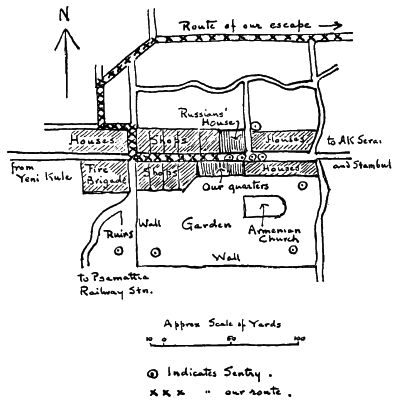
THE ARMENIAN PATRIARCHATE AT PSAMATTIA
Every point was watched. Two sentries armed with old Martini rifles (of archaic pattern but unpleasantly big bore) stood directly below our window: two more, similarly equipped, were stationed opposite: another half-dozen were posted in the garden and streets near-by.
Eventually we decided on a plan whose chief merit was its apparent impossibility: we would climb out of the window and across three or four yards of wall face, then having reached the cover of a parapet on the roof of the adjoining house, we would creep along behind it to the corner of the East-West thoroughfare, about a hundred yards away, where a North-South street intersected it, and slide down a rope to freedom.
It was a good plan, because the wall was not as impassable as it looked, having two string-courses which would give us a foothold and a handhold; and our visibility was not as great as it seemed, for sentries rarely look upwards, and rarely look for things they don’t expect.
“Zero hour” was 9.45 p.m.
In order to facilitate the chances of getting out of our window without being seen, we had enlisted the help of a Russian Colonel, Prince Avaloff. When we extinguished the lights in our room, as if going to bed, he had promised to engage the sentries at the door of his house in conversation, and to give us an all-clear signal by waving a lighted cigarette three times.
We drank a stirrup-cup together before he left us.
We took off our boots, tied them round our waists, roped ourselves together, shouldered our haversacks, blew out our lamp.
Crouched under the window-sill, we waited. The sentries below us were sitting on stools, with their rifles slung, as casual and unconcerned as we could wish; the two opposite lolled against their door posts; and the full moon had risen punctually and brightly behind our house, leaving the street in shadow, but lighting up the faces of the sentries so that even their eyelashes were visible. Little Avaloff approached them: only the top of his cap reached the moonlight: the sentries helped themselves to his cigarettes.
Waiting was anxious work: I lived through an age while a minute passed. At times such as these, the confidence of one’s companion counts for such, and I shall never forget Peter’s bearing. . . .
Avaloff waved his cigarette three times.
On seeing the signal that meant so much, I was so excited that I might not have moved but for Peter. He went first out of the window and I followed an instant later.
Once the first step was taken, once my feet and hands rested on the foothold and handhold that led to freedom, my lethargy vanished, leaving nothing but the thrill of climbing. At one moment we were in full view of four sentries, an officer who had come to take the air at our doorway, and a stroller in the street. But no one looked up: no one saw the two men who clambered slowly along the wall just above their heads.
After gaining the roof of the next house, we lay flat and breathless behind the parapet; then we unroped ourselves.
The parapet was lower than we thought, and in order to obtain the advantage of its cover it was necessary to remain prone in the gutter of the roof. In this position, from ten o’clock until half-past eleven, we wriggled on very cautiously past a dead cat and other offensive objects, until at last we reached the place where we had thought to slip down our rope.
Only once had we been startled. I had raised myself to look round, when one of the sentries ran out into the middle of the street and began to shout. What had alarmed him I do not know: we remained immobile for five minutes, then continued our creeping progression, wondering whether perhaps the Turks were already searching for us in our house.
The sooner we were away the better, but our street corner was not as safe as it had seemed when we had made our plans. Directly facing our part of the roof, and less than ten yards away, an officer of the Psamattia Fire Brigade sat at an open window, looking anxiously up and down the street, as if expecting someone to keep an appointment. His window was on a level with us, and he stared in our direction with such intentness that I thought he had seen us. But we lay still behind the parapet, and it soon became apparent that we were not the objects of his languishing regard.
Meanwhile the moon—the cold, wise moon—was creeping up the sky and would soon illuminate us so brilliantly that even a love-lorn fireman could not fail to notice us. For an hour—or so it seemed—this annoying Romeo kept watch. At last, just as we had determined to let go the painter and take our chance, he began to yawn and stretch and look towards his bed, which we could see at the farther end of his room.
“You are tired of waiting—she isn’t worth it!” I sent in thought-wave across the street. He hesitated, yawned again, and just as our protecting belt of shadow had narrowed to a yard, he gave up his hopes of Juliet and retired.
That was our moment.
We rose to our knees, made the rope fast to a convenient ring in the parapet, paid it out until it lay in the street below. Traffic had ceased. The sentries were huddled in their coats, for the night had grown chilly. Somewhere a dog yapped.
I like to linger over what followed: there have been hundreds of better escapes, but nothing can take these moments from me: they are packed, pressed down and brimming over with pleasure, and when things go wrong to-day I am still comforted by the memory of how very right they went on that occasion.
We vaulted the parapet, slipped down the rope. In my descent I half kicked down the sign-board of a shop, and Peter, who followed, completed the disaster. We had made noise enough to wake the dead; and in our haste we had ripped open our hands. But we were free, and no one had stirred.
After two and a half years of captivity we were free. A long misery was behind us, a great hope in front. Facts are blessed things: life-buoys to which neurotics may cling in the seas of doubt which encompass them: my hopes and plans for the past two years had found physical expression. The slothful years vanished in the twinkling of an eye. We had outwitted the Turks and the world was before us.
After lighting cigarettes, we strolled away in our stockinged feet, ready to run for our lives if need arose.
Once well clear of the garrison, we stopped, put on our boots, consulted the map. We were at the ruins of the ancient church of St. John the Baptist, amongst trees which overshadowed the ghostly turbaned tombs of Islamic dead and the older graves of the Sleepless Monks. Evidently we had come rather out of our way: after making sure of our position, we set our course for Sirkedji. Remembering the White Lady’s instructions, we sang:
Lieb Vaterland, magst ruhig sein,
Fest steht und treu die Wacht am Rhein.
Only once did we think that we might be recaptured.
As we were passing the Fatih Mosque at about one in the morning, we heard a rattle on the cobbles behind us. A carriage was being galloped in our direction: it might well contain some of the Psamattia garrison. We took refuge in the ruins which abound in this part of the city, and lay there, while the clatter grew louder and louder.
Wisps of cloud crossed the moon, now at her zenith: their shadows moved like ghosts across the desolation of the city. A cat was abroad: she saw us, and halted with paw uplifted, and blazing eyes.
Then the carriage passed, empty, with a drunken driver. After it had rattled away into the night, we emerged, and continued our way through dim alleys and balconied streets, shutting out the moonlight.
Dawn was near: the voice of a muezzin rang through the still air, bringing to me a sense of that brotherhood which has always been a message of the great teachers. But all about us lay misery, racial hatred, fear. The hopes of 1908 had not been fulfilled. Famine and fire and disease were waiting to take what they could from households already ravaged by war. Unseen behind latticed windows, and deep in the minds of dreamers and the sleepless, what a weight of woe there was!
Now the muezzin’s call died down. The night was over. We stood before the door of Themistoclé’s house.
We knocked softly, and waited, flattened in the shadow, prepared for either welcome or betrayal.
We waited and waited. I thought, They’re asleep: we shall have to hide in the ruins until to-morrow evening.
Then the door opened about an inch and two little faces appeared, low down: behind them someone held a light.
At last the door was flung wide, and we saw on the stairs a whole family of friendly people, male and female, old and young, all in night dress, and all with arms outstretched in greeting. We might have been prodigal sons returning, instead of two strangers whose presence would be a source of continual danger.
After a business talk with Themistoclé, during which fifty pounds changed hands, Hyppolite and Athene, his twin children, aged eight, took us each by the hand and led us upstairs.
“The last escaped prisoner we had here was a forger,” said Hyppolite.
“He was a friend of father’s,” added Athene, “and escaped to Russia about six weeks ago. He was afraid that the police would find his tools, so he threw them into our cistern: they are there now.”
We reached the top floor, and were shown into an apartment containing a double bed with a stuffy canopy of damask.
“This is our bedroom,” they said.
“And where are we to sleep?” I asked.
“Here,” said Themistoclé, who had followed close behind. “My sister and I and the twins were using the bed until your arrival, but now we will sleep in the passage.”
“The passage? Were you all four in this bed?”
“Yes. The other rooms are full of lodgers. We are poor people, and must make what we can. There are three officers of the Turkish Army here at present. But they won’t disturb you, because they are hiding, too.”
“Mon Dieu! You don’t mean to say that your sister is going to live in the passage?”
“Certainly. It’s safer there, in case the police come.”
“I know all the police,” said Athene; “even when they are not in uniform, I can recognise them by their boots.”
“We are always on the look-out for them,” added Hyppolite. “If they come to search the house you will have to get into the cistern.”
“Where the forger threw his tools,” Athene explained.
Coffee and cigarettes were produced, and ointment for our lacerated hands. The family wanted to hear every detail of our escape, and we were nothing loth to have an audience. They clapped their hands with delight at the idea of the Turks’ amazement when they discovered that we had vanished, leaving no trace behind us.
“They will never find the rope,” said Themistoclé, “because the shopkeeper will cut it down and hide it, for fear of being asked questions.”
After some further discussion of the habits of the Turks, the price of food, and the various ways of escaping from Constantinople, Themistoclé’s grandmother announced that we must thank the Holy Saints for having kept us safe.
She went to a glass cupboard in the corner of the room, opened it, lit two candles. A scent of rose-leaves and incense came from the shrine, which contained oranges, ikons, a large family Bible, and eggs from bygone Easters. We stood silent.
I was expecting a prayer, but the old lady blew out the candles, shut the cupboard, made the sign of the Cross over it and crossed herself. The thanksgiving had been a silent one, and the family now dispersed, after bidding us a very good morning. I think Themistoclé wanted to kiss us, but we had been through trials enough.
Peter and I threw ourselves on to the bed, too exhausted to undress.
Next instant, as it seemed to me, although in reality two hours had passed, we were awakened by the twins.
“Time to get up,” they said excitedly. “The house might be searched at any minute.”
Instantly we were afoot.
“Where are the police?”
“There is a detective standing at the corner of our street,” said Hyppolite.
“They often come to see if all our lodgers are registered,” added Athene.
We staggered gloomily downstairs, full of fear and sleep. But in the pantry we found the seniors of the household unconcerned about the police. There was often a detective at that corner, they assured us, and while there was no imminent danger of a search, there was an immediate prospect of breakfast. A saucepan was actually being buttered (and butter was then almost worth its weight in gold) to make us an omelette. So we began to eat, and as we ate we remembered how hungry we were: after two omelettes had fallen to my fork, an engaging sense of drowsiness began to creep over me again. But the twins would not let us rest: they looked on us as in their charge, and bullied us accordingly.
“You must practise getting into the cistern,” said Hyppolite.
“Like the forger did!”
The worst of it was that their suggestion was sound. Common sense and our duty to our hosts dictated that we should neglect no precautions.
I took off my clothes, and removing the lid of the cistern, was lowered into the waters below. As my eyes grew accustomed to the light I saw a forest of slender columns supporting the houses above me: I waded on a little further, but soon returned, for I was afraid that I might lose myself: the cistern seemed endless, and it was indeed a part of the great underground system of aqueducts by which Valens and Justinian had supplied water to Byzantium. It was here that many Janissaries were drowned in 1826 when Mahmoud the Reformer upraised the green standard of the Prophet and decreed their death.
The place was haunted: something scurried on an unseen ledge: a rat perhaps: then my fingers touched a little thing that cracked under them, and I felt a stinging pain: whether it was a beetle or a sleepy wasp I did not stop to enquire. As I groped my way back to the manhole, I barked my foot against something hard: stooping down, I picked up a block of pumice-stone. It was the forger’s die, no doubt.
All morning we passed in the pantry, eating and dozing by snatches, and writing a letter to the White Lady. Morning merged into afternoon, and the afternoon into evening. No detectives came. We were safe.
At nightfall, after sending Hyppolite scouting up the stairs to see that the other lodgers were not about, we went to our room, unpacked our gear, opened our map, considered our next move.
We were in no particular hurry to leave the house. The longer we stayed, the more likely it was that the Turks would relax the measures they had taken for our recapture; besides, we wanted a day or two of leisure to weigh the advantages of the various routes that led out of the city.
But we had reckoned without the bugs. They bred by the billion in Themistoclé’s bedroom, and such was their voracity that except for the first sleep of two hours, when exhaustion had made us insensible, we never had more than half an hour of uninterrupted rest. Peter and I lay in the stately double bed wondering how any man or woman alive could tolerate the creatures that crawled over its mahogany posts and swarmed over its flowered damask. Every now and then one or other of us used to light a candle and add to the holocaust of creatures we had already made.
“What hunting?” I asked.
“A couple of brace this time, and a cub I chopped in covert.”
“That makes twenty-two couple up to date—and the time is 12.35 a.m.”
A little later, Peter would enquire what sport I was having.
“A sounder broke away under your pillow,” I reported. “Six squeakers and a brace of heavyweights.”
Having killed every creeping thing in sight, I lay back and gasped: but then, out of the corner of my eye, hugely magnified by proximity, I saw another monstrous brute, avid and eager and brisk. I squashed it: there was a smear of blood on the pillow (my own good blood): I was streaked with crimson, itched at neck and wrist, felt irritable, unclean, hysterical: I switched on the electric light and saw another, and another, and another troop of vermin: I swore that I would stay no longer than was absolutely necessary in this room that stank with their slaughter.
During the daytime Themistoclé avoided being bitten in a simple way: the ends of his drawers were provided with tapes tied close above the ankles: excited throngs of insects used to explore his elastic-sided boots, but were baulked of a closer contact. This was all very well when clothed, but what did he do at night? Perhaps he never undressed.
Themistoclé was a queer creature, and I did not entirely trust him. When he visited us next morning before going to his work in the restaurant, he talked about the risks he ran in keeping us, and the cost of living in Constantinople.
“Everyone is starving,” he said, “even the policemen go hungry for bribes. A friend of mine, a policeman, said to me the other day, ‘For the love of Allah find something for me to do. Among your acquaintances you can surely find a sinner? Then I could arrest him and we would share the proceeds.’ ”
“What did you say to that?” I asked.
“I said that I would do my best.”
“But what sort of man would you find?”
“Any sort. A drunkard, perhaps, if I saw one, or a rich man, if I dared.”
“Rich men are apt to be dangerous!”
“I know. But what can one do? One must live!”
“And let live,” I answered.
“I have children to feed,” said Themistoclé.
“No doubt our payment has been useful.”
“Yes, but what would happen to them if you were caught in my house?”
“Don’t let’s think of that,” I said: “We’ll be off to-morrow. Besides, the war will be over soon. The German offensive has failed: now the Allies are beginning to attack. When the American armies move——”
“The Allies said that about the Russians.”
“This is different. We have three times the manpower of Germany in reserve, and ten times the material resources. We can’t help winning. The war will be over by the autumn of 1919: I know it for a fact.”
“The war won’t interest me then, for we shall have starved,” said Themistoclé gloomily.
I did not like his harping on hunger, for I suspected that a price had been put on our heads, and that he was weighing the advantages and disadvantages of keeping us. I do not know whether we did him an injustice or not in doubting his integrity, but at any rate we determined to see the last of him as soon as possible.
Peter made up his mind to board a melon-boat to Rodosto and thence work his way either along the coast, where he hoped to be picked up by our patrol boats, or to the Bulgarian frontier. As for me, I decided, in consultation with the White Lady, to remain in Constantinople in another (and I hoped less verminous) hiding place until I could arrange to be smuggled out of the country by friendly pirates.
Peter’s disguise was a matter of difficulty, for he was so tall that he attracted notice in an Eastern crowd. However, with his face darkened with burnt cork, his hair dyed black, and a tattered fez on the back of his head he looked the part of a ragamuffin Arab so well that he might have been arrested merely on account of his appearance. But a touch of genius completed his make-up. In his hands he carried a bowl of curds and half a cucumber, making him seem to be a householder going about his domestic affairs instead of a vagrant escaping.
He left in a great hurry, for his boat had to catch the tide. After he had gone, depression overcame me: my scheme involved waiting for people and politics outside my control: I wished I had tried my luck in a more active way. But alas, there is something in my nature which leads me into positions where physical energy is required, and then compels me to consider them philosophically instead of acting on them.
But that evening, the White Lady arrived in Themistoclé’s house and cheered me with the news that Prince Avaloff would certainly be repatriated to his native town of Tiflis under the Treaty of Brest Litovsk, and that he was not only ready, but anxious to take me with him to Russia, disguised as his servant. His intention on arrival in the Caucasus was to raise two regiments of cavalry and give me command of one of them, that we might ride down together to join hands with the British above Baghdad. I rather fancied myself leading a regiment of Circassian swordsmen!
We discussed how best I could meet Avaloff. He could not come to Themistoclé’s house, for although he was nominally at liberty, he was always shadowed by a detective who enquired closely into the character of any male companions with whom he consorted. And it was then that the White Lady had one of those inspirations which alter the lives of men.
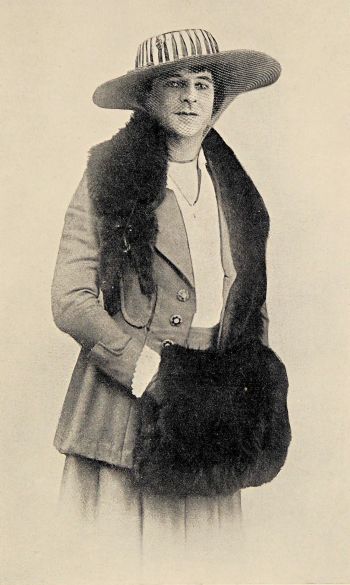
THE AUTHOR AS MADEMOISELLE JOSEPHINE
“A friend of mine left me some clothes at the beginning of the war,” she said, “which would fit you with the help of a tailor. Why not become a German governess? Then no one will mind your talking to the Colonel.”
It was a superb idea. No woman was asked for her passport in Constantinople, especially no European. As such as I should be able to take tea with Avaloff in any restaurant of Pera—the more public the better—and learn exactly how he proposed to pass me off as his servant. I might, of course, have relied on written communications from Avaloff, but knowing his vague, romantic nature I distrusted any scheme that did not bring us face to face.
Next morning, accordingly, Themistoclé brought me a suitcase which the White Lady had sent to him at the Maritza: it contained the requisite articles for my transformation, and I unpacked it with awe.
Between us we managed to find the front of the slip and the correct use of the various elastics hanging from the corset: two small towels gave me a pleasing bust: once these were in place, the blouse fitted well. The coat, although it was short in the arm and tight in the back, could be expanded by a tailor. A thing like an embroidered nightshirt I rejected altogether: I afterwards learned that it was a camisole, and not essential.
I dined in my new character, to accustom myself to wearing a skirt, and to learn not to cross my legs, a thing not done by young ladies in the Constantinople of 1918. With a hand-mirror and long glass I surveyed myself front, back and profile; and was impressed by my appearance. But when my good angel arrived, she gave a cry of horror.
“You haven’t even shaved and I wanted to take you out with me to-night!”
“I won’t be long. But what about my head and feet?”
“I’ve brought you a hat and wig,” she said. “Your own shoes will do—those glacé kid ones you were sent from the Embassy. We’ll sew bows on them to-morrow.”
In five minutes my face was as smooth as that of the waiter who served the lovers of Orelay. On this foundation the White Lady set to work with vanishing cream, poudre Rachel, Vesuvian black for the eyebrows, bistre for the lashes, and a touch of rouge high on the cheekbones.
“Will anyone mistake me for a governess?” I asked.
“I might mistake you for Mademoiselle Josephine if you would only take shorter steps,” answered the White Lady.
We tried on the wig, which came down well over my forehead, and arranged its brown ringlets to hide a suspicion of blue streak persisting through my powdered cheeks. Then we laid on the wig a large striped hat at a becoming angle, and a veil over that; finally the White Lady threw a dustcoat over my shoulders to hide the ill-fitting garments beneath it.
So arrayed, I stood again before my mirrored self; with incredulity at first, then amazement. Was this really me? Tiresias himself could not have experienced greater magic: Mademoiselle Josephine lived and moved and smiled into my eyes.
What a girl! She was sardonic, but not unattractive. There was a cruel look about her mouth. Her eyes were hard: she had seen life—too much of it, I thought.
“I don’t look very respectable, do I?” I suggested.
“How vain you are!” said the White Lady. “You look a little unsexed and unapproachable—one of these very modern girls—but that’s all to the good. To-morrow I’ll show you how to make yourself look better. You’ll pass in a crowd on a dark night like this. Come on, the tailor is expecting you in Pera and I’ve arranged for you to live with him.”
We called for Themistoclé, and settled his bill, binding him with many vows to secrecy. He was glad to see me go, I think, and I don’t blame him: fear and avarice had been contending for many hours in his mind: now he would have peace. Little did either of us imagine the tragedy soon to be enacted in his house.
“I’ve forgotten your nose,” said my companion at the door.
“My——?”
“Powder—here, take mine.”
She gave me her bag. While we waited for a cab, I fumbled with it stupidly, thinking that everyone in the street must stop and look at what I was doing.
My hands felt beefy, enormous, gaunt-wristed and my forearms like those of a baboon in their short, tight beige sleeves. A policeman was walking towards us. Would he stop, ask who I was, insist on my following him to the police station? No, he had passed with no more than a respectful glance. The cab drew up. We took our seats: the driver whipped up his horse: we trotted away towards Galata Bridge. I wanted to shout for joy.
“What do I do with this?” I asked, returning the bag to the White Lady.
“You carry it shut,” she said, “so that things don’t drop out of it.”
We drove up the long winding way from Galata, dismissed the cab just before we came to the Tokatlian Hotel, and continued on foot. At the Tokatlian, high officials and their ladies were supping at the plate-glass window which faced the street: we lingered for a moment amongst the throng that was regarding the scene of luxury within. Two women were dining by themselves at a table adorned with rose-petals: between them stood a long-necked bottle in an ice-bucket. One was elderly, blonde, heavily bejewelled, vacant-eyed, with the then not common rigidity of a lifted face: the other was a boyish-bobbed brunette with wavy hair brushed back from a thoughtful forehead, and tender eyes belying the bone above them, and curved, delicate nostrils contradicting full, eager, painted lips, and soft, white arms with strong, square hands: a creature of contrasts. She turned a cigarette holder in my direction, and drew on it fiercely, staring at me. That long, close look gave me confidence: it was frank and friendly, yet did not touch my secret. I was thrilled.
After I had followed the White Lady through some small, confusing streets, we came to a place where she stopped and looked back to see if we were being followed.
“Walk straight on for five minutes,” she said, “and then back at the same pace. I’ll meet you here again, and show you the house.”
I did as I was told, wondering what would happen if I were accosted. But no one passed me, except a nightwatchman thumping with his staff, and a little boy who took off his cap and begged in a reassuring manner. Pera went to bed early, for light was expensive.
Young cypresses and old houses surrounded me: sloping seawards was a forest of leaning, derelict tombstones: beyond them, the Golden Horn glittered in the moonlight: it glittered between proud cities and rival cultures: on the one hand the domes of Stambul floated luminous and ethereal, on the other rose the Tower of Christ, stern and straight and resplendent. Between them, ships cast black shadows on the burnished water.
There was a contest between the Asiatic wisdom of leaving things alone in order to cultivate the inner life of contemplation and the turmoil of the soul of Europe, magnificent even when most terrible; a contrast between the peace of the kief and the commerce of the West. And the war went on for caged and free, while some starved and others made fortunes, some became Generals and others corpses.
But as usual I had stopped to think at the wrong moment; and when I returned the White Lady was waiting for me anxiously, thinking that I had missed my way. She had reconnoitred the house of the Greek, and had satisfied herself that there were no untoward watchers there.
Swiftly she turned left-handed, then left again, and led me through a passage roofed with vines to a low door, at which she knocked. A rheumy old Greek with a white beard answered her: we entered in silence: the door closed: still in silence I was led upstairs to a beautifully clean little bedroom, papered in a light bright colour, from which a veranda opened.
This was to be my home for as long as I wished. . . .
* * * *
I thought, I have found Heaven! I hope the White Lady guessed my gratitude, for my heart was too full for words. After bidding her good-night, I lay down and slept for ten hours without stirring.
In the background of my new quarters I discovered that several women lived and moved, but they avoided me (thinking it unwise, I suppose, to enquire too closely into my identity) and left me entirely to the care of the old Greek and his son: they were the only members of the household to whom I was known. Old George used to bring me my café-au-lait in the mornings and sit with me sometimes. Young George, who was a chemist’s assistant, used to sit with me in the evenings on the veranda, drinking ’araq, and telling me the gossip of the Grand’ Rue de Pera: the insolence of the Germans, and the gaffes of the Young Turks.
“It is forbidden to circulate in the city in a state of uncleanliness, or in a state that inspires repulsion,” ran one of the edicts of the Prefect of Police. And he had said to a friend of Young George: “Je m’en fiche des enfants des pauvres—qu’ils crèvent!”
“Can you wonder that we want the Allies to win? Imagine having to live under barbarians like Bedri Bey!”
We drank damnation to him.
Things were on a hair edge in Constantinople: a burst tyre made men duck for cover, thinking that the revolution had come, while news of Enver’s downfall or the Sultan’s murder were often circulated. Bibulous old Mehmed had recently died and George had been present at Vahid-ed-din Effendi’s Girding-on of the Sword at Eyoub: he told me that both Enver and Taalat Pashas had looked extremely nervous during the ceremony. One of the first acts of Mehmed VI (as Vehid-ed-din now styled himself) had been to take Enver Pasha down a peg from his position as Vice-Generalissimo of the Turkish Army; and his next move had been to send for the only English tailor living in Constantinople, and order several suits from him. The Germans he shunned.
At any moment the war might end, and I wanted desperately to do something useful before that happened, but the Avaloff adventure was beginning to seem to me too fantastic to succeed. The first time that I kept a rendezvous with him, he failed to appear.
On this occasion the White Lady had an important engagement in Prinkipo (she was helping General Townshend in the negotiations which led to the Turkish armistice) and Young George accompanied me.
Josephine’s appearance by daylight caused me acute concern: even with gloves and veil I was afraid that I would attract undue attention. But I soon found that my walk and manner adjusted themselves almost automatically to skirts, and that the citizens of Pera were too busy with their own affairs to give more than a glance at a tall, painted girl in the company of a smart young Greek.
We sat at the Petits Champs, drinking lemonade. No-one paid any attention to us. I rolled up my veil over the brim of my hat and looked about me with all the assurance of a professional beauty. Avaloff did not appear. After waiting more than an hour we returned sadly homewards.
I knew now that my disguise was perfect for the purpose intended; but if Avaloff failed me it was useless. I could talk to no one, for my voice would have at once betrayed me, and I could not explore the city alone without exciting comment.
On our way back, we happened upon a scene which lifted a corner of the curtain of intrigue shrouding the new tenant of Yildiz Kiosk. A Turkish officer in staff uniform came running down the Grand’ Rue de Pera, followed by half a dozen Dog Collar Men: the fugitive took refuge in a leading club, and slammed the door in the faces of the policemen. A crowd collected, in which we mingled.
Now a Mercédès car arrived, carrying half a dozen soldiers. They unpacked a machine-gun and took up a position on the pavement. Meanwhile the police had broken into the club. But as they entered, their prey appeared at a top-storey window. He looked behind him, waved his arms to Heaven and threw himself down into the street.
I had not imagined that a man could blot himself out so noiselessly on cobblestones. The crowd hadn’t time to gasp.
A moment before there had been an exciting chase: now a crumpled thing lay there, in gold epaulettes. The machine-gunners packed up and the spectators melted away.
“That makes one Turk the less,” said George unfeelingly. “He was one of the Sultan’s aides-de-camp who had quarrelled with Enver’s gang, and they were determined to get him. It will be Enver’s turn soon. You see!”
It was not until I had passed a week of my equivocal existence as Mademoiselle Josephine, taking brief strolls at night amongst the graveyards, but avoiding the habitations of man, that the White Lady was able to arrange a meeting with Avaloff in the Petits Champs. We found him in high spirits, drinking beer with his detective and ogling the Periote world of fashion.
He rose and saluted us as we entered: the detective politely took his glass away to a near-by table: the White Lady introduced me: Avaloff kissed my glove without batting an eyelid: we sat down together and ordered tea.
“Now you two can go ahead,” said the White Lady, “I must be back soon, to look after my great-aunts, but you will be safe here with the Colonel for half an hour.”
“I am honoured that you should trust Mademoiselle to my keeping,” said Avaloff.
“I can take care of myself,” I said with a simper.
“Now to business. Everything is arranged. In a fortnight’s time we’ll be having tea in Tiflis!”
“Not so loud, mon Colonel!”
“Ah, that sacré spy. Never mind him, he doesn’t understand French. Now listen, Josephine: I have bought a soldier’s uniform for you from a Russian who has consented to stay behind in order to let you come. You have only to put it on and follow me on board.”
“When are you likely to start?”
“Any day. Any moment Peace is signed. I wanted to tell you this a week ago, but I had ’flu. As soon as I hear the exact date of sailing, I will go to the Maritza and tell Themistoclé, who will tell you. Then you will come to Themistoclé’s house, where your clothes will be ready for you. You will change into them there and join me on Galata quay.”
“What shall I say if someone asks me who I am?”
“You will explain that you are my Georgian servant—like this—” and the Colonel gabbled a tongue-twisting sentence which I tried to memorise.
“I’ll write it down,” he said.
“Don’t!” said the White Lady. “You are being watched.”
“Very well, I’ll repeat it.”
“Yes, softly. The detective heard you talking in another language.”
Our tea arrived. Avaloff instructed me in my behaviour as his orderly. We made arrangements for cashing a cheque for fifty pounds as solatium for the Russian whose place I was taking.
“It’s all quite simple,” said Avaloff, whose mind kept escaping from the present. “As soon as we get to Tiflis we’ll enlist two thousand men—more if we have time—and kill the bloody Bolsheviki! Then we’ll ride down through the mountains to join your Mosul Army.”
“You can settle that on the boat,” said the White Lady suddenly. “I don’t like the look of things.”
My heart leaped beneath its brassière, for I saw that the detective had called over a Dog Collar Man to his table. What were they concerting together?
“I’ll take you out of this,” said the White Lady. “Say good-bye to the Colonel affectionately.”
Paling under my rouge, I forced a smile to my lips and gave Avaloff my hand.
“Make love to me,” I muttered: “go on!”
“When shall I see you again, my sweet Josephine?”
“On ne sait jamais!”
He bent over my hand, clasped it to his heart, would not let it go, looking at me with his brown, ardent eyes.
The Dog Collar Man had risen, I suppose to reprimand Avaloff for flirting, but neither he nor the detective now suspected us of any serious intrigue.
“Ecoutes moi donc, Josephine; je t’adore.”
“Au revoir, cher ami!”
Drawing myself up in a très calé way, I looked at the three men in turn: Avaloff bowed: Dog Collar winced: the detective blushed and began admiring the view over the Bosphorus with great intentness.
But my knees were fairly knocking together as the White Lady escorted me back. Near the ruins behind the Pera Palace Hotel she left me to find my way alone, for she was already late for her great-aunts.
Still trembling, I had reached the last turning but one for home when an elderly German officer in pince-nez saluted me. I daresay he had mistaken me for someone else, and that his attentions were honourable, but as soon as he accosted me I felt that I could no longer act my part. Gathering up my skirts, I bolted, and did not stop running until I was safely in the house of the Greek.
With my café au lait about a week later Old George brought me a letter which Avaloff had consigned to Themistoclé for delivery. Already, at the sight of the writing, I felt a premonition of disaster. As I took the envelope, I told myself that the news might after all be good: why shouldn’t it be good news? Why shouldn’t Avaloff be writing to say that I was to meet him that very morning?
Yet instinct was right: the message ran: “Just off. No time to explain. Constantin Avaloff.”
All the Russian officers and soldiers in Constantinople had been awakened at midnight and embarked before dawn. They were now on their way up the Bosphorus: and here was I an idle mummer, with three wasted weeks behind me, and all to do again.
It was a bitter moment, though I was not as unfortunate as I thought, for had I reached Tiflis my adventures would not have been pleasant: I believe that poor Avaloff was murdered there by the Bolsheviks.
I now committed Josephine to oblivion, and became a Hungarian mechanic who had lost his job at the munition factory near San Stefano. I grew a small turned-up moustache, bought steel spectacles, a stained white waistcoat which I decorated with a nickel-gilt watch-chain, a pair of old elastic-sided boots, and a bowler hat, which I wore askew. My nails were oily and my antecedents doubtful, but I had a vécika (forged by a relative of Themistoclé’s friend who had escaped to Russia) certifying that I was exempted from service in the Army owing to flat feet and valvular disease of the heart. Armed with this document, which was signed, stamped and sealed with the counterfeit of the insignia of Military Commandant of Constantinople, I believed that I could pass in the city without molestation.
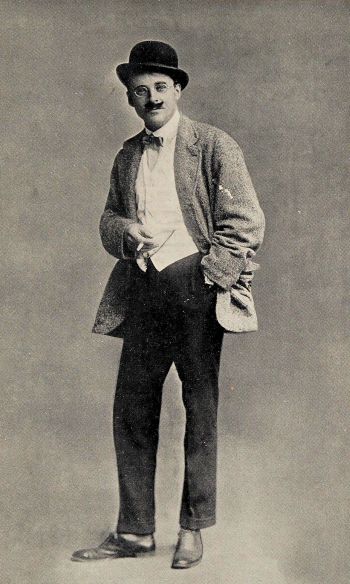
THE AUTHOR AS A HUNGARIAN MECHANIC
I used to spend my mornings at the docks, hoping to find someone to take me to Russia, and my evenings with Young George, in a little hotel in Galata, where some Christians were wont to assemble in a cellar, planning revolution.
“We’ll crucify the Turks and Germans,” said the proprietor of the hotel, “and eat them in little bits!”
A bell rang, and he hurried upstairs. On his return, he explained that a German client had complained that his beer was not iced. “The sot won’t be able to get a cold drink where I’m going to send him,” he said.
“We are starving under the Young Turks,” said a speaker. “I paid half a lira for a small loaf yesterday, and found a pebble and part of a mouse in it. Down with Enver and his bloody gang! Up the Allies!”
’Araq flowed freely, and sweet Greek brandy.
We unpacked a barrel full of rusty muskets and a case of curved swords (they looked like theatrical properties to me) and the proprietor showed us an enormous silk flag, stitched by the fingers of Christian maidens in order that it should fly over Aya Sophia on the day when the Cross should replace the Crescent on its dome.
Enthusiasm is contagious: it was only when I emerged from this atmosphere of melodrama into the silent streets that I remembered the strong knees of the Turks.
But my time was not ill spent, for I found amongst the conspirators several who backed their belief in the Allied cause to the extent of cashing cheques for me (written on half sheets of notepaper) amounting to two hundred pounds sterling. Armed with this means of persuasion I had no doubt that I would be able to purchase a passage to Russia.
And now I heard at the docks that two British officers who had recently escaped from Psamattia were hiding with Themistoclé, and were anxious to charter a boat to a Black Sea port: obviously if we joined forces we should minimise both expense and danger.
On the morning after this information reached me I walked over to Stambul to visit my previous abode, and there I discovered that the two escapers were already in touch with a Lazz pirate who had promised to provide them with a motor-boat (for a handsome consideration, of course) in which they would travel to Poti disguised as his wives.
The dresses necessary to enable my friends to pass the Customs authorities in the Bosphorus had already been ordered. They were to wear cloaks and heavy veils and were to sit in the Lazz’s cabin, refusing to move or speak if questioned. Provided a suitable tip were forthcoming, the Lazz had explained, there would be no trouble with the gallant excisemen, for their custom was to absolve wealthy Muhammedan ladies from scrutiny. The only difficulty was the tipping. The Lazz wanted four hundred pounds sterling for the two of them (this included the expense of the boat) and my friends did not know how to find the money, since the Lazz would not take a cheque.
I told them that I would return on the morrow with at least part of the money in Turkish notes, provided they would take me with them. They agreed, and I felt now that matters were at last moving to the conclusion I had so long desired. The scheme had many elements of success: it was simple, speedy, and fairly safe: at any rate whatever risks we ran the Lazz would run them too.
When I returned with my money in banknotes, the Lazz was there: a tall, thin man, with a solemn, trustworthy manner. He made no difficulty about taking an extra wife with him to Russia, but wanted six hundred pounds sterling for the three of us. After some argument he agreed to take our cheques for this amount, provided we gave them to him before starting, and provided also we gave him one hundred liras in cash to buy fuel and oil for the trip. The cash was absolutely necessary, he said, for how could the launch run without petrol?
“But you can run your launch without our help,” I said. “Why do you want more petrol for three passengers?”
“There is your food to buy.”
“We can look after ourselves.”
“I don’t take you unless you pay my out-of-pocket expenses in cash.”
“What guarantee can you give us that you will buy the petrol?” I asked.
“What guarantee can you give me that your cheques will be cashed?”
“We are known to be honest men.”
“So am I known to be honest.”
“Supposing Themistoclé goes with you to buy the oil and petrol?” I suggested.
“Then I shall want a hundred and fifty instead of one hundred liras,” he answered. “But why bring him in? I know my business.”
That was true. These Lazzes were the most successful criminals in Turkey. If Abdul Hamid or his successors wanted someone put out of the way, the Lazzes supplied the assassins or agents provocateurs who did the work and then vanished; so also if a Pasha desired a selection of handmaidens for his harem, the Lazzes had agents in the bazaars of Tiflis and the mountains of Prester John who could get him what he wanted: they were always smuggling out murderers or bootlegging virgins into Constantinople.
This pirate knew what he was talking about, and would keep his word.
In half an hour we had come to terms and he promised to have the boat ready and to bring our disguises to us on the following day.
We were really to start to-morrow!
To-morrow. . . . Ominous word!
After the money had changed hands I looked through the bedroom curtains into the street below, and saw an individual loitering at the corner where on the first morning of our escape a detective had been. I should not have been alarmed, had he not been joined, as I watched him, by a blue-suited, befezzed, square-toed person in whom I thought I recognised a Dog Collar Man in plain clothes.
“Do you know anything about those men?” I asked the Lazz, taking him to the window.
“Let me get out!” he said, making for the door.
“Who are they, damn you?”
“Police,” he muttered. He had turned grey with fear.
“You stay here with us,” I said, standing in front of the door.
“Do you want to get us all arrested?” he complained. “What’s the point of waiting here? I’ll slip out first, then you can follow me. I’ll leave a message for you at the Maritza to say where we can meet to-morrow.”
There was force in what he urged. He gave us back our money, and bolted.
We put on our coats and tip-toed downstairs. I thought, Even if the police are watching the house, they do not know we are here, or they would have searched it already. We can still get out at nightfall.
Themistoclé’s mother and sister were sitting in the pantry. Greeks are so excitable that I did not like to alarm them with distressing news: it would be better to await Themistoclé’s return.
The Lazz was clear of the house: he had not been arrested, for we had heard nothing. So we returned upstairs. My friends were packing up their things and discussing where they would spend the night, when we heard a loud rapping on the door.
So the worst had come.
I found myself running downstairs two steps at a time. I must get into the cistern. I must get into the cistern. I must——
I was in the pantry. The street door was being opened by Themistoclé’s sister. The old mother sat calmly with her knitting. Where were the other members of the household, I wondered? What would happen to them? I lifted the cistern lid: as I did so the old lady guessed what was happening, and screamed. I dropped the lid: stood bewildered behind the pantry door.
“Ingliz zabit”—I heard from the street: “English officers——”
Themistoclé’s sister was saying: “Yok, yok, effendim.”
Men tramped into the hall.
Why wasn’t I in the cistern?
I thought, The reflexes of the body are strange. Sounds and sights have set up vibrations in my head, and my brain has perceived their meaning and consequences, but it won’t think now that thinking would be so useful: it has merely telegraphed orders to my bowels to loosen, and to my heart to accelerate: what’s the good of that? I forced myself to do a little cerebration.
“Don’t worry,” I said to Themistoclé’s mother, “you don’t know who I am! Tell them you don’t know who I am.”
I waited a moment, and heard three or four men run upstairs—they were after my friends, no doubt: there was a hell of a noise up there. Then I crammed on my bowler hat and walked out boldly. I thought, How foolish not to have done this before: I am a Hungarian mechanic: no one will stop me!
A burly policeman stood at the door. I approached him with the jauntiness of Charlie Chaplin. He smiled back, but pointed upstairs. I nodded, as if I knew all about it, and tried to pass.
“Yok!”
That abominable monosyllable!
Had I hit the sentry and run for it, I might have escaped. Instead, I lingered, undecided, until I heard a torrent of oaths from the stairs behind me: the sentry’s smile vanished: he seized me and twisted me round, confronting me with a Dog Collar Man who held a revolver in his hand. With the revolver pressed into the small of my back, I was taken to the pantry and searched.
The police had rounded us up very neatly. The Turks share this characteristic with Englishmen, and bulldogs, that they have a lazy look about them, but can be extremely smart when something stirs their blood. The Dog Collar Man had a canvas bag: into it he put my pocket-book, my watch, a compass, loose change, and my forged passport. My two friends were brought downstairs and similarly denuded of their possessions. Upstairs a separate squad examined the lodgers. Themistoclé’s mother and sister were given chairs in the hall and told not to move. Presently Themistoclé himself was led in between two policemen.
Whoever the informer against us had been, it had not been Themistoclé. His thick spectacles were broken: his nose was bloody: his hair rumpled: his collar burst: his clothes torn: he looked as if someone had been rolling him in the gutter.
The Dog Collar Man formed us up in a little procession: first went two policemen to clear the way through the crowded streets to the Central Civil Jail, then came two weeping women, a trembling waiter, two stalwart young Englishmen in stockinged feet and shirt-sleeves, and a seedy-smart individual in a bowler hat no longer worn at a rakish angle: each of us was held by two guards: behind us marched the triumphant Dog Collar Man.
To my surprise the Jail was clean, and fitted with the most modern appliances for the registration of criminals. Our finger prints were taken, we were photographed, weighed, measured, medically examined, card-indexed, and then locked away in the cells of prisoners awaiting trial. My room contained a bed, a table, and a chair, all very solidly made and designed to withstand any access of despair on the prisoner’s part. The electric light in the ceiling was covered with wire netting. Walls and woodwork were of a neutral colour. The windows, which were barred, had a convenient arrangement for regulating ventilation. The heavy door was provided with a sliding hatch which could be opened by the warders for purposes of investigation. Everything was so civilised that I wished I could find a little dirt, or a friendly rat or two.
My thoughts were most unpleasant. I had failed, and innocent people were suffering as the result. My life had been built upon ambitions which I had not the skill to achieve. I had meant to be an author on leaving Harrow, and had had a short story published at the age of eighteen, but instead of continuing to write I had gone for a soldier; and then while a soldier I had dreamed of books and philosophy. . . . I looked at myself now, at the age of thirty-two, a failure in everything, a muddler who had not only made a mess of my own affairs, but had placed the White Lady and Themistoclé’s relations in danger. The only lining to the cloud of my oppression was that the twins had been absent when the house was raided: I heard afterwards that they accompanied their great-grandmother to pay a fortunate visit to a relation.
Who was that bawling in the next cell?
I stood on a chair, listening through the barred window and heard my friend shouting that he would leave a note for me in the East latrine of the three that served us. I howled back an acknowledgment, so loudly that the warder opened the slot of my door, and I had to explain that I was singing.
I found the note, read it, and wrote the reply on a cigarette paper, using a match as pen, and tobacco juice and ash as ink. By these simple means we established regular communication between our three selves; and had soon composed a complete, circumstantial, and wholly fictitious account of our adventures prior to capture.
On the afternoon of the second day, while I was sitting at my table with my head in my hands, in the depths of despair, the slot of the door was withdrawn and instead of a gaoler’s face I saw a pair of black eyes below straight lashes which met at the nose. They were glamorous eyes, and it was a little nose, wrinkled in laughter: I jumped to my feet, thinking that I had been dreaming, but No, someone had left me a stump of lead-pencil: the vision had been real.
By the usual subterfuge (notes in the latrine, and visits thereto) I discovered that my benefactor was an Armenian girl awaiting trial on a charge of spying. She had provided us all with writing instruments, but why she had done so I never learned. I only saw her once, when we passed in the passage: she was tall and proud, with a light on her splendid forehead that seemed an aura of triumph. The grizzled old sentry who accompanied her looked ape-like beside this lively and lovely creature: she made the whole prison look foolish: we were sad little creatures playing a silly game: she was mortal and beautiful as a tree in spring and we the weevils on its bark. She was life: our existence turned on hers although we pretended not to know it. . . .
When we were brought before the Chief of Police, we found him a cordial little gentleman who gave us chairs and cigarettes, asked after our health, hoped that we had been comfortable. We thanked him for his treatment, congratulated him on the cleanliness of his jail, but drew his attention to the mistake made by his detectives in imprisoning Themistoclé’s mother and sister.
“They are Turkish subjects,” he answered.
“But they are innocent. If they are maltreated, we shall hold you answerable after the war.”
A month ago such a threat would not have been of any avail, but now a change had come over men’s minds—we felt it even through the walls of the prison—and our warning carried weight.
“They are Turkish subjects,” he repeated, “and are accused of having given help to our enemies. But you need have no fear for them, for they will be well looked after.”
We told him that they should not be in prison at all. No one except ourselves was responsible for our presence in Themistoclé’s house. While at large in the city, I said, I had followed him back from the Maritza restaurant to his house, and knowing him to be a Christian I thought it possible that he might shelter me, but as a matter of fact he had sent a message to say that he would have nothing to do with escaping prisoners. My friends explained that he had accepted them as lodgers believing them to be Bosnians: they had passed as such in the city, how then could the short-sighted Themistoclé be expected to know that they were British?
“That is very interesting,” said the Chief of Police, “but you must tell your story to the Commandant of Constantinople. I am sending you to the Military Prison to-day.”
Four o’clock that afternoon found us waiting, fretful and unfed (we had been ordered to be ready at nine: it was not until three that our escort appeared) outside the office of Djevad Bey, the Military Commandant of Constantinople.
I looked forward to meeting this redoubtable individual, for he was popularly supposed to be the Lord High Executioner of the Committee of Union and Progress, but when I was ushered into his ornate study I was disappointed. He was a plump, fresh-faced, bourgeois-looking officer in well-cut overalls and patent-leather boots, with a fine blonde moustache and a long amber cigarette-holder to match. His grey eyes were full of humour.
“I am afraid I must ask you some unpleasant questions about this passport,” he said. “Did you forge my name?”
“Indeed I didn’t, sir. I wouldn’t dream of doing such a thing.”
“How do you account for it being in your possession?”
I remained silent.
“Who forged my name?”
“May I look?” I said. “Is that really your signature?”
“It’s a very good imitation. With it you could easily have left the country.”
“What an idiot I was not to use it!” I said with unfeigned annoyance. “I bought it from a chance acquaintance in the bazaar, but I never attached much importance to it.”
“You made a mistake. It is of great importance. Of very serious importance to you, I fear. Where have you been living all these weeks?”
“I was living in the ruins near the Fatih Mosque,” I said glibly. “I used to lunch and dine at various cafés in the city: a different one every day.”
Djevad Bey considered this statement.
“You must have had some extraordinary adventures!”
“Oh, no.”
“There are many spies in Constantinople,” he continued. “We hang some of them, when we catch them. Others you may meet during your stay here, unless, of course, a court martial decides that you are to serve your sentence in the Criminal Jail.”
“By law I am liable to a fortnight’s simple imprisonment for attempting to escape.”
“The Berne Convention does not apply to you,” he said, giving me a smile and a nasty look at the same time. “I want to do the best I can for you, mon ami, but a man who forges another’s name is a forger before he is an officer.”
“Say what you like and do what you like,” I answered. “I am in your power. But one thing I ask, and that is that however you punish me you should liberate the innocent Themistoclé and his family. True, we were found in their house, but——”
“—I cannot believe what you say,” said Djevad Bey thoughtfully.
Then——
“Come, as man to man, won’t you tell me who forged this passport?”
“You have just called me a liar,” I said, “and there is no use in asking me any more questions.”
I felt faint from lack of food, and staggered against the table. Djevad Bey offered me a seat, and lit an enormous cigarette.
“I am only asking for your good,” he said smoothly. “You see my position? I don’t want to treat you as a forger, but I must do so unless you can prove your innocence. Think it over. Search your memory. You may be able to give us some clue. Until then I am afraid you will be rather uncomfortable.”
It was a daunting dungeon to which I was now taken. We went downstairs, into darkness, and reached a locked iron portal. Lasciate ogni speranza, voi ch’entrate . . .
I found myself in a long low room, below ground level, filthy with tomato skins and bits of bread. Well-fed rats were scurrying amongst the garbage, and badly-fed prisoners were gnawing crusts of bread. A fat man—the only fat man in that ravenous crew—was twiddling his thumbs in a corner. In another corner an elderly Jew was combing his beard and looking at himself in a broken mirror: except for these two, the prisoners gathered round me, clamouring for news and cigarettes, and gibing at my appearance. Poor devils, living as they did down there, where there were no rumours of the outside world except the cries of beaten men, baiting new prisoners was a diversion not to be resisted. Some of them tried to pick my pockets.
“What are you in for?” they asked.
“Forgery,” I said.
My confession went with a swing.
“Is it easy to learn?” asked an Armenian boy in French. “I wish you would give me a line on it if it isn’t too difficult.”
“I know nothing about it,” I said, pushing my way out of the crowd: “I’m innocent.”
“Innocent!” said the Armenian. “If you say that to the people upstairs they’ll think you don’t want to bribe them.”
“How can they be bribed?”
“The usual way,” he answered, rubbing his thumb and forefinger together.
“With money? I wish I could buy some food!”
The boy laughed.
“At about eight o’clock a man comes round to sell the scraps left over from the officers’ restaurant,” he said. “Otherwise you’ll have to fill your belly with the black bread and tomatoes which the bash-chaoush brings us in the morning. I advise you to make friends with the bash-chaoush to-morrow if you have any money to spare. Only the rich get out of here—and the dead.”
I thought, What bliss to be back in Afionkarahissar or even in the Central Jail. . . .
I rose from the planks on which I had been sitting (hastily, for the bugs had begun to come out) and paced the cellar. Shylock was still combing his beard, and apparently catching things in it; the fat man was still twiddling his thumbs—would he never stop? Then I saw that there were other prisoners more unfortunate than ourselves: I had not noticed the men in chains.
Half a dozen vaults ran along one side of our room containing men fettered by wrist and ankle to shackles that must have weighed a hundred-weight. A sentry patrolled before them, forbidding us to approach too closely. When his back was turned, however, one of the occupants signalled me to come nearer, and begged for a cigarette. He spoke educated French, and told me that he had been condemned to death as a spy.
“Listen. You’re an Englishman, aren’t you?” he said. “Good. Your people owe me money. Can you lend me five liras? They say they’re going to hang me, but they won’t: the war is too nearly over.”
The sentry had reached the end of his beat, and turned: as he passed us, the prisoner chanted “Allahu Akbar,” a sentiment to which no Moslem can take exception.
Then he continued: “I’ll pay you back when peace is declared. I’m a rich man. I had many horses: blood Arabs, Morocco barbs, one of your thoroughbreds out of Pretty Polly. Now my horses have gone to feed the Turkish Army, and I’m starving. I’m so weak that I can’t drag my chains to the latrine. So sometimes I do my business here, and then they beat me——”
He paused to allow the sentry to pass. I extracted a five lira note from my case and wrapped a few cigarettes in it.
“Thanks! You can throw me a matchbox even when the sentry’s looking,” he said, hiding the money. “They don’t mind our smoking. . . .”
I did so.
“God, how good tobacco tastes! I’ve been here eighteen months awaiting trial. They’ve bastinadoed me to make me confess, but they didn’t get anything out of me. Allahu Akbar! Allahu Akbar!”
“Haidé effendi, haidé, haidé,” said the sentry, thinking I had loitered long enough.
“Your money will save me,” I heard the prisoner say before I moved off.
It didn’t, unfortunately.
I thought, At eight o’clock I shall be able to buy some food: until then I won’t even try to think: I’m dizzy . . .
I found a tap, put my head under it, felt better.
While I was drying myself with my handkerchief, three barbers appeared at the gate and stood there clapping and clacking their strops. On hearing this sound the prisoners not in chains rushed to the gate as if an angel of deliverance were beating his wings. This was the occasion of their weekly shave. I wrestled my way out amongst the first half dozen to be shaved and seized not a barber, but a passing official. He proved to be a Dog Collar Man.
“I’m a British officer,” I said, “and have been put down here by mistake.”
“You a British officer?”
“A Captain of Cavalry,” I said, giving him the only loose lira note I had. “If you can arrange for me to rejoin the other British officers upstairs, I think I’ll be able to find another five liras.”
“Pekke, effendim!” he answered.
Full of hope, I returned to the barber, but refused either to be shaved by him or to return through the gate. The bash-chaoush came and wanted to know what my complaint was. He had seen me talking to the Dog Collar Man and guessed that I had given him bakshish; but I refused to part with any more: there was no point in employing too many cooks. Thinking of cooks, I suggested that he might send for some food for me from the officers’ restaurant. He answered that I must wait until eight o’clock.
Before that hour, the Dog Collar Man returned.
“You are right,” he said. “There has been a mistake. Your place is on the upper floor—haidé, effendim.”
I haidéd without once looking back to my fellow sufferers.[29]
“You are going to one of the best rooms in the whole prison,” said the Dog Collar Man, as we climbed upstairs.
Of course I didn’t believe him, but I thanked him none the less, and produced my magic purse.
“I am the bash-chaoush of the special police,” he added, as I did not at once offer him the promised reward. “My word is law here. Law!” He pointed to his breastplate of righteousness.
“Am I to be with my friends?” I asked.
“That can’t be arranged. You are to have a room to yourself.”
“Then why was I put in one with criminals?”
He repeated that it was a mistake. He had been away, otherwise such a thing could not have happened. Then he held out his hand quite frankly—and closed it upon my five liras.
“I want to send a note to the Netherlands Legation,” I observed.
“Yok, yok!”
“There would be ten liras for the man who took it.”
“Yok, yok, effendi!”
The Chief Dog Collar Man had his code of what was fitting, and it did not include allowing prisoners to write notes to Foreign Powers. I saw his point, and accepted it the more readily because my letter about the Kut men had long ago been sent to England through the White Lady.
I had been told the truth. My room was a good room, as prison apartments go, and in it had been confined some of the high officials of the Sultan’s camarilla in 1908. Certainly it was now inhabited by a very lively tribe of bugs, and the largest and most energetic fleas I have ever seen, but that was an old story with me. When one has nothing to do, the peripheral titillation of vermin combats stagnation: a beauty course might be devised for luxurious and lazy people in which biting would bring back their skins from death.
Travellers have written much on vermin: I have myself contributed to the subject. Repetition is wearisome, but I must refer once more to these unseen assassins of repose in the Near East, for they affect the psychology of the inhabitants just as noise and poisonous exhaust gasses affect our minds in Western cities.
Why, I thought, has God made beasts to live on human blood? It seems unnecessary. To men their existence is a curse, and to the bugs themselves life can be nothing but an arid struggle with a few purple patches of surfeit. What do the bugs do when this room is empty? There is no doubt that Nature makes muddles, in spite of her amazing efforts at balance and adaptation.
Were the Manichæans right to believe in the powers of darkness? Was their dreadful bifrons a reality? Saint Augustine had subscribed to their philosophy for some years: no doubt he had suffered in these parts of the world as I was doing. Would our Age of Steel breed a neo-Manichænism? The old lethargy, the Manichæan Dark, still haunts mankind, but we have transferred it from our brains to our bowels. Superstition and vermin go together: so do civilisation and lazy colons: instead of cimex rotundatus we have streptococcus coli.
But the fleas restored my faith in life: they were not sinister like the bugs, and reminded me of Italy, and especially—by one of those abrupt transitions common to the lonely—of a night in Rome ten or a dozen years ago, when I had gone to see the image of the Holy Child in the Church of Santa Maria in Ara Cœli.
Some time in the fifteenth century, when Muhammed the Conqueror was preparing for the downfall of the Byzantine Empire, an unknown Franciscan friar had made a figure of the Infant Jesus out of the olive wood of the Garden of Gethsemane and brought it to his mother-Church on the Capitoline Hill: he had carved it with no great craftsmanship, but with an abounding love of its subject, so that there is an aura of devotion about it, a glimpse of something miraculous in the heart of man, greater than any skill or wisdom. Soon the Santissimo Bambino Benedetto became famous throughout Christendom: it healed the sick, blessed the dying and wrought innumerable wonders, as it still does, through the operation of Divine Love. A few years before my visit the Pope had given it a gold crown.
Why I was drawn to the Bambino I do not know, for I was a Sandhurst cadet at the time, but immediately I saw the image, it recalled something so deep in me that I could not follow where memory led.
It was a cold day, and the church was rather dark, and filled with worshippers. As I stood there in the throng, collecting a number of fleas, my eyes met the jewel-eyes of the Bambino, irradiated by the flicker of candles, and immediately I wanted to pray, but could not. A powerlessness stole over my mind and limbs, yet the eyes that held mine warmed me through and through: in them I seemed to see the Light of Life itself. I began to tremble, as if some outside power were manifesting a private earthquake which I could perceive in my Self without feeling it with carnal sense.
Such experiences are not easily put in words. I may have been self-mesmerised, or else some current of the Infinite took possession of the viable flesh of boyhood.
I lit a candle now—not in Rome but again in the prison of the Ministry of War—and began to watch the activity of the bugs with more detachment.
Could one tame them? Make them draw a cart? Show them in a circus? They had character, individuality, distinct personalities: a world seethed over my body. Full-bellied millionaires lived here, who had gone direct to their fountain of life; and hungry, lean paupers, darting about in the wrong places: was it possible that the pains and passions of mankind were duplicated in the so-called lower orders of existence? Why not? Small lives and microscopic lives may be just as important as ours: there is no cosmic criterion: it is mere arrogance to believe that our narrow span of sentience is the Universal Consciousness. Are we gods to bugs, or only their sacred kine?
Perhaps these creatures comforted themselves with similar ideals to my own: success in blood-sucking was not the end of life: God was in His Heaven, and Yeats-Brown lying on his bed. Families came out to feast: sons and mothers, fathers and daughters, displaying a pertinacity and ingenuity which showed that within their little breasts beat the Will-to-Power, and no doubt gentler emotions at the appropriate seasons.
I thought, God, what a world! Bugs and rhinoceroses, elephants and bacilli, fleas and thoroughbred stallions all evolved through—what? Chance? Creative Evolution? Why? Whither? Priests and professors have equally fantastic answers. Life exists: it is convenient to call it God, and His world a picture on which is depicted both evil of the night and glory of the dawn. I must accept the picture: I cannot complain of the shadow: without it there would be nothing. . . .
So musing, I fell asleep, and although my riddles were unsolved I had stepped out of the brittle shell of egoism: I was but a ripple in a cosmic ocean: I was one with God’s creatures: large, small, queer, queerer, queerest, we were One, though men called us by different names.
These meditations, which had seemingly lasted an endless time, must in reality have been brief for I was awakened at half-past nine by a chaoush, who brought me a dish of haricot beans from the restaurant.
Having eaten, I dozed and scratched more or less contentedly till morning-light.
At noon next day another meal was brought to me, and again at six o’clock. No one was allowed to speak to me, nor was I permitted to leave my room except to go to the latrine, which was disagreeably close to my door. I was in solitary confinement.
Very little has been written about this punishment, which exists not only in Turkey but in all civilised prisons to-day.
The spirit of man is more than his poor flesh; the war taught us that, if we did not know it before. But it is a pity that so many of those who learned that high lesson should have been killed in the practice of it: hence there is an undue proportion of sentimentalists in England to-day. These good people, who sometimes have no compunction in keeping creatures in cages, even those whose glory is flight, profess a great sensitiveness to certain punishments, particularly flogging and hanging. I would suggest that there are worse cruelties than the cat of nine tails and the gallows: for instance, long terms of penal servitude, and solitary confinement.
Penal servitude merely shirks the problem of lawbreakers by locking them away out of sight, where sentimentalists cannot see the long slow torture that saps the brain of a felon.
As to solitary confinement, it is a discipline fit only for saints: to throw minds which need the help of their fellows back into the turmoil of their sick selves is as foolish as it is cruel.
But the alternative would shock our sentimentalists: the State would have to choose some prisoners for reformation and others for destruction: some would be helped by expert psychologists, who would take infinite trouble with them, while the remainder would have to be condemned to death, or at best given a sporting chance at the hands of vivisectionists, who would then, incidentally, have the only material—the human—that can justify their experiments both ethically and scientifically.
“We cannot afford to keep you,” should be the verdict of the State on the habitual offender and hopeless degenerate. “If we had unlimited time and money we would gladly do more for you, but our doctors and nurses and gaolers are required for those who respond better to our treatment. We are going to spend money on child welfare rather than on prisons. In short, we don’t want to lose you, but——”
Have I been brutalised by my experiences, or awakened by them to a sense of realities? The reader must judge.
Time passed slowly. My sentries were surly. The Chief Dog Collar Man and his satellites refused further bribes. There were no smiles, no shaving materials, no scissors to be had in my present situation. Lack of the latter worried me more than a little: I gnawed my nails and singed my hair, but self-respect is more dependent on a cutting edge than we imagine: prehistoric man wanted it, and so do we.
I adopted a regular routine for my days.
Early mornings were devoted to walking briskly up and down my room in various gaits and miens—the sailor’s roll, the Prussian strut, Josephine’s tittup, the Byronic limp. I was Napoleon on the deck of the Bellerephon, Asquith declaring that we would not sheathe the sword, Sultan Bayazid braving the scorn of Tamerlane, myself entering Baghdad with snotty face, Baber calling on His nobleman and soldiers to forswear intoxicants before the battle which gave him the sceptre of Hindustan.[30]
In the forenoon I played games, such as throwing my watch to the ceiling and catching it again, juggling with cigarettes, tampering with the electric light bulb so that the sentry should give himself a shock when putting it right, and holding some of the more peculiar postures of Yoga. I found amusement also in my nickel-gilt watch-chain, which I made into an absorbing puzzle.
I could engage in no serious meditations. Yoga would have occupied me to good purpose; but now, although my body was healthy, my mind was not. There must be peace as well as purity before that Way is trodden.
The afternoon was generally passed in the sleep which the bugs denied me by night, but the evening was a bad time. It was then, as at Mosul, that the strange fever of life seemed most inexorable: sometimes it surged from brain to bowels like a storm on a rock-bound coast, and sometimes, in deceiving stillness, it flickered in wavelets up my spine, which was aware in itself of a rhythm in conflict with that of my watch: two million five hundred and ninety-two thousand seconds had to pass to make a month. Five—ten—fifteen had gone—how long would it be before I went mad?
My window gave on to a narrow courtyard. Sometimes I still hear the dull sound of wood on flesh, and hear the one tormented cry that made it a place of horror.
The chained spy whom I had met in the cellar was carried out here by two sentries: I waved to him, thinking that he was to be allowed to sit in the fresh air.
But no, they were going to beat him.
He stared up at my window, unseeing. A gaoler unfastened his fetters, tied his ankles together with twine, put a pole between them. The sentries lifted up the pole so that he hung head-downwards, with his soles uppermost.
I wanted to look away, but could not.
The gaoler took a stick of the thickness of a broom-handle, swung back with it, struck. Could this be? The man was already half dead.
He struck again and again at the white feet until they turned red: then the body below them writhed and I heard a thin sound from it. I ran to the latrine and was sick. When I returned the sentries had laid the victim down, and the gaoler was offering him water. I am not sure whether he died then, or later.
For some days after witnessing this scene I could not eat, for thinking of the spy.
I had thought, after seeing him bastinadoed, that the memory would haunt me for ever. It still surges up sometimes, mockingly, menacingly, always at incongruous moments, when I am enjoying myself. Yet within less than a week I was my normal self—on the surface—thinking out ways of passing the time or surprising the sentries.
I found that if I stood on my head, or on the back of my neck, wearing my eyeglass, with the door ajar, somebody sometimes came in to save me from suicide. The Chief Dog Collar Man had done so once; and although he was now disillusioned or indifferent, such exercises still served to amuse me and collect a few of the less strictly confined prisoners as spectators. While upside-down one afternoon I became aware of a well-known voice protesting: “Leave me alone, you son of Belial! Isn’t an open door meant to look through?”
It was Peter.
Before his sentry could drag him away we had arranged to leave notes for each other in the usual place. Bit by bit, I learned his story, of which I can only give an outline here.
He had sailed on his melon boat, and after disembarking at Rodosto, had made his way as far as Malgara. While asleep there, he was recognised as a fugitive, and imprisoned, with nothing but black bread to eat. For three days he went on hunger strike, and nearly died. Later, he was allowed to purchase a liberal diet, including even wine and cigars, but his constitution being enfeebled by privation he developed swellings over his face and scalp, which were probably due to some noxious ingredient in the hair dye he had used. In this condition he was sent to a hospital in Pera, and from there he again escaped.
A Greek patient was now his accomplice. Giving him ten pounds for the purchase of a disguise, Peter made an appointment with him for nine o’clock outside the German Embassy, and set out on his adventures dressed in a white nightshirt. (When I saw the place after the Armistice, patients were then saying: “Here is where a British officer got away—thus did he climb—past the sentries—along that buttress—down into the street by the guard-house!”)
He arrived punctually at his rendezvous, but the Greek was not there: he was wenching and wining with the money he had received for a disguise. For half an hour Peter waited in the shadows of a side street leading to the sea, but at last, cold, disconsolate, expecting to be arrested at any minute, he walked up to the Grand Rue de Pera, crossed that busy thoroughfare like a sheeted ghost, and dipped down into the ruins beyond.
While sitting amongst the tombstones, wondering what to do next, fate sent him a fat boy.
“Give me your clothes,” said Peter, seizing him.
“Who are you?” asked the terrified boy, beginning to cry.
“A brigand!”
Thereupon the boy dried his tears and took off his clothes in a business-like way. Brigands were common: he did not much mind being robbed, but had been afraid that Peter was one of the djinns that haunt the cemeteries of Islam.
Peter gave him a good tip and took his coat and trousers: his boots he rejected, being unable to squeeze into them. For several days he dodged about the city, wearing hospital slippers and a coat whose sleeves reached halfway down his arm, until, just when his strength and his funds were exhausted, he found a house to give him shelter. From here he made a plan to escape, but was recaught through treachery at the docks, and taken back to the Military Prison.
And now fate had brought us together again: I did not doubt that we would engage on more adventures.
An aeroplane raid varied the monotony of my days. A bomb exploded close, and shattered half the glass in the prison. All the prisoners ran into the passages, myself included; and in contrast to the panic inside, I saw a curious sight outside, where the bomb had blown a large tree to smithereens.
While the sky was still white with bursting shells, a very leisurely old Turk arrived with his donkey to collect the pieces of the blasted tree for firewood. Fuel was hard to come by these days, and here was some sent by Allah! What did he care for aeroplanes and falling shrapnel?
This calm of the true Turk makes him the good soldier that he is, but his equanimity is not always shared by his superiors in culture, whose breeding is more mixed. In our prison, I saw an officer lying flat on his face in terror of the bombing, and many others did not behave with coolness. Of course we saw the worst of the Turkish “upper classes” here, for they were all being punished for some misdemeanour.
One morning I was brought before a court martial—I presume to investigate the matter of my passport. Neither judge nor assessor understood French, but there was an interpreter with whom I made up arrears of talk. The court wanted to hear the story of my escape; nothing loth to use my tongue, I drew upon my imagination for two hours, and had not yet reached the episode of the forger when I was remanded. That was the last I heard of my crime: no doubt the court would have returned to my case in a month or two if I had remained under its jurisdiction.
When Djevad Bey appeared for his next weekly inspection I demanded a Bible to read, an hour’s exercise a day, a weekly bath, scissors, shaving tackle.
“You must have a little patience, mon cher,” he replied. “In a little time, perhaps, when I have discovered more about that forger——”
“I have told you, sir, that I know nothing about him.”
“Well, it doesn’t matter,” he said surprisingly: “we have him in prison already, with your friend Themistoclé. Go out and take the fresh air, my friend—you look as if you needed it!”
“But I am not allowed into the garden!”
“Surely you are? There must be some mistake. You can go out now, immediately. The view is one of the finest in Europe.”
And with that, he moved away, followed by his resplendent retinue.
Dazed by so much kindness, and convinced that we must be winning the war very quickly, I followed a smiling sentry into the fresh air. Certainly the view was glorious. Before me stretched the Golden Horn crowded with lateen-boats drying their sails: the Marmora lay beyond, in a blaze of blue, and on the horizon I could just see the Bosphorus, most splendid of the world’s sea-roads.
But I had other things to think of than the view. No-one had ever escaped from this gloomy fortress: its many sentries, its massive walls, and its situation in the heart of the most Moslem quarter of Stambul made the difficulties seem almost unsurmountable, yet I had a strong conviction that I would succeed in doing so. Faith often fails to justify itself as the world judges events, yet it also achieves miracles. Those who trust in God believe also in themselves, and somehow or other—the How is an academic question—the miracles occur.
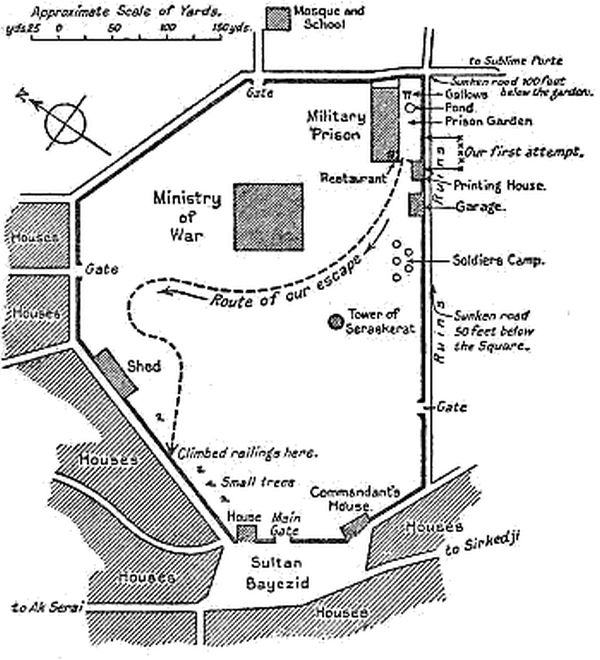
THE MINISTRY OF WAR, STAMBUL
While admiring the view, I put my head through the railings on the side farthest from our cells and ascertained several things. To begin with, the railings here were spaced at sufficient width to allow a man’s body to pass, since they had admitted my head; also a street ran below the garden, so that if we could make or procure some rope we might escape that way; and finally, I had time to see that although the garden itself ended to the right of me in the wall of an adjoining house, the garden railings continued along the outer face of the wall (no doubt the house had been built after the garden had been made) so that anyone who had once succeeded in getting through the railings unobserved would be able to climb along them away from the sentries. I knew, however, that by merely getting out of the garden we would not be out of prison, for the garden was only a small enclosure within the main square of the Ministry of War, which was surrounded on all sides by walls or railings. But in the main square there was a garage containing the cars of the Headquarters Staff, and it seemed to me just possible that we might walk into it pretending that we were mechanics and drive away in the largest and swiftest car that we could find, bluffing any sentries who attempted to stop us.
With these thoughts in mind, I returned to my room well satisfied, and was writing of my discoveries to Peter, when a young and strikingly handsome Turkish officer burst into my room.
“Excuse my interrupting——” he began.
“You are not interrupting me at all,” I answered; “I wish you’d stop. Have a cigarette? I haven’t had a friendly talk to anyone for nearly a month.”
“I wish I could, but I haven’t time just now. It’s against the rules, isn’t it? Not that I mind that. I say, will you allow me to offer you one of my cigarettes?—they’re the Sultan’s brand, you know. Better take the box. Frankly, I want to borrow something from you. I saw you wearing an eyeglass the other day: will you lend it to me so that I can wear it at to-day’s Selamlik?”
“Anything I have is yours,” I said.
“I hope we’ll be friends,” he answered, wistfully.
I wondered. He had the longest eyelashes I had ever seen, and the kind of seraphic face sometimes found in those who are “old in the world, tho’ scarcely broke from school.”
“By the way,” he said, “you wanted to communicate with the Dutch Minister, didn’t you?”
“I? How did you get that idea?”
“They told me in the Censor’s office that an envelope of yours addressed to him was found when you entered hospital. There was some tissue paper inside, which they tested for invisible ink. Now if you will give me the message——”
“Oh, that! No, I had thought of writing to him, but I have been so kindly treated by your countrymen that I have changed my mind.”
“We will be friends, won’t we, after the war?”
“I hope so, and the sooner Turkey and England make friends, the sooner the war will be over.”
He nodded agreement, and screwed in my eyeglass.
“This’ll give the Sultan fits!” he said. “Have you a mirror?”
“I’m afraid not.”
“What a shame! My eunuch will get you what you want. Just tell him to charge it to my account.”
“Thanks awfully, but I would like to pay for my own things, if he wouldn’t mind cashing a cheque for me.”
“Don’t worry about that. I say, I must be off. Tell me what you want most.”
“Get me something to read!”
“That’s easy. Au revoir!”
Next day, his small negro threw twenty leaflets into my door when the sentry’s back was turned, and strolled away whistling. They were the adventures of Nat Pinkerton in French: I consumed them slowly, blunting the lion-paws of time by breaking off always at a critical juncture in the great detective’s affairs.
My life flowed in more agreeable channels now. The eunuch returned in the evening with my eyeglass and a basket of fruit from Yildiz Kiosk. He spoke French as fluently as his master, and was less jerky and erratic: indeed, he was a remarkable little fellow, with an uncanny brain and uncanny strength: no one dared to interfere with him much: when a sentry tried to pull him out of my room by main force, he put his head between the sentry’s legs and carried him away on his back.
From him I learned his master’s history. He was a Damad, the eunuch told me, that is to say, one of the numerous sons-in-law of the Sultan; and had been imprisoned for shooting his tutor, an elderly Colonel, who had tried to restrain the havoc of his pupil’s fascinating eyes amongst the odalisques of the Palace. In doing so, said the eunuch, he had damaged some valuable furniture. Of course there was trouble about it. The Damad declared that the Colonel had made improper advances to him and that he had used his weapon in self-defence, but there was a lady in the case who had been unable to disguise the fact that someone had been tampering with her virtue, and she had inculpated the Damad. Had she been a common dancing girl the affair might have been hushed up, but she was a present from an influential Sheikh of Eastern Anatolia; besides, the Damad’s wife had made a scene. So now he was expiating his exuberances by three months’ confinement to barracks (not an unduly severe punishment, I thought) with the prospect of a month’s remission of sentence if he behaved himself.
I awaited his return with interest. When he visited me on Monday I suggested a little scheme to him whose planning had whiled away some hours. I said that I knew that Turkey wanted to make peace with the Allied Powers, and that he and I might contrive to be smuggled out of the country in order to negotiate an armistice. He thought this a splendid idea.
I drew the longest bow I dared about my status in England: I assured him that I was practically a Damad myself: we would go to Smyrna (there was a pro-Entente Vali there) and thence by destroyer to Mytelene. From Mytelene I would telegraph to my friend the Prime Minister, who would summon us to a Selamlik in London. Meanwhile, I added, it was necessary to keep in touch with affairs here, and I should be much more useful outside the prison than inside it.
He said that he would consider my proposals carefully. Every morning now, the eunuch brought me the French and German papers of Constantinople.
Towards the middle of September, the stars in their courses conspired to give Peter and me our freedom. First we were allowed to go to the baths together, which gave us the opportunity of repeating our tactics in July—lunch, beer, illicit purchases—so exactly that they need not be retold. A few days later, the Damad unwittingly furthered our plans. Our difficulty had been that although we were allowed to walk in the garden for an hour a day, we were never allowed to take our exercise together. I had already explained to the Damad that my friend Peter was a Power behind the Throne, and that in any negotiations between our two countries his assistance would be invaluable. On the evening that we heard that Allenby’s cavalry were sweeping up through Syria, the Damad was particularly friendly.
“Why can’t we talk in the garden?” I suggested. “It is much pleasanter there: surely you can arrange with the bash-chaoush that my friend should join us?”
There was no difficulty.
The three of us conversed for a little time, but it was a hot evening: the Damad didn’t care for exercise and we liked walking at top-speed: presently he said that he must leave us. We bade him a cordial good-night (to me it seemed as if a Higher Power were wafting him away) and made an appointment (which we trusted we would not be in a position to keep) to meet in the garden on the following day at the same time.
As soon as he had left us, we went to the far side of the garden, where the railings were. Six sentries were supposed to be looking after us, but they were strolling about in three groups, gazing, enviously, at the Greek clerks who were arriving for a square meal in the restaurant near the entrance gate.
We moved behind a bush, put our heads through the railings, looked down into the street. Alas, I had forgotten to estimate the height we were above it: now we saw that a hundred-foot precipice stretched below us. Between us we had only sixty feet of rope,[31] so that if we had tried that way out we should have been left dangling in mid-air with the sentries practising their marksmanship on us from above. For to-night, at least, we were foiled in this direction: later, if all else failed, we might perhaps tear a prison blanket into strips and try again with a longer rope.
The alternative plan seemed possible, however, and needed no accessories. We would get through the railings, climb along outside the garden to the garage in the main square, squeeze back through the railings here (for the drop was still too difficult to negotiate) and walk into the garage pretending to be mechanics: after that anything might happen: everything seemed possible to us that night.
Peter went first: next instant I forced my flinching flesh through another aperture, anticipating a bullet in my behind.
Silence. Safety. We were on the outer side of the railings. The sun had set, and twilight would favour us. We had to climb ten yards before we reached the sheltering wall, during which our hands and the top of our heads would be visible to the sentries, if they looked in our direction. Fortunately they remained entirely unsuspecting: the fact that there were six of them helped rather than hindered us, for each one thought that we must be walking in a part of the garden visible to the others.
After a few seconds’ pause for breath, we clambered rapidly towards liberty—as we thought.
But we thought wrong. The wall we had to cross had a window in it which we had not been able to see from the garden, and at it sat three men, discussing a lobster and a bottle. It was a cheery little party: I could smell the sea of their dish and the aniseed of their ’araq, and detect the thickened tones of men talking in their cups. One of the diners waved his hand towards the reflection of the afterglow over Scutari. They were nature lovers, like many Turks, and good companions, but to have interposed ourselves between them and the view would have been madness: equally impossible was it for us to remain as we were, like wingless flies, for in a few minutes the sentries would probably notice our absence.
It was not pleasant, clinging to that ledge, with the prospect of discovery both in front and behind, and a precipice below. We crawled back sadly, but rapidly. I thought, How irritating it will be if we are shot as we are getting back into prison!
We weren’t. The sentries had been called by the bash-chaoush, who was at our prison door, perhaps asking what had become of us. While their backs were turned, we climbed through the railings unobserved, dusted ourselves, continued our walk as if nothing had happened.
“Haidé, effendim—time to go in,” said the bash-chaoush as we strolled by him. We pleaded for another five minutes in the cool of the evening and he trustingly consented.
And then to both of us, simultaneously, severally, an idea came. We would mix with the Greek clerks who were leaving the garden after their supper, and pass out of prison with them. That was all we had to do—all we did. It was so easy, that it now seems extraordinary that we did not think of it before.
There was a patch of deep shadow near the restaurant, by a magnolia bush. Here we threw away our European hats and drew out fezes which we had concealed beneath our waistcoats for just such an emergency. The dye had not entirely worked out of our hair and moustaches, and we had both lived so long as under-dogs in a city of intrigue that we knew the gait and manner of the Levantine. Without further disguise we were passable imitations of Greeks.
We walked slowly, very, very slowly to the gate. Each clerk was supposed to produce a pass, and be checked out by the sentry. But the sentry merely leaned against the gate and let the stream flow by. We went with the flood tide: a tide that led to fortune.
To quicken our pace was a temptation difficult to resist: having gone so far, we longed to run, but had we done so, we should certainly have been observed and recaptured. Yet at any moment the sentries in the garden might miss us.
“Are we going into the garage?” I asked Peter doubtfully.
We were already half way to freedom in the main square: if we went to the garage we might easily become involved in some argument there, or else the car we chose might not start. We had already been lucky with one sentry: perhaps the guards at the main gate would be equally careless. Why waste time in trying to get a car when we might escape on our feet? But would our luck hold? Was it possible that we could walk out unquestioned and unsuspected?
While we hesitated, an individual came up behind us who settled the matter. After passing, he turned round to stare, and we saw that he was a Turkish officer. We returned his scrutiny with composure, but it was obvious that he did not like the look of us.
Hurrying a little, he went on to the main gate and called out the sergeant of the guard. We saw them both peering into the gathering darkness in our direction, and had no doubt that they were talking about us. We could not now approach either the garage or the main gate, so we slunk diagonally across the square, towards a side gate, which was evidently locked at this time of night although a sentry paced before it.
Near it, some trees afforded us a little cover: we must be quick and get through the railings here, before the hue and cry began. But the railings were more closely spaced than those in the garden: we stuck in them, wriggled back, climbed over. They were ten foot high and spiked on top: while on the summit I surveyed the last of my captivity!
Good-bye sentries, filth, days of boredom, nights of irritated impotence!
We jumped down into the middle of a busy street, but those who saw us looked the other way. We were apparently burglars, and no one interfered with such people in Stambul unless paid to do so.
I thought, This is indeed a miracle! For weeks, months, years we have schemed and hoped: we have made many plans: this very evening we have attempted two and failed to execute them, but now we have succeeded by the simplest means: the way has been made clear for us: God said, “Let there be light,” and the light has come into our minds. . . .
We crossed the tramway lines unmolested, dived into a passage leading down hill, and ran.
We had no doubt that our escape would soon be reported all over Constantinople. We ran on without stopping, avoiding main streets and police posts until we reached the Old Bridge across the Golden Horn. Here we decided to separate for the time, so that if one of us was caught by the toll-keepers the other could still make good his escape. But the toll-keepers took their tribute without demur. They cared nothing about British prisoners.
Crossing, we turned right-handed, passed behind the American Ambassador’s yacht Scorpion at her berth near the Turkish Admiralty, and went up into the European quarter. In Pera we were safe.
[29] When the armistice with Turkey was declared, I did what little I could for them: they were moved to a cleaner room, and a few were released.
[30] “Each soul who comes to the feast of life must drink also from the cup of death”: words with a fine ring, which I repeated often. All my belongings except the forged passport had been returned to me on leaving the Central Jail—even my compass, which the police mistook for a second watch. Incidents such as this smoothed the prisoner’s path in Turkey. There was no criminal so poor or so neglected that he did not contrive to buy or beg a few cigarettes a day: we who could cash cheques suffered chiefly from dirt and lack of exercise, which are lesser trials than hunger.
[31] Peter had bought this rope ostensibly to re-string a prison bed. We divided it into two parts and wore it round our waists whenever there was a chance that we would be allowed to leave our rooms. We also concealed upon our persons a fez each, and money in the soles of our shoes.
It was nearly two months after our escape on September the 15th that I learned from the bash-chaoush who had been in charge of us what had happened when the sentries had missed us in the garden. Not finding us here, they reported our disappearance to him, and he and they, assisted by the Damad, who had been the last to speak to us, searched through all the prison, thinking that we might have gone to our rooms, or to the restaurant, or be hiding with other prisoners. It was not until the eunuch had suggested that the rope which Peter had bought to re-string his bed might have been used for other purposes, that they began to admit that we had escaped. Even then they did not tell the Commandant, fearing his wrath; and he was not informed until next morning. Thereupon all our guardians were cast into the lowest prison, and the Damad was informed that he also would be punished unless he could discover our whereabouts.
Meanwhile we had gone to Young George, who refused to take us in (no doubt rightly, for his father was the White Lady’s tailor and might have been suspected) but led us to a friend’s lodging-house in the suburb of Chichli, where he explained that we were Austro-Hungarian deserters, ready to pay well for our accommodation.
Although our initial haste had been needless, we had been right in supposing that our escape would create a stir in Constantinople. It was reported in the newspapers, a reward was offered for our recapture, and the Damad came to the White Lady, to say that we had told him before escaping that she would know where we were living. Would she please take him to us, since he had an important message to give us?
The Damad was very young to think that she would fall into such a trap.
So we had escaped again! she said, in surprise. Wasn’t that rather careless of the authorities? But perhaps, she added, Djevad Bey had some plan in letting us loose? If the Damad would give her his message, she would certainly pass it on to us if we came to see her. He went away discomfited.
“The Germans have been pushed back: communication is cut between Germany and Turkey. Unless all Germans leave Turkey, bombing will continue.” So ran a message dropped by an aeroplane on September the 29th, giving us the first definite news that the keystone of the German arch was crumbling.
Germany had recently given Bulgaria half the Dobrouja (which the Turks claimed belonged to them) as a bribe to continue fighting; but even so, there had been rumours that her troops were mutinous and exhausted. Now that the Fox of the Balkans had doubled on his tracks, even the staunchest of Turkish patriots began to feel that after ten years of revolution and war their country deserved peace. Constantinople seethed with discontent against the Committee of Union and Progress, which we were sedulous in fostering.
At this time the White Lady was in touch with various high officials in the Turkish Government who were in favour of peace, and had already helped General Townshend and Colonel Newcombe (both prisoners of war) to leave the country in order that they might assist in the Armistice negotiations. And to Peter and me, she gave an astonishing message: the news that she had originally intended that we should take to our Intelligence Department had been concerned with various concealed depots of arms and ammunition: they would now soon be taken over by the Allies, and a large fast car was required by our advance forces in order to enable them to seek out these caches. From the funds at her disposal she gave us a bag containing three hundred sovereigns with which to obtain such a car. It was to be ready, with spare tyres, oil, and petrol as soon as the Fleet entered Constantinople.
I sought out my smuggling acquaintances, who were now engaged in securing possession of property being abandoned by the Germans, and learned that General Liman von Sanders had a powerful touring Mercédès, which would suit our need exactly.
Peter and I met the Profiteer and Francesco—two of our doubtful friends—in a café in Galata, where we discussed the buying of the Mercédès over a bottle of Kirsch. A certain Prussian sergeant would act as our intermediary, said Francesco: this Rudolph—as he called him—knew the ropes of the German Staff garage, and would be able to approach the Commander-in-Chief’s chauffeur.
The difficulty was the price. Francesco wanted five hundred pounds.
“It is about ten times what we are prepared to give,” I said.
We haggled over our Kirsch, regardless of the sullen Germans and anxious Turks who eddied about the restaurant.
“I’ll tell you what I’ll do,” said the Profiteer, who was bored by the pettiness we displayed. “I’ll sell you a complete German park—twenty-six trucks and eleven automobiles—at a flat rate of twenty pounds sterling each. That’s a bargain!”
“It’s not!” said Peter. “We wouldn’t take your park as a gift. With the whole town busy thieving, it will be hard enough to look after even one car.”
“No one ever steals anything from me,” said the Profiteer, “but do as you like. You will have to pay much more if you buy in small quantities.”
“We are prepared to go up to fifty pounds.”
“For my commission?” asked the Profiteer.
“For the car.”
“At least four people will be working for you—myself, Francesco, Rudolph, and the chauffeur. We have to live, you know.”
“Name your total price—then we’ll tell you whether we can pay it.”
“A hundred and fifty pounds.”
“We’ll give you a hundred and thirty-five.”
“Done,” said the Profiteer promptly. “In gold sovereigns, of course. I’ll send the car round with one of my men at about ten o’clock to-night. But remember, I’m only doing this little job to oblige friends: you want a car, and I happen to have one which suits you. I’m a contractor, not a pedlar.”
We went our ways. I dined off a biscuit, for I had been eating and drinking too much of late, and needed a clear head, not so much for this night’s work of stealing a motor-car (the great Allied Fleet would soon arrive and probably commandeer hundreds) but to try to adjust myself to the new era that was beginning. Curious, I thought, what parts we play in life. One moment an airman; next a harassed fugitive; next a friend of gangsters, buying the car of the enemy Commander-in-Chief with secret gold; after that—what? We had watched history as it is rarely written, but most strangely lived by a people on the brink of dissolution and disaster: we had been in the thick of great events, but they had made and were making but little impression on us, for our nerves refused to register new impressions after the stresses of the preceding months. I could not believe that I would soon wake up and find myself free. I thought of Benares. “When your breathing is equable,” my guru had said, “you will have peace of mind whether you are being jostled in the market place, or are sitting alone on a black antelope skin.”
My breathing! I had not thought of it for years; and certainly could not now. The air was stagnant. Clouds blanketed the city. It seemed to me as if the world was waiting for something to happen.
I sat impatiently, too restless to read, lighting one cigarette from the end of another. The madness of war was mounting to a climax; soon it would be over, and my little part be played. What a poor little part!
Then the rain came down by bucketfuls, heralded by a clap of thunder.
Someone rapped at the door. I opened it, and found the Italian there, already soaked to the skin. He was a curious, polyglot creature, with no talents but the gift of tongues.
“I have come,” he said.
“So I see. But don’t stand there—come in.”
“Are you alone?”
“Of course.”
He looked round him anxiously while I poured him out three fingers of Greek brandy.
“The fact is, the car is here,” he said, “but Rudolph wants more money for it now. He says it is worth at least two hundred.”
Always this haggling!
“Two hundred fiddlesticks: I’ll give you what I agreed or nothing.”
“Rudolph won’t part with it for less. He had to bribe Liman’s chauffeur, the night watchman, the police corporal, the sergeant at the gate.”
“You can tell Rudolph to go to hell,” I said. “Either you have bought the car and will sell it to us, or you haven’t.”
“We haven’t bought it.”
“Then what are we talking about?”
“We’ve taken it. Taken it out of the garage and we’ve had to square so many people that there won’t be anything left for Rudolph or me.”
“I see. . . . Well, there won’t be much left of Rudolph or you if your chief hears that you tried to bilk us.”
Francesco took a little more brandy.
“I’ll see what I can do,” he said. “But on my word of honour, when you see the car you’ll give us what we ask.”
“Bring her to the garden gate if you mean business. But hurry up. We can’t wait all night.”
“I’ll be back in ten minutes.”
I went upstairs to get a coat. The wind had come and the rain had stopped as suddenly as it had begun. Heavy clouds swept across the moon. Below me the Golden Horn was not gold now, but all silver and still in the pale light. Across its gleam rose Stambul, tier upon tier, dome upon dome, to where the conquering Sultans had built their mosques of pride and power. Over there for three centuries the seed of the Renaissance had lain fallow under the crescent of Byzantium, and for three centuries Christendom had trembled at the Turkish hosts fighting under the same sign. Now the crescent of Islam would go down. . . .
I had not waited more than five minutes—no doubt the car had been round the corner all the time—when I heard the comfortable sound of a well-tuned engine. The Mercédès came creeping up, with headlights blinded.
Peter and I went down to the garden, skirted a performing bear who was snoring in the tool-shed, and threw open the gate.
There she stood, ticking over contentedly. The Prussian was at the wheel—a blond, handsome youth—and Francesco lolled in the place of the late leader of the Turkish hosts.
“Back her in here,” I said, lighting up the posterns with an electric torch.
“How much?”
“We’ll talk of the price later.”
It was a narrow and difficult entrance, for there was a pond just inside the gate which had to be circumvented by going forward and backing on the other lock. The car was on one side of the pond: the bear on the other.
The bear’s mistress was a girl in a travelling circus, who lodged him with us so that he should not be stolen by the hordes of gypsies who prowled about the city for loot. She came to feed him twice a day, and it was a touching sight to see him waving his platter to her and whimpering with pleasure when they met in the morning. With us, however, he was not so tender: I used sometimes to offer him a banana on the end of a walking stick: that was the nearest I dared approach: he used to consume his fruit sulkily, keeping a remarkably red and vicious eye on me the while. Yet if I ever passed without giving him anything, he called down ursuline curses on my head.
During the manœuvring of the Mercédès, the bear had awakened, and was now scratching his head. He knew all about night moves with his circus, but our whispering made him inquisitive: he began to yammer and yowl and hug himself.
Francesco heard him and ran round to the far side of the car, shivering like a whipped bitch.
“It’s a pet of ours,” I explained.
I flashed my torch, disclosing the bear sweeping the mud with his huge forepaws. When the light shone in his eyes, he made an apoplectic gesture as if trying to undo his collar, and sprang at us with a roar. Fortunately the chain held.
“Seeing you in the darkness he must have mistaken you for thieves,” said Peter.
When we were safely seated at a table, Rudolph and Francesco began disputing between themselves as to which of them should receive our money.
“I took the car,” said the Prussian—“and I’m going to take the cash.”
“How do you know that either of you will take it?” I asked.
“Well, you said you’d give a hundred and fifty, didn’t you?” said Rudolph. “I thought we had explained——”
“We may give you a hundred and thirty-five . . .”
“Then I’m off,” said Rudolph, brusquely.
“All right!” said Peter. “But mind the bear!”
Rudolph sat down again, and lit a cigarette.
Francesco now announced that he was fed up with the whole business, and was willing to take what we offered, provided we paid it at once. Rudolph nodded his assent sulkily, but he looked more cheerful when he saw the bag of sovereigns.
We made thirteen cylinders of ten pounds each, and half a cylinder. Our accomplices examined these without touching them—to do so would have been a breach of underworld etiquette.
Just as I was about to ask them to collect their reward, all the lights in the house went out. Peter drew his automatic pistol, and stood by the door, expecting them to make an attempt to bolt.
But they were as surprised as we were: Pera was plunged in darkness: we thought that the thunderstorm had fused the switches, and only learned the true reason on the following day, when the newspaper arrived. The electric light had been cut off at the main in order to help the flight of Taalat, Enver and Djemal Pashas, who had escaped disguised, and in fear of death, from the city they had ruled as kings.[32]
After finding and lighting some candles we checked over the money and allowed it to be removed from the table by Francesco and Rudolph alternately: then we gave them a cigar and a tot of brandy apiece and saw them off the premises.
Before going to bed, we inspected our trophy by candlelight, and found it in excellent condition. The tyres were nearly new, the bodywork was good: everything was intact: in a side-pocket we found a diary in German and a ration book. A knife, fork, spoon, and part of a pork pie were in another wallet, together with a couple of sparking plugs.
We went back to the house, found half a tin of plum jam, and presented it to the bear. The Mercédès was safer in his keeping than it would have been in any garage.
* * * *
On October the 30th the Armistice was signed, but still no one appeared to claim the car we had bought with British gold. It was not until a week later, on November 7th, while Peter and I were dining at the Pera Palace Hotel, that we saw a British Colonel and a Naval Commander at an adjoining table.
The Colonel ordered a whisky and soda with his meal, but the waiter insisted on serving him with champagne. An air of restrained excitement pervaded the hotel. In the street outside a great crowd had gathered, burning with curiosity.
After dinner we followed the representatives of the Allies into a large reception room. The orchestra stood up and played “God Save the King”: the German and Austrian officers present walked out gravely, with their ladies, and a bevy of Greek girls showered confetti upon the bald head of the British Colonel. It all seemed like a dream still, and I kept looking over my shoulder for a policeman to hale me back to prison.
Next morning, before handing the Mercédès over, we drove out in her to make some purchases. We left her for a moment outside the Ottoman Bank: on our return we found a Dog Collar Man standing beside her.
“This is General Liman von Sanders’ property,” he said. “Who are you?”
“That’s not your affair,” I answered, feeling the strangeness of my reply.
In the past fortnight I had lived through a lifetime of change.
“It is my affair,” he said, with the admirable patience which the Turkish police continued to display during this difficult time. “This is a German car, and I believe it to be stolen.”
We had started up the engine while he was speaking.
“How do you know it’s a German car?”
“There is an eagle on the panel.”
“The Eagle is out of business!” said Peter as he slipped in the gear and stepped on the throttle.
* * * *
At last, on November the 13th—just three years after I had crashed in ’Iraq—the morning arrived when sixteen miles of fighting ships steamed slowly through the Dardanelles and cast anchor off the Golden Horn.
Men said that this would be the end of Turkey. But Stambul in defeat was the womb from which Angora came.
[32] Taalat went to Germany, where he was murdered by an Armenian; Enver died fighting at Bokhara, his body so riddled with bullets that he would have been unrecognisable but for the fact that his wife’s letters were found next to his heart; and Djemal was poisoned in the Caucasus. So passed a triumvirate who cost the British Empire dearly in blood and treasure.
Lunch—books—cigarettes (they allow you to smoke on the Italian Air Mail from Brindisi to Constantinople)—cotton-wool for my ears. Pronto! The hatch is closed: the starter coughs: the engines roar: our fat black underwing drags whitely through the Mediterranean. We are heading for Athens exactly on time.
After reading a page or two (did my eyes close?) I see the pink rocks of Corfu between patches of cloud and sunshine. Corfu with the Kaiser’s villa. What a lot has happened since then! It is old history already, although lived not yet twenty years ago, and millions died in the making of it.
Fantastic shapes wriggle in the wind-streaked sea below us: the Isles of Greece. There’s Missolonghi: more history. And the Gulf of Corinth. The wind has dropped: we are gliding over the mirror of an archipelago. Paxos. Antipaxos. Chalchis. In spite of the clouds there is an intense refracted light, and I can see deep, deep down into the hyaline waters. I wonder, did Athena suffer from cold feet in her chariot, coming from Zeus to men?
We have arrived. The voice of the engines fades away as we dip towards Phaleron. Athens lies rosily before us.
One million four hundred thousand people were transported from Turkey into Greece after Mustafa Kemal had defeated the Big Ideas of Venizelos and Lloyd George. Ideas are like mistresses, apt to be traitresses if they come too glibly to men’s lips. They should not be bandied about, but rule men as good women do, in secret.
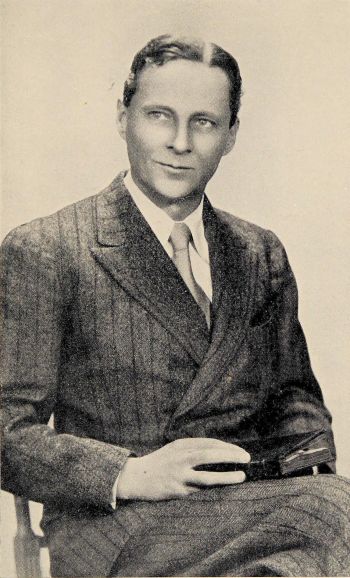
Photo: Yevonde
YEATS-BROWN AS HE IS TO-DAY
The captivities of the Jews and migrations of the Middle Ages were small affairs compared to the terrible uprooting of the peoples of the Near East in 1923. What would we do in England to-day if the whole population of Canada suddenly arrived at our ports? That is relatively what happened to Greece nine years ago.
Some of the refugees held dead children in their arms, not knowing where to bury them, or gave birth to them on the quayside: many were starving: almost all were destitute. Into a little country of five million people, undeveloped and staggering under a crisis, a human flood poured in, threatening to overwhelm her. But what seemed like a disaster proved to be a source of strength. Greece had received a revivifying blood-transfusion after her defeat in Asia Minor, and to-day Athens is a city of 800,000 people, with a great future.
On to Turkey. Sunrise over Hymettus is glorious: it lights the marble of the Acropolis and gilds the shabby Piræus into the semblance of fairyland. Outside, the sirocco lashes the Mediterranean into a temper, but it is blowing behind us, taking us to Constantinople at a hundred and fifty miles an hour.
Down there, off Skyros, a steamer is pitching and rolling; we bump a bit, but not so giddily as sea-borne craft. Sappho’s isle looms up through the storm-wrack to the south-east of us: does her spirit see us sweeping with an iron-throated roar over the coasts she loved?
Can that be Mudros, so soon? Can those be the Ægean Isles, the Trojan beaches, the hills of Gallipoli—mere hillocks they seem, up here—where so many good men died? River Clyde has gone; sold to a Levantine fig merchant.
Was all our effort useless at the Dardanelles? The sacrifice of the Munsters and Dublins and Lancashire Fusiliers in that crimsoned water, the cries of men sinking amidst twisted steel and broken spars, the prodigies of valour performed by the Australians at Chanak Bair, Birdwood’s cleverly concealed troops creeping up from Anzac Cove on a moonless midnight, the submarines who ventured into the jaws of death—was all this in vain? A thousand times, No! There are those who would have us forget the courage of soldiers, saying that to glorify national exploits dims the lustre of the larger world of the future, but these easy sophistries of internationalism are nonsense, dangerous nonsense.
All that I have written of my experiences, or of the deeds of others, has been an indirect plea for peace, but where would Turkey be to-day, I ask myself, if she had allowed the councils of Europe to decide her fate where I left her, under the guns of the Allied Fleet?
The Treaty of Sèvres is the answer. Turkey was determined to live. She lived, at great cost to herself, by defeating Greece at the Sakaria and by humiliating Europe at the Lausanne Conference. She lived—as in the last resort all men and nations do—by virtue of her inner strength; and she is now working out her own contribution to the common culture of humanity. No amount of talk round Conference tables could have achieved this without fighting: those of us who support the League of Nations should not blink the facts, however disagreeable they may be.
For myself, I believe that peace is a balance, not a fixed condition, and that it should be maintained on a basis of nationalism. An Utopia of sharply-contrasted peoples, each with its own culture and religion, yet living in amity, is no more difficult to conceive than an elaborately internationalised world-order in which the failure of one part would throw all the rest into confusion. We have need of flags and frontiers for centuries to come, perhaps for ever. No doubt for ever. Odious as war is, it would be preferable to the deadening peace of an insect-like industrialism.
But these far horizons are beyond all living sight, while the marvellous panorama of the Golden Horn lies radiant below me. My luck is in: the weather has lifted: the enchantress of Europe and Asia remains on the surface as I knew and loved her fourteen years ago: there is the suburb of Psamattia, from which we escaped, and the warren of Sirkedji, where we hid, and Galata Bridge, and the Tower of Christ in Pera. . . .
Half life is memory, the other half anticipation.
* * * *
I have returned to the Armenian Patriarchate; revisited the ancient walls of Constantinople: passed an hour at the place where the Sleepless Ones kept vigil; searched out the doorstep on which Peter and I waited one summer night of an almost unbelievable remoteness; and walked in the Seraglio Gardens where I first met the White Lady. The bench on which we sat is still there, but the planes and myrtles round it have grown, and the passers-by are brisker. But then this is the winter season, and we are in the Turkey of Mustafa Kemal.
A Turkish lady journalist is showing me the sights of Constantinople, and has brought me to the Dormitory of the White Eunuchs in the Seraglio Gardens. One of the caretakers is a plump little dwarf eunuch.
“He hates women,” my guide says (she is pretty and aged about twenty). “When I first came here with visitors he used to scream and turn his back on me. Now he knows better.”
It is true: the dwarf has learned to tolerate the Newer Eve of New Turkey, but he still mistrusts them both.
Handcuffs are hanging on the wall of the Dormitory, and a great stick with a thong in it, in which the feet of those about to be bastinadoed were twisted. I know, for I have seen it in use. The dwarf knows, too. But my friend, who speaks seven languages and writes for the newspapers, was a child when such things were abolished.
The sight of her, which rejoices my eyes, makes the dwarf hysterical; while the sight of a man being bastinadoed, which made me sick, probably beats cock fighting for the dwarf. The world goes strangely, especially here, where a whole nation has exchanged the scimitar of Islam for the text-books of the infidels.
New Turkey is poor, but her people remember the days of her greatness. In the Chamber of the Sultans we view the effigies of the rulers of the House of Othman ranged in order of their succession from Muhammed the Conqueror to Muhammed the Reformer, dressed in their original robes, decked with their real jewels, armed with their splendid weapons. Three of the emeralds in the Conqueror’s dagger are as large as eggs, and the triple tiara of rubies that crowns Suleiman the Magnificent gleams with a memory of the blood he shed for Roxelana’s sake: the room glitters with evidences of a virile, perhaps cruel, but certainly spacious past. We were wrong in Europe when we spoke of “the unchanging East.” The East has stirred from its centuries of sleep and is changing very rapidly. Already Mustafa Kemal has conquered more than cities: his greatest victories have been over the minds of a people almost as stubborn as the English. Something dynamic will be let loose upon the world from Asia, as has happened in times past, for the Great War was but the prelude to the gathering of invisible forces from Angora to Pekin.
These forces come from the soul of the East, which has found itself again after a thousand years of meditation; while we in the West, sick with the congestion of our lusts, starved in our imaginations, and busy with undiscriminating activities, are in danger of losing ours.
In the Baghdad Kiosk, so gracious with its white marble and blue tiles, I can sense the peace of the Kief. For the sake of the Kief, under many names and forms, all the martial races of Asia have sacrificed much of what we call liberty. They have wanted peace as only men of action can, and having found that greater freedom, have lost the lesser so prized by the babbling democracies of the West.
I shut my eyes, trying to summon the ghosts of those who lived here when the Seraglio contained the best brains and the stoutest hearts in Europe. Alas, my guide will not let me rest! She wants to show me modern Constantinople, and says that we shall be late for tea at the Tokatlian. I must go. It is useless to linger here: her voice has emptied the divans, silenced the zither and drum: the dancers have gone, and those who watched. “The spider has become the watchman of the royal abode and spread his curtain over the doorway.”
Modern Constantinople does not keep me long. Loti would look in vain for his “désenchantées” in Pera or Stambul: they are all unveiled: they have learned the new ways and the new spelling: they drink kokteyles, hold hands in cinemas, go to their hairdressers for permanent ondulasyon; dress, dance, eat and drink in the standardised fashion of the women of Europe and America. What will they make of their country? Will they crown the work which their soldiers began? Who knows? It is certain that Turkey is destined to influence all the East profoundly.
Away to Angora! Here in these lean uplands is the heart of a renascent race. I have talked to many of its leaders, but not to the Ghazi himself, who remains sullen and inaccessible in his cottage at Tchan-Kaya, where almost as many legends are beginning to accumulate round him as once round the Red Sultan in Yildiz Kiosk. Before I leave, however, I catch a glimpse of him, passing through the lobby of my hotel on his way to a State dinner. He is short, grey in the face, stouter than I expected, but with the pale, strange eyes of his photograph. He has made history. Who am I to say that as an incarnation he is disappointing?
I shall return to the West with no prophecies and no judgments.
* * * *
And now that I am back in Rome, in the Church of Santa Maria in Ara Cœli upon the Capitoline Hill, it is hard to believe that I ever sat in the Maritza restaurant while a vortex of intrigue swirled round me, that I was once a German governess, and a Hungarian mechanic, and a buyer of stolen property. . . .
It is strange how time has already worn away the sharpness of my days in Turkey. I am only a shadow moving through those squalid and bloody years. The pain of them has largely gone, and seems fantastic now, and often scarcely credible. But friendship stands secure.
Middle-aged now, less flexible and intuitive, but carrying more gear of all sorts—some of it like the White Knight’s—I want to draw back the curtain of the years, and see myself as I was in boyhood.
The Santissimo Bambino Benedetto is locked in his shrine. The sacristan opens it for me, pulls the image out by jerks under a hard electric light.
The eyes are painted brown: they are not jewels as I had imagined. The cheeks are chubby. The body is covered in gold and brass chains, gold watches and cheap watches, rich crosses and poor crosses, pearl necklaces and bead necklaces. The crown of the Pope’s gift would give any child a headache. In a corner of the shrine a packet of letters is lying: letters which arrive daily from all parts of the world, and are read and then burnt by the friars.
So this is my Bambino! He is a little disappointing to-day, like Mustafa Kemal.
Yet I am not disillusioned: I am only changed and aged by the war.
When my own self alters so much with the passing of years, how can I believe in the survival of human personality? Why should I remain the straying atom that I am, a bundle of characters held together by a thread of conventional identity, instead of merging into the glory and beauty of life? I cling to the hope that the creature is not distinct from the Creator, and that Christ taught monism when He said “I and my Father are One.”
To other boys and girls the reality of the Child will come. For me, the Bambino is merely an image reflecting the love of the little brother of Saint Francis who fashioned him so well, and the affection of those who for five centuries have brought their homage here. The vision of childhood is denied me now. I have changed, but He is constant in His high Church overlooking Rome.
TRANSCRIBER NOTES
Misspelled words and printer errors have been corrected. Where multiple spellings occur, majority use has been employed.
Punctuation has been maintained except where obvious printer errors occur.
Some illustrations were moved to facilitate page layout.
[The end of Golden Horn, by Francis Yeats-Brown.]