* A Distributed Proofreaders Canada eBook *
This eBook is made available at no cost and with very few restrictions. These restrictions apply only if (1) you make a change in the eBook (other than alteration for different display devices), or (2) you are making commercial use of the eBook. If either of these conditions applies, please contact a https://www.fadedpage.com administrator before proceeding. Thousands more FREE eBooks are available at https://www.fadedpage.com.
This work is in the Canadian public domain, but may be under copyright in some countries. If you live outside Canada, check your country's copyright laws. IF THE BOOK IS UNDER COPYRIGHT IN YOUR COUNTRY, DO NOT DOWNLOAD OR REDISTRIBUTE THIS FILE.
Title: The Maple Leaf, Vol. 4, No. 04, April 1854
Date of first publication: 1854
Editor: Eleanor Lay (1812-1904)
Date first posted: October 6, 2026
Date last updated: October 6, 2026
Faded Page eBook #20261013
This eBook was produced by: John Routh & the online Distributed Proofreaders Canada team at https://www.pgdpcanada.net
[Written for the Maple Leaf.
 ot many days since I chanced to lay my
hand on an old Memorandum book, a kind
of journal in which, as far back as the year
1838, I used to jot down a few items of
personal feeling and experience. The
little volume looked so familiar and seemed
to speak to me so kindly and tenderly, in
voices of those who are gone, never to return,
and recalled memories so touching,
that, hurried as I was searching for family
accounts that had been packed away for
years, I could not forbear to linger over it,
and at last concluded to put it in my pocket
for future perusal. A few of these jottings
I have re-arranged and written off,
and give them here in narrative form.
ot many days since I chanced to lay my
hand on an old Memorandum book, a kind
of journal in which, as far back as the year
1838, I used to jot down a few items of
personal feeling and experience. The
little volume looked so familiar and seemed
to speak to me so kindly and tenderly, in
voices of those who are gone, never to return,
and recalled memories so touching,
that, hurried as I was searching for family
accounts that had been packed away for
years, I could not forbear to linger over it,
and at last concluded to put it in my pocket
for future perusal. A few of these jottings
I have re-arranged and written off,
and give them here in narrative form.
At the time to which I refer, I was comparatively a young man, though disappointment in the attainment of many cherished objects had affected the elasticity of my spirits, and given me a tinge of melancholy and sensitiveness that ill-accorded with the constant demands of a flourishing business, upon my time and energies. It seems all like a dream to me as I turn over the pages of my ancient companion and monitor, my private Memorandum book, that so many years have sped their round since I figured in the city of cotton bales, and mingled with her merchant princes on the levee, and watched with feverish anxiety the rise and fall of stock, or the fluctuations of the market. Many changes have passed over me since then; many new views, and, I trust, more truly elevated motives of action have swayed my heart; yet I love to recall those earlier memories, and dwell upon those old associations.—But to my subject. The first leaf of my Journal was dated June 1st, 1838. It was about that time that the American community was recovering from a commercial panic, which seized both bank and merchant throughout the land; I mean the famous money reformation under President Jackson, and well established were those firms whose resources met the emergency. The firm of B——, in which I had an interest, held its own, and came up equal to the test; in consequence of this, money flowed in rapidly, and prosperity crowned our affairs. The hurry of the spring trade sales was rapidly giving place to the usual re-action in our large warehouse. Hogsheads of sugar, and barrels of molasses, with bags of coffee, chests of vanilla and cocoa, had been shipped in large quantities, and invoices for purchasers, invoices for Customs, calculations of nett profits, and other kindred subjects received their full share of attention. The season had been very prosperous, and I felt that it was a propitious time for me to put my long cherished design of travelling north, into execution. My health was suffering much from close confinement, and so, leaving our sage senior partners to conduct business, brave the yellow fever, mosquitoes, and heat, I sailed to Boston, from which place as a centre I made journeys to the principal cities and villages of New England. Never shall I forget my sensations as I beheld the hills and mountains of my native State, rising grandly in the distance. I had grown to manhood beneath the fervid rays of a southern sun, and my eyes had been accustomed to the gentle features of a warmer clime; still a natural swelling of strong admiration filled my heart to overflowing amid these scenes of my early childhood, and I hurried on to the White Mountains, where, joining a party, we proceeded to visit several beautiful lakes and spots of wild grandeur, with which the Granite State is so plentifully sprinkled. There is a kind of enthusiasm imbibed and breathed in with every breeze that rustles the massy foliage, and sounds through the wilderness of trees, amid the deep glens and mountain passes of picturesque New England, that animates the whole man, if he has a soul to enjoy the grand and beautiful. The pure mountain air acted upon me like exhilarating gas, and soon my blood, which had been long accustomed to a sluggish flow, quickened its course, and my health improved, while my spiritual man expanded day by day. I no longer wondered at the bravery and fearless attachment to truth which so many of our northern statesmen have displayed, or at that indomitable spirit of freedom which has caused the halls of legislation to resound with their eloquence and manly zeal. Nature seems to compensate for the roughness and even sterile quality of the soil which often overlays hilly countries, by giving the inhabitants strong frames and unconquerable energy of body and mind—an energy which is developed in overcoming obstacles; and from the fact that greater exertions must be made, they rise to a higher grade of intellectual attainment than the inhabitants of places possessing more natural advantages.
Some weeks of my proposed absence still remained, and I felt no inclination to shorten my stay and resume business. I, therefore, procured a light carriage in Concord, and resolved to drive leisurely through this Switzerland of America, this lovely region of the White and Green Mountains, and send it back from Lake George, where I expected to meet some friends, and return with them to New Orleans. Pursuing my intention, the close of a day in the latter part of August found me not far from the lake shore in Vermont. A lovely sunset shed its golden radiance athwart distant mountain summit, and spread its variegated hues broad and generously over each gentle slope and waving grain field, and lighting upon the placid lake, gilded each dancing ripple that broke upon the shore. The eye could linger upon such a scene, taking in at a glance the swelling hills towards the east, the varied colourings of the harvest fields near, while upon the west extending widely, rolled gently the beauteous Champlain, gemmed with green islands, and dotted with white sails. The reflection of the glowing clouds rested upon the waters; roseate and violet-hued imagery, castellated piles, towers, and lofty battlements, found answering forms in the crystal surface beneath. While gazing, one might well indulge in poetic visions, and imagine the land of the blessed near those bright openings which I saw in the clouds far to the north-west. To a native of the Granite State, or her sister realm, Vermont, the pure air, the vivid green of the landscape, the abrupt summit of the mountains, the craggy steeps, up which wind narrow roads, the succession of undulations in the surface, are features of constant interest, and call forth the fondest attachment. I well remember my sensations while viewing the last rays of sunlight on this particular evening. A gush of glory seemed to settle over the scene, a sweet repose fell upon the farmhouses, whose casements glistened in the sunset; the voices of the animal creation grew fainter—a solemn hush fell upon my spirit. I held my breath. I cannot express the intense longing I felt to sympathise with the spirit of beauty that hovered there in those rays of dying daylight. How thankful we sometimes are to hear a human voice give words to the very emotions that are upheaving one’s spirit. I was alone. I drove on in silence; no voice of appreciation or quick look of earnest feeling met my surcharged heart. Soon distressful emotions struggled in my breast, mingled with my love of the beautiful. I realised that man is the marring spirit in the world. I felt most deeply that I was not perfect; that tokens of a degenerate nature were within me, and I sighed as recollections of wasted time and misimproved talents came to mind there, in the silence and holy beauty of that sunset scene. Quick as thought, as if to still the sorrow which I felt, my mind turned from material forms of loveliness upon which I must so soon close my eyes, to those pure waves that flow fast by the tree of life, and those angelic spirits who welcome the Christian to the society of Heaven; and then and there, while passing along, did I resolve to bring my future nearer the high standard of excellence which the Creator requires, and looking upward I prayed as I never prayed before, that He would enable me to live to His glory. Then I realised that to have lived for naught, to have frittered away an existence worth untold gold, to have floated along the current of time, scarce rising with its flowing tide, is a record most sorrowful, fearfully sorrowful, and fraught with weight of woe, and anguish to be borne from these scenes of hope, to the lowest depths of hell! I asked myself the question, is man made to bask in sunshine only? Is immortal energy given him to be expended on trifles, to grasp at straws? Is it enough that I am a successful business man, a kind friend to those who are kind to me in return? The echo of my own dissatisfied experiences, ever resounding in my ears, the thirst of my craving spirit always urging me to try the “broken cisterns” of earth, the longing of my soul to sympathise with something in itself higher and nobler than mere worldly gain, were the silent responses I received to my earnest self-questionings, and they were not without effect. * * * *
I had driven very near a beautiful village, and finding myself somewhat fatigued, I determined to remain there for the night. The village of C. is situated on both sides of a small but beautifully winding stream, and the white houses with their green blinds peeping out, so tastefully, from the shade of elm and beechen trees, looked inviting, giving one an image of home comfort, such as is to be found generally in the modest villages of that part of the country. The hotel was near the water, and after tea, I sat down by the open window in my room, where I could hear the subdued sound of its wavelets, and drink in the flood of beauty, with which the moon had mellowed the scene, and so absorbed was I in my own reflections that I did not at first hear voices near me. I soon, however, became conscious that there were others in the world besides myself. The tones seemed to come from the next room. A voice of singular sweetness, and of that peculiar pathos that touches the heart seemed to answer some one.
“I cannot, dear Albert, overcome my belief that our search will prove successful. I feel a strange drawing to this quiet little village; let us remain here a few days at least, until we can make minute inquiries.”
“Oh yes, Eveline, I like the spot; there ought to be fine fishing up here in these pure streams; and Vermont fish may perhaps be attracted by Virginia baits. I have ordered the carriage to be put up, and mean to ransack the whole vicinity, not excepting ‘the fishing grounds,’ if there are any, and you can have ample time for your object.”
“Bless you dearest, you are too good; I try to find words to express my love for your patience with me; if I do find my sister, how happy I shall be; it seems to me, that this intense desire will break my heart if it continues.”
Here the voices seemed to move away; but I had heard enough to set a train of thought in motion, and taking out my pencil I noted the incident, hoping sincerely that the amiable couple might ever be as confiding and devoted to each other as now; little thinking how my own future was to be entwined with theirs, or how our paths, hitherto so divergent, were so soon to meet. * * * * * *
Montreal, March, 1854.

The plant that for years has been growing distorted, and dwelling in a barren spot, deprived of light and nourishment, withered in its leaves, and blighted in its fruit, cannot at once recover from so cruel a blast.
“Weeping may endure for a night, but joy cometh in the morning.”
I.
Oft when my spirit falters
Along the path of life,
And tries to rise, then flutters
Mid scenes of mortal strife;—
Winging from realms of glory,
The dove, of heav’nly birth,
Whispers to me the story
Of joy beyond the earth.
II.
Upon my heart’s deep yearnings
Fall voices from above,
Stilling the mystic burnings—
The central fires of love;—
Calling my wand’ring spirit
To cease its wayward flight,
And purest joys inherit
In homes of fadeless light.
III.
Oh! could those sounds angelic,
That spell of beauty stay—
Those gleams of life ecstatic
Burst ever o’er my way;—
Then wrapt in an Elysian,
My soul would upward soar,
Catching from ev’ry vision
Bright rays forever more.
IV.
Alas! the soul’s bright pinions,
Sin-stricken now, are bound;
Its noble aspirations
Are fallen to the ground;—
Longing, forever longing,
For higher, happier life,
It waiteth for the dawning
Of a day with glory rife.
V.
That day beyond the mountains
Shall streak the Eastern sky,
Where purling rills and fountains,
Lave trees that never die;—
And there beneath its splendor
The Armies of the Blest,
In peace and joy most tender,
Shall own a sacred rest.
VI.
Oh! life henceforth be holy,
Be glorified to me,
My views of self most lowly,
And those of God most free;—
Then shall my path be upward,
Tho’ often fac’d with thorns,
And onward, ever onward,
Above life’s darkling storms.
E. H. L.
Montreal, March, 1854.

It was one of those soft, golden days of autumn, which seem like returns of Eden, that a party of young persons assembled in an open field for the purpose of hop-gathering. Nothing could make a prettier rural picture than this grouping of bright-eyed girls and gay young beaux beneath the large arbor they had formed of the graceful and luxuriant vines. There was scarce a girl among them that had not some green sprig or purple aster, or crimson cardinal-flower twisted among her silken locks; scarce a boy that wore not in his straw hat a drooping cluster of hops, or a bright plume of golden-rod.
Protected from the sun by their canopy of vines, and fanned by the breeze that rustled through it from the neighboring woodland, nothing could be pleasanter than their rustic employment. So many diversions, too, were contrived to lessen its monotony! One told the tale of Cinderella, a hundred times heard before, yet ever interesting and ever new; another sang one of Burns’ little songs, so appropriate for a scene of rural labor and festivity; the pitcher of cool root beer was brought, and handed about; old jokes were revived, and laughed at as heartily as though now for the first time invented; a sly kiss was stolen by some roguish boy from the strawberry lips of the maiden at his side; and then, to check the uproarious merriment, a ghost story, such as Tam O’Shanter reduced to prose, or the old ballad of “Margaret’s Ghost,” was related with due solemnity by some damsel, whose story-telling talent made amends for the homeliness of her face.
Among the party was one who, though sharing cheerfully in these sports, did so more through benevolent sympathies than from any hearty gayety of feeling. He was a lad about fifteen years of age, possessing one of the sweetest and most intelligent faces in the world, but bearing in his person the curse of incurable deformity. All were kind to him, and all loved him; but neither their kindness nor their love could drive away the sadness at his heart. It was not merely his deformity that made him miserable; it was the feeling that he was spiritually alone in the world that the sympathy of his race was for his misfortune, and not for those high aspirations and holy emotions which were shrouded in his weak, misshapen frame.
There was, however, one in that merry group who knew him better than he thought. This was Ellen Mayland, the daughter of our late physician; a girl noted in Newburg for the sweetness of her temper, and the warmth of her attachments. She had known Otis Wendell all his lifetime, and was one of the earliest supporters of his little hobbling, awkward steps. The attachment formed between them then, had been a lasting one; but Ellen, quite a woman now, saw much less of him than when they were schoolmates together, and used to sit under the green oak during the long summer noontime, telling each other stories of fairies, and crying over the hapless fate of the “Children in the Wood.” Otis feared that, now she had become a beautiful young lady, she would no longer interest herself in the poor little deformed boy who claimed her childish compassion. Tears came into his eyes when, at the close of the day, he saw her, with others, tie on her bonnet, and prepare to depart. Instead of joining the company, however, she turned to him, and said, “It is not night yet, by an hour or more. Let us have one of our old sittings under the green tree. You know we used to be often together at twilight, watching the red rays die off from the hill-top. Go down with me to the old chestnut, and we can see them now, as beautiful as ever.”
Otis grasped her hand. “O, Ellen, it will make me too happy!”
The “old chestnut” was the pride of our village, being of enormous size, and growing in one of the pleasantest spots upon the banks of the Kattequissim. Its roots ran along partly above the surface of the ground, and were covered with beautiful green moss, that was kept constantly fresh by the trickling water welling up near the base of the trunk. Here, upon a dry spot of turf, the young friends found a seat.
“Now lay your little weary head upon my knee, Otis, and tell me why you have not felt happy, to-day.”
He hid his beautiful face upon the folds of her dress, kissed them rapturously, and then, lying down so that he might gaze up into her eyes, rested his golden curls and glowing cheek upon her knee, as she desired. “How could you know I was not happy, Ellen? Did I not laugh, and sing, and tell stories, as much as any one of the party?”
“As much, but not as heartily. Your gayety, to-day, had no soul. Now tell me, are you sick, or only sad?”
“You know I am never well, Ellen, never quite well; and I think these poor feelings often make me gloomy when I ought to be gay. But, O, I felt so lonely, to-day! There was so much in my soul that no one sympathizes with, that no one understands.”
“But you will find sympathy as you grow older. A very richly endowed spirit is always lonely and unappreciated in its youth, being far in advance of the generation with which its years would class it, and yet too modest and shrinking to claim fellowship with the ripe spirits that precede it only in age. But in a few years, Otis, your mind will grow so bold and strong, it cannot, like a little bird, sit any longer in its greenwood nest, but will soar up into the eye of day, where all men can see and admire it. Then you will have friends among the good and great; you will no longer feel lonely.”
“Dear Ellen, your voice has been so long my oracle, I am half tempted to believe everything it predicts. But you forget the great obstacle that lies in my way. My soul might fly but for the clog of this poor body. I do not murmur at my lot, Ellen, yet I sometimes feel like a caged lion, strong and furious, but ah, so helpless, so desolate, so full of a great ambition that can never be satisfied! Who ever regards me as anything but a being to be pitied and protected, but whose life must be always a burden to himself and a curse to his friends? And yet, Ellen, I have a soul within me which tells me that I was made to act, and not to suffer; to minister to the multitude, instead of living upon their charity. You will think me vain and foolish, I fear; but if I am so, you have more power than any one else to correct and improve me. Do so, Ellen. Be my monitor. Teach me how to conform myself to my low and miserable condition.”
The poor boy clasped his hands, and looked up into her face with an expression so sorrowful and beseeching, it drew the tears from her eyes. She bent over and touched his forehead with her lips.
“Dear Otis, I am going to make you happy, if you will but promise to place yourself in my power, and do whatever I bid you. Will you promise?”
“Promise? Yes, anything, everything that you wish. I am yours. Do what you will with me.”
“Well, this is my plan. You must go home to your parents, and get their consent that you shall come and live with mother and me. You shall join Mr. Elliot’s classes in Greek and Latin, and become, what I know you wish to be, a scholar. I have a little fortune that is, at present, lying useless on my hands. This I am going to invest in your education. Now, don’t look so wild, dear Otis, as though you thought this intention of mine anything out of the ordinary range of kindness. I have consulted mother, and she consents; and you know I shall never be easy or satisfied till my plan is fulfilled.”
Otis heard this proposition with the profoundest surprise and emotion. “Are you really in earnest, Ellen. If so, I must be in earnest, too, and tell you that I cannot be so selfish as to consent to your plans. What, Ellen; do all this for me, who dare not hope to repay you one half the kindness you have already shown me?”
“Otis, you must consent. You are my brother. My heart has adopted you. I wish your life to be a useful and a happy one. To be useful, you must be active. Nature has forbidden you to be so, physically, yet in proportion as she has disabled your body, she has endowed your mind. Now ask your conscience, whether you will so nearly fulfil your duty by denying yourself the advantages of education through fear of wronging me, as you will by availing yourself of the means offered to render yourself widely useful in the world. Supposing you never repay me, in any way. I shall not suffer by it. I have health, strength, and a love of industry. It would make me a thousand times happier to give all I have to you, without thought of recompense, than to be the mistress of a million, if I could not bestow it as I pleased. Do not deny my will, Otis. You said, a few moments since, that you were mine, and that I might do with you as I chose. I hold you to that promise. You shall come into our family, and remain with us till you are prepared for college; and O, my dear brother, shall we not be happier than we have been before, dwelling under the same roof, studying from the same books, and trying every day to grow wiser and better? Can you resist my entreaties?”
“O, no, Ellen, I cannot. God forgive me if I do wrong in accepting such a great sacrifice as you will make for me; but your prayers are a law that I have no power to disobey. I am your brother; and I will cheerfully owe everything to you. God grant that I may become all you hope or wish! God grant I may prove worthy of your affection! With your eyes looking into mine, I half forget I am not in paradise. All the angels do not live in heaven. All the bliss is not enjoyed there. I can now realize something of the glories and joys of the upper world. There all are good and beautiful like you; no wonder they say it is a happy place.”
Abstracted from all the world around them, full of happy and holy feelings, the young friends noted not the fall of the dew and the increasing dimness of the twilight. They were aroused by a footstep near them. A person approached, whom Ellen recognized as Mr. Elliot, the teacher of Greek and Latin whom she had mentioned to Otis.
“I fear, Miss Ellen,” he said, very kindly, “I fear you have been thinking more of poetry and sentiment than of health, in remaining so late abroad. I just came from your mother, who is quite uneasy about you. Will you not take my arm, and return? Otis, my dear boy, you shall lean upon the other. Forgive me for interrupting your interview. I did not know you were together.”
Otis declined the proffered assistance, and bidding Ellen good-night, took another path toward the village. “How much that poor boy loves you, Ellen,” remarked Mr. Elliot, as he quitted their sight.
“Not more than I love him,” replied Ellen. “He has one of the noblest souls and truest hearts in the world; but how little is he appreciated! The world cruelly wrongs those who are physically unfortunate, by looking upon them as objects of pity, merely, when they may have intellect of the loftiest order waiting only to be encouraged to put forth glorious developments. This is the case with Otis. He is painfully sensitive to his misfortune, and has felt chained down by it to helpless desolation. I have been trying to cheer and uplift his spirits, to-night. I believe I have succeeded.”
“As you always must, Ellen, in everything you attempt. A dark heart must that be which would not be cheered by your encouragement.”
“I have been persuading Otis,” she continued, “to join your classes in the languages. He has consented.”
“Indeed! with what view did you counsel it? I had supposed his parents too indifferent to his fate to make great sacrifices for his education; and, with their poverty, it must require great sacrifices to pay the expense of a collegiate course.”
“His parents, it is true, have little feeling for him. They cannot appreciate the jewel God has given them in that misshapen casket. But he has friends who know him better, and who are willing to do everything in their power to assist him. If his parents do not object, he will join your classes next week; and his home he will find beneath my mother’s roof, who has the kindest affection for him, and regards him almost as a child of her own.”
“This will be a kindness to me, as well as to Otis. Much as you seek to disguise your favors to me, my heart perceives and appreciates them. This is the twelfth scholar you have obtained for me, Ellen. Two months I struggled on with but four; now I have twenty. O, you are everybody’s good angel!”
Ellen deserved this praise. In yielding assistance or relief, none was so active and willing as she. When Mr. Elliot came to Newburg, and she learned that he had been obliged to give up his studies on account of ill health, and that he was poor, and had no friends to assist him, all her benevolent feelings were excited, and she went about among her acquaintances to arouse their sympathies in his behalf. He opened a school in the village, and Ellen had been unwearied in her efforts to procure him patronage. He was now much encouraged. His health was every day improving, and his school becoming more prosperous. Can it be wondered that he called Ellen a “good angel?”
It may be supposed that Otis did not drink sparingly of the fountain of knowledge that was laid open to him. He devoured books with a most unhealthy appetite. He pored over them till his eyes grew large and bright, and his cheek hollow and fevered. The spirit within him seemed consuming its shrine. Ellen saw the danger, and with her customary resolution, interposed. At first, she gently cautioned him; but finding this ineffectual, she spoke out more decidedly. She reminded him of his resolution to become a benefactor to man; to acquire knowledge as an intellectual lever whereby to raise the world. Instead of that he was making a revel of his studies; he was pursuing them to an unhealthy excess; already had they intoxicated him. His brain no longer clearly perceived the path of duty, but was intent only on self-indulgence. At this reproof, Otis wept, and fell on his knees at Ellen’s feet, promising to be guided only by her. She did not abuse her power. Tenderly soothing him, as a mother would sooth a nervous child, she brought him back to temperance and calm reflection.
Two years went by, and Mr. Elliot having partially recovered his health, and completed the study of divinity, received, at the marriage altar, the gentle hand of the lovely and gifted Ellen Mayland.
Very soon after her marriage, Otis left Newburg to enter upon his collegiate studies. We select one from among the many letters that he addressed to Ellen during his residence at Cambridge. It was written when he had been there about one year:—
“Cambridge, June 7, 1790.
“Dear Ellen,—Your letter came when I was down-hearted, and revived me. How precious were its eloquent words of encouragement! Bless you, my more than sister, that amid all your numerous and peculiar duties, as a wife, mother, and the companion of a Christian pastor, you still continue to interest yourself so warmly in my success. I never can forget how much I am your debtor.
“Because I speak of being down-hearted, you must not suppose I find myself unhappy here. I have many warm friends who do much to encourage and improve me. And books are inexhaustible companions. I appreciate them more truly every day I live. But my aim is not enjoyment merely. I have something to do in the world, and my object here is to acquire intellectual power to fit me for my duties. Others may strive for college honors, I will strive for your approbation, and to qualify myself for future usefulness in the world. When I was younger, Ellen, I used to mourn over my physical misfortune; but now I rather congratulate myself upon it, it throws me so entirely upon my inward strength. If I had the form of Apollo, I might be meditating how to display it most strikingly in the circles of fashion; but now my thoughts are wholly devoted to the means of making my mental power counterbalance my bodily infirmity. I owe much of my present healthy frame of mind to your gentle and judicious counsel. Indeed, Ellen, what do I not owe to you?
“You wish to know whether I have yet decided on a profession. Yes, Ellen, I will be a lawyer! You will, perhaps, at first, be disposed to doubt whether this opens to me the broadest sphere of usefulness. You, the young wife of a clergyman, will, of course, look with peculiar favor upon the sacred profession. Or, perhaps, you will recall the extensive usefulness and benevolence of your father, and advise me to engage in the practice of the healing art. I disparage neither of these callings, Ellen, but my path is to the courts of earthly justice. Shall I tell you in what manner I hope to make myself useful? If there are poor men oppressed by the powerful, I will defend and relieve them; if rich men commit wrongs against the destitute and helpless, I will rebuke them; I will endeavor to conform human law to Divine law, and persuade men to carry their religion about them in their everyday life. Wherever I find public vice, injustice, and fraud, there will I work with a bold heart, and tireless zeal, till virtue, justice, and integrity, are substituted in their place. Ellen, if God will but bless my efforts, my life shall not be fruitlessly spent.[1]
“Every day that I remain in college, I grow more in love with mankind. The good traits of human nature are constantly revealing themselves to me. My misfortune, which I once supposed would be a perpetual misery to me, has served me as an ‘open sesame’ into the hearts of all with whom I associate. I wish you could know them, Ellen, they are so kind to me. But kind as they are, they can never equal you. No, my dear friend, you will always remain queen of my heart!
“Thank you for giving that little one my name. May he do it greater honor than I ever can hope to! Every morning, Ellen, I pray for your happiness, and every evening meditate on your goodness. God bless your husband and child; and, O, my dear friend, most devotedly do I pray, God bless you forever!
“Your most grateful and affectionate
Otis.”
(To be Continued.)
|
The sentiments of this paragraph are not fiction. |

The joyous spring-time is coming once more. Nature is preparing to fold away her wintry sheets. Soon the trees will put on their holiday attire, and Flora, with her gay train, will appear, heralded by the song of birds and the hum of insects. The rippling brook and mighty river, with its great palpitating heart, loosed from its strong ice-ribs, unite with the bird and insect to praise the great Creator. Like the ever flowing river, the restless tide of time has rolled on, bearing away many hopes, which were bright when last the spring-sun shed his beams over us. How many, who were then revelling in his light, have passed away to the land of shadows! How many have bowed over the wreck of ruined hopes, with hearts crushed, and bleeding! How many have listened vainly for a foot-fall which thrilled to the heart; for a voice whose lightest tones were music, and have gazed through tears after a form whose very shadow was sunlight to them;—all vainly, vainly! The step, which sent a thrill to the heart of love, now echoes on some distant shore, or haply is stilled forever; the voice of earnest melody now sounds for other ears, or, it may be, mingled with the notes of the West; that beloved form no more brings sunlight to the heart—all are gone! The spring-sun will shine as brightly as of old; the trees and the birds will be unchanged; the old river will keep on its course; the great battle of life will go on, and we must arm for the struggle, and though memory may dwell fondly on the past, through whose far-off, dim perspective, the very shoals, on which we have grounded, glitter like isles of beauty,—we must remember that we live in the present.
Summer, Winter, Fall and Spring,
In the present all are lost.
Snow may fall, or birds may sing,
Sunshine glow, or glitter frost;
Friends may crowd about our way,
Hopes may cluster round the hearth,
Love may gild life’s op’ning day,
Bringing joys too pure for earth;—
But snows melt, and birds will fly,
Sunshine darken, vanish frost;
Friends may either change, or die;
Love is gain’d at matchless cost;—
Yet there is a world above,
Where the spring is ever bright,—
There undying flow’rs of love
Burst forever on the sight.
Edla.
Montreal, March 25, 1854.
“There is no place better calculated to inspire melancholy contemplation than a grave-yard. There, in that repository of the dead, the land of silence and gloom, repose the proud and the rich, the poor and the humble. Strife is forgotten, the tongue of slander is dumb, the voice of slander is hushed. All is silence and repose. Kings, heroes, and subjects moulder together forgotten. The fairest sons of genius lie beside the senseless idiot. Titles are unknown, distinctions are annihilated, and all sleep in forgetfulness on the earth’s cold bosom.
“But is this the end of man? No. There is a fairer world beyond the sea of terrestrial sorrow, a realm of consecrated beatitude; a clime of unspeakable enjoyment. There the countenance of sorrow is changed to smiles, and enrapturing joys will repay a life of pain and sorrow.”
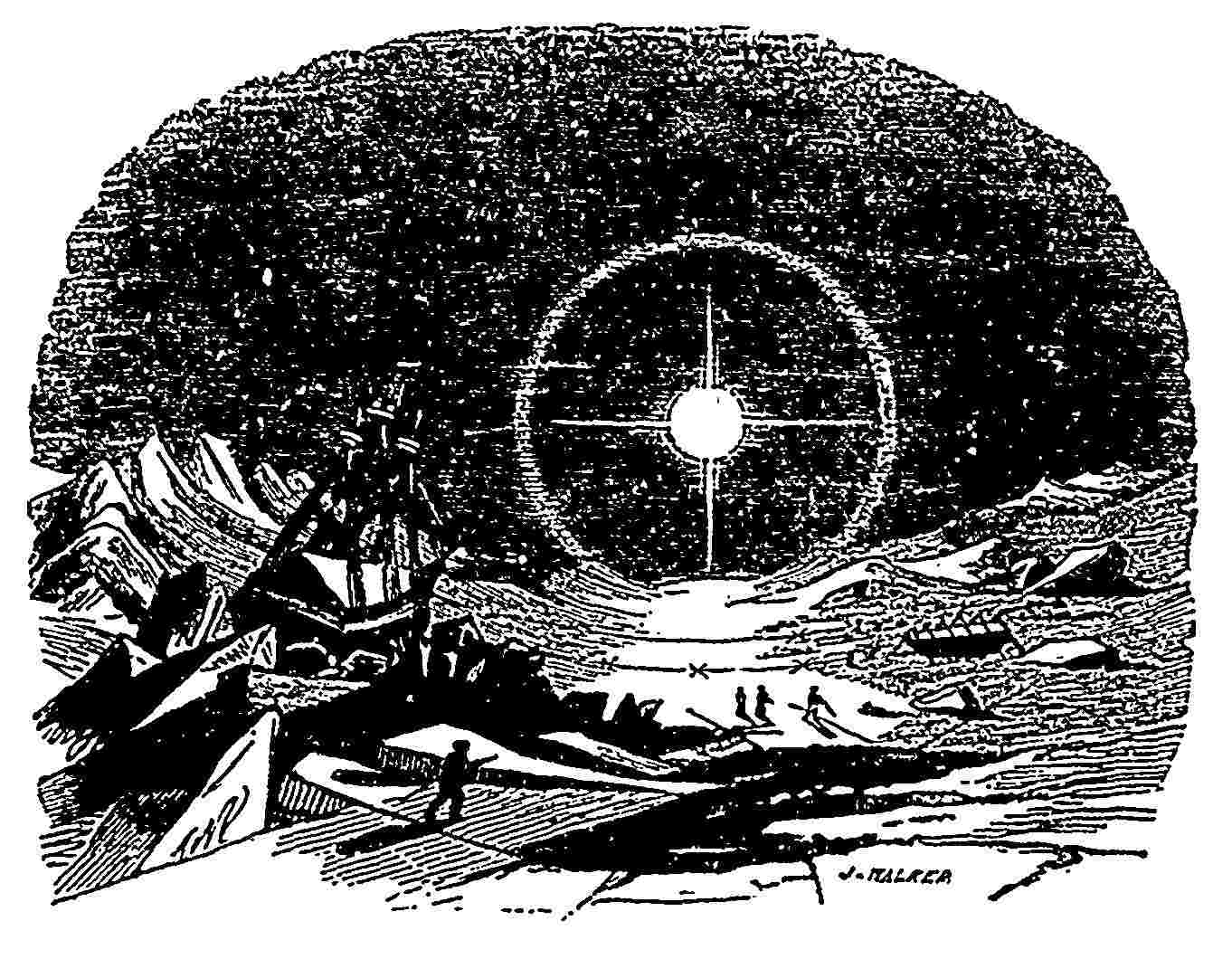
In certain states of the atmosphere, chiefly occurring in Polar regions, the sun and moon are surrounded with circles and parts of circles of various sizes and forms, producing the most singular and remarkable effects. All these appearances are called halos. The small halos seen round the sun and moon in fine weather, when the sky is partially covered with light fleecy clouds, are also called coronæ. Sometimes the image of the sun or moon is repeated several times, producing what are called parhelia or mock-suns, and paraselenæ or mock-moons. Small halos surrounding the planet Venus have been observed near the Equator. The colors of the solar halo are similar to those of the rainbow, but not so bright, and they do not always occur in the same order. In the halo the red is generally nearest the sun, the exterior of the band being a pale indigo or violet, and in some cases white. Occasionally the inner edge is white, and beyond this are green, yellow, and a pale red. The lunar halo is usually white, but occasionally shows tints of pale green or red. Both the solar and the lunar halo often appear double, consisting of two concentric circular bands; the outer one being broader than the other, its colors fainter, and its distance from the sun or moon twice as great as that of the inner band. The sky within the halos is sometimes of a deep blue color: but it is frequently gray, on account of a thin veil of clouds covering it.
Coronæ are much smaller than halos. A corona sometimes appears in company with a halo, but such is not often the case. The solar corona commonly consists of three concentric bands, variously colored; in one observed by Sir Isaac Newton, by reflection in a light of standing water, the colors of the three bands proceeding from the sun outwards were blue, white, and red; purple, blue, green, and pale red; pale blue and red.
Mock-suns, or parhelia, are of common occurrence within the Arctic Circle. Their usual appearance has been thus described:—“When the sun is not far from the horizon, one or more luminous circles or halos surround it at a considerable distance; two beams of light go across the innermost circle, passing through the centre of the sun, the one, horizontally, the other perpendicularly, so as to form a cross; where these beams touch the circle, the light is, as it were, concentrated in a bright spot, sometimes scarcely inferior in brilliance to the sun itself; at the corresponding points in the outermost circle, segments of other circles, wholly external, come into contact with it.”
A beautiful exhibition of parhelia, which occurred in the northern parts of America, has been thus described:—“The atmosphere had been very hazy, but as the haziness cleared off, the first appearance was a brilliant parhelion. Its form at first was nearly circular, and its apparent diameter a little greater than that of the true sun. Its light, which was of a brilliant white, was so intense as to pain the eyes. In a few moments, another parhelion, of equal brightness, appeared at the same distance on the east side of the sun, and at the same altitude. When first seen it appeared a little elongated vertically, and slightly colored. Both these parhelia retained their size and appearance for a few moments, and then began to lengthen in a vertical direction, and shew the prismatic colors, with considerable brilliancy. Directly above the sun appeared, at the same time with the parhelia, a colored arc, having its centre in the zenith, and its convexity towards the sun. The exterior was red; the other colors were merged into each other, but the blue and green were predominant, though faint.”
Paraselenæ are frequently seen in the Polar regions. Captain Parry noticed several of them during the long winter nights of those dreary abodes. On the first of December, 1819, he remarked one close to the horizon, another perpendicularly above it, and two others on a line parallel to the horizon. “Their shape was like that of a comet, the tail being from the moon. The side towards the moon was of light orange-color. During the existence of these mock-moons, a halo or luminous ring appeared round the moon, and passed through all the mock-moons, at which instant two yellowish-colored lines joined the opposite mock-moons, and formed four quadrants, bisecting each other at the centre of the circle. These appearances varied in brightness, and continued above an hour.” On another occasion a circular halo surrounded the moon; part of a well defined circle of white light passing through the moon, extended for several degrees on each side of her, and in points where this circle intersected the halo, were paraselenæ. In the part of the halo immediately over the moon was another much brighter, and opposite to it in the lower part of the circle another similar but much more faint. About the same time on the following evening two concentric circles were observed round the moon, upon the inner of which were four paraselenæ exhibiting the colors of the rainbow. On another evening he saw a halo, which had in it three paraselenæ, very luminous, but not tinged with prismatic colors; and on the following day the same phenomena occurred with the addition of a vertical stripe of white light proceeding from the upper and lower limbs of the moon, and forming with a part of the horizontal circle seen before, the appearance of a cross. There was also at times an arc of another circle touching the halo, which sometimes almost reached to the zenith, changing the intensity of its light, very frequently not unlike the Aurora Borealis.
In former ages the appearance of halos produced great terror; but their cause is now better understood. They are produced by refractions of light in the globules of water which are suspended in the atmosphere; or the vapours of the atmosphere being frozen, innumerable particles of ice, of an angular form, fill the air, and refract and sometimes decompose the rays of the sun and moon. In the arctic regions, at the time when halos are most frequently seen, the particles of floating ice prick the skin like needles, and raise blisters on the face and hands.—Selected.

“And Death so gently o’er her crept,
We deemed not that she died—but slept.”
She sleeps!—upon that lovely brow,
We can trace no sorrow now,
Soft the fringed lids do lie
O’er the closed and loving eye,—
O’er the sweet lips hov’ring bright
There is shed ethereal light,
Telling of that brighter shore
Where our loved one’s gone before.
Tears for us!—the fruitless yearning
Slow the sadden’d spirit learning,
That on earth no more ’twill see,
Joy again, belov’d, with thee!
Vainly comes the summer breeze,
Wafting gladness through the trees;—
’Twill but deeper, deeper press,
Haunting dreams of loveliness.
Softly falls each golden tress
Round thy pure brow’s loveliness,
And the parting smile from thee
Still upon thy lips we see;—
From our halls the light has flown,
Since thy gentle, loving tone
Left the home thy presence bless’d,
With its soothing tenderness.
Tears for us!—yet, wherefore flow!
When that blessed one we know,
Has but joined the happy band
In the far off Angel land,
Which on earth she loved so well,
Where her spirit seemed to dwell,
E’en when with her loved ones here,
Pointing to a brighter sphere!
Tears for us!—the broken chain
Ne’er can link on earth again;—
Happy household, severed now,
Well such grief our hearts may bow;
Yet the links tho’ scattered here,
In that brighter glorious sphere,
Will be gathered, bound,—O never
Dreaded Death again to sever!
Tears for us, beloved!—but thou
Ne’er shall pain or sorrow know,—
Love’s deep fountains, stirred by thee,
Painful from intensity,—
Trembling even midst its joy,
Fearful some unseen alloy,
Should that blissful dream dispel—
Not on earth such love may dwell.
Tears for us!—our gathered flower,—
Gathered ere the sun or shower,
Or the rude world’s blighting storm
Touched thy pure and sinless form;—
Saved from sin, from sorrow free,
Saved to all eternity,—
Brightly blooms our gathered flower,
Safe in Eden’s blissful bower!
C. Hayward.
Ravenscourt, March, 1854.

A friend has just handed us a number of the Hipéan, a magazine which is annually published in a female seminary, some distance from here. We find some fine articles in it, showing the effects of a sound mental training. One of them we give below, not so much for its literary merit, as to show the humorous style in which it is written. Our young friends in school often complain that they cannot write compositions. If they could see this really interesting magazine, made up of original contributions from young girls, they would take fresh courage, we think:—
Misses Editresses:—
As I am now in a very interesting part of my travels, I thought it would not be unwelcome to you to have a description of the country through which I am now passing.
The kingdom of Humanity is situated in a very pleasant part of the world, and is bounded on the north by infancy, on the east by the Province of Youth, on the south by the republic of Manhood, and west by the river of Old-age. The Kingdom is divided into a number of states, some of which I will endeavour to describe, viz., Decline, Prostration, Convalescence, and Health. The latter is rather the largest, and is considered the most pleasant by every one. The inhabitants being the most agreeable, I spent more time there, than in any other state. I also visited Decline, which is in the north-eastern part of the Kingdom, and is bounded on the north by Homeopathy, on the east by sympathizing, friends, on the south by inquisitive old ladies and their prescriptions, and on the west by a big rocking chair.
I next went into the state of Prostration, which is a very unpleasant one. The inhabitants are very poor and petulant. This state is bounded on two sides by quack doctors, and on the other two by patent medicines. After remaining in this state a few weeks, set sail on the Hydropathy river, in the ship Allopathy, and soon arrived at the state of Convalescence. The capital of this state is Appetite, which, by the way, is a very flourishing town.
Having stayed here a reasonable time, I entered the state of Health, which, as I said before, is the most delightful. As I entered this state, I noticed that the air seemed purer than in the other states. This state is bounded on the north by much exercise, on the east by frequent bathing, on the south by simple diet, and on the west by Cheerfulness.
I am still remaining in the state of Health, and intend to continue my travels, and in about six weeks you may expect to hear from me again.
Amanda R.
Misses Editresses:—
I still continue my travels in the Kingdom of Humanity. In my last communication, I stated that I had just entered the state of Health. From the capital of that state, on the railroad of time, I proceeded to the state of Single Blessedness. Soon after I entered this state, I passed a small town inhabited entirely by cats and pet dogs. The climate of this state must be very salubrious, for the inhabitants all looked old. I think the youngest of them was over thirty. The state is bounded on the north by Cupid’s dominions, on the south by disappointed hope. The stream of young love formerly made its eastern boundary, but it has ceased to flow, and its bed has long since become dry and dusty. A formidable chasm separates this state on the west from the sunny state of Matrimony; but I was told, by some of the most reputable inhabitants, that, lured by the pleasant breeze that constantly blows from that state, it is no uncommon occurrence for the inhabitants of the state of Single Blessedness to attempt the fearful leap, and that many succeeded, while a few perished in the ditch. I went down to view this wonder, just as the honey moon was rising. The chasm looked rather dark, but I saw one, on the other side, who only yesterday left Bachelor’s Town, in this state, and made a successful leap, beckoning to his companions to follow; and I thought two or three that went with me, manifested quite a desire to obey.
On my way here I passed through the state of Temperance. This is very similar to Health, both in situation, and the advantages that it possesses, and is bounded on one side by that state. The capital of this state is cold water, situated near the centre, and surrounded by an impenetrable fortification called the pledge.
At the south-east corner of this state I saw a turnpike that seemed to be well travelled, called Morning Dream Road, and as I was about to take that direction, to see what of interest I could find, I met a man just coming in, on the road of Reformation, who said that he had just come from the state of Intoxication, and said that if I continued on this Morning Dream Road, I would soon find myself in Gutterville, from which I would not easily escape without the aid of the Marshal.
He gave me such a dismal account of the country and its inhabitants, that it almost made my hair stand erect; but still I don’t know but that I should have been silly enough to try and see if I could keep on that road, and keep out of Gutterville too, had I not looked away down the road, and beheld a man, who was the first in the state, before he started on this road, just entering this dismal village; as I continued to look, I saw him lie down in poverty and disgrace, with the grunters, that are very abundant there.
I then asked my adviser his name. He said it was Washingtonian, so I concluded to take his experience for a school master, and not get one at my own expense at this time.
As I took the railroad to pursue my journey, I got into the car of Old age, and there was such a noise about the cars, and so much dust, that I was almost blinded and deafened. And it jarred and shook me so, that I lost all my teeth, while the ashes from the engine completely whitened my hair.
We at last arrived at a small town on the bank of a broad, deep river, inhabited by a few very aged people, where I shall spend the remainder of my days.
Amanda R.
[Written for the Maple Leaf.
 n exclamation of joy from Marion roused Helen
from the reverie in which she had been
indulging, and looking up, she saw in the distance,
the clustering chimneys and high gables
of the happy home they were approaching.
n exclamation of joy from Marion roused Helen
from the reverie in which she had been
indulging, and looking up, she saw in the distance,
the clustering chimneys and high gables
of the happy home they were approaching.
The mansion itself was large and irregular, with deep oriel windows, opening upon a lawn redolent with perfume from shrub and flower, at the foot of which ran the river, and beyond extended scenery of the most sylvan and fertile character. Numerous country seats were scattered around, embosomed in the rich surrounding woods, and the wandering breeze, floating across the river, was laden with the aroma of new made hay. As they entered the pleasure grounds, their beloved grandmother was seen awaiting them at the head of the steps at the entrance hall. There she stood, the very beau ideal of graceful old age. A white crape turban, resting on a brow shaded only by her own silver hair; her commanding form, unbent by age; her still delicate complexion, the soft folds of her grey satin gown, the valenciennes lace ruffles,—all bespoke the true gentlewoman. With touching grace she extended her hand to Captain Seymour, thanking him for the care he had taken of her darlings.
“But how is this, dear Helen,—where are my roses gone?” as she tenderly stroked her cheek. “I expected to see you quite blooming,” and she looked inquiringly from one to the other.
“I believe, my dear Madam, the terrors of the train have chased away the roses.”
“Ah! Helen,—what! afraid with Captain Seymour! How was that dearest? I thought you had all confidence in him.”
“Whatever Miss Reynolds may have felt heretofore, I certainly was led to suppose she entirely withdrew that honor from me. To-day, it seemed to be concentrated in the person of an old gentleman, her vis-à-vis in the train.”
Had Helen but looked up and seen at that moment the gradual smoothing of his brow, and the lurking smile he endeavoured to conceal, she would not have had cause to hurry away to conceal the starting tears. As she left the room, Mrs. Reynolds turned inquiringly to Captain Seymour, who briefly related the unfortunate occurrence of the journey; and as he did so, however her grandmamma’s aristocratic ideas of propriety and lady-like behaviour may have been shocked, it was wholly impossible to forbear laughing at the ridiculous finale of the scene. At the same time she felt annoyed and mortified that, of all people, Captain Seymour should have witnessed such want of self-command in her grandchild; but she could not resist pleading for her darling.
“Ah, Captain Seymour, I am sure Helen feels you are annoyed,—that alone could account for her distressed look as she left the room. Remember this is not a case for a court martial. My heart aches for her.”
Captain Seymour rose hastily, but instantly checking himself, he advanced with a calm proud step to the side of the old lady.
“Do you, my dear Mrs. Reynolds, withdraw one iota of that confidence with which you honored me when first you gave into my care the precious gift of your grandchild?”
If doubt had for one passing moment crossed her mind,—a doubt only awakened by her own over-fondness,—it was entirely dispelled as she gazed on the noble form before her.
She extended her hand—
“I was wrong, dear Captain Seymour; I know well how dear she is to you, but my heart ached for her present distress.”
“Then you must believe mine does, when I feel obliged from a sense of duty only to prolong that distress. I must now leave you,—believe me it is best,—but I will, if possible, return to-night; but of that I do not wish her to be informed.”
As he left the room, her well known step arrested him.
He held out his hand.
She sprang forward—
“O! Cecil, you are not going.”
She could say no more. His resolution faltered, as she stood with leaned head beside him, but he felt so strongly the necessity of firmness that he repressed the impulse prompting him to remain. Such firmness, yet such gentleness, poor Helen could barely comprehend the apparent contradiction, as he tenderly stroked her head.
“Helen, do you trust me? Then in going, believe that I go in sorrow, and will return soon to realize, I hope, all the pleasure we have anticipated in our visit here.—Farewell!”
Helen came in.
“Do not look any longer after Captain Seymour; he will not stay away long, I know,” said Marion. “The old gardener is wondering why Miss Helen has not been to see his new flowers.”
Helen dashed the tears away and followed her sister, and as every new object revealed the untiring love of their devoted relative, her face brightened for the sake of one so dear. How much there was to see and to talk over, sure of sympathy in every joy and sorrow. With a mind fresh, and buoyant as ever, richly endowed with knowledge, Mrs. Reynolds ever entered with true zest into all the feelings of youth, and was in return almost idolized by young people, by whom she was continually surrounded.
“I have asked your young friends, the Stuarts, to meet you this evening; so I expect quite a concert with such a musical party. We must postpone our ramble now and go and dress,” and they returned to the house.
Evening came, Mrs. Reynolds’ watchful eye alone, perhaps, could detect the cloud over her darling’s apparently cheerful smile; but she was consoled by knowing Captain Seymour might momentarily be expected. As these thoughts occupied her mind, the sound of carriage wheels caught her ear, and she left the room to find that he had indeed arrived.
“Does Helen know I am here?”
“No. I have attended to your wish, and she still remains in ignorance of it. I left her singing.”
“My dear Madam, have I your permission to speak a few words with her before I join your party?”
“Certainly. I will send her to you.”
Captain Seymour walked round the lawn, and taking his station near the open windows was an unobserved spectator of the scene within. Helen had risen from the harp, and was then the centre of a group proffering their thanks for the song just concluded. The gaiety of her laugh grated painfully on his feelings, but could he have taken a peep at the heart within, he would have seen it was assumed to conceal the regret she had felt as she remembered that it was for his ear that song had been learned.
“My absence does not weigh very heavily,—flowers, too, in her hair,—and his brow grew dark.”
Ah! look on, and see flowers, ’tis true, but given by Seymour himself that morning. She advanced to the window, and unconscious of the near presence of one so dear, passes swiftly down the terrace to the rich parlour below. He followed. Did his heart reproach him as he saw the joyous creature of the previous moment, her head leaned in uncontrollable sorrow.
“Helen!”
She started up—
“Oh! Cecil, stay let me tell you, then if you can promise me”—and she forces herself to tell him of the mortifying conclusion to which, Marion had told her, their fellow-passengers in the train had arrived,—of her being a liberated lunatic.
Captain Seymour laughed aloud.
“Then, Helen, you must let me be your keeper. I do not promise not to use coercion, but the chains shall be those of love. Shall it be so?”
“O! Cecil, too good and kind.”
It is hardly necessary to say Helen’s smile, on re-entering the drawing room, was sufficiently bright to satisfy the most exacting fondness on the part of Mrs. Reynolds, and as the wife of Captain Seymour, when fear was likely to get the better of reason, he would say, laughingly,—
“Remember, Helen, the first trip by railroad.”
C. H.
Ravenscourt, March, 1854.
Industry is not only the instrument of improvement, but the foundation of pleasure. He who is a stranger to it, may possess but cannot enjoy; for it is labor only which gives relish to pleasure. It is the appointed vehicle of every good to man. It is the indispensable condition of possessing a sound mind in a sound body.—Dr. Blair.
[For the Maple Leaf.
A cage of golden wires,
Haste, bring me for my bird,
In forest glades its wilder notes
Shall never more be heard.
But in my casement, twined
With honeysuckles fair,
I’ll place it, and it long shall prove
A faithful maiden’s care.
Yes, and with patient art
I’ll teach it many a word,
And all that go and come shall stay
To praise my charming bird.
The words that I shall teach,—
And these I always meant,
Should find an echo in my heart,—
“Be humble and content.”
A simple sentence ’twas,
Upon my sampler wrought,—
I wove it deep within my heart,
My soul its spirit caught.
Now if I sit and sing,
Or if by sorrow spent,
I still shall hear the magic words,
“Be humble and content.”
And wiser heads than mine
Might not of this repent,
To teach their proud repining hearts,
“Be humble and content.”
S. O.
Osnabruck, Jan. 6th, 1854.
Conversation.—I would establish but one great general rule in conversation, which is this, that men should not talk to please themselves, but those that hear them. This would make them consider whether what they speak be worth hearing; whether there be either wit or sense in what they are about to say; and whether it be adapted to the time when, the place where, and the person to whom, it is spoken.—Steele.
Although our stay in Malta was so short that we could not do more than see Valetta and its environs, we yet found enough to make us wish that we had more time at our disposal. The city itself is a curiosity in many respects. It is, perhaps, next to Gibraltar, the most impregnable position in the world. It appeared to us, on entering the harbour, that the fortresses which guard its narrow mouth might not only resist, but even annihilate, any naval force that could be brought against them. The frowning forts of St. Elmo on the right, and Ricasoli on the left, could crush the most powerful vessel in passing through the narrow entrance. The city is neat, well built, and contains about 40,000 inhabitants. Its massive walls rise from the water’s edge, and are surmounted with heavy ordnance, so that on all sides it appears like a fortress rather than a town.
Such, indeed, its founder, Valette, the most celebrated of the grand masters of the Order of St. John, intended it to be. Driven from Rhodes by the Turks in 1522, the knights established themselves in Malta, and determined to fortify their position against any possible attacks of the Saracens. Solyman the Magnificent, who had driven them from Rhodes, determined, in 1565, to accomplish their expulsion from Malta, and sent Mustapha Pacha, with 30,000 men and ample munitions of war, to execute his purpose. The siege, which is the most memorable, perhaps, in history for its severity, was raised at the end of four months, and the knights were left in peace, but their town and fortress were battered to pieces. La Valette laid the foundation of the new city which bears his name in 1566, and commenced the marvellous fortifications which are still the wonder of the world.
The history of the Knights Hospitallers, up to the seventeenth century, is a splendid one, full of all the elements of romance. After that period their exploits were comparatively insignificant, though their wealth and splendour continued to increase. The city of Valette contains abundant monuments of their taste and magnificence. Each grand master attempted to excel his predecessors in beautifying the capital, and adding to the strength of its fortifications. The order was divided into eight langues or nations—the German, Italian, Castilian, Aragonese, Provençal, Auvergnese, French, and English. The English branch of the order, however, was dissolved by Henry VIII., and its property in Britain confiscated. Each of these branches had immense possessions in the different countries of Europe, and much of their revenue was spent in Malta. This will account for the enormous forts, the subterranean excavations, and the splendid palaces which remain in the island to attest the wealth and enterprise of the knights. Each langue had its separate palace in Valetta, and these splendid edifices constitute the principal charm of the city. These abodes of luxury were occupied by the knights until 1798, when the fleet of Napoleon, on its way to Egypt, appeared before the harbour, and the degenerate descendants of L’Isle Adam and La Valette gave up their stronghold without striking a blow. This was the virtual end of the order; the knights were scattered over Europe, and the island was retained by the French for a year and a half, when they, in their turn, surrendered it to the English, after a most pertinacious and heroic resistance. By the Treaty of Amiens, the English government engaged unequivocally to restore the independence of the island; but it was too important a post to be easily parted with, and the government determined to break its promise. The best English authorities have condemned this breach of treaty; but the great advantage to England of possessing such a fortress in the Mediterranean is too powerful for her sense of conventional honour, and the island still remains under her dominion. The mildness and equity of her administration, together with a great increase of population and wealth, have reconciled the inhabitants to her sway; and civilization in the East may yet be largely indebted to the English occupation of Malta.
But to return to Valetta. The principal street of the city is the Strada Reale, which runs along on the summit of the ridge or promontory between the two harbours, from Fort St. Elmo to the chief gate leading out into the interior of the island. It is a very fine street. The building material is the light yellow limestone of the island. The governor’s residence, situated in the Strada Reale, and formerly the palace of the grand master, is a spacious and imposing building. In the same street are the exchange, the library, and the principal hotels and shops. The other streets of the city run parallel to this, and are connected with it by various flights of stone steps, the ascent being too steep on either side to allow of a carriage way.
The Cathedral of St. John is an immense edifice, though presenting no external display of magnificence. We visited it by candlelight, and a most interesting visit it was. As we walked over its rich mosaic pavement, emblazoned with the armorial bearings of the knights who sleep below—wandered through the side-chapels belonging to the different langues, adorned with paintings and rich in sculpture, and descended into the solemn crypt, filled with monuments of the grand masters in bronze or marble, and hung with highly wrought tapestry representing the life of the Saviour, we could not but recall to mind the days of chivalry of which these valiant knights of St. John were so distinguished an ornament. Few edifices in Europe are more impressive than this Cathedral.—Selected.
“But she is in her grave, and, Oh!
The difference to me.”—Wordsworth.
My youth’s fond hopes, how bright
They flashed and played, until my future life
Rich promise gave of joys unmixed with strife,
And bathed in golden light;
So fair the prospect was, that life did seem
To mock at death as if ’twere but a dream.
The seasons came and went;
But happiness arose with each new change,
And thoughtlessly I only sought to range,
Where rainbow tints were blent,—
Where the gay sunlight gladdened all the plain,
And the grove echoed every pleasant strain.
I cared not, had not known,
That brightest suns must pale and darkly set,
That fondest friends must part altho’ they met,
As Mother and her son;
That even the strongest bonds of earthly love,
Must ’gainst the power of change but futile prove.
But now, the gold how dim,
Obscurity involves that road so bright,
And I seem lost—Oh! that I might
With purpose turn to Him
Who was on earth, thy ever present stay,
Was more—was all—thy life! thy truth! thy way!
Persolus.
Montreal, March, 1854.
BY ISIDOR.
An eccentric old gentleman in this city ordered his gardener to make a bed for flowers, in which there should be 9 straight lines, and he only gave him 9 flowers to plant, and there must appear in every straight line, and in every possible direction, 3 plants. The poor gardener requests the assistance of some young friend to aid him in his difficulty.
My first is now a part of speech,
My second is for ladies;
My first and second sometimes screech
Another name for babies.
My third’s the smallest of the three,
’Tis used for building houses;
My whole is like a tender tree
And sometimes does arouse us.
J. A.
What fruit, when divided, is like a divorced couple?
What article of furniture reminds you of vocal music?
J. A.
We must beg some of our younger correspondents to wait patiently for the insertion of their communications. We sometimes find it difficult to make a selection, especially as our contributors do not send their articles as early as they ought, and justice in that case cannot be duly meted out to the later arrivals, for want of space.
X. will please receive our thanks for his kind interest in the Maple Leaf. His article, though not in all respects suited to its pages, shows taste and thought. We would suggest a revision of the subject.
We have received some poetical communications, also, which though pretty in many respects, and abounding in good sentiment, do not quite come up to the standard.
Will some one be kind enough to send us an answer to Oscar’s communication in the February number?
We were just now looking over our last month’s Editorial, and it occurs to us that our remarks in regard to articles may perhaps, be misconstrued into an undervaluing of our present contributors, than which nothing was further from our thoughts, as we think we are highly favored in that respect. We like to hold up the idea of a high intellectual standard to our younger writers especially.
Misspelled words and printer errors have been corrected. Where multiple spellings occur, majority use has been employed.
Punctuation has been maintained except where obvious printer errors occur.
When nested quoting was encountered, nested double quotes were changed to single quotes.
A table of contents has been added for reader convenience.
A cover was created for this ebook which is placed in the public domain.
[The end of The Maple Leaf, Vol 4, no. 4, April 1854 by Eleanor H. Lay]