* A Distributed Proofreaders Canada eBook *
This eBook is made available at no cost and with very few restrictions. These restrictions apply only if (1) you make a change in the eBook (other than alteration for different display devices), or (2) you are making commercial use of the eBook. If either of these conditions applies, please contact a https://www.fadedpage.com administrator before proceeding. Thousands more FREE eBooks are available at https://www.fadedpage.com.
This work is in the Canadian public domain, but may be under copyright in some countries. If you live outside Canada, check your country's copyright laws. IF THE BOOK IS UNDER COPYRIGHT IN YOUR COUNTRY, DO NOT DOWNLOAD OR REDISTRIBUTE THIS FILE.
Title: Two Stolen Idols
Date of first publication: 1927
Author: Frank L. Packard (1877-1942)
Date first posted: June 26, 2026
Date last updated: June 26, 2026
Faded Page eBook #20260659
This eBook was produced by: Al Haines, John Routh & the online Distributed Proofreaders Canada team at https://www.pgdpcanada.net
By FRANK L. PACKARD
TWO STOLEN IDOLS
THE RED LEDGER
BROKEN WATERS
RUNNING SPECIAL
THE LOCKED BOOK
THE FOUR STRAGGLERS
JIMMIE DALE AND THE PHANTOM CLUE
DOORS OF THE NIGHT
PAWNED
THE WHITE MOLL
FROM NOW ON
THE NIGHT OPERATOR
THE FURTHER ADVENTURES OF JIMMIE DALE
THE ADVENTURES OF JIMMIE DALE
THE WIRE DEVILS
THE SIN THAT WAS HIS
THE BELOVED TRAITOR
GREATER LOVE HATH NO MAN
THE MIRACLE MAN

COPYRIGHT, 1917,
BY GEORGE H. DORAN COMPANY
TWO STOLEN IDOLS
—Q—
PRINTED IN THE UNITED STATES OF AMERICA
| CONTENTS | |
| I | Sea-Borne |
| II | Patua |
| III | The Story of Hsi Yan |
| IV | In the Night |
| V | The Five Chinamen |
| VI | White Water |
| VII | The Man with the Torn Garment |
| VIII | When Panic Reigned |
| IX | Thumbs Down |
| X | The Baalu Reef |
| XI | Judge and Jury |
| XII | Leg-Irons and Manacles |
| XIII | The Chance Shot |
| XIV | One of the Two Idols |
| XV | For the Defense |
| XVI | Java Dick |
| XVII | The Midnight Visitor |
| XVIII | Two More Visitors |
| XIX | Against Time |
| XX | The Three Prisoners |
| XXI | Before Dawn |
Two Stolen Idols
The night had fallen a dead calm. At sun-up, floating on a flat oily sea, as though it were a relic of the darkness, a small, black speck showed some two miles away off the schooner’s starboard bow. It was scarcely discernible, but in the idleness of a stifling calm it was enough to arouse the interest and curiosity of all on board. This interest on the part of the Malays and Lascars who composed the crew, however, waned rapidly and in direct ratio as the blazing heat of the day increased. But the after-guard, which is to say the skipper and the mate, perhaps for the very reason that they were intrigued by the possession of binoculars which left the identity of the black speck almost as much open to speculation as did the naked eye, continued to debate the matter throughout the forenoon.
“I’m still putting it down to being a ship’s boat, or the wreck of one,” insisted Marlow, the mate, after one of many inspections.
Martin Sweeney, better known amongst the islands and on every waterfront within a thousand miles of Singapore as Captain Scarface, screwed his little gray eyes to the binoculars and in turn indulged in a prolonged stare.
“So you’ve said before,” he grunted. “But, glass or no glass, you can’t make it out to be a boat any more than I can.”
“I don’t say as I can,” admitted Marlow; “but just the same I’ve a hunch that’s what it is.”
Captain Scarface lowered the binoculars, retreated from the rail, dragged the canvas deck-chair near-by a few feet farther aft to a spot where the mainsail afforded the maximum of shade, and sprawled down in the chair. He was not handsome. He was grizzle-haired, lean of face, a man of sixty or thereabouts, and a semicircular scar ran in a white line from the right-hand corner of a clean-shaven lantern-jaw to the corner of his right eyebrow—a scar that, apart from being always peculiarly white, was unusually pronounced by reason of its contrast with the color of the skin on which it was traced, which latter was tanned and burnt almost to a shade of mahogany. He was six feet of bone and muscle. He had no superfluous flesh. His stockingless feet were thrust into native slippers made of some kind of matting. He wore cotton drawers, a shirt wide open over a hairy chest, and a white cap, whose black visor, once of shiny patent leather, was battered and crumpled and much the worse for wear.
“Well, maybe it is—and then again maybe it ain’t,” responded Captain Scarface non-committingly. “If we get a breath of wind we’ll bear down on it and see.” He flirted the sweat beads from his forehead with a sweep of his hand. “God A’mighty, it’s hot!”
At noontime the relative position of the black speck and the schooner was unchanged. The skipper and the mate came on deck again after a meal in the stuffy cabin where, even in the unbearable heat that had put a damper on their seasoned appetites, Marlow had stuck stubbornly to his contention that the object adrift was a boat. Captain Scarface promptly leveled the binoculars once more, and then, with a shrug of his shoulders by way of indorsing his consistent refusal to commit himself to any opinion, handed them to Marlow, and again took refuge in the deck-chair.
“I’m still saying it’s a boat, or the wreck of one,” declared Marlow doggedly.
Captain Scarface tamped down the dottle in the bowl of his pipe with a gnarled forefinger, and his eyes roved forward along the deck. He chuckled suddenly, grimly to himself. The recumbent and scantily clothed figures that met his gaze bore testimony to the intense heat. There was no movement. The natives lay under the shelter of the bulwarks or wherever else there was to be found even a suggestion of shade.
“The crew’ll probably try to stick a knife into you for a four-mile spell at the oars in this heat, and small blame to them,” grinned Captain Scarface; “but as the matter ain’t likely to be settled in any other way, seeing there’s no wind and no promise of any, you’re welcome to man a boat and go out there if you like. That’s what you want, ain’t it?”
“Yes,” said Marlow, “that’s what I was thinking of. I was going to suggest it. It’ll kill an hour or two anyhow.”
“Well, go ahead, then”—Captain Scarface’s grin broadened—“that is, if you can rouse up any of the dead for’ard there!”
“I’ll rouse ’em!” promised Marlow gruffly—and, turning, bellowed out a series of orders, which, if not quickening the prostrate figures along the deck into instant and eager life, at least had the effect of bringing some of them unenthusiastically to their feet—and subsequently had the further effect of getting one of the schooner’s boats over the side and into the water.
Captain Scarface watched the boat pull away with Marlow in the stern—watched it casually for a few minutes, and then, with a growl of displeasure at the heat, pulled the visor of his cap down over his eyes and prepared to doze away the time until Marlow’s return. His mind, however, for the first few moments, remained drowsily active. It might be a boat out there—or it might not. He had not committed himself. It probably made very little difference anyway—drifting around for months, no doubt, and utterly worthless—quite as likely to be a hunk of palm thatching that had been washed off the deck of some Chinese junk that had had a cargo of the stuff aboard. Queer lot, those Chinese junkmen! Carry anything! From live pigs to birds’ nests! Not to mention unmentionable things—and a lot of dirty work here and there when it came to opium smuggling. Too damned free with a knife—in the dark! (Captain Scarface unconsciously traced out the scar on his cheek with his forefinger.) Still, if it was a boat out there, the thing to do was to investigate it. Naturally! There wasn’t any wind or he would have run down toward it. Not likely to be any wind for God knew how long, anyhow. Twenty-four hours now without a breath of it. Just as well Marlow was keen to go. He would have sent Marlow anyway—a little later on, though, when it got cooler—with the sun down a bit, and——
Captain Scarface dozed.
When he opened his eyes again he stared sleepily out over the schooner’s side in the direction Marlow and his boat’s crew had taken—and, suddenly quite wide awake, reached for his binoculars.
“H’m!” commented Captain Scarface. “Seems to have found something worth while anyhow. Looks like he was towing it back!”
Captain Scarface continued to stare through the binoculars.
“Aye!” said he presently. “It’s a boat, right enough. Well, I never said it wasn’t. Must be in fair shape too, or he’d never sweat along with it!”
Captain Scarface got up and walked to the rail. He laid the binoculars aside. He could see quite well without them now. Marlow, with his toiling boat’s crew and towing behind him another boat of about the same size as his own, drew nearer and nearer. And then suddenly a grin spread over Captain Scarface’s features. It wasn’t a worth-while bit of salvage—the tow was a patched, battered, and quite obviously useless piece of property. The wonder was that it even remained afloat at all.
Captain Scarface waited until the mate came within hailing distance, and then cupped his hands.
“You needn’t bring it any nearer on my account, Marlow,” he shouted good-naturedly. “I can see it’s a boat from here!”
“It’s more than a boat,” Marlow shouted back. “There’s a man in it—dead!”
“Good God!” Captain Scarface’s jaw dropped. “Dead, d’ye say?”
“Aye,” Marlow answered. “And has been for several days, unless I miss my guess.”
The boats came alongside, and, over the schooner’s low freeboard Captain Scarface stared down into the one that Marlow had towed back. Around him, the schooner’s crew, their apathy gone, were now lining the rail, chattering excitedly amongst themselves and to the boat’s crew below them, but he was scarcely conscious of the disturbance. Upon him there seemed to have fallen a sudden sense of shocked and distressful amazement. It was a mistake, of course—only a fancied resemblance—it couldn’t be anything else—impossible that it could be anything else!
He stood there swinging his hand several times across his eyes as he stared down into the boat. Half across one thwart, his face upturned, a man, gray-haired, and whose age would probably be somewhere in the neighborhood of sixty, lay there—dead. There was a red blotch on one of the white trousers’ legs just below the knee. The blotch looked like blood. But the man’s face——
Almost mechanically, Captain Scarface lowered himself down into the boat, and, bending over the dead man, gazed intently and for a long minute into the other’s face. There was no mistake—no question of fancied resemblance.
“God!” he cried out shakily. “It’s Tom Kingsley, and no mistake!”
Marlow, too, had climbed into the boat.
“My word!” exclaimed the mate heavily. “That’s a rum go! D’ye mean to say you know him?”
“Yes, I know him,” answered Captain Scarface. “And so would you if you’d been out in these parts for any length of time. Everybody knows him. He’s Tom Kingsley—and a finer man never lived.”
Marlow nodded.
“I found this in the bottom of the boat,” he said. He took a revolver from his pocket, and handed it to Captain Scarface. “Every chamber is empty. And look at that wound in his leg. There’s been a fight, all right, and a tough one too, I’d say; but there must have been something queer about it to account for him floating around all alone out here in an open boat.”
“Yes,” agreed Captain Scarface soberly. “And particularly so in view of the fact that his plantation on Kalawa is a good hundred miles from here.”
“Oh, a planter, was he? And from Kalawa!” Marlow whistled low under his breath. “That’s a longish drift, seeing there hasn’t been much else than calms for the last few days, so it kind of looks as though he hadn’t come from there on this cruise. It would have taken a week or more, likely, with this weather. I’d say he’d been at sea somewhere around here, on a schooner or something, and there was a fight, and he was either dumped wounded into the boat, or else got away in it himself.”
Captain Scarface looked up from an examination of the dead man’s wound, stared at Marlow for a moment, then his eyes played critically over the boat, and he shook his head.
“The wound didn’t kill him—that is, not primarily,” he said gruffly. “It might have induced fever and all that, of course—but what did him in was thirst, exposure and starvation. There ain’t a drop of water or a bite of food in the boat, so far as I can see. Well, it would take a good few days for him to die that way, and I’d say he’s been afloat for a good bit more’n a week, which makes it look like he did start from Kalawa. And, besides, this ain’t a boat that a schooner or any craft would give an inch of space to—it’s more like an old bit of junk that the natives get hold of sometimes and then let go from bad to worse with beach-rot.”
“I hadn’t thought of that,” admitted Marlow. “I figure you’ve hit it. But anyway, putting an unpleasant thing as mild as may be, him being in the state he is, we can’t take him back to Kalawa, or anywhere else for that matter. Another day would——”
“It would,” said Captain Scarface—and suddenly his voice was husky. “Tom Kingsley! Thirty-five years and more, I’ve known him. My God!” He jerked his head abruptly at the mate, and cleared his throat uneasily. “Get a bit of sailcloth, Marlow—and the cleanest piece we’ve got aboard, y’understand? And a bit of something heavy for the feet to go with it. It’s all we can do for him, save and excepting to see if he’s got any belongings on him to go to them that are left. I’ll attend to that.”
“Would you say we’d better get him up on deck?” inquired Marlow.
Captain Scarface shook his head. “No,” he answered shortly. “There’s nothing to be gained by it. You can do what’s necessary here.”
“Right!” said Marlow laconically—and, clambering back into the other boat, made his way from there to the schooner’s deck.
Captain Scarface, with a grim, set face began to go through the dead man’s pockets—and the while he muttered in a fierce undertone to himself.
“It’s murder straight and clear,” said Captain Scarface, “and just the same as if he’d dropped dead with the bullet through his heart instead of through his leg. And if I know anything about Robert Kingsley and young Black Bob, some one’ll pay for this, and pay for it——”
Captain Scarface straightened up with a sudden jerk, and stared with puzzled curiosity at two small objects in his hand. There had been very little in the dead man’s pockets—a pipe, a tobacco pouch that was empty to the last crumb, a small penknife, and, apart from a rather good silver wrist-watch which Captain Scarface had already unstrapped and placed on the thwart beside him with the other belongings, nothing else except these two small objects that he had found in one of the back pockets of the other’s trousers, which pockets, from their position, since the dead man lay almost upon his back, had naturally been subjected last of all to a search. And now he turned these two small objects over and over in his hand and continued to stare at them curiously. They appeared to be of solid ivory and identically alike—two little squatting idols, roughly about an inch and a half in height and three-quarters of an inch in diameter. Captain Scarface made no pretense to being a connoisseur of anything pertaining in any way to art, but he could see that the carving had been exquisitely done.
“Wonder where he picked these up?” he muttered. “ ’Tain’t the kind they sell the tourists—I’d lay a few to that!”
He was still staring at the two little idols when Marlow returned to the boat accompanied by the serang.[1]
“What do you make of these?” he demanded.
Marlow squinted.
“Buy ’em by the bushel anywhere from Shanghai to Singapore—two bob if you know your way about, and twenty quid if you don’t,” he answered promptly.
“You’re wrong,” said Captain Scarface. “What they are, I don’t know myself; but to begin with, Tom Kingsley ain’t the man to be carrying that kind of truck around in his pockets. You’ve a better eye for boats, my lad, I’m thinking. Anyway, you’re wrong here. These ain’t ordinary.”
He gathered up the articles he had laid on the thwart, and depositing them, together with the ivory idols, in his own pocket, retired to the other boat to make room for Marlow and the serang.
He sat there then, the visor of his cap low over his eyes, somberly watching the two men at their task. Given but little to emotion of any sort, a man indeed to whom death in every form was no stranger, a man whose reputation was that of one calloused against any turn of fate, a man who had seen life’s rawest edges exposed here amongst the outposts of civilization, he was conscious that he was more profoundly stirred and saddened than he could ever remember having been before. Perhaps it was the sudden shock of the thing—coming on old Tom Kingsley like this! Perhaps the depressing heat had something to do with it. And then, besides, it was murder. There was no getting away from that. The man had died from exposure and thirst, and under ordinary conditions the wound in his leg would not have amounted to much of anything; but Tom Kingsley wouldn’t be floating around wounded in an open boat in the open sea thirty or forty miles from the nearest land if he hadn’t been forced into the boat in the first place.
Captain Scarface mopped the beads of sweat from his forehead with the sleeve of his shirt—and then suddenly his brows puckered as a possible alternative to murder suggested itself. Suppose old Tom had been out in the boat, and in a sudden squall or something had lost or broken his oars—that would account for the drift and the lack of food and water. And the wound? Well, suppose he had accidentally shot himself, say, even before the squall—that would account even more logically than ever for the loss of the oars and the subsequent drift. Old Tom would have been unconscious and unable to do anything for himself until it was too late. But—the pucker on Captain Scarface’s forehead deepened—Marlow said every chamber was empty. What exactly had Marlow meant by that?—that the revolver hadn’t been loaded at all, or that every cartridge had been fired?
He reached hurriedly into his pocket, took out the revolver, broke it, and examined it himself. A hard look crept into his eyes. The revolver had been fully loaded. Marlow, after his examination, had obviously replaced the shells—and every shell was empty. If the wound in the leg had been self-inflicted, what had become of the other five shots?
That settled it! There was no accident about it. It was murder.
Marlow spoke in a lowered voice from the other boat.
“We’re ready,” he said.
Captain Scarface did not answer for a moment. He looked in a distressed and perplexed sort of way at the mate.
“We ain’t got a prayer-book aboard,” he said at last. “D’ye by any chance remember a prayer, Marlow?”
Marlow shook his head—and a flush crept over his sun-tanned cheeks.
“Only a kid’s prayer—part of it—‘Now I lay me,’ ” he answered hesitantly.
Captain Scarface in his turn shook his head.
“ ’Tain’t fitting!” he said. “Nor me—I don’t remember any either.”
There was another moment’s silence. Captain Scarface’s eyes traveled from Marlow to the schooner’s rail above his head, where, lined along it, the native crew stood staring down upon the scene.
And then Captain Scarface stood up and took off his cap. Marlow followed suit.
“A damned white man,” said Captain Scarface hoarsely. “God rest his soul!”
He motioned a little helplessly to Marlow—and the white, canvas-sewn form slipped into the sea.
For a few minutes Captain Scarface stood there cap in hand; then, with a gruff order to cast the worthless boat adrift, he made his way back to the schooner’s deck and his canvas chair.
Here, on the cabin skylight beside him, he spread out the articles he had taken from the dead man’s person; and here, shortly, Marlow joined him.
The mate sat down on the edge of the skylight, and jerked his head in the direction of the little collection of personal effects.
“What’re you going to do with ’em?” he asked.
“What else but send ’em to his brother?” replied Captain Scarface. “Robert’s the only family he’s got that I ever heard of, except Robert’s son, Bob.”
Marlow nodded without comment.
“In a day or two, if we ever get any wind,” said Captain Scarface as though communing aloud with himself rather than addressing the mate, “we’ll make Momboa. There’s no one there to speak of but old Hawk Griswold; but some of the Dutch boats touch there off and on, and that means mail. I’ll make a package of these things and likewise write a letter, though I ain’t much of a hand at putting things down on paper; and the package and the letter I’ll have Griswold send along by mail to Tom’s brother, Robert, on the first boat that puts in. The Lord knows when Robert’ll get ’em, as he lives in about the last place on earth that’s ever visited by any steamer; but with us being on a trading cruise that, depending on the luck we have, will take us maybe a month or more before we touch what you might call civilization again, the best thing I know to do is to get Griswold to send ’em along.”
“Where’s he live, this brother you’re talking about?” demanded Marlow.
“Up north of Celebes on an island called Patua,” Captain Scarface answered.
Marlow nodded.
“I know the place, or leastways the name of it,” he said. “You’re right about it taking some time for any mail to get there—about every six months, I’d say. But at that, this brother of his ought to have heard that something’s wrong before he gets your letter. ’Tain’t so far from Kalawa to Singapore, and the word should be in Singapore by now that Tom Kingsley’s missing, even though there may not be anything else known about what’s happened.”
Captain Scarface sucked moodily at his pipe.
“Maybe!” he said. “It all depends on when the next boat is due in Patua. Anyway, what I’m doing is all I can do.” He clenched his fist suddenly. “As a matter of fact, I’d damned well like to know what happened myself—and all I know is that it’s a plain case of murder.”
“It looks like it,” admitted Marlow slowly. “I’d say it looks uncommonly like it.”
“It is!” asserted Captain Scarface with grim finality. “There’s no ‘looks’ about it!”
Both men stared for a time in silence at the little array of the dead man’s possessions that were spread out on the cabin skylight.
“It’s better’n thirty-five years now since I first met the Kingsley boys,” said Captain Scarface abruptly. “We all came out to this part of the world at about the same time, and for a bit we three were pals together. They were a tough pair to buck up against in a row, and there were rows aplenty, for, rough as it still is out here, it was a lot rougher in them days; and what with the Malays, it being the Orang-laut crowd I’m referring to, still sticking to their ancient traditions whenever they got a chance, and the Chinese river and junk pirates not a long way behind them in deviltry, you didn’t have to hunt far for trouble. And that ain’t saying anything about the coolie trade where hell thrived best of all!”
Captain Scarface laughed out suddenly, raucously.
“He was a rare one, was Tom!” he exclaimed. “By God, he was a rare one—and all man! It was him that was with me one night on a lousy Chinese junk when I got this”—he touched the scar on his face with the stem of his pipe—“and he near cashed in, too. But no matter! There’s some things it don’t do to talk about. What I’m trying to say is that old Tom and Robert and me was friends, and it’s lasted for thirty-five years though I ain’t seen much of ’em in the last twenty-five. I took to the sea and I’ve stuck to it, and Tom and Robert took to planting; and I don’t know who’s had the best of it, for none of us ever made any more than enough money to scratch along with. Tom and Robert got married and settled down; Tom’s wife died without leaving him any children, and Robert’s wife leaving a boy that they named Robert, too, though he’s never been called anything but Bob. That’s twenty-five years ago, and I ain’t seen young Bob since he was fifteen or sixteen. He took more to the sea than to life ashore on a plantation, and a few years ago he got a small schooner of his own and went in mostly for pearling, and——”
“Say,” interrupted Marlow, leaning suddenly forward, “you ain’t talking about the chap they call Black Bob by any chance, are you—the fellow that got into trouble up Sarawak way about a year ago on account of the killing of one of his crew? The name is the same anyway, come to think of it. Black Bob Kingsley! Everybody’s heard of him, and I’ll say he’s got a reputation I’d rather he had than me. I’ve heard a dozen yarns about him, and that Sarawak affair ain’t no worse than some of the others.”
Captain Scarface scowled.
“That’s the lad I’m talking about,” he said with an ominous growl; “but I’ll have you know he was cleared fair and square of that Sarawak business—aye, and before some sort of a court they held up there. ’Twas a case of mutiny and a dirty native trickery plain and simple, and what would have happened to most men in young Bob’s shoes would have been that it wouldn’t have been the native that turned up his toes. Savvy? I ain’t saying he’s any angel, and that there ain’t some hard tales about him, but square and clean I’ll swear he is, as he couldn’t help but be with the blood that’s in him.” Captain Scarface’s scowl departed and suddenly he laughed softly. “Maybe you heard too of the time he cleaned out Chinese Charlie, the measly crimp, at Kang-yan, and did it single-handed! Oh, aye, he’s got a hard name—and Chinese Charlie’d be one of them that would help to spread it. You take it from me that while maybe he couldn’t qualify as a missionary, there’s some of the aforesaid I could mention that ain’t got half the chance young Bob has of making port at the pearly gates at the end of the cruise!”
“Maybe,” said Marlow hastily, “I’ve got him wrong. I’m only telling you what I’ve heard.”
“Heard it myself—and a blamed lot more!” Captain Scarface flung back tartly. “Anyway, be that as it may, young Bob’s sea-going’s been a bit restricted of late. The last I heard from Patua was that old man Robert wasn’t very well, which keeps young Bob ashore now and then to take a hand on the plantation. There’s a touch of liver in it, I figure; but Robert calls it rheumatism, and he has spells of it when he’s fair gnarled up and has to push himself around in a wheel-chair. Rotten tough, I call it! That sort of thing’d drive an active man like Robert Kingsley near crazy, and”—Captain Scarface sucked hard on his pipe, and stared moodily again at the dead man’s possessions on the cabin skylight—“this ain’t going to help things any.”
“No, it ain’t—none whatsoever,” agreed Marlow soberly.
Captain Scarface did not appear to hear the other. He remained silent—still staring at the pipe, the empty tobacco pouch, the revolver, the wrist-watch, and the two little ivory gods.
The silence becoming prolonged, Marlow shifted his position awkwardly, and finally, with a muttered excuse about “having to see to things for’ard,” got up and moved off along the deck.
For a time Captain Scarface did not move, then he reached out and picked up first one and then the other of the ivory gods. They seemed to fascinate him. He kept turning them over and over in his hand—and a puzzled furrow came deep between his eyes.
Presently he voiced his thoughts:
“Don’t see how they could have anything to do with it, but they’re queer things for Tom Kingsley to be carrying around in pockets that were otherwise mostly empty! I think I’ll put in at Kalawa on the way back.”
Again he lapsed into silence—and then after a moment he spoke again.
“Aye—damned queer!” he said grimly. “I wonder!”
|
Native Boatswain. |
There was beauty in the night—a serenity that was almost mystic. The road, in the open spaces between the arched branches of the trees that fringed it on either side, lay white in a flood of moonlight. There was a breeze that, so soft it was, seemed to flutter hither and thither irresponsibly as though it were gossiping and whispering a thousand little secrets to the leaves. And there was fragrance in the air—the smell of things that grow only in the tropics—like rare incense that was grateful to the senses, and that the nostrils drank in eagerly.
Bob Kingsley whistled softly a catchy little air as he strode along the road. Once he paused in one of the open spaces to stare around and above him—at the cloudless, jeweled heaven with its full moon riding high—at the green of the foliage that in the night-light possessed a tint of beauty, softened, mellowed, that was all its own—at the branches and tree-tops etched with exquisite tracery against the background of the sky.
“Some night! Some night!” he murmured—and, in the sheer delight of it, his great shoulders swung back as he flung out his arms in an all-embracing gesture.
And then for a little while he stood there motionless—like some white statue that, sculptured in tribute by a master hand, had been graven into the night to portray and typify that one essential glory of young manhood which lay in the splendor of its physique. His pith helmet, pushed carelessly back upon the head, left no shadows on the face—and the face was clean-shaven and lean, and the dark eyes were steady, and the jaws were square and firm. Almost six feet he stood, power and strength in his unconscious pose, the broad shoulders tapering down to the hips and waist of an athlete. And where the arms were bare, and the open shirt lay bare the throat, the muscles seemed to ripple even in repose.
And then he went on again—but now suddenly he ceased to whistle, and a slight frown gathered on his forehead. He had recalled a remark made to him by Farquhar, a little while ago. Farquhar, who had a small plantation back about three miles inland, and whom he had just been visiting because the man was down with a touch of fever, had merely made the remark in a casual way as they had bade each other goodnight. It had opened no new subject, suggested nothing new—the matter, indeed, had been bothering him in his own mind for the last month or more. Farquhar’s words had simply flashed across his mind now, directing his thoughts into that particular channel.
“I suppose you’ll be off for the pearling beds in a few days, Bob, if the old man’s fit to leave,” Farquhar had said. “You can’t wait much longer.”
No, he couldn’t wait much longer—if he were going at all! That was just it! But the “old man,” which was to say his father, Robert Kingsley, was in the throes of one of his bad spells, practically helpless, and showed little or no sign of any immediate improvement. And money wasn’t any too plentiful, and the schooner lay out there in the lagoon eating her head off. Well, no, hardly as bad as that! The native crew, only six of them, counting Nanu the mate, didn’t cost very much.
His shoulders lifted philosophically. If it couldn’t be done, it couldn’t be done—that was all there was to it! To be perfectly honest with himself, it wasn’t so much a question of money and keeping the plantation going. True, after about thirty years of it, all his father had to show for his copra was a few thousand pounds, but the plantation would muddle through his absence somehow or other—that wasn’t it—not the actual cash, if luck were with him, that he might hope to pick up from a pearling cruise. It was the lure of it. His father hadn’t stood in his way, hadn’t by word or act suggested that he should stay ashore, as he, Bob Kingsley, had already done once before—that wasn’t old Robert’s way of doing things—but there wasn’t any decent justification for going away with his father dependent for everything on native help and only able to get about within the restricted limits afforded by a wheel-chair. And, well, confound it, he and the dad were pals—and always had been ever since he could remember. And the dad had seen him over some pretty rough spots—that affair at Sarawak, for instance, when——
Bob Kingsley came to an abrupt halt. He had topped a little rise in the ground, and the lagoon with the open sea beyond had come suddenly into view. Here and there along the beach fronting the lagoon a few lights twinkled from the houses of the little town—but it was not at these that he stood staring now. Out in the lagoon, so plainly defined in the bright moonlight that her riding lights seemed almost superfluous, a steamer lay at anchor.
“Hello!” exclaimed Bob Kingsley in surprise. “The Monotah’s in!” And then he grinned. “Business must be mighty poor, or else they’ve tied her engines down to the bed-plates with an extra piece of string to keep them from falling apart, and have swindled an extra knot or so out of her—the old tub’s a good three or four days ahead of even her crazy schedule! Wonder how long she’s been in, and if any one has told the old man?”
He started off at a brisker pace than before, and a few minutes later reached the road that paralleled the beach. Here, he turned to the right away from the town and the lagoon, and, half a mile further on, turned from the road again—to follow a short driveway that led through a grove of palms to the wide-verandaed bungalow that was the Kingsley home.
As he reached the clearing in front of the bungalow, he paused for a moment. The French windows that gave directly on the veranda from the living-room were wide open. A lighted lamp stood on the table in the center of the room, and, drawn up to the table, his back to the window, Robert Kingsley sat in a wheel-chair, his gray head bent forward as though intent upon something that lay before him on the table.
A shadow crossed Bob Kingsley’s face. He was a grim old sort, his father, and always had been—but there seemed somehow now to be a dejected droop to the old man’s shoulders that he had never noticed before. Perhaps it was because his father thought no one was looking—certainly, he had never seen his father ever show anything but a stiff upper lip before. Perhaps this had been going on ever since the advent of the wheel-chair. It might easily be that the wheel-chair was eating the heart out of the man—and the man was getting old.
He crossed the little clearing slowly. No good taking the dad unawares! A man was entitled to his bit of depression in private without being discovered—God knew there was cause for it!
“Hello, dad,” he called cheerily from the veranda, “did you know the Monotah was in?”
The form in the wheel-chair straightened up, but did not turn around.
“Been in three hours,” said Robert Kingsley gruffly, “and she’s sailing again at daybreak. She came in just after you left for Farquhar’s.”
“And three days ahead of time at least,” smiled Bob. “I was wondering when I saw her in the lagoon if she hadn’t had an overhaul that would account for it.”
Robert Kingsley’s back was still turned.
“She had,” he said. “She was sold down in Singapore last trip. A new crowd’s got her. Don’t know one of them.”
“Well, that explains the miracle, then,” grinned Bob. “When it came to spending money, Captain Hope—what did they call him?—Pokey Hope—was about as slow in parting with a pound as he was in coming out of the trance he always seemed to be living in. I always thought the old bird took dope. Can’t say I’m sorry about the change. We’ll get better service.” He stepped forward into the living-room. “I see you’ve got the mail,” he added, as his glance fell upon some opened letters on the table.
The wheel-chair was swung suddenly around, and, still but halfway across the room, Bob Kingsley found himself staring with a sudden sense of misgiving into his father’s face. The tan seemed to him to have gone out of the old man’s cheeks, and, where it was not hidden by a grizzled beard, the skin was gray as though with pallor. The lips, tightly closed, were a grim, straight line; and the black eyes under their immense, shaggy eyebrows were hard and bitter.
“Your Uncle Tom’s dead,” said Robert Kingsley tersely.
Bob Kingsley stood very still.
“Dead!” He could not have heard aright. It was almost as though some one had told him that this man sitting here in the wheel-chair, his father, were dead. The two were not far apart in his life. There used to be a yearly visit to Kalawa—as a kid—and afterwards, too, for a long time. Not an uncle—a chum. “Dead!” he repeated mechanically.
“Been murdered,” said Robert Kingsley stonily.
Bob Kingsley brushed his hands across his eyes.
“My God!” he said in a low voice. “I—I don’t understand.”
The old man motioned toward the table, as he jerked the wheel-chair around again.
Bob Kingsley stepped forward. Some opened letters were strewn about upon the table, and in a row in front of his father lay a revolver, a pipe, a tobacco pouch, a wrist-watch, and two small images of carved ivory—like two little white gods. He stared at these for a moment, then glanced inquiringly at his father.
“Scarface Sweeney sent them—found them on your Uncle Tom,” explained Robert Kingsley in a toneless voice. “There wasn’t anything else. Here’s his letter.” He pushed a crumpled sheet of notepaper forward. “Scarface touched at Momboa, and Griswold mailed the things.”
Bob Kingsley picked up the letter, and began to read it. It was illiterate, and the penmanship so bad that at times, though obviously written with painstaking effort, it was almost indecipherable. It detailed clearly enough, however, the finding of Tom Kingsley’s body in an open boat at sea, and reiterated throughout the letter the writer’s belief that murder had been done. At the end, Bob Kingsley laid the sheet of notepaper down on the table again.
“It’s bad enough,” he said in a strained voice; “but, after all, it might not have been murder.”
“ ’Twas murder!” The old man’s hands were clenched now. “ ’Twas murder—and ’twas that rat Hsi Yan that did it! Here, read this”—he pushed another letter forward with his clenched fist—“it’s from Crowley, who, I don’t need to tell you, has the plantation next to Tom’s on Kalawa.”
Bob Kingsley pulled a chair up to the table, and sat down. Crowley’s letter, unlike that of Captain Scarface, was written in an easy flowing hand, and he read it rapidly:
“Kalawa, Jan. 5.
“Robert Kingsley, Esq.,
“Patua.
“Dear Robert:—
“I’m not much of a letter writer, and I don’t know how to begin this; but you’re not the kind of man who would want me to do any beating about the bush, and so I might as well out with it straight off. I’ve bad news for you. A week ago, just as it was getting dark, a Chinese junk anchored off Tom’s place, and landed the chap that owned it, and who was identified later as a supposed Singapore trader by the name of Hsi Yan. Hsi Yan was carried ashore from the junk to Tom’s house, and appeared to be a very sick man. What followed immediately after that no one seems to know exactly—there wasn’t any white man within two miles of Tom’s place, as you know—but within an hour, as nearly as we can find out from the natives, the crew from the junk attacked the house, and the natives ran for their lives. They say now that there was much firing, and that Tuan Tom, your brother, must have fought for a time inside the house; but their cowardly accounts are too confused to be worth much.
“The single piece of evidence that counts is that, though the house was surrounded and even being overrun at the time by this devil’s brood from the junk, one of the plantation natives, who was hiding amongst the trees, saw Tom escape from the house and run down the beach, or, rather, I should say from the native’s story, stagger down the beach as though he had been wounded; and while the Chinese poured out of the house again and ran around looking for him, Tom jumped into an old boat that was lying at the water’s edge and pushed off from the shore.
“It is fairly certain that none of the crew of the junk saw Tom put off in the boat, for the native who has furnished most of this story says that no other boat was sent after him. But since then there has been no sign of Tom, and I am afraid now of the worst. There was a stiff wind blowing that night with a fairish sea running, and if he were wounded anything might have happened.
“No one else, owing to the promptness with which the natives fled, seems to have been harmed in the attack, except Mindar Singh, an East Indian, who, as you may or may not know, has been with Tom as a sort of major-domo and personal servant for the last three years. I do not think you know the man, however, as, if my memory serves me right, you have not been in Kalawa since Mindar Singh came here. In any case, Mindar Singh, who was in the house with Tom at the time of the attack, has not been seen since that night. It is possible that he, too, might have deserted Tom and run for it, and afterwards was ashamed to come back; but my personal opinion is that it is much more likely he was made a prisoner and carried off in the junk, as, from the little I ever saw of the man, he never struck me as one who would run away from anything. Anyway, he, too, has gone, his body has not been found, and it is certain he did not go off in the boat with Tom.
“The house itself was not damaged or injured in any way, nor, so far as I have been able to find out, was anything stolen; but after the junk departed, the natives, when they finally crept back like the terrified dogs they were, found Hsi Yan lying on a couch in the living-room and the man was dead. Later, I examined the body myself, and I can state positively that there was not the slightest sign of violence upon it. The only conclusion I can come to, therefore, is that the man was desperately ill when he was landed (you will remember I said at the beginning of this letter that he was brought ashore sick) and that he died a natural death.
“I am convinced in my own mind, as indeed everybody else who is in possession of these details must be, that there is some mystery here; but I am entirely at a loss to formulate even a theory that will explain it. I find it very strange indeed, for instance, that the crew of the marauding junk did not carry away the dead body of their leader with them. To leave the body behind to be identified at once established the identity of the source of the attack in which the crew were as guilty as Hsi Yan himself. And then there’s another thing. I don’t see how Tom got out of the house without the crowd from the junk seeing where he went, since they appeared to be actually fighting with him at the time. As I say, I have no theory to offer to account for what took place; but with the facts, such as they are, that I have been able to give you, and out of a more intimate knowledge of your brother’s life, you may possibly be able to see much farther into the distressful, aye, and damnable, affair than I can.
“I think I have covered everything in the above; but as there will be no mail leaving the island for another two weeks or so, I will keep this letter by me, and add to it should any new developments arise or anything occur that I think you should know. Meanwhile, I shall be only too glad to keep an eye on the property until I hear from you.
“Later:
“The news has just reached Kalawa from Singapore, through a man named Griswold on Momboa, that Tom’s body was found at sea in a boat (evidently the one in which he left here) by Captain Sweeney of the schooner Iola. I understand that Captain Sweeney, after recounting the story to Griswold, left a letter and a package containing Tom’s effects with Griswold to be mailed to you. You should therefore, according to the schedule of the packet that calls at Patua, receive Captain Sweeney’s communication at the same time you receive this, so I shall not attempt to give any details in reference to same. Let me say simply that the authorities at Singapore are aroused, and are searching for Hsi Yan’s junk and crew; but, so far as I have heard, though news does not travel fast here, without any success whatever.
“I want to repeat that I will do what I can about the property here pending whatever decision you make concerning it—it is little enough for me to do. I wish I might do more.
“My heartfelt sympathy goes out to you.
“Faithfully yours,
“David Crowley.”
The fury that had been smoldering in the older man burst suddenly into flame as Bob Kingsley put the letter aside.
“Well, you see!” he cried furiously. “It’s that rat Hsi Yan that did it!” A wave of scarlet spread over his face, and both clenched fists beat upon the table. “And me here like this! Damn my legs, and damn this chair! Tom murdered—and me doing nothing!”
“Hsi Yan is dead,” said Bob Kingsley in a monotone.
“And well for him he is!” rasped out the old man. “But there’s the others! Maybe the authorities are after them—but I haven’t got much faith in what’ll happen. After a few months they’ll get cold about it, and that’ll be the end. But, anyway, it’s not the Kingsley way to sit by and look on with one of us murdered! You understand, Bob, it’s not the Kingsley way!”
Bob Kingsley got up from his chair, and laid both hands on his father’s shoulders.
“No,” he said in a low voice; “it’s not the Kingsley way! I’ll go. I’ll take the schooner and go down there.”
“And find ’em, my lad!” said Robert Kingsley with fierce insistence. “No matter how long it takes or what it costs. If money’s needed the plantation here can go. And even if I’m dead and gone before you get ’em, you’ll still keep after ’em! You promise that, lad? You’ll find ’em?”
“I’ll find them,” said Bob Kingsley with grim finality.
Robert Kingsley’s hands were trembling. He raised them suddenly above his head.
“You hear that, Tom!” he whispered hoarsely.
Bob Kingsley sat down again, and pulling the letter toward him, studied it for a moment while a puzzled frown gathered on his forehead.
“You and I know that Uncle Tom must have got out through the secret passage,” he said abruptly: “but this other point Crowley mentions about Hsi Yan’s body being left behind when it was bound to establish the identity of the junk that put in at Kalawa that night, I don’t understand any more than he does. As a matter of fact, there’s a lot about the whole business that doesn’t seem to fit together. Hsi Yan was obviously a very sick man. Apparently, he was even dying when he was carried ashore. If he went to Kalawa that night with the premeditated intention of attacking the house, why did he go ashore at all in his condition, and why was he there in the house with Uncle Tom for an hour before the attack began? That’s not the way that riffraff usually acts. They would ordinarily have waited until it was dark enough so they wouldn’t be seen, and late enough so that everybody would have been asleep, and then made a surprise attack. I’m not so sure that Hsi Yan, in a personal sense, had anything to do with it. On the contrary, I’m rather inclined to think it might all have come about in quite a different way. Like this, for instance: Hsi Yan knew he was a very sick man, and he landed at the first available place he found, which, merely through chance, happened to be Uncle Tom’s plantation at Kalawa. He died within an hour. The crew, or some of them, returning, found their leader dead. They are an intensely fanatical lot, and steeped in the grossest ignorance. They put Hsi Yan’s death down to Uncle Tom, say, by reason of the magic practiced by all ‘Foreign Devils’ upon those who are sick—and proceeded to take their revenge. Why not?”
Old Robert Kingsley began to laugh—not pleasantly; raucously, deep in his throat.
“That wouldn’t account for ’em leaving the body of Hsi Yan behind, would it?” he demanded.
“In the sense that the consequences, which they probably thought they could evade anyhow, were secondary to flinging a sort of fanatical challenge at all of us, it would,” Bob Kingsley replied soberly. “And it would certainly account for everything else.”
“And so you think that maybe Hsi Yan wasn’t at the bottom of it, then?” Robert Kingsley’s eyes had narrowed, and his lips were tight again as he stared at his son.
Bob Kingsley nodded.
“Not necessarily,” he answered. “The story doesn’t seem to——”
Robert Kingsley’s fists were clenched again.
“The story be damned!” he cried out fiercely. “ ’Twas Hsi Yan, the rat, that did it—as he swore he would by all his stinking ancestors! D’ye hear that, my lad? ’Twas what he swore he’d do, sooner or later! But he waited so long that I’d nigh forgotten it, as I dare say Tom had, too. And dead though Hsi Yan may be, I hope to God he burns where he belongs, but I ain’t so sure he will for he had a cunning that would trick Satan himself!”
Bob Kingsley leaned tensely forward in his chair.
“I never heard of this before,” he said in a puzzled way.
“ ’Twas known only to Tom and Scarface Sweeney and me,” said Robert Kingsley gruffly; “and, being that it happened near thirty-five years ago and ten years before you were born, ’tain’t strange you haven’t heard of it, seeing it wasn’t the kind of thing to talk about, and that we kept our mouths shut. And long before you were a kid old enough to understand anything, aye, and even long before you were born, we quit talking about it even amongst ourselves, and kind of wiped it off the slate and put Hsi Yan’s threat down as a bit of bluff. We were fools on that count, the three of us—and Tom’s paid for it.”
“Tell me about it,” said Bob Kingsley gravely.
“Aye, I’ll tell you!” said the old man grimly. “I can’t tell you why his body was left there, but I’ll tell you why Hsi Yan had himself carried ashore that night. It was so’s he could see Tom being murdered, and feast, and gloat on it—just as he swore he would in that message he wrote Tom thirty-five years ago. It was handed to Tom one night over a bar in Singapore where we used to hang out a bit. A Chinaman had left it there for him—that’s all any one knew about it. It was in a sealed envelope; and when Tom tore the envelope open he found a sheet of paper with just this one line written on it: ‘Some day I, Hsi Yan, will come and watch you die.’ That was all there was—nothing else.”
Robert Kingsley was silent for a moment, staring straight ahead of him with hard, unseeing eyes.
“Get me a drink!” he said suddenly. “It ain’t good for the rheumatism, but it’s good for what’s worse to-night than all the bloody twisted joints that ever cursed a man. Give me a gin and tonic, son—a stiff one!”
Without a word, Bob Kingsley got up and crossed the room to where a large flat-top desk stood in the corner near the French windows. The drawers on one side had been metamorphosed into a sort of cupboard, and, opening this, he procured from within the necessary ingredients, mixed the drink, and returned with it to his father.
The old man emptied the glass almost at a single gulp.
“Listen, lad!” he said. “Listen, and I’ll tell you. But so’s you’ll understand, I’ll begin with a fact or two about Hsi Yan that we didn’t find out till afterwards ourselves. I don’t know whereabouts in China he was born, nobody knew—and it’s likely enough he didn’t know himself. The missionaries pulled him out of some rotten dive or other in Canton when he was about ten or eleven, and started in to educate him. He didn’t take to the gospel atmosphere because I guess he was born without the makings of anything but a first-class criminal in him; but he was sharper than a two-edged knife, and even at that age he seemed to figure out that a bit of education was what was going to pull the strings that would put him in a class all by himself. He got more than a bit of education. They said he was little short of a prodigy of learning, and they patted themselves on the back for the waif they’d rescued from the gutters. At eighteen he had outdistanced his teachers in all the Latin and mathematics they had to offer, and if you could have spoken to him in the dark somewhere where you couldn’t see the Mongol face of the little devil, you’d have thought you were talking to a polished Englishman. Then he suddenly disappeared. Then stories began to circulate about flimflam games practiced on wealthy visiting Europeans by a high-caste Chinaman who had been educated in England. It worked for a while and netted a good few thousand pounds, until they began to tie up Hsi Yan with the ‘Educated Chinaman’—and then Hsi Yan vanished. What he did between that time and when, as near as I can figure, he was about twenty-five, I don’t know—that he put it in at deviltry that was never unmasked, is certain, but it doesn’t matter. From what I’ve said, I guess you can form a pretty fair idea of this Son of the Pit that I’m telling you about.”
“Yes,” said Bob Kingsley laconically.
The old man picked up one of the two ivory images, stared at it for a moment, more as though it were serving to concentrate his thoughts than with any particular interest in the object itself—and abruptly pushed it back amongst the other articles on the table. There was a deeper rasp in his voice when he spoke again.
“That brings us to the night your Uncle Tom, and Scarface Sweeney and I first saw Hsi Yan,” he said. “The three of us had only been out in the East a few months then, and we had pooled what little money we had. It wasn’t much, but it was enough to make the first payment on a little vessel that wasn’t more’n a good-sized sloop, and we had started out to do some trading in her. Anything, you understand, lad—and anywhere. Fly-by-nights, we were—just the three of us. We couldn’t afford any crew; the profits weren’t rolling in and the payments on the boat had to be met. The three of us could just manage her, but it was hard work for we used to make pretty long trips. Thirty-five years ago wasn’t like it is to-day, and anything that could carry a bit of cargo didn’t need to be idle—but with our cockle-shell we couldn’t be choosers as to where we went or what we carried. So you’ll understand how we happened to be off the Chinese coast and a long way from our base at Singapore when this happened.”
Bob Kingsley nodded silently.
“We thought we were hitting the high-spot of our luck at the time,” the old man went on with a sudden, mirthless laugh, “for we were full of rice—the best paying cargo we’d ever had. I had been laid up in my bunk for four or five days with fever, but that hadn’t mattered much for the weather had been fine, and Tom and Scarface had been able to carry on all right. And then one afternoon the weather took a turn and began to look ugly. Tom was captain, we having elected him because he was the oldest and because he had had more to put into the sloop than Scarface and I, and—you’ll see in a moment why I’m particular to mention this—he was already known as Captain Tom in Singapore and wherever else we traded. Well, that afternoon, Tom decided, as I was still a little wobbly on my feet and not yet fit enough to do my share in a gale that would need the best from every one of the three of us, that he would nose along the shore before the storm struck us, and take shelter in the first bay we found where we could anchor and ride out the blow when it came. And that’s what he did.
“We found more than a bay—we found as fine a natural harbor as there was anywhere on the coast, I guess. There was a headland on one side, and we anchored in water that was as smooth as a millpond. It was a desolate spot though, for there wasn’t a sign of habitation or life ashore. This was about five o’clock in the afternoon. Outside, it was settling down black and nasty, and promising more of it. By eight o’clock a big sea was running, and lightning, worse than I’d ever seen it, was streaking across the sky and making daylight of the blackness every few minutes. The three of us, snug in smooth water, were on deck watching the scene—there wasn’t a drop of rain. And then in the flashes we saw a junk laboring in the heavy sea. She seemed to know the coast though, for she was heading deliberately in for the little harbor that we’d only struck by chance. She made it all right, and, lumbering in around the headland, anchored a couple of hundred yards to windward of us.”
The old man paused. He raised a hand and passed it once or twice across his eyes. His voice was scarcely above a whisper when he spoke again.
“If ever there was a literal hell on earth it was there that night,” he said. “The wind brought us down sounds from the junk that would make your blood run cold. They didn’t seem to be just human sounds—it was as though the junk itself seemed to moan. Once in a while a cry came—a horrible cry, as if from unendurable torture. But there were always those ghastly sounds rising and falling—like a chorus of damned souls in torment. They never stopped.
“We stood it for a bit. Tom’s face was white. So was Scarface’s. I guess mine was, too. ‘There’s something wrong over there,’ said Tom—and kind of flung a question at us with his eyes. Scarface nodded, and so did I. ‘All right,’ said Tom, ‘get your revolvers and come along.’
“I don’t think they saw us coming, but anyway we had our little dinghy alongside, and had clambered up on the deck of the junk before any one interfered with us. And then suddenly a young Chinaman with maybe ten or a dozen others at his back clustered around us. But we knew by then what it was all about. Right where we were standing was an open hatch—a flash of lightning showed it to us—that had a sort of iron grill over it. I ain’t up to describing what I saw. It turns me sick now when I think of it, and I ain’t going to tell you any more than is necessary. The junk was in the coolie trade, so called—a slave junk, in plain English. So much a head the wretches brought—like cattle—only they stowed ’em and handled ’em worse than cattle. And I’m telling you now that no man with any guts in him would have stood by with his hands in his pockets and looked at that sight; but I don’t think any one of the three of us realized then what was going to happen.
“It was like looking at the mouth of hell. Every inch of that grill was filled with squirming, writhing, agonized faces—most of their mouths were open both to send out cries and moans, and to gasp in a breath of air. I don’t know how many of them. They must have been standing on the shoulders and heads of those below them, and fighting frantically to hold their places, for all the upturned faces were jerking about and moving constantly as though beneath them some ceaseless struggle was going on. And some of the faces were bloody, and some were sickeningly filthy beyond the filth that one talks about, and all were thin, emaciated and gaunt with nigh starvation, and mad with torture. They must have been packed below so thick that there was no room to lie down unless they lay on one another. You don’t need to be told what that meant. And, besides that, some of ’em down there must already have been dead. I don’t know how long the junk had been at sea. The stench turned our stomachs, and——”
The old man stopped abruptly. His tongue touched the grim lips of him as though they were parched and dry. He motioned toward his empty glass.
For the second time Bob Kingsley filled it, and for the second time his father drained it almost at a gulp.
“We saw a lot, eh, in a lightning flash?” Robert Kingsley flung out hoarsely. “Well, so would you! I’ve wakened up at night many a time since with the damned smell in my nostrils, and the cries in my ears, and the sight of it all just as vivid before my eyes as it was that night. Did I say anything about the hands clawing at the iron grill with bony fingers that had just a covering of skin on them? Aye, we saw a lot in a lightning flash—and we saw something more’n I’ve told you, too—at least Tom did. The grill was fastened down to the deck over a sort of combing with a bolt and shackle, and—— But I’ll come to that in a minute.
“All I’ve told you is what we saw in the few seconds we stood there with the crew of the junk gathering around us. And then the young Chinaman spoke—and, as I said before, if it hadn’t been for the Mongol face of him, you’d have sworn it was an English voice talking to you. There was an ugly note in it, though.
“ ‘You come from that little sloop over there, I presume?’ he said. ‘May I ask what the hell you are doing here, and which of you is the leader whom I have to thank for this unexpected visit?’
“I can see Tom’s face now. It was white with the fury of it all. ‘I am, you stinking swine!’ he roared out. ‘And Tom Kingsley’s my name; and we came——’
“Nobody could hear the rest of what he said because his voice was drowned out by a sudden access of cries and moans from the iron grill. I saw the Chinaman motion to some of his followers, but I didn’t understand for a moment what he was up to. He raised his voice, addressing Tom over the row.
“ ‘Let me complete the introduction,’ he said. ‘I am Hsi Yan, the owner of this vessel. I must, I am afraid, apologize for the unseemly behavior of my passengers, but they will soon be pacified, and——’
“He didn’t get any farther. The moans and cries had turned into screams and shrieks. And then the lightning flashed again. Two of Hsi Yan’s men had whips with long knotted lashes on bamboo handles, and they were striking murderously at the upturned faces at the grill, and where the lashes fell the blood spouted.
“ ‘By God,’ Tom shouted, ‘we’ll not stand for this!’
“He had his revolver in his hand, and with the butt of it he started to knock away the bolt from the shackle and loosen the grill. Hsi Yan made a rush at him with a knife. Scarface Sweeney threw himself in front of Tom, and a swinging blow from Hsi Yan’s knife opened Scarface’s cheek around in a half circle from the corner of his lip to the corner of his eye. That’s where he got the scar that’s given him his name. Hell was loose in a second then—Tom had freed the bolt. The coolies poured out from the hold in a torrent, making demoniacal noises. I don’t know how many of them. In the darkness and the weird flashes of lightning there seemed to be a hundred or more. They had nothing to fight with except their bare hands, but they didn’t need anything else—there were enough of them. In five minutes the deck was a shambles, and Hsi Yan’s crew were literally torn to pieces. We had to fight for our own lives—and nearly lost ’em before the three of us got overside into our boat—aye, and to save ourselves, we even had to shoot some of the poor wretches we’d tried to rescue. In the darkness and in their madness they didn’t make any distinction after the first minute or so between us and Hsi Yan’s lot. Hsi Yan and his men fought like tigers, of course, but we figured there wasn’t one of them left alive when it was over.
“We got back to the sloop. The coolies were crazed, I supposed, with the one idea of clinging to their freedom—I can’t account for it in any other way. Perhaps they thought there was a settlement near at hand ashore, and that they might be attacked and recaptured. I don’t know. Anyway, they put out to sea, poor devils, and probably went to the bottom. So far as I know, the junk was never heard of again.
“As I said, we thought Hsi Yan and all his crew had gone under, and it wasn’t until three months later in Singapore when Tom got that letter that we knew Hsi Yan had escaped. I don’t know how, unless he had managed to swim ashore—but the ‘how’ of it doesn’t matter. What counts is that he escaped. He picked out Tom, of course, because he looked on Tom as our leader, and the one who was responsible for our having gone aboard the junk that night. I think he looked on Scarface and me as having simply obeyed orders—not but that he had it in for us, too—but Tom was ‘Captain Tom,’ if you understand what I mean.”
Bob Kingsley’s face was hard.
“Yes, I see,” he said in a flat tone. “And then? The years after that until now? Didn’t you ever see this Hsi Yan again?”
Robert Kingsley shook his head.
“No,” he said, “I’ve never seen him from that day to this. We heard of him, though, from time to time—always sticking to the sea and a junk apparently. What he was up to, I can’t say; but I’ll lay every pound I’ve got it was always something rotten, because it couldn’t have been anything else. At first we kept our fingers crossed and our eyes skinned, thinking the devil really meant what he wrote Tom; but, as year after year went by and nothing happened, and as rumors from here and there reached us that Hsi Yan was becoming fat and rich, we figured that, even if the letter wasn’t all bluff in the first place, he had become too well content with his lot, which unquestionably involved criminality of some sort, to stir up any trouble and run any risk of inviting police attention to himself by attempting to revenge himself on Tom. And so gradually, as I told you before, the threat came to mean nothing to us. And that’s where we were wrong. I know now what he’s done—he’s been gloating all this time over what he intended to do when he got ready—not hurrying about it, gloating over what was to come, and laughing his devil’s laugh at the sense of false security he had lulled us into. Only an Oriental mind could find a cursed and unholy joy in that—to wait, and wait, and wait—for thirty-five years. And now Tom’s gone. That’s the story, lad.”
There was silence for a moment in the room—and then suddenly old Robert Kingsley’s hands went out over the table, his fingers twitching, curved like claws. He looked at his son with grim significance.
“I almost wish Hsi Yan wasn’t dead,” he said.
Bob Kingsley’s jaws clamped together.
“There are the others—they’ll pay, too,” he said.
“Aye!” breathed the old man fiercely. “To the last one of them! If it takes all the money we’ve got, and all the years we’ve got! And I hope to God I get well enough to take a hand in it along with you! But it’s late now, and we’ll get to bed. Put these letters and things in the drawer of the desk over there and lock ’em up—no, wait a minute!” He picked up the two ivory idols and held them out on the palm of his hand. “What would you say these were?”
“I’ve seen a chess-set somewhat along the same lines,” suggested Bob Kingsley.
“Tom didn’t play chess,” said Robert Kingsley intemperately; “and, even if he did, why would he be carrying a couple of chess pieces around in his pocket? And he didn’t collect curios either; and, even if he did, why would they be in that boat with him?”
Bob Kingsley stared at his father.
“You mean something by that. What do you think they are?”
“Hsi Yan!” said Robert Kingsley curtly.
“Hsi Yan?” Bob Kingsley’s brows drew sharply together. “How?”
“I don’t know,” replied the old man gruffly; “but I’ve got a feeling about it that I’m right. Anyway, lock ’em up with the other things. I—I’m tired.” He set the two white gods back on the table. “We’ll talk about it in the morning before you sail. You’re going in the morning, lad, aren’t you?”
Bob Kingsley nodded. He gathered up the letters, the two little idols and the other effects that had been found upon the body of his uncle, and, crossing the room, locked them all in the drawer of the desk. He returned to the table, and handed the key to his father.
The old man began to wheel his chair toward the passageway that led to the bedrooms of the bungalow.
“Dead!” he muttered under his breath. “Hsi Yan’s dead. And Tom’s gone!”
The clock in the living-room struck two. Bob Kingsley turned restlessly on his bed. He had heard the clock strike every hour and every half hour since long before midnight, when, after assisting his father to retire, he had promptly turned in himself. He could not sleep, and, if anything, was more wide awake now than when he had gone to bed. His mind was too active—and, in a sense, confused, for hard on each other’s heels came crowding persistently the story of Hsi Yan, the finding of his murdered uncle’s body, and finally Crowley’s letter that so frankly admitted the writer’s inability to piece together the various and conflicting incidents of that night on Kalawa and make of them a logical whole. And all this had kept on thrusting itself upon him, inducing a gamut of emotions: a rush of fury, a blind elemental passion, a thirst for vengeance against those who had struck down the man that had been his boyhood’s idol, and, in later years, apart from his father, the best friend he had ever had; then grief would come, and a mist would swim before him—it was strange, that!—it was long since he could remember wet eyes!—and a sense of irretrievable loss would lie heavy upon him; and then his brain would start groping again for a solution that would coördinate the happenings at Kalawa on the night of the attack.
His father, too, he knew, had been wakeful. For a long time he had heard the other tossing about on his bed—but there was no sound now from the next room. Pray God his father had at last got to sleep! Grimly, and, in a way, stoically enough, the old man had taken the blow, but under the surface he, Bob Kingsley, knew only too well that it had cut hard and deep, and, in the other’s already impaired physical condition, had been a shock that almost certainly would retard recovery for a long time to come.
Bob Kingsley drove a clenched and vicious fist into his pillow, and, swinging over on his side, stared out of the window. It was dark now—almost black—even the native quarters across the clearing a few hundred yards away were invisible. The moonlight was gone, the stars had been blotted out, and the wind was getting up. He scowled savagely. He was sailing in the morning. Perhaps, though, it was no more than a tropical squall brewing.
His scowl deepened. In the long run, he’d have a far better chance with the Alita than would a gunboat whose business was blazoned on every line of her; but, even with an unobtrusive little schooner whose comings and goings were unheralded, and that could poke her nose in anywhere without exciting comment, it would be no sinecure to find Hsi Yan’s junk and the cutthroat crew that manned her. On the face of it, it even looked like a well-nigh hopeless task. The chances were too heavily against him to make such a plan appear practical, for if the crew stuck together and continued to operate the junk for their own profit, the junk would certainly be disguised, and moreover would, with equal certainty, steer clear of the beaten paths until long after its crew were satisfied that the search had been given up as futile—and a Chinaman’s patience was inexhaustible! On the other hand, the crew might very naturally have decided that the safest thing to do would be to abandon the junk, scatter, and let the East swallow them up. To the average European all Chinamen looked alike!
But they didn’t look alike to each other! Bob Kingsley’s lips twisted into a grim smile. That was where he would begin. Black Bob, they had called him! Well, perhaps his reputation, whether merited or not, would for once stand him in good stead! There were haunts in Singapore to which, so far as he knew, Black Bob was the only white man who had the entrée. It would be dangerous, of course, perhaps even unsuccessful; but in those places, like a sort of underworld exchange, unknown to the average “Foreign Devil,” whisperings passed from mouth to mouth, and there was little indeed that was not known in so far as native trafficking of any sort that mocked the law was involved. Who had been Hsi Yan’s lieutenant on the junk—who were the individual Chinamen who had composed the crew? Where were they now? Was the junk still in commission? Had it been abandoned? Or had it been sold—in which case it would now have a crew with which he was in no way concerned. It was the men, not the junk, he was after! With luck and a bit of risk in those haunts in Singapore, he, Black Bob, because of that unsavory name, might find the answer to those questions—there was very little chance that the law ever would!
The Alita was provisioned and waiting out there in the lagoon—and had been for several weeks on the chance of still making the pearling season. But it was no longer a question of the pearl beds, or of staying in Patua here on the plantation until his father was able to get around again. The plantation would get along somehow, and one or two of the old native servants could be brought over from their own quarters to live in the bungalow so that his father would always have personal attention—especially at night if it were needed. And even if the plantation didn’t get along, that did not count now in view of what had happened. As his father had said, that wasn’t the Kingsley way!
He would sail in the morning for Singapore, providing this storm that appeared to be blowing up didn’t develop into something that would absolutely keep the Alita port-bound. That was settled; but—he frowned heavily again as he stared out into the darkness—there were other phases, strange sinister phases of this brutal and cold-blooded crime at Kalawa that permitted of no definite conclusion at all.
His mind, refusing repose, returned to Hsi Yan—a sick man carried ashore. And Hsi Yan’s body left there! There was something extremely curious about that; something that seemed to possess a grim significance which, if fathomed, would lay bare the crux of the whole affair. That Hsi Yan had had himself carried ashore to gloat over his proposed victim’s death—yes! That Hsi Yan might even have known that he was a dying man himself at the time—yes! That would be wholly in keeping with his racial characteristics. It would sweeten his own death! He, Bob Kingsley, could understand that. But why had Hsi Yan’s body been left behind? The suggestion that he himself had at first advanced to account for this was not even pertinent now in view of his father’s story; but his father’s story in no way supplied the answer, either. The crew of the junk might very well be a band of cutthroats and murderers that were drawn from the scum of Asia, but they were not fools and not without an inherent and vicious cunning. They had their own skins to think of. The chances were a thousand to one that the identity of the junk would never have been known without Hsi Yan’s body to establish it; and, certainly, though his father and Captain Scarface might have had well-founded suspicions, nothing could have been proved. The crew, by leaving the body of their leader behind, thereby spread a trail that invited pursuit, retribution and the possibility of their own destruction. There was something back of this, something deeper, something that——
Bob Kingsley raised himself on his elbow and listened intently. There must be a shutter loose somewhere. He was aware now that subconsciously he had been listening to a faint creaking sound for the last minute or so. It came again now. He tried to locate it. It might be either from his father’s window, or from the living-room beyond.
He muttered irritably and impatiently to himself. If it wasn’t one thing, it was another! He seemed fated for a sleepless night! Would he get up and close the shutter, if it was a shutter, or would he not? He glanced outside through the open window. The wind was getting up a bit, all right—the tree-tops were swaying noticeably against the black skyline. But the sound he had heard was now no longer in evidence. Perhaps it had been merely the trees themselves, the creaking of the limbs in the gusts of wind. Curse it all, he was actually beginning to feel sleepy now that his mind had been momentarily diverted from Hsi Yan and that night of murder at Kalawa! He dropped back on his pillow. If the sound came again and persisted there would be nothing to do but to get up—the shutter, or whatever it was, probably wouldn’t come to any harm, but to lie there and have the blamed thing irritate him was impossible. But he would wait and see, anyhow.
He listened intently again. It had certainly stopped. There wasn’t a sound now except the rising whine of the wind in a gust that was even more pronounced than before, and——
There came a sudden crash from the direction of the living-room.
Bob Kingsley sprang out of bed.
“Damn it!” he growled. “It’s the French windows, and something’s blown over!”
He groped his way across the room and stepped out into the short hallway that ran past his father’s room to the living-room entrance a few feet farther on. Here a current of air blew strongly into his face. There was no question but that the French windows were open. He quickened his pace, guiding himself in the darkness with his hand along the wall. The wind was making queer noises now—like a rustling, like a strange swirling, as though a curtain was flapping against some object and was in constant motion.
Half-running he burst into the living-room—and then, with a sharp, involuntary cry, stood stock-still for an instant. But only for an instant! The French windows were open, right enough; but it wasn’t the wind that had blown them open. It was intensely dark—so dark that he might well have attributed the existence of those white wavering shapes there scarcely two yards away from him to being only the product of his own imagination, had not a low, startled cry of warning come from one of them.
And Black Bob Kingsley answered that cry in the only way he had ever been known to answer anything of a like nature. He had mistaken a rotten lot of native thieves for the wind! There was a grim smile on his lips as that thought flashed through his mind—and with a single spring that placed his back to the French windows and blocked the exit, he was upon them, the great fists of the man lashing out around him, striking furiously at what seemed in the darkness no more than squirming, misty, ghostlike forms, save that his blows gave back the dull thud of impact as his fists drove into human flesh.
In an instant the room was in pandemonium, full of snarls, and curious squeals, and scuffling feet—and over it all rose Bob Kingsley’s voice in a mighty shout repeated again and again:
“Mafi! Tamoli! Kero!”
His voice ought to carry easily across the clearing to the house servants in the native huts, and he did not propose that these pilfering house-breakers should escape! It was time that a certain rascally native element on the island had a lesson—and one that would not be forgotten. This sort of thing had happened before!
Again he shouted—but the answer came from his father’s room, not from the clearing.
“What’s wrong, Bob? What’s wrong?” roared old Robert Kingsley; and then in a sort of impotent fury: “Damn this chair, and damn my legs! But I’m coming, lad! I’m coming!”
“Stay where you are!” Bob panted between his blows. “Fire your revolver if you like, it will help rouse our boys; but for God’s sake stay where you are! There’s only a few thieving swine here, and I’ll——”
His breath seemed suddenly to have been knocked out of his body. Evidently in frantic fear now and with no other thought but that of making their escape as shot after shot rang out from the next room, the white shapes had made a concerted rush upon him. They forced him back a step—another—almost to the open French windows. And now they had closed upon him, hanging upon his neck and arms, striving to beat him to the ground, raining vicious blows into his face and body. He did not know how many there were—three or four or five or ten—they seemed to multiply themselves at close quarters! And some of them seemed to be rolling on the floor most curiously—perhaps to snatch at his legs and trip him up.
But his arms were around the necks of two of them now, banging their heads together—and then one he flung to the floor, and then the other. But they seemed to rise up instantly again—or was it still another two, or even three, that he was holding back now with the short-arm blows that he drove home with all his strength?
But some of his blows were wild. There wasn’t any light. He could not see. He was out of luck there. They got at him too easily—got too many blows in on him. His mind was becoming a little confused—it was as though a lot of phantoms in attack kept bobbing up in front of him—and the phantoms were grunting and gasping, and making fierce, sibilant squealing noises—native phantoms, of course—but he had known that from the first—not English grunts, native grunts—and besides Englishmen didn’t squeal.
Why didn’t the servants from the native quarters come? They’d had time enough a hundred times over. No—perhaps not! It seemed as though he had been fighting here all night, but it was much more likely that it had been less than two or three minutes. Well, whether the servants came or not, these swine here wouldn’t get away—not all of them anyway—there’d be at least one of them left to identify the rest! He would see to that, or else——
He snarled suddenly, and a fury that he had not known before was upon him. Knives now, was it! The slashed sleeve of his pajama flapped around his wrist. He was breathing hard. They would pay for that! He crouched a little—and then in a flash, like a human battering ram, he launched himself upon them, driving in his blows with a new strength born out of the elemental passion that had been aroused in him. And before his rush the white shapes seemed to lurch and stagger backward—no, they were scattering—working around behind him—he was getting too far into the room—he couldn’t block the way to the veranda like this!
He sprang backward, and for a moment stood free of the ruck.
The next instant something hurtled through the air and crashed against the wall. What was it? A chair? It was a new method of attack! That last rush of his seemed to have left them with little stomach for close quarters even with their knives! Another crash against the wall! A missile of some sort fanned his cheek. And then he was conscious for a brief instant of a crushing blow upon his head, a singing in his ears, a sense of giddiness—and he pitched forward on his face unconscious.
There was a light in the room, and he found himself lying on a couch when he opened his eyes. He put his hand to his head—it throbbed as though a thousand devils with as many hammers were beating a merciless tattoo upon it—and there was a huge swelling above his right temple, but there was no blood upon his hand as he drew it away. He stared around him. His father was in the wheel-chair over there by the desk. The room was in confusion. A chair lay smashed to pieces on the floor. And then suddenly Bob Kingsley sat upright. He was a little dizzy, but apart from that and an aching head, quite himself—his brain anyway was clear enough. He got to his feet quickly, if a little unsteadily.
“They didn’t get away, did they?” he cried out sharply. “Our fellows caught them, didn’t they?”
Old Robert Kingsley swung his chair around.
“All right again, lad?” he said gruffly. “I saw it wasn’t serious—but it was a nasty crack. They hit you with that old iron door-stop there. I found it on the floor beside you, and——”
“Yes, but they didn’t get away, did they?” Bob interrupted sharply. “That’s all that counts.”
The old man laughed out suddenly, mirthlessly.
“I made it, son—d’ye understand?” he said with a sort of fierce assertiveness. “I made it from the bed to the chair, but the cursed chair got caught somehow in the doorway. Yes, they got away. By the time our boys got over, and got me cleared away there wasn’t anybody in the room but you lying there stunned on the floor. The boys are out on the hunt now—but they won’t find any of the lot that broke in here.”
“Then I will!” said Bob savagely, and took a step toward the veranda. “There’s something coming to them, and they’re going to get it if we have to scour the island for them!”
“Which is exactly where you won’t find them!” the old man jerked out with another mirthless laugh. “If I’d known then what I know now, I wouldn’t have sent our boys out on a chase through the woods after mares’ nests. But if you want to know where to look, I’ll tell you—it’ll be on the Monotah.”
Bob Kingsley stared at his father.
“The Monotah?” he repeated in a puzzled way. “Why the Monotah? I don’t see the connection. The fellows that sneaked in here were natives. I’m sure of that.”
“There’s a native or two to spare on the Monotah, isn’t there?” returned the old man crisply. “Her lower decks are usually full of ’em—all kinds—you can take your pick—Malay, Kling, or Chink.”
Bob Kingsley shrugged his shoulders.
“Everybody knows that the native passenger list on any boat in these parts doesn’t leave much deck space; but that doesn’t prove anything,” he said a little impatiently. “I never heard of any of them coming ashore in any port on a thieving expedition.”
“Nor you ain’t heard it now—that is, in the sense you mean,” replied Robert Kingsley with a twisted smile. “Come here, my lad, and take a look at that!” He swung his wheel-chair sharply around again, and pointed to the desk in front of him.
Bob Kingsley stepped forward across the room.
The old man was still pointing—but his hand was shaking now.
“Look in there!” he said hoarsely. “That’s the way they left it! That’s what they were after! They were watching us all the time.”
Bob Kingsley leaned forward. The drawer that he had locked before going to bed was partially open, and obviously had been rudely forced, for the lock was broken. But for a moment he stood perplexed. The contents seemed to be untouched. The letters were there where he had left them; and there were the wrist-watch, the tobacco pouch, the revolver, the pipe, and—— He drew in his breath sharply.
The two white gods were gone.
He whirled around, and the eyes of the two men met.
“They’re gone!” he said.
“Aye! They’re gone—and nothing else is gone!” answered the old man grimly. “ ’Tain’t hard to put two and two together, is it? D’ye understand now why I said that whoever is at the bottom of this would be found on the Monotah? The Monotah brought the mail with those two bits of ivory. No one here would know anything about them. But it was known all over down Singapore-way that they’d been found on Tom. Whoever was after ’em—and it’s plain enough now somebody was after ’em, and after nothing else—must have come on the Monotah. There was no other way of getting here—no other way of anybody who could know anything about them getting here as soon as the mail.”
Bob Kingsley nodded, and his eyes grew hard.
“Then,” he said slowly, “it’s a certainty that those two ivory gods have something to do with that night at Kalawa—with Uncle Tom’s murder.”
“Yes,” said the old man fiercely. “Hsi Yan! That’s the feeling I had last night, and I said so. But I never thought, with Hsi Yan dead, but that those bits of ivory had played their part, whatever it was. I didn’t look for anything like this. There’s a touch of hell here that I don’t understand.”
Bob Kingsley’s hand felt over his bruised head.
“Then, we’ll turn it to our own account!” he said with a grim smile, as he winced at his self-inflicted pain. “Since, in view of what has just happened here, those two white gods tie up Hsi Yan and his crowd with the attack at Kalawa, there’ll be no need of hunting for the devils all over the Archipelago. They’re here—at least some of them are. You’re right about them being on the Monotah.”
The old man did not appear to have been listening—he was staring at the broken lock on the drawer.
“I looked at those bits of ivory last night, and you looked at them,” he said shortly. “There didn’t seem to be anything out of the ordinary about them except it was mighty strange that, under the circumstances, they were in Tom’s pockets. But Hsi Yan’s men aren’t going to come a thousand or more miles to Patua and break in here just for two little carved idols that on the face of them aren’t worth talking about, though I’m willing to admit the carving was about the best I’ve ever seen. It stands to reason they wouldn’t. What’s the meaning of those two white gods? What are they?”
Bob Kingsley’s jaws were suddenly clamped.
“The answer’s on the Monotah. You said so yourself.”
“Yes; and the Monotah sails at daybreak,” said the old man significantly. “It’s not far off that now.”
Without making any answer, Bob Kingsley abruptly crossed the room and stepped out on the veranda. Here for a moment he studied the sky. The wind was still swirling in vicious gusts around the bungalow, but the clouds were broken and here and there a star showed again. The disturbance had obviously been no more than a short-lived tropical squall—it was passing over now.
He returned to the living-room and faced his father again beside the desk.
“I’m sailing, too, at daybreak—on the Alita,” he said quietly.
The old man’s shaggy eyebrows drew together.
“The Alita?” he echoed sharply.
“After the Monotah pulls out,” said Bob, in the same quiet tones.
Robert Kingsley fiddled nervously with the wheels of his chair, jerking the chair a little from side to side.
“Go on, lad!” he snapped out. “Dammit, I’m listening! What’s up your sleeve?”
“Just this,” said Bob—and leaned earnestly toward the other. “To go aboard the Monotah now and raise a row would not only get us nowhere, but would ruin every chance we’ve got. They’d lay low and be on their guard, and I don’t know a single one of them. I didn’t see their faces. I couldn’t pick them out. I don’t even know how many of them there were. But if the Monotah sails without any sign from us ashore here they’ll think they’ve nothing to worry about—that we never connected anybody on the Monotah with what’s been done here. So they’re safe, since there’d be no means of communicating with the ship after she sails, there being no wireless ashore—and down go their guards. She makes port every day or so, and, on account of her stop-overs, I can beat her easily with the Alita, so I’ll pick her up a week from now, say, at Tahola. There’s no fear of the blighters leaving the ship and landing anywhere, for they’d only maroon themselves for the next six months, with no chance of getting back to Singapore or anywhere else until the Monotah’s next trip. That’s all—except that, once aboard at Tahola, I’ll find the men who’ve got those two white gods or know the reason why.”
The old man, his shaggy brows still drawn together, shook his head slowly.
“I don’t see it,” he said. “They went right to that drawer there, so they must have been outside watching us, as I said; and they must have seen you put the things in the drawer. Therefore they saw you. What’s to prevent them recognizing you, no matter where you go aboard, whether here, or at Tahola, or anywhere else?”
Bob Kingsley laughed coolly.
“I thought of that,” he answered. “If I went aboard here, perhaps they would—and, in any case, they’d be suspicious of anybody that took passage from here. But, at that, I’m not sure they ever got a very good look at me, though there isn’t the slightest doubt but that we were being watched. Most of the time our backs were to the French windows, there was only the one lamp burning, a good part of the room was in shadow, and they couldn’t have been very close—on the other side of the veranda, I’d say. I’ve got to risk something, of course, but I don’t think there’s much of any risk in what I’m going to do. In the first place, I’m not going aboard here and they won’t be looking for trouble from anywhere else; and, on top of that, it won’t be as Bob Kingsley that I go aboard at Tahola.”
Robert Kingsley stared dubiously.
“That would be all right—if it could be done,” he said. “But I don’t see how you could get away with it. You’d have more than Hsi Yan’s men to hoodwink if you tried that game, and you’re too well known.”
Again Bob Kingsley laughed coolly.
“It won’t take much in the way of disguise to do the trick so far as the natives are concerned. Who else is going to recognize me? We know there’ll be no one from here on the ship. Farquhar was to have sailed—but he’s sick, and his trip is off. And you said the Monotah had changed hands and had a new crowd aboard.”
For an instant the old man sat silent and motionless, and then suddenly he raised both fists and brought them crashing down upon the arm-rests of his wheel-chair.
“You’re right, lad!” he cried eagerly. “Dammit, you’re right! I’d forgotten that!” And then, fiercely: “They won’t all of them be on the Monotah—not all of them that did Tom in at Kalawa. But once you clap your eyes on those two idols again, you’ll have a trail to follow that will lead you to the rest of Hsi Yan’s crew unless I miss my guess!”
Bob Kingsley’s face was suddenly sober; the cool, nonchalant laugh was gone.
“For the sake of a man I loved who’s dead,” he said in a low voice, “I’ll follow it—if it leads to hell.”
Bob Kingsley wiped the clinging drops of sweat from his forehead, and stirred uneasily in his cramped position. Between the bulkhead and a pile of tarpaulin and canvas, and odds and ends of all sorts, where he had squeezed a space for himself, it was unbearably hot and infernally uncomfortable. He had been there an hour already. He regretted that hour now in his discomfort. He had been overcautious. An hour later would have done just as well—and still have left him with more than an ample margin of safety.
He smiled suddenly, grimly. As things had turned out, that was so; but he had not dared take any chances. It was even possible that he would be rewarded by nothing but discomfort, no matter when he had come, or how long now he stayed here even if it were for the rest of the night—but he could afford to take no risks on that score either.
The Monotah was pitching and rolling viciously. There was a heavy sea running, and the aged tub was wallowing badly, and making dirty weather of it. Perhaps that might cause his vigil to-night to be utterly fruitless; perhaps not—he could only wait and see. And as he lay there now in the blackness of what was little better than an unventilated cubby-hole that did duty as a store-room for some of the ship’s heterogeneous stores, his mind began to mull over the events of the past few days.
First of all, there was Verna Lyle. She was admittedly a very pretty girl, an amazingly pretty girl, in fact; but his interest in her was based on neither the adorable way in which she carried that small head of hers, nor the grace of her slim figure, nor even the entrancing sheen of her hair that in the sunlight glinted like burnished copper. His interest in Miss Verna Lyle lay in a wholly opposite direction. There was something about her face that seemed vaguely familiar; and, worse still, and therefore the more disquieting, he was half inclined to believe from her actions and her attitude toward him, though she had said nothing to that effect and he had indeed seen but very little of her, that his incognito here aboard the Monotah was an open book to her. And yet he could not place her for the life of him, or remember when or where, if ever, he had seen her before.
There was a dock at Tahola instead of an anchorage, which was one of the main reasons why he had chosen that place as his point of embarkation, since he obviously called far less attention to himself by boarding from a dock than by coming off to the ship in a boat, and he had come aboard four nights ago just as the Monotah was getting under way. There had, in one sense, been no reason for concealing his identity from the ship’s officers or the few cabin passengers on the list, as unquestionably their sympathy would have been wholly with him in his undertaking; but the matter went deeper than that. The stewards on the boat were natives, Chinese in fact, and, almost to a certainty, the men he was seeking to identify were also Chinese. Between these two a liaison, to the extent that the ship’s gossip would naturally be exchanged in the lower-deck quarters given over to the native passengers, was bound to exist; and the mere mention of the name of Kingsley as that of a passenger who had come aboard would manifestly at once have proved fatal to his plans.
And so he had come aboard as Harvey Moore; and, to obviate the possibility of being recognized by his quarry, though he was satisfied in his own mind that he could not, under the circumstances, have been very distinctly seen that night in the living-room at Patua, he had adopted a very simple form of disguise. Ophthalmia! It was common enough under the scorching sun of the tropics! Nanu, his native mate, had made a rather clever job of it during the trip from Patua on the Alita. Paint and pigment! Behind large colored sun-glasses his eyes looked very sore indeed. Why anything more elaborate? Suspecting nothing, Hsi Yan’s men could have no reason for connecting one Harvey Moore, a planter from the interior who had come aboard at Tahola and was on his way to Singapore for eye treatment, with Bob Kingsley of Patua, who neither wore sun-glasses nor had sore eyes, and whose whole appearance, superficially at least, was quite different from that of the man they had seen only under conditions that would make identification difficult if not impossible in any case!
The Alita, twelve hours ahead of the Monotah, had lain hidden in a little cove a few miles from Tahola until the steamer’s arrival. There he had gone ashore, made his way to the diminutive town, and thence, unobtrusively had boarded the Monotah—and within a few minutes thereafter he had met Verna Lyle. The Monotah naturally boasted no such dignified official as a purser—her captain and mates were her booking clerks, her buying and selling agents, and navigation was perhaps the least arduous of their multifarious duties—and it was to one of the mates, Parsons, who since had proved himself to be a somewhat garrulous, though really a genial sort of chap, that he, Bob Kingsley, after introducing himself as Harvey Moore, had applied for accommodations. They had been standing in the ship’s small but rather well-lighted saloon, when Verna Lyle had come in. The mate had promptly introduced them.
“Miss Lyle,” Parsons had said, “I’d like to introduce Mr. Moore. Mr. Moore is going on with us to Singapore. He’s had a bit of a thick time with his eyes, he tells me. Miss Lyle—Mr. Moore. Miss Lyle’s making the round trip with us, Mr. Moore.”
Bob Kingsley frowned suddenly. The weather undoubtedly wasn’t improving any! The Monotah had just given an unusually vicious pitch, and he realized that the folds of tarpaulin which he had carefully arranged in such a manner that, given any light, say from the opening of the door, he would be able to see out into the body of the store-room, were crumpled together again. He rearranged them, working painstakingly by the sense of touch.
Where was he in that mental résumé in which he had been indulging? Oh, yes—his introduction to Verna Lyle.
“I am very glad to meet you, Mr. Moore,” she had said; and then, after a slight pause: “And I do hope your eyes will be better soon.”
That was all. Nothing else. She had at once left the saloon. But she had left him distinctly disturbed. The blandness in the blue eyes as they had met his had seemed to be just a trifle exaggerated. There had been just the hint of a curious little smile on her lips as she had made reference to his eyes; and just a slight inflection, or so it had seemed, in her voice as she had pronounced his name.
Did she know him? He had not known then; he did not know now. He had seen practically nothing of her—had scarcely spoken to her at all since their first meeting. This was due primarily to himself; for, despite the fact that he believed the possibility of being recognized by Hsi Yan’s men was extremely improbable, he had not taken any risks where they were concerned. On the plea that the sun hurt his eyes, he had, during the daytime, kept to his cabin and so out of sight of the native passengers on the lower decks—and had turned night into day. On the few occasions, however, when he had met Verna Lyle on deck after night-fall he was distinctly conscious of the fact that she seemed anxious to avoid him.
It was a curious and most strange situation! The gist of it was, however, that if she knew who he was, she had at least kept her own counsel so far as he could tell—and he owed her his very grateful thanks for that. Furthermore, he would tell her so some day—if the occasion ever presented itself, and they ever met again when he had settled accounts with Hsi Yan’s spawn. That wasn’t likely, though. Their lives were too wide apart. He would probably never see her again after the Monotah reached Singapore. Rather too bad! He would have liked to square himself with her. She had amazingly beautiful hands, and she wore less jewelry than any girl he had ever met—not even a ring. Queer that he should have noticed that!
The Monotah performed a series of gyrations that combined a roll to starboard, a sort of corkscrew twist, and a downward plunge at a most unpleasant angle. Bob Kingsley swore fervently under his breath. She was a rotten sea boat! Also, it was beastly stuffy in here, and, with no ventilation, getting worse and worse all the time. It was no joke sticking it out. Why the devil didn’t they come? Was he going to draw a blank after all? He couldn’t have made a mistake. This was where they had come every night since he had been aboard.
He ought to know! It had taken him two sleepless nights to find out. What a mess those lower decks were, fore and aft! Pigsties! No fault of the ship’s officers. It was the same on every boat that ferried the natives around in these parts. They camped on the decks—so why shouldn’t they spit betel juice there, too! They did at home! Malays, most of them, on this trip; though there was an Arab or two, and some East Indians, including a gaunt and staring “holy man,” who neither ate nor drank, but who perched stolidly on his haunches and was apparently lost for endless hours in contemplation. Damned fraud—that beggar! In the middle of the night when he thought no one was watching he ate enough for a whole village, and wasn’t past digging surreptitiously into a sleeping neighbor’s rice pot if it happened to be standing near-by! And then there were the five Chinamen—three on the forward deck, and two on the after deck, who, rather strangely, never seemed to have anything to do with each other, each one of the five keeping to himself as though he considered his compatriots were beneath his notice.
Bob Kingsley’s lips drew tight together. He had watched those Chinamen for two nights. He had stolen out to a secluded spot on the forward lower deck the first night, and had lain down amongst the smells like any of the sleeping natives around him. It had been simple enough. The deck was in almost complete darkness—but when one’s eyes became accustomed to that darkness, one could see a lot. The “holy man,” for instance, who, after gorging himself, appeared to be equally “fed up” with contemplation, and, stretching himself out on the deck, slept—a little noisily. If one was near enough and listened intently enough, one discovered that the man was even mundane enough to snore!
But it was the Chinamen in whom he was interested—and he had not gone unrewarded. A little after midnight on the first night, but at intervals of some five or ten minutes apart, three white forms from three different parts of the deck had risen to their feet, made their way cautiously past the sleeping native passengers, and had disappeared in the narrow alleyway amidships that ran between the forward and after lower decks. Excellent! Of the five Chinamen that he knew to be aboard, this tied up three of them. He had made no effort to follow them, but had taken advantage of their absence from the deck to return to his cabin.
The next night in exactly the same manner he had watched the after deck—and exactly the same thing had happened. The two Chinese passengers on the after deck, at approximately the same hour that the other three Chinamen had left the forward deck the night before, had stealthily and separately disappeared into the same alleyway. That tied up the five of them. About the right number too! There must have been that many in the fight that night in the living-room at Patua.
Obviously then the five Chinamen had a nightly rendezvous somewhere in the alleyway where they could not be seen from either deck. Where was it, exactly; and why did they meet together at all? Their task, from their standpoint at least, in view of the fact that they had secured those two ivory idols at Patua, would certainly seem to have been accomplished; and, granting that Singapore was their destination, since the Monotah touched nowhere but at out-of-the-way places en route, why should there be any further communication between them until Singapore was reached, especially as they had gone to such pains to spread the impression that they were, and desired to remain, strangers to one another? He had been a little more than curious about it. It was an ace in his hand.
And so, this evening, descending by a companionway amidships, unseen from the lower decks, and in the rôle merely of an interested first-class passenger, he had inspected the alleyway. There were several cabins occupied by the engineers, the galley, the entrance to the engine-room—nothing else except this small store-room. He had found it unlocked. Whether it had been left so inadvertently, or whether the lock had been cleverly picked, he did not know. The door was not locked. It was obvious that the five Chinamen would not foregather in the open alleyway; and since, by the process of elimination, there was no other place where they could have met except in this store-room, he had anticipated the probability of their coming again to-night by stealing in here and concealing himself long in advance of the hour at which on the former occasions they had joined each other.
One bell! Muffled, indistinctly, scarcely audible over the creaking and groaning of bulkheads and stanchions, the sound of the ship’s bell reached him. Half-past twelve.
If they were coming at all, it should be within the next few minutes. The object of their meeting, which was apparently a regular occurrence each night, was, as he had already admitted to himself, beyond even conjecture on his part, for it seemed to be both illogical and risky—but since there was an object, it must therefore be all the more vital for that very reason. He hoped for a lot from it. He had lived among the natives all his life, and he had a smattering not only of Malay but Chinese—enough, he felt sure, to glean a general idea of anything that might be said. So, for instance, if he obtained an inkling of the plans of these men, or, better, still, discovered where in Singapore the rest of Hsi Yan’s unholy crew were to be found, it might affect his future course of action very materially.
The Monotah circling her way back to Singapore now was touching constantly at every little beach that promised anything in the way of cargo, but it was certain that these men here on board would not maroon themselves by leaving the ship—the one way for them to reach Singapore was to stay on the Monotah. If, then, he learned where their confrères hived in Singapore, it would be infinitely to his advantage to reach Singapore first—it would relieve him of this masquerade on board here that he did not in any degree relish, and it would give him time to formulate definite plans, probably with the coöperation of the authorities, that would bring to book every last one of the slant-eyed scum who had been aboard Hsi Yan’s junk on the night that Kalawa had been attacked.
He would like to be waiting in Singapore for the arrival of the Monotah! And it could be easily done—once he was assured that he could temporarily lose sight of the five that were here, and in the interim know exactly where to pick up the Singapore end of affair. Quite easily done!—for, not knowing just what might transpire, he had told Nanu to keep on with the Alita along the coast ahead of the Monotah, and to touch at certain specified points every three or four days, but always far enough away from the town or village or beach where the Monotah called so that no attention would be attracted to the schooner. He might even then, if things broke right to-night and he deemed it advisable, leave the Monotah at daybreak—that is if the Monotah could make a landing at all in this weather. She ought to be pretty well off Aoru now, and the Alita would be lying up somewhere just a few miles beyond, waiting for the Monotah to pass before making for the next rendezvous that he and Nanu had agreed upon. Once on the Alita, in view of the Monotah’s frequent stops along the coast, he could easily make Singapore at least several days ahead of the ship, and so——
Bob Kingsley became suddenly tense. There was no sound distinguishable above the ship’s noises, but the blackness was momentarily less opaque. Of course! It was due to the dimly-lighted alleyway without. The door had opened. Something white and shadowy was in the room. And now it was black again and he could see nothing. The door had closed.
The minutes passed. Bob Kingsley’s pulse had quickened. There was a sense of almost fierce exultation upon him. The night, in spite of the weather and the Monotah’s wallowings, was not to prove wholly barren of results, for at least it was certain now that he was to be present at a secret conference of the men he was watching, however much or however little information might accrue from it.
Three times more the door had opened. And now there were four men in the room. There was only one more to come. There was no talking—not even a sibilant whisper. The four men appeared to be waiting in patient, phlegmatic silence until their number should be complete. A faint lessening of the darkness again! The door opened and closed for the fifth time.
And then, peering through the little tunnel-like fold in the tarpaulin, Bob Kingsley nodded his head in grim satisfaction. His vantage point could not have been better chosen. He could see perfectly. There was a light in the room now—a candle was burning. A blamed queer scene, though! What the devil were they up to? It was as though some secret rite were being performed. The candle was stuck on the floor, and around this in a circle were squatted the white-bloused figures of the five Chinamen. He could see the faces of only two—yellow, inscrutable faces—the more yellow because of the candle-light. Both were men of a little under middle age. Both possessed unlovely, vicious features, for all that their expression was one of calm, unruffled composure—snakes’ eyes! The other three had their backs to him. One of these latter, the one on the right, seemed to have taken something from a hidden recess in his clothing and to have passed it to the man on his left. This man in turn passed it on. What was it? Still not a word had been spoken. Bob Kingsley strained a little forward. The object was being handed now to the fourth man, and he ought to be able to get a glimpse of it this time for the fourth man was one of the two who sat facing him. He drew in his breath quickly. Yes, he saw what it was now!
One of the two ivory idols!
It went to the fifth man; and this man, instead of passing it on to the one who had originally produced it, tucked it away inside his own blouse. Was that what the gathering was all about? Was that why they met each night—that every one of the five might have visible proof that the devilish little idol was safe, and also, in the presence of them all, that its custodianship should be changed on each occasion? Apparently! But above and beyond all that, what was it that invested a more or less ordinary bit of carved ivory with such priceless value that murder for its possession was no more than a mere matter of detail? And where was the other idol? Probably it would be passed around from hand to hand now in the same manner. No—they had begun to talk. At least, the taller of the two men who sat facing him was talking—and was talking fast and volubly, too!
Bob Kingsley, listening eagerly, frowned. His knowledge of the language was too meager by far to follow all that the man said. There was something about a torn garment—whatever that meant! A man with a torn garment who had been found. And then there was something about to-night—before daylight. And a knife. A knife was silent. Who was to know who had done it? It might even be that the body could be thrown into the sea when there were no watching eyes, for the night was very bad.
Murder!
Bob Kingsley’s face hardened. He had understood that much anyhow! Some man aboard the Monotah, who had a “torn garment” was, for some reason or other, to be murdered before daylight. A nice lot, this! They sat there around the candle without exhibiting a vestige of emotion, and cold-bloodedly proposed to drive a knife into some one.
Their voices mingled now—in a chorus of assent, it seemed—no single word being distinguishable.
Then silence fell suddenly upon them, and the five figures, grotesque in the candle-light, sat there swaying to and fro with the pitch and roll of the ship—like queer marionettes that were worked by strings, and whose bodies and heads all bobbed back and forth in an absurd fashion at the same time.
But they were intent upon something now. The one who had done most of the talking had produced what looked like a slender piece of rattan of the sort used in weaving native baskets. It was about twelve inches long, and it must have been dry and brittle for Bob Kingsley could just catch the faint crackle of it as the man broke it into pieces. Five pieces! Five pieces—of different lengths! They lay on the deck now beside the candle for all to see.
And now the man, whether the actual leader of the band or not, but who so far had acted as master of ceremonies, shuffled the little pieces of sticks together; then suddenly his hand closed swiftly over them, and as swiftly went behind his back. The next instant he thrust out a closed fist from which protruded evenly the ends of the five little sticks.
Bob Kingsley’s lips took on a grimmer twist. It was merely a gamble as to which one of the five should wield the knife—the murder itself was already accepted as having been accomplished. They were drawing lots. Each man in turn reached out and extracted a piece of stick from the extended fist.
Was it the longest or the shortest piece that carried with it the gruesome honor of election? He did not know. Nor could he see who had drawn the one or the other. They were evidently measuring the sticks by laying them out side by side on the floor, but their bodies were all bent forward and their heads were all together, and nothing of what was going on could be seen. Nor did any one of the five, either by word or gesture, indicate who had been chosen.
The light went out. The door began to open and close—at intervals. The five Chinamen were gone.
Bob Kingsley made his way out of the sweltering heat of the ship’s store-room. In the alleyway, with the lurch of the ship as he started toward the companionway to the main deck, he lurched like a drunken man. The old scrowger seemed to be making worse weather of it than before. Much worse! Or was it himself? It had been suffocating in there—his head was throbbing with it. That was a small matter however—a breath of fresh air up there on deck would set him straight again fast enough, and anyway his head was throbbing vastly more on quite another count.
What was he to do? He was conscious of a sense of moral responsibility that would be neither ignored nor denied. There was something ironical about it, too—as though fate had taken a hand in the game, and was having a bit of a laugh at him, challenging him to a tilt. He couldn’t watch all of those five Chinamen, for they would certainly have scattered by now; but neither could he stand by inactive and permit some man, “a man with a torn garment,” to be murdered in cold blood. He did not know who the proposed victim was, nor did he know which one of the five Chinamen was the actual assassin-elect—but that did not relieve him of his responsibility in any degree, and unless he acted, and acted quickly, some man’s life would pay for his failure to live up to that responsibility.
He was on the main deck now, where, opening on the deck itself, were the limited number of first-class cabins, his own amongst them, that the Monotah possessed. And suddenly he stood still. He glanced swiftly out over the rail. There was a heavy sea running and it was blowing half a gale, but for the moment the Monotah was on a fairly even keel. And yet, as though her nose were pointing downward into the trough of some huge wave and as though she had thrown her stern high in the air and had lifted her propeller from the water, the engines were racing like mad, insensate things. Every rivet and every plate in the ship seemed to shake and vibrate as though they were striving to wrench themselves apart. He heard the clang of the engine-room bell. He heard the patter of feet along the boat deck overhead. And then, abruptly, the engines stopped, and, as abruptly, the vibration ceased.
Engine trouble of some kind probably! Not a particularly good night for that sort of thing—but there were worse things than engine trouble. Those blasted Chinamen, for instance, with their infernal knife-sticking proclivities!
Well, after all, there was only one thing to do—go up to Captain Karler’s cabin which was beneath the bridge on the boat deck above, lay his own cards on the table, and put the whole matter up to the Monotah’s commander. Captain Karler was an irascible little old chap, of course, and not the sort that inspired confidences, but there was no reason why his, Bob Kingsley’s, participation in the affair should be known to any one outside the skipper himself. All that was necessary was that the five Chinamen, on whatever pretext best suited Captain Karler, should be herded together and kept under surveillance. Logically, Captain Karler could not help but be in accord with his, Bob Kingsley’s, efforts to draw the net around the whole piratical gang of which these five men here were probably but a small part, but who, if nothing went awry, could be made to serve as decoys for the rest. There was no reason why any of the five should have the slightest suspicion that he had any hand whatever in the restrictions Captain Karler put upon their liberty, or any suspicion that such restrictions were even remotely connected with the visit of Hsi Yan’s junk to Kalawa. It was the one way out—the only thing to do. He had to depend on Captain Karler being a reasonable man; but, in any case, he had no choice. He could not stand idly by and see a man murdered—butchered, probably, would be the better word!
The engines were still silent; and the Monotah, evidently due to the fact that she had lost steerage-way and had fallen off broadside to the sea, was rolling more heavily than ever as Bob Kingsley mounted the forward port ladder to the boat deck. Here, for an instant he paused and looked around him. Whatever the trouble was, there seemed to be no undue commotion in evidence save that two native Malay sailors in uncharacteristic haste brushed by him on the run and scurried down the ladder he had just ascended, and that a voice which he recognized as that of the skipper himself was bellowing an order from the bridge.
Bob Kingsley, without standing on any ceremony, made for the bridge ladder, and in a trice was standing on the bridge itself. Something might be wrong with the engines, something undoubtedly was wrong; but there was something else wrong, too, down there below decks, something that was imperative in its demand for immediate action. In cold English a man’s life was at stake.
At the starboard end of the bridge he could make out two figures leaning over the weather-cloth. He stepped toward them—one was the squat, stodgy figure of Captain Karler, and, as he drew nearer, he saw that the man was in pajamas; the other, bawling suddenly at the moment through cupped hands to some one on the fo’c’sle head, he recognized as Parsons.
Bob Kingsley touched Captain Karler on the arm; and, as the other whirled sharply around, he could see that the skipper’s face was hard, the lines about the man’s lips tightly drawn. And, meeting the other’s stony glare, he attributed this decidedly ungracious reception to his own unlicensed invasion of the bridge—on which subject he suddenly remembered Captain Karler was more of a martinet than the commander of a crack liner.
“Look here,” he said hurriedly, “I know it’s a bit out of order, my barging up here, but what I have to say to you won’t wait. As a matter of fact, I was going to your room to knock you up about it. There isn’t time to tell you how I found it out—I’ll explain all that in detail after you’ve got those five Chinamen down there cooped up together with some one keeping an eye on them. I don’t want to assume the scepter, but there isn’t a minute to lose. They’ve got it in for some chap—I don’t know who—murder, you understand? I saw them drawing lots to see who would do the job. And as I don’t know who drew the long stick or the short stick, or whatever it was that elected him, the only thing to do is to grab the lot of them, and grab them quick, or else it will cost some poor devil his life.”
For a moment Captain Karler was silent, his face still set like a stone; and then he gave a short, unnatural, mirthless laugh.
“If it’s only one life to-night we’ll be in luck!” he said grimly. “I’ve a bigger job on my hands than your five Chinamen and whomever they’re after—and I’ve neither the men nor the time to give them a second thought. It’s a question now, and touch-and-go, for every last soul aboard here.” He caught Bob Kingsley’s arm, and led the way quickly to the starboard end of the bridge. “Do you see that?” he demanded tersely—and flung a pointing hand to leeward.
Bob Kingsley stared. The darkness was markedly accentuated at the horizon line. A sailor himself, his trained eye estimated the distance at between two and three miles. Land, of course! Nearer the ship, perhaps three-quarters of the way in, there was a thin continuous white line, distinct from the intermittent breaking crests of the waves that lay between. Like spume, it was.
He swung swiftly around on the Monotah’s commander.
“That’s the Baalu Reef!” he exclaimed.
“Oh!” ejaculated Captain Karler, with a curious stare. “So you know that, do you?”
“I know we’re not far off Aoru, so I ought to know it’s the Baalu,” Bob Kingsley answered. “I’ve sailed this coast since I was a kid.”
“Then you know that the reef extends for miles,” said the skipper; “and, knowing the Baalu for what it is, you’ll understand that if we’re piled on it in this sea we’re as good as gone.”
Bob Kingsley leaned closer toward the other, staring questioningly into the captain’s face.
“But I don’t understand,” he said. “I don’t understand why we should pile on it. You’re on your course, aren’t you?—and we’ve a good mile and a half at least of deep water between us.”
“Aye,” said Captain Karler, with a bitter smile, “too deep for any anchor to find bottom.” A sudden ominous quiet came into his voice. “You heard the engines race a few minutes ago, didn’t you? Well, the propeller’s gone—with the Baalu Reef close aboard to leeward in a gale. That’s all.”
Bob Kingsley’s hand tightened on the bridge rail.
“Good God!” he said under his breath.
The skipper spoke again—in the same ominously quiet tones:
“Our only chance is to claw to windward with sail—and we’re no sailboat. What bits of rag we can show, we’re bending now—and I’ve no men for your Chinamen, Mr. Moore. Every last one of the crew is working for the lives of all of us. The chap you’re talking about will have to take his chance. I only hope to God it won’t be every man and woman aboard here for himself or herself before it’s over!”
Captain Karler turned abruptly away—and as abruptly came back again.
“Keep what I’ve said to yourself,” he cautioned. “There is nothing to be gained by alarming the passengers as yet; especially the native passengers—they might get out of hand. You understand?”
Bob Kingsley nodded.
“I understand,” he said soberly.
Captain Karler turned away again, and this time rejoined the mate at the other end of the bridge; but for a moment Bob Kingsley did not move. His eyes were on that thin, almost wraith-like line of white to leeward and on the tumbling waters that lay between. It seemed as though suddenly the whole scene had shifted. A few minutes ago the gale that was blowing and the heavy sea that was running had not given him the slightest concern; now there seemed to be an anger in the sea and in the night that boded ill—and it seemed that the waves had increased in height and turbulence, and that the wind was fiercer in its rôle of task-master as it lashed the sea with frenzied gusts like blows from a slave-driver’s whip, as it were, that mercilessly flogged and flogged its demand for the maximum of effort and activity. The Monotah under control was one thing; the Monotah practically helpless was quite another. Undoubtedly the ship was making leeway fast. It was the flip of a coin. He was quite as well aware of that now as Captain Karler was.
With a sort of fatalistic shrug of his shoulders, he turned away from the rail, and went down the bridge ladder to the boat deck. It would be a mess of course, a rather nasty one, if anything happened—the natives were likely to be deucedly unpleasant—would probably run amuck, as a matter of fact. Well, there was nothing to be done so far as that was concerned but wait and see. Captain Karler evidently knew his job, and was a cool-headed beggar to boot. If any man could pull the Monotah through, Captain Karler could—that was all there was to that end of it.
Meanwhile there were the five Chinamen.
Bob Kingsley halted abruptly. It was rather queer that his mind should have swung around to that again, wasn’t it? The Chinamen, and the two white gods, and retribution for the murder of his uncle, were all rather insignificant now, weren’t they, in view of the fact that the chances were a lot better than even that the Baalu Reef would very definitely and very miserably put an end to all that and everything else before daybreak? Why, then, should these things intrude themselves at such a time as this? From boyhood he had sailed the seas, and there was no delusion in his mind as to the imminent peril in which the Monotah stood. If the ship couldn’t win her way free, and the boats were lowered before she struck, the boats would merely be driven on the reefs and smashed to matchwood—and there was little better chance after the Monotah struck. The Baalu wasn’t one reef—it was many reefs. And in between the reefs with the water boiling and seething like some hell’s cauldron, there was little likelihood that any boat could live. In the most literal sense of the term, then, he and everyone else on board were facing death, which, if it came, would not be long delayed. And yet his mind reverted to other matters, and he seemed to be almost unmoved. Why was it? Was he a superman who did not fear death, who was even callous and indifferent to it? He shook his head. He was normal enough in that respect surely! He could not say that he was unafraid of death any more than any other man could—and certainly he had no desire to die. Well, then—what? There was nothing, no single thing he could do to avert the calamity if calamity there was to be, everything that could be done was being done by the ship’s officers and crew—but one didn’t go into a blue funk over it in the meantime, did one? No earthly use in that! A faint smile twisted at his lips. Strange self-analysis!
Why not those Chinamen, then? There might be no disaster, and he might have the luck to block their filthy game on his own—in which case some poor devil would see the sun rise again after all! A new thought flashed through his mind. Perhaps he might enlist some help other than that of the ship’s personnel until such time as either the Chinamen, their proposed victim, himself, and everybody else were beyond help of any kind, or until the Monotah had won through and Captain Karler could take a hand in the game. No—that wouldn’t do. There wasn’t anybody. There were only three first-class passengers besides himself and including Verna Lyle. The girl was naturally out of it. And of the two male passengers, one was a fussy little old gentleman near seventy who would have been terrified out of his wits at the bare hint of a possible fracas; the other was a chap of polyglot tongue and of God knew what nationality, who came from Java and was ponderously fat—and almost to a certainty at the moment ponderously drunk. The man’s consumption of gin and bitters had been enormous and relentless. Between his fat and his gin an exit or entrance through his stateroom door was at all times a feat. The native passengers he, Bob Kingsley, did not for an instant consider—to secure any of them as allies with his limited vocabulary and their several languages was hopeless—it would take him half the night to explain what he wanted, and even then he had but slight assurance that any of them would be willing to meddle in any affair where there was a chance of having a knife stuck into their own skins!
All right, then! The chances were five to one—five against one that he would be able to pick out and keep his eye on the lottery-drawn executioner rather than on one of the other four. But the odds were not of his making—he could only accept them. And he would!
The ship was more noisy now: the flow of orders from the bridge; the answers from the lower decks; the serang’s voice, haltingly in broken English or voluble in his native tongue, much in evidence—a constant succession of weird bellowings against the wind. And outboard to leeward, even in the short time that had elapsed since last he had looked in that direction, the spume line that marked the outer reefs seemed to have drawn nearer. The ship, as yet, was showing no canvas.
From the boat deck he could see, within limitations, both fore and aft. Figures, queer little shapes that, distorted by the darkness, might have been monkeys, were crawling about in the rigging; while along the decks or near the masts other figures constantly ran and squirmed and wriggled. There was commotion enough now!
Bob Kingsley swung his way down the companionway to the main deck. It was no sinecure this, getting a bit of cloth on masts that were never meant for anything but cargo booms—and not much of a spread after it was set! The Lord knew what the Monotah carried in the shape of canvas in her stores!
But that was apart for the moment now, wasn’t it? Would he elect to play the forward or the after deck? It was a gamble—almost like tossing his stakes on the “red” or “black” of a roulette wheel! There were three Chinamen forward, and two aft. He couldn’t be in both places at once. Better keep his eyes on the three—and pray to Heaven it wasn’t one of the other two who had drawn the fatal stick!
He made no effort to conceal his presence as he reached the lower deck. No one, not even the Chinamen, would credit him with being there for any ulterior purpose now—everybody was watching the Malay sailors at work, and he was instantly conscious that a sense of disquiet and uneasiness pervaded the whole deck. The native passengers were huddled here and there in little groups—obviously sensitive to the fact that something unnatural was taking place, that something was wrong. And in them fear was dawning. A child whimpered. The Malay sailors shouted at each other. Some cockatoos, their rest disturbed, screamed anxiously. And there were pigs that, from their crates, grunted discordantly. The silence of the engines was eerie. There was some sail showing now—but it was an inadequate, pitiful bit of a rag!
His lips tightened suddenly, grimly. He had seen all this—but he had not seen one of the three Chinamen who should be here. The deck, however, was only dimly lighted—in spots almost in complete darkness—and it was quite possible that they were somewhere about, even though he had been unable to see them from where he stood.
He made a circuit of the deck—casually. There was no sign of any one of them. Again he went around the deck, this time allowing not an inch of it to escape him. They were not there. Queer! Only one man had been chosen—or had he been wrong on that point, jumped to conclusions? Or were they merely hiding somewhere near the spot, wherever that might be on the ship, that had been selected for their fiendish work, and were holding themselves in readiness to assist the actual murderer if any assistance should prove to be necessary? In any case, their absence had an ugly look about it! They were evidently already at work, or they would not otherwise have disappeared so mysteriously. He would not have been surprised to have found one of them missing—but not all of them! If he was to accomplish anything, and if, indeed, he was not even now too late, they would have to be found without an instant’s loss of time.
He turned and went swiftly back along the deck, making for the store-room in the alleyway that had served the five Chinamen for their secret meetings. It would be a bit of luck if they were there! He might be able to pen them up—fasten the door somehow so that they could not get out. That would take care of them until Captain Karler could, if all went well, devote some attention to them—or until he, Bob Kingsley, if the worst happened to the Monotah, released them so that, little as they might deserve it, they would not drown like rats in a trap. Anyway, the alleyway led right through to the lower after deck, and, failing the store-room, the after deck was the next logical place where he might expect to find them.
His hand was in his jacket pocket, his finger snuggling around the butt of his revolver, as he stepped into the alleyway. No—no luck here! The store-room door was wide open. There was even a light inside. The place was in utter disorder—two of the Malay crew were still apparently ransacking it for sailcloth, or possibly cordage, stores of some kind anyhow—but there was no one else in the room.
As swiftly as the heavy rolling of the ship would permit, Bob Kingsley ran, then, along the alleyway and emerged on the after deck. There were not so many native passengers here as there were forward, but there seemed to be more excitement and unrest—as though, even in the almost negligible space of time that had elapsed since he had left the forward deck, the sense of impending disaster had grown more acute. There was a drear, uncanny sound here noticeable over the ship’s noises that he had not heard before, a low wailing, continuous, rising and falling—the native women at least were obviously losing their grip. Bad—that! Not a pleasant sight here either—any of it! Some fowls had broken loose and were fluttering and careening insanely around the deck. A rice pot, overturned, had made a slippery mess. Some of the crew were trimming their so-called sail. The second officer barked his orders. An earthenware jar of water sloshed its way across the deck with the roll of the ship and bumped into the legs of a closely huddled knot of natives. No one paid any attention to it.
No one paid any attention to him either, as he made a thorough search of the deck—but his search here was as fruitless as it had been on the forward deck. Not a trace of a Chinaman was to be found. Where were they? They certainly had not jumped overboard, and they must be somewhere on the ship. There were the upper decks, of course, the main deck and the boat deck, but they would not have dared——
He was running quickly again—making for the companionway to the main deck. Why not? He had not thought of that before. How did he know who this “man with the torn garment” might be? Not unnaturally perhaps, he had taken it for granted that the description referred to some one that the Chinamen had discovered amongst the native passengers; but, after all, why should he have placed any such limitations upon it? True, it seemed preposterous to link up anybody else with them, especially as no one else remained except the first-class passengers—preposterous that it should be the fat man from Java, or the innocuous little old gentleman of seventy—but it was not impossible. Unexplainable? Yes! But so were those two white gods that had been found among his murdered uncle’s effects, and which these same Chinamen here had journeyed to Patua to steal. The ramifications of those two little pieces of carved ivory already had spread out very far indeed. It was more than probable, from what had transpired in the store-room, that “the man with the torn garment” was mixed up in the affair. What was the secret of those idols? What was it that endowed them with an apparently priceless value? Where did they come from? Why shouldn’t this fat man from Java, or the timid little old gentleman of seventy, for instance, be involved in the same mysterious quest that was apparently so far-reaching in its proportions? In one sense, the more preposterous it might appear on the surface that such men could have anything to do with it, the more likely it was that one of them was in it up to the neck!
There was no one in sight as Bob Kingsley gained the level of the main deck. His own cabin and those of the two other male passengers were on the port side, and he went forward in that direction. He paused, listening, at the doors of his fellow passengers. There was no sound from within, and no light in either cabin. He went around to the starboard side. The deck here was equally deserted—but here he halted instinctively to stare out over the rail to leeward. And for a minute, and for still another, a sort of grim fascination holding him, he stood there, his legs braced wide apart against the violent motion of the ship.
The Monotah’s chances were surely and swiftly diminishing. The white line of spume was perilously close aboard. It seemed almost as though he could hear the angry roar of it as the seas broke endlessly and flung high their spray in a pale, misty film against the darkness. And the trend of the reef now seemed to be sharply to seaward—as though it were reaching out with malicious and determined purpose to block even the feeble efforts that the ship was making to escape her doom, and, by narrowing down to the vanishing point the scant stretch of clear water that still remained, trap her and despoil her utterly.
The situation was desperate. There was not one chance in a thousand now that the Monotah could claw to windward past that jutting point of reef. She was sullen, lifeless, hulk-like, unresponsive to the rags of sail. Captain Karler was to be commended, of course, for not alarming his passengers until it was absolutely necessary—but there was such a thing as delaying too long. The native passengers were already alarmed—intuitively. But the passengers in their cabins here! Especially Verna Lyle!
He took a few steps along the deck—and stopped. There was a light showing through the closed shutter of her stateroom—he saw her shadow move across it. Perhaps Captain Karler had already sent word along. The other two passengers quite likely might be up on the boat deck now. In any case Verna Lyle was already awake.
There was still the boat deck. It seemed a grotesquely futile thing now to give any further consideration to the five Chinamen and their intended victim! What did it matter whether a man’s life went out by means of a knife thrust or by being mauled and pounded to death on the Baalu Reef? No; his logic was rather at fault there. Even if the Monotah struck, it did not mean that all on board were necessarily lost. The “man with the torn garment” was entitled to his chance too!
Well, the boat deck, then!
He retraced his steps forward along the main deck, and began to mount the starboard ladder. It was not inclosed, and suddenly, halfway up, he halted and stared down on the deck below. Something shadowy seemed to have passed by quite close to the ladder—or was it merely imagination? It was gone now. No! There it was again! He could see it quite distinctly now—a figure in native dress that appeared to be creeping stealthily along toward the row of cabin doors a little farther aft. The “holy man”—the East Indian fakir! He was sure of it—there was no mistake. And then, as though it had embodied itself out of the air, another figure came into sight, a figure whose arm was uplifted in ugly suggestiveness, a figure that ran swiftly and silently after the “holy man”—the figure of a Chinaman.
Bob Kingsley was in action now. With a shout of warning to the East Indian, he leaped to the deck, and raced toward the two figures. He knew now who the “man with the torn garment” was—but he knew too late. As the East Indian turned at the warning shout, the Chinaman was upon him, the uplifted arm striking downward with a blow that was lightning swift and that seemed to bury itself in the “holy man’s” side.
A cry rang out—inarticulate. The Chinaman raised his arm for a second blow, but Bob Kingsley was between the two now. Snarling, and with a fury that made of him almost a madman for the moment, his hand shot out and wrenched the knife from the Chinaman’s grip. But the next few seconds were a blur. As he drove a clenched fist at the Chinaman’s face, the East Indian sagged heavily against him and the blow went wild. He staggered, thrown slightly off his balance as the “holy man’s” weight came against him—and a sudden roll of the ship to port threw him violently, with the East Indian clinging to him, against a cabin door.
The door seemed to open of its own accord. He was conscious that the Chinaman was scurrying away along the deck; and then, with the “holy man” beneath him, he pitched forward and sprawled upon the floor of a lighted cabin. The knife spun from his hand and fell upon the berth a yard away; and, as a second passed, he noticed that its blade was an ugly color against the white sheet—that the East Indian did not move, and that there was a red blotch spreading over the man’s none too clean clothing. And then Bob Kingsley became aware that his own hand was wet—quite red. He lurched to his feet, and brushed his hand across his eyes. Yes, of course, it was Verna Lyle’s cabin. The whole thing had taken place just outside her door. She was standing there now a few feet away from him, staring at him with horror-stricken eyes out of a face that was whiter than any face he had ever seen.
It might have been an unreasoning impulse, one which in a cooler and more contained moment Bob Kingsley might have denied; but it was an impulse born out of a merciless fury that surged suddenly upon him, and he yielded to it instantly. Without a word to the girl who stood there facing him across the cabin, he turned, sprang through the door, and ran at top speed toward the forward end of the deck. This was the direction in which the Chinaman had fled. It had only been a matter of a few seconds. The man wouldn’t get away if he could help it! Bob Kingsley, not for the first time in his tempestuous life, was seeing red.
He was not indifferent, however, to the fact that it was not a nice situation perhaps in which to leave a girl; but Verna Lyle was the competent kind—he felt sure of that, and that the wounded man would have far better care than he, Bob Kingsley, could have given him. He could not, of course, have left the man untended and alone; but, as it was, there was no reason why the cowardly hound who had knifed his victim in the dark should get away unscathed if he could be found.
His lips were tight, his face hard as he reached the end of the deck. No Chinaman! No, of course, not! The swine wouldn’t stay up here—he would have ducked below, and made for that rat’s hole, wherever it was, where the rest of the yellow vermin had been hiding since they had left the store-room in the alleyway. The point was to catch him before he had time to hide away—failing that, to find the rat’s hole itself this time and dig them all out.
His face was harder still as he reached the lower fore deck. No Chinaman here, either! He ran, nosing like a dog in every corner. No Chinaman! He ran through the alleyway to the after deck. The same result! It was like his former search—save that now he was wholly obsessed with it. They were going to be dug out this time! He had seen that knife thrust. Fury rose in him. It was devils such as these that had so nearly put a noose around his neck in Sarawak!
He started back through the alleyway again. The fore deck held the greater possibilities—down in the fo’c’sle head—in the crew’s quarters—somewhere! They must be somewhere, and—— He became suddenly aware of some one coming toward him along the alleyway on the run. They bumped together. In the dim light he saw that it was Carter, one of the officers. The man’s face looked gray and strained. He heard the other fling a question at him brusquely:
“What are you doing down here, Mr. Moore, at a time like this?”
Bob Kingsley’s answer came mechanically.
“There’s a Chinaman amuck,” he said hoarsely—and shook himself free of the other’s hand that was suddenly laid upon his shoulder. He had no time to bother with the man.
And then he was conscious that Carter was staring at him half pityingly, half scornfully—or at least it seemed so, anyway. He didn’t like that.
“A Chinaman! My God!” Carter exclaimed heavily; and then, sharply: “Look here, you’re not going a bit beany, are you? There’s still a chance. Get a grip on yourself! Go and get your life-belt on, and go up on the boat deck at once—as you must have already been told to do. But for God’s sake don’t lose your nerve—the natives will do enough of that for all of us! You’re a white man—keep a stiff upper lip.”
Something choked in Bob Kingsley’s throat. The red flared into his face.
“You go to hell!” he flung out furiously, and ran on through the alleyway.
But, out on the fore deck once more, he halted abruptly—and in an instant all thought of what had brought him there, obsessed though he had been with it, was blotted out. He had no more concern with any Chinaman—not now! He knew now what Carter had meant. Panic had begun to seize upon the native passengers. They were no longer huddled together in groups. They were beginning to run, beginning to scramble up the ladder to the main deck, beginning to scream, beginning to cry.
He gave a swift glance to leeward—and joined the struggling throng on the starboard ladder. It had seemed in that glance that the Monotah was almost scraping the reef; and there was a roar in his ears like low, continuous thunder from the waves now as they hurled themselves against it and broke in baffled fury—a roar that dominated even the terrified outcries that rose now on every side around him.
She must have been warned—it could hardly be otherwise from what Carter had said down there in the alleyway—and some one would probably already have taken care of the wounded man. But he would see, anyway!
He had almost to fight his way along the main deck as he headed for the girl’s cabin. The native passengers now were swarming up from aft as well as forward. Some were running in one direction and some in another—all were obviously striving to reach the boats on the deck above, but, confused by terror, and knowing nothing of this part of the ship upon which they had never been permitted to put a foot, many of them merely rushed blindly backwards and forwards until this one or that one, catching sight of those who had found their way and were already cluttering the boat deck ladders, dashed maniacally in that direction.
A revolver shot rang out from the boat deck overhead. A scream answered it. Bob Kingsley’s face set like chiseled marble. As bad as that already, was it!
He was at the cabin door now. A light still showed through the shutters. He knocked on the door. There was no response. She had probably already gone—one of the ship’s officers would have looked after her. But a knock wouldn’t be heard anyhow, with all this uproar going on. He opened the door, stepped inside—and then for a moment, as though the ship’s peril and the swelling cries from without were forgotten, as though indeed all else were extraneous, he stood there staring at the scene before him.
The “holy man” still lay upon the floor; and on the floor, too, were strips of cloth as though a sheet had been torn up for bandages, and there were a sponge and towels—but these were past their usefulness. The man was dead.
Strange that he should be conscious of the fact that he had noticed the East Indian at all! It had seemed to him that from the instant he had opened the door his eyes had been riveted on the girl alone—on something that, as she crouched there kneeling beside the dead man, she clasped in her hand. And his eyes now still held upon it. It was one of the little white ivory gods!
But now, with a sharp, startled cry, the girl was on her feet—and the ivory god was thrust hurriedly into the bodice of her dress. The next instant she had crossed the cabin, and, stooping swiftly over an open suitcase, had faced him again. There was a revolver in her hand now. And in the eyes that met his there was a bitterness and a loathing and a hate before which, involuntarily, with a stammered exclamation, he drew back a step.
Her voice reached him in flat, dead tones.
“You took me by surprise,” she said, “though, of course, I knew you would come back, and what you would come back for. I don’t know why you went away without getting it in the first place, since you knew it was in his possession. I suppose you were afraid you had been seen—but it doesn’t matter. He put that little ivory idol into my hand just before he died—just before you came in. But you will never get it now as long as I live!”
The little white idol! It mattered very little now. It was pitifully inconsequent!
“Hasn’t any one come to tell you to go up on deck and be ready in case we have to take to the boats?” he demanded quickly. “You shouldn’t have stayed here!”
“Ah, that was it—was it!” There was a rush of anger in her voice now. “But your cunning was wasted! You thought no doubt that I would have gone, and that you would be alone with—with him, and that nobody would know what you were after.”
He stared at her in anxious amazement. Things were getting worse out there on deck. There weren’t so many figures running past the cabin door now, but up above on the boat deck pandemonium seemed to have broken loose—cries, screams, more shots.
“You are talking wildly!” he said sharply. “I can’t understand why you are still here—why no one came for you!”
“Some one did come,” she answered. “The native boatswain, the serang, I think he’s called. He put his head in the door and shouted to me to hurry.”
“Then, why didn’t you go?” he cried tersely. “Didn’t you realize, don’t you realize even yet what——”
“You know perfectly well why I didn’t go,” she interrupted—and for the first time there was a catch in her voice. “You know why I didn’t go, because you know who that—that man there on the floor is. He—he wasn’t dead then. The serang didn’t stay. There was no one to carry him.”
Bob Kingsley’s eyes shifted to the upturned face on the floor—and held there as there came upon him a strange perplexity. Then suddenly he stepped closer and bent down over the “holy man.” The skin on the man’s face, he noticed now, was curiously uneven in its coloring—there were spots where the brown skin was of a much lighter coloring—almost white! The sponge on the floor caught his eye again. She had been bathing the man’s face—trying to revive him. It was as though a dye or stain of some kind had begun to yield to the frequent application of water. He looked closer. Yes, he saw now! The man’s features in death, however marvelous might have been his make-up in life, were not those of an Asiatic!
“Good God!” he exclaimed low under his breath. “He’s a European—a white man!”
“As if you didn’t know!” she cried out passionately. “You beast! You specious cur! What good does it do you to pretend? You must have known, else why did you attack him? Was he closing down on you too fast, too irrevocably, besides having that ivory idol you wanted? You know well enough who he is! Perhaps not his real name! I do not say that. But you knew he was an English officer in the native police, and that he was after you. You found that out somehow. I will tell you his name. It is Colonel Robert Lyle.”
“Lyle!” The name seemed to drive at Bob Kingsley’s brain. Why should it do that? Yes, of course! That was her name.
“He was my brother!” The slim figure was erect and rigid, the small head was held high, but the lips were quivering and tears were welling in the eyes. “He was coming here to be with me in case of disaster to the ship.”
The turmoil, the chaos, the shots, the screaming and yelling from the deck above seemed for the moment to come from some far-off distance, intruding itself only in a subconscious way upon Bob Kingsley’s mind.
“You say your brother gave you that ivory god.” He steadied his voice. “Then, if you know anything at all concerning it, you know that I was not the man he was after.”
“I know exactly the contrary,” she flung back at him furiously, “for I know you. I knew you the moment you came aboard here. Your name is not Moore. That alone would condemn you even if I had not practically, almost actually, seen you stab my brother. I saw the knife in your hand as you fell struggling in here. You are Black Bob Kingsley who so narrowly escaped hanging in Sarawak not so very long ago—for another murder!”
The words stung like a whip lash—and yet somehow he liked her for her uncompromising virulence. Like a young tigress outraged at the sight of her dead, she looked, and acted, as she stood there.
“I admit that I am Black Bob Kingsley—and obviously, very ‘black’ indeed in your eyes,” he said coolly; “but it’s no good our going on with this now. You should have been out of here long ago. You can’t do him any good by staying now, and——”
There was a terrific crash, a shock of impact that lifted Bob Kingsley from his feet and sent him hurtling across the berth and head-on against the cabin wall. The lights went out. Another crash—and then a grind and crunch—an unbuoyant rising and falling of the ship’s stern, like one end of a see-saw. For an instant he was dazed; but the next second he was on his feet again.
“Are you hurt?” he called out anxiously.
Her voice answered him curtly out of the darkness.
“I am here,” she said.
“Come on, then—quick!” he urged. “There isn’t a moment to lose. The boats are sure to have been swung out already—ready for lowering, you understand? That’s the only chance—but I’ll see that you get a place in one of them.”
“I am quite capable of taking care of myself,” she answered coldly. “You would better look after your own safety—though I have no doubt you’ll be sure of your place in a boat no matter what happens. If it’s a question of no time to lose, the sooner you go the sooner I will be at liberty to follow, for I will not go with you, nor under any circumstances accept any assistance whatever from you!”
“You can’t go up there alone!” he said, a sudden harshness in his voice.
“Then I prefer to stay here,” she replied uncompromisingly.
“But this is madness!” he burst out. “Good God, don’t you understand? Haven’t you heard the mêlée going on up there? I didn’t want to frighten you—I don’t want to frighten you. But listen to it now! The natives have gone amuck. Have you any idea what that means? They’re using knives to get into the boats! You might as well stay here and drown—yes, and you’d be better off!—than to attempt to go up there alone!”
There was no answer—no sound of movement from across the cabin. Bob Kingsley’s jaws clamped hard together.
“Will you come?” he demanded hoarsely.
“And owe my life perhaps to the man who murdered my brother?” Contempt and passion were back in her voice again. “No! I would infinitely rather die!”
“Then you’ll come whether you want to or not,” he said through clenched teeth—and took a step forward in her direction. “You’ll come, if I have to carry you!”
“If you take another step”—her voice cut through the darkness in level tones—“I’ll shoot you without the slightest compunction!”
“Then shoot!” he said—and leaped toward her. “Shoot and——”
There was a blinding flash before his eyes, a roaring in his ears from the report, a scorching breath from the flame-tongue of the shot in his face—but she had missed, and he had caught her hands now, and in a second had taken the revolver away from her and had thrust it into his pocket.
She fought furiously, struggled madly, as he picked her up in his arms, and made his way with her out on deck.
“You little she-devil!” he panted.
She beat at his face with her clenched fists.
He held her closer, pinioning her arms at her sides. Her head was forced back on his shoulder. Her hair brushed his cheek. She was struggling less violently now—as though she were at the end of her strength and were becoming exhausted. Her face, close to his, he could see was deathly white—and he could see that her cheeks now were wet. But she had lost none of her spirit. She managed to get one arm free, and again her small clenched fist struck him in the face.
And then Bob Kingsley spoke again, almost involuntarily, more to himself than to her—there was something of fine gallantry, all of the unconquerable in the very futility of that last blow.
“You wonderful little she-devil!” he said softly—and laughed unnaturally at himself because he had said it.
The ship was lifting, falling by the stern, still with that unbuoyant motion—and listing badly now to starboard. He staggered, lurched along the deck, scarcely able to keep his feet. He climbed the ladder to the boat deck with the girl in his arms—and here, at the top of the ladder, as though shocked and appalled, and robbed for an instant of all power of movement as his eyes swept the deck, he came to a sudden halt.
A low cry came from the girl in his arms. He could see that her eyes were wide with horror. Mechanically he allowed her to slip to her feet. She stood there swaying. He kept his arm around her.
“Don’t look!” he said hoarsely.
A yard away, face down on the deck lay the pajama-clad form of Captain Karler, a revolver still clasped in his outstretched hand. And here a native, and there another—and, amongst these, the white uniforms of two of the ship’s officers. The boats were gone—all except one—on this side of the ship at least. There was a small swarm of natives around this last boat now, fighting, screaming, yelling, shrieking—there was not room for all.
Almost lifting Verna from her feet, half dragging her, Bob Kingsley jumped forward—into the ruck. His right hand wrenched his revolver from his pocket, and he clubbed with it right and left. The boat was almost full now—it was being lowered.
He saw Carter’s face in the stern sheets. The man’s head was streaming blood—and he seemed to be badly hurt. But he was cool, collected, calm—snapping out his orders to, presumably, those (very few probably) of the ship’s crew who manned her.
“Carter!” Bob Kingsley shouted. “Carter! Here’s Miss Lyle!”
Carter did not hear! What difference did it make? What could Carter do? Good officer, Carter! Not the kind to save himself—his duty to go with the boat—the only chance the boat had.
The davit falls creaked with their load even over the inhuman medley of sounds. The boat was almost level with the deck. Those in the boat at the gunwale’s edge were fighting furiously to keep any more from getting aboard from the deck. The boat seemed to be already overcrowded—except that near Carter at the stern there might be room for just one more. Two Malays, just in front of Bob Kingsley, were struggling for the place. The first Malay leaped for it—the second Malay stabbed the other in the back, and, as his victim flung up his hands and dropped to the deck, he jumped into the boat himself.
With a madman’s strength Bob Kingsley leaned forward, caught the knife-wielding Malay around the neck and beneath the chin, and, hoisting the man bodily upward, hurled him back upon the deck. The next instant he snatched at the girl’s two hands, and, swinging her over the edge of the deck, dropped her into the boat that was already now some three or four feet below him.
A white face stared back at him. There were many faces in that boat—he saw only one. It was disappearing now from sight.
“Good-by!” he called. “Good luck!”
But it was Carter’s voice that answered:
“Sorry to leave you, old man. I take back what I said!”
Clinging to a davit, leaning far out over the ship’s side, Bob Kingsley watched the boat. His eyes were strained upon it—still straining for a glimpse of one white face. Madman! There was nothing now but a tiny black object, like a child’s toy boat, engulfed in a smother of spray. And now it was gone! It seemed to have gone—over.
His lips moved. The great shoulders of the man shook with a sudden sob. Gone! The wonderful little she-devil was gone! It wasn’t fair! She was too young, too fine and clean and beautiful, too gloriously genuine in her hate to go out like this! Something of weariness, something of poignant and irreparable loss, seemed to have come into his life. And, gray of face, he clung there, his eyes fastened on the spot where he had last seen the boat.
And then a mighty shout came welling up from the full heart of the man—and again—and still again. The shouts were lost in the sweep of the wind and the roar of the sea, but he was unconscious of that. He saw the boat again—glimpsed it for an instant—still battling its way onward. Good old Carter! The man was hurt, wounded, perhaps seriously so, perhaps even near his end, but he’d win through. Once over the reefs there was comparatively sheltered water. Carter would make it. He, Bob Kingsley, was somehow sure of that now, sure as one is sometimes sure when, deep in one’s soul, there comes, from no apparent outward or physical cause, the knowledge that it will be so.
He turned away. He could not follow the boat any more, or hope to see it again—it was hidden now somewhere out there beyond in the darkness. And now for the first time he took stock of his own position. The Monotah seemed to have struck the reef almost bow on, and to be hanging there as though on a hook. The sea was breaking aft over the lower deck. The stern of the ship was lower—sinking, in fact. It was obviously merely a question of time—whether ten minutes or an hour. When the stern had sunk low enough to upcant the bow sufficiently, the Monotah would slip backward and go down in the deep water at the outer edge of the reef.
He stared around him. Where had they gone—those who had been left on board? There must have been at least ten of them—all natives. There had been some women and children, too. All crazed, of course! They weren’t here now. They didn’t know what a life-belt was, much less know where to find one on the ship. Not much good—a life-belt! Almost a mockery! The only chance, though! Better round up the poor devils, and do what he could.
A sea boiled over the lower deck. The bow lifted, seemed to slip, then pound down again—and held. Bob Kingsley was picking his way along the deck now. There wasn’t anybody here—except the silent forms that sprawled grotesquely in the darkness. Three white uniforms! He didn’t count the natives, but one of the latter had on cotton trousers with a gaudy design that stood out even in the darkness—huge flowers—probably red! How many times would the Monotah repeat that last performance—and hold? A fish very insecurely hooked!
He came to a sudden halt. On the deck at his feet was one of the three white uniforms. The man seemed to have moved—or was it merely as some limp, inanimate thing would have moved with the swaying of the ship? None of the other forms lying here on the deck seemed to move, though! He stooped quickly down, and stared into the man’s face. It was Parsons.
“Parsons!” he called.
The man opened his eyes, smiled wanly, and shook his head.
“No good!” he said. “Going out! Did our best. Blighters rushed the boats—jammed the first one in the davits. Rest of ’em swamped. All drowned. Just as well off here—as—as——”
Parsons didn’t speak any more—didn’t move any more.
Cries reached Bob Kingsley now from the other side of the deck; women’s cries, shrill, hysterical; men’s voices shouting, confused, excited. He ran in that direction, and came around on the port side. This was what Parsons had meant! A boat jammed in the davits! There she was, wedged tightly enough, the nose of her slithered across the deck. And around the boat now, but only rendering each other’s efforts abortive in their mad eagerness for life, the men who were left, and the women, and even a child or two, tugged and pulled frantically, some this way and some the other.
A boat! There was a chance, then! There was nothing the matter with the boat. A glance showed him that it needed only cool, concerted effort to free her and swing her out from the davit falls again. And flashing through his mind, as he sprang forward now, was a mental picture, amplifying those last few graphic words of Parsons, of what must have happened here. This boat that remained was probably the first that was being made ready for launching—and in panic the natives had all rushed for it before it was barely clear of the chocks. And then hell had broken loose, and there had been no chance with a raving mob amuck of clearing her. It had been the next boat, and the next, and the next, then. And these had certainly only been launched (even if they had swamped later on, as Parsons had said), because Captain Karler and most of the officers—there were two more white uniforms lying here on the port side—had gone down fighting in an effort to hold back the maddened tide. A fight going on around each boat simultaneously so that there might even be a chance of swinging it outboard! God’s mercy! And now, with mind and reason gone, these last few maniacs, save that they were not actually stabbing each other with knives, were as suicidal and murderous in what they were about as ever!
He was amongst them now. He pushed two women and a whimpering child aside; and then his voice rose in cool, sharp command.
“Come over to this side!” he ordered in broken Malay. “All of you! Lift her here!”
For a moment they paid no heed to him. He caught one man by the shoulders, forced the other’s hands down on the gunwale, and by gestures demonstrated what he wanted done. He called again to the others, less sharply this time, more quietly, reassuringly.
“Like this!” he said. “All of you!”
They came then, clustering around him.
“Now!” he cried cheerily. “Up with——”
A sudden blackness came before his eyes. He was conscious that he had been struck a vicious blow on the back of the head; he felt his hands relax their hold; he heard a strange, confused mingling of cries—and then in semi-consciousness he was aware that he was being roughly dragged along the deck.
This state of semi-consciousness continued for a short period, and during this time, in a dazed, blurred way, he realized that he had been taken into a cabin, and that, lying there on the floor, his arms and legs had been tightly bound. And then his head began to clear. There was a light in his face now—a light that was held very close to his face. Something hot fell upon his cheek—a candle drip. A man was bending over him. The man’s features took form—yellow features—the features of a Chinaman.
With an involuntary cry and with a sudden jerk, Bob Kingsley attempted to gain his feet—and was almost immediately flung violently on his back again. He was fully conscious now. The Chinamen! Queer, that he should have forgotten about the Chinamen! Perhaps he hadn’t actually forgotten—perhaps he had merely dismissed them temporarily from his mind because of a subconscious belief that they had got off in one of the boats that had been swamped. But there were two of them here now. They looked strangely unfamiliar. What was it? What was the matter with them? Ah, yes! He had it now. They were indescribably dirty. Their clothing and faces were covered with grime. They were the same Chinamen, though. The one that held the candle was the one who had acted as master of ceremonies in the store-room and had broken the stick into five pieces. The man had a bent nose. Unconsciously that fact must have impressed itself on his mind back there in the store-room—he remembered the bent nose now.
Bob Kingsley’s eyes shifted from the Chinaman’s face, and circled the cabin. It must be Captain Karler’s cabin because there was no other cabin on this deck that he knew of, and he was quite sure that he had been dragged only along the boat deck. The cabin was in some disorder—due no doubt to the shock of impact when the ship had struck. A cup of coffee or tea, which perhaps Captain Karler had ordered left in his room, intending to return from the bridge and dress, but which he had never had an opportunity of drinking, was spilled upon the desk; some biscuits together with a plate were scattered on the floor, the plate itself broken into several pieces. Inconsequent details! Perhaps it was because he was still not fully in possession of his mental faculties that he had noticed them at all. A cup of coffee, biscuits and a broken plate! Yes, he must be a bit mad! His lips were dry—he moistened them with his tongue. Why a cabin at all? They knew him, of course, to be the one who had tried to save the pretended “holy man”—the murderer would have recognized him all too readily. Those damned glasses! But why not have finished the job out there on the deck? Why drag him in here to put the finishing touches to their revenge? Didn’t the fools know that the Monotah was going down? Where had they been all the time, anyhow? He would have picked them out as the first to see to it that they were not left behind!
His brain was racing. It seemed as though he had been lying here for a great length of time; in reality he knew it could not have been more than the scant fraction of a minute.
The candle was thrust closer to his face, the hot drip of it fell again upon his cheek—and then the yellow sun-glasses were snatched from his eyes. An exchange of short, fierce exclamations followed—and then the man with the bent nose, the man who held the candle, laughed unpleasantly.
“It is the son of the sick man of Patua!” he said menacingly, in almost unaccented English.
Bob Kingsley shrugged his shoulders. Of course! Under the circumstances he was bound to be recognized. No earthly good denying it!
“That’s rather a confession of guilt on your part, isn’t it?” he returned coolly. “Fairly good proof that you were one of the thieving swine that broke into the house that night!”
The Chinaman smiled complacently.
“Can a dead man bear testimony?” he answered. “Presently the ship will sink. You also will sink. You know too many things. And I, Chen-shu, know that which I did not know before—why a man with sore eyes, who gave himself a name that was not his own name, came on the ship at Tahola. It was to follow us. But was it also to follow the fool who likewise pretended to be what he was not, and who is now dead?”
Bob Kingsley stared. He did not quite get the gist of that. The “holy man,” or, to be exact, Colonel Lyle, had certainly had one of the ivory idols in his possession when he was murdered. But that he, Bob Kingsley, should have come aboard the Monotah to follow Colonel Lyle was a suggestion that confused him. Follow Colonel Lyle from where?
“I don’t know what you mean by following the man who is now dead,” he said curtly.
“My men are good sailors,” said Chen-shu with apparent irrelevancy. “There are three of them out there. They will turn the babble of the frightened Malay fools into work, and they will see to the launching of the boat. When it is ready they will tell me. Then we will go—and you will stay. But we will not waste time—even while we converse pleasantly together.” He gestured sharply, abruptly to his companion, but there was something ominously unhurried, ominously bland in the man’s voice as he addressed the second Chinaman. “Won Fu,” he ordered, “search his High-Born Excellence, who is so miserably afflicted by the gods with sore eyes!”
Bob Kingsley laughed out shortly. It wasn’t merely a question of revenge then for his interference! They thought he had the idol that had been in Colonel Lyle’s possession. Well, there was some satisfaction in that. Since he had not got it, they would not find it—nor, so far as he was concerned, ever get an inkling of what had become of it.
Again Bob Kingsley laughed. The second Chinaman was searching him now, going through his clothing thoroughly and systematically—in fact, tearing open his shirt at that precise moment.
“What are you looking for?” he demanded tauntingly.
Chen-shu still held the candle.
“I think you are a liar when you pretend you do not know what I meant about the dead man,” he said softly; “I know you are a liar when you pretend you do not know what we are looking for. And yet it may also be, because there was no light in the house of your father, that you did not know the truth about the pig who died in your arms. He was in that room which you know of in Patua before you came from your bed, and he was fighting on the floor with one of us while you also were fighting—for in the darkness he had snatched from the hands of the ill-begotten Won Fu, who now searches you, one of the two idols that we had journeyed many days to possess. He made his escape from the room even before we did. From the shore, we saw him go out to the ship in a canoe. But it was black, since for a space in the windstorm the moon was hidden, and we did not know who he was, and there was no one on the ship who saw him climb the side. But in the fight a small piece of cloth from the man’s raiment remained in the hands of Won Fu. Therefore we made search on the ship for one who either wore or had in his possession a garment torn in such a way that we would know it was the one we sought. To-night we found the unforgivable thief. It was fitting that he should return to us that which he had stolen, and also that he should die, for, like you, he knew more than it was well for him to know.”
The second Chinaman was continuing his search—unceremoniously, indelicately. But for the moment a strange interest and curiosity seemed to dominate Bob Kingsley to the exclusion of the rough handling to which he was being subjected and even to the peril of the situation in which he was placed. Chen-shu had explained a great deal! He remembered that scuffling on the floor—when he had thought it was all part of an effort to trip him up and fling him to the ground. So Colonel Lyle had also been in that room at Patua—had also been after those damnable little idols that seemed to lay a trail of murder and blood behind them wherever they went! What were they? It was not the first time he had asked himself that question! It would be rather worth while knowing what was at the bottom of it all, even if he were going to die rather nastily according to this yellow rat’s promise.
“Look here!” he said coolly. “You said you were going to leave me here to go down with the ship—and I quite believe you. You also said that a dead man bears no testimony—which is quite true. Under the circumstances then, since it will do you no harm to tell me, I’d like to know before I snuff out what there is about those two idols that makes you so ready to commit murder or do anything else to get them?”
Again the candle-light was thrust into Bob Kingsley’s face—but suddenly, quickly this time. And for a moment the Chinaman’s eyes bored into his.
“Ah!” exclaimed Chen-shu after an instant. “It is true! I see you do not know the secret of their inestimable worth. That is regrettable! But as you have so justly said that you are about to die and cannot repeat the tale”—the bland, oily smile spread over the Chinaman’s countenance again—“I will tell you. It is recounted that very many years ago they were presented by the gods to the priests of a temple in Naiyn’ou. How else could they be of such exquisite perfection! A century ago they were stolen from this temple by an unmentionable outcast; and, alas, because of the gods’ anger at the unpardonable carelessness of the priests, the temple was destroyed and no more remains. How we discovered the sublime gifts is too long a story with which to tire your illustrious ears. It is merely therefore the desire of our unworthy hearts to adorn the shrine of our ancestors with the Heaven-made images, where we may worship them in devout peace, and where our children may worship them after us.”
“Thanks!” said Bob Kingsley, with a grim smile. “I suppose I got what I asked for. I was a fool, of course, to expect an answer. But I’ll do a little better by you. I’ll tell you the truth. I never had either of what you call those ‘Heaven-made images’ in my possession except at Patua on the night they arrived. I haven’t got the one that is still obviously missing. You said that the man you murdered had it. Why do you search me instead of him?”
“Won Fu has not yet finished his search,” said Chen-shu with inimical pleasantry; “and to lie well is one of the great arts. It may be that you have achieved that enviable distinction! When Won Fu is satisfied that you do not possess what we seek, then I, too, shall be satisfied that you knew nothing of the doings of the man who is dead, for otherwise he would either have given you the image if he had strength enough to do so before he died, or else you would have taken it from him.”
“Then you must already have searched him and found nothing!” Bob Kingsley flung back quickly. “You seem to be out of luck!”
“While Won Fu continues his labors, I will recount the story,” said Chen-shu, with ugly affability. “To distract the mind of a man who is about to die is beneficent and charitable. It was only to-night that we found the man whose garment was torn. We held counsel together and when we decided that he was to die, and by whose hand, we went to look for him, but he was no longer to be found. There are many strange places below the decks of all ships that are propelled by steam. We believed that in some way he had taken alarm, and that he had hidden himself from us. Four of us descended into the bowels of the ship. Won Fu alone remained to search above in the places forbidden to all but foreign devils. Won Fu was blessed with the high favor of the gods, and struck true and deep, but at the moment when he struck you came upon him and took his knife away so that he was defenseless and he ran. He saw you fall with the knife-stuck pig in your arms through a cabin door, and then, having attained the far end of the deck, he saw you running after him. But Won Fu is of nimble mind and feet. You did not catch him, and he came to us in the bowels of the ship. Again we took counsel—and then the ship struck with a great blow and we knew that disaster had come upon her. But we could not get out, for in some manner the way by which we had entered was shut against us.”
“That’s damned good news!” said Bob Kingsley, with a savage chuckle. “Watertight bulkhead—door closed! That’s what Carter had been doing, of course! Got through the coal bunkers then—did you? Nice place! That accounts for the priceless mess you’re in!”
“The distraction of the mind has been eminently accomplished,” smiled Chen-shu—and deliberately poured a stream of hot tallow on Bob Kingsley’s lips. “Your wisdom is unequaled. We arrived with great effort at the place where the ship’s fires are made, and the place was deserted. From there we came to the deck at the moment you were climbing the ladder to the topmost deck with the white-girl passenger. I followed you, and saw you place the girl in the boat. The others had run at once to the cabin in which the dead man lay. But the dead man no longer had the Heaven-made image. Therefore we brought your High-Born Presence here so that the candle-flame might not be extinguished in the wind. Could we search so important a personage in the darkness?”
“You might as well, for all the good it’s done you!” Bob Kingsley jerked out shortly. “Even Won Fu will tell you I’m a wash-out!”
The second Chinaman had desisted from his search. He held in his hand two revolvers—Bob Kingsley’s and the one belonging to Verna Lyle that Bob Kingsley had thrust into his pocket. There was a short exchange of words between the two Orientals, and then Chen-shu spoke again.
“There are only three persons who could have the Heaven-made image,” he said softly. “The man who is dead had it when Won Fu struck him at the door of the cabin. He has not got it now. And to our unutterable regret you have not got it. Therefore, it must be the girl. I do not ask your High Eminence if this is so, because the tender passion that alone would prompt the heart to the supreme devotion witnessed by my unworthy eyes, would prompt the lips to lie for the maiden’s sake with the utmost facility. And I do not ask for still one more reason—because I know it must be so. She alone was with the man when your benign and Heaven-born feet gave chase to the infamous and fleeing Won Fu. Also the man was not then dead. Does one bind the wounds, or refresh the face of a dead man with cooling water? Also the man was a white man. And to whom else but to the maiden, since it was not to you, could he have given the Heaven-made image? Even to the ill-tutored mind of him who speaks, the matter becomes clear, so great is its simplicity. It is therefore to be hoped that she will reach the shore in safety—so that her life may be prolonged until such time as we, too, may make the passage from the ship. It is to be expected that she now possesses certain knowledge greater even than you, so let not your Unequaled Excellence’s heart weigh heavily upon you, for, though you will not see the maiden of your desire again with your painfully afflicted eyes, we will send her to rejoin you swiftly in the courts of the High Gods—or, mayhap, you will find her already eagerly awaiting you there, should the now closely approaching moment when the ship shall carry you to repose in the deep waters be of slightly more extended duration than the most cheerfully minded person would suppose.”
Bob Kingsley’s face had grown suddenly white and haggard. Somehow it hadn’t mattered so much a little while ago. It mattered everything now. Verna Lyle—Verna! The murderous swine! Damn this yellow devil, with his soft voice, his smooth complacency, his inhuman mockery!
“You haven’t got to shore yourselves yet!” he burst out hoarsely. “I hope to God you sink!”
“Which recalls to my befuddled mind,” smiled Chen-shu sweetly, “that no one has yet come to say that the boat is ready. It may be that greater difficulty than was expected has arisen, and that even the insignificant help of Won Fu and myself will not be despised. We go then, High Excellence—but your belovèd comes!”
A gust of wind from the opening door blew out the candle. The cabin, save for Bob Kingsley lying bound upon the floor, was empty.
The sweat poured from Bob Kingsley’s forehead as he struggled with his bonds. It was quite true that his hands were tied in front of him and not behind his back, and he had counted—too optimistically it now seemed!—on that fact. He had managed to acquire a sitting posture, and he had hoped to reach the bonds around his ankles with his fingers. But the Chinamen had done their work too craftily. He was very securely and very painfully bound. His arms were drawn tightly in together at the elbows and the lashings extended to his wrists; his legs, in like manner, were drawn together just below the knees with the lashings extending to where the rope had been knotted around the ankles. He could not reach the ankle knots, strive and writhe as he would, with even the tips of his fingers!
He groaned in his agony of soul. It would be better, far better now, if Verna did not reach the shore—the reefs and the sea would be more merciful, infinitely less terrifying in the taking of her life, than would this hell-pack aboard here if they ever got to her! But they mustn’t get to her! How long was it since the two Chinamen had left the cabin? A minute? Was the boat being launched now? God, could he do nothing—nothing! If he could get free, there were weapons out there on the deck—that revolver in Captain Karler’s hand!
He tore at his lashings, wrenched at them, pulled at them until the rough fibers of the ropes working in through his thin clothing scraped and lacerated the flesh beneath and stained his sleeves with blood. They would not yield.
And now for a moment he was like a man gone mad. All the strength he had he gave. He threw himself this way and that about the floor, straining at the cords until his muscles cracked, and until it seemed he would pull his arms from their very sockets. And then exhausted, panting, gasping for his breath, he lay for an instant still.
Mental pictures came—pictures that caused him to groan aloud again in his agony and his impotence. Verna’s boat! There it was safe through the reefs! And now she was landing on the shore. And now the Chinamen’s boat had escaped too, and they in turn were making a landing. There was no one to warn Verna, no one to protect her. Carter didn’t know anything about it, and anyway Carter was a badly wounded man. There was no one—only a crazed and panic-stricken boatload of natives. It would be very easy for the Chinamen to accomplish their purpose with her on shore there in the darkness and the confusion. Who was to know even who had done it?
A sing-song refrain, a hideous refrain, began to thud at his ear-drums: There wasn’t any time . . . there wasn’t any time . . . there wasn’t any time . . . No—no time! And he was lying there helpless while a life was at stake—her life. That wasn’t exaggerating. They had said so. Verna knew, or at least they believed she knew, too much. Certainly they would find that second white idol in her possession. A mere life, whether of man, woman or child, meant nothing to them. They had given all too much proof of that already. The thought brought terror and horror upon him. There must be some way out—there must be!
He was listening. Queer that he should be listening—more intently, it seemed, than he had ever listened before! Was that the sound of creaking ropes? The davit tackles—as the boat was being lowered? White-faced, he gnawed at his lips. Was he going mad? How could he hear any such sound as that in here over the roar of the seas pounding on the reefs, the wrenching and the groaning of the ship itself, and the weird howling of the wind! The boat being lowered! It was much more likely that it had been already lowered—that it was already gone. Gone!
A frenzy came upon him again—and again he rolled about the floor, writhing, twisting limbs and arms, battling with maniacal strength to loosen his bonds. And then suddenly in his struggles, as he turned over and over, his hands touched something on the floor. Mechanically the tips of his fingers closed upon it. It was hard, curiously jagged, almost sharp. His mind for an instant was in confusion, and then with a low, exultant cry, he fought his way up again to a sitting posture with the object in his hands. He knew what it was now. It was one of the broken pieces of the plate that had fallen from Captain Karler’s desk—one of the larger pieces—nearly half the plate.
He forced it in between his knees, clamped it there with the jagged edge outward, and, bending his body forward, began to saw at the ropes around his wrists. The edge of the plate wasn’t sharp enough—it didn’t cut—it frayed the strands. It would sever them in time of course—but it was taking too long. He fought back an almost panicky impatience. The thought that but a moment ago his release had seemed hopeless, whereas now it was eventually sure, did little to calm him. He was in desperate haste. It was taking too long! Only one strand severed so far! Had the boat gone? If it had, what was the use of this? He couldn’t reach Verna then—they would reach her—unless the Baalu first took toll of them. That would be the one chance—while, as a reward for freedom, he merely strapped on a futile life-belt and waited for the Monotah to go down. Fool! Did it do him any good to torture himself—could it make the maximum of effort any the greater! It was only a very short while since the Chinamen had left the cabin—much shorter than it seemed. Only a bare two or three minutes at the outside! The boat wasn’t gone—it couldn’t be gone. It wouldn’t be fair. It would be a God, not of justice and mercy, and infinite love, but a God of stark and abominable cruelty Who would have done this—fling her, a white woman, as a prey to the maws of these yellow brutes!
One strand was severed—another. Teeth clenched, the sweat pouring from him, he sawed with bitter persistence at the rope. Now and then, unable to see in the darkness, it was his wrists, not the rope, that made contact with the broken edge of the plate. The blood poured from them. The plate was sharp enough for that!
Another strand parted—and now the rope itself.
His hands were free now. It was but the work of an instant to loosen the knots around his ankles and shake off the rope from his legs. And now he was on his feet. There was no numbness in his legs. He had not been long enough bound, and, besides, his own struggles had kept his blood even violently in circulation. He was conscious of a sense of relief that this was so, as he swung the door open, and sprang out on deck.
The cabin door opened to starboard; and the one remaining boat, if it remained at all now, was around on the other side of the ship—but, scarcely a step from the cabin door, Bob Kingsley halted. The pajama-clad form of Captain Karler lay there before him. Yes! He had counted on this! The revolver was still clutched in the dead commander’s outstretched hand. Quickly, swiftly, Bob Kingsley possessed himself of the weapon. Cartridges! The revolver might be empty—every shot in it fired! More than likely! But Captain Karler, in so critical a situation, would almost surely have provided himself with an extra supply. There was only one pocket in a suit of pajamas. He felt quickly in under the Captain’s body, his fingers searching with feverish haste for the breast pocket. Yes, here it was! And the cartridges, too! A box of them!
He was working with mad haste now. He opened the box and thrust the cartridges loose into his pocket, as he started on a run for the other side of the deck. And, as he ran, he “broke” the revolver, ejecting the shells, whether good or bad, from its chambers, and reloaded the weapon. It perhaps retarded him for a few seconds, but he dared not risk an already exploded shell. His life, and therefore hers, might depend upon it just as surely as it would depend on——
He hung suddenly, gray of face and motionless, against the port side of the forward deck-house, the revolver dangling aimlessly in his hand.
The boat was gone!
For the fraction of a second, for the space of time it takes a watch to tick, he stood there as though mentally and physically stunned. And then virility of both mind and body surged back upon him, and he leaped across the deck. The boat, it was true, had disappeared from sight, but it was not free of the ship—the davit tackles were still taut!
He reached the edge of the deck, and, clutching one of the davits, leaned out over the ship’s side. There it was! The boat, about half-filled with Malays, and being rapidly lowered, was some ten or fifteen feet below him. The Chinamen were manning the tackles—Chen-shu, in the stern, was shouting orders and directions, his voice as shrill now as the screaming of a wild gull that it might carry over the sweep of the wind.
Instantly Bob Kingsley jumped.
He landed, sprawling among the occupants, almost in the amidships of the boat; but the next instant he had picked himself up, and found a seat for himself. The Chinamen had seen him leap from the boat deck, of course; Chen-shu had seen him—but they were far too busy now in an effort to save their own lives to pay any heed to him. That would come afterwards—if there were an afterwards!
A confusion of pictures, kaleidoscopic, so swift in sequence as to be almost simultaneous, visualized themselves before his eyes—telegraphing an equal confusion of messages to his brain, some of which seemed, in the face of the others, to be of so little consequence that they were merely an absurd intrusion. Just forward of him was a woman with a young child of four or five in her arms. The woman clung to the child, and she also clung wildly to a man beside her. They were obviously a family. What possible difference did that make! Chen-shu was standing up in the stern. The other Chinamen were still at the tackles. Some of the Malays had apparently been told off to man the oars and were even now fending off from the ship’s side. The boat was almost at water-level now—the crests of the waves licking at her keel. There was a little lee here—but very little.
And then Bob Kingsley smiled queerly as he became conscious that he was sitting there passively and doing nothing—and with, not an oar, but a revolver in his hand. A bit futile for the moment—a revolver! He placed it in his pocket. There weren’t any more oars, however; they all seemed to have been allotted—even to the Chinamen at the tackles who each appeared to have one ready at hand for instant use the moment the boat was cast off. There wasn’t anything to do. Chen-shu screamed out suddenly, shrilly from the stern. There was a swish of water, a curiously unbalanced rocking motion—and then, the tackles loosed, the boat shot forward half buried in a foaming wave. The Chinamen had snatched up their oars and, with the Malays, were rowing madly. Spray, like a thick mist, blotted out the Monotah. A roar and thunder of breaking water, louder somehow than it had been when heard from the ship’s deck, deadened every other sound.
The smile was still on Bob Kingsley’s lips, but it was one of grim tribute now to Chen-shu’s seamanship. If Chen-shu could successfully accomplish the perilous maneuver of getting the boat away from the ship’s side in a boiling sea, Chen-shu could safely be entrusted with the rest if any man could. But the Baalu Reef was not the Monotah!
They were into it now. And now suddenly the boat seemed to be tossed high in the air, and then, as though on a pivot, it spun twice with dizzy speed completely around. The next instant, half over on its side, it was hurled downward like a stone from a catapult, smashing against a rearing wall of water with a shock that flung Bob Kingsley from his seat to the bottom of the boat. Other forms tumbled on top of him, struggling forms, shrieking forms, forms crazy with terror. Water poured over the side upon him. His face was buried in it. He could not breathe. But there was one worse off than he was—a Malay pinioned beneath him. The man made no effort to extricate himself. He would drown, of course. There must be a foot or two of water in the boat. Something wrong with the poor devil!
Every one was struggling. Queer that the boat hadn’t capsized! A miracle! If she shipped much more water it would be the end of her anyway. The pressure above lessened. He sat up. Others were crouched and huddled around him. It was safer here in the bottom of the boat. The boat was twisting, pitching with swift, jerky, violent motions—being toyed with, made sport of—flung from one wave crest after another far down into a succession of seething hollows.
The Malay still lay in the bottom of the boat, his face in the water. Bob Kingsley, sitting in the water, raised the man’s head, and supported it against his breast.
The oars were still manned. Toothpicks! One of them broke now. Chen-shu seemed to have lost a vast deal of his nerve and all of his self-sufficiency—he still screeched orders, but his voice was jerky, a quaver of fear in it now. He, Bob Kingsley, had paid tribute to the beast too soon, it would seem! Seaman or not, the man was a murdering swine—and naturally as yellow at core as he was of face. More water over the side! Nothing to bail with!
The man in his arms stirred, raised a hand and passed it weakly across his eyes. Bob Kingsley stared into the other’s face. There was a bruise several inches long across the man’s forehead. He had struck his head, of course, against a thwart or something when he had been flung from his seat. Been stunned—nothing more.
Again the man stirred—and now in turn he stared into Bob Kingsley’s face.
“You’ll be all right after a bit,” said Bob Kingsley; and added grimly: “Keep quiet for a moment until your strength comes back—you may need it all before we’re out of this!”
He did not know whether the other had understood or not, for he had spoken in English; but at least the man remained passive in his arms.
There was a sudden crunching sound from along the boat’s keel, a tearing sound—like the ripping and rending of timber. One of the reefs—the outer, or the inner, or the middle—God knew which! It was like the teeth of the thing voraciously gnawing into its prey. And the boat, trapped there, seemed to strike back now as though stung into furious rebellion, driving in vicious blows as it rose and fell, hammering itself at the reef, battling blindly, insanely, unmindful of self-consequences, as it were, if it might but work injury to its antagonist. Thud! Thud! Thud! The boat would be in pieces in a moment. It listed now. A slather of spray hid everything a foot away from the gunwales. Screams came—piercing, a chorus of them. The men and the women clung to each other, or whatever they could grasp, in abject terror. The boat cork-screwed with an ugly twist, and listed farther over. A mountain of water, onrushing, like some monstrous and rapacious ogre, rose up at the stern.
“Swim for it!” Bob Kingsley shouted to the Malay in his arms. “If you need help, put your hand on my shoulder, and——”
Chen-shu, at the stern, seemed to disappear suddenly from sight in foam and water as the billow reached him—and broke. The stern of the boat was high-flung in air. It seemed to hold there for an eternity of time, then it began to turn swiftly over on its side, righted itself as swiftly—and shot forward, free of the reef.
There were no more cries from the natives—only a strange, stunned silence. The boat, though heavy and sodden with its shipped water, was riding on an even keel. Chen-shu was shouting his orders again, his voice arrogant now with fear behind. The rowers were plying their oars. It was not smooth water here on the shoreward side of the reefs; it was not a child’s task even now to reach the beach—but it was comparatively sheltered water. Some one near the stern was bailing. There was something to bail with, then!
Moisture that was not due to spray stood out in little beads upon Bob Kingsley’s forehead. He flirted them away with a sweep of his hand. It had been a thousand to one, aye, or ten thousand, that last wave would have proved their destruction rather than their salvation!
The Malay, apparently quite recovered, was sitting up now without support. He touched Bob Kingsley on the arm.
“Tuan,” he said in his native tongue, “I am thy servant.”
Bob Kingsley nodded.
“That’s all right,” he answered kindly. “I understand. What’s your name?”
“Kafan, O Master,” the man replied.
Again Bob Kingsley nodded—and then his eyes swept critically, speculatively around him. Aft of him were Chen-shu and two of the Chinamen; forward, were the other two Chinamen. All of them, except Chen-shu, were at the oars, and, though there was little doubt now but that the boat would make the shore, the sea was still heavy enough and ugly enough to engage the undivided attention of every one of the five. Therefore, much as they might desire to resume immediate hostilities, it was obvious that they would be forced to forego any further attack upon him while out here in the boat. Nor would the actual landing itself offer them even then an opportunity, for he could make out the shoreline now as the boat topped the crest of a wave, and he could see that there was an angry surf breaking on the beach through which the boat would still have to make its way.
Bob Kingsley’s brows drew together in a deep, anxious furrow. He could see himself safely on shore without molestation; but after that—what? Knowing he was armed and fully aware of their intentions, and that it would certainly cost one or more of them their lives—Chen-shu’s first!—at the slightest move they made against him, they might be a little chary in what they did. They would probably try at first by cunning to take him unawares! Chen-shu, even now, was perhaps devising some such scheme in that crafty and perverted brain of his!
But that would be only a temporary respite—for both himself and Verna. He did not know exactly how near or how far they were from Aoru, though it was fairly certain the place could not be more than a few miles away at most; but Aoru, at that, wasn’t likely to afford any adequate protection for her. He had never touched there himself with the Alita, but from what he had ever heard of the place, and he had heard little because of its very insignificance, it was nothing more than what was commonly termed a “one-man beach.” There would be a plantation there with a European on it, perhaps with his family—more likely alone, though—the agent of some English or Dutch firm. Possibly there might be several plantations; and, a number of miles inland, possibly one or two more that Aoru served as a port of call. That would certainly be the outside limit. It might be months, it certainly would be weeks, before the survivors from the Monotah could hope to find any means of getting back to civilization. And meanwhile the five Chinamen would be on the loose! Perhaps he, or one of the European planters, with the assistance of his natives, might be induced to incarcerate the yellow devils and so keep Verna out of harm’s way. Any white man would do that if he could, and—— No! There was a complication here he had not thought of. Verna herself! Verna was fully convinced that he, Bob Kingsley, Black Bob Kingsley of pungently unholy fame, had murdered her brother. She would discredit his story in the eyes of any white man in Aoru—and deprive herself, without realizing it, of that source of protection, by leaving the Chinamen still free! His hands clenched fiercely. There was something ironical in that—damnably ironical!
They were getting nearer the shore. He thought he could distinguish figures running and crowding down to the water’s edge—the occupants of Verna’s boat, of course. He thought of Carter, and the possibility that some other boat with another white officer had got ashore—and shook his head. Little chance there! Carter, even if still alive, was almost certainly too badly hurt to be of any assistance—Parsons had said all the other boats had swamped.
Terror was giving place now to reviving spirits in the boat. The natives were chattering, giving vent to little cries, cries that were still hysterical—but glad cries. They no longer sat in the swish of water at the bottom of the boat. Bob Kingsley, too, resumed his original seat. Kafan, the Malay, crowded in beside him.
Bob Kingsley stared now for a long minute at the man. There was one other chance left—Nanu and the Alita. The schooner, of course, mustn’t be brought to Aoru, not only because of the weather and the time it might take, but because Chen-shu would then know of its existence, and that might very easily be playing into Chen-shu’s hands. Who knew what might, or might not, happen in the next few hours! But if he, Bob Kingsley, could get word to Nanu! He couldn’t go himself—he couldn’t leave Verna with Chen-shu and his cutthroats from now until daylight, or longer even, until the survivors, say, had made their way to Aoru, or whoever was in Aoru came out to them. He couldn’t leave her alone for any length of time—long or short!
He bent his head close to the Malay’s.
“Were the words of Kafan from the heart a little while ago,” he asked in stumbling Malay, “or only from the lips?”
The Malay’s eyes met Bob Kingsley’s and held there steadily.
“What the Tuan wills, I will do,” he answered simply.
“Listen, then!” said Bob Kingsley tensely. “There is danger here for me, and for the white woman who went ashore in another boat. The Chinaman who steers this boat, and these others with him, would kill us both. There is great need of help. In that direction”—he pointed in the darkness—“is Aoru. Beyond Aoru—I do not know how far—there is a schooner lying close to the shore. The schooner is mine. Will you go to the vessel with a message?”
“Yes, Tuan,” the man replied instantly.
“Good!” said Bob Kingsley warmly. “Let nothing, then, be known of this; and when you have found the schooner, go aboard and speak to the serang, whose name is Nanu. Say to him that Tuan Bob’s orders are that he is to leave the schooner wherever it may be, and that with all his men he is to come swiftly and secretly to me. Tell him that my enemies are the five Chinamen in this boat. Tell him that if harm has meanwhile befallen me, he is to give aid, even at the cost of his life, to the white woman who is now ashore, and whose name is Lyle. Is this understood?”
“It is understood, Tuan.”
“We are near the shore now,” said Bob Kingsley. “When the boat touches, wait for nothing, but go with all speed.”
“If the distance were known, I could set the hour of my return,” said Kafan earnestly. “If I am long will the Tuan still be safe?”
“If God wills!” Bob Kingsley answered quietly. “But make ready! See! We are in the surf now!”
The boat was uplifted, crested water curled in over the gunwales. It swept forward in a breathless rush—touched bottom—receded—turned sideways—was lifted again, and was again swept onward—and once more its keel touched bottom. Chen-shu was screaming to his oarsmen; a half-score of dark forms on the shore—obviously some of those who had landed from Carter’s boat—plunged into the water to grip the boat’s sides in an effort to drag it up on the beach. And now for a moment confusion reigned. The boat was unmanageable in the surf; the natives in the water lost their footing in the undertow.
“I go, O Master!” Kafan cried quickly—and sprang out over the boat’s side.
Another second, and Bob Kingsley, too, was in the water. It was the one moment in which to reach the shore secure from any interference from Chen-shu and his men. His feet were pulled from beneath him by the undertow. He fell. He clawed his way onward—regained his feet, and ran up on the beach. The boat was being brought under control now; in another minute or so they would have her on the shore. He gave one glance in that direction, and then his eyes swept anxiously around him.
A figure was flying along the beach. It disappeared now in the darkness. Kafan! A little farther back from the shore was a small group of native women and children. Still farther to the right, perhaps a hundred yards away, and drawn up just beyond the water’s edge, was another boat. Carter’s boat, of course! And beside this boat, sitting alone on the beach, he made out a woman’s form. A white woman from her dress. There had been only one white woman on the Monotah! He felt the blood pound suddenly, fiercely, in his veins.
He turned and ran at top speed in her direction.
Verna rose in a startled way to her feet as Bob Kingsley reached her side. Her face, he could see even in the darkness, was very white, very drawn, almost haggard. A strange confusion seemed to overtake her for an instant—only to be instantly vanquished the next. The little figure stiffened, her hands at her sides clenched tightly. She retreated a step from him before he could speak.
“I had thought you dead out there—that there were no more boats,” she said in a dull voice. “And I was glad—because—because—God pardon me, it was the easiest way for me. You may have saved my life, but that does not condone, and never will condone, my brother’s cowardly murder at your hands. If you had died out there, if in saving my life it had cost you yours, I think in time I would have come to have lost some of my hatred and my loathing for you. As it is, I loathe you the more now for the intolerable position in which you have placed me. I had rather you had not saved my life! Can you understand that? But if you thought, or now think, because you placed me in that boat, that I would allow you to escape the consequences of what you have done, you are miserably wrong.”
Bob Kingsley’s eyes had left the girl’s face to fix intently on the spot along the beach where Chen-shu’s boat was being pulled up now on the shore. There was movement there, a running to and fro, a gathering together in groups of the survivors from both boats. But it was too dark and the distance too great to pick out Chen-shu or any of his men from amongst the other natives. He answered her now, his eyes still holding warily along the beach.
“I have already told you,” he said a little unsteadily, “that I had nothing to do with your brother’s death, and that——”
“I came here, away from the others, to be alone for a little while,” she interrupted uncompromisingly. “Will you go back to them, or shall I?”
There was still no move being made by Chen-shu and his four followers. Bob Kingsley noted now that the shore was thickly wooded some four or five hundred yards back from the beach, and for an instant he considered the advisability of seeking refuge there—then he discarded the idea. It was too far to go, and anyway it wasn’t safe. One was much too easily come upon from all directions amongst the trees. He must keep open ground between himself and the Chinamen—and still find some sort of protection. His eyes played speculatively for a moment on the boat beside him. Yes! Why not? It would serve as well as anything he could hope for!
“Neither, Miss Lyle,” he said—and now his voice was composed and quiet. “It is not safe there for either of us. I am afraid you will have to stay here with me.”
Without answer she took a step past him.
He caught her arm quickly and drew her back.
She tried to break away from him, and, as he held her the more tightly, she stamped her foot furiously.
“Oh, if I were a man, if I had the strength,” she cried, “I—I——”
“You are making it very hard, Miss Lyle,” he said. “I tell you it is dangerous. To put it bluntly, it would probably cost you your life to go over there. It is dangerous even to stand here—there is the risk of a shot. I want you to get behind the boat and sit down. It will at least afford temporary shelter.”
“You are preposterous! Worse!” Her voice was almost out of control. “I don’t know what your intentions are, but I know that I have nothing to fear from those poor souls out there. Here—with you—is the only place where I know I am not safe. And I will not stay here!”
Again she struggled to break away, and again Bob Kingsley held her back.
“Once before to-night,” he said in sudden huskiness, “you obliged me to use main force for your own good. Am I to do it again? I am quite capable of it, you know—and I will, unless you sit down there at once behind that boat!”
“I wish—I wish I had killed you when I fired at you!” Her voice, shaken with passion, was scarcely above a whisper. “Do you know what loathing means—the sight of you, the touch of your hands on me!”
“I am sorry,” he said hoarsely. “Will you do as I ask you?”
“No!” she flung at him. “Stay here for an instant with the beast who killed my brother! No!”
He picked her up in his arms without a word, though she fought him furiously, carried her behind the boat, and set her down on the sand. He sat down beside her—but nearer the bow of the boat where, around the prow, he had an unobstructed view of the beach. And, fearful that she would make an attempt to spring to her feet and run from him, he still kept one hand on her arm.
“You will pay for this!” Her voice was suddenly, curiously listless. “You had better make the most of the time you have! It will not be for long. I suppose you know, I suppose they told you when you landed—or else you would not dare do this—that all the other boats were lost, and that even Mr. Carter, dying and too weak to save himself, was pitched into the water when, once, our boat went nearly over; but the serang was also in the boat, and he has gone for help to some place that he said was not far away. So—so it will not be for very long.”
He saw the slim shoulders shake, the small head, with its wealth of hair that was tumbled in truant masses now about her face and neck, droop lower. She kept on striving, in almost a mechanical way now it seemed, to push his hand away.
“I won’t hold you, if you will promise to stay where you are.” He heard himself speaking; but his voice sounded unfamiliar—it broke strangely.
There was no answer.
He removed his hand from her arm.
She turned her head to glance at him quickly, as though to read and anticipate his next act, but made no other movement.
He stared once more along the beach. They were all together in a crowd out there. A queer, twisted smile crossed his lips. Chen-shu was not a brave man—neither were any of the other four. They knew he was armed. To cross a hundred yards or more of open beach would cost some of them their lives. They were not likely to risk it. But they would not be any the less implacable on that account. For the moment the turn of the cards was against them, but they would merely wait with their inexhaustible Oriental patience, until by their own cunning or the reversal of fortune, fate would play into their hands! If they were idle now, perhaps squatting there and hidden by the Malays around them, their brains certainly weren’t—Chen-shu’s in particular! He, Bob Kingsley, was under no delusion on that score! But for the time being, since it depended wholly on keeping Chen-shu and his lot at arm’s length until the serang returned from Aoru with help, Verna here was reasonably safe. After that, it became another problem. It would depend then on the number of white men resident in Aoru—and he was not optimistic in that regard. But then there was Kafan! If Kafan found Nanu, it would put an entirely different complexion on the situation—and one that Chen-shu was little likely to relish!
The thought of Nanu brought him a sudden uplift—that was as suddenly dampened as he looked at the crouched figure beside him. Her face was as white as it had been there in the cabin when he had pitched through the doorway with that cursed and seemingly tell-tale knife in his hand, and with the “holy man” beneath him. Her brother! And he, Bob Kingsley, was a murderer—and, furthermore, a dog with a bad name. Circumstantial evidence! But it was strong enough! He did not blame her. In her place he would have arrived at the same verdict. How was he going to disprove it?
She had moved a little away from him, and was staring stonily in front of her now—and, desperately as she obviously fought for self-control, he could see that her lips were quivering.
And, unbidden, an almost overmastering impulse came surging then upon him. He wanted to take her in his arms, and brush the hair tenderly back from her forehead, and comfort her. Comfort her! His very presence there only added to the horror of what she had been through, only embittered her grief and her suffering. He thrust his hands into his jacket pockets as though to imprison them there—they seemed intent on reaching out to touch her.
“I wonder if you will listen to me?” he asked wistfully.
There was no answer.
“There were five Chinamen on the Monotah,” he said. “They are out there on the beach now. They were in the boat with me. It was one of them who killed your brother.”
She turned with swift, uplifted hand as though to strike him.
“Of course, you would lie,” she cried fiercely; “but your lie is so feeble that it makes it all the more contemptible! I heard a cry outside my cabin, and I opened the door. But I saw no Chinaman there—only you and my brother struggling together—only you with the knife that killed him in your hand.”
“I came upon them just as the Chinaman struck your brother,” he answered steadily. “I got the knife away—too late. The reason you did not see any Chinaman was because he ran away while your brother was reeling in my arms.”
Her hand lay listlessly in her lap again. She turned her head aside.
“Naturally!” she said in a dead tone. “He ran away!”
Bob Kingsley bit his lips at the thrust.
“After you had gone in the boat,” he went on, “I discovered that another boat was still left. It had been jammed in the davits when the first attempt had been made to launch it. With the help of the Malays who had been left on board, I was getting it ready for launching again, when one of the five Chinamen knocked me on the head. They dragged me into the captain’s cabin and searched me. They left me there trussed up to go down with the ship. I managed to get free just in time to jump into their boat when it was already well over the side. Chen-shu, the leader of the Chinamen, with his devil’s mockery, thinking I was about to die, and not having found what he was after in my possession, informed me that they had already searched your brother’s body, and having found nothing there either, knew that it must be you, then, who had what they wanted. They credited you, too, with knowing a great deal more than it was good for them that you should know. You are better able than I am to say just how far in that respect they are right or wrong. I do not know what passed between you and your brother, or to what extent you were in his confidence. In any case, they proposed to silence you just as they had silenced your brother, and as, or so they expected, I, too, would be silenced. What they are after, of course, is that little ivory idol that is now in your possession.”
“What they are after!” She threw her words at him bitterly, swiftly. “I thought differently in the cabin; I think so now.”
Bob Kingsley smiled wryly.
“Well, perhaps, at the present moment you are right,” he said after an instant’s pause. “Let us say, then, that I am after it now. Indeed, I ask you for it. Give it to me. You will at least be in less danger without it.”
“No!” she answered. “You shall not have it! I believe little or nothing of your story, but I am quite sure that if I call for help some of those natives out there will come quickly enough. And that is what I shall do if you attempt to take it by force. You shall not have it!”
“Do you know what it is—what it represents—the secret of it, I mean?” he asked quietly.
“No!” she answered. “Nor do I care!”
“Then why,” he persisted, “are you so determined to keep it?”
“Because,” she told him—and her hands clenched suddenly in her lap, “because I think it will help to hang you!”
“My God!” he whispered helplessly—and sat for a moment silent. Then he leaned toward her. “If your love is as stanch as your hate,” he said in a low voice, “it must be the most wonderful love in all the world.”
With a startled little cry, she drew farther away from him. She made no other answer.
There was silence for a long minute between them, then Bob Kingsley spoke again.
“Look here,” he said earnestly, “we are getting nowhere. I want to ask you a question. I think I have a right to ask it, and I think that in all fairness I have a right to an answer. If, as you believe, I killed your brother for that idol, whatever its nature may or may not be, how do you account for what I did afterwards? Why did I not take the idol from you? Why did I not go in the boat instead of you? And, above all, why did I let you go at all then with the idol still in your possession?”
She turned and studied his face for an instant; then she shook her head, and her hand went to her eyes in a tired way.
“Why should I be put on the defensive?” Her voice was suddenly ragged—as though speech had become an effort and an exertion. “There are dozens of reasons that would account for what you did! If there is any truth at all in your own story, you perhaps thought it was safer for you to let me keep the idol temporarily. Perhaps you suddenly discovered that the others who were after it, if there are others, and whether they are Chinamen or not, were in Mr. Carter’s boat, and would take it from you the moment you got ashore; whereas, not knowing I had it, it was safe from them while with me. Perhaps, on the other hand, you knew they were still on the ship, but also knew there was another boat, in which case it would still be safer in my possession should they attack you.”
“And so I sent ashore the one person who would bear witness against me for murder, when, by leaving you there, I had nothing to fear on that account!” he exclaimed bluntly.
“No,” she said. “There was another boat.”
“Well, grant that!” His voice had hardened noticeably in spite of himself. “Grant that I knew there was another boat. What then? If we both got ashore? As we have! Did I not still have to face your accusation?”
She passed her hand wearily again across her eyes.
“The idol seemingly mattered most of all,” she said, her words coming now in even a more labored way than before. “You would take chances on the rest—that is your reputation, isn’t it? Desperate chances, if need be. The circumstances, too, were in your favor—if you reached shore at all, you would still be hundreds of miles from either police or authority. Besides, I imagine you counted too strongly on the fact that my attitude toward you would be materially affected, and that I would be inclined to give credence to any story you might concoct, because—well, because, believing that you had saved my life by apparently offering your own in exchange, it would be so very human a thing that I should then want to believe you innocent. And so I should—if I had not seen what I did, and if I were not so sure, and if I did not know who you were, and know your reputation.”
“Your armor is not easily pierced,” he said, a little bitterly. “I suppose, then, that the reason I have forced you to stay here alone with me behind this boat is not for your own safety’s sake, but because I had hoped to inveigle you, still hope to inveigle you perhaps, into giving me the idol, since I dare not use force on account of the fact that your outcries would bring those natives over there to your assistance?”
“I suppose so,” she answered apathetically. “Or to prevent me from telling my story—but that is now too late. I was close beside Mr. Carter in the boat. I told him what had happened. The serang was next to Mr. Carter, and he heard me. Whoever comes back with the serang will already know all about it.”
“But before then,” said Bob Kingsley evenly, “there is more to the story, a great deal more, and I am——”
He stopped abruptly. She had put out one hand on the sand as though to prevent herself from falling.
“I—I am very tired,” she said weakly. “I—I can’t stand any more.”
She was a crumpled little heap on the sand.
With a low cry of dismay, he was on his feet. It was not far to the water’s edge, but he had nothing in which to carry any water—not even a hat. His hat was gone. He did not remember when or where he had lost it, but it was gone. The boat, then! There should be water in the bottom of the boat from the shipped seas. He leaned in over the gunwale. Yes, the whole bottom was still awash with it. He gathered some up in his cupped hands, and turned to splash it in her face—but allowed it to spill upon the sand instead, as she raised her hand in feeble protest. She had not fainted, then, as he had thought; but he realized now what, he told himself with bitter self-reproach, he should have realized long before. She had reached the breaking point. The murder of her brother, the horror and strain of the night, of what she had been through, had taken her beyond her strength both mentally and physically, and he could see now as he bent down over her that she was in a state of almost coma-like exhaustion. If only he had a stimulant of some kind—brandy! But there was none. There was nothing he could do. He took off his jacket, and, removing his revolver from the pocket, folded the jacket and placed it under her head. She made no protest this time—seemed scarcely aware of what he had done.
He sat down on the sand again, his revolver on his knee now, and began a silent vigil. The little crowd out there along the beach remained clustered together, making little or no movement so far as he could see in the darkness. Many of them had perhaps thrown themselves down to sleep. Certainly no one attempted to come in his direction. But, while he kept watch along the beach, his eyes were more often, and more anxiously, on the little figure that lay outstretched on the sand a yard away from him. Occasionally she stirred unrestfully, once she turned and buried her face in her arms, but for the most part she lay very still. At last she seemed to fall into a heavy, unnatural slumber, her breathing labored.
Was it hours or minutes that passed? Both were alike interminable. He could not see his watch. His matches had been spoilt when he had sat in the water in the bottom of the boat. Was Aoru farther away than he had supposed? How long would it be now before the serang returned? Perhaps the man hadn’t been able to find the place at all—showed some head, anyhow, in not letting all the women and children tramp after him for hours and probably get lost in the darkness! Not likely to be particularly pleasant for one Bob Kingsley, though, when the serang did return! He, Bob Kingsley, would be promptly denounced as a murderer. He shrugged his shoulders grimly. That would have to take care of itself—a lot depended, as he had told himself before, on whom, if any one, the serang brought back with him. What was vital now was that the sooner the man returned, the sooner some sort of assistance might be obtained for Verna.
Dawn began to break. A gray color came into the sky. And then suddenly, as he watched, the knot of natives on the beach began to run wildly toward the line of trees, shouting and yelling joyously, waving their arms, gesticulating frantically. It was just light enough to see now. A man in a white pith helmet was emerging from the trees, and behind him followed a large number of men—twenty or thirty at least, Bob Kingsley judged—and, so far as he could make out, all natives.
The sound of the cries roused Verna momentarily. She raised herself slightly on her elbow.
“What is it?” she asked tonelessly.
“The serang is back,” Bob Kingsley answered. “There’s a white man with him.”
Her head dropped back on her arm. She made no comment.
Bob Kingsley stood up. The man in the pith helmet, accompanied by a tall native that he recognized as the Monotah’s serang, was coming toward the boat. Bob Kingsley, however, gave these two but a cursory glance. His eyes were searching the body of natives that followed close on the heels of this white man—and, from this group, shifted to the smaller group, mostly the women and children, that remained behind at the spot where the serang with his rescue party had emerged from the trees. Strange! It was quite light enough to see, but neither Chen-shu nor any of the other four Chinamen were anywhere in sight. Nor had he seen them, he remembered now, when the survivors had rushed across the beach to meet the returning serang—but in the helter-skelter they might easily have eluded him, and, besides, Verna had distracted his attention at that moment. In any case, there was no sign of them anywhere now. What did it mean? The devils seemed to have a habit of disappearing—but invariably for some sinister purpose or other! Perhaps, though, they were still there, closer in by the trees. No use getting the wind up yet. Some of the natives would know.
The serang and the white man had come to a sudden halt some ten paces away, and now Bob Kingsley saw the serang point excitedly in his direction. There was a hurried exchange of words between the two, and then the man in the pith helmet stepped briskly forward.
“So it appears you have escaped, after all!” he said gruffly. “Your name’s Kingsley, alias Moore, or something, isn’t it? Seems to me I’ve heard the name of Kingsley before—and no saintly halo adorning it, either! No good messing around with that revolver! Hand it over!”
Bob Kingsley glanced at the revolver in his hand. He had forgotten it. He answered the demand for the weapon now by thrusting it coolly into his trousers’ pocket—and staring appraisingly at the other. The man’s face was not overwhelmingly prepossessing. There was something domineering in the insolent stare of the eyes, and the set of the lips; and there was a sallowness to the skin that no tan would hide. Too many years of monarchial life amongst the natives! Too much gin for the good of the liver and the sweetening of one’s disposition! He placed the other at between forty and forty-five years of age.
“You seem to have the advantage of me,” he said calmly. “What is your name?”
“Name of Richardson—as you’ll have cause to remember if this man’s story is borne out!” snapped the other. “Meanwhile, where is Miss Lyle? The natives say she was here with you.” He stepped around the end of the boat—and halted abruptly as his eyes fell upon the prostrate figure on the sand. “You bounder!” he ejaculated menacingly. “What have you done to her!”
The red flushed Bob Kingsley’s cheeks, but he made no retort. Because of the five Chinamen he could not afford to make an enemy of this man if he could help it—otherwise it would have afforded him intense delight to plant his fist in the other’s face.
“Miss Lyle is ill—completely exhausted,” he said quietly. “You’d better have your men make some sort of a litter for her, so as to carry her as comfortably as possible.”
“I don’t need to be told what to do with her,” snarled Richardson. “It’s you, young fellow, my lad! Your serang told me that Miss Lyle said you murdered her brother out there on the ship a few hours ago. She seems to be coming around a bit; and, if she says it’s true, you’ll find your wings clipped so’s you won’t fly far until the proper authorities get their nippers on you.”
Verna was sitting up, swaying a little, her hands pressed to her eyes.
Richardson went to her.
“Better, eh, Miss Lyle?” he said. “We’ll get you to Aoru, all right. But I want to know about this man. Is it true that——”
“Oh, let her alone!” Bob Kingsley burst out savagely. “Can’t you see she’s not fit for that sort of thing! I’ll answer you for her. She’ll tell you it’s so—that I killed her brother on the Monotah last night.”
“Ah!” Richardson shot out the exclamation through shut teeth. “So you admit it, do you?”
“I admit nothing of the sort,” Bob Kingsley returned curtly. “I am simply giving you the answer Miss Lyle would have made if she were in a condition to be questioned.”
“Well, that’s good enough!” declared Richardson grimly. He issued some orders rapidly in Malay. A half dozen natives closed in on Bob Kingsley; and, while two of them suddenly caught hold of his arms, another snatched the revolver from his pocket. Richardson smiled unpleasantly. “I hadn’t forgotten the revolver, you see!” he said in a hard tone. “You’re going along with these men to Aoru, and the less fuss you make the better it will be for you! I don’t know how long it will be before I can hand you over to the authorities, but until that time comes you’ll be kept under guard, and the treatment you get depends on yourself! Mark that, my lad!”
Bob Kingsley suddenly and swiftly shook himself free of the natives around him. The serang and another man were carrying Verna away across the beach. She seemed to have lapsed again into a state of semi-consciousness, for she was very limp and very silent in their arms. And Richardson now had turned on his heel and was following the serang.
“Just a minute!” Bob Kingsley shouted after the other. “There’s something I want to say to you!”
“I know all I want to know!” Richardson answered gruffly over his shoulder, without pausing in his stride.
For an instant Bob Kingsley stood motionless. His brain seemed suddenly to be in riot. Where were the five Chinamen? The face of Chen-shu with its bent nose, and smug, oily smile seemed to flash in vivid, ugly premonition before his eyes—and Won Fu with a naked and uplifted knife! And they were free, at liberty—to strike stealthily, craftily. Being unsuspected, they might only too easily get at Verna! And this blind, self-sufficient fool wouldn’t listen! Well, he would have to listen—and listen now!
“Richardson!” he shouted imperatively.
The man did not even turn his head.
Bob Kingsley took a quick, impulsive step forward. The natives caught at him, closed in on him again, and held him back.
“Get out of the road! D’ye hear!” he rasped at them. “I want to talk to that man!”
They chattered angrily in return—and held him the more tightly.
And then fury came upon Bob Kingsley—and he fought them tigerishly. Once he got his arms free, and two men went down before his knotted fists. But it could not last. Other natives, from here and there on the beach, came running to the assistance of their companions. They swarmed upon him, striking and battering at him mercilessly, and by sheer weight bore him to the ground and hurled themselves on top of him.
His head was singing from the blows he had received, when, still pinned on the ground, he saw Richardson return on the run and jostle his way through the natives. And now the man was standing over him, shaking a threatening fist.
“So that’s your game, is it!” Richardson growled furiously. “Well, I warned you! Two can play at it! There was a fellow who once made me a present of a couple of little curios—and I never thought they’d be good for anything else! I fancy he used to be in the blackbirding trade years ago, so I reckon it won’t puzzle you much to put a name to what I’m talking about. Manacles and leg-irons, my lad—and I’m going to pass them on to you as soon as you get to Aoru! But you try any more of this kind of thing on the way in, and I won’t answer for you getting there alive!”
And before Bob Kingsley, still in a half-dazed condition, could speak, Richardson had walked away.
Fear had come upon Bob Kingsley, and as the hours passed it gnawed the deeper at the man’s soul. At times his impotence drove him near to the verge of madness; at times he was like a man panic-stricken in the face of stark despair.
All day he had been here in this improvised prison house, his appeals unheeded, and powerless in a physical sense to aid himself. Richardson had very literally kept his word. He had not seen Richardson since the man had left him in the hands of the natives out there on the beach; but, on reaching Aoru, he, Bob Kingsley, had been thrust into an old shed on the plantation, and the “curios”—not far from being literally true, too!—in the shape of leg-irons and manacles had been shackled on his ankles and wrists. They were crudely and cheaply made, those irons, as befitted the sordid market for which they were produced, when, in the not so very long ago, the black-birders bought them in wholesale quantities for their unholy trade. And they were rusty now with the rust of years—but they were strong. He could move about with short steps, at a shuffling gait; the leg-irons permitted that—no more!
They had brought meals to him twice—in the morning, and at noon. He had seen no one save the Malay who had unceremoniously served the food by thrusting it through the door and banging the door shut again. No one would come near him, and, do what he would, his appeals for a hearing had gone unheeded. At moments throughout the day he had shouted, when panic seized him, for Richardson—shouted until he could shout no more—shouted until in the minds of the natives, he knew, they thought him a madman caged. At other moments, he had beaten at the door, rained blows upon it with his manacles, swinging his fettered hands above his head—not that he might break it down, but that through persistence his summons might be answered. And outside he had heard the natives gather and laugh and chatter; and when their source of amusement was at an end, because through lack of strength he could beat no more upon the door, they went away still laughing and chattering, childishly pleased with the entertainment that had been provided for them. At other moments, because the soul of the man was in extremity, he cursed Richardson with naked oaths and in abandon.
And now it was near evening. There were no windows in the shed to mark the approach of dusk, but there were cracks and interstices in the rough ill-jointed wall boards, and the little light that previously had seeped in therefrom was fading rapidly. He lay stretched out at full length on the ground, his head pillowed on his forearm. It was one of his calmer physical moments—and perhaps the more bitter therefor!—for his mind refused him an instant’s respite. It went on and on, always in a cycle that began with Richardson’s refusal to listen to him on the beach, that embraced thereafter the dire possibilities that promised to result from that refusal, and that always ended in making the situation appear but more starkly logical than before in its deadly peril—not for himself—for her. But, though it brought no reassurance and even tormented him, the cycle never ceased. There was always the desperate hope that there might be some way out, that he had seen only the black, ugly, premonitory side of the picture, that he had missed the lighter and redeeming shades, that his perspective was distorted and at fault.
He lay very still now—like a man so deeply immersed in thought that he was lost to all outside and extraneous influences. The cycle always began that way—unemotionally, with abnormally calm concentration. His subconsciousness recognized this phase, and he was not deluded thereby into the belief that at the end he would do anything other than beat futilely at the shed door again in a state of almost maniacal desperation—but his mind drove him on.
A cycle was beginning now:
After Richardson’s refusal to listen to him, he had come in from the beach peacefully enough with his Malay guards. It would have been not only useless but the part of a fool to have done anything else. He had even talked to them, and after a while, though they kept close watch on him, they had allowed him a certain latitude, and, at his request, had eventually permitted one of the rescued Malays from the Monotah to walk beside him for a little way.
From his guards he had discovered that Aoru was a two hours’ journey away from the scene of the wreck, and that it was, as he had suspected, little more than a “one-man beach.” There were several plantations that used it as a shipping point, but they were all widely scattered inland—Richardson’s house was the only one on the shore, and his nearest neighbor was some two or three miles away. Also, they had told him, when he asked them, that there were no white women in Aoru.
Bob Kingsley moved nervously now. His hands, outstretched beyond his head, began to work one over the other.
The road had led through many open spaces so that when broad daylight had come he had been able to get at least a distant view of every one who marched or shuffled along in the strange and rather bedraggled procession of which he formed a part—and it was certain that no one of the five Chinamen was there. And when at last the opportunity had come to speak to one of the rescued Malays who had spent the night on the beach, he had asked the man what had become of the Chinamen—where they had last been seen, and when?
“Tuan,” the man had answered, “we were all together on the shore. Those who came in Tuan Carter’s boat, of whom I was one, made it known to the others that the serang had gone to find the way to a place whose name I do not yet know, where white men lived and there were houses and food. But because the serang knew not if it might be near or far, or even if he might find it at all in the night, he took only one man with him, and the rest, as I have told the Tuan, and as the Tuan knows, remained on the shore to await the serang’s return. It was soon after we had made known these things to those who had come in the second boat that the men of whom the Tuan speaks went a little way off from us and sat upon the shore and talked together. When I looked again, Tuan, they were gone. It was very dark. I do not know where they went, but they were seen no more. We thought they, too, had gone to make search for the place of which we had spoken, even as the serang had done. It may be, Tuan, that they are still searching, and have become lost.”
Bob Kingsley’s hands were working more fiercely together now—the fingers of one hand gouging at the back of the other until under the tight-drawn skin the knuckles became a row of white, bloodless knobs.
They had been near the end of their journey, approaching Richardson’s plantation, indeed, when the Malay had told his story, and, a few minutes later, he, Bob Kingsley, had been thrown into this shed here and put in irons. It had taken him those few minutes to grasp the full significance (apparent enough now!) of Chen-shu’s move; and it was then, and from then on, that he had begged and pleaded and shouted for Richardson to come to him—and he had battered and beaten with his manacles against the door, entreating to be heard.
Once apparent, the significance of Chen-shu’s strategy was brutally apparent; and there was something brutally sardonic about it. Chen-shu did not know of Verna’s belief that he, Bob Kingsley, was the one who had murdered her brother; instead, Chen-shu believed, and had said so, that the ties between them were close and intimate—that, in fact, they loved each other. Therefore, Chen-shu had feared exactly what he, Bob Kingsley, had once thought of doing out there in the boat as a means of turning the tables on the Chinamen, though he had almost immediately discarded the idea as a hopeless possibility because of the practically foregone conclusion that Verna would discredit both himself and his story. Chen-shu had expected that Verna would join with him, Bob Kingsley, in a demand that the Chinamen be made prisoners and put under guard; and, having learned that the serang had gone to Aoru for help, had not waited for the restrictions that he feared would be placed upon his liberty, but had sneaked off in the darkness.
But that was only one phase of it. Chen-shu and his devil’s brood couldn’t get far away, of course, because there was probably no means of transportation; but, in any case, they certainly would not go away at all without that cursed white idol, which they had already given ample evidence they meant to obtain at any cost. They would therefore have to lie doggo, naturally—but that would be a simple matter. They could subsist easily on the natural products of the soil, to say nothing of what they could purloin from the various plantations; and even if a search were made for them, the chances were almost nil that they would be found. There was no lack of area in which to find, if necessary, one hiding place after another—and that area was so sparsely populated that it practically rendered them immune from even worry on the score of capture.
Their first consideration would be the recovery of that ivory idol. They might, and probably would, discover sooner or later that he, Bob Kingsley, had been made a prisoner instead of themselves, but that would only make them the more certain that the idol was in Verna’s possession, only induce them to remain the more cautiously in hiding until an opportunity offered, or until they made one, of pouncing upon her unawares.
In the night! Perhaps even in broad daylight! A sudden rush! What was to prevent it?
Bob Kingsley lifted a haggard face, stared with haunted eyes around him as though searching for some avenue of escape that might now miraculously present itself where before there had been none—and dropped his head on his forearm again.
And even if Richardson could be made to understand—what then? It was the one chance Verna had, of course, the only safeguard; but, with Chen-shu and his four mangy curs at large, Richardson’s protection was wholly inadequate. She was not safe for an instant in Aoru. Three or four white men—and these, miles apart! The days and the weeks would bring too many opportunities. A knife would never be far away from her. Chen-shu, with his devil’s ingenuity, would find a way.
He groaned suddenly, and drawing his manacled wrists in toward him, covered his eyes with his hands. He could see her—all the grace of her, and the adorable poise of the small head, and the blue eyes that could flash so bitterly in honest enmity—and she was walking in the woods, perhaps only a little way from the house, and perhaps there was a little rivulet there, a favorite spot of hers, where the hibiscus grew in profusion—and a figure in a loose blouse, whose yellow face wore a serenity that was the camouflage of hell, stole upon her—and another—and—— God, why torment himself! Or perhaps it was at night, and she was in her room asleep—and the shutters of her window moved—opened—inch by inch—without a sound—and the moonlight fell upon her pillow, and bathed her in its light—sheening her hair—masses of it—like golden treasure spread there with a lavish hand—and then at the window that yellow face again; and—— His hands swung out away from his eyes, and like a man from whom all reason had fled, his face gray with agony, he began to pound and beat insensately with his ironed wrists upon the hard-caked earth that made the flooring of the shed.
Steady! This wouldn’t do! In a moment he would be utterly beyond self-control again.
The paroxysm passed. Only the fingers of one hand gouged at the other again, gouged without ceasing, and the knuckles once more were a row of white, bloodless knobs.
She was safe nowhere in Aoru. Richardson, if he could be made to listen, could, and undoubtedly would, afford her what protection he could; but, in the end, it would be wholly, utterly, miserably useless. There would be weeks of it, perhaps months, more likely months, before there was any means of her getting back to civilization, and Chen-shu, as patient as he was implacable, would wait and watch, and, as surely as night followed day, his chance would come—and he would strike. She was safe nowhere in Aoru.
If she could be got away!
An eager, excited expression suddenly brightened up Bob Kingsley’s face—and slowly faded again. This was the one loop-hole that at this stage of the cycle had always presented itself; but, as the hours had passed, this loop-hole had narrowed and narrowed until now almost the vanishing point was reached.
Where was Kafan? Where Nanu? Where the Alita? Verna would be safe there—on the Alita! Had Kafan been unable to find the schooner? Had the stormy weather kept Nanu from making the rendezvous? What had happened?
His brain was working into a frenzy again. Was she still safe? He talked of weeks. She was in as much danger at this very moment as at any other time. He must do something! Pitiful, shackled fool! Damn the shackles! Well, burst his throat with shouting, then—if that was all he could do! Smash at that door and rave again!
Up he came upon his knees, and to his feet. Up his hands rose above his head, his clenched fists shaking in the air. He launched himself forward in the direction of the door—and stumbled, and because by an inch he had overreached his stride the leg-irons flung him on his face.
“Tuan!”
He was on his hands and knees again, but now he was motionless, staring in all directions around him. Where had it come from, that voice? It had been very low, scarcely above a whisper—or was it only his imagination?
“Tuan!” The whisper was repeated.
Something was moving over there—like a twig thrust through one of the cracks in the boarding of the rear wall, and that was being waved up and down as though to attract his attention. He crawled to it instantly.
“Who’s there?” he demanded hoarsely.
“O Master,” a voice that he now recognized answered in English, “it is Nanu.”
Bob Kingsley crouched against the wall, his lips eagerly close to the crack in the boarding. Nanu at last! Relief surged upon him—but also, too, a drear anxiety.
“I sent word by Kafan of a white woman, whose name is Miss Lyle,” he said almost breathlessly. “Have you seen her? Do you know where she is?”
“Yes, Tuan,” Nanu answered, “and all is well with her. It is three hours now since we came to Aoru, and——”
“Three hours!” exclaimed Bob Kingsley. “Was there no way to let me know?”
“All this time it has been light, O Master,” replied Nanu; “and only now that the darkness is falling was it safe. There have been many who were about this place, Tuan, and even children who played around it; but these are gone now, and I came from behind through the trees. Is it not well, Tuan? Should we have broken in the door and fought with those who would stand between us? It was the Tuan’s orders by the mouth of Kafan that we come secretly and let no man know of our presence.”
“Yes, you are right! You have done well, Nanu! Mine was a foolish question,” said Bob Kingsley quickly. “Where is Miss Lyle now?”
“O Master,” said Nanu, “if I recount the tale, it will make all clear. Even by the way of the woods through which we came in order that we might not be seen, the Alita is less than an hour’s walk on the other side of Aoru from that where the Monotah struck upon the reefs. But because the Alita is well hidden below some cliffs and could not be seen by those who walk along the shore, it was not until the sun was near its height that Kafan found us. We came then, all of us who are the Tuan’s servants, swiftly and secretly as the Tuan ordered. We saw the white woman on the veranda of Tuan Richardson’s house, and we hid among the trees, and kept watch over her—all save Kafan, who, because he had been one of those on the wrecked ship, could go amongst those who had been with him on the Monotah, and go into the campong, the native village, Tuan, and still bring no suspicion upon us. And Kafan brought word back to us, and so it became known to us what had befallen the Tuan, and many other things besides.”
“The other things will keep,” said Bob Kingsley hurriedly. “You say Miss Lyle is on the veranda of the house? She must be better, then!”
“Tuan, by the mouth of Kafan we know that all morning she was sick in her room, but when we saw her first she was lying in a swinging bed on the veranda.”
“A hammock, you mean?”
“Yes, Tuan. Also the sickness seemed to be leaving her, for at times she walked a little on the veranda. And now I think she is almost well again, O Master, for she was walking up and down among the trees a little way from the house, and near where we lay hidden, when I came here a few minutes ago to the Tuan.”
Bob Kingsley’s lips were suddenly set and tight.
“How far from the house?” he questioned.
“Tuan, a hundred paces.”
“Alone?”
“Yes, Tuan.”
“Where is Richardson?”
“O Master, this too we know from Kafan. The Monotah sank under the water, but the bodies of white men and of others have been washed ashore, and for that reason Tuan Richardson and the other white men who live here, and many from the campong, went early to the beach and have not yet returned.”
“One more question. There are five Chinamen somewhere about. Have you seen any of them, or has Kafan heard anything about them?”
“No, Tuan.”
“Listen, then,” said Bob Kingsley swiftly, “and listen well, Nanu! These are my orders. You must take Miss Lyle by force, and carry her to the Alita. If she has gone back into the house, you must find some way of luring her outside again so that you can come upon her before she has any warning. She will struggle, because she does not know that this is done to save her life; but you must see that it is silently done or else all those who are left in the campong will be aroused. See to it, therefore, Nanu, that she makes no outcry!”
“There is only one way, O Master, in which she can be made dumb,” Nanu answered bluntly. “Is it the Tuan’s will that she be gagged?”
“Yes—if necessary!” said Bob Kingsley grimly. “But I’ll break every bone in your body if you hurt her!”
“It is well, Tuan! But what of the Tuan himself?”
Bob Kingsley smiled queerly.
“I’m a bit of an incubus, I’m afraid,” he said.
“Tuan?”
“They’ve got me in irons—hand and foot. I can’t walk.”
“That we know, O Master; but if it is the Tuan’s will that Kafan, who desires it greatly, shall come with us on the Alita, then we are seven. Is it the Tuan’s will that it should be so?”
“Yes, of course, if he wants to,” assented Bob Kingsley readily. “He’s earned a lot more than that. But what has that got to do with it?”
“It does not take seven to carry two,” returned Nanu; “but there will be one more if we must fight. In a few minutes now it will be dark and the moon will not yet be risen. There is only one man who keeps guard at the door. I will return with Kafan and one other. And Kafan will talk to the guard, and draw the man a little away from the door to listen to the tale of last night on the ship that was sunk—for the ears of all in the campong are wide to listen to that tale like children to a tale that cannot be too often told. And in that manner I, Nanu, and the other who comes with me will loosen the boards here without the sound reaching the guard’s ears, and we will carry the Tuan away, for the boards are old and the noise will not be great. Is it well, Tuan?”
“It is a good plan—worth trying anyhow,” agreed Bob Kingsley approvingly, after an instant’s consideration. “But”—his voice suddenly sharpened and held an imperative note—“you must first get Miss Lyle away, and be well on the road with her to the Alita before any one comes to me, for if anything went wrong here and the alarm was raised it would end all chance of escaping with her. You understand, Nanu?”
“Yes, Tuan.”
“Then one more thing,” said Bob Kingsley tensely. “You and I are the only ones who can sail the Alita to Singapore; therefore, though you may send Kafan and two of the others back to help me when you have started on your way with Miss Lyle, you are not to come back here yourself. If all goes well I will join you either on your way to the schooner or on the schooner itself; but if things go badly with me, you will neither wait, nor turn back, nor attempt to help me in any way, but get Miss Lyle on board the Alita with all haste and sail with her at once for Singapore, where she may find her own people. These are my orders, Nanu”—he was whispering sternly now—“and if you fail I will not forgive.”
“Tuan”—there was a tremor for the first time in Nanu’s voice—“it may well be if such things come to pass that I shall be sore of heart before the night is done, but I will not fail.”
“Go, then!” said Bob Kingsley, a sudden gruffness in his voice. “And go quickly!”
He heard a faint rustling sound beyond the boardings. Nanu was gone.
There was no longer any light coming in through the interstices and the cracks between the boardings of the shed. It must be dark outside now—quite dark.
Motionless and silent, Bob Kingsley sat on the earth-flooring, and listened. He remembered that he had been taken past Richardson’s bungalow on the way to the shed that morning; and that the shed, though on the extreme edge of the clearing, could not be more than a hundred yards away from the rear of the bungalow. If, therefore, there were any misadventure, any outcry from Verna, he could hardly fail to hear it.
He had called her a little she-devil, a wonderful little she-devil—and she would fight like one before she was overpowered if she got the chance. He smiled in a sort of grim resignation. She would hate him more than ever for this—if that were possible! Expressed tritely, the end justified the means; but, believing nothing, she would see in it only a high-handed outrage that, besides the fury it would invoke in her, might sicken her with fear and terror as she misjudged its purpose. But there was no other way—no other way. He was sure of that. The very fact that he might successfully do this thing himself, was proof that Chen-shu and his thugs could do likewise. He was merely beating them to it—and by perhaps but a desperately narrow margin!
How long was it now since Nanu had gone? Ten minutes—or half an hour? He could not tell. With fate hanging in the balance every second, it seemed as if he had been listening, intent to catch the faintest sound, for so long now that it might have been half the night. And there had been no sound.
So far, then, all was well. But, though he prayed that he might hear no sound, he knew a strange, incongruous impatience because of this continued silence. Had Nanu succeeded, and was he even now on his way with Verna to the Alita—or had Nanu been faced with obstacles that had either delayed or forbidden utterly the attempt to—well, put it in bald English!—kidnap Verna? He did not know, and he could not know, unless he heard the sudden outcries that he dreaded, or until Kafan, with the two members of the crew that Nanu would send, came here to the shack to carry out the plans for his escape.
Supposing something went wrong here—that his own attempt to escape would not only be frustrated but would raise an alarm as well, and that the Malay guard was not so gullible as Nanu imagined! He shook his head. No! He had already discounted all that. Nanu would still have three men with him, enough, even if short-handed, to sail the schooner, and Nanu would still be able, with the start he had, to reach the Alita and get Verna on board. Otherwise he——
There was a sound at last—the sound of voices outside the door of the shed. He could not catch the words, but it seemed as though an exchange of greetings were taking place. A minute later the voices grew fainter, as though the speakers had moved somewhat away. And now quite close to his elbow, for he had scarcely moved from his position near the rear wall of the shed, he heard a slight creaking noise, as though the boards were being warily prized apart. And then a cautious whisper:
“Tuan!”
“I am here,” he whispered back.
“All is well, Tuan,” the voice returned instantly. “It is I, Tifu, whom Nanu sent because I, too, speak the Tuan’s tongue. Also, Nissan is with me. Kafan talks with the fat pig at the door; and it is the word of Nanu that the white woman is even now on the way to the Alita. And now we work swiftly that the Tuan may be free.”
“Good!” said Bob Kingsley fervently.
He lifted his manacled hands to his forehead. There was sweat there. He brushed it away. The suspense had got a bit deeper under his skin than he had realized evidently! To all intents and purposes Verna was safe now. Thank God for that! And for the rest there was surely now little need for further concern. The shed, being at the extreme end of the clearing behind the house, was well away from the road; and in the darkness there was little likelihood that they would be seen during the moment or two that, once he was out of the shed, it would take to gain the shelter of the thick bushes, which, he had noticed when he had been locked up that morning, fringed the edge of the clearing itself. Nor was his escape likely to be discovered at all until Verna’s disappearance was noticed, when, naturally, in the search that would follow, the shed here would not be overlooked. No one had come near him all day except on the two occasions when food had been brought to him. He had not yet been given anything to eat that evening, but the manner in which the other two meals had been served—by thrusting them just inside the door and the door being hurriedly shut again as though the guard were in mortal terror that he would be set upon—was a very reassuring guarantee that the third meal—when he, Bob Kingsley, was no longer there!—would be served in like manner.
He could just faintly hear the breathing of the men outside as they worked a few inches away from him—and the occasional sound of rending wood, the protest of an embedded nail as it yielded to pressure, was scarcely more audible. Kafan had evidently enticed the guard still farther away, for he could not hear voices at all now from the direction of the shed door.
Perhaps another minute passed; and then, feeling out before him in response to a guarded summons, Bob Kingsley found that two boards had been forced apart angle-wise from the ground—and, crawling on all fours, he squeezed through the opening. The next instant the boards were pushed together again into, apparently, their normal position, he was picked up in the arms of the two men from the Alita, carried swiftly across the intervening open space, and, a moment later, was set down again amongst the trees.
“See, Tuan, we have brought this,” Tifu whispered—and, unrolling a hammock, spread it out upon the ground. “It would have been hard to carry the Tuan who could not put his arms around our necks and balance himself, and we could have gone but slowly. From the veranda of the house where there still remains a third, Nanu, and I with him, took two—one for the Tuan, and one for the white woman. Will the Tuan lie down now on the swinging bed?”
“Good work!” Bob Kingsley whispered back approvingly, as he rolled himself over into the hammock; and then: “Tell me quickly about the white woman.”
“Tuan,” the man answered, “when Nanu returned to us, the white woman was sitting beneath a tree near us, and near to the spot where she had been walking. Tuan, it was but the task of a child, and it was quickly done. O Master, Nanu came behind her, and flung his coat, which he had taken off, over her head, and then, that there might be no outcry, he tied a piece of cloth upon her mouth.”
“Damn!” said Bob Kingsley through gritted teeth; and then, with a vicious shrug of his shoulders: “Oh, well—all right! There was no other way, of course! Let’s carry on now! There’s no time to waste.”
“Yes, Tuan,” the man replied. “But first, take this, O Master.” He thrust a revolver into Bob Kingsley’s hands. “Nanu brought it from the Alita this morning, and one other for himself. There were no more to be found, Tuan, though we made search in the Tuan’s cabin. And here, too, are more bullets if there be need for them. See, I will put the bullets in the Tuan’s pocket for him.”
“Right!” said Bob Kingsley, as the two men, one at each end, swung the hammock to their shoulders. “But what about Kafan?”
“Tuan,” grinned Tifu, “Kafan’s story will be long, for he has much to tell the fool who watched at the Tuan’s door. When the tale is at an end, Kafan will follow us, and because he will travel faster than we who carry the Tuan, he will overtake us before the Alita is reached.”
For the first time Bob Kingsley chuckled.
“You’re a priceless crowd—the lot of you!” he applauded. “I shan’t forget this. Carry on!”
A half hour passed, and in the darkness the going was far from easy, for, save for a few open spaces here and there that they were obliged to traverse, the two Malays kept to the woods. And then the moon came out, and its light, filtering through the branches, caused Bob Kingsley to be less rudely and less frequently bumped against the tree trunks, and the two Malays to stumble less frequently in the entangling undergrowth.
At times Tifu and Nissan laid the hammock down on the ground for a moment or two to rest—and at these moments Bob Kingsley cursed fervently the irons that made of him a helpless burden and impeded progress. But for the most part, he had lain there silently in the hammock, engaged in listening as tensely as he had listened a little while ago in the shed. He had not been much concerned with the chance of any alarm being raised by the native servants around the house—Verna might walk in the woods for an hour, or two hours, if she liked, without any thought of her entering their heads. They were not in the habit of questioning the comings and goings of white people! It was Richardson’s return from the beach where the Monotah had gone down on the Baalu Reef that he had feared. Richardson would hardly stay there after dark—perhaps not that long, for it was a two hours’ return journey to Aoru. On the one hand, Richardson might not be back for an hour or more yet; on the other, if Richardson had started from the beach before the light failed he might be expected to reach his house at any moment. Therefore, he, Bob Kingsley, had been constantly on the qui vive from the moment he had begun his flight. But now, with the moon up and better progress being made, and already far from Aoru, he was relieved to a large extent. He had heard nothing to indicate that Verna had been missed or his own escape discovered, and there had certainly been no sound of pursuit.
Still another half hour passed—and then suddenly Tifu halted.
“Tuan,” he said, “we are almost at the cliff, but we have come more quickly than Nanu, for he is only a little way in front of us, and he has heard us, and is coming to us now. Also, Tuan, some one comes after us from behind, who, because there is the step of only one man, and because he runs swiftly, can be no other than Kafan.”
Bob Kingsley nodded.
“Good enough!” he said heartily—but the next instant his complacency was suddenly and rudely shattered.
Nanu and Kafan, arriving from opposite directions at almost the same moment, were standing beside him—and Kafan burst at once into fierce, excited speech, panting out his words, gasping for his breath. Bob Kingsley could not understand all the man said; he was no master of the Malay tongue, and, besides, the man’s speech was labored now and broken—but he caught the gist of it: As Kafan had crossed a small, open moonlit space a short distance behind, he had looked back and seen the figures of several men, who had apparently been following him, dodge back among the trees. Up to that time, Kafan explained, he had not been traveling fast, for he knew that Tifu could be overtaken without effort, but after that he had run until the wind was out of his body that he might bring warning to the Tuan.
Bob Kingsley was sitting erect now in the hammock. And now his questions came with the rapidity and staccato-like snap of machine-gun fire:
“Could you see who they were? Were they natives from the campong? Were they white men? Or were there white men among the natives?”
“Tuan,” Kafan answered in Malay, “one only I saw well, for shadows hid the others. But the one I saw was the yellow man with the nose that is not straight, who steered the boat in which the Tuan and I, Kafan, with him, came from the ship.”
“My God! Chen-shu!” The words came from Bob Kingsley in a single breath. The man had lost no time! Here was a grim enough justification for what he, Bob Kingsley, had done that night! It was apparent now that it had obviously been little more than the flip of a coin whether Chen-shu or Nanu would get Verna first. Chen-shu must have discovered that Verna was gone; then, possibly, seeing Kafan near the shed, and possibly discovering that he, Bob Kingsley, had escaped, Chen-shu, knowing that Kafan and he, Bob Kingsley, had been together in the boat, had put two and two together and had followed Kafan. Yes, that was it! In details it might be inaccurate, but in the main it could not be any other way. The mind works swiftly—there scarcely seemed to have been a pause since he had first spoken. “Quick!” he ordered. “Go on, Tifu! Nanu, show us the way to where you left the others, but keep beside me so that I can talk to you!”
The hammock started forward again—the bearers breaking into a jog-trot that was as near a run as they could accomplish.
“Nanu,” said Bob Kingsley crisply, “according to Kafan, the Chinamen that seek Miss Lyle are close behind us, and, if they can help it, they will not let us escape. How far is it exactly from here to the Alita, and what is this cliff that you and Tifu talk about?”
“The Alita lies a quarter of a mile at sea below the cliff, Tuan,” Nanu answered; “and what the cliff is, the Tuan will now see for himself, for we are almost there. We were already among the trees just at the edge of the cliff where the path leads downward to the beach, when we heard the Tuan coming, and so we waited there.”
“It sounds to me, then, that they could rake us with shots from the head of the path or from the top of the cliff on either side!” exclaimed Bob Kingsley grimly.
“From the head of the path, perhaps,” replied Nanu quickly, “though it turns many times and is very steep. But from the top of the cliffs, no, Tuan. On neither side can the beach be seen, for the beach is very narrow and the cliffs recede far backward, and I do not think any place could be found where a man could crawl outward upon the sloping ledges to fire downward upon the beach. It is a strange place, Tuan, for the way down is but a twisted crack in the walls of rock, as though at some great trembling of the earth the walls had been split apart. It is very dangerous and very hard to travel, Tuan, and there are places where, if a man fell, he would never speak again.”
“Very well, then,” decided Bob Kingsley instantly, “we’ll hold the top of the path—or, at least, I will,” he added with a grim smile. “From what you say, I fancy it’s a bit of a nasty matter getting down to the beach, and if you had to carry two people, you’d be in a proper fix. On top of that, the schooner’s boat, which, naturally, I suppose you’ve left on the shore, wouldn’t hold us all. You’d have to make two trips, and they’d have a chance to pot those left on the beach, and those going out in the boat. These, then, are my orders, Nanu; and you, too, Tifu, will give heed to what I say. I will take the other revolver, Nanu, that Tifu says you have got, and Tifu and Kafan will load it for me, and we will lie behind the rocks and keep the head of the path. In the meantime you are to get Miss Lyle aboard the schooner at once. When that is done, send Nissan back to us with the boat; we will then be four, you will still have enough men to handle the schooner if things go badly here, and—— But we’ll let all that take care of itself when the time comes! You, Nanu, are not to return! I have already told you that if I run out of luck you’ll have to sail the Alita to Singapore.”
“But why cannot I take the Tuan’s place at the head of the path?” protested Nanu anxiously. “The Tuan sails the Alita as no other man sails her.”
“Because it’s my job,” Bob Kingsley answered with finality. “Because you don’t have to be carried; because Miss Lyle counts first of all, and no chances can be taken, and no time can be lost. You understand, Nanu? You are to start down for the beach the moment we reach Miss Lyle!”
“I understand, Tuan,” Nanu answered heavily. “And it shall be as the Tuan orders, but I wish it were not so.”
“Never mind about that!” Bob Kingsley was biting off his words now. “Hand that other revolver to Tifu—one’s all I can manage at a time with these damned bracelets! Good Lord, how much farther is it? You said we were close to the place!”
“Even so, Tuan,” replied Nanu, “and it——” His words ended in a startled gasp, as suddenly and in rapid succession there came the reports of several revolver shots.
Bob Kingsley’s face was white, as he reached out his manacled hands and caught Nanu’s arm.
“Those shots came from over there to the right, and a little ahead of us!” he said tensely. “Have they worked in around us—got there before we have?”
“No, Tuan,” Nanu answered, “for see, we are here! But the shots were very close.”
Bob Kingsley drew in his breath sharply. An instant before there had been nothing but trees around him—now he was suddenly in an open space across which, some ten yards away, great, rugged walls of rock rose high in front of him. And then his glance fell upon the three remaining members of the Alita’s crew who stood close at hand. Two of them slung a hammock from their shoulders. There was a figure in the hammock. The lower part of the face was wrapped about with a cloth—but a pair of eyes met his. A lifetime seemed to pass in a second. Another shot came. A bullet whined. The expression in those eyes! Not fear! They seemed to blaze at him, as though the soul they windowed were aflame with fury.
“Quick, Nanu!” he prompted under his breath.
The hammock, Nanu, and the three men were gone—they seemed to have disappeared as though into the earth itself. Then, in turn, his own hammock was borne quickly forward—but only for a short distance. An instant later, it was set down upon the ground.
Tifu spoke:
“Crawl behind this rock, Tuan, and make all haste!”
It seemed at first like the entrance to some weird cavern, but in a moment, with Tifu and Kafan lying stretched out at full length on each side of him, Bob Kingsley had got his bearings. There was no earth beneath him any more—only rock; and the angle at which he lay, with his feet so much lower than his head, was indicative enough that the downward trend of the ground here was perilously steep. Overhead, as though a roof had been riven apart, there showed a narrow streak of moonlight, and he saw that he lay at the opening of a great fissure in the cliff. In front of him was a rampart of broken and huge rocks—and beyond these, save for the short stretch of open ground that he had just traversed, the trees and woods were thick in all directions.
And now, suddenly, flashes, red-tongued in the darkness, came stabbing out from amongst the trees, and there was the spat of lead as it flattened itself against the rocks that sheltered both himself and the two men beside him; but it took scarcely more than a glance to satisfy Bob Kingsley that his position here in the narrow opening was practically impregnable. The Chinamen could not rush across the clearing without suffering two or three casualties at least—and they were only five all told! They would not attempt it. His jaws snapped together. If they only would!
“Keep your revolver loaded and hand it to me when mine is empty, Tifu,” he said. “I think, even with my wrists linked, I am a better shot than you are, and we won’t waste any more ammunition than we can help.”
He began to fire coolly and methodically at the flashes as they spurted out from the trees. He emptied his revolver, passed it to Tifu, and took Tifu’s in return—but he did not fire any more now. He couldn’t hit them there amongst the trees—there wasn’t a chance in a thousand. The situation was an impasse. Neither one could attack the other.
And then he smiled suddenly, not pleasantly, to himself. Cagey birds! Perhaps, though, he could match wits with them—and win. A fair shot at any one of them, preferably Chen-shu, would be very much worth while, even if what he proposed to do now resulted in nothing more.
“Tifu,” he said in low, quick tones, “we could hold this place forever, but that won’t get us aboard the Alita. We’ve got to work our way down to the beach little by little so that when the boat returns we will not be too far away to make a dash for it. Say this, then, to Kafan, for I do not speak Malay well enough. Tell him to go down until he finds a place where the path twists sharply and where we could again hold it against those above; but let him not go any great distance, for it must be a place to which you and Kafan can carry me quickly. Tell him to go with the utmost silence, but on his way back let him set a stone rolling down amongst the rocks. One stone only, Tifu—as though we were retreating with all caution, but through ill fortune had set the stone in motion to betray us. And so, if nothing more, perhaps we can tempt them out from the trees. You understand?”
“It is well said, O Master!” Tifu answered excitedly—and spoke rapidly in Malay to Kafan.
And then Kafan, without a sound, was gone.
The flashes were still coming from amongst the trees, the bullets were still spattering venomously against the rocks; but it seemed to Bob Kingsley, as he lay there watching grimly, that the flashes were gradually drawing nearer to the outer fringe of the trees, as though Chen-shu and his followers, while still hesitating to show themselves, were encouraged by the absence of any return fire now, and were creeping up closer to the edge of the clearing.
A minute, perhaps two, went by; and then from somewhere behind Bob Kingsley a stone went rattling and rolling down the cleft, and, gaining momentum, finally smashed against something far below with a resonant crash—and echoes caught up the sound, and flung it ringing back and forth from rock wall to rock wall.
“Tuan, see!” Tifu whispered. “They take the bait!”
There was a twisted smile on Bob Kingsley’s lips. At the edge of the trees, queer and ghostlike in the moonlight, and each separated from the other by several yards, five white forms had come suddenly into view. If only he could tell which one was Chen-shu! But the figure in the center afforded the surest mark. He fired. A scream answered him. The figure dropped. And then with his elbows acting as a pivot on which his revolver turned, he pumped a bullet as fast as he could pull the trigger in the direction of each of the other four. Cries, more like squeals, squeals of mingled rage and fear, answered him; and, rising above these, the man who had been hit still screamed. But the white shapes had vanished.
Kafan spoke at his elbow:
“I am here, and I have found a place such as the Tuan ordered.”
“Quick, then!” Bob Kingsley ordered. “Carry me there—the two of you! But be careful whatever you do now not to make a sound. I don’t think those blighters will show their hides again as long as they believe we are still here, but if they tumble to what we’re doing they’ll be after us like a pack of wildcats before we can get into position again!”
For ten, twenty, fifty yards the two Malays carried Bob Kingsley down the trail—and no stone moved or rattled beneath their feet. And then they set him down where at a sharp turning and behind another rock, he could again command the path above him.
“Now, no more stones, Kafan,” he directed; “but find another place like this still farther down. We’ll keep on moving in this way as fast as we can.”
“Yes, Tuan.” Kafan answered.
Bob Kingsley turned abruptly to Tifu.
“Unless I miss my guess,” he said bluntly, “they’ll try some other tactics. In spite of what Nanu said, the logical thing for them to do is to circle around and get down to the beach from one end or other of the cliff, and so cut us off—or else scale the cliff itself with the idea of firing down on the beach from there.”
Tifu shook his head.
“It is too far for them to go around,” he said, “and long before they found a place where they could go down to the beach, we would be on the Alita. And as for the scaling of the cliff, look upward above your head, Tuan. See! The moonlight shows no wider than a thread. And, Tuan, that is not because the walls here lean together, but because, even from the place where we entered, the cliff rises upward to a great height.”
“But they don’t know anything about the lay of the land around here,” Bob Kingsley jerked out. “I’d say it was even betting they’d try one plan or the other.”
“Then, Tuan, we are safe.” Tifu grunted complacently.
“We’ll see!” Bob Kingsley said grimly. “You may be right—but we’ll do our cheering from the deck of the Alita! I regret to say I am afraid that it wasn’t Chen-shu I hit back there—and Chen-shu won’t take this lying down!”
Again Kafan returned, and again the two Malays carried Bob Kingsley in the retreat down the trail—and again and still again this procedure was repeated. There was no sign, no sound to indicate that they were being followed, but their progress was slow nevertheless, for Nanu had in no way exaggerated the difficulties of the descent. The trail became more and more broken; at times it became no more than a narrow ledge upon which there was scarcely a foothold; at times again Bob Kingsley, in his semi-helpless condition with fettered hands and legs, had to be lowered down the sheer face of the rock, his body dangling and suspended, while Kafan held him from above and Tifu caught him from below.
But finally they came to the level of the beach, and stepped out on the beach itself. And here in the moonlight Bob Kingsley could see the Alita lying at anchor, as Nanu had said, a quarter of a mile out from shore.
Tifu pointed across the short stretch of sand to where, already close to the water’s edge, a boat was pulling rapidly in for shore.
“See, Tuan!” he said. “There is Nissan now. And now we will carry the Tuan to the boat.”
Bob Kingsley rattled his leg-irons in exasperation.
“Oh, all right! Blast these things—and Richardson!” he growled.
They set him down, then, in the stern of the boat, and as it was shoved off and Nissan began to pull out to the schooner, Bob Kingsley swung around in his seat, and stared curiously behind him at the cliff, whose seemingly strange peculiarities he had not at all clearly understood from either Nanu’s or Tifu’s somewhat crude attempts to describe them. The cliff rose, he could see now, to an amazing height; yet, with every stroke of the oars as the boat got farther and farther away, its height seemed constantly to increase, as though to the original mass magical additions were being made with every second that passed. He frowned for an instant, puzzled over this—and then he smiled a little self-commiseratingly at himself. Of course! For a hundred feet or so upward from the base, the cliff was almost perpendicular, but above that point the trend of it was sharply inward. It became merely a question of the angle from which it was viewed. From the base of the cliff, naturally, the actual top of it could not be seen—in fact, it was just coming into view now, and he was already a good hundred yards out from the shore! And then suddenly his eyes caught something quite other than the now exposed topmost edge of the cliff itself. Silhouetted there against the skyline in the moonlight was the figure of a man. He touched Tifu on the arm.
“Look!” he said. “They seem to have managed it after all!”
Tifu stared at the upper face of the cliff for an instant.
“True,” he answered. “But it has taken time. And the Tuan can see now why the beach could not be fired upon from above, for they could not come down the smoothness of the cliff, and the distance out here when at last we can be seen is too great to cause fear.”
“True,” echoed Bob Kingsley laconically.
The figure on the skyline was joined by another, and from one of these now there came a tiny and momentary red flare, that the distance reduced to the likeness of a match that had been lighted and then almost instantly extinguished again.
“Well, I’m damned!” gritted Bob Kingsley through suddenly clenched teeth—and clapped his iron-linked hands to his shoulder.
“What is it?” Tifu cried out anxiously. “Are you hit, Tuan?”
“A chance shot!” Bob Kingsley laughed shortly. “As you said, Tifu, the range is great, so a half-spent bullet can hardly do much harm! But row a little faster if you can.”
“May the curses of the Evil One be upon them!” Tifu roared savagely—and, grasping a pair of oars himself, shouted to Nissan to row with all his strength.
There might have been more shots from the cliff—Bob Kingsley did not know. It was rather queer—only a flesh wound probably. It did not bleed very much, or hurt very much—but he felt slightly nauseated, slightly giddy. And then the nausea passed, but the giddiness remained. He did not know how long it took to reach the schooner’s side; but he stood steadily enough upon his feet when they had hoisted him to the deck, and his voice was cool and in control as he spoke to Nanu at the rail.
“Get under way at once, Nanu,” he said. “When that’s done, you can get a cold chisel and a hammer, and spend the rest of the night getting these irons off me! Meanwhile, where’s Miss Lyle?”
“In the cabin, O Master,” Nanu answered. “But the Tuan’s wound——”
“Nothing to it!” said Bob Kingsley shortly. “Carry on as I’ve told you. Kafan, give me a hand down into the cabin.”
He crossed the deck to the cabin entrance, and Kafan helped him down the steps of the companionway—but abruptly at the foot of these he halted.
Under the swinging lamp, Verna stood facing him across the table. The color seemed to have fled even from her lips, but her eyes were hot with outrage.
The giddiness was returning. He tried to smile. He did not know that he made only a grimace.
“So you have managed to escape from Mr. Richardson, have you?” she cried out hysterically. “I have been praying that he would succeed in recapturing you! Your men said it was not Richardson with whom you were fighting, but I did not, and I do not believe them. The only thing they have told me that I believe, because it is obviously true now, is that this is your schooner. The rest I can see for myself. You have had it waiting here to pick you up on the arrival of the Monotah at Aoru, at which time, I suppose, you had it all arranged in your own mind that your ugly work would be accomplished, and you would be ready to take to your cowardly heels! You brigand! The tales that have been told of you paint you a saint compared with what you really are!”
His lips were dry. He circled them with his tongue. The giddiness was growing worse, his head was spinning like a top. There was whisky there in the stand on the locker. His leg-irons clanked as he shuffled across the cabin. He poured out a half tumblerful of the raw spirit and drank it down at a single gulp; and then he turned again to find Verna still watching him—but there was a sudden terror in her face and eyes now.
“Oh, my God!” she moaned—and, sinking down over the table, buried her face in her outflung arms.
The stimulant did not seem to have done any good. He reached out his manacled hands across the table as though to touch in diffident reassurance the bowed head before him—and drew them back and pressed them fiercely to his temples. He reeled then, and, as Kafan caught him, he motioned toward the deck.
“Air! Get me out into the air!” he said thickly; then, in a sort of self-amazed mumble as, with Kafan’s help, he stumbled up the companionway: “Can—can you beat it! I—I think—I’m going to faint!”
It was afternoon, and the Alita, in a light wind, was tacking in for a point of land some five or six miles distant that showed now off the port bow.
Bob Kingsley leaned against the weather rail, his eyes on Tifu at the wheel—his thoughts far afield. It had been a strange voyage! They were ten days out from Aoru—and in another hour, or an hour and a half, they would make Kalawa. And in those ten days scarcely a word had passed between Verna and himself. Kafan had served her meals in the cabin and had attended to her wants; no one else had been permitted to enter the cabin. The freedom of the deck had been hers, but it was only of late that she had begun to avail herself of it to any extent—as though slowly she were becoming less disquieted and less in fear of her surroundings. But—he smiled a little wanly to himself—he was not at all sure how she would act now, or, rather, react to what he had to say, and to what he proposed to do in this last hour just before Kalawa was reached. He would not, however, be long in doubt on that score, for a few moments ago he had sent Kafan below to tell her that they were making land, that there was something he must say to her—and Kafan had brought back word that she would come up on deck in a few minutes.
Bob Kingsley pushed his cap abruptly and uneasily to the back of his head. The breeze a little while ago had seemed cool enough—now it seemed suddenly hot and unrefreshing.
During all the voyage, though the crew had rigged up a bit of privacy for him, he had berthed forward with Nanu and the rest of the men. His wound had proved to be only a flesh wound, no infection had set in, and, other than keeping him below for the first four days, it had not amounted to much. But in those four days when only mental activity was possible, he had come to some rather definite, and perhaps drastic, decisions.
His first intention had been to take Verna direct to Singapore, and restore her to her family, assuming that others of her family besides Colonel Lyle lived there, or, failing actual relatives, to her friends, of whom she must have many. But in those four days he had utterly discarded that idea. There were very many reasons why he had done so. Nanu had told him that a small schooner had been lying at anchor for several days just off Aoru and had still been there on the night the Alita had sailed. That was bad news. It presented an opportunity to get away from Aoru that Chen-shu would not overlook. To board the schooner in the dark, and surprise and overpower the three or four men, probably natives, who at most would comprise the crew, would be no more than child’s play. It was so obviously the thing to do, and so certain of success that, in his own mind, he, Bob Kingsley, had already rated it as an accomplished fact. In any case, since there had existed a means of transportation, there was no longer any guarantee that there would be weeks and even months before Chen-shu could reach Singapore. Therefore, Singapore was no safe place for Verna. As a matter of fact, she wasn’t safe anywhere so long as that idol was in her possession!
That had brought up another point. For her own sake she had to be so indubitably disassociated from the ivory god, both as to its possession and any presumed knowledge she had concerning it, that neither Chen-shu nor his fellow bandits in Singapore would have any further interest in her. There was only one plan whereby this could be accomplished so far as he could see, and he had determined to put that plan into effect. She must, whether she liked it or not, turn the idol over to him. After that, he would go on to Singapore, and there, in those underground haunts that he proposed to visit and to which he had the entrée, he would either openly or with apparent incaution, as circumstances dictated, let the idol be seen. The news would travel fast, say, from Java Dick’s den of iniquity; his possession of the idol would be speedily and unquestionably established, and his, thereafter, would alone be the trail that they would follow.
Bob Kingsley laughed suddenly in a low, hard way. A question of sticking his head into the lion’s mouth? Perhaps, yes; perhaps, no. He had not forgotten that Chen-shu and the four men with him were not the only ones who had been on Hsi Yan’s junk that night at Kalawa—and that he, Bob Kingsley, had set out to run them all to earth. What he now proposed to do would most certainly induce Chen-shu’s other associates to show their hand, whether Chen-shu ever got back from Aoru or not. That was all he asked, and it would become, then, a question of who could play the craftier game. He had assumed that the headquarters of these human vultures was in Singapore, but whether he was right or wrong in that regard mattered very little. If it were elsewhere, the underworld exchange would still function with the same unholy efficiency. The fact that he was in possession of one of the ivory gods would become known to the men he was seeking quickly enough, and would draw them like a magnet to Singapore from wherever they might be. In any case, and whatever might happen to him personally as the outcome of this play of his to lure his uncle’s murderers out into the open, and whether he himself were caught or not in the trap he set for them, Verna at least would be safe. She would be here in Kalawa, a two days’ sail from Singapore. No one would know where she was, and Crowley and his wife would be only too glad to have her stay with them. There wasn’t any question about her welcome. The Crowleys were the soul of hospitality anyhow, besides being old friends of both his father and his uncle. He shrugged his shoulders whimsically now. How shocked they would be when Verna accused him of murder!
That was exactly what she would do, of course. She was as hard as adamant. Not once had she unbent in the last ten days. The man that she believed had murdered her brother was—her brother’s murderer. It began and ended there; that was where he stood in her eyes, that was the sole category in which she placed him. If, when she was on deck, he had persisted beyond a civil word of greeting she had immediately gone below. Ten days of it!
There was wistfulness in his eyes now, pain in the lines around his mouth. Life was a queer paradox! Every little mannerism of hers he knew—and loved. For hours at a time, unobtrusively, unknown to her, he had watched her when she had been on deck. That trick of hers—with head thrown back a little, inviting the breeze to caress the uplifted face and bare white throat! The sunlight playing joyously on the burnished hair! The eyes of her—as blue as the sea itself! And always in the moonlight she was like some cherished vision enticed out of the land of dreams to live before him again, vivid and real and existent, as all dreams are while they endure—and as unreachable, as unattainable as the dream entity itself!
She was as hard as adamant.
His hands gripped the schooner’s rail tightly. Well, that was one more reason why she should not go to Singapore! Her first act there would undoubtedly be to go to the authorities and demand his arrest—and, temporarily at least, that would very effectively put an end to any effort on his part to dig the rats he was after out of their holes. It was quite true that eventually he might even ask aid from the police himself—but not in the character of an accused or suspected murderer!
His hands gripped tighter on the rail. He meant to be unhampered now, free to play his own game in his own way in Singapore. Every last one of them! He could see his father now in the living-room at Patua as the old man had sat there that night helpless in a wheel-chair, his face haggard with grief and fury. He could hear now the story of Hsi Yan being told again. He had promised then to “get” them all—and he would! Or go under, himself! Well, that might happen—but it would be the only reason why he would fail! And he had now even an added incentive to urge him on, and to deny failure at any cost. Verna! The ultimate result, were he arrested on her charge, gave him no concern whatever in so far as being convicted of her brother’s murder went. But it would mean that his hands would be hopelessly tied for a time. No one, in the full light of what had happened at Kalawa and later at Patua, would believe anything but what was the actual truth—no one except Verna. Verna, though, would cling to the belief that he was guilty because, in her heart, she fully believed she had as good as seen him strike the blow that had killed her brother. There was only one way ever to convince her of his innocence—and her verdict was the only one he cared about. Once those guilty of the attack on Kalawa were discovered and trapped, and Chen-shu was not only proved to be linked up with them, but was shown indeed to be one of their leaders, it would follow almost as a corollary that Colonel Lyle’s murder on the Monotah lay at the same door.
Incentive? Oh, yes, he had incentive enough and to spare! His lips tightened. Let the police handle the whole thing? He had thought of that. It was the road to failure. The police might get Chen-shu, on his, Bob Kingsley’s information—but the others, never. The others would scatter at the first hint of danger, and the inscrutable East would swallow them up. He had a thousand chances where the police had one. The vermin he wanted to unearth would not hesitate an instant at joining issue with one man who was so simple a fool as both to invite his own destruction and hand them on a platter, as the trite saying had it, the one thing for whose possession they had already committed two murders. The two ivory idols! Chen-shu had one; he, Bob, had, or rather, would have, the other. It would not take them long to come nosing at the bait, and then——
He swung sharply away from the rail, and walked quickly across the deck to where Verna had just appeared from the cabin companionway. He touched his cap—and was conscious that he did it awkwardly.
She eyed him coldly.
“Kafan said I was going ashore and that you wanted to speak to me,” she said in a level voice. “I did not know we were so near Singapore—nor does this look like Singapore to me.”
“It’s not,” he answered. “It’s a place called Kalawa.”
“Oh!” Her eyes swept the shoreline. “I have always understood from Kafan, though there was no reason why I should have believed him, that I was to be taken to Singapore.”
“Yes.” Bob Kingsley nodded. “That was my first intention, but——”
“But on second thought you decided it would be unwise,” she interrupted caustically. “I wondered at it myself! I would have denounced you there at once to the police.”
“I know it,” he said—and smiled in an effort to break down her guard. “To be perfectly frank, that is one of the reasons why I am not taking you to Singapore.”
“I will do the same thing here!” she told him instantly.
“I know that, too”—he was still smiling—“but Kalawa is a very small place, and there aren’t any police here.”
She stared at him a moment, biting at her lip.
“I see!” she cried furiously. “Of course! But even in Kalawa I could still tell my story if I were left free to do so, and even from Kalawa it would not take long for that story to spread. So I shall not of course be permitted to tell that story—where it would do you any harm. Who is to be my next jailer, then—in Kalawa?”
“There will be no jail or jailer,” he said quietly. “You will be the guest of some old friends of mine for a little time.”
“Friends! Of yours!” Her eyes blazed disdainfully. “And do you think I will go peacefully to these friends of yours?”
“I should have thought you would have welcomed any change, that would rid you of me,” he returned, a sudden bitterness in his voice. “But perhaps you did not understand that I would not remain in Kalawa? As soon as I have put you ashore, I am going on with the Alita to Singapore.”
She did not answer.
Bob Kingsley turned away for an instant. He was suddenly ill at ease. He did not like what he had to say and do next. She would make a scene, of course. And he would be more the blackguard, more the callous, cold-blooded brigand than ever in her eyes. Well, the sooner it was over the better.
“Miss Lyle,” he said gravely, “I—what I am going to ask from you now is, whether you believe it or not, for your own good. Before you leave the Alita you must give me that ivory god you’ve got.”
She drew sharply back from him. Her hands clenched tightly at her sides.
“Must?” she challenged through tight lips.
“Yes,” he said. “I am afraid I have put it bluntly; that I have startled you.”
“Oh, no—far from that!” she retorted fiercely. “I have expected this all along. It is what you have been after all the time—the reason why you killed my brother. My only wonder has been that since the night on the beach when you asked for it, you have said nothing about it again until now. You perhaps had your reasons, but my answer is the same now as then. You shall not have it! There is no power on earth that can make me give it to you!”
“I remember your answer, and the reason you gave—that it would help to hang me,” he said slowly; “but I had hoped that the respect with which you have been treated during the days you have been aboard here would have caused you to relent a little, and that you would have come to see things in a somewhat different light. For instance, you thought it was Richardson who tried to prevent my escape from Aoru, and who was trying to rescue you in that fight at the cliff. You have talked a great deal with Kafan since then, and surely you must realize now that, instead of Richardson, it was the five Chinamen I told you about on the beach that night of the shipwreck who were after us, and after you specifically, on account of that ivory god. Kafan was on the Monotah, and he knew something of what happened there. He was in the boat with the Chinamen and myself on the way in from the ship, and it was Kafan whom I sent to find the Alita. He has told you all these things.”
“Oh, yes,” she answered unyieldingly. “Kafan has told me that—and a great deal more. He has made you out a veritable hero, and, according to him, you have risked your life several times for me; but Kafan is your mouthpiece, and I can hardly be expected to credit any tales that your men repeat to me like parrots, when I know well enough they emanate from you! I have never seen any of these mythical Chinamen. I did not see them outside my stateroom door when my brother was murdered—I saw only you. I did not see them on the beach when you landed. I did not see them when all of us, the survivors, in broad daylight, reached Aoru.”
“I am sorry,” he said simply. “Nevertheless it is only the truth. Your life wouldn’t be worth a farthing with that idol in your possession if they could get their hands on you. That is why you were—shall we say?—kidnapped in Aoru. That is another reason why you are not going to Singapore where you would be in danger; and, finally, that is one of the reasons why you are going to transfer it to me before you go ashore here at Kalawa. In other words”—he smiled faintly—“for your own sake you are going to fade out of the picture.”
She studied him for a moment, her head high, her hands still clenched.
“Am I, indeed?” she exclaimed icily. “We will see! For that matter, how do you know I have still got the idol? I could have disposed of it in Aoru, or easily destroyed it in the ten days I have had since then.”
Bob Kingsley shook his head.
“The only person you could have given it to in Aoru was Richardson,” he said quietly. “But you were ill that morning, and, according to what Kafan learned through scouting around the campong, Richardson, on his return to Aoru, immediately went off to the scene of the wreck. I doubt if you spoke a single word to Richardson. You have not destroyed it because—well, you have already told me why plainly enough. God help me, I know only too well your feelings toward me, and I know that you meant literally what you said. The last thing you would do would be to destroy it if you believed, as you do believe, that in any way it would help to bring me to account for your brother’s murder. And, besides, what you said a moment ago—that no power on earth would make you give it to me—is practically an admission that you still have it.”
“Yes?” She lifted her shoulders defiantly. “Well, I might as well admit it fully, then! But what are you going to do about it?”
“If you refuse to give it to me,” he replied, “I shall——”
“I do refuse!” she broke in violently. “I have already told you so. Can I make it any plainer? I will not—do you understand?—I will not give it to you!”
“Then, while you remain up here on deck with me,” he said, “I shall first of all send below and have the cabin thoroughly searched.”
For a moment she was silent, and as her eyes swept his face the blue of them seemed to darken as though in sudden apprehension. Her voice was low, with a little tremor in it, when she spoke again:
“And if you do not find it there?”
The answer was one he was not anxious to put into words. Strange that where he would gladly have given his all to inspire faith and trust, he must ever and always inspire but a deeper hate and loathing, and appear the more despicable in her eyes! It was as though fate laughed and jeered and mocked at him.
“I fear the answer is obvious, isn’t it?” he said. “If the ivory god is not in the cabin, it must be on your person; it could not be anywhere else, and there would be nowhere else to search.”
The color flamed into her cheeks.
“Me!” she cried out. “You—you and your men would dare do that?” She shrank away from him, her hands clasped wildly at her breast. “You—you would—search me?”
“Yes—if you force me to do so,” he answered steadily. “There is no other way. No matter how, and no matter why now, since you will not credit my reasons in any case, I am going to have that ivory god. But you need have no fear of what is evidently in your mind. If you must be searched, at least you will not be subjected to any more indignity than can be helped. I shall send ashore for a couple of native women.”
Instinctively, it seemed, her eyes went to the shoreline, and for a full minute she was silent—while the color, receding from her face, left it whiter than before.
“I did not give you credit for so much consideration,” she said at last in a strained voice. “But even if the search is to be made by those of my own sex, I see that I am beaten—and yet not wholly beaten. This ivory god”—she took it suddenly from the bodice of her dress—“is obviously, for some reason or other, of such enormous value to you that it has made of you—a murderer. I do not know what the secret of its worth is, what it represents that would cause you to sell your soul for its possession; but it is of enormous value to me, too—for quite another reason. You know what that reason is. But since I may not keep it”—she laughed suddenly, a little hysterically—“then you shall not have it, either! And so——”
With a sharp cry, Bob Kingsley sprang forward, and caught her arm as she raised it swiftly above her head. But the little white god had already left her hand. He swung around and watched it now as it spun through the sunlight, watched it with a sort of angry and amazed and helpless fascination. He had deflected her aim, it was true, but it still seemed almost a certainty that Chen-shu’s “Heaven-made” image would go overboard. No! It had farther to travel now than she had expected, and it was not quite high enough. It struck sharply against the taffrail now, and dropped down on the deck.
He leaped aft along the deck after it in an instant, and, stooping down, picked it up—and then he stood there, like a man dazed, staring at the idol in his hand. Ivory is a fragile thing, and the blow against the taffrail had cracked the little god most curiously. Or was it a crack? The folded hands of the idol seemed to be protruding from the body by the almost imperceptible fraction of an inch. He picked at the tiny fracture with his thumb-nail. It wasn’t a crack! The hands were loosening. The idol wasn’t solid—it was hollow. The folded hands overlapped the actual jointure beneath; and around the wrists, which were the only places where the pieces came openly together, a number of concentric lines had been so ingeniously and delicately carved to represent flowing sleeves that, under ordinary conditions, no suspicion could ever be aroused that they were anything but the artistic embellishment they appeared to be.
The loosened piece of ivory came away in his hand now. It left an opening perhaps half an inch wide by a quarter of an inch in depth, and inside, he could see, was a little wad of paper. He was excited now, feverishly so. Here was the secret of the thing at last—the solution to the happenings of that tragic night at Kalawa, the explanation of Chen-shu’s thieving visit to Patua and his murderous efforts thereafter to recover the idol!
He took his knife from his pocket, and, with the point of the small blade, carefully prized out the bit of paper. It had been folded and refolded over and over again until it was no more than a small pellet. It took him a moment to unfold the paper and smooth it out—and then, for his reward, bewilderment and dismay and discomfiture came upon him. It undoubtedly represented all that he had told himself an instant ago that it would represent—but it was utterly meaningless to him. Quite uselessly he stared at the three lines of small ink-penned letters on the paper; and quite uselessly he tried to make some sense out of what he read:
oihhixntffgnofitorffeiohsnhniffrnhotehfotitt
isorointstihferehhweeforfivffefuewifffnorohn
otingoeoonvnnfwesfxfwoinnitvnwwotitistfootff
No good! A cipher, of course! Very clever of him to appreciate the fact that it was a cipher! All that was needed was exactly what he hadn’t got—the key to it! A sudden new excitement surged upon him. The other idol! Did it need the other idol to complete the cipher? Was that why there were two of them? Was that it?
Bob Kingsley turned abruptly and walked back along the deck toward Verna, who was still standing near the companionway where he had left her.
“Well?” she demanded defiantly—and braced her shoulders resolutely as he approached. “I do not suppose my failure will in any degree mitigate my punishment. What is it to be?”
He stared at her. Excited because of the discovery he had just made, he had not noticed until now that, in spite of her uncompromising attitude, she looked white and miserable.
“Punishment?” He shook his head. And then impulsively: “I say! Won’t you ever come to understand that no thought of anything but your safety, your welfare, yes, and I dare say this too, your happiness, ever has, or ever will enter my mind? There is no punishment. As a matter of fact, it was a jolly good thing, since luckily it didn’t go overboard, that you flung the idol against the taffrail there. Otherwise I’d never have known that the thing wasn’t solid, or twigged the reason why the Chinamen, in whose existence you refuse to believe, were after it. Look here!” An eager flush came into his face. “See!”
She glanced but casually at the bits of ivory and the piece of paper in his hand—and then her eyes held on his face in a wondering, troubled, puzzled way.
“It’s a cipher, of course,” he went on, his excitement growing. “I haven’t the faintest idea what it means. There are two of these idols. I suppose one has to have them both in order to get anywhere. And that accounts for a great deal.”
Her eyes still held intently on his face.
“Do you mean to say you did not know what was in that idol, or how to open it, or what its secret was?” she asked in a low, quick way.
“Of course not!” he answered; and then with a mirthless little smile: “And I don’t know now what it means. I wish I did!”
“I have been watching your face,” she said almost under her breath, “and unless you are telling the truth you are a better actor than I give you credit for. This is the first thing you have ever said to me that I believe.”
“By Jove!” he exclaimed eagerly. “You mean that? Well, that’s a lot! Look here! Can’t we go ahead a bit on that basis?”
She shrugged her shoulders.
“It changes nothing,” she said dully.
“Oh, yes, it does!” he countered quickly. “It’s at least a bit of an opening wedge, and I’m going to make the most of it. I said to you that night in your cabin on the Monotah that if your brother had told you anything about the idol you must know I was not the man he was after, and your answer was that you knew exactly the contrary because you knew me to be Black Bob Kingsley who had been tried for another murder in Sarawak. But you did not say what your brother had told you. I think I’m entitled to the benefit of the doubt there in case he said nothing. I’d like to know about that; and I’d like to know how you recognized me from the first—for it was from the first, when we met in the Monotah’s saloon just after I had come aboard at Tahola, that I felt sure you knew I was not the ‘Mr. Moore’ I pretended to be.”
“My brother’s duties took him to a great many places, and quite frequently I used to accompany him on his trips,” she said indifferently. “We were in Sarawak at the time of your trial. I saw you there—once—on the street.”
“Once?” he echoed incredulously.
“Once,” she repeated tersely.
“And you remembered me—even with ‘Mr. Moore’s’ sun-glasses and sore eyes! That is almost a compliment, isn’t it?”
“Your notoriety made you a striking figure, if that is what you mean!” she flung back at him.
“I’m sorry I invited that,” he said with a wry grimace. “But your brother, then? That is what I cannot understand. You were days together on the ship; you knew he was in disguise, and presumably knew both his purpose and the story of the idols, since at the end he turned over to you the one he had got hold of. How is it possible, in view of this, or logical in any way, that you should have said, in your cabin on the Monotah, that I was the man he was after?”
She turned her head away.
“I did not know my brother was on the Monotah until he—he lay dying in my cabin,” she answered.
He stared at her in amazement.
“I don’t understand,” he said blankly.
“I did not understand then myself,” she said; “but, though it is quite clear to me now, I don’t see why I should explain anything to you—and yet”—she paused an instant in indecision, frowning out over the schooner’s side—“and yet I suppose there is no valid reason I shouldn’t. My brother’s special field was amongst the natives. He spoke I don’t know how many languages and dialects. I have known him to live unsuspected in their quarters and villages as one of themselves for months at a time. We had left Singapore on the Monotah together. It”—her voice faltered a little—“it was to have been a holiday trip. A few days out from Singapore he received a code message by wireless from headquarters. I do not know what the message was, except that he said he had been detailed to a case, and that his holiday was there and then at an end. He left the ship at the next port, a little place called Malmochi, but insisted that I should continue the trip. Indeed, there was nothing else for me to do, and no other or quicker way of getting back to Singapore than by making the round voyage with the Monotah. I did not see him again until, as I said, he fell dying on the floor of my cabin. I know now what he did. He went ashore with all his belongings at Malmochi, but, before the ship sailed, he came on board again in the character of that East Indian fakir. I should never have known that he was on the Monotah if it had not been for the danger the ship was in that night. He was coming to my cabin then to be with me at the last. I know that. Nothing else mattered then.”
Bob Kingsley leaned suddenly, earnestly forward.
“Yes!” he said in quick, eager tones. “Yes, that’s it! And I know now what that code message was about, and what his object was!”
“I have always supposed you knew!” she said monotonously.
He made a swift gesture with his hands as though to brush her remark aside.
“Will you tell me what he said when he gave you the idol?” he asked.
“He was dying,” she answered in a low voice. “He was scarcely able to speak at all. He said: ‘Headquarters—Singapore!’ Nothing else.”
Bob Kingsley was silent for a moment, apparently engrossed in restoring the pellet of paper to the idol’s keeping, and in fitting back into place the pair of little carved ivory hands. Then he spoke abruptly:
“I told you on the beach at Aoru that there was a great deal more to the story, but you were too ill to listen then, even if you had been willing to do so. I am not going to tell you in detail all that story now, because I would rather you should hear it from the others whom you will believe where you will not believe me. But, briefly, it is this: One night a Chinese junk owned by a Chinaman named Hsi Yan attacked my uncle’s house here at Kalawa.” He pointed shoreward. “The house is over there to the left about two miles beyond that point. Later, my uncle, Tom Kingsley, was found dead in an open boat at sea by Captain Scarface, an old friend of both my uncle and my father. In my uncle’s pocket were two little ivory idols—of which this is one. Captain Scarface sent them to my father at Patua. Meanwhile the authorities were, I suppose, searching for Hsi Yan’s junk—Hsi Yan himself having died mysteriously, but apparently from natural causes, in my uncle’s house on the night of the attack. Then, when Scarface’s report came in, the authorities no doubt concluded, and rightly so it now seems, that the two idols were at the bottom of the whole affair. They knew these had been sent to my father at Patua, and—I am of course assuming this now, though I do not think from what followed that there is the slightest doubt about it—the code message they sent to your brother, because he was an officer in the secret service who happened to be then actually on a voyage that would take him to Patua, contained instructions to investigate the case. The night the Monotah reached Patua, bringing the mail which contained a letter and the idols from Scarface, and another letter from a neighbor of my uncle giving an account of what was known to have transpired at Kalawa, our bungalow was broken into, and, though I had a bit of a fight over it, the thieves, or so I thought then, stole both the idols. It was too dark to see who the thieves were, though I knew they were not Europeans.”
He paused a moment, and smiled a little drearily. She did not seem to be giving him very enthusiastic attention—at least she had half turned her back, and he could not see her face at all.
“I am afraid I am taking too long,” he said. “There was an old feud between Hsi Yan and my uncle, which also included my father and Captain Scarface. It was rather apparent, then, that we had to deal with Chinamen, and, for obvious reasons which I will not go into, that the thieves had come to Patua on the Monotah. I did not know who they were; but, if I was to have any chance of catching them, I could not first arouse their suspicions and so put them on their guard. So I took the Alita, went to Tahola, and boarded the Monotah as ‘Mr. Moore.’ I discovered the five Chinamen on board, who I have tried to make you believe really existed; and I discovered, but not until after your brother’s death, that they had got only one of the idols that night at Patua—and that your brother had got the other at the same time.”
She whirled suddenly around upon him.
“My brother! At Patua!” she exclaimed.
“Yes,” he said. “So Chen-shu, the leader of the Chinamen, told me when he thought he had me at his mercy and thought he was leaving me to go down with the Monotah. Your brother had evidently shadowed the Chinamen to our bungalow, and in the darkness and the fight that followed, managed to get one of the idols away from them. But they, in their turn, had been unable to identify your brother. It was not until the night of the wreck that they were able to do so by means of what Chen-shu called the ‘piece of torn garment’ that had been left in one of their hands during the fight. It was a man by the name of Won Fu who killed your brother.”
He paused again, thrust the idol into his pocket, and produced a cigarette.
“May I smoke?” he asked.
She merely stared at him.
“If what I have said is true,” he said quietly, “you can see the danger you would be in if the idol remained in your possession. I do not know what the significance of that cipher is any more than you do; but they know you had the idol when you left the Monotah, for they searched both your brother and myself, and they will go to any length to get it. I have reason to be almost certain that Chen-shu and his followers have found a means of getting back to Singapore, therefore it is not safe for you to go there at present. They must first be made to know that you have not got the idol any more—and, even without your permission, I am going to make it my business to see that not the slightest doubt of that fact remains in their minds. I think that is all, Miss Lyle. Ashore here, you will hear the story of Hsi Yan’s attack on my uncle’s house from dozens of people who could have no reason for telling you anything but the truth, and in due time I hope you will be able to verify from the authorities themselves what I have suggested as the reason and the meaning of the code message your brother received. And you need give yourself no anxiety about your stay here in Kalawa. You will not be taken anywhere against your will. You will meet Mr. and Mrs. Crowley in public, and, safeguarded by the presence of probably the whole population of Kalawa, you will be able to form your own opinion of them. They will come down to the beach; and if, because they are friends of mine, you fear some ulterior purpose on my part or theirs, then you are free to choose for yourself any other of the white residents with whom you would prefer to stay.”
She was twisting her hands together now, looking at him from under knitted brows.
“You mean that?”
“Yes,” he said.
“And you?” she demanded. “What are you going to do in Singapore?”
“Three things—I hope,” he said. “To divert the attention of these devils from you; to make them answer to the last man for the killing of my uncle as I swore to my father I would do; and to bring back proof to you that my hands are clean.”
She said nothing, but the color was coming and going rapidly in her face now.
“We will be dropping anchor presently,” he said. “I am afraid you have not much packing to do. It has been a miserable trip for you. But if you have any preparations to make before going ashore, I would suggest that you make them now.”
“Yes,” she said mechanically, and, turning, started down the companionway—but halfway to the bottom she paused and faced him slowly. And now her voice choked suddenly as she spoke again. “Either I have treated you more shamefully than any man was ever treated before,” she said; “or else you are so crafty and monstrous a fiend that no punishment in this world would ever expiate your sins!”
Taken aback, Bob Kingsley made no answer—and the next instant she had disappeared from sight.
It was not a choice or inviting section of Singapore—far from it! And at the moment Bob Kingsley stood in a narrow alleyway so black that he could scarcely see the walls on either side of him though they almost brushed his shoulders.
A grim smile twisted his lips. This was the moment he had planned for, almost from the time he had left Aoru. His hat was going into the ring! Java Dick’s place was but a few steps ahead. Within an hour, if he had any luck, it would be well known in Singapore—in the quarters where he wanted it known—that he was carrying around a certain little ivory idol in his pocket. A sudden, low, and savage chuckle replaced the smile. Not quite intact though, that little idol now! He was not fool enough for that! One never knew what might happen! Reposing in the idol’s stomach beneath the placid, folded hands there was still a pellet of paper on which were to be found three lines of pen-written letters—but it was not the original cipher. When he had reached Singapore that afternoon his first act had been to go ashore and procure some paper as nearly alike in texture and quality to the original as possible; and thereafter he had returned to the Alita, and, choosing from the alphabet at haphazard, had produced a very creditably imitated bit of penmanship. Again he chuckled. The original cipher, quite as meaningless to him as was his own creation, was at the moment carefully and securely hidden in the cabin of the Alita!
His hand, snuggling his revolver, was thrust now into the side pocket of his jacket. Java Dick’s! He had chosen the place for his “broadcasting station,” as it were, because it was perhaps the most vicious of its ilk in Singapore, and the most cosmopolitan—if that term could be applied in a restricted sense to the native races. It was a melting pot of Bugis, of Negritoes, of Battas, of Klings, of Malays, of Chinamen—of God knew what! Also, he had chosen it because he was better known to Java Dick than to any of the other unsavory proprietors of like dens who leeched their livelihood from the same depraved sources; and, likewise, Java Dick was better known to him than were any of the man’s sordid contemporaries—though he could not say that he knew Java Dick intimately, or knew overmuch about the others, for no one seemed to know Java Dick’s detailed history, or how he had even come by his name. The man’s origin, racially, appeared to have been lost in the obscurity of several generations of mixed and probably questionable matings; but, though the East in him predominated and he looked more like a misshapen brown dwarf than anything else, Java Dick admittedly had white blood, and his English was even Cockney in its accent—though Heaven alone knew how he came by it! In any case, it was through Java Dick, though quite inadvertently, that he, Bob Kingsley, had ever had an entrée into the native underworld at all. Java Dick, ostensibly, was a boss washerman. A sign proclaimed that fact in front of Java Dick’s establishment. There was no reason to doubt it, and indeed Java Dick’s henchmen washed lucratively and well. He, Bob Kingsley, on one of his trips to Singapore, had taken some washing into the place. Java Dick had heard of Black Bob Kingsley, and had not questioned the standard of morals of one who was almost universally credited with having no morals at all. Java Dick had waxed gracious. He, Bob Kingsley, had been taken behind the scenes, and had learned that the business signs of native tradesmen on the fronts of the doors adjoining Java Dick’s were not all that they seemed to be, either! And then Java Dick had hinted at large profits that might be made in the opium trade if one had a schooner. The proposal had been, not rudely or indignantly, but smilingly and with some plausible excuse, refused. Why make enemies unnecessarily!
“Well, maybe—eh? Maybe then some other time—eh?” Java Dick had said.
That was five years ago. The opium cruise had never been undertaken and never would be undertaken, but on several occasions when the Alita was in Singapore he, Bob Kingsley, had revisited Java Dick’s and the various other similar places where Java Dick had introduced him. Not that he might indulge in depravity himself—a white man who had any self-respect did not mess around in such quarters!—but the starkness of it interested him, and a certain element of danger, always latent in the unexpected where the line of demarcation between beast and human was so nearly at the vanishing point, lured him, as somehow, he did not know why, danger and excitement had always lured him. He remembered now, for instance, the night in Java Dick’s that the old Singhalese cripple, gambling for the few pence that were his all, and, blind with fury at being cheated, had pinned the dealer’s hand to the table with a sudden, lightning-like blow that left the knife embedded deep in the wood below, its haft quivering like a tuning-fork above the spitted flesh; and then the inferno that——
A voice at his elbow whispered out of the darkness, whining for alms. Oh, yes, he remembered that, too! Java Dick’s sentinel! He was at the rear of Java Dick’s place now, and had, indeed, been feeling out along the wall for the entrance that he knew was somewhere within a few yards of him. He could just make out a dark form looming up in front of him, blocking his way, as the whine came again. He answered the challenge with his name.
“Black Bob,” he said—and lurched suddenly as though decidedly unsteady on his feet. A ripe degree of apparent intoxication would account to Java Dick for any uninvited confidences—and would stamp as wholly natural and genuine in the eyes of Java Dick’s clientele actions which might otherwise arouse the suspicion that behind them was some ulterior motive. In any case it was the rôle that he had made up his mind to play. “Black Bob,” he repeated. “I want to see Java Dick.”
“Black Bob? Velly all light!” replied the voice instantly in pidgin English. “Catchee door quick!”
Where there had been no sign of a door before, one opened now, throwing a dull and momentary yellow glow out into the alleyway. Bob Kingsley stepped, or, rather, staggered forward, and the door closed behind him.
A yard ahead of him, a fiber hanging swayed and rattled a little in the draft of air made by the opening and closing of the door. Through the hanging seeped the yellow glow of light; from behind it a faint, confused medley of sounds reached his ears—the low, constant chatter of voices that was like a prolonged murmur, the scuffling of bare or slippered feet, the stir of human movement; and to his nostrils came the sweet, sickish, unmistakable odor of the only incense that was ever burned within a shrine consecrated to the God of Poppy.
His cap was cocked down a little over one eye, his shirt was loosened at the neck, and he smiled owlishly as he pushed the hanging aside and stared around him. A neat little bit of camouflage, this! The same old Chinaman was here who had been here five years ago—and was still engaged in ironing what was probably the same shirt! Just a small room—just the back of a laundry! The old Chinaman was wizened and looked half-witted. The same old Chinaman, however, was possessed of gifts that ranked him high in intellectual attainment, and peculiarly fitted him for the responsible office that he held. All the tongues of the East and not a few of Europe were fluently at his command; and it was Java Dick’s boast that the man had never been known to forget a face or a name.
“Hello, Tao Lin, you priceless old bounder!” said Bob Kingsley effusively. “How’s things?”
Tao Lin smiled blandly.
“Hello, Black Bob!” he answered affably. “It is long since you have been here. It is two years now.”
Bob Kingsley leaned against the wall for support.
“Yes,” he grinned; “but—hic!—at that, I see your iron hasn’t had time to cool.”
Tao Lin laughed.
“If the iron cooled it might not be so safe for one like Black Bob to come here,” he answered.
“Oh, right-o!” said Bob Kingsley. “Just my bit of a joke, you know. Eh? What? Don’t get to Singapore often. Last time was when I came here to Java’s. How long did you say it was? Two years?”
Tao Lin nodded.
“My word!” muttered Bob Kingsley sapiently. “Time—time——” He smiled helplessly.
“Flies,” supplied Tao Lin pleasantly. “And to-night? The house is yours. What are the commands of Java Dick’s friend? Will you play? Or perhaps just a drink? Or shall a pipe be made ready in a room above where there will be none to see?”
“No pipe!” declared Bob Kingsley with inebriated emphasis. “Don’t like ’em! I’ll have a drink presently; but I want to talk to Java Dick. Got to see him!” His voice thickened. “Thash what I came for.”
Tao Lin shook his head.
“Java Dick is out for a little while,” he said. “Maybe half an hour, maybe an hour. Play a little till he comes back. There is a new game here.”
“What kind of a game?” demanded Bob Kingsley.
“I do not remember the name given to it by the man who sold it to Java Dick,” Tao Lin replied. “But there is a wheel that spins with a little ball, and there are many numbers, and——”
“You don’t mean roulette, do you?”
“Yes,” said Tao Lin. “That is the name.”
Bob Kingsley chuckled—and hiccoughed.
“That’s not new!” he stated derisively. “It’s as old as—as Confucius!”
“It is new here,” said Tao Lin. “Few of those who come here had ever seen it before; and now many play it.” He jerked his head in the direction of a door at Bob Kingsley’s left. “It is in the big room. Many are there now. If the game is known to you, so much more reason that you should play while you wait for Java Dick.”
“I’ll take a—hic!—shot at it,” announced Bob Kingsley, as though he had arrived at a weighty decision. “But you tell Java Dick I got to see him—hic!—minute he comes in. Eh?”
“Yes,” said Tao Lin. “I’ll tell him.”
Bob Kingsley started across the room—but he made progress now with exceeding instability. Tao Lin put down the iron, and ran to his assistance.
“Thash all right!” said Bob Kingsley with dignity. “Quite all right!”
And then inwardly Bob Kingsley grinned. Tao Lin evidently did not think so, for it was Tao Lin who helpfully opened the door to the “big room”; and here, thanks to Tao Lin’s misgivings, Bob Kingsley found himself delivered over to the solicitous escort of a dirty and squalid-looking attendant in the shape of a young Chinaman.
Bob Kingsley stumbled forward on the young Chinaman’s arm. The room, he knew, was but one of several that flanked each side of Tao Lin’s “reception” room, and, devoted to Java Dick’s various and nefarious enterprises, of which an extensive opium den was not the least, occupied the rear of the three or four buildings that were protected by the barrage of business signs on the public thoroughfare. Nor was the room itself new to him. The only change he noted was the installation of a somewhat cheap and woebegone roulette outfit. The furnishings were sparse and crude. There were a few native mats on the floor, a few stools—the walls were bare. Likewise the lighting was anything but elaborate. The use of electricity involved dealings with those who were quite outside the pale, who might wonder at the amount of current used and the why of it, and who might even demand the right to inspect or make repairs to their property at inconvenient seasons. Therefore Java Dick used lamps.
But even in the rather dull light afforded by the lamps, an illumination which was in no way enhanced by the smoke-laden atmosphere, Bob Kingsley blinked as his guide conducted him to the lower end of the roulette table, and made a place for him by incontinently shoving aside those who were clustered three deep around it. And here, he stood with difficulty on his feet. The young Chinaman brought him a stool. Bob Kingsley smiled inanely, pulled his cap down on his forehead, pushed it to the back of his head again, and more or less collapsed on the stool.
Still blinking, he stared around the table. Every native race and every shade of color seemed to be represented: There was a Negrito, there an East Indian, there a Chinaman, there a little coal-black chap that might have been a Solomon Islander—but all of them the scum of their kind; filthy in their dress, what little of it some of them wore; an ugly depravity in the face of every last one of them. Those whose places he had taken scowled at him savagely, but they made no effort to recover their lost vantage point. Not only was he hopelessly drunk, a condition that they understood intimately; but, from the marked attention he had received, he obviously stood high in Java Dick’s favor—so they merely crowded in behind him again.
The bets that were being made, though numerous, were paltry, for the assemblage was not one of affluence; and after several futile efforts, during which he preserved his balance on the stool miraculously, Bob Kingsley produced a coin and threw it out on the table. It rolled as drunkenly as its owner, and finally came to rest far up the board. But Bob Kingsley’s head was down on his sprawled arms now. He was apparently oblivious to the fact that he had made a small winning, and that several coins besides his own were pushed toward him by a grinning Malay in a flowered blouse who acted as croupier. The coins remained unnoticed and untouched in front of him—but not for long! Presently a hand reached stealthily out from behind and filched them.
At times Bob Kingsley raised his head and stared vacantly around him; but, for the most part, his head lay buried in his arms and hands, and he watched the faces up and down the table through his fingers. He could have fallen on no better luck! Not only were these the choicest types for his purpose, but there were more of them than he had hoped for—therefore the more quickly and the more widely they would spread the tale of the little ivory idol for him. But they must know a little something about it to impress them with its significance. It was simple enough, by means of any one of a dozen drunken, clumsy, and apparently unintentional acts, to let them all see the idol; but the mere sight of it alone would mean nothing to them. That was where Java Dick would come in. A man, prompted by drink—Bob Kingsley’s lips twitched quizzically behind his hands—talked overloudly sometimes even when disclosing in strictest confidence what was intended for the ears of a single intimate alone! Therefore he must wait for Java Dick. But he was in no hurry. The night was young yet—not more than ten o’clock.
His head went lower on his arms to hide another smile—not quite so quizzical this time. If Verna could see him here like this! Black Bob—in one of the worst stink-pots of Asia! Oh, well—he barely suppressed a shrug of his shoulders—what difference would it make! One couldn’t go beyond the dregs, and he was already there in her estimation. Anyway, she was safe now in Kalawa with the Crowleys for the time being at least; and she would be safe for all time if he succeeded to-night in focusing the attention of Chen-shu’s crowd upon himself alone. It was the idol they wanted—and they would know before he was through that he had it. Not Verna! She was to fade out of the picture. He had told her that.
His fingers dug at his jowls and left red marks. Yes, and fade out of his life, too! He wondered if he would ever see her again. Not much chance! His fingers dug deeper. The main thing to-night was her safety—that, and the hope that the trap he baited would bring about the fulfillment of his promise to the helpless old man who dragged himself around in that wheel-chair out there in Patua—the promise that justice should fall upon the heads of the murderous swine who had done another of the Kingsley name to death at Kalawa.
Kalawa! His mind went back to Kalawa. Verna was there. A bit unexpected, that attitude of hers toward the Crowleys! She had not shown any antipathy toward them when she had met them on the beach; on the contrary, she seemed to have put herself in their hands almost willingly. Perhaps it was that jovial face of Crowley, or the motherly smile of the wife! Anyway, it had been——
Bob Kingsley’s mental soliloquy came to a sudden and definite termination. He felt his pulse quicken, felt the blood pounding at his temples. A newcomer had joined the group around the table. The man hadn’t come from the direction of Tao Lin’s specious antechamber, but from one of the other gambling rooms. Bob Kingsley stared through his laced fingers. No, he wasn’t the sport of his own imagination! The man was Won Fu.
Bob Kingsley let his head sink down upon the table. He had been right, then, in his belief that Chen-shu would not overlook so ready and easy a means of getting away from Aoru as was afforded by the presence there of that small schooner which Nanu had seen. Chen-shu and his lot were here in Singapore—and had probably reached here even ahead of the Alita. His own detour to touch at Kalawa would account for that, of course.
His brows furrowed. He hadn’t looked for this. This put an entirely different perspective on what he had proposed to do here to-night in Java Dick’s. Or did it? Wasn’t it, above all else, a guarantee of success? Unbounded luck, as a matter of fact? How could he better insure Verna’s safety? If Won Fu saw the idol, that began and ended the matter so far as Verna was concerned. There wouldn’t be anything problematical about the tale of it reaching the right source. The source, or an integral part of it, was here—now. From that angle, then, he could not afford to let Won Fu’s presence in any way change his plans. The only difference was that Java Dick as a pawn was no longer a necessity. Java Dick wasn’t needed any more in order to relay unwittingly the significance of the idol to this scum around the table. There wasn’t any bait needed any more, either, to lure the Singapore end of the gang out into the open. Chen-shu was back—that was enough! Verna first, then—and afterwards Chen-shu! And Java Dick, while no longer a factor for the moment, might be able to help in that latter respect; Java Dick might know, or, if he chose, find out a lot about Chen-shu’s lairs, and who those others were who once had formed the crew of Hsi Yan’s junk. But that was for afterwards!
Bob Kingsley’s drunken stupor appeared to be passing off. He raised his head, and, with blinking eyes stared up the table. Won Fu was only five or six places away; and Bob Kingsley, though he did not look at the Chinaman, was conscious that the other had drawn back a little, and from behind the shoulders of a Negrito in the front rank was staring in his direction. But Bob Kingsley gave no sign that he was aware of Won Fu’s presence—he appeared now in his partially revived state to be giving his entire, if befuddled, attention to the game. Suddenly he staggered to his feet, and leaned out over the table.
“Going to make a real bet!” he announced portentously—and tugged at his hand, which seemed to have stuck fast in his trousers’ pocket. “Bleed the blooming bank white! Show you how! Roll your marble and let her ride! I’m Black Bob Kingsley, and——”
His hand came away with an extra tug and a violent jerk from his pocket—and, with the jerk, a fistful of money and the little white ivory god flew helter-skelter over the table. With a yell of dismay, Bob Kingsley flung himself in a sprawl upon the table after the idol—and, as he sprawled, he saw Won Fu lean suddenly forward, and in Won Fu’s face he saw for the first time an Oriental startled out of his habitual phlegm. Bob Kingsley grasped the idol—but let it slip from his fingers, and permitted it to drop on the floor. And then, pushing everybody in his way madly aside, he was down on the floor after it. The idol rolled under the table, and, on hands and knees, crawling frantically, he followed it, and snatched it up.
He came out from beneath the table in undignified and none too agile a fashion, and, as he rose to his feet and stood there for a moment swaying unsteadily, the natives around the table laughed, and some of them flung a gibe at him. In a vacuous and silly way he smiled back at them—but, as he stood there blinking foolishly, out of the corner of his eye he caught sight of Won Fu scurrying from the room.
The play was over!
In ten minutes, or half an hour—he had no means of knowing which—Won Fu would be back here with Chen-shu and enough of his felonious crowd to overrun Java Dick’s if necessary. Black Bob Kingsley, drunk, and in a dive where there was no chance of police interference—and with the idol in his possession! Were there even ten minutes? It was time to get out! The odds were a bit too heavy to stage the next move here to-night!
Apparently too crestfallen to give any heed to the money he had scattered with so much bluster on the table, Bob Kingsley staggered across the room, and out through the door into Tao Lin’s presence.
“Where you going?” demanded Tao Lin. “Java Dick hasn’t come yet, but he’ll be here soon.”
“Don’t—hic!—give a damn!” said Bob Kingsley sheepishly. “Had enough!”
Tao Lin made some reply, but Bob Kingsley did not catch it—he was already stepping out into the black alleyway. The next instant the door closed behind him, and, as a whining voice bade him goodnight, he lurched away.
From the mouth of the alleyway he emerged into a fairly well-lighted, and by no means deserted street—and here he halted abruptly. Under the street lamp, not more than two or three yards away, he saw the squat, almost dwarf-like figure of Java Dick coming toward him.
Another little bit of luck! He had intended for his own purposes to make a confidant of Java Dick, and, while, as things had turned out, that was no longer a necessity in one sense, Java Dick was, as he had already decided, a prospective ally that was not to be despised. If he had dared risk it, he would have waited back there for Java Dick’s return. There was a lot of information that no one was better able to supply than this unsaintly Lord of the Native Underworld—if he would!
“Hic!—hello, Java!” he said.
Java Dick thrust out his hand.
“Blimy!” ejaculated the misshapen Oriental, with his incongruous Cockney accent. “Blimy, if it ain’t Black Bob!” He grinned broadly. “You’re going the wrong way, ain’t you?”
Bob Kingsley shook his head.
“I’ve been to your place”—he pushed his hand unsteadily across his eyes—“and I’ve drunk a bit too much already.”
“That’s all right,” declared Java Dick heartily. “You come on back, and I’ll fix you up for the night where you can sleep it off peaceful-like.”
Again Bob Kingsley shook his head.
“No,” he said; “and I fancy you wouldn’t want me—not to-night. I—hic!—I’ll tell you why in a minute.” He caught hold of Java Dick’s arm confidentially. “I say! You know about Hsi Yan’s junk at Kalawa, and my uncle, Tom Kingsley, being murdered, and two little ivory gods being found in his pocket, don’t you?”
“Of course, I know,” said Java Dick. “It was in the papers.”
“Well”—Bob Kingsley’s grip tightened on the other’s arm—“I don’t know why, but those two little idols are at the bottom of the whole business. They were sent to my old man in Patua, and stolen from him the same night he got them. But anyway!”—he was whispering in Java Dick’s ear now—“I’ve got back one of them.”
“The hell, you have!” exclaimed Java Dick earnestly.
“Sure, I have!” asserted Bob Kingsley. “I got it right here in my pocket now. And I want some help. You’re a good old scout, Java! And you’ve got ’em all skinned! They’re going to pay for that Kalawa business. The idols are at the bottom of it, I tell you. Say, do you know a lousy Chink by the name of Won Fu?”
“I know him,” said Java Dick. “He was in my place to-night.”
“Well, then, do you know another of the same breed, a fellow with a bent nose called Chen-shu?”
“He was there, too, a couple of hours ago,” Java Dick answered; “but he went away again. What about ’em?”
Bob Kingsley steadied himself on his feet with a valiant effort. They would tell Java Dick that he had been egregiously drunk a few minutes ago in the other’s place. Therefore he must remain drunk now.
“They’re two of the crowd that did my uncle down at Kalawa,” he said hoarsely. “And the reason I know is because Chen-shu’s got the other idol. What I want to find out is where they hang out, and who—hic!—all the rest of ’em are that are mixed up in it with ’em. See? That’s where I’m banking on you, Java. You’re the one man can help me out. Say! You’ll lend a hand, won’t you?”
Java Dick scratched thoughtfully at his head.
“I don’t know about this,” he said doubtfully. “I can’t afford to get caught doing any snitching. I’ll tell you what I’ll do, though. I’ve known Chen-shu off and on for four or five years, but I don’t know anything about his pals in Singapore, or where any of ’em hang out; but you come along back with me and I’ll send out some runners that’ll maybe pick up some of the dope you want—and providing you agree to keep your face shut as to where it came from, I’ll pass it on to you. Come along!”
“Not on your—hic!—life!” said Bob Kingsley with a sickly smile. “I’m not going back there to-night! I told you that before, and I’ll tell you why now. I dropped that idol like a fool on the roulette table with a handful of money that I was going to bet, and Won Fu saw it. I might have been drunk, and maybe I am yet, but I wasn’t drunk enough not to see Won Fu beating it for the door, though I don’t think he knew that I had seen him in the place at all. He’ll be back there after me with the gang at his heels as soon as he can get them together. I’m looking for them all right—but not like that!”
“Hell!” snorted Java Dick contemptuously. “I’d like to see ’em start anything in my place! You come on back.”
“Not—hic!—for mine!” said Bob Kingsley doggedly. “D’you want a free-for-all, with the police busting in and raiding you?”
Java Dick scratched thoughtfully at his head again.
“Well, maybe you’re right,” he agreed; and then, with a puzzled frown: “It’s a bit queer you running into me with this stuff about Chen-shu. You’ve asked a lot of questions. I’m going to ask one. D’ye know a man named Mindar Singh?”
Bob Kingsley stared at Java Dick—and then pushed his cap excitedly back on his head.
“Rather!” he said with a startled gulp. “He was my uncle’s servant in Kalawa—there the night—hic!—the junk came. What do you know about him?”
Java Dick chuckled.
“I don’t know anything about him, or anything about any of the rest of this business, except that Chen-shu seems to be out of luck all round to-night. It hit me between the peepers after you got talking that this here Mindar Singh chap might have something to do with it. All I know is that was the reason Chen-shu was in my place to-night. I couldn’t make out the rights of it, but this Mindar Singh seemed to have run away, or got away from Chen-shu, or something—and, from what he said, God help Mr. Singh if Chen-shu ever gets his claws on him again! Won Fu, from the way I got it, was left to keep a look out for the fellow, and Chen-shu started off to picket all the rest of the joints like mine where he thought there might be a chance of the man showing up.”
“My word!” gasped Bob Kingsley eagerly. “I—hic!—I’d give a good deal to see Mindar Singh. The beggar hasn’t been heard of since that night at Kalawa. Thought he was dead! I say, Java”—his voice was lowered again—“tip me off if you hear anything more about him, eh? And you’re going to lend me a hand on that other count, too, aren’t you?”
Java Dick smiled dubiously.
“Where are you going to be? Where’d I find you?” he demanded.
“I’ll be on the Alita—she’s at anchor out there in the harbor,” Bob Kingsley replied. “Come now, Java—give me a leg up, won’t you?”
“I’ve got my own skin to think of!” Java Dick grunted—and then he grinned amiably. “All right,” he agreed. “Chen-shu’s no friend of mine, and I’ll see what I can find out for you; but”—the smile vanished suddenly in a menacing twist of the lips—“so help me God, Black Bob, if you let me down I’ll turn something loose on you that——”
“You needn’t say it!” said Bob Kingsley, in an almost sobered voice. “That’s good enough for me!” He put out his hand. “Shake!” And then, his fingers tingling with the grip he received in return, for the strength in the dwarf-like creature’s hands was like that of two men: “Good-night, Java! I’m not going to forget this!”
“That’s all right, Black Bob,” Java Dick answered easily. “Maybe some day you’ll do something for me. Good-night!”
The black shadows of the alleyway hid Java Dick—and clambering presently into a jinrickshaw, Bob Kingsley ordered the coolie to take him to the waterfront.
Bob Kingsley sat up in his bunk; and, though aroused out of a sound slumber, was instantly alert. It could not have been more than an hour since he had returned to the schooner from Java Dick’s, and, after giving orders to Nanu that a strict watch be kept, had gone to bed—and now Nanu was calling from the outer cabin.
“Yes! What is it, Nanu?” he demanded.
“It was the Tuan’s orders that he be called if anything happened,” Nanu answered. “There is a man who has come out from shore alone in a boat, and who asks for speech with the Tuan. If his words are true, he was the servant of the Tuan’s uncle at Kalawa, and his name is Mindar Singh. Is it the Tuan’s orders that he come aboard?”
Mindar Singh! Bob Kingsley leaped from his bunk to his feet; and then, jerking aside the curtain, which, for greater comfort’s sake in the heat of the tropics, fulfilled the functions of a door to the single stateroom that the Alita possessed, he stepped out into the main cabin.
“Light the lamp, Nanu!” he ordered tersely. “And then bring the man down here at once!”
Nanu lighted the swinging lamp over the table and departed.
Bob Kingsley crossed the cabin to a stand of drawers, procured a package of cigarettes, lighted one, thrust the package into his pajamas’ pocket, and flung himself down into a chair beside the table facing the companionway. Outwardly calm, his blood was running hot with excitement. Mindar Singh! What was it Java Dick had said? That Mindar Singh had run away, or got away from Chen-shu, or something—and that, as Java Dick had gathered, it would go very ill indeed with Mindar Singh if Chen-shu ever got his claws on the man again? What was at the bottom of that? What was the meaning of it? Java Dick had not known. He, Bob Kingsley, did not know. But it promised a great deal! And then, besides, here at last was the only man who might probably be able to give some coherent account of what had actually happened that night when Hsi Yan had gone ashore at Kalawa.
He, Bob Kingsley, had talked with Crowley two days ago in Kalawa. Crowley still knew nothing more than he had set down in the letter he had sent to Patua. They had discussed Mindar Singh’s mysterious disappearance from all angles, even down to the man’s personality and habits, in the hope that they might thereby obtain some clew to what might have taken place—but at the end had been no further advanced than when they had begun. And then a possible solution had occurred to him. Crowley did not know about that secret passage built for self-protection long ago in the more lawless days when Tom Kingsley had lived practically alone on Kalawa. There was a bare chance that Mindar Singh might be in there—dead. They had gone to the house and examined the passage; but it was quite empty, and they had been obliged to fall back again upon useless speculation. As a matter of fact, until a few hours ago when Java Dick had spoken of the man, he, Bob Kingsley, had come to the conclusion that Mindar Singh was dead. As it was now, it was more likely that the reason for the man’s disappearance was—— But why speculate again! Crowley said Mindar Singh spoke English readily from his years of house service—and here was the man to answer for himself.
Bob Kingsley straightened up in his chair, as a tall, gaunt figure, that of an East Indian in a ragged turban, his clothing soiled and torn, came down the companionway, and, halting before him, made a profound obeisance.
“Sahib,” the man said earnestly, “I am Mindar Singh, who was the servant of the Sahib’s uncle, Kingsley Sahib. I have suffered evil things for many days since the night Hsi Yan brought destruction upon my master’s house, and even now I am in great danger, and I have come to the Sahib for shelter. Is it in the Sahib’s mind that what I say is true, for his eyes have never seen my face before?”
Bob Kingsley jumped to his feet, and laid his hand impulsively on the other’s shoulder.
“You’re Mindar Singh, all right!” he said heartily. “I’d know you anywhere from Mr. Crowley’s description. And if it’s shelter from Chen-shu you’re talking about—and from what I’ve heard to-night I fancy there’s no doubt on that score—you’ve come to the right place to get it!”
Mindar Singh inclined his head.
“Sahib,” he said, a sudden hoarseness in his voice, “it is from Chen-shu and the dogs that are with him, and were with Hsi Yan at Kalawa that I have fled. Likewise, it is because of the Sahib’s presence here in Singapore that I have made my escape, for it was in my mind that I would find protection with him even as he has said, for elsewhere there was none and I would then have but risked my life to no end in that which I have done.”
Bob Kingsley dropped back into his chair again.
“I don’t know how you knew I was here, Mindar Singh,” he said, “but no matter about that now. As it is, there’s no man I’d rather see than you.” He gave a short, hard laugh. “I’d like to hear about Chen-shu—and those others! Tell me about them! And I want to know about that night at Kalawa, too!”
“Sahib, the tale is one,” Mindar Singh answered, “for the ending of the tale is to-night, and the beginning is the coming of Hsi Yan to Kalawa. Is it the Sahib’s wish that I speak first of to-night, or of that which befell the Sahib’s uncle, of which I, Mindar Singh, his servant, was a witness?”
“A witness!” Bob Kingsley leaned eagerly forward. “Good! I hoped if you were ever found that you would be able to tell us the whole story. Begin, then, at the beginning, Mindar Singh.”
For a moment Mindar Singh was silent as though lost in thought; then, with his arms folded across his breast, he began to speak:
“I do not say that I can tell all, Sahib, for in truth the ears of man have never listened to stranger things, nor the eyes seen stranger sights than those that I, Mindar Singh, saw and heard in the house of the Sahib’s uncle that night, and some of those things, Sahib, I did not comprehend. But what I know, the Sahib shall know, and the tale runs thus:
“Sahib, it had just grown dark when a Chinese junk of great size came in and anchored in front of Kingsley Sahib’s house, which, as the Sahib knows, stands alone on the shore and not near the town or near to any other house. From the junk there came ashore a boatload of Chinese and they carried with them to Kingsley Sahib’s house a Chinaman who was sick unto death. And I, Mindar Singh, was alone in the house with Kingsley Sahib, for the other servants had gone to their own quarters, which, as the Sahib knows, are at the back of the cleared ground.”
Mindar Singh paused, and, with suddenly outflung arms, gestured impotently.
“The tale is not easy to relate, Sahib,” he said. “They had asked no permission to bring the sick man into the house. They came in through the open doors from the veranda to the large room that the Sahib knows is next to the dining-room; and to me, Mindar Singh, who was alone in the room at the time, they gave no heed when I spoke to them. And then I ran to find Kingsley Sahib. When I returned with Kingsley Sahib the sick man was lying on the rattan couch that was near to the table and near to the veranda doors, and those who had brought him he had sent away. And the sick man put out his hand to Kingsley Sahib, but Kingsley Sahib did not take the hand. Kingsley Sahib’s face was very white, and there was that in his eyes which was not good to see. Does the Sahib understand?”
“That part of it—too well!” said Bob Kingsley grimly. “And what then, Mindar Singh?”
“And then, Sahib, the sick man spoke. But not as men of his race speak a tongue that is not their own, for he spoke as the Sahibs themselves speak. And yet, Sahib, he spoke with great difficulty, for he was very weak, and the mark of death was in his face. ‘Why do you refuse your hand to a dying man who has come to make peace with you at the last, Captain Tom, and to ask forgiveness for the years that are gone?’ he said. And Kingsley Sahib answered: ‘What deviltry is this, Hsi Yan?’
“Sahib, Hsi Yan raised himself on the couch, and reached out his arms entreatingly, and the blood came to his lips, and I, Mindar Singh, thought even then that the moment of death had come. But it was not yet to be, for Hsi Yan spoke again. ‘There is no deviltry,’ he said. ‘For many years I harbored evil in my heart against you, and against your brother, and against one other, and I cannot die without making proof that my remorse is great. Is that hard to believe, Captain Tom? Well, you will believe me in a minute, for I have come to make you the richest man in all the Archipelago. Could there be any greater proof that I would be at peace with you? Is there any one to whom this wealth would be better given than to one who was once an enemy, but whom, in dying, I ask that I may call my friend?’
“Sahib, Kingsley Sahib stood there and said nothing. And I know not what was in his mind, but his face was troubled. And Hsi Yan lay back and closed his eyes in his great weakness, for indeed, Sahib, but little strength was left. And then Kingsley Sahib gave orders that I should bring brandy, but Hsi Yan shook his head. ‘I do not want it, and it is but a waste of time and will have no effect,’ he said; ‘but let your servant leave the room.’ And Kingsley Sahib ordered me to go.
“But, Sahib, I did not go far. Will the Sahib say that I did ill in this? It was not because it was in my heart to listen, but because I feared for Kingsley Sahib and what might come to pass—not because of Hsi Yan, Sahib, but because of Hsi Yan’s men that, at that moment, I knew had never gone away as he had ordered them to do, for I saw what Kingsley Sahib, whose back was to the veranda, could not see. Sahib, in the light for an instant there glittered a pair of eyes that stared through the palings of the veranda rail, though no face could be seen. I liked not what I saw, Sahib, and thus it was that I went no further than the other room, and there from Kingsley Sahib’s desk I took Kingsley Sahib’s revolvers. And I came back and stood behind the door between the two rooms where I could not be seen, and yet where I could see into the room where Hsi Yan lay upon the couch, and Kingsley Sahib stood by the table beside Hsi Yan, and where I could see out through the open doors to the veranda. Will the Sahib say that I did ill?”
Bob Kingsley, leaning forward now, his elbows on the arms of his chair, his chin cupped in his hands, listening intently, shook his head.
“No, no! Go on!” he said.
Mindar Singh bent low his head.
“The Sahib is like in heart unto Kingsley Sahib that I served,” he said, “and I am grateful for his words. And now, Sahib, the tale grows stranger still. Sahib, as I, Mindar Singh, listened and watched, Hsi Yan told Kingsley Sahib of a great treasure he had found only a few days before, which was one of those treasures that had come about by the gathering together in a secret place of the money and jewels and cargoes from many ships that had been taken by murder and piracy in those days that are long gone now when the seas were not safe from the Orang-laut—one of those treasures, Sahib, of which the Malays tell many tales, that have never since come to the eye of man for the reason, it may be, that those who gathered it by bloodshed were in turn destroyed. Also, he told Kingsley Sahib that, as he said Kingsley Sahib knew, he had lived a life that was not far removed from that even of the Orang-laut who all their lives had mocked at the law; and he told Kingsley Sahib that it was because of the ill life he led that he had been in search of some place well hidden from those who passed upon the sea, and yet where junks and ships might come and go secretly and in all weathers without danger to themselves. Sahib, he said the hiding place he sought was for the storing of opium, so that it might be bought and loaded in safety from the law by those who would sail with it to the Sahib’s lands across the seas. And thus it was that Hsi Yan in search of such a place went ashore alone from his junk and fell upon the treasure of which he had spoken.
“But he did not touch the treasure, for he trusted not his men who sailed with him in the junk. Therefore he made measurements and note of where the treasure lay, and that he might not forget, and that no one else might read what he wrote, he set down all these things in secret writing, and returned to the junk, and set sail for Singapore to make plans for a voyage back again in another vessel with only such men as he feared not to trust. But, Sahib, on the next day, he was stricken down with so sore an attack of a malady he had had for many years that he knew the end was near. And then because death was approaching, and because the course of the junk lay past Kalawa, he remembered Kingsley Sahib, and, wishing to die in peace with Kingsley Sahib, he gave orders that the junk go to Kalawa and that he be taken to Kingsley Sahib’s house.
“All these things, Sahib, he told Kingsley Sahib as I, Mindar Singh, listened. And there came sorrow and pain into Kingsley Sahib’s face, for Hsi Yan fought for his breath that he might speak, and blood came always upon Hsi Yan’s lips. And many times Kingsley Sahib made offer to aid Hsi Yan, but Hsi Yan would not suffer it. And all this time Hsi Yan had not named the place where the treasure had been found; but now he placed upon the table two little idols that were carved in ivory, and so alike that one could not be told from the other. Then, Sahib, from beneath the hands of each idol he took out a small piece of paper upon which was the secret writing he had made. And the writing on one paper could not be read without that which was on the other paper, and Hsi Yan told Kingsley Sahib how the secret writing could be read so that Kingsley Sahib should find the treasure that——”
Bob Kingsley was on his feet.
“You heard that?” he cried excitedly. “You know what’s in that cipher?”
Mindar Singh shook his head.
“Sahib,” he answered gravely, “I do not know the words of the secret writing, for they were not spoken that night, and, because of what I have still to tell, the writing was not made into English by Kingsley Sahib; but with that which I have now got I know how the writing may be read.”
“Now got!” exclaimed Bob Kingsley. “What do you mean by that? What is it that you’ve got, Mindar Singh?”
“I will tell the Sahib in a minute,” replied Mindar Singh; “unless”—deferentially—“it is the Sahib’s wish that I go first now to the end of the tale itself?”
“No! All right!” Bob Kingsley jerked out. “Tell it your own way, Mindar Singh!”
Mindar Singh again inclined his head.
“Thus, then, it was, Sahib,” he said. “At the moment that Hsi Yan had made an end of telling Kingsley Sahib how the secret writing might be read, I, Mindar Singh, saw more than the glitter of a man’s eyes that I had seen before through the palings of the veranda rail. Sahib, I saw I know not how many of the Chinese dogs begin to creep over the veranda rail, and in their hands, Sahib, they carried weapons—but they made no sound. And then I, Mindar Singh, gave a cry to warn Kingsley Sahib, and even as I cried out I ran with all my strength across the room, and closed the door to the veranda upon the Chinese, but they were so close then, Sahib, that their faces were not a hand’s-breadth away as I made fast the doors. And then, Sahib, there came to my ears a sound the like of which may I never hear again. Has the Sahib ever heard the laughter of a dying man? I know not where he got the strength, but Hsi Yan was sitting upright on the couch, and he swayed with laughter till the tears from his eyes ran down his cheeks and mingled with the blood upon his lips. And to me, Mindar Singh, who had closed the doors, he cried out, as he laughed, that I was too late.
“Sahib, they began to beat upon the doors, and to fire shots through them, for the wood was thin; and I gave to Kingsley Sahib one of the revolvers, and Kingsley Sahib and I, Mindar Singh, fired in return at the doors. But in our ears was always the laughter of Hsi Yan and the screaming of his voice as he taunted Kingsley Sahib. Sahib, could I forget his words? ‘The treasure is true and greater even than I have told you, Captain Tom,’ he screamed at Kingsley Sahib; ‘but it is one you will never have! And because it has brought about this hour, it is of greater worth to me, who will not have it either, than if I had carried it away from its hiding place. Did you think, because I have let the years go by, that I had forgotten, or that I would ever forget? Did you think that Hsi Yan would not keep his word? In my delirium on the junk I talked of the treasure I had found, and in the moments when my mind was clear and I was able to walk a little about the junk, I heard men talking when they thought I was not near, and I knew that I had babbled of the treasure, but had not told where it was hidden. So knowing that I would die of my illness, I found means of turning to account what they had heard, and I pretended delirium when my mind was clear, and I talked of Tom Kingsley of Kalawa, a man to whom I owed a great debt, and who would share the secret and the treasure with me. And then, at a time when they knew my mind was clear, I gave orders for the junk to steer for Kalawa. And they laughed behind my back. But I gave no sign that I knew I had spoken of the treasure. They would not come ashore and murder here only because I might so order them to do, but they would murder gladly if there were greed enough in their hearts—and their greed was now great. And gladly, too, they would have murdered me on the junk for the secret, but they knew they could not get it from me. And so I have brought them to Kalawa, and they have listened to the tale, as I meant that they should listen so that all doubt might be driven from their minds if any remained, and they have seen the idols, for they have been hiding out there where they could see and listen all the time—as I knew they would—and now they kill that they may possess the secret and silence the tongue of the only man who could tell of the treasure, for my life is already at an end. I am here, Captain Tom! I, Hsi Yan, am here at the end! Did I not say that some day I would come and watch you die?’ ”
Bob Kingsley’s hands gripped at the table edge.
“Great God!” he whispered from between set teeth. “The vengeance of Hsi Yan! The man could have been born out of no other place than the pit of hell itself!”
“Sahib,” said Mindar Singh with tightened lips, “it was in my mind that in very truth it was the devil who had come in disguise upon the earth. It has taken long to tell the words of Hsi Yan, but they seemed not long on the lips of Hsi Yan that night. Sahib, even while Hsi Yan spoke we were firing at the doors where those from the junk beat upon them. And Kingsley Sahib made no answer to Hsi Yan, save that once he turned his revolver upon the other, and it was in my mind that Hsi Yan’s death would be hastened by the few minutes that the sickness might yet grant him before the end. But Kingsley Sahib did not fire. Instead, he swept the two white idols from the table to his pocket, and upturned the table for a barricade, and from behind the table Kingsley Sahib, and I, Mindar Singh, fired our shots at the doors.
“And now Hsi Yan lay without movement upon the couch, but I do not know if he were then already dead. And the attack grew still more fierce upon the doors and the bullets came more thickly, and Kingsley Sahib was wounded in the leg. Then Kingsley Sahib spoke. ‘They will come upon us from the other parts of the house in a little while, and we shall be cornered like rats,’ he said. ‘Run, then, Mindar Singh, into the next room, for I am wounded, and, while I hold these doors, push hard upon the middle panel of the three that are between the desk and the side wall. There is a door hidden there, but it has not been opened for many years and it may not yield easily or at once, so push with all your strength. When you have got it open let it be known to me, and in that way we will make our escape, for there is a passage below the ground that leads a long way from the house. Run, Mindar Singh, run—and work quickly.’
“Sahib, I ran then into the next room, and it was even as Kingsley Sahib said, for after great effort the panel swung inwards, though I, Mindar Singh, who had lived three years in the house of Kingsley Sahib, had in all that time been deceived by the panel, so cleverly was it contrived. Then I ran back to help Kingsley Sahib and to tell him that all was well, but even as I entered the room, I, too, was struck by a bullet, Sahib, and I fell upon my face on the floor, and for a space I knew nothing more.”
Mindar Singh laid his hand against his turban just above the left temple.
“The bullet struck me here, Sahib; but it went not deep, or I should have died even as I fell. When my senses returned to me, the doors from the veranda had been broken down, and Hsi Yan lay dead upon the couch, and Kingsley Sahib was gone. And I looked and saw that the panel was closed again, and I was sure that Kingsley Sahib, even though his leg was wounded, had escaped. Sahib, my head lay in a pool of blood, and it is certain that Kingsley Sahib had thought me dead, because for no other reason would he have left me there unless it were that his wound had robbed him of the strength to move me. Likewise, the Chinamen from the junk when they broke into the room must also have thought me dead, for they had left me lying there where I had fallen.
“I listened, then, Sahib, and outside the house I could hear the running about of many men, and shouts, and more than once the sound of shots. Sahib, I knew they were searching for Kingsley Sahib, and I knew they would return for Hsi Yan when their search was over. I got upon my feet, and went to the couch where Hsi Yan lay dead, for it was in my heart that there should be revenge for these things that had been done. And so, therefore, that the proof might remain for all men to see who it was that had brought this evil about, and the way be pointed out whereby the junk that had come should be known and those on her taken and brought before the law, I took the body of Hsi Yan and dragged it across the floor into the other room, and opened again the panel, and put the body of Hsi Yan within, and I, Mindar Singh, entered too and closed the panel upon the dead man and upon myself.
“Sahib, I know not where the passage led, for faintness came upon me again at that moment, and I fell beside the body of Hsi Yan; but after a while, from behind the panel, I heard the men from the junk come back for Hsi Yan, and I heard them search throughout the house for a long time with many cries of anger and amazement, but they found not Hsi Yan. And then they went out of the house again; and, when there was no more sound, I, Mindar Singh, came out from behind the panel. I looked through a window to the sea, but, whether because of the darkness or because of the sickness in my head, I could not see the junk and I thought it had sailed away. Let the Sahib remember that my mind was sick, and that I could hardly stand upon my feet, and that I knew not wholly then what I did. Two thoughts whirled in confusion in my brain—that it should become known that it was Hsi Yan’s junk that had brought this evil upon Kingsley Sahib’s house; and that I should find Kingsley Sahib who was wounded. Sahib, had I been able to think clearly, doubtless I would first have gone in search of Kingsley Sahib, but, instead, I first dragged the body of Hsi Yan back, and laid it on the couch. Is it plain to the Sahib why I acted thus?”
Bob Kingsley made an affirmative gesture with a hand that was tightly clenched.
“And then?” he prompted tensely.
“Then, Sahib, I went out of the house to search for Kingsley Sahib, but I must have walked as in a daze, for I remember nothing of where I went until I was on the beach by the water, and was in the hands of the Chinamen who were even then going off to the junk in their boat. Sahib, they made me a prisoner, and took me with them, for the reason, I think, that I might tell them where Kingsley Sahib, who had the two idols in his pocket, had gone, and likewise what had become of Hsi Yan. But they learned nothing from my lips, for the sickness grew worse upon me from my wound, and I became without knowledge of what was passing around me. So, then, as the Sahib knows now, they did not think to go back again to the house to search for Hsi Yan, for they had already searched the house; and so without finding Kingsley Sahib or Hsi Yan they were forced to sail away before they should bring upon themselves the vengeance of the Sahibs in Kalawa to whom word would be taken by Kingsley Sahib’s servants of that which had been done. And I, Mindar Singh, they took with them, and they took me to a house in Singapore, where, until to-night, I remained their prisoner.
“Sahib, I feared greatly for my life. The finding of the body of Hsi Yan was made known everywhere, and I was of no more service to them for what I might know about Hsi Yan; and then the word came that Kingsley Sahib had been found in a boat and I was of no more service to them because of that which I might know about Kingsley Sahib either. But up to this time, Sahib, I could have told them nothing, even had I known that which they asked, for I lay between life and death. Then my mind began to renew its strength, and I knew they questioned among themselves whether or not they should put an end to me, for they could not let me go free lest I bear witness against them. And so, fearing for my life, I made pretense as I grew better that my mind had lost its reason; but though they did not kill me, they still kept me a prisoner. Then with the passing of the days they began to think of me as one turned into a harmless fool, and they set me work to do like that of a slave within the house.”
Mindar Singh spread out his hands.
“The tale is long, Sahib. I come now to the end. Because they began to believe that my mind was robbed of its power, I learned many things in the place where I was kept. And thus it became known to me that Chen-shu and four others were chosen to go to Patua and bring back the idols that had been sent to the Sahib’s father when the body of Kingsley Sahib was found. I know not what befell Chen-shu and those four, save only this: Chen-shu returned this morning and talked with him whose name is Hsun Chi, and who is a leader with Chen-shu of those who were on Hsi Yan’s junk. Sahib, they had given me, the feeble-minded one, some work to do in an upper room, and I was forgotten. But the walls between the rooms were thin; and, besides, Sahib, they did not know that I, Mindar Singh, understood their tongue, for I had made pretense that it was unknown to me in order that I might the better protect my life. Sahib, Chen-shu made report to Hsun Chi that he had brought back only one of the idols, and that the other was in the hands of a woman who had made her escape from a distant place on the Sahib’s ship and with the Sahib himself, whom Chen-shu said she loved. They talked long together, but knew not what was best to do, save that the one idol Chen-shu had brought back should be locked up and hidden in a certain lacquered chest. That was this morning, Sahib; but this afternoon there was much coming and going from the house and much excitement because the Sahib had come to Singapore in his ship. Sahib, when it grew dark all left the house, for what purpose I know not, except only Hsun Chi; and it was in my mind that the chance had not only come so that I might flee, but, with the Sahib’s presence in Singapore, I made sure that the shelter and protection, of which I would be in great need if I escaped, would be given to me by the Sahib because of those things which had come to pass. And so, Sahib, I stole upon Hsun Chi and struck him down so that he became unconscious; and the lacquered chest, which was known to me and whereof they had spoken, I broke open, and from it I took the idol, and——”
“You—what?” Bob Kingsley leaned far across the table, almost shouting his words. And then he stared—and then he laughed in a half-mad way. In Mindar Singh’s extended hand was a little white ivory god.
“Even so, Sahib!” Mindar Singh said. “I took the idol, and have brought it to the Sahib, for it belonged to the Sahib’s uncle, Kingsley Sahib, and therefore now it is the Sahib’s. I know not where the second idol is, unless it be true, as Chen-shu said, that the woman who escaped with the Sahib, and who——”
“It’s no secret to Chen-shu or any of the rest of them now where the second one is!” Bob Kingsley flung out excitedly. “I’ve got it! And the one you’ve got’s the other, all right—no mistake about that! Lord—we’ll mate ’em!” He ran into the stateroom, jerked open the single drawer the washstand possessed, and returned with the second idol. “Now, let’s see what’s in the one you’ve brought—you said you knew how to open it, didn’t you?”
“Yes, Sahib,” replied Mindar Singh—and from beneath the folded hands of the idol, which he held, he shook out a little paper pellet. This he unrolled and spread out on the table.
Bob Kingsley, his face flushed, his pulse hammering, bent over it. It contained a line of seven figures—nothing more:
9485261
He looked up at Mindar Singh.
“Yes! Go on, Mindar Singh!” he urged breathlessly. “What does it mean?”
“Sahib,” said Mindar Singh, “in the Sahib’s language there are twenty-six letters, and the sum of the numbers on the paper is likewise twenty-six, so that there is one for each letter.”
Bob Kingsley added the seven numerals rapidly—and shook his head.
“They make thirty-five—not twenty-six,” he corrected.
“Yes, Sahib,” said Mindar Singh; “but it is not in that way they must be counted. Let the Sahib put each figure into writing, and, for so said Hsi Yan, he will find that he has twenty-six letters.”
“You mean that for the figure ‘9’ I must write the letters n-i-n-e, and so on?”
“Yes, Sahib.”
“And then?”
“Then, Sahib,” Mindar Singh explained, “below these twenty-six letters let the Sahib set down the twenty-six letters of the English language in the order in which they run, and the meaning of what is written on the paper in the other idol will become plain.”
“I see!” exclaimed Bob Kingsley eagerly. He crossed the cabin, came back with pencil and pad, took out the little ball of paper from the second idol—and suddenly, with a short laugh, pushed the idols and ciphers a little away from him. He had gone a bit mad in his excitement! The second idol, of course, contained only the spurious cipher he himself had written. He stared for a moment then at Mindar Singh; and, perhaps because he had been too intent upon the man’s story to notice it particularly before, it struck Bob Kingsley now that the other looked tired and ill, and he saw that the man was leaning heavily for support upon the table. Oh, well, Mindar Singh had already explained the key to the cipher fully enough so that he, Bob Kingsley, could go on with it, all right! There was just one other thing, though—this place where Mindar Singh had been held prisoner—the headquarters of Chen-shu’s gang! “See here, Mindar Singh,” he said in a kindly tone, “you look done in. You need food and rest, and you shall have both at once. This cipher, I fancy, will take some work. I’ll go at it presently, and stick at it, too, if it takes the rest of the night; and, if this treasure of Hsi Yan pans out, you’ll have your full share of it.”
“No, Sahib,” said Mindar Singh earnestly. “I have already told the Sahib that because the idols belonged to Kingsley Sahib, who was the Sahib’s kin, therefore now they are the Sahib’s. I ask nothing but the Sahib’s shelter and protection of which also I have already spoken. And as for the food and rest, when it is the Sahib’s pleasure, then I——”
“You shall have them at once!” Bob Kingsley repeated. He stepped to the foot of the companionway and called Nanu, then turned to Mindar Singh again.
“Just one thing more, Mindar Singh,” he said quickly. “This place where you were kept a prisoner, this hangout of Chen-shu and the others from Hsi Yan’s junk—where is it?”
Mindar Singh shook his head slowly.
“Sahib,” he said, “in time it is certain that I could find the place again, but I could not tell the Sahib just where it is. This I know that it is near the shore, and in a direction that I also know; but it is, or so it seemed to me, Sahib, a great way beyond the city, for I was all these hours in reaching the Sahib’s ship. And yet, Sahib, it may not be so great a distance as it seemed, for I ran not openly for fear of being seen, and many times I lost my way.”
“Well, then, never mind about it now,” said Bob Kingsley with a grim smile. “I don’t think there’ll be any one there to-night anyhow, for I’ve very good reason to believe, quite apart from what you’ve said, that they’ll be scattered all over Singapore on the lookout for you! We’ll talk about it in the morning. And here’s Nanu. Nanu,” he said as the other entered the cabin, “this is Mindar Singh, as he himself told you, who was the servant of my uncle at Kalawa. Give him food and all else that he desires, for he has been faithful to my uncle and to me, and his enemies are our enemies and he will remain here on board in hiding from them.”
“Yes, Tuan,” Nanu answered—and bidding Mindar Singh to follow him, he left the cabin accompanied by the other.
Bob Kingsley turned to the table. The cipher now! Copying the seven numerals, he inscribed them on his pad of paper; and then, with a queer smile twisting his lips, he returned the spurious cipher and the original slip of paper bearing the numerals each to the keeping of its respective idol, fitted the hands of the two white gods into place, and, going back into his stateroom, tossed both the idols into the washstand drawer. Obviously, they were of no further use to him!
From the stateroom, then, he returned to the outer cabin and stepped over to where an old Indian sword hung as an ornament from one of the bulkheads. And here, from between the hilt and the scabbard, he took the tiny ball of paper that contained the genuine cipher. With this smoothed out before him, he sat down at the table, and began to work. 9485261 transposed into nine-four-eight-five-two-six-one, gave him twenty-six letters, as Mindar Singh had said. He set these down in a line, and under them wrote the letters of the alphabet. Thus:
nine four eight five two six one
abcd efgh ijklm nopq rst uvw xyz
It seemed simple enough! He began, then, his attempt to translate the cipher. The first few letters were o, i, h, h, i. This gave him, f, b, l, l, b—and got him nowhere. It evidently wasn’t so simple! Something was wrong somewhere—or else Mindar Singh had not got Hsi Yan’s explanation right!
Bob Kingsley, a furrow drawn between his eyes, stared for a good ten minutes at both the cipher and its key—and then he gave a sudden, satisfied jerk to his head. Yes, he had it now, or, at least, he was on the track of it! There were only fourteen different letters in the key, therefore some of them must stand for more than one single letter in the alphabet. “E” as a key letter, for instance, appeared four times, and might be either d, i, q or z; “i” also stood for four different letters, while “o” stood for three, and “h” for only one—and so on. Very well, then, try it that way, using all the letters that each key letter represented. Go back to the first few letters again! He set them down this way:

Could he make anything out of this by the process of elimination? He tried the letters in combination after combination. Yes, by Jove, here it was at last! Like this:
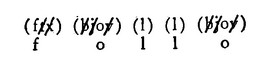
And the next letter was an “x” which gave him a “w.” The first word was “follow.”
The problem was solved! He set to work patiently now—but it was close to the end of two hours, by which time his brain was fagged and his eyes ached, that this was written on his pad:
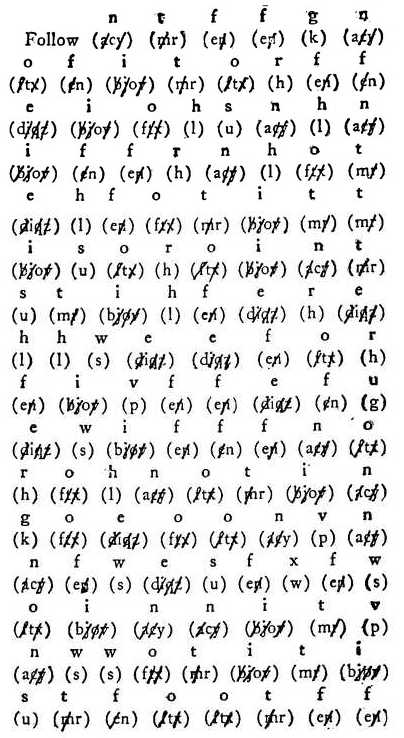
And then, grouping the letters into their individual words, Hsi Yan’s cipher read:
Follow creek at north end of Luala one half mile from mouth to crumbled hillside. The opening is beneath flat rock fifty paces due west by compass from burnt tree.
Bob Kingsley read this over and over again—and laughed softly to himself. Yes, he knew where Luala was. Luala Island! Hsi Yan’s treasure! He knew by heart all that was on this paper in front of him. No good of it any more—and the cipher was no good any more! He got wearily to his feet, and brushed his hand across his eyes. Hsi Yan’s treasure! Wealth! Chen-shu! Verna! Thoughts, a multitude of them—conflicting—surged upon him. But he was too tired to think. He tore up both the cipher and the paper on which he had translated it, dropped the shreds out of a porthole, and stumbled back into bed.
When he awoke again, it was for the second time at the sound of Nanu’s voice. But he was not instantly alert as he had been before. He sat up in his bunk in a strangely dazed way. A sense of nausea was upon him, and his head throbbed brutally. He stared at Nanu who stood before him.
“Tuan,” said Nanu in a strained voice, “it is long past daylight, and the hour that it is the Tuan’s habit to arise. But even so, I would not have come to the Tuan, except that we have just discovered that Mindar Singh, whom we thought dead with sleep, has gone.”
“Gone?” echoed Bob Kingsley a little helplessly—and strove to gather his wits together.
“Yes, Tuan. And while it was yet dark, he must have slipped over the schooner’s side and have swum to the shore, for his boat is still here. And now, Tuan, there is a strange odor in the cabin, and in the Tuan’s room.”
Bob Kingsley shook his head.
“I don’t smell anything,” he said.
“No Tuan,” Nanu answered. “The Tuan has breathed it too long. It is chloroform.”
Bob Kingsley lurched to his feet. Mindar Singh! Chloroform! His mind was beginning to function in some degree now. He staggered to the washstand drawer, and wrenched it open. A sheet of paper fell out into his hand. He read the few scrawled lines upon it laboriously:
“How runs the saying, Sahib? If the mountain will not come to Mohammed, then must Mohammed go to the mountain.”
He searched inside the drawer.
The two ivory idols were gone.
It was hot, muggy and sticky, and the sun blazed furiously even through the awning that had been rigged on the Alita’s after deck, where, to his intense disgust, Bob Kingsley had been obliged to spend the day inactively:—and, to his further disgust, though it was now already late afternoon, he still felt the effects of the chloroform with which Mindar Singh had drugged him in the early morning hours.
And now he leaned against the schooner’s rail, and, not for the first time, cursed Mindar Singh with his whole heart. True, in respect of some of the circumstances surrounding Mindar Singh’s treachery, there was a certain confusion in his, Bob Kingsley’s, mind, but in the main it all seemed clear enough. Mindar Singh had double-crossed him. That was absurdly apparent! Mindar Singh, the faithful servant, was a traitorous cur, and appeared to be hand-in-glove with Chen-shu and Hsi Yan’s erstwhile crew—or, at least, had been, for it looked now, since Java Dick had said that Chen-shu was searching everywhere to get his hands on the man, that Mindar Singh had double-crossed his confederates as well, and in the end had stolen the idol from them himself.
Also, Mindar Singh’s coming to the Alita, coupled with the bounder’s cool reference to Mohammed, was equally clear—the way to get the second idol was to bring the first, and so inspire a trust that would be wholly disarming. But there was one point that Bob Kingsley had not been able to explain entirely to his satisfaction. It had been simple enough for Mindar Singh, once installed on the Alita and trusted by everybody on board, to steal down into the cabin again unnoticed in the darkness; and it was simple enough, too, to account for the fact that Mindar Singh had every reason to believe that the idols were in the washstand drawer in the stateroom, for the curtain had not been drawn across the doorway, and he, Bob Kingsley, had made no effort to conceal his movements from the other when he had opened the drawer and taken out the single idol that had been there in the first place; likewise, it was readily apparent that Mindar Singh had proposed to run no risk of being caught or of being disturbed should he be obliged to carry his search further afield—hence the chloroform; but, if Mindar Singh had come with the intention of stealing the idols, as his possession of the chloroform would indicate, why had he explained the key to the cipher? Bob Kingsley shrugged his shoulders. Only Mindar Singh could answer that, of course! But the simplest and most natural explanation seemed to be that, though prepared for any contingency, Mindar Singh had been none too sure that he would actually be able to get his hands on the second idol, and so had taken no chances and had gone the limit to establish himself on a basis of faith that could not possibly be questioned, the which, plainly, must be his first consideration; and then, afterwards——
Again Bob Kingsley shrugged his shoulders. What was the use in theorizing on what Mindar Singh had, or had not, proposed to do under this or that circumstance? And, after all, what difference did it make? Mindar Singh was an opportunist of the first water! Let it go at that! Mindar Singh had got the idols; but—Bob Kingsley chuckled grimly—the two idols would do Mindar Singh no good! All Mindar Singh had for his pains was the spurious cipher—and that was all Mindar Singh, or any of the rest of them, ever would have! The genuine cipher was destroyed, and the only record of it that remained was the one that was stored away in the cells of his, Bob Kingsley’s, memory!
Perhaps, after all, then, he should be grateful to Mindar Singh! Hsi Yan’s treasure in return for a little inconvenience resulting from a whiff of chloroform! He shook his head in abrupt disapproval of his own facetiousness. That was all right enough, but it did not solve the problem that had been an obsession with him all day. What was his next move to be? Mindar Singh was a liar of parts, and how much of Mindar Singh’s story was true or false it was impossible to tell—but everything pointed to the fact that the treasure of Hsi Yan was real and actual. He was very much tempted to set sail for Luala at once and dig it up. But there was Chen-shu! Every last one of them! That was the promise he had made—and the promise that he meant to keep! Should he stay and reckon first with Chen-shu, and leave the treasure until afterwards? Suppose something happened to him—that Chen-shu won the last hand! He would have liked to feel that the Old Dad had got the money—the plantation on Patua could do with a bit, God knew! On the other hand, Chen-shu and his scaly crowd were here now. Damn! What should he do? If he stayed, Java Dick appeared to be the best bet. He hadn’t heard anything more from Java Dick, but Java Dick couldn’t work miracles. The man would have to have time in order to accomplish anything. Meanwhile, where did Chen-shu stand in respect of what had happened? Did Chen-shu know that Mindar Singh had been on the Alita? If he did—how much else did he know? If by any chance Chen-shu knew that neither one of the idols was any longer in——
His thoughts were suddenly diverted. He had been watching in a casual way a dinghy some distance off that was rowed by two natives and in the stern of which sat a white man. And now his attention became riveted upon the dinghy. It was undoubtedly heading for the Alita, and, as it came nearer and he looked more closely, there seemed to be something familiar about the figure in the stern.
And then, the next minute, Bob Kingsley leaned out over the rail, and shouted at top voice.
“Scarface!” he yelled joyously.
The figure in the dinghy waved his hand.
“Aye, lad, it’s me!” came back the answer—and a moment later Captain Scarface came clambering up over the schooner’s side.
And Bob Kingsley laughed his pleasure as he stretched out his hand. It was the same old Scarface that he hadn’t seen since he was a kid—the same old cap with its battered black visor; the same grizzled hair and the keen gray eyes; the same honest unhandsome face disfigured by the white, semicircular scar—a scar that, in the light of the story he, Bob Kingsley, had heard not so many days ago in Patua, now possessed an entirely new significance.
Two huge and hairy paws came down with a hearty bang on Bob Kingsley’s shoulders.
“Lad, lad, but I’m glad to see you!” grinned Captain Scarface. “How long is it now—eight years or ten—since I’ve clapped eyes on you? You were only a bit of a nipper then, but now you’re as big as I am—and maybe bigger! Eh? What? And how’s the Old Man? How’s Robert? I heard he wasn’t any too well.”
“He isn’t,” said Bob Kingsley, his face suddenly sobered. “I’ll tell you about him—and a lot of other things too. But wait a minute till I have Nanu fetch up a chair. It’s too hot in the cabin.”
“Never mind the chair,” said Captain Scarface, planting himself down on the edge of the cabin skylight; “this suits me. I fancy we’ve both got tales to tell. That was a bad business at Kalawa, lad! Who’s going to spin his yarn first?”
Bob Kingsley seated himself beside the other.
“Perhaps it would be better if I did,” he answered, “for I’ve been somewhat in the thick of it of late, and there’s a good deal I’d like to have you know.”
Captain Scarface took out his pipe and began to fill it.
“All right,” he nodded. “Fire ahead, son!”
“There’s rather a lot of it, but I’ll try to make it as brief as I can,” said Bob Kingsley—and, beginning with the night that the Monotah had arrived at Patua, he rehearsed the occurrences of the days that had followed, telling of Chen-shu and the four Chinamen, the murder of Colonel Lyle, of which Verna had accused him, the wreck of the Monotah, his “kidnaping” of Verna and the escape from Aoru, his visit to Java Dick’s with the spurious cipher, the treachery of Mindar Singh, and the theft of the two ivory gods. “And,” he concluded, “that brings us right down to the present moment, when, as you see, I’m still a bit wobbly from that spot of chloroform the blighter soaked me with.”
Captain Scarface’s teeth were clamped like a vise on the mouthpiece of his pipe. The pipe had gone out. And now, the recital ended, the blood was hot in his cheeks, enhancing by contrast the whiteness of the scar that semicircled his cheek from mouth to eye; and his hands, which he raised suddenly from his knees, were clenched until they looked like gnarled lumps of mahogany.
“Thirty-five years—my God!” he cried hoarsely. “Me, and Tom, and your old dad! I can see that night on Hsi Yan’s junk like it was yesterday. That’s where I got this”—he touched the scar with his knuckles—“but you said your dad told you?”
“Yes; he told me.” Bob Kingsley’s voice rasped unpleasantly.
“Thirty-five years!” repeated Captain Scarface in the same hoarse tones. “But he got Tom in the end. Flesh and blood of the devil, that’s what Hsi Yan was! Lad, I’ll tell you something. Once I had a chance of settling accounts with him, when he didn’t know I was within a thousand miles. I wish I had! It makes me feel like I was guilty now. D’ye see? Tom’d be alive if I had. But I thought Hsi Yan had forgotten. We all did. I never said anything to the other two about it.”
Bob Kingsley nodded—but made no other answer.
Captain Scarface got up from the skylight, walked to the rail, and, with his back turned, stood there for a long time in silence; then, abruptly, he came back and halted before Bob Kingsley. But now, though the gray eyes were still hard and flinty, his voice was quiet and contained.
“Well, lad,” he said, “Hsi Yan’s gone, and so’s Tom—nothing can alter that. What’s to be done now?”
“There’s the breed Hsi Yan left behind—Chen-shu and the rest of them who were the actual murderers,” Bob Kingsley answered grimly. “That—and this treasure that Hsi Yan found. It’s really yours and dad’s, you know—it was Hsi Yan’s unholy legacy to the three of you, as it were, though he never figured any of you would get it. You and dad”—he laughed, shortly—“are the remaining legatees.”
“We’ll find it first before we talk about the ownership,” said Captain Scarface gruffly. “How d’ye know it ain’t all a fake, ciphers and all, just to egg on those throat-slitting hellions of his to do his dirty work?”
“I don’t know, of course,” Bob Kingsley replied soberly; “but I’m dead sure in my own mind, after putting in the day thinking about it, that the treasure’s there. Part of Mindar Singh’s story was a lie, there’s no question about that; but part of it, on the other hand, was unquestionably true. He certainly was in the house at Kalawa that night, he certainly knew about the secret passage, and he certainly heard Hsi Yan explain the key to the cipher. But what I believe most of all in his story—for, knowing nothing of what happened thirty-five years ago, he could not have made it up—was what took place at the end when Hsi Yan was mocking and jeering at Uncle Tom, and gloating over his revenge. I gave you, as nearly as I could, Hsi Yan’s exact words, just as Mindar Singh repeated them—and I say again Mindar Singh could not have made them up. Do you remember what Mindar Singh reported Hsi Yan to have said about the treasure sweetening his revenge? ‘The treasure is true and greater even than I have told you, Captain Tom; but it is one you will never have! And because it has brought about this hour, it is of greater worth to me, who will not have it either, than if I had carried it away from its hiding place!’ He could have no possible object in saying that unless it were true, for he never expected that Uncle Tom would leave the house alive. The treasure’s there all right—I’d bank anything on it.”
For an instant Captain Scarface was silent, then he drove a fist into the palm of his other hand with a resounding smash.
“That’s good enough, lad!” he exclaimed. “That’s good enough for me! We’ll up anchor right now, you with the Alita and me with the Iola, and go after it!”
Bob Kingsley shook his head.
“No,” he said quietly; “you will.”
“Eh?” inquired Captain Scarface. “What d’ye mean—I will?”
“Just this,” said Bob Kingsley. “I’ve been trying to make up my mind all day what to do—and you’re like a God-given answer to the problem. I didn’t want to leave here until Chen-shu and I had fought out the last round. He’s not far from being as crafty and cunning as Hsi Yan himself, and I’m not underestimating him. He knows, and I know, that it’s a finish fight now, and if the count went against me it would help a lot to know that dad had that treasure tucked away because things aren’t any too rosy with him financially, and I’m afraid it’s a question of that wheel-chair with him, too, for the rest of his life. That’s why I was tempted to go after the treasure first, and then come back and reckon with Chen-shu and his crowd afterwards. But I don’t know where things stand here now. I don’t know whether Mindar Singh is in with the gang or working on his own. If Chen-shu believes I’ve still got one of the idols, I couldn’t lose track of him even if I wanted to; but if, on the other hand, he knows that Mindar Singh has both the idols, and doesn’t know that I have translated the cipher, the logical thing for him to do would be to vanish so far as I am concerned—if he could. And if I went to Luala, he’d have all the more chance of doing so, and by the time I got back I might never be able to pick up his trail again. Do you understand?”
“Yes, I understand that!” There was a sudden and savage growl in Captain Scarface’s voice. “Blast him, and blast all of ’em to the pit! But I don’t understand why I ain’t the one as much as you, my lad, to bring ’em to a reckoning, and make ’em pay for old Tom’s life! Wasn’t it me, and Tom, and your dad that was on Hsi Yan’s stinking junk that night?”
Again Bob Kingsley shook his head.
“If numbers counted for anything, I’d say yes,” he answered. “But they don’t! You and I can’t carry on a small war of our own in the streets and houses of Singapore. There were, I’d say, fifteen or twenty men on that junk at Kalawa. I’d like to get my hands on Chen-shu and settle accounts with him personally, and I’m going to if I can; but the one thing I’m after is to find out where their common lair is before I bring in the police. I don’t want to run the risk of them scattering and going to cover all over the Archipelago as they would do if it leaked out through some stool-pigeon that the police were in this at all—that is, I don’t want them to get an inkling that anything of that sort is even in the wind until it is too late to do them any good. Once I’ve found out what I want to know, I’ll bring the authorities down on them without warning before they’ve time to make a move. Also, there’s another reason why I want to go that far, if possible, and as quickly as I can, before handing over to the police. I rather expect that Verna—I mean Miss Lyle—will write the authorities accusing me of her brother’s murder. I had to reckon on that, of course, when I left her with the Crowleys, but I always figured that I’d have a good few days of leeway—enough time anyway—because at best the opportunities of sending mail from Kalawa are few and far between.”
A queer smile twitched at Captain Scarface’s lips.
“Well, lad, if you want it that way, I’ll go,” he said; “though I’d rather stay here with you. That’s settled! I’ll sail before sundown, and what I find I’ll bring back and shove into a bank here in Singapore where it’ll be safe until this whole business is cleaned up. But that last thing you said kind of brings us around to my story. You needn’t worry none about Miss Lyle writing any letters from Kalawa. She’s here now in Singapore.”
Bob Kingsley came slowly to his feet. He stared at Captain Scarface incredulously.
“Here! In Singapore!” he cried out hoarsely. “She couldn’t be! Why, I left her in Kalawa two days ago—no, three now—and there wasn’t any steamer in there, or any boat expected. I made sure of that. You’re mad!”
“Not particularly, I ain’t,” said Captain Scarface complacently. “And seeing as how I brought her over in the Iola I ought to know.”
“You brought her!” Bob Kingsley shouted. “Good God, man, what for?”
Captain Scarface’s shoulders lifted in a comically helpless shrug.
“I don’t know,” he said. “I fancy it was because I couldn’t help it. She came off in a boat just as I was getting under way, and insisted on me taking her along—I kind of figure she gave the Crowleys the slip at the last minute.”
“But didn’t you see the Crowleys? Didn’t you talk to them?” demanded Bob Kingsley wildly. “Didn’t they tell you that one of the reasons I left Miss Lyle in Kalawa was because I was afraid she would be in danger here in Singapore? Thank God, as it has turned out, I don’t think, after last night, that she is in any danger now on account of that idol; but didn’t the Crowleys tell you anything about this?”
“No, they didn’t, and even if they had”—Captain Scarface indulged suddenly in a broad grin—“I ain’t sure but what I’d have brought her anyhow! But I’ll tell you something, son, that you ought to have found out for yourself—that young lady’s got winning ways! All the Crowleys told me was that you had brought Miss Lyle to stay with them, and had gone on to Singapore. And they wouldn’t have told me that if I hadn’t seen her in the house, and they sort of had to introduce me. There wasn’t any reason why they should tell me anything. I never knew them before, and they never knew me. They had no call to trust me with confidences just because I said I was a friend of old Tom. They were pretty tight-mouthed, figuring, I take it, to keep your affairs to themselves; but they said I’d find you in Singapore if I wanted to see you. Son, I wasn’t more’n twenty-four hours behind you in reaching Kalawa, and you can figure for yourself from that how long it took me to make up my mind to follow you here to Singapore. So back I went to the Iola, and, as I said, just as I was getting under way, off Miss Lyle comes. She said she had realized that she had made a great mistake in landing at Kalawa at all, and——”
“She said that!” Bob Kingsley flung out ironically.
“Yes, she did!” Captain Scarface retorted defiantly. “And, boy—you damn fool!—I wish I was thirty years younger! Likewise, she said it was imperative that she got to Singapore without another hour’s loss of time. She didn’t say why, except that it meant everything to her that——”
“The reason is fairly obvious,” Bob Kingsley interrupted again, but this time with a wry smile. “To charge Black Bob Kingsley with the murder of Colonel Robert Lyle.”
“Listen, lad,” said Captain Scarface, and screwed up his features into a friendly scowl, “I called you names a minute ago, but they ain’t hard enough. Hell’s bells and a barrel of monkeys, you don’t know anything about women! And least of all about handling ’em! Ten days you had her aboard this schooner here. And what did you do? Bah! Sure, I heard her story coming over from Kalawa—every last word of it except why she wanted to get here so mighty bad. She was mum about that. But it wasn’t to make any charge against you. She could have written one of those letters you were talking about, without leaving Kalawa, and I’d have brought it along without knowing the difference, if that was what she was after. No, son, it ain’t nothing like that. I ain’t taking all the credit to myself, for I guess she heard a lot about you in Kalawa that opened her eyes; but she heard a lot more from an old fool called Scarface Sweeney, and kind of liked the sound of it too, I fancy, on the run over in the Iola. She ain’t so set as she was on calling Black Bob Kingsley a murderer.” Captain Scarface began to chuckle. “What was that yarn about the lifeboat on the Monotah?”
“Shut up!” said Bob Kingsley savagely; and then eagerly: “Do you mean all this—literally?”
“Aye, lad, I mean it,” replied Captain Scarface seriously. “If you’re ever accused of murdering Colonel Lyle, it won’t be by his sister.”
For a moment Bob Kingsley was silent. When he spoke again his voice was husky.
“Where is she now?” he asked.
“At her home, I suppose, wherever that may be in Singapore,” Captain Scarface answered. “I put her ashore before coming over to you. She wouldn’t have me go any farther with her.”
Again Bob Kingsley was silent for a moment; and then, abruptly:
“How did you happen to go to Kalawa in the first place?”
“Made up my mind I was going to from the time I picked up Tom dead in that boat, and figured he’d been murdered,” Captain Scarface replied, a rasp creeping into his voice. “The cruise I was on after I touched at Momboa and left the letter and things with Hawk Griswold didn’t last as long as I’d counted on, and I put in at Kalawa on the way back. I wanted to get what information I could first hand—but I didn’t get much. And coming back to Crowley, the only reason I went to see him at all was because I heard on landing that he was the first white man on the scene at Tom’s house after the attack upon it.”
“I see!” said Bob Kingsley.
“Well, that’s about all I’ve got to tell.” Captain Scarface squinted at the setting sun—and then glanced questioningly at Bob Kingsley. “There ain’t much daylight left,” he observed, “and if I’m to pull out, I’d better be going.”
Bob Kingsley’s hand went to the other’s shoulder.
“Yes,” he agreed; “we’ve about got to the bottom of our yarns, and I think you ought to push off at once—for even with good weather it’ll take you somewhere around four days to make Luala.”
Captain Scarface nodded—and together they walked to the schooner’s rail.
“North End. One half mile from creek to crumbled hillside. Due west fifty paces from burnt tree,” said Captain Scarface in a lowered voice. “Is that it?”
“That’s it,” said Bob Kingsley. “But perhaps I’d better write it down for you?”
“ ’Tain’t necessary,” said Captain Scarface. “I just wanted to be certain I’d got it straight.”
“That’s it,” repeated Bob Kingsley.
Captain Scarface swung himself half over the rail—and paused.
“I ain’t sure I’m doing right about this—going off and leaving you here,” he muttered dubiously.
“You’re doing the one thing I’d rather you’d do than any other,” declared Bob Kingsley earnestly; “the one thing it would help a lot to know was all right if everything else went wrong. And on top of that, as I told you, I don’t see where you could do a bit of good here.”
“Right you are, then!” assented Captain Scarface, though the dubious note still lingered in his voice. “I ain’t going to argue it over again.” He lowered himself into his waiting dinghy. “But you take care of yourself, lad! Them yellow rats are tricky, and they can bite deep.”
“I will!” promised Bob Kingsley grimly; and then almost to himself: “I’ve a lot more reason to want to live now than I had before.”
“What d’ye say?” inquired Captain Scarface.
“I said you needn’t worry about me looking out for my own hide,” smiled Bob Kingsley. “So long! Good luck!”
The boat was pulling away from the schooner’s side.
“Don’t you crowd on too much sail, lad!” bawled Captain Scarface. “I’m sore disappointed now; but I ain’t going to be gone long, and I’m still counting on getting in on the show-down!”
Bob Kingsley waved his hand.
“Right-o!” he shouted back.
He watched the boat disappear amongst the shipping; and then, turning away from the rail, he began to pace up and down the deck, back and forth—interminably.
Verna! He felt the blood burning in his face. It was quite easily understood how she had got aboard Captain Scarface’s schooner unknown to the Crowleys, as she had been in no sense a prisoner at Kalawa; though why she had done so, and why she was so desperately eager to reach Singapore, since it was no longer for the purpose of bringing him to account for her brother’s death, was an entirely different question, and one to which he had no answer. But neither of these things mattered now in comparison with something that was so infinitely greater to him that everything else sank into insignificance. Her changed attitude toward him! How much did it mean? How much dared he hope?
Up and down the deck he paced. A schooner put out to sea. Subconsciously he noted it—Captain Scarface, of course. It began to grow dark. Still he paced the deck—battling against the temptation, the urge of every fiber of his being to order a boat away and go ashore and seek her out. He wanted to see those blue eyes meet his without the loathing in them that had been his portion until now; he wanted to see a smile on those lips that had never yet smiled for him; he wanted to stand before her as a man free to plead his cause. He wanted—God, with all his soul!—he wanted her! But he could not go. He must not go. Not yet! Not now! It was too dangerous—for her. They, Chen-shu and the others, did not know that she was in Singapore. But, though they had made no move all day, they might be watching him, Bob Kingsley. And in that case to go to her would be to betray her presence to them. True, they knew she no longer had one of the idols, and, as he had told Captain Scarface, he did not think she was any longer in danger on that account; but there was no telling what Chen-shu, beaten so far at every turn and looking for revenge, might do, if given an opening, to one whom he had called his, Bob Kingsley’s, “belovèd.”
“Belovèd!” Bob Kingsley’s lips shaped the word softly—and he smiled out into the darkness that had completely fallen now.
And then suddenly the faint swish of oars close alongside attracted his attention. Who was it this time? Was something breaking at last? He had been hoping some word would come from Java Dick. Perhaps this was Java Dick. He stepped to the rail and peered overside. Yes, that’s who it was! Not Java Dick in person; but—he could just make out the man as the other stood up in the boat—Tao Lin.
“Hello, Tao Lin!” he said.
“Hello, Black Bob!” Tao Lin answered. “I could not come until it was dark for fear it might be known that one from Java Dick had been sent to you. Java Dick is waiting at his place. He has found out what you wanted to know.”
“Right!” exclaimed Bob Kingsley eagerly. “Shall I go with you, or in my own boat?”
“It would be better to take your own boat, Black Bob,” Tao Lin replied; “for it would not be well if we should be seen together; and, also, you will want the boat for your return. The boatmen are all robbers. Why should you pay their thieves’ price?”
“Right!” said Bob Kingsley again—and five minutes later he was rowing shorewards.
Tao Lin was already back at his ironing-board and the ubiquitous shirt when Bob Kingsley entered Java Dick’s.
“Black Bob has come quickly,” smiled Tao Lin in greeting. “He is but a minute behind me.”
“I wouldn’t be likely to waste any time under the circumstances,” Bob Kingsley smiled in return. “Where’s Java?”
“He waits,” answered Tao Lin. “He is in his room that no one enters but himself, and where it will not be known that he talks with Black Bob.” Tao Lin turned, and reached out his hand, pressing it against the wall. “See!” A door behind the ironing-board, that Bob Kingsley had not known existed, opened, or, rather, seemed to slide back and disappear in the wall itself—and what appeared to be an unlighted passage was disclosed. “Hurry, please, Black Bob,” Tao Lin went on quickly. “It would be an evil day for me if any one entered from the alleyway as you have entered and saw what you now see. The door of Java Dick’s room is just inside and at your left hand.”
Bob Kingsley stepped briskly through into the passage—and then, a prescience of danger sweeping suddenly upon him, he swung sharply around to go back again. Too late! The sliding door closed swiftly before him, and he found himself standing in utter darkness. He heard a rush of slippered feet, the swish of garments. An invisible hand was at his throat. He tore it savagely away. It came again. Other hands clawed at him and fastened themselves upon his arms. He struck out blindly with one hand, as he tried to wrench his revolver from his pocket with the other—but the weapon was snatched from him even before he had it free. And now he struggled madly—struggled with the fury of desperation—struggled futilely. He was in the center of a ring of snarling, panting humans packed so close around him that he could scarcely move; his hands and arms held so tightly that he could no longer strike a blow. And then, of a sudden, his feet were jerked from under him, and he was lifted up bodily in the arms of his captors. The next instant the door of a lighted room was opened, and he was catapulted headlong through the doorway. He struck with his face upon the floor. The door closed. He sat up, and, dazed for a moment, rubbed his hand back and forth across his eyes. It had been quickly done, the whole affair could not have lasted more than a minute, and now he was alone—they had thrown him in here as they would have thrown a sack of meal. He laughed harshly. No, they would have been more careful with the meal; the sack might have broken open, and——
His laugh died away. He was staring in startled fascination now straight in front of him. On a stool near the wall, and almost within arm’s-reach of him, were the two little ivory gods. Both pairs of folded hands had been removed, and these, together with two small slips of paper whose identity was apparent at a glance, were spread out in front of the idols.
The East at its deviltry! Premonitory! Ugly with significance! His jaws clamped hard together. He quite understood the mute threat—the mute promise of uglier things to come—the insidious opportunity that was thus thrust upon him for a period of contemplation obviously intended to break his nerve and turn him to putty in their hands! A sort of “third degree”! He was trapped. Java Dick had trapped him. Java Dick! His lips twisted ironically. He had selected Java Dick as an ally! Well, in consequence, he was in a hole—in rather a bit of a tight hole!
He rose to his feet, and looked around him. The room was lighted, though none too brilliantly, by a large lamp that hung from the center of the ceiling. There were no windows; and no furnishings of any description, with the single exception of the stool that held the ivory gods. Not very inviting even for a prison cell!
His eyes reverted to the little idols—but he stared at them now from under heavily furrowed brows. They seemed to invoke an entirely new interest in themselves, to endow themselves with a new significance. How, precisely, had they got here? That question opened a very wide field for mental exploration if he cared to exploit it. Did it mean that Mindar Singh and Java Dick were in collusion? It looked that way now. He remembered Java Dick’s insistent, but craftily guarded attempts to induce him, Bob Kingsley, to return to this dive here last night after he had admitted having one of the idols at that moment on his person. And then, Java Dick having failed in that particular, he remembered that Java Dick had introduced the name of Mindar Singh, intimating that Chen-shu was combing every den and joint in the hopes of laying violent hands upon the East Indian. That was probably a lie. It was much more likely that Java Dick had been crafty and cunning enough to invent what he had said on the spur of the moment, and then, with their heads together, Mindar Singh and Java Dick had concocted the corroborative details in the tale that Mindar Singh had brought to the Alita. But where had the other idol come from that Mindar Singh had brought with him to the schooner? How had Chen-shu lost it? What had become of Chen-shu?
One question brought another—confusing, perplexing, unanswerable. Bob Kingsley swept out his hand in a swift, impatient gesture, as though literally to brush them from his mind. What was the good, after all, of asking them? He couldn’t answer them, and they got him nowhere. The one thing that mattered now was the very eloquent testimony borne by that menacing little exhibit on the stool to the fact that it was known the cipher thereon displayed was spurious, and that he would be invited to produce the genuine one!
He began to laugh. The genuine cipher was no longer in existence, and Captain Scarface was already on the way to Luala, so that—— His face sobered suddenly. That worked both ways, didn’t it? Perhaps it wasn’t so humorous! What was he going to say? What was he going to do?
He was still staring at the two idols. He tried to remove his gaze, but back it went to them again. They were beginning to get in their work—they seemed to jeer mockingly at him now. He muttered a savage execration, and stepped suddenly toward them. At least, he’d take good care they didn’t get him jumpy! He’d rob Java Dick of that much satisfaction anyhow! And since no other accommodation had been provided for him, why not the stool itself?
He brushed the idols unceremoniously off on to the floor, sat down on the stool, and lighted a cigarette. So much for that!
But now what? What was he up against? Perhaps it wasn’t so bad, after all! If he were dealing with Chen-shu, he would have no delusions as to what the end would be even if he acceded instantly to the demand he knew the other would make for Hsi Yan’s cipher; for, between himself and Chen-shu, and Chen-shu’s followers, lay the fact that he had been an eyewitness to their murder of Colonel Lyle. Promises, of course, they would make at first to get the cipher, for that was what they wanted above everything else; but in the end, whether he refused their demands or not, he would very certainly die, and very certainly die in a most unpleasant manner. But if, on the other hand, it was only with Java Dick and Mindar Singh that he had to deal, as he now believed it was, it would be quite a different matter. There would be nothing involved then but the treasure, and his situation in that case would be far from hopeless, in spite of the fact that Java Dick’s little stage-setting here wasn’t propitious, and that the man was probably quite as ruthless and unscrupulous as Chen-shu when it came to so minor a detail as that of murder! At the worst, the chances were he could make some deal with Java Dick. The treasure, after all, was a secondary consideration. He hadn’t left Patua in search of treasure—and a dozen treasures counted not at all if he could still play out the last hand and settle accounts with Chen-shu and his viper brood for that night at Kalawa!
The cigarette was burned to a stub. How long did Java Dick think this solitary communion with the idols ought to last in order to produce its desired effect? There was no good shouting, no good kicking up a fuss, no good doing anything. There was nothing to do but wait. He lighted another cigarette—and then, in the act of throwing the match away, he caught the sound of footsteps outside the door. Instantly he pushed the stool against the wall, crossed one leg over the other, and leaned back—his cigarette hanging nonchalantly from his lips.
The door opened—and in the doorway bulked the vicious features and the misshapen form of Java Dick. Bob Kingsley did not move. He could see that the passageway behind Java Dick was filled with men, but it was dark out there and he could distinguish none of their faces.
Java Dick had halted abruptly—and his eyes, narrowing, traveled from Bob Kingsley to the idols on the floor, and back to Bob Kingsley again.
“Blimy,” he snarled, “you got a gall! But,” he added gutturally, “gor’blimy, you’ll need it all before you’re through!”
Bob Kingsley made no answer. And though outwardly and to all appearances still nonchalant, he was battling inwardly now against the dismay, the sense of disaster, that suddenly swept upon him. It wasn’t Java Dick and Mindar Singh alone with whom he had to deal! Coming into the room now behind Java Dick was Chen-shu, and behind Chen-shu was Won Fu, and behind Won Fu again were the three others who had been on the Monotah and at Aoru, and one of these walked with a crutch. And crowding in the rear of these five, the passage still seemed to be full of Chinamen. Bob Kingsley’s eyes fastened on the man with the crutch. It was the fellow obviously that he had shot at Aoru. The blighter wasn’t killed, then!
Chen-shu spoke—and in mockery made a low salutation.
“Even at the risk of disturbing the Heaven-Born’s meditations,” he said softly, “we are come to pay homage to one upon whom the protection and the high favor of the gods has for a long time past been so lavishly bestowed. Will his High Excellence deign to cast his glance upon those whom it has come to our unworthy ears he has expressed the wish to see gathered together—for, behold! we are those, whose number is now seventeen, who sailed with Hsi Yan to Kalawa!”
The room already seemed to be full of Chinamen, but more were still coming in.
“I miss one face, Chen-shu,” said Bob Kingsley with studied insolence. “Where is your kennel-mate Mindar Singh?”
“Since it would seem that the High Excellence desires the presence of so lowly a personage,” Chen-shu answered in silky tones, “it is regrettable that Mindar Singh is not here, and that thus even a single wish of the Heaven-Born’s should be ungratified. It is beyond understanding that the unappreciative Mindar Singh should have chosen so ill-fitting a moment to indulge in his devotions and to lament upon his evil and misspent life, and yet that alone accounts for his unforgivable absence; but meanwhile we have brought one who will perhaps gladden the Heaven-Born’s eyes still more.”
The room was small. The Chinamen, as they entered, were milling around it. From his stool, Bob Kingsley, by reason of a group that had now come close to him, could no longer see the doorway. He stared at Chen-shu, who, with Java Dick, had crossed over to within a yard of where he sat—stared coldly and contemptuously. He did not understand Chen-shu’s allusions. Something that promised an ugly dénouement was brewing, of course—but he did not propose to give the man the satisfaction of playing up to his cat-and-mouse game by asking any questions.
And then Chen-shu smiled—blandly; and suddenly clapped his hands.
Those in front of Bob Kingsley moved a little to one side. He could see the doorway now. For an instant, his eyes fixed there, he sat motionless; and then, his veneer of nonchalance shattered utterly, a man beside himself with fear and fury, the stool crashed back against the wall from beneath him, and he was on his feet. Verna, in the grasp of two Chinamen, was standing just inside the door. He sprang forward—but those around him blocked his way, and pushed him violently back again.
“Are not the maiden’s ears attuned to love?” laughed Chen-shu maliciously. “Surely she can hear across the room! Let the Heaven-Born talk to her from where he stands.”
Bob Kingsley scarcely heard the words.
“Verna!” he cried out. His throat was dry. His voice made a harsh, rasping sound. “You here! You—too!”
She stood there very quietly; only her shoulders, usually so straight, were drooped a little now.
“Yes,” she said almost inaudibly; and then, with a queer, trembling little smile: “I—I believe in your Chinamen now.”
“How did this happen? How did they get you here?” he demanded hoarsely.
“That man there”—she indicated Java Dick with a movement of her head—“came to me with a note from you that I know now, of course, you never wrote. But I had never seen your handwriting, and I had no suspicions. He had a car and was dressed like a native chauffeur. I knew that Captain Scarface would have told you I was back in Singapore. The note said that you had met with an accident on the Alita, and asked me to come to you at once.”
Something was dawning in Bob Kingsley’s soul—something that for a moment in its great amazement held him silent.
It was Chen-shu who spoke.
“In what way could the maiden be induced to come more quickly?” he laughed again maliciously. “Where hearts are entwined, anxiety is not to be denied, and wings of incredible swiftness are as the sluggish movement of the snail!”
“My God! I see!” Bob Kingsley’s brain was racing. Chen-shu’s belief that they two, that Verna and himself, were lovers! The cleverest move that Chen-shu could have made, were it but true that Verna, instead of hating, cared! The irony of it that Chen-shu’s ruse, based on a hopeless fallacy, had been successful! “You thought,” he flung out at Chen-shu, “you counted on——” He checked himself. He turned from the leering face, and his eyes held again across the room on Verna. But now his voice broke as he spoke to her. “But you—Verna!” he said. “You came because you thought I—I was——”
“Was hurt,” she supplied quickly as he hesitated—and suddenly her face was crimsoned, and tears seemed very near her eyes. “Could I do less? I know now that it was these men who killed my brother, for that Chinaman there, the one you called Chen-shu, told me so, after he got me here; and he told me that unless I made you tell him where the cipher was that he said you had, I was to die too. Oh, must I talk before these brutes! I—I went because, even before Chen-shu told me this, I knew—I knew——” Her voice faltered. “Oh, don’t you understand?”
It was not in her words—it was in her eyes, in her face, in her voice. It was a new Verna! There was no Java Dick, no Chen-shu, no peril, no world outside—only a song in Bob Kingsley’s heart. It was like some wondrous miracle! She cared! He started eagerly toward her—only to have the bald reality of his situation and of hers brought instantly back to him again as he was once more thrust roughly up against the wall.
“Oh, my God!” he cried out in sudden agony. “Why did you ever leave Kalawa!”
But now it was Java Dick who answered.
“It don’t matter why she left there,” he said coarsely. “What counts is that she’s here, and that she croaks if you don’t come across, young fellow Black Bob, with that bit of writing that was in one of them idols.”
Bob Kingsley thrust his hands into his pockets—he wanted to clench them unseen. He wanted a moment to fight himself back to composure. Her life and his own depended on what he did and what he said now. No—that wasn’t true—except temporarily. No matter what he did, or what he said, neither Verna nor himself would in the end get out of this alive if Chen-shu had his way. The man had as good as said so when, thinking no doubt to inspire terror and leave no question in Verna’s mind that he would carry out his threats, and so cause her to plead the more desperately with him, Bob Kingsley, to return the genuine cipher, Chen-shu had confessed to the murder on the Monotah. But Chen-shu had overreached himself a little there. He had too plainly shown his hand. Chen-shu wouldn’t let Verna go—and place a halter around his own neck! Chen-shu would never let him, Bob Kingsley, go, who had been an actual witness to the murder. This one fact was drumming, thudding, pounding at his brain now. Any promises that might be made, any bargain that might be struck, would be hollow, worthless, false. The only thing that was left for him to do was to fight for time. His nails now were biting into the palms of his hands. With time, something might happen! Fear? Yes, he knew fear now! With time, something might happen! That was the only chance there was.
“Well, what you got to say?” prodded Java Dick savagely.
Bob Kingsley’s hands came out of his pocket. He hunted for a cigarette—and lighted one. Both Java Dick and Chen-shu had drawn nearer to him. Java Dick’s face was working viciously; but the blandness in Chen-shu’s face was the more vicious of the two.
“Nothing for the moment,” he said coolly. “You’re assuming a good deal, aren’t you? There are your two idols on the floor; and, so far as I know, those two pieces of paper there are the same ones that were in the idols when your friend Mindar Singh sneaked away from the Alita with them last night.”
Chen-shu stooped down, and picked up the idols together with the two slips of paper. He extended the latter on the palm of his hand.
“One of these is the work of Hsi Yan,” he purred; “the other is the work of one who, if he trusts too much to a nimble tongue, will find himself shortly deprived of the power of speech.”
“Yes,” growled Java Dick, “don’t you try to come any of your games on us! ’Twon’t do you no good, or that girl either! You ain’t got a chance! We’ve got you dead to rights. And in case you don’t think so, and so’s there won’t be any mistake, I’ll tell you where you stand. And, first-off, I’ll have you know that turban-headed swine of a Mindar Singh ain’t no friend of ours. ’Twas him that came down from Kalawa, and nosed around, and found out what the police couldn’t find out. Savvy? The police were looking for the men who had been on Hsi Yan’s junk—these chaps here, all except him that was killed last night! But nobody knew who’d been on Hsi Yan’s junk, and nobody knew what had become of the junk either—but if you’d like to know, I’ll tell you. They sunk her a bit up the coast, and came in overland to Singapore. Then they kept under cover; but Mindar Singh spotted ’em, and watched ’em. And last night he sneaked in on Hsun Chi, whose turn it was to keep the idol, and dropped him cold with a knife.”
“So that part of his story, at least, was true!” Bob Kingsley exclaimed involuntarily.
“You’re right, it was, if he slipped you that!” snarled Java Dick. “But he ain’t crowing about it now! He’ll pay for it, you can take my blooming word!”
“But not all in one payment!” murmured Chen-shu with a sly smile. “No man could pay so great a debt except little by little to his leniently inclined debtors—just a little at a time! Does the Heaven-Born in his vastly superior wisdom know of any other way whereby the payment might be fully made?”
Bob Kingsley did not answer. His fingers itched to close around that yellow, scrawny throat. God help Mindar Singh if he were, as he obviously was, in their clutches! He looked around him. Verna still stood near the door; still held, as he was held, by a group of Chinamen. Her eyes met his bravely—and she smiled. He felt the color leave his face. He could not smile.
“Well, d’ye see!” went on Java Dick in an ugly tone. “That’s Mindar Singh’s end of it, and the rest ain’t hard to guess. Me and Chen-shu’s been pals for years. I wasn’t on no junk at Kalawa, but, swipe me, I’m in on the pickings now! I tried to get you to come back here last night after you’d said you had one of them idols, but you were too leery. I’d have got you then if you had. You figured I’d stand in with you on account of that little talk we had about going after opium five years ago, didn’t you? That’s where you ran up against it, Black Bob! You and me might have been pals—eh? Too bad now—ain’t it?”
“You’re making a damned long story out of this—and it’s a bit tiresome!” said Bob Kingsley coldly.
Java Dick scowled—and suddenly shook his fist in Bob Kingsley’s face.
“Is that so!” he raged. “Well, blimy, I’ll make the rest of it short enough! Me and Chen-shu and Won Fu here had a confab. You’d showed one of the idols here. From the shore we kept watch on the Alita. We didn’t know where Mindar Singh had gone—but we caught him when he swam ashore just before daylight. Savvy that? And Mindar Singh squealed—because he had to. And we took the two idols from him, but one of the ciphers was a fake—and you faked it. It wouldn’t work out, and it wasn’t the same paper, and it wasn’t the same writing. And then Won Fu saw the girl come ashore from another schooner, and Chen-shu said you was sweet on each other and the rest was easy. Maybe you’ve heard that Java Dick don’t take chances when there’s a sure bet? Well, I wasn’t taking any chances! ‘Go to hell!’ says you at the polite invitation to come across with what we wants—and dies! I know your kind! I’ve seen ’em! But you don’t talk that way when your girl goes with you! That’s short and sweet, ain’t it? You know now why she’s here. You tell us where that paper of Hsi Yan’s is, or what we’ll do to her before your eyes’ll make you sick, and afterwards we’ll attend to you! You got it straight, ain’t you? Now what do you say—and say it quick!”
There was a new movement in the room—an uneasy, restless, excited movement. The ring of faces seemed to Bob Kingsley to be edging in upon him from all sides. They all looked alike, those faces. In all of them was the greed that Hsi Yan so artfully had played upon with his Machiavellian touch. It glittered in the narrow eyes; it showed in the distended nostrils, and the slightly parted lips—and behind the greed, uglier still, was a deadly menace. His eyes swept the circle, and rested on one face that seemed even more threatening than any of the others. The man with the crutch had thrust himself suddenly forward, and now was laughing tonelessly.
It was only a second that had passed, wasn’t it?—but they were already displaying an impatience that was threatening enough to have grown out of hours of fruitless waiting. He had not got the cipher. He had destroyed it. He could not produce it. And if he refused to tell them what was in it, or even pretended that he did not know, any reason for his further existence, and Verna’s, in Chen-shu’s eyes was gone, and the end would come here and now. He could not take that stand—it would be madness! Likewise, it would be suicidal to let them know that Captain Scarface, or anyone else, had already gone after the treasure. What, then? He was left with only one alternative. He must admit enough to make his life appear valuable to them—while he sparred for time. That was the only thing he could do!
He faced Java Dick and Chen-shu abruptly.
“I dare say you’re right,” he said steadily. “There’s no good lying about it. I took the genuine cipher out of the idol, and I faked the other one. That’s true—but it’s also true that I tore up the genuine one and that I haven’t got it.”
Java Dick sucked in his breath sibilantly.
Chen-shu’s eyes grew narrower, his oily smile broader.
“Why should the High Eminence, whose wisdom I have extolled, proclaim himself a fool?” he inquired reproachfully.
Bob Kingsley forced a cool smile. He was staggering mentally—trying to chart his way with nothing to guide him—afraid to say too little, or too much, in his effort to secure a respite if even for no more than to-night alone. That was his only chance for the moment—a respite. With time, something might happen. The phrase kept pounding at his brain. With time, something might happen.
“You haven’t heard me out,” he answered. “I told you I destroyed the cipher—and I did. But I didn’t say that I hadn’t translated it. I did translate it. You know that Mindar Singh gave me the key to it last night, since you say you forced the truth out of him.”
“And we’ll force more than that out of him, too, before we’re through!” gritted Java Dick. “All right, my lad, you seem to be getting a bit of a glimmer of sense. The paper don’t matter ’cause, if it’s torn up, nobody else gets it. What we’re asking you now is where it said the treasure was that Hsi Yan found?”
Bob Kingsley hesitated an instant—then he plunged boldly.
“If I tell you, will you let Miss Lyle there go?” he demanded.
“Sure!” agreed Java Dick almost too readily.
“And you?” Bob Kingsley turned to Chen-shu.
“That, Heaven-Born,” replied Chen-shu affably, “embodies all my desires.”
Bob Kingsley smiled grimly. What good did it do him to prove them liars? He knew it already! But there was just the slim chance, not one in a million, that his proposal might work.
“Very well, then,” he said, “I’ll tell you what I’ll do. You can fix the details to suit yourselves. I don’t care how you do it. Take us in a car if you like, so that you can drive away with me afterwards without running any risk of being caught. But let me see Miss Lyle enter the door of any Englishman’s house here in Singapore that she selects, and I’ll tell you where Hsi Yan’s treasure is.”
“The distrust that is in the Heaven-Born’s heart,” observed Chen-shu smoothly, “begets distrust even in so humble a person as myself. Does the Heaven-Born forget why the maiden was brought here?”
“But you would still have me in your power,” returned Bob Kingsley plausibly. “If I didn’t keep my word, you would have me where you wanted me.”
“Not on your life!” scowled Java Dick. “I told you before I knew your kind. You’d go out with a grin if you felt like it, just so’s to do us in! The girl’s a sure bet! You don’t come none of that stuff!”
Bob Kingsley’s hands returned to his pockets—and clenched again. It was an impasse!
“Well, what do you propose, then?” he asked evenly.
“Propose!” Java Dick guffawed mockingly. “I ain’t proposing nothing! But I tell you what you’re going to do, and what we’re going to do. You’re going to tell us where the loot is, and then you’re going to take us there, and the girl’s going along so’s to make sure you don’t lose your blarsted memory at the last minute. And if you try any game at giving us the wrong steer you can figure for yourself what this crowd’ll do first to the girl and then to you. Come on, now, let’s have it! If you play straight, you and the girl go free.”
“Yes,” agreed Chen-shu amiably, “the Heaven-Born has only to bring us to the treasure, and after that it shall be as Java Dick has said.”
A lie like the first, of course! Bob Kingsley glanced toward the door. Verna was still there, but he could not see her face. There were too many of these leering henchmen of Chen-shu crowded in between them now. A lie—but it meant a few days’ respite. A respite was what he was striving for! Something might happen in that time. Should he tell them the truth—or lead them on a fool’s errand? He might gain an extra day or two by naming a locality further away than Luala; and, besides, Captain Scarface was at Luala, and, outnumbered two to one, might fall into their hands.
He was suddenly conscious that Chen-shu was smiling ironically.
“If the Heaven-Born is tempted to an imaginary tale,” observed Chen-shu sweetly, “let the Heaven-Born remember that on the voyage in which Hsi Yan found the treasure all here except Java Dick were on the junk with Hsi Yan, and that it is known to us at what places he paid visits to the land.”
Bob Kingsley smiled in return. The thrust had gone home—but there was no reason why Chen-shu should know it! His hand was forced now—there was no alternative. Verna came before Scarface—and Scarface would be the first to have it that way; and, besides, it did not mean that Scarface, even if found at Luala, would necessarily be overtaken by disaster; Scarface was no fool, he had his wits about him, and the Iola as a possible means of escape. He, Bob Kingsley, did know where Hsi Yan had been on that voyage—except one place. If he attempted to mislead them and guessed wrong—Verna would pay.
“Hsi Yan’s cipher said Luala,” he answered.
There was a sudden, eager glitter in Chen-shu’s eyes.
“It is true that Hsi Yan made land at Luala,” he said. “Likewise, I remember where he landed. What then, O Heaven-Born?”
Again Bob Kingsley achieved a smile—for again his hand was forced.
“The cipher referred to a creek,” he said.
Chen-shu nodded.
“That also is true,” he agreed. “And then?”
Bob Kingsley shrugged his shoulders. Luala and the creek! With that much known, he gained nothing by attempting to conceal the rest.
“A half-mile up the creek, according to the cipher,” he said, “there’s what Hsi Yan called a ‘crumbled hillside,’ and a burnt tree; and fifty paces west of the tree there’s a flat rock. The ‘opening,’ whatever it may be, is under the flat rock.”
Chen-shu abruptly turned to Java Dick and spoke in an undertone—and Bob Kingsley, watching, saw Java Dick nod his head and grin. Then Chen-shu clapped his hands authoritatively.
Again Bob Kingsley looked toward the door. Verna was no longer there. The last in, she was the first gone. The room was emptying. The doorway was crowded with Chinamen chattering excitedly now, and already on the way out.
He had not moved. He did not move now, as Chen-shu, who was the last to go, spoke from the doorway.
“Will the Heaven-Born have patience for a little while?” Chen-shu implored with mock obsequiousness. “There are arrangements to make so that he may be fittingly accommodated in accordance with his high estate; but before morning all will be ready and he will go aboard the ship that Java Dick is honored to place at the disposal of his High Eminence. What the Heaven-Born has said about Luala, and about the creek, cannot be denied; and so all who were here and who listened with delighted ears, and the maiden, and also one other who yearns to feast his eyes upon the treasure, will journey together with the Heaven-Born to Luala in the hope that all his words were true.”
The door closed—a key turned in the lock.
For a space Bob Kingsley stood motionless. Then, mechanically, he stooped and righted the overturned stool. He sat down, and, with his elbows on his knees, his chin cupped in his hands, stared stonily in front of him.
It was four days to Luala. In four days, something might happen. That was all. There wasn’t any other chance.
A heat haze shimmered on the water. There was no breeze—there had been none all day. And here on the forecastle head of Java Dick’s floating hell there was no shelter.
Bob Kingsley circled his parched lips with the tip of his tongue. The sun blazed down upon him pitilessly. It was a long time since they had brought him any water. But that was only physical discomfort—it was the torture of mind that was unendurable.
Out there, abeam, land was visible. Bob Kingsley stared at it—as he had stared at it off and on all through the day. It might be ten miles away—or twenty. The haze played tricks with visibility. But whatever the distance, it was no nearer and no farther away than it had been that morning. Chen-shu had said that it was Luala—the north end of Luala—where the creek was. And Chen-shu had made the announcement with that hideous pleasantry of his that was uglier in its menace than the most outspoken threat. It would have been all over by now probably, one way or the other, if it were not for the fact that they had lain all these hours becalmed.
Bob Kingsley sank his head in his crossed arms on the rail. It was Luala, all right. In spite of the sluggish and ungainly sailing qualities of this old and battered hulk of a schooner that Java Dick had procured from Heaven knew where, they had been due at Luala this morning.
It was four days now, and to-night would be the fifth night since he had been trapped at Java Dick’s. An hour after they had left him in that room there, they had returned and thrown him into a car. They had traveled miles, but long before daylight he had been taken aboard this schooner, and the schooner had put out to sea. Since then he had not moved six feet from where he now stood, for one end of a piece of hawser was fastened to an eye-bolt in a rail stanchion, and the other end was made fast to lashings around his middle. In daylight, when eyes were on him constantly, and it would have availed him nothing even had he been able to work the lashings loose, his hands were left free; at night-fall they were always securely bound.
Four days and four nights! No hell in the hereafter could be comparable with them. At times it seemed that his reason had literally cracked beneath the strain, for he had caught himself chattering aloud insanely more than once. He was not sure that even at this moment he was fully sane—that around him was actuality. How could it be actuality? The fiendishness of it all could not be devised or perpetrated by human beings—not even by dope-crazed Chinamen, or a drunk-mad Java Dick!
For four days and four nights at irregular, but never infrequent intervals, Mindar Singh’s cries and shrieks had rung throughout the vessel. The man was pegged out on the deck near the main-mast. He was not in the road—they trod upon him. And those who would might strike him as they passed—and none failed to strike. And at regular intervals they triced him up and flogged him until the deck beneath his feet was red with blood.
The man was a ghastly and pitiable looking object. Instinctively, though his head was buried in his arms, Bob Kingsley closed his eyes as though to shut out from him some abhorrent sight. That morning they had dragged the poor wretch along the deck and had flung him at his, Bob Kingsley’s, feet.
“Heaven-Born,” Chen-shu had purred, “the afflicted Mindar Singh, fearing that his strength fails him, but desiring only that he may cast his eyes upon the treasure of Hsi Yan before he dies, begs the Heaven-Born to give his unimpeachable assurance that the treasure is indeed in that place of which the Heaven-Born has spoken; for then will the heart of Mindar Singh be gladdened, since Luala being but a few miles distant there should then yet be time for him to see the treasure for which he has so willingly sacrificed his life.”
Two-edged words! A barbed, inhuman taunt thrust at Mindar Singh; a threat in no wise veiled as to what would befall him, Bob Kingsley, if up that creek there was no burnt tree, no crumbled hillside, and no treasure of Hsi Yan.
He had not answered Chen-shu; and then for a time they had left Mindar Singh lying there at his feet—as an object lesson! He quite understood that!
There were no words to describe the man’s condition. He did not want to describe it, or visualize it again, or let his mind dwell upon it. It turned his soul sick. Mindar Singh was scarcely any more a man—that which had lain at his feet was merely mangled human flesh that somehow breathed and somehow had the power of speech. He remembered the other’s words, the outstretched pleading arms.
“Evil have I done unto you, Sahib,” Mindar Singh had whispered; “but good let the Sahib do unto me in return. Reach out your hands, Sahib, and close them around my throat, and in mercy kill me, for I can no longer endure the torture that I suffer.”
He had soothed the man as best he could; and had given the other his pannikin of water which was then half full—it was all he had to give; and after a little while, in halting, conscience-stricken phrases, Mindar Singh had confessed to having lied on the Alita in his account of what had taken place on the night of Hsi Yan’s visit to Kalawa.
Up to that point where Mindar Singh had dragged Hsi Yan’s body into the secret passage, his story was true; but he had not replaced Hsi Yan’s body on the couch until he had made sure the junk had sailed away; and thereafter he had remained hidden in the secret passage. Everything he had done in connection with Hsi Yan’s body had been for the purpose of building up an alibi for himself, for he had expected his master to return, and he had intended to creep out and strike Tom Kingsley down before his, Mindar Singh’s, identity could be known, and then steal the idols for himself. And, if it were necessary to do so in order to prevent recognition, Mindar Singh had admitted that he would have struck to kill. Hsi Yan’s body was there to point to the authorship of the crime, and his own disappearance would be accounted for by the presumption that he had been carried off on the junk, or had met with foul play at the hands of the junk’s crew. But Tom Kingsley had not returned, and for three days Mindar Singh had lain hidden in the passage, stealing out at night for food and water; then, believing that Tom Kingsley must have been caught and carried off in the junk, Mindar Singh had made his way surreptitiously to Singapore. There, he had eventually got on the track of the junk’s crew; and there he had learned of the finding of Tom Kingsley’s body in the open boat at sea.
Bob Kingsley nodded suddenly to himself. He had asked Mindar Singh about that. Mindar Singh’s theory was simple enough, and, in the light of the native servants’ statement, as cited by Crowley in his letter, was undoubtedly the true one. Tom Kingsley had found the house surrounded, and the natives scattered when he had escaped through the secret passage, and, since he was wounded and could not walk any distance, the only way to get assistance was to go by boat to the town. This he had set out to do, but his wound had grown worse, he had lost consciousness, and, instead of reaching the town, the boat had been carried out to sea.
Again Bob Kingsley nodded. Undoubtedly that was what had happened, though in the very nature of things it must always remain but a conjecture.
As for the rest of Mindar Singh’s story, the killing of Hsun Chi and the theft of the first idol needed no repetition, for that confession had already been wrung from him by Java Dick and Chen-shu. After that, with one of the idols then in his possession, and learning that he, Bob Kingsley, had had the other at Java Dick’s, Mindar Singh had come off to the Alita, where he had presented himself in the rôle of the faithful servant. There was little else that he, Bob Kingsley, had not already known, except that Mindar Singh had taken into his confidence some men of his own race who owned a small vessel and were prepared to start at once for the treasure. The reason for Mindar Singh’s ingenuous explanation of the key to the cipher was much as he, Bob Kingsley, had already surmised. Mindar Singh had hoped thereby to establish such unquestioning trust in himself that the translation of the cipher would at once have been made in his presence, and so secure him against the risk, both of failure and of danger to himself, that was necessarily involved in the only alternative he had—which was the actual theft of the idols. He had been obliged, however, to resort to the alternative of theft, and had stolen the idols successfully; but only to fall with them in his possession into the hands of Chen-shu—and into his present miserable and fatal plight.
Bob Kingsley stirred uneasily. God help the poor wretch! In a sense he had brought it upon himself, and his hands were far from clean—but they were white compared with the hands of those who plucked their victim’s flesh piecemeal from his body, and were smeared with the filth of the atrocious torture they inflicted! But the man must be mercifully near his end now. He had not heard Mindar Singh scream for, it must be, fully an hour. He raised his head—and dropped it again on his arms. Mindar Singh was down there on the same side of the deck as himself, and in plain sight—but he did not want to look.
He groaned suddenly. Mindar Singh’s sufferings were about over—but what about Verna? She was as far aft on the schooner as he was forward; but, unlike himself, though obviously restrained from coming further forward than the after-house, he knew she was neither tied nor bound, and, within restricted limits, was free to walk about, for sometimes he had seen her there. Not often in the daytime, even when the trim of the schooner’s sails made it possible for him to see along his side of the deck, for the writhings and whimperings of Mindar Singh stood between them then and she had kept to the opposite side; but at night when the schooner was on the port tack he had seen her standing there for hours like a white wraith in the darkness—and he knew she was looking at him.
So far, he was satisfied that she was unharmed—and Chen-shu had pointed to her as evidence that he had kept faith! Faith! Oh, God! With hypocritical regret Chen-shu had explained that, though a berth in the cabin was offered to her, she had refused it and had slept on the deck. Bob Kingsley’s teeth bit into his lips. A cabin shared with Chen-shu and Java Dick! She would have thrown herself overboard first! Thank God they had not driven her to that! But Chen-shu was too crafty to go to extremes until the moment came when he could do so with the certainty established that he risked nothing thereby. Chen-shu was fully convinced that in so far as Luala and the creek at Luala were concerned, he, Bob Kingsley, had told the truth, since in these two particulars anything but the truth would have been at once apparent; but for the rest, though Chen-shu might believe in the details of the burnt tree and the flat rock, he had no means of knowing whether he had been tricked or not. Chen-shu would first make sure of that, while Verna was still a hostage to force the truth if an untruth had been told. That was all, until the treasure was actually found, that stood between him, Bob Kingsley, and death—all that stood between Verna and worse than death.
After the treasure was found, the end would come. There was just one hope left, a slender one, like the catching at the proverbial straw. It depended first on the fact that the schooner, being little better than a derelict, had probably been laid up somewhere when Java Dick had got hold of her, and that her equipment had either run to seed or been stolen. Her rigging was rotten, her canvas was worse, and nothing in years had ever apparently been renewed. The wonder was that she was left with even one boat, which was all she had. That was the first point. It might not be very seaworthy, and probably wasn’t, but there was only one boat. The second point was that, where before this had brought him added anxiety, he now counted on Captain Scarface being at Luala.
For three days now, since he had first satisfied himself that there was but one boat, he had buoyed himself up and fought back despair with a bitter determination to cling to what might in the end be only an illusion, but which, meanwhile, held out at least a glimmer of hope. The boat would not hold many. It was certain that both Chen-shu and Java Dick would go ashore; and it was almost equally certain that Verna and himself would be taken along—there would be room, then, for no more than three or four of the crew at the outside. The odds in that case would be in Captain Scarface’s favor—and Captain Scarface might be able to effect a rescue.
A slender hope! He had never ranked it otherwise. Verna and he might not be taken ashore in the boat, and, even if they were, Captain Scarface might have gone, or might not see them, or might not bring about anything but disaster, perhaps even to himself, in a fight that might take place. Or perhaps Captain Scarface’s schooner itself might be seen unless it was anchored behind some headland, and Chen-shu would become wary and reconnoiter before he made any move at all. Not much to count upon! Not much—when it meant Verna’s life!
But that was for to-morrow—the end, whatever it might be, would not come now until to-morrow. It was already within an hour of sunset, and even if a breeze sprang up, of which there was neither sign nor likelihood, there would be no landing on Luala to-night.
An hour till sunset—and the sun was still merciless in its blazing rays! It would be a relief when it went down—and a relief not only on account of the heat. It had been a day of abomination aboard the schooner, the worst of all the four; a day that must have been one of naked awfulness for Verna. At no time since leaving Singapore had there ever been anything but the merest pretense to discipline; but to-day, both because of inactivity and the proximity of Luala that was to satisfy the dreams of greed and gold of those aboard, even that pretense was no more. From the first, Java Dick had not drawn a sober breath; to-day he was a sotted brute, mouthing and bawling coarse oaths, scarcely able to stand upon his feet. From the first, there had never been any regular watches kept, for the crew had been more arduously employed in stinking up their quarters with opium, and, so that some were left to sail the vessel, it had mattered nothing to Chen-shu if the rest lay senseless in their bunks; to-day there was no sailing to be done, only Luala to stare at with rapacious eyes through the heat haze—and to their drugs they too had added drink, and the decks had been the scene of unlicensed orgies and brawls in which knives had more than once played a part—and this was still going on, though in a lesser degree, for here and there a sprawled figure bespoke the fact that some were already in a state of stupor. Even Chen-shu, who up to now had shown no signs of excessive dissipation, was becoming less abstemious, the secret lust within him perhaps too great to overcome in the face of idleness and a unanimous example. An hour ago when Chen-shu had stood near-by, there had been a looseness about the man’s lips, a dullness in his eyes, that not only told their own story, but made Chen-shu even more repulsive in appearance than usual, if that were possible. Pray God, the night hide these sights from Verna! Pray God, the darkness bring an end to them!
He raised his head suddenly at the sound of Java Dick’s voice. Java Dick and Chen-shu were standing over the prostrate form of Mindar Singh along the deck there. The words reached Bob Kingsley distinctly.
“He doesn’t look like he was going to last!” proclaimed Java Dick sententiously; and then, with a drunken leer: “And him almost in sight of that there treasure he was setting his heart on seeing. Too bad there weren’t no wind to-day so’s we could have got there before he croaked and he could ’ave died happy! Too bad we’re stuck out here and can’t move. Gawd, ain’t it tough!”
And then as though born out of some sudden, ugly inspiration, Chen-shu smiled wickedly.
“Your words, O Java Dick, have fallen upon compassionate ears!” he answered. “That which one who is near death so greatly desires, he should be assisted to attain; and while yet a little strength remains to him how better could he use it than in the hope that, by means of his last exertions, he may yet be in time to satisfy with his eagerly straining eyes the craving of his soul? And so it shall be done, and what aid we can give him shall be freely his.”
Bob Kingsley stared along the deck, his lips suddenly tightened. Java Dick was blinking owlishly, and lurching unsteadily upon his feet; Chen-shu was calling shrilly, giving rapid orders in Chinese to the crew. What devil’s play was the man up to now?
A half dozen of the crew, as though revivified by some pleasing prospect, responded with amazing alacrity, and, suddenly shrieking with laughter, ran to obey their leader’s commands; others, aroused by the noisy activity from a semi-comatose condition, shuffled and staggered in Chen-shu’s direction. And then Bob Kingsley, watching, saw a rope made fast to the schooner’s boat, the boat launched, and Mindar Singh hoisted over the rail and dropped sprawling into it.
A flush of anger darkened Bob Kingsley’s face at this act of wanton brutality. But that was not the end of it, of course! What was to come next? Some new scheme of torture, he knew, devised by Chen-shu—but what? He had not long to wait for the answer. The rope from the boat’s stern, some fifteen feet in length, was made fast under the schooner’s bow, and, while four of the schooner’s crew, armed with whips with long, knotted lashes, swarmed out upon the bowsprit over the boat, Chen-shu called mockingly from the forecastle head to Mindar Singh.
“Row, Mindar Singh!” he said. “That which you desire is even now in sight. It shall not be said that because the wind hath failed us, we have failed you. Point the boat toward the land, Mindar Singh, for what you have sought so eagerly is there; but go quickly for the darkness will soon be upon us.”
And Java Dick at Chen-shu’s side rocked with drunken laughter; and the rest of the crew shrieked applause. And Mindar Singh plied the oars, and the lashes fell, and Mindar Singh screamed piteously.
“Faster, Mindar Singh!” Chen-shu urged. “How is it that we do not seem to move, when he who is possessed of such overpowering determination to reach what awaits him on the shore is he to whom we have confided the guidance of the ship? Faster, Mindar Singh, faster, lest we come to fear that our faith in your gratitude for this effort to fulfill your desires has been misplaced!”
Bob Kingsley, with a sickness upon him that was near to nausea, turned away his head. He could shut out the sight of Mindar Singh striving at his cruel and impossible task, swaying weakly in his seat, the lashes falling fast and mercilessly upon face and neck and back and chest; but he could not shut out the sounds of the agonized screams that came up from under the schooner’s bows, or the hideous swishing of the whips, or the jeers and laughter that somehow was the most demoniacal sound of all. Anger he knew, and a fury that was all possessing; but he was impotent, securely tethered to the rail, and he could only stand there white-faced and powerless to interfere.
When he looked again, after what seemed an endless period of time, the screams of Mindar Singh and the swishing of the whips had ceased, and the four Chinamen were crawling aboard from the bowsprit. There was no amusement in torturing the inanimate! Mindar Singh lay a crumpled, inert heap in the bottom of the boat.
The boat drifted back, and bumped against the schooner’s bow. Java Dick and Chen-shu were passing by on their way aft.
“What are you going to do with him now?” demanded Java Dick.
“If he be not already dead, he will die shortly,” replied Chen-shu with a smooth smile; “and if a wind come and thought must be given to the boat, we will empty the unmentionable remains into the sea. I have grown weary of seeing him upon the deck.”
An hour had passed. The heat had lessened, but there was no evening breeze with the setting of the sun—and for Bob Kingsley neither food nor water as had hitherto been the custom at that hour. His lips twisted in a mirthless smile. Java Dick had succumbed and gone below into the cabin. Chen-shu had also gone below, and so had most of the crew. Food was the last thing in their minds. Their hunger was of a different sort; and their thirst, though apparently unquenchable, was not for water! Why, then, when they had no thought of these things for themselves, should they remember him? He was forgotten—except in one particular. As the sun went down and darkness began to fall, the man with the crutch had come to him. The man with the crutch would not forget! It was the man’s task each evening to tie his, Bob Kingsley’s, hands—probably a self-sought task; certainly one out of which the other derived a bestial joy—as though the man, being privileged to sip at the cup of revenge and finding it rich in flavor, smacked his lips in anticipation of the moment when he should drain it to its dregs. To-night the crutch was sorely needed—and not because of any wound. The man was drunk—and perhaps for that reason the more vicious. Bob Kingsley’s hands were lashed together now more tightly than they had ever been before. They hurt him brutally. One turn of the lashings had cut through the flesh of his wrist.
The darkness deepened into blackness. There was no moon, and few stars, and still no breeze. The last sounds of brawling had died away. There was no other sound except the creaking of the schooner’s booms as the vessel rolled lazily on the smooth swells; but that sound persisting out of the silence was eerie and uncanny—like some one moaning fretfully in distress.
There were no lights upon the deck—no binnacle light. But there was a man at the wheel—the single evidence of seamanship remaining, even though that duty at the moment was a sinecure—the only figure in sight upon its feet on deck. And the man appeared to be steering. It was like some grotesque, shadowy pantomime. As the man swayed the wheel swayed—it was the wheel that kept the man upon his feet.
Bob Kingsley twisted at his wrist lashings, striving to ease the pain. Somewhere under the schooner’s bow was the boat. If there were only some way in which he could reach it! Once he had sawed his wrists free with a piece of broken plate. There was no broken plate here! He couldn’t see the boat. He hadn’t been able to see it after it had drifted in under the bow; but no sound had come from it since Mindar Singh had crumpled up there in the bottom, and the whips had ceased their work because the man could feel no more. Mindar Singh was probably dead.
How long had the night endured? An hour? Two? Or was it only a few minutes since darkness had fallen? His mind seemed to be stumbling. How long until—to-morrow?
His eyes strained aft along the deck—and suddenly he gave a low cry of relief. There was Verna at last! Why hadn’t she showed herself before? He had begun to fear that—that she never would—that out of the ugliness of the day something had happened to her. He couldn’t see her face, even her figure was indistinct—just a white form standing far back by the taffrail. But she was there.
If it were not for that sole sentinel at the wheel! There wasn’t apparently any one else to-night to keep them apart. But she could not pass the man without being seen, and——
He whirled suddenly around. A voice was whispering his name. And then he stared like a man distraught. A dark form was crawling aboard the schooner over there on the other side of the bow just opposite to where he stood.
“Sahib,” the voice whispered, “have patience—but make no sound! I know what has befallen. Presently I will send the Miss Sahib to you.”
Involuntarily Bob Kingsley drew back against the rail. Mindar Singh! Or the ghost of Mindar Singh! Or was he himself merely mad—his reason gone at last? Mindar Singh should be lying dead down there in the boat under the schooner’s bow. No! The man was real enough, actual enough. As silently as he had boarded the schooner, Mindar Singh was crawling aft now, keeping close beside the rail where the shadows were blackest—and now the man had disappeared.
The blood was whipping fiercely now through Bob Kingsley’s veins. Patience! How could he have patience? What had the man meant by that? If Mindar Singh’s sudden appearance meant hope, meant life to Verna and himself, why hadn’t the man come over and set him free? How was Mindar Singh going to send the ‘Miss Sahib,’ when that man was there at the wheel? What was it that Mindar Singh was up to? Perhaps the man’s brain was crazed. It would be strange if it were not, when it was little less than a miracle that he was even alive, and even more than a miracle that he had the strength left to climb back aboard the schooner!
Unconsciously Bob Kingsley was straining forward at the end of his six feet of rope. He tried to pierce the blackness, tried to catch a glimpse again of Mindar Singh. But he could see nothing—nothing but Verna’s white form, misty, filmy, against the darkness far back there at the taffrail; and, nearer, the shadowy form of the Chinaman who swayed so grotesquely with the swaying of the wheel.
The minutes passed—like ages in duration. Perhaps three, perhaps four—perhaps five of them. And then it seemed to Bob Kingsley that for a space he had ceased to breathe, for suddenly there was a second shadow there that moved from behind upon the shadow at the wheel—and the arms of the second shadow were lifted high above its head, and in its hands was clutched what might have been a capstan bar.
The creak of the spars and booms as they swung lazily with the schooner’s roll was the only sound. The arms of the second shadow descended swiftly, and the shadow at the wheel seemed to dissolve and melt into the deck and become no longer visible.
The second shadow moved again. It went to Verna at the taffrail—and suddenly the tension snapped, and Bob Kingsley drew in a deep, gasping breath. He understood now what Mindar Singh had meant! Verna was coming swiftly, silently toward him along the deck. And the second shadow, which was Mindar Singh, he no longer saw, for he had eyes now only for the white, hurrying figure whose name he was whispering over and over again in eagerness, in joy, in thankfulness.
“Verna! Verna! Verna!”
She was beside him now, half-sobbing, working frantically at the knots that fettered him.
And now for a moment Bob Kingsley could find no words; but all that was in his heart, the yearning and the love for her, the gratitude at what now seemed their sure deliverance, was in the pressure of his fingers as they sought her hands, and held them there behind his back as she struggled to untie his bonds.
She pushed his fingers gently away.
“The knots are already very hard to undo,” she said tremulously, “and—and——”
Over his shoulder he was conscious that she had bent her head quickly—and now he felt her lips touch his hands, and felt a tear-drop fall upon them.
“Verna!” The soul of the man was suddenly afire. His voice trembled. “It’s true, then! True! You care! What I thought I read in your eyes at Java Dick’s that night is true. You care—you care!”
“Yes,” she whispered. “I—I think I have cared for, oh, so much longer than I ever knew, and—and that——” She broke off with a sudden catch in her breath. “But not now—there is no time now—and these knots are so terribly hard. And I am taking so much time—and Mindar Singh said that I must get you free, and that we must get into the boat as quickly as we could.”
She was working desperately, devoting her attention first to the lashings around his waist—and half-sobbing still.
“I’ll wait, then!” Bob Kingsley forced a lightness and a gayety into his voice. “How can you know how much I care until my arms are free! It’s all right, Verna! There’s time enough. The crew, to the last man, so far as I can make out, are all below—sleeping off the day’s carousal.”
“No,” she said, “there are a few still on the deck.”
“But they’re hors de combat, too,” he reassured her. “Where’s Mindar Singh?”
“I don’t know,” she answered. “He—he struck down that man at the wheel and—and——”
“Yes, I saw that,” Bob Kingsley interrupted hastily. “But where is he now?”
“I don’t know,” she repeated. “He came to me and told me I was to set you free, and that we were to get at once into the boat. He said he would come soon; and then he went away across the deck. I—I thought that they had killed him to-day.”
“Yes!” said Bob Kingsley under his breath. His eyes were searching the deck; he was listening intently. He could see nothing, hear nothing.
“You are free now!” she said suddenly.
He reached out to her and caught her up into his arms.
“Why didn’t you untie my hands first?” he asked in teasing reproach—and his lips found hers before she could answer. “Were you afraid of—this?”
“No”—her words were barely audible—“but I was afraid that—that something might happen—that you would still be tied here to the rail with no chance of getting to the boat, and—and no time to——”
“You’re right!” he said soberly. “The boat first!”
He carried her the few steps forward to the bow that she might be that much the longer in his arms, and here he set her down upon her feet. A moment later he had located the boat just below him on the port side.
He swung himself over the bow, and braced himself on the bowsprit’s lower stay. The rest was not difficult, for the schooner’s bow was low, and Verna lowering herself into his arms, he swung her from there down into the boat. An instant later, he, too, was in the boat—but there was still the line that made the boat fast to the schooner. It was at the boat’s stern, he remembered. He found it—and found it securely knotted—but after a few minutes’ work he loosened it so that it might be cast off at a moment’s notice. Then he moved forward to the thwart where Mindar Singh had sat that afternoon. The oars were still in the rowlocks. He smiled grimly then. It was a lucky thing the boat was fitted with rowlocks—with thole-pins there would likely have been no oars left! But Chen-shu, of course, had known that! What did it matter? As soon as Mindar Singh came they could start for the shore. It was a long way, but they ought to be able to make it in three or four hours—before daylight anyway. And even if a breeze sprang up and Chen-shu and his crew got their senses back sufficiently to navigate the schooner, there’d be no chance of finding the boat in the darkness.
“All’s ready, Verna!” he said cheerily in a guarded voice—and stretching out his hand to her where she had seated herself on the thwart just forward of him, he drew her back to his side.
She made no answer—except to lift her hands impulsively and clasp his face between them.
His arms went around her. It was very dark. He could scarcely see her features; but he could feel the wetness of her cheek against his own, and sense the quiver of her lips as they met his. He drew her head down on his shoulder.
“I want to know so many things,” he pleaded. “I want to know first of all why you were so anxious to get to Singapore when it wasn’t any longer to lay me by the heels, and——”
She stopped him with her fingers on his lips.
“But it was because of you,” she whispered. “I think I knew before I left the Alita at Kalawa that—that I cared. I think I knew then, in half admitting it as a possibility, that I had treated you more shamefully than any man had ever——”
“Don’t!” he protested tenderly. “That’s not what I want to know, Verna!”
“Let me finish,” she urged. “I think I knew those things then; I was sure of them when I had heard the story of the Chinese junk and your uncle’s death, as you said you wanted me to hear it, from all those different people at Kalawa. And—and I was ashamed; and—and terribly afraid on your account. You had gone to Singapore, first of all for me—so that Chen-shu should know I no longer had the idol, you said. And—and I couldn’t let you fight for me any more alone. I was sure that I could help. My brother’s official connections made that certain. I knew all the English officers in the service intimately. I knew they would do much for me, and anything for my brother’s sake. And first of all I meant to see that you were not without protection even though you might not know it. But I never got so far as that. I had hardly landed when that note I thought you had written was brought to me, and after that——” Her voice choked suddenly. “Oh, I do not want to speak of that!”
“Stanch love!” he said brokenly. “Do you remember I said that night on the beach at Aoru that yours would be the most wonderful love in all the world?”
“I remember.” Her voice was very low. “That was—oh, so long ago!”
There was a sudden sound above their heads—like the scraping of feet that had lost their hold. Bob Kingsley looked up—and, with a low, startled exclamation, made his way hurriedly to the stern. Mindar Singh was swaying weakly on the bowsprit’s stay. He caught the man in his arms, and lifted him into the boat.
“Row, Sahib,” Mindar Singh gasped, “for I who am the servant have not the strength.”
“Strength, Mindar Singh!” Bob Kingsley exclaimed, as he settled the man’s now almost helpless form in the bottom of the boat, and propped the other’s back against the stern thwart. “Of course, you haven’t! We thought you were dead this afternoon, and no one would have believed at best that you could ever have even stood upon your feet again.” He cast off the line, and, returning to his seat, began to pull noiselessly away from the schooner.
There was no sound from the vessel, nothing to indicate that any one aboard had become aware of their escape; neither was there any light aboard—and presently the schooner was lost in the darkness. But there were a few stars, and Bob Kingsley, setting his course thereby, settled down for a long pull to the shore. Verna had returned to the seat forward of his and nearer the bow—Mindar Singh, in the bottom of the boat, half sitting, half reclining, faced him from the stern a few feet away.
“You spoke of strength, Mindar Singh,” Bob Kingsley said abruptly. “I still do not understand, for it is certain that Chen-shu thought he had left you out there in the boat to die.”
“Yes, Sahib,” Mindar Singh answered, “and I, too, thought that I was about to die; but, Sahib, when my senses returned to me, I lay still in the boat and made no movement, and yet again after the darkness came, and for the length of time that the Sahib knows, I lay there and gathered strength. And so it was, Sahib, that there came back to me such strength as I have had. But it is nearly at an end now, Sahib, and surely I shall die; yet am I content if I may live for but a little longer that my eyes may rest upon that which I desire to see.”
“Good Lord!” ejaculated Bob Kingsley heavily. “You mean the treasure? Those are almost Chen-shu’s exact words. You can’t be as keen on it as all that, Mindar Singh!”
“That of which I speak, Sahib,” Mindar Singh replied in a tone so low that Bob Kingsley could scarcely catch the words, “is of greater worth than treasure.”
Bob Kingsley pulled his brows together in a puzzled way.
“I don’t know what you mean,” he said. “What is it? And there are some other things I want to ask you, too.”
“Ask me not, Sahib,” Mindar Singh replied in a faint voice; “but let me rest, for I grow very weak.”
Bob Kingsley’s lips came tightly together.
“We owe you our lives, Mindar Singh,” he said huskily. “I wish to God there was something we could do for you!”
“There is nothing, Sahib,” Mindar Singh made answer.
Bob Kingsley bent to the oars, pulling with long, vigorous strokes now. That was the only way he could help Mindar Singh—to reach the land, and Captain Scarface, and the Iola—if Mindar Singh lived that long! There was no need for silence any more, it did not matter if the oars splashed occasionally; they were already too far away from the schooner to be heard even if those on board were on the alert.
Five, ten, perhaps fifteen minutes passed—Bob Kingsley did not know how many—and then suddenly he stopped rowing, and sat motionless, staring astern. There was a light there.
“What does the Sahib see?” There was a strange eagerness in Mindar Singh’s voice. “What does the Sahib see?” he repeated.
“A light back there on the schooner,” Bob Kingsley answered. “It’s a deuced big one though, and it’s growing bigger.” He sucked in his breath sharply, suddenly, and dug an oar into the water to swing the boat around. “Lord in Heaven!” he cried. “She’s afire!”
“Turn not the boat, Sahib!” Mindar Singh said softly—and laughed.
“But she’s afire, I tell you!” Bob Kingsley cried again. “She hasn’t any other boats. I’ve no love for any one of them aboard her, and we couldn’t take but a few into this boat anyway—but I can’t stand by without doing what I can.”
“Does the Sahib see what I hold in my hand?”
There was an ominous significance in Mindar Singh’s tones. Bob Kingsley leaned sharply forward. Yes, he saw! Mindar Singh held a leveled revolver.
“My God!” Bob Kingsley breathed helplessly. “Where did you get that? Have you gone mad, Mindar Singh?”
“I die shortly, but I am not mad,” said Mindar Singh grimly. “Row again, Sahib, but row always toward the shore, for I would do no evil unto the Sahib, who likewise, and the Miss Sahib also, has suffered at the hands of those who sought our lives; but if the Sahib turn toward the ship, then will I kill the Sahib where he sits. Does the Sahib hear? A knife I took from the dog who was at the wheel, but I had greater need of it than to give it to the Miss Sahib for the cutting of the Sahib’s bonds, for with the knife I went into the cabin of drunken slumber where Chen-shu and Java Dick lay, and their sleep was the sounder for my coming, and there I found this weapon. Will the Sahib hear more? During all the day before the sailing was made from Singapore I, Mindar Singh, the prisoner, was kept hidden below the schooner’s deck, which place was empty save for the leavings of palm thatching with which at one time the boat must have been laden; but also the place smelled rankly with the odor of the kerosene that, as the Sahib knows, is brought in great quantities from Sumatra, and in which trade, it was in my mind, the ship had likewise taken part at one time, for, not only was there the smell, but the skin of the ship was yet greasy with the oil. Therefore, Sahib, when I had left the cabin of Chen-shu and Java Dick, I descended into the below-decks of the vessel, and I set a fire where it would be for a time hidden, but which, when at last it was observed, would be raging so that no man could quench it, and the ship would be consumed and all thereon should perish; and to make this the more certain I fastened the entrance to that place where the men of the crew slept. Shall the Sahib undo that which I have done? Let the Sahib row, or he, too, will die, and the Miss Sahib with him. What is written is written, and so shall it come to pass, for not one of those who have brought me to torment greater than could be endured, and have brought me to my death, shall live! Row, Sahib—would the Sahib sacrifice his life to no avail?”
Bob Kingsley, his face drawn and set, glanced over his shoulder. Verna was crouched on the seat, her face buried in her hands. He looked astern. It was no longer a light—great flame-tongues were leaping skyward; the schooner was ablaze from bow to stern.
“Row, Sahib—toward the shore!”
Bob Kingsley began to row again. An instant’s hesitation, and he knew that Mindar Singh would fire. He rowed on and on, his mind in chaos and in turmoil. “Not one shall live!” It was strangely like his own oath-sworn phrase: “Every last one of them!” It was the end—the end of every last one of those who had taken Tom Kingsley’s life at Kalawa! There was no chance for any one of those aboard the schooner out there—even those who were not trapped below, but who had remained sprawled upon the deck, were too far gone in drunkenness to do anything to help themselves. What could they do? Throw this or that overboard, and cling to it! They would not cling long!
Every last one of them! It had come about as he had never pictured it. Grim justice! Yes, it was that! Had he been Mindar Singh, and they had—oh, God, what was the use!
He rowed on and on. He must have been rowing for a great length of time, for the blaze out there was not so vivid now—or was it because he was now so far away? Far away! The lurid flame that had lighted up all the sky could easily have been seen from the shore itself. A pyre!
“Row, Sahib!”
That was Mindar Singh again! At intervals, in parrot-fashion, Mindar Singh had kept on saying that. “Row, Sahib!” And Mindar Singh still held a leveled revolver. It was as though the man feared that even at the last he would in some way be outwitted and that the boat would turn back.
It must be an hour now since the boat had left the schooner—it could not be any less. Bob Kingsley’s back and arms ached. Verna, he knew, had lain down in the bottom of the boat. Perhaps she was asleep. He hoped she was. The horror of——
He stopped rowing suddenly as the sound of something metallic falling on the bottom of the boat caught his ear—and, as suddenly, he leaned forward toward Mindar Singh. The revolver had dropped from the man’s hand; and Mindar Singh’s head was drooping limply on his breast. Bob Kingsley bent over the man. The end had come, too, for Mindar Singh. Mindar Singh was dead.
Bob Kingsley went back to his oars, but he leaned upon them silently now, and did not row. Verna was undoubtedly asleep, for she had noticed nothing. There was no good in telling her now. Heaven knew she had had enough!
How still it was! He rested his head upon his hands. How much farther was it to the shore? He was a bit done in. The last four days and nights had taken something out of him. A ten minutes’ spell of rest now would——
His head came up suddenly, and he listened intently. Out of the silence there came the splash of oars, the sound of voices—and the sounds came from the direction of the shore. Scarface! It must be Scarface! Luala, so far as he knew, was not inhabited. Scarface had seen the burning schooner and was rowing out to her. The shore couldn’t be so far away, then, as it had seemed from the schooner’s deck. If he had been rowing an hour, and Scarface had been rowing an hour—that was two hours—say, eight or nine miles.
He stood up in the boat and shouted at the top of his voice:
“Scarface! Scarface!”
A booming voice came back:
“Aye! Who’s that? Ahoy, there! Ahoy!”
And now Verna, too, was on her feet, and clinging to Bob Kingsley’s arms.
“What is it? What is it?” she cried eagerly.
“It’s Captain Scarface!” he answered buoyantly. “Keep on calling, or we’ll miss each other in the darkness.”
The boats drew closer and closer together. And now Bob Kingsley could see that there were two boats, not one, coming toward him. A moment later they were alongside.
“Yes, Black Bob it is!” Scarface roared out, as though defying his own amazement. “My word! And little Miss Lyle, too! And—my God!—what’s this?”
Scarface’s position in his own boat had swung him abreast of Mindar Singh.
Bob Kingsley stepped quickly to the after thwart.
“Keep quiet!” he said in a lowered voice. “It’s Mindar Singh. He’s dead. There’s no reason for her to know now.”
“O right-o!” Captain Scarface gulped in shocked bewilderment. “How’d you get here? Where’d you come from? Not from that vessel afire out there, was it? We saw her blaze, and started out to see if we could be of any help.”
“Yes, that’s where we came from,” Bob Kingsley answered, and quickly, briefly, sketched the story of what had happened since Captain Scarface had sailed from Singapore. “And,” he ended, “I don’t think there’s any use going out to the schooner now, except to satisfy yourself there’s nothing that could have been done. Anyway”—he indicated Mindar Singh’s body with a slight movement of his head—“take us into your boat and put some of your men in here. You understand? Then the other two boats can go on out there, if you like, while you take us ashore in yours.”
“Right!” agreed Captain Scarface promptly.
Bob Kingsley turned to Verna.
“We’re going ashore in Captain Scarface’s boat,” he explained. “Some of his men are going to take this one and continue on out to the schooner.”
She nodded her head. She seemed very tired, very weary. She stumbled a little as Bob Kingsley half led, half lifted her into the other boat, and seated himself beside her facing Captain Scarface in the stern sheets.
The boats separated.
“ ’Tain’t much use sending ’em, I suppose!” Captain Scarface grunted; “but I’ll feel the better for it. Eh?”
“Yes,” said Bob Kingsley.
“And now,” said Captain Scarface, “you having spun your yarn, I’ll spin mine—and I’ve got some yarn to spin! I made Luala in better’n four days, and found the creek all right. And so up it we goes—Marlow and me and a boat’s crew. And there was the crumbled hillside, and the burnt tree! Say, the scent was getting hot then! Due west by compass fifty paces, you said. I paced ’em, and I came to a rock flatter’n a pancake, and bigger around than a full moon. And under which there was a hole, d’ye see? A hole just big enough so’s you could crawl in beneath the rock. This was at the foot of that hillside, you understand, and what had happened was that there’d been a landslide that had carried away a cave that had been in the face of the hill. Boy”—Captain Scarface’s voice was rising in his excitement—“what we found ain’t nothing to what’s left! It’ll take a week to dig in under all those slithered rocks and the ton or two of earth which is what the cave is at the present writing. But first-off, we fished out an iron box the size of a sailor’s chest that’s worth a king’s ransom alone, and what with its gold, and jewels, and ornaments, and diamonds that weren’t set, and——”
Captain Scarface came to a stunned and abrupt pause. He became aware for the first time that his audience was not at the moment interested in any such sort of treasure as the one he had been describing. Verna’s head was on Bob Kingsley’s shoulder. Bob Kingsley was whispering to her. Neither of them was paying the slightest attention to him.
Captain Scarface cleared his throat.
“I’m damned!” he said.
THE END
Misspelled words and printer errors have been corrected. Where multiple spellings occur, majority use has been employed.
Punctuation has been maintained except where obvious printer errors occur.
[The end of Two Stolen Idols by Frank L. Packard]