* A Distributed Proofreaders Canada eBook *
This eBook is made available at no cost and with very few restrictions. These restrictions apply only if (1) you make a change in the eBook (other than alteration for different display devices), or (2) you are making commercial use of the eBook. If either of these conditions applies, please contact a https://www.fadedpage.com administrator before proceeding. Thousands more FREE eBooks are available at https://www.fadedpage.com.
This work is in the Canadian public domain, but may be under copyright in some countries. If you live outside Canada, check your country's copyright laws. IF THE BOOK IS UNDER COPYRIGHT IN YOUR COUNTRY, DO NOT DOWNLOAD OR REDISTRIBUTE THIS FILE.
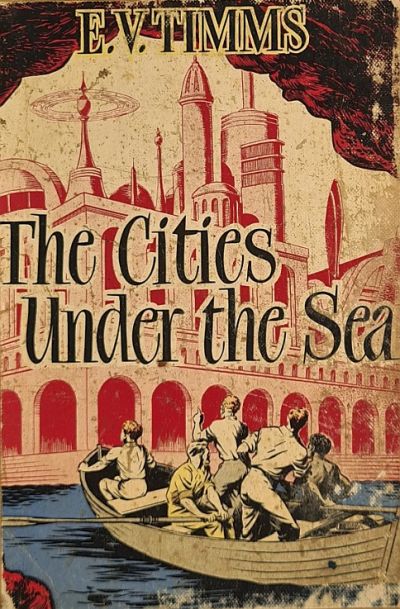
Title: The Cities under the Sea
Date of first publication: 1948
Author: E. V. (Edward Vivian) Timms (1895-1960)
Date first posted: June 16, 2026
Date last updated: June 16, 2026
Faded Page eBook #20260635
This eBook was produced by: Al Haines, Cindy Beyer & the online Distributed Proofreaders Canada team at https://www.pgdpcanada.net
Other books for boys by E. V. Timms
THE VALLEY OF ADVENTURE
RED MASK
By
E. V. TIMMS
ANGUS AND ROBERTSON
SYDNEY :: LONDON
1948
Set up, printed and bound
in Australia by
Halstead Press Pty Limited,
9-19 Nickson Street, Sydney
1948
Registered in Australia for
transmission through the
post as a book
TO
MY SON
WARWICK
| CONTENTS | ||
| CHAPTER | PAGE | |
| I. | THE YACHT IS MISSING | 1 |
| II. | THE DERELICT FOUND | 11 |
| III. | MUTINY | 24 |
| IV. | DEVIL OF THE SARGASSO | 35 |
| V. | DOWN THE DARK CHASM | 50 |
| VI. | CITY OF THE DEPTHS | 57 |
| VII. | PALE MEN OF ATLANTIS | 68 |
| VIII. | DECREE OF DEATH | 83 |
| IX. | THE BURNING GLASS | 92 |
| X. | ESCAPE TO DARKNESS | 103 |
| XI. | THE ANCIENT DEEPS | 114 |
| XII. | THROUGH UNFATHOMED DARKNESS | 121 |
| XIII. | TEN MINUTES TO LIVE | 133 |
| XIV. | THE CITY OF GREEN LIGHT | 146 |
| XV. | THE EARTH-MEN WELCOMED | 155 |
| XVI. | A GALLANT RESCUE | 165 |
| XVII. | SPIES OF XENIN | 174 |
| XVIII. | THE INVISIBLE KILLER | 182 |
| XIX. | WAR | 190 |
| XX. | WATCHERS IN THE DOME | 199 |
| XXI. | WHENCE NONE RETURNS | 212 |
| XXII. | ’WARE THUNDER-FEET! | 223 |
| XXIII. | THE OLD GODS OF ATLANTIS | 231 |
The four riders outlined against the sunset rode easily as they made their way back to the homestead after a long day’s mustering. Behind them in the still, hot air the dust rose lazily, and through it the sun was a red ball, its rim just touching the far mountains. The riders were John Chisholm, owner of this large Queensland station; Kane Chisholm, a tall, dark lad of seventeen, an athlete and already famed as a rifle shot; Peter Chisholm, an irrepressible copper-top whose unquenchable thirst for adventure and genius for getting himself and others into trouble constantly kept his companions on the alert; and the Chisholms’ faithful shadow, the inimitable blacktracker, lynx-eyed, barefooted Black Charlie.
Often as they rode home thus they talked of other days, of their extraordinary experiences in mysterious Paradise Valley, that scene of danger, adventure and death in the far north of Australia where they had sought and found rich gold, and where they had risked their lives many times before breaking the menacing grip of the deadly valley. But, to Peter’s great regret, those exciting times were past, and the hours now were filled with the interesting though commonplace duties of station life.
The two lads were home from their schools for the long weeks of the Christmas holidays, and although their youthful hearts secretly yearned for the chance to return to the grim, brooding valley and its primeval and mysterious people, they knew that for them the great adventure had ended.
At the moment, as their horses ambled along, they were discussing the expected arrival from England of the boys’ cousin, Joyce Raleigh. Joyce, whose age was the same as Peter’s, was coming out on a yacht owned by Captain Murray, a friend of Joyce’s parents. Peter, whose nimble mind and tongue were always racing, was outlining eagerly his plans for his cousin’s entertainment.
“Of course, she’s only a girl. I don’t suppose she can ride. But we’ll soon teach her, won’t we, Charlie?”
Black Charlie caught Kane’s wink as he nodded gravely.
“You bet, Misser Peter.”
“It might be a good idea if you taught Peter first, Charlie,” Kane said thoughtfully.
Charlie’s eyes twinkled. “Haw, haw, haw! You bet, Misser Kane.”
Peter glared at his brother. “Listen, crack-shot, I can ride as well as you. I can——”
“You can skite better than any kid I know,” Kane informed him. “If dad had only sent you to a decent school——”
Mr Chisholm was discreetly silent, laughing inwardly. But Peter was now standing up in the stirrups, his red head glinting in the sun’s rays.
“My school’s as good as yours, Kane,” he said hotly. “That mouldy, moth-eaten monkey-house you call a school!”
Kane gravely wagged a reproving finger at him. “That’s no way to talk about your own school, nipper.”
“I wasn’t!” yelled Peter. “I was talking about yours.”
Kane shook his head. “You said your school was as good as mine, then you described mine as a mouldy, moth-eaten monkey-house. Therefore, your school is a mouldy, moth-eaten monkey-house. Get it?”
“No!” howled Peter. “Not my school—your school.”
“And do you always scream at one another like that at your school?” asked Kane gently.
Peter sat down in the saddle.
“I wasn’t screaming, was I, Charlie?” he asked indignantly.
Charlie shook his head. “No, no, Misser Peter, but by jiggery, all dem pfeller cockatoo him fly out of dat pfeller tree.”
Peter’s face registered disgust. He looked at his father. “I was talking about Joyce when Kane barged in. How long will it be before the yacht gets to Australia, dad?”
Mr Chisholm was silent for a moment. The horses jogged along, the saddles creaking, the bits jingling, the dust rising like a fine brown mist. The two boys and Charlie looked at him inquiringly.
“Well,” he said at last, “I haven’t told you this before, but the yacht Australia is overdue. I’m a bit concerned about it.”
“Do you think anything is wrong, dad?” Kane asked quickly.
Mr Chisholm looked thoughtful. “I can’t say, Kane. I hope not. Captain Murray is a fine sailor, a friend of Joyce’s parents, and the girl is in his care. The last information was that the yacht had left the Azores.”
“What route is it taking, dad?” asked Peter.
“From the Azores across the Atlantic to the Panama Canal. Then on to Brisbane.”
Charlie looked puzzled. “What dat pfeller Azores, boss?” he asked.
“Some islands out in the Atlantic, about fifteen hundred miles south-west of Ireland, Charlie.”
Charlie grunted. “An’ what dat pfeller Atlantic, boss?”
“An ocean, fathead,” Peter cut in.
Charlie’s eyes opened in mild surprise. “Fancy dat, now! Dis pfeller know dat pfeller all time, you bet.”
Charlie grinned as the others laughed. The Chisholms, father and sons, had the deepest affection and admiration for Black Charlie, and the aboriginal, by many a brave deed and by unswerving loyalty to them, had proved his regard for them. Time and time again during the dangerous moments in Paradise Valley the blacktracker had, by his uncanny knowledge and instinct, and also by his quaint humour, eased tense and sometimes deadly situations. He was particularly attached to the two lads, and was never so happy as when they were ragging him, or he in his turn was indulging in a little subtle leg-pulling.
Kane turned to his father. “What do you think could have delayed the yacht, dad?”
“The letter I received said the vessel was carrying petrol. That stuff is dangerous cargo.”
“But plenty of ships carry petrol, dad,” said Peter. “They’d surely have it properly stowed away where fire couldn’t get at it.”
Mr Chisholm nodded. “Doubtless we’ll hear before long it is at Panama.”
“What dat pfeller Panama, boss?”
“A hat,” said Peter innocently.
Charlie nodded wisely. “Dis pfeller know all de time, Misser Peter.”
“He’s pulling your leg, inkpot,” chuckled Kane. “Panama’s a town in Central America.”
“Haw, haw, haw! Fancy Misser Peter not know dat silly one. Haw, haw, haw!”
“Haw, haw, haw!” echoed Peter. “I knew it was a town, you black owl. And break it down, Charlie. When you guffaw like that every horse in the place wants to bolt. Don’t blame ’em, either.”
“Gee whiz, Misser Peter! Mebbe you like Charlie sing little bit, by jiggery?”
Peter groaned. “Stop him, somebody. When he sings he’s awful. It’s like tin cans being blown round in a cyclone. It’s terrible.”
“Haw, haw, haw! Misser Peter no like pfeller music?”
“He doesn’t like the sound of any voice but his own,” said Kane.
“You’re just about due for a thick ear, Kane,” Peter retorted grimly.
“That cross between a fog-horn and a ratchet Charlie calls a voice was pretty good hearing at times up there on Sanctuary Island,” Mr Chisholm said with a smile. “Remember the Shadow Men of the ruined temple?”
“Remember them?” said Kane grimly. “And the Crocodile Men.”
“And the Spider Men,” Peter added. “By jingo, they gave me the creeps!”
Mr Chisholm laughed. “They gave us all the creeps, Peter. However, as Shakespeare said, ‘All’s well that ends well.’ ”
“What pfeller dat Shakespeare, boss? What spear dat pfeller shake?”
Peter nearly rolled out of the saddle.
“Shakespeare was a man, you image,” he shouted, nearly choking. “He’s the greatest poet——”
Charlie shrugged. “Aw, dat all? You watch Charlie t’row de boomerang. I show you some po’try, by jiggery.”
“Haw, haw, haw!” said Peter deeply. “Who’s skiting now?”
“Dis pfeller, Misser Peter, you bet.”
“Well, open the gate, midnight,” said Kane. “You’re nearest.”
As they approached the homestead they saw the house-keeper waiting on the wide veranda for them. She handed a folded paper to Mr Chisholm as he dismounted.
“It’s a cable from New York, Mr Chisholm,” she said. “It came over the phone about an hour ago. I’m very sorry to say . . . it’s bad news.” With that she turned and walked quickly away.
Mr Chisholm unfolded the paper and read aloud: “ ‘Chisholm west Queensland stop yacht Australia missing between Azores and West Indies cannot trace stop last wireless from Murray said only two words gas and sea stop fear petrol explosion total loss stop Morrison.’ ”
There was silence when he finished. Deep concern showed on the faces of all.
“The yacht lost . . .” muttered Kane. “Good heavens, that’s awful!”
“Plenty bad pfeller that one,” said Charlie.
Peter looked anxiously at his father. “Dad . . . does this mean that Joyce . . . ?”
Mr Chisholm stared down at the message. He shook his head slowly.
“This is indeed bad news,” he said. “But it’s still indefinite. It doesn’t say the yacht is lost.”
“By jingo, that’s right, dad!” cried Peter. “Maybe they’re wrecked somewhere.”
“They could be,” agreed Kane. “What do you think, dad?”
“It’s pretty grim,” said Mr Chisholm, reluctantly. “Must be, otherwise Morrison wouldn’t have sent such a cable. But,” he added more hopefully, “a vessel can be missing without being sunk; the people aboard can be missing without being dead. There’s still hope.”
“But the wireless—why don’t they use that?” asked Peter.
“Must be out of action somehow,” replied Kane. “They aren’t sending, and they can’t be located. Maybe they’ve had some kind of trouble on board.”
Mr Chisholm drew in a deep breath. He was worried and did not disguise the fact.
“Well, there’s only one thing we can do, and that is search for the yacht,” he said, crisply.
“What? Out there in the Atlantic? How can we do that, dad?” queried Peter.
“By seaplane, son. I feel partly responsible for the whole affair, and I must do all I can to find Joyce.”
“I bet she’s alive somewhere,” said Peter vehemently. “Maybe they’re just stuck on a rock somewhere.”
“Who will go?” asked Kane.
The two lads and Charlie watched Mr Chisholm intently, almost quivering with expectation and eagerness.
“Samuels and the others can look after things here,” said Mr Chisholm. “I’ll phone ahead now and make all necessary arrangements. We’ll have to go by plane from Australia, probably fly across America, and when we get to the West Indies I’ll charter an observation seaplane to search the area where the yacht was last heard from. Peter, you tell Annie to get a kit ready for you and Kane. Kane, see there’s enough juice in the car. You two boys will come with me.”
Peter and Kane both flashed a glance at Black Charlie. The aboriginal was looking down at his toes as he wriggled them in the dry dust.
“What about Charlie, dad?” Peter asked. “He’s got marvellous eyesight. He might be the one to spot something.”
In spite of himself Mr Chisholm smiled slightly. “Charlie wouldn’t want to come. His remarkable talents would be literally at sea on the Atlantic. The sea leaves no tracks.”
“But it can leave traces, dad,” Kane put in.
Mr Chisholm glanced at the blackfellow. Charlie’s face was lugubrious, his manner doleful and drooping and suggestive of one from whom all hope had fled.
“Well, Charlie, the boys seem to want you. But you were in from the start, and you knew it, you black humbug.”
Charlie grinned widely, and his deep-set dark eyes gleamed humorously under their beetling brows.
“You bet, boss. By jiggery, Charlie find dat pfeller boat.”
“You make me sick,” snorted Peter. “Take the horses.”
“And get yourself a lump of coal and do a bit more crystal-gazing,” advised Kane. “And get yourself a hat—and boots—and hurry.”
“Dis pfeller fix him prop’ly you bet,” Charlie mumbled as he led the horses away. “But dat pfeller boot, Misser Kane——”
“Boots!” said Kane firmly.
Once or twice the twin motors of the seaplane stuttered ominously, and those in the cabin looked at each other inquiringly. Through the half-open door of the pilot’s cabin the pilot himself could be seen at the controls. A movement of his hand set the motors roaring again, and the listeners sat back and relaxed.
“Well, we’re on the last stage of our long journey, boys,” said Mr Chisholm. “We certainly haven’t wasted any time since leaving Australia.”
Kane raised his voice above the motors. “Australia to New York, New York to Miami, Miami to San Juan in Puerto Rico. We’ve certainly moved.”
“Had to, by jingo,” added Peter. “You were lucky to get this pilot and this plane, dad.”
Mr Chisholm nodded. “Very. We got a break there, lads.”
Charlie chipped in as his keen eyes searched the sea under and around them. “Dat right, boss. But where dis pfeller now? Plenty pfeller sea down dere, by jiggery. What dat place, boss?”
“The Atlantic, Charlie. Actually we’re heading over the Sargasso Sea.”
Peter gave a whoop of excitement. “Gosh, dad, the Sargasso Sea? Isn’t this where there are wrecks trapped in great masses of seaweed?”
Mr Chisholm laughed. “Don’t let your imagination run away with you, son.”
“He’s been reading some lurid pirate yarn, I bet,” said Kane.
“Well, I have,” retorted Peter. “A dashed good yarn, too.”
“Haw, haw, haw! Plenty pfeller tripe dat one.”
Peter turned quickly. “How would you know, inkpot? And where’s your hat? And your boots?” he demanded.
Charlie wriggled guiltily. “Aw, gee whiz, Misser Peter, hat him silly pfeller, boots under pfeller seat.”
“You’ve been wriggling like a worm on a hot plate ever since you put them on,” said Kane.
Charlie grinned widely. “Aw, dey make dis pfeller sick, Misser Kane, jus’ like pfeller Atlantic soon make Misser Peter sick, by jiggery—haw, haw, haw!”
“Stop bellowing like a sick bull, Charlie. You’ll shake all the rivets out of the plane.”
“No fear, Misser Peter. Dat jus’ little pfeller laugh. You like hear Charlie laugh prop’ly, by jiggery?”
“No!” came in chorus from the lads.
“I don’t know why someone didn’t hit you with a nulla-nulla when you were a piccaninny,” Peter groaned.
Charlie’s thick black eyebrows flew up in mock surprise.
“What, dis pfeller, Misser Peter? No, no, by jiggery. Dis pfeller plenty cleber piccaninny. Dis pfeller t’row nulla-nulla, boomerang, spear when him two-free year old, gee whiz. Dis pfeller kill kangaroo, snake, emu, when him t’ree-four year old, you bet. Not like Misser Peter, him suck dat pfeller bottle all time.”
Peter let out a howl of indignation. “I didn’t, you black blot on the sunshine! Did I, Kane?”
Kane stifled his laughter. Mr Chisholm was chuckling quietly.
“I can’t say, kid. Charlie has great powers of observation.”
Peter glared at him, but before any more could be said the pilot’s voice was heard.
“Say, Mr Chisholm!”
“What is it, pilot?” Mr Chisholm called.
“We’re well out over this Sargasso Sea—five hundred miles out. Can’t go much farther. Have to turn back soon.”
“Go as far as is safe, pilot.”
“O.K., but believe me this place ain’t safe, even for a seaplane. It’s sure dynamite—wham! Jus’ like that.”
“Keep on as long as you can.”
“O.K.”
Kane turned to his father. “Why did we come to this particular spot, dad?” he asked.
Mr Chisholm’s eyes swept the waste of waters reaching away to the horizon.
“Because of that last message from the yacht, son,” he replied. “Only two words got through—‘gas’ and ‘sea’.”
Kane nodded. “The agents believe there was a petrol explosion on board, and that the yacht sank.”
Mr Chisholm shook his head. “I don’t. The yacht was on a course from the Azores to Jamaica. Just before we knew they were in trouble the United States weather people reported a terrific hurricane centred east of the Bahamas——”
“Gee, dad,” put in Peter, “but those words ‘gas’ and ‘sea’?”
Mr Chisholm nodded. “Yes, I believe they refer to the Sargasso Sea.”
“Gosh!” exclaimed Peter thoughtfully.
“I didn’t think of that,” admitted Kane.
“It’s a long shot at the truth, I admit,” Mr Chisholm went on, “but I’m taking it for Joyce’s sake. I think it possible, even probable, that the yacht has been drawn into the great weed-trap that is the Sargasso Sea.”
“But they’ve got wireless, dad,” said Peter. “If they’re stuck in the weed why don’t they let us know?”
Mr Chisholm shrugged. “If I knew that, son, it wouldn’t have been necessary to come all these thousands of miles to find out.”
“Haw, haw, haw! Dat silly pfeller one, Misser Peter.”
Peter went red. “Listen, marvellous——”
Kane interrupted him. “Pipe down, copper-top. That yellow weed below us stretches in long lanes right out of sight. It could be a trap if it got thicker.”
“Yes, son. It’s a trap.”
The calling voice of the pilot interrupted him. “I don’t like the look of all this weed under us, Mr Chisholm. If this ol’ crate had to come down there she’d float, maybe, but she’d get so tangled she’d never take off.”
“Gosh!” breathed Peter. “And then what?”
Charlie answered that one. “We stop in dat pfeller weed, dat all.”
“Can you keep her as she is for just another half-hour?” Mr Chisholm called back.
“O.K.,” came in resigned tones. “O.K.”
Charlie leant across to Peter. “What dat pfeller ‘O.K.,’ Misser Peter?” he asked.
Peter looked at him suspiciously. “You’ve been hearing it right across the States. It means a thing is all right.”
Charlie considered it. “Aw—O.K., Misser Peter.”
Kane glared at him. “For heaven’s sake stick to your own lingo, Charlie. You’re hard enough to understand as it is.”
“Aw, gee whiz, Misser Kane——”
The voice of the pilot broke in. “Say, Mr Chisholm, my chart says there’s no land in this weed mass, but if that ain’t an island over there on the sky-line I’ll take a dip in the drink.”
“An island?” came in chorus.
Charlie shrugged. “Charlie see dat pfeller long time. What him matter, anyway?”
“Everything matters here, midnight,” said Kane quickly. “What d’you think this search is, an aerial corroboree?”
Charlie’s eyebrows went up and down like two black wings in flight.
“Gee whiz, no, Misser Kane. But Charlie t’ink you want pfeller yacht, not pfeller island.”
“And you’re right there, Charlie,” said Mr Chisholm. He raised his voice. “Is that island uncharted, pilot?”
“Sure is uncharted,” the reply came back.
“Fly round it, will you?”
“Sure, but that’ll be about the limit, folks.”
“What dat pfeller ‘folks’?” Charlie wanted to know.
Peter sighed. “Smother him, someone. Hey! We’re banking again!”
“Going down, too,” added Kane.
“The pilot wants us to have a closer look at the island,” said Mr Chisholm.
“Say, folks, it’s up to you, but if these motors cut out that’s bad territory down there, sure bad.”
“We won’t linger,” Mr Chisholm assured him.
They stared down at the sea as it rose seemingly to meet them. Long yellow banks of Gulf-weed stretched as far as the eye could see. The surface of the sea was like glass, and the strong sunlight sent glinting streaks of golden light far along the water lanes between the weed. Everything in that immense expanse of water and weeds was still, unmoving. It was as though the ocean wore a mask—a yellow mask, expressionless yet menacing. Peter, for one, didn’t like the look of it.
“What is this Gulf-weed, dad?” he asked.
“A seaweed peculiar to this sea. It’s well known there are long spells of absolute calm here where the stuff is thickest.”
“Then any sailing craft trapped here would have to whistle for a wind,” said Kane.
“Yes, and perhaps whistle for weeks. Sometimes great masses of weed break away and float in long lines across the ocean. The Chinese regard it as a delicacy, and other people often use it in salads, and sometimes pickle it.”
“Gosh, you’re joking, dad!”
“No, Peter. It’s a fact. The Atlantic has many strange secrets, some still undreamt of. Down the centre of the ocean-bed, for instance, is a high ridge, really the top of a submerged chain of extinct volcanic mountains, about fifteen hundred fathoms down. Elsewhere the water goes down two or three miles. There are strange creatures down in those black depths; some have been seen, others just guessed at. It is known that many carry their own lights, curious arrangements that give out a bright phosphorescent glow to light them on their way.”
“Gosh!” said Peter wonderingly. “What do you think of that, Charlie?”
Charlie grinned. “What wrong dat pfeller, Misser Peter? Plenty pfeller fish him fly, oder pfeller fish him climb tree, oder pfeller fish him use fishin’ rod catch oder pfeller fish. Haw, haw, haw! Plenty good pfeller dat pfeller light, you bet.”
“All right, all right,” said Peter hurriedly. “Don’t you start, for the love of Mike.”
“No fear, Misser Peter, but Charlie some pfeller day tell you something make dem big ears stick out plenty more, by jiggery!”
Peter was inclined to be somewhat sensitive about his ears.
“You leave my ears alone! And what the heck are you laughing at, Kane?” he growled.
“Nothing, nothing,” said Kane. “I was just once again admiring Charlie’s powers of observation. Doesn’t miss much, does he, nip?”
“He’s no beauty,” growled Peter. “I bet when he’s out at night he doesn’t know whether he’s going or coming. And who else could tell, anyway?”
“Aw, gee whiz, Misser Peter——”
The pilot interrupted him. “There’s the island, Mr Chisholm. With that valley down the middle it looks like an old felt hat with a dent in it. Have a good look, folks; we won’t be here long.”
They stared at it. It was not unlike the pilot’s terse description of it. About three miles long by nearly two wide, the crown was creased like the top of a hat. They could see little in the way of vegetation as they flew across it, and a thick mist in the centre of the valley hid much of it from view. Here and there were grey strips of beaches breaking the rugged cliffs, but no surf rolled up on the sand.
“Weird-looking place,” commented Kane. “No sign of life. No wonder nobody ever comes here, or even bothered to chart it. It must be well off the track of all shipping.”
Charlie suddenly sat upright.
“Boss, boss,” he hissed, “pfeller yacht down dere!”
At once they rose to their feet. Eagerly they peered in the direction in which Charlie’s black hand pointed. Some half-mile away from the island was a yacht, the sails set and hanging motionless from the yards.
“You’re right, Charlie,” said Mr Chisholm. “And it’s no old derelict, either.”
The pilot yelled back at them, “Maybe you’re right, Mr Chisholm. There’s a ship stuck in the weed down there.”
“And another!” cried Kane. “Look!”
“And over there!” shrilled Peter excitedly. “But, by jingo, they look as if they’ve been there for a hundred years.”
“Not pfeller yacht, Misser Peter,” said Charlie. “Yacht him not long dis place.”
“I’ll bet you’re right, Charlie,” said Peter. “Gee, dad, can you see anyone aboard her?”
Mr Chisholm shook his head. “No. Can you, Charlie?”
Charlie stared long and hard as the plane banked.
“No, boss. No pfeller on dat boat.”
“I’ll take you low down over her, folks,” came from the pilot.
Down went the plane, and in a moment it was skimming towards the yacht at mast-level. Breathlessly they all stared at the vessel, but no sign of life could be seen. Up went the plane to bank for another swoop. Mr Chisholm looked at the others.
“There’s something wrong, boys. That’s the Australia, all right, but if anyone was aboard they surely must have heard this plane.”
“You’d think so, dad,” said Peter. “And the lifeboat’s still lashed in place.”
“Where in heck can they be?” wondered Kane. “There’s something uncanny about it all.”
Mr Chisholm raised his voice. “I say, pilot, can we come down beside that yacht?”
“No, sir!” came the emphatic reply. “Not a chance, Mr Chisholm. The weed’s thick all round it. If I put the plane down the floats would bury themselves under them yeller ropes.”
“Then how can we get on the yacht?”
“Don’t ask me, sir, I’m only a pilot. That water’s bad territory—yes, sir!”
As the plane turned to come back they stood motionless, staring at the silent vessel.
“I’m afraid she’s deserted,” said Mr Chisholm.
“Sure t’ing, boss,” agreed Charlie.
“But, why?” Peter demanded. “How can it be? There’s the dinghy.”
“But they must hear this plane, fathead,” said Kane, “unless they’re all sick.”
Mr Chisholm looked quickly at Kane.
“Sick? I hadn’t thought of that. Kane, you might have something——” He broke off as the plane’s engines began to splutter.
“Looks like trouble, folks,” the pilot called. “These gas-babies don’t seem to be getting the juice.”
A fresh roar from the engines seemed to deny it, but the next moment they faltered again and began to choke.
“They’re cutting out, folks! Hold on, hold on! I’ll float this crate alongside the yacht, but hold on. If that weed grips we’ll somersault—wham! Jus’ like that!”
“And then what?” Mr Chisholm inquired.
“Anything you like. Now hold it, everybody!”
The seaplane glided down, the pilot manoeuvring to get the machine safely on water where the weed was thin. Those in the main cabin held on to their seats and their breaths.
“By jiggery, him plenty good pilot dis pfeller hope,” Charlie gasped.
“Hold on,” the pilot warned. “We’re nearly there.”
With a splash the plane hit the water, bounced a little, and then stopped quickly as though hidden hands were dragging at it. It rocked violently for a few moments, throwing everybody from side to side. Then it gradually steadied and was still.
“Phew!” whistled Kane. “That was a flop. Did you feel that weed grip?”
“Did I?” panted Peter. “Gosh, I thought we were gone that time!”
“Haw, haw, haw!” Charlie laughed shakily. “Dat pfeller not’ing, by jiggery.”
“Good work, pilot,” called Mr Chisholm.
The pilot was out of his seat and walking towards them.
“Folks, you must have Aladdin’s lamp with you somewhere,” he said, somewhat grimly. “You wish, and you get it. You wanted to come down next to the yacht—an’ sure, there she is.”
“Can we get out of here?” asked Kane.
“Buddy, if I knew that much about the future I wouldn’t be a pilot. I’d sure be a lot of things, but not a pilot. Now I’ll take a look-see at them motors, an’ don’t take any notice of anything I may say to ’em.”
“Go ahead,” said Mr Chisholm. “I know the situation is serious, but we’re alive and unhurt. While you’re looking at the motors we’ll go aboard the yacht. Ready, boys?”
“Gosh, yes!”
“Let’s get going, dad.”
“You bet, by jiggery!”
Mr Chisholm held up a hand. “I don’t know what we’ll find. It may not be pleasant. But let’s go.”
Kane was the first to step on the yacht’s deck, then came Mr Chisholm, then Peter, followed by Black Charlie. For a moment they stood without speaking, looking about them and listening. From the plane came the muffled voice of the pilot as he examined one of the motors. There was no other sound. No wind stirred the drooping sails, nothing moved. Everything was still, silent, unreal. It was as though they had stepped into a photograph. Each felt the utter unreality of the uncanny stillness, the strange, inexplicable emptiness of it all.
“I say . . . it’s weird,” Kane said. “I don’t like the look of things, dad.”
“Neither do I, son,” replied Mr Chisholm.
“Where dey all go dese pfeller?” asked Charlie.
“That’s what we have to find out, Charlie. The sails are all set; they can’t have been gone long. Let’s go into the cabin.”
Peter was trembling with suppressed excitement. “Be careful, dad, you don’t know what’s in there.”
“The door’s ajar,” said Kane. “I’ll just have a look.”
Mr Chisholm restrained him. “Not so fast, son. Let me have a look in there.”
But before he moved he raised his voice and called, “Hullo, there! Anyone aboard? Hullo, there!”
No reply came. Peter shivered slightly. Kane peered about him anxiously. Charlie mumbled, “Debil-debil, boss. Plenty debil-debil.”
Peter snorted and reminded him, “Bosh! We exploded that debil-debil stuff up in the Valley of Adventure, Charlie.”
Charlie shook his head.
“You’re nuts, inkpot,” Kane informed him. “Give you something you don’t understand and you see debil-debils everywhere.”
Charlie shrugged and edged closer to Mr Chisholm who said, “Well, standing here won’t help us. Here goes.”
He opened the door of the cabin and peered in. It was comfortably furnished after the typical manner of a ship’s cabin. But it was empty, and the only significant thing was an overturned chair beside the table.
“Empty,” Mr Chisholm muttered. “This yacht certainly is deserted. What on earth could have happened to everyone?”
Kane pointed to a closed door. “That must lead to another cabin.”
Mr Chisholm opened the door and went in. Peter, who was just behind him, said excitedly, “Look, it’s Joyce’s cabin! There’s her name on those trunks.”
“You’re right, nipper,” said Kane. “But everything’s in order.”
Charlie pointed towards the bunk. “What dat little pfeller book, boss?”
Peter pounced on it. “Gosh!” he breathed. “It’s a diary—Joyce’s diary.”
“Let me see it, son.”
They crowded round as Mr Chisholm examined the book.
“Yes, it’s Joyce’s diary. Listen to this:
“This morning Limpy Morgan brought the men from the fo’c’sle to the door of the cabin. There were Limpy, Red Saunders, Dodger Sparks, and the man they call the Penguin. Something is wrong. For days now the men have been dissatisfied. There is no wind, the yacht can’t move. Captain Murray asked them what they wanted. Limpy acted as spokesman and told Captain Murray he ought to do something about getting the ship out of this dreadful weed. The captain explained the transmitter of the wireless has broken down, and all we can do is wait either for help or for a wind.”
Mr Chisholm paused. “There’s a blank here—ah! She goes on:
“Morgan has been trying for days to get the auxiliary engine to work, but it won’t go. There’s plenty of petrol, but something in the engine has broken and Morgan can’t fix it. The men keep looking strangely at Captain Murray.
“Yesterday they came again to the cabin. Captain Murray put a revolver in his pocket. He said they were getting ugly. I heard them arguing with him. They said they were going to take the long-boat, provision it, and take me and Captain Murray with them. They said if they didn’t get out of this place they’d all rot and die here. I think they were all very frightened. Captain Murray called them a lot of dogs and threatened to shoot the first man who tried to leave the yacht.”
Mr Chisholm turned over a page and continued:
“. . . I heard the Penguin say to Saunders they’d have to go to the island to get fresh water as there was only a few days’ supply left on the yacht. Just after that I heard them coming again. I am frightened. There may be bloodshed. Captain Murray is opening the cabin door. . . .”
Mr Chisholm stopped reading. “That’s all,” he said grimly. “The diary cuts out abruptly there.”
“It’s plenty,” said Kane. “We know now what happened. Mutiny.”
“Gosh,” breathed Peter, “they may be over on that island right now.”
Mr Chisholm nodded. They all walked back into Captain Murray’s cabin. Kane opened a cupboard near the wash basin.
“Crumbs!” said Peter. “Rifles . . . and automatics . . . and ammunition.”
“Murray was a keen sportsman,” said Mr Chisholm. “Anything missing, Kane?”
Kane nodded. “Several racks empty. No doubt the mutineers have helped themselves.”
Mr Chisholm’s face set in hard lines. “Then we shall do the same,” he told them.
Peter gasped. “Do you think they’ll come back, dad?”
“No, son. But we’ll have to go to the island and look for them. We came to find Joyce, and we’ll keep on trying.”
“There’s the dinghy still lashed to the davits,” said Kane. “Hullo, where’s Charlie?”
They looked round. Charlie had vanished, but the next moment he came back into the cabin brandishing an axe.
“Dis pfeller for Charlie,” he told them with a grin. “Charlie plenty good with pfeller axe.”
Peter let out a wild yell. “Don’t swing that axe in here, you black fathead. You nearly cracked Kane on the cerebellum.”
Charlie looked surprised. “What dat pfeller ‘cerebellum’?”
“The back of your napper, idiot,” growled Kane. “If you must have a battle-axe wait till you’re in a forty-acre paddock.”
“Aw, gee whiz, Misser Kane, Charlie jus’ do two-free pfeller fancy swing—like dat.”
“Stop it,” gasped Kane as the keen axe flashed this way and that.
Mr Chisholm laughed. “Don’t let them kid you, Charlie. They both know well enough you’re a wizard with an axe.”
“Haw, haw, haw, boss! Dis pfeller plenty good. If dat pfeller Penguin an’ dat Limpy pfeller get cheeky, by jiggery——”
“What a sickening skite!” groaned Peter. “Just because he chops a few chips at the woodheap he thinks he’s a champ. What’s in that cupboard, Kane?”
Kane had opened another door and was rummaging inside a deep recess.
“Some sort of a pantry,” he told them. “It’s just stacked with tinned food, bacon, cheese, matches, fishing lines——”
“Wow!” yelled Peter delightedly. “Let me get in there!”
Kane hauled him back. “Subside, microbe. Say, dad, we certainly won’t go hungry for a while. Captain Murray must have kept the larder under lock and key.”
Mr Chisholm smiled. “He’d have to do that. But as the door is open it’s a safe bet those men have also helped themselves. Well, we’d better do the same.”
Quick footsteps outside the cabin door interrupted him. The pilot joined them, shaking his head.
“Nope, they won’t go. Plain sulky. Can’t find anything that shouldn’t be there, but they’ve quit. Air bubbles somewhere, maybe. Take time to drain a few pipes. What goes on here, folks?”
“The yacht’s deserted,” Mr Chisholm replied. “We found my niece’s diary. The crew mutinied and evidently forced Captain Murray and the girl to go off in the long-boat with them. They were going to the island for water. As there’s a dinghy still on the yacht; we’re going to have a look over the island.”
The pilot leant against the door and surveyed them quizzically. He was short, thickset, blue-eyed, and going bald. At the moment he was smeared with engine oil, but even his disappointment with the motors had not lessened the humorous glint in his shrewd eyes, or wiped the lurking grin from his lips.
“Naturally, folks, I don’t know much about this set-up,” he said slowly. “I’m only your hired pilot. But it begins to look like we’ll be buddies for some little time. Where you folks from, anyway?”
“Australia,” Peter replied.
A pair of very blue eyes twinkled at him. “Australia? Lemme see, now I seem to have heard of that place. Where is it, buddy?”
Peter stared in astonishment. “Where is Australia? Gosh, dash it all——”
“Sonny, I recollect. It’s a big place near the South Pole, with a few primitive inhabitants, and a large national debt. Sure. Am I right, or am I right?”
Peter burst out laughing. “I saw you wink at dad. I bet you know all about Australia.”
“Sure, kid. Plenty. Flew a plane round it, and liked it. Say, folks, my name’s Bubb—Hank J. Bubb.”
Mr Chisholm held out his hand. “I’m John Chisholm.”
“Kane Chisholm.”
“Peter Chisholm.”
“Dis pfeller Black Charlie.”
Hank gave him a side glance. “I’ve been watching you, feller. What are you—one of them Australian kangaroos?”
Charlie’s face was a study in astonishment. “Kangaroo? Dis pfeller? No dashed fear, Misser Hank. Dis pfeller one o’ dem pioneer pfeller longa Australia. Dis pfeller’s people by jiggery de first people dat place. Plenty swell, no mucking about, you bet!”
Hank saw the gleam in Charlie’s deep-set eyes, Charlie saw the glint in Hank’s. With a laugh they shook hands and were firm friends from that moment. Mr Chisholm turned to Kane.
“We’d better be moving, son. Charlie, you and I will get the boat in the water. Kane, Peter, carry up plenty of food and matches. Search for candles, too. And rope—in fact, anything useful. Are you coming with us, Hank? Or do you want to stay near the plane?”
Hank pulled a wry face. “If anybody can get that crate out of here they can have it. Sure I’ll come. Yes, sir, Hank J. Bubb will be present in person.”
“Me, too,” piped up a thin, high-pitched voice near Charlie.
Everyone turned and stared in wonderment. Charlie brought the axe up defensively, but no one was there.
“Gee whiz, boss,” chattered the aboriginal, “where dat pfeller? Who dat pfeller?”
“Someone spoke,” cried Peter.
“Someone certainly did,” said Kane as he looked about him.
“I sure thought I heard someone say something,” Hank informed them. “Sounded close to Charlie boy.”
Mr Chisholm was about to speak when he saw Hank wink slyly at him. In a flash he knew the origin of the voice, Hank J. Bubb was a ventriloquist. With an effort he kept a straight face. It was amazingly well done, and he knew there were some startling moments ahead of Black Charlie and the boys if they did not guess for themselves.
“Maybe we only thought we heard someone,” said Hank. “There ain’t anyone here but us. Now I’ll have one of them rifles and an automatic.”
“Me, too,” piped the voice they had heard before.
Charlie jumped as though he had been scalded.
“Debil-debil, boss—Misser Kane, Misser Peter—debil-debil!”
“Debil-debil yourself, blackfellow,” said a deep voice from behind him.
“By jiggery—gee whiz—by jolly cripes—by de great whacko, dat pfeller plenty debil-debil. Charlie wait on pfeller deck, by heck you bet, yes, sir!”
Like a shot he was through the door and out on deck.
“Well,” said Hank dryly, “you gotta hand it to Charlie boy. He sure knows his own mind.”
Kane and Peter exchanged quick, startled looks, then broad grins were directed at Hank. Hank placed a greasy hand on his shirt front and bowed.
“That’s right, buddies. You guessed it. Are you going to tell Charlie boy?”
“I’ll say not,” said Kane.
“Wow!” ejaculated Peter. “Had Charlie better sit up and behave?”
Mr Chisholm walked to the cabin door. “Get busy, lads. It may take some time to get through the weeds and on to the island.”
“I’ll jus’ have a final look at the crate,” said Hank as he followed Mr Chisholm from the cabin.
Kane made a quick survey of the contents of the store. There was an abundance of food as well as articles likely to prove useful in an emergency.
“Grab those tins of meat, nipper, and dump them near the dinghy,” he said.
“Beef, bacon, pork, sausages, ham, meat and vegetables,” chanted Peter, stacking the tins. “Tinned potatoes, tomatoes, peas, asparagus, soup, coffee, tea, milk, sugar, salt—gosh, Kane, I feel hungry!”
Kane grinned. “Like old times to hear you say that, kid. Could do a feed myself, now I think of it.”
Peter paused as he turned to carry an armful of tins on deck. His face, usually smiling, was sombre and anxious.
“Kane, do you think Joyce is in any danger—real danger, I mean?”
Kane shook his head. “No. Those men were scared to stay in this weed-trap. They took Murray because he was the only one able to navigate. I don’t think they mean any harm to either Joyce or Murray—unless Murray starts something. The five hundred miles between here and the West Indies is a pretty bad stretch for anyone in an open boat, but I reckon they thought it better to chance it than to remain here. Better hurry with that tucker, kid.”
Peter took a step and paused again. “Kane . . . do you think . . . we’ll have to chance that stretch in the dinghy?”
Kane shrugged. “Your guess is as good as mine, nip, from now on. But we’ll look that island over first. What happens when we push off from the yacht—well, I guess it will happen, that’s all.”
“Gee, I bet that poor little kid’s scared out of her life,” muttered Peter as he walked away. “I wish we could do something.”
Kane nodded. “Something tells me you’ll get your wish, copper-top,” he said thoughtfully.
Mr Chisholm at last seemed satisfied with their preparations. The dinghy was well supplied with food and water, and Kane had added ropes and electric torches found in the store. All were armed, though Charlie clung to his axe in preference to a rifle. Peter acted as cox, then facing him in order were Charlie, Hank, and Mr Chisholm, with Kane at bow.
“Push off, lads,” came the command. “There’s a thin lane of clear water, so we’ll row along that for a while.”
“Crumbs, it’s hot!” said Peter. “The sun’s like a burning glass.”
“You bet, Misser Peter,” agreed Charlie.
“Shove off, you two,” roared Kane impatiently. “Shove, windbag! Push, Charlie!”
Charlie grunted as he thrust with the oar. “You bet, Misser Kane.”
Peter suddenly stopped pushing. “Hey, I saw something!”
“Sit down or you’ll see plenty,” growled Kane.
“What was it, son?” asked Mr Chisholm.
Peter shook his head. He was still staring ahead along the lane of water.
“Not sure, dad. Just happened to catch a glimpse of something moving—something big under the weeds.”
“What did it look like, fathead?” Kane wanted to know.
“Can’t say—it just moved.”
“Say, buddy, don’t start seein’ things. We gotta get to that durn island.”
“You bet, Misser Hank.”
The boat was well away from the yacht when Peter again started forward.
“There it is again!” he yelled. “Under the weeds close ahead. Gosh, it’s big, whatever it is!”
“Easy, everybody,” said Mr Chisholm. “These are strange waters, and we’d better go carefully. Could it be a whale, or some big fish, do you think, Hank?”
The dinghy drifted slowly along for a few yards before Hank replied, “I guess Peter boy’s right. I saw something swirl under them yeller ropes. Here’s where little Hank J. Bubb slips a few shells in that repeater.”
“Same here,” muttered Kane.
Mr Chisholm was watching the weed. “Charlie, you and I’ll keep rowing while the others keep a look-out for whatever it is. It may be merely a trick of the current, after all.”
Charlie saw that his axe was handy as he started to row. Hank, Peter, and Kane watched keenly for any movement among the weeds.
“Pull, Charlie,” said Mr Chisholm. “The weed’s closing in on us.”
“You bet, boss.”
Peter glanced at Hank. “What do you think it could be, Hank? You seem to know everything.”
Hank’s innocent blue eyes were twinkling.
“What? Me? No, sir! I’m only Hank J. Bubb.”
Peter grinned. “What’s the J for, Hank?” he asked.
Hank looked perplexed. “The J? Now jus’ let me think. Well, you’ve got me tricked, Peter. That durn J has been in my name ever since I can remember, and I’ve never been able to find out what it means.”
“Haw, haw, haw!” roared Charlie. “Dat plenty funny, Misser Hank.”
“Sez you,” piped a thin voice beside him.
Charlie nearly fell out of the dinghy.
“Hey, boss, hey, boss,” he panted, “dere dat cheeky pfeller again.”
“Sit down!” everybody roared.
“By jiggery,” chattered Charlie, “dis pfeller no like dat pfeller!”
“You concentrate on the marine manifestation, Charlie,” advised Hank.
“Any idea what it could be, Hank?”
“Sure, Peter. Mos’ likely the subterranean repercussion of the toiling foraminifera, all due to the vicious habits of the implacable polyp, buddy. Now don’t say I didn’t tell you—and the world.”
“Gosh, where do you get it all, Hank?” Peter gurgled.
“It’s a gift, sonny, like the J in my name.”
Mr Chisholm looked over his shoulder. “We’re getting there. The island seems to be a mass of volcanic rock rising sheer out of the ocean.”
Hank broke into a deep chant. “Fifteen men on the dead man’s chest——”
“Treasure Island,” said Peter authoritatively.
Hank nodded. “Sure is. But d’ye know what the Dead Man’s Chest was?”
“Well—I——” began Peter.
“How ’bout you, Kane?”
Kane looked puzzled. “The Dead Man’s Chest—let me see——”
Hank winked at Peter. “Yes, you don’t know, either. I’ll tell you. It’s a lonely rock off the north coast of South America. It sticks right up out of the water. Maybe the old pirates used it to plant treasure on, maybe they didn’t. I wasn’t there, neither was Stevenson. But it’s the original, no-fake-or-your-dime-back Dead Man’s Chest. Class dismissed.”
“Gee, Hank, that’s interesting,” said Peter. “Is it true?”
A pained look came into Hank’s eyes. “Well! I say no more. I wonder if the others had any trouble getting to the island, Mr Chisholm.”
“There’s no sign of them. I don’t know when they left the yacht; there was no date on those last entries in the diary.”
Hank nodded. “I guess that poor kid was too worried to think of that,” was his comment. “Say, this boat’s moving along a bit.”
Kane’s wild yell startled them all. “Great Scott! I can see it—it’s close to the boat!”
“Thunderin’ thunderbolts!” Hank cried. “That’s a giant octopus! If it gets them tentacles round this boat we’ll all go under.”
They all stared at the monster. And truly a monster of the deep it was. It seemed to be resting amongst the thick seaweed, and its horrible tentacles were easily twenty feet in length and as thick as a man’s thigh where they joined the repulsive body.
“Steady, everybody,” warned Mr Chisholm. “We’re drifting past. It may not move.”
“Gee whiz, boss,” breathed Charlie, “dat big debil-debil, dat one.”
“You’re right this time, Charlie boy,” said Hank. “That puss is the ace of sea devils. Maybe there’s some volcanic trouble down in the deep, for them big fellers don’t usually come to the surface.”
Kane raised his rifle. “I’ll take a shot at it.”
Mr Chisholm spoke quickly. “Wait! Don’t fire unless it comes at us. We’re drifting past.”
“Good advice, Mr Chisholm,” said Hank. “That nightmare jus’ don’t know what fear is. If we stir him up—wham! Let that puss lie quiet, Kane.”
Kane lowered the rifle. “Maybe he’s a bit stunned by whatever force threw him to the surface,” he said.
Hank grinned. “I sure hope he’s unconscious. I bet his name’s Ebenezer.”
“Haw, haw, haw! How you know dat, Misser Hank?”
“Well, ask him, Charlie boy.”
“Haw, haw, haw! Dat silly one. Dat puss no yabber dis pfeller.”
“No?” drawled Hank. “Well, ask him.”
Charlie grinned widely as he raised his voice. “What name belonga you, pfeller puss?”
A husky, rattling voice came back from the weeds. “Ebenezer.”
Charlie stiffened like a man petrified, staring at the monster. As if to confirm everything one long tentacle waved lazily in the direction of the passing boat.
“By de great whacko,” breathed the amazed Charlie, “dat plenty marv’lous.”
“Sure,” agreed Hank. “You never can tell what goes on in foreign parts, Charlie boy. Anyway, we’re leaving Ebenezer to ponder over this bright new world. Unless you’d like to go back and shake hands with your funny pal?”
Charlie shook his head vigorously. “Dat Ebenezer no pfeller pal along dis pfeller,” he said. “No, sir, by wham!”
With an effort Mr Chisholm controlled his voice. “Perhaps you’re wise, Charlie.”
Peter dared not trust himself to look at the others. “Fancy that thing telling you its name,” he said, wonderingly.
“Dashed funny pfeller puss dat one,” Charlie muttered.
Kane smothered a chuckle. “After all, it came up from where everything is pretty black. Perhaps it thought Charlie’d done the same.”
“Aw, gee whiz, Misser Kane——”
Hank chipped in. “Well, it seemed to speak Charlie boy’s language. But we’ll never know now. By the way, folks, have you noticed this galleon seems to be moving towards that durn island? I mean without any help from us?”
“Yes, I’ve been watching that,” answered Mr Chisholm. “About a hundred yards back we seemed to get into the grip of a slight current.”
“Save pulling at the oars,” commented Kane. “And it certainly is hot.”
“Look at those cliffs,” said Peter. “Gosh, they look grim!”
Hank stared at them. They towered up perpendicular and rugged, but all in the dinghy noticed the absence of surf at the waterline.
“Folks, I don’t like this place.”
All eyes were turned towards the island. Nowhere at the moment could they see a beach or possible landing place.
“Neither do I, Hank,” said Mr Chisholm. “It’s evidently a volcanic peak, very bleak and inhospitable. I wonder if the mutineers found water on it?”
“It’s a fine place to be from,” said Hank emphatically. “Say, we are beginning to move.”
Peter laughed. “Suits us, Hank. The sooner we get there and away, the better. What about some eats? Gosh, I’m hungry! That was a very early breakfast.”
“Why not?” said Mr Chisholm. “Get busy, son, and dish up something. I dare say we’re all hungry.”
“You bet, boss.”
“Won’t be long,” said Peter enthusiastically.
“I bet it won’t,” said Kane. “You’re certainly fast when there’s tucker about, nipper.”
“You’re not so slow yourself, crack-shot,” retorted Peter, laughing. “What’s it to be—chicken in aspic?”
“What pfeller ‘aspic’?”
“Jelly. Tongue, crab, salmon, beef?”
Mr Chisholm laughed. “Anything, Peter. Open them with the axe, Charlie.”
“You bet, boss.”
“Here’s biscuits, butter, and cheese,” crowed Peter. “Gosh, what a spread. If only we could have some tea.”
“Coffee for me, buddy.”
“Have to wait till we get ashore. Most Americans prefer coffee, don’t they, Hank?”
Hank nodded. “Guess they do, maybe. But they drink a lot of tea as well.”
“Anything else, Hank?” asked Kane innocently.
Hank grinned. “Sure. I’ve seen some drink plain water, sonny, plain water, believe it or not. Not like you folks in Australia. I remember once when I was there. I was on the Yarra in Sydney——”
Peter let out a yell. “Don’t be funny, Hank! The Yarra’s at Melbourne——”
Hank looked at him gravely. “No! Is that so? I was talking about a ship called the Yarra, son, in Sydney Harbour. You’ve heard of that place, I guess?”
Peter laughed heartily. “You’re smooth, Hank, durn smooth,” he retorted.
“Sure, sure,” said Hank imperturbably. “Make mine chicken, Peter boy. Say, any of you notice that funny-lookin’ shadow in the cliff ahead? We seem to be movin’ towards it a lot faster.”
“Yes,” said Mr Chisholm, “and the weed is travelling with us now. Very strange.”
“All the better, dad,” said Kane. “We won’t have to row till we’re close in. Crab for me, copper-top.”
Charlie cut the tins with the axe as neatly as though he had used an opener.
“Plenty good, by jiggery,” he muttered. “By gee whiz, Misser Peter, dat Cap’n Murray know plenty good tucker.”
“You bet, Charlie,” Peter agreed. “What were you saying about Sydney Harbour, Hank?”
Hank swallowed a mouthful of chicken. “Well,” he replied reminiscently, “we were sailin’ up towards that big bamboo bridge——”
Peter almost choked. “Bamboo? Gosh, Hank, that’s the biggest steel-arch bridge——”
Hank’s eyebrows went up. “Big? That bridge? Why, Peter boy, we use them kind to put over the gutters in New York.”
“Haw, haw, haw!” guffawed Charlie. “Misser Hank him get too much pfeller sun on dat feller bald head. . . . Haw, haw, haw!”
Hank looked pained. “Maybe a little wind-swept, Charlie boy, but not bald. The Bubbs never go bald, no, sir! Back in ’49 Big Bill Bubb, the best buffalo buster that ever crossed a bronco, banged his bean against the tomahawk of Big Bear, the bad boy of the Blackfeet. What happened? The Bubbs have always been a bit short of hair since that very day, but never bald, sir, never bald.”
Charlie joined in the laughter that followed. When it subsided Mr Chisholm said, “I wonder why this island is uncharted? You said it wasn’t marked on your map, Hank.”
“That’s so, Mr Chisholm. But now and then they miss a speck of land, even on the navy charts, though the Atlantic is the best-charted sea in the world. I’ll sure report it when I get back. Maybe I’ll even take possession of it for the United States; they seem keen on new territory lately. Say, Peter, why don’t you grab it for Australia?”
Peter looked at him suspiciously. “Gee, do you think I could, Hank?”
Hank waved a hand at the island. “Sure! Jus’ stick up an oar, and holler three times, ‘I, Peter the Peanut Eater, take possession of this territory, together with all the seaweed, birds’ eggs, and broken bottles——”
“Gosh,” gasped Peter, “stop him, someone!”
Hank went on eating more chicken.
“Pass some more biscuit, nip,” sang out Kane. “How you going, inkpot?”
Charlie turned his head and laughed. “Plenty good, Misser Kane. Dashed good tucker, you bet!”
“You’re as bad as copper-top. I never saw anyone eat like you two.”
“You do all right, big boy. The trouble with you is you’re so modest about everything,” Peter retorted. “But I bet that’s how you broke your arm—patting yourself on the back.”
“Nipper——” began Kane ominously, but Mr Chisholm interrupted him.
“Quiet for a moment, you two.” He was gazing intently at the cliffs, now only a few hundred yards away. “Hank, this boat’s beginning to race, and, if I’m not mistaken, what we took for a shadow on the cliff face isn’t a shadow but a colossal cavern of some sort.”
Everyone stopped eating to turn and stare at the cliffs. The dinghy was undoubtedly moving faster towards them, masses of yellow weed keeping pace with it. And now for the first time a new sound was heard, a faint roaring as of a distant waterfall. Hank turned and looked at Mr Chisholm. “You’re right. I gotta hunch we’re being drawn towards that hole. We’d better pull out of it, Mr Chisholm.”
Mr Chisholm cried, “The oars, everybody! We can finish eating later.”
“Gosh, yes!” said Peter. “Maybe it’s a whirlpool.”
They were straining at the oars now, Peter steering a cross course with the fast-moving water.
“Then all I can say—is pull—folks—like ol’ Ebenezer himself—was after you,” Hank advised, putting all his strength into his strokes.
They strained at the oars, but in spite of them the dinghy every moment was increasing its headlong speed towards what was now plainly seen to be a cavern’s dark mouth.
“Watch—the—rudder—fathead!” gasped Kane.
“I am. The boat won’t answer. She’s beginning to spin.”
“By jiggery—dis pfeller—no—good—boss,” grunted Charlie.
“Pull—pull—everyone!” gasped Mr Chisholm. “We must—get—out—of this current. Pull!”
Even as they tugged at the oars with every ounce of strength, they saw the rushing water was beating them. Faster and faster went the dinghy, lumps of swirling weed going with it. All now realized that they were faced with danger, and that only an almost superhuman effort could save them from overwhelming disaster. The sunshine had given place to shadow, and they knew they were close to the huge, black mouth in the face of the towering cliff. In their ears now was an ominous roaring, a steady deep note increasing in sound and menace. What it could be they did not know, but the threat in that steadily rising sound made them strain at the oars till the sweat ran from their panting bodies. But pull as they would they could neither deflect the course of the dinghy nor stop it from revolving in the swirl of the current that sucked them in.
“If we capsize, each one try to hold an oar,” Mr Chisholm shouted to his crew.
“Maybe we’ll make it,” yelled Hank. “No use rowing any more.”
“Easy all, get your breath back,” Mr Chisholm advised them.
Gasping, they ceased tugging at the oars. They were entering the cavern, and overhead, gradually shutting out the daylight, was the dark, jagged roof of rock.
“Where does all the water go in this place?” chattered Peter.
Hank shrugged as he gulped in air. “Durn soon see, buddy. If it goes in like this, it must come out some place. Where’s them torches?”
“Look out!” Kane suddenly yelled, “we’re going to bash into the wall of the cavern!”
“The oars—quick!” shouted Mr Chisholm. “Fend her off.”
Just in time they pushed the dinghy away from the wall of rock against which the current threatened to hurl them. It was so dark now that Hank flashed on a torch and passed one along to Kane.
“Keep the beam ahead, Kane. We gotta find the way out of here.”
But only impenetrable darkness could be seen ahead. The walls of the cavern were closing in, and the roof was coming lower. They knew they were absolutely helpless, and could do nothing but keep the dinghy from crashing against the black, dripping walls of the tunnel.
“Well,” Hank said at the top of his voice, “this sure has ol’ Coney Island licked. Boys, if I had this water-works back in the United States I’d make me a million dollars.”
“You bet, Misser Hank. When we come out dis place maybe we see dat pfeller New York.”
Mr Chisholm inwardly blessed the fine courage of both Hank and Black Charlie. The situation seemed hopeless. If anything happened to the dinghy they would be utterly lost. He wondered if a similar fate had overtaken the mutineers, Captain Murray, and Joyce Raleigh. Had their boat been drawn into this black tunnel, or had the fates been kind and allowed them to go beyond its deadly drag? But the hazards of the rushing, roaring water and the swiftly passing walls of rock drove such speculation from his mind. He blessed the luck that had provided them with torches. Without the white beams of light they must inevitably have crashed into pieces against the rock. He lifted his voice.
“See any signs of light ahead, anyone? Maybe this tunnel goes right through the island.”
“Do you think we might come out on the other side, dad?” shouted Peter.
Kane answered before his father could reply. “Watch the rock walls—watch the walls! This water is going downhill—it’s going—underground!”
Underground! Without speaking, in the light of the torches, they watched the slant of the rushing water. There could be no mistake, the rock walls seemed to be lifting swiftly out of the swirling race. That they were going down and down into some unknown depths was apparent to all. The rock tunnel was roughly twenty-five yards wide, about thirty feet high, and the ceiling curved like a dome. Walls and roof were green in the torchlight, glistening with the slimy growth of incalculable ages. The air was still sweet, a constant draught being pulled through the tunnel by the moving water.
For long minutes after Kane’s discovery no one spoke. They were driving down and down at a constant speed, and the sensation was one of a gradual sinking to lower levels rather than a sloping, downhill movement.
Everything had happened so swiftly that the thoughts of each of them were confused. One moment, so it seemed, they had been drifting tranquilly towards the island, the next striving desperately to pull the boat out of the grip of the current, and now here they were shooting down this inclined tunnel. Not till long afterwards were they able correctly to analyse their individual sensations, their thoughts and their fears. They were sinking fast, travelling fast, and each knew that very soon he would come to the end of this amazing and weird journey.
In their ears was the roaring of the water. The boat was steady now, keeping fairly in the centre of the torrent. Kane’s light played ahead, and all were now facing in that direction, watching and waiting for whatever lay beyond. One disturbing thought, however, was firm in their minds. It was obvious that they were not passing through the island. They were going down and down. Had this tunnel merely passed through the island the water would have flowed at a constant level. It was all too clear to them that they were being forced towards some subterranean region, but their imaginations could form no picture of it. For the moment they were safe, and could only wait for whatever time and fate brought to them.
“Dad, what is happening to us?” Peter shouted to his father. “Will we get out of this place?”
“We’ll be all right, son. Hang on to your seat so that you don’t get bumped overboard. See anything yet, Kane?”
“Not a thing,” came back from Kane. “By heck, we’re dropping fast! If we keep on going down like this we’ll soon be under the ocean.”
Hank waved a hand at the swiftly passing rock walls.
“This ain’t anything to a first solo flight, believe me. So long as we keep the boat off the rock walls we’ll be O.K.”
“Yes,” Peter interrupted. “But where does all this water go? If it’s going downhill it can’t come up again.”
“You never know what water will do, buddy, till you find out. Don’t you believe all them scientists tell you; they’re always contradictin’ each other, anyway. What do you say, Charlie boy?”
“Dis pfeller plenty funny, by jiggery! Dis pfeller water go cock-eye, you bet.”
“O.K., paleface. But you don’t tell us much. That durn cavern we came in by ought to have a notice up, somethin’ like this: ‘Don’t bring any soap all ye who enter here. Have you got a fishing licence? If you must shoot the chute don’t toot. Gone to lunch, back in ten minutes. Oysters will be eaten on the shell and paid for before leaving. Don’t stare at the mermaids.’ Sure. There should be a notice.”
“Haw, haw, haw! Dat silly one dat pfeller mermaid, Misser Hank.”
“Oh, yeah? You don’t believe in mermaids, huh?”
“Haw, haw, haw!”
“I see, I see. Sceptic, eh? Well, jus’ because I can’t see you in this darkness don’t say you ain’t here, Charlie boy. Maybe there are mermaids in this place. Maybe they’re black mermaids to tone in with the illuminations. Wouldn’t you like to meet a black mermaid, Charlie boy?”
“No fear, Misser Hank!”
“You wouldn’t want to have to swim home, eh? I get it. Or be slapped hard on the ear with a nice wet, fishy tail, huh? Trouble with you, Charlie boy, is that you’re becoming too retiring. You want to assert yourself more, meet people and make friends, write to the papers. Do you dance? What do you do? Have you any pets?”
“By gee whiz, Misser Hank, you plenty feller windbag!”
“Now that ain’t nice of you, Charlie boy,” said Hank plaintively. “We’ve never had a windbag in the Bubb family. My father was known as ‘Silent’ Bubb. After the very first time he saw me he never spoke again. He jus’ used to look at me an’ shake his head. Mom said it didn’t matter, he was dumb, anyway.”
“See anything, Kane?” called Mr Chisholm.
“No, still just the black tunnel ahead.”
“My gosh!” said Peter. “We must be thousands of feet down. I wish I knew where we were going.”
“There must be a reason for this water pouring down here like this,” said his father. “It must finish up somewhere, and if it had merely filled a big hole deep down, it would have stopped running ages ago or the Atlantic would be dry by now.”
“What do you think about it, Mr Chisholm?” asked Hank.
“Naturally, I can’t explain this phenomenon, Hank, but it certainly has an explanation. It must have been flowing like this for ages, therefore I think it gets back again to the ocean in some way.”
“Dat right, boss,” added Charlie encouragingly. “I bet dat right, too, boss.”
“Do you think Joyce and the men came down here, dad?” asked Peter.
“There’s a big chance of that,” Mr Chisholm replied, “though they might have gone towards some other part of the island, and so escaped this tunnel.”
“I wonder if we’ll ever see them.”
“You bet, Misser Peter. We soon see dat pfeller Limpy, an’ dat Morgan, an’ Red pfeller, you bet.”
“Hope you’re right, inkpot. Crumbs, the roar of this water gets on a fellow’s nerves!”
“Huh, I’m used to it, Peter boy—jus’ like sittin’ behind them props. It’s nothin’, son, nothin’ at all,” said Hank quietly. Then, with sudden excitement, “Hey—we’re slowing up. I’m sure of it.”
Intently they watched the walls.
“I believe he’s right,” said Mr Chisholm. “We are going along more slowly.”
“What does that mean, dad?” asked Peter.
“Can’t say, son. The whole thing is baffling.”
“Well,” suggested Hank, “maybe we’re gettin’ somewhere right now. It’s sure warm down here. Yes, sir. An’ the noise of that water ain’t so loud, I guess.”
“You’re right,” said Mr Chisholm.
“How far down are we, dad?”
“No idea, Peter.”
“Two-free mile, you bet.”
“Don’t be silly, Charlie. At that depth we’d be under the Atlantic.”
“Dat right, Misser Peter. Dat jus’ where we are, by jiggery!”
Peter gasped. “Under the Atlantic? Great Scott! Do you think we are, Hank?”
“We’re a long way down, no kiddin’, buddy,” was the reply. “But we can breathe all right, though the air is a bit hot, an’ this water’s slowin’ up. We must be comin’ to the end of this durn chute.”
Charlie raised his voice. “Hey, Misser Kane, put out pfeller torch.”
“Why?” they all asked.
“Not sure, boss, but t’ink dere is pfeller light longa tunnel.”
“A light?” they echoed.
Kane snapped off the torch. It was black, but far ahead was a tiny point of light.
“Gosh, it is a light!” yelled Peter.
“Surely that’s impossible,” said Mr Chisholm. “How can there be light down here?”
“Can’t answer that one, Mr Chisholm,” said Hank. “But that sure is a glow right ahead. Better put on the torch, Kane. We don’t want to crash now.”
Peter leant over the side of the dinghy and stared ahead.
“Yes, it’s getting brighter every moment,” he cried.
Kane stood up and pointed as he called excitedly, “Look, look! We’re coming out of the tunnel!”
“Out of the tunnel?” they echoed.
“Yes, look! The roof’s lifting, the water’s slowing to no pace at all. There it is—there’s the end—look, oh, look!”
The sudden inflexion in his tone fixed their gaze on the scene ahead. Wildly they stared, unbelieving. The tunnel had widened, and the dinghy was floating now on a vast sea of inky-black water. On all sides the rock had lifted and moved back; overhead, dimly seen, was the roof of this amazing underworld gradually sloping up until it lost itself in darkness and distance. Awe-inspiring as was this sight, that which stupefied them and held them rigid and speechless was the spectacle that presented itself to their eyes across the still black waters of this subterranean sea. There, lit in a manner of which they had no knowledge, was a white city, enchanting in its beauty. It looked to be about three miles from where the dinghy floated, but its towers and canals gleamed with a strange radiance. Over it was the peculiar soft light they had first seen from afar off in the tunnel, a white clear light that revealed all objects with startling clarity.
Mr Chisholm broke the long silence. “Unless we are all mad,” he said, “we have come to a city—a city under the sea.”
A city under the sea!
Silently the dinghy drifted towards it. No one spoke. There was no wind; the surface of the underground sea was like smooth, black glass. The strange light that enveloped the city revealed the streets, the spires, the immense domes of the buildings, and the black lines of the canals running through the city. No smoke rose from any of the buildings, nothing like a chimney could be seen. And there were no people on either the streets or the canals.
What was behind the city they could not see or imagine. Beyond the pearly light from this beautiful and uncanny place was utter darkness, a black immensity, the limits of which they could not guess. Hank broke the silence that had held them since Mr Chisholm last spoke.
“Well, folks, I pass. Hank J. Bubb has seen many queer things an’ places, but believe me an’ believe me this sure rocks a man. Yes, sir!”
“We’re going steadily towards the city,” said Kane. “There’s no sign of life that I can see. The whole place appears to be empty, deserted.”
Mr Chisholm said slowly, “I believe we are on the threshold of incredible things. What manner of people are here remains to be seen, but those marvellous buildings are surely man-made. Yet they are not like anything we have ever known or even thought of. The beginnings of this place must go back to ages beyond our understanding, and yet it has an air of something more modern than anything we have ever imagined.”
“Do you think we really are down under the Atlantic, dad?” asked Peter.
“Yes, I do. We have come down by miraculous chance to another world. And although this city appears to be deserted, I don’t believe it is. Those weird buildings are in perfect repair and condition. Nothing here is crumbling. And that uncanny light! Someone, something is creating that. There are secrets here, an unknown people with an unknown way of life. How they live, what they do, what they eat, I simply can’t imagine.”
“Gosh, I hope they’re not cannibals!” said Peter with a little shiver.
“Gee whiz!” gasped Charlie. “Dis pfeller hope so, too, Misser Peter.”
“Somehow I don’t think the inhabitants of this city would be flesh-eaters,” said Mr Chisholm. “I can’t see any sign of domestic animals, or even of any form of agriculture. The Gulf-weed that comes down through the tunnel may be used for food, and possibly there are fish in this underground sea. But as for plant life as we know it, or cattle, these things couldn’t exist down here.”
“So go easy with the rations, boys,” said Hank with a grin. “Maybe that tinned stuff we brought will seem like Christmas to us yet. Anyway, we’re getting closer to the city all the time. See anybody, Kane?”
Kane shook his head.
“No, Hank. Not a sign of anybody.”
Charlie hunched his shoulders.
“No like dis place, boss,” he muttered. “Debil-debil here, you bet.”
“There you go again,” said Peter. “I’ll bet they get a shock when they see you, inkpot.”
“Gee whiz, Misser Peter, how we get out of dis pfeller place?”
Hank laughed. “Get out, midnight? We ain’t properly here yet. An’ I don’t see any reception committee waiting for us. Maybe we ain’t popular. After all, I reckon they don’t get visitors like us down here. Maybe they’re funny people with two heads, or four legs. Maybe they’re like that Cyclops feller an’ have only one eye in the middle of the forehead.”
“By jiggery, Misser Hank, dey can’t scare dis pfeller, you bet! Him soon fix dat one-eye pfeller. Dis pfeller——”
“Sure, sure,” said Hank. “All you’ve got to do, Charlie boy, is find a piece of darkness and hide behind it.”
“Gee whiz, Misser Hank, dis pfeller ain’t scared, you bet!”
“Maybe they’re half-men, half-birds. Maybe they’ve got wings an’ fly.”
“Haw, haw, haw! Maybe dese pfeller all named Bubb, plenty cleber pfeller, you bet. Maybe dey got dat pfeller J in pfeller name. Maybe dey all silly pfeller, too, you bet.”
Hank looked hurt. “Well, now, if there’s another Bubb down here there’s two too many—haw, haw, haw! Beat you to it, paleface. Say, folks, it won’t be long now. We’re getting close.”
“Do you think Joyce is here, dad?” asked Kane.
Before Mr Chisholm could reply a voice, clear, yet with a strange inflexion, sounded beside them.
“Joyce Raleigh is here,” the voice intoned.
Mr Chisholm and the two lads looked at Hank. But Hank’s eyes were unsmiling, and he shook his head.
“No, sirs! It looks as though we’ve been spotted.”
The voice came again, quietly. “Joyce Raleigh is here.”
Charlie moved uneasily. “Dat pfeller all same pfeller dat speak on pfeller yacht, boss.”
Hank shook his head again.
“You’re wrong there, Charlie boy. This is an entirely different debil-debil, believe me. This voice is coming from that city.”
Again the voice was heard. “You are astonished? A voice speaks beside you, and you do not understand?”
“Boss, boss . . .”
“Quiet, Charlie.” Mr Chisholm raised his voice. “Who spoke to us then?”
He was answered immediately. “Do not raise your voice, it is not necessary. I can hear your slightest whisper, even as I can read your thoughts.”
Mr Chisholm saw that they were still half a mile from the city.
“Then,” he replied, “you have powers of which we know nothing. Will you help us to find Joyce Raleigh?”
“You are not welcome,” said the strange, impersonal voice. “You are ages behind our civilization and development. You are savages with primitive weapons and crude minds.”
For a moment they looked at each other. Then Mr Chisholm asked, “What place is this? And how do you know our language?”
“This is the White City,” he was answered. “I am Haza, the First Diviner. Your language is elementary, O man. Joyce Raleigh must remain for ever in the White City. You will not be permitted to see her or speak to her. Your boat will be propelled through the air-locks to the Green City. What they do with you is no concern of the people of our city. You are not welcome, for you are barbarians.”
“Where are the men who are with Joyce Raleigh?” Mr Chisholm asked.
“That does not concern you, O man.”
Suddenly a girl’s voice, excited and trembling with relief, sounded in their ears. “Uncle John—Kane—Peter! I can see you. Come for me, please.”
“Joyce!” shouted everyone in the dinghy except Black Charlie.
“Gosh,” cried Peter, “that was Joyce, all right!”
“She said she could see us,” said Kane.
“The girl saw you, O boy,” said the voice of Haza. “I did not see her enter the Centre Sphere.”
“Why do you wish to keep her from us?” asked Mr Chisholm. “She is of my own family.”
“Never mind that Haza guy for a moment, Mr Chisholm,” Hank interrupted him. “This boat is drifting towards that quay.”
“You are wrong, O man,” he was told. “Your boat is not drifting, it is being controlled by me.”
“Controlled?” they echoed wonderingly.
“It is simple, but you are ignorant primitives who could not understand even if I explained the force. But I have talked enough.”
Hank’s lip lifted in a sneer. “You sure have, feller. You say you can see us?”
“I can see you.”
“Then who is the one beside me?”
“There is no one beside you.”
A voice answered him, a voice thin, sarcastic and rude. “So you can’t see everyone in this boat, eh, wise guy? Ha, ha, ha! We are ignorant barbarians, eh, clever one? So you can’t see me—ha, ha, ha!”
Charlie recoiled and turned round, blinking when he saw there was no one beside Hank. The voice of Haza came hesitatingly, “I hear that one . . . I cannot see him.”
Hank grinned. “Now you’re tootin’, feller. You people must be ignorant, all right, all right.”
“They are,” said the thin voice. “I’ve forgotten more than this darktown kid ever knew. You’re Haza of the Centre Sphere, ain’t you?”
“I am,” Haza replied, and there was surprise in his voice. “You must be of the Centre Caste, one of the invisible ones. I must report this.”
“You ain’t curious, are you, Haza, feller?” said Hank, tauntingly. “You know some things, an’ we know some things. You’re Haza, the First Diviner, I heard you say it yourself. But if you don’t——”
The thin voice beside Hank was now full of menace. “If Haza doesn’t present us to the head of this burg he’ll be Haza the Last Diviner.”
Hank spoke hurriedly to the others. “Don’t talk, anyone—don’t talk! An’ empty your minds—or think of something far away—something those smart guys never heard of. Gum up this thought-transference. It’s some form of telepathy, an’ they have it perfect. Me, I’m thinkin’ of all them buffaloes Big Bill Bubb used to hunt on them prairies. I bet they don’t know what that means.”
“I shall be instructed,” Haza told them sourly.
“Debil-debil,” said Charlie gloomily.
Hank laughed. “Fine, Charlie boy. You concentrate on some of them things your medicine men kid you about. The hump on a buffalo is sure remarkable.”
“The dinghy has stopped,” said Peter.
“Sure. I bet they’re holding a pow-wow right now.”
Haza spoke again. “You will not be sent through the air-locks, but may come to the city. I am instructed. The rays will not impede or compel you. Come as you will to the landing-steps.”
“Of what people are you, Haza?” Mr Chisholm asked.
“We are of the ancient race of Atlantis, descendants of those who survived the ruin of the world. The guiding light will await you at the top of the steps. Follow it without fear to the Hall of the Supreme Council.”
“The oars, fellers,” said Hank. “Maybe we took a trick there. If it hadn’t been for old uncle here beside me——”
“Where dat pfeller uncle?” snapped Charlie. “Plenty funny pfeller dat one.”
Hank winked at the others behind Charlie’s back.
“Don’t you say hard things about my uncle, Charlie boy. But for him we’d be going through them air-locks. An’ I sure don’t like the sound of that.”
“Your uncle may be of great help to us, Hank. I’m glad he’s here.”
“You bet, Mr Chisholm,” said Hank gravely. “But I’m wonderin’ about them invisible ones of the Centre Caste. If they’re any more invisible than Uncle Bubb they’re pretty durn good.”
“Plenty funny t’ing,” Charlie grumbled.
“Row, inkpot,” said Peter. “I bet we see plenty of funny things—queer funny.”
Mr Chisholm was very concerned and thoughtful as he rowed. But for Hank’s astounding ventriloquial powers banishment would have been their sentence for intruding into this world within a world. That the rulers of the city were hostile could not be doubted. Their contempt for those in the dinghy was absolute. And these unknown people controlled remarkable powers. The air-locks? What could they be? A guiding light? What manner of light was that? And why would they not release Joyce? What had happened to the mutineers and Captain Murray? Had they been sent to banishment through the air-locks? What was the Green City, and where was it? But he realized as the dinghy nosed in to the broad landing-steps that the answers to all these questions lay in the future.
“Here we are,” grunted Kane.
The voice of Haza broke in again. “Do not take anything from the boat. Such rubbish must not pollute the city.”
“O.K., feller,” said Hank cheerfully. “We ain’t pollutin’ nothin’. What do we do now in this hospitable burg?”
“Follow the light,” came peremptorily.
“Light?” they echoed.
And then it came. At the top of the empty stairs a green light suddenly burned about ten feet from the stones. Astonished, they stared at it for a moment.
“Follow, follow,” came impatiently.
“By gee whiz, boss!” gasped Charlie. “Dat plenty marv’lous you bet.”
“I say,” breathed Kane as they walked up the stairs, “this place is uncanny. Where did that light come from?”
“I am controlling the light,” Haza informed them. “Why do you keep asking such stupid questions? Where is the invisible one?”
“He’s here,” grunted Hank. “Can’t you see him, feller?”
“I am Haza, the First Diviner. Speak no more, and follow the light.”
To their amazement the light began to move at walking pace away from them. They watched it with eyes filled with astonishment. There were no wires, there was no globe. The naked green flame just burned and moved.
“Well, I pay that one,” said Hank. “But, say—what a soundless city! No sound, no movement, no people.”
“There are people,” said Haza. “But they do not wish to be contaminated by you. You carry with you the diseases of the outside world. To us you are the promise of pestilence. We of the White City are not as those who dwell in the world above.”
“Then you know something about us?” asked Mr Chisholm.
“We study you. We listen to you. Your civilization is one hundred thousand years behind ours. You are not welcome. We of the Atlantic race are guided in all things by reason and knowledge.”
“Have any of you ever been to the outside world?” asked Hank.
“No, O man. With all our knowledge we cannot ascend the roaring Inlet or penetrate the veil of mist beyond the Green City. Nor do we wish to do so.”
“Then no one can leave these regions?” asked Mr Chisholm.
“No man in all the long history of our people has ever done so,” was the reply.
“Gosh!” muttered Peter. “That sounds pretty grim, dad.”
Hank shrugged. “Well, we got here, buddy, and, apart from the others from the yacht, that ain’t been done before. We’ll get out.”
“Fool, I have just told you——”
Hank’s retort was brief. “Sez you,” he grunted.
Haza did not speak again, and they followed the burning, mysterious light along a broad street in which were no poles, wires, rails, or awnings. No wheeled traffic rolled along this empty, wide thoroughfare. The street, paved with smooth white stone, was flanked by tall buildings seemingly without either doors or windows. The utter emptiness of it puzzled them all. They could see no way of entering the towering walls of shining white. At the end of the street was a vast wall surmounted by a colossal dome that gleamed like crystal. The steadily-moving green light went towards this wall.
“Gosh!” said Peter wonderingly. “They do shut themselves up, don’t they?”
“I bet they don’t even know we’re here,” said Kane.
Haza spoke, mockingly. “Ignorant boy, the people of the White City have watched your every movement and heard your every word ever since your miserable craft came through the Inlet. They are watching you now. Ten thousand eyes are examining you, and wondering at your crudeness.”
Hank grinned as he looked about him.
“Well, we of the outer world at least have manners, Haza, ol’ boy. On behalf of us all I say howdy to everybody. This is Hank J. Bubb speaking, and introducin’ Mr Chisholm, Kane Chisholm, Peter Chisholm, and Charlie boy. Oh, an’ Uncle Bubb. But if Haza can’t see uncle then I don’t suppose you folks can. Nice place you have down here, but still give me little ol’ New York. Now there’s a city, folks. Wow! I don’t want to boast as it ain’t like me, but if ever you folks come up to see us—well, will we give you the run around! Bye-bye for now.”
“Your stupid remarks have been received with contempt, O stranger,” said Haza, coldly.
Hank waved a hand at nothing in particular. “O.K., O.K. I can see we’re goin’ to get on well together. What does anybody eat round here, Haza boy?”
“I am Haza, the First Diviner. We do not touch the loathsome food you eat. If your judges give you life you will eat as we do.”
“Our judges? Are we to be tried for something?” Mr Chisholm asked, startled.
“It will be determined by the Supreme Council whether you may live or not.” Haza’s voice was level and unhurried.
“It was not by our will we came to you, and we would depart if we could,” said Mr Chisholm coldly. “You seem to have no wish to be friendly with us.”
“We of Atlantis are ruled by pure reason. By our great knowledge we act. The primitive emotions of friendliness and hospitality are but the instincts of barbarians. Enter now the Great Hall of the Supreme Council.”
They had come to the end of the street. Facing them was the high white façade of the building with the crystal-like dome. As they paused, with the green light burning above them, a portion of the wall began to move. Slowly and without sound it seemed to slide along until a wide doorway was before them. The green light moved on.
“They can certainly do things here,” said Kane. “Some form of electrical control, no doubt.”
“It is atomic power,” Haza informed him. “The light above you comes from the atoms. If you live you will see many things. If not, the power of the atom will destroy you.”
“You’re mighty generous, Haza, ol’ boy. By the way you folks handle the little ol’ atom you’ve sure got something we haven’t. But we’re on our way.”
“There they are, dad,” said Peter in an awed voice.
Haza was instantly forgotten as the light went into a vast chamber. At one end was a dais whereon were seated seven men in red robes. Their faces were very white, and the head of each was entirely without hair. They did not move as the little party approached, and their cold eyes proclaimed their disdain. Haza spoke.
“You are coming to the invisible barrier. There you will stand while you are questioned. Speak not unless you are first spoken to. Death is the penalty for the slightest disobedience.”
Hank reached the invisible barrier first. It brought him up sharp as though he had walked into a brick wall.
“Wow!” he gasped. “Careful, folks. I jus’ ran smack into nothin’ an’ it sure stopped me. Wham! It’s solid, but I can’t see it.”
“By jiggery, boss, dat proper debil-debil,” muttered Charlie.
“It is a ray-barrier, O ignorant ones. Silence!”
They did not speak as the man seated in the centre of the dais rose to his feet.
“The Primate of the White City commands your attention,” Haza said briefly.
They studied the Primate in silence. He was tall and thin. Once again they noticed the seeming transparency of the man; it was as though he had been carved from alabaster. Mr Chisholm thought this peculiar condition was probably due to the absence of sunlight in this strange underworld. His eyes were pale, and when he opened his mouth to speak they saw at once he had no teeth.
“You have been allowed to come to us so that we may question you,” he told them sonorously. “Who will speak for you?”
“I will speak,” said Mr Chisholm.
“Then what seek you, O stranger?”
“I seek my niece, Joyce Raleigh.”
“She is of your family?”
“Yes.”
“What of the men who came with her?”
“Where are they?”
“Do not question me, O man. It is for you to answer. Are those men of your family also?”
“No. To us they are strangers entrusted with the care of the girl until she could be given over to me.”
The Primate paused for a moment and turned without speaking to the others on the dais. One by one they nodded as though he had asked them something. He faced Mr Chisholm again.
“Haza has told you what people we are. Who and what are you?”
“British.”
“American for me—no offence to the British, though,” said Hank quickly.
“These youths?”
“My sons.”
“This black man?”
“My servant.”
The Primate studied the group before him. Then he spoke again. “I ask these questions for several reasons, O man. The first is that the men and the girl who came before you, and yourselves, are the first earth-dwellers to come to the cities under the sea. The second reason is that we must decide whether you shall live or die.”
“Live or die? Are the Atlantics more savage than those they call barbarians?”
The retort told. The men on the dais looked at each other as though each had received a slight mental shock. But the Primate’s face was expressionless.
“Do not interrupt me, O man. I repeat, live or die. If you are to die it is the end of the matter. If you are to live we must decide how and where. Your minds are crude compared with ours. You cannot take any place in our civilization. You would have to live apart. That may not be convenient.”
“But why not let the girl come to us, and then let us depart?” Mr Chisholm asked doggedly. “We did not seek to intrude; the sea brought us to you.”
The Primate looked at him fixedly. “How will you depart?”
“Is there no way we can return to the world above?”
“There is no way. If we could have escaped from these regions we would have done so thousands of years ago, and we would have been earth-dwellers as you are, and as once we were. There is no way back to the world above.”
“Well, that’s telling us,” muttered Hank.
“Will you allow the girl to be with us?”
Again the Primate looked at the other red-robed ones. They nodded.
“Yes, while your fate is being decided she may be with you. Haza!”
The voice of Haza answered at once, “Yes, O Primate?”
“Summon the earth-girl, Joyce Raleigh, as they name her.”
“I am instructed, O Primate.”
“She is coming, O men of the earth.”
Even as he spoke they heard a strange, high-pitched sound rather like the sound of a spinning gyroscope. And then it ceased, and a section of the wall near by opened to show a young girl running towards them.
“It’s Joyce,” called Peter excitedly. “Joyce! Joyce!”
The girl threw herself into Mr Chisholm’s arms.
“Oh, thank goodness you’ve found me, Uncle John! Kane—Peter—oh, I thought I’d never see any of you!”
“Gosh, Joyce, it takes something to stop dad and Kane and Hank and Charlie when they get going,” Peter informed her breathlessly. “Gee, I didn’t think you were so big——”
The sonorous voice of the Primate interrupted him.
“You will be conveyed to where you are to be held. Farewell, O earth-men.”
Wondering what was to happen they stood looking at the men on the dais. And as they watched the floor on which they stood began to move.
“Gosh,” said Peter. “What is happening now?”
“It’s all right, Peter,” said Joyce reassuringly. “A section of the floor moves like a conveyor belt. These people step on and off as they wish. It’s a common form of transport to them.”
“Sure. Jus’ like a flat escalator, if I ain’t gettin’ things a bit mixed.”
“I wonder where we are going?” said Kane.
The voice of Haza answered, “To the fountains of the Centre Caste, where you may rest and refresh yourselves.”
“Thank you, Haza ol’ boy.”
“I am Haza, the First Diviner.”
“O.K., O.K.,” sighed Hank.
“Wish dat Haza pfeller go ’way,” muttered Charlie. “Dis pfeller get plenty cross wid dat pfeller plenty soon.”
“Chuck a boomerang at him, Charlie boy. Maybe we should have brought some boomerangs.”
“Go easy, Hank,” said Kane. “They don’t seem to have a sense of humour in this place.”
“Well, we still have Uncle Bubb with us if Haza boy gets difficult.”
“Where dat pfeller Uncle Bubb?” demanded Charlie.
“Right near you, Charlie boy.”
Haza spoke again. “It is because of the invisible one with you the Primate sends you to the Centre Caste who also have that power.”
Mr Chisholm looked inquiringly at Joyce. “Have you seen anything of these Centre Caste people, Joyce?”
The girl nodded. “Yes, uncle. They are bewildering. At will they can make themselves invisible.”
Hank looked surprised. “Say, is that on the level? I mean real invisible an’ no foolin’?”
“Yes,” Joyce assured him. “You will see. But who is Uncle Bubb?”
Hank looked at Mr Chisholm and the two boys.
“Well,” he said hesitatingly, “that’s jus’ what Haza boy wants to know. An’ Charlie there.”
“You bet, Misser Hank.”
“But I’ll tell you some time, Joyce. I guess Uncle Bubb an’ these Centre Caste boys will enjoy themselves together. Say, we’re here!”
The moving strip stopped, and they saw before them a pleasant and spacious courtyard. Three fountains sent crystal jets high in the air to break against copper discs suspended from the ceiling. Across the ceiling itself light that changed into fascinating colours played softly and ceaselessly.
“Tables and chairs!” said Peter. “Gosh, will I be glad to sit down——”
The voice of Haza interrupted him. “On the bronze table before you is a gong. If you strike it your attendant will come to you. All that you need for your comfort is here.”
Mr Chisholm nodded.
“Yes, let’s sit down. I confess I’m tired. Strike the gong, Kane, and let’s see what happens.”
Kane lifted the metal striker and struck the gong. As the sound died, they heard a quiet voice beside them.
“I am Olam,” it said. “You will instruct me.”
No one spoke or moved until Joyce said, “He is one of the Centre Caste. Become visible, Olam!”
“I am instructed, O earth-girl.”
And instantly before them stood a man clad simply in a white robe and wearing white sandals on his feet. He also was hairless, and like the men they had seen on the dais was of an uncanny transparency. They stared at him in silent amazement. Hank was slowly rubbing his chin as he looked at Olam. Kane and Peter were breathing hard. Mr Chisholm’s eyes were still and fixed in utter astonishment. Charlie’s head came forward on his neck while his mouth dropped open. Joyce alone was able to speak.
“Olam, my friends would eat and drink.”
The man turned and pointed to a cabinet.
“There is all you need,” he said.
Hank was about to speak when he realized that the man was no longer there.
“Well,” he breathed, “he’s gone. Say, how does that guy do that?”
Mr Chisholm shook his head. “Don’t ask me, Hank. These people have undreamt-of powers. Their civilization is one hundred thousand years older than ours, and look at what we call progress in the last hundred years. Atomic power, aircraft, wireless, television—to our grandparents all these things would have been miraculous, just as the things these people do are miraculous to us. What will our people know and do one hundred thousand years from now? We can’t even imagine what the world will be like then, unless we look around us here for a guide to our own future.”
Charlie winked at Peter. “Maybe Misser Hank make dat pfeller progress,” he said slyly. “Misser Hank plenty bald pfeller like dat Olam—haw, haw, haw!”
Hank grinned good-naturedly. “Say, Joyce, you don’t want to listen to Charlie boy. He takes a very dark view of me. But lemme introduce myself. I’m Hank J. Bubb. You call me Hank, an’ I’ll take a liberty an’ call you Joyce.”
“That’s no liberty, Hank, I want you to. And Charlie. Peter and Kane have told me about Charlie in their letters.”
“Gee whiz, Missy Joyce, what dey say ’bout dis pfeller?”
Kane laughed. “Don’t tell the old inkpot, Joyce. Didn’t Olam say something about eats?”
“Gosh, yes,” said Peter enthusiastically. “Let’s raid the cabinet. I bet they’ve got marvellous things to eat.”
Joyce laughed. “Come on, Peter. Let’s look.”
Kane was first to the cabinet. Opening it he looked expectantly inside. All he saw was two little bowls filled with pink pills, and a large jar of red stone, wonderfully carved.
“There’s your dinner, Peter,” said Joyce with a laugh.
Peter stared in disgust.
“Pills!” he exclaimed. “I say, dad, there’s nothing to eat.”
“Where dat pfeller Olam?” demanded Charlie.
“I am here beside you, O black man.”
Charlie took a grip on himself. “By gee whiz, Misser Olam, where dat pfeller dinner?”
“The food is before you, O black man. One sphere is sufficient.”
Hank looked at the boys.
“One pill, buddies. An’ don’t gorge yourselves. Well, a nice grilled rump steak——”
Peter groaned. “Don’t, Hank!”
Hank laughed. “Well, we all have memories, I guess. How long does one pill sustain a man, Olam boy?”
“The food is concentrated, O man. We of Atlantis have used it in that form for thousands of years.”
“Huh,” grunted Hank. “I get it. You don’t need teeth any more, eh?”
“No, O stranger. Teeth are relics of carnivorous practices. We of Atlantis have advanced beyond such primitive things as teeth, and claws, and split feet.”
“What? Ain’t you birds got fingernails or toes?”
“They are not necessary.”
“Well, now,” said Hank thoughtfully. “What we don’t use we lose, eh?”
“It is so,” Olam agreed.
“Then I guess we’ll all look a durn queer lot as time goes on. What do you think, Charlie?”
Charlie shrugged. “Gee whiz, Misser Hank, how blackpfeller drag pfeller spear through dat grass if him got no dashed pfeller toes? By jiggery, dat all cock-eye.”
Hank grinned. “You said it, Charlie boy. Tough times are loomin’. The ol’ out-back will sure be a funny place when all you paleface boys sit round the atom flame gulpin’ down pills.”
“Haw, haw, haw! Dis pfeller no do dat. Dat pfeller pill plenty silly, you bet.”
“Maybe, Charlie boy, but it’s the only thing on the menu. So here goes.”
“I’ve had four of them so far,” said Joyce, “and although I feel empty I don’t feel hungry. But tell me, Uncle John, how did you find me?”
Mr Chisholm told her of their journey from Australia, and how by sheer luck they had found the yacht.
“What really happened, Joyce?” he asked. “We read your diary but couldn’t fill in the gaps. What happened to Captain Murray and the men? Is Murray with them now?”
Joyce shook her head. She was a pretty girl, with dark brown eyes and long brown hair. Her face was thoughtful and troubled as she spoke.
“No, Uncle John. Captain Murray didn’t come off the yacht.”
“What?” came in chorus.
“I ran back into my cabin when the fight started, and when the man Limpy came for me there was no sign of Captain Murray.”
“Surely they didn’t kill him?” asked Mr Chisholm.
“I—I don’t know. They were terribly angry about something, Uncle John. They made me get down into the boat, and then they rowed towards the island.”
“And like ourselves got caught in the current.”
“Yes, Kane. Oh, it was awful. The men were terrified. The Penguin was down on his knees praying. Red Saunders sat staring in front of him but not saying a word. Limpy and Dodger Sparks were keeping us off the rock walls with the oars.”
“Where are these men now, Joyce?”
She was silent for a moment. Then she said slowly, “I don’t know. When these people saw I was a girl they brought one of the women of the city to look after me. I don’t know what became of the men. Haza would know. You can always call him.”
Hank nodded. “I will. I like talkin’ to ol’ Haza boy. Say, Haza, Haza, Haza!”
Haza answered at once. “One call is sufficient, O man. What would you?”
“Where are the earth-men Red Saunders, Limpy, the Penguin, and Dodger Sparks?”
“The man you call the Penguin disobeyed the commands of the Supreme Council.”
“An’ what happened?”
“They thought to escape. They are condemned to the Burning Glass.”
Mr Chisholm asked quickly, “The Burning Glass? What is that?”
“A punishment. That is all I may tell you.”
They listened, but Haza was silent.
“He’s hung up, or whatever he does,” said Hank. “I sure don’t like the sound of this Burning Glass. I’ll ask friend Olam. Hey, Olam boy——”
“I am here, O earth-man.”
Hank looked over his shoulder at nothing.
“You are, huh? Well, what’s this Burning Glass Haza spoke of?”
“It is the slow death, O man.”
There was silence for a moment. Then Haza’s voice was heard calling, “Olam! Olam of the Centre Caste!”
“I hear you, First Diviner.”
There was a slight pause, then Haza went on, “The earth-ones with you have been judged. But not the earth-girl.”
Again there was a brief pause before Olam asked, “What is the judgment, First Diviner?”
A longer pause now, then Haza answered slowly, “Death in the Burning Glass.”
Death in the Burning Glass!
For a moment the shock of the savage and ruthless decree held them silent. Death for them all except Joyce? Why should they die? They had harmed none, and harboured no design against anyone in this city under the sea. What manner of people were these who could so dispassionately destroy human life? Were the rulers secretly afraid of their advent? Had they some quality, knowledge or possession these people feared? But it could not be that. Mr Chisholm saw the grim faces of his friends, and he knew they would not submit tamely to execution by these men. He spoke quickly.
“We’re in a tight spot. Joyce, is there anyone, anyone at all to whom we can appeal? You’ve been here for some days. Think, child.”
Joyce was white with fear. “If they take you I don’t want to stay here, Uncle John. I know of no one except the girl who befriended me, the girl Nita.”
“Can we speak to her?”
Joyce nodded. “That’s simple. I’ll call her. Nita, Nita!”
A young woman’s voice answered at once, “I hear you, O Joyce.”
“Good heavens!” muttered Mr Chisholm. “This method of communication is uncanny.”
“Nita, help us! We are to die in the Burning Glass. I shall die, too.”
“Yes. The judgment is known to everyone now. I will come to you.”
Again they heard the high-pitched sound as of some machine spinning at an enormous speed, and almost at once they saw walking towards them a young woman. She wore a purple robe and sandals, and a veil of cloth-of-gold swept back from her forehead over her shoulders. Joyce threw herself into the young woman’s outstretched arms.
“Oh, Nita, these are my friends. Uncle John, Peter, Kane, Hank, Charlie—this is the one who has been so kind to me.”
The girl named Nita looked at them soberly.
“You are in great danger,” she told them.
“We understand that,” Mr Chisholm answered. “But as we do not understand your ways we do not know why. We have done no wrong. Is there anyone to whom we can appeal?”
Nita looked steadily at them for a long moment. Then she replied, “There is one, and the time has come. It may be you are the instruments for whom the people of this city have waited with patience and in hope. Olam!”
“Yes, O Nita?”
“Haza cannot hear us, I have made the interruption. Are you still faithful to my father, Olam?”
“To him and to you, O Nita.”
“Your caste cannot use the dimension of projection any more than mine can become invisible. But go invisibly to the canal of the Sacred Caste and take my—no, wait! It is too late for that. We must make these earth-ones as you are, and go with them to the Centre Sphere where all power is controlled by the Diviners of the Supreme Council.”
“Why will you do this for us, Nita?” asked Mr Chisholm. “Surely you will bring the wrath of your rulers upon you.”
The girl drew herself up proudly. “I am of the Sacred Caste, O stranger. None, not even the Primate and the Supreme Council, dare harm me. The ancient prophecy runs that he who destroys a daughter of the Sacred Caste destroys the cities under the sea themselves. The people of the White City long for the return of their liberties. They are oppressed by the Primate and his Council. I see in you the instrument of that liberation.”
The impatient voice of Haza came to them, “Olam! Olam!”
Nita nodded. “Answer him, O Olam.”
“What will you, First Diviner?” Olam asked.
“The earth-ones are to be sent on foot through the Street of the Pageant on their way to the Burning Glass. The guard of the flame-ray will encircle them.”
“Interrupt him, Olam,” commanded Nita.
“He cannot hear us,” was the reply. “But again it is too late, O Nita.”
As he spoke there flashed round them a pulsing ring of green fire. The hissing menace of the flame drove them closer together.
“Remain invisible, Olam,” cried Nita. “They have trapped us both as well. We are suspect, Olam.”
“Yes, O Nita. But what will the people say when they see the flame-guard round a daughter of the Sacred Caste?”
Nita turned to the anxious little group.
“So long as I am with you, O earth-ones, you cannot be destroyed. The Primate has long wished to destroy the daughters of the High Circle, the Sacred Caste of Atlantis. But we have powers, too, great and mighty. Come, the flame is moving.”
Hank looked at the shivering green flame.
“I’d sure like to have both that Primate and ol’ Haza boy up in my ol’ crate. Would I loop the loop with them? And would they be strapped in? No, sirs! They would not.”
“What will you do, Nita?” asked Kane.
“They cannot hear us in the flame. Its vibrations destroy all others. We may talk and think freely. They cannot see Olam. I plan to gain control of the Centre Sphere from which all power in this city is directed. With your help, O earth-ones, we may succeed. Have you any powers to help overcome the Diviners of the Centre Sphere?”
Mr Chisholm, Hank, the two boys, and Charlie looked at one another. The same thought surged in the mind of each.
Hank drawled, “Say, boys, have you still got them automatics?”
“Yes,” came in chorus.
“Well,” said Hank, “maybe we have powers, Nita.”
She looked at him with interest. “What are automatics, O man?”
Hank grinned. “Maybe something you of Atlantis overlooked on the primrose path to progress,” he answered. “They are weapons we carry for self-defence, Nita. With them we can kill from a distance.”
A little more respect showed in the girl’s eyes. “It is a power unknown to us.”
“Sure. I told ol’ Haza boy we had a trick or two of our own.”
“May I see this power, O man?” Nita asked.
Mr Chisholm signed to him, and Hank drew the forty-five automatic from his pocket. With an absorbed interest she examined it.
“I have never seen or heard of its like,” she said. “The metal is unknown to us. And it is fashioned well. It would seem you earth-ones are not altogether fools. You have secrets, too. But here is the Street of the Pageants.”
How different was this scene from the deserted street along which they had walked to the Hall of the Supreme Council! All along this wide avenue people crowded at openings high in the walls, to look down on the group walking inside the flowing ring of green fire. Their curiosity turned to amazement and resentment when they saw the purple and gold of Nita. All at once the city hummed with angry voices, and arms pointed down at her as she walked along. This was sacrilege, a defiance of the sacred laws of Atlantis, and the staring, murmuring onlookers voiced their fears and detestation of this supreme act of despotism and tyrannical folly.
“Your people are angry, Nita,” said Mr Chisholm. “Yet they would not have helped us.”
“Do not condemn them, O man,” came the quiet answer. “The Primate has the power over all except the Sacred Caste. His minions control the Centre Sphere, and who controls that controls the lives of these people. Your coming is a sign, a portent, and the Primate and his Council fear you.”
“Fear us?” echoed Mr Chisholm.
The girl nodded. “Yes. As primitive ones you still cherish liberty. We also cherish the ideal of such freedom, but many advanced ones amongst us mock at it for their own ends.”
“Sure, sure,” said Hank. “We got a few bozos like that up top, Nita girl. But they ain’t havin’ much luck jus’ yet. I take it by forcing you to walk in this flame the Primate is testing the reactions of the people?”
“Yes, O man. He knew the High Circle had challenged him when I came to you. This is his answer.”
“Then,” said Joyce, “he may kill you, Nita.”
Nita shook her head. “No, but he is wondering if the Sacred Caste will destroy him.”
“Say, can you girls do that?” asked Hank.
“Very simply.”
“Oh,” said Hank thoughtfully. “Jus’ like that, eh?”
“Then why don’t you destroy those who destroy your liberties?” asked Kane.
“Until they witnessed this indignity and mock of their beliefs, many of the people were of two minds. They will now resent this humiliation of a daughter of the High Circle. So you see, because of you, the Primate’s fears are justified.”
Hank looked up at the roaring mass of gesticulating people.
“I guess you’re right, Nita girl. Maybe we are the cause of a showdown. If your Primate feller is listenin’ in to all this he mus’ be doin’ some quick thinkin’ right now. Well, I wish him bad luck.”
“You bet, Misser Hank. But where dat Uncle Bubb pfeller?”
“He’s right with us, Charlie. Maybe him an’ Olam are havin’ a good look at each other.”
The thin voice piped up from beside Mr Chisholm, “I’m here, Charlie boy.”
“By jiggery, Misser Uncle Bubb, you keep plenty disvisible like pfeller Misser Olam.”
Nita glanced from one to the other.
“What man is that?” she asked. “Has some one of you the powers of the Centre Caste?”
Hank looked down at his feet. “Jus’ someone I know, Nita girl. But we’ll forget him right now. Maybe he’ll help us later.”
But Nita was not satisfied. “Can you see the man, Olam?”
“No, O Nita.”
Hank saw displeasure in Nita’s eyes and he spoke quickly. “It is a power, Nita. In time it will be explained to you.”
“I am content, O man,” she replied. “Olam, the earth-ones are not the simpletons Xenin thinks they are.”
“Xenin?” asked Mr Chisholm.
“The Primate, O man. We are now at the point of descent. Here we descend to the first sub-level where is the Burning Glass.”
“We’re sure goin’ down,” said Hank. “I’d hate to walk about this town at night, but there ain’t no night here.”
Still surrounded by the flame-ring they sank to the floor of the first level. Here there were no people, and the roar of their voices died away. Ahead of them, not far along a wide subway, could be seen a huge, glowing red ball. Peter pointed to it.
“Gosh, what’s that, Nita?” he asked.
She answered slowly, “That, O boy, is the Burning Glass.”
As they came nearer they saw to their wonderment and anxiety a tremendous glass globe supported by a bronze platform. The globe looked to be about fifty feet in diameter with here and there on its curved surface close-fitting sections that evidently were doors. But it was the red horror within the globe that appalled them with its fiery menace. So this awful apparatus was the Burning Glass! In this glowing inferno the victims of the Supreme Council were destroyed.
About ten feet from the globe was a large glass room, in which could be seen several men attending to numerous instruments. As the party approached, still ringed round with the hissing green flame, the men came out of the room and walked towards them. All were garbed in some stiff white material that completely enveloped them. Protecting the heads of the men were peaked hoods, with face-pieces of something resembling mica.
“A pretty bunch of gorillas,” growled Hank. “If them suits ain’t bullet-proof I guess maybe we’ll leave a few visitin’ cards.”
Mr Chisholm said quickly, “Let Nita handle them, Hank.”
Hank shrugged and glared at the approaching men. Consternation could be seen on their masked features when they saw Nita with the party. They paused and looked at one another. Nita spoke as the green flame vanished.
“Stand where you are, O Hoca. The High Circle has powers which are irresistible. These earth-ones must not die.”
A man stepped forward a pace. “O sacred one,” he said, and his voice was agitated, “I am instructed by the Supreme Council whose will I dare not disobey. The earth-ones are doomed to the Burning Glass.”
Nita raised a hand. “Go back, O Hoca! I have warned you.”
The man did not move. Instead he called, “Haza, Haza!”
The voice of Haza answered, “I hear you, O Hoca.”
“I am commanded by the High Circle to spare the earth-ones. I wish to be instructed, O Haza.”
“Fear not. You will destroy them all, even the daughter of the High Circle. It is the will of the Supreme Ones.”
The man named Hoca glared at them.
“I heard the foolish words of Haza,” said Nita coldly. “But Xenin has forgotten the powers of caste. The Supreme Ones have usurped powers beyond those permitted for the government of our people. Too many have died in the Burning Glass. Knowledge is given to us of the Sacred Caste that we may curb the haughty and restrain the cruel. Now, for the first time in long centuries, the High Circle of the Sacred Caste veto the decree of the Supreme Ones, and of Xenin, and demand the liberation of their victims. I have spoken, O Hoca, and through me the Sacred Caste has spoken.”
Although they stood in dire peril they were filled with admiration for the courage of this beautiful Atlantic girl. She stood tall and proud, her calm blue eyes fixed scornfully on the men of Xenin. What powers she possessed they could not guess, but they knew that here was no pretence, no bluff, and that soon something would happen that would end either in their salvation or in their annihilation. She spoke in contemptuous tones now.
“What will you then, O Hoca? Decide.”
The man turned to glance at his trembling companions. They turned their heads away as though leaving the decision to him. At last he faced them again.
“O sacred one, if I obey you, we of the Burning Glass die. If I obey the Supreme Ones, we die. But by the word of the Supreme Ones we rise or fall. You and the earth-ones will be consumed as decreed.”
Nita took a pace forward. Her eyes flashed as again her hand came up to point.
“So be it, Hoca. Now, by the powers that in me are, you will go back, back, back——”
“Gosh!” Peter gasped. “He is going back.”
“Quiet, son,” whispered Mr Chisholm.
Back went Hoca, though he struggled to stop himself with all his might, and it was plain that some invisible force was driving him. He cried out in terror, “Haza, Haza, we are powerless! We are being sent back against the Burning Glass!”
Nita’s voice cut through his own like a knife.
“Silence! You may not speak. Back—back—back—”
“By jiggery, boss!”
“Quiet, Charlie.”
Nita’s voice was hard and metallic. “Prostrate yourselves, men of Xenin!”
The startled group watched in dumbfounded amazement as the order was obeyed. When the men were prostrate before her Nita spoke again.
“Prostrate you will rise together. Incapable of speech or movement or will you will remain suspended at the height of my pointing hand.”
“Gosh, oh gosh!” whispered Peter. “They’re floating in the air.”
“And there you will remain and none may release you,” the cold, incisive voice went on. “From now until the last hour of Atlantis so you will remain. Your flesh will not wither nor will your appearance alter. But thus until the end of our time will you be for all to see, for all to mark, for all to witness the power of the Sacred Caste. It is spoken.”
Hank was conscious of the sweat that suddenly bathed his body. Here was power beyond all human conception. With the others he stared at the suspended, motionless bodies. Until the end of time. Their flesh would not wither nor would they alter in appearance. He shivered. Truly this girl of Atlantis controlled forces that staggered the imagination, and the Supreme Ones must now be aware of what they had challenged and defied. At last speech came thickly from him.
“Well,” he breathed, “it’s goin’ to be jus’ too bad for that Xenin boy if Nita here really gets goin’. An’ we said somethin’ about automatics! We sure are a long way behind, folks, a long way behind.”
Mr Chisholm turned to Nita. “Nita, we have never seen such a thing. We have no fear now. How can we thank you?”
The girl sighed as she faced them. Her hand went out and touched Joyce’s shoulder. She looked at Peter, then at Kane.
“The Sacred Caste stands eternally on the living principles of Charity, Compassion, and Truth,” she said. “All these things have been betrayed by Xenin and his willing dupes. Atlantis survived because of these eternal attributes. For centuries the Sacred Caste has punished no man. But it is now a conflict here between the pure and unselfish heart and the forces of evil and destruction. You earth-ones are for the moment safe, but Xenin and the Supreme Ones control great physical powers, and they will be revenged if they can before their time comes. So you must go, earth-ones. Olam will convey you in an aquawing to the Green City. Go with them, Olam, and call to me so that I may know.”
“I am instructed, O Nita,” answered the voice of Olam.
Hank looked in the direction of the voice.
“Unless you become visible, Olam boy,” he said, “we’ll sure have a tough time trying to follow you to this aquawing.”
“Olam must remain unseen until you are all safely in the aquawing, O man,” Nita explained. “His voice will guide you to it and instruct you. Now make haste. Xenin will still strive to destroy you. In time you may return here, then you will see things commonplace to us but which to you are mysteries. And we of the White City shall learn of your life and people in the outer world. Go.”
“One thing more, Nita,” Mr Chisholm said quickly. “What will become of the other earth-men?”
She looked at him steadily. “That will be determined by themselves. Their preservation or destruction will depend on what is in their hearts towards us. Go now, and the mantle of Atlantis shield and preserve you.”
“Come, O earth-men,” said the voice of Olam.
Nita walked to Kane and placed her hand on his shoulder.
“Remember me, O Kane,” she said simply, “and when you return we shall talk together.”
With that the tall girl turned and walked into the control-house of the Burning Glass. Kane, very red in the face all at once, dug a hard thumb into Peter’s ribs.
“Stop grinning like a cat, copper-top,” he growled.
Charlie winked at Hank. “By gee whiz, Misser Hank, Misser Kane him plenty top pfeller dat Missy Nita, you bet.”
“Charlie boy,” said Hank sagely, “you never can tell what will happen in these foreign parts.”
“Oh, rats!” retorted Kane. “And you dry up, inkpot. Don’t take any notice of those idiots, Joyce.”
“I hadn’t noticed anything, Kane,” said Joyce innocently, at which Kane went into a fit of coughing to cover his confusion.
Nevertheless, as they walked away he glanced back at Nita. She was standing and looking at him, and something within him compelled him to raise a hand in farewell.
“Gosh!” said Peter. “How does he do it? He’s got a face like a crushed cabbage and yet he——”
Nita’s voice sounded quietly beside him. “He has a noble face, and courage, and truth.”
Peter choked. “Oh, crumbs! I’d forgotten——”
“Where are you now, Olam?” asked Mr Chisholm.
“Beside you. Walk quickly, earth-men. The vengeance of Xenin is swift.”
Kane leaned towards Peter and whispered, “And if you ever call me noble-face, microbe, I’ll—I’ll slay you.”
“Hurry, and in silence,” commanded Olam.
By the guiding sound of his voice they were led through a maze of subways to an opening from which steps led down to the black, placid waters of a wide canal. Beside the steps floated a strange craft some seventy feet long, entirely smooth, and shining like burnished copper.
“Is that the aquawing?” asked Mr Chisholm.
“It is, O man. Step without fear on the flat upper portion.”
One after another they did so, noting the crystal discs spaced regularly along the plates. Olam’s voice all at once became urgent as a sound like that of a high, rising wind came to their ears.
“Down with you!” he urged. “The pressure-ray. Xenin has found you.”
Part of the flat top slid back to reveal steps going down into what seemed to be the control-room of the aquawing. Down these steps they rushed, and as the heavy plate door above them came down Olam became visible. Swiftly and with sure knowledge he touched a bronze knob, and instantly the violet bulbs of the control-panel flashed and showed the instruments on the long board.
“Watch intently the revelation panel while we submerge,” he said.
They watched while his fingers quickly manipulated a dial on which were strange characters. The revelation panel glowed with a milky light, which cleared as the clicking sound of the dial ceased.
“Xenin,” came in chorus.
Olam nodded. “Any known point can be brought into vision thus. With Xenin is Haza.”
“So that’s Haza boy,” said Hank. “Where are they, Olam?”
“In the Centre Sphere, O stranger. Haza is at the ray controls, searching for us with the pressure-ray. It is an atom-ray and would crush us into nothing if it struck. Xenin is watching Haza and is not pleased. We are submerged.”
“I’ll keep that in mind when I meet Haza boy sometime,” said Hank grimly. “So far, that feller’s been doin’ all the shootin’ while we’ve been on the wing like a flock of ducks.”
Mr Chisholm looked round him.
“This aquawing is what we call a submarine, Olam,” he said. “But I suspect there are things here beyond our knowledge. Your revelation panel is far ahead of our simple periscope. What power operates this aquawing?”
Olam looked faintly surprised. “The power of the atom, O man. That power is universal with us.”
“All we have learnt to do with the atom is to make a mighty explosion.”
“Yes, O man. But that is elementary. And useless. Controlled with intelligence it will do as it is directed. It is all very simple.”
Hank nodded. “Sure, Olam boy. I’ll bet Professor Einstein an’ some of the nuclear boys would enjoy themselves down here. But I guess they’d only blow the place up.”
“Where is the Green City, Olam?” asked Joyce.
“On the other side of the Dark Sea, O earth-girl. There is little in common between us of the White City and the men of the Green City. They have progressed, but are not so advanced as we are. They have many secrets unknown to us, but time and the Dark Sea have kept them as people apart.”
“Was there really a great flood long ago, Olam?” asked Peter.
“We were a great civilization when that disaster shook the world,” Olam replied. “We have only our legends now to tell us of that day. Out of the space above the world came a star. As it came closer the earth and the waters of the earth rose up in chaos. The high mountains sank where Atlantis stood, and the sea rolled over all. As you come from the outer world others as well as ourselves must have survived. But those who remained above became as the beasts around them, for they lost knowledge. And without knowledge what is man?”
“And what is knowledge without man?” asked Hank.
Olam looked faintly startled. He turned and looked keenly at Hank.
“I did not know you could think so,” he said approvingly. “For an ignorant one, O man, you have a faint light of intelligence.”
“Oh, sure, sure, Olam boy,” said Hank. “Will the people of the Green City want to put us in a Burning Glass or something?”
Olam shook his head. “No, O man. The Primate there is not as Xenin. When I have explained your coming—and I can anticipate their astonishment—you will be well received. But unless I were with you Xenin would forestall you, and by lies and treachery cause them to distrust and destroy you.”
“What is Nita doing now, Olam?” asked Kane.
Olam twirled the dial of the revelation panel.
“There is the sacred one,” he said.
In the panel they saw the girl. She was not now in the subway of the Burning Glass, but was seated before an upright glass in which they could see themselves clearly as they stared into the revelation panel. As they watched she smiled.
“Why, she’s watching us!” exclaimed Peter.
“As she has watched you since you came down to us from the outer world,” Olam answered calmly.
Fascinated, they watched while the scene in the revelation panel became cloudy and then faded. Olam explained to them that he had cleared the panel so that they could observe the city as they passed by it on their way to the black depths of the Dark Sea. The panel lighted again as he twirled the dial, and they saw the towers and domes moving past. And now for the first time they saw something flash across the city, hover for a few moments, and sink slowly to a flat space near the great Centre Sphere. Olam told them it was an atom-powered velocity-wing, and was used for flight to the air above the city and the sea.
“Just like an aeroplane, Hank,” said Kane.
“Sure, but it has neither props nor jets,” observed Hank. “Have you got many of them velocity-wings, Olam?”
“Many. But Xenin and the Supreme Ones control them.”
“Uhuh,” said Hank thoughtfully.
“Does the Centre Sphere control much of the activity of this city, Olam?” Mr Chisholm asked, gazing at the image.
“It burns eternally, O earth-man. The terror of the terrible darkness that came with the destruction of Atlantis has never left the hearts of our people. It is the same light as that of a star. Between the White City and the Green City is the Dark Sea, as I have told you. Our velocity-wings and aquawings can move over and under the sea, but in that sea is the blackness of the void itself, and no man of either city, unless of necessity, ventures over or under it.”
“Don’t blame you for that, Olam boy,” said Hank. “But I suppose you know all about this sea we’re headin’ for?”
Olam touched a lever, listened for a moment, and then answered, “No. There are parts of the Dark Sea unknown to us. There are depths unmeasured by us. There are creatures in those depths, created out of the darkness and the depths, that even we have never seen.”
“Gosh,” breathed Peter, “I hope we don’t meet any of them!”
“Many betray themselves by their own radiance. Others of monstrous bulk are as dark as the sea itself. Our red rays sometimes see them afar off.”
“Maybe dat pfeller Ebenezer jus’ like worm along dis pfeller dis place, eh, Misser Hank?” said Charlie.
Hank nodded. “Charlie boy, I guess there’s things in this sea that’d make that octopus we saw look a cheese-mite. Say, Olam feller, where does the air in this place come from?”
“Down through the Inlet.”
Mr Chisholm looked thoughtful. “But, Olam, the water is continually pouring down the Inlet. Why is it that all this space isn’t filled with water?”
“Beyond the Green City are the regions of heat, O man. There, in that lost space, the sea rises in impenetrable mist. Some men of Atlantis have gone there, but none has returned.”
“A tremendous process of condensation and evaporation by the sound of that, Hank,” said Mr Chisholm. “Then it must find its way out somewhere, either as steam or mist.”
“Sure. But I’m wonderin’ what stopped the local lads from comin’ back. Well, maybe——”
“Maybe dem big pfeller cheese-mite live longa dat place,” said Charlie.
“Maybe,” said Hank slowly. “How long have we been in this place, folks?”
Mr Chisholm smiled. “Not more than a few hours, Hank. I wish we could do something for those other men from the yacht, but I’m afraid that’s beyond our power.”
“Gosh, I’m hungry!” sighed Peter. “What about you, Joyce?”
“So am I, Peter,” the girl replied. “And somehow I can’t fancy merely swallowing one little pellet of concentrated food.”
“Dis pfeller plenty empty, by jiggery,” said Charlie wistfully.
Hank grinned. “Now, if we’d only brought a fishing line maybe we could catch a sardine out of this pond we’re in. Is there anything to eat in this sub., Olam boy?”
“The food from your boat is here, O man.”
“What?” came in eager chorus.
Olam’s gaze was slightly contemptuous, rather like that of a zoo attendant who is throwing nuts to apes.
“Nita instructed that it be brought to the aquawing, O earth-ones,” he said briefly.
“Gosh, that girl’s got sense!” said Peter, grinning happily. “What about having some with us, Olam?”
Olam shuddered slightly. “The food, as you term it, would kill me, O boy. It is fit only for beasts and barbarians.”
Hank glared at Charlie. “Now which of them are you, paleface?” he asked.
Charlie scratched his head. “By gee whiz, Misser Hank,” he replied with a chuckle, “dis pfeller plenty hungry, dat all dis pfeller know, you bet.”
“The same with your Uncle Bubb,” chimed in a high, thin voice.
Charlie jumped. Olam’s mouth opened in sheer surprise. Joyce looked about her in astonishment.
“By jiggery, boss,” chattered Charlie, “dere dat Uncle Bubb pfeller! By de great whacko, Misser Hank, Misser Kane, Misser Peter, dat pfeller plenty disvisible, you bet!”
Hank’s face did not alter in expression. “You stay with Olam boy, uncle. Your table manners ain’t too refined.” To the gaping Olam he said apologetically, “Uncle is one of the Boloney Bubbs. He babbles a bit as all Bubbs do, but jus’ ignore him, Olam boy. Where do we eat?”
Mr Chisholm’s eyes were twinkling. Peter and Kane were as solemn as owls. Joyce looked bewildered. Charlie was craning his neck, looking this way and that. Olam regained his glacial calm.
“Through that archway, O barbarian. The food is in there. There also you may rest as you will. I shall stay here as we are now deep under the sea.”
“Can Xenin reach us here, Olam?” asked Mr Chisholm, as the others filed through the archway into a spacious cabin.
“Yes. But I shall note the detectors for the approach of another aquawing. Should he pursue and come close, the droning of the detectors will be heard.”
Mr Chisholm followed the others. Peter and Joyce were already selecting the food and putting it on a circular bronze table. Peter eyed the food hungrily.
“Let’s have a dashed good meal,” he advised. “You must be starving, Joyce.”
“I am, Peter. Concentrated food is doubtless all very well in its way——”
“But you got to have advanced stomachs as well as advanced minds to appreciate it, I guess,” chimed in Hank. “What are you dishing up, buddy?”
“Biscuit, butter, ham, tongues, beef,” said Peter with deep satisfaction.
Kane grinned. “The microbe’s in his element,” he said. “Whenever he sees food his eyes stick out like organ stops.”
“Haw, haw, Misser Kane! Misser Peter plenty fond pfeller bingey, you bet.”
Peter laughed. “All right! I’m honest. I like a good feed. None for Charlie or Kane, Joyce.”
“Aw, gee whiz, Misser Peter,” said Charlie with a grin, “dis pfeller snap off at pockets soon, by jiggery.”
“Same here, kid,” said Kane. “All remarks withdrawn. Hey, don’t be stingy with that ham.”
“Ah, that’s better, crack-shot,” chuckled Peter. “I thought maybe since a certain pretty girl made certain remarks about you——”
“Don’t forget she can probably hear what you say, son,” said Mr Chisholm with a laugh.
“Crumbs! I had forgotten,” gasped Peter.
“I wish she were here with us,” said Joyce. “She was very kind to me.”
“You bet, Missy Joyce. Dat plenty nice pfeller girl dat one.”
“Thank you, O savage,” came Nita’s voice.
Charlie nearly dropped the biscuit and beef sandwich he held.
“By gee whiz, boss,” he breathed, “better dis pfeller keep plenty quiet.”
“Better get on with the eats, paleface, and keep out of this romance business,” Hank advised. “The ladies down here know what you’re going to say before you say it. And that, folks, is jus’ the same everywhere, I guess.”
“Haw, haw, haw! Dat pfeller Lily like dat.”
“Lily?” asked Hank with interest. “Who is the charming Lily?”
“Lubra pfeller. Dat Lily plenty smart one, you bet. Can’t tell dat Lily not’ing.”
“Well, Charlie boy, if she’s got your measure she’s a smart girl.”
“Oh, I’m enjoying this!” said Joyce. “I do hope we can get out of this place before long. What ever will we do if we have to stay here for the rest of our lives?”
“Gosh!” Peter gulped. “Don’t say that, Joyce. Dad, there must be some way out of here, don’t you think?”
Mr Chisholm looked at Hank for a moment before replying.
“Peter, I don’t know, son,” he said at last. “But I have some ideas, and I fancy Hank has them, too. It’s too early yet to say what they are. We must remember that these people who escaped the cataclysm of Atlantis have never been able to leave here. And from what we have already seen we know the remarkable powers they wield. They control and use resources unknown to us. But they are still here. And we are now here!”
Hank swallowed a mouthful of biscuit and beef.
“Olam’s mention of that region of heat was durn interestin’, I thought,” he said. “That looks to me as though somewhere down here is a region of volcanic activity. There mus’ be, I guess. Somewhere this water meets fire, or gets so close to it, it goes up in vapour. O.K., it goes up. Where? It don’t jus’ condense and fall back again, because if it did that all this space would be full of water. But I sure remember Olam sayin’ the local lads failed to return. That ain’t so good when you come to remember these folks ain’t exactly ignorant.”
“No,” said Kane. “If all they know has failed to get them out, it’s going to be tough. A thousand centuries, they said. My hat, copper-top, you’ll have red whiskers down here yet—and won’t you be a sensation!”
“An’ all your kids’ll be bald, I bet,” retorted Peter.
“Dat right, Misser Peter,” guffawed Charlie. “By jiggery, how you like dat, Misser Kane?”
“I pass over that remark in silence,” said Kane with a grin. “The microbe is always bright on a full tummy. But I’ll take a bet we get out.”
“How?” Peter shot at him.
Kane shook his head. “Don’t know yet, but we will. You’ve got to go back to school, you know.”
“I wonder what sort of schools they have down here,” said Peter. “They’d just about start where our professors leave off. And, come to think of it, I didn’t see any children anywhere. Did you, Joyce?”
“No, Peter. I—I hadn’t thought about it,” answered Joyce. “I saw quite a lot of adults, but no boys or girls. I wonder where they were.”
Hank smiled at her. “Ask Nita. Maybe she’ll tell you, Joyce.”
Joyce nodded and called, “Nita, Nita!”
At once she was answered. “I hear you, O earth-girl.”
“Nita, where are the children of the people of Atlantis, and how are they taught?”
“All the people of Atlantis are of one family,” came the prompt reply. “The matter of caste is decided by the caste of the parents. Caste is eternal and unalterable. All children live and are instructed on the third sub-level of the city. They are instructed in the crafts and mysteries of their respective castes by the learned ones of each caste. When the age comes at which they are fully instructed they ascend to the city above to fulfil their lives as men or women of Atlantis.”
“Do the children ever live with their parents, Nita?” asked Kane.
“Never, O Kane. All children are born on the fourth sub-level. With age and wisdom they ascend to their life in the city.”
“From whom do the children get caste, Nita girl?” Hank asked.
“From the woman, O man.”
Mr Chisholm asked thoughtfully, “Nita, if fate wills that we remain here, how will the question of caste be applied to us?”
“It is impossible to admit you to caste, for it is beyond you to absorb the knowledge required, O man. You will be given simple, elementary tasks, and these you will perform.”
“Thank you,” said Mr Chisholm. He turned to the others. “Simple, elementary tasks. I wonder what they would be?”
Hank laughed. “I bet Professor Einstein’s Theory of Relativity would be a quiz-kid’s question right here. Yes, sir, Hank J. Bubb, like all the Bubbs, is famous for brains. But, believe me, I pass. Jus’ think of Charlie boy proving the quantum theory with all them frequency vibrators, universal constants, radiators an’ what-nots.”
“By gee whiz, Misser Hank, what all dat pfeller?” asked Charlie anxiously.
“Nothin’ at all, Charlie boy. In fact it has no durn value when you go into a shop to buy a pound of sausages. No, sir. An’ speaking of sausages, Peter boy, do you like ’em with eggs an’ bacon, or just bacon and eggs?”
Peter sighed. He had eaten a hearty meal.
“Gosh, I’m full, but nice brown sausages—oh, gee, Hank!”
Kane laughed. “He’ll cry in a minute, Hank. You socked him in his weakest spot.”
“Don’t remember you ever turning them down, anyway. Well, they’ll be something to remember when I’ve got those red whiskers some day.”
“Had enough to eat, Joyce?” asked Mr Chisholm.
“Yes, thank you, uncle. But I wish I could let mother and father know I’m all right, and that you are with me.”
They were serious all at once. Mr Chisholm nodded.
“I sent your mother a cable from New York,” he said. “That they will be anxious can’t be doubted. We’ve all just vanished from the world for the moment, but we are not entirely without hope of getting back.”
“You bet, boss. Charlie find pfeller way out o’ dis place, you bet, Missy Joyce.”
Hank gave him a hearty slap on the back.
“Good ol’ paleface,” he said approvingly. “An’, Charlie boy, we’re gonna help you.”
“You bet!” came in chorus from the others.
A faint droning sound came to their ears. Startled, they looked at one another.
“What’s that, Olam?” asked Mr Chisholm.
“Xenin,” was the grim reply.
Olam was staring fixedly at the revelation panel. His manner was calm yet alert. Standing just behind him the others watched the moving, indistinct images in the panel. Each was conscious of tension. All round them in this unique control-room were the tiny levers, dials, indicators, and instruments for handling this amazing under-water craft. They could hear a deep, constant humming as of incalculable power throttled down. On a higher note, that somehow seemed to hold menace, they heard the droning of the detector. Olam was bringing section after section of the sea round them into the revelation panel. As yet the panel revealed only darkness, which now and then was relieved by brief flashes and streaks of faint light.
“Can you see or locate Xenin yet, Olam?” asked Mr Chisholm.
“No, O man.”
“Will he be in an aquawing such as this?” asked Kane.
“Yes.”
“Does he still want to harm us?”
“Yes.”
Hank looked round the control-room. “How can he do anything to us, Olam boy?”
“Every aquawing can transmit deadly rays, O man. If Xenin sent the atom-ray at us, all life in this aquawing would cease.”
“Gosh!” breathed Peter. “What does it do, Olam?”
“This aquawing would become radio-active, O boy. I put it in the simple terms you earth-people now use. Oh yes, we follow as we can your groping after knowledge. The streams of released energy would annihilate all flesh. More than that, the ray would release the atoms controlled here, and in one blinding flash this aquawing would distintegrate. It is very simple.”
Hank drew in a deep breath. “Sure, it’s simple. An’ what do we do about it, Olam boy?”
“We either avoid Xenin, or send a ray at his aquawing, O man,” said Olam slowly.
Hank nodded as though pleased about something. “Them detectors are getting louder, Olam. See anything on that screen yet?”
Olam shook his head. “Not yet. But that also means they can’t yet see us.”
Mr Chisholm spoke slowly. “I would rather avoid Xenin if possible, Olam. How can that be done?”
“Only by submerging into the uttermost depths,” came the reply.
“Would that be safe, Olam?” asked Kane.
“I do not know. We are even now at the deepest permitted. Xenin is somewhere above us. To sink deeper would be to go down into depths unknown and untried. The pressure even now is great. Farther down it may be more than the aquawing can with safety withstand.”
“Oh, goodness!” said Joyce with a shudder. “Please don’t go any deeper, Olam.”
“Yes, but, Joyce,” said Peter, “what about the atom-ray?”
“Oh dear!” said the girl fearfully. “I’d rather the quick ray than these terrible black depths.”
Hank patted her shoulder comfortingly. “Say, kid, that Xenin feller ain’t goin’ to put any of us on the spot any more. We have a right to preserve ourselves. If Xenin persists in his crazy wish to kill us, then let’s get him first, I say. If Olam boy shows me how to handle the triggers, or what-have-they, of this ray-gun, I guess Xenin won’t be puttin’ any more people in that durn Burnin’ Glass.”
“Dat right, Misser Hank,” said Charlie enthusiastically. “Pfeller Xenin no good. Time him got kick in pants, you bet.”
Mr Chisholm shook his head. “I don’t like Xenin any more than you do, but we’ll have to leave any decision to Olam. In any case, he’s the only one who understands how to use the ray or how to control this aquawing.”
Charlie turned inquiringly to Hank.
“Misser Hank, what dat Uncle Bubb say?” he asked.
“Uncle ain’t committing himself, Charlie boy. He’s like that. Sometimes he jus’ won’t talk.”
“Sez you,” sneered the high, thin voice.
“By gee whiz!” gasped Charlie. “Where dat pfeller?”
Hank looked sorrowfully over Charlie’s shoulder. “You go and get yourself something to eat, uncle. You’re upsettin’ Charlie and Olam.”
“Don’t want to eat, son,” came testily.
Hank waved his hands helplessly. “When he gets obstinate like that, folks, he gives everybody a bad impression of us Bubbs. Now, uncle, you be quiet. We’re gonna be very busy by the sound of that detector, an’ we don’t want any small-talk from you, sirree.”
“O.K., O.K.—maybe I will eat something, son,” came from the cabin behind them.
“Plenty dashed funny pfeller dat one,” muttered Charlie, looking back into the cabin.
Instantly the querulous voice came back, “Plenty dashed funny feller yourself, charcoal. Hank, you’re mixed up with the wrong people. Let’s go home.”
Hank turned to Charlie. “You see, Charlie boy! He’s very touchy, sometimes. Maybe he’ll be better after he eats. Say, Olam, that detector’s sure buzzin’ now.”
Olam nodded and pointed at the revelation panel.
“There is Xenin,” he said.
They crowded round the panel. In it they could see a faint streak of red light.
“He is above us and behind us. I cannot allow the aquawing to rise. He will see us soon. We shall go down into the depths.”
Joyce gave a little cry of fear. Kane threw an arm round her.
“Olam knows what he’s doing, Joyce,” he said reassuringly. “There is a chance this way—none if Xenin finds us.”
“Say, Olam boy, can’t we sneak round an’ up on his tail an’ put in a burst of them rays?”
Olam shook his head. “I understand what you mean to convey, O man,” he replied, “but Xenin’s aquawing is more powerful than this one, and before we could do what you suggest we would be atoms ourselves. It is more sensible to risk the pressure below than the blast above.”
Hank sighed. “O.K. Maybe we’ll strike a flock of them black mermaids down there, Charlie boy. But don’t you forget your Lily if we do.”
Charlie caught the wink Hank gave him. The blackfellow nodded and grinned. “Maybe we take two-free dem mermaid pfeller back to Queensland.”
“Well, I guess you’d have to teach ’em to ride side-saddle, Charlie boy.”
Charlie’s deep guffaw startled Olam. “Haw, haw, haw! What you t’ink, Missy Joyce?”
But Joyce was staring through the wide crystal port-hole of the control-cabin. Impressed by the strange intensity of her gaze they turned and looked. Outside in the black sea a mass of weird, moving lights wove to make a brilliant pattern.
“Crumbs!” muttered Peter. “What’s that, Olam?”
Olam’s eyes did not leave the instrument panels.
“They are the small sea-life on which the monsters of the deeper depths feed,” he told them.
“Small sea-life?” echoed Hank. “Say, them sardines must be fifty feet long. Oh, boy, if they’re small—well, I guess the fellers down below are some fish.”
“Just look at those headlights!” exclaimed Kane. “What amazing creatures!”
“They are unwelcome,” said Olam. “They interfere with the frequency reception. But they are harmless to us.”
“An’ how about big brother down below, Olam boy?”
“They are far down, O man. It may be we shall not need to sink so far.”
“Oh, I hope not,” said Joyce fervently.
“Tut, tut!” said a thin voice close by. “You can’t learn too much.”
Hank nodded as Charlie looked at him. “Yes, uncle’s back again. Feel better, uncle?”
“Much better, Hank, much better, my boy. An’ tell that black man to stop twisting his neck round. He’ll screw his silly head off.”
“By gee whiz, Misser Hank——”
“Don’t take any notice of uncle, Charlie boy. How’s the pressure, Olam?”
Olam looked perturbed. “The instruments have ceased to record. We are deeper than any aquawing has ever been, O man. I am wondering . . .” He paused.
“What?” they asked in chorus.
“If the pressure now above us will permit us to rise again.”
Hank glared at him. “I hope you haven’t thought of that too late, Olam boy. Jus’ reverse the gears, or what-have-you, an’ see if she will go up.”
Olam nodded and turned a small wheel. Breathlessly they waited for some change in the motion of the aquawing, but nothing happened.
“Are we going up, or down?” asked Mr Chisholm anxiously.
Olam pointed to the indicators. All were stationary.
“I do not know, O man. The instruments are not now recording. It may be we are still going—down.”
Olam’s ominous words struck chill apprehension into their hearts. Mr Chisholm voiced the thoughts of them all.
“Supposing we do go to the bottom, Olam, can we escape in any way from this aquawing? Or must we remain imprisoned in these black depths?”
Without turning Olam replied, “We can leave the aquawing, O man.”
“How?” came from all of them.
“In the recess along this control-room are compression domes. Turn that handle, O earth-boy.”
Peter turned the handle indicated. A door opened and they saw a row of copper helmets with curiously spiked side-pieces attached.
“Those are the compression domes used by the men of Atlantis to explore the safer parts of the sea-floor.”
“How are they used, Olam?” asked Peter.
“The head is covered by the dome. The shoulder plates have, as you see, compressors on them. From the compressors atomic particles—I use a crude term so that you may understand—exert pressure on the surrounding water and force it back.”
Hank studied the helmets. “O.K., Olam, but if the atoms are so powerful as to force back the terrible pressure of the water, what about the person wearin’ them domes? Wouldn’t he be flattened to pulp?”
Olam shook his head. “The atomic force on the body is neutralized, O man. The body is as comfortable as now.”
“Well, that’s some divin’ suit, believe me,” said Hank admiringly. “How far down is it effective?”
Olam smiled slightly. “As far down as it neutralizes the water pressure,” he said patiently.
Hank grinned faintly. “Oh, sure, sure, Olam boy. Funny I didn’t think of that. Well, supposin’ we have to put on them domes, Olam. How do we get out, an’ what happens if we do?”
“In every aquawing is an escape chamber, O man. After the water is allowed to fill it, the sliding panel is moved. The air within the helmet, which is large, as you can see, lifts the man rapidly to the surface if he so wishes. Whether you stay on the sea-floor or ascend to the surface is determined by the deflection of the centre lever.”
Mr Chisholm drew in a deep breath. “Then we have a chance, Olam?”
“It would be an interesting experiment,” Olam replied, “but I believe—yes, now I am sure.”
“What is it, Olam?” asked Kane quickly.
Olam was silent for a moment. Then he pointed to the depth indicator. The red fluid in the transparent tube was now not quite at the top of the glass.
“We are rising very slowly,” Olam said. “We shall not go down to the unknown depths.”
Joyce gave a great sigh. “Oh, what a relief! Perhaps Xenin has gone by this.”
Olam gave her a kindly glance. “Perhaps,” he murmured.
Hank dug Charlie in the ribs. “Charlie boy, you won’t see them black mermaids after all.”
“By gee whiz, Misser Hank, dat too bad! I like see dat pfeller Lily’s face when she see dem pfeller black mermaid.”
“So would I, Charlie,” said Hank, laughing. “How far are we from the Green City, Olam?”
Olam looked at a circular detector as he answered, “We shall soon be in sight of the first green pharos, O man.”
Charlie blinked. “What dat pfeller pharos?” he asked.
“A lighthouse, Charlie boy. Shall we see it in the revelation panel, Olam?”
“Yes, O man. It stands at the entrance to the outer channel that leads to the Green City. That is where Xenin will wait for us, if the green water-guards do not challenge and drive him away.”
“Green water-guards? What are they, Olam?” asked Mr Chisholm.
“Fast surface craft. But you will see them soon for yourselves. Xenin had better not risk himself too close to those men. They would destroy him.”
“Suits me,” said Hank heartily.
“Me, too, son,” came Uncle Bubb’s thin voice. “How ’bout this goanna go-getter?”
Charlie gasped. “What dat Uncle Bubb call dis pfeller?”
Hank chuckled. “Ignore him, Charlie boy. We got to concentrate on this Xenin guy. Now you leave Charlie alone, uncle, an’ mind your own business.”
“Ain’t I a Bubb?” came querulously. “Ain’t everybody’s business my business? Durn it all, Hank, I ain’t said nothin’ yet.”
“Well, don’t!” said Hank crossly. “I’m responsible for you bein’ here, so behave.”
“O.K., O.K.,” came thinly.
Peter, who was standing beside Kane, whispered quickly to his brother, “Joyce is awake to Hank; she’s been watching his lips.”
Kane grinned. “I think Charlie tumbled long ago,” he replied. “But the old inkpot’s playing up to Hank for Joyce’s sake. They’re great, both of them.”
Peter nodded, recalling Charlie’s loyalty and courage during many a dangerous moment on Sanctuary Island, that wild, unknown tract in the north of Australia where he, Kane, Mr Chisholm, and Charlie had faced hardship and peril. But the grim valley was a picnic compared to the superhuman menace of this lost world within a world. Here the apparently supernatural was commonplace, and ordinary mortals were bewildered by the power wielded not only over physical things but over the secrets of the mind itself. Atom-power, the goal of our scientists, was here understood and used for both ordinary and extraordinary purposes. The power of invisibility, the secret of the Centre Caste, was possibly based on some form of mind control brought to complete perfection. The power wielded by Nita before the Burning Glass far transcended any magical practice of the yogi of India. Not even if they lived a lifetime here could they hope to understand the principles underlying these amazing achievements.
Olam stretched out a hand to touch a switch.
“Watch now the revelation panel,” he said. “I shall send the red rays to pierce the blackness of the sea. There is no sound of Xenin’s aquawing in the detectors, so the guiding light of the rays will not betray us to him.”
Olam brought the section of the sea ahead of them into the revelation panel. They now saw along the far path of the red light. Into the beams came strange shapes that flashed away as the red light touched them. It was seen that this underground sea teemed with many gigantic forms of marine life, most of the monsters having phosphorescent lights of their own to guide them through the otherwise impenetrable darkness of the waters.
“Gosh,” said Peter, as he studied the fast-moving forms, “how would our game-fishermen like to get among these sea-tigers! Look—look at that one, Kane! It’s got a mouth like a cave with teeth in it a foot long.”
“Some shark, kid,” commented Kane. “I’d hate to fall overboard in this sea. What do you think of them, Charlie?”
“Plenty big pfeller all right, Misser Kane. By jiggery, look dat pfeller!”
In his excitement Charlie pointed at a monstrous shape gliding across the path of the red light. The other giants fled as it came near them. Fully a hundred feet long, it had a row of lights along it like the shining port-holes of a ship.
“One of the big boys,” said Hank. “Must have a reg’lar powerhouse aboard to light all them lamps, I guess.”
“I hope the brute keeps away from us,” said Joyce apprehensively. “Could we do anything if it attacked us, Olam?”
Olam smiled and reached for the switchboard. “Shall I destroy it, O earth-girl?” he asked.
Joyce shook her head quickly. “Oh no, Olam! Please don’t. I merely wondered if we could stop it from interfering with us.”
“Very simply. I have my hand on the release of a water-bolt. I have but to press and the monster would die.”
“A water-bolt?” asked Mr Chisholm. “Do you mean the powerful atom-ray?”
“No, O man. It is a projectile with an atomic explosive charge.”
Hank stared. “An atom-torpedo, eh? Say, that sure would pack a punch. How long are these projectiles, Olam?”
“As long as your arm, O man, and about as thick. They move with great velocity through the water and whatever they strike is generally shattered.”
“Nice little thing,” said Hank. “Well, thanks to Joyce, that fish is one that gets away.”
Another question occurred to Mr Chisholm. “Do you have men who practise the art of healing, Olam?”
“No, O man. Long ages ago there were such men amongst us, but our knowledge has conquered disease. At birth every child is given certain ray treatments. Life with us is also prolonged, but not yet have we found the formula for eternal existence.”
“Do your people believe in a life after death?” asked Mr Chisholm.
Olam was truly surprised. “How can there be life after death, O stranger?”
Mr Chisholm smiled. “If I could answer mat, Olam, I should be in possession of the ultimate truth. But such is the belief of many of our people. I shall not attempt to explain it, and I doubt if I could.”
Olam shook his head. “We have no such belief, O man.”
“And do the people of the Green City think as you do?”
“Not in all things. When our people were separated in the dreadful time of the Deluge most of our wise men who survived gathered where the White City now is. Some, but not many, were amongst those who founded the Green City. For long there was no communication between the two cities. The men of this Green City, though possessed of secrets of which we know nothing, are far behind us in progress. The stream of their thought has flowed more slowly than ours. The secret of invisibility is not yet theirs. The projection of thought and speech has eluded them. But they are not barbarians as you are, and they have knowledge.”
“It’s a wonder Xenin doesn’t try to be master there, too,” said Hank.
Olam shrugged. “I have just told you—they have secrets. Xenin knows it may not be well to attempt it. But the thoughts of Xenin are his own, and who knows?”
“Sure,” agreed Hank. “Who knows? I’d rather trust that sardine that got away jus’ now than little Xenin. Anyway, it looks as though we have side-stepped him.”
Kane, who had been watching the revelation panel intently, saw something in the red rays that caused him to question Olam.
“Olam, there is a black space ahead which the red light does not penetrate. Is it safe for the aquawing to go into it?”
Olam made a sudden dive for the controls. His expression betrayed concern as he turned a small wheel.
“I have been waiting to see that blackness, O Kane,” he replied. “We must turn here to avoid disaster.”
“What is that blackness, Olam boy?” asked Hank.
“It is known to us as the Black Void, and it has trapped many a man from Atlantis from time to time. Actually it is a gigantic air-lock holding the sea apart. From the time of the great earth movement that swept away the world of men that colossal air bubble has been there. We are deep down, but above us the earth roof slopes down into the sea before rising again farther on. Locked by the rock roof and the sea that air space has remained constant throughout the ages.”
They stared at the black wall ahead.
“Are we still going towards it, Olam?” asked Peter.
“We are turning, and shall go round it.”
Hank turned to Charlie. “It seems to me, Charlie boy, it’s the black things that cause a lot of trouble down here.”
Charlie’s sudden gust of laughter made Olam jump.
“Haw, haw, haw! Dat big bubble pfeller jus’ ’nother windbag like ’nother pfeller dis pfeller knows, Misser Hank, only bubble pfeller neber say not’ing by jiggery.”
Hank grinned as the others chuckled at Charlie’s retort, and Uncle Bubb’s thin voice said sourly, “Serve you right, Hank, my boy.”
Hank looked over his shoulder. “You keep out of this, uncle.”
“Haw, haw haw! Misser Uncle Bubb dashed cleber pfeller, you bet!”
“I think so, too, Charlie,” said Joyce with a smile. “I like your invisible relation very much, Hank.”
Hank’s expression was bland. “Oh, uncle’s all right, Joyce. He and I get round together quite a lot, but he will interfere sometimes and make a nuisance of himself.”
“Nuisance yourself, young feller!” came indignantly. “When I was your age——”
“There he goes again,” groaned Hank. “Uncle, will you be quiet!”
“No,” came shrilly. “I haven’t said a word yet. Let me tell you, Hank, we ought to get out of this place.”
Hank sighed. “All right, all right. Jus’ stick around an’ we’ll all leave together.”
Hank inclined his head as though listening for a reply, but as Uncle Bubb remained silent Hank shrugged and registered relief. Everyone except Olam was smiling. To the Centre Caste man Uncle Bubb and his outer-world friends were merely ignorant savages and should be humoured and tolerated as such.
“There’s the limit of the air-lock,” said Mr Chisholm. “The red light is now striking through the sea again.”
“Gosh!” said Peter. “I’m glad we missed going into that pocket. How deep is it, Olam?”
“That is not known, O earth-boy,” the man of Atlantis replied. “It may be one of your earth miles, and it may be one hundred in your method of reckoning.”
“Can’t you tell by sound the depth of this sea, Olam?” asked Kane.
“By sound?” Olam looked faintly surprised.
“We have instruments to do that,” Kane went on. “We know the speed at which sound travels. The echo comes back from the sea-floor and the distance is then calculated.”
“Sound?” murmured Olam. He looked at Kane with slightly increased respect.
“I did not know you earth-ones had progressed so far. Our only way of knowing anything about your world is from what comes to us through the air. We listen to manifestations of you as best we can, as doubtless you observe the lesser creatures of your own world. But we realize you are as yet in the cradle of knowledge. The method of calculation by sound is not now used by us. And it has never been thought either necessary or useful to determine the ultimate depth of the sea here, since no man can or would go down into those depths for any purpose whatsoever.”
Hank had a whimsical twist to his lips as he said, “Maybe you’d find still another civilization lower down, Olam boy.”
Olam shook his head solemnly. “No, O man. Below the sea are the rivers of fire, and it is these molten streams that we dread. When finally the end comes to our people it will not come from above, or from the sea, but from below in a holocaust that will seal our world in liquid fire.”
Joyce shuddered. “That would be awful, Olam. Have you any way of determining whether such a thing is likely to happen at any time?”
“Every moment our instruments are recording the ebb and flow of the volcanic tides,” Olam replied. “But although we can record we cannot control them. So we have lived on through the ages knowing that our doom rumbles ceaselessly below.”
“And do the people of the Green City know these things, Olam?” asked Mr Chisholm.
“Yes, O man.”
“Are we close to the city yet, Olam?” asked Peter.
Olam nodded. “We are rising now, as you can see. Presently we shall glide along the surface. You may then stand on the outer control dais and observe our approach to the city.”
Intently they watched the depth indicator. Slowly but surely the aquawing came up from the depths, and presently Olam turned and smiled at them as he touched a lever.
“We are on the surface,” he said, “and the green pharos of the city gleams in welcome to you. Ascend and observe if you will.”
Peter and Joyce were first up on the outer platform of the aquawing, the others following quickly. As they looked about them they saw, in the far distance, a bright, steadily shining green light. Behind it was the pale green glow of the city itself. Overhead, high up in the darkness, was the rock roof, and somewhere above that was the ocean floor. All round them was the dark sea with some fifty fast-moving green lights on it. Olam explained that the swiftly travelling lights were those of the green water-guards, the speedy, armed water-craft that guarded the entrance to the city’s canals.
“That bright, steady light over there—is that the pharos, Olam?” asked Joyce.
“Yes, O earth-girl.”
Hank looked about him. The green lights of the surface ships were moving at great speed and in different formations. It almost seemed as though they were searching for something.
“Looks like Xenin has gone back to the White City, Olam boy.”
Olam examined the outer controls. “The detectors do not record another aquawing, O man,” he said. “But that could be if Xenin had stopped all power as I have just done here. No vibrations would come from his aquawing, and none go from this one.”
“Then he could be lurking somewhere in the darkness?” asked Kane.
“Yes. The activity of the green water-guards suggests that. Xenin is a man of profound knowledge and resource. He is not likely to be eluded easily.”
Hank shrugged. “Well, we’ve dodged him so far, Olam boy. Maybe we’ll get through.”
Charlie pointed at an oncoming green light. “Look, boss, dat feller boat come dis way plenty quick, you bet.”
They watched it. A single green light was making for them at terrific speed.
Over the black sea it came, swung round in an arc, and neatly came alongside the aquawing. In the small control-cabin a solitary man was visible, seated in the control-chair. His face could not be seen, but presently his voice came to them.
“I am to convey you to the Green City. The aquawing will remain where it is. Make haste. All must come aboard this craft.”
Hank looked at Olam. “Say, that don’t sound too friendly, Olam boy.”
Olam stared hard at the dim figure in the tiny cabin.
“We can but obey, O man,” he replied.
The voice of the man in the cabin came again to them. “Do not enter this control-cabin. Go where the green light points. That is all.”
A single thread of green light flashed on. By its glow they saw the outline of the superstructure. The ship appeared to be something like a small modern destroyer without guns. That it had great speed they had already seen, and, apart from the man in the control-cabin, there was no sign of a crew. Apparently the green ships were one-man craft, and the control-cabin in which he sat was little larger than the pilot’s cabin of a modern trans-ocean plane.
As they stepped from the aquawing to the narrow metal deck of the ship they had only a brief glimpse of the solitary man crouched in the control-chair. Before him and around him were numerous instruments with glowing green bulbs lighting the levers, buttons, and dials of the various panels. He did not look their way, and they could not see his features. Hank nodded towards the thin strip of guiding green light.
“Folks, that’s service,” he grunted. “What now, Olam boy?”
Olam shrugged. “I repeat, we can but obey, O man,” he said. “But I am not at ease.”
Mr Chisholm looked quickly at him. “What do you mean by that, Olam?”
Olam drew his white robe closer to him. His pale eyes with their large black pupils sent searching glances here and there.
“A premonition grips my mind, O man,” he said. “There is something—indeed, more than something of menace here. What it is I do not yet know.”
“Huh,” said Hank uneasily. “I got that funny feelin’ myself, Olam boy. Here’s the door leadin’ in to what seems to be a comfortable cabin of sorts.”
“Enter,” came the voice of the man in the control-cabin.
“Some sort of wireless relay,” commented Kane. “I suppose the skipper, or whatever he is, is watching us in some sort of an observation gadget. Well, we’re in.”
Behind them a door of heavy metal slid shut with an ominous clang, and it was then they noticed that Peter and Joyce were not with them. Mr Chisholm was worried.
“Did you see where they went, Charlie?” he asked anxiously.
“No, boss. Misser Peter and Missy Joyce dey jus’ behind dis pfeller jus’ now.”
“They must still be out on the deck,” said Kane. He raised his voice. “Peter! Joyce!”
They listened intently, but heard no reply.
“Say,” breathed Hank, “I don’t like this, Mr Chisholm.”
“Nor do I, Hank.”
They tried to open the door, but its smooth surface offered no grip. Kane hammered on it with his fists.
“Peter! Joyce!” he yelled. “Can you hear me?”
There was no reply, and anxiety gripped them. A humming sound came to them, and they felt the ship quiver and begin to move.
“Surely,” said Mr Chisholm in a strained voice, “they couldn’t have fallen overboard.”
“Gee whiz, boss, Misser Peter no do dat!”
Hank looked at Olam. “You were right, Olam boy; we’re in for trouble,” he said grimly. “I wish we could hear those kids give a yell, just to let us know they’re aboard.”
“Shout together, they might hear us,” said Mr Chisholm.
All except Olam shouted at the top of their voices, “Peter, Joyce, where are you?”
But it was neither the voice of Peter nor of Joyce that answered. There came a faint scratching as of current in a wireless speaker, then a man’s voice, sonorous and deep with mockery, was heard.
“Again I greet you, O earth-men!”
“Xenin!” came from all in the cabin.
No one moved. The shock of hearing the Primate’s voice held them motionless. They knew now they were trapped.
Then Hank asked calmly, “What’s on your mind, feller?”
Anger sharpened the Primate’s tone as he answered, “I brook no insolence, O earth-man. But as your end is near, I shall speak. By superior wit I took this ship from the fool who controlled it. Somewhere in it is a blast-ray that soon will destroy it and you. No trace will remain. We do not want you, O earth-people. And for your disobedience, O man of the Centre Caste, you shall die with them. I go now.”
Apprehension chilled their hearts as they listened. That Xenin could deliberately destroy them filled them with bitter and impotent anger. Mr Chisholm raised his voice.
“Xenin, our turn will surely come,” he said sternly. “We came to you as strangers, but with friendship in our hearts. You have plotted to kill us ever since we came down to you. We shall not die.”
“Fool,” came the rasping accents of the Primate, “I have willed it—I, the Supreme One. Within ten minutes of my departure the blast will rend you. That is all.”
“You bald-headed old vulture!” Hank snarled. “If I could only get one crack at you I’d knock that shinin’ dome clean off your withered shoulders. If ever Hank J. Bubb gets within reach of you, you’ll wish your ancestors had drowned in that flood. Yes, sirree! I’ll be lookin’ for you, Xenin.”
“You waste time and breath, O man,” said Olam quietly. “Xenin has gone.”
“What’s a blast-ray, Olam?” asked Kane.
“An atomic water-bolt set to explode within a given time,” was the ominous reply.
“Then let’s get out of here!”
But try as they would they could not force the metal door. Wildly they clawed and hammered at it. There was no other means of escape, no windows or doors. Panting, they stepped back helplessly and glared at the door and at each other.
“He’s got us this time,” gasped Kane. “We can’t get out.”
“Looks like we’re for it,” growled Hank. “Can you think of anything, Olam? Better think fast if you can.”
Olam shook his head. With great dignity he drew his robe round him again and calmly sat down on a settee-like rest that ran along one metal wall.
“We can only wait for our time to end, O earth-men. Foolishly and trustingly we walked to our doom. We can do nothing!”
They saw it was true. They could do nothing but wait for the final moment. How long had they been given to live? Ten minutes. Desperately their eyes searched the walls and ceiling, but it was plain that there was no way out except through the door, and it was locked and immovable. They were in a metal room from which there was no escape. Silently they all sat down and stared at the unyielding door. Ten minutes.
Out on the narrow deck the dark forms of Peter and Joyce crouched down on the metal plates. To their horrified ears came the booming voice of Xenin as he spoke to the men in the cabin. Silently they watched the figure of the Primate in the control-cabin. They saw the pilot rise and leave his chair, and then Xenin followed him. Without speaking the two men went over the side where an aquawing was waiting for them. The green ship was already gathering speed, and seemed to be on a fixed course towards the distant green pharos. Slowly Peter and Joyce rose shakily to their feet.
“Gosh!” chattered Peter. “If we hadn’t kept behind the others we’d have been locked in that cabin. Ten minutes, that devil said. Come on, Joyce, quick!”
“Where?”
“To look for that water-bolt. We must find it somehow—we must! I think I know where to look.”
“Oh, Peter, where can we look?”
“Grab hold of me and don’t fall overboard. We can’t open that cabin door. It’s evidently an automatic lock, worked from the control-cabin. Ah! Here’s the steps I saw a moment ago—look! There are the engines. I bet Xenin placed that bomb somewhere down there.”
“Oh, come on, quick!” gasped Joyce. “Olam said the water-bolt was a copper cylinder about as long as an arm. Oh, Peter, I’m shaking all over.”
“Rats!” panted Peter. “We’ll find it, Joyce. We’ve got to find it—if we don’t . . .”
They almost fell down the metal steps. A dim green light showed them the spinning rotary shaft. Around them was the humming machinery. Fearfully they ran over the metal grating, peering here and there. The ship was rocking a little as it gathered speed.
“Oh, my gosh, where is it? Can you see it, Joyce?”
Joyce was almost sobbing with terror, but she could not see anything that looked like a copper cylinder.
“It must be here, this is the very heart of the ship,” gasped Peter. “I bet it’s here—I bet it is. Keep looking, Joyce.”
“What’s that over there?” the girl said, a catch in her voice.
“No, no! That’s part of the casing housing this atom-plant. Good gosh, where is the thing?”
“Five minutes gone—oh my heavens, Peter——”
“Steady, Joyce, we’ll find it. If I only knew just where to look——”
They both started violently as a muffled voice said to them, “Boy, do as I say quickly.”
“Who spoke?” they cried together.
Again the voice said calmly, “Do as I say. Behind you, and just over your head, is a grille. Open it. The blast-ray is in there. In the centre slot of the casing are two metal plugs. Pull them out—quickly—quickly, I say.”
Feverishly Peter wrenched open the metal grille. There was the copper cylinder. The light was dim but sufficient to show the two plugs in the narrow slot. With a tug Peter lifted out first one, then the other. White-faced and shaking he turned with the two plugs in his hand.
“I have them,” he said weakly. “I’ve done it, the plugs are out.”
The quiet voice sounded like a sigh as it replied, “That was well done, boy. The blast-ray is now harmless. You will find me lying here encased in metal straps. I was attacked and bound, and left here to die in the blast. This way, and avoid the spinning shaft.”
Breathing rapidly from strain, and still shaking with dread, Peter and Joyce edged along the narrow grating. Presently they saw the prone form of a man. His pale eyes stared up at them as they came to him.
“You are a very brave boy, and the girl also has great courage,” he said.
“Who are you?” asked Peter.
“I am Metta. I was in control of this ship until treachery overcame me. Sitting in the control-chair I was stunned by a blow, bound, and thrown here. But before the blow fell I saw the men. I do not know them, but they are from the White City.”
“One was Xenin,” Peter informed him.
The man was startled. “Xenin? By the old gods, there will be retribution for this outrage! Release me, boy. Are you both from Xenin’s city?”
“No. We are from the outer earth,” Peter answered.
Metta gasped. “The outer earth? But you would not deceive me? No one has ever come to us from there, and none from here has ever gone there.”
“It is true, Metta,” said Joyce. “There are others with us on this ship.”
Speechless, Metta could only stare at them as Peter released the metal clasps. Slowly the man from the Green City stood up. He looked at the boy and girl as though he could not believe his eyes.
“What a tale, what a tale!” he said slowly. “Earth-ones from the outer earth. How came you here?”
“We were swept down the long tunnel in our boat.”
“And you lived!” Metta marvelled. “But come to the control-cabin; this must be told to all. Where are the others, O boy?”
“Trapped in the main cabin.”
“Ah!” was all Metta said.
They followed him past the humming engines, up the steps and into the control centre. His hand touched a lever.
“They are free. Go to them, bring them here. I shall call my superior.”
Peter and Joyce met the others as they came racing along the deck.
“Dad, Kane, we found the bomb and fixed it! It’s harmless now. And we found Metta, the man who was in control of this ship. Xenin knocked him out. He told us where to look and what to do. He’s in the control-cabin now.”
“Good old copper-top!” cried Kane. “And you, Joyce.”
“Oh, great work, kids,” said Hank admiringly. “Yes, sir, that’s tops.”
“Gee whiz, you bet,” wheezed Charlie. “By jiggery, dis pfeller t’ink he soon go up big bunga-bunga by cripes, Misser Peter!”
Mr Chisholm threw an arm round Peter and Joyce and drew them to him.
“I’m proud of you both,” he said with deep feeling. “But for you two we wouldn’t be here now.”
“It was Peter——” Joyce began.
Peter shook his head. “I wouldn’t have been game to try it on my own,” he confessed. “A fellow can’t squib it in front of a girl. I reckon Joyce was great.”
“You both were, kid,” said Kane.
“Let’s talk to this man you found,” said Mr Chisholm.
“He’s terribly excited to know we are from the outer world,” said Joyce.
“Sure,” said Hank. “If we met a couple of kids jus’ down from the moon I guess we’d be that way, too. Here we are.”
“Why didn’t you come into the cabin with us, Peter?” his father asked.
“Joyce and I stopped to look down at the engines,” Peter answered promptly. “Then the door slammed behind you and shut us out. We were going towards the control-cabin when we heard Xenin’s voice. Gosh, I nearly fell overboard with fright! He evidently thought we were all in the cabin. When he and the other man went over the side we started searching the ship. We knew we couldn’t open the door, because we could hear your voices talking about it. We decided to look for the bomb. Gosh, was I feeling sick! We wouldn’t have found it then only for Metta. There he is.”
Olam spoke first to Metta, who was seated in the control-chair.
“I am Olam of the Centre Caste. Greeting.”
“I am Metta, control-mechanic of this ship. Greeting. Why are you here, O man of the Centre Caste?”
The tone was not friendly, but Olam answered patiently, “Do not judge me so, O Metta. I come with these earth-ones to the friendly protection of the Green City. Those of the High Circle and the Centre Caste have defied Xenin. He desires to destroy these men from the outer earth, but the High Circle has willed otherwise. So we come to you for sanctuary, O Metta.”
The hard, suspicious expression on Metta’s face vanished. He smiled.
“That is well. But for this boy and girl I and my craft would be vapour by now.”
“An’ so would we, Metta boy,” said Hank. “We hope your folks will take a more kindly view of our presence here. Shall we be welcome?”
“Welcome?” Metta echoed with a laugh. “Wait until my people see you! Not at any time in our history has one of your kind come to us. Such an event will set all the bells ringing and the boards groaning with good things. Watch now the reaction to my message. The Sub-consul in charge of all the water-guards will think I have taken leave of my senses. Listen, O men of the outer earth.” He pressed a tiny lever. “Control-mechanic Metta to the Sub-consul.”
Back at once came a muffled voice. “The Sub-consul to Metta. What would you?”
“On this ship are men from the outer earth, O Sub-consul. Come yourself and verify this.”
The voice of the Sub-consul was harsh and impatient. “What jest is this, O Metta? It is not well received.”
“It is no jest, nor have I taken leave of my senses, O Sub-consul. Come and verify this amazing thing before I call to our people.”
Those listening heard an impatient exclamation. Metta turned with a laugh. Like all people of this lost world he was bald; his eyes were of the palest blue with very large pupils, doubtless the result of countless generations who had never seen the sun. But they saw he had teeth as well as toes, and, what was most pleasant to know, he had a sense of humour. They could see what Olam meant, when he said the men of the Green City had not progressed as had those of the White City. But although they were behind Olam and his kind in scientific knowledge, they were undoubtedly far in advance of the outer world.
“You heard the Sub-consul?” he chuckled, his eyes glancing at them in turn. “Jonda will be speechless when he sees you, O men. That is his light coming towards us.”
Through the transparent walls of the control-cabin they watched a green light racing towards them. The craft of Jonda came alongside, and presently footsteps were heard. The next moment a stout, dignified man appeared at the door. He was displeased, but as his eyes rested on those in the cabin his expression changed from irritation to utter amazement.
For a long moment he did not speak, then he gasped, “What, in the name of the old gods, is this, O Metta?”
Metta rose and bowed. “O Jonda, Sub-consul of the Green City, before you are men from the outer earth. Down the Inlet to the White City they came. Xenin would have destroyed them. They are men of good heart and their courage has saved this ship and my life.”
“By the gods . . . by the gods,” muttered Jonda, “it is true. You are from the outer earth, O men?”
Mr Chisholm answered for them all. “Yes, Sub-consul. Chance swept us down to your underground world. Xenin would not accept our offer of friendship, and would have killed us. We have escaped him. We give you good greeting and trust that you will regard us with kindliness instead of hatred, for we wish all men well.”
Jonda was still staring at them. “How came these men here, and how did they save this craft and your life, O Metta?”
In a few words Metta told him of Xenin’s daring and treachery. The Sub-consul frowned as he listened.
“That will be discussed in Council,” he said harshly. “We owe you thanks, O earth-ones, for what you have done. This boy and this girl shall receive in person the thanks of our people. Metta, inform all, inform all. I also shall speak. By the gods, by the gods, what a tale to tell!”
At his nod Metta touched a button, and instantly a powerful green searchlight shot up from a platform behind the control-room. All at once fifty green lights blazed, their far beams touching the high roof of rock that stretched like a starless firmament above them. At this signal an answering number of lights shone high above the city.
“Only when some great triumph is attained are the lights made vertical,” Metta explained. “Here is the Consul himself speaking.”
A clear voice came through. “What is this, O Jonda? What thing of great import is signalled by these lights?”
Jonda’s voice trembled as he spoke. “O Consul, I have that to report which will stir the hearts and minds of our people. On the craft of Metta are five earth-men, an earth-girl, and a man of the Centre Caste from the White City. Down the ancient Inlet they came. Xenin refused them sanctuary. They have come to us. They are men of courage and good heart. By all the old gods, it is the greatest thing since the Flood! We bring them to you, O Consul.”
Those listening could hear the quick breathing of the Consul.
“Have this verified, O Sub-consul.”
Metta spoke. “This is Metta, O Consul. I verify what was told to you. The earth-ones are here. They come as friends.”
“By the gods . . .” came faintly. There was a hum of many voices, then, “As you both vouch for them, they are welcome among us. Men of the outer earth . . . what a moment for the people of Atlantis is this! By the gods . . .” The voice trailed away and was lost in a confused clamour of many voices. Metta laughed.
“All the men of the water-guards have heard,” he informed them. “They are impatient with excitement and expectancy. See, they veer this way, hoping to see you here.”
The water-guards shot towards them and past them, the tall lights dipping as they flashed a weird pattern over rock roof and black sea. One after another the speedy ships hurtled past, racing under full power.
“How are you known, O men?” asked Jonda.
Mr Chisholm told him their names. Metta gave in detail the story of the finding of the blast-ray. Jonda bowed to both Peter and Joyce.
“That is courage. When it is told to our people your welcome will be stupendous. I shall return now to my ship. To the canals, O Metta.”
“I am instructed, O Sub-consul.”
Jonda bowed to them, turned, and walked quickly to his ship. Hank breathed deeply.
“Well, folks, we’re in the money at last,” he said with a grin. “What comes now remains to be seen, an’ I bet it’ll be durn interestin’. I’m goin’ out on to that little platform in front of this control-room. I need air, folks, a lot of air. Anybody comin’ my way?”
“Let’s all go out and get some air,” said Mr Chisholm. “I think we need it. That blackguard Xenin very nearly had his way.”
“Too close for my liking, dad,” said Kane. “I’d like to get Xenin in the sights of my rifle. He’s just plain vermin.”
“Dat right, Misser Kane. Mebbe dis pfeller meet dat Xenin pfeller some day, by jiggery.”
Hank laughed as he led the way out of the control-room.
“We know jus’ what you mean, Charlie boy. Say, folks, did you see Jonda boy lookin’ at Charlie here? I wonder now jus’ what he was thinkin’?”
“Haw, haw, haw!” guffawed Charlie. “I bet dat pfeller t’ink dis pfeller belonga some funny pfeller caste, you bet.”
A thin, petulant voice squeaked, “Well, don’t you, you sunburnt kangaroo?”
Charlie jumped. “Dere dat Uncle Bubb pfeller!”
“Let’s get out of here before uncle gets really going,” Hank said.
Metta turned to them as they were leaving the cabin. “Earth-men, you are strangers to this world. Watch for the demon-bats as you stand on the forward dais.”
“Demon-bats?” they echoed.
“Gigantic flying creatures who live in the folds of the rocks high overhead. They swoop on wide, soundless wings, and a man is as a worm in their mighty beaks.”
“Gosh!” breathed Peter. “No wonder the lights of your cities never go out.”
“That is one reason,” said Metta. “There are others, O boy. So watch, for the vertical lights will surely have roused the great bats.”
“Perhaps we shouldn’t risk it,” said Joyce nervously. “They sound to me like some monstrous form of pterodactyl.”
“Gee whiz, Missy Joyce, what dat pfeller?” asked Charlie.
“A prehistoric flying creature, Charlie. Specimens of fossils show that some of them had wings over twenty-five feet across.”
“Well,” said Hank thoughtfully, “if they’ve got canaries like that down here, you can bet there are other little pets with nice little ways. But I guess we couldn’t miss seein’ them with all these lights on.”
Hank was just about to step out when something screamed past him and was gone. With a leap he was back in the control-cabin.
“Folks,” he panted, “on second thoughts maybe I’ll watch from inside these windows.”
“Did you see the thing, Hank?” asked Peter.
Hank shook his head. “Lucky for me I didn’t. If I’d been that close to it I wouldn’t be here now. An’ it smelt like the inside of a tiger’s cage. Oh boy, I sure wouldn’t like to walk home in the dark in this place!”
“Gosh, no,” breathed Peter. “It beats me how anyone has survived down here. No wonder they got busy and invented things.”
“My goodness, you were lucky, Hank!” said Joyce. “I just had a glimpse of something huge and dark flash past you. Was it a demon-bat, Metta?”
Metta nodded. He did not seem to be very interested.
“Yes, O earth-girl. The earth-man will doubtless now listen to what is told to him.”
Hank grinned. “Metta, you said a mouthful. This time I live as well as learn. Yes, sir. As I ain’t got my butterfly net with me I’m stayin’ indoors, folks. Wow! Was that devil cuttin’ the air? He was.”
“What do they live on, Metta?” asked Kane curiously.
“They are scavengers, O earth-boy. They feed on the carcasses of dead marine monsters, on their own kind, and on the remains of the thunder-feet.”
“Thunder-feet?” came in unison.
“Gigantic land-creatures that live near the fringe of the mists far beyond our city,” Metta explained patiently. “No man goes there, for it is the place from which none return, but sometimes the echo of their tramping and savage fighting comes even to the city. Rarely, very rarely, one dies in the sea and is seen by someone as it floats by.”
“How big are they, Metta?” asked Peter.
“Longer than this ship, O earth-boy.”
“Great Scott!” exclaimed Kane. “I wonder what they are?”
Metta shrugged. “Merely thunder-feet,” he said.
“And what do they live on, Metta boy?” asked Hank.
Metta shook his head, smiling a little as he did so.
“I have never ventured to see,” he replied. “Some land-growth, I assume, since they are monsters of the land.”
As Metta turned to his instruments they were silent, thinking of this strange, deep world with its survivors from forgotten times. Then faintly to their ears came a sweet sound, the sound of countless bells pealing.
“Bells,” said Joyce. “Oh, listen to that!”
Metta turned with a smile.
“They are the bells of the Green City, O earth-girl. They ring out in welcome to you and these earth-men. Yes, you will be welcome. By the old gods of Atlantis, you are welcome.”
The fast little ship controlled by Metta was given pride of place at the head of the line. Past the tall bronze pharos it skimmed and entered the wide canal. In a little while it came to the great water-gates, which opened silently to let the ships through. The air was filled with sound. The excited hum of thousands of voices made Metta smile. Bells by the hundred pealed a welcome to the strangers from the outer earth. Olam alone maintained a lofty calm as though such emotions were somewhat primitive and as such beneath the notice of the advanced ones of the Centre Caste. Nevertheless, he watched keenly, observing the black canals lacing the city, the high metal towers with their huge copper discs, the cigar-shaped aerial carriages that, without any visible means of suspension, sped swiftly from tower to tower. But he was not impressed, for compared with the common utilities and everyday happenings of his own city the things he now witnessed were elementary and at least a thousand years behind the progress he knew.
The rest of the party, however, stared in wonderment at the tall buildings, at the mass of white-robed people at the wide quay, at the canals thronged with strange craft, at the soft, green light over the city. They could not see anything that looked like a tree or a plant such as they knew. Not anywhere was there a leaf or a flower. They noticed also that the air was quite warm here, almost hot, and that sound came clearly from considerable distances.
With the utmost skill and precision Metta brought his ship to the quay. Off went the searchlight behind the control-cabin. He rose from his chair and laughed as he raised a hand and waved for them to leave the cabin.
“It is all right now,” he said. “The demon-bats do not come here. And there is Lentis, the Consul, with the other Syndics, awaiting you.”
“What dat pfeller Syndic, boss?” asked Charlie quickly.
“Chief magistrates, Charlie,” Mr Chisholm replied. “Truly this is a wonderful and friendly welcome.”
“Sure,” agreed Hank. “Jus’ listen to them bells, folks! When I get back to New York I’ll sure tell them that more bells and less torn paper is the big idea.”
“Isn’t it marvellous, Peter?” Joyce exclaimed. “Look at the crowds all laughing and waving and many of them singing. Oh, how different it all is from the White City!”
Peter grinned at her. “It’s great, Joyce. I wonder what they eat in this place.”
Kane groaned. “There he goes again,” he said. “Can’t think of anything but eats. They’ll probably put you and Charlie in separate cages as prize exhibits.”
Charlie looked startled. “Gee whiz, Misser Kane, why dey do dat?”
Kane winked at Hank. “Well, the copper-top here has hair like an erupting volcano, and with your delicate complexion——”
“Haw, haw, haw!” Charlie burst out. “I tell ’em dis pfeller get plenty sunburn, by jiggery!”
Laughing, they filed out of the cabin. As Mr Chisholm led the way up the shallow steps Jonda and Metta joined him. A tall man standing a little apart from the crowd came forward to meet them. His expression was one of profound astonishment mingled with curiosity. Jonda and Metta both bowed to him and he nodded.
“O Lentis——” Jonda began.
Gradually, the roar of voices from the crowd died away. In the silence Jonda’s voice could be heard very distinctly.
“O Lentis, here are the men from the outer earth.”
Several men just behind the Consul pointed to Charlie. At once all eyes seemed to be fixed on the blackfellow, and the comment of the crowd rose excitedly. Lentis slowly raised his right arm and there was silence again.
“It is true, then?” he said. “You are men from the outer earth?”
“Yes, sir,” Mr Chisholm replied. “We come from the world above you.”
Jonda spoke again. “They are spoken for by Olam, of the Centre Caste of the White City, O Lentis.”
Olam and Lentis bowed to each other.
“I speak for them, O Consul,” Olam said. “And with them I seek sanctuary. Xenin would have destroyed us all, and we fled.”
“Has Xenin lost his mind?” asked Lentis a little contemptuously.
“It would seem to be so,” Olam answered.
Lentis turned to Mr Chisholm, saying, “This meeting doubtless fills you, as it does us, with amazement and yet with pleasure. We have known for some time, O earth-man, that human beings lived up on the outer world. We knew that first when through the air came the sounds of your voices. We have listened to you, studied your many languages, mastered them, and through them have endeavoured to understand you. But so much that you do is beyond even our comprehension. We have only a dim realization of your ways of life, of the things to which you are yourselves accustomed. Strange and barbaric sounds come mingled with your many voices. Allusions are made to animals and things of which we know nothing and which we cannot visualize. We are thankful you have lived to come amongst us and tell us of your strange world. And to you we are no doubt incomprehensible. And now, even as I am speaking to you, I am at a loss to know what you would do, or in what way I and my people may serve you. Tell us what is in your thoughts, O man.”
Mr Chisholm looked at the Consul and then at the vast throng behind him. He spoke simply.
“We thank you, sir, for your kindness. It seems that our greatest problem, next to that of returning to the world above, is the question of what we may eat and drink. We brought only a little of the food to which we are accustomed, and the supply cannot last. It may be we shall be with you some time.”
Lentis glanced at Metta, then at Jonda, and said hesitantly, “I do not know what food you eat, O man. We eat certain fish from the sea. There are molluscs and succulent marine plants, also fungi which we think delicious.”
“Mushrooms, I bet,” breathed Peter.
Lentis raised a hand and pointed to a stately metal barge farther along the quay.
“There is my barge. Let us go to the great hall where you shall eat of our food and where all may listen to the things you will say. My people are eager for the sound of your voices, telling us of your world and your people. Come, you are welcome.”
A slender youth came forward and stood at the Consul’s side. Lentis smiled at him as he said to Mr Chisholm, “This is my son, Hela. Who are those with you?”
“My two sons, Kane and Peter. I am known as John Chisholm. The girl is my niece, Joyce. Beside her is a friend, Hank J. Bubb. The black man is named Charlie; he, too, is my friend.”
Hela came to Kane and Peter and placed his hand shyly first on Kane’s shoulder, then on Peter’s. He did not touch Joyce but bowed to her. Then, without speaking, he stepped back again beside his father. Lentis motioned for Mr Chisholm to walk beside him. Hank whispered to Peter as they moved towards the barge, “It may be for years, it may be for ever. But at least we’ll eat, buddy.”
Peter chuckled. “That’s a sensible start, anyway. A bit of grilled fish, oysters, and——”
“You may have to eat it raw, copper-top,” said Kane.
“Oh, gosh!” muttered Peter. “Well, here’s hoping, anyway.”
Joyce said softly to Charlie, “Everybody’s looking at you, Charlie. Don’t you feel flattered?”
Charlie grinned. “I bet dey t’ink dis pfeller dashed funny pfeller, Missy Joyce.”
“They’re not the only ones, inkpot,” said Kane. “And if they hear that blast you call a laugh they’ll think Xenin has started something.”
Hank looked thoughtful. “Maybe we haven’t heard the last of that bozo. Say, this is some gondola, folks, an’ I bet it goes along all by itself. Well, if they’ve got a tale to tell so have we. In all my life I’ve never seen so many bald domes. You’d really think one of the original Bubbs came down here an’ started things.”
“Maybe de last o’ de Bubbs come dis place now,” said Charlie.
Hank laughed. “No, paleface, this Bubb ain’t stoppin’ here. I’m jus’ passin’ through, jus’ passin’ through. There, I told you this canoe would do things. We’re off. An’ look at Olam. Thinks he’s back in the kindergarten. What’s on your mind, Olam boy?”
“Food,” said Olam thoughtfully. “I can’t eat the food of these primitives.”
“Primitives—wow!” said Hank. “But I guess that after fifty thousand years of eating pills instead of rump steak the ol’ tummy kinder alters a bit. An’ havin’ no teeth wouldn’t help. Can’t you get some concentrated eats sent on here by air-mail or somethin’?”
Olam gave one of his rare smiles. “There is no communication between the cities, O man. We live our lives entirely apart. Very rarely does a man from here go to my city.”
“But why should that be so, Olam?” asked Joyce.
“We have secrets, so have these men. Each city is jealous of its powers. They are far behind us and do not interest us. Their practice of eating flesh revolts us. It is not hatred, merely that there is nothing in common except that we are both dwellers in these regions. But I still have some concentrates, and before they are exhausted perhaps conditions will have changed in my city.”
“You mean that Xenin is likely to come a thud?” asked Hank.
“Thud?” Olam looked puzzled.
Hank grinned. “In other and more expansive words, is he likely to be deposed and have all power taken from him?”
“Yes,” Olam answered, “unless Xenin can prove now he is absolute master he will be destroyed by the High Circle. His power was challenged by Nita, and the issue must be determined.”
“Uhuh! Should be merry doin’s in the ol’ town, I guess. Glad we’re out of it, folks. When they start slingin’ science, as Nita knows it, at each other things will sure be movin’ over there. How far d’ye reckon we are from the White City, Olam?”
“Very close in point of actual distance, O man. No more than three of your earth miles separate the cities through the rock.”
“But we must have come fifty miles at least, Olam,” said Peter, startled.
“The Dark Sea is not a straight path, O boy. It curves about many times and twists in its channel. But it is the only means of contact between the cities.”
“With all your power and knowledge, Olam,” said Kane, “why is it you haven’t tunnelled through the rock and built a broad highway between the cities?”
“We dare not, O youth. Imprisoned by the walls of the rock are the red rivers of fire. Should one be liberated——”
“Sure, sure,” said Hank as Olam paused. “But there was no sign of volcanic activity on that durn island that sucked us in.”
“There was that queer white cloud in the valley, Hank,” said Kane. “We saw it from the plane. What do you make of that?”
“Dunno, son. That’s a bit of a puzzler, I guess. But there wasn’t any red-hot lava tricklin’ about. Maybe these lava streams go very long distances under the earth. Who knows? The lava Olam mentions may flow anywhere—Etna, Vesuvius, the volcanoes of the Andes or the south seas.”
“I think we’re still under the island,” said Joyce.
Hank laughed. “That’s one of them things we gotta find out, Joyce. When all this celebratin’ is over we’ll sure have a gander at what goes on in these parts. We’ve gotta get out, but how, an’ when, an’ where is anybody’s guess right now. Here comes the boy Hela.”
The tall, graceful boy had risen from his seat beside his father and stepped up on the narrow ledge of deck running the length of the barge. He evidently wished to come to where Peter and Kane were seated with the others in the larger space aft. The barge was well out in the centre of the wide, black canal, and behind it a hundred others kept distance in stately procession. In the smaller cushioned space forward Mr Chisholm and Lentis had ceased talking to watch Hela. That Lentis was proud of his son could be seen at a glance. The lad was smiling as he edged along, and then, so swiftly that at first the reason could not be seen, the boy gave a cry of terror as his robe caught behind him and threw him off balance and over the side into the canal. His cry was echoed by one of horror and despair from Lentis and Olam.
“Hela! Hela!” cried the Consul wildly.
“Can he swim?” jerked out Kane.
“Swim? Is he a fish?” panted Olam. “Men do not swim!”
In a flash Kane had ripped off his jacket and was overboard. Charlie also moved with lightning speed. Off came the blackfellow’s coat, and his long sheath-knife was in his hand as he slipped over and into the water after Kane. Charlie’s sharp eyes had seen something swirl in the water close to where Hela had gone in. He sank swiftly and with scarcely a ripple.
Black Charlie was a wonderful swimmer, and he knew Kane, too, was like an eel in the water. It had startled him to hear these men knew nothing of the art of swimming, and but for that ominous swirl he had seen he would have been content to leave the rescue of Hela to Kane. As he sank, his eyes stared through the gloom of the dark water. Faintly, a little distance from him he saw something dim and white, and he knew it was the robe Hela wore. With a powerful thrust of his feet and arms he moved closer, and he saw then that Kane had found and grasped the boy and was kicking towards the surface with him.
And then the blackfellow saw the menace. A long, dark shape came swiftly towards the white robe—a shape twenty feet in length and faintly luminous. With a wild thrust of arms and feet Charlie shot between it and the two boys. It was passing over him as he struck. With all his strength he drove the long knife into the belly of the fish and drew it along hilt-deep for three feet or more. Like a flash he then turned and kicked away, the gutted monster thrashing madly in its death-throes. And then it ceased moving as though paralysed and began to rise slowly to the surface. Charlie came up beside Kane and Hela, the water round them reddish-black with blood.
It was the work of a moment for Hank, Mr Chisholm and Peter to lift Hela into the barge. The boy’s eyes were closed, and he was gasping and choking with the water he had swallowed. Kane followed Charlie aboard.
“Good work, boys!” cried Mr Chisholm. “Hela will be all right. Shock and a bellyful of water have bowled him over for a few minutes, but he’ll come round presently.”
The carcass of the slain fish floated close by. It was belly-up, and the eyes of Lentis and Olam stared at the long, bloody gash that had killed it. Charlie still held the knife in his hand, and his dark eyes watched the fish with interest and satisfaction.
“Thanks, inkpot,” said Kane. “Glad you were about just then.”
“Aw, gee, Misser Kane, dat pfeller silly fish stick himself on dis pfeller’s knife.”
Hank slapped him heartily on the shoulder. “Nice work, Charlie boy, an’ good for you, Kane!”
“Gosh, yes,” said Peter huskily. “If anything had happened to you——”
“Rats,” said Kane rudely. “Pulling this kid out of a ditch wasn’t anything. Charlie saved our hides that time.”
Joyce smiled at them. “I think you were both wonderful,” she said. “I’ve never seen anything done so quickly. Just look at the awful teeth that fish has. What a dreadful creature!”
Lentis saw that his son was recovering. The stunned crowds that had witnessed the fall of Hela and his rescue stood motionless and silent. Never before had they seen a human being deliberately dive into the dark waters, go under them, and then return as though water were his native element. And the dead fish with its ripped gut was mute testimony to the strange courage and prowess of the black man. The people stood as though spellbound, for they had seen the son of Lentis brought back from death itself.
Hela opened his eyes and saw the dripping forms of Kane and Charlie. He looked long and silently at their smiling faces.
“By the gods . . . you are gods,” he said faintly.
Lentis stood and raised his arms high above his head. “That is well spoken, my son. Such courage is of the gods. Men of the outer earth, Lentis and his people bow to you and give you thanks.”
His words carried to the people, and with him they stood and bowed towards Kane and Charlie. The barge turned in towards the canal walls, and several men came running from the crowd with dry white robes, which, as the vessel touched the wall, they handed to Kane and Charlie. Hela, too, was given one.
“By jiggery, Misser Kane,” said Charlie dubiously as he took one, “what dis pfeller do wid dis?”
“You put it on. You’ll look most distinguished, inkpot.”
Peter nearly exploded.
“Yes, yes,” he gasped. “Get behind those curtains there, Charlie, and get busy. Oh, gosh, oh my aunt!”
“Aw, gee whiz, Misser Peter——”
“Come on, midnight,” said Kane peremptorily. “Follow Hela and me.”
Charlie shivered and followed the boys with the manner of one who is resigned to a cruel fate. Hank was grinning widely, and Joyce tried not to smile. Mr Chisholm turned his head and began to talk to Lentis. The barge glided onward towards a massive building in the very heart of the city. Presently a black face peered round the curtains, and then Charlie, clad in the white robe, and followed by Kane and Hela, stalked majestically towards Hank and Joyce. Hank drew in a deep breath. Peter was limp and speechless. Joyce by some effort of will kept a straight face.
“How dis pfeller look, Misser Peter, Misser Hank, Missy Joyce?”
“Boy, oh boy!” Hank answered slowly. “Paleface, you’re a riot! You look like a mad mixture of an Aztec, a Maori misfit, an’ a Congo prophet. Yessir, Hank J. Bubb has seen many strange things, but none to equal this. An’ I dunno whether it’s that black face, that white robe, or them big black feet that’s out of balance, but you’re sure the best thing I’ve ever seen done in black an’ white.”
“Haw, haw, haw! Charlie look plenty good, eh?”
“Some bathrobe,” said Kane with a grin. “Now you keep that toga wrapped right round you, Charlie. It hasn’t got braces and buttons on it, you know.”
“All I want now,” said Hank huskily, “is to see a kangaroo in kilts an’ I’ll have seen everything—yessir, everything.”
Charlie affected an air of heavy dignity and sat down. Hela sat next to Kane and presently they were talking together earnestly. Charlie picked up his knife and wiped it absent-mindedly on the white robe, leaving a long smear. Peter rocked with suppressed laughter. Olam scarcely smiled. He sat and stared first at Kane then at Charlie. How they had accomplished the saving of Hela was to him inexplicable. It was something not even the wise ones could have done. Ever since the far-off time of the great Deluge the men of Atlantis had dreaded and avoided personal contact with the dark waters. To him the deed was as miraculous as the suspension of the Burning Glass men was to the strangers. Ignorant these men of the outer earth undoubtedly were, but they had certain virtues that commanded his respect.
The barge came to a landing-stage, and when it was motionless Lentis led the way into a vast hall a few paces away. At the far end was a dais, and to this the Consul walked. Courteously he motioned his guests to be seated. The magistrates and officials of the city then filed into place behind them. Into the body of the hall poured the milling mass of the people. Metal tables, curiously wrought and laden with strange varieties of foodstuffs, were conveniently placed both on the dais and on the floor of the hall. There was no sign of any attendants or any indication as to who had done this work of service and hospitality.
“Oysters, Kane! Look at the beauts,” whispered Peter.
Kane hissed at him, “Quiet, mug! But take a gander at the mushrooms.”
Lentis raised an arm. “The food is before you. Bless the gods of our people and partake.”
Olam eyed the food with distaste. Quietly he slipped a pill into his mouth and leant back with the air of one who has enjoyed a good meal. Hela turned with a smile to Kane and Peter.
“Can you eat our food?” he asked.
Peter laughed. “You watch us, Hela,” he replied heartily. “Let me help you, Joyce—fish, oysters, this salad stuff?”
“Fish, please, and it is cooked, Peter,” she replied.
“Gee, this is good! What about you, Hank? Charlie?”
Hank smiled. “I’ve got me eye on a little somethin’ right here, Peter boy. Say, this place ain’t so bad, folks. Believe me, they can cook. How is it, Charlie?”
Charlie had a mouthful of oysters. He swallowed and grinned.
“Plenty good, Misser Hank. What dat pfeller over dere?”
“If that ain’t a full cousin to a lobster I’m missin’ my guess. This fish tastes like young pork.”
“Pfeller dugong like dat, Misser Hank,” Charlie informed him. “Plenty good dat one.”
Joyce tasted what appeared to be some salad.
“Oh, this is tasty, Hank!” she cried. “Try some. If this is some of that Gulf-weed, it’s simply delicious.”
Lentis turned to Mr Chisholm. “Your people are satisfied, O man,” he observed.
“Yes, sir. It is very pleasant and gratifying after the harsh treatment we received in the White City. Does this underground world extend far beyond this city?”
“We do not know how far. There is a limit to which we can go, and then no farther.”
“Why is that, sir?”
“Beyond, in the darkness, is the region of untrodden space. It is the land of the thunder-feet, colossal creatures that, like ourselves, survived the Deluge.”
“Why don’t your people go there?”
Lentis spread out his hands.
“We dare not, O man,” he said simply. “In the past men have tried, but none has returned to us. It is forbidden now to go beyond this side of the wall of water.”
“Wall of water?”
“A high curtain of thick mist called so by us. No man knows what is beyond that mist. Even the gigantic creatures there have not been able to come our way across the belt of death. But tell us of your world, O man. All here are listening and can hear your every word. How do you live in the outer world?”
Mr Chisholm looked at the people massed at the innumerable tables in the great hall. All were looking at him expectantly while they ate.
“Sir,” he said, “our way of life is entirely different from your own. Your world here is bounded by the rock above you, under you and around you. On the outer earth there are no limits. We cross the great oceans in ships and flying machines. We have the strong natural light of the eternal sun—a great, burning star not far away as distance is measured among the stars. Our cities make artificial light at night. Our day is roughly half sunlight, half no light, a time we call night. On our land is vegetation—tall trees with many branches and leaves, shrubs, and plants. Our food is land-animals, plants, the fruits of plants, and marine life. Perhaps the thing that would impress you most is the infinite space above us. At night when the strong light of the sun is gone we can see countless worlds shining for ever in space. So far away are some of them it takes millions of years for their light to reach us. But the spectacle of the heavens is one of grandeur and sublime beauty. For power we use electricity, the explosive force of gases, and steam. We have great cities, long highways, known paths across all the seas. The peoples are of different races, colours, and tongues. There is now communication between practically all men, but all are not equal in knowledge or achievement.”
His audience listened with intense interest, though much of what he described was unimaginable to them. None of these men of Atlantis had ever seen the sun or the stars. None had ever seen the far sweep of the sea, or the rippling green forests and flowing rivers. For ever imprisoned in these dark, underground regions, they had made their own civilization and culture.
Lentis smiled and indicated the others. “They have finished eating. After your strenuous experiences and exertions you are all no doubt fatigued. Jonda will convey you to salons set apart for your use. You will find everything there you may need. When you are rested and refreshed I shall come to you to discuss the future.”
Jonda bowed and left them in the vestibule of the apartments selected for them.
“You will not lack for comfort here, or attention, O earth-people,” he said, just before turning away. “The girl has the salon next to her uncle, and the others may choose as they please. On the panel beside each couch are the demand levers. Depress each as you require that particular service.”
They thanked the Sub-consul and watched him walk away. Mr Chisholm turned to the others.
“We are being treated like princes,” he said with a smile. “But before we go to our rooms there is time for a talk among ourselves.”
“First time we’ve been alone together since we were in that durn boat,” Hank said. “An’ I wonder where we go from here.”
“That is what we have to talk about,” said Mr Chisholm. “From what has been said it looks an almost impossible task to get out of this place, but get away we must.”
“What about the mutineers, dad?” asked Peter.
“That is a matter beyond our control, son. Where they are now, and what will subsequently happen to them, I can’t say. It’s up to them, I suppose.”
“Sure,” agreed Hank. “What d’you make of this place beyond the wall of mist, Mr Chisholm?”
“It has me thinking, Hank. Men from these cities have gone there but none has come back. Why? What happened to them? Obviously they didn’t get out to our world, or we should have heard about it somehow.”
“And we certainly can’t go back up the water tunnel,” said Kane.
“Gee whiz, no, Misser Kane,” agreed Charlie. “No way out dat way, boss.”
“I agree, Charlie. And yet somewhere the terrific volume of water in the constantly rising mist—that perpetual wall of water they mentioned—must rise and get away somewhere. If it merely condensed and fell back to the sea, the whole of these regions would long ago have been filled to the rock roof with water, and the sea would have ceased pouring down the tunnel.”
“Gosh, yes!” said Peter. “There’s a heck of a lot of water getting back to the ocean somewhere every moment. But how can we find that out, dad?”
“Just now I don’t know, son,” Mr Chisholm answered thoughtfully. “Anyway, for the time being we are safe. We have much to be thankful for. We escaped with our lives, we found Joyce, and here we have friendliness, comfort, and sanctuary.”
“Oh, how glad I am you did find me, Uncle John!” said the girl fervently. “I could never have lived alone in the White City. Nita was kind, just as we are to helpless animals, but I could never have understood her or her people. It would have been awful.”
Hank smiled at her. “Forget it, kid. We’ll find a way out of this durn subway before long. Why didn’t Olam come here with us? Anybody know?”
“I think,” said Mr Chisholm, “he went into conference with Lentis.”
Olam’s voice came patiently. “I did not leave you, O man. I have been here with you all the time.”
Hank glared in the direction of the voice. “Say, we’d forgotten about that little habit of yours, Olam boy. Why become invisible, anyway?”
“It was necessary, O man. In the body of the hall I saw a man——”
“Say, I saw a thousand,” retorted Hank.
Olam went on calmly, “But I know this man. As I looked round I saw another, then another. They were once men of my city.”
“What?” came in chorus.
“Some time ago they vanished from the city. We thought they had been destroyed, for they were Xenin’s creatures, and he is ruthless with those who disobey or attempt to thwart him. But I know now why these men are here.”
“I think I understand,” said Mr Chisholm. “They are Xenin’s spies.”
“Yes.”
“Will you tell Lentis?” asked Kane.
“Not at once. Unseen I shall see much. I shall warn Lentis in time.”
“O.K., O.K., you should know these guys an’ their ways. But how could they get in here?”
“I know nothing—yet.”
“Looks like Xenin wants to take over the whole works, folks,” said Hank. “Lentis had better watch out. That Xenin hombre don’t rattle before he strikes. Maybe he’ll use us as an excuse to get goin’.”
“I thought of that, Hank,” said Mr Chisholm. “But in the meantime we can leave it to Olam—and get some sleep.”
“You bet,” said Peter with a yawn. “It’s funny down here, they don’t have any day or night. Wonder when they know it’s time to go to bed?”
“The periods of service, recreation, and rest are determined, O boy,” said Olam. “Not all serve at once or rest at once.”
“Uhuh! Sort of shift work, I guess. Well, folks, it’s rest for me. But there’s one thing Hank J. Bubb would like to know, Olam boy. Can these bozos talk to their boss, an’ he to them without anyone here knowin’ anythin’ about it?”
“Yes, O man. They can call to him and he to them. It is a power not achieved by the men of this city. With us it is commonplace.”
“Uhuh. Thanks, Olam boy. Fellers, take a tip from Hank. Sleep with a gat handy. An’ I don’t like Joyce bein’ by herself.”
“Nor do I, now,” Mr Chisholm said anxiously. “There’s only one thing to do. One must remain awake and on guard until relieved by another. I’d never forgive myself if anything went wrong now.”
“Do you think——” began Joyce nervously.
Mr Chisholm smiled at her. “I think now Olam has warned us we shall be able to deal with any trouble, my dear. Sleep soundly. One of us will always be on watch, and he will shoot to kill if any attempt is made to harm anyone.”
“What do you mean by that, O man?” asked Olam curiously.
Mr Chisholm spoke sternly. “We are taking no more from Xenin, Olam. If he intrudes, he or his men, they will die.”
“You can do that?” Olam’s voice was somewhat incredulous.
“Olam boy, if you’re about, jus’ you watch an’ see,” Hank answered. “Let’s toss to see who stays awake first, folks.”
Olam said quietly, “You may all rest. I am unseen. If any man comes I shall see him, he cannot see me. If it is one of Xenin’s men I shall awaken you in time.”
At this there was silence. Then Mr Chisholm spoke. “That is a good idea, Olam.”
“Sure. We trust you, Olam boy. Your head’s on the block, anyway. Jus’ you wake me, an’ then sit back an’ see the fun. I’m jus’ itchin’ for a little personal action, feller.”
“Same here,” grunted Mr Chisholm.
“Suits me,” said Kane.
Peter looked at Charlie. “You haven’t an automatic, Charlie.”
Charlie grinned. “Got dis pfeller,” he said, holding up the long knife.
Joyce shuddered. “Oh, I hope we can get back to our own world soon! There’ll be nothing but trouble while we are here.”
“That’s not our fault, Joyce,” said Peter. “But we must defend ourselves.”
Hank shrugged. “Shut-eye, folks,” he reminded them.
The thin, angry voice of Uncle Bubb interrupted him.
“I should think so, young Hank. Ever since you left me down in that big hamburger I’ve had the heck of a time findin’ you. Dang it, young Hank, that’s a fine way to——”
Hank groaned. “Listen, uncle, jus’ curl up an’ blow away, will you?”
“No, sirree. I’ll keep watch with Olam boy. Maybe he’s got a cigar.”
“O.K., O.K.,” sighed Hank. “You watch with Olam. ’Night, folks.”
“By gee whiz,” said Charlie, glaring about him, “which pfeller dat Olam an’ which pfeller dat Uncle Bubb?”
Hank chuckled and waved a hand. “Take your pick, Charlie boy. I can’t see neither of ’em myself.”
Joyce smiled and whispered to Peter, “Hank’s clever, isn’t he?”
Peter whispered back, “So’s the old inkpot. We know our Charlie. There are no flies on that dusky lad.”
Mr Chisholm turned away. “If there are any developments they should be interesting,” he said. “My patience is exhausted, and from now on we hit back as hard as we know how.”
“Attaboy,” grunted Hank. “As a Bubb, I naturally deplore violence——”
“Haw, haw, haw! What dat pfeller ‘deplore’, Misser Hank?”
“Durned if I know either, Charlie,” was the reply. “If any of them white mice come about maybe we’ll find out. Better not go wanderin’ about in that white nightshirt, paleface. It might get ventilated.”
“By jiggery, it jus’ too bad if dis pfeller stab hisself by mistake,” said Charlie with a grin.
With a laugh they separated and went to the rooms allotted to them, Joyce taking the one between Mr Chisholm and Hank. Where Olam went they could not see, and he did not speak again. The apartments were spacious, with wide windows giving a view of the green-lit city that never slept. For a while Peter, Kane, and Charlie looked out over the strange, upcurving ramps, at the ceaseless shuttling of the aerial carriages between the high metal towers, and at the moving water-craft down on the canals. They could see the water-guards moored at the quays farther along, also the barges near the great hall close by. Many people, all white-robed, moved in the streets and on the bridges crossing the canals, but nowhere could anything like wheeled transport be seen.
“Well, it’s weird, kid,” said Kane. “We should see something in this place.”
“Let’s see about bed first,” Peter said sleepily. “Gosh, I’m tired! ’Night, Kane, ’night, Charlie.”
“Is it?” asked Kane with a laugh. “See you at breakfast, copper-top. You, too, Charlie. And we’d better put on our own pants—I saw them all ready and dry in our rooms. I simply couldn’t scrap in this kimono. Well, here’s hoping!”
Joyce did not know what it was that awakened her. She thought vaguely that something had touched her face. For a moment she lay very still, a little frightened, for there was now no light in the room, and its darkness was as dark as the depths of the black, underground sea. Then, as she came to her full senses, she heard a slight sound as of a slow, light footstep near her couch. Slowly she sat up, and again she heard it, a slithering sound ominous and frightening. Remembering what had been said by Olam she did not move again or speak, and then once more out of the darkness came the sound.
“Olam! Is that you, Olam?” she called in a low voice.
There was no reply, and with a swift movement of her arm she reached out and touched the small lever controlling the light. But the light showed the room to be empty. Reassured, she was about to switch off the light when premonition warned her that all was not well. Olam could be in the room, she knew, but he would speak if spoken to, and he had not replied when she had called to him. Perplexed at the strange feeling of not being alone though the room was empty, she got off the couch and went to the door. She was fully dressed, for it had been agreed at the last moment that all would sleep in their clothes, in readiness for any emergency.
Opening the door she peeped into the central salon from which the other rooms branched, and her fears vanished when she saw Olam sitting at ease in a deep chair. He was asleep. Then she realized that Olam had said he would keep watch while remaining invisible. Again she felt that sudden chill strike through her. Olam was very still. She could hear no sound as she walked quickly towards him.
“Olam! Olam!” she called urgently.
Almost at once the other doors opened, and Mr Chisholm came into the room followed by the others.
“Joyce, what is it?” he asked. “What are you doing here?”
Then there was silence. All eyes stared at Olam. Still he had not moved. Hank went to him and touched him.
“Olam boy,” he muttered. There was a pause, then, “Folks, I hate to say it, but Olam is dead.”
“Dead?” they muttered, still staring at the unmoving form on the couch.
“Sure. Strangled. There’s the cord.”
Mr Chisholm caught Joyce as she recoiled.
“Oh, how awful!” she choked.
“Steady, kid,” said Kane gently. “This is devil’s work. Take her across the room, Peter, but not outside. What do you make of it, dad?”
Mr Chisholm spoke quietly. “It’s obvious, son. They got him. And having got him they might have got us. Something must have disturbed the killer.”
Joyce cried out to him from across the wide room, “Perhaps I did. I thought someone was in my room. I thought someone touched me—my hair. It woke me up. But when I put on the light no one was there.”
Hank’s eyes gleamed. “No one was there—huh?” he drawled. “Maybe that tells us somethin’, folks. Shut that door, Charlie, an’ have a good swipe round with your knife as you go near it.”
Charlie grinned wickedly. He understood what Hank meant. His glittering blade made vicious arcs of light as he swung it, but it touched nothing before he closed the door.
“You think——?” Kane began.
“I gotta hunch Olam boy met one of his own kind, an’ the other feller saw Olam first.”
“Then that means an invisible killer is somewhere near us,” said Mr Chisholm.
“Sure,” muttered Hank softly. “He may be right in this room now. We’d better get busy an’ clear this dump first before we open that door.”
“How?” asked Mr Chisholm. “Wouldn’t it be better to send for Lentis immediately? I think that is the first thing we should do.”
Hank’s eyes had been watching the soft mat with which the room was covered. All at once he grunted. Moving slowly towards Mr Chisholm were a succession of imprints on the mat. It was as though an invisible foot had pressed down and then lifted. Quick as thought Hank drew and fired. The roar of the forty-five automatic was deafening. And echoing the shot was a choked snarl and the sound as of a body falling.
“Got him!” yelled Hank. “Don’t move, folks, don’t move—but watch jus’ there.”
Shocked into silence, they stood like statues and stared at Mr Chisholm’s feet. All at once they saw there the twisted form of a man in a white robe.
“I was right,” Hank said harshly. “He was comin’ for you, Mr Chisholm. He’s a Centre Caste man same as Olam was.”
“Good Heavens!” said Mr Chisholm hoarsely. “That was a near thing for me, Hank. How did you know where he was? You didn’t see him, surely?”
Hank shook his head. “No, sir. But I’ve had that ace up my sleeve for a long time. If the floor of this room had been hard stone, I wouldn’t have spotted it, but this springy stuff goes down as a foot presses it. I happened to notice the stuff move when Olam was with us a while ago, an’ I knew where he was standing. By some perfected form of mind control these guys prevent others from seeing them. But they still have substance and weight. Actually, they’re no different at any time, but they have the power to make others believe what they want them to believe. Maybe it’s taken them fifty thousand years to achieve, but they got it. Heck only knows what we’ll be able to do in another fifty thousand years. Anyway, I knew from what I had spotted that if there was another invisible guy in this room, an’ he moved, I’d know where he was. Well, he moved.”
Kane turned to Charlie. “How’s that for a bit of tracking, Charlie?”
“Plenty good, Misser Kane, Misser Hank. Dat teach dis pfeller somet’ing, by jiggery,” he admitted.
“Make a call signal, Kane,” said Mr Chisholm. “Lentis must know at once.”
There was no need to press the lever. The sound of the shot, a sound never before heard in this city under the sea, had caused instant alarm. Even as Mr Chisholm spoke to Kane, Lentis, followed by Jonda and several other men, came walking quickly into the chamber. Their eyes took in the scene with one sweeping glance—Olam, his head hanging loosely in death, on the couch; the man Hank had shot sprawled grotesquely on the floor, the men from the outer earth standing grim and silent.
“O men of earth, why are these men dead?” Lentis asked curtly. “And what was the explosion we heard a few moments ago?”
Mr Chisholm explained quietly. “We had retired to rest, sir. My niece was awakened by something touching her. She switched on the light but no one was there. She came into this room and saw our friend Olam sitting there on the couch. He was already dead, strangled by that silk-like cord that is still round his neck. The girl’s cries awakened us and we came here and saw for ourselves. Just before retiring, Olam had informed us that while we were eating in the great hall he saw several men he knew from the White City.”
“The White City?” came incredulously from Lentis and the others.
“Yes. We wondered at that, since you had said nothing about it to us. But as we thought it did not concern us, we decided to retire. However, we first decided that one of us should watch over the others. Olam said he would watch as his power of making himself invisible would enable him to see without being seen. We trusted Olam, and we feel sure that he was faithful. When we saw that he was dead I told my son to take my niece to the far side of the room, for the child was unnerved by the tragedy. While we were further discussing the matter, my friend Hank here realized that there was possibly an assassin still with us in this room, a man of the same caste as Olam, one who could make himself unseen at will. And so it proved to be. We outwitted this man even as he came silently towards me. Although we could not see him, one of us knew just where he was. But for the swift action of my friend in slaying the man I should not be alive at this moment. As he died he became visible. It would seem, sir, that Xenin has placed spies in your city. I should say that one of them lies there. More than that I do not know.”
Consternation showed itself on the faces of the Atlantic men. For a few moments they talked among themselves in a tongue unknown to Mr Chisholm and his companions.
Then Lentis said, “O man, how you killed this man we do not care. As he had the power of invisibility it proves he is not one of us. How he came amongst us we do not know. If there are others here with the same power it shows the hand of Xenin. But for the ingenuity of your friend undoubtedly you would have died as Olam died. How did your friend see the unseen man?”
Mr Chisholm told him, and the listening men in white robes shot keen glances of appreciation at Hank.
“That was well done, O man,” said Lentis. “We have heard of the power of the men of the Centre Caste, but none of us has ever seen it manifested. It is a secret we do not possess. But we are not without knowledge and power. And it is a mark of affection from the old gods that we have been warned in time. But come with me, all of you. You cannot remain here now. These men will be disposed of.” He spoke sharply to Jonda, who turned and hurried out of the room. “Jonda has gone to summon the green water-guards and disperse them strategically over the Dark Sea. Who knows when Xenin may strike? There must be some communication between these spies and him, and when this is told to him he may decide to attack without warning. But come, my friends. Twice in a short time you have served me and my people well. It shall be remembered. Come.”
Hank said quietly, “What about them other Centre Caste men, sir?”
Lentis smiled grimly.
“I should not care to be those men,” he replied. “But you will see. Follow me.”
Lentis led them to an elevator, and when they stood presently on the roof of the building he signalled for an aerial carriage. Fascinated, they watched the flashing of the green lights down on the canals as the speedships streaked away for the outer sea. In no time the ships were lost in the distance. Soundlessly a long metal shape came through the air towards them. It came to a stop beside the platform on which they stood, and Lentis entered a doorway in the side of the cylinder.
“Be seated, my friends,” he said courteously. “We go to the Great Dome.”
“What is that, sir?” asked Peter.
“It is the transparent observation chamber in which are housed the main controls of the city. From it you will see all over the city and far beyond it. From it I can speak to all control-mechanics and direct them. Every man in this city can hear my voice when I speak from there. If Xenin attacks us our defence will be conducted from there.”
“You have a marvellous system of organization and control,” said Mr Chisholm. “This aerial car, for instance, is something we have never seen before. How does it work, sir?”
Lentis waved his hand towards the wide windows.
“Look down, O man. Already we are passing over the city. The carriage is suspended by magnetism. Between the great metal discs of every tower is a magnetic field. At both ends of this carriage are also metal discs. The field is stronger than the earth-pull, and the carriage glides along the line of attraction. Am I explaining it simply enough?”
“It’s wonderful, sir,” said Joyce. “But your clothes, the coverings for your floors, your windows—what are these things made of?”
“From the black, petrified remains of the first plant-growth.”
“Coal!” they exclaimed together.
“You may call it that. From it we make the finest fabrics, the transparent walls you call windows, the utensils from which we eat, the sandals for our feet.”
Hank laughed. “Well, folks, maybe we’re catching up. What is the basis of your atom-power, sir?”
“What is known to you as hydrogen, O man. We learn from the aerial echo of your talks that you are seeking this knowledge. We know you have split the atom and exploded it, but you are far from its everyday control for useful purposes.”
“Why is it, sir,” Mr Chisholm asked, “that if you can listen to our broadcasts you haven’t given the outer world any hint of your existence?”
“We have tried and failed, O man. Your first signals through the air came as a great revelation to us, for until then we thought the outer world utterly without life. As I have told you, we have studied you, and are familiar with your tongues—not all, perhaps, but those in most common usage. But we have not been able to see you, and cannot visualize you in your own world. We hear you refer to many things without knowing what they are or what they represent. To us you are peoples in the outer darkness. We know you are there, we understand very largely what you say, but we cannot see you, and because of that you are imperfect and blurred to our understanding of you.”
Hank laughed. “Believe it or not, sir,” he said, “we’re all pretty durn blurred and imperfect to ourselves. What we still don’t know about each other is plenty, an’ our quaint way of gettin’ together is by means of bullet, bomb, an’ battleship. The bigger the battleship the better we reckon we are. We’re jus’ a rare collection of goons an’ zombies. But don’t quote me to the Press, boys, I can’t take it. Blood an’ iron before bread and milk, blood an’ guts before brains. That’s us, I guess. But you folks have been down here for a hundred thousand years, so who knows. Maybe we’ll learn . . . maybe.”
As Hank ceased his whimsical discourse the green light of the city began to fade. Lentis uttered an exclamation of amazement. The lights brightened and then dimmed again. This was repeated several times until the light remained bright and constant. All could see the anxiety expressed on the Consul’s face as he watched. The aerial carriage glided to a platform and stopped.
“We are here,” said Lentis shortly. “Follow me, quickly.”
“Why did the lights behave like that, sir?” asked Kane.
“It is a warning, an alarm,” said Lentis anxiously. “I have yet to learn the reason. It may be there is danger from the rivers of fire below; it may be—Xenin.”
“Uhuh!” said Hank. “The Centre Caste boys he planted here have wised him up, I guess. He got Olam, I got the other bozo. Now he wants to put the ball back in our court. O.K. with me.”
Whether Hank’s comments were understood by Lentis they did not know. The Consul hurried across the platform and entered the great transparent dome. They followed after him, looking about them with interest. A dozen men in the customary white robes were attending to weird-looking instruments on panels. Looking through the transparent walls of the dome they could see right across the city, could see the shining canals like black streams of ink under the green light, the steady light in the pharos, and tiny, winking green lights far out in the blackness beyond.
“Why was the alarm made, Sela?” asked Lentis of one of the control men.
“Jonda spoke, O Consul,” was the reply. “He was intercepted far out on the sea by a velocity-wing from the White City. He was told that unless the outer-earth people were delivered to Xenin our city would be destroyed.”
The face of Lentis darkened with anger.
“Insolent!” he said harshly. “Since when has Xenin ruled this city or its people? Get Jonda in the revelation panel.”
The man touched a knob, and those listening heard a shrill, crackling sound. It faded and the face of Jonda came into the panel.
“Where is the velocity-wing of Xenin?” asked Lentis.
“Above me, O Consul. Awaiting your reply.”
“It is brief,” said Lentis angrily. “Tell Xenin we ignore his insolent demand, and warn him that if he intrudes beyond the limit-lights he will be destroyed.”
Hank grinned at Kane. “That’s tellin’ him, I guess, buddy.”
Kane nodded. “I’m glad we’ve got our pants on again, Charlie, instead of those robes.”
“You bet, Misser Kane. What dese pfeller ‘limit-lights’?”
As if in answer to his question they saw, far out in the darkness, a row of vertical green lights suddenly leap up to the rock high above.
“Looks like them demon-bats ain’t goin’ to get much sleep for a while,” said Hank. “I guess we’re goin’ to see things, folks. If they start a pukka atom war somethin’ ought to sizzle. I hope it won’t be us.”
“Gosh,” breathed Peter, “I bet they don’t need any Red Cross people down here! There won’t be any wounded, I reckon. One smack from an atom-ray and whoosh! Finish!”
“Oh,” cried Joyce, “I hope they don’t start using those awful scientific weapons against each other! It will be dreadful.”
Mr Chisholm patted her on the shoulder. “I think Lentis knows what he is doing, Joyce. He wouldn’t have sent such a message to Xenin if he wasn’t fully prepared for anything that may happen.”
Lentis turned to him with a grim smile. “Well spoken, O man. We have great and secret powers here of which Xenin is ignorant. That he also has power I do not deny. If he attacks, you will see the price he will pay.”
“Would Xenin have threatened you if we had not been here, sir?” asked Mr Chisholm.
Lentis looked out over the city for a moment before answering.
“You forget the spies he sent here, O man,” he replied. “They were here before you came. We were aware of Xenin’s ambition and love of power. We have heard, one way and another, of his gradual subjugation of his own people. I believe now that he has always wanted to be master of both cities, and that he is now using you and your friends as a pretext to that end. The ultimate outcome is known only to the gods, and in them we trust. One thing, however—we shall never betray you.”
“Thank you, sir,” said Mr Chisholm simply. “But rather than bring tragedy and sorrow upon your city and people we would——”
Lentis smiled as he held up a hand. “While you are with us you are of us. Let your minds be at peace, O man.”
Sela called sharply to him, “The men of Xenin have been taken, O Consul! We have just been informed.”
Lentis threw out an arm in a gesture of satisfaction. “Where?”
“At the ray-barrier, O Consul,” Sela replied. “As each one passed through the ray on the first sub-level of the catacombs the signal was given. All the people are now in safety below the city. The men of Xenin, for their own reasons, went down with them. As they in turn passed through the ray they were detected, although invisible to our eyes.”
“What has been done with them?” demanded Lentis.
Sela answered calmly, “They have been destroyed so that further communication between them and Xenin——”
Lentis nodded. “It is well,” he said, without waiting for Sela to complete the sentence.
“Well, that’s that,” Hank said quietly. “Must be somethin’ like the rays we use in our bank vaults. If the ray is broken by someone passing through it an alarm is raised. Say, Consul, how do you destroy your criminals—if you have any—or your enemies?”
“We touch them with a ray, and the next moment they are vapour.”
“Oh, sure, sure. No mess that way, I guess. An’ if Xenin attacks will he use that kind of ray, sir?”
“Yes,” Lentis admitted. “If his rays penetrate our defences, whatever they touch will be vaporized, be it metal, stone or human flesh. It is instantaneous, final.”
Hank looked round at the others. “Well, it won’t hurt like gettin’ a tooth out, I guess. Is there anything we can do, sir? I mean, can we be of any assistance to you if Xenin attacks?”
“There is nothing you can do, O man. You are without knowledge of our powers and their controls. Remain together here and observe what you will. Ah, there is Jonda again.”
The voice of Jonda came through. “Jonda to the Consul——”
“Continue,” said Lentis briefly.
“The velocity-wings of Xenin are massing above me. Hundreds of them are arriving from the White City. They are suspended in arrow formation. Ah, they move, O Lentis, they move——”
“In what direction?”
Jonda’s voice was urgent with warning. “They are speeding now towards our city.”
Hank glanced at the others. “Well, folks,” he drawled, “it’s on.”
All at once all light, except the tiny green and orange bulbs of the instrument panels, went out. Under cover of impenetrable darkness the Green City awaited the onslaught of Xenin’s velocity-wings. And apart from the quiet tones of the control-mechanics, the occasional crackle of the instrument tubes, and the shrill whining of high-frequency currents, there was no sound. It was as if the green-lit city with its towers, its spiralling ramps and shining canals, had sunk into the blackness of the underground sea.
The pale-robed men of the Great Dome were ghostly shadows against the faint glow of the panels. Quietly and unhurriedly they attended to their duties. They spoke in their own tongue, and there was no hint of either excitement or anxiety in their soft voices. Lentis now sat at the centre panel intent upon the reports from the water-guards far out on the sea. Only now and then was the utter darkness relieved by a pinpoint of green light far away. The limit-lights had been extinguished as Lentis realized that Xenin would ignore them, and they would only aid him in the matter of direction.
“My goodness,” whispered Joyce tremulously, “it’s uncanny! The darkness is horrible.”
“Nothing to be afraid of, Joyce,” said Peter. “I bet Lentis has a few things in store for Xenin.”
“You bet, Misser Peter,” said Charlie. “What dat pfeller red light, boss?”
Then it was they all saw the dim red glow.
“That’s them,” said Kane. “They’re coming, all right. Look, dad, the red glow is getting brighter.”
“It certainly is, son,” said Mr Chisholm. “I wonder when Lentis will start something?”
A sudden flash of orange light lit the sea far away. Something red and fiery plunged downward and vanished. Presently there came the dull, rolling sound of a distant explosion.
“First blood,” said Hank. “What hit that something maybe I’ll never know, but I guess Jonda boy has started the shootin’. Wow! There’s another.”
“And another,” said Peter. “Did you feel this building shiver then?”
“I did,” said Joyce. “Oh, I hope those awful things don’t get close!”
Another flash of flame, this time on the surface of the sea, flared in an instantaneous burst of incredible heat, and then was gone.
“A green ship that time,” said Mr Chisholm. “As Lentis said, these rays are final. An appalling heat, caused no doubt by the rays, has simply vaporized the objects struck. Good Heavens, there’s another ship gone!”
“And one—two—three more of Xenin’s planes,” said Kane. “If they get over this city they’ll wipe it out. Oh, look, look!”
As if someone had touched a switch a hundred green searchlights suddenly shot up to reveal the oncoming velocity-wings, and rising, as from the sea itself, was a long, black, horizontal cloud.
“Oh gosh! Oh crumbs!” chattered Peter. “What ever is that thing?”
Hank shook his head. The sight of that fast-rising blackness, visible only because of the searchlights, was terrifying. Up it went, and the velocity-wings scattered in all directions in a frantic endeavour to avoid contact with it.
“What ever can it be?” gasped Joyce. “It’s like a long layer of solid smoke, if there could be such a thing.”
“An’ are them planes flat out? Oh, boy, they know what it is, an’ they don’t like it, no sir. Oh boy, oh boy! Jus’ watch that cloud!”
And now the ends of the layer were curling upwards. Already many of the velocity-wings were trapped between the rock roof and the rising blackness. In a moment, it seemed, the cloud was enveloping them; then through the blanket of blackness came dull flashes of light. Fifty velocity-wings vanished as a light is blown out. The rolling roar of their destruction came to the ears of all in the Dome. Out went the searchlights.
“My hat!” panted Kane. “Listen!”
An incredible sound came to them—a deep, rumbling roar that seemed to paralyse the Atlantic men and hold them motionless. It was as though a thousand Niagaras had suddenly begun to pour colossal volumes of water from an incredible height. Lentis rose from his chair, appalled.
“By the gods, this may well be the end!”
“What is it, sir?” asked Mr Chisholm.
There was no answer, but the voice of Jonda, urgent and terrified, came instead.
“Jonda to Lentis——”
“Speak, what see you, Jonda?” panted the Consul.
“The rock roof above the sea is opening, O Consul. It is cracking apart. The rays have started some disintegration. The velocity-wings have turned and fled back to the White City.”
“Stay there, I command you, and report. Is the rock falling into the sea?”
“Yes. Vast quantities are falling—ah! It is ceasing to fall.”
“Is the rock still opening?”
“No, that also has ceased. But there must be an end to the use of the rays, else all above us will collapse.”
Already the awful sound was dying away. Lentis put his face in his hands and stood for a moment without speaking. Presently there was silence, as ominous in its import and warning as had been the terrifying rumbling of the cracking and falling rock.
“Some earthquake,” commented Hank. “I hope that tunnel we came down hasn’t fallen in.”
“You mean——” began Kane.
“No tunnel, no air; no air, no us. No wonder Xenin’s boys beat it for home. This certainly ain’t the time to be off base. I guess that’s the end of the fight, folks.”
“That was the voice of the old gods,” said Lentis. “Never again will Xenin dare to affront them. But not all the velocity-wings have returned. The detector shows one at least still hovering close.”
Sela interrupted him. “It is coming, O Consul.”
“Let the great light shine again, Sela.”
The control man touched a lever, and once again the soft green light flooded the city.
“Gosh, it’s good to be able to see something again,” said Peter.
“Look dere, boss,” said Charlie, pointing.
“The velocity-wing!” cried Joyce. “It’s coming towards us.”
“It has intimated that its occupants will ask for mercy,” Sela informed the Consul.
Lentis frowned. “Let them come to us and speak,” he said sternly.
They watched while the machine circled the Dome; then it sank slowly down to the platform beyond the transparent walls. A solitary figure stepped from it and stood motionless.
“Xenin!” burst from all of them.
It was the Primate. For a moment they all stared at the cold, proud form standing beside the velocity-wing, then Lentis said grimly, “So that is Xenin. Is this a last effort to employ treachery, or is it that circumstances beyond his control have delivered him to us? Come with me.”
They did not speak as they followed Lentis from the Dome. Xenin drew himself up haughtily as they came to him. His cold eyes stared at Lentis.
“You are the Consul?” he asked calmly.
“I am. Who are you?”
“I was the Primate. I am Xenin. I swore to conquer this city, and would have done so had not the old gods stood beside you.”
“Are you alone?”
“I am alone,” was the bitter reply.
“Why did you not return to your city?”
“Have I not failed?” came mockingly.
“Why do you come here?”
“I cannot live. It is the law. But before I take myself away for ever I wish to confront these earth-people, the cause of my downfall and final end. I must die, but they will die first.”
“Look out!” shouted Mr Chisholm. “He has a glass globe in his hand.”
Xenin’s face was distorted with rage and hate.
“The others from the outer earth are dead,” he snarled. “They were destroyed before the velocity-wings came out over the sea. In this globe is a liquid that will burn in the air with the heat of the atom-blast. These earth-ones beside you set against me the mighty powers of the High Circle. The High Circle walk close to the old gods. They have destroyed me, but I shall destroy these barbarians who have lost me Atlantis.”
Lentis did not move. He knew that every word Xenin uttered was heard in the Great Dome; he knew what the result would be. There stood the Primate, crazed with frustration and rage, the deadly glass globe held high above his head. Then, even as they all watched they saw Xenin stiffen, and his words ceased. His pale eyes widened in horror and his lips became rigid.
“Look at him!” gasped Peter. “He can’t move.”
“Good Heavens!” said Mr Chisholm. “What is happening, Lentis? What is coming over this madman?”
Lentis spoke quietly. “He is experiencing what would have befallen his velocity-wings had they come this far. Xenin will never again menace any man. Nor will the death-globe he holds ever fall from his hand. It cannot. Xenin is encased in solid air. I know you are familiar with solid water. You call it ice. We can solidify air, anywhere we choose, any time we please. Sela in the Dome has sealed this wicked man in unyielding air, and there he will remain.”
“Will he die?” gasped Kane.
Lentis turned away. “He is already dead. His body will be sunk into the depths. Come. He would have consumed you with fire. You have found favour with the gods, for they led this man to his doom before you. You are free now to go as you will, where you will. What will you, my friends?”
Hank said quickly, “I guess maybe I’d like to look inside that velocity-wing, sir.”
Lentis smiled. “It is yours, O man. Do with it as you will, for none here knows the secret of its controls. I will await your further desires.”
He walked into the Dome.
“Let’s get inside the plane, folks,” said Hank. “It’s time we had a talk about things, I guess. Well, they sure have a way of fixin’ things. Solid air. Wow!”
They did not look at Xenin as they stepped into the velocity-wing. Shocked into silence, they followed Hank. They saw as they entered that the interior was spacious and designed to seat ten persons. There was room to stand upright, and the central control-chair was placed facing a semi-circular instrument panel crowded with strange controls. As they sat down Mr Chisholm spoke.
“Shut the door, Peter. It will be good to be alone for a little while.”
Peter swung the door and it closed with a click.
“Oh, if we could only get away from this place!” Joyce sighed. “It’s so frightening.”
Mr Chisholm smiled at her. “There’s nothing to be frightened of now, Joyce. Lentis and his people are our friends. But we’d all like to leave, I think. We can never understand these people and their uncanny powers, and their way of life can never be ours.”
Hank nodded. He had been looking about him intently. “That’s it, I guess. An’ we’re all right jus’ now, Mr Chisholm, but you never know when these ol’ gods they think so much about might take a dislike to us. We might, quite innocently, do something to upset their notions about something. If we did it would be too bad for us. Now I wonder——” He paused, his eyes on the instrument panel.
“What?” asked Kane.
“I wonder if I could fly this crate?” came slowly.
“Yes, but,” said Joyce, “where could we go even if you could fly it, Hank?”
He shook his head. “Dunno, Joyce. There sure don’t seem nowhere to go.”
“Would it fly up the tunnel we all came down?” the girl asked.
“Nope. I ain’t that good. This bird travels fast, an’ there ain’t space in that place to get round some of them turns I remember. It was a wonder them two boats came down. I dare say other boats have been sucked in, but they didn’t get far down before bein’ smashed to splinters.”
“Did you hear what Xenin said about the mutineers?” asked Kane.
They all nodded.
“It was mighty close to bein’ us,” said Hank sombrely. “If Olam boy hadn’t got us away in time maybe even the High Circle couldn’t have helped us. A bad hombre, that Xenin boy, an’ he ain’t got his too soon for everybody. Nuts, I reckon.”
“How long have we been down here in these cities?” asked Joyce.
Mr Chisholm looked at his watch.
“I don’t know about you, Joyce, but we’ve only been here about sixteen hours.”
“Gosh, is that all, dad?” said Peter incredulously. “It seems like weeks to me.”
“We found the yacht at noon yesterday. By two o’clock in the afternoon we had been swept through the tunnel down to the White City. About two hours passed before we stepped on to the aquawing with Olam. We were under the sea for nearly four hours. That would be about eight o’clock last night when we went on the green ship. It would be nine when we came to the quay here. We left the Great Hall about eleven, went to our apartments, and slept for four hours. It is now six o’clock in the morning, outer-earth time.”
Kane laughed. “Things have happened so quickly I haven’t thought of time. I wonder what became of the aquawing we came here in?”
“I bet Xenin sent it to the bottom,” said Peter. “I didn’t see it again.”
“An’ now, folks, we gotta get out somewhere. Hank J. Bubb ain’t stoppin’ down here for ever. Let’s have a look at this atom-buster an’ see what makes it tick.”
“For goodness’ sake be careful, Hank,” said Joyce.
“Sure, sure,” said Hank with easy assurance. “Now suppose I jus’ click that little red knob—I seen Olam do that to start the aquawing.”
There was a quiet humming sound as a result of Hank’s pressing the red switch.
“Say,” he crowed, “we got power, folks. Now lemme see—uhuh! Don’t seem to be any joy-stick—uhuh! Maybe that’s old-fashioned. No rudder? Too bad. Durn it all, there mus’ be a control gadget—ah! So there is, folks.”
Peter suddenly let out a yell. “Hey, we’re rising—we’re going up!”
“Oh——”
“Now don’t be scared, Joyce. Hank knows what he’s doing.”
“Sure, sure.”
“We’re rising faster. Stop it, Hank, or we’ll crack the roof.”
Hank’s mouth was a thin, hard line. “We ain’t there yet. What’s this? Whoa, hold on, for the love of Mike——”
“Hey, she’s banking—she’s turning over—Hank!”
“Hang on, folks—got it!”
“What?” they shouted.
“What goes for a joy-stick. Ah, that’s better, we’re levellin’ up. Wow! She’s got both hand an’ automatic control. Ain’t she a beauty?”
“Look out, Hank, we’re diving,” croaked Kane.
“There! Now she’s steady. Dunno all about it yet, but I’m learnin’. Lemme see, where are we?”
“Out over the sea already. We just missed the pharos by inches,” said Mr Chisholm. “Can you control it, Hank?”
Hank shrugged. “Dunno that I’m doin’ much, folks. I can’t see anythin’ to use for a rudder. I can’t turn the durn thing.”
“What does that mean?” asked Joyce anxiously.
“That we jus’ keep goin’ on, I guess. But I’ll get it in a moment. I bet Lentis is glad he ain’t with us.”
“You bet, boss,” said Charlie fervently. “By gee whiz, Misser Hank, dis plane like pfeller brumby—him turn all pfeller ways all time.”
“Hang on, paleface,” said Hank reassuringly. “I ain’t seen the plane that ever beat me yet.”
“Haw, haw, haw!” laughed Charlie hoarsely. “Where we go now, Misser Hank?”
“Well,” said Hank slowly, “I reckon we’re headin’ straight for that wall of water these Atlantic boys don’t like so much. I can’t turn the crate, an’ by heck I daren’t stop it over the sea. An’ that region of mist can’t be far away.”
“But, Hank,” gasped Joyce, “no one ever came back from there!”
Peter had turned and looked over his shoulder. “Gosh, we’re a long way from the city, Hank! It’s only a dim green glow in the distance now.”
“Sure, buddy. This isn’t called a velocity-wing for nothing. It sure zips along. Huh! Dunno what this is—wonder if I ought to touch it. We’re level an’ hummin’ along, but we can’t turn. Now I wonder—no! Somethin’ tells me to leave that alone. Jus’ a hunch, folks, but I’m leavin’ it alone.”
“But, Hank,” said Mr Chisholm, “we must turn back somehow.”
“Sure, Mr Chisholm. But how?”
“At this rate we’ll keep straight on into that mist.”
“I know,” the pilot admitted. “You fellers got your torches an’ automatics?”
“Yes, why?”
“Your guess is as good as mine, folks. I can stop this bird, but I can’t swing it round. I can get it to come down—I think. But I gotta have solid land under me for that. So here’s hopin’ we’ll hit that spot.”
“What spot?” asked Kane.
“The end of the underground sea. The land of them thunder-feet. Do any of you notice anything?”
“What?” they asked in chorus.
Hank sniffed. “Maybe I’m wrong, but the air’s got mighty damp all at once,” he said.
“Then we’re——” Joyce began.
“On the edge of the mist,” said Mr Chisholm grimly.
Hank leant back in the control-chair. The others watched him. He looked at the array of instruments, knobs, buttons, and levers, and shook his head. One indicator seemed to fascinate him, a tiny sphere spinning gyroscopically in a transparent cylindrical container. He was convinced it had nothing to do directly with the stability of the machine, but he thought it indicated the volume or degree of atom-power in some way. He had noticed that when he first pressed the red lever the sphere had been stationary, but had attained terrific speed as the power operated. He saw now that it was spinning more slowly than when they had left the platform of the Great Dome. He spoke over his shoulder to the others.
“Looks like the power is runnin’ out, folks. I ain’t sure of it. An’ what’s more I reckon the rock roof above us ain’t so high as it was.”
“Suppose we have to come down, and can’t get back,” Peter asked anxiously, “what do we do for food?”
Kane grinned in spite of his own grim thoughts. “I have a box of concentrates, kid. I learnt up in the Valley of Adventure always to have an emergency ration on me. I got them from Olam. About a week’s supply for all of us, I think.”
“Gosh, I couldn’t live for a week on those things!”
“Well, son,” came Hank’s dry voice, “you can always pop into the corner shop for doughnuts an’ hamburgers an’ coffee. An’ you might get me some cigarettes, an’ a cigar for Uncle Bubb.”
“By de great whacko!” exclaimed Charlie. “Where dat Uncle Bubb, Misser Hank?”
Uncle Bubb answered for himself. He seemed to be somewhere near the door of the cabin.
“I’m here, feller, but I jus’ made it. I was talkin’ to Lentis when I saw you galoots sneakin’ off. Ain’t you ashamed of yourself, young Hank? Now you fly this kite straight home, my boy. An’ I wanna tell you, Hank——”
Hank sighed. “O.K., uncle. We’re on our way.”
“. . . that I’ll give you a clip on the ear, son, if you don’t do somethin’.”
“O.K., O.K.,” said Hank. “You sit next to Charlie boy an’ don’t get excited. An’ don’t tell me how to fly this animated wishbone. I’m doin’ all right. I ain’t blown the thing up yet, but maybe that’s my good luck. Say, Mr Chisholm, them windows are gettin’ a bit frosty like, ain’t they?”
“Yes, Hank. We’re flying into a mist. Is the rock roof coming down lower?”
Hank looked up through the transparent panel above him. “Sure is. If I could only turn this durn fin. I’ve been bringin’ it down gradually to a lower level so’s we wouldn’t smack into the rock up there. If it wasn’t for this red light that shines both up an’ straight ahead we’d sure be flyin’ blind. An’ the red light ain’t so bright, I reckon. We gotta pancake somewhere soon.”
“Can you land safely, Hank?” asked Joyce.
“Sure, sure,” said Hank with magnificent confidence.
“Gosh, it’s hot all at once!” said Peter.
“I noticed that, too, kid,” said Kane. “Like an oven in this plane.”
Joyce put into words what was in their minds.
“Perhaps——” she said hesitantly, “perhaps the sea is boiling somewhere, because of volcanic heat, and this mist is the steam drifting from that place.”
“That’ll be a nice place to be from, I guess,” said Hank. “Well, I may be a tough egg, but I ain’t gonna be a boiled egg. Not Hank J. Bubb. I reckon this place we’re comin’ to is a region of thermal heat same’s they have in New Zealand. They got boilin’ mud an’ lots of funny things there.”
“I believe you’re right, Hank,” said Mr Chisholm. “It is a fact you can walk there along a perfectly safe path and yet watch the boiling mud only a few feet from where you’re walking. If we can only find that safe path . . .”
“These gigantic land-animals down this end must have solid ground under them,” said Kane.
“Of course,” said Joyce. “And they must eat and breathe. What’s the matter, Peter?”
Peter was staring out and down, peering through the misty window beside him at the red reflection below.
“Hank,” he said slowly, “we’re off the sea, Hank; we’re flying over rocky ground.”
“Off the sea?” they echoed.
“Been off it for over a minute, folks,” said Hank laconically. “If anybody sees a nice level bit of ground jus’ lemme know.”
“It’s hard to see through this mist,” said Kane.
“Look!” cried Joyce. “Straight ahead, almost—that looks level to me.”
“That’s where we land, folks,” Hank said cheerfully. “What’s there I dunno, but we’ll soon find out. Hold on! Here goes.”
He pulled back the little red lever, and with narrowed eyes waited for the result. The velocity-wing lost momentum and slowly sank at the same time. Gently it came down as a helicopter descends, and presently a slight jar told them they were on the ground. Hank looked round in triumph.
“Wow!” he chortled. “How’s that for a landin’, folks? Is Hank J. Bubb any good, or is he any good? But don’t get out yet, folks, I gotta hunch about somethin’.”
“What?” they all asked.
He sniffed and shook his head. He left the control-chair and went to the door.
“I ain’t sure, an’ I hope I’m wrong, but——”
He opened the door a fraction and sniffed again. The door closed with a bang and Hank sprang back to the control-cabin. Slam! went the red lever into contact and the velocity-wing began to rise.
“What is it?” cried Joyce.
“What I thought,” said Hank grimly over his shoulder. “It’s the reason none of them Atlantic boys never came back. Gas.”
“Gas?” they asked in unison.
He nodded. “Phew! A coupla gulps of that stuff an’—wham! You’re out like a light.”
Mr Chisholm sniffed and wrinkled his nose. “I can smell something faintly.”
“I can taste it slightly,” said Kane. “Something like chlorine gas.”
“My eyes are smarting,” said Joyce.
“Mine, too,” Peter chimed in. “Gosh, if we’d got out of the plane——”
“Well, buddy, you wouldn’t be back in it now,” said Hank. “That stuff smells like chlorine gas, but maybe it ain’t. No matter what it is we ain’t goin’ back for a sample. I wondered why them fellers never got back, now I know. The local lads didn’t have a chance once they took a good lungful. But I can’t smell it now; we mus’ be above it.”
“Thank Heaven you thought of it, Hank,” said Mr Chisholm. “It didn’t occur to me, I confess. What can we do?”
Charlie interrupted him. “Look dere, boss! Ground go up plenty, you bet.”
“You’re right, inkpot!” Kane exclaimed excitedly. “It rises to a low plateau—can’t see much detail, but it looks flat to me.”
“And the rock roof comes right down to meet it,” said Mr Chisholm. “We can’t go any farther even if we wanted to. Can you land there, Hank?”
“I’ll sure have to, Mr Chisholm. Can’t see too well with all this thick mist; even the red light don’t go far now. Well, here’s the best, folks—we’re givin’ it a go.”
Tense with strain they waited until the machine landed. Hank went slowly to the door, opened it a fraction, and sniffed again. Then he grinned.
“Well, there’s no gas,” he told them. “The air’s hot like a Turkish bath, a bit stuffy an’ old, but it don’t smell poisonous. We’re up on a low plateau that rises above the gas, I guess. Well, what now, folks?”
Mr Chisholm looked at the others.
“As we can’t go back I suppose we’d better get out and have a look at this place. Have you your torches?”
“Yes, dad.”
“Heaven only knows what’s in this end of a lost world,” Mr Chisholm went on, “so don’t move a foot away from one another. Where one goes all must go. I’ll step out first and test the ground, though it must be solid enough since it supports this heavy machine.”
“And don’t forget that giant python we saw in the Valley of Adventure, kid,” said Kane to his brother, warningly. “We don’t know what kind of life is here. If the demon-bats inhabit this place as well, the going will be tough.”
Hank looked at his automatic. “I’m ready,” he told them. “Let’s go, Mr Chisholm.”
Mr Chisholm stepped cautiously from the plane. The ground under his feet was soft and damp. One by one the others joined him. Together they stood looking about them, the thin beams from their torches throwing narrow lanes of light through the mist.
“It’s certainly weird,” said Peter in a hushed voice. “I bet no human being has ever been here before.”
“I’ll pay that bet, son,” said Hank. “Let’s move on a bit. We can’t stay for ever with this ol’ crate. The doodah on the what’s-this has jus’ about stopped spinnin’, an’ unless I miss my guess that means we’re out of juice. An’ I dunno how she refills. So we better try our luck.”
Charlie hissed at them, “Look dere, boss. No frill lizard pfeller make dat track.”
They stared down along the path of his torchlight. In the ground was a depression some three feet in diameter. About twelve feet away was another.
“It looks like we better go somewhere, folks,” said Hank. “An’ it better not be the way them big toes are pointing.”
“Gosh, no!” said Peter. “What use would an automatic be against them?”
Mr Chisholm looked about him again. “We’ll have to take a chance. We can’t go back, we can’t stay here, so there’s only one thing to do. Keep together, everybody.”
“But how can we possibly get out of this place, Uncle John?” asked Joyce.
“I don’t know,” was the answer. “But we can and must explore this area. Come along.”
“An’ if you hear anythin’ comin’ our way, folks, put out them lights an’ freeze,” said Hank. “Let’s go up an’ look over the top of this rise.”
They moved forward slowly into the eerie hinterland of this black underground world. Charlie, by unspoken consent, took the lead. When it came to reading ground he had no equal. Without speaking they went in single file towards the higher ground, Charlie’s being the only torch in use. A strange, spongy kind of grey moss grew in clumps here and there. The thick mist wrapped itself around them. Charlie moved very carefully, testing every inch of the ground before him. The heat was stifling, and sweat poured from them as they groped their way forward. After Charlie came Mr Chisholm, then Joyce, Peter, Kane, and Hank in that order. Naturally, they had not the least idea where they were going, or what was ahead just beyond the thin beam of Charlie’s torch. They all knew theirs was a desperate and almost hopeless chance of finding a way out, knew they were lost and helpless in this blind, subterranean region. But it was all they could do. They must go forward or perish, must go on even if they did perish.
They came to the top of the rise. Here Charlie paused, bent down, and looked long at the ground. They watched him in silence, wondering what those keen dark eyes were seeing in the searching pencil of misty light. Once they looked back at the faint red glow that marked the velocity-wing, wondering if they would ever see it again. Then Charlie grunted, straightened himself, and walked on again.
“Dashed funny t’ing, boss,” he said softly. “Pfeller mist him move alonga ground same way as us.”
“Is the mist drifting?” asked Mr Chisholm quickly.
“Dat right, boss. Pfeller mist him go some place, you bet.”
“Then,” came Hank’s voice from the rear, “that’s the way we go, folks. I always reckoned some evaporation, like this mist that’s around us, got out of this big hole somewhere. It would have to, otherwise the Dark Sea wouldn’t keep its level. It’d rise to the rock roof an’ fill all the miles an’ miles of this twistin’, turnin’ space under the ol’ Atlantic.”
“So that’s why the old inkpot was watching the ground,” said Peter.
Charlie turned and grinned back at him.
“Dat right, Misser Peter. If pfeller mist stop we no go dat way. Foller dat pfeller mist an’ mebbe——”
“Quiet! Quiet, Charlie!” snapped Mr Chisholm. “Listen!”
From a long way off, and to their left, came a husky, rattling snarl that ended in a choking sob of sound. They stood very still, but they did not hear it again.
“Get on, Charlie,” said Mr Chisholm. “Whatever that thing is it’s well over there to the left.”
“An’ little Hank hopes it stays there. I ain’t no King Kong, an’ I don’t wanna meet up with these heavy-weights. Keep goin’, Charlie boy.”
“But—if there is a way out, why don’t these creatures get out?” asked Kane as they walked on.
“Well, they don’t or we would somehow have heard of them,” said Mr Chisholm.
“Who cares why they don’t get out, fathead?” snorted Peter. “But we do care if we get out.”
“I’d say they haven’t got out because they can’t climb,” said Joyce.
“Top of the class for you, kid,” chuckled Hank. “Them footprints ain’t made to go up steep rocks, an’ I’m hopin’ that’s what we’ll be doin’ before long.”
They had gone about half a mile through the mist when it began to get thinner. A little way farther on they came to what seemed to be an underground cross-roads. To their left the flickering torchlight lifted to reveal jagged rocks forming the sides of a black ravine. Into this space the mist did not seem to flow. The white vapour was drifting slowly but surely to the right, into a narrow, rock-ribbed tunnel. It was as though they stood at the end of a funnel with the narrow spout bending away to the right and going up.
Charlie did not hesitate. He led them slowly into the rough, lava-lined channel.
“Gosh, it’s hot!” gasped Peter. “And it seems to be getting hotter.”
“The heat’s dreadful,” said Joyce, panting. “I just touched the rocks of the wall here, and I couldn’t bear my hand on them.”
“If there ain’t red-hot lava somewhere behind them walls I ain’t Hank J. Bubb. But we’re startin’ to go up, folks. We’ll go as far as we can, an’ if we get stuck in a blind alley it’ll be jus’ too bad.”
“This mist is drifting faster, Hank,” said Kane. “It’s not stopping, so it must be going up and out somewhere.”
“That,” said Mr Chisholm quietly, “is our only hope.”
“Golly, if we don’t get out of this place we’ll be in a fix!” gasped Peter. “We’re climbing, all right.”
Joyce sighed. “Oh, I’m so tired and hungry!”
Mr Chisholm looked about him as he flashed his torch.
“Here’s a ledge. Let’s sit down for a few minutes. I’m a bit winded myself.”
Kane gave a chuckle as he fished a small box out of his pocket.
“Dinner, people,” he announced. “Ten courses in one pill.”
“Ah,” said Peter in disgust. “Fancy anyone giving up a good steak for one of those silly things!”
“Or a plate of ham and eggs, buddy, or kidneys on toast, or roast beef an’ Yorkshire puddin’. Or maybe——”
Peter groaned. “Stop it, Hank!”
Mr Chisholm laughed. “We’re lucky to have this concentrated food. It will keep us alive, at least. I wonder what Lentis is thinking of our disappearance?”
“I bet he thinks we’re down in the sea,” said Kane. “What time is it? My watch has stopped.”
Mr Chisholm looked at his watch.
“Seven o’clock in the morning. So that pill was breakfast, not dinner. Heavens, this rock is hot! I can’t sit on it.”
“We’re sure down in the devil’s country, folks. Shouldn’t be surprised to see a coupla funny things with pitchforks come sneakin’ round the corner any time.”
“I wouldn’t be surprised at anything after all we’ve seen,” said Mr Chisholm. “How about you, Charlie? Will your cobbers believe you when you tell them what you’ve seen?”
Charlie grinned. “Dis pfeller say not’ing, boss. Blackpfeller plenty ’spicious pfeller, you bet.”
“Uhuh!” grunted Hank. “They’ll think you’ve been at that goanna oil again, Charlie boy.”
“Haw, haw, haw!”
Kane glared at him. “Quiet, inkpot! That fog-horn of yours will bring all the wogs from miles around.”
A far-off, mournful cry silenced Kane’s remarks. No one spoke for a moment. The cry came from the plateau they had just passed over. Charlie became agitated all at once.
“By gee whiz, boss,” he said, “we better hurry plenty.”
“What’s wrong, Charlie?”
Charlie waved a hand. “Dat pfeller pick up scent, you bet.”
“You mean——?”
“Dat huntin’-pfeller howl, boss, you bet.”
“There it is again, dad.”
“Get moving,” said Mr Chisholm. “I don’t like the sound of that cry myself. Lead the way again, Charlie, and watch for pitfalls.”
“You bet, boss.”
But the going was harder now, the broken, rocky tunnel rising steeply as they panted on. As they went along, climbing higher all the time, the wind drawing the mist began to gather force and to moan eerily round boulders and jagged rock ledges. But even above the sob of the wind came the ominous cry they had heard before. The slobbering howl was closer, more menacing.
“What’s that in front of us, Charlie?” Mr Chisholm asked urgently.
“Some kind pfeller landslide, boss,” Charlie replied. “We go up dat, you bet.”
“Oh, hurry, hurry!” gasped Joyce. “Let’s go up those rocks.”
“Don’t worry, Joyce, we’ll soon be climbin’ them rock stairs,” said Hank. “I don’t think anythin’ will be able to foller us up mere.”
“There’s that howl again!” Peter’s voice was sharp.
“Keep going, keep going,” said Mr Chisholm. “Ah, here’s the first ledge. Charlie’s up. Come on, Joyce, give me your hand. Push her up, Peter—that’s it. Hurry, boys!”
“No need—to tell us—” Kane gasped out. “Keep going up, inkpot.”
“Where’s Hank?”
“Right here, boy. That grandpa of all the gremlins ain’t goin’ to get little Hank J. Bubb,” came the panting reply. “It’s a sure durn funny thing, folks, but we don’t seem to be popular down here. Wow! Listen to that thumpety-thump! An’ take your boot out of my face, Kane, feller.”
“Sorry, Hank. Get up, copper-top, what’s holding you?”
“I’m going—as fast as—I can climb. Look out, Joyce—you nearly slipped.”
“It’s this slippery stuff on the rocks,” the girl almost sobbed.
“Are they close, Hank?”
“I ain’t lookin’ round to see, buddy.”
Charlie’s voice came urgently in warning. “Hold on, boss!”
“What is it, Charlie?”
“Dis pfeller torch finish, boss.”
“Take mine, quick.”
Again they climbed. The rocks were wet with the swirling mist, and more than once hands and feet lost their grip. Up they went, clinging to the slippery rocks like limpets. Below them, and close now, sounded a snarling bellow, followed by another. Whatever was there had undoubtedly been following quickly on their scent. They could see nothing, for the range of vision was still limited by the dim light shining through the tumbling mist. Suddenly Charlie gave a choked cry of alarm.
“What happened, Charlie? I saw the light flicker,” said Mr Chisholm.
“By jiggery you bet, boss,” came the reply. “Dis pfeller dashed near go down plenty deep crack alonga dis rock. Be careful, boss, keep over dis way.”
Mr Chisholm hauled himself up and saw the cause of Charlie’s warning. A foot on the right side, the ledge dipped into a crevasse, a dark, wide crack the depth of which could not be seen in the torchlight.
“Close thing, Charlie,” said Mr Chisholm. “Give me your hand, Joyce. Careful just here, everybody; there’s a fissure and it’s deep.”
“We’ll watch it, dad,” Peter jerked out. “Give me a leg up, Kane. Hey, not too sudden, fathead.”
“Hurry up, Kane,” said Hank. “There’s a savage somethin’ not a mile from the seat of my pants. Hear that? Wow! They’re close. Keep goin’ up, folks.”
A pandemonium of savage sound was all at once unloosed below them. The deep bellowing echoed and throbbed through the funnel-like passage they were frantically climbing. Hank turned and gasped at what he saw in the light of his own torch. Two huge shining eyes gleamed redly up at him. A massive, scaly head thrust up but could not reach him. Instinctively he pumped three forty-fives from his automatic at those wicked red lights, and had the fierce joy of seeing them toss and thrash from side to side in shock and agony. The roar from the monster filled the tunnel with horrible sound, but the beast evidently went back, for the devilish eyes vanished. Hank gave a yell of triumph.
“Wow! Right on target, folks. Blew the red lights right out of his head!”
“Can they get up to us, Hank?” asked Mr Chisholm.
“I reckon we’ve made it. Jus’ beat ’em by a whisker.”
“What was it like, Hank?” came from Peter.
“Had a head like a barrel on a long neck, buddy. Couldn’t see any more an’ ain’t I glad I couldn’t. Some flea, believe me, folks. But keep hoppin’ in case I’ve missed my guess.”
Panting, slipping, pausing while Charlie examined the jagged slope, then on again, helping each other, always keeping close for safety’s sake, they gradually ascended the steep rock wall, in places almost vertical. As they got higher the climb became more and more arduous and dangerous. For any one of them to fall now would mean death. After another ten minutes of this fierce effort Mr Chisholm again called a halt.
“We must rest,” he gasped, “or we’ll exhaust our strength, and we don’t yet know what is in front of us. But I think we’re out of reach of those awful beasts.”
“Dat right, boss,” agreed Charlie. “Dose pfeller no come up here.”
“Oh gosh,” groaned Peter, “I’m sore! How are you going, Joyce?”
“All right, Peter,” the girl replied breathlessly. “But my hands are all skinned.”
“Same here,” said Kane. “It’s certainly tough. Hey! Isn’t it a bit cooler up here now?”
“Sure is, Kane,” said Hank. “We’re not only gettin’ above them grasshoppers, we’re risin’ above that durn heat as well. An’ I ain’t sorry.”
“I thought I’d collapse down there,” said Joyce.
“You ain’t the collapsin’ kind, kid,” Hank said gently. “I reckon we’d have been proud if you’d been a Bubb.”
Joyce laughed a little shakily. “That is nice of you, Hank. Maybe I’d be proud to be a Bubb. Of course, I’d have to learn the language.”
Hank joined in the laugh, and it was then they all realized that the tension that had gripped them was easing. They were conscious of the fact that hope was mounting, though none could say why. Their very surroundings were enough to chill any heart. They were far down in the earth and none of them knew where, yet with the passing of the heat and the frustrating of the great beasts had come that intangible yet definite sense of elation and escape. For a while they sat still, drawing the cooler air into their lungs, and allowing their tired muscles to relax. Charlie rested on one elbow and stared at the mist above him. Then without saying anything he shut off the torch.
“What is it, Charlie? Torch given out?” asked Mr Chisholm.
“No, boss. Jus’ one minute, boss. Yes, by jiggery, dis pfeller right!”
“What is it? What is it?” they cried.
“Look up, boss!”
“Well?”
“Dat pfeller mist not so dark now, you bet.”
For a moment there was silence. Then, “By Heavens, you’re right, Charlie!”
“Gosh, it is lighter!”
“Wow! There’s light up there, folks.”
“Oh, thank goodness! We must be coming up to the top.”
“Steady everybody,” Mr Chisholm warned. “Don’t take too much for granted, but for the first time it looks as though we have a chance. We’re still a long way from that light, but we’re definitely on our way.”
The endless labour and danger of that exhausting climb will never be forgotten by any one of the six who made it. Hour after hour they hauled themselves up the broken wall. In places they had to pause for long intervals to regain breath and strength. Their hands were cut and blistered. They knew now why nothing had ever come out of the vast space they had left behind them. The Atlantic men had never been able to pass the region of natural poison gas and the monsters of the dark caves and plateau beyond it were unable to climb the almost sheer rock walls.
Imperceptibly as they ascended the mist grew lighter, but not yet had any of them glimpsed anything that looked like an opening above. The vapour whirled past them in the upsurging draught to escape higher up. Time and time again as they rested, they speculated on the meaning of the peculiar rock formation, the tunnels and galleries filled with mist that branched off from the crumbling main channel up which they toiled, and wondered where, ultimately, they would come out into the longed-for light of day. That the whole system was volcanic in origin was plain to all. It was obvious that they were climbing an extinct crater, and that the dark passages leading into it were the subsidiary channels of the main lava stream.
But where would they come out? It must be above sea level, otherwise air and mist would not be rushing to the dim light above. And now they also understood to some extent the riddle of the underground sea. For countless ages it had maintained its level through the process of inflow and terrific evaporation, and for the same length of time the air had circulated from the water tunnel, across the black sea, and up the crater in which they now were.
But there was fire somewhere down there as well as air and water, the red rivers so feared by the men of the subterranean cities, the hidden heat that had turned water to steam and had made the very rocks beyond the plateau too hot to touch. For a thousand centuries the survivors of the awful cataclysm that had swept away their civilization had lived and progressed in those imprisoning regions. They had achieved incredible things, and yet with all their powers, with all the help of their amazing sciences, they had not been able to break out from the dark spaces that held them fast.
Mr Chisholm saw that the time was four o’clock in the afternoon when they started on the last stage of the climb. It was startling to think that time, as regulated by the outer world, was once more important, for in the cities under the sea day and night did not exist. The Atlantic people’s way of measuring time had not been revealed; it was, perhaps, an endless procession of the hours, unbroken and eternal. How long ago was the deluge that swept all but a few of them away will never rightly be known. Our own legends speak of their existence and their destruction. Atlantis was, according to ancient beliefs, a large island-continent in the Atlantic. Plato spoke of it; the Egyptians had rumours of it. In the dawn of our own civilized era men believed the lost continent was situated west of the Pillars of Hercules; others that the Canary Isles were the tombstones of its past; others again that it was still farther west towards the warm gulf that washes American shores. And now, after learning more than mankind has ever known of this lost race, the travellers were only eager to write “finis” to their discoveries.
Hank was puzzled about their present whereabouts. Would they again see the island that had led them down to the unknown world, or had they, because of distance and tortuous twistings, come to some other land-mass far from where the yacht was sighted? He believed they had travelled almost in a circle—a vast circle—from the water tunnel, and as a navigator he felt sure they had worked round the long perimeter of the underground sea to come back almost to the starting point.
The light grew brighter and brighter as they climbed higher. Scrambling and clinging to every handhold and foothold, they fought their way up. Charlie at last snapped off the torch, and the deep satisfaction in his voice when he spoke was felt by all.
“Pfeller torch no use now, boss. Plenty light, you bet.”
“Can’t be far now,” said Joyce wearily.
“No, thank Heaven,” said Mr Chisholm. “My hands and feet feel as if they’re on fire.”
“Same here, dad,” gulped Peter. “How Joyce did it I don’t know!”
“I had to, Peter,” said Joyce. “I didn’t fancy staying down in that horrible place alone.”
Kane tried to laugh and nearly choked, so quickly was he breathing. “I left my hat—in the velocity-wing—anybody care to go back for it?”
Everybody groaned at that. They climbed again in silence, and then Charlie gave that peculiar grunt of his.
“Boss, boss!”
“What is it, Charlie?”
“Only little bit more.”
“Gosh, inkpot, what can you see?”
“Dis way, boss,” the blackfellow called excitedly. “Long dat pfeller rock an’ out, by jiggery!”
“Out?” they all yelled.
“You bet!” roared Charlie. “Look dat pfeller mist—pfeller sun shine t’rough.”
“We’ve done it,” gasped Mr Chisholm. “Keep going, Charlie. We’re on the lip, and the ground is flat beyond it.”
“Good old inkpot!”
“Doesn’t the sunshine look wonderful! It almost hurts the eyes to look at it.”
“Sure does, Joyce. Say, Charlie’s over an’ out. Wow! He’s out!”
One by one they turned and helped each other from the slanting rock up which they had crawled to the flat, shrub-covered ground. When at last Hank joined them, they stood looking at each other in a luminous mist through which the sun, low down, could be seen like a shimmering disc of glowing copper.
In silence they all lay back to recover from the exertions of that last long climb. No one spoke, so thankful and grateful to Providence were they for their deliverance from the black depths. Then Hank slowly stood up and looked about him.
“Guess I was right, folks. This is it,” he said.
“This is what?” asked Peter.
“That cloud-cap we saw from the plane. We’re in a valley here, an’ over there it leads down to them narrow beaches we noticed.”
Charlie grinned and looked at Hank.
“Too bad, Misser Hank,” he said.
Hank looked at him suspiciously.
“What’s too bad, Charlie boy?” he asked.
“Dat poor Uncle Bubb pfeller. Too bad him left down dat place.”
They all choked with laughter when Uncle Bubb’s thin, angry voice broke in, “Say, blackfeller, you’re all wet. I been up here for hours. Never could stand waitin’ for a lot of cripples. I jus’ came ahead an’ sat down to smoke me a cigar. An’ say, young Hank, you get busy an’ find that durn plane. I gotta get back to Miami to get me a decent toothpick. Them danged places down below ain’t got any.”
“O.K., uncle. C’mon, folks, maybe he’s right. Let’s find the plane, if we can.”
“Plenty cleber pfeller dat Uncle Bubb,” chuckled Charlie. “An’ plenty cleber pfeller dat Misser Hank.”
“Sure, paleface,” said Hank with a smile. “Uncle’s the last of the invisible men, but I see you’ve spotted the ol’ galoot. You got good eyesight, Charlie boy.”
“Sure, sure,” mimicked Charlie. “Dat O.K. wid me, feller.”
Laughing, and in high spirits, though almost exhausted, they walked side by side up the gently-sloping valley. At each step it seemed that the sun grew brighter. Before long they came to the top of the shrub-covered ridge and out of the mist. Before them, stretching away to the horizon, was the ocean, dark blue and streaked with yellow weed.
“Oh, isn’t it good to see that again!” cried Joyce.
Hank was pointing to the left of where they stood.
“An’ it’s good to see that again, folks,” he drawled. “There she is, the ol’ bus.”
“Gosh, Hank, it’s drifting in towards that beach!”
“Sure, son. She’ll nose them floats on the sand any time.”
“But where’s the yacht?” asked Mr Chisholm.
There was no sign of the yacht. Out in the yellow weed-trap the old derelicts still floated, but the trim yacht had vanished.
“It’s gone,” said Kane profoundly.
Peter snorted. “Of course it’s gone, fathead, but where?”
Kane glared at him. “All right, know-all, you tell us.”
“Well,” said Peter vaguely, “it’s gone . . .”
Mr Chisholm laughed as he said, “I have a hunch, as Hank would say, that Captain Murray knows something about it.”
“He must have come back to it and somehow fixed the auxiliary engine,” said Joyce.
“Well, it sure ain’t there, Joyce, an’ maybe you’re right. Knowin’ you had been taken away by them mutineers he’d lose no time gettin’ to the mainland to report. If I can get the ol’ bus to snort we’ll pass him on the way home. But first I gotta get it to fly, an’ I gotta slant on that.”
“Do you think you can fix it, Hank?”
“Sure, sure, buddy. It’s a feed-choke somewheres, an’ I think I know where. Well, here’s the beach, folks, an’ here comes amblin’ Annie in to meet us.”
“Crumbs, that’s luck,” said Peter. “If it hadn’t drifted in how would we have got out to it, Hank?”
Hank grinned.
“Swum, I guess. Even Ebenezer, the gent with the tentacles, is only a sucker after what we’ve seen down below. But here’s the crate, an’ I’ll get busy on it while you folks talk to Uncle Bubb.”
The seaplane had come in on a slow current until it was only a few yards from the beach. Without taking off his shoes, which were already wet and covered with slime and mud, Hank waded out to it and swung himself up on to the machine.
“I bet Hank’s pleased to see that outfit,” said Mr Chisholm.
“And so are we, dad,” said Kane. “Our luck’s certainly holding. We escaped being smashed in the tunnel; we dodged that horrible Burning Glass; we came through the Dark Sea safely in spite of Xenin; and with the help of the old gods of Atlantis we crossed the poison belt and beat those monsters to the crater just by a whisker. I wonder if we shall ever again see those strange people?”
He paused as the beach shook under him slightly. A rumbling as of far-off thunder came to their ears. In silence they listened to the dull, rolling sound, and then the beach quivered again. Hank, busy with the port engine, saw and heard nothing, but the others looked at one another questioningly.
“What was that?” asked Joyce. “There isn’t a cloud in the sky.”
“The beach shook,” said Peter.
“You bet, boss,” said Charlie uneasily. “What dat pfeller?”
“I don’t know,” Mr Chisholm answered. “But I hope it isn’t what I think it is.”
“It was like that sound we heard when the roof of the underground sea started to fall,” said Joyce.
“Oh, gosh!” burst out Peter. “I hope nothing like that is happening again.”
A startled exclamation from Kane made them all look at him. He was looking at his hands.
“Hey, look,” he said quickly. “There must be a fire somewhere. Look at this fine ash. And it’s on my clothes.”
“And mine,” said Peter. “What’s the matter, dad?”
Mr Chisholm had turned and was staring up at the mist-cloud.
“Good Heavens—look at that!”
The white mist had changed in colour. It was now the hue of slate. And a rising cone of smoke and ashes was lifting through the swirling cloud.
Mr Chisholm called urgently to Hank, “Hank, look!”
Hank straightened himself and looked. For a moment he stood motionless, staring at the darkening cloud-cap.
“Hey, get out here—quick!” he yelled. “Hurry, folks! That’s stokin’ up!”
Without a word they ran into the water and waded out to the plane. Almost in a panic they climbed into the machine. Hank slammed down the engine cowling and swung himself into the pilot’s cabin.
“Maybe once again we’re jus’ in time, folks,” he panted. “That durn crater we crawled up is alive again. If we’d still been in there—oh boy!”
Breathlessly they watched the rising cone. It was now a dull red underneath. Around them a fine rain of ashes was falling, and then the seaplane rocked suddenly as though something had struck it. Before their eyes they saw the beach recede. The sea began to drift out from it, and again they heard that deep, rolling thunder far down under the earth. And it seemed the sky had darkened all at once, though the sun had not yet set. Hank pressed the starter and the engines churned sluggishly for a few revolutions before roaring into full-throated life.
“Got ’em!” yelled Hank. “But I gotta let ’em warm up a bit—we’ll taxi out to where that long strip of clear water is.”
“Gosh, the sooner we get out of here the better!”
“Oh, look, Uncle John!”
“I see it, Joyce. That’s the first splash of lava being thrown up. That mile-deep funnel must have filled in a few minutes. I wonder what is happening to the cities under the sea.”
“Crumbs!” Peter exclaimed. “They were always frightened of the lava bursting through. Something must have happened when the roof started to fall. Shook and weakened the rock walls, I reckon.”
“That’s terrible,” said Kane almost in a whisper. “It looks like the end of things down there.”
“Dem pfeller old gods plenty wild, boss,” said Charlie.
Steadily the plane glided out to the clear strip of water. Like a hawk Hank watched his instruments and the long, watery lane ahead. As he turned into it he gave the engines full throttle. The plane gathered speed and skimmed over the sea. Hank yelled at them over his shoulder:
“Here we go, folks! We’re into the blue again.”
A terrific explosion silenced him. The plane swung crazily as the blast struck it. Over the ocean shot a crimson light and the sea rose up as though reaching to engulf the machine. But Hank steadied her and swung the nose up. Swiftly the powerful engines drew away from the burning island, and the wings cut through the ash-laden air. Not wasting time in gaining altitude, Hank kept the machine just above the troubled sea that, to the watchers, flashed past under the plane at terrific speed. No one spoke. They knew they were safe now, and that they were going home. Their perils were past, and this last greatest menace of all was now far behind them. The plane roared along into the gathering night. The thundering volcano, with its plumes of black ash and cloak of crimson lava, slowly went back over the rim of the sea until its ghastly fury was no longer seen. Mr Chisholm voiced the thoughts of them all. “The old gods of Atlantis! It looks as though both they and their people . . . have passed away.”
Halstead Press Pty Limited,
9-19 Nickson Street, Sydney
TRANSCRIBER NOTES
Misspelled words and printer errors have been corrected. Where multiple spellings occur, majority use has been employed.
Punctuation has been maintained except where obvious printer errors occur.
[The end of The Cities under the Sea, by E.V. (Edward Vivian) Timms.]