
* A Distributed Proofreaders Canada eBook *
This eBook is made available at no cost and with very few restrictions. These restrictions apply only if (1) you make a change in the eBook (other than alteration for different display devices), or (2) you are making commercial use of the eBook. If either of these conditions applies, please contact a https://www.fadedpage.com administrator before proceeding. Thousands more FREE eBooks are available at https://www.fadedpage.com.
This work is in the Canadian public domain, but may be under copyright in some countries. If you live outside Canada, check your country's copyright laws. IF THE BOOK IS UNDER COPYRIGHT IN YOUR COUNTRY, DO NOT DOWNLOAD OR REDISTRIBUTE THIS FILE.
Title: The Haliburton Third Reader
Date of first publication: 1913
Author: Margaret Winifred Haliburton (1855-1928)
Illustrator: Frederick Richardson (1862-1937)
Date first posted: May 17, 2026
Date last updated: May 17, 2026
Faded Page eBook #20260529
This eBook was produced by: Howard Ross & the online Distributed Proofreaders Canada team at https://www.pgdpcanada.net
This file was produced from images generously made available by Internet Archive. Images of several pages were provided by the Wilson Special Collections Library at the University of North Carolina-Chapel Hill.
THE HALIBURTON
THIRD READER
BY
M. W. HALIBURTON
FORMERLY PRINCIPAL OF THE TRAINING SCHOOL,
STATE NORMAL COLLEGE, GREENSBORO, N.C.,
AND DIRECTOR OF PRIMARY WORK,
STATE NORMAL SCHOOL,
FARMVILLE, VA.
ILLUSTRATED BY FREDERICK RICHARDSON
D. C. HEATH & COMPANY
BOSTON NEW YORK CHICAGO
COPYRIGHT D. C. HEATH & CO., 1913
In using copyrighted material, the author acknowledges her indebtedness to Emily Huntington Miller for the poems, “A Nutting Song,” and “A Winter Song”; to Houghton, Mifflin Co. for “The Story Teller,” and “The Waterfall,” by Frank Dempster Sherman, as, also, “The Tambourine Girl,” and “Grace and Her Friends,” by Lucy Larcom, as well as “The Deep Hole,” by Abbie Farwell Brown; and to Doris Louise Nash for “Under the Sea”; and to Charles Scribner’s Sons for “The Fairy Godmother,” by Edith B. Sturgis.
| PAGE | ||
| The Child’s World —William Brighty Rands | 1 | |
| On the Other Side of the Ball | 2 | |
| Good-Night and Good-Morning —Lord Houghton | 3 | |
| The Kingdom of the Rising Sun | 5 | |
| The Wind —Robert Louis Stevenson | 10 | |
| Yoshi-San and O-Kiku | 11 | |
| The Mermaid —Alfred Tennyson | 17 | |
| Taro and the Turtle —Japanese Fairy Story | 18 | |
| Under the Sea —Doris Louise Nash | 26 | |
| The Deep Hole —Abbie Farwell Brown | 28 | |
| In Far Desert Lands | 29 | |
| Two Children of the Desert —Child Life in Arabia | 33 | |
| Summer Sun —Robert Louis Stevenson | 41 | |
| Hassan and His Horse —Arabian Story | 42 | |
| The Arab to His Horse —Bayard Taylor | 44 | |
| The Story of Ali Cogia —From The Arabian Nights | 45 | |
| The Land of Story Books —Robert Louis Stevenson | 59 | |
| All Things Beautiful —Mrs. C. F. Alexander | 61 | |
| The Land of Blue Skies | 62 | |
| The Dream-Ship —Blanche M. Channing | 66 | |
| The Story of Mignon —Adapted from Goethe | 67 | |
| Mignon’s Song —Felicia Hemans (From the German of Goethe) | 75 | |
| The Tambourine Girl —Lucy Larcom | 77 | |
| Nello and Bianca —Child Life in Italy | 78 | |
| The Wonderful Puppet —Adapted from Carlo Lorenzini | 82 | |
| The Waterfall —Frank Dempster Sherman | 94 | |
| Mountain and Meadow —Anonymous | 95 | |
| A Land of Lake and Mountain | 96 | |
| Two Little Mountain Playmates —Child Life in Switzerland | 102 | |
| A Nutting Song —Emily Huntington Miller | 107 | |
| With the Herdsmen on the Mountains | 108 | |
| A Psalm of Praise —The Bible | 113 | |
| Good-Night —Translated from Victor Hugo | 113 | |
| How the Alp Horn Came to the Herdsmen —Swiss Legend | 114 | |
| The Fairies’ Captive —Mary C. G. Byron | 123 | |
| The Bugle Song —Alfred Tennyson | 124 | |
| The Pleasant Land of France | 125 | |
| Casabianca —Felicia Hemans | 133 | |
| Gay Paris | 135 | |
| Cinderella—A Play —French Legend | 141 | |
| The Fairy Godmother —Edith B. Sturgis | 156 | |
| Cosette —Adapted from Victor Hugo | 158 | |
| For Good Luck —Juliana Horatia Ewing | 173 | |
| Two Children of the Black Forest —Child Life in Germany | 174 | |
| Good Friends —Lucy Larcom | 179 | |
| Where Go the Boats —Robert Louis Stevenson | 180 | |
| Along the Storied Rhine —German Legends | 181 | |
| The Story-Teller —Frank Dempster Sherman | 188 | |
| The City Under the Zuyder Zee —Dutch Legend | 190 | |
| The Land of Dike and Windmill | 196 | |
| Little Brown Hands —Mary Hannah Krout | 202 | |
| With Jan and Gretchen in Summer —Child Life in Holland | 203 | |
| A Boating Song —Anonymous | 207 | |
| A Day at a Dutch Fair —Child Life in Holland (Cont.) | 208 | |
| A Winter Song —Emily Huntington Miller | 214 | |
| With Jan and Gretchen in Winter —Child Life in Holland (Cont.) | 215 | |
| The Quest —Eudora S. Bumstead | 222 | |
| —————— | ||
| Vocabulary | 225 | |
| Words for Phonic Drill | 229 | |
| To the Teacher | 232 | |
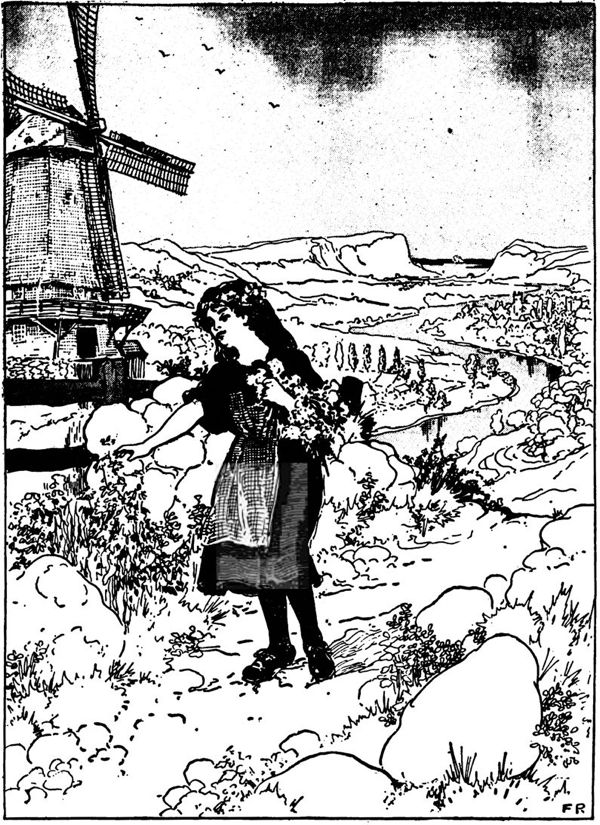
Great, wide, beautiful, wonderful world,
With the wonderful waters round you curled,
And the wonderful grass upon your breast,
World, you are beautifully drest!
The wonderful air is over me,
And the wonderful wind is shaking the tree—
It walks on the water, and whirls the mills,
And talks to itself on the top of the hills.
You friendly Earth, how far do you go,
With the wheatfields that nod and the rivers that flow,
With cities and gardens, and cliffs and isles,
And people upon you for thousands of miles?
Ah! you are so great, and I am so small,
I hardly can think of you, World, at all;
And yet when I said my prayers to-day,
A whisper within me seemed to say,
“You are more than the Earth, though you are such a dot;
You can love and think and the Earth cannot.”
—William Brighty Rands
Don’t you like to watch the setting sun as it seems to drop down behind the edge of the world? Then our day is over and our night begins.
When we see the glorious sun again in the morning, it seems to come up over the edge of the world at a point in the sky just opposite to the place where we saw it set.
This makes us think of the wonderful ball on which we live,—a great ball that turns over and over, and always in the same direction.
At sunset, we know the ball is turning our side of its surface away from the sun. But it is only for a little while. It will soon turn us again toward the light of the great sun.
Sunrise and sunset make us think of the children who live on other parts of the surface of our great ball. We know that on the other side of this ball, the little children are waking to greet the rising sun, just when we are saying good-night to it at its setting. As you stand watching the sunset and thinking of those children on the opposite side of the ball, do you not wish to know them? Shouldn’t you like to visit them in their far away homes? Perhaps you may really visit them some day.
But until that day comes, you can read about them, and take imaginary trips to some of their countries.
A fair little girl sat under a tree,
Sewing as long as her eyes could see;
Then smoothed her work and folded it right,
And said, “Dear work, good-night, good-night!”
Such a number of rooks came over her head,
Crying, “Caw! Caw!” on their way to bed;
She said, as she watched their curious flight,
“Little black things, good-night, good-night!”
The horses neighed, and the oxen lowed,
The sheep’s “Bleat! Bleat!” came over the road,
All seeming to say with a quiet delight,
“Good little girl, good-night, good-night!”
She did not say to the sun, “Good-night,”
Though she saw him there like a ball of light;
For she knew he had God’s time to keep
All over the world, and never could sleep.
The tall pink foxglove bowed his head,
The violets curtsied and went to bed;
And good little Lucy tied up her hair,
And said on her knees her favorite prayer.
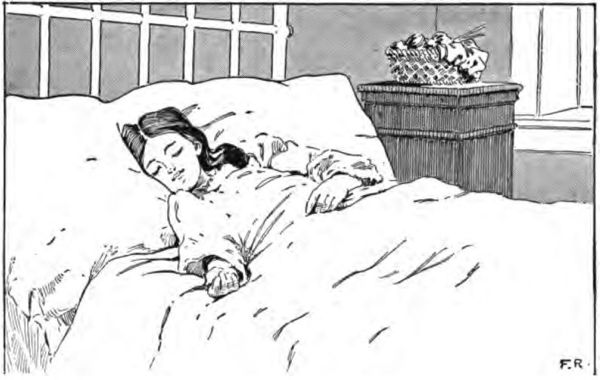
And while on her pillow she softly lay,
She knew nothing more till again it was day,
And all things said to the beautiful sun,
“Good-morning! Good-morning! our work is begun!”
—Lord Houghton
Let us go first to the land that is nearly opposite us on the great Earth ball. This land is Japan. The country of Japan is made up of islands that lie out in the sea to the east of the other countries nearby. So the Japanese people are the first people in their part of the world to say “Good-morning” to the beautiful sun, which seems to rise right out of the ocean.
They may very well call their country by the name they like best for it, “The Kingdom of the Rising Sun.” The flag of Japan is red and white, and shows the round sun with its rays, instead of being red, white, and blue, like our Stars and Stripes.
Some of the islands are very small. Some of them are quite large—large enough to have high mountains on them. One of the high mountains, of which the people are very proud, is a volcano. It seems strange that people should be proud of a volcano, doesn’t it? But it does not now send out fire and smoke, and is a very beautiful mountain, indeed. In almost every picture painted or drawn by one of the Japanese, you will see this beautiful mountain, which is always covered with snow.
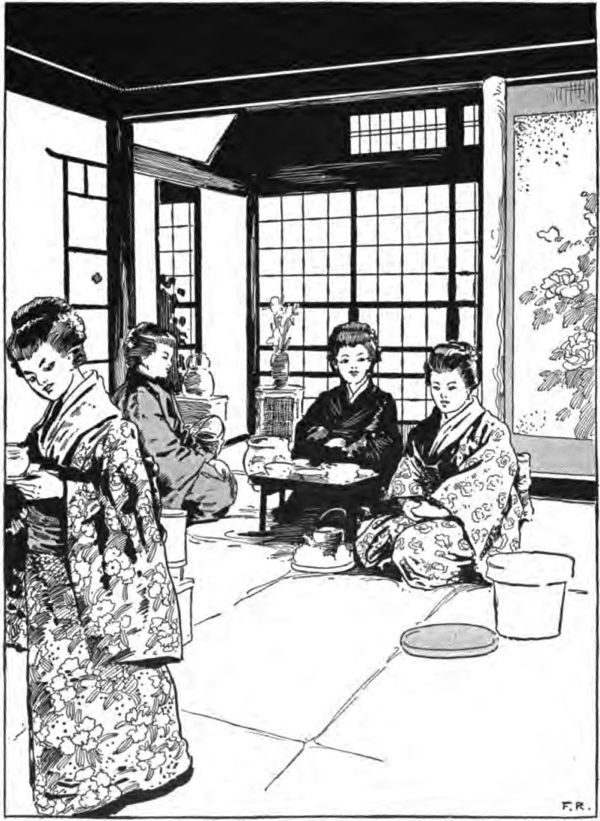
The houses in Japan are so low and so small that they would look to you like good-sized playhouses. But remember that the people in Japan are small, too, and do not need such large houses as some of us do.
There are several other reasons why the houses are not large. One reason is that very often there are earthquakes in Japan, and so the people do not wish to have high and heavy buildings. When large buildings are shaken down by earthquakes, many people are likely to be killed, and their beautiful things broken. Then, too, it costs a great deal to build the houses up again.
Most of the houses in Japan are built of bamboo, a strong cane. They have no doors and no windows that open and shut like those in our houses. The walls are made of strong paper, stretched over bamboo frames. They are nothing but paper screens that can be moved backward and forward like sliding doors. If your house were likely to fall down in an earthquake, would you rather have it of stone and wood, or of paper and bamboo?
A Japanese family can have as many or as few rooms as they wish, just by pulling out or pushing back the walls or screens.
There are no bedsteads, no chairs and no large tables in a Japanese house. The floors are covered with beautiful white rugs or mats, on which the people sit, instead of on chairs. At their meals each person has before him a tiny table, not more than a foot high.
The Japanese drink a great deal of tea and eat a great deal of rice. They have beautiful dishes and bowls, but they eat with chopsticks instead of with knives and forks.
The people sleep on the floor mats, covering themselves with soft quilts. The pillow is a little block of wood having a roll of soft paper on which the sleeper rests his neck.
Since the floors are the chairs and beds of the houses, of course no one wears shoes indoors. Out of doors the people wear sandals of wood or straw, which are fastened to the feet by straps, and can be very easily slipped off at the door. You can often tell how many people are in a house by the number of sandals there are in the row at the front door.
Instead of stockings, they wear foot gloves. A foot glove has a place for the big toe just as our mittens have places for the thumbs.
When it rains, the people wear wooden clogs. These clogs are high enough to keep the feet out of the water and mud, so that rubber overshoes are not needed. Their raincoats, hats, and umbrellas are all made of strong oiled paper or rice straw. There are three times in the year when it rains nearly every day in Japan. One of these times is during the last two weeks of April; another is during the last two weeks of June; and the third time is the whole month of September.
When people go to ride in Japan, it is in a two-wheeled carriage, which is something like a large go-cart and is drawn by a man instead of by horses. These men can run very fast for a long time without feeling tired.
The people of Japan are very fond of flowers and raise a great many chrysanthemums. They can do wonderful things with these flowers, making them bloom sometimes in the shape of a vase, or a bird, or even a boy.
Japanese mothers and fathers like to name their little girls for flowers. “O-Kiku” means Miss Chrysanthemum. We are going to read about a little girl named O-Kiku.
The people have three great festivals every year, when the peach, plum, and cherry trees are in bloom. The “Festival of the Cherry Blooms” is the greatest of these flower feasts.
The children in Japan are said to be the best in the world, as well as the happiest. It is not at all strange that they should be both, for their parents do much to give them pleasure.
I saw you toss the kites on high
And blow the birds about the sky;
And all around I heard you pass,
Like ladies’ skirts across the grass—
O wind, a-blowing all day long,
O wind, that sings so loud a song!
I saw the different things you did,
But always you yourself you hid.
I felt you push, I heard you call,
I could not see yourself at all—
O wind, a-blowing all day long,
O wind, that sings so loud a song!
O you that are so strong and cold,
O blower, are you young or old?
Are you a beast of field and tree,
Or just a stronger child than me?
O wind, a-blowing all day long,
O wind, that sings so loud a song!
—Robert Louis Stevenson
Yoshi-San is a Japanese boy and O-Kiku is his little sister. Their father, who is a rich man, lives in a Japanese city.
O-Kiku is a very pretty little girl. Both she and Yoshi-San have yellow skin, very black hair, and black eyes that seem to be set slantingly in their faces. O-Kiku’s long hair is carefully done up and dressed with beautiful silken bows and long silver hairpins like her mother’s. Yoshi-San’s hair is nearly all shaved off his little round head, like the Japanese dolls which you may have seen. When Yoshi-San grows up to be a man, he will not have his head shaved, unless he becomes a priest in one of the Japanese temples.
Both children wear long silken robes with sashes around their bodies, high up under the arms. They have their pockets in their big flowing sleeves.
O-Kiku and Yoshi-San dress and look so much alike that at first it would not be easy for you to tell them apart, nor to know them from any of their little playmates.
These children do not know anything about Christmas or Santa Claus. New Year’s Day is their greatest holiday, when there is always a great deal of feasting and visiting, and every one receives a great many presents.
On the third day of March O-Kiku will be a very happy little girl. On that day she will receive a new doll and many other new toys.
But there will be something better than this. Her mother will unlock the store-room, which has been shut up for a year. She will take out a great many boxes in which are many, many dolls, some almost as large as O-Kiku, and some very much smaller. There are nearly a hundred of these beautiful dolls—lady dolls, baby dolls, a doll King, and a doll Queen.
O-Kiku’s mother will also bring out doll-trunks, full of beautiful doll clothes. Then, too, there are toy tea-pots, bowls, vases, and tiny tea-tables. O-Kiku will dress the dolls and give them a feast. Of course, she will have to eat the cakes and drink the tea for them.
All these lovely things once belonged to O-Kiku’s mother and some of them even belonged to O-Kiku’s grandmother. When the day is over, the dolls will all be put away until the next “Feast of Dolls.”
The best of Yoshi-San’s holiday festivals is the “Feast of Flags,” which comes on the fifth day of the fifth month. Early on that morning his father and his grandfather will stand with him by the high pole which is in front of the house. On the top of the pole Yoshi-San will raise a big paper fish. This fish, which is hollow, puffs out as soon as the wind strikes it. The wind makes it flap its tail and fins, and tug on the line like a real fish on a hook. These paper fish are bright red and gold. Just think how beautiful the Japanese cities must look on the day of the “Feast of Flags!”
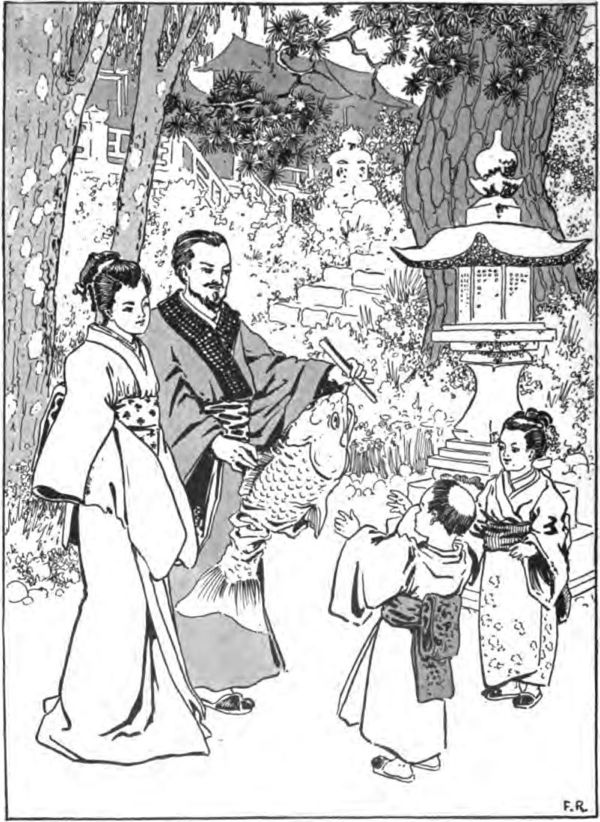
The paper fish looks like the carp, which is the strongest and boldest fish known in Japan. It swims against the current and leaps over waterfalls. The Japanese people are very happy and gay, and laugh a great deal. But they are also very brave and like other things that are brave. And so they are proud of this big, strong fish.
Yoshi-San’s father tells him that just as the carp is the strongest and bravest of all fish, so Yoshi-San must be the strongest and bravest of all boys, and must be kind to the weak.
Then he gives Yoshi-San some new toys which he has long wanted to have. The store-room is again unlocked, and the toys that belonged to his father and grandfather are given to Yoshi-San to play with all day. There are toy soldiers, guns, swords, drums, flags, and everything else that is used in war.
Yoshi-San and his little playmates have mock battles all day. When the day is over, the toys and flags are locked up in the store-room for another year.
When kite time comes, Yoshi-San and all Japanese boys are happy. Even the old men like to fly kites with the boys.
They have kites of all sizes and colors,—in the form of birds, butterflies, fans, flowers, funny faces, and many other things. There are kites that make music as they rise in the air. There are kites with strings made sharp by glue mixed with pounded glass.
They can have real battles in the air with these kites. A boy will get his sharp kite string right across another boy’s sharp kite string. Then each tries to saw through the other’s until one or both kites fall to the ground. When only one kite falls, it belongs to the boy who cut the string.
But Japanese children do not spend all their time in playing games. They go to school also and learn to read books that are much harder to read than your books. They are very fond of hero stories, of which there are many in Japan. There are also many very pretty fairy stories.
“Taro and the Turtle” is one of these fairy stories. When you read it, you may think of the Japanese children playing with their pet turtles and watching their funny ways of walking.
But in all their play Japanese children never tease or hurt these poor helpless pets. It is not often that any one is unkind to animals in Japan.
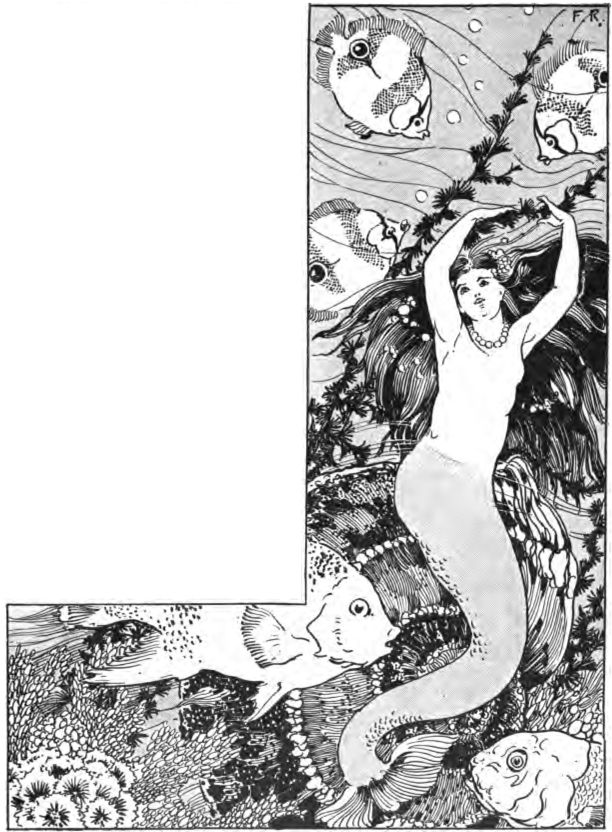
Who would be
A mermaid fair,
Singing alone,
Combing her hair
Under the sea,
In a golden curl,
With a comb of pearl,
On a throne?
I would be
A mermaid fair;
I would sing to myself
The whole of the day;
Under the sea;
With a comb of pearl
I would comb my hair
Till my ringlets would fall
Low adown, low adown
From under my starry sea-bud crown,
And I should look
Like a fountain of gold
Springing alone
In the midst of the hall.
—Alfred Tennyson
(Abridged)
Long, long ago an old fisherman in Japan had a son named Urashima Taro.
One day Taro was out fishing in his father’s boat. As he drew in his net, it felt very heavy and Taro opened it, thinking he had caught a large number of fish.
Instead of a fish, however, he had caught a big sea turtle.
Taro had always heard that turtles live to be a thousand years old.
“It would be a pity to kill this turtle,” said Taro. “It might live for hundreds of years yet, and I am sure it would be kinder to put it back into the water.” With that, he dropped the turtle, which at once sank into the sea.
The next day, sitting in the boat, Taro heard a voice saying, “Taro! Taro!”
He looked down into the water, and there was the same big turtle looking up at him.
“Have you heard of the Sea-King’s palace, Taro?” said the turtle.
“No,” said Taro. “Where is it?”
“It is far down under the deeps of the ocean,” said the turtle. “It is the most beautiful palace you can imagine. It is built of crystal—not common glass such as you have seen—but of the finest, clearest, and most costly crystal.
“The floors are made of pearls that are as white as milk, and of shells that are most beautifully colored, green, purple, rose-pink, and silvery gray.
“The palace stands in the midst of a wonderful garden, where grows beautiful seaweed like green and yellow lace. The wall around this garden is built of the most wonderful and curiously formed shells.
“Should you not like to go to the Sea-King’s palace, Taro?” asked the turtle.
“Yes, I should like to go and see it, but I could not stay very long,” said Taro.
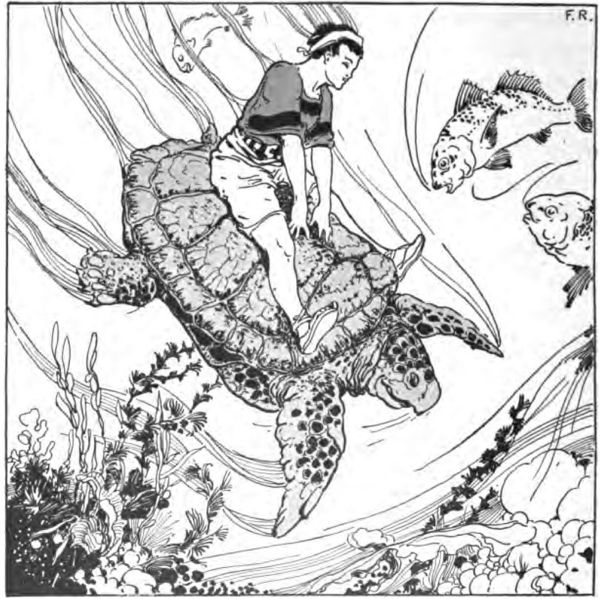
“Well, jump upon my back and I will take you there,” said the turtle.
Taro jumped upon the turtle’s back and down, down, down they went, deep under the ocean.
Soon they saw the Sea-King’s palace. It was even more beautiful than the turtle had pictured it,—all of shining white crystal.
On a large rock near the palace, Taro saw a little sea princess. Her face was as fair as the snowy blooms of the cherry. Her cheeks were as pink as the rosy blossoms of the peach. Her hair was black as the night and her eyes were as bright as the stars.
Her robe was of the seaweed’s green lace and around her neck were strands of reddest coral. She had been playing with pink and pearly gray shells, which she had built into a little wall around the great rock.
When she saw Taro, she threw away the shells she had been playing with, and, holding out both hands, cried,
“Welcome, kind Taro! Welcome to the Sea-King’s palace.”
She led him by the hand into the great hall of the palace. Then her father, the Sea-King, said, just as the princess had said,
“Welcome, kind Taro! Welcome to the Sea-King’s palace. The turtle has told us of your kindness to him. Because of your kind heart, we sent the turtle to ask you to come and live with us. We hope you will be happy here.”
Taro was delighted and said he would stay for a while in the Sea-King’s palace.
A happy time now began for Taro. He and the little princess played in the garden of seaweed and in the shining caves, or grottos, of the Sea-King’s palace. They gathered more of the wonderful colored shells, and strung necklaces of rose-red coral and milk-white pearls. They petted the gold and silver fish that came leaping through the water at the call of the princess. They would catch the largest of the fishes and ride on them for hours through the shining waters.
When the day faded from over the sea, the little princess sprang into a great shell, that was shaped like a boat. In this shell the princess was rocked to sleep by the gently moving water.
Taro slept in another beautiful shell, the longest to be found in the sea.
Sometimes, when the princess was asleep, Taro was very lonely in the great ocean deep, and would think of his little home near the sea shore. But he forgot that home when the princess was again awake.
One day when they had risen nearly to the surface of the ocean, a dark shadow fell over them. It was a big sea vessel sailing above them. With all its sails spread, it looked like some great white-winged bird flying over the ocean.
Another time, they were so near the surface that they could hear the shouts of the children playing in the sands by the sea shore. This sound made Taro think of his home again. So he told the little princess that he must go and see his father and mother.
The princess begged Taro not to go, but he said, “I must go. But I will soon come back, and then I will stay longer in the Sea-King’s palace.”
When the princess saw that he would go, she gave him a curious box made of shell and set with pearls. She told Taro to keep this box most carefully until he returned, but that he must never, for any reason, open it.
Taro promised to do as she said. Then the little princess said good-bye to him and called the turtle to carry him to the top of the ocean and to leave him on the shore.
After the turtle had landed him safely, Taro hurried through the village, passing many people on his way, but not one did he see whom he knew. They were all strangers to him.
At last Taro came to the spot where his father’s house had stood. To his surprise, a new building was there, and strangers were going in and out of the door, as if they lived there.
Taro asked one of the strangers if he could tell him where his father and mother were. He said, “I am Urashima Taro.”
“Urashima Taro!” said the man. “It seems to me that I have heard that name. Oh, now I know. Urashima Taro was the name of the fisher boy who was drowned in the ocean long, long ago.”
“I am Urashima Taro. I was not drowned,” said Taro. “I have been away for only three weeks, but how everything has changed!”
“I do not know what you are talking about,” said the man. “Everybody knows about the boy Urashima Taro who was drowned in the ocean three hundred years ago. The boy lived in the village with his father and mother. There is an old, old book in the village that tells all about Urashima Taro of long ago. But I don’t know who you are.”
Then a strange feeling came over Taro—a feeling that what the man said was true. He knew then that, instead of three weeks, it was three hundred years since he had left this village.
With a great loneliness in his heart, poor Taro said, “I will return to the Sea-King’s palace; there I have friends—on the earth no one knows me.”
With this, he turned and walked back to the sea shore. He wondered how he could find his way back to the Sea-King’s palace.
Then he remembered the shell box which the princess had given him.
He took it out and looked at it.
Perhaps there was something in it that would help him to find his way back to the Sea-King and the little princess.
Perhaps she had known how it was going to be, and how Taro would find that all of his friends had been dead for many years.
Perhaps she was afraid that Taro would not know the way back to the palace.
Taro made up his mind to look and see what was in the box, anyway, and if it was nothing that could help him, he would close it up again with care. He would not hurt anything that belonged to the little princess who had been so kind to him down under the sea.
He raised the lid quite easily. As he did so, a little cloud of white smoke rose from the box and covered his face.
Then a most strange thing happened: Taro’s hair became as white as snow. His face and hands became a mass of wrinkles. He felt too weak to walk any further. He was an old, old man. In a few minutes he fell to the ground dead.
If only he had not broken his promise! Then Taro would have found the turtle waiting to carry him back to the Sea-King’s palace.
Down in the water that looks so green
See Little Mermaid flash as she turns;
She’s chasing the fishes—that’s plain to be seen—
And laughs as she follows them, darting between
The rocks and the shells and the waving sea ferns.
Perhaps they’ve been nibbling the ends of her hair,
As she combed it through with her comb of pearl,
And perhaps she cried, “Oh, that’s not fair!
You’re scaly, I know, but I can not spare
The tip of a single golden curl.
“So I’m going to chase you, you mischievous fishes!
And the first one I catch must pay forfeit for all.
You nibbled my hair; now grant my three wishes:
For a new crystal mirror, some pink coral dishes,
And a ride on your back to the Sea-King’s hall.”
A silvery streak in the pale green water—
Ah! she has caught one! hear her laugh:
“Old White-Fin, you aren’t so quick as you thought, or
You never would carry the Sea-King’s daughter
Home on your back, while the turtles chaff!”
So she plays all day in the cool green deep,
With the mirror and dishes that White-Fin brings;
And at night in her shell she is rocked to sleep,
While the fishes who teased her, a close watch keep,
And the murm’ring tide her lullaby sings.
—Doris Louise Nash
I am digging, digging, digging, just as fast as I can,
I am digging in the sand by the sea;
For I think that down below,
Where the palms and lions grow,
A little boy is digging up to me.
He is digging, digging, digging, as quickly as he can,
He is digging in the desert hot and dry;
I can almost hear the sound
Of his shovel in the ground,
And soon we shall be talking, he and I.
I am digging, digging, digging, and the sun is nearly set,
I am digging, but the bell has rung for tea,
Oh, suppose while I’m away
The waves come up to play,—
They often do—how dreadful it would be!
I’m digging, digging, digging, and I’m nearly starved to death,
But I must fill the hole before I go!
For the waves are creeping near,
And I have an awful fear
That they will drown the little boy below.
—Abbie Farwell Brown
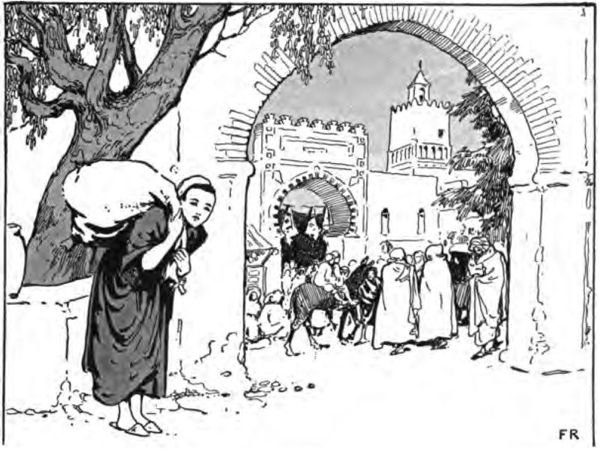
Arabia is another country far away on the other side of our great Earth ball. The people who live in Arabia are called Arabs. Many of them live in the towns and cities, which have walls around them. In these cities most of the houses are built of stone. Sometimes the roofs are of dried mud, because some of the people are so poor that they cannot afford to make whole houses of stone. All houses have flat roofs, and at evening the people sit, and sometimes sleep, on these roofs.
The Arabs are ruled by chiefs called Sultans. The most powerful Sultan—sometimes called the Caliph—lives in one of the cities of a great country called Turkey.
There is never any snow in Arabia. In some parts of the country the people have to dig very deep wells in order to get water, for there are no rivers at all. When the people wish to carry water, they put it into leather bottles or bags, called water-skins. The heat of the sun is so great that it would go through glass bottles, and keep the water warm.
A great part of Arabia is desert. Here there is nothing but sand and rock. The sand is so hot that you could not walk over it with your bare feet in the daytime. Here and there in the desert are springs of water that come from deep down under the ground—so deep that the sun cannot dry them up. These springs are few and far apart, but wherever there is one, green grass very soon covers the ground all around it. Soon fig trees and palm trees grow tall and graceful, making a cool, green, shady place around the spring. Such a place is called an oasis.
The Arabs who are not in the cities live in the desert all the year round. They live in tents that can be put up and taken down very easily and quickly, so that they can move from one oasis to another, seeking grass and water for their sheep, goats, camels, and horses. These desert Arabs eat ripe, sweet figs, and also the dates that grow upon the palm trees; they dry them, too, and use them as food the year round. All the dates and figs that you have seen in this country are not the ripe fruit, but have been dried.
These Arabs have the finest horses in the world. An Arab is very proud of his riding horse, and loves him almost as much as he loves his wife and children. He never puts heavy loads upon his horse, and often lets him stay in the tent with his family.
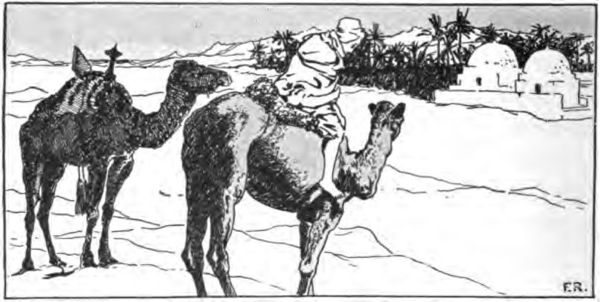
The camel is much more useful to the Arab than his beautiful horse, however, for it is much larger and stronger. One camel can carry as much or more than two horses. The Arab loads the camel with goods and rides him too, for miles and miles across the desert—just as if he were really the “Ship of the Desert,” which he is often called.
The camel seems to have been made especially for desert life. His legs are very long and strong, with broad, flat-soled feet. When he steps, his soft, padded toes spread far apart and keep him from sinking into the sand. His eyes have long lashes which keep out the blowing sand, and the openings in his nose are lined with fine hairs, which prevent him from drawing the sand into his lungs.
These animals can travel for three or four days without taking a drink of water. Before beginning a journey, they drink and drink for a very long time at the spring or well. Part of this water is stored away in a kind of bag that is in the camel’s stomach, and, during the journey, he uses the water little by little, as he needs it. The camel can also go a long time without food. He has a great hump of flesh upon his back. When he starts on his journey, the camel’s hump is strong and firm, and will stay so as long as he is well fed. If the feed gives out during the journey, this hump grows smaller and smaller every day. The camel is living on it; it takes the place of food for a while.
The Arabs use camel’s milk as we use cow’s milk. When they need meat to eat, and have not plenty of goats or sheep, they kill a camel for food. Sometimes when Arabs are lost in the desert without water to drink, they kill one of their camels to get the water that is in his stomach. A strong cloth is woven from the camel’s hair, and is called “camel’s hair cloth.”
All these things make the camel more useful to the Arab than anything else in the world.
Ahmed is a little Arabian boy and Zobeide is his sister. They live on the desert in Arabia.
Ahmed’s father has goats, sheep, camels, and one horse. He has to move from one oasis to another for grass and water to feed them.
During the hot season Ahmed’s family travels by night. When the sun grows hot in the early morning the tent is pitched for a rest. The sheep, goats, and camels are given water and fed. Then the family go into the tent, lie down on the mats and sleep away the hot hours until night, when they take up their journey again.
One hot evening Ahmed and Zobeide with their parents were waiting for the sun to set. They were then to begin their journey to a distant oasis. Ahmed and his father had fed the herds and were sitting on mats before the tent. They were not talking. Ahmed looked far away across the wide, wide desert toward the setting sun. He could see nothing but sand and rocks, and above them the sky, which had been all day like hot brass, shining so that it hurt his eyes to look at it. His father was smoking a long pipe, and he, too, was looking far away across the silent desert.
Inside the tent, Zobeide and her mother were making cakes of barley and water for their supper. They had first ground the grain between two flat stones, one stone placed on top of the other. There was a hole in the middle of the upper stone, and into this the grain was poured. Then they turned the upper stone round by a handle until the grain was crushed into meal. They made this meal into thin cakes and baked them on hot iron plates.
Zobeide and her mother both wore long, loose gowns of blue cotton cloth. Whenever they go to one of the towns, they wear long pieces of blue cotton cloth over their faces. These are placed so that only their eyes can be seen, for the Arabs believe that the faces of women and girls should always be covered in public. Zobeide and her mother both wore sandals, though sometimes they go barefoot.
Ahmed and his father wore long robes of light cotton cloth. The robes were gathered in at the waist by belts. They, too, wore sandals, and turbans to protect them from the sun. These turbans are long pieces of cloth folded around and around their heads and held in place by strings.
Ahmed and Zobeide, and their parents, are white people, though their skin is tanned very dark, almost brown. Their hair is black and straight. Their eyes, too, are black, but they are not set slantwise in their faces as the eyes of the Japanese seem to be.
Zobeide and her mother did not eat their supper until the father and Ahmed had finished. This might not seem very kind or polite of the father. But it is the way the Arabs do at all times.
By the time they had all eaten their supper the sun had nearly gone down. Ahmed and his father took down the tent, folded the cloth, and tied the poles together. Before long, these were packed on one of the camels. All the household goods—mats, bags of clothing, packs of food, the few dishes and cooking vessels, and the water-skins,—were soon packed on the backs of the other camels.
The camels all drank their fill at the spring, and then knelt on the sand while the heavy loads were being packed upon their backs.
On the camel for Zobeide and her mother was arranged a seat with a tent-like cover. When this camel knelt, the little girl and her mother took their seats under the cover. Then the camel rose and they all started on their journey.
Ahmed was ahead on his camel. The father, on his horse behind all the others, drove the sheep, goats, and camels forward, while he kept a sharp lookout for wild beasts and robbers.
It had grown cool with the fall of night. A new moon was shining and the stars were twinkling in the skies as the little caravan moved across the desert.
How still everything was! Not a sound of any kind was to be heard except the movement of the animals upon the soft sand. How strange everything would have seemed to you! The wide, lonesome, silent desert might have frightened you. But Ahmed and Zobeide were not afraid. They had lived in the desert all their lives.
There was no road, no path to direct them, but Ahmed’s father had taught him how to travel by the stars. So as the boy went forward, he looked up at the stars.
The camels walked with long, easy, swinging strides. The little girl and her mother were gently rocked from side to side, and after a while they fell asleep.
When Zobeide waked, the newly risen sun was shining in her eyes, but her father said they must travel for a while longer before they pitched the tent.
All at once they heard a strange rustling sound coming from far away. The hot sand was beginning to whirl and blow about. The camels at once lay down and pushed their noses into the sand. At the same time the children heard their father crying, “A sand storm is coming! Throw your cloaks over your heads. Lie flat on the ground beside the camels!”
There was hardly time to do this before the great clouds of sand were close upon them. Like waves the sand came whirling, rolling, thick and fast. How thankful they were when the sand rolled by and left them safe! It might have covered them so deep that they would have been killed.
Soon after this they pitched the tent and rested until sunset. Then they traveled on again.
Early the next morning Ahmed shouted to Zobeide to look at a great bird that was running across the sand. The bird’s legs were very long and it was nearly as tall as a horse. Its wings were very short and the great bird kept them spread as it ran swiftly over the sand.
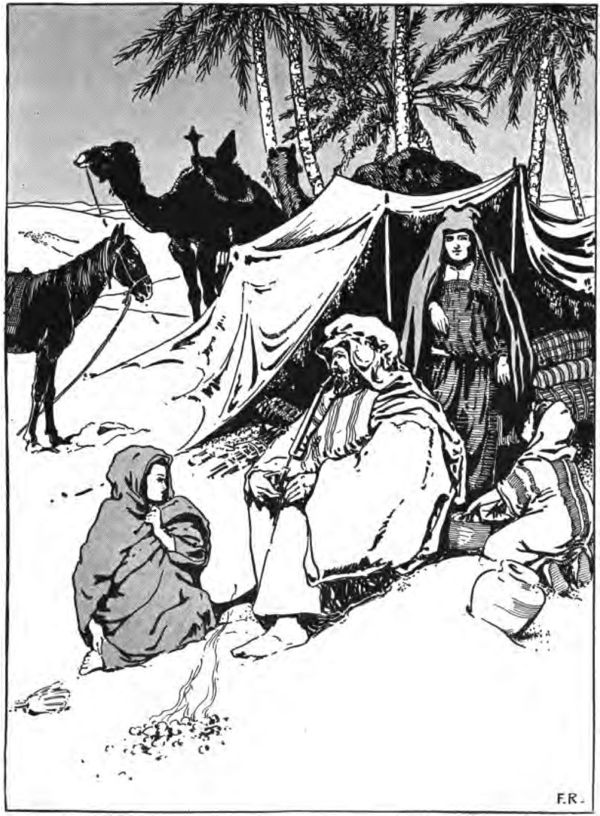
Zobeide knew at once that it was an ostrich and that most likely it had a nest full of eggs in the sand somewhere nearby. In a very few minutes Ahmed called out that he had found the nest.
It was a strange nest that Zobeide saw, just a great hole hollowed out in the sand with several large eggs in it. These eggs were nearly as large as Zobeide’s head. One of them would make a meal for a whole family. Ahmed was very glad to gather them for his mother; for he knew that now for a day or two they would have fresh eggs at their meals.
By and by the camels began to stretch their necks and to sniff the air as they moved forward faster.
“The camels smell the water. We must be near the oasis, father!” cried Ahmed.
Before long, they saw the tops of palms waving high in the air like great green feathers. Then they heard the sound of running water. They had reached the cool shade of the green oasis.
Soon the tent was pitched and they made ready to rest for many days. The first thing Zobeide did was to play with her doll. Such a funny doll as it was! Only two sticks joined like a cross, but it was dressed like a baby and Zobeide loved it. The little girl’s mother at last had time to teach her how to spin and weave the blue cloth for their clothes, while the father taught Ahmed to read the Koran. The Koran is the Arabs’ Bible and is the only book that Arabian boys use when learning to read. Zobeide listened to her brother’s lessons, but little Arabian girls do not learn to read. Both children loved to listen to the stories their father told at nightfall, and to the songs he sang in the soft Arabian tongue.
To Ahmed and Zobeide the oasis was the lovely part of their desert home.
Great is the sun, and wide he goes
Through empty heaven without repose;
And in the blue and glowing days
More thick than rain he showers his rays.
Above the hills, along the blue,
Round the bright air with footing true,
To please the child, to paint the rose,
The gardener of the World, he goes.
—Robert Louis Stevenson
(Abridged)
One night Ahmed’s father sang a new song for him and Zobeide. It was a song that told about an Arab and a horse who loved each other very much. This is the story told in the song:
Once upon a time an Arab named Hassan owned a very fine horse, the most beautiful that had ever been seen in Arabia. The Sultan boasted that he had the finest horses in the world, but not one of them could compare with Hassan’s horse in fleetness, beauty, and strength.
This horse would let no one but his master sit upon his back. When Hassan sprang into the saddle, however, he seemed wild with joy and pride, and would speed over the desert with the fleetness of the wind.
When Hassan stood by his side and petted him, the beautiful creature would lay his head on his master’s shoulder, seeming to understand everything that was said to him. Was it any wonder that Hassan loved him more than anything in the world except his wife and children?
It happened once that Hassan was traveling across the desert on his beautiful horse, in company with some other Arabs. On the way they met a large party of men from Turkey who made captives of them.
The Turks tied the Arabs’ feet together with strong leather bands so that they could not run away. Then they tied the horses with strong cotton ropes. They intended to keep the horses and carry the Arabs away to sell as slaves.
One night, while the Turks were asleep, Hassan heard his horse neighing. He dragged himself slowly along the ground until he reached his horse.
Then Hassan said in a low voice, “I cannot leave thee with these cruel Turks, my darling. You will never be happy with them. Go home to the tent, my beauty. Lick the hands of my wife and children with your gentle tongue and thus tell them that I love them. Tell them that they will never see their Hassan again.”
Then little by little he bit through the cotton rope that bound the horse.
When the animal found that he was free, he stood still, and looked down at his master with a great love glowing in his splendid dark eyes. Then taking in his teeth the belt that was around the man’s waist, he caught up his master and was off, running like the wind over the desert plains.
On and on he went, all night long. He did not stop until late next day when he reached Hassan’s tent. Gently he laid Hassan at his wife’s feet, and then, worn out by the long hot race, his great heart broke and he fell dead at his master’s side.
All the people in the oasis wept when they heard of the great deed of the noble horse, and long years afterward the Arab poets made more than one beautiful song about Hassan and his beautiful horse.
Come, my beauty! come, my desert darling!
On my shoulders lay thy glossy head,
Fear not though the barley sack be empty,
Here’s the half of Hassan’s scanty bread.
Thou shalt have thy share of dates, my beauty!
And thou knowst my water-skin is free;
Drink and welcome, for the wells are distant,
And my strength and safety lie in thee.
Bow thy forehead, now, to take my kisses!
Lift in love thy dark and splendid eye;
Thou art glad when Hassan mounts the saddle,
Thou art proud he owns thee; so am I.
Let the sultan bring his boasted horses,
Prancing with their diamond-studded reins;
They, my darling, shall not match thy fleetness,
When they course with thee the desert plains.
—Bayard Taylor
Once upon a time there lived in the city of Bagdad a man whose name was Ali Cogia.
Now it chanced that Ali Cogia wished to go upon a journey across the desert. All he owned, besides his little home, was a thousand pieces of gold. He feared to take the gold with him, knowing how often caravans were robbed by roving desert bands.
After much thought he hit upon what he believed to be a good plan. He took a large earthen jar and put the thousand pieces of gold into it. Then he filled up the jar with olives and closed the mouth tightly.
Taking the jar to a merchant who was a close friend of his, he told him of the journey he was about to make. Then he asked the merchant if he would keep the jar of olives for him until he should return.
“Why, certainly, my friend,” said the merchant. “Here is the key to my warehouse. Open it and set your jar where you think best. You shall find it there when you return.”
So Ali Cogia put the jar of olives in his friend’s warehouse, said good-bye to him, and went upon his journey. Seven years went by and still the traveler had not returned to Bagdad.
One evening while the merchant was supping with his family, his wife happened to wish for some olives.
“You put me in mind of the olives that Ali Cogia left with me,” said the merchant. “He has been away seven years, now. As I have never heard from him, he must be dead. We may as well eat the olives if they are still good. Give me a dish and a candle. I will go to the warehouse and fetch some so that we may taste them, and see whether they are good.”
His wife begged that he would leave his friend’s olives alone, but the merchant would not listen to her, saying that if she wanted olives, there were plenty for all, and that if Ali Cogia should return, he should be paid for what were eaten.
He went to the warehouse and opened the jar, but on tasting one of the olives he found that it was mouldy. He turned the jar down to see if the others were mouldy, and, as he did so, some of the gold pieces fell out on the floor.
In this way the merchant found that only the top layer was of olives, and that below it was the gold. He put both gold and olives back into the jar and closed it. Then he returned to his wife and said,
“You were quite right, so I have left the olives just where I found them. They were mouldy, anyway, after these seven years.”
Now the merchant’s love of gold made him dishonest. He spent most of that night thinking how he might take the gold without any risk of being found out, should the owner return and claim the jar. The next morning he took the gold and the old olives out of the jar and replaced them with some fresh olives which he had bought. Then he closed the jar.
Strangely enough, a few days after this, Ali Cogia returned to Bagdad. One of the first things he did was to go to the merchant for his jar of olives and gold money.
“I hope it has not been in your way at all,” he said to the merchant.
“My dear friend,” said the dishonest merchant, “your jar has not been in my way at all. There is the key to my warehouse. You will find your jar just where you left it.”
When Ali Cogia reached his home, he opened the jar. To his surprise he found it full of olives without one piece of gold!
He returned at once to the merchant and said,
“My good friend, before I went on my journey I put into that jar a thousand pieces of gold under the layer of olives. I do not find them now. If you had need of them and have used them in trade, you are welcome to them until you can pay them back. Only give me a written word to say that you will do so.”
The dishonest merchant was ready with an angry answer.
“You left a jar in my warehouse. You found it in its place. You took it away. Now you come and ask me for a thousand pieces of gold of which I know nothing. I wonder that you do not ask me for diamonds or pearls. Begone from here at once!”
The noise of their quarrel drew many people to the place and they heard Ali say, “You shall go before the judge and be tried for what you have done.”
“With all my heart,” said the dishonest merchant. “We shall soon see who is in the wrong.”
So Ali Cogia took the dishonest merchant before the judge, to whom he told all that had happened.
The judge asked who had been present when all this took place.
When Ali Cogia told him that no one had been present except the dishonest merchant and himself, the judge set the merchant free, saying that since Ali Cogia could not prove that what he said was true, nothing could be done to the merchant.
Ali wrote at once to the Caliph who ruled Bagdad, telling him the whole matter and begging him to try the merchant himself.
The Caliph answered that the trial would take place the next day.
That evening the Caliph was walking through the city with one of his officers—called the Grand Vizier. They were dressed in such a way as to prevent any one from knowing who they were.
As they passed by a walled court, where a crowd of boys were playing, they heard one boy say,
“Let us play at judge and court. We will try Ali Cogia and the merchant.”
To this the other boys readily agreed, for they had all heard about Ali Cogia and the merchant.
The boy who had thought of playing the game took the part of the judge, seating himself very quietly and gravely upon a stone bench. Several of the boys took their stand near the boy judge to act as court officers. Another boy was named to act the part of Ali Cogia and still another was to be the dishonest merchant. Then the boy judge said that he wished two others to stand at some distance ready to come as olive merchants when he should send for them.
The boys did not know that, hidden in the shadows, watching their mock trial, were the Caliph and his Grand Vizier.
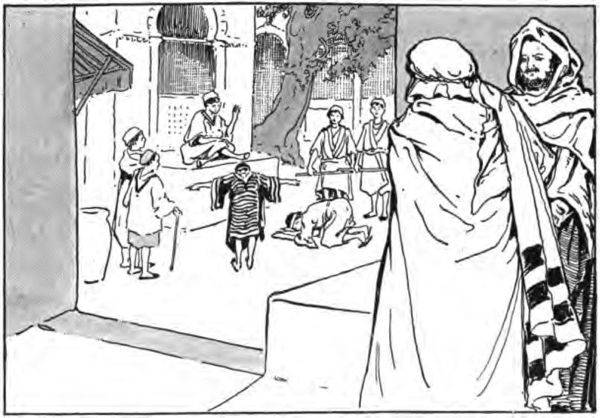
(The judge sits cross-legged on a throne, while in front of him stand Ali Cogia and the dishonest merchant. At one side are several court officials, ready to do the bidding of the judge.
What charge, Ali Cogia, have you to bring against this merchant?
(bowing almost to the ground before the judge) Sir, I believed this man to be my friend. Before leaving the city to go upon a journey, I carried to him a jar of olives, asking him to keep it for me until I returned. He kindly gave me the key to his warehouse, telling me to leave the jar there. I placed the jar in a safe place in the warehouse, locked the door, returned the key to the owner, bade him farewell, and departed from Bagdad. Now, I had put a thousand pieces of gold in the jar, covering them with olives before closing the jar. After being away seven years, I returned and went to my friend, the merchant, for my jar. He said that I would find it where I had left it. And I did; but upon taking it home and opening it, I found it full of olives only. Not a piece of gold was there. When I returned to this man and asked about the gold, he declared that he knew nothing of the money. Then, in anger, he ordered me to leave his house.
(turning to the merchant) What have you to say to this charge?
(bowing to the ground before the judge) Sir, so far as I know, this man has told the exact truth. I also told the exact truth when I said that I knew nothing of his gold. I am now ready to take my oath as to this.
Not so fast. Before you take your oath, I should be glad to see the jar of olives. (Turning to Ali Cogia) Have you brought the jar, Ali Cogia?
No, Sir, I have not.
Then go and fetch it at once. (Ali Cogia bows, leaves the court, and soon returns with a jar, which he places before the judge with another deep bow.)
Is this the jar you left with the merchant?
It is, Sir.
(turning to the dishonest merchant) Is this the jar that was left with you by Ali Cogia?
It is, Sir.
Remove the cover of the jar, Ali Cogia. Let me see and taste the olives (taking up and tasting a few of the olives from the jar which Ali opens). Ah, these are fine olives, good and sweet. I cannot think that olives kept for seven years would be so good. (Turning to one of the court officers) Send for some olive merchants. I would hear what they have to say about the matter.
(Court officer brings in the two olive merchants, who bow before the judge.)
Are you olive merchants?
Sir, we have both been olive merchants for many years.
Then tell me how long olives will keep fresh.
We know that, let us take what care we may, olives will hardly be worth anything the third year. By that time they have neither taste nor color.
If that is so, look at the olives in that jar, and taste them. Then tell me how long it is since they were put into that jar.
(Both olive merchants take a few olives from the jar, look at them and then taste them.
Sir, these are very good olives. They are, also, very fresh.
You must be wrong. Ali Cogia says he put these olives into the jar seven years ago.
Sir, I can take my oath that these olives are of this year’s growth.
Yes, Sir, and I am sure there is not an olive merchant in Bagdad who will not say the same.
Sir, let me——
Hold your tongue! You are a thief. Away with him, officers. Let him be thrown into prison.
(falling on his knees) O, Sir, do not send me to prison. I am ready to return to Ali Cogia his thousand pieces of gold. They are buried in a strong box under the floor of my warehouse.
Very good! Ali Cogia shall have his gold restored to him; but you shall be cast into prison. Away with this false friend and dishonest merchant!
(Two court officers take hold of the dishonest merchant, who, with bowed head, is led from the room.)
At the close of the play, the boys clapped their hands and ran home, well pleased with their game. None of them had seen the Caliph and his Grand Vizier.
The boy who had acted the part of judge, after bidding the others good-night, entered the house to which the court where they had been playing belonged.
“Take notice of this house,” said the Caliph to his Grand Vizier. “Come here in the morning, and bring the boy judge to me. He shall try the case of the real Ali Cogia.
“I cannot find words to tell how much I admire that just and clear-minded boy. See that the judge who freed the merchant is present to-morrow when the case is tried before me by this boy. Also see to it that Ali Cogia’s jar of olives is ready when the boy calls for it, and that two olive merchants are where they can be easily called.”
The next day the Grand Vizier went to the home of the boy judge and asked to see him and his mother. Without telling the boy, the Grand Vizier let the mother know what the Caliph wished him to do. She was very happy when she heard how the Caliph admired her son. She dressed him in his best clothes, and he went away with the Grand Vizier, wondering what the Caliph could want with him.
When the boy stood before the Caliph, he showed that he was a little frightened as well as full of wonder. To set him at ease, the Caliph said, “Come sit by me, my child. Now tell me, are you the boy who judged between Ali Cogia and the merchant last night?”
The boy answered modestly that he was.
“Well, my son,” said the Caliph, “I heard the trial, and I am well pleased with you. You shall see the real Ali Cogia and the merchant who had the jar.”
Calling Ali Cogia and the merchant before him, the Caliph said:
“Each of you may plead your case before this child, who will hear and do you justice. If the boy should be at a loss, I will help him.”
The case was tried by the boy just as he had tried it when playing with his mates.
When he came to the point where the merchant was to be sent to prison, the boy looked up at the Caliph and said modestly:
“Sir, this is no jesting matter. You must condemn the man, and not I. Yesterday I did it in play, but this is a different matter.”
The Caliph, being now sure of the dishonest merchant’s crime, ordered that he be sent to prison. Before leaving court, the dishonest merchant confessed that he had stolen Ali Cogia’s gold, and told where it was hidden. He hoped that he would thus escape being punished. But the Caliph said just what the boy judge had said in the play, “Away with this false friend and dishonest merchant!”
Then he turned to the judge who had let the dishonest merchant go free, and said,
“Learn from this child how to do your duty with greater care.”
As the Caliph bade the boy good-bye, he gave him a purse of gold and sent his mother word to go on with the training which was making her son a true, just, and intelligent boy.
This story of Ali Cogia is from a book which I hope you will read some day. It is called the “Arabian Nights.” It is full of stories that you can act in your schoolroom if you like.
At evening when the lamp is lit,
Around the fire my parents sit.
They sit at home, and talk and sing,
And do not play at anything.
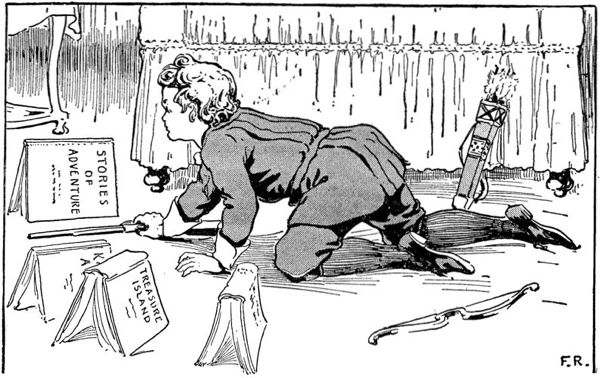
Now, with my gun, I crawl
All in the dark along the wall,
And follow round the forest track
Away behind the sofa back.
There, in the night, when none can spy,
All in my hunter’s camp I lie,
And play at books that I have read
Till it is time to go to bed.
These are the hills, these are the woods,
These are my starry solitudes,
And there the river, by whose brink
The roaring lions come to drink.
I see the others far away,
As if in firelit camp they lay,
And I, like an Indian scout,
Around their party prowl about.
So, when my nurse comes in for me,
Home I return across the sea,
And go to bed with backward looks
At my dear land of storybooks.
—Robert Louis Stevenson
All things bright and beautiful,
All creatures great and small,
All things wise and wonderful,
The Lord God made them all.
Each little flower that opens,
Each little bird that sings,
He made their glowing colors,
He made their tiny wings.
The purple-headed mountain,
The river running by,
The morning, and the sunset
That lighteth up the sky,
The tall trees in the greenwood,
The pleasant summer sun,
The ripe fruits in the garden,
He made them every one.
He gave us eyes to see them,
And lips that we might tell
How great is God our Father,
Who doeth all things well.
—Mrs. C. F. Alexander
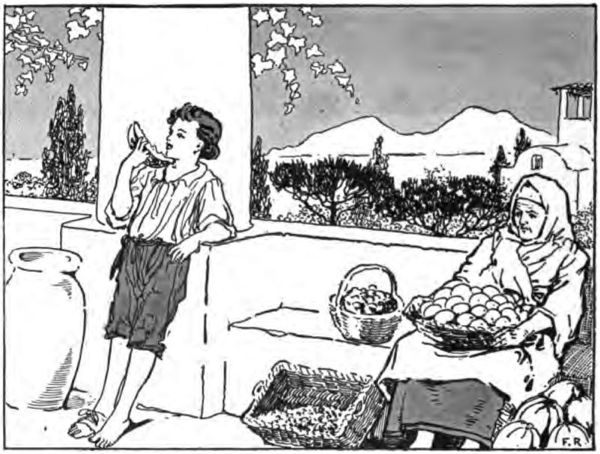
You may have heard of that lovely land called Italy, the land of golden sunshine and warm, soft air. There the skies are almost always blue—such a wonderfully deep blue, that Italy is often called “The Land of Blue Skies.”
Winding rivers, blue as the sky above them, glisten in the sunshine as they flow onward toward lakes and seas. Swift mountain torrents start high up under beetling rocks where grows the laurel, and dash out into the open sunlight. Wooded mountains in the distance show purple with the dark foliage of the myrtle trees, while the nearer hillsides are bright green with groves of olives, oranges, and citrons.
Little villages nestle on the hillsides and down in the valleys. Beautiful cities lie in the wide plains, and everywhere there are noble churches and palaces and castles of marble and stone.
Venice is one of the most beautiful of Italian cities. It is built on a hundred or more small islands that lie far out in the sea. On these islands are built hundreds of splendid palaces and churches, with wide streets of water rippling between. Instead of walking or driving through the streets, the people of Venice sail over the water in graceful boats called gondolas.
Imagine a great city where there is no sound of horses’ hoofs or of cart wheels! Instead, there is the sound of water lapping softly against marble and stone walls. Hundreds of gondolas glide past each other, carrying lovely ladies and laughing children. There is the sound of music as well as of laughter, for at the stern of each boat stands a dark-eyed boatman singing the songs of Italy as he guides his gondola over the water.
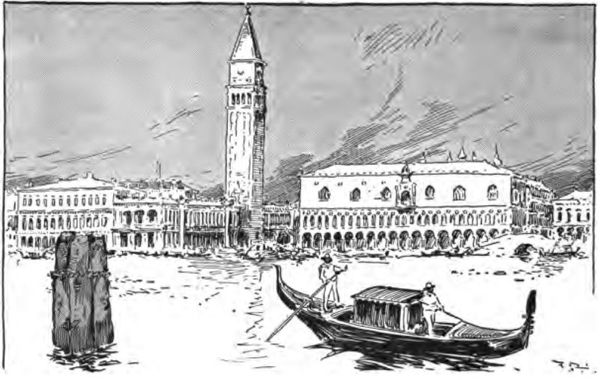
Venice is as beautiful as fairy-land when the golden sunshine falls upon its marble palaces and blue water ways. But it is even more beautiful at night, when the moon, like a dream-ship on high, seems to float with the hundreds of boats on the waters below.
One of the grandest of the churches of Venice is called Saint Mark’s. You can just see its towers in the picture above. It is built on one of the largest of the islands and stands in a kind of park, called the Square of Saint Mark’s. It is the only place in Venice where there is enough room for walking and running about.
One may see a pretty sight every afternoon in the week in Saint Mark’s Square. As the great clock of Saint Mark’s church strikes two, thousands of pigeons come flying from their nests in the church tower and, indeed, from all parts of the city to be fed. The gentle birds are so tame that, as the people scatter the grain for them, they light upon their shoulders and heads, or eat from their hands. No one ever dreams of hurting the pigeons of Saint Mark’s. Should anybody kill one of them, he would be sent to jail for at least six weeks or two months.
The people of Venice love these pigeons. It is said that long ago, when Venice was in great danger from its enemies, the city was saved by a letter brought in by a carrier pigeon. Ever since then, pigeons have been petted and cared for and they are allowed to build their nests in the towers of Saint Mark’s church and other buildings in Saint Mark’s Square. They are fed by children and grown people at the same hour every day in the week.
The Dream-ship minds no stormy gales,
Her masts are all of gold,
With splendor of wide silken sails,
Red-rosy, fold on fold;
They spread below, they spread aloft,
They are never reefed or furled,
And they will bear us safe and soft,
The other side the world.
We shall not see the shadow crew
That work among the spars,
But watch the topmast sailing through
The shoals of shining stars;
From point to point of silver light,
Through purple gulfs and bays,—
So we below a-gliding go
Along the water ways.
—Blanche M. Channing
Italy is so fair a land that after seeing it once, the heart turns to it ever and ever again.
There is a beautiful old story of a child who was stolen from Italy while she was still too young really to remember her native land. But as she wandered in other countries, her mind ever pictured things which she felt must be a part of her own forgotten home. It seemed to her that she had seen, in a dream, dim old churches and palaces and, nearby, a blue bay on whose shores there were shining pebbles to play with.
Now, in a country far distant from Italy, a man named Wilhelm was running up the stairs of an inn one morning, when he ran against a strange little figure. Wilhelm thought at first that it was a little boy, because the dress was not like a girl’s, but from the long black curls wound around her head, he decided that it must be a little girl.
As she was about to run by, he caught her in his arms, and asked her where she belonged. The child said nothing, but gave him a sharp look from her dark eyes and, jumping out of his arms, ran quickly away.
Soon after this, Wilhelm noticed the queer little girl standing near some other children, watching them at their play, but not seeming to know how to join with them, nor to wish to do so. Wilhelm spoke to her again.
“What is thy name, little one?” he asked, kindly. “Do not fear me.”
“They call me Mignon,” she replied.
“And how old art thou?” asked Wilhelm.
“No one has counted,” was the odd reply.
She spoke in a broken tongue, sometimes in Wilhelm’s language, and sometimes in Italian, and with a strangely solemn manner, laying her hand on her breast and bowing deeply with each answer.
Wilhelm could not help wondering about this child, who looked at him with such large dark eyes so full of sadness. She seemed about twelve years old, but the dark skin of her beautiful face had been so painted that he could hardly tell its real color. He felt sure that she belonged to a band of rope-dancers who had just come to the inn.
In the afternoon these rope-dancers were to give their show. Crowds of people were on their way to see them, when Wilhelm noticed that many were running in one direction. He pressed through the crowd and saw the master of the rope-dancers beating little Mignon cruelly with the handle of a large and heavy whip.
Wilhelm dashed upon the man like lightning, and seizing the whip, cried, “Stop! Don’t you strike that child again, or you will never leave this spot alive!”
The frightened showman declared that the girl was lazy and would not do her part in the show. He said she refused to dance her wonderful “egg dance” which she alone could do, and which he had promised to show the people.
Mignon had run away and hidden herself while he was talking. When the man saw this, he was more angry than ever, and started off declaring that he would beat her again as soon as he could lay his hands upon her.
But Wilhelm held him back.
“You shall not touch that poor little child,” said he. “It is very plain that she is not your child. I shall take you before a judge and you shall tell where you stole her.”
“Pay me what her clothes have cost me, and you can have her and do what you like with her,” shouted the fellow angrily.
So Wilhelm paid the cruel master what he said Mignon’s clothes had cost him. He would tell nothing about her, however, save that she fell into his hands at the death of his brother, who had kept the girl since she was a baby. After leaving the man, Wilhelm began to search for Mignon, but could find her nowhere.
Soon after the rope-dancers left town, however, Mignon slipped into the inn, where Wilhelm was sitting alone, reading.
“Where hast thou been hiding?” asked Wilhelm. “I have been much troubled about thee. I have searched long for thee.”
The child looked in his face, but said nothing.
“Thou art my child now,” said Wilhelm. “Thou must be a good girl, for I shall be always kind to thee.”
“I will try,” said the child.
From that time Mignon waited upon Wilhelm and his friends, and went about her new duties with the greatest care. In working for Wilhelm she never grew tired. She was up before the sun, and early in the evening slipped away to her little bare room, where she insisted upon sleeping upon the floor.
Mignon grew more lovely every day. She kept her clothes very neat and clean, and washed her face so often that it seemed that she would wear the skin from her cheeks. She told Wilhelm that she was trying to wash off the paint that the showman had put on her face. She kept this up until the paint was all gone, and then the brown of her skin and the red of her cheeks were clearly her very own.
Mignon was not like other children. She never walked up and down stairs, but would spring along—and before you knew it she would be sitting quietly above, on the landing. She used a different manner of speaking to every one. To Wilhelm she always spoke with her arms crossed upon her breast. Sometimes she would not speak the whole day long. She went often to church, and once Wilhelm saw her kneeling and praying, all alone in the dimly lighted old church.
Her only companions were a gentle old harper, who wandered in and out of the inn, and a dear little baby boy who lived there. The two children ran about and sang under the trees, while the old harper looked on smiling and playing softly. Sometimes, to make the baby laugh and shout with delight, Mignon would dance and beat her old tambourine.
With fingers tapping against it, she would hum and sing as she waved it to and fro. She rattled it gleefully, now with her knuckles, now with the back of her hand. Sometimes she would strike it, first against her knee and then against her head, and then would twirl it in her hand swiftly, making the bells rattle and jingle merrily.
But always Mignon watched for the coming of Wilhelm that she might do something for his comfort and pleasure. One night, after lighting him upstairs, and seeing that he was weary and sad, she begged that he would allow her to show him a pretty dance that she could do.
“It might cheer your heart a little,” she said.
Wilhelm really wished to be alone, for he was very tired and heavy-hearted, but he could not refuse the dear little creature who was so anxious to cheer him. And so, more to please Mignon than because he thought he would enjoy it, he agreed to wait and see her dance.
Mignon went out of the room, soon returning with a roll of carpet under her arm, and carrying a small basket of eggs. She spread the little carpet, and placed four lighted candles at the corners. With great care she arranged the eggs in certain figures upon the carpet, and then called aloud to some one outside, “Enter!”
A man with a violin under his arm came into the room, and began to play a strange melody. Mignon tied a band over her eyes, and then began moving to the music, keeping time to the tune with her steps and with the strokes upon her tambourine.
How lightly, quickly, nimbly, the wonderful child moved! She skipped so fast among the eggs! She trod so close beside them! You would have thought she must crush them all. But not one of them was touched or moved from its place.
Wilhelm quite forgot his cares in watching every motion of the child. He almost forgot where he was. When the dance was ended, Mignon rolled the eggs together softly with her foot into a little heap. Not one was left behind, not one was harmed. Then she took the band from her eyes, and made her quaint, pretty bow.
Wilhelm thanked her for showing him the wonderful and pretty “egg dance,” which he said he had long wanted to see. He petted and praised her, and said he hoped she was not tired.
But Mignon was perfectly happy because she had made her kind master forget his cares. After removing the carpet, the candles, and the eggs, she tripped happily and lightly away.
Then the man with the violin told Wilhelm of the pains Mignon had taken to teach him the music of her dance. He said that she had sung it over and over to him, until he could play it perfectly, and that she even wished to pay him with her own money for learning to play it for her.
Sometimes Mignon tried to cheer Wilhelm in another way. A zither had been given to her, and with this she often filled her little room with melody, singing softly while she played.
One night she brought the zither with her, and sang for Wilhelm a song so strange, so sweet, and so sad, that it brought tears to his eyes as he listened. The child seemed to be living in a dream of her dimly remembered childhood, while she sang. Her heart seemed to be filled with longing for that far-off lovely land, somewhere in the world, where she was born.
This is the song she sang:
(To be memorized)
Know’st thou the land
Where bloom the citron bowers,
Where the golden orange
Lights the dusky grove?
High waves the laurel,
There the myrtle flowers,
And through a still blue heaven
The sweet winds rove.
Know’st thou it well? . . .
Know’st thou the mountain?—
High its bridge is hung
Where the mule seeks
Through mist and cloud his way;
There lurk the dragon race,
Deep caves among,
O’er beetling rocks, there foams
The torrent spray.
Know’st thou it well? . . .
—From the German of Goethe.
By Felicia Hemans
After finishing the song, Mignon stood silent, looking earnestly at Wilhelm.
“Know’st thou the land, master?” she asked.
“It must be Italy,” answered Wilhelm. “Where didst thou learn the little song?”
To this the child made no answer, but only cried, “Italy! Italy!” She had found the name of her home land, and she cried again, happily, “Italy! Italy! Oh, master, thou wilt go to Italy, and thou wilt take poor Mignon with thee. There, there is my home!”
I remember a dear little girl
Whose feet kept time to a tambourine,
The sunless walls of the street between;
Her hair had a breezy curl,
Her brown eye was merry and wild,—
That gay little child
Who danced up and down
The red brick streets of the tiresome town.
I watched her day after day
And I wished I could have her for my own,
To dance in the fields, among daisies blown,
With the wind in her hair at play,
And her heart as light as the breeze,
Swaying under the trees
Unto bird-notes, sung
Through the blossomed boughs that above her hung.
That little motherless maid!
(No mother would let her darling go
Through the wicked streets of the city so),
I know not where she has strayed:
But her memory shadows my dreams,
And her brown eye gleams
Upon me in reproof
That I hold so long from her fate aloof.
Every sweet little girl I see
Growing up like a rose at a cottage door,
Or softly at play on the forest floor,
Or under the orchard tree,
Seems to murmur in my ear,
So sadly, so clear:
“Alas! we miss a mate!
For the dear little dancing girl we wait.”
—Lucy Larcom.
Florence is another beautiful city of Italy. It is called the “City of Flowers.” There are many grand palaces and many rich people in Florence, but there are many more poor people. In the poorest part of the city lives a man named Beppo. His wife and children live with him in a very small house,—a house that is only a hut.
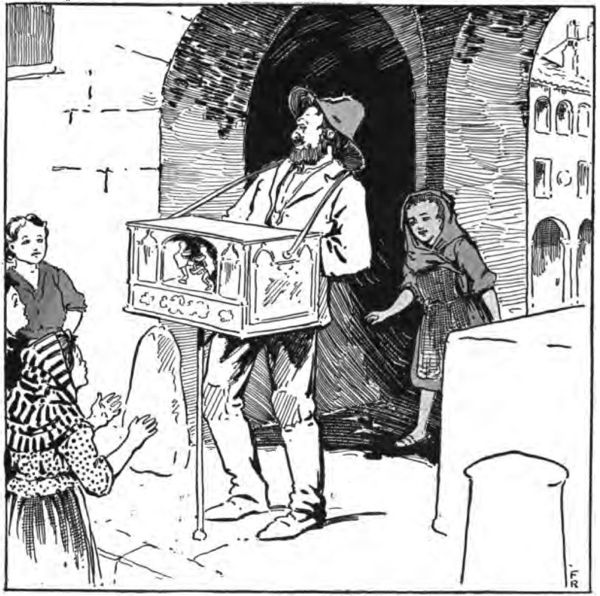
There are many children in Beppo’s family, the youngest ones being Nello and his little sister Bianca. Both Nello and Bianca have lovely faces. They have rosy cheeks and the beautiful dark eyes and hair that nearly all Italians have. Nello and Bianca are often paid by some artist to sit or stand before him while he makes a picture of them. The little boy and girl are very glad to earn this money, for their father, Beppo, is very poor.
Beppo makes his living by traveling up and down the streets of Florence with his hand organ. He carries with him a puppet show. Puppets are funny little dolls that can be made to jump and dance and fight. Beppo uses his own voice to make it seem that the puppets are talking and quarreling. All day long Beppo grinds his organ or shows his puppets, and often at the end of the day he has only a few pennies to take home with him.
But poor as they are, Nello and Bianca are happy little creatures. They are full of glee when a holiday or feast day comes, and there are many of such in Italy.
The great merry-making season is called the carnival. The carnival lasts for several days and nights. The streets of the cities are crowded with people at that time, some riding, but most of them walking. They are dressed in all sorts of bright clothes, and wear masks over their faces, so that no one can tell who they are. Some of them look very funny, and some very queer and ugly. There is music and shouting, laughing and talking, among the crowds. The people pelt one another with flowers and sweetmeats, and shower one another with handfuls of little round pieces of colored paper.
The people of Italy have several great church fairs during the year. At these times the shops and stalls are filled with sweetmeats, cakes, and pretty playthings, which parents buy for their children.
The greatest of the children’s feast days is Twelfth Day. Nello and Bianca look forward to this day as you do to Christmas. Instead of hanging up their stockings as you do on Christmas Eve, they set out their shoes on the steps of the house or near the door, just as do the children in Spain and in some other countries. They do not look for Santa Claus as you do, or for St. Nicholas, but for “La Befana.”
“La Befana” is an old woman—a kind of Mrs. Santa Claus. She is supposed to go all over the country on Twelfth Night and put presents into the shoes of all good children. Nello and Bianca find something in their shoes every year, but the older children are not always sure of finding a present from “La Befana.”
Nello and Bianca do not go to school yet, but they will go with their big brothers and sisters, when they are older.
One of the books from which Big Sister reads to Nello and Bianca, tells about a wonderful puppet that makes them think of their father’s puppets. It is a story called “Pinocchio,” and all Italian children are very fond of it. Perhaps when you read “The Wonderful Puppet,” you will wish to read the whole story of “Pinocchio.”
There was once an old carpenter named Antonio. One day he picked up a piece of wood saying,
“This wood is just what I need to make a new leg for my table.”
So he set to work to make the table leg. But as soon as he began to chop the wood, he heard a tiny voice say, “Do not strike so hard!”
Old Antonio looked all around the room and under the bench, but he could see no one.
“I just imagine I heard that voice,” he said, and went to work again.
“Oh! you have hurt me!” cried the little voice again.
As soon as Antonio could speak, he said, trembling with fright,
“Can it be this piece of wood that cried out with that little voice?”
At that moment an old man named Geppetto entered the room.
“I have come to ask you to give me something, Antonio,” said Geppetto to the carpenter. “I wish to make a wooden puppet—one that I can make jump and dance. Then I shall travel about with it and make enough money to live upon. I need a piece of good dry wood to make the puppet. Will you give me a piece?”
Old Antonio was glad to have him take away the piece of wood which had so frightened him. He gave it to Geppetto at once, without telling him anything about the voice he had heard.
As soon as Geppetto reached home, he said to himself: “Now, what name shall I give to my puppet? I think I will call him Pinocchio. That will be a fine name for a little puppet.”
Then the old man began to work with a will, carving the head of the puppet. When he had made the eyes of the puppet, great was his surprise to see them roll around and look at him!
“Why do you look at me, eyes of wood?” said the old man as he began to carve the nose.
When the nose was in shape, it began to grow. It grew, and grew and it grew—until Geppetto thought it would never stop growing.
After the nose, Geppetto made the mouth. It was hardly finished when it began to sing and laugh out loud.
“Stop laughing, thou mouth of wood!” said Geppetto, but he might as well have spoken to the wall. The mouth kept on laughing and singing, so Geppetto went on with his work.
He made the chin, then the neck and shoulders, then the body, then the arms and hands. Last he carved the legs and feet. When the legs and feet were finished, Geppetto stood the puppet on the floor, moving first one of the legs and then the other.
All at once the puppet began to run around the room. Then he ran to the door, jumped into the street, and away he went.
“Stop him! Stop him!” cried Geppetto running after the puppet. But the people stood still, gazing after the puppet, while they laughed and laughed and laughed. A soldier down the street waited till the puppet came near him. Then he caught him by his long nose and led him to Geppetto, who carried the puppet home.
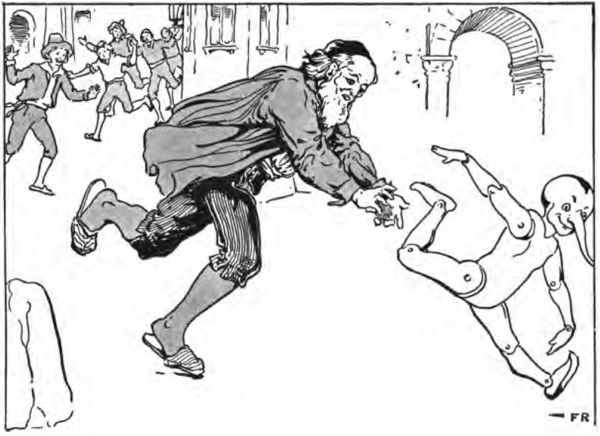
Geppetto found that Pinocchio was a very, very naughty puppet. He often ran away, and many strange things happened to him. He was so naughty that he made many enemies.
Once, after he had run away from Geppetto, and while he was hiding from his enemies in a dark forest, he saw a little house, as white and shining as snow. A beautiful fairy with blue hair and eyes lived in the little white house. The Blue Fairy felt sorry for Pinocchio and helped save him from the enemies. She said that if he liked, he might live with her and be her little brother.
Pinocchio loved the Blue Fairy for her kindness, and soon he began to try very hard to be good. He went to school, where he learned so fast that the Blue Fairy said she would change him into a real boy. But first, she said, she would give him a birthday party to which he might invite all his schoolmates.
You can’t imagine how wildly happy Pinocchio was at the thought of becoming a real boy. He was full of delight, too, over the thought of his first birthday party.
The Blue Fairy began to get ready for the party. First she brought out two hundred little blue cups and saucers. Then she made four hundred sweet buttered cakes. Then she told Pinocchio to go and invite all his schoolmates.
“Remember to come back before night, Pinocchio,” said the kind Blue Fairy as he left the cottage.
Pinocchio went gaily from one house to another, inviting his friends to his party. When he had almost finished and was on his way home, he saw a boy sitting under an old shed all alone.
This boy was named Romeo and he was a great friend of Pinocchio, although he was the naughtiest boy in the whole school.
“What are you doing here all alone, Romeo?” said Pinocchio.
“I am waiting until it is midnight so that I can go away, Pinocchio,” he answered.
“Why, where are you going, Romeo?”
“I’m going far away, to a new country. It is the most beautiful place in the world,” said Romeo.
“What is the name of the place?” asked Pinocchio.
“They call it Play Country. Don’t you want to go with me, Pinocchio?”
“I?” cried Pinocchio. “No, indeed I do not. I have promised the kind Blue Fairy to become a good boy and I wish to keep my word. So I’ll say good-bye to you, Romeo.”
“You will be sorry if you don’t go,” said Romeo. “There are no schools in Play Country, no teachers, and no books. Every day in the week is a Saturday holiday, except one, and that is a Sunday holiday. Vacation begins the first day of January and doesn’t end till the last day of December. That is the country for me. That is what I think all countries should be like.”
“But what do the boys do in that country?” asked Pinocchio.
“Why, they play from morning till night. At night they go to bed. Next morning it is the same thing all over again. I wish you would go with me, Pinocchio.”
“Are you going alone, Romeo?”
“Alone? Why, Pinocchio! there are about a hundred boys going, and I am waiting for them now.”
“Are you going on foot?”
“No, no, Pinocchio. A carriage is coming for me.”
“I think I will, at least, wait and see the carriage,” said Pinocchio.
The carriage, driven by a big fat man, arrived at last. It did not make the least noise because the wheels were wrapped with soft rope. Twelve little donkeys were hitched to the carriage and, instead of having horseshoes on their hoofs, each donkey wore white kid boots, shaped like those worn by men. The carriage was filled with boys from eight to ten years old.
As soon as the carriage stopped, the big driver said to Romeo,
“Are you going with us, too? You see there is no room left inside.”
“Oh well, I will sit up there with you,” said Romeo, and up he jumped beside the driver.
“And what about your friend?” asked the fat driver, pointing to Pinocchio.
At that, all the boys in the carriage called out to Pinocchio,
“Come on with us to the Play Country and always be happy!”
At last Pinocchio said, “If you will make room for me, I will go with you.”
“But all the seats are full,” said the driver. “However, you may have my seat and I will walk.”
“No, no, I will ride on one of the donkeys,” cried Pinocchio, and he tried to mount the nearest one. But the donkey raised his hind feet and sent Pinocchio flying through the air.
The boys began to shout and laugh, making Pinocchio very angry. But the fat driver got down and, going to the donkey, whispered something in his ear that made him stand still at once. Pinocchio then mounted the donkey and away they all went.
As the donkeys were galloping along, Pinocchio heard a strange, low voice saying, “You will be sorry for this! You will be sorry for this!”
They went on for another mile and again Pinocchio heard the strange voice, saying,
“You will be sorry. You will come to a sad end. Some day you will be crying just as I am.”
Pinocchio leaned over and saw that big tears were rolling down his donkey’s face as he trotted along.
Just as the sun came up in the morning sky the carriage arrived at the Play Country.
There were no people to be seen except boys between eight and fourteen years old. There were hundreds of these running around, blowing horns, jumping over benches, playing marbles, laughing, whistling, singing, and shouting. They were making so much noise, that you would have stopped up your ears, had you been there.
Romeo and the boys in the carriage jumped out and began to run around shouting and laughing with the others.
Pinocchio, also, ran with them, crying out, “Oh, what a beautiful life this will be! What a beautiful place this is!”
And so all day and every day they played in that country. They did not spend a minute in studying. They never saw a book. They just played, played, even at night. This went on for five months. Then a very strange thing happened.
One morning when Pinocchio awoke, he happened to put his hand on his ears and found that they had grown very long. He looked in a basin of water, where he could see as in a mirror—and what do you think he saw? Two long donkey ears! They were his own ears! These ears grew and grew,—even while he looked at them. Then hair began to grow all over the ears.
Pinocchio screamed and beat his head against the wall. The ears would not come off,—they were his own!
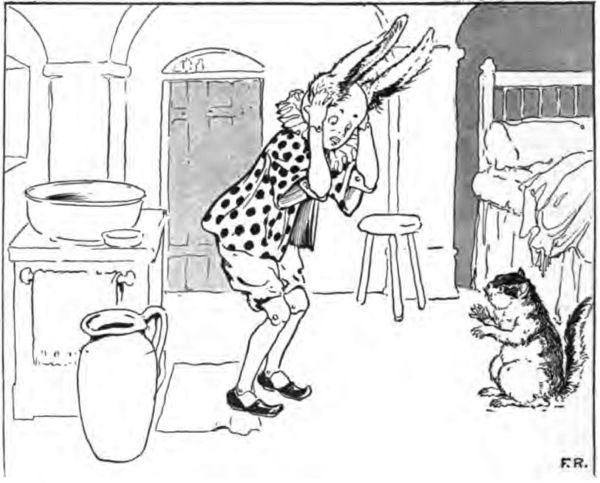
A little dormouse who heard him came to see what was the matter.
“Oh, dormouse!” said Pinocchio, “I’m very ill. I’m afraid I have the fever.”
“Yes, you have a bad fever,” said the dormouse. “You have the donkey fever, and in two or three hours you will be a donkey,—a real donkey like those that were hitched to the carriage.”
“Oh, what shall I do?” cried Pinocchio, pulling his ears with all his might.
“You can do nothing now,” said the dormouse. “You know it is one of the laws of the world that boys who hate books and school,—boys who will not study,—become little donkeys.”
Then Pinocchio made a cap, pulled it down over his ears, and started out to look for Romeo. He found Romeo in his room and he, too, had on a cap that covered his ears.
“Why do you wear that cap, Romeo?” asked Pinocchio.
“Oh, the doctor said I must wear it because—because—because I have hurt my knee. And you, Pinocchio, why do you wear the cap you have on?”
“Because I have a sore foot,” said Pinocchio.
The two friends looked at each other.
Then Pinocchio said, “Let us both take off our caps at the same time. I will count. When I say three, let us take them off together. Now, one, two, three!”
At the word “three” both boys took off their caps. And when they saw each other’s long, hairy donkey ears, they could not help laughing out loud.
All at once Romeo stopped laughing and cried out, “Help! Help, Pinocchio! I cannot stand up!”
“I cannot either!” cried Pinocchio.
Both boys dropped on their hands and knees. Their arms became legs and their faces changed, until at last you would not have known that they had ever been anything but donkeys.
When they tried to talk and even when they tried to cry, they only went “Wee-haw! Wee-haw!” like all other donkeys.
—Carlo Lorenzini
(Adapted).
Tinkle, tinkle!
Listen well!
Like a fairy silver bell
In the distance ringing,
Lightly swinging
In the air;
’Tis the water in the dell
Where the elfin minstrels dwell,
Falling in a rainbow sprinkle,
Dropping stars that brightly twinkle,
Bright and fair,
On the darkling pool below,
Making music so;
’Tis the water elves who play
On their lutes of spray.
Tinkle, tinkle!
Listen well!
Like a fairy silver bell,
Like a pebble in a shell;
Tinkle, tinkle!
Listen well!
—Frank Dempster Sherman
Oh, fair are the mountains half covered with snow,
With tall and dark trees like a girdle of green,
And waters that wind in the valley below,
And roar in the caverns too deep to be seen.
Here spread the sweet meadows with thousands of flowers;
Far away are old woods that for ages remain;
Where shepherds with flocks in the shade of their bowers
Spend the long summer days on the high mountain plain.
—Anonymous
When you visit Italy, you will surely go from there to Switzerland, for you will wish to see the great white mountains and deep green valleys, the quiet lakes and leaping waterfalls. Some people think these make Switzerland even more beautiful than the lovely land of Italy. Perhaps you will think so, too.
There are several ways by which you might go from Italy into Switzerland. You might go by rail and travel for miles underground, through the wonderful tunnels under the Swiss mountains. One of these tunnels is over nine miles long. It took eight years to build this tunnel. You can see that a great deal of labor, courage, and patience were needed to finish it, after all the plans were made. Another tunnel under the Alps is twelve and a half miles long.
If you wished to do so, you could go by one of the mountain passes. A mountain pass is a break through a chain of mountains, too narrow to be spoken of as a valley. Passes are more like natural roads between the high mountains. The poor people of Italy and Switzerland who must travel on foot, still use these old, old roads, the mountain passes. Some of them are very dangerous, especially in winter.
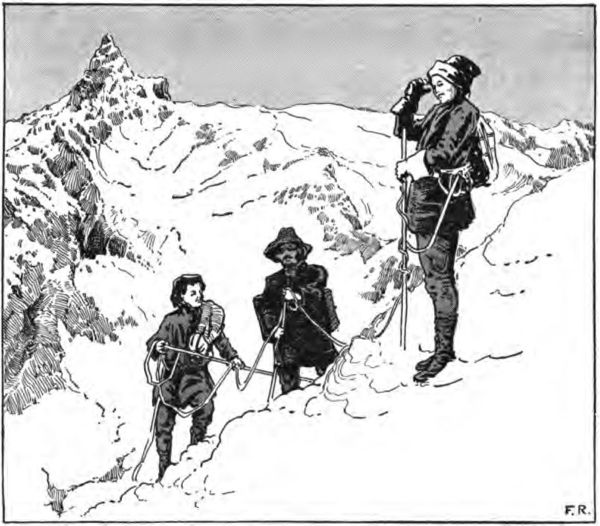
Among the Swiss Alps are some mountains so high that their tops are always covered with snow—even in summer. Huge masses of this snow sometimes break loose from the sides of these lofty peaks and go sliding down the mountain sides, tearing up huge rocks, earth and great trees. They gather speed as they go rushing downward with a terrific noise, and sweep away houses, cattle, and people.
Such a slide of snow is called an avalanche, and is dreaded by the Swiss people more than anything else that can happen to them. But avalanches and the sudden snowstorms of the Alps are not the only dangers in Switzerland. Besides the great fields of everlasting snow that lie on mountain tops, there are rivers of solid ice, called glaciers.
Most of you have changed a ball of soft white snow into a ball of hard solid ice, simply by pressing the snowball harder and harder. Remembering how your hard snowball is made may help you to understand how the glaciers are formed.
“In the clefts of the rocks, and in the valleys high up among the mountains, the snow gathers to a great depth. From the weight of the snow lying above them, the lower layers of snow in these clefts and valleys become ice, just as a snowball does when pressed between the hands. The upper crust of the mountain snow melts a little during the heat of the day, this snow water sinks down through, and freezes at night. From this melting and freezing the mass of snow, after a long time, is changed into a river of solid ice.”
In some places these masses of ice are sliding little by little down the mountain side. These streams of ice are called glaciers. Their movement is so slow, however, that there is no danger from it. In fact they do not seem to be moving at all.
But glaciers are very dangerous in another way. In the glaciers are many great cracks called crevasses, wide and very deep. To fall into one of these crevasses is almost certain death. Like the mountain precipice, the crevasse is often hidden by great drifts of snow so that the traveler cannot see it.
Sometimes, the snow falls so as to form an arch over a deep crevasse, which, after it freezes, is like a bridge over which the traveler may pass. Often the opening in the ice is so deep and the ice itself is so clear that it seems to be a deep, bright blue in color. Then, when the sun shines under the arch of snow, the crevasse becomes a most lovely fairy-like cave or grotto, with walls of vivid blue under a roof of dazzling whiteness.
But it is only by visiting the grand snow-covered mountains, that one can really understand their splendor and beauty. People often run great risks in visiting them, but very few attempt to climb the Alps without a Swiss guide. If you were a mountain climber you would find that Switzerland, the beautiful land of lake and mountain is, also, land of many dangers.
But a Swiss guide knows these dangers and how to guard against them. He always carries an ice-ax, which is a strong staff about five or six feet long. It has an iron spike on one end that will not slip on the ice or slippery rock. The ax is fastened to the other end. It is very sharp and is used for cutting into icy slopes that are too steep to climb unless holes are made to step in.
A guide carries, also, a thick rope and a bag of stout cloth slung over his shoulders. The rope is to tie the people to each other as he helps them over the dangerous places. The bag is filled with food and other things that may be needed, should they get lost on the mountains. Every one in the party must carry the same things that the guide carries. He likes them to wear sharp iron spikes on the soles of their shoes, too, just like his own.
A Swiss guide is not afraid to climb a mountain peak that stands almost as straight and steep as a great wall of rock or ice. He creeps along a tiny ledge, where there is hardly room for him to place his feet. Often, the narrow ledge juts out from a steep precipice, and hangs far, far above the deep chasm below. And often, a river winds away down at the bottom of the chasm, looking just like a thread of silver. The great trees in the valley below seem like tiny shrubs. To look down would make your head swim.
But these men are strong and sure-footed. They can go where other men do not dare to go, where only the sure-footed chamois of the Alps can go.
The chamois is a kind of deer about the size of a goat. It is a beautiful and graceful creature, very swift and sure of foot, and very shy. These animals feed in herds, one of them standing on guard. The guard is always an old doe, who has lived long among the peaks, and whose sight and sense of smell are wonderfully keen. The herd know this, so they, with the little fawns, feed in peace, while the old doe stands sniffing the air, her head turning from side to side, her keen eyes looking far away.
She may not see the hunter creeping behind the rocks and peaks, without a sound. But the breeze will bring to her the warning scent of danger. Then she stamps her front feet on the earth, gives a loud whistling call, and away she flies, the herd following, where the hunter cannot follow.
It is no easy thing to shoot a chamois. But so valuable are its flesh and skin to the hunter, that he will risk a great deal to get a shot at the beautiful creatures.
Most of the countrymen in Switzerland are hunters and guides and herdsmen. But let him work at what he may, a Swiss is almost always a brave, hardworking, independent man, fearing nothing, and loving freedom as he loves nothing else except his beautiful land of lake and mountain.
Below the fields of everlasting snow and ice, but closely bordering upon them, are wide stretches of open pasture land. During the summer—which is short in the Alps mountains—these meadows are green with a wonderful growth of grass, and rich with many-colored wild flowers.
Still farther down, the mountain slopes are covered with forests of pine and other great trees. Here and there in these forests, are the homes of the mountain people,—the hunters, guides, herdsmen, who are all farmers, too, in a very small way.
Lower still on the slopes are the villages, while down in the wider valleys beside the beautiful lakes, are the towns and cities. There are not many cities in Switzerland, for it is a small country and much shut in by its high mountains.
Above the cities and the villages, near the great forest, lives a dear little mountain maid named Jeanette.
Her father’s cottage is both broad and long. It has a wide, gently sloping roof made of sheets of pine wood. Upon the roof are many heavy stones. They have been placed there to prevent the strong winds of winter from carrying the roof away. The lower part of the house is of stone, and here are the cellars and stables.
The upper part of the house is built of thick logs, and here are the living rooms of the family. These rooms open upon a gallery that runs all around the house. Here is the kitchen—a large room where the family meet for their meals, and where they sit in the evenings. Then there is a “company room,” where the best furniture is kept, and which is not used very often. Besides these, there is Jeanette’s own little bedroom, her two grown brothers’ room, and that of her parents.
The furniture of the house is all strong and well made. There are large heavy tables, benches, and dressers, of dark walnut wood. Jeanette’s father made them from the trees of the forest nearby, for he is a carpenter as well as a herdsman, and can carve wood, besides.
In a corner of one of the rooms stands a loom. Here Jeanette’s mother weaves the fleece of their sheep into blankets and cloth to make clothing for the family.
Jeanette has a lovely garden, where she and her mother work, tending the glorious white lilies that blossom in June. Different kinds of vegetables grow here, too.
When gathered, the vegetables are stored in the cellar for winter use. There, too, will be packed the dried flesh of all the chamois that Jeanette’s father and brothers can shoot.
It is not often that Jeanette sees meat of any kind upon the table, but there is always plenty of cream, butter, and cheese to eat with the bread and pancakes that she helps her mother to cook.
There are very few houses near Jeanette’s home. The nearest village is several miles below in the valley. But the little girl can see every day a bit of blue smoke that goes floating toward the sky,—up, up from behind the ridge near her home. Just across that ridge, in a house like her father’s, lives a little boy about Jeanette’s age, whose name is Conrad. Conrad is Jeanette’s only playmate, for there are no near neighbors besides his family.
These two little playmates go all the way to the village below to attend school. It is a good school, like most of those in Switzerland. They are much like our own schools, but some things are far better taught than we teach them in this country.
Jeanette and Conrad like to go to school. The long walk is full of joy in the early spring. Then they find many curious and beautiful things in the woods, among the trees and beside the pools and waterfalls.
They enjoy this walk over the mountain during the bright autumn weather, too, when the great chestnut trees are loaded with prickly burrs, that they know have ripe brown nuts inside. On Saturdays they go with their parents to spend the whole day gathering chestnuts. They take their dinners, and baskets and bags to hold the nuts. Some of them are to be ground into chestnut meal to make bread.
But many of them are to be stored away to roast during the long winter nights, before bedtime. It is then that the children hear stories of queer creatures called gnomes, which are like the stories that you have read about naiads and dryads, nixies and pixies.
During the long vacation the little playmates help their parents with the work. Conrad’s father, like Jeanette’s, is a herdsman, and Conrad is now old enough to help with his cows, goats, and sheep.
Jeanette helps her mother in the garden and in the house. She is learning to milk the one cow that is kept at home, even when all the others are sent away to graze on the mountains.
Jeanette would be very lonely in the summer, when her father and brothers and Conrad are away on the mountains, if she did not have work to do.
Along the lake and on the hill,
The ruddy oaks are glowing,
And merry winds are out by night,
Through all the forests blowing.
The yellow moon is clear and bright,
The silent upland lighting;
The meadow grass is crisp and white,
The frosts are keen and biting;
A shining moon, a frosty sky,
A gusty morn to follow,—
To drive the withered leaves about
And heap them high in the hollow.
Hurrah! the nuts are dropping ripe
In all the wildwood bowers;
We’ll climb as high as squirrels go,
We’ll shake them down in showers.
—Emily Huntington Miller
The Swiss must turn all the grass that grows near their homes into hay for the herds’ winter feed. So in summer, the herdsmen and shepherds drive the herds and flocks far up the mountains to graze in the high Alpine meadows. And all summer the men stay up there with their cattle and sheep.
The cows are pastured in the wide, smooth slopes which are most easily reached. The flocks of goats and sheep belonging to several herdsmen are given into the care of one shepherd. He drives them to the high places, which can only be reached by sure-footed goats and sheep, for some of the grazing places lie close to the glaciers and snowfields far, far up among the peaks of the Alps.
The day the herdsmen from mountain homes and valley villages begin this upward march to the Alpine meadows, is a great event in the Swiss year.
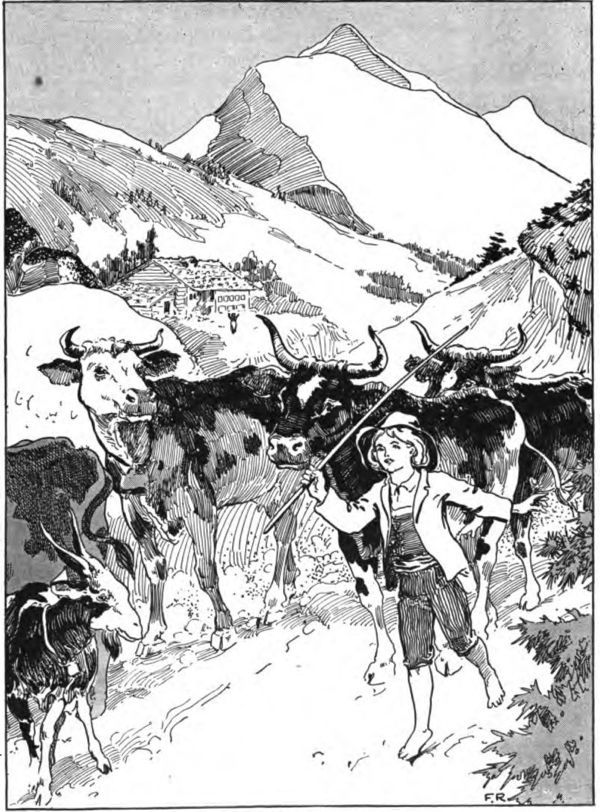
On the morning the journey is to begin, all the families are astir before the dawn. The flocks and herds seem to be as full of joy as the merry crowd of herdsmen. They leap and frisk in their delight, as the long line of different herds sets out for the pleasant upland meadows. The finest cattle lead the way. From their necks hang sweetly chiming bells, and their horns are wreathed with flowers.
But happiest of all are the boys who, like Conrad, are old enough to go up for the first time, and help the herdsmen in the mountain pasture lands. As they go onward and upward the men and boys make the mountains ring, with their yodeling the famous Swiss echo songs. It takes them two days or more to reach the open slopes of land that lie between the forests and the snowfields. You can imagine how high those mountain meadows must be.
Here the men and boys live in small rude huts, built of stone and sometimes of logs. In these huts are kept the milking pails, the churns, and cheese presses, for the herdsmen make large quantities of cheese and butter to sell at the village and city markets, in the autumn.
These are happy days for Conrad. He is up before the dawn, and out among the cattle. His boyish heart “thrills with wonder and joy, at the glory and splendor of the hour when, peak above peak, grand snow-covered mountains glow rosy pink, before they turn to gold under the rising sun.”
He is always ready for his breakfast of bread and cheese and rich, sweet milk. After the work of milking and churning is over, he lies basking in the sunshine, watching the herd. Sometimes he follows some runaway cow, and stops to pluck wild flowers as he goes.
These Alpine flowers are of many colors and shapes, but loveliest among them is the Alpine rose. Conrad sometimes sees great beds of these beautiful rosy things, and wishes he could send them to the little playmate he has left behind in her forest cottage.
When the sun nears its setting, Conrad and his father gather the herds together for the evening milking. As they begin the milking, a strangely solemn sound comes floating down to them. Clear and distinct, from the far-away peaks above, come the words of the psalm, “Praise ye the Lord!”
It is the great Alpine horn. “This is a huge wooden trumpet, about six feet in length. Deep and powerful notes can be drawn from its wide throat. When these notes ring, echo, and re-echo from height to height, the effect is very striking and beautiful.
“Away up high, among the snowy fields and glaciers, a lone shepherd watches the sun sink behind the distant peaks of snow. As it falls lower, he takes his great Alpine horn, and through it sends pealing down the mountain side, the first notes of the psalm, ‘Praise ye the Lord!’
“It is the signal for evening prayer and repose.”
Down below, the herdsmen hear the words, and one by one they answer with their own Alpine horns, in the same words, “Praise ye the Lord!”
The deep, strong notes and the grand words echo from crag to crag in solemn melody. As they die away, the lone shepherd calls, “Good-night! Good-night!”
Then all is still. The light is gone, the day is done, herdsmen and cattle lie down to rest and sleep under God’s starry skies.
(To be memorized)
Praise ye the Lord.
Praise ye the Lord from the heavens:
praise him in the heights.
Praise ye him, all his angels:
praise ye him, all his hosts.
Praise ye him, sun and moon:
praise him, all ye stars of light.
Praise him, ye waters of heaven,
and ye waters that be above the heavens.
Let them praise the name of the Lord:
for he commanded, and they were created.
Psalm CXLVIII—Verses 1-5.
Good-night! Good-night!
Far flies the light;
But still God’s love
Shall flame above,
Making all bright.
Good-night! Good-night!
Adapted from the French of Victor Hugo.
By Mrs. Bellamy.
As Conrad listened to the herdsmen’s Alp horns, he thought of a story his grandmother had often told him. Here it is:
In olden times, before so much traveling among men drove the “little people” far away, they used to be found in every nook and corner and under every stone of the mountains.
These “little people” were gnomes, water sprites, Alpine fairies and elves.
The gnomes were little men about one foot and a half in height. They wore green mantles long enough to hide their queer feet, that were shaped like those of geese. Bright red caps were worn upon their snow white hair, and long white beards flowed down upon their breasts. These little men cared for the wild animals of the mountains. They kept large herds of chamois far up in the highest peaks of the Alps, and protected them from the needless greed of the hunters.
Unlike the queer little gnomes, the dainty Alpine fairies did not care at all for the wild animals of the mountains. They liked, instead, the bold hunters of the chamois and often helped them in the chase. Indeed, it is said that the Alpine fairies themselves enjoyed the sport. The sound of their horns and jingling stirrups might often be heard as on their elfin steeds they chased the fleet-footed chamois—at least the mountain people said so.
There was, in those days of long ago, a young huntsman more daring than any of the others. Because of his fearlessness in climbing the dangerous peaks, this hunter had become a great favorite with the Alpine fairies.
Often as he lay sleeping on some steep and narrow precipice, these dainty creatures, wrapped in veils of gossamer mist, floated about him to keep him in safety. They whispered to him wonderful dream tales of where to find the largest herd of chamois.
It was no wonder that he grew more and more fond of his dangerous life, and that he prided himself more and more upon the great number of chamois that he killed. He slew so many of those beautiful little animals that, at last, the mountain gnomes had to come to the rescue of the poor chamois. Indeed had he not been the favorite of the Alpine fairies, the young hunter would have fared badly at the hands of those little men long before.
One day in autumn the young huntsman was caught in a storm on the mountains. As the wind shrieked among the rocks and glaciers, he sought for some shelter from the rain and hail which had begun to fall. After much searching he found a deserted herdsmen’s hut, and entered it. Finding the floor wet and cold, he climbed into the loft and soon fell asleep.
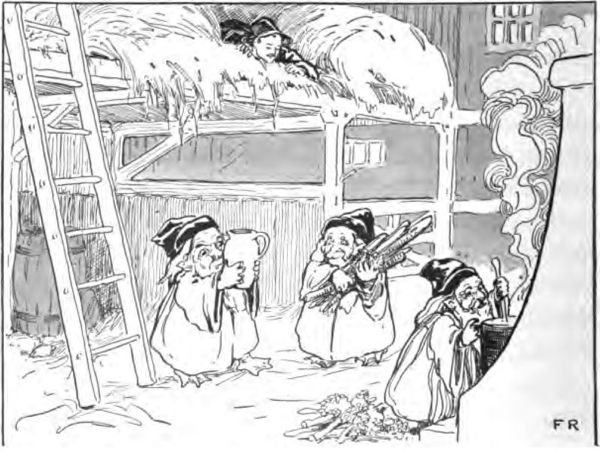
When he awoke, he found that he was not alone. He heard the tinkle of bells and the lowing of cattle. This surprised him very much, for he knew that all herdsmen had long before left the high pasture with their herds.
Looking down into the room below, he was still more surprised at what he saw. Three strange looking little men were standing around the hearth, on which a crackling fire was burning. As soon as the young hunter noticed their long green mantles and bright red caps, he knew that they were three of the gnomes who watched over the wild animals of the Alps.
The gnomes seemed to be making cheese. One of them stirred the milk in a big silver kettle, while the second one went in and out of the hut, bringing fresh milk to pour into that which was already cooking. The third gnome added dry moss and branches to the blazing fire.
In a short time the cheesemaker poured a reddish liquid into the kettle, while the second brought forward three bowls of rock crystal. Then the third gnome raised from the floor a horn that was much larger than himself.
Dragging the horn to the door, the gnome began to blow upon it, producing a strange, sweet melody, low and uncertain at first. The notes grew gradually louder and more solemn, then high and clear, each note being repeated by the echoes among the hills.
This strange melody and its echoes produced a most marvelous effect. As it rose upon the air, up from the bare mountains came herds of lowing cows.
The huntsman next saw the cheesemaker pour the contents of the kettle into the crystal bowls, and noted that, as it fell, the same liquid showed a different color in each of the three bowls. In the first bowl, it was red like wine. In the second, it was yellow like honey. In the third, it was white like milk.
As the last bowl was filled, the huntsman was startled to hear the gnome calling to him to come down and drink from any bowl he pleased. The hungry young fellow at once dropped to the floor, and looked at the bowls, one after another. Seizing the one filled with what he thought must be pure milk, he drained it to the bottom.
When he finished, the cheesemaker said,
“You are a wise man. Had you chosen the red liquid, you would have been given a hundred cows, for which you have long wished. Had you chosen the yellow liquid, you would have been given a large sum of money, for which I know you have also wished. But, in either case, you would have died within the year.
“In choosing the milk, you have chosen this magic horn which you heard wake the echoes. We have only one Alp horn to give away. It is yours. By using it, you will become a prosperous herdsman, and in time, a rich man. If you had not chosen the milk, hundreds of years would have passed before the Alp horn would again have been offered to mankind.
“We wish men to have this horn, to learn how to make other horns like it, and to teach other herdsmen how to call their flocks and herds with it. They will thus grow prosperous, having larger herds and flocks to tend, and less time to slay the chamois and other harmless wild animals.
“This horn will bring to you wild animals, if you wish, as well as sheep and cattle. But, listen! If you would live long and happily, never harm one of these harmless wild creatures.
“Remember!”
As the little man finished speaking, he and his companions instantly disappeared, and so did the cattle, the silver kettle, and the crystal bowls. But the large horn still lay in the doorway. The hunter seized it at once and found that he could draw from it the same wonderful notes produced by the gnomes.
Now this young huntsman loved a fair young herd girl, named Fenette, who was as poor as himself. She had often begged him to give up his wild and dangerous life, and become a herdsman, leading the life she lived and loved. And now he was determined to do so.
During the long winter nights, he worked at another Alp horn, making it exactly like the one which the gnomes had given him. When it was finished, he gave it to Fenette, and taught her how to use it in calling her cattle and in speaking to him across the valleys.
The next summer, they both tended their herds. Though they were too far apart to see each other, they could speak through their Alp horns across the peaks and ravines that separated their pastures.
One evening, as the sun was setting, while the herdsman was calling his cattle home with the Alp horn, he saw a young chamois doe coming toward him. At once, the old desire to shoot and kill came over him. Quick as thought, he seized his bow and sent an arrow straight to the heart of the beautiful creature, which fell dead on the hillside.
Then, through his Alp horn, he called good-night to Fenette. But no answer, save that of the echoes, came to his anxious ear, although he called again and again.
The next day, a herd boy came to tell him of a strange thing that had happened. He said that about sunset he had seen Fenette standing on the edge of a deep crevasse, listening while the young herdsman called his cattle and evidently waiting to answer him. Before the echoes of his last call died away, she raised her own Alp horn to her lips, and, at that very instant, she disappeared, and an arrow fell on the ice where she had been standing. The boy showed the arrow, and the herdsman saw that it was his own,—the one with which he had shot the chamois.
He ran to lead the search for his dear Fenette, but he could not find her. Some said she was carried off by a fierce mountain torrent; some, that she still dwelt at the bottom of the crevasse. But most of the mountain people say that the mist fairies of the Alps caught Fenette away to dwell with them in their ice-green palaces amid the snow, because they were angry with their favorite young hunter for giving up the chase to become a herdsman.
As the years went by, the grief-stricken herdsman continued the work that Fenette had loved, but instead of cattle, he now tended sheep all summer. He lived all alone in a tiny hut on one of the highest and loneliest pastures of the Alps. He spent the winters searching for travelers lost in the snow. Sometimes, his Alp horn guided hunters safely to his mountain hut.
Often, at the hour of sunset, when the last long shadows fell across the cold mountain lakes and the white glaciers, the notes of the sorrowful herdsman might be heard, the echoes repeating them more and more faintly, until they died away in the purple shadows of the mountains.
After a time, the wandering herdsman disappeared altogether, and his Alp horn was heard no more by hunter or traveler.
Other herdsmen have made many Alp horns, which they still use to call to each other across the glens and ravines. They have been able to produce with them low, solemn notes, but never the high, clear notes of the Alp horn that came from the gnomes.
On gossamer nights when the moon is low,
And the stars in the mists are hiding,
Over the hills where the foxgloves grow
You may see the fairies riding.
Kling! Klang! Kling!
Their stirrups and their bridles ring,
And their horns are loud and their bugles blow,
When the moon is low.
They sweep through the night like a whistling wind,
They pass and they leave no traces;
But one of them lingers far behind,
Her face unlike fairy faces.
She makes no moan,
She sorrows in the dark alone,
She wails for the sight of human kind,
Like a sighing wind.
“Ah, why did I roam where the elfins ride,
Their glimmering steps to follow?
They bore me far from my loved one’s side,
To wander o’er hill and hollow.
Kling! Klang! Kling!
Their stirrups and their bridles ring,
But my heart is cold in the cold night tide
Where the elfins ride.”
—Mary C. G. Byron.
(To be memorized)
The splendor falls on castle walls
And snowy summits old in story:
The long line shakes across the lakes,
And the wild cataract leaps in glory.
Blow, bugle, blow, set the wild echoes flying,
Blow, bugle; answer, echoes, dying, dying, dying.
O hark, O hear! How thin and clear,
And thinner, clearer, farther, going!
O sweet and far from cliff and scar
The horns of Elfland faintly blowing!
Blow, let us hear the purple glens replying:
Blow, bugle; answer, echoes, dying, dying, dying.
—Alfred Tennyson
(Abridged).
After finishing your visit to Switzerland you might hesitate whether to go from there to Germany or to France. Both of these countries touch Switzerland, and the boys and girls in each will interest you just as much as the Swiss boys and girls did.
The French boys and girls, however, would be very much surprised to know that you or anybody else could hesitate between their country and any other. They are so very sure that no other country can compare with their “Beautiful France,” as they call it. And France is a beautiful country, as you will see.
France is not a land of lake and mountain like Switzerland. Much of it consists of wide, level plains through which flow many broad, slow-moving streams on their way to the sea.
If these rivers of France could speak, what interesting stories they would tell you! They would tell you of the pretty villages and pleasant little farms they have passed, and of the sturdy, bright-eyed boys and girls who came to the stream, bucket in hand, for water to water their father’s little orchard and vegetable garden.
They would tell how the thirsty cattle came to drink, and how the women all along the way washed their family linen in the clear river water, and spread it on the banks to dry.
The rivers, grown wider and deeper, would tell you of the busy towns and cities farther along their course, and how men make these streams turn the wheels in the work shops and factories where so many people earn their living, making beautiful silks and velvets, laces and jewelry, rugs and carpets.
They would tell you of the lovely farms of waving grain in the wide level stretches; of the springtime blossoming orchards of peach, almond, apple, quince, plum, and pear; of the groves of olive, mulberry, and chestnut trees; of the immense violet and rose farms which supply the flowers for making perfumes; and of the miles and miles of grape vineyards. All this, and much more, the friendly rivers of France have seen as they flowed through this pleasant, prosperous land.
But let us take one of the many river boats and sail down to the sea, where we will visit one of the fishing villages.
The coast is not so pleasant as the river country, and the fisher folk do not seem so smiling and gay as the people in the rest of France. They are taller and stronger, however, which is a very good thing since their life is hard and full of danger. Often it is too stormy for the fishermen to venture out to the fishing banks, and then in fine weather they must work day and night to make up for this lost time.
Much of the fish they catch is sardines and, when the fishing is good, even the little children have to help in the canning factories by cleaning and sorting these little fish, for which the children are paid a few pennies a day.
The fisher folk live in little stone cottages with queer peaked gables. The cottages are built close together along the narrow streets paved with round cobble stones, which would hurt your feet right through your shoes. But the fisher children do not feel the rough stones as they go clattering along in their wooden shoes. Do you see Pierre and Marie on their way to the sardine canning factory?
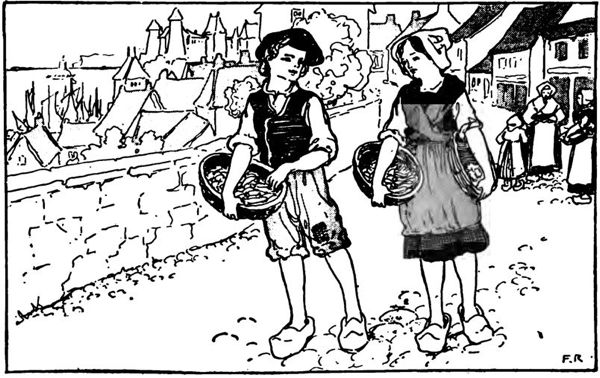
How sad the faces of these children! Not at all like the rosy, contented faces of the children of the farmer folk or the gay, smiling faces of the children in the towns. These are two little orphans,—“the orphans of the sea.” Their father was a fisherman who was caught in a storm while at the fishing banks and drowned.
The little “orphans of the sea” have to work very hard in the sardine factories. Do you ever think as you eat sardines how many lives they may have cost? If the sea could speak what sad, sad tales we should hear! It would tell you of many a poor fisherman lost, like the father of Pierre and Marie. The fishing towns are full of these little “orphans of the sea.” Their lives are so hard that it would make you sad even to read about them. No wonder the fisher folk call the ocean “the cruel sea”!
All along the coast of France the fisher folk have put up little wayside shrines and small chapels in memory of the brave fishermen who have lost their lives while earning bread for their wives and children. And always on Sundays and church feast days the fishermen with their wives and children visit these shrines to pray, and to remember those who have died.
You will see many more soldiers in France than in our own country. Their bright red and blue uniforms are to be seen almost everywhere, and there are forts and guards in Paris and in all the other large cities. You will wonder why this is so, especially as France is a Republic like our own dear United States.
But France was not always a Republic, and the French people were not always the prosperous, happy people most of them are to-day. There was a time when, except for a few rich nobles and wealthy merchants, the French people were miserably poor and unhappy.
This was when France was ruled by kings who did just what they pleased with their country. Most of these kings were vain, selfish men, who cared for nothing but pleasure and power, and the nobles under the kings were just as bad.
The king and his nobles got the money for their pleasures from the people, and almost always unjustly. Whenever it pleased them, they took the best of the farmers’ crops and cattle. Sometimes they even turned the farmers out of their homes and gave them to their soldiers. And then the farmers with their wives and little children would have to live in huts and caves as best they could, till they could build another home.
The king and his nobles treated the shopkeepers in Paris and the other large cities just as badly. Whenever they pleased they took what they liked from the shops without paying for it. If the shopkeeper had saved a little money, they made him give that up, too. They even took the treasures from the churches and if any one dared to complain, he was either imprisoned or killed.
The king, in his love of power, was always quarrelling, either with the king of another country, or with his own nobles. This meant almost constant war, so that instead of tilling their farms and working peacefully at their trades, Frenchmen had to serve as soldiers whether they wanted to or not.
So many were killed in these wars that, by and by, there were not men enough left to do the work. So the women and children and the old grandfathers had to plough and reap, cut down trees for firewood, feed the cattle and do much other hard and rough work. Even the dogs were put to work drawing loads in small carts, for all the horses had been taken for the army.
The French were not a very patient people, but for many long years they bore in silence their terrible wrongs. By and by, however, when they could not get enough bread, they became sullen and desperate. They thought that even God had forgotten them. They began to ask themselves why they should suffer so unjustly. They asked themselves whether they needed longer to obey such cruel masters. One day the nobles mocked their hunger, asking why if they were hungry they did not eat grass. Finally, the country people arose in their might and ended the rule of the kings and nobles.
In their wrath the people made many mistakes and did many cruel things. They had been treated unjustly so long, that they had forgotten how to be kind. They killed some innocent people with the guilty and drove others out of France never to return.
Some of the fighting was done at sea. This was because the kings and nobles of the other countries, wishing to help the French king against his people, sent warships full of soldiers to aid him. These other kings were afraid that if the French people won, their own people might turn against them and end their rule too.
After years of fighting on land and sea, the people with the help of a wonderful general named Napoleon, finally won.
Then the men went back to their shops and farms; the little children and the women no longer toiled in the fields; little by little men and women remembered how to smile and how to be kind, and in time France became the beautiful and prosperous country it is to-day. And ever since then the French have been a free people.
But the old people still tell stories of that far-off terrible time,—stories told them in childhood by their parents and grandparents, and many more are told in books which you will read when you are older. One of the stories which French children like best is that of Casabianca.
The boy stood on the burning deck
Whence all but him had fled;
The flame that lit the battle’s wreck
Shone round him o’er the dead.
Yet beautiful and bright he stood,
As born to rule the storm,
A creature of heroic blood,
A proud, though child-like form.
The flames rolled on—he would not go
Without his father’s word;
He knew not that the chieftain lay
Unconscious of his son.
“Speak, father!” once again he cried,
“If I may yet be gone!”
And but the burning shots replied,
And fast the flames rolled on.
Upon his brow he felt their breath,
And in his waving hair,
And looked from that lone post of death
In still, yet brave despair.
And shouted but once more aloud,
“My father! Must I stay?”
When o’er him fast, through sail and shroud,
The wreathing fires made way.
They wrapped the ship in splendor wild,
They caught the flag on high,
And streamed above the gallant child,
Like banners in the sky.
There came a burst of thunder sound—
The boy—oh! where was he?
Ask of the winds that far around
With fragments strewed the sea!—
With mast, and helm, and pennon fair,
That well had borne their part—
But the noblest thing that perished there
Was that young faithful heart.
—Felicia Hemans
No one visits France without going to Paris, for Paris is the richest, gayest and most beautiful of all the French cities. To Paris are sent the very best of all the things which are made or grown in France.
The shops are full of the most beautiful things to wear, and the costliest and most artistic furniture, books and pictures. The market stalls are heaped up with the choicest fruits and vegetables. The bakers’ shops, which are also the candy shops, display the most delicious bread, cake and sweetmeats. What American boy or girl has not heard of, and eaten, French ice cream and French “bon bons”?
From all over the world people come to Paris to see, admire and buy these wonderful things. Sometimes the price is so high that they have not money enough to buy. And then, too, the most beautiful things of all are not for sale, but are kept in museums where the people may study them and learn how to make even better things, and more beautiful. The boys and girls often go with their teachers to spend an afternoon in the museums. You may often see them walking through the streets, two by two, with their note books and pencils.
The French are very proud of their beautiful Paris, and they take the greatest pains to keep it beautiful. No one in Paris, no matter how rich, is permitted to build an ugly house, or lay an ugly pavement, or do anything that would spoil the appearance of the city. Even the street lamps, and the iron railings and gates of the parks and driveways are beautiful.
Right through the middle of Paris flows the River Seine, one of the largest rivers in France. Many fine stone bridges span the river, so that the people can pass easily from one side of the city to the other. In the middle of the river is a pretty little island, which is also part of the city. This island is a favorite spot with French boys and girls for picnic and boating parties.
If you should stand on one of these bridges and look over the stone railing you would see many interesting sights. You would see coming and going the boats which help feed Paris. Some are loaded with deep baskets of fresh fish from the fishing villages, for Paris is not very far from the sea. Some are piled high with crates of cabbage both red and green, crisp, curly leaved lettuce, bright red carrots, and sacks of potatoes. Some boats are loaded with fruit and flowers, which leave behind a trail of delicious perfume all the way up the river. Others are filled with great crates of live chickens, ducks and geese. You see it takes a great many boat loads every day to feed this big hungry Paris.
Perhaps, too, you may see the washerwomen kneeling in a row in their wooden boxes at the edge of the river, washing clothes in the cold river water. They do not seem to mind not having any hot water. They just dip each piece in the river, rub soap all over it, and then beat it hard with a wooden paddle until it is quite clean. Then they dip it in the river again and spread it on the ground to dry.
Then right under the bridge you may see where the dogs of Paris are brought to be washed and clipped. It is a very funny sight. Many of the dogs are poodles with thick, woolly coats. They seem so much smaller after losing their coats that their masters cannot help laughing and making fun of them. This seems to make the dogs feel ashamed, so they go away with their heads down and their tails between their legs. But they will feel so much cooler in the summer heat without the heavy coat, that they will soon be happy again.
But the best time to see Paris is on a holiday. And of all the public holidays in the year, Independence Day is the best. The French Independence Day comes in July like ours, but instead of being on the fourth it is on the fourteenth.
On the Fourteenth of July all the shops and factories in Paris are closed. All the schools are closed, too, and everybody has a holiday. From almost every window and balcony you will see flying the red, white and blue flag of France,—even from the churches the flag is flying gayly.
Early in the morning the country people, all dressed in their best clothes, begin to come into the city to see the great parade of soldiers. All the boys and girls and some of the old men, too, carry bunches and wreaths of flowers. The wreaths are to be placed at the foot of the statues of the great men and brave generals, who so long ago gave their lives that France might be free. Some of the flowers, however, are kept to throw to the soldiers, for almost everybody has a son or brother, a nephew, uncle, or cousin in the army.
By the time the parade begins, the streets are so crowded with people that there is no room left to walk. How proudly the soldiers march by! How splendidly the bands play! See how the boys and girls keep time with their feet! And look! Here come the old soldiers, carrying the faded old flags and banners which they carried on the battle fields so long ago. They do not march so quickly, for their backs are bent with age and many are lame. How the people cheer!
Even the smallest boys in the crowd stand very straight and proud as they take off their caps to salute these old soldiers. “Vive la France!” they cry again and again. This is their way of saying “Hurrah for France!” “Vive la France!” shout the girls, too, throwing their sweetest flowers at the old soldiers’ feet.
After the parade everybody walks about, talking and shaking hands with everybody else. Then they go to the parks and pleasure grounds to eat their lunch and spend the afternoon. In the parks are swings, and little wooden horses and chariots to ride, which go round and round like circus horses. There are little booths where the children can buy pink lemonade, almond syrup, and sugared water. Then there are men who carry big round tin boxes on their backs full of delicious, thin, sweet cakes which the children buy. And everywhere are men selling toy balloons and gay paper pinwheels. What good times the children have!
And when the children are tired of eating and playing there are the outdoor puppet shows where they can see acted one of the stories the French children like so well. The favorites are “Cinderella,” “Bluebeard,” and “The Bluebird”; but “Cinderella” is the greatest favorite of all. The girls prefer it because of the fairy godmother, and the boys because of Cinderella’s cat, which is just as funny as the clown in the circus.
Cinderella, you know, was a very pretty little girl who was as kind and good as she was pretty. After Cinderella’s mother died she lived with a stepmother and two half-sisters who were proud and selfish and most unkind to the poor motherless little girl.
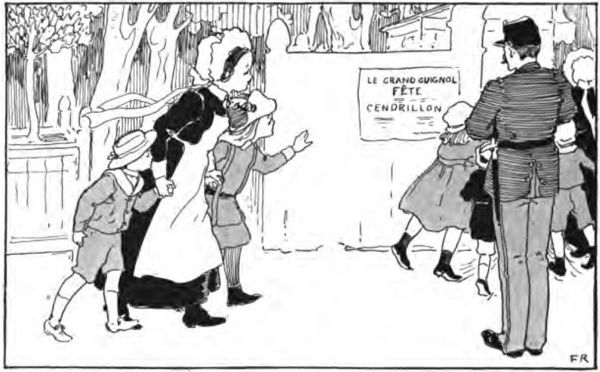
Scene I
(The two step-sisters Charlotte and Henrietta in a room with piles of clothes on the chairs and sofa. Charlotte is standing holding up a robe. Henrietta is seated with a lap full of clothing which she is looking over.)
See, Henrietta, the silver trimmings upon my red velvet robe make it quite handsome enough for the first of the prince’s balls. I shall have new robes for the second and third nights, and they will be even handsomer than this.
For my part I shall wear my blue velvet skirt to-night. I shall put on my gold flowered mantle and my diamond girdle, which is far from being the most ordinary one in the world. For the second and third balls, I, too, will have new and even handsomer robes.
Where is that cinder-maid? In the chimney corner as usual, I suppose. Has she finished washing the dishes, scouring the tables, and scrubbing the floors?
Yes, and now she is ironing my linen under-clothes. Then she has all my laces to mend.
Charlotte: She can stay up to-night and do that. She has very good taste in the matter of colors and she can dress the hair beautifully. I shall call her to decide on the color of my plumes, and how to dress my hair. She will have to do it in different styles, so that I may see which will become me most for the ball to-night. (Calls aloud) Cinderella! Cinderella!
(running into the room) Did you call? What can I do for you?
Get out the brushes and combs. I wish you to dress my hair in several different styles so that I may see which is most becoming to me.
(going to a drawer and getting out combs and brushes) I am sure your hair will look well high upon your head and braided like a golden crown. You will look like a tall and stately queen, sister. (Charlotte simpers and tosses her head.)
And you must dress my hair, also, Cinderella; but I shall slap your face if you pull my hair the least bit.
No, no, indeed I will not pull your hair. I will be most gentle. And your raven locks will look beautiful against your white neck, sister. I will braid and coil your hair, low upon your head, close to your neck.
We are going to the prince’s ball to-night, to another one to-morrow night, and to still another the night after that. Should you not like to go to the prince’s ball, too, Cinderella?
Oh, yes, dear Charlotte. May I indeed go with you?
(laughing) Ha! ha! ha! Only hear her, Henrietta! Why, what are you thinking of, Cinderella? People would laugh to see a cinder-maid like you at a ball.
I should say so. But come! Let us go to my room, where there are many long mirrors, so that we can see ourselves from top to toe. (The sisters leave the room followed by Cinderella carrying combs and brushes.)
Scene II
(A kitchen. Cinderella, wrapped in a large ragged shawl that covers her all over, is sitting on a stool in the chimney corner. A large cat is sitting on the floor close to Cinderella, looking up into her face.)
Yes, Puss, everything is very different here from what it was when my own dear mother was living. It is even worse since my father died. Henrietta and Charlotte have my pretty room, while I sleep in the garret on a miserable straw bed. I would not mind the hard work to do, if they were only kind to me! But they are not. They both looked very handsome to-night when they went off to the Prince’s ball and seemed so happy! Oh, I wish I might have gone with them—I should love to see all the beautiful people in their fine clothes. But nobody remembers me. Oh! Oh! (burying her face in her hands and sobbing.)
(rubbing his head against Cinderella’s knee) Don’t cry, don’t cry, little mistress. I know they are cruel and they are very stingy, too, for they feed you with the scraps, leaving nothing for me. I am reduced to living upon rats and mice and even, at times, upon lizards. But listen! Some one is coming (raising his head and looking around, as Cinderella’s Fairy Godmother enters, carrying a wand).
Heyday! What is my little maid crying about?
(looking up) O, Godmother, I wish I could—I wish I could——(Breaks down and sobs again).
You wish you could go to the Prince’s ball—is it not so?
(looking up again and heaving a big sigh) Yes, dear godmother, I do.
Well, be but a good girl and I will see that you go. Run to the garden and get the largest pumpkin you can find, while I look into the rat trap. Just a few minutes ago I saw a big fat rat with long whiskers caged there, and in the mouse trap six frisky little mice. (Turns to leave the room; Cinderella runs out before her, and Puss gets up to follow.) Go back Puss, I do not want you to catch the rat and the mice. I shall touch the pumpkin with my wand and change it into a gilded coach. In the same way I shall change the rat into a coachman and the mice into ponies.
(sitting down again as Godmother leaves the room) Change mice into horses—the rat into a coachman! Well, I never heard of the like. If she keeps this up I shall starve. But, of course, dear little Cinderella must have a coach and six, and a coachman, too. I suppose I can eat lizards if the worst comes to the worst. (Begins to lick his paws.)
(entering joyfully) O, Puss, come and see! Godmother has turned my big pumpkin into a beautiful gilded coach, the six mice into the prettiest gray ponies, and the fat old rat into a coachman with long flowing whiskers! And what do you think—she saw six lizards behind the watering pot, which she quickly changed into footmen in shining livery!
(shaking his head) Lizards, too! Six at a time! I shall starve for a certainty. But of course Cinderella must have footmen, as well as a coach and six, and a nice fat coachman.
(entering and nodding her head at Cinderella) Now, my dear, your coach and ponies, your coachman and footmen are waiting. It is high time you should be speeding along to the Prince’s ball.
(clasping her hands) O, Godmother, I had forgotten my ragged dress and this ragged old shawl! How can I go to the Prince’s ball in this? (holding up her ragged shawl).
We shall see what we shall see when I touch them with my wand. (Touches the old shawl, which drops to the floor, showing Cinderella robed in a beautiful white gown.) Now, my dear child, here is a pair of glass slippers that will make you dance like the fairies (handing her a pair of slippers). Put them on just before you enter the palace. But do not stay after midnight; for as the clock sounds the last stroke of twelve, your beautiful lace dress becomes rags, your coach becomes a pumpkin, your coachman becomes a rat, your ponies become mice, and your footmen become lizards again.
I will remember, dear Godmother. I will be here. (They go out together.)
At the last stroke of twelve! Coachman, a rat—ponies, mice—footmen, lizards! I will remember, dear Godmother. I will be here, too, and we shall see what we shall see! (Runs out after Cinderella and Godmother.)
Scene III
(The kitchen. Cinderella sitting in chimney corner, wrapped in an old shawl as before. Puss sits on the floor beside her.)
O, Puss, what a happy time I have had for three nights! How wonderful it has all been! The first night I went to the ball in grand style. The prince came out to meet my coach and led me into the palace. As we entered the great hall, there was profound silence among the assembled people. Every one left off dancing. The violins ceased to play. There was a confused sound of voices. I thought they were saying, “How beautiful! How beautiful!” They were all looking at my white dress, sparkling like the frost, and at my pretty glass slippers. “How beautiful!” they said. Then the violins began their music again, and the Prince was so kind. He danced with me again and again. He brought me sweetmeats, strawberries and cream in golden dishes. I asked him to lead me to a seat beside Charlotte and Henrietta. He did so, and oh, Puss, they were so kind to me! But they did not know me at all. I gave them most of the fruit and sweetmeats that the Prince brought me. What a feast they had! While he was gone for more sweets, I ran to my coach and got here just at the last stroke of twelve!
(nodding his head and licking his chops) Just at the stroke of twelve;—coachman—rat; ponies—mice; footmen—lizards; just in time! What a feast! What a feast I had!
When Charlotte and Henrietta came home, they found me here in the chimney corner, seemingly asleep. They waked me to tell me about the little Princess that drove in a gilded coach and had come with the Prince to talk and feast with them. They told me how often the Prince danced with the strange Princess and how she had slipped away. They wondered and wondered who she could be. They said the prince tried to find out, and it made them feel very proud that he talked to them about her. The second night, the same things happened again, and to-night, everything happened just as before, except that I forgot Godmother’s warning. I was dancing with the Prince when the clock began to strike twelve. How I ran! I ran so fast that I lost one of my glass slippers as I flew down the steps with the Prince close behind me. He stooped to pick up the slipper, and just at that moment the last stroke of the clock sounded! And there I was in the street, with my fine dress turned to rags! Instead of my coach, there was a big pumpkin. Instead of a coachman, six ponies, and six footmen, there were a fat rat, six mice, and six lizards going down the street, and I suppose the Prince saw a ragged cinder-maid running after them!
(nodding his head and licking his chops) A fat rat, six mice, and six lizards running away and a cat running after them. That is what he might have seen if he had waited.
Hush! Hush! Here come Charlotte and Henrietta. (Drops her head on her hand as if sleeping.)
Get up, Cinderella, and go to bed. You must arise early in the morning and clean this house as never before. Then you must put on a clean dress and be ready to meet the Prince.
The Prince! Meet the Prince here!
Yes, simpleton. The Prince lost his beautiful little Princess again to-night. But as she ran, she dropped one of her glass slippers, which the Prince found. Later, the royal herald announced that to-day the prince would visit every house and castle in the town. Every maid will try on the slipper, which is very small. The maid whose foot it fits will become the Prince’s bride (turns to leave the room).
As both Henrietta and I have very small feet, we wish to be ready to try on the glass slipper. So remember to be ready to admit the Prince. (Follows Henrietta.)
I will remember. (Follows the sisters from the room.)
(nodding his head) I will remember, too. (Follows Cinderella.)
Scene IV
(The drawing-room in Cinderella’s home. Charlotte and Henrietta seated stiffly in high-backed chairs, each with one foot resting on a stool. The Prince, his herald, and other officers standing nearby. Cinderella is standing near the door, Puss on the floor beside her.)
(kneeling before Charlotte and trying to put the slipper upon her foot) Fair lady, your foot is small, but the slipper is still smaller.
Try it on my foot.
(kneeling before her and trying to fit the slipper on her foot) Your foot, also, is small, fair lady, but again the slipper is smaller than the foot.
(who has been looking earnestly at Cinderella) Come hither, my little maid. Methinks the glass slipper will fit your slender foot.
(angrily) What! try the slipper on our servant-maid? A cinder-maid? That shall not be.
(angrily turning to Cinderella) Leave the room at once, Cinderella! Go to your kitchen.
Not before the maid has tried the glass slipper on her dainty foot. My orders were that every maiden in the kingdom should try on the glass slipper, and this little one shall not be slighted. (Turning again to Cinderella, who has started with drooping head to leave the room) Come, be seated, my fair little girl. (Cinderella sits down. Herald kneels and puts the slipper on her foot, the Prince leaning meanwhile on the back of her chair.)
(drawing from her pocket the mate of the slipper, puts it on the other foot) Now I have both my own slippers again.
Then I have my own little Princess again! Come! My father and mother, the good king and queen, await us to give their blessing. (Offers his hand to Cinderella.)
Oh, most kind and gracious Prince, may not my sisters live in the palace near us? They must not be left here alone. I want them and my dear old Puss to live with me.
Whatever you wish shall be done, my little Princess. But are these haughty women your sisters? I remember they called you——
(interrupting him by shaking her head and smiling—then turning to her step-sisters) Come, sisters.
(Cinderella led by the Prince, precedes the sisters, the herald and officers as all leave the room.)
I had a dream the other night
When I was all in bed.
I thought a fairy came to me
With wings about her head.
She was my fairy Godmother,
I knew her right away.
And I sat down upon her lap,
For I wanted her to stay.
She took me to a cool, cool place—
My bed was very hot—
And then she sang some songs to me;
The words I have forgot.
And then she got a shining book
And put it on her knee,
And lots and lots of fairy tales
She read to little me.
And as she read aloud to me—
Without the least surprise—
All sorts of magic fairy things
I saw with my own eyes.
I saw some knights in armor pass,
And castles tall and high,
And dragons fierce and dangerous
With wings so they could fly.
I saw as many princesses
In silver and in gold,
And ugly beasts turned into men,
And giants big and bold!
For I was in real Fairy-land
Where I had never been before;—
But my mother came and found me
Near the window on the floor.
—Edith B. Sturgis
Cosette was in her usual place, seated on the crosspiece of the kitchen table, near the fireplace. She was dressed in rugs; her bare feet were in wooden shoes, and by the light of the fire she was knitting woolen stockings for the little Thénardiers. In the next room the fresh voices of the two children were heard laughing and prattling.
On this Christmas evening several men were seated at table in the low room of the Thénardier’s inn. Four new guests had just come in. Cosette was thinking sadly that it was evening, late in the evening, that the bowls and pitchers in the rooms must be filled, and that there was no more water in the tank. From time to time one of the travelers would look out into the street and say, “It is as dark as an oven!” or, “It would take a cat to go along the streets to-night!” and Cosette trembled with fear.
All at once a man came in from the yard and said in a harsh voice, “You have not watered my horse.”
Cosette came out from under the table.
“Oh, yes, sir!” said she, “the horse did drink. He drank from the bucket, and I carried the bucket to him and talked to him.”
This was not true. Cosette was afraid, and she told a lie.
“Here is a girl as big as my fist who can tell a lie as big as a house,” said the man. “I say he has not had any water.”
Cosette went back under the table.
Madame Thénardier threw the street door open.
“Well,” she said angrily, “what became of that girl? Go and carry some drink to this horse.”
“But, Madame,” said Cosette timidly, “there is no water.”
“Go after some!” Madame went back to the stove as she spoke. “There is plenty at the spring. She is the laziest girl that ever was. Here, Miss, get a loaf of bread at the baker’s when you come back. Here are fifteen cents.”
Cosette had gone for an empty bucket that was by the fireplace. The bucket was so large that she could have sat down in it with comfort. The child had a little pocket in the side of her apron. She took the money without saying a word and dropped it into this pocket, but she did not seem to see the open door.
“Go along!” cried Madame Thénardier. Cosette went out. The door closed.
Exactly opposite Thénardier’s door was a toy shop all glittering with Christmas toys. In front was a great doll, nearly two feet high, dressed in pink crape and with real hair and blue eyes. The whole day this magnificent doll had stood there, but no mother was rich enough to buy it for her child.
As Cosette went out, sad and frightened, she could not help raising her eyes toward this wonderful doll—toward the lady, as she called it. She was saying to herself, “One must be a queen, or at least a princess, to have a doll like that!” She could not turn away. She forgot everything, even the errand on which she was sent. Suddenly she heard a rough voice:
“Haven’t you gone yet? Be off with you!”
Cosette fled with her bucket, running as fast as she could.
The poor child now found herself in thick darkness. She shook the handle of her bucket as much as she could on the way. That made a noise which kept her company.
As long as she had houses in sight, she went on boldly enough. From time to time she saw the light of a candle through cracks in the shutter. It was life and light to her. But when she had passed the last house, she stopped. It was now open country,—dark, silent country. Perhaps in this darkness there were wild beasts. She could almost hear them moving in the grass.
“I will go back,” she said to herself. Then she thought of Madame Thénardier with her cruel face and her angry eyes. Where should she go? What would become of her? She took up the bucket again and began to run toward the spring.
It was a small, natural basin about two feet deep and paved with a few large stones. Cosette did not take time to breathe. It was very dark, but she bent down and plunged her bucket into the water. She did not notice that something fell from her pocket into the spring. She neither saw nor heard it fall. She drew out the bucket and set it on the grass. Then she found that all her strength was gone. She could not take a step. She sat down and closed her eyes.
Then the fear of Madame Thénardier came back to her. She was afraid of the great, silent darkness. She longed to fly with all her might across the woods, across the fields, to houses, to windows, to lighted candles. Still, she did not dare to go without her bucket of water. She grasped the handle with both hands. She could hardly lift the bucket.
She went a dozen steps, but she had to stop again and again. She walked, bending forward, her head down like an old woman. The iron handle was freezing her little wet hands. The cold water splashed over her bare knees. Sobs choked her, but she did not dare to cry, so great was her fear of Madame Thénardier even at this distance.
At that moment she felt all at once that the weight of the bucket was gone. She raised her head. A large dark figure was walking beside her. It was a man who had come up behind her. Without saying a word, this man had grasped the handle of the bucket she was carrying.
Cosette was not afraid. The man spoke to her.
“My child,” he said, “this is very heavy for you.”
“Yes, sir,” said Cosette.
“How old are you, little girl?” said he.
“Eight years, sir.”
“You have no mother, then?”
“I don’t know,” said the child.
“Who was it sent you into the woods after water at this time of night?”
“Madame Thénardier,” said Cosette.
“What does she do, your Madame Thénardier?” asked the man.
“She is my mistress,” said the child; “and she keeps the inn.”
“The inn?” said the man. “Well, I am going there. Show me the way.”
Cosette walked beside him. She no longer felt tired or afraid. Soon the man spoke again:
“Is there no servant at the inn?”
“No, sir.”
“Are you alone?”
“Yes, sir. Only there are two little girls.”
“Who are they and what do they do?” asked the man.
“Oh!” said the child; “they are Madame Thénardier’s daughters, and they have beautiful playthings. They play all day long.”
“And you?”
“Oh, I work.”
“All day long?”
The child raised her face and said softly: “Yes, sir; though sometimes I play a little. I have a lead sword as long as that.” The child showed her little finger.
“And which does not cut?” said the man.
“Oh, yes,” said Cosette; “it cuts lettuce.”
As they drew near the inn the child said timidly:
“Will you let me take the bucket now?”
“Why?” asked the man.
“Because Madame will whip me if she sees that any one brought it for me.”
The man gave her the bucket and the door opened.
“Well,” said the innkeeper’s wife, “you have taken your time; you have been playing.”
“Madame,” said Cosette, trembling, “here is a gentleman who was looking for the inn.”
“Is it this gentleman?” said the woman.
“Yes, Madame,” said the traveler, touching his hat. Cosette went silently to work. She dared not dry herself at the fire.
Suddenly Madame spoke: “Oh, I forgot! That bread!”
Cosette plunged her hand into her pocket, and turned white. The money was not there.
“Have you lost it?” said the innkeeper’s wife, reaching out her arm toward a whip hanging on the wall.
The man had been watching Cosette.
“Here, Madame,” said he; “here is the money.”
“Yes, that is it,” said the woman, as her fingers closed over the silver which he held out to her. She had seen that it was not fifteen but twenty cents which he had given her.
“What is she knitting?” the man asked in a gentle voice.
“Stockings, if you please,” said Madame. “Stockings for my little girls.”
The man looked at Cosette’s poor, red feet.
“When will she finish that pair of stockings?”
“It will take her at least three or four good days, the lazy thing!” said Madame.
“And how much might the stockings be worth when they are done?”
Madame looked at him.
“About thirty cents,” she said.
“Will you take a dollar for them now?” asked the man.
The innkeeper thought it was time to speak.
“Yes,” he said; “you may have the stockings for a dollar. We can refuse nothing to travelers.”
“You must pay for them now,” said Madame sharply.
“I will buy that pair of stockings,” said the man, drawing the money from his pocket. “Now your work belongs to me. Play, my child.”
Cosette trembled.
“Madame, is it true? May I play?”
“Play!” said Madame, in a terrible voice.
“Thank you, Madame,” said Cosette. While she said this all her little soul was thanking the traveler.
Madame’s little girls had been playing with their doll. They had left it on the floor near the kitchen table. In the meantime Cosette had dressed up her little lead sword for a doll. She rocked it in her arms and sang it to sleep.
All at once Cosette stopped. She had turned her head and seen the doll upon the floor. She crept out upon her hands and knees, seized the doll, and in a moment more was in her old place.
Suddenly she heard Madame’s angry voice: “Cosette!”
Cosette shuddered as if at an earthquake. She took the doll and placed it gently and reverently on the floor. Then she did what nothing else had made her do,—the run in the woods, nor her fear, nor the loss of her money, nor the sight of the whip, nor Madame’s hard words. She began to cry.
The man walked straight to the door, opened it, and went out. Soon the door opened again and he came in carrying the magnificent doll of the toyshop. He went to Cosette and held it out to her, saying, “Here, this is for you!”
Cosette raised her eyes. She saw the man coming near with the doll as she would have seen the sun coming near. She looked at him, she looked at the doll; and then she went and hid herself under the table as far as she could.
There was a silence in the room. The innkeeper looked at the traveler as he would have looked at a bag of money.
“My little Cosette,” said he in a voice which was meant to be sweet, “take your doll.”
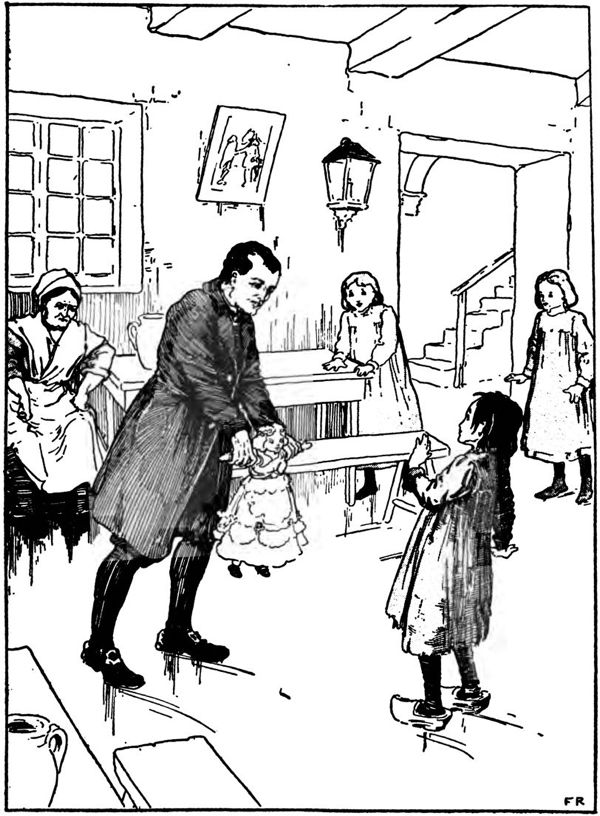
Cosette felt as if some one had said, “Little girl, you are Queen of France.”
“May I, Madame?” she said softly.
“It is yours,” said Madame, “since the gentleman gives it to you.”
“Is it true? is it true?” cried Cosette. “Is the lady for me, sir? I will call her Katharine.”
It was a strange moment when Cosette held the ribbons and fresh pink muslins of the doll against her own rags. She went to bed holding Katharine in her arms.
Some time after, when the house was still, the stranger passed through the hall, as if looking for something. By the stairs, among all sorts of old baskets and rubbish, there was a bed, if it could be called a bed. There were neither sheets nor pillows, and the mattress lay on the floor. In this bed Cosette was sleeping.
She was sleeping soundly, all dressed. But she held the doll fast in her arms. Its wide blue eyes shone in the darkness. One of Cosette’s wooden shoes stood beside her bed. In the room beyond, by the fireplace, stood two dainty little shoes ready for the good fairy of Christmas. The man bent over them. In each was a beautiful, shining piece of silver.
The man rose and was about to go away when, at the other end of the fireplace, he saw a clumsy, empty wooden shoe, half broken and covered with mud. It was Cosette’s shoe. Cosette was a child and she had a child’s faith. She too had placed her shoe in the fireplace.
When the stranger went back to his room there was a piece of yellow gold in the wooden shoe.
“Are you up so soon?” said Madame to the stranger the next morning. “Are you going to leave us already?”
“Yes,” said the man; “I am going away.”
The innkeeper’s wife handed him the bill, but though he looked at the paper his mind was on something else.
“Madame,” said he, “do you have a good business here?”
“Oh, sir,” she began, “the times are very hard, and there are few rich travelers like you. And that little girl eats us out of house and home.”
“What little girl?” said the stranger.
“Why, Cosette the Lark, as they call her. How stupid people are! She looks more like a bat.”
The man spoke again, and his voice trembled a little.
“Suppose I should take her away. Will you let me have her?”
“Who? Cosette?”
“Yes.”
“Ah, sir, my good sir! take her and keep her and carry her off! You will really take her away?”
“I will.”
At this moment the innkeeper himself came into the room. He had heard every word.
“Sir,” said he, “if you take Cosette, I must have three hundred dollars.”
The stranger took from his pocket an old, black pocket-book, opened it, and drew from it three bank notes.
“Bring Cosette,” he said simply.
While this was going on, what was Cosette doing?
As soon as she was awake she had run to her wooden shoe and found the gold piece in it. She did not know that it was a piece of gold; she had never seen one before. Still she felt a joy in the gift and that it meant some good for her.
“Cosette,” said Madame almost gently, “come quick.” Cosette followed her.
The stranger took a bundle he had brought and untied it. It contained a little frock and apron, warm skirts, a scarf, woolen stockings, and shoes.
“My child,” said he, “go and dress yourself.”
An hour later there passed on the road to Paris a man leading a little girl who had a pink doll. When she was tired the man took her in his arms; and Cosette, without letting go of Katharine, laid her head on his shoulder and went to sleep.
—Adapted from the French of Victor Hugo
Little Kings and Queens of the May,
If you want to be,
Every one of you, very good,
In this beautiful, beautiful, beautiful wood,
Where the little birds’ heads get so turned with delight
That some of them sing all night:
Remember, whatever you pluck,
Leave some for good luck!
Picked from the stalk or pulled by the root,
From overhead or underfoot,
Water-wonders of pond or brook—
Wherever you look,
And whatever you find,
Leave something behind:
Some for the Naiads,
Some for the Dryads,
And some for the Nixies and Pixies.
—Juliana Horatia Ewing
A little stream that rises high up above the pines in Switzerland, leaps and races down the mountain side out of Switzerland, and then flows silently through a great forest that covers many miles. Then it flows on and on until it becomes one of the most famous rivers in the world,—the River Rhine.
In that forest, the pines grow very large and very tall. In some places, they are so close together that their great dark branches meet overhead and shut out all the sunlight. Everything is very still there. No little birds are singing in the trees. No tinkling waterfalls and murmuring brooks go sparkling and racing in the sunlight. Instead of these, there are dark pools and lakes of still water, and our little stream goes creeping along in the shadows. This great dark wood is called the Black Forest of Germany.
All of the forest is not so dark and gloomy as this. Where the trees grow farther apart, the sun shines through the leaves, making the land warm and sunny. Some of the peasants, or working people, of Germany live in the brighter, sunny parts of the great wood.
They use the timber of the forest to build strong and comfortable houses. These houses are somewhat like those of the Swiss mountain people. First of all, are the stables for their cows and horses; and then, on top of the stables, they build the rooms in which the family lives. Above these rooms are the rooms where the peasants store their grain. The wooden staircase leading to the upper rooms is always on the outside of the house.
In such a house live Hansel and Lischen with their parents. Like most German children, they work hard and study a great deal of the time. All children are compelled by the law of the land to go to school, and the German schools are among the best in the world.
Hansel and Lischen are not rich children, but they are strong, healthy, and happy. Two sweeter, dearer children were never seen than the flaxen-haired, rosy-cheeked, blue-eyed boy and maid of the Black Forest. They are obedient to their parents, polite and kind to every one, and have quiet, modest manners.
Hansel and Lischen love their home in the great forest. In the spring and summer they gather the sweet wild strawberries. When they are tired, they lie on the ground and watch the sunshine through the leaves. The soft wind makes the leaves tremble and their shadows dance on the ground beneath, and on Lischen’s little dress.
The children often wander far away into the darkest places in the great wood. Hansel likes to watch the silent little fish swimming in the still and shadowy pools, while Lischen listens to the strange low murmur of the wind among the pines. They are always hoping that they will come upon some lovely sprite or water fairy in the deep pools, or some of the gnomes and fairies that are said to live among the dark trees. And many a story could they tell you about these strange folk of the Black Forest.
Before Christmas comes, their father and mother, with other parents, will take their children to the fair. It is held in the nearest town and lasts three days. If the weather is bright. Hansel and Lischen will be wild with pleasure, for they enjoy nothing so much as this journey to the fair. They make very merry with the other children in the golden sunshine. Although there is not much money to spend, they will have enough to get some little presents to give to each of their friends at Christmas.
In Germany, even the poorest families have their Christmas trees. Hansel and Lischen will choose a beautiful little evergreen from their forest.
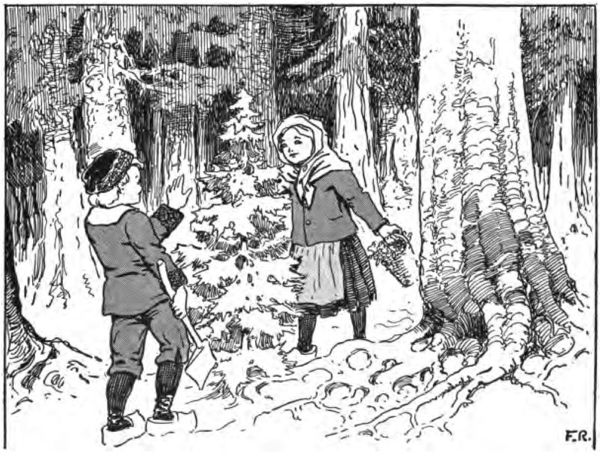
They always begin Christmas Day by going to church. Then they come home to a good Christmas dinner. Instead of a baked turkey, such as you have, they have a roast goose. In the evening, the father lights the candles on their Christmas tree, and they spend the evening dancing, singing, and playing games with their cousins and other little playmates.
Christmas is a happy time in Germany. So is Easter. It was from Germany that we learned the custom of having beautiful colored eggs at Easter. There are about twenty German holidays. One of the greatest of these is the birthday of the Emperor.
When the Emperor’s birthday comes around, Hansel and Lischen will go again to the nearest town, to keep the holiday. If the father and mother can get them there the night before, the children will see the great night parade of the Kaiser’s soldiers as they march with bands playing and flags flying.
“I feel at home with everything
That has a dwelling in the wood;
With flowers that laugh and birds that sing,—
Companions beautiful and good,
Brothers and sisters everywhere;
And over all our Father’s care.
“At morning down the wood path cool,
The fluttering leaves make cheerful talk;
After the busy day at school,
I hear along my homeward walk,
The airy wisdom of the wood,—
Far easiest to be understood.
“I whisper to the winds; I kiss
The rough old oak, and clasp his bark;
No farewell of the thrush I miss;
I lift the soft veil of the dark,
And say to bird and breeze and tree,
‘Good-night! Good friends you are to me.’ ”
—Lucy Larcom
Dark brown is the river,
Golden is the sand,
It flows along forever,
With trees on either hand.
Green leaves a-floating,
Castles of the foam,
Boats of mine a-boating—
Where will all come home?
On goes the river
And out past the mill,
Away down the valley,
Away down the hill.
Away down the river,
A hundred miles or more,
And other little children
Shall bring my boats ashore.
—Robert Louis Stevenson
We have not said much about the work that Hansel and Lischen do.
During the spring and summer, Hansel helps with the work on their father’s tiny farm. He feeds the horses and cows and finds many things to do in the farming of the land. Lischen helps her mother with all the housework and knits long stockings for herself and Hansel. She also knits warm woolen mufflers and mittens to wear on the cold days that next winter will bring, and when the children must walk through the snowy woods to school. In the autumn before the snow comes, Hansel and Lischen gather small pieces of dry wood for fires. As they gather these, they watch the size and shape of the pieces, and save up all those that may be carved into little figures.
Besides this work and studying their lessons, both children, sitting with their parents during the long winter evenings, learn to carve little wooden animals, toys such as Noah’s arks, handles for knives, and other useful things.
Many of the toys you play with are made by little German children. Some of these children work hard in this way all day long and often at night, and earn their own living by selling what they carve.
The father, meanwhile, carves beautiful figures from wood for the churches. The mother knits and tells them stories about the forest dwarfs or the old German heroes.
On the winter days, Hansel often goes with his father into the Black Forest to chop down some of the great pine trees. He helps pile the logs on a large sled, by which they will be hauled over the snow to the river that runs near their home,—our little stream that is now the river Rhine. When they reach the river the logs are piled on the banks until spring. Then they are bound together into rafts and sent floating downstream.
The children like to talk about the places that these rafts must pass as they float on and on down the great river. Lischen sets afloat on its bosom little boats that she has carved from bark or wood. She watches them bobbing with the leaves down the river, and wonders if some other children miles away will find her boats and play with them.
She wishes she might go where her boats or her father’s great log rafts will go. The father has promised her that she shall go with her mother some day to her mother’s girlhood home, miles away along this very river Rhine. He has promised to take Hansel with him and the other men on the next log rafts that he guides down the river to the place where they are to be sold.
They will follow the windings of the beautiful Rhine that sweeps its bright waters for hundreds of miles through the sunny plains of Germany. Part of the way it flows between low hills that, in summer, are green with vines for miles back from the banks. If you should go on shore, and peep under those great green leaves, you would find heavy bunches of sweet purple grapes.
Sometimes the river flows between steep hills and rocky cliffs on which are perched great castles and the grand old ruins of palaces. These ancient stone buildings were once the homes of lovely ladies and armed knights. There is a poem, a song, or a story, about every old castle, every crag, and every rock along this river. It is well called “The Storied Rhine.”
When you sail down the Rhine, the old story-tellers will show you a famous rock named the “Lorelei.” It is a high cliff, standing near some dangerous rapids in the waters of the Rhine. They will show you the spot where you can wake with your voice a wonderful echo that rings seven times from the rocky cliffs. And if you ask why this rock is called the “Lorelei,” they will tell you a story of long ago.
It is about a beautiful water sprite, named the Lorelei, who lived in the river Rhine. On moonlight nights she sat upon this rocky cliff combing her bright golden hair with a jewelled comb. As she spread her tresses of gold, the jewels flashed in the moonlight and she sang a song sweeter far than any earthly sound.
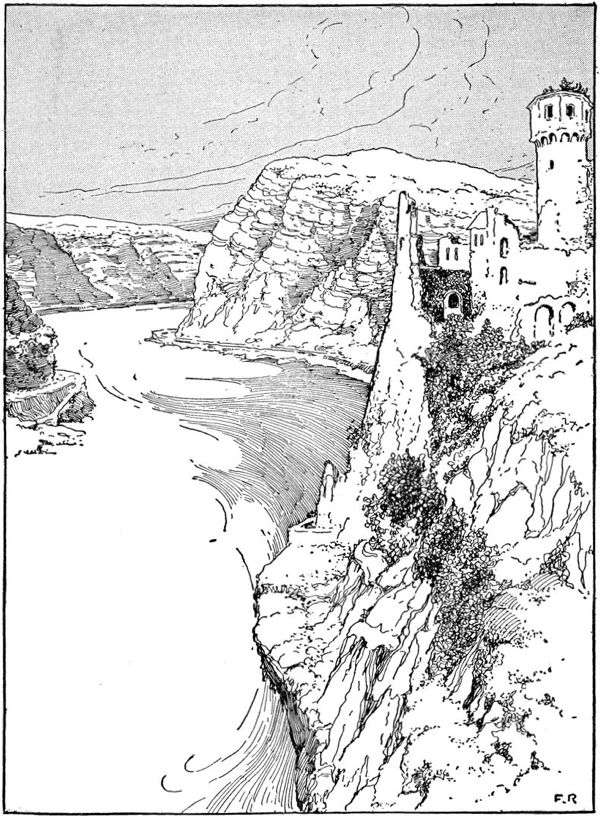
When the boatmen of the Rhine heard the voice of the Lorelei, they forgot the dangerous rapids at the foot of the cliff. They thought of nothing but the wonderful music of the singing maiden. They tried to get nearer to her rock, and took no notice of the rapids. Nearer and nearer they rowed, until their boats were dashed to pieces on the reefs, and they themselves drowned in the rushing waters.
The old story-teller will also show you a tall tower built on an island in the Rhine. It is called the Rat Tower of Bingen-on-the-Rhine. Should you ask how it came by the name, you would hear another story of this Rhineland.
Once there lived on the sunny banks of the Rhine, a rich man, known as Bishop Hatto. He had much fine land, and his many great granaries, or storehouses, were always full to overflowing with golden grain.
After a time, there came a great famine in the land. The poor people were starving for want of bread, but Bishop Hatto’s barns were almost bursting with wheat.
Did he give any to the starving poor? Not a grain, though they stood at his castle gate, day and night, begging for bread.
At last, he grew tired of hearing their cries and determined to put a stop to them. He sent the poor people word to come together in the one large barn which was empty, the grain from it having all been sold.
The people gladly obeyed, for they thought that he was going to give them some food. But when they were all in the barn, the bishop made his servants close and bar the doors. Then he ordered them to set fire to the building.
When the bishop heard the screams and cries of the poor people, he only said,
“Listen to the squealing of those rats!”
One morning, not long after this cruel deed, a servant came running to the bishop in a great fright. He told his master that the rats had gnawed his picture from its frame, that had always hung on the wall of his castle. And now, said he, a great army of rats was coming toward the castle.
The bishop was frightened. He felt sure that the rats would treat him as they had treated his picture.
Jumping upon a swift horse, he rode with all haste to the river bank. From there a boatman rowed him swiftly to a tall stone tower on an island in midstream. This tower belonged to the bishop, and he thought that he would be safe there.
He was mistaken. As he looked through a window from the top of the tower, he saw thousands and thousands of rats in the river. They were swimming rapidly toward the island. Before long they had reached it.
Then into the tower they came, pouring through the windows and doors, and through the walls and the floors they reached the room where the wicked man had locked himself in his fear.
As they had gnawed the picture from the frame, so now they gnawed the flesh from the cruel bishop’s bones. Then they turned about and left the island.
But ever since the tower has been called “The Rat Tower of Bingen-on-the-Rhine.”
They gather round him, one and all,
A group of happy children small;
Their mouths are open wide, their eyes
Seem almost twice their normal size;
Some stand, some sit, and not a word
From any one of them is heard.
Now all is ready quite, for now
The Story-teller rubs his brow;
And questions them: “What shall it be?
A fairy-tale from memory?
“Or shall I tell it in a song,
And make it up as I go ’long?
“Which shall it be, in prose or rhyme,
This tale of ‘Once Upon a Time’?
“Or will you have a story true?
Choose anything that pleases you.”
A busy hum goes round, and then
The voices quickly hush again;
For this small audience knows well
That any story he may tell,
Or any song that he may sing,
Will be a most delightful thing.
“We’ll let you choose,” they cry, and so
He tells a tale of long ago.
—Frank Dempster Sherman
As the Rhine rolls slowly toward the sea, it empties into a great bay called the Zuyder Zee.
There are old story-tellers here, too, who will tell you about the proud city that lies buried under the Zuyder Zee. The name of that city was Stavoren. Many of the people who lived there were very wealthy and lived in grand and beautiful palaces. But these people were proud and selfish and cared nothing for the poor.
The richest person in the city was called “The Lady of Stavoren.” She was the proudest and most selfish of all the rich people, and thought of nothing but plans for gaining more wealth.
The Lady of Stavoren was the owner of many sea vessels. Once she sent for the captain of the largest and finest of her ships, and said to him,
“To-morrow you will set sail for whatever land you please, but you must return in a year, bringing a cargo of the most precious thing on earth.”
“And what is that?” asked the captain.
“I cannot tell you; it is for you to find out. Go, and do my bidding,” said the haughty Lady.
As the captain hurried away to his ship, he saw the streets crowded with the poor. Many of them were begging for bread for themselves and their children.
“What can be more precious than wheat?” said the captain to himself. “Nothing, I am sure. I shall sail to the land where the very best wheat is grown. I will fill the hold of this ship with wheat, for bread is the staff of life.”
Now, all the time that the ship was sailing, the Lady of Stavoren was boasting to her friends of the treasure that she would soon possess. She refused to tell them what the cargo would be, saying only, “It is the most precious thing in the world.”
Before the year was over the ship came sailing home. The Lady and her friends hurried down to the harbor. The smiling captain came to meet them, and the Lady asked eagerly,
“What have you brought me?”
“A shipload of the very best wheat in the world, my Lady,” said the captain.
For a moment the Lady could not speak for amazement and anger. Then she cried, “Cast every grain into the sea!”
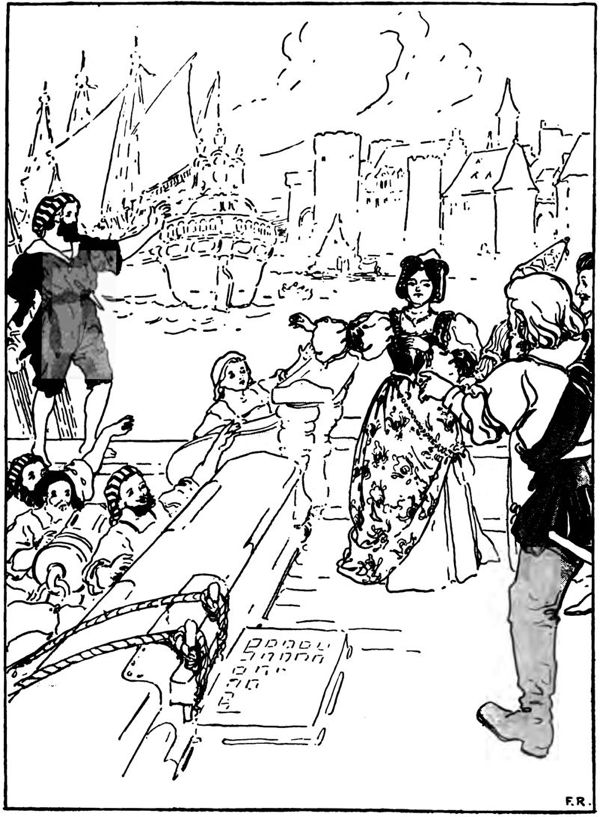
In vain the captain begged that, since she did not want it, he might give it to the starving poor.
“Do as I tell you at once,” she commanded the ship’s crew, and they cast into the sea the whole shipload of wheat.
“Ah, my Lady, God will punish you for this great sin! The day will come when you will wish for a few handfuls of this wheat,” cried the captain in sorrow.
Drawing a jewelled ring from her white hand, the Lady threw it into the sea, and said proudly,
“When I see this ring again, I shall look for punishment.”
The very next day a strange thing happened. A cook in the Lady’s palace was preparing a fish for a banquet when, to his wonder, he found in its stomach his mistress’s jewelled ring. He sent it to the Lady, who turned pale when she saw it, remembering her words to the captain.
The punishment came quickly. That day her warehouses and palaces burned to the ground. Then news came that her ships were lost at sea. Then her money was all lost and finally, in trying to make more, she became a beggar. Many a time she wished for the wheat that she had cast into the sea.
The selfish rich people of Stavoren did not take warning from the fate of this once proud and haughty woman. They were so selfish that they forgot all about her, and thought only how to grow richer.
By and by, the fishermen and boatmen found that the harbor was filling with sand. A great bar of it soon rose above the water at the spot where the Lady’s wheat had sunk. It was covered with a thick green growth that looked like wheat. But it bore no grain.
The people called this bar “The Lady’s Sand.” They believed that the wasted wheat had caused it to form there, and the worthless weeds to grow.
As no vessels could pass the sand bar, many of the people who were fishermen and traders lost the only way they had of making a living. Nor were there any more ships for the men on land to load and unload. Without work, the people must starve. So they begged the rich men of the city to have the sand dug away. But the rich cared nothing for the sufferings of the poor, and would not have it done.
Now, a great wall had long ago been built to keep the sea from breaking into the city reservoir. A little leak was formed in this wall. It grew gradually larger and larger until the water in the reservoir became salty and the people could not drink it. They begged the rich men in charge of the reservoir that the wall might be mended. But the rich men cared nothing for the water in the reservoir: They had wine to drink. So they did not have the sea wall mended.
One night there came a great storm. The waters of the sea rose in mighty waves. With a terrible roar they burst through the wall, rushed over the land and buried the city of Stavoren with all its people.
On the spot where the city once stood, now ripple the waters of the great bay that came to be known as the Zuyder Zee. On its shores there stands a little fishing village which is also called Stavoren.
When the waters of the bay are smooth and the sun shines down into the clear depths, the boatmen say they can see the towers and spires of great palaces. They say that they hear the sound of bells as the fish swim through the belfries of the sunken churches.
“Listen!” they say. “Do you not hear the bells of the lost Stavoren? Look! Do you not see the palaces of the city under the Zuyder Zee?”
The Zuyder Zee, of which we have been reading, is in Holland.
At one time there was no such country as Holland. Where the Dutch—that is, the people of Holland—now live, there were once only some marshes and land under water. But people built a wall of earth around these flats; then they pumped out the water from the space inside the wall, making canals through the land to drain it. And now they are hoping that they can drain off all the water of the Zuyder Zee. Perhaps when you go there, you will see a great stretch of rich farming land where once rolled the waters of the Zuyder Zee.
Whenever they wish to use a large stretch of mud and marsh for farms, they build a wall, or dike, all around the land that is to be made into a farm. This keeps any more water from flowing in on that piece of marsh land.
These dikes are high and wide. They have long, sloping sides which, like their tops, are often green with grass, and they look like long narrow hills. There are no real hills anywhere in Holland. There are roads on top of the dikes that are wide enough for two wagons to drive along side by side. In some places there are trees and houses on the dikes.
The biggest dikes, that keep out the ocean, extend for miles and miles along the beach. All the land of Holland is low and flat, most of it being below the level of the sea. So these great walls of stone and earth, the dikes, are built to prevent the ocean from flooding the land. On the outer edge of the dike one may stand and look down on the ocean, which is not far below one’s feet. But on the inner edge of the dike, if one looks down upon the land, the tops of the tallest trees are below one’s feet.
It is well that these dikes are strong, for there is always danger of the sea breaking through them. The water pushes, pushes, and beats against the great walls. If it can only make a hole in it, or find a crack between the rocks, the sea will break through and flood the land.
The peasants, or working people, of Holland keep a close watch upon the dikes. There are men hired especially to watch them.
If a leak is found, a great bell is rung to warn the people. Every face turns pale with terror when that bell is heard, and the cry of “A leak in the dike! A leak in the dike!” makes even the strongest tremble with fear.
Perhaps you have read the story of a brave little Dutch boy, who saved his whole country from being drowned like the wicked city of Stavoren, by putting his finger into a little hole in the dike.
Windmills are seen all over the country; they are built on the edges of the dikes. Each windmill has great arms shaped like ladders. These arms have sailcloth stretched on them to catch the wind. The wind makes the arms go round and round. As they turn, they work a pump that is in the mill. This draws up the water from the land. As the water is pumped up, it is emptied into a great wide ditch, called a canal. The canal has been dug deep and straight through the land to the sea, where it carries the water.
Besides those windmills that are pumping water from the land, there are some grinding grain, some sawing wood, and some crushing rock into sand. The Dutch use windmills to do things for them that steam and electricity do for us.
Canals cross the country in every direction. Many little canals cross the fields and open into the big ones, which go straight to the sea. Not only are they useful to the Dutch in carrying water to the sea, but they take the place of roads. Canal boats, or barges, go back and forth on these canals constantly, until the water freezes in the winter. Then the people skate from one place to another.
The people in the cities of Holland live and dress very much as the people do in our country. Many of the city people live in large houses that are very grand.
But you would find Dutch peasants and their quaint homes very interesting. Their little wooden houses are nearly all built to look alike, and are gaily painted. The roofs are always of red tiles, the window frames are painted snowy white, and the outside walls are green.
The Dutch farmers have very rich pastures where they graze their fine cows. They take great care of the cows, keeping them warmly covered with blankets during the cold weather of winter.
Their cow houses are kept perfectly clean. You would think a Dutch cow house a very pretty room. On the broad beams are blue Delft plates, bright brass vessels, shining brown bowls, and bunches of gay peacock feathers.
The Dutch dairy, too, is a charming place, with its floor of shining tiles, and its rows of bright vessels filled with creamy milk. Everything in the dairy is spotlessly clean, and the whole room is as neat as a pin.
It is no wonder that other countries are glad to buy from Holland all the cheese and butter that the people will sell; and they do sell a great deal to the other countries.
You will readily see that the Dutch people must be very industrious. The Dutch women keep the cleanest houses in the world. The little girls help their mothers with the housework, rubbing the kettles and other vessels of brass and copper until they shine like gold. They are up before the sun, ready to help cook the family breakfast. All day long these little girls are busy at mending or other work. They take their knitting with them even when they go out to play, and you will see long stockings dangling from their little fingers, which fly as fast as their tongues.
The boys help their fathers in the pastures, the hayfields, and the gardens. They often work in the mills, too, when the wind turns the wheels to crush grain and rock.
Boys and girls in Holland work far more than they play. Yet they are as happy and merry as they are helpful and strong. Most of them grow up to be brave and noble men and women.
They drive the cows home from the pasture,
Up through the long shady lane,
Where the quail whistles loud in the wheatfields,
That are yellow with ripening grain.
They toss the new hay in the meadows,
They gather the elder blooms white;
They find where the dusky grapes purple
In the soft-tinted October light.
They wave from the tall, rocking tree-tops,
Where the oriole’s hammock nest swings;
And at night they are folden in slumber
By a song that a fond mother sings.
Those who toil bravely are strongest,
The humble and poor become great,
And so from these brown-handed children
Shall grow mighty rulers of state.
The pen of the author and statesman,
The noble and wise of the land,
The sword and the chisel and palette
Shall be held in the little brown hand.
—Mary Hannah Krout
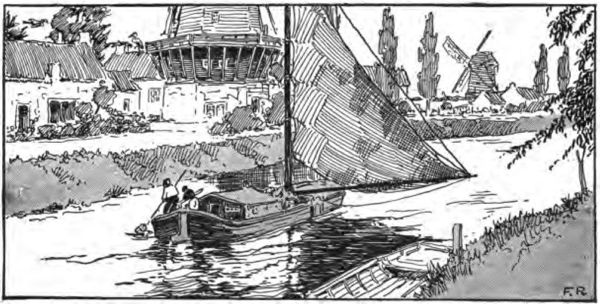
Jan is a sturdy little Dutch boy and Gretchen is his sister.
Their father is a miller, but he has a small farm, too, so there is much to be done in order that everything may be kept up successfully. Jan is not very old, but he helps his father in almost everything he does, on the farm and in the mill.
Gretchen is younger than Jan, but our little Dutch girl does a great deal of work, too. Early every morning during the summer, Gretchen drives to the pasture the gentle-eyed cow that she loves and pets. This walk gives her a chance to gather great handfuls of creamy daffodils, purple and pink hyacinths, and red and yellow tulips. As far as her eye can see, these many-colored flowers cover the ground as with a carpet.
Like many of the Dutch people, the family living nearest to Gretchen’s parents plant whole fields with the bulbs from which these flowers spring. Gretchen may pick as many as she likes, for every one is welcome to the blooms. It is the bulb of the flower that is valuable to the planters. For more than two hundred years the people of other countries have been glad to buy bulbs from Holland.
When Gretchen reaches home she drops her wooden shoes at the door of the dairy and runs over the clean, shining tile floor to help her mother with the churning and cheese-making. She knows that to-morrow Jan is to take the cheese and butter to the village market to sell.
He will hitch their two big dogs to a little blue wagon, which is just large enough to hold the cheese, the butter, and two cans of milk. He will walk beside the dogs as they trot slowly along with the little cart, and Gretchen wishes that she might go with him. But she must stay at home and carry her father’s dinner to the mill, just as she will carry it to him and Jan to-day.
Gretchen likes to go to the mill. She likes to see her father “feed” the hopper with the grain that is to be ground. Jan’s work is to catch the flour as it comes pouring slowly forth from between the great millstones into sacks.
To Gretchen the old windmill has always seemed like some great friendly giant flinging his arms around in the wind, which makes them clatter and creak. While her father and Jan eat their dinner, she stands and watches the mill’s great arms, and her nimble little fingers are busy with her knitting as she looks about. Like most little Dutch girls, she can knit very fast, even without looking at her work.
While her father smokes his long pipe, and rests a bit, Jan takes his fishing pole up on the dike and drops the hook into the water. Gretchen goes with him, and while he fishes, she knits and chatters away till he goes back to the mill. Then she takes the empty dinner pail and runs home to help her mother with the afternoon work.
On Saturday afternoons, there are always more things to be done than usual. The outside of the whole house must be washed off, as well as every little pane of glass in the low windows. Even the bricks in front of the door must be scrubbed. Inside of the house, all the floors must be scrubbed until even the kitchen tiles shine like glass. The tables and chairs will be rubbed until they are as shiny as the tiles. And after everything else is done, Gretchen will scrub her wooden shoes with soap and water and hang them on the bushes to dry.
By the time all this is done, the little girl and her mother are glad to sit down in the kitchen and rest, until time for Gretchen to make the tea and her mother to milk the cow.
How clean and bright and homelike the little kitchen looks! The sun seems to smile with pleasure as he peeps in at the shining brasses on the shelves, the pretty blue plates hanging on the walls, the gleaming red tiles of the floor and the quaint little stove, where Gretchen has started a fire.
The tall Dutch clock ticks drowsily, the little teakettle murmurs softly as it bubbles on the stove, and Gretchen is almost asleep over her tea making, when her mother comes in from milking and her father returns with Jan from the mill.
Even before the father finishes his first smoke after supper, Gretchen is ready to get into her little bed. It is more like a cupboard in the wall than anything else. Jan has a cupboard bed, too, close to the bright little stove, but during the summer, he likes to sleep on the sweet-smelling hay in the stables.
Come, lads and lasses,
Time quickly passes,
The sun will soon arise;
The birds are singing,
Their swift flight winging
Across the rosy skies;
Come, all together,
’Tis golden weather,
And all too soon it flies.
’Tis lazy boating
To go a-floating
Upon the silv’ry tide;
There’s no wind blowing,
But swiftly rowing
We’ll reach the ocean wide;
Pull all together,
And like a feather,
Our bonny boat will glide.
The great summer fair in Holland is known as the Kermesse. It is always held in a town or city and lasts three days. The children in the country look forward to the fair for weeks beforehand, and can talk of nothing else. For months, Jan and Gretchen saved for Kermesse every penny that they could lay their hands on.
When the day arrived, Jan put on the long baggy trousers of velveteen and the short jacket with the big silver buttons, which together form his “Sunday suit,” and his best shoes that are made of leather, instead of wood like the ones of everyday. He looked very much like a small grown-up, as all Dutch boys do, for, from the time they can walk, their clothes are made like those worn by their fathers.
Gretchen took off the long black dress, coarse blue apron, plain cap of white muslin and the wooden shoes that she wears everyday. She put on ever so many petticoats, and over these a bright plaid skirt, and a red and blue waist. Around her shoulders she folded a snowy kerchief with red roses on it. Close around her neck was a string of beautiful gold beads, and on her head a cap of fine old lace. Both of these had been her mother’s and her grandmother’s and she loves them very much. Instead of her wooden shoes, she wore some made of leather which are almost as stout and heavy as Jan’s.
Breakfast was over before the sun rose. And while the birds were still singing their earliest songs on the golden summer morning, our Dutch boy and girl with their parents stepped into their boat.
The father poled the boat along the small canal that runs by their house, and out into the broad main canal leading to the large town some distance away. Jan helped his father pole, for the boat was well loaded with butter and eggs, cheese, fruits, and vegetables which they were to sell at the market place.
They passed many large boats and broad barges. Some were loaded with coal, some with fish, and some with great jars of drinking water. It seems strange that Holland, a country where there is so much water, has very little that is fit for drinking.
Some of the barges had stopped under the rows of willow and popular trees that grow along the canal banks. There were women and children at work and play on these barges, for they were houseboats, on which many of the Dutch people live. The women were scouring the decks, washing clothes, and cooking. Some of the children were mending fishing nets, while others were busy with hook and line, catching fish.
One baby boy was pulling his wooden shoe along on the water by a string, as his father’s boat moved slowly on. All at once, he took a tumble into the canal. He did not seem to mind this very much, and his father soon fished him out and had him back in the boat.
Jan told Gretchen that he thought it must be great fun to live on a houseboat, moving from place to place and always seeing new sights. But Gretchen was sure she would rather live in their own home, near the old windmill and the high sea wall.
There was much to be seen on both sides of the canal. They passed many large meadows, where handsome white and black cows were feeding on the rich green grass. Groups of farm houses stood in the midst of these fields, their red tiled roofs gleaming in the early morning sunshine.
Some of the houses were so close to the canal that the children could see the storks on the roofs, either standing on one leg or sitting on their nests built among the chimneys.
Once they saw one of these large birds rise from the canal with a frog in her bill, which she carried to her young on a roof near by.
I suppose you have heard how the storks live all summer among the marshes and canals of Holland. The people love the storks and protect them by law from harm. No Dutch boy or girl would hurt a stork for anything. They are sorry when the cold weather drives the old birds and their young far away across the ocean. The Dutch believe that they will have good luck as long as the storks build nests among their chimneys.
Jan and Gretchen were very glad when at last they reached the town, where the houses stand close together along the canals. Many of the streets in this town are water ways,—narrow canals running in different directions. There are bridges over these canals, upon which the people cross from one side to the other.
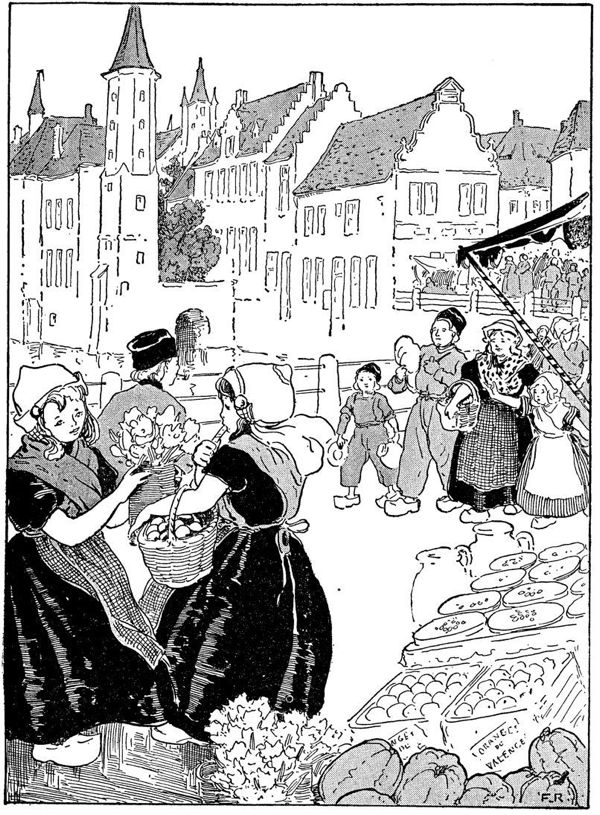
Most of the houses are of brick, some of them being six stories high. The upper stories are very narrow, coming to a peak at the top. Nearly every house is painted bright green, yellow, or blue, and has a red tiled roof.
The market place is an open square near the center of the town, with little booths or stalls built all about it. Here the people sell what they have brought to the fair and buy what they need. Some booths are full of toys and sweetmeats for children, and here Jan and Gretchen spent their pennies.
Flags are flying from the houses everywhere. There are bands playing merry music, and people talking, laughing, and shouting to each other. Young men and maidens dance and sing in the parks and pavilions. Everybody has a good time.
Jan and Gretchen thought they would like to stay in town the whole three days of the fair. But they were so tired when they got back that night to their dear little home, lying so still and peaceful in the shadow of the poplar trees, that they were glad not to have stayed.
They were too tired to help their father and mother milk the waiting cows, and very soon they were asleep in their cupboard bed and hayloft-couch, living over again in dreams the joys of the Kermesse.
Hurrah for the jolly old winter,
The king of the seasons is he,
Though his breath is cold and icy,
His heart is full of glee.
He piles up the beautiful snowflakes
On the apple trees bare and brown,
And laughs when the north wind shakes them
Like a shower of blossoms down.
Hurrah for the jolly old winter,
Who shouts at the door by night,
“Come out where the ice is gleaming,
Like steel in the cold moonlight.”
Like swallows over the water
The skaters merrily go,
There’s health in the blustering breezes,
And joy in the beautiful snow.
—Emily Huntington Miller
Winter had come and the storks had flown far away to lands that were warmer than Holland. The lakes and ponds were like great gleaming mirrors, and every canal was “a shining roadway of ice.”
On these roadways Jan and Gretchen skated to school and home again almost every day. Their mother and father skated to market, to church, or to their neighbors’ homes. During a Holland winter the people skate almost everywhere they go. Nowhere else in the world do so many people skate as in this tiny country. The ice is not only useful to the Dutch, but it gives then their greatest pleasure.
Jan and Gretchen love the winter; some of their most delightful holidays come then. The first day that all the lakes and canals are covered with ice thick enough for skating is always a holiday in Holland. Even at night the canals and lakes are crowded with gay, laughing people on skates or in ice-boats.
An ice-boat is not so much like a boat as a sleigh with a sail fastened to it. When the wind blows against the sail the boat seems fairly to fly over the ice. Some of the ice-boats are shaped like swans. Sometimes they are drawn by horses with plumes and lights on their heads and tinkling bells on their necks. At night the boats all carry lights and, as they glide by, these lights twinkle like the stars above, and are reflected in the shining ice below.
The boys and girls sing as they dance on the frozen lakes in the moonlight, or skim over the ice, each pair carrying a sail stretched between them.
On the day before the Feast of St. Nicholas, their father and mother took Jan and Gretchen to the nearest market town, skating with them all the way there and back.
St. Nicholas Feast comes on the sixth of December and is very much like our Christmas. The towns are crowded with people at that time. There are a great many tents, with flags flying from them, and the place is very gay and noisy. The stores are full of toys and candies, and in the bake-shops can be found all kinds of tempting sweet cakes.
Jan and Gretchen walked about with their father looking at the things in the windows, while their mother went from shop to shop, filling a big basket on her arm with the things she bought, which she showed to no one.
When she was through with her shopping, Jan said he felt hungry, and his mother told him that they would go to Old Mother Van Winkle’s shop. The children jumped for joy, because they knew well Old Mother Van Winkle and her cakes.
“Oh, I am glad to see these children,” cried Old Mother Van Winkle, as they drew near; “just to-day I baked St. Nicholas cakes, and you shall each have some to take home with you. Come in, come in and sit down.”
While they were eating, Gretchen spied several children with two women near by, and told Jan to look at their queer clothes. The boys did not wear great baggy trousers, and the little girls wore no close caps, but hats with brims, and all of them had on tight-fitting leather shoes.
“Those are American children,” said their father, “and the two ladies may be their teachers. Listen to their talk; they are speaking in Dutch.”
The children listened closely, but could not understand. Then Jan began to laugh.
“How funny they sound!” he said; “they talk as Gretchen did when she was a baby.”
“You should not laugh at that,” said his father. “They are learning our language and do very well. They are saying that they wish they could skate like the Dutch boys and girls.”
Jan felt quite ashamed that he had made fun of the little strangers, and very proud that they admired the skating of his playmates.
“But, father,” said Jan, “I think America must be a dull place if the people do not skate there.”
“You would not think so if you lived there,” said his father. “America is a big country, a great country, and in some parts of it the people skate quite as well as we do in Holland. And if you should try to learn their language, the little American children would think your talk sounded just as funny as you think their talk sounds.”
This was all he had time to say, for just then there was a great noise in the streets and Gretchen cried, “Look, look at St. Nicholas!”
Coming along the street on a big white horse, was a man with a long snowy beard and a merry, rosy face. He had on long robes, and on his head was one of those tall caps which you may have seen in pictures of bishops.
He was smiling down at the boys who ran crowding around him, crying, “Give us some cakes! Give us some candy, good St. Nicholas!”
Jan was not at all surprised to see St. Nicholas, for he rides through the Dutch towns every year on the day before St. Nicholas Feast. A cart always comes behind him piled high with bundles of all shapes and sizes. These are St. Nicholas’ presents for good children, and all Dutch children expect him to visit their houses on the following night.
Every child fills one of his wooden shoes with hay or beans for the good Saint’s horse, and places it near the chimney, on the night before the Feast Day. In the morning, the children always find the hay gone from their shoes, and a small present in its stead. After that there is a great hunt all over the house for the larger bundles in which their other presents are hidden.
Soon after St. Nicholas passed by Old Mother Van Winkle’s shop, Jan and Gretchen got their parcels together, and went home with their parents.
“What a jolly day we have had!” said Jan, as he and Gretchen climbed into their cupboard beds that night.
The next day was a very happy St. Nicholas Feast for Jan and Gretchen. Their mother roasted a great fat goose for dinner and there were many other good things to eat.
Their grandfather and grandmother spent the day with them, and made them happy by telling them some of the stories that all Dutch children love. The time passed so quickly in listening to these stories that six o’clock came before they knew it. The little clock was striking the hour, when—there at the door was St. Nicholas, throwing presents upon the white linen sheet which, hours before, had been spread on the floor to catch them!
The day after this happy St. Nicholas Feast, Jan and Gretchen saw their father walking on the high sea wall. They went racing along the road, past the bare, level fields, until they almost caught up with him. Then calling to him to wait, they soon scrambled up the sloping sides of the dike. They stopped to rest beside their father, and to look out over the wide, wide sea into which the sun was about to sink.
It seemed to them that they could see for thousands of miles beyond, clear to the “blue rim of the world where the sky touched the sea.” A great ship was speeding away over the ocean leaving a cloud of smoke behind her.
“I wonder where that big boat is going, and who is on it,” said Jan.
“There are a great many people on it, I’ve no doubt,” said his father. “Perhaps those American boys and girls whom we saw at Old Mother Van Winkle’s shop are aboard, going back to their own land and home which to them, as to every boy and girl, is the dearest and best place in all this great, wide, wonderful, beautiful world.”
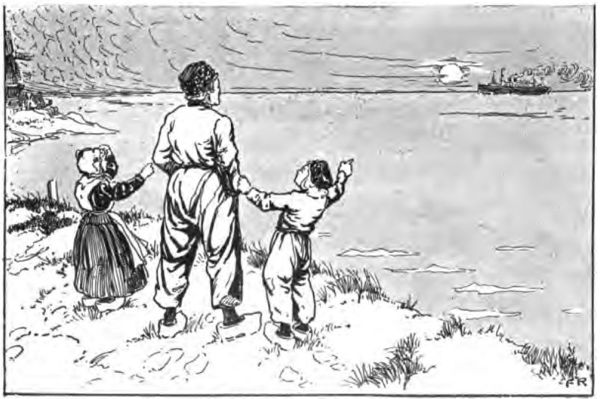
There was once a restless boy
Who dwelt in a house by the sea,
Where the water danced for joy,
And the wind was glad and free:
But he said, “Good mother, oh! let me go:
For the dullest place in the world, I know,
Is this little brown house,
This old brown house,
Under the apple-tree.
“I will travel east and west;
The loveliest homes I’ll see;
And when I have found the best,
Dear mother, I’ll come for thee.
I’ll come for thee in a year and a day.
And joyfully then we’ll haste away
From this little brown house,
This old brown house
Under the apple-tree.”
So he traveled here and there,
But never content was he,
Though he saw in lands most fair
The costliest homes there be.
Something he missed from the sea or sky,
Till he turned again with a wistful sigh
To the little brown house,
The old brown house,
Under the apple-tree.
Then the mother saw and smiled,
While her heart grew glad and free.
“Hast thou chosen a home, my child?
Ah, where shall we dwell?” quoth she.
And he said, “Sweet mother, from east to west,
The loveliest home, and the dearest and best,
Is a little brown house,
An old brown house,
Under an apple-tree.”
—Eudora S. Bumstead
This list contains all the new words that are to be drilled upon as wholes. These words are grouped by lessons, each group being numbered to correspond with the page on which that lesson begins.
| 1. | isles | 70. | du′ties | 135. | cost′li est |
| thou′sands | in sist′ed | ar tist′ic | |||
| whis′per | com pan′ions | de li′cious | |||
| cit′ies | tam′bour ine | A mer′i can | |||
| prayers | knuck′les | bon′bons | |||
| com′fort | mu se′ums | ||||
| 2. | glo′rious | cor′ners | pen′cils | ||
| di rec′tion | vi′o lin′ | Co sette′ | |||
| im ag′i na ry | mo′tion | per mit′ted | |||
| op′po site | nim′bly | ap pear′ance | |||
| sur′face | per′fect ly | Seine (sān) | |||
| re′al ly | cab′bage | ||||
| 74. | zith′er | car′rots | |||
| 3. | sew′ing | mel′o dy | let′tuce | ||
| cu′ri ous | dra′gon | po ta′toes | |||
| fox′glove | earn′est ly | poo′dles | |||
| smoothed | |||||
| curt′sied | 77. | tire′some | 138. | In depend′ence | |
| Lu′cy | mem′o ry | pa rade′ | |||
| fa′vor ite | re proof′ | stat′ues | |||
| a loof′ | neph′ews | ||||
| 5. | is′lands | cot′tage | un′cles | ||
| vol ca′no | sa lute′ | ||||
| re mem′ber | 78. | Flor′ence | Vive la France | ||
| earth′quake | Bep′po | (veev lah frahns) | |||
| bam boo′ | Nel′lo | lem on ade′ | |||
| san′dals | Bi an′ca | syr′up | |||
| chrys an′themums | art′ist | bal loons′ | |||
| O-Ki ku | pup′pet | the′a ters | |||
| fes′ti val | or′gan | Cin der el′la | |||
| car′ni val | cir′cus | ||||
| 10. | skirts | La Be fo′na | |||
| dif′fer ent | Pi noc′chi o | 141. | Char′lotte | ||
| (pĭ nŏk′ yō) | (shar′lot) | ||||
| 11. | Yo-shi San | Hen ri et′ta | |||
| slant′ing ly | 82. | car′pen ter | or′di na ry | ||
| sleeves | An to′ni o | cin′der | |||
| re ceives′ | Gep pet′to | scour′ing | |||
| cur′rent | (je pĕt′ tō) | scrub′bing | |||
| swords | carv′ing | sim′pers | |||
| he′ro | naught′y | ||||
| Ta′ro | in vite′ | 144. | kitch′en | ||
| tur′tle | sau′cers | gar′ret | |||
| Ro′me o | mis′tress | ||||
| 17. | mer′maid | al though′ | stin′gy | ||
| comb′ing | naught′i est | re duced′ | |||
| ring′lets | va ca′tion | liz′ards | |||
| foun′tain | ar rived′ | whisk′ers | |||
| don′keys | liv′er y | ||||
| 18. | U rash′i ma | ||||
| pal′ace | 90. | four′teen | 149. | pro found′ | |
| im ag′ine | screamed | as sem′bled | |||
| crys′tal | dor′mouse | sim′ple ton | |||
| wel′come | fe′ver | roy′al | |||
| grot′tos | her′ald | ||||
| neck′lac es | 94. | elf′in | an nounced′ | ||
| min′strels | |||||
| 23. | ves′sel | dark′ling | 154. | earn′est ly | |
| stran′gers | hith′er | ||||
| lone′li ness | 95. | gir′dle | ser′vant | ||
| per haps′ | cav′erns | gra′cious | |||
| vil′lage | bow′ers | haught′y | |||
| prom′ise | in ter rupt′ing | ||||
| wrin′kles | 96. | Switz′er land | |||
| tun′nel | 157. | knights | |||
| 26. | nib′bling | nat′u ral | ar′mor | ||
| length | Alps | ||||
| mir′ror | ter rif′ic | 158. | Thé nardiers | ||
| for′feit | av′a lanche | (tā nar′dyā) | |||
| scal′y | gla′ ci ers | la′zi est | |||
| mis′chie vous | prec′i pice | mad′ame | |||
| mur′mur ing | cre vas′ses | tim′id ly | |||
| lull′a by | viv′id | com′fort | |||
| daz′zling | mag′nif′icent | ||||
| 28. | palms | er′rand | |||
| des′ert | 100. | at tempt′ | nat′u ral | ||
| shov′el | guard | ba′sin | |||
| sup pose′ | chas′m | ||||
| aw′ful | chamois | 162. | twen′ty | ||
| (shăm′my̑) | thir′ty | ||||
| 29. | A ra′bi a | val′u a ble | |||
| Ar′abs | 166. | rev′erent ly | |||
| sul′tans | 102. | bor′der ing | Kath′a rine | ||
| ca′liph | past′ure | rib′bons | |||
| o′a sis | Jeanette | rub′bish | |||
| cam′els | (jā́ nĕt′) | mat′tress | |||
| es pe′cial ly | cel′lars | bus′i ness | |||
| broad | gal′ler y | scarf | |||
| jour′ney | com′pa ny | ||||
| stom′ach | fur′ni ture | 174. | Rhine | ||
| veg′e ta bles | peas′ants | ||||
| 33. | Zo bei′de | Con′rad | com′forta ble | ||
| (zō bā′dȧ) | Han′sel | ||||
| Ah′med | 105. | en joy′ | Lischen | ||
| bar′ley | burrs | (lĭs′kĕn) | |||
| cot′ton | gnomes | com pelled′ | |||
| pub′lic | Nai′ads | flax′en | |||
| tur′ban | (nī′ăds) | o be′di ent | |||
| ar ranged′ | Dry′ads | em′per or | |||
| car′a vans | Nix′ies | ||||
| ex cept′ | Pix′ies | 179. | dwell′ing | ||
| di rect′ | flut′ter ing | ||||
| 107. | with′ered | wis′dom | |||
| 37. | os′trich | hur rah′ | |||
| Ko′ran | squir′rels | 181. | mean′while | ||
| Bi′ble | girl′hood | ||||
| tongue | 108. | Al′pine | an′cient | ||
| e vent′ | sto′ried | ||||
| 41. | emp′ty | yo′del ing | Lo re lei | ||
| re pose′ | ech′o | (lō′rĕ lī′) | |||
| quan′ti ties | rap′ids | ||||
| 42. | Has′san | dis tinct′ | |||
| com pare′ | psalm′ | 186. | Hat′to | ||
| fleet′ness | trump′ et | gra′na ries | |||
| strength | sig′nal | o beyed′ | |||
| sad′dle | wick′ed | ||||
| shoul′der | 113. | heights | gnawed | ||
| cap′tives | hosts | ||||
| command′ed | 188. | group | |||
| 44. | dar′ling | cre a′ted | nor′mal | ||
| splen′did | au′di ence | ||||
| scant′y | 114. | pro tect′ed | |||
| thou | stir′rups | 190. | Zuy′der Zee | ||
| fore′head | wrapped | Stav o′ren | |||
| reins | gos′sa mer | cap′tain | |||
| course | res′cue | pre′cious | |||
| stud′ded | shrieked | car′go | |||
| sought | har′bor | ||||
| 45. | Bag′dad | de sert′ed | ea′ger ly | ||
| A′li Co′gi a | a maze′ment | ||||
| ol′ives | 117. | hearth | |||
| mer′chant | li′quid | 193. | pre par′ing | ||
| cer′tain ly | or liq′uid | fi′nal ly | |||
| ware′house | pro duc′ing | worth′less | |||
| mould′y | grad′u al ly | trad′ers | |||
| dis hon′est | mar′vel ous | res′er voir′ | |||
| re placed′ | ef fect′ | bel′fries | |||
| con′tents | |||||
| 48. | quar′rel | start′led | 196. | Hol′land | |
| prove | pros′per ous | marsh′es | |||
| tri′al | in′stant ly | ca nals′ | |||
| of′fi cers | dis ap peared′ | dikes | |||
| court | e lec tric′i ty | ||||
| Viz′ier | 120. | Fe nette′ | |||
| pre vent′ | de ter′mined | 199. | delft | ||
| a greed′ | ra vines′ | pea′cock | |||
| sep′a rat ed | dai′ry | ||||
| 51. | de clared′ | de sire′ | in dus′tri ous | ||
| or′dered | anx′ious | cop′per | |||
| ex act′ | ev′i dent ly | dan′gling | |||
| pris′on | con tin′ued | ||||
| re stored′ | 202. | el′der | |||
| false | 123. | bri′dles | o′ri ole | ||
| bu′gles | ham′mock | ||||
| 56. | no′tice | lin′gers | slum′ber | ||
| ad mire′ | sigh′ing | au′thor | |||
| mod′est ly | states′man | ||||
| jus′tice | 124. | sum′mits | chis′el | ||
| con demn′ | cat′a ract | pal′ette | |||
| con fessed′ | re ply′ing | ||||
| es cape′ | scar | 203. | Jan | ||
| pun′ished | glens | Gretch′en | |||
| in tel′li gent | Elf′land | suc cess′ful | |||
| tu′lips | |||||
| 59. | so′fa | 125. | hes′i tate | bulbs | |
| sol′i tudes | Ger′ma ny | u′su al | |||
| scouts | France | ||||
| nurse | in′ter est | 208. | Ker′messe | ||
| fac′to ries | trou′sers | ||||
| 61. | fruits | alm′ond | vel′ve teen′ | ||
| mul′ber ry | jack′et | ||||
| 62. | It′a ly | per′fume | coarse | ||
| tor′rents | sar′dines | mus′lin | |||
| lau′rel | rough | plaid | |||
| fo′li age | or′phans | ker′chief | |||
| myr′tle | chap′els | ||||
| cit′rons | 211. | square | |||
| Ven′ice | 129. | u′ni forms | cen′ter | ||
| I tal′ian | Par′is | pa vil′ions | |||
| gon′do las | re pub′lic | couch | |||
| pi′geons | U nit′ed | ||||
| en′e mies | mis′er a bly | 214. | blus′ter ing | ||
| pa′tient | skat′ers | ||||
| 66. | splen′dor | des′per ate | |||
| reefed | in′no cent | 215. | swans | ||
| furled | guilt′y | re flect′ed | |||
| shoals | gen′er al | Van Wink′le | |||
| gulfs | Na po′le on | A mer′i ca | |||
| Cas a bian′ca | scram′bling | ||||
| 67. | na′tive | doubt | |||
| peb′bles | 133. | chief′tain | aboard | ||
| Wil′helm | un con′scious | ||||
| (vil helm) | de spair′ | 222. | rest′less | ||
| Mignon | wreath′ing | wist′ful | |||
| (min′yon) | gal′lant | cho′sen | |||
| fig′ure | frag′ments | quoth | |||
| de cid′ed | strewed | ||||
| lan′guage | pen′non | ||||
| sol′emn | per′ished | ||||
| seiz′ing | |||||
| re fused′ |
By the third school year the child should be able to analyze words of two, three, four or more syllables into their sounds. In fact by that time the work in syllabication should have become a most effective tool for the child, one by which he can readily master long and unfamiliar words. He should understand just what is meant by a syllable, keeping in mind, when trying to separate a new word into its syllabic parts, that a syllable must contain one or more vowels.
The use of the accent mark, also, should be thoroughly understood by the child. He may be led to think of the accented syllable as the one that we “strike hardest with the voice.” The accent mark should be used daily in words written for phonetic drill and pronunciation. Its use and its effect should be made clear by placing it over first one and then another syllable, the word being pronounced each time according to the position of the accent mark. In phonetic drills, the separation of the words into syllables need not always follow the arbitrary division made in the dictionaries. In such drills, especially with long words, the child should first sound slowly and distinctly each syllable, giving to each vowel (except i) the long sound when the vowel by itself constitutes a syllable or when it ends a syllable.
The child should be led to see that the vowel i is generally short when it ends a syllable or constitutes one; that the vowel a has the intermediate sound when ending words, as, so fa, gon do la; and that the endings ous, tion, ion, and tient, should be given as us, shun, yun, and shent, respectively.
The following words illustrate the above principles:
| he ro | Ro meo | a maze ment | re al ly |
| Ta ro | vol ca no | cre a ted | cost li est |
| du ty | o a sis | pet ti coat | pa vil ion |
| Bi ble | gon do la | yo del ing | com pan ion |
| sta ble | en e my | la zi est | di rec tion |
| no ble | It a ly | bus i ness | val u a ble |
| Ko ran | Oc to ber | hes i tate | grad u al ly |
| Ja pan | fo li age | Ger ma ny | o be di ent |
| ca nal | glo ri ous | fac to ries | An to ni o |
| tu lips | cu ri ous | u ni forms | A ra bi a |
| gi ant | an i mal | in no cent | U rash i ma |
| si lent | fu ri ous | cost li est | com fort a ble |
| pre vent | hol i day | mu se ums | veg e ta tion |
| po lite | car ni val | po ta toes | in dus tri ous |
| pro tect | au di ence | the a ters | e lec tric i ty |
| pa rade | sol i tude | o ri ole | im ag in a ry |
| sa lute | re mem ber | daf fo dil | or di na ry |
| pa tient | di a mond | u su al | Na po le on |
| de spair | lull a by | va ca tion | In de pend ence |
| e ven ing | gra na ry | vel ve teen | in tel li gent ly |
| mem o ry | gos sa mer | hy a cinth | |
| vi o lin | be gin ning | Jap a nese |
As has been said in the Haliburton Second Reader, diacritical marks are not necessary in analyzing, but the child may be led gradually to use them. The mark of elision may, however, be used to advantage in analyzing words since it does not seriously disfigure the printed or written word, and since by its use a number of words usually regarded as unphonetic may be analyzed into their sounds.
A list follows of words used in this reader which may be marked and analyzed.
| is̸le | gu̸ide | g̸nome | brea̸kfast |
| is̸land | he̸art | g̸naw | solemn̸ |
| fri̸endly | he̸arth | he̸ight | condemn̸ |
| peo̸ple | al̸mond | cou̸rse | jo̸urney |
| oft̸en | Charlotte̸ | palette̸ | mou̸ldy |
| list̸en | Cosette̸ | Kermesse̸ | shou̸lder |
| bu̸ilt | Rh̸ine | Zu̸yder |
C before e, i and y has the soft sound:
| cit rons | cer ta̸in | cel lars | of fi cers |
The e̸ at the end of the last syllable in words of two or more syllables, does not make the preceding i long, as in monosyllables; see the following examples:
| ra vine | Ven ice | prec i pice | fa vor ite |
| fam ine | na tive | de ter mine | Kath a rine |
| Al pine | prom ise | tam bou̸r ine | sar dines |
The child should be taught to distinguish clearly the three sounds of ed as an ending, which in some words has the sound of d, in others the sound of t, and in still others is sounded as a separate syllable. In the following, ed has the sound of d:
| curled | smoothed | hurrie̸d | carrie̸d |
| furled | curtsie̸d |
In the following, ed has the sound of t:
| reefed | mixed | jumped | danced |
Children in the third school year are generally beginning to study, to a greater or less extent, the geography of foreign countries; consequently no one theme perhaps is of more interest to them than that of children in other lands.
Child life in Arabia, Japan, Italy, Switzerland, France, Germany and Holland is always picturesque. The home in an oasis in Arabia, on an island in Japan, in a city in Italy, among the mountains in Switzerland, on the banks of a great river in Germany, beside the sea in Holland, are all described in this book. In connection with these sketches are stories which were told to the children of those countries.
The poems contained in the book have been selected with the sketches and stories in mind, each poem being either a fitting introduction or an appropriate ending to the story with which it is connected. There is not in the entire book a single irrelevant or isolated selection, nor one given without “reason save for its rhyme.” In almost every instance, the reading of the story which precedes the poem puts the young reader in the mood for understanding and enjoying the poem. That this in itself is a great gain no teacher will deny who has experienced the reluctance and the dislike even of the average child in the grades to reading poetry.
The teacher can easily lead the children to dramatize the sketches of child life in the different countries, and she will find in the book much material that may be used in connection with lessons in Geography and Language work.
Some full-page illustrations were moved to reconnect paragraphs, resulting in the loss of page numbers 6, 14, 39, 109 and 185.
The spelling of the Italian folklore figure was corrected from “La Befona” to “La Befana”.
Hyphenation was made consistent.
Words in the Vocabulary section are presented in a monospaced font with the hope of displaying the overstruck characters correctly. Many fonts do not display these characters.
The page numbers mark the top of each page in the original.
[The end of The Haliburton Third Reader, by Margaret Winifred Haliburton]