
* A Distributed Proofreaders Canada eBook *
This eBook is made available at no cost and with very few restrictions. These restrictions apply only if (1) you make a change in the eBook (other than alteration for different display devices), or (2) you are making commercial use of the eBook. If either of these conditions applies, please contact a https://www.fadedpage.com administrator before proceeding. Thousands more FREE eBooks are available at https://www.fadedpage.com.
This work is in the Canadian public domain, but may be under copyright in some countries. If you live outside Canada, check your country's copyright laws. IF THE BOOK IS UNDER COPYRIGHT IN YOUR COUNTRY, DO NOT DOWNLOAD OR REDISTRIBUTE THIS FILE.
Title: Lancer at Large
Date of first publication: 1937
Author: Francis Yeats-Brown (1886-1944)
Date first posted: April 28, 2026
Date last updated: April 28, 2026
Faded Page eBook #20260469
This eBook was produced by: Al Haines, Howard Ross & the online Distributed Proofreaders Canada team at https://www.pgdpcanada.net
This file was produced from images generously made available by Internet Archive.
BY THE SAME AUTHOR
THE LIVES OF A BENGAL LANCER
BLOODY YEARS
Lancer at Large
BY FRANCIS YEATS-BROWN

NEW YORK
THE VIKING PRESS
1937
PUBLISHED IN JANUARY 1937
SECOND PRINTING JANUARY 1937
LANCER AT LARGE
COPYRIGHT 1937 BY FRANCIS YEATS-BROWN
PRINTED IN U. S. A. BY THE VAIL-BALLOU PRESS
DISTRIBUTED IN CANADA
BY THE MACMILLAN COMPANY OF CANADA, LTD.
GRATEFULLY
TO MY KIND HOSTS
Note
Some outlandish words are inevitable, where I attempt to describe the practices of Yoga, etc. Most of these Indian words are explained by footnotes, but there is also a glossary at the end of the book for the convenience of the reader.
F. Y.-B.
“A headless man had a letter to write,
’Twas read by one who had lost his sight.
A mute repeated it word for word,
And deaf were they who listened and heard.”
| I. | The Long Road to Delhi | 3 |
| II. | Meerut | 22 |
| III. | Lord Buddha’s Country | 38 |
| IV. | Children of Mother Ganges | 57 |
| V. | Lean Kine and Thirsty Earth | 96 |
| VI. | The Lotus Feet of Lord Krishna | 114 |
| VII. | India of the Great Palms | 144 |
| VIII. | An Enchanted Land | 158 |
| IX. | The Virgin’s Shrine | 163 |
| X. | Indian India | 188 |
| XI. | Bombay | 206 |
| XII. | Interlude in Bareilly, 1910-1912 | 215 |
| XIII. | An Indian Utopia | 232 |
| XIV. | The Great Moguls and Mr. Gandhi | 242 |
| XV. | India of Tomorrow | 253 |
| XVI. | In Holiest Hindustan | 262 |
| XVII. | Punjabi and Pathan | 288 |
| XVIII. | Epilogue at Agra | 312 |
| Glossary | 319 |
Almost all these illustrations are from the author’s own snapshots.
| 1. | Viceroy’s House at Delhi facing page | 4 |
| 2. | Saddhus and Swami | 58 |
| 3. | The Great Fair at Allahabad | 62 |
| 4. | Sri Sankari-ma and Krishnanand | 70 |
| 5. | The Black Pagoda at Konarak | 148 |
| 6. | Schoolgirl Dancers, Trivandrum | 160 |
| Frontier Types in Swat | 160 | |
| 7. | Travancore | 164 |
| 8. | The Virgin’s Shrine at Cape Comorin | 170 |
| 9. | Rufai Dervishes at Hyderabad | 202 |
| 10. | Rural Midwives | 208 |
| Bombay Prostitute with Son | 208 | |
| 11. | View of Peshawar | 294 |
| View of the Indus near Peshawar | 294 | |
| 12. | The Taj Mahal at Agra | 314 |
| Akbar’s Tomb at Agra | 314 |
LANCER AT LARGE
Is it cow-dung smoke that gives to an Indian cold weather morning its unmistakable tang? Or less pleasant things? The sharp, remembered smell, the low, bright sun, the rising mist, take me back to my boyhood far, far faster than the aeroplane brought me six thousand miles from England.
Here in New Delhi, along the road which runs from the aerodrome to the grand old city of the Moguls, hundreds of sweepers are at work: ragged figures with tiny sheaves of twigs—old men, boys, and a few women—patiently and apparently uselessly engaged in stirring up the immemorial dust of this land where so many races have fought and died to hold the sceptre of Hindustan: Rajputs, Turks, Moguls, Persians, Mahrattas, British. Tomorrow I shall have grown accustomed to them, but today the sight of these lean, bent, starved-looking untouchables strikes me as very odd. Odd, because they seem so ineffectual with their little whisks amidst these immense plains, odd also because the road looks tidy enough but very thirsty: they ought to be laying the dust with buckets, instead of raising it with brooms.
The sweeper women wear silver anklets in spite of their rags, and are singing at their work. The men look slightly stupefied (they are called bhangis—eaters of that devastating herb, hemp) but they seem well content to do their duty in that state of life into which it has pleased the caste system to call them. And the children? What will their future be? Will they be content to continue sweeping and removing human ordure? What has New Delhi to say to the young untouchable?
We have lately spent twelve millions sterling on this capital from which democracy will reign over India. A chill creeps over me at the sight of the two large, lumpy Secretariat Buildings, with the Viceroy’s House behind them. Why is the Viceroy sitting on the top of his offices, like a great big babu between two smaller ones?
True, the dome of his house is at any rate original. There is something virile about its squat profile. Perhaps I shall like it better when I see it again. . . . Perhaps. But just now the design of this expensive new city, with its mean Memorial Arch, its cramped processional way, its irritating little roundabouts, so like the circumlocutions of bureaucracy, strikes me as fussy and fatuous.
One need not be a prophet to see the souls of cities. Think of the skyline of New York, the spacious splendour of Washington, the Place de la Concorde and the Champs-Elysées, our solid and surprising London; or of the grim determination of Ankara, or of the thoughtful aspect of Benares, brooding by its river: the peoples of the earth have written down their character in brick, cement, and stone. But New Delhi seems to have no character, despite its pretentious planning. It seems neither English nor Indian, a bastard got without passion and abandoned on these plains.
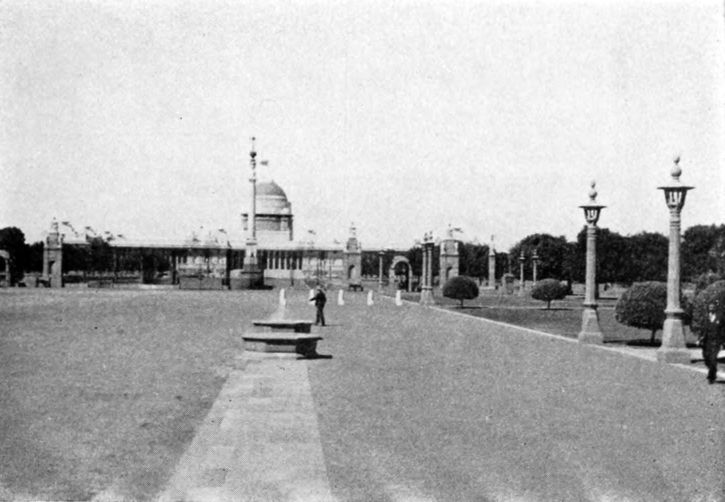
Approach to Viceroy’s House, Delhi.
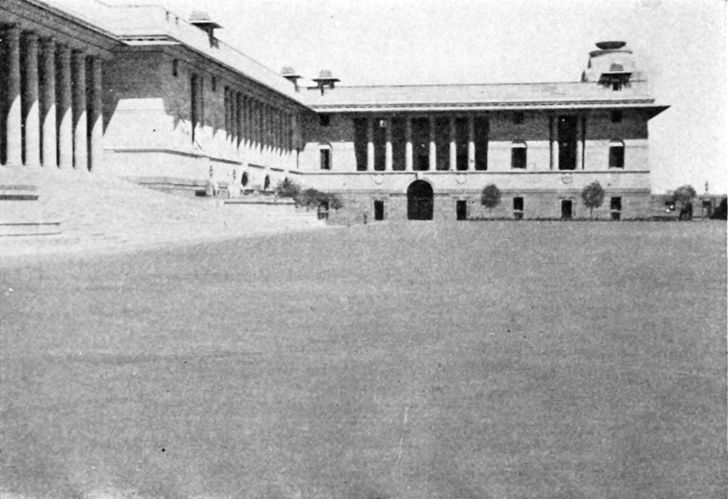
Front View of Viceroy’s House.
Once through the Delhi Gate, however, I am on familiar and enchanted ground. In front of the Friday Mosque, nearly thirty years ago, when my regiment was camped there, with its lances waving by the tent doors (lances! think of them in these days!) I tried to ride a wandering bull. Certain consequences followed: first the bull bucked me off, became entangled in the tent-ropes, was attacked by my dog, then Brahmins protested, and I became interested in them; and the chain is not ended yet, cannot end without the extinction of this personality. That is Karma, whose twisting paths are a maze, leading us on and on, saints and sinners, mice and men, without ever finding the centre. Only mahatmas[1] find the centre.
Every love, every career, every life, the Hindus say, all history, is built up of antecedent trifles, like the shape of Helen’s nose, or the state of Napoleon’s liver before the battle of Waterloo; but these trifles have no existence in Reality, which lies in the Illumined Self. History is not so much a lie agreed upon as a waking dream. If we seek for a meaning in the maze of Karma we are merely walking away from ourselves. Helen’s beauty was a figment in the minds of those who launched the ships, Napoleon’s somnolence was self-deception, and—the bull that altered my fate was an illusion.
But there is still a bull—no, several wandering bulls—on the old camping ground between the Mosque and Fort. Bulls dedicated to Siva, Lord of the Creative Faculty, turned loose by pious Hindus to roam where they will.
There goes a babu, with his hair in a bun, and there a Pathan, twice his size, in flowing white pyjamas and black turban askew. Two gardeners are digging: one holds the spade, the other has a string attached to its shaft: they always work in pairs like this in the Punjab. It is all coming back to me. Bougainvillæas, babus, dust. . . . “Hot winds, holy monkeys, minarets, rice. . . .” How smart the policemen are on point duty! And how different their eloquent gestures from the big, bored, capable hand of the London bobby!
I had forgotten how graceful Indians are, especially Indian women. That girl in a pink sari moves like a queen: one honey-coloured arm aloft, balancing a bright water-pot: it is a joy to see her dignity and simplicity and ease. I would like to go on looking at her for hours, instead of flashing by like this. She seems the very essence of India, in the rhythm of her movements, in her supple grace and latent strength. Shall I turn back? Write her life instead of dabbling in the lives of millions? . . .
We have just passed a baby boy in a neat white coat and cap, entirely naked below the waist: he is washing in the gutter. A bullock-cart goes by, with someone crouching veiled in its interior. A bride? A mistress? She must be a person of consequence, for the cart is no ordinary one, with its brilliant green and yellow paint and newly polished brass; and the bullocks are trotting ones, caparisoned in silver and red lacquer, with the black tufts of their tails well brushed out, and their horns wreathed in marigolds and jasmine.
What an enchanting country! It seems a lifetime since I saw a Brahmini bull and a flower-decked ox! It seems a lifetime, and it is, in fact, fifteen years. . . .
Sometimes I can’t help believing that I have seen these things in other existences. To me, and to those who think with me that it is not blind chance that has brought the British to this country (or even that brought you to read and me to write these lines), much of the fascination of India lies in a sense of intimacy deeper and stronger than any memory of present life.
At times I could swear that “these eyes of mine have blinked and shone” by the Taj at Agra in Shahjehan’s day, and in the narrow streets of Mogul Delhi. I can see myself following the kettledrums of the Golden Horde, studying the Vedanta in a Himalayan hermitage, riding in the ranks of Rupert’s Cavaliers. . . . Such ideas may seem fanciful and unconvincing to you who read this under another sky. Sometimes they seem fanciful to me, and against reason.
I am not convinced that the human personality survives, as such. Far higher is the concept of the Vedanta, which merges us all into the Universal Cosmic Consciousness. Yet bits of us, I repeat, somewhat weakly, and obstinately, may be sometimes attracted back to places where we loved and worked. The most I can say, when I am in the mood to say it, is that I feel that I belong to some places more than others.
On my left is the great Friday Mosque, one of the last of the glories of the Great Moguls; and far too exquisite to have been made by a conquering race. On my right are the stern, strong walls of the Fort, begun by Akbar, and only finished by the emperor who lost his throne and built the Taj Mahal. Probably history will remember Shahjehan long after it has forgotten Akbar. Shahjehan created a beauty which will outlive human empires, but Akbar was also a creator: the first architect of modern India, the first to dream of that unity which is now the hope of the educated classes.
What will the British be remembered by? Not by our buildings, I hope, nor by our political institutions; but by our roads, as the Romans are in England; and by our canals.
Yet we have given the Indians much more than transport and water . . . I wonder . . . and must stop wondering, for Time and Space hang over me like a sword. Or rather, Time and Space lie before me like a river: I am flinching on the brink, yet look forward to the plunge.
Always my Angel has encompassed me, cherishing the good and allowing the devil to take only what is useless stuff for a writer. I used to nurse all sorts of nebulous ambitions as a boy, mostly contradictory, and all but one absurd. Fortunately my Angel let me fail in almost everything I attempted, except writing, so that now I know what I want, and what I can do. There is a niche for me in the windy corridors of existence, and however little and lonely it is, it’s my own. Other men have children. I would like them also, but can content myself with words, for I travel. . . .
If I had been rich, I might have become a recluse. Thank God I am too poor to live the life of meditation which sometimes tempts me, and that Karma has compelled me to be a writer. . . . Of course, I am lonely sometimes; but I travel light and far, and live in many lives besides my own. . . . Here there are three hundred and fifty million lives, from Brahmins to bhangis, producing thirty-three thousand babies every day. Think of it! About thirteen hundred and fifty babies an hour! Such large-scale pullulation is mind-defeating. The size, fertility, and diversity of this peninsula are beyond the mental grasp, and anyone who pretends to discuss its problems with an air of finality is a fool.
Great changes are passing over the face of India, but they cannot be described as a whole, except at stupendous and stupefying length, for they vary from province to province and from month to month: they must be broken up into bits and pieces of personal impressions. If I am superficial, it is that I prefer being that to being unreadable. I shall try not to use statistics as a drunken man uses lamp-posts, for support rather than for illumination;[2] and I shall try not to let my pen stray too far from the tethers of sanity of things seen; trusting that some magic born of my long affection for India (of my long knowledge, if you believe in reincarnation) will build up my sentences and fill in the gaps between them for minds that meet and answer mine.
This is the land of the miraculous. The thing may happen. Eyes that read this in England may see what I saw but failed to tell completely: the plains of the Ganges, the birthplace of Buddha, the palms of the Deccan, the politicians of the new dispensation and the priesthood which is older than Melchizedek’s, the white splendour of the Moguls, the petrified orgies of Konarak, dawn at Cape Comorin, and the stark hills of the North. . . . In all humility, I believe that I have an opportunity given to few men to describe the lives of these peoples who were the companions of my youth, and whose philosophies are the solace of my maturity.
But I may as well confess at once that my chief object in coming to India was not to write about her problems, but to solve my own. I have no intention of teaching the grandmother of our civilization how to suck the eggs of democracy: rather I have come to question her on her own secret and serene ways of living.
Although I am a Christian (after my own fashion, which is not quite that of any Church) I used to lean much on the guru[3] of whom I have told in another book.
While he was alive, I felt the radiations of his personality across the years and seas; and when he died, nearly two years ago, there was a gap in my heart and mind. Things began to go wrong. My last book brought me more kicks than ha’pence.[4] I muddled my opportunities, misdirected my energies, wasted my time. I began to lose joy in living. My life was a mess. England seemed to me to be in a similar plight, indeed, every country in Europe. (And it is: they are!)
I thought at first of escaping to the London Library and writing a book on Buddha, but that would have been a poor refuge. I needed physical rather than mental activity, a change of scene, a lift out of the groove of my Gower Street flat, where I sat rather stuffily with my cat and pipe. And so, when an opportunity came to go to Buddha’s country, I decided to fly there immediately. Instantly, for I felt that it combined the fair horizons of adventure with a task for which I was qualified.
When I heard that I could not leave on the plane from Croydon which made connexion with the City of Khartoum I suffered agonies of disappointment. So the City of Khartoum flew without me, and was wrecked without me.
By the time these lines are printed Imperial Airways may have improved their service to India. I hope so, for communications are the life-blood of the Empire, and at present our great air-route to the East is served by old and slow machines. Travel by them is uncomfortable and inferior to travel by the Dutch line. I know of what I write, for I have flown from Moscow to Berlin, from Stockholm to Helsingfors, from Brindisi to Constantinople, and over most of Germany and the United States. Imperial Airways must wake up!
Anyway, instead of lying with a broken skull at the bottom of the Mediterranean, here I am, alive and kicking, and about to explore those avenues to an inner citadel without which all excursions into the world are vain.
First I must engage a servant. A sahib must have a servant. It is dastur, the custom, a rule imposed by one of the oldest trade-unions in the world. Who else could deal with the coolies who carry one’s luggage, with the bheestie who prepares one’s bath-water, and with the sweeper—the inevitable and untouchable sweeper?
If a sahib has been in India before, everything about him is known on his arrival. If, on the other hand, he is a newcomer, his tastes, temper, bank-balance, place in the hierarchy, and the most intimate details of his private life are fully and frankly discussed in the bazaar. Everything about him is noted, remembered, circulated in some mysterious way to those interested. Nothing escapes “Their” unseen eyes. He may imagine, being young, that he belongs to the ruling class; but soon or late he comes to understand that Caste is the ruler of more than half India. Invisibly, but efficiently, he is surrounded by the fine network of the system; and if he is wise he will accept Hindu India as she is. If he doesn’t, he will grow old before his time.
A shabby, grey-haired man awaited me with a letter from an old friend. His appearance did not attract me, but when I heard that he was of the same caste as my former servant, Jagwant, I knew that “They” had sent him; and I engaged him on the spot. I stipulated that his pay should be £3 a month, with eightpence a day extra for food while travelling. He agreed, knowing it to be dastur; and merely observed that he had three children to feed, and that I was a Cherisher of the Poor. He began to unpack immediately, noting with concern that I possessed no bedding, and no canvas-topped basin to hold my sponge and shaving things.
How stupid! I had forgotten that travellers in India must take their bed and washing gear wherever they go, except along the most beaten of tourist tracts. Also a solah topee—a pith helmet—ridiculous, it seems to my European eyes, but I remember this Punjab sun.
The enemy is already high by the time I have finished my shopping and driven to my bank in the crowded Chandni Chowk, past the Gate of Blood, where Nadir Shah watched the city put to fire and sword less than two hundred years ago.
The head office of “my” bank makes no pretence of ostentation. In New Delhi it has fine new premises, to impress Europeans and Americans, but here, in its native city, it prefers to remain its ramshackle, yet somehow impressive self; and is approached by a rickety wooden staircase leading up from the teeming bazaar.
There is a crowd at the entrance like a mob-scene in some movie, but it consists only of contented customers. The cashiers are squatting on the floor, their clients likewise: a dozen cashiers, twenty clients. All the clerks are chattering at their work, but working none the less. In the centre of the room is a young Scotch assistant bank manager: the Chota Sahib,[5] sitting behind a barricade of ledgers amidst a battalion of babus.
Twenty and twenty-five years ago, I used to wheedle overdrafts from just such a Chota Sahib, now no doubt a gouty Burra Sahib, in a similar babbling bank. Today I bring a letter of credit. (The overdraft is at home!)
Portentous books are brought to the Chota Sahib, and to me, for our respective signatures. After my business has been put in train, the Chota Sahib attacks a huge stack of files. He signs, signs, signs, sometimes in ink, sometimes in red pencil. Here, as elsewhere, the babu has achieved his triumphs of super-organization: nothing can be done without supervision and super-supervision, check and counter-check: three strong men do the work of a typist in her teens. Bulky files are carried blithely from one pair of brown hands to another, reach white hands, return for further scrutiny.
Twenty minutes pass. I shall not begin, so early, to try to hustle the East. I should not be here at all if I were not gathering local colour. Cashing a cheque is a morning’s work for a messenger. Sahibs do not engage in such menial tasks. Everything that can be done by others, is. The sahib in the European shop in which I have just made some purchases did not wrap them up. An office boy did that. Another boy carried them to the door.
“Don’t you find the noise rather distracting?” I ask the Chota Sahib.
“Oh, no! One soon gets used to it. They’re checking entries, you know, not gossiping. But we let them talk, if they want. They’re very conscientious. Some of them stay long after office hours.”
“What do they do in their spare time?”
The Chota Sahib looks at me hard. “They think about money,” he says, when he is sure that I’m not joking.
I wonder what the procedure will be when my cheque is finally passed for payment? How strange if, a week after discussing the weather and the Government with my friend the cashier in Pall Mall, I should find myself squatting before a gentleman upon whose forehead is painted the Vaishna symbol of the female reproductive power! But sahibs, unfortunately for this contrast-craving self, do not sit on floors.
My cheque is taken by a barefoot attendant, dressed in the crimson livery of a court official of the time of Akbar, to a small, spectacled clerk. After scrutinizing the date, to see that it is indeed 1936, not 1066, he looks for his red-ink pen. Finding it, he pauses for a moment, like a hawk over a pigeon, swoops down on the document, stops, turns it over suspiciously, looks at the signature, which has not altered, makes a few more flourishes, and finally affixes his initials. His work is passed to an assistant, who blots it. The assistant earns £2 10s. a month, and on this pay supports a mother-in-law, an ailing wife, three children, and two indigent male cousins who have failed in their matriculation. (No wonder the clerk wants to oust his present blotter, and give the job to one of his relations!) The resplendent but shoeless attendant, having obtained possession of my cheque once more, pads on to a row of babus, discussing the price of clarified butter, who have piles of brass disks before them. After a long time, he attracts the attention of one of them, and obtains a tally, the number of the tally being written on the cheque, and duly blotted by an apprentice clerk.
The cheque now disappears into the bowels of the bank, for some further inspection, while the attendant takes his tally to the cashiers, and sits down on the floor to await his turn. Every cashier has beside him an assistant who goes through the waiting cheques, when not engaged in blotting, and calls out their numbers. Finally the attendant hears his number called, and everything is simple. . . . Provided that no one has blundered.
Before leaving, I visit the bullion dealers attached to the bank, a sect of Jains whose hereditary profession it is to deal in precious metals. They squat on the floor, like the cashiers, watching no clocks, taking no exercise; chaste, respectable, absorbed in the stuff which makes millions mad.
The Chief Shroff is a plump, elderly man, sitting cross-legged, bargaining by signs with a group of sellers, who have placed a bar of silver at his bare, brown shins.
For half a century India absorbed the world’s gold greedily (£130,000,000 sterling during the five years before the Great War) and melted it down into ornaments for her women. Now all this gear is being re-melted and is flowing back to the West. What heartaches and dramas must be carried along that tide!
After a day of shopping and appointments, I find myself on the Ridge, as evening falls, overlooking Old Delhi.
From this spine of rock, jutting out over the historic plains like a ship putting out to sea, one may hear the jackals howling, and see the lights of Old Delhi and New Delhi, and beyond them imagine those battlegrounds where men fought for the dominion of this country in the old days, when gods walked the earth.
The first we hear of the Aryans is that the five Pandava brothers became joint kings, with a joint wife, by name Drapaudi, the fairest of women.
After conquering the known earth, they grew tired of material possessions—for always the Hindu mind looks on the world as a passing show—and wandered out towards the Himalayas, as ascetics seeking Heaven, with Drapaudi, their Queen, and their faithful dog.
They met many accidents on the way, and Drapaudi and four brothers died, but one king reached Heaven; and he, we are told, would not enter without his dog. The gods admitted them both, and as a reward for his sporting spirit, allowed him to go out again to rescue his sister and brothers, and bring them also to the paradise where Indra drinks the nectar of the gods.
Many thousand years later, and a thousand miles to the north, in Ghazni, a boy slave called Sabaktagin caught smallpox. His face became hideously pitted, and, being ugly, he resolved to be great.
One day, when he was out hunting, he captured a spotted fawn. He lifted it on his saddle, and was going on, when he saw that the doe was following him, and crying in her distress. The sight of her moved him to pity, so he gave her back her baby. She bounded away with it, but turned back, again and again, to look at him.
That night, in a dream, the Prophet of Islam appeared to Sabaktagin, and told him that as he had been merciful to humble creatures over whom he had power, so God would give him power over a kingdom of his own.
The dream came true, and when his master died he became the King of Ghazni, and led his people down through the passes of what is now Waziristan. Beyond them lay a teeming and fertile land, a sophisticated and enfeebled civilization. They plucked the treasure of India like the summer fruit of their hills.
Following Sabaktagin came his son, the terrible Mahmoud of Ghazni, and for the next eight hundred years Hindustan endured many kicks from the horse of Islam. The reavers came in troops and hordes, travelling light on their ponies, as nomads do, living on mare’s milk and dried horseflesh, with their spears and shields on their backs. Before them went their drummers and the yak-tailed standards of their chiefs; and behind them came baggage camels, slaves to amuse them, soothsayers to prophesy their lucky days. The passes were open and the plains defenceless.
After a great battle, Mahmoud’s men forced their way through the dead and dying into the darkness of one of the richest shrines in India. Here stood the lingam of Siva, worshipped with rites that were ancient even in Mahmoud’s day. On one side stood the conquerors, brawny, bearded men, covered in sweat and blood; on the other, cowered shaven priests and dancing-girls. The Brahmins fell on their faces and begged mercy for their god.
“Never!” said Mahmoud. “Break the disgusting thing to bits, and bury the pieces under the threshold of my mosque at Ghazni, where true believers may stamp on them!”
Even his followers were aghast. To loot a temple was all very well, but this was the most sacred object in all India, and might possess unknown powers of mischief. Why waste time on a stone, when there was so much precious gear to be had, and comely concubines?
But Mahmoud whirled his mace about his head. “On the Day of Resurrection,” he cried, “let me hear it said—‘Where is that Mahmoud who broke the greatest of heathen idols?’ and not—‘Where is that Mahmoud who sold it to the infidels for gold?’ ” Then he smote it lustily, and out gushed a secret store of jewels of such size and splendour that they dazzled all the beholders.
The treasure he brought back from this and other expeditions made Ghazni a centre of luxury and learning. For centuries the city was a medieval advertisement of how to get rich quick; and the lesson was not neglected, for many other marauders followed.
Amongst them, Tuglak.
In the fourteenth century, in the days of the Emperor Tuglak, there was a saint who coined the famous phrase “Dilli dur ast!”—“It’s a far cry to Delhi.”
The Emperor was building his new city of Tuglakabad at the time that the Saint, Khwaja Nizam-ud-din-Aulia, was excavating a tank in the neighbourhood of his shrine. Both were old men, masterful and much respected. The Emperor took Nizam-ud-din-Aulia’s workmen away, and the latter cursed the Emperor’s city by Eblis and all the Powers of Darkness, prophesying that only outcasts would live there. The Khwaja Sahib was very holy, but the Emperor had also gained merit in twenty-nine pitched battles, and was greatly feared. (When the gossip purveyors of his day published a premature report of his death, he said: “They have buried me alive in fancy: I shall bury them alive in earnest”; and did so.) He was an awkward man to cross.
When, therefore, the Khwaja Sahib’s disciples came to tell their master that the Emperor was returning from a provincial tour with the expressed intention of punishing him, they were amazed and perturbed at the Saint’s calm answer: “Dilli dur ast!”
The Emperor drew nearer. The Khwaja’s friends urged him to fly for his life; but the Saint always gave them the same reply. He was sure that something would turn up. Something did, and India has never forgotten it.
On the eve of the Emperor’s return, while he sat feasting in an insecurely built pavilion on the outskirts of Delhi, an elephant leaned against the structure. It collapsed, and Tuglak and all his schemes were buried.
Next day, the Emperor was found under the debris, shielding with his arms his favourite child, whom he had hoped to make his heir. And since that disastrous night, Tuglakabad has sheltered only a few nomad families of Gujars. It is today the grandest and most desolate of all the ruins on the Delhi plain. The Saint was right. “Hanoz Dilli dur ast! Delhi is still far!”
This is my feeling, as I begin my journey, here in the Imperial capital, reflecting on the millions and immensities and inscrutabilities of this old country which has forgotten so many conquerors, and worships so many gods.
We are standing—Khwaja Hussein Nizami, the descendant of the Saint aforesaid, and his servant, and I—in stockinged feet, before the tomb of a princess who died in Delhi three hundred years ago, describing herself in her epitaph as “the humble, the transitory Jehanara, daughter of the Emperor Shahjehan and disciple of the holy men of Chist.”
Humble she was, but her memory endures, for she became the instrument of the consolidation of British power in India. The story has been told and retold, but for me its romance survives all repetitions. . . . Down a narrow stair came a slave-girl with a lamp, stumbled, spilled the oil, set herself on fire. Servants screamed and scampered for help. Jehanara came running from the lovely white marble harem and saved the girl, but in doing so she burned herself badly about the face and hands.
Shahjehan, her father, summoned the best physicians of his empire, but he despaired of her life until an English doctor, Gabriel Boughton, arrived from the new English settlement on the Hoogli River. Contrary to palace etiquette, Boughton insisted on examining his patient thoroughly. At first the ladies of the Imperial Harem demurred, but necessity triumphed over custom, then as now.
Jehanara exposed her tongue and surrendered her wrist.
She recovered.
In his gratitude, Shahjehan would have given young Boughton anything: diamonds from Golconda, a jaghire of the rich red acres of Oudh, Kashmiri maidens, or Kabuli cup-bearers, but the doctor would take nothing for himself. All that he asked for, and received, was a charter permitting the Honourable East India Company to trade in the lower reaches of the Ganges.
Hence Calcutta. Hence New Delhi. And hence we three—Khwaja Hussein Nizami, his servant, and I—are standing before this famous shrine.
The servant is one of the vividest of my first impressions. He is the grandson of the last of the Moguls, Bahadur Shah, who lost his throne to the British. The Khwaja Sahib has taken him into his service, to help him to eke out the little pension given to him by the Government of India.
He is pock-marked and blackavized, this small descendant of the House of Tamerlane, in whose veins flows the blood of conquerors and artists. But although he is ill-favoured and very poor, he is respectable, and much respected, for India reveres good breeding, whatever the outward appearance. Indeed, I suppose that this is the last country in the world where gentle birth means more than gold.
When the Khwaja Sahib went lately to Rangoon, he took his servant with him, to show him the tomb of his grandfather, who died there in exile in 1862; but the scion of the House of Tamerlane was more interested in cinemas than in the memorial of his ancestor.
No doubt he was right. All India tends to live too much in the past: the Hindus in the golden age of the Aryans, the Mahomedans in their conquests and glories, the Sikhs in their sainted sages, the British in the spacious days when every man lowered his umbrella before the majesty of a white face.
I also am tempted to live in the past. I must go out to find the present, or at any rate the illusion of the present: the scene that passes for “India as she really is.”
|
Emancipated souls. |
|
Andrew Lang’s agreeable analogy. |
|
Spiritual preceptor. |
|
Dogs of War, an exploration of the pacifist position, received with marked disfavour by all except a handful of highly intelligent reviewers. |
|
Small Master; Burra Sahib, Big Master. |
The rhythm of my days has changed. In London, I never had time for anything: the resources of civilization did not suffice to get me through the day’s work and play. Especially the play. It is extraordinary—considering I am no gilded youth—how much time I used to spend telephoning about when I was going to play squash or tennis, and where I was going to eat my lunch and dinner. Here telephones are few. It is quicker to send a chaprassi. Life assumes a quiet tempo.
My plans are made. After a visit to my old regiment at Meerut, whither I am now bound by a slow train from Delhi, I shall go south to Buddha’s country, then to the great fair at Allahabad, to the swamis at Calcutta, and so clockwise round India, returning here in March, where, with luck, I can finish my articles and enjoy a month’s pigsticking before returning to England.
I am haunted by the idea of pigsticking once more. At fifty I ought to be too old for such a sport. But I am not. I want to feel the balance of a good Bareilly spear in my hand, and the spring of a good horse between my knees,
Where the tamarisk grows by the sandy bed,
And the high grass shakes in the sultry air.
But I must hunt for news before pig. Three hundred and fifty million people stand between me and the grand wide spaces of the Ganges Kadir.
“Halwa, roti, pani!”—“Hindu pani pine wala!”—“Gharam cha-a-a!” The noise is terrific and the crowd dense at Shahdara station.
Hindu and Moslem water-bearers, sweetmeat-sellers with cages of comfits, servants with tea and dingy-looking toast, cigarette boys, newsboys, men selling rice and dhal, cry their wares by the side of the train and add to the howls of strayed children, the shouts of porters, the clang of gongs, the whistling of engines, and the pandemonium of the passengers. Everyone yells. It is curious, in a country where silence is so well understood, where Mr. Gandhi remains mute every Monday, and where mouni swamis[6] who have not spoken for years are greatly respected, that the Indian villager (who is a quiet sort of person as a rule) should be seized by a kind of frenzy when he tries to catch a train.
On the far side of the line, some passengers are squatting at the edge of a sugar-cane crop, engaged in natural functions. Beyond is a field of mustard. A porter is washing his teeth with his finger by a tap. A boy offers me those popular and widely read journals, the News of the World and True Story Magazine. A yellow pi-dog bitch, minus a leg, limps along the carriages, hoping for scraps: she looks half-starved, and evidently has puppies to feed. The station-master’s infant son—the likeness is unmistakable—with eyelashes of a film-star and an amulet at his throat, beats his father’s gong.
Passengers hurry back from the sugar-cane. An old gentleman in a long yellow shawl is late: he is dragged into his coach at the last moment by a noisy female relative. One day, no doubt, he will renounce the duties of a householder and seek the blessed solitude of nirvana in the Himalayas.
The sky on the horizon is dirty with dust, but there is a near-by clearness and brightness, and the gentle wind is none the less keen and brisk. Yes, this is a fascinating country—in which to travel first class!
My mind reverts to the bitch. The maimed and mangy dogs on the Indian railways are legion. I know someone at home whose heart is riven by their sufferings. She wants to come out here with a chloroform mask to put them out of their misery. They offend her sensibilities, and so she is sure that they would be better dead; but I doubt whether the dogs would agree.
To an Indian, an educated and thoughtful Indian, our desire to tidy up the far places of the earth must seem surprising. Every winter season reformers flash through this country like meteors, leaving a blaze of uplift in their wake. He finds it difficult to understand why they don’t live in India, if they want to help the country, instead of hurrying home as soon as the temperature rises, to tell an avid public about the lives of temple dancing-girls, or the miseries of early marriages . . . as if there were no dancing-girls in our temples of Mammon, and no child-mothers, incest, seduced slum children. Christendom is a mystery to him, a mystery which deepens instead of clearing when he reads the News of the World and True Story Magazine.
Of course, he knows nothing about our real domestic life. How could he? The average life is not news. Nor can he know much about the average Englishman or Englishwoman living in India. Out of a total population of 352,887,778, only 116,000 are British-born. More than half of these are soldiers. The remainder are concentrated in cities, especially Calcutta. Soldiers he rarely sees, unless he is a soldier himself; and the few other Europeans in India have little leisure, and to tell the truth, little desire to extend their horizon beyond the immediate ambit of their work. It is a pity. A great pity, but what would you? We are not an active race mentally, like the ancient Greeks. If we were, we might understand this country better, but would we have managed it so well? I doubt it. Vivid imagination does not go with patience, practical ability, a sense of proportion.
On the other hand, the English who live in India are far more influenced by the country than they like the world to believe. We are a highly suggestible race, otherwise we would not have produced the poetry we have. Nor would we have allowed the clerkly and legal classes in India to inherit the dominion of the Great Moguls, leaving us to be the slaves of files, and the signers of payrolls that nepotism has created!
✶ ✶ ✶ ✶
A propos de babus, many of them nowadays advertise for their domestic wants. Here are a few taken from today’s newspapers:
Wanted—A fair Anglo-Indian girl as help to a lady in the Mofussil. A kind home with board and Rs. 10. per month. Apply with full particulars to Box . . . , Statesman, Calcutta.
A kind home, with board, and fifteen shillings a month!
Wanted—A lady, must be good-looking, educated, and Brahman, not below 17, to marry a highly qualified employed young man. Write particulars to Box L . . . , care Leader, Allahabad.
Wanted—Kadimi or Dasa Agrawal boys between 18 and 25 years of age for beautiful girls of a rich family. Reply Box L . . . , care Leader, Allahabad.
Wanted—A suitable match for a Khatri girl aged 16 years. Appearing in the next March for the High School Examination U.P. Beautiful, well accomplished in music and household affairs. Daughter of a 1st grade Gazetted Officer in U.P. Box L . . . , care Leader, Allahabad.
Wanted—A suitable match for a healthy, handsome, bachelor Kanyakubja Brahman youth of 25, graduate M.Sc., A.H.B.T.I., just settled in life, belonging to a respectable family. No dowry, but education in girl essential. Apply stating qualifications to Box . . . , care Leader, Allahabad.
Wanted—A suitable match for a girl of fifteen years of a respectable Subarna-Banik family. Gautam gotra. The girl has a decent appearance and good health. Complexion middling. Fairly educated and skilled in works of art. Apply P . . . M . . . B . . .
“Complexion middling,” poor little thing, she is only fifteen! . . . And how many Agrawal boys applied for those rich girls of a good family?
I am informed that an eligible bachelor in the Indian Civil Service is worth between £1500 and £2500 in the marriage market, which seems cheap, considering that before he retires he will be earning that much in a year. Of course the I.C.S. is the plum of official posts. Doctors, police, engineers, and forest officers have a much lower value.
Here is a “missing” announcement for a prodigal son, taken from the Hindustan Times:
Sachin (Ghota)—Please return immediately—Mother constantly weeping, refusing food, and having occasional fits. Father’s finger giving serious trouble. Wire for money if required.—Neul.
I wish I knew what happened about the finger, and the fits . . . but here we are in Meerut!
Meerut is the city where the storm of the Mutiny broke on Sunday evening, May 10th, 1857: the Devil’s Wind which nearly blew the British out of India. It began close to where I am living, in the adjacent barracks, then occupied by the 3rd Bengal Cavalry.
Why is it that the Indian Mutiny occupies so small a space in our histories? It should be written impartially, and taught in our schools. In paying reverence to our dead we need not belittle their adversaries. Sir Henry Lawrence is mourned by both races. There were two Indians to every Englishman in the Siege of Lucknow. Both Indians and English committed terrible mistakes; and in the actual fighting both peoples produced individuals of high nobility, and of a courage that can still light our conduct, although the causes that called it forth have passed.
Our children should know that some of our leaders were lethargic and effete in 1857, that we were trying to impose an alien system on a sensitive and intelligent people, that warnings of discontent were disregarded, and that when it became obvious that an explosion would occur we still hoped to muddle through. They should know also of the men who looked ahead, the men who loved India and paid with their blood for the mistakes of their superiors. They should be told of Nicholson’s march, of the “devoted nine” at the Delhi magazine, of Salkeld’s death at Kashmir Gate, of dying Lawrence, of dying Havelock. . . . The story is so great, so symbolical of the strength and weakness of both races that we should look boldly on its good and evil, and study it with humility and with pride.
As heirs to the Mogul Empire, India was in our grasp in the middle of the nineteenth century; but we grasped too much, and too carelessly. For months before the Mutiny strange stories had been circulating in the bazaars: that we had been defeated in the Crimea, that the Shah of Persia was about to invade India, that we were destroying caste by mixing cow-bone-ash with the flour issued to the troops; and Hindu astrologers, who are often remarkably accurate in their predictions (they foretold the Great War and the recent Quetta earthquake), had declared that the rule of the East India Company would end a hundred years after the battle of Plassey.
Early in 1857 came the crowning folly of the polluted cartridges: with almost unbelievable stupidity bovine tallow had been used to grease the sepoys’ ammunition at Dum Dum, near Calcutta. Soon a substitute was found, but nothing would convince the sepoys that an attempt had not been made to defile them with forbidden fats, by inducing Moslems to lick lard, and Hindus to put their lips to beef.
With lightning speed, the symbol of the chapatti[7] passed from hand to hand through the countryside, accompanied by the sinister words: “Sab lal hojaega”—“Everything will be red.”
A fortnight before the outbreak at Meerut, Colonel Carmichael Smith, commanding the 3rd Cavalry, who was determined to stand no nonsense about caste, had paraded his skirmishers for practice with the hated ammunition. A new drill had been devised, by which the cartridges were torn open by the hand instead of with the teeth; but his men refused to touch them. Eighty-five of them were tried by a native general court-martial, and condemned to long periods of imprisonment, varying between six and ten years.
The Viceroy was in Calcutta, the Commander-in-Chief in Simla. There was no cohesion in high places. As if the punishments had not been severe enough, the men were humiliated before the whole garrison. Their sentences were read out on parade; and they were then stripped of their uniforms, irons were forged on their wrists and ankles, and thus fettered they were marched down the ranks of their sweating and disgusted comrades, British as well as Indian. The parade took several hours in the heat of that morning of May the 9th. After it was over, the Divisional Commander telegraphed to Army Headquarters that the loyal sepoys were behaving splendidly. Little he knew. He was nearly seventy and a sick man.
At six o’clock next evening, after a quiet, hot day, just as the 60th Rifles had fallen in for Church Parade,[8] shots were heard from the Native Infantry lines. Smoke rose against the sunset sky. Bungalows were burning.
What had happened? The storm had broken so suddenly that no one knew. Colonel Finnis, commanding the 11th Native Infantry, rode up to his lines to find out: he fell, riddled with bullets. Other officers followed him, and met with the same fate.
At half-past six it was dark. Screams came from bungalows whose occupants had a few minutes before been dressing themselves in their Sunday best; for women and children were being murdered, as well as men. The bazaars were thronged with excited crowds. Word passed that the sepoys had risen, liberated the prisoners of yesterday, set fire to their officers’ houses, cut the telegraph line to Delhi: the reign of the White Monkeys was over!
All night long the fires burned. Prompt action might have saved Delhi, whither the mutinous cavalry was galloping, but the Divisional General sat dazed.
At dawn on May the 11th, the 3rd Cavalry arrived at Shahjehan’s Fort, killed Douglas, the Commandant, Jennings, the Chaplain, and Fraser, the Commissioner. Fraser’s head was carried in triumph down the Chandni Chowk. Old Bahadur Shah, Mogul King by courtesy, was proclaimed Emperor. By nightfall the whole capital was in rebel hands.
Meanwhile, in Meerut, morning broke over a scene of despair and divided counsels. The General in command did nothing, although he had fifteen hundred British troops under his orders. He was too old. May he rest in peace!
The astrologers were right. The rule of the East India Company ended in November 1858, when Lord Canning announced that the country was transferred to the British Crown.
In the cemetery at Meerut (an overgrown, dishevelled place, worthy of better care) you may see monuments which tell of awful things, and monuments which describe the heroism and fidelity of individual Indians, humble men as well as great landowners of the time, who saved our people at the risk of their own lives. All have passed. Merciful men and wicked alike are shadows and dust.
In St. John’s Church, a fine Italianate building, which keeps an atmosphere of the old days without being haunted by hate, there are many memorials too; and there is also a Children’s Corner for the boys and girls of today. They have decorated it for Christmas with the Manger and the Shepherds and the Kings.
Today my old regiment looks much the same as it did in 1907, but the familiar faces are few. Two of my former recruits are now Indian officers. Another is a sergeant. The rest are scattered over (or alas, under) the broad lands of the Punjab and North-West Frontier Province.
Naim Shah, my old orderly, is now an official in the Court of the Assistant Judicial Commissioner at Peshawar, a position of some dignity if not of great emolument. Khushal Khan, another orderly, is working for a contractor. I look forward to seeing them when I go north; but here, amongst these men and horses, so like those others of long ago, I feel uneasy. I can’t explain why. I ought not to be. The regiment is in splendid fettle. It is better housed, better equipped, and better educated than it used to be. The men work harder, and cost three times as much to maintain as they did in my day; but whether they will fight any better remains to be seen. Properly led, they could not have fought any better. In essentials they are the same staunch yeomen that they were: the best of the peasantry of India.
A new institution is the Child Welfare Centre. I wonder whether the Children’s Party held yearly, when I was Adjutant, was the first function of its kind to be held in the Indian Army? Certainly the idea was new in 1911. Now, however, regimental children are objects of constant solicitude, even before they are born. A trained midwife has replaced the unskilled ladies whose right and custom it used to be to bring the offspring of our sowars into the world. She has a pleasant house, a garden, a day nursery, a small dispensary adorned with posters of high hygienic tone. Being a woman of courage, she will no doubt eventually overcome the prejudice which exists against her, but she will have a hard row to hoe. So will thousands like her, not only in cantonments, but throughout all this custom-ridden country.
During the past fifteen years of my life, I have been working and thinking so far away from India that I could not look back on my old self, or my old friends, with any sense of actuality. When the latter returned on long leave to England, they seemed to me to speak from another world. But now that that world is here again, under my eyes, I see that there is no such wide gulf as I had imagined between Meerut and Bloomsbury, as far as the British are concerned.
But in the regimental lines I feel an alien and a stranger: a ghost straying by mistake into the scene of a former incarnation. By now I should have finished command of the regiment, and be on the shelf. Well, I am on the shelf as far as these kind people are concerned, and I must escape from them. I feel weighed down by “sorrow’s crown of sorrow.” What complex is this? Perhaps I am jealous of the life I might have lived. I don’t know. All I know is that I must escape quickly from these scenes of my youth!
The life of the English is more spacious in India than it is in England, and a good deal more amusing. My friend’s house stands in six acres of ground, and is one of the jolly, old-fashioned kind of bungalows, with a great circular central hall, and a dozen big rooms leading out of it. Electric light and running water have been recently installed, but the hot water for one’s bath is still brought by the bheestie in a kerosene tin; and the sanitary arrangements are what they were a century ago, or twenty centuries ago, for that matter.
Except in the big towns, there is no drainage system throughout the length and breadth of India. Night soil is carried away by hand: caste has decreed that men and women are born for this purpose, and their labour is cheap. Even in the capitals, modern plumbing is a luxury confined to the few. In Delhi and Simla, under the eyes of the mightiest in the land, the depressed classes may be seen carrying odoriferous baskets on their heads, or driving slow blue buffaloes in carts which stink to heaven.
Not that I mind much for myself. As to the sweepers, their day is coming.
A cantonment bungalow is a clean and comfortable place in spite of its archaic sanitation; and even a poor man’s house here is as clean or cleaner than that of a slum house in England. (Shame on us for allowing such conditions to exist in the heart of a great empire. Oh, how guilty a traveller in India feels, not towards India, but towards his own kin at home, out of whose strength, and by whose patience and solidarity all this dominion has been won!)
The sun is a great scavenger, and it is agreeable to have plenty of servants. Almost everyone has plenty: even the untouchables have pariahs outside their pale, ending in the widow and the orphan. The whole social system is symbiotic.
Cavalry soldiers have a valet for every three men. Indian officers have two or three dependants. My friend (who is a senior officer and a famous polo player: the establishments of junior officers are on a more modest scale) employs a bearer, or head-servant, a cook, two khitmatgars (corresponding to parlour-maid and pantry-boy), an ayah, or lady’s maid, a washerman, four gardeners (working in pairs), a night-watchman, or chowkidar, twelve syces, or grooms, for his fourteen horses and ponies, a sweeper, and a dog-boy: a total of twenty-five wage-earners, receiving amongst them £31 a month. The highest paid servant is the bearer, at £3 a month: the lowest is the dog-boy, who receives fifteen shillings. With wives and children, there are sixty-two souls dependent on the bounty of my friend and his wife; and all of them are under the iron law of the pale and the veil: caste and purdah.
This establishment, however, is nothing to that maintained by an Indian gentleman of means, who has probably a dozen relations as well as his own family to keep. Ruling Chiefs live on an even more liberal scale. A Maharajah who visited an Indian friend of mine asked if he might come for a quiet night. My friend was delighted. Although he knew the Maharajah’s ideas of quiet, he was rather surprised when he arrived with seven hundred followers. They brought their own tents and food, but the “incidentals” cost my friend a pretty penny. (This Maharajah, by the way, is of such high caste that he always eats alone. When he gives a dinner party, a half lemon reposes on his plate, not for consumption, but for the sake of courtesy.) The Viceroy is compelled by custom to maintain a lavish establishment. He has two hundred and seventy-five household servants in Delhi, and one hundred and fifty gardeners.
I have been out riding, and watched a game of station polo. The sun was in his heaven, but a cloud passed between it and my mind. I came away profoundly depressed.
A hard, yellow ground. Keen young players. Women spectators, slightly bored. Talk of tendons and fetlocks. Smell of horse-sweat and dust. Twilight. Shivers. The Radha Mohan Cup is to be played in Delhi next week, and we hope to go to Lucknow for the Civil Service Week, but those damned manœuvres! (“Aren’t manœuvres what you’re paid for?”—I don’t say this, but can’t help thinking it. Jealously. The best soldiers are not the lovers of war games.) Gratefully, I accept a cocktail.
An elderly member of the Indian Civil Service, whom I knew in the old days, is playing “back” on a half-lame pony. He has become very grey and stiff, like his mount: their polo days are numbered. Does he remember how we rode against each other at Allahabad, was it, or Lucknow? The bell rings, and the old fellow comes off the ground. I don’t want to meet him. The chill air brings drifts of memory of other days and games; and the cold, relentless certainty that my heart no longer beats as high as it did. It’s no use pretending. Or is it? I think I’ll have another cocktail.
Bed-time. I have had four cocktails, eaten a very good dinner, and enjoyed some excellent talk. Soldiers are more interesting than other Europeans in the East: they see more of life than Civil Servants and business men, if not leashed by poverty; and they think more for themselves. Also they understand more of India, and become less orientalized by it.
The British officer in an Indian cavalry regiment leads a jolly life, for he has variety and opportunity in his days, and a decent pension at the end of them. Bless him, and more power to his elbow! I wish I had a decent pension! I might be playing golf at Cheltenham. Or catching the City train from Sevenoaks. . . . What were those amusing things I heard tonight, in that young couple’s little home-made bar, so well decorated with Eve conversing with the serpent? What was it the babu said to the Commander-in-Chief? And what was the lady’s answer to the taxi-driver? (It’s annoying to have an inaccurate memory.)
If I could write down a tenth of the adventures I’ve heard (and how much better people talk than they write!) what a mine of marvellous ore I should possess! Unfortunately, the paths to it are blocked.
Surely some guru could teach me how to clear away the dead wood of complexes and inhibitions? Surely it is not always necessary to suffer things in one’s own flesh before being able to describe them? Long ago I read a brilliant little book of Arnold Bennett about how to live on twenty-four hours a day, and another, called The Reasonable Life. He didn’t lead a very reasonable life himself, to judge from the biographies, yet he was a man of wisdom. The fact that he didn’t practise what he preached (or practised too fully a discipline of his brain at the expense of his body) makes what he has to say about the management of one’s mind all the more interesting. He saw, about twenty-five years before the rest of the world, the grave unbalance of Western civilization, its needless stresses, its possible collapse, and how the individual might save himself out of the wreckage. Himself he could not save, but he had vision.
What was it the babu said?
If this were Bennett instead of me lying on this bed, he would go mad, hearing the clip-clop of the night-watchman’s shoes, and the thumping of his staff. But being myself nothing can keep me awake.
One might write a great story round the life of a chowkidar. In India almost everything that we do is done in public, whether we believe it or not. The night-watchman is “Their” intelligencer: one of the king-pins of the caste system. To do without him is impossible: yet when real thieves come, he is useless. He must be employed, because it is dastur to do so, but he has the habits and heart of a dormouse. The only recorded instance of aggression on the part of a chowkidar is that which used to be found (it has now been erased) upon the tombstone of the Reverend Isidore Lowenthal, a Protestant missionary of Peshawar:
Accidentally Shot By His Chowkidar
Well done, thou good and faithful servant.
Nothing can keep me awake. . . .
From sleep and from damnation,
Deliver us, good Lord!
Chesterton wrote that, and Buddha said almost the same thing. His very name means “Fully Awake.” Chesterton and Buddha, great minds far apart, spoke with one voice on the subject of Enlightenment. . . . Tomorrow I shall be on my way to the place where the Light of Asia dawned.
|
Silent sages. |
|
A flat cake of unleavened bread. |
|
In white, without arms; but since that evening British troops in India have always gone to worship with a full complement of ball ammunition. |
I arrived at Gorakhpur early this morning, and took the train on to Natanwa, on to the borders of Nepal. The journey to the birthplace (the Lumbini Garden) is a pilgrimage rather than a picnic. The twelve miles of road are impossible for a car: ponies could manage them, but elephants are best, for there are deep fords. The Bengal and North-Western Railway have kindly made arrangements: I have three elephants, and a Nepalese escort. We move in stately procession through a lovely countryside.
My pad-elephant swings along under the hot midday sun, towards the place where Prince Siddharta Gautama, of the Sakhya clan, who afterwards became the Lord Buddha, was born twenty-five centuries ago.
My elephant stops to make himself a fly-whisk. He is an obstinate old devil, this hathi. When he sees the branch of a tree he likes, he will go out of his way to take it, no matter what the mahout says or does.
When he begins to stray the mahout says: “Chai, chai!” which means “Go on!” in elephant language; then he curses him in unprintable terms. The hathi nods. And nods again when the ankus[9] falls on a sore place on his skull. He tears off the branch, flips it against his forefeet, returns to the road shrugging his shoulders slightly, as if to say that it is all one to him what his master thinks of his mother.
All elephants dislike dogs and fords, but this one is positively childish about them, though he has seen some ninety summers. At the sight of a small brown pi, he stands still, thumps his trunk on the ground, insists on by-passing the village. He also misbehaves at the first river we cross. He is naughty and silly. The water only comes up to his ankles, and the bed is sound; but he is convinced that there is a quicksand there, and turns tail, trumpeting shrilly.
“To think he was a soldier when young!” says the mahout. “He took part in the Kabul War of ’78.”
I shall find little at the Lumbini Garden to repay me for my journey. It is not the goal, but the wayfaring on which my heart is set.
Blue doves are cooing in a banyan tree, and monkeys are playing by a little shrine at its foot. The brilliant sun beats down on emerald crops, glossy leaves, white shrines, snug villages with pumpkins airing on the roof-tops. For horizon we have the snow-capped Himalayas, standing now as they did in Buddha’s day, cool, and austere, and high above human vicissitude. This land is a fit scene for the birth of a Master who has given his creed to five hundred million people; and I like to think that the scenes he saw are those I see today.
They say that he was a King’s son. That may well be, but the Kings of the Aryans were democratic monarchs. Siddharta Gautama must have walked and talked with villagers such as these. He had four uncles and two aunts on his father’s side, and numerous cousins. There may be men and women of his blood still here. The gentle, handsome people have not changed much; and the Himalayas have not changed at all, nor the beauty of this country lying at their sacred feet.
High up, almost unseen, wild geese are flying northward. They remind me of Devadatta, Buddha’s wicked cousin, who killed a swan, and claimed the bird as his by right of venery. But the young Prince
Laid the swan’s neck beside his own smooth cheek
And gravely spoke: “Not so, the bird is mine
By right of mercy and love’s lordliness,
For now I know, by what within me stirs,
That I shall teach compassion unto men
And be a speechless world’s interpreter.”[10]
As we are approaching the shrine, a tall girl passes us, in a lemon-coloured sari, unveiled. Her lustrous eyes meet mine in a frank and friendly way. Who she is, I shall never know, nor her business. I like to think that even this passing glimpse, this sympathetic instant out of æeons of nescience has been decreed by Karma. Perhaps it was given to me that I may know what Siddharta’s mother looked like, Maya Devi, who dreamed that a six-rayed star had entered her womb on the night that her child was miraculously conceived.
Here, at the shrine itself, we are standing on the spot where Maya Devi, when her days were fulfilled, grasped the branch of a sal tree, and was delivered standing, without a pang, while the tree bent down to make a bower for her, and a spring of clear water welled up out of the adoring earth.
Today there is no sal, and no spring, but a grove of jack-fruit trees surrounds a little temple, kept by a Brahmin, who daily offers flowers and fruit to the Mother of Lord Buddha. Near by is a pillar of Asoka, the great Buddhist Emperor, proclaiming that “here the Enlightened One was born.” It was set up in 250 b.c., i.e., two hundred and thirty-three years after Buddha’s death.
There are difficulties about the geography. If the birthplace was indeed where Asoka’s pillar now stands, then the detailed descriptions which two Chinese pilgrims, Fa-Hien (a.d. 400) and Hiuen-Tsang (a.d. 640), have left of their pilgrimages to these places must both be incorrect. Yet the two accounts agree, and both, moreover, have placed correctly the position of Sravasti (now called Sahet Mahet), where Buddha spent sixteen years of his life, and Kusinagara, where he died. Is it possible that the pillar at the Lumbini Garden has been transferred from some other place? Such things have happened. Mr. J. H. Frere, of Gorakhpur, who has studied the question on the spot, tells us[11] of three Asoka pillars which are known to have been removed from their original positions, and he points out that the inscription on the Lumbini Garden pillar makes mention of “a great railing of stone” which surrounded it: no trace of this railing has been found. Moreover, there are other ruins, fifty-five miles south-west of the present supposed site of the Lumbini Garden, which correspond exactly with the descriptions given by the Chinese pilgrims.
It is difficult, however, to account for the present situation of the Asoka pillar. If we conclude that the Lumbini Garden site is incorrectly marked, we must assume either that the Emperor visiting the holy places of his religion was deceived by his guide, which is improbable; or else that the most sacred spot in Buddhism was afterwards falsified by a person or persons unknown.
What motive can be adduced for undertaking such a troublesome task as removing a fifty-ton pillar a distance of more than fifty miles? There is a possible answer in Mr. Frere’s book. He tells us that the village of Barah Chetra, which he suggests marks the neighbourhood of the real Lumbini Garden, is also the site of Vishnu’s Boar-Incarnation.[12] Now the Brahmins may have thought that it was inconvenient to have the birthplace of two avatars within a few miles of each other. Surely this is probable, especially as one of the incarnations was Buddha? To this day the Brahmins are studiously vague about the saint who was a pacifist, a Prohibitionist, and a teacher of disruptive ideas about caste. The more I think of it, the more likely it seems to be that, somewhere about the tenth century, they may have removed all traces of the ninth avatar from a district which they wished to preserve for an earlier form of Vishnu worship.
Is this important? Forse che sì, forse che no! If we are not standing at the birthplace of Buddha, it was at any rate in similar surroundings, within an elephant-jaunt of this shrine.
Courtiers hastened out from the city when they heard of the wondrous birth. Gods walked with men that day, and the four Regents of the World, the Angels of the North, East, South, and West, were the bearers of the litter that brought the holy mother and her child to Kapilavastu, where Siddharta was destined to fulfil his Karma by breaking the chains of ignorance and fear.
From birth he was marked by the auspicious signs of power.[13] The sage Asita, like Simeon in the Temple, worshipped his Lord in the cradle, and wept that his old eyes would not see the Power and the Glory that was to come. As Siddharta grew to boyhood, among a strong and warlike people, he out-distanced his comrades in their work and play and it was clear that he was destined to follow one of two careers: if he dwelt in a house he would attain to universal dominance, but if he followed the homeless life he would become a great saint, a fully Enlightened One. His father, King Suddhodana, dreaded the signs of mysticism in his son. He wished, naturally enough, to be succeeded by an heir who would enlarge and strengthen his estates, so when they rode out together to see the realm, the old king told his son of roads and water-rights, wars and women, good hunting in the Terai, dangers to the south, at Pataliputra, where their suzerain lived; and he showed him the ploughlands and orchards of his country, the canals that he had made, the city he had planned:
All things spoke peace and plenty; and the Prince
Saw and rejoiced. But looking deep, he saw
The thorns that grow upon this rose of life . . .
Life living upon death. So the fair show
Veiled one vast, savage, grim conspiracy,
Of mutual murder, from the worm to man.
In sorrow for all creation, doomed to struggle, extinction, rebirth, the young Prince sat down to meditation under a sweetly-scented nim tree, and so took the first step upon the mystic path. At evening his father found him still musing.
There was only one cure for these spells of abstraction: King Suddhodana gave a great feast and summoned thereto the loveliest daughters of his nobles. One there was, Yasodhara, in whose eyes Prince Siddharta at once recognized an affinity stretching back to other lives. They were married; a palace was built for them, surrounded by triple walls; and here they found the completion and climax of their love: their son Rahula was born.
But the unrest in Siddharta’s mind would not be stilled: there came to him at times a sorrow which even Yasodhara’s soft lips could not kiss away. When he rode into the city of Kapilavastu and out into the surrounding country on his great white horse, Kannaka, accompanied by Channa, his groom, the streets were swept for him, the houses decorated, all ugly things hidden away by order of his father. But inevitably, for such was his Karma, he saw the Four Sights which led to his Renunciation. They were an old man, a leper, a corpse, and, in contrast to these, an ascetic in contemplation, calm, poised, far removed from the torments of decay, disease, and death. This was the crisis in his life; the moment when he first knew that his mission lay not in courts and camps, but as a wanderer, seeking the heart of all mankind.
Now his eyes were opened, and his determination became fixed to discover the cause of earthly sorrow, and its cure.
The night of parting arrived. He went quietly to his sleeping wife and child and bade them good-bye. Turning his back on all he loved and knew, he set out on Kannaka, with the groom behind, on the quest which did not end until six years later, at Buddh-Gaya.
He rode on and on across the countryside, under a full moon, as I am riding tonight on my homeward way, past sleeping villages and still mango-groves. Presently he dismounted, cut off his long black hair, gave Channa his arms and equipment, told him to return. He went on alone, penniless, in rags borrowed from a passing beggar, following the Path on which untold millions have joined him, first from his own country, then from Ceylon, Tibet, and the fierce tribes of furthermost Asia.
On his way he may have seen, as I do, a lone figure in a tiny hut, crouching over the embers of a dying fire: a widow, no doubt: an outcast and lonely soul, whose life might be changed through the compassion of Lord Buddha.
Perhaps he saw, as I do, a nilgai[14] standing at the edge of a clearing, like some fabulous unicorn, its hide glistening in the moonlight. . . . It looks at our elephants, stamps and sniffs, curiosity contending with fear, then leaps above the tall grass and crashes away into the jungle.
Siddharta had gone the way of many of his brethren and ancestors. He was a typical young Hindu of the warrior caste, brought up on the Vedas and Upanishads; and now impelled to wander, and to learn his wisdom in the forest, as so many rishis have done before and since his time. He fasted, prayed, meditated, found two gurus, practised all the austerities of the various systems of Yoga. At last he decided that such penances were useless, and that if he were to obtain a feeling-realization of Reality he must find the way to it himself.
Under the bo-tree at Buddh-Gaya (528 b.c.) he was tempted by the Devil to return to the world he had renounced. What hope had he to become a saviour, the Devil asked him, when the long procession of India’s saints and sages had failed to remedy the ills of the world? It were better to renounce these high abstractions, these trances and dreams and ecstasies, and return to Yasodhara, Rahula, his father, the people of his realm. But Siddharta’s kingdom was not of this world. Then the Tempter played his trump card of spiritual pride: Since the truths you know are too deep for this world, he said, and even sages will not listen to them, you must withdraw into your own bliss, and reach your beatitude alone! But Siddharta sat on beneath the Bo-tree, with legs crossed, with hands on lap, with back very straight, with breathing even, its outgoing and return being exactly balanced, and with mind composed and open to the currents of the Infinite in the circuit of his own flesh, bringing the Glory he would show forth to men.
In a flash he saw the fadeless Light. Thereafter the gates of hell could not prevail. He was Buddha: the Enlightened, come to save the world by proclaiming the Middle Way and the Noble Eightfold Path.
He returned to his fellows near Benares, and there he preached his first sermon in the Deer Park, proclaiming the golden mean between self-indulgence and self-torture, and the eight steps leading to a better life, namely, right views, right aspiration, right speech, right behaviour, right livelihood, right effort, right mindfulness, and right concentration.
At this time he was thirty-five years of age, “fair in colour, fine in presence, stately to behold, with a pleasant voice, and polite address.” For the next forty-five years, until his death at the age of eighty, he preached and taught the Noble Path of the Aryans, and organized his Sangha, or religious order, which was later to carry his message across the world.
It has been well pointed out that the most remarkable thing about the Buddha is his “almost unique combination of a cool, scientific head with the devoted sympathy of a warm and loving heart.”[15] Herein lay his greatness. Other gurus have tramped the dusty roads of India: many have been Jnana Yogis, versed in all kinds of intellectual feats, and many have been Bhaktis, with all the fervour of a St. Francis; but few of the great teachers have held such perfect balance between the claims of intellect and instinct, and none of them has caught the imagination of the East as Lord Buddha did.
From Natanwa I returned to Gorakhpur, and thence took a car to Kusinagara, the scene of the paranirvana.[16]
Kusinagara lies thirty-four miles east of Gorakhpur by a good metalled road, shaded by wide-arching shishams, peepuls, banyans. Grey apes and vultures are on the trees; and jays, and fat blackbirds with brown wings, and hoopoes with pink, frilly crests. Through the lattice of the leaves a glorious sun shines down on us travellers, by cart and car and afoot.
We pass an Akali Sikh, with his discus and dagger. What is he doing in Buddha’s country? But Akali Sikhs go everywhere. Most of the traffic is female: the men are already at work in the fields: their wives are taking them chapatties, or going to pay visits, or to worship at the shrine of Lakshmi, whose husband once incarnated as a forgotten god called Gautama Buddha. There is a veil of pearl over all the land, a veil of sunshine. The sugar-cane is taller than in the Meerut country. So are the people. Everyone moves more briskly. Rickety little charabancs shoot by in a cloud of dust. Everyone has taken to motor transport. Here is a big change since Buddha’s day—and since mine.
There goes a group of laughing girls, clad in saffron, scarlet, blue. Hill girls by their bold looks, Jukias perhaps, the tribe who specialize in the arts of love, and who wander all over this part of India, returning only in old age to their mountains, to lead a quiet life on the wages of sin. . . .
O land of contrasts, with your Jukias and philosophers, your criminal tribes and bands of saints! O weak, unconquerable people, cynical, credulous, coldly ascetic, madly passionate, experimenters with the most delicate and devastating of vices, and practisers of the most absolute purity! O land of tolerance, where every faith is welcomed and discussed, but none accepted! Even Lord Buddha, who was one of you, could not sway you in the end. . . .
Kusinagara means “the city of reed-grass.” Even in Buddha’s day it was “a contemptible little town of wattle, set in the midst of the jungle.” Today only two statues remain, and the ruins of grand old stupas, to mark the place of the Great Passing.
One of the statues shows the seated Buddha. It is split in two pieces from top to bottom (by Huns perhaps, or by the priesthood that conquered Buddhism) and for centuries villagers have used it to sharpen their tools. Now it has been mended, and installed in a fine new temple. The other statue, which has been covered with gold leaf, and hung with rich silks by pilgrims from all the Buddhist world, represents the Dying Teacher, lying with his head to the north, and face towards the west.
Here, in the Nirvana Stupa, hallowed by a twelfth of the world’s population, even the least sensitive must feel a sense of awe.
When Buddha lay sick and dying, on that evening in May two thousand four hundred and nineteen years ago, he gave instructions that the blacksmith who had prepared the meal of mushrooms which poisoned him should be in no way blamed for the misadventure. He explained to his disciples that his death was natural and inevitable. He was no god, but a man of eighty, who had not spared himself in the service of his fellows. During the forty-five years of his ministry, his teaching had been that no miracles can alter the course of nature. There would be no miracle now. Salvation lies in the Illumined Self. The region of the Absolute into which he was about to enter, all men might also attain. This was the Aryan Faith. This was the Noble Path. He pointed to the distant Himalayas and declared that all men, provided that they followed the light within them, might reach the beauty of that symbolic peace, and merge into nirvana, the Bliss at the heart of Creation.
So the High Deliverer left his body, which was taken to the Coronation Hall of the city, and buried with royal honours.
It was burned by that mound, where this afternoon a Chinese saddhu is nestling like a squirrel in a huge banyan tree. A channel of the Hiranyavati River, now known as the Little Gandak, still flows below this place, as it did when the flames consumed the body of Lord Buddha.
In the Nirvana Stupa I felt a reverence for mighty associations, but here my feeling is more immediate and spontaneous: the silence, the gentle air, the wide brown plain below me, the trees and villages on the soft horizon, and the influence of this banyan tree under which I am sitting—a living influence—allow the senses, senses which I cannot locate or explain, to pass into another dimension, and take the mind back to a remembrance of things past.
It is easy to write that, but hard to convey the sense of an actuality which is at the same time other-worldly. Often and often I have distrusted these subjective experiences. But here, with the saddhu sitting mute in the tree above me, as the moments and minutes pass, something of me (that elusive “me” which is as independent of me as my cat, sometimes purring on my lap, sometimes ranging wild through the garden) has slipped through the meshes of time, and stands before the body of him who “gave our Asia light that still is beautiful.”
Buddha has passed into paranirvana. His form lies on the pyre in many winding sheets, surrounded by the monks of his order, by Sakhya and Malla chieftains, a weeping multitude.
The scene is real, yet not of the quality of the waking world. I understand now what Buddha meant when he said: “There is, O monks, an Unborn, Non-existent, Not-made, Not-compounded. Were there not, there would be no deliverance from the Born, the Existent, the Made, the Compounded.” I am in a state which is neither existence nor non-existence. This moment’s feeling-realization of nirvana is not Enlightenment, of course, but maybe it is a small step thereto.
The body goes up in smoke. A certain Subhadda says: “Enough, friends, do not grieve or lament; we are well freed from the great ascetic. We have been troubled by being told: ‘This is befitting to you, this is not befitting to you.’ Now we can do what we wish, and refrain from doing what we do not wish! . . .”
So soon! Subhadda is always with us! I see him on the wheel of births, reincarnating in Russia after more than two thousand years, to write:
“I should not be surprised if, amidst all the order and regularity of the future, there should suddenly arise some gentleman who, setting his arms akimbo, should say to you all: ‘How now? Would it not be a good thing if, with one consent, we were to kick all this solemn wisdom to the winds, and begin to live our lives again according to our own stupid whims?’ Yet this would be as nothing; the really shameful part of the business would be that this gentleman would find a goodly number of adherents.”[17]
“This gentleman” has always had a following, amongst those who feel that Buddhism is a creed of denial of human attachments, of negations and prohibitions.
Yet what a lofty and modern system it is! Lord Buddha’s last words are still as fresh as when they were uttered, long centuries ago, here at the feet of the Himalayas: “Be ye lamps unto yourselves! Be ye a refuge to yourselves!” Personal salvation must come before meddling in other people’s lives. He denounced superstition, taught kindness to animals as well as to men, claimed no privileges for himself, and did not allow his disciples to lean on him, or any man, or any Saviour but the God within.
For five and forty years he travelled far and wide through India, preaching eighty-five thousand sermons, which retain the unmistakable impress of a keen, brilliant, humorous, infinitely compassionate mind. And today what remains of his words? A noble tradition, yes. And priesthoods, churches, sects. . . .
Minutes pass, and hours. Still the saddhu does not speak. The sun is long past its zenith. The air is growing chill. I am hungry and must go. Buddha has been dead twenty-five centuries.
Back in Gorakhpur, I drive immediately to the monastery (ashram) of the Hatha Yogis, the fame of whose Mahant has reached me, for he is one of the spiritual advisers to the Court of Nepal.
He is a tall, powerfully built man, with a calm, magnetic personality. The English translation of his name is “Success at the Cardinal Points.”
We stroll through his garden, talking of this and that. As so often happens when speaking to gurus, who are chosen largely because of their intuitive awareness, I find that two conversations are in progress, one on the surface, the other subliminal and unspoken. By the time we sit down together, he knows the purpose of my visit. He knows, and speaks my mind as if it were the most natural thing in the world for him to read my thoughts; as indeed it is to him.
“You are searching for a guru, but you doubt whether you have sufficient time for your quest. I doubt it too. You know enough not to jump down our throats, like the Americans, who are always in a hurry; but you find your time difficult to manage. Yet you are keen on Yoga.”
We are speaking in Hindustani. The word he uses implies affection. “You will have to choose,” he continues. “A lover must have single vision. You will have to meditate. Meditation needs practice, and practice takes time. I do not think you can find the Way so long as you are engaged in your present writing.”
His brown eyes meet mine: they are very cool and refreshing: looking into them is a kind of spiritual shower-bath. I am not being searched and scrutinized: he knows all about me already, or at any rate all that he wants to know at the moment: I am being stimulated and vitalized. He is telling me, not asking questions. And—the thought does not seem incongruous at the moment—he has beautiful hands and feet. Surely he is a person of trust and truth.
“You are a hard worker, and energy is necessary for Yoga. But you need discrimination. Especially for Hatha Yoga. We could set you on the Path here. No more. Then you would have to go to the sources of the Holy Rivers.”
“To Badrinath and Jamnotri?”
“To other teachers, yes. I must limit my activities here, for I have much to organize. You also have much to do. You must earn your right to leisure. You desire the knowledge of Yoga, but desire is of no avail without discrimination. That is the first virtue of the Path. I hope you will be able to choose between what is necessary in your life”—he pauses here, and again his eyes hold mine—“and what is not so necessary,” he adds.
True. I am trying to do two things at once. Grinning like a dog and fawning on the Higher Wisdom. Only fawning. I ought to put this book aside until next year.
“You must earn your right to leisure,” he repeats. “Your right to stillness. But you would be foolish to neglect your readers. They forget so easily. Write your book. Tell them about your journey. Some of your difficulties will be solved in the writing. You will come back to us next year, when your mind is freer. What are your plans at the moment? Are you going to the Ardh-Kumbh Mela at Allahabad? I advise you to go there.”
I am going. He tells me of that extraordinary gathering of pilgrims, two million strong, then assembling to bathe at the junction of the Ganges and Jumna. We converse about pilgrimages, about the paths of Yoga, the systems of Hindu logic, and about Buddhism.
“Buddha is not forgotten,” he tells me. “He was one of the greatest of our Great Ones, and has influenced us profoundly. But his philosophy has flaws. Ahimsa,[18] for instance. That is a great stumbling-block. You know the Bhagavad Gita? Well, it is all discussed there. Arjuna learns that he must fight for his principles, even sometimes for the right to live. That is the law, which we cannot avoid. . . .”
When I take my leave, he gives me a bhibuti with a disarming laugh, as if to say that it is not a talisman, but a memento.
The bhibuti is a small white cube of sacred earth (or is it wood-ash mixed with some oil to give it consistence?) given by Masters to their disciples. The little thing has grown precious to me since that afternoon. It shall return with me to India, as a passport to who knows what distant country!
It is getting dark when I reach the outskirts of the city, where the Sri Vishnu Bhagwan Mandir stands at a crossroads. The temple is modern, but it contains a famous statue of the Preserver of Mankind, carved nine centuries ago at the height of India’s artistic renaissance.
Sri Vishnu has seen many avatars come and go. Here he is in the embodiment of Lord Krishna, who long ago superseded all other gods in the favour of the people of this part of India.
Smoky cressets burn on either side of his shrine. His face is instinct with the virility and the triumph of the age in which men carved it: the age of his ascension and Buddha’s decline. Men were tired of pale perfections and bloodless beatitudes: they turned to the dark, delightful god who granted boons and danced with the milkmaids of Muttra: to a gay and musical god, who was so human that he never denied his divinity.
Women are praying at his feet, and have laid there myrrh, and spices, and flowers, and fruit. Priests move in the darkness.
There is a stir of worshippers.
Sri Krishna stands above them in stone. In the flicker of the cressets I could swear that a smile has curved his sensual and cruel lips.
|
Spike used by elephant drivers. |
|
Sir Edwin Arnold’s Light of Asia. |
|
See The Site of Kapilavastu, by J. H. Frere, Gorakhpur, U.P. India. |
|
The Hindu Trinity consists of Brahma the Creator, Vishnu the Preserver, and Siva the Destroyer of Mankind. Vishnu has come to earth as nine avatars, incarnating in the form of a Fish, a Tortoise, a Boar, a Man-Lion, a Dwarf, Rama-with-the-Axe, the Moon-like Rama (hero of the Ramayana), Sri Krishna, and Lord Buddha. There is to be a tenth avatar, Kalki, who will come riding over the world on a white horse to end this Kali Yug, or Age of Steel. According to the Vishnu Purana, the marks of the end of this age are that caste does not prevail, gold and jewels are no more worn, the people are always in dread of dearth, cows are no longer held sacred, and women bear children very young. When mankind is utterly depraved, the eternal Vishnu will become the Destroyer, enter the seven rays of the sun, drink up all the waters of the globe. |
|
The marks are: (1) well-formed feet, (2) wheel-jewels on the soles of the feet, i.e., a circle of fine lines, with spokes, (3) projecting heels, (4) well-shaped ankles, (5) long fingers, (6) soft palms, (7) with a network of lines strongly marked, (8) soft skin, (9) honey-coloured skin, (10) the membrum virile is in a long sheath, (11) the body-hairs are black and curl clockwise, (12) there is one hair to each pore of the skin, (13) he carries himself absolutely erect, (14) he has long arms, (15) slender legs, (16) seven prominences on his body, (17) deep chest, (18) well-muscled shoulders, (19) shoulders of even height, (20) his stature is equal to the span of his arms, (21) he has a keen sense of taste, (22) a square jaw, (23) forty teeth (?), (24) even teeth, (25) no gaps in his teeth, (26) his teeth are very white, (27) he has a long tongue, (28) a voice as liquid as a cuckoo’s, (29) jet-black eyes, (30) long eyelashes, (31) hair between the eyebrows, (32) a domed head. |
|
These animals are a kind of deer, resembling wild cattle. |
|
Dr. James Bissett Pratt, of Williams College, in The Pilgrimage of Buddhism, Macmillan. |
|
The final rest of the Fully Enlightened. |
|
Dostoevsky in Letters from the Underworld. |
|
Harmlessness to all Creation: pacifism in excelsis. |
My first sight of the Ganges this year was on a radiant, rain-washed morning in January. The train ran slowly through acres of straw-huts and booths, and past miles of bullock-carts, piled high with bedding, rainbow-saried women, round-eyed children, shining brass pots, moving slowly towards the sacred sangam[19] at Allahabad, where the blue waters of the Jumna mix with the green of the Ganges.
As a matter not of fact, but charming fancy, there is a third river, which flows by the Temple of the Undying Banyan Tree in the Fort of Allahabad, to join the other two near by. Mortal eyes have never seen it, but for the Hindus it exists: it is the Saraswati, the river of Eternal Wisdom.
According to the profane, the Mahant of the Temple of the Undying Banyan derives a revenue of forty lakhs a year (£300,000) from the mystical river and living tree. Certainly his shrine is very rich and ancient and greatly venerated. Fifty gods hold court there. However, when I asked a priest about the income of the shrine, he answered: “Your Honour, we are dying of hunger!” (“Huzoor, bhuk se marte!”)
During the festival, pilgrims pass through the shrine by the thousand and hundred thousand, marshalled by British soldiers, to bring their offerings not only to the stump of wood which so strangely flourishes in the dark, but to Ganesh, God of Luck, to Lakshmi, Queen of Beauty, to Mahadeo, the Holy Ghost of Hinduism, whose emblem is the lingam; and to many others. All give a coin here and there, and a million one-twelfths of a penny make £350. . . . I saw sackfuls of small change being carried away for safe keeping during the hour of my peregrination.
The Ardh-Kumbh Mela is the biggest festival in India this year, but six years hence, owing to a special planetary conjunction, it will be double its present size. Today two million people will converge at the junction of the rivers, at the auspicious time—8 a.m.—when Jupiter enters the sign of Aquarius.
Two million people! From my vantage point in a policeman’s tower I can see them arriving from all directions. Looking north, through a forest of flags belonging to all the ascetic cults of India (strange to say, there are two Union Jacks amongst them, one flown upside-down), I can see the Fort outlined against the brassy sky; and eastwards, I can see the girder bridge that carries the railway to Benares: between these points there are several square miles of people: it seems as if all India were here; yet although this is by far the biggest fair in the world it contains only one per cent of the Hindus of this country.
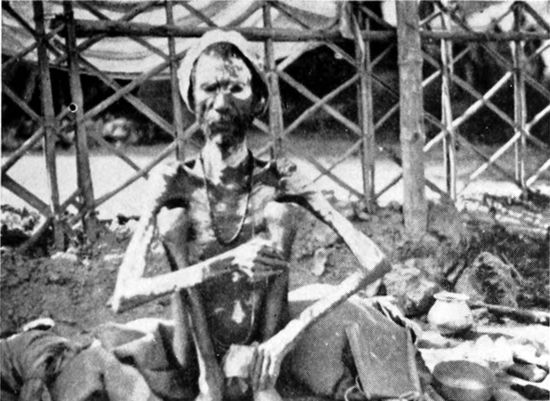
The Thinnest Swami I Saw at Allahabad.
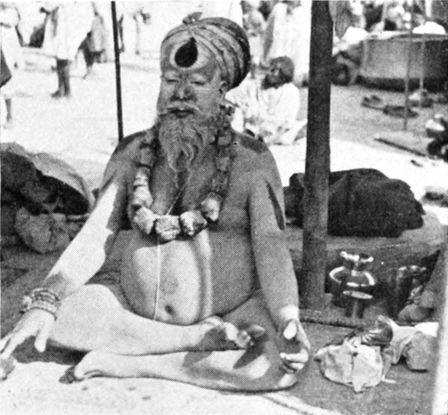
Sri Ayodhya-ji Bhagwan Das, a Sivaite Swami of High Renown.
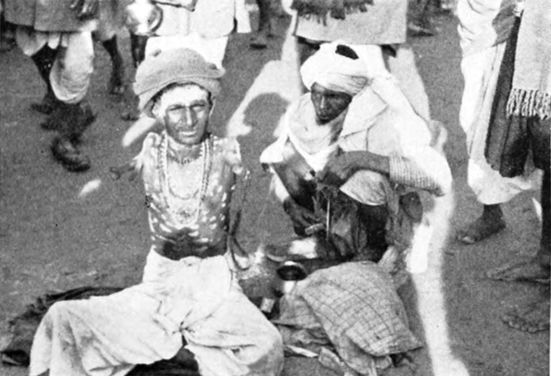
Armless Saddhu with Flippers. I Met Him Again at Hardwar.
The holy rivers of Hindustan have flowed through many of my memories during the last thirty years. I have hunted pig in their various Kadirs, conversed with their devotees at Benares and Calcutta; bathed in them here in Allahabad (and bathed my horses too: twenty of them I had once, and half of them used to follow me down to the river like dogs for their morning swim), and at Delhi and Agra were passed some of the vividest hours of my youth. Today the two rivers seem to link up past and present not only in my little life, but in the whole history of the Aryans. Here, bare to the buff, and beautiful in the simplicity that underlies innumerable fantasies—some noble, some of the nameless shame—is the oldest of living faiths: the faith of our ancestors, who held that the lingam is the Lord of Fertility, and the Conductor of Souls.
I have a horrible headache, due not to dissipation but an “error of diet.” Last night I ate a delectable entrée, not knowing its contents. In the small hours I was sick, and sick, and sick. Illness strikes quickly in India: I thought of all the dreadful diseases I might have picked up in my travels. This morning my hostess observed my wan demeanour. “Was it the prawn curry?” she asked. Of course it was! The knowledge made me feel better at once. The stomach has its reasons that the mind knows nothing of: mine is intolerant of certain kinds of shellfish.
Before climbing up here, I dragged myself round the freaks, who looked as wretched as I felt.
There was a living skeleton—the thinnest living skeleton who ever breathed—his spine visible through his stomach, his body a bundle of parchment and sinew, clinging to sharp bones. There was a handsome armless man, with flippers like a seal. There was an ugly dwarf, with no legs, but a pair of feet growing from his trunk. There was the boy with a muscular tongue, who can open the old-fashioned kind of soda-water bottles with it. There was the fakir who buries himself so that nothing is visible above-ground but his right hand, telling its beads. There were cows with five legs, men with none, men with foot-long lingams, conjurors with fascinating canaries, lunatics, lepers, anchylosed ascetics, holy-rollers. Once more I felt as if I were walking in my dead past, for just such men I saw also twenty years ago. Then, as now, kind, staring, wondering crowds surrounded them, credulous, amused, incredibly generous out of their small means.
I have a thirst as well as a headache. And how thirsty this land is! Only yesterday it was raining: now the ground is dry.
The crowd is dense here, near the ceremonial route, and growing denser. I must get down from my tower, for the naked ascetics are about to begin their march, and I want to see them. It is not often you can view a thousand bhairagis[20] gathered together. Women have crowded to the edge of the roped pathway to see the show: thousands and thousands of peasant women. In their villages they would run away from them (at least the virtuous ones would) but here they are safe, under the eyes of two thousand police.
The crowd is gentle and polite, and smells cleaner than our crowds at home: a mild, buttery smell. I’m glad I didn’t accept the elephant I was offered: it is better to be here, amongst the peasants.
Down the pathway comes a priest on a screaming stallion. Behind him a big, naked boy lolls on a tall elephant: his brown, strong body is painted with the white, horizontal stripes of Siva, like the forehead of his mount. He is evidently an ascetic of repute, for the crowd greets him with “Ram! Ram!” and women press forward to touch the tassels of his elephant’s howdah.
Here comes a fife-and-drum band: and now the notorious bhairagis. Normally, in British India, they wear codpieces about their loins, but today, according to the custom of thirty centuries, they go bare to the lingam. Ropy hair hangs down to their shoulders. Their eyes stare blankly, as if out of a hemp dream. Some of the young ones tremble, perhaps because they are self-conscious rather than cold. Some are sturdy, handsome fellows, but the majority seem undeveloped, mentally and physically. More and more naked men pass, holding bouquets of white blossoms for Mother Ganges.
After them come the women Yogis, wearing the usual saffron sheets of the Seekers of the Path. Many of them are of a masculine type, whereas many of the men have the rounded thighs and full hips of effeminacy.
Curious, this cross-sexed type, this median individual, neither quite man nor quite woman. Introverts and contemplatives sometimes tend to bisexuality; as if humanity might be trying to evolve a higher type, independent of the terrific stresses of the sexual instinct. But these people are not of a high type. A few look vital and intelligent and attractive (my mind goes out to them in hopeless wonder—what are they doing in this crowd?) but the majority are definitely subnormal.
A group of pandits strolls by: solid, bespectacled citizens. Then a band of wild Punjabis, with tousled hair and bloodshot eyes, who look like bhang-doped Sikhs, but cannot be, for the brethren of the Khalsa do not attend Hindu pilgrimages. Now more elephants, carrying dignitaries who bless the crowd. Now more bhairagis on camels. One sect has a mounted band. Many have elephants. Two holy men pass in an open touring car: incarnations of an ancient fertility-rite driving in a Ford V 8!
Dancers are pirouetting round a tabernacle. Something, or somebody, is surrounded by tonsured priests in saffron robes, peacock fans, the regal emblems of yaks’ tails. Is it an idol or a mahatma? A nice white sheep is being pulled along by a child. Is it a pet or a victim?
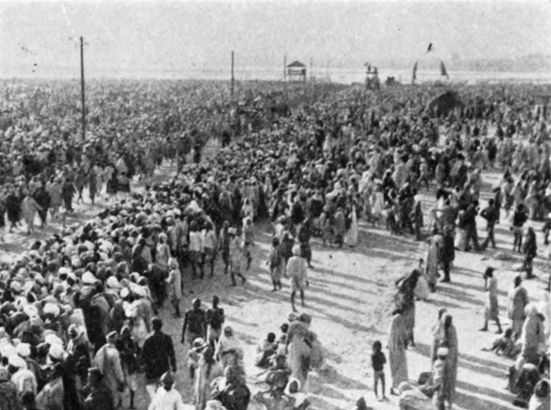
The Great Fair at Allahabad. Some 2,000,000 People Attended This Fair on January 24.
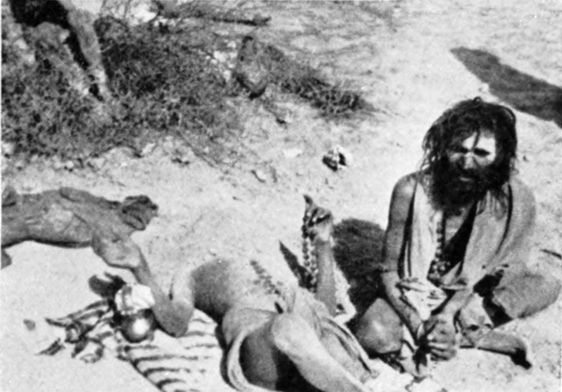
A Holy Man Who Remains for Hours with Face Buried in the Sand.
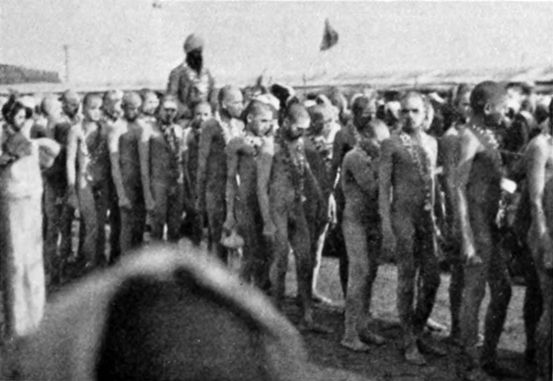
Procession of Naked Men During the Fair.
Still the procession passes, but meanwhile its vanguard has reached the sangam, where each worshipper will make an oblation, drink the sacred water, wash in it, repeat the ancient invocation to the sun, asking not for daily bread, but for light for the inner man. I would like to follow the bathers and mingle with them, but refrain, for the Hindus dislike being disturbed while bathing. I don’t blame them. These lustral rites are holy. I would not enter a church to stare at the congregation during the elevation of the Host.
Of what are the spectators thinking? The mind of the Hindu peasant is not particularly mysterious once one knows that it moves on two planes: the sunlit world of food, and sex, and weather, and the dim world of temple rites. Both worlds are real, and mingle here, at the conflux of the sacred rivers. The masses like to see a pageant that they and their fathers before them have witnessed many times. The meaning does not matter. Not ten men within a mile of where I stand could tell me the why and the wherefore of what we have seen. In India things happen because they happened before. Dastur controls all the happenings of life, from its begetting according to a venerable formula, to the ritual rap on the skull which frees the soul on the funeral pyre.
Pandit Madan Mohan Malaviya might tell me, no doubt, why we are making this pother about Jupiter entering the sign of Aquarius, but we have other things to talk about. (I imagine, also, that he does not approve of the fun of the fair: he is here to attend a conference.) When I find him, after some difficulty, in an enormous warren of huts and shelters, he is sitting, bare-headed, in a dhoti[21] and shawl, in a dark and almost empty tent. Two chairs are set in the sand. Outside, millions rejoice in the sun, but no sound of jubilee comes to this twilight.
Pandit Malaviya is a Brahmin, a leader of the high-caste Hindus, and the founder and moving spirit in the huge Benares Hindu University. Having already talked with many distinguished Indians, I have been under the impression that while complaints against the Government certainly exist, on the whole the political situation is incomparably better than it was when I was last in India, fifteen years ago.
On the contrary, the Pandit assures me, it is incomparably worse. The British encourage communal faction. They are not serious about Indianizing the Army. They lack sympathy, imagination, honour. (Here the Pandit, who is the soul of courtesy, apologizes for hurting my feelings: I have asked him to be frank.) At one time he believed in us and trusted us, but now he can no longer rely on the word of an Englishman. The plight of the villages is terrible. Unemployment is growing. There is an ugly spirit amongst the youth of the country. In ten years India will have cut herself free from the Empire.
This gentle-mannered old gentleman induces in me a profound sense of depression. What has my race done to make him so bitter? It is no personal slight: he is too broad-minded for that, too wise and experienced. For many years he liked us: now we have wounded him to his soul.
What is the matter? Why does the old Brahmin leader hate us?
I believe it is not “we” who have wounded him, but the Time-Spirit. (A convenient name for things we don’t quite understand!) The Brahmins feel that they are about to be swamped by the huge illiterate electorate of the lower castes; and the fact that they themselves were the pioneers of democracy in India makes the result of it no more pleasant. Dr. Ambedhkar, the leader of the untouchables, has prepared some bitter draughts for the higher castes to swallow.
At present the tide is running against the Aryan aristocracy. It may change. I hope it will. Blood must tell. It is ridiculous to suppose that breeding is not as important in men as it is in racehorses. We know, or ought to know in England, how three Arab stallions imported into our country during the seventeenth century have created miracles of strength, staying power, and speed in horses. Byerley Turk, Darley Arabian, and Godolphin Barb happened to “nick” with our mares: the results were good: they have been maintained by a careful method of breeding, so that today the English thoroughbred is famous throughout the world.
I know all the old arguments against positive eugenics: we are not horses, we don’t know what mental qualities we want; the process is slow, or we mustn’t interfere with natural selection. Nevertheless, Sirs and Mesdames, look at the Brahmins: for five thousand years they have preserved their racial type. So have some few other peoples. Nowadays there are scientists who tell us that there are no pure breeds of men, but common knowledge and common sense discern well-marked characteristics in certain categories of mankind; and it is to the good of the world that strong racial types should flourish: flat uniformity would be the death of culture.
Caste is positive eugenics in practice. It has its abuses, of course, but also its great benefits. In wise mating there is more hope for a sane, happy world than in nine-tenths of our experiments in social reform. As long as we allow unchecked licence to the appallingly high fertility of degenerate stocks we shall continue to pay heavily in human misery, as well as in cash, to support mental defectives, blind syphilitics, congenital perverts. Why should these unfortunates be allowed to perpetuate their kind when we know that their children must carry and transmit the stigmata of disease? There is a path, not perhaps to the Superman, but to higher standards of living all round, and it can be trodden only by a race which exercises discrimination as to who shall enter its ranks. We supervise passports at Dover, but any little stranger, no matter how dangerous his genetic past, can enter England through the gate of birth.
However, we must leave Pandit Malaviya in his tent, a noble Achilles, and go out into the big, bright world.
A youth gives me a pamphlet headed:
O M
THE PROPHET OF THE AGE
Whenever virtue declines and vice prevails,
I come to destroy sin and save the virtuous.
Below this quotation from the Song Celestial, is a portrait of the prophet, and an invitation “to spiritual aspirants of all sects and classes to take their opportunity of receiving spiritual power and blessing.”
The leaflet continues: “The greatest luminary in the spiritual firmament of India, that has for the last decade been shining gloriously and transmitting its effulgent rays of spiritual power into the drooping souls and gloomy hearts of the nation, groping about in the unbreakable labyrinth of degeneration, spiritual, social, economical, cultural, the Saviour of Suffering Humanity . . . was born and brought up in the beautiful rural retreats of Bengal. From his very infancy this great saint exhibited extraordinary indications of spiritual greatness. The divine Child was utterly careless, and almost unconscious, of the external world. He mixed and talked but little with his friends and playmates, and was often careless, even, of his bare food and clothing, and passed his days and nights in his solitary room, in spiritual seclusion.
“As he grew up in age, this nature prevailed on him more and more, and he plunged himself, day and night, for years together, in Divine Commune. Young though he was, by nature he was divine, and as such was fully conscious of his spiritual mission in the world. He led a life of spotless chastity of body, mind, and word. Purity of heart and complete seminal control through austere practices had been the watch-word of his life, so much so that he never deviated an inch, under any circumstances in his life.
“As a consequence, this Divine Aspirant rose higher and higher, acquiring greater and greater spiritual power until he reached the highest pinnacle of God-realization. Revelation dawned upon his unclouded vision, and he was possessed with a divine impulse and a super-mundane power to reorganize, for the emancipation of the whole of humanity, the individual, social, and national life of India.”
Well, well! A considerable throng of peasants surrounds the Divine Aspirant’s marquee, but with patience I also am admitted to his presence. He is a plump, ringleted gentleman, with a kind, clever face, and impresses me (in spite of a certain initial prejudice) as being both modest and sincere. He is one of thousands of swamis who have won for themselves a place in the warm generous heart of Hindu India: the only thing exceptional about him is the method by which his sanctity is brought to the notice of the public; and this may not be his fault.
The great saints and sages of India have always shunned publicity, and do so to this day. It is hard to know their whereabouts, and more difficult still to interview them. Whether they are in crowds or in lonely hermitages they keep aloof from the world, preaching only to those in whom they recognize a hunger and thirst for the knowledge they can give.
Never, under any circumstances, do they take money from their pupils, but only food and lodging and service. You may know a true guru by the simplicity of his life, by his silences, and by his intuitive awareness. I might add, I think, by his sense of humour; for I have never met, heard, or read of a famous Hindu sage who was not a gay philosopher.
Some of the bhairagis, however, take themselves seriously. After leaving the Saviour of Suffering Humanity, I spent an hour amongst the naked men, who were powdering themselves with wood-ash after their bath in the Ganges. One of these ascetics, from the jungles of Central India, famous for his prowess with women, told me that I must remove my shoes if I wanted to take his photograph. I am ready enough to conform to any custom in any country, but this was nonsense, for we were under the open sky. I said I wouldn’t waste a film on him, and turned away, whereupon he sent a follower to beg me to return. I did not do so, however, for I had seen the Tiger-Swami.
Krishnanand is a strikingly handsome man, who tames wild animals by loving them. In his ashram in South Kanara he lives with the beasts of the jungle. Here he has a full-grown lioness, loose amongst the crowd.
I pat her, and pose her for her photograph, with her playmate, a fox-terrier. The three friends live entirely on bread and milk and fruit.
But there is something more in Krishnanand than cleverness with animals. He radiates power and peace. He has a fine domed head, a thoughtful brow, a powerful jaw. At present he is on the road to self-realization: one day he will be a great teacher.[22]
People come to Krishnanand, take the dust from under his feet, sit before him silently, getting a darshan,[23] as it is called.
India has preserved a truth which we have forgotten, or denied. Knowledge and power may pass from man to man without speech. Our desire to have everything explained and analysed leaves us with a number of labels but no wiser than we were before. True knowledge is a spark of the Immanent Divine. Krishnanand is a catalyst of the Unconscious.
In his presence the visitor feels a heightened potential in himself: what does it matter if he cannot reduce this sensation to a neat scientific formula? If he could describe his feelings, it would add nothing to the knowledge of one who has seen the spark; and to one who has not, any description of it would be mere juggling with words. To know an apple you do not ask an analyst about it: you set your teeth in it. So with saddhus: you must sit with them, and sip their spiritual essence.
No one at Allahabad left a fresher taste on my psychic palate than Her Holiness Sri Sankari-ma, of Benares.
She is a well-known Yogini, but she has no pupils except one constant follower and friend, a highly educated man of sixty, or thereabouts, who was a doctor in Singapore until the call came to him to devote himself to Her Holiness. Her age is a hundred and nine. She is illiterate and speaks even Hindi with some accent which I did not recognize, but she is well informed, and keenly interested in current affairs. Forty years of her life were spent in remote caves in the Himalayas, where she learned the breathing exercises which rejuvenate the body from a guru who was then three hundred years of age. Although her face is heavily lined, her complexion and eyes are clear, her teeth are sound, her hair black, and she holds herself like a young woman. She sleeps for only one hour out of twenty-four.
“We all sleep too much,” she tells me. “It makes us heavy. To acquire lightness you must breathe rightly. It is easier to learn that in the mountains than in the plains.”
“Why?”
“Because the gross aspect of your personality[24] gets left behind in a mountain atmosphere.”
“Will you teach me these breathings?”
“Will you spend five years at Uttarkashi in the Himalayas? No, I know you will not. Then come and see me in Benares.”
“I will indeed! I know I sleep too much: eight or nine hours a day.”
“Yes, that is too much for a man of your age. Wakeful relaxation is better than sleep. I think I could show you how; but at present I am busy with my meditations.”
“I would like to learn from you.”
“In a few years I shall take some cheelas.[25] I shall live another seventy years, my guru told me. He died six months ago, God bless him! There is no hurry. Hurry is always a waste of time.”
“You are meditating? . . . On what? . . .”
Her black deep eyes twinkle as she answers: “On the Love of God.”
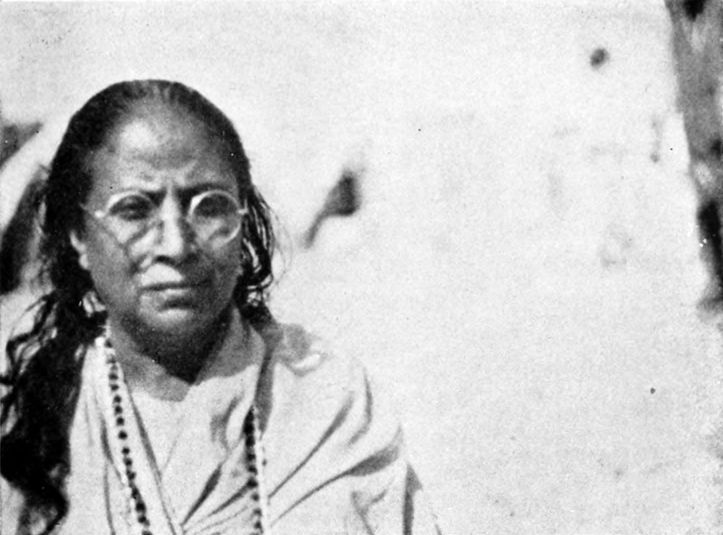
Sri Sankari-ma, a Holy Woman Who Claims to Be 109.
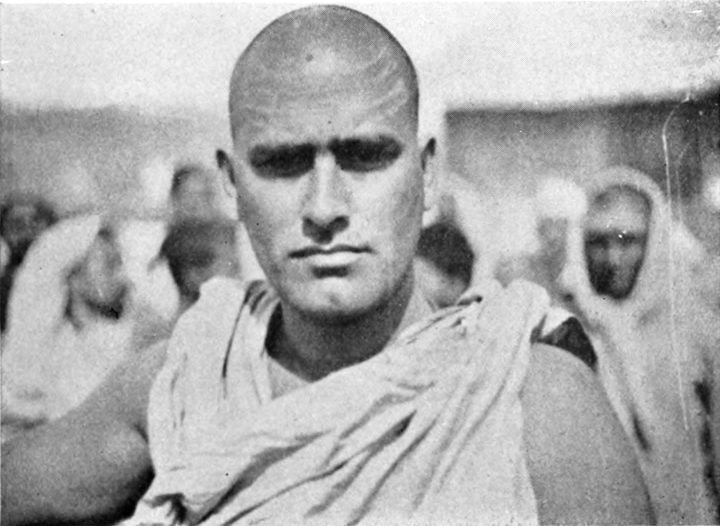
Krishnanand.
“The Mother is praying for the sins of the world,” her disciple adds, confusingly.
How is she praying? For what sins? And is she really a hundred and nine years old? I would like to question her further, but she is telling me the history of the two she-elephants who are standing near us, with a baby elephant between them. “They each had a child last year,” she says. “One of them died, so we lent the other to the mother who had lost hers. She helped to feed it. Now she imagines that it’s her own. You see what a strong baby it is! It is a fine karma to have two mothers. Both of them think it belongs to them, but the false mother spoils it most. This is a world of illusions, Sir!”
While we are admiring the tiny tusker, an elderly Brahmin greets me: he is a friend of twenty years ago, whom I met first at a great swami’s house in Puri.
It is late afternoon. I was up half the night, out at dawn, have not eaten or drunk all day. Now drink I must. Leaving Sankari-ma, my friend takes me to a booth where I consume one, two, three bottles of brightly coloured lemonade (the pinks and greens taste the same) and wash away the traces of sickness and headache.
My friend suggests that we should visit a samadh-swami.[26]
“His name is Ram Nath Bahalji,” my friend tells me. “I would like to take you to his tent. He was in samadhi for forty-two days, you know.”
Forty-two days! I didn’t know. . . . I have seen men in the samadhi trance for periods of half an hour and one hour: that is sufficiently remarkable, since it is impossible by any normal method to suspend the breathing for more than six or seven minutes. . . . But forty-two days! . . .
“Is he genuine?”
“Absolutely. The Black Blanket Father of Rishikesh supervised the whole affair. As you probably know, he is quite above suspicion. Also he was seen by a high police officer during his trance, and a Civil Surgeon examined him immediately afterwards.
“Bahalji wanted to end his life by going into perpetual samadhi, but the Black Blanket Father persuaded him that he was too young to leave the world, and that it would be a good thing to show that the old practices recommended by the Vedas were still being carried out by the saddhus of the present day. Bahalji agreed. He prepared himself in the usual way. For a long time he had eaten nothing but milk-rice and fruits. Then he fasted for two days, purified himself internally with the holy water of the Ganges, and practised long kumbakhas.[27] When the clay of his body had been hardened in the fire of Yoga he sat down on a leopard-skin in the old store-room, near the rest-house at Rishikesh, which had been chosen for the samadhi. The Black Blanket Father insisted that there should be a slit for ventilation at the top of the room: this is not usual, but Bahalji is very young for such a long samadhi, and the Black Blanket Father didn’t want to be responsible for an accident. Also he put two jars of water beside him, in case he came out of the trance unexpectedly. Bahalji’s friends smeared his body with creosote against the white ants.
“As soon as the last brick was in place, Bahalji turned his tongue backwards so as to block his windpipe, and passed into samadhi. Someone looked in through the slit of the store-room every evening. Sometimes crowds came. The Superintendent of Police saw him. He was always sitting there motionless, cross-legged.
“On the morning of the forty-second day, in the presence of the Black Blanket Father, the Civil Surgeon, and two thousand spectators, the bricks were removed. Bahalji opened his eyes and said ‘Om.’
“White ants had made a track across his thighs and left hand. They are said to have begun to eat his left hand, but I don’t know the truth of this. The hand is all right now, but for some weeks he kept it hidden. His hair and nails had not grown. He had passed no excreta. The water in the jars was untouched, except for evaporation. He was unable to move, and had to be carried out into the sunlight.
“His friends massaged his limbs. Within half an hour he was able to walk. Immediately he went away to a reed hut by Mother Ganges and begged his friends to leave him alone.”
Thus discoursing, my friend had led me back to the tents of the Sanatan Dharma Conference, near where I had met Pandit Malaviya.
“By the way,” he added, “he rarely talks, and never about his experiences.”
We entered a tent, and sat down in a corner of a rush-strewn floor. In another corner sat a bearded youth, with two friends. He was studying a time-table, and discussing with them whether or not he would have to change his train at Hardwar in order to reach Rishikesh.
He seemed a thoroughly practical young man, deep-chested, bright-eyed, alert, good-looking, intensely virile, with a brisk, resonant voice: the type that in different circumstances might become a successful actor and the idol of emotionally starved girls. To say that I was thrilled is to repeat a thrice-told tale. The Gorakhpur Mahant, Krishnanand, Sankari-ma, now Ram Nath Bahalji: I must seem to be highly excitable; but to write much about the people who did not impress me would be otiose, while to describe my feelings with regard to the others, “thrilled” is the exactest word I can find. It is not my fault that the expression is hackneyed. I might say, more scientifically and clumsily, that I felt what a secondary coil must experience when in the magnetic field of a primary current.
Bahalji went on talking to his friends, and we sitting. My friend knew that I understood a darshan, and that I would sit quietly without asking questions. But as a matter of fact the sage spoke to me. He asked me whether I was going to Rishikesh.
(Now why? He could not have known my name, or anything about me.)
“Yes, I am going to Rishikesh, and I hope to meet you there,” I replied.
“Why me?” he answered. “There are many great gurus there.”
“Saddhu-ji, not one of them” (I thought it best to avoid direct mention of his feat) “is as famous as you are.”
He laughed. “Are you a Seeker?”
“Yes.”
“Then find a guru and stick to him. Success is one-pointed: in many minds there is confusion.”
“Whom would you advise?”
“Ask the Black Blanket Father. He knows them all.”
“I am asking you.”
“My guru lives at Trijuginarain.”
“Where is that?”
“Between Gangotri and Kedarnath. It is a long way.”
“Is it very beautiful there?”
“Aye. One might be in Heaven. Shanti! Shanti!”[28]
That was all. I did not put the questions that were on the tip of my tongue. I felt that to do so would be cheap, superficial, silly; everything which our civilization is at its worst, and everything which Hinduism at its best is not. Who was I to cross-examine him about the unknown country he had visited? How could he explain, or I record what he had seen? The command of secrecy which all great Teachers have given to their disciples, is not laid on them for nothing.
But writing this months later, it is legitimate to ask what purpose had been served by this samadhi? Ram Nath Bahalji might answer by asking what any of us are about? He has reached down into the deep Unconscious, and has a right to say:
“. . . look that no man see it
Or hear it unaware;
Lest all who love and choose him,
See Love, and so refuse him,
For all who find him lose him,
But all have found him fair.”
Bahalji has a right to his silence . . . and I to question his methods. I shall do so when I reach Rishikesh.
This day, begun so gloomily, has turned out delightfully, though it is difficult to describe its quality.
I have seen strange things, yes, mysteries and signs, ancient customs, extraordinary people, a pageant of religious history. Those priests in procession might have been the hierophants of Ammon-ra, or of Baal, or the sons of Levi moving the Ark of the Covenant, or worshippers on the road to Eleusis. But amazement has not made my happiness. That has come from being close to the heart of Hindu India. I have felt at home.
Really at home, not just amongst a friendly people. Strolling, talking, sitting, I have been a part of the life around me. Yogis recognize in me a kindred spirit. I can go amongst them in places where other Englishmen cannot. This sounds like boasting, but it is through no skill or wisdom that I have this faculty. It happens.
Some men are at ease in a London club: to me such places are torture: I see dim acquaintances, wonder whether I should greet them, talk clumsily, run away. I have no roots in London. My fellow-writers frighten me. But I am at home amongst horsemen, airmen, and Hindu ascetics. And yet, on the occasions when I let my imagination play over my possible past lives, I have to admit that I am never the dog’s-body of those romantic scenes; and that, I submit, is a suspicious circumstance. One is always a high-priest of Isis, or the favourite wife of King Solomon, never the bottle-washer of the temple, or the under-housemaid of the harem.
Not so with the Hindus, however, many of whom, especially at a tender age, remember their previous existence, often in very humble circumstances.
Shall we divagate further? I think we must.
I have lately come across a pamphlet which seems to me to require serious consideration, for the matters with which it deals are of scientific as well as of sociological interest. It was compiled by a well-known counsel of the High Court of the United Provinces.[29] Some of the stories—especially the first two—are better authenticated than others; but the reader must judge for himself whether or not he agrees with me that reincarnation is an open question.
1. Little Jagadish and his car.
On June the 6th, 1926, Mr. Sahai had returned from a holiday in the country to his house in Bareilly, owing to the illness of his wife. He was greeted by his infant son Jagadish Chandra, who urged him to procure a motor-car at once. (Presumably to take his mother out for a drive?)
Now Mr. Sahai had no car. He was distracted with worry, and made some non-committal answer, but the child persisted in asking about “the motor.” On being questioned further, Jagadish replied that he had a car of his own at the house of his father in his previous incarnation.
As soon as Mr. Sahai’s wife was better, he took down his son’s story in connected form. Jagadish gave his “father’s” name as Babuaji Pande, of Benares, and described a house with a big gate, a sitting-room, a cellar with an iron safe fixed in the left-hand wall, a courtyard in which Babuaji sat in the evening, and other circumstantial details, to wit:
(a) that Babuaji was now living alone, his wife and two sons having died;
(b) that one of these sons, Jai Gopal, was now himself;
(c) that his brother, Jai Mangal, had died in suspicious circumstances;
(d) that his mother was pock-marked and kept close purdah;
(e) that his father and his neighbours collected in the courtyard every evening to drink opium and watch the dancing of a dark, shrill-voiced prostitute, named Bhagwatia;
(f) that Babuaji possessed two motors, one of which Jai Gopal (now Jagadish) considered as his own.
Mr. Sahai at once sent a letter setting out the above facts (but tactfully omitting any mention of the disreputable Bhagwatia) to the Leader, of Allahabad; giving also the names of seven well-known members of the Bareilly bar who had heard the boy’s story. It was published on June the 27th, 1926.
In consultation with these seven friends, Mr. Sahai decided that instead of sending someone to Benares to verify the statements of his son, which might have afforded a loophole for sceptics, he would write to the Chairman of the Municipal Board of that city, asking him to inquire into the truth of the particulars given in his (Mr. Sahai’s) letter to the Leader.
The Chairman (Munshi Mahadeo Prasad) answered in part as follows: “On receipt of your letter I made the necessary inquiries, and found that most of the things told by your boy are quite true. In fact they are all correctly related, except that Babuaji’s son Jai Gopal died about two and a half years ago. The rest of the facts are all correct. . . . Babuaji is well known to me, having been my client for many years, and I could see on the mere first reading of your letter that he was the person meant by your boy.”
Now Mr. Sahai’s son was born on March the 4th, 1923. If Jai Gopal had died two and a half years ago (say January 1924) he could not have reincarnated as Jagadish Chandra; but a lawyer of Benares, Pundit Lakshmi Kant, a friend and neighbour of Babuaji, told Mr. Sahai that Jai Gopal had in fact died in October 1922, at the age of ten or eleven. Which date is right? The record leaves us in the dark.
After the publication of Mr. Sahai’s letter, the public became greatly interested in the case, and for two months his house was besieged by people who wanted to hear the story from the baby’s own lips.
“Jagadish became quite tired of this,” Mr. Sahai tells us, “and refused to see people or talk in their presence. I, therefore, wrote to Mr. V. N. Mehta, I.C.S., District Magistrate, Benares, for his help before I could make up my mind to visit Benares with the boy. I was afraid of the crowd, as it confounded the child very much. He very kindly promised his help. I started on August 13th, in the afternoon, and reached Benares the next morning. I did not give any previous intimation, and stayed at Nandesar, which is two and a half miles from Babuaji’s house. I thought, I will not be harassed by the crowd. Unfortunately the news leaked out, and my house was besieged from the morning by a big crowd. I had to apply for the police to keep out the crowd, but the crowd did not leave us in spite of the police. Babu Hanuman Prasad, sub-Judge, Dr. Ganesh Prasad, Mr. Tandon, Income Tax Officer, and several [other] respectable people came to see us. Pundit Lakshmi Kant also came. The baby recognized him at once.”
Jagadish also recognized Babuaji’s house, the compound where opium was drunk, and the Dasaswamedha Ghat near by, in which he bathed as if to the manner born, although the Ganges was in flood.
He now gave the inquirers some further facts regarding his previous life in Benares. The following statements were confirmed by Pundit Lakshmi Kant as being true:
(a) that Babuaji’s wife was called Chachi, that she wore gold ornaments on her wrist and in her ears, that she had the marks of smallpox on her face, that she cooked for the family although Babuaji had sufficient means to engage a cook, and that, although an elderly female, she observed strict purdah in her house;
(b) that Babuaji took opium every day and wore rings on his fingers;
(c) that Babuaji’s other son, Jai Mangal, had died of poisoning.
Another friend confirmed what Jagadish had said about the prostitute Bhagwatia, and about the iron safe fixed in the wall on the left of the cellar.
Apparently Pandit Babuaji himself gave no assistance in the investigation, being annoyed at the publicity thus suddenly thrust upon him. One cannot but feel sympathy for him. Enfants terribles have always existed, but hitherto they have not remembered their reincarnations.
Jagadish made one error besides identifying himself with Jai Gopal (which may or may not have been a mistake): Babuaji’s wife Chachi was not dead as he had stated. Mr. Sahai explains this by suggesting that the boy confused Chachi with a grandmother of the same name.
Even if mistakes were made, however, the story is extraordinary. Bareilly is three hundred and twenty miles from Benares, and it does not appear possible that at the tender age of three and a half years Jagadish could have obtained or imagined so many details about an obscure pandit living in a distant city. How are we to account for the facts, if they be facts? Even one right recollection of a previous life would be astonishing: here are a dozen, apparently beyond the reach of the long arm of coincidence.
2. Wine, women, and fish.
Vishwa Nath, the son of Babu Ram Ghulam, was born on February the 7th, 1921, in Bareilly. At a very tender age (before an English child could speak, but Indian babies mature young) he began to ask when he would be taken to Pilibhit.[30] When he was three he stated:
(a) that he was a Kayasth (a respectable caste of merchants) of Mohalla Ganj, Pilibhit, by name Lakshmi Narain, nephew of Har Narain;
(b) that he was unmarried at the time of his death, which occurred when he was twenty;
(c) that his neighbour was a certain Lala Sunder Lal whose house had a green gate, and in whose courtyard nautch-parties were held;
(d) that his uncle was very fond of him, Lakshmi, and was always giving him silk dresses and pocket-money;
(e) that he (Lakshmi) was fond of wine, women, and fish;
(f) that he had studied up to the sixth class in the Government High School near the river, and knew Urdu, Hindi, and English.
(It will be seen below that the boy made a mistake in stating that Har Narain was his uncle: he was Lakshmi’s father.)
On hearing of this case, Mr. Sahai took Vishwa Nath and his father-in-the-flesh to Pilibhit. They went directly to the Government High School, which the boy did not recognize. The headmaster of the school, however, explained that it had only recently been built, and accompanied the party to the old Government High School near the river, which was at once familiar to the boy. He ran up to the roof, and from there pointed out the house where he used to live. Returning, he showed the investigators the room where Class 6 was held in his time. Two school-fellows of the deceased Har Narain came out of the assembled crowd and confirmed Vishwa Nath’s statement about Class 6. They asked him the name of their teacher. Vishwa Nath said that he was “a fat, bearded man,” which his comrades agreed was correct.
He was now asked a question which must have been embarrassing to a child of three: the name of the prostitute with whom he had associated in his previous life, and he reluctantly replied that she was called Padma, which was also correct. (What happened to Padma we are not told.)
The boy was now given a pair of drums, such as are used at nautch-parties, and he played on them with ease and eagerness, although his father declared that Vishwa Nath had never seen such instruments before. But Lakshmi, we must remember, led a gay life.
“When we reached the house of the late Lala Sunder Lal,” writes Mr. Sahai, “the boy got down from the tonga and recognized the green gate. He also pointed to the courtyard where nautch-parties were held. This was corroborated by the neighbouring shopkeepers. I saw the gate myself. It had a green varnish which had grown faint by lapse of time. An old and faint photograph of Lala Har Narain and his son was brought by the sole surviving member of the family, Babu Brij Mohan Lal, who lives in a separate house. In the presence of a big crowd the boy immediately put his finger on the photograph and said: ‘Here is Har Narain, and here I,’ pointing to the photograph of a boy seated on a chair. This established his identity as Lakshmi Narain, son of Har Narain.”
Now comes a supporting statement which to my mind may invalidate the whole story. Lakshmi Narain’s mother (that is, Vishwa Nath’s mother in a previous incarnation) was alive and living in Bareilly. Obviously Vishwa Nath, who was born in Bareilly, may have met her, or may have heard neighbours talking about her, and about her life in Pilibhit. When he was taken to this lady, she put the following questions to him, which convinced her that he was indeed the incarnation of her late son:
Q. “Did you fly kites?”
A. “Yes.”
Q. “With whom did you fly them?”
A. “Everybody near by, but particularly with Sunder Lal.”
Q. “Why did you throw my pickles away?”
A. “How was it possible to eat worms?”
Here Lakshmi Narain’s mother explained that she once had a jar of pickles in her cupboard which went rotten: she removed the bad parts and intended to use the remainder, but Lakshmi Narain threw away the whole jar, much to her annoyance.
Q. “Did you ever enter Government service?”
A. “Yes, I served for some time in the Oudh and Rohilkund Railway.”
Q. “Who was your servant?”
A. “He was Maikua, a short, dark Kahar. He was my favourite servant.”
To me, this story has a convincing air, in spite of its evident defects. Mr. Sahai subsequently established the fact that Lakshmi Narain died at Shahjehanpur, on December the 15th, 1908, of fever and lung trouble. (So his disembodied soul must have waited twelve years and one and a half months for another body.) A member of the family vouched for a curious circumstance: young Lakshmi Narain of Pilibhit used also to remember his previous existence, and had often stated that he was born in Jehanabad in his previous incarnation; but his parents thought that this knowledge would be harmful to the boy, so no verification was made. We must therefore suppose that Vishwa Nath of Bareilly remembered being Lakshmi Narain of Pilibhit, who in his turn remembered being somebody else of Jehanabad.
These two stories are the best documented in Mr. Sahai’s collection. I have seen photographs of Jagadish Chandra and Vishwa Nath, both of them chubby little boys in shorts, who do not look capable of sustaining a complicated imposture.
I have also seen a picture of Hira Koer, whose story follows, and who claims to have been a boy in her previous incarnation; and of Bhajrang Bahadur, who remembers being a British soldier in the Great War.
3. Naughty tortoises.
In August 1922, the station-master at Haldwani went for a pilgrimage to Muttra, with his wife, nursemaid, and small daughter, Hira Koer. At Muttra the party took a river-boat for the shrine at Gokul. On reaching this sacred spot, Hira Koer suddenly and unexpectedly struggled out of the arms of her nurse and ran towards a doorway at which an old lady was sitting. Her mother followed her. Hira Koer rushed into the house and asked the old lady about her slate and pencil, about the chair in which she used to sit, and about a pair of brass nut-crackers which she said were somewhere in the house. Then she begged her mother to go away, declaring that she (Hira Koer) had found her real home. The indignant mother and the surprised nurse dragged the child away between them.
They were followed by the old lady. On the banks of the Jumna, whither they had gone to feed the tortoises with parched rice, Hira Koer cried out: “You naughty tortoises! You drowned me last time, and now I believe you’ve come to do it again!”
Thereupon the old lady burst into tears, for her twelve-year-old son had been drowned at this very spot four years ago.
4. The case of Sunder Lal.
Mrs. Pattu Lal is the wife of an elderly Brahmin who was a compounder of medicines at Kamalpur Hospital, United Provinces, in 1912. That year a child was born to her, Sunder Lal, nine months after she had gone on a pilgrimage to Ajodhya in the month of Sawam (July-August), of 1911. When the baby was two and a half years old he began to assert that:
(a) his name was not Sunder Lal, but Hanne Lal;
(b) that he was a resident of Ajodhya;
(c) that he had a wife and two children;
(d) that he was a Kayasth by caste;
(e) that when he died his family deserted him, and his body was thrown into the Gogra unburned;
(f) that his soul met the mother of his present incarnation while she was bathing in the river.
The compounder’s quarters at Kamalpur Hospital are close to the railway station, and small Sunder Lal continually wandered towards the trains, saying that he wanted to return to his home at Ajodhya. This was most alarming to his parents, for it is an almost universal belief in India that children who remember their previous incarnations have short lives. So Mr. Pattu Lal called in a Tantrik Yogi, and with the help of spells they gradually induced the boy to forget about his past. After the age of five he never spoke of Ajodhya.
In 1926, however (that is, about ten years later), a highly respectable pandit who was visiting Ajodhya attempted to verify Sunder Lal’s statements. He discovered that a Kayasth named Lala Hanna Lal had, in fact, died in the month of Sawam, 1911, of plague, which was then raging in the city, leaving behind him a widow and two children. He had been a school-teacher. His wife and children had deserted him hastily during his illness (as often happens during plague epidemics) and, as no relatives came forward to cremate him, his caste-fellows gave him a watery burial. The pandit spoke to a goldsmith, one Janki Pershad, who had actually carried the body to the bier and helped to float it away.
Of course there is a faint possibility that Mrs. Pattu Lal may have met a school-teacher in Ajodhya in 1911, who afterwards died of plague . . . but the story is a strange one.
5. Chamela and Champa.
Another Brahmin of Kamalpur, Mr. Bhekari Lal, had an unmarried daughter named Musammat Chamela, twenty years of age. He was very poor and could not afford to pay the large sum demanded by his friends for a suitable adult to marry his daughter, so he was able to obtain for her only a small orphan boy of the age of eleven.
He often complained bitterly of this misfortune in his daughter’s hearing. Doubtless Musammat Chamela agreed with him, but she held her peace. On the eve of her wedding day, she cooked dinner for the family, and served it with every appearance of cheerfulness. However, as soon as the household was asleep, she went away and drowned herself in a near-by tank.
Five years afterwards, a grocer next door to Bhekari Lal had a daughter born to him named Musammat Champa. When she was five years old, Champa refused to eat the food of her family, for she said that she was a Brahmin (grocers are of the bania caste, low in the social scale, though not, of course, untouchable) and that she was Bhekari Lal’s daughter who had drowned herself ten years ago.
On being taken to Bhekari Lal’s house she pointed out correctly her former bedroom, bedstead, and play-box: she also declared that she would never get married, and that she felt a strong inclination to commit suicide.
Although this story lacks circumstantial detail, and admits of the simple explanation that Champa had heard the story of Chamela’s suicide, there would appear to be no motive to induce Champa to relate such inconvenient and distressing circumstances about herself, unless she believed them to be true.
6. His father’s son.
Mr. Nand Nandan Sahai died of cholera at the early age of nineteen, in the year 1906, at Mirzapur, United Provinces. His family mourned him greatly, for he had been a brilliant student and a keen sportsman. At the time of his death his wife was two months pregnant. Her husband appeared to her in her dreams, and declared that he was about to be re-born as her son; that he would have a scar on his head as an identification mark; and that a wet nurse must be kept in waiting for his arrival, as he would rather die of starvation than drink his own wife’s milk.
Mrs. Nand Nandan Sahai told her dream to the family; and at the time of the birth a foster mother was duly in attendance.
The baby was a male, with an inch-long scar on the back of his head. He refused to be suckled, and when given some of his mother’s milk in a spoon he vomited freely, although we are told that he took nourishment without demur from the breasts of several friends and neighbours. (Communal suckling is common among mothers of the same caste.) When the child was five, he spoke one day to his mother, in great perplexity, saying that he was her husband, that his grandfather was his father, and his grandmother his mother. Immediately afterwards he was prostrated by an attack of fever. When he recovered, nobody spoke to him on the subject, and it passed from his memory.
7. Babu into German.
Mr. Bhajrang Bahadur, now eighteen years old, is the son of a court document writer resident in Bareilly. His father and mother are of swarthy colour, but he has fair hair and hazel eyes; and two scars, like bullet wounds, one on the right side of his neck and the other on his skull. In 1925, when he was seven years old, he told Babu Shakambri Das Singhi of Bareilly that “his real name was Arthur, and that he was a white soldier who had died in the German War.”
“Now he has forgotten it,” Mr. Sahai states. “He used to take his meals with a knife and fork up to the age of four, and used to play leap-frog and other peculiar games. He playfully walked in military fashion and gave cautions. His father and mother are old-type people who firmly believe that such remembrance shortens life. They do not know English. They did not disclose the facts when the boy began to give them out. It is a pity that such a good and instructive case has been spoiled by superstition.”
A pity, indeed!
An Indian critic who has read the foregoing says:
“Reincarnation is all nonsense: educated Indians don’t believe in it. . . . As to your account of the fair at Allahabad, you have slipped into the typical patronizing attitude of the European visitor. You describe us as dreamy and backward children. You mix up Pandit Malaviya with freaks and tricksters and tramps such as exist in every country. You don’t even mention that the Pandit has installed some of the best technical and scientific laboratories in India in Benares Hindu University. If you were writing of England, and met a Bishop on Hampstead Heath on August Bank Holiday, would you dismiss him in a paragraph, and devote the rest of your article to the behaviour of the crowd?”
My answer is that I would, because although the Bishop might be far more complex and exciting than the crowd, and far more representative of the soul of England (might be, or might not), yet the crowd is the stuff on which the Bishop has to work: without it, he is nobody. “We are members of one another.” The observer must take the crowd as he finds it. What I have seen, I have tried to record faithfully. It is at least a sincere account, fused in the crucible of personal experience.
My most personal experience of the crowd came next day, travelling from Allahabad to Benares.
I lay stretched at full length on the sofa of a first-class carriage regarding the multitude of my poorer fellow-creatures unable to find room.
There they were, thousands upon thousands of bewildered peasants camped amongst bundles of sugar-cane, hookahs, cooking-pots, staves, holy water, tin boxes, waiting for the gods of steam and steel to perform their miracles of transport. More hundreds were trying to bribe a babu to give them their tickets quickly. They were packed and jammed, ten deep, twenty deep, patient, uncomplaining: women wilting under the weight of the babies they carried; old men struggling with their household goods; girls utterly exhausted. Every third-class carriage was full to the roof: they would have to wait hours, perhaps a day, for another train. Here was I with a whole compartment to myself.
There is a catch at the bottom of railway doors to prevent the entrance of thieves. Every now and then my door was shaken frantically by some illiterate passenger who saw well enough that only one man occupied the space which might have accommodated fifty.
Presently, I rose and lifted the latch.
That was all. The raw realities of life had forced themselves on my attention, but I confess that I did nothing positive, or very little. I told myself that I ought to help the poor women, at least. But my action would be misunderstood. So I just waited. The situation was one of those intolerable ones which we tolerate well enough with our eyes shut.
A yokel burst in with a bundle of sugar-cane, and settled himself on the floor with a sigh. Someone in the crowd shouted to him. He called back: “Are! Chul!” (“Hi! Come on!”) and his sisters and cousins and aunts entered in a flood.
At first I was amused, then annoyed. To give shelter to the weak was one thing, to accommodate this rampaging crowd another. I protested: they paid not the slightest attention. I got up and tried to shut the door: I might as well have tried to dam the Ganges.
People poured in, climbed over one another’s backs, sat on one another’s laps on the sofa, covered the floor, stacked their belongings high on the table, burst into the lavatory; and then, when I turned round, I found that an old lady was camping on my cushion, so that I had nowhere to sit down.
I called for the station-master, but he merely spread his hands and smiled.
“What can I do, Sir? We can never get them out now.”
“But I must have a place to sit down!”
“I am sorry. They don’t know where they are.”
“But you must do something!”
“I’m sorry. The train is already late, Sir. I can do nothing.”
The train started. I pulled the communication cord. A good Christian would have accepted the situation; but I was angry.
We halted just outside the station. Railway police came to my window, followed by the guard. Immediately they began removing my fellow-travellers, who were awed by the sight of uniforms, and climbed down quickly, though very sadly.
Seeing them trudging back to the station, I explained to the guard that I only wanted a place to sit down. This was impossible, he said: every station was packed with pilgrims: half a million people wanted to travel that day: I would never be able to keep the compartment unless I locked myself in. However, I prevailed. He allowed me to keep twenty-seven passengers, chiefly women and old men.
When the train started again, I had most of one sofa to myself. Fifteen Hindu ladies sat on the floor, and two, with children, on the opposite sofa, together with eight men, who had, of course, taken the best places. One of the two armchairs was occupied by a cripple, the other by a venerable greybeard.
“Cherisher of the Poor,” said the latter, “you are a Great Lord, and all-powerful. You are our refuge!”
“Aye, you are our refuge,” agreed one or two voices. Then there was an awkward and an unusual silence for an Indian train.
Some of the travellers nibbled sweetmeats, others sustained themselves with sugar-cane. I lit my pipe, feeling slightly embarrassed.
Within a few minutes we had stopped at another station. With surprising agility the cripple jumped down from his chair and locked the door. “Dunderheads!” he cried to the frantic people outside. “Owl’s mistakes! Can’t you see that this is a sahib’s carriage?”
“Cherisher of the Poor, you are our refuge!” repeated the venerable greybeard.
I offered him a cigarette, offered them all cigarettes, but they refused, except a lady with a ring in her nose. She lit it from my match and puffed it European fashion (not between cupped hands as the peasants do), pleased by the admiration of her neighbours. I asked her where her village was. She smiled and grunted, a polite but negative grunt. I could get nothing out of her. I could get nothing out of any of them. They did not speak amongst themselves, nor to me, except for an occasional ingratiating murmur, for they were, I think, a little suspicious. Perhaps the police would come again. Perhaps this strange sahib was taking them not to their homes, but to a prison. The atmosphere was not hostile, indeed they were glad to be where they were; but they were not quite sure what would happen next.
When we stopped again, two men left us.
“Cherisher of the Poor,” reiterated the greybeard. “You are our refuge!”
“Where do you live?”
“Sahib?”
“From what village do you come?”
“Your Honour, we are poor men, and cannot understand your talk. You are merciful to the poor.”
I was disappointed. The old fox understood me well enough, but he didn’t want to give his address.
The surging-in of the crowd had been exciting. I had been keyed up, eager for an insight into these people’s lives. This was dull. Once more I looked towards the lady who smoked. She ground out her cigarette-butt on the floor, veiled herself, apparently went to sleep. . . .
The two babies were fast asleep, exhausted by the long day. One of the mothers chewed lime and betel-nut: she lowered a window near her without difficulty (although she had probably never seen such a window before) and politely spat therefrom a blood-red stream of betel-juice. No one looked at me. I felt it would be impolite to look at them, or to attempt to break down their reserve. We ignored each other, like English people travelling.
An hour passed. An hour and a half. Two stations short of Benares there is a junction: here everyone except the greybeard rose and left me. Many of them bowed and salaamed with charming courtesy.
The greybeard remained curled up in the chair at the foot of my sofa. All this time my servant had kept well out of the way. Now he made an excited entrance. “What have these miserable coolies been doing?” he cried seeing the mess in my compartment. “Why didn’t you call for me, sahib? And what is that man doing?” he added, horrified. He abused the venerable one roundly for sitting in a chair in my presence. I said that he was a guest, but the bearer replied that, guest or no guest, the floor was the proper place for him.
So on the floor he sat. I think he preferred it. He remained absolutely still, with his little bundle beside him, holding a bamboo staff.
I continued to smoke my pipe in silence, feeling very tired. And what had I done to make me tired, I asked myself, lying there on my sofa?
When we reached Benares, my companion salaamed, and slipped out into the noisy night.
|
Junction of the rivers. |
|
The bhairagis are naked ascetics following the cult of Siva. They have a bad reputation throughout India, partly because some of them cure barrenness by methods open to suspicion, and partly because criminals escaping from justice often contrive to enter their ranks. Some of their communities, dating back from the time of the Mogul emperors, enjoy considerable worldly possessions in land and livestock, however deficient they may be in things of the spirit. |
|
A single piece of cloth, draped about the legs and tucked in at the waist, worn by Hindus. |
|
Being now on the path which leads to the merging the Self with all creation, he generally alludes to himself in the third person. In answer to a letter from me, he wrote: “Hari Om! Blessed Self, Pranams to thy Divine Self! Krishna shall be very happy to meet you here in the ashrama. Shanti ashrama is a place worthy to be visited by your good self. Please let Krishna know when you would find it convenient. Hari Om! Ever yours in His service, Saddhu Krishna Chaitanya, a humble devotee.” |
|
A sight of a Master. |
|
The tapas of your jiva: these technical terms cannot easily be translated. |
|
Disciples. |
|
Samadh means a “gathering-together”: it is the last stage of the Mystic Path, the bliss, emancipation, ecstasy, beyond which the Yogi must choose whether to pass beyond the world, or remain on earth to help his fellows. A samadh-swami means an initiate who has achieved the temporary withdrawal of the soul from the body by means of a trance-state in which all the natural functions are quiescent: the body is cold, except for a warm patch at the crown of the skull, which is the only link kept by the Yogi with the living world. |
|
Exercises in breath-retention. |
|
Peace! Peace! |
|
Reincarnation, by Krishna Kekai Nandan Sahai, B.A., LL.B., from Krishna & Co., Town Hall, Bareilly, India. |
|
Pilibhit is forty miles north-east of Bareilly. |
I drew blank in Benares. Everyone I wanted to see was at the fair in Allahabad; moreover, the city was haunted by memories which I did not care to revive.
As usual, tourists were staring at the bathers, kodaking the corpses, glutting themselves with guide-books. I could not bear to go to the Scindia Ghat, where I first met Hastini. She and Sivanand are in the high Himalayas or Tibet: I have lost all trace and track of them. . . . Almost unconsciously, however, I found myself at the house of Tulsi Das, up-river. There were no tourists there. A man with a monkey in his arms was listening to a woman lecturer. Close by stood a Brahmini bull, apparently also listening. But the Paramahansa. . . . The Paramahansa is no more. They put him into a stone coffin at this ghat, and carried him to Mother Ganges.
I was rowed up to Ramnagar, to see that glorious sweep of the Ganges, from opposite the Maharajah’s palace, with the marvellous old city clustered on the cliffs of the left bank. . . . There is a reason, there must be a reason why Benares has always attracted the Aryans: buildings crumble, conquerors come and go, the fanatical Aurungzebe builds a mosque to dominate her, the English throw a stark, straight, red iron bridge across her river, but the holy city remains secure in the love of her people, feminine, dignified, serene, mistress of Lord Siva and his worshippers. Egypt, Babylon, and Greece have gone; China is fast changing. Only this Ganges-land remains firm in her old faith and old ways.
How firm? How far is Hinduism adapting itself to modern conditions? Here in Benares, the palaces and pilgrims and shrines and flowers are always the same, though always changing. There is a timelessness about her streets, an eternity in the flux of her unhurrying river, peace in her temples. Yes, peace in those filthy forecourts, infested with monkeys, strewn with dead flowers, wet with the blood of goats . . . in spite of these things there is serenity.
When Lord Buddha preached his inconvenient sermon in the Deer Park near by, Benares and all that she believes in were threatened. Threatened for five centuries. But the Brahmins were patient. After a thousand years their apostate Aryan brother was forgotten. Now a new Western god has arisen, many headed, many armed, more cruel than Kali, and less human: a sexless and unreasoning god, threatening the ageless things. Somehow, sometime, Democracy will have to be treated as Buddha was, and made safe for the Aryans.
I soon began to suffer from a guilty conscience, for I realized that during my fortnight of travelling I had done very little of the work for which a kind editor had paid me in advance. The readers of my journal wanted to hear about Baby Clinics and Village Uplift, and here was I gallivanting about after gurus. . . . So instead of travelling eastward to Calcutta, as I had originally intended, I returned to Lucknow, to learn about co-operative credit societies, the fragmentation of holdings, pedigree bulls, model hen-coops, bore-hole latrines. . . . But these things shall not be recorded here.
Sunday morning in Gardhapur.[31]
Two Government officials have very kindly given up their day of rest in order to show me some scenes of rural reconstruction in this dusty little hamlet, somewhere near Lucknow. The village is five miles from a metalled road, and consists of some three hundred mud houses, divided by narrow lanes. A stagnant pond, a mound, a mango-grove, are the only features in the flat landscape. The inhabitants are Hindus, of mixed castes.
A young gentleman has just been introduced as one of the local standard-bearers in the cause of hygiene: he is explaining to us with pride the best method of resuscitating the apparently drowned.
“But tell me,” I interrupt (remembering that there are no rivers within twenty miles of Gardhapur), “what would you do if a man were bitten by a snake?”
“I should send for the first-aid box.”
“And where is it now?”
“It is locked up.”
“But where?”
“In the headman’s house, sahib. He has gone to Lucknow for the day.”
“What would you do,” I ask a village elder, “if a man were bitten by a snake?”
“I would send for the snake-charmer,” comes the prompt reply.
Now this is the truth. No one in an Indian village, nor young nor old, would hesitate for a moment between a live magician and a box of tricks.
Pursuing my inquiries, I stop Ram Lal, a tanner, and therefore an outcaste. The time is past noon. I suggest that I would like to see what he is going to eat, and how he lives.
Ram Lal is nothing loath. He leads us to his home, where we find Mrs. Ram Lal, a voluble, middle-aged lady, with only three teeth. She holds a diminutive baby in her arms. Thinking us to be sanitary inspectors, she lisps a complaint against a neighbour, who has stacked a manure-heap at her door.
Is the baby her own, I ask? (She seems past childbearing.) It is, but she confesses that she cannot nourish it.
She is old, her husband explains, and her milk is dried. He shows us a little bluish buffalo milk in a brass pot—a quarter of a pint, perhaps—with nasty bits of skim in it: it looks indigestible stuff, and the baby seems a damp, dismal little thing, fly-infested, and dribbling from everywhere a baby can dribble. I don’t ask its name, nor look at it too closely, for these people believe in the Evil Eye: I can only hope that it will live to drink sweeter milk than its parents have ever tasted from the breasts of Mother India. For their midday meal this couple are about to eat one half of three thin rounds of unleavened bread (chapatties) and a little pea-soup. For supper they will eat the other half of the chapatties. The combined nourishment of father, mother, baby for a whole day would provide me with a light and most disagreeable breakfast.
There are millions of Ram Lals in India. Fifty millions at least, not all tanners, but all outcastes and depressed: more than the whole population of the British Isles. Nor do many of the higher castes have better nourishment. Clothes are lacking as well as food. Few villagers north of the Vindhya Hills have enough to wear. On this bright February afternoon a nudist would be comfortable in Ram Lal’s thin shift, loin-cloth, sandals; but at night, when the temperature drops by forty degrees, he has nothing but one worn, torn blanket.
A cadaverous cow has just defecated in the doorway. Mrs. Ram Lal gathers the excreta with loving hands: this is her fuel: she has no other.
Let us enter her house. There is a tiny mud-walled courtyard, containing a couple of earthenware jars for water. Crossing it in two paces, I am in a dark room in which a cow-dung fire is burning. There is no vent. When my smarting eyes grow accustomed to the light, I see a few cooking-pots and a string bed. Beyond is a small inner room, in which a girl child is dandling a male baby on her lap. The baby is naked; his large eyes are ringed with paint, and he rolls them as if they were glass eyes. The girl veils herself with the graceful gesture common to beggars and princesses, and turns the baby bottom upwards. The child and her brother are poor relations, I gather. Poorer than the Ram Lals. . . .
Ram Lal has lived and worked in this hut for forty-five years, earning about half a crown a week: sometimes less, rarely more. He had a barren wife, who died. The present partner of his joys had three miscarriages before that happy day in her middle age (I suppose she must be thirty) when she gave him the child who is to light his pyre and see his soul safe to Heaven.
Ram Lal is in debt to the village money-lender to the extent of a hundred rupees (£7 10s.), which is a sum representing more than a year’s earnings. Eighty per cent of the villagers of Gardhapur are in debt: many of them owe more than a hundred rupees. The interest charged by this particular money-lender, in Gardhapur, who is said to be a very decent and reasonable bania, varies between 18 and 24 per cent per annum at compound interest. (Banias take from the peasantry a sum which has been calculated to be about twice the entire land revenue of British India.)
However, Ram Lal is quite happy: he may stint himself over the necessaries of life, but not over festivals, marriages, and funerals. Often he has a spare copper for a beggar: five or six millions of them are wandering about India, living on the bounty of the countryside. There are also twenty-four and a half million entirely superfluous cattle, costing £132 million annually: a staggering sum for Ram Lal and his friends to pay for their veneration of cows. Moreover, five to six millions of people die yearly from preventable disease, and “the percentage loss of efficiency of the average person in India from preventable malnutrition is not less than twenty per cent.”[32]
Lord Linlithgow is said to be determined to carry through a great measure of rural reform. May he speed the plough and better the lot of the millions who live in the seven hundred thousand villages of India! His task is one of the greatest and gravest in the world.
At the tidy, brightly painted primary school of Gardhapur, two dear little boys in white are chanting a song of Uplift: “Sachi, sachi, batya-re” . . . “These are true, true words.”
It is a long song, relating to artificial respiration (again!), to the chlorination of water, to the advantages of village cesspools, and to the dangers of the anopheles mosquito.
Having finished, the little boys are about to begin once more, for repetition is the secret of successful propaganda, but I beg them to desist: I have just seen, hanging on the school wall—believe it or not—a set of pictures illustrating Herr Müller’s exercises for ladies. The schoolmaster explains that it was sent by the Red Cross, and that he displays it to amuse the children. Fantastic thought, the villager doing his “daily dozen.”
Now Mr. Siri Nath arrives. He is a local landlord, a Brahmin by caste: a dignified personality, with a streak of humour.
“Certainly a good deal of this Uplift is eyewash,” he says. “We must please the Government.” (This with a shrewd look at the officials accompanying me, whom he has judged to be not important enough to conciliate.) “Latrines, for instance. They are not necessary. The sun is our scavenger. People should go out into the fields, and cover their droppings with earth, as Manu taught us, thousands of years ago.”
“On the whole, however, do you think that the movement is succeeding?”
“Yes, but the Government might do more. Much more. Colossal sums have been spent on New Delhi. The army eats into our vitals, taking fifty crores a year (£37,500,000). Your administration costs far too much.”
“It is the cheapest in the world, calculated by head of population,” I reply, “and has given you peace and security, Babu-ji!”
He dissents. “You have given us an alien system which we don’t understand, and which leads to great abuses.”
“Then what would you have?”
“I am not a politician, sahib, but I trust Gandhi-ji. He will know what is best for us. . . . Here my profit as a landlord is eight rupees an acre (twelve shillings), out of which I pay forty-five per cent to the Land Revenue and four and a half per cent to the District Board. If I make two hundred rupees a year (£15) out of my fifty acres I’m lucky. And I’m the richest man in the village except the money-lender. If I were not a lawyer as well as a landlord I should starve.”
“What about co-operative credit societies?”
“They are a failure here.” (Of course, his criticism is not impartial.) “A money-lender is human: he won’t let his client starve, if only in his own interest; whereas the co-operative societies never have any mercy. When a peasant can’t pay, he’s sold up. Between them and the taluqdars,[33] our people get short shrift.”
“What would you do with the taluqdars?”
“Abolish them, Sir! I shall vote for Communism and the Pandit-ji,[34] at the next election. . . . Would you like to see my home?”
Siri Nath’s house is far removed from the contamination of Ram Lal’s presence, but it is made out of the same plastered mud, cooking is done with the same cow-dung, and outside it there is the same mess of ordure and stagnant water: but inside, the house looks tended, lived-in, loved. A family chest in the entrance hall contains quilts, clothes, documents. The open court in the centre is spotless with white sand. The men’s room is adorned by four pictures: an engraving of the Crucifixion, a photograph of Mr. Patel (late President of the Legislative Assembly) and coloured prints of Arjuna (the divine hero of the Mahabharata) and of Mohini (a dancing-girl famous in these parts). . . . Christ, a god, a politician, a nautch-girl: what deductions can I draw, if any?
“Why is she here?” I ask, indicating Mohini. (Interesting if my friend is a balletomane!)
An awkward silence.
“You can’t go in there,” whispers one of the officials, indicating the ladies’ quarters, over which the picture of Mohini hangs.
How ridiculous!
I don’t want to see his women. He must know that. Or doesn’t he?
In a sense, of course, I do want to see his women. There is no real intimacy possible between races except through their women. Of that I am sure, after many years of consideration of the factors that make for mutual understanding between peoples. In my opinion, the seclusion of women in India is due not so much to the fear that they will be molested as to the desire to keep the family free from alien influences: once the women see foreigners and take to their ways, all the old customs go.
“About birth-control, Babu-ji, have you any views?”
“I went to Mrs. Sanger’s meeting in Lucknow,” he answers, “and I agree with her. That is one point on which I can’t see eye to eye with Mahatma Gandhi. I think we are having too many babies, whereas he doesn’t. It is too much to have three and a half million more mouths to feed each year.”
“At least it shows a certain optimism,” I observe. “A people that can bring so many lives into the world can’t be afraid of the future.”
“Oh yes, they can! It’s a matter of habit. The pressure of the population on our resources is becoming terrific. Something will have to be done about it.”
“But what? The peasants can’t afford birth-control appliances, and wouldn’t know how to use them.”
“That is a matter for Government.”
Mr. Siri Nath leaves me speechless.
There is a Chief Midwife in Gardhapur, Mrs. Smith, a pretty Indian Christian woman, in gold-rimmed spectacles. She, and her assistant, Mrs. Montmorency, and six indigenous dais,[35] slight, supple, mysterious creatures with downcast eyes, take me to the Welfare Centre, financed partly out of Red Cross funds, and partly by the Government.
Mrs. Smith has a bicycle, on which she visits ten sub-centres in the neighbourhood, each of them having its staff of indigenous dais. Nowadays, I learn, the women of these parts are beginning to welcome the trained midwife: instead of summoning some filthy sorceress, with rings on her fingers and bells on her toes, they enlist the services of Mesdames Smith and Montmorency.
Readers of Miss Mayo’s Mother India will remember the terrible cases she quotes; but they may not know that those cases, given in full in her Appendix, were collected by Indian lady doctors petitioning the Viceroy for a change in the marriage laws: they were the worst that these doctors could discover in their long and combined experience amongst a vast population. Certainly they are dreadful reading, but we should remember that many of them could be duplicated amongst the 40,000,000 people in the British Isles; and therefore, in endeavouring to see the problems of maternity in India in due proportion we should multiply our own deficiencies by eight. None the less, two wrongs do not make a right; and one of the most heartening things I learned about modern India is that her women are moving swiftly to better their conditions, in spite of the opposition of priests and greybeards. Women are not conservative once they are convinced that a change will benefit them. Thank God, the dirty old dai will soon be a creature of the past.
Miss Mayo’s emphasis on the ignorance and helplessness of Indian women is wrong. Her facts are correct as regards the infinitesimal percentage of women to whom they apply, but her deductions from these special cases are a travesty of the truth. The wife is the goddess of Hindu civilization, the mother is its pivot, and the grandmother is the ruler of the home. It is an arrangement which has much to commend it. Most women desire worship, power, and veneration: in India they are worshipped in their youth, they have power in their maturity, and they are venerated by all the household in their old age. It is true that the lot of widows is a sad one, but against this we may put the absence of that sexual and psychic starvation so common amongst spinsters in the West. The grandmothers of India (many of them young) are moving with the times. Look at them! Listen to them (if you know Hindustani, which Miss Mayo does not), and you will know that they are not such fools as some of us suppose!
In the big Women’s Hospital in Lucknow pregnant women are still paid to come in for delivery (the fee is 7s. 6d.), but that is because the old custom of the private dai is difficult to dislodge in this country of old tradition. Once a woman has had her child born in this hospital, she wants to come again for her next confinement.
I saw a baby a few minutes after it was born. It was covered with black hair, quiet, quite composed, slightly amused by the ministrations of the two nurses who had brought it through the gate of birth.
With its lined face, and worldly-wise eyes, it looked like an Elder Statesman returned to life, but I was assured that by tomorrow it would have become as young and foolish as any other infant. Babies are often born old, they told me, but to me, whose mind was still running on reincarnation, it seemed uncanny.
For two years after the Great War, I lived in an old two-storied house by the Dilkusha Bagh, on the south-eastern outskirts of Lucknow, from which I saw the Mutiny sites in the heat of summer, and in the water-logged days of the monsoon, as well as in the winter glitter of the tourist season. And it was at Lucknow that I made up my mind to cut short my career as a soldier. . . .
In those days Mr. E. H. Hilton, last of the Mutiny veterans, was still living. He took me round the entrenchments of the Residency and showed me the Martinière Post, which he had helped to defend as a boy; and the place in the cemetery where he would lie amongst his comrades.
He is lying there now, the last of them to go. No more graves will be dug in that hallowed ground.
For eighty-seven days the garrison of Lucknow—thirteen hundred soldiers—withstood a constant bombardment, from distances of from eight to eighty yards, by fifteen thousand enemies and perhaps double that number of city people, eager for loot. The East India Company’s paper sold in the bazaars at a discount of seventy per cent, for the British had a very slender chance of coming out alive. In fact, only a third of the original defenders survived.
The shot-riddled tower of the Residency, with its proud banner, which alone of all British flags throughout the Empire flies by night as well as day, looks down on trim lawns, Bougainvillæas, roses, honeysuckle, and ruins round which our love and pride is woven.
Today, when we may have to nail our colours to the mast again, for other causes, in other parts of the world, it is good to remember Lucknow, and its still unlowered flag.
A rabbit lies flat on the grave of Sir Henry Lawrence, where he sleeps between two private soldiers, according to his dying wish. A rabbit? I can hardly believe my eyes, it stays so still, paralysed by fear. But it is. I throw a pebble: only its eyes move. Presently it bolts away, however, and I read the famous epitaph:
Here lies
HENRY LAWRENCE
who tried to do his duty.
May God have mercy on his soul!
Born 28th June 1806. Died July 4th 1857.
After the Residency, the other “sights” seem a little tame. The great Imambarah is worth a visit, however. It was built in the golden age of the Nawab-Wazirs of Oudh, at the close of the eighteenth century, when Zoffany visited Lucknow, and painted the famous cock-fighting scene at the gayest and most lavish Court in India.
In the picture-gallery hang portraits of the Nawabs and Kings of Oudh, from the stiff-lipped merchant-adventurer from Persia, Saadat Khan, who founded the dynasty in 1739, to that poor wretch King Wajid Ali Shah, who was deprived of his throne by the British in 1856, and whose chief idea of amusement was to be driven about his gardens in a carriage drawn by eight naked negresses. Eight naked negresses, “who performed some sort of sensuous massage,” according to a local clergyman of that time. . . .
Was it the climate, or indiscriminate mating, that brought the family down, in little more than a hundred years from the virile founder of the line, to the weak, womanish creature of 1856, in his diamanté tunic, leaving a large left breast exposed?
These plains frighten me: the ravage they work is so quick. Their climate favours concupiscence and fertility, but the creatures they breed are born tired. Hens lay tiny eggs, hounds lose their noses, roses their scent, horses their speed, men their stamina. This is not so in other parts of India, but here it seems as if nothing but periodical infusions of fresh blood will preserve the stock of man or beast.
A thought which occurred to me at Gardhapur, but which it would have been difficult to put to social reformers on the scene of their activities, was this: Will not the causes, whatever they are, which brought these people to their present pass, again operate when the uplifting agency is removed?
Reformers are insistent on the virtues of Sindhi bulls, Leghorn poultry, active kinds of bees, but I have not heard that any of them have considered the possibility of making some radical improvement in the human material which is the chief factor in their endeavours. Yet such an improvement would seem necessary if peoples which used to be subject to the eugenic benefits of conquest are to survive under modern conditions. For several centuries this country has been protected from the slaughter of its men and the enslavement of its women. While we may congratulate ourselves that the rural reconstruction methods of the Romans with regard to the Sabines is now a thing of the past, we must not be too sure that Nature has said the last word: her hands drip with the blood of the weak and lowly, and a day may come when a plague may thin the ranks of races living in bad climates more ruthlessly than ever the old invaders did. A conqueror, for all his inconvenience, gave something of the physical best that was in him to the conquered, whereas an epidemic, like the influenza epidemic of 1918, kills and weakens by millions where the conqueror only slew by thousands, and leaves no countervailing benefit.
What if the yellow-fever mosquito arrives here by aeroplane?
What will happen if the population-increase of India continues at its present rate? Not only is it the highest for any large country in the world, but the birth-rate and death-rate are also the highest, so that a vast outpouring of reproductive energy is required merely to maintain the present level of numbers; and beyond that there has been an increase of thirty-four millions in the last ten years. Enough to populate all Poland, or all Spain. When we realize the forces in play, we can judge something of the scale of the disaster which is bound to occur, sooner or later, if this frightening fertility continues without restraint.
I have driven out, across the Gumti River, and along the Fyzabad road, to Sandford’s tomb. This little obelisk, with its inscription: “Stranger, respect the lonely resting-place of the brave,” used to hold my fancy in the old days, and it still does.
Here, by the twisting Gumti, among the green crops, a pall of dust has risen between me and the twilight sky, lending an air of enchantment to the aspect of Lucknow, whose nearer view is disillusioning. . . .
There are many people and things I ought to see, but I am bored with people and things. Glutted. I want to be alone.
I believe that my instinct in Delhi was right: I should have taken one person, preferably a woman, and written my book about her. My brain boggles before these masses and millions. They mean nothing. Millions never do. It is the individual who counts. The joys and woes of one life are not multiplied by those of its neighbours: there is no bliss and no tragedy greater or less than that which happens in one human heart.
But it is too late to change. I have made my plans, and must travel down to Calcutta tomorrow, adding picture after picture to my jumble of undigested impressions. Seeing things will no more give me insight than constant eating will give me more strength, or much reading make me a full man. (Bacon was a prophet, but he did not foresee how full the modern mind can be with balderdash! It is a vulgar notion, a stupid, slick idea, that man’s new mobility will by itself make for better understanding between peoples: it won’t, unless he can assimilate what he sees.) But I must go on.
I would like to live at Gardhapur for a week, or a year. We visitors come to the villages of India in our big cars, Viceroys, Governors, Commissioners, agitators, revenue-assessors, missionaries, doctors, teachers, tourists; clean, brisk, well nourished, brimming over with our pet enthusiasm for sanitation, education, better babies, and what-not. The result is largely eyewash, as Mr. Siri Nath said.
We ought to sweat in these villages in June, and shiver in them in January, eat the food, drink the water, breathe the dust of the people. Then we would know better what we are about. Not in India only. Everywhere. Civilization is out of touch with the earth from which it derives, and should return to it to gather new strength and purpose. Every child should spend a year at least in physical service of its native land. . . . The results here in India would be marvellous, if every official were thus trained. British officials especially, but also Indians. It is a common mistake to suppose that because a man has a brown skin he knows the life of the countryside. I dare say Mr. Siri Nath, aloof in his mansion, knows little more than I do about Ram Lal’s feelings.
Mr. Siri Nath considers himself highly progressive, but I shouldn’t wonder if he has called in his family priest to purify his house after my visit. Barriers between man and man that have grown up in the course of a thousand years cannot be broken down in a day: they may be removed by an act of will, but nevertheless they remain in the race-mind.
And yet, in this land where exclusiveness has been carried to its most fantastic point, the very ground makes mock of human divisions! Dust covers the pariah and the Twice-Born alike. The high-caste sepoys of 1857, who revolted against the British on a matter of ceremonial purity, must every day, inevitably, have swallowed the droppings of dogs and the spittle of sweepers. So must we all in India.
Everywhere dust. “Remember, man, that thou art dust!”
|
The village and its inhabitants bear invented names, for they represent various visits and interviews, but I have done my best to describe real things and people. |
|
Report of the All-India Conference of Medical Research. |
|
The large landholders of Oudh. |
|
Pandit Jawaharlal Nehru. |
|
The official term for midwives born in the locality. |
On my way to Calcutta I met one of those charming women who stimulate the intelligence as well as fill the eye. A blonde. She flattered me, I suppose, but also she gave me some very useful information about Calcutta.
We met in the dining-car, and agreed that the food was almost intolerable. However, we washed down the eight dreary little courses with a bottle of Pol Roger.
Why do Europeans eat such miserable food in India? Native food is good and clean, but we insist on beef (which horrifies the Hindus) and ham (which wicked Moslem servants are said to spit upon before serving) and anchovy poached eggs. Always anchovy poached eggs.
The Madonna agreed that we should live on the food that Indians eat themselves; mutton, and rice, and aubergines. “But we never will,” she said. “The stupider people are, the more exclusive they become. We live in a little world of our own. Take the club situation, for instance. Indians will never believe that we are serious about the Reforms until they are admitted to our clubs. That’s illogical, if you like, but understandable. If they aren’t good enough to mix with us, how should they be able to govern themselves? In Calcutta, the Bengal, the Turf, and the Saturday are all closed to Indians. So are the golf clubs. Never ask an Indian if he plays golf in Calcutta, for the answer will be that he can’t!
“The other day,” she continued, “I saw the spectacles and pipe of Sen Gupta, the famous Mayor of Calcutta, preserved in an Educational Exhibition. Now he’s dead he’s become a national hero; and do you know why he came to hate us? He used to be in the Indian Civil Service, and went to Chittagong as Collector, with his wife; none of the English people in the station called on them. Sen Gupta didn’t join the Chittagong Club for the same reason that Moti Lal Nehru didn’t join the Allahabad Club: they thought some of the members might blackball them; and they probably would have. It’s not surprising that such men become our bitterest enemies!”
“I think it is a little surprising,” I replied. “And I know that some Indians agree with me. They don’t like our clubs, and haven’t the least desire to join them. Why shouldn’t the Bengal Club make what rules it likes? I believe it doesn’t allow Germans either. That may be rather out of date; still, the whole point of a club is that it’s a place where one can do what one likes, and indulge one’s prejudices.”
“Perhaps in big cities. But in a small up-country station the club is the only convenient place where you can meet the other residents, and play games. You practically have to go there, whether you like it or not. And if you’re considered fit to be the chief representative of Government in a district, it’s monstrous that a lot of snobbish nobodies should keep you out of their club merely because of the colour of your skin. How would you like to be kept out of a club in England merely because you were an Englishman?”
Certainly I would not like it at all, I admitted, but I countered with a story about young Blank, who had been wounded by Bengali terrorists. His nerve has gone. A friend of mine and her husband are looking after him in Calcutta. They go for a drive in the evening, and then to dance at the Saturday Club. “Do you think they could take him to a place where there are Bengalis?” I asked. “He’s dealing with them all day, and in the evening he wants a change. That would be natural, wouldn’t it, even if they hadn’t tried to murder him?”
“I suppose so. Still, it’s unfortunate, since his job happens to be with Bengalis.”
“Unfortunate, yes, but whose fault is it?”
“Fundamentally, I believe it’s our fault,” said the Madonna. “We have encouraged the teaching of all sorts of nonsense under the name of liberty; and I don’t see that we can be surprised if emotional and highly strung boys take us at our word.”
“Nonsense?”
“Yes, I don’t believe in liberty.”
Refilling our glasses, I observed that that is the question agitating all our minds: How far can individual freedom march with communal welfare? On its solution depends the future of civilization.
“That’s a typical man’s view,” she answered. “Civilization depends on women, and women can never be free. Neither can men, really. We all want an ideal, and the closer we’re tied to it the happier we are.”
“But liberty is an ideal.”
“A mistaken one for Bengal, anyway, because it can never be independent. It has always been a conquered country, and always will be, by races living in a better climate.”
“As to that, is any race independent?” I asked. “We aren’t. Our life depends on other races, whose buying power supports our unnaturally big population at home. We are especially tied to India. Our life is bound up with hers; and of course hers with ours, for we give her security.”
“I agree, but I wish people would be sincere about it. We are not in India chiefly for the benefit of her people. That’s one of those humbugging notions that deceive nobody, even ourselves. It irritates Indians to be told we’re here to lead them to better things. And it irritates me, for I’m a realist. We conquered India, partly by force, and partly by fraud. She was a rich prize. The French and Dutch were after her wealth, but we beat them to it. And now we have just as much right to what we have as the Moguls or the Mahrattas or the Sikhs had to the country they held. Why doesn’t someone tell the Indians that we haven’t the slightest intention of leaving? It would be the truth. And India would like to hear the truth from us sometimes. It would be so refreshing and friendly. Instead, we’re encouraging her to waste her money on Parliaments and Universities—so much graft for the intellectuals.”
“You are a regular die-hard, and yet you sympathize with the terrorists!”
“Yes, I sympathize, though I don’t approve. I see their point of view. They shouldn’t be called terrorists, by the way. It’s too big a name. They are mostly unstable children. As a matter of fact, sex has a lot to do with their going off the rails. They marry early, and they don’t have any experience of love and courtship in the European sense, for their wives are chosen for them. There’s no suspense or romance about their love affairs. Many of them have had a large family before they are out of their teens. By the time they are twenty they have had their glut of marriage and family life. But they’re passionate. From what my friends have told me I expect they’re the most passionate people on the face of the earth. They have to have some outlet. One of the outlets is revolution. They join a secret society. It gives them somewhere to go in the evening. Especially if they’re poor. They begin by worshipping the feet of the Mother, and they go on to planning bloody murder.”
“Isn’t unemployment at the back of the mischief?”
“Largely unemployment, but also boredom. Purdah is still very strong in Bengal, in spite of all the talk of emancipation. Educated boys get bored with an uneducated wife. They like to go with a gang. . . . Are you going to put all this in your book?”
“I expect so.”
“You writers are so lucky. I envy you, going where you please, with just pencil and paper.”
Little she knows how much agony and elbow-grease go into the writing of readable stuff!
“Tell me,” I ask her, “have you any colour prejudice?”
“Meaning?”
“Would you marry an Indian, under any circumstances?”
“Yes, under some. I might fall in love, for instance. But I couldn’t fall in love with a Negro: they give me cold creeps. But not Indians. Or Chinese. There are many reasons why I wouldn’t marry a brown or yellow man, but physical aversion isn’t one of them.”
“What are the reasons?”
“That mixed marriages don’t succeed. Sexual attraction doesn’t last more than three years. After that you have to rely on mutual interests, and one is more likely to find a real bond with a man of one’s own race. But that doesn’t mean I don’t find Indians attractive. Some of them are frightfully exciting.”
“Is that how most white women feel?”
“Nowadays, yes. . . . I believe you’re shocked?”
“Certainly not. I’m interested.”
But the truth is, I was a little . . . disturbed. Or it may have been the anchovy poached eggs. Anyway, I spent a restless night, and was glad to change my train at four o’clock in the morning at Burdwan, where I had to make a connexion for Santiniketan.
Saraswati, the Indian goddess of wisdom, is a white woman, seated on a lotus, symbolizing the purity of truth, which dwells in the centre of life and opens its beauty to the light of heaven. To her Sir Rabindranath Tagore has dedicated the later years of his life, in the making and maintenance of his school and world-university. He is a great man, and his ideas have laid a spell on me ever since I first visited him, here in Santiniketan, fifteen years ago.
He is at his old place, working with undiminished vigour. He tells me that he is not so active as he was, but mentally there is no change; his eyes have not changed, those lambent eyes so like the monsoon clouds he loves; and his keen, quick mind has not changed. Santiniketan still seems to me one of the most spiritually stimulating places in the world, looking beyond our day to a world-harmony which will come through no synthetic super-State, but through beauty, born in many forms and many lands, in the soil and soul of nationhood.
A famous headmaster once expressed his surprise at finding that the boys at Santiniketan were allowed to do their school work in trees. “What is surprising,” Tagore observes, “is the same headmaster’s approval of the boys’ studying botany. He believes in an impersonal knowledge of the tree, because that is science, but not in a personal experience of it.”
Tagore himself was brought up in a town: it is for this reason that he wants his boys to realize trees not merely as generating chlorophyll and taking carbon from the air, but as living things.
“Our childhood,” he says, “should be given its full measure of life’s draught, for which it has an endless thirst. The young mind should be saturated with the idea that it has been born in a human world which is in harmony with the world around it. This is just what our regular type of school ignores with an air of superior wisdom. My feeling at school was the feeling of a tree that is not allowed its full life, but is cut down to be made into packing-cases. My world vanished, giving place to wooden benches and straight walls staring at me with the blank stare of the blind.
“I refused to go to school when I was twelve, but I am glad that I didn’t altogether escape from its molestation, for it has given me knowledge of the wrong from which the children of men have to suffer. The education of sympathy is not only systematically ignored in schools, but is severely repressed. We rob the child of his earth to teach him geography, of language to teach him grammar. His hunger is for the epic, but he is supplied with chronicles of facts and dates.
“In India, however, we still cherish in our memory the tradition of forest colonies of great teachers. These places were not schools or monasteries in the modern sense. They were homes where men lived with their families, trying to see the world in God, and to realize their own life in Him. Students took the cattle to pasture, collected firewood, gathered fruit, cultivated kindness to all creatures, and grew in their spirit with their teacher’s spiritual growth. They lived outside society, but their ashram was to society what the sun is to the planets, a centre of light and life.”
This ideal of education through sharing the life of one’s Master, not in an academic atmosphere of scholarship, or in the maimed life of a monastery, but in an atmosphere of living aspiration, took possession of Tagore’s mind at the beginning of this century. At the age of forty, when he was already famous far beyond the limits of Bengal, he found a place ready to his hand where he could begin his work, for his father, Devendranath Tagore, had thirty years previously bought a piece of moorland a hundred miles from Calcutta on which he had built a guest house and a temple, and had made a beautiful garden, dedicating it to those who would seek there the fuller life of the Spirit under the healing brotherhood of trees.
It was here, in 1901, that he started his experiment, with ten boys. He had had no previous experience of teaching. He spent all his money and strength on the school. Most of his Gitanjali songs were written here, to be sung to the boys, and all his later plays.
Growing out of the school and University, is Sriniketan, the rural development centre which Mr. L. K. Elmhirst’s generosity has brought into being. It is supervised by Mr. G. G. Ghose, one of the best of the football players of Bengal. Mr. Ghose has the knack of finding grist for his mill in all the varying phases of village life. Out of a fire in a neighbouring hamlet came the organization of a Boys’ Fire Brigade, with its drill and discipline. From a malaria-ridden zone came instruction in mapping, drainage, zoology. From a local fair came instruction in first-aid and police-work. Now he is training the villagers in weaving, tanning, co-operative marketing, the rotation of crops, sericulture, poultry-breeding.
Boys and girls learn the “three Rs” by keeping records of their marketing, make the acquaintance of geology on their own plot of ground, and of chemistry by using limes and manures. Nature and science are not abstractions: the child learns physics by using tools and pumps, and entomology by thwarting the mosquitoes, caterpillars, and beetles that attack him and his plants. Masters and pupils are engaged together in the adventure of life: both are learners in the game, and the emphasis is on the expanding of consciousness rather than on passing examinations. The world is their guitar, and it is no use having a guitar unless you play on it.
The keynote of both communities is simplicity. “The relative proportion of the non-civilized and civilized in man,” says Tagore, “should be in the proportion of water and land on our globe, the former predominating.” That is true. Our life began in water, and the sea is still in our blood. There is nothing arid about Santiniketan: it is free, dynamic, well poised.
Tagore has been described by his enemies as a poseur, and his University as a place where students spend their time in the blissful beatitude of communicating with the Incommunicable. That is easy to say. Santiniketan does not always show results that can be measured by the world’s coarse thumb and finger; but it is exactly as a protestant against such material standards of success that its founder will be remembered by posterity, not only in India, but throughout the world. He is ahead of the ruck and run of us. Margaret McMillan had the same ideas in London: would that her teaching and Tagore’s could find their full expression in both countries! In England something is being done to save our children from standardized methods of education which are out of touch with all that is vivid and viable, but in India, from what I have seen at five or six Universities, young minds are still being stamped out like car-bodies on a production-line. Small wonder that so many of them go out into the world with a screw loose!
And yet, somehow, on leaving Santiniketan and plunging into the life of Calcutta, I am conscious of a sense of disappointment. Tagore remains in my mind as a beautiful but somewhat tragic figure. I feel, in the words of his Gitanjali, that he has “pressed the signet of eternity upon a fleeting moment of my life,” but I feel also that I am not living in eternity, but in modern Bengal. When he says that the British Government reminds him of some patent canned food, “guaranteed untouched by hand,” I see exactly what he means: nowadays our rule lacks the vitamins that would make it assimilable to alien peoples; but behind Santiniketan there is not yet the driving force of a great popular movement, but only a great man: a man who makes the arc of the sky seem bigger after one has met him.
Calcutta is a London in miniature, and not so miniature either. The maidan[36] in its centre is more than half the size of Richmond Park. The whole great city, with its solid, comfortable air, is reminiscent of those eighteenth-century days when Englishmen:
Now took a fleet, now sold a pound of tea,
Weighed soup, stormed forts, held Princes in terrorem,
Drank, fought, smoked, lied; went home, and, good papas,
Brought diamonds for their little boys as taws.
Those times have ended, never to return, but it is still the richest and most European city in the East.
Unfortunately it is also a centre of armed conspiracy. The Hindustan Socialist Republican Army and some other organizations are engaged in smuggling arms and enlisting recruits. An attempt was made on the life of the Governor of Bengal in May 1934. Hidden weapons were discovered at Tittagarh in 1935, together with subversive pamphlets and formulæ for making bombs; and in May of that year, and again in August, stores of explosives were found at Dinapore. An armed revolutionary was arrested in Allahabad this year. Terrorist plotters are still busy. A friend of mine who visited a girls’ school near Calcutta was surprised to find that the young ladies were being taught “dagger play.” Mr. Subhas Chandra Bose, in his recent book, Struggle in India, regrets that no attempt has been made to win over the army and the police, and that revenue is collected without obstruction. Obviously there is highly inflammable material here. My information (not from official sources only, but from Indian friends who are by no means uncritical of the Government) is that there are revolutionary organizations which no conciliation can appease: secret societies similar to the Black Hand of the Balkans, waiting for their moment to strike. Three times restrictive measures have been repealed, and three times there has been a recrudescence of violence.
Yet violence is alien to the true mind of India. The descendants of the sages who preached kindness to all creation have not forgotten their traditions. Even those who have been advocates and instigators of violence in their youth often turn to religion in their middle age, and practice ahimsa. . . . Among the 51,000,000 people in Bengal, therefore, there is a large body of opinion which holds that terrorism is wicked. Probably not more than one per cent of the population sympathizes with it, but owing to the intimidation of the terrorists—of whom there are some two or three thousand still at large—the police cannot secure evidence to bring these sinister people to trial. Hence the Bengal Criminal Law Amendment Act of 1930, which suspends the ordinary processes of law. At present 1300 persons are in detention, and another 1000 are under less severe restraint in villages.
To keep people under arrest without trial (even though there are ample safeguards for suspects), and especially mere boys, is an ugly necessity; and every effort is being made to turn the energies of these lads into constructive channels. I visited a camp in which eighty of them were learning to farm (eventually there will be one agricultural and four industrial units, dealing with five hundred boys) and found the place outwardly cheerful and full of hope.
Most of the boys were rather undersized and narrow chested, but they did not look like criminals. In fact, they are not criminals, however right it may be that they should be segregated from their fellow-citizens. Some, I suppose, are serious conspirators, and all have been foolish in being discovered associating with men of violence; but I wonder how many of them would have been even Communists, given steady employment?
Those to whom I spoke were eager to show that they could adapt themselves to a life of agriculture. Most of them had come from sheltered, urban homes: here they lived in barracks, in what must have been for them very strange surroundings. One of the boys told me that he intended to start a farm of his own when he was free, and that what he was learning here would be invaluable to him. Others said that they had never felt so fit and well. But I have been a prisoner myself. Behind their smiling faces I saw a background of bitterness and boredom. If only some patriot would arise to harness their whole souls, all their bodily energy and fresh young idealism, to some really constructive task!
One such patriot is Mr. Barindra Ghose, a converted revolutionary, and brother of the famous Arabindo Ghose. He is a slight, middle-aged man, with thinning and greying hair, a magnificent forehead, and dark eyes in which the fire and eloquence of his race glow undimmed.
He told me that in 1905 he was responsible for introducing murder as a political weapon in Bengal. He and his brother came to Calcutta from Baroda, published Yugantar, made bombs, planned robberies and assassinations. Now he is a yogi, and his brother, a mute ascetic in Pondicherry, is considered by the youth of India to be the greatest saint since Ramakrishna: he also has completely abjured violence.
“I have changed and India has changed,” said Mr. Barindra Ghose. “But some of our young men are still in the old groove. We’ve had too much politics, and too little of constructive idealism. Of course we must co-operate with Government. The British element can be eliminated only very slowly, if at all.
“Congress doesn’t know the real India. The politician flits across the poverty-stricken ignorance of the villages like some strange animal out of the Pancha Tantra. On the other hand, when a saddhu comes to the villages, like those you saw at Allahabad, the peasants flock to him in awe-struck groups and bring him their simple offerings: he typifies for them deliverance and happiness. The vote they know nothing about.
“To leaders like Pandit Jawaharlal Nehru, educated at Harrow and Oxford, the Himalayas and Ganges are like the Alps and Thames, with a few temples and pagodas thrown in. Jawaharlal is a clever man, but there he stops: he is too pedantic to be intuitive. He ignores the human factor.
“The inner being of man is a magic box from which pops out, again and again, Buddha, Christ, Chaitanya, Jenghiz Khan, Nero, Lenin, Mussolini, Hitler, at the most unexpected moments and in the most undreamt-of disguises. They persist in coming, both the good Great and the bad Great, and there will always be men to bow down to them and worship them. Just as we need food for our bodies, so we need food for our emotional nature. You cannot brush aside the deep realities of life by simply calling them ‘middle-class phenomena.’
“India is not a country, but a continent, an epitomized world, the cradle of human civilization. Our fight for freedom is the world’s fight, and we can teach the world this great lesson, that it can be fought with spiritual weapons alone. If we got rid of the British tomorrow, we would not be free. We have greater things to give the world than a new constitution, greater conquests ahead of us than political emancipation. The fact that my brother, Sri Arabindo, the first Rishi of Bande Mataram, had ultimately to leave politics for the spiritual life is an indication of how the Time-Spirit is moving. The nervous energy which we waste in our efforts to dislodge the British should be turned inwards, to serve our education, agriculture, and industries.
“We complain of British domination of India for two hundred years, but look at the terrible ordeal through which the races of the British Isles had to pass, before they became what they are: invasion, plunder, conquest, by Celts, Teutons, Romans, Normans, for seventeen hundred years!
“The races which are meant to live, and make a new contribution to human progress, have always had to suffer such an ordeal: it gives them a rich and complex and tenacious nature. Other races, with less stamina, are absorbed as leaf-mould and manure for the stronger types. The British have been a dynamic element in rousing us to new consciousness and activity. But India is still like a great, sleepy leviathan, stretching over her hills and dales; and having been suddenly roused, she is nervous and alarmed. She wants to strike at anybody whom she fancies to be in her way. Now it is the British, then it is the Mahomedans, or the landed aristocracy, or the merchants. She does not realize how strong she is. She has no confidence in her real destiny.
“Communism may be all right for Russia. It must have idealism behind it, to give it its driving force. But it won’t work here among our peasants. Capitalism in itself is an unmixed blessing. It hurts you only when you use it wrongly and turn it against your neighbour. There is no intrinsic vice in wealth: the devil is in our greed. We have been greedy in the past, like other nations. The paintings on the walls of Ajanta show the same untouchables as today, in attitudes of adoration and servility. The aristocratic heroes of the Mahabharata and the Ramayana used the masses for their wars and pageants without ever thinking of improving their lot. We have sinned grievously against our fellows: we complain of political domination, but our social and religious domination of nine-tenths of our kith and kin was far more debasing. So the mighty India of Asoka and Chandragupta went down before the nomad hordes like a pack of cards.”
“You were a house divided. . . .”
“Yes, and we still are, alas! If your guns were to go, Hindus and Moslems are waiting to pick up the sword of bitter hatred.”
“If you need us, we need you just as badly,” I said.
On that we were agreed. And now the talk diverged to philosophy. I told Mr. Barindra Ghose that my guru had died in 1934, and that I hoped to find guidance during this visit to India. He invited me to his ashram. “The Light,” he said, “is catching, like fire, travelling from point to point, from soul to soul, given the right conditions and the spiritually auspicious moment.”
Alas for that moment! I had many appointments that morning, and had promised to go to the races in the afternoon.
At the Belur Math, the headquarters of the Ramakrishna Mission, I saw the room where Vivekananda died; Vivekananda who electrified the United States with his eloquence, and later, England. Almost his last words were: “India is immortal if she persists in her search for God. But if she goes in for politics and social conflict, she will die.”
Ramakrishna (1836-86) is one of the great figures of the modern world. That “illiterate genius who knew all the pages of the book of life”[37] was one of the first to proclaim that all the great faiths of the world are true, and that they all lead to one Centre. To attempt an appraisal of his teaching would not be fitting here, but Vivekananda and Romain Rolland have left records of him which all should read and mark who would know more of Indian philosophy. Especially should they read Vivekananda,[38] who is a mirror of the high thought of Hinduism.
But Vivekananda wrote nothing about Hatha Yoga, or practically nothing, and to me the physical basis of mysticism is of great importance. In the West it is considered almost blasphemous to suggest that the body can have a part to play in man’s approach to the Temple of the Divine; and in India, also, Hatha Yogis suffer from a suspicion that their rites include obscenities and black magic. This belief is not always unfounded, but it is unfair to judge a system by its peccant professors: there have been rascals even in the Church of England. Why this neglect of Hatha Yoga in both East and West? An active soul needs an active mind and active bowels: the three are linked.
Here in this tepid air, beside the broad, brown Hoogli, I do not propose to linger. Ramakrishna and Vivekananda, those great spirits, would have been the first to tell me, I believe, that my quest was not ended at the Belur Math.
To luncheon with Sir Jagadis Bose and Lady Bose, dear friends in whom I always find all that is best and most beautiful in the mind of Asia.
The experiments in the Bose Institute have often been described. I saw them again: the mimosa that rings a bell to record its rate of feeding, the reactions of a leaf to sun and shade, the electrical measurement of the ascent of sap in a tree, a carrot under the whip of alcohol, a flower nodding away under a narcotic.
With Sir Jagadis it is not a theory that all life is one: it is a scientific fact: there is a provable basis of unity, in composition, structure, reaction to outer stimulus, that runs through all matter. A plant needs sleep, glories in the sunlight, winces when struck. Even a steel girder will grow tired of its burden. These things he has drawn out in diagrams and charted in graphs by means of instruments of marvellous delicacy and precision. And all the instruments have been made by Indian craftsmen.
To me, the “pampered mimosa” is the most fascinating of these experiments which reveal to our sight the secrets of a world invisible. Bose takes a mimosa, shields it from harmful contacts, allows it to grow up in ideal conditions. Apparently it is a prosperous plant, but appearances are deceptive. It lacks the bracing buffets of wind, the sudden changes of temperature, the variety of an unsheltered life: there is a slowing-down of its vital force, its nervous reflex-arc has contracted, there is a weakness in its fibre. In short, it has degenerated, just as a man or a woman does whose character has not been tempered in the fire of adversity.
Name, time, form, space, and causation cause the appearances of the Many, but behind them is the One. So said the ancestors of Sir Jagadis many centuries ago. He has proved it to this hard and sceptical age, using its own tools, and asking for no act of faith, but only attention to instruments of precision.
A stork paced the green lawn in the courtyard of the Institute. Fifteen years ago, it lost its wife. Since then it has refused all offers of remarriage; but in the glass door of the conservatory it sometimes sees its reflection, which it takes to be the form of its vanished mate, and dances before it in despair at its elusiveness. . . .
Symbolic stork! Sir Jagadis refrained from pointing the moral, as did Her Holiness Sankari-ma, for he knew that I knew the teaching of the Aryan sages. . . .
In another ashram, the Gaudiya Math, I met more swamis, and heard another doctrine.
In the West we hear little of Vaishnavism, the worship of the Sun-God, Vishnu; but at least a hundred million Hindus give homage and adoration to Lord Krishna, the most popular and important of Vishnu’s nine incarnations.
Sri Krishna’s worship consists of chanting the Holy Name, meditation, prostrations, tending the Holy Feet, practising friendship, and self-surrender. “I worship Govinda, the Primeval Lord,” says the devotee; “Govinda, the Lord Krishna, who is adept at playing on his flute, Lord Krishna with eyes like lustrous pearls, and head bedecked with peacocks’ feathers, and body of the hue of Heaven, charming millions of milkmaids.”
These milkmaids, “practising the amorous service of the Supreme Lord as their only Lover,” have been the subject of the animadversions of missionaries, but unjustly. In Krishna’s heaven, the seat of all super-excellent deliciousness, the doctors of the faith declare that “devotional activities characterized by illicit amour, as practised by worldly-minded souls, are forbidden.”
The cult of Krishna is a pure and exalted doctrine; but I must confess that as explained by the publications of the Gaudiya Math it is extremely complex: the most difficult that my poor brain has ever attempted to grasp.
For instance, the President of the Math said in a lecture to his disciples:
The undesirable imperfection observed in the temporal relativity of Nature should not be carried to an unknown region where there is no such anthropomorphic ephemeral defective welcoming. The weight of such measuring temperament would prove too heavy to be carried by the feeble porter with mundane relative reasons. Moreover, there is no warranty of exact dovetailing in the Transcendental Vacuum.
And again:
We need not explain that nescience is the cause of a deceptive idea of variety. Though our present mental cavity is ready to accommodate analogical exploitation, we must not anthropomorphize these frail ideas to the transcendence. Our comprehension will be plenary if we think that the transitory objective and subjective entities, transactions, and associations are prevented from having an approach to the transcendence. This particular mentality can be counted as a particular phase of hallucination, apart from the real existence of the manifestive nature of the transcendence.
A meaning there is. I think it can be put roughly thus: that the ordinary brain cannot distinguish between the various planes of existence, and that special methods are required to develop the special senses of the mystic.
I give the extracts above in no rebellious spirit. Their writer is an athlete of the Undifferentiated Absolute who is preaching the old lesson that there are more things in heaven and earth than are dreamed of in our mundane philosophies. Indeed, I find his expositions stimulating, although I do not profess to understand them fully. Nowadays we are fed with too much predigested literary pap. Meaning is so minced up and spiced that it can be assimilated while listening to the radio. This is a pity. For a change, it is a relief to bite on something hard.
The swamis whom I met at the Gaudiya Math were gay, kind, charming, well-balanced people, with none of the heaviness and pomposity so often found in Western seekers of the Way of Illumination.
Their purity of mind and body was at once discernible. Among the devout young aspirants of my own faith I have found—who has not?—that there is generally an air of strain, a psychic tension, due to constant watchfulness against the wiles of the devil. Especially the devil of carnal desire. But these Vaishnavite swamis, followers of Ramanuja, who called himself “the serving-maid of the Paraphernalia of the Predominated Transcendental Aspect of the Absolute,” seem to have met the devil and taken his measure. Absolute chastity and absolute poverty are their Rule. Even for laymen, marriage is a consecration to the Supreme Lord: its purpose is to gratify the senses of the Absolute, not the senses of the Self. The appetites of the body are really sublimated, not by a process of finding surrogates, but by lifting them bodily, so to speak, onto the plane of the “Transcendental Aspect of the Absolute.” In the attainment of this high purpose the chanting of the Holy Name is considered to be particularly efficacious, leading to super-sensual ecstasy in which the thraldom of the flesh may be for ever forgotten.
The chanting of Krishna’s name is the only meditation, the only sacrifice, the only worship in this Kali age. Nam is the highest salvation, Nam is the highest end, Nam is the supremest devotion, the brightest remembrance, the noblest beatitude. Nam is the means, Nam is the end. But it should be noted with the utmost care that Krishna’s name is not a mere combination or utterance of letters.[39] The fire and the glow-worm are not identical. A spark of fire set consciously or unconsciously to an inflammable thing will burn it at once, whereas a thousand glow-worms in a thousand years will not achieve the same results. Krishna’s name is identical with Krishna Himself, pregnant with all His properties and attributes, full of energy, perfect, eternal, pure. When the night of tribulation is past, we turn our eyes to the morning light, and see the Name-Sun in all His glory and beauty.
Loud chanting is more beneficial than silent recitation, for it blesses both him that chants and him that hears: it does good not only to human beings, but also to the lower animals, and even to the vegetable kingdom.
With my good friend Swami Bon I go to the temple of the Gaudiya Math, where a poor woman is offering half a coconut and some rice to the images there enshrined.
Swami Bon is head of the Gaudiya Mission in London. He speaks English perfectly, has met many of the chief religious leaders in England, taken tea with the Archbishop of Canterbury, conducted a successful lecture tour in Nazi Germany. At present he is reporting to the President of his Order in Calcutta.
The images in the shrine are of Vishnu, Radha his consort, and Sri Chaitanya, the Brahmin who sang the praises of the Supreme Lord throughout Bengal in the fifteenth century. Chaitanya is considered a manifestation (almost an avatar) of Vishnu himself.
Compared to the bright light in the forecourt, the shrine seems dark. Its gods and goddess, although modern, are carved in the old tradition. They are magnificently dressed, and decorated with flowers and other offerings. I see, or perhaps I imagine, a glitter from their jewelled eyes.
“I suppose that these images, and these beautiful surroundings, help you in your tasks of meditation?”
“They do,” he answers, “but the gods you see are not exactly images. They are alive.”
“Alive?”
“Certainly. They became Real Presences, through a Word of Power pronounced over them by an Initiate. We minister to their wants as living Beings. Although as mortals we may not always be aware of their transcendental aspect, we see them incarnate through the eye of faith.”
I am silent. Transubstantiation is not a matter to discuss with a hierophant of its mysteries.
“We feed them,” he continued, “and the mahaprasad[40] is distributed to the people. We sing them an evening hymn. We rouse them in the morning with music and attend to all their wants.”
I join my hands, and bow, a little bewildered, before these three aspects of divinity, sitting there in the dimness of their shrine, richly vestured, benignant, seemingly watchful of their worshippers; and Bishop Heber’s hymn comes to mind:
Holy, holy, holy, though the darkness hide Thee,
Though the eye of sinful man Thy glory may not see,
Only Thou art holy, there is none beside Thee. . . .
And so to the races, by way of slums, and smugly prosperous Chowringhee, and the maidan.
Acres of smart cars are parked outside the enclosures. Inside there is a big crowd. The totalizators are busy, taking lakhs of rupees on every race. Satiny coats of thoroughbreds gleam in the dappled sunshine of the paddock. All is glitter and gaiety against a background of green lawns and white railings.
Charming women in saris consult their race-cards with a knowing air. What delicate hands they have, what perfect colour-harmonies they wear, how graceful are all their movements! Some of them, I know, are highly emancipated, and bet, smoke, enamel their nails, use lip-stick, drive cars, go to the movies (and why not?), but however fast the pace, however hectic the fever of modernity, they always remain themselves, never aping the dress or the uglier manners of Europe. In them all we see changing India: the India which will lend her suppleness and distinction to her future rulers, whoever they may be.
Here we are far from those good priests of the Belur and Gaudiya Maths, yet this also is India: India in an English setting, but unmistakably her own subtle self.
Looking across the maidan from the race stand, I can see several cricket matches in progress. And the horses trotting down to the starting gate. . . .
✶ ✶ ✶ ✶
We have brought commerce, cricket, the English thoroughbred to Bengal; also Parliaments, patent medicines, greed for gold, and Calcutta. Three centuries ago there was nothing here, not even a village. Now there is a city of 1,500,000 people, with a sea-borne trade of £200,000,000 a year. So also Madras, which was only a few scattered hamlets by the sea-shore, now has 647,000 inhabitants; and Bombay, which consisted of seven separated and malarious islands, now has a population of a million. We built these cities, and laid the foundations of their prosperity.
I flew out to find the spiritual East, but this afternoon I am rather impressed with Calcutta, and am feeling rather far away from the sages of the Ganges. I am inclined to mistrust the climate of Bengal, for its effect on the intellect, or at any rate, on my intellect. I am dismayed by its fertility of faiths, and its great swarm of Mahatmas. What have the Mahatmas been doing down the centuries? Propounding brilliant theories, yes, but meanwhile the English have been building great cities, and converting wastes of camelthorn into tall fields of wheat.
There is the Aga Khan down there in the paddock. He is a representative Indian, who has taken much from both our civilizations. You will not hear him talk of mysticism, yet there is a mystic of action in his life: that he is a good sportsman does not prevent him from having as high ideals of duty towards his fellow-men as any servant of the Paraphernalia of the Predominated Transcendental Aspect of the Absolute. Has not the East been too ready to suppose that the man who is worldly-wise cannot fear God and keep His commandments?
Is there not a Yoga of Action more exciting and more mysterious than the Yogas of contemplation?
Take Lord Willingdon. Like the Aga Khan, he has a saintly side which the world does not see. When he and Lady Willingdon returned from Canada, they found this country seething with hatred from end to end. Now it is comparatively contented. The mischief here in Bengal has been localized and is being dealt with by practical and very human methods of finding work for idle hands to do. Elsewhere the people are settling down with a will to their task of nation-building. The Viceroy combines suavitur in modo, fortiter in re in a manner appreciated by an old and aristocratic civilization. Lady Willingdon is an altogether exceptional Vicereine. They have had long experience of this country: they never forget a face or a friend: they have given themselves whole-heartedly to the land and its people, and in return they have been loved as no Viceregal pair has been in memory. But all this does not explain their success. There is a philosophy behind Lord Willingdon and his like.
Wherever the English have gone in the world, they have built a church, and then a sports-ground, or a race-course. The tradition of mens sana in corpore sano goes very deep, so deep that we rarely talk of it; not so much because we are reticent, as because we are lazy. (There is indeed a streak of bone-idleness in our character, which may lose us this Empire, and plunge the world into confusion.) But at our best, judged by our best men, we have something good to give the world.
We have concentrated chiefly on the organization and management of Indian trade, to the exclusion of other things, perhaps, but along our chosen lines our record is good. The irrigated area of India is by far the largest in the world, about three times as great as that of the United States. Famine is controlled. The frontiers are secure. For twenty-three centuries, since the days of Asoka, there has been no such peace and prosperity in the land as that which we have given it. We might have been more imaginative, it is true, but we might not then have been able to build 42,000 miles of railways, and 55,000 miles of canals. . . . On the other hand, what is the good of filling the Indian belly, and moving the Indian body, if we fail to satisfy the Indian mind?
Or is the Indian mind impossible to satisfy? Is it blinded by an understandable though unfortunate prejudice? Does it miss the real good that we have brought to the country? If so, it is a pity. Some of the acutest minds on earth are living in India, and they should be able to discern this good.
As an Englishman myself, I can’t define this intangible quality. I think sensitiveness is among its ingredients, and a kind of poetical practicality . . . but it defies my scattered efforts at analysis. It isn’t the obvious material things that we have done, for against these can be set many sins of omission. . . . Some day, some clever and sympathetic Indian may discover what it is. Count Keyserling suggests in his Travel Diary of a Philosopher that our public-school system is a British Yoga, which has enabled a people with second-rate brains to conquer half the world. But no . . . Calcutta was not built by old public-school boys.
But it was certainly made and held by men who had a great deal of the boy in them.
For instance, Clive, playing cards, received a message from Colonel Forde asking for orders about his action against the Dutch, who had just appeared at the mouth of the Hoogli. Clive scribbled: “Dear Forde, fight ’em immediately, and I’ll send you an Order in Council tomorrow.” Then, like Drake on Plymouth Hoe (or unlike Drake, if the story be a myth), he went on with his game.
A friend of mine, here in Calcutta, twenty-five years ago, when a Distinguished Person was visiting the then capital, telephoned one evening to say that all the elephants which had been gathered in the Distinguished Person’s honour were required immediately for a procession. The story is foolish and a little pointless, but it amuses me to remember that night.
My friend was himself a person of some consequence, and the elephants came, the whole hundred of them, with their foreheads painted in white and gold, and their howdahs panoplied in royal scarlet. A dozen of us climbed on board, with an impromptu band, fireworks, champagne. A small crowd gathered to see our procession pass down the quiet street where we had assembled it. Tonga-ponies shied. Bullock-carts bolted. Wayfarers salaamed to the ground.
Presently the streets narrowed and became more animated. Music floated through latticed windows. Painted faces looked out from balconies, amazed at the monstrous animals and hideous noises that had invaded their quarter. We were in “the City of Dreadful Night.”
Elephants denote persons of importance in the East. But what Rajah would come to such a place with squibs, and bottles, and the blare of trumpets? It was most unusual. Could it be the Distinguished Visitor himself? The police on duty were perplexed. It is next to impossible to arrest an elephant; besides, they hesitated to commit lèse-majesté.
Aloft on our great beasts we entered the quarter of the light ladies, and halted at that popular resort named the “Hands Across the Sea.” Over the bar there was a lithograph of a soldier and a sailor clasping hands, and underneath it was written:
Tommy and Jack they fight their way
O’er many a beaten track;
Good-bye say Tom on the Himalay
Till we meet ’neath the Union Jack!
Tommy and Jack had a wonderful party. Brimming beakers passed from lip to bearded lip. Lights were switched on and off, glass crashed, corks popped, people surged into the streets.
We entertained a chatter of geishas on the first floor of a gin-palace, on whose level we were, interrupting the business inside with toasts and songs; then we went on to a house full of brown girls with the full lips and long eyes of the Ajanta frescoes. Everyone was in a good humour, except the owners of the houses we visited, who were losing custom. The girls were having the time of their lives. Passers-by caught the mood of festival. An elephant sluiced the crowd with water. Another, with a large and lordly gesture, swept a palm-tree from a balcony, and, tapping it against his foot, broke the tub, and made himself a fly-whisk out of it. It was like the lighter side of the sack of a city.
Into the tumult came a motor van. The police! But although the hoax had been discovered, we were able to escape undetected, for we slid down the tails of the elephants and were seen no more.
My friend was traced, however, and he had to pay a large sum of money (not to the police, who proved to be incorruptible) in order to compensate the owners of the houses for the damage we had done, and to keep the case out of the law-courts. His night’s amusement cost him the price of several elephants.
✶ ✶ ✶ ✶
All this is a mood of reflection within an eye-blink of present time. The horses are still at the starting gate. The Aga Khan’s bay mare is giving trouble. Now . . . Now . . .
Was my friend of the dining-car right when she said that Bengalis would never be able to stand on their own legs? Surely not. Her opinion is a libel on a clever and capable race. Bengalis and British together will turn some difficult corners in the future, as they have in the past. “The Light is catching, like fire, travelling from point to point, from soul to soul.”
. . . They’re off!
|
Plain. |
|
Prophets of the New India, by Romain Rolland. Cassell. |
|
Complete Works of Swami Vivekananda, in 7 volumes, from Advaita Ashrama, 182 Muktaram Street, Calcutta. |
|
One of the usual practices in a devout Vaishna family, or in a circle of Vaishna friends, is to chant in unison: “Hare Ram, Hare Ram; Ram Ram, Hare Hare; Hare Krishna, Hare Krishna; Krishna Krishna, Hare Hare” for about one hour, morning and evening. There are, of course, many other chants and invocations depending on the Holy Name. |
|
Holy food. |
Of course, on my way southwards from Calcutta, I stopped at Puri. It is now the capital of the new Province of Orissa, and a favourite seaside resort of Calcutta, as well as being one of the greatest places of pilgrimage in the world.
I am up before dawn, for I have to drive to the Black Pagoda at Konarak, fifty miles away. The whole town seems to be cleaning its teeth on its doorstep (pilgrims do a great deal of washing, for personal cleanliness is a pillar of all the religious systems of the Hindus) and no doubt Jaganath is also having his teeth cleaned by some of his thousand servants, while elephants salaam at his levee, and nautch-girls sing in his honour.
Jaganath is alive, a Real Presence, like all the Vaishna images, with a groom of the bedchamber, waiters, washermen, masseurs, dressers, an official to carry his umbrella and another to give him his toothpick, four hundred cooks, one hundred and twenty dancing-women, and thousands of priests in his service. He is dressed four or five times a day, generally twice in the morning, twice in the afternoon, and once in the evening, when he assumes his court robes. There are also special robes for special occasions, such as the Buddha-vesa, or garment of Buddha, worn in April. Sometimes he is dressed as the child Krishna and tied to his bed, as the Cowherd-Baby was tied by his mother after he had stolen some curds from a neighbour’s house. After the great Bathing Festival, in which he rides in his triumphal car from his town house to his country house, he is invested with all his pontifical jewels, and wears the trunk of the fortunate elephant-god, Ganesh.
His wealth is fabulous. The Koh-i-noor was given to him (though it never reached him) and the vaults of his temple are knee-deep in pearls from Ormuz and rubies from Trichinopoly. All the banks of the world do not contain so much treasure as do these temples of South India. Before the British came, they were often looted, but now for more than two centuries they have been steadily amassing bullion and jewels. What would happen if we left? And what would happen—what will happen—when the priests reform themselves, invest the money, use it for the reconstruction of their country?
In the outskirts of the city I stop at a tank where thousands of pilgrims are washing. The Oriya girls are very beautiful. Rich or poor, walking or bathing, carrying water, or laying flowers on the steps of an altar, Indian women are a joy to watch, especially these women of the south. They wear two plain white cloths, one to cover the loins, the other arranged so that the base of one breast is left bare. They are loaded with heavy gold ornaments, which set off their slender brown bodies. Their bright black hair is smooth and thick and twined with flowers. Their eyes and teeth sparkle as they laugh, and they are always laughing. Splendid creatures they are, warmed by the kisses of so much sun and gold! But soon (how soon!) they become flabby-papped and shrunken, and their eyes lose their lustre. . . .
A priest points out a faded inscription:
This Tank is made out of the humps of millions of cows that were given as gifts to Brahmins by Indradama Maharajah at his Horse Sacrifice that was performed for the service of the Temple of Jaganath. The tortoises of this Tank carried huge pieces of stone for the erection of the Jaganath Temple. This Tank contains seventy feet of water. . . .
There is more. Something about Lord Irwin. What can it be? Surely somebody can explain? The priest has no recollection of Lord Irwin, no knowledge of the date of the inscription: he merely thought that it was the sort of thing that might interest a stranger. Yet there is Lord Irwin’s name, and something more about the tortoises. . . .
A little boy comes up to ask for “an anna for the Monkey People.” Beggars, lepers, monkeys. The little boy feeds the monkeys. I dislike them, for their smell makes me sick. The Chief of the Monkeys is a greedy old brute, snarling and snatching. I have some coins for human beings (twelfths of a penny can be purchased at Puri for alms-giving, and I have laid in a store of them) and scatter my little largesse to poor wretches who crawl in the dust, and into fingerless hands and flat stumps. . . . Sickness and poverty are always at one’s elbow in these holy places, and the brotherhood of man is an ever-insistent problem.
The sick mingle with the healthy, bathe with them, feed with them, sharing the Sacred Food. Jaganath’s mahaprasad is so holy that a Brahmin may eat of it in the company of a sweeper, for there is no caste in Puri, before the all-pervasive sanctity of the Lord of the World.
On to the Black Pagoda. We are driving through a luxuriant countryside: the missionary coast of the old picture-books. Palms, clouds, and the morning-star are mirrored upon the glassy sheets of rice-fields. We pass a gaily painted house, where a dark blue Krishna is represented as fluting to a couple of adorable and adoring yellow cows.
Ahead there is a mountain: or is it a cloud? I can see the image of a ramping white horse in the half-light, the guardian of some wayside temple. Paddy-birds sit watching for the droppings of cattle. On and on we drive, the road getting ever rougher, across a lush country of great palms, standing between the dawn and the hyaline water.
A mile from Konarak the car stops in the deep sand. Day reveals an impressive scene.
✶ ✶ ✶ ✶
The Temple of the Sun-God must be approached afoot, and the visitor, if he be at all sensitive to atmosphere, will feel that it towers over him with an air of menace and arrogance, claiming supremacy for the dark forces of Nature. “Unhappily,” as Murray’s invaluable Handbook says, “much of the decoration is of a licentious character.”
Lust is generally something furtive: here it has been deified. However, need we be deterred from visiting Konarak because of these sculptures: some of them are small, and none of them obtrudes upon the grandeur of the general design. The Temple and its neighbourhood are the most impressive (not the most beautiful) sight in India: the work of a mighty artist, cruel and cynical perhaps, but with ear attuned to the flute of Krishna, the Asian Pan, crouching and piping in his thickets by the sea.
Who worshipped here, and with what strange rites? Who fashioned the marvellous symmetries of Dancing Hall, and forecourt, and pagoda? Who built that marvellous roof, with its exquisite proportions, and its delicious, humorous sculptures (free from objectionable features here)—especially those smiling, modern, buxom ladies on the parapet, looking seaward, as if prophesying the coming of another race? . . . The sand keeps its secrets.
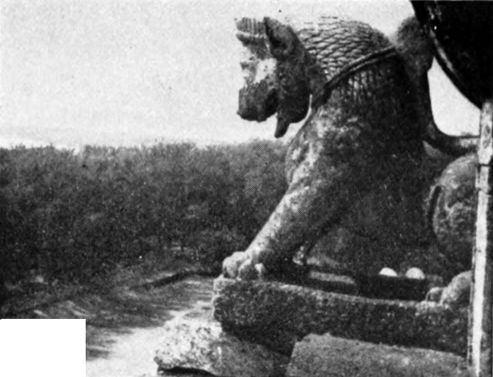
Griffin on the parapet of the Black Pagoda (Temple of Konarak).
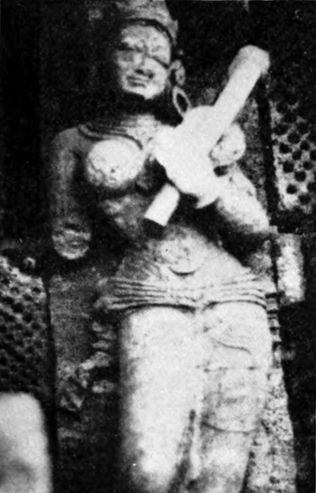
A Goddess of the Temple.
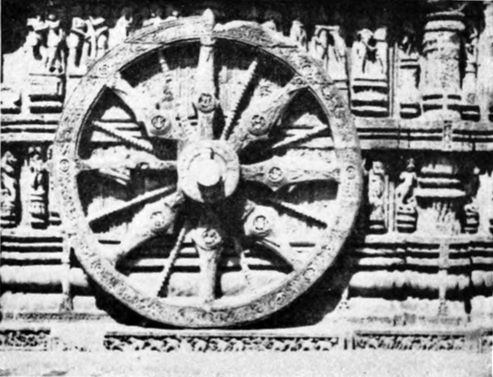
Wheel of Carved Green Malachite at the Black Pagoda.
The Temple was built in honour of the Sun-God, perhaps in the twelfth, perhaps in the ninth century after Christ. It is Indo-Aryan in style, and some of its carvings represent the conquest of aborigines by a northern race, but what race, and when, we shall probably never know. It stands, a pagan splendour, defying Time and criticism.
Traditions of black magic haunt the place, and during the dark of the moon, Tantrik saddhus come here for their rites. Both sexes take part. Wine is drunk and seed is offered, as at Eleusis. Circles are formed in which the female energies of the gods are invoked by various rituals which are never consummated, for the vital energies must be re-absorbed and re-manifested on the astral plane. By such means it is alleged that spirits may be summoned from the circumambient ether.
For long centuries the sculptures of the Black Pagoda have remained in their three or four gestures of petrified desire. There is something oppressive in these rows of smiling goddesses and ecstatic gods, immobilized in embraces that will remain for ever unfulfilled; and something which seems to be intended as a commentary on passion. Perhaps the designer meant to reduce the libido to terms of stone, and show how sad and purposeless are the chance encounters of bodies “that never have ached with a heart.” Yet I doubt it. To me their message reads:
Hast thou told all thy secret, the last time,
And bared all thy beauties to one?
Ah, where shall we go then for pastime,
If the worst that can be has been done? . . .
Who now shall content thee as they did,
Thy lovers, when temples were built,
And the hair of the sacrifice braided,
And the blood of the sacrifice spilt?
But who cares what the meaning was? Not I, nor the Sun-God to whom the shrine was dedicated. I can only stare at it in mystified wonder, and compare it with the Taj Mahal. . . . Rival masterpieces of the Hindus and Moguls.
Technically, the Taj and Konarak are no more comparable than the Empire State Building and Canterbury Cathedral, but they both represent that crucial moment in the life of a people when Fate brings down in ruin the highest expression of a too-artistic age. After Shahjehan, the Mogul Empire began to disintegrate. Konarak was never wholly completed: the skill of the masons did not avail against some unknown psychic collapse amongst its planners. Both buildings are masterpieces at the edge of decadence, but the Taj could have been conceived only in the mind of a man who had known a great romantic passion: its message is that of Divine Love understood through human forms; whereas the architect of Konarak must have explored all the avenues of the senses and turned to Divine Love only—if at all—when he had discovered that other kinds are sterile. To the Taj I shall return as long as I live, but to the Black Pagoda never. It is stupendous, unforgettable, a glory of Satan and his angels. Also it is entirely Asian, whereas the Taj is a bridge between East and West.
A bridge between East and West. . . . Perhaps I have been unfair to those good swamis who have done so much to popularize Hindu philosophy, and have established ashrams in all parts of the world, to be abodes of peace when the nations next plunge into the confusion and dismay of war. Without their books I might never have heard of the Vedanta. Most of what Europe and America know about Hinduism originates from Ramakrishna. He stated before he died that he would reincarnate again in the North-West: some suppose that he meant Russia, others that he will come as a priest to Christian England. . . .
In the past thirty or forty years, the doctrines of all the religions of mankind have been translated into the chief languages of the world; and there is now available, for the contemplation of the mystic, material which has never before existed in so accessible and understandable a form. Here our debt to India is immense. The students and Sanskritists who translated the philosophy of the Hindus into English, while they accomplished a great task, did not generally regard that philosophy as a living and practical system for use in the present day. It was Vivekananda who gave these writings life in the West, so that now we have complete and detailed accounts of all the paths of Yoga. (Except perhaps Hatha Yoga.)
We can compare the Bhagavad Gita with the Fioretti, or the Three Baskets of Buddhism with the Golden Flower of Lü Yen, and so on. What do we find? We find the existence of obviously related mystical methods, varying in details, it is true, but not in essentials.
Of these methods, the most exact seem to be those of Buddha, and of Patanjali, for the East has preserved a cooler head and a more scientific attitude than the West as regards mystical experience. In Christian mysticism, a scientific attitude would be considered blasphemous. For instance, the Exercises of St. Ignatius, well calculated as they are to serve their purpose, are designed to confirm the faith of the exercitant, rather than to enable him to think clearly. . . . I have a deep veneration for the great Spanish saint. The advice which he gave to his followers with regard to the methods of Election would regenerate the world within a few years if the temporal rulers of Christendom were willing and capable of following them. But, alas, the kind of faith which he demands is to me impossible.
Impossible. There are many people like myself, who would follow the mystic way of Christendom if we could, but we cannot, because it seems to us choked and blocked by images that offend our reason. I say this in no spirit of criticism. The methods of St. Ignatius are the simplest, clearest, most practical instructions left to us by any Christian saint. I well know their power when undertaken in a spirit of faith, but there are other methods of approach to the Divine which do not depend on faith.
Following St. Ignatius, let us try to compose in our mind his famous picture of the Devil, “the bandit chief of the enemies, Lucifer,” who is to be considered as seated “in a sort of big chair of fire and smoke, calling a convocation of countless demons, urging them to cast nets and chains to tempt men with riches, and honour of the world, and swollen pride”; and contrariwise let us attempt to summon before our imagination the “Captain-General of the Good, in a great plain of that region of Jerusalem, in a lowly place, fair and gracious,” sending out his servants and friends the world over, to spread the Sacred Doctrine. . . . Now, my mind refuses to take this task seriously, with the necessary emotional enthusiasm.
Such exercises seem to me medieval, neglectful of the teachings of other creeds which are following the same path, and pointing to the same Temple of the Undistracted Mind, found not in any sectarian paradise, but in the deepest heart of man himself. I think we ought to go back to the Vedanta to rediscover what Christ really taught.
So it seems to me.
I ought not to call myself a Christian, perhaps. But I do, and shall. I believe with St. Ignatius that the purpose of man on earth is to praise God his Lord, and to save his soul. And how praise? And how save? Not for being created do I praise the Creator, nor to save myself from His wrath at having made me what I am. Such concepts seem to me absurd. I praise God my Lord because I take delight in this world of which I am a part, as an atom in the ocean of the Universal Consciousness; and I try to save my soul in order that I may fulfil the purpose for which I was created, namely, to know the beauty and the joy of life.
I believe that Christ was very man made Very God, the Incarnation of man’s potential Divinity. Unfortunately, this is not Christianity as taught in any Church, but a neo-monophysite[41] heresy. Heresy or not, I hold, in all humility and confidence, that this is what Christ meant when He said: “I [am] in them, and thou in me, that they may be made perfect in One.” I shall not argue this conviction. The whole tenor of Christ’s life tells me, beyond possibility of personal doubt, that the Divinity that descended on Him other men may also attain.
For the rest I am sorely puzzled. There is a great deal in the Bible which I cannot believe. That is what is the matter with me, and with many other men and nations. We have not clarified our beliefs.
There is a deep insincerity running through modern Christendom, because the average man and woman who go to church no longer accept the Church’s teachings on Heaven, Hell, the reality of the Devil, or the terror of the Wrath of God. We repeat the rich, rolling phrases of the prophets of Palestine, without giving them literal credence; and hence we tend to similar hyperbole in our worldly affairs. A civilization that has lost its Faith, cannot keep faith in anything.
I once sat by the bedside of a Protestant clergyman who thought he was dying. He had sent for me, because owing to certain special circumstances there was no one else available to comfort him in his last hours. He had typhus, and the doctors said that there was little hope, since he seemed so weak. I read him some consoling psalms. He listened, but seemed dissatisfied. One day, when he was at his worst, I held his hand, which he preferred to my reading. He had no confidence in himself, or the future. However, he recovered, to everybody’s surprise, especially his own.
What struck me about him while he lay at the gate of death was that he was no more ready than the rest of us to pass those dread portals, and was no more intimate with Heaven than the common variety of sinner. He was dazed at the idea of dying, and had apparently given little attention to the subject.
Even about the Good Life, as it may be lived in this day and age, there are conflicting views in Christendom not only on fundamental matters of belief, but on questions such as worldly possessions as against holy poverty, and harmlessness as against the enforcement of justice. We compromise and cajole: it is not the fashion to fight against “the Beast with the marks of blasphemy.” It is easier to look the other way. We will not face our own souls. We evade the slums next door in order to turn our attention to the sorrows of distant countries. Christ is glorified in some of our missionaries, but we could learn a lesson from our own Saviour, and from the East that bore Him, if we first made clean the inside of our own cup and platter.
Where is this leading us? . . . To the Vedanta, which I have mentioned, but not described. Explanation shall be brief: I can give a definition in three words almost as well as I could in thirty thousand.
Vedanta means “end of vision.” It is not exactly a philosophy, much less a religion, but a way of looking at life. It can best be described as a method of intuition, a way of understanding the world which depends not alone on thinking, but on the subtler powers of the whole man. In a dream, people behave as if they are real. So also, say the Vedantists, life is the dream of One Perceiving Mind, a thought in the imagination of God. The world that we see is not Reality. We are shadows pursuing shadows. The nerves made the brain, not the other way about; and since feeling came before thinking, the right approach to Reality is through a discipline of the nerves, that they may stimulate the hidden processes of life, and unfold the deeper powers of cognition latent in every individual.
You may ask what I mean by “hidden processes of life” and “deeper powers of cognition.” I propose to allow my story to explain. The regions of the Unconscious are largely uncharted, except by psycho-analysts (who, with the exception of C. G. Jung, lead us into psychic quicksands), but experiments recently made in the United States prove beyond reasonable doubt that, for instance, thought transference can occur between individuals separated in space. That in itself is a nasty leek for materialists to swallow. The Vedanta has always asserted that the various forms of gross matter which make up this world of appearance derive from a single substance which is not matter (call it prana, cosmic energy, the creative urge, or what you will), and modern science is coming to the same viewpoint, so that today it is common knowledge that there is a range of sounds and sights no ear can apprehend, nor eye see. In this borderland beyond our present senses, but perceptible to the eye of an awakened intuition, the Vedantists say that infinite powers exist for the further evolution of mankind. The Hindu mystics—unless they be Jnana Yogis—will not admit that the discovery of God can be a mere intellectual process. Reality must be tasted and assimilated rather than abstractly considered, and its quest will lead us into the region of miracles.
No doubt miracles is a tiresome word. Is auto-suggestion a miracle? Hypnosis? Telepathy? Materializations? Where are we to draw the line? I don’t know. I think more of the high-powered scientific brains in the United States and Europe should turn their attention from unimaginative and largely useless experiments on animals, to chart the marvellous country of the Unconscious.
In Madras, after interviewing an editor and attending a cricket match, I began to feel frivolous, and instead of going to the Museum, and to another of those eternal Maternity Centres (Madras is the pioneer of midwifery in India) I visited an astrologer. The astrologer was out (he sent after me my horoscope), but I found two young disciples of his who were studying telepathy.
At present, they explained, they were experimenting with some very elementary phenomena: I begged them to show me what they could do. At first they were hesitant. They suggested that I should wait for their master, who could show me something really worth while. But eventually, sensing a kindred spirit (I didn’t much care what they showed me: I liked their company, and wanted an excuse to let my work go hang), they agreed to go ahead.
Thereupon, with a wave of the hand, the elder boy put the younger into a light hypnotic trance.
The “subject” fell into an arm-chair as if he had been felled with a pole-ax. His catalepsy seemed so sudden that I had difficulty in believing it to be real. However, there he was, with lips parted, eyes turned back into his head, breath drawn slow and deep. He had gone through the motions correctly. If this were play-acting, I reflected, there should have been some more elaborate preliminaries.
We went into an adjoining room, leaving the younger boy lying in the arm-chair, with his back to us. From where we sat there was no possibility of messages being transmitted to him by mirrors, or by other means, as far as I could ascertain. (I did not search the room. It is possible that some electrical transmission was employed, but in the highest degree improbable.)
What followed has been done in many London drawing-rooms, and in gatherings all over the world. There was nothing very startling about it, but if the reader has followed my thought, this incident fits into the pattern of the Vedanta.
I showed the elder boy some figures which I wrote on a sheet of notepaper, and instantly (but instantly) the younger called out the figures: 4, 2, 7, 3.
I showed the elder my Leica camera. This was more of a puzzle. At first the younger boy kept silence. When urged to speak, he said that I was holding a watch in my hand. When he was told that this was wrong, he said that it was a box. Obviously the elder boy’s visualization of the object was not very clear, hence the failure in transmission, if failure it can be called.
I took up my watch, and this was immediately perceived by the subject. In quick succession he also perceived a gold collar-stud (he called it a gold button), a rupee, a pencil, a handkerchief, and more figures written down.
That was all.
The elder boy apologized for the amateurishness of the experiment.
“With a little more practice,” he said, “we shall be able to communicate with each other mentally over any distance. Our guru sends messages to minds which have been attuned to his all over India. Sometimes he leaves his body here, while his spirit goes away to cure some sick person in Calcutta, or even in Tibet.”
|
The monophysites believed that Our Lord has one nature, the divine and the human being combined in Him as soul is with body. |
“There must have been many pourings to make the country so fertile,” said the estimable merchant with whom I travelled to Trivandrum, the capital of Travancore State, as he looked out of the window at a prospect of green paddy-fields and stately palms.
He was right. The dry climates of the north charge the system with electricity, but leave a desolate look upon the face of the earth. The air of Travancore, on the contrary, is such as you would expect to find in a country whose people are gentle, charming, educated, and uxorious. It is cut off by mountains from the rest of India: it has never been conquered: it is the most literate State in the country, spending a fifth of its revenue on education.
“Look at all the hubbubs we hear in the north!” said the estimable merchant. “Here we have no bothers like that of Shahidgunj.” (He was alluding to a mosque within the precincts of a Sikh temple in Lahore, which had recently been the cause of riots.) “We Moslems are few in Travancore, but the Maharajah Sahib treats us all as his children.”
True. The poison of religious hatred is almost non-existent. Between high-caste Hindus and untouchables there is some tension, certainly, but the last serious upset was in 1823, when the Brahmins objected to the women of the depressed classes covering their breasts in public. Nowadays there is no position to which an outcaste may not aspire. An untouchable has recently been made a Judge of the High Court.
His present Highness, the Maharajah of Travancore, ascended the throne of his ancestors in 1931, after his aunt had ruled as Regent for eight years. In his State the ancient custom of descent through the female line prevails, not only in the reigning family, but through the whole Nair community, so that the eldest son of the eldest sister is heir, thereby preserving the hereditary blood against taint.
Is it matriarchy that has made this an enchanted land? There is no doubt that the position of women has conduced to a distinctive culture, and that their predominant influence has brought with it a certain serenity. Conjugal quarrels are uncommon. Middle-class Nair women are faithful to their husbands while bearing children; afterwards they are not always so careful. The husband is sometimes relegated to the background, but he does not seem to find that that situation is at all intolerable. Life is simple in this genial climate. Taxes are light and the ground fertile. Women are gay and kind. For food you have only to pull a few bananas off a tree. The bathing is the best in the world. If to the intoxication of the tropic night you would add a stronger draught, the toddy palm is always there to yield its juice. Every prospect pleases, and if the good Bishop Heber was really thinking of these regions when he wrote that “only man is vile,” he was abusing his licence as a poet. (He once wrote a lyric to his wife in which he described her as listening to the reading of his poems with a “meek, attentive ear,” which shows how far he was from the spirit of this feminist land. In Travancore it would be the husband who would be listening.)
The Women’s College in Trivandrum is a magnificently equipped institution, administered by a clever young Englishwoman, still in her twenties. Comparisons are invidious, and I have few qualifications as an inspector of seminaries, but I never saw a jollier or prettier gathering of girls.
As to the Women’s Hospital, it is one of the best in all India. When Dr. Lukhose took charge of it twenty years ago, there were fifty patients. Now there is a daily average of three hundred and fifty out-patients and two hundred and fifty in-patients, although the accommodation for the latter consists of only one hundred and fifty beds. The bedless lie on the floor, and are glad to be there.
Can Indians manage their own affairs? Well, here is a hospital run entirely by Indian women. No male, and no European has anything to say to it. Dr. Lukhose has a dozen doctors under her, and in addition to looking after the hospital she performs three or four major operations every week. And in Madras, The Hindu, which is a first-rate newspaper by any standard, is owned, managed, edited, and printed entirely by Indians.
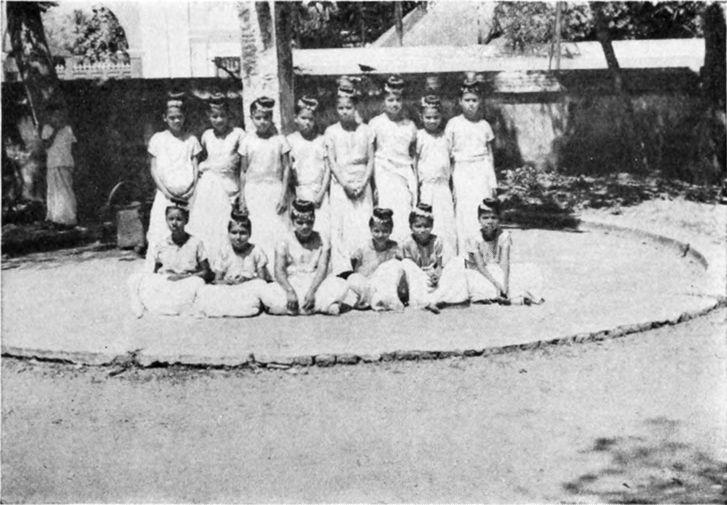
Some of the Schoolgirls Who Danced for me at Trivandrum.
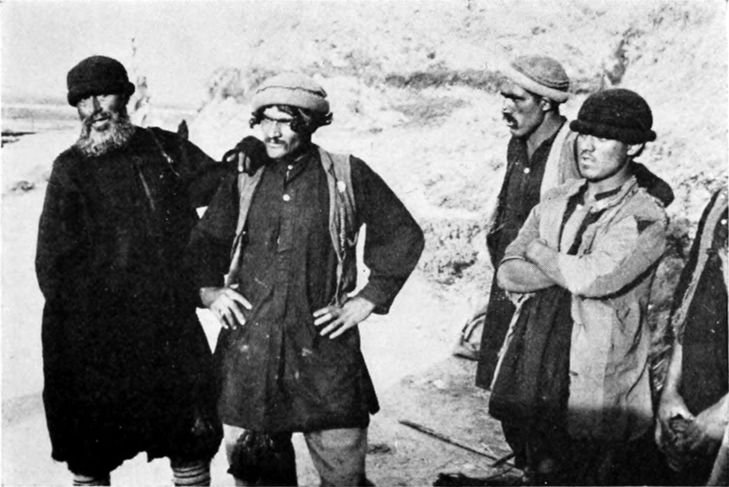
Frontier Types in Swat.
In architecture, Indians have erected buildings of imperishable beauty. In science, they invented algebra and the decimal system, to mention only two of their many contributions. Today they remain eminent in the field of pure mathematics. In the crafts they are still marvellously skilful and sensitive artists: witness Bose’s instruments, the ivory-carvers of Benares, the silversmiths of Madras, the Pathans of the Kohat Pass, who make modern high-velocity rifles with the most primitive equipment, and the masons of Delhi, who have just completed (for an American millionaire and his wife) a Mogul swimming pool of carved marble screens and inlay work as beautiful as any of the work of Shahjehan’s time.
As to the arts, tastes differ, but few will deny the glory of the Ajanta frescoes, or the skill of the Konarak sculptures. To me, of all the living arts of India, the most fascinating is that of dancing.
Travancore is famous for its national dances, but this was not the season of the year for the Khattakali mime, nor for the religious masques. Quite unexpectedly, however, I saw a wonderful performance in a Vernacular Middle School in the capital.
Hundreds of children crowded round my car when I arrived. Being photographed sent them into ecstasies of delight. Upstairs I thought I was going to see an ordinary school. I do not know any Malayalam, and the headmistress (exceptionally) did not speak any English, so I could not make out why she wanted me to sit in a solitary chair in an empty hall. However, I did as I was bid. Immediately all the children entered and sat down beside me, on the floor.
Sixteen little girls floated towards us . . . floated in like leaves and blossoms borne on a spring wind; demure, graceful children, aged from eight to twelve, in saris of crimson, and lemon, and green, and silver, wearing violets and jasmine in their glossy black hair, so that the whole room was filled with perfume.
Looking towards their leader, who was a little older and decidedly plumper than the others, they formed a ring in single file behind her, and broke into sudden, shrill song, dancing and turning with arms outstretched, supplicating, enticing, admonishing, calling down the gods from Heaven, playing as milkmaids before the Divine Cowherd of Brindabun, resisting the advances of unwelcome lovers, like the figures on an Etruscan vase. It was a lovely sight.
Their voices, their bodies, their hands, the cling-clang of their anklets, and the tread of their bare feet were all in perfect rhythm. The song changed from love to war. When they stamped, they stamped so unitedly that the whole room shook: mad elephants might have been posturing before me instead of little girls: then, without pause, they glided on, swift and noiseless, even their anklets making no sound.
Voices whispered and sank: they were ghosts in a scented silence. Presently the theme rose to a mood of religious ecstasy: they were worshipping Padmanabhaswami, the lotus-navelled god to whom the city is dedicated (as Savonarola made God the Podestà of Florence) and they were welcoming the Man-Eagle that is the vehicle of Vishnu. . . .
An hour passed like a minute.
At last the little girls sank to the floor exhausted. The spectators shouted and clapped and laughed; and again everyone went into ecstasies on seeing my camera. But for me the picture is nothing: these children live and move.
Out of the five million inhabitants of Travancore, 1,750,000 are Christians. Roman Catholics number nearly a million, then come the Eastern Churches, with 515,000 followers: the remainder are various kinds of Protestants.[42] These sects are governed by no less than twenty-one Archbishops and Bishops, for a people accustomed to the infinite complexity of the Hindu pantheon demand diversity in their rituals.
Of the prelates, perhaps the most remarkable is Dr. Mar Ivanios, of the Syro-Malankaran Rite, now affiliated to the Church of Rome. He is a tall man, still in the prime of life, with great dark eyes, and an arresting personality, who is destined to have an important part to play in the religious future of South India. He began life as a professor of economics, but gave up his academic career, which had been a brilliant one, to devote himself to the priesthood of his native Church. He soon became a Bishop, and in September 1930 he succeeded in forming a small group who applied to Rome to become members of the Catholic Church, thereby healing a quarrel dating from the sixteenth century, when the Holy Inquisition was established at Goa.
The Syro-Malankarans believe themselves to be the oldest sect of Christians in the world. St. Thomas himself, they assert, baptized them when he landed on this coast in a.d. 59. He called them Nazarenes, for the term Christian had not yet come into use. The first converts were Brahmins; and one of their early Bishops, John, was at the Council of Nicæa in a.d. 325.
The Malankaran ritual differs from that of Rome. It is celebrated in the two Elements. Seven instruments are used at the altar: a paten, a chalice, a spoon, a finger-bowl, a sponge, a spear which is plunged into the Sacred Species, and a star, symbolical of that of Bethlehem. The Inquisition objected to these things.
At the Synod of Diamper, in 1599, the Syro-Malankarans were compelled to abandon their ancient and cherished customs (although they continued to make their sacramental bread from the leaven of that used in the Last Supper, which has been preserved amongst them in unbroken continuity from the institution of the Eucharist to the present day) and made their submission to the Holy Office. Half a century later, however, (in 1653) they threw off their allegiance to Rome and sent letters to the Patriarchs of the Orthodox Rite in Palestine; appealing to Jerusalem, Antioch, and Alexandria to receive them. Only Antioch answered, and it is to that Church that the majority of the community now belongs.
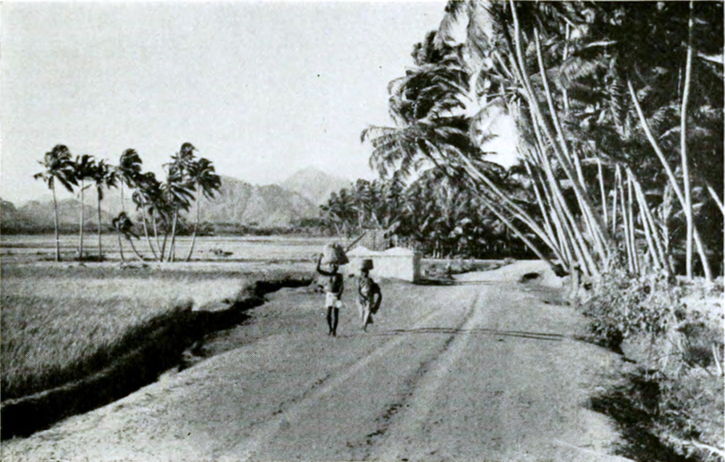
Scene in Travancore.
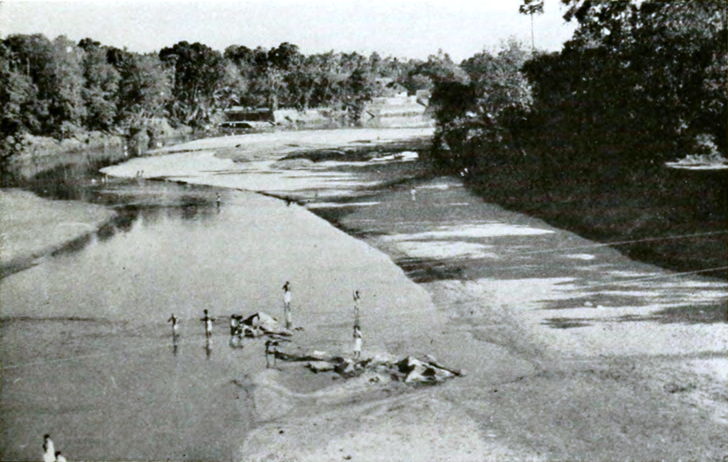
A Beach in Travancore.
In 1931 Dr. Mar Ivanios went to Rome, submitted the Syro-Malankaran ritual to a Commission of Prelates appointed by the Holy See, and secured its approval. Thereupon the Pope established the ecclesiastical province of Trivandrum, and designated Dr. Mar Ivanios as its first Archbishop Metropolitan, conferring on him the Sacred Pallium with his own hands.
Already the new Archbishop possesses jurisdiction over some thirty thousand followers and fifty priests, and the numbers are increasing fast. He has also founded many schools, and two Orders, the Brotherhood and the Sisterhood of the Imitation of Christ, which are forest hermitages in the typical Indian tradition.
I visited the Brotherhood, which has been established on a beautiful hilltop near Trivandrum, and I am inclined to date certain happenings, now to be recorded, to the influence of the Archbishop. . . . Not that he did or said anything specific. Perhaps he did nothing consciously. We were friendly: he gave me a walking-stick; he may have prayed for me. However, I left that little monastery feeling a new man, in body and spirit. Next day I found a teacher.
I ask myself why, if such was the influence of Dr. Mar Ivanios, I did not follow him instead of a Hindu swami. Such is my Karma: that is the only explanation which I can find. I have gone too far along the path of the Vedanta to turn back now, and must follow it to its end, where I see a Cross.
I ate jack-fruit with the Brothers, who live very simply, like brahmacharins in an ashram.[43] Their Rule is Dominican, I believe, but their meditations are founded chiefly on the Exercises of St. Ignatius. After tea and talk, we went to the little chapel of the ashram. The Archbishop knelt in silent prayer, and I beside him.
To an Indian it is the veriest commonplace that an atmosphere may be charged with spiritual vibrations; and to me, kneeling there, came a realization of the faith surrounding me, and my own lack and need—and—and of something else before which my soul’s nakedness stood revealed.
I cannot believe in the dualistic relation of the creature to its Creator. I cannot accept the attitude of a suppliant to his Saviour, seeking refuge from the terrors of the Devil. I do not imagine that I had a vision. I saw nothing, but there was a Thought-form beside me, evident to other senses than my eyes: an incorporeal presence of loving-kindness.
These things are difficult to describe. Perhaps impossible. My attempt to do so here in England, when the “immortal moment” is already distant, may mar the sequence of my story. It would be better, more logical and dramatic, at least, immediately to ring up the curtain on the guru whom I met next day. But if one writes about oneself at all, one should try to tell the truth, however irrelevant it seems.
I do not want to suggest that I experienced Guidance in the sense employed by the Oxford Group. No magical outside power was at hand to give me advice; but my mind, which a moment before had been mewling and crawling about in the Unconscious like a new-born kitten, seemed now inspired by a sense of purpose and direction. Some day the influence on me of the place, the company, and my own mood will be as clear as crystal to anyone who takes the trouble to explore the feelings of an obscure traveller in the land of consciousness. Today, we know little or nothing of the forces which make an emotional climate. They seem to come and go by chance. I am sure that this is not so. God works through law. Everything that happens is predictable, if we know the law.
It was just of this that I felt so certain as I knelt in the chapel: of order, justice, integrity, strength, kindness—of the presence of a peace which was almost visible. Perhaps it is visible. Why should not thought project its rays upon the television of an expectant mind?
At the moment I had nothing with which to bind up my bundle of impressions, except an unseen Presence. A Presence of Light, “wherein the soul babbles not of God,” being content in her own stillness, and in the ecstasy of her own essence. Was it a coincidence that the words of Meister Eckhart should come to me in this place, where monks had been worshipping under his Rule? I did not pray for faith. I did not particularly want faith, but the Light came.
Perhaps it is worth recording that this was the effect on me of the silence of Dr. Mar Ivanios.
That night I bathed by moonlight with a party of friends, at the lovely Kovalam beach, some ten miles from Trivandrum. The water is so warm that one can stay in it for hours, yet there is always a freshness in the sea at night, a glory and a grace in surrendering oneself to it after the daily troubles of the tropics. I might have felt guilty, for I had been six weeks in India, and had not written a line of my articles, except a few notes: on the contrary, I was utterly happy. Everything was gorgeous: the scented night, the huge, flat, phosphorescent sea, the palms, the people. . . .
When a friend told me that he wanted me to meet a retired Civil Servant who was a renowned Vedantic scholar, a swami from Chidambaram, I guessed that something exciting was in store. And so it was. My private search in India was coming to its conclusion.
Next day, however, when I went to lunch at my friend’s house, my mood had evaporated. I was not sure that I wanted to see any more swamis. But there he was, sitting in the cool, dark veranda. My friend introduced us: “The Chidambaram Swami—Yeats-Brown.”
As I shook hands, I felt a shock. A physical shock of recognition.
The swami seemed to be myself, though somewhat older and thinner. At once the flattering thought crossed my mind that he had been described as a person of renown. When I saw him more clearly, I realized that he had brown eyes, a broader forehead than mine, a squarer jaw. Still, he seemed to be myself.
. . . Powers there are,
That touch each other to the quick, in modes
Which the gross world no sense hath to perceive.
During the meal I told the Chidambaram Swami and my friend of my experiences in the Girls’ High School. Thus encouraged, the swami held forth on the art of Mudra, or gesture, by which the Tantras declare that bliss may be attained. Every part of the body is brought into play: head, neck, shoulders, tongue, stomach, as well as the limbs and eyes and mouth. The most important mudras in dancing are those of the hands, of which there are sixty-four, with many and varied meanings: the Swan-Beak Gesture,[44] for instance, may mean blessing, goose-flesh, trimming a lamp, pearls, painting, jasmine, initiation.
As we talked the swami kept his piercing, almost unwinking eyes on me. Of what he was thinking? Was he taking my measure? The Gorakhpur Mahant had never stared like this.
How was I to broach the matter that had brought us together? I spoke of Paul Deussen and René Guénon. Yes, he had read their studies of the Vedanta; and he was a student of Emerson. So was I. We talked of Emerson.
And then of Arabindo Ghose.
For many years now, said the Chidambaram Swami, the Master has sat alone, at a window of his seaside ashram at Pondicherry seeing his disciples only three times a year, when he gives them a silent blessing. He never speaks: he has not spoken for seven years, except to the Mother, for he is engaged upon an attempt to bring down the Divine into human consciousness. The Mother’s name is Madame Richard. Through her all the business of the ashram is conducted, and to her the disciples—some two hundred of them—bring their troubles for transmission to the Master. The strictest celibacy prevails amongst the members of the community; even the married people living there must pledge themselves to cease sexual relations.
“But why? What is it all about?” I asked.
“It is a quest for the superman,” said the Chidambaram Swami. “There is a long training in stillness and silence, to hasten the descent of the Divine. Somewhere, sometime, a waiting avatar will find in living spermatozoa the vehicle of his desire, and will incarnate again to save the world.”
“I shall not go to Pondicherry,” I said. “The superman is beyond me.”
The Chidambaram Swami laughed, and quoted Emerson: “ ‘If you find no God, it is because you harbour none.’ ”
When I was leaving, I found myself saying (and listening in surprise to my own voice): “Could you come with me to Cape Comorin tomorrow?”
“Easily,” he replied. “But more easily over the weekend.”
Why had I suggested tomorrow? I had had no particular intention of going to the Cape then.
“Then on Friday? Would that be convenient?”
“I shall be delighted.”
So that was settled. We arranged the details of where to meet, and I left in a state of considerable excitement.
That evening, I met our host in the club, and asked him whether he thought that I had done wisely in asking the swami to come to Cape Comorin? Had he been surprised? Had he agreed to come out of mere politeness?
“Oh, no! He expected you to suggest a journey. He thinks you are near Enlightenment.”
“How does he know?”
“Ask me another! He says he’s ready to teach you.”
“Tell me, does he look like me?”
“Like you? Not in the slightest. Why?”
“I thought he did, but you see no likeness?”
“None!”
What is awaiting me at Cape Comorin? The swami has been silent during our drive down, but there is no hurry: I shall have him to myself for three evenings, two whole days.
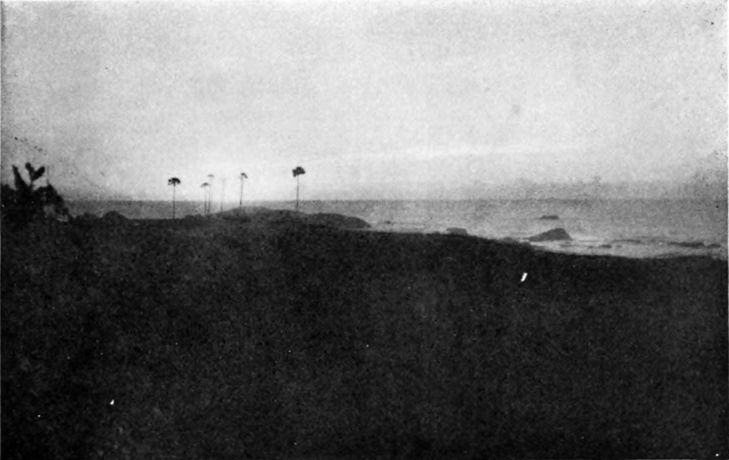
Dawn at Cape Comorin.
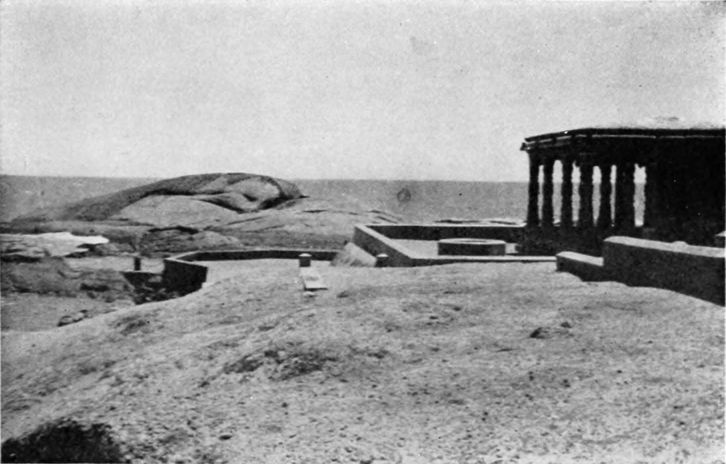
The Virgin’s Shrine at Cape Comorin.
The Virgin’s Shrine is one of the oldest temples in India, and very conservative: it is surrounded by a great red-striped wall, beyond which none but the higher castes may pass. A hundred yards to the south, at the very tip of the triangle of India, is a smaller shrine, for the worship of ancestors. Here we undress, and swim out, a few yards, to two domed rocks, against which the rollers of the Indian Ocean surge lazily, decorating them every now and then with a lovely lacework of foam.
It was here, on the furthest rock, with no land between him and the Antarctic, that Vivekananda sat meditating on that evening when he took his high resolve to go out and conquer the West with the teaching of the Vedanta.[45]
Before, and since his time, how many seekers of the Path must have sat here; and how many more will follow! Men of the future we shall never see. . . .
“Swami-ji,” I said, “I have realized recently that though I call myself a Christian, there are irreconcilable differences between what I believe, and what any of our Churches teach. There are Sayings and Actions of Christ which would lead to the whole world’s redemption: deeds and words of the most perfect beauty; but the doctrine . . . the doctrine disturbs me.”
“Why do you have to belong to a Church? In Hinduism we are more catholic.”
“I needn’t, but I believe in authority. I believe in being in touch with the thought and experience of wise men down the centuries. Yet I cannot accept what they say.”
“I have been in the same difficulty myself. I sought many years for a guru.”
“And you found him eventually?”
“Yes. . . . You believe in miracles?”
“Of course I do! They happen every day. But I don’t understand why the fig-tree should have been cursed, for instance, or why an evil spirit should possess the swine.”
“What does it matter? If you read the New Testament in the light of the Vedanta, Christ’s words are clear.”
“How? That God is a Spirit, and that that is the great reality?”
“Roughly, yes. Beside the Immanent Divine, the sense-world is illusion.”
“I am prepared to accept that. It can be reconciled with the general direction of human knowledge. But . . . well, take the Virgin Birth. It seems so unnecessary, and there have been so many others. And the Appearances after the Crucifixion: even the most devout scholars are puzzled by the contradictory accounts in the Gospels.”
“I couldn’t explain them, but then I wouldn’t try. Surely they are details? You have no responsibility in the matter. Your responsibility is not to this or that evidence concerning the Resurrection, but to your own resurrection.”
“That may be the Hindu view. . . .”
“At any rate, it’s practical. Before you can understand anything, you must understand the Self. The first thought of the human being is ‘I.’ Until you have thought ‘I,’ you cannot think ‘thou,’ or ‘he,’ or ‘we,’ or ‘you,’ or ‘they.’ What is this I? It isn’t the body, or the senses, or the five vital forces, or the five organs of external activity, or the mind, or any of these separately.”
“Why not the mind?”
“The mind is a mysterious factor of the Self. If thoughts are eliminated there remains nothing which can be called ‘mind.’ In dreamless sleep there are no thoughts, and hence no world. The mind creates the world for the individual by its thought-forms.
“Therefore,” he continued, “if you want to know Reality, when a thought occurs to your mind, do not follow it outwards, but turn inwards on yourself, and inquire: ‘To whom has this thought occurred?’ Gradually you will find that the thought of ‘I’ vanishes. What is left, is the Eternal Self. The Self of all creation, which is beauty and bliss.”
Out to sea, a black triangle moved. It was a shark’s fin. I pointed to it, saying:
“O world as God has made it,
All is beauty!”
“Yes. Certainly the shark is beauty,” said the swami. “Everything is beauty to him who sees the One in the Many. ‘And knowing this is love. . . . What further can be sought for, or declared?’ That is a summation of the whole Vedanta. You can find God everywhere, if you learn to look for Him with the seeing eye.”
“And cease questioning?”
“No. Do not cease questioning, but ask questions whose answers you can understand, and not too many questions at once. Don’t bother about the shark until you know yourself.”
“I can accept that. I understand it, and agree with it. And I want your advice as to how to know myself.”
“I have just told you.”
“I want details. A working plan. Paramahansa Bhagawan Sri gave me such directions twenty-five years ago. Breathings and positions.”
“He would not give you any more if he were alive. He would tell you to meditate.”
“And become a hermit?”
“I don’t think so. If you like, Yeats-Brown”—he looked out to sea again, and changed the course of his words—“I shall go to pray in the temple this afternoon. Afterwards, if you like, and if the time seems right, I shall tell you something of my guru’s teaching.”
There are certain things about the night which followed which I cannot describe. Mental and physical disciplines vary with individuals, and a command of secrecy is laid upon the disciple chiefly because some of the exercises (especially those of breathing) are liable to produce disease unless given by persons experienced in the art of Yoga. An inflamed ego must be treated as delicately as an inflamed appendix. Pranayam and mantra[46] have the effect of putting the body in the current of powerful cosmic forces. You must know what you are doing with them, otherwise you will get the same sort of results as you would if you short-circuited a lighting-system, or put your hand on the spark plug of your car engine when it was running.
However, there is no mystery about the method of my teacher. There is no more mystery about Yoga than there is about a vacuum-cleaner, or just as much. Both of them harness unseen forces to their service.
Some details which the Chidambaram Swami gave me I have omitted, but the following paraphrase of his words may set inquirers upon the illumined path. I hope it may. I hope it may pass through some few friendly eyes to some few sympathetic minds, whom only it can help. Blessings on them! May they follow this ancient way with safety! Om shanti!
“To know yourself,” said the swami, “you must train your mind. You have feared to do so. The disciplines you have known before have left your emotions cold. You must rouse your emotions consciously. Until you do, your mind is at the mercy of every passing gust. It must be still. A pool ruffled by the wind cannot reflect the stars.
“Here is a discipline which you and I can follow. I know that you can follow it, because I have been to the temple, and have been given light on your future. I am sure now that our minds have met in the present, as they have in the past. My feelings are the same as yours. We may have been pupils of Patanjali together. He wrote his Aphorisms at Chidambaram, you know.”
“I have never been to Chidambaram.”
“Not in this life, perhaps, but you are ready to hear this teaching. No one can be taught anything that he does not know already: that is one of the mysteries of Karma. The exercises which I am going to pass on to you were given to me when I was in great mental distress and bodily anxiety. My health had broken. I had left the Civil Service and was practically penniless. And, beyond these afflictions, was a sense that my true Self was empty of its spiritual food. I had rejected the authority of the Vedas, like so many modern Hindus; and the Advaita Vedanta[47] seemed a cold intellectual abstraction, with none of the colour and courage of the living faith which I needed. But I was mistaken. It gave me peace.
“I believe that it is destined to be the Universal Religion of the future. But that doesn’t matter. As you know, there is no question of converting anyone from his own faith, but only of wider vision. We won’t talk of the Vedanta: only of the approach to it. So . . . we begin. You will agree that activity is a law of life: activity without strain, and with a certain rhythm. Remember, this is important. The exercises must be carried out accurately and punctually. As you know, there are many other systems, in Yoga and outside it. Choose one and stick to it. If you choose this system, you mustn’t make even a small change in it, otherwise you disturb its balance. The early morning is the best time for the exercises, for the mind is fresh then. Get up an hour earlier than you would normally.
“The exercises are in four stages. The first stage is Ablution. Drink a glass of water, and perform the purposes of nature. This also is important. You cannot meditate on a full bowel. If your bowels do not move, eat fruit at night. Do not take salts or other aperient before your meditation, for nothing should disturb the gastric juices.”
“Except plain water?”
“Yes.”
“And if my bowels don’t move?”
“Don’t meditate. I don’t recommend enemas or aperients if they can be avoided, but move your bowels you must, before you meditate. I’m afraid a good many mystical visions are due to diffused acidosis and auto-intoxication and nothing else!
“Well then, having attended to the inner man, you must wash the outer. You can take a full bath, if you like, or do that afterwards. But wash your face and hands and mouth and ears you must. Forgive me for repeating this. No doubt as a soldier you have worshipped God without preliminary washing. Mahomed, on whom be peace, absolved his followers from their ablutions while on active service. But if you would follow this discipline in normal times, you must appear before the Deity with a clean face, with your hair brushed, and your nails trimmed.”
“What about shaving?”
“I should shave after your meditation. The idea is to worship God with your freshly awakened mind, and in bodily purity.
“Always keep to the same time and the same room, preferably a room for meditation only, but any quiet place will do. The quieter the better to begin with. Afterwards you will be able to meditate anywhere, in railway trains, or crowds. Have a small piece of silk, or a silk cushion, or a fur rug for your meditation seat. Face towards the east, or the north-east. Sit in any comfortable position, provided that the back and neck are kept perfectly straight, and yet in an easy and natural position. This sounds simple; and it is simple, of course; nevertheless I assure you most earnestly that it is a matter of vital importance. The radiations from the Universal Cosmic Consciousness must pass through a body which can receive them. They cannot pass through a slack spine.”
“What about cripples and invalids?”
“The mercy of God is infinite, and the human body is infinitely adaptable. I suppose special circumstances would require special measures. But you and I can keep our back straight and our eyes level. If we don’t do so when we can, we won’t get results. There is no need to sit in padmasana.[48] Any comfortable position will do, but it must be the same every day, and you must not change it during your meditation, or move at all. Cross your legs under you, with your right foot over your left, the right heel pressing against the base of the body; and place your hands on your lap, palms up, with your right hand over your left. Your eyes may be shut, or they may be fixed on a point slightly above their level. Avoid distracting sights. If your eyes are shut, imagine you are looking upwards, to a place between the centre of your eyebrows.
“You have already performed the first stage of your worship, which is Ablution. Ablution of the inner and outer man. The other three stages are Prayer, Purification, and Breathing. Do not ask me why they are placed in this order. I used to wonder about it myself, but you will discover the reason through personal experience.
“The stage of Prayer is divided into two parts, Obeisance and Adoration. You will first make mental obeisance to God, to your teachers, and to your family; then you will adore the beauty of the world.
“With regard to the first part, you will thank the Creator for the gift of life which you possess in this body, and for the activities in which you are about to engage. These activities may be illusory and temporal: the true Self may not be touched by them, nevertheless, whatever is to be done that day should be done in praise of God, and with thankfulness. Look forward to the part you are about to play. Next, you will ask for blessings upon all those who have given you ennobling thoughts: your friends and teachers: all who have come close to your heart and head and enlarged your horizon. Be specific about them. Name them and see them. They need not be the same every day, but do not strain after numbers or variety. The men and women who have shown you a way through life cannot be so very many. Give thanks for those vivid souls. Finally, you will bless the stock from which you have come, your family and household, your relations, connexions, dependants, all who are bound to you by ties of blood or duty.
“Now you come to the second part of worship by prayer, which is Adoration. Imagine a lotus, with its stem in the earth and its petals in the shining water, glorious in the sunlight. The lotus is the Universe in miniature. The whole kingdom of Heaven is in it, as it is in you. In imagination prostrate yourself before it, as the earthly manifestation of the Creator, growing out of the earth and air and water of the world; and ask for success. Ask for personal success, for without it you cannot be playing your full part in life, but remember always to merge your desire in the lotus.
“Now in imagination prostrate yourself again on the right side of the lotus, and ask to see the Way, for success is impossible without an inner light upon the path.
“Again, prostrate yourself in imagination on the left side of the lotus, and ask for strength, for without strength there can be no success. This strength will always seem superhuman, should you achieve worldly success. The more successful you are, the more clearly will you recognize that you are not living your own private life, but that Life is living you. But such a word as ‘superhuman’ will lose its meaning to the enlightened Self, who knows the One in the Many.
“Remember that during this meditation on the glory of the lotus, and also in those which follow, the mind must not be allowed to stray from the place where you have put her. She may be restless. She may find the light of the lotus blinding. She will tend to blink and shrink, and turn away to other thoughts, sometimes very carnal ones. Do not be shocked, or surprised, or angry. It is the mind’s nature to fret at restraint. Do not blame her; simply bring her back steadily and kindly to the worship on which she is engaged.
“You have now finished with Prayer, the second stage of your worship, and come to Purification, the third stage, in which you will contemplate the sun.
“You will imagine a triangle, with the disk of the sun in it. As contemplation proceeds the triangle may vanish, or may not. Never mind if it does not. Keep the sun in your mind’s heaven: let Him flood your body with life, especially the centre of the body, the Manipura Chakra, which we call the City of Gems, and you, the Solar Plexus. Keeping your mind on the sun, and on nothing but the sun, repeat internally the basic sound which I now give you as your Word of Power, OM. Concentrate on this word, which has been from the beginning, and is linked to the trinities of thought and worship.”
“How concentrate?” I asked. “OM has no very definite meaning for me. It seems a pleasant sound, but nothing more.”
“It need be nothing more at present. Concentrate your mind on Its pleasant sound. You know that we consider It to be the Word by which the worlds were made, the root of language, and the end of vision. However, It will work in your Unconscious whether you like It or dislike It: It need not be intellectualized, and I need not go into Its symbolism.
“I cannot give you any specific directions as to how long you are to hold the mind upon the lotus, or upon the sun. Some people find a rosary of a hundred and eight beads useful to count the repetitions of the sacred syllable, and this is sanctioned by tradition. My teacher, however, keeps his hands motionless. It is easy enough to count OM in groups of five, feeling each group, so to speak, on the tips of the thumbs and fingers; and when you have reached fifty you can begin again. The only rule with regard to the contemplation of the sun is that you should hold your mind upon Him until she becomes exhausted, not fretful but exhausted, and unable to taste His bliss.”
“Perhaps I might begin with a hundred repetitions?”
“Yes. You have now finished Purification, the third stage of your worship, and come to the fourth and last stage, which is Breathing; and this also is divided into two parts, namely, the Om mantra, and the Bhastrika Pranayam.[49]
“The first part of your worship by Breathing consists in repeating the Word of Power, OM, five times, soundlessly, while breathing inwards; and five times, soundlessly, while breathing outwards. Breathe through the nose. Simply concentrate on the inspiration and exhalation of five times OM. As you know, I am not a follower of Hatha Yoga practices. You may have been taught to draw inwards of the world’s vitality, and to expel evil thoughts and desires during the outgoing breath. I do not recommend such practices. They are taught, but not by my guru. It is better that purgation and illumination should be unconscious. This breathing, and the next, are not designed to give you any special powers, but merely to set the instrument of your body in tune with the vibrations of the Universal Cosmic Consciousness.
“The second part of your worship by Breathing is the Bhastrika. Restrain your breath three times, after seven, nine, and eleven respirations respectively. That is to say, you will breathe inwards, evenly, easily, and as deeply as you comfortably can, for seven breaths, and you will then stop your breathing carefully. By carefully, I mean that there must not be any sudden or jerky arrest of your respiration. It is dangerous to stop your breath suddenly.”
“And exciting, Swami-ji. One passes into another dimension, with practice.”
“That is just why you must not dabble with it. . . . If you feel, as you restrain your breath quietly, that you are sending it downwards through the solar plexus to the Muladhara Chakra, where Kundalini[50] sleeps, well and good; but do not do violence to these delicate astral centres by forcing your breath downwards. You may feel, as you restrain your breath, a sense of lightness, clarity, and exhilaration. If so, well and good. If not, have patience.”
“This breathing used to make me giddy,” I said. “I suppose I was doing myself harm by practising it?”
“Yes. You should not meditate unless you are in fairly good health. I do not say perfect health. That is a counsel of perfection; but if your blood is full of impurities, how can you expect to have a clear brain?”
“What about the asanas? Standing on one’s head, and so on?”
The Chidambaram Swami shrugged his shoulders. “That is another path, and seems to me an unnecessarily complicated one. Take plenty of exercise which you enjoy. Stretch like a cat. Cats are great Yogis, and spend a great deal of time meditating on the Absolute. Do not be self-conscious about the body. It is a good servant if you treat it well, but a bad master.
“While you are restraining your breath,” he continued, “you may notice that your pulse rate accelerates, and then slows down to a steady and regular beat. I am no doctor. I do not know why temporarily starving your lungs of oxygen should do them good. But it does. Perhaps it makes the cells hungry. Listen to your blood. Watch the moods of your mind. Soon there will come a consciousness of the Self as the controller of the gates of the senses. You will know that you can close those gates, so that the outside world can make no impression. Make friends with this unseen part of the Self. It goes on pumping your blood, day and night, and maintaining your temperature, and keeping your balance, with very little fuss. Thank it, and wish it well. One day it may do all sorts of extra work for you.
“Just as the contemplation of the sun stimulates all the nerve centres at the Manipura Chakra, so this retention of the breath stimulates the Ajna Chakra, in the space between the eyebrows, where most of the rhythms of the body are controlled.
“When you have taken seven breaths and restrained your breath, and the lung-cells are beginning to make a demand for more oxygen, which you can’t resist comfortably, take nine deep, slow, rhythmic breaths and restrain the breath again. Similarly, when you again need air, take eleven breaths, and restrain your breath. These seven, nine, and eleven breaths, with their periods of breath-retention, make one exercise in pranayam. There must be no pause between them, nor indeed between any of these acts of worship: otherwise they lose their effect on the mind.”
“On what am I to meditate? You said that I was to make friends with the unseen part of the Self: is that all?”
“All, and everything. Be conscious of the unseen part of the Self: if you succeed, all else will be excluded and included. That sounds confusing, but it is not so in practice.”
“How long am I to meditate?”
“Again I can give you no definite rule. The time varies with the individual. Do not watch a clock.”
“But I always do,” I said. “Oughtn’t I? My ability to hold my breath is an infallible barometer of my state of health. If I can’t hold it for two minutes, there are squalls on the horizon.”
“Watch the clock if it amuses you, but don’t strain. Some people can hold their breath for only thirty seconds, others for three minutes. Few can do more than this without practice. Fruit and milk are best for pranayam. All kinds of wine and spirits are fatal to success, at any rate for the beginner. And for the beginner complete chastity is necessary, otherwise he runs serious risks of mental disturbance. Never hold your breath until you feel faint: if you do so, you merely defeat your object, which is to control your mind, not your lungs.
“Now you are at the end of your worship, except that you may repeat the OM mantra out loud, saying it softly but clearly five times as you draw in your breath (through the mouth this time) and again five times with the outgoing breath. Do this several times, modulating the sound to your mood at the moment. And in conclusion you may repeat the Gayatri,[51] and call down blessings upon everyone in the house where you are living, everyone in your town or village, everyone in your country, everyone on earth, all creation, vocal, dumb, animate, inanimate, visible, and invisible. ‘May he be happy! May she be happy! May all God’s earth rejoice!’ ”
We talked far into the night, long after the brilliant moon went down.
“Just because this knowledge happened to be Indian,” the swami said, “it used to be the fashion to neglect it. That is changed now. By going back to the sources of the mystic knowledge in India, some of the profoundest truths of your own religion may be understood.
“Dr. Urquhart has acknowledged the debt that Christianity owes to Indian thought. He is one of the chief Sanskrit scholars in the West. And there is Dr. Rudolf Otto, the German mystic, who spent a year in Mysore, quite recently, and wrote a very good book, India’s Religion of Grace. Scientists and psychologists have long been paying their tribute to the Vedanta. Eddington, for instance, and Jung.”
“I have read his Secret of the Golden Flower. But what you have shown me is so simple that I feel like Naaman, hankering after the lordlier rivers of Western psychology!”
“That is natural, but remember that this system, and other Yogas also, come from a people that have made a long study of the art of meditation. You may say that there is nothing in it, and that other systems would do as well; but it would be equally sensible for me to tell you that there is nothing in the way you hit a tennis ball, or a polo ball, and that one method is as good as another.”
“Accepting OM,” I said, “because I must accept that unknowable word, I am still doubtful about the lotus. To tell you the truth, I have no very clear idea of what it looks like.”
“Imagine carnations then,” said the swami, “or roses. Something you can see. But keep to the method and the order. That has been tested for a hundred centuries. Further than history goes. It has been mellowed by time, and hallowed by the association of good minds. . . . Now it is bedtime. I shall awake you in a few hours, for your first practice.”
I am up long before sunrise. The palmyra palms by the temple stand up black and tall, as if guardians of the shrine. The Temple of the Virgin was old in Marco Polo’s time. It has seen many Europeans come and go, many faiths, many dreams of empire. It stands as it did, secretive, aloof, the incarnation of Hindu priestcraft. But now the sea is creeping up to its walls. One day it will have to be rebuilt, from its foundations.
Beyond the black palms, the Indian Ocean lies silver and still. Nature seems to be worshipping, with breath arrested, between the divine dark and the coming light.
After the Chidambaram Swami had shared my meditation, he took me out on to the veranda and we sat together, silent, watching the slow march of the early morning shadows. There are times when the chariot of speech stays idle, its owners moving along other paths.
At last he said: “The Dawn-Maiden has yoked her horses from the far stable of the sun. . . . You know those verses of the Rig Veda?
“Those who saw thee first have gone to their fathers;
We behold thee now;
Those who follow us will gaze on other glories. . . .
Mother of the gods!
Banner of sacrifice!
Mighty Ushas, shine forth!
Thou followest the track of dawns that are past, and art the first of unnumbered dawns to come!”
|
The London Missionary Society has a community of some 130,000 souls: the Salvation Army and the Church Missionary Society have each some 60,000. The London Missionary Society established the first Girls’ School in South India in 1819, at Nagercoil, near Cape Comorin. It is now a flourishing community with more than seven hundred pupils and a hundred students living in hostels. |
|
Celibate ascetics in a forest hermitage. |
|
The Hamsasya, made by joining the index finger to the thumb. |
|
In reading M. Romain Rolland’s account of how the pilgrim swam back to India, as if it were the Channel or the Hellespont, instead of the five yards of fact, we have an illustration of how myths grow. |
|
Breathing and sound. |
|
Pure monism. “One without second.” |
|
The seat of Buddha, described on p. 277. |
|
The Om mantra is the exercise of repeating the sacred syllable. The Bhastrika means “cleansing.” Pranayam is the Yogic science of breathing, which is concerned with a subtler air than that which forms its chemical combinations in our blood. |
|
Kundalini is the vital energy of the body, symbolized as a serpent coiled on herself, with tail in mouth, blocking the lower exit of the body, and ready to raise her head and pass through the astral nervous centres, of which there are seven. The lowest of these centres is the Muladhara, at the base of the spine. The others are the Svadisthana, two inches higher, the Manipura, or solar plexus, the Anahat, near the heart, the Visuddha, near the thyroid gland in the throat, the Ajna, between the eyebrows, corresponding to the pineal gland, and the Sahasrara, or “thousand-petalled jewel of the lotus,” corresponding to the optic thalamus in the brain. The latter, according to the Hatha Yogis, is the seat of the soul. |
|
The oldest prayer known to man, and most sacred of Hindu mantras: OM! Tat Savitur varenyam, bhargo devasya dimohi, diyonona prachodayat. OM! “O face of the True Sun, divine Savitur, inspire our minds to know the Light of Thy Reality!” |
It is strange, if you come to think of it, how many fellow-spirits you have in the world, men and women with whom you would be in immediate sympathy should you chance to come across them: potential wives, possible business partners, friends, lovers, spiritual guides, fascinating sinners. They are all there, in China, or just round the corner, although you may never meet them.
You need only do a little cold-blooded calculation to see that this is so. Say you are a man who has fallen in love three times, and is now happily married to his third love. There are 950,000,000 women in the world. Let us assume that only 20,000,000 of these are possible mates—which is surely a conservative calculation—and that of these you have met two thousand. You have fallen in love with three women out of two thousand. But the choice is among 20,000,000. You have therefore 3 x 20,000,000/2,000 possible women to choose from: that is, thirty thousand. Thirty thousand potential living lovers, to say nothing of the borderlands of the past and future!
But alas for you, if you are lonely, since it is the wealth of Wall Street to a penny that you will never encounter these soul-mates. The world is big, and you are probably tied down to one place. Reasoning and arithmetic will show you that God’s green earth is “rich in man and maid, with fair horizons bound,” as Tennyson says, but this will comfort you little, as long as they remain unseen and unknown. However, some social student ought to write a book about the law of chance in the marriage market, with a chapter on opportunities missed owing to foolish fixations. How many boys and girls have wrecked their lives because they haven’t had the strength of mind to turn their backs on an early love affair?
As you may have guessed, these reflections are inspired by the Chidambaram Swami. If I ranged across the whole earth, I cannot imagine that I should meet his like. I cannot imagine it, in spite of what I have written.
From Cape Comorin I drove north to Cochin, where I saw the great new harbour, and the strange old colonies of White and Black Jews, dating from the time of Nebuchadnezzar.
The White Jews have a beautiful synagogue, floored with willow-pattern tiles. The Black Jews have a charter, engraved on copper, and said to date from a.d. 400, giving the title of Prince to one Joseph Rabban, and allowing him to use trumpets, shawms, dulcimers, and other musicks, to have an umbrella carried over him, to ride on an elephant, and to collect taxes; these rights to descend “to his sons and daughters, so long as the world and the moon exist.”
The two colonies worship separately and do not intermarry, but they suffer from a common curse, elephantiasis, which causes swelling of the limbs and other parts of the body.
The one street of Jew Town is unlike any other in India. Seeing it, so distinct from the life around it, so clean, so poor, and yet so proud, one feels how foolish are our ideas of internationalism. Race is one of the great realities of the world.
For ten, for fifteen centuries these children of Israel have maintained themselves against human and microbic foes. Only the latter might conquer them, but if they can survive elephantiasis, for which there is as yet no certain cure, they are likely to come into their own, now that Cochin is a growing port, and the centre of the Malabar trade.
Meanwhile, Ruth stands amongst the alien corn, confident of her destiny, Jachin and Boaz guard the entrance to the synagogue, the rolls of the Law are crowned in the Ark, and on the Feast of Weeks the grand words of the Exurgat Deus are read, which Cromwell also used: “Let God arise . . . Let the righteous rejoice . . . He is the God that maketh men to be of one mind in an house, and bringeth the prisoners out of captivity.”
At Coonoor, in the Nilgiris, I visited the famous Pasteur Institute, where the rabies virus is made.
The five hundred guinea-pigs in their pleasant sunny paddocks seemed happy, little knowing they would one day be sacrificed to science. In their natural state the males would never know such constant good feeling and such a variety of female companionship, while for the females there are very comfortable private accouchement cages, in constant demand, where the fathers cannot eat their offspring, a common failing amongst these otherwise charming creatures.
The rabbits, with shaven and iodized skulls, are also in clean, roomy quarters, and the sheep . . . I saw two mad sheep. They made me wince, they looked so restless and distressed in their clean and sanitary pen. Forty-eight sheep are killed each month, and a thousand preparations of their brains are sent out.
I hate the thought of these sheep. . . . How far is it legitimate to inflict suffering on animals in order to ensure our health and comfort?
Some vivisection experiments and gland-grafting operations inspire me with horror and revulsion. So do all circus performances with wild animals, because they are so pointless and unnecessary. But the matter is one of degree. The plain fact remains that man cannot exist on earth without inflicting suffering on other parts of creation. Even if he does not eat flesh foods, or harm a fly, he is still destroying life as he moves and breathes. Even milk is obtained at the cost of maternal affection: most of us must be aware of how deeply the feelings of the cow are harrowed when she is deprived of her calf.
Am I justified, by the way, in drowning some of my cat’s kittens? I will not subject her to sterilization, yet it would be impossible for me to look after her frequent families. Compromise is necessary. She leads a gay life, and brings into the world numerous feline entities awaiting incarnation; that some of them are disappointed of their hopes and quickly pass back into the disembodied state by way of the gardener’s bucket, seems to me inevitable. As to gelding the surviving male kittens I am not so sure. Interfere with life we must, if we are to survive ourselves; but I dislike half-measures. It seems to me that if a kitten is to live, it should live to glorify its Creator as a whole cat.
These questions are really rather important, for they affect our whole attitude towards the world we live in. If I am right in drowning some kittens in order that I may keep the remainder, is it wrong for society to exterminate individuals who endanger it? I think not. In both cases we must inflict suffering, in order that good may result. We must be as kind as we can, of course, but if we believe in ourselves we must take reasonable measures to ensure our survival. I know that the world is much divided as to what is and is not reasonable. Persons who would approve of my action with regard to my kittens might object to Herr Hitler’s destroying Herr Röhm. The matter is one of expediency, rather than of morals; but however we may view individual cases of violence we are forced to the conclusion that the doctrine of ahimsa, or harmlessness, is fundamentally against Nature. If carried to its logical extreme it would lead to death, not to the more abundant life which Christ and all the Prophets came to give to men.
So in spite of my sorrow for these mad sheep, I admit their necessity. . . . The Pasteur treatment generally effects a cure, although it is by no means infallible. Nowadays it is three times as safe as it was ten years ago, and only thirty-three people die out of every ten thousand completely treated. This is excellent as far as it goes, though it cannot fully satisfy the mind of an inquirer. Better evidence of its value could only be obtained, however, if another ten thousand people could be bitten in exactly similar circumstances, and not treated. Even then, how shall we ever know whether or not a completely healthy person would be able to throw off the virus? Quite recently a Yogi gave demonstrations before doctors of his ability to swallow lethal doses of sulphuric and nitric acid: surely he could also have dealt with a dose of hydrophobia in his blood? Or not? I don’t know. But I do know that if I were bitten by a mad dog, I should ask to be inoculated; and I want to be whole-hearted about it, and praise the Pasteur treatment, rather than adopt the mean attitude of sentimentalists who shudder at butchers’ shops but enjoy their chicken salad, or the more disgusting and dangerous pacifists who decry the profession of the soldier, but continually demand that soldiers shall risk their lives to further their policy.
To return to Coonoor, after this heating soliloquy. (Curious how a discussion of peace inflames the temper!) I saw several patients being inoculated. They have no caste prejudice whatever against the injections, for even the most backward peasant has learned that this white magic is beneficent.
I asked a member of the Institute what action he took when he knew beyond doubt that a patient was going mad, but he was not at all communicative. Probably the things he has seen are not tellable, for death by hydrophobia is the most cruel of all the cruel ways of dying.
There is supposed to have been a doctor, a few years ago, who knew that he was going mad, and refused all sedatives, in order that between his bouts of delirium he should be able to describe his sensations exactly; but the authorities at the Institute do not confirm this story.
One of the strangest cases on record is that of a Brahmin boy who was bitten on the right breast and on the back of the left hand, in 1932, and immediately received complete anti-rabies treatment. In 1935 he complained of a pain in the chest, which gradually increased; next day he suffered from spasms in the back of the neck, and by the time he arrived at the Institute even the mention of the word “water” sent him into a fit. Within ninety-six hours of the first symptom he was dead; yet the virus had lain dormant in his system for more than three years.
The first symptoms are generally an anxious look in the eyes, and a twitching in the throat. If the nurses notice these signs in the morning, the patient is immediately removed to a special ward. Soon he becomes violent, screams, sometimes barks like a dog: within a day or two he dies raving. . . . No one has ever survived hydrophobia. There is nothing to be done except give morphia, and sometimes enormous doses cannot calm the sufferer’s last moments. The infection seems to have a monstrous power of inflicting fear and pain.
As I left, I saw a pet peacock of the Institute preening himself before his apparently indifferent hen. Lovely bird! Nature has made nothing more gorgeous than the passionately painted, quivering, iridescent fan of the peacock: Nature, the great mother! Nature, glorifying sex! Nature, giving us the marvellous gift of life, and scattering the germs of hydrophobia, elephantiasis, leprosy!
In the near-by paddock, the guinea-pigs were continuing their incessant amatory and gustatory adventures to the accompaniment of rich chuckling sounds.
From Coonoor I drove to the lordly uplands of Ootacamund, and thence took the public bus to Mysore. On the way, we halted at a small shrine: we were travellers keeping to a time-table, but in India worship is more important than the exact working of a schedule.
A passenger wanted to pray to Parvati, the feminine aspect of Siva’s creative power. He lit a stick of incense, broke a coconut, splashed its contents over the threshold of the temple, laid six bananas at the feet of the goddess, saluted her with joined hands. For a moment he paused, communing with that woman of stone, archaic, with pouting lips, great breasts, full flanks, holding the promise of infinite maternities. Then he picked up the bananas, and gave them to a child in the bus. We drove on, while Parvati watched our crowded little Chevrolet with her long, calm, upward-slanting eyes, contemptuous of the gods of steel.
✶ ✶ ✶ ✶
When the traveller enters the State of Mysore, he will see that each village has wide gateposts, with its name written boldly on an arch between them. This is part of Sir Mirza Ismail’s rural reforms: he wants to give the villagers a pride in their own place. Everywhere in Mysore the hand of progress and of Sir Mirza is visible. Sir Mirza attended all three Round Table Conferences. He is still under fifty, a Moslem, and the Prime Minister of a Hindu State. In any future negotiations for Federation, he is sure to be prominent. The Krishnarajasagar Dam is one of his recent successful projects, a huge hydro-electric installation lighting Mysore City and giving power to factories for silks, soaps, and sandalwood oil, etc.
Behind Sir Mirza Ismail stands His Highness the Maharajah, who is known throughout India for his enlightened rule and the saintliness of his personal life: he has a liberal tradition in his family, and a Representative Assembly existed in Mysore fifty years ago, long before the Legislatures of British India.
My general impression of Mysore is that it is the most modern and best-laid-out town in India. There are seven Child Welfare and Maternity Centres within the city limits, with which the people co-operate enthusiastically. An elderly midwife, Nurse Gnanamma, recently gave her entire life-savings, amounting to £230, to help in founding a new gynæcological ward.
One of my evenings there was spent at the cinema. Seats cost from 4d. to 2s. 8d. The projection was good, and the films were in fair condition, though some of the news-reels were six months old. The most popular item was certainly Mickey Mouse, who was greeted by anticipatory applause and shrieks of pleasure from the children in the audience. The spectators became much more demonstrative at the horrors of the “feature” (which was that excellent film, “The Invisible Man”) than an English audience would have been, and one felt that they were living in the sequences. All were well dressed, in clean white clothes.
Clocks, lights, proscenium were planned with an eye to proportion and simplicity, and, like the majority of the buildings in Mysore, this hall was in excellent taste. Sculptured maidens supported the roof: in Europe or America such figures would almost certainly be nondescript and lifeless. Here they were original, graceful, spontaneous, possessed of a marked individuality. Perhaps the artist who made them is a descendant of the idol-carvers, or of the men who made the huge, smiling bull that couches on Chaumundi Hill, or of the painters of Ajanta. Who knows? Artistic tradition still lives in India, especially in Indian India, whose craftsmen have not yet been debauched by standardization.
Leaving the city next day, I lingered over the ruins of Seringapatam, which are full of early nineteenth-century ghosts, and had to hurry over a sugar-cane factory at Mandia, silk industries at Channapatna, and two institutes for Cottage Industries on my way to Bangalore, where I had an appointment to dine with Sir C. V. Raman.
Everywhere I found a tea-party arranged, and kind people waiting with flowers and fruit. By the time I came to Bangalore I was in a state of mental and physical collapse; and when I reached my railway carriage, I found that the compartment was festooned with garlands of roses, marigolds, and white blossoms, and stacked high with oranges and mangoes. After the train started I gave the flowers to the night, feeling ashamed of myself for being unworthy of the generous heart of India, and vowing that for the future I would see only what I could assimilate.
And now, alone at last, I turned to my meditation.
The Chidambaram Swami had told me to meditate in the morning, but he had also said that I could repeat the exercises at night, with the omission of the Gayatri, when I had the time and energy to do so. I was tired, but not by physical or mental work, and I had forsworn my usual before-dinner sherry, anticipating this moment, and hoping that my internal tension would be resolved by breathing. . . . So it was.
As a matter of fact the effects of Yogic breathing are very similar to the effect of wines. Let no one accuse me of being a Prohibitionist. God gave us the grape, and Christ Himself said that He would drink of it with His disciples in Paradise. I believe in wine as I believe in Christian chivalry, to redeem the world from drabness. But I also—and it is not illogical—believe in abstinence from wine on certain occasions.
Yogic breathing pushes the mind off its high and mighty perch, rolls it in the dust of the Unconscious, slaps it into awareness, and blesses it with a sense of humour. I realize now why Hindu sages are so gay: no man who has seen even a glimmering of Reality will ever pull a long face about the Present. . . .
The Bhastrika Pranayam clears the lungs and stimulates the heart like a run over the South Downs, or like climbing a nice small Alp. And it seems to straighten out kinks in the spine. This is very curious. I feel myself growing taller, like Alice in Wonderland.
Yogic breathing will not alter one’s religion, unless it is a very bad one, when it will make it better. Nor will it explain the Why and Wherefore of the Universe. Still less will it advise us about politics. It will only give us nervous control and internal poise. Only! Only the one thing that will prevent our civilization from collapsing through its increasing internal stresses.
The truth is, we are still savages, in some ways, compared to the Indians. How could we be other? We have been educating ourselves since the Renaissance. Their culture was at its height two thousand four hundred years ago.
As the guest of Sir Akbar Hydari, in Hyderabad, I had no chance to keep my resolution to take things quietly. Sir Akbar is the Finance Minister of His Exalted Highness the Nizam, and one of the most dominating personalities in India; a small man physically, but of large intellect and amazing energy. If I had to select a triumvirate of Indians to rule the peninsula, I would choose him and Sir Mirza Ismail and a personality whom I shall introduce to the reader later, Sir Anand Sarup. These three men are self-made, self-confident, possessed of tremendous drive. It is a pity that the youth of India knows so little of their ideals and achievements, being beglamoured by the honey-tongued demagogues of Congress, who would betray their freedom with “the kiss of anarchy.”
On the night of my arrival, Sir Akbar and I drove out to see the thronged bazaars and picturesque surroundings of the fourth largest city in India. At dawn next morning, I visited Golconda, and thereafter every waking moment was engaged with visiting hospitals, museums, clubs, schools, a rural development centre, a slum-clearance scheme, the Central Market, and the Record Office, where enthralling manuscripts of Mogul days are kept.[52]
One afternoon was devoted to the Osmania University, with its fine new buildings: this is an institution very dear to Sir Akbar’s heart, for he is bent on improving the education of his countrymen, and making it more practical, so that undergraduates may find employment after taking their degree, instead of joining the army of “learned beggars” who are so unfortunately prevalent in India.
Instruction at Osmania is primarily in Urdu. Although English is a compulsory second language, the emphasis is on Urdu—and very rightly, to my mind. “The waste of mental energy,” says Sir Akbar, “the double strain upon young minds entailed by the process of instruction in a foreign language, is enormous and irreparable. It may be doubted whether the majority of men are ever capable of understanding things imparted in a foreign tongue quite so well, or in exactly the same sense, as they would have understood them if imparted in their own.
“A speech belonging to a nation of a widely different genius from our own, when used as a medium of instruction, clogs the ordinary student’s brain, while to the exceptionally brilliant student it is a diversion. The exceptional student studies it, and masters it, with a histrionic skill which has little to do with learning and has no connexion whatever with his country’s needs: he acts up to the language, as it were, assumes a mentality which is not his own, and thus obscures his natural genius, his natural gifts.”
This is certainly true of India, whatever may be the experience of Switzerland and the bilingual Baltic countries. I was bilingual myself, and lisped Genoese before I could speak English. At one time, I thought in German. But I retained such sanity as I possess by being educated in my mother-tongue.
At Osmania University some hundreds of books on engineering, medicine, science have already been translated (I happened upon a professor grappling with the Urdu equivalent of “epizootic lymphangitis!”) and many more hundreds are in preparation. The results have been good. The students of Osmania win the good opinion of their employers wherever they go in the world, and Sir Akbar is justified in his boast that never since the days of the Abbasid Caliphs has a Moslem University been such an active centre of learning.
Hyderabad is a progressive modern State (five times the size of Switzerland) and Mysore is also thoroughly modern, but a secret India still exists, under its indigenous rulers, an India of masochism, strange spells, sacrifices, sati,[53] where a black goat’s throat is cut in front of the Rolls Royce of a Ruling Chief before he sets out on a journey, where sinners expiate their offences by consuming the five products of a cow, where the blood of a virgin is still offered to the dark gods of the pre-Aryan days.
In spite of these survivals (or because of them?) Indian India seems to be generally more contented than the adjacent regions of British India. It is difficult to generalize about six hundred Indian States, but I think that it is quite incontestable that indigenous administrations are more popular than the British-cum-babu bureaucracy. Under the Maharajahs, salaries are smaller than in British India, but taxation is not so heavy, and living is much cheaper. (In Datia, for instance, milk is a halfpenny a pint, mutton twopence a pound, and you can buy a dozen chickens for a rupee.) The administration may not always be so efficient (it is more efficient, I think, in five or six States) but it is always much more human. And gayer. There are more holidays, more pageants, more excitement, even if the excitement be a dacoity[54] or the abduction of somebody’s daughter. If it is not your daughter, or your home that has been attacked, you have a topic for the village guest house.
The British are immersed in their own affairs, and devastatingly dull as rulers. (The new Parliaments may cause a stir for a time, but what do the masses care for debates? They do not live by bread alone, even in India: perhaps least of all in India.)
Moreover, one hears on all sides that the British legal system has become hopelessly slow and cumbersome. Originally, the Indian Penal Code was a live and virile thing, but it has been emasculated by generations of lawyers. Judges have become so many cocoons of red-tape, unable to exercise their discretion or common sense. Appeals rob the poor and favour the rich. Professional perjurers haunt the compounds of all our law-courts. “Of course I didn’t tell the truth,” a witness said. “Why do you suppose I was put in the box?”
“There is no justice in British India,” a Judicial Commissioner told me, with pardonable exaggeration. In Indian India, on the other hand, justice is comparatively swift and simple. The Maharajah is a human being, who can be seen riding abroad, and can be appealed to in his Durbar, not a dim and distant abstraction. He is also probably a man who knows faces. We Western people do not watch faces like Orientals: we read so much print that we are losing the faculty of seeing into men’s minds, where there are vivider stories than any we can invent.
Under native justice, even if it is sometimes venal and arbitrary, a poor man feels at home. Bribery he can understand, and much prefers to expensive appeals; whereas in British India he feels caught in the toils of a system which he does not understand, and cannot afford. A lawsuit can be grand fun for a litigious peasant, but even the litigious peasant likes to feel that the case is eventually coming to some conclusion. In British India he may be dead before there is a decision, whereas in Indian India he will get value for his money. In short, the system of the Maharajahs is like a tree which has grown out of its native soil, and possesses an endurance that no transplanted British oak can equal.
In spite of all the edifying sights I had seen in Hyderabad, the thing that interested me most was a performance given by the Rufai dervishes. Their rites are not easy for a stranger to see, and I owe it to the kindness of my friend Mirza Aliyar Khan that I was able to witness the ceremony.
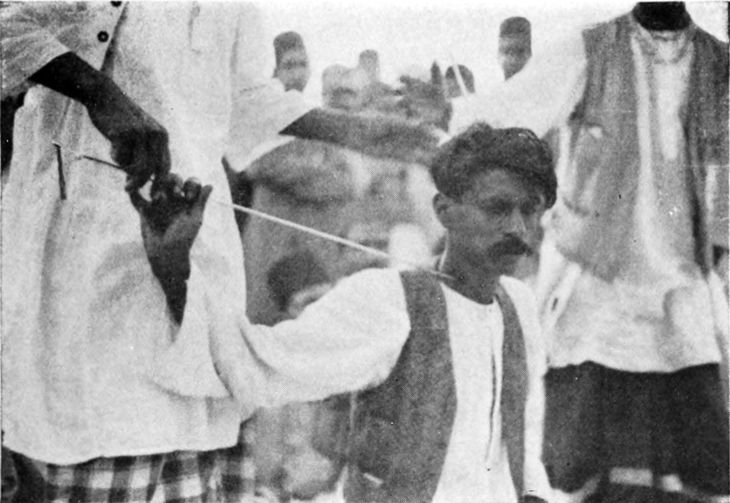
Rufai Dervish at Hyderabad.
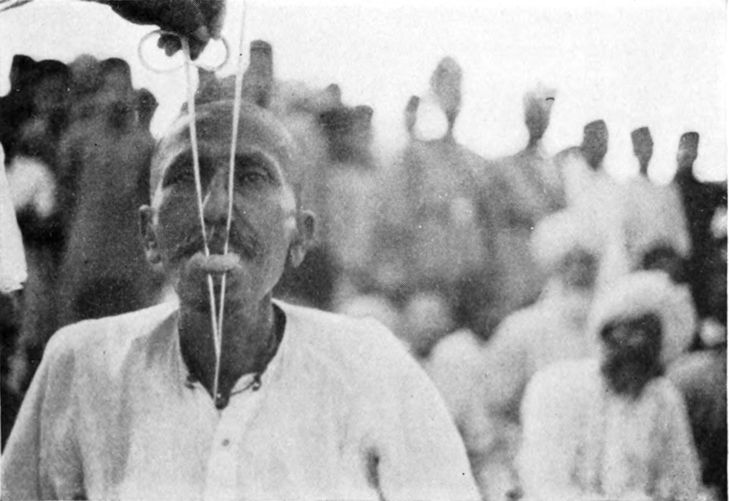
Rufai Dervish with Skewers through His Tongue.
We drove to a police-station in the city, where mats and cushions had been laid out in a courtyard, under the shade of nim trees. The Rufais are Shiah mystics, descending from the seventh Imam; and their present organization, which has ramifications all over the world of Islam, dates from the thirteenth century. The Sheikh of the Rufais is a lean, dignified, middle-aged man. Accompanying him were his two small grandsons, dressed in neat flowered suits. A fearsome collection of steel instruments, like skewers, was laid out before him, on a white cloth: some were a yard long and as thick as a thumb, some a foot long and as thick as a pencil. The shorter implements were ornamented with chains and bangles. All had points like needles. Beside them burned a tray of incense.
First we prayed, sitting on the ground with palms upturned, while the Sheikh invoked the blessings of the Most High on our proceedings. Then two drummers and a flutist struck up a fast, exciting tune.
An old man rose, salaamed to the Sheikh, chose a short skewer (one with chains attached) and asked the Sheikh to bless it. Now he licked the skewer carefully, whirled it aloft, and suddenly, sickeningly (the thing happened so quickly that it caught me unaware) drove the spike downwards from the full height of his arm into the corner of his right eye.
There he stood, shivering a little, and sweating, with his eyeball sticking out, and the skewer behind it.
The band stopped. He removed the skewer slowly, licked it again, pressed his eye. The band took up its tune, quicker, quicker, quicker: the dervish danced to the mad rat-tat of the drums.
His figure grew misty. I was either going to faint, or I was going to photograph the whole performance. Which was it to be? The Sheikh’s grandsons watched the scene as innocently as if it were a nursery game. Three times the skewer whirled aloft, and three times that wretched man impaled his right eye. . . . The third time I set my teeth, and the camera shutter.
Now the worst was over as far as I was concerned. I had taken the dervish’s picture. (On the same spool were the dancing school-girls of Travancore.)
The next performer chose a longer skewer, and drove it through his right cheek, and another through his left cheek, and a third through his tongue. The next man drove a spike into the top of his head. (It went in about a quarter of an inch, and I felt inclined to giggle.) Another put a sword through his neck. A fifth transfixed the skin of his belly.
At last the performance ended.
A doctor present assured me that I had seen nothing that could not be done by a normal man, provided he could induce in himself the right mood. He himself, he declared, at the age of sixty, had driven spikes into all parts of his body.
But why was there no bleeding? I asked. He answered that no veins were pierced. (But isn’t the tongue a mass of blood vessels?) There are many things about the Rufais which I could not find out, and some of the things I know were told to me in confidence. Their rites consist largely of whirling dances and the repetition of the Name of God (Allahhu). What we had seen was merely the result of mystical exaltation. Their tents are a by-way of religion, a way shunned with horror by orthodox Islam. Certainly it is a strange path by which to approach the Merciful Creator, but it is one that has been trodden by many men, in many lands and ages. . . . Again, I repeat, Hyderabad is a progressive modern State. The Rufai dervishes are survivals from another age.
|
Letters from all the Great Moguls: a mine of precious ore awaiting some fortunate historian. |
|
The burning of a widow on the funeral pyre of her husband. |
|
House-breaking by organized and armed men. |
I feel inclined to skip my time in Bombay, because although I stayed with the most charming hosts imaginable, I suffered from a constant and irreconcilable conflict between the claims of Mammon, and the inner life of meditation.
The Chidambaram Swami had shown me a way to the Temple of the Undistracted Mind: do this, think that, and you will find light on the Path. But when I meditated in this enervating climate, my thoughts ran in such worldly channels that I began to despair.
Also I noted with curiosity that my mood in the morning depended greatly on the people with whom I had been in contact on the previous day. Even during my busiest times in Mysore and Hyderabad, while I was staying with Indians, I had been able to make time for self-recollection. But here, living with the English, I found that I could not concentrate on the delicate distinctions of the Self. I was conscious of the sweat and struggle of the city, of people making love and dying, amassing fortunes, living in the most piteous squalor. Were not these things reality enough? There were times when the abstractions of the Vedanta seemed to me stuffy and meaningless.
Certainly climate is the key to many things about India. We British took this land because the races that had conquered it before had become exhausted by the heat. We continue here because we renew our vitality by returning frequently to our native country.
India’s many races are the result of a constant influx of conquerors, chiefly from the north; and her many creeds are due, in part at least, to a hot-house atmosphere, which favours the contemplative life, by immobilizing everyone but mad dogs and Englishmen for many hours of the day. Of course, the temperature varies greatly in different parts of the peninsula, from the genial and luxuriant coconut-groves of Cochin to the hell-hot summers and bitter winters of Waziristan; but generally speaking, the fact remains that the Indian climate is one of the most trying in the world.
In no other part of the world are sickness and sudden death so prevalent. For six months out of every year life is a struggle against the sun by day and against insects by night. From March to mid-June the thermometer rises steadily. In April it has reached blood-heat. In May it has mounted to the temperature of a hot bath—say 105°F.—and towards the end of that month shade readings of 110°F. are common, dropping only a few degrees at night.
In June, cloud-messengers arrive from the south-west sea. For a week, or longer, India stifles under a dark pall of thunderstorms that do not break. At last the monsoon comes, the great wild monsoon that nourishes the crops in an orgy of storm and flood. The plains lie under his spell, sighing, spent, fulfilled in the violence of his passion. Myriad lives spring up from the embrace of the elements. This is the true spring of India: not a blithe season of opening buds, but the rape of the Rains. Autumn is the humid time of fever. The winter months are glorious, but all too soon the sun again climbs to the zenith of his power over the parched land, and dust-storms presage the coming of the next hot-weather.
Even those of us who know the Indian hot-weather forget the experience quickly enough when we come to live in a better climate. It is not easy to imagine the constant struggle going on within the body, when the skin, instead of keeping the vital organs warm, has to reverse its functions for weeks and months on end.
But imagine this conflict we should, and must, if we would understand India; and no one who has not lived under these conditions, and who has not personally felt their effect on brain and body, is qualified to discuss Indian problems. A photo-electric cell, such as is used for gauging the exposure to be given to films, often records the intensity of actinic light as double that of a similar-seeming day in England. It is not unreasonable to suppose that not only films are affected by these rays: men’s brains also may work differently in the two countries. In fact, they do.
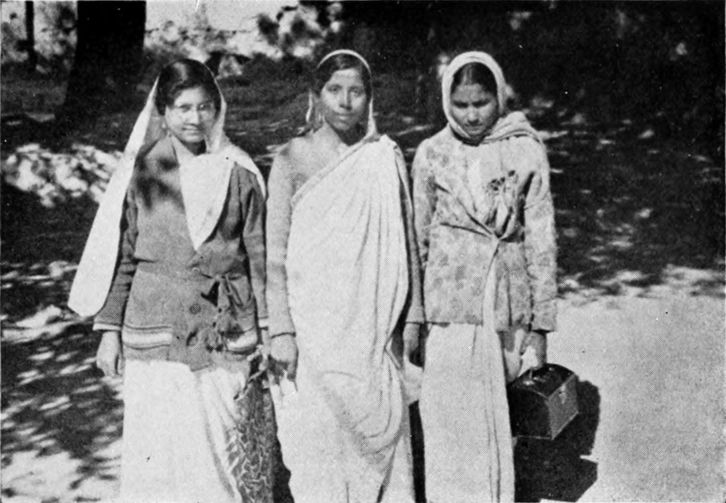
Rural Midwives.
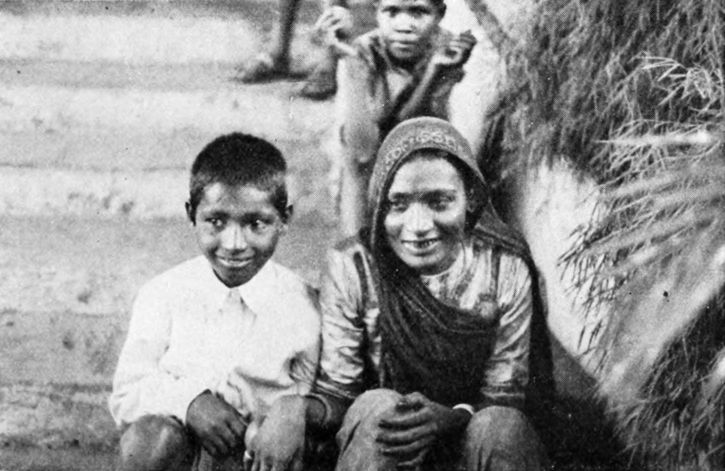
Bombay Prostitute with Her Son, an Inmate of the Children’s Home.
Men like Mr. Jayyakar, Pandit Madan Mohan Malaviya, Sir C. P. Ramaswami Iyer, and Sir Tej Bahadur Sapru, who are Brahmins, and with whom I have had the privilege of discussing the problems of the day, seem to me superior in brain-power to our leading politicians in England, but no more effective in deeds. No doubt the size of the country and its innate conservatism account for much; still, one feels, sometimes, that the skill and subtlety of the high-caste Hindu lead him into a blind alley when thought must be expressed in action. Perhaps I am being unjust to the Brahmins, whom I greatly respect, but the fact remains that whereas they all tell me that neither Manu nor the Upanishads decreed the present arbitrary distinctions between man and man, yet the caste system remains unreformed. There has been a great deal of talk about opening the temples to the depressed classes, but very few of their gates are as yet even ajar.
Again, why do not the Aryan leaders give a stronger impetus to social reform? There is a crying need for slum-clearance in the cities, and for the better safeguarding of children. Why do they not come forward?
The Children’s Remand Home at Umarkhadi, in the slums of Bombay, opened my eyes to the seamy side of a big city.
Last year, 1134 waifs and strays came under the care of the Secretary, Miss M. K. Davis: 876 boys and 258 girls. Of these children, 473 were destitute, 235 were thieves, 154 were victims of sexual offences, 62 were uncontrollable, and 210 were confined for petty misdemeanours, such as begging, gambling, and hawking.
On the morning of my visit to Umarkhadi, thirty boys had just been sent to Miss Davis, mostly Punjabis, about ten years old, apprehended by the Bombay police in a massage establishment. Well-to-do Indians generally have an oil massage once a week, and the majority of masseurs are respectable men, but these boys, known as champi-wallahs, had been found in what is officially known as a position of moral danger. Even so, their adventures did not horrify me as much as the true-life stories of some of the girls. These children were witnesses to the depths of degradation touched by human nature in a great cosmopolitan port, yet the majority of them looked healthy and normal. (They were not, however: 91 were suffering from venereal disease, and 29 were mentally defective.)
But even those that are diseased, Miss Davis told me, can be saved in body as well as soul, given time and the necessary funds. As to those who by human standards cannot be saved, it is doubly our duty to do what we can to make their lives tolerable, remembering the miseries they have endured, sometimes even as babies.[55]
“A boy tried to commit suicide by drinking fever mixture the other day,” Miss Davis told me. “I was surprised, for those sort of antics generally occur amongst the girls. Now we have a boy who says that God descends on him. That again is a female trick.
“Life has been fairly turgid lately. Last weekend I was called upon to stop a child-marriage: a twelve-year-old mochi[56] girl was being married to a man of thirty-five. I went with a police officer, and felt rather a brute when I arrived with my injunction, and removed the gaily decorated little bride from her home: they were just sitting down to a pre-wedding breakfast; but of course it had to be done. We probably saved the girl’s life.
“Next day I married off one of our big Moslem girls to a very good suitor in defiance of her father’s wishes. He’s an awful old scoundrel who objected only because he wanted to sell her in marriage for his own benefit. However, the Juvenile Court magistrates told me to carry on, because under Moslem law a girl of fifteen can choose for herself.”
It was Sunday, parents’ day, and the schools of the Home were shut, so we walked round, seeing the children at play, or sitting with their relatives. One group consisted of two dear little boys reading out of a picture-book brought by their father and mother, who are keepers of a prosperous house of ill-repute.
The father is a handsome young man of about thirty, with a silky moustache and well-cut clothes: the mother is handsome, too, but she has a large scar across her nose and forehead, painted with iodine. I asked her about it. She giggled, and said there had been a fight. One of the boys was cuddled in her lap. There they sat, the four of them, a happy party, as good as gold.
I wonder how the Creator views them? There is love in this family, which is more than can be said for many highly respectable homes.
“That girl,” said Miss Davis, indicating a slavering, semi-idiotic infant, “was found chained to a log. And that boy is a leper: we’ll have to send him to a hospital as soon as we can; meanwhile we must keep him here, apart from the others as far as possible.
“Our schools are doing very well: the girls as well as the boys are keen on them. One boy—a high-caste Hindu—ran away from his village, hoping to induce an uncle of his in Bombay to give him a secondary school education. When he found that his uncle couldn’t afford to pay for his teaching, he jumped into the sea, and was only rescued with great difficulty. He was sent here to recover, and we were lucky enough to find him a place in a good school. His whole mentality changed at once. He’s doing well now, and often comes here as a visitor. . . . Look at our two Mongolian idiots!” she added, indicating a couple of babies with deformed heads. “Don’t touch that one! She’s dreadfully dirty, poor little thing.”
“Would you be sorry if the idiots died?” I asked, my brain reeling.
“Good gracious, no! It would be the best thing for them. They have terrible moods of depression, sometimes, when they know they’re ‘different.’ Still, they’re generally happy, and they bring out the good qualities in the other children. One can’t question the ways of Providence, can one?”
“Can’t one?”
“Well, no. I think not. Come and see our garden, and the pets.”
The pets were great fun, and the boys and girls were so gay (all except the champi-wallahs, who were weeping at their unaccustomed surroundings) that one forgot the scenes of tragedy and terror that lay in the background of all their lives.
“How many of these children will turn out good citizens?”
“About half, I hope.”
“And the others?”
“Are safe and happy here. Some of the girls who have been assaulted when quite little acquire a morbid craving for sex. They are very difficult to deal with, and we can’t do them much good, except to keep them out of harm.”
I came upon a mother who was trying on a new coat which she had brought for her little boy. The child was delighted with it, strutting about in a seventh heaven of delight.
“Unfortunately I can’t allow him to keep it,” said Miss Davis. “It’s a shame, but the other children would be too envious. You see, she’s a prostitute, and can afford to buy him nice things. Most of our mothers can’t.”
“Do many prostitutes bring you their children?”
“A good many, now that they know that they’re well looked after here. There’s a deformed girl who lives in a brothel near by: she’s had two children already, and brought them here. Now she’s going to have another, and has promised it to me. It’s strange how she continues her profession, for she can only walk on all fours.”
“Strange! . . .”
Feeling as if I were in a dream, I went on to see Dr. Ambedhkar, the leader of the untouchables. I asked him what he thought, as a Hindu, of the possibilities of a big measure of social reform in India.
“Don’t call me a Hindu!” he exclaimed. “The very name revolts me! Hinduism isn’t a religion: it’s a contagious disease!”
“What religion do you intend your followers to adopt?”
“It’s too early to say. There are elements of good in all other faiths.”
“Which do you prefer yourself?”
“I haven’t made up my mind.”
“Is it true that you intend to take your followers by a mass conversion into the fold where you see the greatest political advantage?”
Dr. Ambedhkar laughed heartily. “That is what our enemies say,” he answered. “Of course we shall use our voting strength to further our interests.”
“And you believe in democracy?”
“No, I don’t. I believe that an enlightened autocracy would be the best thing for this country. But an indigenous one, of course. Parliaments can’t get things done: they debate too long.”
Dr. Ambedhkar struck me as one of the modern minds in India, with a firm grasp of actualities, perhaps because I was in sympathy with his political views. There are Augean stables to sweep in this country, which will never be tackled by a talkative democracy.
That night I sat down to write to the Chidambaram Swami. I confessed that I had failed in my meditation, and that I could not continue it until I was in a better mood, and living in a better climate.
|
There is urgent need for equipment for the Lady Brabourne Home for Girls, whose patron is H.E. the Governor of Bombay. Should any reader be disposed to help, will he write to Miss M. K. Davis, Children’s Home, Umarkhadi, Bombay? The work is so new that even a small sum of money will work wonders in relieving the sad conditions of child life in the city. |
|
The mochis are a caste of leather-workers. |
In the night-mail to the north, I opened Vivekananda’s Raja Yoga, and thanked God that I was leaving the suffocating atmosphere of Bombay for fresher air and wider spaces; but I couldn’t read a line. When I thought of Miss Davis, back there in the heat, not questioning the ways of Providence, but steadily mending maimed lives, I felt inclined to throw the book out of the window.
Yet Vivekananda was a good man, and himself a social worker. My irritation was not with him, but with myself. Umarkhadi had upset my nerves.
And the heat. I cursed the heat.
I looked through the papers, and saw that Pandit Jawaharlal Nehru was being entertained by London Left Wingers, and that Mr. Eden was making one of his strong speeches about Abyssinia. . . . There was something faintly disgusting about the news from home: a flatus of decay. The entertainment pages were more amusing. A three-column display announced that:
Thundering out of the soothing Orient
loaded with box-office profits
Miss Mehtab comes in Magic Horse!
I wish I had a magic horse! Pigsticking . . . that’s better! Preparations for the Kadir Cup. Alas and alas, art is long and life short: I have no hope now of a month’s holiday. It is March, and I have travelled over only half this huge country. Instead of a hog-spear, I shall be holding a hot pencil in a sticky hand for many days to come.
By a curious chance the manuscript volumes of the Bareilly Tent Club Log, from 1898 to 1928, are with me now. During my travels I heard that the friend of a friend of mine was trying to get them typed before the white ants had destroyed these records of thirty years of sport. (In India no book endures without constant care: what the white ants do not use as building materials, the fish-insects devour, or the rats nibble.) So I suggested that I should take the books to London, have them copied there, and deposited in some safe place. Here they are, and since I shall not pigstick in the flesh, I may as well while away this hot night by doing so in fancy.
Fifty or sixty pages are written in an adolescent hand which I recognize with startled affection . . . pages written twenty-five years ago, aching from falls without number, and fresh from sanguinary little triumphs which may seem absurd now, but which were life at its very vividest then.
Do they seem absurd? Not to me. As I read on, I grow fond of this boy, working out the savage in him.
Have you sublimated the savage in you, reader? Or suppressed him? If you have, I owe you an apology for introducing you to this young friend who bore my name and face.
If not, well . . . we are in the big mango-grove at Ratmugri Bagh. Our camp-beds are set in the centre of a clearing; tired beaters are being paid for their day’s work; tired horses are being rubbed down and fed; tired sportsmen are having their boots pulled off by yawning servants. At a clothless table in the centre of the beds, the Honorary Secretary of the Tent Club and the Honorary Surgeon are playing a game of piquet, with bottles of beer at their elbow, and cheroots, to keep away the midges. Also at the table is a smooth-faced boy, compiling the Log Book. Moonlight filters on the writer through glossy leaves.
Here are some observations which he made about populating the territory of the Nawab of Rampur with peasants and pig:
“Near Mulla Khera there is a large patch of dâk jungle[57] which would be a grand place for pig if they were preserved, even a little, but alas, the farmers shoot and net with the Nawab’s permission.
“Possibly the question of land revenue has induced the Nawab to assent to this nefarious slaughter. Most of the country we pigstick over now is a wilderness. In former times there was a coming and going of men, a winnowing of grain, a building of villages, now everything is desolate save for a stray thatcher’s hut. The threshing floors are cracked, the roads are grass-grown, the villages empty and unroofed. Everywhere the dominion of grass is complete.
“Taking a toss in this country after riding a pig some way, one learns the nakedness of the land. By one’s feet may be the boundary of what was once a field, but now there is no voice or vestige of man up to the limits of the horizon.
“If the Nawab would consent to preserve the country a little, the Tent Club might undertake to have a Christmas meet and a summer meet in Rampur. The pig could then be kept down to reasonable numbers and the country reinhabited: the peasant could return to his plough and his family to the vacant villages. The Nawab would profit in taxes, the Tent Club in pig, and the peasant in earnings on this excellently watered land.”
Neat, what? The author must have gone to bed well satisfied with having settled the Nawab’s affairs. . . .
Here are some more entries:
“May 17th, 1910. Gurgaya.
“No. 1 heat had all the luck. At 8.00 a.m. a sounder[58] of eight pig went away with several boar amongst them. S. and J. each took a pig and had a great fight. The former, who had some difficulty in getting his horse to go up, managed to get in a disabling spear in the loins as his pig jinked.[59] Boar still full of fight and cunning, however. Slunk down a nullah,[60] charged a horseman who intercepted him and received a diamond-headed spear in the snout, which made him stuffier than ever. He then hid in some bushes, from one of which he suddenly jumped up and bit Y.-B.’s mare in the shoulder. Retreating into the bushes again he walked slowly towards the bagh. He had only the nullah to cross and we might or might not have got him, but instead of going down the bank he let his temper outrun his cunning and charged Y.-B. again. He died game, true to the traditions of the bagh. A light reddish pig, and a real hero.
“J.’s boar was of the same breed. He was chased into the gravel pits with only J. after him, receiving several spear thrusts and inflicting much damage on his pursuer’s horse. He then lay up in a puddle, wounded and vindictive. Two more spears came up to help: but the trio had some difficulty in finishing him off. He was chockful of vitality even when badly wounded. J.’s horse was found to have six cuts.
“No. 3 heat went away after a fast pig later in the morning, but H. coming a crumpler on his head, the pig was lost.
“In the afternoon a much diminished party turned out of the cool canal bungalow to try their fortune with the ferocious denizens of Ratmugri. Only G., S., and Y.-B. left. H. had a bad head after his morning’s toss, J. took his horse, dripping synovial fluid from a cut near the stifle, to Riccha Road, while D. had sorebacked his pony, and had to return to Bareilly also. The sporting contingent of the Worcesters have had very bad luck.”
“May 18th, Gurgaya.
“No. 2 heat had all the luck. Sows and squeakers came dribbling out as soon as the beat began, trotting right up to the heat and then dodging away frantically, with the idea that they were the cynosure of every eye. A pig with tushes and the build of a boar was seen, but, lacking other evidences of masculinity, was allowed to go.
“A large sounder broke at half-past nine and after some breathless minutes in the grass three pigs were accounted for. At 10 o’clock another big sounder broke, and some more quick work in the grass caused three others to bite the dust. Of these, one had exceptional tushes, which fell to W., who is having great luck this year, but not a whit more than he deserves. Several other good boar from this sounder must have gained Ratmugri bagh. Later on, a couple of pig were found bathing by the gravel pits. Biggest was a sow, but the other was killed before he could get back to Kundra.
“About lunch-time a pig was discovered bathing by the canal bungalow. Jinked down a nullah and through some baghs, being eventually killed in the open. A large vulgar pig who betrayed his village ancestry by screaming loudly. Good morning’s work, however: eight pig.
“On resuming, heats were placed as in the morning, but No. 1 took a spell at watching the ground near the bungalow. As in the morning No. 2 had all the fun. Big sounder broke soon, pursued by W., M., and Y.-B. Former ran and killed a good boar. The others got on to a good one also. M. took him fast over the gravel pits, but his horse was anything but staunch. He was killed (the pig) while trying to make Ratmugri.
“There is a certain sameness about the runs at Gurgaya; still, the day was delightful. Query, why are the Ratmugri pig so much fiercer than the Kundra ones?
“Boar . . . 28 inch, 110 lbs.; 31¾ inch, 162 lbs.; 30 inch, 122 lbs.; 26½ inch, 95 lbs. (not quite up to standard); 29¾ inch, 150 lbs.; 31¾ inch, 86 lbs. (disembowelled: a good pig); 30¼ inch, 142 lbs.; 29½ inch, 153 lbs. One pig lost in the grass, fair size and good tushes. One good pig killed near Ratmugri: stolen by the Singothi Thakurs.”
“May 19th, Gurgaya.
“In the middle of the night a police sepoy and the Hon. Sec.’s orderly came to say that the Singothi Thakurs had beaten them soundly and refused to give up the pig killed yesterday.
“In the morning, beat the grass towards Ratmugri, but nothing was seen. Leaving the coolies and the majority of spears to go to Ratmugri, three of the members galloped off to have a personal interview with the obstreperous Singothese. A fracas arose between the shikari and a ferocious individual in a skull cap. In the scuffle which ensued, S.’s horse was speared, and the ruffian in the beret was felled to earth. S.’s horse bled freely from a wound in the near shoulder, and a Thakur lay twitching on the ground, head soaked in blood. Sight of gore made Thakurs very polite. The man who had just assaulted the shikari was sent back to camp to be dealt with by the police. The Hon. Surgeon of Tent Club, who arrived most opportunely, pronounced the wounded man quite all right, and dressed the horse with bandages, hazeline, etc.
“Returned to line. Dispute with truculent Thakurs had taken upwards of an hour. Heats as before. One boar came out, looked at No. 3 heat, and then broke back. Nobody’s fault, however; but it just shows how careful heats must be in this sort of country to keep absolutely still, concealed, and alert.
“Back to canal bungalow from 1 till 4. In the afternoon beat Kundra bagh, which is inexhaustible, apparently. Many pig seen, but only one was killed, the others proving unrideable[61] or of the fair sex. In the evening we all rode back to Riccha Road, where we dined, and caught the train. A most enjoyable meet.”
(Yes, most enjoyable, but not for those Singothi Thakurs.)
“May 7th, 1911. Gurgaya.
“We had a very good day marred by two unfortunate mishaps; one, Y.-B., in spearing a pig which crossed him had to drop his spear. Diavolo, whom he was pigsticking for the first time during the Gurgaya meet, and who was training splendidly, kicked at the pig and somehow got speared as the pig rolled over, and was dead in five minutes. A most unfortunate affair. The other mishap was not quite so serious, though here again a dropped spear did all the damage; and R. got his horse very badly speared just above the stifle-joint. In spite of the delays caused by these accidents, and the fact that there was no water to be had for the coolies, who had to go off about a mile to get it, seven pig were killed during the morning, most of them good ones. We had not time to finish the grass and could do no more in the afternoon as we had to catch the train back to Bareilly.”
“January 25th, 1912. Khaitola.
“A fat heavy pig, the first of the season, was killed today by S.’s orderly, Sowar Atta Mahomed. Only four spears out, and the orderly. Beat started in the afternoon: two heats on opposite sides of the nullah. Sows and squeakers[62] greatly in evidence. After half an hour S., B., and Atta Mahomed started after an immense sow, breasted like Diana of the Ephesians; changing from her, they ran a heavy boar that was included in the family party. He gave a slow but satisfactory run, Atta Mahomed delivering the coup de grâce.”
“January 26th, Khaitola.
“Pleasant cloudy day, spent chiefly in beating the sugar-cane. S., B., S., and Y.-B. out. At 11 o’clock got on to two good boar, who lay up in some cane. Another pig was then seen lurching off towards a bagh half a mile away. A good sharp run brought this one down just before he could make the sugar-cane: a good pig with exceptionally good tushes, killed by a single spear in the lungs. Another was then honked[63] from cover, and died after a jinking run. After lunch we spent an hour chasing a boar from one patch of cane to another, killing him eventually by the Khaitola nullah. He died with a single (and maiden) spear, given by S.”
“January 27th, Khaitola.
“Started at 9.30, after a slight skirmish with the cook. Hot bright day; honked cane towards Ikhtiarpur. Footled about after a small leggy pig: several of the spears came into violent contact with castor-oil trees. Small pig then went away and was killed after a good run by a single spear.
“A very big old boar of the heavy, short-faced kind, went away from the same patch shortly after, and was also killed as he charged. Lunch followed. Afterwards beat for some time without getting anything; at last a very big pig was found in the cane and honked out with difficulty. A sharp jinking run through the crops was distinguished by the furious riding of the Hon. Secretary, who was on the tail of the pig for some time, and then vanished into the middle distance. After killing the big boy, sportsmen pursued Hon. Sec., who, they imagined, was following another boar, as he charged through several patches of sugar-cane, hell for leather. They found, however, that he was only testing the checking capacity of standing crops in relation to his own velocity, which was terrific, for his horse was running away.
“Three pig had now been killed: no rideable boar had escaped. About five o’clock a long-snouted boar went away and was killed after half a minute. In the twilight another pig was found, but he took up a strategical position in a temple garden. Dusk overtook us, and we had to leave him. So home by moonlight.
“Pig don’t run fast at this time of the year, and seem to die from lack of breath after being speared once, but there is not much room to catch them between the cane. There is no science in this sort of beating, but spears should be careful not to head the pig; and it was found that if at least two horses were on the tail of the pig when he went into the sugar-cane, they could usually take him through.”
“February 4th, Atamara.
“Left early by train for Atamara, breakfasted in train. Beat Kumuan bagh with a heat of 2 on each side. Before beat had been in three minutes two sounders broke away from the village. In one of these were three rideable boar. The biggest was selected and hunted into the sugar-cane. Line was sent for, and after a clever bit of work by Lakshman Piari (the she-elephant), the pig broke and gave a nice little run, being speared at the edge of some sugar-cane, in which he was found dead. He was a fine old boar, with broken tushes: sportsmen had hardly had time to look at him before they were hallooed away on to another pig, disappearing over the horizon towards Ikhtiarpur. On finding that he was being chased, boar stopped and tried to collect his thoughts, but B. on Banshee hustled him so that he lost his head. Ran into some jhow, then jinked left-handed to make Kumuan bagh again. Horses were pretty done by this time, for it was a mile race to get on terms with him, but he was eventually caught and succumbed with a feeble struggle. Pig are very gross at this season.
“It was now 9.45 a.m. and horses were dead-beat, so a halt was called before going on to the sugar-cane. A long morning in the cane resulted in nothing, and it was rather a sleepy party that stopped for lunch at three o’clock in a mango-grove near Ikhtiarpur. Afterwards Ikhtiarpur bagh was honked perfunctorily, the business of the day being concerned with the cane, and yielded nothing except a dream-pig, imagined by one of the spears. At last a real pig was found in the cane, and honked through various patches by Lakshman Piari, who got her off fore cut in the process. Pig eventually came out and charged B., but he only struck with a glancing blow and (unlike the Titanic) no damage was done, except to a coolie, whom the boar cut on the shin.
“Y.-B. meanwhile had galloped up, intent on spearing the pig; at the same moment that Kalan Khan (the Tent Club chaprassi) was aiming his gun at the quarry. Neither Kalan Khan nor Y.-B. was looking where he was going, because both had their eyes on the pig, so they met with a crash and Kalan Khan was laid out, discharging a round of buckshot as the horse passed swiftly over him. Pig escaped while the elephant, coolie, and chaprassi were having their injuries attended to.
“Kalan Khan’s hurts were fortunately nothing worse than bruises, and he was quite restored by several double whiskies. He pluckily insisted on seeing the day out on an elephant. Shortly after this disheartening incident, he saw two gigantic pig, of equal size and identical shape. One there was, sure enough, who went off like smoke, and was speared after a good run over open country. He was an exceptionally fine boar, and so heavy that the balance couldn’t weigh him.
“Bohemian supplied a comic finale to the day (for everyone except H.) by lying down in the Bhojepura nullah.
“After weighing the pig, Lakshman Piari was given all the whisky that the Kalan Khan had not consumed, and her wound was dressed with a first field dressing, that went exactly once round her ankle. And so to the train, having rid the country of three boar of which Calydon would have been proud. No bitters came for ‘Khaitola cocktails.’[64] Boar: 30 inch, 183 lbs.; 31½ inch, 192 lbs.; 32½ inch, well over 250 lbs.”
“April 26th, Khaitola.
“Villagers are very fond of killing pig round Khaitola, even under the nose of the shikari. We found some Thakurs in flagrante delicto. B. and Y.-B. chased them. One man hid down a well, another in a bhoosa heap, and others in various ingenious sanctuaries, from which they were dragged out and threatened with a ducking in the nullah.”
“April 27th, Khaitola.
“Hunted and lost many pig in morning. At 1.30 a leggy pig went away towards Dunka and was speared by W. A cunning little devil, he never charged him, but stopped and went for horse’s hind legs. Fizzer, T. up, came a nasty purler over this pig. Not possessing the priceless gift of youth, like his rider, he found the long run too much for him and was counted out. However, a cold douche on the head brought him to his senses, and his feet; none the worse and game for another run if a pig had gone away. None did, however, so we lunched at 2.30 p.m. after a grand morning’s hunting, although not very productive of pig, as is often the case at Shahi.”
“May 6th, Ikhtiarpur.
“After a couple of sounders of the kindergarten order had dribbled by without breaking, a big boar went away and, taking a very open line, was soon caught and killed after a great fight.
“Heat was now joined by A. Another big boar went away, and gave up the ghost gracefully and without incident. Returning slowly, heat saw another pig taking the same line, waited for him behind a tree, and then raced up to him when he was committed to his point. A couple of lung-spears, and his day’s work was done. Directly heat had raised their eyes from body of defunct boar, a wonderful sight met their gaze. There on the open maidan was a line at least a quarter of a mile long of pig of all shapes and sexes and sizes. Like the Gadarene swine. Exciting, very.
“Each member of the heat selected a pig and separated him from his sisters and cousins and aunts. B.’s pig was the rearmost and was killed expertly after a jinking run.
“A. chased his pig in the direction of Khaitola and speared it well, near a small nullah, but his spear broke. Boar lay up with spear in him. A. now advanced towards the pig on foot, hoping to fell the quarry to earth with the butt end of his spear. Pig came out of the nullah and charged.
“Both had assumed a vigorous offensive, and it was A., not the pig, who fell. Boar stood over A., looking a winner all over. A. kicked him in the face. Boar ripped his legs. A. now rolled over backwards into nullah with pig, who slashed open his thigh.
“Luckily, when there was no doubt about who was getting the best of the fight, a village dog appeared. Pig left A., killed dog, vanished into Khaitola bagh. Hon. Surgeon soon arrived, and put seven stitches in A.’s wound. Moral: don’t attack a wounded boar single-handed without some sharp weapon in your hand.
“Y.-B.’s was a fast lean pig who went so hard that Ur (who had had four runs already and no time to get his wind) could not catch him for a long time. At last he was speared behind, which checked the boar’s pace. He then started jinking, which baffled the tired Ur and infuriated his rider, who saw the pig would get back to the bagh on the next jink. A bad crossing spear brought Ur and Y.-B. and the pig entangled on the ground together.
“Here they remained till Ur rolled off. Y.-B. ran away extremely fast for a hundred yards, turned to see the boar punishing his horse cruelly. Afterwards, pig trotted off to some grass and sat there for half an hour. Was eventually killed by S., who had come up to see Ur being bandaged. A good day, five big boar.”
“May 16th, Nawabgunj.
“Started at 7 a.m. and beat the river and various covers; killed three. A sow was next chased, and Atta Mahomed came an imperial purler on his head and was temporarily knocked out.
“Fourth pig was a sort of porcine Dorando, and ran like the devil across the railway, squatted, went on again, and was eventually killed after a three-mile run in thick grass by edge of canal. Spears were away an hour over this pig. Other heat took a nap, which was disturbed by a sow, who gave them a hot run. Heat damnable, but slightly alleviated at lunch by large quantities of Pilsener, and some refreshing salad (mixed by the Salad King). Meal not over when replete sportsmen were hallooed away to pig on horizon. Horses quickly resaddled. Off we went in our pyjamas, killing the pig up-river after a sharp run. A very small pig; but never mind, it’s our eighty-fourth!”
“June 15th, Kundra.
“A gala performance: first time within memory of man, ladies have been out with the Tent Club. Beat Ratmugri bagh, which either contained very few pig or else the beaters were very slack. The first run proved fruitless, and Miss H. took a toss, going fast in the gravel pits. Pluckily remounted, and was none the worse except for bumps and bruises. First pig of the day was got by A. on Newminster, after a very sporting run, ending in the death of the pig from a first and fatal spear just outside Kundra bagh. Killed two more in the grass in the afternoon.”
“June 16th, Kundra.
“Beat Kundra bagh all morning. Ladies’ heat took up position at the back of the bagh. Shikari gallantly tried to drive all pig in their direction, somewhat to the detriment of sport. However, several good runs were enjoyed. One big sounder came out and afforded two big pig, and a smaller one, all killed. Heat was terrific, but beat went on till late, because most of the spears had to go in in the afternoon. Continued exertions until 3 o’clock were rewarded by nothing further except an unimaginable thirst.”
“July 8th, 1912. Nawabgunj.
“Beat river and coverts down-river of Nawabgunj, and got a fine fat pig after he had lain up in a cactus hedge and had spears thrown at him javelin-wise.
“Second pig was got by Sowar Atta Mahomed across the river, after W. and Y.-B. had pursued him a long way and had come to grief in mid-stream by swimming against each other.
“Third pig ran into narrow bagh in sight of railway, to which the pig so often go from Nawabgunj. Ran out of this quite close to S. and Y.-B. who were in two minds as to whether he was worth killing. Desire to get the hundred and twentieth pig decided the point and they gave chase, and the devil of a run they had. Going was very heavy and the pig was very fast. Took them over railway, where they lost ground, then to small bagh some eight hundred yards away, past this another half-mile, straight on to a big pond, where he turned left-handed and gained the river about a mile away. Went down and up very steep banks. They crossed a little lower down, and got over quicker than he could, so that they found themselves on the other bank on level terms for the first time. He still kept off the spear for another three-quarters of a mile at least, but eventually stopped, dead-beat to the world, and was quickly finished off.
“Horses could hardly stand by this time, and the riders were exhausted also, for kicking a tired gee over country fetlock-deep in mud for over three miles is no joke. A run the participants will remember for many a long day.”
Yes, one of the riders remembers that last run, though he has forgotten much else. Who was the Salad King? Did the girls carry spears? (Both are married, and mothers now.) What happened about the Singothi Thakurs? I remember that there was the deuce of a fuss: clear-line telegrams, rumours of a court-martial, explanatory accounts in triplicate . . . but it has all gone from me now.
Next morning, the monsoon broke in right earnest. Next year we left Bareilly. Then the War came, and that was the end of our pigsticking.
|
Dâk jungle is a low, bushy scrub of which pigstickers sing: Over the valley, over the level Through the dâk jungle ride like the devil! |
|
Noun of multitude for pig: a gathering that gladdens the eye of the hunter. |
|
Twisted and turned. |
|
Water-course or other channel. |
|
Because they were too small: we rode no boar that stood less than twenty-seven inches at the shoulder. |
|
Adolescents, who are striped in gold and black until they reach maturity. In his prime, a boar is black, in old age, grey. |
|
Onomatopœic word for driven. |
|
We never drank cocktails as known in these days, but we had a mixture of our own, called “pink peg” or “Khaitola cocktail,” made up by a local chemist, which consisted of Justerini and Brooks’s best brandy (may we be forgiven because of our youth!) lashed with a small quantity of chloroform and ether. To this terrific tipple we added soda and bitters. Its effect was like letting in the top gear of a racing car; but we never drank it until the sun was over the yard arm. Of India Pale Ale we consumed many a quart. The distinguished Honorary Surgeon of the Tent Club has left the following aphorism on record: “Start the day with beer, preferably a big bottle. Continue the day with beer. This causes the boar to look smaller than he really is during the chase, but has a reverse magnifying effect in the evening, when the incidents of the day are under discussion. Conclude the day with beer: this engenders sleep.” |
Those scenes at Bareilly fascinate me. I admit that they are chiefly the tale of one pig after another “biting the dust” or being otherwise laid low; but the killings have faded from my mind, leaving a memory of grand runs and gallant horses: a life that was clean and good. . . . If I am ever asked to give an account at the Judgment Seat of the actions of that boy in Bareilly, I shall be sorely puzzled. He was cruel and careless at times, but he had a sort of puppy-like seriousness and concentration which amuses me. . . .
However, we have come to Agra to pay a visit to a colony of workaday mystics. There is a mystic about the Ford factories at Detroit, about the Mormons in Salt Lake City, the Dukhobors at Nelson, B.C. (who have moved since I was last in Canada), and about the Russian factories which I have visited in Moscow, Nijni-Novgorod, and Stalingrad; but Dayalbagh surpasses them all in its versatility and in its ability to render unto Cæsar the things that are Cæsar’s and unto God the things that are God’s. Sahibji Maharaj Sir Anand Sarup, the spiritual and temporal ruler of the colony, is a pioneer the like of whom the world has not yet seen.
The founder of the Radhasoamis, as the sect is called, was one Soamiji Maharaj, who was born in Agra in 1818. He was a rich man, well versed in the classical languages, Persian, Arabic, and Sanskrit. He delivered his message and founded the community in 1861, in his forty-third year; and died in 1878. Since then, there have been four other leaders, the last being the present Sahibji Maharaj, who was elected in 1913. (He was knighted this year.)
Radhasoamis are not eager to discuss their beliefs with outsiders, for they distrust faith without works, and strangers are not generally admitted to their religious services. However, I was fortunate in being privileged both to meditate with them and to spend several hours with their leader. I venture to think the following summary of their creed, though bald, is accurate in essentials:
First, they believe in One God, the fountain-head of all spirit and matter;
Second, in the continuity of life after death;
Third, in the unity of the God-essence with the spiritual entity in man.
“In the beginning of creation” (I quote from a Radhasoami publication) “the manifestation of spiritual energy took the form of a spiritual current, preceded by an upheaval in the Supreme Reservoir of spiritual energy. The spiritual current and the upheaval were accompanied by spiritual sounds, which, when reduced to articulate speech, constitute the words Radha and Soami respectively; and thus the name Radhasoami is believed to be the Prime Word, or the True Name of the Spiritual Being.
“It is further believed that man has been endowed by Providence with a body which is a most wonderful apparatus, and that, given suitable facilities and the necessary training, he can develop within himself mental and spiritual faculties of the highest order. There are three modes of spiritual practices prescribed by the Faith . . . the first two help the devotee in obtaining self-control and concentration of mind, while the third brings him in touch with the Spiritual Sound which results in the awakening of latent spiritual faculties.”
How real these benefits are, even in a material sense, can be readily understood by anyone who compares Dayalbagh with the surrounding country. All round the colony are waste lands of the Jumna, dusty, dishevelled, poor; whereas within the Dayalbagh enclave grass grows, water flows, roads are swept, houses are bright with paint and fresh distemper.
From small beginnings, Dayalbagh has developed into a garden city of four square miles in extent, housing 3500 community members, and employing another 2000 workers in forty-two industries. The exports of its farms and factories have doubled themselves in the last seven years, and now amount to £60,000 a year. Its products are known throughout India, and there is hardly a town where there are not some members of the faith. The total number of Radhasoamis is over 150,000, grouped in 350 branches.
Until 1913, when Sahibji Maharaj Anand Sarup was elected as the leader of the main body of Radhasoamis, the movement was a comparatively obscure Vaishna sect of Hinduism. Very soon, however, he marked it with the impress of his strong personality. He discouraged abstract speculation. God meant us to make this world a garden. God meant us to use machines in the great design of living. Dayalbagh must have trees, flowers, factories.
Radhasoamis are forbidden “to engage in useless pursuits, such as attending fairs and festivals, and participating in political agitation.” Caste distinctions are abolished, both in the community itself and in its workshops. Every follower is enjoined to live on the income earned by the sweat of his brow, and to abstain from meat and intoxicants. No outward rites and ceremonies are prescribed, however, except the morning and evening meditation.
The meeting hall of the Radhasoamis is as bare as a barn and as big as a market-place; and is provided with fifty overhead fans. A blue screen divides its length, separating men from women. At this division is placed a white arm-chair, raised on a table, so that the Sahibji Maharaj can be seen by all the faithful. By the side of the chair lies a long peacock fan. There is no altar, and no emblem of religion.
We sit on the floor, meditating.
What are the thoughts of the others, I do not know. Mine have turned to the compassionate face of the Redeemer, looking down on all these creeds and cults and hopes and horrors that I have seen:
For there to give the Second Birth
In mysteries and signs,
The Face of Christ o’er all the earth
On kneeling myriads shines.
And I see now—but perhaps there is no connexion with my previous thoughts: the seeing came at this particular moment of quiet, and the why of it is immaterial—that the order of the exercises given to me by the Chidambaram Swami has a purpose. Ablution, Prayer, Purification, Breathing are only words: Prayer as he used the term is only a preparation of the mind for what is to come; a self-recollection to render insight possible. Purification and Breathing are further stages of awareness. Communion comes through no formal act of worship. It is something given. Something given unexpectedly to a mind attuned: a Voice from the ether, a Light from the void, which cannot be received except on the right wave-length of emotion.
Extraordinary, amazing, unbelievable (my words look hysterical, and perhaps I am beating the air!) that our civilization, with all its scientific getting, has not yet got a grip on these simple things! It sounds almost improper to suggest that one can deliberately arouse an emotion. But why? It is being done every day in the East. It should be done every day in the West. The disciplined emotions are the keys to creative evolution. The keys also to material success. I hate to say it. It sounds indecent in a religious gathering. But again, why? Every man and woman alive has a legitimate wish to be prosperous:
The powers of earth, for all her ills,
An endless treasure yield:
The precious things of the ancient hills,
Forest, and fruitful field.
Thine is the health and thine the wealth
That in our halls abound,
And thine the beauty and the joy
With which the years are crowned!
Archbishop Benson’s words, richly broidered like some Early-Christian dalmatic, are ringing in my mind as the Sahibji Maharaj walks to his arm-chair, puts down his walking-stick beside it, sits with closed eyes.
For five minutes we remain silent. Here we are, two thousand, or two thousand five hundred men and women with jobs to do in the world, with children to look after, or lathes to tend, or offices to manage, or fields to till: we are none of us idlers, none of us rentiers with servants to minister to our wants, while we swoon on sofas, thinking of the Higher Life: we are workers, engaged on the most practical work of the day, which is the worship of God.
Then the Sahibji Maharaj intones, in a long-drawn “Ah-h-h,” or “Aum,” on which the congregation begins to sing: it sings a hymn in praise of the Almighty, composed by the Founder of the Radhasoamis. Following this, two further hymns are rendered by a choir. Then there is a chant in which the whole congregation again joins.
Half an hour has passed. Morning worship is over. Women come up to the Sahibji Maharaj’s chair, and ask his blessing. Men also, with offerings of cloth and money. The leader rises, takes his walking-stick, goes away. The informality is deliberate. There must be no pageantry, no pomps of priesthood amongst the Radhasoamis.
In the evening they will meet again; and at this time the Sahibji Maharaj often preaches. If he does not do so, they will spend at least another hour in song and meditation.
My description has not done justice to the quiet confidence of the proceedings. Here are men and women believing in God, believing in leadership, believing in themselves as the instruments of a Divine Plan, who have moved mountains by their faith, and are moving mountains.
I have already asked myself whether India can manage her own affairs? Here in Dayalbagh is a further and most emphatic answer.
One of the first tasks to which the community bent their energies was to ensure that an adequate supply of milk should be available for themselves and their neighbours. The result is the best dairy-farm in Asia, which not only supplies the colony with all its wants, but is a witness to the success of modern farming methods in India. It covers 420 acres, cost £30,000, and after some initial difficulties is now showing a handsome profit. Important experiments are in progress with Friesian, Sindhi, and mixed breeds of cattle.
The colony has also spent large sums on the education of its youth. Encouraged by Sir Harcourt Butler (“a prince among supporters,” Sir Anand calls him), an Institute was built and endowed at a cost of £40,000, which now maintains 385 students on its rolls. It is residential, and emphasis is laid on character-building and athletics. Scouting is encouraged: there are seven packs, three troops, three Rover corps. A Technical College gives courses in electrical and motor engineering, and in the manufacture of leather goods. The Women’s College, started five years ago, is also a flourishing institution, with seventeen mistresses.
The model industries of Dayalbagh, on which £60,000 have been spent, turn out goods to the value of £37,000 a year: they have depots in seven cities, and ninety agencies. Motor-parts, dynamos, electric fans, stoves, clocks, heaters, gramophones, laboratory balances and weights, biology models and surgical instruments, fountain-pens, knives, nibs, inks, buttons, toys, woollen goods, socks, stockings, vests, shoes, and all kinds of leather goods are made. This list might be greatly extended. Sir Anand tells me that he is thinking of taking up the manufacture of cheap radio sets as soon as his workshops have breathing-space.
All this has been achieved in twenty-three years. All departments are managed by Indians. There are no Europeans in Dayalbagh except Miss Clive, the Principal of the Women’s College.
My amazement grew as I walked round factory after factory, saw the dairy, the farms, the new canal from the Jumna, talked to the students in their hostels. I thought: India is the foster mother of most of the faiths of the world; this rural-industrial-religious life of the Radhasoamis seems, as far as I can see, far in advance of our Western experiments along the same lines. Is it, perhaps, the forerunner of a new civilization?
Sir Anand Sarup received me in a cool, uncluttered house, like the mind of its master. He is tall and slight, with brown, bright eyes that can by turns look shrewd and quizzical; or rapt, and focused in infinity.
“I began as a telegraph clerk,” he told me. “But even before Dayalbagh existed I had a vision of it, and what it was to become. When the call came I was prepared. The details of the buildings existed already in my imagination. When such details cease to leap into my mind’s eye, my work will be finished. But we believe that a leader will always be found for our community, since we seek God’s guidance in everything.”
“What is your view of India twenty years hence?” I asked.
“The mantle of a prophet is good to look at, but not to wear,” he answered, turning my question with a laugh. “At present we are only at the beginning of things. I am a great believer in rural reconstruction, and I am trying to develop it along sound lines in neighbouring villages. The peasants must have better cows—cattle that are economical to keep. That should be the first move in the campaign. We must stop the appalling waste which goes on in Indian agriculture.”
I was tempted to ask: “If you were a dictator? . . .” but refrained, for I felt Sir Anand prefers facts to hypotheses. However, I knew that he did not believe in the natural equality of man, for he had alluded in a recent address at Agra University to the “revolt against the soul-killing teaching of democracy,” and had said that “the enthusiasm for equality is an intoxication stronger than wine.” With this speech in mind, I questioned him on the subject of Mr. Gandhi.
“I admire the Mahatma for his saintly life,” he replied, “but I am afraid that his ideas are very much out of date. His cult of the spinning-wheel, for instance, would condemn India to perpetual slavery. The way for us to be free is to put an end to our senseless quarrels over trifles, and to come into line with the advanced countries of the world. That doesn’t mean that I want to copy the West in everything. Far from it. There is a danger in over-industrialization, especially if the ties of religion are weakened. I never want to see Dayalbagh grow in size beyond a community of about ten thousand persons. But there is plenty of room and plenty of need for such communities as ours all over India.”
“Then you don’t believe in the political approach to India’s problems?”
“I think it was part of the Divine Plan that the English should have come to stir us from our lethargy. But now it is evident that that mission is almost accomplished. In the days to come, Divine Grace will be needed by England if India is to remain a willing partner in the Empire. Grudging concessions are no good. You could take a big step forward now, and gain India’s goodwill.”
“There is little enough goodwill in the world at large, Sahibji Maharaj! If necessity arose, would you fight for the Empire?”
“That depends on circumstances. I would, if God told me to do so. There are times when non-violence is impossible, as Lord Krishna explained to Arjuna in the most famous of our scriptures. Therefore I would behave according to the guidance I received; fighting like a bulldog, or staying as still as a mouse!”
That last phrase was typical: here is a quick, clever man, with a genius for finance, and very great personal charm, but above all, with an intense desire to do right: a man to whom the Holy Spirit is a reality above all names and forms: a good man, and an able man, if I ever saw one.
Given a hundred Sir Anand Sarups, how quickly India might become a smiling land, clean, gay, prosperous, dustless, and at peace within her borders!
In the closing years of the sixteenth century, a baby lay wrapped in a lousy horse-blanket, on the road between Kandahar and Ghazni.
Camelmen, horsemen, shepherds looked the other way, for it was a girl-baby, and they had no place for useless baggage on that difficult road. Besides, everyone was in a hurry to get through the pass before the snow came. She lay deserted, crying feebly.
Her mother, a poor gentlewoman from Persia, travelling with her husband to India, had given birth to her five days before, near Kandahar. She had risen from her confinement while still very weak, and had tried to struggle on with the caravan, for it would have been impossible to have stayed in this inhospitable part of Afghanistan, where they had no friends, no money, and no means of conveyance for the baby. She could not carry it, and had had to decide whether to follow her husband, or die with the baby on the road. She followed her husband.
The cries from the horse-blanket grew fainter and fainter as the caravan passed, and night fell. But Kismet or Karma had decreed that the baby was to be an Empress.
A merchant saw the bundle. He took the child into his camel litter, carried her down to Lahore, where he left her in Akbar’s palace.
Years passed, and she grew into a beautiful girl, as slender as a cypress, and as fair as a lotus-lily. The ladies of the Royal Harem named her Muhr-i-Nisa, or Seal of Womankind, and made her a pet of the palace.
One day, when she was in her graceful early adolescence, the Prince Imperial, who happened to be passing through the courtyard where she sat, asked her to look after his two tame doves while he went off to play polo. When he returned, there was only one dove, and the Seal of Womankind confessed that she had let the other go.
“Fool!” cried the Prince. “How did it happen?”
“So, my lord, so!” she answered, flinging wide her arms and letting the second dove fly away to rejoin the first.
That was the beginning of a courtship which lasted many years. But the course of true love did not run smooth, for Akbar disapproved of a foundling as the wife of his son, and gave her in marriage to his Governor in Bengal.
However, when Jehangir (as the Heir-Apparent was called) succeeded to his father’s throne, he adopted King David’s plan with Uriah the Hittite, and sent the Governor of Bengal into the forefront of the hottest battle. In due course he was killed, and the Seal of Womankind was brought to the Emperor. For four years she mourned her husband. Eventually, however, she consented to marry Jehangir; and as soon as she had discarded the weeds of widowhood she began to acquire a dominating influence over her easy-going, wine-bibbing and artistic Consort. He changed her name from Muhr-i-Nisa to Nur Jehan, the Light of the World; and she reformed his dissolute habits, forbidding him to mix opium with his brandy.
Her name and image were placed on the Imperial coinage. She shot tigers with Jehangir. She designed the uniforms for his army. She sat in the Imperial balcony of his palace at Agra, whither the Court had been transferred; and dispensed justice, sitting by her husband’s side. Every day the Light of the World strengthened her position.
Of course this was not all done by kindness. Some of her rivals she disposed of by marriage, but many were spirited away in a less agreeable manner. You can still see, in the underground chambers of the Agra Fort, a great beam across a grim, dark pit which leads down to the river; and a little imagination will furnish the rope and sack which removed those who crossed her path from the fountains and rose-leaves of the harem to the muddy waters of the Jumna.
On one occasion, a dispute arose between her and the Emperor over whether or not he had exceeded his daily allowance of drink, and there was a quarrel in which she slapped and scratched him. Thereupon she went to her boudoir, and said that she would not speak to him again until he had bowed down to her and apologized.
For a time there was a deadlock. The Emperor of India could not make obeisance to a woman. Yet Jehangir was completely under her influence. He would have done anything in the world for her in private, but a public humiliation was impossible.
The Emperor sulked, and so did the Empress. He kept to his rooms, and she walked alone in the garden below, where her servants had put rose-leaves in the ornamental water.
It was while moping here, wondering how the quarrel was going to end (for a drink-sodden autocrat with an artistic temperament is a delicate subject to handle, even for the woman he worships), that Nur Jehan made a discovery. The rose-leaves in the pond, heated by the sun, had given off an oily substance with a delicious scent.
At the same time she thought of a way of ending the quarrel. The Emperor should stand in the balcony above her, and bow so that his reflection in the water should come to her feet. In this way his honour would be saved, and hers also.
When this had been done, she came to him scented with the then unknown perfume of attar of roses; and they made it up like any other couple, and went off to Kashmir together, where the fragrance of their love survives in one of the most beautiful gardens in the world.
As Jehangir grew older, he became very asthmatic, and the usual intrigues about the succession began. Nur Jehan fought for her youngest son, who was as handsome as a god, but a fool. She was defeated, however, and when Jehangir died, in 1627, his eldest son by another wife came to the throne. The new Emperor, Shahjehan, gave his stepmother a handsome pension, but he forbade her ever to appear in public again; and thus she passes from our sight, perhaps the most fascinating of the many graceful and great-hearted women in the pageant of Indian history.
Nur Jehan has nothing directly to do with Mr. Gandhi, whom we are to visit tomorrow morning in Delhi. But if I can’t digress here in Agra Fort, which is one of the most romantic places in the world, where will you let me off the leash? We are gathering impressions of modern India, yes, but they should be related to the past. Nur Jehan and the Moguls are connected with Mr. Gandhi to this extent, that you cannot see the latter in his right perspective without knowing something of the former. Goat’s milk and non-violence are one aspect of the Indian scene; another aspect consists of lusty Moslems, eating mutton, and dreaming of the days when they ruled this land.
When the Great Moguls ruled this land—and three centuries ago they were among the chief rulers of the world in power, wealth, and patronage of the arts—they were in closer touch with the people than we are today. The poor man did not always get justice, but he felt that justice was there, visibly enthroned, with mad elephants to stamp on the wicked, and executioners to behead them, or subject them to suitable tortures. Nowadays he sees only a Sessions Judge, scribbling away with his fountain-pen.[65] . . . I like to think of Shahjehan, appearing daily before his people, and listening to their petitions. . . . See him in his Audience Hall, here in Agra. The ceiling is of silver, the walls and pillars of white marble, studded with jewels, on which the sunlight filters through marble screens, exquisitely carved. The floor is covered with the glorious carpets of seventeenth-century Isfahan. Spices burn in gold vessels. Gazelle-eyed girls move among the guests, giving them sherbet. Tall Negroes and mace-bearers marshal the spectators according to precedence. On each side of the famous Throne stand life-sized peacocks in gold, their tails a flame of star-sapphires: a ruby the size of a pigeon’s egg is set in the breast of each, and fifty-carat pearls are threaded about their necks. From the canopy hangs an emerald parrot, as large as life, cut from a single stone. A roll of kettledrums announces the Emperor, and the Imperial elephants, hung with cloth of gold, lift their painted trunks in a salaam. Surely the sun never shone on a scene more splendid than that of Shahjehan taking his seat on the Peacock Throne, ablaze in jewels from his diamond aigrette to his emerald-studded slippers!
Mr. Gandhi receives me in surroundings very different from those of Shahjehan, in his little house in the Untouchables’ Colony, in the suburbs of Old Delhi. I had to hurry to him here, from Agra, where I had been fain to linger, because if I had missed this opportunity of seeing the Mahatma, tomorrow would have been his Day of Silence.
I find him radiant with health and good humour. Far from being aged, and a spent force, as had been hinted to me, he seems as gay and vital as ever. Even the lightest word from that toothless mouth speaks louder to the masses than all the guns of the Indian Army. (A machine-gun detachment, at practice near by, provides an odd commentary to our talk.)
He tells me of the rural reconstruction work which he is doing near Wardha. Compulsion, he says, is not wanted in the villages. A handful of foreigners could never provide the necessary momentum for the movement. That must come from the people themselves.
But sometimes, he admits, the peasants are tiresome. Dealing with them is slow work, but (with a twinkle in his keen eyes) he has an inexhaustible fund of patience.
He agrees with me that because a man is an Indian he does not necessarily know India; and he agrees also that every official, no matter what his future work may be, should live for some months of his apprenticeship with the peasants of his Province.
We do not discuss the details of his work at Wardha, because I know already of how the Mahatma and his devotees sweep the streets of his adopted village, teach the inhabitants weaving, care of cows, gardening, etc. In the Harijan[66] I have read, week by week, of village uplift, and have obtained also many sidelights on Mr. Gandhi’s always interesting and representatively Hindu mind. (In some ways he reminds me of the late T. E. Lawrence: there is the same cool sparkle about him, the same courtesy and personal charm, the same selflessness and asceticism, combined with a supple brain and strong will.) Instead, we speak of non-violence, and he tells me of how, in South Africa, when he had made a settlement with the authorities, one of his own countrymen—a Pathan—suspected him of having accepted a bribe, and assaulted him in the street. Mr. Gandhi did not resist. He was knocked down, beaten, kicked in the ribs, and left for dead.
(A sparrow perches behind the Mahatma’s shoulder while he is telling me this story. His kind face gleams in the early morning light. Machine guns still chatter in the offing.)
But Mr. Gandhi’s friends had the man arrested. The Mahatma asked that he should be pardoned. To this the police would not agree, so the Pathan was charged with criminal assault, and convicted, and sentenced. When he came out of prison, he realized that he had made a mistake in thinking that Mr. Gandhi had betrayed his cause, and became a faithful follower and friend.
This story, according to Mr. Gandhi, illustrates the virtues of non-violence. To me, it emphasizes the value of the police.
About birth-control, I do not dare to question him, for I have been asked to say nothing that might send up the Mahatma’s blood-pressure. He feels strongly on the subject, and writes about it often in his journal.
He does not believe that marital relations are a physical necessity; and still less does he consider them to be a need of the soul. He not only advocates absolute continence, even between married people, but has himself practised it for forty years.
“Why,” he asks, “should people be encouraged to be the slaves of passion? I know that as long as I looked upon my wife carnally, we had no real understanding. But the moment I said good-bye to a life of physical satisfaction, our whole relationship changed, and became spiritual. Lust died and love reigned instead.”
If Mr. Gandhi could convince his countrymen of this theory, and of the virtues of non-violence, and of the benefits of eating with outcastes, what a changed India we should have! But the fact is (the fortunate fact, to my mind) that the people do not take his advice literally, though they listen to him with respect. It is surprising how wise the people are in all countries: they listen to original thinkers, crucify some, shower wealth on others, and keep more or less to a middle path. However, Mr. Gandhi is certainly still a power in politics; he knows the mind of the peasant, which most of the Congress leaders do not, and he has conviction and charm: I think he is the most charming conversationalist I have ever met.
When I say good-bye, he asks me to come again. I hope I may, for men like Mohandas Karamchand Gandhi do not grow under every gooseberry bush.
I have now an opportunity to inspect New Delhi at leisure, and patiently, and at vast expense . . . (The nerve centre of the Imperial capital is far removed from where the humble workers live, and a taxi charges a pound sterling for the doubtful privilege of viewing it. A longer visit, to call on some carefully concealed official, costs much more, for there is the waiting time.) I force myself to see those horrible Secretariats, that blatant dome of the Viceroy’s House with a flagstaff stuck in its eye, that ridiculous Jaipur column, that shocking Sports Stadium, and those poor little statues of Lords Hardinge and Chelmsford and Irwin and Willingdon, which might as well be provided with unscrewable heads for all the individuality they have . . . but as a patriotic Englishman I shall write no more about this overgrown and inglorious Golders Green. . . .
In the Legislative Assembly, hard by the horrible Secretariats aforesaid, a speaker is declaiming against Imperialism. The threat of violence on the North-West Frontier is “all moonshine,” he says, “a ramp to justify an Army whose purpose is to serve British interests.”
Mr. Satyamurti, the eloquent Congressman from Madras, blames the Government for “showing no guts in the interests of Indians overseas,” and almost in the same breath he suggests that military expenditure should be halved in the course of the next five years.
Mr. Bulabhai Desai, the Congress leader, looking like Warren Hastings, sits nodding his fine head approvingly: he is a Bombay advocate who has given up a fortune to serve his party. Next him is Pundit Pant, his tall deputy, wearing a Gandhi cap. The Congress leaders, I must admit, seem superior to the average politician one meets in Europe and America. Of course, they are ineffectual. That is not their fault. Parliaments cannot govern: they can only make laws for permanent officials to administer. And then this Parliament has not even the power of a true democracy, which may dither by chance into some expression of the popular will. If it had, and remained in its present mood, some queer and unpleasant things would happen, to the north, all the way from New Delhi to Kabul, where men with hair on their chests and rifles in their hands are waiting . . . waiting. . . . Meanwhile, the lawyers and money-lenders have taken to democracy like ducks to water. They are experts in Parliamentary procedure. Some of them are excellent debaters, and the majority possess a fluency in English given to few Englishmen.
Elegant Mr. Jinnah, the Moslem leader from Bombay, makes his usual clever speech. Then Mr. Asaf Ali, the Congress whip, a brilliant and bitter Bengali Moslem, moves the closure of the debate, but the motion is disallowed by the President. I see in this morning’s news that Pandit Jawaharlal Nehru has told an audience in London that Abdul Ghaffar Khan, “the Frontier Gandhi,” with Mr. Gandhi himself, could settle all the problems of the North-West; but that Ghaffar Khan is in jail, and that Mr. Gandhi is not allowed to enter the Province. His facts are correct, but his opinion on them is open to question. How would Messrs. Gandhi and Abdul Ghaffar Khan settle the problems of the Frontier? By Soul Force? Dr. Khan Sahib, a brother of Abdul Ghaffar sitting in this Parliament—a clean-shaven, grey-haired Pathan in European clothes, with spectacles shoved up on his rugged forehead—and kind old Maulana Shaukat Ali, with his flowing beard and robes, could tell the Assembly some home truths about the situation round Peshawar. But who would listen to them? Besides, they intend to vote with Congress. Why should they disturb this atmosphere of make-believe?
Sir N. N. Sircar, the Law Member, has risen to reply for the Government. Congress hates him. He is so rough that Aryans can’t play the Parliamentary game. A previous speaker has said that India has no enemies. “No enemies?” says the Law Member. “Then perhaps Alexander the Great came to investigate the caste system, and Mahmoud of Ghazni to contemplate South Indian temples and architecture!” (Loud laughter.)
A voice: “Be serious now!”
Yes, be serious: the Frontier is a thousand miles away: reality is here, where we talk of votes, and closures, and “token cuts,” in this cool, darkened room, under whirling electric fans. . . . Hurrah! Congress has refused supplies to the Army by 68 votes to 62! The Viceroy must certify another Bill.
|
Under the Indian Penal Code the Court must record the evidence in its own hand. |
|
From the Aryabushan Press, Poona, 8s. yearly for 52 issues, post free. The Harijan is excellently edited by Mr. Mahadeo Desai. |
In Dehra Dun an answer arrives from the Chidambaram Swami. He says, in part:
“I am sorry that I kept you in suspense by my delay in replying to your letter, but your ‘mental indigestion,’ ‘missing the exercises,’ ‘thought of deferring them to a more convenient time,’ has been much in my thoughts lately. Yesterday, after my daily prayer, I came to the conclusion that your backsliding was due partly to my failure to inspire you rightly, and I have resolved to make my meditations more intense, and to raise the tenor of my life to a higher spiritual potential, which will have an undoubted effect on you.”
Was ever a teacher so humble?
“You are worried about your constant travelling,” he continues, “but you would do well to remember the story of the magician who observed a mouse in his room, in great fear of a cat. Taking pity on it, he changed it into a she-cat. But then a dog appeared, so he changed it into a bitch. Now a lion appeared, so he changed it into a lioness. And now the lioness became very friendly with the lion, and they lived happily together for some time. But eventually the lioness took no trouble to go out and hunt for her food. She thought: ‘Why should I worry, when I have a kind magician who can give me everything I want?’ And when the magician read her thoughts, he changed her back into a mouse again.
“There are no short cuts to the Vedanta, and no easy path to the Temple of the Undistracted Mind. You have a duty to more than yourself. The Time-Spirit seems to be using you. Remember, if you try to swim against that current it will dash you on the rocks. You have gone too far to draw back. Henceforth you are sealed to us.
“Do you remember your vision, when you thought you were dying on the way to Afionkarahissar? One day you will understand its meaning. If I am living then, come and tell me, so that I may rejoice with you.”
Strange, that he should write of that morning which is still so vivid to me. No one else has ever mentioned it to me. . . . “Where was the body’s ghost which presently I should be asked to give up? Where? I looked for it in my breathing, my brain, my heart, my solar plexus. There must be a centre somewhere: a place for the ghost: I searched for it and although I could not find it, I knew that Heaven was here and now: I knew it with a certainty that no books, no thought could have given me . . . through a maze of actions and reactions, nerves and breathing, desire and imagination, there was a way to the true Self.”
I quote this passage from Bloody Years, because it ends: “If I happen to go on living, I shall describe for others this wine that lies deep within them.” Well, I have gone on living, and I am still looking for the way to the true Self. I have been false to my own instincts, and have neglected the teaching of the Chidambaram Swami: when the path became a little difficult, I strayed away, saying that I was too busy to follow it.
Still I am busy. Still I believe that I have no time for my meditation. Still I imagine that I am dependent on my companions of the previous day for my mood in the morning. But of course I am not really busy! Of course I can make time! Of course I can induce the requisite state of mind for meditation! Really busy men have always time to think. And most of us sleep too much; we need relaxation, yes, and change of occupation, and fresh air, but it is only the intoxicated who must refresh their senses by eight or nine hours of continuous slumber. As to moods, I now know that I can choose my emotions, and set them to work in the Unconscious.
Here in Dehra Dun I resume my meditation; and the first thing that strikes me is that what I am doing will probably be the veriest commonplace of the next generation: “Why did he have to come all the way to India to write of these things?” some future reader may well ask. “It was quite obvious in 1936 that mankind was possessed of special faculties which it had not yet developed. Scientists had proved it by experiments in telepathy,[67] and it was also a matter of common knowledge. Yeats-Brown himself had had plenty of proofs of the existence of this power. Why did he go on weaving words about it, instead of doing a little practical research?”
My unborn adviser is right. It would be a good idea to go to Rishikesh, the fulcrum of all the Yogic forces of this peninsula; and go we shall.
But first we must inquire into a matter which is of concern to India’s temporal future, that is: how will she make and mould the men who will safeguard her coming independence? No amount of theories can by themselves give security to India. Her young men must seize and hold their opportunities.
Now, as regards the vital problem of Defence: this is not the place to discuss pacifist theories, but I think I may assert, without fear of serious contradiction, that history does not afford any justification for the view, often advanced by Indians claiming that their Army is not controlled by the people’s vote, that all the races of the world are of equal military value. Nevertheless, let us grant for the sake of argument that selected youths from every part of India might be trained to the profession of arms, provided that they were willing to be taught. Unfortunately they do not appear to be willing. Out of the 174 cadets at present at the Indian Military Academy at Dehra Dun, there are 69 Hindus, 54 Moslems, 37 Sikhs, 7 Anglo-Indians, 4 Indian Christians, 2 Englishmen, and one Parsi; and practically all the Indian cadets come from the north of India.
I repeat: practically all the cadets come from the martial races of India. The Moslems come from the Punjab, as of course do the Sikhs; and amongst the sixty-nine Hindus, the Provinces of Bengal, Bihar, Orissa, Assam are hardly represented.
Of what use is it to complain of the slowness of Indianization of the Army, when the very races who are loudest in their complaints do not enter their sons for a military career? The remedy rests entirely with the people of the Provinces concerned.
These cadets are a magnificent body of young men; and the British officers with whom they mix in after-life tell me that they are equal to Sandhurst cadets in every way. At present a Cavalry Brigade, twelve Infantry battalions, a Field Artillery Brigade, two Signal Troops, a Field Troop, and two Field Companies of Royal Engineers, as well as some minor units, have been Indianized. Sixty cadets pass out as officers from the I.M.A. every year. This is not a bad beginning. The next step lies with the non-military classes of India, rather than with the Army authorities, who have done very well, in a quiet, unostentatious way.
Perhaps they have been unduly secretive, and have allowed the public to believe that they are lukewarm about a genuinely national Army. High military officers have a horror of journalists, which dates, I believe, from the early days of Queen Victoria, but they are not lukewarm about Indianization. . . . I wish I could convey the pride and affection with which the instructors at the I.M.A. spoke to me of their pupils. Although East is East and West is West,
There is no border or breed or birth
When two strong men stand face to face,
Though they come from the ends of the Earth.
But taking a long view, it must be admitted that there are difficult problems ahead for the Indian Army. If the present communal tension continues, could a Sikh colonel be sent in aid of civil power to Peshawar? Or to Hyderabad, at the other end of India? What about the Gurkhas, who are under treaty to serve under no officers but the British? How would a Hindu colonel fare with Pathan soldiers? Or a Moslem in command of Rajputs? And will the non-martial races, as the result of the training which they are to receive, in the problematical future, be actually ready to fight in defence of frontiers as far away from them as Vilna is from us? Shall we see Bengalis behind barbed wire in the Khyber Pass, and volunteers from Madras garrisoning the forts of the Malakand? These things are possible, but I do not think that they are probable in the immediate future. The differences which divide a Swati from a South Indian are no less than those which distinguish a Swede from a Sicilian.
Therefore if the present communal tension continues, it seems evident that there is no more hope for a real National Army in India than there is for a League of Nations Army for Europe. . . . But supposing the tension doesn’t continue?
The best hope of changing the political climate of India is the method practised at the Doon School, at Dehra Dun.
The School, whose inception was due to the late S. R. Das, is a public school for the sons of Indian gentlemen, financed entirely by Indians, and conducted entirely on English lines. It is an exciting place, and I feel that great things may come of it, given good luck and good management.
There is an English headmaster, Mr. A. E. Foot, and three English housemasters. Out of the staff of fifteen, six are English. The school was opened in September 1935, with seventy boys. Today there are one hundred and eighty in three houses. Next year there will be four houses of sixty each.
I lunched in the house of Mr. Martyn, an old Harrovian. The boys were still very young (none of them, I think, was over fifteen) and a few seemed overfat, but on the whole they gave me the impression of being sunburnt English boys, active, voracious, vivacious, inclined to “rag.” They wore grey shorts and shirts, and were bare-headed, except for a few Sikhs, who wore their usual turbans. I was surprised at the virile appearance of the boys. I had expected that some of them, at any rate, would have a soft, harem-bred look. But no: I might have been in my old house at Harrow, except that the average age was younger.
The food, like the surroundings, was similar to that of an English school, except that no beef or pork is provided, and that vegetarian meals are available for the Hindus who want them. Except for this, caste is not considered at all.
After luncheon, during the rest-hour, Mr. Martyn told me that although in the early days of the school, last autumn, there were some small difficulties owing to the sudden and startling break which the pupils had had to make in their old lives, they had quickly adapted themselves to the new conditions. When one considers how a man-child is treated in the average, old-fashioned Indian home, adored by his mother, petted by his father, worshipped by his sisters, with everything conspiring to turn him into a molly-coddle, the wonder is that no boy has tried to run away, or has even asked to be taken away. Most of them, in fact, have not been homesick at all, and have enjoyed the atmosphere of masculinity; a few have been very sorry for themselves, but even the saddest and most sensitive boys have displayed a courage which is amazing in the circumstances, and which augurs well for the future. Mr. Martyn thinks that Indian boys are rather quicker and more developed than English boys of the same age, and more emotional; but that on the whole there is very little difference: boys are boys, in East or West.
We walked round the bedrooms, whose occupants pretended to a repose which their lively conversation belied. It was near the Easter exeat. Plans were being made for expeditions. Mr. Martyn was going to the Himalayas with a party of ten, to camp out for a week and see the snows. Others, under other masters, were to see the Taj Mahal, or bicycle through the forests of the Dun, or visit Delhi. Matrons were somewhere in the background, getting out clothes, and inspecting boots and bedding.
Presently a bell rang. It was time for practice at the nets. Cricket, football, hockey, tennis, swimming, and various hobbies such as carpentry are part of the curriculum. There is no military drill, for I believe (though I did not question him on the matter) that the headmaster holds pacifist views.
Sundays are kept as holidays. A temple, a mosque, and a gurdwara[68] are within easy reach. In the mornings, after physical drill, masters and boys meet together for a brief period; on the morning of my visit Mr. Foot gave the boys a very simple and moving address: afterwards a Sanskrit hymn was sung.
None of the English masters has any knowledge of Indian languages or customs, beyond what reading and a brief residence in the country have taught him; but the first and immediate object of the staff is not so much to know India as to induce Indians to know us; to establish the conditions and atmosphere of an English public school in India, and to open for the boys the door to Western culture. (Incidentally, and tangentially, I wish someone would start a school for adults in England, to open for us the door of Eastern culture! Just as the Indian cannot know the best in England by merely reading our books, so also we cannot acquire a true insight into the philosophy of India through the eyes alone: personal contact is needed.) “The old school tie” (however much we may laugh at it at home) is a life-line which India requires during her plunge into the difficult waters of democracy. In the Doon School young Hindus and Sikhs and Moslems share hardships and play games together, quarrel and make friends, give and take out of the warm heart of adolescence, so that they will know their fellows too intimately to hate them and will become what India so greatly needs—men free from communal bias and accustomed to team-work.
There are plenty of critics who assert that the Doon School will breed snobs, encourage exclusiveness, alienate the boys from their own culture and traditions. But what is the Indian tradition of government? (You may find a gay and gallant aristocracy in Rajputana, the “Moghullai mentality” in Hyderabad, and forest schools of Yoga in Rishikesh and elsewhere, but these are local phenomena.) No tradition exists that could apply to Federal India. A standard system is required; and we English can only suggest to others what we have found good for ourselves. We cannot invent systems to order, either of education or of government.
In spite of its critics, the school is growing in popularity. It charges from £80 to £100 a year (a fairly large sum in India) and gets these fees without difficulty; in fact, Mr. Foot already has a long waiting list of prospective pupils. He and his staff, and the parents who send their children to him so gladly, are attacking communalism in the only way in which it can be conquered; and are showing the way to the India of tomorrow.
One thing, however, strikes me forcibly: where are these boys going to find their wives? Somebody ought to start a Doon School for Girls.
|
See “Telepathy: Is There Evolution of a New Faculty?” by C. E. M. Joad in the Hibbert Journal for April 1936. |
|
Sikh place of worship. |
Rishikesh is a psychically stimulating place, but I do not feel, as I did at Cape Comorin, that it could be for me a scene of revelation. The dirty, dishevelled little town is a sort of University centre of Yoga, full of the influences of thought and history; and full, also, of an atmosphere of mutual academic admiration.
Mosquitoes and monkeys swarm, as well as Mahatmas. The monkeys, from centuries of tolerance, have become exceptionally thievish and tiresome, instead of growing kind and gentle. They have no family affection and no chivalry, these monkeys; the strong bully the weak, fathers snatch food from their wives and children, and the leaders of the community lead mean, rapacious lives until they are too old to fend for themselves, when they go away to starve to death. Gardens are impossible, for they tear everything up by the roots. Even the Mahatmas complain of them.
However, it is a curious and well-authenticated fact that some Yogis are recognized as Masters by the monkey tribes. The swami who used to live on Jakko (a Frenchman, curiously enough, who had remained on this hilltop for many years) used to be able to summon the monkeys at will, and used to give orders to their chieftains in telepathic “Simianese.” So also the Maharshi of Tiruvanamallai, in South India, who is a great lover of animals, was once brought a sick monkey by other members of its tribe, that he might nurse it back to health, which he did.
My first visit in Rishikesh was to the Black Blanket Father, who manages all the pilgrim traffic. A quarter of a million people, from all parts of India, pass this way each year, going to the sources of the Ganges and Jumna, or to the sacred lake of Manasarowar and to the sacred mountain of Kailas. Many die from the altitude and the unaccustomed food. The road is often washed away by floods. Epidemics are frequent, particularly dysentery. The pilgrims experience all kinds of difficulties, but the Black Blanket Father attends to them all, and feeds a thousand impoverished holy men a day as well as attending to the wants of the wayfarers.
He has a fine head on his shoulders (as needs he must), and his profile is of a memorable beauty. How he gets through his work is a mystery, for it is conducted on the crowded floor of a veranda where children sprawl and play amidst the inevitable, inquisitive cows, sick people, suppliants, grain merchants, clerks. Through the mess and muddle, the Black Blanket Father, like the Eternal Father on the First Day, brings creation out of chaos, dictating letters, weighing requests, administering a fund amounting to about £100,000, subscribed by pious Hindus from all parts of India, and interviewing inquirers such as myself.
In a few minutes he arranged how I was to employ my two days to the best advantage, and his advice, I found, was excellent.
That, by the way, is a rare thing to find. Few people, in any country, know what is literary material and what is not. For an hour of productive work one must devote ten hours to boring and irrelevant details. But the Black Blanket Father seemed to know what I wanted by the light of nature. All his suggestions bore fruit, except the first.
He advised me to pay my respects to a certain Jnana Yogi who has a great reputation for wit and wisdom[69] and a large following. I found this Mahatma sitting practically naked at the door of a reed hut, surrounded by his admirers. He was a big, fat man, who shook like a jelly when he laughed. After greetings, he asked me whether I can define the Good Life?
“Not easily, Mahatma-ji. I am not good at definitions.”
“Could you define God?”
“That is even more difficult. What is your definition?”
“I am asking yours. . . .”
And so on. We fenced a little; I suggesting that I came to him as a learner, he asserting that unless one knew one’s general direction it was profitless to ask about the Way. Eventually, remembering the Gorakhpur Mahant, Sankari-ma, the Chidambaram Swami, I decided that it was not worth while spending any time with a teacher with whom I was not in super-intellectual contact. So I left. This Jnana Yogi was the sort of person who in Europe would amuse himself with Torquemada’s cross-word puzzle: not my kind of man at all. We parted cordially, but with no intention, on either side, I expect, of ever meeting again.
I now called upon a hermitage by the Ganges, whose disciples gave me a hand-written manifesto, which began as follows:
Human-Breed Improvement Association
1. Foreword. Three plain facts:
(a) that though some intelligent human beings of our globe are trying their best to improve the breed of cows, goats, hens, pigeons, dogs, cats, etc., nay of the vegetable kingdom, such as cauliflowers, tomatoes, etc., yet it is regrettable that there is not a single Association in existence which can claim to be trying to improve the Human-breed; with the result that millions of learned bugs, learned mosquitoes, learned foxes, tigers, elephants, camels, sheep, goats, cats, scorpions, in human garb, are found wandering about for their livelihood, and this in spite of the existence of hundreds of up-to-date “modern universities”;
(b) that India is the Spiritual Power-House for the whole world;
(c) that Spirituality is India’s Heritage.
2. The question thus naturally arises: Why the Human-breed has so much degenerated, and why India is not producing Seers of Truth (Rishis) and Prophets, as of old?
3. The plain reply is: (a) that the Antahkaranas (subtle-bodies) of the majority of human beings of the twentieth century have been polluted by the modern materialism, and (b) that there is no Ashrama where Satwikahar (milk and fruits, etc.) is supplied to students of Yoga.
There was more in the same strain. The Human-Breed Association proposes to found a community where mankind can be improved mentally as well as physically. “Just as by proper diagnosis the diseases of the physical body can be cured, so the diseases of the subtle-body can be diagnosed and eradicated. A diseased mind is not fit for the spiritual life, or indeed the ordinary peaceful life.” Diet is important to this end: “Cow milk which was like Ganges-water, and fruits, which were equally in abundance in ancient times, are now considered as ‘articles of luxury’ by the administrators of Ashramas,” and such niggardliness must be remedied. . . .
Alas, I have no time to submit my subtle-body for scrutiny. It is full of faults and fears, I know, but having attended on me for half a century, I feel that it would be unkind to disturb its cherished habits: as well might one take an old gentleman out of his club window, where he is dozing peacefully, and try to teach him tap-dancing.
Near the Human-Breed Association sits an elderly saddhu, who has not worn clothes for sixty years, even in the depth of the Himalayan winter. (He warms himself by breathing exercises, and has been known to keep a night-long vigil in the snow, stark naked, so that it melts around him.) I asked if I might take his portrait. He did not answer, but went inside his hut, so I thought no more of him. Presently he emerged, however, still naked, but painted in broad white stripes, and posed for me with the greatest goodwill.
Next day I met Dr. Evans-Wentz’s friend, Swami Satyananda, a learned and simple-minded Mahatma, who is writing a treatise on the physiology of the Yogic centres of the brain, in the intervals of milking cows and ploughing fields.
It is an ancient Hindu belief that all the Gods mentioned in the Vedas have a permanent existence in the body: Swami Satyananda is elaborating this theory, partly by intuition (but he was once a medical student) and partly by the study of the Hindu scriptures. The ancient rishis are said to have masked their anatomical knowledge in allegorical forms because they did not wish it to be known that they had examined corpses.[70] Thus the elixir of the gods, or Soma-juice, may be identified as the cerebro-spinal fluid. In the Rig Veda this nectar is said to be “strained in Heaven by the fingers of ten maidens and distilled into three tubs.” Assuming “Heaven” to be the cortical layer of the brain, the seat of the higher faculties, then the fingers of the ten maidens (a phrase which baffles all the orthodox Sanskritists) may be the ten nerves which end in the ventricular cavities of the brain. In each cavity (or “tub”) there is a strainer (the choroidal plexus lined with epithelium) which looks very like a tuft of wool. If there is not a hidden meaning here, no scholar has yet been able to find an exoteric explanation.
Swami Satyananda’s diagrams fascinated me, although they were not all within my comprehension. A brain-specialist should visit him in Rishikesh. Such an expert might learn much, or nothing: I cannot judge. But in the Swami he would find a great gentleman and a representative Yogi.
To me, the most interesting place in the neighbourhood was the Hatha Yoga Ashram at Muni-ki-reti, three miles up-river from Rishikesh. Here a colony of boys are learning the physical side of Yoga under the direction of Sri Raghwachariya Shastri.
The exercises and positions of Hatha Yoga are some of them now embodied in the various physical-culture systems of the West; for instance, the sirasana, or head-stand; the dhanurasana, or touching the toes while keeping the legs straight; and the sarvangasana, or shoulder-stand, in which the body is raised on the back of the neck, so that the feet are in the air above the head. But it is worth remembering that the Yogis anticipated our physical culturists by twenty or thirty centuries, perhaps not in detail, but in the main idea of giving tone to the muscles of the abdominal wall.
Seeing these exercises done in their own setting, by the banks of the Ganges, against a background of the Himalayas, I felt that we have much to learn about their possibilities. Rishikesh, like Benares, makes the bold demand on the visitor that he shall not view its scenes or peoples with the eyes of the flesh: unless he uses his imagination and intuition, then his interests are not theirs: he will find no God because he harbours none, as the Chidambaram Swami reminded me. (By the way, he looks on Emerson as in very close touch with the spirit of the East.)
Most of us are Patagonians as regards the subtle powers of the body. The Patagonian drinks water, washes in it perhaps, but he never reflects on its qualities as steam or ice. So also we know little or nothing of the finer forces latent in our physical envelope.
Here I can glance at only a few aspects of the subject, and must be abrupt and didactic, in order to cut the cackle and come to the horses of Illumination. To tell the whole story would be like trying to explain mathematics to a Patagonian, from addition to the quantum theory.
We must begin with the soul, although here a difficulty immediately confronts us: the soul is not considered as something separate from the body by the average Hindu, and especially by the Hatha Yogis, but as an aspect of the body in another dimension.
Wordsworth wrote:
The soul that rises with us, our life’s star,
Hath had elsewhere its setting,
And cometh from afar.
So also Hindus believe. They vary in their ideas about the spirit which informs Man, but all of them hold that “it cometh from afar.” (The Vedantist would say that since the Universe exists in thought, so the soul has its true existence only in the Divine Mind: reincarnation is merely an illusion of memory. This distinction, although interesting, need not concern us now.) In The Tibetan Book of the Dead, derived from ancient Indian manuscripts of Tantrik Yoga, Dr. W. Y. Evans-Wentz gives an account of the soul’s travels from death to rebirth which epitomizes the tenets of the Hatha Yogis.
The transition state is one of extreme importance at the deathbed, in Tibet as elsewhere. When breathing is about to cease, the dying man is turned over on his right side, and his jugular arteries are pressed, so that his consciousness shall be “unable to descend from the brain” and shall leave his body from the highest centre, the sahasrara padma, or thousand-petalled-jewel-of-the-lotus, identified by some (but very likely wrongly, for these psychic centres have no exact physical equivalents) with the optic thalamus, whence the soul emerges by the foramen of Monro, to begin her discarnate wanderings.
When the expiration of breath has ceased, the vital force is believed to go to the heart, and to rest there for a few instants. During these moments, the Clear Light of Reality will flash on the mind of the so-called dead man. If he be a Yogi, this ecstatic vision will remain with him (it is, indeed, Heaven), but tied as is the ordinary individual to the world of appearances, he will be blinded by the Clear Light and turn inwards again to the body, instead of outwards to liberation. In normal circumstances this occurs about twenty minutes after death.
Those who in this life have achieved the firm and tranquil state of meditation will see the Clear Light for longer than those of unsound nerves or evil conduct. But few of us, in Tibet or Tooting, can recognize the Clear Light when it shines. “Even in the after-death stage, the deceased imagines that he has a physical body, though he has been severed from it by the high surgery of death.”
The shape of the defunct, a real shape, though tenuous, with astral nerves and astral brain, now begins its wanderings in the twilight of the gods and demons. After about fifteen days the past life of the ghost becomes dim, and it is then that it begins to shiver in the Void and long to become manifest again. In so far as its past has been evil, it suffers atrocious pains in a subtle shape which cannot be injured or destroyed. In so far as its past has been good, the forms of beauty that it made or loved on earth return to it with all the enchantments of memory, rejecting what was base, holding only to the true: it hears the beat of far-off seas, knows the tenderness of twilight, the love of wife and children, senses again the pageant of its transmuted senses, now attuned to rhythms it could never reach in the flesh. And unless desire for actions be dead, and the mind be resting in the smooth stream of nirvana, soon or late the soul must return to the cycle of birth and death.
From the cold regions of outer space, the Knower looks down upon the warm and friendly world, becoming ever more immersed in the hallucinatory delusions of appearance. Flesh and blood weave for him an irresistible spell; and when his hour strikes he sees the endless union of the sexes on earth, and longs to enter a womb.
The last moments of the soul in space are thus described: “If about to be born a male, a feeling of intense hatred towards the father, and of intense attraction and jealousy towards the mother is begotten; and if about to be born a female, a feeling of intense hatred towards the mother, and of intense attraction and fondness towards the father is begotten. At the moment of conception, the Knower faints away into unconsciousness.”[71]
Still the Knower may attempt to close the gate of the body; but even if he fails, and the desire for flesh proves irresistible, he may choose the vehicle for his reincarnation within the limits of his character and actions, whose effects have always been continuing outwards, like ripples in a pond. There is always a measure of free-will. It is no use quarrelling with our family, according to this teaching, for we chose it ourselves!
✶ ✶ ✶ ✶
Now that we are on earth, embodied and ensouled, let us consult the Yoga Tantra Sanhita for directions as to what to do next, bearing in mind that we are a young Hindu ascetic, bent upon Illumination.
“The great goddess Kundalini, the energy of the Self,” this scripture states, “sleeps in the Muladhara Chakra. She has the form of a serpent, having three coils and a half. So long as she is asleep in the body, the body is like a brute, and true knowledge does not arise. As a door is opened by a key, so by awakening Kundalini the door of knowledge is unlocked. Sit in siddhasana, send the breath downwards to the Muladhara Chakra, and perform asvini-mudra. Kundalini, feeling suffocated, will rise upwards through the Shushumna.”
Here the reader may shut this book with a bang. I don’t blame him. He can reopen it at the next chapter, if he likes. But if he is interested, here are some brief explanations:
Kundalini, or the “serpent-power,” is the vital force.
The Muladhara Chakra is the lowest of the bodily centres, a finger’s breadth above the rectum.
Siddhasana is a cross-legged posture explained on p. 277.
Asvini-mudra is an exercise which consists in contracting and dilating the anal sphincters.
The Shushumna is the spinal cord: the central track of three nerve paths, which are used by the vital force, according to the Hatha Yogis. One path goes down the left side of the spine, the other down the right side; and the third, which passes through the spine itself, is used only by Yogis who have acquired psychic powers. When Kundalini moves up this path, a feeling of heat is experienced, and sometimes stabbing pains in the spine.
The washings, the breathings, and other purifications necessary for psychic powers (known as siddhis) are so extremely complicated that only a few can be given here. Needless to say they are not for the amateurs of Yoga.
Vatasari dhauti.[72] “Contract the mouth like the beak of a crow and drink air slowly, fill the stomach with it, and then force it out through the lower passage.”
Varisara dhauti. “Fill the mouth with water down to the throat, then drink it slowly, and move it through the stomach and intestines, expelling it through the lower passage. This is the highest dhauti: he who practises it with ease purifies his gross body and replaces it with a shining one.”
The shining body is a physical fact to Hatha Yogis: they see their Mahatmas surrounded by light.
Vamana dhauti. “Let the wise student fill his stomach with water to the throat, then looking for a short time upwards, let him vomit it out again. By daily practice of this dhauti, disorders of the bile are cured.”
Neti-kriya. “Take a thread or soft cloth measuring a cubit, and insert it into the nostrils, first one, then the other, and passing it through them, let him pull it out of his mouth. By this practice one obtains clairvoyance.”
Loukiki-mudra. “With great force move the stomach and intestines from one side to the other. This increases the bodily fire.”
Vyut-krama. “Draw water slowly through the two nostrils, and expel it through the mouth.”
S’it krama. “Suck water through the mouth and expel it through the nostrils. The body becomes elastic and beautiful; and the disorders of phlegm are destroyed.”
(Vyut-krama and S’it krama, done with warm, weak salt water, are excellent for curing and preventing head colds, and can, I believe, be practised by anyone with safety if they are performed gently.)
Uddiyana-bandha. “Contract the bowels equally above and below the navel towards the back, so that the abdominal viscera touch the spine. He who practises this ‘flying-up’ motion without ceasing conquers death.”
Undoubtedly this is one of the most important of the Hatha Yogic practices. By its regular performance it is claimed that “the Great Bird is forced into the Sushamna, and moves constantly therein.” By the Great Bird, prana is meant, the vital air which causes Kundalini to raise Her head.
Kechari-mudra. “Turn the tongue upwards and backwards so as to touch the palate, until at length it reaches the holes of the nostrils opening in the back of the mouth. Close these holes and fix the gaze on the space between the eyebrows. By this practice there is neither fainting, nor hunger, nor thirst, nor laziness. The body becomes divine.”
A large claim, perhaps. But here in Rishikesh, at the moment, are two boys who by its means have passed long periods in the trance-state of Samadhi.
The swami who is telling me of these Hatha Yoga exercises urges me to do them myself. “They would keep you free and flexible when you grow old,” he says.
“Alas, I am too old to learn them already!”
“Old! Good gracious! I do all of them. How old do you think I am?”
“About thirty-five, I suppose.”
“No, I am sixty-four. . . . The normal age of a man who lives rightly should be one hundred and forty, that is, seven times his maturity at twenty. But it is quite easy to double this span. There are many Mahatmas living in the high Himalayas of over two hundred.”
“They have no birth certificates, unfortunately.”
“That is true. Neither have they any dentists. They would live even longer if they had good teeth. But during their years of wandering, when they lived as beggars on the charity of the poor, their bodies received an insufficient supply of vitamins and mineral salts. In the old days the food was better, especially the rice, because it was not artificially prepared, so the Mahatmas kept their teeth. Now they are losing them all. I wish some dentist would come to these parts. I’m afraid no one could pay him, but he could do many good actions if he were charitably disposed.”
“I will mention it in England, Swami-ji.”
“As to birth certificates; we are not anxious to impress the world. You could start keeping records now, if you don’t believe us.”
“But to what do you attribute the fact that men die at about seventy all over the world?”
“To poisons. To dirty feeding, and to allowing filth to accumulate in the body. In Europe in the old days if a man’s linen was clean, he didn’t take any trouble about his skin. So of course there were plagues, and people died young.”
“Yes,” I agreed, “I read somewhere that when Queen Elizabeth began to take a weekly bath, the Court was horrified. Doctors thought it dangerous. Other people said it was improper.”
“Some of your doctors still think it dangerous to take an internal bath; and you don’t dare to talk about enemas in England, any more than you would have dared to talk about bathing in the Middle Ages. You wash your skins, but not the corruption inside them.”
I shall omit the remainder of this conversation, knowing that what I have already written will shock and disgust some readers. They, of course, are the very people who should reflect with an open mind upon the swami’s views on health and long life, but they are unlikely to do so, for an open mind is dependent on an active bowel.
We are practical about material things. We study any apparatus that is going to move us, or amuse us; and treat it with respect. But we neglect the body, the most vital of machines, and the one which we can repair only with our heart’s blood.
We are taught practically nothing about our bodies, and nothing whatever of the subtler powers within us, of intuition, awareness, and abiding joy, which might open fresh horizons to the adventure of civilization.
It is true that of late most of the easier practices of Hatha Yoga have been advocated, piecemeal, by various people—often cranks and swindlers—in the West; but, as far as I know, only in India is the physical system linked up with the mental and spiritual. And we need the powers of the whole man to combat the increasing nervous stresses of modern life.
We need Hatha Yoga. The Chidambaram Swami said that it was an unnecessarily complicated path, but I cannot altogether agree: he does not know the athletic traditions of the West. With Max Müller’s wise words in mind[73] I give below some few asanas, or positions, which I have myself practised at various times.
Following the order given in the Yoga Tantra Sanhita, the first posture is:
1. Siddhasana, or “the perfect posture.” “The disciple who has subdued his passions should sit cross-legged, placing his left heel under the perineum,[74] and the right foot close to it, with sole upturned upon the left leg; and hands folded on his lap; and with his gaze directed to the space between his eyebrows. Let him sit thus, quietly and straight. This leads to emancipation.”
The position is not difficult, although it sounds complicated. The hands should be placed right above left, with palms upturned, on the lap; and it will be found that the extremities of the hands, feet, and other centres of the body are close together. It would appear that this juxtaposition of vital centres closes some psychic circuit, and conduces to quiet thought. Results are soon apparent. If any sceptical psychiatrist is among my readers, he might give this ancient method of calming the nerves a fair trial—say five minutes a day for a month. If at the end of that time he finds that siddhasana produces no effect on his mind, he will have wasted two and a half hours; but if it has produced an effect, then it should be his business to find out, if he can, what is the connexion between postures and states of mind. Perhaps, even, if he be an ambitious young man, he will write a much-needed prolegomenon to a new physiological psychology.
2. Padmasana. “Place the right foot on the left thigh and the left foot on the right thigh, with soles upturned and place the hands on the lap. This posture destroys all diseases.”
The “lotus seat,” in which Buddha is generally represented in his statues, hardly needs description. It was already old in Buddha’s time; and it is a position which has been adopted by followers of the mystic path for thirty or forty centuries. Personally, I adopt it for a few moments every morning, in order to supple my leg- and hip-joints; but I do not find it sufficiently comfortable to use in meditation. My former guru used to say that most diseases are germinated in the joints; and that by rendering these free and flexible, as they are in padmasana, the student is ensuring for himself good health. Undoubtedly this position exerts a powerful effect on the rhythms of the body. The arrest of the circulation in the legs, owing to pressure on the femoral arteries, may have something to do with the results it produces; but I suspect there are other reasons, as yet unknown, connected with vital electricity.
Although at first padmasana seems difficult, owing to the semi-rheumatic condition of most adults, the average man or woman can learn to sit like Buddha (more or less) after a month’s practice, giving a few minutes to the position every day. A beginner should keep the left leg extended, while he draws back the right foot and places it high up on the left thigh, with the ankle well flexed, so that the sole is turned uppermost; then he should press the right knee down gently towards the floor; when he has done this two or three times he can do the same with the left foot on the right thigh, keeping the right leg extended. No attempt should be made to cross the legs until each foot can rest fairly comfortably on the opposite thigh, with ankle well flexed. Pain will be felt by the rheumatic in the hip-joints, the knees, and ankles. The chief difficulty is to get the left foot over the right leg when the latter is already in position. Once this has been done, even in partial fashion, progress will be quicker; and after a few weeks the learner will find that he can sit in the lotus posture for half an hour or so. Personally, I never sat longer than half an hour when I was practising Hatha Yoga, but then I never became an expert, and am not an expert now. (I have, however, kept my limbs more flexible than the average man of my age.) Various operations such as shaving and brushing the hair can be done in this position, also other exercises, such as the head-stand. For a child, padmasana presents no difficulty, and can only do good; but Hatha Yoga should be taught to children only as a game, which of course it is, amongst other things.
3. Matsyasana. “Sit in padmasana, then lie back, holding the head in the hands. This fish-posture is a destroyer of diseases.”
The hollow of the back should be kept well off the floor. The muscles of the abdomen are stretched, and there is a feeling which I can only describe as “well-being at the solar plexus.” Hatha Yogis assert that a large number of nerves end at the solar plexus. Although I do not think that this is altogether confirmed by Western doctors, I have found by personal experience that the “freeing” of this part of the body has a calming effect on the mind.
When one is suffering from fear or anxiety one is always tense at the solar plexus; and when I have thought back to my bodily state at the moment of a sudden mental and physical strain—for instance, when an accident has been narrowly averted—I have found that there has been a rush of blood not to my head, but to my diaphragm.
4. Dhanurasana. “Spread the legs on the ground, straight like sticks, and catch hold of the toes, making the body bent like a bow.”
Hatha Yogis tell me that this position, held for ten minutes or a quarter of an hour, breathing deeply and regularly meanwhile, is the best of all asanas to cure constipation. We Western people are inclined to hurry our “daily dozen.” This is a mistake according to Eastern ideas. Hatha Yogis consider that two or three of these exercises are enough for a morning’s practice, if done very slowly. If any position, especially this “bow-position,” or the head-stand, is held for ten or fifteen minutes, a period of rest flat on the back is advisable before continuing with another exercise.
However, being a man of the West, not immune to the craving for variety, I confess that I have not the patience to keep to three exercises, but like to do more. After the dhanurasana (which I hold for only half a minute) I lie back, lift my legs until my toes touch the ground behind my head (as in the next exercise), and from there I return gradually to the flat position, putting my spine down very, very slowly, joint by joint, so that the whole vertebral column is stretched. I have not seen this done by Hatha Yogis, and cannot remember whether I learned it, or invented it: it is a pleasant exercise, and helps relaxation.
5. Sarvangasana, A. “Lie flat on the back, legs together, hands at the sides, with palms on the ground. Raise the legs slowly and slowly, keeping them straight, until the toes touch the ground behind the head. This is called the plough-posture.”
6. Sarvangasana, B. “Lying on the back, raise the legs until they are perpendicularly above the body, which is supported by the nape of the neck. This asana strengthens the heart, brightens the eyes, expels phlegm, and stimulates the appetite.”
The description here given is a council of perfection. The average man or woman will be unable to stand on the nape of the neck; but with the assistance of the hands to support the waist, he will be able to assume approximately the correct position.
These two exercises (“plough-posture” A. and B.) enrich the blood supply to the thyroid gland. Not only does the blood flow into this organ by gravitation, but also the sharp angle of the neck checks circulation in the carotid arteries and forces the blood into those supplying the thyroid. Of all Yogic exercises these are probably the best known in both East and West, for they are practised alike by beauty-experts, boxers in training, and brahmacharins on the threshold of Enlightenment.
7. Sirasana. “The sun dwells at the root of the navel and the moon at the root of the palate: place the head on the ground, with hands spread, raise the legs up, and remain steady: thus the sun is brought upward to drink the nectar of the moon. By constant practice of this position, decay and death are destroyed.”
There are various ways of standing on the head which I need not describe in detail. The beginner should practise when the stomach is empty, placing a cushion on the floor near the wall, so that when he is upside-down he is not afraid of falling over backwards. Afterwards, he may experiment on a mat or rug, placed in the middle of the floor, when he will discover that even if he overbalances, no harm is done.
Children take to this asana with glee, and flourish on it. But they should not be allowed to practise on a full stomach, or for too long periods.
The seven exercises above, and the next (the Swastika seat), can be practised by both sexes, but women should exercise caution over the “fish-posture.”
There are, of course, more benefits in the head-stand (and indeed in all these exercises) than the physical. But the subject is little studied, even in India, which has as big a proportion of “brittle intellectuals” as Europe.
The “sun” is the masculine creative energy (common to women and men), which is said to reside in the solar plexus. The moon is the feminine power (common to men and women), which Hatha Yogis say exists in the thyroid gland. These identifications are approximate: we are hypothesizing the existence of an astral body; and moreover the various powers are not fixed points in space, but move according to laws of their own, which the student can learn, and eventually control with his conscious mind.
8. Swastikasana. “Drawing the legs and thighs together, and placing the feet underneath them, keep the body in an easy condition, and sit straight.”
Childishly simple? Yes. But the soothing effect of the Swastika seat is most remarkable. Try it, reader, even if you do not try the other positions. Sit thus on your legs, quietly, for a few minutes daily, collecting yourself, congratulating yourself, watching the ideas which pass through your mind, and sending them out in advance of your body, so to speak, to do their daily work. You will probably enjoy getting to know your Self.
What of Ram Nath Bahalji, whom I met at Allahabad? He is living actually next door to me, but I have not, and shall not see him.
I know what it is to want to be left alone when one has work to do. Why should I bother him with my questions? There are others who can answer them. R.A.K., for instance, a young swami who has had considerable training in the higher practices of Yoga.
I hope I am not being unfair to R.A.K. in my description of our talk. As far as I know he is all that a good brahmacharin should be: that he made a curious and alarming impression on me was certainly not his fault!
He is a sturdy and highly intelligent-looking boy, with keen, small, very bright blue-brown eyes (violet eyes, perhaps they are), set close together, and a hooked nose. He lives in a kind of dug-out by the banks of the Ganges. Admirers bring him food. He rarely stirs from his retreat except for the purposes of nature, yet he has every appearance of strength and health, and will soon migrate to Uttarkashi, in the upper Himalayas, a distance of more than a hundred miles.
“During your samadhi,” I asked, “were you conscious of the passage of time?”
“Time,” he answered, “is an illusion of the senses. My consciousness was not in the sense-body. But it knew when it was expected to re-enter the body, and it re-entered.”
“Where was your consciousness?”
“It was in the Region of Bliss.”
“Where is that?”
“How can I describe it? When the mind ceases to think, and the Light shines, then the world vanishes, and there is bliss indescribable.”
“Can you tell me any of your experiences?”
“The blue light came. Then the Clear Light. I was free.”
“Were you conscious of yourself?”
R.A.K. shook his head. “There was nothing but Bliss.”
“What is the most difficult of the practices you undertook, before entering samadhi?”
“You must dive deep to find the jewel of the Self.”
“Yes, but which is the most difficult of the practices?”
“The Kechari-mudra.”[75]
“And which is the most useful position?”
“The bhadrasana.[76] You must first fix your mind on your teacher, then on the lotus, then on Kundalini, and then taste the nectar of Attributeless Brahm.”
“And now?”
He remained silent.
“Are you going back to study at Uttarkashi?”
He nodded.
“Do you always go there?”
“Yes. There are sublime waves of devotion at Uttarkashi. Manasarowar is 100 per cent holy, and Kailas 99 per cent, but one cannot live at those heights. Uttarkashi is 80 per cent spiritual. Even the wild animals do not molest anyone, whereas they frequently carry off the villagers only a few miles away.”
“Couldn’t you make those villages holy too?”
“Why?”
“To save the people from bears and tigers.”
“Who am I to interfere with their Karma?”
“Don’t you feel responsible towards your fellow-men?”
“I am only a poor student, sahib.”
“But you want to help the world?”
“Yes, by finding the new avatar who will come to save it. Even now, He is waiting for the seed that shall be the vehicle of His desire.”
“And then?”
“This age will end.”
“Do you intend to enter samadhi again?”
He looked at me narrowly, but did not answer.
“What meditations will you do at Uttarkashi?” I insisted.
“That is for my guru to say. I am nothing. Nobody.”
I could elicit nothing further; and left R.A.K. with a sense of distrust and disquiet. To tell the truth, I was afraid of him.
Who knows what forces are at work here? Rishikesh is a dynamo of psychic energies, and this boy seemed to me possessed, but not God-possessed. He seemed to me to have sold his soul, and sold it well, which is a rare thing to find, and frightening.
Where are ideas born? The great inventors and the great leaders of the world are men who build on other brains: their power is of co-ordination, ingenuity, enterprise, sensing what is needed in the material world. Behind them is always a background of more or less unknown men.
R.A.K. seemed to me tremendously alive, yet a vessel of evil, a vial whose contents might work terrible havoc if poured out upon the world.
Walking back to my bungalow, I told myself that I was a fool to think such things. It was nonsense to imagine that I had met the Devil. To begin with, he doesn’t exist. Or if he does, I have no kind of right to put him in the body of a fellow-creature who has done me no harm.
But I wished I had never met R.A.K.!
Just then I passed a group of ascetics carrying a bundle down to the river. As I turned to look, they laid it down to rest. The bundle fell apart, revealing a corpse, with teeth bared. It was the body of a saddhu, so holy that instead of burning it they were carrying it intact to Mother Ganges.
When they went on, I followed. At the river, a priest intoned some prayers, while the bundle was dragged, half in and half out of the water, to a place where the current ran fast. The carriers uncovered the bundle again. The head lolled back, lips grinning, eyes wide. They put a few drops of water into its mouth, and they seemed to be trying to close the eyes. But no, they were daubing the face with red turmeric powder. The face, and breast, and arms.
The river ran sparkling and crimsoned with turmeric, as if the corpse were bleeding. What were they at? . . . Now I saw: they were dropping stones into its lap. Presently they tied it up, with its weight of stones, and heaved it, once, twice, and away into a channel of the Ganges.
It sank. They stood with hands outstretched in farewell; and at that moment (if it was so planned, then the mourners had more sense of the dramatic than I thought) the sun set behind the Himalayas.
My meditation was interrupted that night by an elderly monkey, who burst through the screen door and seized my only bunch of bananas. He ate only a little, and squashed the rest, amused by the mess.
There was nothing I could do, except put chairs against the doors. With a slight effort, I asked God to bless the monkeys, and make them happy.
I think I must have a complex about them. When I was in the Bengal Lancers my men once crucified a monkey. I didn’t approve of that, but the poor beast was dead when I saw him. Never again did any of his tribe come near our barracks in Bareilly.
I wish I hadn’t thought of that distant scene: it has welled up unbidden, to blend with that of the dead Yogi, and the sinister features of R.A.K. . . . I think there is a Devil, and I am quite sure, in spite of the kindness I have received here, that I shall be glad to say good-bye to Rishikesh.
|
The Jnana Yogis aim at union with the Divine by intellectual ratiocination, the Bhakti Yogis by love and devotion, the Karma Yogis by action, the Hatha Yogis by physical exercises; but these and other systems of Yoga blend into each other in practice. |
|
Dr. Vasant Rele, in his Vedic Gods as Figures of Biology, elaborates this theory with skill and learning. (Taraporevala, Bombay.) |
|
From the Bardo Thödol (see Dr. W. Y. Evans-Wentz’s Tibetan Book of the Dead, Oxford University Press), first committed to writing in the eighth century, a.d. |
|
A dhauti is a washing. |
|
“We must guard against rejecting as absurd what we cannot understand at once, or what seems to us fanciful or irrational. I know from my own experience how what seemed to me for a long time unmeaning, nay absurd, disclosed after a time a far deeper meaning than I should ever have expected.” |
|
The perineum is the lowest part of the body, between the genital organs and the rectum. |
|
To perform the Kechari-mudra the frænum of the tongue must be cut, little by little, and rubbed with salt so that the wound does not heal, until it is long enough to touch the space between the eyebrows. Only then can it be turned back into the throat to block respiration during samadhi. This generally takes three years. Meanwhile students learn to restrain their breathing for periods extending to two and a half hours. Beyond this time the practice is not carried until the supreme test comes. |
|
“Place the heels cross-wise under the perineum attentively, cross the hands behind the back and take hold of the toes. Fix the gaze on the tip of the nose, having previously adopted the mudra called jalandhara. This happy posture destroys all sorts of diseases.” The jalandhara mudra consists in contracting the throat and placing the chin on the chest. The contraction of the throat is obviously designed to have some effect on the thyroid gland. I have seen a brahmacharin remain like this for two hours; afterwards he performed the loukiki-mudra (whirling of the belly) and then the varisara dhauti, which consists of passing three quarts of water through his alimentary tract. This is a cleansing exercise necessary for Yogis who enter the trance-state for long periods. Happy this posture is not, for me at least. I cannot reach my toes with my hands behind my back, and I have an objection to squinting, which is a well-known preliminary to auto-hypnotic states. However, it is a noteworthy asana, because it is a favourite of the advanced Hatha Yogis. |
O men of the wandering sea-borne race,
Your venture was high, but your wars are done!
Ye have rent my veil, ye behold my face:
What is the land that your arms have won?
SIR A. LYALL.
Leaving the United Provinces at night, by the Frontier Mail, you wake next morning in a different world. The Punjabis dress better, eat better, laugh more than other Indians.
I found them laughing when I went to the Legislative Council in Lahore. (The Punjab and the North-West Frontier between them supply three-quarters of the recruits for the Indian Army and receive £5,000,000 a year for various military services, so there is reason for the smile on the face of the tiger.) The debate, as usual, was on a communal question: when I arrived, Sheikh Mahomed Sadiq was drawing the attention of the House to the under-representation of Moslems in the service of the Excise Department. The next speaker was Mrs. Shrimati Lekhwati, a high-caste Jain lady, who answered the Sheikh Sahib in an incisive and rather strident voice. She was very sure of herself. Every now and then she adjusted her red and gold sari about her head, but otherwise her gestures were few. She never paused for a word or metaphor, and hammered home her points by banging the desk.
Six unveiled ladies sat in the spectators’ gallery. When Mrs. Lekhwati sat down there was applause from all sides of the House. . . . Anyone who had prophesied this scene twenty years ago would have been thought mad.
Leaving these cheerful legislators, I drove out past the Museum, and Kim’s gun, to the Cantonment, five miles away, where Mr. H. W. Hogg has established the Headquarters of the fifty thousand Boy Scouts of the Punjab. About forty thousand of them are Rovers, over eighteen years old, who are already exercising a good influence on the countryside, under the vivid supervision of Mr. F. L. Brayne.
Mr. Hogg has powerful support in the persons of Sir Herbert Emerson, the Governor of the Punjab, and Sir Douglas Young, the Chief Justice. The latter said recently:
Everyone in the Boy Scouts Association realizes that the spirit of patriotism which we try to inspire in the boys of this country must primarily be for their Motherland. We stress that everywhere. We adapt scouting to Indian needs and conditions, and we believe that love for India is the necessary foundation for loyalty to the Empire.
This province is blessed by villagers, virile and vigorous. Because of their very vigour and virility they have good hot red blood in their arteries; but, as they are uneducated and undisciplined, they lack control. The primary instinctive passions for land and women are strong in them. The inevitable consequence of this combination is violent crime, and, as a result, we hang and imprison by hundreds and even thousands every year this admirable human material. There is in these men a strong spirit of adventure. This spirit, which in happier circumstances produces empire-builders, explorers, governors, or great missionaries, makes dacoits of some Punjabis. We revere and honour the one group: we hang and imprison the other. I never send a man to the gallows in this province without having an uncomfortable feeling that there, but for the grace of God, goes the Chief Justice.
Further south, where men are poorer in physique, violent crime is comparatively rare. It comes to this, that the finer the men the more we destroy! This is the sort of eugenics Old Father William would have thoroughly appreciated. We treat—ineffectively—the symptoms by this method, but punishment can never stop violent crime when it is natural in origin. Discipline, education, and healthy sports can and will, and that is again where the Scout Movement comes in.
The Movement has fallen on fertile ground in the Punjab. Three years ago the Presbyterian minister of Martinpur, a Christian village near Lahore, started a friendly competition in tidiness with another Christian village in the neighbourhood. They enlisted the help of Scouts, and between them they carried away from their homes and streets over a thousand cart-loads of rubbish. This year, sixty-five villages, Sikh, Moslem, Hindu, and Christian, took part in the same competition.
The peasant proprietors of the Punjab are setting their houses in order in right earnest, and youth is on their side. One has a feeling that whatever may happen in the rest of India, the Punjab will prosper; provided, of course, that there is a truce among the hot-heads of the Moslem and Sikh factions. Fortunately, there are signs that the leaders of both communities are exercising a good influence on their followers. They well may, for the fires of religious hatred are still smouldering below the surface, and how suddenly and fiercely they may flare up is almost unbelievable to those who do not know the Indian climate. The Punjab cannot afford racial dissension when there is so much constructive work to do.
I met that vivid, Cromwellian figure, Mr. F. L. Brayne, the Commissioner for Rural Reconstruction in the Punjab, at the great Sutlej Dam, between Lahore and Ferozepur, where the waters divide to irrigate three million acres. (About the total amount of all land at present irrigated in France.)
I have known Mr. Brayne for many years, since we used to pigstick together. Many hundred boar have fallen to his spear, but now those days are over: his quarry is the mind of the peasant. Some people gasp at his methods, but everyone—now that he is successful—admits that he has vision. Under the present Governor his methods receive whole-hearted support.
Mr. Brayne tingles with energy: the Lord has delivered the villager into his hands, and he is determined to save him from his ways of sloth. And the villager, who thought Brayne mad at first (for why should a Commissioner come to his village for any purpose except to assess the land for revenue?), is now quite willing to be taught by this tall, wild man who never stops working and preaching.
My day in his company was a change from the Mahatmas of Rishikesh. We sped from village to village, applauding clean houses, criticizing imperfect wells, suggesting more ventilation in dark places.
We came upon a child with eye-disease. “You can’t afford to send him to the doctor, eh? Look at the bangles on his wrist!” exclaimed Brayne. “They cost more than the doctor’s fee. How can he wash properly? Why do you want to make him look like a little girl?”
The parents were impressed. We hurried on.
From dawn to high noon is six hours in March. At one o’clock we were still parading through swept and beflagged streets. (“I don’t care if it is done for my benefit. The fact remains that they are getting a move on!”) At two o’clock we arrived at a marquee equipped with loudspeakers. Two thousand peasants had been awaiting our arrival for more than an hour. Regardless of hunger, and of the afternoon siesta which is so agreeable on an Indian summer afternoon, we embarked on a programme of fourteen items (“No. 1. Chirag Din, prayer, 3 minutes. No. 2. Honorary Secretary, Worsleygunj Committee, report, 5 minutes. No. 3. Sanitary squad, poem on malaria, 3 minutes,” and so on) which was timed to last an hour and a half. Although some of the local performers were cruelly cut off in mid-verse by the Master of Ceremonies, this was done only to allow Brayne to speak longer than his allotted twenty minutes. As a matter of fact, he spoke for an hour.
The lecture was in Urdu; and if I had been a villager, I should have been so irritated at the comments on my private life that I should have gone away to build a pig-sty in my back yard. But the peasant has learned patience from the seasons. Brayne’s whirlwind oratory is as nothing compared to dust-storms, droughts, cloud-breaks, or a delayed monsoon. His eloquence and enthusiasm sweep all before him.
In a “control” village which I entered, outside the uplift operations, and reported to me as being particularly dirty (nor was the report wrong: cesspools, manure-heaps, stagnant water, fly-infested children, human ordure in the streets, reminded me of worse than Gardhapur), I found that inside the houses everything was tidy and clean. Rows of empty bottles were ranged on a spotless shelf as ornaments; a lacquered Punjab milk-separator and a couple of brightly painted spinning-wheels stood in a corner; knives, forks, and spoons were clipped neatly into racks; a dozen brass pots gleamed in another corner. I should have been glad to live in such a house had it not been for the nauseating conditions outside.
“The women are the key to rural reconstruction,” said Brayne. “They want better things, but at present they have no status in the village. Once they are educated, they will see to it that the roads are as clean as their own houses.”
✶ ✶ ✶ ✶
To humanize the administration, to break the tyranny of the money-lender, to wean the peasants from their extravagant habits, such as spending a year’s earnings on a single marriage, borrowing money at 36 per cent per annum, loading their children with jewellery, is a task in which the Punjab may well lead the rest of India.
From 1920 to 1931 Brayne was fighting wild beasts at Ephesus to get the foundations laid of village uplift, while non-co-operators were diverting the money and the attention of Government, and giving it every excuse to say that there was no time to attend to the villages. But today the Government and Mr. Gandhi vie with one another in rural reconstruction. If communal politics can be forgotten in the common task, progress will be astonishing in the next few years. A new spirit is abroad in this northern land, where the women are house-proud, competent, and (thanks largely to Brayne) have an opportunity to show what they can do.
Although Punjabis are no plaster saints (they commit ten times more murders per annum per head of population than the English), they are angels compared to the Pathans, who are eight times worse than they are. One out of every thirty Pathan adults comes to a violent end.
Even the best friends of these charming people, who are perhaps the best conversationalists and story-tellers in the world, cannot deny that they have an unfortunate habit of settling some quite minor difficulty with lethal weapons. We hear of killings and kidnappings in the United States, but in North India kidnapping has been in vogue for centuries, and to carry on a blood-feud is a hereditary duty. On the other hand, Pathans give an unflinching loyalty to those whom they trust and are kind, hospitable, brave, devoted to children.
It was curious to think, as I walked through Peshawar City with Naim Shah, friend of days when we were both young, of how many murderers and their victims must have passed through Kissa Kahani since we two had been there last, twenty years ago; and how many were in the city at that moment, unknown to us, or even sometimes to themselves!
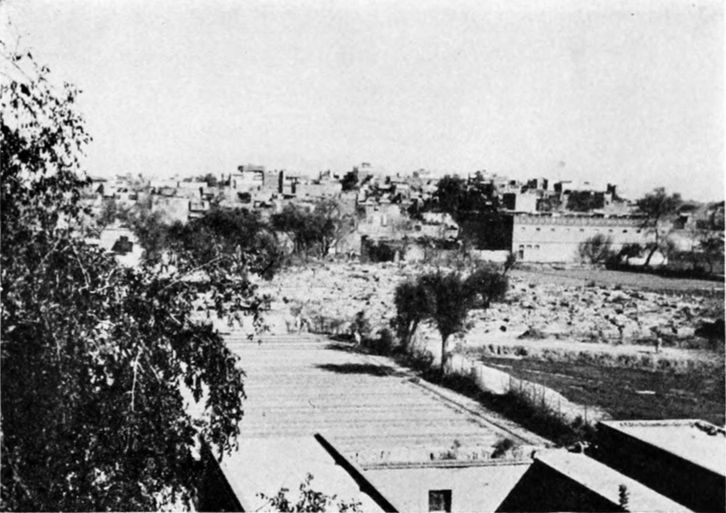
View of Peshawar.
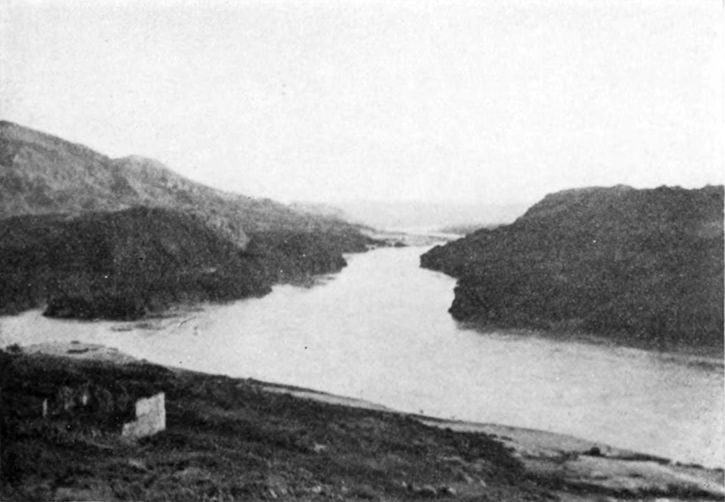
The Indus near Peshawar.
We saw the pottery factory, the wax-cloth workers, the coppersmiths’ bazaar, and the crowds, the fascinating crowds where Central Asia meets Central India, where Bokhari and Madrassi, city boy and Buddhist priest jostle and mingle and stare at the well-stocked shops. There is no place in the world quite like Peshawar, yet its bazaars are not as good as those of Istambul, or Damascus, or Baghdad, and there is not a single distinguished building.
It is the people who make the city. Peshawar is a meeting-ground for the travellers of all the East: the sons of Reuben who camp here are all unstable as water and do not remain: they are citizens today, and perhaps looting the bazaar tomorrow. See them as they pass—gawky peasants, grave greybeards, gay lads from the uplands of Tirah who have left their villages to taste the delights of charas and civilization, the sophisticated youth of the plains, who saunter through the city, little finger linked in little finger, with roses behind their ears, brigands from the uplands of Afridiland, green-turbaned Mullahs, with swart beards and moustaches clipped over the centre of their lips, waxy-faced Hindus, big, verminous Powindahs, who swagger and stink, wandering fakirs, merchants and hemp-smokers, story-tellers and spies, soldiers on leave, ladies shopping, camel-men, dwarfs, clowns, beggars, thieves, rose-sellers, quail-sellers, and purveyors of charas.
The latter is an important class, for the Peshawari has the hemp habit rather badly. Charas is a drug somewhat similar to hashish, but less powerful, and has the clean smell of herbs when found pure, in frontier villages. It is obtained by crushing the leaves of the Cannabis indica, a shrub flourishing in certain parts of Afghanistan. Bhang is the same drug, in liquid form, mixed with milk and sugar.
Whether taken as a drink or smoked in a hubble-bubble, the effect is much the same: if consumed by the inexperienced the effect is a slight giddiness, dreaminess, and an inordinate appetite; but to the regular charasi, that is, the addict, the drug brings bliss for a year, or perhaps two years, during which he is daily transported to gardens of enchantment, where he drinks a paradisial wine which never makes him sick, while maidens of a fadeless beauty dance before him with ruby-braceleted feet. But eventually, instead of Heaven, he finds Hell before him. In the words of the Holy Koran, when the cup is brought to him: “He shall sup it, and scarce swallow it for loathing, and Death shall assail him on every side, but he shall not die, and before him shall be a grievous torment.”
Bhang produces a most unpleasing, red-eyed form of intoxication, and has none of the brightening effects of wine. It is the murderer’s drink. . . .
But it would be unfair to describe Peshawar as a haunt of dope-fiends. It is certainly a wicked place, full of savagery, strange intoxications, murders, gambling dens, and the devilry that gets into men’s blood in certain latitudes; but this is because it caters for all sorts and conditions of people. Industries flourish in this pleasure city, its streets are cleaner than most in India, and the shops are excellent. The Pathan is a lavish shopper and will cheerfully spend a month’s earnings on a velvet waistcoat, or an ornament for his light of love.
Fighting quails are seen everywhere at this time of year. Twenty to thirty pounds is paid for a single bird of striking valour. A fight lasts five or six minutes, and the wager may be any sum from a few pence to fifty pounds. Whatever the amount, it is generally more than the owner can afford, for the Pathan, like all the Ben-i-Israel, is a gambler born.
In addition to fighting quails and fine clothes, the Peshawari is devoted to children and flowers. In every street you will see a man with a tray of roses selling them to passers-by, to carry in their hand, to twine them in their hair, or put behind their ear. Children are worshipped. If the Merciful has blessed the Pathan with a son, you will see him carried shoulder-high by the proud parent, dressed in lawn or velvet, with a comic tinselled cap. When the baby can walk, he goes out hand-in-hand with his father, full of dignity, yet as naughty as a Nordic child. Already he is inclined to scream, and sit down suddenly, and claw at things, instead of being born good, like the babies of the south. Girl-children are well looked after, and much petted. When they are eighteen or nineteen years old they bring from £50 to £100 in marriage.
Many elaborate hold-ups have occurred in the city. One of the most famous was that of Multan, the Afridi Robin Hood, who used to loot rich Hindus and make presents to the Moslem poor. Within the city walls there is a caravanserai notorious for its dancing-boys. One evening, a band of musicians came here, followed by a party of four men, carrying a sick man in a litter. A large number of spectators had collected to see the dancing, and amongst them were some men of the tribe of Multan; but there was nothing unusual in this, for the serai is crowded with “tough” characters every night.
The bearers laid the sick man down, uncurtained the litter, threw off a quilt, and disclosed not an invalid, but forty rifles, which were instantly distributed to forty thieves amongst the spectators. Multan was on the war-path.
In the confusion, the police were soon overpowered, for they were not prepared for an attack by ruthless men at such close quarters. The main part of the bandits made for the centre of the city, where the goldsmiths and bankers live, while another group secured their line of retreat. Within half an hour Multan had secured ornaments and bullion worth about £25,000 and was fighting a rear-guard action to his hills.
Troops were turned out, but Multan had the advantage of surprise, and was able to convey his booty home. Years afterwards he met his death in a fight with the police, but he was not caught alive. Before he died, of eleven wounds, he had killed four men and wounded two British officers. To this day his memory remains bright in the fiery thought of the boyhood of Peshawar.
All this is very shocking, but I love this North-West, and not for its vices, or its violence. Nor do I love it for its gorgeous spring and autumn climate, nor because the land can be turned from a desert into a garden, nor for its circle of grand gaunt mountains, with their subtle shades of green and blue, nor even because the Pathan is more English than other Indians. (He is not, really: he is Semitic.) It is because I am at the top of a teeming peninsula, and at the mouth of the main pass to Kabul, Samarkand, and Khiva. One feels here that one is at the edge of big possibilities: at the gate which has seen much history made, and may see more.
There are many hidden arms in this country, and much talk of whether the British intend to govern or go. “How long will those southern people,” I was asked, “dressed like women, and talking like women, be allowed to think themselves masters of the country? What the politicians want is bayonets in Peshawar, and dhoties in Delhi.”[77]
My friend went on to speak of the Pakistan Plan, which would divide India into two parts, with the Aravalli Hills and the River Jumna as the boundary between them, in order to unite all the Moslems of North India, from Kabul to Delhi, into one kingdom, worshipping one God, under the suzerainty of Great Britain. This idea has been discussed for a quarter of a century, and has lately come to the fore again, not, perhaps, as an immediate goal, but in preparation for what might happen under a weak Central Government. Or in preparation for what may happen if there is a general upheaval in Islamic countries. Such a movement is in the air. Whatever happens, the Punjabi and the Pathan will never consent to being ruled by Hindus; but the existence of 4,300,000 Sikhs in their territory, makes the idea of Pakistan impossible, unless they can come to some arrangement with the Brethren of the Khalsa.
Nowadays, however, North Indians are determined to meet the babus on their own ground. They have discovered or at any rate they have been induced to prove upon their children, that education is of practical value in the struggle for existence. Even the modern machine gun demands a literate manipulator!
Islamia College is three miles out of Peshawar, on the Jamrud road. Seventeen centuries ago, the site was occupied by Buddhist monks. Today the casket which contained the relics of Lord Buddha is in Peshawar Museum, where the Legislative Council sits; but a new centre of Islamic culture has arisen on the ancient ruins.
I lunched with Mr. R. L. Holdsworth, the famous mountaineer, who is Principal of Islamia, and he kindly asked six of the undergraduates to meet me. One of them was President of the Khyber Union, the College Debating Society, another the son of an old friend, with faintly embarrassing reminiscences of my boyhood. We walked and talked together far into the afternoon.
I cannot exactly describe the difference between these lads and others I have met at other Universities, but it was roughly a je m’en fichisme about them, an air of good fellowship and fortitude. . . . The climate, I suppose, had made them what they were, and the influence of the Khyber. Islamia is only six miles from the entrance to the pass. Peshawar is an armed camp, surrounded by blockhouses and barbed wire, but its chief College stands in the open, entirely without material defences—two hundred and fifty acres of playing-fields and halls and hostels—with the bloodthirsty tide of the Frontier lapping always round its boundaries. During twenty years, no year has passed, and few months, without raids and alarms. The students have worked amidst the chatter of Lewis guns, the rumble of armoured cars, the glare of burning villages, yet never once has their Alma Mater been touched by the hand of war. “It is protected by an invisible wall, the wall of sentiment. The Khyber Afridis look upon it as their College, and hold it sacrosanct.”
One of these days, I think the Frontier tribes will use Islamia as their base for new and better operations. Pathans have the congenital ability to be the Scots of India: their brains have not been befogged by a too-ardent sun, nor have their bodies been sapped by hot humidity: given mental discipline, they will make intellectual and industrial raids into British India. Romance need not come by camel caravan: it may come down the Grand Trunk Road in cars, with typewriters and slide-rules.
The founder of Islamia College was that great man Sir George Roos-Keppel; and his colleague in the venture, and constant friend, Nawab Sahibzada Sir Abdul Quayyum Khan, is fortunately still living, and is at present the Minister for the North-West Frontier Province. He does not look a day older than he did when he examined me for the Higher Standard Pushtu nearly thirty years ago!
“It is the method rather than the principles of ‘the Frontier Gandhi’ and his Servants of God which I despise,” he told me. “I want freedom for my country as much as anyone, but I know that it can come only through the British. But if I thought otherwise, I still would not recommend our boys to lie down before the threat of force. Fancy lying down in front of your soldiers! By teaching our youth such unmitigated nonsense Abdul Ghaffar Khan might have lowered the vitality and self-confidence of the Pathan. Luckily he didn’t succeed. Well, he’s paid the penalty. Let us hope that he will be a wiser man when he comes out of prison this summer. . . . The Reforms will work well enough here. We are accustomed to debate in this country. Our problem is to give employment to tribes who used to live by loot. At present some of them are earning a good living by building roads[78] which will open up their country for them. We have started a marble quarry in the Mullaghori Hills near the Khyber, and already we have orders for £3500’s worth of marble. We are exploring other possibilities. The radio? Yes, it is doing excellent work. All round Peshawar the people flock in to listen.”
I went out one evening to see this broadcasting in action. The fruit trees were in bloom. Every bungalow in the cantonments was gay with daffodils, sweet peas, antirrhinums, phlox, cannas. Beyond Islamia College we turned left and made a wide circle, west and south, visiting village after village, where sat groups of armed men, and boys, and greybeards, listening to this new invention installed by a benevolent and sometimes surprising Government. A famous nautch-girl of Peshawar was singing: presently there would be the news and fat stock prices.
Already some of the villagers were critical listeners. In one place we heard the old complaint: “Too much talk: we want more light music.” In another, the time was wrong. “Six o’clock is too late to begin: our houses are scattered: how can our women go home in the dark?” And again: “They have a programme lasting all day in England: why can’t we have the same?”
“I wish I could give them better programmes,” said Mahomed Aslam Khan Khuttuck, the capable young publicity officer, “but I’ve no money to pay the artists. You can imagine, it isn’t easy to provide even one hour’s news and amusement. . . . Now the trans-border tribes are wanting radio: we’ve had an application from Tirah, and we hope to put a set there.”
“What about Russian propaganda?”
“You know us, sahib. Tashkent can talk all day and night: we can hold our own at that game with any people in the world.”
Our last stop was Pabbi. One night last year, a talk against murder was given by that popular and much-respected officer, Sir George Cunningham. The lads of Pabbi sat listening, with their rifles between their knees, profoundly impressed. But one of the audience was talkative and inclined to argue.
“How can you avoid killing if you have a blood-feud?”
“Shut up!” said his neighbour.
“But if a man shoots my brother?”
“You should call the police.”
“Then my face would be blackened.”
“Nonsense; the sahib says there is no reason why we should go on killing each other. It is against religion and common sense.”
“But if a man shoots my brother? . . .”
“Will you shut up?”
“I won’t!”
“You will!”
There was a sudden, loud explosion, and one listener the less to Sir George’s good advice.
“Are you awaiting a prophet, a vali, an avatar to free the country for you? Will they perform some miracle? Let me tell you plainly that such a thing has never happened. Why do you not use the gun which you use for killing your brother for killing the foreigner?” Thus wrote the servants of God to the youth of the Frontier in 1930. But all the time there were prophets and valis to show them a better way to freedom and prosperity.
The Vali of Swat, for instance. A friend drove me up a smiling valley to his capital of Saidu Sharif, which is eighty miles north of the British frontier at Malakand.
We photographed enchanting prospects of silver river, green corn, snow-capped mountains. The people we met were gay and carefree. (Why is it that civilization so often brings on that worried look?) We encountered a marriage party, with banners and drummers, and two nautch-girls pirouetting in the road, so that we had to stop the car. They danced for us and sang. One of the girls was strikingly tall and handsome: a breastplate of Kabuli rupees covered her firm, athletic bosom, like a cuirass: she seemed Greek, a descendant of the soldiers of Alexander who passed this way, or some bacchante strayed from the far Ionian Sea.
A party of Kohistanis, in moccasins and Gilgit caps, with matted hair and wild eyes, regarded us with amazement, for we were probably the first Englishmen they had ever seen. My friend, who remembered his Pushtu better than I, explained that we wanted to take their picture. At first they were reluctant, but their shyness vanished when we offered them a rupee. Afterwards, as we were driving off, one of them held out his brawny hand. I shall never forget his look of surprise when I waved him away, thinking that he wanted more baksheesh.
“Musafir ye!” he said sadly, as we left. It was only several miles further on that I realized his meaning: “You are travellers, like ourselves!” He had wanted to shake hands; and the shame of my refusal still makes me hot.
But the incident was forgotten in the excitement of Saidu Sharif. We were met by the Vali-i-Ahud (the heir-apparent) who speaks, dresses, and, as far as I can judge, thinks like an Englishman: a reserved Englishman, who is keen on sport and diffident about discussing his tastes and abilities. It was only after I had questioned him closely that I discovered that he had himself designed the guest house at Saidu Sharif, with its marble bathrooms, hot and cold water, electric light, and all kinds of conveniences. Writing this in England, I see how difficult it is to convey the profound impression that a “convenience” makes upon a traveller in regions where sanitary plumbing is unknown! . . . Save for some few gubernatorial houses where I had been a guest, I had found no such accommodation in the length and breadth of India.
The Vali is a tall, white-bearded man of about sixty, with a fine look of health in his ruddy cheeks and erect bearing. His eyes and forehead are those of the religious leader (which he is) and the set of his jaw is that of a fighter. He leads a very active life. Every Thursday he and his son go out shooting on the mountains. Friday is the Moslem day of prayer. The rest of the week is devoted to work. He moves about freely amongst his people, by whom he is both loved and feared. His movements are rapid. My first meeting with him was on the road: he was in the front seat of a big touring car, accompanied by six armed men. Although he neither reads nor writes, he keeps in touch with the latest developments in flying, electricity, radio, motors. He has flown all over his territory, and beyond it; and every part of it is already linked up by telephone.
Had he lived in British India, he would still have been a distinguished figure, but kismet gave him a kingly part to play, for he is the grandson of the great Akhund of Swat, who died in 1877. There were rival claimants to the throne, and the present Vali led a precarious childhood. Eventually, however, his relations died in various convenient ways, or abandoned their claims. . . . When he came to power, he quickly brought order to a country which had been rent by fifty years of faction. He built eighty-five forts in the valleys of Swat and Buner, garrisoned them with 2000 men, raised another 8000 for internal security, sent his son to be educated at Islamia College, invited a survey party to map his country anew, made roads, laid telephone lines, set up an electric installation at his capital, and a school, a hospital, a guest house. In short, he took the best that the West could give him, and used it to improve the material conditions of his country.
Can India . . .? No, the answer is obvious. India can manage her own affairs, given the right men in the right place.
The voice of mullah calls me from bed. Dawn is rising over the Himalayas. Above wreaths and pennons of cloud the great mountains sweep up and up, and stretch back and back to the white splendour of the snows: they are remote, serene, of a blinding beauty, symbols of immortality in the sky of spring, gods incarnate looking down on a fretful earth.
The breeze is keen and fresh from the northern snows. Soldiers have spread their prayer-mats on the lawn, the very smart soldiers of the Vali’s bodyguard.
How far were the conquests of Islam and the glories of Mogul and Moorish architecture due to the benefits of a religion which demands of its followers bending and stretching exercises five times a day? To abstinence from intoxicants? To a yearly fast of four weeks? It is no disrespect to the pure monotheism of Islam to suggest that its creed has also some physical advantages. Would that our Churches would concern themselves with the body as well as the spirit of man!
From Malakand to Malaya men are praising Allah, the Merciful and Mighty, while away to the south the Hindus are greeting the risen sun, symbol of the Lord of All Worlds. Throughout this vast, devout country millions are calling on God, under many names and forms; more millions than in any other land. Surely some blessing will come in answer to all this prayer?
Is India at the beginning of a renaissance? Here, in the stimulating air of dawn, everything seems possible. For the first time within the memory of the men of these valleys, they have been free to till their fields in peace, and to keep the money they earn. That is the end of the average man’s desire; not a franchise, nor any high-sounding emancipation, but freedom to pursue his vocation, and to reap what he has sown. And what one man has done amongst turbulent tribes, others could do on a larger scale amongst a more pacific people.
In this book I have not disguised my preference for men of action over the masters of high debate. On the other hand, although I do not share the somewhat complacent view that five years of discussion and compromise have improved the India Act of 1935, I have come to see that it was the best solution that could have been reached in existing circumstances. For good or evil, we have encouraged the educated classes to believe in Parliamentary Government, and now we must make the best of it.
I do not myself believe that our Parliamentary system is right for India, or for any hot, sunny climate; but there is no immediate alternative. Ninety-nine out of every hundred Indians agree with me in their hearts, though many of them are compelled, in order to obtain votes, to pay lip-service to the elegant but antiquated doctrines of Liberal Democracy. Eventually, in her own way and in her own time, India will return to the dictatorship of saints and sages.
Whether the Reforms will work in the Provinces depends largely on the result of the elections this winter. Pandit Jawaharlal Nehru has made a bold and honest statement of his belief in Communism. In any other country he would have immediately lost the support of the merchants who finance his party, but this may not happen in India, for her middle classes have a world-renouncing tendency; some of them may commit political suicide, and others will go through the motions of doing so, in the mistaken hope that the Pandit does not really mean what he says.
The situation will become serious only if Congress captures the Legislatures, proclaims civil disobedience, and (especially in the United Provinces) unites the peasants against the landlords. On the other hand, if wiser councils prevail, or wiser councillors are elected, the moderate men in the Legislatures may be able to show the value of co-operation in practice, and may be able to establish conditions of such comparative progress and reform that the extremists will be compelled to abandon their wrecking tactics, and become a normal and useful Opposition.
That is what we must hope; that Indians will concentrate on the better government of India rather than on pursuing the shadow of complete Swaraj. For shadow it is. India can be a nation only through a union of all races, including the British. She is too big and polyglot to integrate fully; moreover she has at least three religions that have been bitterly hostile to one another for centuries, and the first effect of the Reforms has been to accentuate rather than to diminish these differences. The North is a powder-magazine of potential trouble. The South has its own communal difficulties. These problems have their roots in history: they have nothing to do with the British, whose troops dislike extremely the tasks which they have continually to undertake in aid of civil power. No one community, it is worth repeating, can obtain complete control of India’s destinies; neither Hindus, nor Moslems, nor British.
Nor can the Indian Princes be eliminated, as the Congress politicians would like. Congress politicians have had little experience of government (through no fault of their own), whereas the Princes have had a great deal. Some of them are more successful than others, notably the Rulers of Hyderabad, Mysore, Travancore, Baroda, and Bikaner. We British have nothing to teach these States as regards social reform, integrity, or justice. Their local administration is better than ours, because ours has been so democratized that it is now largely in the hands of venal and inexperienced people, whereas theirs is still fatherly and fair-minded.
Local government by democracy has been a crashing failure everywhere, and corruption in urban areas is appalling. In many places it has been necessary to supersede the local bodies by Government officials in order to bring some honesty and efficiency to the cities they are supposed to administer.
In these circumstances it is not surprising that the Princes are hesitating before entering a Federation based on an immense extension of the suffrage to an ill-informed electorate. They are asked to hold the rickety baby of democracy, which has been rejected by half the civilized world, and is squirming in the arms of the other half, in order to please Left Wing opinion in Great Britain. There is really no other reason why they should barter their birthright for a mess of political chicanery. The pretence that the Reforms will benefit the people will not hold water for a moment in India. The Princes have seen the creeping paralysis of civic function which has overtaken three-quarters of the elected municipalities of British India—half of them are actually bankrupt—and they know very well the atmosphere of unreality and the growing communal tension which prevails in the Provincial and Federal Legislatures: they will therefore think long and carefully before entangling themselves and their subjects in the spider’s web of “progressive” policies which promise a great deal on paper and produce very little in practice for the poor man and the peasant.
The generation of educated men who could contrast the benefits of British rule with the previously prevailing chaos in India has died out. To convince the new generation of realities, the quickest method would be to withdraw the British Army. Such a move might benefit the country to the extent of getting rid of some of the money-lenders and lawyers who batten on our law of property, but unfortunately several million innocent people would also suffer. We must remain, not as conquerors, but as friends engaged upon a joint task, a common and continuing adventure, fraught with tremendous consequences for all mankind.
Our transplanted Westminsters are houses of cards, but there are real services which we can and must continue to render in India, to ensure her peace and steady progress. One day she is destined to be again a leader of civilization in many forms of art and philosophy. She has a noble heritage of literature, a vast population, some of the best of living brains. There is no limit to the light which may be shed by the Star of India, provided that it is undimmed by the storms of internal faction.
Impressions are still crowding into memory and accusing me of stopping too often by the wayside, to write of my own moods, instead of describing the pageant before my eyes. The winter mornings, the smell of bazaars, the Himalayas, the Ganges, philosophers in loin-cloths, princesses in bare feet, the great, generous heart of the people, these things endure, whatever King may reign in Delhi.
It is true that I have missed much, and that I have been inclined to neglect the larger issues for the sake of details which seemed to me significant; but I can’t help it. I have written of what I saw. . . . But no! That is a half-truth: I have written of the illusions that passed before my eyes in this land of splendour and squalor, cold practicality and radiant romance. And I take refuge in the opinion of the inimitable Kai Lung, who observed that a dish of herbs gathered with his own hand was preferable to the most sumptuous puppy-pie prepared by others for the mandarin’s table.
|
Dhoti, a Hindu nether garment draped about the legs. My friend meant that the Frontier was to be guarded by Pathans, while Hindus governed in Delhi. |
|
They cost £3000 a mile. |
Standing in the great gateway of the Taj, my heart beats high with anxiety as well as expectancy. If her beauty fails me now that I have grown older, my world will be very empty.
But no! The Taj is like an old friend, grown more beautiful, and more steadfast with the passing of years. Framed in the dark doorway, and mirrored in the dark water, she seems the very spirit of purity and peace; all that man, in his most inspired moments, has ever thought of the woman he loves. Here the sun of the Moguls reached its noonday splendour.
The river has shrunken, as I have myself, since I met Sivanand there, twenty-four years ago, but the trees in the garden seem no bigger than they were, and the dear old mullahs who guard the shrine, descendants of the mullahs of the Moguls, have apparently grown no older. One of them remembers me. Up the steps I go to the tomb above the tomb where Mumtaz and her lover lie.
On the cenotaph is written:
The illustrious sepulchre of Arjumand Banu Begam, called Mumtaz Mahal. God is everlasting. God is sufficient. God is He beside whom there is no God. He knoweth what is concealed and what is manifest. He is merciful and compassionate. Nearer unto God are those who say: “Our Lord is God.”
The illustrious sepulchre of His Exalted Majesty, the second Lord of the Conjunction of Jupiter and Venus, Shahjehan, the Valiant King, whose dwelling is in the starry heaven. He travelled from this transitory world to the world of eternity on the twenty-eighth night of the month of Rahab, in the year 1076 of the Hegira. (February the 1st, a.d. 1666.)
My friend the mullah shows me the few precious stones left on the tomb of Mumtaz, an emerald and a sapphire gleaming palely in the filtered light; then he chants the Hundred Beautiful Names of God. They echo from the roof, those resonant Arabic words, and mingle with Lord Curzon’s lovely filigree lamp, which hangs from the centre of the vault, and merge into my very being. Perhaps I am too sensitive to symbolism, but in this dreary Kali Yuga, when everything must be what it seems to be to machine-made minds, places like these are refuges: it is good to dream of the future foreshadowed by this light and sound. Here is God, and a virile voice to proclaim Him, and tradition, and the glory of a great age, and England, the guardian, bringing light.
The mullah gives me a rose-leaf out of a sandalwood box, while his voice is still ringing in my ears.
I have paced the river terrace, the battlements, the mosque and its opposite serai: I have seen the Taj from all sides and angles under the full of the April moon. Now I have come back to the entrance, and have climbed into the Musicians’ Gallery above it, where I shall pass the night.
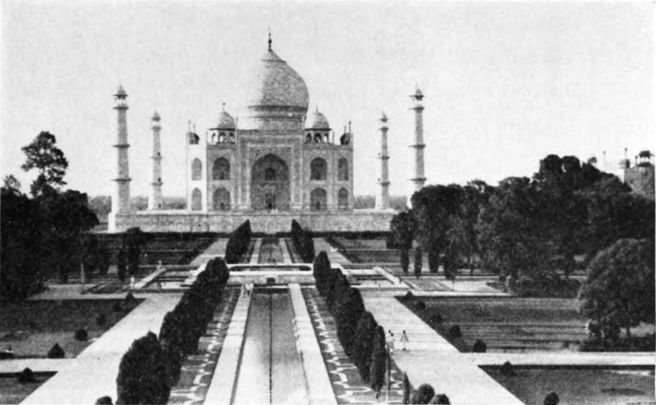
The Taj Mahal at Agra.
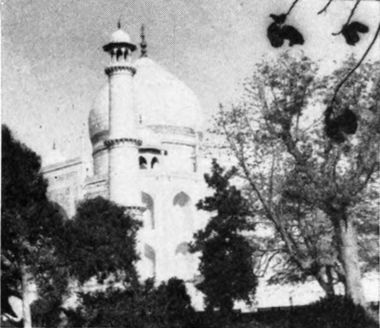
Side View of the Taj Mahal.
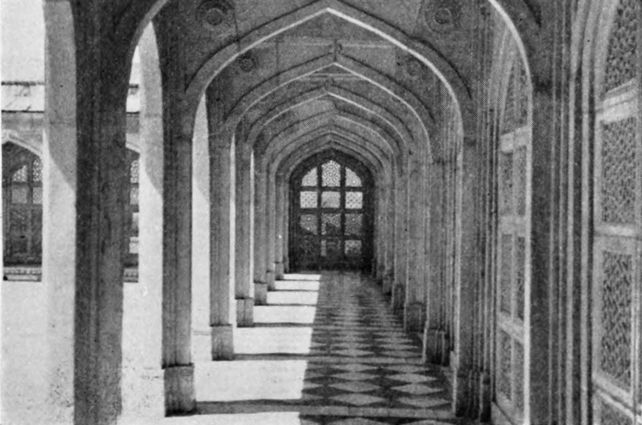
Part of Akbar’s Tomb at Agra.
It is quiet in this aerie, watching the play of moonlight on the marbles of the Taj, lulled by her exquisite outline, resting, contented, contemptuous of my dusty, excited little travels and inquiries in the face of all this cool, white calm. Tomorrow, the old round begins again, at a new chapter, yes, but the same old round: I shall be on my way home, in the train to Bombay, working at an article to catch the airmail, fans buzzing, thermometer over the hundred-and-ten mark. Tomorrow Naim Shah will be parking his bicycle at the Judicial Commissioner’s office in Peshawar. The Lord of the World at Puri will be having his teeth washed. The sun will glint on the surges that cover Cape Comorin, on the spears of pigstickers in Meerut and Bareilly, on the poor children of Umarkhadi and on the rich ones at Dehra Dun, and on sweepers raising the dust of forgotten Delhis. The Taj will be full of trippers.
I may not be here again for years. Or ever. No man knows his time. Beauty is with me now, and shall remain, for it is self-perpetuating: the cheek fades, the marble crumbles, but the divine spark lives on, passing from heart to heart and from mind to mind.
According to Yogic tradition, a fully-illumined nature takes six, twelve, or twenty-four years to develop. I am far, very far from enlightenment, but it happens to be just twenty-four years since my adventures in consciousness began, by the banks of the Jumna, in 1912. That was a turning point in my life, the sharpest turn. Since then the Jumna has flowed onwards for nearly a quarter of a century, and I have wandered far about the world. Now Karma has brought the wheel full circle. . . . All round me I feel the presence of the men who built this place. Perhaps Shahjehan used to climb up here, to see his work in progress. Certainly his overseers must have often come. Someone has scratched on the sandstone a game like naughts and crosses. All over the Taj the people of more leisurely days played games; and the masons have scribbled their signatures:

Masons’ signatures
as well as lotuses, fishes, and one elephant, portrayed on a paving-stone of the gallery of the east wall of the garden.
Why one elephant, I wonder? Would that I could see the builders who spread this mortar, and laid this marble. I feel them round me, invisible only by a trick of time. Their world was once mine, but that decade of the seventeenth century has vanished, like the flash of a comet’s tail, into the night of history.
Dark trees line the Jumna. Not a breath stirs, and the jubilant chorus of an English dawn has no counterpart here. Not that it is dawn yet, but her slender fingers will soon appear, down-river, to light those terrible, barren, burning plains with an instant or two of tenderness.
Listening long, I hear the drum-beats of a nautch, somewhere in the suburbs behind me (tired they must be, having danced all night), and now a jackal howls: one jackal across the melon-beds, and now another, and another, until a pack of them take up the cry, beyond the sleeping city, far away to the tomb where the father of Mumtaz lies.
From this vantage point, I do not see the Taj at her best, but it is the most intimate view, revealing the artifice of her builder in raising her on a high plinth. I like her thus, not so perfect that she is unapproachable: a cold, lovely creature, brooding here in the midst of desolation, and awaiting the warmth of human love.
What will happen to her in this era of bloodshed and convulsions, now marching to its climax? Astrologers can see up to the year 2000 of our reckoning. Then the Holy Spirit of Christendom, the Mahdi of the Moslems, the Messiah of the Jews, Lord Maitreya of the Buddhists, and Kalki of the Hindus will contest the mastery of mankind amidst apocalyptic thunders. What shall we save of beauty from the wreck?
To that question India has an answer, many answers. Some of them I have given in this book. The Life-Force is driving us inwards on ourselves, to man’s last and greatest adventure, which is the exploration of the borderland between Being and Not-Being. If we can reach that region, by learning to know ourselves and the latent powers within us, we can save the world and establish a thousand years of peace. If not . . . the Life-Force will find some other way.
To whom are these thoughts occurring? My brain registers them, but does not initiate them. What is it, or Who, that uses me and gives me delight before which there is no division, in the Taj at dawn, in the teaching of the Chidambaram Swami, in my work, in all the little pageant of my life? I know, but cannot find the words, for “true love’s as tongueless as a crocodile.”
Like a rose unfolding, the dome of the Taj takes on the tints of dawn. Up there, not in the visible marble, but in the spirit which made and informs it, as blood sustains the body, I see my soul reflected.
Christ will forgive me that I find His peace here, rather than in His Churches. My heart is not troubled, for in His Father’s House there are many mansions.
What is the use of labels at the journey’s end? My soul goes out to the Taj without introspective doubts. There is so much that we do not know, my soul and I, and we shall be together so short a time that it is profitless to consider problems that have puzzled the sages for centuries. Others may discuss whether we are twain or single, realities or cosmic caprices: I have reached an abiding place. Names and forms are nothing, methods melt away: in this radiance the ripples of my mind are still.
The mullah’s rose-leaf grows to a rose in my hand, and the rose to an English garden, far from these scenes of magnificence and misery.
O mystic rose, give success, show the way, give power! Give success not to this unstable atom of a moment’s space, but to him who would praise the Lord as you have done, through joy in living! Show him the way to find the tongue of speech of the unspoken, and give him the power to write fairly! Mystic rose, transient symbol of the Eternal, may I live as you have done, and repay a little of my debt to India!
Ahimsa: harmlessness.
Ankus: elephant goad.
Asana: a position or seat in Yoga.
Ashram: a hermitage.
Atma: spirit or soul.
Babu: a clerk.
Baksheesh: tip, reward, largesse.
Bagh: a garden or copse.
Bania: a grain merchant.
Bhairagi: a naked ascetic.
Bhangi: literally an eater of bhang, a term employed for sweepers.
Bhastrika Pranayam: cleansing breath exercise.
Bhibuti: a small piece of sacred clay.
Bodhisatva: potential Buddha.
Bo-tree: “the tree of knowledge” under which Buddha sat at Buddh-Gaya, when he achieved enlightenment.
Brahm: the Primal Cause, the Unknown God.
Brahma: the Creator, to be distinguished from the above. See Vishnu and Siva.
Brahmacharin: a celibate ascetic.
Brahmin: the first, or priestly, class in Hinduism.
Buddha: Siddharta Gautama of the Sakhya clan, born in the Nepalese Terai about 563 b.c. Buddha means “the Enlightened One.”
Bundobust: arrangements.
Caravanserai: rest-house for travellers.
Caste: the four main castes in Hinduism are Brahmins, or priests, Kshatriyas, or warriors, Vaishnavas, or merchants, and Sudras, or labourers.
Chaprassi: messenger.
Chapatti: flat cake of unleavened bread.
Cheela: disciple.
Dacoity: house-breaking by an armed gang.
Dâk jungle: (Butea frondosa) a jungle of low bushy trees.
Dastur: custom.
Dhoti: nether garment worn by Hindus.
Ganesh: Hindu god of luck, usually depicted with an elephant’s trunk and a mouse at his feet.
Gurdwara: Sikh shrine.
Guru: Hindu spiritual preceptor or teacher.
Hatha Yoga: the mystic path of physical exercise.
Hathi: an elephant.
Hindu: the 239,193,635 inhabitants of India who profess a system of worship founded on the ancient Aryan scriptures known as the Vedas. Hinduism is not exactly a religion, but a system of various castes and faiths.
Howdah: the seat fixed on an elephant’s back. It usually accommodates two in front and two behind. Less luxurious elephant riders do not use the heavy howdah, but a pad, or mattress. The mahout sits below the howdah, on the elephant’s neck.
Ishta-devata: personal deity.
Jheel: a lake.
Ji: honorific suffix.
Jink: used of the sudden swerve or turn of a wild boar: it is a Scots word, meaning to move nimbly.
Jiva: the soul, or life-principle.
Jnana Yoga: the mystic path of wisdom.
Jukias: a hill tribe of the Himalayas.
Kali Yuga: the present epoch of the world, according to the Hindus.
Karma-Yoga: the mystic path of action.
Kismet: fate, destiny.
Kshatriya: the second or warrior caste in Hinduism.
Kumbakha: retention of the breath.
Lakshmi: goddess of wealth and beauty, the consort of Vishnu.
Lingam: phallic symbol, sacred to Siva.
Lotah: a pot or other receptacle.
Mahadeo: a name for Siva, the “Great God.”
Mahant: guardian of a Hindu or Sikh shrine.
Mahaprasad: holy food.
Mahout: elephant driver.
Maidan: plain.
Mantra: a word or sentence used as an invocation.
Moslem: there are 77,677,545 inhabitants of India who follow the faith of Mahomed, the Prophet of Arabia (a.d. 570-632)
Mouni-swami: a silent sage.
Mudra: a gesture, exercise, or mode in dancing.
Mullah: a leader of prayer in a mosque.
Mysticism: an attempt to attain direct communion with the Divine: the practice of the Presence of God.
Nim tree: (Azadirachta indica) a sweet-scented tree giving a pleasant shade, whose leaves and bark are much used for medicine.
Nirvana: cessation of sentient existence.
Nullah: a dry water-course.
Pariahs: the untouchables or outcastes of Hinduism.
Pi-dog: village dog.
Prajapati: a wife of Siva.
Prana: the vital air.
Pranayam: Hindu method of breath-control.
Puraka: inspiration of the breath.
Ram Ram: Hindu greeting.
Rechaka: expiration of the breath.
Rishi: Hindu sage.
Saddhu: a celibate disciple of Yoga.
Sahib: a master.
Salaam: Moslem salutation meaning “Peace.”
Sal tree: (Shorea robusta) a thorny tree.
Samadhi: a trance-state: the bliss or spiritual communion of the mystic.
Sangam: meeting, conflux.
Saraswati: goddess of wisdom.
Sari: silk or cotton cloth, draped over the head and shoulders, which is the chief garment of Hindu women.
Sati: the immolation of a widow upon the funeral pyre of her husband.
Shakti: power: the feminine aspect of a male god.
Shanti: peace.
Sheikh: a chief or lord among the Moslems, but also now used as a surname.
Shikari: hunter or huntsman.
Shroff: a Hindu banker or money-lender.
Siddhi: esoteric power or attainments.
Sikh: 4,335,771 inhabitants of India, whose ancestors left Hinduism to follow a religion founded by Guru Nanak and extended by nine other Gurus (1469-1666).
Siva: the Destroying and Reproductive aspect of the Godhead, in the Hindu Trinity. See Brahma and Vishnu.
Solah topee: pith helmet.
Sounder: a family or collection of wild boar.
Sri: a prefix meaning holy, used by Hindus.
Sudra: the fourth main caste in Hinduism.
Swami: a teacher or professor of certain branches of Hinduism.
Twice-Born: a term used to denote Brahmins and Kshatriyas, who are said to have a second birth when invested with the sacred thread of their caste.
Untouchables: the pariahs, or outcastes of Hinduism.
Vedanta: an inquiry into the aim of all knowledge: “the end of vision”: the doctrine of the Self and Not-Self: a metaphysic of intuition.
Vedas: the four most ancient scriptures of the Aryans.
Vishnu: the Preserver of Mankind in the Hindu Trinity. See Brahma and Siva.
Yoga: a discipline or “yoke,” by which the powers of the whole man are developed.
Yogi: a follower of Yoga.
Endpapers
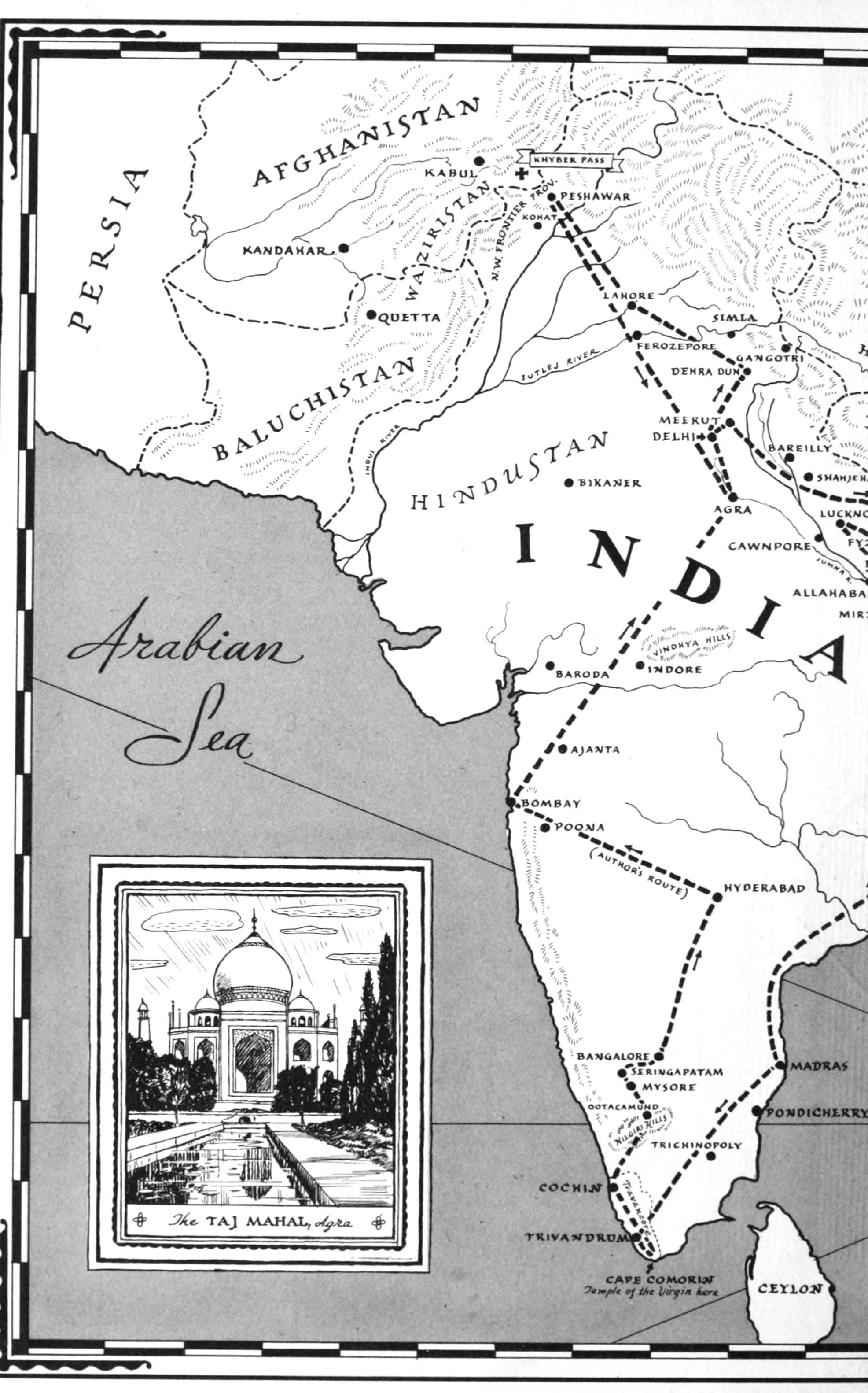
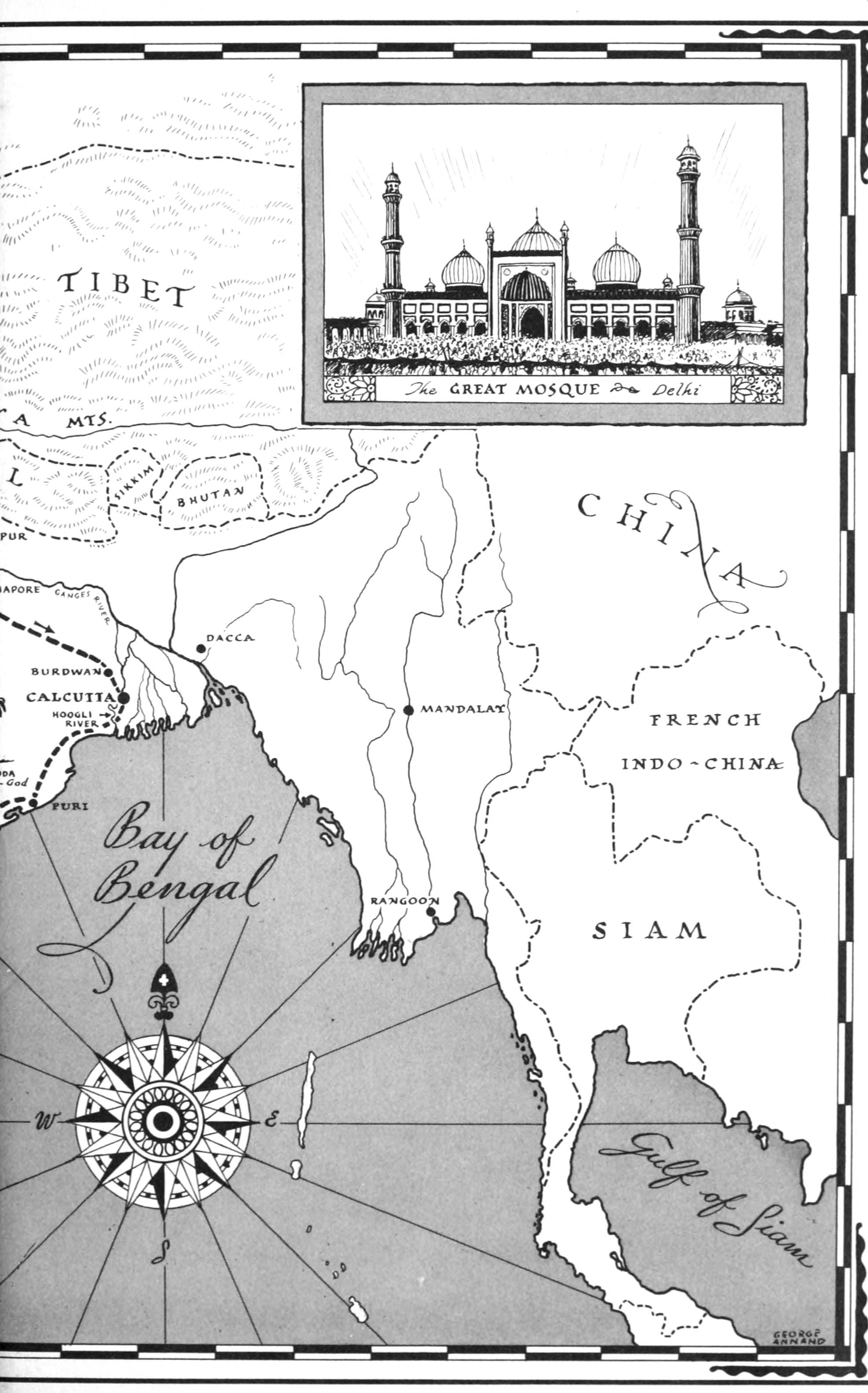
Misspelled words and printer errors have been corrected. Where multiple spellings occur, majority use has been employed.
Punctuation has been maintained except where obvious printer errors occur.
The footnotes have been renumbered sequentially throughout the entire book.
The author’s name was added to the cover image, and that image is placed in the public domain.
In some formats, clicking on the endpapers brings up a high-resolution image.
[The end of Lancer at Large, by Francis Yeats-Brown]