
* A Distributed Proofreaders Canada eBook *
This eBook is made available at no cost and with very few restrictions. These restrictions apply only if (1) you make a change in the eBook (other than alteration for different display devices), or (2) you are making commercial use of the eBook. If either of these conditions applies, please contact a https://www.fadedpage.com administrator before proceeding. Thousands more FREE eBooks are available at https://www.fadedpage.com.
This work is in the Canadian public domain, but may be under copyright in some countries. If you live outside Canada, check your country's copyright laws. IF THE BOOK IS UNDER COPYRIGHT IN YOUR COUNTRY, DO NOT DOWNLOAD OR REDISTRIBUTE THIS FILE.
Title: The Maple Leaf, Vol. 4, No. 1, January 1854
Date of first publication: 1854
Editor: Eleanor Lay (1812-1904)
Date first posted: April 23, 2026
Date last updated: April 23, 2026
Faded Page eBook #20260448
This eBook was produced by: John Routh & the online Distributed Proofreaders Canada team at https://www.pgdpcanada.net
[Written for the Maple Leaf.
 amma”, said
little Annie
Prescott, “you
know how many presents I always
have. I always get one on my birthday,
and every Christmas and New
Year’s I am sure to
have something pretty;
besides a great
many at other
times. I soon get tired of them, and do not care so
much for them, as if I did not have so many.”
amma”, said
little Annie
Prescott, “you
know how many presents I always
have. I always get one on my birthday,
and every Christmas and New
Year’s I am sure to
have something pretty;
besides a great
many at other
times. I soon get tired of them, and do not care so
much for them, as if I did not have so many.”
“That is true, Annie,” said her mother, “but what made you think of it now?”
“Why, mamma, I was going to ask you to let me have the money which that work-box would cost instead of the box, which you promised me for New Year’s.”
“Surely, dear Annie, you have not tired of that rosewood work-box before you have it, and you have wished for it so long!”
“No, mamma, but I do so wish for the money, and if you will let me choose, I would prefer it to the box.”
“But what can you want of the money?”
“If you will take me to walk mamma, I will tell you.”
“Well, Annie, as you have been thoughtful and obedient for the last week, I will grant your request, so go and ask Lucy to put on your things, and I will accompany you.”
Annie was soon ready, and running down to the parlour, waited impatiently for her mother.
“Oh, mamma!” said she, as soon as her mother appeared, “how glad I am that you are going with me.”
“Well, my daughter, I must know where you wish to take me, and what use you can desire to make of that money.”
“Well, mamma, I was at the Sunday School yesterday, you know, and our teacher was late in coming, and the girls were talking about what nice Christmas presents they had, and what they hoped they should have on New Year’s. They all seemed very happy excepting one little girl, not as old as I, who sat by herself at one end of the seat. She looked very sad, and no one said anything to her, but some of the girls looked scornfully at her old clothes, and whispered to each other about her. She was dressed very meanly, in an old thin dress, and she had very poor shoes. She looked so unhappy, that I thought I would speak to her and try to comfort her, so I asked her if she had a pleasant Christmas, and whether she had a nice present. I was sorry as soon as I asked this, for she burst into tears, and told me that she never had one in her life. I tried to comfort her, but just then our teacher came, and I could not talk any more with her. As soon as school was out, I started for home, and saw just before me the same girl. She was running along shivering with cold; I did not overtake her; but I saw which corner she turned and saw her go into an old house, down an alley. I have been thinking about her all day, and I want you to go with me to see her, for I know she must be a good girl, she always behaves so well at Sunday school. I want you to see what she needs, and let me have that money, and get her a New Year’s gift, instead of having the work-box.”
“My dear Annie,” said Mrs. P., “I am glad that you are not selfish, but feel for the sufferings of others; I will go with you to see this little girl, and if she seems worthy, you may do as you wish about giving her the present; I doubt not it will make you far happier, than to have the box yourself, for the Bible says ‘It is more blessed to give than to receive.’ ”
“Thank you, mamma,” said Annie; “and now we are almost there; I saw her go into that cellar door; shall you be afraid to go down there?”
“No, my dear, if poor people live here, surely we may visit them.”
We will now leave Annie and her mother at the door, and take our readers into a dark under-ground room, and introduce them to little Nelly Collins and her sick mother. It is some time before Annie and Mrs. P. arrived. Poor Mrs. Collins is very ill, and Nelly is sitting by her, and talking in a very earnest, sorrowful tone.
“But, dearest mother, it is hard not to envy those who have enough to eat, and plenty of clothes to keep them warm?”
“It may be hard, Nelly,” replied her mother, “but we must try, for our Father in Heaven has told us, that it is wicked to envy.”
“Mamma,” said Nelly, “is it really true that we have a Father in Heaven?”
“My dear child, have I not often told you about the great and good God, who is our Father, who made us, and keeps us alive from day to day?”
“Yes, mamma, but when I get to thinking about his being our Father, it does seem strange, that he should let us suffer so much, when he might, if he is so great and powerful as you say, at once supply all our wants I am sure; my own dear papa, who died so long ago, even before I can remember, but of whom you and sister Mary have told me so much, I am sure he never would have let so much sorrow come upon us, if he could have helped it.”
“My dearest Nelly,” said Mrs. Collins, “you are a very young child, only eight years old, and cannot understand all that is said to you, and Satan has taken advantage of your ignorance, and put these wicked thoughts into your heart. Let me tell you about God, our kind Heavenly Father. He loves us, and cares for us, and though we are very poor and often have nothing to eat, and no fire to keep us warm, still God sends us many blessings, and has promised to take care of us while we live, and that if we love Him, and try to serve Him, by and by he will take us to a beautiful and happy home in Heaven. Ought we not to be willing to live here a little time, even if we have to suffer many things, if we shall then go to live for ever in a glorious bright home in heaven?”
“Yes, mamma, and I always feel so when you talk to me; but when I sit still and think how miserable we are, and how much pain you suffer, and how hard sister Mary has to work, it makes me so unhappy; and to-day, I felt so more than ever, and so I spoke out my thoughts, which I never did before.”
“What makes you feel so more to-day? We have bread in the house, and a kind gentleman has sent us a load of wood; I am sure we ought to be very grateful to God, who has provided these things for us.”
“Well, mamma, I went yesterday to the Sunday school, and before our teacher came, the girls were talking about the fine things they had at Christmas, and what they expected to have for New Year’s gifts. They all had nice new dresses, warm worsted ones, and fine hats and cloaks, and they looked at my old faded cotton dress, and worn out shoes, and moved away from me, as if they thought I would hurt them. Indeed, dearest mamma, I would much rather not go again to the Sunday school, it makes me so unhappy. I thought how I never had a Christmas or New Year’s present in my whole life, and I remembered that my dress, mean as it was, was better than sister Mary’s, and then I felt as if I must cry; but I would not let them see me cry, so I sat still as far from them as I could, and thought many things.”
“Did all the girls look scornfully at you, my poor Nelly?”
“No, not all, mother, for one girl,—she is a new scholar—and the prettiest, and best dressed one in the class, looked as if she pitied me, and came up to me and asked me how I spent my Christmas, and if I had any nice present. I could not keep from crying then, mamma, and when I told her I never had one in all my life, she looked sad enough to cry too, but the teacher came then and she did not say anything more. I have thought a great deal about it yesterday, and to-day, and I hope you are not angry with me for speaking so.”
“No, my dear, I wish you always to speak freely to me; but what are some of the things that you have been thinking of?”
“Well, mamma, I thought how I should love to have a present—a real New Year’s gift; and then I wished that I could buy one for you and sister Mary; and I thought that yours should be a little rose in a pot—because you so love flowers, and cannot go out of this dark room to see them; and sister Mary’s should be a good new dress, and then I wished for a good dinner on New Year’s day, that we might have enough to eat that day—and then—and then I thought of so many things that we need, that I just stopped wishing; and then I remembered how you always called God our Father in Heaven, and thought it strange, if he was our Father, that he let us need so many things, when he could so easily provide for all our wants; and it puzzled me thinking about it, and I thought I would speak to you.”
“I am glad, Nelly, that you did. It is not very strange that these thoughts came into your heart, but you must not let them stay there. God is our Father, and his love is greater than any earthly parent’s can be. He has chosen to make us poor, and to afflict me with sickness; yet I know that he loves me, and that when he sees fit, he will take me home to my Father’s house in heaven. I want my little Nelly to love, and serve her Heavenly Father, that she too may at last be permitted to go to that happy home on high. All these things that you desire would make us very comfortable; but though we had them all, and a great many more, they could not make us happy if we had not God for our Father, and there will come a time when we shall need none of them—for in our Father’s house, every want shall be supplied, and nothing shall ever trouble us again.”
“I am glad I spoke to you, mamma, about my thoughts; I will try to get rid of them.”
“That is best, my daughter. Go, now, and put a little wood on the fire, and then get you a piece of bread, for you must be hungry. But stop, Nelly, I think some one is at the door. Will you go and see?”
Nelly met Mrs. Prescott and Annie at the door, and brought them in to see her mother. They had heard the few last words of Nelly, and Annie was looking very sad.
Mrs. P. made many inquiries of Nelly’s mother about their condition, and she told them that she had been sick for a long time—that they were too poor to pay a physician; so she had seen none; but that now no one could make her well. She said she did not expect to live long, and did not wish to, only for the sake of her poor children. She said that her kind husband had died many years before—when Nelly was a baby, that since then she had worked and earned bread and clothing for herself and children till she was too ill to do so any longer. When Mrs. P. asked what support she had had since she was sick, she told her that her daughter Mary, who was twelve years old, had found a place where they gave her a little money for what she could do—and this kept them alive.
“I was not always so poor,” said she, as she saw Annie’s eyes filling with tears at the sad story; “I once had a good home, and while my dear husband lived, we knew nothing of want or suffering; but since then my Father in Heaven has taught me many lessons, and I have learned to look to my home above, for the happiness which I once tried to find here.”
Here little Annie asked if it did not seem hard to lie there and suffer so much pain.
“Yes,” answered she, “it does sometimes; but then I think how much my Saviour once suffered for me, and that helps me to be patient; and I know that it is for some good, that my Father afflicts me.”
Mrs. P. then said many comforting things to this poor woman—telling her that God had been most merciful to her, though she was so ill and poor, for He had given her heavenly things instead of earthly good. She inquired particularly about their wants, and giving Mrs. Collins some money to use that day, she told her she would soon come again and see her. After bidding them good morning, Annie and her mother started for home.
“Oh, mamma,” said Annie, as soon as she was in the street, “how good it seems to breathe this fresh air! How close it seemed down there, and how wretched those poor people are!”
“I am glad,” said Mrs. P., “that you brought me here, for this is a case of real suffering, and it will be a pleasure to do something towards relieving it.”
“Mamma,” said Annie, “did you hear what Nelly said about God’s being their Father, and how earnestly her mother spoke of him as ‘our Father in Heaven’?”
“I did, my dear, and it touched my heart. She is indeed a happy woman in the midst of all her trials, to have such child-like confidence in God.”
We need not enter into the particulars of the kindnesses shown by Mrs. Prescott to this suffering family. In her they found a true friend, one who helped them to help themselves.
Our young readers will be interested to know that Annie was as good as her word, and with her mother’s advice expended the five dollars, which her work-box would have cost, in making up a basket of useful things for Nelly and her mother. This contained among other things, a new dress and some shoes for both Mary and Nelly, and a beautiful Bible for Nelly, “as a real New Year’s gift;” accompanying this basket, was a pot containing a monthly rose, with several roses in bloom, and a number of buds. A plentiful provision for a good dinner, was also sent by Mrs. P.— The basket and flower-pot were taken to their humble home, which already looked brighter, early on New Year’s morning, and left inside the door without any message. But when Nelly in her almost frantic joy was uncovering the basket, a little slip of paper fell out, on which was written in a child’s hand—“To Nelly, from her Father in Heaven.” Nelly and her mother felt that indeed God had put it into the heart of some kind friend to remember them, and while duly grateful to those who had been so generous to them, they forgot not to thank their “Father in Heaven.”
It is not necessary to say that Annie’s joy equalled that of Nelly, and she said many times that New Year’s day, that no gift she had ever received gave her half as much happiness as the one she had bestowed upon this poor family. She never doubted that “it is more blessed to give than to receive.”
S——.
Springfield, O.

When the soul seeks to hear * * * * * *
* * * * * And the heart listens.
S. T. Coleridge.
How sweet the time—how calm the light,
Is deep’ning into shades of night;
The shadows creep across my way—
Above my head,
Night’s pall is spread—
The earth is robed in garb of grey.
Upon the swaying hemlock’s bough,
Sits, silently, the noisome crow—
Hath ceased the Robin’s peerless song;—
Through the dark grove,
Like plaint of love,
The mournful zephyr sighs along.
On mountain top—on grassy plain,
On yellow fields of waving grain,
The pearly dews are slowly shed—
O’er the deep brake,
O’er sleeping lake,
The gathering mists are dimly spread.
But yet, though darkness shroudeth all,
I hear the murmuring waters fall—
The tinklings of the silver brook;—
While from afar,
The vesper star,
Doth greet me with a pensive look.
Oh! joyous thought—though darkling even
Shuts out the earth—it opens heaven—
Disclosing scenes for ever bright,
Where troubles cease,
And all is peace,
And Faith beholds with undimm’d sight.
Persolus.
Vankleek Hill, 1853.

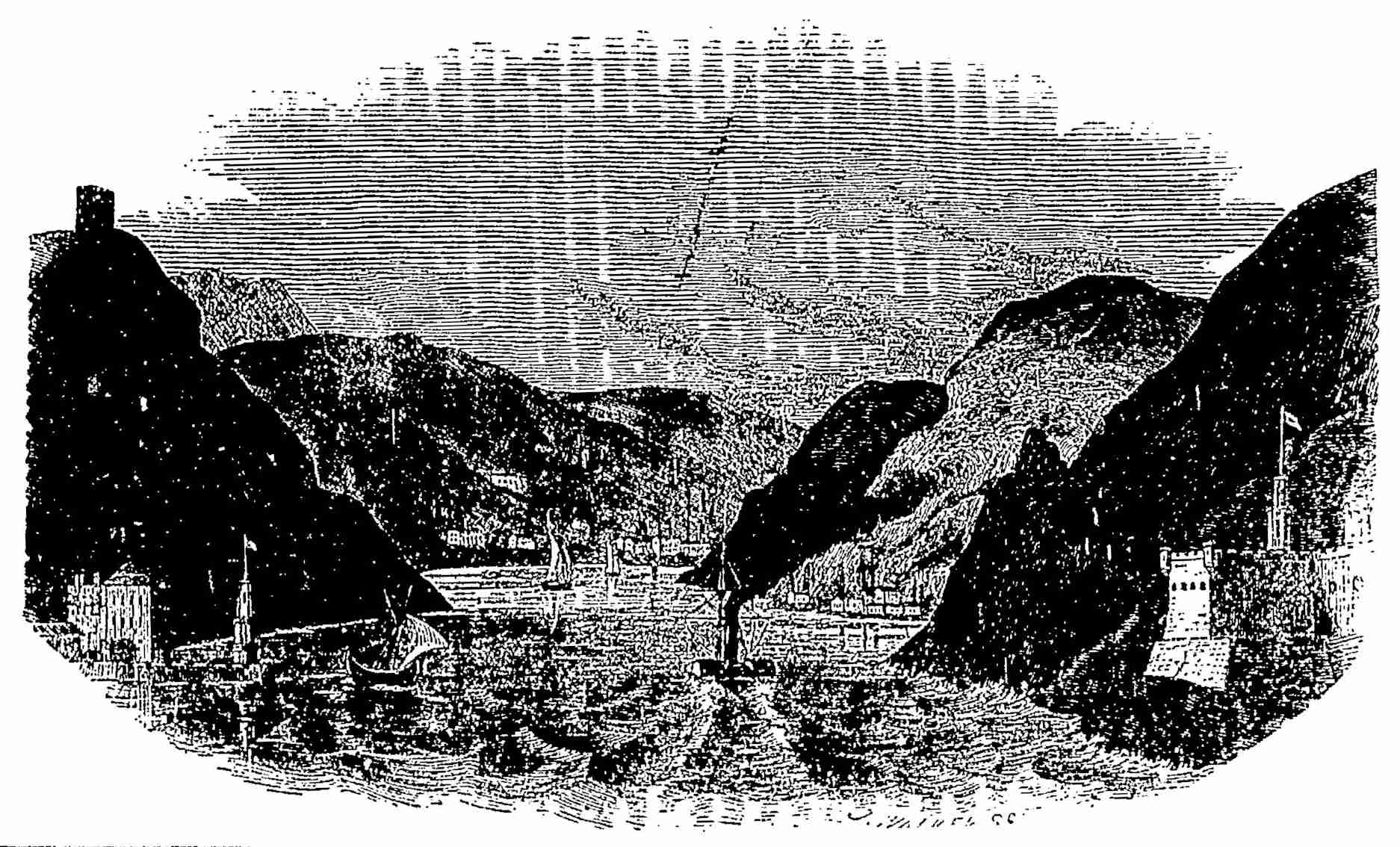
The entrance to the bosphorus.
The conflicts now existing between the Turks and Russians must be familiar to most readers of this periodical. The locality, therefore, of which a very distinct and correct representation is here given, is necessarily invested with peculiar and painful interest. The obtuse point of the angle of an unequal triangle, which forms the figure of the imperial city of Constantinople, and which advances toward the East and the shores of Asia, meets and repels the waves of the Thracian Bosphorus. The Bosphorus itself, as a great writer further observes, is the winding channel through which the waters of the Euxine flow with a rapid and incessant course towards the Mediterranean. The Straits of the Bosphorus are terminated by the Cyanean Rocks, which, according to the description of the poets, had once floated on the face of the waters, and were destined by the gods to protect the entrance of the Euxine against the eye of profane curiosity. We reject the fables which attach to much of the scenery of this neighborhood, and reject the dismal superstition which has for ages enveloped the inhabitants generally; but we must admire the taste and talent, though rude comparatively, which has been displayed along the banks of the Bosphorus. We are told that from the Cyanean Rocks to the point and harbor of Byzantium (Constantinople), the winding length of the Bosphorus extends about sixteen miles, and its most ordinary breadth may be computed at about one mile and a half, being, however, much narrower in many places. Anthon, in his Classical Dictionary, says, “Various reasons have been assigned for the name. The best is that which makes the appellation refer to the early passage of agricultural knowledge from East to West (βοuς, an Ox, and ποροuς, a Passage).” Nymphius tells us, on the authority of Accarion, that the Phrygians, desiring to pass the Thracian Strait, built a vessel on whose prow was the figure of an ox, calling the strait over which it carried them, Bosphorus, or the Ox’s Passage. The origin of the name may not be very certain, but if you will look at the beautiful engraving, you will agree that it is a great pity that any other than the arts of peace and civilization should be cultivated there. All must contemplate with sorrow the probabilities of the waters of the Bosphorus being stained with human blood, and made terrible with the storms of war,—devastating and destructive war. Many interesting Christian Missions have been established among the Turks, and have been very successful. It may be hoped that nothing will arise to blast the prospects of these missions. We hope the Bosphorus will be a free and unrestricted channel, through which the Word of God and a true civilization will pass to thousands and millions of the human race.

It seemed as if she had but just fallen asleep, when Betty very unceremoniously burst open her door, and slamming back the shutters to let in the gray light of morning,—“Miss Warren,” said she, “do, for gracious, see what this means. Here was the market-boy a-thumping me up a full hour before time, and he set down his basket and run like shot; and I opened it, and what should I see right on top but this letter for you, from Mr. Warren! Something or other is wrong, you may depend upon it.”
Mrs. Warren, trembling with impatience, broke the seal, and read as follows:
“Dearest Juliette:
“Don’t be frightened, now, into one of your poor turns. Nothing very dreadful has happened, or is going to happen, that I know of. Read my letter quietly, and take what cannot be helped as easy as you can.
“My business has been running behindhand for a good while. Every year I have found myself deeper and deeper in debt. It wore upon me dreadfully, and I made up my mind at last that I could not stand it so for a great while. I never liked to talk to you about it; you always seemed to have troubles enough of your own. The other day, when I was looking over my accounts, a friend came in to ask me if I would sell out. He wanted to buy, and offered me a fair price. ‘But what shall I do?’ said I. ‘Go to California,’ says he; ‘there is a splendid chance for you,—a ship sails next week.’ He said so much that I took his advice. I sold out, paid up all my debts, paid your house-rent for two years in advance, and Betty one quarter ahead. After this was all done, I had but just enough to fit me out, and fifty dollars over, which I enclose for you. It will answer for the present. You can by and by let your house, and go home to your mother, if you think it best. I have no time to think or plan for you now. I will write as soon as I can. When you read this, I shall be far on my way, if we are prospered.
“I love you, Juliette, and my children; and it is for your sakes, mainly, that I have taken this step. You could none of you bear poverty. I go in the ship Emily. I will write you all the particulars by the first opportunity. Keep up a good heart, now; depend upon it I shall come home a rich man. Gold is as plenty as blackberries in California, and I am not ashamed to dig. I have a strong arm and a stout heart. Kiss the children for me, and tell Betty I won’t forget her, if she will do well by you while I am gone. Believe me that I am still yours, affectionately,
“Harry Warren.”
The reading of this letter, as might be imagined, was followed by a fit of hysterics, and shrieks, and floods of tears, and wringing of hands. At one time, Mrs. Warren would call her husband the greatest savage living. Then, again, she would soften down into grief, like that of the children who mourned over him as over one dead. Between them all and her own sorrow, Betty had a hard time of it that day. However, she stood at her post bravely; with coaxing and scolding, she managed the children, succeeded in quieting them, and before night Mrs. Warren was more calm. Betty had such wonderful stories laid up in some little corner of her brain about the gold in California, how many people she had heard of who had come back rich as Crœsus, that Mrs. Warren could not but listen. Then Betty was so sure that Mr. Warren would make his fortune,—he was just the man for it,—that the hysterics finally had to yield to the golden visions. Still, Mrs. Warren passed from this state into one of settled melancholy, and continued so for many weeks. She took no interest either in her house or children. She gave money to Betty, and let her do as she pleased with it. If they had anything to eat, it was all very well; and if they had nothing, it was just the same. She neither went out nor saw any one at home. Her time was spent between the sofa and bed. If she tried to divert herself with anything, it was with very light reading, but generally even that required more effort than she chose to make. The children learned to keep out of her way; she could bear no noise, she said, and they did not like to be with her. Still she had been so long inefficient in her family, that she was not much missed; they were accustomed to do without her.
One day Betty came in as usual for money. Mrs. Warren went to her purse, and, to her utter amazement, found that she had but one ten-dollar bill left. She handed it to Betty, and, with the empty purse in her hand, she sunk down into a seat. For the first time it flashed over her that there was a bottom to her purse; and, who was to refill it? She had been so absorbed by her own selfish sorrows, that she really had not before given the subject a thought. She was overwhelmed at this discovery. What was now to be done? What should she do? Where should she go? Roused by this stirring necessity, her mind began to work with vigor. Plan succeeded plan, and thought thought, in wild confusion. She would go home to her mother.—She would not go home to her mother. The children would kill the old folks. But she must go home to her mother.—No she wouldn’t go home to her mother. A poor, deserted wife, with four children on her hands,—the shame of it would kill her; she would beg first. But, what could she do? Here gaped before her an empty purse. “What can I do? I’ll keep school.—O! I should die, shut up in a hot room, with a parcel of children. I could not live one month and keep school. Then I must fill up my house with boarders.—What could I do with boarders, sick as I am all the while? I hate house-keeping; I cannot bear care!” Wide gaped the empty purse still. She flung it down, and herself too, on the carpet, and wept like a child. “My children must have bread, and I must get it for them.” Ah! now those tears fall for them; the first tears which had fallen for any one but self. They softened her parching heart, and refreshed it as summer rain the thirsty earth.
“I will not go home!” said she, rousing herself with a sudden energy. “I believe that I can, and I will, support my family myself. I know it is in me. I will fill my house with boarders. I will get a living, and I will set about it before my last dollar is gone.” Back went the clasp of the empty purse, and its gaping mouth was silenced.
Juliette Harwood had not been like Mrs. Warren. She had both energy and sweetness of character when Henry Warren wooed her. The seeds of her future misery, however, had been carefully sown by her over-indulgent mother. If anything ailed Juliette, it was a great affair. She was nursed, and tended, and babied, and never allowed to exert herself at all. She was brought up to feel that everything must yield to her poor feelings; so that when, after her marriage, her health really became somewhat delicate, she had no resolution to meet it. As we have seen she became selfish and indifferent. Another day had now dawned, and the latent energy of Juliette Harwood must come forth to Juliette Warren. That kind heart and strong arm, which had so long supported her, had been taken away. Now she had no one but herself to depend upon.
“I will take boarders.” This she settled, and with promptness went immediately about it. For the first time since her husband’s departure, she went out on a week-day. She went to her husband’s friend, Charles Morton. Mr. Morton could scarcely refrain from expressing his astonishment, when he heard her proposal. Sad misgivings he had as to its success; nevertheless, he promised to aid her. Indeed, he knew then of two young men who were looking for just such a place. As they were near by, he offered to go at once and see them. Mrs. Warren sat down and awaited his return. The young men accepted the offer, and wished to come the next day. This was pressing matters hard. Mrs. Warren calculated on some weeks, at least, for preparation,—she knew she must get used to effort; but here it was,—she must take the boarders at their time, or lose them. She decided to take them.
Betty as yet knew not a word about the matter. “Would she consent to remain,” anxiously thought Mrs. Warren, “to remain and work so much harder? Then she had had her own way so long, would she bear a mistress? If she should go, how was her place to be supplied? She had been so long in the family, she knew everything they had, and where it was kept.” Mrs. Warren felt her ignorance. She would have to go to Betty to ask about everything. Indeed, she did not know what she had. It seemed as if she could not stir hand or foot without Betty. Yet, if she would go, she must make up her mind to it; for here she was,—her boarders were engaged. More than anything else, she dreaded breaking the subject to Betty. This was her first trial; it was a severe one, and we must not blame her too much, because, woman-like, she sat down first and had a good cry over it. But crying did not help it any, and time pressed. So she wound up her resolution once more, and called Betty.
“Marm?” said she.
“I want to see you a few minutes, Betty.”
“I am busy now; I’ll come by and by.”
“I cannot wait, Betty. I want to see you now.”
The very unusual tone of decision in which this was uttered surprised Betty into instant obedience.
“What do you want of me?” said she, rather pettishly, as she entered the parlor.
Mrs. Warren’s heart sunk. “I want to talk with you, Betty, a little about my plans. I’ve got to do something to get a living. My money is all gone. I gave you the last dollar, this morning.”
“The land! Well, I’ve been expecting it, this some time. I s’pose now you will go home to your mother.”
“No, I have decided not to go home. I am going to fill my house up with boarders, and two are coming to-morrow,” said she, making a desperate effort to get the worst out.
“Well, if that an’t a pretty piece of work!” said Betty, her face turning all manner of colors; “and you think I am going to take care of you and the children, and a house-full of boarders into the bargain, do you? I tell you, Miss Warren, I won’t slave myself to death so, for nobody!”
“I did not think you would,” said Mrs. Warren, slowly and sadly. “I had about made up my mind that you would leave me, and I should have to get another girl. I will go to the office now. You will stay, Betty, long enough to teach her the way round, won’t you?”
Betty looked thunderstruck; she could not immediately speak.
“And you sick all the time!” said she, at last. “You can’t do nothing. How will you look going down and seeing to dinner, with one of your headaches, I should like to know?”
“I expect it will come hard on me, Betty; but I cannot help it,—it must be done. I have made up my mind to it. You will stay with me a fortnight, won’t you? I don’t expect to get any one to fill your place, you have been with us so long;—let me see, now, ever since Henry was born;—you seem like one of us. Still, I must do the best I can. Do, for my sake, Betty, try and make it easy for me to break in a new hand. I will go right out now, and see what I can do.”
Mrs. Warren began to tie on her bonnet.
“Well, if this an’t pretty times!” said Betty, her face becoming redder and redder, while her voice grew husky. “Do you think, Miss Warren, that I am really a going off to leave you in such a pickle? I guess I can work as hard as you, any day; and if we can’t both of us together get victuals and drink for the children, why, we’ll give it up. When I am gone, you can get another gal, if you are a mind to.”
So Betty remained, and look hold of her new labors courageously. This was an inexpressible relief to Mrs. Warren. Indeed, it is somewhat doubtful whether she could have gone on without her.
Her house filled up rapidly, and unwearied exertions and care were necessary to keep it in order. After some severe struggles with her old habits of indolence and indulgence, she came off conqueror. She found out there was such a thing as keeping illness confined within its proper sphere,—that is, to the body, while the mind might go free. She found out that throbbing temples and disordered nerves could be made to obey, as well as rule. At those times when, if left to the dictates of her own poor feelings, she would scarcely have dragged one foot after another, she found out that she could step about her day’s work, and briskly, too. Every victory gained made her stronger. Then, in addition to this moral renovation, her health really improved. She found out there was no doctor for her like Dr. “Have-to.” Her cheeks became ruddy and her eyes bright, and her mind awoke to cheerfulness and activity, in the pleasant society which was now about her. Juliette Warren, in a few months, was very much changed, as all would have seen, could they have gone with Betty to her chamber, when, for the first time since the day the boarders came, she carried up a meal to her, and found her on the bed with her mending basket by her, thimble on, work in hand, trying between the paroxysms of pain to set a few stitches.
“The land, Miss Warren!” said old Betty, “if I was as sick as to go to bed, I am sure I wouldn’t sew.”
“O, I must; I cannot afford time to be sick.”
“Well, now, if I shall not give it all up! What do you think Mr. Warren would say, to see you now? I’ll bet he wouldn’t believe his own eyes.”
Mrs. Warren made no reply; but this remark of Betty’s went like an arrow to her heart. In an instant a gleam of light shot across the past. As if by a sudden revelation, she saw at a glance all its mistakes. Days, months, nay, years, were marshalled before her; through all of which she had been the sick, complaining, inefficient wife and mother. She was almost overwhelmed; she had never seen it so before. Scene after scene crowded upon her mind, in which she had taxed her husband’s patience to the utmost. And what had she given him in return for all his kindness? Nothing. His home had been uncomfortable, and his money had been wasted. Now she could see plainly enough why he left her. Now she felt how deeply she had wronged him. She longed to throw herself at his feet, and implore his forgiveness. All her early love for him revived in its intensity. “O my God!” she exclaimed, in a burst of grief, “spare him, O, spare him to return, that I may make some amends for the injury I have done him, and that he may know of my penitence and love!”
For many days after this, Mrs. Warren carried with her an aching heart. It required a prodigious effort for her to make exertion, in this state of feeling; but it must be done. Even sorrow could not be indulged in selfishly.
She sought some comfort by writing to her husband, stealing time for this from her sleep. These letters, by the way, never reached him; neither did his reach her.
At this time, also, she formed another plan, which was a comfort to her. She determined to lay by every cent which she could possibly spare from her earnings, hoping to collect at least a small sum towards assisting her husband in setting up in business, should he come home as poor as he went. This gave her a new motive for exertion. She gave her whole mind to her business. Her house was popular; her table was filled to overflowing; her affairs were well managed. She was, as she deserved to be,—for there were not ten ladies in the city who made more effort,—she was successful. Her children were put out to the best schools. They improved rapidly in mind and manners. Henry was a great help to her; he was a manly little fellow, with his father’s kind heart.
Betty continued to rule in the kitchen, though a stout girl was brought in to serve under her. The boarders always knew Betty’s cooking,—no one else made things taste quite so well; so she kept on her way, doing her full share of the fretting and scolding, and her full share of the work, too. She never let her mistress go ahead of her; on her feet she would stand “as long as Miss Warren, she knew,” if she was tired enough to drop.
One morning Mrs. Warren was presiding, as usual, at her cheerful breakfast-table. She looked the personification of health and neatness. Her soft, glossy hair was brushed back under an embroidered cap, which was tied with rose-colored strings, deepening a little the shade of the peach-blossom on her cheek. A neat morning dress, fitting her trim figure, was finished off at top by a white collar, which encircled her white throat. She was handing a cup of coffee, when she heard the front door open. As her table was full, she set down the cup to listen. Steps were heard on the stairs. Mr. Morton entered the dining-room, and a gentleman followed.—A stranger, was he? His sun-burnt face was almost concealed by immense mustaches and whiskers. He was stout and short, and singularly dressed.—A stranger, was he? Eye met eye and heart leaped to heart, and with a scream of joy she sprang to meet her husband. Yes, it was he. There he was, safe and sound, toils and dangers notwithstanding,—safe in his own home; the wife of his early love restored to him; his children, boys of whom any man might be proud, shouting around him; and there, in the rear, faithful old Betty, wiping her eyes with the corner of her apron, and crying, because “she did not know what on airth else to do.”
As we are strangers, it would be polite for us to withdraw, with the boarders, and leave the family to their well-earned joy; but we cannot refrain from stealing, by and by, away from the children, up stairs with Harry Warren and his wife, into the old chamber. No camphor and ammonia are there now, I promise you. They sat down in the old arm-chair together, and Juliette told over her story, showing the purse, which, when empty, with gaping mouth, preached to her so loudly and fearfully one day, and what effort and toil it cost her to fill it, and how much good the toil had done her. Then, with trembling voice and bowed head, she lingered on that night of bitterest sorrow, when Betty gave her the key of the past, and she saw how, through excessive selfishness, she had sinned. She told, too, how her heart had asked for her husband’s forgiveness. Then came the plan she had found comfort in. With glistening eye and trembling fingers, she snapped open the purse before him, and showed to him her little treasure of hoarded gold, hoarded for him alone; she poured it all out into his hard, brown hand, while the tears, big tears, rolling down his swarthy cheeks, dropped upon it. He, weeping over a little heap of yellow dust, who, in California’s mines, had gathered it by the spade-full! Yet not California, with all her golden treasures, could have purchased for the grateful man what this had given him.
We must not linger over the opening of the old chest which was so well freighted with native ore; enough for all, Betty included, and enough, we presume, to have set Mr. Warren up in that very handsome store where last we saw him.
Juliette Warren is still in comfortable health, an energetic woman, and a first-rate housekeeper. If ever she finds herself “running down,” as they say, she takes to her old Doctor Have-to; and if no necessity is laid upon her for exertion, she lays it upon herself. Long life and happiness to them and their children!
Should there be any wives who have not yet been able to find out what sent their husbands to California, Juliette’s history may give them a little light on the matter.—Selected.
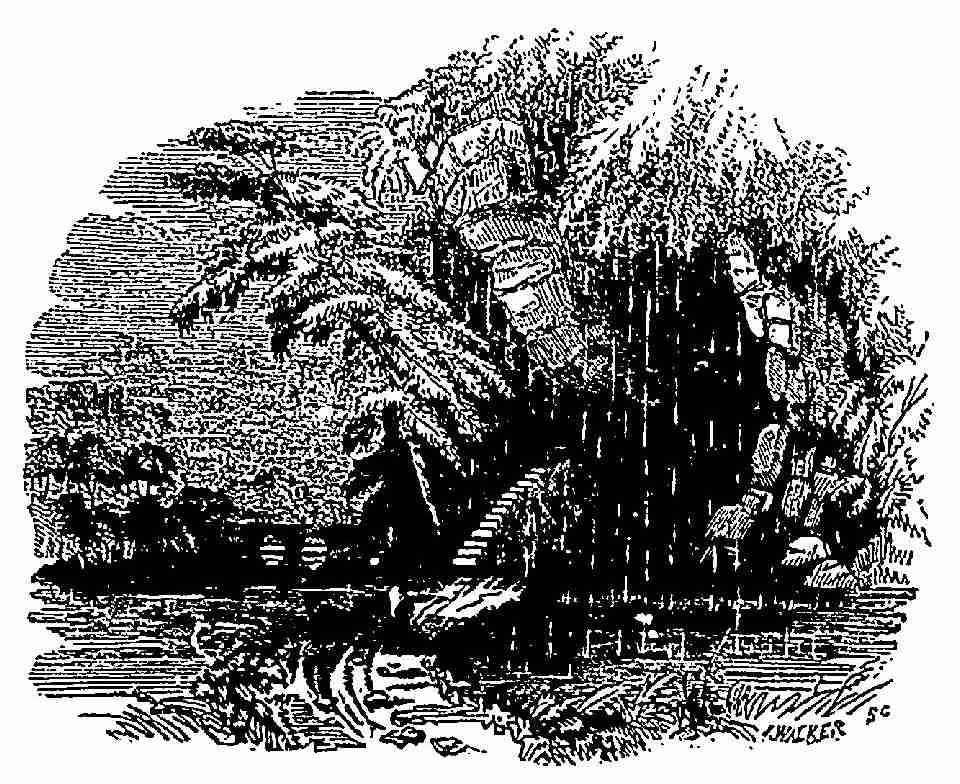
Spring-water, even that which is the most transparent, generally contains certain mineral substances, gathered from the soil through which the water flows. The substances are often so completely dissolved as to leave the water clear and sparkling, while they add to its wholesome qualities, and also render it agreeable to the taste.
It is owing to these mineral substances that many springs have the property of petrifying objects,—that is, covering them entirely with a stony crust, which makes them appear as if changed into stone. Such springs are seen in several parts of our own country; but far more strikingly in foreign lands, in the neighborhood of volcanos. The Dropping Well at Knaresborough, in Yorkshire, is one of our most noted petrifying springs. It rises at the foot of a limestone rock on the south-west bank of the river Nidd, opposite to the ruins of Knaresborough Castle. After running about twenty yards towards the river, it spreads itself over the top of a cliff, from whence it trickles down in a number of places, dropping very fast, and making a tinkling sound in its fall. The spring is supposed to send forth twenty gallons of water every minute, and while in rapid motion, the fine particles in which it abounds are carried forward, or very slightly deposited; but as it approaches the cliff, or rocky elevation above named, it meets with a gentle ascent, becomes languid in its pace, and then deposits abundantly on grass, twigs, stones, &c., a petrifying substance which renders them exceedingly beautiful. The cliff is about thirty feet high, forty-five feet long, and from thirty to forty broad, having started from the main bank, upwards of a century ago, leaving a chasm of two or three yards wide. The water is carried over this chasm by an aqueduct; but there is sufficient waste to form beautiful petrifactions in the hollow. Small branches of trees, roots of grass and other objects, are incrusted with spar, and, together with pillars of the same substance, like stalactites, fringing the banks, form an interesting sight. The top of the cliff is covered with plants, flowers, and shrubs, such as ash, elder, ivy, geranium, wood-anemone, lady’s mantle, cowslips, wild angelica, meadow-sweet, &c. Pieces of moss, birds’ nests, containing eggs, and a variety of other objects, are exhibited to visitors, as proofs of the petrifying qualities of the water. The weight of the water is twenty-four grains in a pint heavier than that of common water. The top of the cliff projects considerably beyond the bottom, and the water is thus thrown to some distance from the side of the cliff, which is of a concave form.—Selected.
“The damsel is not dead, but sleepeth.”—Our Saviour.
Dear though thou wert to me, much more beloved
Than all the other valued gifts bestowed
By the rich hand of free beneficence
Upon my varied lot, yet will not I
Mourn o’er thy early loss, deep though thy worth,
Thy unassuming virtue, thy pure truth,
Thy firm fidelity and constant love
Had wrought themselves into the very core
Of my heart’s best affections; though thou wert
The child of many hopes, the staff and stay
Of my declining years; and though thy place,
Now vacant, whether in my home or heart,
Can never more be filled, I will not grieve
As those who have no hope. ’Tis true I thought
That when my years were wearing to a close,
And health and strength gave way
Before the hand of time, that thy kind arm
Would then sustain me,—and, when sickness came,
Thy hand would then support my throbbing brow,
And thy sweet voice would pour into my ear
The promises of truth, and guide my thoughts
To mansions glorious, full of light and love,
Beyond the solar walk or milky way.
Though such my aspirations were, and though
My hopes and joys lie buried in thy grave,
Yet will I not resign myself to grief;
For I have hope, that thou art even now
A seraph with the choral throng on high;
And when I backward look upon thy worth,
(And memory loves to trace again the scenes
When thou wert with me), thy unchanging love,
Thy gentle meekness, unpretending faith,—
Yea, more, thy quiet life and tranquil death
Convinces me, beyond the reach of doubt,
That thou art now a dweller in those realms
Where pain, or care, or sorrow cannot come.
And when I stood beside thy open grave,
Saw the cold earth upon thy coffin fall,
And heard the “dust to dust” repeated, then
I felt that even thy faded form would rise
A glorious body, meet for the abode
Of each a pure and sainted soul as thine;
And further still, when o’er thy silent dust
We placed, with cautious hands, the unsculptured stone—
I then believed, and ever shall believe,
The grave had over thee no victory gained—
That death had lost the venom of his sting;
And I am comforted with thoughts like these:—
Would that my death may be as calm as thine,
Or rather, that the few remaining days,
Or months, or years of my fast fleeting life
May be as thine was, tranquil and serene—
Full of meek piety, and fervid love,
And resignation to the will of heaven;—
Would that the staff of Israel’s Shepherd King
May stay the parent as it stayed the child,
Even in the dark and shadowy vale of death,
And through the gloomy portals of the grave.
T. H.
Vankleek Hill, August, 1853.

[Written for the Maple Leaf.
 n a rude hut on the banks of the Obi dwelt a
lovely child. Her dark blue eyes were full
of expression, and her soft golden
curls fell round a brow of intellectual
beauty. She was one of those happy
spirits who seem to flit round us, extracting
joy from scenes which an ordinary
character would not notice. Small material
had she for improvement, it is true; but these
she had thankfully embraced, and consequently
her intelligence far exceeded that of many
more favored children of her age. Her happiest moments were
those which she spent studying the few books which her
father had brought with him into exile. He was of noble
birth, and Franziska had known the tenderest care, until in an
evil hour the Emperor, with Russian despotism, banished her
parents to the wilds of Siberia. Despair overshadowed their
hearts at first, but the sweet flower of their love was still left to
them, and bloomed as freshly amid those frozen wastes as when
nurtured in a St. Petersburg conservatory. They lived for their
child. To instruct and train her mind formed the delight of
their evenings. Their home was small, but scrupulously neat.
True refinement of character cannot exist allied to untidiness of
person, where there is power to better one’s condition, and accordingly
it often happens that noble exiles engage at once in the
most servile employments rather than suffer the misery of living
in wretchedness; indeed, they often become far more expert
than common laborers, since their superior intelligence enables
them to work to advantage.
n a rude hut on the banks of the Obi dwelt a
lovely child. Her dark blue eyes were full
of expression, and her soft golden
curls fell round a brow of intellectual
beauty. She was one of those happy
spirits who seem to flit round us, extracting
joy from scenes which an ordinary
character would not notice. Small material
had she for improvement, it is true; but these
she had thankfully embraced, and consequently
her intelligence far exceeded that of many
more favored children of her age. Her happiest moments were
those which she spent studying the few books which her
father had brought with him into exile. He was of noble
birth, and Franziska had known the tenderest care, until in an
evil hour the Emperor, with Russian despotism, banished her
parents to the wilds of Siberia. Despair overshadowed their
hearts at first, but the sweet flower of their love was still left to
them, and bloomed as freshly amid those frozen wastes as when
nurtured in a St. Petersburg conservatory. They lived for their
child. To instruct and train her mind formed the delight of
their evenings. Their home was small, but scrupulously neat.
True refinement of character cannot exist allied to untidiness of
person, where there is power to better one’s condition, and accordingly
it often happens that noble exiles engage at once in the
most servile employments rather than suffer the misery of living
in wretchedness; indeed, they often become far more expert
than common laborers, since their superior intelligence enables
them to work to advantage.
The situation of the Siberian exile is much more endurable than it used to be years since. The descendants of former exiles have settled in villages, and many of them enjoy considerable comfort; they hunt the wild beasts that roam the forests and plains, and keep up a brisk trade in furs, dried bear’s meat, reindeer flesh, &c., which they take to Tobolsk, Omsk, and other cities, and receive in exchange articles that they need.
The hut where Franziska lived was built of nine logs. No plane or saw shaped them into fair proportions. The trees were simply felled, then the branches were lopped off, and the trunks drawn to the place destined for the house. These were then placed one above another, and a thatch, or roof, covered the whole. The bark on the inside was stripped off, and the crevices between the logs were nicely stuffed with moss to keep out the wind. A floor of rough boards was daily scrubbed by a little Siberian maid, and fresh juniper boughs decorated the windows. In this uncouth place Count Soloski (Franziska’s father) dwelt for several years. The sentence of banishment still hung over him, but through the intercession of friends at St. Petersburg, his sentence of labor in the mines had been repealed.
The sunny-hearted Franziska grew with passing years, and at the time of which I write, had attained her sixteenth year. She was happy and joyous as the little birds that twittered around her in the short summer. She trained creeping plants up a kind of trellis work which her father constructed for her; tended her tiny garden with childish eagerness, watching the few plants that came to maturity with a jealous care; and gathered pretty mosses from the rocks, or cones of pine, to ornament the shelf where her treasures were deposited. In winter she tied on her long snow-shoes and accompanied her father into the forest, or walked along cheerfully beside her mother when they visited the poorer and more desolate people who lived in Stradi, a little village near them.
It was winter in Siberia. Unrelenting cold swayed the sceptre over lake, and river, and plain. Through the tops of the dwarf pines and sturdy hemlocks, the wild winds made mournful swelling sounds; now shrilly whistling, now sweeping over the country in one grand blast, and again roaring and crackling by with harmless zeal. Clear lights beamed in the wintry sky, streams of the richest hues darted up to the zenith, and thence, swaying and rolling like a vast curtain, faded into space; figures appeared in the sky moving up and down, or chasing each other across the horizon like parts of a pursuing army; the beauteous aurora borealis held sway, the roar of elements ceased, and electricity displayed fantastic shapes, and cast glowing colors on the white snow sheets that enveloped the earth.
Count Soloski was absent at the Judge’s office, in Tobolsk, and the Countess, with Franziska, anxiously awaiting his return, sat knitting and conversing near the fire.
“Dear mother,” said Franziska, “when I think how much we have to make us happy even here in this land, I long to do something for those poor children in Stradi. I can remember how you used to gather poor children and have them taught. What merry times we used to have in our pleasant home on Christmas, and other festivals when we packed baskets for the poor, and, jumping into our warm sledge, drove away to deliver them. I remember the English gentleman who visited us and told me so many anecdotes of his country, and that pious American minister who felt so much interest in everything good. It is pleasant to have something to remember; is it not?”
“Oh yes, my dear,” replied her mother; “but you can realize very little what effect these pleasant memories have upon your parents. The change from security and luxury to anxiety and privation such as the most fortunate exile feels, the longing for home and society, and intellectual food, all wear upon us. We live too far away from the world; we feel not the throbbings of its great heart here; we cannot sympathise in great events, for before we hear of them they are old.”
“It is true, dear mother; but may we not return home some time?”
“We have many kind friends who watch our interests. Your dear grandfather hopes to get a favorable opportunity to represent our case to Nicholas, and procure our return. Your father’s estates were large, and government will not readily restore them; mine are all you can depend upon when you are of age. But we will not talk of this now. The subject is very painful; we spent so many happy hours in our home. There, too, your baby brother, my lovely little Alfred, died, and we laid him to rest beside my mother in our family tomb; still I would not repine, the consolations of the Gospel are neither few nor small; they ever remind me of that glorious land where I hope to meet the loved and lost, and be united to them forever.”
Thus conversing, time passed. The mournful whistlings of the northern blast suddenly changed to a sort of shriek. The cheek of the Countess paled with fear, and Franziska started to her feet, crying in distress, “My father! my father!” Her fears were happily groundless. In another moment the door opened, and Count Soloski entered, received into the arms of wife and daughter.
“We thought we heard wolves, dear father,” exclaimed Franziska.
“You were mistaken. Wolves do not often venture so far.” He shuddered, as if some dreadful scene was before him, and then exclaimed, “It is a fearful sight to see a pack of wolves. I have never recovered from my horror of them, since my poor cousin Alexis fell a prey to their fury.”
“How was that?” asked the young girl.
“Years ago I was driving along a lonely road which led through a forest. Night drew on before we came in sight of Dnilhis, the place to which we were bound. All at once a pack of wolves rushed from the borders of the wood and pursued us. Our frightened horses needed no spur to urge them forward. We almost flew over the ground; but it was in vain that our noble steeds strained every nerve, the fierce animals gained upon us rapidly. My cousin, who was with me, seemed paralysed with fear; our driver held the reins firmly white I attempted to fire at them, but before I could raise my pistol, a violent jolt threw cousin Alexis out of the carriage—may I never again hear such a wail of anguish as burst from his phrensied soul at that awful moment. The famished wolves rushed upon him, and for an instant ceased their pursuit. Our horses fled away like spirits, for well they knew the wolves would be on them again.—Death seemed inevitable. The fierce howls of our pursuers sounded more and more distinctly, and it seemed as if our horses must soon drop down; just then, a sudden turn of the road brought us almost in contact with a band of troopers from Moscow. They were fully aware of the danger, though hidden from the foe, and as soon as the wolves appeared, discharged their loaded carbines amongst them, and in a moment so many lay bleeding and dying that the rest of the pack fled with the utmost precipitation. That was many years ago; but I shall never forget my sufferings, or the death struggle and awful end of my relative. Such scenes are more rare in Russia than they used to be when I was young, still there are districts where it is dangerous to travel unless well protected, hunger makes these animals so desperate.”
“Is it true that our government offers a bounty to those who kill wolves, as they did in England?”
“I think not, you know that the Russian Empire is so extensive that it would be difficult to manage such a thing.”
“And yet the Emperor seems anxious to gain more territory, and even tries to subjugate petty nations.”
“That is true,” said the count, “he hopes, no doubt, to establish a splendid empire whose power shall extend from the Arctic Ocean on the North to the Indian Ocean on the South; he may find, however, that there must be bounds to his ambition, and become convinced at last, that the internal improvement of the immense territory he already possesses, and the mental and moral elevation of his people, are nobler objects, and more sublime in their results, than mere physical prowess, or military display.”
Not many days after this, Count Soloski was called away to Tobolsk, and Franziska accompanied him. She wore the short full skirt and fur leggings of the country; a cap of the richest marten contrasted finely with the glowing health of her complexion, and set off her beauty to advantage. They both carried knives in their girdles, for it was not safe to venture far away from dwellings unarmed. The black bear inhabits the middle and Southern parts of Siberia, and is often formidable to the inhabitants, while farther north in the frozen zone, the white bear maintains fearful warfare with the animals he meets.
Franziska was a brave girl, but her father’s story of the wolves had impressed her, and she felt a spasm of terror when she thought of the bears, but she determined to banish such thoughts, and give herself up to pleasanter associations. They passed on, gaily conversing, admiring the glittering snow wreaths which hung upon the trees by the road side, or remarking the beautiful colors produced by the sunbeams upon the frozen expanse before them. The cold was intense, but long exposure to the climate had accustomed them to its rigors. The latitude of this region is not essentially different from that of St. Petersburg. Franziska remembered how they used to brave that; and she remarked to her father that she had read that civilization, numerous large cities, and dense population in older settled countries cause the air to be milder than in those which are uncultivated.
Franziska and her father enjoyed the journey exceedingly, and wondered to find themselves after a few hours in sight of the distant spires of Tobolsk. They quickened their speed, however, as a long line of woods yet lay between them and the city.
They were just emerging from the gloomy depths of this forest, and congratulating themselves upon their good fortune, when all at once they heard a hoarse growl, and before they had time for thought, a large bear suddenly sprang towards them, and throwing his paws completely around the young girl, would have torn her in pieces, but her father instantly drew his knife and plunged it up to the hilt in the huge creature’s side. Giving one fierce howl the beast quitted its hold to turn upon its assailant; wounded, though it was, it rushed upon the Count, who stooped to raise his fainting child, and it would have gone hard with him, but for the timely appearance of a large sledge, in which were several persons. One of them, a young man of elegant appearance and fine military air, jumped out quickly, and flew to his assistance. They soon dispatched the bear, when, turning to Franziska, they assisted her to rise, and as she appeared weak, the stranger offered to drive them to Tobolsk, saying that his business was of such a nature that an hour’s delay would not make much difference. “I am going,” said he, “to find my uncle, a noble exile, and though the tidings I bring from fatherland are good, I am sure he will forgive my delay;” so saying, he carefully lifted the frightened girl and placing her in the sledge, assisted her father to a seat beside her, while his attendants surrounding the bear drew it to the carriage and secured it.
“This is a real adventure,” exclaimed the young gentleman, “not one of your manufactured horrors. Here, in Siberia, have I rescued a lovely lady and her noble sire, as the Poets would say;” and bowing low, he continued in the same strain, “I claim the skin of the monster as a trophy, I will employ a painter to delineate this scene, especially dwelling upon the fair form of the rescued.”
His spirits were just about to effervesce in a joyous laugh, when turning to Franziska, whose pale countenance betrayed the anguish she had suffered, he continued in a more subdued tone, “Pardon my mirth, dear lady. I am sure it is a serious thing to be embraced so tightly by that shaggy monster; do not be alarmed, we have force enough now to ward off two or three such.” Franziska tried to smile while thanking him for his kindness, but the rescue was too recent for that, and observing her feeling he turned to arrange the fur robes around her, and soon the whole party, flying over the snow, entered the city, and at Soloski’s request stopped at the principal inn. Having seated his daughter in the parlor he hastened to the kind stranger in order to pour forth his thanks for the assistance he had given him. There was something about the young man that reminded him so much of home that he determined to urge him to remain awhile, at least, until he could glean tidings from Russia. He found the young gentleman giving orders to the attendants to take away his sledge. “I am glad to hear your decision,” said Soloski, “I wish much to see you; though a poor exile, I have not lost my love for home, nor a hearty interest in those who come from my native land. You have rendered me a service for which words cannot express my gratitude. May I not know the name of our deliverer that at least we may remember him in our prayers?”
“Do not mention my assistance,” replied the young man, “I should not deserve to live if I could fail to assist any one in distress, more especially a young and lovely female.”
“But cannot I do something to further your plans? Command me, if I can.”
“I do not know, my dear sir; I have made this long journey to convey news of pardon to my father’s cousin, who was banished for his liberal principles some ten years since.”
“Who was this exile? What was his name?” demanded the Count in hurried tones, while a deep pallor overspread his countenance.
“Count Imen Alexis Soloski.” Before he could finish the sentence his companion staggered to a seat, and in another moment was completely insensible. The youth was shocked at this effect, and rang the bell violently for help. Restoratives were immediately applied, and the sufferer soon breathed more freely. Looking wildly upon those around him, he murmured:—“Ah, was it a dream; shall I never again see home or kindred?”—then checking himself he closed his eyes and continued, “Oh, Father in Heaven, Thy will be done—yes, may I say Thy will be done.”
“My dear sir!” exclaimed the stranger, “I am indeed fortunate. That Being who watches over the good and virtuous is merciful to you, rouse yourself and enjoy the news I bring, news of pardon and restoration to your home and inheritance.”
Our little sketch wears to a close—we draw a veil over the scene which took place when Soloski with his daughter, and the young and noble Imogen Herweldisch drove up to the humble exile home, and presented themselves before the astonished countess, and hasten to say that preparations were soon made for the departure of this interesting family. Deeply as they had suffered in their exile, they had not neglected the duties and charities of life, and now on leaving, the count promised his daughter—who felt much for the poor with whom they had often divided their little store—to send a pious missionary to reside in Stradi, and be his agent in distributing an annual sum for their benefit.
“Our banishment shall do them good,” said he; “perhaps we were sent here for that wise end, and to be the means of interesting Christians at home to seek the instruction of these desolate people. No doubt, He who ‘sees the end from the beginning,’ sends his blessings in ways strange and wonderful to us, for what would be our few years of trial in this lone region to the amelioration of the condition of hundreds of our fellow beings by means of our experience?”
Their friends had provided everything for their comfort, and they had little to do, except to divide their household effects among their neighbors, and take their leave.
Franziska’s cheeks soon regained their hue of happiness amid the exciting anticipations of home, and a happier party could not have been found. The subdued thankfulness and sober sense of peace felt by the count and his lady, were constantly tinged with cheerfulness caught from the merry tones and pleasant conversation of their young relative, who having travelled extensively drew constantly from his store of information for their amusement; and as to Franziska, she was too happy to ask what made up the sum of her joy—it may be that her young heart even then yielded to those secret sympathies which entwine themselves around spirits in unison. It is true that the stranger’s eyes never beamed so brightly as when fixed upon her,—and a stranger to the party might have detected a peculiar gentleness of voice and kindness of manner when he addressed her, or endeavored to explain some of the many useful and instructive topics which formed their subjects of thought during the long journey.
Montreal, Dec., 1853.

The first is but “a vapor, which appeareth for a little season and then vanisheth away.” We open our eyes on the glorious sunlight, and revel in the beauteous tints of nature. Suddenly clouds overshadow us, and anon all is gloom. Then the world, which had appeared so beautiful, seems dark indeed. But, amid the clouds and the darkness, shadowy forms of strange beauty hover around us, and sweet voices greet our ears. Then Love salutes us; soft, starry eyes beam kindly through the darkness; the clouds vanish, and again all is bright and joyous.
Thus we journey on, and on,—now in light, and now in shade,—until at last, just as the rose-hues are gathering in the horizon of life, Death, like an ever deepening sunset, spreads his pall over the fresh green boughs, and fragrant blossoms of Love.
Edla.
Montreal, Dec. 29, 1853.
[Written for the Maple Leaf.
How glorious on the laughing earth
My golden mantle falls;
How many a lovely thing to birth
My touch, like magic, calls.
I enter not the loneliest spot,
The gloomiest recess,
That, in an instant, teemeth not
With life and loveliness.
There’s a wailing sigh in the summer breeze,
As it sweeps o’er the parched-up plain;
There’s a moaning voice through the forest trees,
To tell of the coming rain.
It comes with a crash and a thunder peal,
And a flash from a lurid sky,
Till the broad earth seemeth to rock and reel,
And quiver in agony.
My touch hath scattered the thunder cloud,
And the darksome veil is riven
That hung awhile, like a musky shroud,
O’er the fair blue summer heaven;
And a golden glory again is spread
O’er the glancing forest stems,
And the tears that the vexed storm-spirit shed
Are turned into burning gems.
“Come forth,” says the school-boy, “this sweet spring day,
Hark! heard ye the wild bee’s hum?
The hedges are white with the beautiful May;
The birds and the butterflies all are at play;
Come forth to the sunshine, come!”
The ancient crone, as she spins her thread
In front of her cottage door,
She blesses the equal light that I shed,
Alike upon rich and poor.
The earth is clad with a robe of white;
The leaves and flowers are dead;
The birds that sang on the tall tree’s height,
From the keen cold blasts have fled;
But over the pure new-fallen snow
My dazzling light I fling,
And the diamond-mine can never show
A pomp more glittering.
Oh! many a strange and varied scene
In my daily round I find;
I kiss the cheek of the sceptred queen,
And the brow of the toiling kind;
I touch the deep, and the glad waves leap
And laugh in the welcome light,
And the nautilus frail, spreads its tiny sail,
And glides o’er the foam-bells white.
I summon the hard-worn sons of toil
From the pallet rude and low,
And away to the shuttle, the loom, the soil,
With my earliest beam they go;
Fondly I rest on the wind-bleached hair,
The labor-roughened hand;
Earth hath but few bright things to spare
For the poor and the lowly band.
“Oh! bury me not,” saith the dying one,
“In the shade of the church-yard tree;
Let the broad warm light of the blessed sun
On my grave fall, full and free,
Let the first warm kiss of his morning ray
On my home of silence rest,
And the last faint flush of the dying day,
As he sinks in the crimson West.”
My touch hath lightened the peasant’s cot,
The noble’s lordly hall;
No nook or corner I enter not,
A welcome guest in all.
Many a pleasure, and many a joy,
May vanish with youth’s warm bloom,
But the sunshine gladdens the infant boy,
And brightens the old man’s tomb.
R. A. P.
Cobourg, Dec. 28, 1853.
Montreal, 9th Dec., 1853.
Perhaps the following Riddle may puzzle the readers of the Maple Leaf. I give it as it was given to me:—
“A man coming to Montreal for a supply of whisky with two kegs of the size respectively of 5 and 3 gallons, meets another on the road with an eight-gallon keg filled with the precious article, and requests of him four gallons. How can these four gallons be measured exactly without a gallon measure?”—A. T. C.
Reply to Riddle in December number:—The adjective “Empty” (M—T.)
The gay holidays are passing rapidly away. The young and happy strive in vain to detain the fleeting moments; like golden sunbeams they will soon fade, and be numbered with the past. Conscientiously and cheerfully, with high hopes and high aims, ought we to spend each day, for its last moment flying from us, carries a record of our conduct to the Court above.
Our city has been unusually lively, and it is to be feared that more frequent devotion has been manifested to Bacchus than to the genius of benevolence, or simple good cheer. It is a sorrowful sight to see the gifted and noble-minded yielding to temptation, and forgetting the pure enjoyment to be derived from the society of the excellent and virtuous. The ladies of Montreal and of Canada ought to exert themselves more and more to improve society,—to throw around home and social scenes a lovely intellectual charm, that their husbands and brothers may be less inclined to find happiness in convivial parties,—an enjoyment which, at the best, cannot be dignified as a “feast of reason,” or a “flow of soul.”
We thank “R. A. P.” for her sunny poem, and trust she may again throw out some beams of light for our illumination. We love sunshine all the more, because deep shadows sometimes steal over our pathway.
“T. H.,” of Vankleek Hill, will please receive our welcome to a place in the list of our contributors.
“The Exile’s Daughter” was written expressly for this number.
We have received a package of beautifully printed cards from DeMontigny & Co., 125 St. Paul Street.
Misspelled words and printer errors have been corrected. Where multiple spellings occur, majority use has been employed.
Punctuation has been maintained except where obvious printer errors occur.
When nested quoting was encountered, nested double quotes were changed to single quotes.
A cover was created for this ebook which is placed in the public domain.
[The end of The Maple Leaf, Vol 4, No. 1, January 1854 by Eleanor H. Lay]