* A Distributed Proofreaders Canada eBook *
This eBook is made available at no cost and with very few restrictions. These restrictions apply only if (1) you make a change in the eBook (other than alteration for different display devices), or (2) you are making commercial use of the eBook. If either of these conditions applies, please contact a https://www.fadedpage.com administrator before proceeding. Thousands more FREE eBooks are available at https://www.fadedpage.com.
This work is in the Canadian public domain, but may be under copyright in some countries. If you live outside Canada, check your country's copyright laws. IF THE BOOK IS UNDER COPYRIGHT IN YOUR COUNTRY, DO NOT DOWNLOAD OR REDISTRIBUTE THIS FILE.
Title: Mystery Underground (aka Underground)
Date of first publication: 1929
Author: J. Jefferson Farjeon (1883-1955)
Date first posted: April 16, 2026
Date last updated: April 16, 2026
Faded Page eBook #20260435
This eBook was produced by: Alex White & the online Distributed Proofreaders Canada team at https://www.pgdpcanada.net
This file was produced from images generously made available by Internet Archive.
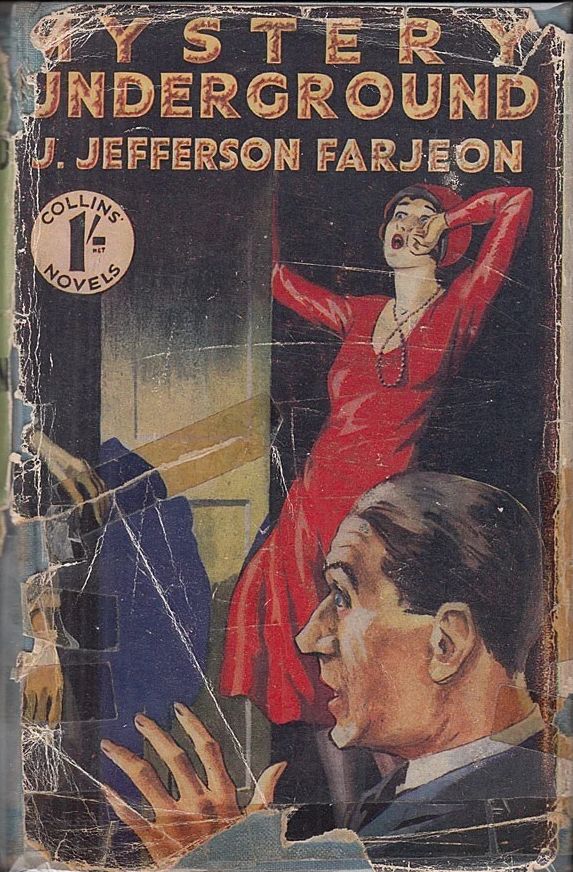
MYSTERY UNDERGROUND
J. JEFFERSON FARJEON
Author of “Murderer’s Trail,” etc.
First published June 1929 by W. Collins Sons & Co. Ltd.
This ebook transcribed from the fifth impression, June 1932.
Also published under the name Underground.
| CHAP. | PAGE | |
| I. | LINKS IN THE CHAIN | 1 |
| II. | INTO THE UNKNOWN | 5 |
| III. | THE FIRST MOVE | 10 |
| IV. | IN THE WAITING-ROOM | 17 |
| V. | THE TRAIN REVEALS ITS SECRET | 22 |
| VI. | IN THE CORNER | 29 |
| VII. | JOURNEY’S END | 36 |
| VIII. | THE HOUSE OF HORROR | 43 |
| IX. | FOUR IN A SHED | 50 |
| X. | THE CAR SUPPLIES A CLUE | 58 |
| XI. | GOLD AMID THE GLOOM | 65 |
| XII. | SALLY OF THE YELLOW STAG | 72 |
| XIII. | WHAT HAPPENED TO TED | 79 |
| XIV. | DISAPPEARANCES AND APPEARANCES | 86 |
| XV. | BREAKFAST PROBLEMS | 93 |
| XVI. | JOSCELYN EXPLAINS | 101 |
| XVII. | DIFFERENT KINDS OF ELEPHANTS | 109 |
| XVIII. | EAVESDROPPING | 116 |
| XIX. | THE NEW BATTLE FRONT | 122 |
| XX. | CELIA | 129 |
| XXI. | AND WHILE WE TALK—— | 136 |
| XXII. | JOSCELYN | 143 |
| XXIII. | THE DWINDLING ARMY | 150 |
| XXIV. | THE CONFERENCE BY THE DITCH | 156 |
| XXV. | THE DOOR | 163 |
| XXVI. | MR. BONES STARTS HIS JOB | 170 |
| XXVII. | AT THE FOOT OF THE STAIRS | 177 |
| XXVIII. | ABOVE AND BELOW | 183 |
| XXIX. | BROWN SMASHES A DOOR IN | 190 |
| XXX. | POKERS v. PISTOLS | 198 |
| XXXI. | CHARLIE LEARNS THINGS | 205 |
| XXXII. | UNDERGROUND | 212 |
| XXXIII. | THE WAY TO CELIA | 219 |
| XXXIV. | BROWN ON THE BRINK | 225 |
| XXXV. | THE END OF COOMBER HOUSE | 235 |
You would not think there was much connection between a clerk eating a poached egg on toast in a King’s Cross restaurant, and an out-of-work navvy munching bread and cheese in an empty house in Northumberland; particularly when the navvy had barely heard of King’s Cross, and the clerk had never heard of Byford Moor, and they had certainly never heard of each other. But Mr. Smith, who is now one with Mrs. Smith, was once enjoying pickles in Margate while she was chasing a goat in Canada, and probably you yourself can trace some great friendship—or enmity—to a strange, unpremeditated moment. You will be exceptional if you cannot.
The strange, unpremeditated moment of the clerk will shortly be revealed together with the amazing journey that followed it and bore him into romance beyond his most daring dreams. For all clerks have daring dreams. First, however, let us take a look at the out-of-work navvy in the empty house at Byford Moor, since he, too, was on the verge of a Great Moment, totally different from that which galvanised the clerk at King’s Cross, and totally wedded to it.
The navvy’s name was Ted. He was tall and thin, and, in his prime, tolerably strong. He was not in his prime at the moment, having been unemployed for a rather depressingly long time. Baths were events. They interested him theoretically. Had the bathroom cult developed earlier in his life—he wasn’t far off fifty—his later life might have been cleaner. As it was, he found himself drifting downwards a little towards the more immediately appealing consolations of existence—eating, drinking, sleeping, work (when he could get it) for the sake of these things, and an occasional cinema.
Now he sat eating bread and cheese in a neglected lounge-hall into which he had illegally climbed through a window. The weather had been a little squally, and since the house had been obviously empty, who would worry if he sought the protection of its roof? Nobody. There you were!
So he had climbed in, while the sudden rain blew in from the North Sea and made an angry patter against the windows. And he had found the roof he had sought more comforting than he had imagined, although he had suddenly shivered the moment after dropping on to the ground. Being wet like, and ’ungry like, he would. There were comfortable if rather faded chairs. There was a small settee, placed conveniently near the fireplace. Of course, there was no fire. In the first place, it wasn’t winter, and, in the second, the house was empty. The emptiness of the house was a further advertisement in its favour.
Still, that particular point had to be established beyond the shadow of a doubt before bread and cheese, and p’r’aps a pipe, could be contentedly enjoyed. Ted took no chances. He opened all the doors on the ground floor and called “Oi!” through them. He called “Oi!” down the stairs, and again up the stairs. Only the echoes answered him. If he wasn’t particularly keen on the echoes, at least they were preferable to any other form of answer.
“Oi!” he called, for the last time, to the house generally.
“Oi!” answered the echoes.
“Good enuff!” murmured Ted.
And, sinking luxuriously into the most comfortable arm-chair he could find, he produced the rich treasures of his pockets.
The bread and cheese was a recent acquisition, given to him by a kindly lady a couple of miles back. The pipe was a considerably older friend. It was so old that many people thought it ought to be dead. But Ted hadn’t so many friends that he could afford to lose any, however ancient, so he smiled at his pipe as he laid it affectionately on a small table beside him, and began munching his simple repast.
The rain increased in violence. Each window-pane rattled with the miniature war. Ted shivered a second time. It was a cold rain. But it would soon be over.
His eyes travelled across the rather faded carpet to the wall opposite, and came to roost on a grandfather clock. The grandfather clock was silent. “It’s stopped,” thought Ted, obviously; then added to himself, more intelligently, “Like me.” Vaguely his eyes roamed farther, and came to roost a second time on a door.
“ ’Allo—I didn’t see that one,” he reflected, frowning.
And the journey of a particularly nice chunk of cheese from his fingers to his face was postponed.
He rose, still holding the cheese, and crossed to the door. He took hold of the handle and turned it. The door did not open.
He pulled it hard and pushed it hard. No good. It was locked. All he could do was to fall back upon his stock device, “Oi!” This time there wasn’t even an echo.
Ted returned to his arm-chair thoughtfully. He was not seriously disturbed. All the same, a tiny grain of comfort was dissipated by that locked door. Locked doors are all right when you have locked them yourself. There is always something sinister about them when somebody else has turned the key.
The delayed chunk of cheese completed its journey. Other similar journeys followed. The rain continued to rattle on the windows, the wind blew fitfully, and the faint boom of the breakers sounded occasionally in the distance. When the bread and cheese had all gone, Ted fingered his old pipe, and tried to be constructive in his thoughts, to offset the languorous indolence that was settling upon him. Perfect ease induces this reaction. Many a man has set the world right in a hot bath. So Ted thought of Newcastle, to which he was trudging, and wondered whether he would find a job there, and, if not, what to do about it, while the elements wrangled outside, and he drew nearer and nearer to his Moment.
And while a clerk ladled up a refractory portion of a poached egg three hundred miles away.
Suddenly an odd thought came into Ted’s mind. He did not know how it came, or why.
“S’pose they are breakers?” he wondered.
He did not trouble to proceed with the inquiry. It bore no special significance. Boom! Boom! Probably they were breakers. What did it matter, anyway? It mattered much more to get his old pipe to pull properly, and to sink into the comfort of the chair. . . .
“Looks as if I’m ’ere for keeps,” he murmured presently, discovering with interest that he was not moving, and that he felt no disposition to move.
Well—he wouldn’t mind! One might spend quite a pleasant day or two here, if one could meet enough kind ladies to maintain the supply of bread and cheese. Not a bad idea, that! Ah, but what about Newcastle? A day lost might mean a job lost. On the other hand, to-morrow he might be dead. Thus argue some men on the verge of fifty.
“Allo—wot’s that?” he muttered, all at once.
He certainly had no idea. He believed he had dropped off for a few moments. Yes—there was his pipe on the ground to prove it. What he had heard had probably not really been heard at all. More likely a dream, like. He glanced around him for support of this comfortable theory. Everything was as it had been. Furniture just the same. Windows just the same. Clock still silent on the wall. Door near the clock still closed. Obviously, the noise had occurred in a dream, like.
He picked up his pipe. He decided not to fall asleep again. If he was going, he must go. If he was not, he must do some constructive thinking. He must——
The next instant he stiffened, and his body became rigid.
“BOOM!”
The sound came with a roar. The house shook. A brass candlestick slid off the mantelpiece on to the floor.
While the navvy’s eyes bulged in the empty house in Byford Moor, Northumberland, the clerk’s eyes were growing round in the King’s Cross restaurant. Rounder, even, than the poached egg he had just eaten.
If he had not eaten the egg, if merely a quarter of it had remained to engage his whole attention, he would have missed the momentous remark that set his whole being aflame. But does Fate dabble in if’s? It had designed that the egg should be eaten, just as it had designed that the navvy should have been passing the empty house in Byford Moor when the rain came on.
The momentous remark was made in an undertone, by a big man to a little man. They were passing Brown’s table, on their way out, and perhaps they did not notice Brown because, as a personality, he was inconspicuous. But, added to this, Brown’s table was in a dark corner of the room, and the two men were momentarily engrossed in their own equally dark business.
“After her!” whispered the big man. “And—if she’s troublesome—don’t be particular what you do to her!”
Brown’s brain was not ordinarily rapid. Otherwise he would have been earning more than £3 5s. a week. But on this Saturday he rose above himself. Anybody overhearing such a remark as he had heard would have glanced towards the door ahead of the speaker to gain a glimpse of the lady who was destined to be rough-handled should she prove troublesome, and anybody fortunate enough to catch the fleeting glimpse of her that Brown caught would have been impressed by that lady’s neat and attractive appearance; but only a knight of King Arthur’s time, or a modern clerk who was a little above himself, would have decided that the matter could not end there.
The clerk rose quickly, involuntarily, without any clear notion of what he intended to do. Perhaps half the impetus of rising was supplied by the shock he had just received. Shock and heroism may have been fifty-fifty. But, once up, there was no sitting down again. Brown had to see this through.
The girl had gone. The men were going. In three seconds they also would be gone. Three seconds to decide the fate of nations!
Afterwards, Brown was amazed at his coolness and at his clear-headedness. To have taxed the men would have been abortive, and would have rendered himself conspicuous and ridiculous. It would have ruined everything. The big man would have dealt with him easily—Brown realised that in a flash—while the little man would have slipped quietly out after the girl. Above all things, Brown must cling to the inconspicuousness which was normally his. And he must stick to the heels of the little man.
The little man was the key to the girl. The girl had to be warned, or the little man dealt with. If only ten men would take the field in a cricket match at Wembley that afternoon, Brown could not help that. To assist that attractive, threatened girl would be sweeter than a hundred centuries. And while such thoughts circled round the clerk’s brain, he managed to retain his outward composure, to pay his bill, and follow the men out on to the pavement.
Outside, the two men appeared, as though by tacit consent, to have ceased to know each other. The big man yawned and bought an afternoon paper. The little man, whistling softly to himself, crossed the road in the direction of King’s Cross station.
The bigness of the moment swept over Brown. Because of his fear of flurry, he walked straight towards the enemy, and also bought a newspaper. Then, following a blind instinct, he glanced up at a large clock on a tall tower, exclaimed “Good gracious!” and crossed the road after the little man at the accelerated pace of one who fears he may miss a train.
Was the big man looking after him over the top of his newspaper? Brown wondered, perspiring a little. But he did not turn his head. His eyes were glued on to the back of the small man ahead of him, and he was thanking God for the smallness. A tough little customer he looked, in his rather loud check suit and his bowler hat rather too confidently on the slant. Brown doubted his ability to knock him out if it came to a scrap. Still, he was preferable to his elephantine companion. With a little luck—who could say what mightn’t happen?
It soon became clear to Brown that they were definitely making for King’s Cross station. The large King’s Cross station, not the little one. The station that led to goodness knows where, not the one that led to Baker Street, a change of platforms, and a cricket match at Wembley. Brown strained his eyes to pick out the girl for whom he was doing all this, but he could not find her. All he could do was to pick out the small man, in the knowledge that he had found her.
The queer chase continued. Once or twice Brown wondered whether he was a fool, and put the inquiry aside lest the answer should be in the affirmative. Now they were actually in the station. They had crossed the covered-in way and were joining a queue. A queue bound for the ticket office.
Brown felt a little breathless. Fate was hurrying him rather fast.
“Yes—I am a fool!” he decided.
And, while he decided it, he was slipping forward in the most unconstitutional manner to usurp a place immediately behind the small man in the rather loud check suit.
The next moment his heart gave a bound. The small man had been equally unscrupulous, and had usurped a place immediately behind the neat and attractive girl.
“Some people think they own the world!” growled an irate individual loudly.
Brown’s heart missed a beat. He feared the remark might precipitate a row, and he did not want the small man to turn and notice him. Happily, the small man did not turn, and all at once Brown realised the reason. The small man thought the remark was addressed to himself, and was as undesirous of attracting attention as was Brown!
Brown smiled. Then the moment of false security passed. The girl was before the little window.
She spoke in a low tone. Brown did not even hear her voice, and, when she had passed through, it was evident that the little man had not heard her words, or been able to spot the destination on her ticket.
“Where to?” barked the ticket-clerk—just as Brown might have barked himself had he been a ticket-clerk.
Then the small man showed his genius.
“Same,” he said.
How Napoleonically simple! Brown gasped at the ingenuity of mankind. Was ever a difficult fence taken more gracefully? Without emotion, and totally unconscious that the man who was buying a ticket had no notion of the station he was buying it to, the ticket-clerk shoved a little piece of pasteboard through the window. The small man looked at it, and then, also without emotion, shoved some notes to the ticket-clerk.
Brown’s forehead became frankly wet. He felt that it was dripping, and that it would rain upon the little counter that was now immediately before him. How could he take the fence?
He had a double problem. Those notes! They had nearly turned his stomach. The cricket match at Wembley now seemed very far away. Yet, perhaps after all it had suddenly been brought close. Suppose he could not take this fence? How much money had he in his pocket? He had drawn his pay that morning. . . .
“Are you going to be all night?” queried a voice behind him.
He had to decide. He felt like a man on the point of receiving an enormously high catch. Could he hold the ball? Did he want to hold the ball? If he brought off the catch, he would be expected to play at Lord’s. If he muffed it, he would be relegated to the comfortable, unglorious village pitch. Did he want . . . ?
Napoleon entered into him, with all his courage and resource.
“Same,” mumbled Brown.
And this time the ticket-clerk did raise his eyebrows a little.
“We’re all together,” explained Brown unnecessarily. “We go Dutch.”
The ticket-clerk frowned slightly. Was it legal to refuse to issue a ticket unless the passenger named the station? For a moment, Brown trembled. Then the blessed little piece of pasteboard appeared, and he breathed again.
He took the ticket with the feeling that as a man he had failed, but as a sleuth-hound he had succeeded. Then he looked at the price on the ticket.
“One pound sixteen and eight,” came the voice of the ticket-clerk.
Brown knew it. He was gulping. “Byford Moor” meant nothing to him, but one pound sixteen and eight meant a great deal. It meant Monday’s work, and Tuesday’s work, and Wednesday’s work, and a bit of Thursday’s work. And, to get back again, would mean . . . Whew!
“One pound sixteen and eight,” repeated the ticket-clerk sharply. “And you’ll miss your train if you don’t look lively.”
“Yes, and we’ll miss ours!” cried the man behind him.
“Ah!” gasped Brown, diving spasmodically into his pocket.
His practised fingers opened the neat little envelope there. No gentleman can bring out the envelope in which he receives his screw. He drew out the notes. There were three. He passed two over.
Three shillings and four coppers came back to him. Some one shoved him forward, and he dropped one of the coppers. He dived after it frantically. Every copper was untold gold now, and might mean the difference between a beautiful girl’s life and her extinction. He heard himself asking a porter for the platform for Byford Moor.
“No. 3,” replied the porter, happening to know. “Change at Newcastle.”
He was really a very bright porter.
Brown ran on. He was dogged by a terrible fear that he would board the train without knowing definitely that the attractive girl and the small man were also in it. If only he could find the girl, cause her to miss it while the small man caught it, and then get his money back! But Fate had got him too firmly by the scruff of the neck for that.
Fate gave him a square deal, however. It provided a glimpse of the girl walking up the platform, and of the small man following her at a respectable distance. When the girl stepped into a third-class compartment, and the man wandered up to the same compartment and entered it a few seconds later, Brown realised that although he might be embarking on a hazardous errand, it would not prove to be a fool’s errand.
The guard blew his whistle.
“Good Lord!” gasped Brown.
He boarded the train as it was moving.
Matters had moved with such dizzy speed that, until now, there had been no moment for sober reflection. Only half a dozen minutes had elapsed since Brown had jumped up from the table in his restaurant, and those six minutes had contained more than usually came to Brown in a month. Far more. In fact, it began to dawn on the modest little clerk that they had contained more than he had previously experienced in the whole of his twenty-four years of life.
But sober reflection came to him now—when it was too late to retract. No. 3 platform of King’s Cross station was slipping backwards, to become a confused memory in this strange new reality, and Brown had a weird feeling that he was becoming detached from himself, and that the Brown who had eaten the poached egg—who had been going to play in a cricket match that afternoon, was already very far away. Yes, this, surely, was a new Brown! Not a very heroic one, certainly, or a confident one, but a Brown who, finding the die cast, was deciding to abide by the throw.
For that attitude was the result of Brown’s sober reflection as the powerful engine snorted and steamed northward. “I dessay I am a fool,” he thought, “but p’r’aps it’s better to be a whole fool than half a fool.” Anyway, he was in it now, and the only thing was to adopt the Britling policy of seeing it through.
“Yes, but if I’m going to see it through, I got to keep my wits,” he argued to himself. “I got to act quick, and I got to get back to-night, if I can.”
His practised fingers sought his pocket, and counted the wealth there. He knew it must be a little over two pounds—he had been unusually saving all the week—and he found it was two pounds nine and fourpence. Twelve shillings and eightpence above the return fare, assuming he completed the journey. H’m! Not a great deal to cover accidents!
“Well, there mustn’t be any accidents,” decided Brown. “I must just find the girl, get word to her somehow, find out if there’s anything else I can do—and then hop it back as soon as I can.”
Towards this end he began to walk enginewards along the corridor into which he had leapt as the train had started.
The train was gathering a good speed, and was clearly one of the highbrows of the line. There was nothing vulgarly local about it. Suburban stations were beneath its notice, and with a sudden pang of dismay Brown realised that its first stop might be half across England. Well, well—that was out of his hands, at any rate. All he could do was to accept the time-table, and to make the best of it.
He calculated that he had entered the train some three coaches nearer the rear than the coach occupied by the two people he was interested in. He did not bank on this calculation, however. He peered into every compartment as he passed along, making a brave if not very successful attempt to appear casual. One man, a genial person, remarked as Brown’s head popped in that there was plenty of room, and the remark was offered in the manner of an invitation; but Brown murmured something about looking for a friend, and frowned fiercely into the next compartment to prevent any repetition of the courtesy.
The next compartment contained eight people, and they all frowned back.
He had now negotiated two coaches, and as he entered the third he became conscious of a throbbing that did not emanate from the engine, despite the fact that he was now considerably nearer it than he had been. For a moment or two the throbbing baffled him, till he discovered, to his annoyance and humiliation, that it was happening inside his own person. He paused, took a breath to steady himself, and began the last lap.
The first compartment contained a large family of children. The second contained four men. The third contained three elderly women. The fourth . . . .
From this moment, Brown’s determination never wavered. The girl sitting in the far corner of the fourth carriage, with her back to the engine, was the girl he dreamed about, the inaccessible gold that threaded through all his secret fancies. She was the heroine of all the books he read. (Authors dupe themselves if they imagine they always plant their own pictures in their readers’ minds.) She was the girl who applauded all his imagined exploits, to whom he had proposed, just before going to sleep, on countless occasions and in countless ways, whom he had saved from fires, from wrecks, from mad dogs, and from runaway horses. And here she was, in the living flesh, with real danger threatening her, and only Brown between!
Strictly speaking, he was not between her and the danger yet. The danger sat opposite, in the form of five-foot-two of unsavoury manhood in a loud check suit.
There was one other occupant of the compartment, an elderly, black-gowned dame surrounded by parcels. Brown thanked heaven for her existence, for had she not been present, who could say what might not have happened in that compartment in the last two minutes?
The elderly lady was sitting on the same side as the little man. Brown, praying devoutly that he was not looking as red as he felt, took the seat opposite the elderly lady. Thus he was on the same side as the pretty girl, albeit separated from her by an appreciable space. The little man was ominously closer.
Still, Brown could watch the little man carefully from his position, and this he proceeded to do. His entrance had created some small psychological disturbance. The elderly dame looked at him rather suspiciously (for he had selected the compartment late in the journey). The little man frowned slightly. The girl turned her head a little, betraying vague curiosity. But nothing definite materialised, which Brown attributed to the fact that he kept very quiet; and a few seconds after his entry he had been tacitly accepted and—he hoped—forgotten.
So far, so good. What next? Brown found himself in the disconcerting position of a man burning to do something, yet having nothing to do. What was even more disconcerting, he did not know in the least what kind of a thing he would eventually be called upon to do. Would the little man suddenly whip out a knife, plunge it into the breast of his vis-à-vis, and jump out of the carriage window? As this appalling thought came into Brown’s mind, he drew an inch or two farther from the woodwork between him and the corridor, and nearer the girl. Or would the little man act more deliberately and subtly? Offer her a drugged cigarette, perhaps? Yes—things like that—they would have to be watched for! Or, more likely still, he would wait until he got the girl quite alone. Hang on her heels until that happened, and then . . . .
Well, it wouldn’t happen! Brown would hang on her heels, too! He’d hang on until Doomsday—or until he had seen her safely housed somewhere or other. Where? And would she ever be safe, unless she received some definite warning of her danger? He tried to think of some method of warning her. Perhaps he could write a message or something. . . .
The train sped on into the Unknown. A sense of unreality began to pervade the compartment. The situation became grotesque. Was it really occurring? Sometimes (Brown recalled) imagination played amazing tricks with one. He remembered the last tooth he had had out. During the extraction, he had killed five bulls before the King of Spain. Perhaps he would wake up now in the dentist’s chair? Thud—thud—thud! Thud—thud—thud! Yes, it had sounded something like that as he was coming to. Existence had simplified it into a rhythm—just as the sixth bull was going to kill him before the King of Spain. Thud—thud—thud! Thud——
He opened his eyes. He was not in a dentist’s chair. He was in a train. There was the wonderful girl. And there was the evil little man. And there, her head sunk a little forward, was the elderly dame, surrounded by one less parcel. The one less parcel was on the floor.
Brown’s forehead was slightly damp. He wondered how long he had been asleep. He glanced towards the girl, and noticed that her head, also, was sunk a little forward. He wondered whether she were dead! Quiet panic seized him. He had to do something. The only thing he could think of was to pick up the parcel.
He bent down noisily.
“Is this yours?” he asked, in an unnaturally loud voice.
The elderly dame raised her head suddenly and indignantly.
“Gracious, how you made me start!” she exclaimed. “Yes, it’s mine. It must have—— Thank you.”
The girl stirred, too. Brown was satisfied. He swore he would not go to sleep again. He felt that the World of Respectability had a right to place him against a wall and shoot him.
The incident of the parcel appeared to have a revivifying effect. The little man stretched himself, and brought his right leg forward a little. Brown found himself watching it ridiculously.
“She’s makin’ good time,” observed the little man, to anybody who liked to hear. Apparently, nobody liked to hear. The little man was not perturbed, however. Taking a packet of cigarettes from his pocket, he extracted one slowly, and then looked directly at the girl. “Mind if I smoke, miss?” he asked, civilly enough.
“Not at all,” replied the girl, and Brown’s soul became illuminated at her voice.
The girl looked towards the elderly dame.
“I do mind,” snorted the elderly dame.
Brown got a brain-wave.
“There’s a smoker next door,” he hinted to the little man.
But the little man shook his head. He preferred his company to his cigarette, and the cigarette went back quietly into its packet.
“That’s all right,” he said. “I ain’t pertickler.”
The next moment, Brown’s heart gave a bound. Something very ordinary was happening, yet to his unbalanced mind it appeared colossal. The train was slowing down.
“Here’s my chance!” he thought. “If we stop, I’m going to do something. Somehow!”
The train did stop. Brown rose, without a plan, but the plan took vague shape as he walked to the compartment door. He reached the door, and was now standing between the girl and the little man. Nobody else moved.
“Gettin’ out here?” queried the little man, as Brown paused.
“No—I don’t think so,” answered Brown.
The reply was ridiculous. A man knows whether he is getting out at a station or not. But Brown’s plan had now become clear, and it appeared so simple, despite its crude daringness, that he hardly minded what happened during the few seconds before its execution.
He stood motionless for a few instants, then lowered the window.
“Where’s a paper-boy,” he muttered audibly.
He felt that the little man was watching him, but that might have been mere imagination. The little man could not possibly know what was in his mind.
“Where is that paper-boy?” repeated Brown.
He poked his head out. No paper-boy was in sight. The guard was returning to his van, and the train would soon be off again.
“I’ve got to judge this nicely,” thought Brown. “If I do it too soon it’ll be no good—or if I do it too late. Now, then—keep steady!”
He glued his eyes on the guard, reading the signs. The guard raised his hand.
“Now!” gasped Brown to himself. But aloud he shouted, “There he is—I can just catch him! Hi! Boy!”
He threw open the door suddenly. He heard the girl cry, “Be careful!” and he thanked her tacitly for the warning. But he wasn’t in the mood to be careful—of himself, that was. He swung the door wide, as the train began to move, made a forward movement, then a backward one, tottered against the side, and appeared to lose his head. His hand went out wildly. It caught the shoulder of the little man, who was bending forward with interest. The next moment, before he knew it, the little man was lurching out of the compartment on to the platform, wildly gripped by Brown.
The train increased its speed. The handle of the door above them slid away . . . smaller and smaller . . . now out of sight. Other doors swung by, above the heads of the sprawling couple.
“Got him!” thought Brown hysterically.
Then something hit him. He believed at first that it was some portion of the passing train, but it was not. It was the fist of the little man. And, all at once, Brown felt sick. Was it the blow—or was it because he now found himself alone, and the little man was growing littler and littler on the dash-board of the departing train?
The world went black. When it returned to its normal colour Brown found himself in a dingy station waiting-room, stretched out on a dingy station couch—hard, shiny, and convex. Above him loomed a large, fat, boyish face, that stared down with rather comical earnestness; but as Brown stared back the face disappeared, and another face usurped its place. The new face looked quite lean by comparison with its predecessor, although in actual fact there was nothing cadaverous about it. It was firm and strong, and the two brown eyes were gravely inquiring.
“Feeling better?” asked the owner of the second face.
“What’s happened?” murmured Brown.
The first face obtruded itself again. The eyes in the first face were very light blue.
“What’s happened?—well, that’s good!” exclaimed the owner of the first face. “It’s us who want to know what’s happened, isn’t it, Rupert?”
“Shut up, Charlie!” replied Rupert. “He’ll tell us as soon as he’s pulled round a bit.” He added, as Brown began to rear up and to pass his hand across his brow, “You tumbled out of the train, you remember, but your companion got back——”
Realisation returned. Brown jumped up, as though he had been shot, gripped by impotent, incoherent anger.
“Yes—he got back—and we must stop him!” he cried. “Where’s the station-master? We must stop him!”
He dived towards the door, but a firm though kindly hand detained him.
“Whoa! Steady up, old chap!” exclaimed Rupert. “We can’t stop that train, you know. You’ll have to catch the next.”
“The next?” shouted Brown, struggling. “The next’ll be too late. He’ll have got her—he’ll have killed her!”
He stopped and gasped. What was he saying? His knees gave way beneath him, he sank down into a chair and began to sob. Brown had been through a rough time, and an emotional time. He was not used to it.
“I say—is it as serious as all that?” asked Rupert. Rupert’s voice was oddly soothing. It was not unlike the voice of Brown’s cricket captain, though more refined. It had a quality one could cling on to. “Just try and pull yourself together, and then tell us all about it,” Rupert went on evenly. “Oh, and I say, Charlie—how about slipping round to the buffet and bringing something along?”
But Brown shook his head. He didn’t want anything to eat or drink. All he wanted was to find some means of continuing his broken journey.
“No, I’m all right—don’t worry about me,” he gulped. “It’s a girl we’ve got to worry about. I was following her.” Luckily Brown did not notice the wink given by Charlie at this information; but a frown from Charlie’s companion nipped levity in the bud. “You’ll think that queer. Well, of course, it is queer. But I happened to get on to it that she was in danger——”
“What sort of danger?” interposed Rupert.
Brown paused for an instant before replying, and studied his interrogator. He was quite alive to the oddity of his story, and he was no less alive to the oddity of his own part in it. Still, having gone so far, and having come to the end of his resources, his only course was to solicit aid from others—or relinquish the whole thing altogether. . . .
Yes—of course, he could do that. Perhaps, after all . . . A sudden vision of the girl’s face flashed before him, and of the ugly little brute in the loud check suit.
“The worst sort of danger,” he gasped. “You’ll laugh, but it’s true, I tell you. I heard two men talking. One told the other to go after her—it was at King’s Cross—and he said that—that—wait a bit, and I’ll tell you the exact words!” Brown closed his eyes, while Charlie regarded him curiously, and Rupert regarded him seriously. “Ah—I’ve got it. ‘After her,’ he said, ‘and if she makes any trouble, don’t you be particular what you do to her.’ That’s what he said. So it seemed to me I ought to try and warn her. So I—I got on the train, and—followed them. See?”
He paused. It sounded rather lame when you spoke about it. Brown felt quite sure, though, that somebody else with more learning could have put it better.
“Talk about ye knights of olde!” exclaimed Charlie, his light blue eyes almost losing themselves in the emotional contours of his cheeks.
“Do be quiet, old son,” said Rupert. “I want to hear the end of this!” He turned to the clerk. “As far as I can make out, you seem to have been pretty sporting. Let’s hear the rest. What happened on the train?”
“Well, nothing happened, exactly,” answered Brown. “It was a little feller was after her—the other one—a big one—he stayed behind. I found the carriage where they were—this little man, you know, and the girl—and I sat and watched. You’ll call me a fool——”
“Anything but,” interposed Rupert. “Go on.”
Brown found himself blushing.
“Well, there’s not much more. All I can tell you is that, the longer I sat there, the more certain I was that the little man would do something to the girl the first time he got her alone, only he couldn’t, you see, while I was there, and another person. An old woman. When the train stopped, I got an idea. I pretended to fall out of the train, and pulled the little man out with me. But—he hit me, and just managed to climb back on to the train. And—that’s all.”
“I see,” nodded Rupert. “Yes—it does sound a bit rotten. And what do you think you’ll do now? Give it up and go back?”
Brown looked hard at Rupert, who was looking rather hard at him.
“Give it up?” he repeated. “No, I’m not going to give it up. I’m going to see the station-master—p’r’aps he’ll be able to ’phone some message through.”
“But suppose he can’t? After all, it’s not likely. He’d have nothing definite to go on.”
“Of course, he wouldn’t!” exclaimed a voice behind them.
They turned and found it was the station-master himself. He had helped originally to convey Brown to the waiting-room, and had then departed to attend to a necessary duty while others carried on. Now he was back again, curious and sceptical.
“You take my advice, young man,” he went on, addressing Brown rather sternly, “and get a hold on yourself. You’ve been dreaming, that’s what it is. I’ve been standing here the last two minutes, and I’ve heard your story. Just stay here till you’re quite yourself, and then go to wherever you’ve got to go. And take care you don’t fall out of any more carriage doors.” He turned to the others and shook his head, with a frown. His expression was eloquent of what he thought of Brown’s story. Drink. Or a little bit touched! That was more like it! Anyway, life was too busy to attend to such matters. “You’ll have to hurry, sirs, if you’re going to catch your train. She’s just signalled.”
Having thus delivered himself, and restored the world to its normal balance, the station-master disappeared.
“Not much help from that quarter,” commented Rupert.
“I fear it putteth the lid on,” sighed Charlie.
Brown said nothing, but took a little bit of pasteboard from his pocket.
“Well, what’s your next step?” asked Rupert.
“Byford Moor,” answered Brown. “That’s where she was going. And that’s where I’m going.”
“Some girl!” murmured Charlie.
“By God, she is some girl!” cried Brown, with unexpected emotion. “I seen her!”
The roar of a train grew nearer. Charlie readjusted the pack on his back, and glanced at his companion.
“Well—what about it?” he queried.
“That’s just what I’m wondering, Charlie,” responded Rupert slowly. “What about it?”
Charlie’s blue eyes grew rounder.
“I say, my love!” he exclaimed. “You’re not thinking—seriously——?”
“I happen to be thinking very seriously,” answered Rupert, while Brown now joined in the staring. “If our friend here had gone back to London, I might have wondered a bit about the seriousness of all this. But he’s not going back to London. He’s going on—like a jolly old leech—right into the heart of the adventure. And with about as thin a chance of success as one could possibly imagine. As you eloquently put it, Charlie—she must be some girl!”
The train thundered into the station.
“Snowdon is good tramping country,” said Rupert, “but don’t you think Byford Moor—wherever it is—may be even better?”
Charlie blinked, then shrugged his shoulders humorously.
“Snowdon—Byford Moor—the Black Hole of Calcutta—it’s all the same to me,” he replied, “so long as I get my fat down. You may have noticed, Mr. Whatever-your-name-is,” he added, turning to Brown, “that I’m fat?”
It is to be recorded to the credit of Brown that the decision of his new allies was a wholly welcome one. A lesser man would have preferred to adventure alone.
“What! You’re really coming on with me?” he cried.
“Yes, if you’ll have us,” nodded Rupert. “How does one get to Byford Moor?”
“Newcastle!” exclaimed Brown, and dived for a time-table on the wall. A moment later he gave an exclamation of despair. “Four hours!” he groaned. “Four hours to wait.”
“Why?” asked Rupert. “What’s wrong with hiring a motor-car?”
As a rule, Brown was subconsciously depressed in the presence of superiors, and since he spent by far the greater portion of his life in the presence of superiors, his usual state was one of subconscious depression. Millions of Browns spend their lives thus, their freedom of spirit killed by their Complex Inferiors. But on this strange, unprecedented afternoon, when the world had turned upside down and amazing things were happening to Brown—adventure, movement, great bravery, great fear, and impossible love—he found himself rejoicing in the superiority of a mind far bigger than his, and of an executive ability that could never have expressed itself in his own modest composition. For Rupert Blake was one of the world’s natural organisers. He could organise a quick-fire business or an idling holiday, each with the same perception of its particular needs; and he could also organise the fragments of a fellow who came hurtling out of a railway carriage door, judge them accurately, piece them together again, and proceed to make effective the reassembled parts.
“Why, he can even organise a successful crusade to reduce my fat,” Charlie Carfax confided to Brown, while their captain was hurrying them towards the nearest garage. “He’s promised to reduce the amount of Charlie in the world by a stone in a month.”
“Eh?” gasped Brown.
“Yes—the world was beginning to creak and complain,” murmured Charlie. “However, even weightier matters than myself call us at the moment.”
“What about keeping your bright conversation till we’re in the car?” suggested Rupert.
They were in the car a quarter of an hour later, and Brown found himself beginning the second stage of his amazing journey just as the church clock struck half-past three. He could not have given you a precise account of what happened during that quarter of an hour. There was an interview with the garage proprietor, whom Rupert appeared to know. There was a short business chat, while the car selected—an Armstrong-Siddeley—was being prepared for its trip. There was a substantial packet of notes, that passed from Rupert to the garage proprietor. There were also inquiries about the road north, and the capacity of the car (Brown’s heart jumped when he heard that it could do fifty). And, at one time, the fat Charlie disappeared, to return a few minutes later with packets of food. “We shall eat and drink as we go,” Charlie confided to Brown, “but it is yet to be proved whether we shall be merry.”
Then, as the half-hour chimed, the car glided out of the garage on its mission of rescue. Just twenty-six minutes had elapsed since Brown had tumbled out of the train on to the station platform.
In the back seat Brown wondered what had happened to others in those twenty-six minutes. And he wondered many other things as well. A voice from the driving seat ahead of him broke in upon his thoughts.
“D’you know what time that train reaches Newcastle?” asked Rupert.
“I haven’t any idea,” replied Brown, with a guilty feeling that he ought to have known.
“Well, I know,” said Rupert. “I inquired before we left the station. It gets into Newcastle at 8.19. That is, in a little under five hours from now.”
“And how far’s Newcastle?” inquired Brown.
“Two hundred and ten,” answered Rupert. “We’ve got to average forty-five.”
“Now you know why we’re eating en route,” added Charlie, who was seated beside the driver. “We’ve no time to stop at hotels!”
They relapsed into silence as the car leapt bravely forward. The speedometer rose to thirty when they were clear of the town, then forty, then fifty. This was rather fast life for Brown. He closed his eyes. . . .
“I believe our friend’s asleep,” murmured Charlie.
“Hope he is,” replied Rupert, spotting a Morris Cowley ahead of him and deciding to overtake it. “Best thing for him.”
“Queer sort of chap, isn’t he?” said Charlie.
“I like him,” answered Rupert, passing the Morris Cowley.
“Oh, yes, of course. So do I. He’s a perfectly lovely creature, and all that. Still—you don’t think the station-master was right, perhaps, eh?—and that he is slightly mad?”
“Meaning you think we’re slightly mad?”
“A theory,” explained Charlie. “Merely a theory.”
“Well, it may prove a correct theory,” admitted Rupert. “But a little madness occasionally is rather a good thing in this prosaic world, don’t you think? If the worst comes to the worst, we’ve merely changed our tramping ground and had rather an amusing adventure. And, if the best comes to the best——”
He paused. Until that moment he had hardly paused to realise what the fruits of that might be.
“I say, Charlie!” he exclaimed. “S’pose there really is a jolly girl—and we really and truly do save her from some beastly fate! Rather worth while, eh?”
“Oh, by all means,” agreed Charlie. “And she falls into our arms, I suppose, and marries one of us. The question is—which one is it to be?”
“Ah,” smiled Rupert. “Our sleeping partner may have something to say about that.”
The car slackened its speed through a village, crawling at a mere thirty, and flung itself into mad existence again beyond.
“Try not to kill us, won’t you?” suggested Charlie.
“We’ve got to beat that train to Newcastle,” said Rupert.
“That was what I meant,” muttered Charlie, eyeing the speedometer, which said fifty-four. “We shan’t be of much use if we arrive in pieces.”
They ran through a town. Brown sat up suddenly.
“Where’s this?” he jerked.
“Grantham,” replied Rupert.
Brown looked at his wrist-watch. It said a quarter-past four. He thought he had been asleep for hours.
“Much farther to go?” he queried.
“Over a hundred and fifty,” Rupert told him. “Open the packet beside you and have a sandwich.”
Brown obeyed, and munched. The tide bore him on. He closed his eyes again. Nottingham—Lincoln—Yorkshire. At half-past five they ran through Doncaster.
“Much farther to go?” asked Brown.
“Hundred and ten,” replied Rupert. “And two hours forty-eight minutes to go.”
“Think we’ll do it?”
“We’re going to do it!”
“The puzzle is,” murmured Charlie, “what exactly are we going to do when we’ve done it?”
Chaos reigned in Brown’s limited mind. The map of England unrolled and baffled him. He had never realised there was quite so much of it. Great, rolling moors, large manufacturing districts, high hills, deep valleys, wide flowing rivers—were all these really contained in the little familiar shape in his office atlas? Talk of America! It couldn’t be so very much bigger than this. The car raced on at a dizzy speed, licking up road after road, and never came to the end of it! There was always more. . . .
He slept a long time now. He was tremendously tired. The sleep was very comforting, despite its queer, elusive dreams; it postponed responsibility. Presently he came to with a jerk.
He looked at his wrist-watch. It was 7.42. Let’s see. Fifty-two, sixty-two. That would be two past. Twelve past, nineteen past. Thirty-seven minutes to 8.19, and the arrival of the train in Newcastle. All at once his heart began to pound again.
“I say, is it much farther?” he asked.
“We’re just shedding Durham,” answered the man at the wheel. Brown marvelled at his composure. “Another fourteen miles, and we’ll be there.”
“What! Only fourteen miles!” exclaimed Brown. “Then we’ll do it!”
“Of course, we’ll do it,” retorted the man at the wheel. “I said we’d do it, didn’t I?”
The final stage did not take long. Chester-le-Street, the river Weir, Birtley—Newcastle. On the stroke of eight, with nineteen minutes to spare, they reached the terminus station.
“Now what?” queried Charlie. “Do we buy swords, and attack?”
Rupert turned towards Brown with tactful deference.
“It’s up to you now, I think,” he said. “I’ve brought you here, but I’m not forgetting it’s your show. We’ll stand by, and do whatever you want us to.”
But Brown, though he appreciated Rupert Blake’s attitude, didn’t really care whose show it was. His Ego, with all its smallnesses, might return later. For the moment he had one thought—to crown successfully, by whatever means, the mission he had set out on from the restaurant in King’s Cross. He answered earnestly.
“Look here, I think this is the best plan—unless you can think of a better one. Stick the car somewhere where it can be handy if we want it. Find out the platform where the train comes in, and then wait. And then——”
And then? He paused, and visioned the arrival of the train. In his mind, he saw it draw into the station—but, after that, his mind was a blank.
“If I may make a suggestion,” said Rupert, “how about this? You point out the compartment. If there’s any obvious trouble, we’ll deal with it on the spot, according to how we think best. But if the girl and the man are still in the carriage, we—my friend and I—will detain the man—tread on his foot or something——”
“Yes, let me do that,” interposed Charlie, with a grin. “He’ll feel me.”
“——while you, Mr. Brown, run after the girl and give her your message.”
“Good idea,” nodded Brown.
“After that,” continued Rupert, “the girl must have some say in the matter. Her attitude may be, ‘Thanks very much—I can look out for myself now,’ or it may be, ‘Good heavens—can you help me to shake my pursuer off?’ In that case, Mr. Brown, make for my car, and we’ll drive the girl to wherever she wants to go.”
“Yea, verily, though it be to the ends of the earth,” added Charlie.
“But suppose—suppose she’s not in the carriage?” said Brown, suddenly. “Suppose there’s only the man?”
“Why, then, we’ll hang on to the man,” responded Rupert, grimly, “and I’ve a notion that, from the humour we’ll all be in, he won’t like us very much.”
They parked the car in a narrow street by the station, and then followed, to Brown, the most trying ten minutes he had so far endured. Each minute, as they waited on the appointed platform, brought the train nearer. Would it bring a crisis with it? Or something insufferably tame? Above all—and perhaps this was what really mattered most to Brown—would the girl still be in the compartment, and would he see her wonderfully attractive face again, and hear her melodious voice? His hand slipped to his pocket, and he covertly wiped his brow with his handkerchief.
“She’s signalled,” said a voice in his ear.
He jumped up, but a gentle hand on his shoulder pressed him down again.
“Steady,” said the voice. “We don’t want to attract any attention to ourselves.”
Brown nodded. That was true. Keep steady! As though chained to his seat by the slogan, Brown sat and watched a tiny smudge of smoke grow larger, and listened to the gradual crescendo of the train’s approach. Out of nothing came the train, solidifying the past that had itself been growing filmy. Reality once more! Here it was! Yes—no doubt about it. This was the train—and there was the coach—and there was the compartment—third from the end . . .
Again Brown felt the restraining hand.
“Walk quite casually,” whispered Rupert, in his ear. “That the compartment, eh? Right. Don’t attract attention.”
The train stopped. They glued their eyes on the carriage door, waiting for it to open. It did not open.
They were close to the door. Brown began to run forward, but was held back firmly by the same restraining hand. A porter passed, and threw the door open suddenly. The next instant, he gave a cry.
An insensible figure lay crouched in a corner seat. It was the figure of the little man in the loud check suit.
Brown had his uses, and, fortunately for the peace of his simple mind, he was not destined to be utterly obliterated by his more robust companions in this knightly adventure. Nevertheless, it must be recorded that, at given moments, his utility ceased utterly, and he was forced to depend entirely on those with whom he had thrown in his lot.
This was one of the given moments. The sight of the inert figure of the dreaded little man in the loud check suit—the man who had power to inflict evil, surely not to be victimised by it!—sent every constructive idea from Brown’s head, and he could merely stare and stare, with his thin lips slightly parted, and his eyes still and glazed. Luckily for him, he did not realise that, before he was many hours older, he would have even more astounding things to stare at, and that his attitude of static bewilderment would be frequently repeated.
It was his fat, blue-eyed companion who on this occasion pommelled him out of his statuesqueness. Brown suddenly found himself making for a lamp-post that was conveniently refusing to function. It formed a dark sanctuary amid the fitful platform lights, a black oasis from which one could watch unwatched. But exactly how Brown was travelling thither he did not know, until he was brought to a standstill by rather abrupt contact with the lamp-post. Then he realised that he had been unceremoniously propelled from behind, and that his motive-power had been the rotund Charlie.
“W-what——?” stammered Brown.
But Charlie put a warning finger to his lips.
“Hist, lad!” he whispered. “We are at a crisis, and it behooves us to ca’ canny. For the moment—for the moment only—Captain Rupert has taken command. You see, you looked a trifle greenish, and one can never act with real acumen when one is greenish.”
“I don’t understand,” muttered Brown.
“To be honest, nor do I,” said his companion. “Captain Rupert is doing his best to dig up information. Meanwhile, you and I are to stay here till he joins us.”
“Yes, but why did we come here?” blinked Brown.
“Because we were greenish,” responded Charlie, “and to be greenish is to be conspicuous. Just at the moment, we don’t want to be seen. If that nasty little chap has been murdered, they are sure to search for greenish people. On the other hand, if the nasty little chap hasn’t been murdered, and if he suddenly opened an eye at you, you would probably fall down on the ground and bump your head. Both these tragic possibilities have now been averted by the prompt commands of Captain Rupert, and the equally prompt execution of those commands by Lieutenant Charles——”
“Oh, be quiet, can’t you?” complained Brown. “My head’s fairly buzzing!”
“Let us talk of cricket, then,” sighed Charlie. “What do you think of Yorkshire’s chances?”
Brown did not reply. It was pleasant, in a way, to be in contact with a personality totally devoid of fear.
It was—steadying. Yes, Brown had to admit that. But he admitted it grudgingly, and was quite unable himself to regard the position objectively. There might be humour in the situation to Charlie. To Brown there was none. It was a grim, ghastly business, yet with a faint melody of music running through it that made it strangely worth while.
“I—I wish we could find out what’s happening,” he muttered, after a pause.
“We’ll know soon enough,” replied Charlie. “Of course, you can go into the thick of it again, if you want, but I’d wait just a jiffy, if I were you. Captain Rupert’s pretty good stuff, when anything’s got to be done—he won’t miss anything.”
“I dessay you’re right,” agreed Brown.
From where they were, they could merely see a knot of people shifting first this way and that, on the platform outside the compartment in which the insensible man lay. Figures flitted to and fro. Voices droned vaguely and wordlessly. The situation was tantalisingly obscure. It was tantalising not only to Brown, but to Charlie, who in spite of his levity found himself becoming more and more interested in the adventure, and more and more annoyed with Rupert for having shoved him temporarily out of it.
He was seriously thinking of returning to the centre of interest when something happened right under his nose. He had turned to Brown, to suggest a cautious advance, and he found that Brown’s eyes were becoming glazed again.
“Steady! What’s up now?” demanded Charlie, rather sharply.
He didn’t like the look of Brown. Having no subtlety, he read nothing in Brown’s eyes beyond a new crisis.
“My God!” gulped Brown.
And vanished.
Charlie swore softly under his breath. He was in a quandary. Should he chase Brown, or should he go back to Rupert, or should he remain where he was like the boy upon the burning deck?
Brown had vanished in the direction of that station exit. He appeared either to have run after something, or away from something. Why the devil couldn’t he have waited a second, and tipped a wink to a feller? Yes, and why the deuce didn’t Rupert buck up and do something or other? An uncle, even fatter than Charlie, had invited him to spend a month lounging and lolling in Leicestershire. Charlie began to wish he had accepted that invitation. At this moment, had he done so, he would probably have been lying on a beautifully-cushioned settee, with seven luscious courses inside him, with his feet slightly higher than his head, and with a pretty, plump cousin reading his palm. But instead he was standing irresolutely under an unlit lamp-post on the fringes of Newcastle station. Dash it all, why shouldn’t one be fat?
And, while he complained in his mind, Rupert suddenly left the little knot of people, and came running towards him.
“They’re taking the fellow——” he began, and abruptly stopped.
“Exactly,” nodded Charlie. “He’s vamoosed!”
“No—has he? That’s a nuisance!” exclaimed Rupert.
“I wonder?” mused Charlie.
Rupert shook his head reprovingly.
“You can hook it the moment you want to, old chap,” he said, “but for my part I’m getting so darned interested in this queer mix-up that I’ve got to follow it to the end——”
“Yes, yes, I’m following it with you,” interrupted Charlie, “but at moments I give way to depression. You try a lamp-post that doesn’t lamp for company!”
“Well, don’t develop self-pity, or you’ll be done for,” retorted Rupert. “Look here, we must find that fellow! Where did he go? And when, and why? Tell me!”
Charlie related the incident briefly.
“Right,” said Rupert. “I’ll go after him. You wait here——”
“What, am I to spend my whole holiday by this lamp-post?” interposed Charlie. “Nothing doing, old sport! I’ll go after him, and you can wait here! How am I going to get my fat down if you do all the running about?”
But further discussion was saved by the abrupt return of the truant. Brown came staggering towards them as though he had just run in a Marathon race.
“She’s—she’s gone again!” he panted.
“Who?” demanded Charlie.
“What—you don’t mean the girl?” exclaimed Rupert.
Brown gulped miserably. He was suffering from a dozen emotions, prominent among which were elation suddenly cut short and a sense once more of failure. He was also suffering from shortness of breath.
“Yes. I saw her!” he gasped.
“You did?”
“Just now. Over there!” He pointed vaguely. “In the distance, she was, but—somehow—I recognised her at once. There’s something about her—oh, well, never mind. I don’t know what I’m saying, and that’s a fact. And now she’s gone again! Have you ever seen a fool? Well, I’m one! Look at me!”
“Cheer up—you’re not a fool,” retorted Rupert, kindly, “and if you’ll just tell us exactly——”
“Yes, I’m telling you. I saw her in the distance. I went after her. But she was running, too. She got to another platform, and jumped in a train just as it was going. I tried to get on it, too, but was too late. That’s me, that is. Always too late!”
“Yes, but I don’t see what you’re worrying about,” observed Charlie. “She’s safe now, anyway.”
“She may be, and she mayn’t be,” replied Rupert, thoughtfully. “That little chap wasn’t dead, you know. He was—drugged.”
“Yes. They found a drugged cigarette. He’ll be all right before long—and then, maybe, he’ll try and find the person who drugged him?”
There was a silence.
“You think—she drugged him?” said Brown, soberly.
“Well, it’s possible, isn’t it? Let’s reconstruct the scene. When you left the compartment, the old lady was still there, wasn’t she?”
“That’s right.”
“And when the little fellow climbed back, she may have stayed in the compartment till—say—just before the train got into Newcastle. Now suppose, as soon as these two were alone—the girl, you know, and the little man who was supposed to be after her——”
“Not ‘supposed,’ at all,” interrupted Brown, warmly. “He was!”
“All right. I agree. He’s after her, and now he’s alone with her. While he’s deciding how to tackle her, she offers him a cigarette—a drugged cigarette—and gets her whack in first.”
“But why should she do that?” objected Charlie. “She hadn’t been warned.”
“A smarter question would have been, ‘How did she come to be carrying a drugged cigarette?’ ” retorted Rupert. “It’s quite possible that she had been warned!”
“Who by?” demanded Brown.
“Why, by you!”
“Me? I never got the chance!”
“I’m not so sure. Assume she’s an intelligent girl——”
“She is,” interrupted Brown. “You can see that the moment you clap eyes on her!”
“Right. She’s intelligent. And her intelligence tells her that when a man falls out of a railway-carriage to search for a paper-boy who isn’t on the platform, and at a most inconvenient moment—and when he pulls another man out after him—and when the other man climbs back, and returns to the self-same compartment——”
“By the great Harry, I think you’re right!” exclaimed Charlie. “Brown, my lad, you did warn her—and maybe saved her lovely life!”
Brown could not speak. His vocal cords were congested with emotion. Meanwhile, Rupert went on.
“Yes—that girl knew of her danger. I’ll wager she did! Apparently, she only needed the merest hint to put her on extra guard. But I would like to know how she came to be carrying drugged cigarettes on her? And, also—why she was running when you saw her just now?”
“Why, that was to catch her train,” responded Brown.
“Yes. And she kept pretty well in the background until the train was just due to start, eh? She probably changed compartments after drugging her man, and slipped out of another part of the train when it drew in. That’s why you didn’t spot her before, Brown. Well—let’s find out what train she’s on now, shall we?”
“That’s right,” nodded Brown, “though it’s an easy guess, that one is!”
They went to the platform, and the porter told them that the last train had just left for Byford Moor, and there would be no more trains to that station until the morrow.
“There may be no more trains to Byford Moor to-night,” commented Rupert, as they walked away, “but there’s a motor-car.”
“You’re coming on with me, then?” exclaimed Brown.
“Of course, we’re coming on with you,” said Rupert. “You know, old chap, I’ve got a sort of feeling like you have. I simply couldn’t sleep to-night if I didn’t get a sight of Byford Moor first.”
“I wonder where our lady hid herself?” mused Charlie.
“That’s where I first spotted her—just by that automatic machine over there,” Brown pointed out.
“I see. There’s quite a useful little angle by the wall—she could slip into that, couldn’t she—or pretend, with her back turned, that she was spending pennies on sweets——”
Instinctively they veered towards the spot. The automatic machine was conspicuous, but the angle was in deep shadow. Yes, it would form quite a good sanctuary in a sudden emergency . . .
Their eyes all spotted it at once as it lay on the ground, faintly gleaming from its shadowed corner. But it was Brown who darted forward, and picked it up. A small blood-stained handkerchief, with the reddened initials “J. M.” in one corner.
Brown stared at it, and felt suddenly sick. Rupert’s eyes narrowed.
“That little chap seems to have got rather excited while the dope was working,” he muttered. “I’m afraid I didn’t reconstruct that scene in the compartment quite fully enough.” He took a deep breath. “Well—I don’t suppose any of us want to turn back now, do we?”
At twenty minutes to nine the Armstrong-Siddeley began the second and final stage of that historic journey northwards.
The first stage had been negotiated at an average speed of forty-five, and by this rule the last stage to Byford Moor, a distance of some thirty miles by the map, should have been accomplished by twenty minutes past nine. It was half-past, however, before the car leapt up into the rugged, isolated heights that gave the district its name, and on the farther side of which nestled the straggling village which Brown had first heard of at King’s Cross station only eight hours previously.
The road had been a poor one, full of undulations, bends and angles. Even impatience and strong head-lights could not dissuade Rupert from exercising a certain caution. He did not know the country, and he was particularly anxious, in spite of the impatience, not to end the adventure in a ditch. The going was better across the moor itself, and once he allowed the speedometer to rise to fifty-three, to the discomfort of Charlie and the terror of Brown; but he slackened down again when the moor began to drop steeply seawards, and it was exactly an hour from the time they had left Newcastle when a dim shape some way ahead on their right suggested the outline of a station. A very long glow-worm that began to slip out of the dim shape confirmed the suggestion.
“Damn!” muttered Rupert.
“Is that the train?” asked Brown.
“We’re late again,” grunted Charlie.
The long glow-worm slid away into the distance, with a faintly-heard chug-chug. Watching it, Rupert all but ignored a sudden dip in his road, and Brown clutched his knees as the car took an abrupt dive.
“Steady,” murmured Charlie. “Even if we’ve lost the race, there’s no reason yet for suicide.”
The station was reached five minutes later. A solitary porter was putting out the lights along the platform. Rupert jumped out of the car as he brought it to a standstill, with Brown on his heels. Brown won the race to the porter.
“I say, did any one get out of that train just now?” he asked.
“Well, tha’s what trains stop for, isn’t it?” replied the porter.
“If you mean people always get out of trains when they stop, that’s just stupid,” retorted Brown. “Sometimes people get in ’em, don’t they?”
“We’re, inquiring about a young lady,” interposed Rupert. “We hoped to meet her with our car.”
The porter turned to Rupert, and, although he called himself a socialist, paid an instinctive tribute to class and breeding.
“Ay, sir, there was a young leddy got out,” he volunteered, civilly.
“I wonder whether she’d be the young lady we’re inquiring about——”
“There was on’y one, so she’d be ’er, I reckon.”
“Which way did she go?” exclaimed Brown.
“Ay, I see ’er go,” nodded the porter. “She took the right-’and road, she did.”
“Thank you,” said Rupert.
“Ay, I see ’er go,” repeated the porter, anxious that there should be no mistake whatever about it. He might be slow to begin, but when he gave information, he gave information. “I see ’er go, I did, and I ses to mesel’, ‘Tha’s queer,’ I ses, ’cos she asks the way to the village, and tha’s to the left.”
“Oh, the right doesn’t go to the village, then?” queried Rupert.
“No, tha’s wha’ they call the lower road, tha’ is, the lower moor road,” said the porter. “Tha’ go to the old mines, though they ain’t used any more, by Coomber ’Ouse. Ay, tha’s the way the leddy went. I see ’er go.”
“Come on!” muttered Rupert, and, turning, ran back to the car. But Charlie, who had stood waiting in the little booking office, could not resist the moment. He advanced to the porter as the others passed him, and asked a question himself.
“Tell me,” he said, earnestly, “did you see the lady go?”
But he got no change from the porter.
“Ay, I see ’er go,” replied the porter. “To the right.”
He returned, chastened, to the car, where his companions were already waiting for him.
“This isn’t the time to fool about,” frowned Rupert, reprovingly.
“Excuse me, but I think this is just the time to fool about,” answered Charlie. “I’ve got a nasty sort of feeling that this district is uncanny and that we are going to spend an uncomfortable night. When I am thoroughly unhappy, I have to fool about. You don’t mind, do you?”
“Chacun a son gout,” grunted Rupert, as the car slid forward.
Half-a-minute later, they wished the porter had been more explicit. The lane forked, and it was a toss up which fork to take. They tried the right-hand fork first. It shook and wriggled, grew narrower and narrower, and finally petered out on to a desolate piece of cliff which seemed to lead nowhere but to the sea below, and even to that by a hundred foot drop. The waves boomed a dull, melancholy rhythm. It was not a spot to linger in at night-time. Rupert backed the car until he found a safe place for turning, and then retraced the lane to the point where it had forked.
The left-hand lane along which they now ran also turned and twisted a little, but it maintained its modest breadth, and even began to widen after a hundred yards or so. There was, however, no sign of any human presence, and even a large, dark house that rose suddenly on their right showed no light.
“No good inquiring here,” murmured Rupert.
“I don’t know,” replied Brown, suddenly sitting up. “Smoke’s coming out of that shed there.”
Rupert slowed down and stopped. Smoke was certainly issuing from a shed near the house, suggesting a cigarette or a pipe. He called softly through the darkness.
“Hallo! Anybody there?”
There was a movement inside the shed, and a moment later a dark figure emerged. It was not a figure to inspire one with delight. The dimly-visaged outline betrayed a tall, thin frame, and even in this dimness it was easy to guess that the costume that hung upon the frame had not been born in Savile-row.
“ ’Allo,” said the figure. “Lorst yer way?”
Rupert turned the head-lights full upon the speaker. For an instant, a humble tramp became almost ethereal, but the next moment he had dived back into the shed.
“ ’Ere, wotcher doin’?” he called out.
“Sorry,” replied Rupert. “Come out—I won’t do it again.”
“Wellnigh blinded me, so yer did,” grumbled the ragged man, emerging once more. “If yer want the village, yer goin’ the wrong way.”
“We don’t want the village,” replied Rupert. “We want to know if you’ve seen a lady pass by during the last few minutes?”
“Eh? Wot’s that?” exclaimed the ragged man, with sudden interest. He advanced a step or two, halted, then asked a question of his own. “ ’Ere—wot’s it all abart? Wot’s ’appenin’?”
“Nothing to get excited about,” responded Rupert, soothingly.
“Oh! Ain’t it? Well, that’s orl right, then,” said the ragged one, with a touch of irony. “A lidy come through this bit o’ garden not five minits ago, and as she ain’t come out again, I s’pose she’s still ’ere.”
“What?” cried Brown, and jumped from the car.
“Doucement, mon enfant,” murmured Charlie, clambering out after him. “Let Captain Rupert do the talking, eh?”
But Captain Rupert did not say anything for a second or two. He was staring into the garden, a space of considerable size, that separated the road from the house, and then at the house itself. Not a light glimmered from any window. Yet somewhere within its blackness their lady was supposed to be.
“Are you sure she’s in the house?” he asked.
“No, I ain’t sure,” replied the ragged one. “But, as I ses, she come in the garden, and she ain’t come out agin, so where else she’d be?”
“Shall we ring?” suggested Charlie. “Though it seems to me——”
“No good ringin’,” interrupted the ragged one. “The ’ouse is hempty.”
“What?” cried Rupert.
“Hempty,” repeated the other, solemnly. “So wot’s she wanter go in there for? No good askin’ me, sir. I can’t tell yer nothin’. Barrin’, that is, she must be dippy.”
“Why should she be dippy?” inquired Rupert frowning.
“ ’Cos nobody barrin’ a loonertick’d go in that ’ouse——”
“Here, you seem to know something about it,” interposed Rupert. “Have you been in?”
The ragged man hesitated. He had been in—from which you will gather, if you have not already done so, that his name was Ted, and that the pipe he held in his hand was a peculiarly foul one. Was it wise, wondered Ted, to admit his illegal act? While he was thinking about it, he suddenly began to cough. He went on coughing for nearly a minute.
“Seedy?” asked Rupert sympathetically.
“Or your pipe?” murmured Charlie.
“Well, I don’t s’pose if there was another war they’d pass me fer furrin service,” said Ted. “Yus, I been in the ’ouse. And come out agin!”
“What made you go in?”
“Rine.”
Ted advanced right up to his interrogator, and tapped him on the sleeve.
“If you was alone in a hempty ’ouse, sir,” he replied, “a-shelterin’ from the rine, mind, and doin’ no ’arm, and then ’ears creaks and wot-nots, and—and orl of a suddint a bang wot knocks a hornament orf a mantelpiece—well, wouldn’t you come out, eh?”
“I see. You got scared. Was that it?”
“Yus.”
“You never thought it might be a door slamming?”
“S’pose it was a door slammin’? Would that mike yer larf if there wasn’t nobody there ter slam it?”
“Wind can slam a door.”
“Wind never slammed no door. No door never slammed. It wasn’t that kind of a bang. It was—more a boom, like. Gawd, it fair give me the jump, it did.”
“H’m. You didn’t jump far,” commented Rupert, watching the other closely.
“Wotcher mean? Oh—the shed. Well—I begins ter ’op it, see, but some’ow—me legs wouldn’t work proper. I come over—well, funny, like. So I stays in the shed. As a rest, see?” He became rather pathetically humorous. “I ain’t ’ad no ten-corse dinner ter-day, see?”
He coughed again. Possibly on purpose, but with significant ease. Rupert took half-a-crown from his pocket and held it out.
“Thanks for your information,” he said. “We’re much obliged. Just two more questions, if you don’t mind, and you can go back to bed. How did you get into the house?”
“Winder,” replied Ted, unashamedly. “It was broke. I broke it a bit more.”
“I see. Well, that’s No. 1. Now for No. 2. What exactly happened when the lady passed you just now? Let’s have the whole story.”
“But there ain’t no story,” replied Ted. “I was snoozin’. Suddinly, I wikes hup. Jest sees ’er passin’ afore the shed to the ’ouse. ‘ ’Allo,’ I ses ter meself, ‘she must ’ave come inter the gardin while I was orf.’ When I peeps out, she’s gorn. And she ain’t come back agin. So, I ses, she must still be there. Well, ain’t that right?”
“Looks like it,” nodded Rupert. “Did she see you?”
“Nah.”
“Did you hear the front door open?”
“Nah. I reckon she got in through the winder, like me.”
“But, I say, what would she climb in through the window for?” objected Charlie, turning to Rupert. “She books a ticket at King’s Cross, hundreds of miles away, just to come along and walk into an empty house through a window——”
He stopped abruptly. Rupert’s frowning eyes were upon him.
“Sorry,” murmured Charlie. “Croquet’s my real game.”
“Well, you’ve got to play another game for a bit,” said Rupert, staring at the house. “Think you’re too fat to follow the girl’s example, and climb in through the window?”
He started walking towards the house as he spoke. Brown, who had listened tensely to the tramp’s information, suddenly straightened himself, and strode by his side. Charlie shook his head sadly, and prepared resignedly to follow.
“Like to join us?” he asked the tramp, with gentle banter.
“No, thanks,” replied Ted. “I ’ad enuff of it larst time.”
“And that was with the advantage of the daylight,” murmured Charlie. “When a woman’s eyes blind us, what fools we mortals be!”
He followed his companions across the garden to the house. The open window with its broken pane yawned uninvitingly before them. Brown, suffering a little from depressed Ego, suddenly thrust himself forward, and flung one leg through the aperture. The other leg did not follow quite as quickly as he had designed, however. From within came the sound of a thud, and a muffled gasp.
The ragged fellow, watching from the shed, heard neither the thud nor the gasp, but he witnessed the result. Three men had stood, just previously, outside the open window. In a flash, the three men vanished. The dark house had swallowed them up.
“Well, it’s their fooneral,” he reflected. “I’ve ’ad mine!”
But the comparative peace of the last few hours was gone, and he could no longer stretch himself out on a length of potato sacking and sleep. Instead, he shoved a broken case a little nearer the door of the shed—or, more correctly speaking, the space where the door would have been had there been any—and sat down to watch. Things might happen in that house. If they did happen, it was just as well to be ready for ’em, like. You never knew.
So he sat and watched, and wished his strength had not given out that afternoon just as he had decided to make a dead set for Newcastle. He might have been half-way there by now, with a comfortable number of miles between him and this house of horrors. It was funny, his legs giving way like that. They’d never done it before. Silly of ’em.
Ted was undoubtedly out of sorts, and he had spoken correctly when he had suggested that no army doctor would have passed him for Category A. It was not merely the state of his wobbling legs, however, that had caused him to accept the inadequate protection of a shed for so many hours. He did not know it, but he was interested in this house of horrors. He was morbidly intrigued by it, subconsciously irritated by his ignorance of its secret. That boom, like! It surely was queer! Sort of bothered you, not knowing what it was. Like an itch you couldn’t scratch. Yes, but for that itch Ted might have contrived to hobble a mile or so. Fate needed him, though—needed even a ragged navvy with large holes in his pockets and an even larger hole in his stomach, for Fate uses both the proud and the humble—and so it had supplied the itch.
Well—p’r’aps them others’d do a bit o’ scratching! P’r’aps they’d find out what the booming was! Ted stretched his unwashed neck, and stared at the window into which the three men had disappeared. He saw fitful lights. “Matches,” he reflected. Raising his eyes, another light in a window above suddenly caught his attention. “ ’Allo!” he thought. “That ain’t matches! That’s a torch!” The upper light went out as he stared . . . Or had he been dreamin’?
Meanwhile, the little matches continued to flicker below, and Rupert, Charlie, and Brown groped their way cautiously about the shadowy interior in which they found themselves. The chairs may have been faded, but there was no humility in their shadows on the walls. The settee may have been shabby, but it bore a sinister importance. The grandfather clock may have been dumb, yet it shouted at them with a hundred silent voices. Match-light is the least composing of all the lights devised by man.
“Where did that sound come from?” muttered Rupert.
“I thought it was somewhere just in here,” chattered Brown.
“So did I,” whispered Charlie, staring at a door beside the grandfather clock.
“The acoustics of this place are damned queer,” murmured Rupert.
Charlie still stared at the door, and moved towards it.
“What are you doing?” asked Brown, unintelligently.
“Stand by,” replied Charlie, as he reached the door, and stretched for the knob. “My gold watch to mother.”
He turned the knob suddenly and pulled. The door did not move.
“Locked,” he muttered, limply. “Mother doesn’t get my watch just yet——”
“Sh!” interposed Rupert. “What’s that?”
His match went out. So, at that moment, did Charlie’s. Through the blackness they heard faint steps overhead.
“Strike a match—quick!” whispered Rupert. “I’ve none left! Someone’s upstairs!”
Charlie did not reply, but struck another match. The light flickered and grew. It illuminated only two faces. Rupert swore softly.
“Where’s Brown?” he asked.
“Darling, how do I know?” gasped Charlie.
“He’s probably slipped upstairs!”
“Then we’d better slip after him.”
“Yes. Come on. Quick!”
The staircase was at the back of the lounge-hall. It ran up to a half-landing, then curved round. By the light of the single match they hastened up the stairs, their large, distorted shadows following them.
Round the bend, and up to the top. Here, in his haste, Charlie bumped into Rupert, and the match went out. With feverish haste, he struck another.
The light glowed on a generous stretch of soft carpet. Straight ahead was a door, ajar. Right and left ran the passage. The left side of the passage stretched into darkness. The right side was obscured by a curtain. The curtain looked as though it had recently been disarranged. Protruding from the bottom of the curtain, its dusty sole presented to them, was a boot.
“My God!” muttered Rupert, and dashed through the curtain.
Charlie followed him. They were now on the other side of the curtain, which, falling back into place, shut them away from the main passage and from the door that was slightly ajar. The protruding boot was part of a figure that lay stretched out on the ground. It was Brown.
They stared at each other, bewildered and amazed. Below them, from the bowels of the earth, came a faint, reverberating sound.
“Boom-boom! Boom-boom! Boom!”
Charlie found his voice. It was not much of a voice to boast about.
“He’s not—not dead, is he?” he whispered.
“No—just knocked out, I think,” Rupert whispered back, his eyes narrowing. “Here—stand by him for a few seconds—I’m going along to the end of this passage. Give me a match or two.”
He disappeared, while Charlie stooped to examine the recumbent figure of a clerk who was temporarily oblivious to the world’s many troubles, and while a half-open door on the other side of the curtain gradually opened wider.
Charlie was not a great thinker, but sometimes he could think a little. He thought now of Rupert groping his way towards the end of the passage searching for the person who had knocked Brown down, and he thought also of the position of Brown. Wasn’t Rupert making a bloomer to be searching at the end of the passage?
For Brown’s head was towards the end of the passage, which meant that he had fallen in that direction, having been dealt a blow from the other. Where a prostrate man’s feet are, there probably stood that man before he became prostrate. In which case, Brown had been standing just on the other side of the curtain when he had received his blow, and had toppled through the curtain afterwards, leaving one foot to indicate his calamity. The curtain would have broken and softened his fall.
“Yes—but nobody was on the stairs, or tried to pass down as we came up,” pondered Charlie. “And there was nobody in the passage at the top.”
Nobody visible! Somebody might have been lurking a little way up the left-hand passage. Or he might have slipped into a room—into the room, for instance, nearest the head of the stairs. The room with the half-open door.
The door, though Charlie did not know it, was now wide open.
“Better take a peep,” he decided, with a shiver. “Heroes only die once.”
He straightened himself, blew out his match (since matches reveal oneself as well as others), felt for the curtain, and drew it aside.
A circle of light illuminated the floor before him. The shaft of light came from an electric torch held by somebody in the open doorway. For an instant Charlie could not distinguish the figure, but as the circle of light changed its position, flashing now to the stairs and then upwards to a staircase window, he gained a sudden glimpse of the person who held the torch.
It was a girl. Obviously, the girl they were chasing—the girl who had drawn them across half of England. Incongruously she stood there, a wonderful, soft creature in the midst of terrors unnamable, shedding far more than the light of an electric torch into the dark corners of that house.
Charlie could only distinguish her faintly, but what he could distinguish gave him a sudden understanding of Brown, and a sudden comprehension of the whole adventure. He knew now why Brown had been spurred to embark upon an impossible enterprise and to take ridiculous risks. He knew why Brown, undignified and incoherent in the station waiting-room, had somehow contrived to imbue two sane strangers with his enthusiasm. For fat Charlie, like thin Brown, dreamed his dreams, and it was not his palm-reading cousin in Leicestershire who figured in them. It was just such a girl as this—a girl with a figure as perfect as his own was absurd, whose hair curled in just that intriguing way around her ears, and whose elusive charm and radiant femininity made him almost sob in his pillow when he woke up to the dull, prosaic day!
And here she was, before him! And here he stood, wondering how he could be of use to her without frightening her away!
And then, all of a sudden, something leapt upon his back, and he staggered behind the curtain again.
“Got you!” gasped a voice.
Charlie struck out fiercely as the darkness rose up at him. For a few moments he and his assailant seemed to be tied to each other in knots. Then a little light flickered above him, and he found himself staring into the eyes of Rupert, while locked in his hug were the chest and face of Brown.
“What’s happened?” demanded Rupert, sharply.
“I didn’t know it was him,” panted Brown, as Charlie loosened his grip. “Someone hit me—and when I came to, I thought——”
“Quick!” cried Charlie, struggling to his feet. “The girl? She’s here!”
They dashed the curtain aside. The hall was empty. They ran into the room opposite the head of the stairs, the door of which was no longer ajar, but wide. It was a dismantled bedroom, with an overturned chair. And it was empty, like the hall.
“Where did you see her—where was she going?” cried Rupert.
“She was just outside the room, and she might have been going anywhere,” replied Charlie. He turned balefully to Brown. “It’s your fault, you know! If you hadn’t jumped on me like that, and given her a scare——”
“Go on!” retorted Brown. “How did I know it was you? I dessay you’d have done the same, if you’d been in my place!”
“Stop quarrelling!” ordered Rupert. “We’ve got to find her!”
They searched the upper floor as well as they could, but thoroughness was impossible owing to the speed of their search and also to the fact that their matches were giving out. Then they descended the stairs, and continued the search there, looking into rooms, groping along passage-ways, feeling behind furniture, and calling. They found nothing. But just as they were striking their last match, a head appeared at the window. It was the head of Ted, the navvy.
“ ’Allo,” said the head.
“Here! Don’t do that!” exclaimed Charlie, galvanically. “Give us a warning or something!”
“Sorry,” replied Ted. “Any luck?”
“That depends upon what you call luck,” answered Rupert. “Have you seen anything?”
“Me? Blimy, I’m beginnin’ ter see so much, I’ve stopped countin’,” retorted Ted; then, suddenly, he raised his head a little. “Ah—there she goes!”
“What? Where?” cried Brown.
“Listen, and you’ll ’ear. Boom! Boom! Pretty, ain’t it?”
Beneath them sounded the strange, dull intonation they had heard before.
“Do you know,” observed Charlie, “I don’t think I like this house.”
“ ’Oo would?” remarked the navvy. “It’s ’aunted proper.”
Rupert gave an exclamation of annoyance.
“I asked you if you’d seen anything?” he repeated. “This isn’t the moment for drawing-room conversation!”
Ted turned his eyes upon the speaker.
“Now yer menshuns it,” he responded, “I did see somethink. But I thort——”
“Was it the girl?” interposed Rupert.
“Gall. Oh—that woman. Nah, it weren’t ’er.”
“Then who was it?”
“Well—I thort it was one o’ you.”
“What do you mean! We’ve been here all the time.”
“ ’Ave yer? Didn’t one of yer come out a minit or two ago?”
“No.”
“Well, that’s queer, that is,” muttered Ted. “ ’Cos some ’un passed me an’ went inter the road——”
He stopped speaking. A sound had come from the road.
“Good Lord—our car!” shouted Rupert.
He raced for the window, the others followed him. Ted was swept aside, but five seconds later he, too, was at the gate.
The road was empty. Round a corner, a car was heard entering top gear.
In the little shed, by the dim light of a candle-end which the navvy produced from his pocket, they held a council of war.
“It seems to me,” said Rupert, opening the debate, “that we have reached a sort of a dead end, and that the position needs reviewing.”
“Hear, hear,” agreed Charlie. “But what is the position?”
“The position is,” replied Rupert, “that we have travelled hundreds of miles to rescue a young lady from some mysterious danger, that we have tracked her to this house, and that now we can’t find her. The question is—do we go on looking for her?”
“You haven’t stated the position fully,” interposed Charlie. “We haven’t only lost the young lady. We’ve also lost a motor-car in which are our ruck-sacks and kit. Do we go on looking for that?”
“You can go and look for the car,” suggested Brown, “and I’ll stay and look for the girl.”
But Rupert shook his head.
“I don’t think it’d be safe for you to hang round here alone, old chap,” he remarked. “You’ve been laid out once. Next time they may make a better job of it!”
“Let ’em try!”
“I’m afraid they will.”
“Well, I’m not going to quit, anyway,” retorted Brown, definitely. “So that’s that!”
“For that matter, I don’t intend to quit, either,” added Charlie. “I’ve seen her—like Brown, here. I’m all on her side.”
Rupert frowned.
“Who’s talking of quitting?” he demanded. “We’re none of us going to quit. But it’s an open question whether we’ll help her by playing hide-and-seek all night long in a house she isn’t in. Damn it all, she’s not likely to die in the next few hours! Perhaps, if we find a comfortable inn and get a bit of a rest, we may wake up to-morrow refreshed and with a better perspective.”
There was a short silence. Rupert’s suggestion did not seem very popular.
“Well—what’s your alternative?” he rapped out. “Say something, one of you, if you’ve got any suggestion to make!”
“What about the police?” proposed Brown.
“What shall we tell the police?” inquired Rupert.
“I should think there’s a lot to tell them,” exclaimed Brown.
“Such as?”
Brown was silent.
“There you are,” said Rupert. “We’ve got nothing, barring the theft of the motor-car, to tell them. Tell them that remark you overheard in the restaurant, Brown, and they’ll say you heard it wrong, or misinterpreted it. Anyway, they wouldn’t act on that. How could they? Tell them of your journey, and they’ll laugh at you—like the station-master did. Tell them that you pulled a man out of a train, and they’ll wonder whether to arrest you for assault. Tell them that the man you pulled out of the train was the same man that you found later at Newcastle, drugged, and they may arrest you for something worse.”
“But it was the girl who drugged the fellow,” interposed Charlie.
“Exactly! We think so! And will we help the girl by getting the police to think so, too? Why, work it out, and that girl has acted most suspiciously! After drugging the man—if we’re right in that assumption—she leaves the compartment, slips out at Newcastle, hides herself, drops a blood-stained handkerchief, boards another train for Byford Moor, comes straight to an empty house, and in that house, when we follow her, Brown is attacked, and——” He stopped and shook his head. “No, if we’re thinking of the girl, I can’t see how we’re going to help her by telling the police. She could do that if she wanted to, couldn’t she? She may do so yet. Meanwhile, we don’t even know whether she’d thank us for the trouble we’ve taken, or for our interference.”
Rupert’s logic impressed his hearers. There was another silence, at the end of which Brown nodded rather gloomily and observed,
“I dessay you’re right.”
“Of course, he’s right,” said Charlie. “If we drag the police in, we’ll probably get the girl into trouble.”
“Which brings us to the nasty question,” added Rupert, slowly, “are we backing a wrong ’un?”
But that was too much for Brown. He swung round, and spoke with passion.
“She’s not a wrong ’un!” he cried. “You’ve not seen her!” Then he added, inconsistently, “But I’ll back her, even if she is!”
“So will I,” murmured Charlie, sadly. “I have seen her!”
“Very good—we back her, saint or devil,” answered Rupert, smiling slightly. “And we’re round again at the point we started from. What do we do?”
“Wot I want ter know,” remarked a voice from the interior of the shed, “is wot the bloomin’ ’ell yer orl torkin’ abart?”
They had forgotten Ted. Brown and Charlie exchanged glances. Strangers, surely, should have been excluded from the council of war! But there was something oddly beneficent about the navvy, and it was difficult to conceive him in the rôle of an enemy. It was this subconscious tribute that had caused them to speak so freely in his presence.
“Well, it’s all rather complicated,” responded Rupert, turning to the navvy. “One day, when I’ve got three or four weeks to spare, I may tell you. Meanwhile, you’ll have gathered that we think a lady is in trouble, and are trying to help her.”
“Yus, but wot’s this abart a blood-stained ’ankerchiff, and a feller bein’ drugged?” persisted Ted. “If she’s a wrong ’un, then we orter tell the police.”
“You tell the police,” threatened Brown, darkly, and forgetful of the fact that he himself was the first to have suggested it, “and you’ll get into trouble, I promise you!”
“Yes, don’t forget you broke the window yourself and effected an illegal entry,” added Charlie.
“Wot’s that?” blinked the navvy.
“Steady, we mustn’t quarrel!” interposed Rupert, warningly. “He knows quite well that the police wouldn’t listen to him any more than they’d listen to us. Besides, old sport,” he went on, turning to the navvy, “I only raised the question as to whether she was a wrong ’un hypothetically. You don’t know what hypothetically means, but it doesn’t matter. The point is that she’s not a wrong ’un. And—do we look like wrong ’uns either?”
“No, you don’t,” admitted Ted. “Tha’s a fack.”
“Then you stick to us, and we’ll stick to you. Now I come to think of it, you might be exceedingly useful. You might earn, say, a ten shilling note by staying in this shed and telling us in the morning what you’ve——”
“Sh!” interrupted Charlie, suddenly. “Someone’s out in the road!”
They ceased talking, and Rupert blew out the candle.
“Gawd—!” began the navvy, but a hand was clapped over his mouth.
In the silence that ensued, soft steps were heard in the road. They approached slowly and hesitatingly, and then paused. A church clock in the distance chimed the half-hour. The gate creaked.
Now the footsteps were resumed. They crunched on gravel, and drew closer. A tall, lanky form made a sudden smudge outside the shed’s entrance.
“Is anybody in there?” inquired a voice.
It was a rather high, rather melodious voice. At another time, it might have sounded quite pleasant. Rupert replied,
“Yes, there are four people in here. Who are you?”
“I’m afraid I haven’t my visiting card on me,” answered the voice, “and I doubt whether you could read it in this light even if I had. But my name, if you really want to know, is Simon Brill—you may have come across it in the Occult Review, if you ever read that most interesting paper—and I am taking a little stroll. Hearing voices in the grounds of an empty house, I naturally stopped. I hope the four gentlemen, who, I understand, are listening to me, are satisfied with this explanation—and can themselves give one as satisfactory?”
“We can,” responded Rupert, promptly, while his companions wondered what the explanation was going to be. “Three of the four gentlemen are on a motoring holiday, and stopped at this house to inquire the way. While they inquired—or rather, while they were discovering that there was nobody here to inquire of—somebody ran off with their motor-car.”
“Dear me!” exclaimed the individual whose name appeared in the Occult Review. “How shocking!”
“And the fourth gentleman is not a motorist, but a pedestrian, who is saving his hotel bill by spending the night in this shed.”
“Then I advise him to find another shed, if he must save his hotel bill,” said the newcomer. “For this is not a very healthy district.”
“What makes you say that?” demanded Rupert.
“Well—when I described the house as empty just now, that was not strictly accurate, sir. It is occupied—yes, occupied—but not by human flesh.”
“ ’Ere—wot’s that?” exclaimed Ted, his eyes popping.
“I assume I am now addressing the pedestrian who is saving his hotel bill,” remarked the newcomer. “My meaning, sir, is that life in the Universe is not confined to its solid population. Tell me—are you yourself satisfied that the house is truly empty?”
“We have heard noises,” said Rupert.
“Of course, you have. You have heard——”
“Booms!” interrupted Ted.
“Precisely. Booms. And other sounds, too, I have no doubt. But, chiefly, booms.” He nodded. “Some people think the booms, as you call them, are caused by the sea dashing on the rocks and in the caves. The acoustics of Coomber House are certainly odd. But, many years ago, when the mines were working, there was a terrible explosion, and a number of poor fellows were killed.” A shadowy arm pointed towards the house. “They are in there, gentlemen. The echo of their fate lingers, too. Good-evening, gentlemen. Good-evening.”
The figure vanished.
“Bosh,” muttered Charlie, under his breath.
“I dunno,” whispered Brown, unsteadily. “I was in a house once where a chap had committed suicide——”
He stopped short. The figure was outside again.
“Excuse me, gentlemen, but a thought has occurred to me,” he said. “As I was coming along just now, I passed a car. It was stationary. Half-way through a gate to a field. It looked as though it had been abandoned. A mile off, I should say. I wonder if it might be yours?”
“Which way?” asked Rupert, quickly.
“Towards the mines. Turn to the right outside the gate here, and follow the lane. Perhaps a little less than a mile. Or maybe a shade more. It might perhaps be worth your while to investigate the matter. Once more, gentlemen, good-evening.”
And again he vanished.
For a few seconds, no one spoke, Mr. Simon Brill had performed two services—he had warned them about the house, and he had provided a possible clue to the missing car. But, oddly, no one felt very grateful to him. His sudden appearances and disappearances had been a little disconcerting.
“Well, come along!” exclaimed Rupert, suddenly. “Let’s have a look at that car! If it’s still there, I’ll bet it’s ours.”
“Righto,” replied Charlie. “I’m sick of this shed.”
He stretched himself, and emerged into the grounds, though not before he had poked his head out and had looked carefully towards the house. Rupert glanced at Brown.
“Coming?” he inquired.
“No—I think I’ll stay here,” answered Brown.
“Righto. And—if it is our car—we’ll pick you up on our way back.”
“No. You go on,” said Brown. “What’s wrong with having two scouts?”
“You mean, you’ll spend the night in the shed?”
“Why not? That is, if you don’t mind,” he added, turning to Ted. “We can keep each other company.”
“Well, I could do with it,” grunted Ted, “arter wot that bloke said about the dead ’uns!”
“Here, aren’t you ever coming?” called Charlie.
Rupert hesitated. It was a good disposition of the troops. But he was not very happy about it.
“I think you’d better come along with us,” he urged. “You need a proper rest.”
“It’s no good your talking,” responded Brown, doggedly. “I’m not leaving here. You come back in the morning. I’ll be all right.”
Rupert did not press Brown any further. He would have decided to stay in the shed himself had he believed the girl to be still in the house, or had he seen how his staying could have helped her. In his ignorance, however, he was convinced that the empty house had no more to reveal that night, and that the village itself would now offer a more likely hunting ground. Still, if Brown wanted to stay and scout, it would do no harm.
So he joined the impatient Charlie outside, and a few moments later two strange companions in a shed, who had been brought together by a chance remark made nine hours earlier, three hundred miles away, listened with secret misgivings to departing footsteps.
“Have a gasper?” said the clerk, suddenly breaking a long silence.
“Thanks,” replied the navvy; and added, as he struck a light, “Wot I ses is, when yer dead, yer dead.”
“You don’t know that, not till you are dead,” Brown pointed out.
“Well, Gawd, I ’ope yer are,” muttered Ted, and, stepping outside the shed, stared moodily towards the house.
For the moment we will leave the clerk and the navvy to their gaspers and to the enjoyment of their brief respite—in the case of one of them the respite was to prove exceedingly brief—and will follow in the footsteps of Rupert Blake and Charlie Carfax as they turned rightwards outside the gate and began to walk to the spot where, a mile away, an empty car had been sighted in the entrance to a field.
“Well, what do you think of it?” asked Rupert.
It was the first time they had been alone together since they had taken Brown under their wing.
“Mad,” replied Charlie, with engaging frankness. “Mad, but inevitable.”
“How inevitable, Charlie? I didn’t know you were a fatalist.”
“I’m not. What I meant was that, for a girl like the one we’re making fools of ourselves for, it would be inevitable to stand on one’s head on Mount Everest if it would help her.”
“By Jove!” murmured Rupert, looking at his companion curiously. “Saint George does not languish through obesity.”
“Shut up!” retorted the obese Saint George. “I’m starting rolling exercises to-morrow.”
Rupert smiled.
“You know, you and that chap Brown have had all the luck so far,” he said. “You have the personal incentive, and I have merely the theoretical one. I’m beginning to wonder whether I shall ever meet this adorable creature who makes sensible people take long journeys and stand on their heads on Mount Everest. If I don’t see her soon, I’ll regard her as a myth. What’s she like?”
“Well—you know Evelyn Laye, and Edna Best, and Tallulah Bankhead,” responded Charlie, after a moment’s consideration. “Would you call them beautiful?”
“Rather!” agreed Rupert.
“I don’t—now,” answered Charlie. “They’ve simply ceased to exist.”
“You are a dolt!” laughed Rupert. “I suppose you and Brown will be challenging each other shortly. But, don’t forget, Brown found her first.”
“Brown!” murmured Charlie, scornfully.
“Brown’s a good sort.”
“Yes, of course, he is. So’s the man I buy my ties from. But I can’t see him hitching himself up to Tallulah Bankhead.”
“Whereas our own particular darling will jump at the chance of having breakfast with a human tub.”
Charlie made no response. It suddenly occurred to Rupert that he was becoming a little too flippant for the solemnity of the occasion.
“Sorry, old sport,” he said, suddenly.
“No, don’t apologise—I’m the fool,” returned Charlie. “I am a human tub all right, and, of course, I’d never get a look in. All Brown and I can hope for is to toss to see who’s to be Best Man. You know—I like Brown, too. Fancy a common little feller like that having such a sporting soul! Of course, I have to chip him—but he’s o.k.”
“A white man in a blue funk,” suggested Rupert. “Yes, he’s o.k. The common little fellers have just the same chance of getting into Heaven as you and I have, Charlie. Their only disadvantage is that they have less chance of finding a preliminary heaven on earth.”
“True, Oh, philosopher,” nodded Charlie. “What about the other one? The blimy chap with the corf?”
“What—the tramp?”
“No, the pedestrian who is merely saving his hotel bill,” chuckled Charlie. “I liked the way you described him to that old occult fossil!”
“Well, I’ll wager he’s o.k., too. Funny how you ‘feel’ people, isn’t it? If we hadn’t sensed that he was white, behind his grime, we’d never have jawed so freely before him. There’s all sorts of people in the world, and you can’t read the lot at a moment’s notice—but it’s queer how some of ’em ‘get across’ to you at once, without doing a thing, or saying a word. I think it’s something—something simple in their natures, eh? The simple things are the best things in the long run, you know.”
“Yes, I used to think that when I was doing arithmetic,” acquiesced Charlie. “Well, what about the occult old fossil? What did he call himself? Roger Bacon?”
“No, Simon Brill.”
“Oh, yes. Simon Brill. Did you ‘feel’ him? Is he simple?”
“Perhaps he thought we were?” suggested Rupert.
“Yes, a lot of bosh he talked! I suppose he’s a spiritualist . . . Well, it was bosh, wasn’t it?”
“Bosh or not, no girl would book a ticket at King’s Cross station just to make a bee-line for a house in which she could meet the spirits and listen to the echoes of a many years’ old mine disaster! P’r’aps I’ve got an open mind on spiritualistic matters, Charlie—but, even if Simon Brill wasn’t talking bosh, he didn’t explain everything.”
“He was talking bosh!”
“All right. If you like. By the way, did you notice, he mentioned ‘Coomber House’? That was the house the porter mentioned. We didn’t realise, did we, that we were going to become so closely acquainted with it!”
“Mon chapeau, no! I wonder if the acquaintance is going to get any closer?”
And on this thought they fell into a silence.
The lane at first had been bordered with foliage, which intensified its darkness, but now it emerged into more open country, and beyond a low hill on their right they heard the distant breakers. A vague, black structure rose from the hill. Once it had meant something. Now it was the mere skeleton of machinery beyond service, an outpost of the disused mine. It had the aspect, though not the shape, of a huge scaffold.
Their road wound half-round the hill, then began to rise in a depressed, purposeless way into inky moorland. But at the foot of the rise the travellers reached their objective. Half in and half out of a gate-way loomed a black object. The Armstrong-Siddeley.
The gate leaned against it, as though objecting to its presence and trying to shove it back into the road. Why the gate should go to all this trouble was not obvious. It led to nowhere. There was no house to defend, or farmland to preserve; only rough stubble that could easily be reached without troubling the gate at all, and that led, if its trackless surface could be said to lead anywhere, to the vague black structure on the top of the low hill.
“By jove—it’s actually here!” murmured Rupert.
“The jolly old car!” replied Charlie. “I’m dashed!”
They examined it. To their relief they found it in perfect working order. Whoever had stolen the car had not crowned his perfidy by malicious destruction.
“Go in the road, while I back it,” said Rupert.
“Yes, mind the motor-buses,” replied Charlie.
A moment later, the engine snorted, and the car lurched backwards over the coarse stubble.
“Can’t say that you managed that with your usual skill,” commented Charlie, when the car was at a standstill again in the road. “Anything wrong with the steering gear?”
“No, but an idea occurred to me while I was backing the thing,” responded Rupert. “I’m going to handle the wheel just as little as I can.”
“Why? Has it offended you?”
“I’ll tell you why, Charlie. The thief must have handled this wheel, mustn’t he? That means his finger-prints ought to be on it. When we get back to Byford, we’ll see what a little white chalk can reveal.”
“Capital notion!” nodded Charlie. “I say, Rupert, are you one of those detectives in disguise?”
“I wish I were,” answered Rupert. “Then perhaps I’d be of some real use. Anyway, I know how to unravel finger-prints, and if the results are good, we might buy a cheap camera in the morning and perpetuate the discovery. Let’s have a look over our kit and belongings to make sure nothing’s missing. Good to see it all again, isn’t it?”
“Yes, quite like home,” said Charlie.
They examined their ruck-sacks and packages. Nothing had been taken. The thief had evidently used the car merely for his get-away. The only wonder was that he had not used it to get away farther.
“Hallo—what’s this?” exclaimed Rupert, suddenly.
He had taken his seat at the wheel, and had turned on the little light that illuminated the clock and the speedometer. On the floor, by the accelerator, a tiny white object blinked up at him.
“What’s what?” asked Charlie.
Rupert stooped, and picked up the tiny object. It was a little mother-of-pearl button.
He regarded it thoughtfully for a few moments, then handed it to his companion.
“What do you make of that?” he inquired.
“Lady’s glove-button, glove size five-and-a-half, lady five-foot three tall and weighing nine stone three pounds,” replied Charlie; then stopped short.
“Ah—now I see you’re thinking what I’m thinking,” observed Rupert. “Namely, that although you can’t really deduce a lady’s height and weight from her glove-button, you might be able to deduce her initials.”
“J. M.,” murmured Charlie.
“Yes—J. M. The initials on the blood-stained handkerchief. The initials of the lady we are helping—and who seems to have helped herself to our car, eh?”
“Looks like it.”
“It looks damned like it.”
“Yes, but old filthy face in the shed told us he hadn’t seen a girl leave the grounds!”
“All the same, we didn’t find the girl in the house, did we? And this glove-button wasn’t in the car when we left it, and it’s here now. I’m afraid, old chap, it’s going to be that girl’s finger-prints we find on this wheel. Oh, confound it!” he burst out, “I wish I’d seen her with my own eyes—so that I could go on backing her whole-heartedly!”
“Still thinking she may be a wrong ’un?” challenged Charlie.
“How can one sanely think anything else?”
“If she’s a wrong ’un, Rupert,” said Charlie earnestly, “I’ll lick all the boots in the kingdom. Remember what you said a few minutes ago about ‘feeling’ people? You felt Brown, and you felt old filthy face. Well, although I only saw this girl for a moment, and I admit not under the best circumstances—I felt her.”
“You mean, you were swept off your feet by her beauty!”
“Yes—I mean that. But the beauty of Cleopatra or—what’s her name?—that dancer who chopped off Herod’s head—would never sweep me off my feet.”
“Rot—if one’s not jolly careful, beauty of any sort sweeps a man off his feet!”
“All right, then—chuck it and go home!” cried Charlie, in sudden exasperation. “Brown and I will finish it!”
“Oh, you idiot!” retorted Rupert, as he let in the clutch. “Can you see that this wretched child has swept me off my feet as much as she’s swept any of you? She’s an absurd goddess in my mind—and I’ve simply got to meet her, to take down the inflammation!”
The car shot forward, and began to unwind the mile they had just walked.
They had taken fifteen minutes to reach the car. They took two to get back. At the gate of Coomber House, they stopped, and Rupert sprang out.
“What are you going to do?” asked Charlie, instinctively lowering his voice.
“Find out whether Brown still wants to sleep in a shed,” replied Rupert. “We ought to give him one more chance of a comfortable bed—especially as it’s now quite certain the girl isn’t in the house.”
“Bet he doesn’t come,” murmured Charlie.
Rupert passed through the gate, and tiptoed to the shed. A snore greeted him. One of the sentries slept.
But the other was wide awake, and advanced to the entrance as Rupert drew up.
“You’ve found your car, then,” said Brown. “I heard you coming.”
“Yes, it’s outside,” replied Rupert. “Want to come along in it?”
“No, thanks.”
“Think again. Our lady isn’t in the house.”
“How do you know?”
“Because we found a lady’s glove-button in the car. It was she who went off with it. So what’s the good of waiting?”
Brown hesitated. He was impressed by the news. A comfortable bed at an inn had its advantages. But, just suppose . . . ?
He shook his head.
“She may come back,” he said, slowly. “I’ll stay.”
“Right,” said Rupert, and held out a packet. “Here’s a bit of supper. The rest of the sandwiches. And here’s a fresh box of matches, too. You may need ’em. Good-night. We’ll put up at the nearest inn that can take us, and pay you an early visit in the morning.”
“That’s the idea,” nodded Brown. “Good-night.”
Then Rupert smiled, in a friendly fashion, and departed. And Brown listened to the departing car, and swore that he wasn’t afraid.
The clock in the distance struck eleven as he slipped the box of matches into his pocket and opened the packet of sandwiches. A few feet away from him, Ted snored, with a click. If there was one thing Brown hated, it was a click. He sat in the entrance to the shed, as far from the clicker as he could, and munched. He wasn’t in the least hungry. He was too full of emotion. But he thought it wise to stoke up, and he forced three sandwiches down his rebellious throat.
But as he raised the fourth sandwich for its second bite, it remained suspended in the air. It was not destined a second time to reach his open mouth. A light had appeared once more in the empty house.
It is not only when you are drowning that your past life rises up before you. Other poignant moments can produce the same effect, such as a light at eleven p.m. in an empty house; and although Brown had vaguely desired that light, or some similar manifestation to incite his dormant ancestral spirit, he passed now through a very bad moment.
During that moment he said good-bye to several pleasant memories. He recalled a party at which, when seven years old, he had kissed a girl of nine years old. He recalled the day he had got his job. He recalled a score of twenty-seven not out. He recalled his mother, with peculiar vividness. She had been dead a long while, as soon he would be; and when Brown was dead, of course he would not be able to think any more of all these things. That was why he had to think of them now, quickly, while there was time. He also recalled a beautiful girl he had once seen, about a hundred years ago, leaving a restaurant in King’s Cross. A dazzling beautiful girl, with a figure the very perfection of which made one tremble, and with soft hair coiling distractingly around her ears . . .
And then, suddenly, Brown woke up from the past, and re-entered the urgent present. That light from the house was his sign—the sign for which he had waited. For too long he had been dominated by stronger personalities. He bore those stronger personalities no grudge. In his honesty, he admitted their superiority, just as he admitted the superiority of the fast ball that bowled him. Brown was not one to make excuses for himself. But he had the human longing for supremacy, the longing that lies and withers in every human thing and every living creature, and he had hoped that, by remaining near the gloomy, deserted house after the others had departed from it, some adventure might befall him which would reinstate himself a little in his own eyes, and perhaps, also, in the eyes of another.
That, however, was not the sole reason why Brown had remained. It had been demonstrated already that Brown could be an altruist as well as an egoist. The odd chance that he could be of service, even if his service meant physical or psychological extinction, had held him to the spot, and had urged him to refuse the comfort of a mattress.
And here was the odd chance, evincing itself. What that light was, Brown did not know, but he was convinced that it bore some relation to the problem which faced the girl, wherefore it became his problem, also.
“Now, what you’ve got to do is to be steady,” he told himself. “Just act careful and quiet—and don’t be caught tripping.”
Behind him, the weary, ill-nourished navvy snored. Even if Brown had wanted to wake him, he might not have had the heart to do so. Perhaps at that moment Ted was dreaming of his own glorious impossibilities, and while he clicked was conquering golden worlds. Or perhaps he was just sitting at a Lord Mayor’s banquet, stuffing himself. Whatever he was doing, Brown left him to it. Ghastly or not, this was Brown’s adventure. No one should share it with him!
The house was some thirty yards from the shed, and the first few yards were across gravel that scrunched with the noise of a grinding machine. But grass lay beyond, and when Brown had gained its blessed softness, he felt a little better. True, eyes might be watching him from the house—now dead black again, for the light had abruptly gone out—but ears could not hear him. It was a tiny crumb of comfort, but Brown was grateful for crumbs.
Were eyes watching him? And, if so, were they preparing a welcome for him? Or were the eyes the eyes of dead men, who many years ago had worked in the mines till they had been trapped by an explosion?
“Go on! Who believes in ghosts?” Brown challenged himself. “Just silly talk! When you’re dead, you’re dead.”
If that was any comfort!
Now he reached the house, and was creeping like a soldier about to go “over the top,” towards the low window-ledge. Now he reached the window-ledge. The window was still open. The interior blackness yawned at him, like a huge velvet mouth.
“By gum!” gulped Brown, inadequately. What he really meant was, “God help me!” but the Browns of this earth are incoherent, and very rarely say exactly what they mean.
One leg went over the ledge. He was just in the velvet mouth now. Would it snap, and bite him in two? He could dart out again even yet, if he decided to. . . .
“Steady!” he chattered.
He thought of the girl’s face, for comfort. In his imagination, she threw her lovely arms round his neck, and thanked him for his heroism with warm tears of gratitude. He held her to him, tight, and over went the other leg.
He was right in now. Right inside the mouth. Surely it would close on him! He turned, and the garden gleamed dully back at him, oddly inaccessible. The lips that framed it remained open. Just one leap, and he could . . .
He swung round swiftly. Now the garden was behind him and ahead was an intense blackness through which crept soft footsteps.
“Who’s there?” he said.
His voice sounded like the voice of a pea-hen. He was not really sure that it had sounded at all. He tried again.
“WHO’S THERE?”
This time his voice sounded like thunder, and he nearly jumped out of his skin through the shock of it. It roared through invisible vistas, and the echoes came rolling back.
“Boom-boom! Boom-boom!”
And the footsteps still crept softly.
Then Brown’s brain burst, and he lost control of himself. He rushed forward, senselessly, without any plan or policy, and a miraculous thing happened. His waving arms touched something, and wound themselves round that something with the winding force of an octopus, and all at once he heard a heart beating close to his own and experienced a warmth that almost made him sob through the sheer relief and wonder of it. Brown did actually cry a little, though he never knew it, and for a brief instant his head rested inert against the warmth, with the need of a small child seeking comfort. The capturer sought solace from the captured. Then his brain cleared slightly, he began to come to his senses, and whispered convulsively:
“Who are you?”
“Please let me go,” replied the warm thing.
Whatever it had asked, Brown would have obeyed that voice. He released his capture, and stood waiting.
A sudden light blazed into his face, almost blinding him. The girl had switched on an electric torch, and as she did so she gave a little exclamation.
“Why—I’ve seen you before!” she exclaimed.
“That’s right,” answered Brown. “In the train.”
“But why are you here?”
“Well—same reason why I was in the train.”
“I see,” she said, and her tone became suddenly friendly. “I still don’t understand, though. Who are you—and why were you in the train?”
Brown struggled for an adequate and dignified reply. How was it that some people could always think of the right thing to say, while the minds of other people went blank?
“Well, it was like this, miss,” he began, and then stopped. He stopped for two reasons. One, because he still couldn’t think of the right thing to say, and, two, because he was angry with himself for having called her “miss.”
“Go on,” she encouraged him, gently. “You—wanted to help me. Was that it?”
Splendid, understanding person!
“Yes, that was it!” he exclaimed. “You see, I’d got on to it that they were after you, and that little man—well, I was just following him, you see.”
“You know him?”
“Me? Know that feller?” Brown’s tone implied that he had some social discrimination, despite his humble origin.
“What made you follow him, then?”
“It was in the restaurant at King’s Cross. You had lunch there, didn’t you? Well, so did I. And, just as you were leaving, two men passed me, and one of them was that little blighter—beggar—and the other was saying to him—well, I’ll give you the exact words. ‘After her,’ he said, ‘and if she’s troublesome, don’t be particular what you do to her.’ ”
He paused, a little breathless. Her eyes were very soft as she looked at him. He could just see them by the light of her torch, which was now lowered considerably to the ground and made a dim illumination in that room. A wrong ’un? She? With those eyes . . .
“And—because of that remark—you followed me?” she asked, after a short pause.
“Yes. Well—who wouldn’t?”
“And that was your only reason for being in the train? For trying to get the man out of the carriage? And—for being here?”
“That’s right.”
There was a longer silence. The miracle of the Universe held Brown enthralled, bewildered. Here was he, in the midst of nameless terrors, momentarily unafraid. Hugging life. Begging each second of it to remain, and content with what it gave despite the coldness that had preceded it, and that must inevitably follow it. A few moments of sweetness out of the frozen spaces of Eternity—these are all we hope for, and ask for; and when they come, they satisfy us for all that has been, and all that will be.
“Tell me a little more, please,” said the girl, drawing a step closer. “I’m not going to try to thank you—just yet. I want to know.”
“Well, it’s all a bit queer,” replied Brown, groping through a mist of ideas. “Not really quite in my line, if you know what I mean. I—well, I just wanted to give you the warning, that was all.”
“You did that, when you tried to pull the man out of the train.”
“Ah—I wondered if you’d get on to it, miss.”
Dash it! The “miss” has slipped out again! Why couldn’t he shake off the feeling that he was still behind a counter?
“But you weren’t sure. And so you followed me here.”
“That’s right.”
“And—now you’ve given me the warning—what are you going to do?”
“I dunno. I don’t know. I suppose——” The air became a little chilly. “Go back again, I expect.”
The chill in his heart was expressed in his tone. She held out her hand, and, as he took it, the warmth returned, and the chill was forgotten.
“I—I’d like to help you some more, if there was any way,” Brown heard himself saying.
“Perhaps there is a way,” the girl murmured.
Her hand was still in his. She was allowing him to retain it. A sort of reward, Brown surmised. Well, he mustn’t presume upon it, of course. He dropped the hand—and then suddenly realised what she had said.
“There is a way, is there?” he exclaimed. “What?”
“A door I want to open—and can’t,” she said, slowly. Then she forgot the door, and broke off, “Yes, but how did you know I was going to Byford Moor?”
“Found out at the ticket office,” answered Brown. “Same as that little man did.”
“And how did you know I was—here?”
“There’s a tramp spending the night in a shed outside there. He said he’d seen you go in——”
“Is the tramp there now?”
“Yes. But you needn’t worry. He’s asleep. Well—what about that door?”
“Oh, yes—the door!”
She thought for a second. Doubt crept into her face.
“Look here, miss—I want to help you,” insisted Brown, anxiously.
“I know you do. You’re splendid. But I don’t think you’d better any more. You’d better go.”
“What! And leave you here?”
Her lips parted in a little smile.
“I’m here of my own accord, Mr ——?”
“Brown.”
“Thank you. I came here of my own free will, Mr. Brown, and I can leave of my own free will. So you needn’t be afraid any more on my account. Yes—please go. It will be better. And—if you would—don’t say anything to anybody about all this.”
“Which is the door?” asked Brown.
Perhaps she realised the determination in his tone. Perhaps, after all, she really did not want him to go. She made no further protest, but turned and directed her torch towards the door by the silent grandfather clock.
“I see. That one,” nodded Brown, and walked towards it.
“It’s locked,” said the girl, following him. “I can pick a lock—in fact, I’ve picked that lock—but it seems to be bolted, too—on the inside.”
Brown’s heart missed a beat. She could pick a lock! Well—no one should know it from him!
“What are you going to do?” she asked.
Brown had no notion. A stout stool stood near the door. He picked it up, and, with the sudden strength of a knight who cannot afford to fail, smashed it against the door panel. The panel splintered.
“Oh, well done!” exclaimed the girl, and swiftly peeled off a long splinter of wood. Inserting her hand, she felt for the inside bolt, and drew it aside.
Then she pulled the door open. As she did so, a rigid body swayed towards them, and fell with a thud to the floor.
They went to bed early at the Yellow Stag. The amiable host, a God-fearing man despite the fact that he sold liquor, was happiest when he could forget the trying little responsibilities of running a sleepy inn, and was free to sink flabbily between his sheets. If one could have analysed his philosophy, one would probably have discovered a strong leaning towards the restful condition of death, but, until that blessed condition was attained, the usual strong objection to the process of dying.
The maid who did most of the work at the inn, however, had no leaning towards death. When she went to her little bedroom, with its small window overlooking the road, she did not dwell on the glories of death but on the glories of life. All day she cooked and served and scrubbed and polished, but for two hours each night—from ten p.m. to midnight—she lived with dukes and duchesses, and wandered in blue silk through marble halls. Kindly authors fed her imagination, and coloured her dreams.
Usually, no one interrupted her two hours of literary living. On this night, however, “The Temptation of Lady Violet” was inconsiderately disturbed. While Lady Violet was walking through an ancestral corridor in her night-dress, a car purred round a corner in Byford Moor and stopped before the Yellow Stag. And just as Lady Violet was stretching a lily-white, brilliantly manicured hand towards a rich purple curtain, the front bell of the Yellow Stag tinkled.
Lady Violet hesitated. Should she pull the curtain aside? Her temptation was great this night. But the bell tinkled again, and temporarily saved her. The maid who was following her temptation, hoping with all her heart that she would be tempted, suddenly sat up and listened.
The bell tinkled a third time. “A nice thing, at this time o’ night!” frowned the maid. But she was a faithful soul—less weak when tempted than Lady Violet—and, business being business, and not too much of it at that, she slipped out of her warm bed and put on a dark red dressing-gown. It was an historic dressing-gown, and had belonged to her mother when her father had gone a-wooing.
Faded red for shimmering blue silk, and dull, unkempt nails for high-polished ones; yet the maid’s mission was far more honourable than Lady Violet’s. With no expectations of glorious guilt, she descended the well-worn stairs, and, candle in hand, crossed the hall below to the front-door. She unbolted and opened the door—and then, for a moment, Fate did smile upon her.
She had expected a dull commercial traveller. Instead, a well set-up young man, with handsome features not unlike those of the bronzed Lord Maple-Hurlingham (at that moment waiting impatiently behind the rich purple curtain), stood before her. His smile as well as his features disarmed the maid, and caused her to forget her discontent.
“I’m fearfully sorry for troubling you at this disgraceful hour,” said the young man who was not unlike Lord Maple-Hurlingham, “but can we get a room here for the night?”
“Yes, sir,” replied the maid, who would have turned out of her own if need be when spoken to in so gentlemanly a fashion, so different from that surly beast who barked at her a week ago. “There’s rooms, an’ to spare.”
“Splendid! We’re in luck!” exclaimed the visitor, and turned to a companion behind him. “All serene, Charlie—we won’t have to sleep in the road.” Then he turned back to the maid. “How about our car?”
“The gate to the gerridge is jest round the side there,” answered the maid. “I’ll ’ave it open for you in ’arf-a-minute.”
She disappeared, and Rupert returned to Charlie, who was waiting by the car.
“Where’s Juliet gone?” inquired Charlie.
“To get a key or something,” said Rupert. “This looks rather a jolly inn. We’ll probably find it quite picturesque in to-morrow’s sunlight.”
“Meanwhile, Juliet herself, from the little glimpse I got of her, supplies an arresting picture,” murmured Charlie.
“Shut up,” frowned Rupert; “or she’ll hear you!”
A few moments later, the gate round the side swung back, and the Armstrong-Siddeley was put to its well-earned rest. Back in the hall, Charlie made a tentative suggestion.
“I don’t suppose,” he remarked to the maid, “it’s possible to get a tiny bite before turning in?”
It would not have been possible, had Charlie been alone, but when you have a companion who resembles Lord Maple-Hurlingham, you can count on practically anything.
“I could get you a bit o’ cold meat, and some cheese,” breathed the maid.
“What—at eleven o’clock?” exclaimed Rupert, with subtle admiration.
“You shall ’ave it in two ticks, if you’ll jest go in the coffee-room,” answered the maid, all agog to provide the miracle.
And it proved to be a very worthy miracle. To the cold meat and the cheese were added pickles, bread, butter, lettuce, and biscuits, with a fruit-piece in the form of a not quite ripe tomato.
The maid showed no disposition to retire from the room while they ate, and the two guests utilised the occasion.
“Charming district, this,” began Rupert.
“Yes, sir,” replied the maid. “But quiet, like.”
“It’s certainly quiet,” agreed Rupert.
“We’ve hardly met a soul,” added Charlie.
“Ah, but you’d hardly expect to meet many people at this time of night, would you?” suggested Rupert, turning to Charlie, while still watching the maid out of the corner of his eye.
“True,” admitted Charlie, also watching the maid out of the corner of his eye. “All the same, I shouldn’t think you’d meet many people even in the day time in some of the lanes we’ve been through.”
“That one we got lost in, for instance,” said Rupert.
“Yes—the one with the empty house,” nodded Charlie.
“Yes. There’s a gloomy spot for you, if you like!”
As the maid did not take the bait, Rupert resumed, after a short pause.
“What do you think of that? We called at an empty house to find out the way!”
This observation being addressed to the red-robed attendant, she was constrained to reply.
“You never!”
“Yes, we did. It was on the road to some old disused mines, I think——”
“The lower road, I believe the porter called it,” interposed Charlie.
“That’s right. Lower moor road. Gloomy old house on the right side of the road. Wonder if you know it?”
“Would it be Coomber ’Ouse, I wonder now?” queried the maid.
“Ah, that’s the name!” cried Rupert. “Coomber House. I’ll bet it’s haunted!”
Again the maid proved disappointing. At least, she said nothing. But perhaps her eyes spoke.
“Tell us—is it?” demanded Charlie blatantly, since subtlety had failed.
“Well, sir—there’s some think it is,” replied the maid.
“No! Really?”
“Ay, sir. We’ve got a gentleman stayin’ with us now who says it is. I think he belongs to the Physisical Research, or some such name. There’s supposed to be dead miners there, lamps and all.”
“Well, I’m dashed!” exclaimed Charlie.
“Do you believe it?” asked Rupert. “Tell us some more!”
“I dunno as I believe it, sir. I don’t know as I did afore this man come. Them booms—we’ve ’eard them for years. My grandmother, she uster say she ’eard ’em afore the explosion in the mine. But, o’ course,” she added, with a little shiver, “they say as ’ow you ’ear ’em more loud in that there Coomber ’Ouse.”
“Have you heard them?”
“What, there? Not me!”
“But you’ve heard them—here?”
“Sometimes. Jest faint, you know. You want to be nearer the cliff to ’ear ’em proper.”
“Why’s that?”
“Well, there you are,” said the maid, drawing her red robe closer around her, “we thort it was the sea boomin’ agin the rocks. When the wind’s one way, and the sea’s rough. Yes, that’s what we thort afore all these tales got around. ‘It’s the sea, that’s what it is, Sally,’ my grandmother uster say to me. ‘The sea agin the rocks, when the sea’s rough.’ ”
“Well, that seems to me most reasonable,” nodded Rupert, glancing at Charlie. “Don’t you agree?”
“Yes, certainly. If the booms are only heard when the sea is rough.”
They looked at the maid, and a rather scared expression entered her face.
“I’ve ’eard ’em once, so I have, when it was calm,” she announced, sepulchrally. “About this time o’ night, it was. I was readin’, and there wasn’t a stir, and then, all of a sudden—bang!” She shuddered. “So when they talk about the districk bein’ ’aunted, that makes you think. Well, wouldn’t it?”
“I should think it would,” nodded Rupert, “although personally I don’t believe one bit in ghosts. Look here, if those sounds are all the gossip-mongers have to go upon, my verdict is—bosh.”
“P’r’aps there’s something more, though?” asked Charlie.
Sally hesitated. She didn’t like talking about these things. Lady Violet would be more comforting. For, after all, Lady Violet was only in a book, and although she could send real little thrills up your spine, she wasn’t real herself. Whereas, Coomber House . . .
“Is there something more?” persisted Rupert.
“There’s—there’s one thing more, yes, there is,” replied Sally. “There—there was a caretaker disappeared.”
“I say! Are you sure of that?” exclaimed Rupert, interested.
“Sure? Well, everybody knows! Of course, I’m sure!”
“How did he disappear?”
“ ’E est walked on. Got frightened. They couldn’t get nobody to go and be caretaker, not after these stories got around, but presently this man ’e came along, and ’e takes the job——”
“One moment. Who does the house belong to?”
“Belong to? Let me think, now. Well, I ferget the owner’s name, but ’e’s one o’ them what they calls these absinth landlords. Been in Canada for years, and no one’s took the place. Well, this caretaker, ’e comes along one day, and says ’e’s not afraid, dear me no! Says it to my very face, ’e does, in this very room, ’e did, standing over there, ’e was. And ’e stays at Coomber ’Ouse two days, that’s all ’e stays there, and then runs away.” She closed her eyes, visualising the frenzied flight, then opened them suddenly. “Ay, and what I say is—what did ’e see that make ’im run away and never be seen no more?”
“Something pretty unpleasant, I should imagine,” commented Charlie. “Anybody see him slope off?”
“What’s that, sir?”
“I said, did anybody see the caretaker skedaddle—scoot—run away?”
She shook her head.
“No one see ’im,” she answered. “ ’E jest wasn’t there in the mornin’.”
“H’m. That does sound rather bad,” admitted Rupert, seriously. “Has there been any caretaker since?”
“No, sir.”
“Frightened off, eh?”
“Everybody is.”
“And—how long ago was this?”
“A week, sir.”
“Only a week!” exclaimed Rupert. And suddenly grew thoughtful.
There was a silence. Sally decided that just a few pages more of Lady Violet were necessary to restore her perfect happiness and her peace of mind. She cleared her throat slightly, and asked if there was anything further she could do.
“Your room’ll be No. 6, sir, at the ’ead of the stairs,” she added. “I’ll see there’s candles and towels as I go up.”
“Thanks,” replied Rupert. “No, I don’t think there’s anything further, and I’m sure we’ll be quite comfortable. Oh—yes, there is just one more thing I’d like to know. Have you many more guests staying here? Will there be a rush for the bathroom at—say—seven o’clock?”
“Gracious, no!” replied the maid. “Not at that time of the mornin’!”
“Capital. No other visitors have come along this evening, then?”
“No, sir. Nobody.”
Rupert and Charlie exchanged glances. The young lady whose lost glove-button Rupert possessed was not staying at the Yellow Stag, evidently.
“But what about that other man you mentioned—the member of the ‘Physisical Research’?” inquired Charlie. “Perhaps he’s an early bather?”
“Well, I should say not! ’E ’as ’is breakfast took up to ’im, ’e does. Mr. Brill’s too old fer cold-bathin’ at seven o’clock in the mornin’!”
And while her guests became absorbed in thoughts of Mr. Simon Brill, she herself returned to Lady Violet, who stood with only a purple curtain between her and chastity.
Rupert was the only applicant for the bathroom at 7 a.m. on the following morning. Mr. Simon Brill made no claim, and Charlie, bulging peacefully beneath his sheets, was still sleeping off the effects of hectic hours. Thus Rupert splashed in his cold tub undisturbed, and since his somnolent companion showed no disposition to wake up when he returned invigorated to the bedroom, he did not disturb him but, dressing quickly and quietly, slipped out of the hotel alone.
Sally saw him go. She watched him from her lofty window, and was so impressed with his athletic back, that she spent an extra five seconds on her toilette.
A village of black was now a village of amber. The impotence as well as the fears of night had departed, giving way to the all-conquering optimism of early morning. You may go to bed depressed, and may wake up depressed, but a cold tub and the glow of virgin sunlight will re-establish your belief both in yourself and in the Universe. Or, if they will not, you have gone sadly down the path of spiritual decay.
Rupert, certainly, had not gone down that path. His health, his philosophy, and his youth protected him, and he responded to all the glories of a splendid morning. Possibly, on the previous evening, he had been a little impotent. Possibly his initiative had been a little low. Well, to-day he would set that right, and would grasp this adventure firmly, with both hands. He would seek the romance in it, but he would not ignore the logic of it. The shadows should be solidified, and dealt with.
So, in the absence of the shadows, does one argue soon after seven a.m. in a sunny lane!
He did not take the car, because he wanted to approach Coomber House quietly and freely. Moreover, the walk appealed to him. He found the way without much difficulty, a glimpse of the gibbet-like structure on the low hill in the distance guiding him, and in about twenty minutes from the moment he had stepped out of the porch of the Yellow Stag he saw the roof of his objective. A minute later, he came round a hedge clump and in sight of the shed.
“Wonder if I’ll find the sentries asleep or awake?” he thought.
The shed gave no outward sign. Neither snores proved the one condition, nor voices the other. He passed through the gate, and thrust his head into the shed. It was empty.
The emptiness surprised him a little. He had imagined that both the clerk and the navvy would still be there, waiting for him. True, the navvy might have risen early and gone on his way, but Brown could not have departed. Perhaps they were in the house.
He turned towards the house which, though still expressing its atmosphere of desertion, was a very different proposition in the morning sunlight. Grass grew from the gravel, and weeds made chaos of the borders. The lawn itself was lank and uncut. But there was no ostensible reason why an optimistic house-hunter with a comfortable bank balance should not be attracted by the place, or why an agent should not describe it as a “desirable property.” Curious, thought Rupert, that no agent’s board reared its head over the boundary hedge to catch the eye of a prospective tenant. As this thought came to him, his eye chanced upon a broken length of black wood, spiking up from the ground. Yes, probably there had been a board there once, and a north-easter had blown it down.
He walked towards the house, but stopped almost at once. A voice from the gate hailed him.
“ ’Ere!” called the voice, softly.
He turned. The navvy, pale and worn, was beckoning to him.
“Hallo,” replied Rupert.
“ ’Ere,” said the navvy. “Not so loud!”
Rupert hesitated, then returned to the gate.
“What’s the matter?” he asked. “Anything wrong?”
“Wrong? ’Corse not,” answered Ted, with a tinge of sarcasm, which he emphasised by spitting. “Everythink’s loverly!”
Rupert regarded him, and frowned.
“Look here,” he exclaimed, “something is wrong—”
“ ’Ere, not so loud,” muttered Ted. “Come outside, and I’ll tell yer.”
Rupert complied, and the navvy beckoned him to walk a little way along the lane.
“What’s wrong with here?” demanded Rupert.
“Too near the ’ouse,” responded the navvy, hoarsely. “Come away a bit. Then I’ll tell yer.”
“Where’s Brown?”
“ ’Oo’s that?”
“The fellow who was with you.”
“Oh, ’im!” Ted was silent for a few seconds. Then, as Rupert had not moved, a look of vague irritation entered his eyes. “ ’Ere, you jest love that gate, don’t yer? Come up the lane a bit, and then I’ll tell yer about Brown.”
It was obvious that the navvy would not unbosom himself unless he were humoured. It was equally obvious that the navvy must be made to unbosom himself. Rupert followed him along the lane till they were some twenty yards from the house. Then the navvy stopped, and his eyes grew a little less tense.
“I see yer come along jest now,” he said.
“Did you?” replied Rupert.
“Yus. But I was too fur orf to call to yer. That’s ter say, not without shoutin’. But I come along quick as I could when I see you go in through the gate, ’cos I thort I orter speak to yer afore you goes near that ’ouse.”
“Well, here I am,” said Rupert. “You can speak to me now.”
“I’m adoin’ of it, ain’t I?” retorted the other, and then broke off to cough. The paroxysm took some little while to negotiate, for it had to be handled as delicately as possible, unbridled, Ted’s cough was penetrating and raucous. Rupert waited patiently. Then the navvy went on, “Gawd, wot a life! Wunner anyone want it! Well—’ere goes!”
“Wait a second, old chap,” interposed Rupert suddenly, now postponing the very moment he had been longing for. “Had anything to eat?”
“ ’Arf-a-sandwich. Found it on the floor o’ the shed.”
“Didn’t Brown give you any last night?”
“Nah. Hexpeck ’e got ’em arter I was asleep. This one was on the floor, like I sed. ’E’d ’ad a bit of it.” He paused, abruptly. “I wunner why ’e didn’t finish that there sandwich!”
“Good thing for you he didn’t. How are you feeling?”
“That’s ’ow you look at it.”
“You seem pretty done. Never mind, old chap, I’ll see you get something out of this when we’re through. Now let’s hear your story, and be quick about it.”
“Well, it’s like this, see. I goes ter sleep, arter you and yer friends goes chasin’ yer car, and when I drops orf, there’s me and that other feller—Brown’s ’is nime, is it?—well, there’s ’im and me in the shed, see? ’Corse we ’ad a bit of a jaw fust, but ’e ’adn’t much ter say ter me, and I ’adn’t much ter say ter ’im, so convershun ’ung fire, like, and I drops orf, like I ses. With only ’im and me——”
“Yes, you said that, too,” interrupted Rupert. “And presently you woke up again, eh?”
“Yus.”
“What time was it?”
“Dunno. I’d ’ad me gold watch stolen. ‘ ’Allo,’ I ses. ‘You awake, mate?’ ’E don’t say nothin’. ‘ ’Allo,’ I ses agin. ‘Are you awake?’ And again ’e don’t say nothin’. So I strikes a match, and ’as a squint round, and sees the reason. ’E ain’t there.”
He paused, and Rupert agreed that this was the probable reason why Brown had said nothing.
“Orl right, then,” resumed the navvy. “ ’Ere I am, alone again. That’s all right, you’d think. I was alone when you come along. But that there Brown—well, ’e’s a little feller, ain’t ’e? Not—well—not ezackly the kind of feller as you’d say could look after ’iself, and knock down Dempsey, if ’e met ’im on a dark night. So I ses to meself, ‘You’ll ’ave ter ’ave a look round, Ted, ’cos that little feller may ’ave gorn and ’urt ’iself.’ ” He broke off. It occurred to him that he was painting himself in too glowing colours. He had never regarded matter in that light. “Not that I ain’t no ’ero, see,” he explained, “but there was that feller, and—well somethin’ ’ad ter be done, didn’t it?”
“I understand,” nodded Rupert, appreciatively. “Go on.”
“Orl right, then,” said Ted. “Out I goes. And I calls, soft like. ‘ ’Ere, you,’ I calls. ‘Where you got to?’ Not a word! I goes ter the gate. Nothin’. I looks in the lane. Nothin’. I comes back, and looks at the ’ouse—or where the ’ouse was, ’cos I couldn’t see much of it——”
“There weren’t any lights on it?” suggested Rupert.
“Nah. Orl the same, I thinks ’e might ’ave gorn there—’e might ’ave ’eard somethin,’ see?”
“But wouldn’t he have woken you up?”
“ ’E orter’ve woke me hup,” answered the navvy, decisively. “Little feller like ’im. But p’r’aps ’e thort I was sleepin’ nice and quiet—well, ’e didn’t wake me, any’ow, and I creeps to the ’ouse, tryin’ ter be quiet, but makin’ a bloomin’ thunner-storm hevery time I misses the grass and steps on the gravel. I gits ter the ’ouse. ‘ ’Allo,’ I calls. I goes ter the winder. ‘ ’Allo,’ I calls. I strikes a match, and looks inter the winder. My Gawd!”
Sudden emotion swept over him, and provoked another paroxysm of coughing.
“What did you see?” asked Rupert, discovering that his own heart was beating rather fast.
“A deader,” gasped the navvy. “Lyin’ on the ground. A deader!”
Rupert took hold of the navvy’s arm, to steady him, and looked at him hard.
“Are you sure of this?” he demanded.
“Yus. I’m sure. There ’e lies, near the clock, with the door hopen. Yer can be sure yerself in a minute, ’cos ’e’s still there.”
“Good Lord!” murmured Rupert, turning. But now the navvy took hold of his arm, and held him.
“ ’Arf a mo’!” he said, thickly. “I ain’t finished jest yet—and, take my tip, sir, yer wants ter go slow! Yer see, there was this deader, lyin’ on the ground—and there wasn’t no Brown.”
“Yes, yes—so I gather. But he may be in the house——”
“ ’E ain’t. Leastways, I couldn’t find ’im.”
“Do you mean to say you searched the house?”
“Well—I ’ad a bit of a look round. ’Corse—I can’t say as ’ow I liked it.” The simple truth was that Ted had never spent a more terrified ten minutes in the whole of his life. “But we didn’t like the war, did we? Well—there yer are.”
“You searched the house—and found nothing?”
“Nothin’. So I comes out, and I ses to meself, ‘Deader,’ I ses, ‘and Brown missin’. Brown’s killed ’im, and done a bolt.”
“Oh, ridiculous!” exclaimed Rupert. “Brown would never do a thing like that——”
“ ’E might, to perteck ’iself, if the deader tried to kill ’im fust,” the navvy pointed out. “Any’ow, there it was. And orl of a sudden, while I was starin’, I ’ears one o’ them bangs like, and it seemed ter be inside me, like, ’cos I goes orl dizzy, and the next bloomin’ thing I remember is that I’m out ’ere in the lane runnin’ like a bull was arter me.”
“I don’t wonder, old chap! Was anything after you?”
“Dunno. Hexpeck not. I runs ’arf-a-mile, and pitches inter a ’edge, and stays there, ’cos I’m too scared ter move, and findin’ it not so bad, I goes orf ter sleep. And then I wakes hup, and waits around fer you ter come along, and ter warn yer, ’cos if yer goes into that ’ouse and any one finds yer with the body, they’ll say as ’ow you done it. ’Corse they will.”
“No, they won’t!” retorted Rupert. “And, of course, I’ve got to go into the house. But look here—you’ve done your bit—and earned your bit, too. I don’t suppose you want to be scared any more, do you, or to get mixed up in all this? Here’s a pound note for you, and I suggest you hop it.”
Ted blinked. A pound note? The world was getting too dizzy altogether! He took the note almost mechanically as it was thrust into his grimy hand; but he did not take the advice that had accompanied it.
“You’re a gent, sir—that’s a fack,” he muttered, rather unsteadily. “A nicer lot o’ folk I never did meet—that’s a fack. But I ain’t goin’ ter ’op it—not jest yet. P’r’aps, if I ’angs around, I can do a bit more for this ’ere pound. I ain’t none too ’appy about that little feller Brown, yer know, as I ses.”
“Well, do as you like,” replied Rupert, “but remember you’re free to go the moment you want to. The only point I ask is that you say nothing whatever about all this yet to anybody. You can earn your pound that way.”
“See me torkin’ ter the p’leece!” murmured Ted. “That’s a good ’un, that is!”
The unbosoming was now over, and Rupert turned and hurried back to the gate. The navvy followed slowly. Reaching the gate, Rupert swung it open, and ran across the ragged lawn to the window. The window was still raised. He thrust his head through, and looked into the lounge-hall.
The hall was empty, and the door by the clock was closed.
Rupert stared in through the window. His mind was baffled. It was also irritated. He had been prepared for an astounding sight, and now he was astounded at the absence of anything astounding. Such jugglery is not strictly cricket.
About to climb in, he paused, and turned. The navvy was at the gate, standing outside, watching. Was this an elaborate joke on the navvy’s part? For an instant Rupert concluded that it must be, and his regard for the navvy descended to zero. The next instant, however, he dismissed this theory as absurd. The navvy was obviously genuine. He was as obviously genuine as the floor of the lounge-hall was corpseless. Then the only explanation could be hallucination.
He postponed his entry into the house, and returned to the navvy.
“Look here,” he said, bluntly. “Have you been drinking?”
“That’s right,” nodded the navvy. “Found a case o’ champagne in the shed, and tossed orf a couple o’ dozen.”
“Shut up! I’m serious!”
“Are yer? Well, if yer serious, wot’s the good of arskin’ a queshun like that? ’Corse I ain’t been drinkin’! Hopportunity’s a fine thing, ain’t it?”
“Right. You’ve not been drinking. But have you been dreaming?”
“Ah, that’s more like it, sir. I dremp a bagful in that there ditch!”
“Perhaps you dreamt about a body lying on the floor in there?”
“Wotcher mean?” demanded Ted. “Nah—that weren’t no dream.”
“Well, your dead body has got up and walked away.”
“Wot’s that?”
The irony in Ted’s eyes disappeared. What was that? Dead body walked away?
“I say, your dead body has gone for a joy-ride.”
“Go on!”
“And your door by the grandfather clock has closed itself. You told me it was open.”
“It was!”
“It’s not any more. What’s your explanation?”
Ted applied his mind to it. Rupert’s own doubts entered into him.
“P’r’aps yer right,” he muttered. “ ’Ave a look in the shed, sir. P’r’aps Brown’s there orl the time.”
But Rupert shook his head. He had examined the shed himself, and he knew that Brown was not there.
“Well, there yer are,” said the navvy, although he really had very little idea of where they were. “ ’E’s gorn. And the corpse ’as gorn. That’s about the size of it. If one pops orf, why shouldn’t ’t other?”
The logic was faulty, as Rupert pointed out.
“Brown could pop off because he was alive,” he retorted. “A dead man can’t pop off. Don’t be a silly ass! You know, it’s really much more likely that Brown’s nerves and your nerves got the better of you last night—and Brown did a bunk, and you saw things.”
This was the theory that Ted wanted to accept. It was a nice, comfortable theory. A pleasing, simple explanation. He struggled hard to accept it, but finally gave up.
“If that deader weren’t lyin’ on the floor when I looks in larst night,” he said, “and if that door wasn’t hopen, I ain’t standin’ ’ere, and you ain’t standin’ there. Why, didn’t I tell yer,” he went on, with slight indignation, “I went orl hover the ’ouse? And when I come out agin, the deader was still there, and the door was still hopen. This weren’t no dream, sir. Dreams is—fuzzy.”
“Righto,” responded Rupert, resignedly. “I believe you. Like to go over the house again with me?”
“No, thanks,” answered the navvy. “But I don’t mind waitin’ ’ere, jest ter make sure yer come out agin.”
“That’ll do,” said Rupert, with a smile. “If I don’t come out again, say, in half-an-hour, you can come in and collect the pieces.”
The grim joke was not appreciated.
“ ’Ere, don’t tork like that,” muttered Ted. “I ain’t made o’ concrete!”
Nevertheless Rupert was convinced that, if he did not come out again in half-an-hour, the navvy would follow him, whatever he was made of. Spiritually speaking, Ted was made of something better than concrete.
Twenty seconds later, Rupert was in the house. He stood for a moment in the lounge-hall, to get the configuration of the place. The lounge-hall was large and roomy. Behind him was the open window. Also behind him, a little to the right, was the front-door. Ahead, beyond the large, faded square carpet that covered the floor, were the ascending stairs. A door on his right, near the front of the house, led to a large room. Assumedly the dining-room. The locked door was nearer the back of the hall, just before the silent grandfather clock. On the left was a door to another reception room, while a passage at the rear led to the servants’ quarters.
He searched the ground floor, and then the upper floor. He found nothing. The only spot he could not search was the spot beyond the locked door by the grandfather clock. He examined this door with special attention.
The lock appeared to have been tampered with, but he imagined one of his own party had been responsible for that on the night before. On the other hand, he did not recall having noticed two long cracks in the panelling. The worn paintwork was badly scratched, and the door seemed to have been recently mended. He quelled an impulse to try to smash it in. He did not yet feel quite justified in breaking up other people’s property.
He returned to the staircase, suddenly attracted by a door he had not noticed. There was no gap under the stairs, the space being walled off by stout oak, and this door suggested a cupboard. Or, perhaps, descending stairs?
He tried the door. Locked.
“Damn!” he muttered. “Now what?”
He became oppressed by his impotence. Well, well, if he could do no more at the moment, he would certainly do more later on. Meanwhile he would return to the Yellow Stag, and debate the matter with his fat lieutenant over bacon and eggs. Yes, the police might have to be called in, after all.
Yet what would the police think of the story? You cannot handcuff shadows, and there was not a scrap of evidence which a country inspector, anxious for his dignity, would condescend to consider seriously. However, Rupert could not see yet how police interference would benefit the particular personalities in whose interests he was supposed to be working.
True, Brown had disappeared. So had the girl. But there was nothing yet to confirm the theory that they had not disappeared voluntarily, on their own initiatives, and doubtless they would turn up again in due course.
He wondered vaguely, as he returned to the gate, whether these disappearances were going to continue? Would the navvy suddenly dissolve? At the moment the navvy was still standing solidly by the gate—or as solidly as a hungry man with a bad cough can stand. Would Charlie dissolve? That would take some doing! Would he himself dissolve? Rupert might have dwelt longer on this point had he known that the disappearances at Byford Moor were not yet over.
“Well, I’m still alive and kicking, you see,” he observed as he reached the gate.
“I was jest beginnin’ to wunner,” replied Ted.
“I didn’t find out anything.”
“Didn’t yer?”
“No. Queer affair, isn’t it? Now, take my tip, and get a bit of breakfast. I’m staying at the Yellow Stag, and you can get something there, if you like, or there’s a pub not quite so far.”
“Pub’ll do for me,” said the navvy. “My feet are bad.”
“You seem pretty bad all round.”
“Oh, I dunno. Done a bit o’ walkin’ this larst week, and my boots ain’t ezackly marchin’ ones.”
“How did you get your cough?”
“Ah, that was sleepin’ atween thick blankets with a ’ot-water bottle.” He looked towards the shed. “Wot’s goin’ ter ’appen if that other feller comes back? Won’t he want to know where we are?”
The “we” amused Rupert. This odd chap appeared to have tacked himself on to the party quite definitely!
“Yes, of course, he will,” agreed Rupert. “I’ll stick a bit of paper in the shed with the word ‘Yellow Stag’ on it—that’ll put him wise, if he turns up. But it wouldn’t surprise me to find that he’s already at the Yellow Stag, sitting down to breakfast before me.”
He tore a sheet of paper from his note-book, wrote the name of the inn upon it, and deposited it on the floor of the shed. Then he returned to the navvy, and inquired:
“Ready?”
“You’ll walk faster’n me,” said Ted. “I’ll foller.”
“Right,” answered Rupert. “Good luck!”
Half-way back he passed, on his right, a mean little building which one would hardly have recognised even for a humble public house but for a decayed sign bearing the faint memory of a Georgian king upon it. This was the inn towards which Ted, some way behind, was slowly hobbling. A hundred yards beyond the inn, a girl stood at a corner. At first Rupert wondered whether this were the girl who had inspired their mad adventure, and his steps instinctively quickened. Was he at last to have his own glimpse of the adorable Venus?
The girl was undeniably pretty. Yes, she looked most attractive as she stood there at the corner, gazing down the lane towards him. But she belonged to the golden-haired, blue-eyed, rather plump variety, and did not fit into the conception planted in his mind by the descriptions he had listened to. He missed the “intangible something.” He missed, also, an atmosphere of efficiency. And would their own special Venus have given way to the weakness of tears on such a sunny morning as this? For it was clear to see that the pretty, fair-haired, blue-eyed girl at the corner had been crying.
A moment later, she disappeared, and when he reached the corner there was no sign of her. He continued on his way, vaguely wondering. An idea occurred to him. Was it her little glove-button he had in his pocket? Then he laughed at himself, and at the ridiculous significance with which he was investing everything he encountered.
He was walking through the outskirts of the village now, and a welcome sight abruptly intruded itself before him. Charlie had condescended to wake up at last, and had come to meet him.
“Hallo! You think you’re bright and early, don’t you?” exclaimed Charlie. “Where’ve you been?”
“To Coomber House,” replied Rupert.
“Ho! Catch any worms?”
“I’ll tell you in a minute. Anything happened your end?”
Charlie nodded.
“As a matter of fact, it was the late bird who caught the worm this time,” he said, beaming. “Only, may Heaven forgive me for describing what I’ve caught as a worm!”
“Is it Brown, by any chance?”
“Brown? No! Why, wasn’t he in the shed?”
“No. But I’ll tell you all about that in a minute. Let’s hear your news first.”
“Righto. My news is—her!”
“You mean——”
“I do, sir. The Wonderful One is actually staying at our hotel. My boy—she can stand the daylight! She’s—well, look at my hair!”
He lowered his hatless head.
“It certainly has the morning gloss upon it,” commented Rupert.
“I should say so! I caught sight of her from my window, just as she arrived, and gave it an extra shine. But that’s not all. I tell you, we’re having a wonderful breakfast party, and for goodness’ sake, hurry! She’s at one table. We’re fixed at the next. And, at another, is old Simon Brill.”
“Why does Simon Brill excite you?” asked Rupert.
“Wake up!” retorted Charlie. “I thought he never came down to breakfast? But he’s come down this morning—especially to honour and observe us. I may be fat, old fellow, but I’m not entirely a fool.”
“I see,” nodded Rupert. “Yes—you’re probably right. This is going to be an interesting meal. Before it’s over, we’ll see if we can improve our acquaintance with these interesting people.”
“You can have the old man,” suggested Charlie, “and I’ll take the girl. Well, that’s my news. Now what about yours.”
“Mine’s even more arresting, I think,” replied Rupert. “Listen. When I got to the shed——”
He paused suddenly.
“What happened?” asked Charlie.
“I heard a lark singing. It was wonderful. And, though I looked for the lark everywhere, I couldn’t spot the little blighter.”
Charlie’s mouth began to open. Had his friend gone mad?
“For heaven’s sake, don’t look like a stuck pig,” murmured Rupert. “I didn’t spot the lark, but I’ve this moment spotted something else. That little fellow who was doped at Newcastle has just come round the church and is looking at us.”
Charlie Carfax was not, as has been implied, the only riser on this historic morning at the Yellow Stag to devote a few extra seconds to the question of personal toilette. Sally had preceded him, by about an hour, along the road of vanity, inspired by her glimpse of Rupert Blake’s manly back from her lofty bedroom window; and although it is not to be assumed that Sally imagined some fairy godmother would change her into a princess before the day was out so that the owner of the manly back would duly prostrate himself before her dazzling beauty, even the inaccessible can make one thrill, and can impart a touch of glamour to the prosaic business of sweeping and dusting and serving.
It seemed, indeed, that special events were to justify Sally’s vague prescience—events that were quite unattached to the manly back. Unattached, at least, so far as Sally’s limited vision could embrace. Sally had no eyes to perceive the inner workings of Fate. Mr. Simon Brill had helped to make the morning unusual by ringing his bell at half-past seven and demanding hot water. This was the first time he had done so since his arrival at the inn, and breakfast in bed had appeared to be an unbreakable habit with him.
“Goin’ to take a mornin’ walk, sir?” Sally had ventured, as she brought in the steaming can.
“And why not?” retorted Simon Brill. “Do you think I’m a hundred?”
Then, a little before eight, another interesting personality had turned up in a little bright green two-seater. Shades of Lady Violet! Was even she so beautiful? When the new visitor signed her name in the register, after booking a room and inquiring at what time breakfast was served, Sally looked over her shoulder, expecting anything up to a duchess. But if the visitor possessed a title, her entry did not admit it. It merely ran:
“Joscelyn Marlowe, London.”
And, just as she finished writing it, the big, tub-like youth descended the stairs, and stopped suddenly.
“ ’E’s ’it!” concluded Sally. Not Lord Maple-Hurlingham himself had betrayed more emotion when Lady Violet had pushed aside the purple curtain. But, Sally had noticed, the big, tub-like youth had recovered himself almost at once, and when the lady had raised her head and seen him, his expression had reverted to the prosaic geniality of a man who is pleased with everybody in general but nobody in particular. As Charlie himself confessed to his most intimate friends, there were given moments when he was not quite a fool.
Ah (thought Sally), but what had he done afterwards? While the new visitor was being shown to her room? Sally had seen him! He had lingered in the hall, and when he had imagined himself alone had dived for the register. Well, well, she didn’t blame him. On the contrary, she sympathised with him, for, like herself, he had his cross to bear. Before he had any chance with a lovely lady like this, he needed a puncture so’s to get flat!
Charlie had continued to linger in the hall, and then had wandered casually about the grounds in the hope of seeing this interesting new visitor again. But he had only caught one more glimpse of her before going to meet Rupert, and that had been as she had descended from her room and entered the coffee-room. Through the doorway he had watched her take her seat, noting her table, and a moment later he had stepped aside to allow Simon Brill to enter the room. Then, feeling that haste should be made to bring Rupert’s more fertile brain to bear upon this absorbing breakfast party, he had left the hotel and gone to meet his friend.
And now—observed by a little man in a loud check suit—he and Rupert were re-entering the hotel, and making their way into the coffee-room.
Simon Brill looked up as they entered. There was no sign of recognition on his face. This surprised Charlie, who nodded to him automatically. Simon Brill inclined his head a little, but the return greeting suggested nothing more than the ordinary morning courtesy of a stranger.
“Why won’t old Brill recognise us?” murmured Charlie, as they took their seats.
“If he won’t we’ll have to find out the reason,” replied Rupert. “But perhaps he actually doesn’t.”
“Nonsense! He must, after our jaw last night!”
“I didn’t notice much limelight in the shed,” retorted Rupert.
“Oh, what a brain!” sighed Charlie, enviously. “When you die, you must leave it to the nation!”
“All the same,” said Rupert, “my private opinion is this. He does recognise us, but prefers to pretend that he does not. Later on—if we recall each other to each other—he can claim as his excuse the darkness of the shed.”
“I don’t see why he doesn’t acknowledge us at once, then,” answered Charlie.
“Do you see why a beautiful girl dopes a man in a check suit?” queried Rupert, keeping his voice low. “Or why pigs fly?” He added, “Or why Brown wasn’t in the shed this morning when I went there?”
For Rupert had briefly narrated his adventures at Coomber House during the last few minutes of the journey back.
Charlie was silent. And now Rupert became silent, too. Charlie watched him, and suddenly smiled to himself. For he knew what was happening. Rupert was receiving his first impression of the young lady whose initials, “J. M.,” originally encountered on a blood-stained handkerchief, had half-an-hour earlier blossomed into the fullness of Joscelyn Marlowe in the hotel register.
It was quite an amusing entertainment to Charlie, who had his back to the young lady, having altruistically allowed Rupert to occupy the “seat with the view.” He watched Rupert glance up casually from a salt-cellar, and begin to gaze impersonally round the room. He watched the impersonal gaze pause. He watched the sudden little light in the gazer’s eye, and the desperate attempt to keep the gaze impersonal. And then, after perhaps four seconds, he watched the gaze return to the salt-cellar—and he knew that the salt-cellar simply didn’t exist.
“Heigho!” thought Charlie.
But he did not voice his sadness. He covered it with banality.
“Three on a hock!” he murmured.
“Idiot!” said Rupert.
“My darling,” murmured Charlie, “I may not know why pigs fly—if it is a strictly correct statement that they do. But I do know why you are staring at that salt-cellar, and not seeing it.”
Sally approached with fried eggs. It was a useful interruption. The eggs were hot but they cooled emotion, and diverted it to safe channels. Simon Brill, glancing up from his cup of coffee across the room, observed nothing at that moment to jot in his diary.
“Pepper!” exclaimed Charlie, suddenly.
Rupert looked up, but he was too late. This was Charlie’s discovery, and Charlie meant to make the most of it. Hang it all, he had given up the seat with the view! He needed a little recompense! Before Rupert could rise, he had risen himself, and turned to the table behind him.
“May I?” he asked. “We haven’t any.”
The girl looked up. She was looking straight at him.
“My God!” thought Charlie, his heart thumping. “I’d go into the middle of the room and try to spin on my nose, if she asked me to!” It was appalling to confess such submission to the will of another. But what was the use of arguing about it? A girl like that . . .
“Certainly,” replied the girl.
Her voice was low, and rich. It was also cool and collected. Yes—but one could startle her—couldn’t one, in spite of her composure this morning! A sudden noise by a curtain, for instance . . .
It seemed incredible to Charlie, as he took the pepper-pot she handed him, that this was the very girl who had figured in the strange little drama of the night before. Then—darkness, fear, danger at every step, a readiness to run or to shriek at every moment. Now—sunlight, placidity, and a pepper-pot!
“Thank you,” he said.
She smiled faintly, and Charlie returned to his seat, throbbing as from a great adventure.
“Steady, old chap,” murmured Rupert. “Don’t make a fool of yourself.”
“Have some pepper,” retorted Charlie, indignantly, and rendered his friend’s egg uneatable.
And then an odd thing happened. The girl’s table was farthest from the window, and between her and the window sat Rupert and Charlie. All at once, as Rupert raised his head, his eyes became tense.
“Don’t move,” he whispered, without moving himself. “She’s seen something. Her expression . . . Something behind me. Can you catch what it is—quick!”
Charlie played his part. The window was behind Rupert, and towards this the girl had presumably looked. Charlie looked, also. He had a fleeting glance of a loud check suit, and he had a fleeting glance of something else, too. Then he felt, rather than saw, Rupert’s inquiring eyes upon him.
“These eggs are top-hole,” said Charlie. “Shove over the toast, will you?”
“Yes, if you’ll shove back the marmalade,” replied Rupert.
A few minutes later, the girl rose from the table, and left the room. Simon Brill left after her. Rupert and Charlie were now alone.
“Well?” asked Rupert, quickly.
“Tell me—did she look frightened?” said Charlie.
“No, not frightened. I imagine it would take a lot to frighten that girl. She’s got a something about her—a something that——”
“Oh, shut up!” interposed Charlie. “I know all that! She’s wonderful. She’s divine. She’s got every virtue, and we’re both insanely in love with her. But even a goddess can be scared, can’t she?”
“Well—she looked startled,” Rupert compromised, smiling. “And I’m waiting for you to tell me why.”
“It was that check suit.”
“What! Was he at the window?”
“He was.”
“Confound the fellow. And, of course, he saw her?”
“Can’t say that, old sport. But, apparently, she saw him. And somebody else saw him, too. Old Brill.”
“Well, what of it. I don’t see——”
“You mean, you didn’t see!” interposed Charlie, frowning. “If you had seen, you would have seen—which remark isn’t quite so banal as it sounds. I should imagine that old Brill keeps a pretty good watch on his features—but I could tell by his expression that that rascal in the check suit interested him just as much as he interested the girl. From which we deduce, my dear Watson, that old Brill and old Check-suit know each other.”
“Queer, isn’t it—I didn’t like Brill from the first moment I clapped eyes on him,” murmured Rupert.
“Nor did I,” agreed Charlie. “That’s why we’ve been mistrusting him all this while without any definite reason for doing so. But we’ve got our reason now. You see, Rupert, Brill didn’t look frightened or startled. He was just—well, interested. I’ve a notion that, if somebody shadowed Brill this morning, he’d find himself heading for Mr. Check-suit.”
“Yes, I dare say you’re right,” mused Rupert. “And he might overhear some useful conversation, too, if he got close enough.”
There was a short silence. Then Charlie grinned, and said:
“Well—shall we toss for it?”
“Toss for what?” asked Rupert.
“Why—to see which of us is to shadow Brill, and which Joscelyn Marlowe.”
“Joscelyn Marlowe?” repeated Rupert. “Is that her name?”
“It is,” nodded Charlie. “I tell you, old chap, I’m getting on, truly I am. I discovered, all by my little lonesome, that J. M. is short for Joscelyn Marlowe. You can corroborate it by the hotel register.”
“Rather a nice name,” commented Rupert, as he rose.
“Jolly nice,” acquiesced Charlie. “We’ll let her keep the first one, eh? And we might toss again to see which she’s to change her second one to.”
“Dolt,” said Rupert. “Come on—let’s get busy. I agree with you that one of us ought to keep an eye on Brill, but I think our first business is with Miss Marlowe——”
“How beastly formal,” murmured Charlie.
“——and the sooner we speak to her, the better.”
“What are we going to say to her?” inquired Charlie. “Shoot the whole story at her, or discuss the weather?”
“I don’t know yet. We’ll have to feel our way. Be guided, you know, by her own attitude. We’re fellow guests, and it’s summer, and surely we can find some excuse for starting a conversation——”
They had reached the hall, and Rupert suddenly stopped speaking. Simon Brill was standing by a barometer, tapping it.
“Another fine day, I think,” he observed, to the world, and turned. “Ah! Good-morning! Forgive me if I failed to recognise you before—but are you not two of the four gentlemen I met last night, in a shed?”
“We are,” answered Rupert, promptly. “We weren’t quite sure about you, either.”
“No—it was very dark. A gloomy spot—but one which, I admit, attracts me. But then, as I’ve implied, I have my own views concerning it, and special interest in it. Tell me—did you find your car?”
“Yes, thanks to you.”
“Splendid. I’m glad. And have you a clue to the person who took it?”
Rupert hesitated for the fraction of a second, then replied, “I’m afraid not. Still, we’ve got the car back, and that’s the main thing.”
“Quite so, quite so,” nodded Simon Brill. “If one can get along without policemen, life is possibly worth living. Well, good-morning, gentlemen. We shall meet again at lunch, I hope. If you’re staying?”
He took his hat from the stand, and disappeared out of the front door.
“I dislike that chap more and more,” muttered Rupert, looking after him. “Charlie—one of us ought to——”
A faint rustle came from the stairs. The girl was descending.
And then Charlie did a very noble thing. Quietly, he took his own hat from the stand, and slipped out after Mr. Brill. Meanwhile the girl approached Rupert and, looking at him fully, asked:
“Can I have a few words with you?”
The directness of Joscelyn Marlowe’s request delighted Rupert, but it also surprised him. He had anticipated some preliminary skirmishing. Was it going to be unnecessary, after all, to approach his objective obliquely, and was the girl about to tell her story frankly, and frankly to ask for his assistance? He had no guarantee of that yet, but her attitude suggested it.
He expressed his willingness to speak to her, while concealing his eagerness. She thanked him, and proposed the little garden at the back of the hotel.
“It will be quieter there,” she said, “and what I want to talk about is—rather private.”
“By all means,” agreed Rupert, and added conventionally, “I hope you’re not in any difficulty, Miss Marlowe?”
“You know my name?” she queried, with a faint smile.
“It’s written in the register,” he answered.
“So it is. But yours isn’t.”
“Then mine is Rupert Blake. And my friend, who went out just now, is Charlie Carfax.”
The introductions over, they passed through the back of the hall into the little sunny garden beyond. A tumble-down summer-house, with a couple of hard rustic chairs, was at the far end of the lawn, and she made for it unashamedly.
“I expect this surprises you a little, Mr. Blake,” she began, as she sat down on one of the hard chairs and he took the other.
“A little,” Rupert responded, “but not a great deal.”
“That’s almost a confession.”
“It is. To be honest, I’m rather hoping we shall both be in a confessing mood.”
She nodded. She made no attempt to suggest she did not understand him. He found her proximity rather distracting, and suddenly decided that he must not be distracted by it. The thought occurred to him, out of the clear blue sky, that efficiency and beauty combined might prove a dangerous collaboration to one who too quickly took the virtue of the collaboration for granted. He hated the thought. Still, it came. He waited anxiously for the right to dismiss it.
“Well—who is to confess first?” she asked, after a short pause.
“Will you?” he begged.
“You take it for granted that I have something to confess.”
“If you want me to, I’ll begin.”
“Please.”
“Very well. My confession is the confession of a quite well-meaning individual who has allowed himself to be drawn into a somewhat amazing adventure of which you, Miss Marlowe, are the centre,” he said.
“Yes. I know that,” she admitted.
“If you know it, must I go on with my confession?” he asked.
“I’d like you to,” she answered. “Perhaps some of the things you’ll tell me I won’t know.”
“Right! Then do you know this—that you were followed from the restaurant where you had lunch yesterday by two people? One of them wore a check suit, and the other——”
“Was named Brown?”
He stared at her.
“How on earth did you find that out?” he demanded.
“I’ll tell you—when I come to my own confession,” she replied. “You can cut out the train journey——”
“Can I?” he retorted. “Can I cut out what happened to the man in the check suit before the train reached Newcastle?”
She smiled at him coolly.
“He fell out of the train, scrambled back, and was eventually drugged. What happened when you reached Newcastle?”
“We saw the man taken away. We found a blood-stained handkerchief with your initials on it. And after that tracked you to the empty house known as Coomber House, Byford Moor.”
“Why did you go to all that trouble?” There was an odd note in her voice. Rupert found the question a difficult one to answer.
“Goodness knows!” he murmured. “I expect we wanted to help this fellow Brown at first—and, afterwards, we got interested ourselves. Anyway—we did take the trouble. Let’s leave the personal equation out of it for the moment. We took so much trouble that we searched that empty house by match-light. Somebody knocked Brown down; a few moments later my friend saw you; and a few moments later you had disappeared. What are you smiling at? I assure you, it wasn’t at all funny!”
“I was wondering, Mr. Blake,” she said, “whether I am supposed to have knocked Mr. Brown down?”
He looked at her, suddenly laughed—for the invitation to do so was in her eyes—and then as suddenly grew serious again.
“No, you aren’t supposed to have knocked Mr. Brown down,” he replied. “Somebody else did that—somebody else who was in the house while we three were there, and while you were there. Perhaps you can give me some idea as to who that somebody was?”
Her eyes had become grave again, also; but she shook her head.
“Go on,” she murmured. “What happened after that?”
“After that,” he answered, slowly, “somebody stole our car. We found it later, a mile up the road.”
His eyes were upon her, and she frowned a little.
“I am not supposed to have knocked Mr. Brown down—for which thank you very much—but—am I supposed to have stolen your car?”
“Have you a glove with a button missing?” Rupert challenged her.
“Yes, I have——” she began; and then stopped. “Why do you ask?”
“Is this it?” he demanded, and drew the button from his waistcoat pocket.
She stared at it for a few seconds.
“Where did you find it?” she inquired.
“On the floor of the car.”
“That’s impossible!”
“It’s true.”
For the first time, she appeared unsure of her ground. The button seemed to fascinate her. Then, all at once, she shrugged her shoulders.
“I certainly can’t explain that button,” she said. “Perhaps, after all, it’s another button like mine.”
“Well, here’s something else I’d rather you explained,” replied Rupert, fighting against his uneasiness, and leaning forward a little. “Brown has disappeared. Can you tell me anything about that?”
“Yes, I can tell you all about that,” she responded. “He’s gone home.”
“What!” exclaimed Rupert. “Brown—gone home?”
“Gone home,” she repeated. “Do you doubt it?”
The news staggered Rupert. For a moment, he did doubt it.
“Why should he do that?” he demanded, almost indignantly.
“I asked him to.”
“You asked—? Then you’ve seen him?”
“Of course. I couldn’t have asked him if I hadn’t, could I?”
“I don’t understand this, Miss Marlowe,” muttered Rupert. “I can’t conceive that he would have gone home without speaking to us first.”
“He would have spoken to you,” she said, “if I hadn’t promised to do so in his stead. I’m going to ask you to go home, too.”
Rupert’s uneasiness increased. Looking at the girl, he found it hard to doubt her honesty. But, listening to her . . .
“I suppose you satisfied Brown that his services weren’t needed any more?” he inquired.
“Oh, yes. If I hadn’t, he’d never have gone,” she returned. “Mr. Brown may be a slow-starter, but I think he’s the kind of man who would stick a thing to the end, once he did start.”
“Can you satisfy me, as well?”
“I hope so. I am a journalist, Mr. Blake, and I have come to Byford Moor in connection with a series of articles I am writing for a newspaper on haunted houses.”
“May I know the paper?”
A slow flush mounted to her cheek.
“May I know why you want to know the paper?” she retorted.
He had nothing to say to that. For nearly half-a-minute they sat in silence. It was not a comfortable silence. The girl broke it.
“As you seem to doubt me, perhaps I owe you a little explanation, after all,” she said. “Coomber House is said to be haunted by the ghosts of miners. I didn’t see any ghosts, and the queer intonations I heard—perhaps you heard them, too—were caused, I think, by distant breakers against the cliffs. You and your friends gave me a fright last night. I admit, I ran away from you when I heard you about. But I didn’t go far. I hid. And, later on I continued my investigations. It was then I met Mr. Brown face to face—for he returned, after you had left—and told him my story. He, at any rate, believed me,” she added, with a touch of irony, “and, as I say, he has gone home.”
“But why do you want us to go home, too?” asked Rupert.
“Isn’t that rather a funny question?” she returned. “There’s no need for you to stay.”
“Probably not. But suppose we do stay?”
“That would be foolish.”
“I don’t know. We’re on a walking tour, and might like to potter around here as well as anywhere else.”
A shadow came into her face. She did not answer for a few seconds. Then she said, with a little shrug,
“Of course, you and your friend must do as you like. I’ve no right to dictate to you. But I’d prefer you to go.”
“Why?”
“Because I hope to get a good ‘story’ out of this, and while I am here I don’t want to attract attention to this place. Someone else may come along and kill my story with one of his own.” She looked at him impatiently. “Don’t you see, that the more people there are around, the greater will be the attention attracted to this place? This means a lot to me. Surely it’s only a small favour I’m asking?”
Rupert began to hate his position. Perhaps it was a small favour to ask. But the reason for the favour, and the urgency of it, seemed terribly inadequate.
“Miss Marlowe,” he said, after a pause, “you mustn’t think me unkind, or impertinent. If we hadn’t wanted to help you, we would never have set out on this chase, but I think you’ll admit I have a little reason for my hesitation, and my curiosity. There are several points your explanation doesn’t cover——”
“And, of course, I am bound to explain them to you?” she asked, with again that tantalising hint of irony.
“No, you’re not bound to do anything of the sort. You said just now you couldn’t dictate to me. It’s equally true I can’t dictate to you. But I’m going to ask you some questions, just the same, and I hope you’ll answer them. If you are simply a journalist seeking copy, why should that chap have followed you from King’s Cross?”
“He didn’t follow me,” she retorted. “Mr. Brown made a mistake from the start.”
Rupert frowned. “Do you know anything about him, then? Have you any idea who he was following?”
“How should I know? I’ve tried to work it out. He may have thought I was somebody else, and then have found out his mistake. I left the compartment shortly after the unpleasant incident at the door, so I can’t say what happened then. But isn’t it possible that the somebody else he mistook me for may have been on the train—in another part—and that they met before the train reached Newcastle?”
“And the man in the check suit got the worst of it?”
“Well—you say he was drugged.”
“I see. And your blood-stained handkerchief?
“I cut my wrist opening a bottle of lemonade,” she answered. “The bottle broke. I used the handkerchief to stop the bleeding.” She held her right wrist out to him, and showed him the mark. “Does that satisfy you?”
“By Jove! That must have hurt!” he exclaimed.
“It did. And the next?”
“You hid at Newcastle.”
“Really, Mr. Blake——”
“I beg your pardon,” he interposed, quickly. “Perhaps I was wrong there.”
“Perhaps you’ve been wrong in a good many other places, too,” she suggested.
“But with only one intention, remember,” he returned, looking at her fully. “With the intention of helping you. And it’s with the same intention, Miss Marlowe, that I ask you to give up your investigations of Coomber House, and to cut it out of your series.”
“I am not going to disappoint my editor,” she frowned.
“Well, if you want to give him something genuinely arresting and spicy,” he retorted, “you might mention that a dead body was seen in Coomber House last night, and that this morning it had disappeared.”
Ah! He had startled her this time! A look of consternation spread over her face, and she stared at him for a moment without speaking. Then, quickly regaining herself, she exclaimed,
“Who saw it?”
“A navvy, who slept in the shed.”
“And who possibly dreamt in the shed,” she retorted, swiftly. “If that body was there last night, why didn’t I come across it? And why didn’t Mr. Brown? And why isn’t it there this morning?” A sudden smile chased away her consternation. “Why, Mr. Blake, perhaps Coomber House is haunted really—after all!”
Rupert watched her closely, and shook his head.
“Whether it’s haunted, or whether it’s not,” he said, quietly, “it is not a safe place to investigate. . . . Yes, Miss Marlowe, I’ll go away from Byford Moor on one condition.”
“What is it?”
“That you go away, too.”
She rose, angrily.
“We’re wasting each other’s time,” she said, shortly. “Good-morning.”
“Good-morning, Miss Marlowe,” he responded, as he rose, also. “If you’re not a quitter—well, nor am I.”
He watched her disappear across the lawn. And when she had vanished, he swore gently and softly to himself. For Rupert Blake was in the unenviable position of being head over heels in love with a girl who, in ten minutes, had told him more lies than he usually heard in ten months.
The movements of Mr. Simon Brill on this very sunny morning at Byford Moor were of considerable interest, and they led Charlie Carfax, whose mission it was to study those movements, into an entirely new phase of the adventure—a phase which enlarged its horizon and provided a fresh zest. In fact, the perspiring Charlie, whom Nature had designed for gentle behaviour on broiling days, performed deeds as astonishingly stout as himself ere he was destined to return to the Yellow Stag.
But before we review these movements and these deeds, we must review others which occurred some thirty miles away in a dingy, unromantic office in Newcastle.
The office was the office of Messrs. Spriggs and Spriggs, House Agents, of 43b, South Barton Street. One of the Spriggs was dead, and the other was not far off it; but this auspicious arrangement did not appear to have improved the prospects of a junior clerk whose duty it was to sift the meal from the chaff as one or the other entered through a creaking swing door for his inspection. The meal was passed on to a senior clerk, and possibly (if it was after eleven o’clock) on to the just surviving Sprigg. The chaff was dealt with by the junior clerk himself.
It was undoubtedly chaff that entered through the creaking swing door just as the junior clerk was wondering, while he stared at a ruined piece of blotting-paper, where you put an elephant’s tusks. Did they go above or below the trunk? The point was important, and it was annoying to be disturbed before a decision had been reached. For this reason the human chaff did not receive the most gracious of welcomes.
But perhaps the incomplete elephant was not entirely to blame for the junior clerk’s attitude. The visitor was not the sort of man to command instinctive service. No, not even from junior clerks whose greatest qualifications were drawing elephants on blotting-paper. He was rather small, and rather plain. His suit was rather worn, and his hat was rather old. In fact, there was nothing superlative about him—superlatively right or superlatively wrong—saving his reddish moustache. And that was superlatively wrong.
“Good-morning,” began the visitor.
“Good-mornin’,” replied the junior clerk. His expression, if not his lips, added, “What do you want?”
“Could I see someone?” asked the visitor.
This remark did not improve matters. We all, even the most modest of us, consider we are someone. The junior clerk studied the visitor for a second, decided that he did not bite, and risked obedience to his outraged impulse.
“Well, aren’t you seein’ someone?” he demanded. “Think I’m a canary?”
He wished immediately afterwards that he had said “giraffe” or “ichthyosaurus.” He had a leaning towards big animals. But you can’t retract.
“I beg your pardon,” said the visitor, proving that he did not bite. “I’ve come about Coomber House.”
The problem of keeping up one’s dignity became less acute.
“Coomber ’Ouse,” repeated the junior clerk.
“Yes, Coomber House,” agreed the visitor. “Byford Moor.”
This was more interesting. The junior clerk began to take notice.
“D’you want to take it?” he inquired, in gentle amazement.
He wouldn’t have taken Coomber House himself, but that wasn’t the point. The point was that this client looked more like No. 1a, Kitten Mews.
“No. Caretaker’s job,” said the visitor. “I’m after that.”
“Oh! Caretaker,” muttered the junior clerk. And all at once, stared at the visitor rather hard. “Got a note, or something?”
“Yes,” answered the visitor.
“Well, let’s see it.”
The visitor hesitated, then inquired,
“Are you Mr. Spriggs?”
The junior clerk blinked at the question. He had once been the senior clerk—a rather stunted senior clerk, with an unfortunate face, perhaps, but great brains behind the face. But, even in his most audacious moments, he had never been Mr. Spriggs. Mr. Spriggs was seventy, and beyond him.
“Mr. Spriggs isn’t ’ere yet,” said the junior clerk. “I repersent ’im.”
“Then I’ll wait,” replied the visitor. “It’s Mr. Spriggs I want to see.”
“Mr. Spriggs is a very busy man,” observed the junior clerk, importantly. “ ’E mayn’t be able to see you without an appointment. But you could see the sen—you could see my colleague, if you like.”
“No, it’s Mr. Spriggs I got to see,” insisted the visitor, with quiet insistence. “I’m told he’s the man who engages the caretakers. Isn’t that right?”
The junior clerk thought that was right, and suggested that the visitor should sit down. Then perhaps the junior clerk could get on with his elephant.
The visitor sat down. But the elephant had lost its charm. It no longer lured the thickly-choked nib, and its tusks seemed unimportant. Coomber House? Fancy! The junior clerk shoved the elephant aside, and glanced at the less significant creature seated on the one chair the outer office boasted.
“You must be ’ard up for a job,” said the junior clerk, abruptly.
“What’s that?” jerked the visitor.
“I said, you must be ’ard up for a job,” repeated the junior clerk. “There ain’t any queue for Coomber ’Ouse.”
The visitor turned his mild eyes upon the speaker, and stroked his unmild moustache.
“Been to let some while, I understand,” he said.
“Since Eve said yes to Adam,” answered the junior clerk.
He made this reply whenever he got the chance. It was original, though he believed it had been copied.
“Well, I’m not offering for the place,” remarked the visitor. “It’s just the caretaker.”
“Well—you wouldn’t get me bein’ caretaker, not at Coomber ’Ouse,” retorted the junior clerk. “That’s what I meant they weren’t queueing up for.”
“What’s wrong with it?” inquired the visitor.
The required position had been reached. You don’t volunteer information, but when it’s asked for—well, there you are!
“What’s wrong with Coomber ’Ouse?” exclaimed the junior clerk. “What’s right with it, you mean! Everything’s wrong, from A to Z, and one to a ’undred.” Another of his originals. “D’you know what ’appened to the last caretaker there?”
“What?”
“ ’E disappeared. That’s right. Disappeared. Jest like that.”
The visitor became thoughtful. The junior clerk could see he had impressed him.
“What made him disappear?” asked the prospective successor.
“Ah, now you’re askin’,” replied the junior clerk.
“I must see I don’t disappear, then.”
“P’r’aps you won’t be able to ’elp yourself. I don’t s’pose the other feller did it for fun.”
There was another pause. The ticking of the clock on the mantelpiece suddenly became audible. The prospective caretaker seemed more and more impressed.
“Didn’t they never find him?” he inquired.
“ ’E ain’t turned up yet,” said the junior clerk.
“What about the man before him?”
“There wasn’t one, for months.”
“Why not?”
“Couldn’t get anyone.”
“Well—the last one they could get. What happened to him?” persisted the visitor. “I’d like to know.”
“He ran away.”
“Ran away. Well, that’s funny. Did he say why?”
“Yes. ’E said he couldn’t stick it.”
“Well, p’r’aps this other feller ran away, too? This last feller?”
“That’s what we think.”
“All right, then.”
“Is it all right, then? The first feller lived to tell the tale. Where’s the second feller? Ah! There you are, you see.”
“Seems a bit nasty,” muttered the visitor. “But, look here! If the first feller lived to tell the tale, what sort of a tale did he tell?”
The junior clerk bent forward a little, and lowered his voice.
“It’s not for me to say, if you know what I mean,” he answered, “but, if you’ve got to know some time why not before than after? Coomber ’Ouse is ’aunted!”
“Go on!”
“Yes, you’ll say ‘Go on’ after you’ve spent a night or two there? There’s a banging and a booming, and the furniture gets thrown about—I’m tellin’ what I’ve ’eard, mind—and goodness knows what else.”
“P’r’aps it’s not ghosts,” suggested the visitor. “P’r’aps it’s something else. There’s lots of other explanations.”
“Well, if you can find another explanation, p’r’aps someone’ll take the place! ‘ ’Owd’ you explain—” He paused. Temptation beat him. “ ’Ow do you explain a ’eadless elephant?”
“My!” murmured the visitor. “I wouldn’t like that!”
The headless elephant interfered for a moment with the conversational flow. If the visitor was worried about it, so was the junior clerk. “Well, but, ’oo don’t exaggerate a bit?” he argued with himself. After a short pause, the visitor remarked that he wasn’t surprised the house remained empty, with all these stories about; and he added the mild comment that perhaps one shouldn’t spread the stories. That touched the junior clerk on a raw spot.
“I was only tellin’ you for your own good,” he retorted. “And, any’ow, everybody knows. Why, Mr. Spriggs ’imself’ll be the first to tell you. ’E don’t believe in keepin’ it back, because ’e says it isn’t fair to ’ooever wants to take the place. Come to that, I believe there’s more’n one would ’ave took it, if the boss ’adn’t put in ’is word of warnin’.”
“Really?” replied the visitor, stroking his bushy moustache. “Well, I don’t suppose the owner’d thank him for that?”
“The owner’s in Canada,” said the junior clerk, “and as ’e’s got plenty of ’ouses, it don’t matter to ’im. It’s livin’ in a ’ouse that matters, not ownin’ it.”
The junior clerk did not realise that this was the only really wise remark he had made during the interview.
A diversion was created by the entrance, through the creaking swing doors, of a very old man. The old man glanced sharply at the visitor, passed him, and entered a door marked “Strictly Private.”
“Was that him?” inquired the visitor.
“Yes, that’s Mr. Spriggs,” nodded the junior clerk. “But you never stops ’im. ’E goes through, and then you go to ’im, and then you get in.”
Two minutes later, the mild man with the fierce moustache himself passed into the room marked “Strictly Private,” and found himself in the Great One’s presence. He presented his letter, and Mr. Spriggs read it through twice, first quickly, then slowly. After that, he lowered the paper and regarded the visitor keenly over his glasses.
“And you are Mr. Bones?” he inquired.
“Yes, sir,” replied the visitor.
“And you know h’m—the nature of Coomber House?”
“Yes, sir.”
“And the—h’m—nature of your proposed occupation there?”
“Yes, sir.”
Mr. Spriggs adjusted his glasses, and read the letter through a third time. Even that did not seem quite to satisfy him.
“The job may not be exactly—peaceful, eh? You realise that, Mr. Bones?”
“Yes, sir,” answered Mr. Bones.
“And you’re really—h’m—quite willing to undertake it?”
“Yes, sir.”
“Knowing everything about it?”
“Yes, sir.”
Mr. Spriggs took off his glasses, wiped them carefully, replaced them on his long, thin nose, and stared once more at Mr. Bones, just to make quite sure that he had seen him right. Then, all at once, he smiled.
“Very good, Mr. Bones. You shall have the job. And you can start at once. I have an idea that you will make a most—h’m—discreet caretaker. Most discreet. You use your ears, sir, so I imagine, and you certainly don’t waste words. I am impressed by the fact that I have only heard you make use of two words since you entered this room. Do you know that?”
“Yes, sir,” replied Mr. Bones.
Now Mr. Spriggs threw back his head, and frankly laughed.
“I wish you luck, Mr. Bones. I’ll make arrangements to have you taken over in—say, half-an-hour?—with your things. I presume you have some things. If you haven’t, well, here’s a month’s wages in advance.” He dived into his pocket, and produced five pound notes. “Good wages for a caretaker, eh? Yes, yes, I agree. But then I feel we’ve got a good caretaker to take care of the good wages. No, sir, don’t thank me! Don’t spoil it, Mr. Bones! Tell me, are you satisfied?”
“Yes, sir,” said Mr. Bones.
“Excellent, excellent!” chuckled Mr. Spriggs, and patted him on the shoulder, and shoved him out.
We shall see more of Mr. Bones, whose manner was mild and whose moustache was not, and we shall discover that five pounds a month was not too much to pay a caretaker at Coomber House. But while he is collecting the things for his journey thither, we will precede him and follow the journey of Charlie Carfax, who placed duty before love, and who left the Yellow Stag to shadow Simon Brill.
“Heaven will reward me for this service, if Earth does not,” reflected Charlie, as he spied Simon Brill’s back in the distance. “The Earth is no good to the stout!”
Simon Brill was taking a familiar route. All routes in this district seemed to lead to Coomber House. But by the church the old man paused, with the ostensible object of lighting a cigarette. Wherefore it became necessary for Charlie to pause, also.
It soon became apparent to the watcher that Brill had not really paused for the sake of a cigarette. He had paused to observe a little man in a check suit who was lounging by the low church wall, and who was himself sucking a cigarette end.
“Now what will happen?” wondered Charlie. “Will two heads meet and whisper?”
The two heads did not meet and whisper. By the time Simon Brill had lit his cigarette, the man in the check suit had thrown his own cigarette away, and had begun to saunter along. He, like everybody else, sauntered in the direction of Coomber House, a fact which did not seem to make that route any the less attractive to Simon Brill.
And so the queer procession proceeded. “Talk of the Lord Mayor’s Show!” thought Charlie. “We could provide one ourselves!” Yes, even to the wide gaps that often separate the principal attractions.
But if Charlie imagined that the procession would come to a halt at Coomber House, he was mistaken. The halt occurred earlier, at a little wayside pub, which with amazing inadequacy, called itself the Royal George. A departed dynasty cannot protect its memory. At the Royal George the leader of the procession stopped. He turned round vaguely—an action which caused Charlie to slip quickly behind a bush—then entered the uninviting building and disappeared.
“And, of course, you’ll follow, Mr. Brill!” murmured Charlie.
And, of course, Mr. Brill did follow. Charlie and the bush were alone.
Charlie frowned. Had he come all this distance just to talk to a bush? He had no idea what people did in his position, or how they contrived to overhear conversations they were not supposed to hear. Presumably detectives had some method of effacing themselves, but it is not easy without a great deal of practice to efface fourteen stone. Fourteen stone cannot slip down a chimney, or sneak behind a chair, or discover a kindly curtain that would conceal great bulk without complaint.
And all this while, at the more favoured Yellow Stag, his friend was picking the plum of the adventure and exchanging confidences with its divine inspiration!
At our most desperate moments, however, the fates can be kind, and they were kind now. A shabby fellow emerged from the inn, and with him emerged Charlie’s solution.
It was the navvy. The navvy who was palpably on their side. Excellent! The navvy should carry on!
“Come here!” called Charlie, softly.
The navvy looked round.
“Come here! Quick!” called Charlie. The bush was large and all-concealing, and he did not wish to leave it.
For a moment, Ted hesitated. He had encountered some queer things lately, and he was not instinctively drawn to talkative bushes; but when Charlie stuck his face out, Ted recognised it, because Charlie’s face was the kind one did recognise, and he approached.
“ ’Allo,” said Ted. “Watcher doin’?”
“Hiding,” replied Charlie, frankly.
“Wot for?” asked Ted.
“Not for my health,” answered Charlie. “Yet, perhaps, after all, I am. But never mind. Hygiene or not, I want your assistance. You’re a good fellow, and you want to help us, don’t you?”
“That’s right,” nodded Ted.
“Well, I’ll tell you how you can. Did you see those two chaps who went into the Carlton just now?”
“Wot’s that?”
“Forgive the subtlety. I referred to the pub. Did you see them?”
“Yus. One of ’em was that ghost bloke.”
“Ghost bloke?”
“Yus. ’Im wot sed the ’ouse was ’aunted.”
“Oh, yes. That’s right. The ghost bloke. And did you see the other fellow?”
“Couldn’t miss ’im. ’Is clothes fair shouted at yer.”
“Did they see you?”
“Nah.”
“Are you sure of that?”
“Yus. And even if they did, they wouldn’t know me.”
“The ghost bloke might. Last night——”
“Nah, ’e wouldn’t. I was too fur back in the shed. But I could see ’im clear enough.”
“That’s splendid! Well, now, what I want you to do is to go back into that inn and to have another drink. My treat. Find out where these two fellows are, sit down near them, and keep your ears open. You’ve got to listen to what they say, see? And, afterwards, come back and report to me.”
Ted thought about it. Eavesdropping? He wasn’t sure that he liked it.
“Yus, but s’pose they gets on to it?” he demanded, after a pause.
“How old are you?” asked Charlie.
“Wot’s that?”
“How old are you?”
Ted spat. This was silly. But he obliged.
“Gettin’ on ter fifty,” he said, “and old enough to be yer farther.”
“Well, what did you do in the Great War, Daddy?” asked Charlie.
“ ’Ere, wot’s orl this about?” retorted Ted. “Wot’s the war got ter do with it?”
“Please answer, darling.”
Ted frowned. This was a queer fellow, if ever he’d met one! And the queerest part of him was that in spite of his cheek, you couldn’t help rather liking him.
“I fought in the bloomin’ war, which is more’n you did, I expeck,” exclaimed Ted, with rather unexpected vehemence. “I was at Mongs. They put me into karky, and they ses, ‘We’ll mike a man of yer,’ and they sends me hover the top.” He paused for a moment, and during that moment he forgot all about the stout chap in the bush, and the ghost bloke in the pub, and a queer little fellow called Brown. “They sends me hover the top,” he thought aloud, “and they mikes a man of me orl right. A man without a job—yes, and a chest as I’d jest as soon be without sometimes, too.”
He stopped abruptly. Charlie discovered his mood for badinage vanishing.
“Well done,” he said, soberly. “You’ve done more than I ever have, and I’m proud to know you.”
“Go on!” retorted the navvy, suddenly red and uncomfortable. “You ain’t told me yet wot you wanted to know for.”
“Well—what I was going to say,” responded Charlie, slowly, “was that, if you had fought in the war and gone over the top, you probably didn’t stop then to consider the consequences if things didn’t go according to plan——”
“That’s right,” interrupted Ted. “We didn’t. None of us didn’t. If we ’ad, there wouldn’t ’ave been no war!”
“Exactly. And I was going to suggest that you didn’t stop and consider the consequences in our little war, either. But I retract. Why on earth shouldn’t you consider the consequences? All this is nothing to do with you. Slope off!”
There is only one thing more disconcerting than running away, and that is being told you may run away. Particularly after you have just spoken about “Mongs.” Ted frowned, and turned towards the Royal George.
“ ’Oo’s torkin’ of slopin’ orf?” he demanded. “You wait ’ere.”
And thus it fell out that Ted paid two visits in one hour to the same public-house.
Charlie waited patiently for him to come out again. If he felt a little guilty in having roped Ted into the unsavoury business, he consoled himself with the thought that he could not perform that unsavoury business himself (since he, obviously, would be immediately recognised), and that the business was inspired by the highest of motives. Moreover, he had told the fellow to slope off, and had used no coercion.
The minutes went by. The discomfort of Charlie’s mind struggled against the comfort of his body, for the bush was a gracious one, and fattened itself on a carpet of the softest grass. The sun blazed down. The comfort began to win. Charlie’s eyes closed. . . .
But all at once they opened again. The ragged eavesdropper had returned, and was pawing his shoulder.
“Hallo!” jerked Charlie.
“Oi!” whispered Ted, hoarsely. “Not so bloomin’ loud!”
Charlie glanced about him. In the distance, the back of Simon Brill was disappearing. There was no sign of the little man in the check suit.
“I seem to have been asleep,” murmured Charlie. “How long is it since you left me?”
“Abart a quarter of a hour.”
“And what has happened in that quarter of an hour?”
“A bit more’s good for one, I should say,” replied Ted, and his tone as well as his words woke Charlie up completely.
“Really?” frowned Charlie. “Well—what?”
“Dunno as ’ow it’s easy to tell,” said the navvy, scratching the stubble on his chin. “I ain’t no good at this sort o’ thing. ’Arf wot I ’ears is double-dutch ter me, but I ’ears other things wot seems pretty plain.”
“Leave out the double-dutch, and stick to the plain,” suggested Charlie. “What did you hear that seemed plain?”
“Well, it was like this,” answered Ted. “I goes back inter the place, see, and I orders another cup o’ tea, and there at a table’s them two, see, and I goes and sits near ’em, see?”
“Believe me, I see,” Charlie assured him, impatiently. “Get on with it, man!”
“Well, that’s wot I’m doin’, ain’t it?” retorted Ted. “I’m tellin’ yer! I listens, and hevery now and then I ’ears a bit, and then agin they speaks so low I don’t ’ear nothin’. But it was clear as mud the old feller was givin’ it ’ot to the little feller fer not ’avin done somethin’ ’e orter’ve done. ‘You bungled it, that’s wot you done,’ ’e ses. ‘You bungled it.’ And then the other feller, ’e ses as ’ow the luck was agin ’im, and ’e darn well won’t bungle it nex’ time, ’e ses. ‘Well, this is the nex’ time,’ ses the old man. ‘You stick round ’ere, and you see ’oo comes along, and if she comes along and gets inter the ’ouse—well,’ ’e ses, ‘you see you don’t bungle it this time.’ That’s wot ’e ses.”
“Sounds pretty rotten,” replied Charlie. “I’ll have to carry this to headquarters. Meanwhile, do you feel like sticking round the pub, and keeping an eye on that little blackguard in the check suit?”
“That’s jest wot I’m goin’ ter do,” responded Ted, definitely. “But I ain’t finished yet. There’s a bit more.”
“Is there? Well, let’s hear it. And be quick because I want to get back.”
“Well, I’m tellin’ yer, quick as I can, ain’t I? The other bit was abart wot the old feller was goin’ ter do. ’Cos the other one arsks ’im. ‘Me?’ ses the old feller, and I sees ’im smile sort of quiet like. ‘Don’t you worry abart me,’ ’e ses. ‘I’ve got little job of my own on at the Moor View,’ ’e ses, ‘and you won’t find me doin’ no bunglin’.’ And then ’e give another o’ them narsty quiet smiles of ’is, an’ ses, ‘It wouldn’t surprise me, Pip, if somethin’ very interestin’ didn’t ’appen afore long at Moor View—and if p’r’aps one o’ the bedrooms there wasn’t hempty ter-night!’ ”
As Charlie hurried back to the Yellow Stag, his mind revolved round the new developments.
The situation was definitely hardening, and it was also extending in area. Coomber House was still the central point, and it was obviously in Coomber House that the solution of the mystery lay, but another house called Moor View had suddenly become significant, and claimed attention. Something was going to happen at Moor View—something that would render one of the bedrooms tenantless that night! Whatever this was, Simon Brill was going to engineer it. Therefore, the watch on Simon Brill must be continued.
But Moor View was an addition to their troubles, not a substitution. The battle had broken out at another point, which was an embarrassing thing for a small army. It was a pity Brown had gone. The army was now reduced to three—or, more correctly, two-and-a-half, for you couldn’t call the navvy a whole person. Was two-and-a-half sufficiently large to cover operations at both Moor View and Coomber House, and to maintain communications?
“Of course, one of us’ll have to stick round Coomber House till that confounded little fellow has sheered off,” reflected Charlie. “ ‘Pip,’ the navvy called him. Well, I’ll see he gets the pip! I wonder what the lovely Joscelyn has been confiding to Rupert while I’ve been away? Probably she’s cleared things up a bit—and p’r’aps when I add what I now know to what Rupert now knows, we’ll see a bit of the mountain through the mist!”
The thought of the lovely Joscelyn added wings to his feet. The lane shook itself and divided. The fatherly church came into view—the church that stood solid while the little activities of man tumbled around it, and while man himself was born, lived and died. In the distance twinkled the gently swinging sign of the Yellow Stag. The sight was welcome. Charlie’s brain had been unusually extended, and needed a rest.
Possibly it was because it needed a rest that Charlie’s brain did not function with full intelligence during the next five minutes. He reached the Yellow Stag, and, entering the front hall, gazed around in vague disappointment at its emptiness. The morning was getting hotter, and Charlie wanted things to come to him. Rupert should have been there, waiting to receive him. But Rupert was not there, so Charlie had to climb the stairs to the bedroom, and Rupert was not there, either.
“This is unkind,” thought Charlie. “I have had a long walk, and I am no sylph.”
He crossed to the wash-stand, mopped his brow with a towel, and drank a glass of doubtful water. Then, as Rupert was still not there, he left the bedroom, and encountered Sally in the passage.
“Have you seen my friend?” he asked.
“Yes, sir,” replied Sally. “He went out.”
“Oh. Do you know where he went?”
“No, sir.”
“Exactly. How should you? Well, did he leave a message, or anything?”
“No, sir.”
Charlie frowned. That was inconsiderate of Rupert. And in this heat, too. An idea occurred to him.
“Tell me,” he said. “Did my friend go out alone?”
“Yes, sir.”
“And how long ago?”
“About fifteen minutes, sir.”
“Fifteen minutes. Ah.” Charlie paused. There was another question he wanted to put, but did not know quite how to put it. “And—er—that lady,” he floundered. “Is she out, too?”
“Yes, sir,” answered Sally, and thought her thoughts.
The useless cross-examination might have continued, for although it was not leading anywhere, there was a pleasant lack of strain about it, and it was agreeable to chat with someone who did not tax one’s wits, who possessed no mystery, and whom one could dominate. But a window in the passage, overlooking the road, suddenly attracted Charlie’s eye. The head and shoulders of a man who was passing along the road on the opposite side, came into view. The head and shoulders of Mr. Simon Brill.
The sight of Mr. Simon Brill’s head and shoulders brought with it an abrupt, grim vision of a tenantless bedroom. Charlie blinked, and switched on to a new subject.
“By the way,” he said, casually, “do you happen to know of a place called Moor View round about here?”
“Yes, sir. That’s Mr. Cunningham’s place,” answered Sally, with the vague intimation in her inflexion that every really well-educated person ought to know that.
“Mr. Cunningham,” murmured Charlie. “I wonder whether it’s the same Mr. Cunningham I know? Young man, is he, with a golden moustache?”
Sally’s eyes opened wide at this monstrously inaccurate description.
“Indeed he’s not, sir,” she responded. “He’s an old man, Mr. Cunningham is. Gettin’ on, anyway. Perfessor of physiacs or somethin’.”
“Oh, then it’s not the Mr. Cunningham I know,” said Charlie, sadly. “Mine is eighteen, and wears pink socks. A professor, is he? I suppose that means he’s a sort of a hermit, eh? Lives all alone with his physiacs?”
Sally had work to do. She began to dust a balustrade with a variegated cloth as she answered, with an air of finality,
“There’s a daughter lives with him. Jest the two of ’em.”
“Ah—a daughter,” repeated Charlie.
The prospect of Moor View became a shade pleasanter. All at once, it occurred to Charlie that action might be more profitable than conversation. He descended the stairs, and while he descended his brain grew busy again.
He went to the front door, changed his mind, turned back, and entered the writing-room. There selecting the only unsoiled sheet of paper from the only stationery trough, he wrote,
“Latest from the Front.
“Tracked B to Royal George Inn, half-way to Coomber House. B was following Check Suit. Both went into inn.
“Met old Dirty Face, and got him to eavesdrop. He found out that (1) Check Suit is to hang around Coomber House to ‘complete a job he bungled’; (2) that himself was going to place called Moor View, to do another job there; (3) that Check Suit’s name is Pip.
“Left old Dirty Face to watch Coomber House, and to be on hand if She needs him.
“Am just going off to Moor View myself, with as much prospect of being useful as a pea-hen has of swallowing St. Paul’s.
“You, of course, will do as you like. When I return from Moor View, if I ever do return, I will inquire here for a message. If there is none, I will go to Coomber House. And if there is none there, I will take the next boat to Africa.”
Slipping the note into an envelope, he marked it “Immediate, Urgent and Private,” and stuck it in a letter-rack in the hall. But he took the further precaution, before he left, of interviewing Sally again, and also the innkeeper, to explain what terrible things would happen to the world if his friend’s attention was not drawn to the letter the moment he came in.
Then Charlie went out into the blazing sunshine again, and the plan he so sadly needed was suddenly supplied by the sight of a bicycle shop.
“Ah!” he murmured. “A bicycle! How simple!”
He was not thinking of the bicycle merely as a means of conveyance, however. As he rode away from the shop a few moments later almost eclipsing the machine beneath him by his bulk, he completed the meagre details of a daring scheme, and the first detail was to dismount as soon as he was round a corner and grasp a small boy by the shoulder.
“Do you know where Moor View is?” he demanded.
“That way,” answered the boy, pointing.
“Is the road straight?”
“Noa. Bear round t’right.”
“Is it far?”
“Moile.”
“Thank you. Here’s twopence. Make yourself ill with sweets.”
Which the boy did, but that is another story.
About a mile, and bear to the right. Good! And look out for Mr. Simon Brill on the way.
Charlie did not encounter Simon Brill on the way, and it need not be imagined that, had he done so, his plan was to run that gentleman down. An accident was certainly designed, but the victim of the accident was to be Charlie himself. A quarter of an hour later, the bicycle was in a ditch, and Charlie was sitting in the road outside a gate rubbing imaginary bruises.
He sat there rubbing for several minutes. Though he had sent the machine into the ditch with considerable noise (without himself on it), and though he now grunted and groaned far more loudly than he would have done had he actually been hurt, the inmates of Moor View remained callous, and did not seem to have hearts at all. But at last, just as Charlie was wondering whether his crude artistry could descend to a shriek of pain, someone wandered to the gate from the garden and leaned over the gate to look at him.
It was, quite obviously, the professor. His untidy hair, his burning, rather tired eyes, and his stoop proclaimed the man of learning. Abstraction, too, was there, for although he leaned over the gate and stared directly at Charlie, it was several seconds before he appeared actively conscious of Charlie’s presence. When consciousness dawned, his heavy eyebrows went up, and he exclaimed:
“Are you hurt?”
“Afraid I am a little, sir,” replied Charlie, feebly. “Do you think you could let me have a drink of water?”
“Water? Why, certainly! Or something a little stronger, if you prefer it. Come inside.”
“Thank you,” murmured Charlie, gratefully.
He rose, staggered a little, and the professor suddenly opened the gate and hurried out to assist him.
“You must come inside and sit down,” declared the professor. “How did it happen?” And he glanced towards the bicycle in the ditch.
“I think I must have gone over a stone or something,” answered Charlie, trying hard not to feel guilty. “But I believe, if I sit down for a few minutes, I’ll soon be all right. You’re very good, sir——”
“Not at all, not at all,” interposed the professor, and turned towards the house. “Celia! Come here! There’s been an accident.”
A girl ran out of the house. She was pretty, and had fair hair and blue eyes. She was also sympathetic. Charlie came to the conclusion, as the father and daughter assisted him through the gate and along the path that led to a most intriguing hammock, that he had been wrong in thinking that Moor View had no heart.
He was deposited upon the hammock, and while the professor prodded him gently, and asked him leading questions about broken bones, Celia returned to the house for a drink that was a little stronger than water. And when she came back, she arranged a cushion for him, while her father stood attentively by.
No one could have received a more friendly or sympathetic welcome, and while Charlie was enjoying it—for the hammock was amazingly comfortable, and Celia’s eyes were amazingly blue—he also tried to interpret it. There was no reason why he should have received such particular attention unless the Cunninghams were particularly nice people (which he was ready to believe), or unless the incident of his arrival had diverted them from some less pleasant matter.
Charlie was not a psychologist, and his mind was not subtle, but at this moment he was more alert than usual. His nose smelt tragedy, and behind the smiles of the professor and his daughter he seemed to detect a quality of profound sadness. The blue eyes were not as serene as he would like to have seen them. The professor’s gray ones roved nervily from side to side. He may merely have been overworked, as professors often are, but Charlie was ready to wager that Professor Cunningham’s nervousness was due to some special burden that was on his mind.
“There!” said the girl, holding out the glass and smiling at him. “Perhaps that will make you feel better.”
“I’m sure it will,” replied Charlie.
He took the glass. Yes, Celia was certainly a most companionable little person. She didn’t bewilder one impossibly. One didn’t actually lose one’s head when one looked at her. And, after all, was it a good thing to lose one’s head? Did the enduring happiness of life depend upon it? Wasn’t there more solid virtue and stability in . . .
The garden gate clicked, and Mr. Simon Brill came along the path.
The arrival of Simon Brill appeared to give satisfaction to only one person, and that was Simon Brill himself. He smiled complacently as he approached the hammock, and appeared to have no quarrel with the world. But Charlie noticed that Professor Cunningham’s nerviness increased from the moment the garden gate clicked, and that Celia’s pretty lips suddenly tightened. He himself, certainly, felt no pleasure at the old man’s approach.
“Good-morning, good-morning!” the visitor exclaimed. “A wonderful day!”
“Ah, good-morning, Brill,” replied the professor, advancing jerkily to meet him. “I thought——”
“That you would not see me till later?” interposed Brill. “Well, I changed my mind. The sun drew me here. It may surprise you, Miss Cunningham,” he added, turning towards the girl, who was finding it difficult to conceal her disfavour, “but though I dwell a little in the shadows, I like the contrast of the sunshine. The spiritual world is a dark world. It is good sometimes to be in the light. The brief and fleeting light.”
His volubility made the others tongue-tied. Now he turned from Celia Cunningham, and the two dark little pools that were his eyes regarded the man in the hammock.
“Why, but we know each other!” he cried. “Surely—the Yellow Stag?”
“How d’you do?” answered Charlie.
“Well, well, what a small world!” declared Simon Brill. “We meet at breakfast, and before lunch we meet again.”
“He’s had an accident,” Celia explained.
“Not a bad one, I hope?” queried the old man. “I noticed a bicycle in a ditch. Would that be yours?”
“It would be,” replied Charlie. “Luckily, the accident happened outside the gate of some very kind people——”
“Nonsense!” interposed the professor. “I’m not sure that, if we were really kind—we wouldn’t let you rest for a few moments in peace, eh?”
The question appeared to be addressed, not to Charlie, but to Brill. Brill smiled.
“Well, that’s quite an idea, Cunningham,” he nodded. “As a matter of fact, I came to have a word or two with you. But, first, I would like to feel assured that our friend isn’t seriously injured?”
“I’ll be all right in a jiffy,” said Charlie.
“Good. I rather thought you might be. Your bicycle, you see, is quite uninjured.”
Charlie frowned slightly. He did not quite like the old man’s tone. He mistrusted it, and resented it.
“Have you examined it?” he inquired.
“Well, naturally. Wouldn’t you examine a bicycle if you came upon it in a ditch? Someone might be under it in the ditch!”
“True, true,” admitted Charlie.
“And then,” proceeded the voluble old man, “I was struck by the coincidence of finding a bicycle all by itself this morning, after finding a motor-car all by itself yesterday. Only, of course,” he added, with a sudden new note in his voice, “one naturally expects queer things in this neighbourhood. Accidents—and so forth.”
Charlie glanced at the others, and, as they did not challenge the remark, challenged it himself.
“Why?” he asked. “Is this neighbourhood different from anywhere else?”
“Not fundamentally,” replied Simon Brill, his eyes now becoming as grave as his voice. “But outwardly—yes. Fundamentally there is no difference in the expression of infinity or the principles of infinity, throughout the whole of infinity. But—well, here we gather a little more, and there we gather a little less. In one place it is hidden, in another revealed. Or, more correctly speaking—partially revealed, since nothing is wholly revealed. And here in this district, sir,” he continued, regarding Charles fixedly, “some of the Truth which sceptics laugh at is revealed. I think I hinted at that last night.”
The professor began to walk up and down the garden path—six little steps one way, and six the other. His nerves seemed on the verge of snapping. Celia, looking at Charlie as though for the comfort of his prosaic solidarity, murmured:
“What does he mean?”
“We met last night outside Coomber House,” responded Charlie, and the professor paused abruptly in his pacing, then as abruptly resumed it again. “Mr. Brill tried to impress us with the theory that the place was haunted——”
“Haunted?” cried Simon Brill. “That foolish, ineffective word! Yes, undoubtedly, in your terms, Coomber House is haunted! Before long, I shall prove this. The sceptics will stop smiling, and the world will be converted to a new philosophy—a philosophy that at present we merely snatch at. I will do more than Oliver Lodge or Conan Doyle. I will prove that spirits exist—that the dead miners of Byford Moor are still here among us—and that they can march out of the bowels of the earth while the sounds of the explosion that changed their condition still ring in our ears. When my experiment——”
He stopped. Charlie did not know whether it was some thought of his own that had caused him to stop, or whether it was the sight of the professor, who was mopping his brow as though on the verge of collapse.
“Well, if you convert me, you’ll be clever,” grunted Charlie, conscious that the remark was inadequate, but anxious to make some contribution that would relieve the strain a little.
“I see—you are one of the true sceptics,” commented Simon Brill, more quietly. “But—tell me—you have heard those strange booming sounds under Coomber House, have you not?”
“Yes. I’ve heard them.”
“And your idea is——?”
“I don’t know that I’ve any special idea. I’m not a detective or a scientist. And it’s so frightfully hot!”
“But you have some theory of your own, eh?” persisted the old man. “You and your friends?”
“It’s the sea dashing against the rocks, most likely,” said Charlie. “I gather that most people believe it is, anyway.”
“I’m sure it is,” exclaimed Celia, unexpectedly. “I was there once, and somebody explained it to me. The water enters some of the caves for quite a way at high tide, and where it’s rough—What are you smiling at, Mr. Brill?”
“I am smiling at the colossal ignorance of mankind,” replied Simon Brill, “and also at the picture of you, Miss Cunningham—and of you, also, sir—when you are confronted by the proof I shall very shortly offer the world.”
He turned towards the professor, but Charlie suddenly asked:
“When is this proof going to take place, Mr. Brill?”
“In the next twenty-four hours—perhaps,” answered Brill.
“And where?”
“In Coomber House—perhaps. And then, again,” he added, abruptly, “perhaps not. In any case, Coomber House is a very unhealthy place to potter about in, and wise folk will remember it.”
“Come, come!” cried the professor. “Are we never to have our chat, Brill?”
Simon Brill nodded, and began to follow his host, who was already hastening towards the house. Charlie looked after them, then turned inquiring eyes on Celia. The girl had made no movement to leave.
“I say, am I a nuisance?” asked Charlie. “I’m feeling pretty well all right now, if you think I ought to go?”
She hesitated; then said:
“Don’t go on my account, please.”
“You mean that?”
“Of course.”
“Then I won’t go on my account,” he said. “At least not for a few minutes. You know, if you provide such amazingly comfortable hammocks, you mustn’t expect your guests to go—not even your uninvited ones. Won’t you sit down?”
A deck-chair stood beside the hammock. Celia sank into it, and a look of great weariness entered her eyes. But the next moment she was fighting it.
“How did your accident occur?” she asked, trying to forget her own troubles. “I haven’t heard.”
“I went over a stone,” replied Charlie, hating himself for the lie.
He had told plenty of lies in his time, but this one rather stuck in his throat. His excuse was that he was really lying on her behalf.
“And did you fall off your bicycle?” she went on.
“Yes, I fell off,” nodded Charlie. “I was cycling along—and there was this stone—this large stone—and I expect I wasn’t looking, because, all of a sudden——” He paused. Celia’s eyes were disturbingly trustful. “It’s no good, Miss Cunningham,” he murmured lamely. “I can’t keep it up any longer.”
“Can’t keep what up?” she exclaimed.
“My little deception,” he said, dropping his voice. “There wasn’t any accident.” She stared at him. “The whole thing is a put-up job. I—I wanted to——”
“To force your way in here?” she demanded, flushing.
“Yes. But don’t be frightfully angry with me until you know the reason.”
“What is the reason?”
“A fearfully impertinent one. I’ve got an idea—never mind how, for a moment—that you’re in some sort of trouble, and if there is any way whatever in which I can be of assistance—well, I’ve come along.”
The flush deepened now, but it changed in character. It was no longer a sign of indignation, but of confused gratitude. She did not speak for awhile. A sudden weakness seemed to have descended upon her. Then she said, now keeping her voice as low as his:
“Who are you?”
“My name is Charlie Carfax,” he answered, “though that won’t put you much wiser. I arrived here last night with a friend, and by a series of amazing incidents we’ve got on to it that things are not as they should be. Of course, Miss Cunningham——”
“How do you know my name?”
“Let me see! How do I? I think Mr. Brill mentioned it. Or, if he didn’t, I heard it at the Yellow Stag, where I’m staying. Where was I? Oh—I remember. I was saying that of course these things that are not as they should be have nothing to do with us, and we’re rank outsiders. All the same, we’ve got interested—and if you’re in any sort of danger——”
“Danger!” she murmured. “What makes you think—there’s danger?”
“Perhaps because you don’t deny that there is,” he replied. “Is there?”
She did not answer. She was thinking hard. From the house, voices were suddenly raised—the high querulous voice of the professor, and the sharp, dominating voice of the spiritualist. Then the voices ceased, and Celia Cunningham raised her head.
Once, while Charlie had been picnicking on Exmoor, a hunted deer had suddenly bounded out of a little clump of bushes, and, for an instant, had stood stock still before flashing away again. In that instant Charlie had seen the deer’s eyes—beautiful eyes, capable of great serenity, but tortured just then with the fear of some nameless horror. He thought of that deer now as he watched Celia Cunningham’s expression.
“Don’t forget—I’m here to help,” he said.
“Oh—if you could!” she muttered.
“Why not try me?” he suggested.
She was silent again. She could not make up her mind. He tried to make it up for her.
“If you think you are in any danger from Mr. Simon Brill,” he said, plunging, “I may tell you that I am of exactly the same opinion.”
Now her eyes were open wide in wonder.
“What do you know of Mr. Simon Brill?” she faltered.
The voices at the house were raised again. The professor’s more shrilly, and with a note of nervous decision; the spiritualist’s as sharp as before, but with an angrier tang. A moment later, there was a movement at the front porch, and Simon Brill came stumping out, the professor behind him.
“Quick!” whispered Celia. “Do you know a little tea-shop near the blacksmith’s?”
“I’ll find it,” he whispered back.
“There’s only one. The name’s Dace. Well—there! Half-past eleven! Will you?”
“You bet, I will!” he murmured, and rose from the hammock.
Joscelyn Marlowe seemed very long ago.
Charlie had not been in the garden of Moor View for more than half-an-hour, but much had happened to him in that time, and his mind was chaotic with new experiences and responsibilities as he pulled his uninjured bicycle out of the ditch.
We love our dreams, and talk over them, and sigh over them. It is only the attainable reality that fills us with active fire, however. To Charlie Carfax, Joscelyn was the dream, and Celia the reality; while Joscelyn could merely tantalise him, Celia might—who knew?—do more! Possibly it was merely her need that had formed the basis of their companionship as they had chatted together in the garden. Charlie admitted this soberly, fearful lest he should cheat himself. But something instinctively sympathetic had passed between them from the moment she had run in to get him a drink; and the conversation that had followed, culminating in her definite gesture of trust, had further established their harmony.
“I’ll get her out of this somehow!” he thought. “And I hope, before I’ve done with Mr. Simon Brill, I’ll have the pleasure of shoving him into a ditch!”
He glanced at his wrist-watch. The watch told him that it was ten minutes to eleven, and the wrist told him that the said wrist might have some difficulty in persuading a wiry old gentleman to enter a ditch.
“No more sweets for you, Charlie my lad,” he decided. “No more cakes and pastries. Lentils and nut cutlets in future!”
The uninjured bicycle was now in the road, waiting submissively to be mounted. If bicycles possess souls, this one must have longed to return to its shop. Charlie gave it a few moments’ respite before mounting, while he glanced back at the gate. He half expected to see Simon Brill coming after him possibly with fire issuing from his mouth. Simon Brill did not appear, however. He had a far more important matter to attend to at Moor View before he passed out through that gate, and in happy ignorance of this fact Charlie mounted the groaning bicycle, and began to pedal away.
He had completed about half the journey when an approaching car slackened speed, and the driver hailed him.
“Hallo!” cried the driver. “All safe?”
“As safe as great stoutness can be on a bicycle,” replied Charlie. “Can you give me a tow, Rupert?”
“Don’t be a slacker!” retorted Rupert. “Let’s hear your news. Will you shoot it out here, or shall we get back to the inn?”
“Let’s get back to the stag that is yellow,” replied Charlie.
It was a casual decision, with apparently nothing depending on it. But it cost a girl her safety, and a man his life.
“Right,” said Rupert. “Go on. I’ll turn and catch you up.”
“Would you like me to take the car, and you take the bicycle?” suggested Charlie.
The only reply he received was a business-like hoot.
They were back at the inn in ten minutes, with the bicycle restored to its shop, and the car standing outside under the inn-sign. Rupert led Charlie to the summer-house in the back garden, and then barked:
“Well?”
“There’s not an awful lot to tell,” replied Charlie, “but there’ll be more in a few minutes. You’ve had my story up to the time I got back to the inn, and just before I went to Moor View, haven’t you?”
“Yes, I received your note—that’s why I went after you,” said Rupert. “As soon as I returned to the hotel, the maid and the innkeeper pounced upon me and pointed to your envelope in the hall.”
“Yes, I told ’em I’d flay them alive if they didn’t,” grinned Charlie. “Where were you, all that time?”
“Yours first,” answered Rupert. “Mine’ll follow.”
Charlie related his experiences. The recital was almost meticulous in its detail, and even some of the emotion crept in.
“She’s—she’s pretty good, that girl,” said Charlie, as he concluded. “We’ve just got to look after her, you know.”
“Obviously,” agreed Rupert, thoughtfully.
“You’ve never seen such golden hair——”
“Yes, I believe I have,” interposed Rupert, suddenly. “I came upon a girl before breakfast, on my way back from Coomber House, and though I only saw her for an instant I’m certain it was Miss Cunningham.”
“You never told me!” exclaimed Charlie, reproachfully.
“Why should I have told you? Have you told me of every person you have passed? There was no reason to think any more about her—then. She’d been crying——”
“What?” roared Charlie, now genuinely indignant. “You mean to say—you’re telling me that she was crying, and you didn’t think it important, or—or do anything?”
“Cool down, Charlie,” replied Rupert. “Miss Cunningham isn’t a little girl of eight, whom any stranger has a right to console with a bag of sweets! And anyway, in about a dozen minutes you’re going to hear why she was crying, aren’t you?”
“You bet, I am,” said Charlie. “Well, what about yourself. Have you anything to report?”
“I have,” nodded Rupert. “I agree with you emphatically about Simon Brill. He’s a bad hat. I’ve been messing about all the morning over those finger-prints.”
“Finger-prints?”
“Yes—the ones on the driving wheel of the old car. I got some beautiful impressions of the thief’s thumbs, with white chalk, and while I was at the local photographer’s arranging to have them rendered permanent—you see, I wanted to compare them with others I hoped to get hold of—who should luck bring along but the very fellow I most wanted to see.”
“Brown?” inquired Charlie, innocently.
“Dolt! No! Brill!”
“I expect he was on his way to Moor View.”
“Yes, and probably it was because I called him into the shop that you didn’t encounter him on the road.”
“What on earth did you call him in for?” demanded Charlie. “Did you say to him, ‘I’ve got some rather nice thumb-prints this morning. Would you like to see if they fit you?’ ”
“Well, I didn’t put it quite like that,” responded Rupert, smiling. “Instead, I held out my pocket-case, and said I’d found it on the floor of the hotel. ‘Is it yours?’ I asked. To my surprise, he fell for it beautifully. He took the thing, looked at it, handed it back, and said it wasn’t. Then I offered him a cigarette—during which time I expect you passed by on your bicycle—and a few moments later he was following in your tracks. All fits like a jig-saw, doesn’t it?”
“Yes, but what about the letter-case?” asked Charlie.
“Out came the chalk again, and on to that letter-case it was sprinkled. There’s a proverb that tells you—rather unnecessarily—that chalk is like chalk. Well, this chalk didn’t deny it. I’m not an expert, but neither I nor the photographer—who, by the way, thinks I am a detective, and is sworn to the utmost secrecy—can see any difference between the thumb-impressions on the driving-wheel and the thumb-impressions on the letter-case. He’s making prints of them now—just for reference, in case they’re wanted. But I don’t need them to satisfy me.”
“By Jove,” murmured Charlie, gazing out of the summer-house on to the lawn, where a sparrow was hopping contentedly as though all were right with the world. “That means that old Simon Brill took our car last night himself.”
“Of course.”
“And then left it by the old mine hill.”
“Yes.”
“And then came back and told us where it was.”
“Yes. Go on.”
“No—you mean, go back!” exclaimed Charlie, excitedly. “The fellow who took that car was the fellow old Dirty Face saw come out of Coomber House just before we did. That means old Brill was in the house when we were—although he said nothing about it! It means that he was probably the chap who knocked Brown down—my hat, Rupert, where are we getting?”
“We seem to be getting to Simon Brill,” replied Rupert, grimly, “so the real point is—where is Simon Brill getting? If our suppositions are right,” he went on, “what have we got against the wicked old fellow? In fact, have we any right to call him wicked? I think we have. Firstly, he knocks Brown down. Secondly, he steals a car. Thirdly, he comes back and lies about it. Fourthly, he is overheard telling the chap in the check suit—Pip, did you say his name was?—to ‘bring off a little job’ of which Miss Marlowe is apparently to be the victim. Fifthly, he is overheard to say that he’s got a little job of his own on at Moor View. Miss Cunningham’s attitude lends colour to this, and I’m hoping in a few minutes that you’ll know more on that particular subject——”
“Yes, yes, I must be off!” exclaimed Charlie suddenly.
Rupert glanced at his watch. “You’ve got a couple more minutes, old chap. That tea-shop is only just round the corner—I noticed it on my way to the photographer’s. Listen! We’ve got five points against Simon Brill. Is it worth while going to the police with any of them?”
“We might sound a bit silly,” muttered Charlie.
“In addition, we’d be wasting time,” added Rupert, “because there’s no police station in this village, and I don’t believe there’s one for at least ten miles.” He paused for an instant while the sparrow on the lawn suddenly lost its serenity and flew away. A car had passed the inn at a high speed, and had disturbed its serenity. “Do you know, Charlie,” said Rupert. “I think Simon Brill has made one bad mistake!”
“Let’s hear it,” replied Charlie.
“He doesn’t want us hanging around Coomber House, and he has tried to put us off. Well, his spiritualistic stories might keep the village folk away—but did he seriously think they would frighten a couple of chaps like us?”
“Yes, that was rather silly of him,” agreed Charlie.
“And then—this experiment he hinted to you at,” Rupert went on. “That was supposed to choke us off, too. Silly ass! Why—wouldn’t such an experiment—if it were really coming off—be just the thing to interest us? Wouldn’t it?”
“I’ll go further,” answered Charlie, “and ask, doesn’t it?”
Rupert frowned.
“You know, Miss Marlowe made just the same mistake, Charlie. She tried to put us off, too——”
“By Jove, I’d forgotten all about her,” exclaimed Charlie. “I had left her telling you her life-story, didn’t I?”
“I wish you had,” grunted Rupert. “She told me she was a journalist, ‘writing up’ Coomber House for her paper. She told me she wanted us to go, and that Brown had gone off voluntarily——”
“What, without saying good-bye?” interrupted Charlie.
“I made that point,” said Rupert.
“And what did she say?”
“That he’d gone at her request, and had left her to explain things to us. Like the sound of it, Charlie?”
“No, I don’t! Journalist, eh?”
“That’s what she said.”
“And why should little Pip chase her, then. Following her for copy, or what?”
“She gave some sort of an explanation, but the whole thing was terribly thin.”
“Then you do think she’s a wrong ’un?” came Charlie’s blunt question.
“I’ve asked myself that a hundred times,” replied Rupert, desperately, “and the only answer I get doesn’t answer it at all.”
“What’s the answer?”
Rupert regarded his companion with a perplexed frown.
“Why—this,” he said. “That if Joscelyn Marlowe is a wrong ’un, my world has turned topsy-turvy, because I’m going to follow her to the last ditch.”
“So help us Heaven!” murmured Charlie; and then added, with rather surprising sagacity, “Don’t worry, old sport. Your instincts are pretty sound. Perhaps the fact that you’re following her to the last ditch is the strongest argument we’ve had yet that she isn’t a wrong ’un. Anyhow, my lad, Byford Moor has got us both by the throat, and I’ll stick to you if you’ll stick to me. Good Lord!” he cried, jumping up. “Twenty-seven past!”
“You’ve got three minutes,” replied Rupert. “Wait a second, man! Hi! I’m going to Coomber——”
But Charlie was already across the lawn.
With an uneasy feeling that he had wasted too much time in conversation, Rupert left the inn only a few seconds after Charlie. As he jumped into the waiting car, which was facing the lane that wound to Coomber House, he glanced in the opposite direction, and saw the large back of his friend just before it disappeared through the unpretentious doorway of “Dace, Confectioner.” Then he settled himself in his seat, started the engine, and began his second trip that morning to the house of mysterious happenings.
He travelled fast. He felt wretchedly anxious. When he had first read Charlie’s note after returning from the photographer’s, his impulse had been to go straight to Coomber House and to see whether he were needed there. Then it had occurred to him that, after all, Miss Marlowe’s danger would hardly be likely to materialise during the next few minutes, and that it would be better to get into touch with Charlie himself and to learn a little more about the position at Moor View. In this decision he may have been unwise, and in his present growing anxiety he called himself a fool. But he had been frankly doubtful of Charlie’s capacity to describe a situation accurately in ink, as also of his ability to deal with a situation in action. In this, as has been shown, he rather underestimated the value of his friend.
So, wisely or unwisely, he had gone to Charlie’s assistance first, and now he wished he had left Charlie a little longer to his own resources. It was nearly two hours since he had last seen Joscelyn Marlowe, and nearly two hours since the unsavoury Pip had been deputed to watch out for her. Suppose they had already met?
Another factor had entered into Rupert’s considerations. Ted, the navvy, already represented Respectability in the danger zone. It was questionable, however, how serviceable Ted would prove in a scrap! What if he had overestimated the navvy, as he had underestimated Charlie?
Tortured by these thoughts, he gave the Armstrong-Siddeley everything it could stand, and his pace nearly caused him to miss the Royal George when he reached it. He applied the brakes suddenly, stopped the car, and jumped out.
The public house stood silent and surly by the roadside. Flanked by a steep hill which rose almost to its back windows, it gave the appearance of having tried to shrink into it away from the road, and, since it could not do so, of standing in sullen defiance of the eyes it had desired to cheat. “I have a story,” it said voicelessly, “you needn’t expect me to tell it.” It certainly told Rupert nothing.
Ted was not visible outside the inn. He was not visible inside the inn. A glum innkeeper with a bald head “didn’t know nothing about nobody nor no one.” Rupert climbed into the car again, and continued on his way.
His next halt was outside Coomber House itself. It did not look quite as cheerful as it had looked by the early morning sunlight. A heavy haze hung on the air, and great, slaty clouds were springing up like suddenly erupted mountains. His forebodings increased. Was there going to be a storm? Nature’s incidental music is never tuned to fit the human occasion, yet we react to it as though it were, and are affected by its assumption of personal significance.
Rupert did not leave the car in the road this time. He threw open the gate, and drove into the front garden. He recalled that cars had a habit of disappearing in these parts.
Leaving the car, he turned to the shed. It was empty. The sheet of paper with the name of the inn he was staying at still lay on the floor. No one had disturbed it.
“Hallo!” he called softly. “Anyone about?”
If there was anyone about, no desire was evinced to proclaim the fact.
He approached the house. It looked as it had always looked, saving that the window was not open quite so wide. The lower portion of the broken pane, which previously had been backed by the upper half of the window to which it had been raised, now yawned directly into the hall, and there was only just room for a slim body to slip beneath the sash.
“Either that window has been lowered,” thought Rupert, “or it has been closed, and then opened again. Well—perhaps our ragged friend has been inside.”
He prepared to raise the window a little higher. Whoever had slipped through before him had possessed less bulk. But, as his fingers gripped the ledge, they paused.
Boom-boom!
“Thunder,” he muttered.
Boom-boom! Boom-boom! Boom!
“Not thunder!” he recanted. “I swear, it’s an uncanny sound!”
Boom—Crash!
Rupert waited no longer. Before the crash had ceased to echo through the hall he had shoved the window up and leapt through. And then another sound fell upon his ears. Someone at the back of the hall was scurrying upstairs.
He raced across the faded carpet, and reached the staircase. No one was in sight; the heavy silence had returned. But from the distance, while he stood there irresolute, came a faint, muttering rumble. Real thunder this time. At least . . .
Someone was up those curving stairs! The crash he had heard had not come from above, however, but from below. From somewhere beneath the spot where he stood. Immediately beneath——
He gazed at the heavy oak door under the ascending stairs. He had thought once that it might be the door of a cupboard. Now he was convinced that it led to another staircase—a staircase that descended to a basement. “But a basement without any windows!” he recollected suddenly. There was no kitchen area outside the house. He remembered that. The kitchen itself was on the ground floor. To the left of where he stood. Then the descending staircase behind that locked oak door must lead to cellars. And something was going on now in those cellars.
He went close up to the door, and listened. Not a sound. He tried it. It was locked, as before, and did not budge the fraction of an inch. He was struck by the massiveness of the door, and the conscientious workmanship it reflected. There was nothing jerry-built about it. It had been built to fulfil its purpose unquestionably.
“Wonder if I could smash it in?” he reflected.
He felt a little less responsible to other people’s property than he had felt during his last visit. He looked round for an efficient battering-ram, forgetful for the moment of the easier problem he could solve by going up the stairs, until all at once he heard a faint sound above him. Then, in a swift revulsion, he forgot about the door, and stood tensely at attention.
He feared to move, lest he should disturb the thing that had made the faint sound. Standing close to the oak partition, he was not in view of the stairs. The sound above him ceased, then began again. Footsteps descended, reached the bottom, came round the bend of the lower balustrade . . . and Joscelyn Marlowe stood before him.
Neither had expected to see the other, but neither committed the indiscretion of betraying surprise. They regarded each other quietly for a few moments. Then Joscelyn said:
“So you’ve not taken my advice, Mr. Blake?”
“I would have,” he replied, “if you’d taken mine.”
“Suppose I take it now?”
“It’s too late. What’s happening here?”
“I don’t know.”
“Am I to believe that?”
“Why shouldn’t you?”
“Well, I’ll put it another way. Are you being just as truthful now as you were in the summer-house?”
She smiled slightly.
“I see. You don’t believe what I told you.”
“Of course, I don’t!”
“Then——”
She paused. Below them—far below them, this time—sounded a faint rumble. It was something like the rumble of a train running into a tunnel, and then suddenly stopping. But no trains ran under Coomber House.
“What is it?” he exclaimed, exasperated.
She shook her head.
“You don’t know?” he demanded.
“How should I?”
“But—you’re here to find out?”
“Aren’t you?”
“Obviously.”
“Why? You represent no paper——”
“Oh, for heaven’s sake, stop that kind of talk! I wish you’d play square with me! Of course, I don’t represent any paper——”
“Then why do you stay here?”
“I’m here because of you—and in spite of you. And I’m going to stay here because of you—and in spite of you! Is that clear? Good! Now, tell me—I suppose you heard that crash below just now?”
“Is this an Inquisition?”
“I can’t force you to answer,” he frowned.
“No—you can’t,” she agreed, and took a step nearer. She looked at him very seriously for a second, then went on, “Still, I’ll answer. If you’re—foolish, you mean well. Yes, I heard the crash.”
“And you’ve no idea what it was?”
“Not the slightest.”
“But you were in the house——”
“I had only just come into the house. A minute or two before you did. I was looking around when the crash occurred.”
“May I know where you were when it occurred?”
“Certainly. I was just here. Where I’m standing now. No—that’s not quite accurate,” she added. “I was standing where you’re standing.”
“By this door?”
“Yes.”
“And the sound——”
“Came from the other side of the door. I was just trying it——”
“Why were you trying it?”
“Are you a policeman?”
“I beg your pardon.”
“I grant it. I was trying to because I thought I heard noises. As soon as I tried it, the crash occurred. Then you flew in through the window.”
“And that startled you?”
“It did. I think it would have startled anybody. All the same, I’m annoyed with myself for running upstairs like that. It was silly.”
“I don’t think it was, Miss Marlowe,” he replied, shaking his head. “As you say it would have startled anybody. And that’s one of the things that puzzles me. This house is—unhealthy. You know that, as well as I do. It must be a pretty strong motive that keeps you here, and makes you run such big risks.”
“Risk?” she queried, again with that faint, elusive smile. “You are running them too, Mr. Blake.”
“That’s different.”
“Forgive me, I don’t think so. Perhaps your motive isn’t as strong as mine.”
He answered gravely, “Perhaps it’s just as strong, Miss Marlowe,” and she dropped her eyes suddenly, and frowned.
“We’re going just round and round,” she said, to the floor.
“Then let’s try and get back to the straight line,” he responded, briskly. “I expect you’re as curious to know what that crash was as I am—whatever our respective motives may be. I was going to try and smash that door in when you came along. Does that agree with your idea? Shall I?”
On the point of replying, she suddenly turned. A face was at the window. It was the face of the check-suited man known as Pip.
And then an amazing little drama was enacted. As the man suddenly began to climb in through the window, the girl darted across to the front door, threw it open—even in that moment Rupert noted with surprise that it was no longer bolted on the inside—and sped up the garden. The little man hesitated, half in and half out of the window. Then he withdrew, and hastened after the girl.
Rupert ran to the door. As he reached it, he saw the girl run out of the garden and turn to the left towards the village. The man would probably have followed her had he not suddenly glanced behind him and noticed Rupert’s attitude. He turned slowly, stared at Rupert, and began walking back towards him. And, as he now had his back to the road, only Rupert saw Joscelyn Marlowe double back, and flash by the gate in the opposite direction towards the old mine hill.
Rupert had seen the individual known as Pip on two previous occasions—once drugged, at Newcastle, and once in the shadow of the church wall—but this was the first time he had seen him close to.
Pip did not improve on acquaintance. He looked best at a distance. His face was red and pimply, his eyes were small, and his chin was negligible. Why such a man should draw attention to himself by wearing a loud check suit was a sartorial mystery, the solution of which was either subtly complex or simple vanity. If beauty is conscious of itself, ugliness, frequently, is not.
This unpleasant person regarded Rupert quizzically for a second or two, and then threw out a blunt question.
“Excuse me, sir,” he said, “but do you know that young leddy?”
Technically, the question was an impertinent one, but Rupert decided to be politic.
“What makes you ask?” he returned.
“You can bet I’ve a reason, sir,” answered Pip.
“And probably a good one,” agreed Rupert, genially. “May I know it?”
So far, Pip had not progressed any. He tried a new tack, and became confidential.
“I’m asking for your own good,” he observed, lowering his voice.
“I never doubted that,” replied Rupert. “Does that mean you know her?”
“I do,” nodded Pip. “You tell me what you know, and I’ll tell you what I know. That’s fair, ain’t it?”
“If fairness enters into it, it is undoubtedly fair. Well, what I know isn’t much. I was poking around this place—which you may like to hear is supposed to be haunted—and I bumped into her. As we are staying at the same hotel, we naturally chatted. Does that satisfy you?”
“Not quite, sir. No, it don’t. Did she say why she was poking around the place? Ah! there you are!”
“I don’t know that I am,” responded Rupert. “I understand she was poking about here to get some stuff for an article. She’s a journalist——”
Pip threw his head back, and emitted a sound that was intended to be laughter.
“Is that funny?” asked Rupert, politely.
“Oh, it’s funny!” cackled Pip. “Journalist? So that’s the latest, is it? And you believed her, eh?”
Rupert saw no reason why he should confide his scepticism to his interrogator.
“Why not?” he inquired.
“You evidently ain’t got the nose for smelling out the wrong sort, sir,” answered Pip. “She’s the wrong sort. And I’m after her.”
“You don’t mean to say she’s—a crook?”
“You’ve said it! One of the worst.”
“And you?”
“Official.”
“What! A detective?”
“In a way.”
“What do you mean, ‘in a way’? I thought there were two classes of people in the world. People who are detectives, and people who aren’t.”
“Ah, you don’t get me, sir,” interposed Pip, with a wink. “What about the people who help detectives? People who ferret out things—and let the detectives take the credit? Call me one of them, if you like. But it don’t matter. All I wanted was to know if you knew that leddy, and if you did, what you knew. Well, now you’ve told me, I’ll be moving.”
“Wait a minute!” exclaimed Rupert. “I rather guessed you were a detective—or that modest edition of one which you’ve just described.”
“Oh! How did you do that?”
“By the revolver you’re carrying.”
“Eh? Revolver?” blinked Pip, his right hand making a sudden movement, and then stopping in midair. He drew a step closer, and stared hard at Rupert. “How did you know I had a revolver?”
“I didn’t,” admitted Rupert, complacently. “But I do now. Don’t you think I’d make rather a good detective?”
A little flush crept into Pip’s cheeks. He continued to regard Rupert fixedly, then suddenly thrust his head forward as though this action would place Rupert at a disadvantage; which, in a sense, it did.
“Are you trying to make out——?” he began.
But Rupert poured oil upon the troubled waters.
“I’m not trying to make out anything,” he said, “only you must admit all this is a bit confusing. You tell me you are—well, attached to the detective force, which I’m willing to accept, and that one of my fellow guests is a crook, which I’m not so willing to accept. Tell me something more about her. Then I’ll know where I am, when I meet her again——”
“You won’t meet her again,” interrupted Pip. “Because before that’s going to happen, I’ll have the handcuffs on her. You want to know something about her, eh? Well—how’s this, for a start? She tried to murder me yesterday in a train.”
“Tried to murder you?” repeated Rupert, slowly. “Why should she do that?”
“Because she’s ‘wanted’—she knew I was after her. And she’d do the same to you, if you got in her way! And to anybody else. She’d tell you to quit first, and then, if you didn’t——!” Suddenly Pip advanced close to Rupert, and tapped him on the shoulder. “That’s why I tell you to quit, sir! Leave this to us. I made a mistake this morning in asking somebody else to help me catch her, she’s that slippery, and I’m beginning to get worried about him.” He glanced behind him towards the gate, then turned back and stared at the house. “Fancy her trying to hide in an empty house! Mug’s game!”
“Possibly,” remarked Rupert, dryly, “but aren’t you a bit of a mug yourself staying here talking to me while this—this murderess gets away?”
Again the dull flush appeared on Pip’s cheeks.
“D’you suppose I ain’t got my people posted?” he snapped. “I know my business!”
“I’m sure you do,” answered Rupert. “You know it so well that, although you’re only a detective’s assistant, you carry both a revolver and handcuffs about with you. I’ll take the revolver for granted—but may I see the handcuffs?”
The dull flush now burst into its full glory.
“You think you’re smart, don’t you?” exclaimed Pip, angrily. “You quit this—or there’ll be trouble!”
“You quit, you little liar—or there’ll be more trouble!”
Pip may have had his unintelligent moments, but this was not one of them. A change had come over the young man he had been talking to, and he perceived that the trouble referred to was very imminent. Hastily muttering something unintelligible, he turned and hurried to the gate before a clenched fist made this exit impossible; and a few seconds later the owner of the clenched fist saw him turn to the left—had he turned to the right, he would have been followed in a flash—and was surprised to hear an engine starting up.
“So he arrived in a car?” thought Rupert. “How the devil did he come up without our hearing him?” Now Rupert ran to the gate himself, and was just in time to see the car disappearing towards the village. Then he looked in the other direction—the direction taken by Miss Marlowe when she had doubled back—and noticed that the lane had an upward gradient.
“He must have let out his clutch and free-wheeled down that,” he reflected. “Wanted to be quiet, eh? The confounded little eel!”
Well, what next? The door under the staircase? Or Joscelyn Marlowe? Joscelyn won, without even a debate, for the one imperative thing in Rupert’s life now was to get in touch with her again, and to stick by her until she revealed the truth.
He satisfied his conscience, however, by going back to the house and closing the front door. There was no need to advertise his call to the world.
He was just preparing to set off in his car along the old mine road when a voice hailed him from behind. He turned to see Charlie’s rotund form speeding towards him on the bicycle again.
“Hallo, Charlie!” he cried. “Any news?”
“Yes—and bad,” panted Charlie. “She never turned up.”
He gave the news as though he were announcing the end of the world.
“Well, probably she found she couldn’t get away, after all,” suggested Rupert, consolingly. “It mayn’t be significant——”
“It is significant!” insisted Charlie, with distress in his tone. “She proposed that appointment herself—she wanted it—she’d have come along, I know, unless something bad had prevented her.”
“In that case, old chap, why didn’t you go back to Moor View?”
“I did!” retorted Charlie, indignant at his friend’s constant lack of faith in him. “As a matter of fact, I’d hardly got inside the shop before I decided not to wait there, but to go and meet her, so I went out again and hired this old bike once more, and ambled along towards her house. I didn’t meet her.”
“She may have come another way.”
“Yes, but wait. When I got to her house, I decided to go in boldly and ask for her. You see, when I’d left before, that rascal Brill had been there—I ought never to have left—I ought to have hung around—Lord, what a fool I was!”
“Nonsense,” replied Rupert. “We’ll put this right, whatever it is. But look here, old chap—stick your bicycle in the shed, will you, and then jump in the car. We’ve got another job on, and you can tell me the rest of your story en route.”
Charlie obeyed gloomily. Then, as the car began to move, proceeded:
“Half-way up the garden, I saw the professor coming out of the house. He seemed very excited, and so was I. We both made rather fools of ourselves—somehow I was too worried to be tactful—and I made a bad beginning by blurting out, ‘Can I see your daughter?’ The old chap stared at me, then astonished me by shouting, ‘No, you can’t!’ I expect I’d astonished him almost as much by my silly blunt question—because, after all, I was only a stranger they’d just met, and I must have sounded a bit peremptory. However, I was in it by now, so held on. ‘Why?’ I asked. ‘Isn’t she here?’ The question seemed to worry him tremendously—almost to—to frighten him. He blinked, then glared at me like a lion, and exclaimed, ‘Why shouldn’t she be here? Of course, she’s here! But she can’t see you—or anyone!’ What d’you make of that?”
“Sounds a bit queer,” replied Rupert. “Go on.”
“Then he swings round, and goes back into the house, and slams the door after him. And I know as surely as I know I’ve got two eyes that she isn’t in the house, and that her father’s lying. But—I couldn’t march up to the door and tell him so, could I?”
“Hardly. What did you do?”
“Well, I did the obvious thing. If she wasn’t in the house, she’d be outside the house, and outside the house I’d have to look for her. Your own idea occurred to me then, too—p’r’aps she’d gone to the tea-shop by another road. So I pedalled back as fast as I could, and barged into the shop again. But she wasn’t there, and, when I inquired, I was told that no one had been there at all since I left. Then I came on here—and that’s all. And do you know what I think?”
“What?”
“Brill’s got her—and it’s her bedroom that will be empty to-night.”
“What! With a couple of stout fellows like us on the trail?” retorted Rupert, forcing a cheerfulness into his voice which he did not feel. “Don’t you believe it, my lad! We’ll find her!”
“We’ve got to,” muttered Charlie, and then suddenly asked, “Meanwhile, what are we doing now?”
“Now? Now we’re looking for somebody else. Celia Cunningham isn’t the only lady who needs us, you know. Joscelyn Marlowe’s somewhere along this road, and, by Jove, we’ve got to find her, too! Why—look!” he broke off, excitedly. “There she is!”
A little way ahead of them, standing by the roadside, was Joscelyn Marlowe. She had been bending down, looking at something when Rupert had first caught sight of her, but as the car approached she straightened herself and turned. The car slowed down, and stopped.
“I’m glad you’ve come,” said Joscelyn, gravely. “I’ve—found something.”
Rupert and Charlie jumped quickly from the car as she turned again and pointed towards the hedge. Between the hedge and the lane was a deep, waterlogged ditch, and lying in the ditch, face downwards, was a still figure. But though the face was not visible, both Rupert and Charlie knew that they were staring at the lifeless form of Ted, the navvy.
Much had happened to Rupert and Charlie since, less than twenty-four hours ago, they had bumped into an excited clerk who had diverted them from peaceful pedestrianism into amazing adventure. Shadows had dogged them, fear had trodden on their heels. But the silent figure of the navvy, lying face downwards in the ditch, was the first definite proof of tragedy they had encountered, the first incident that had converted vague theorising into solid fact.
Rupert’s eyes hardened as he stared at the sodden form. Something rose in his throat. Byford Moor was no longer a game.
He bent down and examined the body. Life was palpably extinct. Then he rose and looked at the girl who stood a foot or two away, watching him. The anomaly of existence swept over him. He was in the presence of all life could give, and of all death took. For an instant, he felt impotent to grapple with human problems.
But his impotence did not last. Joscelyn was personal to him. Ted was something bigger. The personal must wait.
“What do you know of this?” he asked her, quietly.
“Nothing,” she answered.
“You don’t know how he died?”
“I can only guess.”
“What’s your guess?”
She turned her eyes from him, and looked along the road towards Coomber House. He followed her gaze, but saw nothing.
“What is your guess?” he repeated. “You understand, Miss Marlowe, that I want true answers this time?”
Her eyes returned to him, and though she flushed slightly, there was no guilt in them.
“I think—now—you shall have true answers,” she said. “My guess is that this poor man has been murdered.”
“By God,” muttered Charlie, who had never taken his eyes off the figure. “If he has——!”
“I agree with you, Miss Marlowe,” replied Rupert. “But what makes you think he’s been murdered?”
“I’ve been here before this morning. Since leaving you at the inn, I have been walking about here, exploring, and I am sure there was no body in this ditch when I passed back along this road—perhaps half-an-hour ago—on my way to Coomber House.”
“Where you met me?”
“Yes.”
“You might have passed by this ditch without looking down into it,” suggested Charlie. “The body’s pretty well hidden away.”
“That’s true,” she admitted, “but, as I say, I was exploring. I certainly didn’t explore every ditch in the district, but I came to this gate, and looked around here. If the body had been in the ditch then, I should have noticed it. But—that’s not all.”
“What else?” asked Rupert.
“Firstly, on my way to Coomber House from here, I met a man driving a closed coupé. I knew the man—and so do you. It was the man who was found doped at Newcastle.”
“That little blackguard!” exclaimed Rupert.
“Yes, that little blackguard,” she replied.
“Which way was he going?”
“I said, I met him——”
“You mean, he was coming towards this spot, from Coomber House?”
“Of course.”
“But he turned up at Coomber House very soon afterwards!”
“Yes, and for a very obvious reason—which he may or may not have made known to you, in his own particular way.”
“He said he was after you.”
“He was.”
“He said you—were wanted.”
“Did you believe him?”
“He was thoroughly unconvincing,” answered Rupert. “I didn’t even believe him when he said he was a detective. But the fact remains, he is after you, Miss Marlowe, and I am wondering why he didn’t stop when he came upon you in the road?”
“The same thought came to me. He would have stopped, if he hadn’t had a more important job on at the moment. Now I expect you know why I believe this poor man here has been murdered.”
“You mean——?” began Charlie.
“I mean that he was probably in the closed car when I met it. He may have been dead then, or dying. Perhaps the driver of the car would have taken him farther away if he hadn’t met me, and wanted to get back. So—if my guess is right—he drove on until he found a ditch deep enough to hide the body in, tipped the body in—and then returned.”
“Well, that might fit,” agreed Rupert, slowly; and then added, “You gave him the slip, anyway.”
“Yes. I made him think I had gone back to the village, so that I could come back here and explore what he had been up to——”
“Yes, but why should the damned skunk have killed this fellow?” burst out Charlie. “What was his motive?”
“Again, I can only guess,” responded the girl. “But suppose things were happening at Coomber House, or near Coomber House, that this poor man saw? Or perhaps he even tried to interfere——”
“They’d have to be pretty bad things for that,” interposed Rupert, looking at her searchingly.
“We can suppose they were bad things, Mr. Blake,” she answered, quietly. “The only thing I can’t understand is why a poor man like that should make it his business to interfere!”
“I can tell you that!” exclaimed Charlie, feelingly. “He was—a good chap! We’d got on to it that these rotters were after you, though we hadn’t a ghost of a notion why, and—and he was hanging round to—to give you a helping hand, if you wanted it.”
Joscelyn regarded the speaker, then suddenly turned away as her eyes filled with tears. It was a little while before she spoke again; and, when she did, Rupert paid her a silent tribute for the steadiness of her voice.
“I seem to have found some very good friends,” she said. “I can see—I’ll have to trust them.”
“It will be best, Miss Marlowe,” replied Rupert, gravely. “The time’s come to pull together, I think.”
She nodded. “Yes, it has. I didn’t much like telling you all those lies this morning.”
“I simply hated hearing them,” responded Rupert, “though I’m sure you had some good reason.”
“I had.”
“Which has since been removed?”
“Yes. Things are getting too big for me. I’ll need some help—that is, if you’re willing to give it.”
“You can take that for granted, provided you don’t want us to help you write an article for your paper,” replied Rupert, smiling.
“No, I’m not a journalist,” she answered. “All the same, I have come here to try to solve the mystery of Coomber House.” She kept her eyes on the road as she spoke. “For some while, certain people have thought—at least, one person thought—that something was going on here. This person wasn’t satisfied with the theories of ghosts, or with the explanation of the booming waves. He believed these things were blinds for something else, and he decided to try to solve the puzzle.”
She stopped speaking for a moment. Rupert got the impression that she was exercising considerable self-control.
“Who was this person?” he asked.
“The last caretaker,” she answered. “Tell me—do you see anyone along the road there?”
Both men turned quickly, but saw nothing.
“Perhaps I was mistaken,” she said. “I don’t think I was, though. Will you watch the road, while we’re talking—but don’t let it appear too obvious that you’re watching.”
“Right,” replied Rupert. “But please go on! About the caretaker. Why was he so interested?”
“He was a detective.”
“By Jove!”
“And it was when he found that the authorities wouldn’t take the matter up—he admitted himself that there really wasn’t much to go upon yet—he took the caretaker’s job—and, as I think you know, disappeared.”
“I suppose you mean, he disappeared to the world?” asked Rupert, as she paused. “Officially it was known where he was?”
“No. He really disappeared.”
“Good Lord!” murmured Charlie. “And didn’t anyone look for him?”
“Yes—I came to look for him,” she responded, her lips tight. “And, last night, I found him.”
“Good God!” exclaimed Rupert. “You mean——”
He stared at her, and she nodded.
“Yes, there was a body on the floor of Coomber House last night, Mr. Blake,” she said, her voice very low. “When the navvy—this poor man here—told you he had seen a dead man lying on the ground, he was speaking the truth. It was the body of the caretaker, the detective. Mr. Brown saw it, too. It was he who helped me open the cupboard in the lounge-hall in which the body was locked.”
“What—Brown!” interposed Rupert.
“Yes. He came into the house when I was there—and when we opened the cupboard, the body fell out.”
They stared at her.
“You know, I don’t understand this at all, Miss Marlowe,” said Rupert. “Where is the body now?”
“In Newcastle,” she said. “Mr Brown and I went to the station—he wouldn’t let me go alone—and we knocked up the station-master. I suppose it was during this time that the navvy looked into the house and saw the body. I ’phoned through to the police-station at Newcastle, and they sent a car over, with a skilled carpenter—and this morning you would hardly know the difference in that room, would you?”
“But why did you have the cupboard door patched up again?” demanded Rupert.
“You forget—I had solved one mystery, but not the other,” she replied. “If it were known that the body had been found, the people we are trying to trap would dissolve—and their secret with them, perhaps. No—they mustn’t know just yet. We must still try and put them off the scent a little. That’s why I wanted you both to leave. I am being ‘guarded,’ for the moment so to speak, from Newcastle, and they agreed there that, if we weren’t careful, we would frighten our quarry away.”
“A precious lot of good it is, guarding you from Newcastle,” grunted Charlie.
“I agree,” said Rupert. “We shall guard you now, Miss Marlowe, from a little closer. I suppose when the police car arrived, and the door had been patched up again, they took the body back to Newcastle? Is that it?”
“Yes, we went there with them. There were things to discuss. And then I returned in another car. So you’ll guess I’ve had rather a hectic night,” she added.
“Good Lord, you have!” muttered Rupert. “And after a hectic day, too!”
Suddenly Charlie exclaimed.
“Look here! Then I suppose you did drug that little beast in the train, after all!”
“Yes,” she confessed, with a little smile. “After Mr. Brown’s warning I decided to watch him, and when he offered me a cigarette towards the end of the journey, I accepted it rather clumsily, I’m afraid, and dropped it. There was some confusion when we picked it up—and in the end he smoked it himself. But he got a bit wild when he found he was going off instead of me—and gave me one rather bad minute.” She glanced at her wrist as she spoke. “I expect he got on to me, somehow, and that was why he followed me. But who he is, apart from that, I haven’t any idea.”
There was a short silence, while the men revolved the disclosures in their minds.
“There’s one point that puzzles me terribly,” she said, suddenly. “That cupboard. It was bolted on the inside! How can one explain that?”
“I’m more interested in trying to explain how any girl lives with such courage as yours,” answered Rupert, with an irrepressible little shudder. “What made you take up this case, Miss Marlowe. Is it really necessary for you to run into such personal danger?”
She did not answer at once. Then she said, quietly:
“Well, it isn’t in my usual line, Mr. Blake. But the caretaker, you see, was my father.”
A shadow fell upon them. It was the shadow of Simon Brill. Their watchfulness had relaxed, and as though uncannily cognisant of the fact the old man had approached unobserved.
Charlie’s mind, not trained to elastic behaviour, became for the moment a complete blank. Rupert’s mind on the other hand, continued to function despite its whirling, and somewhat to his own surprise. “We’re discussing a rather gruesome find,” he said, and stepped aside. “Look.”
He pointed to the ditch. Brill advanced, and peered down. His expression, which had previously been rather cynically buoyant, became instantly grave.
“That’s bad,” he said.
“Very,” agreed Rupert. “We were wondering how he got there.”
“On the face of it,” answered the old man, “he appears to have drunk himself to death. I suppose, by the way, he is dead?”
“His head is under water. I’ve examined him. Yes—he’s dead.”
“But, of course,” went on Brill, “it might be—foul play.”
Rupert glanced at Joscelyn, who stood calmly silent, hiding whatever she may have been feeling. Then he turned again to the old man.
“What makes you suggest that?” he demanded.
“I don’t know that I suggest it,” responded Brill, with a slight shrug of his shoulders. “Say, rather, that I mention it. Tell me to think of a number, and I say seven. I don’t suggest seven. I mention seven. There are plenty of other numbers.”
“Then I’ll put it another way,” said Rupert. “Do you believe it’s foul play?”
“Do I believe it is foul play? H’m. I am asked to make up my mind rather quickly. I come upon a body in a ditch, and in the first two minutes I am supposed to have formed an opinion.” He stared down at the lifeless form. “I believe the poor fellow is dead. And it certainly may have been foul play.”
“Well, I have been here more than two minutes, Mr. Brill, and I believe it to be foul play.”
“Indeed? You have some reason, perhaps?”
Rupert hesitated, and it was Joscelyn who answered.
“The water is discoloured,” she said, quietly.
“Yes. So I note,” nodded Brill. “But he may have hit his head against something in falling.”
“It’s a soft bank. There are no stones, or tree-stumps,” she pointed out, and Simon Brill smiled.
“You are an exceedingly observant young lady,” he remarked. “Exceedingly observant. Well, since we all seem to be intelligent people here—and since, of course, what we think or say is of no real importance before the police take the matter up—they will have to be notified, of course—I will tell you what I think. Yes, even in this short space of time. I certainly think it is a case of foul play. Murder is an unpleasant word, but I fear that it will have to be used in this case.”
“So you formed your opinion in those two minutes, after all,” said Rupert, striving to keep his dislike of the old man out of his tone. “Is that just your quick judgment—or due to some other cause?”
“A shrewd question, my friend,” answered Brill, “a shrewd question. I hope my judgment is quick, but—yes, there is some other cause for my opinion.”
“Can we know it?”
“You are going to know it!” His voice was suddenly acid. “The reason is that I am not at all satisfied with matters in this neighbourhood. I am not in the least satisfied. And if we all get murdered here some day, it will hardly surprise me.”
“What’s wrong with the neighbourhood?” inquired Rupert, as casually as he could.
“Everything,” retorted Brill. “Healthy young men pottering about enervating villages, and having bicycle accidents.”
“Eh?” jerked Charlie, suddenly remembering that he was a live person, and not a block of wood.
“And pretty girls wasting their summer days away from tennis courts and rivers and fashionable parades,” he went on.
“Are those insinuations, Mr. Brill?” exclaimed Rupert, frowning.
“No. They are observations. Of no importance, if you think them of no importance. But, I confess, foolish young people are not my greatest concern. I do not insinuate that any foolish young person murdered that poor fellow in the ditch. No, there are other people about. There are other things. It may interest you to know that I am beginning to revise my opinion of Coomber House.”
“I didn’t know you had any opinion about Coomber House,” interposed Joscelyn.
“How should you?” asked the old man, with a thinly-veiled sarcasm for which Rupert could have smote him. “This, I believe, is the first time we have actually met.”
“I’m not abashed,” replied Joscelyn, unruffled. “You see, I happen to have an opinion about Coomber House, so I jump at other people’s. I’m a journalist, Mr. Brill. The house is haunted, isn’t it?”
The old man looked at her searchingly. She remained a picture of innocence. But Rupert had a disturbed feeling that the fencing was merely conventional, and that Brill trusted her as little as she trusted him, and that each was equally aware of the other’s distrust.
“Yes, the house is undoubtedly haunted,” responded Brill, after a short pause. “That explains my own interest in it. Or, I should say, my original interest. You remember, gentlemen,” he added, turning to Rupert and Charlie, “that I expressed myself in these terms last night. But—since last night—I have come to the conclusion that the house may not merely be haunted. Certain matters have aroused my interest, my curiosity, and—my alarm. Perhaps,” he exclaimed, suddenly, “you will help me to investigate them on our way to the police-station.”
“Aren’t you a bit of an optimist?” demanded Charlie, abruptly. “Is there a police-station?”
Mr. Brill turned his eyes on the speaker. Charlie’s remark had been rather cumbrous, and rather cumbrously delivered. It arose from the simple impulse of a man who fears that his silence is making him out as useless and unintelligent. “The which,” reflected Charlie, “I fear I am.”
“If there is no police-station in Byford Moor, then we shall have to communicate with one farther afield,” observed Brill, tartly. “Yes, sir, I am sufficient of an optimist to believe that this poor fellow will not be doomed to lie in this ditch all day without some official attention. Our little band, we know, contains one efficient cyclist.”
“One day, Mr. Brill,” thought Charlie, “I will take up a large shovel and smite thee.”
Meanwhile, Mr. Brill turned to Rupert, and continued:
“But on our way, if you will be so good, I would like your opinion about Coomber House. And yours, too, my dear young lady. I have heard sounds there which do not appear to have come from the spirit world, but from this world. And I am certain the waves breaking on the rocks did not cause these sounds.”
“What sort of sounds were they?” asked Rupert.
Mr. Brill frowned, and looked back along the road.
“Very unpleasant sounds,” he muttered. “Dragging sounds. And, once—as though somebody were tumbling just beneath me.”
“You’ve located the sounds, then?”
“I located certain sounds.”
“Where?”
“Below the staircase.”
“You mean—by the door?”
“Behind the door—the door that is locked.” He paused. “Perhaps, between us, we could smash it in?”
The suggestion was received with silence. Rupert had quite decided that, within the next half-hour, he would find some way of smashing the door in, but to hear Simon Brill voicing similar desires was rather disturbingly unexpected.
“You hesitate?” queried the old man. “You wouldn’t, if you’d heard what I’ve heard. Once, I believe, I heard a faint scream. A girl’s scream.”
“Good Lord!” murmured Charlie, and his forehead suddenly grew damp.
“There is one more thing I don’t like—I don’t like it at all,” Brill continued, speaking slowly, and regarding each of his companions in turn. “There is a cupboard in the lounge-hall. I noticed this cupboard in my investigations last night. Like the door under the staircase, it was locked—and if there is one thing I cannot stand, it is a locked door. I tried to open that cupboard——”
“You surely didn’t expect to find a ghost inside?” exclaimed Rupert, his irritation growing with his inability to grapple with Simon Brill. “You’ll forgive me for saying, sir, that even in the interests of the Occult Review, you seem to have been taking a good many liberties with other people’s property.”
“I think we’ve all been doing that,” retorted Brill. “However, I’m not here to defend myself, or to make excuses. I am stating facts. And it is a fact that somebody had broken that cupboard door open, and then patched it up again. In these circumstances, sir, I have no hesitation whatever in taking liberties with other people’s property, and if I cannot get you to help me smash in that door under the staircase, I shall call in somebody else to do the job.”
Rupert glanced at his companion.
“Well, what do you say?” he asked.
“I think it’s a good idea,” replied Joscelyn, answering his glance.
“In that case, I’m game, too,” joined in Charlie. “I might dash at the door on my bicycle, Mr. Brill,” he added, banteringly, “and split it open that way.”
“Unless it split you open,” remarked Brill, dryly. “Well, since that is agreed, let us be moving. Coomber House first, and then the police-station.”
He retreated abruptly to the road, and the others followed him.
“Shall I walk, or is there room for four in your car?” he inquired.
“Oh, I expect we can all pack in,” answered Rupert, not very graciously.
To be offering a lift to a man who had already used the car without leave went against the grain. Even apart from this, close proximity with Simon Brill was not, Rupert felt, good for the soul.
He turned the car; and, leaving the pathetic remains of a weary life behind them, they went back along the winding, desolate lane towards Coomber House. And the little man in the check suit heard them coming, and dived suddenly into the shed.
The car pulled up outside the gate. The inmates alighted. Once more, the gloomy house awaited their inspection. But this time, it was to reveal more.
As they walked down the overgrown path, Rupert veered instinctively towards Joscelyn, and kept close to her side. He noticed, with gratification, that she did not draw away from him, or appear to resent his closeness. On the contrary, she suddenly turned and smiled at him, implying her appreciative consciousness of his action.
“Keep your eyes open,” he whispered.
She nodded, almost imperceptibly.
They reached the house. There was no need to make use of the window, for the front door was open. Above them, the sky was darkening before the slowly advancing storm, and little puffs of wind darted irresponsibly round the garden. They entered the dim interior . . .
At first everything appeared to be as it had been. But all at once Simon Brill, who had entered ahead and had crossed immediately to the staircase, gave an exclamation.
“Quick! Come here!” he cried.
The cry was subdued, contrasting markedly with his usual crisp accents or resonant drawl.
“What is it?” asked Rupert, as he ran forward.
There he, too, stared. The door under the staircase was open.
For several seconds, while Joscelyn and Charlie joined them, they gazed fascinated at the gaping aperture. The door opened inwards. Beyond was blackness.
“Well, now for it!” muttered Brill, suddenly. “No good waiting.”
He plunged into the void. Rupert hesitated for an instant; then, whispering, “Wait here, Miss Marlowe—and you with her, Charlie,” plunged after him.
But Joscelyn did not obey orders. She was through the door in a flash. And the next moment, a fist sent Charlie reeling, and the door was slammed to.
The 1.47 train from Newcastle drew into Byford Moor station, deposited two passengers on the modest platform, and then proceeded on its way.
One passenger alighted from the rear portion of the train, the other from the front portion. The passenger alighting from the rear was an amiable, rather red-faced man, with a figure that would have passed as adequate but for a slight tendency towards stoutness. The amiability was reflected on his face as he glanced round the little wayside station, just as, before he alighted, it had been reflected in his conversation with a tired family bound from Newcastle to a seaside resort farther up the line. This tired family remembered him afterwards as “the jolly gentleman,” and so, till we know him a little better, we may describe him ourselves.
The other passenger, the passenger who alighted from the front portion of the train, was our friend Mr. Bones, the new caretaker.
When we last saw Mr. Bones, his only mark of distinction was a reddish moustache. That alone had made him notable. But now his hair was also reddish, and descended by each ear with a side-whiskerish effect. His complexion, too, seemed to have taken on a ruddy glow. Evidently Mr. Bones had been impressed with the importance of the rôle of caretaker, and had spent a lot of time in fixing himself for the part.
The pockets of his rather worn suit had likewise undergone some transformation, and had become enriched since the junior clerk of Messrs. Spriggs and Spriggs had conversed with him at Newcastle. There were now five clear pounds in the pockets; and there was also a letter, which could be read by anybody whom it might concern, testifying to the fact that Mr. Bones was the duly authorised caretaker of Coomber House, Byford Moor, as from this date. Yes, in the circumstances, Mr. Bones should have stepped out on to the little station platform with a buoyant and confident heart.
But—if the truth must be known—Mr. Bones’s secret heart was neither confident nor buoyant as he watched the train that had brought him thither grow smaller and smaller in the distance. That he did not outwardly betray any secret misgivings he may have had must be written down to his credit.
A young porter eyed him vaguely. It was the same young porter who had directed the trio of knights errant on the previous evening. He stared at the small, reddish-haired passenger, decided that he was not good for a tip, but continued to stare at him because life was very dull, and there really wasn’t much else to do.
The reddish-haired passenger moved towards him. Life grew a fraction less dull, though only a fraction.
“Can you direct me to Coomber House?” asked Mr. Bones.
“Coomber ’Ouse,” repeated the younger porter. “Ay, I can d’reck you to Coomber ’Ouse. But there ain’t no one livin’ at Coomber ’Ouse.”
“I know,” answered Mr. Bones. “I’m going to live there.”
“What! Live at Coomber ’Ouse?” jerked the porter.
“Yes. I’m the new caretaker,” explained Mr. Bones.
The porter whistled softly. Life wasn’t so bad, after all. The new caretaker, eh? Well—think of that, now!
Various ideas floated through the porter’s mind. He knew all about Coomber ’Ouse, he did! Oughtn’t one to tell one? As one Christian to another? Not only would it be humane to tell all he knew about Coomber ’Ouse—because it would give this misguided little man a chance of going back to where he had come from, and of getting another job—but it would also be interesting. Still—perhaps it wasn’t quite his business, he had been reprimanded before for gossiping.
So all he said after all was that the way to Coomber ’Ouse was to the right, that was, and along what they called the lower moor road, they did.
“Thank you,” said Mr. Bones. “Do I pass any shops on the way?”
“Ay, there’s a grocer’s jest outside ’ere,” replied the porter.
“Much obliged. Good-afternoon.”
“Arternoon.” And then the porter was beaten. “Yer know wha’ ’appened to the last caretaker!” he called.
“What?” blinked Mr. Bones.
“ ’E run away from the ghosts, ’e did,” said the porter. “They never saw ’im no more, they didn’t. Turn to the right, an’ keep to the lower moor road. Tha’ go to the old mines, tha’ does, but they ain’t used now, they ain’t.”
Then Mr. Bones left the station. He had got all he wanted from the porter, and possibly a little bit over.
He walked slowly. The weather was sultry after the recent storm, but that was not the reason. You do not exactly race to a house from which a caretaker has disappeared; particularly if you yourself are the next caretaker. The grocer shop provided a welcome diversion. Mr. Bones lingered here awhile. The jolly gentleman had preceded him, and had commandeered the one and only assistant in the place. But all too soon the jolly gentleman had finished his purchases, and it was Mr. Bones’s turn.
“What can I do for you?” asked the shop assistant.
Mr. Bones might be a man of nerves, but he was also a man of method. In the train he had drawn up a list of necessary provisions, and he now handed this to the assistant.
“We don’t keep all of these things,” said the assistant.
“P’r’aps you could get the other things for me,” suggested Mr. Bones, “and have them all sent to Coomber House. It’d be very kind. I’d be much obliged if you would.”
“What! Coomber House?” exclaimed the shop assistant, much as the porter had done.
“That’s right. Coomber House. I’m the new caretaker there.”
The shop assistant was quite a pleasant young fellow. It was not his business to shop at other shops for his customers, and ordinarily he would never have consented. But a caretaker at Coomber House was an individual who claimed a certain amount of sympathetic treatment. Besides—if he did not leave it too late—it might be interesting to call there and have a little peep at the place, and to see how the new caretaker was settling in. He could tell his mother about it over supper.
“You mean, you want all these things sent?” temporised the assistant.
“If you’d be so good,” answered Mr. Bones. “I ought to be getting on there now, you see——”
“All right, I’ll see to it,” said the assistant. “But I can’t get ’em to you before seven. See, I don’t leave the shop before then.”
“Seven’ll do nicely, thanks,” responded Mr. Bones. “Good-afternoon.”
“Good-afternoon,” said the assistant.
Neither of them realised that seven o’clock was going to be just one hour too late.
No duty now lay between Mr. Bones and Coomber House, and, suddenly stiffening his back, he increased his pace and pretended that Coomber House was as secure as Windsor Castle or Buckingham Palace. The jolly gentleman ambling along some way behind him, smiled rather oddly to himself.
Presently the station road was joined by another road that forked into it from the village. From this point it became definitely the lower moor road. Both men avoided the temptations of the village, and proceeded towards the old disused mines. Abruptly, huddled against its hill on the left, rose the grimy bricks of the Royal George.
Mr. Bones went on, without even pausing to glance at the inn. The jolly man stopped, however. He knew Mr. Bones’s destination. Had not Mr. Bones mentioned it both at the station and in the shop? If he were further interested in Mr. Bones, therefore, he could always find him. Meanwhile the Royal George offered refreshments, of sorts, and was conveniently close.
So now Mr. Bones proceeded alone, and completed his journey unobserved. The garden wall of Coomber House came into view. He walked round its gentle curve, and paused at the gate.
The gate was closed. He leaned on the gate, and stared at the house beyond. He pulled out his watch.
“Quarter past two,” he murmured. “Three-quarters of an hour to wait. Well—then there’s no hurry, is there?”
He took a cigarette from his pocket, and stuck it in his mouth. He forgot to light it, but even to suck it gave him a certain comfort. It was certainly pleasanter out here, leaning on the gate, than in there. . . .
He sucked the cigarette for several minutes. Then a sense of duty made him pass through the gate and start towards the house; but all at once he turned his head towards the left, and glanced at the shed.
A piece of paper lay on the ground. It bore the words, “Yellow Stag.” Mr. Bones stared at it, picked it up, and stuffed it in his pocket. His eyes became thoughtful. “Yellow Stag?” That meant—something.
But another discovery in the shed interested him even more. This was a bicycle.
The bicycle possessed both virtues and vices. A bicycle was a comfortable thing to have about the place. Yes, it might certainly come in handy. But Mr. Bones would have liked very much to know who had left it there—and when it was going to be called for.
“Lummy!” muttered Mr. Bones, at a sudden, startling thought. “P’r’aps the fellow’s inside the house now!”
He left the shed, and walked quickly to the house. He had to walk quickly, or possibly he would not have walked at all. It’s no good stopping to think before you dive.
The front door was closed. So was the window, although its broken pane offered a simple way to open it again. Mr. Bones, however, had a simpler way of entering the house—or so he imagined. Messrs. Spriggs and Spriggs had provided him with a key.
He inserted the key in the lock. He turned the key. The door did not yield.
“Whew!” murmured Mr. Bones, his forehead suddenly damp. “Bolted on the inside, is it? Now—who’s done that?”
The owner of the bicycle? Probably! But if that were so, why had he done it? Didn’t want to be disturbed, perhaps!
“Well, here goes,” thought Mr. Bones, and, moving to the window, he inserted his hand through the hole, and wriggled the catch. Five seconds later, he had the window open.
He crept in. The silence oppressed him. “Hallo!” he called. “Anybody here?”
If anybody was, the fact remained unadmitted. Mr. Bones closed and relatched the broken window, then squared his shoulders, and started on a tour of the house.
He explored the lower floor thoroughly. As thoroughly as he could, at least, with two doors locked against him. One was the door of the cupboard in the lounge-hall. The other was the door under the staircase. He stared at the former, and listened at the latter. Then he went upstairs.
He expected that all the rooms would be open to him here, but he was wrong. One door at the end of a passage was locked.
The locked doors below had depressed him. The locked door above alarmed him. He retreated from it suddenly, as though he expected it to fly open and strike him. But, as this did not happen, he crept closer again, and applied his eyes to the key-hole. There was no key in the lock.
He could see nothing. The curtains of the room appeared to have been drawn, and the room was in shadow. Moreover, he could only see a very small portion of the room.
“I don’t like this,” he told himself frankly. “No, that I don’t.”
Well, later on he would try and get into that room. For the moment, however, Mr. Bones discovered that his most intense desire was a cup of tea. After all, a fellow needed stoking when engaged on a job of this nature. That was right enough, wasn’t it? He would go into the kitchen. He had left his brown bag there, and he had brought a packet of tea and a tin of condensed milk with him from Newcastle. Tea was more important to Mr. Bones than a tooth-brush.
The storm that had broken over Byford Moor earlier in the day still growled in the distance. Mr. Bones had passed through an edge of it in the train. He wondered whether it were going to return?
“Oh, blow! Let it all come!” he muttered.
Whether Mr. Bones let it or not, it was all coming.
He descended the stairs. As he neared the bottom, he glanced instinctively towards the window and the front-door. The window was still latched, as he had left it, and the front-door was still bolted, as he had found it.
“Good!” he muttered.
And the next moment found himself staring into the eyes of Mr. Simon Brill.
During the supremely uncomfortable moment that followed, Mr. Bones had one consolation, if the only. The old man who abruptly confronted him at the foot of the stairs seemed hardly less astonished at the meeting than himself.
But the old man was the first to recover his composure. He recovered it rapidly, as though composure were a necessity that should never be relinquished for more than a second, while the new caretaker was still gaping at him.
“Pardon me, sir, but where did you spring from?” demanded Brill.
The question came crisply and sharply, and the crispness and the sharpness, although they alarmed Mr. Bones, helped to bring him round.
“Come to that—where did you spring from?” he mumbled in reply.
“Where did I spring from?” snapped the old man. “I’m not convinced yet that where I came from is any concern of yours! You will allow, at any rate, that I asked the question first—and I am still waiting to hear the answer.”
Mr. Bones thought. He decided to be discreetly informative.
“I came from upstairs,” he said.
“Upstairs, eh?”
“Yes.”
“And what were you doing upstairs?”
Mr. Bones thought again. This old man had no right to cross-examine him. Sometimes, however, it is difficult to enforce the law of rights. Still Mr. Bones put up a bit of a fight.
“I don’t see what that’s to do with you,” he remarked.
“Well, perhaps I do!”
“Yes, sir. You seem to. But, come to that, what is it to do with you? Is this your house?”
Mr. Bones was becoming bold. The old man frowned heavily at him.
“No, it is not my house—in the sense you imply,” he retorted. “But is it yours?”
“No, sir. Just the same, I’ve a right to be here.”
“What’s your right?”
“I’m the new caretaker.”
This information momentarily silenced Mr. Simon Brill. He took a step forward and peered more closely into the other’s face. The heaviness of the frown increased.
“New caretaker?” he muttered, at last. “I didn’t know there were going to be any more caretakers.”
“If the house isn’t yours, sir,” Mr. Bones pointed out, battling bravely on, “how would you know?”
“Does it strike you that you are being confoundedly impertinent?”
“No, sir. What strikes me is this. It strikes me that, as I’m the caretaker, I’ve a right to ask you to answer my question, if you please. If I’m the caretaker, I s’pose it’s my duty to take care of the house.”
“If you’re the caretaker!”
“Well, come to that, I can show you that I am,” retorted Mr. Bones, and suddenly produced his letter from Messrs. Spriggs and Spriggs. “I was engaged this morning, and I’ve just come from Newcastle. That’s right. You’ll read it all there.”
Brill took the letter, and read it; then handed it back.
“Of course, sir, if you’ve come to look over the house?” suggested Mr. Bones, after a pause.
“Well, that is an idea, isn’t it?” answered Brill, sarcastically.
“Yes, sir. Can’t I see your ‘Order to View’?”
It seemed for a moment as though Simon Brill were going to lose his temper, but again his philosophy of composure came to his aid, and instead of flying into a rage he flew abruptly to the other extreme, and smiled almost sympathetically.
“I have no order to view, Mr. ——?”
“Bones,” interposed the new caretaker, rather quickly. “Ernest Bones.”
“Thank you, Mr. Bones,” replied Brill. “No, I have no order to view. But I am here in the interests of psychic research, and as I propose conducting some rather exhaustive experiments here to-night—experiments which may actually raise the dead in this very room—I advise you, speaking as one human being to another, Mr. Bones—to return to Newcastle and give up the job.”
“I couldn’t do that,” replied Mr. Bones. “Why, then there’d be no caretaker here at all.”
“H’m—the house has got along very nicely without one for a week.”
“Perhaps it has, sir, but it’s not my business to——”
“And the last caretaker, as maybe you know, did not finish his engagement. He—disappeared.”
Mr. Bones made no comment, but the eyes of both men rested for an instant on the cupboard door.
“Suppose you disappear, too, Mr. Bones?” suggested Simon Brill, watching him with a cynical smile.
“Well, I’m not disappearing yet,” retorted the new caretaker, none too happily.
“That is fairly obvious,” agreed Brill. “I can’t help wondering what happened to the last caretaker, though—and whether history will repeat itself. After I have gone, and when you are all alone here.”
Brill’s tone was not pleasant. Mr. Bones received a strong impression that the old man was deliberately trying to frighten him away. And suddenly Brill laughed, and held up his hand.
“Listen!” he said.
Mr. Bones was listening. The ground whispered beneath him. Or was it, after all, his imagination? Floors couldn’t whisper, really. It was just the old man’s tone, and the old man’s eyes—unpleasant, piercing eyes, that bored right through into your heart—that were playing on his nerves, causing him to think things. Though, of course, Mr. Bones was well aware that . . .
Boom!
Now the ground shook. Then, silence.
“Not very pleasant?” observed Simon Brill, after a pause. “And, if it’s unpleasant now—how much less pleasant when you are alone—without even an irritating old gentleman like me to talk to? The shadows will grow longer, the sun will sink, darkness will fall . . . There, listen again!”
“Ah, but that was thunder, that time,” exclaimed Mr. Bones.
Simon Brill glanced towards the window, through which could be seen a great, dark cloud with sprayed, finger-like edges. He nodded.
“Yes, it was thunder,” he agreed. “And more thunder will follow, I should say. So a storm will be added to the pleasures of your visit, Mr. Bones. Thunder above, and thunder below——”
“Look here!” cried Mr. Bones abruptly, “what’s all this about? If you think you’re going to frighten me off, you’re mistaken, so there!”
Brill looked at the excited little man coolly.
“Unless you maintain control of your nerves, Mr. Bones, you will frighten yourself away,” he said. “Why should I want to frighten you away?”
“Yes, that’s what I want to know!”
“But you don’t know. And nor do I. I am merely trying to save you from a very unpleasant experience—a very unpleasant experience, Mr. Bones. The storm above you won’t harm you, though it won’t add to your comfort. But the—the storm underground——”
He shrugged his shoulders, and, turning, walked slowly to the window. Was he going? Mr. Bones hoped so. It must be getting on for three! And, at three . . .
But Brill paused at the window, and turned back to the new caretaker again.
“What do you think that booming sound is?” he asked, suddenly.
“Waves,” retorted Mr. Bones, doggedly. “That’s all.”
“You feel quite sure of that?”
“Yes. Dead miners, indeed! Who ever heard of such a thing?”
“You seem to have, my friend,” murmured Simon Brill, suddenly leaving the window and drawing closer. “So the booming has nothing to do with dead miners, eh?” He drew closer still. He was looking at Mr. Bones very hard now. “Nothing to do with the miners who were drowned, eh?”
“Drowned?” repeated Mr. Bones, stupidly. The old man’s eyes were boring into his heart again, and he hardly knew what he was saying. “I thought——”
“What?”
“Wasn’t it an explosion?”
“Ah, yes, so it was. An explosion. You are exceedingly well informed, Mr. Bones. You know already as much about Coomber House as I do myself.” He smiled. “Well, well, I must leave you. And, when I am gone, you can try and work out whether the booming sounds you hear are this, that, or the other. Waves—or the echoes of an old mine explosion, or——”
“Or what?” demanded Mr. Bones, suddenly.
Brill paused.
“Perhaps that’s a bold question?” he suggested, slowly.
“P’r’aps it is,” retorted Mr. Bones. “But I’ve asked it! Or—what?”
Mr. Simon Brill’s expression grew thoughtful. He took his comfortless eyes off Mr. Bones’s too ruddy face and transferred them to the ground. And, gradually, the lurking smile expanded and changed in character. It was as though a devil inside the man had decided to reveal itself for an instant, and to take a frank peep at Mr. Bones through Simon Brill’s eyes.
“Or something infinitely more terrible, Mr. Bones,” murmured Brill. “Something undreamt of. Say, for instance—an invasion from within, eh? Armies creeping upwards towards the earth’s crust, eh? Strange creatures struggling for air and light—struggling to reach the outer surface—exploding their way upwards! A pretty thought, you’ll admit! Here, at this spot, and here, at this moment of time, we find the consummation of years of upward toil, eh—perhaps of centuries!” He stared at Mr. Bones, and if he had suddenly sprouted horns and a tail, Mr. Bones would scarcely have been surprised. “There is your third alternative, sir. There is your third theory to think about while the sun goes down in the silent fields outside, and the shadows creep over the rooms, and the storm approaches.”
He broke into quiet, cynical laughter. For an instant, Mr. Bones thought he had gone mad. An instant later, he wondered whether he himself had gone mad, also, to risk crossing swords with such an adversary, and to shoot out the question:
“Yes—but what’s the fourth alternative?”
Simon Brill stopped laughing. The question appeared to startle him.
“What! Not satisfied with three dimensions?” he exclaimed, raspingly. “Don’t dabble in a fourth, my man! In fact, are you wise to dabble in any? Were two other young men wise to dabble yesterday—in view of what has happened to them?”
“My God—what has happened to them?” burst out Mr. Bones.
“Why should it matter to you what has happened to them, Mr. Bones,” asked Brill, searchingly, “Unless, by chance, they are friends of yours?”
Mr. Bones, all at once, snapped his lips together, and pressed them tight lest more should escape through them. The old man went on:
“But then I have a strong suspicion that they are friends of yours. In addition to your patent anxiety for their welfare, I have two other reasons—making another trilogy, Mr. Bones, if you understand that word. Things express themselves in threes, both in Coomber House and throughout the Universe. Here are my other two reasons. You know so much about this place that you might almost have heard me talking about it before we met this afternoon—yesterday evening, for instance——”
“Wouldn’t a caretaker be told?” interposed Mr. Bones, unsteadily.
“Ah, but my other reason, Mr. Bones,” said Simon Brill, his eyes narrowing. “My other reason. Listen to this, I pray. When we made some passing reference just now to the former caretaker—who disappeared, you recall?—your eyes went for one instant towards that cupboard door over there. Now why, pray, why did you look towards that cupboard door—Mr. Brown?”
“God! Now for it,” thought the new caretaker, in a panic. And, trembling in every square inch of his body, he shouted.
“Well, damn you—why did you?”
The next instant Simon Brill grew very close again. The new caretaker was conscious of twitching fingers, and of the reappearance of the demon at the windows of Brill’s eyes. Then a voice from another window broke in upon them.
“Excuse me,” said the jolly gentleman, “but is anything wrong?”
Although we know that the jolly gentleman had alighted at Byford Moor station and had followed Brown most of the way to Coomber House, Brown himself did not know this, and in his ignorance he regarded the jolly gentleman as a welcome diversion. The diversion was not so welcome to Mr. Simon Brill, who swung round swiftly and stared at the stranger with undisguised disfavour.
“Wrong?” he snapped. “What should be wrong?”
“I thought I heard voices raised——” began the stranger.
“And if you did, sir,” interrupted Brill, “do you make it your habit to pop your head in at the window of every house where an argument happens to be going on? You must lead a busy life.”
The jolly gentleman looked a trifle hurt.
“I seem to have made a mistake,” he said, and transferred his eyes from Brill to Brown, who stood and stared back rather dazedly, striving to get his brain to function. “Please forgive me. Can I shelter here for a few minutes during the shower?”
As he spoke, a few heavy drops descended from the black cloud with the finger-like edges.
Neither man answered for a second. Brown was glad that the stranger had come, but he did not want him to stay. It was already ten minutes to three. Brill appeared equally anxious to get rid of him.
“There’s an inn up the road,” suggested Brill, abruptly. “I dare say if you hurry you can get there before the rain increases.”
“Must I get wet?” exclaimed the jolly gentleman, now appealing frankly to Brown. “You know, I’m not quite as bad as you gentlemen seem bent on painting me. It was the storm that drove me here in the first place. The house looked empty, so I thought I’d take shelter in it. Then, as I drew nearer, I thought I heard loud voices. My opening remark may have been—well, tactless, but at least it was well-meant.”
“And so was my advice well-meant,” retorted Brill. “And, as a matter of fact, I’m thinking of taking it myself. I also came here for shelter—though the caretaker here seemed to imagine I had come to steal the walls and the ceiling. We were having a bit of an argument when you came along.”
“Ah, then I’m exonerated!” cried the jolly gentleman.
“I wouldn’t put it quite like that,” responded Brill sourly. “The argument was never denied. Anyway, since I’m not welcome, and you’re not likely to be, suppose we both make a dash for that inn? We’ll risk a wetting together, eh?”
Brown looked at him quickly. This was what Brown wanted. To get rid of them both. He was a little worried however that the suggestion should come from Simon Brill. Did Brill and the jolly gentleman know each other? Were they merely acting? Playing with him?
The jolly man hesitated. The big drops grew more frequent, descending upon the leaves that framed the window with unnatural loudness.
“Get wet together,” he repeated, and now suddenly looked straight at Brown. “What do you think?”
“I dessay you could get to the inn, if you’re quick,” answered Brown.
“Then that settles it!” nodded the jolly man. “All one really wants in a storm is company.”
“Which you will lack, Mr. Brown,” murmured Brill, on his way to the door. “Still, perhaps a little later, we shall meet again—to continue our little discussion. Meanwhile, take my advice, and remain where you are. We can’t have you getting wet!”
He drew the bolts, and threw the door open. A moment later he was outside, and Brown was unceremoniously slamming the door behind him.
“Yes, and p’r’aps you’ll have to remain where you are,” thought Brown, as he bolted the door again. “Anyway, you don’t get me letting you in any more!”
Having bolted the door, he crossed to the window from which the jolly man had withdrawn, and looked out. The two departing men were already walking away side by side. . . . Did they know each other?
They reached the gate, passed through it, turned to the left, and disappeared. Brown sighed with relief.
Unpleasant things might still remain in Coomber House. That locked door on the first floor was very nasty. It had not been locked when Brown had last been in Coomber House. But nothing was quite so nasty as Mr. Simon Brill, who dried you up, who destroyed your will-power, and through whose eyes the devil took peeps at the world.
And, in a very few minutes now, Coomber House would be enriched by a presence which would chase the shadows away. At three o’clock, she had said, she would be here. In—let’s see—seven minutes, that was. Only seven minutes to wait. And then this strange adventure would be resumed with the inspiration of it close at hand.
Of course—some things could never be. Never, at least, outside the bounds of gloriously daring imagination. But she had made use of him! She had let him help her! Last night, from this very room, he had walked with her to the station, and had then returned with her to keep vigil over the poor remains of the last caretaker. They had sat together just here, and once or twice her eyes had closed. But Brown’s eyes hadn’t closed. They remained open, in her service, and for the wonderful sight of her! Let her drop off, poor weary child! Brown wouldn’t drop off. He would watch over her.
And so he had watched, till strange things had happened—things that seemed now like a dream, and that had seemed scarcely less so then. The car had come, with queer quietness. Efficient men had flowed out of the car, had carried the last caretaker away—softly, reverently—while he and the girl had stood by. Once he had noticed tears in her eyes, and had turned quickly away. He felt almost like crying himself. But he had not cried, just as he had not slept. Whatever was effective in him must be preserved.
After that, another period of waiting, with a terrible impatience to be off. The cupboard door was being patched up again. A thin man in his shirt-sleeves became the dominant figure in the dream-procession. And he had done his work well. It had been the girl’s idea to have the door refixed and relocked. If it were left open, the rascals whom they were trying to lay by the heels would know that one, at least, of their secrets had been sprung, and would take flight before others were revealed. Brown heard her voice now, gently but firmly putting her case to a smooth official. The official had hesitated a little at first. He seemed to be advocating some other policy. But he gave way at last; her will was carried out; and then they had all slipped through thirty black miles back to Newcastle.
And all the while, in a seat she had graciously allotted him beside her, he had wondered whether this was to be the end of it—for him. And during the conference that followed in the dim little room at Newcastle, a conference which until near the end of it had been closed to him, he had still wondered; and had thought of his London diggings, and his London companions, and his London life, with odd nausea. Oh, yes, he would have to go back to it all. Well, of course, he would! And perhaps, when you got used to it again, it wouldn’t be so bad. There was a chance of a rise—not much of a one, but a rise, just the same. And he was developing a bit of a leg-break. But before he was reclaimed, before he was snatched out of the only real romance he might ever know, could it not be preserved just a little longer? Just for a few more hours. . . .
He recalled how he had woken up with a start, wondering whether he had been crying out, and had followed a man into the dim little room. The officials lining the room had rather oppressed him; he felt he was looking sleepy and blear-eyed, not at all at his best; but she was there, too, and it was her smile that drew him forward, and made him forget the officials.
And it was she who had unfolded their plan, in which he was to play an important part. He—Brown, of no importance—was to disguise himself, and to go with a note to Messrs. Spriggs and Spriggs, who would be officially informed that he was to be given the temporary job of caretaker at Coomber House. The other two were to be sent back, the other two who had gone to Byford Moor to help her. If too large an army collected in Byford Moor, the enemy would scamper! But Brown was to remain, albeit under a red wig and with an atrocious red moustache, to act as sentinel and to be at hand if she should need him during her daring, lonely investigations.
“If the circumstances weren’t so personal, and so out of the ordinary,” an official had said to her, “we wouldn’t let you run these risks alone.”
“I’m sure I’m right,” she had insisted, “and I won’t be quite alone.”
She had looked at Brown then, and he had blushed, to his annoyance, like a silly schoolgirl, while the officials had whispered together and, somewhat abruptly, given way—as they had given way previously, in Coomber House. And before he had left the little room, to snatch an hour or two of duly authorised sleep, she had whispered to him that she would meet him at Coomber House at three o’clock in the afternoon.
“What are you going to do before then?” he had asked.
“I shall motor back to Byford Moor, send my other two good friends home, and generally clear the deck for action,” she had answered. “Don’t worry about me, Mr. Brown. It’s safe at Byford Moor in the daylight, and before evening you will be there with me.”
Sleep? How could one sleep! Throughout the hours that followed one point had burned into Brown’s consciousness, like sun focused upon a receptive surface—three o’clock! And now it was three o’clock—or, to be exact, one and a half minutes to. Brown’s heart began to thump, and he got up from the chair into which he had sunk in order to walk about and steady himself.
Tea! Confound it! He had forgotten all about that. He ought to have had it ready for her, but now there wasn’t time. Well, never mind. He’d soon make it after she arrived, and they would sit here together, drinking the comforting beverage and discussing plans.
“And whatever you ask me to do,” he said aloud, “I’ll do it. Whatever it is!”
One minute to three. With absurd earnestness, he counted on her punctuality, as though she were a train that would arrive according to schedule. Boldly he ran to the door, unbolted it, and threw it open.
A rush of rain greeted him. The noise surprised him. He had been so deep in thought, so wrapt in his personal contemplations, that the world outside had temporarily ceased to exist; but now he became abruptly conscious of it again, and of the sheeting rain, and the rumbling thunder. The garden had been transformed into a place of little pools and unexpected mirrors. A sudden puff of wind blew the porch-vines about, sending a spray of rain into his face. But he stood there, no less elated through this rejuvenated consciousness of an environment that was against him in every particular. Indeed, he rejoiced in the heavy odds, since they could only make her need of him the greater.
Brown had worked himself up into the inspired condition of emotion that aches for heroic madness. If Joscelyn had come flying through the garden just then, with Simon Brill after her, Simon Brill would have received a blow that would have ended his earthly career. A mad bull, or a lion, or a fire-breathing dragon would have met the same fate.
But three o’clock came, and Joscelyn did not. Two past three. Five past. A tiny chill crept into Brown’s hot breast.
“Bet my watch is fast,” he told himself.
Ten past. A quarter past. Brown still gazed out into the empty, rain-flooded garden.
“That’s funny!” he muttered.
What he meant was, “My God—what’s happened to her!”
At twenty past, he closed the door, and went into the kitchen. There was his little brown bag, just as he had left it on his arrival. And inside was the packet of tea.
Well—he might as well do something. In fact, it was desperately terrible doing nothing! He spent ten minutes making a fire, dodging out every other moment to look out of the front door, and by a quarter to four a kettle of water was nearly boiling.
He waited till four, then made the tea.
“She’ll come presently,” he gulped. “Silly to worry.”
He poured himself out a cup and raised it to his lips, but the cup chattered against his teeth, and he lowered it again without drinking. He regarded it with anxious disapproval.
“What’s the matter with you?” he complained.
A little while ago, he had been exalted to heroic heights. Now he was low and depressed. Fancy his hand shaking like that! Then, all at once, he discovered that the shaking of his hand was not entirely due to himself. The ground beneath him was shaking, too.
“Lummy!” he said solemnly.
He stared at the stone kitchen floor. What was going on below there? And, as he stared, listening for sounds, he suddenly heard them. The sounds were not below him, however. They were above him.
He felt something like a sandwich. A sandwich composed of horror, with little Brown between. Below him boomed the waves, or the ghostly echoes of a mine disaster, or—horrible conception!—hairy creatures working their way upwards from the earth’s interior. Above him, something slithered. Then a sudden crash of thunder, following a blinding glare, sent the cup of tea untasted to the ground, and Brown very nearly with it. His tea party was not proving a great success.
“Steady, man—steady!” gasped Brown.
The rain seemed to be falling faster than ever now. The light outside was brooding, almost opaque. Another moment of livid brilliance—another deafening salvo from the heavens. Brown took a deep breath, and decided that he must get used to it. He must just wait till it stopped. . . .
No, but could he wait? Into the confusion of his mind grew a sudden necessity. What was it? Something that couldn’t wait—something that couldn’t wait. What was it?
Yes, of course. The noise above. He could not delve into the bowels of the earth. He could not call upon the heavens to cease their din. But he could mount a curving staircase—he could try and find out the cause of that slithering sound on the floor above.
“Nice sort of fellow you are!” he muttered to himself. “A lot of help. Come on! Get to it!”
His mind cleared a little. He hoped he was getting his second wind. He crept out of the kitchen, through the small passage that connected it with the back of the lounge-hall, and into the lounge-hall. Staring round, he half expected to meet the eyes of Simon Brill again. But the lounge-hall was empty. No one was there, or at the window. . . .
At least . . . had there been anybody at the window? The light was elusive; played tricks. For a moment he almost thought something had moved there, and, with a sudden surge of angry recklessness, he ran to the window and stared out. He stared through a mist of rushing moisture. Everything seemed to be moving through it. Yes, but over there—over to the right . . .
“Some one’s bobbed into that shed,” chattered Brown. “He’s there now!”
All right! Let him be there! Brown turned away from the window, and walked unsteadily towards the stairs.
He began to mount them, then paused. Use your brain, Brown! What was the good of going upstairs until you knew just where you were going? He descended—it was pleasant having a legitimate excuse for doing so—took the bearings of the kitchen, estimated where the room above it would be on the upper floor, and returned to the staircase.
And now he ascended with exaggerated noise. Whatever waited for him above must have no knowledge of his fear. On the contrary, it must be made to fear Brown! “Who’s up there?” he roared all at once, ridiculously. “Come out!”
At the top of the stairs, he paused. Where had the kitchen been? Oh, yes—he’d got it. Along that passage on the left. Along the passage, and . . .
The room over the kitchen was the room with the locked door.
A minute after making this discovery, it occurred to Brown that staring at the door would not open it, or otherwise assist the principles of progress. He lurched at the door, and banged on it.
“Who’s in there?” he cried.
No one heard him, for a clap of thunder drowned his voice. When the thunder had rolled away, he called again:
“Who’s in there? Unlock the door. D’you hear? Unlock——”
But, perhaps what was in there could not unlock the door! It swept over Brown that he had been playing with a fixed idea. He had assumed that every sound was sinister, every manifestation an expression of enmity. Suppose a friend was in there? Suppose——
“My God!” shouted Brown.
He hurled himself against the door with sudden fury. It shook, but did not yield. He hurled himself against it again, and then a third time. He bruised himself, unconscious of his bruises. Perspiration streamed down his forehead.
He looked around him for some heavy object that would serve as a battering ram. The passage was barren. He remembered a heavy iron poker he had seen in the kitchen, and he turned and scrambled down the stairs.
As he reached the kitchen, he heard a sound outside the back door. Caution entered into him. The urgency of his mission gave him back a little of his sanity. He jumped into the shadow of a dresser, and stood there, concealed, while a figure passed by the kitchen window. It was a little figure. Even in the dim light, Brown recognised it, for it was a figure that would never be wholly uprooted from his mind. It was the little man in the loud check suit.
The figure passed, and vanished. Brown seized the poker and hurried back to the lounge-hall. His brain almost reeled as he saw another figure outside the hall window. How could the fellow have got round the house so fast? . . .
But, just before this figure vanished, Brown realised that no one had come round the house. It was another figure. A large, burly figure. Not the little man in the check suit, or the lithe, angular figure of Simon Brill, or the slightly rotund figure of the jolly gentleman. Yet Brown’s instinct, rather than his eyes, told him that he had seen that figure before, and recently. Where . . . where?
And all at once he knew. A vision of King’s Cross flashed into his mind, and of a restaurant, and of a big man saying to a little man, “After her! And, if she’s troublesome, don’t be particular what you do to her!”
So he’d come up north, too, had he, to swell the enemy camp! And now, with the little man, was keeping a watch on Coomber House. Little man at the back, big man at the front. Brown wondered what would happen to him if he tried to leave by either exit! Was he cut off entirely from the outside world?
Well, he wasn’t going to leave by any exit! At least, not yet awhile. Hugging his poker to him, as though he were afraid it might be spirited away, he slipped to the staircase and raced upstairs. Now he was outside the locked door again.
He raised the poker, and as a flash of lightning illuminated his strange little figure, he paused. Then, when the thunder rolled, he brought the poker with all his might against the door panel. In the midst of his palpitations, Brown was developing a mind.
The thunder ceased. So did Brown. When it crashed again, so did Brown. He crashed with desperate energy, making the most of the noisy seconds. And when the thunder played itself out, he again waited, cheating the enemy scouts outside, and gathering fresh strength.
The woodwork of the door already showed a useful slit. The slit grew, and widened. At last, making a superhuman effort during an unusually long upheaval of the heavens, Brown retreated along the passage, turned, and, closing his eyes, took a flying leap at the yielding door with both the poker and himself.
It was a charge that shook the foundations of Brown as well as the foundations of the door. The door gave way, toppled inwards, with Brown wedged half-through. Extricating himself quickly, and with the raw marks of conflict on both his face and his knuckles, he fell almost sobbing into the room, and toppled over an object on the floor.
For a second he lay still, frozen with fear. But though he was not far off fainting from his exertions, he had staggered to his feet the second afterwards, and was staring at the object over which he had tripped.
“It’s not her!” was his first gasping, grateful thought.
For to see her thus bound and gagged would have been beyond his human endurance.
“It’s the fat one!” was his second.
The object on the ground was indisputably the bulky form of Charlie Carfax.
“Is he dead?” came the third.
As though in answer, one end of the unhappy object on the floor flapped slightly, drawing attention to its inability to do more at the moment.
“Cheer up, old chap—I’ll soon have this gag off!” whispered Brown shakily.
His fingers were trembling violently, but he managed to untie the knots, and a few moments later Charlie had raised himself a little and was staring dazedly at his benefactor.
“Thanks—whoever you are,” he mumbled. “I say—throat—drink of something?”
“Tea downstairs,” Brown whispered back. “I’ll bring some up.”
He turned to go, but the half-released form protested.
“No—get me out first—God’s sake!”
“Eh? Right! It won’t take a minute,” jerked Brown.
He turned back, and fumbled with more knots.
“Penknife,” suggested Charlie thickly.
“Eh? Oh, yes,” replied Brown.
The penknife expedited matters. The last ropes were cut, and Brown helped Charlie to his feet.
“Now sit down, and I’ll go for the tea,” said Brown.
“Wait a bit,” answered Charlie, passing his hand across his forehead. “Don’t want to be left for a jiffy—feel sort of foolish——”
“Yes, I know,” interposed Brown eagerly. “I’ve felt like that for hours!”
A faint smile illuminated Charlie’s drawn features for an instant.
“Brothers in distress, eh?—children in the woods,” he mumbled. “Well—let’s think. Who are you?”
Brown stared at him.
“Who am I?” he repeated.
“Yes—seem to know you somehow. Where’ve we met?”
“I’m Brown.”
“You’re——?” Charlie’s eyes bulged, then suddenly closed helplessly. “Hold me—things happening inside me, and mustn’t—just yet—fall to bits. Mustn’t laugh, or hurt myself—and cry.”
He began to laugh as he spoke—a hollow, cracked laugh. Brown seized him, and appealed to him earnestly.
“Steady, old chap,” he urged. “Someone might hear!”
The admonition instantly sobered Charlie.
“Someone?” he murmured. “Who?”
“There’s two fellers outside.”
“No! Are there?”
“Watching the house.”
“Then—how did you get in?”
“I’ll tell you that in a minute. But, look here—hadn’t we better—what about your tea? You look pretty awful.”
“So do you,” retorted Charlie, with an hysterical titter. “Why did Brown turn red?”
“Shut up!” snapped Brown. “Wait here! You’re not fit to move yet.”
“I’m not fit to be left,” returned Charlie, solemn again. “Brown, old chap, I’ve been through it. I’ve been all alone in the big, big Universe. I’m a little child in a nightmare. Mummy, don’t leave me!”
Brown felt helpless. His own mind was simple, and he did not understand the psychology of his companion. At one moment Charlie was as terrified and as distressed as Brown. At the next, he poured out some vapid levity. Charlie was actually groping his way back to a condition of usefulness by the only process of which he was capable. His levity was the familiar thing he had to grasp, the friendly prop by which he could raise himself and straighten his back. By disposition too lazy, and by nature too fat, he had always had to equalise with life by taking it from an angle. But Brown, born without subtlety, knew nothing about angles. Brown was nakedly simple, and all he could think of was, “What am I to do with this fellow?”
A moment later, Charlie himself came to his aid.
“Forgive me,” he whispered. “Every moment, though you may not think it, I am getting better and better. All I need to finish the job is that cup of tea. You lead. I’ll follow. Tea first—just a quick cup, eh?—and then—action!”
“Righto,” responded Brown.
They left the room cautiously, Brown in advance. In the passage, Charlie paused, and leaned against the wall.
“Sure you can manage?” asked Brown anxiously.
“Yes. The world’s lovely,” smiled Charlie. “Couple of ticks—that’s all.”
“I’ve got an idea,” said Brown suddenly. “Wait a jiffy! I’ll be back before you know it!”
“Where are you going?” demanded Charlie.
But Brown did not wait to explain. He ran along the passage and down the staircase. A minute later he returned.
“Come along,” he whispered. “All clear now.”
He seized Charlie’s arm and hurried him to the stairs.
“Whoa! What’s up!” panted Charlie.
“I want you to get into the kitchen quick,” answered Brown. “Don’t want anybody to know. If they think you’ve got out of that room, they may try and do things, see? But if they don’t, p’r’aps we can give ’em a surprise presently.”
“But you’re not going to tell me they didn’t hear you bang the door in?” exclaimed Charlie.
“I only banged when it was thundering,” said Brown. “I’m not always a fool!”
“By Jove, you’re not,” murmured Charlie.
Charlie’s opinion of Brown increased during the next few seconds. Across the lounge-hall window, or that part of it which bore a hole, was a plank. It formed no guarantee against intrusion, but it would fall with a signalling crash if any one poked it inwards, and meanwhile it partially protected the room from prying eyes outside.
In the kitchen, shutters were drawn. These entirely covered the window, and, once there, Charlie was safe from detection.
“Well done, Brown, well done,” murmured Charlie, as he gazed round the kitchen, noted the shutters, and also the fire and the steaming kettle. “Between us, I verily believe, we shall do things.”
“And we’ve got things to do!” retorted Brown.
“By God, we have,” said Charlie.
Even the most zealous crusaders needed rest, and although neither Brown nor Charlie was in a mood to waste time, each realised that a few minutes’ respite were necessary in order to recover from the effects of what they had just passed through and to gather fresh strength. Moreover, before deciding on their policy, they had to hear each other’s stories.
Brown told his first, while the comforting tea performed its good work. We need not repeat Brown’s story here, for the facts have been given. We know, too, the greater part of the narrative which Charlie subsequently related to Brown, a narrative which was listened to with quiet attention until it reached the point where the navvy’s body had been discovered in the ditch.
“What—you mean he was dead?” exclaimed Brown.
“Stone dead,” replied Charlie.
Brown clenched his fist, and stared very hard at the rough surface of the kitchen table at which they were sitting. The navvy—dead! It brought things very close. Why, only a few hours ago, he and the navvy had sat in the shed together. . . .
“Go on,” said Brown.
Charlie looked at him curiously. Was that Brown’s voice? It had a new quality in it, a quality that somehow commanded Charlie’s respect.
“Yes, pretty rotten, isn’t it,” grunted Charlie. “Rotten thinking of that poor fellow—still out there!”
“Go on,” said Brown, gulping.
But Brown was to receive a worse shock in a minute. Charlie described the events that followed the discovery of Ted in the ditch, the conversation with Brill, the subsequent return to Coomber House, the finding of the staircase door open, and the passing through that door of Brill, Rupert, and Joscelyn, just before he was knocked out.
Brown’s eyes grew big with horror.
“You mean—she went down there?” he gasped.
“She did, Brown,” answered Charlie gravely. “And when you saw Brill at the foot of the stairs, he’d probably just come up from there.”
“But the door’s locked now!” cried Brown.
“Obviously it’s locked,” nodded Charlie. “It was locked when I began to come to, after the blow I received——”
“Didn’t you try to open it?” demanded Brown, jumping up.
“You try to open a locked door,” retorted Charlie, “when you find a revolver pressed into your back, and a second revolver threatening you from a few yards off. I was ordered to go upstairs, and if I hadn’t obeyed that order, Brown, I wouldn’t be talking to you now. The revolver was pressed into my back all the time I was going up, and all the time I was walking along the passage. Then they bundled me into the room where you found me, knocked me out again, the dirty hounds, and when I came to the second time, I was bound and gagged. I seemed to lie there for hours. At last I managed to roll a bit across the floor—and then you came—and here we are. And now let’s get to it. What’s our plan?”
“Why, to smash that door in, of course!” replied Brown, already at the kitchen door.
“Wait a second, wait a second!” exclaimed Charlie. “Don’t be in too much of a hurry. You won’t be able to smash that door in.”
“Why not?”
“It’s not like the door upstairs. It’s made to resist intruders, that door is——”
“Well, we can try, anyhow, can’t we?” cried Brown. “You don’t suppose I’m going to sit here and twiddle my thumbs?”
“We are neither of us going to sit here and twiddle our thumbs,” Charlie promised. “All the same, the situation wants studying. Don’t forget, Rupert is with Miss Marlowe—and don’t forget that, since the storm has abated a little, we shall certainly be heard smashing away at the door, and our two sentries may come in upon us.”
“If they do, it’s two against two,” said Brown.
“No, four against two,” Charlie pointed out. “Two men against two men and two revolvers. That’s why I say don’t act hastily. We may come to crude methods in the end, but can’t we hatch something a bit cleverer? As far as I can make out, we’ve got four people—plus at least two revolvers—little Ugly Mug, big Ugly Mug, Brill, and that fellow who popped his head in at the window and who went off with Brill. By the way, what about that fellow? Do you suppose he was against us? He might have been just a passer-by——”
“What’s it matter?” interrupted Brown desperately. “There may be a thousand against us! But all I can think of is that girl down there, and if you haven’t got a better plan, I’m going to smash my way through that door, yes, see if I don’t.”
“Righto—I’ll help,” sighed Charlie. “I’m not sure that we shouldn’t try and establish communication with the outside world first, though.”
“And waste more time?”
“Would it waste time? At the moment, we know that all the enemy are outside. If one of ’em was down below, it might be different. And if we start banging on that door, they’ll all come back—be sure of that—we shall be overpowered, and we may be doing more harm than good. But suppose,” he went on, “one of us could slip away from here, telephone the police, and rake up an army of respectable people to come along here and help us till the police arrive—well, wouldn’t that be the best plan, don’t you think?”
Brown thought hard. Yes, there was something in the idea. But . . . to wait . . .
“You don’t know what I feel like, with her down there, and us doing nothing!” he burst out miserably.
“We would be doing something,” answered Charlie gently, “and I do know what you feel like. I am afraid that Miss Cunningham, whom I mentioned to you, is down there, too. Yes, old chap, I know just what you feel like!”
“All right,” muttered Brown. “I’ll do it. Only if I don’t come back in—say—half an hour, then you mustn’t wait any longer but must go for that door like one o’clock.”
“Hey. Steady on!” objected Charlie. “Who said you were going? Why not me?”
Brown hadn’t thought of that. And, as soon as he did, he rejected the thought.
“You could never do it,” he declared, “not being as big as you are.”
“My size would be a handicap,” Charlie admitted.
“Of course it would. I could be nippier. Find a window at the side somewhere, eh, and slip out that way. And, look here—while I’m gone, you could try and work on that door quietly—worry the lock, you know—try to prize it open—there’s quiet ways. For God’s sake, get it open if you can—I’ll do much better outside if I know you’re trying.”
“Don’t worry, I’ll try,” responded Charlie. “I’ll never stop trying. I’m sure it’ll be no good, though, unless we get a bit more help. It’s the jolly old police we want in here! So off you go, Brown, and good luck to you, and God bless you, my son.”
But while they planned, events were moving elsewhere, and decisions were being taken out of their hands. A sudden sound in the lounge-hall fell upon their ears. Something had fallen heavily to the ground.
“It’s the plank against the window,” whispered Brown.
“Which means that somebody has decided to pay us a visit,” Charlie whispered back. “Let’s interview them before they get in, shall we?”
“No, not you,” murmured Brown, gripping the poker which he had thoughtfully retained. “You stay here, and listen from the door. If you choose your moment, you’ll be twice as useful if you join in any trouble as a surprise.”
“That’s true,” nodded Charlie. “Only, if I miss the moment, and you want me, just shout!”
Another sound came from the lounge-hall. Something else had descended upon the ground. But not a plank this time. The visitor.
Brown ran quickly out of the room, a poker between himself and Eternity. He reached the hall in half a dozen strides. The visitor was standing by the window. It was the individual referred to by Charlie as big Ugly Mug.
“What do you want?” demanded Brown.
“You,” answered the burly man ironically.
“Then come and get me,” retorted Brown.
“I’m going to,” grinned the burly man. “I ought to have got you when you bought a paper next to me at King’s Cross yesterday—but I didn’t know you quite so well then.”
“P’r’aps you’ll know me even better in a moment,” said Brown, brandishing his poker.
“Drop that,” returned the burly man, “or I’ll put a bullet through you.”
A man brandishing a poker is not a match for a man brandishing a pistol, but Brown had progressed to a stage beyond counting the odds. If he had counted the odds, he would have dropped the poker and raised his hands. Instead, he hurled the poker at his adversary, and dodged swiftly to one side—as he had once dodged a cricket ball when fielding at silly mid-wicket.
His swiftness had saved him from the cricket ball. It now saved him from something worse. The burly man’s bullet flashed past his head and spat into the wall behind him.
Charlie heard the crack of the revolver from the kitchen door, and darted into the passage; but here he halted, not sure even yet that his moment had arrived. From a shadowed angle, he could glimpse the happening in the lounge-hall, and his glimpse suggested that Brown was still keeping his end up.
The burly man, confused by the advent of the poker which had struck him with some force upon the head, worried by Brown’s unexpected swiftness, and infuriated by his bad shot, resembled a lumbering bull in the presence of a toreador. He lurched heavily after the flying figure of Brown, stumbled, and nearly fell. Brown reached the window.
“Now’s his chance!” thought Charlie. “Go it, Brown!”
But, to the watcher’s chagrin, Brown suddenly darted away from the window. A new figure barred his way. The figure of Pip.
“Here—come in!” shouted the burly man. “Help me catch this damned eel!”
Pip was a bit of an eel himself, and a second later he had opened the window wide and had leapt into the room. And now an amazing chase ensued. Brown ran round and round the room like a terrified and enraged mouse, ducking the furniture, and shoving it at his adversaries when they snatched at him. Once he jumped clear over an arm-chair and, twisting round immediately afterwards, jerked it over at Pip, who was jumping after him. Pip sprawled on the floor, and Brown just had time to deliver a savage and thoroughly unsporting kick before he leapt away from the burly man. He put a lot into that kick. It was delivered in affectionate memory of a silent navvy lying not far off in a ditch.
Two bullets spat out. One grazed Brown’s wig. The other went wide and smashed a picture. And still Charlie stood in the passage, waiting for his moment, wondering whether he had missed it, yet fearing to waste it through impetuosity.
Then, all at once, it came. Inspiration which had caused him to wait now caused him to act, and his mind was in such a state of confusion that it was not till afterwards that he knew fully what he had done. Brown was near the window. His adversaries were nearly on him. . . . How had this tea-cup got into Charlie’s hand? He must have dashed into the kitchen and snatched it up from the table. He did not remember doing it. But here was the tea-cup. And there were the two men.
He could not possibly hit the men in his agitated condition. He might hit Brown instead. Moreover, a tea-cup was not likely to cause any serious casualty. But the noise of a tea-cup . . .
The tea-cup sailed through the air. It struck the cupboard door with a clatter and a crash. The men started violently and turned.
If Charlie had done well, Brown now did better. Perhaps some instinct told him that his hidden ally had created the diversion. Perhaps it wasn’t that at all, but was merely his frenzied desire to get out of the window even if the heavens fell, much less a tea-cup! In either case, before the men had turned back to him, he was out of the window and scampering up the garden.
The men hesitated. They might, in a cooler moment, have paused to consider where the tea-cup had come from. But Brown was escaping them. They wanted him badly, not only to avenge their persons, but because outside he formed a point of serious danger. Moreover, Brown had proved himself so full of tricks that he might very well have kept a tea-cup up his sleeve to bring out unexpectedly and hurl at them!
So their hesitation only lasted a second, during which second Charlie had the sense to drop back well out of sight. They dashed through the window after Brown, and flew up the garden in his wake.
Now Charlie ran into the lounge-hall, and crossed to the window himself. The rain was still descending steadily, and through its mist he caught sight of the figures just before they disappeared. To his surprise and disappointment, they disappeared to the right outside the gate.
“Why on earth did he turn to the right?” wondered Charlie. “There’s nothing there. The village is to the left!”
A few moments later he knew. From the left came two new figures. One was Simon Brill. The other was Professor Cunningham.
As the newcomers turned in at the gate, Charlie backed hastily away from the window, and so missed the sight of a third figure who slipped up to the gate an instant later—the figure of the jolly gentleman.
Back in his sheltered angle of the passage wall, Charlie awaited the coming of the unwelcome visitors. His mind, as he described it to himself, was in “an unholy mess,” and the question of broad policy was now entirely subservient to the needs of each successive moment.
If Brown, flying through the rain outside, could crown his efforts by preserving his own skin, he would have done fruitful work. He had drawn two of the enemy away from the house, and had a sporting chance of re-establishing communication with the outside world. It was not likely that he would easily double back to the village, with two bloodthirsty ruffians on his heels, nor was it likely that he would meet a useful constable on the lonely road that led to the old mine hill; but he might meet somebody—a law abiding pedestrian or motorist—and Charlie was convinced that, if this happened, Brown would quickly enlist that somebody’s aid. Brown had a faculty for pouring out astonishing stories to people he met, and of hooking them on to his mad adventure!
But meanwhile two more of the enemy—if the professor proved to be on the enemy side—were approaching, and Charlie was forced to think of his own skin rather than Brown’s. He listened to the ominous crunching of their boots on the moist gravel, and was surprised to find that they did not make straight for the open window. Instead, one of them tried the front door—Charlie could not say whose hand it was that grasped the door-knob and rattled it—as though such things as bolts did not exist. Then there was a short pause. And then Simon Brill’s head appeared at the window.
“Wait a second,” the old man muttered to the professor. The professor stood dripping disconsolately behind him. “Stay where you are!”
The tone was peremptory. Brill might have been talking to a little child, instead of to a learned adult. And the learned adult acted with the obedience of a little child.
Brill’s head came cautiously in at the window. He glanced round, frowned, and climbed in. He stared at the disarranged furniture, at the overturned chair, at the broken tea-cup on the ground. His frown deepened.
“I told you to wait!” he snapped suddenly, as the professor began to climb through after him.
“Am I to get soaked?” retorted the professor rebelliously.
Brill gave an angry exclamation, and moved swiftly round the hall. As he neared the passage, Charlie dived back into the kitchen, and frankly shut himself up in a cupboard. He heard Brill enter the kitchen after him, and endured ten horrible seconds during each one of which he expected the cupboard door to be pulled open; but apparently Brill satisfied himself with a superficial investigation of the room, for after his steps made a single, slow tour round the table, they returned to the kitchen door.
There they paused. The professor had come along the passage, still in a state of grumbling inquiry.
“What are you doing?” came the professor’s anxious voice. “Is anything wrong?”
“You saw the state of the hall, didn’t you?” Brill’s voice snapped back.
“It looked as though somebody had been here.”
“Somebody has been here. I’m quite aware of that. The question I’m trying to decide is whether they’re people we would like to be here, or not!”
“People we would like to be here?” queried the professor. “What do you mean? Only you and I come here, don’t we?”
There was a short silence. The question was one evidently requiring a careful answer. When the careful answer had been decided on, Brill said:
“Listen to me, Mr. Cunningham. As a rule, you and I are the only people who come here. Yes, certainly. But our little business is near completion now, is it not? And, that being so, I am taking certain additional precautions. One of those, you already know——”
“Yes, damn you, sir, I know!” burst out the professor. “You have stolen my daughter. And if you do not give her back to me——”
“Would you mind speaking a little less loudly?” suggested Brill, with a menacing note in his voice. “I fulfil my compact, and return her to you, if you fulfil yours. If you fail in yours—and you may fail, if you attract people we don’t want to this house—you shall certainly not get your daughter back. Is that clear? And I may remind you, Mr. Cunningham, that if you attempt to harm me, your daughter’s last chance has gone.”
“You’re a devil, Mr. Brill, if ever there was one,” muttered the professor desperately.
“I serve my master,” replied Brill, now speaking more quietly, “and if the master I serve is not the master you serve—then I suppose I am a devil in your eyes. That is the rule of the world, is it not? However, we won’t go into ethics. Perhaps your own aren’t spotless, because, in our first days together, you were quite willing to serve my master, too—for a consideration.”
“Only because I was in debt—you knew that——”
“Yes, I knew that. But, I did not get you into debt, Mr. Cunningham. Complete your job, and you shall receive your recompense—and your daughter. And remember, that if you hadn’t weakened and tried to back out at the eleventh hour, I would not have had to apply pressure, and your daughter would have been quietly sitting in her garden now, at this moment, instead—well, of being somewhere else.”
“Where is she?” rasped the professor.
Again there was a short silence. Brill was preparing another careful answer.
“That is a foolish question, Mr. Cunningham,” he said at last. “Would I let you know that? But she is in safe custody. And now let me tell you of another precaution I have taken. It occurred to me, when matters failed to go quite as smoothly as I liked, that a little extra assistance would be useful. So I imported that extra assistance—and it is at hand, Mr. Cunningham. Make a note of that, please. You yourself were weakening—I have seen that for several days. I could not afford to take chances—if you serve me, I serve some one higher than either of us—and so I secured the necessary help I might need, and kept it ready. I did not trouble to tell you all this before. Why should I?”
“Do you mean—you got these people to come here for the special purpose of kidnapping my daughter?” demanded the professor.
“That was one object. There were others. You remember, a caretaker appeared here a little while ago——”
“And ran away again,” interposed the professor. “Yes, what about him?”
“Just this, it was necessary for him to run away. You understand? He was growing a bit too curious. And to-day another caretaker has come upon the scene. I have had to cause him to run away, too. He ran away, I imagine, just before you and I came along. Which explains, I think, the overturned furniture.”
“Then he’ll communicate with the police!” exclaimed the professor excitedly.
“I don’t think he will be allowed to do that,” responded Brill dryly. “If, by ill chance, he does—well, it will be unfortunate for me, I admit—and for you—and for your daughter. So you see, the sooner you descend and get to business, the better for all of us.”
The professor groaned.
“You’ve got me where you want me,” he mumbled, “but, one day, there’ll be a reckoning, Brill!”
“One day, we shall all die, Cunningham. And then the whole farce will be over. But, meanwhile—we play our parts. And now, please, play yours.”
“All right. Open the damned door. Are you coming down with me?”
“I am certainly coming down with you. Do you think I am going to miss the most interesting moments of our whole association? Now, then—we’ve talked enough!”
It was not the heat of the cupboard that caused Charlie to perspire. The conversation he had just overheard confirmed his worst doubts. Celia had been kidnapped, and was in the hands of Simon Brill. And, if Brill were thwarted, Celia herself would be the first victim!
In the space of the five seconds that followed the cessation of the voices and the resumption of their footsteps along the passage, Charlie strove to get through an hour’s thinking. Instinctively, and also through policy, he tried to clarify his buzzing mind by concentrating on one point, and letting all the rest go hang. That one point was Celia. His sole object must now be to rescue her.
Joscelyn and Rupert confined in the darkness below—Brown flying through lonely lanes from merciless revolvers—the poor navvy beyond help in the ditch—and the professor’s own troubles—these must be deliberately wiped out of his mind if he was to be of any use at all. The situation was too big for him, its various needs too great. But perhaps his inefficient powers might be marshalled into some sort of utility that could be dedicated to the saving of an innocent girl, who had already looked to him for aid, from the horrible fate that hung over her.
Where was she? That was the question Charlie tried to solve in those desperate five seconds. Brill had implied that she was in the keeping of the “extra” help he had imported—of the two people who were now chasing Brown. If so, would they both have left her? Possibly they might. Celia might be locked in a room in the evil-looking inn near by, or in some other hovel, just as Charlie himself had been locked in the room upstairs. On the other hand, she might be close at hand. Yes—she might be down those very stairs the professor was about to descend! It would be like the sardonic Brill to keep her close, and meanwhile to put the professor off the scent. Brill might want Celia under his own eye—so that he could apply even greater pressure, should the necessity arise, and should the professor have any more “death-bed repentance” concerning whatever diabolical work he was carrying out below.
By the time Charlie had reached this point in his thoughts—and thought travels faster than the pen—the footsteps had died away. This meant that Simon Brill and Professor Cunningham were reaching the door under the staircase through which they would soon pass. Charlie slipped quickly from his cupboard, and recalling the success of a former attempt to create a diversion, decided to repeat it. Only this time, instead of a tea-cup, he substituted a weight from the kitchen scales.
Running along the short passage, he stopped at the point where the lower portion of the staircase protruded. Round the angle he could now hear the two men at the door; and it was with a queer sensation that he listened to the click of a key and then the sound of the door swinging open. On his right, across the lounge-hall, was the window. A second later there came a sharp cracking of glass. Charlie had hurled the weight through.
“My God—what’s that!” gasped the unseen professor.
“Go down—go down!” barked Brill. “I’ll follow.”
For an instant Brill came into view. Charlie pressed himself against the wall and prayed. But Brill was not looking his way. He was looking, as Charlie had hoped, towards the window, with its new hole. There was no obvious evidence at the moment whether the hole had been made by something passing out or by something passing in.
If something had passed in, the missile should be somewhere upon the floor, and Brill did give one hasty glance around; but in that hasty glance it would be easy to miss some small object that might lie in the shadows, and meanwhile a sight of the assumed attacker from without might be lost. Thus, fortunately for Charlie, worked Brill’s mind, as he ran to the window and poked his head out. Behind him, Charlie took a deep breath, slithered across the back of the hall, and ducked into the shadow of the farther side of the staircase.
The door was wide open. Ahead, the professor fumbled with a spot-light. Behind, still at the window, was Simon Brill.
“Whew!” thought Charlie. “I expect I’ll be dead in a minute!”
The professor called querulously.
“Come on, Brill—come on!”
“If Brill comes on, I’m dead now,” thought Charlie. For once, luck was in Charlie’s way. The professor did not turn, being too anxious to reach wherever he was making for, and Brill remained a few more seconds at the window. When Brill left the window, and looked towards the staircase door again, Charlie had disappeared, and was groping his way down into the black abyss.
“Boom!” rose up at him from the depths.
Charlie had been wet in the cupboard. Now he was sopping.
Charlie Carfax had been through some uncanny experiences during the past twenty-four hours, but none compared with his present descent into the black void.
Ahead of him was the professor’s spot-light, making a little glow upon the ground and revealing, in addition to the rough stone steps on which it played, the black silhouette of the bent figure who held it. The steps down which Charlie himself climbed were always invisible, for he dared not approach within serviceable distance of the professor’s torch. And behind him—somewhere—was Simon Brill, who at any instant might flash on a torch of his own and reveal the intruder’s presence.
Why Brill did not produce a light was unexplainable to Charlie, yet the explanation was actually quite simple. Charlie, in his frank horror, had lost all sense of time, and he imagined that the first six seconds of the descent were nearer sixty. During these six seconds, Brill was reaching the staircase door above him, closing it, and bolting it. In actual fact, he only descended a very few steps behind Charlie before bringing his torch out; and fortunately before this happened Charlie had taken the frenzied chance that saved him.
The thought of Brill’s torch had become more than he could bear. Each second, that seemed like ten, might produce the sudden ray upon his back, and acting upon a galvanic self-protective inspiration, he swerved suddenly to the side and threw himself down flat. For all he knew, he might have thrown himself down into an abyss, and for one terrible moment he thought he had done so. At the side of the steps was a wide gutter, sloping downwards towards the wall, and Charlie rolled down this until he struck the cold surface that abruptly reared and stopped him. It was the price he had to pay for his security. When at last Simon Brill’s torch did send its brilliant ray forward, it ran past the dark recess in which Charlie lay; and as Brill had no reason to suppose that anyone besides himself and the professor were on the stairs, he did not trouble to search the sides for intruders.
He was within a couple of yards of Charlie when he passed him. Charlie held on to himself tight, fearing that if he did not he would burst with a loud report. But when the immediate danger was over, he scrambled up with surprising softness and rapidity, and continued the descent with now two lights ahead of him instead of one.
But for the thought of Celia’s peril, he might have turned and tried to regain the blessed air above. Celia, however, was his torch, and she drew him forward as millions of other ideals of the flesh or of the spirit have drawn forward the trembling humanity that has worshipped them. Charlie, like Brown, was designed for comfort; but, also like Brown, he bore within him the disconcerted essence of St. George.
The two lights grew closer. Brill was catching the professor up. Soon, the lights almost mingled, and a low conversation began.
“Well, what was it?” asked the professor.
“I don’t know,” answered Simon Brill. “There wasn’t time to find out.”
“I suppose that means you didn’t relish the job of finding out?” suggested the professor spitefully.
“It doesn’t mean anything of the sort!” retorted Brill. “It means I’m not a fool! That door was open, wasn’t it? Suppose, while I was searching around, somebody had slipped down?”
Charlie’s heart missed a beat. But Brill evidently did not realise the significance of his suggestion, for he ran on:
“It may have been a small boy throwing a stone at the window. Empty houses are sometimes attractive to ambitious urchins. All the same, Cunningham, I’m not going to act on that presumption. I’m going to act on the presumption that trouble of some sort might be brewing up there and that it is therefore all the more important for us to see there’s no trouble down here. You understand me, eh?”
“Oh, yes, I understand you,” muttered the professor. “You’ve got a habit of making yourself damnably plain.”
“Unfortunately, it is necessary to be damnably plain,” came Brill’s acid response.
In the silence that followed the two little lights abruptly ceased to glow, and at first Charlie assumed that the two men ahead of him had reached the bottom of the steps and were now on level ground that did not need illumination. In one assumption he was right; soon he, too, came to the end of the steps. But in the other he was wrong. The lights had ceased to glow because the passage took a sharp turn, and an angle of the wall hid them from view.
“Lord—I mustn’t lose them!” thought Charlie, hurrying round the turn.
Not until he had turned twice more did he come upon the lights again. The passage was full of twists and corners. As the lights came into view, one of them wavered and stopped.
“What’s the matter?” demanded Brill.
“I thought I heard something,” muttered the professor.
“Well—doesn’t one hear things down here?” said Brill ironically. “Listen!”
Thud—boom! The ground beneath them shook for an instant. Charlie had never heard the booming so loud before. Its increased volume was eloquent of the depth he had descended. He was now nearer the level from which the sound came.
“Sea’s rough to-day, eh?” exclaimed Brill, with a sudden laugh. “Just as well, too, perhaps. It’ll be rougher still before midnight!”
“Oh, be quiet, can’t you?” snapped the professor nervily, as he began to walk on again.
“Why? There’s no one to hear us! And I’m in a talkative humour, Cunningham—like a general on the eve of victory! On the eve of knocking out an army of fools——”
“And I’m one of the fools?” interposed the professor.
“Yes—in all senses but one. If I’d had your brain, Cunningham, I’d have used it to dominate people—not to be dominated by them. But, at any rate, you have a brain in the midst of your folly, which is more than some of the fools have. The fools, for instance, who imagine that these sounds going on below our feet—listen to ’em—are the echoes of that old mine disaster. Well, it’s been a useful old mine disaster to us, hasn’t it—in more than one way. It’s given us—all this—and it’s provided a pleasant little raison d’être for certain happenings, eh? The mine disaster and the sea. The echo of the mine disaster a myth—the echo of the sea a reality. Useful allies!
“Oh, but I invented another ally this afternoon to our new caretaker,” he went on, chuckling. “We’ve been invaded from below—did you know it, Cunningham? Large, hairy monsters are burrowing their way upwards—and soon they’ll come up through Coomber House, and fight the earth for its surface. They’ve been working their way up for years—began before you and I were born, perhaps—and are blasting a passage towards the free air. Boom-boom! Another explosion of the hairy fellows! Boom-boom! Another! Up they come. We’ll see ’em soon. They must have some marvellous explosive, mustn’t they? Now, if only I could get hold of the fellow who invented that explosive, I might give him a price for it. Only perhaps it’s only on the crust of the earth—not down below nearer the conscience of things—that professors can be bought? Eh?”
“Yes, you are a devil, Brill,” replied Cunningham. “So you spun that story to the new caretaker, did you?”
“I did.”
“What made you think of it?”
“I’ve rather an ingenious brain.”
“So you’re fond of telling me. But—you’re sure there wasn’t some other reason?”
“I don’t know what you mean,” answered Brill, after a momentary pause. “Get on, get on! This confounded passage seems to grow longer every time we . . . What other reason should there be?”
“Well, there’s a theory, you know, that man’s brain isn’t capable of actually inventing anything. It merely glimpses and expresses its fragmentary evidences of truth. You’re quite sure, for instance—that you’ve not brushed up against any of these hairy monsters, as you call them? You’re quite sure one of them isn’t following us now—at this moment?”
Charlie dropped flat, an instinctive manœuvre which would not have saved him had Brill turned and flashed his torch backwards. But Brill, if he had the impulse to do so, refused to yield to it.
“Idiot!” snapped Brill.
“God, what a scare I’d give them if I wailed!” thought Charlie, from the blackness of the ground.
Just one wail! It would almost be worth it! To send that damned little beast leaping into the air with stark terror for one glorious, triumphant instant, to hear him shriek in ghastly horror at the imagined materialisation of his fiendish conception—yes, it would nearly be worth the eternal extinction that would immediately follow it!
Nearly—but not quite. Charlie rose noiselessly to his feet. And, as he did so, a new idea was born in his brain. Suppose . . . suppose something suddenly wailed behind him!
Boom!
“That, certainly, was the sea,” murmured the professor. “There have been other sounds, however, while I have not been at work, that might better fit into your ‘underground people’ theory than into the theory of the waves, Brill.”
“You’re talking arrant nonsense,” barked Brill.
“Being a fool, that is my privilege,” retorted the professor, dryly. “And—to continue with my folly—are you sure it was you who scared the first caretaker away?”
“Oh, yes—I’m sure enough about that!” exclaimed Brill. “When I came upon him down below here——”
“What! He found his way down?”
“He did.”
“How?”
“I’m not certain. Someone’s carelessness, perhaps. But he was a smart fellow. Do you want to hear what happened to him?”
The professor stopped again.
“Are you sure you want to tell me?” he asked.
“Move on!” ordered Brill, prodding the professor in the back. “Yes, I’m sure I want to tell you, Cunningham. You see, it’s necessary for me to impress you this evening with the fact that I do things rather thoroughly. That caretaker got down below here—somehow. We had a bit of an encounter, and when he found he was getting the worst of it—I was luckily able to surprise him, and to make use of my knowledge of the place—he turned and tried to escape. He raced up the stairs, and when I reached the top after him, he was just disappearing into the cupboard in the lounge-hall. A moment later, and I wouldn’t have seen his ruse—I’d have run out of the house after him. But I was just in time, and when he heard me coming to the cupboard door, he bolted it on the inside—I imagine the door originally led right through to the adjacent room, and when the farther room was walled up the bolt was not removed. You don’t generally find bolts inside cupboards. Anyway, he bolted himself in. And, as the key was on the outside, it seemed such a pity not to complete the job—in the circumstances. So—I turned the key. And then if I couldn’t get in, he couldn’t get out.”
“Do—you mean——” whispered the professor, in a stifled voice.
“He was rather badly hurt when he entered the cupboard,” replied Brill, “so I’m not sure that it would really have helped him if he had come out of the cupboard—and it would certainly not have helped me . . . Ah—at last! Here we are!”
They stopped, and Charlie heard the jingle of a key. “Wait a minute—wait a minute!” said the professor, hoarsely. “I—I don’t know that I can go on——”
“You will go on,” answered Brill, and now he dropped his voice to a steady quietness.
“Suppose I refuse—even now? The final experiment hasn’t taken place yet—and you haven’t quite sucked up all my knowledge yet. If you don’t learn any more, all your work will be wasted!”
“All of which is so obvious that I wonder you trouble to mention it,” returned Brill. “It amazes me, Cunningham, that you raise the very points that ought to show you the futility of your protests. Having committed murder—I freely admit it—to you, at least—is it likely I’ll turn back now? Very well. Let me tell you a little more. Listen. The ‘caretaker’s’ daughter has followed her father here. Last night I came upon her in the house, on the upper floor, and it isn’t very likely that she’d have escaped but for some meddling fellows who came along at a very unfortunate moment. I dealt with the lady rather roughly, and, in making my escape afterwards, had the supreme pleasure of punching one of the meddling fellows on the nose. I got away from them in their own car, and then leaving it some way up the road, came back to have a look at them and to report the theft. I can’t help calling myself ingenious, Cunningham, because you know I really am! Why I even dropped a little button in the car to sow confusion concerning the theft—a button that I got hold of by accident during my little encounter with the girl.”
“And—you mean to tell me that—that you’d have killed her?” gasped the professor.
“If necessary—yes, for the greater cause I serve. Yes, I would have killed her, Cunningham, as I will kill your daughter if you do not obey me implicitly from this moment onwards—and as I killed a tramp who, with mistaken generosity, tried to interfere while I was completing the kidnapping of your daughter. And now,” he added, “I think, perhaps, we really and truly understand each other at last, Cunningham?”
A door swung open, and the spot-light vanished.
Charlie stared helplessly into the blackness. A few yards in front of him, behind an unseen door, Professor Cunningham was about to conduct an experiment, and to deliver the secret of that experiment into Simon Brill’s hands. The nature of the experiment was obvious. It involved some new explosive which, in its evolution, had already reverberated through the old disused mine that ran beneath Coomber House. Brill’s cunning had been Napoleonic, not merely in choosing such a perfect site for the experiments, which had probably been carried out in different portions of the mine, but in using local material—the battering of the sea into the caves, and the superstitions of the villagers—to camouflage those other sounds that periodically arose.
Probably, in the past, the experiments had been on a comparatively small scale. That now about to be made was clearly a more elaborate one. Charlie had not the bigness of mind to cogitate just then on the ultimate effects of the experiment. He was wondering what would be the immediate effects upon those who still remained underground while it was in progress.
For one point had struck Charlie forcibly—a point which had apparently been overlooked by the professor’s clouded mind. Simon Brill had admitted himself to be a murderer. Was it likely that, having made this admission, he would allow anyone who had heard it to regain his freedom and spread the tale?
“The professor himself will be Brill’s next victim,” groaned Charlie. “And—after him?”
Well, well—he must do something! No good standing and staring. The question was—what?
Up till now, Charlie had seen no moment when he could usefully interfere. In the first place, he was no match for Simon Brill, who probably had a revolver tucked away in one of his pockets. And, in the second place, even if he had overpowered Brill by some lucky accident, this might have removed his one chance of tracing Celia, since only Brill knew where she was. To search for her without any clue in this vast black labyrinth seemed a fruitless operation—unless one were driven to it, as a last extremity.
For a few minutes Charlie did desert the spot where Brill and Cunningham had disappeared, in a hopeless attempt to trace his companions. He found himself, however, in such a network of twisting and turning passages, where even the roof was so low that it often came down and struck him, that he soon realised the impossibility of his task, and groped his way back to his starting point. At least, he thought it was his starting point until, some way off, he heard a sound and saw the two spot-lights reappear. Then he realised from his position that he was a considerable distance from where he had believed himself to be.
Brill and Cunningham had come out of the chamber. What was their next step? Their voices vibrated distinctly along the narrow spaces.
“Quick, quick!” cried Cunningham. “You know the formula now—you’ve got everything! Quick!”
“But there’s no hurry,” came Brill’s voice, with irritating deliberation. “Your little contrivance isn’t timed to go off until six.” A key clicked. “And, with this door locked, and the key safely in my pocket, no one can now enter to alter the timing—one way or the other.”
“Confound you, Brill!” rasped the professor, almost dancing about in his nervousness. “I’m not thinking of that. I’m thinking of my daughter——”
“Yes, yes, I’ll take you to her,” interrupted Brill, “although, strictly speaking, I need not do so until we find whether this formula you have given me is as devastating as we both think and hope it is. And whether the preliminary signal, with its little gas accompaniment, works. We will know by a sight of Coomber House at, say, one second past six.”
“You don’t mean to keep me waiting till then?” exclaimed the professor.
“That would be too cruel,” replied Brill, cynically.
“Then let’s get out of this damned place at once—and for ever!”
“I thought you wanted me to take you to your daughter?”
“You know I do!”
“Then why do you want to leave this place? She is here.”
“What!” shouted the professor. “Celia—in this infernal hole!”
“Where else would I take her, you fool?” retorted Brill. “You might have known she was here all along—although I can’t say the knowledge would have helped you any. She’s in the chamber above the one we’ve just been in——”
“Above here!” roared the professor. “And you—you let me——!”
“Really, Cunningham, you go up into the air more readily than your little powder does,” remonstrated Brill. “Must I remind you again that—unless your own ingenuity is at fault—nothing will happen to the chamber above until six o’clock? We have plenty of time—plenty of time. Still, as you’re impatient—very well, then let’s be moving.”
“My God, Brill,” muttered the professor, passing his hand across his streaming forehead, “if you don’t play straight with me . . .”
The lights began to move again, and once more Charlie found himself following.
“Yes, Brill—if you don’t play straight——!” he echoed in his heart.
He was glad now that he had not acted rashly, and had remained unrevealed. His moment would come—as it always did come, if he waited long enough. He would follow softly and quietly until the professor and Celia were brought together. And then . . .
“Do you hear anything?” asked Brill, abruptly.
“Yes,” snapped the professor, with the irritation of a distracted child. “Big hairy animals, with tails!”
“You seem to believe my little story,” observed Brill. “Wait a moment.”
Charlie darted swiftly up an opening on his right as Brill turned. He saw the long streak of light flash by and beyond him. He could have stretched his hand out and bathed it in the beam. Had it been a hairy hand, he might have done so.
“No monster pursues us,” reported Brill, turning back again. “Mind where you’re treading. Left here—and up!”
“Where’s this?” mumbled Cunningham. “I’ve not been up here before.”
“No? Well, I dare say there are plenty of spots where you haven’t been before. This mine is somewhat larger than a bee-hive—although, in other respects, it is not unlike a bee-hive. Professor, you are not looking where you are going! You should have lowered your head, and then you wouldn’t have bumped it. Now to the left, and down again. These steps we’re now coming to are rather steep.”
The queer procession wound its way on. There was a short silence after that, broken all at once by the professor’s querulous voice.
“Aren’t we ever going to get there?” he demanded.
“We shall soon be there now,” answered Brill.
Another silence. Then:
“How do I know you’re taking me to my daughter?”
“You don’t know. You can only hope I am.”
“Is this a trap?”
“If it is, you’re in no position to avoid it. I have a revolver in my pocket.”
“By God, Brill——”
“And I shall use the revolver if you make any trouble. But I have promised to take you to your daughter, Cunningham, and I am keeping that promise. She is only a few feet away from you at this moment. That door on your right—she’s there.”
“Ah!” cried the professor, diving forward and shaking the knob. “It’s locked!”
“Naturally. But that’s easily remedied,” answered Brill, as he slipped swiftly beside the professor and inserted a key.
The door swung open, there was a sudden exclamation, and the next instant the door had swung to again. Simon Brill stood outside alone.
And now Simon Brill’s face assumed a new expression, and his whole manner changed. He laughed, loudly, triumphantly, and unrestrainedly, like a man who, after long restraint, permits himself indulgence. And while loud knockings resounded on the door from within, he shouted through above the din:
“Bang away, you fools! Bang away! you’re finished—beaten! And what’s coming to you now is the result of your own stupidity!”
“Let us out!” came the faint voice of the professor.
Other voices, too, were raised—voices that made Charlie gulp while he clenched his fists for the task that lay ahead of him, and crept forward, inch by inch, through the blackness.
“Let you out?” Brill called back, sarcastically. “And why should I let you out? What would happen to me, if I were to let you out? If you’d been content to work quietly, Cunningham, you’d have had your money, and could have enjoyed the fruits of it! But you kicked—and that’s why I call you a fool. You kicked, and you forced my hand. You forced me to do things that otherwise I would never have done. Well, the responsibility’s yours, not mine, and so you’re going to suffer for them. You and all the other meddlers in there with you! But you’ve got a short while to think over your folly. The floor won’t open till five to six.”
“Listen——!” called a voice from within.
It was Rupert’s voice. Hardly daring to breathe, Charlie continued to creep closer. He crept slowly. There must be no noise . . . Not a single sound until he was right behind Brill, and ready to leap upon his back . . .
“Listen? Why should I listen?” retorted Brill. “I suppose you want to make terms, eh? And you’d keep them, wouldn’t you, when you were free? No, we’re beyond terms! We’re up against self-preservation—the only real terms the world ever understands. And the only terms it ever keeps.”
He laughed again. His reaction seemed to be turning him into a temporary lunatic. Let him go on laughing. In a few seconds now . . .
“And if you’re counting on the assistance of your friends outside, you can give that idea up,” cried Brill delivering his parting thrust. “The little fellow called Brown is well drawn and quartered by this time, and that flabby, fat fellow we locked in a bedroom, and who escaped, and who is creeping up behind me at this moment——”
“My God!” gasped Charlie, and leapt.
But he struck the door, for, as he leapt, Brill dropped to the ground.
A shot rang out. Two bodies swayed, and grasped each other; then rolled apart. A second shot resounded through the blackness. Then, silence.
Brown couldn’t do many things well, but he knew how to run, and many a time on the cricket field he had amused spectators by his nippiness in racing between wickets and beating the ball that came hurtling after him. But the incentive of a cricket ball behind you is nought compared with the incentive of a couple of bullets, and Brown’s speed as he flashed through the garden of Coomber House and dived round to the right outside the gate was meteoric.
Once he had been full of plans. He had done queer things, faced angry people, smashed doors in, and created diversions for the sake of a glowing ideal. Now, however, his ideal slipped away from him, and his plans became reduced to one single primitive object. He was running as he had never run before to save his own skin.
When he saved his skin—if that unlikely work of rescue were achieved—he could think about saving the skins of other people. For the moment, his own skin was paramount.
He ran in the most unapproved fashion, with his head down. In these circumstances, it was all the more remarkable that he established a speed record. He was further hampered by the course he took, which was zig-zag. Had he run straight, he would have been an easier mark for those two bullets, and had he kept his head up it might have received one of them. So he zig-zagged, head down, while his two pursuers zig-zagged after him.
He did not look back. If his pursuers were not there, there would be nothing to see, whereas if they were there he did not want to see them. He tore past the ditch in which the dead navvy lay, reached the opening where the motor-car had been left by Simon Brill on the evening before, dived through a gap, and following some blind instinct made for the hill on the top of which rose the gibbet-like structure. The structure was, in reality, carcass of long-defunct mine machinery, and it was mere accident that gave it now the grim appearance of gallows. A queer sort of sanctuary for Brown to choose! But his mind was muddled and his judgment clouded, and in an unfortunate moment it had occurred to him that he might find some spot at the top of the hill where he could hide, or—better still—where he could decoy his pursuers, and then double back.
In any case, wise or not, there was no returning once he had begun to ascend the hill. He had a good lead, but his pursuers made up in tenacity what they lacked in speed. They were confident that before long their hare would tire, and his choice of the old mine hill was very much to their liking.
For they knew, which Brown did not, that on the farther side the hill dropped sheerly, and that, unless Brown stayed at the top and tried to outwit them there, it should be a simple matter to cut off his retreat.
A few moments later, Brown also became aware of his mistake. He saw the big dip beyond, and noted the ineffective protection of the obsolete machinery itself. What a fool he had been! Why hadn’t he stayed in the lanes, and gone on into the moors? He might have shaken them off there. But, here, it was an impossibility.
“Well, anyhow, I’ll make a fight of it,” he thought. “I’ll give ’em a bit to think about, see if I don’t!”
He turned now, and watched them approach. They held their revolvers ready, and were climbing the slope cautiously and deliberately. Suddenly Brown swung round, with his back to them once more, leapt forward, and dropped to the ground. A couple of feet ahead of him was the edge of the hill.
“Bet they think I’ve gone over!” muttered Brown, pressing himself close to the ground, and beginning painfully to crawl along.
Between him and his pursuers was a useful ridge, which momentarily concealed him from their view, and Brown was right in believing that his ruse had duped them. From where they stood, it appeared that Brown had indeed dropped into the abyss, and they paused an instant, then advanced again more slowly still.
“Well—that’s saved us a bit o’ trouble,” murmured the big man.
“ ’E’s a mug,” answered the small man. “Well, I ain’t sorry.”
“I’ll wager you ain’t! Done enough killing for one day, eh?”
“Shut up!”
“Go on! Who’s to hear?”
“Shut up, I tell you! You never know. And, anyway,” added the small man, nervily, “it wasn’t killing. It was self-defence! And there was only one.”
“Oh! self-defence! That’s good——”
“Well, so it was. That tramp set upon me when I was helping to get that girl down. I had to look after myself, didn’t I? Anyway, it was Brill did it, not me. Oh, come on! I’m fed up with this game. Let’s see if there’s anything left of that feller over the edge.”
They resumed their way up the hill. They reached the spot where Brown had disappeared. There was no trace of the fugitive. They peered over, and stared down.
“Don’t see him!” growled the big man.
“That’s funny,” grunted the little man.
And then a twig snapped near by, and they looked round sharply. Brown, some ten yards off, was just trying to rear himself into an erect position.
“Ah! Got you!” cried the big man, lurching towards him.
“Don’t move, you rat!” shouted the small man, levelling his revolver.
Brown was cornered, and he knew it. He remained still, a palpitating, crouching mass, till the big man reached him. Then he bounded on to his oppressor’s chest. But the big man didn’t mind at all. He merely turned, with Brown sticking to him like a mustard plaster, and, holding him there, walked back to his companion.
“Don’t shoot,” ordered the big man. “Why waste a bullet!”
“What are you going to do?” gasped Brown.
“We thought you’d gone over the edge last time,” replied the big man. “Well, we’re going to be sure you go this!”
Brown struggled wildly. His captor gave him a clout, and drew nearer the edge. On the edge he paused.
“Say good-bye to King’s Cross,” he exclaimed, mockingly. “You’ll never see that no more!”
Brown closed his eyes. He would never see anything else any more, either. In a few moments, after a dizzy transit, King’s Cross would fade into the eternal blackness out of which it had momentarily emerged for Brown’s little fragment of earthly time, the beautiful girl he had followed would fade, and vanished, too, would be the green fields and the blue sky and the dancing sea and the little familiar bedroom he had cursed so strangely in the past—why had he cursed it, the wonderful, warm, comforting thing?—and the Boss, and the 8.17 train, and pens, and fried eggs. Like a cricket ball, he would descend into Eternity, only there would be no kindly fieldsman to catch him at the bottom. He would just drop on and on—and on and on—as he had begun to drop already. Hadn’t he? Yes, of course, he was dropping. He must be dropping because that’s what happens after somebody holds you over the edge of a cliff and then lets you go . . . Only, it was odd. Very odd. There at the bottom of Eternity as it came rushing blackly up at him, was a fieldsman! Was that how one went out? Did somebody catch you? This fieldsman had undoubtedly caught Brown. And Brown, like a cricket-ball, was bouncing out again . . .
Eternity was a very noisy place. Now it began to descend upon him. After he had bounced out of the fieldsman’s hands, he had expected to bounce in, this time to be held . . . but instead Brown found himself rolling.
Perhaps he had better open his eyes. Perhaps he would find he wasn’t quite dead yet. . . . He opened his eyes. The black became green. He blinked. He went on rolling. And then, all at once, he scrambled to his feet, with a gasping sob.
A figure—only one—stood on the edge of the hill above him. Brown had rolled down on the kindly, gentle side, and the figure was just turning to regard him. A large, massive figure, a silhouette of impressive strength. And it was not the figure of the man who, a few moments, or three thousand long years ago, had held Brown in its ruthless arms . . .
“How are you feeling?” asked the jolly gentleman.
Brown burst into tears.
“I’m all right,” he sobbed.
The jolly gentleman descended the hill, and, putting his arm round Brown with surprising gentleness, lowered him to the ground again.
“Take it easy,” advised the jolly gentleman, “and take your time.”
“I tell you, I’m all right!” blubbered Brown, his eyes streaming. “Fancy me crying like this—a grown man!”
He sobbed more loudly than ever, while the jolly gentleman patted him on the back, and produced a flask.
“You want a sip of that,” he suggested. “Just a sip—not too fast.” Brown took the flask obediently, while the jolly gentleman went on, in a most pleasantly calm voice, “Fancy you crying, eh? My dear fellow, who wouldn’t in your place? If I were in your place, I expect I’d howl the house down!”
Brown took a sip. He began to tingle pleasantly. But, with the tingling, a sense of reality returned—and realisation of things still to be discovered, still to be done.
“Where are the others?” he exclaimed suddenly.
“Do you think you can stand hearing?” replied the jolly gentleman. “Take another sip first.”
Brown shook his head.
“Do you mean——” he asked, his eyes staring.
“There was no help for it,” answered the jolly gentleman. “And, after all, you know, they are only where they were trying to put you. That’s war, isn’t it?”
“What happened?” shuddered Brown.
“I knocked the little fellow down first—I had to, or he’d have shot me—and then I had a bit of a tussle with the other chap—with you as the prize. I managed to pull you away from him, and after that—well, he swung at me, I ducked, and over he went. But let’s forget them for a few minutes, shall we? We’ve got some other work to do, I think.”
“Who are you?” demanded Brown.
“We met last night—or early this morning—at Newcastle, Mr. Bones,” smiled the jolly gentleman, “when a certain young lady insisted on trying to pull off a difficult business single-handed—or, rather, with you as her only assistant. I saw her point—we didn’t want to barge in and scare the birds—but I didn’t quite agree with her, all the same. You see, Mr. Bones—or Mr. Brown—policemen aren’t quite heartless, and I didn’t care to let you and Miss Marlowe run all the risk.”
“You mean, you’re a detective?” cried Brown, a great weight flying from his mind.
“I am Inspector Jarvis,” nodded the jolly gentleman, “and if to-day my hair is brown instead of grey, yours, I note, is red! I came along to be handy in case any trouble arose—and, you’ll agree, it was just as well I did!”
“My God, yes,” muttered Brown, and then suddenly grew agitated again. “But the worst trouble’s at the house,” he cried. “We must go back——”
“The moment you’re ready,” agreed the inspector.
“That’s now!” declared Brown. “Look here, shall I go to the police station——?”
“Not necessary,” interposed Jarvis, as they began to move down the hill. “The police are already on their way.”
“What! On their way to the house?”
“They may even be there. You remember when I popped my head in at the window, at another rather necessary moment this afternoon?”
“Yes. And you went off again with Mr. Brill.”
“I did. And a most unpleasant companion I found him! All the while I wanted to punch his nose, but I had to keep up my rôle of innocence, and Mr. Brill never dreamt where my little questions were leading. I hung on to him for a while, then decided that Coomber House should receive an official visitation, and got in touch over the telephone with the local police. Local police are rather slow to mobilise, though, so I didn’t wait. I came on ahead. And, just as I arrived, Mr. Brill and a professorial companion were turning in at the gate—while you and your pursuers were disappearing up the lane. I tell you, I never wanted more earnestly to be in two places at once,” he added, with a wry smile, “but as I couldn’t halve myself, I went after you first. Glad I did! And now let’s see what Mr. Brill and the professor are getting up to.”
“Yes, that’s the idea,” nodded Brown, “and I’ll tell you all I know as we go along.”
They moved fast, but Brown’s tongue moved faster. By the time they came in sight of the gate of Coomber House, Inspector Jarvis had heard the whole of Brown’s story from the moment of his second arrival at Byford Moor.
Outside the gate stood a uniformed constable. He was a welcome sight; though he did not seem to fit into the picture. Jarvis looked at him approvingly.
“Not so bad,” he commented. “I am Inspector Jarvis. Have you just got here?”
“A few minutes ago, sir,” replied the constable, saluting. “At a quarter to six. The others are inside, with Inspector Wagstaff.”
“Good,” said Jarvis.
They proceeded to the house. The front door was open, and a small army of policemen were moving about the rooms like busy ants. One of the ants, clearly the most important of them, bustled forward to meet the newcomers.
“Ah, we were wondering where you’d got to, sir,” he exclaimed. “Inspector Jarvis, I take it?”
“Yes. And you are Inspector Wagstaff?”
“I am. We came right along—got here at 5.45—and we’ve been over the whole house already. Not wasted much time, you’ll say? Well—we don’t! Yes, sir, we’ve been all over the house, and we’ve found nobody at all——”
“What, nobody?” interposed Brown suddenly. “Not even a fat fellow——”
“Nobody, I said,” repeated the local inspector, with a slight frown. “Neither fat nor thin. But a door’s smashed in on the upper floor——”
“Yes, yes, I know all about that,” interrupted Jarvis. “I’m more interested at the moment in the door under the staircase.”
“Door under the staircase,” mused the local inspector. “Is there one?”
“Come along,” said Jarvis to Brown. “Let’s have a look at it.”
They hurried to the door, Wagstaff trotting after them. The door was locked and closed, and Jarvis regarded it contemplatively.
“I wouldn’t worry about that, sir,” observed Wagstaff. “Just a cupboard, I expect.”
“A cupboard——!” began Brown, but Jarvis held up his hand.
“This isn’t a cupboard door, Wagstaff,” said Jarvis. “It leads to—where we’ve got to get to. It’ll have to be smashed in.”
Wagstaff remained sceptical. He had had a jolly five minutes before Jarvis had arrived, and was sorry to see the reins passing out of his hands.
“You want to be sure of yourself before you start damaging property, you know,” he suggested.
“When you’re looking for murderers, do you worry over a bit of split wood?” retorted Jarvis, in sudden anger. “Get on with it! I want that door down in three minutes!”
Wagstaff regarded Jarvis, hard. Murderers, was it? He turned to give an order, and, as he did so, a constable hurried up to him.
“Well, what is it?” barked Wagstaff, happy to be able to speak sharply to somebody.
“Something’s on down below, sir,” reported the constable.
“What d’you mean, ‘something’s on down below’?” responded Wagstaff. “Have you been down below?”
“No, sir. But, just now, when I was in the kitchen, I thought I—there! Listen to that, sir!”
Boom-boom!
“Well, what of it, what of it?” rasped Wagstaff. “We don’t get earthquakes in Northumberland——”
BOOM!
The ground shook beneath them.
“Now perhaps you agree with me?” said Jarvis, acidly.
Wagstaff did. He got busy. Constables came tumbling towards the staircase door from all quarters, and a new booming echoed through the gloomy spaces of Coomber House—the booming of an attack made by eight stalwart policemen on a piece of oak.
The door resisted sullenly for awhile. Then, gradually, it weakened. Someone found a hatchet in the shed, and the stormers began to win. The door groaned and creaked, and complained under the savage thuds. Its wood began to split. Jarvis worked as hard as anybody, but remained the coolest. Brown danced around like a maniac.
And, while Brown danced, a queer vision came to him. All these men were working for him! But for little Brown, none of them would have been here. But for little Brown, they would all have been following some peaceful pursuit elsewhere at that moment, and the stout door that was giving—giving—giving would have remained proudly closed, defending its secret for ever! No one noticed Brown. Fat constables shoved him aside when he got in their way, and once Wagstaff swore at him. But that didn’t matter. The Fact remained! The Fact that it was Brown who had brought them all here, and that it was Brown who would be ultimately responsible for whatever resulted from all this activity . . .
“Mind out, there!” a constable roared at him, swinging the hatchet.
“Minion!” thought Brown, as he darted aside.
The next moment he rushed up to Jarvis.
“Do you smell anything?” he cried.
“Yes,” answered Jarvis, shortly. “Stick by me, Brown, when the door’s bashed in. There’ll be a rush, and——”
A crash drowned the rest of his sentence. The door had given way at last, had toppled inwards—and disappeared.
“And I don’t mind telling you,” said one of the constables that night, to his wife, “when that door went in like that, I felt narsty!”
In a small chamber beneath Coomber House, four people waited in the darkness.
Three of them—Rupert Blake, Joscelyn Marlowe, and Celia Cunningham—had worked through the regions of despair, and were strangely calm, but the fourth—the professor—had too recently lost hope to become resigned to the loss; and a feeling of shame and personal responsibility added to his agony.
“Criminal—criminal!” he muttered brokenly. “That’s what I am.”
“You’re not, dear,” answered Celia, pressing his hand. “It hasn’t been your fault——”
“Not my fault?” he exclaimed. “Not my fault that I’ve betrayed my country—and have brought you—and others—to this pass?”
She shook her head in the darkness.
“Of course, it’s not your fault,” she persisted, gently. “People are only wicked when they mean wickedness—when it’s in their hearts, as it is in Simon Brill’s heart. There’s never been any wickedness in your heart, father. There never could be. Things just went wrong, and——”
“And I dealt with the highest bidder,” he groaned, with self-loathing.
“But it was for my sake, father—you know it was,” Celia responded. “You know that if it hadn’t been for me—if you’d only had yourself to think of—you’d never have had anything to do with Simon Brill!”
Across the room, Rupert and Joscelyn were whispering together.
“I suppose there’s nothing else we can try?” she asked. “Nothing at all you can think of?”
“I’m afraid not,” he answered, “The door’s beaten us. There’s no window or chimney. And shouting’s no good. All the same, I’ve not given up hope, Miss Marlowe—and I don’t mean to.” He moved towards the door as he spoke. “Let’s have another go at it!”
“Wait a moment,” said Joscelyn, and switched on the professor’s torch.
The circle of light played upon the maddening door. Rupert gathered all his strength, and hurled himself against it. He winced at the contact. He was badly bruised from previous attempts. His strength was spent.
“Don’t!” exclaimed Joscelyn. “It’s useless!”
“Nothing’s useless, except doing nothing,” replied Rupert.
He raised his voice, and shouted. He felt as though he were shouting for the dead. Only Charlie and Brown could have answered helpfully to that summons—and there had been two shots outside the door!
“If I do ever get out, I’ll twist Brill’s neck for him,” muttered Rupert, with sudden desperation. “Why in heaven’s name did I let him bring us to this hole?”
“Because he was pressing a revolver into my back,” Joscelyn reminded him. “If you’d so much as turned your head—you know what he’d have done.”
He turned to her, and seized her hand.
“By God, you’re brave!” he murmured. “The only consolation I can find in this whole ghastly business is that—whatever may happen to you is going to happen to me, too!”
“Perhaps it won’t happen to any of us,” she answered, returning his pressure. “You said you weren’t going to give up hope, Mr. Blake!”
“By Jove, and I won’t,” he replied, “but, do you know, I believe my hope would sing more loudly if—oh, never mind—I’m wasting time.”
He prepared for another attack on the door, but she laid a detaining hand on his arm.
“If what?” she asked.
“Nothing.”
“I want to know.”
“Very well, then. Just a fool’s idea. I was going to say—it would be pretty wonderful to hear you drop the Mr. Blake!”
“Would it, Rupert?”
For an instant, he forget the door. He forgot the blackness, and the deadly machine ticking away the fatal minutes below them.
“Joscelyn!” he whispered.
But she had not forgotten the door, and the deadly little machine that was ticking away their lives; and, because of them, he suddenly found her in his arms.
“Can’t somebody do something?” whimpered the professor, across the room.
“Yes, somebody can!” shouted Rupert, now blinded with the hope that is born of intense and agonising desire. Before, he had wanted to live. Now—he must live! He held Joscelyn to him for one moment longer, then released her, and hurled himself again and again at the door. He had hardly felt the impact, though each impact bruised him more severely than the last. But the door remained as obdurate and unyielding as ever.
“Hallo! Hey!” he roared. “Is anybody out there? Hey! Help! For God’s sake——”
He stopped abruptly.
“What is it?” asked Joscelyn breathlessly.
“I thought I heard something,” answered Rupert. “Some one moving outside!”
He called again. There was no response. He turned back to Joscelyn.
“What’s the time now?” he asked, soberly.
“Ten to six,” she replied, throwing the beam of the torch on her watch.
Ten minutes more! Rupert thought desperately.
“Mr. Cunningham,” he said to the professor, “I suppose there’s no doubt that your explosion will take place at six.”
The professor did not answer immediately. His mind was dazed, and the question seemed to confuse him. Rupert repeated it, and added:
“Is there just a thin chance that it won’t occur, do you think?”
“It’s bound to occur,” replied the professor. “The—the big explosion.”
“What do you mean, the big explosion?” exclaimed Rupert.
“There’s a preliminary explosion—a sort of signal,” mumbled the professor.
“Oh—is there!” Rupert’s voice was grim. “And when do we get the signal?”
“In three minutes.”
A hand went towards Rupert, and he took it.
“I see. And is this—preliminary explosion—is it going to prevent us from knowing anything about the second?”
“I can’t say,” responded the professor, hollowly. “It will shake us. It may shatter us. I can’t say!”
What a foul joke Fate was playing on them! All the joy of creation resided in that little chamber—and all the tragedy! For a moment, Rupert saw red. He heard himself roaring like a bull, and he heard a sickening crash, hardly aware that his own form was the cause of it. He slipped down to the ground, beaten for the hundredth time by the grinning door against which he had flung himself in his frenzy. He felt sick and dizzy, and his hands were bleeding. And then he became aware that two warm lips were pressed against his, and the joy and the tragedy danced bewilderingly around him . . .
But now something was stirring outside. The others, as well as Rupert, heard it. Celia, who was spending the moments in a vain and heroic attempt to comfort the professor, raised her head abruptly and called.
“Is any one there?”
There was an instant’s silence. Then a faint voice called back:
“Miss Cunningham!”
“Charlie!” shouted Rupert, wildly. “Charlie!”
Another little pause; then the faint voice sounded again.
“Rupert! Cheerio! My God! Cheerio . . . Trying to get key . . .”
Rupert leapt to his feet, and strained at the door.
“Charlie, old chap!” he gasped. “Be quick! We’ve only three minutes.”
“What . . . only three?” gasped Charlie’s voice. “Right! Right! . . . Doing best!”
They heard a slow, dragging sound. Charlie was evidently shoving himself painfully across the floor outside.
“Are you hurt?” cried Rupert.
“Bit . . . not bad . . . but a bit,” answered Charlie. “But . . . worth it, if I can get the key . . . ’cos Brill’s dead.”
“What!” shouted Rupert. “Brill dead! . . . For God’s sake, hurry!”
“Quick as I can!” gasped Charlie. “Brill shot me—but before I went off—managed to get pistol and shoot him. . . . I’ve come round—and he hasn’t—so I score. Whew!” His voice ceased for an instant, and the dragging sound, also. Then, after what seemed an interminable time, though it was actually four seconds, the dragging sound was resumed.
“Well done, old chap—stick to it!” encouraged Rupert, hoarsely. “Come on, everybody—get near the door, so that, when he opens it——”
He had no need to speak. All were now on their feet, and standing breathlessly beside him.
“Where is the key, where is the key!” spluttered the professor, nearly demented. “Have you got it?”
“In a minute,” replied Charlie. “Brill’s pocket . . . near him . . . in a minute.”
In a minute! Joscelyn glanced at her watch again. It was six minutes to six. At the end of that minute, the first explosion was due.
“Quite all right—just a bit weak!” gasped Charlie. “Quite all right——”
They heard no more from him. The minute ticked by. And then the ground shook violently, a deep report broke into the silence, and a long crack suddenly appeared in the floor.
They waited, tense and expectant. The professor frankly sobbed. His wits had almost left him, and but for Celia he would have collapsed to the ground. Then, all at once, Rupert gave a cry.
“Look!” he shouted.
The crack stretched right to the door, and ran under it. The door itself was now loose on its hinges. Rupert seized it violently, and this time it gave way. In a second all four were out in the passage.
On the ground, revealed by the torch-light, lay two figures. One was immovable; the other breathed heavily.
“Charlie, old boy!” whispered Rupert, while Celia quickly knelt down beside him.
Charlie slowly opened one eye, then the other.
“Did I go off?” he asked, drowsily. “Damn silly.”
“Quick!” cried the professor. “We must get out of this!”
A heavy odour was rising from the ground. Rupert stared anxiously at the recumbent form of his friend.
“Can you move?” he asked.
“Think I was hit in the leg,” answered Charlie. “But I’m all right. You go on. I’ll follow.”
“Yes—very likely!” muttered Rupert, and then turned to the professor. “Do you know the way out of here?”
“I think so—I think so!” mumbled the professor. “But the key into the house—We’ll want that!”
“Brill!” murmured Charlie.
Rupert dived for the recumbent form beside Charlie, and a moment later had produced a bunch of keys, and also a second flash-lamp.
“Now you three go on,” he ordered. “Charlie and I will follow.”
“How will you know the way?” demanded Joscelyn, quickly. “And how will you carry your friend?”
“I’ll manage.”
“Tired and bruised as you are?” exclaimed Joscelyn. “You know very well you can’t carry him in your condition! And you know very well you can’t find your way out either! We’re going to stick together——”
“I agree,” added Celia.
Rupert stared at them desperately.
“Isn’t this just madness?” he cried.
“If so, it’s better than sanity,” retorted Joscelyn, firmly. “Do you really think we can leave you——”
“Very well, then. We must try something else,” interrupted Rupert. “Mr. Cunningham, can you take me to the place where your devilish machine is, so that I can stop it?”
“Stop it. No one can stop it!” rasped the professor. “If you could get near the thing, which you can’t—you’d be asphyxiated—there isn’t time. We’ve three minutes—three minutes—and we stand here——”
Rupert turned to Joscelyn. With deeper love than he had ever felt in his heart, he spoke to her fiercely.
“Go!” he shouted. “Do you hear? We’ve three minutes——”
“Then don’t waste them, Rupert,” she answered, with a sudden smile. “Do you think life could ever mean anything to Miss Cunningham and me if we deserted you and your friend now—after the way you’ve both stuck to us?” She shook her head. “Let’s try and lift him together—and get him as far away from here as we can!”
And then, round a corner, a large form suddenly shot into view.
“Miss Marlowe!” exclaimed the newcomer, pausing and staring.
Joscelyn stared back.
“Mr. Jarvis!” she gasped, her face suddenly became illuminated with inexpressible relief. “Quick!” she cried. “Don’t ask questions. Lift this man, and carry him out. We must be out of this in two minutes—out of Coomber House—as far from it as possible——”
Jarvis knew his job. He knew when to ask questions, and when to postpone the asking. Before she had finished speaking, he had sprung forward and had begun to lift Charlie on his back, and in ten seconds he had completed the task.
“Get back!” he shouted to the constable who had abruptly added his startled form to the company. “Hell for leather! The lot of you! And out into the lane!”
The constable needed no more. He led a race which he subsequently described as the queerest he had ever known, or ever hoped to know. He tripped and stumbled through dark passages, and scampered up stairs, with a crowd of breathless folk after him, and he hadn’t the slightest idea what he was running from. Even when he was back in the hall of Coomber House, and was shouting to all and sundry to leave it, he was totally ignorant of the cause of the trouble. So were all the other constables who fled with him.
But when they actually reached the lane, the mystery was revealed. An explosion, the sound of which exceeded anything within the constable’s previous experience, suddenly rent the air. Coomber House shook, tottered and fell. And all along the countryside as far as the old mine hill, the thunder of the explosion reverberated, and the land opened, yawned, and belched.
“Oo ses there’s no earthquakes in Northumberland?” demanded the constable that night.
Another man listened to the earthquake and viewed its results with considerable interest. He was a tall, rather stately, rather military-looking foreigner, and Brown barged into him as he was escaping along the lane.
“What is happening?” asked the foreigner.
Brown’s reply may have been injudicious, for it countered the prevailing impression of the catastrophe; but he was in a frenzy of emotion when the question was put to him, and was not in a mood for sagacity.
“A damn skunk’s been blown up!” he answered.
The foreigner’s interest was not decreased by this picturesque statement. He stared at Brown rather searchingly for a moment, then put a second question.
“Was the damn skunk’s name Simon Brill, by any chance?” he queried.
Now it was Brown who stared.
“That’s right,” he answered. “Simon Brill. Why, did you know him?”
The foreigner smiled faintly.
“I had a little business to complete with him,” he said, “but, of course—if the damn skunk is dead—the business will have to be completed in another world. Good-evening, sir.”
And the stranger turned, and departed. And was never seen in Byford Moor again.
And, not long afterwards, Brown left Byford Moor himself. The local excitement that might have held him in Byford Moor continued for several days. (An earthquake is not an ordinary sort of experience, especially when its victims number an old man found beneath a house, a navvy found in a ditch, and a couple of horsy-looking strangers found at the foot of a steep hill.) Brown refused to be lured, also, by certain other events of a quieter nature that contributed to make the sleepy village interesting. A stout young man, for instance, made blatant love to the daughter of a professor in whose house he was recuperating from a wounded leg. The professor himself spent considerable time in meditation and in destroying certain papers which, although they possessed financial value, had grown suddenly distasteful to him, and had appeared in his new philosophy better out of the world than in it. And two other young people, fellow guests at the Yellow Stag, took suspiciously long tramps over the moors, and returned home in the evenings suspiciously happy.
Yes, there were many things to interest Brown in Byford Moor after the military-looking foreigner had departed from it, but Brown resisted them. Perhaps he felt that Byford Moor was no longer interested in him. Perhaps he felt that reality could be too exhausting, and too sparing—in its fruits—and that dreams, after all, were the only dependable things for a lonely, humble man. Or perhaps he felt he could not risk losing his job.
Whatever his reasons, he left Byford Moor deliberately and abruptly, and only one or two people in the neighbourhood remembered that he had ever been there. But Brown remembered. And he still remembers. Once a week he goes to a restaurant in King’s Cross and orders a poached egg on toast. And, while he eats it, pretty eyes watch him through soft mists, and he experiences the thrill of the unattainable. He watches covertly for adventure, too. Will it return one day? It has not returned yet.
Maybe that is because, while Brown eats his poached egg on toast, there is no longer a poor navvy to keep him company, three hundred miles away, with bread and cheese.
For some, imagination; for others, the reality. Two days after the so-called earthquake, Joscelyn Marlowe and Rupert Blake sat in the garden of Moor View—where, with Charlie Carfax, they were installed as temporary guests—talking for the hundredth time over the amazing adventures that had thrown them together. And, for the hundredth time, Rupert found himself on the brink of a topic that was even more amazing still. Or seemed so. For when our affections are engaged, we are always amazed at ourselves, forgetting that we are merely responding to the dictates of normal nature.
“And now it’s all over,” Joscelyn was saying, “we shall return to our prosaic pursuits, I suppose, and become ordinary human beings again.”
“Rotten prospect,” murmured Rupert. “Don’t you think so?”
“How do you mean?” she inquired.
“Well—an adventure always throws you back upon yourself—unless it leads somewhere,” he explained.
“Oh, now I see what you mean,” she nodded. “And I agree. But hasn’t this led anywhere?”
“Has it?”
She looked at him quickly, and flushed a little. His question was embarrassingly obvious.
“It’s led to the—the fulfilment of what we set out to do—to discover,” she said, refusing now to meet his eye. “The cloud has been lifted from the Cunningham home—and I’ve—I’ve found out what happened to my father——”
She stopped abruptly. Her eyes filled with tears. Rupert watched her gravely, and then spoke quietly.
“Yes, and now you’re alone,” he said. “Don’t you feel thrown back upon yourself? Why—you must feel it more than I do.”
“Perhaps.”
“Yet you questioned just now whether it was a rotten prospect or not. Tell me honestly—do you like your prospect?”
“I don’t believe in self-pity, Mr. Blake.”
“Nor do I! And ‘Mr. Blake’ be hanged, Joscelyn. After all we’ve been through together, am I still to be ‘Mr. Blake’?”
She smiled through lashes that were still wet.
“Not if you don’t like, Rupert.”
“I don’t like, Joscelyn! And now let’s get back to my question. Do you like your prospects?”
“I don’t know.”
“Does that mean—you don’t know yet what they are?” he exclaimed, eagerly.
“Of course, it doesn’t mean that!” she replied, now flushing frankly. “My prospects are——”
“To be my wife! Aren’t they?”
“Rupert!” she gasped.
“You’ve not denied it! And, if your prospects are to be my wife, are they still rotten? Oh, my darling, don’t let’s feel we’ve ended our adventure—let’s feel that we’ve just begun it! May we? Can we?” . . .
Charlie Carfax, recuperating behind a window on the first floor of the house, glanced out suddenly and exclaimed:
“Softly, Celia! Approach! And feast your eyes on a goodly sight.” And as Celia drew up to him, he slipped his arm round her waist and whispered, “But we got there first, didn’t we, my child?”
[End of Mystery Underground (aka Underground), by J. Jefferson Farjeon]