* A Distributed Proofreaders Canada eBook *
This eBook is made available at no cost and with very few restrictions. These restrictions apply only if (1) you make a change in the eBook (other than alteration for different display devices), or (2) you are making commercial use of the eBook. If either of these conditions applies, please check with a https://www.fadedpage.com administrator before proceeding. Thousands more FREE eBooks are available at https://www.fadedpage.com.
This work is in the Canadian public domain, but may be under copyright in some countries. If you live outside Canada, check your country's copyright laws. If the book is under copyright in your country, do not download or redistribute this file.
Title: The Boy Over the Way
Date of first publication: 1927
Author: Frederica J. E. Bennett (1880-1936)
Illustrator: Albert Morrow (1863-1927)
Date first posted: March 31, 2026
Date last updated: March 31, 2026
Faded Page eBook #20260362
This eBook was produced by: Al Haines & the online Distributed Proofreaders Canada team at https://www.pgdpcanada.net
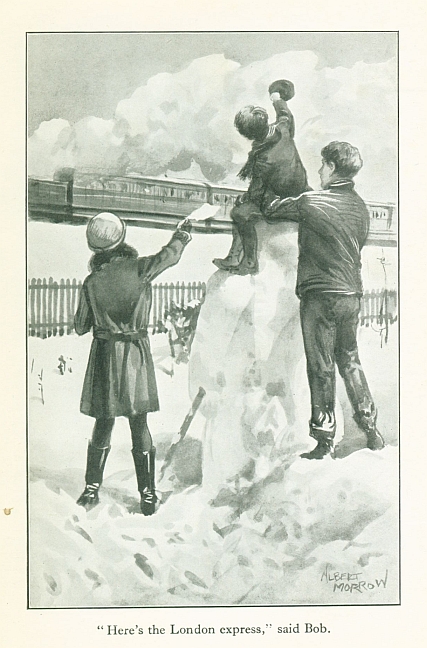
"Here's the London express," said Bob.
BY
FREDERICA J. E. BENNETT
AUTHOR OF "THE MISER'S WELL," "THE SQUIRE'S
GRANDCHILDREN," ETC.
ILLUSTRATED BY ALBERT MORROW
LONDON: THE R.T.S. OFFICE
4 BOUVERIE STREET, E.C.4
MADE IN GREAT BRITAIN
PRINTED BY WILLIAM CLOWES AND SONS, LIMITED, LONDON AND BECCLES
CONTENTS
CHAPTER
I. A Great Piece of News
II. Alone in London
III. Uncle Oscar
IV. Lost
V. Hugo again
VI. Hugo's Fight
VII. The "Picture" Little Girl
VIII. The Story of the Oak Chest
IX. The Secret Drawer
X. The End of the Holidays
XI. Autumn Days
XII. The Lost Letter
THE BOY OVER THE WAY
There were eight of the little Haywards: Ned, Mary, Geoffrey, Bob, Phyllis, Boodles, and the babies. Uncle Ted had once said that there were eight too many of them, but then Uncle Ted had no children of his own—he was not even married, in fact; so perhaps it was not very surprising that he should think his nieces and nephews rather too noisy, and sometimes very difficult to manage.
The babies were twins, and girls; but Boodles was a boy; and a very trying little boy Phyllis found him at times, for the business of looking after him fell chiefly to her share, Nurse having most of her time taken up with the babies, and Mary and Bob being busy with their lessons. Phyllis, of course, had lessons to do also, but they were not so long or so difficult as Mary's and Bob's, and she generally had the afternoon to play in, except from three to four, when she had her lessons to prepare for the next day.
Ned and Geoffrey were away at a boarding-school all term-time, so they do not come much into this story; but just now they were at home, for it was holiday time.
Indeed, on the particular afternoon on which this story opens it was New Year's Day, and Bob and Phyllis were roasting chestnuts in the schoolroom, while Mary sat curled up in a big armchair by the fire, reading the January number of The Girl's Own Paper, and eating a chestnut whenever one was offered her.
"It's rot not being allowed to go out in the snow!" said Bob, hastily dropping a chestnut which was too hot to hold, and then routing for it among the cinders with the blade of his pocket-knife.
He had been laid up with a bad cold and had not been allowed out that day, as it had been snowing hard, and a bitter north wind had been blowing all the morning.
"P'raps you might go out now," said Phyllis. "Mother said you could if the wind tumbled, and it's not blowing down the chimney a bit now."
"Silly girl!" scoffed Bob, while Mary laughed too. "Mother said 'if the wind dropped,' and Phyl calls it 'tumbled'!"
"Well, anyway, it's not blowing now," said Phyllis. She was not often put out of temper, even when the others teased her. "And it's not snowing either. I'll go and ask mother." But before she could get out of the room hasty footsteps sounded along the passage, and Geoffrey flung open the school-room door.
"Hullo, you kids!" he cried. "I've got a bit of news for you. We're going away to London."
"To London? Which of us? On a visit? Oh, Geoff!" cried the children.
"On a visit? No, we're going there to live," said Geoffrey; "the whole bang lot of us. Give me a chestnut, Pumpkin, if you've got a nice brown one."
Phyllis was called "Pumpkin," "Humpty-Dumpty," "Mother Bunch," "Dumps," and several other names besides, but she never minded. She was soft and plump and happy-looking, and "roundy" kind of names seemed to suit her; besides, if you notice, it is always the people other people love best who get the most nicknames.
"Here's a beauty," said the little girl.
"Go on, Geoff; who told you?" said Mary.
"Mother. She said I might come and tell all of you. Father's sold his practice and he's bought one from another doctor in London."
The Haywards' father was a doctor, and although for the last fifteen years he had practised in the country he had wanted for some time now to go back to London, where he had lived as a young man.
"I am pleased," said Mary. "I 'spect I shall be able to go to a proper school now."
"Me too! Three cheers!" cried Bob, turning head over heels on the hearthrug.
"Shan't we live in this house any more?" asked Phyllis.
She was not quite sure yet whether to be glad or sorry.
"No, Dumps," said Geoffrey. "Are you coming into the garden? I've promised Boodles I'll make him a snow man."
"Oh, Geoff!" cried Phyllis in delight, giving her big brother a hug.
"Mother said Bob can come out too if he likes," said Geoffrey.
"I don't want to make a rotten snow man," grumbled Bob. "And anyway it's no use going out now; I wanted to go tobogganing with Jervis this morning."
"Don't come, then!" said Geoffrey. He got as far as the schoolroom door, then looked back. "As it happens, Jervis is waiting for you in the hall," he said, "and his toboggan's outside."
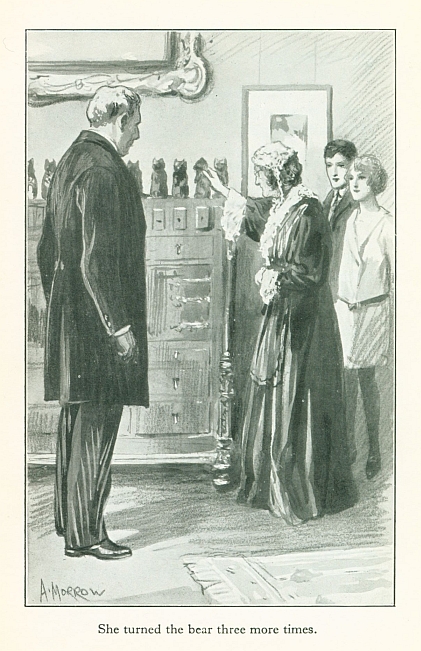
She turned the bear three more times.
Bob gave a whoop of delight and ran off for his boots.
"Come on, Mary," said Phyllis.
Her sister looked out at the snow, then back at her book and the cosy armchair by the fire.
"Do come," urged Phyllis. "It's ever so much more fun when there's a lot, and it's nearly three o'clock—it'll be dark soon, and then we shan't get the snow man finished."
"All right," said Mary.
She followed Phyllis out of the schoolroom, and went first to her mother to hear more about Geoffrey's wonderful news; then joined the others in the garden.
Ned was out tobogganing with some friends, but Geoffrey, having twisted his ankle the week before, was unable to join them, and so had delighted Boodles' heart by promising to make him the biggest snow man he had ever seen.
"Bigger and bigger and bigger zan a elephant!" cried Boodles, jumping about excitedly in the snow.
He looked very funny with a pair of Bob's stockings drawn over his boots and knickerbockers to keep out the snow.
"Come and help us, then," said Geoffrey, "instead of jumping about like a cat on hot bricks!"
He was working very hard indeed himself, so as to get the snow man finished before dark, and presently Bob and his friend—who had managed to smash their toboggan between them—joined them, and though they scoffed at the snow man, and pretended that they did not care for that kind of thing at all, their dignity allowed them to help in the work, as Geoffrey was doing it too.
"This sort of thing pleases the kids, doesn't it?" said Jervis, aged ten.
"Rather!" said Bob, plastering the snow man's back. "I used to like it when I was a kid—didn't you?"
"What are you now?" scoffed Geoffrey.
"Here's the London express," said Bob.
"So it is! Let's wave," cried Phyllis; "it'll make people look out and see the snow man."
She snatched her red tam-o'-shanter from her head and began to wave. Geoffrey picked up Boodles and set him on the snow man's head.
"I shan't wave," said Jervis, as the train thundered into sight round the bend of the line.
"Kids not allowed to wave," said Geoffrey, with a sly glance at Mary, and holding Boodles with one hand while he waved his cap with the other.
In a moment Jervis and Bob had pulled off their caps and were waving frantically.
So it came about that a good many people in the express train from Dover to London that afternoon saw a group of children round a snow man, waving from a country garden, and one person waved a handkerchief back to them.
The Haywards little guessed how soon they were to meet the person who had waved that fluttering handkerchief to them from the express train window.
The "person" who had waved the handkerchief out of the window was a small boy of nine or ten years old. He had been seated in the corner of a third-class carriage, gazing with sad, tired eyes at the snowy fields and bleak-looking country through which the train was passing, when suddenly the group of children round the big snow man had caught his attention. In a second he had pulled his handkerchief from his pocket and waved it wildly, smiling back at the rosy happy faces upturned towards the train.
Then the train sped swiftly on and Hugo was left with his own sad thoughts for company. He had only had two fellow-passengers with him in the carriage—two old ladies who had left the compartment now to have tea in the restaurant car—and all through the long journey neither of them had spoken to the pale, tired little boy in the corner of the carriage.
Was it really only this morning, Hugo thought, that he had said good-bye to old Nance at Lilon station? It seemed much longer than that to him, and years and years ago since he and Maman and Marie had been together—at home. Only six weeks, really. Hot tears welled up into the little boy's eyes as he thought of all the things that had happened during those six weeks. First, Marie had been taken ill, and he had not been allowed to go and see her because her illness was infectious, they told him, and Maman did not want him to be ill too; then Maman had come to him one day with tears in her eyes and told him that Marie was dead—sweet little Marie, who had always been full of fun and laughter! Hugo could hardly believe, even now, that it could be really true. And then Maman herself had been taken ill—oh, sad day!—when Hugo had been told he must not see her until she was better, and—she had not got better. Poor Maman, she had died too; and now Hugo was on his way to live with an old uncle in London whom he had never seen.
Before she died, Hugo's mother had told Monsieur Loto, the old French pastor, that she had no near relatives in the world except an old uncle in England, and that if she did not get well, she would like her little boy to go and live with him.
Hugo's mother was English, but years ago she had married a Frenchman and had lived in France ever since, even after her husband's death; and so this was the first time the little boy had ever been to England, as he sat in the train that winter afternoon with a dreary feeling in his heart that there was no one to love him now in the whole wide world.
Presently the old ladies came back to the carriage, warmed and cheered by their tea, and one of them had brought a Bath bun for Hugo. He thanked her prettily in his soft little voice, and ate the bun; then fell asleep and did not wake until the train came to a standstill.
"Charing Cross! Charing Cross! All change!" cried the porter, and Hugo got out of the train and stood, feeling very small and lonely, on the crowded London platform.
By-and-by, when some of the people had gone away, he asked a porter to help him find his little trunk; and then he had to wait, with a long stream of other people—who also had come from abroad and so had to have their luggage examined by the Customs officials—until his trunk had been opened and a large white cross marked upon it, when the porter shouldered it once more and asked Hugo where he wanted to go.
Then came a terrible moment for the little boy.
He put his hand in the pocket where he expected to find the letter which Monsieur Loto had given him, with his uncle's name and address written clearly upon it, and—there was nothing there!
He felt again, then tried his other pockets, each in turn; but although his purse and handkerchief were there, and the clasp-knife which Nance had given him for a parting present, the letter was gone, and Hugo turned in desperation to the porter.
"I've lost it," he said. "The letter that had my address written on it, where I was to go. Oh, what shall I do?" And something very like despair crept into the little boy's eyes.
"Lost it, have you?" said the porter. "Well, here's a go! And don't you know it, neither?"
"No, I only read it once. It was Something Street."
"'Spect it was," said the man with a grin. "'That ain't what you might call singular. Queer Street, wasn't it, now?"
"No," said Hugo gravely, "that wasn't the name." He saw nothing to laugh at in what the porter had said.
"Perhaps you dropped it in the carriage," said the man. "We'll go and have a look. The train's not gone yet." But although they hunted in all the third-class carriages the piece of paper with the address upon it could not be found.
"What shall I do?" asked Hugo. "I—I don't know any one in England, you know."
"Thought you seemed a bit foreign-like," said he. "D'you know the name of the party you're going to?"
Hugo thought hard for several seconds, then he looked up brightly.
"Yes," he cried. "It's Uncle Oscar, and his other name is Thoraeus."
"Thoraeus, that's a rum name," said the porter. "Well, it's all the better just now for being uncommon. You come along with me." And he led the way to a cab-stand, where he consulted with a red-faced cabman, who was a friend of his, and then beckoned to Hugo.
"This gentleman's a-goin' to drive you to the nearest post-office, so as you can look up the name in a directory," he said.
And although Hugo did not know in the least what a directory might be, he got into the old-fashioned four-wheeled cab and was driven a short distance to a big building where the cabman got down and told him to go inside and ask them to look up the name he wanted in the directory.
There were two people of that name living in London, the post-office clerk told him, after studying a big red book—one living at No. 15, Bering Street, and the other at No. 9, Lithcote Street. Then he wrote down the addresses on a piece of paper.
"Lucky for you there ain't fifty," said the cabman, when Hugo had handed him the paper. "But it's an uncommon name. Well, Bering Street comes first, so we'll go there."
For some time the cab rattled through the streets, then drew up once more, and Hugo got out and went up the steps of a small grey house which the cabman told him was No. 15.
He rang the bell and a small maidservant opened the door.
"Can I see Mr. Thoraeus, please?" asked Hugo.
"Yes, I think so," said the girl, who did not notice that the little boy had said "Mister" instead of "Miss" Thoraeus, which was her mistress's name.
She led the way across the hall and opened a door, Hugo following her. And this was what he saw.
On a chair beside a high oak chest a little girl was standing peering into an open drawer, while the sweetest old lady Hugo had ever seen was looking at her with a smile on her lips and a little flush on her wrinkled cheeks.
"No, Aunt Tabitha, it's quite, quite empty," the little girl was saying.
Then they both turned and saw Hugo, and the old lady put up her hand quickly and pushed the drawer back into its place, while a little brown bear which was carved in oak above the drawer turned slowly round three times, then stopped, and Hugo looked in surprised curiosity at the other bears which were carved in a row all along the top of the old oak chest—quite a dozen of them, if not more—but they were all quite still, with their little noses pointing into the room. Then Hugo turned his eyes away and looked at the old lady, who was looking at him too with surprise in her pretty blue eyes.
"Well, little boy?" she said kindly. "Is there anything I can do for you?"
"If you please," said Hugo, "I am Hugo Loran, and—and I have come to live with Uncle Oscar."
"But who is Uncle Oscar?" asked the old lady, looking rather puzzled.
"His other name is Thoraeus," said Hugo. "I lost the address, and they told me at the post-office to come here, and then to Lithcote Street."
"Ah, that must be it!" said the old lady, understanding at last why this little boy had come to her house. "You are going to stay with your Uncle Oscar—is that it?—and so they looked up the name for you in a directory. But it is very strange—I did not know there was any one else of that name now. I thought I was the last."
"Then doesn't Uncle Oscar live here?" said Hugo, in a disappointed voice.
By the time that Hugo left the little grey house he felt that he had at any rate two friends in England.
"Come and see us very soon, if your uncle will allow you to do so," said the old lady, as she stood in the doorway with the little girl beside her, watching Hugo down the steps. She felt sorry for the lonely little boy, and smiled very kindly at him as he drove away in the cab.
Hugo smiled too as he raised his cap, but already he had begun to feel anxious, and to wonder whether Uncle Oscar would be pleased to see him or not.
"If only he knew I was coming!" thought the little boy, and he wished once again, as he had wished a good many times that day already, that Monsieur Loto had written to say he was coming.
"No need to write beforehand," the old Pastor had said. "Better go yourself straight to your uncle, and tell him who you are. I will write in a day or two and explain things to him. It is all quite simple, quite simple."
But to poor, tired, lonely little Hugo it did not seem at all a simple thing to go to a strange house, and ask an old gentleman whom he had never seen if he might live with him for always.
The cab stopped at last before a high dingy-looking house in a quiet side street, and Hugo walked up the steps to the front door and rang the bell. Then he waited in expectation till the door was opened, and a very old woman peered out into the winter gloom.
"No, thank you—no muffins to-day," she said in a high, cracked voice.
"I—I don't know what muffins are," said Hugo.
"Who're you making game of?" said the old woman. "I heard the muffin-bell." And she would have shut the door if the cabman had not called out briskly:
"Hi, missis! Here's the trunk."
"The what?" said the old woman in astonishment. "I thought you were the milk. Ain't you the milkman now?"
"Not I, missis," said the cabman. "I've driven the young gentleman here."
"The young gentleman?" said the old woman, quite bewildered by this time. "Why, so he is. I didn't rightly see. My sight's dim, very dim of late, and I haven't my spectacles on. And who might you be, my dear?"
"If you please," said Hugo, speaking slowly and distinctly, but feeling on the verge of tears in spite of his nine years, "I am Hugo Loran, and I have come from France to live with Uncle Oscar."
"You've come—to live—with Uncle Oscar!" repeated the old woman in great surprise.
"Uncle Oscar's other name is Mr. Thoraeus," said Hugo. "That was mother's name before she married."
"Well, I never!" said the old woman. "Well, I never!" She looked in perplexity from Hugo to the cabman.
"Well, I'm sorry, mum," said the man; "but if you've no objection I'll just put the young gentleman's luggage down in the hall."
"But," said the old woman excitedly, seeming to wake up all of a sudden, "I have a very great objection. Whoever the young gentleman may be, he can't come in here."
"Well," said the cabman, "well, you'd better settle it between you, mum. Six shillings, please." And after pocketing the fare he popped Hugo's little trunk down in the hall, hurried down the steps, mounted his box and drove away, leaving the small boy and the old woman staring at each other in the doorway.
"I'm very sorry," said Hugo humbly. "But I hadn't anywhere else to go, you see."
"Well," said the old woman at last, ungraciously, "well, you'll have to come in, I suppose, but I don't know what master will say!"
She drew back and let Hugo into the hall, then showed him into a dark, cheerless room where she left him, sad and shivering, while she went away downstairs.
Hugo could hear the sound of cheerful voices coming up to him from the kitchen; then some one went out and banged a door and all was still, until Mrs. Jones—for that was the name of Mr. Thoraeus's cook or housekeeper, or whatever she chose to call herself—came upstairs again and put her head round the door.
"Mr. Thoraeus won't be home yet awhile," she said. "Would you like a cup of tea?"
Hugo did not answer for a moment. He was looking past Mrs. Jones at a big sandy cat which had followed her into the room. It was just like Nance's old cat at Étapes in France.
"What a lovely cat!" he cried. "Pussy! Pussy!"
And in answer to the boy's call the cat walked to his side and began to rub her head against his legs, then leaped on to his lap; and Mrs. Jones's heart was won.
"Well, I never!" she cried. "To think of Dorcas making friends with you like that! Why, she won't look at any one 'cept me, as a rule."
"She's a beauty," said Hugo, stroking the cat from the top of her head to the tip of her sandy tail.
Mrs. Jones beamed on them both.
"I'm all alone this afternoon," she said. "I wonder now, if you would like to come down to the kitchen and have a cup of tea with me?"
"Oh yes, please," said Hugo. He was so tired of being by himself in that cold, dark room.
"Come along down, then," said Mrs. Jones.
She led the way downstairs and Hugo followed closely, thinking what queer, dark places London houses had in them; but when Mrs. Jones opened the kitchen door he saw a red glow shining through the front of the stove, the gas was lit, and a kettle was singing merrily.
Indeed, the little boy quite enjoyed his first tea in England, seated at Mrs. Jones's kitchen table, with Dorcas on a chair at his side.
After tea—when Dorcas had finished the last drop of milk and Hugo had said that he really couldn't eat another piece of buttered toast—Mrs. Jones said that she must go upstairs to see about the little boy's bedroom.
"Master couldn't have the heart to turn him out to-night, poor little chap, whatever he may do to-morrow," muttered the old woman as she collected wood and coals preparatory to making a fire upstairs. And the boy heard the whispered words and turned with a little shiver to the window as Mrs. Jones left the room.
The little window was below the level of the ground, but Hugo could see that the snow was quite deep in the area and the wind was hurling it against the window panes and shrieking through the cracks and down the chimney.
Turn him out! Oh, how dreadful it would be if Uncle Oscar should turn him out of doors this bitter night! Where would he go, and what should he do?
A bell rang just then, and in a minute or two Hugo heard Mrs. Jones stumping across the hall to the front door.
She drew back the bolt and he could hear voices—Mrs. Jones's, rather excited and shrill, and a low deep voice that the little boy was sure belonged to Uncle Oscar.
Then Mrs. Jones came downstairs and told Hugo to go up to the dining-room.
"Speak out," said she, "and don't be afraid of him. He do look a good deal worse than he be."
And with these words running through his head poor Hugo slowly mounted the stairs and went towards a half-open door, through which he could see a light burning.
An old man was standing on the hearthrug—a tall old man with a long white beard, bushy eyebrows and big gold spectacles.
"Well," he said, "and so you are Marcia's little boy.... Mrs. Jones tells me your name is Loran?"
"Yes, Hugo Loran."
"Humph! And your mother is dead, Mrs. Jones says. Where's your sister? You have a sister, haven't you?"
"She's dead too," said Hugo. He gulped and squeezed his fingers very hard together.
"Humph! And what made you come to me?"
"Because—" Hugo stopped, then went on bravely—"I don't think Maman knew any one else in England, and so when she—when she thought she wasn't going to get better—she wrote down your address and s-said I was to come to you."
"Humph!" said the old gentleman again. "Did she? Marcia always was impetuous, even as a little girl, just like her mother before her. Well, as you are here, you must stay, I suppose; but you must amuse yourself, my boy. I have my own occupations—you must find yours."
"Yes, thank you," said the boy.
"That's all right, then," said Uncle Oscar. "You can run away now."
And Hugo went downstairs again to the kitchen, and sat and nursed Dorcas and wondered what his new life was going to be like in this queer dark house, with Uncle Oscar and Mrs. Jones for company.
Then presently, for the kitchen was warm and Dorcas's even purring was very soothing, the little boy fell asleep, and as he slept he dreamed that Monsieur Loto and old Nance were trying to pull open the drawer which the old lady had shut in the old oak chest. And as they pulled, the row of little carved bears on the top of the chest turned slowly round and round, purring as they went.
The Haywards arrived in London on a cold foggy afternoon in early January.
The children could see nothing but yellow fog and dimly moving vehicles, as they peered through the windows of the cabs which were taking them from the station to the new house.
Ned, Mary, Geoffrey, and Bob were in the first cab, and Nurse, Phyllis, Boodles, and the babies in the second, and they were all very excited and bubbling over with fun and spirits.
"I'd much rather have come straight away with the furniture on Tuesday," said Geoffrey. "It's all tommy rot having had to stay at the Gordons' these two nights, just as if we were kids, and had to be kept out of the way like Bob and Phyllis."
"I like that!" cried Bob hotly. "I'm no more a kid than you are, Geoffrey, or Ned either; it's not my fault that I've had to have a beastly governess at home."
"Bob, be quiet!" said Mary. "You're very rude to Miss Smythe. Fancy calling her beastly!"
"I didn't," said Bob. "I said a beastly governess."
"Well, that's as bad," said Mary. "Miss Smythe's a governess, and——"
"Oh, shut up, Mary," said Ned. "Don't preach! I know what is a beastly shame, and that is that Geoff and I have got to go back to school on Monday, when we shall only have been three days in London.... Hullo! Here we are!"
The cab stopped before a corner house and the children got out, followed a few minutes later by Nurse and the younger ones, who ran chattering and laughing into the hall while Ned paid both the cabmen and loitered a minute on the steps, looking up and down the street as far as he could see in the thick fog, and wishing it was the next day, so that he might go out with Geoffrey and explore London.
When the next day came, however, there were so many little things to do in the house—although Dr. and Mrs. Hayward and the servants had already been there some days—that the elder children found their time well filled up until the afternoon, when they went to the South Kensington Museum, as, being within easy reach, they could go there by themselves in spite of the fog, without causing their mother uneasiness.
For the thick yellow fog still hung about and prevented Boodles and the twins from going out of doors, and it was only on the third day after their arrival in London that the sun loomed redly through a misty cloud and Boodles turned from the nursery window in surprise.
"Oh, Phylly, there's a sun!" he said.
"You shouldn't say a sun," said Phyllis. "It's the sun."
She spoke rather crossly, for she had just found her favourite doll had got broken in the move.
"'Tisn't such a pitty sun as the one at home," said Boodles.
He still spoke of the country as "home."
"Silly boy!" said Phyllis. "It's the same sun; there's only one."
"Isn't there?" said Boodles. "Isn't there weally only one sun, Phylly? And has he come all the way from Benfield to see us?"
"Oh, Boodles!" said Phyllis. "Of course the sun hasn't come because of us; it's always here, and it's always at Benfield, only we can't see it when it's cloudy or foggy like it's been lately."
"It's not really foggy to-day," said Nurse, coming in at that moment. "It will be quite fine soon, I think; we ought really to be going out, only I have so much to do this morning."
"Can't we go out by ourselves?" asked Phyllis.
She and Boodles, and even the babies, were so tired of being cooped up in the nursery ever since they had come to the new house.
"N—no, not in London," said Nurse. "It was different in the country, when you could just go in the garden or up and down the lane."
"Couldn't we go just for a little while?" begged Phyllis. "I'll take great care of the little ones, Nurse; and the others go out alone."
"That's different," said Nurse; "they're bigger than you. Still, I really think you might go by yourselves just up and down in front of the house here, if you keep to the pavement, Miss Phyllis. It's a nice quiet street, and I don't see how you could come to any harm."
"May we? Oh, Nurse!" cried Phyllis, jumping up and down in her excitement, while the babies began to jump too and then fell against each other and rolled over, chuckling delightedly, until Nurse carried them off and bundled them into their warm coats and the white furry bonnets, which they loved to stroke on each other's heads, they were so soft and warm.
Mother and father had had to go out that morning on business, and they had taken the elder children with them to show them some of the sights of London, so that no one heard the babies' soft coos and gurgles of delight as Nurse carried them downstairs and tucked them up in the pram, while Phyllis and Boodles were lacing their boots and looking for their gloves and scarves and all the other things that you are obliged to find before you go for a walk.
They were all ready at last, however, and Nurse saw them off from the doorstep, waving good-bye and reminding Phyllis once again that they were to keep to the pavement and not cross over the road.
"All right," said the little girl, and she pushed the perambulator along feeling very happy and important.
For some time they walked up and down the quiet side street, then Boodles asked to go round the corner.
"I'se tired of this stweet," he said; "it's a silly stweet."
Phyllis looked back at the high brick wall which stretched across one end of the street.
"I wonder what's on the other side of the wall?" she said.
"Never mind. Let's go this way," said Boodles.
He trotted a little way round the corner and Phyllis stood still and looked along the road.
"Nurse said, 'keep to the pavement,'" she murmured; "but it is pavement all along this street, so I s'pose it's all right."
"Yes, come along," said Boodles.
He always put on rather an important little air when he was out alone with Phyllis and the twins, because father had once told him that as he was the only boy there he must look after the girls.
When Nurse had told the children to keep to the pavement, she had of course meant that they were not to go farther than just up and down the quiet side street in which their house stood. But Phyllis and Boodles, never having been in a town before, thought that so long as they kept on the pavement and did not cross any roads, they were obeying Nurse's orders.
And so they went on and on, turning down side streets when the pavement turned that way, and always thinking that by-and-by the safe wide pavement, of which Nurse had spoken, must come to an end and then they would turn back.
Still, however, the pavement stretched in front of them—as far as they could see in the fog—whenever they turned a corner, and Phyllis at last stood still and looked behind her.
"We've come a long way, Boodles," she said. "I think p'raps we ought to be going back."
"All right," said Boodles. "My foot hurts, Phylly. I've got a stone in it, I fink."
"You can't have got a stone," said Phyllis; "there aren't any here. Let me look." And she stooped and took off her little brother's shoe and found a lump inside the leather sole which had to be rubbed and hammered down with a legless wooden horse which one of the babies had insisted on bringing out, before Boodles would consent to walk on.
All this took some time and the children were surprised to find how dark it had become when they started on once more. The fog had grown much thicker now and the warm, friendly sun had quite disappeared.
"It's almost like night," said Phyllis, in rather an anxious voice, as she pushed the perambulator along quicker than before.
"This is our turning," said Boodles presently.
"Oh no, Boodles," said Phyllis, "we haven't nearly got there yet."
"This is it," cried the little boy again, when they reached the next turning.
"I don't think it is," said Phyllis.
But she spoke doubtfully, for it really did look like their turning, only the house at the corner did not look quite like their house.
They went and looked at the steps, but there were not so many as at their house, Phyllis was sure; and so they went on again and looked at the next corner house, and the next; still none of them looked like theirs, and the babies began to cry, and Boodles fell and cut his knee and began to cry too.
"Oh, Boodles, don't cry," said Phyllis. "We shall have to go back, I think. We must have passed the turning."
"I b-b'lieve we've l-lost our way!" sobbed Boodles.
And in her heart of hearts Phyllis thought so too.
For some time Phyllis walked along drearily, pushing the pram, while Boodles clung to her skirts.
"I'se tired ... I'se cold," Boodles sobbed at intervals, while the babies kept up a chorus of lusty howls and wordless scoldings. They wanted to know why they were being kept out in the cold like this, with no dinner, no Nurse, no nice hot fire or cosy nursery to sit in.
Phyllis stopped once more.
"Don't cry, Boodles," she said, bending over the pram in order to wipe the babies' tears away and speaking as cheerily as she could. "We must have taken a wrong turning, I think. I'll ask the next person we meet the quickest way home. P'raps there's a short cut."
Boodles was pacified with these words. He had happy remembrances of short cuts in the country through pleasant fields and pretty lanes, and he trotted along quite contentedly at Phyllis's side for some minutes in silence.
They had not met many people while they were out, and the few they had met had been walking quickly and had paid no attention to the forlorn little group of children. Now, however, they heard footsteps coming near, and Boodles ran forward a few steps.
"Here's a man," he called. "Ask him, Phylly!"
Phyllis looked at the big ungainly figure coming towards them through the fog. He was a ragged-looking man, with one shoulder higher than the other, and a long black beard which seemed to float, like seaweed, on the fog.
The little girl would have walked on without speaking, but the man had heard Boodles' words, and he stopped in front of the perambulator, looking at the children with eyes that seemed to look in the opposite direction to each other.
"Well, little man, and what do you want to ask me?" he said in a wheezy voice.
Phyllis did not answer for a moment. She felt afraid of this man with the queer eyes and face, and disagreeable voice, and she shrank back against the wall and clutched firmly on to the handle of the pram.
"Come, missy, don't be frightened," said the man. "Have you lost your way?"
"Yes," said the little girl. "We want to go to Lithcote Street. Can you tell me the nearest way, please?"
"In course. Why, I lives there meself," said the man. "But it's a long way from here. You come along with me."
Phyllis had not heard footsteps behind her, but a little boy now appeared suddenly at her side and laid one hand upon the pram.
"I can show them the way," he said. "I am going there now."
He spoke slowly and rather carefully, and Phyllis knew at once that he was not a poor street-boy, though she was too excited to notice his clothes or, indeed, anything about him, except that he was about her own age and had a nice face, which was rather pale just then as he looked at the man, who seemed even bigger than before as he made a step towards the boy and raised his hand as if he meant to strike him.
"Clear out!" he said. "You run away. This aren't no bisness of yourn."
For a moment the boy still held on to the side of the pram, then, as the man laid his hand roughly on his shoulder, he shook himself free and slipped away in the fog, and Phyllis was left facing the man, with terror in her heart and the sound of the boy's departing footsteps in her ears.
"You come along with me," said the man, and he tried to take the perambulator from Phyllis, but the little girl clung to the handle tightly.
"I'd rather push it," she said. "And—and I think we can find our own way, thank you."
"Come," said the man, speaking as roughly now as he had done to the boy a few moments before. "Come, or I'll make yer!"
Phyllis looked round her helplessly. She was really frightened now, for she knew that Boodles and the babies were in her care, and she could not tell what the man might do to them.
Suddenly she heard footsteps in the distance; they drew nearer—the man did not hear, for he was speaking loudly and roughly; but a cry of joy broke from the little girl's lips as a policeman's figure loomed suddenly into sight, with the little boy they had seen before beside him.
The man turned at her cry and saw them too, and letting go of the pram he ran away quickly, before the policeman could get to him, and although the policeman followed him a little way along the road, he soon came back and told Phyllis he would show her the way home.
"Lucky for you this young gentleman was here and had his wits about him," said the policeman; "or goodness knows where that man would have taken you off to."
"Did you go and fetch the policeman?" asked Phyllis.
"Yes," said the boy. "I thought the man didn't really mean to show you the way to Lithcote Street, because I live there, and it is quite close here, really."
"Quite close?" cried Phyllis in surprise. "Why, we have come ever so far."
"It's only just round the corner," said the boy.
It was quite true. The children had, without knowing it, wandered back almost to their own house again, but in the fog they would very likely have not recognised it, even if they had not met the man who had tried to take them the other way.
It was indeed lucky for them that Hugo—for it was Hugo who had come to the rescue, as I dare say you may have guessed—it was lucky that the little boy had been going to post a letter just then in the pillar-box round the corner, for although he was not much older than Phyllis, still he knew a great deal more about towns than she did, having stayed in Paris two or three times during his short life, and having been told never to go with any stranger in the street.
The policeman walked as far as their house with the children, and there on the steps were Nurse, Geoffrey, Mary, and Bob, all looking eagerly up the street, and they gave a cry of delight when they caught sight of Phyllis and the perambulator, with Boodles and the policeman behind.
Hugo knew who they were at once: the children he had seen from the train window round the big snow man the first day he was in England.
"We thought you were lost!" cried Mary, covering the babies' fat, tear-stained faces with kisses, and then hugging Boodles as if she would never let him go.
"My darlings! My lambs! My diddums!" sobbed Nurse, whose eyes were quite red and swollen from crying.
"Well, don't cry now, Nurse, for goodness' sake! There's nothing to blub about now," said Geoffrey, who was rather ashamed of himself for having kissed Boodles in the street, and "made a silly" of himself, as he muttered crossly, sticking his hands in his pockets and trying to saunter up the steps and into the house as though four small children being lost in London was quite an everyday occurrence.
Mother came back soon after that to see if anything had been heard of her darlings. She had been racing up and down the streets trying to find them; then came father, who had been to Scotland Yard to obtain help in seeking the lost children; and last of all, Ned.
"Where is the little boy?" asked mother suddenly. "I hope some one thanked him."
But no one had seen Hugo go.
"I don't think he came in, and we didn't even say good-by," said Phyllis, looking sorry.
"He were a plucky little 'un," said the policeman. "He come to me, all out of breath, and he said: 'Policeman, there's a man trying to run away with some children, come quick!' he says, and he was away through the fog before you could say 'knife,' with me after him. He had passed me, he told me afterwards, as he went by to post a letter. 'E's got his wits about 'im, that young gentleman."
And the Haywards thought so too.
* * * * *
The first few months in London passed swiftly by. The Easter holidays had come and gone, and now, in May, Phyllis had started going to school with Mary, and she felt very important as she set off by her sister's side each morning, with her satchel on her back and the penny for her lunch safely tucked away in her glove.
From the very first day Phyllis had liked school, for she was a jolly little girl, and the other children liked her at once; but there was somebody at Bob's school who felt very shy and strange these first few weeks of the summer term. In the next chapter I must tell you who this "somebody" was.
The first few months of Hugo's life in England were not particularly gay or happy months for the little boy. Miss Thoraeus, the old lady at whose house Hugo had called by mistake the first day he was in England, had written soon afterwards to say that as her little niece had whooping-cough Hugo must not come to see her for some time. This had been a great disappointment for the little boy, but he did not speak about it to Uncle Oscar, for, kind as the old gentleman meant to be, he did not understand children, and Hugo's little joys and troubles had no interest for him. In some dim way the little boy understood this, and it was a sad, lonely life that he led in the old grey house with Mrs. Jones and the little maid-servant and Dorcas the cat, for company during the long days when Uncle Oscar was away at the British Museum, or wherever he spent his time when he was not shut up in the library at home, writing busily at the square leather-covered table, strewn with books and papers which Hugo always looked upon with awe.
He used to wonder sometimes what Uncle Oscar could find to write about, and one day he asked Mrs. Jones.
"What does he write about, my dear? Well!"—Mrs. Jones paused and thought hard for several seconds, with one finger pressed against her forehead. "About people that lived long ago, Master Hugo; that's it, you may depend upon it—people that lived long, long ago, before you and me was ever born. He's wonderful clever, is the master."
And with these words Mrs. Jones hurried away before Hugo had time to ask her any more questions.
The little boy used to make up tales to himself sometimes about those people of long ago, about whom Mrs. Jones had said his great-uncle wrote, and sometimes he would go into the library when Uncle Oscar was out and look at the rows and rows of books on the shelves, and wonder who wrote them, and if they were old people like Uncle Oscar, or young like his mother and father had been. He really was rather a queer little boy; but then he lived so much alone and had to amuse himself in some way, and these fancies had to take the place of the playfellows he longed for when he sat at his high bedroom window and watched the children from the corner house going off to school, or out for walks with their nurse.
For Hugo lived on the opposite side of the road to the Haywards, and sometimes when he was coming back from, or going out for, a walk, he would meet some of the children and would stop and speak for a minute or two to Phyllis and Boodles; but although he knew Bob also quite well by sight, and Ned and Geoffrey too during the Easter holidays, he did not speak to them at all, for he was shy of English boys, never having known any before.
And so it came to pass that Bob and Hugo were almost strangers to each other when the latter went for the first time to Bob's school.
"I say, you'll never guess who was at school this morning," said Bob, bursting into the dining-room one sunny afternoon in early May, where Mary and Phyllis were arranging some flowers on the table which was ready-laid for tea.
"Who?" said Mary, putting her head on one side as she looked at a vase full of pink tulips. "Doesn't it seem horrid to have to make a few flowers like these do, instead of being able to go out and pick as many as we like in the garden?"
"Guess," said Bob.
"I don't know," said Mary. "Tell us!"
"Do tell us," said Phyllis.
"The little boy from over the way," said Bob.
"Hugo?" cried both the little girls together. For Hugo had told them his name one day, when they had stood and chatted longer than usual outside the Haywards' house.
Phyllis had asked her mother some time ago if they might invite the little boy to tea; but Mrs. Hayward, not knowing that Hugo was so lonely, or that he had been such a short time in England, had said that as they did not know the old gentleman with whom the little boy lived, she could not very well write and ask him to tea. She had already written a nice letter to Hugo—as soon as the children had found out where he lived, telling him how grateful she was to him for having fetched the policeman that day.
Bob nodded.
"Yes, Hugo," he said. "He's a rum little chap; and do you know, he's not quite English? His father was a Frenchman. He's a queer kid."
"Kid!" scoffed Mary. "Why, he's not so very much smaller than you."
"He is!" cried Bob indignantly. "Why, I'm a good head and more taller than he is, and ever so much the broadest."
"Is he in your class?" asked Phyllis.
"Mine?" said Bob. "No, thank you; we don't have kids of nine years old in my class."
"Well, you're only just eleven yourself," said Mary, "though you do think such a lot of yourself now you go to a proper boys' school."
Time passed, and Bob was forced to acknowledge that although Hugo might be a "queer kid" and a "rum little chap," as he had said, yet for all that he had plenty of pluck and could hold his own with any of the English boys, in spite of his French training.
"Hugo's had a fight," said Bob one day, coming back rather later from school than usual one afternoon. It had been a particularly hot day, even for June, and the girls were looking rather tired and pale as they sat in shabby armchairs by the open window, longing for the garden at "The Beeches," where they would have been at tea out of doors under the big ash tree on the lawn, with strawberries, perhaps, and white-heart cherries from the big tree at the corner of the orchard.
"A fight? Oh, Bob!" cried Phyllis, looking quite distressed, for she always took a great interest in Hugo, feeling that she and Boodles and the babies had been rescued by him from the bad man who had tried to run away with them.
"What was it about?" asked Mary. "How silly boys are—always wanting to fight and make a fuss about nothing at all!"
"It's girls who make the fusses," said Bob. "Fussy, fussy, fussy, fuss! I shan't tell you about the fight now." He made a grimace at Mary and going over to the table, helped himself to a piece of bread-and-butter.
"Greedy boy, wait till tea is ready," said Mary.
"Shan't!" said Bob, with his mouth full. "I'm extra late to-day, and I'm jolly hungry, I can tell you."
"Greedy!" said Mary, in a disgusted voice, going on with her sewing. "What pigs boys are!"
"They are not in it with girls," said Bob.
"Bob, do tell us about the fight, please," said Phyllis.
Somehow Mary and Bob seemed always to rub each other up the wrong way, and Phyllis, young as she was, had often to be peacemaker between them.
"Bob didn't mean to be naughty. He didn't know they were your things, Mary," the little girl would plead, when Mary was incensed at finding her lesson-books pushed from the table on to the floor by Bob, who wanted plenty of space for the aeroplane he was making, or the picture he was painting. Or another day:
"Bob, dear, do go and tell Mary you are sorry you've broken the point off her scissors, and you'll buy her another pair as soon as you've saved up," Phyllis would cry.
"Shan't!" Master Bob would reply. "I want my pocket-money for something else."
"Then I'll give you half mine."
And so on, and so on: over and over again little Phyllis would smooth over the beginnings of strife which a few wrong words would have stirred into hot rage and spite. It is so easy to make people more angry with each other than they were before, and so difficult to put out the fire of wrath when it is once really kindled.
"Do tell us about the fight, Bob," Phyllis said again.
"Well," said Bob, sitting down to the table as the teapot was brought in, "Drew minor started it. He'd been bullying Keiller: he's a little kid in Hugo's class, and Drew minor's in mine. He's always bullying one of the kids, but Keiller most of all; and Hugo told him to leave off. He went up to him and spoke just as if he was bigger than Drew, and older, and Drew was so surprised he stopped for a minute, and then told Hugo to mind his own business, and just went on twisting Keiller's arm, and Hugo went for him, and knocked him down, and then they had a fight and Hugo got a black eye and a cut lip, and he's bruised a bit all over, I expect, because Drew knocked him down twice."
"Oh, Bob!" cried both the girls.
"He's a plucky kid," said Bob, taking a piece of cake.
But I must leave Bob and his school-fellows alone for a little while now, or I shall never get on with my story.
Why, I have hardly told you anything yet about the old oak chest, and what a lot of trouble it caused.
Soon after the Haywards came to live in London Phyllis had taken a great fancy to a little girl who lived on the other side of the square. If you turned to the right when you came out of the Haywards' house in less than two minutes you came to a square, where there were flower-beds and grass and trees, and Dr. Hayward had obtained permission for the children to play there, although really the people who lived in the houses which stood round the square were the only ones who were allowed to go in it.
It was when they were playing in the square one day that Phyllis had first seen the little girl looking through the railings. She was a sweet-looking little girl with fair hair and blue eyes, and she was dressed very queerly in a black silk dress with a scarlet cloak and big black poke bonnet. Indeed, she looked just as if she had stepped out of some old picture, and Phyllis called her the "picture" little girl to herself, and was always pleased when they met her out for walks, when she was generally with a little old lady—dressed as old-fashionedly and queerly as she was herself.
For some time now Phyllis had not seen the little girl, however. She did not go out so often with Nurse and the little ones now that she went to school, and after tea she generally went into the square to play or read, instead of walking along the hot, dusty streets. But the day after the half-term holiday, when Phyllis was standing on tip-toe to hang her hat on a peg in the school dressing-room, who should come into the room but—the "picture" little girl!
Phyllis had heard whispers and giggles from some of the girls which had made her turn her head, and then she saw the little girl, dressed more queerly even than usual, and standing looking very shy and uncomfortable just inside the doorway.
For a minute Phyllis looked at the little girl without saying anything; she was so surprised to see her there at school in the middle of the term.
The other girls all stared too, and made rude remarks to each other in whispers about her clothes, until Phyllis, seeing suddenly that the little girl's face was quite red with shyness, and that her big blue eyes were full of tears, went up to her and asked if she should show her where to put her hat and shoes.
"Oh yes, please," said the little girl gratefully, and she gave Phyllis a little shy smile.
"Will you introduce me to your friend?" said one of the girls gravely, coming up to Phyllis. "Miss—Noah, I think the name is?"
Some of the girls standing near laughed; but the little newcomer, not understanding that the girl was unkindly trying to make fun of her, looked round shyly.
"I'm called Kitty," she said.
"Dear me!" said Violet, the girl who had asked Kitty if her name was "Miss Noah." "And your house is called—the Ark?"
The girls laughed again. Some of them thought Violet amusing, and they were all rather afraid of her quick wit and sharp tongue.
"You're not funny a bit!" said Phyllis bluntly.
Her cheeks were as flushed now as Kitty's own, with anger at the other girls for being so rude, and she put her arm through the new girl's and led her out of the room.
"Let's come into the schoolroom," she said.
"W—what did they mean?" asked Kitty, with distress in her eyes and a little shake in her voice.
"Oh, don't let's bother about them," said Phyllis; "they're only silly. I'm ever so glad you've come to school here, because I know you quite well by sight, you know, and I've wondered why I haven't seen you lately."
She was talking quickly with the idea of making the other child forget the unkind speeches of the elder girls, and Kitty cheered up wonderfully.
"I've seen you, though," she said brightly, "through the square railings; but once you were reading, and once you were playing with your little brother and those duckie babies, so you didn't see me either time."
"I've seen you, too, through the railings," said Phyllis. "You used to walk round and round often in the Easter holidays—don't you remember?"
"That was when I had whooping-cough," said Kitty. "When I was getting well, I mean, and Cousin Tabitha liked me to be out as much as possible. She doesn't mind me walking round the square by myself because there are always people there, and it's not very far from our house."
"We mayn't ever go out by ourselves now," said Phyllis, "because..." And then she told her new little friend all about her and Boodles and the babies losing their way soon after they first came to live in London.
"Did you say the little boy's name was Hugo?" cried Kitty. "Why, I do think he must be our Hugo!"
And she was just beginning to tell Phyllis about the little boy called Hugo whom she and her old cousin knew—and whose uncle had the same name as theirs—when a bell was rung loudly outside the schoolroom door.
"That's for prayers!" said Phyllis, and she led the way upstairs to a large room where all the girls were trooping in for prayers.
After prayers came lessons, then lunch time, when they all played games, and at half-past twelve a small servant came for Kitty, and as Tuesday was "dancing" afternoon and Kitty did not learn dancing, it was not until the next day that Phyllis and she talked to each other again.
They only had a few minutes together before morning school, but at lunch time Phyllis noticed Kitty standing all alone while the other girls went to buy their buns and milk. Anyone could have a bun and a small glass of milk for a penny, and most of the girls were very glad of this, though they used to grumble if the buns were stale and said that the milk was half water.
Phyllis ran back for Kitty.
"Don't you want some lunch?" she said. "I'll show you the way."
"No, thank you," said Kitty.
She spoke rather oddly, Phyllis thought, and a sudden idea came into the little girl's mind. Was it—could it be—because Kitty's old cousin—the little old lady whom Phyllis used to think was Kitty's grandmother—was poor, and could not afford to give her the penny for her lunch?
The old lady herself had brought her little relative to school that morning, and the girls had made great fun of her quaint dress and flowing veil, and had called her "Old Curiosity Shop" and other names.
"Have half my bun," said Phyllis, "do, and some of my milk."
But Kitty shook her head, and after a time Phyllis left her.
As the days went on the two little girls became close friends; but a good many of the other girls still made fun of Kitty and her odd clothes. They had seen her name, "Tabitha Thoraeus," written in some old lesson-books she brought to school, and they used to call her "Tabby" after that, and to mew when she passed them, or when her name was called in class; but Phyllis still stuck loyally to her friend.
"I do look funny, don't I—and—and different to other girls?" Kitty said to her one day in the playground. "It's these clothes, I think. Cousin Tabitha makes them out of her old ones, you know; she has got lots of old clothes put away, and I don't like to ask her to get others, because I know she can't afford it."
"Couldn't she make them differently?" said Phyllis, glancing at the very full little brown-and-white check skirt Kitty was wearing, and then at the short sleeves, and the quaint straw hat tied with brown ribbons under her chin. "I mean, of course," she added hastily, fearful of hurting Kitty's feelings, "I like these in a way—you look like a little girl out of a story-book—but you don't look a bit like us, you know."
"I know," sighed Kitty. "And I don't like looking like a story-book girl a bit! But I couldn't tell Cousin Tabitha, it might hurt her feelings; and she takes such trouble with my clothes, and she's so sweet."
"Well, clothes don't really matter a bit, mother says so," said Phyllis, and then went on to tell Kitty that it would soon be her birthday and she wanted her to come to tea with her. "Hugo's coming too," she added.
Kitty gave a little skip of delight.
"Oh, I do hope Cousin Tabitha will let me come," she said.
Cousin Tabitha did let her, and a week or two later invited Phyllis to tea with Kitty.
Inside the little grey house was as quaint and old-fashioned as Cousin Tabitha herself, but what struck Phyllis more than anything was the carved oak chest which had so taken Hugo's fancy some months before.
"Oh, Kitty, what sweet little bears!" she cried.
But to her surprise Kitty flashed a look at her, and began to talk of something else.
"Kitty," said Phyllis by-and-bye, when old Miss Thoraeus had left the room, "why didn't you want me to speak about the chest?"
Kitty looked a little grave.
"Because it always makes Cousin Tabitha sad," she said. "I'll tell you about it one day, Phyl, but not to-day."
Phyllis did not hear the story of the old oak chest, however, until some weeks later, when she went to tea with Kitty during the summer holidays. Hugo was there too, for it was Kitty's birthday this time—indeed she and Phyllis were almost the same age—and they had played games in the square until tea-time and then sat in the little old-fashioned dining-room and had tea out of tiny thin tea-cups which Cousin Tabitha told them had belonged to her great-great-grandmother.
"They must be nearly two hundred years old now," she said. "They were given to my great-great-grandmother for a wedding present; she was a Norwegian girl, and she married a Norwegian; but their son came to England and married an English woman."
"Was he the one who made——" Kitty began, then stopped.
Miss Thoraeus smiled.
"No, dear," she said, "it was his father who made the oak chest."
"Oh," said Hugo, "I wonder if he was the one Uncle Oscar meant!" He put down his cup and looked across the table at Cousin Tabitha.
"Cousin Tabitha doesn't know yet what your Uncle Oscar said," remarked Kitty.
Hugo laughed.
"Well, dear?" said the old lady gently. She was interested in what Hugo was saying.
"I was looking at a tiny oak cupboard in the library," Hugo went on; "it's a little one which fits into a corner, and it's carved something like this one"—turning round to look at Cousin Tabitha's oak chest, which stood between the fireplace and the window—"and I told Uncle Oscar about yours, because I'd never noticed his before, and he said he wondered if you and he were related after all, though you didn't know, and if the old man who carved his little cupboard carved your chest too, and was your great—I forget how many greats—uncle as well as his. He was very well known in his day, Uncle Oscar says."
"Oh, I think it must be the same!" said Cousin Tabitha. "There would hardly be two well-known wood-carvers of the same name and living at about the same time; the one who carved that chest was my great-great-grandfather."
A pretty pink flush had come into her cheeks and she looked quite excited. She was a sweet-looking old lady, with her snow-white hair and blue eyes and fair, delicate skin; one could imagine that when she was Kitty's age she must have been just like her.
"He was a wonderful old man," she went on. "He did the most beautiful carving, and he had orders from the Court for his cabinets and chests; but this oak chest—the bear-chest it was always called—was his masterpiece, I believe. He gave it to his son on his marriage."
Phyllis and Hugo were much interested, and Phyllis glanced at Kitty with some surprise on her face. Why, Cousin Tabitha did not seem to mind talking about the old oak chest a bit! What had Kitty meant?
"Then your great-great-grandfather and Uncle Oscar's great-great-uncle are the same people?—No, I mean are the same one," said Hugo, getting rather mixed.
"Yes, I think, from what you tell me, it is almost certain," said Cousin Tabitha.
"Isn't it funny," said Phyllis, "that Hugo should be living all alone with his great-uncle and that Kitty should be living all alone with you, and—and that you should be related to each other really, without knowing it? It sounds like a story, doesn't it?" said the little girl.
"Yes," said Miss Thoraeus, to whom Phyllis had spoken. "Hugo with his great-uncle, and Kitty with her old, old cousin!" She smiled at the children, and Kitty left her seat, and going round to the old lady leant her head for a moment against her shoulder.
"And yet," Cousin Tabitha went on musingly, "it is not so very strange after all. My mother told me as a child that the Thoraeuses either live to a good old age or die very young; my father died young himself—he was only twenty-five. And so you see if Hugo's uncle and I belong to the same family, it is not so strange after all for us to be left in our old age to care for the children of the third generation, whose parents died in their youth and prime."
The old lady was speaking to herself now, rather than to the children, and her voice was very soft and low as she stroked Kitty's smooth fair head, for Kitty's father had been the son of a cousin of whom Cousin Tabitha had been very fond—indeed, she and this cousin had been brought up together as children, and Cousin Tabitha had grieved very much when he had died—like so many of the Thoraeuses—when quite a young man, leaving a son who became a soldier and was killed in a native skirmish in India. Cousin Tabitha had gladly welcomed the sad, broken-hearted girl-wife, who returned from India with her baby girl to the little grey house her husband had always spoken of with tender recollection. His mother had married again and he had known no other real home, while his young wife was practically alone in the world. She did not live long after her husband, however, only just long enough to see her little one walk alone, then she too died, and the young cousin and the old one were left to care for each other.
There was a little silence after Cousin Tabitha's last words. The children did not quite understand all she had said, and the old lady, seeing the grave looks on the young faces, roused herself and smiled at them brightly.
"Come, dears," she said, "what can I be thinking of to be letting you sit here idle, when you should be playing games? It is thinking of the old days, I suppose," and she gave a little quick sigh as she spoke, though her face was still bright as she led the way to the drawing-room and found spillikins and solitaire and other old-fashioned games for the children, with which they amused themselves happily until the small servant came to say that tea was cleared if they wanted the dining-room for games.
"It's too hot for blindman's buff or anything like that," said Kitty.
Then she glanced at Cousin Tabitha and saw that she looked rather tired.
"We might go back to the dining-room, though, and p'raps we'll think of a game. Shall we, Cousin Tabitha?" she asked.
"Yes, dear, if you like."
So the children went back to the dining-room and played "hide-the-thimble" until Hugo hid it in a carved crevice of the old oak chest, and when the thimble was found, he started talking once more about the old man who had made the chest so many years ago.
"Kitty," said Phyllis, speaking rather low, for she was not quite sure if the little girl would like Hugo to hear, "will you tell us the story now?"
Kitty knitted her brows and looked straight in front of her for several moments.
"I don't think Cousin Tabitha would mind," she said at last. "She has never told me not to tell anyone, though she doesn't often talk about it herself, it makes her so sad, poor Cousin Tabitha!"
And Kitty shook her head, looking absurdly like Cousin Tabitha as she did so. She had been so much with the old lady that she had caught some of her little old-world ways.
"Oh, do tell us," said Phyllis.
Hugo looked eager too. He dearly loved a story and had been interested in the old oak chest ever since he had first seen it, and was doubly so now he knew that a long-ago uncle of his had probably made and carved it.
"Well," Kitty began—she flopped down on to a beaded hassock and Phyllis and Hugo seated themselves in the deep window-seat—"a long, long time ago, when Cousin Tabitha was a little girl, she lived with her mother in the country. Cousin Tabitha never remembered her father—you know she told you to-day that he died when he was twenty-five. Well, she and her mother lived in a dear little house with a garden, and they kept chickens and ducks, and had the loveliest flowers; and next door to their house was another little house. They stood all by themselves at the end of the village, these two houses, and the other one had stood empty a long time, and then one day there came to live in it a very old man."
Kitty had heard her elderly cousin tell the story so many times that she knew it almost word for word as she told it.
"He was a very tall old man," she went on, "and he lived there all alone with his servants, and Cousin Tabitha used to watch him through the hedge when he went out in the garden with his dogs. It was a sweet-briar hedge and it had the loveliest little pink roses in the summer, and big red berries in the winter. And one day the old gentleman saw Cousin Tabitha peeping through the hedge—she was only a little girl, you know, smaller than I am now—and he called to her to come into his garden and see his dogs and a green parrot he had, so Cousin Tabitha went; and after then she often went, and her mother too, and then one day the old gentleman told her (Cousin Tabitha's mother, I mean) that he had been ordered abroad for his health's sake—the doctors said that he must go to the South of France for the winter—and before he went he gave Cousin Tabitha a letter. 'Have you a safe place where you can keep it?' he said. 'Where's the safest place you know of?' And Cousin Tabitha says she said at once: 'The secret drawer in great-great-grandfather's old oak chest.' And the old gentleman laughed and said: 'Very well, that sounds a very safe place, put it by all means in the secret drawer in your great-great-grandfather's old oak chest. But read what is written on it, first.' So Cousin Tabitha read aloud what was written on the envelope—it was nice clear writing, so she could read it quite well, though she was so little. The letter was addressed to 'Miss Tabitha Thoraeus,' and below this was written:
"'Not to be opened before her twenty-first birthday, and then only by herself.'
"'Take it home, little Tabitha,' the old gentleman said, 'and put it safely away in the secret drawer, and then look at it, my dear, every birthday and think of the old man who used to live next door.' He looked very sad, Cousin Tabitha said, as he spoke, but she did not know what he meant, and then he smiled and shook his finger at her, and said: 'But mind, you are not to open it until you are twenty-one. Promise me that.' So Cousin Tabitha promised, and then she ran home and told her mother about it, and they put the letter safely away in the secret drawer of the old oak chest, and soon after that the old gentleman went away. He left his furniture behind him, but the house was shut up, and they never saw him again, because he died soon after that. But every year, on her birthday, Cousin Tabitha used to open the secret drawer and look at the letter, as the old gentleman had told her to do, and she used to wonder what was inside it and imagine all sorts of things. Sometimes she thought perhaps there was a five-pound note inside, and sometimes much more than that—perhaps twenty or thirty or even fifty pounds—and she used to plan what she would spend it on when she was twenty-one; but her mother said perhaps there was just a motto, or something like that, inside, because she did not want Cousin Tabitha to be disappointed when she grew up and could open the letter.
"When Cousin Tabitha was eighteen her mother was very ill—she had had a lot of worry and trouble—I don't quite know what it was, but some one had done something that he ought not to have done, and had lost a lot of Cousin Tabitha's mother's money, and this had made them very poor. Well, the doctor ordered all sorts of things for Cousin Tabitha's mother—wine and beef-tea and chicken-broth and heaps of things that they hadn't the money to pay for, and at last he said that if Cousin Tabitha couldn't get these things that her mother would die, but that if she could give her all the things he ordered, she would get strong enough to go away for change of air, and that then she would get well.
"Cousin Tabitha was very sad when she heard this, because she knew that they had not the money to buy the things the doctor ordered, and she sat down and cried for quite a long time, and then all of a sudden she remembered that the next day would be her birthday, and when she thought of her birthday she thought of the old gentleman's letter, and she wished more than she had ever wished before that she might open it and see what was inside. For if there really was money inside it would be just what she needed now to buy her mother the things the doctor had ordered. Then Cousin Tabitha thought that she would just open the secret drawer and look at the letter, and perhaps—perhaps she would open it; but then just as her fingers were on the little bear.... No, I forgot! I mustn't tell you how the drawer opens.... Well, just as she was going to open the drawer she remembered what her mother had once said: that now the old gentleman was dead, it was just as important to carry out his orders exactly about the letter, as it would have been if he were alive—indeed more so, because now she could never ask his forgiveness if she disobeyed him.
"So Cousin Tabitha went upstairs to her mother's room instead, and sat there till it was dark, and then old Mary came to sit up with her mother and sent Cousin Tabitha to bed; and the next day was Cousin Tabitha's birthday; but her mother was so much worse that she never thought of the letter until the afternoon, and then it was her mother who reminded her about it. 'Darling, have you looked at your birthday letter?' she said. So Cousin Tabitha went to the dining-room and opened the secret drawer and looked at her letter, and although she wanted to open it awfully badly, she put it away and shut the drawer quickly, and went back to her mother, and all that day she kept thinking and thinking about the letter, and she looked at it once again before she went to bed, but she didn't open it, because of what her mother had said.
"Then, in the middle of the night, a queer thing happened. Cousin Tabitha woke up with a start and found herself standing in the dining-room by the old oak chest, with the letter in her hand. She must have got out of bed and gone downstairs in her sleep, because she had been thinking so much about the letter, and gone straight to the oak chest and got it out. The secret drawer was open, and Cousin Tabitha put the letter in quick and shut the drawer, and then she crept upstairs and got back into bed and went to sleep, and she dreamt that she opened the secret drawer again and couldn't find the letter, and she woke up in a great fright to find herself standing by the old oak chest again, and she felt about in the drawer, and for a moment she really couldn't find the letter, and then she found it in a corner, and held it up to the moonlight and looked at it, and she put her finger against the flap and was just going to open it, when she suddenly thought of what she was doing—she would be breaking her promise to the old gentleman—the old gentleman who was dead. Then she put the letter back into the drawer and shut the drawer quickly—it always made a kind of click when it shut, Cousin Tabitha says—it does now, I've heard it; but that night it made such a loud click, Cousin Tabitha says it was like a small pistol shot going off in the middle of the still night, and she felt quite frightened and ran upstairs very quickly and got back into bed and didn't go to sleep for a long, long time after that.
"The next day Cousin Tabitha's mother died. Poor Cousin Tabitha, she was very, very sad, and she had to leave the little house in the country and come and live in London at this house now, because it had belonged to her father, the lawyer told her, and she would have no rent to pay for it, for Cousin Tabitha had very little money to live on after her mother died. There was very little left, the lawyer said, and so she and old Mary—Mary was the servant, you know—went to live in London and they used to do needlework for shops—tiny, tiny little tucks for baby-clothes and lace work. Cousin Tabitha does beautiful needlework.
"Then Cousin Tabitha's birthday came round again. She had been very sad all day, because it was the first birthday she had spent without her mother, and although she thought of the letter several times she didn't open the drawer until the evening. Then she did, and—the letter wasn't there—the secret drawer was empty!"
Phyllis and Hugo both opened their mouths in surprise at Kitty's words and kept them open for quite ten seconds. Then:
"The secret drawer was empty?" said Hugo.
"Oh, Kitty!" cried Phyllis, "what did Cousin Tabitha do?"
"She couldn't do anything," said Kitty. "The drawer was empty and there was nothing for her to do but just wonder where the letter was gone, and that didn't do any good, because from that day to this Cousin Tabitha has never seen the letter again."
"But where could it have gone? Who could have taken it?" asked Phyllis.
"I don't know. Cousin Tabitha thought once that p'raps one of the moving men had taken it. You know she had moved from the country to town in between; but then how could he have known of the secret drawer? No one knew about it except Cousin Tabitha and her mother."
"Oh, Kitty, can't you tell us the secret?" begged Phyllis.
"I don't know. I'll ask Cousin Tabitha. Do you remember," she went on, turning to Hugo, "we were looking at it the day you came to our house by mistake, instead of your uncle's?"
"Yes," said Hugo, "the first day I came to England. I remember the little bear going round and round."
"Oh," cried Kitty, "did you see that? Why, that's part of the secret!"
"Do ask Miss Thoraeus if you may tell us, Kitty," said Phyllis.
"All right—I'll go and ask her," said Kitty, and she was running off when Hugo called her back.
"Wait a sec," he said. "D'you think p'raps Miss Thoraeus put the letter somewhere that night she kept walking in her sleep?"
"Cousin Tabitha thought of that herself," said Kitty. "But if she had, she says she felt sure she would have remembered it, because she remembered all her dream so clearly."
"She doesn't remember going downstairs in her sleep, does she?" asked Hugo.
"N—no," said Kitty, "I don't think she does remember that; but she was awake, you see, when she put the letter back in the drawer the last time, and it was safe enough then."
"Yes," said Hugo, "I forgot that. Well, do go and ask her, Kitty."
So Kitty went and asked Cousin Tabitha, and came back with the old lady herself.
"So Kitty has been telling you the story of the lost letter?" she said, trying not to speak sadly for the children's sakes; for old as Cousin Tabitha was, any mention of the old gentleman's letter always brought back the memory of that sad birthday on which she had seen it last, and Kitty had been right when she said that it made Cousin Tabitha sad to talk about the secret drawer.
"Yes; it's like—like a real mystery story," said Phyllis.
Miss Thoraeus laughed.
"If I open the secret drawer now and show you how it is worked," she said, "it will be the second time this year that I have looked for the letter before the proper time—when every birthday comes round."
"Why," said Hugo, "do you still look for the letter every year on your birthday, even though you know it can't be there?"
"Yes," said Cousin Tabitha smiling, "even though I know it can't be there. It is force of habit, I suppose. I got into the way of doing it every year as a child—those were the old gentleman's orders, you know—to look at the letter every year on my birthday; and so I still go to the secret drawer and, even though I know, as you say, that the letter can't be there, yet I have an odd feeling that some day when I open the drawer I shall see it lying there."
"But it's lost," said Hugo.
Cousin Tabitha laughed again.
"Ah, Hugo!" she said, "I suppose it's fancy on my part, a kind of make-believe—old people make believe to themselves sometimes as well as children, you know."
"Then was it your birthday that time, when first I came—on New Year's day?" asked the little boy.
"No; that was a kind of extra-special treat for Kitty, because she had been kept indoors with a bad cold and she wanted to open the secret drawer all by herself. She had never done so before."
"Cousin Tabitha—may I—this afternoon?"
"Yes, dear."
So Kitty scrambled up on to a chair. The top of the old oak chest was above her head, and although she could reach the little bears which stood in a row along the top, she could not get a firm grip of the particular one she wanted without standing on a chair.
Phyllis and Hugo watched with breathless interest while Kitty seized the third bear from the end in her small firm fingers and turned him slowly round. Cousin Tabitha watched too, again with that odd feeling in her mind that perhaps the letter was there after all. She knew it couldn't really be there, if you can understand, but yet she felt that, some day, the letter would be found.
Three times Kitty twirled the bear round and round, and at the third twist something clicked in the old oak chest and out sprang a shallow drawer about six inches wide and three inches deep.
The little girl turned triumphantly to the other children.
"There!" she cried, "that's the secret. Wasn't he a clever, clever old man to think of it?"
Phyllis and Hugo went and looked in the drawer.
"Yes, it's empty right enough," said Hugo.
"Are there any other secret drawers in the chest?" asked Phyllis.
"No, I think not," said Cousin Tabitha; "there are a great many other drawers in the chest, big and little, but none of them secret drawers."
"You didn't put the letter back in one of them by mistake, did you, Miss Thoraeus?" asked Hugo.
"Oh no," said Cousin Tabitha. "I have looked well, you may be sure."
"How dreadfully disappointed you must have been!" said Phyllis, in her kind little way. "And after being so good and not opening it, and everything!"
Then she wondered if she ought to have said that, and felt a little uncomfortable; but Miss Thoraeus only smiled.
"No doubt it was all for the best, dear," she said.
The summer holidays passed by, as summer holidays do—and it must be confessed that the long summer days, with no garden to spend the time in, or seaside sands to play on, dragged a little towards the end, and the younger ones especially were not sorry when school began once more.
Ned, Geoffrey, and Mary had all been away on visits to friends in the country during the holidays, but no one had asked Phyllis and Bob, and their mother was as glad as they were when the nineteenth of September came round and Mary and Phyllis went off to their school, while Bob trotted off to his.
As it happened, the two schools began on the same day, but Ned and Geoffrey had gone three days before and the house seemed very quiet without them.
Hugo was as glad as Phyllis and Bob to return to school. The tall London house, with no young thing in it besides himself to play with, had seemed dull and dreary indeed during those bright summer days, and he had gone with delight whenever Cousin Tabitha had invited him to come and play with Kitty. From that first cold January afternoon, Hugo had thought Kitty very like his little sister Marie, and sometimes, playing with her, he felt almost as if he were back in France in those happy days when little Marie and his mother were alive.
Kitty was the only one who was sorry that the holidays were over, and it was a very sober-faced little girl who started off to school that sunny September day.
For one thing—except for Phyllis's staunch friendship—her first few weeks of school life had not been very happy ones. It hurt her when the girls made fun of her and laughed at her old-fashioned clothes. It is wonderful how the trifling things we do and say can please or hurt those we meet. Have you ever thought of it, what a little, little thing a kind word or a smile really is, and yet what a lot of good it sometimes does and what happiness it sometimes brings to others, and what does it cost us? A little struggle, perhaps, with that ugly part of us which wants to say the unkind word or make the nasty scowl, and then victory, and joy to us and others.
But the girls' unkindness was not by any means the chief reason why Kitty was sorry to go back to school.
All through the holidays the little girl had been worried and anxious because Cousin Tabitha had had so many headaches and had often been too tired to go for walks with her, and had sent Ellen, the little maid-servant, instead; and the last few days Cousin Tabitha had looked paler and even more tired than usual, and Kitty did not like leaving her alone.
The truth was the old lady was very worried just now. She had been to consult a doctor about her eyes, which had given her a great deal of pain lately, and he had told her that she had strained them through doing too much fine needlework, and that unless she gave them a complete rest she might lose her eyesight altogether.
Poor Cousin Tabitha! She knew that every week now it became more difficult for her to see the tiny stitches and dainty work which she put into the wee baby-clothes for the Bond Street shop for which she had worked for so many years, but if she left off doing the work, even for a time, what would she and Kitty do without the money? Besides, the shop-people would get some one else to take her place, and she was too old now to try to get orders from some other firm, should her eyes be well enough for her to start work again; and then, too, there were Kitty's school fees to pay. Cousin Tabitha had thought it bad for the little girl never to be with other children, and she also felt that her own teaching was too out of date to be of much use to Kitty nowadays.
Still, with the same simple trust and hope with which she had faced difficulties all her life, Cousin Tabitha stitched away at the tiny garments and dainty lace-work, and felt sure that all would come right in time.
Then there came a day when Cousin Tabitha could no longer see to work—the pretty feather-stitching was done unevenly, the tucks were crooked. She took the work that week to the shop herself, and they told her it was bad—had not been good, indeed, for some time—and they could not employ her any more now; she was past work.
Poor Cousin Tabitha! It took her a long time to get home that day, for she walked to save the omnibus fare, and her limbs felt stiff and tired.
Try as she would, she could not be as cheerful as usual that night at tea; and Kitty saw, what she had noticed more than once lately, that the old lady took no butter with her bread, and knew the reason: they were poorer now than they used to be, and that was why Cousin Tabitha was so sad.
Day by day the little girl did her best to cheer the old lady, and tried to save her money too, by going without sugar in her tea and sometimes refusing to eat an egg, or to take any pudding; until Cousin Tabitha guessed the reason, and made her eat as before. But Kitty's heart was heavy within her when she saw the old lady's sad face sometimes when she did not know the child was watching her.
The weather turned very cold in October—unusually cold for the time of year—and Kitty's last winter's dress and scarlet cloak and hood were not nearly warm enough for the sharp frosty mornings when she started off to school; for the material of which the dress was made had been old when Cousin Tabitha had made it up twelve months before, and with her bad sight she did not notice that it was nearly threadbare in parts; and even if she had, she could not have made the little girl a new dress then.
With November came London fogs, and Kitty caught cold and had to stay in bed for some days, and when she went back to school again she had a bad cough which shook her thin little body as she sat at her desk, and made Phyllis glance anxiously at her.
"Won't you come and see father?" she said one day to Kitty. "He will give you some medicine for your cough and make you better."
But Kitty shook her head.
"No, oh no!" she said, though she did not tell her little friend that she and Cousin Tabitha did not call in a doctor now because they had not the money to pay his fees.
Phyllis had guessed a little at the state of affairs, however, from things that Kitty had said.
"I don't mind coughing at school," she said one day, "because I don't have to keep it in; but at home I have to stuff my handkerchief into my mouth and put my head under the bedclothes at night, because it worries poor Cousin Tabitha so to hear me cough, and she is worried enough already."
Kitty did not know that Cousin Tabitha let the fire nearly out when she went off to school each day, and only made it up again just before she came back in the afternoon. It was no wonder that the old lady had a bad cough as well, and things seemed in a pretty bad state altogether when Hugo came to the little grey house one afternoon in a great state of excitement.
"Miss Thoraeus, when is your birthday?" he asked.
"The fourth of December."
"I knew you said it was in December—to-morrow's the first, isn't it?"
"Yes, the fourth is on Monday. I was going to ask you and Phyllis Hayward if you would come to tea with Kitty on that day."
Cousin Tabitha felt that life had been too grey and sad for Kitty lately, and she wanted to give the child a little pleasure.
Kitty looked pleased, and Hugo gave a kind of hop in the air.
"That will be scrumptious!" he cried. "Thank you very much, Miss Thoraeus. I've got—at least Uncle Oscar's got—a birthday present for you that I think you'll like most awfully."
"Your uncle has a present for me?" Miss Thoraeus looked surprised.
"Yes, but ... oh, I mustn't tell you, or I shall spoil it, and I want it to be a surprise. Good-bye, Miss Thoraeus, good-bye, Kitty, I must go, or I shall have to tell you!" And, laughing, Hugo ran away.
"What do you think Mr. Thoraeus is going to give you, Cousin Tabitha?" Kitty asked.
"I cannot think."
But Miss Thoraeus did not look altogether pleased. Surely, surely Mr. Thoraeus could not have seen how poor she was when he came that afternoon a few weeks ago?
For I forgot to tell you that Hugo's uncle had been several times now to call on the old lady whose name was the same as his, and they both enjoyed talking about those long-ago ancestors of theirs in the far-off Norwegian home. For they had found out that they were related in the way Cousin Tabitha had thought. The truth of the matter was this: Hugo's uncle had been turning out a box of old books and papers when he had come across a discoloured old book which had interested him very much, and after looking at it he had put it on the library table and had told Hugo about it that evening at dinner. For the little boy dined with his uncle now, every evening, when he was at home, and breakfasted with him also. Uncle Oscar would have missed him sadly now if he had gone away.
"I came across a book to-day which will interest you, Hugo," he said. "It is your great-great-great-great-uncle's book of sketches which he designed himself for the cabinets and cupboards he made. I should like Miss Thoraeus to see it. I wonder if she would care to have it—she has really more right to it than I have, as the old cabinet-maker was her great-great-grandfather."
"Uncle Oscar!" Hugo cried, "it is her birthday very soon, I know. Why don't you give it to her for a birthday present?"
"Why," said Uncle Oscar laughing, "so I will."
"Many happy returns of your birthday, Cousin Tabitha!"
"Thank you, Kitty dear."
Cousin Tabitha kissed the little girl and was very pleased indeed with the fat pincushion and needlebook which Kitty had made her. The pincushion was stuffed with emery powder—for London fog is apt to turn needles rusty—and the needlebook had a little bag sewn on to it for Cousin Tabitha's thimble. The thimble-bag was Kitty's own idea, and Cousin Tabitha admired it very much.
It was not until the old lady went to fetch her basket, so that she might fit her thimble into the little bag and find some rusty needles to clean, that Kitty thought how useless—at any rate for the present—her gifts were.
She had been so used to making needlebooks and pincushions and work-bags and pen-wipers for Cousin Tabitha's birthday and Christmas presents ever since she could remember, that when she had been thinking what she could give her this year it had been quite a relief to remember that she had not given her a needlebook for a year or two, and that, some time ago, Cousin Tabitha had said how much she needed an emery cushion. She had quite forgotten that Cousin Tabitha never did needlework now, and in a fit of remorse Kitty flung her arms round the old lady and burst into tears.
"Darling, darling! what is the matter?" asked Cousin Tabitha.
"I didn't think! ... I'm so sorry! ... Your poor eyes ... oh!" sobbed Kitty, and Cousin Tabitha understood.
"My dear one, I hope some day, please God, I shall be able to work again; and meanwhile think, Kitty, how rusty my idle needles would get if it were not for the emery cushion!"
So Kitty's tears were dried, and in the afternoon Phyllis and Hugo came to tea.
"A happy birthday, Miss Thoraeus!" said the children, and they each had little presents for the old lady. A bunch of hot-house grapes in a pretty basket from Hugo, and a pot of white hyacinths from Phyllis.
"And this is Uncle Oscar's present, with his best wishes," said Hugo, handing Miss Thoraeus the book. "And he's coming to fetch me this evening, to wish you many happy returns himself."
"Dear me! more presents!" said Miss Thoraeus. "What can it be, I wonder?" And she untied the parcel, then looked at the book with a puzzled air.
"Look at the title-page," said Hugo, and the old lady gave a little cry of surprise as she read what was written there:
"Odin Thoraeus, 1725."
"'Odin Thoraeus'—my great-great-grandfather's book!" she said.
"Yes," said Hugo, "the sketches of the cabinets and cupboards and things that he made. Uncle Oscar says some of them are wonderful."
Cousin Tabitha looked at the book for a few minutes longer and then shut it up quickly.
"Oh dear!" she said, "how interesting it is! But I must not look at it any more now, or I shall not be able to leave off, and it is nearly tea-time already. How very, very kind of your uncle to give it to me!"
Then she took the children upstairs to show them some old dresses and shawls which she had put out for dressing-up.
"I thought you would like to act some charades, perhaps, after tea; and I will be your audience," she said.
"That will be nice," said Hugo.
"Lovely! I love acting!" cried Phyllis.
"Oh, thank you, Cousin Tabitha," said Kitty.
The "dressing-up" was a surprise for her too, and as soon as tea was over the children hurried upstairs and planned a charade, while Cousin Tabitha waited for them in the drawing-room.
The charade was a great success, but it took some time to act, as it was in three scenes, and the dressing-up in between took time also.
"Let's act one more!" said Phyllis, when it was over. "Do let's, Kitty!"
"Would you like another, Miss Thoraeus?" asked Hugo.
"Yes, very much. There is plenty of time if you would like to, dears."
Just in the middle of the last charade Uncle Oscar arrived, and made part of the audience, with Cousin Tabitha, until the acting was over.
Then the children ran upstairs to take off their fancy dresses and the old lady and gentleman were left alone.
"Thank you for my birthday present," said Cousin Tabitha, smiling. "It is very kind of you to have given it to me, and I like to have it so much."
"Have you looked at it yet?" asked Uncle Oscar.
"Not very much," said Cousin Tabitha. "You see I have had a party this afternoon, and I wanted to enjoy the book when I was by myself."
"You have not seen the plan of the bear chest, then?"
"The bear chest?" said Cousin Tabitha. "Do you mean..."
"Your old chest? Yes," said Uncle Oscar, as she hesitated. "It was the old cabinet-maker's most wonderful piece of work, you know."
"Yes," said Cousin Tabitha. She fetched the book and began to turn over the leaves quickly.
"The descriptions are in Norwegian," she said.
"I can translate anything you want to know," said Uncle Oscar. "I understand Norwegian."
But Cousin Tabitha did not seem to hear. She was studying the plan of the old oak chest. "Can you translate this?" she asked, pointing to some writing at the top right-hand corner of the plan.
"'First secret drawer,'" the old gentleman read. "'To open: turn 3rd bear from right, three times. Repeat for 2nd drawer.'"
"'Repeat for second drawer,'" said Cousin Tabitha in a low voice.
Then she turned to Uncle Oscar.
"Shall we go in the other room?" she said. "The bear chest is there."
So they went into the dining-room, and Cousin Tabitha turned the little bear three times, and the drawer flew open just as the children trooped back into the room; but Cousin Tabitha did not even turn her head.
She turned the bear three more times between her fingers, and the drawer shot out further still, revealing a second compartment, the back of the first drawer making a dividing partition between the two.
And in the second secret drawer lay a square white envelope.
Cousin Tabitha picked it up and held it towards the children.
"The lost letter!" she said. For a few moments the old lady was silent; then, speaking half to herself, she said:
"That night, when I walked in my sleep, I must have twisted the bear a second time and put the letter into the back part of the drawer—the part that the book describes as the second secret drawer—in the dark, or in my sleep, perhaps—I don't know. That was why the drawer made such a loud click when I shut it that night—it was the sound of the two drawers closing!"
"I am so glad," said Uncle Oscar gently, when every one had done exclaiming. "Do you know, it occurred to me, when I saw the plan of the chest, that perhaps the letter might have been lost in that way—or rather not lost, only placed in extra safety. Hugo had told me about it."
Cousin Tabitha opened the letter. Inside was another envelope, with these words written on it:
"Post letter to:
Messrs. Green & Hobbs, Solicitors,
12, Inner Street,
W.C."
"So that is all we know at present," said Cousin Tabitha, with a little tremulous laugh. "After nearly fifty years! But I suppose I had better post it?"
"Post it? Why, certainly! The firm is still flourishing, though probably carried on by a younger generation," said Uncle Oscar.
The next day a letter came from Messrs. Green & Hobbs, Solicitors, asking Miss Thoraeus to call at their office the following morning.
So Cousin Tabitha went, and three hours later she came back in a taxi—the first time she had ever been in one in her life—and smiled at Kitty, who was watching for her out of the window.
"Kitty!" she cried, as the little girl opened the door. "Oh, Kitty, we are rich!"
Yes, the old gentleman had left Cousin Tabitha a small fortune. The letter which she had posted to the solicitors two days ago—with a note telling them how it had been hidden for so many years—gave them the name and address of the young lady to whom the old gentleman had wished his money to go on her reaching the age of twenty-one, if she had kept her promise to him and not opened the letter to see what was inside. If, however, Messrs. Green & Hobbs received the letter either from the young lady herself, or her legal representatives in case of her death before that date—1883—the money was all to go to a certain charity in which the old gentleman was interested, and which in any case was to benefit by the interest each year until Miss Tabitha Thoraeus reached the age of twenty-one.
"And as the letter did not reach the lawyers on the date the old gentleman said," Cousin Tabitha explained to Kitty, "and they didn't know my name or address, they have not known what to do with the money all these years, and they had almost decided to throw the case into Chancery and let it be decided what was to be done with the money."
But Kitty did not understand what Cousin Tabitha meant by that. She had just thought of something else.
"Oh, Cousin Tabitha, if only you could have had it when..." she was beginning, then stopped hastily.
Cousin Tabitha guessed what the little girl had been going to say, however.
"If only I could have had it when my dear mother was so ill—is that what you were going to say, little Kitty?"
The child nodded shyly.
"Well, dear, if I had broken my promise to the old gentleman then, and opened the envelope, I should, of course, have posted the letter inside to the lawyers, should I not?"
"Yes."
"Then it would have done no good to my mother or me, Kitty, for you see I should never have had the money at all. The letter said, if it reached the lawyers before the year I was twenty-one, then the money must go to the charity and not to me at all. No, it is just another example of the old rule—one should never do wrong that right may come. For it never does come, little Kitty. Nothing good has ever come, or will come, out of wrong."
I must end now. I wish I had time and space to tell you of the happy years that followed for Cousin Tabitha and Kitty in the dear little country house where Cousin Tabitha and her mother had once lived, for the old gentleman had left that also in his will, together with his own house next door, to Miss Thoraeus. So the two houses were turned into one and the gardens also, and every year Phyllis and Hugo, and sometimes Bob, and later Boodles and even the babies—babies no longer now!—came to stay with Cousin Tabitha and Kitty; and later still Uncle Oscar and Hugo took a house in the same village and used to come to it for week-ends and holidays.
THE END
[The end of The Boy Over the Way by Frederica J. E. Bennett]