
* A Distributed Proofreaders Canada eBook *
This eBook is made available at no cost and with very few restrictions. These restrictions apply only if (1) you make a change in the eBook (other than alteration for different display devices), or (2) you are making commercial use of the eBook. If either of these conditions applies, please contact a https://www.fadedpage.com administrator before proceeding. Thousands more FREE eBooks are available at https://www.fadedpage.com.
This work is in the Canadian public domain, but may be under copyright in some countries. If you live outside Canada, check your country's copyright laws. IF THE BOOK IS UNDER COPYRIGHT IN YOUR COUNTRY, DO NOT DOWNLOAD OR REDISTRIBUTE THIS FILE.
Title: Trafalgar
Date of first publication: 1933
Author: A. F. (Alan Frederick) Fremantle (1877-1953)
Date first posted: March 27, 2026
Date last updated: March 27, 2026
Faded Page eBook #20260353
This eBook was produced by: Al Haines, Howard Ross & the online Distributed Proofreaders Canada team at https://www.pgdpcanada.net
This file was produced from images generously made available by Internet Archive.
GREAT OCCASIONS
TRAFALGAR
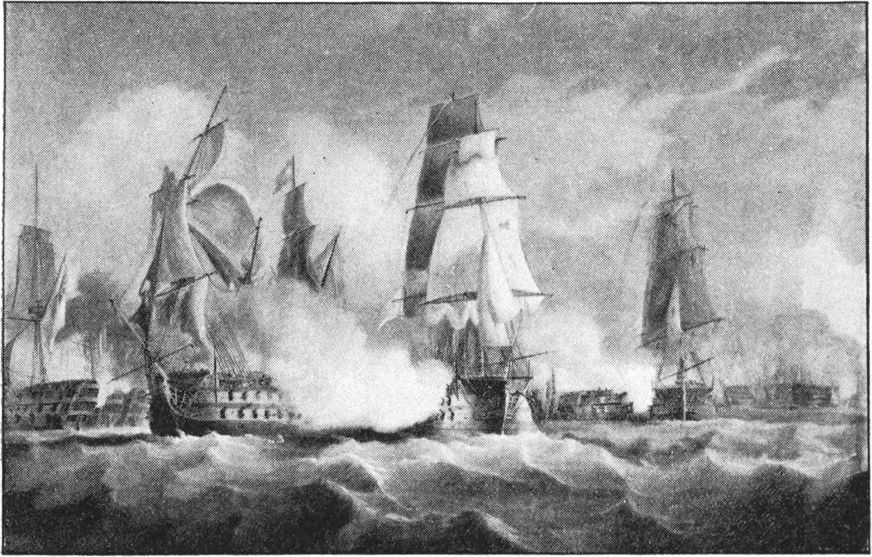
THE BATTLE OF TRAFALGAR
(From the painting by F. Sartorius.)
TRAFALGAR
BY
A. F. FREMANTLE
(Author of England in the Nineteenth Century)
“Here and here did England help me: how can I help England?”
—Robert Browning
G. P. PUTNAM’S SONS
NEW YORK
1933
First published in June 1933
Printed in Great Britain by Sherratt & Hughes,
at the St Ann’s Press, Manchester
| Chapter | Page | |
| I | Blockade | 9 |
| II | Invasion | 14 |
| III | The Admiral | 30 |
| IV | The Fleet | 45 |
| V | The Enemy | 61 |
| VI | Chase | 73 |
| VII | Battle | 116 |
| VIII | Epilogue | 141 |
| Bibliographical Note | 159 | |
| Index | 165 |
μέγα γὰρ τὸ τῆς Θαλλάσσης κράτος—Thucydides.
| Page | |
| Trafalgar.—From a picture of the battle painted by F. Sartorius for T. F. Fremantle, Captain of the Neptune: the ships shown are (left to right), Victory, Redoutable, Téméraire, Santísima Trinidad, Neptune, Bucentaure, Conqueror, Royal Sovereign, and Santa Ana. By permission of the Hon. John Fremantle. | Frontispiece |
| Admiral Lord Collingwood.—From the portrait by H. Howard in The National Portrait Gallery | 11 |
| Scale Model of H.M.S. Victory.—By courtesy of Messrs. A. Fleming (Southsea) Ltd., 2-3, Pall Mall Place, London, S.W.1. | 22 |
| “Scud Hill”, by George Cruickshank. (An ovation to Nelson during the defence of Toulon in 1794) | 30 |
| Admiral Lord Nelson.—From the portrait by L. F. Abbott in The National Portrait Gallery | 36 |
| “Sailors on a Cruise”, by George Cruickshank | 45 |
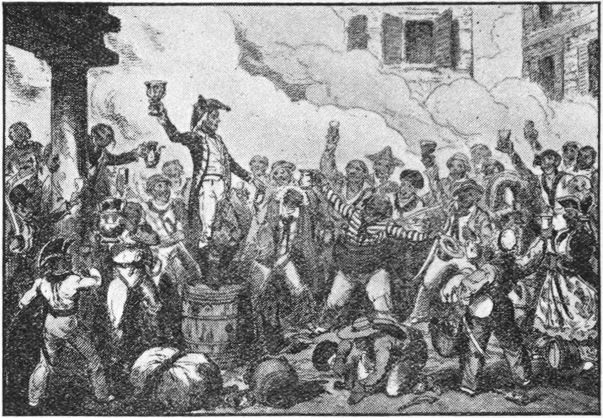
| “Sailors Carousing”—From the engraving after J. Ibbetson; by courtesy of Messrs. Thos. H. Parker, Ltd., 28, Berkeley Square, London, W.1. | 52 |
| Admiral Villeneuve | 67 |
| Map of the Western Mediterranean | 82 |
| Map of the West Indies | 88 |
| Extract from Nelson’s Private Diary, June 13th, 1805.—From the original in the British Museum | 91 |
| “Lord Nelson explaining to the Officers the Plan of Attack previous to the Battle of Trafalgar.”—From a contemporary print. | 115 |
| Pictorial Plan of the opening stage of the Battle of Trafalgar, drawn by the Chief of Staff to Admiral Gravina.—From a facsimile presented to the Admiralty by the Spanish Government on the occasion of the Nelson Centenary in 1905 | 116 |
| The Death of Nelson.—From the engraving after T. Brown; by courtesy of Messrs. Thos. H. Parker, Ltd., 28, Berkeley Square, W. 1. | 133 |
| After Trafalgar: H.M.S. Victory in the Centre.—From the engraving by Robert Dodd | 142 |
| The Funeral of Lord Nelson.—From a contemporary print in The Royal United Services Institution. | 154 |
| The Trafalgar Medal | 157 |
Others may use the ocean as their road,
Only the English make it their abode.
The lines which Waller wrote in the seventeenth century were never more true than of those mariners who kept their arduous vigil blockading the French, Dutch and Spanish ports in the early years of the nineteenth.—‘Went on shore for the first time since June 16th 1803, and from having my foot out of the Victory Two Years wanting Ten days.’—So runs the often quoted entry under the date 20th of July 1805, in Nelson’s little oblong Private Diary.
There is nothing thrilling about a blockade—an eternity of boredom in fair weather—foul weather brings plentiful store of danger, but no glory and no medals. Yet, dull as the task of our seamen was, it was as necessary as severe, and the Navy merits one glance at what it was doing during those first two years after the Peace of Amiens came to an end in 1803, before the signal flags went up at last for chase and battle.
Never was there a time when the principle that England’s frontier is the coastline of her enemies was more firmly held, though it would be an error to imagine the storm-beaten ships engaged in blockade as perpetually at sea. This applies particularly to Nelson’s command in the Mediterranean, in whose original instructions the word ‘blockade’ is never mentioned. Although the blockade of the French ships off Toulon occupied the chief place in his thoughts, this was only the principal place which he had to guard. He found an excellent central position for his fleet among the Maddalena Islands at the north end of Sardinia. Here the ships could anchor and get provisions, and the roadstead had both eastern and western exits, so that it was possible to leave in all winds—a most important point in the days of sail. Whether the ships of the line were or were not off Toulon, the actual harbour was watched by frigates, ‘the eyes of the fleet.’ Nelson never had enough of these.
The Atlantic coast of France was in the charge of Admiral William Cornwallis, who carried out his duties in a manner almost beyond praise. St. Vincent could not have kept the seas as he did, and Barham, when he became First Lord in 1805, decided that a task so nearly impossible should not be imposed on the ships for another winter. Life in ships of the line on this station was very hard. Collingwood, who was for some time in command of the inshore squadron, never turned in except in his clothes. The tides and rocks had more danger in them, he said, than a battle once a week. One of the duties of the British blockading naval forces, both in the Bay of Biscay and round Cape Finisterre and along the Channel coast, and further to the eastward, was to hinder the concentration of the armament then being prepared at the Straits of Dover for the invasion of England. From the Garonne to the Scheldt, in every possible port and creek of the west and north coast of France and Holland, Napoleon was preparing small vessels which were to hug the coast until they reached Boulogne or one of the neighbouring ports. There were more than two thousand projected. But out of these not much more than half were ready and collected in the Channel and North Sea ports by June 1804.
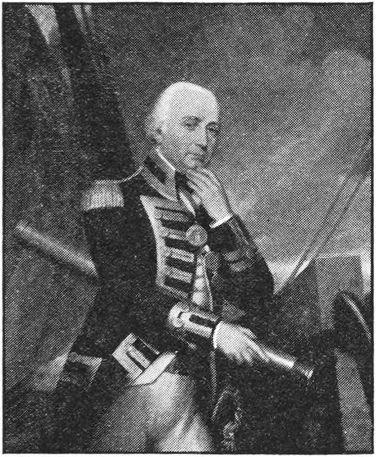
Collingwood
Towards the end of 1804 Spain was drawn within the ambit of Napoleon’s ambitions against England; and the outbreak of this fresh war naturally widened the task of blockade. Under the system communicated to him by the First Lord of the Admiralty, Lord Melville, in September 1804, Cornwallis was to have no less than 44 ships of the line under him, with three Vice- and three Rear-Admirals. The Atlantic Fleet was divided into the Brest, Rochefort, Ferrol, Straits of Gibraltar, Mouth of the Channel, and Irish Squadrons. At about the same time Lord Keith’s force near the Straits of Dover was raised to 11 ships.
In the days of sail, at all events, blockade was an imperfect thing at best, and perhaps the disposition of the Fleet off the enemy ports in 1803-1805 should not properly be termed a blockade at all. ‘My system,’ wrote Nelson, ‘is the very contrary of blockading!’ Certainly he did not wish to keep the Toulon fleet in; he earnestly prayed that it might come out. The general object was rather to watch the enemy squadrons, follow them if they left harbour, prevent their injuring Great Britain or her possessions, and, above all, hinder them from uniting, or, if that could not be prevented, bring them to action at once.
‘They were dull, weary, eventless months,’ writes Mahan in words which cannot be too often quoted, ‘those months of watching and waiting of the big ships before the French arsenals. Purposeless they surely seemed to many, but they saved England. The world has never seen a more impressive demonstration of the influence of sea power upon its history. Those far distant storm-beaten ships, upon which the Grand Army never looked, stood between it and the dominion of the world.’
Anticipation.—October, 1805.
Shout, for a mighty Victory is won!
On British ground the invaders are laid low;
The breath of Heaven has drifted them like snow,
And left them lying in the silent sun,
Never to rise again!
That invasion of England, which, at the time, Wordsworth in his Cumbrian hills and Nelson in the Gulf of Lions could conceive as having already taken place, has in our day been regarded as having never even been seriously intended by Napoleon. The protagonist in this essay is the French Staff historian Colonel Desbrière, who, in his Projets et Tentatives de Débarquements aux Iles Britanniques, published in 1902, has treated separately of the position in the winter of 1804-1805 and that in the ensuing summer; and his arguments have been repeated by Sir Julian Corbett in his Campaign of Trafalgar. In the section of his book which he calls La Période d’abandon the French writer has pointed out that between September 1804 and the following March Napoleon’s plan of invasion had fallen into the background. This is an incontestable fact. At that time movements on the side of Austria had brought Napoleon to the verge of hostilities. Had they broken out, the Armée d’Angleterre collected around Boulogne would have had to be directed against an enemy in central Europe at once instead of some months later. The ports were in consequence neglected; and during that winter the camp talk was not of an invasion of England but of a continental war.
During this period Napoleon is described in Miot de Mélito’s Memoirs as having made a speech before his Council of State, which Colonel Desbrière quotes, to the effect that his ostensible preparations against England had been merely an excuse for having the force expressed by 20,000 artillery horses ready for an eventual continental war. All this fever of activity for the past eighteen months in almost every port of France and of Holland, this collecting of hundreds of prames, bombardes, paquebots, corvettes canonnières, corvettes de pêche, péniches, caïques, and special vessels for cavalry, artillery, and staff, this painful concentration of them in the ports around Boulogne, with the loss of life and material from storms and enemy attack which it entailed, these costly harbour works, this encampment of troops of all arms on the bleak Channel coast—so unwholesome to those who had marched up from the south that in 1804 there were 10,000 sick at one time, besides 4,000 deserters—these dangerous and sometimes disastrous practice embarkations—all this was to have ‘20,000 horses’ and their ‘équipages’ ready trained, and thus obtain a 20-days’ start on his enemies. Posterity is told that that great improviser of war said this, and expected his Council to believe it.
A few days after the date of this reported speech, the diplomatic efforts of Talleyrand, supported by military demonstrations in Italy, had brought Austria to reason, the Emperor Francis sent a friendly letter, and Napoleon was able to take up his project against Great Britain once more. The very expression which Colonel Desbrière uses—‘Période d’abandon’—seems to imply a plan seriously adopted, abandoned during six months, and then once more taken up. But he will not have this. When he comes to what he calls the definitive organization of the flotilla in August 1805 he points out that there was by now in the four ports of concentration transport sufficient for 132,000 men, whereas the strength of the army within immediate reach of them was no more than 93,000, though there were other troops not far off at Calais and Dunquerque. The flotilla was, therefore, much more than adequate to its requirements. The obvious fact is that, well aware of the numerous accidents to which it was liable, the Emperor had provided for much more transport than was immediately necessary. But Colonel Desbrière draws the singular conclusion from the inadequacy of the force to its transport, that the whole organization was radically defective, and that, as Napoleon was the greatest organizer whom the world has seen, he had no serious intention of carrying out his plan.
The principal authority for invasion having never been seriously intended is, of course, the Emperor himself. In May 1810 Metternich when in Paris made the courtly observation that he had never been able to believe that the armament at Boulogne was directed against England.
Vous avez bien raison, me répliqua Napoléon en souriant, jamais je n’eusse été assez sot pour entreprendre une descente en Angleterre, le seul cas excepté d’une révolution intérieure dans ce pays. L’armée rassemblée à Boulogne était de tout temps l’armée contre l’Autriche. Je ne pouvais le placer autre part sans exciter de l’ombrage, et, devant le former quelque part, elle remplissait à Boulogne le double but de son rassemblement et de jeter l’inquiétude en Angleterre. Le jour d’une insurrection en Angleterre, j’y faisais passer un détachement de mon armée pour soutenir l’insurrection; je ne tombais pas moins sur vous, car mes forces étaient échelonnées à cet effet. Aussi avez vous vu en 1805 combien Boulogne était près de Vienne.
We are, therefore, to believe that all these preparations were an enormous feint. No one—except Metternich, and that five years too late—was in the secret.
As Mahan has pointed out, there is no hint in the Lives and Memoirs of Marshals Davout, Ney, and Marmont, all of whom commanded corps in the Army of Invasion, of these Marshals of the Empire having been so. Decrès, Napoleon’s Minister of Marine, and right-hand man in all naval matters, could not have been in the secret either. His most confidential communications with his master have all been published in Colonel Desbrière’s exhaustive work, and their evidence is all on the other side. The same may be said of those between Napoleon and Regnier, the head of the police. The latter was in touch with Méhée de la Touche, whom a clumsy British diplomatist was using as a spy, and believing to be a trustworthy source of intelligence. ‘I would wish,’ wrote Napoleon to Regnier on January 24, 1804, ‘that Méhée in his next bulletin should say that the Committee had been most delighted at the thought of Bonaparte’s intention to embark at Boulogne, but that it is now known that the Boulogne preparations are false demonstrations which, though costly, are much less so than they appear to be at first sight; that the gun-launches are a kind of brig, built so as to be of use as merchantmen’; and so forth with details as to the weak armament of the vessels of the flotilla, and the practicability of their being eventually disposed of for peaceful purposes. ‘The First Consul was’, in fact, ‘too cunning and felt himself too well established now to attempt a doubtful operation in which a mass of forces would be involved. The real plan, as far as one can judge by interior connections, is the expedition to Ireland, which would be carried out by a combination of the Brest and Texel squadrons.’ As Colonel Desbrière points out, all this shows that Napoleon did not mean to invade Ireland. But it is equally good evidence that he did mean to invade England.
In such an attempt to deceive the British Government Napoleon hoped for success. For in 1801, before the Peace of Amiens, he had made a show of vigorous preparations for invasion of the Channel coast, which were certainly delusive, though they were taken very seriously in England. By the time the war was renewed authorities in London had almost certainly found out their mistake. It is no great subtlety to credit Napoleon with counting on their still imagining that they saw a feint when they saw the real thing. This would have been an excellent example of what Ole-Luk-Oie has described in The Green Curve as ‘Cunning in the Second Degree’.
It is sometimes contended—a little pedantically—that Napoleon would not have invaded England, because he could not have expected to maintain his communications. But it should be assumed that he would have landed in sufficient strength to obtain his military object. He would have needed no reinforcements. Nor would he have required supplies and transport, expecting to obtain them on the spot. So far as communication by messenger was concerned, that could never have been completely blocked. He might no doubt have been unsuccessful in landing with the 125,000 or 130,000 of which he usually spoke. He might have found himself with a third or a quarter less—some force not adequate to the conquest of the country. Even in that case, as Pitt once said in Parliament in reply to Robert Craufurd, who had just made one of those speeches to which Englishmen love to listen, about gallant countrymen lining hedgerows or taking advantage of every opening with the spirit of a Rupert, Bonaparte would have passed forward ‘with the rapidity of a torrent’. The capital must have fallen; even if not, the enemy would have established himself too strongly for any abject surrender. At the worst, his troops would have entered into some such treaty of evacuation as the British had more than once been obliged to negotiate in the course of their continental expeditions, or as Menou made in Egypt in 1801, or Junot in Portugal in 1808.
The history of the Egyptian expedition is a proof how few terrors the British Fleet had for Napoleon when a great prize seemed to be within his grasp. His whole future career was then hazarded in the event of failure, and the prize, in that of complete success, only some vague oriental dominion. The case now was very different. The prize was definite—the highest to which any European conqueror could aspire. The risk was small; he was now Emperor—his position assured. The danger that he might personally fall into the hands of his enemy was slight, compared with that which he had escaped in the Mediterranean. He had reached Fréjus safely from Alexandria in 1799, a year after Nelson had annihilated the French fleet at the Battle of the Nile, and was to reach it once more from Elba in 1815, in spite of British naval vigilance. It may be that he would have had to cross the Straits of Dover in a small boat, repeating to the boatman the classic saying, ‘You carry Cæsar and his fortunes!’ But he would have crossed, and returned safe to France.
Never was there any doubt of the reality of the threat of invasion at the time. It was the object of enormous exertions on the part of France. Individuals were urged to come forward and defray the cost of vessels, which would be called by their names. Places so far apart by water as Strasburg and Bayonne were laid under contribution. In spite of losses from storms and from the enemy, by August 1805 2,343 vessels were ready in Boulogne and the six subsidiary neighbouring ports. The three most important of these for Napoleon’s purposes were Etaples, Wimereux, and Ambleteuse, as, unlike Calais, Dunquerque, and Ostend, they were all on the same side of Cape Gris Nez as Boulogne. They had practically to be created, while a great deal of work had to be done in Boulogne itself.
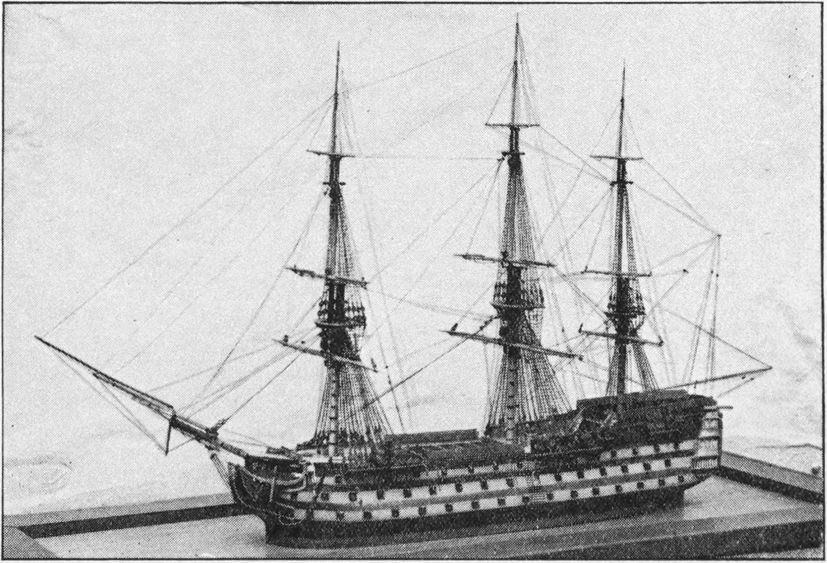
SCALE MODEL OF H.M.S. VICTORY
The personal interest which Napoleon took in all these matters was immense. He made numerous inspections, taking up his quarters in Boulogne for weeks. But of even greater interest are the strenuous efforts which he made, in correspondence with those best able to advise him, to understand the true nature of the difficulties before him, and the best method of insuring success.
Even so judicious a writer as Jurien de la Gravière has given some countenance to the theory that Napoleon was a presumptuous landsman who did not understand that the movements of naval armaments were conditioned by winds, and, outside the Mediterranean, tides; although he was born on an island, and was originally educated for the Navy; although he sailed to Egypt and returned in spite of the British Fleet; and although at Boulogne he frequently went afloat himself, on one occasion—in August 1804—taking command in a petty naval action, in which he successfully repelled a frigate supported by other vessels, which had ventured too close to his flotilla. There are a few instances where gross ignorance of the secrets of the sea can be laid to his charge, but not many. Of his receptivity and readiness to learn there can be no question.
In November 1803 he wrote:
Huit heures de nuit qui nous seraient favorables décideraient du sort de l’univers.
But as his ideas developed he realized that something more was required; and eventually he asked for the command of the Straits of Dover for three days. The plan was, in the opinion of Ganteaume, one of his best admirals, ‘extremely perilous, but not impracticable.’ After all the prize was great and the stake was small. France had already lost all her commerce and all her colonies except those held on sufferance; she had only her fleet. And a naval defeat might mean very little—only a few ships and a few hundred men—nothing in comparison with the losses of the victors at an Arcolo or a Marengo.
It would have been preposterous to imagine that the coasts of the United Kingdom were immune from invasion. Only within the past few years the British Isles had been successfully reached by four expeditions. At the close of 1796 a French armament had arrived at Bantry Bay, and the ships which carried it had anchored there for over a fortnight without interference: 10,000 men might have been landed, but for lack of resoluteness on the part of the French officers. In the following February 1,400 men were successfully landed in Wales, at Fishguard. All were made prisoners, but the naval force returned safely. In August 1798 General Humbert landed with 1000 men on the northwest coast of Ireland in Killala Bay, and marched into the interior, while the frigates which had carried his troops returned. But he too was obliged to surrender, being unsupported either by the insurrection on which he had counted or by reinforcements from France. The squadron which brought the first contingent to his aid was attacked and defeated by Sir John Warren. Nevertheless the successful arrival of a fourth expedition showed that it was possible not only to land troops, but to reinforce the original body; for a second contingent reached Killala Bay without mishap in October, and was only obliged to return on learning the fate of its predecessor.
None of the officers who had been with these expeditions had flotilla experience. But they were in a position to furnish information regarding general possibilities of disembarkation, and of evading the vigilance of British cruisers. Humbert, for example, had definitely offered in 1801 to conquer Ireland with 8,000 to 10,000 men, and there is a great deal in Lecky’s history to suggest that he might have succeeded. Other quarters which he regarded as possible were Cornwall, Wales and Scotland. It was the officer generally regarded as the ablest French admiral of the day, Latouche-Tréville, placed in charge of the Boulogne flotilla in that year, who was most distinguished for enthusiasm as to the possibilities of a successful descent on the Channel coast. All this experience was once more at Napoleon’s disposal in 1803. Research among the documents relating to the Armée d’Angleterre in the Archives Nationales in Paris (not, apparently, consulted by Colonel Desbrière), has only resulted in the discovery of numerous other plans for invasion. Nothing has been found to indicate that Napoleon’s scheme was a blind.
On the north side of the Channel the Ministries which successively held office, Addington’s and Pitt’s, both took the threat to their shores seriously. Besides the armed vessels maintained on the coast, the mouth of the Thames was blocked with a line of East Indiamen; and an unfavourable judge of the merits of the former Government wrote:
If Blocks can from danger deliver,
Two places are safe from the French,
The first is mouth of the river;
The second the Treasury Bench.
Elaborate arrangements were made for the safety of the King, the Royal Family, the Treasure and the books of the Bank of England; for driving cattle and removing transport from the part of the coast attacked; and for obstructing the march of the invaders as much as possible. The ablest general of the day, Sir John Moore, held a command in one of the areas most threatened. What the comparatively small force of regulars available could do would have been done; and it was supported by militia and volunteers as well.
Among the general public the prevalent belief in an imminent invasion almost caused a miracle—the production in Great Britain of a military spirit. Children learnt from their cradles to tremble at Bony’s name; boys prepared themselves to fight him; pacific persons so far separated by character and distance as William Pitt, Lord Warden of the Cinque Ports, and William Wordsworth in the Cumbrian Hills, became untiring officers of volunteers. The thing became one of the liveliest traditions in our history. ‘An outhouse door riddled with bullet-holes, which had been extemporized by a solitary man as a target for firelock practice when the landing was hourly expected, a heap of bricks and clods on a beacon-hill, which had formed the chimney and walls of the hut occupied by the beacon-keeper, worm-eaten shafts and iron heads of pikes for the use of those who had no better weapons, ridges on the down thrown up during the encampment, fragments of volunteer uniform, and other such lingering remains, brought to my imagination in early childhood the state of affairs at the date of the war more vividly than volumes of history could have done.’ So wrote Thomas Hardy in the preface to The Trumpet Major, one of the two great novels which give an imaginary account of a false alarm of invasion. The other is The Antiquary. Himself a vigorous volunteer, in spite of his lameness, Scott puts into the mouth of the honest rascally beggar, Ochiltree, an expression of the spirit which must have animated many a poor man of those days:
‘I would not have thought you, Edie, had so much to fight for?’
‘Me no muckle to fight for, sir?—isna there the country to fight for, and the burnsides that I gang daundering beside, and the hearths o’ the gudewives that gie me my bit bread, and the bits o’ weans that come toddling to play wi’ me when I come about a landward town?’
The story is based on an actual alarm in Northumberland in February 1804, which spread to several of the border counties, and set the volunteers pouring to their alarm ports on the coast, with a rapidity extraordinary in days when mobilization was so far from having been reduced to an exact science, that the term itself was completely unknown. The men of Derbyshire and the West Riding of Yorkshire showed equal readiness in the case of another false alarm on the 15th of August 1805. It was the very moment when Napoleon, at Boulogne, was looking impatiently westward for the victorious fleet which was to protect the crossing of his armada.
Crispin Crispian shall ne’er go by,
From this day to the ending of the world,
But we in it shall be remembered;
We few, we happy few, we band of brothers.
It is rare indeed to succeed in stealing from Shakespeare without detection. Nelson is one of those who have done so. Familiar as household words though Harry the Fifth’s speech may be, the words ‘band of brothers’ calls us back not so much to Agincourt as to the Nile, and the captains who fought under Nelson there and won that title from him. We soon pass from thinking of him as the great victor to thinking of him as the devoted leader, and the leader to whom all were devoted, and why this was so; and a hundred tales, told and re-told a hundred times, rise in our minds of his unselfishness and quick sympathies.
In 1797, when commanding the Minerve, he was being chased by a superior force of Spanish ships through the Straits of Gibraltar. A man fell overboard, and Thomas Hardy, then a lieutenant, went after him in the jolly boat. She was carried down by the current towards the leading Spanish ship. Hardy had been lucky only a few days before. He had been captured after a brave defence of a prize vessel. But the English had taken a more notable prisoner, and Hardy was exchanged. This time it seemed that he was fated to see the inside of a Spanish prison. But Nelson would not have it. ‘By God I’ll not lose Hardy’, he cried. ‘Back the mizen topsail.’ It was done, the ship’s way was stopped, and for a moment it looked as if Nelson and his whole ship’s company might also become prisoners till the end of the war. But the leading Spaniard, seeming to suspect some manœuvre, shortened sail in his turn; this gave time to pick up Hardy, and when the chase was resumed, all was safe.
Another valued friend was Richard Keats, whose ship could not be left behind in the pursuit after Villeneuve to the West Indies in 1805, though she was in the condition accurately described in Henry Newbolt’s poem:
The Old Superb was barnacled and green as grass below,
Her sticks were only fit for stirring grog;
The pride of all her midshipmen was silent long ago,
And long ago they ceased to heave the log.
Four years out from home she was, and ne’er a week in port,
And nothing save the guns aboard her bright;
But Captain Keats he knew the game, and swore to share the sport,
For he never yet came in too late to fight.
Some admirals would have dropped petulant complaints at being hampered with such a companion in a chase in which every moment was of value; most admirals would have felt the injustice of doing so, and avoided every allusion to the subject. Nelson did neither. He realized that silence would only make Keats feel more uncomfortable still. He wrote:
I am fearful that you may think that the Superb does not go as fast as I could wish. However that may be (for if we all went ten knots, I should not think it fast enough) yet I would have you be assured that I know and feel that the Superb does all which is possible for a ship to accomplish; and I desire that you will not fret upon the occasion.
It was not necessary that Nelson should have the same friends always with him. He was quick enough in finding new. When he joined the Fleet after his last voyage, an officer who does not seem to have known him before, Captain Duff of the Mars, wrote: ‘He is so good and pleasant a man, that we all wish to do what he likes, without any kind of orders.’ This is the highest discipline—a common will throughout the whole Command, which is the will of the Commander-in-Chief. It is indeed rather a strange circumstance that out of the original band of brothers—the fourteen who commanded ships of the line at the Battle of the Nile—only two were with Nelson at Copenhagen, and only one at Trafalgar, his former Flag-Captain, Berry; and he only arrived just in time for the battle, with that luck of his which had become proverbial. Those whom Nelson commanded at once became a band of brothers. It was because he believed in them and showed it. When offered his choice of officers before he left England for the last time, he is said to have replied to Barham: ‘Choose yourself, my Lord, the same spirit actuates the whole profession’; although it most certainly did not, until they were arrayed for action under a chief whom they could trust. Nelson showed a remarkable tact in composing all differences which arose in his own command, and he seldom blamed a subordinate. Yet so far was his from the character of the slack disciplinarian courting popularity, that he was perfectly willing to allow one of his captains to obtain credit for a leniency exceeding his own.—
My dear Hargood,—Nothing but your desire to save the —— of the Belleisle from the fate which would justly await him, should your charges against him be proved, could have induced me to allow of your forgiveness of such faults as his have been.
His success in winning the devotion of the men was even more remarkable. It was only by the most unceasing exertions that he was able to prove, that the crews of ships kept many months together at sea, could be maintained at the highest pitch of health and contentment. The ill-feeling which had broken out in the Mutiny at the Nore of 1797 and in other mutinies in the following years found no echo on board his ships. It has only to be stated to appear evident that it was inconceivable for disloyalty and cowardice to show themselves where Nelson was present, or even where his flag was visible. The two ideas could not exist together. A seaman’s letter from the Royal Sovereign after Trafalgar shows the height which he had reached before his death in winning the affections of the Fleet:
Our dear Admiral Nelson is killed: so we have paid pretty sharply for licking ’em. I never set eyes on him for which I am both sorry and glad; for, to be sure, I shd like to have seen him—but then, all the men in our ship who have seen him are such soft toads, they have done nothing but blast their eyes and cry, ever since he was killed. God bless you! chaps that fought like the devil sit down and cry like a wench.
And then he describes how he himself saw distress draw iron tears down the cheek of the austere and reserved Collingwood.
It is singular that as a Commander Nelson was misunderstood by his adversaries, just as their other great opponent was, though precisely in the opposite way. For Napoleon he was the fiery admiral; even Jurien de la Gravière, writing as a historian, uses a similar expression. In point of fact, few men weighed evidence more scrupulously, or surrendered less to impulse. He was a deep student of naval tactics. When he was only twenty-four, Lord Hood said of him that he knew as much on the subject as any officer in the Fleet. It is, after all, only what we should expect. But it is possible to go further, and to say, that if ever a plan of action in battle was the result not of hours but of months of careful thought, it was the plan on which Nelson fought at Trafalgar. The table is still shown at Up Ottery, on which he drew out his plan to show Lord Sidmouth early in September 1805; and in an earlier form it was explained to his captains during his West Indian voyage. What deceived his enemies was the ‘considered rashness’—to quote Lord Fisher’s fine phrase—with which he habitually acted. The Minerve was really in no danger when he picked up Hardy. Nelson probably calculated, by a lightning-like process of reasoning of which he was himself unconscious, that his sudden stopping of his ship would disconcert his enemy, and just give him the time which he needed. Wellington, on the other hand, the supposed master of a defensive, evasive and retreating strategy, was venturesome to a fault. Two of his battles, Assaye and Fuentes de Oñoro, were fought with rivers at his back. Almost the whole of the Peninsular War was an adventure. Twice he penetrated into the heart of Spain with almost the certainty that he would draw overwhelming forces on himself, and be compelled to the costly and dangerous retreats which he was actually obliged to make. His last battle in that war was deliberately against the rules. In the crowning campaign of his life his daring in fighting at Quatre Bras with his army dribbling into the battlefield behind him, and in fighting at Waterloo at all with such an army as he had, ought at least to have established for him a reputation for daring. Both commanders were alike in one thing. They mystified their opponents, which is the first end of strategy; and they have done their task only too well, for they have mystified posterity besides.
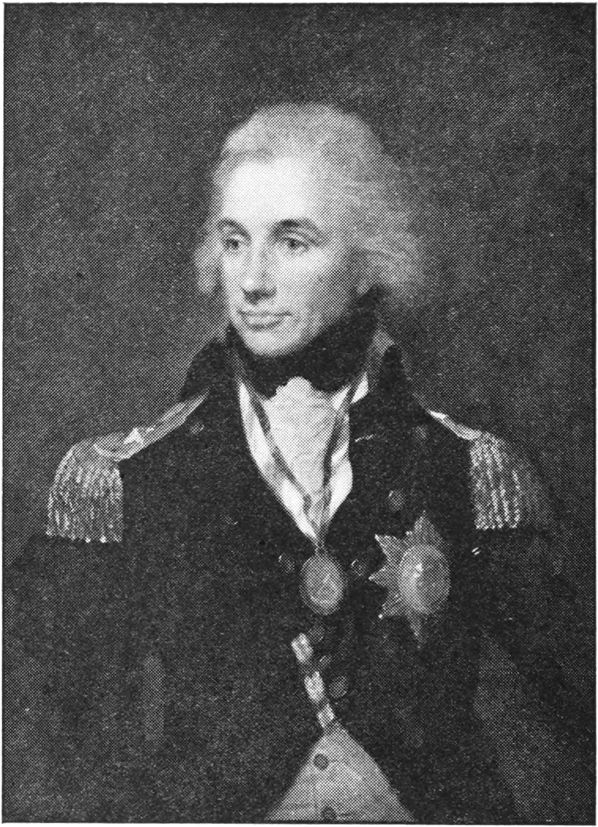
ADMIRAL LORD NELSON
(From the portrait by L. F. Abbott.)
The account given of Nelson by Scott, the clergyman who was with him as Private Secretary in the last years of his life, is very striking. His biography describes him and the Admiral as sitting for hours in two black leathern chairs, while he would read out and translate to him voluminous masses of newspapers, pamphlets and letters, English, French, Italian and Spanish, taken from prizes or passing merchantmen, or picked up ashore. Scott’s estimate of his intellectual qualities, given in a private letter, is a high one:
I have heard much of Lord Nelson’s abilities as an Officer and Statesman, but the account of the latter is infinitely short. In my travels throughout the service I have met with no character in any degree equal to his Lordship; his penetration is quick, judgement clear, wisdom great, and his decisions correct and decided: nor does he in company appear to bear any weight on his mind.
And Scott could write very familiarly of him. After his death he wrote to the same correspondent:
When I think, setting aside his heroism, what an affectionate fascinating little fellow he was, how dignified and pure his mind, how kind and condescending his manners, I become stupid with grief for what I have lost.
Of all his wounds that which most affected his health was not the loss of his arm and eye but the injury which his head received at the Battle of the Nile—the cause, perhaps, of weakness and lack of judgement evinced for some months afterwards, and of fits of despondency in later life. But one of the best proofs of a good constitution was his—a propensity to inordinate complaint about trifling indispositions. Long hours of writing sometimes, though rarely, led to spasms caused by indigestion; when he had them he would write as if he had been almost dying. In point of fact, after his death had actually occurred, the surgeon was surprised to find that his organs were like those of a much younger man, and gave every reason to suppose that had he not fallen when he did, he might have lived to a considerable age. Far from being delicate, Nelson seems to have been extremely hardy. He would walk the wet deck for hours in his buckled shoes, and then dry his stockings by rubbing them on the carpet in his cabin, because he could not easily change them with his single arm, and did not like to give people the trouble of assisting him. He was sparing, but not peculiar, in diet; and he required little sleep.
The portraits of him, with the exception of the curious Italian one which was painted not long after the Battle of the Nile, when the effects of the wound in the head give the face a strained appearance, and which is reproduced in Thursfield’s Nelson and other Naval Studies, do not suggest a sufferer from ill-health. They are a sharp contrast to the likenesses which have come down to us of the great sailors, his contemporaries—almost every one of them full-faced, full-blooded men, betraying in nearly every feature what was euphemistically known in the eighteenth century as a ‘full habit’. Nelson’s known abstemiousness accounts for the difference. Prematurely aged though he was by wounds and hardship, most of the portraits of him suggest a man not yet quite past the plenitude of bodily vigour—still almost able, had it not been for his lost arm, to race his youngsters to the masthead as he did when a captain. There are many accounts of him, the passage already quoted from his secretary being one of them, which suggest that he was of almost diminutive size, and we are reminded of the fearlessness of the dwarf, Sir Geoffrey Hudson, in Walter Scott’s Peveril of the Peak: ‘May it please your Majesty, fear is a thing unknown to me.’ On which Buckingham comments: ‘His body has no room to hold such a passion.’ But Nelson was only a little below the average height, though no doubt his spareness, and possibly his great vivacity of manner also, produced an impression of greater shortness of stature than was actually the case.
His petulance seems to have been the effect of an ardent disposition struggling under the control of an exceptionally cool judgement. His complaints when he met with a foul wind, or was misled by false information, were indulged—in his correspondence—to the full. But while he was telling others that he was half dead with exasperation and anxiety, the references to the same subjects in his Private Diary usually display a stoical restraint. Part of the charm of Nelson was that the weakest and worst side of his character was known at once, as Wellington found at his meeting with him. He forgave Nelson his exhibition of vanity—a less easy fault to forgive than petulance—and the rest of the world does the same. Nelson knew his fault. He once wrote himself of his own ‘consummate vanity’. A great man usually has his little vanities, even although he is—perhaps because he is—‘in his simplicity sublime’. The great man of whom these words were said was not exempt, and he sometimes recalls one of Nelson’s not very attractive tricks of speech, when he too talks of himself in the third person as the Duke of Wellington. Englishmen generally dislike to hear a man play the big drum in his own honour; yet after all even Englishmen are human, and when the thing can be done naturally, by one who looks and acts the hero’s part, they forgive and admire.
There was in Nelson—strange that it should have been so in him, of all persons—a quality rather French than English—a fusion of the rational and emotional elements. ‘Give me that man’, says Hamlet,
That is not Passion’s slave, and I will wear him In my heart’s core, ay, in my heart of heart.
Fear of becoming ‘Passion’s slave’ makes the typical Englishman distrust emotion altogether. He deadens, or strives to deaden, one part of his nature. The magic of Nelson’s life is to show that this is not necessary—that with one sublime effort enthusiasm, judgement, decision, action, may be moulded to one glowing spear-point. He had, as Collingwood wrote in the Trafalgar despatch, ‘a mind which inspired ideas superior to the common race of men’.
He was not the slave even of his passion for honour. Nothing is more to his credit than the careful judgement which guided him on the subject of a fleet action during the last months of his life. The first view of Nelson seems to show him like a hound in the leash straining incessantly for battle and glory. This would be a delusion. He strove for peace. His country came first. He was for the battle which the country needed, and only when the country needed it. Admiral Mark Kerr tells from tradition a story of his having said on his voyage home from the West Indies after Villeneuve, that if he met with him, he would then fight no battle; he was not strong enough to annihilate, and it was, as he wrote afterwards, annihilation which the country needed. It may well be true, but certain it is that there was a time during that pursuit when he was determined to attack, though so weak that he looked to the possibility of defeat. ‘Que mon nom soit flétri pourvu que’—he was ready to sacrifice his fame as the invincible one, if he could only do sufficient injury to the enemy to break up his strategical combinations, as Calder’s incomplete action of the 22nd of July eventually did. A few weeks later he is writing to Cornwallis generously hoping that it is he who has destroyed the enemy’s fleet. All this shows a man not too covetous even of honour.
This attempt to write a little more on a subject on which so many have written, and written so well, must conclude as it began, with the reflection that individual as Nelson’s personality was, the secret of his greatness is that he stands for something beyond himself—almost as an abstraction. Captain Mahan calls him on the title-page of his life of him, the Embodiment of the Sea Power of Great Britain; Herr Kircheisen, on that of his, the Foundation of England’s World Dominion. To Englishmen he stands just for England. If the soul of his country could be said to exist in any man, it was in Nelson, and in many relations it is easy to substitute ‘England’ for ‘Nelson’ as was done in the signal at Trafalgar. ‘Look at Troubridge’, said Jervis at the battle from which he gained his title of St. Vincent; ‘he tacks his ship to battle as if the eyes of all England were upon him! and would to God they were!’ A score of years later the same man could write of the bombardment of Algiers: ‘From what I can gather of his conduct in the battle, the Captain of the Granicus surely must have thought that Lord Nelson was looking at him!’ In these days of disarmament that spare, maimed, one-eyed figure stands for something higher still than country. As Mahan wrote of him: ‘Wars may cease, but the need for heroism shall not depart from the earth, while man remains man and evil exists to be redressed.’
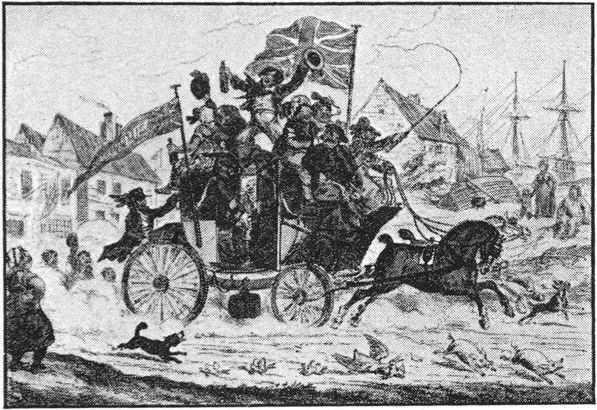
Sailors on a Cruise
‘He told me that he’d soon make me know what a first lieutenant was: what did he mean by that?’ inquired Jack.
‘All zeal.’
‘Yes, but he said, that as soon as he got on board, he’d show me the difference between a first lieutenant and a midshipman!’
‘All zeal.’
‘He said my ignorance should be a little enlightened by and by.’
‘All zeal.’
‘And that he’d send a sergeant and marines to fetch me.’
‘All zeal.’
‘That he would put my philosophy to the proof.’
‘All zeal, Mr. Easy. Zeal will break out in this way; but we should do nothing in the service without it.’
The words with which Midshipman Easy’s first captain, in Marryat’s novel, disposed of his republican scruples regarding the internal arrangements of a man-of-war, form a fitting introduction to the subject of this chapter. Just as Doctor Johnson’s friend explained that in spite of all efforts at philosophy, cheerfulness would keep breaking in, so in the old Navy, in spite of the press-gang, the cat, the rope’s end, salt junk, the scurvy, burgoo or skillagolee, want of sleep, confinement for years to a floating prison, holystoning decks on a raw morning, reefing topsails in a squall, shipwrecks, amputations, zeal would keep breaking out—and even jollity.
The author of the saying, ‘one volunteer is worth three pressed men’, must have been laughing in his sleeve. Though there were numerous exceptions, the general object of the press-gang was to obtain the prime seamen who would otherwise have been engaged in the merchant service; they were the best men in the ship. The volunteers were mostly composed of the discontented herd of boys and youths who ‘ran away to sea’—who had scarcely seen a ship until, like the boy Cobbett, they looked down from Portsdown Hills on the glory of England. They were classed as landsmen, and usually did duty as ‘waisters’, being stationed in the waist of the ship. They performed most of the numerous duties which could be done on deck or between decks, and, though formidable in numbers, were naturally looked down upon by the rest of the ship. To this class also belonged a large proportion of the numerous foreigners, then brought into the navy—even men of colour; the ‘black man’ whose work at his gun so interested Collingwood, was far from being the only negro in the Fleet. The practice of drafting batches of convicts on board His Majesty’s Ships had fallen into disuse after the end of the eighteenth century, though vagrants and others brought up before the magistrates were often brought, by strong inducements, to ‘volunteer’. ‘Jack Nasty-Face’, himself a volunteer, describes with indignation how he himself with a number of such men was forced into the stinking hold and battened down there while his ship was in harbour, in the very year of Trafalgar.
There is a story of a Captain who had a dispute with an Ambassador on his own quarter-deck. The civilian said that he represented the King. ‘Then, sir’, retorted the captain, ‘recollect that here I am more than Majesty itself. Can the King seize a fellow up and give him three dozen?’ Several captains were tempted by such absolute power to become tyrants, and such men could make the life of almost everyone on board a floating hell. One of the cruellest of them, Captain Pigot of the Hermione—one of those occasionally addicted to the infamous practice of flogging the last man down from aloft—was killed by his men, who took the ship into a Spanish port. Probably no felon who was hanged at Tyburn that year more richly deserved his fate. There are one or two similar stories. But the cat-o’-nine-tails did not figure among the sailors’ grievances—not even among those brought forward by the delegates in the great fleet mutinies of 1797. Indeed had its abolition been proposed, it is probable that the men would have petitioned for its retention. Where the performance of a duty is a question of life and death, the skulker or drunkard is a common enemy. To confine such a man would be throwing his work on others. To stop his grog was perhaps worse than a flogging; but it might be rendered ineffectual by the good nature of his friends making up for him out of their own allowance. Extra duty had other objections.
It is easy to see now that the punishment of flogging should have been sparingly administered, as it was in the best ships, while that of flogging through the fleet should never have existed at all. But humane officers who desired to reform the abuse, found themselves involved in a vicious circle. The men expected to see the cat used. A captain who had scruples was regarded with a feeling of something like contempt. Collingwood is supposed to have got over the difficulty by imposing a few exemplary punishments at first. But neither he, nor any of the numerous captains who resembled him, could dispense with it altogether. It was, up to a point, a necessary instrument of discipline. Someone once said—in happy disregard of the mass of mankind, who do not so easily fall into categories—that it made a bad man worse and broke a good man’s heart. There were many seamen who took a pride in never having been put upon the report of the master-at-arms; but if they were, their hearts were usually of tougher stuff than to be broken by a dozen at the gangway. The suggestion as to the bad man appears to be that moral obliquity acts as a sort of anæsthetic; no other meaning can be attached to the allegation that a depraved man cares so little for a flogging that he comes up for it again and again.
It is impossible to read without horror the accounts of the food which was compelled to be eaten in His Majesty’s Ships by officers as well as men. One of the former, Baron de Raigersfield, draws a serious comparison between weevily and maggoty biscuits. Weevils were bitter, and, he implies, uneatable; maggots only fat and cold to the taste, proving that the biscuit was merely in its first stage of decay, and could be eaten very well. One did not need in those days to roast a leg of mutton and see whether a man took mustard with it, to tell whether he was a sailor; one had only to offer him some biscuit, and he would be revealed by the trick of knocking it on the table to shake off the dust and weevils. The meat was often not much less solid than the heart of oak of which the seamen’s homes were composed. The skillagolee erred in the other direction, being a kind of watery porridge. After all the men seem to have done quite well on all this, helped down as it was with two gills of rum a day. The feats of blue-jackets in hauling heavy guns with ropes have always been the despairing envy of all other men, and they could not have been the men they were if they had not somehow succeeded in both chewing and digesting their rations. At least they were better off than many men on land. Those were the days when thousands of agricultural labourers had nothing from one week’s end to the other but bread and cheese, cheese and bread. Of salt meat, at any rate, the sailor had plenty, and one evil result of it was surmounted in Nelson’s time. In 1796 an Admiralty Order was issued prescribing lemon juice, and in a few months scurvy disappeared from the Fleet as if by magic.
Sea air and grog seem to have made the rest of the sailor’s hardships bearable. A generation of which millions have never known what it is to be wet through and have nothing dry to change into, to sleep a single night on hard boards, or to go twenty-four hours without food, can hardly believe it. But men and women on land as well as on sea cheerfully faced hardships then which would now be thought unendurable. The seaman’s life was usually, owing to rum, and perhaps insufficient and irregular rest, a short one, but it was a merry one.
It must be admitted that this is not borne out by the two accounts of their own experiences given by seamen who joined shortly before Trafalgar, Nautical Economy, by Jack Nasty-Face, and Samuel Leech’s Thirty Years from Home: A Voice from the Main Deck; but they cannot be considered good authorities for life in the Navy as a whole. The experiences of both were unfortunate, and neither appears from his own account to have been a typical specimen of a British sailor. Neither of them had been brought up by the sea, or went to it as a boy. Leech actually wrote of the gaiety of sailors as a forced merriment, as if they were not far too simple for this. If they had been so miserable, hornpipes would never have been heard of. Raigersfield has a story of how it was once noticed on board a ship that there were no dances as usual every afternoon on the fore-deck. The reason soon appeared. They had just seen that ‘perfidious bark . . . rigged with curses dark’—the Flying Dutchman. Few men danced away so much of their lives as the sailor. His hardest labours were done to the accompaniment of ‘some lively air’. The naval was the only service in which some cheery exhortation frequently accompanied the word of command. A famous sailor’s diversion was the interminable fo’c’sle yarn, seldom or never of a lugubrious character; its typical language, full of the liveliest imagery, is not the language of men who lived in constant misery and fear. For the serious there was something on board resembling a miniature Parliament. Several ships had their orators—their Billy Pitt and Charley Fox—and there was usually an example of that terrible person who is invariably able to see the other side of the question, even when his country is struggling for her existence. He was, of course, known as ‘Bony!’ It was probably the fact that, in spite of Jack’s simplicity ashore, particularly where money was concerned, he was generally more intelligent, and more often able to read and write than a man of the same class on land. There were serious-minded religious seamen—enough on board the Victory to make a separate mess. ‘These men never wanted swearing at’, wrote an unsympathetic officer. ‘The dogs were the best seamen on board.’
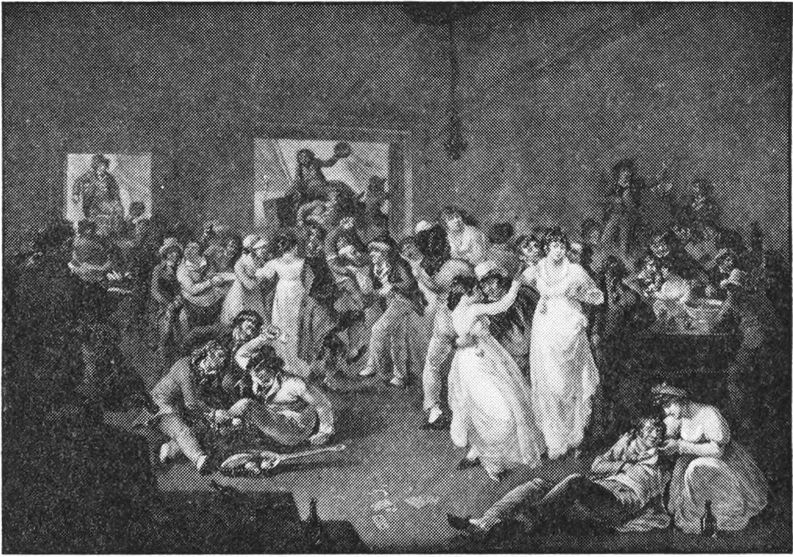
SAILORS CAROUSING
(After J. Ibbetson.)
There are other hard incontrovertible facts, which militate against the view of the Scottish M.P. introduced into Captain Glascock’s Sailors and Saints as telling a couple of seamen: ‘I conseeder you’re a verra leetle better off than the blacks of Africa’—a view which has been seriously repeated in our own day. Men groaning under tyranny are incapable of taking a pride in their appearance, and the seaman was a fop. He prided himself on his lovelocks, and above all on the length of his back hair. Glascock describes a boatswain who had a tail so long that he sometimes had to put the end of it into his mouth for convenience. Those with the longest hair were the best seamen, and sometimes an officer seems to have picked them out for this, much as a young lady at a race-paddock fancies the horse with the longest tail. Another fact is that they were among the bravest men who have existed. Put them alongside the enemy, and no doubt they would have had to fight, though they would probably not have fought their guns in the way they did, if they had felt like slaves. But there were also adventures of the greatest peril, such as manning fireships, and cutting out expeditions; and there were always volunteers forthcoming for these. Nor can it be doubted that the warrant and petty officers, the fo’c’sle men and topmen at least, had a high sense of honour and loyalty. There are numerous instances to prove it. The devotion of men to their officers is no figment of sentimental sea-tales. Jack Nasty-Face relates that when nine ships were paid off, two of the captains received presents of plate from their crews. His object is to show that there were seven bad captains to two good. At least the existence of any such practice at all shows that a strong attachment for their captains on the part of the men was no uncommon thing. Moreover in spite of the lurid picture which he draws, Jack Nasty-Face is compelled to the conclusion: ‘The seaman feels himself a man. There is indeed no profession that can vie with it; and a British seaman has a right to be proud, for he is incomparable when placed alongside those of any other nation.’
There were men even capable of finding a midshipman’s life miserable. The first day of the future officer was certainly an unpleasant one. Coming, perhaps, from a refined home, he usually spent it, partly in teaching his wisdom teeth, if he already had them, to cope with the tough half-roasted meat served out to him, partly in learning something of the character of his new messmates, who might be of any age from ten to nearly fifty—the age supposed to have been reached by that almost legendary figure, Billy Culmer, who was said to have refused several commissions, preferring to be the oldest midshipman in the service to being its youngest lieutenant. His new friends practised their wits, and tested his temper at the same time, by sending him to the purser’s steward to have his mouth measured for a spoon, or to one of the tops to hear the dog-fish bark; and when at last he turned into his hammock, he was almost sure to display his lack of skill by falling out the other side, when they would complete his discomfiture with a bucket of salt water. But the child soon grew into a man—though without ceasing to be a child. There were no jollier creatures in the world than midshipmen. The common term in the language for a bit of fun is derived from the acrobatic amusements in which they indulged in the upper rigging—‘sky-larking’, or ‘larking’.
An aspirant to the rank of naval officer usually joined his ship as a first class volunteer, rated as captain’s servant, in which capacity he had to serve four years before he could rise to the rank of midshipman. Even then he had no commission. The Captain could, for any offence, disrate him and turn him before the mast; and sometimes did so. There is a description in Captain Chamier’s Life of a Sailor, which, like Marryat’s Frank Mildmay, is largely autobiographical, of the life of a youngster who was so treated for a time, and made to do duty with the men in the main-top. In any case he lived much with the seamen, and thus laid the foundation, as far as he himself was concerned, of that complete understanding between officers and men which is the main secret of England’s naval greatness. The profound acquaintance shown by Captains Chamier and Glascock with the language and thoughts of the lower deck—leaving that prince of naval story-tellers, Frederick Marryat, out of the question—is an example. They were not novelists of great imagination and invention, and there is no reason to suppose that they had any special advantages of insight into their men’s minds not enjoyed by their brother officers.
The officers formed, collectively, a strange body of men. It sometimes looked as if experience counted for nothing in a service in which experience was almost everything. A young frigate captain, who owed his position to interest or gallantry, might have a first lieutenant several years older than himself, giving his orders to midshipmen one or two of whom were some years older still. Considering how officers were treated in the way of promotion, it is not a little wonderful that zeal kept breaking out in the way in which it did. A deserving midshipman thought himself lucky when he got promotion to lieutenant after making all the interest he could, like William Price in Jane Austen’s novel. It is depressing to read occasionally in James’s Naval History of a lieutenant who had done some exceptionally good piece of service, and of whom the author notes that at the time of writing his book, the officer was still a lieutenant. Some of those, on the other hand, who secured their commissions by interest, were so bad, that in 1809 Lord Cochrane, sooner than have worthless favourites foisted on him as lieutenants, preferred to make use of the midshipmen whom he knew and trusted, of whom Marryat was one, as acting lieutenants. Some officers were almost born great, as Malvolio would have said; they had their names in the ship’s books as babies. Rodney’s son was made a post-captain at 15, Nelson himself became one before he was 21. Usually efficiency was thrust upon the spoilt darlings of the Admiralty by the instinct of self-preservation. This is all that can be said in explanation of what the Navy was able to do; though it is to be added that under a Jervis or a Nelson good service did not fail to meet with its due recognition.
At least England did not make the mistake which democratic France made, of sacrificing the efficiency of her ships to the comfort of their captains. The picture of Nelson rising from his last prayer is well-known, with the gun pointing out of his cabin window. But the French mounted no guns in the captains’, much less the admirals’, cabins of their line-of-battleships; a British captain was proud to have them. It was only one of the many minor discomforts which the foreigner evaded, and the Briton accepted with such cheerfulness as he could command. England’s ships, though not equal to those of France, where ship-construction was made a fine art, were good enough for the work which they had to do.
Ships fit to lie in the line of battle, or ships of the line, fell into several classes, ranging at Trafalgar from the three 100-gun flagships to the three comparatively tiny 64’s. Ships were often altered. The Victory was an example. Launched in 1765, she had been laid up for some years as worn out before 1801, when she was refitted and rearmed. Nominally a 100-gun ship, she carried at Trafalgar 88 guns on her three gun-decks—30 twelve-pounders on her main deck, 28 twenty-four-pounders on her middle deck, and 30 thirty-two-pounders on her lower deck—besides 10 twelve-pounders on her quarter-deck and forecastle. These 98 guns formed her regular armament. Incidentally she carried also two sixty-eight-pounders. These were short guns, deriving their name of carronades from the Scottish Carron Company, which cast the first in 1779. They required considerable elevation, and were not fired through the port-holes as the long guns were, but were carried on the forecastle, quarter-deck and poop. They were used for close action. At Trafalgar the Téméraire carried 12 of these “smashers”—thirty-two-pounders—which she used to great effect. There were seven British ships with three gun-decks, or three-deckers, at Trafalgar. The usual class of two-decker was the 74. With anything of a sea, it was not possible to work the lowest tier of guns, though these were the most powerful. This gave a great advantage to the three-decker over the two-decker, the proportional strength being sometimes reckoned at two to one.
A squadron of ships of the line, much more a fleet, was almost always accompanied by frigates, also fully rigged ships, but built for speed, carrying most of their armament on one deck. But in writing of the strength of a fleet or squadron, the word ‘ships’ is generally used for ‘ships of the line’. Frigates were not considered to add to the fighting strength of a fleet, and usually took no active part in the engagement.
There was much that was rotten in the Navy even in Nelson’s day. If the teredo worm no longer ate the timbers of the ships, if savages like Captain Oakum were no longer typical, construction and equipment were often infamously bad, and there were officers who might have provided another Smollett half a century later with a subject for another unpleasant picture. But the Navy had not been led for ten years by Howe, Jervis, Duncan, and Nelson for nothing. The men had faith in their leaders, and above all faith in one who had done all that man could to make the deadening service of blockade tolerable, and who, they knew, was determined to strike such a blow as would make blockade unnecessary for another winter on the former scale.
Shall our quick blood, spirited with wine
Seem frosty? Oh! for honour of our land,
Let us not hang like roping icicles
Upon our houses’ thatch.
Some such appeal as that which Shakespeare puts into the mouth of the Constable of France was surely needed to be made to her Navy in the days of Napoleon. Ever since the presumptuous folly of the revolutionaries had almost destroyed the fine Navy of Louis XVI—the Navy of De Grasse and Suffren—a deep apathy had settled down on what remained, an apathy which even the glorious exploits of the sister service could scarcely stir to emulation.
A ship which is a democracy soon runs upon the rocks. The Constituent Assembly and the Assemblies and Governments which followed it, found the Navy unfavourable to the revolutionary idea. The officer grade had been, until 1790, almost confined to the nobility. Purge after purge was carried out. The Reign of Terror took its toll of distinguished admirals. But, in the absence of very special qualifications, the command of a ship required experience, which only those who had entered before 1790 could supply; and the captains were, for the most part, spared, though their existence was a very precarious one. Of officers who played an important part later on, Decrès had been dismissed by the Navy, though afterwards restored, and was imprisoned; as were also Latouche-Tréville and Magon. By the end of the century affairs had much improved, but the evil that a man like Jean Bon Saint-André, the revolutionary commissary, had done, could not be quickly eradicated. A signal example of this was to be seen in one very important branch of the seagoing service.
Up to 1792 the Navy had contained a force of about ten thousand trained seamen gunners. In that year marine artillerists commanded by artillery officers were substituted for them. Two years later Saint-André moved to have these in turn suppressed. The argument which he used was almost incredibly absurd. He contended that these artillerists enjoyed a privilege inconsistent with republican equality—that of pointing a gun at sea. Saint-André and those who thought with him were far from admitting that this privilege, such as it was, was earned by special training. They apparently conceived it to be among their missions to extend the principle of equality to the sea and the land. For them seamanship and the habit of living and fighting at sea meant nothing; and a naval battle could and ought to be made as much like a land battle as possible. The marine artillerists, and also the marine infantry, were accordingly abolished, and the result was rapidly seen. The importance of rapid and well-directed gunfire in a naval battle was paramount, and no subsequent gallantry could redeem any inferiority in this respect. An engagement between two ships was sometimes decided by the first broadside, if well aimed. The immense advantage enjoyed by the English as regards those that followed it was expressed by the historian Vice-Admiral Jurien de la Gravière by saying that the French could not fire their guns more than once in three minutes, the best English ships could fire theirs once a minute. Moreover his countrymen had a vicious system of aiming high, at the masts, sails, and rigging of the opposite ship—the expedient rather of the privateer, who wishes to disable his enemy and get away, than of the man-of-war whose aim is close action.
The manning of the Fleet was in a deplorable condition. There was evasion of the maritime conscription and insubordination or mutiny, and desertion, on the part of the crews, and on that of Government the greatest neglect, food, clothing, pay, all being inadequate or irregular. The most enterprising of the seafaring population were drawn on board the privateers which still infested the sea; a great number were also absorbed in the invasion flotilla. Those left with the Fleet should have enjoyed one great advantage over the British by the very fact of blockade, in being close to their supplies, but they did not. They were starved even in port, and sent to sea in rags. The expectation that a squadron was to go out was usually accompanied by a number of desertions.
Nor was this state of things remedied on board, where the principles of the Revolution survived the restoration of order in France itself. Admiral Linois’ flagship in the East Indies, the Marengo, appears to have been a good example of a French ship. An Englishman named Addison, who was a prisoner on board her in the year of Trafalgar, left notes of his experiences. He saw Liberty and Equality stamped on the guns, and, to show that this was no vain boast, he saw the ship’s barber walking arm-in-arm with the Captain. This might have been merely amusing, or even laudable, had not the idea seemed to prove incompatible with efficiency and cleanliness. Addison was struck by the looseness of discipline and by all the dirt he saw on board, and he was merely an East Indiaman’s officer, not a naval martinet.
The duty as Minister of Marine of putting some order into all this was entrusted by Napoleon to a very fine officer in Decrès. He was made Vice-Admiral over the heads of nine others in May 1804, and eventually created a duke; he was the only naval officer ennobled under the Empire. He enjoyed Napoleon’s confidence to the end of his rule. He had shown his gallantry and activity at the Battle of the Nile, when he did all that man could do. As the ships under his command came successively under fire he passed from one to the other, only returning to his flagship when she was attacked. Escaping from that battle, he was blockaded in Malta. In 1800 he made a most gallant attempt to break through the blockade in the Guillaume Tell, and only surrendered after an action of several hours with two ships of the line and a frigate, in which all his masts were shot away. The captain to whom he surrendered called it ‘the hottest action probably ever maintained by an enemy’s ship opposed to those of His Majesty’.
But Decrès seems to have been out of place as an administrator. During his period of office a number of fine ships were built, as well as an almost countless number of small vessels for the invasion of England. Yet here, too, the Emperor’s personal initiative was plainly visible, and that even in points of detail. Professional matters such as recruiting, training, and dockyard administration, with which Napoleon could not be expected to concern himself closely, had to be left to Decrès, but he did not give them the vigorous attention necessary if the French Navy was to be made worthy to rank beside the French Army. There is a glaring example of this in the fact that, early in 1805, one of five ships which had taken refuge in Ferrol in 1803 was still not ready for sea. This was, of course, a greater blot on Spanish dockyard administration than French, but men could be sent from France to carry out repairs, the whole resources of Spain were available, and the imperial authorities had no scruple in laying them under contribution.
Toulon itself seems to have been not much better. Of the eighteen ships of the line and frigates with which Villeneuve set sail in January 1805, three were not able to leave that port again ten weeks after their return. Nelson’s captains were more successful in repairing their ships at sea than the French in the dockyard at Toulon. It is vain to search the French and Spanish naval historians for some light on this phenomenal inefficiency.
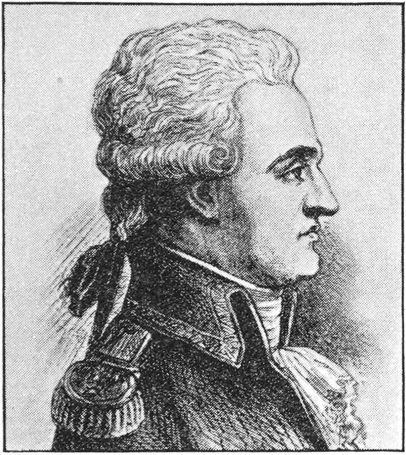
Villeneuve
In spite of all these disadvantages there were many officers, and men also, who burned to wipe out the disgraces of the First of June and the Nile, and to emulate the achievements of the sister service. Villeneuve himself, described by an Englishman who got a good view of him after Trafalgar, as a ‘tallish, thin, man, a very tranquil, placid, English-looking Frenchman’, was too cold and calculating, and, it must be added, poor-spirited, to feel or to arouse any great enthusiasm. His principal exploit during his career had been his escape with one ship of the line besides his own from the Battle of the Nile. But there were men of a different stamp: Rear-Admiral Magon—le Beau Magon—an explosive Breton, who had distinguished himself in both the East and West Indies, and latterly in bringing a division of small vessels round from Dunquerque to Calais in the face of British attempts to prevent him; and several of the captains, such as Lucas, Cosmao, and Infernet. But what Napoleon wanted was men such as were to be found in his army—men who brought independent and original minds to the carrying out of his designs. Of these in 1805 there were none.
Most of the defects of the French Navy, except those arising directly out of the Revolution, and the bad spirit which it engendered, were repeated in the Spanish Navy in an aggravated form. Like their allies, the Spaniards had some fine ships, as Nelson observed in 1795. But even during the great days of Charles III, when many of those which fought at Trafalgar were constructed, they admitted their inferiority by occasionally following English models, and engaging English constructors. It was in repair and refitting, however, rather than in construction, that they failed, just as the French Navy did. A squadron was never ready to put to sea. In April 1805 Villeneuve appeared off Cartagena and called upon the Admiral there, but he had to go on without him. When he reached Cadiz, according to programme the whole squadron ought to have been ready to come out at once, but the ships had some difficulty even in weighing anchor, and then sailed so badly that, though waited for, they were never with the French ships throughout the voyage to the West Indies.
There were plenty of Spaniards who knew how to die with the fatalist courage characteristic of their race. Nor were there wanting in the higher command men with that lofty devotion to the point of honour—pundonor—which was to be expected of the countrymen of Don Quichote. There was an example in Vice-Admiral Alava, whose surname became better known to Englishmen because it was borne by his nephew, the only man known to have been present both at Trafalgar and Waterloo—the trusted staff officer and friend of Wellington. The Commander-in-Chief was however a Sicilian—a fact which recalls the close association between Spain, and Italy and Sicily, during the eighteenth century. Born at Palermo, which he always regarded as his home, Gravina was devoted to the country which he served. Like Alava he had been in the siege of Toulon. When the British and Spaniards held that town for the royalists against the republicans, he was given the command on land, and carried out a completely successful attack on the French position, the only mishap being that he himself was wounded. On this occasion the British general under him was Lord Mulgrave, who was in 1805 Foreign Secretary, and two years later First Lord of the Admiralty. He was something else besides a seaman in other ways; he was a scientist—author of a work on astronomy, and he was Spanish Ambassador in Paris in 1804. He was as modest as he was brave. In the ill-fated attack by floating batteries on Gibraltar of September 13, 1782, he was offered and refused command of the whole, though he commanded his own battery. In 1797 he again refused a command—that of the Squadron of the Ocean. Such a man was well fitted to occupy the difficult position of a Spanish Admiral in 1805, expected to conform to the authority of the French Admiral, without being placed formally under his command.
Both Gravina and his Chief of the Staff, Escaño, had taken an important part in the defence of Cadiz harbour in 1797, which must be regarded as not unsuccessful; for although Nelson inflicted losses on the defenders, he was not able to attain his prime object of bombing the Spanish fleet out to sea. Escaño was also a skilful tactician. He distinguished himself in the Battle of St. Vincent, when he was believed to have prevented the Santísima Trinidad from capture by the timely interposition of his own ship. But this honour more properly belongs to Valdés—El Intrepido—who was a Brigadier, or Commodore, at Trafalgar. He and the explorer Churucca, the great Spanish hero of the battle, were worthy brothers at arms of Lucas, Cosmao, and Infernet. Generally speaking those officers whose service dated back twenty years—to the time of the late King—were a fine set of men.
In this navy too, the manning was execrable. It was based on a system of maritime conscription, and though the men so recruited were seafarers, they were mainly fishermen, who knew nothing of going aloft in a ship. The number was made up by attracting a few volunteers, and pressing the sweepings of the ports at the last moment, as ‘waisters’. The pay of the men was so much in arrears that it might almost be said to have been withheld altogether; they were given no uniform on joining, and many sailed and fought in rags. Here too, recourse was had to the expedient adopted by the French Navy, though without the same excuses. In Calder’s two prizes of July 22, 1805 it was found that nearly two-thirds of the crews were marines or soldiers embarked to take the place of seamen. But there was certainly one recruiting difficulty peculiar to the town of Cadiz, for the population here was constantly ravaged by deadly epidemics.
In spite of the existence, in both countries, of serious students of naval tactics, there was a general tendency in both the French and Spanish navies to neglect seamanship, and consequently tactics, in favour of the idea of making a sea battle as much like a land battle as possible. The French favoured this owing partly to a survival of the republican jealousy of the ascendancy of naval skill, as savouring of an aristocracy; partly to a sentiment, dating from the same period, of admiration for the classic combats with the oar of ancient Greece and Rome; partly to a desire to make use of those soldiers who had made France feared through Europe. The Spanish were too indolent to learn to make good sailors, and were at their best in boat actions and hand-to-hand combats. But then came the difficulty, that before a ship could be boarded, it was necessary to undergo several broadsides from her terrible guns. And after this had been surmounted, and at last they were able to face their enemies on the same deck, they found that there was no more deadly antagonist than the British seaman armed with his cutlass.
C’est un drame qui se déroule lentement, que l’on voit poindre, grandir, toucher un instant à une issue favorable, et se terminer par un catastrophe.
Failure to recognize with the great naval historian, Admiral Jurien de la Gravière, how near Napoleon’s plans were to achieving success, would equally be failure to recognize the merit of Barham, of Cornwallis and of Nelson—of all who saved England in that critical hour. Of those plans, that of 1804, which was never carried out, had an even better chance of success than that of 1805. It was Latouche-Tréville who then commanded in Toulon. But on the 18th August he died, and, before the plan could be taken up with his successor, Villeneuve, relations became strained with Austria, and, the invasion scheme being for the time abandoned, Napoleon planned an expedition to the West Indies. The British islands there were to be ravaged, and the French islands reinforced; the fleet was then to return to Rochefort. Rear-Admiral Missiessy from that port, and Vice-Admiral Villeneuve from Toulon, had the leading rôles. Each was successful in breaking out of port in January 1805, the former on the 11th, the latter on the 18th. It had been thought next to impossible to keep a strict watch on Rochefort. Collingwood, when in charge of that blockade, thought that it was impracticable to prevent the squadron there from sailing, and after its escape Captain Duff wrote that it had been quite a farce. Rear-Admiral Sir Thomas Graves was, in fact, in Quiberon Bay many leagues to the northward, when Missiessy escaped, and owing to a series of accidents, the cruisers which he left off Rochefort did not inform him in time. It was the Admiralty which first divined the direction of his mission, and, after some delay, Rear-Admiral Alexander Cochrane, uncle of the famous Lord who afterwards became the Earl of Dundonald, was sent, with five ships, in unavailing pursuit.
Meanwhile Villeneuve’s attempt to escape out of the Mediterranean had been a failure. He had started with a presentiment that it would be. His despatch of the 21st, written after he had returned to port, was only one of many heartrending accounts of ships ill-found and crews untrained, as well as encumbered by the number of troops which he had to carry. In the first night three of his vessels were so much injured by a storm that they were unable to proceed, and besides these a ship of the line and three frigates had parted company. He could not, he said, run the risk of being brought to action in this state, and arrived at the decision to return on the day after his departure.
The tone of his despatch betrays a sentiment almost of satisfaction at his inability to carry out the mission entrusted to him by the Emperor. He even offered Decrès his resignation of a command which he had accepted full of confidence in the good luck which he believed to have attended him ever since his fortunate escape from Nelson at the Nile. Now he said that he had never desired it, and feared to become the byword of Europe. Such weakness of character spoke more to his discredit than his actual return to port. Both taken together form the first example of many instances that year of that fatal irresoluteness which was to lead, almost inevitably, to the final catastrophe. It is interesting to contrast Villeneuve’s conduct with Ganteaume’s when he sailed from Brest at precisely the same tempestuous season of the year four years earlier. His vessels suffered as much, and every one of the ships of the line was separated from the flagship. But all went on. Ganteaume had provided them with a rendezvous; which is what Villeneuve should have done, as was pointed out by the Emperor. Napoleon had himself known what it was to sail from Toulon with a fleet in a gale of wind.
But so far as the mystification of Nelson was concerned, the enemy was completely successful. It was almost always known from the usual sources of naval and military intelligence when a squadron was about to proceed to sea. It was possible only to lead Nelson astray as regards its object. Napoleon had no scruple in deceiving everybody in the port except the Admiral, and, perhaps, the military Commander-in-Chief. Besides the time-honoured plan of allowing a vessel carrying false information to be captured by the enemy, officers and civilians specially acquainted with some pretended destination could be put on board, and pilots selected who knew those particular harbours. Villeneuve had done his part in this well. In the foul weather the British shadowing frigates lost touch with the French fleet in the night of the 18th, and brought word to the main fleet off the northeast coast of Sardinia to the effect that it was sailing down the west coast of that island, as though bound eastward. Nelson was misled by this, as well as by the direction of the wind—which had been favourable to a western destination for a fortnight, and had then turned just before Villeneuve sailed—into supposing that he was going eastward.
The British Admiral could not in any case have got out of the Straits of Bonifacio to the westward, as the wind was foul. He sailed eastward, and then shaped a southerly course. Had Villeneuve not returned, he would have met with him off the south end of Sardinia. But as he did not find him, he looked for him to the east. After satisfying himself that Sardinia, Naples and Sicily were all secure, he actually went as far as Alexandria to do the same as regards Egypt, before returning, on the 13th of March, to find the French fleet back at its old moorings.
This misadventure of Villeneuve’s gave Napoleon time to elaborate a fresh scheme, which comprised the utilization of the Spanish fleet now available, and aimed once more at securing the command of the Channel, if only for three days, to enable the flotilla to cross. This plan—that of the 2nd of March—had two radical defects; it was complicated; and too much depended on Villeneuve’s nerve—and, indeed, on Napoleon’s own. As Missiessy with his 5 sail of the line was already in the West Indies, the Toulon Admiral was to join him there, picking up six Spanish ships from Cadiz, as well as the French Aigle, which had taken refuge there in 1803, on the way. Villeneuve would then have 23 ships. Vice-Admiral Ganteaume was to break out at the same time from Brest, picking up four French ships of the five at Ferrol, besides, perhaps, five Spanish, thus increasing his own fleet to 30 sail of the line. He was to join Villeneuve at Martinique, take command of the enormous combined Fleet, and then, after throwing garrisons into such of the French West Indian Islands as required them, to return to Europe. He was to engage and defeat any force which he found at the mouth of the Channel, and to appear before Boulogne some time between the 10th of June and the 10th of July. Should Ganteaume not find Villeneuve on the rendezvous after waiting thirty days, he was to carry out his mission none the less. But should Villeneuve not find Ganteaume after waiting forty days, he was to return eventually to Cadiz.
For the success of the whole scheme it was necessary that the blockades of two ports, Brest and Toulon, should be evaded, and those of two other ports, Ferrol and Cadiz, raised. The chances of uniform success in every one of these plans, were unfavourable. In fact Napoleon allowed for Ganteaume finding himself eventually with only 40 ships, and not 53. Even this was an unmanageable number. The one French admiral who was supposed to have possessed the skill to direct the manœuvres of 40 ships together, Bruix, who had been commanding the Flotilla, was recently dead. The British ships released from the blockades of all those ports, were bound to concentrate in their turn. There was every probability of a great naval battle, in which the inferior skill of the high command, and the inferior seagoing and seamanlike qualities of the French, and still more the Spanish, ships and crews, would tell against the Combined Fleet, much more than in the smaller engagements contemplated by the scheme of the year before. But Napoleon scarcely had an alternative. He trusted Villeneuve a great deal too far, but he certainly could not have trusted him to do what he had expected from Latouche-Tréville. The only officer on whom he could rely for the great adventure was Ganteaume, and he became an essential part of the scheme.
Napoleon has frequently been censured for expecting too much of his admirals. There is at all events one exception. On the 24th of March Ganteaume telegraphed—by the signals repeated from Brest through 50 intermediate stations till they reached the roof of the Ministry of Marine—that he was ready to start. But he had no authority to force his way out, and there were 15 ships cruising outside. He asked leave to risk an engagement. ‘Le succès’ he added, in a spirit worthy of himself, ‘n’est pas douteux.’ ‘Une victoire navale dans cette circonstance,’ Napoleon replied, ‘ne conduirait à rien.’ ‘Sortez sans combat.’ For once it was Napoleon’s nerve which seems to have failed. No doubt he had good reason to fear for the success of a voyage to the West Indies, begun with a fleet crippled at the outset from the effect of an engagement, even if successful. In a day or two the blockading squadron was reinforced. The opportunity had passed. On the 27th Ganteaume thought he saw a chance of doing what the Emperor wished—leaving port without a battle. There was a fog, and it appeared to be thickening. But just as he was passing out into the roads, it lifted; and eighteen ships of the line were seen barring the passage to the open sea. Such a chance did not occur again.
On the 30th of March Villeneuve left Toulon for the second time. He had eleven ships of the line and eight frigates and smaller vessels, and carried 3000 soldiers. He had also been obliged to take 1800 soldiers to fill vacancies as seamen—an expedient to which Great Britain also had occasionally had recourse at the beginning of a war. Nelson had expected Villeneuve’s departure and made as if to block his way between the Balearic Islands and the mainland of Spain, while in reality awaiting the enemy further to the east. Villeneuve would have fallen into his arms had he not luckily got information from a neutral of his true position. He realized the feint, and passed securely to the westward of the Balearic Islands, and so out through the Straits of Gibraltar. True to his system of preserving his own ships and allowing his adversary the chance of getting clear, Nelson had been waiting for him off the Gulf of Palmas at the southern end of Sardinia. And now the chase began.
But not before Nelson was convinced once more that Sardinia, Sicily, Naples, the Morea, and Egypt, were all safe. He had been left completely in the dark. The direction of Villeneuve’s previous evasion had taught him nothing. He knew nothing of Missiessy’s departure to the West Indies. The two last despatch vessels which had been sent from home had not reached him; one was wrecked off Cadiz, the other captured by Villeneuve when he first came out. There was nothing to point to the West Indies, and Nelson still clung to the idea of an eastern destination. He probably hoped the direction was west and out of the Straits, but he would not believe what he wished to believe. His self-restraint on both occasions of Villeneuve’s escape from port was sublime. He did not forget that his first duty was to safeguard British interests in the Mediterranean. Till he could make sure of these, he could not carry out the second and much more congenial duty, namely that of pursuing the French Fleet where he thought it likely to be found. It is not his stay from the 4th to the 16th April which needs justification, but his leaving the limits of his command after Villeneuve. Not that this act of his was any stroke of independent genius. It was one of the duties of the Commander-in-Chief in the Mediterranean, as defined in eighteenth century instructions revealed by the researches of the late Sir Julian Corbett. It was not in Nelson’s instructions, and had become a matter of tradition only, but it was presumed both by him and the Admiralty to be still in force. A letter of Duff’s at the time shows that he did only what it was generally supposed in the Atlantic Fleet that he would do.
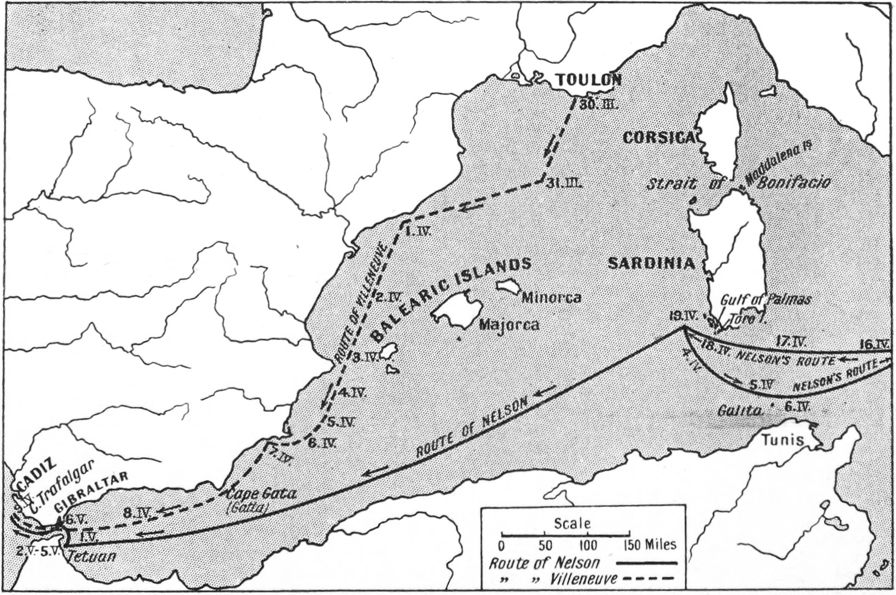
THE WESTERN MEDITERRANEAN
The story of that pursuit has been told so often, that it will be a novelty to follow it in Nelson’s Private Diary, of which only very small extracts have hitherto been published.—
Thursday April 4th 1805 at daylight off Toro the Phoebe join’d with the signal that the Enemy’s fleet was at sea and that he had been chased by their frigates at 9 Capt Capel came on board and reported that He saw the french fleet on Sunday morning at 8 o’clock and kept with them till sunset they were steering SSW at 8 p.m. it came to blow fresh guns at WNW and the Active stood to the SW all night and not seeing them in the morning thinks they may either have bore up before the wind or altered their course to SSW sent Ambuscade to Galita and Active to the Coast of Africa all night fresh guns at N by W.
Wrote Ly Hn
friday April 5th 1805 fresh breezes N by W the Amazon and Transports join’d from Malta and the Moucheron Brig sent the Moucheron to cruize 7 days between Galita and Africa and to call at Tunis for Information. . . .
Monday April 8th fine wr. the Seahorse return’d from Maritimo and reported that the officer at the Fort reported that 14 Ships of war had passed that Island on March 28th steering to the Southward N B which I do not believe. . . .
Nelson was right here.
Tuesday April 16th 1805 fresh Breezes westerly beating to windward at 8 a.m. spoke an Imperial from Lisbon who saw 16 ships of war on the 7th off Cape de Gatte with the wind easterly standing to the westward which I suppose must be the French Fleet and of course I am very uneasy although I feel I have done perfectly right in assuring myself that Naples, Sicily the Morea Egypt and Sardinia were safe before I proceeded to the westward I must ever regret my want of frigates which I could have sent to the westward and I must also regret that Capt Mowbray did not cruize untill he heard something of the French fleet I am unlucky but I cannot exert myself more than I have done for the Public Service.
The next day he hears definitely that they have passed the Straits, which they had done on the 9th—‘how unfortunate I am!’ On the 23rd there is a calm; he hopes this means a change of wind, but no! The next day it is blowing from the west again. But on May 4 he has reached Tetuan Bay.
it seems generally credited that they are gone to the West Indies but surely I shall hear something of them from Sir J. Orde’s cruizers who he must naturally have sent after them.
On May 10 he at last gets definite information. The next day, after arranging for the safe voyage of an expeditionary force intended for Italy, and escorted by Rear-Admiral Knight, and leaving the Royal Sovereign as further protection, he sets sail definitely for the West Indies with 10 ships of the line and 3 frigates. The winds are at last not unfavourable.
May 22 has a reference to what was once an invariable custom:
fine breezes ENE run 174 miles the last 24 hours crossed the Tropic Neptune performed the usual ceremony near 500 persons in the Victory never before crossed the Tropic.
Meanwhile Villeneuve had driven off the force blockading Cadiz, and then, picking up the Aigle and six Spanish ships under Admiral Gravina, reached Martinique on the 13th. He did not find Missiessy, who had returned, not having received the orders telling him to remain longer. Both admirals were unenterprising; but Villeneuve took a convoy, as well as recapturing the Diamond Rock off Martinique, which had been taken by Commodore Samuel Hood in 1803, and was borne on the books of the Admiralty as H.M. Sloop Diamond Rock, under the command of Lieutenant Maurice. The Rock fell on the 3rd of June, and its commander was actually sent to Barbados, whence he was able to despatch valuable information to Nelson on the 8th.
Nelson’s Diary may now be read straight on, omitting calculations of positions and runs.—
Monday June 3rd 1805 Modte trade wind at daylight saw 2 ships to the westward they were spoke by the Amphion and reported that they were Guineamen from Surinam and America, and that yesterday at noon they were spoke by the Benlim frigate who told them that french and spanish Squadrons had arriv’d at Martinico, but the African Ships did not know at what time the enemy had arrived in the evening saw a Man of War with the signal of intelligence to communicate but she missed the Victory and I would not shorten sail as I knew she would only communicate when the enemy’s fleet arrived at Martinico all night fresh breezes
Wrote Ly Hn
Tuesday June 4th 1805 fresh Trade wind at day light saw Barbadoes bearing west 10 leagues at 11 received the salutes of Rear Adl Cochrane and Charles Fort. The enemys fleet had arrived at Martinico May 14th and were sickly, on the 28 of May they were seen to windward of St Lucia standing to the southward supposed going to attack Tobago and Trinidada The General Sir Willm Myers having very handsomely offered to embark himself with 2000 Troops for the relief of those Islands I anchored the fleet in Carlisle Bay, employed all night embarking Troops very rainy weather and Squalls of wind.
Wednesday June 5th fresh Breezes and Squalls at 8 a.m. sail’d from Barbadoes sent the Curieux Brig to look into Tobago for information and a vessel was sent by the Genl to Genl Prevost at Dominica to acquaint him of my arrival all night fine Breezes standing to the southward I was recommended to steer from Barbadoes SE on account of the very strong W currents which almost constantly run with great violence at 6 p.m. steered S by E for the night the wind being 2 points free
Monday June 6th 1805 at daylight being by the reckoning in Latd 11.31 within 7 miles of the Latd of Tobago steer’d WSW at 8 saw Tobago bearing SW by W at 2 P M abreast of Man of War Bay the Curieux join’d with information that an American had arrived at Scarborough the day before who said that three days before his arrival he had been boarded by the French fleet standing to the southward and that He supposed they would pass Tobago as last night at 4 off Courland Bay no information therefore the American must have fabricated his story bore away for Trinidada just at dark a Schooner to Leeward made it is said a signal which denoted the information that the Enemy are at Trinidada but she did not join the fleet but stood into Sandy Point Tobago, at midnight brought to off Trinidada sent the Pheasant to Toko for information
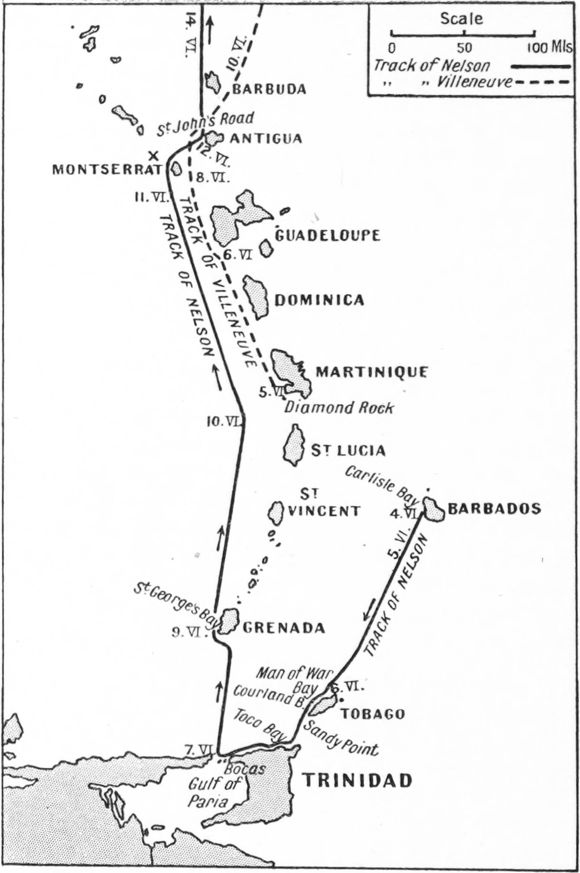
THE WEST INDIES
friday June 7th 1805 at 4 a.m. bore up for the Bocas till 8 Light airs then Modte Breezes at ENE at sunset anchor’d in the Gulph of Paria but the enemy had not been heard of at the Island
Saturday June 8th at daylight an advice boat arrived from Barbadoes with letters from Capt Morrice giving an account of the Capture of the Diamond Rock and also that the French and Spanish Squadrons had not sail’d from Martinico but that the French Commodore told him that the Ferrol Squadron of six sail of french and eight of spaniard arrived in Fort Royal on June 4th at 7 sail’d from Trinidada at noon well out clear of the Bocas all day beating to windward along Trinidad at sunsett steer’d N by E for the night fresh Breezes
Sunday June 9th 1805 Fresh Breezes at 6 a.m. saw Grenada at 8 sent the Mozambic to Barbadoes at noon arrived off St. Georges Bay Grenada and receiv’d a letter from General Prevost at Dominica to say that the Combined Squadron had passed Dominica on the 6th June and went to Guadaloupe to land the Troops which they had taken from there and then stood to the Northward sent the Netley to Antigua and Jason to Monserrat for information all night fresh Breezes
Wrote Ly Hn
Monday June 10th fresh Bze at noon between St Lucia and Martinique standing under a press of sail to the northward sent a Schooner to General Prevost at Dominica for intelligence all night fresh Breezes
Tuesday June 11th Modte Breezes at 8 a.m. saw Guadaloupe spoke an American from Boston no intellce at noon saw Monserrat at NE at 2 saw the Jason at anchor news from Monserrat they saw on Saturday morning 16 sail under Guadaloupe beating to windward all night beating to windward
Wrote Ly Hn
Wednesday June 12th 1805 fresh Breezes beating up under Antigua at Sunsett anchored in St. Johns Road sent the Curieux to England with dispatches French fleet passed Antigua standing to ye North June 8
Thursday June 13th fresh Breezes at day light landed the Troops employd getting ready for sea at noon sailed with 11 sail of the line 3 frigates and a Sloop of War the Netley schooner join’d with information that the French fleet took his convoy consisting of 14 sail was taken by the enemys fleet on Saturday June 8th 4 of the enemy ships were seen yesterday at 4 P M saw Barbuda till sunsett steering NW from 16 to 12 fathoms water the SW end of the Island very very low if I was to ask an opinion of where the enemys fleet had gone I would have as many opinions as there were persons Porto Rico—Barbados—Newfoundland—Europe My opinion from all the circumstances drawn into one point of View with the best Judgement I can form I think the whole or part of the Spaniards will go to the Havanna and the rest of the fleet to Cadiz and Toulon and upon this opinion I am going to the Streights Mouth unless I shall alter my opinion from information gain’d all night Modte Breezes
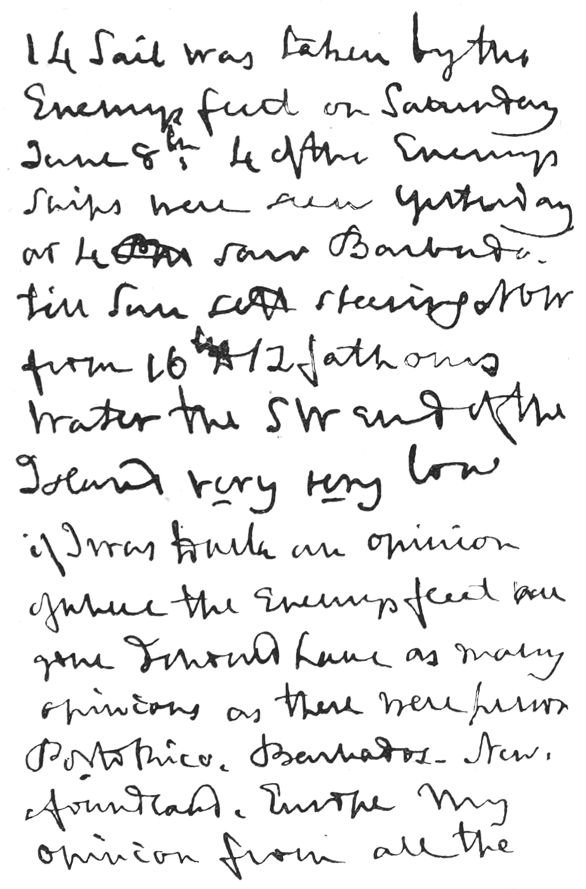
FROM NELSON’S PRIVATE DIARY, JUNE 13, 1805
friday June 14th 1805 Modte Breezes standing to the Northward spoke a Brig from America who 5 days ago was spoke by a frigate with a convoy of 13 sail from Tortola for England all night Modte Breezes standng to the Northward.
Saturday June 15th Modte Breezes standing to the Northward modte Breezes all night the Amazon chased a schooner but could not come up with her
Sunday June 16th Modte Breezes standing to the Northward
Monday June 17th 1805 Vble Winds Calms and very heavy Rains at noon Modte Breezes SE saw a ship and a Brig NNE sent Amphion to speak them found we had only 100 Tons of water in the ship, 4 p.m. no intelligence from the Ship or Brig saw a schooner ENE sent Amazon to speak her all night Modte Breezes standing to the NE
Tuesday June 18th 1805 Light Breezes Southerly and heavy Rain Amazon made the Signal of Intelligence to communicate, the Schooner spoke by Amazon saw on Saturday at sunsett a fleet of ships of war 22 sail steerg to the Northward which I suppose to be the french fleet schooners Latd at noon 27.28 N. Longde 60.58 W at 8 o clock last night French fleet by computation bears NE by N 87 Leagues at noon modte Breezes ESE and clear Heavy Rains Winds from SE to ENE squally
Wrote Ly Hn
Wednesday June 19th fine Light Breezes and Rain sent the Martin to Gibraltar & Decade to Lisbon to give information of the enemy’s return to Europe.
On the 21st he mentions three planks, and on the 24th a bucket and a chest, all supposed to come from the French Fleet. He is ‘very miserable which is very foolish’.
A month later Nelson himself reached Gibraltar, and it was there that he went ashore for the first time for two years. He had done his part. He had saved the West Indies and sent information home of Villeneuve’s return. It was for the Admiralty to provide for the north; his own business was with his own command. He found that it was safe. Villeneuve had neither entered Cadiz nor passed the Straits. A few days later Nelson learnt what his true course had been, and himself fell back northward to reinforce Cornwallis.
Villeneuve had, in fact, sailed for Ferrol on the 10th of June when Nelson was pursuing him to the northward. He had not waited his forty days for Ganteaume. His intelligence was incorrect. He believed, on information of prisoners from the convoy which he had taken, that Nelson had twelve or fourteen ships instead of ten, and that he had been, or would be, joined by all Cochrane’s six ships, whereas only two joined him at Barbados, one of which he took home. The only reinforcement which Villeneuve had received consisted of two ships under Rear-Admiral Magon, who had left Rochefort with them on the first of May, and joined him on the 4th of June. He had also brought fresh orders. If not joined by Ganteaume in the time specified, Villeneuve was to return not to Cadiz but Ferrol, unite with the ships there and at Brest, and then sail up the Channel to Boulogne. He now had twenty ships, but six of them were Spanish, against what he supposed an equal force. A battle in the West Indies, even if he were victorious, would have hindered the return of the Fleet. After consultation with Gravina he decided to return at once.
Nelson’s despatch of the Curieux with this intelligence on the 12th of June, is one of the most brilliant strokes of genius in his whole career. It was one of those happy conjectures which decide the issue of a campaign more often than certainties. Had he waited until he was sure it would have been too late. He was only sufficiently sure to sail back himself the next day, and even then, as his diary of the 13th shows, he had considerable doubts. In fact he guessed wrong. He thought the Spanish ships were going to Havana and the French to Cadiz and Toulon. But on the main point he was right. He had divined Villeneuve’s return to Europe. With a Barham at the Admiralty, the campaign was won.
This is all the more remarkable as the only Englishman who appears to have divined Napoleon’s great plan was Collingwood, an almost unique example in history of a man at once too great and too small for the work he had to do. He ought to have been either a First Lord of the Admiralty or a boatswain in a man-of-war. His correspondence reveals a mind far above that of a mere seaman in matters of strategy, and those numerous political questions which came before him as Commander-in-Chief in the Mediterranean after Nelson’s death. But he was lacking in the directive capacity required for the command of a fleet. He scarcely spoke to his captains, who could not know his mind, particularly as he did not know it himself, and perplexed them with counter orders. He submerged himself in detail. The stories naïvely told of him by his first biographer and other admirers of his conduct at Trafalgar illustrate this. Tired of walking the quarter-deck munching an apple, he goes below, looks along the guns to see that they are properly pointed, fires one himself, and stands while one of the sailors, a black man who seems to have been a special favourite, fires ten times directly into the port-hole of the Santa Ana. Earlier in the action he sees a top-gallant studdingsail which had fallen, hanging over the gangway hammocks. He makes his Lieutenant come and help him to get it inboard. ‘These two officers accordingly rolled it carefully up and placed it in the boat.’
And yet this was the officer who from off Cadiz, where he was blockading with three ships, met Nelson on July 21 on his return from the West Indies with the following admirable forecast:
They will now liberate the Ferrol squadron from Calder, make the round of the bay, and, taking the Rochefort people with them, appear off Ushant, perhaps with thirty-four sail, there to be joined by twenty more. This appears a probable plan; for unless it be to bring their powerful fleets and armies to some great point of service—some rash attempt at conquest—they have only been subjecting them to chance of loss, which I do not believe the Corsican would do without the hope of an adequate reward. The French Government never aim at little things while great objects are in view.
It is true that he went on to mention the invasion of Ireland, and not England, as the real object. In this, as an Atlantic Fleet officer, he had been deluded by Napoleon’s ingenious system of false intelligence, much as Nelson had been over Egypt. But on the whole his insight into the enemy’s mind was marvellous.
Bettesworth, the Captain of the Curieux, proved that a brig could make the voyage home in not much more than half the time which a Combined Fleet needed. He reached Plymouth on the 7th of July. He could now give the most certain information, for, as Nelson had ordered, he had steered a course which brought him up within sight of Villeneuve on June 19. Bettesworth was as quick in a post-chaise as he was in a frigate, for he covered the two hundred miles to the Admiralty by 11 p.m. of the day after reaching Plymouth. Barham, the famous octogenarian seaman, who had become First Lord in April that year, lost no time either. His mind had been almost made up already, thanks to the suggestions of an obscure individual who signed himself Nauticus, and afterwards turned out to be Nicholas Brown, Keith’s Private Secretary.
Lord Barham displayed an activity which Napoleon, when he heard what had happened, could not believe to have been possible. Thanks to the publication by the Navy Records Society of the facsimile of his Memorandum with its interlinear additions, we are able to see into the workings of the old man’s mind. Vice-Admiral Sir Robert Calder was then blockading Ferrol with ten ships. He must be sent to meet Villeneuve—Cornwallis to strengthen him up to fifteen ships. This is Barham’s first idea. But it will not do to weaken Cornwallis off Brest by five ships. Best to sacrifice the Rochefort blockade, and draw the five ships from there. So the Board was called, and by nine o’clock in the morning of the 9th the orders were issued. They were preceded by a private letter from Barham to Cornwallis with the postscript ‘Time is everything’.
The Admiral was himself to stretch out with his fleet thirty or forty leagues to the southwestward for 6 or 8 days. Calder with the Ferrol and Rochefort squadrons was to cruise the same distance from Cape Finisterre for the same space of time. It was the junior of these two officers who came in fortune’s way.
Napoleon reckoned two Spanish ships as equal to one French, and certain statements of Villeneuve and Dumanoir suggest that those admirals would have valued them at an even lower rate. Moreover Calder had four three-decker 98-gun ships, the enemy none higher than 80. Thus his 15 ships were not ill-matched with Villeneuve’s 20. The two fleets met on the 22nd of July. The action took place in a thick fog which only partly lifted at intervals; this accounted for its protracted character and indecisive result. It was not until after 5 o’clock in the afternoon that it began, and it went on for four hours. It acquired the name of the Quinze-Vingts because the number of ships engaged in the blinding fog reminded Parisians of a common term for the blind, which was derived from a well-known institution for such persons founded by St. Louis with fifteen-score beds.
Calder’s object was to engage the centre and rear of the enemy’s Fleet with his own, and he had assumed a leeward position for doing so. To frustrate this, Gravina, who led the van formed of the six Spanish ships, doubled round, and it was his ships which bore the brunt of the battle. Their gunnery was poor, and the result of the action was that two old unseaworthy ships were dismasted, and fell to leeward among the British ships; a courageous effort by Captain Cosmao of the French Pluton to save them, failed; and they were both captured. Calder had gained the victory.
But the following day his ships were widely separated, and had all the appearance of a beaten fleet. One of his own ships, the Windsor Castle, had suffered so severely in the action that she was being towed, as well as the two prizes. Surrounded, as he believed, by possible enemies, for the Rochefort squadron was bound to escape again, and the Ferrol squadron had every opportunity of doing so, Calder declined renewing the combat. He retired northward to put his prizes in safety, and see them and the Windsor Castle on their way to England to get refitted, and did not return to resume the blockade of Ferrol till the 29th. Villeneuve pursued—although not in a determined manner—till the 24th, then, losing sight of the British fleet, turned back southwards. The Comte de Ségur relates a ludicrous story about this. After Villeneuve had given up, his flagship passed Magon’s. The hot-headed Breton foamed at the mouth, and threw his spyglass, and even his wig, at him; both fell into the water. True or not, it illustrates the man’s character, and the degree of respect in which the Commander-in-Chief was held. It was however the Spaniards who were most exasperated; they thought that they had been sacrificed.
Villeneuve was right however in not persisting in his pursuit. His mission was to unblock Ferrol, and effect a junction with that and the Rochefort squadron. But he took counsel of his fears besides. The essence of Napoleon’s strategy being surprise, the moral effect upon Villeneuve, and, indeed, the whole Fleet, of finding themselves expected and met on their return to Europe, as well as being pursued to the West Indies and back, must have been pernicious. Moreover the action with Calder had brought the defects of the Fleet into high relief. It had, as Villeneuve complained a few days later, bad masts, bad sails, bad tackle, bad officers, and bad seamen; it had, moreover, an obsolete tactic, which knew only the single line of battle, and that was just what the enemy wanted; nor had he either the time or the means to teach anything better to the captains which he had. All this, he said, he had foreseen before leaving Toulon, but he had nursed himself with illusions till he saw the Spaniards, and then there was nothing for it but to despair—and despair he did. ‘Everything is against me, even Heaven,’ for the mainmast of his unfortunate flagship had been struck by lightning. With such thoughts in his mind he shaped his course not for Ferrol but for Cadiz, which he was only intended to enter in the last resort.
It was now known also that Nelson had reached Gibraltar, and his ships too would be available for reinforcing Cornwallis. The scheme for bringing an overwhelming force to the mouth of the Channel was virtually defeated. But an accidental circumstance kept the cherished vision before Napoleon’s eyes for some days longer.
With several ships badly damaged, and some having a quarter of their whole companies sick, meeting with foul weather and contrary winds, Villeneuve found that he could not even reach Cadiz. He was obliged to put into Vigo Bay, not far south of Coruña; and, Calder being blown off the coast, he was able to make sail again and avoid him, and at last to effect the desired junction with the Ferrol squadron on the 2nd of August.
Villeneuve was not so successful with the Rochefort squadron. Those five ships, now under Captain Allemand, escaped out as soon as the blockade had been raised, from which the genius of Napoleon at once drew the deduction that the Fleet was on its return to Europe from the West Indies, and a British fleet was on its way to intercept it. The Rochefort Commandant had been given two rendezvous where he was to obtain touch with Villeneuve, and he visited them both in turn, but partly owing to bad fortune, and partly to the French Admiral’s neglect, they never met. But Allemand was never caught by the British either. His invisible squadron, as his countrymen called it, roamed the seas preying on the trade-routes with impunity till Christmas Day. It made the British pay dearly for that strategic move which led to Calder’s action. But it was out of the great game altogether.
Villeneuve had no difficulty, except delay, caused by the unreadiness of the Ferrol ships and contrary winds, in leaving that port, for he was no longer blockaded by Calder, who was too weak to do so, and fell back upon Cornwallis. Meanwhile Napoleon was preparing the way for him by another of his great schemes of mystification.
Barham, and the admirals who served him, had resolutely refused to abandon the central position. They refused to be diverted to the West Indies, except on the best information, and even then with no more than the necessary strength. They refused to be diverted to the East Indies, or to Ireland, at all. But by producing a certain activity in the Helder in July, Napoleon gave ground for the apprehension that he intended to send a squadron round the British Isles to join the Dutch ships there, overpower Keith’s squadron, and get an army across before the British could send help from the west. This resulted in some shifting and reshifting of ships between the Atlantic and the Downs by Barham’s orders. But he refused to be beguiled into any hasty weakening of Cornwallis’s force. Nevertheless he took the danger of invasion extremely seriously. He informed Cornwallis that Ministers looked to invasion soon, and directed him to be prepared to send reinforcements to the east if necessary. Early in August the most stringent orders were issued pressing merchant seamen out of all ships, not excepting apprentices—which was contrary to law. The port admirals were ordered to get ready for sea every ship that would float. By the 20th of August there was a very considerable number. He calculated on that date that he had ready or nearly ready for emergent service in the Channel, 15 three-deckers and about 39 other sail of the line belonging to the Atlantic Fleet, and 5 fitting in the Thames for the Nore Squadron. And now that the eyes of the British high naval command were directed, partly at all events, to the east, the moment had come for Villeneuve to carry out his mission, to raise the blockade of Brest, to join with Ganteaume, and to dash up-Channel from the west.
Accordingly he sailed on the 13th of August, now with 29 ships, 11 being Spanish, for Brest or Cadiz, he said, as occasion might decide. But the wish of his heart was still Cadiz. Meeting with unfavourable winds for a voyage to the northeast, he gave up the game on the 15th, and made for that port, as he had been expressly directed to do if unforeseen contingencies should frustrate the Emperor’s plans. This decision set the final seal on the project of invasion. Every authority now concurred in representing to Napoleon that failure had to be accepted.
It cannot be denied that during the months of July and August 1805 Napoleon lost balance, and that the gambler in him for a while got the better of the strategist. While the great diversion was being carried out, he had been in Italy, returning in breakneck haste to Paris on July 10 to find—so he had hoped—that nothing was less thought of in England than invasion, and that everything in France was ripe for the success of his plans. He became impatient lest the effect of his sudden return should be lost. A few days later he learnt that the force blockading Brest had been temporarily withdrawn to intercept Villeneuve. On the 20th he ordered Ganteaume to break out if he could do so, and pass on to Boulogne and there seal the fate of England. And yet Cornwallis was bound to have left a cruiser off the port, and the 21 French ships would soon have had some part of the Atlantic Fleet, all the reserve ships available in the Channel Ports, and Keith’s ships, now eleven in number, upon them; the game would have been played and lost, and Villeneuve would have taken no part. Later on, when the Emperor, now at Boulogne, found that there was still a chance of carrying out the original scheme for a combined movement of both fleets, he clung to it with all a plunger’s desperate pertinacity. Villeneuve on his side knew nothing of the state of the negotiations with Austria when he left Ferrol on the 13th of August. He might have sailed on northward, fought a battle with Cornwallis, liberated the Brest Fleet, and sailed up-Channel. He would have been too late, though he would not have been to blame. Yet the Emperor knew that the battle, with all its chances of defeat, would have been useless. On that very 13th of August he was informing Talleyrand that his decision was made—he would march the Army of England eastward and attack Austria.
Nay more—on the 22nd he was still writing almost passionately to Ganteaume at Brest to make the required junction and appear off Boulogne: ‘Partez et venez ici. Nous aurons vengé six siècles d’insultes et de honte. Jamais, pour un plus grand objet, mes soldats de mer et de terre n’auront exposé leur vie.’ And to Villeneuve to the same place: ‘Paraissez 24 heures et tout est terminé.’ He supposed that Villeneuve had been joined by Allemand, and had 34 ships instead of 29. He did not know that his Fleet had been so long delayed in Ferrol by contrary winds. He could not have foreseen that Nelson would so magnificently anticipate it off Ushant as he did, leaving 9 ships with Cornwallis, and thus raising his strength—with Calder’s ships—to nearly 40. All these were hazards of war, for which his plan made no account. But the plan itself, whether good or bad, was now useless. No invasion was intended. Ten days before, he had made up his mind. On the 23rd, the very day after he had penned those soul-stirring phrases to Ganteaume and Villeneuve, he told Talleyrand there was still time; he was still at Boulogne; if his fleets did not appear as expected, the eastern situation left him no choice; he would march on Austria.—‘Je cours au plus pressé.’ But he left them no time. Had all been well, and had Ganteaume and Villeneuve answered his orders, only sent on the 22nd, by sailing up-Channel, they must have taken some days to do so. They would have found an empty camp and a useless flotilla. On the 24th the cavalry was sent off to the Rhine, on the 28th the army was in full movement on the victorious march that was to end at Ulm and Austerlitz, on the first of September not a man was left in Boulogne except for purposes of defence.
In anticipation of orders Ganteaume had already moved to Bertheaume, outside the inner harbour of Brest, on the 21st of August, to be prepared to assist Villeneuve. Early next day he was attacked by Cornwallis, who led in his flagship with his usual intrepidity; and the old Admiral was himself one of the very few to be wounded in the Brest Brush, as this trifling action was called. Ganteaume retired under the protection of his batteries, and passes out of history with the epitaph:
Ici gît l’amiral Ganteaume,
Qui s’en fut de Brest à Bertheaume,
Et profitant d’un bon vent d’ouest,
S’en revint de Bertheaume à Brest.
Villeneuve, whose grand refusal of the 15th had co-operated to avert certain disaster, was reserved for a yet harsher destiny.
When Nelson reached England on the 18th of August in the Victory, he found the general alarm still subsisting. The principal opposition paper, the Morning Chronicle, had distinguished itself throughout May, June and July, by alarmist reports and predictions. And there was much justification. West Indian convoys were diverted from their destination or captured, and the smaller islands, at least, were in considerable danger. The news of Calder’s action brought a few days relief. But it was quickly followed by doubts as to his having done so well as was first supposed, and in the meantime the Combined Fleet had disappeared again. Such success as had been obtained was ascribed to Nelson, and to him almost alone. The terror of his name had saved the West Indies, and the information which he had sent by Bettesworth had given an opportunity of crushing that Fleet of which it was not his fault that full advantage had not been taken.
Nelson was not at first sure that his own conduct would meet with approval, but he was very soon agreeably undeceived. He was universally hailed as the saviour of the West Indies. The Cabinet expected him to tell them where the enemy’s Fleet was. ‘I am now set up for a conjuror,’ he wrote, ‘and God knows they will very soon find I am far from being one.’ He obtained a popularity such as no Englishman has acquired. When Wellington rode into Madrid in 1812, the Spanish ladies kissed his riding boots and threw garlands on him. But he never enjoyed such a reception from his own countrymen, nor did Drake nor Cromwell nor Marlborough nor any great naval or military hero, nor yet did either of the two Pitts, nor any other of England’s statesmen, nor any demagogue such as Wilkes or Hunt. Nelson was honoured by the people in London in a manner which seemed to Lord Minto, who was with him on one of these occasions, altogether too wonderful to be real; he thought he was watching a stage piece or taking part in an imaginative poem. Later on Southey described the scene when the hero left for the last voyage of all. The people of Portsmouth, many of them doubtless the wives and sweethearts of the sailors, knelt before him and blessed him as he passed.
England’s main apprehension was for her convoys, particularly those returning from the West and the East Indies. The latter, which, like the former, eventually reached the Channel in safety, was valued at £15,000,000, and carried a man of perhaps higher value still—the future Duke of Wellington. ‘If they had captured our homeward-bound convoys,’ wrote Minto of Villeneuve’s ships, ‘it is said the India Company and half the City must have been bankrupt.’ But now the news arrived that the danger to British shipping was confined to that from Allemand’s invisible squadron. For on the 2nd of September Captain Blackwood of the Euryalus brought a thrilling message from off Cadiz. The long chase was over, and the fox gone to ground at last. The twenty-nine ships of the Combined Fleet had entered Cadiz, driving before them Collingwood’s ‘three poor things, with a frigate and a bomb’, as he called his force. But the British admiral, with a resolution which, Nelson told him, was the object of general admiration, refused to enter the Straits of Gibraltar, and resumed his watch before the post, in which he was gradually joined by reinforcements from the Atlantic Fleet and elsewhere.
The man on whom all eyes were set was in London. He had gone up at once to offer his services, and was sent without delay to re-assume command of the Mediterranean Fleet. Collingwood, a Vice-Admiral like himself, but junior to him, was to remain as his Second-in-Command. Nelson left Portsmouth in his old flagship the Victory on the 14th, embarking at the bathing-machines instead of the regular steps, in a vain endeavour to avoid the crowd. By the 29th he was celebrating his birthday among his band of brothers. He was observed to be in excellent health after his leave; and the change which he on his part produced in the spirits of those who served him was nothing less than electrical, after the aloofness of Cornwallis and Collingwood. Ship after ship now arrived to reinforce him. The last to appear was the Agamemnon, with his old Flag-Captain of the Nile. ‘Here comes Berry!’ he exclaimed jovially. ‘Now we shall have a battle.’
Nelson now had 33 ships, besides frigates and smaller vessels. But it was essential to provide for regular replenishment of stores and water-butts, and, on the 2nd of October, long before he had received his full reinforcements, he had sent Rear-Admiral Louis away with six ships to Gibraltar and Tetuan for that purpose; which prevented a brother of Jane Austen, who commanded the Rear-Admiral’s flagship, from being present at Trafalgar. This detachment was not concealed from the enemy, but Nelson did everything to keep his own arrival and that of his reinforcements secret. He wished to tempt the enemy out; and avoid inflicting on his men the ordeal of another winter blockade.
Every plan to bring the French and Spanish out was considered. Nelson must have remembered with some bitterness his own failure to smoke them out of the same place in 1797. Any attempt to do so again by bomb-vessels was out of the question—all the more so as the enemy had organized a defence flotilla of these and other vessels. Other expedients suggested were Congreve’s rockets and the catamarans of Francis, better known as Fulton, the American inventor afterwards famous as having inaugurated the first regular steamboat service. But the best of all was a regular blockade of the coasts; and this was carried out. All outlying ports like Cadiz depended for a considerable amount of their supplies on the coastal trade, and, with an addition of thirty thousand men to the population, the place was bound to feel the pressure. There was a difficulty moreover about money; Spain was expected to provide this; she now had no treasure ships coming in, and proved recalcitrant.
It was ludicrous, in these circumstances, for a huge fleet to shut itself up for the winter in Cadiz, as Napoleon well knew. The concentration of his squadrons was not to end there. If it was now impossible to bring an overwhelming force to the mouth of the Channel, as D’Orvilliers had his of sixty ships in 1781, it might still be open to seize the command of the Mediterranean, and compel its evacuation by the British, as the Franco-Spanish alliance had done in 1796. On the 15th of September Napoleon sent orders to Villeneuve to leave port on the first favourable occasion, enter the Straits, land a reinforcement of troops in southern Italy, and sweep the British ships from those seas.
Villeneuve put his troops on board, and made an abortive attempt to come out as early as October 7. But there was trouble between the allies. Out of the 33 ships of which the Combined Fleet was now composed, 15 were Spanish, few individuals among their crews had had any seagoing experience, and two of the four strongest Spanish ships—those with more than two tiers of guns—the Santa Ana and the Rayo, had been very hastily made ready for sea. Gravina, too, had by this time, in spite of loyalty and friendship, lost confidence in his colleague, and induced him to call a Council of War. The account of its proceedings given by the Spanish Chief of the Staff, Escaño, offers an amusing study in national characters. His own people had decided beforehand on the line to take. They gravely said that their views were the same as that of their Chief, while the French opinions were variously and heatedly expressed. Magon particularly distinguished himself, expressing himself towards even Gravina with scant regard for the proprieties—‘poco convenientemente.’ A storm arose which it required all the dignity of the Spanish Admiral to allay. These acute dissensions seem to be partly reflected in Villeneuve’s and Escaño’s account of the ultimate decision. They do not altogether agree; but the common saying, ‘a Council of War never fights’, was scarcely belied. According to Escaño’s account, Gravina put the question in the form whether the Combined Fleet should venture out in the absence of a numerical superiority great enough to make up for its other disadvantages, and it was decided in the negative. Villeneuve reported that it was settled to go out as soon as enough ships should have been detached by the British Admiral to afford a favourable opportunity. He thus gave a turn to the decision of the Council which made him presumably the sole judge of when the attempt should be made.
Meanwhile Napoleon had decided to supersede him by Vice-Admiral Rosily. But there were brigands on the road, and the new Commander-in-Chief was in no haste. The news that Villeneuve had been not merely superseded but disgraced was not so long in reaching Cadiz, and stung him to action. He determined, as he wrote to Decrès, to embrace the occasion to show that he was worthy of a better fortune. On the 18th of October he had definite news of Louis’s detachment, and resolved to come out—not until after a personal and successful appeal to the fine feelings of Gravina. Next day the doomed fleet began the tedious process of clearing out of port.—‘How would your heart beat for me, dearest Jane,’ wrote Captain Codrington of the Orion to his wife, ‘did you know that we are now under every stitch we can set, steering for the enemy, whom we suppose to be come out of Cadiz!’
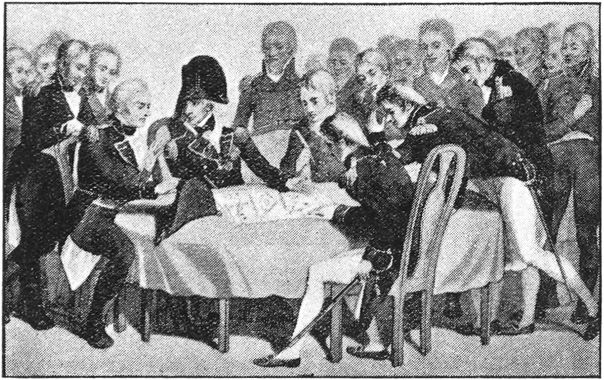
The Plan of Attack
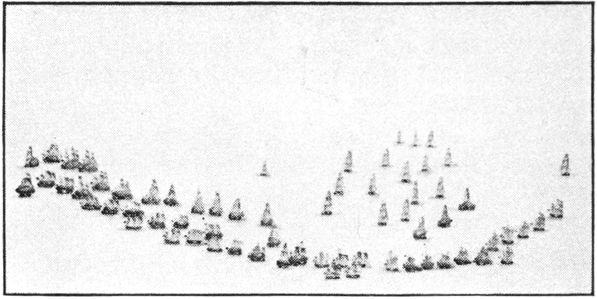
The Opening Stage
Never since day broke flowerlike forth of night
Broke such a dawn of battle. Death in sight
Made of the man whose life was like the sun
A man more godlike than the lord of light. . . .
The music of his name puts fear to scorn,
And thrills our twilight through the sense of morn.
As England was, how should not England be?
No tempest yet has left her banner torn.
The beauty of that glorious morning of the 21st of October 1805, which Swinburne saw with the poet’s eye, lived forty years after the battle in the memory of those who took part in it—‘the sea like a mill-pond but with an ominous swell rolling in from the Atlantic.’—So wrote Sir Hercules Robinson, at the time a midshipman on board the Euryalus. There was a light northwesterly breeze shifting gradually to the west. The British fleet was sailing to the northward, the enemy parallel to it, but in the opposite direction, eight or ten miles to the east. Cape Trafalgar lay beyond, ten miles further still.
Nelson had already prepared to attack; and it looked to Villeneuve as if his rear was about to be overwhelmed by the whole force of the enemy. He therefore changed direction to the north, making the rear the van. This had the additional advantage of bringing Cadiz under his lee. The manœuvre was slowly and clumsily executed between 8 and 10 o’clock. Its effect, with the light wind which prevailed, was to bring the ships into the form of a crescent, instead of a column as intended; several ships also, being unable to take their proper places, fell a little to leeward, which gave, here and there, the appearance of a double line.
All these things made it all the more easy for Nelson to carry into effect his long matured plan of attack—the most famous of all tactical plans, the only one which has ever received a poetical name. Its inventor called it the ‘Nelson touch’, taking the idea from a favourite motto, ‘Touch and Take’.
In land warfare there are such things as bloodless, or almost bloodless, victories. The whole object of a campaign may be gained by a battle in which the actual loss inflicted on the enemy is slight, or even without a battle at all. But the conditions of sea warfare are very different. Nelson realized that any victory short of an overwhelming one would produce little, if any, change in the strategic situation. The beaten fleet would retire to port, and the crippled victors would be occupied once more in blockading them, as they had been doing for the past two years and a half, and with nearly the same number of ships. ‘It is, as Mr. Pitt knows,’ he had written to a friend of both, ‘annihilation that the Country wants’.
Indecisive battles had been a frequent feature of naval history. It was easy, as Nelson said, to lose a day in manœuvring. Fleets had sometimes even been in sight of each other for two or three days without being able so completely to form as to risk an action. The losses inflicted on the enemy even in some of England’s most famous recent victories had not been heavy. In the Battle of the First of June, Howe took or sunk seven ships out of 26; at St. Vincent Jervis took four out of 27. Nelson’s victory at the Nile was, indeed, a contrast. He took or destroyed nine ships out of eleven, and would probably have taken the two remaining, had he not been put out of action himself by the wound to his head. On the morning of Trafalgar he repeatedly said that he expected to take twenty of the enemy; he would not be satisfied with less.
For this purpose he designed an attack in two divisions. Fifteen ships under the Second-in-Command were to cut through and overwhelm the enemy’s rear, cutting the line at the twelfth ship from the end. The business of the Commander-in-Chief, with the other division, was to see that his subordinate’s operations were as little interrupted as possible, and for this purpose to lead through the centre, and incidentally to endeavour to capture the opposite Commander-in-Chief. All this had been put in the form of a memorandum; the captains were called on board the flagship some days before the battle to receive their copies, and the whole scheme carefully explained to them, although it was, as Nelson rightly claimed, a simple one. As at the Nile, everyone knew his duty without the need of further signals, and nothing remained when the day came but to remind them that England expected them to do it. When he saw that famous signal go up, but of course before it was read, Collingwood is reported to have exclaimed that he wished Nelson would stop signalling, for they all knew what they had to do. He could have paid no higher tribute to his Chief’s leadership.
The Spanish historian Manuel Marliani wrote of the memorandum, with the generous fervour characteristic of his nation, that genius could go no further, human foresight had reached its limits, and the realm of things invaded which are commonly left to the arbitrament of chance. This was high praise; yet what must have been the effect of the document, when read and explained in the author’s own vivid language—greeted with an enthusiasm which affected him so deeply! Nelson did not excel with the pen, but there is no instance of an officer under his command not knowing what he had to do. The written words were not followed in every detail, yet Collingwood afterwards wrote that the battle had been fought according to the plan laid down. It follows that the memorandum has to be considered as modified and amplified by verbal instructions, the nature of which can only be roughly inferred from what actually took place.
The French Admiral’s last instructions showed the greatest acuteness. His experience of Nelson’s enveloping tactics at the Nile stood him in good stead. He told his captains that the enemy would do what, as the event proved, he actually did—he would aim at breaking the line and surrounding the rear. Then followed a passage, the close resemblance of which to a sentence in Nelson’s memorandum has frequently been noticed:
‘Dans ce cas c’est bien plus de son courage et de son amour de la gloire qu’un capitaine commandant doit prendre conseil que des signaux de l’amiral qui, peut-être lui-même engagé dans le combat et enveloppé dans la fumée, n’a plus la faculté d’en faire. C’est encore ici de répéter qu’un capitaine qui n’est pas dans la feu n’est pas à son poste.’ The words of the Memorandum of which this might almost be a free translation, are: ‘In case signals can neither be seen or perfectly understood no captain can do very wrong if he places his ship alongside that of an enemy.’ It is all the more unfortunate that, with such skill in penetrating the mind of his adversary, Villeneuve had no better defensive resource than to await the onset in a line well closed up. No one knew better than he did the unseaworthy qualities of his fleet, and the impossibility of maintaining a line that could not be broken, and, once it was broken, and Nelson’s enveloping tactics had begun to be put into effect, the improbability that the ships not yet engaged would come round in time to be of any use.
During the morning an impressive ceremony took place when Villeneuve went the round of his flagship, the Bucentaure. He passed between the decks, and the whole crew and the troops swore between his hands and upon the imperial eagle to fight to the last extremity. Nelson was making a similar round of the Victory about the same time, inspiring the men with his accustomed cheerfulness, and cautioning the gunners particularly against premature fire.
Early that morning, when the Combined Fleet was sighted, he had formed his two divisions, and shaped a course before the wind which led them toward the enemy. He was in confident mood. The 21st of October was a date regarded as fortunate in the annals of his family, being that of a gallant action of his uncle, Captain Maurice Suckling. Memory goes back to Cromwell’s lucky day, the 3rd of September—the date of the victories of Dunbar and Worcester—the day of his own death. It was while Villeneuve was executing his last manœuvre, that Nelson made what proved—as he felt at the time it would—to be the last entry in his Private Diary:
May the Great God whom I worship grant to my Country, and for the benefit of Europe in general, a great and glorious victory; and may no misconduct in anyone tarnish it; and may humanity after Victory be the predominant feature in the British fleet. For myself, individually, I commit my life to Him who made me, and may his blessings light upon my endeavours for serving my Country faithfully. To Him I resign myself and the just cause which is entrusted me to defend. Amen. Amen. Amen.
He looked forward, with God’s help, to a decisive victory which should bring peace.
It was now nearing noon, and the British ships, led by the great three-deckers, were bounding forward on the long Atlantic swell, then pausing in the trough of the sea, like greyhounds uncertain of their prey, yet growing ever steadily nearer to their doomed quarry. Nelson had had his frigate captains about him that morning, and was giving them his last injunctions. Their duties were to transmit signals, supply boats to communicate between ships which might have none available, to tow disabled vessels, and generally to do all that could be done to assist without engaging in the action themselves. Blackwood of the Euryalus had the privilege, as the Victory’s signal might often not be seen, of signalling in the Admiral’s own name to any ship in the rear to take up any position which might appear suitable. But when all this had been arranged, it seemed to Nelson’s restless mind that one last thing was needed—some personal message of confidence in the loyalty of the fleet—some such general signal as: ‘Nelson confides that every man will do his duty’. But there was little time. Every letter in the first two words, as in the last, would require a separate group of flags, and there would have been scarcely time to hoist, still less to read, the message, before the smoke of battle should leave all obscure. Two words were suggested which required only a single group each, and thus the exigencies of the signal-book added a slogan to the English language—‘England expects that every man will do his duty’. The men responded by their cheers and by their deeds that day. In some parts of the fleet there was a grimmer determination still. The seamen of the Bellerophon chalked on their guns ‘Victory or Death’.
At nine o’clock Collingwood made a signal which should have had the effect of bringing his own ships into a line, nearly parallel to the protruding southern horn of the enemy’s crescent. But this could only be done effectively if the leader shortened sail, which he refused to do. Collingwood’s flagship, the Royal Sovereign, sailed on ahead of the other fourteen ships—like the rest with all sail set, though even then making scarcely more than two nautical miles an hour. Speed—such speed as he was able to attain—gave him an advantage over the enemy ships, moving forward at no more than half a mile an hour—and some hove-to—which he was not willing to forgo. ‘See how that noble fellow Collingwood carries his ship into action’, said Nelson watching him; and almost at the same time Collingwood was saying to his Flag-Captain: ‘Rotherham, what would Nelson give to be here?’
He selected a worthy antagonist in the three-decker Santa Ana, bearing the flag of Vice-Admiral Alava. She was the twelfth ship from the rear, not taking account of three which had fallen to leeward, and there was a considerable gap in front of her. Receiving the fire of several ships as he came down, he rounded to under her stern, sweeping her through her whole length as he went by, and then ranged up alongside so close that the guns were almost muzzle to muzzle. The Spaniard’s business had seemed like completion with that first raking broadside, but she carried Alava’s flag, and, though he and the Captain were wounded, the combat continued—all the more furiously, as the Santa Ana was helped by four other ships, particularly the Fougueux, which raked the Royal Sovereign from astern. For a quarter of an hour the British flagship was in the greatest danger. Then Captain Hargood brought up the Belleisle, followed by the Mars and Tonnant, and the Fougueux found herself surrounded in her turn. But the British ships were in equally evil case. Indeed almost every ship on either side in this part of the line felt surrounded by adversaries. Nelson had succeeded in doing what he had once told Keats he would—in bringing on a pell-mell battle—the very words used by Villeneuve afterwards in his report. In such a battle the superior quickness of eye of the officers, and smartness of the gunners, told in favour of the British, in addition to the tactical advantage of being able, when coming down before the wind with plenty of way on, to select the most effective position against the almost motionless ships of the enemy. As soon as a British ship was in difficulties a fresh ship arrived to draw off part at least of the enemy’s fire.
About a quarter of an hour after the Royal Sovereign had broken the line, the Belleisle had succeeded in doing the same astern of the Fougueux, discharging simultaneous broadsides at her and the Santa Ana. But when the Mars followed, Captain Cosmao of the Pluton manœuvred his ship so well that she was only able to range alongside her. For a quarter of an hour she lay exposed to the fire of several other French or Spanish ships before she was relieved by the Tonnant. After she had been engaged about an hour and a half all her braces and rigging were shot away and she became entirely ungovernable, drifting down to leeward as soon as she could get clear of the Pluton. Her poop and quarter-deck had been almost cleared of men. Among the killed was Duff, her Captain; there was one there to bewail that fine officer more than all the rest—his thirteen-year-old son, who had just joined the ship as a midshipman.
Meanwhile the Tonnant, which had equally failed to break the line, was closely engaged with the Algésiras, bearing the flag of Rear-Admiral Magon, than whom no leader fought with greater courage and determination that day. He was everywhere encouraging the men. He was twice wounded; but he would not leave the deck. At last a shot in the chest ended his life. The men of the Algésiras, like those of several of the French ships, were determined to board, making use of the advantage of the troops they carried. But the Tonnant’s marines kept them back; only one man succeeded in entering by one of the main-deck ports, and he was made prisoner. The Algésiras lost a mast fairly early in the engagement; after two hours the remaining two fell, masking her fire against the ships which were engaging her from the leeward side, and she surrendered about the same time—a quarter-past two—as the Santa Ana struck to the Royal Sovereign.
Although the four leading ships were very severely damaged, the flagship in particular being reduced to little better than a hulk, the losses in men fell most heavily on the two which followed them, that famous fighter the Bellerophon, and the Colossus. The former of these, after cutting through the line behind the Monarca, became closely engaged with the Aigle, her fore-yard locking with the French ship’s main-yard. She was believed to be the best manned ship in the Combined Fleet, full of picked grenadiers, who devastated the British decks with musketry and hand-grenades. The Bellerophon’s upper deck was almost cleared of men, her Captain, Cooke, was killed, and the Aigle made two attempts to board, which were beaten off. Meanwhile down below there was hand-to-hand fighting at the ports, the gunners seizing one another’s ramrods. But this had not continued more than an hour when the Aigle fell clear, and both ships sought other antagonists. The Bellerophon succeeded eventually in taking the Monarca. The Aigle did not escape. She found fresh enemies. One was the Defiance, one of whose master’s mates, Spratt, performed perhaps the most remarkable exploit of that day. Cutlass in mouth, he swam to the Aigle, boarded her through one of the ports, and then tried single-handed to haul down her flag. Though he failed in this, he escaped with his life. The Aigle did not haul down her colours till late in the day, after nearly four hours’ fighting.
No ship on the British side that day lost more heavily than the Colossus, which had 200 men killed and wounded. Engaged in deadly struggle with several ships at once, especially the Swiftsure, a ship which Ganteaume had captured from the English in 1801, her Captain, Morris, at last saw the Orion bear down from Nelson’s division, and pour a broadside into her from the other side. “Thank you Codrington, thank you, Codrington!” hailed the little man, for, as Robinson, who relates the incident, points out, though his ship was a Colossus, he was not. His gallantry was eventually rewarded with two ships, the Swiftsure and the Spanish Bahama.
While the six leading ships of Collingwood’s division were settling the destinies of seven ships of the Combined Fleet—two flagships, the Santa Ana and Algésiras, and the Monarca, Aigle, Swiftsure, and Bahama, besides the Argonauta, captured by the Belleisle—the plan of envelopment was proving completely successful at the extreme rear of the line. Here five ships, the San Ildefonso, Principe de Asturias, Achille, Berwick, and San Juan Nepomuceno, with very little help from any other ship, were pitted against nine of Collingwood’s. Three struck, the Achille was reserved for the dramatic catastrophe which closed the day, and the fifth, the Principe, which carried Gravina’s flag, was towed out of action, not before she had suffered heavy losses, including the Admiral himself, who afterwards died of the wound which he received.
While Collingwood was capturing ten of the fifteen rearmost ships of the enemy, Nelson was equally successful in his task. As he approached the enemy, he turned slightly to the northward, threatening the van, and then southward again till he reached the line, which he entered astern of Villeneuve’s flagship, the Bucentaure. She was the tenth ship from the van, not taking account of two which had fallen out of the line to leeward. The Victory was seconded in this feint by an accidental circumstance. The Africa, commanded by Captain Digby, had formed part of the advanced squadron. In joining Nelson’s division from the northward, she passed down the line, exchanging broadsides with the van ships until she reached the centre. The manœuvres of the Victory and Africa had the joint effect of mystifying the enemy, and by this means delaying any attempt of the foremost ships to come round and help the others, and also of giving time for a small deployment. The next two three-deckers, the Téméraire and Neptune, were able to range up more nearly alongside of their leader than the Royal Sovereign’s followers had been able to do. They were closely followed by the Conqueror and Leviathan, while a fourth three-decker, the Britannia, flying the flag of Rear-Admiral the Earl of Northesk, was not far behind.
But Nelson omitted one precaution taken by Collingwood. As she neared the enemy’s line, the Royal Sovereign had been allowed to fire a few shots, rather with the object of throwing up a screen of smoke than of doing damage. The Victory did not fire a shot until she had been under the concentrated fire of several ships for some minutes. A number of spars and sails were shot away, and one double-headed shot killed eight marines on the quarter-deck, where Nelson and his Flag-Captain, Hardy, were walking. A moment or two later, the latter was very slightly wounded by a splinter. Both stopped; then Nelson smiled and said: ‘This is too warm work, Hardy, to last long.’
Saved further damage still by the rolling motion which the heavy swell communicated to the enemy ships, rendering their firing inaccurate, and the British ships no easy mark, the Victory passed the Bucentaure, discharging her great 68-pounder carronade from her bow straight into Villeneuve’s cabin window, and giving her a tremendous broadside as well; then crashed into the Redoutable with such force that both ships were driven down to leeward. Then ensued one of the fiercest struggles of that day. Perhaps no ship at Trafalgar was fought with greater valour and determination than the Redoutable was by Captain Lucas.
Nothing had been omitted by that intrepid leader in preparing his men for the ordeal which was before them. By training them in grenade throwing, sword and pistol exercise, and throwing the grappling-iron, he had thoroughly accustomed them to the idea of boarding. When he had announced his intention to close up so near the Bucentaure that the enemy ship would have no alternative but to run alongside the Redoutable, they burst into repeated cries of “Vive l’Empereur! Vive l’Amiral! Vive le Commandant!” Many of them had eagerly reminded him of his promise that they should board, when he was making his last round of the batteries before action.
It was essential that this trial should now be made, if the Redoutable was to escape destruction, for she was only a two-decker;—there were no French three-deckers in the Fleet. It was twenty minutes after twelve when the Victory fell foul of her. Then Lucas commenced a deadly fire of musketry from the tops and the decks and through the port-holes, which was only prevented from being thoroughly effective because such of the guns as were still firing shrouded the ships in smoke. At half-past one Nelson and Hardy were still pacing the quarter-deck when suddenly the former was seen to fall. ‘They have done for me at last, Hardy,’ he said. ‘I hope not.’ ‘Yes, my backbone is shot through.’ He was instantly carried below.
Nelson was, indeed, mortally wounded. He had been begged that day to send below or cover up his coat with the four shining orders upon it; he had evaded the suggestion, saying there was no time. This may have made him a better mark and caused him to be hit, yet many humbler men fell in the same place. Britain was now threatened with a greater calamity even than the death of her Admiral—the capture of the 100-gun Victory by the 74-gun Redoutable. In the confusion which followed Nelson’s fall the after-deck was seen to be nearly cleared of combatants. Lucas’s sharpshooters and grenadiers had done their work, and grenades had been rained on the deck, which was covered with the dead. The moment had now come for the great adventure—to carry by boarding the famous ship which bore the greatest sailor in the world. The men rushed up from where they were keeping down the British fire at the port-holes below, and the ship’s sides and the lower rigging were filled with soldiers and sailors. But all was not yet quite ready. The ships were securely grappled together, but their motion, and the greater height of the Victory’s deck, made it impossible to pass easily from one to the other. Lucas was equal to the emergency. He ordered the main-yard to be cut down to serve as a bridge, while at the same time five men got on board over the Victory’s anchor. But at this very nick of time Captain Harvey brought up the Téméraire, and poured in a raking fire on the deck of the Redoutable, which fell obliquely on board of her. The carnage was terrible. Lucas himself was wounded, more than two hundred of his men were put out of action, and the struggle was soon over as far as the Redoutable was concerned. One first hail to cease a useless resistance was replied to by a volley, but courage had become obstinacy, and such an attitude could not be maintained for long. The masts of each ship fell on the decks of the other; that of the Redoutable was piled with spars, sails, fragments of the upper works of the ship, and dead bodies; of her complement of 643 men, only 121 were left, out of the remainder 300 had been killed. The ship too had once caught fire, everything on board her was riddled with shot, and she was in danger of sinking. Lucas submitted to the inevitable and ordered his flag to be struck. He had scarcely done so when it came down itself with the fall of the foremast.
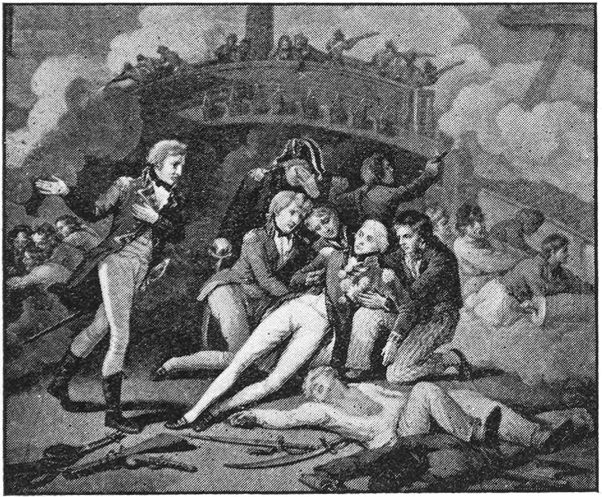
It was now past two o’clock, but the ‘Fighting Téméraire’ was still to have another victim. After her good service against Collingwood’s ships, the Fougueux had found herself among the ships of the centre of the line, and the three locked ships, Victory, Redoutable and Téméraire, now fell alongside of her. Battered as she was, she still resisted, and it was not till she had lost three-quarters of her men, including Baudouin her Captain, mortally wounded, that she was carried by boarding.
Meanwhile the falling away to leeward of the Victory and Redoutable in their deadly struggle had in a manner left the Bucentaure isolated; she was cannonaded by several ships in turn as they came up, and it was not yet two when she was obliged to strike her colours. Baulked of the death which he had sought, Villeneuve had tried to transfer himself on board another ship but there was not a boat of his flagship that would float. He hailed the nearest friendly ship, the Santísima Trinidad, but she could not help him. He was obliged to surrender with his staff.
The Santísima Trinidad was a 130-gun ship, the only four-decker existing, and the most powerful ship in the world. She was the next to be dealt with. Closely followed by the Conqueror and Leviathan—so closely that the former’s jib-boom was nearly touching her taffrail—the Neptune was brought down by her Captain, Fremantle, round the stern of the great Spaniard, and placed in a position from which she could pour in a deadly fire, while her opponent could not return a single shot with effect. ‘If’, writes Robinson, ‘I were to select the most seamanlike act I witnessed, I should name the Neptune rounding to on the quarters of the Santísima Trinidada and keeping the ship in command till she brought down her huge opponent’s three masts altogether.’ But the Spaniard had maintained a fight with six British ships, sometimes several of them at once, before her masts fell and she was in no condition to continue. She was in fact in an almost sinking state, and had lost severely in killed and wounded, Rear-Admiral Cisneros, whose flag she carried, being among the latter. But her surrender was postponed by a diversion caused by the van ships.
That part of the line was commanded by Rear-Admiral Dumanoir-le-Pelley. He ought long before to have turned back to the help of the centre, but Villeneuve looked to him to do so in vain. As soon as the Victory had fired that broadside into the Bucentaure, he had made the general signal calling all ships into action which were without an enemy to fight. Had the van been commanded by Gravina, such a signal would not have been necessary, as his conduct on the 22nd of July proved. But Dumanoir showed a deplorable want of despatch. Rapidity was essential—all the more so as the wind had dropped so much that it was necessary to tow some of the ships’ bows round by boats. It was not until after two o’clock that this tedious manœuvre was completed.
Four out of Dumanoir’s ten ships fell away to leeward. But the other six headed in the direction of Nelson’s division. The threat was the very one against which he had made provision. A signal was hoisted by Hardy on the part of the Commander-in-Chief, calling upon the rear ships of his division to close up and protect the engaged ships in the centre. The Victory and the Royal Sovereign, now being towed by the Euryalus, were, notwithstanding their dilapidated state, among those ships which opened their fire upon Dumanoir’s squadron. So determined was their attitude, that the French Rear-Admiral changed his purpose, and, after receiving some injury, sailed away to the southwest. Only three ships followed his flagship, the Formidable. The other two, Infernet’s ship, the Intrépide, and that of Valdés, the Neptuno, disdained to do so. They sailed into the British line and were captured, after a brave resistance. Including the Trinidad and one more ship, the San Augustin, taken by the Leviathan, Nelson’s division accounted for seven out of the seventeen ships captured that day. Its own losses were scarcely more than trifling, except in the Victory and Téméraire, which each had over a hundred casualties. The Victory lost more in killed than any other ship in the whole Fleet—57. The enemy had proved better fighters probably than Nelson had expected. Some French ships in particular, the Algésiras, the Redoutable, the Aigle, the Fougueux, and one that escaped, the Pluton, had covered themselves with glory. Even the Spanish must have exceeded his expectations. It was the opinion of the Lower Deck at all events, if the views of Jack Nasty-Face may be taken as a guide, that the Dons fought as well as the French. Their ships did not usually surrender until they had lost their captains, and suffered terribly in every way.
Yet it is hardly possible to doubt that, had Nelson continued to direct the battle, he would have made up his minimum of twenty captures. It would be presumptuous to suggest precisely what he would have done. But the victory would have been more complete, just as that of the Nile would have been, if he had not been wounded. As he lay in the fœtid, dimly lighted cockpit of the Victory, surrounded by fellow-sufferers, he had consolation. As each enemy ship struck, the sailors cheered, and the dying man asked and was told what those cheers meant. Before long Hardy was able to come below and congratulate him on what he styled a complete victory, fourteen or fifteen ships having surrendered. ‘That is well,’ said Nelson—and then the old uncompromising spirit flashed up in him—‘but I bargained for twenty’. After some more intimate talk with Hardy, who had his confidence in everything, a tender fancy overcame him, as his thoughts travelled to a woman and a child who were dearest of all. ‘Kiss me, Hardy,’ he said, and the grizzled seaman knelt down and pressed his lips against the Admiral’s cheek. Then he returned to his duties. Scott prayed with Nelson and caught his last words: ‘I have not been a great sinner, Doctor,’ ‘Thank God, I have done my duty,’ more than once repeated, and, in the end, ‘God and my country.’ As the ship’s Master’s log records: ‘Partial firing continued until 4.30, when a victory having been reported to the Right Honourable Lord Viscount Nelson, K.B. and Commander-in-Chief, he then died of his wound.’
The signal of recall had, in fact, been hoisted aboard the Principe de Asturias, and five French and five Spanish ships followed her to Cadiz. One last ship of the thirty-three remained to be accounted for. As the sun descended on a sight majestic in its desolation—the two squadrons of beaten vessels fleeing in opposite directions from the scene of their disaster, where the two great flagships, now reduced to little more than shells of ships, lay each surrounded by her group of followers and prizes—a terrible report rang out, as though no less awful parting salute could serve for the fiery spirit which had just departed. The French Achille had blown up; and the last work of the sailors was to save the struggling survivors, and display that humanity after Victory which Nelson had prayed might be the predominant feature of the British Fleet.
These are thy toys, and, as the snowy flake,
They melt into thy yeast of waves, which mar
Alike the Armada’s pride or spoils of Trafalgar.
It fell in happily with the sardonic mood of Byron to be able to think thus of Nature’s reasserting her power the moment that Britannia’s title of mistress of the seas appeared confirmed for good and all, and giving her a terrible lesson of its vanity. The storm rose, which had threatened from the morning of the fight, and soon developed into what Codrington called the worst hurricane he had ever seen. Nelson had endeavoured to provide against it. He had made the signal, ‘Prepare to anchor,’ before the battle, and in his dying moments repeated many times his injunction to Hardy to take upon himself to anchor the fleet on the Trafalgar shoal. But Collingwood would have none of it. It is reported that when he heard of this last wish of his Chief, he somewhat testily replied that it was the last thing he would do. Perhaps he meant the last thing in the day. For he actually made the signal to anchor; but it was four hours too late, the storm had already reached its height, and the ships in consequence had been driving for several hours on to a lee shore. ‘Few of the ships,’ he wrote, ‘had an anchor to let go, their cables being shot.’ If this were all, it would not have taken long to reeve fresh cables. The opinions of officers such as Codrington and Senhouse, who were present in the battle and afterwards rose to flag rank, were emphatic on the calamitous effects of Collingwood’s delay in giving the order.
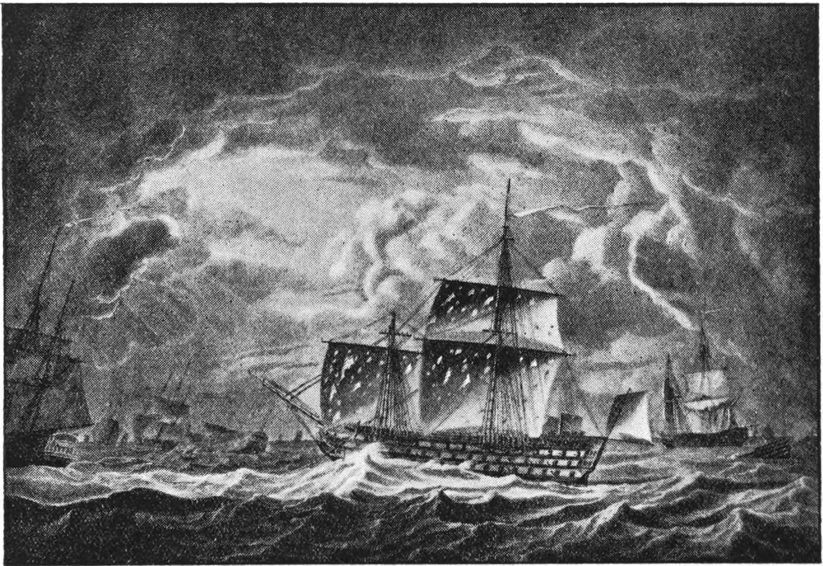
AFTER TRAFALGAR: H.M.S. VICTORY IN THE CENTRE
(From the engraving by Robert Dodd.)
Some ships sailed or were towed to Gibraltar. But the majority, captors and captured, still stood off Cadiz in the tempest which finished the work cannon shot had spared. Collingwood took pride in showing Spain and the world that no storm could make England relax her hold on the enemy’s port, or interrupt the blockade for a moment. Yet a frigate or two would have been enough to watch this port after the battle as well as before—not a parade of damaged ships of the line. Collingwood carried out his plan at a tremendous cost. Spain and the world would have been more impressed, had the prizes been anchored in safety or towed into harbour, and subsequently formed a part of the British Navy.
Sailors were apt to reckon up their advantages in battle over soldiers. If wounded, they were not left lying a day and a night on the field, perhaps without even water, and then carried in country carts over no roads at all to the field hospital several miles in the rear. Their hospital, such as it was, was within a few feet of them, and amputation was only a matter of each man waiting for his turn, after which they had their hammocks to lie in and be still. But there was little comfort for the victors of Trafalgar. Heroism such as was displayed by that seaman of the Leviathan who sang through the whole of ‘Rule Britannia’ while having his arm amputated, was surely needed. It is hardly possible to exaggerate the sufferings which the wounded must have endured. Sixteen lay in the Tonnant with their limbs just amputated. But that terrible ordeal did not save them; the motion of the ship in the gale caused their wounds to break out afresh, and out of the whole number only two survived. In the prizes, where hundreds of wounded and unwounded prisoners were crowded under hatches, the position became impossible. The prize crew of the Monarca, for example, consisted of a lieutenant, a midshipman, and eight men. The unfortunate crew, maddened by their hardships, grew desperate, and at length all discipline was destroyed, and they had resource to the sailor’s only comfort. On the fourth day the officers found themselves with a crew every man of whom was lying drunk on the deck. The ship was carried on to the rocks and wrecked. In three other captured ships, including two of the flagships which had fought so gallantly and had been taken with such loss, the Bucentaure and the Algésiras, the difficulties of the prize crews met with a different result. They had to call up the prisoners from below to help to work them, and these then took possession of the ships, which were thus recaptured. But of the three, only the Algésiras reached Cadiz; the Bucentaure and the Aigle were wrecked. Two days after the battle, during a temporary lull in the storm, the gallant Cosmao, undeterred by the condition of his ship, set out on the hazardous adventure of recovering some of the prizes, which were still being towed not far from the harbour’s mouth. The Pluton sailed out of port, followed by two French and two Spanish ships. The British were obliged to cast off two of the prizes, the great Santa Ana, with Alava on board, and the Neptuno, which were recaptured. The latter was, however, wrecked, as were the two Spanish ships which had followed Cosmao, so that he lost more than he gained by his exploit. One of these, indeed, the three-decker Rayo, was, before it was wrecked, captured by a fresh ship of Louis’s squadron, the Donegal, commanded by Pulteney Malcolm, brother of the great Indian soldier; and this made the eighteenth Trafalgar ship taken.
But Cosmao’s success, such as it was, seconded by a renewal of the storm, completed the ruin of the prizes. On the 24th Collingwood decided to sink or burn the four prizes that remained off Cadiz—among them the magnificent Santísima Trinidad. The Redoutable—which indeed Lucas had determined only to surrender when he was convinced that she was in such a state that she could never reach port—had sunk when in tow on the day after the battle. The Fougueux was wrecked. Of the five ships whose prize crews had succeeded in anchoring them, one, the Berwick, was wrecked owing to the frantic conduct of a portion of the prisoners, who cut the cables; the other four reached Gibraltar in safety, but only one, the San Juan Nepomuceno, was fit to incorporate in the British Fleet. The fate of all these ships is at least some proof that the French and Spanish did not haul down their flags before they had experienced a very bitter taste of the devastating effects of British gunnery.
The losses of the Allies did not end here. Fearing to enter the Straits, Dumanoir took his four ships, which had escaped from the battle severely mauled, to the northward. On the 4th of November, off Cape Ortegal, they fell in with Captain Sir Richard Strachan, who had an equal number of ships of the line and three frigates, which took part in the fight. All four French ships were taken, after a severe engagement; the Duguay-Trouin was the last. She was also the last of all the ships which fought on either side at Trafalgar to remain afloat. Renamed the Implacable, she was, till 1905, the boys’ training ship in the Hamoaze at Devonport.
Thus, out of the 33 ships of the Combined Fleet, the Allies lost to the British, besides one burnt in the battle, 22. One of the ships which escaped capture was wrecked, but was replaced by the Algésiras and the Santa Ana. Eleven now in Cadiz. Rosily, who arrived to take up his command on the 25th, was unable to do anything with his reduced force. Spain was still to be at war with England for another two years and a half. But from the day of Trafalgar dates a growth of friendly relations between the two countries, which continued until the time came for Briton and Spaniard to stand side by side against the tyranny of Napoleon. The Spanish seem to have regarded the battle without bitterness; they thought of it as a glorious defeat, in which both they and the French had fought gallantly under an incompetent Admiral. Immediately after it they displayed all the generosity of the national character towards the seamen shipwrecked out of the British prizes—a display of feeling which was warmly reciprocated by Collingwood; and courtesies, and more than courtesies—casks of porter and wine—were exchanged between him and the Captain-General of Andalusia. Finally in 1808 came the Dos Mayo—the rising against Joseph Bonaparte, the intrusive King of Spain—and on the 14th of June Rosily, after an action in the harbour with his five French ships, was forced to surrender to the insurgent Spaniards.
Never in the habit of free intercourse with his captains, Collingwood was in any case in no position immediately after Trafalgar to render a full account of the battle. His letter to the Admiralty of the 22nd of October, 1805, written in the English of which he was a master to a degree much above the average naval officer of his time, contains a beautiful tribute to the memory of his departed Chief. But the account of the battle teems with inaccuracy, and there is an even greater lack of reliable information as to the losses caused by the storm and by Cosmao’s venture. It is necessary to be content to know the casualties of Trafalgar itself—1690, of which 1488 took place in 15 out of the 27 ships. The killed were 449. In the case of the French and Spanish on the other hand, the casualties for the battle by itself are wanting. The imperfect estimate made for both it and the subsequent shipwrecks, gives 3369 killed or drowned, and 1159 wounded, in the 18 French ships, and 1036 killed or drowned, and 1385 wounded, in the 15 Spanish. No account was taken of the prisoners. But the numerous reports of French and Spanish officers, dated at various times and from various places—on board the Euryalus, as Villeneuve’s was, Cadiz, Algésiras, Brest, Plymouth, Reading, and so forth—first published in full in Colonel Desbrière’s official history of the campaign—are of the highest value, and have placed the tactical superiority of the British for the first time in its true light. Many of them, while prisoners, had the opportunity of discussing the battle with British officers before writing their reports. One of these was Major-General Contamine, who commanded the troops, and was carried by the Bucentaure. He tells a story of Nelson having been solicited by several of his officers to give a more regular formation to his two columns, which were bearing up in disorder towards the line of the Combined Fleet; but, as Contamine adds, he was too great a genius to waste time in delaying to take advantage of a favourable opportunity of attack. It is unlikely that any such formal representation was made as suggested, and the story is probably founded on some casual remarks which may have passed on board the Victory in the morning of the 21st between the Commander-in-Chief and Blackwood or, possibly, Collingwood. But the story at least helps to dispose of the old view, that the two divisions went into action in two perfectly formed columns, each ship astern of the one ahead of her.
When he returned to France nearly four years after the battle, Dumanoir was brought before a French Court of Inquiry for his conduct at Trafalgar. He succeeded in satisfying the Court that he had manœuvred in conformity with his Chief’s signals, and the dictates of duty and honour, brought his ships up as near as he could to the Admiral’s help, and only left the scene of action when obliged to do so. It is difficult for such Courts to take a severe view of actions which have already faded into the past, as was also shown by the British case of Major-General Sir John Murray, tried by court martial and acquitted in 1815 of all but an error of judgement, for his disgraceful abandonment of his guns before Tarragona in 1813. Dumanoir was fortunate. There can be no doubt that his failure to act promptly on his own initiative was one cause of the completeness of his country’s defeat.
The gale gave Napoleon an opportunity of which he was not backward to take advantage. He long maintained himself, and compelled from others, a significant silence on the event of Trafalgar. At last, in a speech in the following March, he announced that storms had caused the loss of some ships after a battle imprudently delivered. At the time when he heard the news he was with the army in Moravia in the full tide of territorial conquest, between Ulm and Austerlitz. Whether he realized the importance of the event or not, it is of some significance that, almost at the very moment that the battle was being fought, he was showing himself far from indifferent to the importance of sea power. He was at Ulm; he had received the surrender of General Mack; and thirty thousand Austrians laid down their arms before him. As they did so, he professed to take some of their officers into his confidence. He wanted nothing, he said, on the Continent; it was ships, colonies, and commerce that he wanted, and he hinted that in this aim he was championing the cause of the Continent against the British sea autocracy. The speech was no doubt one of the many examples of the claim, which he was so fond of making, to an essentially pacific character, and which scarcely could have been seriously intended to delude those to whom it was from time to time addressed; however it may have been accepted by others, both during his lifetime and since, whose passionate hatred of the old order which ultimately prevailed against Napoleon made them willing to believe anything in his favour. Yet at the same time it contained a deep underlying truth. Napoleon’s war was above all with England. He could not bear to see her rich—not from her own resources, but from a predominant share in the trade of those tropical luxuries which were rapidly becoming necessities to Europe—sugar, coffee, tea, and even tobacco and spices. In reality British mercantile predominance was due to nothing but superior enterprise, working under conditions of free competition. In time of peace trade was equally free to all ships; even in time of war England long permitted it be carried even to enemy ports in neutral bottoms. But Napoleon refused to see this, and, like others, chose to regard her commercial ascendancy as the direct consequence of naval dominion.
Implicit in the Ulm speech was the necessary consequence if that naval dominion continued unbroken. The war must be carried on by other means. England must be shut out from the Continent altogether. But the policy was not yet revealed. At the moment when Napoleon was speaking France had, or thought she had, a Fleet. And the French Navy throughout the eighteenth century—except for the years that immediately followed Quiberon Bay in the ‘wonderful year’ of 1759—was always a force to be respected. It is well, when looking at Trafalgar Square, to regard it as the memorial, of a great victory, not as a mere symbol of a supposed rule of the seas, which has always been and remained inviolate from the days of the Spanish Armada and before. Britain had not always been all-powerful overseas. One or other of her West Indian Islands had often passed into the hands of the French; Madras had been in their hands for years; Gibraltar, unprotected by a British fleet, had stood at bay before the Spanish floating batteries, and won credit for being able to resist; and a fleet of sixty French and Spanish ships had bearded England in her own Channel. Even the naval fights of the eighteenth century, of which Great Britain is so proud, were no overwhelming victories, with a few exceptions. Coming at its very close, Camperdown is one, and the Nile is another, and these were not grand fleet engagements. The total number of ships of the line on both sides in those two battles were not altogether equal to the sixty which fought at Trafalgar. That a fleet engagement might be hailed as a great victory though it left the enemy only maimed, not mauled beyond the possibility of further mischief, was recognized by the high honours accorded for the First of June and St. Vincent. Then came Trafalgar. A vast concentration, which had occupied many months, had ended in the realization of Nelson’s aim—annihilation, which he had trusted would lead to an honourable peace. In the following year, while affairs were still in the same condition as regards the sea, in which they had been left by his victory, a great British statesman thought that he had secured such a peace. Napoleon sent a message to the effect that France was willing to restore Hanover, which she had overrun, and made no claim to Malta or Sicily. It was all that England wanted, and the Foreign Minister, Charles Fox, was ready to make peace on such terms. But when he set regular negotiations on foot, Napoleon receded from the terms offered, and the war continued.
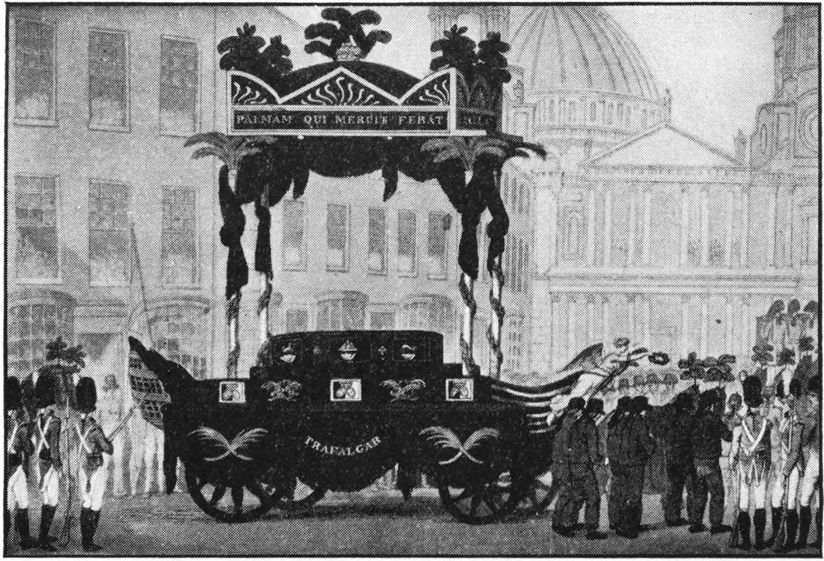
FUNERAL OF LORD NELSON
(From a contemporary print.)
So Trafalgar did not bring the peace of which there had been a gleam of hope. But it altered the whole character of the war. Already baulked of hope of invasion, Napoleon was now compelled to recognize that his Fleet could never expect to dispute the command of the seas; barely a squadron now and then might venture out for a chequered voyage of evasion and pillage. He still built ships,—and in considerable numbers. He was preparing twenty in Antwerp and the Scheldt, his two-barrelled pistol pointed at the heart of England, in 1809; and the threat appeared so formidable that it led the Government of the day to embark upon the ill-fated Walcheren expedition. But his ships of the line mostly continued to lie in port, to provide occupation for the British in blockading them. They were impotent for any considered scheme of active warfare.
Yet the sentence had passed that England was to be destroyed; so the alternative to such warfare had to be adopted. Trafalgar led Napoleon straight forward to the attempted destruction of her through her trade, and of that trade through the Continental System, a goal which could only be attained by means of uncounted schemes of usurpation and aggression, raising up a host of enemies among those who had no quarrel with France and no quarrel with England; a road which led to Baylen and Vitoria, which led the Emperor to Moscow—and back—and then Leipzig, and Fontainebleau, and St. Helena.
FINIS
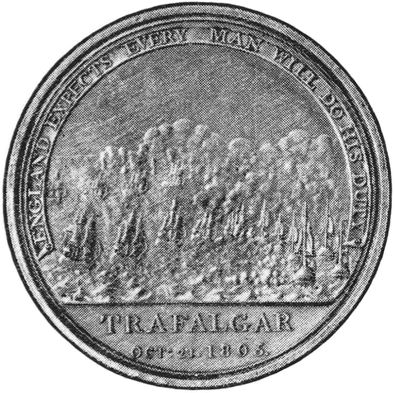
Præter laudem nullius avari.
—Horace
The principal authorities consulted for most of the chapters of this book have been: in the first place, Colonel Edouard Desbrière’s valuable works, Projets et Tentatives de Débarquement aux Iles Britanniques, and Campagne Maritime de Trafalgar, 1805; Capt. A. T. Mahan’s The Influence of Sea Power upon the French Revolution and Empire, of which Chapter II has been of great value for the account of the enemy navies; Nicholas J. Nicolas’ edition of Nelson’s Despatches and Letters; Adm. Jurien de la Gravière’s Guerres Maritimes; William James’ Naval History, which remains unrivalled for the details of naval actions; W. Laird Clowes’ The Royal Navy; Hansard; and The Campaign of Trafalgar by Sir Julian Corbett, the fruits of whose acute researches have been utilized without accepting his tactical and strategical conclusions. Two recent books, on the other hand, have done full justice to Napoleon—the Trafalgar of Capt. A. Thomazi, and the Nelson of the great German authority on the Emperor, Herr Kircheisen. The latter, however, only professes to be an introduction of the subject of Nelson to German readers; but it has been translated into English (without correcting some obvious errors).
Among English original authorities—after Nicolas’ book—the publications of the Navy Records Society hold the first place, namely The Blockade of Brest, Barham Letters and Papers III, Great Sea Fights II, and the Naval Miscellany I. Another is Nelson’s Private Diary of 1805 in the British Museum, of which some slight use was made by his original biographers, Clarke and McArthur, who have been copied by subsequent biographers; some of it has been translated by Col. Desbrière; it is otherwise unpublished, except the part from Sept. 13 to Oct. 21, 1805, published in 1917 with introduction and notes by Gilbert Hudson. The Diary is often illegible, but it has been thought best in transcribing to avoid irritating notes of interrogation, and also to substitute spaces for conjectural stops. Other mainly original authorities are the numerous biographies of Nelson, particularly Clarke and McArthur’s, Southey’s, Pettigrew’s, Mahan’s and Adm. Mark Kerr’s, with the late Professor Laughton’s Nelson Memorial, and the late Lord Fisher’s stimulating sketch, for the perusal of which the author is indebted to Mr. David Bonner Smith, the Admiralty Librarian; and the memoirs or biographies of St. Vincent, Cornwallis, Collingwood, Hardy, Hargood, Tyler, Dundonald and Parker; also Rev. A. J. Scott; Mr. A. M. Broadley’s Three Dorset Captains at Trafalgar (Hardy, Bullen, and Digby); besides papers of Sir T. F. Fremantle made available at the Old House Swanbourne by the kindness of Lord Cottesloe. The documents in the Paris Archives to which allusion has been made, are in AF Cart 1597, Plaq 1 and 2 (Armée d’Angleterre).
The chapter on the Fleet is based on Sea Life in Nelson’s Time, by John Masefield, and Commander C. N. Robinson’s The British Fleet, and The British Tar, and, as original authorities, Jack Mitford’s Johnny Newcome in the Navy, 1819, Jack Nasty-Face’s Nautical Economy, (1831,) Sir R. Steel’s, The Marine Officer, 1840, Samuel Leech’s Thirty Years from Home, 1843, Earl of Dundonald’s Observations on Naval Affairs, 1847, Capt. A. Sinclair’s Reminiscences 1859, Sir H. D. Rolleston’s article on J. Lind in the ‘Journal of the R.N. Medical Service’ for 1915, The Life of a Sea Officer (Baron de Raigersfield) with introduction by J. G. Carr Laughton, 1929, and the novels, etc., of Capts. F. Marryat, F. Chamier and W. N. Glascock, and of Michael Scott and M. H. Barker; also on Professor Geoffrey Callendar’s Victory.
Besides the logs in Great Sea Fights, the following authorities have been found of special value for the Battle: in the first place, the Report of the Admiralty Committee of 1913, and the original documents cited there on page 104 so far as contained in a portfolio, for seeing which the author is again indebted to the kindness of Mr. Bonner Smith; of these the most important, the Senhouse Letter and Memorandum, have been mainly published in Macmillan’s Magazine for April 1900; secondly—all mentioned on pp. 104-105 of that Report—the Memoir of Sir Henry Blackwood in Blackwood’s Magazine for July 1833, Rear-Admiral H. Robinson’s Sea Drift, 1858, Capt. Cunby’s Letter, in Nineteenth Century for Nov. 1899, H. Newbolt’s The Year of Trafalgar, 1905, E. Fraser’s The Enemy at Trafalgar, 1906, J. R. Thursfield’s Nelson and other Naval Studies, 1908; and one publication since 1913—The Nelson Collection at Lloyd’s, edited by W. R. Dawson, 1932.
Foreign authorities, mainly French and Spanish, used for the last three chapters, are: E. Dupin’s Voyages dans la Grande Bretagne, III, 2, (Force Navale,) 1821; M. Dumas’ Précis des Evènements Militaires, 1822, M. Godoy’s Cuenta Dada de Su Vida Politica, IV, 1837, D. Manuel Marliani’s Historia del Combate naval de Trafalgar, 1851, O. Troude’s Batailles Navales de la France, III, 1861, C. Fernandez Duro’s A La Mar Madera, V, 1880, and Armada Española, VIII, 1902, E. Chevalier’s Histoire de la marine française, 1886, articles on Magon by H. M. de la G. Magon, in Revue Maritime for 1897, G. Desdevises du Desert’s La Marine Espagnole, etc., 1898, Kontre Admiral Glatzel’s article on Trafalgar in the Marine Rundschau for June, 1912; also Perez Galdos’ novel, Trafalgar.
The most useful periodical literature has been found in the Annual Registers, Morning Chronicle, Naval Chronicle, and United Service Magazine, particularly for the year 1905.
For further information as to sources recourse may be had to the bibliography and references in the author’s own England in the Nineteenth Century, Vol. I, and to Mr. G. E. Manwaring’s Bibliography of British Naval History, 1930.
Addington, 26
Addison, 64
Austen, Capt., 111
Barham: plan to intercept Villeneuve, 95, 97 f.;
Baudouin, 135
Bonaparte, Joseph, 148
Brown, Nicholas, 98
Bruix, 78
Byron, 141
Cæsar, 21
Calder;
action with Villeneuve, 43, 71, 98 ff.;
Capel, 83
Chamier, 56
Charles III, 68
Churucca, 71
Cisneros, 136
Collingwood: off Rochefort, 12, 74;
at Trafalgar, 119 ff., 134, 150;
after Trafalgar, 141 ff.;
Congreve, 112
Contamine, 149
Cooke, 127
Cornwallis: Atlantic blockade, 10 ff.;
interception of Villeneuve, 98, 101;
Brest Brush, 107;
at Trafalgar, 126;
after Trafalgar, 145
Craufurd, 20
Culmer, 55
De Grasse, 61
De Ségur, 100
Digby, 119
D’Orvilliers, 112
Drake, 109
death, 126
Dumanoir-le-Pelley, 99, 136 f., 146, 150
Duncan, 60
Fisher, 37
Francis, Emperor, 16
Francis, 112
Fremantle, 135
Fulton, 112
Ganteaume: escape from Brest in 1801, 75;
rôle in 1805, 77 ff., 104 ff.;
Graves, 74
Gravina: career, 69 ff.;
death, 129;
mentioned, 136
Hamilton, Lady, letters to, 84, 86, 90, 93
Hardy, Capt., anecdote of, 31 f., 37;
at Trafalgar, 130 ff., 137, 139
Hardy, novelist, 28
Harvey, 134
Hood, Lord, 35
Hood, Samuel, 86
Humbert, 25 f.
Hunt, 109
Jack Nasty-Face, 47, 51, 54, 55;
on Trafalgar, 138
James, 57
Jervis—see St. Vincent
Johnson, 46
Junot, 20
Jurien de la Gravière, 23, 35, 63, 73
his Secretary, 98
Kerr, 42
Kircheisen, 43
Knight, 85
Lecky, 26
Leech, 51
Linois, 64
Louis XVI, 61
Louis, 111
Mack, 151
before Trafalgar, 113;
death, 126
Malcolm, 146
Marlborough, 109
Marliani, 119
Méhée de la Touche, 18
Melville, 12
Menou, 20
Metternich, 17 f.
Miot de Mélito, 15
Moore, 27
Morris, 128
Mowbray, 84
Mulgrave, 69
Murray, 150
Myers, 87
Napoleon: intention to invade England, 12, 14 ff.;
view of Nelson, 35;
naval administration, 65 ff.;
strategical plans, 73 f., 77 ff., 102 ff.;
orders before Trafalgar, 112 ff.;
subsequent conduct, 150 ff., 155 f.;
mentioned, 61
Nelson: blockade of Toulon, 9 f., 12;
belief in imminence of invasion, 14;
character, 30 ff.;
on Spanish Navy, 68;
off Cadiz in 1797, 70;
mystification of, in Jan.-March 1805, 76 f., 97;
pursuit of Villeneuve, 80 ff.;
information sent home, 90, 93, 97;
return to Europe, 92 ff., 101, 106;
in England, 108 f.;
departure for off Cadiz, 110 ff.;
tactical plans, 117 ff.;
conduct before Trafalgar, 121 ff., 140, 141, 149 f.;
in the battle, 129 f., 137 f.;
object of Trafalgar, 155;
Newbolt, 32
Northesk, 130
Ole-Luk-Oie, 19
Orde, 85
Pigot, 48
Pitt, the Elder, 109
Pitt, the Younger, 20;
as Lord Warden, 27;
Prevost, 89
Regnier, 18
Rodney, 58
Rotherham, 124
Rupert, 20
Saint-André, 62
St. Louis, 99
St. Vincent (Jervis), Battle of St. Vincent, 43, 118;
Scott, Private Secretary to Nelson, 37 f., 139
Senhouse, 143
Sidmouth, 35
Smollett, 60
Southey, 109
Spratt, 128
Strachan, 147
Suckling, 122
Suffren, 61
Swinburne, 116
Thursfield, 39
Troubridge, 43
Villeneuve, career, 67;
departure from Toulon, 68, 73 ff.;
return to Europe, 92 ff., 97, 105;
action with Calder, 98 ff.;
junction with Ferrol squadron, 100 ff.;
in Cadiz, 110 ff.;
fights Battle of Trafalgar, 112 ff.;
Warren, 25
Wellington, contrast with Nelson, 37 f.;
Wilkes, 109
Misspelled words and printer errors have been corrected. Where multiple spellings occur, majority use has been employed.
Punctuation has been maintained except where obvious printer errors occur.
The full-page illustrations on pages 22, 36, 52, 82, 88, 91, 142 and 154 were repositioned to permit the text to flow properly. Consequently these page numbers no longer occur in the book.
A cover was created for this book, and that cover is placed in the public domain.
[The end of Trafalgar, by A. F. Fremantle]