
* A Distributed Proofreaders Canada eBook *
This eBook is made available at no cost and with very few restrictions. These restrictions apply only if (1) you make a change in the eBook (other than alteration for different display devices), or (2) you are making commercial use of the eBook. If either of these conditions applies, please contact a https://www.fadedpage.com administrator before proceeding. Thousands more FREE eBooks are available at https://www.fadedpage.com.
This work is in the Canadian public domain, but may be under copyright in some countries. If you live outside Canada, check your country's copyright laws. IF THE BOOK IS UNDER COPYRIGHT IN YOUR COUNTRY, DO NOT DOWNLOAD OR REDISTRIBUTE THIS FILE.
Title: More Men and Mice
Date of first publication: 1945
Author: Henry de Vere Stacpoole (1863-1951)
Date first posted: March 3, 2026
Date last updated: March 3, 2026
Faded Page eBook #20260307
This eBook was produced by: Al Haines, Cindy Beyer & the online Distributed Proofreaders Canada team at https://www.pgdpcanada.net
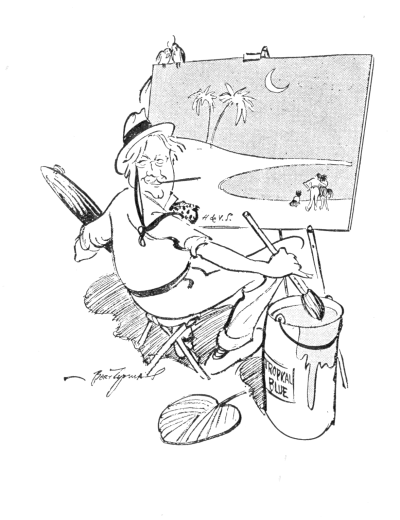
By kind permission of the Proprietors of Punch
THE LAGOONER
H. de VERE STACPOOLE
MORE MEN AND MICE
HUTCHINSON & CO. (PUBLISHERS) LTD.
LONDON : NEW YORK : MELBOURNE
FOREWORD
(with reference to the Appendix)
The fact that the universe is a living, thinking, talking organism ought to have been clear when we caught it first by the tongue—the tongue we call Radiation, whose words are what we call wave lengths. Red is a word, it is also a wave length. Blue is a wave length, it is also a word—and so on. Recognizing this we would have said “Why the thing is talking” recognizing also that talk implies mind;[A] mind, life.
|
I am not referring to the B.B.C. |
MADE AND PRINTED IN GREAT BRITAIN AT
THE FLEET STREET PRESS
EAST HARDING STREET, E.C.4
We had jam for tea to-day.
When Zammore, Du Barry’s little black page, was created Governor of the Chateau of Luciennes he took an oath to defend it to the last pot of jam.
My wife, the governor of the Chateau of Cliff Dene, has evidently in her mind arranged its defence on the same jam pot basis, for it’s always jam to-morrow.
But to-day it was jam because a visitor had come to tea.
And that describes the social life of Bonchurch at the present moment. The Court Circular couldn’t do it better—though maybe it might put the business in fewer words. Anyhow it saves tea.
Our visitor began to talk about war aims. They are all at it, and not only here; skinning the wolf before they have caught it and arguing how they shall dress the skin. The women are as bad as the men as though the thing were a mink, not a wolf, and they could turn it into tippets. But we never got to the fur end of the business, for I put my foot in it by saying that despite all the blather about war aims and ideals and the beauties of democracy, the only war aim at the present moment was to get hold of the broomstick—thinking of the struggle between Mr. Polly and Uncle Jim for the broomstick in Mr. Polly.
“And the broomstick?” said he.
“The bombing plane. Whoso can grasp and hold the bombing plane is master of the Potwell Inn and all it contains. This is not a war, it is the red and furious dawn of the Air Age, breaking over land and sea. The day will, no doubt, be splendid, but it will, all the same, be ruled by the Bombing plane. . . .” I suppose it was the jam that had got into my head.
He didn’t agree, but Desdemona, the black-and-white-blitzed cat that has evacueed herself on to us for the duration and who was sitting on the hearthrug, evidently did, for when he began to argue she walked out. She knows all about bombs.
Later, when he had gone and she had returned to the hearthrug and we were sitting over the fire, looking at her (Desdemona) I said to my wife, “We’re getting close to Christmas.”
She agreed, hoping that nobody would send us Christmas presents as we were sending presents to nobody, with the exception of a muffler to old Mrs. Fiddler, a box of bricks (found in the spare room) to the Childers’ children and the “Young Companion” to Ernest Toft. No Christmas cards. In the ordinary old-fashioned years a string would be stretched across the dining-room and the Christmas cards hung on it like washing on a line, a few of them; this year owing to the string and paper shortage things will be different.
At the words “Christmas presents” the cat, Desdemona, had gone from the hearthrug to the French window to be let out, and as I returned, the vision of her going off across the dusky lawn—I mean the outline of her sides—came to me with the recent words of the Postmaster-General about posting early and I said to my wife: “I believe you are going to have some Christmas presents after all. I believe they were posted some time ago. The dear old Postmaster-General urged the point that even if they come before Christmas the expectancy of waiting for Christmas Day makes them all the more attractive.”
I think it was the word “expectancy” that made her sit up in her chair with dilated eyes:
She said: “You don’t mean to say——” I said, “I do.”
That is all.
But what a prospect!
Heaven knows where they will be laid or in what inaccessible part of the garden—for that is her habit—but wherever it may be they will come out of it swarming and it will all be to do over again, the fruitless chasing and coaxing and hunting for fish to be laid out for them, to say nothing of the milk shortage.
The whole thing calls up in a manner the scene in Jude the Obscure.
“There is going to be another baby.”
“What!” The boy jumped up wildly. “Oh God! Mother, you’ve never sent for another and such trouble with what you’ve got.”
“Yes, I have, I am sorry to say,” murmured Sue.
The boy burst out weeping. “Oh, you don’t care, you don’t care,” he cried in bitter reproach.
Talking of cats my sister, when I went over to see her yesterday in Southsea, told me that a man off the Ark Royal told her cook the wonderful scene when the ship was sinking and was being abandoned. He said that the men were drawn up in companies standing as if on parade, and went off in companies, the cats marching behind them. There were fifteen cats on board and each company had its cat. Here and there a cat would be on a man’s shoulder quite unperturbed. That’s the story and it’s lovely, I think.
I see to-day (December 2) the Germans are attributing the plight of their armies at Rostov-on-Don to the fact that it was attacked by civilians.
Just the sort of dirty trick the Russians might be expected to play on an innocent army!
Also to-day I have nearly finished my book Men and Mice (a sort of autobiography) and looking through the MS. I am astonished at the lot of things I have left out. I don’t mean what you mean. Just things that might be of interest, and again I don’t mean what you mean.
What I mean to say is that in writing this sort of book, which in fact is a story, the thing is no use unless you are carried along by the rush of the narrative. Only the things that propose to pop themselves in must be admitted.
Quite as worthy as the things that get in are, very often, the things that don’t. I might have spoken, for instance, of my visit to Donnybrook Fair.
I suppose I am the only living man who has been to Donnybrook Fair, for the place was closed, I believe, shortly after my visit. Donnybrook is in Ireland and so, of course, was the Fair. Amidst the side shows were the bulges made in the sides of the tents by the heads of the drunks, blissfully sleeping inside; one of the diversions was to go around the tents feeling for a bulge and when found to hit it a crack with a shillelagh. I did not go in for this amusement, being at the time of a very peaceful nature, being, in fact, an infant in arms.
The nurse who took me was shot out not only for this expedition but owing to the belief that she had taken me into a convent near by and had me baptised on the sly; so that for all I can tell I may be a half Roman Catholic now.
I think it was the same lady who infected our gardener, Tommy MacMahon, with the idea that the ships that never come back from the sea sail into the full moon when it is rising out of Dublin Bay and so get lost—at least never come back, and whether she infected me I don’t know, or whether the infection accounts for the effect of the full moon on me.
Anyhow let us put it down to that.
Since our modern philosophers have discovered, following Wordsworth’s tip, the fact that the boy is father of the man, it is curious to think that the individual that went to Donnybrook Fair was my father—yet, so they say, he was. I have no grouse against him, or only for his leniency. If he had only been more strict! If he had only impressed on me out of the, no doubt, profundity of his knowledge of life the futility of writing as compared with the business of bottle washing how different things might have been! If the fathers of the great German army now bogged in Russia—those fathers who twenty-five years ago were having their behinds smacked and their noses blown by their mothers—had only impressed on their sons the beauties of Democracy and Pacifism, how much happier we might all have been. Yes, indeed, my friends, and perhaps more knowledgeable on points, such as Roman History; witness a letter in my possession which I have just turned out of a desk. It was written by the father of a very dear friend of mine who died some years ago and was given me by his sister to keep, and it runs:
3, Cowley Place,
Oxford.
My Dear Mamma,
I am so sorry to hear that dear Lily had the measles. I hope she will soon recover. I am very well but still I am very dull. There is nothing to do in Oxford. I go bathing every day, and I can swim about 1 hundred and 20 ft. and on my back I can swim and tread water.
There is a dreadful thing happened there were two children brought up by a wolf. I do a little history every day with Mrs. Samwell.
It was very kind of you to let me have a Nother pair of pigeons. I have got a pair of Antwerps on eggs now I have not got any more to say so I will say good-bye.
Believe me, your affectionate son.
It will be observed that the old gentleman’s knowledge of the History of Rome, as absorbed from Mrs. Samwell, was foundational.
This letter from his father was preserved by a very dear friend of mine. I have mentioned him in Men and Mice but did not put the letter in, for, as I said before, in writing an autobiography, and especially a fast-running one, things must pop in of their own accord or remain out, or the story gets put out of gear.
There was nothing to beckon this letter in so it remained out, else I might have commented on the exquisite appositeness of the word “dreadful” in its relation to the founding of Rome.
What a different world it might have been if that blessed old Wolf had gone dry! It would have been quite another pair of pigeons.
Have children—I mean parents—clearer eyes for the essential truth of things than their children?
A little before Old Christmas Day. The Christmas presents arrived some time ago. They were all in the garden playing about but refusing to be caught till yesterday.
I had given the matter up, the matter of catching them, and the method, but a feminine mind was at work and assisted by an old hen-coop for trap and a piece of fish for bait brought the matter to a conclusion.
They are all interned in a room by the kitchen, holding an indignation meeting and waiting to be deported to the Convent where the nuns want them—all but one, the smallest, jet black and not bigger than a dinner bun. It seems subdued.
Hiding under a desk at first, it has at last condescended to come into the fender of my grate for warmth. It has evidently been suffering from a chill or cold of some sort—I wrote that some days ago, since when the black image in my grate whose life has been saved by the warmth of the fire, has been asking me all sorts of questions.
A tray of ashes has been placed in one corner of the room for her convenience, and whenever she wants to go to it she goes, toddling across the room on her little shaky legs and back again, all on her own.
House trained—but who trained her, and why weren’t dogs and humans trained in the same school?
That was written yesterday and this morning my wife came into my bedroom and said, “Little Blackie is dead.”
That solemn yet friendly little face will be looking up at me no more from the fender. Those whom the gods love die young, but I wish they had not fallen in love so quickly with that kitten. She must have got out of the fender in the night and tottered across the room to the tray beside which she was found stretched, faithful to the last to her conception of cleanliness and delicacy.
There are a good many humans, and not all of them men, who could have learned a lot from her on the latter count, I think.
If you want to get away from war, get into it. I found that piece of philosophy in the last war. It applies to this.
Don’t sit brooding over the fire and thinking of Satan and Hitler, go amongst the people who are fighting them.
I crossed to “Solentsea” yesterday to visit my sister again—and the crowd on the boat! Nothing but khaki or Air Force blue or Royal Navy rig, and the difference. The difference between this crowd and the old pre-war crowd of trippers and travellers. Here were youth and strength and straightness and purpose. Girls and young men who in 1938 would have been just young men and girls. Girls and young men transfigured, and especially the girls.
A blue, yet cloudy and windy day with a full sailing breeze blowing and the waves racing round Gilkicker, it was true Solent weather. Just the weather to see the Victory coming in for the harbour close hauled and with a bugle blowing from the fort.
She was there right enough in spirit, and I could not have seen her had I been sitting over the fire in Bonchurch rubbing my shins and thinking of the war. Wylie’s house is still there at the entrance of the harbour with the ship weather-cock pointing to the wind, and the harbour is just the same.
Portsmouth has taken a lot of battering, but you would not think it from the harbour. My sister’s home has taken the same, but, thank God, you wouldn’t think it from the house, nor from her.
Here is a letter she wrote me on January 21st last:
Tuesday, January 21st, 1941.
Dearest Harry,
Our telephone isn’t working and I don’t know when it will!! Well! how are you both? We are all intact. My heavens, we had an awful time the night of the Blitz, but no casualties, only some glass broken. The house was literally ringed round with flames. It was a terrible sight and the heat terrific, every moment I thought this house must go, as the flames nearly licked the walls of the garage which was full of coke, wood, etc. At the same time there were crowds of incendiary bombs falling in the garden which Elidor (my niece) kept tearing round putting out with bags of sand we’d fortunately got ready in case!! Our visitors, officers, were tearing round too and I never felt a scrap frightened, I was too busy. We got Florence down in case the house went. The glare in the sky all round was terrific and the noise of the guns and bombs, it was a real battle.
The firemen arrived when it was all dying down. They came from Coventry and Manchester with miles of hose and got water supply from the creek, but of course it was low tide which didn’t help. Poor men, they’d had no food or anywhere to get it. We gave them supper and breakfast, and they filled up our baths with sea water and they wrote such a nice letter of thanks afterwards. We were without water, gas or electric light for three days. We got our Sunday dinner cooked in the drawing-room. Braised beef and were glad to get it. Elidor was perfectly wonderful. She thought of and did everything and no fuss. We picked up lots of shrapnel in the garden and one Captain Mackintosh says is a fragment of a bomb. I wish we could get a tin hat for Elidor in case of another blitz, the men all want theirs and it’s impossible to get one. I wish you could both come over but you can’t till this bloody war is over.
Well I must stop this rigmarole now, but I thought you’d like to know how we fared. A crowd of the shops are simply not there, but there are crowds of men clearing up everything as straight as possible. It reminds me of an ant-heap if you disturb it, the ants all get busy at once getting it straight again. I’ll never disturb ants again.
Good-bye. Love to you both,
Mina Bremridge Briggs
Florence, my eldest sister, got downstairs during this raid, generally prefers to remain upstairs when there is fighting on. She feels more in it and being over 90 not likely to have such a chance again. But she was not thinking about war yesterday but about Ireland—at least Killarney—if it is still there.
She was taken to Killarney as a girl and the vision has remained with her; her only grouse against me is that I have never taken my wife there to see it before it is too late. (I wonder what she means by that, or whether she thinks it will be blown up in the war or whether she has De Valera in her mind?) She wants me to take her now, and I have a suspicion that in her unselfish soul lurks the idea that she may be taken, too. That it is war time and winter time does not seem to matter—or the minor fact that she has to stick to her bed. Can’t you see me asking for export permits: “I want three permits for Southern Ireland for my wife, my sister and myself.”
“What is your business?”
“We want to go to Killarney.”
“Is this journey really necessary?”
“Well, if you knew my sister when she takes an idea into her head you might say it was.”
All the same, not wanting to be landed in Holloway Gaol, bed and all, as Fifth Columnists or spies bent on wirelessing the price of Cork butter or the day before yesterday’s weather, we are not going to Killarney.
“Let us now praise famous Men
Men of little showing.”
The Ryde boat that took me back was the same that took me over. I know all about the Ryde-Portsmouth boats, ought to, for I have known them over sixty years, and once, by permission of a captain, now defunct and beyond reach of reproof from the S.R., I steered one half-way across. I remember a destroyer getting hurriedly out of our way when she saw us coming—but leaving that aside, nothing makes me angrier than to hear this line of boats described as a “Ferry-service.” Since Charon started the business and gave it a bad name there has never been a use of the term so inapplicable.
Ferry-service, indeed!
Even in peace time and summer time, shoals and tides and gales and fogs and great ships driving for Southampton, small yachts getting in the way, drunks or lunatics tumbling overboard and tripper cargoes shifting in an emergency like cattle to the wrong side, make this business a service quite on its own. But think of war and winter time!
The black nights, and bombs and mines and freezing dawns, “bad visibility,” high seas and winds from the Arctic that no dodger can break, with, still, the mails going through and the passengers going through and me at Cliff Dene very rarely grumbling that the papers are late.
No, these captains are not Ferry-captains nor are their officers and men Ferry-men, and surely I think that this can be said for all the coastal steamers that ply between islands and the mainland as, for instance, the Isle of Man, though I have never been there—and don’t want to go.
In the old days the passage from Portsmouth to Ryde lasted just the lifetime of a cigar, as old De Blowitz might have said; now it is longer, or is it that cigars are shorter?
At all times, even in winter, it is a voyage on which one generally picks up interesting people, either friends or dead strangers. In many cases not the least bit dead as, for instance, a charming person I had never seen before and have never seen since, dressed in blue. (If she reads this by any chance she may remember herself.) She was going to the King’s Garden Party. Pity it wasn’t an Archery meeting (which possibly it was) for she knew how to aim, to judge by the arrow she left sticking in my heart. It was summer then, not December.
Another D.S. was a gentleman who raised the hair on my head with horror by his tales of the cruelty to animals involved in the fur trade business. He was Major Van der Byl. I daresay you know his name; you ought to if you read the papers and take any interest in these fellow-mortals, tortured to death because they were born in fur coats.
The punishment does not, somehow, seem to fit the crime; or so Major Van der Byl seemed to think—but maybe he is prejudiced.
But there are, no doubt, a good many prejudiced people on the other side, not excluding furriers and the females they supply.
I hadn’t time to let off on my prejudicial subject, the foul murder and torture of sea birds by Tankers—it’s not the shipping lines that do the mischief—it’s the oil tankers cleaning themselves. If I had, we would likely have stuck together so they’d have had to pull us apart. However, I got the Ventnor train, getting back, like Lewis Carroll, at half-past nine—
“All tired and cross and muddy,
to find
“supper with cigars and wine
a’ waiting in the study.”
Only it was beer and cigarettes.
Carroll found a ghost waiting for him as well as supper, and so did I, or rather ghosts—the ghosts of all the singing birds that sang in Fleet Street on and for a good while after August 4th, 1914.
Every newspaper office had a cage with a songster in it, jumping on its perch and only waiting for the guns to begin. Big offices had several cages—and they began!
The bird-house at the Zoo was nothing to it.
Well, the thing I found on getting back to supper was in reality a book I had sent for, a second-hand book Songs and Sonnets for England in War Time, which had come by the late post. A publisher had collected all the last war Fleet Street songsters and a few more and popped them into an omnibus cage. I was one.
And I didn’t like the look of myself when I cut the string and took the cover off the cage after supper. No, I didn’t like the look of myself—but maybe it was the sardines had disagreed with me; seemed to me I looked more like a sardine than a bird—which maybe is so.
Take the thing by and large, however, and as a book, it is not a book to ponder over with satisfaction. All the same there are things in it that jump to one’s eye.
H.M.’s lines to the King of the Belgians, for instance, in the Times of August 14th, 1914, and containing the words: “You never thought, O gallant King, to bow to overmastering force and stand aside.”
Might have been written only yesterday, mightn’t it? I say “Might it,” not “Oughtn’t it” or “couldn’t it” or “shouldn’t it.”
Maybe it is the cramping effect of a general theme that has to be sung up to by a whole crowd of poets packed together like sardines in a tin, that raises the question raised by the book: “Can sardines sing like birds.”
A volume of poems oughtn’t to ask questions like that. Anthologists might take the matter to heart in its wider application, especially some of the latter-day ones whose “selected” birds certainly seem to sing at times like sardines, or anyhow like rooks, choughs, pies, crows, whip-poor-wills, night jars—complaining of their libidos and livers. Well, anyhow the thing will be useful these days, when even the dustmen have turned anthologists in pursuit of the written and the printed word, never forgetting the paper it is printed and written on.
Anthologists whose motto might be—“all this I have gathered together, naught but the string that binds them is mine own.”
Only it’s a sack they bring.
No, I never could have imagined even dustmen seized with a passion for collecting my works—and not only mine but works more precious still.
The Battle of Indirect Taxation, for instance, a MS. collected by a doctor friend during his supervision of an Institute of which he was Medical Superintendent. Written by an inmate, it was in verse and runs to many hundreds of lines. Leaving aside its picture of the times, including one of Gladstone on a war horse, waving his doughty sword, it was irreplaceable as a work of art, and it’s gone. “They’ve took it.”
“Tush ye babblers, cease conniving,
Toiling, moiling and contriving.”
That is the only specimen brick my memory can show of the edifice. And it’s gone (the Edifice), and it’s irreplaceable.
“They’ve took it.”
Ever since the cry, “Turn out your this, turn out your other” rang through the land, “They’ve took it” has been the staff-employed formula answering the employer employed question “Where is it?” and covering everything from a pudding cloth that simply somehow isn’t there to a poem in MS. like the above.
Cliff Dene hasn’t an attic to turn out. As far as old manuscripts are concerned, old books, old pictures, old bits of furniture and the sense of peace common to old attics, it is all an attic; and I think the only one left in this bomb-blasted world.
Oh, there’s lots of buzzing going on and it isn’t the buzzing of bumble bees and the old Attic and its inhabitants are not past doing their bit (detestable phrase) but the peace remains, all the more perfect because it is chiefly the peace that environs memories.
Do old houses have memories? The Chinese answered that a thousand years ago, with a term, “The Spirit of the House.”
Do old trees?
I am warming my shins at the present moment at a fire made of the bones of an old friend, the thorn we had to cut down two months ago because he was all but dead. I believe you must not cut down an elder tree or a thorn tree without “asking permission,” so the legend goes. We had no one to ask, only him, so we asked him, as a matter of formality, and he didn’t seem to mind. Nor does he.
Better in my warm grate than out in the garden this cold weather.
I got a chill on the Ryde boat the other evening and he is driving it out of me with his talk, all light and warmth, and the help of a whisky toddy.
Talk! I should think he does. He was getting on, for there were nearly two hundred rings in a cross section of him and every ring is a marriage ring with a summer. Do you think he’s likely to forget such wives, or remembering them, as he does, not talk about them? Not speaking of his winter wives who never did anything for him. Says he remembers nothing about them, which is all for the best. Our conversation is all of light and warmth. But it takes two to make a conversation and in this we are a pair, for I can answer with some light and warmth of my own and so we talk over old days.
Me of my girls
And he of merles,
Old cuckoos gone and jays.
And a lot more, on his part.
Cliff Dene gardens have a fine view of the sea and he says that as a not very old individual he saw the Victory going out on the voyage that led to Trafalgar, and I believe him. If she hadn’t taken the Needles passage (and she could never have done that, for the shoals in those days were even worse than now) she would have gone past this house. If he had been in the garden he could have seen her. He was in the garden as his rings attest.
Looking up a dictionary of events that happened in the lifetime of the old gentleman, I come upon the interesting fact that all those sunlit years, during which the power and position of England grew and prospered, were years of disaster—or rather disasters. Afghan disasters, Indian disasters, Egyptian disasters, great Boer War disasters, first Great-War disasters, leading to present Great-War disasters. It’s like looking at a tower built of broken plates, broken by stupidity, mended by valour and all firmly cemented together by time.
A comforting thing to look at just now.
“Yes,” you will say. “No doubt, but you were talking about the house and its memories, not the garden and old thorn trees.”
Sorry. Well, there’s nothing easier than to talk about that. This very chair I am sitting on is in a way a memory. The memory of Mr. Orrin, antique furniture dealer, of Braintree, Essex.
Orrin is all over the house.
If he’s not a warming pan he’s an old oak chest. In the drawing-room he’s a Dutch marquetrie cabinet, in the dining-room a set of eight Yorkshire farmhouse chairs, with King Charles’s mask on them, which he sold me for forty pounds (the chairs).
But the interesting thing about Mr. Orrin, dead these twenty years or more, is the fact that the memories clinging to these things, or rather created in my mind by them, have nothing to do with historical figures or Dutch art or the times when warming pans were used, they are all of Mr. Orrin. And they are all pleasant.
He was nothing much to look at, but he is a lot to remember, for integrity could not have done much more in the building of a character.
Integrity and warmheartedness are not twins as a rule, but they were in his case, and that is why he is memorable. He lived at the corner of the square in Braintree before you turn down to the station. You pushed open a door and a crazy old bell rang and you entered a shop that seemed all dust and confusion; old furniture, old pictures, old books, old rugs, screens and foot-stools and day-beds from the time of Queen Anne that Queen Elizabeth might have lain on if she hadn’t been born too early. Ivory elephants, gongs, Hedingham ware, occasional tables, and nearly everything with a leg off, all sanctified and made in some curious way not undesirable by dust, careless disposal, light that failed to reach the corners and the silence after the ringing of the bell.
If a Jew had entered that shop without saying to himself, “Here’s treasures” he would have been a gentile—at least he ought to have looked up his family tree to see what was wrong with him, or gone to a doctor.
But I doubt if he would ever have discovered the chief treasure of the place, Mr. Orrin, dusty like the other objets d’art, and like the majority of them with a leg off—at least with a terrible limp. Hip disease, I think it was, but it did not stop him from hobbling about to sales.
I have used the word “integrity,” a strange word to use, you may say, in connection with antique art dealing, unless you are dealing with a dealer whom you have several times charged (not without justice) of robbery, by robbing himself by charging too little.
One day, several years after Mr. Orrin’s death, I was in the square at Braintree and turned again to Mr. Orrin’s old shop to see how it was getting on under new management.
I opened the door and found myself in an up-to-date Chemist’s shop, everything bright and shiny and nothing suggestive of memory but a cash register.
Well, anyhow, it doesn’t matter; it’s here (not the cash register).
In the old days (not so very old) about this time of year we would be packing up our traps for Bordighera, including a suit-case got second-hand from Mr. Orrin. It’s under a bed now in the maid’s bedroom (she’s gone for munitions) and it’s not packed for Bordighera.
Bordighera!
Well, that’s gone, anyhow, as the girl said in the Park on a memorable occasion recounted by Pitcher in the Pink ’Un and the Pelican. But how nice it was whilst it lasted! And it lasted for us from 1909 onwards, don’t matter till when, and the rising tide of our small prosperity might be marked by the hotels at which we stayed. First the Hotel, I forget its name, on the Strada Romana, and close up to the school for Italian children. It had a pepper tree in its front garden (the hotel) and an orange tree; Alborno senior, brother of the proprietor, and who seemed to live in a pair of slippers and an apron, did the cooking, junior looked after the books and Mother Alborno the beds, what time she wasn’t telling her beads. There was always a bowl of violets on our table beside the flask of Chianti.
There was a boy who posted our letters and licked the stamps off to buy cigarettes till echoes of his turpitude reached us from relations in England, objecting to a charge of fivepence apiece for letters; fortunately for him, else he might have smoked himself to death. There was a wild-eyed Italian peasant woman who did things about the house and who nearly died of amazement and delight when my wife at parting gave her half-a-sovereign (in gold) as a final tip. I expect she has it still. Hotel Bella Vista, that is the name, suddenly sprung alive in my mind. Hotel Bella Vista, where we lived for about tuppence a day in a time that, looking back on, seems Heaven.
Which isn’t to say that there wasn’t a girl at the Post Office whose seat was too low and who used a parcel of much-wanted books to raise it. She sat on that parcel of books for a fortnight till Alborno junior, having been put in like a ferret at the door of the office where she was seated, bit her sitting and bundled her off it.
I am not talking quite literally.
Anyhow he didn’t come out like a ferret, just like an excited Italian, with the parcel in one hand and clapping himself on the behind with the other to illustrate what he was trying to convey to me in broken English.
The Italian postal service in those days was a monopoly, in the hands, I believe, of a woman.
The English have always affected Bordighera, especially the retired military type; there were a good many in 1909 and they went on increasing till in later years it would have been hard to have fired a gun down the main street without hitting an old colonel or a retired Major-General.
I have heard people compare the place to an Indian hill station. There were also plenty of the living-abroad type of females. I might say a lot of nasty little things about these latter, as, for instance, that the drawing-room of the Angst after dinner was something like the withdrawing-room of an old cat’s home after the animals had stuffed themselves, but it’s so easy to ridicule the English, who, with all their faults, taking them by and large and broadside on and fore and aft and upside down are yet the best and decentest people in the world which maybe is not saying much for the world, but anyhow it’s saying something for the English out of the mouth of an Irishman. Also the English that I remember are inseparably part of that sunlit vista the Strada Romana, that picture I am never to see again—unless the war ends with a bang before next Christmas, and the moths haven’t finished with Mr. Orrin’s suit-case.
On the opposite side of the road to the Angst there was a little shop kept by an Austrian; such a nice man; about forty; artistic looking, delicate, breathing with difficulty and selling just what one would have expected him to sell; illustrated missals, amber ornaments, picture postcards, lava lizards and hanks and hanks and hanks of beads; coloured beads, plain beads, amber beads, beads that said impudently that they were pearls; also, on shelves, crucifixes, pictures of the Madonna, Tauchnitz books, guide books and all. Breathing with difficulty he would reach up with his thin artistic hands to fetch them down. He lasted, despite his fragility and asthma, from 1909 to 1914.
During the war, thinking of Bordighera, we would sometimes think of him, one of the pleasant and fragile things most surely destroyed in the general holocaust. In 1919 we went back to Bordighera. He was still there, not in the graveyard but in his shop, asthma and fragility unimpaired and not a bead missing from his coloured stock.
I mention him to give you courage.
Coming along towards the railway station, you passed a shop where they sold crystallized fruit; oranges, figs, apricots, pears, melons; as I live by the Grace of God and Lord Woolton, melons; also they sold cakes and coffee and I’ve clean forgotten their name, I only know it was altered and the place turned into Damilano’s where you could have dancing as well as melons. (I remember now, it was Berger’s.)
Many of my readers, if they ever read this stuff, will remember Damilano’s and the gay young things that used to dance there; over eighty a lot of them. It was here I met Mr. X. of Castle Townsend (the home town of the Somervilles and Ross’s) the most unexpected person in the world; that is to say he didn’t look what he seemed. Very smart, well-groomed, well-dressed and with the carriage of a cavalry officer he was, all the same, an old Pacific trader almost from the time of Bully Hayes, certainly from the time of the Dancing Wave, the smartest schooner out of San Francisco and of which he had been Captain or Mate—I forget which. Yes, it gives you a bit of a joggle to come up against a thing like that, as if Robert Louis Stevenson were to push the door open and poke his head in where you are drinking and talking; talk a thousand thought-years away from the times of Henley and the days of the Wrecker.
Mr. X. told me amongst other things that the Dancing Wave had been instrumental in rescuing a number of French people who had come to the Pacific from Tarascon, led by a swindler who promised them Paradise and a workless life for two thousand francs a nob, and who had left them stranded on an island where all in the way of natural provision was a clump of cocoanut trees, out of bearing, and a turtle once in a blue moon.
I knew of this French business because it forms the framework of Alphonse Daudet’s book Port Tarascon, but it was strange to hear this old Pacific story turning up again at Damilano’s out of the mouth of a witness. Mr. X. told me that amongst the stores and things landed for the unfortunates by the gentleman who had betrayed them was a box of skipping ropes!
Beat me that! I’d have loved to have told Daudet about those skipping ropes, only he was dead. He wouldn’t have dared to put them in his book. As a matter of fact Life, in a lot of ways, is too improbable to be put in a book. If I were to tell you—but I won’t.
Coming along from Damilano’s in the direction of the station you came on Manzoni’s bar, where quite nice old English ladies used to go in to have cocktails after church. Manzoni’s bar beats sunsets in the present memory market. Such rows of coloured bottles and all full. The vision of the crystallized melons fades into insignificance in the blaze of this greater glory shrining the picture of that old scamp, the high priest Manzoni, serving the fire-water worshippers sitting around with their tongues hanging out after a dry sermon.
Coming along from here and on the same side of the street you found the one and only shop where tobacco was sold, mostly Minghetti cigars and Italian tobacco made of old ropes’-ends and the contents of spittoons in Turin—but such a nice woman behind the counter. Many will remember her and the bambino she was always nursing. It was, or seemed, always the same bambino which, no doubt, was an illusion, for there were others of various ages behind the counter. We were great friends and that was one of the pleasantest things about the place, the friendship of the ordinary townspeople for us English—a purely platonic friendship, she being about forty and not unhomely, till behind the counter began to develop a husband, evidently from his manner a bambino questioner—absolutely typical of the tribe, regardless of the fact that their eyes were all sloe black.
Beyond the tobacco shop and before you reached the cinema there was, and I suppose still is, a little square where I saw the most amazing thing I have ever seen—a two-headed woman.
I didn’t see her in the square but in a rag and stick theatre set up in it. She was exhibited outside en plein air on a platform to draw the crowd, the left-hand head being covered with a bag. It seemed to me smaller than the right-hand one, but this must have been an illusion, for inside, when she came on the stage, and the lights were put out, leaving only one lamp to show her, and when the curtain was drawn aside, both heads were the same size. When she sang and spoke both heads shared in the business, the movement of the lips being identical and all the expressions of the face (faces) the same.
She was very pretty and sang well, and how it came about that she was not a European celebrity exhibited in London, Paris and Berlin I don’t know. Anyhow she drew in Bordighera to judge by the deep sighs and exclamations of wonder from the garlic-scented audience, a success shared by Il Piccolo Umberto, a miraculous child cut in two at the waist without being killed, the top end exhibited on a table, very much alive and cheerfully talking. Dear Italians, do you wonder that, when the bull frog that has blown himself up to emulate the size of John Bull bursts, I want to go back to Bordighera?
The cinema palace that abutted on the rag and stick theatre square was another joy, for, owing to financial stringency the proprietors, not being Rothschilds, had to limit themselves to the purchase of bits of films, some of them with holes in them; so you saw the Count of Monte Christo, just as he was preparing to deal with Villefort, suddenly vanishing, his place taken after a short black-out, by Charlie Chaplin, maybe, or some other character, always unacceptable to the audience to judge by the storm of howls, catcalls and whistles filling the auditorium; yet still the show went on; cynically maybe and with the help of crutches, but still it went on.
Dear Bordighera!
I have always loved dogs and have fancied myself as a fancier of dogs, but in my wildest dreams I have never fancied dogs such as I saw in that before-mentioned square one bright March day when, turning a corner, I came on a procession of them led by Bobby, the brown French poodle, who lived at the vegetable shop where they sold persimmons.
There were more than a dozen of them (dogs) but I was too astonished to count. There were dogs with heads like boxes, and dogs with heads like snipe, there were dogs without tails and things that looked like tails without dogs. But the astonishing thing was the fact that they were going of their own free will in procession and evidently with a set and serious purpose, to judge by their faces (such as they were).
I remarked on them to an Italian friend who was with me:
“Yes,” he said, “it is the season. They are going to visit a lady.”
Well, I hope she enjoyed the visit.
“And how is Bobby?” I asked the persimmon seller last time I saw her. Bobby was morto. Going to sleep on the railway track the train for Genoa had collided with him where the line runs just opposite to the little gambling shop that many will remember. The gambling shop that was always being closed by the police, only to open again next day.
Nearly opposite to where I saw the leader of the Carnival procession of 1925 a big burly man, not unlike the Duce, marching at the head of the show, bellowing at the top of his voice, till a bag of confetti caught him full in the open mouth, a wonderful sight which, maybe, inspired me to tickle the back of a girl’s neck who, turning, flung a bag of confetti in the face of dear old Admiral William Fisher, innocent of everything but just wanting to look on.
Whilst I am dreaming of Bordighera and writing this stuff, seated over the fire, my unfortunate wife is doing the housework. That sounds awful, but it’s not as awful for me as the reality; for, leaving aside a few menial jobs, she refuses my assistance.
She refuses to shut up the place and go to an hotel, just as a captain might refuse to abandon his ship; to store the furniture (which couldn’t be left in an empty house these times) would be to let down the rates and Bonchurch; the cat, impossible in an hotel owing to her nervous disposition and other dispositions, would have to be “put to sleep.”
So, with a village lady who comes in to lend a hand and a gardener who comes in to do the boots and bring in the coals, she carries on; not only with housework but with war work in the shape of knitting parties and the like.
She will get no medal for her heroism; but then she is not a hero but a heroine, like the other English women who are trying to keep their homes together in houses where servants were clearly marked as necessities in the blue prints of the architects’ plans.
The gentleman who drew up the plans of this house had evidently never heard the word “Munitions” in connection with architecture and when I bought all those old things in the dusty old shop in Braintree I did not know that I was literally buying dust.
The dusting of Mr. Orrin in his various manifestations is part of the housework in which I am not allowed to take a hand; well, things might have been worse; the thing might have included the dusting of Napoleon’s Grand Army, drummers, trumpeters, cavalry, growlers and all, only common sense interposed.
It was like this. Mary Gaunt, the novelist, lived in Bordighera, what time she wasn’t making expeditions all alone into the wilds of Africa or investigating old Chinese cities, that I, personally, would not have entered without the support of an Army Corps.
She was one of the band of absolutely fearless Englishwomen which included Beatrice Grimshaw, the writer of South Sea books, who lived and wrote amongst head hunters and seemed to like it.
Incidentally, I met Beatrice at a dinner some years ago and what struck me more even than her placidity and general air of beneficence, was her head; the most beautifully coiffured head I have ever seen. How she dared to live in the place she did with a head like that was beyond me, and I couldn’t ask her—naturally.
But to get back to Mary Gaunt; Mary said to me one day: “If you are fond of antiques you must go and see Madame X.’s shop. She has some lovely things. She lives near the Strada Romana.”
I went, and the first lovely thing I saw was the Grand Army of Napoleon done in China. A hundred coloured figures, including Napoleon himself. She wanted a pound apiece for them and cheap they seemed—but common sense somehow interposed and I compromised by buying a pair of Italian gates, once the interior gates of a palace. Delicate as lace work they are swinging now as the gates of Cliff Dene; a better bargain, I think; anyhow they don’t require dusting.
They were nine months in coming. In answer to a frantic appeal about the delivery came the placid reply: “Content yourself, madame, they will come.” And they came, and I sometimes wish they hadn’t, for there are other gate owners who have lost their gates and I feel in my bones that they feel in their bones, that I ought to have lost mine. To which I can only reply they are not mine. I did not buy them for my personal adornment but for the adornment of Bonchurch; coming up the chute their beautiful iron lace work makes the whole place different; besides, boiled down they wouldn’t make the wheel of a tank; besides, tank or no tank I am going to keep them.
And whilst I have been writing that the Grand Army of Napoleon linked me up with Mr. William Warren Vernon, for Vernon knew Napoleon’s Courier Cavani.
Think of it, me talking to a man who knew a man who might have posed for one of the china figures in Madame X.’s shop. For Cavani, though Courier to Napoleon, was all the same a soldier in the Grand Army. Cavani in his later years was Courier to Lord Vernon, William Warren’s father, when the Vernons were living at Villa Nerli in Florence, and William Warren told me a lot about Cavani, enough, anyhow, to enable me to give you a little coloured picture of the old scamp, who had seen amongst other things the burning of Moscow, the retreat from Moscow, and in Jaffa the massacre of the Janissaries. Strange to talk to a man who had talked to a man who had seen all that and who was able to describe how, sitting at a little table in a café, he had seen the first fires of the Moscow conflagration break out.
Close up to the Villa Nerli there was a little chapel where sometimes midnight masses were held which did not please in the least the old soldier of Napoleon, who liked his sleep, had a hatred of priests and a furious temper; the chapel was close up to his bedroom—it would be—and springing from his bed he would accompany the service with bangings on the wall and ribald remarks—nice for the Vernons, quiet, religious people, intellectuals and worshippers of Dante.
Yet they seem to have clung to Cavani, for he was in their service in the following year. Maybe I have painted him too red, or maybe they found him too fascinating to part with; I could understand that. He should have been preserved in the Musée Carnavalet for Europe to admire and preferably in a cask of rum.
Yes, the Vernons were Dante people, or rather I should say worshippers.
In that Bordighera Carnival procession I mentioned a moment ago, Dante was one of the characters being dragged along in carts hung with flowers; a grim-faced man, marvellously like the original, to judge from busts and medallions. When the bull-voiced leader of the procession was hit in the mouth with a bag of confetti, everyone laughed, even the cats I should think, but not Dante.
Like the “Swan of Lichfield” I have always disliked Dante. His is, maybe, great poetry. I was told of an Italian at a tea-party in London who flung his tea-cup into the air—regardless of the carpet—on someone saying that Carey’s translation was as good as the original; yes, his is maybe great poetry but I don’t like him. The Swan of Lichfield is quite explicit on the reasons of her dislike for him—his roastings, bastings, grillings, etc., and when, turning over her life by Mr. Hesketh Pearson the other day I came on her Dante opinions, I felt inclined to say “Shake hands, Swan.” All the same it is not so much the butcher’s shop and grill-room side of the picture he presents of God’s infinite mercy and wonderful universe that gets one as the no doubt wonderful power of the presentation which exhibits his (Dante’s) back street enemies grilling and freezing against the background of eternity; a power which seems in my humble opinion to have been misused.
Now what I am getting at is the fact that, before he died, Mr. Vernon made me a present of his readings of Dante in six volumes, all annotated in his dear old handwriting. They are my most precious possession; the tangible evidence of my friendship with one of the best and kindest men I have ever known.
But why did he give them to me? I cannot remember ever discussing the poet with him, he must have taken my admiration of the subject for granted.
Well, anyhow, in these material wrappings he bequeathed to me his memory—a most powerful antidote to the dread of the terrors and pains of hellfire.
In those old days in that old incredible world, visitors to Bordighera could have plenty of fun without having to pay much for it.
You could pack a nosebag and hike up the Sasso valley and lunch in an olive grove with a bottle of Sasso wine and a cup made of the half rind of an orange to drink it out of.
The last luncheon party I held under the walls of Sasso was attended unofficially by half the children of the town. They had no invitation cards but one had a streaming cold and was dressed only in its nightshirt.
Or you could go out and sentimentalize over the Scheffel palms in the Jardin Winter or sit in the little old fort that dates from the times of the Barbary pirates and imagine yourself a Barbary pirate, or just look at the blue sea breaking on the rocks of Ospedaletti.
Incredible, that all these dreams were once true! You could hire a little open carriage of an afternoon for a few shillings and drive over to San Remo without being choked with motor-car dust.
You could, if you were lucky enough to find acceptance, mix with the Foreign artistic colony and go to little parties where there was little to drink, less to eat, but plenty to talk about.
Very simple people they were, despite their exclusiveness, simple in their ways, for I have seen the great Belgian sculptor Mr. X. taking his marketing home; going along the street in a shovel hat and with an overcoat down to his heels, a loaf of bread a yard long under his arm and his wife trotting beside him with a string bag full of vegetables. He had also the neck of a bottle sticking out of his overcoat pocket. You could sit on the pebbly beach of a now-ruined by improvement sea-front and eat persimmons and look at blue painted fishing boats floating on a peacock green sea with Monte Carlo for a background.
Or you could go and drink Chianti with old fishermen in the little pub behind the fishermen’s beach after helping them to drag in a Seine net filled with nothing much except star fish, wriggling octopi and the fry of some sort of fish, that never appears in person. How this is so and what they are and how they manage to fry it like that without being seen were questions I couldn’t solve owing no doubt to my faultless Italian.
I see, in the MS. of my book Men and Mice, I say, speaking of Sapho, that though we know so little of her still that little is guaranteed perfect. It’s the same with my Italian which consists of a simple sentence, “Buon Giorno,” perfect in grammar and structure but insufficient for the purpose of extracting information from illiterate fishermen. So I had to fall back on English, and as the question was taken as an invitation to crack another flask of Chianti I gave it up. They’d had enough. Or, if you felt the urge to spend money you could take the train over to Monte Carlo. I used to go over to see R. D. Blumenfeld when he was there and Gilbert Parker and Maurice, the dancer, and other desirable people; but the most desirable was Blumenfeld who knew and who knows everyone in the world.
This strange person who has left his indelible mark on English political, social, and journalistic life and to whom many men in England are indebted for their advancement and success has, amongst other characteristics, the power to find the humorous side of a subject. Nearly every subject has its humorous side and men like Sidney Smith and Blumenfeld (alas! how few there are of them) have the power of showing the bright side of dull facts, just as dullards and depressionists have the power of showing the dull side of even the brightest facts, or if there is no dull side, of inventing one and sticking it on.
La Turbie lies above Monte Carlo; there was a funicular railway (since broken down) that could whisk you up there in a few minutes. In La Turbie there was a small hotel, The Hotel de France. It catered mostly for tourists and passers-by. It had a rosy-faced landlord in carpet slippers, a sanded bar-restaurant backed by coloured bottles and an old lady, the mother of the landlord, who made divine omelettes.
The place might have been discovered by Robert Louis Stevenson. It was discovered by R.D.B., who put his spell on the landlord and made him open up the bedrooms for visitors. There were only three bedrooms, but that was enough; they had little furniture but beds and rush mats on the floors, but that did not matter.
What mattered was the cooking and the quiet and the fresh air and the Roman road marching along just as it had done in the times of Augustus and the tower of Augustus a few hundred yards away and the view, past olive groves and coloured houses to beyond Eze, or the view to the East, when the weather turned magician and the phantom mountains of Corsica were held by mirage in a sky that knew nothing of them. Despite all these things, that another landlord would have put down in the bill, the charges at the Hotel de France were moderate.
Ten or twelve francs a day, I think it was; anyhow I remember the Gilbert Parkers coming up to luncheon and nearly crying when they contrasted what we were getting with what they were getting down below in the Hôtel de Paris for ten or twelve francs a minute, or something like that. The Parkers used to gamble by way of a pastime; they never lost much and they never won much; they played for the fun of the thing, sitting all the glorious sunny morning in the stuffy and smelly rooms and it was more than your life was worth to speak to them if you chanced to come to their table. It disturbed their play. I think they must have had a system.
Now Hiram Maxim, the inventor of the machine-gun used to come to Monte Carlo, maybe because he liked the place or the climate suited his asthma, for he never gambled.
All the same, when he found that old machine-gun the roulette wheel rattling away in the Casino killing souls and bodies with M. Blanc turning the handle, he took the thing to pieces and examined it and put it together again and wiped his hands and issued a report on it which was published in the New York Herald. A report that, boiled down, amounted to eight words: “No good, as far as systems are concerned.”
You see the father of all systems is the simple belief that if red turns up say ten times in succession it is unlikely to turn up again on the next spin of the wheel—and, of course, the same with black.
Based on this fatherly assumption Lord Rosslyn and others invented the Martingale and other methods for taking advantage of this characteristic of chance. Hiram burst their assumption by pointing out that if red, say, turns up ten times in succession it is just as likely to turn up again on the eleventh time since every spin of the wheel is a thing unto itself, and has absolutely nothing to do with the spin that goes before and naturally, of course, nothing to do with the spin that comes after.
He might have rammed the cartridge of his argument tighter home, I think, by pointing out that as far as gambling is concerned there is no such a thing as chance. Cards, horses, or roulette, every result is a certainty, created by a procession of events, just as the end of a river is created by the hundred and one tributaries that have contributed to the creation of the river—and its end.
Anyhow he did enough to drill into the skull of any sensible man a disbelief in the virtue of systems—without the slightest result.
Why, bless you, I, a sensible man, and with that knowledge in my head, if I were standing at the tables and red turned up ten times, would ten to one feel the urge to plank my five francs on black—and do it.
And so, it so rules that Rouge gagne quelquefois, Noir souvent, mais Blanc toujours.
And so, surely, if Monte is still going, you will see old Frenchwomen pricking holes in cards, and Frenchmen, with mathematical-looking faces, and confused-looking beards, making mathematical calculations on pieces of waste paper.
If you want to succeed in gambling, you must gamble not on chances but on certainties—like Stalin.
Monte Carlo! Herculaneum! Pompeii! All these three are dead and the societies they represented and their people. Dead as the dawns that heralded their pleasant days, dead as their equal and ultimate sunset. There may be Monte Carlos again in the principality of Monaco—but Monte Carlo—never.
One day in the Casino a man was pointed out to me as X., the American steel king. He didn’t interest me, but what interested me a lot was a girl who had broken away from one of the tables and who was running up to him with her hands cupped in front of her. She was laughing with delight, and no wonder, for the cup was full of gold pieces, so full that several tumbled out on to the floor and rolled away amongst the crowd, not that she bothered.
She evidently belonged to his party and maybe he had given her money to play with and she was showing him the result.
A little later I saw him playing with lovely gold plaques worth nearly five pounds a piece; he was putting them en plein on No. 33 and losing every time, not that he bothered. Fired by his failure I put five francs on No. 33 and lost it, not that I bothered. That was the sort of crowd we were; money didn’t bother us; except in one instance, that of the Scotch professional who was helping to lay out the golf course at Mont Angel. Monsieur Blanc wanted a golf course. It takes three years to lay out a golf course properly but M. Blanc, being a Frenchman in a hurry, wanted one at once and the Scotch professional was hauled in to supervise matters. I met him (the Scotchman) up at Mont Angel and he told me amongst other things that he had gambled at the tables. He had risked five francs on red, won five francs and walked out with it.
I think the man who had fired M. Blanc with the golf idea was Herr Victor Silberer, a butterfly of those coloured times who surely deserves a place in our Unnatural History Museum. He was the founder and editor of the Allgemeine Sports Zeitung, but much more. He was a personality contributed to and adorned by the brilliance of his surroundings.
He couldn’t have lived in these times, no more than a rainbow trout could live in a sewer. A correspondent of the New York Herald gave a flashlight picture of him:—“The upright figure, pleasant face with its saucy white moustache and cheery smile, is familiar in every place where sportsmen forgather, whether it be in Vienna, in Berlin, Paris or London.”
He was immensely wealthy, owned a palace in Vienna and the better part of Semmering—well, he’s gone.
The same day I saw the steel king playing with gold I saw Max Aitken outside the Casino. He didn’t look like a steel king, all the same he looked more like one than the one I had seen in the rooms, if less like Sir Basil Zaharoff, the armament king, who was clanking about the place, though you could scarcely hear the clanks, he seeming to walk on velvet.
The place was full of kings, steel kings and copper kings and sugar kings and silver kings and nitrate kings, nickel kings and wheat kings—to say nothing of the king of spades, the chap who used to dig the graves for the suicides, though one never saw him about like the others.
Nor did I ever see the Prince of Monaco, though he was good enough to send me several of his books on oceanography, to help me in an article on deep-sea work I was doing.
Strange that this man, the ruler of the strangest principality in the old-gone world, had his spiritual home in an aquarium, for that is what the Musée Océanographique amounts to—and a very good place, too, you will say these times, considering everything; maybe, but with due deference to the man who was kind enough to send me his books, I would say that the aquarium of Monaco was not a common aquarium of the fools-staring-at-fish type with the added attraction of a girl shot from a gun as in the old Westminster show, but the expression of the life work of a man whose passion was the deep sea; the sounding gear, lines, fish traps and nets were of more interest than the great octopus in his glass tank or even the skeleton of the nightmare Japanese crab with yard-long legs and body the size of a dinner bun hung up in the atrium, at least to me; but not to many others, as witness the girl I heard asking her partner in a disenchanted voice, “What are those things for?” Midland, I think, on her honeymoon evidently and of an extreme type, for even the octopus, with the accent on the middle o left her cold. Open-mouthed, but cold.
I wonder what Basil Zaharoff was doing at Monte. He didn’t gamble, and had no asthma to be cured like Hiram, and as for the view, there were others just as good—I mean what gave him such a crush on the place that he went and bought it at last—was it a speculation or a love affair?
He was the mystery man of Europe. Oppenheim might have put him into one of his intriguing stories, but he didn’t—maybe he was too improbable for fiction. Anyhow, for me, of all the figures moving in that coloured tragedy, masquerading as a comedy, he is the most intriguing except Max Aitken; afterwards with Churchill one of the saviours of the world.
Tragedy indeed. In what play of ancient or modern times has such a tragedy been exhibited as the tragedy of the Russians, set forth on the coloured stage of Monaco, of which I witnessed the beginning and the end.
The beginning when, as a child, in 1871, I used to see them setting out from Nice in their carriages for the Rooms; carriages drawn by horses going all out and driven by bearded men in belted tunics. Setting out to pour the wealth of the Urals and the wealth got by the exploitation of a hundred million serfs (or anyhow part of the wealth) into the lap of Chance. The end, in 1920, when I saw them serving in the restaurants that had once served them, or selling their last few jewels and trinkets for a meal. It was appalling!
The stage was a thousand miles wide, stretching from St. Petersburg to Constantinople and beyond, set with icebound rivers to cross, mountains and inhospitable plains; it was a thousand miles long, stretching from Moscow to Monte Carlo; and across and about this vast stage the fugitives were driven like leaves before a storm. Like snowflakes before a wind they “banked” here and there as at Monaco and in the lesser district of La Condamine.
Anywhere cheap—and they were such charming people, so many of them; and more than charming, heroic. I always said and held that the last Great War was essentially a Slav-Teuton business; the Slavs got knocked out before the end, but they had done enough to enable us to finish the work, which we didn’t. I believe the present war, despite all its trimmings and complexities, is the same; the second round of the same fight between the two most potent land giants in the world, and I believe the Slavs will win, for the heroism that survived Tannenberg and fought on almost without arms was greater far than the armament-fed heroism of the Teuton.
Soul is far more than body in battle.
Well, however that may be, the heroism of the old Russian nobility survived something worse than Tannenberg, and to give a particular instance of it may I tell you a story. I have told it once before, but it will bear re-telling.
“In the House of the Russian”
I
Monte Carlo caters for all sorts of people: for the people who use the Riviera Palace or the Hôtel de Paris, and for the people who patronize Madam Toussaint’s Pension down in La Condamine.
The latter have just as much fun as the former—often a great deal more—and at a fifth of the expense; also, they tell me, the food is better, or at least the cooking, real old French country cooking, done by Monsieur Toussaint, a little apple-cheeked Frenchman, who spends his life mostly in carpet slippers.
Toussaint of a morning vanishes to the markets with a basket to buy the provisions for the day, whilst Madame Toussaint makes the beds, empties the slops, beeswaxes the floors and lays the service for déjeuner, assisted at the date of this story—which is not a fairy tale—by a princess.
A real princess—Russian.
Olga Anakoff was her nom de broom; this woman who had once worn her diamonds at the Winter Palace and was now dish-washer and general servant to Madame Toussaint; this woman who had once been the presiding genius of vast house-parties, and who had only to rest a moment from her labours to hear on the wireless of memory the band of the Guards playing at Peterhof, the howl of the wolves in the great forests of the Anakoff estates, the tinkle of the sleigh-bells across the snow.
She was no longer quite young; her face in repose was almost plain, but it was a face wonderfully full of character. She had beautiful eyes, and when she smiled they were lit with the light of a brave and brilliant soul.
Her adventures, could they be put down in a book, would be too improbable for fiction: her escape across the Volga; her hiding at Riazah; the devotion to her of Ivan, the son of Ivan, a rascally forest guard, who not only risked his life a hundred times, but held to her to his end. The death of her husband at Woronetz; the crossing of the Dnieper and Danube, Varna, Constantinople, where Ivan had been killed in a quarrel—for he had capped all his heroic deeds by a blazing bout of drunkenness—Constantinople, all that mad dream even as a story of fact, because of its ungraspability, would leave the reader cold.
Madame Toussaint knew that this servant of hers was a Russian grande dame. . . . Olga had never made any secret of the matter; the boarders knew it, but it did not make the slightest difference to them or cause them the slightest surprise. She was a Russian refugee, no longer young. Grand Duchess, Princess, that was nothing; those sort of people were all over the place; selling in shops, serving in cafés, painting pictures; the unfortunate ones selling their jewels bit by bit. Those sort of people were cheap, and the Toussaints and their customers were not exceptional in this point of view; everywhere it is the same on the Continent to-day; “Russian noble” is the symbol of damaged goods, something to be avoided, or at all events bought at a low price. When they try to sell their products or services, unless in some charity bazaar, the fact is marked against them and the buyer cheapens their wares. When they try to sell their poor last jewels it is the same.
Madame Toussaint in private conversation was always impressing upon her female boarders that she paid Olga just as much as she would have paid a French or Italian servant. They doubted the fact, but it was a fact. Mother Toussaint was a just woman, and when she found that an assistant could be more honest, far cleaner and more careful with china, glass and crockery-ware than the ordinary French or Italian maid-of-all-work, she was not disposed to pay her less just because she had danced at the Winter Palace in 1913.
Now, the strange thing about the Russian refugees is the fact that the ones who have retained their wealth have retained their dignity in the eyes of Europe. Olga knew that those few favoured ones still existed like exotic flowers, blossoming by the tennis courts of Cannes and on the golf course of Monte Angel, dining with the left-over Royalty and aristocracy of Europe. At times when she thought of this, of the manner in which the aristocracies of England, France and Spain had stood aside whilst the noble women of Russia had been prostituted, driven by the whip of starvation into Constantinople brothels and dancing-rooms, strewn, what were left of them, through the great cities of Europe—when she thought of this there were times when Olga could have cursed the Spanish and the French and the English, and would have done so, maybe, had she not been checked by the memory of her own more fortunate countrymen and women.
Yet even against those she could feel no bitterness in face of the fact that their remnants of wealth were as nothing in the general debacle—and it is so easy to say “Give,” and so difficult to give when one’s all can be carried in a handkerchief—even if the contents be sapphires and diamonds.
So after several struggles with herself and the casting out, at length, of all bitterness, Olga settled down to her housework and found life not unendurable at first. The whole of this experience was all so strange, that the very strangeness of it all was an antidote to the horror of it. It was like being shot out of one’s house on a freezing night and the door banged on one—for ever. As a young woman she had been troubled by a recurring dream. She would find herself walking in the Nevski Prospekt in her nightdress; walking, not driving. Well, it was like that, mixed up with other things. Yet life was not unendurable, the housework was, in fact, a pleasure. Madame Toussaint was not unkindly, a woman of the people with such a rough and honest spirit that it was not an indignity to serve her.
But the boarders!—ah! the boarders were different. They were not people on whom she cared to wait or for whom she cared to fetch and carry. Farm servants, workmen, common sailors, dustmen; for those she would have proved a willing enough servant, but the boarders at Madame Toussaint’s were not such as those, but of the bourgeois type. There was here a shopkeeper from Nimes, and his wife, and the wife was loud in manner and jewellery, and the jewellery was mostly glass. There was an old gentleman with a leer who had squeezed Olga’s waist suddenly in the passage one day, receiving a box on the head that echoed through the house. He didn’t mind it, he leered at her just the same. There were two Englishwomen who looked young at a distance, who went thirty-mile walks with sticks and rucksacks, disputed the bill every time, did their own washing, and used Madame Toussaint’s electricity for heating their iron; also they imported whatever in the way of alcohol they consumed, drinking water at dinner. There was an Italian count, a young man with an old expression of face, well-dressed as if by an English tailor, but an English tailor who had become infected by foreign ideals—or, at least, ideas. He wore a sapphire ring on the middle finger of the left hand, and he went for long walks. Sometimes he would be forty-eight hours away. This man gave Olga considerable thought; she could not place him. Then there was the inevitable old lady, travelling by herself, a nuisance to every one; also a frank Prussian with a pyramidal head, who might have been the suggester of Napoleon’s idea that the Prussian was hatched from a cannon ball.
Such were a few of the people whom Olga had to serve against her will, or, at least, her taste, but they were never quite the same, as a crowd. To-morrow the Prussian would be gone, giving her a big tip, and next day the Englishwomen, leaving three francs on their dressing-table and a wardrobe-top full of jam jars, egg shells, empty bottles and what-not; gone, and their places taken by others not more, and sometimes less, desirable.
II
Olga had been six months at this caravanserai and the season was drawing on to its end, when one day a newcomer arrived who interested her. The others did not see any difference between him and themselves, except for the fact that he was not nearly so “stylish” as some of them, but for Olga he was of another creation.
A middle-aged man with a greyish, pointed beard, a lazy manner and a cigarette—that was Jean Matisse at first sight, but he improved on close acquaintance; like Olga, his eyes were his strong point, eyes full of intelligence and charm and distance. He was a dreamer, this person, who ought to have got on much better in the world than he had done, a writer who wanted only leisure.
He had everything else.
But, devil-driven in the office of the Petit Parisien, you can’t get leisure, and you are so tired by the end of the day you can’t think. So it had been for years. He had started as press-man, a writer of articles, a haunter of cafés. He was well paid, yet poor as any rat on the parvis of Notre Dame. He had fearful faults, laziness the worst of them, yet he did an enormous amount of work of sorts. The Oriental laziness of his nature held him from lifting himself out of the groove, held him from setting out on the great business of the book that would have made his name.
He was one of the few men to whom money would have been a benefit in starting their careers.
He had come to Monte Carlo for the sake of his health, and to the Pension Toussaint for economy’s sake. On the verge of a nervous breakdown, money had been given to him by friends for a holiday, forced on him and into his pocket, together with a ticket of leave from his editor.
This was the man who attracted the attention of Olga Anakoff, and who, after a while, won her heart by his kindly manner, his personality and his courtesy; for it seems that by some means he had discovered her story, and by his manner to her she knew it.
III
Jean had been a fortnight at Monte Carlo before he thought of looking at the tables.
This true Parisian, who, but for his illness, might have lived and died without breaking from his true environment, was not greatly moved by the proximity of the Casino; the presence of the sun moved him much more. Yes, it had to be admitted that this was a better sun in some ways than the sun of Paris; “louder,” stronger, better for the purpose of growing vegetables and flowers and assisting invalids back to health, but in other ways not to be compared to the shy sun of the Tuileries Gardens.
He sat in it, reading books sent to him from Paris, permitting it to warm him whilst he warmed himself with Bergson or Charles Guye, and every day it was, “Oh, I must go and have a look at the Casino to-morrow.”
Till, one day, he went.
Jean wasn’t very particular about his dress, and in the old pre-war days, when brown shoes or dusty boots were a barrier to the Rooms, I doubt if they would have let him in. But it is different now. His ticket was handed him and crossing the atrium he entered the Rooms.
He looked round. The place seemed just as he had always pictured it to be. The tables with their several crowds, the croupiers, the silence, broken only by the rattle of the roulette balls and the voices of the croupiers, the decorations by Garnier, the architect of this Palace of Iniquity.
Curiosity took him by the arm and led him to the first table on the right.
He watched the play and the players. There was no coin on the table, only counters and notes. After a while he forgot the players and became absorbed in the play.
He went to the little bureau and bought four ten-franc counters and placed two of them on red; in a moment he had won twenty francs. Then he looked at the numbers on the board. It was the twenty-fifth of the month and, realising that, a sudden inspiration came to him and he put a counter on Number 25. It won. He could scarcely believe his eyes.
A woman got up and he took her chair. He put a counter on Number 20, because he was forty years of age, and twice twenty makes forty. He won.
People began to look at him. Here was a mascot.
He put forty francs on black, and again he won.
Then he turned very cunning: the feeling that luck couldn’t last without a break came to him, and this time he ventured only ten francs; he put it on black, red turned up. This pleased him; he had given Fortune a sop in the pan. Next time he played more boldly and won.
Then there came to him an extraordinary feeling, a sort of clairvoyant knowledge, that he couldn’t lose: the feeling gamblers know when they say that Luck is with them.
An hour and five minutes later he rose and left the Rooms.
He had lost every penny he possessed. Every cent.
The money he owed Madame Toussaint for that week’s board and lodging, the money that would have kept him for another month, the money that would have paid for his journey back to Paris. The good blue and pink banknotes that had stuffed his pocket-book—all were gone. If you had told him a few hours ago that this disaster had befallen another man he would have said, “But he must have been mad.”
He wasn’t mad: he was quite sane; yet—there it was.
This is the sort of thing that makes men kill themselves at Monte Carlo. It is happening every day, happening as I am writing this.
He stood on the steps of the Casino, looking at the people sitting at the tables in front of the Café de Paris.
Though he was not absolutely lost, though he could apply for and possibly get the viatique, though he could wire to his editor for the money to pay his bill and bring him home—borrowing the telegraph charges from Madame Toussaint—these hateful ways and means did not occur to him for the moment, stunned as he was, feeling like a man suddenly at the bottom of a staircase with a broken back.
He came down the steps past the Café de Paris and then uphill by the Alexandra Hotel to a long street of shops. He had been here before, but the place seemed strange; it might have been a street in Jerusalem for all he knew or cared. It was here that direction came to him and common sense, urging him to get back at once to La Condamine and put his case before Madame Toussaint, and it was here that his soul, or his spirit, if you like the word better, spoke to him as it had never spoken before.
“After all,” said the spirit of Jean Matisse, “you are an honest man!”
It was like finding a large sum of money in his pocket, that thought—at least, it was almost like it.
It was better than a glass of absinthe.
“After all, I am an honest man!”
That fact took him in its safe keeping for the moment. It was a letter of credit; he could cash it with Madame Toussaint, with his editor and with all the world as far as sympathy went. He held up his head and, turning, made his way west for La Condamine.
It was not yet two o’clock—he had missed déjeuner; the other guests had either retired to their room for a siesta or gone out and Olga had finished clearing away. There was no one in the salle à manger, and there was no one in the little smoking-room on the opposite side of the passage. He came into the smoking-room and took his seat in one of the cane chairs, placing his hat on a table.
The Honest Man formula had somehow lost its grip upon him; he was honest enough but, as a matter of fact, he was neither built by nature nor fashioned by circumstance to meet a disaster like this and make good weather of it. Kindly, easy-going, pleasure-loving and an artist to his finger-tips, he contemplated the task before him with a feeling of desolate incapacity and utter loathing.
Madame Toussaint was kindness itself, but she was a French peasant in mind, body and outlook; he knew the type. Money to her meant a lot; she would look on him with quite different eyes when he had told her his story—and there was the telling of it. How would he begin? What would he say? He was seated with his head bent, engaged in these reflections when Olga came in. It was part of her duties to look to the ash-trays in the smoking-room, but at sight of Jean she forgot the ash-trays. She saw at once that something had happened to him.
“Déjeuner is cleared away, monsieur,” said she, “but it is not too late, and if you will permit me . . .”
“No, thank you,” replied he. “I have no appetite to-day, or at least till I have seen Madame.” He laughed, and suddenly his mercurial spirits rose, warmed by the presence of a person of his own class and with whom he had already established a certain rapport. “The fact is, I’ve been getting myself into a mess—a thing quite easy to do in Monte Carlo, it seems to me.”
Then he told. How easy it was, telling it all as a kind of half-joke, describing the moves of the game that had brought him into “this mess,” even caricaturing the croupier who had swept up his last counter.
But Olga did not laugh. She listened, sympathetic, serious, contemplative, seeming to weigh things in her mind, silent, till he had finished. Then she spoke:
“And you are going to Madame Toussaint, you say, to help you in all this?” She had dropped the “monsieur.” “To ask for her assistance—but you must not do any such thing.”
“Well, that is good news,” said Jean lightly, “for I assure you it is the last thing I want to do; but since Madame Toussaint is the only living person in Monte Carlo to whom I can apply for help, it seems to me that the only living person that can help me in Monte Carlo is Madame Toussaint.”
“You treat this as a joke,” said she.
“I do,” said he. “In the war I saw a man with his chest nearly shot in two, and he treated it as a joke. I am a wounded man, why should I blubber?”
“Well, then, Mr. Wounded Man,” said Olga, “your wound is cured. I know a Russian who, at my request, will lend you all the money you want and charge you no interest; you can repay the loan when you can.”
Jean looked at her.
Servant and guest had vanished; they had been talking to one another just as though they had met on the social plane common to both.
“But—excuse me,” said he—“the Russians . . .”
“I know,” she replied, “they are in poverty, most of them, yet not all; the Russian I speak of is wealthy, and when I say, ‘My friend, here is M. Jean Matisse in a difficulty, please lend him what he requires,’ the money will be forthcoming.”
“But——” said Jean.
“I know,” said Olga, “but why should I do this for M. Jean Matisse? Well, monsieur, I do it because M. Jean Matisse, without recognising my true social position, has made me feel with marvellous delicacy that he has been aware of it, because, equally condemned by straitened means, we have been fellow-voyagers in this ship with a strange crew, and because I do not wish him the pain of an explanation with Madame Toussaint, who is not constructed to understand how foolishly sometimes an artist and a gentleman may be induced to act.”
“You take a weight off my mind,” said Jean. “If your Russian will do this for me I will never forget it, and whether he does or he doesn’t I’ll never forget your kind words and your sympathy; they make being robbed worth while, and they cast a white light on the coarse, dull grain of the world we live in and the bourgeoisie who rob us in their shops and gambling-rooms, and to whom nothing is existent, not aristocracy nor talent, unless it carries a purse in its hands. Oh, damn the bourgeoisie!—excuse me, excuse me—I speak under stress; but there is one thing you must admit of excellence in your enemy, Lenin, he felt as we do about the bourgeoisie—at least, I judge so from his actions.”
“Now you are talking politics,” said she. “I have no time for politics. In an hour from now, that is to say, at three o’clock, be at the station of the funicular railway: our Russian lives at La Turbie. I will meet you there and we will go together. It is not my day for going out, but I can make arrangements with Madame. Wait a moment, please.”
She went off and returned with some biscuits and a half-bottle of Chateau Citron, told him to eat the biscuits, drink the wine, and not talk to her, and then set to on her work, clearing the ash-trays and tidying the room.
IV
They met at the funicular station.
She had changed into her outdoor clothes and she looked what she was, a woman of good position in reduced circumstances.
He bought the tickets. He had remembered a five-franc note in the pocket of his overcoat upstairs, and he had fetched it, thus saving himself the indignity of having to depend on her for the fare. All the same, he was possessed of the most curious feeling of dependence as he sat beside her watching Monte Carlo slide away below, a feeling recalling his boyhood and trips taken with his mother to Versailles and Fontainebleau—trips tinged with a vague anxiety lest he would lose her in the crowd and be left penniless and without the means of getting home, for his mother always carried the purse and the tickets.
At La Turbie they turned to the left along the single street of the hill town, above which the broken Tower of Augustus stands immense, as it has stood through the ages.
They left the houses behind and, leaving the road, she led the way up a bank to a tiny olive grove that the motor dust did not reach, and from which the little town of Eze showed itself, and beyond Eze the blue, blue sea.
Here she sat down.
“But the house of this Russian——” said Jean, taking his seat beside her.
“Here is the house of this Russian,” replied Olga, glancing up at the sky through the trees and then at distant Eze: “the house to which she always comes when she has a holiday from the Pension Toussaint.”
These words came to Jean as a shock. Was she mad?
She took a handkerchief from her pocket, and from the handkerchief three most lovely rings, whose diamonds, emeralds and sapphires glittered in the sun sparkles through the olive branches as she placed them on her fingers.
For a moment she sat as if unconscious of his presence, then she began to talk. She seemed talking to the distant sea as well as to him.
“I must tell you about the Russian,” said she, “this Russian whose palace has neither walls nor roof, whose pictures, such as those around us, have been hung in no academy, whose roses have turned to wild flowers, such as these at our feet, whose soul has discovered the illusion that lies in wealth!
“She escaped from the great debacle with her husband and her jewels. Her husband died; then were only left to her the jewels; these are some of them, the rest are in the keeping of the Crédit Lyonnais.
“She could not sell them.
“She could fling them in the sea; she could starve to death, but she could not sell those things that were part of her lost self. Oh, you do not understand about jewels and how they can become part of a woman, and you do not understand how they can become part of her past and social state.
“So would an exiled emperor cling to his crown as this poor Russian to her jewels.
“Sell them to live? Never! Not even one little one, for to sell one would be to break the charm, to break the resolution; to sell one would be like the crack that comes in the river bank, the crack that makes the bank to give, so that presently the Neva is over all the land.
“Well, if she were not to sell them to live, how could she live? Only by work.
“But she had no trade; her idle hands had never learned to make lace, to do embroidery, to paint those pictures that women of society construct for artists to laugh over. She had no trade, but she had two hands and the instincts of a woman for the work to be done in a house. When she had deposited her jewels in the hands of the Crédit Lyonnais here in Monte Carlo she had left only a few francs and her wrist-watch, which, not being part of her insignia, she sold for three thousand francs.
“With two thousand francs she tried her luck at the tables and lost; then with the help of a friend she obtained employment at Madame Toussaint’s. She kept these three rings by her, always carefully hidden, always there to look at in secret, always saying to her, ‘You might have sold us and the rest for a million francs for what? Life in a big hotel, life as a rich Russian of noble birth in a world where your fellows are begging their bread.’ That thought alone would have held her firm, but the strongest influence with her was just the power of the things themselves, the knowledge that they were part of her state, and the hope that some day when the Bolsheviks were overthrown they might be resumed.
“Well, God was going to show her something else. He showed her humanity in the Pension Toussaint; it was not always a pleasant sight, but somehow it was warm. All those people were of the common order, but they had their lives and hopes, their wives and husbands and children, they had in them something that this aristocratic Russian had never met with in the circles of the Court.
“They made her feel as she washed the dishes and helped to make the beds a loneliness which had nothing to do with class distinction, an isolation which was not the isolation of an aristocrat amongst the bourgeoisie, but of a human being cut off from the herd.
“Her heart said to her, ‘Well, what is the use, of what good is life if one is alone—alone with no one to laugh with or talk to, without the little interests that a single person cannot have, without anyone to care for or to care for one?’
“So things went on, and then one day a stranger came to Madame Toussaint’s. He was, like this Russian, no longer very young, but he was kindly and with knowledge of things, and different from the others, and the heart of the Russian went out to him.
“Understand me, I am not talking of that love, so beautiful in youth, so absurd in age. Her heart went out, not to a man, but to a human being. His socks wanted darning, and that pleased her and hurt her; pleased her because she could darn them for him; hurt her because he was too good and kind to have been so neglected in that Paris from which he had come.
“Then he would leave his room in frightful disorder—coats and collars here and there, cigarette ashes everywhere. He burned holes in his sheet, smoking in bed, and she and Madame Toussaint would have long consultations about him, deploring his case, but agreeing that clever men who wrote books and were always to be seen with their noses in old volumes about God knows what were made like that by the good God, Who made men stupid as well as clever, and that to talk to him about it might hurt him, an impossible thing to do to one so kindly and good—not knowing that he was really bad, for one day this good and kindly man went, led no doubt by the devil, to the Casino of Monte Carlo and lost all his money.” She paused.
“Go on,” said Jean, a laugh in his voice.
“She found him in the smoking-room very depressed. He was going to Madame Toussaint to borrow from her the money to pay his bills and to take him home.
“It was then that the jewels in the safe of the Crédit Lyonnais spoke to her, saying, ‘If you sell one of us, you must sell all’; and she answered them, ‘I am content; you have no longer any hold upon me; you are beautiful, but cold and useless to a woman who has learned to crave for better things than jewels, for sympathy and companionship and a heart to care for her.’ ” She ceased and a tear ran down her face.
“Let us be plain about the matter,” said Jean Matisse. “This Russian in escaping from the overthrow managed to save her jewels; they were in fact more than jewels—they were in fact a concrete part of her past and of the position that she held in society. She was extraordinarily strong in mind, as well as tenacious of her dignity; other Russians might sell the emblems of their class to maintain themselves without work. She chose to work to maintain those emblems. Madame, it was fine. I say it as a Republican who is partly a Communist. It was fine. My homage. Now let us proceed. Knowing instinctively that to break the spell and sell one of those things would be to sell all, she yet prepares to do so for the sake of an idiot . . .”
“No, not an idiot,” murmured Olga.
“Well, an ass who has gambled away his money and finds himself in an impossible position. She has learned, it seems, to care for him . . .”
“To like him.”
“To care for him, and he has learned to care for her. Do not let us mince matters, to care for her as he has never cared for any other woman in the world.”
She sighed contentedly.
“It could not be otherwise,” he went on, “and the sudden revelation of a beautiful soul has been as a great white light showing him the world in a new aspect and his past from a new angle. Showing him a man who not only leaves his coats and collars lying about in confusion, but a man who has let the world do with him what it will, who, earning money enough for two, has squandered his francs in easy living, in cafés and amongst doubtful companions.”
He suddenly stopped and took her two hands.
“We will go together to Madame Toussaint and explain matters and make arrangements; we will get money so that we can return to Paris; you can even leave with her one of these wonderful rings to be redeemed by me; you shall sell not one of those things you love. There is only one thing I ask you to do—be the wife of a poor man?”
“Never,” said she, “with a million in my hand the wife of a poor man! Never—wealth or poverty, it does not matter, but greatness, that is everything, and you shall be great—that is the true wealth, and that shall be yours and mine. But in this world, my friend, nothing is done without money, or done so slowly and with such heart-breaking that the prize when gained is lost. I know you, you who do not know yourself. Leave all these things to me, and my money. . . .”
“I never can take.”
“No,” said she, “nor would I give you it, spendthrift that you are.”
She took his face between her hands and kissed him on the lips.
That was in the winter of 1919-1920.
We were back in Bordighera. There were a few Russians in Bordighera, but they were nobles, and what had become of the pleasant little literary artistic colony I don’t know, but Mr. X., the sculptor, with his loaf of bread under his arm accompanied by his wife with her string bag of vegetables was no longer part of the scene. The Bella Vista must have been closed, for we were staying at the Royal.
The Royal stands high and it was rather a climb to get to it, but it was worth the climb.
Paradise is worth climbing for.
I woke this morning to the same old tune, the rain on the verandah roof and the same old view of an all but invisible sea. The winter view.
At the Royal one awoke to find Arturo, the cheery Italian waiter, coming into the room with a tray of coffee and rolls. He was like myself, a dog lover and a one-dog man at that. He had owned a fox terrier at Savona, and the slightest touch in that direction would set him off on the subject of this delectable animal that had been run over by a motor-bus, I think it was; anyhow it was, like Bobby, the persimmon-selling woman’s poodle, morto.
He said also that it was black. I have never seen a black fox terrier. Maybe it went into mourning for itself before it died. I told him of the dog procession I had seen. He said that, in his opinion, love had nothing to do with the matter. It was some business affair. The Bordighera dogs were like that, they worked together and they had the hotel kitchens portioned out between them. He said that Bobby was probably their mayor (the others being I suppose the corporation). He said that dogs, like men, had two main affairs in life, Love and Food, and that people didn’t congregate for love. I said maybe what I had seen was a religious procession. He said that was impossible, as dogs had no religions, having no souls.
He didn’t say all this in one session but in occasional talks and then I would go out on the balcony in my pyjamas and look at the blue sea and the hundred miles of coast line stretching away beyond Monte Carlo and Cap Ferrat and Beaulieu to the Esterelles. There may have been rainy mornings but I don’t remember them.
Now all through this time and beyond Mrs. Hubbard lived in Bordighera at the Casa Santa Monica. Her husband had been the English doctor and when he died she found herself alone in the world a cripple, permanently tied to her bed and with nothing to support her mentally but a brave and cheery soul and friends.
There’s nothing like friends. Relations are all very well but you can’t choose them, neither can they choose you. So it’s six of one and half-a-dozen of the other, and often six to one they wouldn’t. But friends are different.
Amongst her other friends Mrs. Hubbard reckoned Antonio, the plumber.
If you hire an Italian villa you had better also hire a plumber. A permanent one to keep his thumb on the bursting water pipes, and unplug the always-being-plugged drains, to tend to the taps and stick putty in the holes in the roof. A carpenter and builder would be good also, but a plumber anyhow.
The relationship between Mrs. Hubbard and Antonio, though based on drain pipes, was one of deep and sympathetic friendship.
He would tell her of his little home and his wife and his bambinos, of his brother who lived at Nervi, and was a bother to him, of his uncle who had gone to the United States and made a fortune and died and left it all to a charity, of his grandmother who lived at Dolce Aqua, of great antiquity (the grandmother) and of great poverty, and Mrs. Hubbard sympathising over these burst social waterpipes would counsel him “Be brave, Antonio.”
I can hear her saying it, with that patient and comforting smile on her kindly face.
Then came the Great War and the brave Antonio went off to it, water pipes and all.
Then he came back having, as he said, beaten the Germans.
Now the Great War left behind it not only poverty and influenza and general disgruntlement but also a very widespread disease, which is a disease capable of affecting the body no less than the soul of man—selfishness.
If Comrade Stalin had not at the present moment begun to turn me into a half Bolshevist, I would say that there is a great deal of selfishness in Bolshevism, almost as much as in Fascism, and that is natural enough since both these children of the human mind are children of the human mind which is basically selfish (I talk of my own).
Well, anyhow and however that may be, Antonio, having beaten the Germans, came back from the Great War a Bolshevist, and the first thing he did was to tell Mrs. Hubbard exactly where the bourgeoisie were to get off the moving staircase of human affairs and the Antonios were to get on.
She listened to him with sadness and then she said, “Ah, well! I see you are my Antonio no more.” Whereat the old water-pipe burst into tears and she had to spend half an hour trying to mend him.
Dear Antonio, Arturo and all those other pleasant to be remembered characters I have known ranging from the man who served drinks in the Miramare at Genoa to Manzoni who sold drinks in the High Street of Bordighera and not excluding the lady of peasant extraction who went wild with delight at the sight of a half sovereign, entirely her own—what has become of you all?
The rain on the verandah roof seems trying to reply.
* * *
One evening we sat down to dinner at the Royal and got nothing to eat because there were no waiters, because they had gone on strike. It was a lightning strike, only lasting half an hour or so—quite long enough, since it struck us in our stomachs and spoiled the soup.
A few nights later I was struck in my sleep by the noise of a waiters’ conference in the courtyard below; there must have been waiters from other hotels conferring, to judge by the crowd and the noise when I came out on the balcony of my room in my pyjamas and the moonlight and shouted that if they didn’t stop their racket I’d empty something on them. They did. Not very fierce revolutionaries, maybe because they were all existing mainly on the tips from the English like myself. Well, anyhow they took that tip. But there were others; fierce-looking men in broad-brimmed hats began to appear in the town and I saw one of them chalking up Trotsky’s name on a wall; not being an ideologist I didn’t interfere, also not wanting to be dirked, maybe. But it gave one pause.
And then Mrs. Hubbard’s maids revolted. Antonio must have been away or something, else he would no doubt have sat on them. Anyhow, Assunta and Juliana revolted and began packing up their things to go, leaving the unfortunate woman stranded in her bed, helpless and without help!
But Mrs. Hubbard had a chemist who supplied her with medicine and the chemist was a Fascist and the Fascist in the chemist or maybe it was the chemist in the Fascist, revolted at this black business, and the chemist urged by the Fascist, or was it the Fascist by the chemist? came up to the Casa Santa Monica and gave A and J such a dose of medicine administered with his tongue, that they devolted, unpacked their bags and broke into tears—same old water-pipe business.
A cat-burglar climbed up a drain-pipe to my balcony which I shared with the tenant of the room next mine, a girl (there was an iron bar between us) and nicked her watch. An unheard of crime till now in Bordighera that gave rise to much shaking of heads. The cat man may have been a Fascist, possibly was, but the scales seemed to dip to the other side.
The posts and telegraphs and telephones were as abominable as ever, so couldn’t have been much worse, but anyhow were good enough to convey rumours of riots in Turin and Rome and so forth.
Then (the thing spread over several seasons), the rumours died down, you began to be able to speak through a telephone, the posts and trains became dependable, there were no more lightning dinner strikes, and the name “Mussolini” was in everyone’s mouth. Can you wonder that we came to believe in Mussolini?
I bought two huge photographs of him. One in a frock-coat trying to look like a gentleman, the other in a cocked-hat trying to look like an admiral. I tore up the one trying to look like a gentleman when he stabbed us in the back, but I’ve got the admiral still in memory of Taranto.
The bother is he began so well and might have ended so well if he hadn’t fancied himself Julius Caesar.
Now he’s the head of a lunatic asylum in which he ought to be a patient, and that’s enough about Emperor-cum-Admiral Mussolini.
Arturo, I forgot to say, told me that in Italy in summer time dogs’ heads were shaved and plasters put on their occiputs to prevent them from getting rabies, a friend tells me that this statement was true enough. It seems such a pity——
There were black lilies in the garden of the Villa Charles Garnier. They were one of the sights of the place and I was always going to see them and never did. But they came to see me for, without any invitation, they suddenly appeared in Cliff Dene gardens; at first one or two, then, making sure of themselves, all over the place. Have you ever seen a black lily?
It is not black, but a deep congested purple, it is huge, bigger than an arum lily, it has a thick leprous-looking stalk, it has a pistil (or whatever it is that sticks out of lilies). That’s black, and it has a smell like everything horrible, but leaning, if anything, towards that of decayed meat. Butterflies don’t frequent it, but blow-flies do. I think there must be a good deal of fairly clean fun in the insect world over the blow-fly that comes from miles away labouring along to make offerings at this sterile shrine. I nearly lost a friend by presenting her with one of these things, and she nearly lost her servants by planting it in the garden near the kitchen window.
The maids said it was the cook, and the cook said it was the maids.
You can fancy the controversy.
I dug them nearly all up and I wish I hadn’t now. A cargo load of them sent to Tokyo so that they might flower all over Japan, would have been better than bombs; sweeter than incendiaries, the disputes of O Toku San saying it was O Hana San; better than guns or butter the sight of the Hon. Togo writing a little ode to the “dew of early morning on the blossom of the wisteria” in the scented dawn.
The other day when Japan declared war on Uncle Sam by stabbing him in the back I declared war on Japan; so did you and a thousand million others. It was a serious declaration of war for Japan, for from now on every Jap will carry it as a crest on the back of his kimono. They used to carry their crests on their backs, they are going to do it again.
It has hit even my little dwarf Japanese maple tree, which I planted with such loving care a year ago. I have just been looking at it. It looks awful. Leafless, of course, at this time of year, yet shrivelled in its tiny branches and no longer desirable.
It was looking bad in the autumn; guilty conscience I expect; but I wouldn’t put it in the least beyond it to burst out impudently in this coming spring, looking again its lovely self. For it was lovely and it turned the bit of garden by the pantry room window into a bit of Nipon, with Fuji San exhibiting its eternal snow against the background of the rainwater barrel and the rice fields of the province of Hondo stretching away and away over the plot where my wife planted two dozen pansies given us by our neighbour Mr. Parry.
Cats, whatever they might do to pansies, could not scratch the rice fields up. It was left to the long sharp claws of Mr. Tojo.
Yes, Mr. T., you have ruined my rice fields, I mean your rice fields.
That bushido has gone phut is a fact that affects many people including myself, making them ask, in fact, if it ever was anything else but a varnish put on by Japanese fakers and accepted by Western poets, dreamers, artists and such—
I wrote a letter to The Times recalling the little Japanese country girl who, when one of the Czarewitches was attacked by a Japanese assassin, came to Tokyo and committed suicide in expiation of the crime. It was all she could do and she did it, driven by something that maybe wasn’t bushido but, anyhow, was something noble. I said I couldn’t recall the name of the Czarewitch.
Almost next day I had a letter from an old Russian gentleman telling me it was Nicholas. He tells me that Nicholas was never the same after this attempt on his life.
After leaving Japan he came home by way of India and in Bombay, driving in an open carriage from the quay to the hotel, or wherever he put up, he threw his lighted cigar on to the mane of one of the horses, making it bolt. “And he had always been most fond of animals up to this,” says the old gentleman. Maybe this trait returned in later life and that was why he was so fond of Rasputin?
Talking of fondness of animals reminds me of a story I heard yesterday about Sir Arthur Sullivan. He went to see Verdi and found him busy writing a little piece of music. Asked what the piece was Verdi replied: “It is for my dog. I always write him something every year for his birthday.”
Which if it wasn’t bushido was its first cousin, by kindness of heart, though Italian.
Yesterday I was all but collected to my fathers by an air raid precaution car driven by a beef-faced —— with a cigarette hanging out of the side of his mouth.
There was no raid on, there was nothing on; he was just speeding. If I could have caught him, after I had wrung his neck, I’d have told him that speed is of very little use (except to the undertakers) on English roads, what between flocks of sheep, herds of cattle, jay walkers, like myself, deaf old women, children playing “last across,” geese, sharp turns and bottle-necks like that lovely bottle-neck at Winchester.
Time and again when motoring at thirty miles an hour I have been passed by cars going sixty only to find maybe fifty or a hundred miles further on that I had caught up with them.
Sure that the same thing could happen in towns I asked my friend Mr. John Gordon, the Editor of the Sunday Express, to get up a race between two taxicabs, one going only fifteen miles an hour, the other going all out.
He did.
The course was between Liverpool Street Station and the Sunday Express office.
I expected they would arrive pretty much at the same time, or maybe with only a minute or so gained by the hare.
But it was the tortoise that won.
Mr. G. told me that the facial expression and the language of the tortoise man expressed astonishment. Well, anyhow, it made a taxi-man express something livelier than what is expressed by his usual expression.
About a week ago I burnt another hole in my study hearthrug. This isn’t war news but it is news of importance; because She who must be Obeyed ordered me this morning to measure the thing (the hearthrug), so as to get another, and in measuring it I made a discovery that may be of high rank in the history of discoveries.
I may say at once that I am not a fool in mathematics. I would state, at once, that a man unable to tackle the tensor calculus is a man who needn’t be such a fool as he looks, but leaving this aside, and speaking only as an observer of my fellow mathematicians, I would like to say that in my humble opinion these gentlemen in their dicta about space are curiously shy of mentioning the thing that the physicists call “energy.” The books of Euclid say nothing about digestion, yet, without digestion, the books of Euclid could never have existed—or Euclid himself. That is the position.
On receiving my orders I took a ruler a foot long. It was given me by old Mrs. Humby in 1920 as a Christmas present; it is made of white wood and has the inches measured on it; twelve inches exactly one foot. With this measuring-rod in hand I knelt down to measure the hearthrug and, almost at once, the fact came to me that the job was impossible, unless I moved the rod. That the movement was everything. That it was the real thing being measured and that the hearthrug was the measuring-rod and not the ruler.
The old hearthrug seemed to wink at me out of several of the cigar holes in it saying, “Came to measure me, did you, said to yourself, I was so many feet long which was true, but feet of what? Why feet of movement, of course.”
“But look here,” I said, “don’t be silly. This measuring-rod represents a foot of wood not movement.”
“Oh, does it? Well to my benighted understanding it represents all the movements that went on to its making including the movement of the man’s hand that measured off what he called twelve inches of wood. Twelve inches of wood, which was really twelve inches of movement, of the movement of his hand that did the measuring.”
“Now, look here,” I said, sitting down on him to continue the argument. “I lay this thing down on the carpet, it lies there motionless, do you mean to say that it doesn’t measure lying there a foot of carpet?”
“Good God, no,” said the old chap, “what has it got to do with the carpet? It only lies there as the representative of the last twelve inches of movement it needed in reaching that spot.”
“Ah,” said I, almost catching him by the beard. “Now I’ve got you. ‘Representative.’ It’s easy to hide behind a word like that. I know I used it myself a moment ago, but I shouldn’t. I want to get to reality.”
“Well, my man, you will never get any nearer to reality in this world than the representation of it, and representation is often false. You represent yourself as a man endowed with all the higher qualities of a man and not some of the lower qualities of an ape—are you?”
“We won’t be personal, please.”
“Well then, this thing represents itself as a measuring-rod made of wood. In reality it represents a ghost, the last ghost of all the movements it ever made.”
“I see, and since you are so wise, will you tell me is movement itself a reality or only the representative of ‘a reality’?”
He thought for a moment over this. Then he said: “The representative.”
“And what is it the representative of, pray?”
“Energy.”
“And is energy a reality or the representative of a reality—speak up or I’ll call her in and have you hoovered.”
“I was hoovered yesterday.”
“Well, you’ll be hoovered again to-day if you don’t answer my question. Is it or isn’t it?”
“I don’t know.”
I said nothing more. A great white light broke upon me saying (yes, lights can talk) distance and motion are inseparable. To measure distance you must have motion, to measure motion you must have distance. They are both the representatives of energy. Therefore all distances are energetic in nature, just as all movements are energetic in nature.
Therefore the universe does not consist of empty space nor is it stuffed with a supposititious æther—it’s just energy. A universal energy, exhibiting itself through motion and distance, its twin representatives.
When Mrs. Newton found her husband sitting on the grass dazed with the apple that had hit him on the head and talking to himself she possibly put the position down to cider.
But there was no cider in the house, no, nor beer nor spirits, except a wee tot of brandy in case of air raids, and that was locked up.
So I had nothing to say when found sitting on the hearthrug except that I was thinking of something, and nothing to do but get on with the job of measuring distance by motion and motion by distance.
And what am I to do about it? Write to the Editor of Nature?
Old Mr. Humby, the husband of the lady who gave me the ruler, had a fixed idea. The idea that the earth was flat. You couldn’t get the flatness of the earth out of his head, no, not with a pair of pincers. He wrote a paper on the subject and sent it to Nature.
It was returned.
But the fact that vexed the old gentleman was the fact that it was returned by return post.
He said it was indecent.
I reserve my opinion on that. But anyhow I’m not going to write to Nature. On the other hand I’m not going to die a mute inglorious Newton, not if I can help it. So I write the thing down here, for you to read if you ever read it. If you are a mathematician, I give you, copied from my quires, the residue formula of my calculations on the matter. Energy being represented by X movement by the square root of minus one——
X + 1 = 1 × X = X.
There are people who say “what dry chaps you mathematicians are, chemists give us poisons and explosives, physicists give us quantum theories to say nothing of the wireless and television; historians history, archaeologists pictures of old cities—you give us nothing but formulae. Never a concrete picture of any sort.”
Don’t we? How is this for a concrete picture, the most amazing in the world. I worked it out last night when I had nothing better to do and I didn’t require the tensor calculus to help me; only just the multiplication table.
This is it: There are, say, forty million people in England, the average height of the population, allowing for midgets and children, is about five feet, forty million feet multiplied by five is two hundred million feet.
Put end to end the population could make an individual two hundred million feet in height. Two hundred million feet is forty thousand miles.
An individual forty thousand miles tall. In other words forty million times the size of a man. This is fact, not fancy.
Also it is a fact that Lord Woolton’s job is to feed this individual, three times a day (and he likes his food hot). It is the Minister of Clothes’ job to clothe him and he wants three suits a year. It is the Minister of Boots’ job to shoe him and one of his shoes if you filled it with water would hold the whole British navy a hundred times over. If he sat down on the East of Europe his sitting down part would cover the whole of the Russo-German battlefields and the struggle between the contending armies would be as the tickling of ants—if that. Rabelais alone could finish the description of him, but Rabelais is dead—which seems a pity. It seems a pity also that something has just whispered in my ear that if an individual man is, say, a foot across the chest this giant would only be a foot wide, and would waggle a lot in a high wind.
I can only reply that he is an ideal figure and there are no ideal winds—or are there? Perhaps you will take your courage in both hands and ask this question of the Editor of Nature? I certainly won’t.
To-day is like a glorious day of spring and the verbena that grows by the dining-room windows has put out a tiny leaf; I pinched it to make sure and smelt the tip of my finger, it was perfumed with the delicious fresh scent of verbena.
Also, there are violets growing in the garden. I know all this is in the nature of illusion, but I have lived and grown fat on illusions and have come to believe that like this beautiful day they aren’t illusions (the pleasant ones) but the expressions of the brave soul of things. The brave spirit that keeps the butterfly flying through the ages from extinction to extinction and re-birth to re-birth.
All the same I believe this lovely day is a “weather breeder.”
When I meet an optimistic gardener I am going to give him a shilling. My money would have been quite safe with the one we had in Essex. Weather in Essex means Rain and Co.; everything up to a typhoon which is a “starm.”
“Lovely day, John.”
“Yes, sir, but I think it’s a weather breeder.” And on that Essex occasion, sure enough next day it was.
I had never seen hailstones the size of hen’s eggs before. They didn’t frighten me physically because I was under cover, but they frightened me all the same. They were out of the order of things, like the clashing of rocks together in the sky during the destruction of Pompeii and in the black darkness—I bet that frightened Pliny the Younger, or was it the Elder?
Anyhow, gave him a few grey hairs to go on with whatever his age. But the thing I am trying to get at, if you will let me, is the fact that people are always writing asking me why I don’t live on the mainland. I am sure, from their tone, that some of these people imagine the island is fifty miles out at sea and surrounded with Hun submarines, the rest are blind to its beauty.
What can they know of England who naught of England know?
On the delightful mainland there is, at the present moment, scarcely one tree in ten without its leaves off. In Bonchurch a leafless tree in winter would be something like a nudist at a Court ball. There are some, surely, you will say—well, maybe, but we try to hide them and if we talk about them we call them elms.
Rooks love elms. I love rooks, and the far-off cawing of rooks is a sound closer to the heart of England than the honking of motor-horns; but I love them best at a distance, which they aren’t when inhabiting the two vast elm trees of this garden. Years ago they were rookless and we pined for rooks to come and build in them. “Imagine having a little rookery of our own!”
The convent rooks seem to have heard us and they sent a detachment to do the building job, carpenters and all; but they didn’t send plumbers and the rook trees overshadow the lawn.
Rooks have passionate love affairs, they marry for love and remain so till death does them part. That is delightful, but it is not delightful to be kept awake all night by the complaint of a passionate lover (jilted). “Caa-Caa—Caa” full stop. “Caa” hyphen. “Caa” full stop, and now we can fall off to sleep if those blasted cats don’t start the ball rolling among them—silence, definite and prolonged, broken only by the church clock striking one.
“Caa-caa-caa-caa-caa-caaa.” Visions of churches and marriage, and the other brute with her nose under her wing asleep beside her husband deaf and dead to everything but the fact that the marriage has been consummated and the marriage settlements signed.
Rooks love elms.
So do undertakers.
If a cat can get up an elm tree it gets there and if it gets there it usually gets to near the top and can’t be got down without the help of the whole village, the police and the fire service.
When you hear a crackling crash in the middle of a great storm at night (it’s always in the night) you say, “That must be the old elm, and it has fallen on the greenhouse.” Which is probably correct.
It will wait a hundred years for you (the tree not the greenhouse) and then, when you are having a cup of tea under it drop a half ton branch on you—if it kills you another elm will present you with a coffin. A queer sort of family. The French call them “ormes”—and somehow it seems to suit them.
When the rooks build high in your ormes it shows that the summer is going to be fine, if they build low that it isn’t, if they cease building look out for squalls.
If the rooks build thirteen nests it is the indication of everything that makes people avoid the number 13. They did last spring and look at the things that happened after that!
What I say is, let a tree be a tree, but a thing that can be at once an unmusical instrument, a long-term barometer, a prophet of evil, an assassin and a cat-trap is more than a tree, or, shall one say, less.
How different the old thorn that had nothing hidden in it but the warmth and blue skies of its innumerable summers, the Mediterranean Heath (reckoned the largest in England) that very soon will be filling the garden with the perfume of Cap Ferrat, the two palms that talk all the winter long about Bordighera, the ilex in its dress of eternal green that is saying to me, “Just like a lovely day in spring, isn’t it?”
It is, all the same I believe it’s a weather breeder.
And sure enough it was, if a south-west storm is weather.
Which it is.
To escape from the sound of it I went back into the past. It is the only really silent place if you know how to get into it and have the art of shutting the lid on yourself. You are dead to all intents and purposes; though liable at any moment to be recalled by a knock at the door or the luncheon bell.
Even without these you can’t bide for long; like the pearl diver, you must come up now and then for a breath of material air.
Anyhow my first dive was deep, twenty-five years deep and I found myself cycling along the Dunmow-Braintree road in the direction of Dunmow. It was a lovely morning, like yesterday’s, and it only seems yesterday, and, if war is “weather,” which it is, it was a weather breeder. The Germans were marching backwards a bit after something or another—it’s as far off as that.
My life has been pretty well haunted by the sound of Germans marching in bulk. First out of Paris in 1871, then through Belgium in 1914, then through France in 1940; where they will be marching next I don’t know, but to Hell I hope.
I was thinking of them overrunning Belgium and France, the way they had done, when just at the junction with the Felstead road I was nearly run over by a motor-car full of fat women, a fantastic form of death for I dislike fat women. The sight of them set me thinking of the starvation people were saying might come if our supplies were cut off and going into Mr. Luckin’s shop and seeing some hams hanging up I ordered some to be sent home. They were, and my wife promptly sent them back.
In the shop I met old Mr. A., who told me that the German army was dished and damned and done for by the something that had just happened somewhere or another and that the war was practically over. Filled with the sunshine of this news and coming out into the sunshine of the street I met Mr. Z., who said, “Rubbish, the war will last ten years. Mark my words it will last ten years.” He was just a few years wrong. All the same the pair of them had come near the truth, for if you cancel out a pessimist with an optimist and vice versa you generally get a residuum somewhere near the truth.
And now I come to the point towards which I have been ambling. Mr. Floyd the solicitor’s office. He was dealing with the distribution of Identity Cards.
I had called to get my Identity Card and he gave it to me with strict injunctions to be careful of it. I think I was late in getting my card and that made him a bit snappy with me, anyhow he told me to sign it and his clerk calling him out for a moment, left me to the job. A few days ago I mislaid my Identity Card. Hunted everywhere for it and couldn’t find it (it was in an overcoat pocket all the time) but during the hunt I turned out of a drawer the old last war Identity Card of 1915 which I had clean forgotten for nearly a quarter of a century. It was unsigned!
The thing put me into such a taking that I took up a pen and signed it.
A quarter of a century after I had turned out of Mr. Floyd’s office into the bright sunshine of Dunmow High Street and with his words ringing in my ears, “Now, sign it,” I signed it. Makes you think, doesn’t it?
And here’s another subject for thought. I must have carried that card in its envelope through the whole of the last war and never have been challenged. I can never have opened it and looked at it.
Going to and from the Isle of Wight I had no trouble. It’s true I was so well known by the boat people that this may have been the reason, but I think not. I never saw any one else challenged. Each passenger going along the gangway was asked, “Nationality, please,” and I remember a woman in front of me once saying, “German” for fun and being told to step aside, much to her discomfiture, whilst I passed on.
The thing might have discovered itself when Mr. Hughes, the Australian Prime Minister, invited me to go with him and some others to inspect the battle front in France, and I would have gone only my wife was ill and I couldn’t leave her.
If I had, no doubt the Identity Card would have been looked at, which it wasn’t.
Hughes invited me to dinner. He was living in Hampstead, I think it was, and I arrived at the house wheeling a perambulator with a baby in it (not mine). Going up the hill to his house a little girl cried out to me, “Hi, mister, help me to give it a shove,” and left me to do the shoving. The thing in the perambulator was a boy. I didn’t examine it to see, but its name was Billy, which seemed good evidence, also the stated fact that it was going to be a soldier when it grew up.
I wonder where it is now and where serving. If the damsel in charge of it ever reads this she might write and tell me. That seems unlikely but I feel that after the Identity Card business anything might happen.
“Anything may happen” wouldn’t be a bad motto to stick to on this uneasy old world, if we could get the damned thing still for a moment for the label to stick on it.
However that may be, funny things happened in the last, unlamented Great War.
Things I might have noted down in my other book only they didn’t come in, somehow.
Looking over that book I see that the Great War just left itself out.
It was too great a gulf to be taken in the stride of the story so I just flew over it. We were in Essex when the thing began.
There was no wireless in those days, and no evacuees.
We might as well have been in Kerguelen Island only for the newspapers, the working parties, the rumour-mongers and the terrible women afflicted with sex-frustration who used to make indecent assaults on young men, with white feathers.
London, when we used to go up there, was full of women whose war work was “giving the boys a good time.” That is to say before they were slaughtered (the boys). The armies that were to give the Germans a bad time in 1918 were drilling with broom-sticks. Though the German officers were supplied with automatic pistols of the latest design by the bucketful and cart-load, I had to buy an old revolver, for two pounds ten, for a relation of mine in the English army. You couldn’t have hit a barn door with it at twenty paces. It was a gesture.
I don’t want to be bitter about it, but the killing of our men during the first year of the war and for some time after was the work mainly not of the Germans but the gentlemen who sent out men to battle almost mother-naked of armour.
When Reppington exposed this shameful sight in the Daily Mail, the Daily Mail was burned in public on the Stock Exchange and in other places, not because of the indecency of the exposure but out of loyalty to Kitchener. That was splendid and entirely British, but it didn’t help the men who could only reply to the pounding of high explosives with a handful of shrapnel (and be careful how you use it). Kitchener was a national figure and a splendid and trustworthy figure at that; but he was still fighting fuzzy-wuzzies in their home in the Sudan. It is true that age must be served—but not in war time.
Roberts, however, was an exception.
“Three hundred mile of cannon spoke when the master gunner died.”
They kept on speaking for years after his death. Day and night, winter and summer, for four long years, from Switzerland to the sea, the roar of the guns, the echoes reaching even England, went on.
Old news, you will say—yes, and all but forgotten, like the crowds who used to gather at the Cenotaph on Armistice Day, in memory of the men who served the guns and were served by them with a very raw deal.
Well, they met Roberts.
One morning, we had taken a house at Castle Hedingham, the maidservant came into my room to say that the milkman had brought the news that the British fleet had “touched a mine” and that there was a German invasion on the Norfolk coast.
We had a friend staying with us, Mr. Harry Myers.
I went right to his room with this alarming news. He was shaving, and when I told him of the business he said, “Oh,” and went on shaving. Reminded me of the Viceroy of Ireland on the morning when a man ran into his room crying out that the whole of the South was rising. “Eight o’clock,” said the Viceroy, looking at his watch, “and high time they were.” However, the calmness of Mr. Myers did not pour enough oil on my troubled waters to prevent me from getting the car out and going to Colchester to see what it was all about.
My wife went with me—she wanted to buy a new hat.
The rumour had reached Colchester and grown. People were expecting an order to evacuate the place, some even preparing; but not the little draper who sold the hat. He looked like Strube’s little man, looked as if he would have run from a rat, but his reaction to the business was not in the order of retreat.
“Not me,” said he. “I’m going to stick to my shop.”
Two pounds, six and elevenpence that business cost me, to say nothing of lunch at the Cups, but anyhow we had the day out and the weather was glorious.
The rumour that a big Russian army had passed through England to fall on Von Kluck’s flank was more than rumour. Thousands of people saw them. One old lady gave one of them an apple (he had snow on his boots) and he said, “Thank you-vitch.” Others had similar experiences. The thing was so well accredited that any half deaf and half blind German spy, and there were lots neither blind nor deaf, could have sent the news on to Berlin. Personally, I believe they did, and that the joggle reached Von Kluck and put him off his stroke.
Those Russians passed through England all right establishing a third if momentary front. If they didn’t something as good as them did. A bearded army with snow on its boots, led by the fairy Wishful Thinking.
So she did something, after all.
Nearly everyone to-day under twenty and not stone-deaf has heard the sound of aeroplanes; none of them has heard the sound of Zeppelins. Something much more terrible.
A Zep sounded like a traction engine in the sky.
When our first Zeppelin passed over us at Castle Hedingham we were at dinner and we went out into the garden. We went under the trees to see how they were growing (we were always interested in trees) all except the dog Whisky, who was negotiating a bone on the lawn.
When Whisky was engaged like this and in fear of interruption she carried on her negotiations with increased vigour and talked, saying, “Naw-naw-naw,” which freely translated meant “Go away and leave me alone.”
The Zep went on.
Zeppelins could stand still in the sky and think who they’d hammer next.
If they heard a church clock striking under them or saw a match struck, “crash” would go a bomb.
They loved hospitals, nursing-homes, orphanages and religious institutions.
One stood still like this over the church at Halstead, unconscious of the delightful fact that it had a church right under it. It was a few minutes to twelve and the old clock was ticking away, as clocks will, and pulling up its sleeves preparing to strike whilst the Beadle like the Mayor in Jean Ingelow’s High Tide was getting up the Belfry tower. I expect the rector was behind him with a pin. Anyhow the clock did not strike.
You could never reckon on Zeppelins. They were the most temperamental things I have ever had to deal with. You might hit one on the snout, so to speak, and it would do nothing, as in the case of the servant at the vicarage of Castle Hedingham who hearing the old familiar sound came out into the back garden with a lighted lamp to investigate. She ought to have been blown to blazes, but wasn’t.
Or you might do nothing and receive a clump on the head, like the field at Birdbrook that was doing nothing to irritate, not even growing corn, yet received three of the best right from the shoulder.
That Zeps had lighter moments and were not above chasing servant girls at night, is a fact documented by the fact that our servant girl arrived home one night nearly fainting, having been chased by one all the way from Braintree. That she escaped was due, no doubt, to the fact that she was bicycling, not walking. Still, and despite the lighter sides to their characters, I have never cared for them. I prefer aeroplanes. It’s the choice between wasps and hornets. I prefer wasps.
It might be said of that old war, so far sunk beyond the horizon, that it, too, had a lighter side, or shall we say sides.
It chased girls. It boxed, when off duty. I attended two matches at the National Sporting Club and the place was packed. It gave dinner parties and luncheon parties and cocktail parties and diving parties. I attended one of these at the Holborn Baths with Sir Claude de Crespigny and it was weird to see girls doing the high dive by electric light. He was great at encouraging diving (Sir C.) and he had given a dinner party at the Caledonian Club as a preliminary. It played gramophones (the old war). I stopped at Stratford-on-Avon for a day or two and went out on the Avon on a Sunday morning. There were hundreds of punts on the river and each had a gramophone with every gramophone playing a different tune. It had its Marie Corelli. I wanted to see Marie and tried to ’phone to her from the hotel, but she had had a row with the telephone people and had cut them off. It was just about this time that she was raging against the Government for prosecuting her for sugar hoarding. She had, however, no sugar for the telephone people. It had its potato committees. Knowing nothing about potatoes except how to eat them (preferring them plain boiled) I was made Chairman of the Hedingham Committee; and it had its Dig for Victory campaigns. Yes, it had its Dig for Victory campaigns, nice fresh ones, never used before.
Wanting to dig (for Victory) up a derelict garden, a disgrace to the neighbourhood, I telephoned my top man at Braintree for permission. It was like telephoning a wasp, from the tone of his reply. “Impossible, without the owner’s consent.”
“But I want to plant potatoes.”
“Impossible without the owner’s consent.”
“But I am the owner.”
“Then why did you ask permission to dig it up?”
“Because I want to plant some potatoes—can’t you understand. I am the owner of some potatoes that ought to be planted in a plot of ground that ought to be cultivated by the owner who ought to be prosecuted for giving it over to the growing of thistles instead of food. I know you may say that thistles are food, but I wasn’t talking of your sort but humans.”
Recriminations—and a report on me to the authorities for using abusive language over the telephone. There was a paragraph about it in the Daily Mail.
Publicity—but I wanted potatoes.
My wife, Margaret, was equally keen on potato-growing but she got no publicity.
She was one of the band of women who (like the same band in this war) worked in obscurity and wanted nothing in recognition for their work. The wheels of a watch work in darkness, faithfully pursuing their job, which is going round and sticking to business in peace time as well as war. In peace time they make no boast, in war time they want no medals.
I never heard Maggie use the expression, “War work,” yet she worked herself to death between 1914-18, though the ultimate effect did not disclose itself till 1934.
Red Cross work, house work (which is war work), bicycling (to save petrol) twice a week from Hedingham to Dunmow to attend working parties at Mrs. Floyd’s, organizing all sorts of things, speaking at meetings and inspiring all and sundry with her example and indomitable pluck.
Serbia gave her a medal for what she did for Serbia—but that was all the medals she got: not that she wanted them, but I did, for her. Well, well—it is all long ago and far away, but brought close to me by the fact that her sister, Florence, whom I married in 1938, is doing the same thing now—and saying nothing about it.
Which brings me to the subject of Women’s Institutes. When Mrs. Watt came from Canada and brought with her the grand idea of Women’s Institutes and infected the Government with it, and infected the nation, and worked and strove till the first Institute got growing, to be followed, pop, by legions of others (like mushrooms all over England they sprang up, and like oaks they stand) well, when Mrs. Watt came to England Maggie was one of the first of her supporters. You see Maggie had a great deal of the insight and foresight that is given by common sense. She saw millions of Englishwomen without social or communal life and at a loose end. Tied to the wash tub, but at a loose end, and in the Institutes she saw the great remedy. She worked passionately for the Institutes and founded I don’t know how many. And then when she died the Institute she had mothered the most never sent a flower for her funeral or a word of regret—all the others did.
The window was nearly blown in just then; the rocks are being blown about over the elms, and the elms are being tossed about under the rooks; our part-time gardener, Mr. Heal, has come in to-day, to hint, that if this sort of thing goes on and the ormes go with it, the lawn will be likely under the weight of hundreds of tons of impossible-to-be-carted-owing-to-war-time-timber, of no use to burn, impossible to give away.
Undertakers could not afford to send any distance to make coffin boards of it and the local undertaker is no use, for he doesn’t make a coffin in a blue moon.
This is no longer weather, it’s a “starm,” a curious bird to come out of that lovely egg, yesterday.
As curious as the bird that came out of that lovely egg, the Peace, laid by the Great War, hatched out by the League and fed with flummery and flapdoodle till it turned into—but I mustn’t get loose on that.
I see in the MS. of my book Men and Mice, I mention the name of Theo Marzials, the poet and song-writer. A poet charming and irresponsible as a child.
Irresponsible children aren’t usually charming, but Theo was.
His name is hooked up into this present writing by a letter from Mrs. Mason of Bonchurch, which refers to him. Mrs. Mason still owns a house in Bonchurch but at present she is living on an estate of theirs up in Westmorland. Speaking of Marzials, she says, “Dear Theo Marzials, we saw a great deal of him at one time, about sixty years ago. I have some very amusing letters from him and a great many of his songs in the original manuscript—some of them, like ‘The Garland’ so lovely.” She says also that she has a quantity of Maud Valerie White’s manuscripts.
But let me stick to Theo. He wrote Twickenham Ferry as well as The Garland, and I am writing this with one eye on the B.B.C., who are so fond of resuscitating old worth-while English stuff and who might do worse than to give us a short concert devoted to the work of this half lost but delightful singer.
My other eye is fixed on De Quincey. I have not an extraordinary mind, but I have a mind that works sometimes in an extraordinary manner, as now, when I feel it, like a panther, crawling over the dead body of Marzials to make a murderous attack on De Quincey.
I have said in my other book that hearing Marzials was very ill I went and found him in great poverty, dying in a room in Burton Crescent.
I also said, “I believe his mind fell a victim of that damned moron, whose proper home was Hell or the sewers of Paris, Charles Baudelaire.”
He and his Paradis Artificiels.
“He and De Quincey.”
But to get at De Quincey the panther has to crawl over the body of James Payn.
Have you ever read the works of James Payn? He wrote sixty novels and a volume of poetry, was Editor of the Cornhill Magazine and about the nicest man you could have met in a walk through old Victorian London. James wore side-whiskers, a made-tie with a pin in it, a semi-Byronic collar and a gold locket dangling from his watch-chain.
I love those old Victorian oval gold lockets that gentlemen used to sport as well as ladies, so smooth and warm to the touch (the lockets) and containing, maybe, a lock of hair or the portrait of a lady—or a gentleman, as the case might be.
Anyhow James in his private life and his published works lived up to his locket—and I wish there were a few more like him in the literary world of to-day.
Also he published a short autobiography which might have fitted into his locket and been in keeping with it.
The smallest of the “revelations” of our modern autobiographers would have made it burst open with a “whang” discharging its lock of hair or portrait of a lady on the ground. It never burst open.
Payn, when he was a very young man, was invited to lunch with the De Quinceys who were living at Lasswade.
There were two De Quinceys, Thomas and his sister. The Opium Eater was a “very diminutive man, carelessly—very carelessly—dressed (they always are) with a face lined, careworn and expressionless. The instant he began to speak, however, it lit up as though by electric light.”
Payn wrote his autobiography in 1884. Where had he seen electric light I wonder to use the term so freely—maybe there were arc lamps in his day. I ought to remember, but I don’t. Anyhow, if there were, this little arc lamp lit up in conversation (with a stranger and worshipper) whilst the sister sat no doubt mumchance till the guest reached out his hand to take hold of a decanter and help himself to a drink. “You must not take that,” whispered she, “it is not port wine, as you think.”
It was, in fact, laudanum “to which De Quincey helped himself with the greatest sang-froid—I regarded him aghast,” but not evidently with revulsion, for was it not the great De Quincey doing his well-known act in the lime if not electric light. “Maria, Mr. James Payn, the well-known young writer (and columnist) is coming to luncheon, be sure to put the coloured water—I mean the laudanum—out.”
Now drug taking is a vice worse than drink-taking and its open exhibition an indecency. Could he not have gone and done it behind a curtain if it was laudanum. Even your cocaine-snuffer doesn’t produce his snuff-box in public and at the luncheon table. It was enough to have made the chops blush for humanity, but not, evidently, Payn.
But there was something else coming.
“As I took my leave, after a most enjoyable interview, I asked him whether he ever came to Edinburgh?”
“ ‘What!’ he answered in a tone of extreme surprise, ‘by coach? Certainly not.’
“The association of commonplace people and their pointless observations were, in fact, intolerable to him. They did not bore him in the ordinary sense, but seemed, as it were, to outrage his mind—he proceeded to explain matters.
“ ‘Some years ago,’ he said, ‘I was standing on the pier at Tarbet, on Loch Lomond, waiting for the steamer. A stout old lady joined me; I felt that she would presently address me, and she did. Pointing to the smoke of the steamer which was making itself seen beyond the next headland, ‘There she comes,’ she said, ‘La! sir, if you and I had seen that fifty years ago how wonderful we should have thought it!’ ‘Now the same thing,’ added my host, ‘might happen to me any day, and that is why I always avoid a public conveyance’.” Picture to yourself the scene, the stout and eupeptic jolly old dame in her shawl and cairngorm brooch, and the shrivelled lizard she had mistaken for a man; and the snub she surely got for her innocent and not too foolish flight of imagination.
Maybe it was a chemical reaction due to the meeting of a seer of impossible steam-boats and a seer of impossible Malays, or maybe it was just the reaction of those fatal words “Fifty years ago” on the old lizard that fancied itself a youthful chameleon. Who can say?
Much as I admire De Quincey I find myself taking him like this out of his box and grinding his head against the wall, same as Maggie Tulliver used to do with her doll when vexed with things in general, as I am with the war, the east wind that has followed the “starm” and the memory of Theo dying in that wretched room in Burton Crescent.
To-day I had a letter from a man saying that the Japanese were out to rule the world. They won’t. They have no noses. None to speak of.
I remember a girl saying to me once, “the nose is everything.” She was talking of good looks; I am thinking of Wellington’s, but her words apply.
Of course, you can grow a perfectly wonderful nose with gin, both in size and colour; but I am not referring to home-grown noses but wild, so to speak, natural ones.
The Japanese claim is as absurd as the claim of Pekes to rule the democracy of dogs—I mean the aristocracy or, would, but for the memory of the Bordighera crowd.
If you look at the map of the world you will see several curious things. You will see that the continents, America, Greenland, Africa, India and China hang from the north, which is the world’s roof, like stalactites, sharp ends down.
You will also see the extraordinary likeness in the lay out of the Japanese Islands and the British Isles. One set along the continent of Europe and the other along the continent of Asia, and you may say that since each set is inhabited by a maritime and war-like people, why should not the Japanese do to the world what the British have done—spread over it. But, leaving aside the question of noses, if you will examine the map carefully you will see that there is no district marked Scotland in Japan, no Northumberland or Durham or Yorkshire. No Zummerset, no Ireland to keep the pot boiling, no Wales.
Maps often teach us much by what they leave out as what they put in.
Anyhow, and as regards Japan, let us keep our tails up as well as our noses.
Let’s talk about maps.
It was trying to extract the Almanach de Gotha from amongst a lot of old books on a shelf, yesterday, when out came with it a map in a folder.
The
“Carte Gastronomique
de la France
Par A. Bourguignon ex Chef de Cuisine,
Directeur de l’Ecu de France
Toutes les productions Alimentaires,
Toutes les spécialités Culinaires,
Tous les Crus
sous le haut patronage de
Curnonsky (cur Ier) Prince
des Gastronomes.”
Oh, God! Funny that the old Almanach de Gotha should have been resting on it.
“Almanach de Gotha
Annuaire
Généalogique Diplomatique et
Statistique
1907
Cent Quarante-Quatrième Année
Gotha
Justus Perthes”
Prince Curnonsky’s name does not appear in it, but there is a Kinsky. Both equally important now.
To-day I went down to the beach to have a look at things.
Bonchurch beach is very small, we have no parade, it is just as God made it with a few casual additions. It reminds me of the beach at Bordighera before the beach at B was destroyed by improvements; like that delectable beach it is pebbly not sandy and the pebbles look just the same as the Bordighera pebbles and feel just the same when you are trying to bathe without bathing-shoes. The only difference is that you can’t sit on them and suck persimmons and look at Monte Carlo across a peacock blue sea.
There is one patch of sand, however, where the sand-fleas hop and where a hundred years ago trippers disported themselves leaving the place littered with cigarette cartons (empty), banana skins and disused Daily Mails.
Where also the sea birds (I mean gulls, for gulls aren’t sea birds) used to waddle in the early morning when the trippers were still in bed and the only people about were the sand-fleas and the early bathers like myself.
And here is what I wrote about those same gulls, and published in the Morning Post.
A hundred years ago—yet it seems only yesterday.
Coming down to bathe at half-past seven yesterday morning, I found our little grey beach with sunlight and mist contending together on it and neither making a success of the business. The ring seemed being held by almost invisible gulls and they seemed jeering—at the mist, surely, for they loathe it so.
Away, out on a rock almost at the limit of visibility, was something striking. It looked for a moment like an old battered kitchen stove that had been flung up by the sea; a stove with double doors wide open and partly destroyed.
It was a bird, sitting with wings out-spread, cormorant fashion, motionless and seemingly struck still in the act of preparing for flight. Cormorants sit like that sometimes, and why they do it I don’t know. Perhaps they are just holding their wings out to air them; perhaps, though it seems doubtful, they are blessing the sea—doubtful, for if you manage to get close enough you will see an expression in their green eyes enough to give you the creeps. Anyhow, they do it and this one was doing it, but was he a cormorant?
* * * * *
He seemed much too big for that. I sat down to undress, watching him all the time, knowing that if he was what he didn’t seem to be he’d fly off as cormorants do with neck outstretched, and that if he was a new species of sea-fowl he possibly wouldn’t.
In that case he would be worth writing to the newspapers about. In that case my name might become attached to him.
So I observed him carefully whilst getting ready for my swim and then, glancing up from fastening my left bathing shoe—he was gone!
I hadn’t looked down for more than a couple of seconds and he was gone. Lost maybe to science; lost anyhow; and all because I am a bad observer.
At least that is what a naturalistic friend of mine told me later in the morning as we sat on the beach. It seems I shouldn’t have looked down even for a moment.
That I wanted concentration.
I suppose he was right and that is why, perhaps, I never observe a lot of things observed by observers—and maybe why observers never seem to observe a lot of things observed by me.
“The sand-flea life on this beach,” said my friend, “would fill a book, for sand-fleas have all the habits of humans; they eat and drink and make love.”
I have noted that the trippers infesting the place in August have all the habits of sand-fleas, but I have never seen pure and simple sand-fleas do anything but hop. And I said so, and the expression on his face as he turned the subject to gulls and other seabirds and the romance attached to them started me off:
“I may be a bad observer,” said I, “and that old kitchen stove on the rock may have taken advantage of a momentary lapse of mine to do the dirty on me and vanish. If so he was a gull. It is just what a gull would do; as for the romance attached to them, kitchen refuse is their dream and anyhow gulls aren’t sea birds—what else are they? I don’t know, but I have a suspicion they are the souls of old longshoremen that have somehow got feathers.
* * * * *
“I have read nearly everything that has been written about them from Audubon to yourself, and I find with all your powers of observation you have missed out a lot. You have missed out the fact that they are so adaptable that they can be anything from farmers following the plough to Londoners haunting the Embankment or lounging in St. James’s Park, and they have all the caution that makes some characters unpleasing.
“You may have noticed that your free and easy guillemot or your hilarious puffin is the person that gets oiled when oil is about but never your gull, whether she’s common, ivory, blackheaded or what-not, also they have the deplorable passion for sea trips so common to this age. They don’t go in shorts—though I believe they would if they could, but they go in hordes—I mean flocks and if you watch the great cruising ships putting out you will see them clamouring behind, and you will hear them making just as much noise as the herd of Alfs and Jemimas clamouring on board.”
“You are referring, I presume,” said he, “to the gulls that follow ships for the sake of what bread may be thrown overboard?”
“Precisely. You have got my meaning exactly, if by bread you mean fish, meat, pastry, potatoes and all the rest of the leavings that are shot over to be snapped up by your friends, and accepted in a critical spirit—if you doubt me listen to their voices.
“But I was talking about them as Londoners, and in connection with food I wouldn’t be a bit surprised to see one walking down St. James’s Street or coming out of a restaurant picking its teeth. I know they have no teeth; I was just talking—but it’s the truth. I have also observed, what you seem to have left unnoticed, that they consort with rooks and jackdaws, and that is almost enough to say about them from a moral point of view, especially when one considers the fact that they beat rooks at their own game in trying to grab two pieces of bread at once.
* * * * *
“At least there is a mushroom-coloured gull on this beach I’ve seen doing it, and there he is out on that rock as impudent as brass and waiting for what he may devour. I have never seen one cracking a crab after the fashion of Audubon’s gull, using the force of gravity as nut-crackers—I mean crab-crackers—lifting it and dropping it from increasing heights; but that’s because, maybe, there are no crabs on this beach. If there were, they’d likely not be cracked but sold to the summer visitors at famine prices. I wouldn’t put it beyond them. The things I have seen on this beach!” I stopped.
Close to a rock a hundred yards or less away a smallish common gull appeared; he was engaged with a fish, rather big for him to deal with, small enough to carry but rather too large, evidently, to fly away with.
He was joined by a lusty-looking blackheaded gull, and then, almost immediately, by a jackdaw.
The two newcomers seemed friendly and interested, and the three, after a short confabulation—maybe about the beauty of the weather—disappeared behind the rock. If ever I saw two confidence-trick men at work it was then, for, in a moment, the blackheaded one appeared in full flight towards the cliffs. He had the fish, and the jackdaw was flying with him.
“Did you see that?” I asked my friend.
But he had seen nothing—he was engaged in observing some sand-fleas, three of them, for the moment unhopping, and forming a triangle on the sand.
Probably in his eyes an eternal one.
This morning when I went down to the beach, the war was sitting on it in a lot of ways, and had left a lot of litter about other than chocolate cartons and banana skins.
But one thing it had not left, dead sea birds destroyed by oil; to say nothing of dying sea birds at their last gasp.
Here and on, I hope, the other beaches of England war has shown a mercy, denied by man to the diving birds; the guillemots and puffins, cormorants and the rest of them. Some of the most beautiful creatures that God ever made and not made I am sure to be matted and tortured and killed through slow starvation by fuel oil.
The soul of a bird is its plumage—at least the plumage is its soul’s expression. Have you ever seen a living black lump of filth that was yesterday a puffin?
How comes it that the war has cleared our beach of this horror especially now when the number of oil-using ships is so much more numerous than in peace time? I will tell you. It was not the oil-using ships that did the mischief but the oil-bearing ships. The tankers bearing heavy fuel oil.
An oil tanker is practically a tank full of this stuff. When it comes into port the oil is pumped out of it, but there is always a residuum left clinging to the sides of the tank. You can’t scrape this stuff off; you have to inject steam into the tank and wash it off. The resultant lovely slush had to be got rid of and you got rid of it by taking the ship out to sea beyond a certain limit and pumping it (the slush) overboard.
What happened then? The stuff floated for a while, then, by absorbing solids from the sea water, it began to sink. This took time, and during this time it drifted, coming closer to shore.
Now it was invisible from the surface but there all the same, a trap for anything diving into it.
It was this trap that caught the diving birds.
I’ve never seen a sea gull oiled, simply because sea gulls are not diving birds. Well now, during the war, the tankers are evidently not cleaning themselves out at sea, at least just here, but in port.
I say “evidently.”
I have no basis for my opinion other than the condition of the beach I know, and the fact that tankers would be damn fools to go out to sea to clean themselves with Hun submarines about.
A pretty solid basis for opinion to stand on. Well now, if oil tankers can clean themselves in harbour during war time, why not also in peace time?
Do you understand my meaning—and my anger when I think of the years I have spent trying to drill this simple truth into the heads of people.
Mentally deaf people.
I don’t blame them. I am pretty much in the same way myself about some things.
* * * * *
Just before the present war some boys brought me up a young guillemot that they had found on the beach.
They thought it was oiled but it wasn’t. It had evidently lost touch with its mother and seemed a bit bewildered but not frightened. It stood on the hearthrug of my room looking round it at the pictures and things including myself. A strange environment.
It looked just like a little penguin.
I got it a bit of sardine which it politely refused.
“Like a little gentleman,” said a child who happened to be by.
* * * * *
I love child stories (stories about children). A child saw that the Emperor was naked. They used to employ children to hunt for stray diamonds in the diamond mines; their little eyes are so sharp (the children’s); and often so penetrating that they can tell false ones from real.
A woman I know took her little daughter to see Snow White. The child seemed thoughtful, and a bit depressed by the film. Asked what was the matter she put her finger on the cardboard heart of the thing.
“Mummy, Snow White never kissed the animals good-bye.”
Another critic in petticoats asked, “Did Mr. Disney write the music?”
What a child asked about Miss X. of Hollywood in a film that shall be nameless I am not going to repeat but it touched the point.
I am not pretending to know much about children especially the modern child, whose cooing laughter fills the cinema, greeting a suggestive joke. But it seems to me a child’s history of our world would be an amazing book. To be kept on the top shelf, what with all the Emperors naked and the sansculottes sansculotte.
But to get back to our little gentleman (and of the gentility of the lower animals a lot might be written). Seeing that his proper home was water and his proper food not sardines in oil, I took him down to Bonchurch pond and put him on it.
It was dusk and I waited to see the reaction of the ducks and what they would do about it.
There was nothing—only a mournful croaking, evidently about “another mouth to feed.”
He seemingly took the hint, for next morning he was gone, like a gentleman, back to the sea.
Don’t turn up your nose. Gentility is not a product of civilization; some of the finest gentlemen in the world are to be found amongst the pure and unspoiled savages (alas! that there are so few left!). No, it is not a product but something that produces—good manners, for instance, and thought for others. Have you ever seen an oiled guillemot disregarding its own misery and trying to clean the oil from a fellow-bird?
“A good heart is good manners ready made,” said old Hugo von Trimberg; and the humans haven’t made a corner in hearts; cows have some to dispose of and even pigs, as noted by Villon five hundred long years ago in the “epistre en forme de ballade à ses amis.”
So, even will swine for each other feel
And rush to help at the hurt one’s squeal
—even though they aren’t esquires.
But I am talking about sea birds.
And about deep-sea birds as apart from shore-waddlers, I have learned a lot, mostly from my friend, Captain C. C. Dixon, late master of the Elginshire.
Dixon has done more than any other man to bring us knowledge of the habits of the deep-sea birds and especially the habits of the Albatross, the Cape Hen, the giant Petrel and the southern Skua. You see these birds are found a long way out to sea, their spiritual home is loneliness. They dislike steamers but the sailing ship is different.
The sailing ship is different.
Perhaps they recognize a vague kinship between themselves and a sailing vessel like the Elginshire, especially when she is going before the wind with all sails set, or when she is painting the white picture of them on the surface of a flat calm.
They were not unfriendly to the Elginshire and kept about her.
I have a picture of a boat from the Elginshire, in a calm, approaching a number of them squatting like great ducks on the water, they didn’t seem to mind; and another picture of four of them on deck looking frightfully awkward but quite calm and contented. Maybe Dixon had the power to hypnotize them, but I don’t think so—just the power to approach without frightening them, and without any evil intent. They know.
The largest had a wing spread of eleven feet, four inches; tales of a wing spread of eighteen feet do not find favour with Captain Dixon—anyhow, eleven feet, four inches isn’t bad—bigger than a wren’s anyhow.
In flight, these wings can keep spread to the air for hours without a movement, like the condor’s; the air currents do all that is wanted. The day’s work consists mainly of fishing—at least devouring the various forms of squid, found in the southern oceans, and anything else in the fish way handy.
Anything thrown overboard from a vessel comes in useful but not essential to these voracious feeders who were feeding a million years before the first ship ever sailed the sea and on the same food.
A large albatross weighs getting on for thirty pounds.
The birds never feed at night, and though swimming in the water, as they do, and, moreover, going to sleep on the water with head under wing, one might suppose they would be a prey to sharks.
But sharks never seem to touch them.
I expect a shark thinks twice before attempting to swallow that enormous mass of feathers to say nothing of the beak able to strike like a little pick-axe.
A bird lover has suggested to me that it may be a matter of friendship like that which sometimes exists between swans and trout—but sharks aren’t trout.
Dixon, in his wonderful book, A Million Miles in Sail, has given us one of the strangest stories that has ever come from the sea.
It has nothing to do with birds.
During the last war a number of sailing ships were used as grain carriers. The Elginshire, coming home and off the south coast of Ireland, saw something sticking out of the water that seemed like a periscope. The glass, however, showed it to be the tip of a mast. A boat was put out to investigate. “It was a sailing ship, a submarine had got her. She had gone down, without entirely sinking, with all her sails set. They were plainly visible—great ghostly-white shrouds that grew bigger and bigger till they faded out of sight in the depths. A more gruesome sight I have never seen.”
I think that takes a lot of beating as a sea picture.
I have a pleasanter picture before me. Dixon shaking hands with Count von Luckner, the German sea raider, who did us a lot of damage but never a dirty trick.
True sons of the sea, both of them—not bastards begotten by hate.
Dear Heart! Does it matter at end of the day
What words politicians or statesmen may say?
But tell me—past Howth ere the autumn winds blow
Do the mackerel come in as they came long ago?
Brings morning, in summer, a magic that spills
The glories of dawn on the wild Wicklow hills?
Do sunsets still flatter the headland of Bray?
(What matters at sunset the strife of the day?)
Break, still, the long waves o’er the strands of Kilkee?
Still, the mountains of Mourne come they down to the sea?
And far, by the gate that these eyes scarce discern,
Does the golden gorse wait for a youth to return?
Ohone!
That’s how “poetry” is written.
A conversation with Mr. Gould on the beach yesterday on the chances of the coming lobster season, connecting itself with a conversation with Mr. Kelly on the same subject, on the head of Bray, 150 years ago, connecting itself with the words of Mr. Doolan, the old boat-tender at Kingstown, who used to look after my boat. Mr. Doolan, before dawn, standing with a lantern in his hand on the boat slip and saying, “Mackerel! The bay’s leppin’ with them,” and sure enough I caught twelve dozen and six that same morning out fishing alone and to my own hand—nearly seventy years ago. And to-day I wouldn’t take a hundred pounds to go out alone in a boat in Dublin bay before dawn. That’s how poetry is unwritten.
But the smell of the sea wind and the fish coming in on the hook like struggling bars of silver, the light of the rising sun on the Wicklow mountains!
Then the delightful fear that the great mail boat from Holyhead might ram one or capsize one with its wash. They cared nothing for mackerel or sunrises, same as the politicians and statesmen they often carried, no doubt. I always fished with a single line tied to a thwart and towed behind the boat, but I didn’t always catch twelve dozen and six. I have tried every kind of bait but none to beat a “sligger” cut from the belly of a just caught fish.
I have used artificial baits, seemingly equally attractive to the eye. Maybe it’s the smell. Are mackerel cannibals? I don’t know, nor if there is any truth in the story, told to me by Mr. Doolan, of a gentleman who tumbled overboard into a shoal of them and came up a skeleton.
Not much has been written about the hunger of the sea, though much about its beauty.
Incidentally, I am inserting here, before this MS. is completed, a line I read to-day, 29th March, 1943, in the third leading article of the Times—
The loveliness of the poised and just breaking wave is the more poignant for the swiftness of its absorption by the wave that follows after.
Memorable words, applicable to all bright memories. Well, don’t let us be doleful.
After all if things didn’t fade what an awful world it would be, packed with fadeless politicians as well as chrysanthemums, and roses refusing to fall to pieces and make way for hollyhocks. If spring did not die how could Summer be born?
I inherit this sort of thing from my mother (the habit of reflective thinking). I remember sixty-five years ago hearing her coming up stairs with another lady of a certain age, both going slow, being not unafflicted with rheumatism; they had been discussing the servant question in the hall and on the lower steps, which discussion, half-way up, turned to the question of mundane affairs and the transiency of life. The futility of the thing left its impression on my immature mind, saying distinctly, “Don’t.” Yet somehow, sometimes, I do.
But it won’t happen again in these pages—I hope.
Mr. —— has just sent me a pamphlet on the uselessness of war.
Madame Duclaux (Mary F. Robinson) told me that Duclaux told her (he was in the Pasteur laboratory) that Pasteur took two dozen young frogs and divided them into two brigades, a dozen in each.
The first dozen (première douzaine) he brought up unspotted by the world, in seclusion; but nothing was spared in the way of giving them a good time; the finest frog food, exercise, and whatever amusements were possible. But no microbes. They were so carefully protected that a microbe could have no more got into the cage or whatever it was they were in than a chimney-sweep into the King’s Garden Party.
The second douzaine were left to themselves, to nature and to all the streptoccoci, etc., that chose to attack them. Several of them died but the others grew up into fine, sizeable, healthy frogs.
On the other hand all of the protected dozen grew up without loss; not a death amongst them.
Wonderful, wasn’t it, and showing the power of peace and protection. But wait a moment, they grew up into fainéant, do-nothing frogs.
Undersized and miserable, discontented, and, like the Italian organ-grinder’s monkey, next day after it had been out on the tiles all night, with “no ambish.” If you had examined them with a microscope I expect you would have found Quislings growing all over them.
Do you understand my meaning? The League of Nations enthusiast (there are some still about) who came to luncheon yesterday, didn’t.
Which brings me back to the subject of lobsters, those much-protected individuals that still somehow manage to get caught.
I have a lot to say about lobsters, and their poor relations, crabs.
I think it was either Mr. Kelly or Mr. Doolan in the far-away years who explained to me the difference between a lobster and a crab pot. The front door (which is also the back door) of the crab pot is made wider than that of the lobster pot.
This is not a gesture of generosity and hospitality on the part of the crab pot maker; it is just a matter of necessity, the crab’s figure being so much broader than that of its rich relation.
A lobster “lays down to his food” and for this reason you can catch them in a hoop net, which is simply a hoop of iron surrounding a net, the bait being attached to the net.
On the floor of the sea this contraption lies flat and the lobster, seeing the bait, comes and lies down to it, unconscious of the fact that it is also lying on the net.
Then, the water being clear, the watchful fisherman, like an attentive host, waits till about the time the entrées are going round and the banquet terminates—there are no speeches.
This habit of lying down to one’s food is nothing new. The ancient Athenians adopted it. Crabs are different, however, perhaps being unacquainted with the Classics.
Maybe the idea is derived from Kingsley’s lobster in the Water Babies—the gentleman who refused to let go; or Carroll’s in Through the Looking Glass, but there is, for me, something vaguely humorous about a lobster.
Theodore de Banville used to lead one about Paris on the end of a string—maybe he felt the same.
But there is nothing humorous in the idea of boiling lobsters alive.
Some people say that they don’t feel it, other people say they do. Some people say they scream when being boiled, others that they don’t.
I can never get the rights on this matter and don’t want to, for I love lobsters, when they are properly dressed. Which isn’t à la Neuberg or à la anything else. Burton and Bindons of Dublin found out over half-a-century ago how to dress a lobster properly; a hen lobster for preference, or, if you would prefer it so, a lady.
No flounces or furbelows, no lipstick, no “perm.” Just cold boiled and naked—with the addition of heat, butter and pepper.
Take a cold boiled lobster out of the shell, put it into a pot with some butter, a little vinegar and some cayenne pepper; if and when lemons can be obtained substitute lemon juice for vinegar, also put in the thin rind of half your lemon. Then heat gently till it is very hot and serve. That is all.
Now here is a tip. Tinned lobster is almost as good as the real thing when treated like this and even when you have to use margarine instead of butter. There seems to be in all food a dormant flavour that heat wakes up and which you will enjoy, if you don’t murder it with sauces.
I have never eaten a raw beefsteak, but I cannot imagine it to have the same flavour as a grilled steak (even my cats won’t eat their horse-flesh unless it is cooked).
Heat is the Master Cook, and I would like to have had a heart to heart talk with M. Brillat Savarin about this rival of his.
The above applies also to oysters.
I wonder if Voltaire ever tasted oyster sauce and if that was the one he picked out to make an epigram of. It makes a good epigram but I prefer it served with boiled cod’s head. They cut the heads off the codfish in England and throw them away (the heads). They never did that in Ireland. There were things in the head, the “sound” for instance, that were better worth eating than anything else from the head to the tail; but they were Irish cod and maybe that’s why.
A last word about lobsters. People seem to imagine them in no way related to the idea of humour, also as being slow in response.
Are they? Put your hand into a just-brought-in lobster pot and tickle one in the ribs. If you are not alone, you will get all the laughter you want, and all the response.
I believe we are having a tin of sardines, out of the store cupboard, for luncheon to-day and maybe it was that shadow of the shape of things to come that inspired all I have been saying about heat, that, and the knowledge that a sardine is the only fish that heat does not improve.
All remembered sardine savouries nod their heads in confirmation of this.
On the other hand, it is the only fish improved by age.
The sardines we are having to-day were given to us by Mr. T. S. Parry, of Pulpit Rock, who knows all about food as well as wine. They are seven years old, 1935 vintage.
That is the proper age for a sardine—if there is not a hole in the tin.
It is full spring in the garden (April end 1942). The wallflowers are out, the verbena is out and the laburnum is out and old Mr. X. is out. He lives on the mainland but comes over sometimes to the island to see me.
He came into the garden this morning and sat in the verandah in the sun and rubbed his knees and asked me how long I thought this dreadful war would last.
I knew what he was after and how if I’d said twenty years he’d have said “more likely thirty.” I told him there were only twelve rooks’ nests in our rookery this year instead of the unlucky thirteen last year; he said, “Do you believe in luck?” Then he wanted to count them.
I choked him off with a glass of sherry, which repeated, though it was quite good sherry. I have a sort of belief that bad sherry wouldn’t (he once told me that he tried to make the best out of the bad in life). The fact that he is unable to hear the air raid warnings is a grievance put down to the siren not his deafness. Bombs never hit him.
He went off just as the second post came in bringing me Gibbing’s Sweet Thames Run Softly, a present ordered for me by my wife.
It’s nice to have a wife capable of making one presents like that without prompting.
Fortunately Mr. X. did not see the book. What a book!
How does he do it? I mean, leaving the letterpress alone, look at the engravings.
How, with just a few strokes of black upon white does he make water live and reeds bend to the wind and swans swim?
The letterpress is as good as the drawings and that’s saying a lot.
I think the main charm about a river is its effortlessness. Running water never runs, be its movement quick or slow. It belongs to the world of effortless power and that’s what makes it so pleasant for a lazy person to contemplate. I would say that Mr. G. belongs to the same world and that’s what makes his books so pleasant to read, only that I expect a lot of work has gone into those quiet pictures and smooth flowing words.
Great art is the art of concealing effort; you will say there is effort enough shown in the Laocöon group. Yes, but it is the effort of L. and his sons to free themselves from the serpent, not of the artist who froze them in the act. All the same Beardsley told me that he put a lot of work into his simplest drawings. It was the same with dear Phil May, it was the same with Jimmy Whistler; not the same with me.
Reading over what I have written of this book which I am presently going to fling at your head, effort does not seem to be indicated as one of its undoubted charms.
It isn’t. But that is not due to Art, but just laziness; the laziness of an omnibus.
I am an omnibus and if things and facts and people want to get in they can get in. I’m not going to help them or dress them or introduce them.
“And that’s,” you will say, “why you have no style, and never had, seems to me.”
Perhaps not. The art of writing with little finger cocked up, lips pursed, one eye on the mot juste and the other on the ink-pot is beyond me—anyhow I write with a fountain-pen.
But even using a Waverley pen I would have my doubts.
When Stevenson writes “pursuing the strange Odyssey of his decadence” or “The conscience is a rabbinical fellow,” I’m not sure that a fountain-pen wouldn’t have been better.
I’m not sure that plain bread and butter hasn’t a more lasting charm than bread and butter sprinkled with comfits (wish I could get some all the same) and I’m not sure that I’m not being stuck up when I’m saying all this, and impudent, puffing out my chest under a shirt front which is only a dicky—and I don’t care.
But I am sure of one thing, the art of book illustration doesn’t seem, these days, to keep pace with the art of book writing.
Especially when the illustrator is the author, and it seems a pity; look at the Newcomes and the pictures of Barnes and the Colonel, at Trilby and the pictures of Svengali and the Petit Pont. It must be a wonderful thing to be your own Thackeray and your own illustrator.
Even depending on the man called in for the job it must have been a wonderful thing for Daudet to find to hand men like Aranda, De Beaumont, Montenard, Myrbach and Rossi.
But that was in the ’80s. These are the nineteen-forties and I see no Arandas to-day. A fact that makes the star of Gibbings shine with an extra lustre.
Little Stebbing in Essex (where I own two cottages and an Old Malting) I have described elsewhere as a plain-faced, plain-spoken, smock-frocked village pleasant to know and pleasant to deal with. Sturdy. One of the rivets that hold the hull of England together for all the battering of the Huns, same in the last war as in this.
But it can’t keep its tiles on.
Message received this morning by the first post:
“There is a tile off Rose Cottage and several more are likely to go. Think I had better see to this, await your instructions.”
I can see them and their ladders and things—and the bill.
The joys of the property owner have simply never been written about; that’s why I am writing about them, at the risk of stirring up the envy of the proletariat.
There are forty thousand tiles on the great spreading roof of the Old Malting. None of them, to my knowledge, has ever come off, which isn’t to say they won’t, and I have a kind of feeling that, if they do, they’ll do it all together with a crash, like the collapse of the “one horse shay” or the French Empire. I sometimes dream of the Old Malting, it is such a picturesque old place—to dream about.
Well, anyhow, it perhaps saved me from buying the Old Windmill on the Dunmow Road which was in the market at the same time.
Everything comes into the market.
These words ought to be written over the entrance to this world and under them:
Caveat emptor—which is Latin.
Well, anyhow, I have not that thing dangling about my neck twirling its sails just now in my struggles with loose tiles, stopped drains, King’s taxes, land taxes, the Dunmow District Council, the Ventnor Urban District Council all counselling me to pay more and, on top of everything else, Cliff Dene impudently saying to me: “I want to be painted.”
An old thing like that talking like that, these days. Where does she think I’m to get the rouge and lipstick from?
But the windmill on the Dunmow road! Its once whirling sails have whirled me back to the time when taking that same road at nine o’clock of a summer’s evening you would have heard, just where the road rises to reach Braintree, the tramp of Cromwell’s army.
They called it that. For myself I believe it was the tramp of a Roman Legion.
Foot soldiers and the creaking of saddles, and all but the words of command.
Then came the war and German prisoners were put to the work of widening the road; which they did. The road just there is much wider now and more silent.
I had a letter some years ago from a lady about another English road where soldiers who weren’t there could be heard marching. I have lost it and her name and address; if she sees this and remembers she might let me know.
I expect a lot of people could tell me things about the roads of England other than as to the condition of their surfaces.
Roads have souls as well as surfaces—or used to.
Forty years and more ago I used to walk the roads of England a lot. They were very lonely and they were haunted by a little bird that used to sing a dreary yet pleasant little song of two or three notes. I have heard him north and south. I don’t know his name, and if you do don’t write and tell me. I don’t want him spoiled. If you wanted more music you could sit in a hedge-row and listen to the wild bees or the lowing of cows from the water meadows. If you craved news from the outer world you could put your ear to a telegraph pole and hear the messages going by. I have seen strange things on these same old roads that we have lost.
One sunny afternoon coming from Woodstock I saw coming towards me an equipage drawn by four horses ridden by postillions and preceded by two outriders.
In the equipage was seated a lady with plumes in her hat—she had also a long neck.
It was the Duchess of Marlborough returning to Blenheim. I didn’t stop the show to see if it was real. It was so real as not to be particularly noticeable—for it was there.
All the same the roads of England can still throw up strange things other than those recorded by memory. Only the other year I read in the papers about a man who, walking alone, was passed by an old-fashioned-looking coach packed with old-fashioned-looking people. They were all richly dressed and as they passed they gravely bowed to him. Astonished by their courtesy as well as their appearance he stopped at the next inn on the way and made enquiries.
“Oh, that,” said the landlord, drawing him a mug of ale. “That’s sometimes seen about, and they say anyone seeing it will be dead within the year. But that’s only what they say.”
Still, it was enough, one would think.
Haunted houses are the most interesting houses in England to me, but they are beaten in interest by haunted roads.
Haunted roads are much more delightfully terrible. You see you can run out of a haunted house, but you can’t run out of a road that shows you in the distance a hearse with plumes coming along driven by a man without a head, for most likely it will come after you.
A farmer told me that as he was driving home one night he saw in the distance something coming towards him. An animal as big as an ox; when it passed him, rushing and scuttering along in the ditch, it wasn’t bigger than a dog.
He didn’t look back to see if it had got any smaller, he was engaged with the horse.
Animals are so much more sensible than we are, they recognize and register psychic happenings without making any song about them; though sometimes, as in this case, a dance.
If you are interested in this you needn’t skip the rest of this chapter, for I will give you a few little incidents and things within my knowledge. Ploughing along with this old book the blade turns up all sorts of bits of treasure and rubbish from the past—sometimes “psychic” bits. Any people I quote in this connection may be taken as genuine witnesses, else I wouldn’t quote them.
A lady without any necessity for lying, who was also truthful and practical in the main, told me she stopped once in a haunted house where the “haunt” was a baby. It had been murdered centuries ago and buried under the dining-room floor. It was one of the fixtures and had to be taken over by a tenant with the water pipes and drains. No disguise was ever made about it, no more than about the scullery sink which was antiquated or the plumbing which wasn’t exactly up-to-date.
It didn’t walk (the baby), it wailed.
The house was such a lovely old house that tenants were not shy of taking it as a rule with this fixture attached to it, more especially as the sound was only heard now and then on certain nights, and you could easily put the bedclothes over your head and fancy it the wind.
Mrs. X. arrived to find a house party assembled, mostly women. The talk at dinner turned for a moment to the ghost. They knew all about it. One woman said, “It is just what this old house wants,” and another said, “I hope it will do it when we’re here,” and the hostess said, “Oh, it’s just once in a long while.”
Which seemed, somehow, to them all a pity.
Mrs. X. went up to bed at half-past ten. She had been suffering from insomnia lately and she took with her a little whisky in a glass in case of wakefulness (she found it a good cure). A clock was ticking on the mantelpiece. She turned out the electric light by the bedside and turned over for sleep. The clock ticked on. She was awakened by a little silvery sound. It was the clock striking twelve and on the last stroke, through the dead silence of the house, came the crying of a baby from the room below.
A fretful wailing that made her sit up in bed, not frightened for the moment, but gathering her wits—the fright came when the noise stopped for a second and went on.
Next moment she was out of her room in the passage, clinging to her next-door neighbour who was also out of her room in the passage and next they were in the room at the end of the passage, which was out of earshot of the horror, trying to explain to its elderly occupant, a gentleman who was a bit deaf, what they had heard.
He said it must have been the wind.
The wind certainly does affect babies, but then there must be babies to be affected.
They spent the rest of the night in the deaf old gentleman’s room. Such is the power of ghosts.
Mrs. X. hadn’t touched the whisky by her bedside else they might have said it was the whisky.
The value of that story lies in the truth value of the teller—I am not referring to myself.
Also the value of the next which I had from the late Mrs. Baillie Reynolds.
Having told her the story about a baby that wailed she said she’d tell me one—a true story—about a passage that talked—at least asked questions.
Miss Jones and her brother went to spend the night with some people in the country.
She hadn’t brought a maid so he went into her bedroom as she was dressing for dinner to help her get into her dress. It was in the days when the hooking and eyeing of a woman’s dress behind was a business not to say a job, and having finished the job he looked round at the pleasant room with its painted furniture and chintz-like wallpaper. He noticed a door in the wall; quite inconspicuous since it was papered like the walls, and opening it found a passage.
A passage floored and walled with stone, very old to judge by the discoloured look of the stone and a strange contrast to the bright and springlike bedroom.
They went along it to see where it led to and reached a flight of stone steps.
It was evidently a circular stairway for only the top steps were visible. It evidently led down to the kitchen premises by the far away sounds that came up it—sounds of pots and pans being knocked about, also the sound of voices as of scullions disputing.
Miss Jones and her brother came back to the bedroom and he went off to get into his dinner jacket.
They left next day.
A year later the girl came back on a visit and was put up in the same room. She had more luggage than before and she asked the servant maid who had brought it up where she could hang her dresses.
“In the clothes cupboard, Miss,” replied the maid, opening the door I have been telling about and disclosing not a stone passage but a clothes cupboard with hangers for hanging up dresses and all. Well, that was a pleasant surprise, better than the dismal stone passage she had all but forgotten but which jumped into her memory at once called up by contrast.
The maid did not remember the passage. She had only been in the house three months and the alteration must have taken place before she came.
That night at dinner Miss Jones congratulated her hostess Mrs. X. on the business, only to receive the reply, “What passage?”
“But, my dear,” said Mrs. X., “that clothes cupboard has been there ever since we came to the house and that’s twenty years ago.”
“Wait a moment, my dear,” said old Mr. X. (there’s always a wife-corrector nearby), “I have now a distinct recollection of the mention of a passage by Wilkinson and Snap, the solicitors, when we were going over the plans of the house; a passage that would have connected itself with that bedroom but was blocked up many years before so that a powder closet could be made opening off the bedroom. That would be, I should think, a hundred and fifty years ago.”
Now Mrs. X. was a woman with a natural dislike for the supernatural. She had often boasted to her friends that though Bumblebee Hall was hundreds of years old it had no priests’ holes or trap doors or back staircases about it.
And one might fancy the old place listening to her and closing one eye and then inciting her to ask the Jones to stay for the night.
It also asked a question only realized and heard distinctly by Miss Jones:
“What would have happened to you, my dear, if you had gone down those stone stairs to see what they were cooking in the kitchen; my kitchen?”
Now that the housing problem is so acute let us stick for a moment to old houses and their surprises.
I don’t mean the houses of the proletarians, I mean the upper houses, where you find, if not the pictures of ancestors, sometimes the doings of them; and if any proletarian dreams of leaving his house in Lambeth and taking up residence in Cockshott Hall, let me give him the story of the Murphys of Fishamble Street, Dublin, who went for a summer holiday to Kilgobin Hall, Co. Wexford, as told to me by Mr. Kelly the car driver. Mr. K. did not drive a Rolls Royce, he drove an outside car with a rolls horse in the shafts (to judge by its attempts to stand on its legs).
Pointing with his whip over his left shoulder at a mournful-looking pile we had just passed: “Kilgobin Hall,” said he, “Sir Patrick Byrne used to live there in the old days. They said a woman done him wrong and that’s why he lived by himself. No servants or nothing. And then it was given out that he was dead and they went to look and they couldn’t find him. Unless he’d died and buried himself; it was a rum go, and the relations took the house over and advitised it in the newspapers to be let furnished, but no one come to look and the years went by with no one attindin’ to it but Mrs. Mullins from the village beyant who got half-a-crown a week for openin’ the windows and dustin’ the furniture every Saturday; which she didn’t do much of, as one Saturday she said she’d heard noises in the upstairs rooms where there wasn’t anybody; but she kep on makin’ a pretence for the sake of the money, till one day the agents got news of a let from Dublin.
“It was the Murphys of Fishamble Street who had a big grocer’s business and they wanted a summer holiday; two car loads of them come with their luggage done up in fish baskets and they didn’t want any servants, and pleased as Punch they were with the idea of living in a Hall till the day the things began to happen I’ll be tellin’ you of in a minit.
“I’d forgot to say one of the things Mrs. Mullins thought she’d heard and took objection to was the noise of a bagpipes. You know, them old Irish pipes you played by squeezin’ under your arm. They’ve gone out of the country, for I haven’t seen or heard one in years now, but that was the noise she’d heard and sure enough the Murphys heard it, after they’d been in the place less than a week. Dead of the night it was an it playin’ away from one of the bedrooms where no one was sleepin’.
“ ’Tcha!’ says Mrs. Murphy, ‘ ’tis only the wind.’
“She was one of them women who’d say cabbages cookin’ in the house was roses, if it suited her convayniance; same as my old mother who used to tell us childer the bacon was prime, and it tainted, so that we’d eat it.
“All the same, she took a note of the room door where the noise had come from and told the family not to go near it and what must Pat the youngest do next day but sit in front of it playin’ knuckle bones.
“Presently and by a little time Mrs. Murphy who was makin’ tato cakes for tea come racin’ up the stairs with her hands all flour by reason of the screeches of Pat.
“Pat tould after, that he’d been sittin’ on the boards of the passage playin’ his game when the dure of the room cracked open, and a little old man in a snuff-coloured coat and a face like a piece of brown paper with holes in it come out and caught him by the feet and whisked into the room with him. The little old chap made for the fireplace and up the chimney he went dragging Pat after him which he would have done only for his screeches bringing Mrs. Murphy who caught him by the head, holdin’ on tight whilst the other pulled hard, leavin’ go all of a sudden, so that the old lady come a bump on her behind, without leavin’ hold of Pat, however.
“Lord, the doins! The police were sent rushin’ for aid. Sergeant O’Halloran and Constable Dempsey come on a car, guns and all and them loaded with buckshot—and up they went to the room.
“ ‘I hears somethin’ up the chimney,’ says O’Halloran. ‘Come downstairs and we’ll make plans to get him out.’
“Downstairs, he says to the other, ‘We’ll take off our boots so he won’t hear us coming, and sit quiet by the chimney till we hear a move.’
“ ‘And then, what?’ axes Dempsey.
“ ‘That’s all accordin’,’ says the Sergeant.
“ ‘Well, it seems to me,’ says Dempsey, ‘that it’s not us and guns is wanted, but holy water and Father Driscoll.’
“ ‘And how would you get holy water up a chimney?’ axes O’Halloran.
“ ‘With a squirt, and how else?’
“ ‘Come now, if you’ve done talkin’, and just squirt yourself out of them boots of yours,’ replies the other, and he did and up they went as soft as kittens with their guns and took their seats either side of the chimney openin’.
“Nothing to hear for a long while but the wind giving a mutter once in a while. Then a piece of plaster comes down and a bit of sut, and then, all of a suddent, they heard me boy scramblin’ and scratchin’ against the bricks.
“ ‘He’s comin’ down,’ says the Sergeant.
“ ‘Not if I can stop him,’ cries Dempsey and fires his gun, buckshot and all, up the flue.”
The narrator got down to inspect the old horse’s hind shoe into which had got a stone.
“Just the way to bring him down,” said I, relative to the buckshot, as he creaked on to the car again.
“And so it was,” said he, “for next minit he was kickin’ like a flat fish on the flure. Looked more like a brown paper parcel than a man, the Sergeant said, with scarce a drop of blood comin’ out of him though he was full of buckshot holes.
“They pulled the chimney down and found a room up it where he’d been livin’ more years than any man could tell, with bones of rabbits and birds he’d sucked the blood out of.”
“He couldn’t have got much that way.”
“Maybe, and maybe he could, but whither or no, did you ever see one of them old spiders that sits be its net, livin’ on the chance of a fly in a month of Sundays—that was him and what he’d have done to Pat it’s easy to say only for his mother catchin’ him. Now, if you look back, sor, you can see the west side of the Hall and the chimney gone where they pulled it down and found a room in it. Tcha! big houses is best lived out of be them that wants to sleep easy, and that’s my opinion on the matter.”
And for my own experiences of them I think maybe he was not far wrong—but I’m including all sorts of other things—like rates.
* * * * *
As I have been writing the foregoing, Mr. W. Pickles, the black kitten, has been seated on the floor staring out of the window.
He can do this seemingly impossible thing because it is a french window and there is a little pane in the lower part, just low enough for a floor-seated cat to look out of.
Mr. P. is not an ordinary kitten. To begin with he is a genuine boy.
The sexing of kittens like the sexing of chicks is not an easy business. How often have I heard the words, “Let’s keep that one. Turn it up and see— That’s all right——” and a little later, “O Lord!”
Mr. P. is not only a genuine boy but he is quite different from his kind. Never romps, and when he is not being suckled by his fatuous old mother (he ought to have been weaned long ago) spends his time trying to steal her dinner, or, as now, seated on his black behind looking stolidly out of the window.
What he sees with those round yellow eyes I can’t imagine. But he has made me see another window, constructed for small people to look through. A window in Italy.
As you come up the steep road that leads from the docks of Genoa to the town you will find a shop on the left-hand side of the road, a shop that sells all sorts of things attractive to grown-ups. Fascinated by the main display, you will, maybe, not notice a small window close to the ground exposing toys suitable for small children and low enough down for small children to look through whilst holding on to the hands of their parents above.
As my wife and I paused at the shop to admire the faience ware and what-not, a bambino, holding on to the hand of its mother, was pointing out to her through the small children’s window the loveliness and desirability of a small toy elephant only to be seen properly from his level of view. In vain.
They were of the People; very much of the People, and evidently from the mother’s point of view spaghetti was of more importance than elephants, and taking in the situation at a glance, as she generally did in such cases, my wife darted into the shop and, in a moment came out again with the elephant.
Transfiguration through beatitude is a lovely idea, expressed by some lovely pictures of the old Italian school, but none of them lovelier than the picture that remains in my mind of this elephant receiver—now lying possibly dead in the wastes of Abyssinia or under the sands of Libya.
The Italians have no Society for the Protection of Children. This little window would help to support that fact, and, looking through it I seem to see into the kindly heart of Italy.
I may be a bit wrong, after the fashion of Mr. Pickles, who, in the beauty of the garden, sees nothing of rates, land taxes, gardener’s wages or the necessity of laying weed-killer.
Still seated on his imperturbable behind.
I love Italy.
Which isn’t the thing to say, maybe, at the present moment. But there’s only Mr. P. to hear, and he has no note-book.
Not that I’d care a damn if he had.
I love Italy.
The most beautiful song in the world is
“Over the seas to Skye”
Forth, bonny boat, like a bird on the wing,
“Onward!” the sailors cry;
“Carry the lad that was born to be king
Over the seas to Skye.”
Danielle Varre loved it.
He was the Italian Ambassador (if you don’t know it) in China and all sorts of places. “The Laughing Diplomat” loved by everyone.
It would have delighted Balbo (possibly it did) before he was murdered for trying to keep the skies clean.
Strung on the tune and blowing on the wind like signal flags on a halyard, I seem to see a lot of old Italian remembered fresh air reputations, with Varre as the hoister, and not excluding Count Grandi, even though he used to go about with a muffler round his throat. I bought in Genoa two big photos of Mussolini as I have said before, one in a frock-coat and trying to look like a gentleman which I destroyed when he stabbed us in the back; the other in a cocked-hat trying to look like an Admiral which I have kept for the fun of the thing. When he is croaking no longer (do bull-frogs croak?) when the war is over and I am gone I would counsel my country to remember Italy. Not as an enemy but as a friend. I know a lot about Italy.
A girl who loves me has just made me a most delightful present—“Nice sort of boast you will say, at your time of life, and you a married man!” Yes, isn’t it, specially as she is one of the prettiest girls in England, my niece (that’s got you) Elidor, Mary Briggs.
And the delightful present is a heap of old books.
Only the Saturday before last I met my friends the dustmen (now turned book collectors) and their cart opposite the pond and told them they’d better call again soon and I’d see what more I could scrape up for them.
They seem to like me and at the same time to have a respect for me; but all the same I hope they won’t call again very soon because this hundredweight of old books, which Elidor, Mary Briggs has shot on me, like the quarter’s allowance of coal all delivered in one sack, is protesting.
It’s not going to be easy to get rid of them, even with all the willing dustmen in the world.
You see they are old family books.
Just at this moment when the pressing desire and necessity of life is to rid oneself of everything dusty and not wanted these arrive like poor relations from the remote past, begging protection and shelter.
The Fairchild Family, 3 volumes, a bit tattered but inscribed:
Harry Stacpoole 1870.
How can I turn that unhappy family out into the winter of 1943?
Roughing it in the Bush, another of the delectable crowd, a short stocky volume about life in Canada doesn’t ask for remembrance.
It was with this book, so Family History states, that I, Aet 5, socked Elidor, Mary Briggs’ mother in the jaw; for which I was taken into the house (we had been playing on a horse blanket spread on the lawn), put across my mother’s knee, my petticoats turned up (I was wearing petticoats) and—— Yes, I can feel it still, Elidor, Mary Briggs and I wish other people could have a taste of the feeling to inspire their sympathy.
Well, that’s some of the crowd that can’t be turned out of doors, for old time’s sake.
There is also an odd volume of an edition of Wordsworth.
That Wordsworth’s Immortality is indicated by the fact that he has managed to outlive Betty Foy is my own private opinion, and has nothing to do with the fact that at the present moment (I believe there are three Wordsworths on my shelves) the last thing I want is an odd volume of Wordsworth—and I can’t leave it out because it has my sister Florence’s name in it. She was a lover of the poet.
Ten Thousand a Year, by Samuel Warren, asks not to be thrown out, for Sam was a person often spoken about by my mother whose relations, the Hancocks, were friends of his.
Sam was a barrister who became a Commissioner of Lunacy and died so in 1877.
He was also the most impudent and self-satisfied creature that ever stood on literary legs and the most amusing (personally).
Called as a witness in a will dispute case by Henry Hawkins, Q.C. said Mr. Hawkins: “Mr. Warren, I owe you an apology for bringing you into the Probate Court. I am sure no one will ever dream of disputing your will, because you have left everybody Ten Thousand a Year.”
“Whereupon,” says Hawkins in his reminiscences, “Warren bowed most politely to me in acknowledgment of the compliment; then bowed to the Judge, and received his lordship’s bow in return; then bowed to the jury, then to the Bar, and, lastly, to the gallery.”
No. I can’t throw Sam out.
When my mother was providing mental sustenance for her growing family she not only provided them with Punch (the cover of Punch was just the same in those days but with no touch of colour as now, and I remember seeking to remedy the defect with a sixpenny paint-box) but also with John Leech’s Sketches of Life and Character, five big, flat volumes weighing pounds and pounds.
We used to read them in bed when we had colds, or, in health and lying on the floor to negotiate them easily, howl over the doings of Mr. Briggs in the hunting-field and the misadventures of the Brook Green Volunteer (a sort of long ago and far away forerunner of the Home Guard). Are they as funny, all these people, as when they made us scream, getting on for nearly eighty years ago?
When the next League of Nations meets and they have done fixing up the framework of the Covenant so that it won’t rattle too much or come to pieces when the old bus takes a sharp turning, they might appoint a small subcommittee to enquire into the question of National Humour (which has a lot to do with Life and War).
I’ll send them my volumes of Leech to show how British National Humour has altered in a hundred years whilst German National Humour, as recorded by Kladeradatch, has remained pretty much the same. No, Leech’s men and women are not as funny as they were, but that’s not his fault.
Drunkenness, for instance, has lost its charm and comic appeal, and the gentleman on the stairs debating with himself as to whether he is in a fit state to join the ladies, no longer interests simply because he no longer exists.
And yet, despite change, how charming some of these old pictures are—girls with crinolines blowing in the wind and men with Dundreary whiskers that “used to hang and brush their bosoms.” Jolly old gentlemen; old ladies and happy children. No man has ever drawn a happy child more happily than John Leech.
Here is a picture of the porch of the Pier Hotel, Ryde, with the landlord leaning against a pillar, so indifferent to time that he can’t tell a raging guest what time the boat for Portsmouth will start.
I knew the landlord and I knew the hotel and they are both utterly vanished from this world.
Here is a picture of my friends the two Misses Feilden. Tiny tots in sunbonnets taken on Bonchurch beach.
Leech was well “acquaint” with Bonchurch, he has even had luncheon in this house, as also indeed, and to puff out one’s chest, had the Prince of Wales (Edward the Seventh of blessed memory) though perhaps it’s a bit unsafe to say it for fear of a rise in the rates. If they give you a rise for putting up a summer-house in the garden what mightn’t they do for putting up the memory of a great Prince in the dining-room?
Here is the picture of an old lady who might be old Lady Pringle of Undermount, the same who spent thousands on re-doing up Undermount because Queen Victoria was coming to spend a week-end.
When my sister Mina and I used to be laughing at the doings of Mr. Briggs in the hunting-field and so forth, we were quite unconscious of the fact that there was a big city family of that name whose head, a pompous old gentleman but rather lovable, by all accounts, rather objected to the name of Briggs being taken in vain, and, I believe, wrote to Leech to that effect.
Mina was also unconscious of the fact that she was destined to marry one of the best men in the world, Harry Briggs, a scion of that house——
No, I can’t throw these old pictures away. Nor this old book of Marryat’s with a broken back and salt with suggestions of Portsmouth Hard, Solent Water and the sea, the sea where the great ships once sailed:
Listen to this:
“Deal. April 9th, 1843.
“During the past week owing to the prevalence of westerly gales, a vast accumulation of outward-bound and coasting vessels has taken place in the Downs. This morning the wind having chopped round to the eastward, a fleet of some 500 sail got under weigh and proceeded down channel with a brisk and favourable gale.
“About nine o’clock the line of ships stretched from the South Foreland towards Dungeness; in length about five or six miles, presenting one of the most magnificent sights ever witnessed in the Channel—it seemed to the eye of the spectator that at many parts of the fleet the vessels must have been yardarm and yardarm, so closely did they appear to be huddled together; many of them were bounding at the rate of eight or ten knots an hour.”
That is not from Marryat but from The Times of a hundred years ago.
Anyhow, I am sticking it into the Marryat book. Another reason why I can’t throw it away.
This gorgeous morning, with the world full of may blossoms and butterflies (including cabbage ones) old Mr. X. came and sat in the verandah and warmed his shins in the sun.
He seemed happy about something. He was. The government—he said he heard—were calling up all motor-tyres. No more joy-riding for gadabouts, said he.
Meaning me; for he knows that I have a car laid up with nearly new tyres on it and though I’m not able to gad about, having no petrol, in the depths of the indestructible wickedness of his heart I believe he believes the rubber shortage will be permanent and that when things are better I won’t be able to gad about, having no rubber.
Something wicked like that.
There is a rainwater barrel behind the shrubbery by the magnolia tree and the idea of how lovely he would look in it head down long beard and all was made futile by the fact that it’s more than half empty owing to the drought. Anyhow that sort of thing is not argument.
I took a different line.
“You are absolutely right,” I said, “if you think that pleasure motoring ought to be done away with. Leaving aside the waste of money and petrol the motor-car has been the ruin of the countryside, to say nothing of the country inn, to say nothing of the roads. I have always disliked the motor-car.”
“So you say now,” said he with his cheerful little laugh.
Then I knew I’d got him.
I went into the house and got from my desk a newspaper cutting. A cutting from the Morning Post of October 3rd, 1933.
“Not only do I say it now,” said I to him, “but I said it then. Six long years before the war, here’s the evidence; take it and read it.”
But he hadn’t got his spectacles.
So I read it to him, and this is what I read.
“Yesterday I motored from X to Z, a distance of 162 miles. I wonder, am I old-fashioned or new-fashioned in my hatred of long motor journeys?
“In a train one can read a book with comfort and walk about if one wants to. A train, unlike a car, travels through a country of real old English fields and real old English hedges, free, or almost free, of advertisement signs. In a train one hasn’t to bother whether the driver is in danger of running over chickens or school children; there are no cows in the way, and there are no dangerous corners—nor dust nor fumes from petrol; hogs are rarely to be seen, and then only in their proper setting. Also, in a train you can get food without going into a wayside inn or having to carry a luncheon basket.
* * * * *
“Yesterday I took a luncheon basket with me, and a little before one o’clock came upon an absolutely ideal spot for the business of opening it: a clump of pine trees and a carpet of pine needles by a road along which the cars did not pass at the rate of more than two a minute. Ideal spots like this are rare. There was not even a tramp in sight. No wasps, no gnats, a cool breeze and a wood pigeon in the trees beyond. I opened the luncheon basket and found a hard-boiled egg. The maid, her head filled maybe with dreams of Ramon Novarro, had forgotten to pack the sandwiches, or maybe it was Douglas Fairbanks who had robbed me of them. Anyhow, they were not there.
“Luncheon at the Peacock Inn twenty miles farther on was like luncheon at the thousand and one inns that spread their nets by the motor roads. The inns that lay themselves out to attract the motorist; and no doubt succeed, owing to the fact that the management’s one aim is to make the motorist happy. Dealing with its modern clientèle it acts up to the spirit and maxim of the old British Innkeeper: “Never interfere with the comfort of your guests.” If a gentleman wants to smoke a cigarette in the dining-room when meals are being served, let him. If a lady wishes to comb her hair into a gentleman’s soup, let her. If a lady wishes to take a bath in the lounge—well, as freedom progresses, it will soon be—let her. And the management is undoubtedly right, for business always follows freedom, and freedom was surely what we fought the Germans for. All the same, being old-fashioned, I have stayed longer under the restricted freedom of the restaurant car than I stayed in the full freedom of the luncheon room of the Peacock Inn.
“Followed two hours and miles and miles and miles of tar macadam, blazing sunshine and petrol pumps, chicken runs and cottages labelled ‘Teas provided,’ and then I took the wrong turning—I mean the right turning—and found myself in pleasant green country on a road with old English hedges on either side. I might have got out to see if they were artificial—put up by some right-minded millionaire, the owner of the lands around—only the road saved me the trouble, its dongas and ruts and flints and great troughs left by the feet of shire horses in the late rains in mud hard now as Babylonian brick, explained everything—I was off the motor track.
“An elbow bend made another explanation, using the voice of a cow and the picture of a five-barred gate—I was on a farm road. The gate also said, ‘You will have to go back,’ and I drew up in the shadow of an elm to sit on the running board and smoke a cigarette and think things over, till another gate half open a little way on the left said, ‘Here is a field, come in.’ In the field and close to the hedge a linden tree humming with bees said, ‘Sit down.’
* * * * *
“If linden trees were not made for the purpose of singing people to oblivion on warm summer afternoons, anyhow, they often do it, and so might this have done presently but for the call of a suddenly seen old red-tiled roof, red-brick chimneys and gilded weather-cock, just where the twenty-acre grass field dipped over. White pigeons flew about the roof, and one had only to cross the field to the dip to see what manner of house this might be, so shyly hidden, so suggestive of the past, and of a find in the form of a picture to carry away in one’s memory.
“And sure enough it was a find—of the first magnitude—for, standing at the dip edge, I saw before me an inn with a pleasant little garden, half cabbage, half rose, by whose gate an old inn sign swung from a white post; a tiny lawn led down to the bank of a broad, smoothly-flowing river, and a more pleasant picture under the blue sky of summer I have never seen nor one more suggestive of peace.
“The landlord gave me tea on the little lawn, tea and home-made bread and cowslip-coloured butter and two absolutely new-laid eggs, brought out by a healthy country girl whose lips had never known a lipstick. He reminded me of Mr. Polly in his later state as represented in the pictured edition of Wells’s book; medium-sized, middle-aged, with a pointed grey-brown beard, rolled-up sleeves and a pipe, also a quiet manner and pleasant blue eyes that seemed to have found and to be resting on contentment. He charged me one-and-sixpence for the tea, and left the coins neglected on the table whilst he sat beside me in one of the basket chairs and talked. I told him his place reminded me of the Potwell Inn, and he laughed. He was a reader of Wells’s earlier works, a man of broad and quiet views, and as I sat smoking and contemplating the sweeping river quiet and lovely as a moving sky, I felt that I had found It; a place where I could bring myself and my wife and my books and my pipes and what remains to me of my mind after the worry of servants.
* * * * *
“I explained matters to him and asked what he would charge us as possibly permanent lodgers; his terms were more than moderate. I felt there must be some snag—week-end boating parties, girls in pyjamas, modern girls with voices of rocks, souls of clowns and faces of self-conscious Dutch dolls. No, he never allowed that sort here: at least, they never came, if they came he would not let them in. He showed me over the rooms we were to have, chintz curtains and spotless cleanliness and peace—perfect peace. I arranged to come on the following Saturday, and as we shook hands at the gate he said to me, laughingly, ‘But you will never come.’
“ ‘Won’t I?’ said I. ‘You bet I will. Why, this place is Paradise!’
“ ‘No,’ he said, ‘it’s only just Victorian.’
“Then I awoke under the linden tree whose bees had sung me not to oblivion but to sleep, and to the voice of a farm hand asking me if that was my motor-car waiting for me on the road.
“Unfortunately it was.”
When I had finished reading I found he had gone to sleep.
I don’t know which are the things most admirable about the aged; their beards, their ear-trumpets, their deafnesses, their ability to drop asleep in full daylight.
It seems too easy to “put them to sleep!”
I have found in my desk a picture cut from a newspaper reminding me that one day early in 1939 I visited the Zoo with my wife.
I had not been there for many years, but the place, at first sight, seemed the same, including the vague atmosphere of depression that, for me, has always hung about it.
The lion, or maybe it was his son, was still pacing his cage waiting for his dinner, the monkeys were still as shockingly human, as also were the humans admiring them.
But in the wolf paddock there was something new. The wolves were being fed by someone who was not a keeper, evidently, but one of the general public.
It was Mr. Spens Stuart.
Maybe you have seen his picture in the papers including the one I have just found in my desk. I didn’t know anything about him then but I saw at once that this was a most remarkable man, squatting there, seeing fair play between the guests at this, the strangest luncheon party going on in London.
When he’d finished with them Mr. S. came out of the paddock and locked the gate and I spoke to him and we chummed up at once. We have been friends ever since, though I have not seen him now for several years and why I am dragging him into this book by his picture cut from a newspaper and found to-day is simply because he exhibited to me the existence of something worth recording—the love of a wolf for a man.
It was Lassie, one of his treasured pack.
She got, somehow or another, pneumonia and was “dreffle” bad. Mr. S. nursed her through her illness; once sitting up 48 hours with her, and he pulled her through.
Gratitude! Gratitude was no name for what she expressed, without a tongue to speak with or a paw capable of holding a pen.
Later on she had a litter of young ones and Mr. S. went into her cage and sat down beside her and patted her head and asked her how she was.
Now this was a most terribly dangerous thing to do.
Love and gratitude are all very well, but what barriers are they against instinctive ferocity—millions of years old; the ferocity of the mother wolf protecting her cubs from all approach?
One might have fancied that Mr. Stuart would have armed himself in case of events.
No, he just went and sat down beside her, his only armour the knowledge that he was perfectly safe.
Once when, presuming a bit too much, he put out his hand to touch the young ones a faint glimmer from the bale fires of the past showed, lighting, however, only the movement of her paw. The great paw that came gently down on his wrist saying, “Don’t—please.”
Well, well, I thought I knew a lot about wild animals (I am always thinking I know a lot about things)—but I learned something that day new about wild animals. Something we will call, “The love of a wolf for a man.”
Take the picture and hang it up in your memory.
May, getting on for June, 1942.
My book, Men and Mice, which is in the way of being a sort of autobiography, is going to be published, I believe, by Hutchinson in October.
I was glancing over the MS. to-day and I wonder—I wonder does it express the something that drove me to write it; the wish to put down what I have known of England from the far-away days of Ventnor beach when the coach horns could be heard from the High Street, to these later days in Bonchurch Village when the bombs can be heard from—I mustn’t say where. Just before this war “Love of England,” if not an obscene expression, didn’t rank far below, or shall we say “above” other expressions about things not generally talked of, such as cesspools.
All the same, cesspools were there, though not to provide subjects for conversation, and I think Love of England must have been there, also, to judge by the reaction of us all to what has happened and what is happening.
You can’t love what you don’t like.
The curious thing, looking back on the Past, is the way the don’t likes have shrivelled, the rainy days dried up. I don’t seem to see a single umbrella.
Was England really like that?—and is that why I love the memory of her? for alas! it is little more than memories that I have to cling to now. No, of course, it wasn’t, there were rainy days and umbrellas enough, but not enough to interfere with the sunlight of the soul of things, lighting Hadrian’s Wall and the rolling moors and the Cumberland Fells, Ravenglass with its eternally chanting gulls, the Heath of Newmarket, the white cliffs of Sandown.
Also the spires and domes of little old towns; Bath, that I have always loved, and Buxton that has been pursuing me since that I was a boy, and me not knowing!
You will say, how can a town pursue an individual?—Well, you just wait and see. In the Mouse Book already mentioned I spoke of Buxton as I knew it when a boy. I didn’t say much about Buxton but I said something about gout.
Dwelling on the fact that gout seems to have disappeared from the list of fashionable ailments I asked the incautious question: “What has become of gout?” Going on.
“What has become of gout? The medical profession can’t tell. It was a gold mine for them and one might expect they would be diligently hunting for it; some of them, of the type one might imagine depicted in Cronin’s Citadel, hunting with picks and shovels and lanterns and sweat and swear words for that lost gout mine; it’s gone, and that’s all that can be said about it.”
Is it?
“What have you been eating and drinking?” asked my friend Dr. X. the other day. We are both doctors and he comes in and chats with me sometimes on medical subjects.
“Oh, nothing much.”
“I see. Just tell me over again about those rats.”
“I didn’t say rats. I said thousands of infra-microscopical rats with microscopical teeth, blunted so that they don’t actually hurt even though they are biting at my muscles and things, now here, now there——.”
“You said something about a bombshell.”
“No, an explosive bullet. I dreamed last night that Hitler had fired an explosive bullet into my left big toe; but there was nothing to see in the morning only a slight redness. You can look if you like.”
“Thanks, I’d rather look at your tongue—Thanks—you said you’d been eating and drinking nothing much. Now yesterday what did you drink—other than water and tea?”
“Well, I had half a bottle of Burgundy for supper.”
“Lucky man to be able to get it—what else?”
“It was given me by a friend who fortunately has a large cellar and who said he thought I looked as though I wanted pulling up.”
“Just so, but I said, what else?”
“You mean in the way of wine?”
“Yes.”
“Well, nothing different. I’d had the other half for luncheon.”
“That is to say a full bottle of Burgundy yesterday. Didn’t your wife have any?”
“No, she dislikes Burgundy.”
“Just so, any cakes?”
“One or two.”
“Beefsteaks?”
“Now, where do you think I could get beefsteaks?”
“Well, I don’t know where—here’s a prescription—get it made up at Warne’s; live on vegetables, and milk, milk puddings without eggs, a bit of chicken if you can get it, tripe if there is such a thing to be had. No wines of any sort; a little whisky and Apollinaris possibly—and now how about a little trip to Buxton?”
That’s what I meant by Buxton pursuing me all these years.
My mother, in years so far off that they seem legendary, came out of Dr. S.’s house in Merrion Square, Dublin, one day, having received from Dr. S. the firm assurance that she had disease of the bone of the left foot and would never walk again. She had complained of an invisible somebody having fired an invisible bullet into her left big toe, leaving no mark, only a slight redness and swelling. Well, Dr. S. (the prize damn fool, one must think, of the Dublin medical profession) having given her the assurance before-mentioned, she hobbled out of his house to buy a bath-chair and fell into the arms of a cousin, Mrs. Hancock, who took her right off to Sir Dominic Corrigan, who said: “Pssssssh! Rheumatic gout, my dear lady, nothing more. Now here’s a prescription; get it made up at Doyles. Live on vegetables, milk puddings, without eggs, a bit of chicken, tripe if you can eat such stuff, light food in short, light food, no wine of any sort, a little whisky with Vichy water (Bob Riley, the genius that acted as butler and handy-man, put that same bottle of Vichy water, tightly corked, on the hot dining-room chimney-piece, where it blew up and nearly killed us all), an occasional pill, here’s the prescription, and now, how about a little trip to Buxton?”
So we went to Buxton and put up at a house on the Broad Walk; and it was summer weather and the girls were wearing sprigged muslin dresses and Spring Gardens didn’t belie its name.
Spring Gardens was and is the shopping centre of the town.
It had an April air about it.
Three shops in these delectable gardens stand out before me; Mrs. Oram’s, where they sold huge pears and plums, Mr. Anzoni’s (The Royal Rocking Horse Bazaar) and Miss Flint’s, where they sold Bakewell puddings—or was it tarts, also Mr. Milligan’s, which I have mentioned in Men and Mice, and Wilkinson’s, the glass and china shop.
I think it was the second time we came to Buxton that we stopped at Wilkinson’s; lovely spacious rooms on the first floor and the knowledge that all that beautiful glass and china was below stairs lending a touch of interest, if not romance.
Suppose a bull were to get in there!
As far as I remember, we used generally to do our own marketing, which added to the fun of the business and as far as I remember the cooking was always good.
I remember Polly Wilkinson, one of the landlady’s daughters, finding me in tears one day, seated in the window-seat of the front room, snivelling over the fate of Lady Archibald Carlyle. (In East Lynne.) I seemed to have taken in the whole social tragedy and also a sense of the wickedness committed by Lady A. C. with the bad Baronet, though, mind you, at that time I had a sort of belief that babies came out of cabbages.
Which makes me pause to ask, do we grown-ups really know anything about the mind of a child?
If you were to find two stockbrokers playing at railway engines in Throgmorton Street and enjoying the business, you would at once clap them into Colney Hatch; whereas two little boys engaged on the same job would be quite all right and natural, even though either of them would likely be able to give you tips for the mending of your wireless set, or tell you what won the Derby last year; or, called in to a burst water pipe, beat the plumber at his job. I don’t think children are mad, though they seem devilish like it sometimes in some ways; I think the mind of a child is akin to the mind of the dreamer—absolutely logical and, at times, its reverse—very much the reverse.
Which leads me back to Polly Wilkinson, of whom I have no more to say than that she is a pleasant dream in the mind of a child remembered by the mind of a man. And so, I suspect, is her remembered environment. For what plums were ever so big and so purple as those bought in the market place at the top of the town; what fish so desirable as those that wagged their tails in the little streams that wandered through the Public Gardens, what vision half so alluring as the vision of the fat men and women who used to be wheeled about in bath-chairs? “Buxton bloaters” was their name, and a friend tells me they are gone. Where, God knows, just gone, and there is now only one bath-chair to be seen, lingering in front of the Hot Bath Colonnade, or passing at dusk through the square, like Mrs. Smith-Wessington’s rickshaw.
No, Dr. X., I am not going to take my gout to Buxton (besides, it is not gout) and anyhow gout is better than ghosts, even pleasant ones. Nor am I going to take myself to Bath though beckoned by memories of the Pulteney Hotel and dear Mr. Jackson and Gay Street and the rest of them.
I am just going to take my memory there and already I feel much better for my visit during the last half hour to those two spas. I am going to get out of my arm-chair no more, except to walk down to Ventnor and get fish for my cats; all the same I am going to travel, I hope, a lot more through the England I have known—and be damned to the gout. The England worth fighting and dying for—and remember, men are always more prone to die for memories than for ideals.
So, if I have to attack the enemy, come up ye memories of Buxton, Bath, Dovedale with the sun on it, Newmarket Heath with the merry wind blowing, Gay Street and St. James Street and Lock’s little hat shop by God’s mercy preserved; Whitehall Court, the Thames at Caversham, the wild swans at Abbotsbury, Sandown Bay. . . .
My book, An American at Oxford, has sold well.
Don’t get any wild and lunatic ideas about money in your head. To-day when a writer has paid his agent’s fees, his typewriting bills, his stationery account, his press-cutting bill, the bill from the man who looks after his income-tax, his subscriptions and God knows what there is a certain amount of money to be accounted as profit. Then come along His Majesty’s Commissioners for Inland Revenue, shears and all, and from the amount of money to be accounted as profit they take half, if it is a little income; if it is a big income along comes something more horrible than the Commissioners of Inland Revenue, to wit, the Surtax men, who take pretty well the lot. A lawyer friend of mine, a “Mr. Wilkinson,” told me the other day that if a man has an income of a hundred thousand a year, when the Surtax men have finished shearing him he hasn’t literally an ounce of wool left on him and may thank his Maker if he is left with his tail.
I called on Mr. Wilkinson this morning to suck his brains. He has lots of brains, but he does not like them sucked; under at least 6s. 8d. a suck, so one has to be very careful that he does not see the gimlet.
Said I to Mr. W.: “I am writing a new book about Oxford called Oxford Goes to War.”
Said Mr. W. to me: “Oh, are you?”
Said I to him: “Yes. There are a lot of funny people in Oxford with theories and things and they are not all attached to the University, some are semi-attached, and edit books and go in for research work and so on; well, I invented a character to go in my book with the rest and he’s been doing strange things.”
“I don’t quite comprehend——”
“You will in a minute. You don’t write books or else you would know that a character is no use unless he’s alive with a will of his own; well, this chap has gone in for original research and discovered that the will of William Shakespeare is invalid.”
“O ho!”
“If you have ever read that dreary and long-winded document you may have noticed that though the Bard of Avon left all sorts of things to Judith Shakespeare and Susannah Hall and Elizabeth Hall and Joan Hart and Michael Hart and William Hart; to the poor of Stratford, to Mr. Thomas Combes, Dr. Thomas Russell, Francis Collins, Harriet Sadler, William Reynolds, William Wilkes, Anthony Nash, John Hemyange, Richard Burbage and Henry Cundell, he left to his wife only his second-best bed and furniture—bed furniture, mind you, a lot of mouldy old bed curtains, I expect.”
“Well,” said Mr. Wilkinson. “That is not enough to invalidate a will.”
“Maybe, but he made Francis Collins and Sadler witnesses of the will, yet they were both beneficiaries under it.”
“That,” said Mr. W., “would not invalidate the will, but it would invalidate Collins’ and Sadler’s claim to benefit under it. Clearly,” went on Mr. W., “this will was not drawn up (if what you say is true) by a man with knowledge of the law.”
“But he had, the law is always cropping up in the plays, they were clearly written by a lawyer.”
“Then it is clear that the man who wrote the will didn’t write the plays.”
Then I cleared out having obtained this valuable opinion without paying six-and-eightpence. “Yes,” you will say, “and also this piece of self-advertisement for your forthcoming book.”
Yes, clearly.
But I had not done with Mr. W. for as I was going down the garden path his window shot open.
“Of course,” he said, “the law may have been different in those days——” Then: “Be sure and send me a copy of the book when it is published.”
Nine-and-sixpence will be the published price; deducting six-and-eightpence from this leaves me two-and-tenpence out.
And just as clearly it came to me, there is a high probability that though the law may have altered since Shakespeare’s day, lawyers haven’t.
Away back in the ’70’s my brother Charley had rooms in Pall Mall Place. Above him in the same house lived Percy Payne. The pair of them at that moment were engaged in agriculture, growing wild oats in the neighbourhood of St. James’s Street and raising good crops, I have been told, without the help of steam tractors and modern appliances.
They used to come home late after their labours, having paused perhaps for refreshment at Evans’s on the way.
You could always be sure of getting food at Evans’s as well as wine and song, but you couldn’t always be sure of getting the food into your mouth, as the old gentleman found who was sitting down with a smile to a nice chop when Beresford Worthington (I give his name, he has been dead so long) came by, saw this pleasing picture and taking the chop by the shankbone flung it on the stage where it hit a “lion comique” in the eye.
Paddy Green, the proprietor, kept what he called a “chucker-out” to assist to the door gentlemen who had legs to walk with, the more vinous ones, who had lost their legs, would be taken (appropriately enough) to Vine Street. Payne, after his work was done in this and other places, would return to Pall Mall Place and as often as not sit down to write poetry.
He didn’t write about Evans’s or the Argyll Rooms or the old Criterion Bar, but stuff like this:
Rest
Twilight brooding o’er a waste of ocean,
Sundown westward traileth a red streak.
One white seabird poised with scarce a motion
Challenges the stillness with a shriek
Challenges the stillness upwards wheeling
Where some rocky peak containeth her rude nest,
For the shadows o’er the water they come stealing
And they whisper to the silence “There is rest.”
Down where the broad Zambesi River
Floods into some shadowy lagoon
Lies the antelope and hears the leaflets quiver
Shaken by the sultry breath of noon,
Hears the water ripple in its flowing,
Feels the air with fragrance all oppressed,
Dreams his dreams, but the sweetest is the knowing
That above him and around him there is rest.
Centuries have faded into shadow,
Earth is fertile with the dust of men’s decay.
Pilgrims all they were to some bright El Dorado
But they wearied and they fainted by the way;
Some were sick with the surfeiture of pleasure,
Some were bowed beneath a care-encumbered breast;
But each trod in turn life’s stately measure,
And each paused to wonder is there rest?
There was another verse which I have forgotten. But this was the sort of thing that came out of Evans’s like a plant out of a flower-pot, blossoming in the clarified air of Payne’s understanding as he sat with a wet towel, no doubt, round his head writing poetry.
I can’t help contrasting it with a poem which I have just read, quoted in Mr. Hillary’s book The Last Enemy. This poem did not come out of Evans’s, but out of a tea shop, and the bit quoted runs:
Over buttered scones and crumpets,
Weeping, weeping multitudes
Droop in a hundred A.B.C.’s.
I have never seen people weeping over crumpets in the A.B.C. shops I have visited, but that, I suppose, is a matter of vision. I just quote the thing as a contrast. Other times, other poems.
Payne was a T.C.D. man and the above-quoted verses appeared I believe in the Trinity College Magazine, but they were written in Pall Mall Place, St. James’, so my brother assured me. He was a Payne fan and collected a lot of Payne’s verses in an old scrap book long lost, but the above verses remain in my memory.
Curiously enough, some years ago, opening the Life of Sir Herbert Tree, I found them quoted with the note that Tree was fond of them. So if you want the last verse, which I have forgotten, look up the Tree Book.
The Hillary book which, having read, I am sending back to the library, has given me more than that delightful buttered crumpet morsel. It has given me cause to wonder at the mentality of some of the young men depicted in it.
One, in answer to a question, replies:
“I would say that I was fighting the war to rid the world of fear.”
Another regrets that he has gone in for conscientious objecting because he finds now that the conscience of civilization had decided to fight.
Good Lord Almighty! If a man sees his mother attacked does he attempt to save her in order to rid the world of womanhood of fear, and a man’s Motherland is the same as his mother.
The conchie who has discovered that civilisation is not a conchie and that therefore he ought to cease to be a conchie and fight like a man is beyond me.
Look at myself. When this war started, did I indulge in self-examinations as to whether I should get into it or whether I should stay out of it? Not a bit. Knowing the army to be the best and safest place in the visible world I made a bee-line for the nearest recruiting office; they wouldn’t let me in—I was too young. Same with the Home Guard, same with the Coast Guard, same with everything but the Fire Guard and I’m damned if I’m going to do that.
All of which sounds like nonsense, but is self-revelation, which some people say is the same thing.
There is one thing at least I can be certain of; I am going to kill old Mr. X. How it will be done or when it will be done I don’t know, but done it will be.
To-day is mid-July, and great is the glory of the roses—at least was till he appeared coming round the path that leads from the gates with a string bag in his hand and the news that there is to be a coal famine in the winter. He brought the bag to collect vegetables in.
It’s a neighbourly act, if you have a kitchen garden, to invite neighbours to come and help themselves to cabbages, most of them don’t, because they have gardens, but he does, for though he has a garden on the mainland everything in it is blasted.
If it’s not the wire-worms it’s the white butterflies, if it’s not them it’s the rooks, the pies, the choughs and the crows.
Asked why he doesn’t put up a scarecrow he says he hasn’t got one (as though they were for sale at Harrods, and as if he hadn’t got himself).
Told that any old coat and hat would do, he looked at mine with an appraising glance.
Close by the great magnolia tree
Where nut brown squirrels run,
Just where a fountain ought to be,
Half shadowed, half in sun,
It plays, unheeding nature’s laws,
Lovely in light and air
And all the lovelier because
It is not there.
As we passed the magnolia tree on our way down to the kitchen garden I told him I always wanted a fountain just there, but the war and one thing or another had prevented me from having it so I just had to imagine it. And that started him off on to the water rates of Bonchurch and their horrible companions the electric light and gas charges, all likely to go higher.
There are wild strawberries in the kitchen garden and children love them and pick them for dolls’ tea parties and the place is undoubtedly haunted by fairies for a child once got the belly-ache from eating green gooseberries given her by a little green man (so she alleged) no bigger than your thumb.
Tales that reminded Mr. X. of his loss by larceny of three eggs day before yesterday “must a-been children or they couldn’t have got through the hole in the fence.”
He keeps hens and they lay for him—but then hens are females.
I’m not a hen—all the same I’m going to lay for him.
When Browning, one eye looking out of Casa Guidi windows and the other eye on Mrs. B., was writing “Mr. Sludge the Medium” (she believed in Home, the spiritualist) Tyndall and his fellow scientists were proclaiming the atom to be like unto a billiard ball.
To-day I see in a newspaper that the billiard ball has turned into a ghostly dance of electric particles in a ballroom so minute as to be unthinkable, and yet, relative to the size of the dancers, so vast as to be unthinkable.
To-morrow it may turn out to be a dance of Hamiltonian functions or something of that sort. But the point is Browning considered himself to be made up of billiard balls. He knew he could not fly because they don’t. He considered Home to be made up of billiard balls and resented the idea of Mrs. B. that the Home billiard ball collection could fly; so just to “larn” her he constructed Mr. Sludge out of billiard balls and to this very day there are lots of people with egg-shaped heads hard as billiard balls who consider Mr. Sludge a reality and all mediums Sludges.
I’m not saying they aren’t, I’m not saying they are, I’m only saying that the physical world has so turned itself inside out and upside-down that it perhaps looks a bit foolish when it starts making grimaces at the psychical world, which remains pretty much the same as in the days of Endor.
The witch of Endor was undoubtedly a Mrs. Sludge.
And now, in the blackness of your unregenerate heart, you will maybe be saying that all this is a roundabout way of proclaiming my belief in spiritualism. It is not. It is only a way of suggesting that the human mind—apart from the mind of the Brains Trust—doesn’t know everything about everything.
In my book Men and Mice, which is now in the printing Press, I have told the story of my little dog Pearlie who travelled all the way from Stebbing, Essex, to Ventnor, Isle of Wight, to see me, came without luggage or ticket or dog biscuits to stay her on the journey to sit in my hands (she was only four pounds weight, a toy Yorkshire with tasselled ears) whilst Mr. Digweed, the beach photographer, photographed her. He did not know she was there and I did not know she was there. We were seated, my wife and I, on a seat on the front when Mr. D. came along, shot us without being asked, and afterwards as his custom was offered us the result of his artistry at so much a dozen copies. He was surprised when he saw Pearlie but, like an honest man, instead of charging extra for a group, he tried to explain the matter by saying that I had a glove in my hand and might have flicked it and so produced the result. I may say at once that this was not so. I had been talking to my wife when the incident happened of Pearlie and wishing that she was with us, not of gloves. Gloves haven’t tasselled ears and bright eyes, and, on top of that, I found to-day another photo of Pearlie, taken with me seated on the cottage steps at Stebbing with her in my hands. The head is identical with the one in the Ventnor photo.
This old photo was long forgotten and I think it was the pleasure of the find that moved me to write all this about Browning and Mr. Sludge and the people who refuse to believe anything that is not based on solid substance.
I have no photograph of James to lay beside that of Pearlie. The curious experience must suffice. James was our cat.
James strangely enough has been called up by the mention of Browning.
We used to live in Warwick Crescent opposite the broad part of the Grand Junction Canal. Browning lived two doors from us and I have often seen him going off of a morning in a tall hat and frock-coat with a rolled umbrella and a jaunty walk. I don’t know where he’d be going to but he didn’t look as though he were going to write poetry.
Though my sisters knew him and seemed to admire him a lot he has little to do with the story of James, or only as part of the framework.
One summer going to Ventnor for a holiday and shutting up the house James was put to board and lodge with an old lady who took in cats and did for them.
One morning shortly after we got to Ventnor, where we were stopping at St. Martin’s Villa on the beach, my sister Mina, sitting on the balcony and enjoying the sun, saw right before her James.
James looking very miserable.
It was only for a second, but the vision was so clear that she knew something must have happened to James.
I forget whether we telegraphed or wrote to my brother Massy who was living in London to go at once and see if James was all right. Anyhow he went and lo and behold J. was gone. “Run away,” said the old lady.
Massy wasn’t a fool and knowing something about cats and their ways he started off for Warwick Crescent. There are, or were, tiny little gardens in front of the houses but there was no James. He hunted in all these gardens including Browning’s—nothing.
Then, just as he was giving the matter up as a bad job he came back to our garden for a last look and there, under a bush or something, he found James—almost dead.
He took the cat off in his arms to the little hotel by the Bridge and fed it with warm milk and then got a proper home for it. He would not have hunted so insistently for it only for the urgency of my sister’s message. James has been dead many years and so has Browning and the other people mentioned in this little story and yet—who knows?
To-day I found a new poet (poetess) Hosannah Hornblower, no less, called by her friends and supporters the Wild Swan of Gower Street.
She does not belong to the buttered crumpet school but she is very modern in her rejection of the old properties of the Art. A sunset would perhaps poison her—and as well.
Bellona
Of old Bellona trod the world
With simple spear and flag unfurled,
To-day above the warring nations
She flies in raging combinations
Of speed and fire till wonder spreads
From pole to pole—yet keep your stations
And gaze on her, nor lose your heads.
The battle is not to the swift,
We still have some old-fashioned laws,
Gunner, who knows, the gun you lift
May teach her yet her winter draws
Swiftly upon her and the spring
She fancies round her is a thing
Not warm, but chilly as the frown
Of he whose aim shall bring her down,
Tumbling to earth, there to be laid
After this last mad escapade.
And serve her right.
Tennyson couldn’t have got a steam engine into a poem and made it go like that, what he might have done these modern times with a Diesel engine I don’t know.
Anyhow Hosannah has done it.
I showed Bellona to a young friend and he liked it.
Of course, it all depends how you look at a thing.
I have an old volume of Ossian. I tried to read it several times but found it dull, till one day trying to read it without my glasses I found it full of fun, if not humour. You know how the old printers printed S’s to look almost like F’s. So like that it takes a strong pair of reading-glasses to see which is which. To be more precise they printed some S’s to look like F’s leaving other S’s to look like what they were, S’s.
Well, here is a bit of Ossian read without glasses:—
“Cuchullin fat by Tura’s wall, by the tree of the ruftling leaf. His Spear leaned againft the moffy rock.
“His fhield lay by him on the grafs, as he thought of mighty Carliar, a hero whom he flew in war; the fcout of the ocean came, Moran the fon of Fitchil. ‘Rife’ faid the youth, ‘Cuchullin, rife; I fee the fhips of Swaran.’
“ ‘I faw the chief,’ fays Moran, ‘tall as a rock of ice, his fpear is like that blafted fir’.”
And fo it goes on, without front teeth, fo to speak and very entertaining till you put on your glafses.
Maybe young critics of the present day don’t wear glasses and that is why old fpectacled perfons like myfelf don’t always fee eye to eye with them.
And now, you’ll fay, I’m doddering, to which I would reply “doddering yourfelf, young man,” only abufe is not argument.
Silly, isn’t it?—I mean the world and everything conceivable from an air raid to a daisy has the same motto tied on to it:
“It will pass.”
And still we bother.
And still we enjoy ourselves. . . .
Which sounds like sense but which isn’t, as far as the enjoyment part goes.
And I’ll tell you for why.
If you don’t know Newmarket Heath you know all sorts of things maybe but little of racing and I was on the point of saying little of England.
For me, personally, the ordinary racecourse with its crowd hasn’t much appeal. But Newmarket isn’t ordinary unless you go and sit in the Grand Stand to be deafened by the yelling of the bookies in Tattersall’s Ring. On the other side of the course and opposite the Grand Stand is where the poor people go to enjoy themselves; people from Newmarket, Cambridge, Swaffham, Wilbraham and heaven knows where, come in chicken higglers’ carts, broken-down motor-cars, on bicycles, on foot on, or in, any old thing as long as they get there.
Some come in family parties and I saw one lot once who had brought the family cat. They sit about on the Heath, or, just before a race, wander down, some of them, to the starting-gate.
The people in the Grand Stand can see the finish of a race, the people here can see the start, which is just as exciting and sometimes more so.
They can gamble if they want to. There are notices stuck up here and there: “Betting is strictly prohibited,” and everywhere small bookies openly shouting the odds and raking in the shekels (dear old England) with an occasional mounted policeman, blind of one eye, to see that the law is being observed; and, over all, the blue sky with maybe a few white summer clouds drawing lazy shadows across the land; across the Heath, and far Cambridge and the county of Cambridgeshire stretching beyond Cherry Hinton and the far spire of Swaffham and beyond.
Larks are singing in the blue sky, but the people in the Grand Stand can’t hear them, partly because they are deaf to larks and partly because of the bellowing of the bookies and insane Society chatter going on around them. Anyhow they were singing (the larks) on that glorious Guineas day when I was sitting on the Heath with a tramp before the big race, eating sandwiches which I had brought with me; he steadily surrounding a half loaf of bread and a huge chunk of cheese that in these war times seems fantastic if not impossible.
He believed in cheese; said it kept him going better’n anything else and it must have kept him going a long way for he seemed to have a pretty extensive knowledge of England north and south.
One gentleman meeting another gentleman casually like this does not inquire into his financial position or the state of his banking account, but I gathered in a sort of way that he did not subsist on overdrafts and that shrinkage of dividends did not bother him much, financially speaking; he seemed quite happy. One of his amusements was racing, there were few racecourses in England he did not know and, socially speaking, he was not quite out in the cold, for had he not known and spoken to and passed the time of day with the great Lord Lonsdale, at Aintree, I think it was, not to speak of other notables in the sporting world. He was also a philosopher of sorts for he made the statement that, rain or shine, every Pygmalion thing went west, so he asked: “Why bother?”
And I agreed. But we were both wrong, for he has not gone west, nor that glorious summer day on Newmarket Heath—this glorious day reminds me of it. In fact, “It will pass,” applies to everything but the Past.
And the pleasant thing about the Past is the fact that it is mostly the pleasant things that remain.
So perhaps it’s not such a silly old world, after all.
Finding a book on my shelf this morning reminds me that somewhere about this time of the year and somewhere about 1928 I met Cannibal Jack, otherwise known as Mr. William Diapea, not in the flesh but in manuscript.
C. J. was certainly one of the strangest beings that ever went into the South Seas and came out again in the form of a manuscript.
Mr. J. Hadfield, the missionary, met him on the Island of Maré in 1889. Jack was then an old man, he wanted writing-paper and Mr. Hadfield supplied him with some exercise books. In return he asked Mr. H. to accept an exercise book closely filled with an account of some years of his adventurous life.
It was this exercise book, or rather its contents, that, long years after, Mr. Hadfield was persuaded to publish. Faber and Gwyer did the publishing and they asked me to write a foreword for the book. I did so with pleasure for I saw that the thing was genuine and I was fascinated by the views it gave into the far Pacific days.
Mr. Diapea in these all but forgotten ages escaped from a ship on to the islands and spread, I was almost going to say, like a plague. He wasn’t that, but he spread. The father of thirty-eight children excluding probables, and ninety-nine grandchildren excluding possibles, he spread from island to island (he says he’d visited 1,000) leaving a more or less dusky deposit of Diapeas behind him, which population, multiplying as populations do in the warm lands no doubt did so; leaving us the staggering suggestion that great-great-great grandpapa Diapea remains, not as a manuscript, but as the root of a family tree whose branches spread across the whole of the Pacific Ocean.
Mr. Diapea drank, by his own confession and according to witnesses. He drank very hard did Mr. D., also he traded, bred pigs and mended muskets.
The natives were always shooting off muskets at one another and the muskets getting out of order, he mended them.
Also he sold arms and ammunition to the natives and in 1860 the French in New Caledonia wanted him for that, also they wanted him for what they called “murder,” but I don’t think he was a murderer. Anyhow they wanted to catch him and shoot him, but they didn’t catch him. The soft impeachment of cannibalism he puts away from him, but in such a manner as to leave, in my opinion, the question not quite solved.
Anyhow, leaving cannibalism aside, he was a very busy man. What between drinking and procreating and musket mending and pig breeding, travelling and gun-running and what-not, one might have fancied that his time was fully occupied. But this was not so.
For he was also a literary man, filling nineteen “common copybooks,” with his stuff, of which that preserved by Mr. Hadfield was only a small portion—the rest went up in a fire when in the possession of a man named Robertson Imber.
In these days, with the Pacific in the forefront of the news, the story of what a single Englishman accomplished in more ways than one amongst the islands may be of interest in view of what the Japs are attempting, fifty or is it a hundred million of them, but, thank God, not all Diapeas.
The existence of this gentleman almost seems legendary. Well, four years after the book was published I received a letter about him. Here are bits of it.
Hotel de la Paix
Alpes Maritime.
February 22nd, 1932.
Dear Sir,
As niece of Cannibal Jack I am writing to you. When the book appeared (1928) I knew at once to whom it referred. His correct name is William Diaper, not Diapea, as it is printed.
My mother was his sister. In my girlhood days I can remember her and her sister talking about him to their friends. The family consisted of three girls and one boy, William. The boy was a great reader of tales of adventure. His father, a hot-headed man called Daredevil Diaper, did not approve of laziness. So severe was he that William in his teens often threatened to run away. His sisters screened him as much as they could, but one morning William was nowhere to be found.
A year after, the sisters received a card from him, no address, “Am all right on an island among cannibals—the only white person.” From that day no other news of him, and his two sisters would often say “How I wonder what has become of that boy!”
The younger one, Marianne, died in my arms eight years ago aged 78. How I wish the book had appeared earlier. What joy it would have been for me to read it to her.
How unfortunate 16 copybooks were burnt. He undoubtedly gave the reasons for his leaving home and all his first experiences.
Sincerely Yours,
Mrs. L—— S——
You will notice according to this that his real name was Diaper. In the MS. it is undoubtedly Diapea, a better-sounding name. Maybe the old gentleman had the habit of writing his terminal R’s like A’s. Maybe he thought as a literary man that the latter would look better on a title page.
Oh, these literary people!
* * * * *
There is one thing about Mr. Diaper’s work. When the old factory isn’t child producing, pig producing, musket reconstructing, etc., and turns to book producing, it manages the great art of getting along with the story to perfection; very little moralizing and philosophizing holds up the tale. A remark dragged out of me by the fact that to-day I have been reading Vanity Fair for the nth time, and not for the first time feeling that the book would be a good deal better for Bowdlerizing. Not cutting out indecencies for there are none, but indiscretionaries, moralitizing over the general corruption of the people in the Fair, and explanationizing of the special people involved.
Becky Sharp is no more alive for having vinegar poured over her, nor Amelia and Dobbin for being powdered with sugar; old Osborne left to his beastly old self, to be judged only by his actions and words, requires no comment to assist him to live, neither does old Sir Pit Crawley.
Becky, in this respect, is a better author than her author.
Read her description of life at Queen’s Crawley, it is all punch and no procrastinationizing in the art of story telling. It was a Victorian fault, this playing about of an author with his characters and situations, carried to a limit by George Eliot whose gallery is a dissecting room filled with well-dissected corpses that might have been nice fresh bodies with life in them.
Emily Brontë was free of it. Wuthering Heights, on this account, sticks up like a shot tower. One sees the old shot tower marching in its robes of tragedy to its destination. Turning neither to the left nor to the right, nor pausing to mark time and moralize and, sublimely unconscious that it is being read, dropping not a single “Dear reader” on its way.
Dear reader, forgive me for all this.
When I was a child in 1871 we stopped at the Hotel de Louvre et de la Paix in Marseilles. The Franco-Prussian War had just been taken off the boil but there was still some bubbling going on.
They were shooting communards in Marseilles, so my mother said, getting her information from I don’t know where for the hotel was quiet enough, but it was the truth. Marseilles had suffered badly from the commune and they were mopping things up and amongst the journalists and others engaged in or observing the business was M. de Blowitz, afterwards to be the famous Paris correspondent of The Times.
My eldest sister Florence used to read to us of an evening and then, at that moment in Marseilles she was reading out to us a once well-known book The Battle of Dorking. It described the invasion of England by a German army and nearly frightened the gizzard out of me, for I was an imaginative child.
And what has all this to do with Monsieur de Blowitz? you will say.
You wait and see.
M. de Blowitz left Marseilles and went to Paris bringing news of the doings he had just seen and engaging himself in journalistic work on the Paris press till a friend said to him one day “How would you like to write articles for the London Times?” at the same time exhibiting a copy of The Times.
M. de B. was astonished. He had never seen such a paper before; the great pages spread out on the carpet nearly covered the floor of the room. Yes he decided that he would like to write articles for the London Times and he set to on the job with the result that very soon he was its Paris correspondent.
I recall this extraordinary man to-day owing to some words about him in a newspaper. Stocky, with a huge neck and low collar, with side whiskers and an eternal cigar.
Extraordinary, I say, because he was extraordinary. His memory was prodigious, his industry endless, and his influence profound.
Some years after the Franco-Prussian war the French suddenly (and within their rights) increased the strength of their army.
Just what Von Moltke and the war party in Berlin wanted and were waiting for. They had decided that France, who had so quickly recovered, must be crushed for good, and a lovely plot was hatched for a sudden attack on France and it was just coming out of its shell when news of it with circumstantial details reached De Blowitz.
He at once sent an account of the whole black business to Delane, the editor of The Times, and that great man didn’t pause to hum and haw, but published it.
It shook Europe like a thunderbolt and smashed the conspiracy.
The integrity of de Blowitz and the integrity of The Times were better than a hundred Army Corps for the defence of France and the prevention of a fatal war.
Yes, integrity means a lot, even in these days when falsity has done what it has done. But Monsieur De Blowitz had something more at his back than integrity and industry, he had a memory that was faultless. He was The Times representative in Berlin when the Congress of Berlin was in session. The proceedings were closely guarded, not a whisper of the details relative to the Treaty was allowed to escape, not a word. Well, by a lucky chance De Blowitz managed to get a glance at the preamble to the Treaty of Berlin. The friend who showed it to him did not allow him to copy it; that did not matter, he had memorized it. He left Berlin a few hours later for Holland, got out at the first Dutch station and telegraphed the thing word for word and sentence by sentence, full stops, colons, semi-colons and all to London, where next morning it was printed in The Times. That is to say before it was published in Berlin.
This was what they call nowadays a scoop. It was the greatest scoop that was ever scooped, but though proud no doubt about it he was not excessively proud.
“It was just a piece of reporting,” said he. “I would much sooner have given to the world a good book like The Battle of Dorking.”
Which brings me back to my starting point, and the fact that at the moment my sister was reading to us The Battle of Dorking in Marseilles its admirer was in the same city laying the foundation of a career that led to the greatest journalistic triumph in history—and to the wish before stated.
I well remember the return of Disraeli and Salisbury from Berlin with the Treaty of Berlin in their pockets, and the cheers and acclamations, and I well remember Chamberlain, one of the finest Englishmen that ever stepped, who gave us every gun and tank we’ve got by giving us time to make them, returning from Munich with the same Peace and Honour statement, and the hoots and declamations that still assail his memory.
Do the twerps who having an ounce of spit to spit with spit it at his memory, ever consider the impossibility of a man’s attempt to bring honour and peace from Munich? As well he might have tried to bring honeysuckles from hell. Yet he tried, and for that great attempt he will never be forgiven by the creatures he helped in the long run to save.
Here’s a madly irritating thing. I quote from the memoirs of Mrs. E. M. Ward, the painter and mother of “Spy,” a note from which I have just turned up in an old note-book.
“Whilst staying at Claverton with the late Rector and his family, as we were sitting in the dining-room one evening, the children came running in from the garden very excited:
“ ‘Come quickly, come quickly,’ was their urgent request, ‘the moon is wobbling.’ We refused to be drawn from our comfortable positions and conversation.”
She goes on to state that the next morning the papers were full of an account of the moon having oscillated perceptibly.
The madly irritating thing is that she doesn’t give the date. Neither the year nor the month nor the day, otherwise a glance at the files would lend credence to the matter and give details. To hunt up the files now would be to hunt up the files of all the morning newspapers printed during the middle latter part of Mrs. Ward’s life, and she lived, I think, till she was 90.
I’m nearly as bad myself. Some years ago I read an account in the papers of an observer in the provinces who reported that he had seen the moon wobble, and I never noted the date. It must have been a very small wobble else it would have attracted more attention. I spoke to a friend about it and he said “whisky,” the only accusation of the sort I have ever heard against her and treated as such by me.
But what I am getting at is the want of exactitude in the female mind which permits—well, perhaps I have said enough about that, so I’ll just turn to the old note-book that I found yesterday and which records along with the Ward marvel other marvels that have come to my attention in the course of a long life, all pretty well vouched for, as, for instance, the permanent mirage of a city over a mountain in Canada, the city supposed to be the city of Bristol. The mirage of an Eastern city, palm trees and all, which is to be seen, weather permitting, on the sands of the Frisian Coast; it is, I believe, as well known as Hanover, was seen by a friend of mine thirty years ago and is supposed to be Ispahan.
Why Ispahan should travel to Germany or Bristol to Canada, I don’t know; that is the marvel of the business; atmospherics accounting for the rest.
The figure of the dancing man, fantastically dressed, dancing on the top of the spire of a church in Germany; the whole population of the town watching him for half-an-hour, when he went out like the snuff of a candle. (Credibly recorded.)
The city under the Caspian Sea seen by Captain Alexis Atayef of the U.S.S.R. merchant navy in 1925. It was discovered near Shikov, a sandy bank of the Caspian Sea and the news of it came to me through the American press and Mr. Harry Allen of Hertford, Michigan.
Atayef’s ship, bound from Persia to Baku, accidentally changed its course and whilst soundings were being taken the captain looking overside saw clearly in the sunlit depths streets and buildings of ancient Asiatic architecture; further exploration revealed a roadway leading to the Baku fortress. It was supposed by Russian archaeologists that the city was the ancient city of Karadasheger sunk by an earthquake. I told the Royal Geographical Society, to which I belong, of the matter, but they did not move in it. I had unfortunately got the reputation of being a fiction writer. Perhaps that was it.
I have already told of the Roman army that used to be heard marching on the Braintree road after sunset, so I leave it out of this list, but what about the cloven hoof marks that were seen all over a certain part of Devonshire one morning after a fall of snow; over the roads, the gardens, the fields, the house tops, the tops of walls. The thing was attested to by thousands of people.
But perhaps the most interesting marvel that ever came my way was the Strand Magazine fairies.
Two young girls living at Cottingley Beck, I think it was, in Yorkshire, came home one day and said that they had been seeing fairies in the wood nearby. They borrowed their father’s camera, took it into the woods, and came back with it, the plates being developed showed a picture rather indistinct of wings that evidently were not the wings of birds or butterflies and little forms that weren’t fern fronds.
Conan Doyle heard of the business and started to investigate.
Several years ago I was the guest of the Rotarian Club of Shanklin and seated beside me at luncheon was a gentleman who is a very keen amateur photographer.
Talking of photography he said to me: “Did you ever hear of the Cottingley Beck fairies?” I told him yes, and he said: “I was the man who helped Doyle. I got the plates for the great test from the Ilford people straight from the factory in sealed packets, we loaded the camera and the girls took the photos. You perhaps saw the results in the Strand Magazine? I have the original negatives and some evening I’ll come over to your house and show you them.”
He did. I held the things up to the electric light and never have I seen anything more lovely. I had seen the pictures in the Strand Magazine, but the negatives held up to the light like this were more striking. Here indeed were fairies.
Gustave Doré was quite outdone.
Now if these two young girls had faked the things they must have been the most skilful fakers in the world, and, at the same time, the greatest artists.
Let me see—then there was the graveyard I came across in Yugo-Slavia.
On the great desolate plain between Mostar and Ragusa it lay and still no doubt lies, spread over half or quarter of an acre of the heath.
Great tombs carved with the figures of pagan images and the forms of chariots, so old that all inscriptions had worn away, and amidst them, looking equally old, Christian crosses!
A strange place to come on in the midst of that utter desolation.
Well, maybe I’m tiring you, taking all these old-remembered out-of-the-way things out of their box and putting them on the table. There are many more but here is only one, the vision of the three grey giants I saw marching down the channel, at least ten miles out from the shore.
We were sitting at tea in Ventnor when they appeared. They were water spouts. I don’t know what became of them, but to this day they have never been seen again.
Here is an essay, written by a little girl of four, lolling on the table and with her tongue stuck out as she laboured with the pen.
An essay on cats.
“Kats have kittens.”
Only three words, but enough.
Time marches on. So does the war. So does the German army, albeit with an impediment in its goose-step. We are now over the fringes of the autumn of 1942.
The geese are still stepping but in a more time-marking way, it seems to me.
Scratch a Russian and you will find a Tartar; you will also find a spirit. Ivan Ivanovich, no less.
Ivan, the son of Ivan.
He’s the same in a sort of way as John Bull.
Scratch an Englishman and you will find a John Bull—anyhow a jolly big bull-dog.
Ivan Ivanovich
Now are seen the sickles gleaming
For the harvesting that comes,
In the dreams of Tyrants dreaming
Now are heard the Tartar drums,
Murmurings of the massed battalions
And the bugles making boast
With the neighing of the stallions
In the vanguard of the host.
Long I slept, my slumber broken
By a message from afar,
By the lips of Ivan spoken,
“Son of Ivan, rise for war.”
So I cast aside the Ages,
I, the spirit of the land,
As a swordsman’s hand engages
With the hilt I took command.
Voiceless, yet a voice abiding
From the Past and times long gone,
Viewless, yet a spirit riding
With the Cossacks of the Don.
Leader of the linked battalions
Where the bugle’s cry is tos’t
O’er the trampling of the stallions
In the vanguard of the host.
Copying that out from memory I find I have spelt “battalions” wrong. This is not from want of a sort of education, it is a disease. The disease of the double letters, prevalent among children as measles—“How many L’s are there in Lovely,” asked the author of the Katz essay, engaged on a different job—and prevalent, in a milder form, amongst people like myself.
Great long words like “Constantinople” I can spell quite easily, whereas a little word like “individually” may hold me for a moment’s contemplation of the L’s.
Reading over what I have written I can always spot a mistake of this sort, and with advancing years these mistakes are getting fewer—but why should I make them at all?
After all, does it matter?
Contemplating the carefree Katz girl, one is inclined to say: “Where ignorance spells ‘blis’ ’tis folly to be wise.”
Old Mr. X. came in this morning and said he wasn’t so sure after all between one thing and another, that we are the lost tribes of Israel. The thing did not trouble me as there are so many in Brighton, but it has been an article of faith with him and the loss of it at his age means a serious breakdown in his mental attitude to Life—if such a thing were possible.
Anyhow it was a gloomy morning, with wind veering to the south of west and a falling barometer, and that seemed to do him some good, that and the eight o’clock news, which was not so good.
I met an old thing like him in the last war who died of shock on Armistice Day—quite unnecessarily as it turned out.
I think it’s less a question of wickedness than curvature of the mind.
Curvature of the mind, unlike curvature of space is unnatural. Curvature is, in fact, unnatural in a lot of places, even sometimes in architecture.
Which puts me in mind of the story of the curved passage, told me by my mother. The bother of my mind is that it is always bubbling with stories wanting to be told; the stories are good, I think, though maybe the telling sometimes isn’t; anyhow I do my best, and anyhow I think the story of the curved passage is worth re-telling, and here it is, the supposed teller being myself:
The Story of the Curved Passage
We hired a motor-car at Kilbride to take us to Monasterevan, a two days’ journey, considering the state of those Irish roads, the state of the car and the fact that the driver was ungifted with the sense of direction.
On the afternoon of the second day somewhere about four o’clock, we broke down in such a lovely and desolate place that I almost forgave the engine and the man who had hired me the car.
The chauffeur said the repairs would take “all an hour,” so, leaving my friend to help in the job, I walked off to inspect a house whose smokeless chimneys showed above a wood on the left of the road.
I found the lodge gates, they were open, the lodge was deserted, with the windows boarded up, and the avenue leading to the house showed a carpet of newly-fallen leaves on the leaves of last year, a prospect desolate enough but for the something romantic and almost mysterious in the atmosphere of that vast cavern of elms, filled with the gloom of tree shadows and the silence of the late September afternoon.
The house when I reached it was a disappointment. A huge old mansion but ugly, nondescript, and with the damp stains like leprosy on the stucco.
The lower windows were open and the hall door stood wide, evidently the place was undergoing one of its periodical airings, and thinking that the caretaker might be in some of the rooms, I came up the steps and entered the hall. There was no one to be seen. I called out and a reply came, but it was the reply of an echo, or rather a series of echoes, from the passages above the gallery, whose gouty-looking black oak bannister rails were the continuation of a noble staircase sweeping up to the right and once trodden, no doubt, by many a convivial company in the days when claret was bought by the hogshead and punch was the only brew.
I don’t know what it was about the old house, but, though I forced myself to picture the Ireland of a past day, the picture did not fit in its frame, the place, in fact, gave me a slight chill, and I was turning to leave when a sudden curiosity seized me to have a look at the upper rooms. They scarcely repaid the visit, but on the attic floor to which I pushed, I found something out of the ordinary.
The back stairs leading to the attics opened on a long straight corridor lit by a window at the end, half-way down the corridor, and on the left-hand side opened a passage, the strangest I have ever seen in a house, for it was curved. If I had known, I would just as soon have entered the den of a tiger, but I did not know, and I came down this quaint passage wondering to what it led, till, all of a sudden, I stopped. It was as though I had met Fear face to face. Terror without visible reason, heart-freezing terror, had suddenly seized me so that my knees shook and my stomach crawled. I felt that I was trapped, that the curiosity that had led me from the hall to the upper floors and from the upper floors to the attics was a lure, that this passage was to be my undoing, that I was lost.
It was the terror of dreamland, and I dared not turn my back on it and run.
I backed away, found the corridor, and half a minute later I was outside the house. I ran like a hare, and it was not till I reached the lodge gates and the blessed open road that I regained my self-possession. I was not in the least ashamed of my flight, for I knew that I had escaped from something evil and terrible beyond words.
I found the car, with the chauffeur still tinkering at it, and Robertson, the man I was travelling with, seated by the road on a rug, smoking and resigned. I said nothing about the worst part of my adventure, for Robertson was a disbeliever in things immaterial, and when the repairs were finished we went on to Kilgobbin, a village three miles further north, where the car broke down again.
It was here that we met true Irish hospitality in the form of Mr. Patrick Byrne, R.M., who took us to his house for the night, and it was after dinner in the smoking-room before a blazing turf and wood fire that I told him of my adventure in the empty house.
He listened attentively, and when I had finished, broke out: “It’s a thundering shame,” said he. “That place ought to have been pulled down long ago, yet they are trying to let it. It was unlet for ten years and then the Mahaffys—cousins of the whisky distillers—took it. They lived there a fortnight. One of the servants was found dead in the attics, died of fright at what she saw there, so people say, and I believe them.
“I know the whole history of that house, the Kill of the Grange, it’s called, at least that’s the name of the estate, and the house takes the name, and faith, it seems to fit it. It belongs to the Barringtons, of Cloyne, and has been in the family for over two hundred years, passing from father to son and bringing a curse with it. You needn’t laugh, Mr. Robertson, there are houses that way, bad houses just like bad men, and I give you my honour there are half-a-dozen houses I know of in Ireland I wouldn’t live in for a fortune, but the Kill of the Grange is the worst, maybe, because it was built and lived in by the worst man that ever lived in Ireland, old Silas Barrington, the first of the brood who’s remembered still, though he’s been two hundred years in his grave.
“There is a story in connection with the place you’d maybe like to hear, it beats the Mistletoe Bough, and I can give you it first hand, for my father was a close friend of Dr. Burke, of Merrion Square, in Dublin, who was the hero of it. Burke died fifteen years ago at the age of eighty, he’d been a Commissioner in Lunacy for twenty years before he died, a fine figure of a man, with a laugh for everyone, but a raging, tearing temper that knew no bounds when he let it out of control.”
Well, somewhere about seventy years ago, when Burke was a young man studying medicine and just taking his degree at Trinity College, he got an invitation from the Barringtons to spend Christmas at the Kill of the Grange. He knew Andrew Barrington, who was head of the house then, and he was sweet on Norah Barrington, Andrew’s eldest daughter. Burke was of good family, with plenty of brains and some money of his own, so he was accounted a pretty good match. My father, who was only a boy then, was one of the party staying at the Kill that Christmas, and a jolly party it was by all accounts. Things were different those days, there was more money and more fun to be had in Ireland than there is to-day, and the party at the Kill weren’t at a loss to amuse themselves between hunting and beagling and making love, to say nothing of drinking for the elders and playing cards for the dowagers, but the strange thing that struck my father was the fact that the servants were crowded out, some sleeping in the basement and some at the lodge, and yet the house wasn’t fuller than a gentleman’s house usually is, at that time of the year. He spoke of it to Jack Barrington, Norah’s brother, and Jack made no bones about telling him that the servants couldn’t sleep in the attics because they weren’t “healthy,” and so when there was no company they slept in a couple of the guest rooms on the first floor, and when there was company they slept out and in the basement as best they could.
“What do you mean by healthy?” says my father.
“Why, good G-d,” says Jack, “there’s a chap there rushes out with his throat cut, or worse, and drags you into his room, and then you drop dead of the fright.”
“A chap!” says my father.
“A ghost,” replies Jack.
Now my father was one of those dare-devil chaps who didn’t care for ghosts nor humans either, and he laughed in the other’s face, who went on all the same telling how the ghost was old Silas Barrington, who’d built the place, and a crooked passage up in the attics leading to a room where he carried out his diversions and where he’d cut his throat one black winter night in a fit of delirium tremens. He told a yarn enough to raise the hair on a cat’s back, but my father only laughed.
“Rubbish,” says he, “there’s no such things as ghosts, and if there are,” he says, “who’s afraid of them? A man who has been in a dissecting room has no fear of ghosts. Come on,” he says, “and let’s go up and look at the place.”
Young Barrington hung off, partly because he was afraid, maybe, and partly because the place was forbidden.
“The door of the attic stairs is locked,” said he, “and father keeps the keys in his desk.”
“Well,” said my father, “go and take the keys for once and let us have a look at the place.”
“That would be stealing,” says Barrington.
“Stealing,” said my father, “and how on earth would it be stealing? You don’t want to steal the keys, you only want to take a loan of them. If you don’t,” said he, “I’ll think you are afraid.”
Barrington, instead of hitting my father a belt over the head, as he ought to have done, though it’s I that say it, hung in the wind for a minute, the man who is afraid to be called a coward is maybe the biggest coward on earth; anyhow, he’s the most stupid if he lets his fear stop him from doing the right thing. Barrington gave in, and went off to his father’s study and opened the desk and took the key.
Then the pair of them sneaked up the stairs to the upper floor and from there to the attics. You’ll have noticed, perhaps, that the door of the attic staircase is not at the bottom of the stairs, but at the top. They went up the stairs, and my father waited in the dark a couple of steps below Barrington, while he fumbled with the keyhole, the door opened, and the precious pair found themselves in the attic corridor.
The place smelt stuffy—I’m giving you my father’s exact words—and it wasn’t too well lighted, though the light was enough for them to see by. Barrington went first, till they reached the crooked passage, or the curved passage as you call it, and then it was my father that took the lead.
He told me he was as brave as brass in the corridor, but no sooner had he set foot in the passage than he began to wish himself downstairs again. He thought the feeling came from the fact of the curve; there was something sinister and crawling to his mind in the very idea of a passage being curved like that, out of reason, and he said going down it you felt more shut off from the rest of the house than if you’d gone into a room and closed the door.
Well, at the end of the passage they found the door of a room; they tried the handle, but it was locked. It was so old, and the dry rot had loosened the fastenings so where they entered the wood, that the thing shook like a loose tooth in its socket, and young Barrington, brave enough now because he’d seen nothing to frighten him, lifted his foot and burst it in.
My father said he’d never seen such a room as that. It was square and lit by a top light, and the spiders’ webs hung like fishermen’s nets from the walls; there was no furniture but an old oak table, nothing but the skeletons of rats on the floor and the cobwebs on the walls.
“There,” said my father, “that’s all there is, you and your ghosts. Why, I wouldn’t mind sleeping here,” said he, brave enough, though all the time he was talking he was wild to get out of the place and back downstairs.
Barrington, not to be outdone, gave the old table a kick, and proposed to carry it downstairs to show as a trophy. He didn’t mean it, for well he knew that old Andrew Barrington would have leathered the life out of him for taking the key and disobeying his orders. My father told him not to be a fool, and they were standing for a moment in silence before turning to go, when a little dry cough came from one of the corners, a single “keck” like the cough of an old man clearing his throat to speak.
My father was the first out, he was always quick on his legs, and he was first down the attic stairs and into the landing. Barrington missed his footing and came tumbling down like a sack of meal, and the pair of them, when they found themselves in safety, sat down on the landing floor to laugh, like the boys they were.
Then they remembered they hadn’t locked the door at the top of the stairs or brought down the key.
“Up with you and get it,” said my father.
“Not I,” said the other. “I’d sooner be leathered black than set foot on the stairs again. You heard that chap cough.”
“Cough,” said my father, “that wasn’t anyone coughing, it was a rat under the boards, but if you’re afraid I’ll get it myself.”
Up he went and got and brought it down, and they were taking it back to the study when whom should they meet but Norah Barrington. She was very thick with the boys and in with all their mischief, and Jack Harrington showed her the key and told her where he’d taken it from. “We’ve been to the attics,” said he, “and had no end of fun,” but he didn’t say anything of the noise he’d heard or of how he’d run.
She laughed, and “Give me the key,” said she, “and I’ll slip it back in father’s desk, for he’s in the study smoking, and you’ll be sure to make a mess of it if you do it yourself.”
Off she went with the key, Jack being glad enough to get shut of it.
Well, that night, after supper—they dined at four o’clock in those days—when the lamps were lit and the punch going round, they started to play games, Dr. Burke leading the fun, as he always did. They played all the old games they knew, and then Norah proposed hide-and-seek. The Kill was a grand house for hide-and-seek, full of all sorts of old cupboards and holes and corners, and Burke took up the idea because it was Norah’s, and Jack Barrington was the first to go, and they rooted him out in less than five minutes, hid in a powder closet on the first-floor landing.
Then a young girl, Miss Biddy French was her name, went off, and Jack found her, and the rest of them found him kissing her. Back they all trooped to the dining-room, and then off went Norah.
She had two minutes’ law, Burke timed her, and when the two minutes were up they all started to hunt. They searched the lower floor, then the upper, rooms, cupboards, wardrobes, chests, chimneys and all they searched, but not a sign did they see of her. They hunted the kitchen and scullery and basement rooms—not a sign. They were at it twenty minutes, for that was the time allowed, and then Burke, who was the master of the ceremonies, declared she’d won.
So they came back to the dining-room to wait for her—they’ve been waiting for her to this day.
Five minutes passed, ten, twenty. Then they began to get nervous. Half an hour passed, and then Burke went off like a rocket to call old Andrew Barrington from his cards. Andrew came into the dining-room in no good temper at being disturbed, and when he heard their story, his temper wasn’t bettered.
“Half an hour away,” said he, “something must have happened to her, she hasn’t gone out of the house, has she?”
They explained that that was against the rules of the game, and then suddenly Jack Barrington piped up.
“Father,” said he, “she can’t be in the attics, can she?” Without waiting for a reply, he told the whole story of how he had given her the key, nearly blubbering, and Andrew listened to him with a face on him like the Day of Judgment.
“Stay here, all of you, and I’ll go and look,” said he. “Move an inch any of you and I’ll murder you,” says he. It was his way of talking, but, faith, he seemed to mean it. “Parcel of fools,” said he, and off he went, shutting the door.
He was gone an hour, the girls were fainting and the boys filling themselves with whisky to quiet their feelings, when the door opened again and in came Andrew, with his face the colour of ashes.
“She’s nowhere to be found,” he says. “We’ve searched everywhere, she’s gone.”
Burke went nearly out of his mind at this, and he used such language that high words began between him and Andrew, who seemed to look on him as the cause of the whole trouble, but the others got between them and soothed things, and the search began again. Every room was ransacked over except Mrs. Barrington’s bedroom, where she was lying in a fit of hysterics, shouting and carrying on like a mad woman. They searched the kitchen, looking even into the boiler, they poked sticks up the chimneys, they turned the attics inside out, including the ghost room, making enough noise to frighten all the ghosts in Christendom, every Jack soul was on the hunt but Andrew, who sat in the dining-room with his head in his hands like a man stunned by a blow, waking up every now and then to curse everybody.
He seemed to have it fixed in his head that she’d left the house and run away, and he seemed to be right, for unless she’d got down a mouse-hole she couldn’t have been there, seeing the way they had turned the place over without finding her.
Next day Burke left the house and took up his residence at the Fox Inn in the village over there. He stayed there a fortnight, calling every day at the Kill to see if anything had turned up, but nothing had, and then he left for Dublin, and a couple of months later he was going on with his studies, a changed man, all but his temper.
He made a great mark in medicine, taking up lunacy, and forty years and more passed, every year raising him, but he never married, though many a woman set her cap at him.
Then he got a commissionership, and one day he went down to visit an asylum in King’s County.
Looking over the books and the names of the patients he came on a name that hit him like a blow in the eye. “Miss Norah Barrington” was the name. It belonged to a lady resident there, and when he told them to show her to him, they took him into a beautifully-furnished room, where a stately old lady was sitting on a kind of throne, she fancying herself to be the Queen of Sheba.
It was Norah.
Never could he mistake those eyes, that face, those hands, for she had the most beautiful hands in the world, and when she spoke he knew her voice. But she did not know him. She took him for an ambassador from King Solomon or someone, and when he went downstairs he was shaking so that they had to give him brandy, and when he got the truth of the matter from the superintendent, the whole story came out.
When Andrew Barrington had left the dining-room he marched to his desk and found the key gone. Norah had always been warned not to go to the attics, as they were “dangerous.” Much she cared when the chance came to her to outwit the others. She’d evidently run to the desk, where she had put the key, and whipped up the attic stairs with it, opened the door and closed it without locking it. Then, maybe, to make things more secure, she had hid in the curved passage.
For it was there Andrew found her when he rushed up, found her laughing, and with all her wits gone. Mad.
He got her downstairs to her mother’s room, but nothing would bring her to—you see, there was a history of madness in the Barrington family, and they guessed at once the seriousness of the thing, so they determined to keep it close. While the young people were hunting the house again, there she was in her mother’s room, and the noise she made they put down to the mother being in “hysterics.”
A fortnight later they got her away to an asylum, and there she was for the remainder of her life. Nearly all the countryside believes she’s still in the house, a skeleton hid in some cupboard; the Barringtons didn’t care what anyone believed so long as the disgrace of lunacy was not tacked on to the family.
“What a horrible story,” said I, with the close remembrance of my own experience upon me.
“Maybe it’s not so bad after all,” replied the R.M., relighting his pipe, which had gone out. “She was happy enough after the first few months, when she became a queen in her own estimation. For with Burke’s temper and knowing what one knows of married life, who can say from what she wasn’t saved, maybe, by the interposition of Providence.”
Mr. Patrick Byrne, you see, was a bachelor.
I haven’t been writing in this book for months. The autumn is over, the winter has passed, the income-tax inquisitors are getting ready for their spring campaign. The German Sixth Army has been grilled on the gridiron of Stalingrad, and served up to Stalin with Paulus like a poached egg on the top of it.
The polo match in North Africa is reaching its last chukka; in my humble opinion the last. They had the better ponies at first but never the better men.
Also, Sally the cat (Gubbins’) has been misconducting herself to the delight of millions of misguided people including myself. It’s all wrong, I suppose, but it takes one’s mind a bit from home troubles (we have now five) also my book Men and Mice has been published and the public bought it up so that in a couple of weeks it was sold out.
“How nice,” you will say. Well, maybe; but there is another side to the medal; it has consumed its quota of paper and can’t be reprinted—anyhow yet.
Like watching a fine healthy child being starved to death for want of paper; well, let’s hope it will be revived. I think it’s worth living, covering, as it does (between my mother and myself) 150 years or so and stuffed with people from Daniel O’Connell to Mr. Gould, our boatman on Bonchurch beach (on whom I am hanging my hopes for herrings and lobsters this year), covering three great wars and one great peace made up of little wars and written (like the present writing) in a bomb-blasted world threatening every moment to sink or capsize—which it won’t.
Yesterday I found in an old drawer an article on Fairies and J. M. Barrie. It isn’t completed, it was written on board the yacht Riviera, and thereby lies a tale—but first about Barrie.
I had several letters from Barrie about my work, but I never met him till after the war when he wrote to me to come and have luncheon with him in his flat in the Adelphi.
It was at the top of the house and during the meal I wondered what I’d done to insult him, or whether he thought I’d come to steal the spoons; scarcely a word out of him, side glances that seemed full of suspicion and a general atmosphere of coldness that seemed to chill even the chops.
It was just Barrie.
After the dreadful meal was over and the spoons put away and when we’d lit our pipes, he became quite different; friendly and communicative and telling me things about himself, so human that I risked being snubbed by asking the question his son Peter is always asking children.
“Do you believe in Fairies?”
His only reply was a laugh of such a nature that, taken in conjunction with his freaks and fancies and whimsies and general appearance, a suspicion became born in my mind which has since hardened into a half belief that “They” got him all right. Whilst old Mother Barrie’s back was turned doing the washing or what-not, “They” got at the cradle, and this big-headed thing with the bulging forehead and remote eyes was there to greet her as she turned from the ironing-board.
As I was leaving he showed me a little kitchen range on which he said he cooked chops and things on returning home late at night.
“Yes,” I thought. “Mushrooms more like—and returning home late from where?”
* * * * *
And now to the yacht Riviera.
To-day, twenty years ago, I became the owner of a yacht.
Now don’t get this thing wrong in your head. I am not such a fool as all that. I have seen enough of life and the sea, which is a good imitation of life, not to invest in a skipper and a crew, not to run into the running costs of halyards and standing rigging, not to mix myself up with paint and putty, to appreciate the unholy wilderness of financial worries that attend, like demons, the buying and the bending and the re-making and patching of sails; not to appreciate the dubious delights of harbour dues and dragging anchors and collisions and wet days spent in slab oilskins, and to know that a man who makes most of his income by writing for his living makes rather a fool of himself when he talks of his yacht—anyhow he sounds as though he were advertising his wares.
To own a yacht with dignity one requires natural wealth and to be, if possible, a member of the Royal Yacht “Squadroon” (as I once heard an Italian girl calling it).
Having neither natural wealth nor Squadroon behind me I never talked of my yacht, but I lived in her for a time (the fine weather of two summers) and was happy. Her name entered in Lloyd’s Registry was The Riviera. I was happy because, though she had lovely lines and was painted white, she had no mast, and she wanted no anchor, for I had planked her firmly on the mud—or rather the sands—off St. Helens; so firmly and with such strong shore-fasts that a hurricane couldn’t have blown her away.
You will say, “In fact you made a houseboat of her.”
I did no such thing. There was no “house” about the business, she was a boat all the time, with the exception of the facts that she didn’t buck and kick to a head sea or roll to a beam sea, or risk our backbones on reefs and rocks; and the only ship ahoy within ahoying distance was a craft like herself, equally firmly moored and owned by a most delightful person, a pilot, used to piloting thirty-thousand-ton liners into and out of Southampton Water.
He knew what I knew, the delights of shipboard life on a ship that didn’t want piloting. The only piloting he wanted was a hail from me to come over and have a smoke and a drink and a yarn on deck under the stars.
At night, with the moon shining through the skylight and the sound of the sea on the duvver it was as good as the Pacific to fall asleep to and at daybreak of a warm summer’s morning the Pacific could show nothing that was even a near approach to those tender skies, the green lands of Brading, the wild swans flighting towards Abbotsbury or coming in from the sea.
At night the old yacht sometimes talked to me (out of her Lloyd’s Register of Shipping) telling of her birth on the Hamble river and her first true love—an army officer—and all he spent on her.
“Yes, Mr. Stacpoole; my dress allowance was never skimped and what can a lady say more than that. But nothing lasts; from a back-stay to a mast winch, to say nothing of a coat of paint, nothing lasts; even a spare anchor tends to get stolen; and so it was with us and next, to my shame, after being possessed by other gentlemen, I found myself bigamiously married to three boatmen out of the County of Essex. This was on the 24th May, 1910.
“They made no pretence of love. Money was their only idea. I was no longer in my first youth, it is true, still one has one’s feelings, and the idea of marriage with three dirty-looking boatmen who said of me in my hearing ‘she’ll do; with a bit of paint and the barnacles scraped off her bottom and a bit of caulking it’ll be hard if we don’t plant her on some mug for three hundred and fifty’—the idea of such a union was revolting.
“And such paint! And the horrid language when they found that my mast was sprung, to say nothing of dry rot in the floor of my galley, which they hadn’t discovered in their hurry to possess me, only to get rid of me at a profit; which they did six months later to a gentleman out of Sandown in the Isle of Wight.
“After which my life was mostly regattas; champagne and oysters and hams in cut and cigars; and when I see you, Mr. Stacpoole, sitting down to your dinner of bully beef and beer in bottle, and smoking your foul old pipe in your shirt-sleeves and seeming content, it all comes back to me and I feel how low we’ve sunk.
“But the great war came, and that was the end of regattas. The real gentlemen went off to it and they never came back, and I was tied up beside a collier though in no way married to him, yet used as a storehouse for his disgusting food; sacks of onions and potatoes, you can fancy! and him coming on board at night to lay in that bunk same as you are doing now and smoke his pipe, and there were ladies sometimes, not that you have ever done such, I must admit. Ladies of the sort that follow the soldiers, till the Armistice came and the collier went off and left me, and one day a man came on board with another and fastened hawsers to me and next day at high tide I found myself here sitting on the mud.
“What’s that noise like a watch ticking?—it’s not a watch, my dear, it’s my death-watch beetle; he works in the stern post; there’s another works in my garboard strake, I call him my watch below.”
So she spoke, or seemed to speak of nights; and so, as I turn over her birth certificate she seems to speak still, recalling sunlit days and quiet nights with the pleasures of yachting; everything but the fact that I basely sold her; being suddenly tired of all that.
Tired of all that!
Of a fairy tale outbeating Barrie.
Have you ever gone in for propaganda work? By propaganda I don’t mean lying in order to bolster up a bad case as in the case of Goebbels, I mean fighting for a cause you believe in.
Well, if you have, and done it in earnest, you will know what propagandaitis is.
I got a bad attack of it when trying to fight the Congo business with E. D. Morel. From repetition in writing and thinking the word “Congo” got in my spine and ran up and down like a spider whenever it was mentioned, written or thought of.
“Fuel oil” did the same with me when I was trying to fight the case of the sea birds and the oil business.
I wonder what it is that makes a man take up a Cause and champion it, becoming often a bore to his friends and sometimes a crank to the general public.
Personally speaking and frankly I could answer the question like this:
(1) Belief in the job you are on.
(2) Anger against the jobbers you are against.
(3) The pleasure of making a noise. (Ask a child why it shakes a tin can with a stone in it).
Since, as I have already pointed out, the child is father of the man, I ought, perhaps, to put this third cause first, but I can say honestly in my own case it has been third.
I was born with many bad qualities, but at least one good one; a vicious power of hatred, not of my fellow men, but of cruelty.
You will say that you are just the same, and I am sure you are, the question is, are you as vicious about the business?
If you are not Irish maybe you are not. Perhaps it’s the Irish in me—I don’t know.
Cruelty seems to me the only crime. It can be committed with a knife, or a bitter word, with a whip or a line of criticism. It is horrible in its ubiquity and disguises, or, if you like the term better, its lesser forms, of which, let us be frank, you and I have often been guilty, much as we hate its major forms.
It can be committed against the dead as in the instance of the ruffian Griswold who crucified the reputation of Edgar Poe and sold the remains to a publisher for thirty pieces of silver; it could be done to William Shakespeare if some scamp were to disturb his bones to see if they weren’t possibly Bacon’s. It is done against all the buried dead when their last home is violated.
It was done in the case of the Pharaohs when they were taken from their tombs and exhibited as curiosities.
Old Mr. Day, the builder, of Bonchurch, told me that men digging on the East Dene estate came by accident on a burial place and turned up some large skeletons (the skeletons of giants). Here was an opportunity for the nose hounds of Fleet Street to get grubbing and the scientists to put on their spectacles.
However, East Dene was owned by Admiral Swinburne, the father of Algernon, and the old Admiral came down, walking-stick in hand, inspected the remains and ordered them at once to be reburied.
He was no sentimentalist, the Admiral, from what I have heard of him, just a plain, thinking old gentleman to whom it seemed wrong to disturb the dead.
He might have been Chinese, but he was English, belonging to an old-fashioned world of thought.
All of which has been raised in my mind by a press cutting from the Sunday Express of some years ago concerning the desecration of graves and containing the suggestion that the old Kings of Egypt shall be reburied in inviolable tombs and with a pomp and circumstance worthy of the great occasion. I was responsible for the article and I found the cutting to-day, and to-day, loud and noisy is to-day, far remote from the day when they put Tutankhamen in his tomb with all his lovely treasures around him and, his women kissing him good-night, left him to darkness.
That was before the fall of Troy, and long before the birth of Homer and long, long centuries before the birth of Christ; before the foundation of the Roman Empire and the discarding of woad as a dress by the ancient Britons, before the lifetime and death of Boadicea. The sunlit and busy world told him nothing of all these happenings, nor of all that followed in its advance from the times he had known when he had been put to sleep safely guarded from the light and the attentions of the robbers that would have stolen his treasures. Not a word of the glorious advance towards civilization till the day when he awoke to a world filled with the same old light and the same old robbers. They had been waiting for him all that time.
To-day is 23rd May and a Sunday. In Bonchurch Sundays have always been pretty much the same as ordinary days, including the fact that they come round once a week and facts like church services and roast beef for dinner.
In war time it is pretty much the same, cutting out the beef and church bells.
Or was, till a week or so ago when the permission came to let loose the bells.
And now they are at it all over the land, swinging on to bell ropes like monkeys and shattering the peace of what ought to be a day of comparative rest.
I am not irreligious, I hope, but I have suffered from church bells.
They are lovely sometimes, far away, and as I heard them once, on Christmas Eve, walking towards Cropredy and pursued by the bells of Shotswell far away across the snowy landscape.
But they are not always lovely.
Our dear old Bonchurch church bell which sings openly in a bell-cot, and is so singing now, is not lovely, either to look at or to hear.
I don’t know what metal it was cast from, but I am sure there was an old tin can in the mixture. It sings only one thing: “Bang, Bang, Bang, Bang!” and I have always promised myself to go to Italy when I am rich enough and buy one of those delightful “Tonk-Tonk” bells that make awakening in Genoa of a bright morning an added delight. But it would be a catholic bell and I doubt if permissible.
Schopenhauer once wrote a little essay on the cracking of whips; where he was living the carters used to come by in the morning driving their teams and cracking their whips. The sound got so on the Schopenhaueric nerves that he sat down and wrote this article inveighing against it. It was the foolishest thing he ever wrote (and that’s saying a lot) for it is dated, like himself. Whips are no longer cracked, and this explosion of anger over a lost noise does not make for philosophic gravity in the mind of the reader.
But I feel that what I have written about church bells will never be dated, at least I hope not.
Forever, let us trust, may it last; this sound of the cracking of whips of the clergy driving their teams to church.
But Bonchurch of a Sunday has another excitement, other than the restored campanological invitation of the church.
It is the Sunday papers, and the question: Will they come or won’t they come?
When they don’t come it is due to fog in the Solent. It may be quite fine here, yet there may be a fog in the Solent, and the boats don’t run in a fog. When they do come—the papers—it is often to exhibit a fog in the mind of the public concerning Second Fronts, etc.
Fogs, as a rule, aren’t interesting, but Solent fogs are, posing the questions: “Will they come?” and “What will they say?”
The papers are brought round by a gentleman with a cart drawn by a horse which poses another interesting question: “When will they come?” Early, if he has had an extra feed of oats (the horse) and feels on top of the world, late if not.
When I had a “staff” she used to take in and pay for the papers, now that my staff is abbreviated I put fourpence on the ledge of the scullery window and trust in luck. It’s like fishing.
Well, this morning when I went out to look, I found my two papers, but the horse and the man had muddled things between them for one of them wasn’t the one I was accustomed to receive. It was an excellent paper in every way but it wasn’t the one I was used to. Ensued great grumbling, the grumbler forgetting his favourite maxim Never Grumble against Luck.
For lo, and behold! the unwanted paper has brought me something I very much wanted. If you will read back in this book you will find a page or two devoted to miraculous happenings and I wanted to include amongst them the case of the Frenchman who, living on the Island of Martinique (as I thought) was able to see ships long before they broke above the horizon, sometimes days before.
I wanted to know all about him. The story of him had come to me years ago in a way that made me believe in it and then, in its details, had dropped into the sea of oblivion that dwells beneath the sea of memory (excuse me).
Well, here it was in a little article by the able pen of Commander Rupert Gould. The island wasn’t Martinique, but Mauritius, and the name of the seer was Bottineau.
Commander Gould states that the Vicomte de Souillac, who was Governor of the Island, vouched for the business, stating that in four years Bottineau had announced the arrival of 575 vessels, many of them four days before they became visible.
I think it was the Governor of the Seychelles, my old friend and schoolmate, the Hon. Sir Eustace Fiennes, who told me of the business when I met him at the Old Malvernians’ dinner at the Dorchester some years ago, but I had heard something of it before; anyhow I had heard enough to make me interested and wanting to know more so as to stick the thing into my book on marvels. Well, here was the name of the man and the island and the name of the Governor and the fact that poor old Bottineau tried to cash in on his miraculous power and being offered only £400 down and an annuity of £48 resigned from his post (he was a sort of coast watcher) and went off to Paris to sell the thing there at the Ministry of Marine, of all places.
Paris, of all places!
Have you ever tried to sell anything in Paris? That is equivalent to asking have you ever had business dealings with Frenchmen on their own dunghill? I have—I tried to sell, and sold, by gaining half-a-dozen grey hairs, a play in Paris.
I can fancy poor old Bottineau trying to sell his option on invisible ships to the ginger-whiskered, pasty-faced, permanently-seated-in-official chairs, Caravans of the Ministry of Marine. Arago, who was only about four years old at that time, was not yet a member of the Academy of Science, nor yet Minister of War and Marine, otherwise the world might be richer to-day, for Bottineau, sick with neglect and the sight of supercilious eyebrows, pined away and died, very likely in a slum, with his great secret undisclosed—almost, for Commander Gould says he left a description of his methods, but only in very general terms. I quote from Commander Gould:
“He started as early as 1762 with the assumption that a vessel approaching land must produce a certain effect on the atmosphere and cause its approach to be discovered by a trained eye, even before the vessel itself is visible, and by long practice he succeeded in educating his eyes to recognize some very faint appearance near the horizon which invariably indicated the advent of a ship.”
Ah, if Francois Jean Dominique Arago had not been born too soon; had he been sitting at his desk in the Ministry of Marine and had a messenger come in to say: “M. Bottineau of Mauritius wishes to see you, sir,” what humanity might have gained!
For Arago, the magician of polarized light, electricity and magnetism, was just the man who might have started the job, the job of educating the senses of man both auditory and optical, so that by now we might have heard and seen things that we only see and hear by means of clumsy instruments.
We might have been saved from the wireless and the air raid siren, we might have been saved from this war by overhearing the Huns laying plans for our destruction.
Per contra, we might be hearing what our neighbours are saying of us and seeing what our husbands’ sons and wives are really doing in their spare time; and, in that event, what mightn’t we have lost in the way of the precious something that makes life bearable—Illusion!
A little while ago the Authors’ Club gave a luncheon to the members who had joined before 1907 and they asked me to come up to town and take the chair.
The Authors’ Club is situated in Whitehall Court and an aeroplane travelling on a bee-line between Bonchurch and Whitehall Court would do the journey in a quarter of an hour, or maybe ten minutes.
But it takes longer by rail and boat and it is a different journey from the same journey taken in peace time.
My dear! the crush in the gangways! and no porters, and I had to carry my belongings, and only having one pair of hands, carry my identity card between my teeth, same as a dog with a biscuit. The card man took and examined it and put it back in my mouth; but the day was lovely and England looked lovely, as lovely as it had looked that day so many years ago, the day the Austrian ultimatum to Serbia was issued and I motored to London on my way to Stebbing and stopped for luncheon at Whitehall Court; the Authors’ Club luncheon wasn’t till next day so I had luncheon in the restaurant at the very same table where I had sat on the day of the Serbian ultimatum.
A tall Russian used to lunch at Whitehall Court nearly every day, the head waiter told me he was the Grand Duke—Nicholas, I think, and he had a great friend who was a Russian General and very often there was with him a pretty girl who was his daughter.
The day of the Serbian ultimatum the Grand Duke and the General were lunching together and they seemed excited about something—the pretty daughter was not there. I never saw any of them again. That was thirty years ago, all but a year.
On the way to Stebbing, I remember, I stopped at the Daily Express Office and saw Holt White, a vast man, solid looking as a rock, but who has long passed away; and then I went on to Stebbing to greet my wife and the dogs, long since gone—and I bothering so much about the ultimatum to Serbia and the chance of war, unseeing that giant more terrible than war—Time.
The head waiter of the Serbian day was gone, but the service was as good as ever; a marvellous tribute to a smoothly-running mechanism that has stood up to two wars and all that this war implies.
After luncheon I went shopping. In the old days I always used to go to Harrods.
There were two old countrymen in Essex (and this is a true story and of fairly recent times). They had never been to London, so the vicar of the parish thought it was high time they went, to broaden their minds, and he bought them return tickets and gave them a pound each for spending money and injunctions not to get run over by taxicabs, and they went and returned that night jubilant. (It was in the happy days when beer was tuppence a glass.) Their description of London given to their wives that evening was vague and punctuated by hiccups, but there was one concrete remembrance. The place was roofed with glass.
Harrods is not roofed with glass but all the same I have often in the old times spent a day there happy as the old gentlemen who spent their day in Liverpool Street Station; or, if not a full, at least half a day, safe from taxicabs as in a bazaar of Samarkand. You could look over guns and fishing rods at Harrods, inspect cigars and Turkey carpets, admire pictures and shirts and jewellery and boots, artificial flowers that looked as good as real flowers and real flowers that looked as good as artificial flowers, inspect fish in a fish market that beat, for interest and colour, the old fish market of St. Pierre, Martinique; pumpkins in their season in a fruit market to match, books in a shop that beat Bumpus’s and ran neck and neck with Hatchards’, and between whiles you could go and have ices, or lunch in the best restaurant in London, or have tea in the same.
I sing the song of Harrods, the great wonder bazaar of the Western world (and I am not getting a halfpenny for the song or a penny off my accounts), and to-day I went to see what the great war had done to it.
I found it just the same.
Well, perhaps not quite the same when you began to scratch round for special goods, but enough the same to be wonderful; despite all the roaring and tearing of the blitzes, the old bearded and turbaned merchants were seated there still, selling their goods, smoking their hookahs and offering you coffee. Bismillah! it was wonderful!
But they hadn’t any caviare for sale.
However, I bought an artificial rose for my coat and wore it next day to the luncheon party, and when Mr. Horace Wyndham, I think it was, asked me: “Is that from your garden in Bonchurch,” said “Yes.”
Do you know, I think of all arts the art of making artificial flowers is the most pleasing to contemplate.
The sculptor can make an artificial woman out of marble, the painter an artificial cow with paint, the novelist an artificial man out of his friends or enemies, but the woman who sits in a garret and makes an artificial rose that raises the question: “Is that from your garden in Bonchurch?” is, it seems to me, an artist, more pleasing to contemplate than those other ones—though that mayn’t be saying much.
The motto of the Navy is “Carry on,” and it is good to come up from the quietude of the country to London just now and see that motto being lived up to so nobly by all and sundry, including the taxi-drivers.
Fondly imagining I could walk part of the distance back and pick up a taxi on the way I finished the journey on foot. There were lots of taxis but they were all carrying on, flags down and stuffed with people; so I just had to carry on.
London’s small way of saying: “I’ll learn you what it means to live up to a motto like that.”
And saying the same thing far more pleasantly next day when I found myself at the luncheon table surrounded with men who had carried on as members of the Club, many of them since before 1907.
The list of invited guests included Sir Reginald Bennett, Poultney Bigelow, Anthony Deane, Charles Denny, Percy Edwards, H. B. Freeman, Francis Gribble, H. A. Gwynne, Cutcliffe Hyne, G. le Grys Norgate, V.C. Scott O’Connor, Phillipps Oppenheim, Douglas Sladen, Horace Annesley Vachell, E. H. Lacon Watson, P. W. Western and Horace Wyndham.
And here is the menu made out by that master cook of verse, Lacon Watson:
Menu
What we shall get to eat to-day
Depends upon the Food Controllers
Not on the cooks. I cannot say
What we shall get to eat to-day,
Possibly Hash, or Steak, so pray
Look to your few remaining molars.
What we shall get to eat to-day
Depends upon the Food Controllers.
Meeting old friends is good enough.
Mere food is no important matter,
Whether it’s old, or cold, or tough,
Meeting old friends is good enough.
Their conversation is the stuff
Not what we find upon the platter.
Meeting old friends is good enough
Mere food is no important matter.
And that was the truth.
And there was this by H. B. Freeman printed on the back of the menu:
Your oldest gangster, from this Day
Kept by a broken leg away—
Would greet kind souls he learned to know
Just half a century ago.
Those men of wit I’ve often thought on,
Like Frankfort Moore and Edward Morton;
When Fiction spoke in living tones,
And Raffles talked, or Sherlock Holmes.
Indeed we had a hectic time,
With Morley Roberts in his prime.
Nor quips nor freaks would I discard,
Of Robert Harborough Sherard.
Holt, Larken, Schwartz, Bright—vanished hosts,
And Greener, great on guns or ghosts,
Our lunches, sociable and filling
Though then, they only cost a shilling.
Some of us oldsters seem to thrive,
(And Gribble’s very much alive)
So may you feast in sweet accord;
Methuselah will bless your board.
Drink to the Club. May it increase,
When dawn the piping days of Peace.
I am no soldier, airman, seaman,
Your oldest member, H. B. Freeman.
Greener was the celebrated gun-maker.
As a rule, after-dinner and after-luncheon speeches are pretty loathsome, but to-day the rule was broken by Vachell and the others who spoke at this bright and jolly little festival; though, perhaps, not so little as far as numbers went, for it seemed to me the room was crowded, and that Greener, great on guns or ghosts, sick of guns and their noises (like myself) might have seen all the more clearly and welcomed all the more warmly amongst the not yet ghosts those others, surely present. Doyle, in that buff-coloured waistcoat in which I saw him last, and Frankfort Moore, with his genial smile, Morley Roberts still in his prime; Algernon Rose, still all that a man should be, and, at the door looking in like a father upon his children, Besant (Sir Walter, not yet dubbed).
Welcomed yet not invited guests.
And so home, through the sunlit land of Surrey, past Guildford and the pine trees of Haslemere through all the land still living and lovely that leads to Havant and Fratton (from where the drabs came down) and to Portsmouth Harbour and the far view of the Island where I had left my wife and the cats to carry on.
“You look a bit tired.”
“Well, maybe—but I have made a long journey—all the way from 1907, and a bit beyond.”
I started to-day to write an article entitled:
“The Mind of a Cat.”
But didn’t get beyond the title page, which isn’t to say there was nothing to write about.
* * * * *
Now about the mind of a man. To-day is the second of June and it has brought the first wasp of summer who (or should it be which?) is marching about on the edge of this writing-pad without exciting in me the least desire to cut him (or should it be her?) in two with a sharp pair of scissors.
A job I did once when I was a small child not from cruelty, I think, but just because the thing was so tempting. If Nature chooses to fit out wasps with waists like that when children are around and scissors available it is nature’s fault if anything happens. Anyhow it happened; with a most happy result, for the fore end, relieved of the hind end, went on with its business in life, not only as usual but in a more sprightly manner. It was like the box and fore end of a wagonette suddenly finding itself free of the cumbersome body filled with passengers.
I have heard it stated that the fore end, like this, can eat jam and continue that delightful business endlessly, the jam coming out of the hole that was once the waist.
But I cannot confirm this from observation. The incident is vague in my mind and not particularly treasured, and recounted only by the way and in relation to the fact that the present wasp’s waist has been able to recall to my mind that roller skating, by no means a modern pastime, was prevalent in Kingstown, Co. Dublin, Ireland, in the early 80’s.
Such is the mind of man. Also this W. W. has been able to remind me that roller skates must have been different in those days because of the accidents that occurred.
If one person on a crowded rink went down twenty or thirty others, unable to save themselves, would be on top of him. A mound of struggling and screeching and laughing humans, out of which I saw pulled one day a Miss O’Connor.
Miss O’Connor had a wasp’s waist.
Will it be believed that in those days women used to lace themselves so tight as to be able to wear a dog collar for a girdle (some of them). Big hips, a dog collar, and above the dog collar shoulders, etc. That was the ideal figure.
You will say they must have had livers and things, and what became of them? I don’t know what became of the livers, but of the other things I can make a hinted suggestion if you will read on.
Miss O’C., having been hauled out of the mix-up unbroken, shook herself, and went on skating.
Twenty-five years or so later I met a man named Jones, a large individual, weighing part of a ton, and bubbling over with health and exuberance.
He was Miss O’Connor’s son. I found out that he had several brothers and sisters of equal tonnage. So whatever may have happened to her liver. . . .
And that remembrance has always come to me when I hear people talking too much as they are talking to-day, about how to keep fit. “The Daily Dozen” crowd, the nose breathers, the Yogi “stand on your heads and be healthy” folk, the colonic irrigation brigade always with their eyes on their innards.
Which isn’t to say that the Venus of Milo would have looked better or been healthier in a pair of stays that had to be laced with a windlass.
Vidkun Quisling—What a name! and doesn’t it fit him like a hat?
I only heard he’d been christened “Vidkun!” to-day, as if the hat wasn’t bad enough without a brim like that!
Vidkun gives one a lot to think about.
How came it that Norway did it? The land of free men, the land of seafarers, the land of pines, and with what sort of shovel will she scrape it up, and where will she put it?—it would poison the sea.
Also to-day comes the news of the dickering of De Gaulle, Giraud, Peyrouton and Co., with France on her back and her breath being squeezed out of her by the Hun; also of the American coal strike, also of—but why go on with monstrous happenings.
Par les dieuz jumeauz tous les monstres ne sont pas en Afrique.
Nor in Loch Ness, nor Loch Moran.
They never were, you will say; well, listen to this, a letter just received, and refreshing after the other things.
Falkland Lodge,
Newbury, Berks.
Dear Mr. Stacpoole,
I have just finished your Men and Mice and enjoyed it very much. On page 70 you write about the Loch Ness monster, and I think it might interest you to hear this:—
In June, 1895, my first husband Sir Teodore Brinckman and I went up to a deer forest he owned called Meoble in Inverness-shire. In those days it was very ungetatable, I think one drove about 40 miles from Fort William and then rode six or eight miles over the hills as there was no road to it.
About a mile the other side of the tiny Lodge was Loch Mohr a very wild place with hardly any houses anywhere near and very high hills belonging to the various deer forests coming right down to the Loch, which was supposed to be the deepest Loch in Europe, except one in Russia.
We used to put out in a boat fishing in the evening and we had a steam launch on the Loch that used to bring our dinner about 8 p.m.; you know up there, in the summer, there is practically no night.
One evening I was getting rather bored with the fishing and looking back down the Loch I suddenly saw a great high thing on the water a good way off and I said “Look, can that be the launch?” My husband and the stalker, who was rowing the boat, both looked and the stalker said “No, that canna be the launch, she would come from over there,” pointing a long way off, to the left, and then while we were all watching it, it disappeared, and the stalker said “Och! it will just be the monster,” and he told us from time to time this monster was seen, and I heard after that there is supposed to be an underground river between Loch Mohr and Loch Ness——
Yours sincerely,
Mairi Mackenzie,
(Mrs. Austin Mackenzie).
It’s funny all the letters the Mouse book has brought me from all over the country.
Letters like voices of unseen people saying “Yes, we knew so and so or such a place or scene.”
Rowley (the Hon. Hugh) turns up as a recollection of a lady living in Brighton, Theo Marzials, the song-writer, as a remembrance of Mrs. Mason of Kirby Stephen, Westmoreland. She has a lot of his letters and some of his songs in MS.
A letter from Dublin tells me that Eskell the dentist who used to torment my teeth when I was a child was a forerunner of his father’s (the writer’s) in a practice still carrying on.
In the M.B. I described a cottage amongst the sand dunes of Kenfig saying that after the war we’d most likely all be broke, and I’d be living in a tree like an orang-outan, failing that I would try to get back to the cottage, before-mentioned, with all the books and tobacco I could scrape together, if the cottage is still there and if they haven’t turned the plain of Morfa into a golf course.
Here is a letter from Mr. David Yorwerth of Wrexham, N. Wales, telling me that the old cottage has been pulled down because it had no back door (beat me that for vandalism gone dithery) and that part of the plain of Morfa has been turned into a golf course.
And it was all so lovely, with the sand and the wind and the seabirds and the silence and the sunlight; the Severn Sea stretching to the Mumbles; the dunes, and under all the lost, mysterious, sand-buried city of Kenfig.
Saved, anyhow, from a County Council.
A letter from Mrs. A. M. Hicks says:
“Would that my old friend Florence Spiers had survived to read your charming reference to her Papa’s Emporium. She died in London last February, 1942, aged about 87.”
Spiers was the shop in the High Street, Oxford, where Mr. Verdant Green went shopping with Mr. Charles Larkyns; the same shop where, according to Sir David Hunter Blair, Oscar Wilde bought his blue china vases.
A letter from the daughter of Mr. Andrewes the Rector of Bonchurch, who buried Algernon Charles Swinburne with a full Church service, and against opposition.
Algernon Charles, whose little rose tree often gets a sprinkling from me when I am watering the flowers on my wife’s grave, which is almost next to his.
Algernon Charles, who sleeps none the less peacefully, I believe, for the words of the good Rector, who, some years later, died and was buried in Rome.
Sir John Martin Harvey has a house on Bonchurch Beach where he comes sometimes to get away from the smoke and noise of town.
He has also a pair of silver candlesticks—or rather I should say “had” since they are now possessed by the Old Church for use on its tiny altar.
Sir John was fond of them, he used to carry them about in his travels through England, they were, in fact, properties and have appeared in some of his plays; but he was fonder of the Old Church so he gave them to it and there, let us hope forever, their light will shine before men.
Yesterday, June 5th, was the festival of St. Boniface, the patron saint of the Church, and the Bishop of Portsmouth came for the service; the roses were in full blossom around the church door and the candles shone on the altar no less brightly for their lovely holders.
I wonder what it is that makes the diminutive so attractive to the human mind and, in a curious way, lovable?
The Church of St. Boniface is very small, its age and the beauty of its surroundings do not make it less lovable. Some years ago I wrote a brochure about it for the then Rector, the Rev. Mayne Wade, and amongst other things said:
“Bonchurch, Old Church, belongs to the remote past and it stands with the exception of the windows, the porch and the bell-cot, just as when the builders ceased work on it nearly a thousand years ago.
“They were monks from the Abbey of Lyra, in Normandy, and they had been granted the tithes of Luccombe and Bonchurch by William FitzOsborne, Lord of the Island. According to legend they chose for their site the ruins of a Saxon church, and the legend is supported by the fact that they were Normans, yet dedicated their church to a Saxon Saint (St. Boniface).
“The Church is only 48 feet 6 inches in length by 12 feet wide, and its type is that of a private chapel. The chancel and the south door are examples of the earliest Norman architecture. All the windows are later (12th and 15th century). The porch is comparatively modern; crosses have been cut in its sides, and the bell-cot was erected in 1794. The north wall of the chancel has a single early English light.
“The cross of black oak was brought from a Norman monastery about 100 years ago. Belonging to the church is a most beautiful chalice.
“Who was St. Boniface whom the monks of Lyra chose as a patron saint for this little church? St. Boniface began life as the Monk Winifried of the Benedictine Monastery of Nutscelle in Hampshire, joining the Monastery in 700 A.D. Pope Gregory consecrated him Bishop, giving the name Boniface (Doer of Good). Afterwards he passed over to Germany and became Archbishop of Mainz.
“He died, martyred, on June 5th, 755 A.D. (Yesterday, the day of our little ceremony, was June 5th, 1943, the anniversary of his martyrdom.)
“The tiny churchyard is surely the most beautiful in the kingdom and few places have more romantic and historic interest. For here once stood Charles I when he came from his prison at Carisbrooke to be present at the funeral of Sir Ralph Chamberlayne, and here lies the unmarked grave of the Chevalier D’Aux, leader of the French in their attack on the Island in 1545. Through the gates the poet Swinburne was carried to be baptised, and under the trees lies John Stirling, the friend of Carlyle, who died in 1843 at Hillside, Ventnor, and the Rev. William Adams, the author of The Shadow of the Cross, who died at Winterbourne (the house overlooking the graveyard) in 1843. The earliest grave inscription recognisable is that of Thomas Mackett, and it bears the date 1616.
“There is a legend that St. Boniface preached here to the fishermen, on his way from the Benedictine Convent near Winchester to Rome.”
The names of the Rectors that still cling, ivy-like, to the Records begin with the name of Ricardus de Leckford 1283. He was followed by Simonis Cordray 1308. After that what old world and delightful names follow through the forgotten or vaguely remembered years. John de Gyscard; Hugh de Welleford; John de Starryntone; Richard Eltone; Dominus Richard Hewere; Thomas Bernys; Anthony Reston—and on, and on. Who would not be Rector of Bonchurch to join his name to that far-stretching procession of names, reaching back through history and, who knows how far still to reach through times to come?
Yesterday was moist and overcast and might have been a day of autumn but for the scent of flowers in the air and of new-mown grass.
We had arranged that the festival people should have tea on our lawn after the service and as I sat in the little churchyard waiting for the procession to appear I couldn’t keep the spread tables and cakes and sandwiches, buns and what-not out of my head. Would it rain on them? St. Boniface was surely doing his best, but I suspected St. Swithin wasn’t helping.
A few drops of rain—Ah! here they come at last, unseen but heard, the long procession winding down hill from the upper church and led by the chanting choir-boys; and now through the gate, the Bishop with his crozier, the Rev. Haworth Coryton, last of the long line of Rectors, villagers whose forebears had fought the Customs and the French and seen, most like, the Victory setting out for Trafalgar; strangers—and how they were all to get into that little church seemed a problem fluttering the heart of the tiny bell (so different from the bell of the New Church) ringing them in: “Tink Tonk, Tink Tonk” till they were in.
I stayed in the churchyard, being six foot two and narrow in proportion; it only seemed fair; but the service came out to me through the rose-bowered door as it might have come to a listener in the days of Ricardus De Leckford in the year of Our Lord 1283, on the 5th June, when the roses were just as fresh, the trees just as green and the skies, perhaps, just as doubtful, came out to me where I sat; where the everlasting perfume of the roses and the fragrance of the trees seemed to whisper “There is no death.” Another drop of rain—and getting back to the garden, to see if I could help in getting the things under shelter, I found the things still out, the cakes covered with cloths to save their faces—but no retreat.
The armies of the buns and sandwiches (and there were armies, for the whole of the village was coming) were equally firm, though some were hiding under tables; and in their faith they were justified, for St. Boniface never took the count. It was St. S., not but what he didn’t do his best. I think he was discouraged at not having been able to raise a crop of umbrellas. I only saw one, and that was a sunshade.
Truly the English are a wonderful people.
LETTER TO THE MANAGER OF THE BRITISH BROADCASTING CORPORATION.
June 8th, 1943.
Dear Sir,
Every Sunday morning for a long time past, and just before the 9 o’clock news, my house has been invaded by a gang of quarrelsome-sounding hooligans. The first time it happened, my cat, who sleeps in my bedroom on a chair and is in a delicate condition, bounced from her couch and nearly had a miscarriage (in which case I would have sent you the vet’s bill).
She evidently thought it was the Germans broken in; but it was only the B.B.C. The wireless had been turned on in the dining-room down below, and the programme being delivered was called, I believe, “Family Album,” representing, I believe, the home life of an English family (O those voices!) and ending with the tune Home Sweet Home, smirkily played.
Truly, as I said somewhere before, the English are a wonderful people; and never so wonderful as in war, as the setting-up of a Lord Hee-Haw as an accompanyist of Lord Haw-Haw (on the principle that like cures like) proves.
Now I believe in kindness to animals, all the same I pay 10s. 6d. a year for your food and stable accommodation, and I would like to say—whilst pulling and stroking your long ears—that if such a thing occurs again and your voice is raised in such a manner I will seriously consider cutting off supplies—no more hay from me, not another carrot.
To-day is 12th June. Let’s try a new game; forecasting the shape of things to come.
Yesterday Pantellaria was taken over, we seem sitting on the peak of the war which has so many fronts that one can scarcely tell them from the behinds; there’s the German front, and the Chinese front, and the Japanese front and the Indian front; the De Gaulle front and the Giraud front; the John L. Lewis front and the Roosevelt front and all the fronts are fighting and some of them seem trying to kick the others’ behinds and one of them to cut another one’s throat. Can a front have a throat? Ask Roosevelt.
Then there’s the Finnish front, and all sorts of other little fronts mostly, at the moment, seeming to back the Axis fronts; and the Irish front which is a behind.
I can imagine Mars saying to Mrs. M. of a morning as he sits reading the newspapers over his tea and muffins: “My dear, this thing is getting a bit beyond me.”
And Mrs. M.: “My darling, you ought never to have started it; not at your age, suffering from gout and prostrateitis and unable to fly like Churchill. You can’t be everywhere at once, and getting into an aeroplane is different from getting into a horse, as I told you only yesterday when we were talking of the Trojan war; and you were young then. Well, there’s no use flying into a temper—you’re worse than Aunt Hecate when I met her in the queue yesterday—they were charging her two-and-tuppence a pound for tomatoes—and furious because they’ve only given her one ration card, she with three heads and all; and she was saying same as you were saying that it’s all got beyond her with maybe potatoes being rationed next and I was saying what I was saying that we weren’t as young as we were and that, all the same, it would be lucky if they didn’t have her into the W.A.A.F. and she was saying she’d be sugared if they would when Mr. Lovejoy came along, half drunk as usual, saying ever since the Roman boys used to call him Bacchus he’d never struck such dry times; laying it all on to you, which made me fire up and say: ‘What do you propose to do about it, since you are so free with your lip?’ and he said he didn’t propose to do nothing and that if he was you he’d do the same thing; said that fronts were out of fashion, in his opinion and that tops were the thing. ‘Tell your ’usband’, he says, ‘what I says, tops is the thing; tell him with my compliments that flying is different from the days we pulled that young chap out of the sea that stuck wings on himself with wax, and Ariadne saying he must have drink taken before he took off—always with her hints at me; and him dry as a church door; well I must be off’, he says, ‘to leave these empties in, and don’t forget to tell the old man, tops is the thing.’ ”
And looking at the shape of wings to come maybe it is.
It’s all very confusing, but there is one thing clear, Italy is now wide open to air attacks, but the bother is it’s difficult to drop a bomb anywhere without hitting a church or a convent; however, the risk must be taken if we want to knock her out of the war in the shortest time by bombing the spaghetti factories; and even then the Huns will be hoofing it over the Alps and plugging the Mont Cenis and carrying on their diabolical works beyond the Nomatterhorn.
Of course, there are the Rumanian oilfields to be had and the fact that Mussolini has turned the Axis into a crank and cranks can’t turn without oil.
That’s as far as I can get without consulting the stars.
Old Mr. X. came in this morning, Sunday, 13th June, and said: “Yes, but what about Lampedusa?—small nuts are always the hardest to crack.” I told him the 9 o’clock wireless had announced that it was cracked.
And so he went off, and so he goes on.
Yes, the English are certainly a wonderful people, anyhow remarkable, and never more so than when they are rolling in their own ridicule, kicking up their heels and loving it. Dogs do that sort of thing—but never in their own.
The papers this morning are full of the Life and Death of Colonel Blimp. There is no obituary notice in The Times, but maybe that will come.
Poor old Colonel Blimp. I knew him well, even in the old Fuzz-wuzzy days when he was fighting in the Sudan. He got the V.C. but that fact I am sorry to say has not sweetened the tone of the obituary notices I have read, which, to my old-fashioned mind, seem rather ridiculous—anyhow ridicule-making.
The V.C. is, to my O.F.M., a sacred emblem. I remember the old boy in the retreat from Mons, I remember him in French Chateaux amongst the brass-hats—they used to call him Colonel Grouse in those days—I remember him in the retreat from the Ludendorff offensive; but grousing or retreating he was always a gentleman; and brave, for the V.C. is not a decoration but a hall-mark; to make a decoration of it and stick it for fun or an object of fun——!
Well, if he is a joke it was maybe his own fault for being an Englishman, born Scotch he would have been safe from his countrymen, seeing the price of surgical operations these days. But maybe only England can produce Blimps.
I got a book at Knight’s library in Ventnor yesterday, Bryant’s Years of Endurance, and read it with astonishment. It was full of political and naval and military Blimps but that was nothing to the astonishing fact revealed to me, and I believe with truth, that the Napoleonic Wars weren’t a picnic.
My dear, they were the most terrible things!
The present affair up to the present—and I hope they haven’t forgotten the salt—is the picnic, in comparison.
I had pictured Napoleon standing with one hand in his waistcoat looking across the sea at Albion and threatening her with an impossible invasion; whilst Jane Austen sat writing her books in the Meon Valley quite regardless. I saw the British Grenadiers “In stubborn retreat or in stately advance from the Portugal coast to the cork woods of Spain.” I saw the Napoleonic growlers advancing beneath the glittering eagles and with the banners of Austerlitz, Marengo and Jena flying above their coloured formations. I saw the cotton-wool smoke of cannons supplemented by their cotton-wool noises, and, guarding the whole moving scene, moving towards a known and certain victory, the British fleet led by the Victory in full sail, line ahead.
Also I saw England a fair and smiling land, despite the anxieties of war, unspoiled by railways and motor traffic, well fed and happy.
It was all nothing like that, it was all far, far, worse than it is to-day. There was no Lord Woolton; no ration cards, sometimes no rations to speak of if there had been cards; the “swithering neutrals” when they weren’t swithering were fighting against us, at one time the whole world was fighting against us; at one time our sure shield, the Navy, buckled and threatened to split. There was a mutiny at Spithead and another at the Nore, and for a long time bad harvests were the rule with bread at God knows what a loaf and the people rioting and starving.
I often used to wish I was back in the old coloured picturesque Napoleon days when men fought like gentlemen and anyhow did not shoot women and children like grouse; but after reading Bryant’s book I have determined to stay where I am and be thankful.
If I remove at all it must be right back into the Elizabethan days, if only to meet Jack Fleming.
At sundown off the Lizard
To Fleming far at sea
Dusk showed the Great Armada
To windward, and to lee
England that stood to hang him
In chains for piracy.
Small time to make decision;
The ships of Spain once found,
Turning, he dared the hangman
And steered for Plymouth sound
To bring the news to Howard,
And that is all we know
Of Fleming, he whose statue
Stands not on Plymouth Hoe.
I published that in the Sunday Dispatch on the anniversary of Armada Day and it promptly brought me a letter from a gentlemen in Devon saying he believed Fleming’s Christian name was Thomas not Jack.
Kingsley gives it as Jack. But Kingsley wasn’t always right. However, Jack or Thomas, here’s to him (Fleming) bloody old scoundrel who couldn’t write poetry but acted it.
The gentleman in Devon sent me some interesting stuff about the Devon ships that helped to beat the Dons. All the towns seemed to have provided ships in one way and another for the defence of England, a far-away adumbration of what is happening to-day when all our little towns, Ventnor included, are fitting out airships to beat the Huns.
This morning, 16th June, in Wings for Victory Week, Ventnor has stumped up £32,000 for this purpose and there is more to come.
Besides the money pouring into the Banks and the Post Office, outside Knight’s shop stands a big bomb. It is going by the R.A.F. parcel post to Germany and people are sticking sixpenny stamps on it to pay for postage.
It doesn’t need registering.
It may be sentimental of me but I have a sort of feeling that beyond the Needles, beyond Old Harry Rock, beyond Plymouth and Torbay, invisible because hull down on the ocean of Time, the ships of Howard are flying signals to us. If they aren’t it doesn’t matter for their captains and their crews are here or else there is no meaning at all in the word “Heredity.”
After all the Elizabethan age was like ours in a lot of ways, it too had its Colonel Blimps, as well as its Drakes, and the biggest Blimp of the lot was Gloriana; seated on the money bags with the Naval Estimates unread in her pocket, dealing out cannon balls as Charity deals out plums to paupers and taking all the kudos. She had the worst of his faults, yet we praise her. Yet we laugh at him.
This morning, 18th June, as dirty and rainy and dismal a morning as June ever foaled, a delightful thing happened.
The post brought me a letter from Monk Gibbon the Irish poet (author of The Seals), now living in Co. Wicklow and in the letter a vision:
“Something lovely happened here last month; all the mountains completely under snow; fields black-lined with hedges; and at the same time those hedges, when you got near them, in all their spring greenery. The strangest mixture of seasons was so lovely that having ridden out to see the mountains from outside Bray in the evening I got up at 5.30 next morning to go and have a nearer look, and was richly rewarded. Saw the sun rise out of the sea and flush them pink; and, on a little hill where Paul Henry the artist lives, leaning over his gate, was able to admire his avenue deep in snow and yet hung with laburnum.”
That vision of snow and laburnum has lighted the whole of this chilly and dismal day—a funereal sort of day with no fires by request—helped by a huge damask rose which my wife brought in for me from the dripping garden.
The Government some time ago tried the “no flowers by request” business on the nation and dismally failed, retreating under a barrage put up by the violet and daffodil lovers, whereby I knew that the nation was sound at heart. So I can sit with a clear conscience warming myself at a flower whilst writing this by the light of M.G.’s vision.
Liqueur brandy is selling in London at £9 a bottle. I had this from a friend yesterday who has an interest in the business. Beaune (1924 vintage) at £2 a bottle, Chateau Margaux at £2 5s., but here in Bonchurch you can have Otto of Roses for almost nothing at all, and a sniff at it is almost just as stimulating—and there is no hangover; so let us be thankful.
Monk Gibbon is a great poet, for when he speaks in verse or prose it is Nature speaking. When most other poets speak in prose or verse it is generally human nature speaking. Human nature may rise to the height of saying great things—though nowadays it says little things enough—even so, it seems always to speak through a trumpet; Nature wants no trumpets except those of the daffodils and narcissi. The bother is to hear her, our long and dull ears want fitting with ear-trumpets if they want to hear the daisies talking in Wordsworth, the laburnum blossoms in Monk Gibbon.
Perhaps Gibbon’s snow-laburnum picture affects me the more because I know all that land. We lived in Bray for awhile after the death of my father and the place for me has an extra though far-off glow owing to the memory of Nina West.
The Wests were big jewellers in Dublin, Old West, I believe, when the Tara brooch was discovered on the sea shore, in Connemara or somewhere, bought it and patented the design and produced it in real silver and sold it by the hundredweight I should think. They were very well to do (the Wests) and lived in a house that lay off a back road that led to the hills and along which I used to be taken on my promenades of a morning in a donkey carriage, being delicate.
Nina West was very lovely, and to make her more lovely still in the eye of Romance, she had consumption.
Naturally I fell in love with her. I was just under six and she was I should think a bit over twenty-five; a slight disparity of age, which didn’t matter in the least as far as the pangs of love were concerned; one-sided pangs, none the less cruel, however, and making one formulate the opinion that Dan Cupid is a cad and no sportsman—shooting at sparrows with cannon balls like that.
Nina West died in Rome—lamented.
“Good morning, everybody. Here is the nine o’clock news of to-day, 25th June, and this is So and So reading it. Our bombers were out again over Germany last night——”
And we might all have been going up the Rhine in this lovely summer weather!
It was in the late seventies that I first went up the Rhine.
We had come by London Bridge and Antwerp (the old boat service) and the man in the hotel at Antwerp delayed giving us our bill in order to keep us another day, and we lost the express to Cologne at which he no doubt chuckled; but he did not know my mother who would have jumped into the Scheldt with all her family rather than have pleased him and who bustled us all into the slow train. Germany was basking in the sun of a continental summer and through this bakehouse the slow train proceeded all through the long summer’s day stopping at every little station and seeming to enquire of its heart whether the journey was really necessary. It was terrific, but better, anyway, than jumping into the Scheldt and taking her brood with her.
We stopped in Cologne at the Hotel des Hollandaise—funny that the name should have clung in my memory after all these years—opposite the Rhine and the bridge of boats, and we had a lobster salad for dinner and I was given a glass of iced Moselle; of the lobster salad more anon.
Next day we went up the Rhine in a big white steamboat through a blue and wonderful and delightful day, past vineyards and castle-topped hills, and looking over the rail of the upper deck I saw a young German in a corner of the lower deck kissing his girl, which seemed part of the wonderment of it all—and probably was, anyhow, for him.
We stopped at Mayence for the night in an hotel so full that I and my small sister were put to sleep in a ballroom. Half a regiment could have slept there but there were only two small beds and to compensate for company there was the wallpaper, representing the siege of Troy with a twenty-feet Hector contending with an Ajax to match, whilst the face that launched a thousand ships, nearly the size of a beer barrel, looked on.
There was a certain amount of humour in putting two small people to sleep in a room like that, but I don’t think the hotel manager laughed.
The Germans are undoubtedly the most humorous people in the world but it is all for export. They make the world laugh but they don’t use the stuff themselves, like the soap makers of Italy, as, for instance, when they boast of creating the verb to coventrate and then howl at us for conjugating it!
But Coventry was far from the pleasant Rhineland of those days, though hinted at maybe by a steamboat we saw labelled “Murkins.”
“Your nationality, please?” asked an hotel manager of a large American family simply bursting with dollars, and the reply was, in honour of America, clapped on as a name to the next steamboat launched by the Deutsche-Allgemeine paddleboat makers Gesellschaft. Far from the pleasant hotel at Wiesbaden, in whose list of visitors, published in the local rag, a not very desirable Englishman was entered as “The Hon. Mr. So and So Member of Parliament, Toady and Flunkey.” The emendation being made by an enemy and passed with approval by the spectacled manager of the Wiesbadenerlalgemeinstinkenwasser Courier.
We only stayed a night at Mayence and then continued through the perfect weather our leisurely trek to Homburg, where Gustave Weigand received us with open arms at the Hotel Victoria, giving me a little fishing-rod to catch the goldfish in the hotel courtyard pond in exchange for an honourably kept promise to put them back if caught. I never caught any. Well, well, well! that was all a long while ago and, if worth telling of, worth telling of chiefly for the reason that the lobster salad of the Hollandaise so impressed my mind that a lobster salad if not obtainable has always been for me an object worth paying to attain even at the prices charged by the old Café Royal in the days when their Pommery and Greno was what it was.
Well, the day before yesterday Mr. Gould of the beach brought me up a lobster and putting on a cook’s cap and apron I proceeded to make a salad with it. There were lettuces from the garden and spring onions, there was garlic which I have taken to growing. Everything in the kitchen was lovely till my wife said to me: “What about the sauce?” and, striking myself on the chest, I cried “Mon Dieu! I forgot about the sauce!” No olive oil, no cream, nothing!
I found myself in the condition of the Marquis de Bechamel when the cream hadn’t arrived for the dinner party he was giving. He rushed down to the kitchen and created in a moment of inspiration and out of next to nothing the sauce that still bears his name.
I wasn’t the Marquis de Bechamel, but it didn’t matter, the Marquise de Stacpoole, pushing me away from the pots and pans and in a fit of pure inspiration helped by a tip given her by Mrs. Bassano of Ventnor, created a sauce worthy of the gods if they ever manage to get hold of lobsters on Olympus these days.
Here is the receipt, simple like most great things:
A small tin of Nestle’s condensed milk.
Some Tarragon vinegar—about a wineglassful.
Some common vinegar (same).
Four cloves of garlic mashed up.
All mixed together.
That’s all.
The cow on the Culver cliff of Sandown Bay has become very indistinct. In fact, yesterday I could scarcely see her at all. She is not on the cliff rightly speaking but on the side of the cliff and she measures I should think a hundred feet from her “under belly” to the line of her back. In fact, my dear, she is the picture of a cow drawn by nature on the white chalk surface and very well drawn at that; beside her the Long Man at Willingdon and the White Horse at the other place are what they are, children’s attempts.
The Sandown cow is grazing. You can’t see her head, it’s supposed to be hidden in lush grass but you can see that she is grazing in deep content.
The outline of a cow grazing is one of the loveliest things in this incomplete and restless world. It is Peace and Contentment and Satisfaction all combined and all these things, far out-coopering Thomas Sidney Cooper, Nature gave to Sandown Bay in a picture for trippers to stare at, remarking, maybe, “Lor’, ain’t it, somehow, like a cow!”
And not only trippers.
So much so, indeed, that I have come to look on her almost as my cow.
And now she seems to have all but gone and no one bothering, though a strayed goat would produce excitement enough and most likely an advertisement in the local paper.
Sandown Bay is very lovely, more beautiful even than Killiney Bay in Co. Wicklow and more beautiful, far, than the Bay of Naples.
To see it properly you must stand with your face to the east and see the sunset touching the Culver cliffs with a tinge of rose, above the blue of the water and against a sky tranquil and remote with evening.
To see a sunset properly you must stand with your back to it and its mournful and riotous glories.
Beyond the west the doors are barred
Leaving the night of May
To darkness stretching far toward
The stars on Sandown Bay:
To Silence, save for winds that part
Broad leaves, the falling dew,
The nightingale that breaks her heart
In Bonchurch woods anew,
Recalling Phocis and the crime
Of Daulis and those seas
Blue—blue beyond the storms of Time,
The rainy Hyades.
Far from the stretch of Sandown Bay
Has flown the day sublime,
Gold winged and blue, and who can say
Whither?—yet through all time
Though it, to find a rest, may fare,
What island there may be
Or land of Summer lovelier
Than this land by the sea?
I think the American coal strike will turn out not so bad as it seems.
America has a keen sense of humour and the sight of herself racing Hitler with her left leg tied to the right leg of J. L. Lewis (who is no sprinter) ought to be enough to bring her to her senses.
All the same, the American dust-up depressed me so yesterday that I went out and bought a new necktie. A new hat is better than brandy as a stimulant to a woman, but not to a man; there is nothing more depressing than a new hat and the business of wearing it; all the same, the male animal mind is not above reaction to the clothes stimulus and the cocktail I chose of Bolshevist red silk with yellow spots, though condemned by my wife with the one word “Awful!” did me good. It is wicked to say “Damn!” when in a temper, but a relief; it is wicked to yield to the squander-bug and throw four and sixpence away when you are in a temper with a nation of a hundred and fifty million people who seem heading like the Gadarene hogs for destruction carrying your prospects with them, but it is a relief because it is wicked. All of which seems like nonsense, but it is sound psychology—also it will drive old Mr. X. mad when he sees it—the colour will.
They made him in the old days when they were making Tories and threw him away because he was too stiff and rigid. The “Spectre of Bolshevism,” has kept him alive for the last twenty years; hunting for Bolshevists under the bed, up the chimney, down the lavatory, amongst the gooseberry bushes without ever a kill. Now, draining the cup of life, he finds Stalin at the bottom of the tea cup in the form of a lump of sugar—when he ought to have been a lump of salt!
Was there ever such an experience for an old gentleman!
But don’t let us be too hard on Mr. X. Why, I myself—and now look at that necktie! I who always hated red when worn at the neck, except by a Southern Railway porter. Anyhow, it has got yellow spots.
Talking about neckties, shirts, underwear and coloured socks, I myself, who am a member of the aristocracy, in everything but birth, used to buy these things in Bond Street and the Burlington Arcade, and now I find they can be got just as good in the shops where the people go to shop. Taste is spreading among the masses followed by money, followed by Fashion. Fashion in full retreat leaving only a few garrisons to hold strong points like the enclosure at Ascot and the lawn of the Royal Yacht Squadron at Cowes.
The lawn is still there, which reminds me (to-day is the 29th June), that in another few weeks it would have been Cowes Week and the Island, as sound a sleeper as the Dormouse in Alice, would have reawakened to find itself in the Court Circular not in the tea-pot.
Yes, the Mad Hatters and March Hares have done their work, the only question is can they put the lid on.
Let us hope not, even for the sake of Mrs. Crozier’s Garden Party.
Mrs. Crozier’s Garden Party started some forty or fifty years ago, and once started it couldn’t stop. Like the tea-party in Alice it went on and on, though, unlike the Alice party, not continuously but year by year, for the simple reason that Admiral Crozier, having given a party and liked it, ordered by wish or will that it should be repeated year by year every Cowes Week; a desire duly and faithfully carried out by the good lady, his wife and widow. Never did a man put up a pleasanter memorial to himself; nowhere else could he have done it, I think, but in England, nowhere else in England but the Island, this centre of tradition and continuity of tradition.
It is worth remembering and writing about (the party).
The whole Island, or nearly the whole, went to it and the weather was always fine. The Island might do a bit of dirty work in the way of weather; it might becalm big yachts and befoul small yachts; it might even dare to rain on the Squadron lawn; but it never dared to rain on Mrs. Crozier’s Garden Party; on the coloured dresses of people now wearing slacks and dungarees, and driving motor lorries and working guns, on the tents sheltering from the sun, pineapples and peaches and melons and nectarines—a picture suggesting a child’s dream of Paradise; on the green lawns and the little old brass cannon, trophies mounted by Admiral Crozier so many years ago, and on the band discoursing sweet music and, suddenly, towards tea time, breaking into “God Save the Queen.”
Then you knew that the car of Princess Beatrice was coming up the avenue. She always came to Mrs. Crozier’s Garden Party.
It was the last touch lent by history to this historical festivity and almost unbelievable; for here, coming to take tea, like an ordinary mortal, was the Princess, the daughter of Queen Victoria and the Prince Consort!
The thing had a touch of Hans Andersen about it.
And now the Party has broken up and the things have been put away; but not for ever, I hope.
The Squadron show was pretty much the same, covering a week not a day, but Hans Andersen never turned up at it. De Crespigny did, however, and he wasn’t a bad substitute, this hard-bitten little old gentleman, one of the last relics of the old sporting days, with a piercing eye and the hell of a temper but a smile that was really genial, and a record reaching beyond Burnaby and Bay Middleton to the times of Squire Osbaldistone.
When he came for the Cowes Week he always invited me over to lunch at the Squadron. He used to bathe of a morning before breakfast from the Squadron’s boat slip, a fact that rather shocked, I think, the other Squadronites; turning the place into a bathing establishment like that! However, what was there to be done? De Crespigny was a British Institution and you can’t stop a British Institution from bathing (a lot of them would be all the better for a good bath). All the same it was setting a bad example to a lot of people who were by no means British Institutions.
I believe the Committee got over the difficulty by framing a rule that no one under 80 was permitted to bathe from the slip. Honestly, just as I prefer the poor side of Newmarket racecourse, I preferred the commonality side of Cowes front, preferably opposite the Gloucester, where you could pop in and get a glass of beer if you wanted, and see the racing just as well—if you can call great yachts dreaming along on a calm sea or bumping about, one behind another on a rough one—racing; where there were such goings on in the way of ginger beer parties and nigger minstrels (though not often these), and other mild diversions.
But, for Lords or Commons, Cowes had its flags and sunshine and breeze and glorious sea and the banging of signal guns enough to make you half jump out of your skin, the white wings of gulls and yachts and that peculiar atmosphere of festivity and folly that is the atmosphere peculiar to English sport.
Will it ever happen again? That is one of the questions we are fighting to solve in this war; a minor one you will say, but maybe not so minor after all; anyhow, I believe there are many like me who feel inclined to say that if this brave new world you are all chattering about is robbed of the brave old atmosphere of English sport you can take your brave New World and jolly well stick it up—I mean down the brave old sink.
There have been many famous names of yachtsmen connected with Cowes and they haven’t all been Lords. Tommy Lipton’s name still sticks up like a shot tower from the sea mists of the past and Tommy was a grocer, and in the more immediate years the name of Davis is, for me at least, the most memorable.
A very extraordinary man, Davis, whose business was, I think, stevedoring in South Africa out of which he made a pot of money, out of which he bought that lovely schooner Westward. Very much of a sailor, his language was frequent and free, and, if the hands were fumbling with a sail, up the rigging he’d swarm to lay about them and show them how.
The most obstinate and unbeatable-in-opinion man I had ever met; and thereby hangs a tale.
I dined one night with Colonel and Mrs. Samman in Bonchurch. Madeira Hall was the name of their house (the same house Dickens used to stay at in the old days). Well, Mr. Davis was one of the party, which also included a meek-looking woman who in the course of conversation took up Mr. Davis on the question of the best sea and land routes between England and somewhere else (or some such rubbish). You understand, Mr. Davis was laying down these routes with all the authority of the law and Mr. Davis, and she took him up, just as a child might take up a cockatrice by the tail thinking it was only a lizard, or so it seemed to me, but this was no child; though it was a cockatrice all right.
He was engaged on a peach, but he neglected it.
Then they went at it, with the constancy in battle and continuity in purpose of two old rams in the rutting season, they went at it; leaving at last, the layer-down of routes on his back on the main deck; defeated—not a bit. Next moment the old pirate was up the rigging to nail his colours to the mast and sink with them. Anyhow he was up the rigging—then I think coffee was brought in. A small affair but it taught me a lesson about men and women that I’m not likely to forget.
Colonel Samman, now alas! no more, was a great sport and a great character, worth preserving, even for a moment, in these little memories.
A gentleman getting on in years, yet neglectful of the fact, very tall, very Irish, very hard-bitten, very jovial, yet capable of saying the most appallingly direct things in a loud voice for anyone to hear; with an eyeglass in his eye, and not the slightest indication that he had ever heard the word or knew the meaning of “Danger,” driving me, as he did, almost out of my wits and my life, in a small sports car after a dinner at Ryde, home over the Downs in a mist at a hundred miles an hour—or maybe it was only ninety. Doing other things, too. Why cannot we keep our Colonel Sammans? Maybe there are some about, these latter days, but I don’t seem to see them.
Had a letter this morning from a friend who is taking a momentary and well-deserved holiday at Carbis Bay near St. Ives, which sent me off to hunt for the prospectus of the Tregenna Castle Hotel at St. Ives. I stayed there with my people about 50 years ago, before it was enlarged, and the delightful smell of the place has always clung to me—turf scent, Harris Tweed, the sea, cigar traces and all sorts of holiday smells.
I’ve always been promising myself to go back there and see if it smelt the same.
There’s a book waiting to be written about smells and tastes and their values.
You remember Wilde when buying a Noah’s Ark for his little son, insisting on tasting Noah to see if he was true to form.
Well, hunting in the old desk where it ought to have been, I did not find the prospectus, but I found a lot of old memories in the form of things; a dog collar, a ping-pong ball, a dance programme and the luncheon menu of the motor ship, Marnix van Sint Aldegonde, for Dinsdag 13 Februari 1934, le Klasse. There waas also on the menu, Wie varen wil zig onvervaard doch wake voor gevaar—Stoomvart M.y. Nederland:
Which is Dutch.
* * * * *
In a hundred years from now, if you are reading these words, which you may be, you will also see, surely, the glow on the horizon of this war; sunk from sight to you, but still lighting the skies of history.
The glow of a bonfire consuming the homes and happiness of a hundred million men. You will never be able to grasp and visualize that; there are too many national brands in the burning to make a graspable picture, you must turn your imagination towards a single brand—say Holland.
Happy, industrious, clean and peaceable little Holland, for you, I hope now restored, but at this time of writing a wilderness where men are starving, their only crime being that they were humans with a love of country. Starving, those that haven’t been slaughtered. This is the menu on board the Marnix van Sint Aldegonde, as she ploughed through the Bay of Biscay towards the straits on Dinsdag 13 Februari 1934.
1 Consommé Princesse
ou
2 Potage Mulligatawny
ou
3 Consommé Froid en Tasse
———
Croquettes au Salpicon
———
4 Fricandeau de Veau à l’Italienne
5 Tournedos Rossini—Epinards
———
Sarcelles—Sauce d’Yorkshire
Compote de Reines Claude
———
Charlotte Russe
———
Primula—Gouda—Roquefort
———
Fruits
A simple menu but sufficient.
For some reason or another I asked the other diners at the Captain’s table that day to write their names on my card.
I find amongst them “Daisy Blumenfeld,” R.D.B., “Phoebette Swithinbank,” “Sheila Gibson,” and the name of the Dutch Captain, which I can’t decipher—but I remember his jolly face.
The Marnix was bound from Rotterdam, now in the hands of the Huns, to the Dutch East Indies, now in the hands of the Japs; and there was nothing to indicate that Europe wasn’t as solid as the table we were sitting round.
No indication, till we reached Algiers, to find a revolution of the Arabs going on (not mentioned in the newspapers), a reflection of the Stavisky riots in Paris.
France was the axis of European rotation and the axis was rotten and that’s why the thing burst asunder and why the Marnix is now what she is, wherever she is—possibly a coal hulk.
An explanation that doesn’t lessen the sadness I feel putting the menu back in the desk, along with the ping-pong ball, the dance programme and other things.
These great Dutch ships of the Nederland Line—to say nothing of others—always had a charm for me over and above the ordinary shipboard charm.
They came into Southampton smelling of the East, the sunlight of Java still part of their make-up. Crossing the gangway to them with the chill of January in one’s bones, the warmth of Surabaya seemed to greet one. A ship cannot spend so many months of the year between Suez and Bali or Batavia and back without carrying something of the light and warmth of the East about her like a golden ghost; an aura that even a Southampton January cannot disperse.
Then down below and out of the wind, the smells took charge, a trace of spice, coffee, Dutch cigars; together with the smell of smells more fascinating than all the perfumes of Araby—the smell of a ship.
The Java boys, deck hands or room stewards, would stand about, coloured-turbaned and shivering in their blue dungarees, but resigned; like tropical birds whose fate it was to live in a cage always swinging from east to west, from west to east.
I had Piroli as cabin steward on several occasions; he had a gold front tooth and a wine-coloured turban and, when he didn’t seem to be contemplating the remote past, a pleasant smile.
Even then he seemed to be thinking of things distant from the world we knew; but surely in no way stranger than the world we know.
Good as the big ships of the Nederland Line were, the pet of the fleet was, for me, the Grotius. She was very small, only six thousand tons, but so beautifully was she built, and so well was her cargo stowed—she was mostly cargo, that she moved little in a heavy sea, except forward. Like a stout little Dutch woman trudging to market, she kept all along on and was never late.
There was a big wood-carving of a sea fight in her dining-saloon. I asked the Captain what it represented and he seemed shy of telling me—then he said it was the battle of Chatham, where the Dutch came up and whacked us in the Medway.
Two years ago in 1941 I find myself writing this in my book Men and Mice:
“This afternoon, in perfect weather, with all the world rocking and the Germans hurling their divisions against Minsk we had a party in our garden. Every year for the last fifteen years or so the Bonchurch Women’s Institute’s Flower Show has been held here, but this year we contented ourselves with a garden party—never have I seen the roses look more lovely, etc. . . .”
To-day in 1943 I find myself writing:
“This afternoon in perfect weather, with all the world rocking and the Germans hurling their divisions beyond Bielgorod we had a party in our garden. Every year for the last seventeen years or so the Bonchurch Women’s Institute’s Flower Show has been held here; but this year we contented ourselves with a garden party—never have I seen the roses look more lovely, etc.”
Between the two garden parties the earth has made two of its so vast, as to be impossible to conceive, journeys around the sun, and the passengers have got in as usual and to the tick almost, for the strawberries this year were a few minutes late, they had to run after the bus, but anyhow, they got in, yes, the old bus may be rocking, but they manage to scramble on board, these summer passengers, including babies (but they are getting in all the time).
In 1941 there was a fat baby (an Institute one) playing on the lawn. To-day there was a fat baby playing on the lawn, but it was not the same, it got in a few months ago. It is Mrs. Randall’s baby; and like the one of two years ago it seems to consider this the best of all possible worlds. And who knows if it isn’t right; for babies know a lot more than we know. And please mark the limitations imposed by the word “possible” (which was Voltaire’s word). Mrs. Day, the President, was looking younger than ever, and two years of war has left little trace on the members; wonderful people who haven’t escaped hammering. Two years of black-outs and howling sirens and other things that can’t be mentioned; two years of jam-making for the nation and other activities too numerous to be mentioned, and they are just as cheerful and well-looking and as ready to set about it as ever.
Wonderful people; and no wonder that England is strong.
I’m an optimist by profession; it is the only profession I have ever made much out of, all the same this day two years ago my optimism was a bit mixed with the other thing.
I couldn’t help saying to myself, “how will it be this time next year?”
Then I decided not to think about it. Thinking is all right in a study, but there’s no use in thinking on a toboggan. The toboggan does the thinking.
And here we are in 1943, the world still going strong, heading for winter it is true, but also I pray to God and believe for the roses of 1944.
And as I write this I am reminded that the pleasant little festival just given was the work of a woman whose work since this war began has been endless—my wife Florence.
It takes a lot of doing to keep innocent pleasures alive these days; the fire of the roses burning year by year, without neglecting the planting of potatoes, the guests reasonably fed and the lamp alight under the tea kettle, a lot of doing when one has to do so many other things that, in old times, used to be done by servants.
“I longed to arrest all the beauty that came across my way.”
These wonderful words were written by Mrs. Julia Margaret Cameron—and who she was you will know if you go on reading.
I confess to my shame and sorrow that the name of H. A. L. Fisher was all but unknown to me till a week ago when I picked up his unfinished Autobiography.
That he has been a Cabinet Minister, that he had something to do with the Board of Education I knew, and that was about all.
And there he was, wanting to know me all these years and me wanting to know him without knowing I wanted to know him! Such a pleasant friend and connected with so many pleasant friends, now, alas! nearly all ghosts.
Autobiographising is the easiest form of literary suicide; cheap, too. You don’t want an undertaker; the Public will do the burying without charge. But the Autobiography of H. A. L. Fisher (unfinished, alas!) will, I think, live; a modest life, perhaps, but a warm one and kindly.
It takes two people to make a book; the writer and the reader, between the pair of them the book often falls to the ground. I don’t think this will; hope not for the sake of the pictures of people it contains, including that of Mrs. Cameron.
Mrs. Cameron was one of the Tennyson circle or rather one of the people who circulated round Tennyson when he was living at Freshwater, here in the Isle of Wight. Mrs. Cameron was one of the seven Miss Pattles, all famous in their way, some for beauty, others for other things; stars in a peaceful sky now heartbreakingly remote.
She was born in India and in the portrait I have of her, taken in middle life, there is, strangely enough, an Indian touch, suggestive of the mystic and the seer.
In 1860 she took a house, “Dimbola,” close to Farringford, the house of her beloved Tennyson.
She planted a wonderful sweet-briar hedge round “Dimbola,” and when a friend came up to her one day with the alarming news that trippers and people were picking the sweet-briar, she said “that’s why I put it there, so that it might be picked and enjoyed.” That was Mrs. Cameron; her portrait in a nutshell, as you might say—or, better to say, framed by a sweet-briar hedge.
Now one of the main points about Mrs. Cameron which I want to bring forward was just this, she was the greatest photographer that ever trod this earth.
That is a big claim to make for her. She never made it herself. I make it, and I make it comparing the photographs of people she has left to us, with all other photographs of people I have seen and can remember. Yet she worked in a day when the business was under a terrible handicap. It was the day of long exposure. To have your picture taken by Mrs. Cameron you had to sit for two minutes without moving.
How she managed to make them do it I don’t know. Maybe she hypnotized them and that is why she managed to catch their souls as well as their bodies. I think that was so when I look at her portraits of Alfred Tennyson, of Mrs. Herbert Fisher, as given in Mr. Fisher’s Autobiography, of Watts and all the others.
She managed to still their bodies for a hundred and twenty seconds or so whilst she captured their souls.
My friend, Miss Hester Thackeray Ritchie (Mrs. Fuller) when she was living at Freshwater gave me her little book Three Freshwater Friends.
There is a lot about Mrs. Cameron in it, and the others.
What others? Holman Hunt, John Millais, Fred Walker, Edward Lear, George Du Maurier, Briton Riviere, Mrs. Allingham, Longfellow, Oliver Wendell Holmes, Aubrey de Vere, Darwin, Owen, Tyndall, Sir W. Herschel, Edward FitzGerald, Jowett (Just look at me, my name is Jowett, I am the Master of Balliol College; all there is to be known I know it, all that I know not is not knowledge), Bryant Taylor, Jebb, Wilfrid Ward, W. J. Ward, D. W. Freshfield, Sir Herbert Parry, Sir Charles Stamford, Jenny Lind, Archbishop Temple, Archbishop Benson, Philip Brooks, F. D. Maurice, Dean Bradley, Cardinal Vaughan.
All these and more, drawn by the sun of Tennyson, were familiar figures at Freshwater, where now are only seagulls and the sea winds tossing the deserted trees of “Farringford.”
Quite common people like you and me were drawn from all over England by the attraction of the same sun.
The unfortunate poet was hard set to hide himself from the trippers—yes, there were trippers in those days—and he had to build a bridge over Tennyson Lane, so that he could escape from his place without being seen when he wanted to take a walk on Afton Down.
But the trippers didn’t bother Mrs. Cameron; on the contrary, she watched them carefully and when she saw a really good-looking one she swept him or her into “Dimbola” and took its photograph; froze it for a hundred and twenty seconds and released it, shaking itself, to go play on the beach, unconscious that it had left its soul picture behind it.
They must have had souls in those days, to be spotted by the woman behind the sweet-briar hedge; maybe she grew it to attract them, as a buddleia attracts butterflies. How peaceful those times seem to be, looking back on them, yet in their midst the Crimean War was going on and it was on Afton Down one day that the Charge of the Light Brigade came to the poet—thundered into his mind.
I can see him hurrying back to the house to write it down, to catch it whilst it was still alive; over the bridge, into the garden and the summer-house where he kept his clay pipes and tobacco and paper and pencils to say nothing of matches, and I would not like to have been an unhappy servant coming to him in full blast, with the Charge of the Light Brigade raging through his head, to announce that dinner was ready. But maybe it was in the morning. It has a touch of morning about it.
I don’t set up to be a critic, but it seems to me that these lines have never been beaten; that in the doubling of the “nots” you have the check and wheeling of a cavalry regiment, and in the whole, a picture of movement in its heroic form never to be excelled.
Tennyson had his critics. One luminiferous Cambridge individual objected to the undersides of his daisies being pink, said it was impossible, yet taken for a walk on Afton Down found that they were.
Which isn’t to say that all daisies are the same, for just now out on the lawn I turned up the skirt of one saying: “Let’s look at your undies, my dear,” and found them white. But, of course, it was a modern, and anyhow this isn’t Afton Down.
They must have been delightfully quaint, the old Tennyson crowd, funny to look at they would have been these days in their wide-brimmed hats and cloaks and beards to say nothing of hoops for the ladies and frilled pantalettes for the children. Well, anyway, they made poetry and pictures such as haven’t been made since and—it’s a funny thing—they all seemed to believe in God; all except Swinburne, but he was born drunk, and anyhow didn’t belong to Freshwater but here. “God rest his soul.”
Some of the quaint spots are the recorded sayings, such as Mrs. Cameron’s “Behold the most lovely old man on earth,” when she took a visitor into her bedroom and pointed out Mr. Cameron in bed and asleep, but not, one would imagine, with his mouth open.
She evidently looked on age as no bar to beauty.
Recorded pictures; like that of Mrs. Cameron going on her knees to Garibaldi to have his portrait taken and he thinking her a beggar woman. Recorded situations as, Tennyson seated in his weekly tub having hot water poured over him by his coachman. Recorded incidents as when Mrs. Cameron, having seen Cardinal Vaughan for the first time, cried out to Tennyson, “Alfred, I have found Sir Lancelot,” and his reply, “I want a face well worn with evil passion.”
Vaughan, you must understand, being present.
It was at Mrs. Wilfrid Ward’s house.
Well, hoops and beards and wide hats and cloaks and frilled pantalettes, they are all gone, but Love Triumphant and The Sanctuary and the Origin of Species and the Idylls of the King remain.
What! Alive and so bold o’ earth!
This morning when I was grubbing up a weed in the onion bed I shoved my finger deep into the soil to get at the roots and found that the earth was warm. Warm and moist.
It was as if I had thrust my finger into living tissue.
You may say that the sun had warmed the soil of the onion bed and that rain had supplied the moisture.
Of course!
You may say that in mid-winter I would have found the soil cold.
No, colder, but not too cold for the sleeping seeds and roots waiting for spring.
The earth is essentially warm; it is a chunk of the old original sun and if you got a shovel and dug deep enough you would come to hotter layers of the old original heat till you and your shovel caught fire.
The earth is warm and alive and that is why it protects the seeds from death and the dead from everything but the shovel of sacrilege.
Excuse me, I get like this sometimes—all of which has taken my mind for a moment from something I wanted to say about Tennyson, which, by a coincidence, has also something to do with clay.
Tennyson smoked.
It may be evidence of a trivial mind but little facts about great men interest me sometimes more intriguingly than some of the big facts that went to the building of their greatness.
And I wonder am I unique?
Just tell me, if you are a common man, like myself, what you know of Diogenes? It’s a hundred to one you will instantly reply, “He lived in a tub,” pressed further you will reply, “He was a philosopher.” But mark you, the tub came first. On the shoulders of the ages the tub has come down through history, the dirty old man in it immortalized in the minds of giggling billions because he was a philosopher—in a tub.
Out of the tub he could only have been a philosopher, and there are millions of them. It’s the little facts that stick in the dull hide of general interestedness.
If Clarence had been drowned in a water butt who would care to remember him, much? If King Alfred hadn’t burnt those cakes he wouldn’t have been my King Alfred (it’s the only thing I know about him much), same with you, I expect.
I have forgotten the name of the king who died of a surfeit of lampreys, but I haven’t forgotten the lampreys (I wish I could get some now). They seem to me gone. I used to get them at Fortnum and Mason’s (potted ones), some time ago I tried there again but they told me they had vanished (the lampreys) gone where the war only knows.
Yes, it’s the little things that stick and Cyrano De Bergerac’s nose will be always greater in stickiness than his soul, Pierpont Morgan’s than his treasures. History will never take the cigar out of the mouth of Churchill, or of Bismarck, for the matter of that, to say nothing of De Blowitz.
All of which is a sort of rambling apologia, perhaps, for the introduction of Tennyson’s pipes, to say nothing of his smoking habits.
They were clay (the pipes).
It was the age of clay pipes.
Meerschaum is a clay and Meerschaum’s were smoked no doubt, but I am referring to English clay, from which English clay pipes were made.
Gosh! What pipes they were! The picture of the back of the east pier in Kingstown, and me as a boy, catting beside a broken new clay pipe, comes to me from the just recoverable past.
I had smoked it in my innocence new. Whether the Bard kept a man to break in his clays for him I don’t know (the coachman who used to pour hot water over him in his bath once a week would have done, one might fancy), but I doubt it.
Kingsley used to smoke his new. Then when the things were taking a colour and becoming bearable he would send them off to have the nicotine baked out of them, turning them into new ones again, so that he might enjoy again the fumes of a pot-bank added to the fumes of the stuff he smoked, which, as he has put on record, was the cheapest he could buy. He thought it healthy so to do. What Mrs. Kingsley thought, what his stomach thought, what the housemaid thought he doesn’t say—nor can I imagine for I am not a Victorian.
Nor, with reference to the Bard, can I say how much he smoked, for the records are shaky. Carlyle speaks of him as smoking infinite tobacco. Miss Ritchie speaks of him as smoking two sacred pipes, one half an hour after breakfast, the other half an hour after dinner. Maybe he smoked an infinite number of profane pipes in between—she doesn’t say. But there’s one thing I can say about him with a nostalgic catch in my throat—he didn’t pay three shillings an ounce for his tobacco.
My veranda runs almost completely round the house, straightened out it would measure part of a furlong. It has a glass roof and is tiled with beach pebbles, all looking about the same size and collected before I was born by men who had time for such work.
Between the pebbles things sometimes sprout up, here and there, and are not interfered with—except one dandelion which was poisoned.
There is a seat outside one of the drawing-room windows and this year two tobacco plants took it into their heads to sprout up from the pebbles in front of the seat and were let grow, not being dandelions. And they grew and grew. Now they are as big as bushes, so that no one can sit on the seat, and simply covered with wonderful white flowers.
Wonderful in the evening, wonderful at night, but simply ghastly-looking, drooping and yellow by day, suggestive of the hangover after a heavy night’s smoking.
I had a sort of fancy that they came out of sympathy for a lover who was smoking himself into the Bankruptcy Court.
Yesterday, however, I paid a visit to my friend, Miss Amy Giles, who lives at Torr Wood, and I found that she, too, had been visited by tobacco plants, with flowers far more lovely than mine; deep, luminous, purple-red flowers, exploding the fancy about sympathy, for she does not smoke, and threepence, three shillings or thirty shillings an ounce, it would be all the same to her.
Plants are strange things and the strangest of them all are tobacco plants.
Black flashing eyes and castanets,
The fume of Spanish cigarettes,
Perique and twist where niggers gay
Roll cotton down at Mobile Bay,
The fragrant ghost of Henry Clay,
Still wandering where that stream of streams,
The sunlit Mississippi dreams
Towards the sea—long Dutch cigars
Smoked ’neath the huge Sumatra stars.
All these come crowding—ay, and more,
Called up to memory’s opened door.
Out of the garden’s night by ye
Sweet-scented plants I cannot see
So dark the night is, yet I know
Of all the garden flowers that blow
Their trumpets to the midday sun
Ye are the least to look upon;
By roses and by lilies scorned,
By poetasters unadorned;
No matter—whilst the world endures
Be sure of this, the world is yours.
* * * * *
“O have you been to Mobile Bay?
Roll the cotton down.
Rolling cotton for a dollar a day,
O, roll the cotton down.”
The old halyard chanty comes to me from the far distant past, fetched up to me by the tobacco plants, of all people!
You will observe I write chanty, not shanty, because I am talking about a song not a hovel, and despite the fact that the Oxford Pocket Dictionary says Shanty—Chanty. It isn’t; though some of the old ships I remember were shanties right enough as far as discomfort, cramped quarters and general misery were concerned—and worse, as in the case of the Three Brothers that I saw in her last stage of decay as a coal hulk in Gibraltar harbour. Peaceful she looked, and, if dirt is not a sin, sinless; yet the Three Brothers had been found twice derelict in the Atlantic, her decks a shambles; deserted by her crews risen in revolt against the brutality of the after-guard.
“O Shenandoah, broad and smiling river,” was a capstan chanty.
A man told me once it brought tears to his eyes, coming as it did across the morning sea from a fleet weighing anchor for the run home.
Capstan, halyards, bowline and pumps were the four orders of chanty.
Capstan for tramping at the capstan bars, halyards for hauling to raise topsail and top-gallant yards, bowline to alter the position of sails, pumps to hearten the poor devils labouring at the brake-pumps. And now they are gone; songs, ships, sailors and all, save for a last topsail sinking beyond the horizon of time; and all the cotton in Mobile Bay won’t bring them back.
And would you have them back?
For myself, no; not the men, the slaves of the sail who had, as far as I can see, only one comfort, one decent and endurable friend—tobacco.
And that’s enough about tobacco.
Axis cracking in Central Sicily.
Daily Mail, 22nd July, 1943.
O singer of Persephone!
In the dim meadows desolate
Dost thou remember Sicily?
Still through the ivy flits the bee
Where Amaryllis lies in state;
O singer of Persephone!
Simaetha calls on Hecate,
And hears the wild dogs at the gate;
Dost thou remember Sicily?
Still by the light and laughing sea
Poor Polypheme bemoans his fate;
O singer of Persephone!
And still in boyish rivalry
Young Daphnis challenges his mate;
Dost thou remember Sicily?
Slim Lacon keeps a goat for thee,
For thee the jocund shepherds wait;
O singer of Persephone!
Dost thou remember Sicily?
—Wilde.
Other news in to-days’ paper, we are to have more jam this coming winter; the Russians seem to be preparing another Stalingrad gridiron to cook another German goose on, and the Pope, in a letter to a Cardinal, has protested against—I might have known before I saw the papers, for I was out in the village before they came and I heard two men talking. Only heard the fag-end of their talk, one man saying to the other, “Wot about St. Paul’s?” meaning, of course, there were no Papal howls about St. Paul’s, to say nothing of the little old Wren churches.
I’m sure I don’t know, but it seems to me if we are all Christians together we ought, under circumstances like these, to all howl together or keep our mouths shut.
It must sound so funny to the Pagans.
What brought me to the village so early was to see Dan Day and Son about a cistern in the garden that has been leaking into the lower garden belonging to the next house whose owners were complaining that it was injuring their wall and I consented to have it seen to.
Now this cistern and the pipe leading from it and the wall it was supposed to injure had in and between them the makings of a problem that the law would have just loved to be let loose to play with.
For the cistern did me no good yet it did the next house good for it derived water from it through a pipe belonging to a system of pipes laid down by Mr. Day’s great-grandfather, for what purpose God only knows, and leading I don’t know where and don’t want to know.
Was it a Cliff Dene system or a next house system; was the usufruct (that is to say the right of enjoying the use and advantage of another property short of destroying or wasting its substance) on the side of Cliff Dene or the next house: where were the old pipes and could they speak if found and what would they say and what would Mr. Moses who does most of the digging round here charge to dig them out, to say nothing of hunting them down and would it ruin my asparagus bed and if so would the laws of usufruct incline to my side or the other side?
To cut it short, as the matter only concerned a couple of pounds or less I went down to Mr. Day to settle it up and I mention it only to instance a truth, that of all worries to do with property holding the worst has to do with water.
You can’t hold water. It runs about and spills and bursts pipes and overflows banks and marshes and comes again when you aren’t looking, and drowns chickens (always a neighbour’s). If you dam it to turn a turbine to light your house the miller down stream will likely have the law after you for interfering with his power, or the farmer up stream for inundating his meadows. (Mr. Tulliver knew all about water, or thought he did, and see where he landed.) You’d think the thing couldn’t do much harm when chained up in a pond. Well, I owned Bonchurch Pond till I gave it to the Ventnor Urban District Council to prevent it from being built over or otherwise murdered after I am dead and gone, and also as a memorial to my wife, and whilst I had it it was always either running dry or overflowing and everyone seemed to think it was my fault.
When it was running dry they said it had a crack in its bottom and ought to be cemented, when it was the other way about they said there must be a hidden spring which ought to be plugged up, when it was doing nothing they hinted that the mud ought to be dredged out of it. They said it stank (the mud).
When it froze (the pond), I was always haunted with the vision of village children slithering on it and being drowned, and their mothers tearing their hair on my doorstep.
When it was doing nothing, broken china bedroom utensils gazing up at you, old whisky bottles (empty you may be sure) and tin cans and bits of discarded perambulators used to appear on the bottom of it, seeming to point ghostly fingers at me, though I have long given up drinking whisky, taking to gin, and very little of that; though I have no use for perambulators; though—but why go on, why go on working myself up like this, facing past accusations that were never actually made but somehow seemed to be felt, owing perhaps to a neurosis, part, maybe, of the common neurosis afflicting the world during the last few years—a jittering child of the war of nerves. . . .
All the same, to go on, when it wasn’t producing articles past utility but not comment, it turned its hand to producing cygnets, with the help of the two white swans who, when they weren’t drowning the moorhen chicks were chivvying and trying to destroy their own children.
A cygnet is all right and happy as long as it looks like an ugly duckling, all wrong and miserable when it begins to put on its white plumage and dares to look like a swan. All this I learned.
“Billy’s after they cygnets again; got un cornered by the N’poleon willow. Can’t you come down and do something about it?”
No; whatever you own in this world, never own water. Never own land if you are wise, but, unless you are a pure lunatic, never own water, rivulet, stream, waterfall, water-ram, pump, pipe or pond.
Coming back from Mr. Day’s this morning I stood and looked at the Pond.
It is lovely, all the more lovely because it is now owned by the Ventnor Urban District Council. Billy and his partner Jane came queening it along towards me followed by their family of five, in quest of crusts. Five, as I live by bread in this the fourth year of the Reign of King Woolton, when to look at a loaf and then look at a swan is an almost indictable offence.
But you need not look at a crust if it is hidden in your pocket.
Yes, Bonchurch Pond is lovely, there is not another like it in England. Lovely in spring when the daffodils are lit and the rich lilac laughing at its reflection in the water; in summer as now; in autumn, and even in winter.
The swans come along towards me with wings half spread. There is no breeze that I can feel, yet they seem sailing towards me before a following wind, the water smooth as glass and only disturbed by their breast ripples.
Lovely! and the only spoiling thing is the feeling that they are caged by the pond, dependent on it for their food. The frame is too small for them whose frame ought to be the frame that held the wild swans I saw yesterday flighting towards Abbotsbury, their home beyond the Chesil Beach.
Above the blue of Sandown Bay
They show, strung out, upon their way,
In soundless flight, till nearness brings
The bell-note of their beating wings;
High overhead their course they steer,
Then, fading to the eye and ear,
Remote, upon the golden west,
They show, ere sinking to their rest,
Where, from the wild swan’s sanctuary,
The Chesil Beach holds back the sea.
The Frog’s Bust
I knew it would happen, blowing itself up like that.
I said so to my wife the morning when the news came over the eight o’clock wireless, I said, speaking in my pyjamas: “I knew—I always told you so; and now with Marshal Badoglio in charge and the chance for decent men like Grandi and Varré and—can’t you see, there’s now a chance of Bordighera next winter,” and she: “Yes, but will you hurry up with your dressing, for breakfast’s early and I want you to go down town and see about those points—and you might call at MacFisheries, but I don’t think it’s much good as it’s Monday morning.”
I expect conversations like that have been going on in other houses, between home-baked politicians in their pyjamas and wives worn to a frazzle between points and fish problems and everything that goes between, not excluding the battle of the duster.
All the same the chances of Bordighera don’t seem so dusty—if not next winter, the next—and yet?
What is a man’s mind made of that it should go back on itself like this, and what is the cloud casting its shadow on my beloved Italians, about whom I was prating some time ago; casting its shadow on Cap Ampeglio and the lovely coast stretching from Bordighera to the Esterelles?
Greece.
Greece starved and half-dead.
“U.S. Food for Italy next. Plenty for all. U.S. has enough food to keep the Italians as well as the United Nations reasonably well-fed.”
I quote from the Daily Mail of to-day.
But all the food in the world won’t put an ounce of flesh on the dead Greek children who were buried, not as children but skeletons. And Italy was the undertaker who brought the bones and did the job.
Sorry!
“And how will you have it cut, Sire?” asked the Persian barber of the Persian King, to which the Persian King replied, “In silence, please,” only I doubt if he said, “please.”
A reminiscence jolted out of me by the fact that this morning I had my hair cut by a barber in an Isle of Wight town (not Ventnor) who all through the process did not speak one single word.
It was extraordinary!
I don’t give the name of the town. I don’t want excursion trains packed to capacity answering the old, old question at last, enthusiastically and in the affirmative.
The Railway Companies have enough trouble on their hands as it is.
All the same, it was extraordinary; worth going many miles to see, I mean, to hear—or rather not to hear.
I have suffered from barbers all my life, ever since Elidor, Mary Brigg’s mother, who was also my sister, cut the long corkscrew curls away from one side of my head and brought them to my mother, to receive an utterly unexpected reward. They were the pride of her heart (my mother’s), that’s why she thwacked me as well, for being a willing accessory before and after the fact.
Yes, all my life until this morning.
Greater love hath no man than this, that he sits down once a month in Cincinnati, U.S.A., and parcels up the New Yorker and Life and writes on the cover of the parcel, “Magazines only,” and stamps it and addresses it to H. de Vere Stacpoole, Bonchurch, Isle of Wight, and posts it and does it for four years.
Every month since before the outbreak of War, Eddie Flynn, once a star of the Daily Mail, a pillar of the Savage Club (a twin pillar with Charlie Hands) and a fine old Irish gentleman, has sent me Life and the New Yorker with sometimes the Atlantic Monthly thrown in, to say nothing of a periodical letter in his own delightful style dealing with the war, Hitler, and Signor Benito Mussolini as they ought to, but can’t, be dealt with in print; the prices of alcohol in its vinous forms, soft-shell crabs, asparagus, politicians and who knows what all. Beat me that for a record of friendship. I was going to have written “the late Charlie Hands,” but Charlie Hands is not dead; if he were, then the universe would be a term without meaning unless relative to death—and not a warm death.
Dear Charlie Hands!
But to get back to Life; which came this morning and gave me what I wanted most, intimate details about the youth of a man who is for me the greatest soldier of the war, General Montgomery. Bernard Law Montgomery, the man who kicked the Herring Folk out of Africa.
Life prints an illustrated interview with his mother, Lady Maud Montgomery of New Park, Moville, Co. Donegal (Ireland).
It is the only illustrated interview I have ever seen that hasn’t raised some sort of hackles on the surface of my mind.
It is so simply done. So without pretence. The old house described as “rambling and run down,” has put on no adornments to have its portrait taken. It is just an old Irish country house. Yes, the painters and decorators may have been a bit absent of late, but one would not have it otherwise.
It is just as it was, not just as it should be.
The wallpaper on the walls of the rooms and on the staircase is Victorian, over a bookcase hangs a portrait of the General’s father, Bishop Montgomery (Bishop of Tasmania) and now comes the Victorian touch again, Bishop Montgomery, before he was made Bishop, was curate to Dean Farrar at St. Margaret’s, Westminster. Lady Montgomery was Miss Maud Farrar, the Dean’s daughter.
The very name “Farrar” raises echoes in my unecclesiastically haunted brain; the Voice of London in its undisputed power; the bells of Westminster, the drums of the Guards—the growl of the streets.
The Voice of London—which has not passed, only been made indistinct for a moment to swell again to its full volume—so these pictures seem to tell me.
Speaking of the time when General Montgomery was a boy, Life says, “Because of his reputation for mischief his mother would order: ‘Find Bernard and tell him to stop whatever he’s doing.’ ”
He’d find lots to be doing round there, with Loch Foyle at hand for fishing and bathing and boating; trees for climbing and who knows what else, but, judging from the order, in the order of things, he’d be doing things dangerously. . . .
Same as he does now.
Thank you, Life!
“Blurb!” is a name for the puffery of his own work written by an author, printed by his publisher and presented to his public as fact—generally about a work of fiction.
But this is not a work of fiction but a record of facts and when it is stuck together with the preceding record Men and Mice, and published in one volume its blurb will consist of—or, at all events, include the words, “A Hundred years of Europe.”
For my mother’s memory, which is mine, goes beyond that, she can pull Tommy Moore in, to say nothing of Dan O’Connell; but it is not a question of pulling things or people in, but of people and things getting in themselves as if into a moving train.
They just hop in and put their luggage on the rack.
Here’s an old thing that apropos of what I have been saying about the Montgomerys, has just dropped into my hand out of a shelf where I had stuck it away and near forgotten it.
It’s a little old note-book. It must have belonged to my father’s library, for my niece, E. M. B., brought it over some time ago when she brought me the other books I have mentioned.
When I say “little” I mean little. It would fit in the pocket of my waistcoat. All the same it is an account book, giving a detailed account of the civil and military expenses of Ireland for the year 1700.
It is manuscript and the handwriting is marvellous, so microscopical, so clear, and never a sign of a hesitation or evasion of the pen.
Two hundred and forty-three years ago it was written and it might have been written yesterday.
Such items! From the Lord Chancellor of Ireland’s salary of £2,000 a year to the pay of a kettle drummer and six trumpeters for Dublin Castle each £70 a year, total £490.
The Civil List ends with the words, “Totalls of ye Civill List of Ireland.” Exchequer, King’s Bench, Chancery, etc. All these make a “totall” of fifty thousand and sixty-six pounds thirteen shillings and a penny. The Military List total amounts to two hundred and seventy-seven thousand three hundred and fifty-eight pounds seventeen and sevenpence.
Seems a lot but it must have been worth the money when one sees the regiments of horse, foot and artillery which the magic little book reviews to the sound of old kettle drums and trumpets, the tramp of regiments now ghosts, the rattle of chain bridles long gone to rust.
The army in Ireland was a big army. Two hundred and seventy-seven thousand three hundred and fifty-eight pounds seventeen shillings and sevenpence (I wonder what the sevenpence was for?) is not a small sum. And that was only a year’s cost.
All that money went into the country, maybe some of it was got by taxation, but I don’t know. Anyhow, it was a good healthy money mill grinding away and giving grist to all sorts of small people—turf cutters, for instance. The wonderful little book gives the cost of turf as well as “tuns of coles” supplied to warm all the garrisons (forty-eight in number). Limerick consumed 2,640 clamps of turf, for instance: Kinsale, 660 “tuns of cole.” The cost of warming the whole army was £7,071 a year; candles for lighting it £1,215. I would have liked to have seen its whisky bill—nothing said about that; nor about food, nearly all home grown.
It must have been a bigger army before 1700, for the little book gives the names of some of the regiments disbanded, the names of their officers and the pensions they were receiving. The Earl of Drogheda’s Regiment, for instance. The Earl was receiving eight shillings a day, half-pay. Lord Montjoy (an ancestor of mine on my mother’s side), he, too, was receiving eight shillings a day.
The lesser officers pro rata; the ensigns getting only one-and-sixpence a day.
Yes, the names of all these forgotten gentlemen are given, the officers of this Army of a Dream, once so full of life and love and fighting power and whisky and fire, now where? I don’t know. Names come to the eye out of the ranks of the list. Captain Richard Wolseley, Captain Charles Barry, Ensign Illingworth, Major Arthur Hamilton.
I look in vain for the name of Captain Charles O’Malley—but twice I come upon the name of Montgomery. Lieutenant Hamilton Montgomery of Lord Viscount Montjoy’s regiment. Lieutenant Robert Montgomery of Colonel Creighton’s regiment. Ancestors, possibly, of our Montgomery—gentlemen, I like to believe, as valiant.
The book is bound in the prettiest fashion; white vellum, adorned with rose and blue flowers and lines of gold; but all very dingy with the passage of nearly two hundred and fifty years.
I could send it to Bumpus’s to be renovated, this old war book, only for the fact that there is a war on. But I would like to know the name of the penman who wrote it in his meticulously small and clear handwriting with never a hesitation, alteration or erasion.
Fear not to-morrow, brother, for to-day
Is the to-morrow dreaded yesterday;
And still you live, and still the sun, he shines,
Lending his light for you to read these lines.
Fear of to-morrow has killed more men than cancer. Sometimes suddenly with a razor or pistol bullet. Sometimes, but very rarely.
The main work of the destroyer is concealed, yet universal. Most unspectacular; punching holes in duodenums, upsetting digestions, spoiling spleens and so on.
And the grief of it is that it’s mostly imaginary; not the work but the worry that starts the work.
So cheer up and look happy and remember that to-day is to-morrow’s yesterday—if that will cheer you.
I think baseless fears belong to the dream state of the brain, which seems always with us, even in our working hours, and if only as a trace.
The other night I dreamt that I had shrunk to less than three inches in height, and had scrambled down the leg of the bed in my pyjamas (which also must have shrunk), to the floor where fear attacked me owing to remembering the fact that Mr. Pickles the cat was asleep on the chair above me. (He sleeps on a chair in my bedroom.) The fear was that he would awake and come down to investigate, and I had no weapon to defend myself with and I had seen him playing with a mouse in the garden only the day before—yes, that was the fear; quite baseless and born of the land of dreams, and maybe twin to some fear that is bothering you now—or maybe not. I don’t know. Think it over.
Belief in omens is, I think, a by-product of this fear business, and belief in mascots a ladder of escape.
I know men who would sooner part with a thousand pounds than with a rabbit’s paw or wishbone, or something like that equally valuable—and they are right.
Money can’t buy confidence.
As for omens. The belief belongs to the old red sandstone of mind. If you say you are an unbeliever, say it, but don’t boast of a stupidity. A single magpie is my pet bad omen. One appeared in the garden a week ago; a super-magpie twice the size of any I have ever seen and unfortunately twice as bad. I spoke to Miss Giles of Torr Wood about it. It had been in her garden, too. She is a keen ornithologist and she explained to me it wasn’t a magpie but a hooded crow. Crows and magpies are different. All the same I still believe in them—(omens). And I believe they are now with us, not against us.
So ends this writing.
October 12th, 1943.
Space is the most crystal-clear element of the universe. More clear than the water of any Pacific lagoon, it can show us things and happenings whose distances are quite unthinkable, with a clarity that shocks the mind, as when we look at that tiny half-uncoiled silver watch-spring called nebula Messier 101; in distance and time 1,300,000 light years away.
Yes, there is one thing that can be said incontrovertibly about space— It is clear.
Considering this clear fact the Ancients found space to be empty. The Victorians, for physical reasons, connected with the propagation of light, filled it with ether (clear). Professors Michelson and Morley removed this stuffing; then there was a pause for consideration and it was re-stuffed with the sage of Einstein and onions like the gauge invariance of the Rieman-Christoffel tensor.
All these ideas had a common virtue, they were physically viewless; a common vice—they were ideas.
You cannot stuff a goose with ideas.
After all, what separates us from Messier 101 is a reality, not an idea.
To fill this gulf, and the gulfs beyond, with a reality, that reality must be, like space, viewless and universal. There is only one reality that fulfils these two basic requirements—energy. It is universal in exhibition, witness Messier 101. It is a reality because we can see its works. It is viewless because we can only see its works.
The idea of a universal energy filling all space and exhibiting its existence through its works has become now more in the nature of a reality. But to give it a stronger reality we must answer the question, that is the master question, in Physical science “How?”
How does the universal energy act, or rather speak? For the “Story of the Heavens” is better than a good book title, it is a fair expression of a truth.
The Heavens speak, and, though the far-off tale of Messier 101 is different from the tale told nearer to us by Aldebaran, both tales are in the same language. In other words that language is universal.
One is tempted to go on and say that we have, now, three things, basic and universal, space, energy and language, and that if we could only give a name to the language the whole picture would move at once further into the realm of reality.
Well, what about the name “Radiation?”
For, of Radiation it may be absolutely and truly said that it is a language whose words are wave-lengths. In fact it seems, at first sight, to be the undoubted language of energy. But if we pursue this “undoubted truth” through the land of thought, we will find ourselves in a bog of difficulties; for language, though it may direct energy to do certain things as, for instance, to show us the colour blue or blow up a battleship, cannot be the speech of energy simply because it is the speech of the only thing that can use language—thought. Of course you may say that thought is a refined sort of energy—well, perhaps it is, but there is such a fundamental difference between the thought that directs and the power that delivers a punch on the nose that I think we may practically disregard the word “refined.” Anyhow, I am going to postulate the idea as a step in the progression of our argument that language (in the form of radiation) is not energy, nor is it energy speaking, but that it is the speech of the only thing that can use language—mind. That a certain wave-length of radiation passing through the universal energy can say “blue” or “red,” as the case may be, and that the energy responds to the order by producing the colour as directed, and, of course, more, for weight is an associated property of Light—and weight represents substance. When the Creator spoke saying, “Let there be Light,” He said, surely, in effect “Let there be light and all the properties of light, including substance, and all the properties of substance.” It was, in fact, an order for the creation of all things. And, one may infer, that He sent His voice not through empty space but through a medium able to implement His orders and give physical value to His individual words.
The picture now seems to stand out more clearly because it is the picture of a mechanism basically simple, having only two components, mind and energy.
One hesitates, indeed, before bringing the word “mind” into physics. All the same, the physical universe is a mechanism just as an express engine is a mechanism, abstract the thought-content from the engine and you have, at once, a shapeless mass of metal; abstract the thought-content from the universe and you have chaos. For that is the law governing all mechanism. The law that in every machine metal, or wood, count for infinitely less than mind. Surely you must see that. You may say that the engine has no thought content to be abstracted, that all its intricate parts are only expressions of the mind of its creator—which is to say the expressions of the thought. And the Universe, what are its intricate parts the expression of? Surely, on your statement, they are the expressions of the thoughts of its creator.
And so I have been led, artlessly enough, to the frontier of Theology and, talking of the language of radiation, I find myself talking of the language of God. Before drawing back I hesitate before what I have to say in the language of man.
Quite simply, and based on all the foregoing, I want to give you a representation of a working model that might be a model of the universe. I give it in terms of dogmatic statement. Dogmatic statement is not argument. No, but yet it may be food for argument and as such I give it to you.
Briefly and to get near the brain of the matter:
The cage in which radiation is born, in which it lives and from which it escapes, is what we are pleased to call the Atom. The interior of the cage is vast in relation to its captives; it is part of space and filled, like all space, with energy. Through this field of enclosed energy the undulations of radiation move, condemned to a path of closed curvature (they go round and round) and in this enclosed field they act precisely as they act when the charm of curvature is broken and they escape into free space (for their frequency is the same, see wave mechanics theory). Inside the atom light undulations receive from the energy the power to exhibit light and all the properties associated with light—including weight. The atom is as full of light as a ballroom, to say nothing of the weight of the dancers, and when we say that an atom of the sun loses weight by radiation, we are right, but only partly so; what it really loses are the undulations that can manufacture weight. It loses the operatives and so loses their products.
We find the operatives journeying along in extra-atomic space, we find them carrying weight with them and we fancy they have carried it all the way from the sun. They have carried nothing from the sun but themselves and their power to produce among other things weight. Like the Huguenots, who carried their productive power from France to England.
All that is dogmatic statement in the form of a theory—I give it to you to deal with. I do not defend it. I do not attack it. It is the duty of a theory to defend itself or make unconditional surrender.
And yet, when I think over what I have written and the picture it represents of a simple mechanism whose basic constituents are Thought and Energy and all whose infinite products are energetic and logical, I do not see my way to attack the theory that holds the picture on its canvas.
And it seems to explain so many things.
The absolute nature of the velocity of light, which Lodge explained as due to the fact that the “ether” by opposition would not allow light to travel faster. The velocity of light itself, so vastly different from all physical velocities we know, even the recessional velocities of the spiral nebulæ—which may be spurious. The failure of the Michelson and Morley experiment which, treating a light undulation as a physical entity instead of an idea expressed in wave length, seems to me like the attempt to catch a moonbeam in a butterfly net. The problem of the waste of radiant energy, impossible if radiation is language—there can only be waste of words amounting only to silence. The problem of the maintenance of the sun’s existence through a period impossible according to the Kelvin time scale. Other things, too, it could explain and of other things, too, it would, no doubt, ask an explanation.
I leave all that to you; a seeker after truth, like myself. If you accept the theory, personally, and to your own satisfaction it will have upset the basis of present-day physical science. If you don’t, it won’t.
And, mind you, you will also accept the theory that light is motionless; since it exists everywhere, only awaiting the order to appear.
THE END.
TRANSCRIBER NOTES
Misspelled words and printer errors have been corrected. Where multiple spellings occur, majority use has been employed.
Punctuation has been maintained except where obvious printer errors occur.
Some illustrations were moved to facilitate page layout.
A cover was created for this eBook and is placed in the public domain.
[The end of More Men and Mice, by Henry de Vere Stacpoole.]