* A Distributed Proofreaders Canada eBook *
This eBook is made available at no cost and with very few restrictions. These restrictions apply only if (1) you make a change in the eBook (other than alteration for different display devices), or (2) you are making commercial use of the eBook. If either of these conditions applies, please contact a https://www.fadedpage.com administrator before proceeding. Thousands more FREE eBooks are available at https://www.fadedpage.com.
This work is in the Canadian public domain, but may be under copyright in some countries. If you live outside Canada, check your country's copyright laws. IF THE BOOK IS UNDER COPYRIGHT IN YOUR COUNTRY, DO NOT DOWNLOAD OR REDISTRIBUTE THIS FILE.
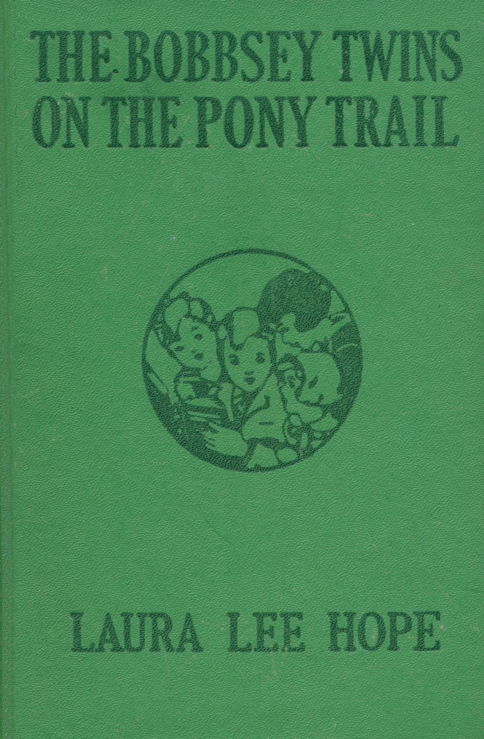
Title: The Bobbsey Twins on the Pony Trail (Bobbsey Twins #37)
Date of first publication: 1944
Author: Stratemeyer Syndicate (pseudonym: Hope, Laura Lee)
Date first posted: February 26, 2026
Date last updated: February 26, 2026
Faded Page eBook #20260249
This eBook was produced by: Al Haines, Pat McCoy & the online Distributed Proofreaders Canada team at https://www.pgdpcanada.net
The Bobbsey Twins
On The Pony Trail
By
LAURA LEE HOPE
Author of
THE BOBBSEY TWINS SERIES
Illustrated by
MARIE SCHUBERT
GROSSET & DUNLAP
Publishers New York
Printed in the United States of America
Copyright, 1944, by
Grosset & Dunlap, Inc.
All Rights Reserved
――――――
The Bobbsey Twins on the Pony Trail
CONTENTS
| CHAPTER | PAGE | |
| I. | The Gypsy Camp | 1 |
| II. | Mama Bushka | 8 |
| III. | The Wanderers | 17 |
| IV. | The Lost Child | 25 |
| V. | Doctor Danny | 34 |
| VI. | The Runaway Tractor | 41 |
| VII. | Cling! Clang! | 53 |
| VIII. | Bluebell Forks | 63 |
| IX. | Freddie’s Invention | 73 |
| X. | The Mysterious Necklace | 80 |
| XI. | Two Invitations | 86 |
| XII. | Pilot Bert | 94 |
| XIII. | Flossie in Trouble | 103 |
| XIV. | The Baby Deer | 110 |
| XV. | Happy Hal | 118 |
| XVI. | “Riding Fence” | 127 |
| XVII. | Romany Twins | 135 |
| XVIII. | On the Trail | 143 |
| XIX. | Snow in Summer | 150 |
| XX. | The Hailstorm | 159 |
| XXI. | The Badger | 167 |
| XXII. | The “Witch Man” | 177 |
| XXIII. | A Friendly Deed | 187 |
| XXIV. | Gone! | 196 |
| XXV. | Guessing the Secret | 206 |
“Come on, everybody! The gypsies are in town!”
Bert Bobbsey banged open the front screen door of his home and rushed into the hall. His twin sister Nan ran down the stairs from the second floor to join him.
“Gypsies!” she cried, her eyes sparkling. “Where are they?”
“I just saw them on the next street. Wagon-loads of them. And lots of ponies and dogs, too!”
As the two children hurried outside, their little brother and sister came running toward them from the garden. Flossie, playing with her dolls, and Freddie, at work on something in the garage, had heard Bert calling.
“I want to go!” yelled Freddie.
“So do I!” said Flossie.
“Then hurry up!” Bert cried, dashing off.
The smaller children, twins also, could not run as fast as he could. Soon they were far behind. But Nan waited for them, because by this time a crowd had gathered, and she was afraid the small boy and girl might get lost.
In a moment the Bobbseys could see the long string of covered wagons. Smiling, dark-haired men were driving the teams that pulled them. The horses were beautiful animals, some brown, some black and white.
“Look at the dogs!” cried Freddie. “They’ll get run over!”
But the gypsies’ dogs were too wise for that. They seemed to be playing a sort of game, weaving in and out among the wheels of the wagons. Every few minutes the dogs would run toward the horses and bark.
“They’re telling the horses to go faster, I guess,” said Flossie.
By this time the last wagon was passing the Bobbsey children. They noticed that several ponies, tied one behind the other, were trotting along at the end of the caravan.
Suddenly a boy in the crowd threw a stone at one of the animals. The pony reared up on its hind legs. At once all the others became frightened. They pulled this way and that, backing into the crowd on the sidewalk.
“Look out!” cried Bert, who had joined Nan and the younger twins.
He grabbed Freddie and Flossie by their hands and dashed up to the porch of a house. Nan followed. In a few minutes the gypsy men had the ponies under control. Fortunately no one had been hurt.
“I’ll bet Danny Rugg threw that stone,” declared Bert.
He was looking down the street over the heads of the people. A man was shaking his finger at a boy slightly bigger than Bert. The boy was Danny Rugg. Pretty soon the man pointed, as if telling the lad to go home. Then Danny ran off.
“He’s a mean boy,” said Freddie, who had not forgotten how the older lad had got him in trouble not so very long before this.
The caravan was moving off now. Some of the watchers, mostly children, followed. They thought that the gypsies would stop driving soon, for it was late afternoon, and surely they would not travel at night. Maybe they would camp right here in Lakeport!
“Don’t the gypsies have mothers and girls with them?” Flossie asked Nan, as they hurried along the sidewalk beside the covered wagons.
“Yes,” replied her sister. “I guess they ride inside and don’t show themselves. But I saw a girl peeking from the canvas of the first wagon a little while ago. She was very pretty.”
“If the gypsies stop, let’s talk to her,” suggested Flossie.
At the edge of town, the driver of the first wagon suddenly turned into a field. The others followed one by one.
“They’re going to stop!” cried Freddie. “Hurrah! They’re going to live in Lakeport!”
The little boy was so excited that he began jumping about. Without meaning to, he jumped right onto Flossie’s toes and she squealed in pain.
“I’m awful sorry,” her twin said quickly, “but let’s hurry. I want to see the gypsies unload their things.”
By the time the four Bobbseys reached the spot, the men had unhitched the horses. Now they were leading them to a brook which ran through a woods at the end of the field.
Several women, as well as children, had climbed down from the wagons. Nan looked about for the pretty girl she had seen a few minutes before. At last she saw her standing by herself a little distance away from the rest of the gypsies.
“She looks sad,” Nan thought, crossing the field with Flossie to reach the girl.
Her dress was very attractive, but quite different from Nan’s. It was red, and had a full skirt with flowers embroidered on it. Around her shoulders was tied a bright yellow scarf. Nan smiled at her and then asked:
“Have you come far?”
The gypsy girl smiled back, showing her beautiful white teeth. She tossed her shiny black curls and looked down shyly at the ground before speaking.
“Yes,” she said at last. “Hundreds of miles. From the Rocky Mountains.”
“Is that far?” asked Flossie.
“Yes indeed,” said Nan. Turning to the other girl, she added, “You must have been traveling for weeks and weeks.”
“We have,” said the gypsy girl.
“Are you going to live here?” asked Flossie.
“I do not know. We shall stay some place where I can start school.”
“Haven’t you ever been to school?” asked Flossie in amazement. The girl was as big as Nan, and Nan had been in school several years.
The little gypsy hung her head. “No,” she replied. “But now I shall go.”
The Bobbseys learned that her name was Tekla, and that her father was the leader of the caravan. She told them that there were gypsies all over the world who planned to have a great get-together in Europe some day. Several of the men from this American group, including Tekla’s father, were going across the ocean to meet the others.
“All the gypsies in the world can understand one another,” Tekla said. “We have our own language. It’s called Romany.”
Flossie thought this was wonderful. “Are you all the ’Merican gypsies that are left?” she asked.
“No indeed,” Tekla smiled. “The American gypsies live in different parts of the country. Some of my uncles and aunts and cousins are still in the Rocky Mountains.”
“Didn’t your cousins care to go to school?” the small girl wanted to know.
Nan laughed. “Tekla will think you’re a little question-box, Flossie, if you ask her anything more.”
“I am glad to talk to you,” said the gypsy girl quickly. “People have not been very kind to us on our journey.”
“That’s too bad,” sighed Nan. “And as soon as you reached Lakeport, someone threw a stone at your ponies.”
Bert and Freddie came up just then. They asked about the ponies, and were interested to hear that these were not the ordinary kind, but trained polo ponies. Bert had to explain to his little brother and sister that polo was an exciting game, which one played on horseback.
“The ponies have to know how to play as well as the men,” Tekla added. “These were trained on a ranch and we brought them along to sell.”
She now surprised the twins by telling them that the reason the other gypsies had not come East was because they had to stay in the Rocky Mountains to guard a secret.
“What kind of a secret?” asked Freddie.
“I cannot tell you about it,” Tekla replied. “No one but the gypsies knows it.”
She changed the subject by asking the Bobbseys if they would like to look around the camp and meet some of her people. Already tents were being put up, and cooking utensils had been brought out. Tekla introduced the twins to a nice boy named Igor, who was carrying water from the brook.
“Do you have a fortune-teller?” asked Nan, who had read about gypsy fortune-tellers.
“Yes, we do. Would you like to meet her?”
Tekla led the way to a small tent where a stout, curly-haired woman sat shelling beans. The girl spoke to her in a language the Bobbseys could not understand. They supposed it was Romany.
“You are twins, yes, two pair of you?” the woman smiled. “That is very good. Yes, very lucky.”
She picked up a hand of each of the children in turn and gazed at it for several seconds.
“You have a most interesting adventure ahead of you,” she began. “I see—”
What the fortune-teller might have said was drowned out by the sudden, sharp sounds of a dogfight just in front of the tent. Amid the deep snarls outside could be heard the short barks and yaps of a small dog. The twins looked at one another in horror, the same thought in each of their minds. Bert rushed outside, followed by the others.
“Waggo! Waggo!” he cried.
There was the Bobbsey fox terrier being attacked by two of the large gypsy hounds. The little dog stood no chance at all in the uneven fight!
“Oh, save Waggo!” screamed Flossie.
Freddie started to rush into the fight to do this, but Nan held him back.
“You’re too little,” she warned her young brother.
The girl was afraid even Bert was not big enough to stop the dogfight, but her twin already was trying to get hold of Waggo. Igor, who was carrying water, threw a whole pailful of it on the hounds. This stopped them for a moment. Bert tried to grab his pet, but before he could do so, the gypsy dogs had started up again.
“They’ll kill Waggo!” wailed Flossie, as she saw some blood on his head. Then she buried her face against Nan and began to cry.
The fortune-teller, who had not paid much attention to the fight, heard what the little girl said. The woman ran from her tent with a whip, which she cracked in the air. Then she cried out some words in the Romany language.
Instantly the gypsy hounds stood still. Again the woman cracked the whip and spoke to them. Tails between their legs, they slunk away.
For a moment Waggo could not figure out what had happened. He yelped in pain. Nan picked him up in her arms and he looked at her gratefully.
“You shouldn’t have followed us, Waggo,” she scolded him.
“The dogs who live here didn’t like it,” said Flossie.
The Bobbsey Twins decided that they had better not wait to have their fortunes told, but come back the next day. Right now Waggo must be taken home and have his wounds dressed, so the children left at once.
When they reached their house, dear old Dinah, the Negro cook, met them at the door. She threw up her hands in dismay.
“Honey chillun!” she exclaimed. “Whatever done happen to dat Waggo dog?”
Bert had carried the little animal all the way home. Now he set him down on the kitchen floor. Nan decided to be his nurse, and hurried off to get some antiseptic with which to wash his wounds.
But before she could return, another kind of nurse had taken charge. The Bobbseys had an old dog named Snap. Snap did not run around and get into mischief the way Waggo did. Now he came slowly from beneath the kitchen table where he had been lying, sniffed at the younger animal, and led him under the table. At once Waggo lay down and the old dog began to lick him.
“Dat’s de best treatment fo’ him,” declared Dinah. When Nan appeared with a bottle and some cotton, the cook said she thought Snap could take care of things very well.
The children loved the two dogs and also their cat Snoop, whom they had had for some time. He was a beautiful black cat, and had shared many of their adventures, as had the dogs.
Although the twins were not very old, many exciting things had happened to them. Their father, Mr. Richard Bobbsey, was a lumber merchant. Sometimes he took them with him to look at special trees which would be cut down and sawed into boards for him to sell. Once in a while the twins went away with their mother. Only recently they had gone with her to Echo Valley, where they had spent a vacation full of mystery.
Dinah’s husband Sam also lived with the Bobbsey family. He helped with the garden work and assisted Mr. Bobbsey in the lumber yard. At this very minute Sam came into the kitchen. He was told all about the gypsies, and how Waggo had been in a fight with two of their dogs.
“There’s a fortune-teller at the gypsy camp,” said Flossie. “Maybe she can tell you what is going to happen to you.”
Sam grinned. “Ah reckon what’s goin’ to happen to me is goin’ to happen anyway,” he said. “Mostly dey tells yo’ who yo’s goin’ to marry, and Ah done found dat out a long time ago!”
The twins laughed and hurried from the kitchen to get ready for dinner. In a short time the whole Bobbsey family was seated at the table for one of Dinah’s delicious meals. Bert and Nan told their parents what Tekla had said about the gypsies who had stayed in the Rocky Mountains.
“She said they are guarding a secret,” Nan explained. “What do you suppose it is, Daddy?”
Her father said he could not guess. It was possible they had gold or silver buried there. Yet this hardly seemed likely, he added, since nowadays gypsies who have money usually travel in automobiles.
“And you say the group which came to Lakeport today had horses and wagons?” questioned the twins’ father.
“Maybe they would rather travel that way,” said Mrs. Bobbsey. “Gypsies love the great out-of-doors, and are never in a hurry. They could not have brought the polo ponies if they had had automobiles.”
“That’s true,” said Mr. Bobbsey. “Well, whatever their secret is, I guess it will remain a secret with them.”
First thing the next morning the twins wanted to go over to the gypsy camp. But Mrs. Bobbsey insisted that the children wait until afternoon, as the gypsies no doubt had much to do, and would not want any visitors.
“The fortune-telling will have to wait,” she said.
To fill in the time, Freddie went out to the garage to work on his invention. For several days the little boy had been very busy trying to make something with which to surprise his family. He had not told a single person what the invention was, and whenever anyone came near the garage, he pretended to be working at something else.
Now no one was around. Freddie brought his small express wagon from a corner of the garage. Then he got four strips of wood which had once been in the bottom of some window shades. Holding one of these against a front corner of the wagon, he began to nail it fast.
Next Freddie nailed one of the strips to the back corner of the wagon on the same side. As soon as he had done this, the lad opened a closet door and took out a large kite. He was just about to unroll this, when Flossie came running into the garage. Freddie put the kite back into the closet and slammed the door shut.
“What are you doing, Freddie?” Flossie asked. Seeing the pieces of wood nailed to the express wagon, she giggled and said, “That looks funny.”
“That’s because it isn’t finished,” said Freddie. “Some day I’ll show it to you and then you’ll see I’m a good inventor.”
Flossie did not know what an inventor was, but she smiled. Ever since she could remember, Freddie was always deciding to be something. For a while he wanted to be a fireman. Then he was going to be a farmer. Not long ago he had announced that he was a detective. And today he was saying he was going to be an inventor.
“I can’t tell you what I’m inventing,” he said. “But some day you can take a little ride with me in my invention.”
Flossie thought she would tease her twin, so she laid her doll down in the wagon and went over to the closet. When she tried to open the door, she found it locked. The little girl pretended her feelings were hurt. What was the use of being his twin if she could not know his secrets? Then she marched out of the garage, forgetting all about her doll.
Unfortunately Freddie had not seen his sister put her lovely doll in the wagon. Deciding that he would not work on his invention any more that day, he began to pick up his tools. He tossed the hammer into the wagon.
Crash!
Freddie stood still. What had happened? Fearfully he walked over and looked. As he stood gazing at the wrecked doll, Flossie returned.
“I didn’t know it was there! I’m sorry,” he said contritely.
Flossie looked at the remains of her darling Barbara and burst into tears.
“My baby, my baby!” she cried.
Freddie acted manly about the whole thing and comforted his sister, knowing how much she thought of the doll. He should have been more careful with the hammer. He wondered if he would be punished.
“I’ll buy you another doll,” he promised Flossie.
“You haven’t any money,” wailed his sister.
Sadly she walked toward the house. Freddie followed her and went directly to his mother to tell her what had happened.
“Of course, you should have been careful,” Mrs. Bobbsey said, after she had heard his story, “but perhaps Barbara can be mended.”
Together she and Freddie went to the garage, but they found that the doll’s head was smashed beyond repair. The doll had not been harmed in any other way, however, and Mrs. Bobbsey said she would see to it that Barbara would have a new head before long. She suggested to Freddie that he help cut the grass and pull weeds out of the garden to pay for it. The little boy, contrite, got to work with a will.
So this was how it happened that Bert and Nan went off to the gypsy camp without the small twins. Freddie was still busy weeding, and Flossie had gone downtown with her mother to buy a new head for Barbara.
Later on, Freddie and Flossie asked Dinah if she would take them over to the field where Tekla and the fortune-teller and the other gypsies were staying. The good-natured cook was glad to go. She had not told the twins, but she thought it would be fun to have her own fortune told.
There was a great deal going on in the gypsy camp. Some of the women were washing clothes, while others were scouring big copper kettles. The men were cleaning the horses’ harnesses. The boys were scrubbing the wagons.
“They’re getting everything nice and shiny,” said Flossie, as the twins led Dinah from place to place.
Finally they arrived at the tent Tekla’s family used. Bert and Nan met them there. The gypsy girl came out to greet her new friends.
“I like Lakeport,” she said. “I should love to go to school here. I hope we can stay.”
“I hope you can too,” said Nan pleasantly. Then she asked if it would be all right for Dinah and the children to have their fortunes told.
“Yes indeed,” replied the gypsy girl. “Mama Bushka is always glad to help people.”
“We don’t need help,” said Bert. “We just thought it would be fun.”
Tekla looked a little hurt, and Nan knew that the gypsy girl did not understand what Bert meant. Quickly Nan said that Bert felt no one could really tell about the future. Probably this was a good thing, because no one would want to know when something bad was going to happen.
Tekla smiled. “Mama Bushka knows what is going to happen,” she insisted, “but she never tells anything bad. Come, I will take you to her.”
The twins insisted that Dinah’s fortune be told first, and they giggled merrily at what was said. Mama Bushka told the old Negro cook that she was married to a handsome man who was very good to her. He liked her cooking and never wanted to eat any place except at home.
“But you are getting too heavy yourself, Dinah, because you like your own cooking too much,” said the gypsy. “If you do not diet, you will be a very stout old lady.”
Mama Bushka also said that the cook was going to receive a very nice present soon. It would be something she had been wanting for a long time.
“I believe it is a piece of jewelry.”
Flossie and Freddie came next. The fortune-teller advised the little boy not to be in such a hurry always, because this often got him into trouble.
“When you grow up, I believe you will run an airplane,” she said. “Yes, some day you will be a fine pilot.”
Freddie was thrilled to hear this, and decided in his own mind that maybe he would be a pilot long before anybody thought he would. Flossie giggled when Mama Bushka told her that she thought Santa Claus was going to bring twin dolls to the little girl for Christmas.
“I hope you won’t have as much trouble taking care of them as your mother has had with you and Freddie,” said the fortune-teller.
Bert was not sure that he wanted his fortune told. He had an idea this was a pastime for women and girls. As he started to move away, the gypsy woman caught him by the hand.
“You want to be grown-up before it is time,” she startled him by saying. “Never try that, my lad. Always be your age, and you will have a lot more fun in life. But it seems to me,” she said, looking at his hand and winking at Nan, “that there is a girl in Lakeport who is very fond of you. It seems to me her name begins with the letter G.”
Bert turned very red and left the tent. One of Nan’s best friends was named Grace!
Nan held out her hand to the fortune-teller, and was very surprised and delighted to hear what Mama Bushka had to say to her.
“Nan, you are going on a long, long trip, and very soon, too!”
Nan Bobbsey smiled at the gypsy fortune-teller. “Am I going on a long trip alone?” she asked.
“No,” the woman replied. “I believe that all your family will go. You will have a wonderful time.”
“Where is the place?” Nan asked her.
“I do not know, but it is far away, and you”—she paused—“I seem to see that you will help someone in trouble.”
“I’d love to do that,” said Nan.
“This will be a very special kind of help,” said Mama Bushka, “and it will not be easy for you to do.”
Nan wished that the woman would tell her more about it. She began to wonder how soon she and her sister and brothers might go on a trip. Where would it take them? And who was the person who was going to be in trouble? Was it one of her own family, or someone else?
The girl walked out of the fortune-teller’s tent with Tekla, who had waited for her. The other Bobbsey children were not in sight. Dinah, too, had disappeared.
“Where has everybody gone?” asked Nan.
“To watch the ponies,” replied Tekla. “They have to be exercised so they won’t forget how to play polo.”
The girls hurried past the tents and over to the next field. A group of people had gathered to watch the ponies perform. Two of the gypsy men were on horseback. In their hands they held long wooden mallets. On the ground was a white ball.
While the crowd cheered, the men raced the ponies around the field. Every time they reached the ball, each of them would try to hit it with his mallet. Once Freddie got so excited he ran out onto the field. Bert yanked him back in a hurry so that he would not be trampled on.
“I want to be a polo player when I grow up,” the little boy yelled, not realizing the danger he had been in.
“I thought you wanted to be an inventor,” said Flossie, who thought this game was too hard for Freddie to play. And she was sorry for the ponies, which were breathing heavily and were so hot they glistened with perspiration.
“Gee, it must be swell fun to play polo,” said Bert enthusiastically. “I’d certainly like to try it.”
“I will ask Michael to let you ride his pony,” offered Tekla.
When the men brought the animals back toward the fence, the gypsy girl spoke to one of them. Then she nodded to Bert to come forward.
“Michael says you may get on the pony and try to hit the ball,” she said.
Smiling, the man helped Bert climb onto the animal’s back. Then he handed the mallet to the boy.
“See if you can reach it,” Michael said, laughing. He pointed to the ball lying on the grass near the pony’s front legs.
Bert leaned sideways. It was a long reach. In trying to knock the ball with the mallet, he forget to hold on, and plop! off he went. Michael caught him before he touched the ground.
“That’s not as easy as it looks,” Bert laughed. “Let me try again.”
The gypsy man helped the boy up on the pony once more. Again the same thing happened, but on the third try, Bert managed to strike the ball. As he climbed down, he remarked:
“I guess I’d need a lot of practice to hit the ball while the horse is running!”
Freddie had wanted to get on the polo pony, but after Bert had fallen off, the little boy decided he did not care to try it. As Bert walked off with Michael to help him rub down the ponies, the man asked him if he would like to take riding lessons.
“Yes, indeed,” replied the Bobbsey boy. “I can ride a little, but I’d like to be a very good rider.”
“Shall I teach you while we’re staying in Lakeport?” Michael asked him.
Bert’s eyes opened very wide. “Would you?” he cried. “That would be swell.”
It was arranged that the boy was to come to the camp for lessons. He would take the first one the next day.
In the meantime Nan had gone off with Tekla. When she mentioned going home, the Romany girl asked if she and Bert would stay to dinner.
“Maybe you will not like what we have to eat, but we think it is very good,” Tekla said. “I want you to meet my father and mother,” the girl added.
“I’d love to stay,” said Nan, smiling, “and I’m sure Bert would too. I’ll go and ask him.”
Her twin was eager to accept the invitation, so Nan went to tell Dinah.
“All right, honey chile,” said the Bobbsey cook, “but come right home after supper before it gets dark.”
Nan went directly to the tent where Tekla’s family was living. Bert joined her in a minute, and they were introduced to the leader of the gypsies and his wife. Tekla’s mother, Mrs. Androy, was a lovely woman, and Mr. Androy was a tall, handsome man. He looked very strong, too, and the Bobbseys supposed that he was so healthy because he lived out-of-doors most of the time.
The food for all the gypsies was prepared in one place, but each family ate in their own tent. In a few moments Tekla appeared with a large bowl of stew. This she set on a stool in the center of the tent.
Her mother and father seated themselves on the ground on blankets, and invited Bert and Nan to join them. From a little table Tekla brought out some small bowls and spoons. She filled the bowls with the steaming stew, and handed them to her parents and the visitors. Then she left the tent, but soon returned with a large loaf of bread which she handed to her father. He cut off chunks of it with a sharp knife, and his daughter passed these around.
When Nan saw Mr. and Mrs. Androy dip the bread into the stew, the girl glanced sideways at her brother. She knew he was going to enjoy this meal! Bert always wanted to “dunk” his biscuits and crackers, but Mrs. Bobbsey had never permitted him to do this.
The stew was delicious. The Bobbseys thought they had never eaten anything better, and that was saying a lot, because they were quite sure no one could cook as well as Dinah.
“Tekla says you’re going to Europe some day,” said Nan to Mr. Androy. “Have you ever been there?”
“Yes,” replied Tekla’s father. “I went there with my father once when I was a small boy. We gypsies think that perhaps all of us should get together and not live scattered all over the world as we do now. So we are going to talk this over.”
“Do you think you might all come to America to live?” asked Bert.
“No, I do not believe so,” replied Mr. Androy. “There are more gypsies in Europe than here, and probably we shall join them.”
Nan wondered about the people who had been left in the Rocky Mountains to guard the gypsies’ secret. She wanted to ask whether they would leave it and go to Europe, but she decided that it would not be very polite to ask, so she kept still.
Mr. Androy told the children several interesting stories of the life of his people. The first gypsies, he said, had come from India hundreds of years ago. He was just telling how a group had landed in America, when they suddenly heard loud voices outside.
“Get back, all of you!” came a harsh command. “Where’s this fellow you say is the leader of you gypsies?”
Mr. Androy jumped up and went outside the tent. “I am Androy, leader of the gypsies,” he said. “What do you want?”
“Who told you you could stop here?” asked the harsh voice.
“We are doing no harm,” replied the gypsy leader.
Nan and Bert slipped outside the tent. To their amazement, they saw three policemen.
“You had no right to stop in Lakeport,” said one of them to Mr. Androy. “I am here to tell you to get out as fast as you can!”
“But we are harming no one,” said Tekla’s father. “Our children want to go to school. We thought perhaps—”
“You will not stay in Lakeport!” stormed the policeman. “You are lucky not to be in jail! If there weren’t so many of you, we would put you in jail.”
“We have done nothing wrong!” cried Androy, his eyes flashing. “Only people who are not honest go to jail.”
“You have been accused of stealing!” said the policeman.
“Stealing!” shouted Androy. “Not one of us has stolen anything. We are poor, but we are honest people. You can search our tents and our wagons.”
“That is exactly what we intend to do,” said the policeman. “Get busy, boys,” he called to the other two men in uniform.
Quickly the three officers went from place to place, insisting that the gypsies pull out everything from their trunks and boxes. At last the men came back to Androy.
“We didn’t find the necklace,” said the policeman who had done all the talking.
“Necklace!” said the leader of the gypsies. “Who said we took a necklace?”
“A woman who lives in Lakeport was wearing one while she was watching your caravan go up the street yesterday. After you had gone, the valuable necklace was missing, and she is sure you stole it.”
“She’s wrong!” cried Androy. “We did not take it!”
“Maybe you didn’t!” said the officer. “Maybe the woman lost it. But anyway, she owns this field, and she doesn’t want you on it, so you’ll have to get right off.”
“Tonight?” asked Androy.
“Well, tomorrow morning will do,” replied the policeman. “But bright and early, mind you. And don’t delay on the road. I’m warning you. Nobody wants gypsies, so keep going. Don’t stop anywhere!”
Nan and Bert looked at each other in horror. Where were the poor gypsies to go? With tears in her eyes, Tekla turned away and went into the tent. The Bobbsey Twins walked off by themselves.
“Perhaps we’d better leave,” said Bert.
His sister was quiet for several seconds. Then she said:
“We must help them, Bert. And I think I know how we can.”
She whispered something quietly to her brother. His eyes sparkled at the girl’s idea.
“Let’s go home and ask Daddy and Mother about it right away!” he urged.
When Nan and Bert reached home, they found Mr. and Mrs. Bobbsey in the living room reading the evening newspaper. From the way the children burst into the room, out of breath, their parents knew that something exciting was in the air.
“What has happened?” cried their mother.
Both twins talked at once, and it was several minutes before Mr. and Mrs. Bobbsey could understand what they were trying to say.
“You say the gypsies have been ordered to leave tomorrow morning?” asked the children’s father. “That’s too bad, if they’re doing no harm.”
“Sometimes people are very unreasonable,” said Mrs. Bobbsey. “No doubt the woman who lost her necklace was so excited she accused the first person she thought of.”
“I want to help the gypsies!” cried Nan eagerly. “Do you suppose they could stay on Uncle Daniel’s farm?”
“What do you mean, dear?” asked Mrs. Bobbsey.
“The policeman said that nobody wants the gypsies, and they mustn’t stop anywhere,” explained Nan. “We know they are nice people. Tekla is a lovely girl. Maybe Uncle Daniel would let them stay on his farm until Mr. Androy can find another place.”
Mr. and Mrs. Bobbsey smiled at Nan. She was always so thoughtful. Her parents wondered if anyone else would have figured out such a good way to solve the gypsies’ problem.
“Your idea is a very good one,” said Mr. Bobbsey. “I’m sure Uncle Daniel will be glad to let the gypsies stay at his place. I know he needs extra help. Perhaps the men will assist him with the farm work.”
“Then you think it will be all right?” cried Nan, delighted.
“I’ll phone to Daniel at once,” said Mr. Bobbsey. He went immediately to the telephone and called his brother at Meadow Brook Farm. The twins waited eagerly until the connection was made.
Aunt Sarah answered, and was a little surprised to receive the call. She asked at once if everything was all right.
“Yes, we’re fine,” replied Mr. Bobbsey. “Our Nan has proposed something rather unusual. If you’ll put Daniel on the wire, I’ll talk to him about it.”
Uncle Daniel had such a hearty, booming voice that the children could hear every word he uttered. After a few minutes he said:
“Of course, let the gypsies come. I’ll be glad to have them. And how about you folks coming, too, to pay us a little visit?”
“We’ll have to think that over,” said the twins’ father. “But it’s mighty nice of you to take the gypsies. We’ll run out to their camp tonight and tell them.”
Since it was Nan who had thought of helping the gypsies, it was decided that she should tell them of Mr. Daniel Bobbsey’s offer. Her father and Bert went with her to their camp.
By this time it was dark. Mr. Bobbsey carried a flashlight to guide them among the tents. At last they reached the one where the Androys lived. Tekla greeted Nan at the canvas doorway. She looked very sad indeed. Nan was sure she had been crying.
“I’ve good news for you,” said the Bobbsey girl, smiling. “May I come in? This is my father,” she added.
The three Bobbseys went inside the tent and the twins’ parent was introduced to Mr. and Mrs. Androy. When they were told that they could move their camp to Meadow Brook, the gypsy leader grasped Mr. Bobbsey’s hand in gratitude. He was too overcome to speak.
Tekla in turn threw her arms around Nan. “You’re wonderful to do this for us,” the girl cried. “Oh, why don’t all people like us? We are good. We are honest. And we try to be kind.”
“Sometimes people get excited and don’t know what they’re saying,” said Nan. “That’s probably why the lady who lost the necklace asked you to leave. But you’ll love it at my uncle’s farm.”
“How can we find the place?” asked Mr. Androy. “We do not know the roads, and if we get lost, maybe the police will stop us again.”
Mr. Bobbsey had been sizing up the gypsies very carefully. A thought had come to him, but he did not mention it at the moment. He felt that he should talk over his plan with Mrs. Bobbsey before saying anything to Mr. Androy.
“I’ll give you complete directions early tomorrow morning,” he said. “Maybe I can send someone to guide you.”
Bert and Nan thought that their father intended to have a man from his lumber yard ride with the gypsies to show them the way. Therefore, it came as a great surprise when he said to them just as they were going to bed:
“How would you two like to ride with the gypsies tomorrow morning and guide them to Uncle Daniel’s farm?”
“You mean—Oh, Daddy!” cried Nan.
She and Bert were so excited they felt sure they would not sleep a wink. But being tired, healthy children, they soon dozed off and did not awaken until Mrs. Bobbsey called them. They were up in a jiffy and never dressed faster in their lives. Mrs. Bobbsey packed an overnight bag for them, while Dinah hurriedly prepared their breakfast.
By seven o’clock they had arrived with their father at the gypsy camp. Mr. Bobbsey had gone out a second time the night before to tell Mr. Androy his idea. The leader of the caravan was very glad to have the twins go with them. Tekla greeted Nan with a cry of joy, and said that Nan’s company on the ride would be the nicest thing that had happened to her in a long while.
“Well, good-bye, children,” said Mr. Bobbsey to his twins. “Have a good time, and follow the directions on this map.”
He handed Bert an automobile road map which had a blue penciled line marked on it.
“When are you coming to Uncle Daniel’s to pick us up?” Nan asked her father.
It already had been decided that Mr. and Mrs. Bobbsey, and possibly the younger twins, would drive to Meadow Brook Farm and take Bert and Nan back to Lakeport. He said they expected to leave late that afternoon. After her father had gone, Nan whispered to her brother that she hoped they could stay a long while at Uncle Daniel’s.
“Wouldn’t it be fun to be near the gypsies?” she said.
Bert nodded. “I could take riding lessons, and maybe even learn to play polo a little.”
The gypsies were not quite ready to leave. Bert and Nan tried to help them, but found that they could do little. Wandering off by themselves so as not to be in the way, they spied Danny Rugg standing off at a little distance.
“Think you’re smart, don’t you?” said the unpleasant boy.
“What do you mean?” asked Bert.
“Oh, I heard you’re going with the gypsies. You wouldn’t catch me doing such a thing. They’re dirty, messy people, and besides, gypsies steal things.”
“Danny Rugg!” exclaimed Nan. “You’re horrid to say that! Just because the gypsies like to live in tents instead of in houses doesn’t mean they aren’t clean. And they’re honest, too!”
“What do you know about them?” asked Danny. “They might—they might do awful things to you after you get away from Lakeport.”
Bert’s eyes flashed. “You’ve no right to talk that way!” he said. “You’re just trying to scare us, but you can’t do it.”
“I’m not either!” replied the other boy. “I’ve heard things about gypsies, and I wouldn’t travel with them for a million dollars.”
In a little while the caravan was ready to move. Tekla’s father asked Bert to ride on the front seat with him in the first covered wagon. Nan climbed inside with the gypsy girl and her mother. She was surprised to find that the wagon was very attractive and comfortable. On the canvas walls hung embroidered pictures. There were many pretty rugs and pillows for the travelers to use any time they might feel tired.
As the wagon turned from the field onto the road and the horses stepped more lively, Bert caught a glimpse of Danny Rugg out of the corner of his eye. In spite of what the mean boy had said, Bert was sure he looked envious. And Bert was right. Danny wanted very much to go too.
The Bobbsey Twins were amazed at how long the horses could trot briskly without getting tired. By eleven o’clock they had covered a lot of ground. This was a good thing, because they were delayed several hours later on.
At noontime the caravan pulled in to a side road under some trees. The horses were unhitched and given oats. After the gypsies ate their midday meal, they lay down on the grass to get some sleep before continuing their journey.
Suddenly the stillness was broken by a scream from one of the women. Instantly everyone was awake, trying to hear what she was saying. Bert and Nan could not understand her, for she was speaking in Romany, so Tekla told them what she said.
“Her little girl has disappeared!”
The woman was so excited she could hardly tell what had happened. But at last Bert and Nan learned that the mother had taken a walk while her small daughter was asleep. When she had returned, the child was nowhere in sight.
Not far away was a small river. Everyone was worried, thinking that the little girl might have gone there to play and tumbled in.
“Have you looked everywhere?” Tekla asked the woman.
“Yes, yes. My baby is gone!”
A search for the missing child began in earnest. At Nan’s suggestion she, Bert, and Tekla left the others. The Bobbsey girl had noticed a farmhouse in the distance. In a field near it was a farmer, plowing.
“Let’s ask him if he has seen the little girl,” she said.
When the children reached the man, he gazed at Tekla’s clothes in amazement. He mumbled that he had seen nobody, but he wanted to know where Tekla had come from.
“You’re a gypsy, aren’t you?” he said. “Where are your folks?”
“Over there,” replied the girl, pointing.
“Well, you go tell them to get moving. I don’t want any gypsies on my property. I’ve had one forest fire here and I don’t want another.”
“They’re not building fires, sir,” Bert spoke up. “And anyway, they’re going to leave as soon as they find the little girl who’s lost.”
The farmer looked relieved to hear this and became pleasant at once. He even helped the children in their search, and admitted that he had seen a small figure going toward his house.
To everyone’s relief, the missing gypsy child was found talking to the farmer’s wife. She was eating a freshly-baked cookie and drinking some milk.
Tekla thanked the woman, who offered cookies and milk to all the children. They declined, saying they must get the runaway child back to her mother.
When they reached the picnic spot with the little girl, her mother hugged her tightly. Then she placed her in the family wagon, and the caravan resumed its journey.
It was about half an hour later, when Mr. Androy was driving at a good clip to make up for lost time, that the wagon came to a muddy spot in the road. As the team dashed forward, one of the horses stumbled. Mr. Androy jerked on the reins. The other animal tried to stop, but slid in the mud.
The driver pulled on the brake, but he was too late. The wagon pitched forward into a deep rut. There was a loud, creaking sound, and the front wheel on Bert’s side crashed under the wagon.
The Bobbsey boy was hurled from the seat toward the feet of the plunging horses!
“Oh, Bert!” cried Nan, jumping from the gypsies’ wagon. “Are you hurt?”
Her twin slowly picked himself up and started to brush off his clothes. “I’m all right,” he said, but his sister noticed that he was limping. “Turned my ankle, but it’ll be okay.”
As soon as Mr. Androy made sure the boy had not been badly injured, he began to figure on how they would mend the wheel of the wagon. The rest of the caravan had stopped, and now the other drivers rushed forward to see what had happened.
The Bobbseys could not understand what the men were saying, but Tekla told them that the party would be delayed until an extra wheel could be put in shape and attached to the wagon.
“At this rate, I guess Mother and Daddy will get to Uncle Daniel’s farm before we do,” said Bert. “They’ll wonder where we are.”
“Oh, weren’t they going to take this road?” Nan asked.
“No, they’ll go by way of Lumberville.”
“I hope they won’t worry about us,” said Nan, wondering just what her family was doing at that moment.
Actually, Flossie and Freddie were sitting down to a late lunch. Mr. and Mrs. Bobbsey were not at home, and Dinah had called the children in from their play. Freddie began to object to the soup, which was placed before him.
“Dat’s very good for yo’,” said the cook. “It’ll make yo’ grow big and strong.”
“Big and strong, huh?” said Freddie to Flossie after Dinah had left the room. “It won’t make me grow big fast enough. I’m tired of being little.”
“I am, too,” said Flossie. “There are so many things we can’t do. Daddy always says, ‘I’ll take you there when you’re big,’ and Mother says, ‘You can’t do that. You’re too little.’ ”
“Sure,” Freddie went on, “and even Bert and Nan think we’re too small to do things. I wish I could grow big real fast. Don’t you?”
“You mean like Alice in Wonderland?” giggled Flossie.
“I don’t care how I do it,” said Freddie, “just so long as I can grow big enough to be a real fireman, or a detective, or maybe a pilot and fly my own plane.”
At this point Dinah brought in more of their lunch, and the two young Bobbseys settled down to eating without further conversation. As soon as they had finished dessert, the children hurried outside again.
Freddie ran into the garage to work on his invention. He now had four strips of wood nailed to his express wagon, one at each corner. Before going to the closet to get out his kites, the boy tiptoed to the door of the garage to see what Flossie was doing. He did not want her to find out yet what his secret was.
She was busy hanging doll clothes on the wash line. Freddie remembered having heard her say that she was going to wash Barbara’s clothes and take the doll with her to Uncle Daniel’s. The little boy, sure that she was too busy to bother with him, went to the closet.
“I’ll just take out one kite and—”
At this instant he heard Flossie scream. Quickly he ran outside to see what had happened. There stood Danny Rugg. Dinah stepped from the kitchen and called out:
“What happened, honey chile?”
“Danny pulled my hair!” cried Flossie.
“You go ’long, bad boy, and leave our chillun alone,” the cook ordered.
But Danny Rugg was not ready to leave. He came toward Freddie in the garage. The little boy was afraid the older boy might harm his invention, so quickly he hurried inside the garage and yanked his wagon behind the automobile where it could not be seen.
“What you doing?” asked Danny.
“Oh, nothing,” said Freddie.
“I guess that’s right. You’re too little to do much of anything,” sneered Danny.
Freddie’s face grew red. Before he had a chance to say anything, Flossie came into the garage. Danny, a good bit taller than the small twins, looked down at them, a grin on his face.
“You kids got left behind, didn’t you?” he asked.
“We’re going later,” said Freddie staunchly.
“That’s what you think,” retorted Danny. “But you’re too little. Say, how’d you like to grow real fast?”
Freddie’s and Flossie’s eyes nearly popped from their heads. Just what they had been talking about at the lunch table!
“You can’t grow fast,” said Flossie.
“You can, too,” replied Danny.
From his pocket he pulled a small box. Sliding the inside of it out of the cover, he showed them a number of white tablets. Then he explained that anyone taking them would grow very fast.
“They’re called ‘Alice in Wonderland Tablets,’ ” he told the little twins.
Freddie and Flossie were not sure they had heard correctly. They knew that in the story Alice had drunk from a magic bottle and had grown tall very suddenly. Was it possible that this same magic was in the tablets?
“I’ll give these to you,” offered Danny. “If you really want to grow big, now is your chance. Then maybe you won’t be such sissies.”
He put the box of tablets into Freddie’s hand and hurried out of the garage. As he walked down the street, he smiled to himself.
“I bet those kids will take the tablets all right, and then I can see if they really make you grow up fast. If they do, you can bet I’ll take a whole lot of them.” He laughed gleefully. “I’ll grow so big that I won’t have to go to school any more!”
If Danny had not called the small twins sissies, it is doubtful that they ever would have thought of taking any of the tablets. Now they both were angry.
“I won’t be a sissy!” cried Freddie.
“Do you s’pose the tablets really will make us grow fast?” asked Flossie.
“It won’t hurt to try ’em,” declared Freddie.
“Maybe we shouldn’t,” said Flossie. “Let’s ask Dinah what it says on the box.”
The two children hurried into the kitchen. Dinah was not there. Sam, however, was walking down the driveway, so they waited until he entered the house. Then Freddie asked him to read what was on the box.
“It says,” began Sam, “dat dese ‘Alice in Wonderland Tablets’ produce healthy growth. A vast improvement noted after de first tablet.”
Freddie and Flossie looked at each other. What Danny had said was true!
There was no chance for the twins to take any of the tablets at the moment, for just then Dinah appeared. Seeing the box on the table, she read the words, then opened the pantry closet and put the tablets on a high shelf, never dreaming what was in the minds of the two children who were watching her.
“When will Mother and Daddy be back?” asked Flossie.
“Yo’ Mommie done telephone a while ago. She said yo’ Daddy is very busy and might not start de trip to yo’ Uncle Daniel’s till tomorrow night.”
“Night!” cried Freddie. “It will be fun to ride to the farm at night!”
Dinah frowned. “Ah’s sorry, chillun, but ef yo’ Daddy goes at night, he couldn’t take yo’ with him. Yo’ is too little.”
Sadly Freddie and Flossie left the kitchen. During the afternoon they tried to play, but their hearts were not in it. Finally at four o’clock Freddie suggested to his twin that they try some of the “Alice in Wonderland Tablets.”
“I just won’t be little any more!” the boy declared. “Daddy won’t let us go anywhere at night, and Danny said we were sissies.”
Flossie was a little fearful about trying the tablets, but she decided that if Freddie thought it was all right, she would take some too. Quietly the small twins entered the kitchen. No one was there. Freddie climbed up on a step ladder, took down the tablets, and put them into his pocket. Then the twins left the kitchen and walked quickly to the garage.
Freddie pulled the box of tablets from his pocket. He opened it, and for several seconds the two children gazed at the contents.
“I’m scared,” said Flossie. “Do you think they’re all right?”
“I’ll take one first,” said Freddie manfully. “If it doesn’t hurt me, then you take one.”
Flossie watched her twin fearfully. As he put one of the tablets into his mouth and swallowed it, she held very tightly to his hand. For a whole minute neither one of them spoke.
What was going to happen to Freddie?
Just about the time Flossie and Freddie were swallowing the “Alice in Wonderland Tablets,” the gypsies were getting ready to leave the spot where they had had the accident. A new wheel had been made and put in place on the wagon.
Little ditches, had been dug in the road to drain off the muddy water. Now the ground had dried out enough to make it safe for the gypsy caravan to travel over it. The horses could not go fast, however. Before they had covered many miles, it was dark. Mr. Androy selected a pleasant spot to stop, and the wagons turned in.
Bert helped to unhitch the horses and give them water. Nan and Tekla unpacked the bowls and spoons, and went to bring the supper.
Since the gypsies were to stay only one night, they did not put up the tents. The women and the girls would sleep in the wagons, while the boys and men would roll themselves in blankets on the ground. As Nan was dropping off to sleep, she asked Tekla what the lovely odor was she could smell.
“It’s a special kind of incense we make,” replied the gypsy girl. “The way we make it is a secret. If you would like some, I’ll give it to you in the morning.”
“Oh, thank you,” said Nan. “It’s lovely.”
When the Bobbsey girl awakened, the sun was shining brightly. Breakfast soon was ready, and then it was not long before the caravan was on the road again.
“We must drive fast and cover many miles today,” said Mr. Androy.
They traveled until late afternoon before reaching the farming country where Mr. Daniel Bobbsey’s place was located. At last Bert pointed ahead.
“Just over the next hill, Mr. Androy, is Meadow Brook Farm!” he said.
Nan, hearing this, crawled from inside the wagon and sat down between the driver and her brother. It had been some time since the twins had visited the farm, and now that they were so near they could hardly wait to reach Meadow Brook.
“There it is! There’s the house!” cried Nan.
It seemed as if the horses understood what she said, because all of a sudden they began trotting very fast.
“I shall wait on the road until your uncle tells me where to go,” said Mr. Androy. “I think it best if you and Bert go in first.”
As soon as they reached the entrance to the farm, the gypsy drew rein. Nan and Bert jumped from the wagon and hurried toward the house.
“Let’s go to the kitchen,” said Nan. “I’m sure that’s where Aunt Sarah will be.”
She was right. They found Aunt Sarah icing a huge chocolate cake. She dropped her knife, and took first Nan, then Bert, into her arms.
“It’s just wonderful to see you!” she exclaimed.
At this moment Uncle Daniel walked in with a pail of milk. He set it down, grabbed Nan, and lifted her off the floor.
“I thought you never were going to get here,” he said, smiling at his niece, then his nephew. “I figured you had forgotten all about your old Uncle Daniel. Hey, Harry, come here!” he called out the door.
A boy of Bert’s age bounded into the kitchen. He was their cousin.
“Gee, it’s sure good to see you!” he cried. “I hope you’re going to stay a long time.”
“Of course they’re going to stay a long time,” said Aunt Sarah, “and the rest of their folks are too.”
“We thought maybe Daddy and Mother would get here ahead of us,” spoke up Nan. “Have you heard from them?”
“Not a word,” said Uncle Daniel. “But I guess they’ll be coming along any minute now. Where are these gypsy folks you brought with you?”
“I’ve never seen any real gypsies,” said Harry.
“Well, you can now,” Nan told him. “These people wear the kind of clothes you see in picture books, and they speak the Romany language.”
“And do they carry big, long knives?” asked Harry. “And is one of them a dirty old woman with frowsy hair, who tells fortunes?”
Bert and Nan burst out laughing. “You’re as bad as some of the people who chased the gypsies out of Lakeport,” said Nan. “These gypsies aren’t like that at all. They’re very nice. They do have a fortune-teller, but she’s not very old, and she has pretty hair.”
“Come, now,” said Uncle Daniel, “and introduce me to your new friends. I’ll show them where they can stay.”
The Bobbsey twins led their uncle and their Cousin Harry out to the road where the caravan was waiting. They were introduced to Mr. and Mrs. Androy and Tekla. Nan and Bert could tell from the look on Uncle Daniel’s face that he liked the gypsies at once.
“It is kind of you to let us stay on your land,” said Mr. Androy. “My people are grateful. We shall remain only until we find another place.”
“We’re glad to have you at Meadow Brook Farm,” said Uncle Daniel. “And please help yourselves to the fruits and vegetables.”
“We are fortunate indeed,” said Mrs. Androy in her soft, sweet voice.
“Just the other side of our apple orchard is a meadow I think you might like,” said the twins’ uncle. “There is a woods, too, and a stream of water you can bathe in. But come to the well at the house to get drinking water.”
“I’ll carry drinking water over for you right now,” offered Harry.
“I’ll help you,” said Bert, and the two boys hurried off to do this.
After the gypsies got settled, Nan took her aunt over to call on them. She was pleased to see how comfortable they were in their tents. But both Aunt Sarah and Nan were surprised to learn that the gypsies knew nothing about farm life.
“In the morning we’ll show you around,” Nan told Tekla and the boy Igor.
After breakfast the next day, she and Bert took the gypsy children through the barns. Igor thought the stables seemed very small, and said he was sure the horses would rather be tied outside.
“Would you like to watch the men bring in the hay?” Bert asked him.
In a far field he could see Uncle Daniel and Harry pitching hay onto a wagon. They were using a tractor to pull the wagon.
“What’s that?” asked Igor, who had never seen a tractor.
“A kind of automobile,” Bert replied. “Maybe my uncle will let us drive it. He lets Harry run it.”
Thrilled by this prospect, the two boys left the girls and ran toward the hay field. They watched Harry guiding the tractor, while his father pitched hay. Then Bert asked if he might drive it.
“All right,” said Uncle Daniel. “Just push down this pedal and pull on the brake when I yell ‘stop.’ ”
Bert had no trouble with the tractor, and stopped it each time he reached a pile of hay to be loaded. In a few minutes Igor wanted to take a turn. He was sure he knew how to run the machine.
“May I drive it?” he asked Uncle Daniel.
It did not occur to the farmer that Igor knew nothing at all about automobiles or any other kind of machinery. Smiling, he suggested that Bert get down and let the gypsy boy take the wheel.
As soon as Igor seated himself on the tractor, he did exactly what he had seen Bert do. The tractor started up slowly, and Igor grinned in delight. When it reached the next pile of hay, Uncle Daniel yelled:
“Stop!”
But the tractor did not stop. Instead, little by little it gathered speed.
“Stop!” shouted Uncle Daniel.
Igor was too frightened to answer. He was pushing and pulling this gadget and that, trying to bring the machine to a halt. But still it went on. Suddenly the others realized the boy was in trouble.
“He can’t stop, and he’s heading for a tree!” cried Harry, starting to run.
“Jump!” yelled Uncle Daniel.
He and Bert also began to chase the runaway tractor. Igor clung to the seat.
“Get off!” the farmer cried.
This time Igor obeyed. He leaped from the tractor and rolled over and over on the ground.
Harry ran as fast as he could. He reached the tractor just before it got to the edge of the field where the big tree was. The boy’s one thought was to keep the machine from being wrecked. His father guessed this, but he did not want his son to take the chance of being injured.
“Let it go!” he shouted. “Let it go!”
But Harry could not hear him. The motor was making too much noise. The boy ran alongside the tractor for a few steps. Then he jumped aboard.
For a moment it looked as if he could not stick on. But he did. Then he turned off the engine and yanked on the brake. He was not ten feet from the tree!
His father ran up and clapped the boy on the shoulder. “You shouldn’t have taken such a chance, son,” he said shakily. “But I’m mighty glad you saved the tractor without harming yourself. It’s worth a lot of money.”
Igor came up, dirty and out of breath. He was very sorry for the trouble he had caused.
“I’m glad you weren’t hurt,” said Uncle Daniel. “There might have been a bad accident.”
“We gypsies had better stick to ponies,” Igor replied, and the others agreed.
He and Bert helped pitch hay until twelve o’clock, then Igor went back to the camp. After lunch the Bobbsey boy and his sister began to wonder why their parents and the small twins did not arrive.
“Maybe Daddy was too busy to come,” offered Bert.
“I hope nothing is the matter,” sighed Nan.
Had the girl known that her little brother and sister were secretly taking tablets in order to grow big in a hurry, she might have been very worried. Up to now nothing had happened to them, for they had swallowed only one each day. They had not become ill yet, but neither had they grown any taller.
Then suddenly Daddy Bobbsey had said the small twins could go on the trip to Uncle Daniel’s farm, and Flossie had decided that perhaps they need not bother to take any more tablets. But just the same, Freddie put the box in his pocket before they started.
The trip had been delayed because of some work Mr. Bobbsey had to do. In the end he could not go, so Mrs. Bobbsey drove alone with the small twins.
Everyone at Meadow Brook was relieved and glad to see them. Uncle Daniel and Aunt Sarah hugged the small twins hard. Flossie thought this was nice, but Freddie felt that such things should be left for girls.
“I’d better grow up,” he decided, “so my aunts will stop hugging me.”
Secretly he took three of the “Alice in Wonderland Tablets” all at once. As he lay in bed that night, he became frightened thinking about it.
“Suppose I should wake up in the morning and be twice as tall as Flossie! It would be dreadful for twins to be like that!” he said to himself.
Freddie regretted that he had taken the tablets. When he finally got to sleep, he had a horrible dream. He suddenly grew as tall as a tree, and had to stand up to eat his meals, because there were no chairs big enough for him to sit on.
As soon as he woke up in the morning, Freddie measured himself in bed to see if he had grown any at all. He could not be sure, so he dressed hurriedly and went to find Flossie. He led her by the hand to a mirror.
“I’m not any bigger than you, am I?” he asked, and told his twin he had swallowed three tablets the night before.
“No, you’re not any bigger,” Flossie replied. “But don’t you dare do that again unless I take some, too.”
As soon as breakfast was over, Aunt Sarah asked the four twins if they would like to help her husk some fresh corn.
“There are about four hundred ears here waiting to be canned,” she said.
The children were glad to help. While they were working, Aunt Sarah happened to remark that her favorite kettle for canning had sprung a leak.
“It’s made of copper, and I don’t know anyone who can mend it,” she said.
“I think the gypsies could fix it for you,” spoke up Nan. “Tekla told me they know all about making things of copper.”
“Really?” asked Aunt Sarah. “Well, if you’re sure they can do it, will you take the kettle over to them?”
Nan was glad to do this, for it would give her a chance to see Tekla. She hurried off with the copper kettle, and went directly to Mr. Androy.
“Could you fix this for my aunt?” she smiled at the man. “There’s a hole in it.”
The gypsy leader looked at the girl, his eyes twinkling. “Tekla must have been telling you some of our secrets,” he said. “Yes, indeed, I shall be happy to mend this for you.”
He took the kettle and disappeared. Nan looked around for Tekla. She found her down by the brook washing her hair.
“Oh, I’m glad to see you!” cried the Romany girl.
She went on to say that the gypsies were going to entertain the Bobbsey families with singing and dancing.
“We cannot pay you for staying here, but we can do that much,” she said.
“Oh, that will be wonderful!” exclaimed Nan. “When will it be?”
“This evening,” replied Tekla. “Will you please ask everyone to be here at seven o’clock? And I shall have a special surprise for you.”
Nan was thrilled with the invitation. As soon as Mr. Androy brought back the copper kettle, she hurried away to tell the others about the entertainment.
Promptly at seven o’clock all the Bobbseys came to the gypsy camp. Blankets had been spread for them on the ground to one side of a fire, so that they might be comfortable while they watched the show. The pretty fortune-teller came to sit next to Nan. The Bobbsey girl smiled at her.
“You told me that I was going on a long trip, Mama Bushka,” she said, “and I did. I came here.”
The woman looked at her a moment, then took her hand in her own. “This is not the trip I meant,” she said, smiling. “I see a very, very long trip still ahead of you.”
Nan gasped. “When?” she asked.
“I do not know,” replied the fortune-teller, “but I believe it will be soon.”
Just then a group of gypsies, dressed in colorful costumes, came from one of the tents, playing guitars. They seated themselves in the firelight and began to sing in Romany. At first the music was soft, then it grew louder.
Suddenly a man stepped from the tent, swinging a tambourine in the air. He danced around the singers and shook the tambourine very hard, as if he were trying to drown out their voices.
“I wish I knew what they were saying,” complained Freddie rather loudly.
“Sh!” said his mother.
The fortune-teller leaned over. “That man is dancing a story,” she explained. “The singers are saying how nice it is to stay at home and be quiet. The dancer is a man who wants to go out in the world and see everything. He is angry because they do not want him to go.”
“How will it end?” asked Freddie.
“Wait and see!”
The way it ended was very strange. The singers paid no attention to the young man, who danced and danced so hard that finally he fell upon the ground, exhausted. Then the others got up and carried him into the tent.
“Oh, what’s the matter with him?” wailed Flossie.
Once more Mama Bushka leaned over. “Nothing, dear little girl,” she said. “They are only playing.”
“But what does it mean?”
“The young man tried to do too much in the outside world, so the gypsies had to bring him home again,” explained the woman.
“I guess he’ll be glad when he feels better,” said Flossie in relief.
Now two men with guitars came out and sat down near the fire. Then Tekla, a small tambourine in her hand, tripped from the tent. Nan thought she had never seen anyone so beautiful and graceful. She wished that this lovely girl might be her friend forever.
Tekla’s dance was very intricate. The Bobbseys wondered how such a young girl could learn so many different steps. Each time she came near Nan, she would flash her a quick smile.
Suddenly Tekla stopped dancing. The music stopped also. Quickly the girl walked toward Nan, and held out her hand.
“Dance with me!” she commanded.
Her heart beating fast, Nan arose and followed the girl. The other gypsies began to hum softly: “Ah, ah—ah, ah!”
“Do just what I do,” said Tekla to Nan. “This is the gypsies’ dance of friendship. If you can do it, you and I will always be friends, and I can tell you some of our secrets.”
Nan Bobbsey had been to dancing school. Therefore it was not hard for her to follow the gypsy girl’s steps.
“You are doing very well,” whispered Tekla.
The other gypsies said, “Ah, ah—ah, ah,” which meant they were pleased. They never clapped. But the Bobbseys clapped, and Aunt Sarah remarked that Nan danced almost as well as Tekla.
Nan wondered what secrets she was going to hear from her new friend. Maybe she would learn why the rest of the gypsy band had stayed in the Rocky Mountains!
“Come over tomorrow morning,” Tekla said in Nan’s ear, as the two girls finished their dance and sat down. “We’ll walk in the woods and I’ll tell you some secrets.”
As soon as the entertainment was over, the Bobbseys said good-bye. They declared they had never been to a better show, and Uncle Daniel told Mr. Androy he was very glad the gypsies had come to Meadow Brook.
Early in the morning Nan told Bert what Tekla had whispered to her. She asked her brother if he would like to go to the camp with her.
“Sure,” he said. “Igor and I are going to help again with the hay.”
Tekla met them not far from the barns. She said she had been looking around a bit.
“I love it here,” she smiled. “I wish my father would buy a farm.”
“To live on?” asked Bert in surprise. “I thought you were going to a town.”
“I’m afraid the gypsies won’t be happy where there are a lot of people,” Tekla answered. “If we were on a farm, we could be outdoors most of the time, but the children could go to school just the same as if they were in town.”
“Do you know yet where you’re going?” asked Bert.
“No, but my father has gone off to find a place.”
The Bobbsey boy saw Igor and hurried away. Tekla suggested that she and Nan go to the woods at once.
“Woods are full of secrets,” she said. “The gypsies know many of them.”
The girls had been walking only a short time, when Tekla motioned to Nan to stop and stand very still. She pointed to a squirrel busy digging in the ground with its little front feet.
Suddenly the gypsy girl began to chatter just the way squirrels do. The tiny animal they were watching stopped its work, raised its head, and looked around. As Tekla continued to talk in its language, the squirrel slowly came toward her.
Nan watched in fascination. In a moment Tekla picked up the animal and held it on the palm of her hand. It sat up on its hind legs, looked directly at her, and began to chatter. Then the gypsy girl set it down on the ground and it scampered off.
“Do you want to try?” she asked Nan.
The Bobbsey girl was eager to see if she could make the squirrel come to her. Again and again she imitated the chattering sounds, but it was no use. The little animal now sat on a branch of a tree overhead and looked down at her without moving.
“I give up,” laughed Nan at last. “I guess you’ll have to keep the squirrel secret all to yourself, Tekla.”
The gypsy girl said she thought Nan would have better luck on the next thing she was going to show her. As they walked on, Tekla kept looking at the ground. Presently she leaned down to pull up a small plant.
“What does this remind you of?” she asked, holding it close to her friend’s nose.
Nan thought for a moment. Then she smiled. “The lovely incense that I smelled in the wagon the other night.”
“Yes,” said Tekla. “Take this plant home and make some incense for your mother. First let it dry, then put the leaves in a bag and crush them.”
Nan was having such a good time that she did not want to go back, but Tekla thought she had told enough secrets for one morning, so they returned to the farm. As they reached the barn, Bert and Igor were just riding in on a load of hay. The boys jumped down.
“What’s that?” cried Igor suddenly.
The children heard a loud, clanging noise. Coming down the lane toward the barn was a strange-looking automobile. A man the twins had never seen before was driving it. Beside him sat Freddie Bobbsey, pulling on a rope which made a bell ring noisily.
“Come see the fire wagon!” shouted the small boy.
“Oh, it’s the blacksmith!” cried Bert.
Presently the driver of the strange-looking car stopped near the stable. He got down, and in a moment opened up the back of the automobile. He took out what looked like a little stove, set it on the ground, and laid some tools on it.
“Go tell your uncle I’m ready,” the blacksmith directed Freddie, and the little boy scampered off to find Mr. Daniel Bobbsey.
As soon as their uncle arrived, the children crowded around to see what would happen. The horse Dobbin was led from the barn and tied to a near-by fence. The blacksmith picked up one of the animal’s hind feet, and quickly removed its iron shoe. Then with a sharp tool he cut off the hard flesh on the hoof.
“Oo, doesn’t that hurt?” squealed Flossie, who had joined the others.
“No,” replied the blacksmith. “Poor Dobbin would have sore feet if I didn’t do this.”
Next the man held a new iron shoe against the horse’s hoof. Then he carried the shoe over to the hot stove and left it there a few minutes to soften up.
“I’ll have to hammer this in shape so it will fit Dobbin,” he said, picking up the red-hot horseshoe and carrying it to the back of the automobile.
There he laid it on a tiny iron table which he called an anvil. With his hammer he began to pound the horseshoe.
“Cling! Clang!” he sang each time he hit it. “Cling! Clang!” He looked at the children, and said, “Suppose you sing the whole song with me and keep time.”
The twins thought this was fun because they had learned the song in school, but Tekla and Igor could not join in, because they did not know the words.
“It’s too bad your uncle didn’t tell us your horses need new shoes,” said Igor to Bert. “We gypsies carry our own blacksmith shop with us.”
“You do have a lot of horses and ponies with you,” said Bert. “I suppose—”
At this instant there came a loud shriek from Freddie. Thinking that he would help the blacksmith, the little boy had started to pick up another horseshoe which lay on the anvil. Unfortunately it was very hot, and Freddie received a mean burn.
“Oh!” he cried. “I—I thought the fire wagon was fun, but it isn’t any fun at all.” Manfully he held back the tears, but went up to the farmhouse at once to put something cool on his blistered fingers.
The blacksmith soon finished his work. He had been gone only a few minutes, when another car came into the driveway. This time it was a taxi from the village railroad station.
“Daddy!” screamed Flossie, and was up in her father’s arms the instant he stepped from the automobile.
“Hello, everybody!” said Mr. Bobbsey. “And how is my Fat Fairy?” he smiled, looking at Flossie. “Have you been having a good time?”
“Yes, Daddy,” said the little girl. “And the gypsy mother has four puppies,” she added excitedly.
“What?” asked her father, laughing.
“The big gypsy mother dog has four teeny, weeny puppies,” explained Flossie. “Do you want to see them?”
Mr. Bobbsey said he would do that later on. Right now he had a lot to tell his family, and suggested they all come up to the house to hear what he had to say.
Tekla and Igor left at once, saying they had work to do at the gypsy camp. Nan and Bert promised they would go over to see them later.
“Have you a s’prise for us?” Flossie asked her daddy, as the family gathered in the farmhouse living room.
“Yes, a big surprise. I have to go away on a long trip.”
“Are we all going?” asked Nan, thinking of the fortune-teller’s prophecy.
“I’m afraid not,” replied Mr. Bobbsey. “The spot I’m going to is a very wild one. The only way to reach it is by riding on ponies for days and days. I’m afraid you children couldn’t stand that.”
The twins were disappointed, for such a trip sounded very exciting.
“Are you going to look at some special lumber?” asked Bert.
“Yes,” replied his father. “I’ve just heard about some rare and beautiful spruce trees. I should like very much to see them.”
“Where are they?” asked Bert.
“I don’t know exactly. In some part of the Rocky Mountains. The man who told me about them gave me a general idea where they are.”
“You wouldn’t go there alone on a pony, would you?” asked Mrs. Bobbsey.
“Oh, no,” replied her husband. “That would hardly be safe. I’ll have a guide.”
Sometime later, when Nan and her father were alone near the barn, she told him what Mama Bushka had said.
“I’m supposed to go on a long, long trip. I’m sure she meant this one, Daddy. Don’t you think I might go with you, and maybe Bert too?”
Mr. Bobbsey looked at his daughter fondly. “Well, my dear,” he said, “I should like to take you both with me. Suppose I put it this way: if you and Bert can learn to ride better, and if I can get train reservations, I’ll consider taking you on the pony trail with me.”
Nan hugged her father, and said she certainly was going to start learning to ride better right away. There were no better horsemen than the gypsies, and she knew they would teach her quickly.
As fast as she could, the girl ran to tell Bert the good news. Her twin was highly excited, and agreed they should have a riding lesson at once. The two of them hurried off to talk to Michael about this.
Freddie and Flossie, who had been standing around the corner of the barn, looked at each other. Nothing had been said about their going on the wonderful trip.
“I guess we’re too little,” sighed Flossie. “Why can’t we do something about it, Freddie?”
“I don’t know anything to do but take more of the ‘Alice in Wonderland Tablets,’ ” replied her brother.
“Let’s do it right away,” said Flossie. “Then let’s go over and ask Michael to give us riding lessons, too.”
The small twins hurried to the house. From his coat pocket Freddie took several tablets and the two little Bobbseys swallowed them solemnly. Then they hurried off to the gypsy camp.
Nan and Bert already were on horseback, riding round and round the meadow. The small twins ran up to Michael, who was in charge.
“Please, we want to take lessons too,” said Freddie.
The gypsy man looked down at the children. They thought they knew what was in his mind. They were too little! But he surprised them by saying:
“There are two Shetland ponies in the barn. I’m sure it would be all right for you to ride them. I’m afraid our ponies are too large for you.”
Flossie clapped her hands in glee. Michael called to another young man, directing him to saddle the Shetland ponies and bring them to the meadow.
For a while Freddie and Flossie thought this was a great deal of fun. But presently Freddie got tired of having his Shetland pony just walk around. The animal was rather old and did not want to run. At last the little boy got down and went over to Michael.
“I’m a good rider now,” he said. “Won’t you please let me get on one of the polo ponies?”
Now Michael did not think this was a very wise idea, but he decided that if he watched the little boy carefully, nothing would happen to him. When Bert finished his lesson and got down, Michael hoisted Freddie to the back of the polo pony. Flossie also begged to ride, so Michael lifted her up behind Freddie.
“Hold on!” he commanded.
At first the polo pony did nothing but walk slowly around the edge of the meadow. Freddie began to think this was not much better than the other ride. Once he slapped the animal so he would go faster, but it did no good.
“We may as well go back,” he sighed.
“Yes,” agreed Flossie. “It’s—oh!”
Suddenly the pony gave a jerk and shook his head. Then without warning he started to run.
A bee had lighted on his nose and stung him. The pony was not only in pain, but was frightened as well. He kept tossing his head from side to side, and running faster and faster. Now he turned into the lane and raced toward the main road.
“Oh!” screamed Flossie, putting her arms around Freddie’s waist.
This made things worse for the little boy. It was bad enough trying to stay on a runaway pony alone, but with his sister pulling him backward, Freddie was sure they both would fall off.
“Help!” cried Flossie.
Desperately she and Freddie hung on, but little by little they began to lose their hold!
For a few seconds after the pony started to race away with Freddie and Flossie, the other people stood still in horror. Then everyone began to run at once.
“Oh! Oh!” screamed Nan. “They’ll be killed!”
Bert tore off as fast as he could, not knowing exactly what he could do. Certainly he was not strong enough to hold onto the runaway animal even if he could catch it.
Michael flung himself into the saddle of another pony and urged it after the children. Freddie was clinging to the horse’s neck, trying his best to stick on. Flossie, her arms still around his waist, was making this almost impossible.
“Michael can never catch them in time!” Nan wailed, covering her face with her hands. “Oh, poor Freddie and Flossie!”
Turning in from the road at that very moment was a man on horseback. He was Tekla’s father. The runaway pony was coming directly toward him!
Freddie suddenly lost his hold on the pony’s neck. He grabbed wildly at the animal’s mane. Both children lurched sideways.
Mr. Androy took in the situation at a glance. He slapped his horse hard, making it bound forward. Just as Freddie and Flossie lost their final hold, he was beside them.
Reaching out his strong arms, he grabbed the little twins and held them tightly. His own horse stopped running instantly, and he was able to set the children down on the lane unhurt. Then he jumped down himself.
“Oh, they’re saved!” cried Nan, who had seen the rescue and now hurried toward her brother and sister as fast as she could.
Freddie and Flossie sat down in the road right where Mr. Androy had put them. Both of them were shaking with fright and could not stand up. Flossie was crying and Freddie was trying hard not to.
One by one the Bobbseys and the gypsies came forward, crowding around the little twins and the man who had saved them. The children’s mother and father were too overcome to speak. They shook Mr. Androy’s hand hard and tried to give him their thanks.
“Oh, my babies!” exclaimed Mrs. Bobbsey, getting down on her knees and hugging the small twins fervently.
Freddie and Flossie, still frightened, might have been glad of this attention, if their mother had not used the word “babies.” Instantly they forgot everything, except that once more they were being told how little they were. Together they got up and declared that they were all right and that there was no reason for everyone to fuss over them.
“We didn’t fall off,” stated Freddie.
The others smiled. Freddie was such a manly little chap, they all decided. But they did not guess what he was really thinking.
Mrs. Bobbsey insisted that the small twins play quietly the rest of the day. For this reason they were not allowed to accept an invitation from Mr. Androy to go with him to call on a man who lived near by.
“He is one of the finest polo players in the country,” Mr. Androy told Bert and Nan. “I shall take two of my best animals over for him to see. Perhaps he will buy them. Would you like to come with me?”
Of course, the older twins wanted to go. Soon after luncheon they set out with the gypsy leader and Tekla. They rode in one of Uncle Daniel’s farm wagons which the farmer insisted Mr. Androy take. Two beautiful ponies were tied to the back of it, and trotted along easily as the group headed for the polo player’s farm.
“Will we have a chance to see the man ride?” asked Bert.
“Yes,” replied Mr. Androy. “He is expecting us and will try out my ponies.”
As soon as they reached the place, the children were told to take seats on the porch of a little house built at the end of a special field. It was here that the man’s ponies received their training. Mr. Johnson, the polo player, came out to meet them.
“These are fine-looking animals you have,” he said to Mr. Androy, looking at the ponies that had come from the Rocky Mountains.
“They are from a ranch called the 3 HY,” the gypsy told him.
“I’ve heard of that place,” said Mr. Johnson. “They have some of the finest ponies in the world there.”
“Yes,” went on Mr. Androy, “they have all kinds, and sell them to people all over the country. Their trail ponies are as fine as their polo ponies.”
Nan wondered just what a trail pony was, and a little later asked Tekla. The gypsy girl smiled.
“Trail ponies are ponies which go out on trails,” she said. “They are trained to go into the deep canyons and on the steep mountains.”
“I never knew they had to be trained to do that,” said Nan.
“Oh, yes,” Tekla replied. “Sometimes the trails are very narrow, and if the ponies didn’t know exactly how to take care of themselves, they would fall into the canyons and be killed and their riders with them.”
“I see now why Dad says we’ll have to be very good riders to go with him,” said Bert. “Gee, I wish I could ride like Mr. Johnson! Look!”
The polo player was now astride one of Mr. Androy’s ponies. In his hand the man held a mallet. He and the pony were racing across the field at breakneck speed. Suddenly he leaned over as if to hit a ball. The pony stopped instantly.
“That is good!” cried Mr. Androy.
In an instant the polo player was racing off again. He put the pony through every stunt he could think of. He turned the animal first this way, then that. He sped back and forth across the field. Finally he had two of his helpers come riding out on some polo ponies of his own.
“They are going to play a game!” cried Bert.
The boy was sure he had never seen so exciting a game before. As the three ponies raced toward the little house, he was certain they were going to climb right up on the porch.
They swerved away just in time, but the hot breath of the snorting animals could be felt by the twins. Their thudding hoofs kicked up a cloud of dust as they raced away.
“Oh, I want to be a polo player!” exclaimed Bert.
“You sound like Freddie!” laughed Nan.
In a moment Mr. Johnson came back alone and spoke to Mr. Androy.
“This is the finest polo pony I have ever ridden. I shall buy him. Now I’ll try the other one. If he’s as good, I’m sure my men and I will win all the games we play.”
The other pony proved to be equally good. Mr. Johnson was highly excited, and paid Mr. Androy well for the two animals. The gypsy was very pleased. As he and the children rode back to Meadow Brook Farm, he began to sing happily. Nan asked Tekla just where the 3 HY ranch was.
“It’s near Bluebell Forks,” the gypsy girl answered, “and that is near where we live in the Rocky Mountains. It is a beautiful place.”
“Maybe some day I can go there,” said Nan. “I’d like to see it.”
“If you ever do, I hope my gypsy relatives will meet you,” said Tekla. “They would like you, and you would like them.”
Nan smiled. “I’d love to meet them,” she said.
Tekla was quiet for a few moments. Then from her wrist she took a tiny bracelet made of shiny pieces of copper. She slipped it over Nan’s hand.
“I want you to have this,” the gypsy girl smiled at her. “It is a friendship bracelet. If ever you meet any gypsies anywhere, show it to them. They will know that you have been kind to some of their people, and they will do anything you ask them to do.”
Nan blushed as she accepted the gift. “I’ll enjoy wearing this,” she said, “and I’ll always think of you when I do.”
When the little group reached Uncle Daniel’s farm, the twins’ father came to meet them. He said he had just received word from his office that he would have to be back there in a couple of days.
“So my family will have to leave Meadow Brook early tomorrow morning,” he added.
The children were sorry to say good-bye to their relatives and to the gypsies. Aunt Sarah prepared a very fine dinner for their last evening at the farm. There was a good deal of fun and laughter at the table, especially when Freddie told everyone that as soon as he got through being a pilot, he was going to be a farmer.
Tekla and her father came over to see them off. They stood with Uncle Daniel, Aunt Sarah and Harry, and waved until the Bobbseys were out of sight.
“I wonder if I’ll ever see Tekla again,” said Nan, looking at the bracelet the gypsy girl had given her.
It was late in the afternoon when the twins and their parents reached Lakeport. The instant they pulled into their driveway, Waggo bounded from the house and greeted them with loud barks.
“Hurray, Waggo is well again!” cried Freddie. “Snap is a good nurse.”
“And he doesn’t use ’septics,” added Flossie, meaning antiseptics.
The twins were glad that their pet was feeling fine once more, and had a good romp with him before going into the house. Dinah and Sam welcomed them eagerly.
“Ah declare, dis heah house is de lonesomest place in de whole world when yo’ chilluns is away,” Dinah said. “Ah jes hope yo’ all won’t be traipsin’ off ag’in fo’ a long time.”
Mr. Bobbsey found several letters waiting for him. As he read one of them, he frowned, and Mrs. Bobbsey asked him if it contained bad news.
“You might call it that,” the twins’ father replied. “I haven’t been able to find any place near Bluebell Forks where such a big family as mine can stay.”
“Did you say Bluebell Forks?” asked Nan.
“Yes,” replied her father. “The rare spruce trees I want to look at are near that place.”
“Then I think I know where we might stay!” the girl cried eagerly.
“You know?” Mr. Bobbsey asked in surprise.
Quickly Nan told her parents what she had learned from Tekla and Mr. Androy.
“The polo ponies came from the 3 HY ranch near Bluebell Forks. It’s a big place. Oh, I’m sure the people who own it would let us stay there,” said the girl eagerly.
“They have trail ponies,” added Bert, “especially trained not to—not to fall into the canyons.”
Mr. Bobbsey laughed. “I’m glad to hear that,” he said. “If we make this trip, I believe it won’t include any canyons. We’ll stick to the mountain trails.” Then he became serious. “Nan, you may have solved our problem. I’ll telegraph to the 3 HY right away and see if they have two bedrooms for us.”
Two bedrooms! Freddie and Flossie looked at each other. They knew this meant they were not going.
“Daddy,” said Flossie suddenly, putting her small hand into her father’s big one, “if Freddie and I could grow big real fast like—like Alice in Wonderland, could we go on the pony trail too?”
Mr. Bobbsey looked down at his blue-eyed, curly-haired daughter. “Fat Fairy,” he said, “you want to go on the trip very much, don’t you?” He did not have the heart to tell her she was too small, so he merely smiled and patted her cheek. “Tell you what. If you and Freddie can grow big fast, I’ll take you on the pony trail.”
Like a shot the little twins bounded upstairs. Quickly Freddie took the box of “Alice in Wonderland Tablets” from his pocket. Gravely each of the children swallowed two of them.
Mr. Bobbsey sent a telegram to the 3 HY at once. Late that evening, after Freddie and Flossie had gone to bed, a reply came from the owner, Mr. Otis. He said he had rooms and ponies for as many people as wished to come. He also offered a guide to show the Bobbseys the trails through the mountains.
“Then we can go!” cried Bert. “Golly, it’s sure swell! I’m glad I took those riding lessons from the gypsies. If—”
“Just a minute, son,” his father warned him. “Our train reservations—”
At that instant the telephone rang. Mr. Bobbsey answered and listened for a few minutes. Then he turned to the others.
“Just what I was afraid of,” he said. “The railroad company can give me only one ticket. They cannot take care of all the Bobbseys for weeks and weeks to come.”
The happiness and excitement Bert and Nan had felt for a moment turned to gloom. They sat down in the living room and stared into space for several minutes. After a while a thought came to Nan, and she roused herself.
“Daddy,” she said, “maybe it’s foolish to believe what the gypsy fortune-teller told me. But I want to believe I’m going on a long, long trip. There must be some way.”
“I know!” cried Bert suddenly. “We can take an airplane!”
Daddy Bobbsey thought Bert’s idea a good one, but he said he was afraid it would not be possible to take an airplane to Bluebell Forks.
“Not one of the airlines running across the country has a stop there,” he said. “And I’m afraid I couldn’t get a private plane to take us.”
The twins went to bed feeling disappointed. Their hopes had been so high for a trip on the pony trail; now it looked as if there were no chance at all of their going.
“I just won’t give up hope,” said Nan. “I’ll wish as hard as I can.”
The first child up in the household the next morning was Freddie Bobbsey. As he came down the front stairway, he heard the doorbell ring and hurried to open the big hall door, thinking the postman was there. Instead, an elderly woman with a sweet face stood before him.
“Good morning, Aunt Sallie,” said Freddie. “I thought you were the letter carrier with his big bag.”
“Oh, I always carry my own bag. I won’t let anybody else carry it.”
Freddie smiled. Aunt Sallie Pry was quite deaf, and she often made funny mistakes when she did not hear all the words that people said to her. The little boy shouted at the top of his voice, “I said I thought you were the letter carrier. My daddy is looking for a letter.”
“Well, I’m glad to hear your father is better,” said Mrs. Pry. “I didn’t know he had been sick.”
Freddie gave up. He opened the door wide for the elderly woman to come in. The Bobbsey children loved her. Once she had come to stay with them when their parents were away, and only recently they had helped to solve a mystery for a little deaf girl who lived with her.
“Freddie Bobbsey, you’re growing so fast, I declare I hardly knew you for an instant,” said Aunt Sallie. “I believe you’ve grown a foot since I last saw you.”
The small boy wondered if he had heard right. Was it really true that he was bigger than he had been the night before?
“Maybe the ‘Alice in Wonderland Tablets’ did work,” he thought, and dashed off to the kitchen to find Dinah.
Looking the cook square in the eyes, he asked her just how big he was.
“Well, Freddie, Ah should say yo’ is jest about as big as yo’ should be.”
“I mean, am I any bigger than I was last night?”
“Well, dey say folks grows while dey’s asleep.”
Freddie was a little annoyed. “I mean, Dinah, am I taller than I was yesterday?”
The Negro cook, who was just putting a pan of muffins into the oven, grinned broadly.
“Ah don’ know what yo’s aimin’ at, Freddie, but yo’ looks jest de same to me as yo’ did yesterday.”
Freddie turned and left the kitchen. He was a very disappointed little boy. Aunt Sallie Pry was still standing in the hallway. Now she asked him please to tell his mother she was there.
Mrs. Bobbsey started down the stairway at this moment, so Freddie went on upstairs to find Flossie. His twin was just coming out of her bedroom. He stared at her.
“You aren’t any bigger,” he whispered, and told her how he had thought for a moment that he had grown tall enough to make the trip on the pony trail.
“I guess we’ll just have to grow regular,” sighed Flossie. “And if we can’t go with Daddy, we’ll have to stay home and play, I s’pose.”
“Anyway, I can work on my pl—”
Freddie almost gave away his secret. He usually told Flossie everything, but he wanted to keep his invention to himself until he had it in working order. Then he would show everybody that, even though he was small, he could make something just like a big boy could.
Aunt Sallie Pry stayed to breakfast, and afterward she went upstairs with Mrs. Bobbsey to help mend the children’s clothes. Each one of the Bobbsey Twins had a little task to do. Freddie soon finished his, and when nobody was looking, he went out to the garage.
“Maybe I can fly it now,” the little boy told himself.
Carefully he pulled his express wagon from behind the automobile where he had hidden it. He inspected his invention carefully. To the upright posts on one side he had nailed a large kite.
“It looks pretty good,” he thought happily. “Now I’ll put on the other wing. Then my airplane will be ready to go.”
Freddie suddenly remembered that he was going to wear a special pilot’s suit when he flew his airplane. He decided to get it while everyone was busy, and then nobody would notice him. He put the express-wagon-airplane behind the automobile again and started out of the garage.
“Hi, Freddie!” said a voice.
Danny Rugg!
“Oh, hello!” said the Bobbsey boy. “Say, your tablets are no good.”
“How many did you take?” asked Danny, sorry to hear that the “Alice in Wonderland Tablets” had had no effect.
Danny hated school, and he had thought it would be such a good idea to grow up fast and not have to go back to his studies. He was annoyed to learn the tablets did not seem to work.
“How many did I take?” asked Freddie. “I don’t know how many. But once Flossie and I each took two. They didn’t do us any good.”
“Aw, you didn’t take enough,” said Danny. “You ought to take about six or eight at one time.”
“Really?”
“Sure. You’d better do that, too, and stop being a sissy.”
Danny laughed at his own joke, and hurried away before Freddie had a chance to defend himself. The little boy stood looking after the older lad, thinking about what he had said.
“Maybe he’s right,” Freddie thought. “I’ll tell Flossie about it, and next time we’ll take a lot of the tablets.”
After Danny moved off down the street, he began to worry about what he had told Freddie. The Bobbsey boy might become very ill if he should take a lot of the tablets. And then Danny would be punished. He was about to turn back to warn Freddie, when he again thought of going to school. If he were bigger, he would not have to go. This decided him, and he determined to let matters stand as they were. If the “Alice in Wonderland Tablets” made the little Bobbsey twins grow, he would take some, too.
In the meantime Freddie had gone into the house and taken his flying suit from a bureau drawer in his room. Once he had worn this to a costume party but had never had it on since. As a matter of fact, it was this suit which had given him the idea for making an airplane out of his express wagon. Quickly he returned to the garage, put on the suit, and continued his work.
It did not take him long to attach the other kite to the wagon. He made sure the two kite wings were good and tight. Then he proudly pulled his invention from the garage.
No one was around. Freddie decided not to call his family until he was ready to take off in his airplane. Pulling the wagon to one side of the garage, he looked up at the roof. The little boy wondered just how he was going to get the wagon up there, for it was from that point that he planned to start his flight.
He spied a ladder alongside the garage. Just what the young pilot needed! He placed it against the side of the building.
“It’s going to be hard to get my plane up,” Freddie told himself, after he had made several unsuccessful tries.
Finding that he would not be able to do it alone, he called to Flossie. The little girl came out to join her twin, and marveled at his unusual invention.
“Oh, it’s be—autiful!” she cried. “You’re very smart to make that all by yourself.”
Freddie rather thought he was, too, but he did not say so. Instead, he asked the little girl to boost the wagon as he climbed the ladder with it.
“Are you going to ride in it?” Flossie asked, noticing that he had on his pilot’s suit.
“Yes, I’m going to take off as soon as I get up here.”
A few moments later he was perched on the ridge of the garage roof, seated in the express-wagon-airplane. The little boy rattled the kite wings, making his invention seem more like a real plane than ever.
“I’m ready!” shouted Freddie.
Nan, who had been to town on an errand, turned into the driveway and came toward the garage. Seeing her small brother on the roof, she called to him:
“What in the world are you doing? You’ll fall!”
“I’m a pilot and this is my plane!” shouted Freddie in great glee.
The screen door to the cellar slammed at that very moment. Out came Dinah with a basket of freshly washed clothes. She had to pass the garage to get to the clothesline. Looking up, she saw Freddie.
“Honey chile!” she shouted. “Yo’ come right down from dere or yo’ll tumble.”
Freddie just grinned. He was very happy, and he had no idea that his wonderful invention might not work.
“Here I go!” he shouted. “Watch me! I’m a pilot! I’m going to fly!”
Suddenly he came whizzing down the sloping garage roof in his wagon. He fully expected that any instant he would take off into space, float in the air a while, then come down slowly.
But something went wrong with Freddie’s plans. The kite wings would not hold up his airplane.
The invention headed for a crash in the driveway, with Freddie in the pilot’s seat!
The instant Freddie started rolling down the garage roof in his express-wagon-airplane, Dinah knew what was going to happen. Moving faster than she had ever moved before in all her life, she rushed forward with her basket.
When the wagon wheels hit the gutter of the roof, Freddie was thrown out. As he fell headlong, Dinah held up the basket of wet clothes. The little boy landed right in the middle of it, not hurt at all.
The force of the fall knocked Dinah off her feet, and she sat down hard. But she was so thankful that she had been able to keep Freddie from being injured, she did not realize what a jar she herself got.
Nan rushed forward. “Oh, Freddie!” she cried. Then impulsively she turned toward Dinah and gave the dear old cook a hug. “You’re wonderful! You’ve saved Freddie’s life!”
Dinah was a bit flustered at such high praise. To cover her embarrassment, she said:
“Now mah clothes has got to be washed all over again.”
Freddie had stepped from the basket, badly shaken, but in no way injured. He knew what a very lucky little boy he was, and he thanked Dinah at once.
Flossie, starry-eyed, had not moved an inch. She had been so sure some dreadful thing was going to happen to her twin when she saw him fall that she could not speak. Finally, however, she walked away and gazed at the broken express-wagon-airplane.
“Your ’vention is a wreck,” she said, almost in a whisper. “Can you fix it?”
Freddie had no desire to fix his invention. He was thinking many things, but mostly that after all he was only a little boy. He had been disappointed in trying to make his body grow tall. Now he had failed at something he had thought he was big enough to do with his mind.
Mrs. Bobbsey had rushed from the house by this time. She was relieved to find her small son all right, but she insisted that he go to bed. After a while Bert, who shared the bedroom with Freddie, came in.
“How’re you doing?” he asked.
“Oh, I’m all right,” his brother replied. “I’m kind of sore, though.”
“Huh,” said Bert, “if you think you’re sore now, what do you think you’d be if you tried to ride a pony all day long?”
“You mean on the pony trail?” Freddie’s eyes opened wide.
“Oh, I’m not saying,” his brother answered. “But if we should take the trip with Dad, you’d find it tough going to stay on a horse’s back from morning till night.”
Bert had no intention of hurting Freddie’s feelings. He knew his little brother did not want to be treated like a small child, so he always tried to remember to talk the same language to him as he did to boys his own age.
“I’m going downtown,” he said to Freddie after a moment. “Is there anything I can get you?”
“A couple of new kites.”
“Okay,” said Bert.
Before leaving he got hammer and nails and mended his brother’s express wagon the best he could. Then he went on downtown.
A shop which always fascinated the older Bobbsey boy was one which sold jewelry and other articles second-hand. The man who owned it usually had an interesting display in the window. Now as Bert passed by, he noticed a string of ivory elephants. He paused to look at them.
Suddenly a voice inside the shop came to his ears through the open doorway. It sounded very familiar. When Bert looked up he knew he had not been mistaken. Danny Rugg was inside!
“Sure, it’s all right to sell it,” the boy was saying.
He was holding up what looked to Bert like a beautiful pearl necklace.
“But how do I know your mother wants to sell it?” the shopkeeper was asking Danny.
Bert Bobbsey was amazed at what he saw and heard. He was sure that Danny’s mother never had sent her son on such an important errand. A sudden thought went through Bert’s mind. This might be the missing necklace, the one that had disappeared the day the gypsies had come to town! The very one the gypsies had been accused of stealing!
“But Danny couldn’t be that bad,” Bert decided the next instant.
Nevertheless, as the Bobbsey boy started up the street, he kept wondering about what he had just heard in the second-hand shop. He could not get it out of his mind, so finally he turned back and met Danny just as he was coming out of the store. The boy was still holding the necklace in his hand.
“Where did you get that?” asked Bert.
“What business is it of yours?” Danny wanted to know.
“It might be my business, and a lot of other people’s, too,” said the Bobbsey boy. “I bet your mother never asked you to sell it.”
“You mind your own business,” said Danny in a nasty tone.
Hastily he slipped the necklace into his pocket. Then he reached out to punch Bert in the face. The Bobbsey boy dodged, and the blow fell on his chest. He doubled up his fists to strike back, when suddenly a strong hand yanked him backward.
“Hey, what’s going on here?” demanded a man’s voice. “You two ought to be ashamed of yourselves.”
The boys looked up to see the shopkeeper glaring at them. He had a strong hold on each of the fighters to keep them apart.
“Lemme go!” demanded Danny.
“I’m sorry, sir,” said Bert. “We shouldn’t be fighting in front of your shop.”
“He accused me of stealing,” blustered Danny.
“I didn’t,” Bert defended himself. “I said I bet your mother didn’t ask you to sell that necklace.”
“Now, now,” said the shopkeeper, “there’s no point in arguing or fighting.”
“But he said—” Danny began.
“Never mind what he said. I told you—” the man glared at Danny—“I told you to bring a note from your mother.”
“Oh, all right,” mumbled Danny.
The shopkeeper turned to Bert. “You seem like too nice a boy to fight. Why,” he added, looking closer, “you’re Bert Bobbsey, aren’t you?”
“Yes, sir.”
“Well, I wouldn’t get into any more fights if I were you. Now, suppose both of you go home.”
Bert was willing to let it go at that, but Danny had to have the last word. As soon as the man stepped inside his store, Danny said:
“All right, Bert, you win this time. But maybe you won’t feel so smart if something happens in your family.”
“What do you mean?”
“I’m not saying. But one or two people in the Bobbsey house may give the rest of you an awful shock one of these days.”
“Danny Rugg, you have no right to talk in riddles,” said Bert. “Anyway, I think you’re just bluffing.”
“You’ll see,” replied the other boy mysteriously, and ran off.
Bert turned away to do his errands. He bought two kites for Freddie, and went to the newspaper store for his mother. Then he slowly walked toward home.
He continued to worry about what Danny had said. In the first place, it seemed funny to him that the boy should have a beautiful necklace with him.
“I’ll just bet it isn’t his mother’s. But where’d he get it?” Bert asked himself.
Worse than that idea, though, was the mean boy’s remark that one or two members of the Bobbsey family were going to give the others a shock.
What could it mean?
As soon as Bert reached home, he looked for Nan. She was in the attic, searching through a trunk for some riding clothes.
“I haven’t any of my own, you know,” she smiled, as her brother appeared. “Mother said there were some old suits here. I might find something I can wear.”
The girl held up a velvet skirt and a hat with a feather on it. Her twin laughed loudly.
“You’d certainly look funny in that,” he said. “I’ll bet it belonged to our great-grandmother!”
“I guess the person who wore this rode side-saddle,” said Nan, who was giggling also. “If we really go to Bluebell Forks with Daddy, Mother will have to buy me a riding jacket and breeches. Nobody wears skirts on horseback any more.”
In a moment Bert became serious. He told his twin about the near fight with Danny Rugg and what the boy had said.
“Have you any idea what he meant about some of the Bobbseys giving the others a shock?” he asked his sister.
Nan shook her head. “Not the least. Maybe he just said that to sound smart.”
“Maybe.”
Later that day when Nan went to stay with Freddie, she found Flossie standing beside his bed. The small twins were so busy doing something that they did not hear their sister coming.
“How many do you think we ought to take?” Flossie was saying.
“Danny said a whole lot,” Freddie replied.
Nan stood still. Instantly she recalled Bert’s words. At the same moment she saw Freddie slide open a small pasteboard box and take a tablet from it. As he was about to put it into his mouth, Nan hurried toward the bed and said:
“What are you doing, Freddie?”
The little twins looked up in alarm. Freddie tried to hide the box under the bedclothes. Nan repeated her question.
“I guess we’ll have to tell her,” said Flossie. “We want to grow fast so we can do more things.”
Freddie handed the box to Nan. The girl read the directions on the cover of it.
“What did Danny have to do with this?” she asked.
“He gave the tablets to me,” explained Freddie. “He said—he said Flossie and I wouldn’t be little sissies any more if we took them.”
“We want to go on the pony trail with Daddy,” added Flossie. “He said we’re too small!”
“Why, you poor, dear children!” said a voice in the doorway.
Mrs. Bobbsey came in and sat down on the edge of the bed. After she had heard the story of the “Alice in Wonderland Tablets,” she looked thoughtful.
“I had no idea I was making you feel so little all the time,” said the twins’ mother. She smiled at the children. “I certainly shan’t do it any more,” she promised. Then Mrs. Bobbsey grew very serious. “But there’s one thing you must never do again in all your lives.”
“What’s that?”
“Never touch any kind of medicine that you don’t know anything about. You might have become very ill if you had taken a lot of these at one time.”
Freddie and Flossie were frightened and gave their solemn promise never to do such a thing again. Nan asked her mother if she thought the tablets were any good.
“Yes, if they’re taken properly,” Mrs. Bobbsey replied. “The tablets are meant to help one’s general good health. They’d never make one grow as fast as you had hoped they would,” she told Freddie and Flossie.
When Bert heard about Danny’s part in the affair, he became very angry. He went off at once to find the bully, determined to fight him for sure this time. But the Rugg boy was not around. By the time Bert had another chance to look for him, something else so interesting and exciting happened that he forgot all about Danny for a while.
That evening Mr. Bobbsey received a special delivery letter from the 3 HY ranch. In it were pictures of the place and several of the trail ponies.
“Oh, it’s beautiful!” cried Nan. “And look at the mountains! They’re so high! And some have snow on them!”
“These ponies are wonderful, Dad,” said Bert enthusiastically. “They have names. This one is called Peter Pinto. I like him best.”
Nan looked them over. “Here’s Rainbow,” she pointed out. “I’d like to ride him.”
“Gee, I hope we can go,” said Bert. “Do you think there’s any chance, Dad?”
Mr. Bobbsey had a twinkle in his eye as he answered, “I think there’s a chance—a very good chance.”
“Really?”
“I’ll know definitely tomorrow night,” went on his father. “Maybe the gypsy fortune-teller will prove to be right in her prophecy after all,” he laughed.
During this conversation Flossie had been silent. This was so unlike the way the little girl usually acted that her father noticed it right away.
“What’s the matter, Fat Fairy?” he asked, picking up his small daughter.
“Freddie and I aren’t going to grow up real fast like Alice in Wonderland,” she told him. “So we can’t go on the pony trail, can we?”
Mr. Bobbsey looked straight at Flossie. Then he kissed her and rumpled her hair.
“Bless your heart,” he said with feeling. “Either no one goes to Bluebell Forks but myself, or else the whole family goes!”
Flossie was so happy to hear this that she wriggled out of her father’s arms and raced upstairs to tell Freddie the good news. Her twin in turn was so glad that he jumped from the bed and hurried to the living room to thank his daddy. All the children, excited over the announcement, went off first thing the next morning to tell their playmates about the coming trip.
“Of course we may not go,” Nan told Nellie Parks, her best friend. “But I don’t believe Daddy would have told us if he hadn’t been pretty sure.”
“You know what I think we should do?” said Nellie.
“What?”
“Have a farewell party for you.”
“That would be wonderful,” said Nan. “But suppose we don’t go?”
“A party would be fun anyway, wouldn’t it?” asked Nellie.
“Oh, sure. When shall we have it?”
“Tomorrow,” Nellie decided. “ ’Cause you might go off in a hurry.”
“That’s right.”
Eagerly the girls got hold of Charlie Mason, Bert Bobbsey’s pal. The boy liked the idea of the party.
“Don’t you think we ought to ask Flossie’s and Freddie’s friends too?” suggested Nan.
“Sure,” agreed the others.
The Bobbsey Twins thought they knew all about the party, but a big surprise awaited them when the guests arrived at the house the next day. Nellie and Charlie had asked each boy and girl to come dressed to look as if he were living on a ranch. Bert and Nan nearly laughed themselves sick.
Grace Lavine had on a milkmaid’s costume and she was dragging a toy cow behind her. Teddy Blake, Freddie’s best friend, was wearing a cowboy suit which was much too large for him, and he was riding a wooden stick with a horse’s head on the end of it.
“And look at Susie!” cried Flossie, when she saw her special playmate.
The little girl had on a Bo-peep costume. In her arms were several toy sheep. Beside her walked the Larkers’ shaggy sheep dog named Rover.
“Wover and I live on a seep ranch,” lisped Susie as she came through the doorway.
There was fun and laughter the whole afternoon. Charlie Mason, who could play the harmonica very well, entertained with cowboy tunes. One of the boys sang some Western songs, and everyone kept time with his hands. Nellie had made up some ranch games, and all went well until the boys played horseshoes. Then Billy Armstrong ringed a lamp by mistake, knocking it over.
“I believe you’d better have refreshments now,” said Mrs. Bobbsey, who thought the party was getting a little out of hand. “Dinah has a surprise for you.”
When the children trooped into the dining room, they opened their eyes wide. The guests had brought most of the food, but Dinah had done herself proud in the table decorations.
Along the center of the big table ran a trail made of leaves and bits of tree bark. It led to a snow-covered mountain, on top of which stood a pony.
“The pony trail!” cried Bert.
“And the mountain is a cake!” said Nan.
“I never ate a mountain before,” laughed Charlie Mason.
“And the pony is candy!” exclaimed Flossie, feeling the little sugar animal on top of the mountain.
All the children told Dinah how wonderful they thought the surprise was. The cook smiled until every one of her glistening teeth showed.
“Ah’s glad yo’ all likes it,” she said.
The party guests sat down and ate the sandwiches and fruit they had brought. The meal was topped off with the delicious cake.
“You sure know how to do things right around here,” said Charlie Mason, his mouth full.
“We always have fun at the Bobbsey house,” added Nellie Parks, and the others said, “You bet we do.”
“It’s goin’ to be mighty lonesome around here if de twins goes on de pony trail,” spoke up Dinah, who was carrying dishes to the kitchen.
The Bobbseys’ playmates agreed, and said they hoped their friends would not stay away too long if they should go. After the party guests left, Mrs. Bobbsey asked the children to help her clean up the house.
“Dinah is too busy preparing dinner,” she said, “and your father is bringing a business friend home to eat with us. He’s a very interesting person. He flies his own airplane.”
Freddie’s eyes grew big as saucers. “He does? Honest?” exclaimed the little boy, who had wanted so much to make his own express-wagon-plane fly.
Daddy Bobbsey arrived at seven o’clock with Mr. Marlett. The twins liked the aviator at once. He told them he had flown alone all the way across the country with a special cargo.
“I don’t expect to have anything to carry back with me,” he said with a twinkle in his eye. “How would you all like to ride along? At least as far as the Rocky Mountains?”
The Bobbsey Twins looked at Mr. Marlett for several seconds before speaking. Then Bert cried out:
“You mean—you mean you’ll take us in your plane?”
“That’s exactly what I mean,” smiled the man. “The whole Bobbsey family. I’ve room enough for every one of you.”
In turn, each of the children went up to thank Mr. Marlett in his own way. Nan, a little shy, smiled wistfully at him.
“You’ve made the fortune-teller’s prophecy come true,” she said. “We’ll have a wonderful time.”
Freddie and Flossie were anything but shy. Freddie rushed at the man as if he were going to a fire, and Flossie flung herself right into his arms. Mr. Marlett laughed and said he had not enjoyed so much attention in a long while.
“How soon can you all be ready?” he asked. “I should leave tomorrow morning.”
Mrs. Bobbsey gasped, but said she guessed she could be ready. “I’ve had a feeling all along that if we did go, it would be in a hurry,” she said, “so our clothes are in order.”
“Dinah has everything washed and ironed,” announced Flossie, “and I can pack my own bag!”
“I can, too,” said Freddie.
In a few minutes dinner was served, and the Bobbseys sat down with their guest. The children asked him many questions about flying, and Bert went to bed a very happy boy indeed, because Mr. Marlett had told him that he might sit at the controls of the plane for a little while.
Long after the children had gone to sleep, Mrs. Bobbsey and Dinah were still busy packing. It had been arranged that the travelers would leave at ten o’clock the next day. Directly after a very early breakfast, Mrs. Bobbsey hurried downtown with the children to buy them riding clothes. Freddie was a little disappointed because his mother could not find him a huge hat like cowboys wear, but she said maybe they could buy one out West.
At ten o’clock Sam appeared, ready to drive the Bobbseys to the airport. He was grinning broadly, but Dinah did not look as happy as she usually did.
“Ah’s gwine to miss yo’ all sumpin’ terrible,” she said. “But Ah hopes yo’ is gwine to have de best trip yo’ ever had!”
“Thank you, Dinah,” said Mrs. Bobbsey. “I think we shall. And if we travel by plane, we’ll be back before you know it.”
“Take good care of Waggo, please,” called Bert.
“And Snap too,” called out Nan.
“Don’t forget Snoop,” cried Flossie.
Their beautiful black cat Snoop was peeking around the corner of the house, but he did not come to say good-bye to them because Snap and Waggo were in the way.
“Watch out for Danny Rugg!” Freddie called to Dinah. “He’s always playing mean jokes.” The little boy was thinking of the horrid trick the Rugg boy had played when the Bobbseys had been away a little while before this.
“Ah’ll take care of eberything,” promised Dinah, waving both hands. “Don’t yo’ all worry about nothin’.”
The car rolled out of the driveway and turned toward the airport. Mr. Marlett was waiting there for the Bobbseys.
“Oh, what a swell plane!” cried Bert. He could hardly wait to get inside.
“It’s called the Skylark,” said the pilot. “It has twin engines; one engine for each of you twins,” he said, laughing.
“I want to sit on the side where my engine is,” said Flossie.
“Well, let me see. Suppose you and Freddie take the one on the left, and Bert and Nan can have the one on the right.”
The children were gay and happy as they climbed into the big plane. After everyone was inside, the door was closed and locked. Bert’s heart thumped in excitement, because he was allowed to sit up front in the seat next to Mr. Marlett. After they had been riding for a few hours, the pilot asked the boy if he would like to manage the plane by the dual controls.
“Yes indeed, sir,” Bert replied. “I’ll do exactly what you tell me.”
Of course, the Bobbsey boy could not possibly learn what all the little clocks on the dashboard were for, but Mr. Marlett said this was not necessary. He told him just what to do with the stick alongside of him.
“Now we’ll go higher,” said Mr. Marlett. “Just pull that stick.”
To Bert’s amazement and delight, the nose of the plane lifted in the air and up they went.
“We’re in the clouds!” cried Flossie suddenly. “Oh, Daddy, they look just like whipped cream.”
“Did I hear someone say whipped cream?” asked Mr. Marlett. “I think it’s about time for lunch, at that.”
He told Bert where to put the stick, and said the plane could run itself for a few minutes. Leaving the pilot’s seat, he went toward the back of the cabin. From a little closet he took out a suitcase and presented it to Mrs. Bobbsey.
“I hope this lunch will taste good,” he said. “Would you mind serving it?”
The twins had thought that they would come down at some airport to eat, so it was a thrilling surprise to think of having their lunch in the air. When Mrs. Bobbsey opened the suitcase, the children saw that Mr. Marlett had had a wonderful lunch prepared for them.
First came soup, and Flossie remarked that it was so much easier to eat soup in a plane than on a train. “It doesn’t wobble around in the air, does it, Mother?” she said.
While they were eating, Mr. Bobbsey discussed with Mr. Marlett where he would land to let the Bobbseys off. The twins’ father insisted that the man not go out of his way. It was finally decided that they would land near a railroad station, where the Bobbseys could take a train to a town not far from the 3 HY ranch.
“The ride from there will not be long,” said the pilot, “but you’ll have to get up early in the morning to catch a train. There’s only one a day.”
It was night when Mr. Marlett brought down his twin-engined plane. Freddie and Flossie had dropped off to sleep, but they roused themselves and said good-bye to the pleasant pilot before getting out.
“Oo, my legs won’t go,” complained Flossie, as she took her daddy’s hand and started to walk toward a little hotel near the flying field.
“Mine are rather stiff too,” Mr. Bobbsey owned up. “But if we had walked all that distance from home, I guess we’d be stiffer yet, wouldn’t we?”
It seemed to the twins as though they had hardly got to sleep before their mother was awakening them the next morning.
“We’ll have to hurry,” she told them, “or we’ll miss the train. If we do, we’ll have to stay here a whole day.”
“I want to get to the 3 HY and see the trail ponies,” declared Freddie, and was the first one dressed.
The train the Bobbseys were to take was very different from any which went through Lakeport. It had only one car, which was rather small. The engine belched out lots of black smoke and made a dreadful noise.
Every time the train would start to climb up a steep mountain, the wheels would spin around without moving the train an inch. Then the engine would chug extra hard, and in a moment it would go on up the incline.
The only traveler besides the Bobbseys was a young soldier. The children enjoyed talking to him, but once Flossie got a little mixed up when Bert asked him what business he had been in before he had joined the Army.
“I’ve always worked for Uncle Sam,” the young man replied.
“Is he a farmer?” asked Flossie. “My Uncle Daniel is.”
The soldier laughed. “No, Uncle Sam is our United States Government. I used to be a postman. That was how I worked for him.”
“You’re still working for Uncle Sam,” said Bert. “Every soldier does.”
“That’s right, sonny,” the young man replied. “He has given me a little furlough. I’m going to spend it on a ranch where my brother has charge of the ponies. It’s called the 3 HY.”
“The very place where we’re going!” cried Freddie, leaving his seat to go sit with the soldier. “We’re going on the pony trail, too!”
Corporal Allen, for that was the young man’s name, was surprised to hear this. He said he was glad they could travel all the way together.
“You’re kind of small to go on the pony trail,” he said to Freddie. “It’s rough going.”
The Bobbsey boy made a face. Here was somebody else reminding him he was too little to do something!
“But I can ride,” Freddie said quickly. “The gypsies taught me how.”
At this point in the conversation Nan asked Corporal Allen if he knew the gypsies that lived near Bluebell Forks.
“I’ve heard of them from my brother,” he replied. “They’ve never come to the ranch when I’ve been there, though.”
Nan told the soldier about the gypsies who had stopped in Lakeport, and how she hoped to meet their relatives in the Rocky Mountains. There was so much to talk about and so much to see that before the Bobbseys realized it, they had come to the end of the railroad line.
“We go by automobile the rest of the way from here to the 3 HY,” Mr. Bobbsey told the children. “I hope Mr. Otis got my telegram and sent someone to meet us.”
The jolly rancher himself met them at the station. He welcomed the Bobbseys, as he put it, “to the land of trees and trails.” The twins, their parents, and Corporal Allen climbed into his big car. They were whisked up and down hills and through grasslands and woods for several miles.
“These must be the giants’ mountains!” exclaimed Flossie, stretching to look up. “Their tops are way up in the clouds.”
“Did anyone ever climb to the tops of those trees?” Freddie asked Mr. Otis.
The rancher laughed. “I really don’t know, my little fellow,” he said. “I admit it would take a long time, the trees are so tall.”
“You can’t even see the tops of some of ’em,” added Freddie. “Daddy, are the spruce trees you came to see as big as these?”
“I think so,” Mr. Bobbsey replied. “They’re very fine, I believe.”
A few minutes later, Mr. Otis pointed ahead. “There’s my ranch. You can just barely see the house and barn and corrals from here.”
“The corrals are for the cows and the ponies, aren’t they?” said Flossie.
“Yes,” replied Mr. Otis. “Just before the animals are shipped, we put them in there for a few days.”
The sun was low in the horizon now. It seemed to the children, as they went toward the 3 HY ranch, that they were driving directly into a big ball of fire.
“It will be a gorgeous sunset,” said Mrs. Bobbsey. “What a delightful time to be arriving.”
The twins were amazed that it took so long to reach the actual buildings. The air was so clear that it made the ranch seem much closer to them than it really was. But at last Mr. Otis stopped the car in front of a very attractive, one-story house.
“We’re here at last,” he smiled. “I hope you’ll be comfortable during your stay.”
The place seemed to have several sections to it, and the children could see why Mr. Otis had telegraphed to their father that he had room for everybody.
“It’s charming,” smiled Mrs. Bobbsey.
When the twins got out of the automobile, they did not go into the house at once. They were so eager to see the animals and the corrals that the four of them dashed off.
Suddenly they were stopped by a strange sight. From the corral where the trail ponies were kept, one of the frisky animals seemed to rise right into the air.
He leaped the fence, gave a little snort, and came pell-mell toward the Bobbsey Twins!
As the trail pony came closer, Flossie screamed at the top of her lungs. Instantly Mr. Otis turned and shouted to the animal:
“Whoa! Whoa!”
The pony stopped short. He looked at his master, then started toward the children again. By this time the twins had scattered in every direction. The animal acted surprised at this. Finally he went toward Bert, but not at a gallop.
“I believe he’s trying to be friendly,” thought the Bobbsey boy, and reached out his hand.
The pony liked this gesture and came up to him quietly. Then he put his nose against the boy’s cheek.
“Peter Pinto is welcoming you to the 3 HY,” said Mr. Otis. “For a moment I thought he meant to harm you, but that isn’t like Peter.”
“Why, he’s the very pony I picked out from the post cards you sent,” said Bert. “I’d like to have him for mine while I’m here. May I?”
“Yes, you may,” Mr. Otis replied. “How much do you know about riding?”
“I’ve been taking lessons from some gypsies,” the boy answered.
Mr. Bobbsey stepped forward. “If it’s possible, Mr. Otis, I’d like all the children to take riding lessons here. They would love to go out on the trail some day, and I want to be sure they can control their ponies.”
“That can be arranged,” said the rancher. “Tomorrow morning Buck Allen—he’s the fellow who has charge of our horses—will choose ponies for all of you.”
The following day it was decided that Bert would have Peter Pinto and Nan would ride Rainbow. Two small ponies named Bill and Belle were given to Freddie and Flossie.
“My brother, the Corporal, will help you with your riding for a day or two,” said Buck Allen. “I’m going off to guide your father to Bluebell Forks.”
Mr. Bobbsey told his children that no one at the 3 HY ranch had heard about the rare spruce trees he had come to see.
“If I go to Bluebell Forks, perhaps I can find out about them from somebody there,” he said.
After the two men had left, the twins worked very hard to perfect their riding. They found that it was difficult for them to get used to the Western saddles, and they soon grew tired.
To their surprise, Mrs. Bobbsey proved to be a very good rider. The children watched her with envy and pride, as she galloped around the ranch buildings, and finally set off across the sage grass with Corporal Allen.
“Maybe Daddy won’t take anybody with him on the pony trail but Mother,” said Flossie ruefully.
“Oh, we’ll do much better tomorrow,” Nan assured her little sister.
The girl was right. The following day the twins did not mind their riding lessons so much. The young soldier declared that they were getting along very well.
“Would you like to see some cattle branded?” he asked them that afternoon when they dismounted.
“Oh, you mean burning the ranch mark on cows?” asked Bert.
“That’s it.”
All the children wanted to see the operation, but after a little while Nan and the younger twins could not bear to watch the process any longer.
“I know it hurts the poor calves when they get their names burned on,” declared Flossie.
“I suppose Mr. Otis has to put the 3 HY brand on them so he will know his own cattle if they wander off,” said Nan. “But it does seem cruel.”
“I don’t like to smell it,” said Flossie. “It makes me think of the time I burned my hair when I got too near a candle. Let’s go away, Nan.”
As soon as Corporal Allen saw that the children were leaving, he asked them if they would like to go fishing. He had expected that only Bert would accept, but to his surprise all the twins said they would like to go.
From somewhere in the barn he produced several rods, then he got a box of artificial bait. Bert declared he had never seen such beautiful specimens.
“What do you call them?” asked Flossie.
“Flies,” replied the soldier.
Flossie could not understand this. She thought the little pieces of metal with feather tails did not look at all like flies, and she wondered how in the world any fish could be caught with them.
The little girl was soon to find out, for Corporal Allen was an expert fisherman. After a walk of twenty minutes they came to a little lake. The young soldier fixed his rod and his reel. Then he cast the imitation fly into the water. Instantly he had a bite and pulled out a beautiful trout.
“Fish for dinner!” he announced.
As he took the little hook from the fish’s throat, Flossie thought this was just about as cruel as burning a mark on a calf. She decided to go back to the house and play with her doll. Corporal Allen, guessing that she was not having a good time, asked her if she would like to try catching a fish.
“I—I don’t know,” said the little girl.
The young man gave her a small rod, and after several tries she managed to swing the line over the water. The fly dropped down.
“Don’t fall in,” the soldier warned her. “That water is ice cold, and I don’t believe you’d enjoy a bath in it!”
Flossie giggled. “I’ll be careful,” she promised.
Again and again she cast her line into the stream, but no fish was attracted to it. Nobody paid any attention to the little girl, because each was busy trying to hook a trout and thought of nothing else.
Suddenly something gave a mighty yank at Flossie’s line. She held on tight, trying to reel it in the way Corporal Allen had shown her, but she was not strong enough.
Suddenly she lost her balance and was dragged into the water. Hearing the splash, the others turned just in time to see Flossie disappear.
“She’s gone!” screamed Nan.
“Aw, she can swim,” said Freddie.
“I know, but the water’s so cold, maybe—”
Flossie’s head appeared, but the little girl made no effort to strike out for shore. She went down again! What Nan had feared was true. The water was so extremely cold that it had shocked the little girl. Now she was too numb to swim!
“I’ll get her!” exclaimed Bert.
Already he had pulled off his sweater and kicked off his shoes. Now the boy dived into the stream. In a moment he reached his little sister.
“Don’t fight,” whispered Bert, as she started to grab him.
He took hold of her firmly by the shoulders, and she stopped struggling. It required only a few strokes to bring her to shore.
Flossie’s unexpected ice bath ended the fishing party. She and Bert, chilled, needed to get into dry clothes.
“I—I didn’t know water could be so cold in the—the summertime!” said Bert, his teeth chattering.
“I feel like an icicle,” said Flossie.
Corporal Allen and Nan took off their sweaters and put them around the shivering children. They walked quickly toward home.
Soon after they reached the ranch house and the swimmers had changed their clothes, the children heard their father’s voice. He was just returning from his trip to Bluebell Forks. They hurried outside to ask him about the rare spruce trees.
“There seems to be a great mystery about them,” Mr. Bobbsey reported. “No one in Bluebell Forks has ever heard of them.”
“Maybe the man in Lakeport was playing a joke on you,” said Freddie.
“Oh, I think not,” replied his father. “The man who told me about the trees is very reliable. I’ll have to find somebody who can tell me where they are.”
“How will you do that?” asked Bert.
“I don’t know,” said Daddy Bobbsey, shrugging his shoulders. “It would be dreadful if I should have to go home again without finding out about the trees.”
Nan felt very sorry for her father. He looked so discouraged that she wished she might help him. Later, when a thought came to the girl, she hurried to him.
“Daddy,” she said, “I believe I know how you can find out where the trees are.”
“How’s that?”
“From the gypsies. They live outdoors all the time and probably they travel through the woods a lot.”
“You’re right,” said Mr. Bobbsey.
“Tekla told me her uncle is the head of all the gypsies out there, and knows the secrets of the forest,” said Nan. “If we can find him, maybe he can tell you where the special spruce trees are.”
“I’m sure he can,” agreed the girl’s father. He looked at his daughter affectionately. “My dear, you always think of something.”
Nan’s eyes sparkled. She was glad to see her father smiling again. “You think it will work?” she cried. “You’ll do it?”
“Yes,” her father answered. “It’s the best thing to do. And how about you and me going to find the gypsies just as quickly as we can?”
Mr. Bobbsey spoke to Mr. Otis about going to the gypsy camp. The ranch owner shook his head.
“Unfortunately, I cannot tell you where the gypsies are,” he said. “Either they keep their whereabouts a secret, or they move around so much that no one seems to know just where they are from day to day.”
Nan and her father were extremely disappointed to learn this. “We thought maybe the gypsies could tell us where the special spruce trees are,” the girl said.
“No doubt they could,” agreed Mr. Otis. “It’s possible that some of them may ride in here soon. They come once in a while to sell things.”
Nan asked what the gypsies sold.
“I know very little about them,” Mr. Otis replied. “But I think they must spend part of their time making jewelry and pots and pans out of copper, because that is what they bring here in exchange for food.”
“Tekla’s father told me the gypsies bought polo ponies from you.”
“Yes, they did. When they came through here on their way East they stopped to get ponies. I wonder how they made out with them.”
“I can tell you,” said Nan eagerly. “A polo player bought two of them, and he said Mr. Androy shouldn’t have any trouble selling the rest.”
“I’m glad to hear that. The gypsies seemed like a nice lot of people.”
“Do you know what their secret is?” asked Nan.
“Secret?”
“Yes. Tekla told me the gypsies out here have a secret. That’s why they couldn’t leave the Rocky Mountains.”
“Well, if they have a secret, I’ve never heard what it is,” laughed Mr. Otis.
The Bobbsey girl wondered about it. If the gypsies moved around, they must carry their secret with them. Yet Tekla had said they must stay in one certain spot to guard it. Nan could not figure out the puzzle, but she hoped that some day she might do so.
“If I ever see the gypsies, I’ll show them the bracelet Tekla gave me,” the Bobbsey girl decided. “I’m glad I didn’t forget to bring it.”
Since no one knew when the gypsies would come to the 3 HY, Mr. Bobbsey thought he might have to leave for home before he could talk to them.
“I’ll make one more trip into the woods,” he told Nan. “Buck Allen and I will follow one of the trails on a little map I have. I hope it will lead me to the spruce trees.”
Mr. Bobbsey went off to make arrangements with Buck Allen to leave early the next morning. At supper he said to the twins:
“You children had better make the most of your vacation. We may go back to Lakeport any time!”
“Without a ride on the pony trail?” cried Bert in disappointment.
“We’ll take a short ride, at least. Suppose we say day after tomorrow,” suggested his father.
At this moment Corporal Allen came into the dining room. He told the twins to follow him outside quickly.
“There’s a baby deer by the door,” he said. “She’s tame and drinks milk from a bottle.”
This seemed very strange to the children, and they hurried after the soldier. In the shadows Mrs. Otis was holding out a bottle of milk. It was the kind babies drink from. A cunning little deer was sucking it contentedly and wagging her tail.
When the animal saw the children come, she rolled her eyes and pointed her ears toward them. The woodland baby was very friendly and did not run away, as they were afraid she might.
“My husband found this deer in the woods when she was tiny,” Mrs. Otis explained. “He brought her home in his arms. I took care of her until the little thing was able to go into the woods by herself.”
“Where was her mother?” Flossie asked.
“I’m afraid she was shot by some hunters,” Mrs. Otis replied.
“What’s the deer’s name?” Freddie wanted to know. He thought it would be fun to play with the little animal.
“I call her Beauty,” said Mrs. Otis. “I don’t see much of her any more, but sometimes she comes here in the evening to get milk.”
Just then Mr. Otis came from the house. Seeing how interested the twins were in the little deer, he asked them if they would like to see some older ones.
“Are there any around here?” asked Bert.
“Oh, many, many of them,” said Mr. Otis. “Early in the morning they usually come to the little pond where you went fishing.”
He explained that from time to time he put out cakes of salt for them to lick. “I shall do that before the sun is up tomorrow morning,” he said. “Would any of you like to help me?”
Flossie clapped her hands and declared she would stay awake all night in order to be ready. The others laughed, and Mr. Otis said she would not have to stay up, but could set an alarm clock and have it waken her.
“I’ll go to bed with the chickens,” said the little girl.
“I’m afraid it’s already too late for that,” laughed the ranch owner. “My chickens went to bed an hour ago!”
All the twins were asleep early that night. Some time later Freddie heard a loud noise near him. He was sure it was the fire alarm, because it sounded so shrill. He rolled out of bed to go after his toy fire engine.
He forgot completely where he was, and smashed into a chair, knocking it over and causing a great racket. Still the siren kept shrilling away.
“What are you doing?” cried Bert, arousing himself.
“There’s a fire!” yelled Freddie. “Get up!”
Suddenly the ringing stopped. “Don’t you know where you are?” asked Bert, laughing. “You’re on the 3 HY ranch, and that was only the alarm clock going off.”
“Why did it ring?” asked Freddie, who had not collected his wits yet.
“Don’t you remember we’re going out to take salt to the deer?”
Bert turned on a light, and in a moment Freddie was wide awake. The boys dressed speedily and hurried to the living room. Mr. Otis was there with tall glasses of hot milk for the twins.
“It will be chilly outside,” he said. “You’d better drink this.”
Nan and Flossie came in, and five minutes later the little group was on its way to the lake.
Flossie ran ahead and took hold of Mr. Otis’s hand. “Is it early or late?” she asked him.
The rancher laughed. “It’s three o’clock,” he told her. “I guess we’ll have to call it early.”
“I never got up so early before,” said Flossie. “If animals don’t sleep any longer than this, I wouldn’t want to be an animal.”
When they reached the small lake, Mr. Otis gave each of the twins one of the cakes of salt, saying they should place them here and there near the water.
“Now we’ll hide,” whispered Mr. Otis. “We’ll have to be very quiet, or we’ll scare the deer away.”
Each of the children chose a tree behind which to hide. It was very hard for Flossie to keep from chattering, and a couple of times she called across to Nan in a loud whisper.
“Sh!” commanded Bert.
Flossie was just beginning to wonder whether she was glad she had come, when a gray figure stepped suddenly from between two trees. It was a deer! The animal walked carefully, holding its head high and looking around cautiously.
Deciding that it was safe to come on, the deer walked toward the water. It had beautiful antlers on its head. In a moment three other deer followed. They smelled the cakes of salt, and went over to lick them.
The Bobbsey Twins thought they had never seen such beautiful and graceful animals. Nan felt that she would love to stroke their smooth fur. She wondered if it would be possible for her to make friends with them.
She had no chance to try this, for suddenly Freddie sneezed. Instantly the four deer looked up, then bounded off among the trees.
“Oh!” cried the little boy. “They’ve run away!”
“Gee, Freddie, you’ve spoiled everything,” said Bert in disgust.
“I’m sorry,” said his brother. “But I’m shivering.”
“We may as well go home now,” said Mr. Otis. “I had hoped you might see the deer swim in the lake, but I’m afraid they won’t come back today.”
During the morning the children got out their ponies to practice riding. Freddie and Flossie were rather sleepy, so in a little while they went indoors to take a nap. Bert and Nan asked Corporal Allen if they might go for a little ride out of range of the ranch buildings. He nodded at their request.
“Suppose we go to the mail box?” the soldier suggested. “It’s at the main road about a mile from here.”
“That would be fun,” said Nan. “Maybe I’ll get a letter from home.”
“Shall we try a little gallop?” asked Corporal Allen.
Bert and Nan felt that they could do this safely, and started up the road at a good clip. In no time at all they reached the post box. Several air-mail letters lay inside.
“One for you, Nan,” said Corporal Allen, looking them over, “and one for you, Bert. And here are some for me.”
One of these the soldier ripped open eagerly. Out dropped the photograph of a pretty girl. He blushed as he picked it up and showed it to the twins.
“I’m going to marry her some day,” he said, smiling.
“She’s lovely!” cried Nan. “Does she live near here?”
“No,” replied the soldier, “she lives far away, I’m sorry to say. Otherwise, I’d have gone to see her on my leave from camp.”
Bert’s letter was from Charlie Mason and Nan’s from Nellie Parks. Each of the writers told of something exciting that had happened at the Bobbsey home.
“Somebody stole our car!” cried Nan.
“That’s what Charlie says!” exclaimed Bert. “We’d better go tell Dad right away.”
“He’s out on the trail,” his sister reminded him. “We’ll tell Mother.”
Quickly the twins mounted their ponies.
“Let’s take a short cut!” cried Bert, and started across the field to save time.
Nan followed quickly. She began talking excitedly to Rainbow, urging the pony to hurry.
Corporal Allen tried to warn the twins about the field. He knew it was full of holes made by gophers, those little prairie animals which burrow in the ground.
“Come back!” he shouted.
But they did not hear him. As Bert and Nan galloped through the sage grass, Rainbow’s hoof suddenly went down into one of the holes. He fell forward on his knees.
Nan was flung headlong from the pony’s back!
Nan lay very still. Bert had galloped on ahead, not knowing his twin had been thrown from Rainbow. Corporal Allen had jumped from his pony. Now he was kneeling beside the girl.
“Are you hurt badly?” he asked anxiously. “Did you hit your head?”
Nan tried to smile. “I—I guess it’s only that my breath was knocked out of me,” she said.
The soldier helped her to her feet and brushed off her clothes.
“You’re sure you’re all right?”
“I landed on my side,” Nan replied, “so I didn’t hit my head!”
“Thank goodness for that,” Corporal Allen said, more to himself than to the girl.
“What about Rainbow?” Nan asked. “Did he—did he break his leg?”
The soldier examined the pony. The animal had a bruise on one leg, but fortunately it was not broken. He did not seem to be hurt in any other place.
At this moment Bert came hurrying back. “What happened?” he asked excitedly, getting off his pony.
“Your sister just had a lucky escape,” the soldier answered. “This field is full of gopher holes. Rainbow stepped into one. Nobody should gallop here.”
Bert felt responsible for the accident and insisted that his twin ride Peter Pinto back to the ranch house. He himself walked, leading the limping Rainbow. When Mrs. Bobbsey heard what had happened, she examined Nan carefully and insisted she take things easy the rest of the day.
“You must be more careful in the future, dear, and watch where your horse is going,” she advised, helping the girl into a hot bath so she would not feel stiff and sore.
Nan’s accident made the older twins forget for a while the exciting news they had had from home. Suddenly Bert thought of it and came running to his mother.
“Our car has been stolen!” he cried.
“What car? What do you mean?”
“Daddy’s car in Lakeport. Someone took it out of our garage!”
“Where did you hear this?” Mrs. Bobbsey asked. She could not believe it.
“Charlie wrote me a letter. It came this morning. And Nellie said so too. So it must be true.”
The twins showed their mother the letters they had received from their friends.
“I’m surprised that Dinah or Sam or Daddy’s office didn’t get in touch with us,” said Mrs. Bobbsey. “This is dreadful. It’s too bad your father isn’t here. I’m sure he’d want to do something about it.”
The little twins came into Nan’s room, where the others had gathered. They were amazed when they heard the news.
“Will we have to go home right away?” Flossie wanted to know.
“We haven’t had our ride on the pony trail yet,” declared Freddie. “We can’t go.”
Mrs. Bobbsey thought it would not be necessary to return to Lakeport at once, but she felt that they ought to find out more about the story of the stolen automobile.
“I’ll phone to Dinah at once,” she decided.
The twins crowded around her as she put in the call. It was a long wait before the connection was made; so long, in fact, that the family had time to eat their luncheon. At last, however, the bell rang. Dinah was on the wire.
“Hello, Mis’ Bobbsey,” said the cook. “Is eberybody all right?”
“Yes, Dinah, we’re all well and enjoying ourselves. But the children have just heard that our car was taken from the garage.”
“Dat’s right, Mis’ Bobbsey.”
“Has anything been done about it?” asked the twins’ mother.
“Ah cain’t rightly say.”
“Please tell me all about it,” said Mrs. Bobbsey.
“Well, Sam and I was pretty scared for a while. We didn’t know Mr. Bobbsey expected de car to be taken.”
“You say Mr. Bobbsey expected the car to be stolen!” exclaimed the twins’ mother.
“Lawsy me, no, Mis’ Bobbsey,” cried Dinah. “De car wasn’t stolen.”
The cook went on to say that the automobile suddenly had disappeared. She and Sam naturally had thought someone had taken the car. While they had been outside talking it over, Charlie and Nellie had come by and heard the news.
Not knowing just what to do, Sam had called the public garage where Mr. Bobbsey sometimes had work done to ask the man’s advice. The man had surprised Sam by saying he had taken the car in order to work on it. The twins’ mother was relieved to hear this.
“Mr. Bobbsey had so many things to think of, I suppose he forgot to tell you about the automobile,” she said. Then she asked Dinah if there was any other news.
“Nothin’ special, ’ceptin’ Danny Rugg was around here.”
“What did he want?” asked Mrs. Bobbsey.
Dinah said that the boy had asked if the family had really gone away. She said he had seemed delighted to learn they had left, and remarked he hoped they would stay away a long time.
“I told him he was a bad boy to gib dose pills to Freddie and Flossie,” said Dinah. “But he jes’ laughed and ran off.”
After Mrs. Bobbsey had hung up and told the children what Dinah had said, Bert began to wonder what was in Danny Rugg’s mind. He had not forgotten how the young bully had tried to sell a valuable necklace.
“Maybe Danny wanted to be sure I wasn’t going to watch him,” thought Bert.
To help the time pass more quickly for Nan, who had to take things easy, Mrs. Otis brought in one of the young cowboys who played the accordion. He had injured his foot and would not be able to ride for a few days. He had twinkling blue eyes which almost closed when he laughed.
“You and I are invalids,” he said to Nan. “But that won’t keep us from singing.”
“Oh, I don’t sing very well,” replied the Bobbsey girl.
“Neither do I,” laughed Happy Hal, for that was what the other cowboys called him. “I like to think I do, though.”
The way he played the accordion delighted Nan. He could pull it in and out so fast and make his fingers run over the keys so quickly, it seemed like magic. Presently he began to sing a song, keeping time with his foot, about a baby calf which had become lost from its mother. The little dogie had bawled and bawled, until finally a wolf had come out of the woods to see what was the matter.
“ ‘Shall I eat you up?’ said the wolf,
‘You’re sure a luscious bit.
Or shall I save your life
So your boss won’t have a fit?’
The old wolf thought too long,
A gun went off with a roar.
The dogie was saved for another meal,
But the wolf is a rug on the floor!”
Nan, laughing, begged for more. The cowboy insisted that she sing, so at last she consented and hummed a gypsy melody.
“You’ve a very nice voice,” he complimented her. “Say, I’ve an idea.”
“What is it?”
“Suppose we plan a little surprise for the others at the ranch. Maybe you folks would like to hear all the cowboys sing.”
It was arranged that Happy Hal was to get the men together that very evening. Nan told her mother of the plan, and asked if the Bobbseys could not do something for the cowboys.
“I believe the thing they would like most would be some especially good food,” said Mrs. Bobbsey. “I wish Dinah were here to fix fried chicken and biscuits! What shall we give them?”
The problem was solved when Mr. Bobbsey and Buck Allen returned from their trip into the woods. Between them they were carrying an antelope. It was tied to a slender sapling, slung across their shoulders.
“Oh, the poor thing!” cried Nan when she saw it.
“It’s better off this way,” Buck Allen smiled. “The animal was injured, so we shot it to end its suffering.”
“I see,” said Nan. Then a thought came to her. “How soon can we eat some of the meat?” she asked.
Quickly she explained about the cowboys’ party. Buck Allen said they certainly could have a feast from the antelope, and he knew of nothing the men would enjoy more.
While the meal was being prepared, Nan inquired if her father had found the special spruce trees. Mr. Bobbsey shook his head.
“There was not a sign of them,” he replied. “We’ll stay here three more days. If I get no clue by that time, I’ll have to give up and go home.”
Nan wished with all her heart that some of the gypsies would ride into the 3 HY. She was still thinking about this, when the party began. From her bedroom she heard soft singing, and hurried to the porch of the ranch house.
Gathered in a group just beyond the house were the cowboys. They had put on their best clothes and shined their boots. Some of them had guitars. Happy Hal stood in front. He would sing the verses of the songs, and the other cowboys would join in the chorus.
“Here’s one for the little folks,” smiled Hal, and sang again the story of the wolf and the dogie.
Flossie and Freddie jumped up and down and clapped so hard when it was over that their mother finally had to tell them to sit down again.
“This is for Mrs. Bobbsey,” said Hal, his eyes twinkling. “Because she’s not like a certain other lady from the East.”
The men sang a humorous song about a woman who had come out West many, many years ago. She could ride only side-saddle, and wore a long skirt. When she got on the pony trail, riding one of the Western horses, she jounced right off and landed in the branches of a tree!
“So Lady, beware,
When you come out West,” the song ended.
“Ride a horse astride
In trousers, coat and vest!”
The children and their parents laughed and applauded loudly. Then Happy Hal stepped forward and said:
“Mrs. Bobbsey, we men of the 3 HY want to give you something to take back East. It isn’t much, but we hope you can use it.”
He presented the twins’ mother with a small package. The children crowded around her as she opened it. Within lay a pretty pillow filled with pine needles.
“Oh, this is lovely!” she exclaimed. “I appreciate your thoughtfulness very much. You have helped to make our stay here a pleasant one, and I shall never forget it,” she smiled.
“I won’t, either!” cried Freddie. “Even without a pillow!”
Happy Hal returned to the cowboy group, and the singing went on. The men were just about to produce their big surprise of the evening, when there came a series of unearthly howls and barks from somewhere in the woods.
“Coyotes!” exclaimed Mr. Otis. “Some wild dogs are after them, I guess.”
Happy Hal had other ideas. He whispered to the cowboy next to him:
“Gypsies! I know their dogs!”
If the Bobbseys had heard what Happy Hal had just said about gypsies being in the neighborhood, they would have been very excited. As it was, the party went on without their knowing anything about the nearness of the gypsies. But the cowboys decided to save their surprise until the barking was over.
“I’m getting awful hungry,” said Flossie presently to her mother. “When do we eat the great big ant?”
Mrs. Bobbsey smiled. “He’s not an ant, dear. An antelope. He’s a cousin to a deer.”
Flossie did not have long to wait. The feast was ready in a little while, and was a fine one indeed. The antelope meat proved to be a rare treat.
“I believe this is the best steak I’ve ever eaten,” declared Mr. Bobbsey. “It’s worth coming hundreds of miles to get!”
“It sure is,” agreed Bert, who was on his third helping.
There were many other good things, too, and the feast ended with mountain pudding, made of corn meal and wild berries. The cowboys had learned from some Indians how to make this. Then the singing went on again, but soon the younger Bobbsey twins began to yawn. Happy Hal winked at the cowboys. Then came the surprise of the evening—an original song.
“Yippee Ki Yi!
Bobbsey Twins!
We’re glad you came to the 3 HY.
And when you have to say good-bye,
We’re gonna feel sad, oh me, oh my!
Yippee Ki Yi!”
This was the first time the children could remember a song having been made up for them, and they were thrilled. They clapped hard, and each one in turn went up to thank Happy Hal and the other cowboys. Flossie added a remark that made them grin broadly.
“When you come to Lakeport,” she said, “I’ll show you the sights!”
The men assured the little girl they would like nothing better. Then they said good night, and she and Freddie marched off to bed happily. The older twins did not go until later. In the meantime, Buck Allen had come up to Bert and asked him if he would like to “ride fence” the next morning.
“You mean ride horseback around the boundaries of the ranch?” the lad asked excitedly.
“Yes,” the man replied. “The boys and I are going on an all-day trip to see how the cattle are. Do you think you could ride on horseback for so many hours?”
The Bobbsey boy laughed. “Sure,” he said. “And it’ll be a good way to find out if I could stand it all day on the pony trail.”
“Right you are,” said Buck Allen. “Well, be up early, and come to the bunkhouse for breakfast. We’ll leave here about five.”
Bert set his alarm clock. He would not miss the chance to “ride fence” for anything. Even so, he found it hard to get up the next morning.
Since he did not want to awaken Freddie, the boy did not turn on the light. He tiptoed around in the dimness, trying to find his riding clothes.
“Where is my sweater?” he groaned.
He found it at last, but had a very hard time getting it over his head.
“Somebody must have washed this and it shrank,” he decided in disgust.
At last Bert was ready. But when he got outdoors, the boy had to smile at himself.
“Gee whiz,” he said, “my boots are on the wrong feet.”
He did not take time to change them then, for he could hear a bell clanging in the bunkhouse. This meant that breakfast was ready. He hurried on.
“Good morning, Bert,” called Happy Hal as the boy came inside. “Why, what happened to you? Did you grow overnight?”
The lad looked at himself. He had on Freddie’s sweater!
“That won’t keep you warm!” laughed Hal.
Bert noticed that the men had nearly finished eating. He was afraid if he went back for another sweater, he might miss the ride.
“I’ll lend you a coat,” said Hal, guessing what was worrying the boy.
Bert thanked him, took off the sweater, and put on the coat. He switched his boots, and then sat down to the table. He had to hurry with his breakfast, because already some of the men were leaving.
“Step on it, boys!” called Buck Allen suddenly from the doorway.
Bert was sorry to have to leave a little of the good ham and eggs in front of him, but he hustled outside and climbed onto Peter Pinto’s back. A dozen men were astride their horses, and soon the party was on its way to “ride fence.”
Three hours later the other twins came to their breakfast in the ranch house. Nan and Flossie stared at their small brother and burst into laughter.
“Whatever—” began Nan.
Freddie looked strange indeed. He had on a sweater several sizes too large for him. The shoulders of it were at his elbows, and the bottom of it was down to his knees. A pillow could have been stuffed inside very easily without stretching the wool.
“I—I couldn’t find my sweater,” said Freddie. “This was in the closet, so I thought I’d put it on.”
“It’s big enough for my pony Belle,” declared Flossie.
Mrs. Otis smiled when she saw the little boy. “A man who was visiting here at one time left it,” she explained. “Here’s your own sweater, Freddie. Someone just brought it up from the bunkhouse.”
The small boy could not figure this out. He was sure the sweater had been in his room the night before. His thinking was interrupted by a voice from the doorway.
“Who wants a riding lesson?” called Corporal Allen.
“I do!”
“I do!”
The little twins were outside the house in a jiffy. Mrs. Bobbsey thought Nan had better not ride yet, so the girl went out to watch the others. As she stood by a fence, the soldier came over to speak to her.
“Didn’t I hear you talking about the gypsies, Nan?” he asked.
“Yes. We hope they’ll come here soon.”
“Happy Hal told me he heard their dogs last night,” said Corporal Allen, “so they must be near by.”
Nan became excited at once. “You mean near this ranch?” she asked.
“That’s what Hal said.”
“And they didn’t come here!” cried Nan in disappointment. “Oh, how dreadful!”
She told the young soldier why her father was so eager to talk to the gypsies.
“If he doesn’t talk to them, he may have to go back to Lakeport without finding out where the spruce trees are.”
“That would be a shame,” said Corporal Allen. “But they may come here yet,” he added. “Don’t give up hoping.”
Nan felt that she should tell her father at once what she had just heard, so she hurried off to find him.
“Maybe we’d better ride out in the woods at once and try to find the gypsies!” she cried eagerly, after telling him what she had just heard.
Mr. Bobbsey agreed that he should go, but he felt that Nan should not attempt such a hard ride.
“You really ought to take it easy, my dear,” he said, “much as I’d like to take you with me. But I’ll speak to Mr. Otis about going.”
The ranch owner thought it would be a very good idea to ride into the woods in the direction from which the sounds of the barking dogs had come the night before. Nan looked after her father and Mr. Otis as they left, and watched the trail eagerly all day for their return.
They did not get back until the middle of the afternoon. Nan ran to meet them.
“Did you find out?” she asked.
Mr. Bobbsey shook his head. For the third time he had been disappointed in getting any information about the spruce trees. He and Mr. Otis had come upon a couple of gypsy hunters, but they had not been able to tell Mr. Bobbsey what he wanted to know.
“At least, that’s what they said,” spoke up Mr. Otis. “I’ve a feeling that they know, but for some reason they didn’t want to tell us.”
Nan said nothing for a few moments. She was thinking hard. How sorry she was she had not gone along! She reasoned that if the men knew where the trees were, they might have told her, because she was Tekla’s friend. She had the bracelet to prove it.
“Will the gypsies come here?” she asked eagerly.
“Not those men,” replied Mr. Otis. “They were merely hunting, and had nothing to sell.”
Nan was very sorry to hear this. As the girl and her father walked toward the ranch house, she felt glum indeed. Was the trip to the Rocky Mountains going to be a failure?
“Daddy, you must find out about the trees,” she said.
He patted her arm and replied that even if he did not, the Bobbseys had had a nice vacation.
“Look at Freddie right now,” he said. “He’s having a wonderful time.”
The small twin was sitting on the top rail of one of the corral fences.
“What are you doing up there?” Daddy Bobbsey shouted to him.
“I’m ‘ridin’ fence,’ ” called the little boy.
He was rocking back and forth as if he were astride a horse. He kept slapping the fence behind him, just as he had seen some riders do.
Nan started to laugh. “I guess Freddie got a little mixed up,” she said. “He heard Bert talking about ‘riding fence,’ and he thinks this is what it means. Oh—!” she cried suddenly.
At the same instant she and her father noticed that there was a large bull inside the corral. Annoyed by the little boy’s actions on the fence, the big animal had decided to do something about it. With lowered horns it dashed toward the child.
“Look out!” screamed Nan.
“Get off!” yelled Mr. Bobbsey.
Freddie did not understand why they were saying these things. It was not until he heard the bull snorting that the little boy realized what was about to happen. Then it was too late to do anything.
The maddened animal jabbed its horns into the fence, and Freddie went flying through the air. He landed with a thud just outside the fence.
Then he lay very still.
Mr. Bobbsey carried his small son into the ranch house, and laid him on a cot. Everyone hovered over him anxiously, for the little boy was unconscious.
“No bones are broken,” his mother said, after she had examined Freddie carefully.
Mrs. Otis brought a stimulant for him to drink, and this was given to him a few drops at a time. After a while he opened his eyes slowly and looked around.
“My baby!” said Mrs. Bobbsey gently.
Freddie closed his eyes. For a few seconds he just could not think straight. He was not too sure where he was, nor how he felt. But of one thing he was certain: his mother had called him a baby! No matter how hard he tried, he could not get over being thought of as very little.
Finally he opened his eyes again. “Am I a baby?” he asked sadly.
His mother realized that she had broken her promise to him. Mrs. Bobbsey had said she would never call him that again.
“I’m sorry, dear,” she said. “You’re not a baby. You’re a very brave boy, not afraid of anything. That’s why you sometimes get into trouble.”
Freddie felt better already. In a little while he insisted on getting up.
“I’m not hurt, am I, Mother?” he said. “I mustn’t be, because I want to go on the pony trail.”
“You’ll be all right,” she told him. “We’ll have to put off that trip for a little while, though. First Nan had a mishap, then you. Now all we need is one more mishap.”
Flossie stood in the doorway. She was not quite sure what her mother meant by the word “mishap.” A little later, Mrs. Bobbsey found her sitting quietly in a chair, all dressed up and doing nothing.
“Aren’t you feeling well, Flossie?” she asked, for it was unusual for her daughter to be so quiet.
“Oh, yes, Mother, but I want to be sure that I stay that way.”
“What do you mean, dear? Are you playing a game?”
“Sort of,” Flossie replied. “I’m pretending I’m a lady. My name is Miss Happ.”
For a minute Mrs. Bobbsey did not understand what the little girl meant, so Flossie told her.
“I want to go on the pony trail. You said all we need is one more Miss Happ.”
The little girl’s mother smiled, and told her that the mishap meant an accident. She hoped the Bobbsey family would have no more of them.
Suddenly they heard Nan exclaim in the next room. While sitting beside Freddie, she had looked out of the window. She could hardly believe her eyes.
“Look!” she cried. “Gypsies!”
Riding in on beautiful ponies were several gypsy men, gaily dressed. Like a shot, the girl was out-of-doors to see them. As the group stopped near the ranch house porch, Nan noticed that with them were a boy and girl who looked very much alike.
“They must be brother and sister,” she thought. “Maybe they’re twins!”
This proved to be true. When Nan walked over to say “Hello” to them, they told her their names were Mario and Marianne, and that they were twins.
“I’m one, too,” said Nan Bobbsey. “My brother is away today ‘riding fence.’ ” Just then Flossie appeared and ran up to Nan, who added, “This is my sister. She also has a twin brother.”
The gypsies thought this was remarkable.
“You’re not as old as we are,” Marianne remarked, looking at Nan.
It developed that she and her brother and Bert and Nan were exactly the same age, but the gypsy children looked much older. They were taller and heavier.
Nan said, “Maybe if we lived outdoors, we would be as tall as you.”
“But you go to school,” said Marianne, “and we don’t. I wish we could. Maybe some day we will.”
Mr. Otis had come from the house and now was talking to the gypsy men. They had two beautiful horses with them, which they wanted to sell.
“My father caught them and trained them,” said Mario proudly.
“Which one is your father?” asked Flossie.
“None of these men,” said the boy. “My father is the king, and he has to stay with our people.”
“We’ve heard about you,” spoke up Nan. “Some of your relatives came through Lakeport where we live.”
“Oh, don’t you live here?” asked Marianne.
“No,” replied Flossie. “We’re not ranchers. We live in a little city far, far away.”
“Oh,” said Mario. “How did you get here?”
“In an airplane.”
The gypsy twins thought this was a brave thing to do. They were afraid of airplanes, and said they would not ride in one, even if they had the chance.
“I’d rather ride on a horse than anything else,” said Mario.
“That’s lots of fun,” declared Nan. “But so are airplanes and trains and automobiles.”
“Was Tekla one of your playmates?” Flossie wanted to know.
“Tekla? Oh, did you meet Tekla? I cried when she left, and I miss her,” said Marianne. “I’ll never see her again.”
“Oh, maybe you will,” replied Nan. “She’s living in a nice place now and goes to school. Perhaps you can go live with her.”
The gypsy children shook their heads. “We have to stay here,” they said together, looking at each other, but they did not explain why.
Mr. Otis had gone off to try out the horses which the gypsy men had brought. While he was gone, Mr. Bobbsey came from the house and spoke to them.
“I’m trying to locate a rare and valuable woods of spruce trees,” he said. He described the trees in detail. “Do you happen to know where they’re growing?”
The gypsy men looked at each other, then at the ground. Finally one of them said that he was sorry he could not tell Mr. Bobbsey anything about the trees.
Nan had overheard the conversation and now hurried toward the group. She felt pretty sure that the gypsy men knew, but would not tell. Looking up at them, she said:
“We are friends of the gypsies. Some of your people came to the town where we live. They said if we should ever meet you, we must tell you we are your friends.”
Flossie told the men about the gypsies in Lakeport, and how Nan and Bert had gone with them to their Uncle Daniel’s farm. Again the men looked at each other, as if they were wondering whether to believe all this.
“Gypsies have many secrets,” said one of them. “Sometimes when we tell our secrets, people take things away from us.”
“We love the mountains,” said the other man. “We love the trees. Sometimes wicked men burn them down carelessly.”
“I’m in the lumber business,” spoke up Mr. Bobbsey, “and I never harm the forests. I never cut down trees which should not be cut down.”
“How do you know which trees should be cut down?” asked one of the strangers quickly.
“When a tree is big and old, it takes the sunshine and water away from the young trees. They should be given a chance to grow also. That is why we cut down only the biggest ones,” explained Mr. Bobbsey.
“I see you know the law of the forest,” said the other gypsy. “Still, I do not know if you should be told where the rare spruce trees grow.”
“Then you do know!” cried Nan.
The girl stepped directly in front of the two men and showed them the bracelet Tekla had given her.
“Did you ever see this before?” she asked eagerly.
“It was Tekla’s!” shrieked Marianne. “Oh, you are a friend of the gypsies!” She turned to one of the men. “Anton, tell these people where the trees are!” she commanded. “My father would want you to!”
The two men gazed at the gypsy girl intently. For a few seconds they did not speak. Then the one named Anton made a little bow to Marianne, shrugged his shoulders, and said:
“You are the daughter of our king. I shall do as you say.” He turned to Mr. Bobbsey. “The spruce trees you wish to find are near the trail we gypsies call ‘The Lost Pony Trail.’ ”
Mr. Bobbsey said he certainly appreciated the information. More than that, he would like the gypsies to guide him to the spot, and he would pay them well.
“If the trail is lost, how can you find it?” Flossie wanted to know, before the gypsies had a chance to reply.
Anton smiled at the little girl. “It’s not the trail that is lost,” he explained, “but a pony. Several years ago, when we were riding there, one of our ponies got away and we never found it. So later we called the road ‘The Lost Pony Trail.’ ”
Mr. Bobbsey asked how far it was to the spot where the spruce trees grew. When he learned that it would take almost two days on horseback to get there, he said that he supposed only he and the gypsy men would make the trip.
Nan looked very disappointed. “Don’t you think Bert and I ride well enough to go with you?” she asked wistfully.
Mr. Bobbsey turned to Anton and inquired what the man thought about his taking the children along.
“It’s a good trail,” the gypsy replied. “Steep in places, but very beautiful.”
“Mayn’t I go, Daddy?” asked Flossie.
“My dear, I’m afraid you could not possibly ride a pony all day long,” her father replied.
The little girl had won the hearts of the gypsy men. Their own children were so dark-skinned and had such black eyes and hair that they thought blond, blue-eyed Flossie seemed more like an angel than a real child. Even so, she was strong and sturdy, and they were sure she could stand the trip.
“You would not have to ride the horses all day long,” said Anton. “You could stop by the cool brooks to rest and sleep on pine beds. You could take as long as you like.”
Flossie clapped her hands and declared she was going to get ready right away. Daddy Bobbsey said he would think it over and talk to Mrs. Bobbsey.
“Are you in a hurry to leave?” he asked Anton. “If I should take my family with me, we’d need a little time to get ready.”
Anton smiled broadly. His gold earrings danced as he shook his head. “Gypsies are never in a hurry,” he said.
Flossie dashed into the ranch house to tell Freddie the exciting news. When the little boy heard there was a possibility of his going on the pony trail, he said he was perfectly well. To prove it, he got out of bed and turned a somersault.
In the meantime, Nan had seen Bert and the cowboys of the 3 HY ranch come riding in over the range. She hurried to meet them. Bert could hardly believe his good fortune when he heard the story.
“You mean the gypsies are here?” he cried. “And they’re going to take us on the Pony Trail?”
“Mother and Daddy will talk it over,” Nan replied. “Oh, let’s hope as hard as we can that they’ll let us go!”
The Bobbsey Twins were so excited that they could hardly eat their supper that evening. Their mother and daddy had had several talks as to whether or not the whole family should take the trip on the pony trail. It was decided at once that Bert was to accompany his father.
“Tomorrow morning I’ll see how Nan and Freddie are feeling,” Mrs. Bobbsey said at last. “If they’re all right, then we’ll all go. If they’re not, then Flossie and I will stay here with them.”
In the meantime Bert had met the gypsy twins and liked them right away. He had shown Mario around the ranch buildings and the corrals, and had pointed out the fine horses Mr. Otis owned. Then the boys began to discuss the trip. Bert made sure that Peter Pinto was in good shape.
“Nan’s pony had a spill,” he told the gypsy boy, “His name is Rainbow. Let’s go see how he is.”
When Bert asked Buck Allen about the pony’s condition, he was delighted to learn that the bruise no longer bothered the animal.
“He’ll be good for ten miles a day on the trail,” said the man. “If Nan can go, she won’t have to worry about her pony. He’s all right.”
Freddie and Flossie were being extra good to show their parents how well they could behave. Bert said it must hurt them to be so perfect, but the little twins paid no attention to his teasing.
After breakfast the next morning, Mrs. Bobbsey laughingly said she was ready to give her patients a complete examination. Their father, a twinkle in his eyes, remarked that he hoped Mrs. Doctor Bobbsey would find them in good condition. He, Bert, and Flossie waited anxiously outside Nan’s bedroom to hear the verdict. At last Mrs. Bobbsey came to the door and smiled.
“My patients are discharged,” she said. “As soon as we can get packed up, we’ll be ready to go on the pony trail.”
“Hooray!” shouted Freddie.
Instantly there was such hustling and bustling as the 3 HY ranch house had never seen before. Mrs. Otis took down several cans of tomato juice and milk from the pantry shelves. From somewhere she produced a ham and a cooked chicken.
While she was preparing enough food for a stay of several days on the pony trail, Mrs. Bobbsey and the children packed their clothes. Each article had to be rolled tightly and put into a knapsack. The knapsacks in turn were to be slung across the backs of the pack ponies. No one was to ride on these animals; they would carry the supplies.
“How many ponies will go?” Freddie asked his daddy. The little boy had run down to the corral where the men were getting the animals ready.
Freddie was told the party would include riding ponies for Buck Allen, the Bobbsey family, and the gypsies; also three pack horses from the 3 HY ranch, and two belonging to the gypsies.
“One of our ponies will carry the food,” said Mr. Otis, “another our warmest clothing and some of our blankets. The third pony will carry the rest of our bedding.”
“Will we have mattresses and pillows?” Freddie wanted to know.
“No indeed,” laughed Mr. Otis. “You’ll have nothing to sleep on but a blanket, so you’ll have to find yourself a soft place on the ground.”
Freddie was not sure that he liked this idea, but he would not say anything for the world. If he should, Daddy Bobbsey might change his mind about taking him along!
The gypsy twins were thrilled over the idea of Bert and Nan taking the trip, and carried packages from the ranch house to the place where the trail ponies were tied. Finally the travelers were ready to push off.
“Anton will lead the way,” Marianne told him. “My brother and I will ride near him. Won’t you and Bert come with us?”
The Bobbsey girl asked her parents about this, and was told it would be all right for her and Bert to ride up front. Directly behind the gypsy group came Mr. Bobbsey. Back of him rode Flossie and Freddie. Then came Mrs. Bobbsey, while Buck Allen brought up the rear with the pack ponies.
“Good-bye and good luck!” called Mr. Otis.
“Have a nice trip, and be careful,” said his wife.
Just before they started, Corporal Allen came to shake hands with each of the Bobbseys. He said his leave from the Army would be up before they could get back, so he would not see them again.
“I wish you were going with us,” said Bert. “If you hadn’t helped me with my riding, I guess I wouldn’t be going myself.”
“Nonsense,” smiled the young soldier. “I think you Bobbsey Twins took to pony riding like ducks take to water!” He told them to be careful, and promised to look them up, if he should ever get to Lakeport.
Then the long line of riders started away. As they passed the bunkhouse, a smiling face looked out of one of the windows. Then a voice began to sing:
“Yippee Ki Yi,
Bobbsey Twins!”
There was Happy Hal, grinning at them as they rode toward the pony trail.
It was half an hour before they came to the woods. But soon after the riders reached it, Mario and Marianne began to point out interesting sights.
“Look, Bert!” cried the gypsy boy at one point. “I think a bear lives in that cave. See the footprints?”
“I hope he won’t bother us,” exclaimed Nan. “The kind that live out here aren’t very friendly, are they?”
“They’re not bad,” Mario replied. “Of course, if you take a baby bear away from its mother, she’ll give you a hard slap with her paw.”
Bert laughed. “I’ve heard of the kind of slaps bears give. Sometimes they knock you down and you never get up again!”
The bear did not put in an appearance, and the riders went on. The woods were cool and had a lovely odor of pine mixed with sweet-smelling ferns and flowers. Birds twittered now and then, and once in the distance the twins saw an animal scurrying out of sight.
“What was that?” asked Nan excitedly.
“A fox,” Marianne answered. “I’m surprised that Anton did not take a shot at him.”
In a little while the ride on the pony trail became harder. The climb was steep, and the animals went very slowly. At one point Flossie thought she would surely fall off Belle’s back.
“Oh!” she cried, “this is a straight-up mountain. I hope Belle won’t fall.”
Her father assured her the pony knew very well what to do on the trail. “It’s steep, though,” he said. “Pretty soon we’ll be above the clouds.”
“What do you mean, Daddy?” Flossie asked.
“Ride ahead, and you’ll find out.”
In a few minutes all the travelers found themselves in a heavy mist. The going was slow, though the ponies seemed to know exactly how to find the trail.
“Are we in Heaven now?” asked Flossie suddenly.
Her parents said they had come pretty high, but not quite that high. In a few more minutes they reached the top of the mountain. The mist had disappeared. The riders stopped and looked back.
“I can’t see anything,” shouted Freddie. “It’s just like being on top of the ocean, only there are trees here.”
“It’s a strange feeling to be above the clouds,” said Mrs. Bobbsey, “and that is exactly where you are now.”
“Is the ranch under the clouds?” asked Flossie.
“Yes, my dear, it’s below us in the valley.”
The small twins wondered whether or not a stone dropped down through the clouds would land on the 3 HY ranch. They also wondered how birds flying through the mist could ever find their way to the meadows.
Flossie turned to her mother. “When Daddy says he’s on top of the world, is this what he means?”
Mrs. Bobbsey laughed, and said Flossie herself should ask him later on. The little girl soon forgot about it, because she suddenly discovered that she, like the others, was extremely hungry.
The riders stopped in a lovely spot and unpacked some of the food. The gypsies had their own, which was very different from the kind the Bobbseys had to eat. Freddie, who ran over to see what they were doing, later reported to Flossie that the gypsy food had a very strange odor. He was glad that Mrs. Otis had not fixed anything like that for them!
“I think we shouldn’t ride much farther today,” Buck Allen said to Mr. Bobbsey as they were about to start off again. “This has been a very hard day for all of you. A few miles beyond here there’s a nice spot where we can spend the night. I’ll run up ahead and tell Anton to stop there.”
It took nearly two hours of hard riding to reach the place. The twins were glad to get off their ponies. Even Bert said he could hardly walk. He decided it might be a good idea to stretch his legs, so he wandered away by himself into the woods.
The packs were taken from the ponies, and a little cook stove was set up. The men began to gather firewood.
Mrs. Bobbsey suddenly noticed that Bert was missing. She asked Nan where he had gone.
“I don’t know, Mother. Maybe he just took a little walk to find—”
She was interrupted by a cry of pain from somewhere in the forest.
“It’s Bert!” Nan whispered tensely.
The cry was followed by a loud moan. The boy must be in trouble somewhere!
Quickly the other Bobbseys ran in the direction from which the sound had come.
“Bert! Where are you?” cried Nan.
There was no answer.
“Bert!” boomed out Mr. Bobbsey’s voice, “Where are you?”
This time the boy replied, but his voice sounded far away.
“Over here!” he called faintly.
“Where?” shouted his father. “Name a landmark! Something I can see!”
“By the cave.”
“Are you hurt?”
There was no answer. The Bobbseys hurried on in the direction of the sound, but saw no cave. They stopped and looked around. Suddenly Nan said:
“I guess we’re on top of it. Look! There’s Bert down below!”
Sure enough, the Bobbsey boy was sitting on the ground, swaying backward and forward.
“Bert!” shouted his father. “What happened to you?”
His son did not answer. He seemed to be in great pain. Finally he stopped rocking and sat still, his head between his knees.
Quickly Nan and her father climbed down the face of the cave. Mrs. Bobbsey stayed above with the small twins, anxiously waiting to learn what had happened.
“Did you fall?” Nan asked her brother, reaching his side.
The boy held up one of his hands. His sister thought she had never seen a stranger sight. Embedded in one of his fingers was a long, spiny dart.
“It hurts dreadfully!” said Bert, “and I can’t get it out.”
“What is it?” cried Nan.
“It’s a porcupine needle,” said Mr. Bobbsey. “How in the world did you ever get that?”
“I put my hand up on a tree branch, and I guess the porcupine was sitting there,” the boy said ruefully.
Mr. Bobbsey backed away a little, and stood on tiptoe. He could see the animal crouching in the crotch of the tree.
“I think we’d better get away from here before we have any more trouble from him,” the twins’ father suggested. “Bert, we’ll wait until we’re back in camp to remove that spine from your finger.”
He helped the boy up the side of the rocks, which formed the cave, and they returned to the gypsies. Mario and Marianne came to see what had happened, and said that Anton was an expert at removing things from one’s finger.
“Then please bring him here quick,” said Bert, whose hand was quite swollen and ached a great deal.
Anton was glad to be of assistance. The children watched him closely as he deftly took the hooked spine from Bert’s finger. Then the boy’s mother applied an ointment and a little bandage from the first-aid kit in one of the knapsacks.
“I guess I won’t reach up to a tree branch again in a hurry,” said Bert.
“A good idea, son,” agreed his father. “It’s always best to look where you’re going.”
The gypsies and the Bobbseys had an early supper. Then Mario and Marianne showed the twins how to make a bed of pine boughs, gypsy fashion. After blankets had been laid over them, Bert and Nan thought that no one could ask for a nicer bed in the woods.
Flossie and Freddie tried to make beds of their own, but could not seem to lay the boughs except with the points sticking up. Flossie declared she would be punched full of holes if she tried to sleep on them.
The whole group sat around the campfire for a while. But by the time it had died down, everyone was glad to go to sleep.
Once during the night Buck Allen was awakened by the neighing of the ponies, and went to see about them. They had been tethered a little way from the camp. He found them all right, and decided that some wild animal, perhaps a deer, had disturbed them while passing by.
It was not until the next morning, after breakfast, that the ranchman made a sad discovery. Flossie’s pony had disappeared!
“My Belle gone!” cried Flossie, and burst into tears. “What am I going to do?”
“I’ll look for her,” Buck Allen said firmly.
“I want to go along,” insisted Flossie. “Belle is my very own pony. I must find her.”
Mr. Bobbsey thought that Flossie was too young to be of much assistance, so he went off with the rancher. After the searchers had looked for half an hour and had not found Belle, they returned to the camp.
“We followed the hoofprints, but they were lost in a little stream of water,” Buck Allen reported.
“Belle went there for a drink, didn’t she?” asked Flossie.
“I suppose she did,” the man concluded. “I believe it would be best to form several searching parties.” He smiled down at Flossie. “Perhaps you would like to go on one of them, little lady,” he said. “It’s just possible the pony knows you are her mistress, and she’ll come to you if you call her.”
Flossie was very proud to hear this, and was sure her beautiful pony would come back to her. The little girl attached herself to the group, which included Mr. Bobbsey and Mario.
The gypsy boy seemed to know just what to do. While Flossie and her father walked along the bank of the stream where the pony’s hoofprints had disappeared, Mario walked right through the brook. He kept looking down at the water.
“What do you see?” Flossie asked him.
“Here and there I can see the pony’s footprints,” the boy replied.
Flossie thought he was very smart indeed.
“The water is so clear I can see where the pony kicked some of the stones aside,” Mario went on.
Presently he stepped to the shore and gave a cry of delight. Mr. Bobbsey and Flossie looked at the soft earth, and saw hoofprints leading into the woods.
“You were very clever to be able to find them,” Mr. Bobbsey said to the gypsy boy.
The dark-skinned lad smiled at the compliment. To him this did not seem like anything unusual. He had lived outdoors all his life, and a great deal of that time had been spent on horseback, so he knew all about looking for hoofprints.
“My father is the king of our people,” he said with dignity, “and he has taught me many wise things others do not know.”
He led Flossie and her father through the woods until they came near a clearing, where grass and flowers were growing. Suddenly Mario halted.
“I think the pony is in there, and we must not frighten her,” he said quietly. “Flossie, you go ahead and call her by her name.”
Holding her breath, the little girl tiptoed to the very edge of the clearing. Then she clapped her hand over her mouth to keep from crying out in delight. Belle was contentedly eating asters in the center of the clearing!
“Belle, Belle dear,” Flossie called softly.
The pony lifted her head, ears erect.
“It’s Flossie, Belle. Please come back to me!”
The animal looked in her direction. She did not try to run away.
“Walk out and get her,” whispered Mario to Flossie. “But don’t run.”
Very slowly, her right hand outstretched, the little Bobbsey girl walked toward her beloved pony.
“Come, Belle,” she said. “I want to ride you.”
The animal stood perfectly still as Flossie approached. At last the little girl reached her and took hold of the broken halter rope. Quietly the animal followed her to the woods.
“Good work, Flossie,” said Mr. Bobbsey as he set his little daughter up on the animal’s back and led Belle back to camp.
The other searchers did not return for some time. When they came back discouraged, they were surprised to find the lost pony already there.
“Belle came to me just like Mario said she would!” exclaimed Flossie. “I told her never to run away again, and I’m sure she won’t.”
“It was my fault she ran away at all,” spoke up Buck Allen. “I didn’t tie her properly.”
When he learned that the young animal had been eating asters, he told the Bobbseys that ponies love this delicate flower.
“Belle must have got the scent of the blossoms,” he said, “and gone off to hunt for them.”
A good deal of time had been taken up in the search, so that it was mid-morning before the riders got on the trail again. For a time the path was fairly level, but gradually it grew steep. At three o’clock Anton stopped, jumped from his pony, and walked back to speak to Mr. and Mrs. Bobbsey.
“Is something the matter?” Nan asked Marianne. She was riding up front once more with the gypsy girl.
“No,” Marianne replied, “but we’ll have to put on warmer clothes. We’re going still higher.”
“We’re going through snow,” announced Mario.
“Snow! Really?” asked Bert.
“Yes, rather deep snow, and it will be cold up there.”
Snow in summer!
The Bobbsey Twins were amazed and could hardly wait to reach the spot. Flossie and Freddie did not even want to take time to put on extra sweaters and heavy mittens.
“The ponies don’t get cold,” Flossie said gaily. “And they never change their clothes.”
“That’s true,” Mr. Bobbsey smiled back at his little daughter, “but they wear just the right kind of fur coat all the year round.”
“Daddy,” spoke up Freddie, “when we get to the snow country, may we stay there a while?”
“What’s on your mind, Little Fireman?” asked his father.
Freddie grinned. “I want to make some snowballs and maybe build a hut. When I get back to Lakeport, I can tell Teddy and the rest of the fellows about it. I bet they never made snowballs in summer.”
“Oh, won’t it be fun!” squealed Flossie. “When I tell Susie Larker about it, she won’t believe me.”
“I tell you what I’ll do,” said Mr. Bobbsey, “and then your little friends will have to believe you. I’ll take some pictures.”
“Did you bring the movie camera?” Freddie asked.
“Yes, I did. I believe we can take some good pictures. How about a snowball fight? We’ll call the film ‘The Gypsy-Bobbsey Snowball Fight in the Rocky Mountains.’ ”
The children could hardly wait as the riders went on up the slope. In a short time they could see patches of snow here and there. Presently the entire ground and trail were hidden. Mrs. Bobbsey became a little nervous.
“Richard,” she called to her husband, “we’d better go very slowly. It’s getting slippery.”
Buck Allen heard her remark, and tried to reassure her. “It’s perfectly safe, Mrs. Bobbsey,” he said. “These ponies are used to all kinds of travel. They are very sure-footed; and besides, Anton will break the trail. The rest of us will have nothing to worry about.”
Mrs. Bobbsey felt better to hear this and relaxed once more, but only for a minute. The riders had reached a curve in the trail, where the earth dropped off sharply on one side. Suddenly Anton stopped and pointed, shouting:
“This is a beautiful place!”
The gypsy leader had drawn rein so abruptly that the riders behind him hardly had time to stop. The oncoming ponies crowded into the ones in front. Rainbow suddenly became frightened, and Nan found it necessary to cling tightly to the saddle horn to keep from falling off.
But the trouble was not over yet. The pony began dancing sideways.
Suddenly he lost his footing in the soft snow, and skidded toward the edge of the precipice!
The riders at the end of the cavalcade watched in horror as Nan’s pony skidded toward the edge of the precipice. They were helpless to do anything.
Mr. Bobbsey set his jaw. The twins’ mother actually stopped breathing.
“Oh!” screamed Flossie. “My darling sister!” She let go of her pony’s reins and covered her face with her hands.
Freddie sat perfectly still, his mouth wide open. He wanted to close his eyes but he was so excited he could not. The next instant Mario, seeing what was about to happen, reached over and grabbed Rainbow’s bridle.
Marianne, on the other side of Nan, leaned forward and quickly took hold of the girl’s arm. At the very edge of the cliff the pony stopped short. Mario tugged at the bridle and Rainbow stepped forward, away from danger.
Nan jumped from the pony’s back. She was pale and trembling. Anton, too, had leaped to the ground and hurried to the girl’s side.
“Oh, I am thankful you are safe!” he cried. “The beauty of the scenery made me forget my duty. I should not be the leader,” he added contritely. “Mario, you saved this girl’s life. You are a king’s son indeed. You will lead the party from now on.”
But Mario did not want to do this. He told Anton that the twins had been talking about games they wanted to play in the snow. The boy added that he thought this would be more fun for him than taking the leader’s place. Anton felt better.
Mario’s speech made Nan forget her fright. She climbed up onto Rainbow’s back, and the travelers started their journey once more.
In another fifteen minutes they came to a spot where the trail widened out into a sort of clearing. The riders stopped and got down from their ponies. While the men tied the animals to trees, the twins got ready for a snowball fight.
Bert arranged the teams. He took Marianne and Flossie with him. Since the gypsies did not know how to play the game, Nan was to head the other group, with Mario and Freddie to assist her. The two older boys quickly packed up snow to form walls, behind which each side could hide. Freddie and the girls made the snowballs and stacked them in piles.
“Are you ready?” yelled Bert to the other group.
“Yes,” said Nan.
“I want to be the starter!” cried Freddie. “Ready! Go!”
Snowballs flew thick and fast. As soon as anyone was hit, he was out of the game. It was great fun peeking over the wall and trying to throw a snowball so that it would catch someone on the other team.
Flossie was the first to be hit, and stepped from behind the fort to join the grown-ups, who were looking on.
“Go to it, Bert!” shouted Mr. Bobbsey excitedly, as he took pictures of the fight.
Anton thought this must be the thing to say, so he cried out lustily:
“Go to it, Mario! Go to it!”
The gypsy boy proved to be a good dodger and a good pitcher. Nan was the first one to be hit on her team. This left Mario and Freddie on one side and Bert and Marianne on the other.
By the time the snowballs had been used up, no one else had been hit. A truce was declared, until more snowball ammunition could be made.
“There ought to be a time limit!” shouted Mr. Bobbsey, who was as excited about the game as if he were a boy himself. “Five minutes!” he called out, as the balls were piled high again.
“You be the starter!” cried out Bert.
“Ready! Set! Go!” yelled the twins’ father.
A moment later Freddie was out of the game. Then, after a few more snowballs had been thrown, Marianne was hit.
Now the contest was between Bert and Mario. The onlookers began to shout and clap.
“Hit him, Bert!”
“Hurry up, Mario!”
The game ended in a draw. Each boy threw all the snowballs he had, but could not catch the other one unawares. Bert stated that Mario really should be declared the winner, because he had never played the game before. The gypsy twin would not have it this way, however. He thanked the Bobbseys for showing him what a snowball fight was like, and said he had had more fun than ever before in his life.
“Are we going to sleep here?” asked Flossie. “I never have slept on the snow.”
“I’m afraid you would find it pretty chilly,” laughed Daddy Bobbsey. “I think we’d better travel as long as it’s light and hunt for a warmer spot.”
Anton agreed that this was a good idea and said he knew of a very fine place to stay, if they could ride at least one more hour. Before leaving the spot, Marianne told Nan she would show her a secret.
“This is really a warm place,” she said. “At least under the snow.”
The gypsy girl knelt down and began pushing aside the fluffy white flakes. Suddenly a lovely purple flower appeared.
“Oh!” cried Nan. “Do flowers really grow here?”
“Yes, many of them do. I shall find a red one. The gypsies say that any girl who can find a red flower under the snow will find a handsome husband some day.”
Nan laughed as she got down on her knees. “Don’t tell my brothers I’m doing this,” she giggled, “for they’ll laugh at me!”
The two girls walked around the place, kicking aside the snow with their shoes. From time to time they leaned down and pushed it aside with their hands. At last Marianne found a red flower.
“Here it is!” she cried. “Isn’t it beautiful?”
“Does that mean you’ll get married soon?” Nan asked. “You’re not very old.”
“Gypsy girls marry young,” replied Marianne. “If my father, the king, finds the right husband for me, I may marry almost any time.”
Nan was shocked. “But you’re only a child!” she cried.
“That is true,” said Marianne. “I do not like the idea at all, but it is a gypsy custom.”
Soon after the riders got below the level of the snow, the trail widened. Nan continued to ride beside Marianne. It was interesting to compare notes on the way each one had spent her girlhood. How different their lives had been! The Bobbsey girl asked her friend why her father was called the king.
“Hundreds of years ago all the gypsies lived in Europe where there are kings,” Marianne explained. “They had rulers and leaders and servants just like the royal families. The king was the head. His oldest son became the next king. This custom has gone on until this day.”
“Who are the leaders?” Nan inquired.
“They are the men who are at the head of each small band,” Marianne explained. “Androy was one of these. He thought that his band should leave our people and go East.”
“Tekla told me her father is going to Europe some day,” said Nan. “Maybe all the gypsies in the world will live together again.”
“Yes,” agreed Marianne. “But my father, the king, will never leave this country.”
“Is that because of the secret you have to guard?” asked Nan.
The gypsy girl was so startled at the question that she stopped riding for a moment. Nan felt she must have said something wrong.
“What do you know about our secret?” Marianne asked quickly. “Did Tekla tell you what it is?”
“Oh, no,” said Nan. “She said it’s a secret that only the gypsies know.”
Marianne looked relieved. “That is true,” she said.
The gypsy girl said no more. Again Nan wondered what the secret was that every one of the Romany people was guarding so carefully.
“Do you live in one place all the time, or do you move around?” asked Nan.
The other girl was thoughtful for a few moments before she replied. “We do both,” she said finally, but did not explain further.
The two friends rode along in silence for some time. Marianne wondered just how much Nan might know. She felt sure her father would not like it if anybody were to learn the gypsies’ secret.
Nan, on the other hand, was more curious than ever. She began to think that perhaps these strange people had done something wrong for which they might be punished if other people should find it out. She could not imagine any other reason why they were so afraid to have anyone know their secret.
For a while it was warmer than at the top of the mountain. Then all of a sudden it grew cooler, and the wind began to blow hard. Buck Allen raised his face toward the sky.
“Hm,” he said. “Bad storm coming!”
“Is there any place we can go?” asked Mrs. Bobbsey, worried. She did not want her family to get cold and wet.
“I’ll ask the gypsies if they know of a shelter,” the man replied, galloping forward to speak to Anton.
While he was gone, the wind came in strong, cold gusts. The manes of the ponies stood straight out. One by one the Bobbseys pulled up the collars of their riding coats.
“We can’t stand this,” the twins’ mother said to their father, as the trees swayed and groaned.
“If it gets much worse, I suppose we’ll have to stop riding,” Mr. Bobbsey answered.
Even now the wind was so severe that Flossie could hardly stay in the saddle. Her daddy dropped back alongside of her to shield her.
Off in the distance a jagged streak of lightning came from the sky and buried itself in the side of the mountain. It was followed by a deafening crash of thunder.
“I want to get off and hide under a blanket!” Flossie pleaded.
“We’ll wait a minute until Mr. Allen gets back,” her mother said. To herself she added, “Oh, I do hope he finds a safe place for us!”
Another bolt of lightning swept from the sky. It landed on a tree, splitting it from top to bottom.
Suddenly something hard hit Freddie on the nose, causing the little boy to cry out. Then came a spatter of tiny sharp objects which cut the faces of all the riders.
“Hailstones!” exclaimed Mr. Bobbsey. “Duck your heads, children!”
Buck Allen came racing back. He told them there was no time to lose in seeking shelter, because the storm was going to grow worse.
“There’s a cave a little way ahead!” he shouted. “Ride as hard as you can! We’ll try to get there before this hailstorm breaks in all its fury! It might cut us and the ponies to pieces!”
The swift ride along the pony trail proved beyond a doubt that the Bobbsey Twins had become good horsemen. Clinging to the saddle horns, and holding their heads down to avoid the pelting hailstones, they urged their ponies to greater speed.
“Hurry!” cried Buck Allen, bringing up the rear.
The pack horses which he was leading were prancing about, nearly out of control. The crashing thunder and vivid streaks of lightning had frightened them badly. It was all the rancher could do to keep them from breaking loose and dashing off.
The gypsies could have raced on ahead to safety, but they would not leave the others. Mario and Marianne handed their kerchiefs to Bert and Nan.
“Tie them over your faces!” Mario directed.
Nan did as she was told, but Bert felt that, being a boy, he should be able to stand the bruises the hailstones were making. At last, however, it became so bad that he pulled his hat down as a shield.
In the rear, Buck Allen had taken off his sombrero and given it to Mrs. Bobbsey. She had tried to argue that she did not need it, but her words were carried away by the terrific wind.
Flossie and Freddie had on small sombreros of their own. As the hailstones pelted down, the twins held their hat brims over their faces. When it seemed as if the children could not stay on their ponies any longer, and it was almost impossible to breathe in the rushing wind, Anton cried out:
“Here is the cave! There’s room inside for all of us and the ponies too!”
What a relief it was to get inside the roomy shelter! As each rider reached the place, Anton and Mario took charge of their ponies. Several of the animals had bleeding cuts on their noses where the sharp hailstones had hit them. They stood in the cave dejectedly, their heads bent low.
The Bobbsey Twins and the other riders huddled on the opposite side. Most of them were tired out, and each had received cuts and bruises from the hail. After they had rested a bit, however, the children began to take an interest in the storm.
“Oo,” squealed Flossie suddenly, “look at that hailstone!”
An icy ball the size of a walnut had dropped near the entrance to the cave. Freddie dashed out to grab it.
“Stay inside!” his mother commanded. “We should be thankful to be safe, so let’s not take any chances now.”
It seemed as if the riders had got there just in time to avoid the peak of the storm. They could hear trees crashing down, and the wind howled like a pack of hunting hounds. The air had grown so cold they had to put blankets around themselves as well as over the ponies.
Anton was very apologetic. “When I told you the trip would be safe,” he said to Mr. Bobbsey, “I did not think of a hailstorm.”
“Do you have them often in these mountains?” the twins’ father asked him.
“No, very seldom. I have not seen a hailstorm in ten years.”
“You are not responsible for the weather,” Mr. Bobbsey said kindly, “but I must say this has been a rather terrifying experience. I don’t know what we should have done if you hadn’t known about this cave.”
“I suggest that we spend the night here,” said Anton, and Mr. Bobbsey agreed that this probably would be the best thing to do.
The storm ended as suddenly as it had begun. The late afternoon sun came out, lighting up one of the prettiest scenes the Bobbseys had ever seen. As the twins walked outside, they were amazed at the size of the hailstones.
“Let’s see who can find the biggest one,” said Freddie, darting off.
Buck Allen, who was standing near Flossie, took off his big hat and handed it to her.
“This will hold a lot,” he told her, smiling. “See how many you can bring me.”
It was Mario who really found the largest one. It measured three inches across. He brought it to the cave and handed it to Mrs. Bobbsey.
“This shines like a diamond,” she said. “But my, how heavy it is. I’m glad it didn’t hit you on the head, Mario!”
As night came on, the gypsies built a large fire just outside the cave. They erected a tripod over it, onto which they hung a kettle. The Bobbsey Twins watched as Anton and Marianne prepared supper. From a knapsack they took some dried meat, herbs, and a long, white strip. Nan asked what the strip was.
“It’s uncooked bread,” explained Marianne. “I guess you call it dough. It will puff up in the stew and taste very good.”
In the meantime, Mrs. Bobbsey was setting out another of Mrs. Otis’s good meals. Presently everyone sat down to eat. They had scarcely begun, however, when they heard a wicked snarl.
“What’s that?” asked Bert, alert at once to danger.
The snarl was followed by a loud hiss. Then the boy saw two gleaming eyes looking hungrily at them.
“A badger!” cried Buck Allen.
“Will it hurt us?” asked Flossie.
The ranchman did not answer. Instead, he got up and moved to the edge of the cave. Already Anton had seen the wild animal, and was pointing his pistol at it. If the badger should make one move to harm anyone, its life would be in danger.
“This must be the badger’s home,” said Mr. Bobbsey.
“Maybe he has come home to go to bed,” said Flossie. “I wouldn’t like it either if I came home and found my house full of strange people.”
The badger slowly crept forward. Now it raised its upper lip, showing sharp teeth. Anton also took a step nearer.
For several seconds no one moved. The animal stood perfectly still. Suddenly one of the ponies, which now was tied outside, began to neigh. The badger’s attention turned to the new sound. It moved backward out of sight.
“Oh, I hope the badger won’t harm our ponies!” cried Nan.
“I’ll see that he doesn’t,” said Anton, setting his jaw hard and disappearing beyond the firelight.
Suddenly there was a scream. This was followed by a pistol shot. There was another scream, then all was quiet.
Flossie grabbed her father’s hand. “Did they have to kill the badger?” she asked, trembling. “He didn’t hurt us.”
“Anton only scared him away,” Mr. Bobbsey assured his small daughter, “so we can borrow his home for tonight.”
Since he was not sure that the badger would stay away, Anton suggested that the men take turns watching at the entrance to the cave. They did this, but the beast did not return.
The sun was shining brightly the next morning. The storm and the coming of the wild animal the night before seemed like a dream. It was warm again, too, so when the riders hit the trail once more, everyone felt gay.
Toward noontime, when they stopped to rest a while, Anton pointed in a westerly direction. He said that Bluebell Forks was just across the mountain.
“Bluebell Forks?” giggled Flossie. “Why do they call it forks? It doesn’t look one bit like the kind or fork I eat with.”
Bert loved to tease his little sister. He pretended he could not see why she did not think the place looked like a table fork. He pointed to the flat top of a near-by mountain.
“There are the tablelands,” he said. “Tablelands are the tables the giants eat on,” he explained, trying not to laugh. “And they eat their food with bluebell forks.”
“Bert Bobbsey, you tell the wildest stories of any boy alive,” said Nan. “First thing you know, Flossie will believe you.”
To everyone’s surprise, the little girl said, “I want to believe it. I think it’s a lot of fun. Let’s sit down and pretend we can see a giant coming home to his dinner.”
She was silent for such a long while after this that the others knew she was playing some kind of a game. She was aroused at last by someone handing her a plate of food.
“Here you are, Fat Fairy. Perhaps you would like to eat this with a dainty little bluebell fork,” her daddy was saying.
Flossie looked up at her father and smiled. Then she looked down at the plate. What a surprise! On it lay a bouquet of bluebells.
“Oh, it’s be—autiful!” she squealed.
Bert and Nan ate their lunch with the gypsy twins. Mario said that by afternoon they would reach the place where the rare spruce trees that Mr. Bobbsey wanted to see were growing.
“We’re almost at the end of our journey then,” said Nan.
“Yes,” replied Marianne. “We shall leave you soon.”
The Bobbsey Twins were sorry to hear this. They had become very fond of the gypsy children.
“Aren’t you going to guide us back to the ranch?” Bert asked. “I don’t believe we can find the way ourselves.”
“I’m sure Mr. Allen knows the trail,” Mario replied.
Nan and Bert were not sure it would be safe to go back alone. Several things had happened on the trip up here. The gypsies had been quick to help the Bobbseys in time of danger. The twins wondered if they really could get back to the ranch without their aid.
“Couldn’t you possibly return to the 3 HY ranch with us?” Nan asked.
Mario and Marianne looked at each other. Finally the girl spoke up.
“I wish we could,” she said. “But we must get home very soon. Our father, the king, needs us. He is in great trouble. Unless good fortune comes to him soon, something dreadful will happen.”
The Bobbsey Twins were shocked to hear this. “He is ill?” cried Nan.
“It is worse than that,” replied Mario.
Before he had a chance to explain anything more, the children heard a shout. It was time for them to pack up the remaining lunch and climb onto their ponies. They hoped the gypsies would explain further, but nothing more was said.
The rest of the ride to the spot where the valuable trees grew was an easy one. It was nearly all level ground, and the ponies jogged along contentedly. Suddenly Anton turned off the main trail and started across a little clearing. There was no sign of a road at this point.
“Where are we going?” cried Nan.
“It’s sort of a secret spot where the special trees are,” Marianne explained. “No real trail leads to them. We must ride carefully.”
Mr. Bobbsey was somewhat worried at leaving the regular road. The ground was uneven and full of stones. At times there were high bushes that scratched the riders.
But Anton plunged ahead. Finally he came to a halt, jumped from his pony, and walked back to speak to the twins’ father.
“We’ll have to walk from here to see the trees,” he announced.
They all dismounted and started off on foot. The walking was not easy, and Mrs. Bobbsey soon said she thought the men should go on alone. She and the children would return to the ponies.
It was unfortunate that Flossie did not hear what Mrs. Bobbsey said. It was even more unfortunate that the little girl’s mother did not notice her daughter keeping on after the men.
In a short while Flossie found she could not walk as fast as they could. When she turned around to join her family, she discovered to her dismay that they were nowhere about.
“Oh, what’ll I do?” she thought, tears coming to her eyes, for now the men too were out of sight. “Mother!” she called. “Mother!”
But no one could hear her. Flossie tried hard to think what she had been told to do if she were lost in the woods. So many things came to her mind that she did not know which one to try first.
“Anyway, I can find my footprints,” she said, looking down. “I’ll go back that way.”
For a time this was easy. The little girl could see exactly where she and the men had walked. But presently she came to a grassy spot and could not make out any footprints at all.
“I must be brave,” the little girl told herself. “Danny Rugg said I was a sissy, and I told him I wasn’t. I won’t be a sissy now.”
The small twin began to walk toward the place where she thought the ponies might be, but this time she did not look at the ground all the time. Suddenly, as she stopped for a moment, her gaze fell upon something not six inches from her feet.
“Oh!” she screamed. “A snake!”
Flossie stepped back, turned, then started to run. Again she stopped short. Another snake raised up directly in front of her. As she looked about, trying to decide where to go, snakes seemed to rise out of the grass on every side of her!
Just before Mrs. Bobbsey and the children reached the ponies, Marianne noticed that Flossie was not with them.
“Where is she?” the girl wondered.
Marianne walked back a bit. Not seeing Flossie, she felt worried. The gypsy girl knew these woods well. In them were dangerous spots, as well as wild animals and snakes. If by any chance Flossie were alone, some horrible thing might happen to her.
“Maybe she went with her father, though,” thought Marianne.
Still, she was uneasy. Finally she decided to follow the footprints the men had made to see if Flossie had gone with them. For a time she could make out the imprints of the large shoes, while here and there was a light, small one.
“I guess she’s all right,” the gypsy girl told herself.
Then abruptly the little marks ended. Marianne stood still.
“Perhaps Mr. Bobbsey carried Flossie from here on,” she told herself.
Suddenly an awful thought struck Marianne. It was possible the men had got so far ahead of Flossie that she had lost them! Anxiously the gypsy girl began to examine the ground. In a moment she found the tiny footprints again, but they went off in a different direction from any of the others.
“Flossie!” she cried loudly.
Marianne heard nothing but the echo of her own voice. She was frightened now.
“Flossie! Flossie!”
Still there was no reply to her call. Marianne began to run. In trying to follow the tiny footprints, she would have to stop every few seconds, because the impressions were too light for her to see very well.
Marianne suddenly remembered that a little distance ahead of her was a place the gypsies had nicknamed Snake Hollow. With her heart pounding, she sped toward the spot.
At this moment Flossie actually was not far away. She had heard her name called and had tried to answer. But she was too terrified by the snakes to make a sound.
When Marianne reached the edge of the clearing where Flossie stood rooted in terror to the ground, the gypsy stopped short. She had no weapons with which to fight the snakes. Her only chance to get them away from the little girl was to try to charm them. Dropping to the earth, she whispered loudly:
“Hiss! Hiss-ss-ss-!”
The snakes raised their heads once more.
“Hiss! Hiss—ss—ss!”
At the second call the shiny, coiled creatures slithered away from Flossie, but they did not go off among the rocks. Instead, they wriggled directly toward Marianne!
But the gypsy girl was not to be caught unawares. Quickly she circled to the left, away from the oncoming snakes. Seizing Flossie’s hand, she raced with her from the spot. It was not until they were a safe distance from Snake Hollow that she stopped running.
“Oh, Marianne!” cried Flossie. “It’s a good thing you came! The bad snakes would have eaten me up!”
“They wouldn’t have eaten you up!” said the gypsy girl. “But their bites would have poisoned you.”
Flossie shuddered. “I’ll never, never go off by myself again,” she vowed.
The girls found Mrs. Bobbsey and the others very much worried. They had decided Marianne and Flossie must have walked off together. But when so much time had gone by, and the children had not returned, they were afraid something might have happened to them. The gypsy had planned not to tell of Flossie’s experience, but the small twin blurted out the story.
“Oh, Mother, Marianne saved me from the snakes!” she cried. “She’s the best friend in the world!”
The young gypsy blushed at the compliment. Turning away, she murmured, “I always want to be a friend of the Bobbsey Twins.”
The excitement of Flossie’s story had scarcely died down, when the men returned from their trip to the rare spruce trees. Mr. Bobbsey was very enthusiastic about them.
“Edith,” he said to his wife, “the trees are the most beautiful I’ve ever seen. And there are so many of them!”
“Are you going to buy them?” Freddie asked his daddy.
“I certainly shall try to,” Mr. Bobbsey replied. “The spot would be greatly improved if the largest trees were taken out. There are any number of small ones which should be given a chance to grow.”
Nan asked how big the territory was and how many trees were there. Mr. Bobbsey said the place covered several acres. He had not tried to count the trees, but he knew there must be hundreds and hundreds of them.
“Of course, it will not be easy to get the lumber out. It would cost too much to drag it across this mountain. A new trail will have to be made over level ground.”
“After it’s made,” spoke up Freddie, “it’ll be fun to ride on it with our ponies.”
His daddy laughed. “That will be a long time from now, my little pony man,” he said. “No doubt you’ll be back in Lakeport, but maybe we can take another vacation out here.”
Anton came to ask Mr. Bobbsey if there was anything more he could do, now that he had shown him the trees. He felt that the gypsies’ work was completed.
“We must join our people as soon as possible. The king has a great problem, and he needs us.”
Nan and Bert looked at Anton alertly. He must be referring to the trouble Mario and Marianne had mentioned. They wondered if he would tell them what the problem was, but the gypsy leader did not explain.
“I suppose there’s nothing more you can do for me,” agreed Mr. Bobbsey. “I appreciate your taking your time and going out of your way to show the trees to me.”
“Gypsies are always glad to help any who are their friends,” said Anton with a little bow. “But when our work is done, we do not stay any longer. We shall leave at sunrise tomorrow morning.”
Bert and Nan had hoped that the moment of parting might have been put off until later, especially when they learned that their father planned to remain another whole day in this spot. When they spoke to the gypsy twins about this, Mario shook his head.
“We must return to my father, the king,” he said solemnly. “He needs us.”
Bert and Nan asked if there was anything they might do, but the others shook their heads. The secret the king was guarding, and the trouble he was in, were to remain a mystery to the Bobbseys.
That evening a big campfire was built, and they all sat around it to eat supper. This time the gypsies asked their friends to taste the delicious stew they had cooked, while the Bobbseys shared the last of their baked ham and fruit cake with the Romany tribe.
Nan asked them to sing some of their songs. The Bobbsey girl surprised her parents by joining in one of them.
“Tekla and Marianne taught me the words,” she said. “It’s the music Tekla and I danced to.”
“Oh,” spoke up Marianne, “then you and I will dance!”
Nan was very proud that she could recall the steps. She and the gypsy girl turned and twisted, tapping their feet every now and then. When the dance ended, there was loud applause from the gypsies as well as from the Bobbseys and Buck Allen.
As the girls sat down together near Mario and Bert, Marianne leaned forward. She looked at the Bobbsey Twins very intently, then said to her brother:
“Do you think our father, the king, would mind very much if we took Bert and Nan to meet him?”
Mario was silent for a moment. Then he replied:
“I’m afraid, Marianne, it might displease him. He has said so many times that no one must come to our camp.”
Marianne was not convinced. She whispered to Nan that she would ask Anton what he thought.
“If he says it is all right, I will tell you where we live,” she said.
The children shook off their solemn mood for a while, as they listened to Buck Allen relate several interesting stories of ranch life. He told a very amusing one about a cowboy who thought he had found a small child that was reported missing. Riding home from town in the pitch dark one night, he had heard a cry. Getting off his pony, he had picked up the little bundle and carried it to his ranch. When he got there, he found that he had rescued a baby lamb!
Flossie and Freddie giggled so hard that their mother thought they would never quiet down enough to go to sleep. She had a hard time making them get into their pine bough beds.
In the meantime, Bert and Nan continued to talk to the gypsy twins. As the hour drew near for them to say good-bye, the children became sad.
“I don’t mind so much seeing you go,” said Nan, “if only you were happy.”
“We cannot be happy when our people are in trouble,” said Mario.
“You’re sure there isn’t anything we can do to help you?” Bert asked. “If we had an idea what your trouble is, maybe my Dad could do something.”
“My father, the king, is very proud. He would not ask help of anyone,” said Mario.
Marianne spoke up. “Mario, he did not make us promise not to tell about the trouble our people are in. The Bobbsey Twins are our friends. Nan wears Tekla’s bracelet. I’m going to tell them.”
“All right,” agreed her brother.
Bert and Nan did not move once while the gypsy girl told her story. It was so unusual that they did not want to miss a word of it.
“The Bobbsey family has been most kind to us,” Marianne began, “but all people are not so kind to the gypsies. One man in particular is very bad. He has threatened us.”
Mario took up the story. “He is a ‘witch man.’ ”
“Yes,” continued Marianne. “He holds a wicked power over our people.”
As the girl paused, Bert asked what kind of power it was.
“He is forcing my father, the king, to tell him our secret. Then we shall have to leave the beautiful mountains and we shall be very poor.”
This time Bert did not interrupt. He felt sure that the twins would now tell what the secret was. But Marianne did not explain it. She went back to the subject of the “witch man.”
“He is dreadful-looking,” she said. “He hisses like a snake when he talks. He has told my father that he must sell him the secret, or something fearful will happen to all our people.”
“Aren’t there enough of you to fight him?” asked Bert.
“The ‘witch man’ has threatened us with something we cannot fight,” Mario replied. “He is going to dim our sight.”
“You mean—you mean he is going to make you blind?” cried the Bobbsey boy.
The gypsy twins nodded. Marianne explained further:
“He has given us only until the day after tomorrow. At that time he will bring certain papers for my father to sign. If we do not sell the secret to him, then he will use his magic. Gradually the light will begin to fade from our eyes. Our sight will grow dimmer and dimmer.”
“All of you?” cried Nan.
“Every one of our people,” Marianne replied. “My father, the king, says he would not mind this for himself, but if he does not sell the secret to the ‘witch man,’ then every gypsy will have to spend his life as if it were night all the time.”
“The wicked man!” cried Bert. “He has no right to do such a thing!”
“No one can stop a witch,” sighed Mario.
Bert and Nan thought that witches existed only in fairy stories. They seemed to remember, too, that they were always women, and old ones at that. But a witch man, living today in the Rocky Mountains of America, was something they could not understand. Yet they knew that the gypsy twins had been told never to speak anything but the truth; so it must be a fact.
“Please tell us where you live,” pleaded Nan. “I am sure my father or Buck Allen or Mr. Otis could help you.”
But the gypsy children said they must not disobey the king. Whatever misfortune was to come to them would come, and they must accept it bravely.
“Please do not burden your father with our troubles,” Marianne requested. “Gypsies for hundreds of years have had troubles.”
“That is why your people so often look sad,” said Nan. “But I wish you could be happy.”
The campfire had burned low. It was growing late, and Mrs. Bobbsey thought the twins should say good night.
“It will be good-bye also,” said the gypsies. “We shall be on the pony trail before you wake up.”
Nan and Bert could not go to sleep for a long time. They kept thinking of the sad looks on the faces of the other twins when they had left them.
“We are so lucky,” said Nan. “I wish we could do something for the gypsies.”
“I tell you what,” said Bert. “Suppose we get up real early before they leave. Maybe they’ll change their minds and let us go to their camp with them.”
“Marianne promised to ask Anton about it,” Nan whispered. “If we talk to the king himself, maybe he’ll let us help him.”
The twins were awake by six o’clock. It was very quiet in camp. Nan looked up from her pine bed on the ground. Bert lay near by, staring up the trail.
“The gypsies have gone!” he said in a strained whisper.
“Oh!” cried Nan, a catch in her voice.
“Maybe they aren’t far away!” Bert added. “Let’s look!”
Quickly the children arose and gazed up and down the trail. They even ran a distance each way. The gypsies were not in sight.
“How can we ever find them?” groaned Nan.
Nan and Bert, running up and down, awoke their parents, who wanted to know what was going on. Quickly the twins told the story of the “witch man,” and how he was going to blind the gypsies if the king did not sell the secret.
“It sounds like a fairy tale,” said Mrs. Bobbsey. “I’m afraid those children were just using their imaginations.”
Bert and Nan had not thought of this. The more the boy talked it over, the more he believed his mother was right. Nan, however, could not agree.
“Gypsies are taught to tell only the truth,” she insisted.
“It’s certainly a strange story,” added Mr. Bobbsey.
“I’m afraid they’re in trouble,” said Nan. “At least we ought to find out.”
They talked with Buck Allen, who was inclined to think the gypsy twins just imagined it. He said he could not figure out how one person could blind a whole tribe of people.
“The gypsies may have a secret, and someone may be trying to get it away from them,” he said. “But they’re clever. I believe they’ll be able to take care of themselves.”
Nan wished she might feel that way, but she could not. She and Marianne had become close friends, and she was sure the gypsy girl wanted her help.
“But Mario and Anton wouldn’t let her tell me where the gypsies live,” Nan sighed.
She looked so sad that their father asked if she would like to go with him and Bert to see the valuable spruce trees.
“Oh, yes,” the girl answered, glad to have something to do since she could not go to the gypsy camp.
“It will be a long hike,” said Mr. Bobbsey. “I’d like to walk around the entire tract. Perhaps we should take a lunch with us.”
Mrs. Bobbsey made some sandwiches. Then the three hikers started off. Some time later they had to cross a little brook. Nan declared she never had seen a prettier one.
Bert was more practical. “Dad, will you have to build a bridge across here so we can haul the lumber out?” he asked.
“I probably shall,” replied his father. “But it will be a very crude one. Just logs nailed together. It’s too bad this brook isn’t wider, or we might be able to float the logs down on it.”
Bert had been thinking of a map he had seen on the wall at the ranch house, with all the trails and streams marked on it.
“I’ll bet this brook runs into a river,” he said. “I can show it to you on Mr. Otis’s map. Maybe you could widen this brook as far as the river.”
Mr. Bobbsey smiled at the boy. If this were true, it would be a great help in getting the lumber away.
“I hope you’re right, son,” he said. “Suppose we follow the stream a distance and see where it comes out.”
Quickly the twins and their father walked along one bank of the brook. He told them that the spruce trees he hoped to buy lay along the shore for nearly a mile. As they neared the end of the place where the spruces were growing, Bert gave a cry of delight.
“I can see it! The river! It’s not more than a quarter of a mile ahead.”
Mr. Bobbsey was delighted. “Bert, I believe I’ll have to make you a partner in the Bobbsey Lumber Company!” he laughed.
“I hope the river stays wide until it reaches a place where you can put the lumber on a freight train,” Bert added.
“We can find that out from the map,” said his father. “But I’m not going to worry about it. Floating the logs down even part of the way will be a great help.”
The three Bobbseys retraced their steps and began their walk around the edge of the tract of spruce trees. They had gone only one-third of the distance, when Bert declared he was so hungry he could not walk another step.
“You took the words right out of my mouth,” laughed his father. “We’ll sit down here and eat those sandwiches.”
Bert and Nan had been so excited at finding the river, and talking about their father’s lumber business, that for the time being they had forgotten the gypsies. It was not until later, when the twins were alone, that Nan brought up the subject. Her father had suggested that she and Bert go by a different route from the one he would take and meet him in a certain spot. They were to count trees for him.
“Do you suppose the gypsies are at their camp by this time?” the girl asked her brother as they walked along.
“I don’t know,” Bert replied, “because I haven’t any idea where they live.”
The twins became silent as they walked along. Bert had a little book. Every time the twins counted twelve trees, he would make a mark in the book. For fifteen minutes they walked along without saying anything except “Check,” meaning they had each counted twelve trees.
Suddenly Nan caught her brother by the arm. “Listen!” she exclaimed.
From somewhere not far away they could hear a man’s voice. It was not their father’s! They might have thought the person a woodsman, except that they caught a few of his words, which were very strange.
“I got the gypsies scared, all right!” the twins heard him say.
“How did you do it?” asked another man’s voice.
“Never mind that. But I got everything fixed up. The king will sign the papers, all right.”
Nan and Bert Bobbsey looked at each other. Was it possible that one of the speakers was the “witch man” whom the gypsy twins had told them about?
“Let’s find out who they are,” Bert whispered to his sister.
“We’d better not until Daddy comes,” said Nan. “Those men may harm us.”
“I’m not afraid of them,” Bert said stoutly. “We want to help the gypsies, and now’s our chance!”
Nan had to agree that her twin was right. Fearfully she followed Bert on tiptoe. One of the men gave a loud laugh.
“You needn’t worry about that gypsy king signing the papers. I’ll fix that,” he said again.
“King, eh?” the other voice went on. “Well, he’s going to fall so far off his throne that nobody will ever call him king again!”
The other man joined in his laughter. They were making so much noise that they did not hear the twins approaching.
“Just as soon as he signs the papers, the mine will be ours,” stated one of the men.
Bert and Nan wondered what he meant. They had no time now to talk it over, for they were only fifty feet from the speakers. The men were hidden from view by a large rock.
Suddenly a shot rang out! The twins stood perfectly still. Then Bert pulled Nan to the ground.
“They weren’t shooting at us, were they?” the girl whispered.
“No,” Bert replied. “But we mustn’t get in the way of another bullet.”
The twins lay very still on the ground. There was no second report, but they could hear running footsteps. The children figured the men had shot a rabbit and now were going after it.
Cautiously Bert peeked over the side of the rock. He saw one of the strangers at a little distance pick up something from the ground. Then the two men vanished into the forest. The boy had not even seen their faces.
“You aren’t going to follow them, are you?” said Nan.
“No,” Bert replied. “I think we should tell Dad about this right away, though. Those men ought to be arrested.”
“You’re right,” agreed Nan. “What mine were they talking about? Do you know what I think, Bert?”
“Hurry up and tell me.”
“You remember the gypsies that we took to Uncle Daniel’s farm? They were experts in mending copper kettles.”
“Yes,” Bert answered. “What of it?”
“Don’t you see?” cried Nan. “Everything they cook with is made of copper. Their jewelry is made of it.” She held up her arm. “This bracelet that Tekla gave me is copper.”
“You mean the gypsies own a copper mine?” asked Bert, his eyes wide open.
“I believe that’s their secret,” stated Nan.
“Gee, I’ll bet you’re right!”
For several minutes the twins continued to discuss this possibility. The more they thought about it, the more they were certain they had hit upon the truth.
“And now the gypsies are going to lose the mine!” cried Nan. “Oh, we must do something about it!”
Bert argued that perhaps they were wrong in thinking that the men they had just overheard were dishonest. Perhaps they had a perfect right to buy the mine.
“But don’t you remember Mario and Marianne saying the ‘witch man’ was forcing the king to sell?” Nan reminded her twin.
“That’s right,” agreed Bert. “Now I remember.”
In their excitement to reach Mr. Bobbsey to discuss the matter with him, the twins almost forgot to count the trees. They had to go back a hundred feet to catch up on their work. At last they met their father, and excitedly told him about the men.
“I heard a shot,” he said, “and wondered where it came from. I decided that Buck Allen must have been out hunting.”
Bert and Nan told the entire story of their suspicions regarding the “witch man” and the copper mine. Nan concluded by saying she was sure that Mario and Marianne had been telling the truth.
“I’ll bet that awful man threatened the king about the gypsies going blind so he could get the mine,” she said. “Daddy, do you suppose he knows of some way to do this?”
Mr. Bobbsey did not answer at once. He was trying to fit all the pieces of the puzzle together. He agreed that the man probably was a schemer, but he could not figure out what he could do to take away the gypsies’ sight.
“It’s very strange,” he said. “What were the exact words the gypsy twins told you he had used?”
“The ‘witch man’ said that if the king did not sign the papers, he would dim the sight of all the gypsy people.”
“And tomorrow is the last day,” Bert added.
Mr. Bobbsey decided he would talk things over with Buck Allen and Mrs. Bobbsey. Maybe they could find the solution. He himself did not know what to do. It would be impossible to summon help for the gypsies in time to save their mine. In the first place, no one knew where the camp was. In the second place, by the time they could ride back to the 3 HY, or even to Bluebell Forks, it would be too late.
“I’m sure the gypsy camp isn’t very far away,” said Bert. “If it were, those bad men wouldn’t have been in these woods.”
“You’re probably right, son,” said Mr. Bobbsey, “but we don’t know the trails.”
“Maybe Mr. Allen does,” spoke up Nan. “Let’s ask him.”
The Bobbseys gave up their work and hastened to the spot where they had left the others. Everyone wanted to help the gypsies as soon as they heard about the mine.
“I’d certainly like to do something for those people,” said Buck Allen. “But I haven’t the least idea where they are. I know nothing at all about the trails from here on.”
Mrs. Bobbsey injected a new thought into the conversation. “We haven’t a great deal of food left,” she said, worried. “We really ought to start back to the 3 HY ranch tomorrow morning.”
The Bobbseys were never in a worse dilemma. They wanted so much to save the gypsies from the wicked men; yet they felt helpless to do so.
“It’s getting late,” said Mr. Bobbsey finally. “We can’t do anything tonight. Perhaps by morning we’ll have a new idea.”
It was long before morning that the idea came, however. The little group was sitting around a campfire, eating their supper, when Bert Bobbsey suddenly sprang to his feet.
“I have it!” he cried. “I know what that ‘witch man’ meant when he said he would ‘dim the sight of the gypsies forever’!”
Everyone stared at Bert Bobbsey when he said he knew what the ‘witch man’ meant.
“Tell us!” begged Nan, as her brother stood looking into space.
“What’s tomorrow?” he asked excitedly. “I mean, what date?”
“Why, it’s—let’s see, it’ll be the twenty-first,” replied Mr. Bobbsey. “That’s right, isn’t it, Buck?”
Buck Allen thought a moment. Then suddenly he clapped Bert on the shoulder.
“You’ve guessed the answer!” he said. “I know what you’re thinking, and you’re right. Tell your folks.”
“Tomorrow there’s going to be an eclipse,” announced Bert.
“What’s a ’clipse?” Flossie asked, before Bert could say any more.
“Sometimes while the sun is shining, the moon gets in its way,” replied her father.
“How can it do that?” Freddie asked. “The sun comes out in the day and the moon comes out at night.”
Mr. Bobbsey explained that this was not exactly true, but that one rarely can see the moon in the daytime because the sunlight is so bright.
“The earth and the moon move around,” he said, “and once in a while the moon goes between the earth and the sun.”
“Then what happens?”
“It grows very dark.”
“How can anybody tell when that’s going to happen?” asked Flossie.
“The astronomers, who study the stars, can figure this out,” Mr. Bobbsey replied. “It’s called an eclipse.”
“The cowboy who told me read about it in the newspaper,” said Bert.
Before he had a chance to say what he thought it had to do with the gypsies, Flossie and Freddie begged to know more about the eclipse.
“Will anything happen to us?” the little girl wanted to know. “Will it hurt us?”
“No. Not a thing will happen to us, my dear,” her mother answered. “During an eclipse the light grows very dim for a while. It is a strange sight, and everything becomes quiet, but it’s perfectly safe.”
“You mean, we can’t see things any better in the daytime than we can at night?” asked Freddie.
“That’s right.”
“I don’t think I’ll like it,” said Flossie with a little shiver.
Nan jumped up from the ground where she had been sitting. She was very excited.
“And there’s going to be an eclipse here tomorrow?” she cried.
“Sure. And the ‘witch man’ knows it,” said Bert. “But I’ll bet the gypsies don’t.”
“You mean, Bert, that the ‘witch man’ is only going to pretend to dim the gypsies’ sight forever?” asked Nan. “He isn’t really going to hurt them?”
“Exactly,” replied her brother.
“That’s my hunch, too,” declared Buck Allen. “The man is probably some clever schemer. He knows the exact minute when the eclipse will begin, because he has read about it in the paper.”
“And if the gypsy king doesn’t sign the papers before that very moment, the ‘witch man’ will pretend that he is causing him and all his people to become blind?” cried Nan.
Bert and Buck Allen nodded.
“But when the eclipse is over, how will he explain the sunlight?” asked Nan.
The girl’s father replied to this question. “The ‘witch man’ probably figures that as it grows darker, the gypsies will become more and more frightened and will believe him. The king will sign the papers, and then the man will pretend to be very kind and restore their sight.”
“You mean he’ll know exactly when the eclipse will be over?” Nan asked.
“Yes.”
The twins were sure they had never heard of such a wicked man before. To take advantage of the gypsies, who had not gone to school and did not have newspapers or radios to tell them things, was indeed cruel.
“We must save the gypsies!” cried Nan. “Otherwise they will sell their secret to that horrid man!”
“Yes, and probably get very little money for it,” added Mr. Bobbsey. “I’d certainly like to do something for them. Buck, let’s sit down and try to figure this thing out.”
The twins knew that this was a signal for them to go off by themselves, while the older people talked over the problem. No one noticed how upset Freddie was. He whispered to Flossie to follow him. When they were a little way from the others, he said to his sister:
“Flossie, I have to do something about this.”
“How can you do anything?” she asked her little brother.
“I don’t know,” was the boy’s reply. “But I’m your twin, and I have to make up for what Marianne did for you.”
“You mean about the snakes?”
“Yes,” Freddie answered. “Marianne saved your life. No ‘witch man’ is going to hurt her. Mother said she was never going to call me little again, and if I’m a big boy, I can save Marianne.”
For a long time the small twins talked about what might be done. They knew it was not worth while making suggestions to their parents. They also knew it would be no use to start off alone, because in a little while it would be dark. Furthermore, they had no idea where the gypsy camp might be.
The little twins’ conversation ended when Nan came to ask Flossie to help her clear away the supper. Mr. and Mrs. Bobbsey and Buck Allen continued their discussion of what would be the best thing to do. They could not seem to reach a decision.
“Our food situation is bad,” announced the twins’ mother. “There’s only one more day’s supply, and it will take us at least two days to get back to the ranch. So I don’t see how we can go any farther.”
She went on to say that much as she would like to help the gypsies, she had to think of her own family. It would be a serious situation for them to have to go without food for several days.
“If we knew exactly where the gypsies are, we could get food from them,” she said. “But we’re not certain that we can find them.”
Only an hour before, Bert had climbed the tallest tree he could see in the vicinity, hoping he might catch a glimpse of the Romany tribe. But he had seen nothing for miles around but mountains, trees, valleys, and stones.
Buck Allen spoke up. “I have my gun with me. I might shoot a rabbit or two.”
When the twins heard this, they thought this would solve the entire problem, but Mr. Bobbsey said there was another feature even more serious.
“We don’t know where the gypsies are. Unless we could go direct to their camp, we’d probably be too late to help them anyway,” he pointed out.
Buck Allen felt bad that he did not know more about the trails. Yet he had never been this far in the mountains before, and had no idea as to what lay ahead.
“I’m inclined to think,” he said, “that the gypsies left early in the morning so that they could get home before dark. That may mean the road is bad.”
“But it might also mean they don’t live very far from here,” Nan said, brightening. “Maybe not more than a day’s ride.”
“But we could not possibly ride as fast as the gypsies do,” replied the rancher.
Any way they looked at it, the whole thing was discouraging. It was with heavy hearts that the little group went to sleep that evening.
Everyone was up early next day, doing various chores. Suddenly Mrs. Bobbsey discovered that Freddie was missing.
“Where is he, Flossie, do you know?” she asked the little girl.
“I haven’t seen him, Mother.”
One by one the others were questioned. Finally they concluded that Freddie had been the first one up, and had gone off by himself.
“Maybe he went down to the brook to get some water,” suggested Nan. She walked off a little distance and called:
“Freddie!”
Her small brother did not answer, so the girl ran toward the stream, calling his name again and again. When he did not reply, and she did not see him anywhere, Nan came back to the rest of the family.
Mr. and Mrs. Bobbsey by this time were pretty worried. There were so many things that might have happened to Freddie if he had wandered off into the woods.
“I cannot see what reason he would have for going there,” said his father.
Flossie had been thinking very hard all this while. Now she spoke up.
“I believe he went to find the gypsies,” she said.
This was a startling idea to everyone, and more than that, it made their hearts thump in panic. What if Freddie were lost, and they might never find him!
“What makes you think Freddie might have gone to hunt for the gypsies?” asked Mr. Bobbsey, trying not to show he was worried.
His small daughter told of the conversation she had had with Freddie the evening before. When she got to the part about how her twin had insisted he must save Marianne because she had saved Flossie from the snakes, Mrs. Bobbsey’s eyes filled with tears.
“The blessed boy,” she said. Then she added quickly, “We must go after him right away!”
Buck Allen had run over to where the ponies were tethered. Now he came hurrying back to the group.
“Bill is gone!” he announced. “Freddie must have ridden off by himself.”
“How can we tell which way he went?” cried Mrs. Bobbsey.
“Maybe I can find Bill’s hoofprints,” offered Buck Allen.
“I’ll help you,” said Bert.
Together they searched for marks leading from the spot where Freddie must have untied the pony and ridden away. The task was hard, because there were so many hoofprints around. At last, however, Bert spied some on the trail which looked freshly made.
“Here they are!” he cried. “They go along a part of this trail where we haven’t ridden yet.”
“Freddie must have thought the gypsies went in that direction,” said the ranchman. “And I’m inclined to agree with him.”
In the excitement, breakfast was forgotten. Everyone worked speedily to gather up blankets, clothes, and food. In a jiffy everything was stowed away and the pack ponies made ready. Within ten minutes of the time Bert had found the hoofprints, the group was on its way.
Buck Allen rode up front, keeping his eyes to the ground. It was easy for him to find the marks made by Bill’s feet, even on hard dirt and stony places.
“Freddie stopped here a while,” he called back once.
The others could see marks made by a child’s riding boots, as well as the pony’s hoofprints. Mrs. Bobbsey smiled for the first time in a long while.
“I wasn’t sure until now that Freddie did come this way,” she said. “Bill might have gone off by himself. I have been afraid my little boy might be lying injured somewhere else.”
The travelers pushed on quickly. Whenever it was possible, they urged their ponies to trot briskly. When two hours had passed, however, and they had not come upon the lost boy, the Bobbseys grew uneasy again. Buck Allen tried to encourage them.
“Freddie is a better rider than you think,” he said. “Why—”
The man stopped short. Just ahead stood Freddie’s pony. But the little boy was not in sight!
Buck Allen wondered what to say. He just couldn’t tell the Bobbseys that Freddie was not there. Then suddenly a most surprising thing happened. From up in a tree a voice called out:
“Hello, everybody!”
Freddie!
Before anyone else could speak, the little boy added, “I’ve found the gypsies!”
All the riders began to talk at once. As Freddie slid down the tree trunk, he was peppered with questions, such as:
“Why did you run away?”
“Why didn’t you tell us?”
Bert asked him what he was doing up the tree.
“Looking for the gypsies,” Freddie replied. “Every time you want to find something in the woods, Bert, you climb a tree and look around.”
“And you saw them?” asked Nan.
“Well,” said Freddie, “I didn’t ’zactly see the gypsies, but I saw smoke.” He pointed in the direction to the left of the trail. “Over there.”
The Bobbseys had been so concerned over the little boy that they had forgotten about the gypsies and the trouble they were in. Now Nan begged to go on and try to find them.
“What time does the eclipse start?” Mr. Bobbsey asked Buck Allen.
“At twelve o’clock.”
The twins’ father looked at his watch. “It’s ten now. If we’re going to help the gypsies, we’d better get started!”
Bert and Nan were thrilled to hear this. They stuck close to Buck Allen as he led the way quickly along the trail. Soon they came to a place where another trail branched off to the left.
“That must be the one to the gypsy camp!” cried Bert, and the riders turned their ponies in that direction.
Some time later they came to a high spot in the mountains. Below them the twins caught sight of a group of tents.
“The gypsies!” cried Nan. “We’re in time!”
At the same moment the sunlight began to fade.
“The eclipse has started,” announced Buck Allen. “And we’re still a good ways from the gypsies’ camp.”
“Oh, we must get there!” Nan cried.
Bert wheeled his pony about, and rode back to speak to his father, who was in the rear.
“Please let Mr. Allen and Nan and me go ahead,” he begged. “If we ride fast, maybe we can get there before the king signs those papers!”
Daddy Bobbsey was afraid they were already too late, but he gave his consent.
“All right, go ahead,” he told them.
The older twins and the ranchman raced down the mountain!
When Bert, Nan, and Buck Allen reached the end of the pony trail leading to the gypsy camp, the sun was more than half blotted out. But in the dim light they could see a boy and a girl running swiftly toward them.
“Mario! Marianne!” cried the Bobbseys.
“I knew you’d come,” said the gypsy girl. “I dreamed it last night.”
“Is the ‘witch man’ here?” asked Nan breathlessly.
“Yes.”
“Has your father signed the papers?” demanded Bert.
“He will any minute,” replied Mario.
“We must tell him not to!” cried the Bobbsey boy. “The ‘witch man’ is only a schemer. He cannot make you blind!”
“But already we cannot see so well,” said Marianne.
“That’s because there’s an eclipse,” explained Nan quickly. “The ‘witch man’ has nothing to do with it.”
Hurriedly Buck Allen told the gypsy twins what an eclipse was, and how the “witch man” probably had read in the newspapers when it would happen.
“It will pass over in a little while, and the sun will send its bright light to the earth again,” the ranchman concluded.
“You mean it has nothing to do with our eyes?” asked Mario, astonished.
“That’s right. The wicked man was only trying to scare your father.”
“Mario, we must tell our father, the king, not to sign the papers!” urged Marianne. “Come with us!” she said to the others.
It was almost as dark as evening now. While the twins sped toward the king’s tent, gypsies came running from every side. Frightened men and women called out in the Romany language.
“They’re begging Mario and me to tell the king to sell our secret! They don’t want to be blind!” Marianne explained.
When the twins reached the king’s tent, they were stopped by a guard. The man looked in surprise at the Bobbseys. He told the gypsy children no one must interrupt their father.
“He is speaking with the man of great powers!” said the guard.
“The fellow is a fake!” burst out Bert. “He’s trying to steal your mine!”
The gypsy twins looked at the Bobbsey boy in astonishment.
“You know our secret?” cried Mario, unbelieving.
Before Bert could answer, the heavy blanket covering the doorway of the tent was thrown back. A tall, handsome gypsy stepped out.
“My father, the king!” announced Mario.
“What words do I hear?” the man asked in a deep, excited voice.
Mario and Marianne spoke to him quickly. The king turned back into the tent. Then the children heard him cry out in the gypsy language.
“The ‘witch man’ is gone!” Mario translated.
At the same moment the twins became aware of a scuffle back of the tent. Running around, they were just in time to see Buck Allen make a grab for a man. Bert and Mario rushed forward to help the rancher.
“I saw him trying to sneak away!” shouted Buck Allen.
“The ‘witch man!’ ” exclaimed Marianne.
The schemer was held tight. He soon confessed that he had used the idea of the eclipse to scare the king and make him sell the mine for a small amount of money. He had become lost in the mountains one day and had seen the gypsies at work in the copper mine.
“How did you learn our secret?” the king asked the Bobbseys.
“We sort of guessed it,” owned up Bert. “Then we heard two men talking in the woods and we were pretty sure they were trying to get your mine away from you.”
“How did you ever find us?” asked Marianne.
Nan explained that it was really due to Freddie. The little boy had wanted to help the gypsy girl because she had saved his twin from the snakes.
“He is a fine son!” said the king.
In a few moments the rest of the Bobbsey family arrived. The king could not thank them enough for what they had done for his people. He ordered a great feast in their honor, and for the second time in a week the twins had roast antelope to eat. When it was served, Flossie whispered to her mother:
“I’m hungry all the way down to my toes. We didn’t have any breakfast or lunch! At least, I don’t remember any.”
“You had an apple and an orange and several delicious sugar cookies!” Mrs. Bobbsey reminded her small daughter with a laugh.
“I guess I did,” Flossie owned up.
During the meal Mr. Bobbsey and the gypsy king sat side by side, talking earnestly to each other. At last Mr. Bobbsey spoke to the others.
“I have been telling the king how much our government needs copper. He has decided that he will not keep the mine a secret any longer. He’s going to let Uncle Sam have as much copper from it as he wants.”
“Gee, I’m glad to hear that,” whispered Bert to Mario.
“Who is Uncle Sam?” Marianne asked Nan.
Flossie, who was sitting near her, heard the question. She was very proud to be able to answer it.
“Uncle Sam’s the gov’ment,” she told the gypsy girl. “He’s not a real person, but he wears a red-white-and-blue suit in his pictures.”
Marianne did not quite understand. “I’ll find out more about it when I go to school,” she decided.
The Bobbsey Twins were glad to hear that the gypsy twins were going to school. And they hoped some time to see them again.
It was so late that the visitors stayed over night. Then early in the morning they said good-bye and set out once more on the pony trail. The ride back to the 3 HY ranch did not seem long. As the children passed familiar spots, they would cry out every once in a while:
“Here’s where we found Freddie!”
“Over there are the spruce trees!”
“And that’s the place where I nearly got poisoned by the snakes!” giggled Flossie. She could laugh about it now.
“Oh, here’s where I nearly went over the cliff!” Nan shuddered even to think of it.
“There’s where your friend the porcupine is, Bert!” laughed Mr. Bobbsey.
In no time the riders were back at the 3 HY ranch. They stayed there a few days, until Daddy Bobbsey got train reservations to Lakeport. Just before the twins left, Flossie threw a kiss to the wooded mountain.
“Good-bye, Pony Trail,” she said. “I never had such a nice time anywhere in all my life.”
The other children were inclined to agree with her. But being Bobbsey Twins, they were sure to have more adventures. You may hear about their next one in “The Bobbsey Twins at the Mystery Mansion.”
When their train reached the Lakeport station at the end of the week, Sam was on hand to meet them. He seemed very glad to see the family. And Dinah—well, Dinah just grinned from ear to ear in pleasure as they drove in.
“Ah’s suah glad to see yo’,” she said. “Seems lak yo’ been gone a year!”
“We brought you something,” said Nan, and handed Dinah a pretty copper pin the gypsies had given her.
The cook smiled. “Ah declares to goodness, dat fortune-teller was right, sayin’ I was goin’ to git a piece ob jewelry!”
Dinah said she had an extra special dinner planned for the family. While she was preparing it, several of the twins’ playmates came in. They had some exciting news to tell.
“Danny Rugg had the lost necklace all the time!” declared Charlie Mason. “The gypsies didn’t take it!”
“I never believed they did,” said Nan.
The children explained that the owner of the second-hand shop where Danny had tried to sell the necklace had grown suspicious, and had telephoned to the boy’s mother. Finally Danny had confessed that he had found the necklace on the street. Mrs. Rugg had put a notice in the newspaper at once, and the woman who owned the jewelry had come to get it.
“And what do you think happened to Danny for punishment?” laughed Nellie Parks. “He has to go to summer school, his father says, as well as to regular school.”
“And Danny was going to take ‘Alice in Wonderland Tablets’ so he’d grow big and not have to go to school at all!” said Charlie.
Flossie and Freddie looked at each other. Then they burst into laughter.
“It serves him right for fooling us!” said Freddie.
When Mr. Bobbsey showed the moving pictures of the snowball fight in the Rocky Mountains, the children who had stayed in Lakeport could hardly believe what they saw.
“Snow in summer!” exclaimed Susie Larker.
“Those gypsies you see with us are twins,” said Nan.
“Sing your song,” begged Flossie, and the others insisted too, so finally Nan got up and sang the lovely gypsy melody she had learned.
“The words are in the Romany language,” she said when she finished.
Nellie Parks tried to repeat some of them but gave it up. All the children agreed that Nan was very clever indeed to have memorized them.
The next day a letter came to her from Tekla. The gypsy girl told her how she loved school, and how much she had learned already.
“I’m going to write Tekla a letter this very minute,” declared Nan to the rest of the twins, “and tell her all about our trip. She’ll be surprised to hear that Mario and Marianne will be going off to school, too.”
“She’ll be more surprised when she finds out the gypsies haven’t a secret any longer,” said Bert.
“Write about how the fortune-telling lady said we’d go on a long, long trip, and we did,” suggested Flossie.
“And tell her,” begged Freddie, “that I don’t want to be a fireman or a detective or an inventor any more. I just want to be a cowboy and ride all day long on the pony trail!”
THE END
TRANSCRIBER NOTES
Misspelled words and printer errors have been corrected. Where multiple spellings occur, majority use has been employed.
Punctuation has been maintained except where obvious printer errors occur.
[The end of The Bobbsey Twins on the Pony Trail, by Laura Lee Hope.]