* A Distributed Proofreaders Canada eBook *
This eBook is made available at no cost and with very few restrictions. These restrictions apply only if (1) you make a change in the eBook (other than alteration for different display devices), or (2) you are making commercial use of the eBook. If either of these conditions applies, please contact a https://www.fadedpage.com administrator before proceeding. Thousands more FREE eBooks are available at https://www.fadedpage.com.
This work is in the Canadian public domain, but may be under copyright in some countries. If you live outside Canada, check your country's copyright laws. IF THE BOOK IS UNDER COPYRIGHT IN YOUR COUNTRY, DO NOT DOWNLOAD OR REDISTRIBUTE THIS FILE.
Title: Joseph Brant
Date of first publication: 1939
Author: Thomas Guthrie Marquis (1864-1936)
Illustrator: C. W. Jefferys (1869-1951)
Editor: Lorne Albert Pierce (1890-1961)
Date first posted: February 10, 2026
Date last updated: February 10, 2026
Faded Page eBook #20260217
This eBook was produced by: John Routh & the online Distributed Proofreaders Canada team at https://www.pgdpcanada.net
The Ryerson Canadian History Readers
Lorne Pierce, Editor
“Pupils who depend upon the authorized text alone for their information learn little or nothing about Champlain’s life except the days he spent in Canada. They know nothing about his fighting days with Henry of Navarre; that he travelled widely in Spanish America; that he wrote interesting books about his travels; that he was the first man to suggest the possibilities of a Panama Canal. All this and a very interesting account of all he did for his beloved colony, his toilsome wanderings through the primeval forest, his zeal in spreading a knowledge of Christianity among the cruel and ignorant savages, will be found in this very interesting little booklet on an early Canadian hero—Champlain.”—Manitoba Teacher.
What is true of Joseph Brant, by T. G. Marquis, in the Ryerson Canadian History Readers, is equally true of the other gallant figures which form the theme of this series of short biographies of the great heroes of Canadian history. Against the background of Canada in the making stand out the romantic personalities of her makers—explorers, warriors; missionaries, colonists.
“A large number of these popular little books have made their appearance. . . . They make absorbing reading for any one wishing to get a brief insight into the romantic life surrounding the important personalities in Canadian history.”—Toronto Globe.
Printed on excellent paper, with clear type, from 16 to 32 pages, illustrated by C. W. Jefferys, R.C.A., an artist into whose exquisite little line drawings has gone a whole lifetime of historical research, vivid in style, brief enough to be read at a short sitting, these little booklets deserve the intelligent recognition of every teacher, librarian, and student in Canada. Not only do the Ryerson Canadian History Readers provide the first complete history of Canada from East to West, based on the romance of personality, but they provide also the first complete pictorial history of the Dominion.
For nearly four hundred years, since Jacques Cartier sailed up the St. Lawrence and met Donnacona, the Indians of North America have been known to the white man. Of the millions who have come and gone but few achieved any historical prominence. In Canadian history there are Pontiac, Tecumseh, and Joseph Brant (Thayendanegea). Pontiac was little better than a savage and was the uncompromising enemy of the British; Tecumseh, for a brief period, fought and did noble deeds on Canadian soil, mainly out of hatred for the Americans who had laid waste his villages. Neither of these men left any permanent mark on history; the lot of the Indian was not bettered by their efforts. Brant, on the other hand, did valorous deeds for the maintenance of British rule on the North American continent, and was a real force in raising the red man to a higher plane. He was, indeed, the greatest civilizing force that ever appeared among the unstable children of the forest.
Of Brant’s early life but little is known. Even his parentage is in doubt. His mother was undoubtedly a Mohawk, and this fact made him a chief by right of inheritance. It has generally been claimed that his father was a Mohawk chief named “Nickus” Brant, but this is doubtful. It is quite possible that he was the son of one of the five sachems who visited England in Queen Anne’s reign. The name of his father is said to have been Tehowaghwengaraghkin, a name that Joseph must have delighted in changing for that of Brant. After his father’s death his mother married Nickus Brant and her son was known as Brant’s Joseph, and later Joseph Brant.
What is known of his early life is mainly legendary. His parents lived at Canajoharie Castle in the Mohawk valley and once when they were on a hunting expedition along La Belle Rivière—the Oh-he-ho (Ohio) of the Indians—Joseph was born in 1742. He got his early training in the forest, helping in the hunt, learning to track and snare game, and being trained in rude border warfare.
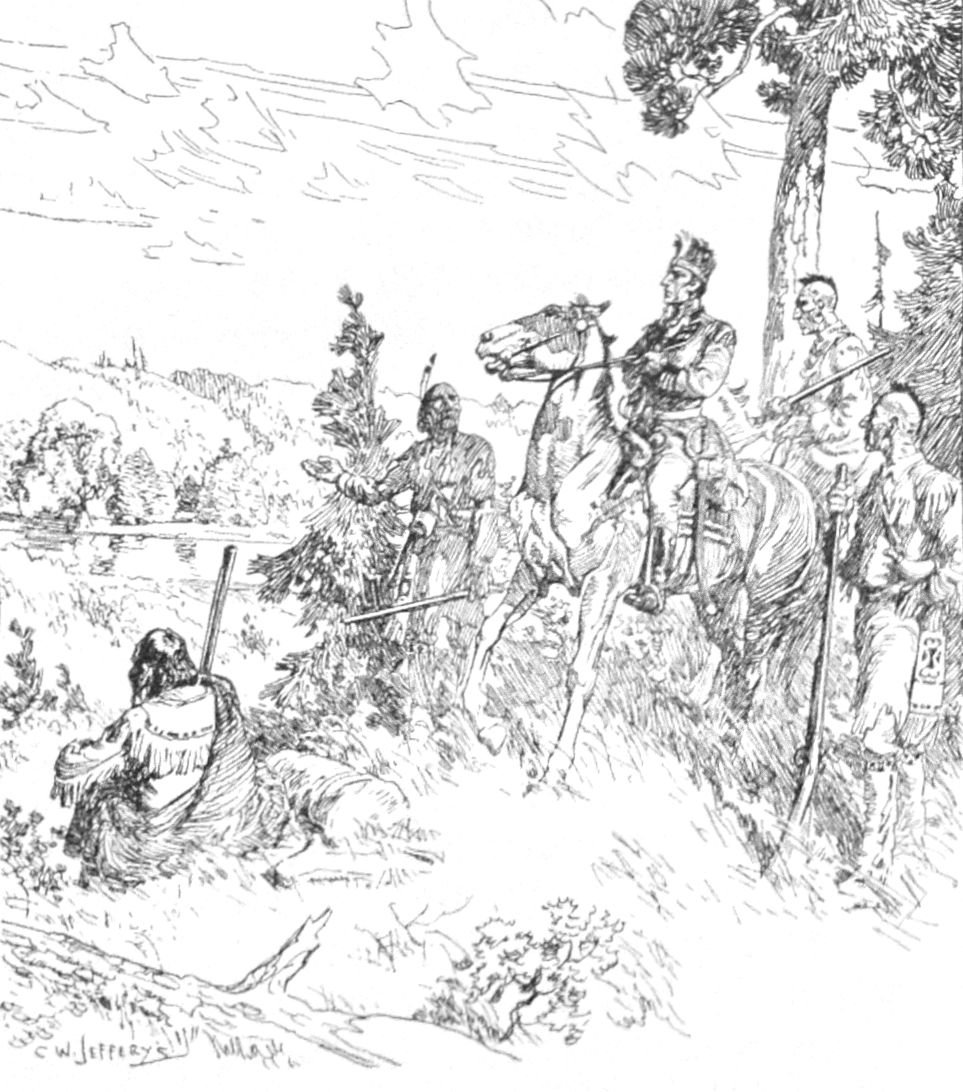
Brant leading the Six Nations to the Grand River.
William (afterwards Sir William) Johnson, the British superintendent of Indian affairs in America, was a friend of Nickus Brant and when, in 1755, he led a force against Crown Point he took with him three of Brant’s boys, one of whom was Joseph, then but thirteen years old, who must have been a lad of exceptional mental maturity and physical strength for his age. During this expedition Joseph was present at the Battle of Lake George, when General Johnson won a signal victory over the French forces under the leadership of Baron Dieskau. It was a hard fought fight, a battle of ambuscades, and this initiation in warfare made a fearless warrior of young Brant. He has confessed that when a hail of bullets swept about him at the beginning of the fight, he momentarily lost his nerve and trembled like a leaf in the wind, but he braced his will, steadied himself by seizing a sapling and continued in the fight till its victorious close. For over thirty years after this he was to take part in border warfare and there is no indication that he ever again felt anything but exultation on the field of battle. From now on he was under the immediate eye of Johnson, who took him to live at his home and instructed him in military affairs. As Johnson was a man of considerable culture and had a fine library, no doubt young Brant then got his taste for learning, a taste he cultivated till the end of his days. He was with Johnson, in the field, until the close of the French war, which terminated with the conquest of Canada, and took part in the siege of Fort Niagara in 1759.
Fort Niagara was a well fortified position with a strong garrison. It was a rallying point for the French on the Great Lakes and in 1759 a British force 2,000 strong, under the command of General Prideaux, was organized for its reduction. When this army left Oswego for Niagara on July 1st, Sir William Johnson accompanied it with six hundred warriors of the Six Nations, increased to over one thousand before Niagara was reached. Joseph Brant, now seventeen years old, was with Sir William on this occasion. When Niagara was reached it was learned that a large body of French and Indians were coming to its relief, but the Indians proved to be friendly to the Six Nations. A parley was held and the western Indians deserted. General Prideaux, the British commander, had been killed by the premature explosion of a shell. Sir William Johnson was now in command and he at once ordered an immediate attack of the French, greatly weakened by the loss of their Indian allies. A short, sharp fight followed and the French were all either killed, taken prisoner or put to flight. Pouchot, the commander of Niagara, saw that further resistance was useless and thereupon made an unconditional surrender, and the strongest French fort in the west fell into the hands of the British. The Indians menaced the prisoners but Johnson protected them, and it is said that Joseph Brant, although a mere boy, had a restraining influence on his red brethren.
Sir William Johnson recognized that Joseph Brant was an Indian lad of more than ordinary promise and gave thought to his education. Moor’s Charity School for the education of Indian boys had been opened by the Rev. Dr. Eleazer Wheelock in Lebanon, Connecticut, and to this school Joseph, with several other Indian lads, was sent. Young Brant made rapid progress in the ordinary subjects taught in such a school, and is said to have shown particular aptitude in the Latin and Greek classes. But in time the confinement grew irksome and he returned to his native haunts and pursuits. On his return Sir William employed him in public business relating to the Indians. For a time he was likewise associated with the distinguished missionary to the Mohawks, the Rev. Charles Jeffery Smith, as an assistant and interpreter. In this work he was zealous and most efficient.
When the Pontiac war broke out Brant left his studies and missionary labours and joined the forces raised to put down the rising. He had the rank of an officer, and during a campaign extending over several years acquitted himself with credit. In this connection a high tribute was paid him by the Rev. Mr. Kirkland, who wrote that in the war he “behaved so much like the Christian and the soldier that he gained great esteem,” and added that he is “living in a decent manner and endeavouring to teach his poor brethren the things of God in which his own heart seems much engaged. His house is an asylum for the missionaries in that region.”
In 1763, at the age of twenty-one, Brant married the daughter of an Oneida chief. Two years later he settled at Canajoharie Castle, where for some years he lived a quiet life, putting forth every effort to raise the social and moral condition of his people and helping the missionaries. On the death of Lady Johnson, Sir William took as his housekeeper Molly Brant, Joseph’s beautiful sister, whom he married shortly before his death in 1774. For a time Joseph lived with Sir William and received an appointment in the Indian Department. Brant’s wife died in 1771 or 1772 leaving him two children, a son and a daughter. He now resumed his studies with the Rev. Dr. Stewart at Fort Hunter. Dr. Stewart was at that time engaged in translating the Prayer Book and portions of the Scriptures into the Mohawk tongue. In this work Brant was of the greatest assistance to him. While engaged in this work he married his wife’s sister. He now avowedly professed Christianity, joined the English Church and remained a faithful adherent of that communion until the time of his death.
At the time of Sir William’s death, affairs in the Thirteen Colonies were in a disturbed condition. Revolution was in the air. Colonel Guy Johnson, nephew and son-in-law of Sir William, was now superintendent of the Six Nations Indians. He had such high regard for Brant’s ability and judgment that he appointed him his private secretary and in this capacity he was working when war broke out. The revolutionists put forth every effort to induce the Six Nations to join them against Great Britain, but largely due to the influence of Brant, who declared emphatically that he “would sink or swim with the English,” the Indians took the British side in the impending struggle. Brant’s sympathies impelled him to this course and, moreover, he had pledged his word to Sir William to remain loyal and to use his influence to keep the Six Nations loyal, and a devoted adherent to the British cause he remained to the end of his life.
When war broke out, an attempt was made to capture Colonel Guy Johnson but, accompanied by Brant and the principal warriors, 250 in all, of the Six Nations, he fled westward, eventually reaching Montreal in the summer of 1775. His aim was to enlist a sufficiently powerful force to regain the Mohawk valley, which had fallen into the hands of the rebels. This force he was unable to organize and he decided to visit England, taking Brant with him, to lay the whole situation before the Imperial government. Meanwhile a confederacy of the Six Nations—the Mohawks, Senecas, Cayugas, Tuscaroras, Oneidas and Onondagas—was formed. The confederacy took a decided stand for King George. Each nation had its own chief, but Brant was elected the principal war-chief, with the military degree of Captain. This appointment was not a matter of chance. Joseph Brant was undoubtedly the ablest and most astute member of the Six Nations. He was experienced in war and Indian diplomacy and had considerable scholarly attainments, a thing uncommon among the Indians. He had the confidence of the entire confederacy and was highly esteemed by those in charge of the Indian Department.
He is described at this time as “distinguished alike for his address, his activity and his courage; possessing in point of stature and symmetry of person the advantage of most men even among his own well-formed race; tall, erect and majestic, with the air and mien of one born to command; having been a man of war from his boyhood, his name was a tower of strength among the warriors of the wilderness. Still more extensive was his influence rendered by the circumstance that he had been much employed in the civil service of the Indian Department under Sir William Johnson, by whom he was often deputed upon embassies among the tribes of the confederacy, and to those yet more distant, upon the great lakes and rivers of the north-west, by reason of which his knowledge of the whole country and people was accurate and extensive.”
In the autumn of 1775, Colonel Guy Johnson and Brant sailed for England. The chief was received with open arms by the best society. His usual dress is said to have been that of an English gentleman, but he took great pride in the fact that he was the representative of the confederacy of the Six Nations and on all ceremonial occasions was something of an Indian dandy, his dress being “a gorgeous and costly adaptation” of the fashions of his own people. A picturesque figure, he everywhere attracted marked attention. Several artists painted his portrait, the best known being that by the distinguished portraitist, George Romney, which was painted while Brant was the guest of the Earl of Warwick.
Brant was, as a matter of course, introduced to the king. He received careful instructions regarding court ceremony. He was told that he must drop on his knee and kiss the king’s hand. He objected to the latter part of the ceremony and naïvely remarked that if it were the queen’s hand it would be another matter.
Before leaving England Brant delivered a remarkably able speech to Lord George Germaine on the grievances of the Indians under his chieftainship and urged that their condition be ameliorated. His visit had the effect of confirming him in his loyalty to the British crown.
Brant returned to America in the summer of 1776, landing near New York in July. He was in a dangerous situation, but at great peril to his life managed to work his way back to Canada. The American invasion under Montgomery and Arnold had ended in disaster and a small remnant of the invading force was in flight when Brant arrived on the scene. They made a last stand at the Cedars, about forty miles above Montreal. Brant was in command of the Indians in this skirmish and, when Major Isaac Butterfield and 390 men surrendered to Captain George Foster, prevented the massacre of the prisoners by the Indians, who were roused to murderous hate through the destruction of their homes by the rebels.
Brant now went on a diplomatic expedition to the Six Nations to discover their attitude in the war. He returned with the answer that all were ready to engage in the service, except the Oneidas, and prepared to join the army of General Howe as one man. For their disloyalty the Oneidas were later to pay a heavy price.
Late in 1776, Brant carried the war into the territory of the enemy. General Herkimer, of the Continental Army, an old friend of Brant’s, tried to get him to remain neutral, but the Mohawk chief would not listen to him and avowed his intention of remaining loyal to his king. The force he commanded was for a time joined with the bodies operating under the command of Colonel John Butler and Sir John Johnson, and he led three hundred warriors in the expedition under General St. Leger against Fort Stanwix. During this campaign Molly Brant warned St. Leger that a rebel army under General Herkimer was approaching. Brant formed an ambuscade; the unsuspecting enemy walked into it and a large portion of the force fell into the hands of Brant and his Indians. A terrific thunderstorm arose while the fight was in progress and this alone prevented the destruction of the entire command of Herkimer. This fight is known as the Battle of Oriskany.
In 1778, Brant operated in the valley of the Susquehanna. He was invariably successful and the mere mention of his name caused terror to the inhabitants of the region. One of his captives, Captain Jeremiah Snyder, gives a striking pen picture of him: “A likely fellow of a fierce aspect, tall and rather spare . . . He wore moccasins, elegantly trimmed with beads—leggings and breech-cloth of superfine blue—short green coat, with two silver epaulets, and a small, laced, round hat. By his side hung an elegant silver-mounted cutlass, and his blanket of blue cloth, purposely dropped on the chair in which he sat, to display his epaulets, was gorgeously decorated with border of red.”
Grave injustice was done Brant by the English poet Thomas Campbell, in his “Gertrude of Wyoming.” In this highly idealized picture of Wyoming and its inhabitants, Campbell speaks of the “monster Brant.” On July 3, 1778, a body of British troops and about seven hundred Seneca Indians entered the valley of Wyoming on the Susquehanna. This force was under the command of Colonel John Butler. The settlers were driven from their homes, a massacre followed, and as Brant was the great war-chief of the Six Nations, American and British historians blamed him for the massacre, but at this time Brant was not within fifty or a hundred miles of Wyoming valley and had no part, direct or indirect, with this lamentable affair. Years later his son, John Brant, called on Campbell and gave him a true account of the affair. In the next edition of his poem Campbell added a footnote in which he exonerated Joseph Brant from all blame “in this horrible business.”
Meanwhile Brant was busy in Cherry Valley and while he was thorough in his methods and always successful, he neither practised nor counselled brutality towards his foes. Indeed, in many instances he displayed a most generous spirit. On one occasion he found among the prisoners a man named Vrooman, who formerly claimed his friendship. He decided to let Vrooman go free and trumped up an excuse to give his prisoner a chance to escape. He sent him back several miles to get some birch bark and went on his way rejoicing in the thought that he had done a neighbourly turn. To his amazement Vrooman appeared several hours later with the bark, which he “no more wanted than he did a pair of goggles.” Brant confessed that he had “sent his prisoner back on purpose to afford him an opportunity to escape, but he was so big a fool he did not know it, and that consequently he was compelled to take him along to Canada.”
As Dent has pointed out: “There is at least evidence that he did his best to save life. Entering one of the houses while the massacre was raging [in the Cherry Valley], he found there a woman quietly engaged in sewing. ‘Why do you not fly, or hide yourself?’ he asked; ‘Do you not know that the Indians are murdering all your neighbours, and will soon be here?’ ‘I am not afraid,’ was the reply; ‘I am a loyal subject of King George, and there is one Joseph Brant with the Indians, who will save me.’ ‘I am Joseph Brant,’ responded the chief, ‘but I am not in command, and I am not sure that I can save you; but I will do my best.’ At this moment the Indians were seen approaching. ‘Get into bed, quick,’ said Brant. The woman obeyed, and when the Indians reached the threshold he told them to let the woman alone, as she was ill. They departed, and he then painted his mark upon the woman and her children, which was the best assurance of safety he could give them.”
For a time Brant’s field of operations was the Mohawk valley. Here his work seems to have been very thorough. He burned a village of the renegade Oneidas and the fort at Minnesink, twenty houses at Schoharie, one hundred at Kleysburg, besides a church and two forts. He destroyed or carried off large numbers of horses and cattle and he invariably returned from his raids with many prisoners and scalps. With regard to his work Haldimand wrote to Germaine that to Brant was due the success of the border warfare. His “attachment to the government, resolution and personal exertions make him a character of a very distinguished kind, and I humbly consider him entitled to some particular mark of the king’s favour.”
Due to Haldimand’s suggestion he was made a colonel. He continued his effective border operations and, to his credit, it is said that his war parties harmed no women or children.
At length, in 1782, the cruel war came to an end. But in the treaty that ended hostilities the Indians were sadly neglected. In that treaty Thayendanegea was not even named and the ancient country of the Six Nations, “the residence of their ancestors from the time far beyond their earliest traditions,” passed into the hands of their enemies; the Six Nations were a scattered people, homeless and landless.
Brant considered the omissions from the treaty a direct violation of the pledge given the Indians by Sir Guy Carleton when they went on the warpath for the British. The Six Nations were to be restored, at the expense of the government, to their condition when war broke out. This pledge of Carleton’s had been ratified by General Haldimand. Brant visited Haldimand at Quebec and urged the fulfilment of the pledge. But Haldimand was helpless so far as the Mohawk valley was concerned. He, however, offered the Indians rich territory in Canada. At first a tract of land on the Bay of Quinte was suggested, but this proved unsatisfactory, and finally the Indians agreed to accept a fertile stretch along the Grand river in the heart of Upper Canada.
The deed of gift was as follows:
“The said Mohawk nation and such of the Six Nations as wish to settle in that quarter to take possession of and settle upon the banks of the Ouse or Grand river, running into Lake Erie, allotting to them for that purpose six miles deep on each side of the river, beginning at Lake Erie and extending in that proportion to the head of the said river.”
This land they were to “possess and enjoy” forever, but it was not to be handed over to them in absolute ownership to sell or lease as they saw fit, and through this limitation trouble arose. They were not as of old a free and independent people, but mere wards of the Crown. . . This status irked Brant and he tried hard, but in vain, to have the terms of the grant altered. The Mohawks had suffered heavy losses during the war and to arrive at a satisfactory settlement for them, Brant again visited England in 1785. His polished manners and great fluency of speech had in them nothing of the “monster Brant.” He was a great favourite of the king, and on one occasion the Prince of Wales thought to entertain him by showing him something of the night life of London. But this kind of entertainment had no attractions for this Mohawk warrior of a somewhat religious turn of mind. He was amazed at what he saw and remarked that the places visited were “very queer places for a prince to go to.”
During this visit he was a guest at a masked ball. Among the revellers were men and women representing all kinds of characters. Brant went as a Mohawk chief, deeming his bronzed, weather-beaten complexion, heightened by a little paint, sufficient mask. He was the observed of all observers. One of the revellers, in an attempt to penetrate what he thought was his disguise, seized him by the nose. Brant entered into the humour of the situation, seized the familiar reveller by the hair, drew his shining tomahawk from his girdle, whirled it above his terrified victim’s head and at the same time uttered the blood-curdling war-whoop that was wont to spread terror in the hearts of his enemies and served as a call to his warriors. There was consternation in the ballroom and many of the guests fled from it. But with a grim smile Brant returned his tomahawk to his girdle and when the full purport of the incident became known it only added to the gayety of the evening.
His visit to England was not without success, and he returned to Canada in 1786, to devote himself heart and soul to the establishment of his people in their new home. One of the first acts was to build a church in the Mohawk village on what is now the outskirts of the thriving city of Brantford—the first Protestant church erected in Upper Canada.
The unsatisfactory conditions of the land tenure of the Indians soon caused trouble. They could hold or use their lands, but they had no power to deed them away. To emphasize this fact a proclamation was issued forbidding the leasing or selling of their holdings by the Indians. Brant and other prominent chiefs met at Niagara to plead with the government for what they deemed mere justice. Brant was not, like many Indians, an eloquent speaker, but in all his utterances he was strong in saving common sense. On this occasion he delivered a somewhat remarkable and well-considered speech. In it he said:
“In the year 1775, Lord Dorchester, then Sir Guy Carleton, at a numerous council, gave us every encouragement, and requested us to assist in defending their country, and to take active part in defending His Majesty’s possessions, stating that when the happy day of peace should arrive, and should we not prove successful in the contest, that he would put us on the same footing on which we stood previous to joining him. This flattering promise was pleasing to us, and gave us spirit to embark heartily in His Majesty’s cause. We took it for granted that the word of so great a man, or any promise of a public nature, would ever be held sacred. We were promised our lands for our services, and these lands we were to hold on the same footing with those we fled from at the commencement of the American war, when we joined, fought and bled in your cause. Now is published a proclamation forbidding us leasing those very lands that were positively given us in lieu of those of which we were the sovereigns of the soil. Of those lands we have forsaken, we sold, leased, and we gave away, when and as often as we saw fit, without hindrance on the part of your government, for your government well knew we were the lawful sovereigns of the soil, and they had no right to interfere with us as independent nations.”
Brant now busied himself with looking after the Indians in their new home. But this work did not satisfy his restless spirit. The War of the Revolution was ended, but the Americans were soon involved in a war with the western tribes, whose territory they were invading. Brant distrusted the whites, who, he considered, were using the Indians as mere dupes to further their own ends. At one time he planned forming a widespread Indian confederacy, and with this end in view sent messengers to different chiefs. But some of the tribes suspected that Brant acted from selfish motives and his scheme came to naught.
On November 4, 1791, General St. Clair suffered a crushing defeat at the hands of the Indians. It was rumoured that Brant led the red men on this occasion, but this is without foundation. The Americans now tried mediation and Brant, as the outstanding war-chief, was called on to act as mediator. He visited Philadelphia in 1792 and was received by Washington with every mark of respect. As a result of his visit, the tribes, in the autumn of 1792, assembled at the Au Glaize and there arranged that the chiefs and warriors should meet representatives of the American government at Sandusky, in the spring of 1793. A final meeting took place, on July 7, at Niagara. Brant was the spokesman of the confederates on this occasion, but he handled the boundary question in such a half-hearted manner that he was branded as a traitor by some of the tribes. Governor Simcoe was present at this time and laid the failure of the negotiations at Brant’s door. He was suspicious of him and wrote:
“I believe he considers the Indian interests as his first object, that . . . . he prefers the British to a certain degree to the people of the United States.” He deemed it necessary that his power should be diminished. “From circumstance,” he wrote, “the almost guidance of the superintendent’s office, as far as the Six Nations have been concerned, has very imprudently centred in the hands of this chieftain. He has made an artful use of such means of power, and appears himself to be the dispenser of His Majesty’s bounty.” A most unjust estimate of Brant’s character!
Brant now settled down to a quiet country life with his third wife Catherine,[1] whom he married in 1780, and their children. He had a comfortable home built at Wellington Square, now Burlington, and here he dispensed quite lavish hospitality. He maintained a large number of servants, among them eight or ten negroes, whom he treated much as the severest taskmasters of the South did their slaves. On the first of May in each year he paid a ceremonial visit, in coach and four, to the annual festival at the Mohawk village. On these occasions he dressed in his full war-chief’s costume and was attended by a large retinue of servants in livery, a source of astonishment to settlers and natives as they passed along.
Brant died at Wellington Square, on November 24, 1807, in his sixty-fifth year. His last thoughts were for his Indians. Those standing by his bedside caught his dying words: “Have pity on the poor Indians; if you can get any influence with the great, endeavour to do them all the good you can.”
He had tried to do them all the good he could. He struggled might and main to improve their economic condition, and so mindful was he of their spiritual welfare, that he laboriously translated into the Mohawk language the Gospel of St. Mark and the Anglican Prayer Book. Towards the close of his life he projected a voluminous history of the Six Nations, but this work he was not spared to even begin.
This illustrious Indian was buried with great ceremony by the side of the little church he had erected in the then Canadian wilderness. Sixty years later his memory was still green among his tribesmen, and on the occasion of a visit of the Earl of Dufferin at the Council House at Tuscarora, Brant’s many services to the Crown were set forth and an anxious desire expressed to have a fitting monument erected to his memory. As a result of this suggestion a monument to the great war-chief of the Mohawks was erected in the heart of the city of Brantford, in many ways the most imposing and artistic monument in the Dominion of Canada.
Catherine, the third wife of Joseph Brant, was the eldest daughter of the head chief of the Turtle tribe, the first in dignity among the Mohawks. To Catherine and Joseph Brant were born seven children—Joseph, Jacob, John, Margaret, Catherine, Mary and Elizabeth. Catherine Brant was a woman of great dignity of appearance. She took pride in the fact that she was a Mohawk and invariably used her native language before strangers, although she spoke English with fluency.
On the death of her husband, according to Indian custom, she had the right to name his successor to the chieftainship. She named her third son, John, then a lad of thirteen. It was a good choice. John Brant proved as loyal as his father to the British Crown, and, during the War of 1812, fought with distinction at Queenston Heights, Beaver Dams and Lundy’s Lane. He died in 1832, at the early age of thirty-eight, and his remains were buried beside those of his father.
Ryerson History Reader Series
1. STORIES OF PATHFINDERS
Pathfinders to America—S. P. Chester
Jacques Cartier—J. C. Sutherland
Henry Hudson—Lawrence J. Burpee
La Salle—Margaret Lawrence
Daniel du Lhut—Blodwen Davies
Père Marquette—Agnes Laut
Pierre Radisson—Lawrence J. Burpee
Alexander Henry and Peter Pond—Lawrence J. Burpee
John Jewett—Eleanor Hammond Broadus
Cadillac—Agnes C. Laut
2. STORIES OF PATHFINDERS
La Vérendrye—G. J. Reeve
Anthony Hendry and Matthew Cocking—Lawrence J. Burpee
Captain Cook—Mabel Burkholder
Samuel Hearne—Lloyd Roberts
Captain George Vancouver—F. W. Howay
Sir Alexander Mackenzie—Adrian MacDonald
John Tanner—Agnes C. Laut
David Thompson—A. S. Morton
Sir John Franklin—Morden H. Long
Simon Fraser—V. L. Denton
3. STORIES OF SETTLEMENT
Samuel de Champlain—Adrian Macdonald
Hébert: The First Canadian Farmer—Julia Jarvis
Frontenac—Helen E. Williams
Talon—Helen E. Williams
Old Fort Prince of Wales—Mr. H. T. Alexander
Colonel Thomas Talbot—Fred Landon
The Acadians—V. P. Seary
Lord Selkirk—William Martin
The United Empire Loyalists—W. S. Wallace
The Canada Company—J. E. Wetherell
Prairie Place Names—Edna Baker
4. STORIES OF HEROES
Maisonneuve—Lorne Pierce
Pierre Le Moyne d’Iberville—Norman McLeod Rogers
Mascarene—V. P. Seary
Marquis de Montcalm—J. C. Sutherland
General James Wolfe—J. C. Sutherland
Sir Isaac Brock—T. G. Marquis
Brant—T. G. Marquis
Tecumseh—Lloyd Roberts
The Royal Canadian Mounted Police—C. F. Hamilton
Nova Scotia Privateers—A. MacMechan
5. STORIES OF HEROINES
Mère Marie de l’Incarnation—Blodwen Davies
Madame La Tour—Mabel Burkholder
Jeanne Mance—Katharine Hale
Marguerite Bourgeois—Frank Oliver Call
Madeleine de Verchères—E. T. Raymond
Barbara Heck—Blanche Hume
Mary Crowell—Archibald MacMechan
The Strickland Sisters—Blanche Hume
Laura Secord—Blanche Hume
Sisters of St. Boniface—Emily P. Weaver
6. FATHERS OF THE DOMINION
Lord Dorchester—A. L. Burt
John Graves Simcoe—C. A. Girdler
Joseph Howe—D. C. Harvey
Sir John A. Macdonald—W. S. Wallace
Sir George E. Cartier—D. C. Harvey
George Brown—Chester Martin
Sir Leonard Tilley—T. G. Marquis
Thomas D’Arcy McGee—Isabel Skelton
Sir Alexander Tilloch Galt—J. I. Hutchinson
Sir Wilfrid Laurier—T. G. Marquis
Sir Charles Tupper—V. P. Seary
7. EMINENT CANADIANS
Bishop John Strachan—W. S. Wallace
Dr. John McLoughlin—A. S. Marquis
Samuel Cunard—Archibald MacMechan
Judge Haliburton—Lorne Pierce
James Douglas—W. N. Sage
Egerton Ryerson—C. B. Sissons
Fathers of Reform—Selwyn Griffin
Lord Strathcona—H. A. Kennedy
Hon. Alexander Mackenzie—T. G. Marquis
Sir Sandford Fleming—Lawrence J. Burpee
8. A BOOK OF BATTLES
Siege of Quebec: French Régime
Sieges of Port Royal—M. Maxwell MacOdrum
Sieges of Quebec: British Régime
Louisburg—Grace McLeod Rogers
Chignecto—Will R. Bird
Pontiac and the Siege of Detroit—T. G. Marquis
Naval Warfare on the Great Lakes—T. G. Marquis
Battlefields of 1813—T. G. Marquis
Battlefields of 1814—T. G. Marquis
The North-West Rebellion—H. A. Kennedy
Canadians in the Great War—M. Maxwell MacOdrum
9. COMRADES OF THE CROSS
Jean de Brébeuf—Isabel Skelton
Père Jogues—Isabel Skelton
Rev. James Evans—Lorne Pierce
Pioneer Missionaries in the Atlantic Provinces—Grace McLeod Rogers (64 pages, 20c.)
Rev. John Black—Lorne Pierce
Père Lacombe—H. A. Kennedy
Rev. John McDougall—Lorne Pierce
Bishop Bompas—“Janey Canuck”
Father Morice—Thomas O’Hagan
10. STORIES OF INDUSTRY
The Company of New France—Julia Jarvis
The Hudson’s Bay Company—Robert Watson
The North-West Company—A. S. Morton
The Story of Agriculture—Blodwen Davies
The Search for Minerals—J. Lewis Milligan
The Building of the C.P.R.—H. A. Kennedy
Canadian Fisheries—V. P. Seary
Canadian Forests—Blodwen Davies
Shipbuilding, Railways, Canals—H. A. Kennedy
The Story of Hydro—Blodwen Davies
Objective Tests—Lorne J. Henry and Alfred Holmes (based on ten selected
readers, to test reading ability)
Price. 10c. a copy; Postage 2c. extra
(Except Pioneer Missionaries in the Atlantic Provinces—20 cents)
Misspelled words and printer errors have been corrected. Where multiple spellings occur, majority use has been employed.
Punctuation has been maintained except where obvious printer errors occur.
[The end of Joseph Brant, by Thomas Guthrie Marquis]