* A Distributed Proofreaders Canada eBook *
This eBook is made available at no cost and with very few restrictions. These restrictions apply only if (1) you make a change in the eBook (other than alteration for different display devices), or (2) you are making commercial use of the eBook. If either of these conditions applies, please contact a https://www.fadedpage.com administrator before proceeding. Thousands more FREE eBooks are available at https://www.fadedpage.com.
This work is in the Canadian public domain, but may be under copyright in some countries. If you live outside Canada, check your country's copyright laws. IF THE BOOK IS UNDER COPYRIGHT IN YOUR COUNTRY, DO NOT DOWNLOAD OR REDISTRIBUTE THIS FILE.
Title: Elizabeth the Queen
Date of first publication: 1930
Author: Maxwell Anderson (1888-1959)
Date first posted: February 8, 2026
Date last updated: February 8, 2026
Faded Page eBook #20260214
This eBook was produced by: Mardi Desjardins, Cindy Beyer & the online Distributed Proofreaders Canada team at https://www.pgdpcanada.net
This file was produced from images generously made available by Internet Archive.
Elizabeth The Queen
A PLAY IN THREE ACTS
BY
MAXWELL ANDERSON
Copyright, 1930, by Longmans, Green & Co.
Copyright, 1934 (acting edition), by Maxwell Anderson
Copyright, 1957 (in renewal) by Maxwell Anderson
CAUTION: Professionals and amateurs are hereby warned that “ELIZABETH THE QUEEN,” being fully protected under the copyright laws of the United States of America, the British Empire, including the Dominion of Canada, and the other countries of the Copyright Union, is subject to a royalty, and anyone presenting the play without the consent of the owners or their authorized agents will be liable to the penalties by law provided. Applications for the acting rights must be made to Samuel French, at 25 West 45th Street, New York City, or at 811 West 7th Street, Los Angeles, Calif.
SAMUEL FRENCH, Inc.
25 West 45th Street, New York, N. Y.
811 West 7th Street, Los Angeles, Calif.
SAMUEL FRENCH, Ltd., London
SAMUEL FRENCH (Canada), Ltd., Toronto
ELIZABETH THE QUEEN
STORY OF THE PLAY
In this new drama by the author of “Saturday’s Children,” and the co-author of “What Price Glory,” we see Elizabeth, Queen of England, and Essex, royal favorite and popular general, in love with each other. This is an extraordinary situation, for Essex is barely thirty and Elizabeth an aging woman. Yet even more extraordinary is the character of their love. Each is passionately devoted, yet passionately opposed, to the other. The root of the trouble is power. Elizabeth delights in Essex, the courtier and lover, but is jealous of Essex, the military leader and hero. Her constant effort is to keep him quietly at Court under her own control. On the other hand, Essex, the last of a proud family, longs for action, glory, and power. He despises Elizabeth’s crafty, cautious statesmanship. He is for strength and decision, with himself as hero. Finally, through the plotting of Cecil and Raleigh, Essex is sent to Ireland, juggled out of favor, and, insultingly summoned home, arrives with an army, determined to get his way by force. This situation is resolved by Mr. Anderson with an ending of extraordinary poignancy and power.
Program of the first performance of “ELIZABETH THE QUEEN,” as produced at The Guild Theatre, New York:
THE THEATRE GUILD, INC.
Presents
THE THEATRE GUILD ACTING COMPANY
AND GUEST PLAYERS
In
ELIZABETH THE QUEEN
A new play in Three Acts
By MAXWELL ANDERSON
The production directed by Philip Moeller
Settings and costumes designed by Lee Simonson
CAST
(In order of appearance)
| Sir Walter Raleigh | Percy Waram |
| Penelope Gray | Anita Kerry |
| Captain Armin | Philip Foster |
| Sir Robert Cecil | Arthur Hughes |
| Francis Bacon | Morris Carnovsky |
| Lord Essex | Alfred Lunt |
| Elizabeth | Lynn Fontanne |
| Lord Burghley | Robert Conness |
| The Fool | Barry Macollum |
| Mary | Mab Anthony |
| Tressa | Edla Frankau |
| Ellen | Phoebe Brand |
| Marvel | Royal Beal |
| A Man-at-Arms | John Ellsworth |
| A Courier | Charles Brokaw |
| A Captain of the Guards | Edward Oldfield |
| A Courtier | Robert Caille |
| A Herald | Vincent Sherman |
| Burbage | Whitford Kane |
| Hemmings | Charles Brokaw |
| Poins | Curtis Arnall |
| Ladies-in-Waiting | { | Annabelle Williams |
| { | Louise Gerard Huntington |
Courtiers, Guards, Men-at-Arms:
Michael Borodin, George Fleming, Stanley Ruth, Nick
Wiger, Henry Lase, Guy Moore, James Wiley, James
A. Boshell, Thomas Eyre, Perry King, Curtis Arnall,
Charles Homer.
SYNOPSIS OF SCENES
| ACT I |
| Scene I. An entrance hall before the Council Chamber. In the palace at Whitehall. |
| Scene II. The Queen’s study. |
| Scene III. The Council Chamber. |
| ACT II |
| Scene I. Interior of Essex’s tent in Ireland. |
| Scene II. The Queen’s study. |
| Scene III. The Council Chamber. |
| ACT III |
| The Queen’s apartment in the Tower. |
An entrance hall before the palace at Whitehall.
The entrance to the Council Room is closed and
four Guards with halberds stand at either side.
All the Guards but one stand immobile. This
latter is pacing up and down the corridor. There
is an offstage call of “Change the Guard!” At
this, the Guard who is pacing comes to attention.
A Fifth Guard enters from corridor.
They salute and change places.
Raleigh enters from down R.
Raleigh. Has the Queen come forth yet?
First Guard. No, Sir Walter.
Raleigh. The Earl of Essex—is he here?
First Guard. He is—expected on the moment, my lord.
Raleigh. When he comes, send me word. I shall be in the Outer Corridor. (He crosses to L.C.)
First Guard. Good, my lord. (Exits R.)
(Penelope Gray comes in from down L.)
Raleigh. (Crossing to down L.) Greetings, lady, from my heart.
Penelope. (With a curtsey) Good-morrow, Lord, from my soul.
Raleigh. I take my oath in your face that you are rushing to the window to witness the arrival of my Lord of Essex.
Penelope. And in your teeth I swear I am on no such errand—but only to see the sun rise.
Raleigh. The sun has been up this hour, my dear.
Penelope. The more reason to hurry, gracious knight. (Starts to cross in front of him. He stops her.)
Raleigh. (His arm around her) Do you think to pull the bag over my head so easily, Penelope? On a day when the Earl returns every petticoat in the palace is hung with an eye to pleasing him. Yours not the least.
Penelope. I deny him thrice.
Raleigh. (Pushing her away—she takes a step back) I relinquish you, lady. Run, run to the window! He will be here and you will miss him!
Penelope. Is there a lady would run from Sir Walter in his new silver suiting? You dazzle the eye, my lord, with your flashing panoper. It is more brilliant than the sunrise I have missed!
Raleigh. (Looking himself over) Twit me about my armor if you will, my wench—there is no other like it in the kingdom—and not like to be.
Penelope. Heaven knows I have seen none like it, and none so becoming.
Raleigh. Is there no limit to a woman’s deception? Would you go so far as to appear pleased if I—— (He kisses her.)
Penelope. And no deception. I call the gods to witness—did I not blush prettily?
Raleigh. And meant it not at all. Tell me, did the Queen send you to look out the casement for news of her Essex, or did you come at the prompting of your own heart?
Penelope. Shall I tell you the truth?
Raleigh. Verily.
Penelope. The truth is I cannot answer.
Raleigh. (Quickly) Both, then?
Penelope. (Taking a step back) Both or one or neither.
Raleigh. (Following her) Fie on the baggage.
Penelope. Is it not a virtue to be close-mouthed in the Queen’s service?
Raleigh. If you kept the rest of your person as close as your mouth what a paragon of virtue you would be!
Penelope. (Crossing directly in front of Raleigh and curtseying) Indeed, my lord, I am.
Raleigh. Indeed, my lady? Have there not been certain deeds on dark nights?
Penelope. (Taking a step to his R.) Sh! Under the rose.
Raleigh. Meaning under covers——
Penelope. (Another step to R.) Fie on my lord, to make me out a strumpet!
Raleigh. (Following her) It is my manner of wooing, fair maid. I woo by suggestion of images—
Penelope. Like small boys on the closet wall—
Raleigh. Like a soldier——
Penelope. Aye, a veteran—of encounters——
Raleigh. I will have you yet, my love; I will take lessons from this Earl——(He puts his arms around her.)
Penelope. Take this lesson from me, my lord: You must learn to desire what you would have. Much wanting makes many a maid a wanton. You want me not—nor I you. You wear your silver for a queen. (Takes a step back to R.C.)
Captain Armin. (Enters from hallway, C. At entrance of corridor) Good-morrow, Sir Walter. Is the Queen still under canopy?
Raleigh. I know not.
Captain Armin. The Earl is here and would see her.
Raleigh. Bid him hurry if he wishes to find her abed as usual.
Penelope. (To Captain) She is dressed and stirring, Captain, and awaits my lord. (To Raleigh as she goes off, hallway C.) You make yourself so easily disliked.
(Captain Armin signals to the Guards, who go off, Two down L. and Two down R. respectively. Captain Armin goes off, hallway C. Raleigh is laughing as Cecil enters from stairway.)
Cecil. (Pointing up hallway) He is here.
Raleigh. (Crossing to R. of door down L.) So. The heavenly boy, clad in the regalia of the sun, even now extracts his gallant foot from his golden stirrup and makes shift to descend from his heaving charger. Acclamation lifts in every voice, tears well to every eye—with the exception of mine, perhaps, and yours, I hope——
Cecil. (A step down to Raleigh’s R.) I am at a pass to welcome him, myself. This Elizabeth of ours can be difficult on her good days—and there have been no good ones lately.
But in truth, I no longer
Stomach Lord Essex. Every word he speaks
Makes me feel queasy.
Raleigh. Then why put up with him?
Cecil. (Slyly)
The Queen, my friend. What she wants,
She will have,
And she must have her Earl.
Raleigh.
Which does she love more,
Her Earl or her kingdom?
Cecil. Which?
Raleigh.
Then you’re less sapient
Than I’ve always thought you, Cecil. She loves her kingdom
More than all men, and always will. If he could
Be made to look like a rebel, which he’s close to being——
And she could be made to believe it, which is harder,
You’d be first man in the council.
Cecil. And you would be?
Raleigh.
Wherever I turn he’s stood
Square in my way! My life long here at court
He’s snatched honor and favor from before my eyes——
Till his voice and walk and aspect make me writhe—
There’s a fatality in it!
Cecil.
Had it ever occurred to you that
If he could be sent from England—there might be a chance
To come between them?
Raleigh. Would she let him go?
Cecil.
No—but if he could be teased
And stung about his generalship till he was
Too angry to reflect—— Let us say you were proposed
As General for the next Spanish raid?
Raleigh. (Very quickly)
He would see it.
And so would she.
Cecil.
Then if you were named
For the expedition to Ireland?
Raleigh. (Crossing down L.)
No, I thank you.
He’d let me go, and I’d be sunk in a bog
This next three hundred years. I’ve seen enough
Good men try to conquer Ireland.
(Crosses back to L. of Cecil.)
Cecil.
Then how would this be?
We name three men for Ireland of his own supporters;
He will oppose them, not wishing his party weakened
At the court. Then we ask what he suggests
And hint at his name for leader——
Raleigh. Good so far.
Cecil.
He will be angry and hint at your name; you will offer
To go if he will.
Raleigh. No. Not to Ireland.
Cecil. (Topping him)
Yes!
Do you think he’d let you go with him and share
The military glory? It will go hard,
Having once brought up his name, if we do not manage
To ship him alone to Dublin.
Raleigh.
We can try it, then,
Always remembering that no matter what
Is said—no matter what I say or you—
I do not go. You must get me out of that,
By Christ, for I know Ireland.
Cecil. I will.
Raleigh. When is the council?
Cecil. At nine.
Raleigh. You’ll make these suggestions?
Cecil. Yes.
Raleigh. At nine, then.
Cecil. Be easy.
(Two Men-at-Arms enter from hallway with silver armor in their arms. They come only as far as the entrance.)
Raleigh. And what is all this, sirrah?
First Man. Armor, my lord. From my lord of Essex.
Raleigh. For whom?
First Man. We know not.
Raleigh. (Crossing to First Man) Now by the ten thousand holy names! Am I mistaken, Robert, or is this armor very much like my own?
Cecil. (Touching armor) Very like, I should say. Is it sterling?
Raleigh. And the self-same pattern. Has the Earl gone lunatic?
(Bacon enters down R. and stands in doorway.)
Cecil. (To Raleigh) He means to outshine you, perhaps.
Raleigh. Has it come to this? Do I set the style for Essex? That would be a mad trick—to dress himself like me. (Crosses to down R. and sees Bacon) What do you know of this, Sir Francis?
Bacon. They are Greeks, my lord, bearing gifts.
Raleigh.
To hell with your Greeks!
The devil damn him! This is some blackguardy.
(Turns away from Bacon toward
C. and two more Men-at-Arms
enter from hallway, carrying armor.)
There’s more of it!
(Still two more Men-at-Arms enter,
carrying armor.)
Good God, it comes in bales!
I say, who’s to wear this, sirrah? Who is it for?
(Essex enters from hallway between the two files of Men-at-Arms, pushing them aside as he does so, and crosses down to R. of Raleigh, speaking as he enters. Cecil has crossed to R. of door L.)
Essex.
Their name is legion, Sir Walter. Happily met—
Felicitations on your effulgence, sir!
You’re more splendid than I had imagined! News came of your silver
Even in my retreat! I was ill, and I swear it cured me!
Raleigh. I’m glad you’re well again, my lord.
Essex.
You should have heard the compliments I’ve heard
Passed on you! Sir Walter’s in silver! The world has been outdone
They said—the moon has been out-mooned.
Raleigh. You need not trouble to repeat them.
Essex.
The Queen herself has admired it—the design—
The workmanship—
And I said to myself— The great man—this is what we have needed—
More silver everywhere—oceans of silver!
Sir Walter has set the style, the world will follow.
So I sent for the silver-smiths. And by their sweat
Here’s for you, lads, tailored to every man’s measure—
Enough for the whole Queen’s Guard.
Shall Raleigh wear silver alone!
Why, no—the whole court shall go argent!
Raleigh. (Crossing to Essex) Take care, my lord. I bear insults badly.
Essex.
And where are you insulted?
For the Queen’s service you buy you a silver armor.
In the Queen’s service I buy you a dozen more.
A gift, my friends, each man to own his own.
As you own yours. What insult?
Raleigh.
Have your laugh,
Let the Queen and court laugh with you! Since you are envious
You may have my suit. I had not thought even Essex
Bore so petty a mind.
Essex.
I misunderstood you,
Perhaps, Sir Walter. I had supposed you donned
Silver for our Queen, but I was mistaken—
Keep these all for yourself. The men shall have others—
Some duller color.
Raleigh.
I have borne much from you
Out of regard for the Queen, my Lord of Essex—
Essex. And I from you—
Raleigh. My God—
Cecil.
You have forgotten, Sir Walter,
A certain appointment—
Raleigh. And you will bear more, by Heaven!—
Cecil.
He is going to the Queen,
Remember. And we have an errand.
Essex. (Taking a step down C.)
You presume to protect me,
Master Secretary?
Cecil. I protect you both, and our mistress. There can be no quarreling here.
Raleigh. That’s very true. Let us go. (Both bow. Raleigh goes out L. Cecil stops a moment, bows, then follows.)
Essex. (To Men-at-Arms) Go. Follow your bright example. (The Men-at-Arms go off L., following Raleigh and Cecil.)
Bacon. And this armor? What becomes of it?
Essex.
I have given it.
Would you have me take it back?
Bacon.
There has seldom been
A man so little wise, so headstrong, but he
Could sometime see how necessary it is
To keep friends and not make enemies at court.
But you—God knows.
Essex.
Let him make friends with me.
He may need friends himself.
(Crossing toward door down L.)
Bacon. You are going to the Queen?
Essex. Yes. God help us both.
Bacon. (Crossing to end of bench R.) Then hear me a moment——
Essex. (Crossing back to Bacon’s L.)
Speak, Schoolmaster Bacon,
I knew it was coming. You’ve been quiet too long.
Bacon.
Listen to me this once, and listen this once
To purpose, my Lord, or it may hardly be worth
My while ever to give you advice again
Or for you to take it. You have enough on your hands
Without quarreling with Raleigh. You have quarrelled with the Queen
Against my judgment—
Essex.
God and the devil! Can a man
Quarrel on order or avoid a quarrel at will?
Bacon. Why, certainly, if he knows his way.
Essex. Not I.
Bacon.
You quarrelled with her, because she wished to keep peace
And you wanted war—
Essex.
We are at war with Spain!
But such a silly, frightened, womanish war
As only a woman would fight—
Bacon. She is a woman and fights a womanish war.
Essex. But if we are at war, why not let some blood—
Bacon.
But ask yourself one question and answer it
Honestly, dear Essex, and perhaps you will see then
Why I speak sharply. You are my friend and patron.
Where you gain I gain—where you lose I lose—
And I see you riding straight to a fall today—
And I’d rather your neck weren’t broken.
Essex.
Ask myself
What question?
Bacon.
Ask yourself what you want:
To retain the favor of the Queen, remain
Her favorite, keep all that goes with this,
Or set yourself against her and trust your fortune
To popular favor?
Essex. (Crossing down L.) I’ll not answer that.
Bacon. Then—I have done. (Starts off up hallway, C.)
Essex. (Stopping him, crossing back to Bacon’s
L.)
Forgive me, dear friend, forgive me.
I’ve been ill of mind, and this silly jackanapes
Of a Raleigh angers me with his silver mountings
Till I forget who’s my friend. You know my answer
In regard to the Queen. I must keep her favor.
Only, I cannot endure—it maddens me—her everlasting dilly-dallying.
(Sits upstage end of bench R.)
This utter mismanagement, when a man’s hand and brain
Are needed and cannot be used.
Bacon. (Sits downstage end of bench R.)
Let me answer for you:
You are not forthright with yourself. The Queen
Fights wars with tergiversation and ambiguities—
You wish to complete your record as general,
Crush Spain, make a name like Caesar’s,
Climb to the pinnacle of fame. Take care,
You are too popular already. You have
Won at Cadiz, caught the people’s hearts,
Caught their voice till the streets ring your name
Whenever you pass. You are loved better than
The Queen. That is your danger. She will not suffer
A subject to eclipse her; she cannot suffer it.
Make no mistake. She will not.
Essex. And I must wait—hold myself back—
Bacon. Even so.
Essex.
Why? I come of better blood than Elizabeth.
My name was among the earls around King John
Under the oak—
(Bacon looks off R. apprehensively.)
What the nobles have taught a king
A noble may teach a queen.
Bacon. (Quickly and forcefully)
You talk treason and death.
The old order is dead, and you and your house will die
With it if you cannot learn.
Essex.
So said King John
Under the oak, or wherever he was standing.
And little he got by it, as you may recall.
What the devil’s a king but a man, or a queen but a woman?
(WARN Curtain.)
Bacon.
King John is dead; this is Elizabeth.
There is one man in all her kingdom she fears, and
That man’s yourself, and she has good reason to fear you.
You’re a man not easily governed, rebellious,
Moreover, a general, popular and acclaimed,
And, last, she loves you, which makes you the more to be feared,
Whether you love her or not.
Essex. I do love her. I do.
Bacon. My lord, a man as young as you—
Essex.
If she were my mother’s kitchen hag,
Toothless and wooden-legged, she’d make all others
Colorless.
Bacon. You play dangerously here, my lord.
Essex.
I’ve never yet loved or hated
For policy nor a purpose. I tell you she’s a witch—
And has a witch’s brain. I love her, I fear her,
I hate her, I adore her—
Bacon.
That side of it, you must know
For yourself.
Essex. I will walk softly—here is my hand. Distress yourself no more—I can carry myself.
Bacon. Only count not too much on the loves of queens.
Essex. I’ll remember. (Raleigh enters down L. and starts to cross up to hallway. He sees Essex and stops. He is wearing ordinary clothes, having dispensed with his armor. Essex rising and crossing to Raleigh’s L.)
What! Have you thrown your silver in the mud
After your cloak, Sir Walter? Take care!
(Crosses front of Raleigh and says the following as he goes off down L.)
Take care! She stepped on your cloak to some purpose,
But on your armor, she might slip.
CURTAIN
The Queen’s study. It is a severe little room. In the upper L. corner is a desk and chair. To the L. of this is a stool. There are entrances through curtains both down L. and down R. There is also an entrance up C. and up R. There is a chair between the two entrances. On the desk are various state papers, some books and a deck of cards and a calendar. Penelope is seated on the stool L. She crosses to door R. as she hears steps outside and listens. She then crosses back to C. Essex enters R.
Penelope. Good-morrow, my lord. (She curtseys.)
Essex. Good-morrow, Penelope. Have I kept the Queen?
Penelope. Would I acknowledge Her Majesty would wait for you?
Essex. (At R. of chair up R.) I commend me to your discretion.
Penelope. (At L. of chair up R.) Only to my discretion?
Essex. Take her what message you will—only let it be known that I am here.
Penelope. May I have one moment, my lord? She is not quite ready.
Essex. As many as you like. What is it, my dear?
Penelope. Do you love the Queen?
Essex. Is that a fair question, as between maid and man?
Penelope. (Very quickly) An honest question.
Essex. Then I will answer honestly. Yes, my dear.
Penelope. Dearly?
Essex. Yes.
Penelope. I would you loved someone who loved you better.
Essex. Meaning—whom?
Penelope. (Not looking at him)
Meaning—no one. Myself, perhaps. That’s no one.
Or—anyone who loved you better.
Essex. Does she not love me, sweet?
Penelope. She loves you, loves you not, loves you, loves you not—
Essex. And why do you tell me this?
Penelope. Because I am afraid.
Essex. For me?
Penelope. I have heard her when she thought she was alone, walk up and down her room soundlessly, night long, cursing you—cursing you because she must love you and could not help herself—swearing to be even with you for this love she scorns to bear you. (Looks off R. door) My lord, you anger her too much.
Essex. But is this not common to lovers?
Penelope. No. I have never cursed you. And I have good cause.
Essex. But if I were your lover, you would, sweet. So thank God I am not.
Penelope. I’ll tell her you are here. (She starts to go off C., then turns and comes down to him. He, in the meantime, has crossed down R. She lifts her face to be kissed. He kisses her.) Will you beware of her?
Essex.
Lover, beware your lover— That’s an old song.
I will beware.
Penelope. For I am afraid.
Essex. (Kisses her hand) Thank you, my dear. (She goes off C. Two Ladies-in-Waiting enter C. and hold the draperies back.)
First Lady-in-Waiting. Her Majesty.
(Elizabeth enters C. The two Ladies-in-Waiting go out C.)
Elizabeth. (Crossing down to L. of Essex)
When we met last it was, as I remember,
Ill-met by moonlight, sirrah.
Essex. (Who has knelt before her entrance and
who now takes her hand and kisses it)
Well-met by day,
My Queen.
Elizabeth.
I had hardly hoped to see you again,
My Lord of Essex, after what was vowed
Forever when you left.
Essex.
You are unkind
To remind me.
Elizabeth.
I think I also used
The word forever, and meant it as much, at least—
Therefore, no apology. Only my Penelope
Passed me just now with eyes and lips
That looked the softer for kissing. I’m not sure
But I’m inopportune.
Essex. She’s a crazy child.
Elizabeth.
These children
Have their little ways with each other!
Essex. (Rising, releasing her hand)
Must we begin
With charges and counter-charges, when you know—
Elizabeth.
Do I indeed?—
You have gone a week, at this Wanstock of yours—
And a week’s a long time at court. You forget that I
Must live and draw breath whether I see you or not—
And there are other men all fully
Equipped for loving and being loved!
You find Penelope charming. And as for me
There’s always Mountjoy—or Sir Walter—the handsome,
Sir Walter, the silver-plated—
Essex.
He’ll wear no more
Silver at your door.
Elizabeth.
What have you done—come, tell me.
I knew this silver would draw fire. What happened?
Essex. Nothing. But the fashion’s gone out.
Elizabeth. No, but tell me!
Essex.
He was unfortunate enough to be in the way when the upstairs crock
Was emptied. He has gone to change his clothes.
Elizabeth. (Laughing)
You shall not be allowed
To do this to him—
Essex. (Moving toward her. Putting his arm
around her)
You shall not be allowed
To mock me, my Queen.
(Kisses her.)
Elizabeth. (After the kiss)
Isn’t it strange how one man’s kiss can grow
To be like any other’s—or a woman’s
To be like any woman’s?
Essex.
Not yours for me,
No, and not mine for you, you lying villain,
You villain and queen, you double-tongued seductress,
You bitch of brass!
Elizabeth.
Silver, my dear. Let me be
A bitch of silver. It reminds me of Raleigh.
Essex. (Releasing her) Damn you!
Elizabeth.
Damn you! And double-damn you for a damner.
(Crosses to above desk)
Damn him, not me.
Come some day when I’m in the mood. What’s today? (Looks at calendar)
—Thursday? Try next Wednesday—or any Wednesday
Later on in the summer— Any summer
Will do. Why are you still here?
Essex. (Turns toward door R.)
Oh, God, if I could but walk out that door
And stay away!
Elizabeth. It’s not locked.
Essex.
But I’d come back!
Where do you think I’ve been this last week? Trying,
Trying not to be here. But you see, I am here.
Elizabeth. Yes, I see.
Essex. Why did you plague me without a word?
Elizabeth. Why did you not come?
Essex.
You are a Queen, my Queen.
You had prescribed me—let it be known I would
Not be admitted if I came.
Elizabeth. I may have meant it at the time.
Essex. I think I have a demon, and you are it!
Elizabeth.
If ever a mocking devil tortured a woman
You’re my devil and torture me! Let us part and quickly,
Or there’ll be worse to come. Go.
Essex. I tell you I will not.
Elizabeth.
Come to me, my Essex.
(Essex crosses and kneels at her R.
They embrace.)
Let us be kind
For a moment. I will be kind. You need not be.
You are young and strangely winning and strangely sweet.
My heart goes out to you wherever you are.
And something in me has drawn you. But this same thing
That draws us together hurts and blinds us until
We strike at one another. This has gone on
A long while. It grows worse with the years. It will end badly.
Go, my dear, and do not see me again.
Essex.
All this
Is what I said when last I went away.
Yet here I am.
Elizabeth.
Love someone else, my dear.
I will forgive you.
Essex. You mean you would try to forgive me.
Elizabeth. Aye, but I would.
Essex.
What would you have to forgive?
I have tried to love others. It’s empty as ashes.
Elizabeth. (Angry) What others?
Essex. No one.
Elizabeth. (More angry) What others?
Essex. (Rising) Everyone.
Elizabeth. Everyone?
Essex.
That too has been your triumph! What is a cry
Of love in the night, when I am sick and angry
And care not? I would rather hear your mocking laughter—
Your laughter—mocking at me—defying me
Ever to be happy—
Elizabeth. You have done this to me?
Essex.
You have done this to me! You’ve made it all empty
Away from you! And with you too!
Elizabeth. And me—what of me while you were gone?
Essex. (Crosses down a step—then turns to her)
If we
Must quarrel when we meet, why then, for God’s sake,
Let us quarrel. At least we can quarrel together.
Elizabeth.
I think if we are to love we must love and be silent—
For when we speak—
Essex.
I’ll be silent, then.
And you shall speak—
Elizabeth. (Her finger to her lips, sits at desk)
Shhh!
Essex. (Crosses to stool L. of desk and sits)
If you would sometimes heed me—
Elizabeth. Shh!
Essex. Only sometimes—
Elizabeth. Shh!
Essex. (Taking up cards and dealing them)
Only when I’m right—if you would
Say to yourself that even your lover might be
Right sometimes, instead of flying instantly
Into opposition as soon as I propose
A shift in policy!
Elizabeth.
But you were wrong!
(She glances over his shoulder at his cards)
A campaign into Spain’s pure madness, and to strike at Flanders
At the same moment—think of the drain in men
And the drain on the treasury, and the risks we’d run
Of being unable to follow success or failure
For lack of troops and money—!
Essex.
But why lack troops—
And why lack money?
There’s no richer country in Europe
In men or money than England! It’s this same ancient
Unprofitable niggardliness that pinches pennies
And wastes a world of treasure! You could have all Spain,
And Spain’s dominions in the new world, an empire
Of untold wealth—and you forego them because
You fear to lay new taxes!
Elizabeth.
I have tried that—
And never yet has a warlike expedition
Brought me back what it cost!
Essex.
You’ve tried half-measures—
Raids on the Spanish coast, a few horsemen sent
Into Flanders and out again, always defeating
Yourself by trying too little! What I plead for
Is to be bold once, just once, give the gods a chance
To be kind to us—walk through this cobweb Philip
And take his lazy cities with a storm
Of troops and ships!
If we are to trifle we might better sit
At home forever, and rot!
Elizabeth.
Here we sit, then,
And rot, as you put it. (Throwing her cards down.)
Essex. I’m sorry—
Elizabeth.
It seems to me
We rot to some purpose here. I have kept the peace
And kept my people happy and prosperous. They
Have had time for music and poetry—
Essex.
And at what a price—
What a cowardly price!
Elizabeth.
I am no coward, either.
It requires more courage not to fight than to fight
When one is surrounded by hasty hot-heads, urging
Campaigns in all directions.
Essex.
Think of the name
You will leave— They will set you down in histories
As the weasel queen who fought and ran away,
Who struck one stroke, preferably in the back,
(She hits Essex on the back.)
And then turned and ran—
Elizabeth.
Is it my fame you think of,
Or your own, my lord? Have you not built your name
High enough? I gave you your chance at Cadiz,
And you took it, and now there’s no name in all England
Like yours to the common people. When we ride in the streets
It’s Essex they cheer and not their Queen.
What more would you have?
Essex.
Is it for
This hollow cheering you hold me back from Spain?
Elizabeth.
It’s because I believe in peace, and have no faith
In wars or what wars win.
Essex. You do not fear me?
Elizabeth.
I fear you, too! You believe yourself
Fitter to be king than I to be queen! You are flattered
By this crying of your name by fools! You trust me no more
Than you’d trust—Penelope—or any other woman
To be in power! You believe you’d rule England better
Because you’re a man!
Essex.
That last is true. I would.
It’s because I love you that I can see
Wherein you fail—and why you fail and where
You fail as sovereign here. It’s because
You cannot act and think like a man.
Elizabeth. (Rises)
By God, I’ll make you sorry
(Throws the cards in his face)
For those words! Act and think like a man—!
Why should I
Think like a man when a woman’s thinking’s wiser?
What do you plan? To take over the kingdom, depose me?
Essex. (Smiling)
You are a touchy queen. (Picking up the cards.)
Elizabeth. (Laughing)
I had bad bringing up.
I was never sure who my mother was going to be
Next day, and it shook my nerves.
Essex. (Crosses to above desk)
You’re your father’s daughter.
I’ll swear to that. I can tell by your inconstancy.
Elizabeth.
I wish you had need
To fear it—or at any rate that I’d never
Let you see how much I’m yours.
Essex. But why?
Elizabeth. (Holds her hand out to him and he
crosses to her L.)
Tell me, my dear,
Do I tire you—do I wear upon you a little?
Essex. Never.
Elizabeth.
But you’d have to say that, you can see—
You’d have to say it, because you wouldn’t hurt me,
And because I’m your queen. And so I’ll never know
Until everyone else has known and is laughing at me,
When I’ve lost you.
(He starts to speak.)
Wait, let me say this, please—
When the time
Does come, and I seem old to you—
Essex. You are not old. I will not have you old.
Elizabeth. (Continues)
—and you love
Someone else, tell me, tell me the first—
Will you do that, in all kindness, in memory
Of a great love past? No. You could not, could not.
It’s not in a man to be kind that way, nor in
A woman to take it kindly. I think I’d kill you,
In a first blind rage.
Essex. Kill me when I can say it.
Elizabeth.
Love, will you let me
Say one more thing that will hurt you?
Essex. (Kisses her hand) Anything.
Elizabeth.
Your blood’s on fire to lead a new command
Now that you’ve won so handsomely in Spain,
And when I need a general anywhere
You’ll ask to go. Don’t ask it—and don’t go.
You’re better here in London!
Essex.
Was this all you wanted? (Stepping back)
To make me promise this?
Elizabeth.
Not for myself,
I swear it, not because I think you reckless
With men and money, though I do think that,
Not because you might return in too much triumph
And take my kingdom from me, which I can imagine,
And not because I want to keep you here
And hate to risk you, though that’s also true—
But rather—and for this you must forgive me—
Because you’re more a poet than a general—
And I fear you might fail, and lose what you have gained,
If you went again.
Essex. God’s death! Whom would you send?
Elizabeth. I asked you not to be angry.
Essex.
Not to be angry!
How do you judge a leader except by whether
He wins or loses?
(Crosses front of her down R.)
Was it by chance, you think,
That I won at Cadiz?
(WARN Curtain.)
Elizabeth.
Very well. You shall go.
Go if you will. Only I love you, and I say
What would be wiser.
Essex.
You choose the one thing I must have
And ask me not to ask it! No. Forgive me.
Elizabeth. I’ll not say it again.
Essex.
But if I’m more poet than
General, then poets, on occasion, make better generals
Than generals do.
Elizabeth.
You’ve proved it so
On more than one occasion.
(The CHIMES strike nine. There are four offstage
CALLS of “The Council is met!”)
Now we shall hear about Ireland,
If Cecil has his way. One thing remember,
You must not go to Ireland.
Essex.
No. That’s a war
I’m content to miss.
Elizabeth.
Thank God for that much, then. I’ve been afraid
Ireland might tempt you. And will you understand—
I’ll have to oppose you on
The Spanish hostages— You’ll have your way—
But I’ll have to oppose you.
Will you understand—?
Essex. I’ll play my part perfectly. (Kisses her hand.)
Elizabeth.
Now what can come between us, out of heaven or hell,
Or Spain or England?
Essex. Nothing—never again. (Kisses her.)
(A Councillor enters from R. He stops in the entrance.)
Councillor. (Bowing) Your Majesty, the Council’s met.
(Elizabeth and Essex, still kissing, pay no attention.)
CURTAIN
The Council Chamber. It is a large room with entrances
down L. and down R. respectively, the
doors of which are closed. Up C. in the room is
a three-stepped platform, on the top of which
is a chair of state. In front of this platform, on
stage level, is a long council table with four
stools in front and two at either end. The
Queen is seated in her throne, holding her ball
and mace. Essex is at the R. end of table and
Cecil at the L. The other Councillors are
seated in front of table, from L. to R., as follows:
First Extra Councillor, Burghley,
Raleigh, Second Extra Councillor. The
Fool sits cross-legged on a pillow on the top of
the platform at the Queen’s L. There are two
Guards, one below of entrance and one in
front of entrance both down R. and down L.
respectively. There are also Two Guards, one
at either side of the throne. A step below these
latter, on the platform, is a Man-at-Arms at
either side. Below these, on either side, is another
Man-at-Arms, each carrying a small
cushion.
As the Curtain rises there is a general ad lib.
among the Councillors which Elizabeth interrupts
with:
Elizabeth. (Interrupting)
Then the issue lies between the queen
And her soldiers—and your lordship need feel no
Concern in the matter.
Essex.
When I made these promises
I spoke for your Majesty—or believed I did.
Cecil.
My liege,
It is well known a regent may repudiate
Treaty or word of a subject officer.
The throne is not bound.
Essex.
If it comes to repudiation,
The throne can, of course, repudiate what it likes.
But not without breaking faith.
Elizabeth.
I fear we are wrong, Sir Robert;
And what has been promised for me and in my name
By my own officer, my delegate in the field,
I must perform. The men may have their ransoms.
The state will take its loss; for this one time
Only, and this one time only. In the future a prisoner
Is held in the name of the state, and whatever price
Is on his head belongs to the crown. Our action
Here is made no precedent. What further
Business is there before us?
Cecil.
There is one perpetual
Subject, your Majesty, which we take up
Time after time; and always leave unsettled,
But which has come to a place where we must act
One way or another. Tyrone’s rebellion at Ulster—
(Essex and Elizabeth
exchange glances.)
Is no longer a smouldering goal, but a running fire
Spreading north to south. We must conquer Ireland
Finally now, or give over what we have won.
Ireland’s not Spain.
Elizabeth. I grant you.
The Fool. I also grant you.
Elizabeth. Be quiet, Fool.
The Fool. Be quiet, Fool. (The Fool slaps his own mouth.)
Elizabeth.
Lord Burghley,
You shall speak first. What’s to be done in Ireland?
Burghley.
If my son is right, and I believe him to be,
We can bide our time no longer there. They have
Some help from Spain, and will have more, no doubt,
And the central provinces are rising. We must
Stamp out this fire or lose the island.
Elizabeth.
This means
Men, money, ships?
Burghley. Yes, madam.
Cecil.
And more than that—
A leader.
Elizabeth. What leader?
Cecil.
A Lord Protector
Of Ireland who can carry sword and fire
From one end of the bogs to the other, and have English law
On Irish rebels till there are no rebels.
We’ve governed Ireland with our left hand, so far,
And our hold is slipping. The man who goes there now
Must be one fitted to master any field—
The best we have.
Elizabeth. What man? Name one.
Cecil.
We should send,
Unless I am wrong, a proved and able general,
Of no less rank than Lord Howard here,
Lord Essex, Sir Walter Raleigh, Knollys, or Mountjoy—
This is no slight matter, to keep or lose the island.
Elizabeth. I grant you that also.
The Fool.
I also grant you. Be quiet,
Fool! (He slaps his mouth.)
Elizabeth.
I ask you for one and you name a dozen,
Sir Robert.
Raleigh.
Why should one go alone, if it comes
To that? Why not two expeditions, one
To Dublin, one into Ulster, meeting halfway?
Elizabeth. Are there two who could work together?
Cecil.
Knollys and Mountjoy.
They are friends and of one house.
Essex. Yes, of my house.
Elizabeth. Essex, whom would you name?
Essex.
Why, since Sir Robert
Feels free to name my followers, I shall feel free
To name one or two of his—
Elizabeth.
In other words,
You would rather Knollys and Mountjoy did not go?
Essex.
I would rather they stayed in England, as Sir Robert knows.
I have need of them here. But I will spare one of them
If Sir Robert will let Sir Francis Vere go with him.
Elizabeth. Let Vere and Knollys go.
Cecil.
Lord Essex names
Sir Francis Vere because he knows full well
I cannot spare him, my liege.
Elizabeth.
Is this appointment
To wait for all our private bickerings?
Can we send no man of worth to Ireland, merely
Because to do so would weaken some house or party
Here at court?
The Fool. Your Majesty has said—
Elizabeth. Be quiet—
The Fool. Fool!
Elizabeth. Be quiet!
The Fool. Fool!
Elizabeth. Be quiet!
(The Fool forms the word “Fool” with his lips, but makes no sound.)
Cecil.
I hope I betray no secret, Sir Walter,
If I tell the council that I spoke with you
Before the session, and asked you if you would go
Into Ireland if the Queen requested it—and that you said
Yes, should the Queen desire it.
Burghley. (To the Man at his L.) That would answer.
Cecil.
But I believe, and Sir Walter believes, there should be
More than one hand in this—that if he goes
Lord Essex should go with him.
Elizabeth. With him?
Essex.
In what
Capacity?
Cecil.
Leading an equal command. Two generals
Of coeval power, landing north and south
And meeting to crush Tyrone.
Essex.
Would you set up
Two Lord Protectors in Ireland?
Cecil.
It was my thought that we name
Raleigh as Lord Protector.
Essex. And I under him?
Cecil.
Since the Azores adventure
Which my Lord Essex led, and which came off
A little lamer than could be wished, but in which
Sir Walter showed to very great advantage,
It has seemed to me that Raleigh should receive
First place if he served in this.
Essex.
This is deliberate,
An insult planned!
Cecil.
It is no insult, my lord,
But plain truth. I speak for the good of the state.
Essex.
You lie! You have never spoken here or elsewhere
For any cause but your own!
Elizabeth. No more of this!
Essex.
Good God!
Am I to swallow this from a clerk, a pen-pusher—
To be told I may have second place, for the good of
the state?
Cecil. Were you not wrong at the Azores?
Essex. No, by God! And you know it!
Elizabeth. (A threat and a warning)
Whoever makes you angry has won
Already, Essex!
Essex. They have planned this!
Cecil. (Lifted. As though the matter is settled)
I say no more.
Raleigh will go to Ireland as Lord Protector
And go alone, if the Queen asks it of him,
And since you will not go.
Essex.
I have not said
I would not go. But if I were to go I would go
Alone, as Lord Protector!
Elizabeth. (Topping them all)
That you will not.
I have some word in this.
Essex.
If this pet rat,
Lord Cecil, wishes to know my wind about him,
(Cecil’s arm over back of stool.)
And it seems he does, he shall have it!
(Essex rises; leans over table)
How he first crept
Into favor here I know not, but the palace is riddled
With his spying and burrowing and crawling underground!
He has filled the court with his rat friends, very gentle,
White, squeaking, courteous folk, who show their teeth
Only when angered; who smile at you, speak you fair
And spend their nights gnawing the floors and chairs
Out from under us all!
Elizabeth. My lord!
Essex.
I am
Not the gnawing kind, nor will I speak fair
To those who don’t mean me well—no, nor to those
To whom I mean no good! I say frankly here,
Yes, to their faces, that Cecil and Walter Raleigh
Have made themselves my enemies because
They cannot brook greatness or power in any but
Themselves! And I say this to them—and to the world—
I, too, have been ambitious, as all men are
Who bear a noble mind, but if I rise
I hope it will be by my own effort, and not by dragging
Better men down through intrigue!
Burghley. Intrigue, my lord?
Raleigh. Better men, my lord?
(A Councillor raises his arm to stop Essex.)
Essex.
I admit
Sir Walter Raleigh’s skill as a general
And Cecil’s statecraft! I could work with them freely
And cheerfully, but every time I turn
My back they draw their knives!
Elizabeth. My lord! My lord!
Essex.
When Cecil left England
I watched over them as I would my own
Because he asked me to!—but when I left,
And left my affairs in his hands—on my return
I found my plans and my friends out in the rain
Along with the London beggars!
Cecil. I did my best—
Essex. Yes. For yourself! For the good of the state!
Raleigh. (Rising and leaning over table toward Essex)
If Lord Essex wishes
To say he is my enemy, very well—
He is my enemy.
Essex.
But you were mine first—
And I call on God to witness you would be my friend
Still, if I’d had my way! I take it hard
(Raleigh sits)
That here, in the Queen’s council, where there should be
Magnanimous minds if anywhere, there are still
No trust or friendship! (Essex sits.)
Elizabeth. (Very quickly)
I take it hard that you
Should quarrel before me.
Essex.
Would you have us quarrel
Behind your back? It suits them all too well
To quarrel in secret and knife men down in the dark!
Burghley. (Lifted)
This is fantastic, my lord. There has been no kniving.
Let us come to a decision. We were discussing
The Irish protectorate.
Cecil. (Lifted)
And as for Ireland,
I am willing to leave that in Lord Essex’s hands
To do as he decides.
Essex.
Let Sir Walter Raleigh go
To Ireland as Protector! And be damned to Ireland!
(Raleigh looks quickly to Cecil.)
Cecil. (Insidiously)
As the Queen wishes.
It is a task both difficult and dangerous.
I cannot blame Lord Essex for refusing
To risk his fame there.
Essex.
There speaks the white rat again!
Yet even a rat should know I have never refused
A task out of fear! I said I would not go
As second in command!
Cecil.
Then would you go
As Lord Protector?
Elizabeth.
You have named your man—
Sir Walter Raleigh.
Raleigh.
With your Majesty’s gracious permission
I’ll go if Essex goes.
Essex.
Is Sir Walter
Afraid to go alone?
Raleigh.
I don’t care for it—
And neither does our Essex!
Essex. (After a pause—turning front)
Why, what is this
That hangs over Ireland? Is it haunted, this Ireland?
Is it a kind of hell where men are damned
If they set foot on it? I’ve never seen the place,
But if it’s a country like any other country, with people
Like any other people in it, it’s nothing to be
Afraid of, more than France or Wales or Flanders
Or anywhere else!
Cecil. We hear you say so.
Essex. (Impetuously)
If I
Am challenged to go to Ireland,
(Rises)
Then, Christ, I’ll go!
Give me what men and horse I need, and put me
In absolute charge, and if I fail to bring
This Tyrone’s head back with me and put the rebellion
To sleep forever, take my sword from me
And break it— I’ll never use it again!
Elizabeth. Will you listen—?
Essex. They’ve challenged me!
Elizabeth.
If you volunteer
To go to Ireland there is none to stop you.
Essex.
Your Majesty, I can see that Raleigh and Cecil have set themselves
To bait me into Ireland! They know and I know
That Ireland has been deadly to any captain
Who risked his fortunes there; moreover once
I’m gone they think to strip me here at home,
Ruin me both ways! And I say to them “Try it!”
Since this is a challenge, I go,
And will return, by God, more of a problem
To Cecils and Raleighs than when I went!
Burghley. (Lifted)
If Essex will go,
It solves our problem, Your Majesty.
We could hardly refuse that offer.
(The Fool rises and approaches Essex from behind.)
Elizabeth. No.
Essex.
I will go,
And I will return! Mark me!
(The Fool crosses down to below Essex.)
The Fool. (Touching Essex) My lord! My lord!
(Raleigh, Cecil and Councillor at L. by table ad lib. at each other, quietly.)
Essex. (Turning suddenly with an instinctive motion that sweeps the Fool to the floor) You touch me for a fool!
The Fool. Do not go to Ireland!
Essex. (Impatiently) You too?
The Fool.
Because, my lord, I come from Ireland.
All the best fools come from Ireland, but only
A very great fool will go there.
Essex. Faugh!
(The Fool crosses up to R. of Elizabeth again, terrified, after Essex is about to strike him.)
Elizabeth.
No. Break up the council, my lords.
We meet tomorrow.
Burghley. Then there is no decision?
Essex. Yes! It is decided.
Elizabeth. Yes. Go to Ireland. Go to hell.
(She rises and motions them to go. The Council rises when Elizabeth does and files out L. silently, leaving Essex and Elizabeth.)
You should have had
The Fool’s brain and he yours! You would have bettered
By the exchange.
Essex. I thank you kindly, lady.
Elizabeth.
What malicious star
Danced in my sky when you were born?
Essex.
What malicious star danced
Over Ireland, you should ask.
Elizabeth.
You are a child in council. I saw them start
To draw you into this, and tried to warn you—
But it was no use.
Essex.
They drew me into nothing.
I saw their purpose and topped it with my own,
Let them believe they’ve sunk me.
Elizabeth.
You will withdraw.
I’ll countermand this.
Essex. And let them laugh at me?
Elizabeth.
Better they should laugh
A little now than laugh at you forever.
Essex. And why not win in Ireland?
Elizabeth.
No man wins there.
You’re so dazzled
With the chance to lead an army you’d follow the devil
In an assault on heaven.
Essex.
That’s one thing
The devil doesn’t know,
Heaven is always taken by storm.
Elizabeth.
I thought so as you said it,
Only sometimes here in my breast constricts—
I must let you go—
And I’ll never see you again.
Essex. (Taking one step up toward the throne)
Mistrust all these
Forebodings. When they prove correct we remember them.
But when they’re wrong we forget them. They mean nothing.
Remember this when I return and all turns out well.
That you felt all would turn out badly.
Elizabeth. Come touch me, tell me all will happen well.
Essex. And so it will. (Crosses up another step toward throne.)
Elizabeth. Do you want to go?
Essex. (His arms around her)
Why, yes—
And no.
(He kisses her)
I’ve said I would and I will.
Elizabeth.
It’s not yet
Too late.
Remember, if you lose, that will divide us—
If you win, that will divide us too.
(WARN Curtain.)
Essex.
I’ll win, and it will not divide us. Is it so hard
To believe in me?
Elizabeth.
No— I’ll believe in you—
And even forgive you if you need it. Here.
My father gave me this ring—and told me if ever
He lost his temper with me, to bring it to him
And he’d forgive me. And so it saved my life—
Long after, when he’d forgotten, long after, when
One time he was angry.
Essex.
Darling, if ever
You’re angry, rings won’t help.
Elizabeth.
Yes, but it would.
I’d think of you as you are now, and it would.
Take it.
Essex. (He does so and steps down one step)
I have no pledge from you. I’ll take it.
To remember you in absence.
Elizabeth.
Take it for a better reason. Take it because
The years are long, and full of sharp, wearing days
That wear out what we are and what we have been
And change us into people we do not know
Living among strangers. Lest you and I who love
Should wake some morning strangers and enemies
In an alien world, far off; take my ring, my lover.
Essex.
You fear
You will not always love me?
Elizabeth.
No, that you
Will not let me, and will not let me love you.
CURTAIN
Essex is seated back of the camp table. This table is L.C. in front of the tent. Dispatches and maps, a money-bag, and a mug of water are on the table. R.C. in front of the tent is a tying-post with ropes. Back of this on a long pole is Essex’s standard. Inside the tent are two chests, a saddle, and a suit of armor. There is also a lighted lantern on the table. There are two TRUMPET CALLS off stage. Essex rises with dispatches in his hand. He paces back and forth in front of table. As he reaches R.C. he calls:
Essex.
Marvel!—Marvel!—
(Crosses to L.C. Marvel enters from down R. and crosses to directly in front of table.)
There have been no other losses?
Marvel. Only at the landing.
Essex. There was ambush there.
Marvel. Yes, my lord.
Essex. (Crossing in front of Marvel to between
table and post)
It’s not losses we should fear now.
Though we have lost more than I should like to think of.
It’s going on against a retreating enemy,
Venturing further from our base
When we are not supplied.
This country’s barren—festering with fever bogs.
There are no roads—no food.
I think we have been forgotten in London.
Nay, worse than forgotten.
Marvel.
My lord, if I may make so bold,
There must be some reason for such strange policy.
The Queen has written.
Essex. Aye. She has written. “Lord Essex will confine his invasions to the near coast. Lord Essex will prepare to shorten his campaign.” And that is all. If she had wished Tyrone to win she could not have done better. (Crosses front of Marvel to L.C.) In the name of God can one fight thus?
Marvel. (Taking a step toward Essex) My lord.
Essex. (Pushing him away. Marvel goes to front
of post)
Stand away from me.
We all smell putrid here.
Has the valley been cleared of the corpses?
Marvel. Yes, my lord.
Essex. What is this stench?
(Essex crosses to back of table; takes a sip of water from the mug; sits; feels nauseous; rises and spits out the water, leaning over the table to the L. as though vomiting)
Even the water stinks.
(After a slight pause he sits again)
How many did you say lost at the landing?
Marvel. Thirty or so. Not many.
Essex.
There’s thirty less to wonder
Whether they’ll see their wives again.
Marvel. (Taking a step toward Essex) My lord.
The men have not been paid.
Essex.
Are they muttering?
My revenue’s been stopped.
Let them know that.
If we face Tyrone again it’s because Southampton
Has gone my surety. This is not the Queen’s war,
Not now. Are they deserting?
Marvel. They want one thing: to follow you to London.
Essex. And why to London?
Marvel.
Forgive my saying this—
They wish to make you King.
Essex. (After a pause) Have they forgotten the Queen?
Marvel. They are willing to forget her.
Essex. But I am not. We wait here.
Marvel. We cannot wait longer without supplies.
Essex. Word will come. We wait here—until—
Marvel. Shall I give this out?
Essex. Yes.
(A Man-at-Arms enters down R. and crosses to R. of Marvel.)
Man-at-Arms. There is a courier from the Queen, my lord.
Essex. At last, then.
Marvel. (Anticipating good news) You will see him at once?
Essex. Yes. (Marvel starts to go off R.) Wait. (Marvel stops.) Bring him in and stay here while I read the dispatches. If I give orders to torture or kill him—— You understand?
Marvel. You will not torture him?
Essex. Am I not tortured? (Marvel starts to protest, but instead goes off R. To the Man-at-Arms, who has taken his place upstage of the tying-post) You too, sirrah. You hear this?
Man-at-Arms. Yes, my lord.
Essex. Good.
(The Courier enters down R., followed by Marvel. He crosses to between table and post and falls to his knees. Marvel takes a position downstage of post.)
The Courier. My Lord of Essex?
Essex. Yes.
The Courier. I come from the Queen.
Essex. When did you leave London?
The Courier. Four days ago, my lord. We were delayed.
Essex. What delayed you?
The Courier. Thieves.
Essex. And they took what from you?
The Courier. Our horses and money.
Essex. And letters?—
The Courier. Were returned to me untouched.
Essex. When did this take place?
The Courier. This side of the ford. There were four armed men against us two.
Essex. (Grabbing the dispatches) Give me the letters. (There is only one dispatch, which Essex reads briefly) This is all?
The Courier. Yes, my Lord.
Essex. You are sure you lost nothing?
The Courier. Indeed, yes, my Lord. There was but one missive and the seal was returned unbroken. The cutthroats told us they cared the less about our letters for they could not read.
Essex. You are a clever liar, sirrah, and you are the third liar who has come that same road to me from London. You are the third liar to tell this same tale. You shall pay for being the third.
The Courier. My Lord, I have not lied to you.
Essex. Take his weapons from him, Lieutenant. (Marvel obeys.) Set him against the post there. (Marvel and the Man-at-Arms place him against the post. Marvel downstage—Man-at-Arms upstage.) Not so gently. Take out his eyes first and then his lying tongue.
The Courier. Your Lordship does not mean this.
Essex. (Rising and crossing to Courier, he slowly wrenches his arm backwards) And why not? We shall break him to pieces—but slowly with infinite delicacy.
The Courier. No, no, no, no! Oh, my Lord! My Lord!
Essex. (To Marvel as he lets go of the Courier’s arm) What are you waiting for?
Marvel. We must tie him to the post first, sir.
Essex. Then tie him! (Marvel and the Man-at-Arms do so.)
The Courier. My Lord. I have not lied to you. There was but one dispatch. There was but one—
Essex. We know too well what you have done, sirrah. We need no evidence of that. What we ask is that you tell us who set you on—and your accomplices. Tell us this and I want no more of you. You shall have your freedom—and this—— (Indicates the money-bag.)
The Courier. My Lord, if I knew——
Essex. Truss him up and cut him open. (They complete their binding.)
The Courier.
My Lord, I am not a coward, though it may seem to you
I am, for I have cried out—but I cried out
Not so much for pain or fear of pain
But to know this was Lord Essex, whom I have loved
And who tortures innocent men.
Essex. (To Marvel) Have you no knife?
(Marvel takes the knife he has taken from the Courier and during the next speech prepares to cut out the Courier’s tongue. Essex places his hands over Courier’s face as though to open his mouth.)
The Courier.
Come, then. I am innocent. If my Lord Essex
Is as I have believed him, he will not hurt me;
If he will hurt me, then he is not as I
And many thousands have believed him, who have loved him,
And I shall not mind much dying.
(Essex pushes Marvel’s knife away and releases the Courier.)
Essex. Let him go. (Marvel and the Man-at-Arms unbind him. Courier falls to the ground.) I thought my letters had been tampered with. (He lifts the Courier up) You’d tell me if it were so.
The Courier.
My honored Lord.
By all the faith I have, and most of it’s yours,
I’d rather serve you well and lose in doing it
Than serve you badly and gain. If something I’ve done
Has crossed you or worked you ill I’m enough punished
Only knowing it. (His head drops from weakness.)
Essex. (Lifting the Courier’s head so that he
may see his eyes)
This letter came
From the Queen’s hands?
The Courier.
It is as I received it
From the Queen’s hands.
Essex. There was no other?
The Courier. No other.
Essex. Then go.
The Courier. I have brought misfortune——
Essex. (Crossing front of table to L. of it) You have done well. We break camp tomorrow for London. Go. Take that news with you. They’ll welcome you outside. Remain with my guard and return with us. (Courier salutes and goes off R., followed by Man-at-Arms.)
Marvel. (Taking a step toward Essex, who has crossed to back of table) We march tomorrow?
Essex. Yes. (WARN Curtain.)
Marvel. Under orders from her Majesty?
Essex. No. (He reads the dispatch) “Lord Essex is required to disperse his men and return to the capital straightway on his own recognizance, to give himself up.” (Looking up) To give himself up.
Marvel. And nothing but this?
Essex.
There is a limit to my humiliation.
Give out the necessary orders.
We embark at daybreak.
Marvel. Yes, my Lord.
Essex.
And it is
As well it falls out this way!
Marvel.
By right of power and popular voice
It is your kingdom—this England.
Essex.
More mine than hers,
As she shall learn. It is quite as well.
Marvel.
There is victory in your path,
My Lord. The London citizens will rise
At the first breath of your name.
Essex. (Crossing to Marvel, putting his hand on
his shoulder)
And I am glad for England.
She has lain fallow in fear too long.
Her hills shall have a spring of victory.
Go, then.
(Marvel goes off down R.)
And for this order,
I received it not. (Tears the order to pieces.)
(A TRUMPET is heard off stage.)
MEDIUM CURTAIN
Penelope is sitting on chair up R., reading. The Fool enters L. She does not see him.
The Fool. (Crossing to L. of Penelope) Sh! Make no noise.
Penelope. What do you mean?
The Fool. Silence! Quiet!
Penelope. I am silent, Fool.
The Fool. You silent? And even as you say it you are talking!
Penelope. You began it.
The Fool. (Crosses to desk) Began what?
Penelope. (Still reading) Talking.
The Fool. Oh, no. Talking began long before my time. It was a woman began it.
Penelope. Her name?
The Fool. Penelope, I should judge.
Penelope. (She goes back to book) Fool.
The Fool. (Warmly) No, for with this same Penelope began also beauty and courage and tenderness and faith—all that a man could desire or a woman offer—and all that this early Penelope began has a later Penelope completed.
Penelope. It lacked only this—that the court fool should make love to me now.
The Fool. (Kneels and puts his hands on the pages of her book) I am sorry to have been laggard. But truly I have never found you alone before.
Penelope. (Pushing him away) How lucky I’ve been!
The Fool. Are you angered?
Penelope. At what?
The Fool. At my loving you.
Penelope. (Laughing) I’ve learned to bear nearly everything.
The Fool. (Mysteriously) A lover’s absence.
Penelope. Among other things.
The Fool. (Leaning toward her) The presence of suitors undesired?
Penelope. (Again pushing him away) That, too.
The Fool. (Rising and crossing to R. of desk) I am not a suitor, my lady. I ask nothing. I know where your heart lies. It is with my Lord Essex in Ireland. I do not love you.
Penelope. (Going back to her book) Good.
The Fool. (Crossing to her and kneeling) I lied to you. I do love you.
Penelope. (Very tenderly) I am sorry.
The Fool. You will not laugh at me?
Penelope. No.
The Fool. Then there is yet some divinity in the world—while a woman can still be sorry for one who loves her without return.
Penelope. A woman is sadly aware that when a man loves her it makes a fool of him.
The Fool. And if a fool should love a woman—(Rises and steps back) would it not make a man of him?
Penelope. (Quickly) No, but doubly a fool, I fear.
The Fool. (Quickly) And the woman—how of the woman?
Penelope. They have been fools too.
The Fool. (Very mysterious and sinister) The more fool I, I tried to save Lord Essex from Ireland—but he needs must go—the more fool he.
Penelope. (Rising) Let us not talk of that.
The Fool. (A step toward her) May I kiss you?
Penelope. No.
The Fool. (Pleadingly) Your hand?
Penelope. Yes.
The Fool. (Kneels and kisses her hand) I thank you.
Penelope. (Puts her arms around him as she would a crazy child) The more fool you, poor boy.
Cecil. (Enters L. Crossing to L. of desk) This is hardly a seemly pastime, Mistress Gray.
(The Fool laughs and exits L., repeating: “This is hardly a seemly pastime, Mistress Gray.”)
Penelope. And are you now the judge of what is seemly, Sir Robert?
Cecil. The Queen is expecting Master Bacon here?
Penelope. I am set to wait for him.
Cecil. You will not be needed.
Penelope. Excellent. (Goes out C. after an elaborate curtsey. Raleigh enters L.)
Cecil. This Bacon keeps himself close. I have been unable to speak with him. She has this news?
Raleigh. (Who is down L.) Yes.
Cecil. She believes it?
Raleigh. Beyond question. (Bacon enters from door up R., his book in his hand.)
Cecil. Good-morrow, Master Bacon.
Bacon. (Who has crossed down R.C.) And to you, my Lords.
Cecil. I have sent everywhere for you, sir, this three hours—and perhaps it was not altogether by accident that I could not find you.
Bacon. I was not at home. You must forgive me.
Cecil. You are here to see the Queen?
Bacon. (Bowing) The Queen has also been good enough to send for me.
Cecil. It was my wish to speak with you first—and it is my opinion that it will be the better for all of us if I do so now—late as it is.
Bacon. I am but barely on time, gentlemen.
Cecil. You need answer one question only. (Cecil motions Bacon to sit. He does so in chair up R. Cecil sits stool L. of desk. Raleigh crosses to above desk.) You have been in correspondence with Lord Essex in Ireland?
Bacon. Perhaps.
Cecil. The Queen has this morning received news warning her that Lord Essex is allied with the Irish rebels and is even now leading his army back to England to usurp her throne. Had you heard this?
Bacon. No.
Cecil. Do you credit it?
Bacon. It is your own scheme, I believe.
Cecil. That Essex should rebel against the Queen?
Bacon. Even so.
Raleigh. (A step toward Bacon) You accuse us of treason?
Bacon. If the Queen were aware of certain matters she would herself accuse you of treason.
Cecil. What matters?
Bacon. (Reading his book) I prefer that the Queen should question me.
Cecil. Look to yourself, Master Bacon. We know what the Queen will ask you and we know what you may answer.
Raleigh. (Another step toward Bacon) Come, there’s no time for this. Take your head out of your book, and if you’ve any interest in living longer keep it out. (To Cecil) Speak it out with him. (Crosses back to above desk.)
Cecil. Softly, softly. In brief, if you intend to accuse any man of the suppression of letters—(Bacon snaps book closed) written by Essex to the Queen, or of the suppression of letters sent by the Queen to Essex, you will be unable to prove these assertions and you will argue yourself very neatly into the Tower.
Bacon. (Looking up from book) My Lord—I had no such business in mind.
Raleigh. What then?—
Bacon. I hope I can keep my own counsel. The truth is, my Lords, you are desperate men. You have over-reached yourselves, and if wind of it gets to the royal ears you are done.
Raleigh. We shall drag a few down with us if we are done, though, and you the first.
Cecil. You have but a poor estimate of me, Master Bacon. If you go in to the Queen and reveal to her that her letters to Essex have not reached him—as you mean to do—the Queen will then send for me, and I will send for Lord Essex’s last letter to you, containing a plan for the capture of the city of London. It will interest you to know that I have read that letter and you are learned enough in the law to realize in what light you will stand as a witness should the Queen see it.
Bacon. I think it is true, though, that if I go down I shall also drag a few with me, including those here present.
Cecil. I am not so sure of that, either. I am not unready for that contingency. But to be frank with you.
Bacon. Ah! Frank! Frank!
Cecil. It would be easier for both you and us if you were on our side.
Bacon. (Opening his book) You must expect a man to side with his friends.
Cecil. And a man’s friends—who are they?
Bacon. Who?
Cecil. Those who can help him to what he wants.
Bacon. Not always.
Cecil. (Threatening) When he is wise. You have served Lord Essex well and I believe he has made you promises. But the moment Essex enters England in rebellion, he is doomed, and his friends with him.
Bacon. (Closing book quietly) One word from the Queen to him—one word from him to the Queen—one word from me revealing that their letters have been intercepted—and there can be no talk of rebellion. Your machinations have been so direct, so childish, so simple—and so simply exposed—that I wonder at you!
Cecil. My friend, he has spoken and written so rashly, has given so many handles for overthrow, that a child could trip him.
Raleigh. (In anger) We have news this morning that Lord Essex has already landed in England and set up his standard here. He is a rebel.
Cecil. (Quickly topping Raleigh) And when a man is once a rebel, do you think there will be any careful inquiry into how he happened to become one?
Bacon. (Puzzled) Essex in England!
Raleigh. (Quickly) In England. And has neglected to disband his army.
Cecil. (As quickly)
You speak of explanations between the Queen and Essex.
Unless you betray us,
There will be no explanations. They are at war now.
They will never meet again.
Bacon. That is, if your plans succeed.
Cecil. (Rising)
Very well, then. You have chosen your master.
I have done with you.
Bacon. (Not moving, but a quick glance to door
C.) And if she learns nothing from me?
(Cecil and Raleigh exchange glances.)
Cecil. (Very obsequious) Then—whatever you have been promised, whatever you have desired, that you shall have. (Bacon rises, takes a step down and bows. Cecil bows and continues) There is no place in the courts you could not fill. You shall have your choice. If you need excuse, no one should know better than you that this Essex is not only a danger to our state but also to you.
Bacon. If I need excuse I shall find one for myself. (Turning front and taking a step down. Penelope is heard off stage.)
Penelope. Yes, Your Majesty, he is here.
Elizabeth. Why was I not told? (Raleigh crosses down L. below Cecil. Two Ladies-in-Waiting enter C. and hold back the draperies. Elizabeth enters and comes C.) Is this an ante-chamber, Sir Robert? Am I never to look out of my room without seeing you?
Cecil. Your pardon, your Majesty. I——
Elizabeth. (Stopping him) You need not pause to explain why you came. I am weary of your face!
Cecil. Yes, your Majesty. (Cecil and Raleigh bow and go off L., Raleigh first.)
Elizabeth. (Crossing and sitting in chair above desk) I have heard that you are a shrewd man, Master Bacon.
Bacon. Flattery, Majesty, flattery.
Elizabeth.
I have heard it,
And in a sort I believe it. Tell me one thing—
Are you Cecil’s friend?
Bacon. I have never been.
Elizabeth.
He is a shrewd man; he’s
A man to make a friend of if you’d stand well
In the court, sir.
Bacon. It may be.
Elizabeth.
Why are you not
His friend, then?
Bacon. We are not on the same side.
Elizabeth. You follow Lord Essex.
Bacon. Since I have known him.
Elizabeth.
There’s
A dangerous man to follow.
Bacon. Lord Essex?
Elizabeth. Lord Essex.
Bacon.
I am sorry, madam,
If I have displeased you.
Elizabeth. You have displeased me.
Bacon.
I repeat, then—
I am sorry. (He bows.)
Elizabeth.
Good. You will change, then? You will forget
This Essex of yours?
Bacon. If you ask it—if there is reason—
Elizabeth.
There is reason! He has taken up arms
Against me in England.
Bacon. You are sure of this?
Elizabeth. Is it so hard to believe?
Bacon. Without proofs, it is. You have proofs?
Elizabeth.
Proof good enough. You know the punishment
For treason? From what I have heard
Of late both you and Essex should remember
That punishment.
Bacon.
Madam, for myself I have
No need to fear.
Elizabeth. You reassure me, Master Bacon.
Bacon.
And if Lord Essex has
I am more than mistaken in him.
Elizabeth. (Threatening)
But all friends of Essex
Go straightway to the Tower.
Are you still his friend?
Bacon. (Bows) Yes, Majesty.
Elizabeth. I am sorry for it. (Rises.)
Bacon. That is all, your Majesty?
Elizabeth. (Crossing to up C.) Why, no. You do not believe me?
Bacon. Madam!
Elizabeth. And why do you not believe me?
Bacon.
Madam, if you intend to place me
In the Tower—would I not be there?—and no talk about it.
Elizabeth. (Crossing to his L.)
You are shrewd indeed. Perhaps too shrewd!
Bacon. (With absolute conviction)
I am Essex’s friend.
Elizabeth.
If that
Were true—if there were only
The sound of one honest voice!
(Bacon looks at her throughout this.)
I must rule England,
And they say he is rebel to me—and day and night
Waking, sleeping, in council, there is still always
One thing crying out in me over and again—
I hear it crying! He cannot,
Cannot fail me!
Me—both woman and queen.
But I have written him my love
And he has not answered. What do you know of this?
Bacon. Nothing!
Elizabeth.
Answer me truly, truly—bitter or not.
And you shall not lose!
Bacon. He has not answered?
Elizabeth. He has not answered.
Bacon. (Beginning to consciously lie)
If I
Knew why I would know much. Have you angered him——
Sent arbitrary orders?
Elizabeth. (A slight pause)
I have ordered him to disband
His forces and return. I have cut off all
Revenue and supplies.
Bacon.
But Madam——
To send a popular leader out with an army
And then check him suddenly, heap disgrace upon him——
He has great pride.
Elizabeth.
He has rebelled, then?
I wrote him lovingly.
Bacon. And he answered nothing?
Elizabeth. (Speaking as Bacon speaks)
Nothing.
Bacon. That could not be excused.
Elizabeth. No. It cannot be. It will not be.
Bacon. (Craven)
Madam, I fear
I have turned you against him!
Elizabeth. No, no! I needed that!
Bacon.
And if there were something wrong—
Some misunderstanding—
Elizabeth.
No, no—don’t try comfort now—
He had my letters. That could not go wrong.
Did he not have my letters?
Bacon. How could it be otherwise?
Elizabeth.
You would know that. You would know if he had not.
You’ve had word from him?
Bacon. (Very tentative) Yes.
Elizabeth.
Yes. He has written you,
But not me! Or are you traitor to him also—?
I think you are! I think you lie to me! Damn you! I am
Encompassed by lies! I think you, too, betray him—
But subtly, with infinite craft, making me believe
First that you would not wrong him!
(Crosses up and sits at desk)
No, no—I’m gone mad
Pacing my room, pacing the room of my mind.
They say a woman’s mind is an airless room,
Sunless and airless, where she must walk alone,
Saying he loves me, loves me, loves me not,
And has never loved me. The world goes by all shadows,
And there are voices, all echoes till he speaks—
And there’s no light till his presence makes a light
There in that room. But I am a Queen. Where I walk
Is a hall of torture, where the curious gods bring all
Their racks and gyves, and stretch me
Till I cry out. They watch me with eyes of iron.
Waiting to hear what I cry! I am crying now—
Listen, you gods of iron! He never loved me—
He wanted my kingdom only—
Loose me and let me go! I am still Queen—
That I have! That he will not take from me.
I shall be Queen, and walk his room no more.
He thought to break me down by not answering—
Break me until I’d say, I’m yours, I’m all yours—what I am
And have, all yours! That I will never, never,
Never say. I’m not broken yet. (Rises.)
Bacon. Nor will be, Majesty.
Elizabeth.
We must not follow him.
We must forget him,
See him no more, my friend.
He walks on quicksand. Avoid him.
Bacon. (Bowing) Yes, Majesty.
Elizabeth.
Go now. Go. You have done well. I trust you.
(Bacon bows and goes off up R.
Elizabeth claps her hands twice. After a moment
Armin enters down R.)
Captain Armin, keep a watch on Master Bacon.
On his house and his correspondence.
I wish to know all he knows.
Armin. Yes, Your Majesty. (Bows and takes a
step back.)
Elizabeth.
Wait. I have found you true of word,
And sure of hand. Moreover you can keep counsel—
(Armin bows. She beckons him to come to her.
He does so.)
What we say now is forever secret between us.
Between us two—not one other.
Armin. I’ll hold it so.
Elizabeth.
It is reported there is an army risen
Against me——
Armin. God forbid.
Elizabeth.
It is so reported. The rebellion I speak of’s
The force Lord Essex has brought back from Ireland.
I wish to make this preparation for it. Whatever orders
You receive from your superiors, whatever broils
Occur, Lord Essex is to have free access to my presence here.
Those are my orders.
Armin.
You would be a hostage
If he were in command.
Elizabeth. I will risk that.
Armin. There would be danger to your person, madam.
Elizabeth. Be ready for danger—and if need be—death. (Motions Armin to go off. He does so, R. Elizabeth sits motionless for a moment. There is a sudden burst of girls’ LAUGHTER off L. and Tressa runs in, pulling the Fool, who is carrying a silk smock. Mary and Ellen follow, all laughing.)
(WARN Curtain.)
Fool.
Help! Salvage! Men-at-arms to the rescue!
I am boarded by pirates!
Mary. Thief! Thief! Stop, thief!
Ellen. Kill the dirty thief! Fall on him!
Tressa. Can a maid not keep a silk smock?
(These lines are all said as they enter and cross to R. As they reach s.r. the Fool falls and Ellen sits on him.)
Ellen. I have him now!
Fool.
If you sit on me in that fashion, darling,
You will regret it. There will be issue.
Ellen. What issue?
Fool. Twins! Seven or eight.
(They All laugh. The Fool has turned a somersault toward C., and sees Elizabeth. They All become conscious of her presence at the same time and get up in confusion.)
Tressa. (Terrified) We are sorry, your Majesty.
(Elizabeth looks at them without seeing them.)
Ellen. What is it? She seems not to see.
Mary. It’s not like her not to strike us.
Tressa. We’ll be whipped.
Fool. No, no. She strikes instantly or not at all.
(They All go out R., tiptoeing.)
CURTAIN
The Council Chamber. The same as Act I, Scene III, with the table and stools cleared. Cecil is down R. and Burghley at his L. They are in heated conversation.
Burghley.
Then you have pulled more down about your ears
Than you thought for here.
Cecil. We have.
Burghley.
I will do what I can.
I had never thought you so rash.
Cecil.
Who could foresee
That she’d make no move against a rebel? She’s known
As well as I that he was in England. She’s known
As well as I that he was still at the head
Of his expedition, coming this way by forced marches
In the teeth of her orders. This constitutes civil war,
And he’s nearly upon us, yet there’s no preparation
To counter him.
Burghley. But how does she defend this?
Cecil.
I’ve not seen her. She’ll see no one. She’s been shut up
For days alone.
Burghley.
She will listen to me in this.
She must listen to me.
Cecil.
Only lend your voice
Along with mine. We must make this a war
Whether she wants it or not.
(Bacon enters R. and
crosses down to R. of Cecil.
To Bacon)
What’s the news now?
Bacon.
He was nearer than you thought. He encamped last night
Not far from the city, and comes openly down the river
With his whole force.
Cecil. He’s upon us, then!
Bacon. So the report runs.
Burghley. (Quickly) Son, we must see her.
Cecil. She’s obdurate.
Burghley.
And I say make another attempt
Before it’s too late. If he once steps foot in this palace,
If they ever meet, it’s more than I can do to save you.
Bacon. Why do you think so?
Cecil. You should be aware of that.
(The Fool sidles in from L. and listens.)
Bacon.
Then if they meet, you think to be accused
Of treasonous practices? From the first day on, my friend,
There has been but one treason in the world—
It’s to be on the losing side. Whoever wins,
Be on that side and whatever you’ve done is forgiven.
You have never aided Essex that I remember.
Cecil. But if they meet, and are friends——
Bacon.
Then they meet and are friends—
But do not be so doubtful of the outcome.
(Two Guards enter R. and cross up to either side of throne. They are followed by Armin.)
Cecil. (Crossing to C.) What is this, Captain?
Armin.
We do not know, my Lord,
A guard is ordered for the throne.
Cecil.
Why, good,
She may come out of her cell.
(Two Ladies-in-Waiting enter from down L.)
First Lady. (To the Second)
It is said
The French Ambassadors will be received.
Second Lady. Today—and here?
First Lady. Why, yes.
Raleigh. (Enters down R. and crosses to Cecil)
She will hold court this morning?
Cecil. It seems so. Yes.
Raleigh. (To Cecil and Burghley) This is no day for assemblies. Essex is leading his army here.
(Ellen, Mary and Penelope enter L.)
Burghley. He’s a madman.
Ellen. You hear?
Mary. Wait! Wait!
Raleigh. You have seen her?
The Fool. Not he! But I have seen her. Why does nobody question me?
Cecil. She has sent out word that she will speak with no one.
Raleigh. Is there no officer who can order out troops without her sanction?
Cecil. Could we find precedent for that?
Bacon. None that I know of.
First Lady. Is it true, Sir Francis, that we are at war?
Bacon. No, madam——
First Lady. This news of Essex——
Penelope. Is it a sign of danger that an English general should return with his army to the English capital?
Bacon. She speaks sense, this Mistress Penelope.
Raleigh. It will be a sign of danger, perhaps, if the courtyard runs with blood before evening.
Bacon. I will personally drink all the blood that runs in the courtyard before evening.
Penelope. (To the Girls) And I will eat all that Sir Walter kills.
Raleigh. (To Bacon) Are you mad also?
Bacon. I think not.
Fool. (Crossing down to Bacon) Mad? Not me. We read the heavens. Ah, there have been signs and wonders! The weathercock on the steeple clapped his wings at midnight and crew thrice! That was for betrayal! Many wise men have asked this cock to tell them who is betrayed and by whom, but he is wise in the manner of weathercocks and will say nothing! And here is another portent, too—— (Crossing to Cecil up C.)
Raleigh. (Pushing the Fool aside and crossing R. to Burghley) Stop your babble!
Fool. (Continuing) The little gargoyle over the font gushed with good white wine all night, and none there to drink it—and the conduits throughout Southwark ran with red Burgundy! Some say it was blood, but it is well known it was Burgundy——You will find the same under any scaffold! Ask her Majesty—she will tell you.
(The Captain of the Beefeaters enters R.)
The Captain. My Lord, there are two fellows here who ask for audience with the Queen.
Cecil. Who are they?
The Captain. Players, my Lord.
The Fool. (To his bauble) Players, ducky, players!
Cecil. (Crosses to Bacon) Tell them to wait.
(The Captain goes out L. A Courtier enters L.)
Courtier. (To Burghley) My Lord, I am also bade to bring you certain news from London. Lord Essex’s house in the Strand is an armed camp. It is brimming with warlike nobles, going and coming. (Raleigh, after whispering with Cecil, goes out L.)
The Fool. Huh, huh! It is much more likely to be brimming with drunken nobles going and coming brim full!
(There is an offstage call of “Make way for her Majesty, the Queen!” This is repeated three times.)
Cecil. Quiet.
(Elizabeth enters down L. The Men all bow and the Women curtsey. Four Beefeaters enter and take their places at either side. Two downstage of either entrance and Two in the entrance. The two extra Councillors enter from R. and take places R.)
Elizabeth. (At C.) Is it true, then, my dear Burghley, that you have taken to attending the theatre?
Burghley. No, madam.
Elizabeth. It was not you, then, who forbade the performance of Richard II without asking my advice?
Burghley. It was, madam.
Elizabeth. (Crossing up steps to throne) On what ground?
Burghley. Your Majesty, the play is treasonous. It shows the deposition of a king, and its performance was procured by rebels.
Elizabeth. (Sits on throne. The Women, still curtseying, rise) Rebels? What rebels?
Burghley. I know not, madam. I have sent for the players to discover that.
Elizabeth. You have sent for them?
Burghley. Aye, madam—and they are here.
Elizabeth. They will laugh at you, dear Burghley.
Burghley. Others have laughed at me, Majesty.
Elizabeth. They will laugh at you, sir, and you will deserve it. Is my kingdom so shaky that we dare not listen to a true history? Are my people so easily led that the sight of a king deposed in play will send them running hither to pull the Queen out of her chair? Have we not passion plays in every little town showing the murder of our Lord? You are nervous, dear Burghley. Let these children play their plays.
Cecil. (Taking a step toward her) Your Majesty, I fear they are not all children, and that they mean to do harm.
Elizabeth. Let them do all the harm they can. Are we too stupid to see that to prohibit a rebellious play is to proclaim our fear of rebellion? Who is there here who fears a rebellion against me? I do not.
Cecil. It is dangerous to let these mutterings grow, dear Queen.
Elizabeth. It is dangerous to touch them. Let them mutter, if they will. Let them cry out. Let them run the streets, these children. And when they have worn themselves weary running and crying “Up with Essex! Down with Elizabeth!” and got themselves drunk on mutual pledges, they will go to bed, sleep soundly and wake up wiser.
Cecil. (Crossing up to front of platform, R. corner) Madam, I entreat you earnestly that you speak with me alone for a moment——
Elizabeth. I received that request from you earlier in the day, sir—and answered it——
Burghley. But if your Majesty were aware of the nature of this business——
Elizabeth. I am aware. Lord Essex is on his way hither. I shall be glad to see him. Let him bring his revolution here. How long think you it will last after I have looked on it and after it has looked on me?
Cecil. Madam, there are five hundred of the Royal Guard at the Tower and other troops are available. They must be posted strongly at once. There is urgent haste.
Elizabeth. We thank you kindly, Sir Robert, but with your gracious permission, we will do nothing about this.
Cecil. Madam, I beseech you—let me take charge of this! (Burghley starts off to bow R.)
Elizabeth. Stay where you are—all of you! You, Lord Burghley, you too! I will have no slipping away. This court wriggles like a mess of eels. Stay where you are. (Burghley stops and crosses back to R.C.) There is to be no guard posted! There are to be no steps taken! None!
Cecil. Majestas, adsunt legati de curia Galliae. Placetne ecs recipere antequam——
Elizabeth. Cras illos recipism.
Cecil. Sed maxime praestat——
Elizabeth. Si bene mihi videbitur, cras redituros recipiam! Nay, I can bang you in Latin too! Let the French ambassadors wait. (The Fool laughs and lies prone in front of Elizabeth.) You sirrah—I hear that you have fallen in love. Do you wish to be whipped?
The Fool. I would rather have been whipped, madam, much rather.
Elizabeth. Why?
The Fool. It would hurt less.
Elizabeth. (Kicking him so that he rolls down steps) Good. You shall be whipped.
The Fool. (Picking himself up) Madam, if you can whip it out of me I will give you my lucky penny.
Elizabeth. You shall be whipped and keep your penny.
The Fool. (Crosses up to her) You would better take it, Majesty.
Elizabeth. Your penny?
The Fool. Yes, Majesty, to buy a whip with for yourself!
Elizabeth. A whip!
The Fool. Nay, you had perhaps better buy several! But in truth, dear Queen, I have not fallen in love, only a pretty little strumpet has fallen in love with me and I beg leave that we be allowed to marry. (Bows elaborately.)
Elizabeth. Is she of the court?
The Fool. Yes, madam.
Elizabeth. What, are there strumpets here at court?
The Fool. Oh, they are all strumpets here at court. (Indicates the Girls over his shoulder) Some are here because they are strumpets and some are strumpets because they are here, but strumpets they all are.
Elizabeth. Which is it you wish to marry?
The Fool. I feel sure it was one of them, Majesty, but it was dark at the time—and in truth I gave her my word of honor in the dark that I would make an honest woman of her by daylight. It is thus that most marriages are made.
Elizabeth. How, Fool?
The Fool. In the dark, my lady. Quite in the dark.
Elizabeth. (To Armin) Take this fool, Captain, and put him in the dark for three days with but little bread and water. I have a distaste for this fooling. (Armin signals Guards at L., who cross and take Fool.)
The Fool. No, no, madam.
Elizabeth. I am tired of your strumpets! And let him not see his lady Penelope meanwhile. You will be sure of that, mistress?
Penelope. I have no desire to see him.
Elizabeth. Whom do you desire to see?
Penelope. No one, your Majesty.
Elizabeth. You lie! This Mistress Gray, take her too! Let her have bread and water! (Looks at Penelope with hatred. Armin signals Guards, R., who cross and take Penelope. They drag her and the Fool toward door L.)
Penelope. Your Majesty—what is this?
Elizabeth. Whip them first, whip them both! Nay, leave them here, leave them, knaves—leave them! Damn you, do you hear me! You beef-witted bastards! (The Guards drop the Fool and Penelope and cross back to their places.) And now let us have entertainment, gentle Lords! Let us be merry! The players are here! Let us have a play!
Herald. (Runs in to Elizabeth from down R. without ceremony, calling out as he comes) Your Majesty, your Majesty! Lord Scroop sends me from the city to tell you there is a rising in London! There is a mob rising in the city!
Elizabeth. What—are you playing Richard II for us?
Herald. No, no, your Majesty! A great number of people came through Fleet Street—and they have sacked a grocer’s and broken into a wine-merchant’s cellar! It is said they will break into Fleet Prison and set all free——
Elizabeth. Not they. If they’ve broken into a wine-cellar they’ll get no farther. We’re a marvelous people, we English, but we cannot hold liquor. Now if they were Scotch one might worry. What are they saying, these wine-drinkers?
Herald. I cannot tell you that, your Majesty.
Elizabeth. Are they not crying “Up with Essex!” “Down with Elizabeth!”
Herald. Yes, madam!
Elizabeth. Why, surely. What else would they be crying? “Up with Essex! Viva!” “Down with Elizabeth! A bas!” “The Queen is dead. Long live the King.” If I were there I would cry it myself. It has a marvelous ring! “Up with Essex!” “Down with Elizabeth!”
Burghley. What are we to do, Madam?
Elizabeth. What is the Lord Mayor doing about all this, sirrah?
Herald. Nothing, Madam.
Elizabeth. How like a Lord Mayor, and how sensible. That’s the first principle of government. Never do anything. Let the others make all the mistakes.
(Raleigh enters L., pushing the Herald aside as he does so. Herald goes off R.)
Raleigh. (Crosses between Cecil and Burghley to L. of throne) Majesty, Lord Essex is landing from the river with a complement of soldiers. As captain of Your Majesty’s guard, I ask authority to act immediately. I alone will be responsible if he enters here.
Elizabeth. No, Sir Walter, I alone will be responsible.
Raleigh. I have permission to go?
Elizabeth. No, you have not. I take enormous pleasure in your presence here. Where are the players? I would speak with the players. (Burbage and Hemmings enter down R.) Ah, yes, bold Burbage and handsome Hemmings. Well, my masters, I hear you have come to me to have your noses slit and your thumbs branded.
Burbage. Only if unavoidable, your Majesty.
Elizabeth. You have put on a play, I believe.
Burbage. Many, your Majesty.
Elizabeth. You have revived the old play of Richard II, including in it the deposition scene which was censored on its first presentation, and you have done this to foster treasonous projects.
Burbage. No, your Majesty, I swear it.
Elizabeth. You have not played this play?
Burbage. But not to foster treason, that I swear.
Elizabeth. If you played King Richard with that pot-belly it was treason indeed. Then for what purpose did you play this play?
Burbage. To make money.
Elizabeth. What? On an old play?
Burbage. We were paid in advance.
Elizabeth. Always an advantage. And what fool paid you in advance?
Burbage. My Lord Southampton.
Burghley. You see? A friend of Essex.
Elizabeth. You, Master Hemmings, have much too handsome a nose for slitting, yet you say nothing.
Hemmings. There is only this to say, Your Majesty, that we knew nothing of any traitorous intent in the matter.
Elizabeth. How much were you paid for the revival of Richard?
Hemmings. Three pounds, Your Majesty.
Elizabeth. If you act no better than you lie, it was not worth thripence. But the Thespian itch is on me. I too am suddenly become a patron of the drama. Play it again this afternoon, my masters. Play it again at my request this afternoon and you shall have ten pounds for it. And when you have all of this treason out of your systems, be ready to play Sir John Falstaff for me at the end of the week. (The Players bow and start out R.) I should like to see your Falstaff again. (The Players are now off.)
Cecil. (Crossing up to first step of throne at her R.) You are mad, Your Majesty! This is a rebellion. Half the town is in uprising!
Elizabeth. I know, I know.
Cecil. Madam——
Elizabeth. (Rising) Little man, little man, let me alone!
Cecil. (To top of throne) This much I must tell you. If you take no steps both you and your kingdom are at the mercy of the Earl.
Elizabeth. What are you trying to save here—my kingdom or your hides?
Burghley. Madam, must we remain unprotected from the waterside? (A Councillor sidles off L.)
Elizabeth. Yes.
Cecil. I took the liberty of ordering a guard posted along the river.
Elizabeth. You posted a guard against my orders? If I had wanted a guard at the water I would have placed one there myself!
(A sudden snarl of angry VOICES breaks in on the conference.)
The Voices. “Way for Lord Essex.” (The Councillor enters again and crosses to R. of Bacon.) “Who has given these orders?” “The Queen—defend the Queen.” “Not the Queen, by God—” “An Essex!” “Stand back, fellow!”
(Raleigh, Burghley, Cecil, etc., make a move to guard the entrance. Elizabeth stops them with:)
Elizabeth. Stand back, my Lords. Let him enter. (Essex appears in the doorway down L. He enters the room, followed by Marvel and four Men-at-Arms. These latter stand in the entrance L. with their pikes pointed into the Council Chamber.) You come with a file of soldiers at your back, my Lord of Essex.
Essex. Do I need them, your Majesty?
Elizabeth. No.
Essex. You have your orders, Marvel. Stay with your men. (The Soldiers and Marvel file out L. Burghley crosses to entrance L.) They told me you would not see me.
Elizabeth. They were wrong. I will see you. It seems you are in rebellion. State your grievance, if you have grievance. For myself, I have a great affection for rebels, being one myself much of the time.
Essex.
As to my being a rebel, that’s for you to judge,
But being newly arrived from Ireland, and bearing news
Of your subjects there, I venture to come to see you.
Elizabeth. And your army?—You have an army with you?
Essex. I have brought my men home to London.
Elizabeth.
You received
My orders, no doubt, directing you to disband?
Essex.
I did. But is your Majesty not aware that
An army turned loose
Becomes a mob?
Elizabeth.
And you tell me this? You are informed in these matters
But I am not!
Essex.
Indeed, that is quite true—
I do know about armies—and you do not.
Elizabeth.
Oh, yes—
Oh, indeed. And who paid them then? I believe
Your supplies were cut off?
Essex. I have paid them.
Elizabeth.
They are then
In your service?
Essex.
In my service and therefore
Devoted yours.
Elizabeth. And Ireland? How of Ireland?
Essex.
I could have conquered Ireland had you given me time.
I left it worse than I found it.
Elizabeth.
An honest answer,
At any rate.
Essex.
Why should I lie? The fault,
If any, was yours. To conquer Ireland requires
More than the months you gave me. Years, perhaps.
Elizabeth.
You were engaged in subduing the rebels, then,
When I summoned you home?
Essex. Just so.
Elizabeth.
You were not, by chance,
Joined with the rebels?
Essex. Never.
Elizabeth.
You held no parleys
With our friend Tyrone?
Essex. I did. It was part of my plan.
Elizabeth.
Your plan! Your plan! Why did you write me nothing
Of this, your plan? Am I a witch to find out
What happens on the far side of the Irish Sea
Without being told?
Essex. I wrote you—
Elizabeth.
Masterly letters,
Brief, to the point, wasting no words,
In short, nothing.
Essex.
I know not what your Majesty means
By that. I wrote you fully, and in answer
Received no reply.
Elizabeth. You wrote me?
Essex. Many times.
Elizabeth. And had no letters from me?
Essex. None.
Elizabeth.
Before God,
If the couriers were tampered with there shall be
Some necks stretched here! My Lords, I wish to speak
With Lord Essex here alone!
Leave us.
(Cecil and Burghley cross to front of throne.)
Cecil.
Dear Queen,
Do you think it safe—
Elizabeth.
Leave us! (The room is silently emptied.)
What did you write me?
Essex.
I wrote you my love—for I thought you loved me then—
And then I pled with you not to bring me home
In the midst of my mission—and then at last angrily—
For I had not heard—but always to say I loved you—
Always.
Elizabeth. But is this true?
Essex. Would I lie?
Elizabeth.
Someone
Has lied and will pay with his life if this is true!—
Before God and hell—someone will pay for this!
Essex. What did you write to me?
Elizabeth.
I wrote—my love—
God keep you safe—I know not—and then, not hearing,
I wrote God knows what madness—as to a rebel—
Thinking you no longer mine—faithless!
Thinking—
Essex.
I would I had known— I was in torment—
I—forgive me—
Elizabeth.
You should never have gone away.
God, how I’ve hated you!—
Planned to put you to torture!
Essex. I have been in torture.
Elizabeth. (Crosses down steps to down R.)
Not yet— I can’t breathe yet— I can’t breathe—
Or think or believe—
Can we ever—
Believe again?
Can it be as it used to be?
Essex. We can make it so.
Elizabeth.
Come, kill me if you will. Put your arms round me—
If you love me. Do you still love me?
Essex. (Kneels before her, his arms around her
waist) Yes.
Elizabeth.
Yes, yes—
If this were false, then, then truly—then I should die.
I thought because I was older—you see—someone else—
Essex. No one—never a breath—
Elizabeth. Is it all, all as before?
Essex. We have not changed?
Elizabeth.
No. Yes, a little, perhaps.
They have changed us a little.
Essex.
Not I. I have not changed.
Sweet, think back, all those months,
All those hideous months!
No word, no love,
And when word did come, it was to make me prisoner.
Christ! I have pride!
And though I came here in defiance, I came truly to find you
Who have been lost from me.
Elizabeth.
Do you ask forgiveness?
It is all forgiven.
Essex.
Then hell’s vanished—and here’s heaven
Risen out of it—a little heaven of years
In the midst of desolate centuries.
Elizabeth.
We have so few years.
Let us make them doubly sweet, these years we have—
Be gracious with each other—sway a little
To left or right if we must to stay together—
Never distrust each other—nay, distrust
All others, when they whisper. Let us make this our pact
Now, for the fates are desperate to part us
And the very gods envy this happiness
We pluck out of loss and death.
Essex. (Rising)
If two stand shoulder to shoulder against the gods,
Happy together, the gods themselves are helpless
Against them, while they stand so. (He kisses her.)
Elizabeth.
Love, I will be
Your servant. Command me. What would you have?
Essex. Why, nothing—
Elizabeth.
Take this my world, my present in your hands!
You shall stand back of my chair and together we
Shall build an England to make the old world wonder
And the new world worship.
(There is a pause. Essex frowns.)
Nay. What is this doubt in your brow?
Essex.
I am troubled to be dishonest.
I have brought my army here to the palace
And though it’s all true what we have said—
No letters—utter agony over long months—
It is something in myself that has made me do this.
Not Cecil—not— No one but myself.
The rest is all excuse. (Takes a step away.)
Elizabeth. Speak what you will.
Essex.
If you had but shown anger I could have spoken
Easily. It’s not easy now.
But speak I must. Oh, I’ve thought much of this,
Thinking of you and me. And I say this now
In all friendliness and love—
The throne is yours by right of descent and by
Possession—but if this were a freer time,
If there were elections,
(Elizabeth takes a step back.)
I should carry the country before me. And this being true,
And we being equal in love, should we not be equal
In power as well? (Crosses to her and puts his arms
around her.)
Elizabeth. We are equal. I have made you so.
Essex.
Yes, but still it’s all yours—yours to grant me now
Or take away.
Elizabeth. How could this well be otherwise?
Essex.
Am I not—and I say this too in all love—
As worthy to be King as you to be Queen?
Must you be sovereign alone?
Elizabeth.
You are young in policy,
My Essex, if you do not know that if I
Should grant high place to you now it would show ill to the Kingdom—
It would be believed that you had forced this on me,
Would be called a revolution. It would undermine
All confidence. What is built up for years
In people’s minds blows away like thistledown
When such things get abroad.
Essex.
But is this your reason,
Or have you another? Would you trust me as King?
Elizabeth. No.
Essex.
And are you reluctant still to give up
Your prerogatives?
Elizabeth. Yes.
Essex. (Stepping away from her)
Then now, when the country is mine, the court in my hands,
You my prisoner, I must send my men away,
Disband my army, give back your Kingdom to you,
And know I have been King for a moment only
And never will be again?
Elizabeth. I am your prisoner?
Essex.
The palace and the city are in my hands.
This England is mine now for the taking.
Elizabeth.
This is your friendship!
This is your love!
Essex.
As water finds its level, so power goes
To him who can use it and soon or late the name
Of King follows where power is.
Elizabeth.
Now I do know at least
What it was you wanted. You wanted my Kingdom.
You have it.
Make the best of it. And so shall I.
What are your plans?
Essex. I have none.
Elizabeth.
The Tower, the block—
You could hardly take a queen prisoner and have no thought
Of her destiny.
I am my mother’s daughter.
I, too, can walk the path my mother walked.
Essex. These are heroics. You know you are free as air.
Elizabeth. If I do as you ask.
Essex.
Is it so hard to share your power with your love?
I could have all—and I offer to share with you.
Elizabeth.
Why all this talk of power?
No army opposed you when
Your troops came the road from Ireland. No guard was set
To stop your entrance here now that you have come to see me with your thousand halberds.
Shall I tell you why? Because I wished to keep peace between us!
And for that, I am your prisoner.
Essex. Still my dear prisoner.
Elizabeth.
Let’s have no more pretending.
You do not love me—no—nor want me.
Essex.
God knows I want you. I have wanted power—
Believed myself fitted to hold it—
But not without you.
Elizabeth.
If you wanted me, would you rise and strike
At me with an army?
Never. You’d have come
To me quietly, and we’d have talked of it together
As lovers should—and we’d both have our way—
And none the wiser—but not—to take the palace,
Hold me prisoner—no—what you truly wanted you’ve taken—
And that is all you shall have. This is your Kingdom—
But I—I am not yours.
Essex.
But I am yours
And always have been.
Elizabeth.
If I could have given freely.
But not to a victor. Put me where I will do least harm.
Essex.
I cannot, could not, will not.
I ask one word from you. Give me this one word—and
These soldiers shall leave and you shall be free.
Elizabeth.
I’ll believe that
When it happens.
Essex. I’ll believe you when you promise.
Elizabeth. (Taking a step toward him)
Then I promise.
You shall share the realm with me.
As I am Queen, I promise it.
Essex. (Crosses down to her, kisses the hem of
her dress, then crosses up to top step in front
of throne)
Then this is my answer.
(He calls)
Marvel!—Marvel!
(Marvel enters down R.)
Carry out the order of release. Dismiss my guard—
Return the palace into the Queen’s hand.
Retire with all our forces to the Strand.
Release all prisoners. Release the Queen’s guard
And send them to their stations.
(Marvel goes off R.)
The palace will be
Returned as quickly as taken.
This is our last quarrel.
Elizabeth. (Crossing up to his L. on throne
steps)
Yes—our last.
Marvel’s Voice. (Off stage) Form for retire!
Another Voice. Form for retire!
A More Distant Voice. Form for retire!
A Voice. (In the distance) Ready to march!
Another Voice. Ready to march!
Another. All ready.
Another. Ready, Captain.
(There is the sound of TRAMPING offstage.)
Marvel. (Enters down R.) The order is obeyed my Lord.
Essex. Follow your men.
Marvel. Yes, my Lord. (Goes out R.)
Essex. (Crossing to entrance down R. Elizabeth
sits on throne)
It is as I planned. They are leaving the palace.
Now let us talk no more of this tonight—
(Crosses back and kneels at her R.)
Let us forget this matter of thrones and kingdoms
And be but you and me for awhile.
Elizabeth. (Immobile)
Yes—yes—
Let us forget.
Have you kept your word indeed?
Essex. I have kept my word.
(WARN Curtain.)
Elizabeth.
If I clapped my hands would my guard
Come now—or yours?
Essex. Yours only. Shall I call them?
Elizabeth.
No—I’ll call them.
(She claps her hands four times. A Captain
appears down R., followed by four Beefeaters
with halberds. They stand at attention in
the entrance.)
To be sure I have a guard
Once more.
(To the Captain)
The palace has been returned? It is in
Our hands?
The Captain. Yes, Majesty.
Elizabeth.
I have ruled England a long time, my Essex,
And I have found that he who would rule must be
Quite friendless, without mercy—without love.
Arrest Lord Essex.
Arrest Lord Essex! Take him to the Tower—
And keep him safe.
(The Captain takes a position upstage of door R. and signals the Beefeaters, who enter the Council Chamber and stand in two files, facing Essex.)
Essex. Is this a jest?
Elizabeth.
I never
Jest when I play for kingdoms, my Lord of Essex.
Essex. I trusted you.
Elizabeth.
I trusted you.
And learned from you that no one can be trusted.
I will remember that.
Essex.
Lest that should be all
You ever have to remember, your Majesty,
Take care what you do.
Elizabeth. I shall take care.
(Essex unsheaths his sword, breaks it across his knee, flings it at the foot of the throne, turns and walks out between the two files of Guards.)
CURTAIN
Scene: The Queen’s apartments in the Tower. A big and heavy room with a raised stone platform up L. on which stands a regal chair. On the platform to the Left of the chair is a cushion. Up R. is a low chest on which is a candle—lighted—and a drape. There is a trap down R. in which is a large iron ring. The trap is closed. It is dawn. The light filtering through the windows. The Fool is dozing on the floor below the chest. Ellen is leaning against the wall R., sobbing. Tressa enters down L. and goes to Ellen’s R.
Tressa.
Come back quickly, dear, quickly.
She is sorry she hurt you.
She will have no one else read to her.
Ellen. (Sobbing)
I can’t read now.
I’m—I don’t mind if she strikes me—
Only it wasn’t my fault.
We’re all so weary.
Tressa. (Comforting her) She’s sorry—
The Fool. (In a daze, counting the Girls) One, two, there should be three—
Mary. (Off stage) Ellen!
The Fool. Three!
Mary. (In doorway L.) Ellen! She wants you at once.
The Fool. Where am I?
Mary. Yes—and what are you doing there?
The Fool. Trying to sleep.
Mary. Sleep? In the Tower?
The Fool.
Come and help me.
I’ve heard that you are perfect at lying down.
(The Girls ignore him and go off L. The CHIME rings five. The Fool counts the hour on his hand, then remembering his breakfast, crosses to above chest, where there is a platter with a capon on it. He crosses then to platform and sits on the first step at Right of chair. Penelope enters L. and crosses to C. She is staring at the trap. As she approaches the Fool he speaks.)
The Fool. Penelope! (She sits L. of Fool on step.) Have you slept?
Penelope. No.
The Fool. Then you should break your fast. Are you hungry?
Penelope. No. I can’t eat.
The Fool. (Showing her his capon) Look—breakfast. I brought it yesterday from Whitehall.
Penelope. Eat it, then.
The Fool. You won’t have any?
Penelope. No.
The Fool. (Putting the platter on the platform) I’m not hungry either.
Penelope. Eat it, poor fool.
The Fool. I don’t want it. I brought it for you.
Penelope. I know. But eat it. (Sobs slightly.)
The Fool. Why should you weep?
Penelope. God knows. He never wept for me.
The Fool. The Earl’s not dead yet, remember.
Penelope. No.
The Fool. (Reassuringly) And she’ll never let it happen.
Penelope. (Looking off L.) The clock’s struck five. He’s to die at six.
The Fool. Why has she not sent to him?
Penelope. We were awake all night. She’s been waiting for word from him. (The Fool crosses and puts his ear to trap. He is lying prone over the trap) But he’s as silent as if he wanted to die.
The Fool. (Listening) He’s silent. Will she let them kill him if he says nothing?
Penelope. She wants him to beg her pardon—or something like that.
The Fool. (Rising to a sitting position) Would you beg her pardon if you were he?
Penelope. No.
The Fool. (Full of meaning) Then he won’t. For I think he’s as proud as you.
Penelope. He’s not said a word or sent a message since his arrest.
The Fool. (Crosses and sits R. of Penelope) And the Queen has not slept?
Penelope. No.
The Fool. Nor you?
Penelope. No.
The Fool. God help these women! (Puts his head in her lap.)
Penelope. (Very emotional) She says she gave him a ring once. If he ever wanted forgiveness he was to send the ring. And he sits there stubbornly with the ring on his finger. Oh, God, will nothing happen?
Elizabeth. (Offstage. In a temper) Penelope, have the players come yet?
Penelope. (Who has crossed to door L.) Not yet, your Majesty.
Elizabeth. (Still offstage) These cheating grooms! I’ll have them carbonadoed for this dallying! (Enters L. and crosses to C.) Bring me the little book of prayers from the window-sill. (Penelope starts to go.) No. Leave it. (Penelope stops. Elizabeth crosses up platform to chair) The gods of men are sillier than their kings and queens—and emptier and more powerless. There is no god but death. Did I not tell you to bring me the book? (Sits on chair.)
Penelope. (Calling off L.) Yes, your Majesty. The book of prayer. (Ellen hands the book through the doorway to Penelope.)
Elizabeth. (To the Fool, who has taken the platter and is chewing at his bone) Go gnaw your bones elsewhere. (The Fool crosses to below chest.) Come here, my dear. (Penelope crosses up and sits on platform R. of Elizabeth, handing her the book) I heard the clock strike five.
Penelope. Yes. I heard it.
Elizabeth. Do you love him well, my dear?
Penelope. Yes, your Majesty.
Elizabeth. I love him. He has never loved me.
Penelope. (Facing front) Yes, yes. He does love you. I’ve been jealous of you.
Elizabeth. (Putting hand on Penelope’s head) Of me? Poor child.
Penelope. (Leaning toward her) But he loved you—and never me at all.
Elizabeth. How do you know?
Penelope. He told me.
Elizabeth. (Holding Penelope’s hand) What did he say?
Penelope. He said, “I love her dearly.” I wanted him for myself, and I warned him against you. He laughed at me. He said, “I love her very dearly.” (Says this sobbing.)
Elizabeth. You tell me this because you want to save him.
Penelope. (Her head on Elizabeth’s knee) No, dear Queen, it’s true.
Elizabeth. This is the end of me. It comes late. I’ve been a long time learning. But I’ve learned it now. Life is bitter. Nobody dies happy, queen or no. Will he speak, think you? Will he send to me?
Penelope. No, not now.
Elizabeth. You see, this is the end of me.
Penelope. (Still sobbing) No, no.
Elizabeth. Oh, I shall live. I shall walk about and give orders—a horrible while— (Opens the book of prayer and starts mumbling the following:) We humbly beseech thee, O Father, mercifully to look upon our infirmities, and for the glory of Thy namesake turn from us those evils that we must righteously have deserved. A grant that in all our troubles we may put our whole trust in Thy mercy. And evermore—
Penelope. (Speaking through the prayer)
You must send for him.
He’s as proud as you are.
He’ll say nothing. You must send for him. Bring him here.
(In the middle of the prayer the CHIME has rung the quarter-hour. Elizabeth continues to read through the chime and then stops suddenly, but only after Penelope has said her lines.)
Elizabeth.
Where are the players? I sent for the players hours ago!
Mary! Tressa!
(Rises; crosses down L. to R.
of Fool, her back to him. She throws the book of
prayer into Penelope’s lap)
God’s head! I’m bestially served! Ellen!
(Ellen appears in the L. doorway.)
Find out if the players are here.
Ellen. Yes, madam.
Elizabeth.
Be quick.
(Ellen goes off L.)
Where’s my fool?
The Fool. (Pulling at her skirt) Here, madam.
Elizabeth. (Turning to him)
Where are you when I need you?
Look at the oaf!
(He starts to speak.)
Say nothing! You’re funny enough
The way you are with your capon in your mouth!
Eat! Let me see you.
The Fool. I don’t seem to be hungry.
Elizabeth. Eat, I say!
The Fool. Yes, madam. (Tries to eat.)
Elizabeth.
Now wipe your fingers.
(He can find nothing to wipe them with, so she throws
him her kerchief)
Here, take my napkin, child.
(He takes it, making no move to use it.)
Come here! You’re disgusting. Can you not clean your face?
The Fool. With this?
Elizabeth. (Kneeling and taking the kerchief
from him and wiping his face)
Aye, with that. Why do you make mouths at it? It’s clean.
(He takes the kerchief and then starts to cry.)
What is it now? What good’s a fool that cries
When you need comfort? What’s the matter?
The Fool. (Still sobbing) Please, I don’t know.
You aren’t like the Queen.
Elizabeth. (Rising)
And you aren’t like the fool. Laugh!
(He tries to laugh—partially succeeds—then the
idea of a song comes to him and he sings the following:)
The Fool.
May, the merry month, month of May
Meg and I and Mary kissing ’neath the hay.
Nora, Nan, and Nelly, all the live-long day.
May, the merry month, month of May.
(At the beginning of this song Elizabeth crosses slowly to L. The Fool follows, dancing a sort of Morris-dance around her as she does so. At the beginning of the last verse Ellen enters L. The Fool is by this time at R. of this entrance.)
Ellen. The players, Madam.
Elizabeth. Let them come in. (Crosses and sits in chair on platform. Ellen goes out L., followed by the Fool.)
Penelope. (Crossing up to Elizabeth’s L.) The time’s grown short. Will you send for him?
Elizabeth. No.
Penelope. He won’t come. You’ll let it go too long watching the players.
Elizabeth. The players—the players!
Penelope. You should eat a little something first.
Elizabeth. No, bring them in.
(Burbage, Hemmings and Poins enter L. bow and cross to stage R.)
Burbage. Your Majesty.
(Burbage and Hemmings are made up as Falstaff and Prince Henry. Poins is carrying a barrel and a candlestick and enters last. The Fool follows him on and tries to see what the barrel contains. The Fool then goes and sits at R. of Elizabeth. Penelope is at her L. Hemmings has crossed to down R. Poins is sitting on his barrel down L.C. Burbage is between them, facing Elizabeth.)
Elizabeth.
You’re late, my masters. Be quick!
If ever you played play now. This is my bad
Quarter of an hour.
Penelope. Please—please!
Elizabeth. Begin, Falstaff! “I call thee coward! I’ll see thee damned ’ere I call thee coward!”
Burbage. I call thee coward! I’ll see thee damned ’ere I call thee coward; but I would give a thousand pound I could run as fast as thou canst.
Hemmings. What’s the matter?
Burbage. What’s the matter! There be four of us here have ta’en a thousand pound this morning.
Hemmings. Where is it, Jack, where is it?
Burbage. Where is it! Taken from us it is! A hundred upon poor four of us.
Hemmings. What? Fought ye with them all?
Burbage. All! I know not what ye call all; but if I fought not with fifty of them I’m a bunch of radish.
(They All laugh, excepting Elizabeth and Penelope.)
Elizabeth. Come, come— This is not to the purpose. I had thought this witty.
Burbage. (Bowing) Madam, ’tis writ by Master Shakespeare—not by us—
Elizabeth. Go on! Go on!
Hemmings. Pray God, you have not murdered some of them.
Burbage. Nay, that’s past praying for. I have peppered two of them; two I’m sure I have paid—two rogues in buckram suits. I tell thee what, Hal— If I tell thee a lie, spit in my face—(The Fool jumps up and spits over Burbage’s shoulder, then goes back to place on platform. Burbage brushes his shoulder and crosses down L.) —call me horse. Thou knowest my old word;—here I lay, and thus I bore my point. (Draws his sword) Four rogues in buckram let drive at me—
Elizabeth. Was that the chime, Penelope?
Hemmings. What, four? Thou said but two even now.
Burbage. (Crossing to below Hemmings) Four, Hal. I told thee four.
Poins. Ay, ay. He said four.
Burbage. These four came all afront, and mainly thrust at me; but I followed me close, came in foot and hand, and with a thought seven of the eleven I paid.
Hemmings. O monstrous! Eleven buckram men grown out of two!
Burbage. Away, you starveling, you elf-skin, you dried meat’s tongue—you sheath, you bow-case, you vile standing tuck—
Hemmings. Well, breathe awhile, and then do it again: and when thou hast tired thyself in base comparisons, hear me speak but this.
Poins. Mark, Jack.
Hemmings. We two saw you four set on four—
(Elizabeth rises and interrupts them with a motion and crosses down R. to above trap. As she does so the Players cross to stage L. Burbage upstage, Hemmings C., Poins downstage—all facing Elizabeth.)
Elizabeth. (As she walks down after a pause) Go on! Go on!
Burbage and Poins. (Prompting Hemmings) Then did we two— Then did we two—
Hemmings. Then did we two set on you four and with a word out-faced you from your prize. What starting-hole canst thou now find to hide thee from this open and apparent shame? (Hemmings and Poins laugh. Elizabeth glares at them. There is a dead pause.)
Elizabeth. Go on! Go on!
Poins. Come, let us hear, Jack: what trick hast thou now?
Burbage. By the Lord, I know ye as well as he that made ye. Why hear ye, my masters: was it for me to kill the heir-apparent? (Hemmings and Poins laugh, then Elizabeth speaks:)
Elizabeth. Who are these strangers? What is this interlude? It’s a vile play and you play it vilely. Begone! (They bow and go out. Poins forgets his barrel and candlestick. She calls to him) Take your trappings and go! (They leave. Elizabeth crosses up to her chair when the CHIME rings.) Again the half-hour— (Cecil enters down L. Elizabeth sees him and speaks to Penelope) Was I not wise to wait? He has spoken first! (To Cecil) Yes?
Cecil. Your Majesty, a citizen rabble has gathered to protest the execution of Essex. (Penelope looks up—face front.) The Captain begs permission to use your guard. There’s no other force at hand to disperse them.
Elizabeth.
It’s your day, Cecil.
I daresay you know that. The snake-in-the-grass
Endures, and those who are noble, free of soul,
Valiant and admirable—they go down in the prime,
Always they go down—
Cecil.
Madam, the guard
Is needed at once—
Elizabeth.
Aye—the snake mind is best—
One by one you outlast them. To the end
Of time it will be so—the rats inherit the earth.
Take my guard. Take it. I thought you brought word from—
(She breaks, unable to wait longer)
Go, call Lord Essex from his cell
And bring him thither!
Cecil. (Taking a step toward her)
Lord Essex is prepared for execution.
The priest has been sent to him.
Elizabeth. (As though her voice were gone)
Bring him here, I say.
(Cecil bows, crosses and knocks twice on the trap
with his stick. The trap is opened from below by one of the
Guards and Cecil goes down.
Fool starts to sing, “May, May.”)
Go out from me, Fool—
(Fool goes off L.)
(To Penelope)
Look here in my face, Penelope. He is so young.
Do not be here when he comes— Do you mind? You’ll look so young.
Penelope.
Yes, madam—but you—
You’re beautiful.
Elizabeth.
Still? I was once—
You’d not believe it now.
Penelope.
Oh, yes—
You’re always beautiful. You’ve always been.
Elizabeth. Go now. He’ll come.
(Penelope bows out L. After a moment Essex enters from the trap. As he comes up the steps, two halberd points follow him and remain showing above the trap, as though held by Two Guards below.)
Essex. (Crossing up to down R. of Elizabeth)
You sent for me?
Or so they said.
Elizabeth. Yes.
Essex.
It would have been kinder
To leave me with my thoughts till the axe came down
And ended them. You spoil me for death.
Elizabeth.
Are you
So set on dying?
Essex.
I can’t say I care for it.
This blood that beats in us has a way of wanting
To keep right on. But if one is to die
It’s well to go straight toward it.
Elizabeth.
You must have known
I never meant you to die.
Essex.
I am under sentence
From your Majesty’s courts. There’s no appeal that
I know of.
I am found guilty of treason on good evidence,
And cannot deny it. This treason, I believe,
Is punishable with death.
Elizabeth.
God knows I am proud—
And bitter, too—bitter at you with much cause,
But I have sent for you. I have spoken first.
Will you make me tell you first how much
I’ve longed for you? It’s hard for me.
Essex.
My dear,
You can tell me so gracefully, for you
Have nothing to gain or lose by me—but I
Have life and love to gain, and I find it less
Fitting to speak like a lover, lest you suppose
I do it to save my head.
Elizabeth.
It’s true that you never
Loved me, isn’t it? You were ambitious, and I
Loved you, and it was the nearest way to power,
And you took the nearest way?
(Essex starts to speak.)
No, no—one moment—
This is an hour for truth, if there’s ever truth—
I’m older than you—but a queen; it was natural
You’d flatter me, speak me fair, and I believed you.
I’m sorry I believed you. Sorry for you
More than for me.
Essex.
Why, yes—that’s true enough.
Now may I go? This dying sticks in my mind.
And makes me poor company, I fear.
Elizabeth.
It is true.
It is true, then?
Essex.
If you wish to make me tell you
How much I used to love you,
How much I have longed for you, very well, I will say it.
That’s a small victory to win over me now,
But take it with the rest.
Elizabeth. You did love me?
Essex. Yes.
Elizabeth. And still do?
Essex. Yes. You should know that, I think.
Elizabeth. Then why did you not send my ring?
Essex.
I had thought to wear it
As far as my grave, but take it.
Elizabeth.
I’d have forgiven
All that had passed, at any hour, day or night,
Since I last saw you. I have waited late at night,
Thinking tonight the ring will come,
But the nights went by
Somehow, like the days, and it never came,
Till the last day came, and here it is the last morning.
(The CHIME rings the quarter.)
And the chimes beating out the hours.
Essex.
Dear, if I thought—
But I could not have sent it.
Elizabeth. Why?
Essex.
If I’d tried
To hold you to a promise you could not keep
And you had refused me, I should have died much more
Unhappy than I am now.
Elizabeth. (Rises)
I’d have kept my promise.
I’d keep it now.
Essex. If I offered you this ring?
Elizabeth. Yes—even now.
Essex.
You would set me free,
Cede back my estates to me, love me as before,
Give me my place in the state?
Elizabeth. All as it was.
Essex. And what would happen to your throne?
Elizabeth.
My throne?
Nothing.
Essex. Yes, for I’d try to take it from you.
Elizabeth.
Again?
You’d play that game again?
Essex.
The games one plays
Are not the games one chooses always. I
Am still a popular idol of a sort.
There are mutterings over my imprisonment,
Even as it is—and if you should set me free
And confess your weakness by overlooking treason,
The storm that broke over you before
Would be nothing to the storm that would break over you then. As for myself,
I played for power and lost, but if I had
Another chance I think I’d play and win.
Elizabeth. Why do you say this?
Essex.
I say it because it’s true.
I have loved you, love you now, but I know myself.
If I were to win you over and take my place
As before, it would gall me. I have a weakness
For being first wherever I am. I refuse
To take pardon from you without warning you
Of this. And once you know it, pardon becomes
Impossible.
Elizabeth. (As she sits)
You do this for me?
Essex.
Yes,
And partly for England, too.
I’ve lost conceit of myself a little. A life
In prison’s very quiet. It leads to thinking.
You govern England better than I should.
I’d lead her into wars, make a great name,
Perhaps, like Henry Fifth, and leave a legacy
Of debts and bloodshed after me. You will leave
Peace, happiness, something secure. A woman governs
Better than a man, being a natural coward.
A coward rules best.
Elizabeth. Still bitter.
Essex.
Perhaps a little.
It’s a bitter belief to swallow, but I believe it.
You were right all the time.
And now, may I go?
This headsman comes sharp on the hour.
Elizabeth.
You have an hour yet.
It’s but struck five.
Essex. It struck five some time since.
Elizabeth. (Breaking)
It cannot go this way!
Essex.
Aye, but it has
And will. There’s no way out. I’ve thought of it
Every way. Speak frankly. Could you forgive me
And keep your throne?
Elizabeth. No.
Essex.
Are you ready to give
Your crown up to me?
Elizabeth.
No. It’s all I have. (She rises.)
Why, who am I
To stand here paltering with a rebel noble!
I am Elizabeth, daughter of a king,
And you are my subject!
What does this mean, you standing here eye to eye
With me, you liege? You whom I made, and gave you
All that you have, you, an upstart, defying
Me to grant pardon, lest you should sweep me from power
And take my place from me? I tell you if Christ his blood
Ran streaming from the heavens for a sign
That I should stay my hand, you’d die for this,
You pretender to a throne upon which you have
No claim, you pretender to a heart, who have been
Hollow and heartless and faithless to the end!
Essex.
If we had met some other how we might have been happy—
But there’s been an empire between us! I am to die—
Let us say that—let us begin with that—
For then I can tell you that if there’d been no empire
And even now, if you were not Queen and I were not pretender,
That god who searches heaven and earth and hell
For two who are perfect lovers could end his search
With you and me. Remember—I am to die—
And so I can tell you truly, out of all the earth
That I’m to leave, there’s nothing I’m very loath
To leave save you. Yet if I live I’ll be
Your death or you’ll be mine. (WARN Curtain.)
Elizabeth. (Reaching out her hand to him)
Give me the ring.
Essex. (Turning his back to her)
No.
Elizabeth.
Give me the ring. I’d rather you killed me
Than I killed you.
Essex.
It’s better
That I should die young, than live long and rule,
And rule not well.
Elizabeth. Aye, I should know that.
Essex. Is it not?
Elizabeth. Yes.
Essex. Goodbye, then.
Elizabeth.
Then I’m old, I’m old!
I could be young with you, but now I’m old.
I know now how it will be without you. The sun
Will be empty and circle round an empty earth—
And I will be queen of emptiness and death—
Why could you not have loved me enough to give me
Your love and let me keep as I was?
Essex.
I know not.
I only know I could not.
(Essex crosses toward trap.)
Elizabeth.
Lord Essex!
Take my kingdom. It is yours!
(Essex continues his walk and goes down trap. The points of the halberds disappear. DAWN has appeared in the Tower windows. After a moment there is the muffled sound of DRUMS—the CHIME rings six. Elizabeth sits on her throne, stricken rigid and aged.)
CURTAIN
ELIZABETH THE QUEEN
PUBLICITY THROUGH YOUR LOCAL PAPERS
The press can be an immense help in giving publicity to your productions. In the belief that the best reviews from the New York papers are always interesting to local audiences, and in order to assist you, we are printing below several excerpts from those reviews.
To these we have also added a number of suggested press notes which may be used either as they stand or changed to suit your own ideas and submitted to the local press.
“Magnificent drama—it is a searching portrayal of character, freely imaginative in its use of history, clearly thought out and conveyed in dialogue of notable beauty— We sorely need plays rich in character, thought and imagination. Mr. Anderson has written one.”—New York Times.
“A fine poetic tragedy ringing and clear—romantic beauty. It’s a grand escape from too much realism—and from too, too many yeahs!”—New York Sun.
“Supremely fine ‘Elizabeth the Queen’ royally written by Maxwell Anderson; raises the theatre to its highest estate.”—New York Evening World.
“A beautifully written, thrilling, exciting play.”—New York Telegram.
“A smart, amusing, royal and human tragedy—”—New York Herald-Tribune.
“Here in Mr. Anderson’s ‘Elizabeth the Queen’ his personal sense of the poetic reaches sunlight and a high, green field— A truly stirring, costumed piece—”—New York American.
—————
The love story of Elizabeth and Essex has been the subject of many novels and biographies, but it remained for Maxwell Anderson to write a play around this deeply tragic pair.
Here we see the craftiness of the Queen pitted against the outspoken frankness of Essex; their inordinate desire for power ever rising to thwart the great love they bore for each other, only to end by Essex going to the block, leaving Elizabeth a saddened old woman.
The intrigues of Cecil, Bacon, Raleigh and Burghley are all interwoven in the story as they plot toward the doom of the Queen’s favorite. We all know what happened, but Mr. Anderson shows us how it happened in this thrilling, colorful historical drama, “Elizabeth the Queen.”
This epochal play was one of the outstanding achievements of the Theatre Guild’s long and brilliant career in American theatricals.
The —— Players promise to top all former efforts when they bring this play to the —— Theatre on —— evening.
—————
Did Elizabeth and Essex really love each other or did they find each other of use in the furtherance of their ambitions? This has been one of the historical puzzles of the ages.
Mr. Maxwell Anderson thinks their love was great and frankly takes this as a basis for his thrilling drama, “Elizabeth the Queen,” which was presented by the Theatre Guild with Lynn Fontanne and Alfred Lunt. Here we are shown the burning adoration of two loving hearts frustrated by their own leaping ambitions as well as by the machinations of that group of arch-plotters against the power and popularity of young Essex.
What a contrast in two lovers! There is Elizabeth, old, crafty, subtle, and feminine—and there is Essex, young, fiery, outspoken to a fault, masculine in the highest degree. Both have been dead for centuries, but it seems as if their tragic love story will parade through history’s pages forever.
The —— Players will present this gorgeous play at —— Theatre on —— evening.
ELIZABETH THE QUEEN
FURNITURE AND PROPERTY PLOT
ACT I
| Scene I: | ||
| 1 | Long bench up R. on set. | |
| 6 | Halberds off R. | |
| 6 | Pikes off R. | |
| 6 | Suits of silvered armor off up C. | |
| 1 | Book and cane (Bacon) off R. | |
| Scene II: | ||
| 1 | Desk up L. | |
| 1 | Chair behind desk slightly lifted for Queen (with cushion). | |
| 1 | Chair up R. with cushion. | |
| Draperies for entrance up C. | ||
| 1 | Chair in entrance behind draperies. | |
| 1 | Stool L. of desk. | |
| Chimes offstage. | ||
| 1 | Pack of playing-cards, on desk. | |
| 1 | Calendar, on desk. | |
| 3 | Leather-bound books, on desk. | |
| Royal orders (sealed and ribboned). | ||
| State letters in parchment. | ||
| 1 | Royal coat-of-arms over entrance up C. | |
| Scene III: | ||
| 1 | Canopied throne, up C. | |
| Long Councillors’ table, front of throne. | ||
| 6 | Stools (1 at either end and 4 in front of table). | |
| Sceptre and ball on throne (for Elizabeth). | ||
| Ring (Elizabeth). | ||
| 2 | Red plush cushions for sceptre and ball (held by Men-at-Arms). | |
| 1 | Red plush cushion R. of throne (for the Fool). | |
| Red rug for steps and platform. | ||
| Bauble (Fool), off L. | ||
ACT II
| Scene I: | ||
| 1 | Tent, up C. | |
| 2 | Chests, in tent. | |
| 1 | Saddle, in tent. | |
| 1 | Suit of armor, in tent. | |
| 1 | Camp table, front of tent to L. | |
| 1 | Chair, back of table. | |
| 1 | Tying-post, R. of table. | |
| 2 | Pennants, back of tent. | |
| 1 | Pennant (Essex’s standard), immediately back of tying-post. | |
| Lantern with candle (lit), on camp table. | ||
| Dispatches, on camp table. | ||
| Maps, on camp table. | ||
| 1 | Money-bag with coins, on camp table. | |
| 1 | Mug of water, on camp table. | |
| 1 | Dispatch off R. (Courier), on camp table. | |
| 1 | Knife (Marvel). | |
| 1 | Trumpet off R. | |
| 1 | Length of rope attached to ring on tying-post. | |
| 1 | Length of rope loose on top of tying-post. | |
| Scene II: | ||
| (Same as Act I, Scene II, with the following exceptions:) | ||
| 1 | Silk smock off L. (The Fool). | |
| Book on chair up R. | ||
| Scene III: | ||
| (Same as Act I, Scene III, with the following exceptions:) | ||
| The table, stools, sceptre and ball, and cushions are struck. | ||
| 1 Breakable sword (Essex). | ||
ACT III
| Regal chair on platform up L. | ||
| 1 | Cushion on platform L. of chair. | |
| 1 | Chest up R. | |
| Drapery, on chest. | ||
| Candelabra with 3 candles, on chest. | ||
| 1 | Bowl of fruit, on chest. | |
| 1 | Prop chicken on platter with practical leg of chicken, on floor upstage of chest. | |
| Chimes, off L. | ||
| Kerchief (Elizabeth), off L. | ||
| Book of Prayers, off L. | ||
| 1 | Small nail barrel, off L. | |
| Old candlestick, off L. | ||
| 1 | Snare drum, under stage. | |
| 2 | Halberds, under stage. | |
| Ring (Essex). | ||
ELIZABETH THE QUEEN
LIGHT PLOT
EQUIPMENT
| 1st Border: | |
| 16—1000 watt spots, colored and angled as follows: | |
| 1. L. Straw—Bench and wall to catch person standing front of bench (Act I—Scene I). | |
| 2. L. Straw—Slotted to corridor entrance (Act I—Scene I). | |
| 3. S. Blue—To catch top and front of desk (Act I—Scene II). | |
| 4. L. Straw—Corridor entrance (Act I—Scene I). | |
| 5. Amber—Immediately R. of throne—to catch Essex standing (Act III). | |
| 6. Amber—3 foot high over chest and downstage (Act III). | |
| 7. Straw—General D.S.R. over trap (Act I—Scene I). | |
| 8. Amber—To catch Queen’s chair full. (Act III.) | |
| 9. S. Blue—Down L. of throne to door L. (Act III). | |
| 10. S. Blue—Desk and person sitting chair behind desk (Act I—Scene I). | |
| 11. Frost—R. of throne and steps R. (Act I—Scene III). | |
| 12. L. Straw—D.S.L. from entrance to D.R. (Act I—Scene I). | |
| 13. S. Blue—Slotted to catch Essex’s pennant (Act II—Scene I). | |
| 14. Red—Slotted to catch red banner over throne (Act III). | |
| 15. S. Blue—Directly on throne and to L. (Act I—Scene III). | |
| 16. Red—To catch Queen’s chair full (Act III). | |
| 12—4-Watt spots colored and angled as follows: | |
| 1. Straw—D.S. of desk (Act I, Scene II). | |
| 2. Pink—Centered general D.S.C. (Act I—Scene II). | |
| 3. L. Pink—Upstage and to R. desk (Act I—Scene II). | |
| 4. Pink—D.S. and to C. of desk (Act I—Scene II). | |
| 5. S. Blue—General D.S.C. (Act I—Scene II). | |
| 6. Pink—General D.S.R. (Act I—Scene II). | |
| 7. Straw—General D.S.R. (Act I—Scene II). | |
| 8. St. and Pink—General D.S.L. (Act I—Scene II). | |
| 9. Pink—D.S.C. to L. (Act I—Scene II). | |
| 10. St. blue—Desk and front of desk (Act I—Scene II). | |
| 11. Pink—General D.S.L. (Act I—Scene II). | |
| 12. Straw—Centered L. end of trap (Act I—Scene II). |
R. Tormentor colored and angled as follows:
(Numbered from bottom to top)
| 1. | 250 Watt Amber—General across stage. |
| 2. | 250 Watt Amber—To catch person kneeling on trap. |
| 3. | 400 Watt S. Blue—Bench and D.S. of bench—Act I—Scene I. |
| 4. | 400 Watt P. and S.—Bench and D.S. of bench—Act I—Scene I. |
| 5. | 400 Watt Amber—General D.R.C. |
| 6. | 1000 Watt Frost—General D.R.C. |
| 7. | 1000 Watt Blue—General front of bench (Act I—Scene I). |
| 8. | 1000 WP. and S.—General D.R.C. |
| 9. | 1000 Watt Straw no color—To catch Queen at desk (Act I—Scene II). |
L. Tormentor colored and angled as follows:
| 1. | 250 Watt Amber General across stage. |
| 2. | 250 Watt Amber General across stage. |
| 3. | Effect Lamp (tree effect), Act II—Scene I. |
| (Angled to catch wall above return and to R. end of tent.) | |
| 4. | 400 W.S. Blue General D.S.L. |
| 5. | 400 Watt P. and S., D.S.L. |
| 6. | 1000 Watt Straw. To catch jog stage L.—Act I—Scene I. |
| 7. | 1000 Watt No Color. To catch jog stage L.—Act I—Scene I. |
| 8. | 1000 W.S. Blue General D.S.L. |
| 9. | 1000 Watt Straw to catch jog stage L. (Act I—Scene I). |
| 10. | 1000 Effect lamp (window effect), angled to catch wall high up stage R. above and to R. of corridor entrance—Act I—Scene I. |
| 2nd Border. | |
| Sections X-Ray hung so as to hang directly over back of the set of Act III. | |
| Off stage: |
| Boomerang off L. with 4-1000 Watt lamps to catch window L. of Act I—Scenes I and II, and of Act II—Scene III. |
| 1—4 light amber strip in entrance D.R. |
| 2—1000 Watt Floods off R. for entrance to corridor Act I—Scene I. (Amber and S. Blue.) |
| 1—1000 Watt Frost Flood in center of turntable to light window of corridor (Acts I, Scene I and II, and Act II, Scene II.) |
| There are two X-Ray floods, 1 each of blue and pink, hung behind all the four windows of the Tower set (Act III). |
| 1—1000 Watt Spot for staircase, Act I—Scene I, and for corridor entrance, Act I—Scene II. |
| Foots: Two center sections of Foots—Amber and blue only. |
| Front Lights: Amber—blue and pink. |
LIGHTS AS USED DURING THE PLAY
ACT I—SCENE I
| Foots: Amber and Blue ¾ up. | |
| Fronts: Pink and Blue full. | |
| 1st Border 1000’s: | |
| #1.—Full. | |
| 2.— “ | |
| 4.— “ | |
| 7.— “ | |
| 12.— “ | |
| R. Tormentor: | |
| #1.—Full. | |
| 2.— “ | |
| 3.— “ | |
| 4.— “ | |
| 5.— “ | |
| 6.— “ | |
| 7.— “ | |
| 8.— “ | |
| L. Tormentor: | |
| #1.—Full. | |
| 2.— “ | |
| 4.— “ | |
| 5.— “ | |
| 6.— “ | |
| 7.— “ | |
| 8.— “ | |
| 9.— “ | |
| 2nd Border X-Rays ½ up. | |
| Off stage: | |
| Strip in entrance D.R. | |
| Boomerang spots off L. | |
| 2—1000 Watt Floods at corridor entrance ½ up. | |
| 1—1000 Watt Spot staircase entrance. Full. | |
ACT I—SCENE II
| Foots: Amber and Blue ½ up. | |
| Fronts: Pink and Blue. Full. | |
| 1st Border 1000’s: | |
| #3.—Full. | |
| 7.— “ | |
| 10.— “ | |
| 1st Border 400’s: | |
| 1-3-4-6-7-9-10 and 12 to Full. | |
| R. Tormentor: | |
| 1-2-3-4-5-6-7-8-9 to Full. | |
| L. Tormentor: | |
| 1-2-4-5-8 to Full. | |
| Off stage: | |
| 1-1000 Watt Flood for window (corridor). | |
| 1-1000 Watt Spot off L. for corridor entrance. | |
ACT I—SCENE III
| Foots: Amber and Blue to Full. | |
| Fronts: Pink and Blue. Full. | |
| 1st Border 1000’s: | |
| #2.—Full. | |
| 6.— “ | |
| 7.— “ | |
| 11.— “ | |
| 15.—½ up. | |
| 1st Border 400’s: | |
| All Full. | |
| R. Tormentor: | |
| 1-2-3-4-5-6-7-8 to Full. | |
| L. Tormentor: | |
| 1-2-4-5-6-9 to Full. | |
| Offstage: | |
| Boomerang off L. to Full. | |
| Strip in entrance D.R. to Full. | |
| Cue: “Go to Ireland. Go to hell.” | |
| #1.—1000 Watt 1st Border to Full. | |
| 15.—1000 Watt 1st Border to Full. | |
ACT II—Scene I
| L. Tormentor: | |
| #3.—(Tree Effect) Full. | |
| 1st Border 1000’s: | |
| #13.—To Full. | |
| Fronts: Ambers only to Full. | |
| These front spots dim in as the curtain is going up. | |
ACT II—SCENE II
| Same as Act I—Scene II. |
ACT II—SCENE III
| Same as Act I—Scene III. |
ACT III
| Foots: | |
| Blue only ½ up. | |
| 1st Border 1000’s: | |
| #6.—¾ up. | |
| 8.—¾ “ | |
| 9.—½ “ | |
| 1st Border 400’s: | |
| 2-5-8—and L1 Full. | |
| R. Tormentor: | |
| #2 to Full. Blue X-Ray Floods behind windows to Full. | |
| Cue 1: Players exit 1st border 400’s to cut. | |
| Cue 2: Cecil’s entrance—1st border 1000 | |
| #9 to out. | |
| #5 to ¾ up. | |
| Cue 3: Which follows the above: | |
| 1st Border 1000 #6 to out. | |
| 2nd Border X-ray to ¼ up. | |
| Red X-ray floods behind windows to ¼ up. | |
| Cue 4: Essex’s exit: | |
| 1st Border 1000—#5 to out. | |
| Red X-ray Floods behind windows to ¾ up. | |
| Cue 5: As Essex disappears down the trap: | |
| 1st Border #14 and 16 to Full. | |
| 2nd Border X-ray to ½ up. | |
| Cue 6: As Curtain Falls: | |
| 1st Border #8 to ½ up. | |
These lights are as used in the Guild Theatre, New York City.
ELIZABETH THE QUEEN
CUES
| Act I—Scene I: | |
| (At opening after Guard has walked up corridor and halfway back:) | |
| Offstage call, three times “Change the Guard.” | |
| Act I—Scene II: | |
| “You’ve proved it so on more than one occasion.” | |
| The Chime rings off Left nine times. On the third stroke a call is heard: “The Council is met.” | |
| Act I—Scene III: | |
| “Go to Ireland. Go to Hell.” | |
| Light Cue: 1st Border 1000 #1 to Full. | |
| 1st Border 1000 #15 to Full. | |
| Act II—Scene I: | |
| As Curtain goes up: | |
| Trumpet Call. There is a pause and then a second Trumpet Call more distant. | |
| “As for this order, I received it not.” | |
| Trumpet Call as the Curtain falls. | |
| Act II—Scene III: | |
| 1. “drunken nobles going and coming brim full.” | |
| Offstage call, three times: “Make way for Her Majesty the Queen.” | |
| 2. “This is our last quarrel.” | |
| Light Cue: 1st border 100 #15 to Full. | |
| Act III: | |
| 1. “I’ve heard that you are perfect at lying down.” | |
| Chime rings Five. | |
| 2. After the Queen starts praying from the Book of Prayer. | |
| The Chime rings the quarter-hour. | |
| 3. “Take your trappings and go.” | |
| The Chime strikes the half-hour. | |
| Light Cue #1: 1st Border 400’s to out. | |
| 4. Cecil’s Entrance. | |
| Light Cue #2: | |
| 1st Border #9 to out. | |
| 1st Border #5 to ¾ up. | |
| 5. A slow dim following Light Cue #2. | |
| Light Cue #3: | |
| 1st Border 1000 #6 to out. | |
| 2nd Border X-ray to ¼ up. | |
| Red X-Ray floods behind windows to ¼ up. | |
| 6. “Till the last day came, and here it is the last morning.” | |
| The Chime rings the three-quarters. | |
| 7. As Essex crosses toward the trap. | |
| Light cue #4: | |
| 1st Border 1000 #5 to out. | |
| Red X-Ray floods behind windows to ¾ up. | |
| 8. As Essex disappears down the trap. | |
| Lights Cue #5: | |
| 1st Border #14 and 16 to Full. | |
| 2nd Border X-Ray to ½ up. | |
| 9. After Essex has reached the bottom of trap. | |
| (Approximately 15 seconds.) | |
| A muffled Drum is heard under the stage. | |
| 10. After a count of five after the drum starts. | |
| The Chime rings Six. | |
| (The drum and the chime continue as the curtain falls.) | |
| 11. As the Curtain falls. | |
| Light cue #6: | |
| 1st Border #8 to ½ up. | |
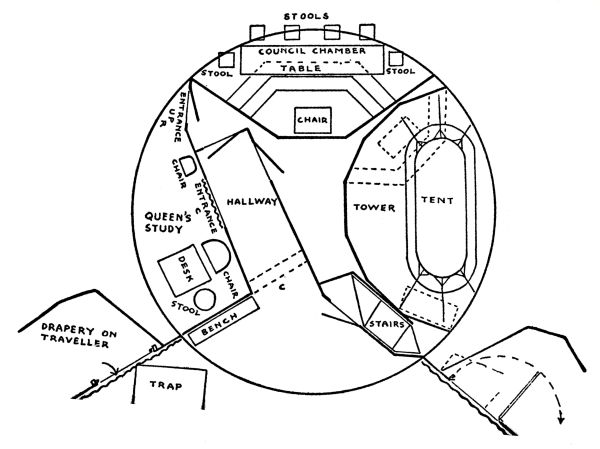
TRANSCRIBER NOTES
Misspelled words and printer errors have been corrected. Where multiple spellings occur, majority use has been employed.
Punctuation has been maintained except where obvious printer errors occur.
[The end of Elizabeth the Queen, by Maxwell Anderson.]