* A Distributed Proofreaders Canada eBook *
This eBook is made available at no cost and with very few restrictions. These restrictions apply only if (1) you make a change in the eBook (other than alteration for different display devices), or (2) you are making commercial use of the eBook. If either of these conditions applies, please contact a https://www.fadedpage.com administrator before proceeding. Thousands more FREE eBooks are available at https://www.fadedpage.com.
This work is in the Canadian public domain, but may be under copyright in some countries. If you live outside Canada, check your country's copyright laws. IF THE BOOK IS UNDER COPYRIGHT IN YOUR COUNTRY, DO NOT DOWNLOAD OR REDISTRIBUTE THIS FILE.
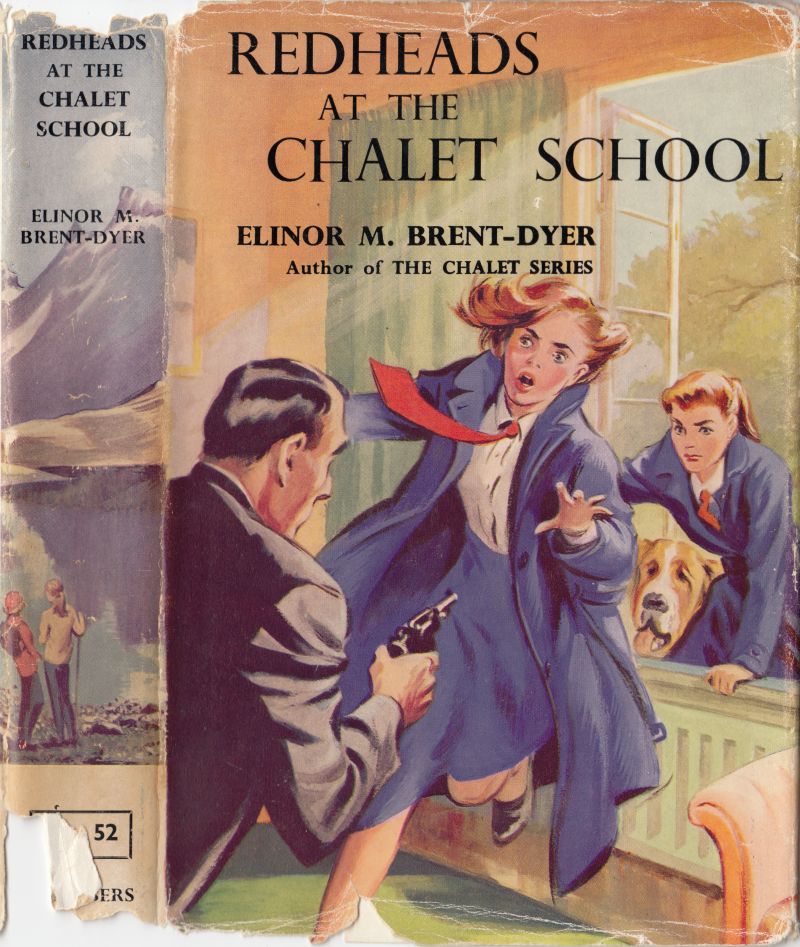
Title: Redheads at the Chalet School (Chalet School #52)
Date of first publication: 1964
Author: Elinor Mary Brent-Dyer (1894-1969)
Date first posted: February 6, 2026
Date last updated: June 28, 2026
Faded Page eBook #20260212
This eBook was produced by: Alex White, Hugh Stewart & the online Distributed Proofreaders Canada team at https://www.pgdpcanada.net
REDHEADS AT THE CHALET SCHOOL
By
Elinor M. Brent-Dyer
First published by W. & R. Chambers Ltd. in 1964.
To
JULIE EASTLAND
With Much Love
| CHAPTER | PAGE | |
| I. | Copper Asks Why | 9 |
| II. | Early Days for Copper | 20 |
| III. | Things Begin to Move | 32 |
| IV. | Len Wonders | 41 |
| V. | Miss Annersley Decides | 53 |
| VI. | Upper IV | 63 |
| VII. | An Odd Encounter | 74 |
| VIII. | Another Queer Episode | 84 |
| IX. | Joey Takes a Hand | 97 |
| X. | Prudence is Tactless | 106 |
| XI. | Val | 115 |
| XII. | A Clue at Last | 124 |
| XIII. | Val is Returned | 133 |
| XIV. | Nemesis! | 145 |
| XV. | Half-Term | 153 |
| XVI. | Reckoning the Casualties | 166 |
| XVII. | Inspector Letton Explains | 177 |
| XVIII. | Joey Does them Proud | 187 |
| XIX. | The Christmas Play | 198 |
The lean, dark man and the solemn-faced schoolgirl had sat side by side in silence for some time. Suddenly he spoke softly without turning his head—almost without moving his lips. “Copper! No; don’t move. Keep on looking out of the window. Now listen! You understand that you must use your proper name. I know you’ve always been called Flavia Letton, but from now on you are Flavia Ansell. Got that?”
“Yes, Dad.” Copper was staring out of the carriage window, her back turned squarely to the man, her long red pigtails dangling over her shoulders. Her words were almost as inaudible as his, but he caught them.
“That’s how you’ve been entered at this school and all your things are marked ‘Ansell’. I gave the order when I bought them. So no more ‘Letton’, remember. As far as possible you are to go nowhere alone. I wish,” he added, half to himself, “that there was no need to tell you anything, but for your own good you must know certain things. Please listen! You are never to go anywhere with any stranger, no matter what message they may say they’ve brought from me or anyone.”
“O.K., Dad.” Copper still spoke in that undertone. “There’s something up, isn’t there?”
“Quite right, but I’m telling you no more than I must—not yet, anyhow.”
“No; but I do wish I knew the why of all this!” It came with heartfelt fervour.
“You shall some day; but not yet. And Copper, it may be some time before I see you again. Write to me as often as you can and don’t be disappointed if you don’t hear from me as often. I’ll write when I can but—well, you’ve been a policeman’s daughter for most of your life and you know that we can’t always call our time our own. It may be impossible for me to manage even a postcard. Don’t worry if that happens. It will simply mean that I’m too occupied with my job at the moment. You’ll hear sooner or later.”
Copper nodded and one of the pigtails swung out, catching a warmer gleam from the September sun which was pouring through the window of their compartment. The man’s eye was on it and he frowned quickly.
“Your hair! Those bellropes of yours are pretty conspicuous. I’m not sure——” he broke off. Then he went on: “Yes, I am, though. Sorry, old lady, but you’ll be better off without them.”
The deep grey eyes still obediently fixed on the flying landscape, widened. “Have them cut off, you mean? Oh, Dad, must I? But why?”
“Better, I think. Once all this—well, later on, anyhow, you can grow them again if you want to. For the present you’ll be safer without them. I’ll give you a chit to hand over to whoever sees to that sort of thing.” He pulled out a notebook, scribbled for a minute or two and then tore out the page, sliding it along the seat towards her. “Here you are. Mind you hand it over as soon as you can.”
Copper’s face was gloomy but all she said was, “O.K., Dad!” as she took it and tucked it into her handbag. He took no notice but went on: “Don’t forget to read those papers I gave you. They tell you all you should know about your own father—all your mother told me when she married me. Learn it by heart and fix it in your mind. That is your story and the only one you know. Forget you have a stepfather as far as you can. Keep turned!” he added sharply.
In her surprise at his last remark, Copper had half-turned towards him, but his quick ears, already alerted for any new sound, had caught the noise of advancing footsteps in the corridor outside. She was back in her old position in a flash; her shoulders well hunched, her eyes fixed unseeingly on the flying landscape, one hand clutching at the tell-tale plaits dangling to her waist.
The man who strolled past the windows at the other side, casting a casual glance at the occupants of the compartment as he went, would never have imagined that there was any connection between the man buried in the outspread sheets of the newspaper he held and the sulky-looking schoolgirl in the far corner, whose blue-bereted head was bent over the book she had held on her lap all the time. He passed on without a pause and once his steps had died away, Chief Inspector Detective Letton laid his paper down, leaned out of the doorway and looked sharply after him. He had vanished into the next door carriage and all seemed to be safe enough.
“O.K.,” the Inspector said. “Go on listening to me. You know what happens when we reach Besançon. You leave the train and you’ll be met by two ladies.”
“I know,” Copper recited in an undertone. “One is big and fair and will be wearing brown; the other is small and darker and is in green. Both will have sprays of yellow flowers pinned to their jackets. I’m to go with them.”
“Right! And whatever you do, you must not—not!—turn back to look at the train or take any notice of me whatsoever. Yes; I know it isn’t going to be easy. We’re pretty close pals, aren’t we? But this is an order.”
Copper nodded silently. His final statement had clinched matters for her. When he said that she knew that all she had to do was to obey him to the letter.
“We’re getting near Besançon,” he said. “Get your traps together. Then go to the door and be ready to jump out as soon as the train stops.”
She stood up and took down the nightcase and rug from the rack. Hockey stick, raincoat and umbrella were already strapped to the case. She rummaged in her handbag for her ticket and finally stood erect, case in one hand, handbag and rug over her arm, and turned to the corridor.
“Go on,” he said from behind his paper. “No; don’t kiss me! Take no notice of me. We’re nearly in,” as a lady went past to the outer door. “Off you go!”
She went out and as she turned from him she caught, very faintly, the words, “God keep you, my darling!” A choky feeling came into her throat and tears pricked the back of her eyes, but she had her orders and she must obey without argument. Already the train was slowing down. In another minute it had stopped and the door was swung open by a porter. The lady she had followed went down the steps and turned towards the luggage-van. Copper jumped down, almost into the arms of a small lady in a green knitted suit and hat, with a spray of yellow flowers pinned to her coat.
“Oh, I’m sorry,” she began, but was stopped at once.
“You’re Flavia Ansell, aren’t you?” the lady said. “Good! I’m Miss Ferrars, and Miss Wilmot is over there by the barrier. Give me your case. That’s right! Got your ticket? Come along, then!”
With an effort, Copper marched off beside Miss Ferrars without looking back at the train. It was bad enough having to leave her stepfather for months at a time; to have to go without even waving to him was almost too much for her. She never knew that Inspector Letton, apparently busy jotting down something in his notebook, was really watching the erect little figure as it went to the barrier and was lost in the crowd there.
She gave up her ticket and they passed through, to be seized on and greeted by a big, pretty woman in brown who took her rug from her at once, saying: “Come along, Flavia! I’m Miss Wilmot. We’re going to a pâtisserie for coffee and then we’ll collect the car and be off to the mountains. This way!”
She led the way out of the station and presently they turned in at a pâtisserie. Here Copper was presented with a plate and cake-fork and introduced to the pleasant continental custom of going to the counter, where tempting cakes and rolls and twists of fancy bread were heaped up in long trays, and helping herself to whatever she liked. She had felt that she could not eat a bite, but the mistresses saw to it that when they reached their table her plate was well-filled, and when she had nibbled the first twist and drunk some of the delicious coffee, rich with cream, which their waitress brought she had found an appetite. When they left her plate was as empty as the others.
“Now for the car!” Miss Wilmot exclaimed. “Along here, Flavia.”
They went along the busy street, turned down another and presently came to a small hotel in a side street. In the courtyard at one side stood two or three cars. The mistresses made for a small dark-blue Citroën and Copper’s possessions were tucked into the back seat beside Miss Ferrars while she herself was commanded to sit in front beside Miss Wilmot. Copper knew that the rule of the road on the Continent is the opposite to the British, but it was quite a shock to find herself sitting on the righthand side while Miss Wilmot, in the driver’s seat, was on the left.
By the time she was growing accustomed to it they were rolling over a long bridge across a wide river towards which Miss Wilmot nodded. “The Doubs—mainly a French river, though it flows through a corner of Switzerland, too. You’ll see it again later on when we enter Switzerland at Les Brenets, though we shan’t have time to stop to show you the Saut-au-Doubs waterfall, which is a really lovely sight at any time of the year. However, we have a good many expeditions from school and the chances are one may go there in the spring and you may be with it.”
“That’s really the best time to see it,” put in Miss Ferrars, leaning forward from the back seat to join in the talk. “The river’s full from the melting snows then and the fall is a magnificent sight—nearly 100 feet of falling water crashing down at full pitch!”
“It sounds fabulous!” Copper said.
By this time they were out of the town and speeding along one of the great motorways, but before long they turned off and Miss Wilmot drove them along an obvious second-class road—very second-class, Copper thought—as they bumped over certain ruts and pot-holes. Miss Wilmot kept her eyes and attention on her driving but Miss Ferrars explained.
“We could go all the way by the motor road, but Miss Wilmot knows the short cuts and as it’s a longish journey in any case and we don’t want to land up about midnight, she’ll take the lot. This won’t last long, though I admit it’s—more than a little—jerky!”
The last words were literally shaken out as they bumped out of a big pot-hole and Miss Ferrars finished on a laugh. Copper laughed, too, as they swung round a sharp bend and she grabbed frantically at the strap. Then they ran through a little village, turned another corner into a lane, and emerged from this on to the motor road once more.
“Saved three kilometres there,” Miss Wilmot said complacently as she guided the Citroën into the long stream of traffic. “The main road curves out widely at that point, but the one we took goes direct. Still all together, Flavia?”
“I—I think so!” Copper gasped. “Gosh! What a difference!”
“Oh, in France that often happens. Besides we’re among the Juras and now we go on up for a time. Ever seen mountains like this before?”
No; Copper had not. “I went with my form for a weekend in Paris last Easter, but that’s the only time I’ve been abroad. Mostly, we go to the coast for holidays—Broadstairs or Bournemouth, and once we went to Cromer. It’s all pretty flat country. Aren’t these marvellous? Are any of them snow-capped or do they have glaciers?”
“No; for that you must wait till we reach the Alpine country,” Miss Ferrars told her. “You’ll see plenty of snow-caps and glaciers once we’re at school. We aren’t far from the Jungfrau there; and on clear days we look right across the valley to the true Bernese Oberland and have magnificent views. You’ll see!”
“It sounds fabulous!” Copper said, turning back to gaze at the view ahead.
On and on and up and up they climbed, now turning aside from the main road for two or three kilometres into another rutted way; then coming out again to the great motor road where the running was like a billiard-table. At last they reached their summit and then they began to go down steadily till they reached the frontier. A mile further on they ran into a busy little industrial town where they halted for lunch, or “déjeuner” as both mistresses called it.
“This is Le Locle,” Miss Ferrars said when they had parked the car and were walking along a busy street to a restaurant. “It’s a busy little place and quite an important one. This is where Daniel Jeaurichard, the man who invented the very first pocket watch, lived. Look over there. That street is named in honour of him. They still turn out the high-precision clocks and watches that have made Switzerland famous for its timepieces.”
“How jolly interesting!” Copper exclaimed. “When did—I forget his name—live?”
“He died in 1741 at seventy-six—so he had a good run for his money,” Miss Wilmot said, as she turned in at the swingdoor of a restaurant. “Heard of turnip watches, Flavia? That’s what the first pocket-watches were like—round, you know, and definitely weighty. They were carried in specially-made pockets at the waist. Coats were cut with very long skirts in those days and just as well, or gentlemen might have lost their watches to pickpockets all too easily. They cost the earth, of course. And there were none for women for years, of course. Watches definitely belonged to men.”
Miss Ferrars laughed. “I remember reading a book when I was your age, Flavia, in which the heroine, who was a girl in the eighteen-forties, was given a watch, and it said how rare they were, even in those days. Here comes our soup, and I expect you’re ready for it.”
Copper was ready, and she enjoyed the delicious soup followed by cold stuffed lamb served with tiny potato balls all crisp and golden outside and melting and savoury within, and artichokes with a delicate creamy sauce. They topped up with something that was pink and fluffy and delectable and wound up with cups of coffee blanketed with mounds of whipped cream.
“I like Swiss cooking,” Copper decided as they went to collect the car once more. “I wonder if we get this sort of thing at the school?”
Before long she had forgotten it, however, in the excitement of all there was to see. Miss Wilmot avoided the busy streets of Neuchâtel, but they had a glimpse of the lake as they raced round the little golden city and away to Berne which they reached with time to stop for more coffee and cakes—called here “Kaffee und Kuchen,” as the mistresses informed her.
“This is a German canton,” Miss Ferrars explained when they were once more on the road. “Neuchâtel is French. By the way, Flavia, do you speak French or German?”
“French a little,” Copper replied. “German hardly at all.”
“Ah! Then I’d better break it to you at once that at the Chalet School we speak three languages day about,” Miss Wilmot said blandly but with a wicked twinkle in her pansy-blue eyes. “So pick up all you can of either language.”
“Speak them? You mean—all the time, lessons and everything?” Copper gasped, appalled at the prospect. “But I can’t—not German, anyhow.”
“You’ll soon learn,” Miss Ferrars told her soothingly. “When you hear nothing but one language round all day for a whole day and must do your best to speak that language, you very soon pick up enough for everyday work. When it comes twice a week you find that you’re gathering a vocabulary together. Once that happens, you go ahead.”
Miss Wilmot laughed. “My dear girl, don’t look so pussystruck! As Miss Ferrars says, you do pick it up quickly—unless you’re a complete dullard—which you certainly aren’t. Besides, everyone is willing and ready to help you out; and, apart from that, after the first fortnight of school you’re fined if you use the wrong language. By the time you’ve been penniless for a few weeks, you soon learn enough to carry you through, believe me! I’ve been through it myself—I’m an Old Girl of the Chalet School and I know from experience.”
Copper still looked dismayed. “It sounds awful! I’ll never be able to do it!”
“Oh yes, you will,” Miss Ferrars assured her. “I’m not an Old Girl of the school and I could speak after a fashion before I joined the staff, but I had a hopelessly British accent which isn’t noticeable now. Being in the middle of it all has done that for me. You’ll find it’ll do the same for you. Don’t worry about it. Instead, look at the river. That’s the Aar, which flows out of Lake Thun where we have swimming and boating in summer and sometimes skate in winter when it’s possible to get down from the Görnetz Platz.”
“Is that where the school is?” Copper asked, diverted from future troubles by this. “I didn’t know. Where is it exactly?”
“It’s a shelf up on the mountain—a big one,” Miss Wilmot said. “The school is at one end and the big Görnetz Sanatorium three miles or so away at the other. Usually, we go up the mountain by train, but as we have the car today, we’ll take the coach road which goes up near Därligen on Lake Thun. Not so far now, as I expect you’ll be glad to hear. You must be growing tired after all your travels.”
Copper was wearying by this time. Her travels had begun the evening before when she and her stepfather had flown to an airfield near Nemours in Central France, taking the train from there to Besançon where the long car journey had begun.
“If Dad’s pal had only been able to fly us the whole way we’d have done it in half the time,” she thought sleepily. “What a pity that he had to get back. Then Dad could have come the whole way with me.”
She drowsed off to sleep after that. In fact, so tired was she that when they finally reached the school she had to be shaken awake before they got her out of the car and into the big entrance hall. There Miss Ferrars led her through corridors to a pleasant room where she was warmly greeted by a lady with a most attractive face and voice before she was handed over to a small, middle-aged woman in Matron’s uniform. Of the simple supper she kept sufficiently awake to eat, and the subsequent journey upstairs to a little cubicle where Matron helped her to undress and finally tucked her up in bed, she never really remembered a thing. She was half-asleep, and before Matron left her she had fallen fathoms deep in a slumber which lasted until the rising-bell next morning managed to reach her. She awoke to realize that she was in her new school with home and Dad hundreds of miles away, and she might not even call herself Flavia Letton as she had always done, but must begin her new career with a new surname and remember that henceforth she was Flavia Ansell.
It took Copper exactly ten days to settle down and decide that she was going to like her new school. At first, she was not so sure. For one thing, despite her pleading, she found that Flavia was her name and Flavia she would be called—by the staff, at any rate.
“It’s such a—a soppy name!” she protested to Miss Dene, the school secretary. “It sounds just like Mummy’s darling daughter, all curls and fancy frocks. It isn’t me.”
Miss Dene rested her chin on her clasped hands and looked seriously at her. “Is that how it strikes you? Myself, I should call it stately rather than soppy. I’m sorry. We do permit abbreviations of names, but not nicknames—not officially. What your future little playmates may call you among yourselves will lie between you and them. In form, my dear, it must be Flavia.”
Something in her tone kept Copper from further protest and, on later consideration, she realized that the staff of the Chalet School would have had to be very different from the general run of staff if they had given in to her.
French and German were another snag. French wasn’t too bad. The lessons at her high school helped her there. German was quite a different story. When you are still at the “Ich habe das Buch meines Bruders” stage, to have to try to understand whole conversations in nothing but German—as well as doing your best to produce remarks also in German that would pass muster with most folk—did not help to make life easier. However, Copper did not lack sense and though she might—and did—growl about it to herself she did pay attention to what she was taught, and by the end of the second week of term she discovered that she was beginning to understand a fair amount of what was said. Talking herself was another matter.
She had handed over her father’s note to Matron the day after her arrival and that lady had proceeded to clip off the long thick pigtails on the spot and trim the untidy ends into neatness. On the Saturday Copper had been marched off to the school’s hairdresser, Herr Fritz Beschannen, who kept an establishment in Interlaken. By the time he had finished with her head Copper had ceased to regret her thick mane. It had been a bother to brush and comb and plait. Now she would have more time for other things in the mornings and at night, and at least there would be no ghastly tangles to wrestle with.
“It suits you,” remarked Miss Ferrars, who had brought her. “The only thing is you must remember to brush it thoroughly night and morning until it’s settled down to the new parting. Still, that probably won’t take long.”
Herr Beschannen had given her a side parting instead of the centre one she had always had, and Miss Ferrars had bought her a couple of slides to keep the hair in place.
Copper peered at herself in the big mirror. “I look—different,” she said. “I think I’m going to like it, though. My head feels pounds lighter and it won’t be nearly such a bother to keep neat.”
Miss Ferrars, whose own brown hair was also cut, nodded. “So I imagine. And when it comes to washing it, it won’t be half such a trial.”
Copper’s “little playmates”, to quote Miss Dene, were intrigued by the change when she rejoined them just before Mittagessen, as she was learning to call the midday meal. She had been put into IVa and found them a friendly crowd. There were five other new girls besides herself, and one “old” girl took charge of one new, saw that she had all her books and stationery, knew about the various clubs and societies and was ready to explain anything that needed explanation.
Copper’s own “sheepdog” (as she discovered they were called unofficially) was a short, dark girl a little younger than herself, with black hair cropped like a boy’s and offhand, boyish ways which were brusquely kind. Jack Lambert was one of a crowd of six or seven girls who more or less led their own form by the nose. Since Form IVa was the top form in the Middle school, it looked rather, as Len Maynard, one of the prefects, had remarked, as if they would also lead all the Middles.
“And Heaven send that Jack and Co. don’t take any mad ideas into their heads,” she added piously, “or we shall have a sweet time of it this term.”
“I couldn’t agree more,” Len’s own special friend, Ted Grantly, rejoined. “We all know what Jack is when she has an inspiration!”
It was to this promising gang that Copper was first introduced, though Jack saw to it that she knew everyone in the form—twenty-three other girls. Quite a number of them were from other countries, including France, Holland, Belgium, Germany and Italy as well as the U.S.A., Canada and even Australia. Switzerland, of course, was well represented. Most of them spoke the school’s three languages more or less fluently, though one Italian girl who was new that term could manage only some French and neither German nor English.
Copper was not given to making friends quickly. She was pleasant to everyone, but while quite a number of the new girls were already beginning to join up conspicuously with one or more, she sat back, considering the various people. Jack she liked, though she shrewdly guessed that Miss Jack was a good deal of a featherhead. Jack’s special chum, Wanda von Eschenau, attracted her more. Wanda was small, dainty and unusually lovely, with long golden curls, deep violet eyes and perfect features. Copper soon saw that quiet as Wanda was in general, she frequently acted as a brake on Jack’s wilder exploits. Two more of the same gang—they were known as the Gang by most folk—were Dutch girls, Arda Peik and Renata van Buren, the last-named famed for a habit of looking angelic when she was contemplating the wickedest deeds. There were also Barbara Hewlett, generally considered the most level-headed of them, and Valerie Gardiner, a red-head usually to be relied on to be up to the neck in every mischief that was going. Strictly speaking, Valerie was more or less a hanger-on, for she had her own chum, Celia Everett, who was not one of the Gang. The rest of IVa were more or less law-abiding creatures, who regarded the Gang with awe and admiration, but preferred to keep clear of their wilder efforts at livening up things.
So far as work went, Copper found that she was well up to the standard of the form in most things. In one or two subjects she was even slightly ahead of them. Science, for instance, in which she was deeply interested, was one, and her mathematics were good. On the other hand, her essays were on the bald side and languages were a stumbling-block at present. Still, she felt that she had no need to worry about keeping her place so long as she worked steadily during lessons and preparation.
What Copper enjoyed most of all were the games. She had been doubtful about these at first. How could such a hodgepodge of nationalities as the Chalet School contained produce players of the same calibre as the First and Second XIs at the High School? On the first Saturday afternoon Miss Burnett, the games mistress, arranged for inter-form games for all the hockey players; the weather looked doubtful and no one was going to risk the girls being caught in a heavy shower when they were at some distance from the school. Netball games were also arranged for those who preferred the milder game. Others might look on or, in the case of the Juniors, join in a game of rounders. Copper elected to watch the Sixth forms versus the Fifths and the play of the two teams made her open her eyes. There was little or nothing to chose between the Chalet girls and those of the High School.
Later on, when she moved with Gretchen von Ahlen of her own form to watch the tussle between the Fourths, she found the same thing. Everyone in the teams played up for all she was worth, and Arda Peik was quite equal to Jack Lambert or Barbara Hewlett, who were both good for their age.
“What do you play?” she asked Gretchen as they stood watching.
“Netball; but I am not very good,” Gretchen replied. “I get tired so quickly and then they do not allow me to play, you see.”
“Oh, hard luck!” Copper said.
Gretchen grinned at her. “I do not mind. I think I am not fond of games. I like better to read and sew and knit. But I like to watch,” she added. “Shall we walk? The wind is cold.”
Lacrosse did not begin till the following week, but her first two practices thrilled Copper, who made up her mind then and there that it was the game for her when the time came for choosing which she would do. Altogether, she was finding life very full and she had no time for worrying about what her father had said. She wrote him a long letter on the second Saturday, giving him all the news and so plainly showing that she was settling down happily that he heaved a sigh of thankfulness when he read it.
“She should be safe enough there,” he said to himself as he folded up the closely-written sheets and put them away in a safe place. “And thank Heaven! I believe we got her away without anyone finding out where she had gone.” Then his work claimed his attention and he set further thought of her aside for the time being.
It was on the second Saturday that Copper enjoyed her first long walk at the school. The first part of the morning was always given up to preparation, home letters and mending. At 10.30 they had elevenses and, after that, games from 11.00 to 12.00. Mittagessen came at 12.30. After that, so Jack Lambert informed the new girl, if there were no matches and it was a fine day, the school divided up into parties and went for a ramble.
“How a ramble?” Copper asked. “Do you mean a walk?”
Jack grinned. “I do not. I said ‘ramble’, and I meant ‘ramble’.”
Wanda, who was with her as usual, explained. “When we walk, we go in croc: two and two, you understand. But if it is a ramble we may break line as soon as we have left the Platz and go in groups. And as it is Saturday, we may talk as we wish. I mean in what languages we wish.”
“But I thought Saturday was one of the English days,” Copper objected.
“But no; only the morning. After Mittagessen we may speak in any language, as I told you.—Jack, do you know who will be our escort?”
Jack shook her black head. “Not me! Haven’t had a moment to look at the lists since Prayers and they weren’t up then. Let’s go and have a dekko now. Coming, anyone?”
They went in a body, Wanda slipping a hand through Copper’s arm and pulling her along with them. She went cheerfully and they marched into Hall, making a beeline for the great school notice-board on which the lists were pinned up.
“Here’s ours,” said Renata, pointing. “Oh, good! We’ve got Willy and Ferry for staff, and Len Maynard and Rosamund Lilley and Ted Grantly for prees. That’s all right. Oh, and look at that, Jack! ‘Take rucksacks and call at the kitchens.’ That means a picnic.”
“Smashing!” exclaimed Copper. Then she saw they were all looking at her. “What’s wrong?”
“Only that ‘smashing’ is one of the words that’s utterly verboten here,” Barbara explained. “You know that we’re fined if we’re caught using certain words. That’s one of them, so cut it out if you don’t want to find yourself penniless by Saturday.”
“Gosh! How awful!” Copper gasped. “I knew we were fined if we didn’t try to use the language for the day, but I never thought of slang.”
“Len Maynard explained it to me,” Jack said. “You see, no one wants foreigners—oh well, folk from other countries, since you’re all so fussy!”, as an outcry rose at this. “Well, anyhow, we’re not to teach them our slang, Copper,”—IVa had taken to Copper’s nickname with acclaim—“and they’re not to teach us theirs. So don’t tell anyone to ‘ferme le bec’ if you want them to shut up, or you’re for it.”
“Shut the beak?” Copper repeated in puzzled tones. “Is that how you say it in French? I’d never have thought of it on my own.”
“Well, you forget it now,” Barbara advised her.
“What are you people doing in here?” demanded a fresh voice from the doorway and the party swung round with one accord.
“Oh—Len,” Jack said. “We just came to see who we were to have for escort this afternoon.”
“Yes; well, now you know. You clear out and go and make yourselves fit to be seen. The gong will sound for Mittagessen in less than ten minutes,” Len said with a glance at her watch, “and you’re all looking pretty wild about the head. Scram, everyone!”
They sped off. Len Maynard was a beloved prefect, largely because she seemed to be able to understand the point of view of her juniors and make certain allowances accordingly; but when she gave a direct order, she saw to it that she was obeyed—or else! as Jack Lambert had observed feelingly on one occasion.
Copper washed her hands and face and then produced her pocket comb and tidied the smooth red locks which she found so much easier to deal with than her pigtails. Barbara, similarly engaged, glanced at her and chuckled.
“When you come to think of it, what a lot of red tops we’ve got in the school,” she remarked. “There’s Len and her sister Margot—only she’s reddy-gold and Len’s hair is very dark red. Then we’ve young Val who’s a regular carrots, and now you’ve come. And there are others as well.”
Copper gave a final touch to her hair and pocketed her comb. “There are lots more people with black or brown or fair hair,” she said. “You’re brown yourself; and Jack is black, and Wanda is golden and Gretchen’s hair is so fair it’s nearly white.”
“It is not,” observed Gretchen herself in offended tones. “It is flaxen and that is not white.” She gave a toss to the long braids she wore dangling over either shoulder.
“Oh, I didn’t mean anything,” Copper said quickly. “I was just pointing out to Barbara that there aren’t all those many red-headed people in the school.”
“Oh, what does it matter?” demanded Jack, who never cared about looks so long as she was clean and tidy enough to pass muster. “It’s a lot of rot, anyhow. I’m ready if you folk are. Come on! Let’s go to the commonroom. The gong will sound in half a tick.”
She marched out of the splashery, the school’s name for a cloakroom, and the rest followed her to the commonroom. Copper was very quiet, although the rest chattered like starlings. Barbara’s remark had reminded her of her father’s insistence on her having her own plaits cut off. She wondered why he had said it would be better. Why did he think so? She had heard that some people thought girls were better off with short hair while they were growing. Was that it? Or was it something else? Why had she been rushed off to Switzerland so suddenly. Why had Dad spoken so quietly in the train and ordered her to speak quietly, too? And why had he made her turn away from him and not even kiss him goodbye?
“Copper—Copper—Flavia Ansell! Stop mooning and listen! What’s biting you?” Jack’s voice cut across her puzzled thinking and she gave herself a mental shake and turned to see what was wanted.
“Did you speak?” she asked. “Sorry, but I was thinking and I didn’t hear.”
“Didn’t hear? I’ll say you didn’t! I’ve called your name three times,” Jack said sarcastically. “What were you mooning about anyhow?” Her sharp eyes were bright with curiosity as she looked keenly at the new girl.
Copper flushed. “Oh—just something my father said to me,” she replied.
“Well, you give it a miss and listen to us,” Jack commanded. “D’you know what? Renata says she thinks our crowd are to take the train and go up to the Rösleinalp and picnic up there. Jolly good, isn’t it?”
“I don’t know. Well, how could I? What is the Rösleinalp, and why is it so smash—er—decent—to go there?” Copper asked.
“It’s a shelf quite a bit higher than this,” Barbara explained. “There’s a decent village up there with two shops where you can buy things like chocolate and wood-carvings and so on. And you get a fabulous view of the Alps towards Geneva at one end. I say, let’s ask if we can go along there and show it to Copper. Len would come with us if we asked her.”
The door burst open before anyone could reply, and Mollie Rossiter and Margaret Twiss, two more of IVa, dashed in.
“News!” Mollie shrieked. “Gorgeous news! What d’you think?”
“That you’d better pipe down or someone will be coming to ask who’s making all the row!” Jack retorted smartly. “What a silly clot you are, Moll! D’you want us to have a row?”
Mollie went red. “Sorry, everyone, but it really is rather good,” she apologized. “Listen to this! St Hilds is coming along to join us so we’ll have Gillie and Kitty and Mary and all that crowd. Now then!”
“Ferry told us just as we left the splashery,” Margaret put in rather more calmly. “She said, ‘You people will be glad to hear that your St Hild friends are joining us for the ramble. You may tell the others, but warn them not to make too much noise about it.’ ”
Jack’s face was alight. “I say! That’s fabulous! I’ve rather missed that crowd this term. I’ve quite a lot to say to Gillie and the rest—including what I think of Gil for not writing more than once during the hols. She is a blight!”
“How often did you write yourself?” someone demanded.
“One letter and two p.c.’s and all I had from her was one p.c. of Oban with ‘Having a gaudy time. Wish you were with us.’ I don’t call that writing to a chap. Did Ferry say when they began, Meg?”
“This week—on Tuesday. I’m aching to hear what they think of their new place,” Margaret replied.
Wanda, seeing that Copper felt rather out of all this, turned to her. “It is a school that were—no, was—burnt out this time last year before ever they began. Their Head was very badly hurt and was at the Sanatorium at the other end of the Platz for a long time. They came here to join us until something could be planned for them and they stayed the whole year. But now they have their own house at Ste Cecilie further along the motor road, so, you understand, they are not here and we all want to hear about it. Gillie and Kitty and Mary and the others were in our form last year and we really became very friendly with them.”
“Anything but, at first,” interjected Val Gardiner with a giggle. “Then Jack and Gillie rescued their cat—at least we thought it was their cat though no one’s ever been sure of it——”
The gong rang at that point and all talking must cease. Rules at the Chalet School were not many, but what there were had to be obeyed. Val stopped short in the middle of her sentence and the girls quickly formed into line and were all ready when Rosamund Lilley, the Head Girl, came to give them the signal to march to the Speisesaal, where Mittagessen was awaiting them. Copper had to wait until grace had been said and they were all sitting in their places before Val and the rest could enlighten her about the mystery of the Chalet School cat, Minette, and St Hilda’s cat, also Minette, as well as the story of the hair-raising adventure on which Jack and her chum, Gillie Garstin, had embarked on finding that one of the pair was out on the school’s roof on a bitter winter night and too terrified to get back to safety by herself.
This exciting narrative lasted them until the end of the meal. After that, they all rushed to get into blazers, berets and stout walking shoes before shouldering their rucksacks and going to the kitchens for their picnic parcels. By the time this was done and they were out on a sidepath the sound of voices reached them from the motor road and, five minutes later, the girls from St Hilda’s had arrived and were joining up in their proper forms, so Copper had to wait to hear the rest of the saga.
“Hello, Gillie! You’re a nice one!” Jack Lambert’s greeting drew a broad grin from the St Hilda’s girl she had addressed.
“What’s biting you?” she replied amiably. “Hello, everyone! Nice to see your ugly old mugs again!”
“Ugly old mugs yourselves!” retorted Meg Walton, another of IVa’s redheads, with a toss of her long pigtail. “What cheer, Moira! Glad to have you back. What’s your new place like? Walk with Val and Celia and me when we break and give us all the gen, will you?”
Copper, standing beside Jack who was partnering her for the moment, looked rather shyly at this new crowd of girls who had joined them. She knew by this time that it was hopeless to expect Jack to introduce her. That young woman was apt to be careless about such things unless she was reminded. Wanda, however, was not and she came up at that moment with a girl who was greeted by the rest of the Gang as “Anne Crozier! Gosh! Haven’t you grown!”
Anne, a leggy creature with a page’s bob and sparkling brown eyes, laughed. “Oh, my lambs! I fell out of a tree on to my head the second day of the hols and got concussion. I was in bed for three weeks and I grew then. You should have seen Mum’s face when I did get up and all my frocks were yards above my knees! Every single hem had to be let down and even then most of them were on the short side. Believe it or not, I grew an inch and a half in the time.”
They laughed and Wanda, coming to Copper, said, “Oh, everyone! This is one of our new girls, Copper Ansell. Copper, these are Gillie Garstin, Mary Candlish, Anne Crozier and Kitty Anderson from St Hilda’s.”
The four stared. Gillie was the first to speak.
“Is your name really Copper?” she demanded. “How come?”
“Oh, I’ve been called that since I was an infant,” Copper said. “My real name is Flavia. Can you beat it?”
“What’s wrong with it?” Kitty asked. “Jolly pretty and not common, I call it. Oh, we’ll call you Copper if all the rest do——”
“Not the mistresses, I’ll bet,” Mary interrupted.
“You win,” Copper said laconically.
“But why Copper?” Kitty inquired. “Is it—is it your hair?”
“It was in the beginning,” Copper explained. “When I went to school, though, the others found out that my dad’s a copper, so they stuck to it.”
“Is he? I say, what a yell! Does he tell you all about his fights with criminals?” Kitty asked eagerly.
“Not much! He rarely talks about his job—well, you don’t when you’re C.I.D. any more than a doctor natters about his cases or—or a bank manager about the people who have accounts at his bank,” Copper told her.
“Don’t they—bank managers, I mean?” Jack demanded.
Anne, whose father was in a bank, exclaimed in shocked tones: “Of course they don’t! It’s all private between him and—and the other people. Surely you know that, Jack?”
“I didn’t. Never thought of it,” Jack replied cheerfully.
“Girls, get into line!” Len Maynard and her chosen companion, Ted Grantly, had arrived and the sixty odd girls who made up the party hurriedly found their partners and formed up in line. By the time the two mistresses had arrived they were ready and waiting, berets at the proper angle, rucksacks on backs and alpenstocks gripped firmly. Miss Ferrars and Miss Wilmot were distinctly popular with their charges of both schools and they were greeted by welcoming grins from everyone.
“Got your sandwiches, etcetera?” Miss Wilmot queried. “All got clean hankies, Kodaks—and other oddments? Excellent! Lead on, Meg and Kitty. Keep a good steady pace and the rest of you, keep up with them. Len, you and Ted go to the head and Miss Ferrars and I will do sheepdog at the rear.”
Then they were off. Copper found herself and Jack third couple immediately behind Gillie and her partner, Mary Candlish; Wanda and her partner followed them. Down the motor road they went at a smart pace. The station was some distance away, lying midway between the school and the great sanatorium which brooded over the other end of the Görnetz Platz. The girls chattered as they went, but always with an ear open for any loudly-raised voices. The rule was that so long as they were on the road they must talk quietly. Not only were there a good many chalets scattered about, but there were a couple of guest houses where people with friends or relations in the Sanatorium might stay, and no one was anxious for Chaletians to get a name for rowdiness.
Arrived at the little station itself—a mere roofed shed—they found they were just in time for the train which was gliding up the long steel rail that rose from the plain below right up to Wahlstein where the great glacier that wound down the mountain from the eastern summit ended. The Rösleinalp lay halfway between the Görnetz Platz and Wahlstein. The girls filed into the two glassed-in coaches and then they were gliding on, up the steep slopes with a glorious view of the mountains beyond the twin lakes between which on the one hand stood Interlaken, on the other was a high, grassy bank where late summer flowers still lingered in places.
“What lies behind that?” Copper asked Jack.
“Mountain path. Actually, we usually walk the whole way, but I heard Deney say to the Head that we had so many new girls this term, especially in Lower IVa, that it would be better if we went by train and then walked down. You see,” went on Jack with the condescension of a very recent member of IVa, “some of them are quite kids and they might find it a bit much for them.”
“Oh, I see.” She suddenly remembered something and changed the subject. “Jack, why do you call Gillie that? Shouldn’t it be Jillie—or Jill? Her name’s Gillian, I suppose?”
Jack grinned. “Not it! Don’t tell her I told you for she just loathes her proper name, but she’s Gilbertine, after her dad. No one ever calls her that, of course, and if any of us did, sparks would fly.” She gave a chuckle. “You ought to understand, seeing you prefer Copper to Flavia, which really is quite harmless and, if you mind about that sort of thing, even pretty.”
Copper screwed up her face. “Soppy and penny-novelettish. Come to that, what’s your proper name? Jacqueline?”
“No; but it’s quite as bad. They named me after my two aunts, Jacynth Gabrielle. I s’pose they thought I’d be like that but I never have been, so I’m Jack which can be short for Jacynth. The school doesn’t mind short names, but they don’t call you by your nicknames—and here we are! Grab everything and be ready to bound. The trains don’t hang about much, I can tell you.”
Thus warned, Copper was ready when the train stopped, and bounced out after Jack on to the short, sweet turf with an alacrity which drew an approving, “Good, Flavia!” from Miss Ferrars, who had been first out and was standing watching to see that no one was left behind. Miss Wilmot had gone to the other coach on the same errand. The two prefects remained till the last and the empty coaches were delayed only to allow a party of tourists to clamber in, when, with a warning hoot, the train set off again on its upward journey.
The girls stood watching as it went and Copper was too much engaged in listening to Jack’s conversation to notice that one of the women in the party had turned on the steps of the back coach to stare at them. Her eyes dwelt particularly on Meg Walton, Val Gardiner, Kitty Anderson and Copper herself. They stayed longest on Meg, who had pulled off her beret and stood with the fresh breeze stirring the flying ends of her red hair. In fact, no one noticed, and no one would have thought anything of it if they had. Miss Ferrars and Miss Wilmot were busy counting their charges to make sure that all was well and the prefects were talking to a little bunch of Lower IVa and had their backs to the railway.
“All present and correct,” Miss Ferrars said suddenly. “Well, what do you all want to do? No, Arda; you may not start on your eats. We’ll have those at 16.00 hours and no one is to interfere with her packets or flask until then. So how do you propose to fill in the time?”
“May some of us go to the other end?” Jack asked eagerly. “We want to show the new girls the view from there.”
“By all means, so long as Len or Ted goes with you. Well, you two?”
“I’ll take them,” Len said. “Ted is going to organize a walk round the alpe through the pines for anyone who likes it but she can do that without me.” She cast a fleeting grin at Ted who returned it. “How many want to go round the outer edge with me? Don’t all speak at once, please.”
“Which way are you going, Ted?” Renata asked.
Ted, a tall dark girl with black hair cut in a deep fringe over equally black eyes, laughed. “Through the pines over there and round the back to the chalet under the mountain wall. We’ll meet there, shall we, Len?”
“O.K.” Len agreed. “Sort yourselves and hurry up. We’ve just nice time for it if we set off at once. Who’s going with Ted and who’s coming with me? Hurry up and decide.”
Thus urged, the girls divided into three parties, the largest going with Ted, the next joining up with Len, and the fifteen or so left remaining to enjoy sketching, photography or quiet chatter among themselves. The two mistresses settled themselves on a convenient log with books and knitting, reminded the prefects that their picnic would begin at 16.00 hours, and then shooed them off.
“Come along,” Len said to her party. “This way. We walk round by the edge of the cliff. Not too near, please, Val,” as that young person, with Celia in tow, made for the outer edge. “And no monkey tricks, either. I don’t want to have to go back and tell the Head I’ve left you in bits and pieces halfway down the mountain!” Whereat Val giggled, but came farther in.
The walk was a revelation to Copper, who had never seen any real mountains until she came to Switzerland. Jack and Co chattered all the way as they went, but Copper was almost silent. Len, keeping a watchful eye on her followers, noticed it. Presently, she joined up with the younger girl.
“Aren’t the mountains wonderful?” she said quietly.
Copper turned to her quickly. “Fabulous!” she said. “Somehow I never thought they would be like this.” She waved her hand towards the great ranks of mountain peaks standing out clear against the blue September sky. “How far you can see! And yet some of those mountains look quite near.”
“It’s the clear air,” Len said. “And, of course, we are so much higher here than down on the Platz that we can see far more. Luckily,” she added, “it’s an extra clear day. I’ve been up when you could scarcely see a thing for heat haze—Jack Lambert! What are you doing? Come back at once! Now listen, all of you,” as Jack obeyed her, “you are not to go nearer the edge than two feet. If you do, I’ll turn round and go back. Understood?”
“Oh, yes, Len!” “Mais oui, certainement!”—“Aber gewiss!” they chorused in a hurry. No one wanted to turn back and sundry meaning looks were cast at Jack and Co and one or two others who might be expected to forget their limits unless they were reminded.
When they went on once more Len laughed. “I thought that would do it! I must go and talk to Kitty and Mary from St Hilda’s. Don’t you become so absorbed in the view that you forget and do a neat walk over the edge yourself,” she added with another chuckle before she left Copper, who was instantly claimed by Wanda and had little more opportunity to feast her eyes on the wonderful picture before her until they reached the far end of the shelf. There Len halted them and, for the sake of newcomers, pointed out various important landmarks before collecting them together again and marching them round the side of the shelf to a little chalet which seemed to nestle under the shoulder of the mountain. Here they met Ted Grantly and her party, who complained bitterly that, late September though it was, the flies were simply ghastly in the pinewoods.
“Well, tomorrow is the first of October, so they’ll all be gone in another week,” Len said cheerfully. “It’s getting much cooler at nights now. Haven’t you noticed it? We may expect night frosts, once October comes in. That puts paid to the flies.—I beg your pardon?” This last to a smartly dressed woman who had emerged from the woods and come over to them. “Can we do anything for you?”
“I wondered if you could tell me the nearest way to the station,” the stranger said, speaking with an unmistakable American twang. “I guess I’ve missed the road, way back in the woods. I don’t want to be benighted up here, and wandering alone among trees don’t appeal to me. Which way is the shortest to the railway?”
Len considered while the younger girls moved aside in groups and stood waiting. “The quickest way is straight across the grass in that direction. Keep on till you reach the Gasthaus——”
“Pardon?”
“The—the little hotel.” Len hurriedly corrected herself. “There’s a path going round to the left of it. Follow that and it takes you straight to the Bahnhof—I mean station.” She looked at her watch. “You’ve plenty of time; the next train down is due in less than ten minutes so you’ll miss that. But there’s another in less than an hour’s time so you ought to catch that easily.” She wound up with a pleasant smile before turning to collect up her party. Ted had already gone on, considering that her friend was quite capable of giving directions without any help from either her or the thirty girls in her charge.
“Well, that’s pretty nice of you,” the stranger said. “Thanks a lot.” She glanced at the Middles nearby and added, “I guess you’re a school, aren’t you? Up for the day, maybe?”
Some queer instinct warned Len to say as little as possible. “Yes,” she replied. “And we must go on or our mistresses will be wondering why we’ve loitered so. Lead on, girls!”
The stranger nodded. “I guess school-ma’ams are all alike—fussing half the time,” she said. “Well, thanks again. Maybe we’ll be meeting if your school is in Interlaken or round there. I’m staying around with a party and we’ll likely be here quite a while yet.”
“It’s quite possible,” Len agreed. “Excuse me, please. I must go or those young demons may be up to anything. Good afternoon. I hope you enjoy the walk and catch your train all right.”
She smiled and went after her flock who were strolling along between the pines, waving their berets at the clouds of flies that still haunted them though, as she had remarked to Ted, another week or so would see the end of them. Her interlocutor stood where she was, gazing after them until Valerie’s flaming curly crop had disappeared round a bush and she could see them no more. A queer little smile was on her lips.
“Now have I been lucky or have I?” she remarked aloud. “What was it Dwight said about that kid? Long red pigtails—and they’re easily cut off—was that it?” She considered as she began to walk slowly back across the short, summer-burnt turf. “I guess maybe I’ll make a little surer before I say anything to him. Dwight sure has a hair-trigger temper for all he’s such a smoothy in public. I wouldn’t want a fight with him and especially if I’m wrong—as I could be. Red pigtails—phooey! Guess there’s a million kids like that around here. But I’ll hang around if I meet them and try to find out about some of those kids. Come to think, the big one I spoke to had red hair herself. But it can’t be her. She must be seventeen or eighteen and Dwight said the one they were after was twelve or thirteen, maybe a bit more; but not all that much. That settles it! Nix on telling Dwight—not until I’m a lot surer than I am. You watch your step, Lou Manley. Dwight’s no man’s pet when he gets mad.”
Meanwhile, having caught up with her band, Len had little time for meditation on the encounter. She was just in time to stop Val and one or two other choice spirits from trying to climb a specially tall pine. Things had happened before through similar efforts. Only the previous term there had been a near accident which might have been very nasty through just that sort of escapade. The Head had said then that she had a good mind to forbid all tree-climbing. She had relented, but she had warned the school at large that one more episode of the kind would bring down the ban on them.
“And I’ll be gumswizzled if it happens while I’m in charge!” Len thought, even as she shouted, “Val Gardiner! What do you think you’re doing? Come down at once! Remember what happened last term when Jack got stuck?”
Jack was not there to hear this, having gone on with the rest of the Gang. Valerie, however, knew all about it and she scrambled down in haste while the others tried to look as if climbing pine trees was the thing farthest from their thoughts. Len waited until the Middle was safely on the ground before she said more mildly: “Honestly, Val! Do you want to make us all late, quite apart from risking an accident?”
Val flushed to the roots of her hair. “I—well, I just didn’t think.”
“Then give thinking a chance another time,” Len remarked. “If you go on like this,” she added with a sudden grin, “no one is going to agree to taking you out unless you’re on a collar and lead. All right, we’ll say no more.”
She nodded at Valerie and turned to speak to Kitty Anderson, who had come racing back accompanied by Jack. “Well, what’s the latest?”
“Oh, Len, we’ve found a snake—coiled up under a tree!” Jack gasped.
“Has anyone touched it?” Len asked sharply. There are harmless snakes in Switzerland, but some are venomous as she knew. They saw little of them, and in any case it was growing late for them. But there was always the odd one about at this time of year, growing torpid with the long winter sleep which was facing them.
“No—oh, no!” Kitty assured her earnestly as the prefect set off at a run, the Middles keeping pace with her with some difficulty. Len had long legs and was a good runner.
They soon reached the party which had found the creature. Mercifully, they had had the sense to keep well away from it for, as Len realized as soon as she saw the black diamonds on its yellow body, they had found a viper. The thing had reared up, hissing furiously, and the Middles were backing from it looking scared.
“Move off, girls,” the prefect said sharply. “Get as far off as you can!”
“Is—is it poisonous?” Gillie faltered, her face white.
“Could be. You could have a nasty time if it bit you,” Len replied, searching hurriedly for a stout stick. “Keep back there, all of you! Ah!” as her eye lighted on a pine bough which someone must have wrenched off, for it was still green and fresh. Gripping it firmly, she brought it down with all her force across the back of the furious creature as her father had taught all the older members of his family years before. She was lucky. Still hissing and writhing violently, it collapsed among its coils limply, its back broken, the stony, lidless eyes dulling. But it was not safe, even now. She dared not let the girls who had been with her come on until she had removed the thing from the path. Setting her teeth, for she had a horror of snakes, she got the end of her bough among the coils, lifted them and tossed bough and snake as far as she could among the pines. Only then when the still writhing reptile was gone did she call the Middles to come.
“Safe enough now,” she said, “but watch how you tread. We’re not likely to encounter another, but——”
“But tha-that one was th-there,” Jack put in shakily.
Copper’s eyes had gone to the prefect’s face. Len was white as a sheet and her chin was quivering. For all her self-possession, she was a highly strung girl and the danger had been so sudden and so frightening.
“I say, are you all right?” she asked anxiously.
Len looked down at her and gave a tremulous laugh. “Perfectly, thanks. It was just that it all happened at once and I hate snakes. I’m all right, Flavia. Don’t look so worried.” Whereat Jack darted a quick look at her and another, rather less friendly than usual, at Copper.
Len caught both looks and managed to forget her fright a little in hastening to pour oil on what might become troubled waters. Jack Lambert had a tendency to regard the prefect as hers specially and she was a jealous young thing. Only last term there had been trouble with her and the elder girl was not anxious to have the same sort of thing repeated.
“We’d better get on,” she said, tucking a hand through Jack’s arm. “Two and two until we’re clear of the pines, I think. Come along, Jack. You and I will lead. Join up, you folk, and follow us—and keep to the path,” she added as she marched Jack off.
They met with no other adventures, but Len was a thankful girl when they finally reached the end of the woods and were out on the sunny herbage once more. Ted and Co had beaten them and already people were squatting round on logs or their raincoats which Matron had insisted on their bringing, fishing in their rucksacks for flasks and the neat packages the kitchen staff had put up for them.
“Just in time!” Miss Wilmot remarked. “Find seats for yourselves and begin. We want to catch the train down at 17.00 hours and that doesn’t give us much more than three-quarters of an hour to feed, pack up, and reach the Bahnhof.”
They obeyed at once, and presently sundry members of the party were listening breathlessly to a highly coloured version of the viper episode retailed by Renata van Buren. It reached the mistresses, of course. They requested Renata to stick to the bare truth but they shuddered inwardly at the thought of what might have happened.
It was Len herself who put a stop to the chatter by asking Miss Ferrars if either she or Miss Wilmot had seen anything of the American who had accosted them at the other end of the little shelf.
“Was she American?” Miss Ferrars asked, thankfully grasping at the new topic. “How do you know that, Len?”
Len grinned—she was feeling more like herself now, with one of Karen the cook’s delicious sandwiches already inside her and a good drink of hot coffee on top—before she replied. “You could have cut her accent with a knife, not to speak of the way she talked. She said she’d missed her way in the woods and wanted to know how to reach the railway.”
“When was this?” Ted demanded. “Do you mean that female who was prancing across the grass just as we met? What on earth was she doing alone in the woods? And how, by the way, did we miss her? She must have come through the trees. She certainly wasn’t anywhere on the path.”
“We saw her hurrying past near the cliff edge,” Miss Wilmot said as she skinned a banana. “She glanced at us, but she didn’t address herself to us and naturally we didn’t say anything to her. Like you girls,” she laughed, “both Miss Ferrars and myself were heavily warned not to speak to strangers in our long ago girlhood. Don’t think you’re the only ones to be told that.”
They went into peals of laughter which redoubled as Jack said daringly: “I’ll bet your girlhood wasn’t so long ago as that—or else you’ve both got marvellous memories.”
“Oh, thank you, Jack! That’s quite a compliment,” Miss Wilmot nodded at Jack. “Did she say anything else to you, Len—apart from asking the way?”
“Asked if we were up for the day,” Len replied.
“And wanted to know if our school was in Interlaken,” Mary Candlish put in.
Miss Ferrars suddenly looked anxious. “What did you tell her?”
“Nothing,” Len replied. “Most of the crowd had gone on. I said I must catch them up. I didn’t know you were hanging round, Mary. Why weren’t you with the rest?”
“I’d got a bit of bark in my shoe and I was shaking it out,” Mary explained. “I was a bit to one side of you, and I heard her say that. Then I tied my shoelace and hurried after the others. Did she say anything more, Len?”
“Only that we might perhaps meet again as she and her party were staying in Interlaken. I came after you folk to see what you were up to and I suppose she headed for the railway. I advised her to take the straight cut across the grass in case she missed the train. I suppose that’s why you scarcely saw her, Ted.”
“Just her back, though I can’t say she was hurrying herself,” Ted returned. “What a mass of food Karen packs! I couldn’t eat another thing if you paid me. Any of you folk got room for an extra banana? You, Renata? Here you are, then.”
She tossed the banana over to Renata who was first to speak and then turned to address a remark to Len. That young person was munching a slice of cake and ruminating. She had seen the two mistresses exchange glances over the account of the American woman. It was unlikely that even Ted would have noticed anything, but Len was abnormally quick and there was an inwardness in those looks which roused her curiosity at once. However, she saw no hope of satisfying it just then, so she put it at the back of her mind as something to be debated later and answered with every appearance of calm Ted’s query as to exactly where they had encountered the snake.
“It was rather more than halfway along to this end. How come your crowd didn’t see it?”
“I imagine because it wasn’t there to see,” Ted replied. “Miss Wilmot, surely it’s getting late for snakes to be around? I thought they were hibernating creatures and curled up in holes earlier than this.”
“So they do hibernate; but this is still September, remember. I’ve seen them about as late as October if we’ve had a warm autumn.”
“How did you know it was dangerous?” Kitty Anderson asked.
“By its colouring and markings,” Len told her. “Those greeny affairs with rings round them are harmless enough, but avoid yellow snakes like poison for that’s what they are.” She gave a little shudder. “I’m thankful none of you touched it.”
“And I’m thankful that you knew what to do and did it at once,” Miss Ferrars remarked. “From what Renata has told us even taking her account with a very large pinch of salt, something had angered it. Snakes are, as a rule, timid creatures who prefer to slide away so long as they’re not molested. When they are, they can be really nasty.”
“This one was all right,” Jack said. “Why did you chuck it right away like that, Len? It was dead, wasn’t it?”
“Dead all right; but the muscles go on reacting for a time even after the thing has been killed and anyone getting bitten that way might be made ill. Dad warned us all about that ages ago. Oh well, it’s gone now. Change the subject, please.”
“I certainly will,” Miss Wilmot said, beginning to collect up her rubbish to stow away in her rucksack. “Finish, girls, and clear up. We haven’t too much time left before the train arrives, and we don’t want to miss it.”
There was an instant scramble and under cover of it the head of the maths department murmured to her colleague: “Choke the little blights off if any of them raise the topic again. It was a nasty experience for Len and she’s still looking rather white. Thank goodness it wasn’t Con! We’d have had her sleep-walking all over the place after a doing like that!”
Miss Ferrars laughed and agreed. Len Maynard was the eldest of triplet sisters. Con, the second one, had been given to walking in her sleep since she was a very tiny girl. In these days she had largely outgrown it, but any extra excitement was apt to set her off again and she had given one or two people bad frights during her peregrinations.
“This ramble hasn’t been without incident, has it?” Miss Ferrars asked. “First this snake business and then the American woman who spoke to the girls.”
“Oh, I don’t suppose that meant anything. It’s the sort of thing that might happen anywhere. Don’t you begin imagining horrors, Kathy. What a lurid yarn young Renata made of the snake! That child’s reading ought to be vetted.”
“Oh, just the natural tendency to exaggeration you can expect at her age,” Kathy Ferrars said. “She’s no worse than a dozen others. Most of them do it—I did it myself at that age.”
“Did you indeed? I can truthfully say that I never did.”
“Oh, you! You haven’t an ounce of imagination, my dear, and well you know it. But to be serious, I didn’t like those questions this person seems to have asked Len. You know what the Head said about that new girl, Flavia Ansell.”
“Yes, but I honestly do feel that you’re making far too much of it. After all it was natural to be interested in a school in a place like this. Oh, we must let the Head know, of course, but I don’t suppose she’ll let it worry her.”
This commonsense view soothed Kathy Ferrars’ feelings. She agreed that Miss Annersley must be told and then turned to look over the picnic ground to make sure that every scrap of paper or banana skin had been picked up. All the same, when they were all strolling along to the little Bahnhof she glanced across to the group in which Copper was with a tiny feeling of apprehension. Miss Annersley had warned them all to keep a look-out for curious strangers who might question them, however apparently idly. So far, no one had done so. There could be no real reason why a stray American who had lost her way should be anything but what she seemed. All the same, Kathy Ferrars didn’t like it.
“I’ve a good mind to speak to Joey Maynard about it,” she thought. “She knows everything, of course, and if she felt suspicious she would speak to Dr Jack. But if Nancy and I tell the Head, she’ll almost certainly tell them, anyhow. Better let it alone. I don’t want to be officious.” Then she gave it up and turned to answer an eager question from someone as to when they were likely to have another ramble.
As for Nancy Wilmot, she honestly thought that her friend was making too much of the whole thing. They must report to the Head, of course, but she didn’t think this was the sort of thing Miss Annersley had had in mind.
“Besides, if the weather reports are to be believed, we’re to have a bad winter and that will keep the girls very much to quarters,” she told herself, with a memory of the blizzards they had had the previous winter. “I don’t think we need worry much just yet. Anyhow, who’s to know which of the girls is Flavia Ansell? She’s quite ordinary-looking on the whole and we’re a biggish school. All the same it’s a responsibility. I’ll keep my eyes open when she’s in my escort and more no one can do. The great thing is to do that and also to see that the girls don’t get wind of it.”
By this time they had reached the Bahnhof and the train was in sight. The girls were forming into line, ready to pass into one or other of the coaches as soon as it stopped and she began to hope that there were no other passengers down. Their own crowd would pack the coaches and she had no wish to divide up the party and have to wait with some of them for the next train.
In the event there were only two people, a young Swiss woman who came from one of the upper shelves and was known to both her and Kathy Ferrars, and an old herdsman. Somehow they managed to crowd everyone in and then they were off and she could hear Copper remarking on the smoothness of the downward slope.
“It’s a lovely feeling,” she said. “Just the careful gliding down. Oh, the clicking, of course, from the—the trolley. Is that what you call it? Anyhow, I do like it.”
“You ought to try going in a chair-lift,” Barbara responded. “That really is a thrill when you look down and see the valley miles below you.”
“Do you know what?” came Mary Candlish’s voice. “Mrs Rosomon came to see us yesterday—one of your old girls, you know. She and Dr Rosomon are living not very far away. Isn’t she nifty?”
“Is she a very old girl?” Copper asked. “I don’t think I’ve heard about her. Is Dr Rosomon at the San?”
Jack chimed in. “Oh, I know quite a bit about her. She’s Mrs Maynard’s niece or something. I know she used to live at their house when they were in England. Len told me so once. She’s a doctor, too, you know, only she doesn’t do it any more because she’s got three little kids so she hasn’t time. Len was one of her bridesmaids and so were the other two—I mean Con and Margot.”
“I remember Daisy.” Miss Wilmot joined in the talk. “She was one of the wickedest Middles I ever knew. But she grew up to be an excellent prefect and Head Girl. So there’s hope for some of you later on.” She chuckled while a chorus of protests rose at this. “All right! Calm down! I didn’t mention any names, so if you like to wear the cap, well, it’s only proof that it fits you.”
They were suddenly quiet at this and she turned to Gillie who was sitting beside her. “Have you seen her family yet, Gillie? We were all delighted when she had a little girl after two boys. I haven’t seen the baby yet, though she’s a year old now. Daisy and her husband were living in Devonshire when she arrived. They only came out this summer and what with one thing and another, including the summer holidays, there’s been no time for a trip to Ste Cecilie. Who’s the baby like, Gillie? Fair like her mother or darkish like her father?”
“She’s got black hair,” Gillie said, “but her eyes are blue. Her name’s Mary, you know. Tony and Peter are like their mother, though. If we see her shall we tell her you’re coming?”
“Better not, seeing I can’t say exactly when. But you may tell her I was asking about her and the family. It’s high time she paid us a visit, anyhow. I must give her a ring sometime and insist that she comes along and brings the family. None of you people know her, but some of the Sixth do. They were Kindergarten when she was Head Girl. That was when we were in England. Or let me see. I believe they weren’t. Still, they’ve seen her at Speech Days and Sports and so on.” She caught Copper’s eye and added: “We believe in keeping in touch with our old girls as far as we can, Flavia. We have record books that were started three years ago. Ask someone to show them to you if you’re interested. We have photos and written records there. Some of our girls are quite well known—Dr Eustacia Benson, for instance. And Mrs Maynard herself for another. You’ve read some of her books, haven’t you?”
Copper nodded. “Rather! I was thrilled when I knew that Len and the rest belonged to her. She’s almost my favourite author. I’m longing to meet her.”
“So you will when the babies get over this go of chickenpox. Until that ends she’s tied up with them. But as soon as quarantine is over she’ll be coming to school. She is the oldest of our old girls and, in fact, in some ways she’s never left. And here we are at the Platz. Out you get, girls, and don’t loiter. Trains hereabouts are like time and tide—they wait for no man.”
The girls giggled as they seized their rucksacks and made for the door. Knowing what would happen if they were slow, they poured out in short order and, since this was the Platz, formed into lines with the two mistresses leading and Ted and Len tailing off to act as whippers-in if anyone lagged behind. Two or three people were waiting at the Bahnhof and as the last girl jumped out they hurried to take their places. But not before Len, glancing incuriously at them, gave a tiny gasp. Among them was the American they had met up at the Rösleinalp.
The mistresses duly reported to the Head on the events of the afternoon. Miss Annersley was startled and horrified by the viper episode. The other she treated more lightly.
“My dear, don’t let your imagination run loose,” she said to Miss Ferrars. “If you are going to suspect every stranger who asks you the way or the time, you’re going to have grey hairs before term ends. You were quite right to tell me; Flavia is a big responsibility; but keep your sense of proportion whatever you do. As for the snake business, thank heaven Len Maynard was in charge. That girl has her head well screwed on and Jack Maynard has seen to it that those three and the elder boys know how to deal with such things. All the same, we must think twice before we go rambling in those quarters again. Not,” she added, “that another ramble is likely immediately. The glass is going down and the weather forecast spoke of rain. If it comes, rambles will be off.”
Knowing the kind of rain the Alps can produce, the pair fully agreed with her. They left the Head with feelings of relief and retired to change for the evening. She herself only waited until the sound of the steps had died away. Then she went to the telephone and rang up Joey Maynard, mother of the long Maynard family and herself the first pupil in the school.
“Joey? Oh, thank goodness! How are your patients?”
“All very cross and well on the way to recovery,” Joey replied. “None of them have been really ill. They’ve had it as lightly as possible. But quarantine remains the same, worse luck! You don’t know how thankful I am all my school people were nowhere near the infection. What with Margot in Australia; Len and Con with Simone in France; the boys with the Emburys; the three Richardsons in England with their granny-people and Felicity and Felix gone off with the Morrisons to Scotland, we’ve managed to keep it to the nursery and at least that’s one thing that’s over.”
“I don’t suppose any of your elder six would have caught it in any case,” Miss Annersley said. “They’ve all had it and that’s supposed to frank you for the rest of your life, I’ve always understood.”
“So Jack says. But why did you ring me up? Something gone wrong?”
“That’s what I can’t say. You remember what I told you about that new girl, Flavia Ansell?”
“I do. Do you mean someone’s got on the trail?”
“I can’t be sure. I hope not. But listen, Joey.” And Miss Annersley told her about the afternoon’s events. “You see, it may be all imagination. It would be the natural thing for a stranger to take some interest in what was obviously a school party. I told Kathy Ferrars so, for the girl was looking really worried. On the other hand, we do know that some of them were American and, to be honest, I’m not sure which way to take it.”
“Better be safe than sorry,” quoth Jo. “I’d keep an unobtrusive but firm eye on Flavia and make sure that she never goes far from school by herself. Tell me again what it was her dad told you.”
“He said he’d had a note saying that the friends of—what was the man’s name?—Walter Manley—would see that his death did not go unavenged and sooner or later he would feel it where it hurt most. There was no clue to the writer and it had been posted in Liverpool which might mean anything. Inspector Letton had had threats before about what would happen if Manley was hanged, but he had taken no notice of them. I gather that sort of thing is done sometimes, though as a rule nothing comes of it. But these are a particularly nasty crowd who stick at nothing—witness their shooting that poor young constable in cold blood.”
“That, of course, is why that brute swung for it,” Joey said. “Serve him right, too. I don’t like the death penalty as a rule; but that was calculated, deliberate murder and asked for it! Then, of course, as Inspector Letton was instrumental in capturing him, and it was certainly his evidence that clinched the matter, they’ve got it in for him. And,” she added, “what would hurt him most would be anything affecting his girl. I don’t wonder he rushed her off as hard as he could. I’d be quietly going crackers myself if I were in his place. What are you going to do about it?”
“That’s nothing we can do but watch Flavia and make sure that every single encounter of the kind is reported to me.”
“You know,” Joey said thoughtfully, “this is something like what happened when Elisaveta came to the school years and years ago. Her father’s mad cousin did succeed in kidnapping her—”
“Yes; and you went after them and rescued her and your sister was nearly frantic with terror,” Miss Annersley said tartly.
“Hilda! I’m surprised at you! At least nothing happened to Elisaveta and—well, Cosimo was certainly more than a little unbalanced.”
“And, from all accounts, these people may not be mad, but they would have no mercy on the child if they got her.”
“Send her back, then, and say you can’t take the responsibility,” Joey suggested with a wicked grin to herself. She knew what the answer would be.
“And when have you had reason to think that we would shirk a responsibility, having accepted it after due consideration? No; we’ve accepted her and we keep her—unless things become too utterly impossible. She’s probably as safe here as she’ll be anywhere. But Joey,” Hilda Annersley’s tone changed, “when you are free again, please keep your eyes open and report to me if you see anything untoward—and I mean anything.”
“O.K. Oh, mercy! I must go! Sounds of battle from above! Bye!” Joey hung up in a frantic hurry and the Head was left to follow suit before she answered the summons of the gong and went to take her place at Abendessen.
The next day came with heavy rain which allowed the school to do no more than scuttle across the grounds to one or other of their two little private chapels for the morning services and then scuttle back. There was no question of walks for anyone and Miss Annersley sat back relievedly.
In the afternoon the staff had their Sunday coffee with her after Mittagessen as usual and then departed on their various lawful occasions. She went upstairs to her bedroom, switched on the electric heater and sat down to consider matters carefully. She had been more disturbed than she had let anyone know about the encounter with the American, and she longed for someone with whom she could discuss it fully.
“If only Nell Wilson were back!” she thought. “But in her last letter she said she didn’t expect to arrive until Tuesday evening. Joey is out of the question, of course. Jack Maynard would have a good deal to say if I risked bringing infection into the school. As for Matey, she would be raging. No; this is something I must settle myself. Now let me think.”
She thought long and hard, and by the end of the afternoon she had come to various decisions. She might be making a great deal out of nothing, but in the circumstances she must take every precaution. As a result, she sent for Copper before morning school next day, after warning Miss Charlesworth, Head under her of the English staff, to be ready to take prayers if she herself were not available.
“What on earth have you been doing?” Barbara Hewlett demanded of the startled Copper when Miss Dene had withdrawn after delivering the message.
“Nothing that I know of,” Copper assured her.
“Perhaps they’re going to shove her up another form,” Jack suggested.
“Rot—I mean quelle sottise!” Copper retorted, suddenly remembering that this was a French day. “Je ne peux pas—er—faire mes travaux aussi bien pour celà.”
“But how your French is improving!” Wanda cried in that tongue. “And we must remember, all of us, or we shall have fines to pay.”
Copper picked up the books she had been collecting from her locker and came to dump them down on her desk, ready for the first half of the morning’s work.
“Est-ce que je suis bien tenue?” she demanded, smoothing her hair back with her hands.
“Oh, très bien,” the other assured her, Barbara adding: “Il faut s’éloigner en hâte. Madame n’aime pas qu’on la fait attendre.”
“I’m going—je vais!” And Copper sped from the room.
She reached the study where she tapped at the door and was bidden to enter immediately. The Head was at her desk, looking over a letter, but when the girl entered she set it aside and smiled at her.
“Come in, Flavia. Come and sit down, dear.”
Copper made her curtsey and then went to take the chair the Head had indicated, wondering what it meant. No row, anyhow. Miss Annersley was at her pleasantest, though she was looking rather grave despite that smile.
Miss Annersley herself had reason to feel grave. She was going to break a request Inspector Letton had made to her and which she had agreed to carry out. She looked thoughtfully at her pupil and decided that she was right. Copper was a level-headed girl. It showed in her serious face, her firm mouth and chin. The Head knew girls and she felt that whatever the girl might feel about what had to be told her, she was not likely to panic.
“Flavia,” she said quietly. “I have something to say to you.”
Copper’s mind went to her father instantly. “It—is Dad all right?” she asked half-fearfully.
“Yes, so far as I know. This is something affecting yourself. Tell me, do you know why you were sent to us so suddenly?”
“No; just that Dad thought it best,” Copper replied, her eyes widening.
“I see. Well, now I am going to tell you exactly why. First, I want your promise that you won’t discuss this with any of the others.”
“I won’t, of course.”
“Thank you. Now, then. You know your father’s work may have—must have gained him enemies among criminals. These people may threaten him if he continues with it, but as a rule it stays at threats. This time, however, there is reason to fear that the particular criminals concerned in the case will not stop there. Owing to his activities, their gang has been partly broken up. One of them has been hanged. They have told him that they will be revenged on him for this man’s death and will try to hurt him where he will feel it most. That, Flavia, means through you, he fears.”
Copper was silent, though her thoughts were flying. So this was the explanation of all the things which had puzzled her when she had had time to think of them! But why hadn’t Dad explained to her himself? And why was Miss Annersley telling her now?
“It—it’s all so sudden!” she said, voicing her feelings aloud.
“Not quite so sudden as it seems.”
“Why didn’t Dad tell me? I ought to have known before this. I mean, it’s been such a puzzle. I couldn’t think why he yanked me from school like that and sent me here. No; nor why he didn’t come all the way with me himself instead of parking me at that place where Miss Wilmot and Miss Ferrars met me!” She stopped short there, her eyes full of comprehension. “Is that why he said I had to have my hair cut—to sort of disguise me?”
The Head nodded. “Just that. Your hair is a striking colour and you had unusually long and thick hair. If these people knew anything about your appearance, they would certainly know about that. Under your beret it isn’t nearly so startling now it’s short. Not that it’s much of a disguise,” she added, “but we could hardly dye it another colour. It would grow out fairly quickly for one thing. For another, the other girls would notice it and chatter.”
Copper suddenly grinned. “Oh, they would! They nearly had kittens when I came back after having it cut and with a fresh parting! If it had been dyed——” she grinned again as she thought of the sensation it would have caused.
Miss Annersley laughed. “Exactly! And, by the way, I don’t like that phrase you used just now. Find something else, please. It’s not pretty.”
Copper looked abnormally serious. “I’m sorry. I wasn’t thinking.”
The Head nodded. “Well, the great danger is that someone might try to kidnap you and hold you to ransom. Anything like that would hurt your father badly. It would hurt any parent. We hope that they have no idea where you are, but there’s always a chance that someone connected with them may have seen you, either during the journey or since you came here. First, I want to impress on you that you are never to go off by yourself. Always try to keep with the others—if possible with the mistresses, prefects, but at least with as many as possible of your own friends.”
“Do they know?” Copper asked. “I mean the mistresses and the prefects?”
“The mistresses know something. The prefects know nothing, and at present I’m not telling them. Nor must you. And another thing, Flavia: don’t talk to strangers.”
“I’ve been told that all my life,” Copper replied.
“Yes, I imagine you have. Most girls have that impressed on them one time or another. But in your case, you must heed the warning carefully. Remember, no matter what any stranger tells you—that they have come to take you to your father, for instance, or even perhaps to one of us here, you are not to go. If that sort of thing should be necessary you will be told by one of ourselves—I mean the Staff or myself. If any of the girls brings you such a message, you are to take no notice of it. Is that fully understood?”
Copper nodded. “Yes. You mean that someone might get hold of—say, Jack Lambert or Wanda von Eschenau or one of the others and pretend to have come with a message from Dad and they wouldn’t know it was all lies, of course.”
“Quite right! I have one other thing to say. You had to be told all this for your own safety, but I don’t want you to worry about it. Try not to think about it too much and remember that we are all on the watch. You are as safe here as anywhere except a prison.” The Head forced a chuckle. “No one wants to put you in prison, exactly.”
“Oh, I should hate it!” Copper cried. “But, Miss Annersley!”
“Well? What now?”
“It it’s like that, why didn’t Dad keep me with him? Couldn’t I have had a police guard or something like that?”
“I suppose it would have been possible,” Miss Annersley agreed, “but it might not. And it would certainly have drawn attention to you after a time. As for being with your father, do you think that would have been really possible?”
“No, I suppose not. He’s got his job to do.”
“Yes; and you have to go on with your education. It’s hoped that the criminals who escaped arrest at the time, and who are the people threatening your father and you, will soon be laid by the heels. Then all this will be at an end. If they should be brought to trial, they will face heavy sentences of penal servitude and you will be grown up by the time those end.”
“Yes; but a good prisoner gets three months off every year if he behaves himself,” Copper said, startling the Head by her knowledge. “I’ve heard Dad say so.”
“Even so, two of them, I understand, are wanted in their own country by the police. I don’t know what would happen if they were taken. They might be extradited—handed over to their own people, I mean—at once, and sent to America to stand trial there. However, we won’t worry about that at present. I’ve told you the things that really matter. If anyone should try to talk to you, you must report to me as soon as you can. Now we have missed Prayers, I’m afraid. I hear the girls going back to the formrooms and you must go and so must I. If any of your friends want to know why I sent for you, tell them I had a message to give you and it is a private matter.”
“Yes, Miss Annersley,” Copper replied. She stood up, made her curtsey and went off to do the best she could with a geometry lesson, though it is doubtful if she took in much of Miss Ferrars’ teaching.
Left alone, the Head pulled on her gown, gathered her books together and after a word with Miss Dene departed for her own work, feeling thankful that in Flavia Ansell she had at least a girl who was unlikely to dramatize herself and the situation. All the same, an eye must be kept on her to see that she was not secretly brooding over it.
“I’ll have a word with Matey as soon as I’m free,” she thought. “And once Nell Wilson is back, I’ll go into it thoroughly with her. But I’m sure I’ve done the right thing in telling Flavia as much as I have done. Now that she has been warned she’ll be on her guard. I may be making mountains out of molehills but, as Joey says, I’d rather be safe than sorry.” Then she turned into Va and proceeded to put the thing out of her mind and give the girls a good drilling on the use made by Shakespeare of Plutarch’s Lives when he wrote Julius Caesar.
It took Copper the whole of that day to recover from the shock of the Head’s news. The rest of the form were anxious to know why she had been summoned to the study at all, but she gave them Miss Annersley’s message that it had been on a private matter and even Margaret Twiss, an inquisitive young person, had to stop asking questions after that, though she thought the more.
Jack and Co merely remarked: “Oh, it’s like that, is it?” and then turned their attention to something else. Life was too full for them to worry because another girl had been to the study on private affairs.
The immediate cause of their absorption was that on the coming Saturday it was their form’s turn to entertain the school in the evening and, even as all their predecessors had done, they had made up their minds to be original. The trouble was that everything seemed to have been done already.
Jack, as form prefect, called a form meeting after preparation on the Monday evening, having first been to the study to ask for leave to break the rule of nothing but French during it. As she pointed out, it was the first time they had ever had a turn and she was sure that people who were not actually French would find it terribly difficult to express themselves in anything but their own language. Miss Annersley gave leave, only reminding Jack that when the meeting was over, they must revert to French again for the rest of the evening.
“So don’t forget, any of you,” Jack ordered the form when all books had been cleared away and they were once more seated at their desks, gazing at her as she stood on the little movable dais usually sacred to staff or prefects.
Having settled this, she proceeded to ask blandly: “Who has any ideas? Don’t forget that we want to do something new——”
“If we can, that is,” Val interjected.
“I’m doing the talking just now,” Jack said, frowning severely at her. “I want to say that we haven’t much time so please, everyone, don’t waste a minute trying to be funny. If anyone has an idea, put up your hand first. We can’t make a row or we’ll hear about it from the seniors. They have another hour of prep still. Now then!”
She sat down and looked round the form. No one moved or spoke. Val, who had had every intention of being “funny” decided against it. The rest just sat staring mutely at their leader.
“Well! Come on!” Jack said impatiently when this had lasted about three minutes. “Trot out your ideas and look sharp.”
No one rose to the invitation. The fact was that they had suddenly discovered that new ideas weren’t so easy as all that. On due consideration it really did look as if everything had been done at least once.
“Come on!” Jack repeated in annoyed tones. “Can’t any of you think?”
Barbara grinned. “What about doing a spot of thinking yourself? What’s your idea? You set us going. After all, you’re form prefect.”
This floored Jack, who had no ideas at all on the subject. However, she couldn’t let the rest down so she hunted wildly for something and finally produced the suggestion that they should hold an indoor gymkhana.
This set the rest off at once. Quite a number of ideas came to the surface and the noise they made forced the chairman to hammer with both fists on the mistress’s table. When they were quiet at last, she glared round at them.
“I’ve warned you once about making a row,” she said severely. “Stop all yelling at once and if you have anything to say put your hand up and wait until I call you. If you don’t, I stop the meeting and people can dance as usual. Got that?”
They had. They knew Jack to be a man of her word and no one wanted to do anything so ordinary as to dance all the evening. The school would have had comments to make on their lack of ideas!
Arda put up her hand and several more followed but no one spoke. Jack nodded to her friend and the Dutch girl stood up and proposed a flower-pot race.
“We’ve done that over and over again at the sports,” Jack replied. “Can’t you think of something newer?” She glanced at Barbara, who promptly stood up and suggested a driving race between pairs of lighted candles.
“Oh, we can’t do that!” Wanda cried. “They’d never let us. They’d say it wasn’t safe.”
Barbara wasn’t to be beaten. “O.K. Do it between pairs of the artroom stools, then. There are enough, aren’t there?”
“I suppose so, but there wouldn’t be enough room,” Jack said after pondering it. “I know Hall’s big, but it’s not as big as all that. You couldn’t have more than three pairs at a time and it would take ages to get through the lot.”
So that idea was quashed. So was wheelbarrow racing which someone else proposed. So were a number of other proposals. They were finally left with hopping races—Ghislaine Touvet’s suggestion—drawing a pig blindfold—this came from Gretchen von Ahlen—and Margaret Twiss’s cartwheel race from one end of Hall to the other.
This was finally eliminated when Renata pointed out that you couldn’t expect people as old as the Head or Matey or Miss Denny to take part in it. So the gymkhana was dropped. Two races didn’t make a gymkhana, as Meg Walton remarked.
“Anyone else got any ideas?” the chairman asked hopefully.
“Could we do a play, no?” Michelle Cabràn asked shyly.
“Goodness, no! We’ve had plays and plays! I want to be original!” Jack protested.
Copper’s hand suddenly shot up. So far, she had kept in the background as became a new girl, but she did have the glimmering of something and Jack was looking harassed. Jack nodded to her.
“Go ahead, Copper! And let’s hope you’ve hit on something we really can do,” she added.
“Could we do a miming play?” Copper queried.
“A what play?” Jack looked fogged.
“Mime it all—only action, you know, and no words,” Copper explained.
They thought it over. Finally Jack spoke. “You know, I’m not sure you haven’t got something there. Far as I know that’s not been done—or not since I came to the school. What d’you think, you folk? Only we don’t want too much dressing-up,” she added in haste. “We shan’t have time to do dresses and things like that. Better keep to today and then we can wear our own clothes—or each other’s.”
“What story would we act?” Wanda asked pertinently.
“Let’s make up our own,” Barbara suggested brilliantly. “I know—let’s do a thriller! Copper, you say your dad’s a policeman—oh, well, detective, then,” as Meg murmured this reminder. “You ought to know all about detecting crime. Can’t you give us an idea?”
“He never says much about his job to me,” Copper replied. “Still, give me a sec and I’ll try to think of something.” She thought hard while they waited breathlessly. Nothing came at first. Then she had a sudden inspiration. Why not let them mime something connected with her own story? The first part would be easy to describe and among them they could surely dream up an exciting finish.
“We-ell,” she began, just as Jack was about to hurry her up, “suppose there was a man who had got up against some gangsters and they kidnapped his—his little boy—or tried to. Then one detective who was frightfully clever got on their track and finally the gangsters were caught and the boy was rescued. You could make that awfully thrilling—have shooting and stabbing and things like that, and the father going crackers because the kid was lost—oh, and the gangsters being beastly—I mean horrid—to the father and——”
“And asking thousands of pounds for the boy to be released,” Barbara chimed in eagerly, “and saying all the ghastly things they’ll do to the boy if the father doesn’t pay up or sets the police on them! Oh, it’s a gorgeous idea! Jack! Could we do it, d’you think?”
“But how could we do all that without a word?” Wanda objected.
“Oh, you’d act it, of course,” Copper explained.
“Yes, but how?” at least ten people asked.
Copper thought frantically. “Well, first of all show how fond the father was of the boy. Then—oh, I know! Show burglars breaking in and the man catching them—or one of them—and sending for the police. The gangster was wanted for murdering someone, anyhow, and he was sentenced to life imprisonment and the rest get up against the father and so you’d get the kidnapping and all the rest of it.”
Jack solemnly left her dais, strode over to where Copper was sitting and thumped her on the back. “It’s sheer genius! You’d done it, Copper! I don’t believe anything of the kind has ever been done in this school——”
“The bell!” Barbara exclaimed. “Come on, folks! If we’re late, they may say we’re not to do it and it really is a whizzer of an idea!”
They all jumped up, looked round hurriedly to make sure that their formroom was in proper order, then lined up and marched out to the commonroom where the rest of Middle School were putting away table games and books and making sure that they were neat and trim.
“What have you folk been doing?” Rosemary Wentworth, a shining light of Lower IV, demanded. “You surely have not been kept for extra prep all this time?”
Rosemary’s mother was half-French and she had seen to it that her daughter was bilingual from the first, so she spoke in fluent French, this being French day. Thus reminded, Jack replied in very much more English French. “We’ve been having a form meeting—though that is not your business,” she added loftily.
“Oh, I beg your pardon, I’m sure,” Rosemary retorted. “Sorry I asked!”
She turned away to remark to Hanni Unsel, another member of Lower IVa, “How grand we are since we went up to Upper IV, aren’t we?”
Hanni giggled and Jack, overhearing both comment and giggle, frowned blackly. She had the sense to let it alone, however. For one thing she knew that Rosemary was feeling very sore about being left down in the lower form, owing to having had to miss most of the summer term at school, thanks to an attack of measles complicated by bronchitis at the end of the Easter holidays. For another, though she would never have believed it if you had told her, Jack was beginning to grow up at last. She felt it beneath her dignity to take any notice of Rosemary’s remark. As for Hanni, she was a born giggler. If you began to worry about her giggles, you would be kept busy! Then the gong sounded for Abendessen and Carmela Walther arrived to see that they got into line and marched properly to the Speisesaal. Carmela was a favourite prefect, but everyone knew better than to play any tricks when she was in charge.
Monday was Hobbies Club night, so when the meal had ended and they were dismissed, everyone hurried off to either form or commonroom to get out whatever hobby she was interested in. Some of the girls turned to their collections, for the school encouraged all this sort of thing, and quite a number of the staff came along to give any help that was needed while the prefects took it in turns to sit with the lower forms, ready to admire the gems of collections, and give advice on how to arrange them or what books to read for information needed. In the case of crafts such as cane and raffia work, fretwork, chip carving, or any of the other crafts, they often helped with work.
Copper had been delighted with the Club when she first heard of it. At home in London she had collected various objects in her time, from picture postcards to crests, but they were all still at home. Now, at the suggestion of Len Maynard, she had turned to collecting views of the Alps. Len had produced dark brown pastel paper, sheets of thin cardboard and a piece of brown cotton material and shown her how to make her own album for pictures by means of punching holes down one side of the paper and the cotton covered cardboard and using gold cord to hold them together. She had started the new girl off with a handful of snaps from her own hoard and begged postcards from various people. Now Copper was settling down to arrange her pictures as artistically as she could.
“Are you good at art?” Len had queried. “If so, later on you could give decorative borders to your pages. Anyhow, by the time you leave school you ought to have a very decent memento of your time here. Now go ahead.”
Copper went ahead and was deeply interested in a hobby which, little though she knew it then, was to prove of greater value to her than even a treasured memento. She settled down with sheets, pictures and photographic corners at one of the little tables plentifully provided in every commonroom. She had her ruler and pencil with her and presently was absorbed in filling up her first pages. On Len’s advice, she was doing this first, and as each sheet was filled it was added to the album. Already she had two sheets between the covers. She hoped to add at least one more this evening.
Jack’s hobby was fretwork and she was very clever at it. She had already produced several working models and toys and just now she was at work on a model battleship. Those fingers of hers, which were the despair of Mdlle, who took needlework, were astonishingly deft when it came to this sort of thing. Copper had seen and admired her aeroplane which flew at least fifty yards, a beautiful little wheelbarrow and quite a number of other toys.
The other girls were, for the most part, less ambitious. Barbara Hewlett collected shells and ornamented boxes and picture frames with them. This term she had brought a wooden-backed handmirror from home, and a case full of gaily-hued shells an uncle had brought her from the Pacific Islands, with which she proposed to adorn the mirror.
“Then, if it’s decent enough, they might even use it for a raffle at the Sale,” she announced to Copper. “At any rate, even if it’s not good enough for that, it should bring a good price.”
Copper gaped at her. “The Sale? What Sale?”
“Has no one told you?” asked Wanda who overheard. “But every year we have a Sale in aid of the Sanatorium. We all make things for it during Hobbies Club as well as at other times, and then we give a whole day to it and sell.”
“But who comes to it?” Copper asked. “I mean, our own people can’t—or not many of them.”
“We do get some—quite a number, in fact,” Renata told her. “And then there are the people up here at the Platz and all the doctors and their wives and the nurses——”
“Don’t forget the Old Girls,” Arda put in, looking up from the complicated sports stocking top she was knitting in no fewer than five colours—like most Dutch girls, both she and Renata were expert knitters—and moving her pattern round for Copper to see. “Regard, Copper! Renata and I try to have at least twenty pairs of these stockings ready for the Sale and always they sell.”
Copper “regarded” the pattern with some awe. She was no knitter and even made mistakes in a simple two-and-two rib. “You can’t do a thing like this?” she gasped.
Arda handed over her needles and the two inches or so of knitting depending from them. “I began this last week. Already one can see the pattern coming.”
One could. Copper gazed at her friend with respect. “How very clever of you,” she said. “But when is the Sale?”
“Oh, in the summer. This term we have the Nativity Play and in the Easter term the garden is too wet and muddy to be used,” Wanda joined in the chatter. “We work all the year and then we have the Sale in the summer. We have competitions also and each year Tom Gay has sent us a house or a village and that is the biggest competition of all, for the house is the prize. Have you not seen the Elizabethan House in the museum? Miss Denny won that and presented it to the museum. And the Maynards have another that Con won when she was quite a little girl.”
“Who is Tom Gay?” Copper asked curiously.
“An Old Girl. She’s quite grown up and she works in some horrid slum place in London among boys,” Barbara told her. “She’s a missionary there—or something like that. I’ve heard my father say that she does really valuable work.”
“How do you mean?” Copper asked.
“Well, she runs clubs for boys and teaches them handcrafts like carpentry and other kinds of woodwork. When they leave school she tries to get jobs for them and she coaches them if they want to go in for exams and things like that.”
“She sounds a jolly good sport,” Copper agreed.
“She is!” Wanda and Barbara spoke together.
“Who is?” demanded Con Maynard who had come near just in time to overhear the last part of their speeches. “Anyone want any help? What are you doing, Barbara? Oh, shellwork! That for the Sale? It’s an idea.”
“D’you really think so?” Barbara asked eagerly. She had a deep secret admiration for the second of the Maynard triplets and approval from Con meant a great deal to her, though she was too shy about it to let anyone know.
“Rather! Those boxes you did for our last one all sold. A mirror will go like hot cakes. And I’ll tell you what. We’ll try to get a brush and comb and you can do them to match. Then they can be sold as a set.”
“I’d love to have a shot at it. But where could I get them? I mean I suppose it could be easy to get a wooden-backed brush; but are combs made, too?”
“I know,” Con said, sitting down to examine the narrow strip of pillow-lace at which Wanda had been working. “Tom Gay ought to be able to get them for us. I owe her a letter anyhow—at least, one of us three does and I’ll take it on. I’ll ask her to find out if they’re to be had and if so to get us one set as a beginning. How’s that, Barbara?”
“Fabulous!” Barbara cried. “You know, it was Tom we were talking about. We’d been telling Copper about the Sale and Tom’s dolls’ houses just before you came. Oh, Con, do you think she might see the one you won when you were a small kid? Your mother will be having the new girls as usual, won’t she?”
“Certain to as soon as the chickenpox is over.” Con suddenly giggled. “How mad Mamma was when Cecil started! And oh, how thankful that for once we hadn’t spent our summer holidays in a bunch as usual! Hello! There goes the first bell.” She raised her voice. “Clear up, everyone. I’ll take cupboard duty as I’m here.”
She got up and went to the tall cupboard where they kept everything connected with the Hobbies Club except the treadle fret-saws, which were too big and had to be pushed into a corner and covered when they were not in use. The Middles hurried to collect their bits and pieces together and Copper went to take her place in the long line by the door, wondering just what she should take up so that she, too, might contribute to the school’s big summer Sale.
For the rest of the week IVa were so busy with their play that they had no time for anything else. Between them, they reduced Copper’s story to something that was fairly manageable. They contrived to arrange the cast without too many violent squabbles and, having consulted with their form mistress, Miss Ferrars, decided to dispense with scenery and make do with curtains, which saved them a good deal of labour. The miming was not easy. As Barbara said plaintively it was horribly difficult to express affection or fury without words. Somehow they got round it, but when Saturday night came they were distinctly disgusted to find that their audience, instead of having their blood properly curdled, rocked with laughter almost the whole way through. Barbara put the finishing touch to the effect their grimaces and wild gestures had created. As producer, she was given a curtain call. She looked round at the grinning crowd who were applauding wildly and when the clapping ceased, said in bewildered tones: “But it wasn’t funny, you know,” which finished even the two Heads.
“But I don’t see why you all shrieked like hysterical hyaenas,” she protested to Francie Wilford, one of the prefects, when that young woman congratulated her next day on her production. “It was a serious play—a thriller, in fact.”
“Oh, no, my lamb! That may have been what you were after, but what you gave us was a most lovely farce,” Francie told her with a broad grin. “I’ve never laughed so much in my life—and I never remember enjoying an Upper IV show more,” she added. And with that they had to be contented.
Miss Ferrars, when they applied to her, was more helpful. “You overdid the mime,” she explained. “I know that in the theatre you must be rather larger than life, but if you overdo it, then it becomes—well—funny. Don’t be despondent about it, Barbara. For a first effort it was very good in parts. But if you had had time for more rehearsals you would have seen for yourselves where you were going wrong. At the same time, you can take consolation from the fact that no one was bored. Everyone enjoyed it and it was quite original. But next time, as soon as you know when your turn to be hostesses is, get down to preparation at once. You had at least three weeks notice and if I’m not mistaken, you did nothing about it until the week of the show.”
As this was true, Barbara flushed and said no more. When she reported the mistress’s comments to the form, however, quite a number of them marked them for future affairs, though Jack, who had characterized the whole thing as “Ghastly rot!” merely sniffed and demanded to know if they were expected to put in their free time on that sort of thing every term until their turn was over.
“I shouldn’t think so,” Copper said. “All she means is that we did things in too much of a rush and we’d better watch out for it another time.”
“And anyhow, we shan’t be doing a play next time,” Arda reminded her. “We don’t want to repeat ourselves. But I think we had better discuss it at intervals and try to think what we should do well beforehand.”
“Next term’ll do for that,” Jack decreed. “We’ve finished for this term—thank goodness! I say, Barbara, we’d better settle about our netball team for the match with Inter V on Saturday week. I want us to put up a decent show.” The subject dropped and they turned to other things.
On the Monday Copper had a long letter from her stepfather, the first she had had since she had come to school. He was writing from New York where he had flown the day before, following up a clue that had come up unexpectedly. He gave her no address to which she could write, but he assured her that all was well with him and he hoped to be able to clear up the case before very long. In that event, he would, if he could, take advantage of some of the leave due to him which had been piling up and try to come to the Görnetz Platz for a brief visit. He did warn her that he could give her no date, but the mere suggestion was enough to send her about the rest of the day in a state of delight.
Tuesday was not quite so cheerful. For one thing, Gretchen von Ahlen woke up with toothache and by mid-morning one cheek was so swollen that she was sent to her house matron. Matron examined her mouth and then, having ministered to the bad tooth went straight to Matey, as Matron Lloyd, head of the matrons, was called by everyone, and suggested that it might be as well to have a tooth inspection of the entire school.
“I knew it!” Jack proclaimed when the notice appeared on the general notice-board in Hall. “Bother Gretchen!”
“Jack! Sprich deutsch!” Barbara reminded her. “Es ist Dienstag.”
Jack made a face. “Ich hasse deutsch!” she said. “Ich kann mich nicht daran erinnern.”
“You do not try to remember,” Barbara told her with truth.
“You have been here almost three years,” Renata said reproachfully. “You should be able to speak better than you do by this time, Jack.”
Jack glared at them. Luckily for the peace of the form Matey arrived to make her inspection and talk had to stop. Matey was small, but there wasn’t a girl in the school who would have dared pursue a private wrangle in her presence; it is doubtful if any of the staff even would have tried. For all that, she was beloved by everyone. If she was strict, she was just. She had a strong sense of humour and she always knew when to make allowances.
On this occasion she went about her job with her usual quick efficiency and in half-an-hour she left the form room. She also left five girls who were dismally facing a visit to the dentist in the near future. Copper was one of them. Matey had discovered two teeth that needed attention and had also stated that she expected the whole lot would have to be scaled.
“Do you brush your teeth morning and evening?” Matey had demanded in her fluent German.
Blushing furiously, Copper had confessed that some mornings when she was late she had omitted it and was informed that in future it was to be done, no matter how late she might be.
“And why should you be late?” Matey asked severely. “You are called in plenty of time for everything. Please do not let me hear you say that again.”
Copper, well aware that she had a tendency to loiter over her dressing, reddened again and looked foolish. All the same, she made up her mind not to neglect her teeth again.
By the time Herr von Francius had finished with her on the Thursday morning she was even more determined about it. He was good and thorough and one of the bad teeth had required a good deal of grinding before he finally packed it with a temporary filling and informed her blandly that she must come back next week for the final one.
She was the last on Matey’s list and by the time he had finished with her it was 13.00 hours and Mittagessen must be taken at a restaurant frequently patronized by the school on such occasions. Matey marshalled them into line, aided by Matron Henschell who had accompanied them, reminded them that loud chatter and laughter were banned as they were in Berne, and marched them off down the Hoheweg, with herself and Matron Henschell at the end of the crocodile and Len Maynard and her sister Margot at the head. Len had chipped a tooth on some extra hard toffee and Margot was in trouble with a wisdom tooth which was growing through its neighbour. Len’s trouble had been set right with filling, but in Margot’s case the earlier tooth had had to be extracted and her jaw was very tender.
Copper, partnered by one of the Inter V girls, was feeling very sorry for herself. The worst tooth still ached after the severe treatment it had received and she didn’t see how she was to eat anything.
“Est-ce que tu as encore mal aux dents?” inquired Anne Lambert, who was Jack’s elder sister, with sympathy.
“Oui,” Copper said.
“Oh, ma pauvre! Je te plains!” Anne replied.
Stumbling a little over her French, Copper responded, “Merci bien.—Er—avez-vous mal aux dents aussi?”
“Mais non. Ce n’était qu’une agace tranchante que Herr von Francius a limée et maintenant tout va bien.”
Copper looked at her. “Sorry, but I haven’t understood more than half of that,” she said in blunt English.
Anne laughed. “It was a sharp edge and Herr von Francius has filed it down. Don’t look so worried, Flavia. When we reach the restaurant Matey will give us leave to use which language we like,” she said kindly.
“Thank goodness!” Copper heaved a deep sigh of relief as they reached the restaurant where tables had been booked for them the previous day. They filed in, took their seats and then, as Anne had said, Matey smiled at them and gave leave for free speech.
Their tables were at one side of the big room. There were twenty-one girls and when they sat down, one matron took the head of each table and Len and Margot, the only Sixth-formers present, went to the foot. The rest were free to sit where they liked. Copper joined up with Gretchen and the other members of Upper IV while Anne went to sit with a friend of her own.
“Do you feel rotten?” Mollie Rossiter asked sympathetically. “You look as if you did. Was it frightfully bad?”
“Ghastly!” Copper said with feeling. “I’ve got to go again next week, too, and my mouth’s so sore I don’t know how I’m going to eat a thing.”
That problem was speedily solved when the waitress set bowls of soup before them. Copper was prepared to leave her roll but Angèle Sartou advised breaking it into the soup and she found that she was able to swallow the result with fair ease. The delicious slices of roast stuffed veal, accompanied by sauté potatoes and a mélange of vegetables, were impossible to her as well as Margot Maynard and one or two others. However, the creamy pudding which followed was easy enough, so the sufferers had quite a good meal and felt decidedly better for it. Margot, who had been looking very white and heavy-eyed, regained a little colour and Copper became very much more like herself. Even Gretchen, a delicate girl who was only beginning to grow out of the frailty which had worried all the elders so much, was distinctly better. Matey looked round them, thankfully noting the signs of improvement, before she gave the signal to leave the table. Instead of marching them off to the Ostbahnhof where they could catch the mountain train, however, she led them away to a small salon where she told them to find seats and rest.
“Miss Annersley is sending the school coach down to pick us up here,” she explained. “Yes; I know we had to come down by train because Andreas had taken the engine down, but Miss Dene telephoned me at Herr von Francius’ to say that it was all right again and it would come for us about 14.30 hours. That gives us about twenty minutes to wait, so you may as well make the most of it.”
“Oh, fabulous!” murmured Mollie. “We shan’t get back to school until 16.00 hours with luck and that means missing dictée and needlework!”
At that moment, the door opened and two strangers came in. Matey was busy making Gretchen comfortable on a sofa and noticed nothing. Matron Henschell had not come with them, since she was settling up with the manager of the restaurant, and it was left to Len to go to them.
“I beg your pardon,” she said, “but this salon is in private use at the moment and——”
She got no further, for one of the two gave an exclamation. “Well, now, if it isn’t the nice girl who showed me the way to the railroad up at that place in the mountains! I said we’d likely be meeting again and here we are! I’m real pleased to meet you again, my dear.”
Len glanced round, but Matey was still busy with Gretchen and she must cope by herself. “I remember,” she said. “But I’m afraid I can’t stop to talk. We’ve been to the dentist and some of us have had a bad time, so we are resting here. I’m sorry, but will you please go.”
“Why, yes, if that’s so. I’m right sorry to hear that. But you won’t have far to go? Where did you say your school was?”
Len nearly told her. Then that odd feeling she had had at the previous meeting clamped down on her. “Oh no; and in any case the school coach will be coming for us so that will be all right,” she said, ushering the pair towards the door. “I’m sorry to seem rude, but I’m afraid I must ask you to go now.”
“Yes, of course. Oh, by the bye, a friend of mine has a girl at school here but—er—she didn’t tell me the name of the school and I’m wondering if it could by any chance be yours. Flavia Letton is her name—a girl of about twelve or thirteen. Have you a Flavia Letton among your girls?”
The name Flavia certainly meant something to Len and it was with difficulty that she kept from glancing round to where Copper was seated with the rest of Upper IV in a corner. Letton, however, was a new name to her and she answered truthfully: “There is no girl of that name in our school.”
“Oh?” Something in the stranger’s voice made the prefect look at her again. “Not a girl with long red hair—she wears it in plaits, I know.”
By this time, Len had got the pair out into the passage. She laughed and touched her own dark chestnut ponytail. “We’ve quite a number of red-haired girls—including myself as you see. But we certainly have no one by the name of Letton. In fact, I never heard it before. I’m afraid you’ll have to try somewhere else. Why not write to your friend and ask her the name of the school? There are scores of schools in Switzerland where English girls go.”
“Yes; I guess that’s what I’d best do. Well, now, I’m real disappointed, all the same. I hoped I’d have no more trouble. But if you say so——”
“Oh, I know I’m right,” Len assured her. “But, you know, Geneva is the best place to try. If you’ve time, why don’t you try the schools there?”
Matron Henschell arrived at this point. She glanced sharply at Len. “Yes, Len? Why are you out here?” she asked.
The stranger hurried to excuse the girl. “Oh, you’re one of the teachers at the school, I guess. The fact is I’m trying to find the young daughter of a friend of mine and all I know is that she’s at school in Switzerland. I kind of hoped it was yours, but this pupil of yours tells me there is no one of the name of Letton with you—Flavia Letton. Maybe you’ve friends in some of the other schools and have heard of her?”
Barbara Henschell, an Old Girl of the Chalet School and knowing as much as any of the staff about Copper, raised her eyebrows. “I’m sorry, but Helena was quite right when she told you we’ve no one of that name at school. As for other schools, I’ve never heard of it from any of the people I know. Why don’t you try in Geneva or some of the other big cities by the lakes? Or ask your friend for the name of the school? That’s the only suggestion I can make. Meanwhile, my colleague will be needing me. Go in, Helena, and tell Matron that the coach is outside, will you?”
Len, very pink at the use of her proper name, went into the salon and Miss Henschell paused only to add a further remark or two before following her. She could say nothing to Matey, just then nor even when they were in the coach. She kept her eyes open, but the stranger and her friend seemed to have vanished. At any rate, she saw nothing of them. Neither did Len, who was equally on the qui vive. They rolled along the Hoheweg and swung across the valley, making for the entrance to the motor-road which led to the Görnetz Platz and its great sanatorium at the far end. It was a longer way back than going by train, but no one, least of all the girls, objected to that. But when they reached the school and everyone else had vanished round the side, Matron, who had signed to Len to wait, took the girl to her own room and demanded to be told exactly what had been said.
Len repeated the brief conversation and Matron nodded.
“Did you say anything to her about Flavia Ansell?” she asked.
“No; somehow I felt—queer—about her—that woman, I mean. It seemed such a mad way to go about finding a girl at school. Anyhow, Flavia’s name is Ansell and I knew we hadn’t a Letton to our name. So I just said so and advised her to try Geneva. All the same——”
“Well? All the same what?”
“She said the girl she wanted had long red hair and I remembered that when that kid Copper first came to school she did have pigtails though they were cut off almost at once. I—wondered.”
“I see. Well, Len, I can’t tell you anything, but please say nothing of all this to anyone. I must see the Head and discuss it with her.”
“All right. But I can’t help wondering, you know.”
“So long as you don’t do it aloud to anyone. Very well. That’s all.” Matron waved Len off and that young person departed, agog with curiosity. But Matron herself felt anxious as she changed back into uniform before going to the study to report the afternoon’s event to Miss Annersley.
“Len, I want to speak to you. Come to my private study when prep begins this evening, please.”
Len looked up from the book from which she was making extracts for an essay and sprang to her feet. “Aunt Hilda! Sorry! I didn’t hear you come in.”
Miss Annersley laughed. “You were much too absorbed. I want a talk with you about what happened yesterday. As you’ve seen and heard so much and are certainly wondering what it’s all about, you’d better know the exact truth. Don’t say anything to anyone else, though. By the way, are you on prep duty?”
“No; it’s my free evening,” Len replied.
“Good! Then you can come to me without anyone else beginning to wonder.” The Head nodded to her brevet-niece—all the Maynards called both her and her partner, Miss Wilson, “aunt”—and withdrew.
Len sat down again and finished transcribing the quotation on which she had been busy. She shut the book when she had finished, exclaiming aloud: “That’s enough of quotes! Now let’s see. I’ve notes on Fanny Burney, Jane Austen, Mrs Radcliffe, Maria Edgeworth. That ought to be enough. Anyhow, I can’t think of any more early she-novelists. The Brontës and Mrs Gaskell and Co all started in quite a lot later. Good! I’ll go and polish off that essay in short order now.” She got up and went to put away her book.
That done, she gathered up her notes, tucked her biro into her blazer pocket and went towards the door, glancing out of the window as she went. The library was a long, narrow room, running the full length of the house from back to front. It was divided into three rooms by folding doors which generally stood open. The front division held senior fiction; the next was dedicated to the junior fiction; Len had been working in the non-fiction section which had one window at the far end and another at the side.
The shelves lining the walls of all three parts were well-filled: many years ago, one of the leaving pupils had suggested to her contemporaries that it would be a good idea if each girl on leaving should present a book to the library, and the suggestion had been taken up with enthusiasm. In these later days, the girls not infrequently preferred to hand in money for the purpose to the librarian and the result was as good a library as you could find in any school. Len was librarian prefect this term and now she looked round the place with justifiable pride. Her eye was caught by a huddle of books on one shelf in the junior department and she went to straighten them. She was kneeling down, busy with the work, when she heard footsteps outside the window and looked up. No girl ought to be out there at this time of the afternoon: either they were in classes or on the playing-fields and Prefect Len was all set to dash out and demand an explanation. Before she could get to her feet, however, she was frozen by the actions of the intruder.
Whoever it was deliberately came to one of the far windows and peered in. Len, at the opposite side of the room, was unable to see who it was for the moment. Certainly, it was no girl. No girl would risk trouble in that blatant fashion. The steps went on and Len hurriedly reached across to the centre stand and pulled out two or three books to give herself a peephole. Even so, she was unable to see much and she dared not do more for fear of attracting attention.
Just why she should feel that she must not be seen Len did not know, but she kept crouched behind the stand. Suddenly she remembered the end windows. If whoever was outside came on, looking in at each window, she was sure to be seen. For a moment she almost panicked. Then she stood up. She had heard other footsteps and footsteps that she knew. There was no mistaking the steady clump-clump of Gaudenz, the school’s handyman. The next instant she heard his deep gruff voice.
“Was ist, denn? Warum befinden Sie sich hier, meine Frau? ’Zist verboten. Dieses Grundstück gehört nicht der Gemeinde. Kommen Sie mit. Ich gehe voran.”
In reply came the voice of the American woman. “Oh, I sure beg pardon, but I don’t understand. Ich verstehe nicht.”
Relieved of her inexplicable fears, Len grinned to herself as Gaudenz, growling still more deeply, answered, “Vy are you here? Zis is pr-r-rivate land. Komm and I vill you zee vay out show.”
Peering cautiously through the peephole she had made for herself, Len saw Gaudenz gesturing back the way the woman had come and clearly not going to take any refusal. The woman turned slowly and he marched along behind her, looking, as the prefect could see, his most determined. Len just waited until the pair had vanished down the path which led towards the entrance gates and then skipped off to her own quarters. Her first impulse had been to go to the Head but she suddenly remembered that she had a coaching in Spanish grammar with Miss Denny, who taught that and sundry other continental languages. If she didn’t hurry she would be late and she knew that Gaudenz would report to Miss Annersley as soon as he had seen the intruder off the premises. Her own story must wait till later.
“But I’d like to know just what all this is in aid of,” Len thought as she dashed to the prefects’ room, collected her books and then scuttled away to the little formroom where Miss Denny took all her private coachings.
It is to be feared that she learned very little that afternoon. She was far too occupied in wondering about the odd happenings of the last day or two. The mistress glanced at her once or twice with raised eyebrows. She knew quite well that Len was paying a modicum of attention to her. Finally, she set the girl to writing sentences to illustrate what she had been teaching. The resultant mess when the sheet of paper was returned to Len after due correction brought her to her senses. She apologized for the bad work as well as she could. Miss Denny accepted the apology without comment, merely remarking:
“You seem to have something on your mind, other than Spanish. Next time, please come prepared to give me your whole attention. That is all, thank you, Len.”
Crimson to the roots of her hair, Len got herself out of the room, put her books away and then scurried off to her dormitory to change for the evening.
“Gosh, how snarkey Sally-go-round-the-moon can be when she likes!” she thought. “I suppose I did deserve it, but who could be expected to fuss about any kind of grammar with such weird things going on. I only hope Aunt Hilda can explain the whole thing properly to me tonight. I’ll bet that’s partly why she wants me. Let’s hope the kids don’t take half the evening over Kaffee und Kuchen for I shan’t know any peace until I do hear something.”
She went downstairs feeling thankful that this term she had no dormitory duty. She had been a dormitory prefect for the last two years, but this term when she arrived at the school she had been informed that as a full-blown school prefect she was to be relieved of that onerous duty and go to Fuchsia dormitory to be with her own kind.
There had been growling among the girls who had been hers when the news reached them. Jack Lambert in particular was upset. In some ways she was a walking question-mark and she knew that Ruey Richardson, who had taken Len’s place, was unlikely either to be as patient with her or to be able to answer all her queries, some of which had floored even Len more than once. Neither could she expect to see the prefect as much as she had previously done. Jack would have scorned anything in the nature of what the girls called a “G.P.”, but deep down inside her she had a warm affection for the elder girl.
Len was fond of Jack, but she had to admit to herself that it was a relief to be more or less free of her questions. She felt this more than ever this afternoon as she departed for the Speisesaal where the big urns of milky coffee were already in place. The three other people on duty trooped in after her.
“Come on!” she said. “Let’s get cracking with the cups. The more we have filled ready the sooner the meal will end.”
“Why the rush?” demanded her sister Con, also a full-blown prefect this term.
“I’ve got to go to the Head as soon as I can,” Len explained, exaggerating a little for once. “No; I haven’t the foggiest idea why. I just know she wants me.”
“Well, watch out with that urn,” Rikki Fry, another of the prefects, warned her. “If you go on like that you’ll be over-filling the cups and someone will come in for a nice hot bath all over her frock.”
Len gave the cup she had just set down a conscience-stricken look. Then she lifted it and carefully tipped some of the contents into the next one. “I wasn’t looking,” she confessed. “Oh, hello, Margot!” as the third of the triplets came in, bearing a noble pot of jam. “What’s that?”
“Anna’s special apricot,” Margot said, setting it down on the prefect’s table. “My face is all right again, thank goodness; so I thought we’d celebrate with this. Shall I start setting the cups in place, someone? Yes, Rikki, I’m not on duty, I know, but as I’m here, I might as well lend a hand.”
“Yes, do!” Len agreed cordially. “The sooner it’s over, the sooner to eat, so to speak. Carry them carefully, though. No one wants coffee drips and you know what some of the kids are!”
The gong sounded at that moment, and was followed by the steady tramp of over three hundred pairs of feet as the girls came marching in to take their seats. Some of them brought pots of jam or jelly which might always be added to the table at Kaffee und Kuchen. Others provided cakes or buns to add to the rolls and butter and the big dishes of school jam which were the usual fare during the week. Arda arrived with a dish loaded with rich little Dutch cakes for Upper IV and Copper brought a pot of home-made marrow and ginger jam. Len gave her a quick look before Rosamund Lilley, the Head Girl, said Grace, wondering just how much the younger girl knew about events. Copper, free like Margot from toothache, paid no heed. She looked no different from any of the others and Len decided that probably she knew little or nothing.
“Though it’s jolly odd that she doesn’t,” the prefect thought as she handed out the last cup before filling her own and going to her seat at the prefects’ table. “You’d have thought that if she was mixed up in it she’d know something anyhow. She’s not just a kid. She must be nearly fifteen if she isn’t that already. It must be something to do with her. She’s the only Flavia in the school and I don’t remember another. I do wonder what it’s all in aid of.” Then she woke up to the fact that Margot was pushing the jam towards her and tried to put the whole thing out of her mind for the time being.
Kaffee und Kuchen took as long as usual. When it was over, Len thankfully remembered that someone else must see to the clearing of the tables and left the room with four or five of her friends, who were also free from that duty.
“My turn with Upper IIIa this evening,” Ted Grantley sighed. “Let’s hope they can get on with their work by themselves for once! They really are the verge about their prep sometimes. The last time I was on duty with them I couldn’t do a thing with my own work. I’d taken Lettres de Mon Moulin with me, but I didn’t get through half a paragraph. They kept me going the whole time.”
“Why do you let them?” Rosamund demanded. “After all, they are supposed to manage their work more or less by themselves and only to apply to whoever is on duty if they are really tied up in knots. You’re too easy with them, Ted.”
Ted grinned. “Not me! That new English mistress they have had given them a string of words to find the meanings of. She seems to have told them that ‘ous’ at the end of a noun meant the same as ‘ful’—among other things, I mean. When it came to that demon Thea Harding asking me if ‘pious’ meant ‘full of pie’, I nearly slaughtered her.”
The prefects chuckled. “What did you do to her?” Margot asked as she made sure she had what she needed since she was on duty with Ib.
“Sent her to get a dictionary and made her look up every single word on the list. I got a little peace after that,” Ted said with satisfaction. “There’s the first bell. I’m off! Oh, I also made her spell every word into the bargain. Young Thea’s looked at me cross-eyed ever since when we’ve chanced to meet.”
She left the room on the last word, accompanied by most of the rest who were on prep duty. Those remaining enjoyed another laugh before they began to settle down for two hours hard work. Only Len made no move in that direction.
“Aren’t you going to improve the shining hour, Len?” asked Francie Wilford.
“Presently. I’ve got to go to the Head first,” Len replied.
“Did you make any notes for that awful essay she gave us on women writers of the early nineteenth century?” Rosamund asked.
“Heaps—oh, golly! I left them in the library. I’ll have to go and rescue them. Ta-ta, folks! Be seeing you!” And Len slipped out of the room, glad to escape before anyone should be inspired to ask why the Head wanted her.
She found her notes where she had left them, on one of the tables. The library was deserted except for two Upper V girls who were working at one of the far tables with atlases and a couple of tomes and who took no notice of her.
Len grinned to herself. You did not work by yourself in the library until you were Upper V and she remembered how she herself became absorbed in her work during her own first weeks of the privilege. All the same, to see Prudence Dawbarn of all girls buried in her work was something so new that Len forgot her immediate worries for the time being and went off to keep her appointment, still grinning.
In fact she had entered the study and was sitting down comfortably before she remembered why she was there. By that time the Head had noticed and demanded to be told the joke.
“Only that I had to go to the library because I left my notes there this afternoon and Susan Gibbs and Prue Dawbarn were there.”
“What’s so funny about that?” Miss Annersley asked curiously.
“Nothing, in one way. What was funny was to see Prue, of all people, so dug into her work that she never even knew I was there. Prue, you know!” and Len suddenly went off in a peel of laughter.
The Head laughed, too, though she quickly sobered. “Prudence has every reason to work hard this year.” She eyed Len speculatively before she went on. “I can trust you not to broadcast it, Len, but Prudence has been told that unless she does much better this year, she will be superannuated. It isn’t that she lacks brains so much as that she’s thoroughly lazy. Mr. Dawbarn has been informed and I rather think he rubbed it well into Prudence. She has certainly done better so far and I’m hoping it may last. But how did you manage to leave your notes in the library. It’s not like you.”
“I know; but I had such a—an odd experience this afternoon. Honestly, Aunt Hilda, I felt downright scared and I’d no reason to be so far as I know.”
The Head sat up. “What is all this? What scared you?”
Len told her the story as succinctly as she could. “And I still can’t think why I should have been so frightened; but I was. I was thankful when Gaudenz landed and took things in hand.” She looked straight at the Head. “Aunt Hilda, may I know what all this is about? I’m right and it has something to do with the new girl, Flavia Ansell, hasn’t it?”
Miss Annersley nodded. “Quite right. It has. I rather thought you’d be putting two and two together. I don’t want you to make six or seven of them, so I’m going to tell you the story. Please keep it to yourself, though.”
“Oh, of course.” Len was completely grave now.
“Thank you. Well, you have guessed right. Flavia Ansell is Flavia Letton. Ansell is her real name, but she was only a baby when her mother married Inspector Letton. Mrs. Letton died very soon and he brought up the girl as his own and very few people know she is not.” And from there Miss Annersley went on to tell the story.
Len listened with a startled face. “Gosh! What a yarn!” she exclaimed. “But Aunt Hilda, how was it that no one knew he had married a widow with one child? Surely if those people wanted to find out they’d only to go to Somerset House and pay a shilling and ask for the records.”
“The marriage took place in Australia,” Miss Annersley said. “Mrs Letton and her first husband were Australians and Flavia was born in Melbourne. Inspector Letton met his wife when he was in Sydney, where she went after her first husband died. I doubt if many folk know the full story. But all that doesn’t really concern us. What does is that these people have sworn to be revenged for his part in causing the partial break-up of their gang, and are threatening Flavia as a result.”
“I see,” Len said slowly. “And you think this woman is trying to trace her. But Aunt Hilda, why should they think she is here?”
“The Inspector hoped he had got her away quite secretly, but somehow they seem to have learned that she is in school in Switzerland. Why they should think she is with us is more than I can tell you. It’s evident that they do.”
“It may be just chance, of course.” Len was thinking aloud. “That woman must be part of the gang and she saw us up at the Rösleinalp. Any idiot would know we were part of a school. She may just have thought she would try to find out if it was the one they’re after.”
“That is rather what I think myself,” the Head agreed.
Len nodded. “Yes; and when she saw our crowd at the restaurant and recognized me, she may have tried to confirm it—only it didn’t work,” she added. “Of course she’d only to ask anyone what school we were and they’d tell her. But what I don’t see is why she was prowling round this afternoon.”
“All part and parcel of the same thing,” Miss Annersley said briskly. “No doubt she hoped to get hold of one of the younger girls and question her.”
Len nodded again. “If she did, they’d almost certainly say that the only Flavia we had was Flavia Ansell. Do you think that would choke her off?”
“I wish I knew. Flavia is not an ordinary name. In all the twenty-four years of the school’s existence we have never had another and I doubt if you would find one in many other schools.”
“Oh, well, most folk call the kid Copper,” Len said easily. “It’s really only in lessons that she gets her name. I suppose——” she hesitated.
“If you mean that she should be Copper in lessons, no, Len. The other girls would wonder about it. Everyone knows that while we permit shortened forms of names, we do not allow nicknames. If we made an exception in Flavia’s case, they would talk about it. I know you girls are forbidden to speak to strangers, but there is always the odd chance that someone might forget. No; that’s no solution.”
“Have you talked to Mother and Dad? What do they say?”
“To your father, and I don’t doubt he has told your mother. But, as you know, I have had no chance of seeing her so far this term. First of all the babies had chickenpox and now she is down at Montreux with them and——”
“But she’s coming back on Friday,” Len interrupted. “I had a letter this morning and she said then that they were all quite fit and she was bringing them home on Friday morning.”
“Good! I’m glad to hear it. Well, Len, that’s mainly why I wanted to see you. I knew you would be wondering and it’s best you should have the facts. There’s nothing we can do just now but keep a watch over Flavia—who knows about the danger, by the way. I know the authorities have had a new clue and are hoping that the final breakup of the gang may follow if the evidence they hope to get is forthcoming. However, we must wait for that.”
“Yes, I suppose so. You know,” Len went on, “a lot of this is like what happened when Mother was at school and so was Mrs Helston. We’ve heard that yarn over and over again when we were tinies. Remember?”
Miss Annersley nodded. “Elisaveta’s father was heir to the throne of Belsornia, and his cousin, who was next in the succession, kidnapped her—I believe to force her father to abdicate in his favour. Your mother went off after her and rescued her and Prince Cosimo broke his neck in a fall shortly after. Yes; I remember. And, by the way, Len, I should like your promise that you won’t emulate your mother’s exploits in that direction. I’m hoping that we can keep Flavia safe; but if by any chance those wretches should get hold of her and you know anything about it, go to someone in authority about it at once, but no going off on any wildgoose chases yourself, please.”
“But supposing there wasn’t time to tell anyone?” Len protested.
“You must make it. In any case, Flavia will never be alone outside the school after this and I’m hoping that either the gang may be captured before they can do anything; or that they may decide that she is not here and look for her elsewhere. I want that promise, please.”
Very reluctantly Len gave it and the Head was satisfied. Len Maynard had a well-deserved reputation for keeping her word once she had given it. She and Miss Annersley turned to the question of the scholarship exam for which Len expected to sit the following March. She kept the girl for half-an-hour discussing it and finally dismissed her with the injunction to refer to it if anyone asked about the interview. Knowing girls, she was fairly sure that someone would. Len went off to do what she could with her essay after that and the Head, relieved that it was finished for the time being, went to seek Miss Dene to go into matters concerning the half-term arrangements.
“Well, I must say you seem to have plunged the school into a first-class thriller this term!” Joey Maynard, once Joey Bettany, the first pupil of the Chalet School as she was wont to boast, and in many ways still a member of it, gave Miss Annersley a grin.
She had arrived that morning from Montreux but this was the first chance she had had of coming over to the school. First she had had household matters to attend to. Then, early in the afternoon, just as she was about to set off, a phone-call had come for her from Australia, where her sister, Lady Russell, was at present domiciled. The news Madge had to tell was stunning and, as Joey reflected when she finally hung up, the call must have cost a small fortune. By that time, as she well knew, she had no hope of contacting the Head, who would be teaching as always on Friday afternoon. She had given it up until after the small fry’s bedtime.
“All the same,” she had thought, “I’ve got news with a capital N for Hilda and the rest. What will they all say? And what will Len, Con and Margot say? By the way, I wonder Margot didn’t notice anything while she was there in the hols. It’s not like her. She’s sharp enough as a rule.”
And then, when she had come bolting through her own garden, along the walk above the school’s rock-garden and into the annexe to Miss Annersley’s private study where she had known she would find her friend, it had been to be greeted by a heartfelt, “Joey! Thank heaven! Oh my dear, I’m so glad to see you! I need your help badly. Sit down and I’ll tell you all about it.”
Before Joey could get a word in edgewise, the Head had started on the latest about Copper, and the impatient Mrs Maynard had to curb her own tongue while she listened. Indeed, before the yarn was halfway through, she had almost forgotten her own news and was all agog about the school’s latest.
At her comment, Miss Annersley gave her an exasperated look. “Is that all you’ve got to say?”
“What else? Does Jack know, by the way? Then why didn’t he tell me?”
“Ask him that!” Hilda Annersley retorted. “My own guess is that he didn’t want you bolting up here till the end of your visit. He knows you—and so do I.”
“Well, I admit I’d have come as soon as I could. It’s quite a sticky business, isn’t it? And the worst of it is,” Joey went on, frowning portentously, “I don’t quite see what more you can do about it than you are doing. It’s no good asking for police protection for the kid. That would give her whereabouts away with both hands, especially if they’ve got the idea that she’s here, anyhow, and are keeping an eye on the place. How much does she know, by the way?”
“The main points. I told her myself. Inspector Letton had tried to keep it from her—some idea that she was too young to be told much and he didn’t want to upset her.”
“At going on for fifteen? Rubbish! She’s not an infant—or is she? What’s she like, Hilda?”
“Very sensible and steady-going as far as we can tell in this short time. She settled down easily and she seems very happy among us.”
“How did she take it when you told her?”
“Quite sensibly. It was your own advice when I told you about her at the beginning, you may remember. What’s worrying me now is all these odd happenings. I’m afraid that that woman thinks she’s on to something. It looks like it when she comes prying round us as, according to the stories I had from both Len and Gaudenz, she did. Jack agrees with me about that. But he also agrees that unless the worst comes to the worst it will be better not to ask for police protection.”
Joey nodded. “I’m sure of it. Besides, how would you explain that sort of thing to the school at large? No; we’d better keep off that if it’s possible. There’s one consolation,” she added, “and that is that that age tends to go about in gangs, anyhow. It wouldn’t be too easy to kidnap half-a-dozen girls at once and that’s what they’d probably have to do if they tried on anything around here. You say you told Len?”
“As Len saw all this and has met the woman, it was the only thing to do. As I told you, I’ve got her promise not to go rushing off into danger if anything should happen; but I didn’t want her to make more of a thriller of it than it is already. She’s your daughter, after all!”
Joey grinned ruefully. “Touché! All the same, Len has a lot more common sense than I had. Also, if you’re harking back to the business about Elisaveta—and I think it’s indecent of you to rake it up after all this time!—Len is almost three years older than I was then. It makes a difference.”
“And she’s another generation,” Miss Annersley said rather unexpectedly. “You and your crowd were much younger at thirteen and fourteen than these girls are. The present tendency seems to be for them to grow up much earlier.”
Joey suddenly remembered her own news. “How right you are! I had Madge on the trans-continental phone this afternoon.”
“Really? News, I suppose. Is Sybil engaged?”
“Not that I know of, though Madge hinted that that might be the next thing. After all, the kid is twenty-three, wildly impossible though it seems.” Joey chuckled. “I was the mother of three at that age.”
“As your three came all at once, there’s no need to boast of it,” Miss Annersley crushed her. “Who is, then? Certainly not Emerence or Margot would have known and told everyone.”
“No; not Emmy. According to Margot, she isn’t interested in boys: far keener on tennis and sailing and swimming. No, it’s neither of those two. Prepare yourself for a shock, my dear. It’s Josette!”
“What?” Miss Annersley gasped with surprise. “Josette? But she’s only eighteen—little more than a year older than your triplets!”
Joey nodded. “She was fourteen months old when they arrived. She was a September baby and mine came on November 5th. I’ve always been sorry for Madge with two birthdays so close together. Ailie came along in early September, too, you may remember. But Josette has always been older than her age. I always thought it was the result of that long illness when she was scalded. She remained delicate for so long—in fact until they went to Canada. That certainly put her right. Well, there it is. She’s given Sybil green garters!”
Hilda Annersley laughed. “I doubt that. If Sybil is on the verge of being engaged I imagine her wedding will come off before Josette’s. Who is it, by the way? In fact, who are they?”
“Josette’s is the elder brother of a friend of hers at Sydney University. He’s nine years older than she is and a flourishing young lawyer in partnership with his father. Madge didn’t say much about Sybil’s affair, but I did gather that he’s in the Australian Navy, the son of one of the Sydney doctors.”
“Good gracious! That means that the girls will make their homes out there, I suppose? Madge and Jem won’t like that.”
“Madge certainly doesn’t. I told her not to be an ass and to stop moaning. At least it would mean that if she and Jem had to go flighting off there again they’d have somewhere to stay. She still has Ailie and the boys and as they’re coming home in April—Jem and Madge, I mean—she has no need to worry. Ailie is only fourteen now in any case. I admit that it’s time David was beginning to sit up and take notice. He’s twenty-five. But, so far as I know, he’s too keen on his job to bother with girls. All the same, it gives one a shock. Oh, dear, why do children have to grow up? Before we know where we are, I shall have my own three sweethearting and then I’ll be a grandmother before I can turn round!” Joey heaved a deep sigh. “Can you picture me a granny?”
“I can not!” Miss Annersley said emphatically. “There are times when I find it hard to picture you as the mother of eleven. Bits of you are still schoolgirl.”
“Always will be if I have any say in the matter. It’s much more fun for my family. What a shock they’d get if I came over all maternal and stayed that way!” Joey gave an infectious chuckle. “Well, I’ve told you the news. You’ve told me yours and I’ve said what I think about that. I don’t see that there’s anything you can do except keep a watchful weather-eye lifting and make as sure as you can that outside she goes about with a gang. However, I’ll give the matter my most thoughtful consideration and if I can dream up anything else I will. That’s the best I can do at the moment.”
“It’s a problem,” the Head sighed.
“I quite agree. By the way, now I’m back, what about my new girls’ party? When can I have them? I could meet this Flavia-child then. I might be able to advise you better if I knew her. I like her name, by the way.”
“It’s more than she does. Apparently, she’s always been called Copper out of school and she tried to get us to agree to it’s being used in school here.”
Joey frowned. “Have you any idea which name these gangsters know of?”
“Flavia, I should think, judging by the questions that woman asked Len.”
“It looks like it,” Joey agreed. “How does she come by her nickname?”
“Hair, in the first place. She has red hair. But also, Kathy Ferrars told me, because her father is a copper. Luckily, as she’s always been known as Flavia Letton until she came here, that may put them off the scent. I’m hoping they won’t connect Flavia Ansell with Flavia Letton.”
“Ye-es; that might be one safeguard,” Joey assented. “Well, what about my party? May I have them on Sunday? Tomorrow would be too much of a rush, but I could do it on Sunday all right.”
“No reason why not. Do you want any of your own crowd? Not Felicity this time, I think; but you might find one or two of the triplets useful.”
“If I have one, I’ll have the lot. How many new girls are there?”
“Nine Seniors, twenty-two Middles and eleven Juniors. Do you really want the lot at once?”
“H’m! It is rather a pack. Forty-two of them. No; better take them in divisions. I’ll have the Middles first as I really do want to meet young Flavia. You can send Len with them. Then I’ll have Con and the Juniors the next Sunday and Margot and the Seniors the Sunday after. When is half-term, by the way?”
“In a fortnight’s time, so your Seniors’ party will have to be put off till the Sunday after that. Rosalie and I have been arranging the various trips all this week. Quite a number of the girls are going off with friends, but that still leaves us with a good third of the school to arrange for.”
“I see.” Joey thought hard for a minute. “I’ll have my own crowd, including Ruey Richardson, of course. I suppose you know that Daisy’s trio are down with chickenpox now, so Ruey can’t go there? Yes, I thought so,” as Miss Annersley nodded. “Well, I’ll have those five and I think it might be a good idea if I had Flavia as well. Who are her chums? Jack Lambert and Wanda von Eschenau and that crowd? Wanda will go home, of course.”
“Jack is going with her. Arda and Renata go home, but Barbara Hewlett doesn’t and Flavia is very friendly with her, I’ve noticed. Will you have Barbara as well, Jo? I should be glad if you would. Mrs Hewlett is in the San, as you know, and she hasn’t been so well lately. But Jack can tell you all about that. I should be just as glad if Barbara could be close at hand in case her mother wants her. That crowd are going to Zurich for the weekend and I’ve been rather worried about the girl. If she could come to you, it would relieve my mind.”
“Of course I will. Poor Barbara! I’ll have a talk with Jack, though, so you can forget that problem, Hilda. I knew before I went to Montreux that he was anxious about Mrs Hewlett. There are heart complications, I believe. Well, that’s all settled. I’ll promise to look after Flavia and don’t forget that we have a Dog! If anyone was enterprising enough to try to break into Freudesheim and kidnap a girl from there, they’d get more than they bargained for. By the way, why don’t you set up a dog for the school? Or, better still, why not revive the old Pets Club? You might have four or five dogs in that event.”
Hilda Annersley shook her head. “Oh no, thank you! I haven’t forgotten, if you have, the trouble we used to have over either finding new owners for dogs that couldn’t be taken back because of the quarantine laws, or else coping with those same laws. But a dog of our own—that’s quite an idea. Not that I’ve any fear of their trying to break in. I can’t imagine anyone in their senses doing that. But a dog would be a safeguard. I’ll think it over. Nominally, he would be mine; but I can imagine what the girls would make of him.”
Joey laughed. “So can I. Think it over, all the same. Jack would look out for one for you. Well, we’ve had a good old natter and given each other some surprising news and it’s time I was getting back to my home and family. You’ll see a change in those three, by the way. Cecil has grown a little—I rather think she’s going to remain on the small side, though even she will have to have all her frock-hems let down—but the twinlets are huge—especially Geoff. He’s half an inch taller than Philippa and he’s a regular boy now. Oh, dear! How I hate losing my babies! I shall have to begin to think seriously about those quads I promised you all—how many years ago? Six, I believe. I’ve had Cecil and those two since, but my quads are still to come.”
“Joey Maynard, you have eleven children. Isn’t that enough for you?”
“Jack thinks it is,” Joey admitted. “He says we aren’t millionaires and even though the girls don’t cost us much if anything for education at present, with the triplets going all out for a university course and Steve preparing to take another in four or five years time, never to mention Charles and Mike coming along as well as the five youngest to consider, I suppose he’s right. Of course, if Len wins her scholarship it will be a help and Steve, thank goodness, has won his. So we don’t have to worry about his school fees for the next five years. Oh well! Time enough to worry about the small fry in ten years time.”
“By that time,” her friend told her, “you’ll have the six eldest more or less off your hands; and Len told me once that when she began to earn she meant to help out with Cecil, at any rate. I don’t think you’ll find the others behindhand with that, either, though if Margot really sticks to her present idea and goes in for her medicals, she won’t be able to help for a few years.”
Joey looked mysterious. “I think Margot will stick to it all right. But—oh, who’s to say what the future will bring forth. We may all of us be atom-bombed to death by that time and then no one will need to worry,” she said cheerfully.
“That’s a nice idea!” Miss Annersley exclaimed. “Honestly, Jo! What will you say next?”
Joey giggled like a schoolgirl. “I thought that would shake you! Anyhow, you can’t arrange these affairs to suit yourself. If the quads come, they come, and if not, not. Look, Hilda, I must go. I’ve been here ages and I don’t see that I’ve had any real advice to give you so, from that point of view, it’s been wasted time. Come over and see the infants as soon as you can. And don’t worry about Barbara at any rate. She’ll come to us for half-term and so will Flavia.” She got up, picked up the coat she had tossed down when she entered and pulled it on. “By the way,” she said as she went to the door, “I won’t promise that I’ll call her Flavia, you know. It may quite well be Copper for me. Goodnight!” and she fled, leaving the Head laughing.
All the same, Miss Annersley turned back to the correspondence on which she had been busy when Joey arrived feeling a different woman.
“Bless the girl!” she thought. “She’s like a fresh spring breeze blowing round you. I feel considerably happier about everything. Now to attend to these letters. I must finish those last three before I go to bed. But I think I shall sleep tonight, thanks to Joey.”
“There! That’s one, thank goodness!” Val Gardiner thumped her blotting-paper down on the neat map of Canada and heaved a sigh. “How I do loathe geography and especially doing maps! And oh, how mad Ferry was!” She giggled to herself as she remembered Miss Ferrars’ indignation over the map she had handed in for preparation. At the time, she had been comparatively crushed, but nothing could subdue Val for long. She was an imp of the first water and even at fourteen all too often behaved as if she were a Junior Middle instead of being in the top form of Middle School.
The door of Upper IV opened and a Senior girl came in. Val knew Prudence Dawbarn and her reputation for being even such another demon as herself, so she greeted the elder girl with a wide grin. “Come to join the happy throng?” she demanded cheekily. “Oh, but Ferry doesn’t teach you, does she? Is it very ghastly in Upper V, Prue?”
Prudence gave her a quelling look. She might have been an utter nuisance herself, but this term she was honestly trying to do her best and, in any case, it wasn’t the done thing for a Middle to speak to a Senior like that. Prudence had bothered very little about such things previously, but the threat of superannuation together with all a somewhat strict father had had to say to her on the subject had forced her to realize that she couldn’t take life as airily as she had done. Her efforts at good work and decent behaviour had wakened in her a sense of her own dignity which Val’s impudence offended.
“Have you finished your work for Miss Ferrars?” she asked icily. “If so, give it to me and then as you have missed the walk, she says you are to put on your coat and go for a run round the games field with me.”
Val opened her eyes widely at Prudence’s chilly manner but she had the sense to realize that the Senior was not in a mood to put up with anything more. She handed over the map quite meekly and hurried to return her pen to its case before she followed her elder out of the room.
“Get your coat on,” Prudence said. “I’ll take this to the staff room and then join you. Don’t keep me waiting, please.”
She strode off and Val, with a certain feeling of resentment, turned down the narrow passage that led to the Splasheries where she changed her shoes and pulled on her big coat. She went outside to the path which ran round the building to the front of the house and waited for Prudence. After two minutes which seemed to her nearly ten, she decided that someone had detained the Senior and if she waited much longer there would be no run for her.
“I’ll just stroll on ahead a bit,” Val thought. “She’ll guess and come after me, so that’ll be O.K. I can’t go on standing here all day. Besides, I’ve got to have my exercise. I’m all fidgetty and goodness knows what’ll happen if I don’t shake it out of me.”
With Val to think was to act. She set off and when Prudence, who had been delayed by Matron over a matter of missing laundry, arrived to join her, she was nowhere to be seen.
“Oh, bust the silly little clot!” Prudence thought as she set off at a good pace down the path. She guessed what had happened. It was exactly what she would have done herself at Val’s age, and for the first time she realized what a complete pest she had been to other people.
It came home even more clearly when she turned out of the path and through the gate into the playing-fields and could see nothing of Val. She stood looking round irresolutely for a moment. Which way had the imp gone? The playing-fields were large, containing three hockey pitches and the lacrosse pitch. Clumps of bushes ringed them round and she decided that Valerie must have gone outside them. It was not exactly forbidden, but when the girls were sent out for a run round, they were supposed to keep on the inside of the bushes and the Middle knew it as well as Prudence herself did.
“I’d like to wring her little neck!” the girl thought to herself. “What do I do now? Wait here until she shows up somewhere, I suppose. It’s no good going to one side or the other, for I haven’t a clue which way she’s gone. No; I’ll cut across. I’m bound to see her then. But she’ll hear exactly what I think of her when I do catch her up.”
She set off, but though she kept looking round the field, she saw nothing of naughty Val who had elected to take “round the playing fields” as including behind the tennis courts at the far side and at that moment, was prancing gaily along at the back of the pavilion.
There was only a narrow path back of the changing-rooms behind the pavilion. Then came a wooden fence and beyond that the motor road to the Görnetz Sanatorium. This was strictly forbidden to everyone below Senior school and Val knew it. This morning, she elected to ignore it, arguing that if Prudence hadn’t kept her waiting so long, they would have been together and then she would have had no chance of using the said path.
Halfway along and just as a mystified Prudence was looking anxiously in all directions for her, Val saw a lady walking briskly down the road on the other side of the fence. At sight of Valerie she stopped and beckoned to her.
“Well, now, I guess by your hair you must be little Flavia Letton!” she exclaimed. “I was told you had red hair. But you’ve had it cut short—or maybe I was mistaken. I thought she said you wore it in plaits.”
Like most girls Val had been told more than once that she must not talk to strangers, but she chose to forget it. She was in a thoroughly naughty mood just then and she beamed at the stranger.
“Oh, so I did; but it’s been cut ages now,” she said, omitting to add that it had been bobbed quite four years previously.
The stranger laughed. “And very pretty it is with those curls all over your head. I’m a friend of your housekeeper. I’m Mrs Borden, Flavia.”
Val almost told her that she wasn’t Flavia at all. Then the imp that lived within her prompted her to reply, “But I’m not called Flavia. I’m Val, most of the time.”
It was at this point that Prudence, suddenly guessing what had become of her charge, came racing across the tennis courts. Val had a clear, bell-like voice which carried and the Senior heard it though not the words. She promptly dived round the end of the pavilion and instantly took charge.
“What are you doing here?” she demanded. “You know it’s forbidden. Come back at once! Do you want a report?”
Val was furious, but considering that she had already had a report for three separate returned lessons in one day, she dared not risk another for deliberate rule-breaking, so she turned sulkily and went towards Prudence, who sent her back to the school before speaking to the stranger, which she did most tactlessly.
“I beg your pardon,” she said, “but we are not allowed to be on this path and also we may not speak to strangers. Good morning.” Then she, too, went off, leaving Mrs Borden to stare after them with an unpleasant smile.
“Well, I guess my hunch was right. The kid’s here, safe enough. What’s more, that—” she spat out a most uncomplimentary epithet—“Letton has changed her name. Likely he’s told her to use her second name.” She went on, brisk, trim, and walking with a springy step.
As she reached the school gates, she saw a much taller woman coming towards her, wheeling a double push-chair in which sat a pair of tinies, obviously twins, though the boy had hair even brighter red than Val’s while his little sister’s was of a browner hue. Involuntarily, she broke into a laugh.
Joey Maynard, taking her “twinlets” for their early morning airing, stopped short. Mrs Borden hastened to explain at once.
“Oh, I guess you’ll think me real rude,” she said frankly, “but I’ve just seen one of the girls from this school and she had red hair and I’ve met a big girl belonging to the same school—same uniform, anyway—and she was red-haired, too. Maybe it’s the Swiss air does it.”
Joey promptly guessed this was the stranger who had been prowling round the school and who had tried to get into conversation with Len. She decided that it might be an idea to find out something about her.
“I expect it was my eldest girl you met,” she said. “Red hair runs in our family for some odd reason. As you see, mine’s black and my husband is fair; but quite a number of the children are redheads. Geoff’s the reddest of the lot, though.” She smiled down at the tiny boy. “You’re a visitor, aren’t you?”
“Yes; My name’s Borden—Mrs Borden. And you are——”
“Mrs Maynard. My husband is head of the Sanatorium at the other end.”
“Then you live up here? Now I wouldn’t wonder if you could tell me what I want to know. Your eldest daughter is at the school, so maybe you know if there’s a girl there called Letton—Flavia Letton—though I think she has another name by which she is called these days—what is it—Valentine—Valerie—something like that. She’s new this term and her momma and I are old schoolmates,” Mrs Borden said, improvising rapidly. “I promised her momma I’d look her up, seeing I was coming along to Switzerland, but I’ve forgotten the name of the school. I’d be right grateful to you if you could tell me if your daughter named her to you.”
Now Joey knew exactly where she was. “I’m afraid I know little or nothing about the new girls,” she said. “These two and their next sister started in on chickenpox just before term began, and since then we’ve been staying with a friend to complete the convalescent stage. We’ve just returned and I’ve had no time to call in at the school and see my elder girls. But I’m sure they have no one called Letton there. What a pretty name she has! Flavia—Valentine, did you say? No; I’m positive they have no one of that name. But why do you think this is the school?”
Mrs Borden looked embarrassed. “Why, I recollect my friend said something about the mountains——”
“But there are other schools up in the Alps,” Joey cut her short. “Along yonder, just outside Ste Cecilie, farther that way, there’s St Hilda’s School. And there are others on the other alpes. Why don’t you try there?”
She was, apparently, looking down at Geoff who was wriggling in his straps, but under her long lashes she was glancing at the American’s face. She saw the bright smile Mrs Borden had worn vanish for a second and the thin lips set in a straight line. There was an unpleasant look on the handsome face, though it disappeared almost in a flash.
“I might at that,” Mrs Borden conceded. “Anyway, I’ll pay this other school a visit and if I’m not lucky, maybe I’ll take your advice and look elsewhere. I don’t want to break my word to Beverley Letton.”
No one had a chance to say anything more of the subject. Geoff, who had been murmuring loudly suddenly broke in with a demand. “Mamma-walky! Walky—walky!” and Joey seized on the opportunity to get away.
“Sorry, but my son is an impatient little chap. Hope you find the girl you’re looking for—I don’t think!” she added to herself. Then aloud again: “O.K. Fussy! We’re going now. Good morning, Mrs Borden!” And she wheeled the babies off.
Satisfied to be on the move, Geoff subsided into a bubbling chatter to Phil, who was a quiet little being on the whole. Joey replied to any remarks addressed to her, but her mind was busy. She was glad that Cecil had indulged in a slight bilious attack and was still in bed sleeping off the effect of too many chocolates the previous day. That youngster at four was both curious and intelligent. Joey felt she needed all her wits about her, and Cecil’s prattle would have distracted her thoughts.
“What put her on to Valentine for a name, I wonder,” she mused. “Yes, Geoff; Nanny-goat. Soon Mrs Nanny won’t be here.”
“Where?” Geoff queried.
“In her own nice shed. It’ll be too cold for her to be out then. In the winter all nannies live in sheds. Now we’ll turn and go back home and see Cecil, shall we?”
“Cecil bad girl,” Phil said suddenly, remembering what she had heard her mother say to sinful Cecil the day before.
“She’s sorry now,” Joey said, swinging the chair round. “Come along! I’m going to give you a run!” And run she did. She had suddenly remembered Val Gardiner and she wanted to warn Hilda Annersley about her as soon as possible. If Mrs Borden had seen Val with her red curls, it looked as if matters were going to become highly complicated.
However, by the time she had left the babies safely with Rösli, known as the Coadjutor, who usually took charge of them, peeped in on a pallid Cecil who still felt sorry for herself and was firmly resolved never to steal chocolates again, and attended to the demands of Anna, her household treasure, the Head had already heard about Val’s exploit, Prudence having reported the Middle’s sins to Rosamund Lilley and Rosamund having sent her to report herself for breaking rules.
At Joey’s first words, Miss Annersley broke in. “My dear, I’ve just had her this morning on a report. She won’t break rules again in a hurry; but are we going to have to keep a watch on every red-headed girl in the school?”
“Oh, I shouldn’t think so,” Joey said soothingly. “Only on people of that age. There can’t be an awful lot. Let’s see—Flavia herself; Val Gardiner; and that girl from Scotland, Elspeth McTavish. She’s ginger, isn’t she? Any in Inter V or Lower IVa? I shouldn’t think you need bother about any of the others.”
“A new girl from Italy—Giovanna Pecci is also in IVa. However, as she speaks very broken English and German, and her French is not much better, we needn’t worry about her,” Miss Annersley replied. “And Elspeth is still very Scots. Oh, dear! If I’d realized all it was going to mean——”
She got no farther. At that moment Miss Ferrars dashed into the room. “Miss Annersley, Val Gardiner is missing! No one has seen her since Break and she’s nowhere in the buildings,” she cried.
The head sprang to her feet. “Valerie missing?” she cried.
“I’ve looked everywhere and so have Nancy Wilmot and half the prefects, but we can’t find her,” Kathy Ferrars said rather more quietly.
It was Joey who found words for it. “Oh, cripes!” she ejaculated. “Has that wretched woman decided that Val is Flavia and gone off with her? Here’s a nice mess!”
Val had been raging inwardly when Prudence sent her back to the school. She was also beginning to feel apprehensive about consequences. Mrs Gardiner was an easygoing parent but on one thing she was definitely firm. She never interfered between either of her children and those who taught them. For the past two years Val’s elder brother had been a patient in the big Sanatorium at the far end of the Platz suffering from a diseased hip-joint. He had had two operations and was now well on the way to recovery though he would always limp a little. During those two years he had grown up and matured, though his sister obstinately refused, so far, to become other than the mischievous nuisance she had been two years before. Valerie had felt the difference between them much more deeply of late, however, and for the past six months or so had begun a habit of bringing the worst of her problems and difficulties to him. When Rosamund, having catechized her sharply, sent her to report herself to the Head, Valerie’s one idea was to take the first chance she could find of going to Peter.
She knew that if only she could escape from the school and reach the Sanatorium unseen she would be able to talk to him, for most of the day he was out on the verandah in front of his ward. It wouldn’t be easy. It meant that she must also contrive not to be seen by her home people. Mrs Gardiner and Mrs Everett, mother of Val’s friend Celia, and small Win who was still not at school, shared a chalet some distance along the road from the school. If anyone caught sight of her, she would be captured and marched straight back to school in short order. It all made things very difficult.
Miss Annersley had spoken severely to her when she came to give in the report. She was told that she must miss the Saturday night entertainment; Prudence was sent for and she had to apologize in full form for her behaviour. Val was very proud and hated saying she was sorry. To have to do it to Prudence of all people and for doing the sort of thing that Prudence herself would have done before she was seized with this sudden reformation added the finishing touches. When Val returned to her formroom, she was almost literally sizzling with fury.
Such a condition of mind was no help towards steady work. By the time Break came, Valerie was in her worst and most daredevil mood. Something she accidentally overheard when she was sent to the staffroom with a pile of work from Upper IV decided her. Miss Denny was there, talking to Miss Moore who was head of the geography at the Chalet School. Just as Valerie tapped at the half-open door, Miss Denny remarked that she had met Mrs Gardiner and Win who were going down to Interlaken on a shopping expedition with Mrs Everett. That meant that there was nobody at Die Hütte, their home, to see her as she went past. A gleam lit up Val’s very blue eyes and as the pair had not heard of her doings so far and the staffroom maid brought their mid-morning coffee at that moment, neither noticed her particularly.
She deposited her burden on Miss Ferrars’ table and slipped out of the room. Instead, however, of going to the Speisesaal for her milk and biscuits, she scuttled off to the Splashery where she changed her shoes, pulled on her coat and beret and slid out of the side-door. Through the shrubbery she went to the playing-fields which she crossed at top speed, knowing that it was most unlikely that anyone would see her. The staffroom looked another way and the prefects would be busy in the Speisesaal. She let herself out by what was known as the “back” gate, ran down alongside the fence and came to the motor road.
A quick glance up and down showed her that it was deserted at the moment. Val sped off down it, firmly set on finding Peter and confiding in him. She guessed that he would lecture her for making an ass of herself, but he would also help her to see things straight; he always did. She reached the side of the verandah, not daring to ring the bell and ask for Peter since Matron would know she had no business at the Sanatorium at that time, only to be told by one of the other patients that Peter was in the X-ray room. He had just gone and it would be a good twenty minutes or more before he came back to the ward. Val dared not loiter about all that time, especially as he might not come straight back. She had had her three-mile tramp for nothing!
“Peter’s all right, isn’t he?” she asked her informant.
“Wish I was as all right as he is,” the young fellow replied. “You’ll be having him home shortly, so I hear.”
“Oh, good! That’s fabulous news!” Val said fervently. “Are you sure he’s likely to be all that time away?”
“Quite; he’d only just gone before you arrived.”
“Then I’d better not wait,” she decided. “Give him my love—or no!” as she suddenly remembered that she ought not to be there at all. “Better not say anything.”
The young man grinned. “It’s like that, is it? Oh, I won’t give you away. But you’d better get back as fast as you can or you’ll be for it if I know anything about schools. Scram!”
Val “scrammed” at top speed. She heard a car coming and dived behind some bushes just in time to escape being seen by Dr Maynard. When the car had passed she came out and went on with rather more care. In fact, she decided to return by what they all called the “back” way. This meant keeping to the wall of the mountain the whole way. When she reached the school grounds, she could continue until she came to the outer entrance to the art, geography and domestic science rooms, and from there she could get into school by the side entrance. It was just as she came to this decision that Miss Ferrars burst into the study to announce that she was missing.
It was a long, long walk. It was also a long time since Frühstück. Val had missed her milk and biscuits and she felt ravenous now. She was hot with the speed she had made and she pulled off her beret and tucked it into a pocket. The sun was shining and its light fell on her hair, making a fiery glory of it.
There were small chalets and huts built at intervals just here, and when she reached the gateway of the third one Val stopped a moment to lean on the fencing. She was dead tired. Her stocking heel had made a fold somehow and rubbed a blister which was hurting. She was thirsty and hungry and she felt that if only someone would come along and offer her a lift she would take it, even if it were only a wheelbarrow! She heard the door of the chalet behind her open, but she was too done even to turn round until a man’s voice spoke to her.
“Hello, Sissie! Why ain’t you in school at this hour, hey?”
She turned to see a middle-aged man whose black eyes glittered as they fell on her hair and then her face. Normally, Val was a cheeky-looking young thing, but her weariness had robbed her of all her sauce. It was a very pale, tired girl who looked at him. She was on the verge of tears as well and only by pressing her lips tightly together could she keep them from trembling. Instinctively, she disliked her questioner, but she was too worn out to do more than answer him.
“I’m going back to school—only it’s such a long way and—and I’m so tired!”
“All of three miles, ain’t it?” he asked. “It’s quite a ways for a kid like you.” He swung the gate open. “Guess I’d best get the auto out and run you back. How’d that be?”
Val looked up and something in the keen black eyes regarding her made her shrink back. Tired or not, she did not want to go in this man’s car.
“O-oh, it’s fearfully decent of you,” she said, “but I can walk it all right now I’ve had a rest. Thanks a million, but—” with belated remembrance of all she had been told, “it’s against rules to—to do that sort of thing.”
The thin lips curled in an unpleasant smile. “Playing hookey, are you? I won’t tell on you. Come along in and rest up some more till I get the flivver out. Won’t be more’n a minute or two, and not more’n ten at most before I have you to your school. No need to take you to the door. If I drop you at one of the gates I guess you can manage to get back well enough.” He gave her another look and added imperatively: “Don’t be a little chucklehead. Come! Come in!”
Val looked up again. Something in his face almost mesmerized her to obedience. She went through the gateway and trudged up the short path to the little low chalet. He took her in and set her down in a chair, bidding her stay there until he returned. Then he went out, closing the door, to return two or three minutes later with a glass of milk which he gave her.
“There! You drink that. You’ll feel better then. I’m going to start the auto and I want that glass should be empty when I come back.”
Valerie lifted the glass and sipped. The milk was rich with cream. It tasted oddly, but she knew that a good many people used goat’s milk up here and she decided that this accounted for the odd flavour. She was too thirsty to worry about it, anyhow. She drank every drop and set the glass down on a stool he had drawn up beside her chair.
Oh, how tired she was! It was hard work to keep her eyelids open. In the end she gave it up and let them fall. Before she knew where she was, she was sound asleep. When the man came back armed with a rug, she knew nothing about it. She never stirred when he picked her up and rolled her in the rug, pulling one end right over her curly hair. He carried her out to the little black car he had brought round from a shed at the back and laid her down on the back seat. For a moment he stood looking down at her. Then he produced something from his pocket and bent over her, pulling the rug aside.
“Best make sure,” he said to himself. “Just a prick and she’ll be safe for eight or nine hours at least. There!” as he stood up after drawing the rug back into place. “That’s done it. Now, I guess, Mr Inspector Letton, I can make you smart in just the right places. You’ll be right sorry for yourself before I’ve finished with your kid—and after, too.”
He shut the door, locking the handle, and went back into the chalet. Ten minutes later he came out again, carrying a couple of cases which he loaded on the front seat. That done, he took his place at the driving-wheel. He had left the engine ticking over and the little car started almost without a sound. He drove round to the motor road and along it at a moderate pace. As he passed the school gates, he turned his head to look at them with another of those disagreeable grins, but he went on. Just at the turn of the road he had to swerve to avoid a big St Bernard who came galloping along. Behind him came a stout middle-aged woman, bearing a basket. She looked at the car with interest as she went past, but that was all. The driver, however, increased his speed and by the time he had reached the little village of Ste Cecilie, he was going at a good eighty m.p.h. He had to slow down farther on, for the road narrowed and turned in a way which made it impossible to speed as he had been doing. He cursed under his breath, but it was unavoidable. Well, he must make up for it when he reached the plain and the autobahn. There was no speed limit in Switzerland—that was one good thing. Once he reached the motor road he could soon make up on lost time in the mountains. With luck he could be over the border and into Germany before midnight. From there he intended to make for Berlin where he had contacts who could hide him and his victim safely away. Once that had been done he intended to take full revenge on Inspector Letton. He gloated over it as he went down. He had not a doubt that he could make the man he so hated sweat with fear and agony for his child. And when he felt that his hatred had been full fed, he would return the girl—oh, yes! But she would not be the same girl! Oh, dear, no!
He broke into an evil chuckle as he finally steered the car out of the mouth of the mountain road and on to the motor road. Once he glanced back over his shoulder at the quiet bundle on the back seat. Valerie had never stirred and for a moment he wondered if he had overdone the drugging business. Then he shrugged his shoulders. He had been careful with his doses and if the girl should suffer any unpleasantness, well, that was just too bad. He dared not linger just there. They were still too near the school and he must contrive to get a message to Louella so that she would come on and join him in Germany. It would have served her right if he had left her. She had made a nice mess of things with that elder girl. But someone must be there to look after the kid. He could trust her to do that and it was better to bring no one else into it.
He by-passed Interlaken and drove steadily on to Altdorf where he paused long enough to send a telegram to the so-called Mrs Borden and snatch a hasty meal in a little restaurant in a side street. Then back to the car where a look assured him that Valerie was sleeping deeply in the drugged sleep he had induced in her, and on again to the border.
It was midnight when he finally slipped through by a secret way known to himself. Only then did he dare let up on his headlong pace; but he had decided that his best plan was to make the rest of the journey to Berlin by stages. He knew of places where he could spend a few hours for rest and food. As for the girl, who was plainly beginning to rouse, a cup of soup or something like that, followed by another little dose, would keep her quiet enough until they were safely away.
So it was that Valerie, rousing at last from her long sleep, found herself lying on a strange bed, someone she had never seen before bending over her and holding a cup to her lips. She was still too confused and drowsy to do anything but obey the command: “Trink, Mädchen!” She drank. There came a tiny prick on her arm and then she was sleeping again.
This went on for three more days though she herself had no idea how the time had gone. She was still asleep when at last they reached their destination and the man lifted her out of the car and bore her up long flights of stairs in a tall, narrow house and into an apartment on the fifth storey where a hard-eyed woman awaited them.
She looked up as the door opened and dropped the embroidery with which she had been occupying herself. Hurrying to his side, she drew back the rug which muffled Val completely. For a moment she stood staring down at the sleeping face. Then she looked up at him, fury in her eyes.
“You fool—oh, you fool!” she exclaimed. “You’ve taken the wrong girl! That is a girl whose mother lives up on that place to be with the boy who is in the Sanatorium. I wondered about her and I made enquiries and heard all about them. Oh, Dwight! You utter fool! all that work for nothing and where will it end. We’ll have to begin all over again. Letton will send his kid elsewhere and you won’t get my help. They know me now and I’m risking nothing more on this game. Here; get that girl back as fast as you can and then it’s up sticks and off for us! You’ll have to dream up some other way of getting back at Letton after this!”
He laid Valerie down on the narrow sofa and faced her. “Do you think so?” he said softly. “Do you really think so? Showing yellow, are you? Well, let me remind you that you can talk but it’s only talk. You go and see to a meal for me and leave me to attend to my own business. But get this and get it good: you’ll work in with me as long as I want you. If you don’t—well, you’ll be wise when you’ve thought it over.” His almost soundless chuckle held an evil quality which made her flinch.
“You’ll get the kid back?” she asked more quietly.
“In my own time—oh, I’m not burdening myself with a strange kid. She’ll go back. But Letton will still suffer through his for that’s what will hurt him most. Make no mistake. You’ll help me. Now go and see to that meal.”
With an involuntary shudder, she went.
“Copper—Cop-per! Oh, wake up, do!” Jack gave Copper an impatient shake which brought the girl’s eyes round from the desolate-looking landscape at which she had been staring unseeingly to the vivid dark face of her friend.
“What is it?” she asked.
“Buck up!” Jack said earnestly. “Val will be all right soon. They’ll find her, never you fear! Besides,” she added in perplexed tones, “she isn’t such a tremendous friend of yours. I can’t see why you’re so upset about her.”
“Because,” Copper burst out, “it ought to be me!”
Jack stared. “Ought to be you! What are you talking about? How ought it to be you? Talk sense!”
“It ought!” Copper said stubbornly. Then, “I can’t tell you any more, Jack. I oughtn’t to have told you that after I promised Dad——”
“Do you mean,” Jack said, still staring at her, “that you’re the one who should have been missing? But why?”
Copper looked round huntedly, but found no means of escape. She and Jack were alone in the library where she had taken refuge from the chatter and wonder of the others. Everyone was worked up about Valerie’s disappearance, but she, who knew more than anyone else, had not dared to speak of it any more than she must. Now Jack had burst in on her and Jack was a bull terrier when she got anything between her teeth. She never let go. It was only the trance of misery in which Copper had wrapped herself as she thought of what might be happening to Val which had made her forget her promise not to talk. Unfortunately for her, she had let slip too much for Jack to be easily put off, if at all.
“Oh, let me alone!” she gasped. “I can’t tell you—I promised!”
Jack looked at her with knitted brows and mouth set. “Yes; but I think you’ll have to,” she said slowly. “I know you say it was you who ought to have disappeared; you’ve just said so. Don’t you see, you silly clot, either you’ve got to tell me exactly what’s at the bottom of all this or I’ll go off imagining all sorts of things.” Then, with a sudden wild leap of imagination quite unlike matter-of-fact Jack, “I say! You’re—you’re not Royalty or anything like that, are you? And someone wants to kidnap you?”
It was Copper’s turn to gasp. “Clot yourself!” she cried indignantly. “Of course I’m not! How big an idiot can you be?”
Jack passed this over. “O.K. I can see you’re not Royalty. Then who are you? A millionaire’s daughter?”
“Of course I’m not. I’m Flavia Let—Ansell——”
“And that isn’t what you set out to say! Come on, Cop! Tell me! I’ll hold my tongue all right. But you’ve been going round like—like—like a lost sheep of the house of Israel!” Jack fell back with a thud on her last divinity lesson. “Ever since Val disappeared you’ve been looking like something the cat’s brought in and I won’t have it. You’ve either got to tell me or—or I’m going to Matey.”
“You needn’t bother. The Head knows all about it, anyhow.”
“But she mayn’t have told Matey and it’s Matey who’s got to see to you if you go on looking like a moulting canary,” Jack argued, startling herself by her sudden brilliance. She gave Copper a thump on the back. “Oh, come on! Tell me!”
Copper suddenly gave in. It meant breaking her promise, but she was under a horrible strain. She hadn’t felt she could go to the Head and she had no one else to talk to about it. She couldn’t get in touch with Dad; she had no idea where he was. Jack was here and Jack, featherhead as she was, had a strong vein of reliability in her.
It was the barest outline she gave Jack, mostly in words of one or two syllables. Things had become so horrible she found it hard to talk of them at all. But what she said gave Jack an idea of the whole thing.
“You know my dad’s a detective. He helped to catch a murderer—well, it was almost all him, actually. The man was hanged and his gang want to pay Dad back, so they’ve threatened to kidnap me. That’s why I came here so suddenly. They know my hair is red and they must have found out that I’m at this school and so they took Val—”
So far she got before Jack interrupted her. “But that’s mad! You and Val aren’t one scrap alike. Her hair curls and yours is as straight as mine. She’s got a cheeky face and you usually look as solemn as an owl. And—and you have sort of greeny-grey eyes and hers are blue. Why on earth should they mistake her for you?”
“Goodness knows!” Copper said despairingly. “Hair, mainly, I suppose.”
“Well, you may be right, of course, but I don’t think you are. It ’ud be a lot too much of a—what’s the thing the Head was talking about in English the other day? You know! The day she nearly turfed Val and Celia out of the lesson for playing. She said something about—oh, I know! Coincidence! When two things happen together to let a third thing happen when it isn’t likely it could happen like that——”
“What are you talking about?” Copper demanded, completely befogged by all Jack’s “happenings”.
“I’ll begin again. Shove up and let me sit down.” Jack accompanied the words with a push to make room for herself on the windowseat. She glanced out at the thin, straggling mist which had been rain earlier in the day, and gave a shiver. “What a brute of a day! Now listen! You’ve got red hair: Val’s got red hair. That’s a coincidence. But for the people on your track to get hold of Val and go off with her thinking she’s you is the third coincidence which makes the thing unlikely. Now have you got me?”
“Yes; but it’s only what you think and I’m just afraid you’re wrong and that’s exactly what has happened. And—and—oh, can’t you see how ghastly I feel about it? Val’s got nothing to do with it and nor has her mother. But she’s gone and Mrs Gardiner is feeling awful and it ought to be me gone.”
“I can see it’s rotten for you, feeling like that,” Jack said slowly when she had digested this. “All the same, I don’t see what you can do about it. For one thing you can’t know any more than anyone else where Val is or who’s gone off with her, so you can’t go after them. And if you could, what use d’you think it ’ud be?”
“If they had me, they might let Val go. It’s me they want.”
“They might—or they might not. They might think they’d better hang on to her, too, in case she gave them away,” Jack pointed out.
“And that makes things even worse all round. Oh, Jack, can’t you think of anything I could do?” Copper looked hopefully at Jack, who was screwing up her face in the most appalling grimaces as she thought hard.
At the end of it she shook her head. “Sorry! I can’t think of a thing. But,” she added with a sudden inspiration, “I’ll tell you one thing. However they got hold of young Val a lot of it’s her own fault. Well, of course it is, you dumb cluck! How did they get hold of her at all? Not in the playing field. I can tell you that much. She’d put on her coat and beret and would she do that just to go out on the field? I ask you!”
“How do you know that?” Copper asked sceptically.
“Went to look, of course. What’s more, she’d changed into walking shoes—must have done. They weren’t there, but her overshoes were and so were her slippers. Matter of fact she’d just chucked the slippers down anywhere and I fell over one. I shoved them into her pigeonhole to save her a row and didn’t think another thing about it till this minute. But she must have gone off somewhere. That,” quoth Jack, looking very self-righteous, “means that she was breaking rules wholesale.”
“Perhaps she got leave from someone,” Copper suggested; but she was feeling a little better about things, thanks to Jack’s forcefulness.
Jack groaned loudly. “Oh! Heaven send me patience! If anyone had given her leave do you think for a moment there’d have been all this fuss because she’d vanished into the blue?”
“Yes, I do; quite easily. She might have got permission to go somewhere and never turned up! Now, Jack Lambert, who’s the dumb cluck now?”
Jack’s face fell. “I hadn’t thought of that,” she owned. Then she brightened up again. “No; it didn’t happen that way. If it had they wouldn’t have started hunting for her so quickly. The Head or whoever it was would have said she’d had leave and they wouldn’t have begun to worry for ages after. But Ferry was on the hunt ten minutes after she started us on geography. No; a lot of this is Val’s own fault. And I only hope,” she added piously, “that it teaches her a lesson not to go off the deep end for things as she’s always doing!”
“I suppose it could have happened like that,” Copper said dubiously. “All the same, Jack, I do feel as if I were partly to blame for being Me, so to speak.”
Jack paid no heed to this absurd remark. She had been thinking back. “You know, now I come to think of it, Val was in rows all round at the time. Ferry had cut her morning walk because first she didn’t do her prep properly and then she cheeked her and then when she did do the work again it was so ghastly that no one would have taken it, and she had to do it again in walk time. And I know she’d had a turn up with Prue Dawbarn. She told me about it when we were going to gym and she was boiling mad about it. And she had a Head’s report for something. Yes; I’m certain I’m right. What’s more, I can guess what happened.”
“Oh, so can I!” Copper cried eagerly. “She told me once that when things went wrong she always went to her brother—the one in the san——”
“He’s the only one she’s got,” Jack interjected. “Yes; that’s what I was going to say. I’ll bet anything she went off to tell Peter she was so revved up, and that’s how those people got hold of her, either coming or going.”
“Has anyone asked Peter, do you think?” Copper was becoming much more like herself, for now she need not feel so horribly to blame and besides that, this was something to do. She was quite absurd in blaming herself as she had done, of course. If the grown-ups had not been so upset by Valerie’s disappearance they would have noticed how miserable she seemed and have soon settled that side of it for her. As it was, Jack’s firm treatment was helping her to recover some commonsense and she looked very much happier.
Jack, looking at her, realized it. “Well, we’ve settled that,” she said. “You snap out of this mad idea that you’re to blame. You’re not! Now what about going and finding someone to give them our latest?”
“And what, may I ask, do you two think you’re doing in here at this hour?” asked a cold voice from the doorway.
The pair turned guiltily to see Len Maynard standing looking at them as a prefect does look at a Middle who is where she ought not to be.
“I thought this was prep for you?” Len continued. “Why are you here in the Junior library? You can’t say you came to look up something. The reference books are all in Non-fiction—right at the other end of the place.”
Copper faced the prefect. “I came here because I was feeling so miserable about Valerie,” she confessed. “I just couldn’t bear to be where the rest were all talking and wondering about her, because I’d a jolly good idea what had happened to her—oh, not where she is, but why she’d gone.”
Len set down the pile of books she was carrying and came over to them. “What do you mean?” she demanded. “Explain, please. Oh, all right, Jack. I’ll do some explaining myself to whoever requires it later on. But I’m not moving a step and neither are you until Flavia has explained herself. Now, Flavia.”
Thus urged, Copper gave her explanation all over again. Len listened to her in silence. When the story was ended, she nodded. “I see. Well, it’s a clue—of a sort. You two had better come with me to the Head and tell her this yarn.” She looked curiously at the pair and added, “Does Val really take all her problems to Peter?” Then, as they both nodded, “Poor chap! I don’t envy him! Well, let’s see if the Head’s in the study. If not, we’ll tackle Miss Dene. She’ll know where she is all right and it seems to me that the sooner Miss Annersley knows about all this the better. As for you, Flavia, stop making an idiot of yourself. No one has blamed you for what’s happened and no one could blame you. Get that firmly fixed in your mind. What’s more, by working all this out, I shouldn’t wonder if you haven’t done a good bit towards helping to get young Val back. So please don’t go off at any tangents yourselves and think you can rescue her by hunting on your own. Just you two remember that rules are rules. They’ll soon have people who know the job hunting round for any further clues there may be. You two would only be likely to get yourselves into another mess and the school has quite enough to worry about without having to add you to the list.”
By this time they were at the study door and she tapped and ushered them in almost without waiting for the Head’s response. The room was vacant and so, when they tried it, was the office. Copper and Jack looked disconcerted, but Len kept her head. She turned to the telephone and rang up her own home.
Third time proved lucky. Miss Annersley, as Len had shrewdly guessed, was at Freudesheim for a conference with Joey Maynard—the third in two days. Joey answered the phone and, on hearing that Len thought Copper and Jack had lighted on a slight clue, went straight off to fetch the Head. Five minutes later, both ladies arrived to hear about it, and after listening to what the pair had to say, Joey agreed that it was certainly helpful. Whether it would do much to set them on the track of the kidnappers she was not prepared to say; but it was the first hint they had had of how anyone had managed to get hold of Valerie. It had one other result, also. The Head forbade Copper to go off with anyone outside the school whether she knew them or not.
“We can’t know yet how they finally did it,” she said. “I know you have been forbidden to speak to strangers, Flavia. Now I forbid you speaking to anyone not belonging to the school. You understand?”
“Yes,” Copper said.
“Then run along upstairs and change for the evening, both of you. Prep? Do what you can at evening prep and anything you can’t do shall be excused for once.” They made their curtsies and withdrew as she turned to Joey Maynard. “Thank God for even so slight a clue! Joey, ring up Jack and tell him and ask him to question Peter Gardiner and see what he knows. I feel a shade more hopeful now.”
It was the morning of the sixth day that the Chalet School had lived under the shadow of Valerie’s sudden disappearance and the senior members were feeling the strain badly. The prefects who had been on Break duty on the fatal day blamed themselves for not noticing that she had never turned up for her milk and biscuits. Prudence Dawbarn blamed herself even more bitterly for losing her temper with the girl, thus bringing a Head’s Report down on her and setting light to the gunpowder train already laid.
“If only I’d kept my temper when she sauced me,” she said to her twin as they met in a corner for a private confab, “probably none of this would have happened. The trouble was she made me see red and I let her have it.”
“My dear old Prue, you had every right,” Priscilla said with a squeeze of her sister’s arm. “I’d have done the same thing myself; probably more so. One just doesn’t take cheek of that kind from a Middle and she deserved all you said.”
“Oh, I know all that,” Prudence replied. “The thing is that young Val’s very much the sort of nuisance I was at her age—and for long after, come to that. Of course she resented being ticked off by me of all people. Oh, I wish I’d held my tongue—or softened it down, anyway.”
“Snap out of it!” Priscilla said sharply. “Yes, I know you feel it’s a lot of it your fault, but if Val had no more sense than to go off the deep end because she got what she asked for when she cheeked a Senior, that’s just Val. Any other girl might have felt furious, but I doubt if any other would have barged off as she seems to have done. Anyhow, stop looking such a Peter Grievous!”
As for the staff, they naturally had more control over themselves. All the same, their pupils found them edgy and nervy, and more than one girl complained of the careful dragooning they were receiving at the moment.
The questioning of Peter Gardiner helped very little, though the young fellow to whom Valerie had talked was able to state that she had arrived at the San. He told them that she had left almost immediately on learning that her brother would not be available for some time, and he could tell them nothing more.
That morning the school awoke to find that the thin mist of the previous afternoon had turned to rain once again. It was coming down in a steady downpour and they knew from past experience that there would be no walks until that ended.
“Glad of it!” snarled Jack who had wakened in a bad mood. “Walks just aren’t worth it these days, so why are you growling, Arda? Oh, hang Val! Why did she barge off like that, silly clot!”
“Jack! En français, s’il te plaît!” snapped Len Maynard who encountered the pair at the bathroom door.
Jack might be cross about the state of affairs, but since Len had ceased to be her dormitory prefect she saw far too little of her to miss such an opportunity. She caught at the prefect’s arm, exclaiming eagerly: “Len, avez-vous écouté si personne a une seule idée où Valerie est maintenant?”
“Aucune idée,” Len said, smothering a grin at Jack’s French, still appallingly English in spite of her nearly two years at the school. “Jack, il faut te dépêcher; autrement tu seras en retard. Va t’en!”
Jack released her on the word and shot off. There were two people to come after her in the bathroom and though she might not mind a scolding for being late for Frühstück on her own account, she could just imagine what Gretchen and Mollie would have to say if she made them late.
“All the same,” she grumbled to herself as she splashed in and out of the water and began to towel herself vigorously, “I do wish that little ass Val would turn up again. Life’s not worth living these days. O.K.—O.K.!” as someone banged on the door. “I’m coming—I’m coming now!” And she dragged on her dressing-gown over her half-dried body, snatched up pyjamas, towel and sponge bag and ran for it, leaving an indignant Gretchen to survey disgustedly the sloppy mess she had made, before taking her own bath without doing anything about it. As, thanks to Jack, Mollie who was last, had barely time for even a splash, the pools were left for Matron Henschell to find with the result that just before the end of Frühstück, Miss Annersley stood up to require the girl who had left the bathroom in such a state to report herself to Matron Lloyd as soon as she went upstairs.
“It was you, Jack!” Gretchen told her sotto voce after the Head had sat down. “The mess was there when I went in.”
Jack crimsoned. “I forgot it. Very well! I will report myself,” she informed Gretchen with dignity and in very stilted French.
She did so and was commanded to go to the kitchen where big Karen ruled, seek a bucket and mop and attend to the sloppy floor before she did another thing.
“And don’t let me have to speak to you again about this sort of thing,” Matron snapped at her. “That is the third time this term that this has happened. If it occurs again, I shall alter your bathtime to last every morning. You may go.”
Jack went, almost as furious as Val had been on her last day in the school. She had intended to get through dormitory duties as fast as she could so that she might gain a little time for going over her repetition. Now, as she very well knew, it would take her all her time to get through before the bell rang for Prayers, and she would have her rep returned.
She was in such a bad temper that she risked further trouble by taking a short cut to the kitchen regions down the front stairs, forbidden to the rank and file. However, Providence evidently considered that she had had her share of trouble for the present and she was never called to account for deliberately breaking the rule. Furthermore, just as she was halfway down, there was a mighty knock at the big front door and at the same moment Miss Dene shot across the hall from a side corridor towards it, even as the maid whose duty it was appeared from the back.
Jack stayed where she was, clinging to the banister rail. Thus she saw everything there was to see. Miss Dene flung the door wide open and a man strode in, in his arms a red-headed girl rolled in a rug. He turned to the school secretary with an air of thankfulness, even as she dived forward to tug the rug away and cry: “Valerie! Oh, thank God—thank God!”
“Are you the head of this school, Madam?” the man asked.
“No—the secretary. Never mind that! Come this way!” Miss Dene had had time to realize that her involuntary cry had been heard by a good many people who were crowding to the scene. She turned and firmly ordered them off before she led the way upstairs to the school san, whither Matey, warned by some of the girls, returning on Miss Dene’s command, had hurried to tell Nurse before speeding off to the annexe and the Head.
Valerie was carried upstairs, apparently fast asleep, for her long lashes never quivered, even when she was laid down on the bed and the rug taken away. Whatever had happened to her, she looked well enough. Her cheeks were as pink as usual and she was breathing softly and regularly.
Miss Dene turned to the man. “What has happened to her?” she demanded.
Before he could reply there came the sound of flying footsteps and the Head, her usual dignity forgotten, burst into the room and came to bend over Valerie. She was very white, but for the first time since the news of the girl’s disappearance had been broken to her, she was smiling and her eyes were shining.
“Thank God!” she said. She turned to the man. “How did you find her?”
“I didn’t,” he said grumpily. “The kid was wished on to me—or that’s what it amounted to.”
“She’s sleeping very deeply.” Miss Annersley had turned back to the bed.
“Drugged, so I’m told,” he returned. “I found her in my compartment at Belfort. I left it for a few minutes. When I got back, she was there and this note pinned to the rug. Here you are.”
He handed her a sheet of paper on which was written in an unmistakably foreign hand: “Take this girl to the Chalet School on the Görnetz Platz near Interlaken. Her ticket is in her coat pocket.”
Miss Annersley read it, but before she could say anything Nurse, who had been examining Valerie, took a hand. “Nothing to worry about,” she said. “She’s been drugged, obviously, and I’d like Dr Maynard to come, but she’s all right.”
As if to back up her speech, Valerie opened eyes cloudy with sleep and murmured something. Matey, nearest to her, caught the words “Not that old bell yet!” and she looked significantly at the Head.
“She’s rousing. I should clear the room and leave her with Nurse,” she said tersely. “And,” she added, “someone had better go and call those girls to order.”
Rosalie Dene took the hint and fled. Jack, her errand forgotten, had dashed back to the dormitories, shouting the news of Valerie’s return as she went, and by this time the entire school was buzzing with it. The noise was growing and someone must quell it before the girls got entirely out of hand.
Meanwhile, Miss Annersley had recalled someone who had even more reason to be thankful for Valerie’s safe return than herself. She left the San and caught the first mistress she saw—Mdlle.
“It is true, then? The little Valerie has returned safely?” Mdlle queried breathlessly.
“Quite true. Jeanne, will you go and ring up Die Hütte. Mrs Gardiner should be told at once. Valerie is quite well, tell her.—Oh, Nancy!” as Miss Wilmot appeared. “Please take the runabout to Die Hütte and bring Mrs Gardiner back as quickly as possible.” The Head turned to the stranger. “Forgive me, but Valerie’s mother must be told at once. Now will you come with me?” She smiled at him and led the way to her own private study, pausing on the way only to give a brief order to Len Maynard, whom they encountered at the foot of the stairs.
Len nodded and hurried away, while the Head took the stranger with her and settled him comfortably before she sat down herself.
“I can’t begin to thank you, Mr——” she paused and he gave her his name.
“My name is Barr—Edgar Barr,” he said. “I was coming up here in any case to visit a young niece who is at the Sanatorium—at the other end, I gather. Otherwise I should have notified the railway authorities and left them to deal with the matter. As it was on my way, however, I decided to bring the girl myself.” He gave her an inquisitive look. “I gather she has been missing for some time?”
“Six days,” the Head replied. She brushed the hair back from her forehead. “Six of the most awful days I have ever spent. You say you found her in your compartment at Belfort? But—why didn’t you notify us sooner? Poor Mrs Gardiner! It has been a terrible time for her—and for Peter, Valerie’s brother. Oh, I’m so thankful it’s over! If only the child feels no ill effects from the drugging: however, Dr Maynard will be here shortly and——”
At this point Dr Maynard himself burst into the study, exclaiming: “Hilda! It’s true? The kid’s safely back again? Where is she?”
Before Miss Annersley could reply, Mr Barr jumped up. “Maynard!” Then: “It can wait: you’ll want to see your patient. As far as I can tell there’s nothing wrong apart from the drugging. She was wished on to me—left in my compartment on the Paris-Basle train while I was out of it for a few minutes. A note was pinned to her saying she was to be brought up here, so as I was coming to your San in any case—it is yours, isn’t it?—I decided to bring her along myself. But you can hear the rest of the yarn later.” Jack merely nodded, and vanished, nearly knocking over as he went the tray-laden maid who was bringing coffee to the study.
By this time Miss Annersley had had time to recover herself. She picked up the coffee-pot and began to fill the cups.
“You’ll have some coffee? I’m sure you’re ready for it. Is that how you like it? Sugar? And have a roll and honey with it. And now,” as he began to sip the delicious coffee, “please tell me all you know.”
“Very little, really. As I told you, I left the train for a minute or two—to send a wire as a matter of fact. I’d had my compartment to myself, but when I got back there was this kid lying along the seat, all wrapped up in a rug and that note pinned to it, not even folded. I got a shock, as you can imagine. I’d have done something about it on the spot but the train was moving, so I left it, especially as I’d discovered her destination. She seemed all right but when we got to Basle I took her to a hospital, where they told me she was drugged. I’d have left her there but they were full up, so finally I fixed up with them to bring us on in an ambulance. That’s the whole yarn.”
“What an extraordinary thing!” The Head sat back and drank some of her coffee thankfully. “I suppose that when they found she wasn’t the girl they wanted——”
“Eh?” ejaculated Mr Barr, startled out of his manners. “What’s that? Not the girl they wanted? For heaven’s sake what is all this in aid of? Do you mean this child was kidnapped in mistake for another of your pupils?”
The Head nodded. “Yes—and if I’d known just what it would entail, I should certainly have refused to accept Flavia Ansell as a pupil——”
“What?” he interrupted her again. “Have you Letton’s stepdaughter here?”
“You know about it? You know about Inspector Letton’s trouble?”
He grinned. “It’s been a headache to our crowd—I’m in the Special Branch—as well as Letton’s own. When he told us that he thought he’d got her parked safely where it was unlikely those thugs would even think of looking for her I can tell you more than one of us breathed rather more freely.” Suddenly he became grave. “Do you mean they’ve tracked her here? But how on earth did they get on to her? Letton was certain no one saw them get away and the girl herself could have told no one for she hadn’t an idea where she was going until they were off and then it was only to Switzerland, which was pretty vague. Somewhere there’s been a leak—but where?” He ruminated for a few minutes while Miss Annersley sipped her coffee. He looked up. “I say, you know, this is darn serious. What are you doing about the girl?”
“For the moment—nothing. From what you say, I imagine she’s as safe here as anywhere. What I hope is that having made a mistake over Valerie Gardiner they will feel satisfied that we have no Flavia Letton here—as, indeed, we haven’t. She was entered under her own name of Ansell and only myself, my secretary and the Maynards next door know that she was ever known by any other name. They are safe and I would trust Miss Dene as I would trust myself. Neither of us has let it slip; I’m sure of that. I think, Mr Barr, that if there really has been leakage anywhere it must be in connection with the Inspector. It certainly isn’t here.”
“That’s what I’m afraid of,” he said. “I think—yes; I must send a message to my opposite number at the Yard. Someone has talked; that’s clear. In the meantime I must think what’s best to do. Would you like a guard, for instance?”
“I think not. It would cause talk and we don’t want that.” Miss Annersley looked directly at him. “What would these people do if they got hold of Flavia? Hold her to ransom?”
His face was very sombre as he replied. “That would be the least of it. From what Letton told us they would probably maim or disfigure her in some way. They have threatened to hurt Letton where he will feel it most. Injury to the child is their surest way of doing that.”
The Head whitened. “They would do that—to a child?”
“You don’t know what these creatures are like. One of them is wanted by three different governments for capital murder. If he’s caught I imagine his own people would have first claim on him. When his younger brother was caught and hanged for murder, thanks largely to Letton’s activities, he vowed to be revenged. But if they kidnapped the other girl, then the clue to New York was a false one. They are here—in Europe, I mean. Letton must be brought back at once. So must the other men we have employed on the job.”
The sound of the returning car brought Miss Annersley to her feet. “That will be Mrs Gardiner. I must take her to Valerie. Will you help yourself to more coffee and rolls, Mr Barr? I won’t be long.” With which she left the room and hurried to the entrance hall where she encountered big Miss Wilmot and little Mrs Gardiner with a white face but with a glow in her eyes as she turned to the Head.
“She’s safe, Miss Wilmot tells me. Where is she?”
“Upstairs in San,” Miss Annersley replied. “I don’t know how much she knows,” she added as she led the way up to the San. “Nurse took charge and Dr Maynard arrived a short time ago and has been with her ever since. She was drugged for the journey, but was rousing when I came away. I haven’t seen her—I had to attend to Mr Barr who brought her to us.—Ah, Jack!” as the tall doctor appeared at the head of the stairs. “How is she?”
His eyes went past her to Mrs Gardiner. “O.K.” he said cheerily. “She’s still distinctly woozy and likely to be for another hour or two until the full effects of the drug have worn off, but there’s nothing else wrong with her so far as I can judge. Off you go, Mrs Gardiner! Only don’t try to get her to talk yet. Nurse has given her some soup and she’s still drowsy. My betting is that by the afternoon she’ll be herself again so you’ve no need to worry.” He turned to Matey who was behind him. “Take Mrs Gardiner along, Matey, and let her see for herself that the imp is safe and sound. In the meantime, I want to get to the bottom of all this as far as I can, so come along, Hilda!—whoops!” For Miss Annersley was beginning to feel the reaction from the heavy strain she had undergone and was swaying slightly where she stood. He caught and steadied her. “Now you come with me and I’ll give you a little dose. Keep your chin up, woman! The worst is over and young Val isn’t going to turn a hair from all I know of her.”
Miss Annersley fought back her faintness. “It’s all right, Jack. I felt—a little giddy for the moment. But oh, you don’t know what a relief it is to have that girl safe with us again!”
“All right. Come along down and attend to your guest. What on earth is old Barr doing in this galley, anyhow? Haven’t seen him for donkeys’ years. We were at school together. When I went to Thomas’s, he was making rings round the men at Cambridge. How does he come into this mishmash?”
All the time he was talking he was helping her downstairs. On his final question they reached the study where Mr Barr, having finished his coffee and rolls, had picked up the bundle of daily papers which someone had brought in and left on a side-table. As the two entered, he turned and pointed significantly to a certain item.
“Could this be our gentleman?” he queried.
They bent over it and Jack Maynard read aloud:
“ ‘Yesterday the notorious drug trafficker, Heinie Mannstein, alias Henry Manston, was found in a small wood outside the Schloss Steinlicher in Western Pomerania. Mannstein, who was a well-known criminal, wanted by the police of at least five countries for drug-smuggling and trafficking as well as for countless minor crimes, had been shot in the back. Not far from him lay his wife also shot, Luella Mannstein, alias—oh, pass that! Both had been tied up before the double murder took place, marks of cords being found on their wrists and ankles and signs of a gag about the woman’s mouth.’ ”
“The rest,” Jack continued, dropping the paper which he had taken, “seems to be a brief résumé of their more startling crimes.” He looked at it again and his brows went up. “What do you know? Listen to this! ‘Mannstein was at one time head of the ill-famed Bleecher Gang which was broken up last year, largely thanks to the efforts of Chief Detective Inspector Letton of Scotland Yard, London, England, who was instrumental in bringing to justice the younger brother, also a member of the gang, as well as three others who all received long sentences of imprisonment. The elder brother and his wife escaped, as well as the man known to them only as The Boss, whose identity still remains a mystery. It is thought that it was The Boss who was responsible for planning all the outrages perpetrated by the gang, and the police of more than one country would be glad to lay hands on him.’—Oh, etcetera, etcetera!”
Jack tossed down the paper once more. “Well, if it was Mannstein who was gunning for Letton and young Flavia, all’s well. If it was this chap they call The Boss, it isn’t so good. We can only wait on events, I’m afraid. Keep your eyes peeled, Hilda; but here’s hoping the first is right and Letton’s troubles—and yours—are over.”
Val remained more or less drowsy all that morning. Her mother sat beside her, watching her with anxious eyes. However, towards noon, the girl roused completely. She sat up in bed and stared at her mother.
“Mummy! What on earth is the matter? What are you doing here?”
“Watching you,” Mrs Gardiner replied.
“But why on earth? Oh, gosh! I’m hungry! Do you think you could rustle up some eats? And anyhow, where is this?” Val stared round the room. She had never been in the school San before and it was strange to her.
“Nurse will be bringing you some breakfast—or should it be lunch? As for where you are, this is the school San.” Mrs Gardiner suddenly remembered that although everyone was thankful that Val was safe, she was in disgrace for going off as she had done. By this time everyone knew that she had played truant to the Görnetz San and Miss Annersley had asked her mother to try to avoid making too much of her until that had been inquired into.
“I know it’s asking a lot of you,” the Head said apologetically, “but Dr Maynard says that the less fuss we make about her adventure the better for her. Also she mustn’t be allowed to think that she can get away with that sort of thing.”
“I’ll do my best,” Mrs Gardiner had agreed, “but it won’t be easy.”
This conversation had taken place half an hour or so before Val woke. Since then, her mother had been considering the matter. She fully agreed that Val deserved to be in disgrace, but after those six awful days it was very difficult not to pet her. Luckily Nurse arrived just then with a tray. She had been busy in her sitting-room and had heard the voices. A meal was ready and waiting and it took a bare two minutes to bring it in. She was not in the least prepared to make a fuss of the sinner. Like most folk at the school, now that the worry was over she felt very indignant about the affair. Her manner as she came to the bed and set the tray down on the table beside it was chilly to say the least.
“So you are awake at last, Valerie. Here is a meal for you. Wait a moment until I give you a bed-jacket.” She inducted Valerie into a strictly utilitarian garment, plumped up the pillows behind her and then set the tray across her knees. “There you are. When you’ve had that, you may get up. Miss Annersley wants to see you in the study as soon as you are dressed.”
Valerie turned very red. Nurse’s words and manner reminded her of her escapade a few days ago. The rest, mercifully for her, was more or less blank because her captors had kept her drugged most of the time for their own sakes. The last dose had been given to her the previous evening and a good part of her long sleep had been perfectly natural since then.
“Yes, Nurse,” she said meekly as she looked down at her tray. Nurse had provided her with a bowl of hot milk and rolls to break into it. No more than most girls of fourteen did the culprit love bread and milk but she dared not protest. She took up her spoon and began to eat.
Nurse gave Mrs Gardiner a secret smile and left the room again. Val finished her bread and milk and then looked at her mother.
“I’m in a row, I suppose,” she said resignedly. “Mummy, were you—were you frightfully worried?”
“What do you think yourself, Val?” Mrs Gardiner had had time to decide on her course. “Wouldn’t you expect me to be worried? How would you feel if I vanished for six days and you’d no idea where I was?”
“Ghastly!” Val spoke with decision. “I’m frightfully sorry. I didn’t mean to do anything but talk to Peter.” Suddenly she looked anxious. “I say! Peter hasn’t been upset or—or anything, has he?”
“No,” Mrs Gardiner spoke gravely. “He was anxious, of course, though we managed to keep the worst from him until yesterday. Val, you’ve been thoroughly naughty and you’ve given everyone a very bad time. I don’t want to scold, but at fourteen you’re quite old enough to know that you’d no right to do such a thing.”
Val flushed and looked sulky. She hated being found fault with. However she said nothing. Mrs Gardiner stood up. “I must go now. For one thing, I want to visit Peter this afternoon. For another, Nurse said you were to get up when you had finished your meal. Miss Annersley wants to see you.” She stooped and kissed the sulky mouth. “I’m very glad to get you back, Val. Please don’t frighten me like this again.”
Valerie looked at her. What she saw in her mother’s face drove out the sulkiness and she flung her arms round Mrs Gardiner’s neck in a strangling hug. “I’m sorry, Mummy—truly I am! I never meant to go away like that. Only that man did it. And I promise I won’t go off from school again. I mean it.”
Mrs Gardiner kissed her again. “Good! Then we’ll say no more. I rather think,” she added as she put on her hat, “that Miss Annersley will have much more to say about it. Now I’m going and you must get up. Goodbye, my Val.”
She left the room and Nurse arrived, bringing Valerie’s clothes. “The bathroom is there,” she said, nodding to a door. “Go and have a splash. I’ll be back in twenty minutes and I’ll expect to find you ready when I come.”
Valerie had been warned. She wasted no time and when Nurse came back she found the culprit ready. “Right! Go down to the study now,” she said. “Never mind the bed. I’ll see to it myself.”
Valerie went off, feeling very apprehensive. Insouciant young woman as she was, she knew that this time she had gone beyond the limit. Miss Annersley was known throughout the school to be gentle, but she could also make you feel yourself the lowest thing in nature when she was so minded. It was a very subdued Valerie who finally crawled up to the study door and tapped.
“Herein!” Miss Annersley called; and Valerie, wishing she was anywhere else but where she was, crept in and up to the desk, where she halted.
The Head looked straight into the blue eyes which Val had raised and there was a long silence. Val could stand no more of it. She dropped her long lashes and the faint jauntiness she had contrived to inject into her attitude vanished. The grey eyes which had held hers were like pieces of steel and there was nothing gentle about the firm lips set in a straight line. She was in serious trouble; that was quite clear.
“Well,” said the Head at last—and oh, how biting were the tones of her beautiful voice!—“I should like an explanation from you, Valerie.”
All Val could think of to say was: “Please, I’m very sorry.”
“Is that all you have to say?” Then, as it did, indeed, seem to be all the sinner could manage, “I want a full explanation of your conduct. In the first place, why did you leave the school grounds at all?”
“I—I was—in a row.” But it seemed rather inadequate so Val added, “And I—was mad with—Prudence.”
She was still looking down so she did not see the look of amazement which flashed across Miss Annersley’s face at this. All the Head said, was “Why?”
“Because she ticked me off and only for doing the sort of thing she always did herself,” Val blurted out. “I—I thought it was—the utter verge!”
“I see. Go on from there, please.”
“Well, she reported me to Rosamund and Rosamund reported me to you and I was having rows all round and—and I was—was—all in a muddle. I went to find Peter because he always helps me to—to sort out things like that.” Suddenly Val looked up, but the grim glare she met sent her eyes down again. “I—I forgot rules and—and everything.”
“Yes? And then?”
Bit by bit the Head dragged out the story. By the time it was finished, most of Val’s hardihood had vanished and it was an effort to keep from crying. Miss Annersley questioned her remorselessly on the subject of what she remembered about her kidnapping and was secretly thankful to learn that the girl had only the vaguest idea of what had happened during those six days. Not that she allowed the culprit to know that. Valerie had been a nuisance in a good many ways ever since she had joined the school. Miss Annersley had had enough of that sort of thing with Prudence Dawbarn and she was not minded to allow another girl to make a constant pest of herself. For her own good Valerie must be made to understand that this sort of thing could not go on. She sat back when Valerie’s tale was ended, and remained silent for so long that that young person could bear it no longer and looked up in considerable alarm. All the same, she was not prepared for what came next.
“What all this amounts to, Valerie, is that you prefer to make a nuisance of yourself. Well, this school puts up with nuisances to some extent, but there is a limit to everything. You are one girl among three hundred and more. You have upset everyone else, and caused us infinitely more trouble than all the rest of your form put together. Will you give me any good reason why we should go on putting up with this sort of thing?”
“What—I—I don’t—understand,” Val faltered.
Miss Annersley did not mince matters. She put it in words of one syllable. “Will you tell me why we should keep you if you go on doing this sort of thing?”
The horror in the wide blue eyes nearly ended her severity. It was clear that Valerie understood now and that she had never dreamed of it. Then she reminded herself that this was one of the girls who need a certain sternness if they are to be brought to heel and for her own sake, Valerie must be made to understand that.
“I see you understand me,” she said, still in that icy voice. “If this sort of thing is to go on, you leave me no alternative but to expel you.”
For about ten seconds Valerie stared at her unbelievingly. “I—you—I——” she stammered before the awfulness of it all swept over her. She burst into tears. The Head let her cry for a brief space. Then she spoke again.
“Stop crying, Valerie, and listen to me. You are fourteen—much too old to go on behaving like a spoilt baby. Tell me; if I give you one more chance will you make the most of it? Will you make a real effort to behave and think like a girl approaching the middle teens? For believe me, up to the present your ideas and actions are more fitted to a naughty child of eleven. Stop crying and tell me.”
Val was too well away to stop crying at once, but she did try to control herself and presently managed sufficiently to sob out: “Oh, I will—I will! I promise you——”
The Head checked her. “No promises, Valerie—or not yet. Now dry your eyes on this handkerchief and listen to me. We will try you once more. We don’t like expulsion in this school and we never use it if we can avoid it. So you have one more chance. Remember that it is only one more chance and do your best with it. Now sit down over there. I’ve sent for Matron, and for the rest of today you are going to bed. Tomorrow, you will join the others as usual and that will be the end of this business.” Her lips suddenly relaxed. “I think you have learned your lesson this time, but you are tired and upset and a quiet day will help to put that right.”
“Please,” Val began chokily, “I—it wasn’t my fault that man took me away.”
“No, Valerie. Make no mistake. It was your fault. If you had not broken rules and gone off as you did he would have had no chance to capture you. Make no mistake about that. It was your own fault from beginning to end and you are the only one to blame.” Then, as Val stared at her, she added, “Don’t you see? You gave him his opportunity and he took it.”
“But—but I never meant——”
“No; but that is what happened. Now, Valerie, here is Matron. Go with her now. Matron, Valerie needs a quiet day to pull herself together and to think over everything. She had better go back to San and Nurse will put her to bed again. When you’ve had another nap,” she turned to her penitent, “please think very seriously over all I’ve said. I mean every word of it. Tomorrow, you may get up and come into school as usual. But I’ll see you again later on. Only remember this. We can control our own actions. What follows on them may not be in our power to control, so before we do wrong or stupid things, it’s just as well to consider carefully. We don’t expect that sort of thing of a baby, but you aren’t a baby now. You are old enough to stop to think and you must bear your own blame for wrong thinking or no thought at all. I mean this. If you go on as you have been doing, some day you will get into such trouble as may spoil your whole life. Now go.”
Matron walked the still weeping girl off and once the door had closed on them, the Head leaned back in her chair and heaved a deep sigh. “Poor child! But I think this will end most of the bother with her. I hope so! And mercifully, she doesn’t know how nearly I gave way when she cried like that. Oh dear! Having to mete out justice of this kind is one of the most unpleasant things about being a Head. Thank heaven it’s over and done with!”
“Hilda! A wire for you!” Rosalie Dene was standing in the doorway between the study and her own office, waving a sheet of paper.
Miss Annersley looked up from her job of choosing a passage for précis for VIa. “Come in, Rosalie. Who is this from?” she asked, holding out her hand for it.
“Inspector Letton, announcing his arrival up here on Friday,” Rosalie said. “Isn’t that the day Upper IV are going to spend the day at Zurich? What shall we do about Flavia?”
Miss Annersley was reading the telegram thoughtfully. “ ‘Expect to arrive Platz Friday noon for consultation,’ ” she read aloud. “That doesn’t tell us much. I wonder—Has Flavia had a letter today or yesterday?”
Rosalie thought quickly. “I don’t believe there was one for her today. Shall I go and look on the slab? I put them all out just after Prayers and I’m almost certain there wasn’t one for her.”
The Head nodded. “Yes; if there is, bring it here, will you? I’ll give it to her myself and if the Inspector says anything to her about coming, she can tell me at once. Of course,” she added, “this may be a private visit to myself and he may have said nothing to her. No; on second thoughts just see if she has a letter. Oh, what a term this is!” she added.
“It is,” her secretary agreed with her. “I won’t be a moment.” And she slipped out to return a minute or two later with the news that there was no letter for Copper. “So the visit is to you,” she concluded. “In that case, I suppose Flavia goes with the rest of the form as arranged?”
“Oh, I think so. There may be a letter for the girl tomorrow, of course. However, we can only wait and see. This,” she tapped the telegram, “was sent from Southampton, so he has been recalled from America. I shall be thankful to see him,” she went on. “I’d like to know if the deaths of those two creatures mean that Flavia is safe or not. I asked Jack Maynard, but he can’t be sure. Get me either him or Joey on the ’phone, Rosalie. I want to consult them.”
Rosalie went to her office and presently the Head’s extension rang. It was Joey Maynard who was there and she announced her intention of coming over to the school for Elevenses.
“Jack’s at San,” she said. “If you want him, I’ll give him a ring. He went early to give Peter Gardiner a final once-over. If all’s well young Peter joins his loving family at Die Hütte this afternoon. How’s that demon Val behaving herself nowadays, by the way? Has she taken your words of wisdom to heart?”
The Head laughed. “Very much so, to judge by her present conduct. I overheard Jack Lambert and Co discussing her outside my window yesterday and the general opinion of that crowd seems to be that I must have nearly skinned Val, she’s so changed. She’s certainly very subdued still. However, it’s only a few days since she interviewed me at my most awful so there hasn’t been much time for the effect to have worn off. There goes the bell, so I must ring off. I’m due with VIa for précis next lesson. I’ll see you at 10.45 hours.” With which she hung up.
Punctually to the minute, Joey appeared. She was hatless and the brisk wind had ruffled her black hair and stung her normally rather pale cheeks to crimson. She entered breezily as usual and armed with a parcel which she dropped on the desk.
“My latest. They arrived yesterday but I haven’t had time to bring your copy till this moment. Believe it or not, I spent the whole of yesterday evening knitting. My triplets’ joint birthday is horribly near and I set out to knit them each a twin set. I’ve finished Len’s and Con’s and I did Margot’s last sleeve yesterday. The jumper’s done, but the cardigan is to make up. It’ll have to wait, though. Yesterday’s post also brought the proofs of my last novel and they want the things returned at ‘my earliest convenience.’ ” She had tossed off the big cloak she was wearing and now sat down, running long, slender fingers through her ruffled hair. “What a wind! I feel as if I’d been dragged through a hedge backwards. Do I look like it?”
“Not much more so than usual,” Miss Annersley said absently.
Joey let out a smothered howl. “Hilda Annersley! Must you be so crushing? Oh, well! I’ll tidy up when I go back.” She ended there for Miggi, one of the maids, arrived with coffee and some of Karen-Cook’s delicious sandwiches.
“You’re honoured,” Hilda Annersley remarked as she poured out the coffee. “Karen doesn’t often treat me to sandwiches. There you are!”
“For this relief, much thanks! We had breakfast early, thanks to Jack, and I’m just ready for a snack. And now, tell me why you want me. No one else been kidnapped, I hope?”
The Head shuddered. “No, thank Heaven! But it is in that connection I want to see you. I only wish Jack was with you! This came this morning. What do you make of it?” She handed over the telegram and Joey read it with interest.
“Your guess is as good as mine,” she said, giving it back. “Probably the Inspector wants to see you to discuss any difference the shooting of those two beauties may have made in the Flavia situation. Wasn’t the actual vendetta between him and the man? Or was it the whole gang—or what’s left of it? I wonder who did do the shooting—and why,” she added.
“I’d like to know the answer to that myself. I think you’re right about it being one reason for this visit. Joey, do you think I ought to let Flavia go with the rest on Friday? They’re visiting Zurich.”
Joey cocked an eye at her. “Would you rather I invited the kid to come to us for the day?” she queried.
“We-ell, I was wondering. You know,” Hilda Annersley continued musingly, “I’ve often wondered why they should have hit on the Chalet School as her possible refuge. The Inspector assured me that no one knew where he had sent her. They were flown over from England in a friend’s plane, and he says even that man had no idea just where they were bound for once he dropped them at Nemours. Yet there must have been leakage somewhere. The trouble is—where? None of his colleagues knew anything more than that the girl had been threatened and that he was taking measures to ensure her safety. No one here has talked—I’ll swear to that in any court of justice in the world. And yet they must have known somehow.”
“I’d like to know,” Joey said slowly, “just who ‘The Boss’ is. That hasn’t come out yet, has it?”
“Not so far as I know.”
“Do you think the Inspector knows—or guesses? That might be why he’s coming.”
“I don’t know. It’s quite possible. Joey—after all that’s happened, do you really feel you can take Flavia on Friday? I don’t feel too comfortable about letting her go to Zurich, even with that crowd, but unless you have her, I don’t see how I can keep her back.”
Joey laughed. “Oh, Hilda, don’t be an ass! She ought to be safe enough at Freudesheim. Don’t forget we have Bruno as well as Anna and myself to act guard. Bruno’s gentle enough with people he knows, but where strangers are concerned he’s apt to be very suspicious as you ought to know. Besides, at this time of year there’s no question of anyone playing in the garden and I hardly think anyone’s likely to raid the house.” She paused and considered. Then she had a sudden inspiration. “I know! Let me have my three. Where are that crowd going? Fribourg? Oh well, that’s all right. They’ve been there before and will have other chances. Len knows what’s in the wind and she’ll be on her toes. With all that crowd about we ought to be able to keep Copper safe enough. Yes, and any of you people who aren’t otherwise booked up can come, too. Rosalie isn’t for one, I know. She was coming along in the afternoon, anyhow. Send Copper to me as early as you like and the rest of you come when you feel like it——”
“You’d better consult Anna first,” the Head interposed drily. “She might prefer to know how many are expected to which meal.”
Joey chuckled. “That’s no trouble. Anna made a huge meat mould last night—one of her Specials, you know. And she bottled fruit enough to feed an army in the summer—bottled in the summer, I mean.”
“Your English seems to me to stand in need of correction,” Miss Annersley said, a wicked gleam in her eyes. “Really, Jo! You’re no credit to me when you use construction of that kind!”
“Never you mind my English! Just broadcast my invitation and tell me if I can have the girls. No; not Ruey. I know her crowd are off to Stans and she’s been dying to visit it ever since she read the story of Arnold von Winkelried.”
“Yes, you may have them. But be sure you hide that famous knitting of yours away or they won’t get any surprise on their birthday. Take another sandwich and tell me how Eustacia has settled down in her new abode.”
The talk passed to other subjects but when Joey finally went home again, Miss Annersley was feeling happier about the half-term arrangements. On the Saturday, the school was going down in a body to attend a concert in the Kursaal in Interlaken. The chief soloist was Nina Rutherford, an Old Girl of the Chalet School, who was already making a name for herself as a pianist and composer. Among other things she was to play her own composition, The Platz, which gave a musical picture of the Görnetz Platz and had never been played before in public. It was nearly three years since Nina had left the school, but quite a number of the elder girls remembered her well, and Copper had heard plenty about her. The Head felt that the most daring of criminals would hesitate at tackling over three hundred girls, not to mention fifteen or sixteen mistresses, so her biggest problem would be solved on Saturday.
“And, of course, Inspector Letton may be able to tell me that the child is safe now,” she thought. “I only hope that is so!”
No letter came for Copper next day or on Friday, either. The school set off on its various expeditions and at 9.00 hours, Joey appeared with Bruno, her big St Bernard, to collect her younger guests. Copper and she had already met at the Freudesheim teaparty held on the second Sunday after the house had been declared free of infection, and the girl had yet to be born who could be shy with Mrs Maynard. She was hugged vehemently by her own three and once free of them, turned to Copper.
“Glad to see you, Copper. I like to know all the girls who come to the school. As the very first pupil ever, I feel it’s my duty to know them. Luckily, it’s a duty I enjoy. Are you all ready? Then come along. Let’s make the most of our time. By the way, the new book’s arrived—came early in the week. Copper shall have first skim. Yes, Margot; they’ve done me proud in the way of illustrations. You’ll like them. When do you intend to stop growing, you giantess? It was bad enough when Len drew level with me. I do draw the line at a daughter as much taller than myself as you seem to be.”
Margot, the youngest of the triplets, giggled and gave a toss of her red-gold head. “I can’t help it. I don’t ‘go for to do it’. Anyhow, I haven’t grown the smallest fraction since the hols. I expect I’m stopping now.”
“Not before time!” Joey said severely. “Come on, all of you—through the shrubbery and across the lawn. Go lightly there, though. It’s a good deal of a morass after yesterday’s rain. Copper, did you ever encounter such rain before?”
“Never!” Copper spoke with conviction. “You couldn’t see out of the windows at all yesterday. It felt as though we were in for a second deluge.”
Len, walking on the other side of her mother, much to the detriment of her raincoat since the path was not meant to take three abreast, laughed. “You’ll get plenty of it now we’re at the end of October. We don’t get a lot of snow as a rule before Christmas.”
“We did last year.” Con, walking in front, turned to remind her. “Have you forgotten that wild business of Jack Lambert and Gilly Garstin rescuing one of the Minettes from the roof?”
“Oh, I’ve heard about that!” Copper broke in eagerly. “Wanda told me and I do think it was decent of them to risk their lives like that for Minette.”
“Decent all right,” Margot agreed, “but awfully mad, too. It was an iron frost and if either of those little ninnies had lost her balance she’d have crashed to the ground and probably broken her neck. I can tell you it gave us all a horrid shock when we heard of it.”
“And it’s made Karen be jolly sure Minette is safely in her basket before the kitchen staff go to bed,” Con added. “Still, I haven’t heard that we’re likely to have that sort of weather this year. It’s been fairly mild so far.”
The chatter went on to the next day’s treat and then to other things. Copper learned quite a number of new facts about the school and its pupils, both former and present. She knew that Jane Carew of IVa belonged to a well-known theatrical family and was highly gifted herself. She liked Jane, with her eager face and friendly ways to everyone. She also knew that Rikki Fry, one of the prefects, knew an amazing amount about old china and intended to make it her future career. She had even heard that Con herself meant to write books some day. As for the Old Girls, before the morning ended, she felt justified when she said to Len after visiting Dr Benson, who had a wing of Freudesheim to herself and who was famed for her work on the great Greek writers: “Gosh! What a lot of famous people seem to have been at the Chalet School!”
Meanwhile, the Head was busy with the never-ending correspondence which always seemed to pile up no matter how much she tried to reduce it. In between whiles, she wondered about Inspector Letton’s visit. Rosalie Dene, likewise busy with school business, came to share coffee and biscuits with her and they discussed indifferent topics, carefully avoiding all mention of either Copper or the Inspector. It came as a surprise when Miggi arrived to announce his arrival.
“Twenty minutes early,” the Head said. “You’re not going over to Joey’s yet, are you? Then stay in the office, Rosalie. I might need you.”
Rosalie assented and vanished into the office, closing the communicating door behind her. The Head gathered up her letters and dropped them into the wire tray on the desk, pushing her chair back a little as she did so. The door opened again and Miggi said, “The Herr Letton, Madame.” The door shut behind him as Miss Annersley rose and she found herself facing a total stranger. For a moment she stared at him as he took the chair facing her. The next, she found herself looking straight into the barrel of a wicked little black revolver.
“Sit down,” the stranger said, speaking in a cultured voice. “No screaming if you value your life. I’ve come for Flavia Letton and I mean to have her. Hand her over and you’ll come to no harm. Refuse me and—you’ll wish you hadn’t.”
Inwardly shaking however composed she might seem outwardly, the Head said quietly, “We have no girl of that name in the school. You may see the register if you wish to confirm that.”
She had sat perforce. Now, as unobtrusively as she could, she was feeling for the little electric bellpush which had been installed under her desk the previous term after she had endured three separate visitations from parents who seemed to think that all a Head Mistress had to do was to talk at length about their own particular offspring. Between them she and Rosalie had worked out a code by means of which she could be called away and so dismiss unwanted visitors. If she could only press the push, Rosalie would go for someone like Gaudenz and all would be well. The difficulty was to get it without attracting the stranger’s notice.
He spoke again. “Clasp your hands and lay them on the desk. Wait! Pull that chair in, but make one unnecessary movement and I fire. This won’t kill, but it’ll mark you for life and—just possibly—blind you.”
Miss Annersley no longer wondered at Inspector Letton’s efforts to safeguard his stepdaughter. She obeyed the order implicitly, her mind feverishly searching all the time for some way of summoning help without endangering anyone—Rosalie or Gaudenz or anyone else. She breathed an unspoken prayer for help. Then she had to attend to her visitor. He plied her remorselessly with questions about Copper’s whereabouts, to all of which she could only repeat her words: “We have no girl called Flavia Letton in the school,” and all the time cold terror filled her lest he should use his weapon on either herself or someone quite innocent who might come in and be involved. She had found the bellpush at last but she dared not use it for Rosalie’s sake.
Suddenly there came the last intervention she wanted. Len Maynard, accompanied by Copper herself, came to the window and looked in. The stranger saw them and his eyes lit with a wicked gleam.
“So!” he said softly. “You have lied to me. The Letton girl is here. Call her in or else——”
Before he could finish his speech, it was obeyed by the girls themselves. They had had a full view of the scene and had guessed what was happening. With wild yells for help, Copper pushed the already open casement to its fullest width and vaulted in over the low sill. Len and Bruno followed without hesitation. Miss Annersley cried out in protest, but it was too late. The girls were well into it and Bruno, realizing that here was bad trouble for his friends, had flung his tremendous bulk at the man, nearly bringing him down and jerking his right wrist upwards. The shock caused the firing of the revolver and a fine spray shot up harmlessly towards the ceiling. At the same time Copper made a dive and caught at his ankles, hauling with all her might. Len had grabbed his right wrist and was struggling to wrench the revolver from his grasp.
The terrific noise they made between them, brought Rosalie rushing in from the office to join in the mêlée. Even so, her efforts might have been in vain, for the man was a big fellow, trained to the last hair and with muscles like steel. He fought furiously for his freedom and even with Bruno’s weight he might have got away. But help was at hand. At the instant the Head sprang to her feet to join in, the outer door opened and another man appeared—Inspector Letton himself, also with revolver cocked.
For a moment or two he dared not use it. Girls, dog and man were in a laocöon-like tangle. Rosalie had clutched the assailant’s left arm but she was only just managing to prevent him from striking out at Copper and Len, while he had managed to get one foot freed and was kicking furiously at Bruno.
Fortunately before anyone was much hurt, further assistance came. Gaudenz, the giant-like man-of-all-work at the school, had heard the girls’ shrieks and came hurtling in at the door, flinging the Inspector aside in his rush. He took in the situation at a glance, threw his arms round the would-be kidnapper in a mighty hug which even a gorilla could scarcely have bettered, and roared: “Geht alle weg! Sag dem Hund, dass er ihn befreit, Fräulein Len!”
It was necessary unless they wanted a serious injury on their hands. Bruno was almost beside himself with fury now and it took all the command Len could infuse into her voice as well as most of her strength to drag him off his prey. Copper had given up her efforts perforce. A wild kick had caught her a heavy blow on the cheekbone and she had to release her hold on the man’s ankles; another got her with such force that, as they later found, her collarbone was broken. Rosalie’s nose was victim to a blow from a wildly threshing arm and she was dripping blood over everything.
Inspector Letton was thankful for the girls to be out of action. Levelling his revolver he came round Gaudenz and spoke sharply. “Don’t move! You’re covered! You girls—get back—behind that door!”
Rosalie, with one hand holding her handkerchief to her nose, bent and dragged Copper right out of the way with the other. The pain of her collarbone made Copper scream before she fainted. Len was still fully occupied with Bruno; even though he was coming to his senses, deep growls rumbled in his throat.
The Inspector, still keeping the man covered, wrenched his tie off and handed it to Miss Annersley with a curt command. “Tie up his feet if you can.”
The Head snatched it from him as she came round the desk, but Gaudenz was even quicker. Crooking one knee in his victim’s, he flung the man, letting him crash to the ground with a force which was stunning, before he gripped the feet, holding them together until the Head had the tie twisted round them and safely knotted. Rosalie, leaving Copper, dragged one of the heavy cords from a window curtain and tossed it across the room to Gaudenz, who firmly secured his prisoner’s arms to his sides with it and then completed the business by rising, striding to the window to haul down the curtain and rolling the man in it in a complete cocoon.
By the time this was done, the fellow was fully conscious again and the wicked fury in his black eyes made the Swiss turn to his mistress to remark in his own tongue: “A miscreant, Madame! A son of the devil himself, beyond doubt!” He turned to the Inspector who had stooped over Copper, seeing that all was well at the moment. “Vat do ve do mit ihm, mein Herr? For me, I vould choose the edge of the cliff and a goot push!”
Len began to giggle helplessly and Copper, who had come to herself, forgot the pain in her shoulder and giggled too. Her stepfather stood up with a look of relief. For the first time he faced his enemy and a look of utter stupefaction came into his face as he exclaimed: “Manley! You!” just as Matey, the only other occupant of the building, apart from the maids who had heard nothing in the distant kitchen regions, irrupted into the room to demand the meaning of the outrageous noise.
Matey declared later that never in her life had she beheld such a scene. The study was a shambles. One chair was lying on the floor with a broken leg and back. The Head’s was also on its side where it had fallen when she made that spring to the rescue. Sheets of paper were blowing about and many of them were spattered by the blood pouring from Rosalie’s nose, while that young woman looked as if she had just left a violent battlefield. One man was standing, revolver in hand, staring down at a shapeless bundle on the floor, “looking pussystruck if ever a man did!” as she said later. The bundle proved to be another man so wound round with the heavy window curtain that he was immovable—later, she found out about the window cord and the tie—and with an expression on his face that made her shudder, so full of fury and venom was it. Flavia Ansell was stretched out on one side of the room, her face white, but giggles shaking her and mingling with her gasps of “Ow!” since every movement sent a sharp pain through her shoulder. Len Maynard was near her, clinging to a still angry Bruno who wanted a chance to get at the thing he sensed was utterly evil. To cap all, there was blood nearly everywhere and Gaudenz, who was supposed to be checking up on the fuel at the far end of the school, was kneeling beside the tied-up man and rumbling threats and curses in his own tongue in a most frightening way.
Being Matey, she sailed in at once. “What is the meaning of this?” she demanded in no uncertain tones. “Who—oh, I see! He’s caught, then? Good! What do you propose to do with him?”
“I say the cliff and a good shove!” Gaudenz repeated. “Such vermin deserve no better. Say the word, mein Herr, and I do it.”
Inspector Letton shook his head. “You are right, but it can’t be done. He goes to England to stand his trial. Have no fear; he will not trouble you long.” He looked round and saw the telephone, also on the floor, and picked it up. “If you don’t mind I’ll call the gendarmerie in Interlaken and we’ll have him out of this in short order. Meanwhile—Matron, is it?—there are some casualties for you to see to. But first of all, I think,” he set the instrument down, “some ropes to tie him up quite securely.” He turned to Len who seemed to have sustained little or no injury. “Can you find something—and take the dog with you, please. I’d like to take my man back to England whole, if possible.”
“Ged the ju’pi’g’ rope frob the Gyb,” Rosalie said through her handkerchief.
“O.K.” Len said readily, not releasing her hold on Bruno’s harness. “Come on, Bruno! Come on!”
It took main force to drag him off. Len got the rope, shut him in the Gym for the time being and returned to the study to find Matey on the ’phone while the Inspector waited impatiently for his own turn. He took the long jumping-rope she gave him and, helped by Gaudenz, proceeded to pinion his prisoner more scientifically. He produced handcuffs from his pocket and fastened the man’s wrists behind his back with them. Then Gaudenz picked up the man and planted him in the Head’s chair before using the curtain cord to fasten him to it.
“Now you will not escape, mein Schurke!” he growled. “Nor will we have such talk here before the ladies!” For the prisoner was pouring out a stream of curses on everyone concerned. Coolly Gaudenz removed the big scarf round his throat and stuffed it into the fellow’s mouth, effectually cutting him short.
“Now you vill zee ladies offend not,” he said. “Mein Herr, vat vil you zat I do mit zis Taugenichts?”
“Leave him where he is,” the Inspector said quietly, as Matey replaced the telephone and pushed the instrument towards him.
“Gaudenz,” she said. “Please carry Fräulein Ansell up to the San. The Herr Doktor Maynard will be here presently to see where she is hurt.”
“It’s my shoulder,” Copper said faintly. Her excitement was dying away, now that the man had been captured, and the pain of her collarbone was making itself felt. “It hurts like mad!”
“And your cheek’s turning black, too,” Len said. “I know he caught you a whanger there—Oh, sorry, Matey! No; I’m only bruised here and there—nothing to matter. My arms feel as if they’d been wrenched from their sockets, but that’s Bruno. Shall I go with Cop—I mean Flavia—to San?”
The Head had had time to pull herself together. She felt badly shaken, but there were things into which she must inquire and the sooner the better. She intervened firmly.
“Nurse will be in San, Len, and I have some questions to ask you. Go into the office, please, and I’ll come to you there in a moment.”
“And you come with me, Rosalie, and let me see to your nose,” Matey added, as Gaudenz with Copper in his arms and Len, looking rather anxious, left the study.
The Head turned to the Inspector. “This room is at your disposal,” she said with a rather wan smile. “Please use it as you wish.”
He nodded his thanks, but he was still trying to get on to the Polizeiwache in Interlaken so he said nothing. Miss Annersley left him and went into the office, where she closed the communicating door before she sank thankfully into Rosalie’s chair while Len, standing very straight, eyed her rather apprehensively.
There was a minute’s silence, then the Head said gravely, “Sit down, Len.”
Len pulled up a chair and sat down as gladly as Miss Annersley had done. Now that it was all over, she felt very shaky. Her fresh colour had paled and her eyes looked heavy.
“Auntie Hilda,” she said, “I don’t want to say much and I’m not making excuses, but on the whole isn’t it just as well that Copper wanted her pictures album from Hobbies to show Mamma and we came to collect it?”
“So that was the reason?” Miss Annersley said. “I wondered why you had left Freudesheim like that. Yes, Len; in one way it is. And it’s also as well that you had Bruno with you—what on earth is the matter?” she added in some alarm as Len bounded to her feet.
“Bruno! I left him loose in the gym to get over his fury and goodness knows what he’s been doing all this time. Oh, Auntie Hilda, may I go and fetch him?”
“You’d better! Be quick, Len, and bring him in here.”
Len fled and returned in short order with a dog who was much calmer and whom she had found spread out on the vaulting mat, panting heavily. She was sent to bring him a bowl of water and while he lapped long and loud, she went on with her story.
“You see, we were talking about the Sale and Copper told Mamma that she was knitting a scarf for it. Then Mamma asked about her collection and when Copper told her it was pictures of Switzerland, Mamma said she’d like to see it sometime. Then she was called off to the telephone and Copper said couldn’t we—she and I—just run over to the school and get it. I thought it would be all right if we took Bruno with us and—that’s how it was. Of course, when we saw that man threatening you, well, I didn’t think of anything but to pitch in and do what I could. I think that was Copper’s idea, too. And you couldn’t expect Bruno to keep out of it!”
“I imagine not. As you remarked earlier, it was as well you had him, for, apart from Gaudenz, I believe it was he who turned the scale. All the same, Len, at almost seventeen I should have expected you to realize that if you were all sent over to Freudesheim for the day, you were meant to stay there. After all, you have known what was behind all—all this. I’m not going to scold. We have all had a wonderful escape. But for pity’s sake, child, think before you go rushing headlong into things after this.”
Len was crimson. “Oh, I know. All the same, Aunt Hilda, if we hadn’t been there and with Bruno, what would have happened to you?”
“We won’t discuss might-have-beens,” the Head said, still gravely. Not for worlds would she have told any girl of Len’s age, still less one as sensitive as Len, just what she had been threatened with. She was still too shaken about it herself even to think of it calmly. She changed the subject. “I think that if you can keep all this from the others, it would be as well. Do you think you can manage it? Good!” as Len nodded. “I don’t mean from your father and mother. I mean to tell them myself. But Con and Margot need not know about it yet, if ever. Ah! Isn’t that the car? Your father must have come. Matron rang up for him at the San. We don’t know quite what damage Flavia may have sustained. Certainly he must look at Miss Dene’s nose.” She got up. “I think you had better go up to the prefects’ room and wait there till I come. I don’t expect to be long.”
“O.K., but if Dad says so, mayn’t I go along to Copper when he’s done with her?”
“If he agrees, do. She’ll be glad to see you, I expect.” She laid a hand on the girl’s shoulder as they met by the outer door. “I haven’t thanked you yet for coming to the rescue so promptly, have I? But I am very grateful. I’ll have more to say about that later. Meanwhile, take Bruno and go up. I’ll send word if you can visit Flavia presently.” She left the room and Len, once more red to the roots of her hair, was left to call Bruno and run upstairs to the prefects’ room, where she waited with what patience she could muster until the door opened and her father came in.
“Well, it’s only a broken collarbone, which I’ve set, but she’s drowsy after a sleeping-draught I gave her, so your visit must be postponed,” he said cheerfully. “Your poor Aunt Rosalie has a nose the size of a healthy tomato, but that will go down soon and the bleeding’s stopped. Now let me see what I can do for you.”
“Nothing!” Len said promptly. “I’m only a bit bruised and my arms are aching. Gosh, how Bruno did pull! I thought I wasn’t going to be able to hold him at all.”
“Just as well you did. We don’t want to get a reputation for setting the dog on our visitors, however unwelcome,” he told her. “Well, I’m sending Auntie Hilda to bed. She’s about all in. There’s nothing to keep you here, so scoot home and I’ll follow in a few minutes and come and rub you with lotion. Say nothing to your mother if you can help it. I want to tell her myself. Off you go: and take that noble hound of ours with you. No one will want him here at this juncture.”
Len sighed happily. “Oh, Dad! You do make things seem so much more everyday and matter-of-fact! I feel lots better for talking to you, even though it’s been so short. You and Mamma and Auntie Hilda all have the knack. I was all revved up inside but now I don’t believe it’ll even keep me awake tonight.”
“A very good thing, too. Now, scram!”
Len called Bruno and went off, while he returned to the San where Copper was already sound asleep, thanks to the tranquillizing dose he had made her swallow when the business of setting the broken bone was over. He had done that with a local anaesthetic, so she had felt no pain. He hoped that after a good long sleep her nerves might be soothed and though she would have some days of aching to endure, he hoped that would be all. In fact he was more anxious about the Head, who had been living at a strain all the term. The climax of the Copper affair was the last thing she should have had to undergo. However, he knew her for a woman of great self-control and he hoped that rest during the whole of the weekend, together with a tonic of his own, would do a good deal for her. As for Rosalie; like Copper, a certain amount of discomfort lay before her for the next few days, but once he had assured himself that the nose was not broken, he had ceased to worry about her.
Len went home with a slightly subdued Bruno and they contrived to get in without Joey catching them. It was not until Jack himself returned with a tale that made her open her eyes until they looked as if they might drop out that the mistress of Freudesheim knew anything about the excitements of the morning.
As for Copper, thanks to the doctor’s dose she slept most of the day and woke up in the evening, rather muzzy but very much herself otherwise. Her stepfather, having consigned the prisoner to the Swiss authorities for the time being, was beside her bed, and as the dark lashes lifted he bent over her.
“Well, old lady! Here I am! No; don’t talk or Nurse will slay me. I only want to say that everything’s all right now. We’ve nothing to worry about. Now here’s Nurse with something for you.” He added with a grin: “The patient was able to sit up and take a little nourishment. What is it, Nurse?”
“Soup,” Nurse said, smiling. “No, Flavia, don’t try to move. I’ll do everything.” She set down her tray, produced a couple of extra pillows and raised Copper against them before feeding her with spoonfuls of delicious broth and mouthfuls of bread roll.
“O—ooh! I feel better now,” Copper sighed when the last spoonful had vanished. “My shoulder’s aching, rather, but it might be worse. Dad!” She looked at him over Nurse’s shoulder as the tray was removed and she was lowered once more. “Are you staying?”
“No; I must take that man to England, probably tomorrow. But I’m coming back,” he said soothingly. “It’ll be a few days, I expect, but you’ll have time to recover from much of this, though I imagine you will have to keep your arm in that cage until the bone has knit up properly. However, that’s not a deadly matter. I’ve had worse injuries on the rugger field before this.”
“O.K. But you aren’t going this minute, are you?” she asked pleadingly.
“Not this minute; but I can’t stay much longer. I must get down to Interlaken. I’m expecting a call from England about nine o’clock——”
“We call it twenty-one hours here,” Copper told him rather smugly.
He laughed. “So long as you know my meaning that’s all that worries me. Now stop talking, close your eyes and go to sleep. I don’t suppose I can get up again before I go off, but I’ll write as soon as I’ve handed Manley over and cleared up the main points. You just set your mind on getting better as fast as you can.”
“Oh, all right. But come back as fast as you can,” Copper said. “Oh, Nurse! What’s that? Not medicine? I’m sure I don’t need it.”
“Just a little dose to make sure you have a comfortable night,” Nurse said, holding the glass to her lips. “Down with it and no argument!”
“Well, need I have all these extra pillows?” Copper argued. “I like to sleep flat.”
“For the present you’ll just have to put up with sleeping in a raised position. You take this and it won’t worry you if we tie you up in a standing position. Come along!” And Nurse once more held the glass which Copper had pushed aside with her good hand to her mouth.
Copper drained it obediently and when Nurse had departed to rinse the glass, she looked up at her stepfather. “You will come as soon as you can, Dad?”
“The very first moment possible. That’s a promise.” He bent to kiss her before he added: “Thank God this thing is ended. Forget it, kid! It’s been a nasty episode, but it’s finished now.”
“What was the why of it all?” Copper asked.
“No time to tell you now. I will when I come back again. After that, I hope you’ll let it go. Such a thing isn’t likely to happen again—in fact it’s one of the very rarest happenings. But there were a good many reasons which had nothing to do with you and me, apart from our being who we are. Yes; it’s a puzzle for you,” he continued in a low monotonous tone which Copper found oddly soothing. “You’ll understand when you hear the whole yarn. Yes; close your eyes. No reason for you to try to keep awake for I really am going now and Nurse won’t want to gossip.”
He stopped there, for the grey eyes, heavy with sleep, had closed and a minute after Copper was far too fast asleep to know or care whether he was with her or not. Nurse came back while he was stooping over the girl and came to look.
“Good! She’ll sleep the clock round now and wake up very much more herself.” She gave him a smile. “You’ll feel happy about leaving her with us this time, Inspector Letton. The danger is over and she’s a very sturdy, healthy specimen. A knock like this isn’t going to upset her for long. Can you find your way downstairs? Matron will see you off. The Head is in bed, too, and likely to be there for a few days.”
“I feel I’d no right to subject the school to such an ordeal as this must have been,” he said apologetically as she ushered him out of the room. “The thing is I thought we’d got off safely. I didn’t bargain for the one mischance which helped to give away the child’s whereabouts.”
“Ah, well, it’s over now,” Nurse said comfortably. “Along this passage and through that door and then turn to your right. You’ll find the main stairs farther along. I’d take you down, but it’s growing cold and I want to make sure Flavia is well tucked up. It won’t do for her to get a chill on top of everything else.”
“Oh, I’m certain you’ll see to her thoroughly,” he said. “I’m only thankful to know I’m leaving her in such good hands. Thanks for everything, Nurse, and goodnight. I’ll see you when I return, I hope.” Then he added as he turned to leave her, “Oh—the other lady. She isn’t badly hurt, is she?”
“No, just a punch on the nose. It looked a lot worse than it actually is. She’ll be all right in a few days, too.”
Nurse nodded to him and went back to make sure that her patient was well tucked in. She found Copper fast asleep against the two hard pillows at which she had previously cavilled. Nurse made sure that she was in the right position and saw to tucking in the blankets before she finally left the room after switching off all lights but a small lamp in one corner. Then she left her and went the round of her other patients who were also sleeping, thanks to Jack Maynard’s mixtures. She would look in on them all once or twice during the night, but she expected that that would be all. The great thing was that the danger to Copper seemed to be over now. In that case, the school could settle back into its normal way of life again and the authorities could breathe easily once more.
“And now for the meaning of all our thrills and excursions!” Joey put down her tea-cup and looked at Inspector Letton who was seated comfortably in Miss Annersley’s biggest easy chair. It was more than a week since the capture of Copper’s would-be kidnapper and Copper herself was back in school with only the cage supporting her arm to remind her or anyone of that exciting morning. The bone was knitting nicely and though the doctor had warned her that she would feel a weakness in the shoulder for a time, he assured her that it would pass off and the shoulder be as strong as ever in the end.
Rosalie Dene’s nose had resumed its former straight outline, though she complained that it still felt tender and she was thankful that so far she had escaped a cold. Blowing it would have been rather painful!
Len was her usual self. In fact, it was the Head who had come off worst. Even now, ten days later, she looked pale and had shadows under her eyes. She had been out of school for the whole of the week after half term, and Jack Maynard was still expressing doubts as to the wisdom of her returning to work for at least another week.
“What did you people do to upset her like that?” Jack Lambert had demanded of Copper. “Yes, I know you’ve had an accident—and I think you’re the greatest beast in nature not to tell us just what happened!—but surely she isn’t all that fond of you in this short time!” Copper could only reply lamely that the Head had been there and seen the whole thing which had been hectic while it lasted. Jack sniffed and remained dissatisfied, though the rest accepted Copper’s statement without question.
The Inspector had returned late the previous evening. He and his prisoner had been duly flown over to England the day after the adventure, but a good deal of red tape had to be attended to before he was released for a well-deserved two weeks leave. He was staying at the Pension Caramie up on the Platz, though next day he was to take Copper off for a brief holiday. The Maynards owned a holiday house on the shores of the Tiernsee, one of the loveliest of the Austrian lakes, and Dr Maynard had offered it to him, together with the services of the caretaker and her daughter. The offer had been gratefully accepted, though, as Inspector Letton remarked, Copper didn’t look much as if she needed a holiday. Her cheeks were pink and her eyes bright and she was full of beans. She was sitting beside him, with Len Maynard on her other side. Con and Margot, Len’s other “pair”, had gone off to Ste Cecilie together with Ruey Richardson, to spend the day with Ruey’s cousins, the Rosomons. Joey had arranged it so that Len might be present at the unravelling of the Letton mystery without exciting questions from her special sisters.
“After all, we don’t want to broadcast the story before we must,” she had pointed out. “Not to the school at large, anyhow. Len was up to the neck in it and I do feel it’s her right to hear the explanation. I’ll ring Daisy and tell her to make some excuse for inviting just the other two. No one’s going to fuss about Copper’s having tea with her Dad and you, Hilda, and if Len’s left out of Daisy Rosomon’s invitation, it’ll seem quite natural for you to ask her to come along as Jack and I are being entertained by you.”
The Head had laughed and acquiesced. Therefore, on this bitterly cold November day, they all sat in her private salon where she had an open fireplace specially built for log fires. Joey had contributed some of her prized tea and instead of Kaffee und Kuchen, they were having “English” tea.
Inspector Letton laughed. “It’s rather a long story, Mrs Maynard. Are you sure you want to hear all the details?”
“Of course I do! Why, I’m expecting to get a book out of it!” Joey cried. She looked at him, her black eyes dancing. “You wouldn’t mind, would you? I’d change the names of the people and the localities. I’ve never tried my hand at a thriller and here’s a plot ready to my hand. You couldn’t expect me to waste it.”
“What—a yarn like this for kids?” he protested.
The Head intervened. “If you knew the modern schoolgirl as well as I do, you’d know that her private reading can be even more lurid. After all, we can’t keep tabs on what they devour in the holidays. In any case, Mrs Maynard also writes for adults—mainly historical novels; but I don’t see why, as she says, she couldn’t manage a perfectly good thriller when she has the plot given to her.”
He chuckled. “I see. Well, here goes then—and if anyone has nightmares after hearing it, don’t blame me, please, Matron.”
Matey laughed. “Not I! But I don’t think there’s much need to fear that.”
“Right! It all began before any of us were born or thought of—to be accurate, during the last year of the previous century. Then a certain criminal, one Joshua Manley, was caught committing robbery with violence. He was convicted and sentenced to fifteen years hard labour. It was a swinging sentence, even for those times, but the offence was made worse by the fact that Manley was a policeman who had used his job to cover his illegal activities and the judge was determined to make an example of him. He served his maximum sentence and came out bitterly resentful—yes, Len?” for that young person had sat up alertly.
“I thought criminals got three months off in every twelve?” Len said.
“If they behave themselves. Manley didn’t. By all accounts he was a bad prisoner and he lost all remission. His wife had died during that time, having brought up their only child to a fierce hatred of the law, the police and everyone connected with the case. She had moved away from London after the trial, to Glasgow, where she took her maiden name again, largely, I believe, on the boy’s account. It was a hard life, for though Manley had funds salted away, he had never told her where, and between their struggle to live and her training, Albert Manley never had a chance. As a schoolboy, he was sent to a reformatory, and later, by the time Josh Manley came out of Dartmoor, he was a promising young hooligan with three convictions for robbery to his name. Nowadays, of course, it couldn’t have happened. He would have been looked after properly and given a decent training. In those days, there was no provision for anything of that kind.”
“Why not?” Copper asked with interest.
“Well, for one thing it was thought in those days that the best deterrent of crime was punishment. It isn’t, you know. In nine cases out of ten it only hardens the criminal,” he explained. “However, we can discuss all that some other time. Let me go on with my story now.”
Copper subsided and he continued: “Old Manley found his son and cleared out of the country with him, eventually ending up in New York, where he died a year after landing. Bert Manley, who was nineteen at the time, married some girl he had picked up in the Bowery and continued in his evil ways. He brought up their three sons in them and also in deadly hatred of everyone connected with his father’s case.”
“Three sons?” Len queried. “The one who bagged Val, of course, and the one you bagged, and—who else?”
“Walter, who was hanged at the end of last year for capital murder. The one who kidnapped Valerie was called Henry, but preferred to use his American name—old Manley had adopted his wife’s maiden name when he quitted England. She was of German extraction and Henry was mainly known as Dwight Heinrich Mannstein. The eldest was our man—Samuel Manley. He was also, from all we know, the worst of the lot.”
“But how did he manage to get taken on in the C.I.D.?” Len asked.
“Pipe down—pipe down!” Joey cried. “I’m nearly chewing my finger-tips off with curiosity and you kids keep on interrupting. Don’t listen to them, Inspector. Go on with the yarn, for goodness sake!”
Len chuckled. “Aren’t you revved up? Oh, I’ll pipe down. I’m just as thrilled as anyone. Carry on, please, Inspector, or I’ll have a mamma minus finger-tips and none of us would like that!”
He laughed. “I believe you! Well, Bert Manley left the States about fifteen years ago. He left Heinie—as they frequently called him—with his wife’s people but brought Sam and Walter back with him.”
“Surely that was taking a risk?” Miss Annersley interrupted.
“Actually, it wasn’t. We knew the old man was dead and it was believed that Albert Manley had died in the First World War. He was certainly with the American Forces in ’17. Then he vanished. No one had any reason to connect our Manley with him. He produced all papers necessary and various good references. I know this because he and I joined at the same time.”
“But where does the vendetta against you come in?” Joey Maynard queried.
“My grandfather was the judge who condemned old Manley. My father was his only child. The old man married late in life and—well, I may as well state that he ruined his boy. Spoilt him thoroughly until the lad was in a mess at Cambridge. Then he turned right round and went to the other extreme. There was a big row and my father cleared out. My grandfather vowed he would disown him and, still in a state of fury, made a new will cutting his son out. The day he signed it, he had an apopletic stroke and died the next. We had no money, for my father drifted from one job to another until the last war broke out. He went into the R.A.F. where he did brilliantly until he was shot down over the Ruhr when I was just a kid.”
“The Law had always attracted me. Since I couldn’t become a barrister or a solicitor, I joined the police force as the next best thing. Sam Manley and I were in the same district and—well—we became rivals. It was friendly enough on my part. I know now that on his there was fierce enmity. Unfortunately for him, I always did a little better than he. Time and again I beat him to promotion. My own belief is that his hatred of us affected his work. He was a bright enough chap, goodness knows. Apart from that, he had expensive tastes and police pay isn’t a fortune, exactly. He took bribes to wink at certain minor offences. From there, he went on to bigger things.”
“But what about his young brother?” Rosalie asked suddenly.
“Walter was a wrong ’un from the start and hadn’t half the brains of Sam. He had left home—I gather he was kicked out. Bert didn’t want trouble in his old age—and he was known as Manston. No one connected him with that promising police officer, Samuel Manley. Sam kept in touch with him secretly, though, and Manston got away with things he couldn’t have done without his brother’s help. When, owing to me, worse luck, Walter was finally caught for murder, it seems to have put the final polish on Manley’s loathing for me and everything connected with me. Besides, by that time he had formed the gang of thugs of which Walter was a leading member. You see what he was doing? He ran with the hare and hunted with the hounds, but in some ways he was more hare than hound. He took extraordinary precautions to keep his own identity a secret. The only men in the gang to know that he was The Boss were his brothers—I forgot to say that he had also kept touch with Heinie—and they weren’t likely to give him away.”
“I suppose not,” Joey said slowly. “But how do you know all this?”
“Manley told me himself—boasted of it. Said he knew he was finished and he was the last of the family. Heinie had no children and Walter never married. Nor did he. If he had—but I think his hatred of us had so eaten into him that he had no room for any other emotion. Except ambition. Anyhow, his gang was finally broken up except for some of the very small fry, who knew nothing of his feud with the Lettons. I think,” went on the Inspector thoughtfully, “that he really knows this is the end. If he escapes the rope in England, he’s wanted in Germany for the murder of his brother Heinie and Heinie’s wife, Luella, about a fortnight ago. Oh, yes,” as various gasps came from his auditors, “he was responsible for that. He may have felt some affection for Walter, but he had no feeling for Heinie. When Heinie kidnapped Valerie, he focussed attention on the gang in a way which might have meant trouble for them all. Sam went after the pair and shot them as coldly as that.”
Miss Annersley exclaimed. “How horrible! The man seems to be devoid of all decent instincts!”
“Definitely!” The Inspector spoke grimly. “His one feeling, I gather, is deadly hatred of the Lettons.” He suddenly shuddered and Copper slipped a hand into his. “I was thankful to be quit of him. I’d sooner have travelled with a nest of rattle-snakes. He dripped venom with almost every word he said.”
There was a silence before the Inspector took up his tale again. “He knew that I was married and a widower. Copper was my wife’s child by her first marriage but I’ve always looked on her as my own and he thought he could get his revenge by striking at me through her. He told me quite calmly that if he had got hold of her, he had intended to turn her into a drug addict and then return her to me.” He looked round the circle, his hold tightening on Copper’s hand. “I am more grateful than I can say to everyone concerned for keeping her safe.”
“Well, you did trust her to us,” Joey told him. “But tell me; how was it the Manleys didn’t know that she isn’t your own child?”
“Her mother and I met and married in Australia when I was there on duty. She died very shortly after we returned to England. She never really knew either my colleagues or their wives. I had been gone nearly three years and it was assumed that Copper was mine.”
“So I jolly well am,” Copper said sturdily. “I never knew my own father and you’ve been my dad from the first. I read all those letters and things you gave me and he must have been a decent sort; but we belong, you and I.”
He nodded. “Quite right. Well, I suppose Manley took things for granted, just as everyone else did. I had no relatives of my own and neither had Dorothy nor her first husband, so there were no complications that way.”
“Have you accounted for the leakage that gave Flavia’s refuge away?” Rosalie asked as Jack, his tea finished, took out his cigarette case and handed it round.
“Yes; that was Manley himself. One evening, shortly after I finally decided to send her here, he brought me a message from the Yard. I was called out of the room to the phone while he was with me. I wasn’t gone more than a minute or two, but during my absence, he rifled my desk. The school’s prospectus with two or three others was in an unlocked drawer. It was under the rest and was open, so he just saw enough to realize that it was in the Oberland. He hadn’t time for more, so he set his precious brother and sister-in-law on to find out which school it was if they could. As I believe you know, Luella Manley met some of the school round here by accident and was interested enough to make inquiries. They didn’t give her any certainty as everyone connected with the school to whom she spoke denied that you had a Flavia Letton here. She had never seen the girl herself, but she knew Copper had red hair. Manley himself had scarcely seen her. He was never an intimate of mine, and although two or three of my friends know her I doubt if he ever got more than a passing glance at her. If she had been a boy it might have been different; or if her mother had lived and met the female belongings of the other men. As it was, we didn’t entertain much. My private house is right out in the suburbs and we rather kept ourselves to ourselves.”
“That would account for a lot I didn’t understand,” Joey agreed. “Well, they carried young Val off and somehow found out that they’d made a bad mistake, I suppose? Thank God they returned her unharmed! But what made Manley so sure that Copper was still here?”
“Valerie seems to have talked a little when she was in a half-drugged state and given away the fact that you did have a Flavia. It’s not an ordinary name, of course. Copper gets it from her mother’s mother. Also Manley had been making discreet inquiries and found out that she hasn’t a curl to her name and a few more details about her. But what drove him to his almost insane attempt to bulldoze you, Miss Annersley, into handing her over, was his brother’s kidnapping of Valerie. The rest, I think you all know. That’s the yarn, anyhow, up to the present.”
“What’s likely to happen to him?” Len asked curiously.
“Finish!” the Inspector said curtly. “This won’t come into it, I hope. He’s been charged with a capital offence committed much earlier. If you girls can be kept out of it, you will be.”
“And thank Heaven for that!” Jack ejaculated.
But Samuel Manley never came before the courts. He had known for some time that he was suffering from a disease which might end his life. Bruno’s ferocious onslaught had increased his illness and he died in a prison hospital three weeks later, to stand before a greater and more understanding Judge than any earthly one.
The week’s holiday at the Tiernsee that the Inspector had promised himself with Copper went quickly. They were out of doors all day, the weather being kindly disposed, November though it was. During the long evenings they were cosy in a small sitting-room at Die Blumen, the Maynard’s holiday house. Copper had brought her knitting with her and succeeded in finishing her first scarf and doing a good half of a second one. Her stepfather read aloud to her while she worked. Die Blumen had bookcases crammed with all sorts of books, and Copper, having discovered one about Tirol written nearly a hundred years ago, had begged for it. It described life in the country at the time the author, an Englishman, was writing and she and her stepfather enjoyed his descriptions of sundry great feasts, weddings and baptisms and anecdotes not given in the usual history books.
Joey Maynard had provided them with a list of places to visit if they felt so inclined and though most of their time was spent near the lake they gave one day to Innsbruck where they visited the Maria-Theresienstrasse and the Herzog-Karl Strasse to admire the Goldene Dachl at the far end; the Hofkirche in the Burg-Graben, where they saw the wonderful tomb of the Emperor Maximilian, with its ranks of guardian kings and heroes, among them our own King Arthur. They went to the hotel Mrs Maynard had advised and enjoyed a delicious meal made up of dishes that were entirely new to both before they wound up by doing a little shopping.
The only other expedition they made was to Salzburg, which was equally delightful. It turned out a sunny day and they saw the “silver Salzach” at its best with sparkling water dancing past the hill town where Mozart lived for so long.
By the time the Inspector returned Copper to school she was very much herself again. As for him, he had to hurry back to his job, but it was with a mind free from anxiety about the girl. In response to her queries, he had told her that for the present she was to remain at the Chalet School.
“I don’t know if we can go on with it,” he told her seriously. “I’m not a rich man and it’s not exactly a cheap school. But you’ll have this year there, anyhow. After that we’ll see.”
“Well, I can always have a shot at one of the scholarships,” Copper said. “There are lots of them—eight or nine at least. There’s one which gives a year’s fees and it’s open to girls over fifteen. The exam takes place the third week in March, so I’ll be just old enough. I’ll have a shot at it, anyhow.”
“You do,” he assented, thankful for something that would help to take her thoughts off her alarming experience.
So that was settled, and Copper returned to school determined to do all she knew to make a good showing at the exam. Not that she needed anything beyond the ordinary run of school events as she speedily found out. She arrived in the afternoon of the day on which an annual happening was to take place—the reading aloud to the school of the Nativity Play which they were to present during the last week of term.
“We do it every year,” Jack Lambert told her as they sat together during Kaffee und Kuchen. “Sometimes it’s a pageant—Christmas in other lands, f’rinstance; or Christmas in different periods. Sometimes it’s a regular play.”
“Sometimes we just give a carol concert,” Arda Peik put in, “but that doesn’t happen often.”
“Oh, a play would be much more fun!” Copper agreed. “Where do we get it?”
“Oh, Mrs Maynard usually writes it,” Mollie Rossiter explained, “and the really decent part of it is that there are parts for nearly everyone.”
“Especially if it’s a pageant,” Gretchen added. “It was a pageant last year.”
“Plato teaches us the songs and carols, and writes the music for some of them,” Wanda interjected, “and the staff share out the—the—what do they call them, someone?—Oh, episodes! That’s it! We have a collection and the money buys toys to send to a poor parish in Innsbruck where they would not have any Christmas enjoyment.” Her eyes shone. “The school has done it every year almost from the beginning. My Tante Marie was the Madonna one year when she was at the school, and she has a photograph of the scene which hangs in her Schlafzimmer near the bed. I have seen it often.”
“But when do we rehearse?” Copper asked, slightly dismayed. Supposing such a thing happened as that she was given a part, what would become of her resolution to work as hard as she could and win the Evadne Lannis Scholarship?
“In the evenings, mostly,” Jack told her. “Hobbies and things like that rather get the go-by for the time being. But you know, everyone, I don’t see how it could be a pageant. I should think we’ve pageanted every kind of Christmas there is by this time!”
“Oh, well, it’s probably a play,” Renata took her turn. “Anyhow, whatever it is, it is great fun and we love doing it. I wonder,” she added, “what it really is this time?”
“You’ll have to wait until after prep to find out,” Jack stated. “Buck up and finish, everyone. I see ‘Grace’ in Rosamund’s eye.”
Grace was not what the Head Girl was thinking of, as it happened. She rang the bell on the high table at that point and everyone turned, some of them beginning to get up, expecting to hear the call for Grace. Rosamund, however, waved them back to their chairs.
“I have a message to everyone from the Head,” she said, speaking in the fluent French which Copper and others of her contemporaries so envied. “It’s this. Will you all please remember that prep is important. Anyone who makes a nuisance of herself during prep will be debarred from coming to the reading tonight. Girls with returned lessons on Monday will not be given speaking parts. That is all.”
As Copper found, it was quite enough. Her own crowd had been in a high state of excitement, but this dictum sobered them considerably. No one wanted to be left out of the cast because of bad behaviour. Barbara Hewlett rubbed it in further when they were in their formroom, getting out their books for preparation.
“Just you remember what Rosamund said,” she hissed at them. “Everyone—for goodness sake work and work hard. And remember, all of you, that this is French day. Copper, you don’t know what the prep is. Come I’ll give it to you.”
Copper went and, since she had every reason for doing well, listened hard. She was thankful to see that she appeared to have missed very little during her absence from school. At least there was nothing tonight that she could not tackle easily: essay on “A Country Walk in Autumn”; repetition, and their repetition was a poem she had learned before at the high school; New Testament, the chapter in Acts dealing with St Peter’s deliverance from prison; algebra, some examples from problems on simultaneous equations; geography, the great ocean currents.
“Merci beaucoup,” she said when Barbara had finished dictating to her. “Maintenant, je vais commencer mes travaux. Oh, tu ne m’as pas donné les mots français à répéter à Mdlle.”
“Oh, c’est à revoir tous les mots que nous avons appris cette semestre,” Barbara said.
“Bien!” Copper exclaimed joyfully. She knew those words already. She had a good memory and what she learned she learned thoroughly, having found that to do so meant that she got through her work much faster than if she merely skimmed anything.
“I’m glad you think so,” Barbara said tartly, still speaking in French. “For me, I find the algebra appalling and the geography worse. But the essay should be easy,” she added.
Copper made a face. “I detest writing essays—but this is better than some subjects we have.”
“Évites toujours les ajectifs et les extases,” giggled Renata. “Cette essai est pour Madame la directrice et elle les déteste!”
“Je vais m’en rappeler,” Copper said solemnly. She had every reason to do so, having been lectured by the Head before this on her use of adjectives and especially superlatives in an essay. Essay writing was her bugbear and she was all too ready with padding of that kind.
She went to her locker, collected her books, and when Con Maynard arrived to take duty with them, she was already hard at work on her algebra. Nor was she the only one. Con, settling down at the mistress’s table with her own books, looked round thankfully at an unusually studious Upper IV and heaved a sigh of relief. This would be one prep when she might hope to do a reasonable amount of her own work.
Prep was always shorter on Friday nights, since they had Saturday mornings for left-overs, but it is on record that out of the entire twenty-odd, only two girls had work to finish when the bell rang, and one was Gretchen von Ahlen who was not mathematically inclined and who had tied herself up in knots over her equations. Even Val Gardiner was able to close her anthology with a satisfied thump and say when Con had left the room, “Well, that’s the last and, thank goodness, I know it!”
Abendessen was half-an-hour earlier to allow time for the reading and Prayers would come after it instead of immediately after the meal as usual. As soon as the tables were cleared, everyone hurried to wash her hands and then they all streamed into Hall carrying their deckchairs. They might sit where they chose for this, as Jack and Co explained to Copper, and the Gang elected to set their chairs near the dais. They didn’t want to miss anything. The juniors had big cushions on which they squatted and the seniors sat where they could keep an eye on the lot.
On such an occasion they might use which language they chose and Hall buzzed with chatter and speculations as to what Joey had sent them this time. Miss Dene came in and placed a neat parcel on the table which took the place tonight of the lectern. Some of the younger mistresses strolled in and found seats in the body of Hall. Certain others went to chairs awaiting them on the dais and those in the know informed those who weren’t that the play was to be read by parts and these were readers. Finally, the Head arrived and chatter ceased as the girls stood until she waved them back to their seats.
“We have a play this year,” she announced, “and one I think you will all like. It tells how a girl who is always discontented with everything she has and does excels herself one Christmas Day when she grumbles about her presents; makes a fuss because Christmas is to be spent at home and not, as she wanted, at an hotel; nearly cries because the box of crackers isn’t as grand as she had hoped; and caps everything by flying into a temper because she is sent to bed at half-past-ten.”
“Jane Carew for a ducat!” Jack muttered to her band as Miss Annersley paused to take breath. “It’s her part all right.”
They all nodded agreement. Jane showed promise of having inherited more than a little of her parents’ gifts and those who knew were already forecasting a future for her on the stage. However, the Head was continuing so they subsided.
“She goes to bed and falls asleep. When she wakes up, it is to find herself in quite another place—a small room poorly furnished. No electric fire to dress by and her clothes have changed from the good ones to which she is accustomed to much poorer ones. The play goes on to explain that her father has lost practically all his money through no fault of his own, that their beautiful house and furniture has had to be sold and she has been taken away from her big boarding-school and is going to a secondary modern. Instead of looking forward to a year in France or Switzerland, she knows that she must work as hard as she can for when she is sixteen she must leave school and look for a job. They have no servants—her mother has to do most of the housework with what help her daughter can give her in the evenings and weekends. The next day will be the girl’s birthday—her name is Sarah, by the way—and she has been warned that there is little or no money for presents. She is still discontented—more so, in fact—and she grumbles steadily when her mother comes to call her.
“Her mother puts up with it for a time. Then she loses her temper and points out that things are just as bad for everyone in the family. Her father has had to take a job with a comparatively small salary; the aunt who had lived with them has had to go out to work; the mother herself is hard at it all day, trying to make their home as pleasant as she can. They are all doing their best. Only Sarah is making a fuss and so making things much worse than they need be. She leaves Sarah to get dressed with a final warning that if she doesn’t hurry up her porridge will be cold, and that ends that scene.”
The Head paused again, but by this time everyone was keen to hear what followed and they waited in silence until she went on again.
“The next scene shows the sitting-room in the new home,” Miss Annersley said. “The father has been very ill and is recovering only slowly. They are poorer than ever, and Sarah has had to leave school altogether and is working in an office. Because of the home difficulties she has to contribute most of her salary towards the family expenses. But now there is a change. During her father’s illness she has learned that there are worse things than poverty. She has learnt to stop grumbling and complaining and to give a hand wherever she can without fussing because she can’t go out every night like some of the other girls at the office. In short, she is becoming a much pleasanter person. But when she is alone, she still wants to know why such horrible things had to happen to her. The aunt comes in and tells her that her father has to go into hospital for an operation without which he cannot possibly recover properly. It is a bad one and he may not come through, but it has been left as long as possible to enable him to gather a little strength. He is going the next day and whatever she may feel, she must be as cheerful as she can to keep him cheerful. Sarah realizes, when she has gone, that this is the worst of all. It is nearly Christmas again so the father won’t be home for that and everything looks dreadful. She bursts into tears and sobs that things are too awful to be borne. No one ever had to endure such horrible things and there the curtain falls once more.
“The next scene makes a break in the story,” the Head said, her beautiful voice deepening. “It shows Sarah asleep in bed. Then one wall vanishes to show an eastern street—the door of an Inn. People are crowding in and the landlord and his wife are getting to their wits’ end to know where to put them.”
The hush over Hall was deep now, for all but the very little ones knew what town and what Inn this was. Miss Annersley went on slowly.
“They talk together and say that they can’t take one more person. Whoever it may be he must be turned away, for every corner in the place is full. At this moment a man leading a donkey on whose back is seated a young Woman comes in to beg for a resting-place for himself and his Wife. They are refused, but he continues to beg and finally, when she learns that the young Wife is about to become a Mother, the innkeeper’s wife reminds her husband that there may be just room in the stable with the cattle. He goes to find out and comes back to say that there is one corner with a stall in it. If they like to take that, well and good. It is all he has to offer. They accept gratefully and he leads them off, the wife going with them to do what she can for the Mother-to be.”
“O-ooh!” breathed a small voice near the front. “It’s the Stable and Jesus being born there!”
The Head smiled down at little Felicity Maynard, the fourth Maynard girl. “Quite right, Felicity; but keep quiet at present, dear.”
“Oh, yes!” Felicity said fervently, while Margot muttered to Len and Con who were sitting beside her: “Oh, drat that kid! I wish she’d learn to keep her ideas to herself! Talk of a tongue hung in the middle!”
Len grinned. “You over again, my dear, at that age! Shut up!” she added. “You’re a sub-pree now. Set a good example, sweetie!”
Margot made a face at her but said no more. The Head, having sipped at the glass of water with which she was provided, set it down, picked up her manuscript and went on.
“The scene changes back to Sarah’s home. It is Christmas morning, but they are all at the hospital. Her father has had his operation two days previously. It has been a success in itself, but he is very weak and it is touch and go whether he can pull through or not. The door opens and they come in, but they are happy. He has turned the corner during the night and now the doctors say all should go well. It will mean a long convalescence, but in the end he should recover all his old strength. Finally, they decide to see about breakfast when the awful truth breaks on them that no one has given much thought to housekeeping matters and all they have in the house is bread, butter, coffee and milk. So there can be no Christmas feast of celebration. There comes a knock at the door. Sarah goes to see what it is.
“She comes back accompanied by an old friend who has heard of their troubles and now comes to invite them to spend Christmas at his house which is near the hospital. Later, when the father is well enough, he proposes to take them with him to his house by the sea and, later still, he will put work at a much better salary in his friend’s way. As for Sarah, she must finish her education properly and be able to take a really good job later. He explains that his own prosperity is due to the kindness of the sick man some years ago. He has been abroad on business or he would never have allowed things to come to this pass with his friend. Now he knows and is delighted to have a chance to repay part, at least, of his debt.
“Amid the rejoicing, Sarah suddenly stands still and exclaims that never again, if she can help it, will she be discontented. When they ask her why she talks like this now, she tells of her dream of Bethlehem and how St Joseph and the Blessed Virgin were grateful for a corner of a stable where Christ was born. She, who has been ungrateful for her good things, has learned from their loss and that dream to be grateful for the rest of her life.
“There,” concluded Miss Annersley, “the scene changes to the stable and we conclude, as we always do, with the story of the First Christmas Night.”
There was silence as she turned to beckon the readers to begin. Then Rosamund Lilley stood up and, as Head Girl, spoke for the school. “I think it will be a wonderful play,” she said. “I know the school would like to send a message of thanks to Mrs Maynard for it tomorrow.”
After that, the reading began and Copper found that there would certainly be parts for any number of them. The Head had given them the bare outline and there were plenty of minor characters, as well as a party of waits to sing carols during the two Christmasses that came into the play; an angel choir; and several walking-on parts for people who would rather not speak.
Parts were to be given out next day, for it was growing late and the Juniors, at any rate, should have been in bed an hour ago. The Head called for Prayers and the whole school went off after they ended, certain that this year’s play should outdo any other they had ever had before. Joey had done them really proud!
“Now remember, all of you! No talking at all behind the scenes or in the wings. You may talk in the dressing-rooms, but only very quietly. Anyone making a noise will have me to reckon with later on!” Miss Ferrars swept the assembled company with a fierce look and they all seemed to be properly impressed. She continued: “Prefects responsible for the Kindergarten, please see that when they are not on the stage they are kept in their dressing-room. Juniors, if any of you are reported to me for bad behaviour I’ll make it my business to see that you aren’t soon in a play again.”
Since Miss Ferrars was usually in charge of all public plays, the Juniors looked abnormally grave over this. They knew from experience that what “Ferry” threatened, that she carried out. She left them and turned to the Middles. “You Middles ought to have enough sense now to know how to behave. If you don’t, the same thing applies to you—especially the Senior Middles. Everyone who has a speaking part, keep your heads. If you fluff, the prompter will give you your cue if someone on the stage doesn’t.” She paused there. The dress rehearsal had been remarkable for the number of people who had forgotten their lines and had lost their heads. Wanda in particular, who played the part of Guardian Angel to Sarah, had burst into tears when one elusive line remained elusive and no one but the prompter seemed able to help her. Unfortunately, in her agitation she had not heard her cue, hence the outburst which was most unlike the usually composed Wanda.
Copper, who was merely a shepherd in the Vision of Angels scene, breathed thankfully. She was also in the chorus, having a clear sweet soprano on which the school’s singing-master, Mr Denny, had fallen with joy. He would have given her a solo, but she had begged off with such fervour that Plato, as his irreverent pupils called him, had given way, though with much reluctance. However, Miss Annersley had come to her pupil’s rescue. She had pointed out with great firmness that Flavia had had a trying time and it would be as well not to agitate her. Later, she should certainly sing solos for him. At present, it was better for her to go slowly.
Miss Ferrars looked round them again. Then she slipped out and they were at once taken charge of by various people and marched off to their own dressing-rooms. The only people not to go were the Waits, who opened the play with a carol sung before the curtains. They lined up on either side of the stage ready to march on. They were headed by Ted Grantly, who was got up in Georgian costume with many-caped coat and tricorne, carrying a long staff from which swung an eight-sided lantern.
Pairing with her was Len Maynard, similarly attired, but carrying her violin. It was a rule at the Chalet School that girls who had public examinations of one kind or another must not have major parts in the big plays. This worked well, as it gave the younger girls a chance of good parts and did not interfere with work for public examinations or scholarships. The previous year Len and Ted had played major characters, so they had had their turns. The Waits who came with them were mostly members of the school choir, some dressed as men and others as women. Con Maynard carried her ’cello and Audrey Everett, eldest of the three Everetts and a shining light of Upper V, had her flute. The rest carried songbooks, one between each pair of girls. The school orchestra swept up to a triumphal finish of the overture composed by Mr Denny who was conducting, and Père Franz from the big Benedictine monastery round the southern shoulder of the mountain, slipped between the files of girls and appeared before the curtains. Young Dr Entwistle from the Görnetz Sanatorium, who was responsible for the lighting, played the limelight full on him and the murmurs from the audience died away as he held up his hand.
He had little to say. He spoke briefly of the object of the collection to be taken at the end of the play, reminding his hearers of the many, many people to whom Christmas could not be the time of unstinted rejoicing it was to those who could live in comfort, and begging that all would give as generously as possible so that some, at least, of the poorer brethren might know this one day of peace, plenty and loving-kindness. He reminded the audience that as this was a Nativity Play applause would be out of place and that no encores of any song or carol could be permitted. Finally, he asked that everyone would join in the final hymn, the much loved Adeste Fideles, the words of which they would find at the back of their programmes. Then he spoke thanks in advance to all for coming before he slipped back again between the curtains. The limes were dimmed and the Waits marched on to take their places, singing lustily an old French carol, “Sing we Christmas blithe and free”, as they came. The limes sprang up again as Con sat down on the stool one of the others handed to her and, joined by fiddle and flute, played the accompaniment with a verve and swing that set heads nodding and feet swinging to the lilt of it. The carefully blended and trained voices rang out and the orchestra joined in very softly.
“Oh, come ye, come to Bethlehem
The city so rare and holy!
God’s Son is born in a stable stall
To a Maiden poor and lowly.
He lies content on His Mother’s arm
The cattle kneel round to adore Him.
He blinks in the lantern-light, yellow and warm,
She worships the Baby, Who bore Him.
The night is cold with the winter chill
But in Heaven the angels are singing
Of peace descended to men of goodwill
Till the echoes are flying and ringing.
Rejoice, rejoice, all rich, all poor!
God sends His Son from His Heaven.
He shares His wealth with us evermore
By the Gift that He has given!”
On the last triumphant note, the stage darkened and when the lights went up again it was to show a room decorated with holly and ivy. Boys and girls were dancing merrily. Only one girl sat aside, looking sulky. This was Sarah, played, as Jack had foretold, by Jane Carew.
Normally, Jane’s face was eager and glowing. How she ever managed to look so thoroughly disgruntled was a puzzle to some of her own friends. There was utter discontent and boredom in her attitude and when she spoke her opening lines at the end of the dance, Joey reflected that she would have felt like spanking any of her family who behaved like that. The party was ending, and when everyone had gone, Sarah’s mother, played by Margot Maynard, asked if it hadn’t been a happy day for her girl.
Sarah grumbled about everything. She had wanted a diamond pendant, not a string of pearls. Her frock wasn’t nearly as chic as those worn by some of her friends: she ought to have had a new one for the occasion. Anyhow, Christmas at home was out of date. Why couldn’t they have gone to one of the big hotels?
So it went on until her father ordered her off to bed, when she broke into tempestuous sobbing, stamped her foot, and the curtain fell on an irate parent grabbing her shoulder and marching her off bedwards.
“Well!” Joey exclaimed to her friend, Dr Benson, who was beside her. “I knew I’d made Sarah a most unpleasant child, but I didn’t think she was as bad as all that!”
The famous commentator on the plays of the Greek dramatists looked oddly un-professorial as she replied with a grin: “You’ve certainly been whole-hoggish about her. If she were my child I’d talk to her in no uncertain tones!”
“If she were one of mine I’d apply the hairbrush where it would do most good!” Joey retorted. “You needn’t remind me that she is my brain-child. I know it. But I’m bound to say I seem to have piled it on extra thick.”
She fell silent then, for the curtain rose to show Sarah’s bedroom, over which the girls had been most lavish. They had even given her bed rose-pink curtains. The lighting was dim with just one spotlight showing Jane lying asleep. Everything was blacked out a moment later and then, in an amber glow, Felicity Maynard appeared as Sarah’s Guardian Angel. Felicity was very fair, in contrast with Jo’s other girls, and the light caught her flaxen curls, crowned with a halo made of silver-painted gauze, and her flowing robes and small rose and silver wings. Altogether she looked ethereal enough to have strayed from Paradise itself. Even her mother, who was responsible for dressing her, was startled at the effect.
Felicity seemed to drift to the front of the stage, so beautifully did she move. Then she spoke in a clear little voice which, thanks to the triplets’ private training, could be heard at the back of the St Luke’s Hall, where all plays in public were given.
“Poor child! So spoiled and so unhappy, too.
But as your Guardian Angel I will help
As much as angels may.”
She turned and went up to the bed and called, “Sarah! Awaken!”
Sarah moved. Her eyes remained closed and she spoke in a dreamy monotone. “Who’s that calling me? It isn’t time to get up yet. I’ve just gone to bed.”
“Your body sleeps, but now your soul is freed
To roam the steeps of Dreams. Now you shall see
What chances life may hold. Heed well the warning!”
Felicity spoke the words very solemnly and her little face was equally solemn as she stood looking down at Jane. Len had explained to her what the speech meant and the occasion had impressed her deeply.
Jane tossed restlessly on the bed and asked: “What must I do? Go on dreaming? You are a dream, aren’t you? Oh, don’t let me have a bad dream. I’m afraid of them!”
“No, I am not a dream. But what shall follow
May seem a dream. And yet, ’tis more a vision—
A vision sent to warn but not to frighten.
And what shall come of it is yours to choose.
Think deeply; make your choice with greatest care;
For more may come of it than you can know.”
Felicity intoned as she had been taught. Jane replied: “I don’t know what you mean. Oh, I’m frightened! Please, if you’re really my Guardian Angel, take care of me—I’m frightened—fri——” Her voice trailed off as the stage was blacked out and the choir sang unaccompanied the old Christmas song, “Sleep my Saviour, Sleep”. It ended and the curtain went up to show a tableau of the setting forth of the Three Kings, while Margot Maynard, the school’s prima donna, sang the old German carol Drei Könige.
This was followed by the scene showing the change in Sarah’s fortunes as she lay dreaming; and a pretty grim change they had made of it. It was a short scene enlivened by a sharp encounter between Sarah and Mother and closed with Mother marching out of the room as she said severely: “I’m tired of your discontent and grumbling! Stop it at once and get dressed if you don’t want cold porridge and coffee for breakfast.”
Margot was quite a good actress and the disgusted air with which she made her exit caused Dr Benson to remark as the certain fell: “It’s a pity she didn’t try that treatment sooner! It should do that young woman all the good in the world,” which statement reduced the talented author to fits of laughter.
The next scene could have been tragic, because it was the one in which the news of her father’s danger was broken to Sarah, but Miss Ferrars, who had handled it herself, had insisted that it should not be dragged. Jane contrived to show how events were slowly bringing about an improvement in Sarah’s disposition without making the change seem too sudden, and Auntie, played by Ruey Richardson of Upper V, was quite good, too. If applause had been allowed, the actors would have got a good round. As it was, the audience had to contain its enthusiasm and relieve itself by its comments after the curtains fell. The orchestra struck up an old French-Swiss carol, Il n’y a pas une place, and when it ended, Sarah’s bedroom was shown with Sarah once more asleep in bed—Jane’s private comment had been, “This girl seems to spend half her life sleeping!”—but showing only a narrow portion on which the light was thrown. Slowly it dimmed, and as it did so the lights behind a gauze glowed brightly to show a Street in Bethlehem.
The Special Art Class had certainly gone to town on this scene, to quote slangy Ted Grantly. The houses and shops were authentically eastern and the lighting was a triumph of warmth of brilliance. People crowded in, many going to the Inn which stood at the prompt side of the stage. Gradually the light dimmed and the crowds thinned out. Then came the sound of little hoofs and St Joseph, very tall and dignified in his crimson robes, arrived leading—oh, triumph of triumphs!—Dr Morris’s little donkey Bess, on which was seated Priscilla Dawbarn, the Madonna of the play. Priscilla was a pretty girl and in her flowing blue draperies and white veil she looked unusually sweet. There had been some doubt as to how Bess would behave on such a public occasion, but she was all they wanted and Ricki Fry, the St Joseph, kept a firm hold on her bridle, ready for any emergency.
The Innkeeper appeared at his knock on the door and refused the little party shelter, saying that every hole and corner of his khan was crowded and he could not put up another person. St Joseph pleaded, but in vain. Then the Madonna spoke.
“Sir, can you give us no corner? My Child will be born ere the day breaks. I am very weary and the night wind blows chill. Must my Child be born on the roadside in a bitter wind, under the stars?”
This was Priscilla’s only speech, but she said it with tears in her voice. The Innkeeper’s wife had joined him at the door and how she cried, “Oh, no! That must not be! The house is crammed, but husband, is there no corner of the stable where they may shelter for the night?”
He scratched his head, considering. Then he agreed. There was just one stall empty. If they cared to use that, they might have it. St Joseph thanked him gratefully and they went into the Inn while Jack Lambert, as a small boy, came to lead Bess off.
“That is beautiful, Joey,” Dr Benson said quietly as the orchestra played the brief prelude to the next song. Then she sat silent as she listened.
Joey was responsible for the words, but the music had been composed by Nina Rutherford, who was just beginning to be known as a composer.
“It’s not exactly a carol,” Joey had told her friend, “just a Christmas song. But Nina’s setting is really lovely, and just what I wanted for it.”
“Strangers are come to the busy inn.
Open the door and let them in
For Mary’s Son shall be born tonight.
Hark how the merry angels sing,
Wing crowded close upon sleeping wing
As they throng in the stars’ pale light.
No room—no room for God’s own Son.
No room for the Maid who has barely won
Her way to the town of David’s delight!
No room for Joseph the working man!
No room for the ass that since time began
Has been scorned as a beast of little might!
Only a stable corner for them
Is found in the city of Bethlehem
Whose name with his fame shall ever be bright.
Yet He Who made earth, and sea, and sky
And She who shall hush His baby cry
Shall honour the stall in their bitter plight.
Oh, let us welcome our little Lord.
To the very best we can afford,
Comes He in weakness or in might!
Welcome to homes and eager hearts,
Welcome, sweet Babe! We will do our parts!
Come into our hearts and homes tonight!”
The last notes died away and the curtain rose to show the shepherds of Bethlehem stunned by the angel choir which mounted, rank on rank, across the back and sides of the stage, a vision of wings and robes glowing with every colour. It made a glorious picture and there was a concerted sigh from the audience when it finally vanished, the house lights went up and the waitresses—sundry Seniors—arrived with coffee and ices.
Joey was overwhelmed with congratulations, but she took it very coolly. “Yes, it looks like being a success, but I’m saying nothing until the end,” she told one gushing acquaintance.
Inspector Letton, who had managed to get a weekend leave but had arrived late, overheard her. “Just the same, it is a remarkable effort, especially when you are doing it with schoolgirls,” he said quietly.
“But we pride ourselves on our productions,” she replied quickly.
They had to stop there, for the houselights were going down and the orchestra were waiting. This time it was an Austrian carol—a very old one—which opened the scene where Sarah and her family are finally rescued from their trouble. Then came a brief scene showing Sarah’s real awakening and her spoken resolve to cure herself of her discontent and grumbling. It ended and was followed by the tableau of the First Christmas with which all the school’s Nativity plays ended. Finally, everyone stood to sing the glorious old Adeste which concluded it.
It was also nearly the conclusion of the term, since the school broke up next day for the Christmas holidays.
“Looking forward to coming back next term, Flavia?” Len asked when they met for a moment shortly before the great motor coaches arrived to take them down to the plain.
Copper looked at her with glowing eyes. “You bet I am! It’s been a pretty hectic time, but even so, I’ve enjoyed most of it, and it’s come out all right in the end. Even—” her voice lowered, “for that man. You know he died, didn’t you? I’m glad! Len, do you think just p’raps he’ll have another chance now? After all, look how he was brought up!”
“I think,” Len said seriously, “that in the Hereafter we are judged according to our chances here and what we’ve made of them. But what made you think of that? I mean your age doesn’t think of such things as a rule.”
“Oh, well,” said the policeman’s daughter, “Dad always says we’ve no right to judge other people too hardly unless we know what’s gone to making them what they are. And then your mother’s play made me think a bit. If Sarah didn’t pull up, well, she had every chance, and don’t you think anyone like that would be more to blame than anyone who was brought up like that man Manley? I do!”
“Yes,” Len returned. “What’s more, if you can think like that now, you’re going to grow into the sort of girl the Chalet School wants to send out into the world later on. Go ahead, Copper!”
“I’ll try to,” Copper said.
Then they had to part. The coaches had arrived and she must dash to bag the seat Jack had kept for her. Her first term at the Chalet School was over.
[End of Redheads at the Chalet School, by Elinor Mary Brent-Dyer]