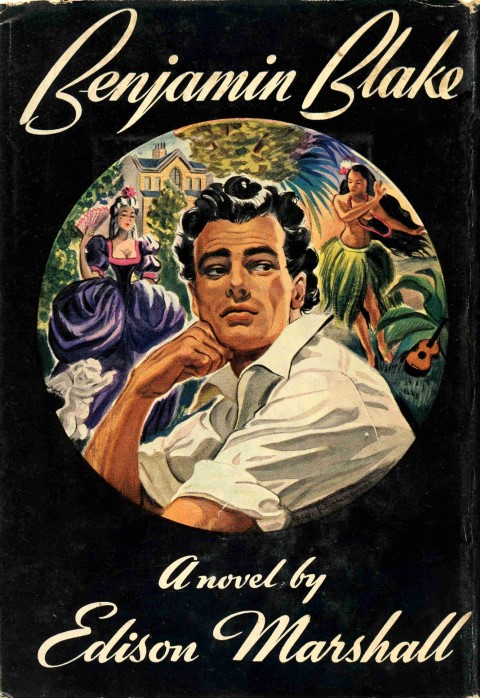
* A Distributed Proofreaders Canada eBook *
This eBook is made available at no cost and with very few restrictions. These restrictions apply only if (1) you make a change in the eBook (other than alteration for different display devices), or (2) you are making commercial use of the eBook. If either of these conditions applies, please contact a https://www.fadedpage.com administrator before proceeding. Thousands more FREE eBooks are available at https://www.fadedpage.com.
This work is in the Canadian public domain, but may be under copyright in some countries. If you live outside Canada, check your country's copyright laws. IF THE BOOK IS UNDER COPYRIGHT IN YOUR COUNTRY, DO NOT DOWNLOAD OR REDISTRIBUTE THIS FILE.
Title: Benjamin Blake
Date of first publication: 1941
Author: Edison Marshall (1894-1967)
Date first posted: January 18, 2026
Date last updated: January 18, 2026
Faded Page eBook #20260122
This eBook was produced by: Mardi Desjardins, John Routh & the online Distributed Proofreaders Canada team at https://www.pgdpcanada.net
Books by Edison Marshall
Adventure Stories
THE VOICE OF THE PACK
THE FAR CALL
THE MISSIONARY
THE DOCTOR OF LONESOME RIVER
THE DEPUTY AT SNOW MOUNTAIN
THE LIGHT IN THE JUNGLE
DIAN OF THE LOST LAND
THE STOLEN GOD
Short Stories
THE HEART OF LITTLE SHIKARA AND OTHER STORIES
Novel
BENJAMIN BLAKE

COPYRIGHT, 1941, BY EDISON MARSHALL
PRINTED IN THE UNITED STATES OF AMERICA
To
Nancy Silence Marshall
and
Edison Marshall, Jr.
| Contents | |
| 1. | GUNSMITH’S FORGE |
| 2. | BREETHOLM |
| 3. | HUE AND CRY |
| 4. | VOYAGE TO THE ISLES |
| 5. | DESERT ISLE |
| 6. | PARADISE ISLAND |
| 7. | PARADISE BESIEGED |
| 8. | OYSTER ONIONS |
| 9. | OLD PATHS |
| 10. | OLD FRIENDS |
| 11. | OLD SCORES |
| 12. | BREETHOLM BESIEGED |
| 13. | FAREWELL |
I,
BENJAMIN BLAKE
Dedicate to
TRUE MEN
Here and in Other Lands
This Account of Sundry Unusual
HAPPENINGS
in My Life as
COMMONER and GENTLEMAN
in the Disturbed Times of His Majesty
GEORGE III
Which Sets Forth the True Facts Causing
Me to Adopt for my Own the Motto
Non Quam Me Dedo
and Which has been Taken down in the
New Short Hand
by a Scrivener and Clerk of this Parish
Gentle Readers—and some of you are not so gentle, I’ll be bound—pray do not seek herein such elegant expression, polished diction, and learned syntax as you find in the immortal writings of Lord Bolingbroke and Horace Walpole; neither will you find sentences long and involved as a Dutch fish net. Kent, in my favorite play, proclaimed himself a plain, blunt man. I shall do the same, and have done with it. But I will confess at once—and soon you shall know why—that the character that moved me most in that thunderous tragedy was Edmund. To me, his story was a sadder one than the vain old King’s.
The proper beginning should be the date and place of my birth. Then I must be guilty of an impropriety at first blush, for even now I do not know the date, although Saint Bartholomew’s Day, 1751, has been chosen for me by an itchy-palmed gentleman in London. Certainly he had as much to do with it as had Toby Mallow, who otherwise would have occupied an important place in my history, having been my mother’s lawful husband. Nay, if Toby Mallow had done his duty by her, which God forbade, neither this tale nor its teller would have ever been. Neither did I know my native land until I was passed twelve, almost thirteen most likely, and still I do not know what corner of it heard my first wail.
In these tepid times, a boy of twelve is still nigh a babe in arms. It was not so in my young days: unless he grew tall and tough as ash, he was crushed underfoot, and at twelve he had seen a hanging, wagered a farthing on a cockfight, hardened his heart at a bear-baiting, and knew well that no stork had hatched him in this lewd world. I was even riper than most, counting myself almost a man, and already afraid of the press gangs, when I came home to Bristol from Master Chandler’s Grammar School at Bath. On the night these chronicles begin, I was reading by candlelight one of the lesser known plays of William Shakespeare. In those days I had barely peeped into the spacious mind of that glover’s son, honored less in this brutal age than the least fox-killing duke, but I was lost in the noble tale of a wicked uncle and an abused heiress, when I came to the lines:
’Tis far off,
And rather like a dream than an assurance,
That my remembrance warrants. Had I not
Four or five women once that tended me?
Only Master Shakespeare himself could describe the sensations coursing over me then. At first, I thought that the vision conjured up so dimly in the small end of the horn of my memory was no more than a waking dream inspired by the story, until it grew plainer, the broken lines filling in and sharpening. So I threw down my book and approached my grandfather, knitting in his big chair.
Until now there had been a conspiracy of silence between him and me. He knew that I had more knowledge of my situation than I pretended; I knew that he had more than he had ever revealed. One of the sorrows of childhood is what children know, unknown. Whether their rosy lips are locked by pride—for pride spares the pitifully young no more than pitiably old, growing fast and rank in that warm, sweet earth—or by love or fear of their elders, I know not.
My grandfather looked at me, and I at him. He saw a gangling boy, with the curly black hair, heavy brows, hooky nose, and cleft squire chin so meaningful to him, and the big feet and hands that in a stripling foretell great stature among men. I saw what I had never seen before in that chair, a mortal man instead of my grandfather. Faith, I can say it no better. You know how children take their old folk for granted. So I had taken Amos Kidder, my mother’s father.
He was older than I thought, smaller, frailer. I knew well the silver-rimmed spectacles that were his pride, but I had not known that behind them his eyes were pale blue, peering further than he could see, seeing more than he could attain to. He had sandy hair, thin on the crown. His neck was somewhat long and stringy-looking. His lower face came to a pointed chin like the bow of a boat, beardless except for three days’ stubble, although his forehead was broad and high. His ears flared as though he were listening for a trumpet sound. His hands were delicate, adroit, and strong.
When I gazed straight at him, he shrank a little from me, which I remembered he had often done before. His chin wabbled somewhat, as when he was distressed.
“What is it, Ben, lad?” he asked.
“Grand-dad, was I born here?”
“Why do ye ask that? Oh, isn’t it good enough for ye?”
It was a snug place, I warrant, and clean. My grandfather would never suffer dirt or litter. Even the gunshop next door, where my grandfather made dueling pistols and fowling pieces for the gentry, was so clean you could eat off the floor.
“ ’Tis good enough, but I was not born here.”
“Ah! Who told ye so?”
“No one told me. I remember. I was born in a house with a white ceiling-cloth, where snakes had their nests. There were trees outside with leaves big as a bushel, that rustled when the wind blew. There were women with dark skins to feed and bathe me, and one that I called—Nanna.”
My grandfather leaned back in his chair as though heart-stricken. Then he asked, “Was there a white woman, too?”
“Aye. She was always singing, and playing with me, and laughing. She was my mother.”
“A pretty wench, I warrant?”
“I don’t remember.”
“And a white man, too?”
“A tall white man.”
“That was your father, Godfrey Blake. The wench was my daughter.”
He said nothing more for a long time. Then he asked, his voice thin and very gentle:
“Are ye going back to your book? Not many lads of your age can read a primer, let alone William Shakespeare. Not many grandsons of an old gunsmith may go to Master Chandler’s Grammar School in Bath.” He was consoling himself more than me.
“I have read enough now.”
“Why do ye look at me so, Benjamin, my boy? Is it man more than boy at last? Ye are only twelve, or at the most, thirteen. What do ye want to know?”
“Only what the boys in school have not told me, and I have not guessed.”
“The boys at school? Did they—oh, Ben, I clean forgot the boys at school! Did ye hear from them the term ‘natural son’?”
“Nay, but I heard the name ‘bastard’.”
I did not tell him that this was not the first time I had heard the name, or yet the fortieth, and of how I knew it was a term of shame before ever I knew its meaning, and of how when I did know, even then I began to resist and not submit. Aye, the battle was long already—and I not yet thirteen. Half unaware, I was a war-scarred rebel against all that deemed me base, whether the God of the Churches, or the King, or the Law, or the settled order. Nor did I tell him what I know now was the most woeful thing of all—how part of me was a rebel against the other part, because I hated those above me with half my heart, and with the other half, craved their smiles. Even while I mocked and sneered at them to my little neighbor, Molly Shelton, I would have given my right hand to be like my schoolfellows, each safe in his seat. Nay, I did not tell him of my pantings when lords and ladies and gentlefolk came to visit or inspect the school, or stopped in their coaches outside the shop—how hateful they looked to me, and yet how beautiful.
“Oh, did your schoolfellows call ye a bastard?” my Grand-dad asked.
“Aye.”
“What did ye do then, Ben?”
“I fought them, and was beaten for it by the master. I still fight them, the biggest or the smallest, but choose the place and time to fight, so my back is almost well from the stick-welts. Few of them have called me that, of late.”
My grandfather’s eyes lighted behind his spectacles. “Your father was a good fighter, too.”
“Maybe he was a good lover, as well.”
“That he was!” A change came over my grandfather; he leaned forward and spoke with spirit. “A good lover was the right term for the scamp, and you are a knowing boy, far more knowing than I thought. And my Bessie was the right lass for him, who could give him as good as he sent.”
I was not ashamed of her. Although her justification was not yet clear in my mind—her babe’s right to prime begetting—yet I knew that only pride would save my soul. If I had no noble words of my own devising, at least I had learned by heart that bold speech of wicked Edmund, Gloucester’s natural son. “Thou, Nature, art my goddess!” No Latin-mouthing, horse-faced schoolmaster need tell me what he meant, and half-blindly, though with a burning heart, I sought to kneel at the same shrine. It had saddened me, though, that after his brave boast, he should show base.
“What had she to do with a muff like Toby Mallow?” my grandfather went on. “A good marriage, aye, for a poor gunsmith’s daughter. The vicar said so, Sir Samuel Haddock, my landlord, said so, and even her poor mother, may her soul rest in her Savior, said so too. He owned this snug little house and the land it stands on, and his shop had the best custom hereabouts. Better born he was by a long shot, the vicar said, but what did that froze-spit know about true life?”
My grandfather was talking more to himself than to me, and I did not divert him.
“They say the good Lord wanted it so, or ’twouldn’t be so,” he told me, shaking his head, “but between ye and me and the gatepost, ’tis rotten unfair. She was pretty as any lady, and clever, with a shape trim and neat as a French carbine, and she had sweet, gentle ways for all the sparkle in her eye, but because she was a poor gunsmith’s daughter, she must marry Toby Mallow, and who was I to interfere?”
“And then—?”
“Then comes in Godfrey Blake, to order a fowling piece, and who should wait on him but my Bessie? How could she help but take his eye, and he take hers, if all the vicars in England stood in the way? Tall, he was, and broad in the shoulder, with heavy black brows and a square cleft chin—” My grandfather stopped, appalled by his own words.
“Go on, Grand-dad.”
“ ’Tis not fit for ye to hear, my lad.”
I laughed at him, and he blushed.
“They’d say I should be whipped for telling of it. But ’tis a blessed relief, to get it off my tongue.” His tongue was reveling in it, as in a cup of syrup.
“The oldest son, he was, and though ’tis not always so, the rightful heir. He had the good, bold looks, and the big laugh, and the eye for a pretty lass that the old Squire had afore him. Son of Squire Blake of Breetholm he was, but then and there he declared he would have my Bessie, and faith, he’d have lain her on the workbench—” And again my grandfather grew silent.
“He ran away with her instead? Was that it?”
“He didn’t meet her in holes and corners, not he. He loved her enough to look ruin in the face, and the frowns of all the gentry in North Wiltshire, and while his brother Arthur shook with joy in his ugly boots, he carried her off on a tall ship to India!
“What did Toby say, ye may well ask?” Grandfather went on, with ill-concealed satisfaction. “ ’Twas cruel hard on him, aye—on his twopenny pride, I mean, for he had never loved my Bessie, hated her in his heart for being above him when she was born below him, and ye’ll see plenty more of that before ye’re through. So he went off to Virginia, leaving me to keep the shop. There was a fair profit for a good gunsmith among those ’Giny planters. And he’s been there ever since, getting rich.”
“He owns our shop?” I had always thought it belonged to my grandfather.
“Aye, he owns it, and I send him a fair half what I make from it.”
“We’ve lived, and kept a maidservant, and I’ve gone to Master Chandler’s Grammar School on half the profit?”
“Should Godfrey Blake’s son black his own boots? Should he grow to manhood and not write his own name, Ben Blake?”
“His natural son!”
“His son, just the same, by my Bessie. Oh, I’ve no head for figures, lad. I’ve kept the accounts well as I could, but there was no use putting in some little money I made after hours, or a few shillings some gentleman gives me for an extra handsome job.”
“He owns the cottage, too?”
My grandfather shrank back. “Aye, Ben Blake.”
“And he lets his wife’s bastard sleep in his bed? My fellows at school asked that, I remember.”
“He’s away in America, Ben. Could I call to him, as though he was at work at the next bench, when the ship that brought ye home from the Indies put in at Avonmouth? A gentleman of the East India Company put ye in my charge, with a letter from Godfrey Blake. Could I tell him I couldn’t take ye, because ’twas my son-in-law’s shop?”
“You’ve never told Master Mallow that I’m here?” I own that I scarce had breath to put the question.
“Mayhap I would, if he’d make bold to ask. Not a bold hair in his head, has Toby Mallow.
“You told me my parents are dead. ’Tis true, I warrant. I’d not like to think they’d both forsaken me.”
“They died of the fever. Rotten bad is the air in the Indies. The gentleman saw ’em bled by the company doctor, but they both died, and he helped bury ’em. And now Arthur Blake is the lawful Squire of Breetholm.”
“My father left me nothing?”
“Naught but his bold eye and brawn. He made money like a wool-merchant out there, but spent it as fast. A natural son can’t inherit by English law, so Arthur Blake’s the Squire, and his son will be after him. That’s the whole story, Ben.”
“Nay, ’tis hardly the beginning.”
“What makes ye tremble so, my boy?” My grandfather was trembling, too.
“I, too, ’ll go to India, when the time comes, and I’ll make money faster than any wool-merchant, but I’ll scrimp and save it, and when I have a bagful, I’ll bring it home.”
“ ’Tis a long way—but what makes your eye glitter and glimmer so, Ben Blake? Like a silver gun sight in the sun!”
“I’ll have a castle and a coach, and a coat-of-arms, and two princesses will want to marry me, the same as Edmund. But when the lawful heir fights me, I won’t be killed, and I’ll kill him instead.”
“I wish ye wouldn’t look so, Ben; I do indeed. Ye’ll learn the gunsmith trade, and some day have a shop of your own—maybe this shop, if Toby would be good enough to die out in America—with the gentry coming in to order pistols—”
“I’ll make pistols, that I will, but I’ll shoot ’em myself.”
What I now reveal occurred the following summer. I was standing outside the shop, talking to Molly Shelton, who was my own age, when a chaise drawn by a team of bays stopped at the door. When I saw the coat-of-arms emblazoned on the harness, I thought another of the county gentry had come to order a piece.
The lass curtsied quickly. And here I had best describe what welled within me from some bitter spring tapped long before, when my companions paid homage to gentlefolk. It was more than discomfort. It was envy and black rebellion mingled. I desired to be noticed by such people, to have their smiles and see them whispering that I had blood in me, which desire I would not have them know for all the world. . . . Nay, I cannot describe the sentiment, though I bite my tongue off. It had as many curves and bays and promontories as a floating cloud.
I was prepared to doff my cap and give the stranger my best bow, if he would smile or speak to me, and meanwhile feigned not to see him. Perhaps I did not see him clearly, his black brows and his square, cleft chin, for I was watching him sideways. Speak to me! I own he did. I had never heard such a voice, and well-nigh jumped out of my smallclothes.
“You, there! Take off your cap!”
“You mean I, sir? I didn’t see your lordship—”
Devil take me, I had not meant to say this. I had fancied myself showing little Molly that I was as wellborn and proud as any booted squire. His voice jumped it out of me, as the noise of a fowling piece will jump a hare hiding in its bed. It was a big voice, and deep, but there was no music in it.
He was an ugly man. Faith, he should have been handsome enough, with his broad shoulders and powerful neck and dark face and curly black hair and flashing dark eyes, but vile ugly he remained, which he knew the whole world saw, although few dared tell him. How I ached to tell him myself! “Blackguard Pretender, I’d liefer uncover to a chimney sweep!” If I could have said that, or some such noble thing, instead of merely thinking it in my shut head! Perhaps I did not even think it at the time—only afterward, when I lived the scene over, not as it happened but as I had wanted it to happen. At the time I was too busy snatching off my cap, and bowing like Punch at the fair.
“You didn’t see me, eh? So you’re a liar as well as too big for your breeches! What’s your name?”
“Ben, my lord.”
“Your whole name, you oaf. Don’t you call yourself Ben Blake? Answer me that.”
I nodded, because I could no longer speak. There was something about this man that dried the spit in my mouth.
“I thought so. And you’re just the insolent, lewd young guttersnipe I expected. You haven’t got a name, do y’hear me?”
He turned to enter the shop, then stopped. In the doorway stood my grandfather, who had heard it all. His face looked pinched and gray, like a cadaver’s, and his dim blue eyes were popping and blinking and moist. Aye, it was my grandfather, the one I leaned on ever, my inner fortress, quaking in terror and humility before this man. I was ready to cry then, and I must have cried inside, for I felt salt in my mouth.
“Oh, your honor,” my grandfather was wailing. “He’s big for his age, but he’s only thirteen or so. Was he disrespectful to ye? He’s a good boy—”
“A good boy! I came to order a pair of pistols, to give you a little custom to help support your daughter’s bastard, and what does he do but insult me on the street? ’Fore God, I’m a mind to have him ordered to the almshouse.”
“Oh, Squire Blake! I’ll make ye the pistols. I’ll charge ye only for the substance, and if ’tisn’t the best workmanship in the shire, ye needn’t pay me a farthing. I’ll do it gladly, for ye are the brother of—”
Meanwhile my grandfather had backed into the shop, crowded close by the choleric figure of the squire. When I would have crept away—it seemed that my grandfather was imploring me to do so, with his wabbling eyes—Squire Blake gave me a shove on the back of the neck that shot me through the door and half across the room. There I fetched up, panting.
“Don’t call the adulterer’s name, in my hearing,” Squire Blake cut my grandfather short. “He’s a disgrace to it, and to his blood. Why have I waited nigh ten years to find out the brat is here?”
“Oh, I wouldn’t trouble your worship. ’Twas not your fault, just the fault of that whore, Bessie, who I’m shamed to call my daughter, and ye’re not bounden to him in any way. She brought disgrace on us all, your honor, and if ye’ll tell me what bore you want, and let me measure your hand and arm—”
“Where’s Toby Mallow?”
“He’s not here, sir—”
“Don’t I know he’s not here? Didn’t he have to flee to the colonies from the disgrace? Out there ever since, by God, while his wife’s bastard eats his substance!”
“But he’s doing well, your worship. I run this shop for ’m—”
“Almighty queer, he’d buy bread for his wife’s bastard. Are you sure he knows he’s here? I didn’t know.”
“Oh, he knows it well. A forgiving soul has my dear son, Toby Mallow; in that he’s like the gentry, please your honor. I have a letter from him here in the shop, commending the boy to a Christian life, if I could put my hand on’t.”
“What schooling are you giving the boy?”
My grandfather peered about like a cornered rat. “A little, please, sir. Not enough to make him look above his station. He’ll turn out a good gunsmith—”
Squire Blake laughed then. It was a loud, not a hearty laugh, an ugly imitation of some one’s hearty laugh he had once envied. “Blast me, if I don’t think he’s safe enough with you, Master Kidder. He’s got the devil in him, you know, and if you’ll not spare the rod—”
“You should look at his back, your worship. It fair makes me cringe—”
“He’ll need a few stripes for forgetting his manners out there in the street. I wasn’t harmed by it, but he’ll be harmed unless the lesson is rubbed in. Where’s your whip, Master Kidder?”
“My whip?” My grandfather’s voice almost failed and his eyes were like china marbles, but no soldier fleeing in battle, then suddenly turning to front the foe, ever rallied braver than my grandfather then. “Why, it’s gone from the nail. Ben, you knave—”
“Oh, I didn’t take it—”
My grandfather turned to Squire Blake. “I’ll settle with him, never fear,” he said, speaking with great energy. “My daughter’s bad blood crops out in him at times, though ’tis not his fault. Wait till we’ve settled about the pistol, please your worship, so ye won’t be vexed with his howls.”
“You can go ahead now, Master Kidder. I’m in the way of being his uncle, and I’ll put up with him blasting my ears, to be sure you’re bringing him up the way he should go.”
“Well, I’ll give him a taste—and save the rest till I can put my mind on’t. Ben”—and he turned to me with a grim face—“get me that ramrod, and bend over the bench.”
“Oh, Grand-dad, don’t do that—”
“Obey me at once, d’ye hear me? I’ll teach ye not to raise your cap to the gentleman.”
“Oh, not with him looking on—”
Squire Blake started to speak, but for once in his life, when gentry spoke, my grandfather raised his voice and drowned him out.
“Why shouldn’t he look on? Shouldn’t he know I’m raising ye right, to know what ye are and be humble to your betters?”
There seemed nothing left, and I would have shot myself if I could have seized a loaded pistol. But this was the only time, before or since, I’ve looked down that road! I was a boy, then, hardly fourteen. Only the promise of my future strength was in me, and the will to live and conquer only beginning to be forged. Many times since I’d have given much for the will to die.
Crying, I could not see my grandfather’s face. Otherwise I solemnly believe that, boy though I was, I would have understood what was going on, and been saved all pain save the flesh. His eyes would have spoken to mine as the eyes of animals speak to one another on the moors. Squire Blake would be watching like a hungry hound, but would not hear a word. Then I was led blind and unbelieving, to the bench, and five times the wooden ramrod descended, for I cannot say fell. Thereafter I need have little fear of ordinary pain.
On the fifth blow the rod broke, causing Squire Blake to laugh.
“Ye’ll settle with me for that, too,” my grandfather said, gasping. “Now go to your room, and wait.”
I stumbled out, too stricken to cry; and time passed, as it always will at last, and then my grandfather was leaning over the bed, trying to draw my gangling body into his arms. His face was sticky with tears and slobber, but it was heaven to have it pressed against mine, for I knew that he loved me, always.
“Will ye forgive me, lad?”
“Aye, but I don’t understand. To strike me in his sight—”
“Great God, why should I strike ye save in his sight, ye the beat of my heart?”
“You did it to please him?”
“Aye, to please him, but he won’t be so pleased at last, if I know my boy. He had to think I was a cruel master—or he’d find ye another.”
“But why did you say what you did? Oh, did you have to say it?”
“About my Bessie? She knew I didn’t mean it, Ben, and ye know it too. She’d want me to say it. What would words matter to her up there, if one hair of your head was saved? She’d write down on the book she was a whore, if ’twould help ye a whit.”
“Did he order the pistols?” My heart was beating and pounding in my ears.
“Why do ye ask, Ben Blake?”
“Couldn’t you make them so they’d blow up the first time he fires ’em?”
“Oh, Ben!”
“Blow back, not to the side or before, the whole charge in his eyes? A weak lock, and a strong closed chamber filled with five drams of powder and a two-ounce ball, and a little hole left to prime the charge, and to let light through so he’d not suspect too soon? ’Twould kill him dead. He’d be dead. Couldn’t you do that? I’d show you how.”
“Ben— Ben Blake!” He put his hand over my mouth. “Don’t talk so.”
“Couldn’t you do it? Think hard, Grand-dad!”
My grandfather rose and went to the window. For a space I saw glory strike his eyes; then it died away, and he shook his head.
“He’d give ’em to his poor gamekeepers to try first,” my grandfather said.
“I can’t think of anything else. ’Tis no use to pray that he dies, is it, Grand-dad?”
“Nay, that’s no better than making a waxen man to melt in the fire. None of them things work against the gentry. But ye can pray that Toby Mallow dies, in the Americas. I’ve prayed till my throat’s sore, without ary answer.”
“So he won’t come back? Is that what you mean, Grand-dad?”
“Aye, Ben Blake. So he won’t come back. He’s not gentry—as ye are, in the eyes of God—and maybe ’twill work on him.”
Yet my grandfather and I lived at peace in our Bristol cottage for three more years. I learned something about gunsmithery, but more about the ships in Bristol Harbor, most of them bringing sugar, although no sugar could sweeten their stinking holds, and all the vicars in England could not bless their voyages. They loaded in Africa to trade in the West Indies.
When I was sixteen, I joined the Methodist Society at Horse Fair. If I had kept on with it, God only knows how my life would have been changed. Instead, I found that to make Heaven’s port I must live humbly in the station in which God had chosen to place me, which I could not do with an angel at either elbow, so I soon went back to my docks and my narrow, crooked, crowded streets I loved so well. Be it so, I had heard John Wesley preach, an event that did not impress me so greatly at the time, although a few years later a female missionary swooned in my arms at the thought.
That year the beam was layed for the stout ship I was later to sail. What I mean by this fancy language is that I gained most of my stature and a fair share of my weight. I could no longer enter a six-foot doorway without bowing, or sit in a pretty chair without hearing it crackle and complain beneath me. I do not know how strong I was, for I would not fight the riffraff of the port—I must confess they never pressed me very hard—and the gentry that I saw bewhiles were tolerably civil. I do know that I could take a handful of the brown nuts called Brazils and make them crack one another.
It was late summer, and I was about seventeen years old, when Squire Blake visited us again. I was not in the shop when he called. Except for the accident of a broken gallus, causing me to go there for a bit of leather, I might not have seen him at all, or—what was far more important—he seen me.
Molly Shelton, the daughter of the wainwright who lived next door, called to me as I approached, and came fast as her bare feet could fly. Later I learned that my grandfather had set her on watch for me, not to suffer me to enter the shop. What followed was heaven’s reward for my modesty in her sight. I had never ceased to be modest with her, much to the disappointment of the hot-blooded minx, and was ashamed to have her see me holding up my breeches, so I rushed on. By my troth, the Devil could preach a sermon on it! To flee from the wench, I walked through the door almost into the arms of Squire Blake.
I was whistling. The blithe sound was cut off as though a blower had left his bellows. In the three years or so since I had seen that dark face, with its Roman nose and cleft chin and forehead framed with black curls, I had forgotten to hate it and had almost forgotten to fear it, and had day-dreamed him out of my life. Maybe I did not remember fully until I saw Grand-dad’s face.
“Back already, boy?” my grandfather began, his poor Adam’s apple jumping up and down his stringy neck, and his voice, trying so hard to be hearty, with a crack in it. “Why, ye finished the job quicker than I thought.”
“Aye, I’m back.” I had been on no errand, except the desire of my heart. Then I turned to Squire Blake and gave him my best bow. “Good day, your honor, and good health to you.” But I fear my voice was but little stronger than my grandfather’s, for the squire’s glistening eyes were going over me, feature by feature, muscle by muscle, and his countenance darkened the whiles.
“I see you’ve better manners since I was here last.”
“Thanks to you, your honor.”
I would like to say that the words came hard, but this chronicle must be honest as my memory and my blind spots will permit, and I slobbered in my eagerness to please him.
“Grown well, too, I see. Nearly tall as I—and I’m the tallest man in the parish. Master Kidder, he had something richer than brown bread and curds, to put that meat on his bones.”
“Lentils, your worship. No end fond of ’em, he is.” Lentils were cheap in Bristol that year.
“Prime beef, I’ll swear. Wiltshire mutton and bacon and pies. By God, Master Kidder, your shop must pay well. You take only half, you said?”
“A fair half, no more. Toby Mallow, in Virginia, is mightily pleased with the accounting. I have a letter from him, somewhere about—”
“Can you read letters?”
“I stumble over the words, and the boy tries to help me—”
“So he learned nothing at Master Chandler’s Grammar School. Now there’s a pity.” Squire Blake’s eyes were gleaming. “Or maybe he’s forgotten his lessons. No wonder, when the last time I was here, he’d forgot he attended the school.”
“Ye ’re a great one for a joke, Squire Blake.” My grandfather tried to smile with his starched lips, chuckle through his gasps, but I was too deep in my own fears to pity him, let alone to hate his tormentor.
Squire Blake slapped his boot with his riding crop. He looked on my grandfather as he must look on a mutton pie when he came in hungry from hunting. He looked at me as at the stag he hunted, escaping him yet, but tall-horned and ripe for his hounds.
“Well, ’tis not my concern,” he said. “We’ve completed our business, Master Kidder, and I’ll bid you goodby.”
“Thank ’ee, your worship, and good health to ye.”
“My health is tolerably good, thanks.” He said this as though it were a great, cruel joke on my grandfather. “As for you, Ben—you are my brother’s son, a bit irregular ’tis true, and there is always a place for you at Breetholm.” And greatly pleased within, he took himself off.
When I looked at my grandfather he had climbed to his high stool, beside his engraver’s bench, the perch he always took when his soul was oppressed. His silver-rimmed spectacles had slipped down on the end of his nose. I gazed at the three-day growth of stubble on his pointed chin, thinking that if he had shaved that morning, he might have confronted Squire Blake with better spirit. But my grandfather was always unlucky in his shaving.
“Gave me a fine order, he did,” my grandfather said. “A fowling piece with engraved lockplate and brass mounts. Maybe ’twas his only reason for coming here.”
“Never believe it.”
“Who does better work? Why shouldn’t he come to me, though it’s nigh two days in the saddle from Breetholm?”
“Why does he hate me, Grand-dad?”
“Why, he doesn’t hate ye, lad. Ye’ve never harmed him. Ye never can harm him. Here ye stand, keeping out of his way, learning the trade of a gunsmith, not costing him a penny—”
“Why is it? Tell me.”
“Why, blast me, Ben—because your name’s Ben Blake.” My grandfather scrambled down from his stool, and put his hands on my arms, and his hands were trembling. “Because ye have the blood, and he throws back like a broken breach to some long-dead swineherd. Because ye look like your father, and he like a farrier. Because he knows ’tis only your lack of a parson’s mumbling that makes him cock of the Breetholm walk, and your birth was far more blessed than them of his spindly daughter and his puny sons by his wedded wife, who lies in his great canopied bed, and hates every hair of his head. ’Fore God, what better reasons do ye want, Ben Blake?”
“ ’Tis hard to climb into another man’s heart and look out.” How often since have I tried to do this, in vain! “But what can he do to me?”
“He’s high, and I’m low. He’s a magistrate, and on any quibble, he may go to the court and have ye taken from me. But he’d raised a good ’un afore now, if he’d had a mind to it. And he won’t—I know he won’t—” My grandfather’s voice failed.
“Write to Toby Mallow?”
“Oh, did ye think of that, yourself, or did ye pick it out of my head, like a jackdaw picks corn from a dish?”
“But he won’t—will he? What good would it do him?”
“He asked me of Toby Mallow. Where was he in ’Giny, and I told him he’d lately moved his shop, and would let me know on the next boat, where to reach him. No, the squire’s satisfied to keep you here, out of his way. No, no, he won’t write Toby Mallow, no fear of that.”
But we were happy only six months more. If the poor did not learn to live from day to day, blind to the march of days beyond the next bend in the road, they would lie down and die from pure fright. Six months was the time needed for a letter to reach Virginia, and a man to collect his goods, and make passage home. Then we listened for every footstep on the threshold—I alone, and my grandfather alone—denied even the comfort of listening together, I know not why.
There were many ships in those days, some of them manned by crews from the colonies. I could watch those that sailed into Avonmouth, but there were Plymouth, and Portsmouth, and Southampton, and even London, where a Bristol-bound passenger might disembark. But a month passed, and another month, and because I was young, and the days were bright, and the first flush of my strength was upon me, I began to think our fears were all in vain.
Then, one fine afternoon in late spring, came Toby Mallow.
My grandfather was busy engraving Squire Blake’s gun, so I had answered the bell. Because I expected a big sunburned man, a commanding presence, the thought that this weazened pale-faced fellow might be Toby Mallow, never entered my head. He was dressed like a prosperous tradesman, bound for church. Without stretching my neck, I could lay my chin on his pow. I have always noticed men’s hands, which speak far clearer than their eyes and nearly as clear as their mouths, and I saw that this visitor wore a fine gold ring, as well as a chain and seal on his patterned waistcoat; still I thought he had come on some twopenny business with my grandfather. He gazed at me as though to speak, thought better of it, and brushed by.
Then I looked at my grandfather. If he had had a weak heart, he would have died there on his stool. I protest he had a strong heart, a true English heart. I saw him break, and then I saw him mend. It was as though he took himself in his two strong, delicate hands, and set his shoulders square, and pushed his jaw in place, and thrust his pale eyes back into their sockets, and smoothed his sagging face muscles, and stiffened his neck so that his head shot up. In no great hurry, it seemed, he climbed down from his stool and stood as tall as I had ever seen him.
“Why, Toby,” my grandfather said. “So ye’re back.”
“Aye, I’m back.”
“And looking well, too, I’ll be bound.”
“Very like, but do not feel so well.”
“Quite a surprise to see ye, that it is.”
“A great surprise, Amos Kidder, I don’t doubt.”
“A good trip, I’ll warrant. The seas are smooth and the wind fair this time of year, so sailors say.”
“But rough and stormy enough, Amos Kidder.”
“Why do ye call me that? Why not ‘papa,’ as ye used to call me?”
“You’re not my father. You are Bessie’s father, devil take me.”
“She’s been gone many years, Toby—dead many years. They say, and ’tis true, that time heals all wounds.”
“There be some that neither time nor medicine can cure, Amos Kidder. I too have been gone many years. Have you thought of that?”
“So ye have, Toby. And prospered greatly in the Americas, I’ll be bound.”
“Not so much but that I sold my shop there, and came home to stay.”
“And a good price for it, to be sure. Well, Toby, the trade here is not so good—”
“So I thought, from the accounts I had from you, but judging by the shop and the cottage, maybe I was mistaken.”
“What do ye mean by that, Toby Mallow?”
“We shall see. Yes, we shall see. What gun is that you work on now?”
“A fowling piece for Squire Blake.” My grandfather’s tone fell a little.
“A choleric man, Squire Blake, but good. He has always felt for me. I’m glad he’s come into his own. I shall deliver the gun myself, for I see ’tis ready.”
“Nigh ready, but the work not paid for yet.”
“You have an apprentice, I see. What’s his name?” And Toby Mallow tried to speak calmly.
“Ye may call him Ben.” My grandfather did speak calmly, with desperate calmness.
“I did not ask what to call him. I asked what was his name. This is my shop, Amos Kidder. Do not forget that. There’s a place for you here as long as I require you, and no longer, although I’d thought to keep you, all your days. What is the young man’s name, I say?”
“He has no name, by law, except Ben,” my grandfather answered, and no peer of the realm could speak better. “He’s my grandson.”
“So, then, ’tis true.”
“I don’t deny it, Toby.”
“What use to deny it, when I saw it in his face the instant I stepped in the door? Have I forgotten Godfrey Blake? Think you I could forget, if I’d stayed in America till doomsday?”
“If ye’ve not forgotten, then the sight of my grandson’s face need be no shock to ye, or pain. It was not his fault, Toby. What could I do, when he’s Bessie’s son?”
“What could you do, but bring him here to feed on my carcass! First the father steals my wife, and the son my substance. I can scarce believe it, Amos Kidder.”
“Yet ye were forewarned, I trow.”
“ ’Twas only by accident. I might yet be living at Norfolk in the Virginnies, making guns for the gentry, and never known, if Squire Blake had not asked me to learn of the new boring used for deer-rifles in the Americas. In the course of that letter, he praised me for my forgiveness and charity in letting my wife’s and his brother’s bastard eat at my table.”
“ ’Tis well to practice forgiveness and charity, Toby Mallow. Let not your left hand know what your right hand doeth.”
“By God, Amos Kidder, will you quote Scripture at me? ‘Thou shalt not commit adultery’—that is all the Scripture I need know, and ‘visiting the iniquity of the fathers upon the children.’ When I practice charity, I want one of my hands to know it, I do vum!”
“I fed and clothed him out of my half of the profit.”
“I doubt not the books will show it, but there’s a new order here now. As for the young man—he may stay on awhile. I must journey to Marlborough delivering Squire Blake his gun on route. When I return—unless he shows himself smart to learn the trade, and diligent, and agreeable to his station, away he goes!”
The threat was so much milder than my grandfather had expected that he was shorn of speech. As for me—I had felt no fears for myself from the moment Toby Mallow began to speak, and was glad that my mother had not lain long with such a trivial man. I had expected to hear a nine-pounder, and had heard a popgun. Alas, I reckoned without my host. Not much more than a boy at the time, trustful of fortune and the future, I did not know what even the clergy’s strong consciences make them confess—that poor men’s rewards are in heaven, with strings on them even there, and not on this miserable earth. Or did I know that the most dangerous men are not burly fellows, who storm and clench their fists, but little white-faced wights, who move in the dark.
Toby Mallow had been gone hardly a week, and my grandfather’s eye was bright again, and we had barely begun to talk over, and in and out, the good or bad luck in prospect, when he came again. And now he came riding in a carriage like a gentleman, with outriders, for beside him in the seat was Squire Blake. And in the squire’s hand was a document with a waxen seal, new and red as though the parchment bled.
Toby Mallow busied and bustled and bowed Squire Blake into the shop. I would as lief see him rub his nose on the floor, as men do for Kings in Cathay. I knew then, and I know still, that this is an indecent world and a wicked time, wherein men may gain favor or avoid disaster by such antics unto their fellows; and there is no worse insult to the God who made us. To me it was given to see more clearly than many wiser, older men, either the poor or the rich, the high or the low, because I looked down and I looked up; I got a sight on it from two points, as surveyors locate a corner; except for a clergyman’s blessing, I was a squire; and except for unlawful seed sewn in my mother’s womb, I was nothing.
There was triumph in the countenance of Squire Blake, and spite on the ratty face of Toby Mallow. But fear was mixed with that spite. Toby would have gotten between Squire Blake’s legs, if he could, like a poodle at sight of a sheep dog; as it was, he moved from one side to the other, always in his shadow. I stood by the wall. My grandfather rose before them, very calm.
“Will your worship tell him, Squire Blake?” Toby asked.
“I think I’ll give you the pleasure, Master Mallow.”
“Well, Amos Kidder, ’tis good news in a way, though I fear you may take it ill, until you’ve had time to think it o’er. It was no way possible for your grandson to remain here. What would our customers think, to see a wronged husband and his wife’s bastard working at the same bench? It would be rubbing it in the faces of the good people hereabouts.”
“Ye may get to it, if ye please, Toby Mallow,” my grandfather said.
“It would drive away all our trade. If I could forgive and forget, which is asking more than human flesh can bear, the gentry want no such winking at the disgrace, and ’twould corrupt the morals of all the good wives in the neighborhood. Be is so, before I spoke a word to the boy of my decision, I made sure he’d be provided for, and though I want no thanks for’t, and expect none, how many men in my boots would ha’ done it?”
“And now will ye make an end to it, Toby Mallow?” my grandfather asked. “When I would hear sermons, I’ll go to the church.”
“You take it in damned bad part, Amos Kidder. But like it or lump it, Squire Blake, who is next o’ kin to the boy, bastard though he is, has generously offered—”
“Plague take me, Master Mallow, you are long-winded,” Squire Blake broke in. “The long and short of it is this. By law, I’m not responsible for the young man, but he’s my brother’s son, and I shan’t let him starve.”
“Your worship, he won’t starve,” my grandfather cried. “Him and me’ll go away, where Toby here will never see him again, and I’m a good gunsmith, ye know that yourself, and I’ll see he comes not to want. There’s no call on you, Squire Blake. Was it your fault your brother disgraced your name? Ye need not have a reminder of it, in your very house. Aye, Ben, I’ll get my tools, and ye your kit-bag—”
“Not so fast, Master Kidder. Do you see this paper?”
My grandfather leaned against the bench. “Aye.”
“ ’Tis an order from the court putting the custody of Godfrey Blake’s natural son in my care.”
“You couldn’t let him go if you wished to, now, could you, Squire Blake?” Toby Mallow asked.
“Aye, I’ve agreed to feed and clothe and work him, and teach him his place and station, and if he should run away, to notify the sheriff, so he’d be brought back in chains.”
It took more than the word “chains” to break down my grandfather. “For how long, Squire Blake?”
“Why, damn my eyes, till he’s eighteen.”
“Then the time’s up already. Ben was eighteen six months gone. To look at him, ye’d think he’s twenty-one.”
I tried to look old, and with the help of all the angels, I tried to look brave.
“None o’ that, Amos Kidder. ’Tis a bald-faced lie, and you know it.” It was Toby Mallow speaking now, or rather squeaking. “Are you trying to tell us that the brat was born less than six months after Bessie ran away? Why, she’d never laid eyes on Godfrey Blake, until the month before. Why, in that case, Ben’s my own son.”
“Oh, but they met often before ye knew of it, Toby. I knew of it, but never told ye. Look at him there. Is that fine strapper your son?”
“Hell and Fury!” Until now the scene had been queerly calm, the men speaking as though a new gun were being ordered, Toby’s voice like oil to hide his fears; but suddenly the air was powder needing only a spark to explode, and Toby turned white with rage, and Squire Blake turned red. “You throw it into my teeth, Amos Kidder? You let her cuckold me, and never told me? I’d’ve throttled the bitch while she slept.”
“Take care, Master Mallow.” It was I who had spoken. “I’ll kill you too dead to skin, if you use that name again.”
“Nay, you shouldn’t use it in front of the boy,” Squire Blake broke in. “He’s got sensibilities, the same as anyone. But you’re all up the tree. ’Tis true, that if the boy was born within nine months after your wife left your bed, you’d have to claim him as your son—that’s the law—but be thankful ’tis not so.”
“What do you say, then, Squire Blake?”
“I’ve had letters from the East India Company. The boy was born in India, with a good three months’ margin for bastardy. He may be close on eighteen, but I’ve counted him even seventeen, with a full year in my care. If you don’t think that’s time enough to season him, Master Kidder, I’ll get this court-order changed to read till he’s twenty-one.”
“Then seventeen he is,” my grandfather answered, “with a year in your charge.”
“ ’Tis a foolish thing to quarrel over, when he’s going to the richest squire in North Wiltshire,” Toby Mallow whined.
“Ye’re right at that, Toby Mallow,” my grandfather said, while Squire Blake smiled like a cat. “And I’ll be leaving too, to work in a shop in Exeter, where I’m wanted.”
“What need of that, Amos Kidder? You’re wanted here.” My grandfather was well-liked by the gentry, and was the best gunsmith in Bristol. “I’ll take back my words, if you’ll take yours.”
“ ’Tis agreed, then. Squire Blake, do ye mean to take the lad now?”
“That’s what I came for, Master Kidder.”
“Then, Ben, run to the house and get ready your things. I’ll be along in a minute, to tell ye goodby.”
I tried not to go too quickly out the door, but as soon as it closed behind me, I ran like a terrier. I would not stop to collect my clothes, I thought, only to get the fine silver watch that had belonged to my father, a Sheffield clasp-knife that was my pride, and five shillings my grandfather kept in an old teapot, then I would run away and hide until I could board a ship bound for the Indies. As I was taking the teapot off the shelf, my grandfather entered the kitchen.
He came to me, and put his arms around me, and I went weak and cold all over, and could scarce stand on my feet.
“Were ye running away, my boy?”
“Aye. Let me go.”
“ ’Twas my first thought, too, but ’tis no use. They’d search every ship.”
“I’ve friends on the water front. They’ll hide me.”
“Not where ye won’t be found. If ye must run, wait till the road’s clear, and no one knows what port to look for ye. But best to stand it awhile. ’Tis only a year.”
“Oh, only a year.”
“Not so bad, Ben. Twas bound to come in the end, but we’ve held it off till ye’ve got your growth and strength. A man, as God’s my judge. Not a boy, who can’t fight back.”
Then I felt the breath rush into my lungs, and with one hand I could have picked up my grandfather and set him on the shelf with the old teapot. The fear went out of me as the strength and the glory came in, and I was laughing and crying both at once, and my grandfather was crying, too.
“There’ll be fighting, then? The more, the better.”
“Not open fighting, Ben. There must be none o’ that, no matter what comes. The law is on his side. But all the time ye’ll be lying in wait. Ye’ll be learning how to do, the way gentry talk, and the way they act. Oh, ye’ll be a lamb around ’em, Ben, bowing and doffing your cap, and holding their horses for ’em. Ye’ll not cross him in ary word.”
“What if he beats me? I can’t stand it.”
“ ’Twill be only a blow or two, which ye can write down in the book. He’ll shame ye every way he can, and goad ye, for no man could hate another worse than he hates ye, but ye must never answer him, and if ye can make show that your spirit is broken, all the better. Ye’re strong enough in the body, Ben, and ’tis your head that must strengthen now.”
“I hear you, Grand-dad.”
“ ’Tis only a year, unless he can make a charge against ye, for debt or stealing or assault, and he’ll not do that as long as ye’re a plaything in his hands. Let him play, Ben Blake! If ye watch and wait, by God, ’twill be your turn before many years.”
“I’ll watch and wait, Grand-dad, but I won’t submit.”
“Why do ye say that, Benjamin? I’ve heard ye say it in your sleep, the very words, and it frights me.”
“I know not. Speak on.”
“Ye know Pale Tom, the carter. He goes by Breetholm every third week, and ye’ll speak to him alone. If there’s a ship that’ll give ye passage, he’ll tell ye, but ye’re not to run for the first ship or the second, only the last ship, when flesh and blood can endure no more. Do ye hear me, Ben Blake?”
“I hear you, Grand-dad.”
“The chance of being caught’ll be two to one against ye, at the best. So say goodby to me, Ben. My tongue is stuck.”
I could not say it, either. Some have loved me since, and some I have loved, but always there was something to gain or lose, if it were only the spring of a maid’s nipple against my palm, or the feel of my ear-lobe in her fingers. Giving and taking there was, in my other love affairs, but this was the pure juice of our hearts.
I was not to ride in the carriage. To give the devil his due, Squire Blake did not lead me on with false hopes of my future station, that of a servant of the meaner sort; or perhaps he had waited too long already to begin teaching me my place. It mattered not to me. One of his outriders was to remain in Bristol on some business, and Squire Blake told me I could use his horse.
“Can you ride?” he asked.
“Aye.”
At least I had made friends with horses. It had come about from my fondness for courtyards and stables, and for the mellow-voiced, steady-handed men who dwelt there. The footmen gave themselves airs—they were not real horse handlers and liked to imitate their betters—but I had never found such hearty fellowship and truth as among the hostlers and grooms and drivers, true Englishmen all, or such peace as in the dim stalls, with the big honest doorways showing as bright rectangles, and every hole under the eaves, and in the walls, shining like a star. Manure was perfume to me, I’ll be bound.
“Blast me, where did you learn?” Squire Blake demanded.
“I’ve mere picked it up, your worship.”
“Get on the mare, and we’ll see. No, mount the dun gelding, he’s the better beast. Paddy, get down off Buck, and hold stirrup for the thruster!”
He spoke to a heavy-chested, red-haired man with greenish eyes, Welch I took him to be. The man glanced quickly at his master, and his bad mouth made a straight hard line, like a crack in his broad face. The other outrider—Enoch Skinner was his name—looked gray and ill, except for some dark ocean of rebellion in his eyes. Enoch had started toward me with the white mare, and his lips moved, muttering something about the rein. I could not hear what he said.
“I’ll not need you to hold stirrup,” I told Paddy. And getting the reins and the dun’s mane in a good grip, I swung in the saddle.
By God, I knew then what the squire had been up to! There are bully-horses, just as there are bully-men, and Buck was one of them. Perhaps he hated the world for the lack of his stones, as I might learn to hate it for lack of a name; more like it was pure meanness, that base sort that lickspittles the great and tramples down the lowly. Unless I could master him, he would kill me, he thought.
Well, I was no horseman in the gentleman’s sense of the term, or a daffodil either. When he twisted, I pulled down his jaw till it was like to break off, and thank heaven the reins were new cowhide; and when he reared and plunged, I pressed my knees so hard against the saddle, that he could not dislodge me. It was sheer brute strength rather than horsemanship, but this fact was no comfort to Buck; and when Paddy handed me the crop, I laid it on not gently with my right hand.
Buck grew frantic as he began to realize I was his master, and turned and twisted and plunged like a crazy thing; but the glory of victory was rising in my heart, and I stuck there. Suddenly he stopped and began to tremble all over like a coward.
“I’m sorry to delay your worship, but the horse was fractious.”
A well-turned remark, I’ll be bound! I wish I had devised it, with malice aforethought, instead of spitting it out like a peach seed. Now it was Squire Blake’s turn to give a word of praise, by the sporting code of his class. Instead he fingered his riding crop, and I feared that broad, dark face.
He signaled for us to start. I doubt if he could trust himself to speak. My grandfather had not come into the street to see us off, but Toby Mallow was standing there, his face as pinched and blue as though it were winter weather. Molly Shelton was watching, too, her eyes big with wonder at my good riding, and perhaps with regret that I had not proved it on a pretty filly much nearer home. I could not forebear from waving my cap at them, as I rode away.
We were past Hanham, before Squire Blake spoke a word. “So you’re a good hand with horses, Ben,” he burst out.
I longed to tell him what my grandfather had told me, that my father’s hand on a horse was known in half Wiltshire. With his black eyes fixed on me, I refrained.
“Thank’ee, your worship.”
“Don’t thank me. If you’ve got it, you got it where you got your devilish pride, which for your own good must be broken out of you, as you broke the heart of Buck. Well, we’ll kill two birds with one stone. You’ll be under Paddy, in the stables.”
If he thought to gall me, he had duped himself. If he did not know I would rather clean stables than his chamber pots, or trim his blasted box, or grow flowers for his dame, he was a fool as well as a knave. Horses are clean beasts. I had feared he would put me in the dining hall, to watch him chew. ’Fore God, it would have fluxed me.
“Can you teach him to be a hostler, Paddy?”
“That will I.” Seeing the lay of the land, he gave his master a glance that was supposed to speak worlds.
“You’re not to be too rough on him, mind, if he shows himself willing to learn. Now, Ben, don’t be down-hearted. From hostler to carriage-driver is a big step, but a bright lad can take it. Many a groom moves up to the kennels, and from there a ready, smart, well-spoken fellow can become gamekeeper. That’s almost a gentleman’s job.”
You can’t hang poachers any more in England, thank God, I wanted to tell him—and the words I want to say and dare not, scorch my tongue—but I kept silent.
I cannot describe the journey from Hanham to Marshfield, where we stopped for the night. Other chroniclers would remember every stone of the road, the cozy cottages and the apple-cheeked farm wives, and the gracious blessings of poverty upon the field hands, but I remember only the mudholes, and a sick sheep by a fence. I do recall a trifling incident in the inn stables.
Paddy thought the time had come to begin his good work. I was slow and awkward, and when I unbuckled the wrong strap, he raised his big freckled hand and slapped me in the face before the hostler. Then he looked at me sideways to see how I took it, and indeed I seemed to take it wondrous well. This greatly emboldened him, until the hostler was out of hearing.
“Paddy, you slapped me just now.”
“What if I did? Give me some of your lip, and ye’ll get another.” He employed the Cardiff dialect, thicker even than our country folk’s, but I marked him well.
“No, don’t ever do it again. Other men would fight you for it. I’ll kill you for it.”
He went back a step. “None o’ that, now. Now, now, none o’ that.”
“Not at the time. I shan’t be hanged for killing a Welch manure-fly. I’ll wait for the right time and place. Tell Squire Blake, if you want. He’ll curse me and maybe beat me, but that won’t save you, if you put hand on my face again.”
“I was only trying to give ye a lesson about yon strap, so ye’d remember it, that’s all I was trying to do, as the master told me.”
“I’ll learn as quick as I can. I’ll work for you, and obey you, as long as you’re over me. I’ll even be friends with you, if you’ll show yourself worth it. Will you shake hands on it, or will you try to find out if I mean what I say?”
Paddy shook hands with me, and we made out well enough thereafter. Indeed, I became rather fond of the fellow before the end. He would horsewhip his own mother to please Squire Blake, but that was only a sign of what poverty and subservience can do to a freeborn man. Although his heart had been hardened by the times, more than once I heard it crack and pour out love, as he sang his wild Welch songs.
Whether I would have kept the threat is, as Cap’n Greenough used to say, an Indian of another skin. I certainly thought so at the time, with such intensity that Paddy thought so too, so it came to the same in the end.
By the village of Stempot, not far from the town of Wootton-Bassett, lay Breetholm Manor. The gatekeeper bowed himself down until I thought he would burst his navel, and his pop-eyed wife curtsied till I almost could hear her knee bones squeak under her gingham. A pretty custom, curtsying, I hear folk say. I can forgive the gentry for enforcing it, for vanity and love of power are human enough, but blast me if I can forgive the poor for thinking it virtuous.
“How is your young nephew, Mistress Wheatly?” Squire Blake asked.
“He’s up and around now, thank ’ee, your worship,” the woman answered with dreadful mirth, “and a fair good lesson he’s had, thanks to ’ee.”
When we had passed through the gate, Squire Blake saw fit to explain this conversation. “You’ll hear of it from the stable hands,” said he, “so I’ll tell you the straight of it. Her nephew, George, has been wayward. He’s fourteen stone of brawn and bone, and takes the girls’ eyes, and in his pride he left his cap on his head, when he saw me riding by. ’Twas no skin off my bones, mark you, but until a boy learns to respect his betters, he don’t respect himself.”
“What did your worship do?” For he was waiting for me to ask this.
“I got off my horse, and beat him to a bloody pulp with my two fists.”
I had seen Mistress Wheatly laugh. She had loved that great lump of a boy, had told in shocked tones but with shining eyes of his haymow loves, and had wept in the silence of the night over his battered flesh—and she had laughed! What did I do? Did I curse Squire Blake? No, God save my soul, I laughed too. My mouth took the same hideous shape, that horrid, twisted, narrow opening, that her mouth had taken.
I was sick with shame and mazed with wonder, as we rode under the great beeches of Squire Blake’s park, but my strength returned to me, and with it such heart-fire as I had never felt before, as I saw Breetholm Hall take shape among the trees.
If I had tried to write down what I saw, I could not have told then whether the house was marble or Portland stone, gabled or flat-roofed, fifteenth century style or eighteenth. Later I was to know it was a rather typical Jacobean manor house, with mullioned windows and a stone-tiled cupola, surrounded by yew trees and flower beds edged with box, and with wide lawns and a bowling green; but at the time I gazed upon it as a predestined sinner might gaze through a chink in St. Peter’s gate upon Paradise.
Out of it came an angel. If this be extravagant language, still it is inadequate to my sentiment, falling woefully short of my design, so I had best speak plainly, sticking to the solid facts as I had stuck on Buck’s back, trusting to your wits to unbosom me. What happened was that Squire Blake’s daughter came out of the mansion, and stood on the white steps to greet him.
I saw her plain. By accident or purpose, Squire Blake had left me a moment to hold the horses, while Paddy drove the carriage to the shed. I was scarcely ten steps away, and the light was fair. Would you have a description of her, as though she were a filly? Well, then, she stood about three inches over five feet. In build she was on the slender side, weighing scarcely more than eight stone, although I could not help but see, half-shamed though I was to look, that her breast was fair full for so young a maid, and later I discovered that her calves were fine and round. The shape of her face was oval. I vow I had never seen so sweet a mouth, her lips tender and rounded but not too full, and there was a little dimple in her chin, and how so lovely a mark could come of the great ugly cleft in Squire Blake’s chin, quite moidered me.
I have never lingered over noses, and indeed have skipped them as much as possible, perhaps because they are so reminiscent of the snouts of beasts, and at least they seemed to lack what I have liked to fancy was human dignity, even more than do ears that bristle forth from the noblest human head; but as noses go, the maid’s was beautiful. I mean, it was in harmony with her other features and the contours of her face, neither small like a button, nor so large that the prospect of kissing her was o’ershadowed by it, as would have been the case with some noses I have seen; in few, it was neat, inconspicuous, and shapely. And wide on either side of its upper bridge (for her profile had a suggestion of the Classic Greek, not dented in under the brows like most English profiles) were eyes blue in color, large, and brilliant.
I would that I could describe her forehead. King Solomon could have done so, for he described his sweetheart’s very belly ravishingly, although to save my life I could not picture “an heap of wheat set about with lilies.” I can say only that it was white, and round, and most lovely. And her throat was so slim and sweet, and her fine hair, with a wave in it rather than a curl, light brown in color.
Can you see her yet? Is she still no more than a pretty young girl of the manor, who gathered simples, could sew a fine seam, sing a little song and speak a few words of French? Then how can you believe I had fallen in love with her, I not passed eighteen, and she no more than fifteen, and at first sight?
Is love so hard to fall in? Nay, even for men like clods and women like cattle, it is a yawning pit under a greased footbridge. It is a house with a thousand beckoning entrances, but woefully few exits. If you like not one of its shapes, it will quickly take another, to snare and entice the heart. A blind man may love a silver-throated bird. A lame man may love a stout tree.
As she stood between Squire Blake and his wedded wife, who also had come to the steps to greet him, she proved her lawful birth. Her ale-brown hair was halfway in color between the jet curls of her father and the ashen tresses of her dam. She stood on the stone steps of Breetholm Hall. The late sunlight shone full upon her, revealing her hands and feet small, and her features delicate, from gentle breeding. Now I have ridden the facts down, may I speak in love’s language of my love? To my thinking, it was lonely as the seas I had crossed, forsaken, between India and Avonmouth, hot as the fire of an old gunsmith’s forge, stinging as an insult, and blinding as a boy’s tears, shed at night alone.
“I won’t submit,” I heard myself whisper, that strange battle cry that ever and again rose on my lips, although its meaning in this instance, I knew not.
“Ben?” Squire Blake called.
“Aye, your worship.” For I’d bow my head low enough, and bend my great knees, until my time came.
“This is your new mistress.” He gestured toward the tall, pale-haired woman, standing beside him.
“I hope you’ll be happy with us, Ben,” the lady said.
I did not want my heart to be softened by her. I wanted to hate her, because she was another obstacle between me and my desire. When she spoke so gently, and tried so hard to keep pity out of her voice—not through fear of Squire Blake, but because she knew how pity stabs and burns, pity all the deeper because of my great bone and brawn, and the blood mark of the Blakes all over me—I could feel my face draw up, fit to cry.
“Thank ’ee, my lady.”
“You see he knows his place, my dear,” Squire Blake said to his wife. “If he ever forgets it, let me know, for I have his welfare at heart.”
“I’ll not need to call on you, Arthur, I know.”
No, she was not afraid of him. I saw this with my inner eye, or smelled it like a dog, or heard it in the way she pronounced his name. If I had been a saint instead of a man, I could have almost felt pity for him for his rage at it, that he could trample down so many others and not his very chattel, whose body and soul were his lawful own. It was no use to beat her. There was nothing he could say to her, to make her gaze flinch from his.
This was second hell, I warrant. Perhaps it was only one deep chamber of his first, which was his holding Breetholm by trick of law, instead of birth and worth. But if he could not make her acknowledge his false claim, he had high hopes of wringing it out of me, on my knees.
“These are my sons,” said he: “Master Herbert and Master Alfred.”
I had hardly noticed the puny brats, one about twelve, the heir to Breetholm, and the other seven or eight. Now I gave them bows.
“And this is my daughter, Miss Isabel.”
The girl was looking at me, and I could hardly draw breath to speak.
“Good health to you, Miss Isabel.”
I heard her voice, then. If it were harsh as a jackdaw’s, I’d not have complained, and perhaps taken heart at the imperfection, but I deemed it pretty as the rest of her.
“Father, am I to call him Ben?” she asked dutifully. “I didn’t hear his surname.”
“He has none.”
“But I never heard—”
“You never heard of a stableboy with only one name? By law he can acquire one, not inherit one. If he’s a good lad, some day his name may be Ben Coachmen—or even Ben Warden.”
“Why, when I first saw him holding the horses, I thought he was kin to us.”
I was not sickened, or even abashed, only touched to the heart by her innocence. Tenderling that she was, how could she know in what fence corners and on what roadsides, the human seed is sewn?
I expected the squire to be angry. Instead he uttered his unsonorous laugh.
“Bless me, but you’re an observing Miss. But you must know sooner or later, and I’ll not speak behind a man’s back what I won’t say to his face.”
“He’s only a boy, Arthur,” his wife protested, “but speak on.”
“Maybe you’d rather the boy tell her himself?” Squire Blake had set his great jaw. “Damme, that might be the way of kindness. Ben, tell your young mistress who you are.”
“Aye, I’ll tell her. Miss Isabel, I am the son of your father’s brother, Godfrey Blake.” I spoke clearly enough, in that big silence, for my heart was burning.
“There, you see—” Then Mistress Blake interrupted her husband, and silenced him, although he spoke loud, and she spoke soft.
“You must let him tell the rest, Arthur, now you’ve appointed him the task,” she said. “Ben, my daughter has seldom, if ever, heard of your father. Will you tell her about him?”
“Why, he was the oldest son, and the heir to Breetholm,” I said, for the devil himself could not have stopped me then. “He had a merry heart and a handsome face, and was beloved by all the people, but most of all by Bessie, who was a lady by her own gifts. She returned his love, and for sake of it, ran away with him from her unworthy husband, and bore him a son.”
There was a brief silence, where Isabel looked bewildered, and Mistress Blake stood very white and still; then Squire Blake took his breath and spoke.
“What a talker he is! By God, he would make a good clergyman, if the laws permitted a bastard to wear the cloth. Well, now you have spoken so finely, Ben, see how well you can rub down the horses.” Then he turned on his heel and entered his great hall.
I knew that Isabel looked after me, if only in uneasy wonderment, as I turned away. In good enough fettle, I went to the stables, which with the kennels, the poultry run, the dairy, and the dovecot, lay beyond the kitchen garden. It was now after feeding time, and between then and dark I was being looked over by the other hands, a game that two could play at. They were all greatly excited by my coming. It was no little thing to see the son of their former young master, born on the wrong side of the blanket though he might be, brought lower than their lowest.
One or two of them thought I deserved it. These were the squire’s lickspittles, although they took their stand on the most pious and self-righteous grounds, which I have seen support most human meanness. If you break the law of God and Man—and the traditions of Old England were in the bargain—you must pay the penalty, said they—as though I had hopped of my own free will, like a jumping bean from Spanish America, from my father’s stones into his mistress’ womb. Then there was an old dairymaid, maid being a truthful name for this thin-shanked, dry-papped old body, who was shocked within an inch of her life to see a life-size bastard.
Mostly they were like other poor I had known, glad to like me if I would like them, requiring nothing of me but my humanness—as sheep in a flock ask nothing of one another but a nuzzle now and then and the smell of wool—joyful to help me out with one pence of their six when the rich would not give ten guineas of their thousand to a broken friend, but too troubled and hard-driven to think of me twice, when I was out of their sight. Finally, there were a couple of oldsters who had loved my father, one of them Purdy, the hostler. (I would like a more exact term than “love” for feelings of a servant for a kind, admirable master, but can not think it through.) These knew well that I was the rightful heir, yet when Purdy doffed his cap to me before he thought, he pretended it was just to scratch his head.
Indeed, all of them but one addressed me warily in one another’s presence. God knew I could not blame them; I was here for the squire to kick, and they did not want to catch disfavor from me. The only exception was another of the so-called dairymaids, as different from the scrawny St. Agnes as I am from a bishop, and her name was Tilly. Either the lass did not know my position, or did not care. At first blush—and I trow she had not blushed since she was thirteen—she set out to charm me. I wanted none of her, then—my head and heart were mazed with Isabel—but as she was a sleek young wench, with flaxen hair and a sparkling eye and a rosy, smiling mouth, I took it not amiss.
I was in haste to go to my straw in the carriage shed, to be alone with my thoughts of Isabel. It was no remissness on my part that in five minutes I was asleep—a child of nature, I had never been able to refrain from rest and victuals, regardless of the state of my mind and heart—and I dreamed of her full boldly. Then I was awakened by old Purdy. His toothless gums were scraping from excitement. A lady wished to speak to me, he whispered.
Reckoning he meant Tilly, I wondered why the gaffer was so flurried. Heaven knew I had small cause to be vain, but I had known the alleys of Bristol, where life is too hurried and hard for leisurely wooing, life that must prolong itself from one horizon to another of time no matter what vicars frown, a need beyond denying, a law beyond repeal; and if the man will not go, the woman must needs come to him. But when I marked Purdy’s white face, I knew it was no dairymaid waiting outside.
Still the thought did not enter my head that it might be Isabel. It could not, out of the kind of love I bore her. I did not know what kind it was, and only its seed was planted in my heart, but that seed would rot could I picture Isabel in the least impropriety, or even unconventionality, let alone her white flesh craving the touch of mine. By God, I would as lief cut off my hand, I thought.
So when I put on my outer garments, and went forth into the moonlight, I was as ignorant of what to expect as a dog on a journey. The lady was standing in the shadow of an oak tree, and when the pale light sifted through the branches, I recognized Mistress Blake.
“Ben?”
“Aye, m’lady.”
“This is your first night here, only your second away from home, and I couldn’t bear for you to have no hope at all.”
“Thank ’ee, m’lady.”
“I thought of you lying there all night, afraid and friendless—Godfrey’s son. Well, I want you to know I’m your friend. I’ll do everything I can to help you.”
Why I know not, for I had not brooded over my lot since I had seen Isabel, and brooding had always come hard to me, if anger easy, but my eyelids smarted, and then my tears flowed too fast to wink away. Because I was under or barely eighteen at the time, I was ashamed. Blast me, but I would be proud enough now, if my parched fountains would flow at so sweet and tender a thing.
“When you can’t stand it any more, and must try to escape, there’ll be money hidden for you, and clothes, and friends if I can find them.”
“But he’ll make you smart for it. Oh, I couldn’t stand it, my lady! I’ll stand anything, rather than let you come to harm.”
“I’m not afraid. I alone need not be. Don’t let that keep you from being afraid, Ben, sore afraid. I can’t warn you enough. You don’t know him, yet.”
Then I said a bold thing. It is hard to relate because it will seem so hard to believe by those who did not stand there, hiding in the tree shadow, to behold this woman with her lantern eyes, and me with my drowned eyes.
“Why will you do this for me, Mistress Blake? I pray that you tell me.”
“If my prayers had been answered, I’d have been your mother.”
She walked away quickly. My tears dried fast, for they were only tears, not Avon Water. When I had come out the shed door, I had no thought of running away, until I could bear Isabel before me on my saddle to some house as fine as Breetholm, but when I entered the door again, the prospect was so firmly lodged in my mind that it seemed a premonition of inevitable event, a refuge throughout long months to come.
Within a fortnight I understood Mistress Blake’s warning. Until then, the squire had done no worse than assign me the meanest tasks—I must begin at the bottom of the hostler’s trade, quoth he—and this troubled me not a whit. Then on the morning that the Shuttlecock Hunt met at Breetholm, I let his horse splash mud on his buckskin breeches. As he took his seat, he struck me across the face with his hunting-crop.
I knew then why Mistress Blake was afraid for me. It was not the sting of the lash, although punishments made for beasts hurt a man full hard. A man will not die of one red stripe on white, or of white on red, but for perhaps sixty seconds I stood in imminent danger of the hangman.
It happened there was a mattock leaning by a tree. The lash had hardly ceased to whistle, before I had visioned snatching up the tool, striking, and watching Squire Blake topple down, his head like a broken jar of raspberry jam. But his arm had hardly dropped to his side, before I was fighting myself, the two sides of me lined up in clean array, whether or not that vision would come true.
I had small help from the onlookers. These were the typical horseback bullies of our age, one of the most brutal in the island’s history. If pity were not bred out of them at birth, it was bedeviled out before they had shed their milk teeth. Because they had heard the first rumble of revolt from the down-trampled poor, the first threat to their privilege as a stifled cry from France, or a voice crying in the wilderness of Parliament, or a pamphlet from Boston, they had made a Draco pack, their heels raised for any worm that turned. Goodman Brown was respected by the gentry as long as he paid his rent, refrained from stealing a rabbit for his bleak board, and split his smallclothes bowing and scraping to the squire and the clergyman; aye, he could have his Maypole, and beer from the Hall on feast-days, and her Ladyship spoke kindly of him as “her people.” Then let him try to own land of his own! Let him question why God had set him beneath his master’s foxhound. These men knew the open secret—who I was—by my clean body and broad brow, a challenge to their order and the Law. They saw in my face that I was their equal by a higher Law than they dared contemplate, superior to many of them in spite of their primogeniture. Their eyes glistened and their gross lips curled at the white brand on my cheek.
Only one of the number spoke for me, whether for my sake, or because he realized the squire was in mortal danger and would save him, I know not. This was a tall, lean, long-jawed young man, very fair of complexion and hair, with more refinement in his face than was common among these “sportsmen,” whose name was Kenneth Hobart. But he was the last man whose support I wanted, for I had seen him twice at Breetholm in the past fortnight, and suspected he was paying court to Isabel.
“Blast me, but you’re quick-tempered, Squire Blake,” he said. “Why wear out the whip you’ll need for the race?”
As in a dream, and a devilish bad one too, I heard the squire’s reply. To my surprise, he brooked interference from the youngster and answered civilly. Kenneth Hobart was heir to the great manor marching westward with Breetholm.
“I was o’erhasty, but damme, the lad must learn his work.”
It was not this that saved him. Partly it was my remembrance of men hanged, black as the crows full-fed on the tree, and longer of neck. Once I had seen what was left of a maid of twelve who had climbed through a window to steal sixpence. Partly it was my grandfather’s admonitions drummed in my ears for years—that I must bide my time. Partly too—and the fact hit me on the head and half-stunned me—it was Isabel.
Aye, Squire Blake was quick-tempered! Almost every sportsman in Wiltshire knew a merry tale to prove it, and when these grew stale, I could furnish more. He did not always have his riding crop in hand, in which case his fist would suffice, smashed into my face, or for lesser offenses, a blow of his open hand; and if he thought I was slow in turning to, a kick of his hunting boot would well-nigh stove in the lower end of my backbone. Still, I fared better than the little foxes, who had never coveted his squiredom. I was better off than small field owners, in the way of the marching manors. The air was sweet-smelling, the food coarse but enough, so half London could envy me.
He treated me only a little worse than his other servants, and was only a shade more brutal than some of his fellows. But that shade was real, and once or twice my head was cool enough to ask why. No clay-cold cruelty would so darken his countenance, and flatten his eyes like an angry cat’s, and make his curls seem to rise. Yet he pumped his own bellows, coaxing up his rages as a drunkard coaxes dreams from a bottle—rode hard for them as a lecher rides for passion. Whether they were a means to fly from some succubus, or a method to inflict pain, I know not.
For those who look deeper than the skin, I record here what old Purdy told me one night when he found me fingering my knife.
“Try not to hate him too hard, Ben. He can’t get drunk like a gentleman ought, and he never goes with a wench, though he looks at ’em and steams like a bull in winter. His wife, ye say. Well, he had children by her, before she gave up pretending that he was Master Godfrey. But now he might as well sleep in Yarmouth, and her in Bristol. The housemaids have ways of knowing, and I’ve known it six year. And a man’s blood, it must boil sometimes, or it turns to slop.”
I hated him just as hard. I left pitying him to the angels, whose job it is. But it was not the kind of hatred that burns out a man’s guts; by my soul, I thrived on it. Certainly it was one of the meats that kept me strong in that hard, tormenting time. And there were many others, just as fat.
One was the wakening knowledge of my own strength. I had attained my full height, two good inches over six feet, and bone and brawn to match. Bless me, how I could work! There was never a load too heavy to lift, a horse too vicious to tame, a spell too long to stand. I could go three nights without sleep before my head felt heavy, gorge or fast as the occasion required, and no wind of winter could chill me, or sun at haying time drive me to shade. On many a night I was frighted, as I contemplated Squire Blake’s hold upon me, but when I seized with one hand the rafter overhead, and lifted my fourteen stone until my chin hooked over the oak the chill passed off.
Another staff was the good life in the stables. Our beasts liked me, and it was no pain to me to polish them till they shone, and it was a joy to help some brave brood mare through her labor in the still midnight hours, and a cheerful thing to sit all night with a colicky colt. I rejoiced in the stallion’s lust, then little Tilly had best to hide from me, though for Isabel’s sake I never hunted her hard. I had many a good hour of talk with the stable hands, men calmed and unprejudiced from knowing horses.
Mistress Blake had never again spoken intimately to me, in those long, waxing, waning moons, but never scanted me a smile, or skimped my creature comforts. I knew that if worse came to worst, I could go to her for help. Better yet, I was not out of touch with my grandfather. Every third Saturday there came a letter from him brought by Pale Tom the carter, and Tom is Saturday, and Saturday is Tom, in my heart to this day.
He usually arrived about sundown. Two hours before then I began looking for high positions—any kind of task I could appoint myself or trick I could invent to get me up on a roof, a haystack or a treetop. The village of Stempot lay a mile up his road, but if he were the Spanish Army, I could have warned the villagers of his coming, while they still chawed bacon. I loved his shaggy gray horse, loved his wan face with its weird eyes that never glanced at me when others were about, and most of all I loved his hand, rough, speckled, blunt-fingered, and blue with cold in winter, which, when the time came, would slip somewhere under his belt and draw forth my letter.
Its contents were guarded. My grandfather was never sure it would not fall into Squire Blake’s hands. Scratchily written and badly spelled, it told me news of the shop and of Bristol, and entreated me to mind my duties, conduct myself properly to my station in life, and trust in the Lord. This was my grandfather talking in front of the gentry. Later, when I helped Pale Tom balance his load, or water his horse, or pretend to mend a broken strap, then my grandfather and I were alone. Pale Tom seemed to take his very voice. In his strange, staring eyes I saw the pale-blue eyes of Amos Kidder. It is easy to say this was a trick of my fancy, but my heart rebels, and calmly I know that my grandfather spoke to me through Tom’s pale lips as surely as Samuel prophesied to Saul, through the lips of the Endor woman.
Such and such a merchantman would sail on this or that date. Her I was not to run for, save as a last resort. When I ran at last, on no account must I be caught by the press gangs of the King’s warships; he’d rather I take my chance on pirates than on the cat-o-nine-tails of our English captains, for ’twould be to jump from the frying pan into the fire, and I would be hanged for murder and mutiny before we passed Land’s End. Bide my time! Watch and wait! If at last I must strike, strike hard and in the dark.
Many a night I thought “at last” had come. I would submit no more. But always I waited till the morning, and then till another night. And although I did not know it at the time, at least had only an inkling of it, I was waiting for Isabel.
From my doorway I could see the light in her window. For this I blessed the angels, but looking back upon it, I could have as justly blamed Squire Blake for as ingenious a bit of torture ever devised by the Duke of Exeter, although I knew well the squire’s thick head could not have contrived it. Every night I saw the glimmer grow as she came in from the stairs with her candle, and after a brief interval, wink out.
The lunatic, the lover, and the poet! Belike I was all three, as I stood there jammed in the narrow doorway, my nose aquiver. Her window curtains were drawn, but in my mind’s eye I saw every button undone, every hook unfastened. I saw her hair drop down, half concealing her white shoulders, and the swell of her breast made me faint; and as the last bit of lace slipped down to her knees and her frilled nightdress was lowering over her head—blast me, but I was half-ashamed to be so forward. Then she lay on her wide, canopied bed. Somehow I never pictured her kneeling in prayer, saint though I held her to be, for she would not pray for the love of a stableboy, and I thought I was God-forgot; so I visioned her asleep, dreaming purely, her flesh white as the linen, her delicate limbs relaxed, innocent, lovely, highborn.
Cold comfort? By Saint Christopher, there was nothing cold about my dreams, when I too went to sleep! I would waken from them in ecstasy, deluged by a spurting fountain of liquid fire. I thought I had profaned my own love for the lass, for there was no one to reassure me that it was as pure and adoring as any lass could want, and that the lusts of my flesh were but its rightful accompaniment, as a flower cannot blossom, unless it be some poisonous exotic, without its roots in earth.
There was no one to reassure me regarding any of my doubts and fears, for I had told no one of my passion, and on the whole, concealed it passing well. Perhaps the secret was kept not by my cunning, although it seemed to me of a most sharp sort, but rather by the pure preposterousness of the thing, in the sight of my fellow servants. If they saw it at all, they could not believe their own eyes, as a yokel can not believe in a camel save as a sway-backed horse somehow turned wrong-side-to; for how could a bastard stableboy aspire to his master’s daughter? The first to guess the truth was not one of my mates, nor yet old Agatha (whom I had named St. Agnes), she of the poor emaciated breast under which so great a heart beat so forlornly, and not even Tilly.
I had thought it would be Tilly. She had wondered why I had not followed the leads she gave me, half of them given unawares, all of them natural and sweet as a yearling ewe’s to a young ram, for she saw I was no wether. She knew that I was sensible to her charms, and that my eyes followed her, as truant boys a piper, when she moved with such catlike grace about the dairy shed, her limbs fair gliding under their traitor-skirt, and her bold breasts trying to burst from her worn blouse fitting me for a bleeding; and surely, I thought, she would conjecture a highborn rival. Instead, it was one with whom I had not exchanged forty mouthfuls of words, who first surprised my secret.
One of our mares was newly healed of stone-gall. I was leading her gently up and down the driveway that curved from Breetholm Hall to the stables, when Mistress Blake, puttering among her rosebushes, called to me. When she looked quickly about her, then came toward me with a kind of stealth in her light, quick step, I stopped and lifted the mare’s hoof, as though to feel for a swelling. It was wondrous subtle, I thought at the time, but I doubt not that if Squire Blake had seen me, the act would have waked more suspicion than it laid.
“Daisy’s better?” Mistress Blake asked.
“Aye, my lady.”
“How are you, Ben?”
“I am well, please your ladyship.”
“There is naught troubling you, Ben?”
“Naught I can not stand to, and that, easy.”
“But ’tis no use, Ben. Believe me.”
“I don’t understand you, my lady.”
“Have you not been told, a thousand times, not to look above your station?” No words can tell how gently, and yet with such strange passion, she spoke.
“Aye.”
“Oh, you may look—no one can stop you, while you have eyes—but I say, ’tis no use. If ’twere some girls I have known, there’d be hope for you, but not when ’tis Isabel.”
I no longer held the mare’s hoof, with my back bent like a farrier’s, but stood to all my inches, looking into Mistress Blake’s two blue eyes, and faith, they seemed to me like two blue skies.
“Has she told you so, Mistress Blake?”
“No.”
It was not the negative alone, but also the way she uttered it, that roweled me so. Nay, my Isabel had not told her mother that my suit was hopeless, and indeed had not spoken of it at all. Why was not this a good sign? What was more girlish and sweet than that she should hold it secret, to fall to sleep beside at night, and to wake with in the morning, to muse over at her daily tasks, and to whisper only to her angels? Even if she had no fear of it carrying to Squire Blake’s long, red ears, still she would delight to fondle and cherish it in tingling privacy, as though it were a stray kitten forbidden in the house—or so I made haste to maintain. But Mistress Blake had told me it was a bad sign. Her voice said so, in all pity, and her eyes confessed it too, yet at once, in some fashion I could sense, but not explain if I had a dozen tongues, challenging me to stand up to it.
“She’s not to blame,” said Mistress Blake.
“Oh, don’t I know it!”
“She wants to make a good marriage, like any sensible girl. She’s being courted by the best and richest young man hereabouts. You see how ’twould be with her, Ben.”
But my Isabel needed not this defence, I thought. Although shaken for the moment, the legs of my faith had now stiffened from their vile palsy, and instead of blaming her, I was worshiping her more than ever; and my only faintness was at the sheer wonder of her, and at my blessedness in finding her, and at my boldness in aspiring to such a maid. Of course she would be frightened of my love! So genteel she was, that the very name of bastard made her blush. No wonder she had not told even her mother of my suit, but had doubtless begged forgiveness for it, fearful that the fault might be hers, kneeling in the cold dark without even her little candle for a comfort. Any man’s love would make her tremble, having heard the word that rhymes with wed, let alone the love of Uncouth Nature’s child.
“I’ll win her yet, Mistress Blake!”
“Oh, Ben!”
“I’m not worthy of her, but no man is, and I’ll make it up to her as far as any man can.”
“What do you mean, Ben?”
“I’ll win a name, and a manor fine as Breetholm. Then what would she have more, if she wed a bishop, and what more could she keep for her own?”
“A maid can keep more than you know, if she weds the wrong one.” Mistress Blake spoke low.
“Am I the wrong one, Mistress Blake? Look upon me, I pray, and tell me!”
“You are both the wrong ones for each other. More than that I cannot say, save ’tis true. And if you were the right ones, still she will marry Kenneth before the year is out. Set your mind to it, Ben.”
Mistress Blake walked quickly away. As I led the mare to the barn, I whistled a merry tune, but whether for the lady’s ears, or my own, or the Devil’s, or to display my trust in the angels guarding Isabel’s flower, I know not. But I had resolved never again to confess my love save to Isabel alone. Not even my own grandfather would believe I could win her, and although my own faith was as a mountain, there was no good in letting sharp little picks vex the rock.
When I traded chores with Paddy, so that Isabel’s horse fell to my charge, the Welshman gloated at what he took for a shrewd bargain. He did not know that I would have performed the task free, for what was an hour’s more work when I could behold her eyes brighten at the brute’s silky coat and curried mane, let alone that I might hold her stirrup? And so our acquaintance ripened.
“Good morn, Miss Isabel.” I would be trying to drink her in with four of my five wits, devouring her with my eyes, straining for every note of her voice, touching her if I could find a reason for it, and sniffing like a dog for her delicate scent. I had not tasted her yet, though had a mind to.
“Pleasant day, isn’t it, Ben?”
“ ’Tis the most beautiful day I’ve ever seen.” I would have said so, were it raining fire pots.
At first she shrank a little from my touch, as though I were spawn of the Devil. When at last she learned that I always glanced away as she raised her leg, and my skin was as smooth and warm as any legitimate’s, she learned to like the light lift of my hand under her boot that would send her soaring birdlike into the saddle.
One morning she did not at once ride off. Daring a glance, I found her regarding me, her pretty face troubled. Then it was she, not I, who flushed and looked away but, as though I had strings on them, I drew her eyes back to mine.
“Ben, I saw what happened last night.”
She referred to a show of temper on Squire Blake’s part, the evening before.
“I’m ashamed, Miss.”
“I don’t want you to be. You’d done naught to deserve it, and ’tis not your fault that your mother ran away.”
It was a delicate way to put it, I’ll be bound. My heart overflowed with gratefulness and wonder.
“When my father’s severe with you, he means it for your own good. You’ve had a bad start, he says, and kept company with evil-doers, but if you’ll learn your place and conquer your wicked pride, you may yet turn out a good honest man, respected by the gentry.”
I had heard him say so, more than once, running his tongue over the words as though they were sugar lumps. The parson had told me the same after service one Sunday, and I’d wanted to throttle him with his own stole. But I was not put out with my Isabel.
“I too want you to be good,” she went on, averting her bright eyes. “When I have a home of my own, I’ll want you in our service.”
My knees shook then, and the earth seemed to heave and roll like the hills of Comrie.
“Will that be anyways soon, Miss Isabel?”
“Not that I know of, Ben, but you can never tell, after a maid’s sixteen.”
“Master Kenneth Hobart comes here often.”
“For the meets, yes,” she said, blushing. “He’s a ready sportsman.”
“Every time he hunts near Breetholm, his horse picks up a stone and goes lame.”
“He cares not to be in at the death, Ben, his heart’s so tender.”
“Maybe ’tis decided that he’s to be my master.”
“Not yet, Ben. He’s paid respects to me, and no more. If ’twould happen so, you’d never find a kinder one, I know.”
It was no comfort to me that this was likely true. Of all the young men of the Shuttlecock Hunt, he was the only one who treated me like a man instead of a dog, and hardly that, at times, for the hounds were of known pedigree and the weddings of their sires and dams had been celebrated by the gentry. Born out of his age, was young Kenneth.
“He’ll never be my master.”
“Do you mean you’ll not take service with us, if we wed?”
“If you should wed him, I’ll bide by time, and ’tis a big ‘if’ besides.”
“You speak in riddles, and I think you speak too boldly.”
“You’ll not marry him, if I can stand in the way, and instead, you’ll marry me.”
So spoke I, horse dung on my bare feet, to the daughter of Squire Blake, second lady of the manor of Breetholm. But after the words were out I was glad of them, though the angry red flowed into her cheek, and her little fingers ran along the shaft of her riding crop as if she thought to strike me. Then she dropped the whip, and when I had picked it up for her, she had gone white.
“What if I should tell my father?” she gasped.
“Do it, if ’tis your duty.” I spoke solemn as a bishop.
“He’d half kill you.”
“The other half would wed you, just the same.”
“I’ll not tell him, if you’ll never say such a thing again in all your life.”
“Would you ask me to forswear myself?”
“Oh, ’tis wicked. You’re a wicked man. I shouldn’t ever speak to you again, or let you hold my stirrup. Oh, you’re lustful, that’s what you are, lustful. Won’t you even pray for forgiveness?”
’Fore God, I was cut to the quick. But in the end I promised to pray.
It was spring. I was close on nineteen by my most careful calculations, a grown man by any reckoning, and a month short of eighteen according to the order of the court. Unless my uncle renewed his wardship over me, three Sundays after May Day I would be free.
I was all at sea as to my future course. I wanted to behold my grandfather’s face, and go to India to make my fortune, and to stay nigh Isabel. As for the latter, I was too young, too hopeful, and too much in love, not to try to fling eels by the tail. Squire Blake’s kindness to me of late, or rather his neglect of my persecution, I took for a change of heart instead of the ominous sign it was. Perhaps my grandfather and I could open a small gunshop in Wootton-Bassett, and perhaps grapes would grow upon thorn.
The time drew toward May Day. Squire Blake lingered about the stables as though in concern for a droopy mare, and often I caught his dark gaze fixed on me. Still I went on with my fine plans and my rosy dreams, and it took old Purdy, who had known Squire Blake all his violent life, who hated him in a way I could not measure, but who, through strange, sad loyalty to Breetholm, would serve him all his days—it took that gray, pock-marked old hostler to put me on my guard.
“Mark ye, Ben,” said he, in the country dialect that is Greek to strangers. “I’ve seen the signs, and they’re stormy. Don’t cross the master now.”
“I’ve never crossed him. I’ve served him the best I could.”
“Aye, that I know. ’Tis been cruel hard on a boy in your boots, and ye’ve stowed it monstrous well. But don’t give him an excuse to fly at ye. Watch your tongue and watch your step. ’Twill be a bad time, this fortnight for’ard.”
“I had thought he’d spend his spite, and put me out of his head.”
“Hark, Ben. He had a gray gelding about twenty years back—he was no older then than ye are now—given him for his own by the old squire. ’Twas a spirited beast, and Master Arthur could not break his heart or his will. Well, ’twas me who skinned that horse, so the old master never knew he didn’t die o’ colic.”
My skin went cold on me, and I could only stare at the pitted, gaunt face.
“There was a fractious mare about ten winters past. He was master of Breetholm then, and he left her carcass for some o’ us to see. They’ve been hard-headed hounds, a bitch with tan eyebrows and the best cold-trailer in North Wiltshire, which didn’t save her. He never gives up, Ben, and his spite feeds on itself like clover, ranker every year.”
“But he’s had his will with me. I’ve never raised a hand against him.”
“Your head is still raised agin him. He can see naught else; it looms above the trees. Ye be Godfrey’s son. He hated Godfrey worse than hell. Ye’re the spit o’ him, and in his black heart he knows ye’re the rightful heir, even though all the Law in England backs him up.”
“Why haven’t you told me this before?”
“I allowed ye’d been told. Ye have, haven’t ye, Ben; but ’tis hard to remember, when a man’s young, and each new day is a promise instead of a threat, like it be to us half-dead men. Anyway, what good? Ye could not save yourself, says I, and I could not save ye. I had ye dead and buried, as far as your manhood goes, six months ago.”
“Then why are you warning me now?”
“Because ye’ve lived on. Ye’ve thrived. And now the time’s so near that I’ve put a silver shilling on ye, half agin my judgment. But I’ve a mind to call it back, when I see the squire’s face.”
“Maybe I can stand him off till the time’s up. By God, I’ll lick his boots, if he says the word, taking my wages later. But what’s to prevent him getting my wardship renewed? I’m a minor before the law for three more years.”
“Mistress Blake would fight it. She’s told him so, and she’s got high-up kinfolk. If ye’d come into court at Salisbury, ye with your six feet and fourteen stone, he’d feel fair foolish making ye out a stray lamb.”
“What if I’d run away, and not come back till my time’s up?”
“Are ye a fool? There’ll be silver spoons gone from his chest. He’ll miss ’em so sure to take oath on’t, in that queerish way of him. Others will know different, but they can’t save ye, skylarking on the tree.”
I was sick with fear for a little while, and nervous as a fawn all night, but rose in the morning with my usual void with me; and by the time I had stowed my share—I will say for Squire Blake, though I begrudge it, he fed his beasts well—I had decided that old Purdy had overweighed the danger. I forgot it altogether, as the day wore on. I was excited, God help me, over May Day.
This was its eve. In the morning I would go a-Maying, and who knew I might not meet Isabel gathering flowers or making wreathes in some scented copse, and she would run and hide from me, and I would follow and find her, and no one in the world would know our secret, until I had won a noble name and a manor fine as Breetholm, and two bishops would bless our union.
With all this before me, so clear that I could smell the Mayflowers and Isabel’s bridal-bouquet with the same whiff, I was not distressed by the May Day preparations at Breetholm Hall. We poor folk would begin our festival at dawn. The younger gentry would start tonight, with supper and games and perhaps some country dances, on the lawn. It was not so in the old days, our milkmaid St. Agnes complained—like as not the young bloods would have their fill of reveling tonight, and sleep through the Maypole—but my heart was too full of happiness and hope, to stow jealousy and fear.
I had thought to go to bed early, to know nothing more until it was gray in the east, but the voice of the big bassoon o’erpowered me. I went into the stables, looking for companionship, but no one was there but the horses, good enough friends at times, although too busy with their hay, flies, bowels, and bladders to entertain me now. Music floated through the balmy air. My love was romping on the green with my highborn rivals. So with many stops and starts, and sideways amblings on what excuses I could find to save my pride, I made for some yew trees that overlooked the lawns.
All the hands were there, Purdy and Enoch and Paddy, and the kennel boys, and the gardeners and milkmaids, and even Mr. Shawe, the gamekeeper, standing boldly out from us in open sight of the revelers, to show he was halfway gentry. My mates made room for me. They did not seem astonished to see me here, or consider it a comedown on my part, and this vexed me sorely. I thought to pretend I had business. I could tell old Purdy that the sick mare was taken worse. But my heart softened—I could not give him a useless walk, or tell a needless lie—and these too would be my people as long as I lived.
Only Agatha, our virgin milkmaid, saw into my heart. “You should be out there, Ben,” she whispered, “playing kiss-in-the-ring with the best of ’em.”
“They think not.”
“Miss Isabel herself is not too fine to trade a kiss wi’ ’ee.”
“If the master heard you say so, he’d skin you alive.”
“But you’re Godfrey’s son. Who was ever Master Arthur compared with him? ’Tis a wicked shame.”
“Agatha, have you forgotten I’m a bastard?”
I said it half to hear my voice in a tragic part, half to shock her. But this was May Eve, and its spell was on her, and God alone knew what she had been dreaming as the voluptuous music caressed like a lover’s lips her poor old breasts. She answered passionately.
“What odds? Your father loved the lass, which is more than I can say for some others.”
“But my mother ran away from her lawful husband.”
“And can you blame her? I’d have run away from St. Christopher, if Godfrey Blake had wiggled his little finger.”
She turned quickly and hurried away. The young are hard as stones where old lovers are concerned, but I gazed after her in pity, and if I had been my father in his youth and beauty, I would have fed that hungry heart, if only so this music now could bring to her ghosts that were once alive, instead of that most shadowy and impotent of all visions, the dream of a lost dream.
Tilly edged toward me. A pretty girl in her own right, tonight she was graced by the moon, giving a cut-marble delicacy to her saucy features, so that she reminded me of someone; to save me, I could not think whom. She too was playing for me a kind of music, and for the moment I was tempted to dance to it. Then I thought hard of Isabel, and pretending not to see the wanton, slipped away.
Fetching a circle, I came in to the bowling green, forbidden to us stable hands except in late fall when we helped the gardeners manure the ground, and worked my way to the shadow of a great beech, near enough to toss my cap among the revelers. No more were they airy shapes, to gaze upon as beings from a higher, forbidden world, but fellow mortals, some of the maidens graceful as hinds, some as awkward as milk cows, and some of them not maidens at all, if I read aright their roving eyes and damp brows. The more I looked at their partners, the less difference I could see between them and me, save for their powdered pows and broadcloths and velvets, and I meant the best of them, not the scrawny, the gangling, the paunchy, and the dough-faced.
Why bastard? wherefore base?
When my dimensions are as well compact,
My mind as generous and my shape as true,
As honest madam’s issue? Why brand they us
With base? with baseness? bastardy? base, base?
Who in the lusty stealth of nature take
More composition and fierce quality
Than doth, within a dull, stale, tired bed,
Go to the creating a whole tribe of fops,
Got ’tween asleep and wake?
’Twas a pretty sight, no doubt. Some of our fashionable novelists would take a full chapter to describe it, including a page for the peeping stableboy, bursting with pride that he could serve such godlings, and pointing the moral of England’s blessedness, that her reins and her revenues lay in such princely hands. Instead it woke the devil in this stableboy. I compared the native gifts of some of these fox-hunting bullies with those of the vagabond musicians, and it sickened me. The bassoon-player was an artist. Only a soul beloved of the gods could conjure such melody out of that most difficult of instruments, and his reward would be a handful of coppers, scraps from the feast, and a bed in a haycock.
But even as I gazed in hatred and well-reasoned contempt, I would have sold my soul to Satan to be one of the party. Aye, if it were not pledged already, at my unblessed begetting, and this were the accounting at last.
Fierce recklessness came over me. It was all I could do—at least it seemed so, but I have seen other men struggle to refrain from suicide, and they usually win by a wide margin—from leaping into the merry crowd, and snatching Isabel from Kenneth Hobart’s arm. At least, I did not merely stand and gape, like a cat at a king. Whenever she faced my way, I waved my arm or touched my cap, to attract her attention. She must know I was here, I thought. She must think of me as patiently waiting, watching for my fated hour, fear me if she liked if only she would believe; else I would lose faith in myself and become truly a stableboy, spying on my betters.
For a long time she seemed not to see my signals, so I displayed them more boldly. At length I was rewarded with a quick shake of her head, her finger touching her lips. Still I was not content. The music and the moonlight, and my jealousy and longing, were unhinging my wits. Instead of withdrawing into cover, I moved forward to the thin edge of shadow, my body on the rim of moonlit space, where a steady glance in my direction would surely discover me.
She waited until the revelers were taking their places for Blind Man’s Buff, then suddenly she vanished. I had hardly time to steady my heart and get my breath, before she was beside me.
“Ben! What are you doing here?”
“Being near you.”
“What if Father should see you!”
“ ’Tis no matter to you.”
“He’d drag you out and beat you, before all the gentry.”
“Would you care? Nay, I’d be getting what I deserved. Trying to raise my head above my station.”
“Please go! I beseech you.”
“Not till you go with me.”
“What are you saying? I’ll not listen.”
“Then go back to your friends. I’ll watch you till I’m found, and sent where I belong.”
“Won’t you even stand back in the shadows? I beg you, Ben.”
“Nay, but I’ll walk beside you on the lawn for all to see.” I made to move forward, so she would seize my arm.
“Dear Jesus! What shall I do? Ben, you know the stone seat by the fish-pond?”
“Aye.”
“Go there, Ben, and wait. I’ll come for just a minute—to tell you how wrong you are doing, and pray for you.”
The first five minutes or so that I waited were the happiest in my remembered life. They were ointment without a fly, a lute unriven, a coat without a hole. I took it for a permanent state of nature, being not well acquainted with my ribald goddess in those days. I need say only, “Remain here a moment, beloved, while I win fame and a name and a manor fine as Breetholm.”
Then time began to pass. My silver watch, which I had worn for inward comfort, marked its journey whether or not I glanced at the dial; ’fore God, it was stubborn stuff. The oftener I reaffirmed my faith, and the more zealously, the sicklier it became; soon it gave up the ghost, and my joy along. Belike she would not come.
She would have come before now, if she wanted me one-thousandth part as I wanted her. If she came at all, it would be in pity. So when I saw her moving toward me through the garden, my heart hardened toward her, as the hearts of the Israelites toward Lord Jehovah. How could those homesick Jews believe in the love of a God so exalted, even if He fed them manna every day? No wonder they had made a Golden Calf they could call their own.
She stopped two arms’ length from me. She looked pale enough, but from fear instead of joy, and she stood as though ready to run, her eyes never lighting on mine, but darting about the garden for sign of danger.
“What did you want to say to me, Ben?” she asked.
Could I tell her now? Plague take me, I could as well have made love to a scared rabbit.
“ ’Tis a pleasant evening, Miss Isabel.”
That shook her a little. She took one wild glance behind her, then gazed on me.
“Oh, Ben. You shouldn’t have done it. I shouldn’t be here.”
“Then go back to your fops, and I’ll go to my horses.”
“Oh, won’t you try to do better? I’ll pray that you be more contented in your lot, but unless you try—”
“I’ll not be contented in my lot, as long as I don’t have you. I’d trade a thousand of your prayers for one of your kisses.”
“Oh, ’tis blasphemy.”
“You gave away a score or more in the games tonight. Haven’t you one left for me?”
“You don’t know what you’re saying.”
“I cannot hold you, and take it against your will. If ’twere any other girl I could, but my strength would turn to water.”
“Then maybe there’s good in you yet, Ben.”
“I do want your prayers! I take back, what I said. Not to be contented, but to deserve you.” I ween my heart was overflowing with noble feeling.
“You’re my cousin, in a fashion.”
“Aye.”
“Taking it that way, there’d be no harm—”
“You’ll give me a kiss?”
“Yes, if you’ll keep your arms down.”
Faith, I’d have cut ’em off! When she turned her head a little at the crucial second, so that my lips touched just a corner of hers, still I did not clasp her to me, as my bones ached to do. Perhaps I loved her even more for scanting the caress, I looked up to her so.
As though my lips had burned her, she sped away. I was content, I thought, as I made for the stables, proposing to pet the horses awhile and then go to bed and dream, pure dreams if my exalted mood stuck by me. Then as I opened the big barn door, the moonlight slanting in showed a dim figure against the wall.
I thought at first it might be one of the hostlers, but the hair was too bright and the form too slender. Nay, it was not Isabel. I would as lief expect an angel at a badgering. It was Tilly, and she giggled softly as I recognized her.
I did not shut the barn door. Perhaps this was proof of my good intentions, or at least that I would make a manful struggle against my bad ones, if bad must be the word. But the moonlight was more potent than pitch-darkness to seduce me. Suddenly I knew of whom Tilly had reminded me, earlier in the night. There was something in the cut of her mouth that was like Isabel. Perhaps I did not like this so well, but it was true.
She was of Isabel’s size, and the pale, enchanted light, or perhaps some trick of my bewitched eyes, lent her features a similar delicacy. Take away Isabel’s highborn grace, and something quite like Tilly would be left. Well, I loved that remainder, too. That is to say I was a man, and she the Golden Calf I could call my own. I did not go out the door.
“What are you doing here?”
“Waiting for May Day,” Tilly told me, her eyes shining.
“You’ll have a long wait. ’Tis hardly midnight.”
“The gentry have started their fun, so why shouldn’t we?”
“You want to play kiss-in-the-ring?”
“If ye can catch me.”
I dived for her, but with a giggle she darted past me. Shades of St. Christopher, could I refrain from pursuit? When she proved not easily caught, I tried the harder, with lusty laughter. When she hid in a black stall, I ran past her. Then I heard a noise behind me, to see her shinnying up the ladder to the hayloft.
Oh, I caught her! There was no escape for her or for me, for neither of us was the trap, and both the prey of youth, and the night, and Maytime. She was not to blame that I overtook her where the hay was softest and most even, and that we fell near the great open hay door of the mow, where the flooding moonlight lay in wait for us, silvery and fair.
If this were black magic, which in my heart I cannot believe, now it sped away. It was no match for our innocence, our sweet trust in nature, and our generosity that made us give all, hold nothing back. Aye, I say innocence, Tilly’s as well as mine. I have known women who made guilty love, but such was impossible to one of her free-giving heart. I deem her one of the sweetest girls I have ever known.
Though I mean no reflection on Isabel, my hand wither if I do, Tilly did not look over her shoulder. Fear passed from us as did all evil, save perhaps the dread that we might yet be cheated of one desire. What sounded like a door opening somewhere below us, I believed heartily to be a rat, or a puff of wind, or a board cracking after the day’s heat, some friendly sound of my goddess Nature, and did not deprive my beloved, as she in some fashion was, by halt or haste. To that degree, if it be a comfort, love conquered hate.
For it was hate that had stolen upon our bower. As I was kissing Tilly in drowsy comfort, I heard its step behind me and saw its dark shape on the ladder. I sprang up quickly, yet gave a hand to my companion. I think this helped us both a little, I know not why.
“So that’s the way it is,” Squire Blake said. He spoke quite softly for him, which at the moment I did not understand.
“The girl’s not to blame,” I answered. “It was my fault.”
“That I know well. ’Tis honorable of you to confess it. What else could I expect from the son of my brother Godfrey? The pattern fits all through.”
There rose a wail beside me. “Oh, master, ’tis not true. I led him on. I bedeviled him from the first, and he’s never given me e’en a kiss before. Why, I’m no better than a whore.”
“My brother Godfrey too could make his whores love him, whether lowborn or highborn. The pattern fits, I say.”
This last, he said more to himself than to us, and the evil in that room steamed up and spread and blackened until the very moonlight seemed accursed, and the scent of the hay was tainted.
“Ye won’t hurt him, master! Hurt me instead! I’m the one what deserves it—”
“Be still, Tilly,” I said. Yet I had scarcely heard her cries, gazing at a pitchfork leaning nigh.
“Aye, be still,” Squire Blake cried, in a tone of torment. “Do I need your evidence? Haven’t I known all along? Now get you to your place. Go quickly.”
Tilly glanced at me, in frantic appeal, but I nodded my head.
“I’ll not leave ye,” she whispered.
“You’ll make it worse by staying.”
Sobbing, she turned away. Squire Blake moved from the ladder to let her pass, and laid no hand upon her. Then he stood watching me, black holes in his head for eyes, until I could stand it no more, and needs must speak.
“What is your will with me?”
“Are you afraid? My brother Godfrey’s son?”
“I’m sore afraid, but think I can stand to it.”
“Aye, you can. Oh, the pattern fits!” In the silence I heard him draw a deep breath. “Well, we’ll discuss it in the morning.”
I wondered what was the meaning of the change in his tone. The words were so fair in my ears, that I passed it over.
“Thank you, your honor.”
“Don’t hope you’ll get off scot-free. I’m duty-bound to care for you, and to punish you when you need it, and my time is not yet up for more than a fortnight. You’re not to go to your bed for a good night’s sleep, and maybe Tilly coming there, to comfort you. You’ll spend the night in the wagon barn, repenting of your sin. Come with me, Ben.”
I glanced again at the pitchfork. Nothing stranger has ever happened to me, than the dark pang I felt at leaving it, as though my good angel sorrowed at it, sorrowed over my mounting hopes, but still could not suffer me to seize it in my hand. When Squire Blake led the way down the ladder, I followed.
The wagon barn stood a little apart from the other outbuildings, and prisonlike it seemed, with its thick walls, heavy oaken door, and its windows long since dimmed with dust and cobwebs, or boarded over. I followed Squire Blake there, glad enough to do a night’s penance for the guilt I was charged with, and, so weak is man’s faith, had begun to believe in. But my step faltered, when he brought me to a great rough-hewn pillar supporting the main beam.
“Stand with your face to it, Ben,” Squire Blake ordered.
“I pray that you tell me what you mean to do.”
“Why, I mean for you to hug this post, instead of Tilly. I’ll leave you room to lie down, but you won’t be so comfortable you’ll soon go to sleep, and forget what you’ve done. Maybe ’twill be punishment enough. I’ll see what frame of mind you’re in, in the morning.”
Meanwhile he had taken flint and tinder, and was lighting the cobwebbed lantern on the wall. The light was sickly, but I could see Squire Blake looked sickly too, not red but wan, and strangely calm. Alas, I did not understand such signs. I was the victim of false hopes, and, so sad and pitiful, the prey of benumbing shame and guilt, when I thought of what Squire Blake would tell Isabel. I was so young, for all my bitter counting, and not in my right mind. When he walked stiffly toward me with a rope, I stood still. Then, although the very walls leaned inward threateningly, and Squire Blake’s shadow cavorted on the floor in an obscene dance, I let him tie my hands behind the post.
He took great pains, testing the knots again and again. Toward the end his hands became strangely clumsy, and when they touched mine, trembling and icy cold. But he finished the job at last. As he had promised, I had slack enough to raise and lower my arms, and when the time came, to lie down.
Squire Blake stood forth in the lantern light. I think that a premonition of truth reached me then, something all but hidden in his glassy eyes, for in secret I tested the rope. It was only with the utmost power of my will, a direful warning that I must not break this eerie truce, that I did not heave back with all my strength. Then, with stiff and heavy steps, Squire Blake moved to the far wall, and took a horsewhip hanging from a nail.
“Very well, my brother Godfrey’s son,” said he.
“You said you’d leave me alone till morning.” My tongue made the plea, not me, for I knew at last.
“I said I’d give you all night to repent of your sin, and I will.”
“If you touch me with the whip, I’ll kill you.”
“You’ll kill me, will you? You’ll have no heart to kill a fly, when I’m through with you.”
He began, then. I heaved against the rope in vain. But I did not scream at the first blow, or the fifth, or the tenth. After that there were intervals of screaming, and times that I plunged about the post like the crazed beast I was. In between, I heard Squire Blake’s grunts, and the smack of the lash, and his voice.
“So you won’t submit? Is that what you said? I couldn’t hear you plain, you were screaming so. . . . Well, there was a gray gelding, and then a white mare, and now there’s you. . . . The same whip, Ben Blake, not worn out yet. . . . They whinnied and leaped about, the very same. . . . So you’d steal my Tilly, too. She’d not yield to the squire, but play hide-and-seek with the bastard! What did you mean, Ben, when you yelled out you’d not submit?”
The pain welled from my back and sides all over my body. I felt it awhile in my very brain, not in bursting waves but as a high, foamless sea that was drowning me, then it began to dull. I watched the whip as in a dream. Its lash made fantastic loops and whirls and snaky patterns in the air. There came another period of struggle, to cling to the post so I would not fall at his feet, but I lost this battle, too.
I could still hear the noise of the blows. It was no longer a smart, clean crack of leather against firm flesh and muscle; it was a squashy, piddly sound. This seemed not to matter greatly, but my wetted breeches troubled me sore. I wish I could have kept from that, I thought. As far as I know this was my last thought. The rest was fragments and snatchings, then a kindly haze, and then oblivion.
When the dreams began, I know not, perhaps hours before I knew that I was dreaming. Then they came and went, sometimes running deep, sometimes just under the surface of wakefulness, and most of them were pitiful enough. The light was gray when I heard a voice I knew was real. It was May Day dawn, I thought.
I tried to rise. I must go and find Isabel gathering May boughs, which she would strew like hay on a great four-poster bed, where moonlight poured, and there I would lie and be well of all my hurts. Then someone—later I learned it was old Purdy—gently thrust my head back on the pillow. “May Day has come and gone two days ago,” he said. And it fairly wrung his heart, he told me, to see me weep.
I found myself on my own straw in the carriage house, and although few of my friends had believed it possible, I lived to learn how I had got there. When Squire Blake had led me to the wagon barn and locked the door behind me, Tilly had not at once run for help. Through the thick walls she had scarcely heard the music of the whip, had not recognized the faint, rhythmic sound, so strange and alone in the silence of the night, and had hidden numbed with fear in the shadows, with some vague notion of stealing me out of my enemy’s power. It was not until she heard another sound, one associated in her mind with punishment, that she could guess the meaning of the first. “It was you a-hollering,” Purdy told me, “and she lit out running.”
In spite of this delay, the squire was still at his bloody work when Purdy arrived. What passed between the two men I never knew in full; out of tragic pride in Breetholm, the old hostler never told me, and I did not ask. Old Agatha, close behind Purdy, said that he cursed the master to his face. If so, it is a dreadful thing to contemplate, for thereby he cursed God at last, for turning his life’s service into known shame. When she reached the door, the old hostler stood gray and terrible in the sickly light, the whip broken in his two hands.
Hold your hand, my lord.
I have served you ever since you were a child;
But better service have I never done you,
Than now to bid you hold.
The squire pushed past him. Agatha said that his mouth hung open, and he looked sleepy. She and Purdy and the others cut me loose and carried me to my bed, where they laid me face-downward. This last was not alone to spare my wounds from the rough blanket, if I understand aright; I was past pain and past help, they thought. Rather they would not hide the work done. It was for all to see, who had eyes and stomach for the sight. It was their protest to high heaven that they should be called freemen. And all the rest of the night until tomorrow’s noon they came, the stable and dairy hands, the carters and teamsters and plowmen, the kennel boys and the beekeeper and the brewer, and even the servants out of Breetholm Hall. Many of them would fawn on Squire Blake and lick his spit, but they came!
Last of all came Mr. Shawe, the gamekeeper. He had a snug cottage, and owned a horse, and had eaten at Squire Blake’s table. Although he dragged his feet, they brought him against his will to my door. He was almost the only one who did not gaze in silence.
“The squire, he’s got a bad temper, and no mistake,” said Mr. Shawe.
There was no Maypole at Breetholm on this May morning. Not a flower was picked, or a bough gathered, or a song sung. So at noonday came Mistress Blake, white-faced to the stables.
“What has happened, Purdy?”
“Nothing to me, my lady.”
“What has come over all the people? Why haven’t they gone a-Maying?”
“Ben could not go, so we stayed to keep him comp’ny.”
“Why couldn’t Ben go? Did the master forbid him? No, ’tis worse than that. What is it, old man?”
“Ye can go and ask Ben, please ma’am, but I doubt if he’ll tell ye.”
Enoch told me this, but no one told me what Mistress Blake said or how she looked at me, for we were alone in the room. I know that the sweetest dream of my long night, that Isabel had crouched over me with her hot tears falling on my face, proved only a dream. Perhaps there was some connection; I know not.
I know too that Mistress Blake led the fight for my life. Under her wing, my wretched friends took heart, knowing that even Doom might stay his hand at gentry’s bidding, and began to put poultices on my wounds, to draw out inflammation and evil humors. To these I will doubtless owe a crabbed old age.
It was said that I had help from the powers of darkness, too. Who should stand at my bedside in the dead of night but Jan Whitton, the village witch master. Nay, he had not been sent here by his demons, to save me for their work. It was little Tilly who had brought him, and paid him two silver shillings, equal to her month’s labor. I do not believe in devils, but I believe in angels, ministers of love high or low, and I would sooner cut off my hand than deny Jan Whitton’s visit did me good.
Which is more than I can say for the visit of Doctor Stoddard from Wootton-Bassett. Mistress Blake had sent for him, and for this I was grateful, but the instant he came to my bedside, I knew he could not help me, only harm. Perhaps I would not have known it, had I been in my right mind. I would have been o’erborne by all I had heard of doctors, their wondrous skill with physic, and how they were beginning to be accepted by the gentry as half-gentlemen, and so would have taken that fat, pompous little man at face value. As it happened, I lay in a kind of stupor, hearing what went on about me as in an evil dream, seeing everything flat without depth or distance; and with my stupid head blocked off, the voices of my heart came wondrous plain. There were many men in England as well as in France and the German states who toiled ceaselessly at the science of healing, careless how many viscounts or vicars they offended, but Doctor Stoddard would let ten plowmen die of plague, to cut warts from one landlord.
He sucked in his breath when he saw my back, but collected himself right speedily.
“This man’s been severely punished, but the lewd sort must learn their lesson, Mistress Blake.”
“What do you think of him, doctor?”
“ ’Tis a serious offense against the Crown, to lie with a maid against her will, and ’twas a mercy for the squire not to deliver him to the High Sheriff.”
“I’m not here to discuss what my husband told you,” Mistress Blake answered. “What can you do for him?”
“But, ma’am, ’tis my duty first to assure you that I won’t breathe a word. As a physician, my lips are locked.”
Mistress Blake made no answer. Turning hastily, the doctor felt my pulse, then began to paw over my wounds. When I bit my lips to hold in the screams, he told me that this was “diagnosis primus” and was bound to hurt a little. Then, wiping his fingers daintily on his cambric handkerchief, he again addressed himself to the mistress of Breetholm.
“ ’Tis a serious case, Mistress Blake. If ’twere only the matter of a well-deserved beating, he would soon be up and about, but his blood was bad to start with, doubtless from o’erindulgence in venery.”
“What can you do for him?” she asked again, quietly.
“I’ve already determined on my course of treatment. Mistress Blake, I do not hold with these new-fangled notions. I prescribe for this young man a good bleeding, and a good purge.”
But when Purdy appeared at the door with a basin, Agatha came running after him as though she had lost her wits, and snatched the pan away. “Ye shan’t do it,” she was crying. “Oh, mistress, don’t let him do it. ’Twill kill him.”
“But the doctor thinks it best—”
“A plague on doctors! Oh, forgive me, your reverence, and you too, my lady, and no doubt they’re all right for great folk, but poor people aren’t up to ’em, and ’tis our own fault, to be sure. Ain’t the poor lad lost blood enough already?”
“Argumentum ad ignorantiam,” the medical man broke in. “In plain language, that is the argument of the ignorant, Mistress Blake.”
“Don’t let him, my lady! I beseech ’ee!”
“What if Ben dies, because of your interference?”
“Oh, I take it upon my soul.”
“No, I’ll share the sin with you, Agatha.” My mistress’s eyes were like ship lanterns in the dim room. “Doctor, I’ll send your fee, and we won’t need your further help, and good day to you.”
The doctor twaddled, and took himself off. Mistress Blake and Agatha gazed into each other’s eyes. They did not touch hands or say a word, but I trow they were linked to each other for ever after, a bond which the seraphs in heaven could not understand because they had loved only God.
Isabel did not come to see me. I grieved in a way, because against my will I craved her pity. In other way I was glad, because I could not bear for her to see me lying here bloody and helpless, when all that I had to stack against her beauty and gentility was the strength and cleanness of my body. Why should she come? At least I was guilty of a lewd act—these were the terms she must use, as the modest and genteel young lady that I worshiped—and on the heels of the kiss she had given me, it must have stung her sorely. Maybe she wanted to believe the worst of me, so not to put around her neck such a millstone as I.
She sent me a nosegay from the best beds, and said she would pray for me. But now she had better save her prayers for one who needed them more. I was no longer as helpless as I seemed. I had begun one of the most woeful games a man ever played—to get well in secret.
How the infernal scheme came to me, I know not, for the black humor of it was beyond my years, and I had no great practice in guile. Perhaps it was hatched in my head by a remark made by Mr. Shawe, the gamekeeper, when on the fourth day of my infirmity, he came again to see me. I doubt not the squire had sent him.
“If he doesn’t catch cold in his wound and die, ’twill be a month afore he can do his work,” he told Agatha. “I’ve seen dogs in like fettle, and they heal quicker than men.”
This last was not true. I had talked to scarred old musketeers and men-of-war’s men in the alleys and docks of Bristol, who had told me how hard men die. “Leave a man his headpiece to think with, and his tailpiece to think about, and he’ll soon be up and around,” one old sinner with a wooden leg proclaimed. What if I recovered not in a month, but in a fortnight? Would Squire Blake be watchful then?
I began to twitch my numbed fingers. I raised my arms and held them up until they fell. I turned my head back and forth, rolled from side to side, bent and unbent my legs. When Agatha brought me food, I devoured it and called for more, and sopped up water like pasture land in break-drouth.
“Don’t tell anyone of my appetite.” For her jaws were fair keeping time with mine, in her joy for me.
“Let me tell ’em, Ben. ’Twill do their hearts good to hear it.”
“Nay, they’ll think it a sign I need bleeding.”
“Is that why you lie so still and feeble, when they’re looking on?”
“What other reason could I have, Aunt Agatha?”
“I wonder. I do so. You seem in such haste to get well, Ben. I don’t like the look of it, I don’t.”
“Is it any joy for me to lie here, like a log?”
“What are you minded to do, when you rise? I don’t like it, I tell ’ee.”
“Mayhap others would not too, if they knew.”
“Oh, Ben! Don’t fright me. I can’t stand it.”
“You can stand anything. There is no one more brave and strong.”
“Oh, what do ’ee mean to do? You’ll only throw away your life. Your young life.”
“Is it so good to me, then?”
“I beg ’ee, be guided by me. Get your strength back in good time. Let him think your blood has turned to milk. When you see your fair chance, run away.”
“Can you get me another baked potato?”
“I have no more, but I’ll steal one for ’ee.”
I thought to order her not to offend her conscience, let alone risk jail, but her eyes gleamed so I could not.
“Potato is fair flat-tasting without salt.”
“I’ll get ’ee salt, and I’ll steal a dipper of the strippings, to make ’ee a pat o’ butter.”
“The squire would skin you like a catfish, if he knew it.”
“No odds. If you kill him, Ben, they’ll hang ’ee.”
“I’ll not kill him—yet. I’d lose Isabel.”
“Oh, Ben! You speak as though ’ee had her. Has the beating turned your wits?”
“She’d suspect who did it. So all I can do now—until I return from the Indies—is to show him.”
“Show him what, Ben?”
“If you don’t know, how can I tell you?”
“I do know, Ben. What was it you whispered so faint?”
“I said nothing more.”
“You did, though. ’Twas the same ’ee said over and over, that black day. We was afraid someone would tell the squire. Oh, Ben, if ’twere only true!”
“What, Agatha?”
“What you said.” The woman took my hand in both of hers, and they well-nigh burned me. Still I do not know what moved me so. Perhaps it was her frail, colorless appearance, her thin breasts, her narrow, stooped shoulders. I was so proud to be a man, and the son of woman. What a queer job of work it was, that sixth day in Eden!
“I can’t raise a hand to help ’ee,” she was whispering. “But I’d go to jail in your place, I would, and wear the chains like they was chains o’ gold.”
“Be still. I won’t be well for another week.”
“What would I care for chains, or a rope around my skinny neck? All the squires in England would know it, and the lords and ladies, and the King on his throne, too—how one o’ us stood up. Oh, I’d die happy.”
“Be still, I tell you, Agatha. You’re opening my wounds afresh. You’re torturing me.”
“George Wheatly. Beaten to a pulp because he didn’t raise his cap, but he raises it now as far as he can see him. Jed Stewer, in the debtor’s prison. Peter Hopkins, crying by his potato bed when the bailiff came, and so many more, so many I can’t forget. But none o’ us can do it. They tell us we’re lowborn, before we can walk they tell us, so we can never walk straight. When we stand up to speak, our own tongues echo it, ‘Lowborn, lowborn’.”
“I’ll do it, Agatha. Don’t cry. I’ll stand up.”
“Only you could do it. You with your father’s blood, and you without a name. But if they take to Salisbury—”
“I won’t go there, Agatha.”
“There’s no harm on the gallows. A few jerks, and ’tis over. But men go in to Salisbury Jail—and white mice come out.”
“I’ll not go there, I swear.”
“Oh, I should be drawn and quartered for talking so.”
“Nay, you’ve made me well.”
“Will you forgive me, for my wild, wicked words? They’ve choked down so long.”
“Aye, I’ll forgive you, if you’ll get me another potato.”
Wiping her tears, she hurried away. I moved my legs, my arms, and even my back, until the pain confined me. Because the remembrance of pain cannot be called to mind—a mercy as mercies go, on this singular footstool of God—as soon as I could get my breath, I tried again. So it went throughout my waking hours, and every time I slept, I waked up stronger.
In the dark night, I sat up. It took me two hours, and the blanket under me was clammy with my sweat, but I sat straight. On the next night I stood up, so weakly that I wept in self-pity and despair. On the following night I walked to the poultry run, stole some meal from a sack, mixed it with water, and ate it. Had I been seen, I would have been taken for a ghost, and I ween no ghost was more lonely.
A fortnight after May Day, I felt well-nigh strong as ever. The proud flesh of my back was bescabbed except for a few running sores, and my color so good that my friends whispered I was soon to die, from some low, lingering fever. When I walked about the yard in their sight I tottered pitiably, but my muscles could scarce wait till I was alone, to surge and knot and roll in their restored pride. Soon they were to meet their first great test. As I leaned against the fence, watching the men water the horses, out from his hall came Squire Blake.
By my troth, I had feared this meeting. The soul of a man is o’erclose to the skin of his back; perhaps his whip had cut through and put his brand upon it. I had seen creatures that had survived as many lashes, one an old sailor who had stolen whisky from his captain’s cubby, and I could not call them men. If the fear of his dark face did not turn me into a mouse, would it make me a cornered rat, to squeak and bite and be knocked over with a broomstick?
His boots had been newly glossed. He carried a hunting-crop. His shirt was open at the throat, showing his thick, corded neck. A fine figure of a man, Squire Blake, I’ll be bound.
“So you’re out?”
“Aye, master.”
“A bit frail in the pins, I see.”
“I’ll be able to work in a few days, your honor.”
“Nay, take your time. You’ve been sore punished. I hope you’ve profited by it.”
“I warrant I have, master.”
“Mayhap the good I set out to do you is about done. ’Twas a hard lesson, but maybe you’ve learned it. Misplaced pride is a dangerous thing.”
“Was I looking above my station when I looked at Tilly?”
“Not if you’d addressed her honorably.” Then an idea seemed to strike him, for he stood still, save for toying with his hunting-crop—a notion that pleased him well, judging by the polish on his eyes. He took two strides toward me, quick and light as a cat’s, as though to speak to me in private; then he noticed Purdy at the watering trough.
“Old man, tell Tilly to come here. And you and every one else take your big ears off.”
When we were alone, waiting for Tilly, Squire Blake turned to me again, seemingly brimming over with human kindness.
“There’s no reason you should have any more trouble, Ben,” said he.
“I hope not, your honor.”
“You can settle down here, with a cot to dwell in, and a life of self-respect and honest labor ahead of you, under my protection.”
“Thank you, your honor.” I spoke without heed, for my thoughts were flying to meet Tilly, but I own I had never said a grimmer thing.
Tilly came from the dairy, her hands shiny-wet with milk, and her flaxen hair mashed flat on her head from pressing against the belly of the cow. If she were white with fear, I thought she walked middling well.
“Aye, master,” said she.
“Tilly, I’ve been speaking to Ben, here, and I think he’s decided to try to do better, and live a respectable, God-fearing life.”
I saw her breasts swell out as she drew a quick breath, young, round, and bold breasts, and the memory of their close fit within my palms brought her wondrous close to me again. Perhaps I was brought closer still to her. I think she was aware of me with a sharpness no man could ever understand, although she did not even glance into my face.
“Aye, master,” she said again.
“Perhaps he’s decided to do right by you, Tilly. It would not astonish me, although he has not said so, in so many words.”
Nor had he mentioned the matter in my hearing, until Tilly stood there to hear too. No set gun in a hedge gap was a better poacher-trap than this was a trap for me.
“Hark you, Ben, what do you think of the plan? You two would make a good match, and ’twould go a long way to save the repute of you both. The vicar would be pleased, and so would I. Blast me, if I wouldn’t give you a cottage, and furnishings to start housekeeping, and a wage all found, and a pound for your wedding gift. What do you say, Ben?”
For a second or two my jaw stuck. Still little Tilly did not glance at me.
“If ’tis bashfulness that ties your tongue, cut it loose, man,” Squire Blake cried heartily. “We’ll put your bans up in church this coming Sabbath, but you needn’t take your vows till you’re strong enough again to honor ’em.”
“Will your worship ask Tilly first?”
“You teach me manners. Tilly, what say you to a match with Ben?”
“I’ll not marry a man without a name to give me,” she answered.
“He’ll have a name for you, and your babe too, if one comes along. He can apply to me, as a magistrate, and I’ll see he’s awarded a legal, honest name.”
“Still I’d not wed him, your honor.”
I saw the squire’s eyes flatten, always the first sign of his rage.
“Do you mean he’s not good enough, you slut?”
“That’s what I am, and he’s gentry in all but name. And your honor’s taught me not to look above my station.”
I thought he would strike her with his whip. I have boasted o’ermuch in time, and lied full roundly, but it is neither boast nor lie that if he had, I would have tried to kill him. I do not know what saved him, or saved me. In our part of Merry England, and I doubt not to the furthest borders of the kingdom, the landed gentry held it part of their title, the right to whip their chattels, beast or human. Our tender-minded nobility might turn the job over to their bailiffs and agents, but it was not beneath the dignity of our hearty, hot-blooded country squires. I know only that with a face dark as Avon flood Squire Blake turned on his heel and strode away.
Tilly ran away. I went where I knew a stout rafter crossed about a foot above my head. Grasping it with my two hands, I drew my chin level with the beam, heedless of the protests from my back. In a bare week, I thought, I could do it with one hand.
But the third eve brought Pale Tom, the carter, with the eyes of my grandfather gazing from out his eyes.
“There’s a sail out o’ Bristol three days hence.”
“A merchantman?”
“Aye. A brig of nigh two hundred ton, name o’ Western Star.”
“Black cargo for the West Indies?”
“I hear she’ll not touch Africky. She brought more’n a hundred hogshead of tobacco from ’Giny, and she’s lading with a mixed cargo to trade in the East Indies. Boston-built, she is, with a Boston crew, save for the mate. He’s been put on her by her charterers, the South Sea Comp’ny.”
“The South Sea Company chartering a Boston-built brig?”
“They must take what they can get. This ain’t my father’s time, when he sold his cow for a fiftieth part of a share.”
“Then she’s an old hulk.”
“Nay, she’s fire-new. But she’s longer and sharper than I ever seed before, and they’re shy o’ her at Lloyd’s Coffee House. She had blessed weather all the way from ’Giny, but I allow the first big sea’ll cleft her clean.”
“Who’s her master? Is he gentle-born?”
“You can never tell about them Boston men, they talk so blasted queer. A square-rigged man he is, broad in the beam, name o’ Greenough.”
“Tom, did you hear she’ll touch Virginia?”
“Nay, her first call will be in Portagee Brazil.”
“I’ve heard that Boston masters treat their men like brothers.”
“They have to go easy with ’em, or the bastards’ll mutiny. Oh, blast my thoughtless tongue, my lad! I meant no harm.”
“None done. Is it true, Pale Tom, about Boston captains, or only a lie to trap men?”
“They’re not so cruel hard as some. ’Tis different over there—to hear ’em talk, so bold and free, you’d think the low was as good as the high, and it fair burns your heart. But what’s come over ye, Ben? Ye’re white in your face as milk.”
“Where’s she docked, old man?”
“At the old Sugar Dock. Your eyes are snapping and crackling. The mate’s not a Boston man, but a great red Londoner, and he learned his trade in the King’s ships.”
“Tom, will you give me my letter now? I’ve work to do.”
“What kind o’ work? Why are ye trembling? I’ll gi’ ye the letter, but first I’ll tell ye what your Grand-dad said, not once but twenty times. ‘Ye’re to keep out o’ trouble with the master. Ye’re not to run till flesh and blood can endure no more.’ ” And the words shook me, for the likeness of my grandfather seemed to light upon his face.
“You speak for him, Pale Tom. Will you hear for him, too?”
“Aye.”
“Flesh and blood can endure no more.”
“Ah, Ben, I feared so. Down the road I heard talk. First sight of ye made me think part of it ’twas true, and yet—”
“All of it’s true.”
“Ye walked feeble, but now ye do not stand feeble.”
“Not over-feeble.”
“Then it could not be as bad as I heard—”
“ ’Twas full as bad.”
“If ’twas as I dreamed on May Eve, ’twas worse.”
“Aye.” We were both trembling.
“I dreamed that ye lay with the squire’s daughter.”
“God help me, I dreamed it, too.”
“Can’t a poor man even dream? Must we be whipped for that?”
“Most of all, for that.”
“Will we murder and burn, or will we bow down?”
I gazed on Pale Tom. Until now I had known him only as a messenger from my grandfather, or a medium through which we two could meet. Now I knew him as an envoy from all the poor and despised and heart-broken of the earth. What a noble ambassador he was, this wan, tattered man, with the dreams of all the ages in his staring eyes!
“Most of us’ll bow down,” he went on. “We say ’tis God’s will, and then we say ’tis just and right, and at last we say we’re proud to bow down, and then we’re done. But ye’ll never do it, Ben! Gi’ me your word!”
“Nay, save for the moment.”
“On your mother’s side, ye’re one of us. On your father’s side, ye’re against the Law. If just one such would never yield, one that we knew, one we’d talked to equal, one that Tilly had lain with fair and square, oh, we’d never forget.”
“Don’t say any more. You’re worse than Agatha.”
“Bide your time, Ben. Be cunning as fox. We’ll not lose faith in ye. ’Twill be no comfort if ye die for us; live for us, Ben. Wat Tyler, he died, and what good are his bones? Come back rich. Wed an heiress. Live in a house fine as Breetholm. Be an everlasting flea in their ear, Ben. Do ye hear me, Ben Blake?”
“Good God, could I help but hear you?”
“We’ll not ask favors of ye. We’ll not make free with ye. But we’ll know that once they were beaten. Once!”
“I’ll come back rich, but I’ll not live in a house fine as Breetholm. I’ll be master of Breetholm.” I had never dared say it, before.
“Oh, Ben, ye frighten me.”
“I’ll not wed an heiress. Her father won’t have a penny for her, when I’m through. I’ll wed Isabel.” Ice and fire ran up and down my back.
“I shouldn’t’ve spoken so. O Lord, forgive me.”
“Maybe I won’t see my grandfather. ’Twill be close sailing, to make the Western Star. Will you tell him what I said?”
“I’ll tell him, and here’s his letter.”
“I’ll not see you again, Pale Tom, till I’m back from the Indies.”
“I pray to live to see ye. Come in your own carriage, Ben, with a footman, and outriders at your side. And a watch chain like the squire’s. Don’t forget the watch chain, will ye, Ben?”
“I’ll not forget a word.”
“ ’Twill take money to get ye started. Have ye any?”
“Nigh two pound.”
“Well, here’s a sixpence to go with it. I was saving it toward a gill o’ rum, like the gentry drink, but I’d’ve spent it on shandygaff, and I’m fair drunk now.”
“Nay, you’re wondrous sober, Pale Tom.”
“So I seem outside, but I’m drunk within. Glorious drunk, Ben Blake.”
I took the sixpence from his rough hand and walked away. The last I saw of him as I looked back was his pale face glimmering in the dusk. When I had read my letter and set fire to it, I went to my bed, as though this day were any other day. As though I were any other stableboy, I felt calm.
Consider the wonder of it. By my bravest calculations, I was hardly nineteen years old. True, Lord Shaftesbury from the next shire served in Parliament at nineteen, King Harry had made his power felt at eighteen, Alexander was an old campaigner at seventeen, and the Black Prince commanded ably our right wing at Crécy at sixteen, but these were the old times, when life was short and violent, and a man was a man when nature made him so. In these modern times, old men hold the reins, and they see to it that the young are kept in the nursery, lunkers of sixteen still piddling at Oxford, captains of eighteen scarce trusted with command in battle, and so chivalry is dead, and clean strength turned to brutality. As for me, I had fed on tough meat. No more would I excuse failure, or exalt victory, on the ground of my youth. I was a man if ever I would be, in this wicked world.
Aye, I was calm enough. I had been brought to the very brink of doom, to stand and fight, or fall. Yet I was passing lonely, and although I had planned to wait till midnight, by eleven o’clock I could no longer suffer my solitude, and the little, lonesome noises of the night. Donning my stoutest clothes, with my knife, silver watch, and pound, ten shillings, sixpence in my pocket, and smoldering tinder in my hand, I went forth under the stars.
You would have me hurry to my appointment, but I would wait a moment, gazing upward. It was one of the most clear and perfect nights I had ever seen in England. What a queer thing it was to be a man, I thought. Then I walked on toward Breetholm Hall.
It pained me not to be able to enter the front door. Even the windows of the lower floor were barred to me, and I could not bear to break one of their panes. This was not regard for the property rights of Arthur Blake. Rather it was the insistence of my mind that I was no housebreaker, instead the rightful master of Breetholm, entering into my own to deal with the usurper, and it did not come to me that a locked-out owner could properly smash his own windows. So after all, it seems, I was in confusion.
In the end I had to climb a tree, one limb of which overhung the laundry, part of a recent annex to the main structure. My weight on the limb drew it gently down until my feet all but touched the roof. From here I made my way through an unbarred window into a corridor. Groping along the wall to the main stairway, I descended to the great hall of Breetholm, even to the front door.
Oh, I was no housebreaker, God wot, and I would not approach Squire Blake from the servants’ entrance. I descended the stairs with no purpose other than to ascend them again. If it were a vain act, still it was a wondrous comfort to me. Nor did I go at once to my work. In spite of the fear that was beginning to tickle my backbone, I stopped a moment midway in my great hall.
The half-grown moon hung down the sky, glimmering wanly through the western windows, and the white walls and ceilings made the most of its scant light, so that the other windows showed as dark blue squares. I could make out mantels with carven figures, a suggestion of a design on the plastered ceiling, and shadowy pieces of furniture; and what luxury and wealth I could not see, my imagination supplied. A wonderful thing it was, to be master of Breetholm. My father had grown to manhood here, the rightful heir, and I might have played on this very staircase. I would have taken my refreshment in the great dining room opening off the hall. . . . But although tonight I had come in late, I did not call for a servant with candles to light my way up the stairs!
There was a candlestick on a little stand beside the newel-post. I doubted not that it was silver, and wished it were gold. This I took in my left hand as I ascended. The position of Squire Blake’s bedchamber was already known to me—my fellows had watched its windows with sore care—and presently I stood without its door. If this were locked, I would know not what to do, but its latch gave freely and softly. Touching my tinder to the candlewick, I blew upon it until a flame bright and sharp as any jewel flung a golden haze about me, and threw my shadow monstrous on the wall. My hand trembled some, because the long-awaited time was very near.
Quietly I opened the door, closed it behind me. At that instant I could take hope for my future life, for although I had followed danger here, and foresaw darkly that I must follow it all my days, I found myself better fitted to cope with it than I had dared believe, more than halfway between my dismal fears and heroic fancies. I seemed cold, almost frozen, within. My movements were silent and true. Although I had only a moment left, I thought—asleep in his big bed, Squire Blake had felt the candlelight against his heavy eyelids, and his breathing was growing troubled—I spent that moment wisely.
There was a big iron key in the door. I turned it and put it in my pocket. There was a bell rope hanging near one of the bedposts. Opening my clasp-knife, I cut it off so close to the wall that its end was drawn out of reach by its tension beyond. For a second or so I was sorely tempted not to close the knife again, but I did, and pocketed it, thanks to my good angels and my Angel.
Squire Blake was drawing his breath deep and slow once more, so I looked about me. If sleep ever graced mortal man, that man was Squire Blake. The subtle ugliness was gone from his becalmed face, and he lay relaxed as a child. I knew now why Mistress Blake had borne him children. Gazing upon him as he slept, which women have done unto their mates since God first made them, and little in life is more sad, she could picture him anew in the place of the man she had loved. She could find a little more faith to support her when he roused. In the yellow candlelight I too could picture him in his first youth, and it seemed that I knew the whole misery of her slow, bitter-fought wakening. I own my imagination was out of bounds tonight.
Mistress Blake no longer slept in his great bed, but on a couch at one side. As I placed my candle on a high chest, I saw that her eyes were open.
They were wide open. But there was no alarm, hardly even excitement in her white face, as slowly her finger came up and touched her lips. My heart bounding, I moved toward her. She beckoned me down to whisper in my ear.
“What is it, Ben?”
“My business is with Squire Blake.”
“What business? I must know, Ben. Is it killing?”
“Nay, unless he kills me.”
“Whatever you’ll do, he’ll make you suffer. You’ll be caught and hauled to jail before sunrise. Is it worth it, Ben?”
“Aye.”
“You’re yet weak, and he’s still strong. Can’t you wait?”
“I’ve waited too long.”
“There’s a pistol in yon drawer. Unload it.”
I must have gazed at her, Mistress of Breetholm, as though she were an avenging angel, not a woman, for she caught my hand and jerked it.
“Don’t stand there,” her little whisper came—so soft, and yet so clear. “He’ll not wake. I don’t want either of you to have murder on your soul.”
I opened the drawer and got the gun, the same that my grandfather had made Squire Blake six years before. My hand began to tremble as I thought of my grandfather’s hand, cunningly fashioning this weapon that might have slain me, and taking no pay save for the materials, but it did not take me long to remove the flint and brush away the powder. Mistress Blake watched me with eyes deep and still as water in a well.
Obeying some impulse I did not understand, I then took the piece of the bell rope left hanging on Squire Blake’s bed, and approached Mistress Blake again.
“Put out your hands, my lady.”
“ ’Twill go harder on you, when you’re caught,” she whispered.
“I’ll not know the difference. Quickly, I beg you.”
“I dare not refuse you, Ben.”
I bound her hands palm to palm, in the position of prayer.
“Now your feet, Mistress Blake. I’ll avert my eyes.”
“No need. You’re Godfrey’s son.”
I did not understand. But when she thrust her small white feet from under the coverlet, I bound her ankles.
“Does the cord hurt your silken skin, my lady?”
“ ’Tis tight, but does not hurt.”
“You must not try to interfere with me, Mistress Blake.”
“I dare not interfere, before God.”
It was almost too deep for me. The little candle flame and its glint on the great solemn posts of Squire Blake’s bed, and Mistress Blake lying so still, watching me with her bottomless eyes, and the Squire in deep, calm sleep—all these seemed to make a kind of design, as I fancy must ever shape itself in the minds of mad men. I feared I would shriek like a rat if a curtain moved. Then a strange, deep compulsion took hold of me, a high and awful dutifulness, and I walked to Squire Blake’s side, and shook him.
He muttered, starting to turn over. I shook him harder. He opened his eyes then, and it was a bad thing, to see his lips flatten and widen out, and the pursing of his cheeks, as he grinned. This was only an evil dream, he thought, and he would laugh heartily at his fright, when he fully wakened.
I saw his eyes make a lightning dart toward his wife. Then a ripple passed over his skin as his muscles flexed and, with a deep, choking gasp, he sat up.
“Is that you, Ben?”
“Aye.”
“What in devil’s name are you doing here?”
“The pattern fits, Squire Blake.” My own words chilled me.
Trying to hold my eyes with his, he reached stealthily for his bell rope. When his hand groped in vain, his gaze darted sideways, and his pupils that were starting to contract, grew wondrous big. Then his brow furrowed, with the pain of his desperate thinking.
“Why do you say that? What in devil’s name do you mean?”
“I’m not the gray gelding or the white mare. I’m Godfrey Blake’s son.”
“Why, blast me, you’ve lost your mind.” He was driving up his courage as a drover, cattle.
“Nay, I’m in full command of my faculties, Squire Blake.”
“By God, you’ll smart for it. Unless you go at once. Why, I could kill you, Ben, for this, and no charge against me. But if you go at once—”
“When our business is done, I’ll go.”
“You’ve broken in my house. You’re mad, I tell you. What business do you mean?”
“Get on your feet and I’ll show you, and make haste.”
He glanced again at his wife. She was sitting up, drawing the bed sheet around her with her bound hands.
“Didn’t you send for him, Arthur?” she asked.
“By God, are you crazy too?”
“Yes, I think you sent for him, and being Godfrey’s son, he was bound to come. What can you do for him now?”
Squire Blake turned pale. I saw it, my heart awed. But he was far from beaten, yet.
“I’ll talk to him,” said he in a changed voice, “but you had best go. Open the door, Emily.” In his fever to call the alarm the instant the door would be opened, he had not noticed her bonds.
“Look, Arthur.” She thrust forth her small, white feet. “He locked the door, too.”
The squire’s breath came forth in a long sigh. “Then cry for one of the servants to break it down,” he ordered, calmly as he could, meanwhile watching me out of the corner of his eye.
“They couldn’t hear me, Arthur. They are so far away, and sleep so soundly.”
“You must sleep soundly too, Mistress.”
“She dared not interfere.” It was my own voice, quiet enough. “My lady, I’ll not harm you if you remain in your bed, and ’twill go easier with him.”
Mistress Blake gave a little nod. Her pale hair was nimbus-like in the candlelight. “Go easy with him as you can, Ben,” she said.
“You’re not to interfere, no matter what happens. ’Twould not be safe.”
“You frighten me, Ben. For Christ’s sweet sake, I dare not interfere.”
“Then, Squire Blake, will you get up? ’Tis late.”
There fell such a silence as when the vicar prays. Squire Blake glanced covertly into my face, then his eyes moved slowly about the room. They noted the door, the windows, the position of the candle. They appeared to pass over the drawer where he kept his pistol, but I saw them flatten like a cat’s at a mousehole, and glance quickly at my hands. I hung them big and open for him to see.
“Ben?”
“Aye.”
“Have you come here to make trouble for yourself?”
“Nay, for you, Squire Blake.”
“I understand now. You think the punishment I gave you was o’ersevere.”
“ ’Twas not punishment at all, Squire Blake.”
“I’m willing to discuss it with you, and if you can convince me it was too severe for your own good, I’ll make it up to you, but that must wait a fitting time and place. I advise you to go quickly, Ben.”
“Nay, I’ll stay awhile.”
“I believe you’re vengeful.”
“Wondrous vengeful, I doubt not.”
“Mark ye, Ben, I’m not afraid of you. I am only trying to save you from some deed that cannot be glossed over. Do you know the penalty for housebreaking and assault? ’Tis the gallows, and drawn, and quartered.”
“Then mayhap I’d better kill you, while I’m about it.”
“In God’s name, keep your temper. Don’t you see we’re talking quietly here, like two fair-minded men? If ’tis a fight you want, I’ll give it to you. Let me know when I’ve turned from a fair fight.”
“You made me turn from one, with my arms about a post.”
“Be calm, Ben. If I fought you now, ’twouldn’t be fair. You’re still weak from the trouble. I want no such advantage, even though I’m twice your age.”
“ ’Twill be no advantage to you. If I’m younger, you’re not tied to a post. Will you arise now, Squire Blake?”
“Stand back, and I’ll rise. Not to fight you but to show you something. ’Tis the order from the court, and there’s a paragraph of it I’ll read to you, and if you think I’ll cheat, you can read it, for I hear you know your letters well.”
“I’ll stand back, while you get it.”
To his credit, he got up slowly. I had never seen a steadier man. “Now where did I put the thing? Aye, I remember.” He opened the drawer where he kept his pistol.
What a change came over him then! Quick as a rat his hand dived into the drawer, and as he whirled on me, his red rage was full-blown. He seemed to grow taller and more massive; his pale face blackened. I had never seen a steadier hand, as he leveled the pistol.
“Bastard!” he howled. “You’re done for.”
He gave me no chance to beg mercy. I saw the black hole of the barrel, then the deliberate squeezing of his finger on the trigger. I trow it was no mean shock to him, when the flint clacked harmlessly against the steel.
I thought he would throw the weapon down, but not Squire Blake. Howling, he raised it over his head and sprang for me. Mayhap he would have brained me, if I had not seen such an attack, and its counter, practiced by seafaring men in a grogshop of Bristol. I dived for his knees. He could not stoop in time to strike me, or brace himself, and he went down hard.
Rising, I kicked the pistol out of his reach, and stood back until he rose. There was a queer look on his face.
“You’ve had me on my back, Ben, and no other man in Wiltshire has done that,” said he. “Are you satisfied?”
“Why, I’ve not begun.”
He turned sideways, as though to walk away, then with his chin protected by his left arm, he swung with his right arm at full length, with all his weight behind it. I had never seen a more powerful blow, and if I had not been quick to duck, it would have felled me; as it was, it struck the top of my head, shaking me grievously. Squire Blake sprang at me, to pursue his advantage. I covered myself until I had caught him about his middle, then we roughed it with a right good will.
He drove his knee into my groin. I held him by the head, my thumb in his eye, until he again fought fair, and that was the last that I remember for a long time. He was a stronger man than I had expected, or perhaps had hoped, for I wanted to unchain the utmost of my strength, not catch a rabbit; and for a while victory itself seemed in doubt. Forsooth, I once found myself lying in the corner, with the dread upon me that I had been knocked out, but when I looked for my enemy, I saw him huddled against the opposite wall, and I was the first to rise.
Not once did he land a fair blow on my face, but he pummeled my sides and heart and belly, twisted my arms, reopened many of my whip-cuts, kicked my shins, and tried to throttle me. I aimed my attack at his mouth. Only the Devil knew why I hated it so, save that thereforth had come the name bastard, and at last the look of it began to please me, a black hole showing two missing teeth that I hoped were knocked down his throat, his lips swollen shapeless and bleeding a steady stream.
There came a time that he was slow to attack. Often and more often he tried to snatch up sticks from the broken furniture that littered the room, only to desist when I knocked him headlong. Once he ran to the window, broke out the glass with his fist, and tried to yell murder, but I kicked him in the buttocks with all my strength, so that he would have shot through to the ground if the frame had not held. As it was, he was stuck there until I drew him forth, bleeding like a pig, and held him with one hand while I bashed him roundly in the face with the other.
“ ’Tis enough, Ben,” came a voice behind me. “Let him go.”
“Nay, my back hurts.”
“You said you’d not kill him.”
“Nay, I’ll leave him as much alive as he left me.”
But the meat was nigh the bone. Perhaps ten times more he was able to crawl to his feet and totter there while I took my aim, never on his jaw to knock him senseless but on his lips, and now, for variance, his eyes and nose; thereafter I had to help him up in order to knock him down. He was trying to tell me that he had had enough, but his tongue was too swollen to do more than blather at me.
At last there came what I was waiting for, a trickling noise, and a puddle spreading on the floor around him. He was crouching on one knee and one hand, and when I asked him to rise, he shook his head. Only one more blow I gave him, full on the chin. Were he better braced, I doubt not it would have broken his jaw. Instead he pitched backward and lay still.
A few minutes before then, I had been vaguely aware of noises outside the door, a voice, I thought, and the clatter of the latch. As when I had served love, not hate, I had neither stopped nor hurried. Now that I could give heed to the disturbance, it had passed off, and the room was the quietest of any in my remembrance. Mistress Blake was still sitting as I had seen her last, her pale hair flowing, her hands clasped, and a still beauty upon her face that stonied me.
I walked to her, removed her bonds, and stood back. As I gazed, she rose, hardly touching her hands to the bed, light as a soul ascending. When she was fully erect, she took two dreamy paces toward me.
“Ben?”
“Aye.”
“You’re a stern creditor, Ben.”
“I’ve taken my own, no more. None for my friends.”
“I think they’ll be content, for now. Now you must run. I’ve saved money for you, Godfrey’s son.”
“I can’t take it, ma’am.”
She nodded without wonder. But the beauty I had seen waxed, not waned, in her face, so that I felt bewitched.
“What will you take, then, Ben?”
“Naught from him or his house, for now.”
“This is from me. Will you take it?”
Before I could answer she had thrown her arms about my neck, and kissed me with welling passion full on the mouth. Then with the same still face, she put her hand on my shoulder and thrust me fiercely toward the door.
I paused only to get my candle. The key clattered in the lock. I took two strides into the hall, then turned, got the key, and locked the door behind me. A compulsion of haste was bursting over me, as I made for Isabel’s room. I meant not to touch a hair of her head, or even disarrange the coverlet over her sweet body, only to lay eyes upon her before I fled, I thought, and give her a message. But the candle showed her door opened wide.
Did I think she would sleep through the thunder of the captains, and the shouting? But I did not pause to grieve, and a sensible regard for my own neck sent me flying toward the staircase. As a last sign, I would leave Breetholm Hall by its front door.
The stairs were high, and the hall deep. I was but halfway to the door when there rose a noise from the driveway, the crunch of clay under swift feet, and the gleam of a torch through the windows. Still I sped on. If these were foes, I had rather take my chance on dodging them in the open, than to lose my way in the passageways and service rooms of Breetholm Hall. Anyway, whatever their warlike postures, I knew that mostly they were friends.
I met them at the foot of the front steps. Leading the rescue party was Isabel. If I escaped, I would not see her again for a longer time than my fancy could span, and if I were caught, I might never see her again on earth or heaven, so I drank in the sight of her, as a camel drinks water before he ventures forth on his yellow desert. Still she seemed too wraithlike for me to paint with words. White and big-eyed she was, with her brown hair flowing.
Behind her, very hot, were two of the menservants of the house, clubs in their hands. Apparently she had wakened these first, after she had vainly sought admittance into her father’s room, but they too had shaken the latch in vain, and had seen fit to call some of the stable hands ere they broke down the door. Back of them was freckled, square-faced Paddy, lank Enoch, pock-marked Purdy, and Agatha like a saint about to be burned.
They stopped in the driveway. I stopped too, for there was no longer need of haste: the hunt could not start until they summoned help, and I did not mean for them to summon it, until I was ready to run. Purdy held his torch perfectly still. I found my little candle still in my hand. So windless was the night that it burned with a steady flame.
“Oh, Ben, what have you done to my father?” Isabel cried.
“I’ve beaten him to a bloody pulp with my two fists.” These were the very words Squire Blake himself had used, a black year ago; but whether it was an accident, or whether I was unconsciously expressing some vague conception of poetic justice, I know not.
“Have you killed him?”
“Nay, he’ll live to bring sorrow to many more.”
“Oh, you’re wicked.”
When I did not answer, one of the menservants was emboldened. Swiftly he moved forward, as though to seize me. Then as I turned and gazed at him, his pace slackened, until presently he stopped.
“Ye’ll be hanged for it,” said he.
“If I’m caught.”
“We ought to seize ye.”
“Will you have try at it? I’ve plenty of time.”
“Why don’t ye give up and save trouble?”
“Shut your mouth, ye fool,” Purdy told him. “Ye’ll have him on us, next.”
With a cry, Isabel collected her scattered wits and started up the steps. I moved in front of her.
“I would speak to you, Isabel.”
“Oh, go away.”
“Aye, I’ll go away, but I’ll return.”
“Let me pass. I hate you.”
“When I come back, ’twill be in a carriage, with outriders, and a golden watch chain, and a bag of gold.”
“Come with all the gold in the Indies, I’ll hate you still.”
“When I come back, we’ll wed.”
“Wed a bastard and a brute? I’ll die first.”
“Aye, perhaps you’ll die first. Life is short and troubled, ’tis said. But if we both live, we’ll wed. If you marry another before I return, ’tis best to take your vows on the Bible upside down.”
“Oh, won’t you let me pass?”
“Aye, you may pass. Goodby, Isabel, my love. With my whole heart’s love, goodby.”
“Oh, go quickly. Quickly!”
By God, I went quickly enough, when she had darted past me. But as I glanced back from the deep shadows, I saw her stop an instant in the door.
Do not expect me to tell step by step of my flight. There are flashes of it that I remember well, as roofs and chimneys and lean trees seen by lightning, but much of it is an indistinguishable haze. I was the companion of the little foxes, the owls, the bats, and the hedgehogs. I knew how their tiny hearts fluttered so rapidly in their breasts—and so valiantly, too. I saw the night as they saw it, through eyes on whose sharpness life itself depended, and sometimes the weirdness of it stonied my man’s soul.
It may be, when I am dead, that I will go to some far place, and there meet others who have died, not only on this earth but on planets of other suns, for at Master Chandler’s Grammar School I had learned that the stars are indeed suns something like ours; and why some of them should not have habitable earths whizzing about them I do not see, for certainly it would be a small chore for God to provide them, a notion that came into His head when He stopped to spit on His hands that Sixth Day of Creation. One of the souls that had known some other sunlight might be a scholarly sort, something of a geographer when he were alive, and he would compare notes with me about our worlds.
“We had three moons,” like as not he would tell me. “They were exceedingly pretty on summer evenings. Did you folk have any moons?”
“We had one,” I would answer, “and I’ll match her against your three.” Then I would unfold to him exactly what that moon was like, not a cheese, not a boat, but at times like a naked skull, and how I was ever discovering her over my shoulder, so pale and still, and how, when I wanted to hide, she would seek me out, pleasant and smiling like a smuggler’s dog when the redcoats come; and how she sulked and hid away when I wished her to show my path. I would tell it much better than I can now, for as two souls talking together, we need not be troubled with words. And I would be the best authority on the matter that he could find, unless he could talk to small foxes and owls and bats and hedgehogs that ran with me, that night.
He would ask me about the stars—how they looked from our point in space. ’Ods Death, I could draw him a picture! The pale, sparkling Pleiades, and the three sturdy stars of Orion’s belt, and the Great Dipper which, from where he lived, might have looked like a chamber pot. But best of all, I could tell him about our trees. Perhaps he had no notion of trees, out there on his planet, bole or branch or leaf; yet I would make them loom for him, between him and the moon, and rustle-rustle, and sigh, and grunt in his ears.
Yet it was not the great oaks and beeches, that worried me that night, and touched my heart so queerly. These were well-rooted in the strong ground, and the fiercest gale did not trouble them o’ermuch—they would wait till it passed over, as other gales had passed—and if they toppled, they knew it must come some time, and felt only a little sadness, no great fear, for they were old enough to know that dying is only the opposite side of being born. Instead, it was the young trees.
Faith, I felt for ’em. The young ash, so straight and valiant, and the poplars with their smooth white trunks marked here and there with rough black, female trees they seemed to me, worried about their complexions, and the half-grown cedars. They talked to one another—low, frightened talk. If the night’s breath scared one of them, in an instant all would be shaking, as when fear moves through a crowd. “Oh, my God, there it comes again,” I heard them say. Life was so sweet to them. They could not bear the thought of lying dead and rotten, their limbs all brittle, with no more leaves to shimmer in the sun, and be proud of.
I met a hare by a hedge. He looked at me, and I swore I would never eat hare’s flesh again. But of course that went overboard, when the need came. I would see the time I’d have eaten him alive and quivering, so raging were my bowels, for what are human glories compared to human needs? Alas, they fail us every time. I thought of this, that night, for the boy I had been was now so swiftly made a man. I thought of many things that were pitiful.
The night seemed long. Since the month was May, it must have been fair short. I saw what I thought was the first rift of the dawn, but I ween it was only my eyes accustoming themselves to the darkness, like the eyes of owls and bats, for the stars burned a long time yet, though the moon had set. When the dawn did come, it came so haltingly I could not believe my eyes.
A bird chirped. I wondered if he had known, when darkness fell last night, that it would ever lift, for he seemed so surprised and pleased. A cock crowed away on my right hand, and I swung a little left into the middle of the fields, although it took me off my beeline to Bristol. Soon after this, I heard three horsemen riding hard. The music of the hooves on the hard road would have been sweet to me, and wondrous thrilling, had I not been so troubled at the riders’ mission.
That trouble did not last long. I knew the difference between a hen and hayrick. It was not long after, that I heard a hunter’s horn tooting with more gladsome spirit than I had ever heard at the Shuttlecock Hunt, and rolling its famed sweet music over the downs. Perhaps the little foxes listened too, their wild hearts between their jaws, but they were safe today. It was their turn to feel pity.
Then I heard the hounds. Then I knew that the hue and cry had been raised against me.
A fine, old English custom—the hue and cry. I once heard a learned magistrate praise it as the Poor Man’s Hunt, the one lawful occasion when the lowborn may share the sport of their betters, and at no cost for dog-meat. True, they have no choice in the matter. If they keep to their miserable tasks when the hue and cry is raised, they can be jailed as enemies of the King’s Peace. They must bring their sticks and pitchforks, and sweat and pant, and if they run down the fugitive, take him alive or dead. But it is likewise true that few loyal Englishmen care to miss the sport, the dogs baying and the horsemen riding thither and yon, and the jolly captains shouting tally-ho. Every secret cruelty is a boast, that day, and balked lusts have outlet, and the Devil blows the horn.
I would not be taken alive. This was the vow I made, in a turnip patch. It was a pitiful vow, for one who loved life as I did, and to whom life was yet fire-new, but I swore to it by God, and by the souls of my dead parents, and by every grand thing I could think of, that might help me hold to it; but it was swearing it by my grandfather’s love for me, the one thing on earth I was sure of, that fetched me up among the turnips with my heart fainting. For then I knew I would keep it. My heart had as well be still, for this was final.
You who may live in a gentler age may ask why. The reason was, I would rather die for a wolf than a sheep. By English law, a man taken alive by hue and cry is not allowed to speak in his own defence. Just to be so taken—and the Devil’s sides must split to read it, solemnly enscribed on our books of law—is sufficient proof of his guilt for him to hang. I had then, and ever since, an aversion to hanging. I had seen men on the tree, voiding their bowels and bladders and cutting wondrous capers in the air, and it was a holy show. And even the little fox bites as many hounds as he can, before he dies.
But what I really purposed was to go free. I marvel now at the impudence of the thing, the brashness of it, and the faith in my good luck higher than a martyr’s in the Promised Land, but I recall no great wonderment over it at the time, only a hearty craving that it might be so. And soon in the morning the game began in earnest.
I was seen. I was chased. I hid, and was chased again. Once a hound, a cool-headed, strong-minded beast who went his own way, found me in a haycock, but if he thought I were a fox, he must have been surprised by my behavior. In short, I brained him with my club before he could yap. If it were a poor, honest shepherd dog, wagging his tail at thoughtless joy of the sport, perhaps I would have treated with him, or at least deplored his death, but I laid low with a right good will this high-priced, blooded fox-killer, some gentleman’s pride. By the same token, I would be sorry to slay some unthinking yokel, wagging his behind as he chased me across the fields. In this evil time and debauched land, he was not to blame. But if it were the Lord of the manor, booted and spurred in his red coat, I could sink my teeth in his throat.
Once I doubled back and slipped through the open door of a cotter’s hut. A little, old woman was sitting in a straight-backed chair, tears running down her gaunt cheeks. I saw them plain, shining like ladies’ jewels in the dim light; and half-crazed with fear and pain, at first I thought they fitted into my history. Od’s bodikins! The old thing was peeling onions.
But only for an instant did I feel cheated, and mocked, and cozened, then my hackles began to rise and I felt exceeding cold. The old woman had raised her head. Her streaming eyes were fixed on me. I was about to beg or demand help, depending on her first sound, when I saw that she was blind. Aye, she was weeping out of blind eyes. Just then I heard the horn of the hunters, not far off, and it sounded weak and shrill.
“Is that ’ee, Jarge?” the little old woman asked.
“Aye, Grandma.”
“Why be ’ee calling me ‘Grandma.’ Can’t ’ee see I’m ’ee Aunt Theadory?”
“I see now, Aunty.”
“I do believe ’ee losin’ ’ee sight.”
“ ’Tis a dim light, Aunty.”
“That it be. ’Twas why I didn’t know firstest who ’ee was. My sight ain’t good as it was, though, that it’s not.”
“Will you give me an onion, Aunty Theadory?”
“Aye, I can never refuse ’ee, Jarge, but why do ’ee speak in that strange voice?”
“ ’Tis my own voice, Aunty Theadory.”
“Well, here’s ’ee ingen. Ye can get a heel o’ bread to eat along it.”
I took the onion gingerly from her claw-like fingers, but she reached at me.
“Gi’ me ’ee hand, Jarge,” said she.
“Why should I give you my hand?”
“I think maybe ’ee has a fever, there’s so much hereabouts, this weather.”
“Oh, ’tis fine weather, Aunty Theadory.”
“Aye, so it seems, but ’tis tricky. ’Tis the fine weather, when ’ee think no fever is about, that it snatches ’ee.”
“Well, I have no fever.”
“Gi’ me ’ee hand to see, and no more talk.”
I gave her my hand. She felt it over, my palm and my fingers, and cupped my thumb in her palm.
“I see now ’ee has no fever.”
“I told you so.”
“ ’Ee’s got a big hand, large. A sight too big for the rest o’ ’ee.”
“Where do you keep the bread, Aunty Theadory?”
“In yon box. Can’t ’ee remember anything, Jarge?”
I had hardly found the bread when I heard the hunter’s horn very near, and the clackity-clack of a fast rider on the footpath. There was no place to hide, only an angle in the wall to stand in, and I wondered if I must take life before those blind eyes.
The horse was checked outside the hut, a voice bawled, and then some of the light in the room was cut off by a big form in the doorway. When the room rang with the man’s ungentle voice, I knew he was gentry.
“Ho, old crone,” cried he. “This place stinks, or I’d come in.”
“It be these ingens I’m a-skinnin’,” the old creature answered.
“A man was seen coming in this door. Who was he?”
“My nephy, Jarge. Who do ’ee want wi’ him?”
“Why hasn’t he joined the hue and cry? Don’t he know he can be jailed for’t?”
“Huein’ and cryin’ all the morn, has Jarge. He just come in for an ingen and a heel o’ bread.”
“By God, I’d like a slice of bread myself.” I readied my muscles, for if the man took five paces forward, he could not help but see me.
“My nephy Jarge took the last bite. Drefful one to eat, he be.”
“Well, I’m off, but if you see the rogue, raise the hue and cry.” The gentleman chuckled at his grizzly joke. “You’ll know him, a big lout, young and well-spoken, smelling of horse manure.”
The gentleman strode away, and then his horse gave a great bound, as the spurs bit him. After a long silence, I came out of my angle-nook.
“I’ll be gone now, too, Aunty Theadory.”
“Goodby to ’ee, Jarge.”
When I was two paces out the door, I looked back. The old thing had returned to her onion-peeling, tears streaming from her blind eyes. She would be dead when I came home from the Indies, I thought, but on second thought I didn’t think it likely. She seemed to have that quality which you sometimes see in old gray foxes and grizzled rats, the capacity to survive.
I made Bristol at dusk of the second day. It was a wonder what comfort I took in those old towers and streets and alleys, and the lampman on his route, and the hurrying throngs. For a little while I toyed with the thought of going by our gunshop, and trying to peep in the windows. But though my spit flowed at the prospect, I put it rigorously behind me for the present. If the alarm had reached Bristol by now, which I dared not doubt, the wardmen would be thick along that street, and hot. Toby Mallow, too, would have his rats’ eyes skinned for me.
Still I had not abandoned hope of seeing my grandfather’s face before I sailed for the Indies.
The hope forsook me shortly, and all hope in my heart turned thin and weak as prison gruel. Squire Blake had foreseen I would make for Bristol, and he owned fast horses. I had scarcely begun to sniff the slavers on the inshore wind, when a redcoat called me to halt, then suddenly the hunt was on again. By my troth, there seemed a guardsman at every corner.
If today I had been a fox, tonight I was a rat cut off from my sewer, sticks out for me every way I turned. All that saved me for a while was my long acquaintance with the crooked alleys and black courtyards of the old city, for I dared not ask help of any friend, and was sore doubtful of asking it of God, even found myself wishing that His All-Seeing Eye would wink a bit tonight, for He had always seemed to take sides with the gentry. And ere long, it looked that nothing in the world, or over it, could save me now.
I was running up a mean street with the pack behind me. When halfway down the block, I saw the lanterns of the Watch spread across its narrow end, so I ducked into an alley. Then the high wall of a tenement rose before me.
At that moment a door opened, showing a narrow rectangle of pale light. I was sorry, then, that I had doubted God’s care of the sparrows, for a wench stood in the door and spoke to me in a low, furtive voice.
“Won’t ye come in, my dearie?”
I came quickly enough, and she closed the door quickly enough. But when she looked at me, the pleased, proud look on her bonny face changed to uneasiness and trouble. She did not like to forsake the notion that I was a paying customer, but was forced to it.
“Who are ye?”
“Don’t make a sound.”
“Oh, who are ye? Why have ye come here?”
“Have they gone? Listen!”
“Oh, ye are fleeing from the wardmen.” The whisper was no louder than a fly’s buzz in the room.
“Aye.”
“Oh, ye are the one they’ve raised the hue and cry for!”
“Aye.”
“Are ye going to kill me?”
“Good God, do I look the sort to kill you?”
That silenced her for a moment. She stole to a little rathole of a window, hung with a tattered curtain, and listened with all her ears, and the dim lamp showed her pretty face all weazened, so intent she was. Then she turned, puffed her cheeks, and blew out the lamp.
“Oh, ye’ve got to go now,” she whispered.
“And give myself up?”
“Aye! They’ll be back here in a minute, looking for ye, and if they find ye here—”
“Then you’ll go to prison, surely. Aye, I’ll go.” And I brushed by her, toward the door.
But her hands leaped out and caught me by the shoulders.
“Wait! I heard some one.” Her breath was warm on my face.
“What does it matter if I’m giving myself up?”
“But ye’re so young, and bold-looking.”
“Much good ’twill do me, when the rope’s around my neck.”
“Oh, don’t say that I beg ye.” It was not a rope around my neck now.
“How do you know I don’t deserve it?”
“It’s them that deserves it, not ye.”
“They’ll send you to jail if they find me here.”
“I was born there, and there I’ll die. Be still.”
“They’ll pay you a pound of the ten pound on my head, if you give me up.”
“I’d be lucky to get a shilling.”
“I half-killed my master, who’d whipped me.”
“I’ve been whipped by the Town Beadle, five lashes, and wear the scars yet.”
Then her breath failed, for lantern light came ducking and dodging around the edges of the curtain and stabbing through the keyhole, and there sounded booted feet on the cobblestones. A man cursed as he stubbed his toe, then knocked loudly and angrily on the door.
“Open for the ward,” came a voice.
The woman touched my lips and tiptoed to the window.
“Go away, watchman,” she begged.
“I tell ye, open that door!”
“Oh, shut your big mouth. I’ve got a gentleman inside. Do ye want the whole street to hear?”
“But we’re looking for a rogue.”
“Look for him in your breeches. Ye’re scaring my gentleman. He’ll be too scared to get his money’s worth.”
The wardman laughed. “Belike he’s paying you handsome.”
“I’m no tuppence girl. If ye don’t believe, here’s a silver shilling, if only ye’ll get your big feet and big mouth away.” She handed the coin through the bars.
“God’s Teeth, he must be rich as a lord! I’ll go, but ye’d better light your lamp, doxy. No one can look in at your gentleman, and we’ve orders to search all black holes for a famous knave.”
“I’ll light the place like a church, if only ye’ll be gone.”
A moment later, she took her flint and tinder and a lighter, and carried a flame to the lamp. The yellow glimmer showed no cunning in her face, no triumph over her cozenage, but solemnity and trouble.
“I shouldn’t have said that,” she told me, in a hushed tone.
“Said what?”
“That I’d light this place like a church. ’Twas blasphemy.”
“Nay, you’d light it like a Holy Cathedral, where fugitives from the Law may come for sanctuary.” I own I had never said a handsomer thing.
The honest wench did not even pretend to understand. “I think ’twould be safe for ye to go,” she said, “if ye’re ready.”
Instead I looked about me. It was a mean room, though clean. There was no furniture but a stool, and a deal table, and a cheap curtain almost worn-out by washings, that might hide the girl’s bed; and the plaster was cracked and discolored by a leaky roof. That such a room should hide a silver coin I could hardly believe, unless it were her month’s savings. The girl wore one garment, which I could scarcely call a dress, worn past mending at the thigh and shoulder, and it too was clean. She was a comely wench, no more than sixteen, with well-fashioned thighs, stout calves, a slim waist, and a handsome bold breast that made me think of Tilly’s.
“Where did you get that shilling? Where Mary Magdalene got the jar of ointment?” I was caught up in solemn exultation.
“I don’t ken ye.”
“Here’s a shilling to match it. But I’m not yet ready to go.”
She took the money as simply as she had done all else. But she was trembling a little, and looking at me with shy speculations, and perhaps with incredulous hope, in her blue eyes.
“Nay, there’s no haste,” she told me eagerly. “Ye’re safe here, till daylight.”
“I must go before daylight, and you must go now—on an errand.”
Her face brightened. “Aye?”
“Can you learn the exact whereabouts of the Western Star, and the true hour she’ll sail?”
“Aye.” She nodded her pretty head. “There’s sailors who’ll tell me more than that.” Her lips moved, as she made up the words she would use.
“And here is sixpence to bring me food, meat, and wheaten bread. Oh, Bless’d Jesus, wait!”
“Oh, what took ye so?”
Thinking of the food, I had thought of my grandfather, from whose hand I had fed so long.
“Mark me well. Do you know the gunsmithery by the Queen’s Arch?”
“Aye.”
“An old man works there, by name Amos Kidder. He is small and lean, with pale eyes and silver-rimmed spectacles, and sparse, sandy-colored hair, and likely he’ll have stubble on his chin.”
“Aye, I can see him. Wonderful looking, he is.”
“More wonderful than a king. So you’ll not mistake him for Toby Mallow, who looks like a ferret.”
“Nay, never.” Her eyes were getting big.
“Toby Mallow owns the shop. If he knew you’d come from me, he’d follow you here. There’ll be King’s Men about too, watchful of everyone who comes and goes, for they know I’ll try to send word.”
“Will the old man be asleep in his bed?”
“Nay, he’ll work late tonight, at his bench.”
“What word shall I bring him?”
“The word that I love him, and will see him when I bring my bag of gold from the Indies.”
“Why not tell him yourself? I’ll fetch him here for ye.”
“Mother of God! Do you think you can?”
“Aye, I’ll fetch him, and no redcoat will get smell of him, coming or going.” The wench’s eyes were shining in the lamplight.
Of a sudden, I was tired out. “Then I’ll leave it to you. His fate, and mine, and yours, all in your hands. While you’re gone, I’ll sleep on the floor.”
“Nay, ye’ll not. Ye’ll sleep on my bed. ’Tis behind the curtain.”
“But my clothes are soiled with mud.”
“Take ’em off, boy. Aye, take ’em off, quick, and I’ll carry ’em away with me, and they’ll look better when I bring ’em back to ye.”
She moved toward me, and her quick hands began to fly at my buttons. I was abashed, but she laughed at me, although with nervous laughter. She left me not even my smallclothes.
“Ye’ll not be gone when I come back?” she asked as she tied my clothes in a worn-out bedsheet.
“Am I to walk the streets of Bristol like a new-hatched daw?”
First listening and peeping, she went away as on some joyful adventure. I thought of the kettle of fish I’d be in, if she sold my clothes and proclaimed me, but I was too sleepy to ponder long such a painful thing, and in hardly a moment, it seemed, she was beside my bed, whispering for me to waken. Judging by the sweet dream I wakened from, she had been standing there a good time, her warm, moist hands not idle.
“Wake up, boy,” she whispered, trembling.
“You’re out of breath—from running.”
“Aye—from running. ’Tis now half-past one, and the ship sails in two hours.”
“But you could not get word to my grandfather, I know.”
“Couldn’t I, boy? Then who is the old man, waiting outside the door?”
She darted away, and I heard her whisper at the door and disappear, and then my grandfather, Amos Kidder, was standing by the bed.
“Well, Ben.” His spectacles had slipped down on the end of his nose, but I could scarcely see the stubble on his jowls, it swam so.
“Aye, Grand-dad.”
“So ye’re here, at last.”
“Aye, I’m here.”
“And looking well, I’ll be bound. A bit pale of skin, though, from working indoor, no doubt.”
“A well-built barn, has Squire Blake.” I did not let my grandfather see my back.
“Now ye’re off to the Indies.”
“Aye, on the Western Star tonight.”
“ ’Tis a deep scratch, ye’ve got on your shoulder.”
“ ’Twas a musket ball passing close. Some of the gentlemen were hunting.”
“Careless, they be. And some mud in your hair, Ben.”
“That’s from sleeping in a drain, while the hunt was hottest.”
“ ’Tis not over yet, Ben.”
“Aye.”
“The Western Star lies in the roads. The girl will tell ye, and of the wards walking the docks.”
“I’ll keep my eyes peeled for them, Grand-dad.”
“The water’s deep, and the water’s cold, but the struggle’s only a minute, fair hard, and then ’tis like going to sleep, all snug and warm, they say.”
“They won’t catch me, grandfather.”
“I know it, Ben Blake. But don’t feel too sorry, if ye don’t catch the ship. The mate’s a bad’n, I hear, an old frigate man, and the Cap’n daren’t check him, ’cause the charterers put him aboard.”
“Pale Tom told me. Nay, it won’t be much loss. So you won’t be sorry, either, Grand-dad? Not too sorry.”
“I’ll bear it well, Ben. Squire Blake will be sorriest. I’ve made a pistol so light and little, I can wear it in my coat sleeve.”
“Wait till you’re sure I haven’t made the Western Star.”
“Aye, I’ll wait. A man of long patience, I. Now here’s five shillings for ye.”
“I don’t need it, Grand-dad. If I make the Western Star, I’ve enough, and if I don’t, you’ll need it.”
“Aye. Then I’ll be going, Ben. Toby Mallow may wonder, if I’m absent too long.”
“Goodby, Grand-dad.”
“Goodby, Ben Blake.”
Then I kissed his hand, and then his stubble was against my face, and then I was alone, until the wench came creeping back into the room.
She seemed half-afraid to speak. Her eyes were burning soft and low. She locked the door and laid out my clothes, and trimmed the lamp. Every move she made was wondrous supple, and I watched with a kind of bliss. It seemed I had known her always.
“A fine old man, he was,” she murmured at last.
“Aye.”
“Not so old, at least he didn’t look so. If folk had seen him go from my door, they’d thought naught of it. A good enough man, yet, they’d think, who’d served me well, and been served well.”
“Aye, so they’d think.”
“Ye’ll be going now, too, I doubt not.”
“I’ve plenty of time to eat the food you’ve brought me.”
“Plenty of time, boy. The old man said ye were to catch her just before she weighed, lest ye’re o’ertaken.”
“I see ye have laid out my clothes, good as new.”
“My mother cleaned them well as she could in the short time. But let ’em dry a little more, while ye eat your supper.”
Her eyes followed every trip of hand to mouth. When I smacked, I thought she’d burst with joy. The food was good, and wondrous strengthening. Very like Tilly’s were the bold hills of her breasts, thought I.
“When ye first came tonight, ye know what I thought?” she asked.
“Nay.”
“I thought that at last a gentleman had come to lie with me. A real gentleman.”
“And then you found me only a poor runaway, in muddied clothes.”
“Aye, but I saw through ’em. What is your name, your honor?”
“Don’t say it, I beg you. We are friends, you and I, and equals. My name is Ben. What is your name?”
“Isabel.”
“For God’s sake, what did you say?”
“Why do ye look so? Aye, it’s too fine a name for a girl like me, but ’twas my mother gave it to me, and she meant no harm. Oh, what’s wrong with it?”
“Why, there’s nothing wrong with it, that I know of.”
“I told her ’twas too fine, when I was old enough to ken it. If ye hadn’t asked so fair, I’d of told ye Lizzie, fair close to it, and fitten. Oh, I’m not one to look above my station!”
“What’s your last name. Will you tell me that?”
“ ’Tis Scroggins, sir.”
I laughed so wildly that her hand flung to my lips. Then I caught her to me and kissed her, and she felt better.
“Ye’ll be going soon now,” said she.
“I could count you the steps to the Sugar Dock, the road I’ve planned to take, and I’ve an hour yet.”
This was true enough, for unless I cut it fine I would likely be found or caught, and hauled to shore, still it puzzled me that I was in no haste to be off. More strange, I was no longer pained or moved to wicked mirth by her holy name, and was ashamed I had ever been. The more I looked at her, the better it suited her. She, too, had sweet blue eyes.
“Ye’ll be dressing now,” she said.
“Aye.”
“May I help ye?”
“Aye.”
“If ye had a servant girl, as ’tis your right and place, ’twould be no shame for her to help ye.”
“No shame. There is little on earth for poor folk to be ashamed of.”
“But would she dare tell ye, what a great, beautiful body ye have? Oh, she’d ache to.”
“Nay, but you can.”
“Oh, would she dare to touch her hands by accident to your skin like a babe’s? Like the piece of silk, it is, I touched at the fair.”
“Nay, but you can.”
“I wish Maggie Martin could see ye, when ye leave my door, but I know it can’t be.”
“Why do you want Maggie to see me?”
“Ye’ll not be vexed with me? Nay, because ye’re a real gentleman, with a kind heart. Maggie wouldn’t know I’d only hidden ye, and run your errands. She’d think ye’d lain with me.”
“I see.” I think I did, a little, and that little was further into the hearts of God’s children than I had ever seen before.
“Maggie had a Clerk of the King’s Court lie with her once, and she’s been talking of it ever since.”
“You tear me in pieces, Isabel.”
“Oh, I mean no harm. ’Twas just a wish. And more than Maggie, if Annie Miller could see ye! She lives at the corner. She’s got a silver ring, and a carpet on the floor, and a pot with roses painted on it, fit for a queen’s throne.”
“Annie too has had great folk lie with her?”
“Aye. A captain of the redcoats, who leaned his fine sword in the corner, like ’twas a broomstick. Ye’d think him the Bishop of Lunnon, to hear the slut talk.”
“But you’ve never had a clerk or a captain?”
“Nay.” The wench was trembling so she could scarce speak.
“Naught but men in the ranks, and prisoners from the dock?”
“I ha’ no complaint. They did the best they could for me, and I did my best for ’em. ’Twas just a wish.”
“Come closer, Isabel.”
“Oh, I didn’t mean to say it. ’Twill weaken ye.”
“Nay, ’twill strengthen me. All my life. I love you.”
I said I loved her. If my tongue lied, I knew it not, and know it not until this day, though I never saw the wench again.
“Oh, I can’t wait to see Maggie’s face when I tell of it,” Isabel rejoiced when we rose. “And Annie will fair bite her nails off.”
By God, no wardman had better lay hands on me as I ran for the ship. I was strong as a lion.
I ween I needed a lion’s strength, ere I gained the deck of the Western Star. The watchmen were as thick on the Sugar Dock as blackbirds in a pea-patch, and I knew then that Squire Blake’s hate would follow me to the world’s end, as long as we both lived. It was a wonderful hate. Never did it burn him dry or cook his brains, but spurred him to the full use of his powers, and lent cunning to his thick head, as a Covenanter’s passion will change a porridge-spooning Scotch parson into a berserk. Doubtless the squire had called for help from the biggest wigs in Bristol, and showered his gold like chaff.
By the same token, it made a man of me: at times, more than a man. Perhaps I would have been a sleeping dog before the fire, had he not waked me with his hate, but now I could run or fight like a big, black wolf. One wardman got in my path, and guns roared, and yet I made the black deck of a slaver at the quay, with a hundred or more of my long strides to spare.
Some wharf hands saw me spring aboard, but I had no care for that, for I managed not to have them see me run to the fo’c’sle head and down the martingale guide into the water. I vow that a rat leaving a doomed ship, and not wishing to let his gray friends know the danger, could not have got overside more quietly. The little surface fish, that hang around a hull for slop, scarcely noticed me. And then I swam like an eel for the Western Star, riding at anchor in the Roads just where the wench had told me.
I marked her lights, and swam abaft of her, and found a painter securing a dinghy-boat. When I had hauled myself to her deck, blast me if I didn’t fetch up face to face with a great shape of a man who, for a second or two, I thought was Squire Blake. Doubtless my wits were clean astray from wonderment and fear and it was a sore trial to me to be so close to freedom, then find this hulking brute cutting me off. He held his lantern in my face, half-blinding me, but what I saw of his bull neck, bared chest, and great square jaw, and the curls framing his forehead, not to speak of his height and spread, were very like Squire Blake.
Then the lantern slid along his temples, and I saw he was red-headed.
This gave a little cheer to me, even the hope that he might prove friend, not foe, and wink his eye while I stowed away aboard the vessel; and this hope endured until after he spoke the first time. His tone was fair considerate, I’ll be bound.
“In God’s name, who are ye?”
I know now whom he thought I might be, which made him so civil, and that was a ghost. I looked like one, with the pallid moon a-shining on the water running off me, and my face pale too from my long captivity—the ghost of a man drowned. Maybe he thought he knew me well, a poor wretch he had thrown overboard in some black wickedness at sea, and now I had come shinnying up the painter from the slime I had lain in.
“I’m Ben. I want help.”
Instantly his manner changed. He seemed to puff out like a baited bear, his ugly noddle sank between his shoulders, and his fist closed. I wish I had bashed and tossed him overboard, for all the great splash he’d made, when I still had the advantage of surprise. Now two sailors had appeared on the main deck, their big eyes balking me.
“So ye want help, do ye? Well, by God, I’ll give it ye.”
I knew him, now. The captain and the crew of the Western Star were Boston men, Pale Tom had told me, but the mate had been put aboard by her charterers, the South Sea Company, and this was he. I’d have known his Lambeth accent in a full-reef gale; and the brutal, bullying tone of him is taught in only one school on land or sea, and that is the decks of His Majesty’s Men of War. An old bos’n, belike he was, famed through the fleet for his skill with the lash, the fancy stripes he could lay on a screaming sailor’s back, and how he knew within one stripe what his victim would survive, and a bully-boy to lead a press gang, too; and yet a man who knew his place, his officers declared.
But if I had leaped from the frying pan into the fire, still I must bake.
“I want to speak to the master, Cap’n Greenough.”
“Do ye, I’ll be blowed! Come crawling out like a drowning rat, to want to speak to the master. Were ye sea-bathing, this time o’ night?”
“I’ll answer all your questions, when I’ve bespoke the master.”
“Why, sink me, if you’re not a bold ’n, but ye’ve skipped to the wrong top, this watch. Now I know who ye be, and I’ve got ye.”
I must have moved a little, half-minded to spring into the sea, for the mate raised a belaying pin he held in his left hand.
“Stay where ye be,” he roared. “If ye move a fin, I’ll brain ye.” Then, his eyes fixed on me, he called to the men below. “Ho, there, Tar Harper—and ye broken-backed bastard, Caleb Green! Fetch me the irons.”
“Do you mean to put me in irons?”
“ ’Tis my aim.”
“And then stow me below?”
“A sly one, ye are. No, I’ll not. I’ll put ye in the dinghy and turn ye o’er to the dockmaster, and if there’s not a month’s pay in my hand for good work, I’ll fry your liver for breakfast. What was that firing I heard on the quay, and the lights a bobbin’? Why, ye’re wanted by the King, or I’m a whoreson.”
I knew not what to do next. I knew only I would not submit to the irons, as I had once submitted to ropes about my wrists, and the big mast made me think of the center post in Squire Blake’s wagon barn. Then up from his cabin came a short, broad man, with a black beard and a blue cap, and stood there.
“What’s all this, Mr. Grimes?” he asked. “What’s all this palaver?” This last was a word I had never heard before.
“Why, stove in my ribs, ’tis a common rogue, seeking escape from his just deserts. I heard ’em talk on shore about him, making for Bristol from the hue and cry, and here the bastard boards us, slimy as any eel.”
“What was the order you gave, Mr. Grimes?”
“Why, drown me for a lubber, I’ve ordered the irons, and I mean to deliver him to ’em what’s after him.”
“We’ve no time, Mr. Grimes. It’s the tide, and we’re due to weigh.”
“Why, God damn me, Master Greenough, would ye go agin the King? ’Tis a gallows offense, Cap’n Greenough.”
“I know my duty, sir, and King or no King, bid the men shorten anchor. I’m in command of this brig for a while yet, and the lad goes the way he came.”
“Will you speak to me, your honor, alone?” It was my own voice, but did not sound like mine.
He looked at me with the sharpest glance I had ever had. The rest of him was a new cut too, as far as I knew; strength and hope flowed back into my cold bones. A bigger land and a broader sky than England’s, had made this man.
“Come into my cabin,” said he, as civil as though I were the master of some tall ship.
It was a snug room. Captain Greenough poured me some rum in a glass—Medford rum, he said—and the trembling caused by my wet clothes passed away.
“Well, lad, what’s your name?”
“Ben Blake.”
“What business have you with me?”
“I want to sail with you to the Indies.”
“I’ll take no more rogues on my ship. I’ve plenty now.”
“I’m no rogue, your honor. I beat with my two fists one who’d bound and horsewhipped me, but he was gentry, and I’m a bastard, so he raised the hue and cry.”
“A bastard, are you, you say?”
“Aye.”
“Well, ’tis not your fault. I’m close kin to some bastards myself, wherever we’ve put in port. I’ll be blown, if I’d want ’em horsewhipped by gentry.”
“They will be, though, if you’ve made ’em in England.”
He looked at me again with his keen, blue eyes. “Mind you, I’m a loyal subject of the King,” he said, “as long as he keeps his rascal tax-collectors on his side of the water; and if he wants you, ’tis my duty to deliver you up.”
“Where would Boston be, if all of them wanted by the King had been delivered up?”
“Why, lad, ’twould be no more than a farm, owned by some thieves in London, instead of the first city of the world!”
“I’m a man, Captain Greenough.”
“I shan’t say no, bastard or no bastard.”
“If you let me sail with you, I’ll work my meat to the bone.”
“No, you’ll not. I feed my rascals well, I do vum!”
“I’ll serve you faithfully, fair weather or foul, as long as you want me.”
“Why, lad, you speak like a sailorman already!”
“Will you let me go?” Then I was sorely ashamed, for the tears began running out of my eyes like any woman’s.
Captain Greenough pretended not to see them. “I’ve taken to you, Ben,” said he. “In the Commonwealth of Massachusetts, we like a man who won’t lie down to horsewhipping by English gentry, and some day if they try that game on us—but that’s a far port. You may sail with us, Ben.”
“Aye.” That was the only sound I could make, like the bleat of a sheep.
“As one of the hands, no less, and no more. Naught will be held against you, and naught added on. But Ben—be smart and lively for Mr. Grimes’ order as for mine. He’s the mate of this brig.”
“I’ll be smart and lively.”
“If he gets down on you, you’d better be took by the King’s men. A word to the wise, Ben.”
Just then there was a shout off our shore side. The captain rushed up on his poop, and I half-ran, half-fell, to the main deck. Far over the water came a huddle of many lanterns. It was a provost boat, making for us.
“Heave to,” came a bawling voice. “We’re coming aboard.”
“Hark to the landlubbers,” Captain Greenough scorned. Then, as my heart was stifled by hope and fear, he raised his voice in what seemed the most heavenly music I had heard or would ever hear, this world or the next.
“Weigh anchor,” sang Captain Greenough.
Mate Grimes had time for but one scowl at me, before he too began bawling orders. Although I had hung around ships half my days, I understood only a few, but I had sense enough to take my place with half a dozen brawny men at the capstan. I wished my grandfather could hear me Yo-Heave-Ho! I solemnly believe I could have raised that great iron, alone.
It was sweet to hear the sails belly out, and feel the brig stir to life. The lanterns ceased to draw nearer. They stood still a short while, then began to draw away. It was an ugly thing that at that moment of my triumph, I suddenly had the feeling of Squire Blake standing over me, stifling the fine taunt I had devised and meant to hurl, but it was Mr. Grimes.
Before many hours I thought not of Squire Blake or of Mr. Grimes either, but only of my pitiful belly, trying to force its way into my mouth. I lay all the next night in the dark fo’c’sle, that smelled of paint and rancid grease and sweat and God knew what; and if the Devil is as sharp as the vicars make him out, he would have no truck with red-hot gridirons, but let his poor damned souls be forever landlubbers on the Bristol Channel against a hard, cross-tide wind.
In the end it was an old man-of-war’s man named Caleb Green, the same that Mr. Grimes had ordered to bring the irons, who cured me.
The curing was of a queer sort. He gave me no potions he had learned to brew on the Spanish Main. All he did was lie on the floor, fallen on the way to his bunk, moaning and groaning as though he were like to die. And hopping and dancing about him, kissing him and wheedling at him to rise, and uttering the most forlorn and pitiful cries, was the queerest creature I had ever laid eyes on.
Later I learned that the thing was by nature a bird, in that it had feathers and a beak, but it was no proper kind mentioned in the Bible, and if Noah had had a pair of them on the ark, no wonder he had a liar’s name in his old age—or was the liar Jonah? The Bird could not fly. It had mere stubs of wings that flapped and flapped but never took the air. By color it was black and white, and it stood on its legs like a man.
I know not whether the old man’s groans or the fowl’s whimperings touched my heart the more. I only know I crawled to the Ancient’s side, and while the Bird spread its wings and looked at me as though beseeching for help for his master’s trouble, asked what ailed him. Faith, I need not have asked, when I saw the cut on his head. It was not deep or dangerous, but more than enough to lay out this frail old body.
He wakened and looked at me. He had very pale-blue eyes. I looked at him, all over now, and marked that he was about as old as my grandfather, Amos Kidder, and of about the same build, although much grayer of hair. Then, I know not why, the seasickness passed from me. It went away, the bitter taste, and the wallowing stomach which doctors say tries to ape the rolling of the waves, and the cold horror of it all; and I never had more than a touch of it from that day till now.
“Who are ye?”
“I’m Ben.”
“The lad I was to get the irons for?”
“Aye.”
“I’ve been in irons, in my time. They’re o’erheavy.”
He dropped off again, and I got a little water and bathed his wound, the Bird turning its head to watch every move I made. Before long we were both seated in Caleb’s bunk, my big body sorely cramped, a-talking.
“What’s the Bird’s name?”
“Why, now, she had one, sure, but ’twas one of those silly Dutch names, and I’ve clean forgot it. But she don’t need no name, to come to my whistle.”
“What kind of a bird is it?”
“Aye, now, there’s a question. What kind of a bird do it be?”
“I asked you, old man.”
“And I’ve asked the knowingest that sail the seas, and nary one can tell me.”
“Where did you get him?”
“ ’Taint a him. She’s a her; leastwise she lays eggs. But they never hatch. Nor she don’t make a nest like a hen. She lays ’em on the hardest place she can find, and’ll sit on ’em till it fair breaks your heart. I got her from a bos’n on a Dutch slaver, and he got her from a whaler that put in to St. Helena, but where the whaler got her, I’ll be blowed.”
“She’s a wondrous bird.”
“If ye ask what I think, I think she’s a cross betwixt some kind of a duck and a ground hog. And I’ll tell ye something more, if ye’ll keep a closed mouth.”
“I’ll not breathe a word.”
Caleb Green leaned toward me. The lantern showed his eyes beady and bright. “The Bird’ll make me rich.”
“Is it true?”
“Fair rich. Hark ye, lad. I’m learning her tricks. She’s smarter than a dog, or a bear, or a monkey, most as smart as a man. When she gets ’em down a little better, I’ll get me a cage on a wagon, and show her at fairs for a sixpence. Crowned heads of all the capitals in Europe’ve never seen her like, have they, lad?” His voice cracked, he was so eager for my answer.
“I reckon they haven’t.”
“They’d pay a-plenty to see her, when she learns a few more tricks. ’Tain’t as if she’d grow old soon, and—kind of lose her spryness, like most fowls. In drat she’s like a parrot. I’d almost think she was part parrot, save for her feet. Ben, did ye know a parrot lives a hundred years?”
“I’ve heard so.”
“I doubt not I can teach her to talk, with a little more time. But ye won’t whisper a word of it, will ye? The other lads are jealous enough of her, already.”
“Nay, not a word.”
“I’ll need someone, when the time comes, to take in the money and handle the crowds, and maybe there’d be a chance for a smart, likely lad like ye.”
“I’d go with you, Caleb Green.”
“No more we’d go to sea. Not that I ain’t as good a sailor as I ever was, but salt meat don’t suit my stomick.”
He sat dreaming. At last I caught breath to ask him how he had been hurt, and why I had balked at it this long, I know not.
“I reckon you had a hard fall, to cut that gash in your head.”
He took a quick, furtive glance at the other sailors, asleep in their bunks.
“ ’Twas not a fall. He gave me a little clip, he did, with a pin.”
“Who did?”
“I’m not complaining, ye mind. A fine officer, who knows his work.” Caleb had raised his voice.
“Who struck you, Caleb Green?”
“ ’Tis the rule of the sea he can clip the last man out, and I couldn’t find the Bird. One of her cutest tricks is to hide, like.” Then his tone fell to a secret murmur. “Mate Grimes.”
“Mr. Grimes struck you?”
“Oh, be still.”
“No one can hear. He couldn’t! An old man like you.”
“Oh, great God in heaven! He strikes me black and blue at every watch. But maybe I shouldn’t hold it agin him. Ye see, he wants the Bird.”
“I see.”
“Offered me half crown for her, he did. If I’d but sell her, I’d be top dog of all hands, getting the best of everything, and the easiest duties. But oh, I wouldn’t sell her for a hundred half crowns. She’ll make me rich.”
The Bird crawled up on Caleb’s lap and put her bill between his lips, uttering pitiful, low cries, till I thought my scalp would crawl off my skull.
“See?” Caleb exulted. “That’s just one of her tricks. Ain’t she a sweetheart, though? Ain’t she the wisest bird ye e’er heard tell of?”
Nay, no bird could be wise that loved frail, tormented Caleb Green, and I looked into his pale old eyes with dark foreboding.
It was no piddling voyage, which we sailed on, that May dawn. The sailors took it lightly, for they were the boldest, hardest-bitten men I had yet seen, yet free and easy in a way that warmed my heart, but it would be heavy salting for a landlubber. I knew only that no travel book of my acquaintance had described the journey we set forth upon, a fact that sent queer tinglings up my backbone. If any old sea dog on Bristol docks had precoursed us, he had never told me so over his can of grog.
There was naught new in sailing for the Indies. Scores of ships had journeyed thither from English anchorage in the past year, not counting the Frenchies and the Dutchmen that coveted our trade. But we were not taking the short route, by way of the Cape of Good Hope. Because we had a tryst in the Brazils, and another at Concepcion, far south and west in Spanish America, we would round what is known as the Horn, the uttermost tip of the New World, and then strike off northwesterly across the great Southern Sea to the Spice Isles. This meant that we would pass nigh to lands unmarked on any chart, known only by moldy ship logs and long-dead travelers’ tales, and where cannibals dwell.
Ours would not be the first ship to journey there, or the fortieth. When Kings send forth great Men o’ War for conquest of new lands, they find the seas already plowed by little traders’ stems. When explorers set foot on unkenned strands, often they are greeted by natives strangely pale, not because their mothers had been frightened. Then they learn of English, French, or Dutch sailors, let alone the long-nosed Dons, who had gone ashore, stretched all three legs, made a few trades, and said nothing to the geographers, when they sailed home again; and our bold explorers are content to keep the secret. There were at least two harbors in the Southern Sea that would afford fresh victuals and drink, and many of its thousand isles were peopled, or so we believed, by savages friendly to white men.
Still, this did not belittle our adventure. Among our captain’s orders was the strict behest to find new trading grounds for the South Sea Company, which promised God knew what hazards, as well as pearls and sandalwood for a few beads and feathers; and Mr. Grimes had been put aboard mainly to see that Captain Greenough minded his duty. Certainly for long months we would never spy a sail, and the bread would be stale and the water stinking ere we touched a Christian port.
Nor had I forgotten what Pale Tom had told me. The South Sea Company had not risked a tried ship on this venture, for the underwriters at Lloyd’s Coffee House would take all her profit. Instead, they had charted a brig built in some twopenny yard in the Americas, so slim in the waist that it seemed the first gale would surely break her asunder, for no reason other than that they could get her cheap. But my fellow sailors saw no menace in this fact, admiring their spindly vessel as much as her broad-beamed captain. Since I was glad enough to shut my eyes to it, I saw no use in trying to open theirs. Truly she was a stouter ship than the best of us knew, but she was so small in such expanse of water!
If it were left to me, I need say no more of our voyage to the Brazils. The littleness of us, compared to the greatness of the sea, our tiny warmth in all that cold, our spark of life in all that death, our bit of substance in all that emptiness—this alone bit to my bone, and left a print on my young wax, as far as my own seeing went. Consider that I had newly attained my manhood. If I had not yet come to my full brawn, still it was greater than any man’s aboard, save perhaps Mr. Grimes. Coarse food or fine, hard work or rest, fair weather or foul were all one to me. What I lacked in skill, I made up for in nimbleness and brute strength, and anyway my hands were quick to learn. I was never happier than in the tops, swinging like a chickadee on a willow branch up there where the wind had a clean swipe at me, cursing and swearing at me and battering me in frantic fury, and yet could not blow me down.
When Daniel Keene was swept overboard off the Canary Isles, I was solemn for nigh half a day, then found myself singing a love song to Isabel as I shredded oakum. When Peaked-Ass Pete hit the deck like a bag of bones and we buried him at sea, hard put to it to give him a name that would not offend Saint Peter at the pearly gates (but I trow that old fisherman would not be hard to offend, by the salty, saving jests of common men), my soul was o’erheavy for a while, but I made much of a raisin pudding we had at supper.
Mate Grimes could sink or swim, for all of me. While he liked nothing better than to catch me idle and drive his sea boot into my behind, and it pleased him well-nigh drunk to bash me in the face, I was too smart and ready to give him much provocation, so I fared as well or better than the average. He bullied us off watch and on, cheated us of our rest, and assigned us mean tasks to vex us; but we knew our captain felt for us, and if we resisted now, he would get the blame and we the Devil.
True, we were getting a long way from Breetholm and my Isabel. Nights followed the days, new stars rose, and ever our stem drove southerly into keelless seas, and I saw it was no short shift, getting rich in the Indies. Were I heading homeward even now, with my bag of gold, Kenneth could wed and bed and kindle my sweet long ere we raised Landsend; and we had not yet touched the Brazils, outward bound. Still, I believed my goddess Nature would guard her beautiful flower until I returned.
So, on my own part, was the voyage to the Brazils. It would have been a mercy if this were all. But I was not alone in that sea-smote fo’c’sle; with me there was an old man named Caleb Green, and his blasted Bird. Others were there also, good and bad, friends and enemies, but we were no more than fellow fish in a school, while Caleb Green was my charge. Faith, how else can I put it? I understand it no more than the earth’s turning; I only felt something under my wing, and looked, and there he was.
It was not his doing. That was the wonder of it. He had spent all his surplus of love long ago; of that thin stream that his heart poured out, the Bird took every drop, and he was too old and frail to afford new loves. He never asked me who I was, or from whence I came, or where I might be going. When I volunteered to tell him, he would fall asleep. Often I cursed my own folly and weakness that I would fasten this Old Man of the Sea upon my neck. Time and again I swore to have done with him, but when I heard him moaning in his sleep, or trying to appease Mate Grimes, or saw his dream of riches and fame light his pale-blue eyes, or watched him fondling his hell-hatched fowl, I had as well sworn off my rations, lest I get colic.
At least, through him I saw the sea. By his pale frighted eyes and dry bloodless skin I perceived its awesomeness. Dreading its next move, on his account, I saw its wondrous changes, and I know that not twice in any man’s lifetime has it ever looked precisely the same, or the same to two men standing side by side, because the slightest change of viewpoint gives a different view. I venture to say that no two men have ever seen it precisely the same, since God first made it.
I know the names of only a dozen or so colors, but there were countless thousands of hues and tones in one change of tide. Then I wondered how some little men would dare stand in their pulpits describing God as though they had tea with Him last Thursday, or that the greatest kings would dare be crowned in His name. How does a man know what is holy, when he has seen the sea? For my part, I would not hazard to choose between the frown of an archbishop and a mopsy’s painted smile.
I had been told to love God. My grandfather, Amos Kidder, had bid me do it, and perhaps my sweet mother, too—when she could stop laughing at me—before my wax had cooled. It had troubled me long, the hard time I had of it, and I was more troubled now. After seeing the sea, my head ached trying to span Him, let alone love Him. Will He forgive me for ceasing to try? Won’t He be satisfied if I give what small, poor love my heart can make to His long-lost children, bravely putting forth upon His sea? I trow He will.
But I feared Him, I’ll be bound. When Caleb Green swooned with the heat, and the sea o’erspread with yellow flame like molten ore, I feared Jehovah as I had never feared the Devil, for His strength of purpose adamant as iron, which a million panting Caleb Greens could not shake one jot. When later the icy winds of the Horn froze the rheum of Caleb’s eyes, I thought that His purpose must be bigger than a supply of angels to surround the Throne, or it was not worth the price. If He were merely testing the clay He Himself had made, as some learned divines would tell us, then send me to Hell as a blasphemer, and be done with it.
Aye, I feared Him sore, with Caleb hostage to Him. How could a man in my boots help it, when He made such weather? Landsmen, you are but infidels compared to us. Wait until a green sea, hard as steel and cold as death, breaks over your decks, while you hold Caleb Green with one hand and a stay with the other, then you’ll learn how to pray! Such prayers make in the heart. ’Tis no use to pray aloud for men’s ears then, in the bellowing wind.
But a plague on this preaching. Squire Blake had told me more than a year ago that no bastard could wear the cloth. I thought of God not once, where I thought of Caleb Green a hundred times, and then mostly to bid Him soundly damn Mate Grimes. Brutal ship officers were common as kelp on the seas—merciful ones the exceptions—the natural consequence of our fine philosophy, that poor men count less than dogs, and the more you beat them, the harder they’ll work, and the bigger the owners’ profit. Yet I could not make sense of Mate Grimes’ treatment of Caleb Green.
No doubt he was baseborn, in the true sense of the term. There was little of what I liked to think as human in his outer form, neither a winning smile, nor lighted eyes that artists love to paint, nor a noble brow; and his thick hands were frightening. On these he had learned to lean. Serving before the masts in the King’s Ships, no doubt he had attracted his officers’ eyes for his beating and bullying of his mates, and, “Ah,” said they, “here’s a good man to promote, he’ll not be soft on the swine, we’ll make him a petty officer, where his big fists will be useful.” Having no other gifts, God save the mark, he had strived to deserve his new honors, and thus the vicious circle grew, a common thing wherever slaves are herded. So when our charterers sought a bully-boy to safeguard their profits, spy on a kindly captain and teach rebellious colonists their place, who could fill the bill better than Mr. Grimes?
Of course he would use his old methods, true and tried in the fleet. Although our captain locked up the lash, still his big red hands and sea boots were fair substitutes. No man who knew the sea had cause to wonder at him, and I wondered on only one score. Why should Caleb Green, the oldest and the meekest man aboard, be his favored prey?
A knowledgeable man, our bos’n Prentiss Winship, discussed it with me one night. He said that while Mate Grimes took this means to spite the captain and show his power, there was something worse behind it. “The old man has stood in the way of what he wanted bad,” Prentiss Winship said, “and ’twasn’t a blasted fowl.”
Mate Grimes would have denied this, perhaps even to himself. In truth, he was fully upheld by Sea Law, since he gave Caleb Green no cuff or kick that he would not have given us, were we as slow or clumsy. On the other hand, he did not soften the punishment one jot, for Caleb’s gray hairs. Nor did he relieve him of a tittle of his labor, and found plenty of worthy reasons for piling it on his back.
“Cap’n Greenough signed ye, agin my judgment,” Mate Grimes told him. “I said then, and I say now, that ye’ll stand your trick with the rest. ’Twasn’t my fault if some sow littered ye in my father’s time.”
This fine doing his duty, without fear or favor, rang all too familiar to me. Indeed it gnawed me worse than would open malice, because it was inhuman, and because it put the crudest kind of blame on Caleb, which is pitifulness. How could he hold himself a sailor, when he was forever being kicked and shoved and clipped for his bungling; and how could he still believe his manhood, when a cuff that would merely ring our ears, knocked him bleeding and gasping on the deck?
He bore it so meekly. A good officer, he called Mr. Grimes, not really to blame for picking on him, when he was so jealous of the Bird. Still I was a model of self-restraint, biting my tongue sore, and slacking my muscles till I feared to get the palsy. Ever I sought to remember who Mate Grimes was, no more than a club wielded by our masters, stupid, cowardly at heart, a common type of foreman wherever it paid to drive slaves. Yet in the beating sunlight of the deck, or in the viscid glimmer of our lanterns in the humid nights, often I saw him as apart from human, himself and not himself, a crouching darkness; then I heaved mightily on the lines.
“Why do ye close your fist so, Ben?” he asked me, once when Caleb had fainted from a kick in the belly, and the Bird was screaming beside him.
I shook my head.
“Speak, when ye’re spoken to,” he pressed me. “Ye can’t hand reef with a closed fist.”
“Do you want an honest answer? You’re an officer, and I’m ’afore the mast.”
“Speak out, ye bastard.”
“I see now you would deal honestly. Well, I’m getting it ready for when we meet on shore.”
I was not feeling as bold as I had spoken. He swayed such raw power over us all, and its symbol was his singularly powerful wrists and blunt, hairy hands. This I did not mean for him to know.
“Why, I’d meet ye here on deck,” said he, “but ’tis agin Sea Law.”
“I see you stay close to the mainmast, when they’re rolling high. Why don’t you ever come nigh the rail, Mr. Grimes?”
This bit him shrewdly. “Do ye think I’m afeared? Why, not one of ye lubbers would dare lay a finger on me! If I was teetering on the brink, ye’d not dare blow your breath agin me, lest the next wave wash me back on deck. But your breath be more fearful than your fists, that I allow.”
Fearful indeed was my breath then. I seemed to speak without thought, the words making themselves on my tongue, and I could no more stop them than stop my spit from flowing, when mess call sounds.
“You need have no fear of me, ’tis true, but you’d best fear him.” I showed him Caleb Green, the Bird running in circles around him, crying out, and flapping her useless wings.
“Are ye a fool? What do ye mean? I’ve no time for riddles.”
“Nay, I’ll not kill you, but he will, when the time comes.”
Mate Grimes laughed, though not as heartily as I’d heard. “Now I know ye’re mad. Stark, staring mad.”
“Say your prayers, Mr. Grimes. Caleb Green’ll kill you sure as you stand on this deck.”
Mate Grimes swore lustily, although his sea-green eyes opened a little wider.
“That old derelict? That worn-out, dry-rotted wreck of a man, Caleb Green? Look at him, a-crying in his sleep.”
“You won’t cry in your sleep, Mr. Grimes.”
“Look at him spew his blood.” Aye, and the Bird was red-headed from trying to kiss him.
“You’ll have none to spew, when the conger eels are done.”
He struck me, then. I did not feel the pain, and when I saw he’d cut his hand against my teeth, I laughed like a loon. There was a prophetic thrill up my backbone, and it seemed I need not be troubled for Caleb Green, for indeed the time was drawing nigh when he would kill Mate Grimes.
The comfort was short-lived, I’ll be bound. When I had skipped aloft, where Mate Grimes had ordered me, the wind blew all my premonitions out of my head. That is the trouble with many a man’s faith, whether in Providence or potions. The wind blows despite his prayers, sail needs shortening lest she flounder, and he had best be lively with his two hands.
Even Mate Grimes had more faith in my eerie vision than had I. At least, I caught him gazing broodingly on Caleb Green, his ruddy skin drawn tight over his big, hooked nose, and casting uneasy glances on the bird. Perhaps he believed the Bird was fledged in hell. It was a natural belief for a sailor, who had seen an albatross waken the winds, and Mother Carey’s chickens halt a gale. Meanwhile he ordered him to the most dangerous duty aboard, scheming to forestall my prophecy. Aloft Caleb would go, slipping at every step, losing his balance and catching it while I bit a piece from my heart—cold-sweating with fear at the void below and at the lip-smacking sea, but never dreaming what his enemy was up to. Indeed, the old fool was proud as a senile rooster aboard a hen, for he thought that Mate Grimes now counted him able-bodied, the spry and handy sailorman he used to be.
“I ain’t quite as strong as some, I warrant,” he told me. “But there’s that what’s got by practice, and no amount of strength can balance it, and whiles Mr. Grimes hates me for not selling him the Bird, he ’signs the duty to ’em he knows can do it, handy and proper.”
I shook in my pantaloons, waiting for a sudden thought to strike him, and make his pale eyes blink. Surely it would occur to him that Mate Grimes wanted him dead, if only to fall heir to the Bird. But if such an idea reared up in his mind, the old man wrung its neck without looking, quick as a wink.
I was not yet proved a false prophet. Caleb Green went aloft in all weathers, but always came down the slow way. And then his sorrows began again, heavier than ever from failed hope. I ween it was some kind of backwash from that big sea of fear Mate Grimes had swum in.
We had traded some forty days at a town called Rio de Janiero in the Brazils, and now were south of the Rio La Platta, waters famed for sudden squalls. Sometimes they broke without warning save for a rustling, crackling sound out of a dead calm. Thus it was with the squall that broke on me, one evening after mess.
I had felt well composed. We sailed a blue sea in a fair wind, and we would soon see the tail of that monstrous long land of the Americas, which no wonder Columbus discovered on his way to the Indies, for seafaring men ever since have sought some good way around it. I had only to hold fast to my common sense for a few more months, then I would be gathering my Indian gold, Caleb Green and his spectral bird beside me, safe from harm. Or so I was daydreaming, when Caleb Green came off some piddling duty to report to Mate Grimes.
I did not hear what was said. If Caleb told me later, in his long-winded way, it did not matter enough for me to remember. Whatever it was, it angered Mate Grimes, and he struck Caleb Green in the face, no harder blow than I had seen dealt him a score of times before.
As I remember, it did not even knock him down. Yet I bellowed like a bull, and, leaping forward, drove my fist at Mate Grimes’ jaw with all my strength. What had set me off I know not, save that Caleb’s chin was grown to sparse gray stubble, for he had shaved the preceding Sunday, and I could not suffer Mate Grimes to strike him there, with his great, blunt, red-haired hand.
If my fist had landed fair, belike it would have broken Mate Grimes’ jaw. But he swerved a little—a quick and ready man was he, for all his bulk—and I gave him only a glancing blow, causing him to stagger against the rail. I am glad now that he did not pitch over. Captain Greenough would have had to hang me on his yardarm. But I was not glad at the time, for the slip of my fist along his jawbone threw me off balance, and before I could get my footing, he was going for me with a marlinspike in his right hand. Where he had gotten it so lively, unless the Devil had fetched it to him, I know not till this day.
Mate Grimes aimed to kill. Any lubber would know that, seeing his neck muscles bunch from the force he set his teeth, which was naught but one symptom of his whole body’s violence. Nor did the venture fail by any comfortable margin. Although the time was too short to measure with the finest, golden watch, and I was already on my beam-ends, full-extended, with neither purchase nor support, I swung around enough that the marlinspike only grazed my sidehead. If indeed I had not hauled on the very air, it was the most lively dodging in my remembrance.
For a while, then, I knew naught. When men sleep, they are secretly aware of the passing of time, and it is still their own time, part of their life’s share, to sleep on in, or to dream away, or to wake from, but some ten minutes were lost to me past finding in this world or the next. The first thing I saw when I revived, for my head lay sideways on the deck, were many naked feet and a boot or two, and Caleb’s Bird, a little behind and to the left of his blue, skinny feet, the stand she took by her custom, gazing at me with her wild, bright eyes, turning her head from side to side bewhiles.
Some one doused me from a draw bucket. I looked up to find regarding me, both Mate Grimes and Captain Greenough, the latter looking sick.
“Have you ordered the irons for him, Mr. Grimes?” the master asked.
“What need?”
“Why, he’s coming to, and he’s broke Sea Law.”
“I need no Law to protect me from mutinous bastards. This is enough.” He showed his big, red fist, not the marlinspike with which he had felled an unarmed man.
“You mean to put him free? ’Tis your choice, Mr. Grimes.”
“Do ye think, cap’n, I want him loafing in irons while we’re rounding the Horn? Nay, he’ll stand his trick with the others. And I doubt not the rogue has learned his lesson.”
Captain Greenough went back to his cabin. I made my way with what grace I could—it was a poor thing, I’ll be bound—to the fo’c’sle to cleanse my wound. And when some great stars grouped themselves into a cross, Caleb and I and the Bird spoke one to another on the fo’c’slehead.
“Ye shouldn’t have done it, Ben,” Caleb told me.
“Aye.”
“ ’Twill only make him worse. He’ll kill ye, and ye won’t have even the comfort of him hanging for it.”
“Why not kill him instead?”
“Oh, Ben, don’t talk so!”
“How else are we to be shut of him? The journey’s bare begun.”
“Oh, Ben. Ye leave him to me. I’ll make him wiggle, before I’m through.” Then the blasted Bird began to wail and flap her wings.
But when I pressed him, he talked of little but the Bird. She’d make him rich, by which power he could break Mate Grimes. When this sounded too lame even for his fond ears, he babbled of a scheme to get his enemy marooned on some desert island, or captured by cannibals, by some wondrous trickery he had not yet quite devised.
Meanwhile his eyes were pleading to mine. I looked at him, already Death holding a bond on his brittle bones, his spare flesh scarce a week’s rations for worms, and his soul at the mercy of all that room among the stars, and I looked at the sparse gray stubble on his chin. I wondered whether, if he had spectacles for those faded blue eyes, he could see further. If I bought him a pair at Concepcion, our last Christian port ere we traded in the nameless isles on our route to the Indies, Mate Grimes would break them on his nose, no matter if they were fine ones with silver rims. Still I thought he could have done better than this.
“ ’Twill take too long, Caleb Green.”
“Not so long. I’ve plenty of sand in me yet, and the Bird’s like a parrot, for living.”
“You lied to me, Caleb. That’s not your scheme.” It had hit me all at once, stilling my heart.
“Oh, Ben, be quiet. He’s a hard man, but a good mate. If ye kill him, they’d hang ye.”
“I shan’t kill him, Caleb Green. You’d not give any one the satisfaction.”
“Oh, I never said so. Flog me, if I did.”
“You’ve kept your secret well, old man. Your own hands!”
“Oh, don’t talk so. ’Tis wicked.”
“Wicked is it, Caleb Green?”
“Nay, ’tis sweet. Oh, ’tis like sugar in my mouth, or a maid’s lips. It makes my heart burn.”
“But I trow ’tis not the first time?”
“How did ye know? Oh, I talked in my sleep.”
“Nay, you sleep quiet, for your mind’s made up.”
“ ’Tis not, ’fore God. ’Twas only an idle fancy.”
“You’ve felt the hemp around your neck, and never weakened.”
“Aye, ’tis true. Me a-jerking and a-capering on the yardarm. But ’twill be over in a minute, won’t it, Ben?”
“Oh, Caleb! Then you’ve sworn to it!”
“I reckon I have, my solemn oath, by blessed Jesus. But I’ve not whispered it to a soul, even the Bird.”
“You can tell the Bird now.” The discovery of Caleb’s purpose had unstrung me, I suppose, for I had not truly suspected it.
“Aye, I’ll tell her, and ’twill make her sweet heart skip.” Caleb Green took the Bird in his two hands and held her close to his lips. “Hark ye, my love. My precious, my hearts joy, the trouble will soon be o’er, do ye hear me? I’ve sworn, a long time ago but I didn’t tell ye, to kill Mr. Grimes, with my own hands.”
Bewitched, I thought the bird would answer lovingly, but she only blinked and scratched her belly with her beak.
“They won’t hang you, Caleb! You’ll bide your time, and take him unawares, and none shall know who did it.”
“Aye, but he sleeps light, Ben. I bare looked in on him, once, and he waked.”
“He’ll sleep sound enough when you’re done.”
But after a fortnight more of fair wind, no one slept on the Western Star, save in little snatches with his clothes froze to his skin. Mate Grimes ceased to torment Caleb, and I almost forgot to hate him, so hard we fought side by side to stay afloat. We were rounding the Horn, and such gales of wind, and such monstrous seas, and such black and bitter nights of sleet and snow, “I never remembered.”
What of the Bird? Did she suffer with the rest of us? Blast me, if she didn’t thrive on that wicked weather! Cheerful was she as a robin in spring, and more lively than ever, and when the whole ship became a wallowing iceberg, she would shriek for joy. Disbelieve it if ye will, I care not, she would climb on a pile of frozen gear and slide down the length of the ice-sheathed deck. Caleb explained it was only her way of keeping our hearts up, and I own they were brighter for her antics, and stronger to brave the gales, but I have observed that most cheer-bringers have pleasant prospects for themselves they do not tell. More-like she was hatched in some such dismal region, and deemed she was getting home.
So I thought—or seem now to remember thinking. But memory plays tricks, and is mightily obliging to those who deem themselves foresighted, which counts all men save the very wisest. Perhaps when I stood gazing with my mates at a wondrous scene on our larboard bow, I was as amazed as any man aboard.
I cannot say who first raised the shout. It would fit nicely to have it been Tar Harper, who had rat-eyes in the back of his head especially for any sight to work harm on his shipmates, but likely enough it was Tom Cabot who would stub his toe on a church door. In a moment, though, we were all gazing at a big field of ice that skirted a small island. Upon its craggy top there seemed a great throng of soldiers, in black and white uniforms. Doubtless I was one of the first to uncover the trick that water and distance had played upon us. Those seeming soldiers were less than two feet high.
I spoke not, fainting within, but Mate Grimes looked, leaning forward from his hips, his sunburned arms swinging with the roll of the ship. Then his head shot forward fit to break his neck, and he barked out an oath.
“Why, damn my eyes, they’re birds.”
“Aye, so they be,” echoed his creature, Tar Harper.
“Why, sink me, they’re like Caleb’s bird.”
“Aye, sir, and you’re dead right, I’ll be blowed.”
“Who says I’m not? I’ll break his back for a liar! The very same, I tell ye, standing on their hind legs, flopping their silly wings. Look at ’em, ye knaves.”
“A thousand of ’em, sir, the spit of Caleb’s.”
“Ten thousand, more like. And him telling us there was no bird like her in Seven Seas. Why, God Almighty, how he’s cozened us.”
“I reckon he believed it, sir,” Prentiss Winship said.
“Maybe he did. He’s that big a fool, and I’ll give him the benefit. But, by God, he shall own to the truth. Where is the lubber?”
I might have spoken, then. I might have begged Mate Grimes to leave old Caleb in the conceit of his ignorance, but I gnawed my lip and kept silent. In the first place, it would waste breath. Mate Grimes would not miss the show for a month’s pay. He was raging within that he had ever goggled at the Bird, let alone tried to buy him, and unless he could vent his spite, it would well-nigh burst him open, and run out on the deck, a green slime. But something more than breath-saving locked my lips. I did not know then what it was, or at least give it order in my thoughts; anyway it had little to do with thinking, being more the surge of my heart.
“Turn him out, ye lubbers,” Mate Grimes was shouting. “Break him out, if ye have to drag him by the hair. Why, blow me down, yon snow squall will blind us yet, if ye don’t step lively.”
Two men sped for the fo’c’sle, and when they did not at once appear, Mate Grimes sent two more. Faith, I thought he would fall in a fit before the old man could be dragged here to his shame. He waved his hairy arms, swore mightily, and ran back and forth between the companionway and the rail, seeking sight of Caleb, the birds, and the nearing squall all in a trice. The snow was blowing nigh. Already between us and the ice field flung a faint mist, which came and went, dimmed and darkened. But as I was too proud to beg pity of Mate Grimes, my heart was too bitter and black to pray for thicker weather, or else I had learned what all sailors learn at last, that God excludes the elements when He answers prayers, and a sensible salt will be kind to albatrosses.
Yet it fogged a little more, before finally Caleb Green came hobbling onto the deck, his wretched Bird trotting behind him. The black and white dress of her kinsmen on the floe looked not so neat as before, and the mist had dimmed their all-too-familiar shapes. On the other hand, we were much nearer them now, and Caleb Green had wondrous good eyes for so worn a man.
“Aye, aye, sir,” said Caleb Green.
“What do ye see off our larboard beam, old man?”
Caleb Green did not turn his head to gaze. Either because his neck was stiff, or from some instinct of weak, slow-footed things to stand at bay, he hauled him clear around, in this like other old men I had watched on the streets of Bristol. Then he peered a long time. The others gazed at him, and I had only to behold the expressions on their faces to know them well. In justice to them, there was only one or two in our number who relished the sport, the rest being green in the gills. There was not a sound save the shout of the wind, and the long hissings and tearings of the waves, and the noises of the gear.
“Speak out, man,” Mate Grimes pressed. “What do ye see?”
“Well, Mr. Grimes, I see a field o’ ice.”
“Oh, my soul, what’s on it? Are ye blind? Them birds. Them black-and-white birds. Blast ye, don’t you spy ’em?”
“Aye, sir. I spy ’em now. A lot of ’em.”
“What are they? If you lie to me, I’ll carve ye.” It was a wintry day, but his red face dripped with sweat.
“Why, they might be gulls.”
“Gulls! Are ye a fool?”
“I’ve seen a-plenty of black and white gulls off the Spanish Isles. But they might be a kind of albatross. Aye, that’s what I think they be, a rare kind of albatross.”
Mate Grimes opened his mouth and shut it again. Then in a cold, harsh voice, an imitation of some frigate captain’s that used to flux him, he bade Caleb look again. Couldn’t he see that they were the same as the Bird? Look at ’em walk upright and wag their wings! ’Twas a common Bird. No one would give a penny to see her, when the ice was alive with ’em.
Meanwhile the Bird was preening her feathers. At least if she were a Christian fowl, so I would name her actions, thrusting her black beak deep into the fluff, giving her head a little shake, and drawing it forth again, but I had long ago abandoned making sense of anything she did. She might have been eating vermin like a jackanapes, but when once I had suggested this to Caleb, he had been sorely offended, swearing to me that she was clean as any duchess, and mere kissed her own skin for the pure luxury of it. At least she was having no part in the business, meanwhile swaying with the ship as light as a leaded egg.
“Show ’em to the Bird,” Mate Grimes commanded. “She’s too low down to see ’em, or she’d make for ’em. Ye don’t dare!”
“Why, sir, I’d be pleased to,” answered Caleb, “if ye think she’d take pleasure in the sight.”
He clucked at the Bird, and made a kissing sound, holding his hand low and open. The Bird hopped on it, then waddled up his arm to his shoulder. On the face of it, he seemed wondrous composed, and I entreated no one else to see his poor Adam’s apple bobbing up and down, or the whites of his eyes so plain around the blue, and the spit ashine on his chin. Still he did not lay a hand upon the Bird. It must have stifled his heart, not to seize her by the legs, but to the full joy of my heart, he left her free.
“Look out there, pretty,” said Caleb Green. “Do ye see yon field of ice, and all them birds? What kind of birds be ’em, now?”
What we watchers expected the Bird to answer, I know not. Maybe we were satisfied that she kissed Caleb, as he had taught her, and said naught.
“The mate, he thinks they be the same kind as ye,” Caleb went on. “Is they, my love?”
“Blessed Jesus, have mercy,” someone said—I know not who.
Still the Bird did not gaze upon her fellows, so Caleb took her head in his hand and pointed her beak in that direction. “Ye see ’em now, don’t ye, pet,” said he. “If ye know ’em, won’t ye give us a sign?”
“Then she’s near-sighted.” It was Mate Grimes’ voice, but we could scarce recognize it, so mild it was. I know not what my fellows thought, or what memories it waked in them, but in that instant I thought of Squire Blake.
I remembered his voice when he had caught me tupping Tilly, or rather, hard after Tilly had tried to take the blame from off me; and it was somewhat the same as Mate Grimes’ now. It was not mild from self-control, or from sudden shame of the show he had made of himself, but more from weakness, as though from a blow in the belly. ’Fore God, I feared Caleb’s answer, lest it not be soft enough.
But I need not have trembled. Caleb was more careful with his cracked life than twenty lads combined with their perfect ones. Feasting and frolic were far behind him, and for his lost strengths, he had only a desperate vigilance, like that of a mad miner over fools’ gold. As miners take little sparrows into their deep-delved pits to warn them of poisoned air, so on a perilous venture we could well take Caleb Green, for he would smell danger where strong men sniffed women and rum.
He drew his thin breath to answer, glanced covertly at Mate Grimes, and stuck out his tongue to blow. Then his throat worked, and he spoke as in measured judgment.
“Aye, ’tis like enough true,” said Caleb Green. “Maybe the Bird’s near-sighted, as ye say.”
“The wind’s wrong, or she’d heard their racket, then she’d skipped,” Mate Grimes proposed, feeling for the words.
“Belike she’d smelled ’em too, Mr. Grimes. Wonderful sharp, her smelling.”
“Now they’re gone. Ye can see naught but a smudge on the ice, so thick’s the snow. But I doubt not we’ll see more—maybe millions of ’em.”
“I warrant that there’s plenty, in these great seas.”
“They was the same kind as her. Ye grant it, Caleb Green?”
“I don’t deny it. Something the same, leastways.”
“So she’s not a cross twixt a duck and a ground hog, as ye thought. She’s no freak of nature, but a common bird.”
“ ’Tis possible, I allow ye. But even though they be—”
“Speak out, Caleb Green.”
“They’s wild, and my Bird’s tame. They does naught more than run about on the ice, with no aim but their forage and hatching eggs, like a lot of savages they be, and my Bird does tricks. She’s educated, and that makes a sight o’ difference.”
“In all case, we’re wasting time. Dawdling like lubbers, o’er pesky birds.” Mate Grimes began to call orders, and we obeyed them lively, I own.
The trouble eased in the next fortnight, and I began half to hope that my worst fears were vain. Beneath all my moods, flowing under my thoughts as water under snow, faint but clear, not forsaking me waking or sleeping, was the intimation that sooner or later Caleb Green would slay Mate Grimes, although he had never mentioned it again. It was as though we were drifting down a great river, so calm and full that we were not aware of our own motion, only of the banks sailing by. The palliative was, that we were nearing the Spanish town of Concepcion, where we had lading. There we would walk on solid earth, which would not fall away under our feet, nor yet fly up at our faces. There we would behold women in the flesh, and try manfully, though it has never been achieved since time began, to make up for lost time.
“If only they Spanishmen grow cabbage,” Caleb Green told me. “Fair sick for a mess of it, I be.”
“You’re a wise man, Caleb,” Prentiss Winship told him. “Women, now, there’s naught that a man can get so far behind on, and catch up so quick, as they, but food, you can take a month to it, three times a day, and still thank God ’tis not salt-beef and biscuit.”
We lay for two weeks at Concepcion, seeing many interesting sights and divers wonders. Then we sailed westerly, by a little north, and straight into trial and vexation. Our fresh food, and the memories of our lusty rioting on shore, could not make us forget that we had said goodby to the last Christian port ere we raised the Spice Isles. Indeed, these delights were more of a reminder of the hard fact, than a balm.
We ventured forth upon the loneliest sea that our best-salted mariners had ever seen. Often we were becalmed, but not by dead calms, to conjure our souls and scare us with ghosts on our deck, but by mere lulls, the sails filling and drooping in turn, to drive us to distraction. We contended with contrary winds, but these were not gales to make us fight for our lives, merely mealy-mouthed breezes in the wrong quarter. The temperature was tedious, growing a little warmer day by day, like water in a watched pot. And above us was an empty heaven capping an empty sea, and their edges mingled in the haze until, when a month was up, we did not know whether we were sailing right side up on the water or wrong side up in the sky. In any case we seemed to sail ’round and ’round, getting nowhere.
I could have made peace with Mate Grimes then, both of us being so far from Avonmouth, had I not wished him too far to return. Captain Greenough and his big-nosed Boston men, though as bold and hard-bitten a crew as ever guzzled grog, looked upon one another with pinched faces and popping eyes. No more they talked of home, the wenches and the feasts they had put down, and the countless numbers of the same waiting for their return, for it seemed so useless, and would tax the imagination till it clattered and fell apart, like a mill in flood.
But soon we would spy land, we thought, then all would be well. The seas would be sown with nameless isles, many most beautiful. From some would come quaint boats, oared by savages bearing luxurious victuals to trade for a few baubles, and from others, fairest of all, would flock comely maidens, to swim about the ship and beg piteously to be taken aboard, so that they might come to honor in their tribes by bearing pale-faced young, but this last I deemed an extravagance. Our days would be filled with adventures, as we spied new coasts and sought new fields of trade, and before the wonders had begun to pall, we would touch the Spice Isles.
So there was not a man aboard but kept his eye peeled for a purple smudge, low-down, that might be land.
But it was forty days and nights out from Concepcion, with time to build London Bridge ’twixt every sunrise and sunset, and every night so long that the very rats grew tired of foraging and sought their dens, before the cry was raised. Then the land proved not much more than a mud reef, with a few sick palms.
“Stove in my ribs,” cried Tom Cabot, “but I’ve got more dirt than that, under my toenails.”
We sailed on, peering for companion isles that might raise our hopes, and still our eyes ached at the blue. Although we had heard of a vast archipelago in those latitudes, either our lookout was peering the wrong direction when their palms ruffled for a moment the long, low arch of the horizon, or the Devil steered us clear. Certainly Old Scratch was one of our company from that day forward.
On my own part, I stood to it well. The winning of name and riches would take longer than I had thought, but if the fates had chosen me Isabel, which I solemnly believed, it was not fitting I should cavil at their ways and means; and meanwhile I was reconciled to cockroaches. Some of the old sailors cared not a whit. One or two took morbid pleasure in the fulfillment of their forebodings, being men who had long ago scorned to treat with hope. But most of our company had received a painful rousing.
Word passed among us that we were less than halfway across the Southern Sea. Between us and Indias stretched two thousand leagues of heathen waters, with only two known harbors, infinitesimal nicks in tiny islands, where we might revictual; and how could we find them with our lying instruments, and how did we know they were not sailors’ lies at start? Still, our captain kept a cheerful countenance, and never stinted us a hearty word. I doubt not that we would have assayed the journey with brave spirits, had it not been for Mate Grimes.
Out of his depth was that great red man from London. He had flourished like a blooded foxhound as a petty officer aboard the King’s Ships, with boots to lick, smugglers to hunt, and pressed slaves to tear down, but at last his tail had got between his legs. If he had boasted handsomely to our charterers, the South Sea Company, promising to take virtual command of the vessel and line their pockets with Indian gold, by now he dared not lay a finger on the chart, lest we lose our course and run afoul some cannibal isle. The price would be well-nigh fair, I thought, provided I lived to see him up to his neck in the pot!
Since he feared to press the captain, he must even up by plaguing us, the crew. I had not known that his thick head could devise so many torments, the meanest shifts and scurviest tricks; or that bold men could endure so greatly for their mutual good. Yet for all the storm warnings I had seen, still the evil hour we were bound for found me unprepared.
It struck on our forty-ninth day out from Concepcion, an exceeding hot day, with a quartering wind and an oily swell, and about six bells past noon. I was high aloft, unfurling our topgallant. At the time, I thought that Providence had tricked me cruelly, hoisting me there out of reach of the strife on the deck, and many days would pass before I began to suspect that the dread power had saved me a hanging. On the other side, I began to ask whether Providence had interposed at all, which brought me ultimately to a sad contemplation of miracles in general. What man has prayed for rain, seen it fall, and harbored no doubt that it was not a change of weather? An English bishop, maybe, for unless his lordship believes soundly in his O Lords, he cannot relish his tithings, but most poor sons of Adam lack the self-conceit. I lacked it, when I reasoned that if I had been standing by, Mate Grimes would have held his hand.
I had been peering to weather and lee, hoping to sight an island, and my thoughts were high and solemn. I could see our brave stem manfully splitting the waves, never losing heart at the million yet rolling between us and the harbor, and I saw them join at our stern, fast and fierce, but not before we had gained a little headway. Below me my shipmates sped here and there on the deck, jumping quickly to Mate Grimes’ call. They showed small, but wondrous sharp in the clear, hot light.
It all happened so quickly. From its beginning to its end, the ship was scarcely her length nearer the Indies, and I but halfway down the rigging, although I skipped most of the footholds, the main break to my fall being the thought that I must be able-bodied when I hit the deck. Mate Grimes’ bark had suddenly swelled to a bay. I knew that sign, and as I glanced down, I saw his naked right arm fling out, with his big blunt fist like a mallet at its end. Then I saw who it was he aimed at, and it was Caleb Green.
The old man went down. It was so pitiful to have seen him rushing about, satisfied that he could still show himself an able seaman, then suddenly laying all his length on the deck. So pitiful it was, his white face seen full, instead of the little cap on his grizzled head, and his skinny arms and legs flung wide as though he were a butterfly pinned on a board, that I thought, Lord God, there will not be anything worse. How wrong I was!
It happened that the Bird was not behind Caleb, in her usual place. She had run forward on some business, and was behind Mate Grimes when she saw her master fall. She wailed and made for him, her poor wings flapping. But as she swerved to dodge Mate Grimes, he chanced to move in the same direction, and they collided.
Hope would have lived, had he not hurt her in some way, perhaps by treading on her foot. I had not known her to do more than mourn her master’s wrongs, never fluffing a feather in anger. But the least mouse will bite the hand a-squeezing out its life, and the Bird turned and drove her bill at the calf of Mate Grimes’ leg. Then Mate Grimes roared, and with one scoop of his hand, seized her by the head.
“Oh, don’t!” screamed Caleb Green.
’Fore God, I thought he had been knocked senseless, a small enough mercy now, but there he was, flopping about on the deck as he sought to save the Bird. He could not take time to gain his feet. He was crawling and lurching forward, needing his hands sorely, and yet trying to stretch them out toward Mate Grimes, in prayer for all I know. Mate Grimes’ answer was to give some kind of bellow, broken like laughter, and begin to wring the Bird’s neck.
“Nay, nay,” cried Caleb Green. “Oh, sir, I beg ye.”
This was his wail, as he struggled forward, now on his knees like a footless man. For an instant I thought he would reach Mate Grimes, and grasp his arm, but he never did. The Bird was flying like a toy windmill now, a blur of black and white, Mate Grimes’ forearm seeming to stand still, so strong was his great wrist. Then she flung out from his hand into the scuppers, a thin red stub, with a crook in it, where her head had been.
“Nay, nay, ye cannot, ’tis not right,” spoke Caleb Green, and now it was not a loud cry, scarcely more than a whimper. But he grew silent when Mate Grimes flung him the head. He picked it up, and, crawling to the rail, picked up the flopping body, and would have gathered every feather and drop of blood, had he not seen that the task was beyond him. Swiftly the plucked feathers scudded along our deck. Then Caleb crouched there, in the scuppers, fitting the head on the Bird’s shoulders, and crying softly.
I no longer moved swiftly down the rigging. I think I had stopped still, as by a powerful inward warning, the instant the Bird died. At Breetholm I had learned to bide my time.
Doubtless Mate Grimes was afraid, for the moment, at what he had done. The High Bookkeeper could credit him with it, for all I cared.
“ ’Twas a common bird,” quoth Mate Grimes.
Not one of us looked at him, unless it be Tar Harper, whose vision was ever in the wrong quarter.
“Ye can get a dozen like her, Caleb, from any whaler,” Mate Grimes continued, “and in the Indies ye’ll get birds that make her look like a hedge sparrow, and cheap, too.”
“Aye, aye, sir,” answered Caleb Green, knowing he had been addressed, but understanding naught.
At that moment, Captain Greenough was seen approaching from the poop. Though it pains me to acknowledge it, Mate Grimes recovered himself manfully, and turned and faced him with a red and glowering countenance.
“What’s this, Mr. Grimes?” Captain Greenough asked.
“The Bird bit me, and I wrung her neck.”
“Was the wound severe, Mr. Grimes? I don’t see it.”
“Were it but a scratch, no Bird shall fly at me, and not get her neck wrung, blast me.”
“Belike you gave her no provocation, Mr. Grimes?”
“I was chastening one of my crew, as is my duty. Would ye call that provocation, Cap’n Greenough? The dotard should’ve been put on shore at London Port. I told ye so, but ye would not heed.”
“Aye, I recall the incident. You wanted to ship a lad in his place, the fat, pink-cheeked lad, who’d sailed with you on the Royal Caroline. Not on my brig, Mr. Grimes.”
We looked at Mate Grimes then, with open eyes. An old, hard-bitten sailor, the same who had boasted of his foul toenails, walked stiffly to the rail, and vomited. Tar Harper’s ratty face turned purple.
“A ration of grog for all hands,” Captain Greenough ordered, “and a double ration for Caleb Green, when he’s fit for it. And Caleb’s excused from duty, till I call him.”
Captain Greenough turned on his heel. The others took themselves off, while I assayed to get the old man to his bunk. And this was the manner of it, which gave me a little heart.
“Will you come now, Caleb Green?”
“Aye, aye, sir.” But his eyes were empty as scallop shells on the beach.
“Come with me, Caleb, I beg you.”
“Where to, lad?”
“To the fo’c’sle. You’re off duty.”
“Already? ’Twas a short watch, or seemed so. That proves I’m still a good sailor, and able-bodied, don’t it, now?”
“I own it does, Caleb Green.”
“An aged man, and broken, would think the watch o’erlong. ’Tis what I mean, lad.”
“To me it was o’erlong.”
He came with me, the dead Bird still clutched in his hands. I let him walk alone, for his sake, too proud to steer him. Then he stopped, holding the pieces out from him, and looking from one to the other. When he had gazed long at the naked, pipestem neck, he peered up at me, his expression thoughtful.
“The Bird’s dead, lad,” said he.
“I know it, Caleb.”
“Mr. Grimes, he wrung her neck.”
“Aye.”
“She’s no more use to me, Ben.”
“ ’Tis true, Caleb Green.”
“I mean to throw her overboard, this minute.”
“Go ahead, man.”
He stopped by the rail, and, waiting only till we were on even keel, dropped both pieces overside. The head vanished at once, but together we watched the body float slowly aft, until it was a black-and-white speck on our stern. Then it too disappeared, as though a shark had seized it, which to me was a favorable sign.
I gave Caleb Green half his double ration of grog. The spirit had hardly hit him, before he was asleep.
I know not what happens to the brains and souls of men, when they sleep. I have been told that the Devil moves in as sense moves out, and as some of the things I have dreamed to do have shocked me blue in the face when I have wakened, I would believe it gladly, were I not Nature’s child. If it be true, and the Devil had moved in on Caleb Green’s sleep, I owe him at least one mass. I knew only that when the old man wakened, he, not I, proposed we meet in stealth.
It shook me. A kind of fierce exultation seized me, like which might strike a wolf, when he sees his prey plain in the white woods of Lapland, after many nights of hungry running—or at least I was overjoyed. When I gazed into his face, I knew not what I expected to find.
I found his eyes pale blue, and the stubble on his chin. If I had aspired to find him somehow reborn, master of his grief, strong to face his fate, I was a fond fool. He had aged five years in a night, years he could scarcely spare. There was a kind of desperateness about him, like that of a dying usurer who had not been shrived.
“What do ye want with me, lad,” said Caleb, when we were alone in the thin dark, under the welkin.
“You asked to speak with me, Caleb.”
“Did I, so? Aye, there was something on my mind, but I doubt if I’ve shaped it well enough to tell ye.”
“ ’Tis now, or never.”
Caleb Green began to tremble. “He’ll not beat me so cruel, now that the Bird’s dead,” said he.
“Likely ’tis true.”
“She’ll not be in his sight, to rouse his envy, so he’ll be minded to hold his hands off me.”
“Nay, she’ll not be in his sight.”
“Not following me about, a-chirping and a-crying, and a-flapping of her wings. Nay, and she’ll not climb on my shoulders and kiss me, bless her sweet heart.”
“Have done, Caleb Green, I pray!”
“Why, Ben, I was just trying to tell ye how it is. I’ll ne’er be rich now. The Bird’s dead. But if I’m smart, and lively, and make no trouble, I ought to get along with no great pain, and the salt meat don’t trouble my stomach, as much as it did.”
“Aye.”
“I’d live a good while yet, or so I reckon.”
“I own you would, Caleb Green, like as not.”
“But him—oh, him—his name I can’t speak—oh, he’d live years and years!”
“Aye, so he might.”
“Say again, what ye said that night. It gloried my heart.”
“I said naught, Caleb.”
“Tell me again, I beg ye. How they’ll hang me on the yardarm, and I’ll swing there, a-kicking, and all the lads will look up and see me.”
“It might come to that, all of us looking up at you, a-hanging. But I don’t mean it so.”
“Some black night, of wind and storm?”
“Nay, a night of dead calm, like this, when all are asleep save the lookout—and us.” But I had not meant to say this.
Caleb Green was still a long time, staring into the dark, moving his head this way and that like an owl. When he spoke at last, the words came out of him like an anchor from a weedy bottom, slow and heavy.
“There won’t be another night like it, leastways soon,” he said.
“Not likely.”
“Not oft will the master ease all hands, save the lookout.”
“You may die of scurvy, ere it comes again.”
“God save me, ’tis true. But ye must have no hand in it, Ben. ’Twouldn’t be right.”
“I’ll go with you, when the time comes.”
“Why, it’s come now. Haven’t ye spied it? If not now, ’twill never come. This minute, lad.”
“ ’Tis a hot night, Caleb.” Aye, so I remarked, wiping my face.
“It bites o’ercold to me.”
“But hark! You can’t work without tools.”
“Nay, I cannot wring his neck, as he wrung the Bird’s. He’s a heavy man.”
“What then? You’ve charted it all. Tell me, Caleb.”
“Why, there’s a pistol by his bunk. ’Tis his pride, for ’twas given him by a Captain of a King’s Ship.”
“ ’Tis even. You too were proud.”
“O’erproud. Nay, a pistol, no matter how fine, can’t kiss a man on the lips, like a loving maid. Always loaded and in reach, it is. But he sleeps light.”
“Not tonight. He’s drunk two quartern of rum since yesterday eve.”
“Then ye see ’tis a fitting time, don’t ye, lad?”
“Aye.”
“Don’t press me to wait, I beg ye.”
“Oh, don’t talk so!”
“Ye’ll not grab and hold me back, will ye, Ben?”
“I’ll go with you, all the way.”
“ ’Tis not right, and ’twill spoil the flavor—but if ye don’t go—if ye don’t go, Ben—I cannot, and that be true.”
First, I got the grog I had saved for Caleb, half his own double ration, and mine. Caleb pressed me to share it with him, and I did take a little, although I had sworn that he should have every drop. He wiped his mouth over his portion, and before it had more than warmed the lining of his belly, he pretended to dance a little hornpipe, though his feet never moved from their place, lest he make noise. Then he stayed still and asked me if I were ready.
I had been ready a great while, it seemed, but could not tell him so, the time striking so loud. I could only ask whether he or I should lead the way. He said that he would lead, and would take my hand, lest we run afoul of something in the dark.
We started aft. It would have been an amazing thing, had I been able to believe what I knew was true. It was as though I had turned a little corner, to find myself in different space and time, with the world roaring loud behind me, and people moving on it plain as day, and I not able to get back. Death might be so, I suppose. The masts were strange-looking, the deck strange-feeling under my feet. The noises in the rigging from the intermittent zephyrs were at once familiar and fearsome. The stars above twinkled and burned, all concerned with me, privy to the plot. The cockroaches scuttled from our path; I could not see them, but they went whisper, whisper, dryly, everywhere.
I was not afraid, in any human way I had known before. We moved silently, taking advantage of the deepest darknesses, and once, when I heard a little sound behind us, we stopped to listen closer; still I seemed a long way off, intensely curious as to the outcome. Likely we would both be caught and killed, I thought. Death was dreadfully dark and final, and I could weep that one of us was so young. But it would be like weeping at a noble tale.
But this mercy did not last long. I had caught myself wondering if the front door would be locked, whereby we might have to climb a tree and enter an upper window, and then I was snatched back to myself with ruffian violence. Doubtless I had been under a greater strain than I realized, nigh unhinging my wits, or the grog had hit me hard.
Now I wished I had listened longer to that sound, and had not believed so readily that it was a rat or a creaking brace, for once before I had disregarded a warning noise, in a haymow. But we could not go back. I vow it was though we were gale driven. Caleb was making for Mate Grimes’ cabin, and I must go with him.
The eerie strangeness of the scene passed away. We walked the deck I had scoured, by the masts I had tarred. The stars were not watching us or cared a whit about us, only their pale light might betray us yet; and as for cockroaches—if we were hanged, at least we’d be shut of them. I was wide-awake as ever in my life. I knew Caleb for what he was, a derelict not worth salvaging, and I knew myself for no hero, only a poor bastard. But instead of this common-placeness discouraging me, it seemed to put iron in my heart.
I opened the door of Mate Grimes’ cabin, not wishing yet to put Caleb’s hands to trial. A lantern hung on a bracket, swinging slowly, burning very low. At first we could see naught but its little flame, hardly more than a pale, round drop of fire on its wick, and the dirty glass shielding it, then its weak light began to pick up one object after another in the mean, narrow room, as our eyes grew adjusted to it.
There was a colored picture on the wall, such as are made on every dock for two shillings, and I feared mightily it might be some worn, good woman, all beribboned. Instead it was the likeness of a naval officer, a stiff-looking loon, with his sword at his side and his gewgaws on his shoulders, doubtless a gift from the worthy himself to his faithful bully-boy, and to think of him watching our mutiny, made me want to howl. Beside the bunk was an unstopped rum bottle, nearly, but not quite, empty; and I knew then that Mate Grimes was in our hands. Aye, it might not have been full to start with, but no sober sailor would set it there, while on the rolling seas. Only the gentleness of the swell let it sway from side to side, and not tip over.
Mate Grimes lay naked. So had he come into the world, though maybe the thought did not strike me at the time. It did strike me, that sleep had not abated his coarseness, as it had Squire Blake’s ugliness; enhanced it rather. His barrel chest was matted with red hair, his rough-hewn arms lay across his belly, the power of them enough to daunt Caleb yet, and he appeared to have no neck, perhaps because his big jaw had dropped so low. His face was rum red. That any woman had labored to bring him forth would have sorrowed me, or so I believe, if I had not been so concerned about Caleb.
The old man had located Mate Grimes’ pistol, in a leathern scabbard hung on his bunk. Thrice he reached for it before he drew it forth, and then it shook pitifully in his blue hand. Then I leaned toward Caleb and whispered in his ear.
“Rest your arm on the hook.”
It was a big clothes’ hook bracketed on the wall; and if Caleb had cut himself to fit it, it could not serve better.
“What now, Ben?” he breathed.
“Shall I turn up the lamp?”
“Aye, just a little.”
“There. Now do what you will.”
“ ’Tis no satisfaction, lad, to do for him sleeping.”
“By God, Caleb, you’re a man!”
“I will be one from now on, Ben, so ye may go.”
I looked at Caleb Green, and as I live, I had spoken truth. He had seemed to grow in stature. His back was straight, his jaw firm, his eyes agleam. Maybe some long-lost strength had returned to him, and maybe the grog had hit him.
“Nay, I’ll stay.”
“Why, lad, ye’re trembling!”
“Nay, I’m not.”
“Why, ’tis making a girl of ye! Don’t ye know ’tis our duty? Not alone for the Bird, but for the lads, the way he treats ’em.”
“Oh, look to your work! You’ll rouse him.”
“ ’Tis no matter, now. I’m ready. Speak to him, will ye?”
“You speak to him, Caleb Green, and I doubt not he’ll rouse.”
Caleb Green took a last sight of his priming. Then he called, in a low voice,
“Mr. Grimes?”
I did not know what to expect, for my shoring was knocked from under me by the turn of events, and would not have been amazed to find him dead in his sleep. Perhaps I was most amazed to have my own word proved, Mate Grimes opening his eyes hard upon Caleb’s call. He looked at me stupidly, and yawned.
“Is it time?” he muttered.
“Aye, aye, sir, ’tis time,” answered Caleb.
Mate Grimes’ jaw closed like a cheesebox. I saw in his face his dire struggle to shake off sleep and rally his powers. Then the cold dew came out on him, for he had seen the pistol. It showed in patches and streaks all over his body, as the light struck him, and these shifted and changed as the lantern swayed and swung. I thought he would never speak.
“What’s this?” he grunted at last.
“Why, I mean to kill ye, Mr. Grimes.”
“Nay, Caleb. I say, nay.”
“Aye, aye, sir, and this minute. Ye’ve scarce time for prayers.”
“Oh, Caleb, don’t! Caleb Green, hark to me, and hold still your finger, for blessed Jesus! I’ll get ye another Bird.”
“There’s no more like her in the world, sir, and pray speak low.”
“I’ll shout aloud, Caleb, less ye put it down.”
“Don’t, sir, I beg ye, for then I’ll pull the trigger, with no more talk.”
“Sweet Jesus, help me! Oh, Ben, call him off, can’t ye? Bid him have mercy.”
“ ’Tis too late, Mr. Grimes. I warned you, but you would not hear.”
“Nay, ’tis a dream, or I’m drunk. I’ve took enough rum to see ten Calebs, ary one pointing my pistol.”
“Nay, you’re o’er sober, sir, and I’m the drunk one,” answered Caleb. “Ye should have me put in irons, I’m that drunk with joy.”
At that instant, Caleb’s hand began to shake. I saw it in horror, and would have screamed to him to fire while there was yet time, had my breath not failed. He would have dropped the pistol in a few seconds more, and if Mate Grimes had lain still, he might have lived on. Instead, the sight of weakness roused the Devil in him, as ever. With his mouth gaping to howl, and his eyes bunging out of his warped, red face, he heaved up and swept his arm toward Caleb Green.
But the Devil had tricked him at last, as I hazard was just. The sight of that mall of a fist driving toward him made Caleb Green flinch back, hauling the trigger. Though Mate Grimes’ neck was naught to boast of, his head appearing to squat between his shoulders, blast me if the ball did not drill between his collarbone and his chin, straight through his windpipe, as neat a hole as you could punch with an awl. Caleb Green explained to me later that such had been his intention, a neck for a neck, but I think if he had not discharged the piece by accident, which I would sorrow to believe, he had let go at the biggest target in sight, Mate Grimes’ hogshead chest, and had shot high.
At the time, Caleb Green and I did not speculate on the course of the bullet. We saw Mate Grimes topple, his arms flapping back and his hands open; then, with hearty prayers that he had drawn his last breath to tell tales with, I flung open the door to run. The pistol had roared like a nine-pounder in that narrow room.
I need not prompt the old man to throw the weapon down beside his victim. He had dropped it as though it burned him, which needed no great cunning, for no doubt he had practiced the act many times in his thoughts. I had to be highhanded with him, though, in getting him out of there. The loon had stood back, to let me go first through the door.
By God, the dark was welcome. It covered us as we gained the deck and fled forward, our only shield now that we had no time to stalk and sneak. We were moving as fast as I could push, pull, or drag by the neck my companion. We gained the fo’c’slehead before the first lubber spewed out on the deck, but whether we were so lively, or our shipmates so laggard, I know not to this day.
Surely they seemed blind and deaf. They milled about like sheep, and the lookout with a lantern wheeled and ran back just as the yellow spray was bursting on us. We waited until three or four men had collected by the mainmast, then we ran aft and joined them.
It would seem I would tremble to trust Caleb. How could he meet sharp questioning, and wouldn’t his pitiful lies soon corner us? Truly, I was more afraid for my own, hapless tongue. We had made our story of being asleep on the foredeck, where we often slept on hot nights, and Caleb had told me he would stick to it, which I believed. As a boy I had tried to trap rats, and although I caught some young friskers, the grizzled dotards duped me.
“I heard a great noise, I did,” said Caleb Green.
“What did it sound like, old man?” Prentiss Winship asked.
“Why, it sounded like a firearm of some kind, didn’t it, Ben?”
“It waked me, but it sounded more like a heavy cask falling and smashing.”
“Aye, ’twas what it sounded like, sure,” said Tar Harper, coming up out of the dark into the lantern gleam. I was not pleased to be seconded by this man.
Meanwhile, lanterns had begun to bob on the poop deck. One of them disappeared down the after companion, its light failing in nervous jerks, and after a long time, reappeared. Then Captain Greenough called Prentiss Winship. He was wanted aft; all other hands were to stand by for orders. His tone was calm as ever.
“Now where do ye reckon he is?” asked Caleb.
“Who, old man?” said someone.
“Why, the mate. ’Tain’t natural, all us being here without him bawling at us.”
“Doubtless he’s with the master,” whinnied Tar Harper.
“Then what’s afoot? What do ye say, Ben?”
“Blast if I know, but it’s trouble, lay to that.”
“Why, Ben, ye’re gloomy,” said Tar Harper. “I see no sign of trouble. As for the mate, maybe he didn’t rouse up. Sleeping sound of late, he’s been.”
We talked a while longer, then we stood still and waited. Still the brig lay becalmed. And calm as the night was Captain Greenough, when at last he stood on his poop deck, and spoke to us.
“All hands, attention,” he began. “We’ve had sudden death on the brig. ’Tis Mr. Grimes.”
Caleb Green let go a faint sigh. There was no other sound.
“He’s shot through the neck,” Captain Greenough went on, in his Sunday service voice and language, “and my first thought was, we’ve murder and mutiny aboard. But on further investigation, it seems as though he died by his own hand.”
He paused briefly, looking at us hard. When no one spoke, he continued.
“ ’Tis true he had enemies amongst you. There’s at least one who could pray for his death, for reasons we all know. But that man would be least capable of any of you, of bloody murder.”
“May I speak, sir?” asked the old salt of the famed toenails.
“Aye, you may, Tom Cabot.”
“I’d sooner blame my own mother for the deed, may her soul rest in her Savior.”
“Many feel the same. I doubt if the liveliest man aboard could get to the cabin, commit the crime, and gain his quarters unseen. I take it, ’tis not the case, or you’d spoke before now.”
He paused, a little nervously, I thought, but no mouth opened.
“Mr. Grimes was killed by his own gun. ’Twas not known aboard he had one. Also—and ’tis my duty to say so—he’s been drinking hard the last days, and ’tis widely known that o’erindulgence in strong drinks leads often to self-destruction.”
“ ’Twill be a lesson for us all,” Tom Cabot proclaimed, he who had never walked up a gangplank since first he went down to the sea.
“Let it be so. Unless other facts come out—and I’ll not cease to look for ’em, you can lay to that—his death will be entered in the log as suicide when not in his right mind. That won’t deprive him of Christian burial, due at eight bells after sunrise, with all hands present.”
“Aye, aye, cap’n,” came many voices.
“Mr. Winship will take Mr. Grimes’ place as mate. This watch stand by for duty, the others disperse.”
It was a short shift to eight bells. I lay down on my bunk, too excited to think of sleep, and the next minute was rudely shaken by my mates. Had I too foredone myself, they asked? No man must be slow in obeying Mate Winship’s orders.
The funeral started off well. The hands were bent on looking solemn, if it dislocated their jawbones; and if I had a picture of their long faces, I would never need Joe Miller’s jokes to cure melancholy. Were they poor clergy, and Mate Grimes a Bishop, they could be no solemner. But while partly this was respect for our captain, mainly it was fear that the long, thick, canvas bundle on the poop deck might begin to flop about and call for air. Meanwhile no pompous bibble-babble could stay the sunlight from beglittering the blue, or the fair wind from swelling our sails.
You would know the thoughts of Caleb and me, at this affair. I cannot speak for the old mariner, but judging from his dim eyes and dulled, gray countenance, he had none at all. I ween he was in a stupor of nervous exhaustion. Mine were at Breetholm, with my Isabel. I was thinking how she would tremble at what I had done, watching if not helping homicide, and then and there decided never to tell her. The sweet love would not understand how a worthy man might take another’s life, save in battle for the glory of King and Country, for she was gently bred. And I thought, too, not to rejoice o’ermuch at yon canvas bundle, because Squire Blake was not inside.
Our captain read the service. “Unto Almighty God we commend the soul of our brother departed, and we commit—” Then he paused, for the time had come for four of our number to lift our departed brother on the plank, ready to shoot him over, and they were having a heavy time of it, I’ll be bound. But they made it finally, pleased with themselves, and looked up at the captain eager as terriers for a promised bone.
“His body to the deep!”
The lads lifted the plank-end with spirit. He stuck for a second, then slid feet first, handy as could be. Burly brute though he was, he made no excessive splash, and Captain Greenough lowered his eyes to the book. But before he could speak, someone in our midst spoke forth, intoning as solemnly as though at Responses in church.
“And God damn his soul to hell.”
Captain Greenough did not glance up, or appear to hear. Then I knew I would never lay eyes on a bigger man, and there was a new thing under the sun, hailing out of the west, that at last would blow sky-high the old order of god masters and dog-men. Aye, and pity the pirates, or even the King’s Marines, who would try to board us, if Captain Greenough cried repel.
He read on a little way, in silence, then closed the book. “We’ll omit the rest of the Service,” said he, “and a ration of grog all ’round.”
Afterward, not one of us would admit to another, that he knew who had offered the prayer. This included Tar Harper, with the rat’s eyes and informer’s ears, and this disquieted me. But there was only one of us whose hate could transcend our borne and boundaries, and that was Caleb Green.
I thought it was all over. We would make the Indies, now, and there I’d make my fortune, and sail home to Isabel. I continued to think so for three days’ fair sailing, encouraged in it by our sighting two more islands, one of them inhabited by naked people, a cheerful subject for talk. Then, on a dark night, Tar Harper beckoned me to a lonely piece of the deck.
“What time is it, Ben?” he asked me.
It was a queer question, I’ll be bound. The bell had sounded for the half-hour only a few minutes before, and Tar Harper was not one to miss it. Prentiss Winship had once said that there was one less man and one more rat aboard than the log showed; and very ratty he seemed, not only in his hole-and-corner ways, always peering out and listening for what was safe or dangerous, but in his consent to any terms, eating any food, gnawing any strongbox, or living in any sewer, whereby he might thrive. Thinking so, he had come to look so, a little, his nose sharp, his eyes small, bright, and expressionless, the tips of his teeth always showing, and his color dingy.
“Did you not hear the bell, Tar Harper? You’re said to have good ears.”
“Not so good, when I’d not have ’em good. But ’tis my whim to know the minute, as though we was back in Bristol.”
“How a plague can I tell you?”
“Why, ye have a silver watch, haven’t ye, Ben?”
“Aye, but I don’t swim with it on me, in the scuppers. ’Tis in my kit-bag.” I was looking at him closer, by this time.
“Then will ye fetch it? Ye see, I’m a great one to know the time o’ day, and a poor, honest sailor like me can’t buy a watch.”
“Speak plainer, Tar Harper.”
“Up at all hours, I be, afeared I’ll miss the bell. And seeing ye have no use for it—”
“You want me to make a present of it, is that right?”
“Ye’re no fool, Ben.”
“Likely you were up, listening for the bell, the night Mate Grimes did for himself so handy.”
“Now that ye jar my memory, I was so.”
“Yet when the cap’n spoke to us, I did not hear you tell of being waked.”
“Now, Ben. Why should I want to make trouble? Mate Grimes was gone, and all the hangings at Newgate Prison couldn’t bring him back. But I’ve a hankering for a silver watch, and ye’ll humor me, Ben, like a good lad.”
“You’ve made yourself plain enough, Tar Harper.”
I ween my tone was thoughtful. I was measuring my distance to the man, and from there to the rail. It was all coming clear and neat inside my head, my fist on the angle of his jaw before he could yell, my arms around his waist as he toppled, and one lusty heave. We were spanking along a good six knots. The splash would be heard, but before we could heave her around, he’d need no timepiece for that monstrous long time on his hands.
The only trouble with it was, I could not do it. Tar Harper was a toad and a traitor, a lickspittle and a knave, but he had a cocked hat, with bangles on it, that he paraded in port.
I did not mean him to know my infirmity, and moved a little closer to the rail.
“Someone will hear us, Tar Harper. Come a little nearer.”
“Why now, Ben? Nay, this be near enough.”
“Just a little closer, so we can talk better.”
Tar Harper gave a little bleat and shrank back. No doubt my big bulk by the rail, and the darkness and splashings beyond, gave his fancies a lively jog. As I stepped forward, he backed into the nearest lantern light, in plain sight, but out of hearing, of my mates.
“Don’t ye put hands on me,” he whispered hoarsely.
“Why, what ails you, Tar Harper?”
“If ye do, I’ll sing out!”
“Do you think your song would save you, if I’d made up my mind to kill you?”
“Oh, Ben, ’twas only a joke! Even if I knew something, which I don’t, ’fore God Almighty, do ye think I’d tell it, us being poor men together, and him so hard on us? Why, I’m your friend, lad.”
“Nay, you’d not tell it, Tar Harper.”
“Why, sink me, Ben, I wouldn’t for the ship and all her cargo.”
“In the first place, Cap’n Greenough would have you in irons, for shutting up so long.”
“Anyway, I’d not do it.”
“ ’Twould take a minute or two, to clap the irons on me, and maybe more. I’d not waste ’em, Tar Harper.”
“Oh, ye’re cruel hard on me, mate. I tell ye, ’twas only a joke.”
“You’ll not have the silver watch. You’ll not open your poison mouth to Caleb Green. Now get you gone.”
It was not all cozenage, if I understood aright. I burned with indignation, that the wretch had tried to put me in his thrall, and force from me the tribute of my only heirloom. This Tar Harper knew, as a vicious dog knows when not to set his fangs, and turned tail spryly. I own he turned pale too, every time we met alone from that hour forward. He would no more approach me near the rail in darkness, than go swimming with sharks; and his strangle holds on the rigging when we were aloft together, made the men jeer. After a day and night of this, I began to wonder if I had o’erplayed my part.
On the following evening we sighted two more islands, one dead ahead and one on our starboard bow. The nearer was of medium size, perhaps a league in width, and two leagues long, low, and of moderate verdance, and the further was by all odds the largest we had yet seen in these seas, three or four leagues in the span visible, rising to a noble height, and fuzzy-looking from heavy forest. Later I tried to remember who had first sighted them, and what I had said and done, and what feelings had come over me as I gazed at them, whereupon I told myself a lively tale; but perchance my fancy was flattering me, or glibly excusing its own shortcomings, and in fact I had merely mused on fresh food and water, cannibals, and fig-leafed maidens. Anyway I was one of the number that stood gaping on the deck, while Captain Greenough raised and lowered his spyglass.
“The big one’s inhabited,” he announced to Mate Winship, in a louder voice than usual, as though to oblige our cocked ears. “I can see war canoes on the shore, and many houses. We’ll not take water there, Mr. Winship.”
“Maybe they’re peaceful.”
“Nay, I was warned of the islanders hereabouts. Bloodthirsty cannibals, every one. Blast me, the other’s peopled too. Now, there’s a pity.”
Mate Winship’s hands were itching for the glass, but to my mild wonder, for the mate was a quick-eyed man, Captain Greenough did not pass it over.
“We’ve still a good store,” said he. “I shan’t risk men’s lives, till our need’s greater. But we’ll seek an anchorage for the night, and in the morn draw in for a better view. Maybe we can traffic with ’em from safe distance.”
We soon found an anchorage at thirty fathom. There were bottomless deeps further out, and I trow the isles were but the crests of an undersea plateau. Although we lay scarcely three leagues off the smaller island, no boats were seen beating out, and we conjectured whether the savages would visit us in the morning, or attack us during the night. More likely they would not present themselves at all, I thought, fearful of our great sails as we of their cooking pots.
Apparently our captain thought so too, for he relieved all hands save the helmsman and lookout. I thought little of it, at the time. How I failed to read the signs, all pointing a remorseless finger to some great change in my fortune, I cannot explain. Perhaps they loomed large only when I had passed them, and looked back. Perhaps, though I could not conceive it at the time, I was yet innocent.
About eight bells, Tom Cabot roused me from my trustful sleep. Not yet broken with my dreams, when I saw his pock-marked face in the lantern light, for an instant I thought he was old Purdy, coming to tell me that a lady would speak to me. He had touched his finger to his lips even as that old hostler, my first night at Breetholm. Was the pattern weaving that this was my last night on the Western Star?
“The master, he says come.”
“The master?”
“Aye. Make no noise. Get ye to his cabin, lad. I’ll be waiting for ye, when ye come forth.”
The captain opened his door to me. In the lantern light I saw great trouble in his face. It was a snug room. The heat of my running in Bristol alleys, and the warmth of the limbs of the other Isabel, and the chill of Avon water, quickened my flesh again. “What’s your name, lad?” Captain Greenough had asked, that night.
“You may sit, Ben,” he told me now. “Discipline is by the boards tonight”—he gave a small, gray smile—“and we’ve much to talk.”
I took the seat he beckoned me, grateful for it on account of the state of my knees.
“Will you have a tot of rum, before I start?”
“I’ll not need it, Cap’n Greenough.”
He looked at me curiously. “You’re a bold man, Ben. I wonder if my bastards will prove so bold.”
“Belike, if you used good English wenches, Cap’n Greenough.”
“Or maybe you’ve noted where’s the wind?”
“Nay, sir, I have not, but I know ’tis a foul wind for me.”
“So it is, Ben. I’ll be straight with you. But first, I’d have you know that I’m doing all I can for you, no less. I’m conniving at desertion from a chartered ship, and that’s enough to haul me before the Admiralty, and break me clean.”
“I know you’re doing more than I could hope for, and thank you kindly.”
“Lad, the wind’s where I must weigh, before daylight.”
“Aye, aye, sir.”
“The hands’ll wonder, since she’s calm and fine, and two men fled the ship besides, but they’ll forget ere we make a Christian port, or else their tales will differ so, that none’ll believe ’em.”
“Must two of us flee her, sir?”
“Aye, but why lay here, with bad weather signs, and dangerous shoals close by, and the runaways sure to be boiled, and to seek ’em on a cannibal isle would cost more lives?”
“ ’Tis reason enough, Cap’n Greenough.”
“But, Ben, ’tis not a cannibal isle. Maybe the big one is—I saw what might be cleared ground, and little nubs on it for huts—but there’s no human soul on the little isle.”
“Is that why you did not hand the glass to Mate Winship? But I need not ask.”
“I can carry this without his help. He’d share with me gladly, and he’ll know all, but no need to burden him, his berth not yet a week old, and Sea Law still his Bible. I called on Tom Cabot, from my own back yard in Boston, and on no soul other.”
Captain Greenough rose and took a tot of his beloved Medford rum. His sweat made little gleams on his broad, ruddy face. I sat there dumb.
“ ’Tis no cannibal isle, Ben, and doubtless ’tis well-watered and fertile. Men marooned on such isles are fat, when taken off, from breadfruit and plantains and cocoanuts, and fish and game a-plenty. There’ll be ships pass more and more, Dons and Dutch and Frenchies and English too, as the trade grows, and in one year, or two, or five, one will heed your signal. In the Americas, a man starts fresh.”
“What’s the rest of it, Cap’n Greenough. I beg that you tell me.”
“If a man was bold enough, he could make for the big island. While I’ve heard of cannibals hereabouts, I’ve heard too they’re friendly folk, the best savages in these seas, and that from the Spanishers, who be sailors I do vum!”
“If I had to flee the ship, I’d make for the big island.”
“Not at once, Ben. The peril’s too great. You would bide your time, and see how the land lies.”
I was practiced at biding my time, I might have told him. “If I don’t flee the ship, what then?”
“You ask, and I’ll tell you plain. Why, you’ll hang on the yardarm, Ben, for murder and mutiny on the high seas.”
It was no great chore, to learn the rest of it. I had misjudged the dose of fright to give Tar Harper, his constitution being equal to hardly any, which is the way with his manner of man. He had indeed told Captain Greenough what he had seen, no less than Caleb and I going to Mate Grimes’ quarters before the shot, and leaving them hard after. He had waited to accuse us, he said, until he had pondered upon his duty, alone with his God.
“How do you know ’tis not spite?” I asked Captain Greenough.
“You were named as a famous rogue when you sailed with us, Ben, and a bastard besides.”
“You said there’d be naught taken from me, and naught added on.”
“You’re fighting hard, and I don’t blame you, but you only force me to speak what I’d hoped to conceal. I found on the floor a horn button, of odd shape.”
Caleb Green’s jerkin had horn buttons, of odd shape. Blast me, I must have loosened one of them, a-tugging at him.
“You spoke of two men, Cap’n Greenough, flying the ship. May not I go alone?”
“I thought of it, and slept over it, but what is he without you? Even if he were guiltless, he’d best go. Being as it is, he must go.”
“There is just one more question that I’d ask.”
“Ask it, Ben.”
“You allowed me to ship with you, when I was hard pressed. In this cabin I swore to serve you, and I’m mindful of your good opinion. Can you find it in your heart to give me one good word?”
“Many a one.”
“Does that mean you don’t blame me? I beg you to tell me, master.”
Captain Greenough had been staring at the floor, but now he turned his eyes on mine, and they blazed up in that dim light, and I could not withhold my tears.
“Why, God damn you, if I blamed you, do you think I’d wink at this? What else could you do, when that old derelict has your heart?”
“I’ll go gladly to the isle, and bless you all my days.”
“Now ’tis my turn. Did the old man pull the trigger, or did you?”
“He, with his own hand.”
“Why, blow me down, I’d hoped it, but dared not believe it. Now you may have that tot of rum, and I’ll take one too.”
In another hour, our business was completed. While he diverted the watch, Tom Cabot and I shipped the dinghy-boat, and let her swing from a painter on our stern. In her, we stowed what little cargo Caleb and I could carry, cooking pots, fishhooks and lines, a fowling piece and a pistol, a small store of powder and shot, two tarpaulins, an ax and a few awls and a stone to sharpen them, and flint and tinder. Tom Cabot foraged me a few biscuits and a five-gallon cask of water. I stole away Caleb’s sea bag and my own, but did not waken the old man yet, and would not till the last minute.
Captain Greenough gave me two bottles of rum. “ ’Twill cheer Caleb Green,” he said.
“Thank you kindly, sir.”
“Now get you gone, and, ’Gods, stand up for bastards!’ ”
’Fore God, I had not known until this minute, that Captain Greenough had made acquaintance with William Shakespeare.
Gently I waked Caleb Green. When I touched my finger to his lips and lifted at his elbow, he rose in silence, and followed me like an old lame dog. I heard him gasp as I hauled the boat alongside, but only when I had beckoned down, did he mumble a word.
“What’s this, lad?”
“We’re fleeing the ship, Caleb Green.”
He stood still, his face wan in the starlight.
“Where we going, Ben?”
“I’ll tell you when we’re away. Make haste.”
He took a pace forward and stopped again. “Ye think ’tis needful?”
“Aye, ’tis o’er needful.”
“Well, then, if ye think best.”
He went over the rail and, eased by the painter, hit the deck of the little boat without a sound. I followed, and loosed the slipknot. Slowly we drifted off.
I doubt if either of us believed it, yet, or at least could comprehend it. There was naught like it in my remembrance, save in a measure my night flight from Breetholm, and tonight there were no small foxes to run with me, no hare by a hedge, no hedges and no turnip patches, and no young trees aquiver, for me to pity instead of my poor heart. Besides, there was no moon tonight, to charm my thoughts away, only the unapproachable stars, and the lanterns burning on the deck of the Western Star. I maneuvered the boat so that these were at Caleb’s back, but he kept turning to look at them.
We rose and fell with any little wave.
I could not speak. The silence above the little splashings sucked my breath. I ached to utter cheerful words, with Caleb sitting there so small and hunched, of fruits and mighty nuts and lying in the sun, but my tongue would squeak like a capstan bar in a dry socket. Then Caleb spoke, and instantly I was cured.
“Give me a drink of water, will ye, lad?”
“Why, we’ve just left the ship.”
“Aye, so we have.”
“I’ll give you some, when we’re clear.”
“Where we going, Ben? Can ye tell me now?” His voice cracked a little.
“To the island. We’ve but to sail for yon starry cross.”
“Aye, the cross. Like we was papist monks, ain’t it now? ’Tis a noble sign, I warrant. ’Twill bring us good luck, sure.”
“Aye.”
“The people what live there—not half as bad as they’re painted, are they, Ben?”
“No one lives on the island where we’re going.”
“Well, I’ll be blowed.”
“If you say the word, we’ll make for the big island. We’ve only to go east, and at dawn we’ll see it, all green and beautiful. There’ll be men there, Caleb, like us.”
“White men like us? Ye don’t mean that.”
“Not white, but men just the same, and women, and children. There’s no proof they’re cannibals, naught but sailors’ yarns.”
“ ’Tis the women ye’re thinking of, or I’m a lubber.”
“Not tonight, Caleb.”
“ ’Tis no harm. ’Tis but nature. But let’s go to the small isle, Ben.”
“Aye.”
“Them savages, they’ll meet ye friendly, and feed ye cocoanuts and pork, but what for, Ben?”
“We’ll go to the small isle, if you say so.”
“They’ll treat us like kings, till our fears are put by, then they’ll turn on us. Treacherous-like, I mean.”
“We’ll go to the small island, Caleb.”
“They be goats on the isles. I’ll trap ye a young nanny.”
“You’d best take a little sleep, if you can.”
“Just as a pet. I meant no harm. I’ll trap ’em to eat, too. I know how to go about it.”
“I’m glad to hear it, Caleb. ’Twill be useful.”
“Ye didn’t know I was marooned for nigh a month on an islet in the Canaries, did ye, Ben?”
He had told me so a score of times, and I thought of how many times more he might tell me, before we were through.
“Nay.”
“Me, and three more, while the vessel was storm-driven. We’d been sent ashore for water—and I’d like a little drink now, I would.”
“The cask’s in the bow. Put your mouth to the bung.”
“Nay, I’ll wait. If need be, I could go for a week, I’m that hardened.”
“We’ve plenty, and ’tis a well-watered isle.”
“And no reefs to keep us from landing, I’ll be bound.”
“There’s a break in the reefs. The captain saw it through his glass. We’ll have no trouble.”
He was still awhile. I rowed steadily. Up we rose on the little waves, and fell again, and the lanterns on the Western Star were tiny, yellow points, so lonesome-looking.
“Just the two of us, in this boat,” Caleb Green spoke thoughtfully.
“Aye.”
“A staunch little boat, and roomy enough for us two.”
“Aye, a good boat.”
“But I wish the Bird was with us, I do, indeed. ’Twould not seem so queer like, if she was on my knee.”
I could not reply to that, and Caleb spoke on.
“But if ’tweren’t for the Bird, we’d be aboard the vessel.”
“What’s done, is done.”
“I don’t begrudge her, the sweet love. But ’tis a wrench for ye, Ben, I don’t doubt.”
“Rest awhile, Caleb Green.”
“Nay, hark to me. Why aren’t ye back on the vessel, where the lights shine? ’Twas not ye that killed him.”
“I went with you, and I’d swung with you.”
“Well, ’twas no bed o’ roses on the Western Star, was it, Ben?”
“Far from it.”
“Even with him gone, the water stunk, and the food was o’erstale, and the duty hard.”
“Aye.”
“I’ll make it up to ye, Ben. I swear it before High God.”
“Be still, old man. Speak no more of it.”
“I’m practiced at being marooned, and know just how to do. Not mere trap goats. I know what plants ye can eat, and how to cook ’em tasty, and to make ourselves snug. We’ll live well.”
“Aye, like kings.”
“ ’Twon’t be for long.” Caleb Green hesitated, shifted in his seat, and then went on, his voice hoarse. “Aye, I’ll go with ye to the big isle, if ’tis your wish.”
“Nay, we’ll try the little isle. We’ve plenty of time.” I intended no grimness.
I rowed on. The lights of the Western Star sunk low, burned dim. Later, I idled at the oars, so at dawn we would not be too near the island reefs, and could pick our landing. Caleb Green seemed in a trance. The hour must have been about eight bells, I thought, and I had but to glance at my silver watch to know the minute, for I had providently wound it before putting out. I could not take it from my pocket, though, for I had meant to have a gold watch when I returned from the Indies, and it had kept time at Breetholm.
Just then the little lights had other motion than their slow, low rise and fall. At first I was doubtful, thinking it might be no more than the swing of the ship on her cable, but they gathered pace, the breeze behind them. They were moving west.
We were headed south, and now I turned a little east, so Caleb, crouched in the stern, would not see. But he must have heard something.
“Don’t cry, lad,” he told me, out of that big silence. “I’m with ye.”
We watched Lorn Island rise up with the dawn. That was the name I gave it, finally, although sailors will not read it written on their charts, and may never find the island. I doubt if any will ever look. It would not likely be so important to them, as it was to Caleb and me, straining into the gray, ghostly distance. Yet, if I sailed a ship within a hundred leagues, I would change my course in a fair wind to touch it again.
We marked the plumed heads of its palm trees, doubting not that they were cocoanut palms, laden with fruit. Our eyes skipped over the wide, sandy barrens, and the reefs girding the shore. Aye, there was a break in them, as Captain Greenough had told me, but the beach beyond looked somewhat steep; and the swells that lifted us so gently seemed to develop a sudden anger, not unlike Squire Blake’s, at sight of the land.
“We’ll make it, easy,” said Caleb Green.
“Aye.”
“There’s low beach behind the reefs. Ye can turn, when we’re through ’em, to a safe landing.”
“I think so.”
“Maybe we’d best lay out till low tide. She’s full flood now, by the look.”
There was matter in this. At low tide, the swells might break against the barrier reefs, giving us slack water behind.
“Do you want to wait, Caleb?”
“If ye think best.”
“I think best, but I want to get off the sea.”
“Oh, thank ye, Ben! So do I, for blessed Jesus.”
“Shall I go in? ’Tis to risk a drowning.”
“Aye, aye. Drowned, I’ll be blowed. And no one knowing it, would they?”
I laughed then, and frighted a sea gull having a look at us.
“Would you care very much, Caleb? If you would, I’ll wait.”
“Low tide might close yon channel, if we laid out, and the weather change before another tide.”
“ ’Tis possible, but answer my question.”
“Nay, I’d not care, Ben, save for ye.”
Faith, I was close to tears again. It awed me so, that this old creature, with not enough strength to shoot his urine, and with the darkness hovering near, should think of me. I had not expected him to love me, or desired it. He was enough burden on me, as it was. He did not now, but he was grateful to me! Perhaps that stung my eyes too, when I knew not whether he should be grateful to me, or I to him, or whether he should hate me.
But most of all, I could not bear for him not to care about his own life.
“We’ll go in, Caleb Green.”
So we assayed it. Only other sailors would comprehend our difficulties: be satisfied that they were grievous. The tide was not near full flood, as Caleb thought; instead it was running with a heavy haul, and the waves were choppy. Sand bars flanked our channel, and when I sought a way through them to the more sheltered water behind the reefs, I broke an oar.
It was hot and heavy for a while, my only comfort being that we had no great prospects anyway, and this comfort cold and small. We pounded on the bar, and when we were like to flounder, I bade Caleb Green throw overboard the water cask, hoping that the tide would cast it safe on shore. Instead, it struck the bottom and smashed, although this Caleb did not perceive, and I had no breath or inclination to tell him. Then, just as we were being shot through the surf, the curved gunnels showing shapely and clean in the snowy white, and we hunched up and braced for the impact, we hit a rock.
It stoved us amidships. We would have floundered in an instant if I had not sprung out in waist-deep water and heaved the wreck shoreward; and all the heaving I could do, the heartiest in my remembrance, would not have saved our cargo were it not for a friendly wave, high enough to lift our bottom, and not too high. I fell, and blowed like a porpoise, and was battered about; but amid the roar of the surf, and Caleb yelling, the boat was beached.
Presently I had hauled what was left of her high and dry. Apparently our only loss was the cask of water, which I had no expectation of needing. Our gunpowder remained bone-dry in its canister. True, our bread was dunked for us, and nicely salted, but like our other wetted stores, would dry in the sun.
Neither of us said, “Thank God.” It seems one of us should have said it, instead of our standing dumb on the sand, our arms held out from our sides to drip. Maybe we could not think even of each other, let alone of God, for the fix we were in; if either of us could think at all, it was of his poor self. The first words spoken were mine. If I were blathering to myself, at least I pitched them loud enough for Caleb to hear, above the noise of the surf, as though it were already an accepted state of nature.
“We can repair the boat.”
“Aye, if we ever need it.”
Presently we discovered another loss, nothing less than our fowling piece. What had become of it was a mystery I never solved to my complete satisfaction. Caleb maintained that I had forgotten to stow it, a theory most unlikely considering my aversion to being eaten. More probable, the old man had snatched it up when I had broken the oar, no doubt with some idea of using it as a paddle, and in the excitement had dropped it overboard. Plainly he had no memory of such a breach, and I did not charge him with it.
Actually the loss did not seem of great importance, then. Like dying misers with their gold, we would have never dared spend our powder on the sea birds fluttering about us; anyway we could trap or snare enough for our poor needs. What about cannibals? The birds that might have made us yearn for the gun, told us we’d never need it. They screamed over our heads, stretching down their necks, as though they had never seen our like before. Indeed the monstrous loneliness of that long, yellow strand forefended the thought of seeing anyone in human shape.
Curlews were ever flying and lighting on the wet sand. Birds I did not know flew by in sedate flocks; cormorants looked lonely in the air. Sandpipers tripped along, those left behind taking wing to catch up with their fellows. The boldest birds were the sea gulls.
“Ye’ve heard the saying, Ben?” asked Caleb.
It seemed queer to hear him speak. Perhaps, when I was silent, he needs must hear a human voice, if only his own. Maybe he thought to cheer me.
“Nay.” We were like Punch and Judy at the fair.
“Why, haven’t ye? I heard it so long ago, I forget the occasion. This is how it goes, lad. ‘No matter where ye travel, ye find three things.’ ”
“What are they, Caleb?”
“A Spanish sailor, a Brussels whore, and a sea gull.”
“Well, we’ve got the sea gull.”
“So we have. But ye don’t see no sign of the others, do ye, Ben?” He was smiling at me, now, or at least his parched lips curled: I would see him so, always. So I dragged up my heart from the weedy bottom of me where it had fouled, and did my utmost.
“I don’t need the Don, or the sea gull.”
“If ye don’t beat all!” Caleb Green gave his thigh a feeble slap, and me a chuckle. “As for me, it’s just contrariwise. I’ve et sea gulls, and can spare ’em from my rations. If all the wenches in Antwerp went walking along yon sand, I’d stay right here. But I’d like to see a Spanishman, for all they’re bloody papists, I would so.”
Noble talk for two men newly marooned! Why was it, then, that I need no longer haul on my heart, and could look Lorn Island in the teeth? Because Caleb had tapped some new spring of strength? I was not deceived; he was no more or less than before. It was something about our being human beings, something worth fighting for, but I knew not what, and know not till this day.
The sun was cordial and our wet clothes already steaming. Before we had scarcely put down our goods, and then for no reason I can remember picked them up and put them down again, the yellow sand began to blaze white, and we forgot we had ever been cold. Although a score of things needed doing more, we set about to hang one of our tarpaulins on the oar for a canopy. It would take about ten minutes, we thought, but we spent more than an hour on it, sweating and rubbing our noses, before we had the sorriest contraption, which the first breeze would blow down. Then Caleb moved off toward our pile of stores.
“Why, I clean forgot,” he told me stopping.
“Forgot what, old man.”
“We lost the cask overboard.” His eyes wheeled very slowly to mine.
“We’ll not need it.”
“That, I know. But I wished I’d taken a swaller while I was about it.”
“Get under the shade. I’ll go and find running water, and bring you some in our kettle.”
“Why, I’ll go with ye.”
I told him he’d have it sooner, if he’d wait here. With his usual gentle smile, he consented. I expected no long search, noting the dry gullies where rain had washed in the rainy season, and the rank vegetation a little way back from the sand. Meanwhile there were other signs to cheer me—turtles, bird-nests, and clam and oyster shells—and then a most momentous sign, warming me like rum except for a cool, contrary shiver up my back. Not far above high-water line were the unmistakable remains of a cooking fire.
Rain had beaten its ashes and washed bare the charred ends of the fuel sticks, still I did not believe it was more than three months old. Around it were turtle shells, and the gills and spiny backbones of large fish. Since our own island was unpeopled, which its very air told me, I doubted not that savages from the larger island had often beaten here in their boats, cooked a meal, and departed.
I threw every burned end into the sea, and mixed sand with the ashes. That was all for now, I thought, and walked on, pleased with myself over the composure of my mind. But I did not walk far. My thoughts wheeled back to Caleb, sitting humped under the sagging tarpaulin, likely his blue hand under his chin and his pale-blue eyes fixed patiently for my return; then it seemed to me that I had been gone from him a long time. In another minute I was looking for cocoanut trees, bearing milky fruit.
There were plenty of these, and I started back with an armful. Sooner than expected, I rounded a little point to a clear view of our pavilion, to see Caleb halfway toward me. Plainly the big loneliness had eaten into him already, and with many stops and starts, he was coming to look for me. I would have thought little of it, had I not caught myself abruptly checking my pace. Blast me, I had been almost running, without knowing it.
I had never been a great hand for praying. Most of my entreaties to heaven had been yerked out of me by some sudden disaster or threat, after which I was half-ashamed of my foul-weather piety. So it was now, in a sense, but the prayer startled me almost as much as it must have startled God. “Great Lord,” I thought, “don’t let anything happen to Caleb!”
The old man nodded at the cocoanuts I displayed, but his eyes strayed to my empty kettle.
“Why, ye got back quick,” he said.
“I thought you’d like some nice, cool cocoanut milk.”
“Why, so I would. And ye couldn’t carry them and water, too.”
“I’ve not looked for water yet. There’ll be no trouble about that.”
“So I believe.” I was busy, then, hacking off the shell and the top of the nut with my ax, as I had learned in the Brazils. Caleb drank his fill. “ ’Tis good,” he told me.
“Better than the stinking water aboard the brig.”
“It did stink some, I grant ye. But it quenched a man’s thirst.”
“I’ll get you some water, as soon as we have mess.”
“I doubt not we’ll find the cask, thrown up on shore.”
“Aye, but you’ll not drink it, Caleb, when you can stick your nose in a clear, bubbling spring.”
“Don’t speak of it now, lad. The sun’s so hot.”
We ate some of our bread. It was still a sticky paste, but I did not ask Caleb to wait till it dried better, let alone to save it for a worse need. There would be no worse need. Of this, at least, I was sure, not wholly because of the fish and turtles and vegetables we could gather, when the island was not so new.
“Good bread we had on the brig,” Caleb told me, his gray cheeks coloring.
“Well, we’ll not see any more for a long time, we can lay to that.”
Caleb Green nodded, waited a while, and nodded again. He was coming to it, as had to be.
“Ben, do ye think I might cut a strip from one of the tarpaulins?”
“What do you want of it?”
“Then I thought to cut a long pole, and put it up on the highest ground for kind of a signal, like.”
“We’ll do it, when we have time.”
“Ye never know when a ship might be along. I wouldn’t wonder but there’s a Frenchy or a Dutchman a-following us, I mean the brig, to see where she traded, and work agin her.”
“There might be white men along, before many months. But maybe others would see the flag first.”
“Them savages, ye mean, Ben.”
“They might sight it, while out fishing in their boats. For my part, let them come. Like as not they’re friendly. But ’tis for you to say.”
Caleb gazed seaward. “We’ve got a pistol, and the noise might scare ’em bad.”
“Aye, so it might.”
“I’ve heard of such. Still, I warrant we’ll see the vessel, in time to signal her.”
“We’ll fly a flag, if you will.”
“Nay, Ben. ’Tis a snug little isle, in its way. We’ll do well enough, while we’re waiting for the ship—specially with fresh water.”
Briskly he rose, to help me improve our camp. We cut fuel and prepared lighters, stored our cargo, and made our bed. Then we ventured toward the interior of the island, discovering plantains and other vegetables that Caleb said were edible, which with the sea food would surely provide us a living. We did not go far, however, due to the extreme heat of the day.
We had not yet found fresh water. This preyed on my mind, for while I sweated freely on the cocoanut milk, Caleb kept making for every swail he could see. When we had returned to camp, he asked for some more of the juice.
“I wish there was some way of taking the sweetening out of it,” he told me.
“We’ll find fresh water tomorrow.”
“I’d a mind to drink some from the cask, as ye told me, but didn’t take a drop.”
“When it’s a little cooler, I’m going to climb to the high ground, for a view of the other island.”
“There’s plenty of work to do while ye’re gone, and I’m a man to do it.”
He had guessed my main purpose. Still, I proposed to survey our neighbor isle, to try to discover the likelihood of a visit from there. It was a mingling of fear and hope.
“Just to be saying something,” Caleb remarked, “what if I’d see ’em coming while ye’re up there spying?”
“There’s no danger until they’re caught out to sea, in bad weather. Before then, we’ll have hidden our camp in the palms.”
“Anyway, I’d run no end of risk, so ye can look about. Ye’ll have a fine view of her from the top, and of this island, too. How it drains and all.”
So I left Caleb again. This time I went resolutely, putting his hunched shoulders and patient eyes out of my head. Soon I must needs forget him, to confront the difficulties of my passage. The thin soil over the coralline rock supported a tangle of brush, dry bamboo, and yellow cane. I made the highest ground, and had a fair view of our neighbor.
Also, I saw how our island drained, which was into the ground. There were a few dry water courses under the slopes, but no running streams. If there was fresh water, it lay in some stagnant pool, or trickled from a spring.
Our first day on Lorn Island was graying to a close when I returned to camp, some more cocoanuts under my arm. Caleb had built a low fire and was standing by it, his hand held out as though to shield his eyes from the sullen, smoky flame, and he did not look straight at me.
“So ye’re back, Ben.”
“Aye.”
“And saw a lot of country, I’ll be bound.”
“ ’Tis a bigger island than we thought. I saw only a little corner of it. What I saw, looked fertile enough.”
“Some more wild plantains, I doubt not.”
“Aye, and some big nuts I didn’t know, and what I took for wild tobacco. We could cure some of it, Caleb.”
“Now there’s a comfort.”
“Especially on rainy days, when we can’t go abroad. There’s a low cloud tonight, to the southward.”
“I saw it, but the haze has hid it now. Wet up everything, like as not, and run in bucketfuls off the tarpaulin. Well, Ben, I’ll open one of them nuts. But I think we’d made the shore all right, with a full load.”
This was the first day. By the seventh day, life was like a dream I had often dreamt, of having lost something that I must find, or die. It was no help that the cocoanut milk would afford all the fluid our bodies could want, and instead seemed to lend my quest a kind of horror. I knew not why this was.
I thrived on the juice, my kidneys flushing well, my mouth moist except when I thought of Caleb, and never minding the sweetish taste. Caleb too would have done so, had he drunk enough, but he began to develop an aversion to it, as a rabied man has an aversion to water, craving it, yet spitting at it. His urine dribbled deep yellow, his hands when they touched mine were hot and dry, and when a few sweat drops gleamed on his flushed face, I could nigh faint with joy.
I would set him at fishing, one of the most engrossing occupations this fluttery world affords, then renew my search. If the fish bit lively or lazy, it was all the same to Caleb: in an hour he had left his lines, and was digging holes in the sand.
“Ye oft find underground springs that way,” he told me. “And my eyes got to aching, looking at all that water.”
He would boil salt water in a pot, patiently cutting the fuel and coddling the fire, and by first chilling the pot cover in the sea, would condense a little steam on its inner surface. I watched him run back and forth from the fire to the sea, rewarded only by a few drops of warm water lapped up before they could fall, until I thought my wits would turn. But the worst was to see him roaming about with his divining rod.
It was the forked twig of some tree that resembled hazel, the wood used by diviners at home. For lack of it not being hazel, only its counterfeit, he took extra pains to trim and peel it, until it was the most shipshape divining rod I had ever seen. The first time he used it, a charmed look on his face that he fancied would increase its power, it heeled over in the first ten minutes. After he had burrowed half a day in vain, it was more loth to prophesy; even so, he spent half his waking hours either digging holes, or filling them up again to ward off cannibals.
“There’s water under ary one of them holes, Ben,” he told me. “The trouble is, I soon hit rock, and I’ve no tools to get through it. If we’d only brought a pick!”
“There were none aboard the brig, or we would’ve.” I had long ago lost all reluctance to lie to Caleb Green.
“If that cask would hurry a little, coming to shore! She’s lodged somewhere on them bars, but the next storm’ll buoy her, and she’ll be thrown up sure, the tides making in as they do, but the weather stays so fine.”
“A change of weather, with rain, and we’d not need the cask.”
“Yet I’d like it, Ben, just the same. ’Tis the water I’m used to. ’Twouldn’t last long, but ’twould settle my stomach, then I’d make out handy with the juice. As ’tis, it binds me.”
He was somewhat bound, as I had taken pains to observe, but by the lack of the juice. I tried to tell him so.
“Nay, lad. It works on me like blackb’ry liquor, at home.”
“Try drinking a quartern of it tonight, just to see.”
“Well, if ye think best. Ye’re a knowing lad, in most things. We’re good friends, ain’t we, Ben?”
But when he tasted the juice I prepared for him, he turned to me with a look I had never seen before. Unless it was fear, wintry cold, I know not what it was.
“ ’Tis salt.”
“Nay, Caleb.”
“I doubt not the roots have pierced the sea veins, in the drouth.”
“It couldn’t be so.”
“Taste it, Ben. Maybe my lips was salty.”
’Fore God, at first it tasted salt to me, or at least brackish. In spirit, I pressed my hands to my head until my good sense returned. When I tasted it again, it was fresh as ever.
“ ’Twas only your salty lips. Drink it, Caleb.”
He drank until he began to turn white, when I bade him stop. Meanwhile my brain was working in a kind of frantic fever, till at last it shaped something.
“Caleb, that water cask is stuck in the sand, as you say, but a gale may bury her deeper.”
“Nay, Ben. The sand’ll wash, and she’ll float free. ’Tis my experience.”
“We can’t count on it. But I know almost exactly where we threw it overboard.”
“Now do ye!”
“Choosing the right wind and tide, ’twould be no trick to go out there, after we’ve repaired the boat. You know a lot about boatbuilding, don’t you?”
“Why, I was bare weaned, when I calked my first seam. But ’twill take more than calking, Ben. She’s bad stoved.”
It was true, and we had no oakum and no saw. Still, I thought the job might be accomplished, before too late. We must fashion an oar, too—no trifling task with the tools at our command. Caleb would question the need of two good sweeps for such a short cruise, and ought to know we could never find the cask, even if it were unbroken, but he would yield to me, as ever.
“We’d better be lively about it, Caleb. The cask may sink out of sight.”
Aye, we had better be lively. Twenty minutes later, Caleb vomited the cocoanut juice, and for the next three days did little more than pretend to drink it. I got him turtles’ blood for a change, collecting it out of his sight in a dried gourd, and drinking half of it in his presence, careful to pour it well inside my mouth so my lips would not scare him, and presenting it in the dark, but although he had eaten blood pudding in England, he gagged at the smell. It did not seem possible to work any harder on the boat, but I tried.
Boiling turtles in Caleb’s steam pots, and throwing fish into the flames to char, I took little time for meals, and five hours of sleep in the blackest middle of the night sufficed for me. At first there seemed little profit. One device after another to mend the boat failed me, the pegs would not fit the holes, the braces broke, and the joined strakes splintered, and every little process took so long. After a time, it was no good to curse, and what else I did, once or twice, made me doubt my manhood. Yet at last, although indirectly, my thrift bore fruit.
One early morning I lifted my head to yell at the sea birds flying overhead; they clamored so, and were so free to come and go. Then it suddenly struck me that about this time every day, I had seen them pass in flocks to the interior of the island, and after a while return. It hove on me too that there were mostly curlews and ducks, not salty gulls and cormorants. They might be seeking some favored food, I thought.
I watched them the rest of the morning. The main flocks had passed, yet there were stragglers now and then. Although some went every which way, it seemed to me that the bulk of them made toward some big sand dunes on the opposite side of the island. When a new-made plank cracked from an awl hole, I went to find Caleb, carving out the oar in the shade.
I must make a trip across the island, I told him, in search of a certain tough-grained wood to be found there, and he was not to be alarmed if I did not return till dark. He gave me his usual soft answer, and looked so shrunken. Lest I arouse false hopes in him, I did not take the kettle, thinking a dried gourd would do, if my venture prospered.
On a holiday at Breetholm, I had gone with Enoch and some others to find a bee tree. That experience stood me in good stead in getting an angle on the courses of the birds. Blast me, they came few and far between. I was drenched with sweat, and black-and-blue on the shins and knees from running with lifted eyes, and I forgot how many times I measured my length in the thickets. But by midafternoon, I had seen where their paths converged, and beheld them lighting down.
The rest of the way well-nigh spavined me. I dared not run lest my heart be broken at the race’s end, and I could not walk sedately lest I delay my victory. When I made the palm scrub behind the dunes, I was frightened within the inch, for it was a desert spot if I had ever seen one, sunburned and crackling, and the palm leaves sick and yellow, and there was a kind of small nut strewn on the ground.
Then there was a loud squawk not ten paces from me, and a black-and-white bird took the air. I might have thought it was Caleb’s Bird, her head finding her body in the vast deep, returning whole from some icebound spirit land to guide me, had it not such long, practical wings. No doubt it was a kind of stork.
Running forward, I came to the brink of a hollow, broken narrowly on the seaside, and perhaps twenty yards in span. At the very bottom of it was a shadowy pool of water.
I must taste it, before I could believe. If it were the least brackish it might not serve Caleb, but it was perfectly fresh. It was even cool, indicating a deep and abundant spring, and my soul, beautiful, as spears of sunlight through the palms melted in its flood.
Could I take time to find a good calabash? I passed by a fair-sized gourd, then hunted it in vain, and finally contented myself with a mean specimen, holding hardly a gill—all in five minutes. There would be enough to wet Caleb’s lips, while I fetched him a potful. This little failed me, almost in sight of the camp. In my haste, I tripped on a root and spilled it.
No matter. The fact remained. Caleb was still whittling on the oar.
“So ye’re back, Ben.”
“Aye.”
“Did ye get—oh, blessed Jesus, what ails ye?”
“Why, nothing, Caleb.”
“Why, I think ye’ve taken fever.”
“Aunty Theadory said so.” I laughed like a loon.
“Then ye’ve either lost your wits, or—I can’t say it!”
“I can say it. Oh, Caleb, Caleb!”
I could hardly say it, in spite of my boast, but he got it out of me finally. Then he began to cry, his face all twisted, and I know not what I said or did, before he was quiet. At last he spoke in the voice I knew.
“Is it plenty?”
“Worlds of it.”
“And ’tis fresh? Ye’ll not lie to me, Ben.”
“Fresh as the Avon at Wootton-Bassett.”
“I’ll go with ye, this minute.”
“Nay, I’ll bring you a potful. Before you could walk the distance, I’ll have it here.”
“Let me go with ye, I beseech ’ee.”
“Aye, but ’twill be nigh dark, before we return.”
“What care I for dark? But let’s sleep by it, all the night, where it cools the air. I’ll carry the tarpaulin.”
“In the morning we’ll move our camp there.”
“Aye, but start tonight. ’Twill be like sleeping in my mother’s arms.”
“Then we’ll do it, Caleb.” There was nothing on the island to steal or harm our stores.
“Dear Jesus, bless ye.”
It took us hardly five minutes to set store for the night, a tarpaulin, the ax and flint and tinder to make fire, the pot to boil a turtle, and one of the flasks of rum Captain Greenough had spared us. These made a small load for my big back; even so I could scarcely keep pace with Caleb, crossing the island. Several times in the two-mile march I bade him check his pace, lest he overtax himself.
“Why, lad, it’s made a new man of me,” he proclaimed. Seeing him wriggle so spryly through the stubborn thickets, I fell to believing him.
He was beside himself when he saw the pool. After one glance at me, as though to ask my forgiveness for his perturbation, he ran and flung himself on the bank, drinking lustily and almost as noisily as a colt.
“ ’Tis enough for now.”
“Why, Ben, I’ve bare tasted it yet, and I’m not o’erheated.”
When I demanded that he leave off, he drank the faster, until I had to lay hands on him and drag him back. Then the wistfulness of his face nearly broke my will.
“ ’Tis better water than on the brig,” he said.
“But if you drink too much, you’ll get colic.”
“Nay, I’ll know when I have enough. Ben, ye needn’t think again of the plagued boat.”
“Lie down and rest, while I build the fire.”
He would not stay down, though, and when I returned from fuel cutting, I found him kneeling by the pool, his stubble wet. “I was just admiring it, Ben,” he told me. “One of them artists, now—couldn’t he paint a pretty thing, if he was here? The reflections and all.”
I was fearful that Caleb had left no room for supper, but he ate heartily as I had ever seen him. Then he sat by the red fire, a most singular brilliance in his eyes, and the bluish cast quite gone from his complexion. Indeed he looked fair ruddy, which I laid partly to the glowing coals.
“ ’Tis a wonderful night, Ben,” he mused.
“Aye.”
“So still, like.”
“O’er still.”
“ ’Tis a wonderful island, ain’t it, now?”
“I warrant it is, Caleb Green.”
“All our own, Ben.”
“True.”
“Ye’d never thought ye’d be half owner of such a farm as this. Why, ’tis a manor, like a bloody lord’s. There must be thousands and thousands of acres, leastwise three thousand.”
There were twenty-five hundred and sixty acres at Breetholm, I recalled.
“We’ll live like lords,” the old man went on. “I’ve had no chance to show ye yet, but I’ll start tomorrow. Tricks I learned on the Canaries, when we was marooned.”
“Aye, tomorrow. But tonight you’d better go to sleep.”
“Not yet. I feel so young and spry. Them cannibals, now. They’ll not come here.”
“ ’Tis not proven they’re cannibals.”
“Leastwise they won’t come. If they do, we’ll have the camp where they’ll never fancy it, and if they see our footprints, why, they’ll think they made ’em their own blasted selves.” Caleb laughed at this.
“We’ll cross that bridge when we come to it.”
“If they should land, say just one boatload, and would start a-hunting us, we’d give a good account of ourselves, Ben.”
“So we would.”
“We’ve got but the pistol, due to that fowling piece being left aboard, but we’d sell our lives dearly.”
It was noble talk, and for the first time I turned and marveled at my companion.
“I know ye miss the womenfolk,” he went on, “but maybe ’twon’t be long.”
“What do you mean, old man?”
“Well, if only one boat came, and they had some wenches aboard, we might find some way to keep ’em for ye. The cannibals might think we was gods, never seeing white men before. I’ve heard the like.”
“ ’Tis possible.”
“Very likely. Or we might row over there, some dark night, and steal a couple. A young one for ye, and a plain, oldish one, who wouldn’t expect too much, for me.”
“You’d better go to bed now, Caleb.”
“Not yet. Ye’d trust me in any kind of fight or frolic, wouldn’t ye, Ben?”
“Aye, to the end.”
“I proved it on the brig.”
“For ever, Caleb.”
“Mr. Grimes, he learned it to his sorrow, didn’t he, lad? He thought I’d take anything off him, reckoning without his host.”
“I warrant he didn’t know you, Caleb.”
“He went one step too far, or he might be living now. E’en so, I did it mostly for sake of the lads.”
“I know it. Now will you go to bed?”
“In a minute more. Ben, I never thanked ye enough for going along with me, that night.”
“I took the spirit for the deed.”
“Ye tried to hold me back, thinking I’d come to harm, but when ye found me like steel, ye went with me.”
“Aye, you were like steel, that night.” What had come over me, I did not know, save that my heart was bursting.
“Wasn’t I, lad! But ’twas a comfort to me, I grant ye, to have a second by my side, like a gentleman fighting a duel. Ye shouldn’t have had to fly the ship, though, Ben.”
“Nay, ’twas not right, when you’d done it all alone.”
“ ’Twas wicked wrong. But ye’ll be happy here, Ben, won’t ye, as long as ye need stay?”
“Aye, Caleb, I’ll be happy.”
“As for me, I’ll be happier than on any ship that sails. E’en without the Bird.”
He rose, then, and lay down on the bed I had made. I sat by the fire alone. I was rising to join him when I heard his voice. He had a slight bellyache, he said, and thought that a swallow of rum might help him. He took not half a gill, wiped his mouth, and turned over.
I lay down beside him, and more spent than I had realized, was soon asleep. It was about midnight, I think, when it began to run through my dreams that I was somewhat cold.
This side of the island was cooler than the other, I thought, in spite of its sheltering palms. Perhaps the cold spring chilled a little of the air. Half-awake, I drew a fold of the tarpaulin over my bedmate, and returned to my dreams. These became still more troubled for a time, then suddenly peaceful.
Just before dawn, I came wide awake. What had aroused me I did not know; there was not a sound except the forlorn cry of a sea bird, far away. Above me the stars were shining with a strange, sad splendor. At other wakenings, I had hated their constancy, for I had craved an overcast sky presaging rain, but presently I remembered that the need has passed.
Then I remembered Caleb Green. Strangely, I had not been dreaming about him when I waked, or it seemed for a good while before: a little thing that troubled me then, and awes me still. I found too that I was lying nearly an arm’s length from him, for which I would never forgive myself, as long as I lived. Slowly I reached and put my hand on his face. It was cold as a stone.
I went down to the pool, drank, and then put dry sticks on the fire log. These caught and burned out without my knowledge. I walked down to the beach and stood there, watching the skim of the waves travel up the sand and down again, and hearing it hiss. In all this time I had not shed a tear or cried out once.
Some have told me that when their kith or kin had died, they could not believe they were gone. I knew Caleb Green had gone. It seemed that I had known it for several hours, and measured it in my mind. Yet for all the sea birds’ lonely cries, and the sea, and the sand, and the hot sun, and the palm trees, I would not have called him back. I did not want him enhoused again in his blue body, and—though the angels weep—in my heart.
Presently I thought of his eyes, which I had seen wide and staring. Hastening there, I found that I had already closed them. The morning showed me nothing unseen before, save perhaps his body’s measurements, which were smaller than I had thought. Men are small-sized creatures compared to horses, I considered, or to patient oxen. The sea teemed with great whales.
I wrapped him well in the tarpaulin, against the sun, and when I had eaten some wild plantains, carried him up to the highest ground of the island. He could sleep well anywhere, I thought, but it was a fine view from up there, and always a cool breeze, although the hill would shake in a full-reef gale. It seemed he would have chosen to be buried there, and if he had changed his mind, now that he knew what death was like, I could not think what place he might like better.
He had prided himself on owning half the island. Maybe that was what made me spend half the day digging a grave so generous and deep. Maybe it was to protect his bones, although this would seem a trifle to him or anyone. The rocky ground proved hard to work, with such tools as I had, and I sweated freely. Then I was faced with a stern issue, which was my need of both tarpaulins.
“What about it, old man?” I asked him in my thoughts.
“Why, lad, I’ll not want it.”
“But I’d have to throw dirt on you.”
“Put some palm leaves over my face; they’ll do well enough.”
“It seems so selfish of me, Caleb.”
“I’m dead now, lad. Ye can’t be selfish with the dead, because the dead have ceased to be.”
“Are you in heaven, Caleb Green? Oh, don’t answer.”
“ ’Tis according to what you mean by heaven, Ben.”
In the end I took away the tarpaulin, and covered his face with a rag I found in his kit, which bore the old-man smell I knew so well, and which I fancied he had treasured. Then I put palm leaves over and above him, and climbed out of the grave to think what I could do for a funeral service.
It was very little. Even if I had known the churchly rites, they would have sounded hollow in my mouth, which would not be fair to Caleb. Still, I wanted to please him, or rather do what I thought would have pleased him, supposing that death had not changed him. So I trusted to the Bible, and what came into my head.
“Man that is born of woman. . . . His life is short and full of trouble. . . . When the golden bowl is broken and the silver cord is loosed. . . . Chill penury repressed his noble rage, O Lord, but he did his best . . . Ashes to ashes, and dust to dust . . . And now we give our departed brother to the earth, and dear Jesus, bless Caleb Green.”
I filled up the grave, dropping the dirt gently at first, then packing it firmly. The rest of the afternoon I spent making a cross to mark the spot. It was a crude affair, with naught but sea birds’ dung to paint it white, yet from a little distance it looked well enough. And for a moment or two I seemed to know, although I forgot it later, recalling it only in brief glimpses, why the cross is the sign of man.
Then I proposed to heat red-hot one of my awls, and burn his name in the wood. This, I did not perform; it seemed so hopeless, on this desert isle, and Caleb Green was gone beyond my sense, and I feared for the temper of the steel. When I had erected the marker, it was after sundown.
As the coasts darkened, and the noise of the sea came up to me as a low, continuous moan, I built a fire not far from Caleb’s grave. At first I had thought only to sit here awhile, not knowing where else to go, and wanting the fire for company from the silence and the stars; but I kept feeding the flames. As they blazed higher and brighter, I sought more fuel. Then I was cutting and throwing on sticks like a crazed man, essaying to light the whole sky. Maybe it was a funeral fire for Caleb; I know not.
But when it was roaring upward in beautiful, silky sheets, a sudden awe clamped down on me. This was the highest point of the island. So bright a blaze would surely be visible from the larger island, on such a clear, dark night.
My first thought was not of my own safety, as so often it had been, to my sorrow. It was remorse, full sore, that I had not conceived of this before. Instead of piddling over the boat, why hadn’t I set this hill on fire, to bring help to Caleb? I might have saved his life with an armful of sticks!
My next thought was to smother the flames, for now that Caleb was past help, I need not run the risk of being devoured. But either I could not suffer Lorn Island alone, or I was possessed. Knowing well that it would suscitate a change in my fate, and dreading it, yet I yelled defiance at the distant islanders, and heaped the fire higher.
Until nearly midnight it raged, then weariness and woe took me suddenly, and hard. Aghast at what I had done, I listened long to the lonesome noises, so hollow-sounding in my hollow world, before sleep swaged me. Awake at sunrise, I wished to have slept till noon, to give the islanders time to heave in sight, and when after a dismal breakfast I glanced seaward, it was only to mark the weather.
Dark against the blue were what appeared to be three notched sticks, a bare league from shore.
Indubitably these were boats, manned by savages. They had appeared as by a wishing ring; and as always when a man is taken too promptly at his word, I was severely shaken. They must have rowed at superhuman speed, I thought; and my treasured bit of philosophy, that urchins would not eat a white rabbit caught in the fields, seemed a poor fit and fort.
When my head cleared a little, I quickly solved the mystery of the quick arrival. It was no mystery at all: instead of starting at dawn, as I had reckoned, they had put out shortly after midnight, guided by the stars, in order to land in the first ebb of the tide. Still I was far from reassured, for now I could count about a dozen savages in each boat, and soon could decry their feathered topknots, and their paddles pointed at one end, as for a handy weapon. My island looked dear to me then. Perhaps I would have run to hide, had I not seen the hopeless folly of it. So I put my pistol in my belt and walked down toward the beach.
The savages’ landward rush would have been a thrilling sight, if better boded. Scornful of the reefs, shouting from boat to boat, they came in on the highest swells the sea afforded, and landed light as corks. But since they were so bold and unconcerned with danger, I must appear to be the same, regardless of my sentiments. I was forced to walk toward them.
Faith, it was hard going, at first. Their paddles proved to be indeed weapons, barbed and pointed, which they held firmly in their hands. They were naked as eggs save for a white cloth around their waists, with pendants no bigger than fig-leaves fore and aft, and their necklaces and feathers; and the skin of many of them appeared to be painted from top to toe. Soon I learned that this was tattoo, of a richness I had never seen before.
My knees steadied as I drew nearer. In the first place, I had crossed the Rubicon, as my schoolmaster used to say when he had resolved to cane us; and in the second place, the more I looked at these tall islanders, the better I liked them. Minus their feathers and the quills that some of them wore in their ears, decorations no more fantastical than some fashionable in England, they were as handsome a lot as you would see in court, and a lot handsomer, to my view. They were silent and grave, but not stern. Instead of black or even brown, their skins were a light, pleasant olive, rich-looking in the sunlight, and their features were neatly carved. Best of all, I had sense enough to see that, whatever their rations, they were my fellow men.
They had similar sense about me. If I had expected them to fall on their faces and worship me, I was fated for disappointment: actually I had neither admired, nor seriously entertained, the prospect. Later I discovered that, being a free people, they never confused gods and men, in the custom of us English.
Presently the man in the front place asked some kind of question. Thinking he wanted to know from whence I had come, I pointed to the boats, spread my arms to indicate something much larger, and gestured from east to west. It was poor sign language, but so lively were their minds that instantly they began to nod and exclaim to one another. Also they started to smile, and I had never seen more open, winning smiles.
Aye, they were my fellow men! What a little thing was complexion or fashion or creed, compared to lighted eyes, speaking tongues, and upcurved lips! My heart turned blithe, and fear oozed out of it, as far as these pleasant-faced savages were concerned, never to return save in little flashes soon fading away. I smiled back at them, from ear to ear, and when they looked so gratified, and their holds on their spears loosened, I no longer hesitated to sign my desire to go home with them. Then they beamed upon one another as well as upon me, delighting my soul. That they were scheming to devour me, when we had met in fellowship and friendship, would be a thought to shame me, more than them.
Shyly at first, as though fearful of frightening me, they began to gather about me, discussing me with utmost candor and joy. Before long they were touching me gently, and pointing out to one another where I was different from them, and where alike. I could see that they were enormously curious, and perhaps a little uneasy, as to what was under my clothes. To oblige them, I pretended a desire to change my tattered pantaloons for the breeches I had in my sea bag, and when they saw that we were brethren, their last doubts were removed.
They were greatly excited about my garments, feeling and smelling them, and fascinated by my clasp-knife, which in my exuberance of spirits, I closed and opened for them. When I flinched from them touching my pistol, for fear they might accidentally discharge it, they nodded respectfully, no doubt regarding it as taboo except to me alone. Then, their attentions going to my head, I resolved to show them the weapon’s power.
Nay, it was not a resolve, merely a boyish impulse. I wonder at it yet, for surely the least discretion would have bid me keep it for a deadly surprise, in case they should turn against me; and how did I know that their seeming friendliness did not mask treachery? Perhaps my heart knew, beyond all reason. Perhaps it was a case of our human contrariness that mocks all chartings.
Some turtle flesh left from my breakfast, I tossed on the sand at five paces. At once some kind of a gull lighted down, and finding the meat too heavy to carry off, began pecking at it. Taking a careful aim, I let fly.
As I had been generous with the powder, there was a loud report and a dense smoke, but when I looked for my target, he was flying away without loss of a feather. My audience was stone silent for a few seconds, then burst forth with laughter. They were mocking me, I thought, and what a fool I had been to expose myself to it, and now, perhaps, to their disfavor.
This hearty regret endured only until I found heart to look into their faces. Faith, they were bright with pleasure! Apparently it had never occurred to their simple souls that I had meant to kill the bird, only to make him fly, and to amuse them with the explosion. The incident illustrated two of their most outstanding qualities, one, which I had already divined, their exceeding childishness. The other did not dawn on me for a long time to come, and could scarcely be expected to, considering the state of civilization of my country. The gull was unfit for food, harmed no one, and was a pretty flyer. Accepting me as a civilized person, too, not scorning me because my complexion differed from theirs, and because my manners and clothes appeared to them odd and perhaps a little ugly, they had not conceived me attempting a useless killing.
Aye, they thought my pistol was a toy to make noise and startle sea birds half out of their wits. When I saw my chance, I rubbed out of the sand the savage gash my bullet had cut there. Meanwhile I had handed them the empty weapon, for them to exclaim over, which they did right roundly. I could hear an old man with a sparse white beard, apparently a know-it-all as is found in every crowd, attempting to explain its operation, which caused another burst of good-natured laughter. The steel was a new thing to them, causing much comment, but they were more impressed by the smell of the powder, every man-jack taking a sniff at the barrel.
Presently I put my sea bag in their largest boat. A few seconds later, my whole little store was stowed by their eager hands. They would have liked to examine every article I possessed, but their leader spoke firmly, pointing to the sea, whereupon they signed to me to get aboard. When I did so, they looked upon one another with happy faces, and perhaps a trace of relief. Maybe they thought that at the last minute I would disappoint them.
They made nothing of launching the boats in the surf, and it was a joy to me to behold the skill and ease with which they took the seas. Their muscles ebbed and flowed under their glossy skins; having such bodies, they were not to be blamed for going naked, even if the climate did not command it. On the other hand, if England were a tropic isle, we would still have to swaddle ourselves, to save our majority’s pride and one another’s eyes. I was as proud then of my own clean body—“my dimensions as well compact and my shape as true”—as I could remember being.
My friends seemed in great haste to gain their island. Although they talked almost ceaselessly, and shouted from boat to boat, they never rested their paddles until we were half the distance. Then their leader turned to me, making an eating sign. I felt hollow, as always after strain, so I nodded.
They did not hand me a banana from their wicker baskets and forge on. Instead, they stowed their paddles, and rocking on the swells, made a meal of it. Besides a variety of fruits and nuts, they had baked fish and what I took to be roast pork, although with more tang to it than the pig flesh at home. At least it was the first fresh meat I had tasted since Concepcion, and my stomach was pitifully grateful. Washed down by draughts of cool water from their big calabashes, the fare was fit for a king, let alone for a bastard castaway, fugitive from the King’s Law.
The prize dish was a wooden bowl of some sticky substance. To eat it, my fellows thrust in their forefingers, gave them little twists, and then licked them, and my attempts to imitate them afforded another shout of friendly laughter. Still I persisted, regardless of the mess I made, a course that seemed to please them. The substance was slightly tart and most pleasant to the taste. Later I learned that it was poee-poee, a preparation of the breadfruit, and their main stand-by. At the moment, I knew only that I would not starve in my new abode.
We paddled on. The island took shape and color in the clear, late afternoon light. I trow there was no lovelier place in the seven seas, surrounded by a lagoon so still that every palm tree beyond was precisely imaged, and bluer than any heaven. Down the dark glens poured bright streams, some of them tumbling in high falls under gossamer clouds of spray swaying lightly as silken curtains in the breeze. But only for a moment did I think of Caleb Green, careless of the deepest river in his deep grave on Lorn Island; then again my thoughts and hopes surged forward.
My fellows’ faces were bright. I had never seen more shining eyes, than when they looked up from their stroke to the green heights beyond. Then I knew that they loved their isle with a most passionate love, and life was good there.
We landed amid intense excitement on the part of the whole population. Perhaps I, too, was by no means calm, for I gathered few detailed impressions of the scene. The deep blue of the lagoon, doubling the richness of the palms, the profusion of flowers, and the gaudy headdresses and ornaments of my welcomers, made a riot of color in my brain, and the shouts of the throng tended to confuse me. There were boats and houses to be seen, as well as many other things of general interest, but I cannot say I noticed them at the time.
I did notice the young girls, because of their striking costumes. For garments, they had naught but girdles, hung before and behind, but they were festooned with flowers. The very young girls wore only white flowers. Those of marriageable age had adorned themselves with blossoms of all colors, including flaming red ones, which accented the brilliant darkness of their eyes and the gloss and perfection of their olive skins in a most startling fashion. Except for a trace of tattoo here and there, they had no mark or blemish. In the main this was true of the males as well, save again for tattoo, but I was more observant of the young ladies.
It was not merely their flowery wreathes that made them appear so comely. Later, when a gay bachelor named Tomay boasted to me that no comelier girls were to be found on any island in this sea, as attested by their most famed navigators, I had no reason to doubt him. They were far lovelier, said he, than those on Tahaheeta, the main island of the group, and were at least the equals of the celebrated beauties of Nookoohiwa, some two hundred leagues to the northwest. It was not astonishing, considering the noble race from which they sprang, the wholesome outdoor life they lived, and the ideal of beauty that they worshipped.
They were of small size, compared to their stalwart menfolk. Their forms were slender but copiously rounded, the sharp slope of their shoulders from their slim necks taking me especially; and their features had been nicely molded. Too many waves had rolled between me and Avonmouth to compare them with English girls, save for one whom I deemed incomparable, and theirs was a luxuriant, dusky beauty quite new to me. They had never been cold, hungry, or overworked.
Even their tattooing had not marred them. The white-flowered girls had none, and the others very little. Later I learned that this was a source of dismay to the pious and ultra respectable, who were not numerous on the island.
They were a frivolous bevy. After the first shock of my appearance, they began to chatter like blackbirds among themselves, and judging from the peals of laughter they tried in vain to stifle, some of their comments would not be suitable to English drawing rooms. When, amid great enthusiasm, my companions escorted me to a kind of village green—doubtless the crowd refused to lose sight of me in one of the houses—they skipped about right boldly.
My rescuers now took me in hand, to exhibit me to their companions. They displayed all my belongings, the crowd exclaiming over and marveling at them; then they embarrassed me greatly, although they had no inkling of it, by signing me to remove my garments. To make it worse, they employed the word “ooma,” in an admiring tone, as though to prepare the crowd for a fine sight.
It was a great relief to me to perceive that “ooma” meant merely “white.” Thereafter I had no heart to refuse their well-meant request or to put any damper on the celebration. Although the maids were gazing upon me without the slightest shyness, and with lively interest in their sparkling eyes, I presently remembered the saying, “Evil to him who evil thinks,” and that I was in a sense in Rome, and that these islanders’ ideas of propriety were as worthy of respect as my own.
Nor did I want to stand aloof from them. Aloofness is considered the mark of aristocracy in England, and is imitated by many pretenders, but no man of natural good manners could practice it, and indeed it is naught but blazoned armor to hide the common clay within. On the contrary, I wished to meet them on their own ground, so I decided to make the best of their invitation, meanwhile preserving a little of my modesty. Even so, the whiteness which my boatmates had promised the throng was now a widespread ruddy color.
These friends had saved for the last the most delightful surprise of all. After much shouting and running about, an urchin brought up a tame pigeon of some kind, and placing her on the ground in front of me, gave her some seeds to eat. When they drew my pistol from by belt, and with many signs and ejaculations put it in my hand, I perceived what was expected of me, and could even imagine their regret at having to substitute this bird for a wild sea gull. Indeed, I could detect an air of apology in their presentations to the crowd—that the lack of the right equipment would prevent as fine a performance as they would like.
Meanwhile there were difficulties unknown to them. I dared not fire a bullet close to the bird, for fear it would glance and injure one of the throng. In the end, I used no lead, depending instead on a double charge of powder, indeed so large a charge that I was half-afraid of blowing up the piece.
So violent was the report that even my sponsors were startled half out of their wits. The fowl did her part well enough—at least she flew away—and the dense smoke of the discharge made a great impression. On the whole, it was even a greater success than my performance on Lorn Island, and my status as a distinguished and most welcome guest was no longer in doubt.
I had stayed three months in my new abode. Instead of wearing out my welcome, I was now regarded as a greatly prized foster son of the tribe. For my part, I had begun to long to get on with my journey.
Not that I could find any fault with the island or its people, save for one stern custom. The only better place, my companions assured me, was Buluto, the Island of the Dead far to the westward, and they were in no hurry to get there, and those who were there, according to some of the more skeptical, would be glad to return.
The island was called Moerna. It seemed to mean, “Land of the Sleeping Sun,” or more prosaically, “West Land.” I think it was named so because it lay two days’ sail westward of Tahaheeta, the main island of the group, although my comrades never verified this point, taking little interest in the matter. It contained about fifty square miles, and was so incredibly fertile that not one of its twenty-five hundred or so souls knew the meaning of hunger, thirst, or hardship.
Naturally my first concern had been whether or not they were cannibals. While I had no real fear of them turning on and devouring me, their extreme reticence on the whole subject of man-eating, as though they had never heard of it and had no word for it, looked very much like guilt.
So it was, although of a different kind than I had expected. The truth came out when I made so bold as to question Feenou, a taata-pavri, or wise man, and one of my chief sponsors.
“Our grandfathers paid due homage to Bolabola (god),” he told me, greatly embarrassed. “Every year there were noble young men appointed for puree (sacrifice), and eaten at the whatta (altar). But since then our people have grown slack.”
“I do not understand, noble Feenou!”
“The first falling away was to eat wastrels and troublemakers, the noble young men refusing the honor. Then these rogues refused it likewise, and no priests could be found who would force it upon them. Still pig flesh does very well, and I—I would not return to the old custom.”
“Do the Tahaheetans eat men?”
“At great feasts, yes. They have a king who upholds tradition, and a rich priesthood. And there the maidens do not walk about shamelessly without proper tattoo.”
I thought he might complain about the young ladies on another score, but he did not. Indeed their conduct had his full approval, as it was sanctioned by ancient custom, and the laws of taboo were strictly kept. It was not for me, a guest on the island, to condemn them. I know only that guilt and love-giving were not connected in the islanders’ minds, and that they plucked such flowers and fruits as seemed good to them. Whether this was a factor in the striking lack of strife and jealousy among one another, I cannot say.
Forsooth, it was an easygoing country. If the men worked more than two or three hours a day, I never caught them at it. Gratefully I shared their tasks, whether building boats, or making pappa from a kind of tree bark, or cultivating their yams, breadfruits, and ava root, the latter used for making an intoxicating drink. The strongest man on the island, and used to work, I could keep pace with any two of them at field labor, although they would swing aloft in a cocoanut tree before I could gain my length, and one of their good boatmen could outstrip three like me. For diversions I attended feasts, played games, smoked in the shade with my companions, and occasionally, when I was o’er lonely or restless, seeking the society of a light-hearted island lass.
When I had mastered the language, only one barrier remained between the savages and me, one cruel custom well-nigh shielded by taboo. After the first week, I had begun to wear pappa, my own clothes being unsightly as well as cumbersome; and after the first month, a girdle of the cloth around my middle with pendants before and behind made me feel fit for church. My beard being conspicuous, I permitted it to be shaved, or rather scraped, with sharpened shells, and although I howled with pain only a little softer than my islanders howled with laughter, the process became less grievous with every repetition. On my objecting to flowing hair, the maidens began to train my locks in a little que; otherwise a visitor could scarcely have distinguished me from a native of the isle.
My standing was what I earned by my prowess at work and play, and by making myself agreeable, plus a little extra as the owner of divers marvels, especially the thundermaking little gun. In this respect, I was in the same boat as the other young men. Kings and hereditary nobles cannot flourish where there is no state religion, with mysterious hocus-pocus, to give them authority; and although the last of the royal line still dwelt in the Mahhahee (big house), and wore a special kind of feather in his hair, he swayed much less power than the wise elders. Since there was no need for crime on Moerna, there was no excuse for bigwigs, and taboo seemed a state of nature controlling us all. So we were all one family on the isle. For the first time in my remembered life, I forgot I was a bastard.
Still it had never occurred to me to spend my days here. I was happy but not contented, if such a state can exist; and was waiting only for a ship to continue my journey. My dream of returning to Isabel with a bag of gold visited me in some strange guise even though I had gone to sleep in the crook of a perfumed arm, and I believed that there was the reality, and here the dream. I had erected a flag on the highest mountain of Moerna. Often, when the spell was on me, I climbed there to make fire leap high.
This part was incomprehensible to my tribesmen. In all conscience, it was a sorrow to them too, for they had found me an agreeable companion and a sound savage. The elders often talked to me, pointing out the advantages of their isle over those, say, of Tahaheeta; considering what I had told them of England, surely any one who went there must be bewitched. Tomay, in spite of his forty years the greatest goat and gallant on the island, tried to content me by arranging intrigues between me and his beauties. When sometimes I accepted, for the sea was wide, the hour passed sweetly enough, never to be forgotten, but afterward the sea was wider still.
“You should settle down with a girl of your own,” Tomay told me. “Then you won’t be so foolish.”
“I have yet to meet the right one.” It was a rash reply, to this expert on womankind.
“What if you had one for your very own, from first to last? Isn’t that considered a fine thing in your country?”
“A most necessary thing.”
“What selfish pigs your countrymen must be! Still, a man is molded by his mother’s milk. I will bring you such a maid.”
“No, her pride might be hurt by my refusal, and anyway, I will depart on the first ship, and such do not grow on every bush.”
“You will not refuse the one I have in mind. She will take her chance on your departing, save to the Too-pah-poo-oo (the House of the Dead). Although she is well passed ten-and-three, and is formed like a woman, she is still taboo.”
The maiden lived in a small village on the opposite side of the island. If I had ever seen her, I did not remember her. Her name was Eveemo—meaning still water—and her mother had died at her birth. And although I bade Tomay not approach the child, at least for another year, he hurried away in high spirits, as though the problem were solved. I thought no more of the matter until the next evening.
At that time I was living at Feenou’s big house of bamboo, hardwood, and thatch, with his wife, children, and a constantly changing assortment of nephews, nieces, foster-children, and friends. When it became too crowded, or if for any purpose real or imaginary I wished privacy, I spread my mats in a tumble-down hut, now forsaken, in the cocoanut grove. There the palm leaves made me a kind of unfailing music. Sometimes when I had half-wakened, in the otherwise still night, I seemed to sense a presence that was not Isabel, yet holding me in tenderness and love that could never die; then I drifted without fear back into my dreams, and could almost weep to waken from them, or to have them twist, change, and darken. It was something from long ago. It was very old, sweet music, up there in the big leaves.
No one on the island ever entered the sagging doorway without my invitation. So when Tomay called me from Feenou’s house in the first dark, and I saw the oily yellow of a doee-doee lamp oozing from under the eaves, I knew not what to make of it. Then Tomay’s nervousness gave an unwelcome inkling.
“Tomay, have you brought the girl here?”
“Merely for you to see, my friend.”
“I did not ask you to.”
“You can send her straight home, if you don’t want her. Surely it is no trouble for you to look at her.”
“I told you to wait for another year, at least.”
“Can you wait a year to eat eggs? She will soon pass from taboo, and be chosen by one of the erreoes (bachelors). It is a wonder she is still safe. Now you can transplant the young tree to your garden, and lie in its cooling shade until its fruit be ripe.” Bald English could not begin to convey the grace of his expression.
“Are you mad? The elders would accuse me of breaking taboo.”
Tomay looked dumbfounded at this, as I might have known. No taboo had been broken on Moerna Island in the memory of man.
“You are one of us, Benna,” he told me. “It is only an old haunting that presses your heart to leave us. As for the elders, Feenou has spoken with them. They hope you will take the maiden.”
“What of her father?”
“He too is at Buluto, the Island of the Dead, and her uncle’s house scarcely has room for her now, there are so many children.”
“Nonetheless, she goes back there tonight.”
I had spoken firmly, and Tomay nodded in great dejection. Indeed he looked so crestfallen at his fine plan coming to naught, that I must needs give a little ground. After all, his intentions had been so good toward both the maiden and myself—by the philosophy and customs of the island there was no wrong in the arrangement—and the least I could do was to speak to her. Thinking as an Englishman, I had assumed that she had come largely against her will, though such was almost unheard of on Moerna. I had been told that on Tahaheeta, the females were slavishly subject to the males, but here they were free as sea gulls, save for taboo; still, I believed her youth had been imposed upon. In any case, I thought to make her a present from my little store, so that her return would not be taken for a rebuff.
So I entered the hut, and looked upon the maiden. Still the thought of keeping her did not enter my head, perhaps partly due to my first impression of her appearance. It did not conform to the type I had learned to admire on this island. Ripening more slowly than most maidens under the ardent sun, she had grown taller than most, and so looked somewhat skinny. Truly she was nearly as rounded and womanly as Isabel at fifteen, although at the time I marked the differences between her and my beloved, rather than the similarities. She was slightly darker of skin than most of the island beauties, being a rich olive shade, and at first her face seemed all eyes.
She had exceeding large eyes, quieter than most maidens when she was grave, and more eloquent when she smiled. She was not smiling now, being busy with speculations regarding me. Her cheeks were somewhat flat-looking, on an even, gentle slope to her chin, her nose was delicate, and her mouth cut on a slant, very slight, yet giving a faunlike expression to her face. Her slim neck, and ears a little pointed, enhanced this effect; otherwise her face was strangely mask-like.
She wore a single white flower in her hair.
“This is Eveemo,” said Tomay.
The girl came close to me, and very gently sniffed my cheek, after the custom of greeting on the island.
Judging from the little lift of her chin, and other signs too subtle to describe, she was not displeased.
“The blessing of Bolabola upon you, White Flower of the Isle.” This was a proper greeting to a maiden yet taboo.
“May your breadfruit tree never wither, O Benna of the Big Canoe,” she answered.
Just then I noticed what had escaped my eyes before—a big wicker basket open in a corner. The girl had not only brought her treasures, but had already unpacked them and put them in proper places in the hut. My heart was troubled at sight of them, not merely because they were such poor little things, compared to the stores of most lasses I knew. Evidently she had come from one of the most hard-pressed households on the island, and being an orphan, had received few gifts. A polished cocoanut shell or two, a comb made of a fish’s backbone, some cooking pots and gourds, a roll of pappa, and a few other trivial articles made up the sum.
The girl noticed my roving gaze, and spoke quickly. “It is a poor dower, my lord,” she said. “I’m ashamed.”
“You need not be.”
“I have idled my days, playing on the beach, or I’d have more.”
It was more than a pride-saving excuse, and it drew my eyes to the maid again. I could seem to see her life story unfolding, always with the wind blowing, and her shadow cleancut on the sand, and the sea birds flying about her. From the time she could walk until now, she had been an intimate of the sea, the sky, and the shells thrown on the beach. Now I noticed that she was not as voluptuous as most island girls. She had not bleached her skin with shade and lotions, or given it a satin gloss with perfumed oil. Her hands were bigger and stronger, than most, and her toes longer; her muscles were less rounded. Her hair had been slashed off not far below her shoulders.
“You’ll need no dower, to please some noble youth, when the time comes.” It was a gentle way to break the truth to her, I supposed, yet I was not taken with it.
She looked puzzled, at first, then her eyes made a quick dart to Tomay. That great beau hung his head.
I waited for the maid to speak. Instead she only stood straight, the black of her eyes seeming to spread, and otherwise her face in repose. So I must speak.
“It is not well, Eveemo, that you should make your choice so soon. Tomay will take you back to your uncle’s house.”
“To my uncle’s house?” The words were yerked out of her.
“With a gift, to betoken my homage.”
“He takes me tonight?”
“ ’Tis better so.”
“Then I’ve not pleased you.”
“You’ve pleased me greatly, but a mistake has been made.”
“Then I’ll go.” She moved to pick up the basket.
“Stay with me, Eveemo,” Tomay burst out. “I’ll put aside all others.” Doubtless the satyr believed it at the time, for his voice throbbed with tender desire, but he could as well pledge his belly to one breadfruit.
“It is a great honor, Eree Eoohah (Lord of Women), but I will go.”
“You shall have your choice of gifts.” I reached to take my sea bag down from its peg.
“No, lord.” She paused, turned her head, and standing very straight, looked at me. “ ’Tis a great honor, but I’ll not take a gift.”
She began to put her belongings into the basket. She was breathing very slowly and deeply. The doee-doee lamp flung sticky light on her bared shoulders, breast, and lean, long arms, but hardly dimmed the shadows in the room corners, and Tomay’s gaudy headdress took me strangely. The palm leaves rustled excitedly in a gust, then silenced save for little tinklings and dry scrapings. A compulsion to speech came upon me.
“You must know, Eveemo, that I’ll depart on the first big ship that passes.”
“Yes, my lord.”
“Never to return.”
“I know it, Benna.” The changed address went with a mysterious change in her tone and countenance. It was as though she were not sorry for herself, at my turning her away, only for me.
“I’ve given my love to a maid beyond the seas.”
“That I know.”
“ ’Tis wiser that you give yours to some young man of the island, who’ll stay here always.”
“That, too, I know, full well.”
The basket was almost full. A sense of disaster, like a great shapeless shadow, flowed over me, as she picked up the fishbone comb. I could not speak quickly enough.
“But if you would like to stay with me until I go, I would thank you kindly.”
Her hand paused briefly. “No, I’ll go, Benna, as you told me.”
“They were not the words of my heart. Will you stay, Eveemo, without bonds on either of us, all my days on the isle?”
Her hand paused again, and very slowly she turned and gazed on me. I vow I was bewitched, for my heart grew faint and seemed to whimper at her beyond my control. I was afraid the palm leaves would shake again, or something else would happen, that might turn her. But she smiled a crooked smile, and nodded to herself.
“Very well, then. I’ll stay as long as you want me.”
I looked at Tomay. He gave a burst of nervous laughter, and with a gesture to show what a debonair, knowing fellow he was, backed out the door. I went to the maiden, and in my unsteadied hands she put both of hers.
“Benna,” she said, trying the name on her ears, and quietly smiling.
“I’ll call you Eve.”
She was very like Eve, I thought, before eating the apple.
Doubtless I would have wondered what I had let myself in for, were it not for Eve’s complacency. No effort was required by either of us to make her feel at home. We talked of divers matters, ate some poee that Feenou’s woman had prepared for me, and then Eve yawned.
“I must sleep now, Benna.”
“I’m sleepy, too.”
“Shall I give you romee, until you fall to sleep?” Romee was a hard pummeling of the muscles, which, though painful, induced heavy slumber.
“I’ll sleep soundly enough, Eve.”
“I would lie close to you. The mats are wide enough, and this is my first night from my kinsmen, save for those I spent on the beach.”
“No, you may take one of the mats and put it against the wall.”
She looked up puzzled. For her, taboo was an inviolable law of nature.
“I forgot you were an outlander, Benna. But I’ll be very lonely.”
For more than an hour I listened to her peaceful breathing, before I slept. I do not remember dreaming or waking, yet I must have made some kind of an adjustment to her presence during the night, for I felt no wonderment at hearing her move about the hut in the first light, or any trouble. In truth, I had had a most refreshing and peaceful sleep. We ran together to the bathing pool.
This was the real beginning of a new chapter in my life, although scarcely visible at the time. Eve required no attention. She would approach me when I was at work, show or tell me something, or share a bite of food with me, then wander off on her own childish affairs. When we walked about the island, she would often drop far behind, to look at flowers or birds or to climb a tree, or to make a design with pebbles, then come running to catch me. My friends teased me a little, calling her my pet pig, but after the first month they noticed her no more than my shadow.
She vanished when I walked and talked with other maidens, and I supposed she went off to play, until once I caught a glimpse of her big eyes in a thicket. This persuaded me that she was of a deeper nature than appeared on the surface, and perhaps our relationship likewise. After our first fortnight together, I resumed my occasional forays among my former intimates, and although she always seemed sound asleep when I returned, once I noticed her skin still damp with the night dew. Still I thought her no more than a queer little thing to whom I had somehow gotten attached, an incident of the island.
We were especially fond of fishing. Into an evaha, lighter than any punt on still waters at home, we would put our gear, arguing hotly over what had been forgotten and by whom, and push out to the rocks beyond the lagoon. There we would catch drumfish and sea bass, and occasionally great fishes I did not know, and often our lines were broken by huge sharks. In the lagoon we caught pan fish of wondrous colors and shapes. Eve scorned hotly the steel hooks I had brought from the Western Star, employing only the awkward-looking pearl-shell affairs of the island; however, her exceeding good luck, or perhaps some intimacy with the sea which I could never attain, made her catch the equal and often the superior of mine.
I got used to her sudden, startling, and somewhat raucous laughter. It was more like the cry of a sea bird at play than the musical mirth of wellborn English maids; and when she gave it, her dusky face would wrinkle up in an indescribable fashion. She laughed when she scored a point on me, or when she lost one, and at every mishap no matter how serious and especially at every upset of my dignity; and I own that some of her laughter vexed me a little at times, and shocked me when directed at something she should have deemed sacred or coarse.
When we tired of fishing, I would lie with my head in her lap, and she would tell me stories. Where she had got them I know not, for I never heard a word of them from my other friends. They did with great cities under the sea, and kings and queens, and noble princes going forth on perilous quests. Sometimes she told me of a land far to the west from which her people had migrated “when the rocks were new,” a land of immense temples and rich courts, and of the dangers and trials they had undergone, before they won this haven.
She showed me every mountain and valley on the island, the prettiest pools for swimming, and groves where grew the eah-hoyee, a wonderfully fragrant wood, and even the deep, dark glens avoided by the other people, as the haunts of demons. She feared neither demon nor angel, both of whom I had found frightening at various times; and sometimes it seemed that this skinny little maid with a crooked mouth was part of both. We could have lived fat in this Island Eden on the forest plants Eve knew, and there was no serpent to tempt her to forbidden fruit. Anyway the great god Bolabola nodded in his heaven, too warm and amiable to forbid any fruit, when it would be ripe.
Better than we knew the forest, we knew the beach, both the verdant shores of the lagoon, and the wild coast where the sea broke through, its vistas changing with every tide, and its outlines new molded after every storm. I had always been a strong swimmer, and in a short race could outstrip Eve, but would have never gone alone where she led me, so far out that I must not look back, lest I lose my wind and sink, and at the mercy of sharks. Blast me, I’d have not gone with her, either, had she not jibed at my fears.
Why I let her shame me into risking my future as Isabel’s lover and Breetholm’s lord, I know not. But an even greater mystery was the way I looked at her, as she swam so lightly, naked as her namesake, at my side. Then she appeared not plain-looking, not merely comely, but in an aura of beauty.
One of our favorite games was heeva, nothing less than riding in on the waves in a light canoe, taking the very highest, the wind in our faces, and bounding through the surf like a young whale. Sometimes we added to the sport by using a flat board, called fahee, and the way it bounced and bucked us made it sport with a vengeance.
I never learned her prowess and delight in deep diving. All the power of my big limbs—and they were no fiddlesticks, I own—could not drive me half as deep as she dropped like a stone. Perhaps I carried down too much air. I did not feel at home in that fantastical world of colored fishes and waving fronds and rainbow jellyfish, where the strong sunlight died in weird shimmerings. Sometimes she was gone so long that I must call loudly, and with an unwonted hoarseness. I could vision her lying in the weed, or in the clutch of some obscene monster. Then I would behold a swirl in the water, a dark gleaming, and then her big eyes. The depths she gained I would not have believed, if she had not brought up quaint shells and bright pebbles from the bottom.
Once when she had gathered shellfish for our meal, she showed me what was no common pebble. I had seen the like before, set in a brooch that Isabel wore at her throat, and although it was no larger than Isabel’s little fingernail, it was quite perfect, and had a delicate, pretty sheen.
“Eve, do you know what this is?”
“An oyster onion.” (This is not a true translation of her expression, for I know not the English word for the multiple-skinned bulb, very like an onion, to which she compared the pearl.)
“Do you find them often?”
“This is the first for two suns. But on Tahaheeta, many are found.”
“The people there value them highly?”
“The worth of a polished cocoanut shell or a pig’s tooth. Sometimes they thread them on strings for their necks. Why, Benna?”
“I was curious, nothing more.”
“Has my Benna a hankering to adorn his big neck with a string of pretty pebbles?” The idea tickled her to a burst of laughter. But the sound ceased quickly enough, as her eyes found mine.
“What’s the matter, Eve?”
“I was thinking about the oyster onions of Tahaheeta. They are not pretty and bright like this one, but dull-colored and ugly. The young men who go there told me.”
She referred to the frequent excursions of various bachelors to the chief island of the group. They had never invited me to join them, perhaps lest I decide to stay there.
“The people of Tahaheeta are very great warriors,” Eve went on, looking at me big-eyed. “They eat their prisoners.”
“Feenou told me they eat only troublemakers.”
“He is the greatest liar on the island. Don’t believe him, Benna. Has he told you that the big boats touched there twice in the long ago?”
“No. Did they?”
“Perhaps one touched there, but the people ate so many of the boatmen, that none will ever come again. The boat they thought they saw pass, five suns since, was naught but a big whale.”
“I’ll not go there now, Eve.”
For all our roamings, still we had time for the communal life of the island. I took part in every pig hunt and Eve in every mai, the young females’ dance that had embarrassed me somewhat, until Eve had explained its sweet, deep meanings. We listened together to the oobai, very soft, sweet singing by two or three performers, accompanied by the flutes and drums; and we joined in the heeva, when we all sang together, causing a lift and swelling of my heart that I cannot explain. We encompassed all this partly by the haphazard nature of our housekeeping. Indeed we lived from hand to mouth, neither of us caring what we ate, for everything tasted good, and both of us unwilling till the last moment to leave the open sky.
Also we cheated sleep, the chief foe of time on Moerna Island. Our tribesmen ordinarily slept fourteen or fifteen hours; Eve and I got along with seven or eight. Aye, we slept so little, according to their views, that they called us “aocomo,” the never-sleepers.
So passed our first six months together. No doubt our relations toward each other had undergone potent change since the first six weeks, but living from day to day, rarely glancing forward or back, I scarcely knew it. On raw, rainy mornings she would leave her mat and lie close to me, but only for a few minutes. Also, I had taught her to kiss me.
She had been amused at first, as the custom was not greatly practiced here, but even when she had learned to enjoy it, she never regarded it as the slightest breach of taboo. Later, she was always kissing me, running to me out of the woods when I was at work in the fields, or rising from her mat in the still middle of the night, to half-smother me with kisses. When she had done so, she often pretended a fierce anger, grasping me by the throat, wrestling furiously with me, and pounding me with her fists. Such strength she showed, that at times I could nigh suppose her really angry.
One morning I found her dressing in a tappa robe, which she usually wore only at feasts. I noted too that she had put her dearest treasures in a basket.
“Is there a festival today?”
“No, Benna. I go to the home of my kinfolk.”
It is fact that my breath whistled in my windpipe. “I had planned to net mullets today.” These were oily fishes, indistinguishable from English mullets, of which we were both fond.
“You must eat alone tonight at Feenou’s house. Perhaps for many nights. I will return here when my shadow comes in the door.”
The day was the longest I had yet spent on Moerna Island. As I worked or idled with my friends, I was not always conscious of her absence, and indeed marked it only at intervals, but a gnawing discomfort, an intimation of something gone wrong, hung in the back of my head. As I ate my rations, I kept looking up and listening, until I cursed at the weakness of it, and no amount of oaths could make the food tasty.
I was minded to spend the night in Feenou’s house. At the last minute I withdrew to my hut, as I still called it, though it was our hut now, Eve’s and mine. Together, we filled it. Alone, I could occupy only a few feet of its floor, the rest all hollow. I should not have come here, I thought. If Eve returned in the night, which I could not believe, it would serve her right to find me snug with my old friends, or better yet, roistering with the bachelors and their girls, for I had a growing resentment at her unexplained departure.
She did not come. Only the wind came in the palm trees, and the leaves threshed, and the lean, supple trunks uttered lonesome moanings. There was a moon tonight, two nights waned from full. It cast long, narrow shadows, like the bars of a grate, across the grove. I knew, because I got up three times and went to the door. I was not looking for any one, or listening, only trying to get shut of my dreams.
They were such tenacious dreams. When I fell to sleep after wakening, they would pick up where they had left off, make their wide unhurried circle, and start over. I was holding Isabel’s horse. Instead of a bay, it was a huge, white horse, with flowing mane and tail; suddenly it threw my beloved from the saddle, and chased me. It was a horrid race, in which I dodged about the stalls in the barn, and escaped it for a time by climbing into the haymow. The next part was greatly confused. Sometimes Squire Blake was riding the horse, pursuing me through hilly country that I could not recognize, and when I leaped from a hilltop, meaning to fly out of his reach, my wings became little nubbins that let me fall. Then I had entered a magnificent palace, where Isabel was waiting for me. There was a sword leaning in the corner, but she threw it out the window, when I made her a present, which seemed to be the kind of horn that fox-hunters blow. I was soon fleeing again, though, an endless race through a field of onions beside a fish-pond, and just as I was safe at last, drinking from a deep, dark pool, in the shade of an olive tree, I was back at Breetholm, holding Isabel’s horse.
Was a man ever ridden by such a meaningless dream? Faith, I could almost believe in succuba!
The next day passed with no sign of Eve, and I was very gay with my companions. All that night it rained, and although there was no breath of wind, the surf roared deeply from some gale far out to sea. At dawn the clouds cleared; the sky was a melting, perfect blue; greenery ran riot; every flower lifted its face and gave forth sweet breath. Where was my maiden with white flowers in her hair? She did not come, and I must swagger the belief that she would ever come.
I fished awhile in the lagoon, but gave my catch to Feenou, and made my meal from eefee nuts, mawhaha, figs, and cold baked yams. As I was sorting over the clothes I had brought from the ship, in view of keeping out worms, there came a little darkening, as though a shadow had come in the door. When I turned, Eve stood there.
“So you’re back?” Faith, she might never have been away, to judge from her appearance.
“Yes, Benna.”
“Are you hungry?”
She stood still an instant, and it seemed from the upturn of her crooked mouth, some childish fancy had struck her.
“I’ll not eat now, Benna. I’m going to walk in the woods, and there I may make my meal.”
“Haven’t you walked in the woods enough? Where have you been all this time?” I was vexed at her composure.
“That is my concern. If you care to walk with me, you may, or if you’d rather stay here and think of your sick-faced woman in the north, I’ll find other company.”
My vexation passed away, in astonishment. Only once before had she mentioned Isabel, then to ask for a description of her, which I had given with a full heart, and it was a world removed from this.
“Seeing the weather is fine, like spring in England, I’ll walk with you.”
She changed to her usual pappa girdle, but not in the open light. There was something furtive in the way she withdrew into the dim corner of the hut. In sight of the villagers, she let me walk ahead, but as soon as the woods closed around us, she took the lead, humming to herself, thoughts I could not read in her ebony eyes.
Presently she gave a little pleased toss of her head, and taking a bypath, came out on a path that we both knew well. It led us to a small pool where we had often bathed, now like a giant dewdrop at sunrise, in a lovely vale of puru trees and flowers. Here she paused to wait for me.
“Did you miss me, Benna, when I was away?” Eve asked.
“Yes, very much.”
“You are glad to have me back?”
“Exceedingly glad, Eve.”
“Do you still want me to stay, until you go away on the great ship?”
I could hardly keep from saying, “Forever,” my heart was so light, and my reason so unmastered.
“Yes, if you want to. Now let us bathe in the pool.”
“Not yet, Benna.”
She reached her hand to pick one of the red flowers that grew in profusion here—later I identified them as China roses—and with her mouth slightly curled and her big eyes shining, she fastened it in her hair.
When the changes began, I know not. If they were born by the pond in the woods, I was too concerned over Eve to pay heed to them. As I gently besieged her citadel, the little, wild-hearted thing was torn between fear, and ecstasy rising higher with every tide, and this was my care and delight, in the unfathomable way of a man with a maid, not that the iron I was welding on her had two rings.
The old moon waned, stars shone unrivaled, a new moon, very sharp and pretty in the west, grew apace. When it too began to wane, Eve moved her mat to its old place against the wall, as taboo ordained. I missed her sweet warmth more than I had foreseen, also our midnight wakenings, when we had whispered breathless questions about each other’s wants, our hands so gentle and yet so overwhelming; and now the White Horse ran after me again. On the third night, my sleeplessness scared, if not hurt, my conscience. The moon had a great piece eaten out of its face and had turned sickly gray, like something I had once seen hauled out of Bristol harbor. My mind fixed on Isabel, white and pure as snow, I rose and stole away from the hut.
Up the highest mountain of Moerna, I climbed sturdily. It seemed I were getting nearer my lost love by this ascending, and I rejoiced in the strain on my knees and calves, as the moon showed the rocky steeps falling away into dimness below me. On the very summit I built a beacon fire.
Still it looked not as bright and bold as my former fires. Nearly two years had passed since I had parted with Isabel, and if a ship came at dawn, how long before I could fill a bag with gold and ride the road to Breetholm? Nor could I see so close and plain, the vision of my love putting off her suitors as had Penelope, while waiting Ulysses’ return from the Trojan War. Ulysses too had touched the Lotus Isles, but had sailed on in the first fair wind.
By no great shifts, I had pictured Isabel wakening to a great love for me, now I was out of reach—sorrowing that she had not fled with me, asking for news of ships from the Indies, and watching down the road. Tonight the view was ghostly as a ship befogged. My boldest imaginings could not portray her loving me half as much as I loved her, yet I had entered gladly into a sun-blessed union with an island girl. That bond would be broken when the first sail nicked the horizon, but what of unions she might make, by Ring and Book?
Remorseful, I heaped the fire high. I thought of never returning to Eve’s arms—of moving soon as possible to Tahaheeta, where there was sooner hope for a ship than at Moerna. There I could collect pearls, at least enough to launch my ventures in India, perhaps enough to trade for a bag of gold. I was well along with these fine plans, counting the pearls, framing the words of my greeting to Isabel almost with the same breath that I had said farewell to Eve, glowing with the heat of my resolution no less than of the signal fire, and sweating freely, when there came a light step among the rollicking shadows, and Eve appeared in the firelight.
Did I resent her intrusion upon my holy rite? By my soul, I could not, she fitted so well the wild scene, the fire-glow bathing her dusky skin, her dark hair flowing. It shocked and shamed me to look upon her as I did, hard upon my noble visions, and even this, the small voice of my conscience, ceased to irk me when I marked her sweet expression. She had come to console me, I thought.
“Why have you come here, Eve?”
Doubtless my voice was mellow, and I was expecting a tender reply. Eve was well versed in the rich images of her language, and capable of high flights of fancy, inspired by the old tales and nature worship of her people. Instead, she spoke bluntly.
“I wakened, and was cold, and found you gone.”
“Did you think some evil spirit had ridden me away?” I referred to one of the noblest legends she had told me.
“Am I still a child? I saw your fire, and came here to help you feed it.”
“Eve, do you know the purpose of this fire?”
The girl uttered raucous laughter. “Every babe of two suns and upwards knows of your big fires, but a lot of good they’ll do you.”
I could hardly believe my ears. Everyone on the island had seemed to share my belief that a ship could be expected any day, and to have it dashed in this fashion, smote me speechless. I could doubt my eyes as well, that this little creature of the green woods and sunny strands could harbor such spite. Slim she stood there, wearing only her pappa girdle and a wreath of red flowers, the dew of the high grass she had passed through glimmering on her bared limbs.
“Why don’t you throw on more wood?” she demanded. “There, I’ll help you. Here’s another stick, to make the flames leap up. Set the mountain on fire, for all I care; burn up the forest. Still you’ll be as old as Feenou before a ships comes in.”
“Eve, what does this mean?”
“Don’t you want me to help you, so you can go sooner to your white-faced woman in the north?”
“Are you angry at me, for leaving you at your frailty?”
She started to answer fiercely, but she looked at me, and it seemed a tear stood in the corner of each of her eyes; then she shook her head.
“If you must leave me at all, it was a good time,” she answered. “But I’m well now, Benna.”
“ ’Tis good news.”
“What do you care, when you are pining for the paleface? I hate her.”
“Eve!”
“I hope she dies, before the eefee nuts fall again. I’d have Toa-Toa pray her to death, if he were anything but an old fool.”
“When you came to me, I told you she was my first love, and yet you stayed.”
“I’m a wicked girl.”
“You didn’t come here to help me feed my fire. Why did you come?”
“There was a small fire in my heart that needed feeding.”
“You spoke the truth. No ship will ever come.”
“Oh, Benna!”
“If it does, it will be too late.”
“If you’ll help me, I’ll roll that big log to the fire.”
“You know ’tis no use.”
“It might be. What do I know of ships? And, Benna, I’ve been both wicked and unwise. I can’t be happy unless you’re happy with me. If you’re going to be sad, now that I’ve told you no ship is coming, I’d rather it came tomorrow. I’ll go back to my uncle’s house. I’ll make a hut on the beach.”
“No, you must stay with me always.”
“Come, help me roll the log. We’ll light the whole sky.”
“What of the little fire in your heart? It may go out, while we labor.” I had taken her firm, brown hands.
“You can start it again, with one glance.”
“No, we’ll not signal any ship tonight.”
“Then what shall we do with this big fire, Benna?”
“Let it go to waste.”
“It will not go to waste. Many down there are watching it, like the fire dance in the sky.”
“No, all the people are asleep, save us.”
“Still it need not go to waste.” Her eyes lifted proudly to mine.
So the fire I had built to worship Isabel, was the hearthfire for heathen love. The light that was to shine in some helmsman’s eyes, calling him to deliver me from captivity, shone instead on a dusky savage girl, and made the dark fetters that bound me glow with beauty. I know not whether it was my fault, or Eve’s, or fate’s, or if there were any fault at all. I know only that I cared naught for passing sails, tonight, in wonder at this ship that had sailed into my harbor, with its strange, precious cargo.
So many tides had ebbed and flowed since a nighttide from Avonmouth, and the seas were passing wide. I still watched for a ship, never standing on high ground without boxing the compass with my eyes, listening for guns in a gale, marking yellowish stars on the sea’s rim to see if they moved, but built no more fires on the high mountains of Moerna. And such other fires as Eve and I built were a wondrous happiness to me.
The fish in the sea were put out with us, Eve told me, that we would neglect them when they were biting liveliest. It was her jest that we set the sea birds nesting a month before their season, for many a balmy afternoon, we made our bed on the beach. For that matter, we could have similarly inspired the wild pigeons in the forest, or the bats in the sea caves, or the little furry folk of the high mountains. Still, our favorite bower was by the woods pool, where Eve had first worn the red flower.
On the hour that the full moon began to decay, she would leave my side a few days, always furious with her nature gods, and provoked with herself. Once, when I attempted to explain that for her sake, as well as my own, I wanted to let down no anchor in these far seas, I discovered that she had been somewhat provoked with me too, and now she shrieked at me like a little demon.
“You want to plant your seed in coral sand.” Coral sand was white and notoriously barren. “May the sun drown in the sea before it grows.”
Sternly, I bade her be silent.
“You’ve been eating ava root to cheat me.” Ava root was thought by the island women to be an abortive. “If you like not my furrow, I’ll go with an island boy.”
I could not answer this, and she gentled.
“ ’Tis not a far sea,” she told me. “All the others are far. ’Twould not be your babe, only mine. I want it to play with, and to pet, and to feed. My breasts ache for a babe.”
“He would be half-English, half-islander.”
“What difference does that make?” And I could think of none to become the naming.
“I would be loath to leave my flesh-and-blood, when the time comes.”
“I will be less loath to have you go, with him in my arms,” Eve replied. “And if you stay, isn’t it proof that the making tide is stronger than the offshore wind?”
“If he is striped like a rainbow fish, it is on your head.”
“Then he’ll not need tattoo, and my people will think him a wizard.”
Still I had no real understanding of her craving. It was not to gain honor among the women, or for any pride’s sake; and since she lived from moment to moment, not even from day to day, she could never scheme to bind me to the island. It was a force akin to that herding the sea into the sun-baked hollows among the dunes on the full moon tide. She was like a breadfruit tree without crop, she said—like a sea gull gale-driven from her egg. And while I did not understand, I could not bear the bigness and brilliance of her eyes when she fondled neighbor babies, letting them nuzzle at her breast, then hurrying me away, her face illumined with desire, to the nearest bower. In time I too was sorrowful at her season.
One night the full moon began to shrink with Eve still beside me. Neither of us spoke of it, she not daring to hope and I catching the strain, but after a second night, and then a third, and the moon gray and leprous with an eaten face, there was something about Eve I had never seen before, and it hushed my heart. It was not only in her countenance. It was in the way she stood, as if listening, and in the way she walked, as though to a rendezvous with spirits.
I could not call her beautiful, being so skinny of arm and leg, and flat of cheek, but she cast beauty upon many things I had thought plain, or else I was bewitched. I fancied that the island, with its fruit and flowers and greenery, enclosed by the blue lagoon, had been expressly formed to fit her, as had another Eden for another Eve. Aye, my fancy ran out of bounds. I thought of that first Eve, and wondered if the Serpent had not been a female angel in disguise, if such were possible in heaven, or perhaps the least angel in the flock who could thus comprehend that strange breathing clay even more wholly than its Maker All Sublime. In any case, I thought, she would not mind spinning out in the cold, with proud-hearted Cain in her womb, and Adam would not complain at a little delving, beholding her face.
The fourth day passed, and the fifth. Then in the middle of the night, a mournful night of wind and driving rain, Eve took her mat and spread it against the wall.
I did not see or hear her weep, and then marked that I had never done so; save in happiness at the heewa-singing, or in the ecstasy of love. Howbeit, she stopped looking for a babe, and I began to doubt if a ship would come.
In compensation, or more likely in compulsion, I became more content with my prison. By the same token, I could no longer ignore its one great fault, a cruel custom handed down from a barbaric past.
The same fervid sun that made our people venial, also made them indolent. That their stinted harvests might go round, sometimes babes were born that were not permitted to breathe. It was a vile thing, unrelieved by the mysterious ritual with which it was invested, or by the fact that invariably its little victims were the fruit of estranged lovers and would be a burden on the tribe. No mention was ever made of it save by the wise men and Tahahoas in their secret councils, partly because it was bound up with taboo, mainly because it was so at odds with the gentle, kindly natures of the people. Yet taboo was such a force in all our lives that I might never have broached the matter to Eve, had it not been for her recent disappointment.
“Taveoa has been great with child, but now she dances again.”
“Poor Taveoa.”
“Can nothing be done, Eve?”
“Nothing can be done, and nothing must be said. It is taboo.”
“ ’Tis an evil thing.”
“So was the lightning bolt that struck down my father, when I was in the womb.”
“That was the fault of the weather, which no man can stay. This was the work of human hands. You yourself might have been one of the victims.”
“I’m here, Benna.” But she told me more than that. At times, I vow, we seemed to commune without words, as do the terns in their evening aerial dances.
“Your father never saw you, your mother died at your birth, and your uncle and aunt were burdened with many children.”
“I can’t deny it, but I’m ashamed.”
“Why should you be ashamed? ’Fore God, was it our fault?”
“Our—?”
“We’re in the same boat, Eve.”
“No, no.”
“ ’Tis true. The Priests and Law-makers tried to strangle me, too, though not with a fold of pappa.”
“Oh, be still.”
“My grandfather saved me. Who saved you?”
“No one. I was puree taboo (sacrifice to law).”
“Yet you are here. Why?”
“I know only what was whispered. When it was seen that my mother had died, the pappa was put over my face. Only a little was needed, for I was the color of death and had barely breathed. When the little breaths ceased, Toron-Tahoua (Chief of the Wizards), a man famed for his pious observance of old customs, threw me in the sea.”
“In the deep sea?”
“Belike it was close to shore.”
“Did he pronounce a solemn rite as he tossed you overboard?”
“Don’t look so, Benna.”
“The sharks come close to shore.”
“Don’t talk so.”
“Is the pious Toron-Tahoua still alive?”
“He went to Buluto long ago.”
“Now he eats the giant breadfruit and the white honey?”
“So ’tis told.”
“I’d not harmed him. I never harmed the vicar of our parish. Who hauled you from the water?”
“No one.”
“Someone did. If I can find him, we’ll bring him to this house, and keep him fat.”
“Many would’ve, save for taboo. The Sea threw me on shore, and the Sun warmed me to life. I was found, crying lustily, on the sand.”
“ ’Twas a miracle, no less.”
“No, the Sea sent a tide.”
“On my island the sea is too cold, and they die.”
Eve shivered a little.
“Usually they are thrown in ditches, and black rivers.”
“Poor tiny things. Let’s go out in the sunlight, Benna.”
“The sunlight is pleasant. Let’s not let them die, Eve. Not on our island.”
“What can you do? There’s not enough food.”
“I’ll increase the yam crop, and the cocoanuts and breadfruit, until there’s food for twice our number.”
“ ’Tis a life’s work. Your ship will come any day.”
When I would have spoken on, Eve stopped my mouth with a kiss. Belike she had seen a vision, although darkly. I, for one, believe in visions, having beheld them come true. Why they are so few, dim, twisted, and often trivial I know not, lest High God has forbidden them, and some saint once a man, even yet a little doubtful of his sanctity, pitying the blindness with which we walk toward the pitiless ambush of doom, seeks to slip through little tidings, as a spy behind enemy lines sends weird ciphers to his hard-pressed comrades.
Before I had done ought to remedy the evil, there came a morning of black wrack, howling wind, and driving rain. Eve was stirring about the hut, but I still lay on my mat, comfortably listening to the torment of the palm trees. All of a sudden a cry rose in the doorway.
“The great canoe, it is coming!”
The excitement mingled with alarm in the man’s voice told me plainly that this was no large evaha from some neighbor island, and he had used the prefix “nu” which meant very great indeed. Still, I did not go out the door without turning to look on Eve, although it seemed that she had been forgotten with the rest. I know not what I expected to see in her face.
Whatever had been there, before my eyes met hers, disappeared as her face wrinkled in the way I knew, and she yelped out that raucous sea bird laughter that was as dear to me as her most tender smile. As I gazed, unbelieving, she could hardly speak for her mirth, meanwhile pointing at my body.
“Are you going to greet your countrymen dressed like an eel?”
I was not vexed with her. Indeed I was cured of my frenzy, and perceived the situation in better balance. There was plenty of time to dress, as the ship put in. I could even stay to don my English clothes, guarded carefully from worms in my sea bag hung on the wall. In the end, though, I put on my wonted island garb. Somehow it seemed proper to do this.
When I was ready to go, Eve went with me. Swiftly we joined the throng hastening to a low hill above the lagoon, planted to ava root. Then a score of trembling arms were pointing seaward.
At first I could see naught through the rain squalls but gray foam and wrinkled seas. I gazed afar for two or three little sticks, standing close together, which is the way a ship would appear at a great distance, her sails being full reefed in such weather. Still beholding naught, I began to believe that the islanders were victims of illusion, caught from one another, for whole companies of sharp-eyed sailors have been known to be so, calling jib and tackle, and even the flag, of imaginary ships on barren foam: this was especially prone to occur far from any port, when food and fresh water run low. Then I chanced to lower my gaze.
Just beyond the barrier reefs, a dark shape heaved up on a crest, showed for an instant, then disappeared in the hollows. If this were a ship, she had no sail, and only the stub of a mast. I had already guessed the truth, but withheld judgment until she showed again, thrust high by the seas that in turn swept over her. She was a water-logged wreck, on which no soul could live, and had drifted from God knew where.
Then I felt small, hard fingers against my palm. When I grasped them, Eve spoke.
“Don’t blame me, Benna.”
“Why should I blame you?”
“I bargained with my master, to have no baby if he would send no ship.”
I did not wholly understand this. Probably it was at a later time that I got a clue to it, by remembering an incident of long before. Eve had picked up a conch shell thrown on the beach, spoke into it some childish wish, and thrown it into the sea. When the tide had rolled it to her feet, she had held it to her ear, and fancied that she could hear the Sea’s answer. Whom she meant by her master, unless it was some sea god that she had invented, I had no inkling then.
“That was why I did not swell before,” she went on. “But now I know what I shall do.”
“Make a new bargain, that you’ll always love me.” I had spoken so low that it seemed she could not hear me in the storm, but she did.
“Must I pay for the air I breathe?”
I told my fellows that I would not sail on this ship, and their faces brightening in the rain was a wondrous comfort. Perhaps, though, I had already been comforted, more than I could believe, by these hard, lean fingers held tight in my palm.
The derelict continued its slow, staggering drift toward the reefs. Once I saw her strike, the waves heaping over her, but she wallowed free, and lurching shoreward, finally hove into the breakers, half a league beyond the lagoon. Little was to be seen of her now, save a dark spot that came and went in the billowing foam, and as the rain was chill and the wind raw, my fellows began to drift away to their houses. I was minded to wait until she broke up and disappeared, which threatened to occur in a few minutes, and Eve stuck by me.
When an hour had passed, with no apparent change, Eve and I went to our hut for the morning meal. Then I ran to the hill again, but still there was no change, and I soon tired of the wet, chill watch, so profitless on any account, and Eve not with me. At intervals throughout the day I looked at the stranded wreck, but she was still holding when darkness shut the view; and in the first light of morning there she hung, appearing much bigger in the clear weather over a calm sea.
Every able-bodied man on the island went out with me to look at her, the boats like a raft of wild ducks. I soon saw that she was a Spaniard, although her bow was too badly smashed for me to make out her name, save that it had the word “Maria” in it, and with lines I had not seen before. Judged by the barnacles that clothed her stem to stern, and the woebegone look of her, she had been adrift for many years, if indeed she had not lain a prisoner in the weed of Sargasso Sea since Philip’s time.
My fellows made nothing of going aboard her, in spite of the rocks that almost scraped our keels. This was the most that we could do, I thought, looking down through the rents of her rotted decks into her swamped hold. But looking closer, I saw that she did not ride as deep as I had first thought, as her hull was made of some very light, tough wood well-preserved, and the gaping holes in her sides served as scuppers.
Forsooth, I did not like the look of the lonesome well. No sailor could think of this desolate Spaniard as so much wood and nails. Yet I resolved to go down, and had hardly hit the water before tough old Feenou dropped in beside me, and a score of our fellows came tumbling after him. I was glad enough of their company, for it was besom dark down there, with the jagged rents in the deck above showing star-bright, and the smells were of death and sorrow and monstrous age. Unclean creatures crawled about in the slime, and frighted fish cut and splashed the water.
No great hand at underwater navigation, I would have been helpless without these amphibious islanders. They made nothing of groping along her keel and slippery strakes, to see what we could do in the way of salvage. Everything loose and smaller than a hog’s head had washed out of her long ago, but they found some big butts of wine, well-secured, and then made a discovery that caused my neck hairs to bristle. Well wedged between the butts were some brick-shaped objects, cold and very heavy.
Without exciting them, I had them loosen one of the objects, which they did with much splashing, argument, and difficulty, and bring it to the surface. By standing on a wine butt, I soon brought it to the light that poured through the rent deck. There had been little doubt in my mind that it would prove an ingot of solid gold. It would fit so well in this ghostly gallion, and into my history. Oddly enough, though, after the first flush of anticipation, I had realized no rapture in the prospect, facing it very calmly indeed. This I cannot explain, for surely it would save me a voyage to the Indies and hasten my return to Breetholm. Perhaps my hopes of a sail had been so dashed by this arrival, this haunted hulk instead of a tall ship, lord of wind and wave, that I thought my exile would never end, and gold would be so much rubbish. Even so, the hardening of my heart toward the bounty was passing strange.
But as soon as I had a good look at the ingot, I knew it was not gold. Gold will tarnish but not rust, and the weight was far too little for the size of the piece. Then it surely must be silver, I thought, and enough silver ingots would buy a gold one. Then I was faced with the solid fact that it was iron.
If my joy in the prospect of gold had been lukewarm and strangely diluted, it did not save my dole at this base metal. When I thought of how narrowly I had missed great wealth, the instant realization of my second greatest aim which would surely steady and hasten my great aim, I could nigh howl. A glorious future unrolled before my eyes, all the brighter for having escaped around the corner—a castle greater than Combe, a dukedom perhaps when I had outfitted a regiment cap-a-pie for King George, his orders about my neck, and Isabel on my knee. I do not know why I slid the ingot to a safe place on the deck instead of dropping it back into the water.
Now crazed for gold, I had my fellows intensify their search. All they found was more iron, ingot after ingot, which I spread about in the more substantial areas of the decks. Before the tide had turned back, so that we must quit the reefs before very long, I had collected fully two tons.
The men began to distribute the ingots among a score or more boats. What use they might have for them, save possibly for anchors out fishing, I did not know; perhaps they thought I wanted them. In truth, I had begun to value them—a little. The idea was still hazy in my mind, yet it pleased me.
By the time we reached shore, the notion had taken quite a solid shape. The greatest handicap to increasing the fertility of the island, apart from the incurable indolence of its people, was the crude tools and implements in use there. The hatchets and picks and hoes were of stone, the augers of shark’s teeth, the rasps of sharkskin, and their cutting tools were either flint or shell. If they had iron tools instead, the same amount of labor might easily double the crops of their plantations, and greatly increase their harvest from sea and forest. And I had learned something of metalworking in my grandfather’s gunshop.
There were many difficulties in the way of success, some of them appearing well-nigh insoluble. Yet I found myself facing them with high hopes, perhaps even with joy. True, I could count on little help from my fellows, after the novelty of the project had worn off and until I had demonstrated its utility. There was one who would believe in it, though, and her quick wits and strong adroit hands would make her no mean ally.
So began my most engrossing days on Moerna Island.
Two more years had passed. In the forests, where the men went to cut timber for houses, fuel, and boats, there was heard a different sound than the heavy thud of a stone ax, a clean-cutting sound, with a ring in it. A boat that used to take two moons a-building, now could be finished between new moon and full moon, and you would trust it further in a heavy sea, although I doubt with any cause save its smoother appearance. Deeper delved, the yam and sugar plantations had yielded bigger crops last year, and two hundred young breadfruit trees had been set out on land reclaimed from the wild woods. The men smashed no more cocoanuts in the cutting, and the shells were so easily worked that they lost their value as ornaments.
The difficulties I had foreseen were a pale lot compared to some I surmounted. A score of sharks were caught and flayed before I learned to soften their skin for my bellows. My forge was trouble and vexation from first to last, my anvil would insult an English farrier, and the handles of my hammers were forever losing their heads.
Faith, I lost mine, more than once, and my heart broke nearly as often as my brook-tempered cutting tools. Still hope, wrath, pride, and a little visible progress kept me going. How much I owed to Eve, for her harsh laughter up to a point, and then her kisses and pettings, I did not dare count, but it was no small score.
Oh, my first hatchet! I went alone into the forest’s heart before I dared put it to trial. When I returned to Eve, she looked into my face, stood very still, and then asked me if my ship was coming in. This took me aback, for I had not thought of ships for a matter of three days, and was uneasy of conscience, as though I had been false to my Isabel. But presently we were both rejoicing in my story, a stout puru tree felled in eight minutes without nicking or blunting my blade. When I showed the hatchet to my tribespeople, they smelled and handled and marveled over it; every man would have gladly worn it around his neck for an ornament, but not one cared a fig about trying it on a stick. Only when I had staged a chopping match between my product and one of their stone hatchets, lazy, fat Tomay against the stoutest woodman in the tribe, did they realize that a new day had dawned on Moerna Island.
From then on, there was no lack of bellows-blowers and firemen. As they supplied their own handles, and helped keep my ingots red and ready, my forge was soon supplying three or four serviceable tools six days a week. Yet for all my pride in my craft, I refused to make fishhooks or spear points or any instrument for which their own inventions did well enough, and I was still shaved with sharpened clamshells.
Was I saving little lives? Eve, who had kept the cause before my eyes, assured me so, but not by the fine economy I had planned. When the chiefs and elders made a habit of hanging about my forge, I supposed it was only to watch me work, and so hard at it I was that, when they put a question to me, usually indirectly, as to what should be done in this matter or that, and what was the right or wrong of some dispute, I gave them a hasty answer between blows of my hammer. Only when I observed that they went quietly away, did it dawn on me that, unsought and unknown, without palpable rhyme or reason, I had become their acknowledged leader. Thereafter I could temper a little, as I tempered the iron of my tools, the adamant laws of taboo.
The pretty girls no longer cast wanton eyes upon me, instead behaved gravely in my presence, and now and then asked my advice on their little problems. As I had no desire to be counted a sobersides, such decorum vexed me a little, until I realized that the prettiest of them would come at the crook of my finger, even though passionately in love with someone. I did not understand this, and never could. It was not a case of young, sunburnt lust, for if I had called them, they would have given themselves to me respectfully, not with abandon. I did not call them. I was no longer vexed, but discomfited.
This too passed away, ere long. If before I had been happy without being contented, now I was contented without being happy—or at least without the carefree, heart-springing happiness of my first year with Eve.
She was more than my mate. Perhaps, in my heart, or in the remoter, dimly-sensed world of my imagination, she was Moerna Island. I was not often lonely when she was near me, even if we exchanged no word or glance, and everything seemed strange and twisted in her absence. But why did she cry so softly at the pinnacle of our bliss of love? Her tears in my mouth were frightening.
When during my fifth year, her month came and passed without change, I thought little of it. She had begun to believe she would never conceive, not because of her magic bargain, it seemed, but from some weird idea of her fate that I had never penetrated. Busy with my hammers, I had shared her belief, thinking that her late flowering had made her barren, or simply taking for granted that what had not happened in our four years’ union, would never happen. If I ever begat, it seemed, it would be of Isabel.
So, as I say, I scarcely marked the lapse, and for the next three days was free of concern, save for a little when we lay down to sleep. The week had gone by, before I found myself wondering about her while I worked, and anxious for news. Meanwhile Eve insisted that her time was merely delayed—her fountain checked, most likely, by swimming when over-heated in the cold pool under the falls. There was something different in her face, but not the mermaid look she had had before, as though she knew all the secrets of the sea caves and their heaped treasures.
Throughout the month she made light of her condition, and laughed at my concern for her. No, I was not to boast to the elders of my quick seed, and hold up my head among the young husbands of the island, as I would be shamed when her time rolled round again. This light regard of so serious a matter might have vexed me a little, if I had not seen her eyes, bigger and darker than ever. I knew then that she was fighting hard, but what for, and in what cause, I knew not.
The time came and passed. I waited two extra days for good measure. Then as the stars came out, I lighted a doee-doee lamp, a sign we were not to hide behind words.
“You are going to have a baby, Eve.”
“Yes.”
“You’ve known all the time?”
“Since the dark of the moon.”
“How could you know?”
“There was a tingle in my womb, and a faint sickness in my belly.”
“Why didn’t you tell me?”
“Because I hadn’t thought it out. Now I’ve done so—and I swear to you, by the Sea and the Sun, that you need have no concern.”
“I’d have had no concern, save for you.”
She burst out with raucous laughter.
“No concern for your great ship, and the oyster onions, and your sweetheart across the sea, all for one skinny island girl and her brat?” Sharply she became grave. “Forgive me, Benna, but you looked so solemn, as you told that great lie. When your ship comes, you’ll go.”
“You told me ’twould never come.”
“One night when you sickened for the white woman, I spoke again to my master, entreating him to send you a ship, and me a babe, lest I slay you. This, at last, is the answer.”
“If I go, what of the babe?”
“Can I not care for a cocoanut’s weight of babe? Look at my breasts, the skin drawing them already, for their swelling. I’ll have more milk than a porpoise.”
“You’ll take another mate, belike.”
“When I want one.”
“ ’Twill be as though I had never come here.”
“What of the iron hoes, and axes, and knives? When a stick is cut or a cooking fire burns, you’ll be remembered. In time you will be as a tale from long ago, tall as a cocoanut tree, strong as a whale.”
“Your new lover might be harsh with my son.”
“Make me one of those long iron knives before you go.”
“What if you should die?”
I expected her to answer lightly, so when she did not speak at all, for what seemed an endless time, and the light in her eyes changed, and a slight tremor passed over her, I was all the more taken. She was breathing slowly and deeply, as in the light of a doee-doee lamp long expired, when I had told her she must return to her uncle’s house.
“I’ll live now, Benna,” she murmured. “At least, till the babe is a man. That much is given surely.”
“Speak plainly, Eve.”
“I beg that you let it go.” This was the first time in my remembrance that she had used a term of entreaty.
“Did you think you were fated to go soon to Buluto?”
“There were some signs and omens, but the Tahouas read them wrong.”
“Did you think you would go before me?”
“I was not afraid of that.”
“Was that why you were so sure you’d never bear a babe?”
“The Tahoua thought I’d have borne one before now, were not my time so short.”
“Is that why you could hardly pass a flower without sniffing it?”
“No, they smelled good.”
“I remember too that you looked at every bird.”
“They fly so pretty, Benna.”
“You liked colored clouds, and rainbows. I had never seen anyone like them better.”
“Yes, the weather’s been fine.”
“You taught me to listen to the wind, as though I might never hear it again.”
“That was not the sound I loved best.”
“Very like. I acknowledge it. But you loved the heewa-singing, too. It made you cry.”
“We sing well together, Benna.”
“But you cried the most in my arms, when we were locked in love. Why?”
“How do I know? They were strong arms, yet tender.”
Why did the doee-doee flame flicker in a mist? I knew not. But I wish now I had gone to her and carried her to our poor bed, and shown her how strong and yet how tender my arms could be, the like of which unknown on her island, if on any island, and how passionate was my love for her, if only I would confess it. Instead, I even withheld my tears, lest they make a salt sea I couldn’t cross to Breetholm.
“You know now that you’ll live long?”
“Would I have been given this, if I must go soon to Buluto?”
“You said you’d be less loath to see me go, with my babe in your arms.”
“Belike I’ll be so busy, giving him his dinner, that I cannot come to the beach.”
“Hark you, Eve. Suppose I depart when the child is yet small, and then you should die. No one can know for certain what the years will bring. What would happen to the flesh of my flesh?”
“You may go with a peaceful mind. I’ve spoken to Feenou, second only to you upon the island, and he has vowed by his father’s spirit, to raise the child for his own.”
“Then everything can be as it was before.”
It was not, though. I ween we were happier than ever. There was green crop on our breadfruit tree, the sea gull sat on her egg. Together we marked the first rounding of Eve’s belly, and laughed at it, and marveled. She had me weigh her breasts in my palms, and they were not as light as before. More than ever, I rejoiced to see her eat, for thinking of whom she fed, and when she was four months kindled, one night she wakened me out of a sound sleep with a delirious shout of laughter.
“Oh, Benna,” she told me, when she had quieted. “I feel him! He’s alive!”
I could feel nothing then, but a month or two later, when she had me lay my hand very lightly on the pumpkin curve of her belly, I could detect a fluttering movement, like the wing of a captured bird against its cage, and then three or four quite distinct shocks. What he was up to, within, I have no idea, but Eve said that the sensations were as of sharp blows, sometimes hard enough to wake her from sleep.
“I think he wants out,” she told me, with a slanted smile.
She continued to help me at the forge, and scorned any idea that she should pamper herself. On days that she remained at home, I was constrained to leave my redded irons to go and ask how she fared, and if the baby slept or dashed himself about. She dived and swam as zestfully as ever, declaring the babe’s weight no burden to her, being really part of her body as yet, rather than an extraneous load, nature having no idea of making semi-invalids out of women nine months of every year, and comparing herself to a pregnant porpoise, perfectly capable of catching her ration of fish until the day she foaled. Truly the cargo appeared lighter than the ship, for when she floated on her back, its brown curve hove above the water, looking a little like a basking turtle, much to her childish joy.
It was not the custom on the island for kindled women to hide their bigness, save for the pappa pendants always worn, this not being considered shameful or unlovely. Considering the wonder of it, a human being with a human soul taking shape in that dark, warm vessel, I was in concordance with the general view. Indeed the only restraint I put on Eve was to forbid her climbing trees or playing heeva in the surf, either of which could result in a heavy fall.
The sixth month passed. My fancy spanned no more than three months forward, frighted to contemplate Eve’s unloading through her small hatch. Indeed so lively and engrossing was my occupation with that day of travail already big in the womb of time, that I took no thought of my private future and was false to all other aims. This accounted for my troubled dreams, it seemed, one long night of misty rain.
I was aroused by a voice in the doorway. When I had cried out, still grappling with nightmare, and then called, I recognized Feenou’s voice, although it seemed to have an unwonted tremor.
“Benna, my son, will you rise and come out?”
“What’s the matter, Feenou?”
“Some of the elders wish your council, in an urgent matter.”
A plague on all urgent matters, I thought, seeing the light of Feenou’s torch glimmer on Eve’s dark breast and limbs, for our babe’s progress toward delivery seemed the only urgency in the world to me; but the old chief would not have summoned me on trifling account, so I rose quickly. When I had thrown on my pappa robe, I found Feenou with three or four others, all with torches in their hands, standing close together outside the door.
“Come with us, my son,” the chief murmured, and began to lead the way up the footpath. It seemed likely that they were heading for the whatta, built on high ground above the fields, where the most solemn councils were held. But I was sorely troubled by their grave demeanor and strained silence. It was as though they could not bring themselves to speak.
Presently one of the elders said something in an undertone to Feenou. The Chieftain nodded, the action enormously exaggerated by his shadow in the torchlight, and both men laid down their firebrands.
“We will not need them, this little way,” Feenou told me, “and they will be smoldering here, if you send for them.” His voice was shaking, now.
The others likewise laid down their torches. The fact that none asked questions, all of them knowing well the reason for the strange act, stifled the question rising on my lips. Perhaps I did not want to know its answer, yet. Anyway my voice would have shaken too, which I would not want to suffer in their hearing. We walked on in silence and darkness.
No, we did not go to the whatta. We turned off the familiar trail, and followed a high bench past some groves, until we stood above the sand beach. The wind here was from the land, the sea below lying in the island’s lee, so there was not much surf, and the sound of it was mainly carried seaward; still it made moan plain enough in our ears, a heart-stilling sound.
“Look seaward, my son,” Feenou told me.
I had not done so, until now, I know not why. I had only to turn my head; instead I heaved round my body, as Caleb Green had done, when Mate Grimes bid him look to the ice field. Less than a league from shore were three or four little lights low on the water. As I watched them, they rose and fell a little, with the gentle swell, and moved sideways a little, too.
“I see. Thank you for calling me.”
“Shall one of us go for the torches, and shall we build a great fire?”
“No need. The ship lies at anchor, waiting for dawn.”
“The dawn is almost at hand.”
I could ask no more of my old friends than that they gave me—complete freedom of action. Perhaps I had never fully realized before what free spirits they were. They had left it to me to tell Eve, to signal the ship or let it pass, and now they did not press me to stay with one short word. Perhaps I had wanted them to, a little, here in the gentle wind and misty rain.
“I must go now, and dig yams for the morning meal,” Feenou told me.
“I must see to some sharkskins that might be hurt by the weather,” another elder said.
The others likewise excused themselves, trudging away in silence until they were in the groves; then the wind eddies brought me the murmur of their voices, but I could not hear what they said. I watched the anchor lights of the ship, and imagined the sailors’ faces, showing a moment in the rain-jeweled glimmer of a lantern, then fading in the gloom. There would be a smell of tar, and of rain-wet paint and oakum, and a low incessant murmur in the rigging. She might be English, or Dutch, or French. Even if she were a Spaniard, there were men aboard who knew Land’s End, and likely the towers of Bristol against the evening sky. They would be talking about our isle, the chances for fresh food and water, and treasures to be had for trinkets, and whether we were cannibals. God’s Death, she was the bridge across the river!
Before long, the lanterns began to burn with a yellower color, which was my first inkling that morning was on the march. The sky was a heavy gray rather than besom dark, and soon I could distinguish the folds and joinings of the clouds. It was a long time yet before I could make out the masts with their reefed sails, and the dark smear, fading out as my eyes tired, of her hull. Still, I waited till I saw her plain and real, truly a ship from the other side; then I walked slowly home.
It was a mean hut. Around the door were some gourds for carrying water, and some other things the weather would not harm, such as a pile of cocoanuts, a grass broom, a fish net hung on a bush. This was the bag of gold I had won in nearly six years’ absence from Breetholm. Even so, I was no more than twenty-five, Isabel hardly twenty-two, in the morning glory of her beauty. I steeled my heart and entered the door.
Eve lay in what, last night, had been our bed. She had drawn a pappa robe over her legs and lower body, but it did not conceal her swollen belly, whether ugly or beautiful to me now, or wonderful or pitiful, and perhaps it was not meant to, for the rain had cooled the air, and she might have felt a little chilly, lying alone. She opened her eyes when I entered, yawned, and stretched her arms. I thought she did not know of the great change.
“A ship’s come in.” My intention was to speak in a matter-of-fact tone, but the sound seemed to hang forever in the air.
“I heard Feenou and the others talking about it, as they went to their huts, but I dropped to sleep again, and thought I had dreamed it.”
“No, it’s real.”
“Then what are you doing here? You have no more cause to come here.”
“Do you think I’d go without dipping in the poee bowl one more time?”
“Is there no food aboard the ship?” She turned, as though to go back to sleep.
“Eve, is this well?”
“Why not? Surely you have no more need of a housekeeper. Go to your paleface, quickly. I’ll go to Tomay, the greatest lover of the island.”
“Look at me, Eve.”
“I cannot.”
“If for the last time.”
“Very well. Wait just an instant. Now.”
She turned full toward me, her eyes slowly lifting. They were dry and burning.
“Are you content, my lord?” she asked, in a choked voice.
“I’ll never be content again.”
“Oh, Benna! Go at once, or I shall be shamed.”
“There’s no hurry. She wouldn’t have anchored, had she not intended to stay awhile. I’ll go and greet her, though.”
“I’ll be getting your belongings packed, while you’re gone.”
“What need? ’Tis empty talk. I’ll not leave you in your condition.” Aye, so I spoke, loud enough for her to hear plainly, perhaps too loud.
To my unbelieving wonder she began to weep. But when I moved toward her, choking, she sprang to her feet and flung away from me, her tears dried as by a blast of heat, and she was screaming at me, her mouth tortured and her eyes like coals of fire.
“You will go! You will go! If you dare to stay, for pity for me and for my babe, I’ll go straight and give myself to the sea. We’ll both go where you’ll never see us again. I swear it by Erna and by Tall.”
Nay, I could not stay either for pity for her, or for duty. Why, I knew not, only it was so.
Calm now, after her storm, Eve slipped on her girdle and took down my sea bag from the wall. I ate some figs and cold pork to stay my stomach, meanwhile deliberating what to wear to the reunion. It would be a fine thing, I thought, to wear merely a pappa robe—a brave thing, perhaps noble in a way, for I had been an islander on the island. Yet when Eve laid out the clothes I had brought from the Western Star, I could not keep my eyes off them. In the end, I made what I fancied was a compromise—wearing a pair of blue linen pantaloons slashed off at the knees and upheld by a leathern belt, but no pumps, no stockings, and no shirt. Then, blathering to Eve of my soon return, I went quickly out the door.
Most of the people had climbed to high ground to see the ship, but no boat had been launched, and about thirty of the most important men were gathered before Feenou’s house, waiting for me. They said naught as I approached them, and a look of heavy strain was on their faces. Partly this was sorrow at the thought of my departure, for we had been warm friends; partly it was fear that they did not understand.
I understood—a little. I marked their tattoo, which they had worn so proudly and had regarded as so proper and honorable, and their feathered topknots, and their necklaces of carved bone and sharks’-teeth, and the ceremonial robes of pappa in which they had strutted about the whatta, to honor their little, weak god. Most of them had iron tools in their hands, taking comfort from them. I thought of their blessed island, their Hesperides, their Eden, where no flake of snow had ever fallen, and no wind bit to the bone, where there was no word for hate or lewdness, where God had had no fear of their being “as gods, knowing good and evil.”
“What is to be done, O Benna of the Big Canoe?” Feenou asked, trying to hold his voice firm.
“One boat may go forth, in hailing distance of the strangers, but no man is to speak to them save myself, and if there is one aboard who knows your language, you are not to answer him.” For it had occurred to me that the ship might have touched Tahaheeta before coming here, and had brought an interpreter for traffic with our people.
“We hear, my son.”
“When I go aboard, not one of you are to follow me, and you are to lay off for my call.”
“It shall be done.”
“If they point at you tubes of iron that make a loud noise, go quickly to the island, having no thought for me. And none of the ships’ boats is to land on the island without my word, even if you have to throw spears.”
The men looked pale under their tan, but they nodded.
Before long, the vessel was looming grandly before us. She flew the Dutch flag, which was no disappointment to me, and perhaps a little relief, lest Squire Blake had heard by now of my flight to these isles, and had prevailed upon the Admiralty to hunt for me. Her name was the Derek, and she was a merchantman of about two hundred tons. Round-faced, handy-looking sailors lined her rail, and on her poop deck was what I could not believe, the figure of a woman.
The sight of her gave me a greater start than made any sense. There were many white women in the Indies and in the further Spanish colonies, fearless of any sea, and it was not uncommon for Dutch masters to have their good wives aboard, being comfort-loving wights, or maybe buxom maids from Amsterdam. Still, for a white woman to touch our isle, so off the beaten track, seemed to me a fateful occurrence, when I was so mazed with my thoughts of dark-skinned Eve. I wondered if she were young and pretty, and had blue eyes.
By now we had drawn up within fifty fathoms of the vessel. I bade the men stroke just enough to hold this position against wind and tide, still I did not give hale. It seemed that I could not raise my voice, so feeble was my breath and so cold my inwards, and my throat felt tight.
Now a squat, bearded man whom I took for the captain began to signal us nearer. A lively discussion was going on about us, among the hands, and the group of five on the poop deck. And suddenly it occurred to me that these people had not recognized me as a white man, my breeches being out of sight within the evaha. Aye, they thought what I had been wont to think of late—although I must never do so again—that I was an islander.
Presently a small, very dark man, naked except for a loincloth, began to call to us in an unknown tongue. No doubt he was a native of some island they had touched on their journey, whom the captain thought might be kin to our tribe. Then my lost breath returned, and I raised my voice full loud.
“Can any of you speak English?”
There fell a startled silence on the ship, then the captain spoke to a small, trim man in knee breeches and a fine blue coat resplendent with silver buttons, and wearing a cocked hat on what seemed a powdered pow. A little dandy, he looked, but I knew he was used to authority by the way he stepped to the rail, and no man who heard his voice would disprize him. It was mild enough, now, for he had no wish to frighten or anger us, but it was the kind that could be cold as an east wind when he was displeased, and few men would care to displease him twice; judged by the ease he spoke, he could make himself heard above cannon. His accents were those of the lordliest lord in England.
“I speak English, if you please. Whom have I the honor of addressing?”
“An Englishman.”
“God’s Blood! Then show yourself, man. We scarce expected to find a bully in these waters.”
I stood up in the boat. At sight of me, the woman said something to the spokesman, no doubt prompting him to further questions. Thus I surmised that she too spoke English, as also did a tall, sedately-dressed man at her side. She was aching to put an oar into the conversation, or I missed my guess.
“The lady bids me ask your name, if ’tis a fair question,” the gentleman went on.
“I am Chief Benna of the Island.” For I thought best not to divulge too much before knowing the lay of the land. “Who are you?”
“Why, since you ask, I’m Captain Sir Humphrey Winter, late of his Majesty’s Navy, at your service. But why don’t you come aboard, and bring your heathens with you, if they’re to be trusted? We’d like to talk to you.”
“They’re not to be trusted. They’re cannibals of first order, and their spear points are poison. I’ll have them put me aboard, but let me hear you order your men not to raise a hand.”
Forsooth, this was a strong tone to take, for a man who must earn his passage before the mast, but something not yet dear in my mind was working on me, a sense of impending danger to much that I loved. Perhaps I had suddenly perceived how helpless my children were, how utterly innocent, compared to this deadly little man in the cocked hat.
Sir Humphrey spoke in Dutch to the captain. The latter called orders to the crew. Then for the first time I heard the voice of the woman.
“ ’Tis all right,” she called to me in a young, most pleasing voice. “The Captain has told the men what you said. You can believe me, because I’m English too, and a missionary of our Lord, Jesus Christ.”
With pale faces, which I entreated Sir Humphrey not to see, my islanders paddled me alongside, put me aboard, and withdrew. I was frail of limb and dizzy, doubtless on account of the gentle rolling of the vessel, the like of which I had long ago forgotten, being used to small craft. But my eyes leaped to familiar things, the helm I could hold in the heaviest seas, the capstan I could lean to, the rigging different from the Western Star’s, but handy enough for me; and the sickness passed off.
At first sight of Sir Humphrey Winter, it seemed I had seen him before. Certainly there was something familiar in his sharp nose, pretty little mouth, and hot, black eyes, although I could not get hold of it as he nodded and smiled, the picture I was trying to match being of a stiff-looking buck, biting a tenpenny nail. At the same time he reminded me faintly of both Toby Mallow and Tar Harper, although neither of these suggested the other, to my knowledge. Aye, perhaps my fancy was tricking me, I thought, or maybe there are only a score or so molds in which God casts his children, our private markings being due to seasoning and weathering. Sir Humphrey Winter had been through ice and fire, without being cracked or singed. He would go again for what he required, in this not at all like Toby or Tar, or perhaps like anyone I had ever known; and I deemed him of the oldest, most famed blood in England. He was about forty years old, with delicate, white hands.
I was glad enough to look at the lady. Belike I saw her through dazzled eyes, for I could scarcely believe her the wife of the tall, grim-faced parson at her side, whom she proved to be. About twenty years younger than he, at most no more than thirty, she had a pretty face boasting eyes of summer-time blue, a sprightly manner, and her voice was honey in the comb. Oh, little dark girl with the pumpkin belly, what now? It seemed that nothing in the world could stop me, now, from going to Isabel.
It was Sir John who questioned me, Mistress Jones putting in a word now and then. With extreme consideration he avoided asking me how I came to Moerna, but only with the utmost care, so adroit were his questions, did I maintain my fiction of a bloodthirsty, cannibal tribe. Had no Christian vessels ever traded here? Perhaps there was nothing worth trading for, for instance sandalwood—or pearls. Fearful of being trapped—for his black eyes had a curious, burning power—I told him that while our oysters furnished occasional pearls, more were to be found on neighbor islands, a statement that I at once regretted, but seemingly I was desperate to keep him and the lusty Dutchmen out of our Paradise. My lost Paradise, now.
Meanwhile I had had no opportunity to ask where the ship was bound. Perhaps it did not greatly matter, for from any port she touched, there would be ships to carry me where I wanted to go, soon or late. The main thing was to shake from my feet the sand of this lost strand.
“We’re not interested in oyster pearls, only in the pearls of righteousness cast by our Savior,” Mistress Jones broke in.
If her husband had said it, I might have thought him a pompous proser, but the lady’s voice was so pleasing, quiet yet cheerful, that I was at once her champion. Also she had a winning way of fixing her eyes on the person addressed, with a happy expression.
“Sir Humphrey is taking an ocean voyage for his health,” the lady explained. “My husband and I are returning to our mother mission in the Indies.”
That settled it, to my thinking. I was nigh frighted by the patness of it, as though Fate had been down to favor me. In India there were underground chambers heaped to the roof with gold, and golden idols with diamond eyes, and rotted chests of pearls, rubies, and emeralds, and from there a tall ship sailed every month for England. As for the pearls of Tahaheeta, these were merely rumored, and anyway the island lay in the opposite course, and no ship might pass there in another four years. Then what hope could I hold of Isabel, now almost in my grasp?
“Meanwhile we’re exploring the possibilities of establishing missions throughout these seas,” came the same cheerful, girlish voice. “And as we’re not sailing till tomorrow, I had so hoped to pay a short visit to your beautiful island.”
“ ’Twould hardly be possible, ma’am.”
“Surely, since you are chief of the savages, you could protect me, and I would trust you completely.”
How could I refuse her, when she looked at me so trustfully and spoke such music? To do so, would seem a rebuff to Isabel, although I could not think why, save that they were both English ladies, with blue eyes and pink-and-white skins.
But as I yearned to serve her in one side of my heart, I feared her in the other. For all her grace and good intentions, there was no gainsaying that the steeple of an English church on Moerna Island would be the landfall for frigates and merchantmen, then goodby to Eden. My child-hearted islanders could never contend against the plagues and passions of my now-remembered world; even the rock of taboo would tremble at its touch. ’Fore God, I did not want them wearing English clothes, barking English coughs, toiling from light to light to buy English trade goods, and ruled by an English governor, and they were already better Christians than many at home.
Still, I seemed unable to sail a true course, or stand firm on anything. Again I thought to compromise as I had done in regards my breeches, letting her visit the island, but lying fulsomely bewhiles. I could show her what she would think were gnawed human bones, and altars for human sacrifice. It might be the way of wisdom, my perplexed heart told me.
“I could protect you, ma’am, but not your husband. The islanders will not eat women, or harm them, only men.”
“ ’Tis a wonderful kindness,” the lady answered. “Our Lord Jesus Christ will bless you for it. And what can we do, to show our gratitude? There must be something.”
“I have a petition to make, ma’am, but I must address it to the captain.”
“What is it?” Sir Humphrey broke in. “If ’tis in my power, I’ll have it granted.”
“I want to sail with you, as a man ’fore the mast.”
His black eyes stood still an instant on mine, then he smiled winningly.
“I take it that the master would be glad to have a bully boy like you, especially if you can act as interpreter, if we touch the further isles.”
“I know not whether the speech here is employed on other islands.”
Sir Humphrey called to the captain, and they spoke a moment in the guttural low country tongue. Then he turned on me gravely.
“ ’Tis not yet determined where we’ll sail, after leaving the Indies.”
“I’d sign only that far, by your favor.”
“But I must warn you that, once signed, you’ll not be free to quit the ship at the first pretty island that takes your fancy.” He spoke lightly, but he was watching me like a ferret, and I wondered what he was getting at.
“That goes without saying, your honor.”
Though his thin face remained masked, I thought he regarded me with quickened interest.
“I’ll have the articles brought at once, if you like.”
I saw no reason to delay. Yet perhaps I would have done so, even had not Mistress Jones interrupted us with her lilting voice.
“Don’t stop for that now. The sun’s shining through the clouds, and it may start raining, and I’ll die if I do not get a glimpse of your island, so sinful, I know well, and yet so beautiful.”
It seemed probable to me that the lady’s husband would order her not to go, fearful I could not protect her from the lustful or hungry savages. It was his right as an Englishman to command her. All he did was protest a little, and that in a voice of a man defeated to start with, which persuaded me that she was a much stronger character than her cheerful voice and candid eyes would show.
“I doubt if there’s any danger, Alfred. This young man is gentle-born and will care for me well. But even if there was, do you think I’d hesitate, if I can serve our cause?” She smiled as she spoke.
“I know you wouldn’t, Jenny. Go with His blessing.”
I beckoned up my island friends. Meanwhile Sir Humphrey was asking if I could bring a boatload of fruits and other foodstuffs when I returned with Mistress Jones, which I promised to essay. Yet it puzzled me that he had not made more of the point, for no one had mentioned a recent or soon expected visit to any other island.
Mistress Jones could pardonably hesitate to enter the big evaha manned by a dozen tatooed savages. Their paddle spears would look formidable to a stranger, as I could well remember, and she could not know that their stern expressions were naught but fright. Instead she hopped down into the thick of them like a sailor on shore leave, careful only to gather her skirts around her pretty ankles, and giving me a smile for the help of my good right arm. I weened that she was truly fearless when her religious instincts were aroused, and never had cause to temper the opinion.
Throughout the brisk ride to shore—and my islanders had never cut the water with more vim—she was most animated. She exclaimed over the beauties of the island, regretting that such a lovely spot would be shrouded in heathen darkness, and asked if the men’s ornaments were emblems of devil worship. I told her they were the mementos of massacres and cannibal orgies, but with no confidence that this was the right tack, for it might well incite her to greater zeal.
She was especially determined to see the whatta, where our people paid casual homage to Bolabola. That it was a mile’s walk through the forest discouraged her not a whit.
I did not agree to take her until, under pretence of guaranteeing her safety, I had ordered Feenou to fend off the tribespeople, lest she discover their friendly, peaceful natures. It turned out that the warning was needless, for we landed upon a deserted strand, the doorways of the houses were dark, and the few souls abroad did not glance at us, giving the effect of sullen savagery. Such unwonted behavior I could not well explain.
Forsooth, all my worries had been vain, as Mistress Jones soon let fall. She and her husband would spend their days in India, and their fellow workers were too few to carry the torch to these distant, unpromising fields for decades to come. I was ashamed that I had cozened her so, until we started up the damp woods trail where so often Eve and I had inclined our steps, and marked a change in her manner.
She seemed less an apostle of joy, more of a zealot. Even her appearance changed, I thought, the light in her eyes less soft, her mouth more prominent, and little hollows showing in her cheeks. She began to question me with an ill-hidden eagerness about the conduct of the islanders.
“The people I saw seemed to wear very few clothes,” she remarked.
“They’re most immodest, ma’am, to English thinking.”
“I fear the young men and girls commit many lewd acts. You may tell me frankly, for evil must be faced before it can be conquered.”
“They have no word in their language for lewdness, ma’am.”
“How sad! Then they’re utterly wanton?”
“I’d not like to say that.”
“ ’Tis my duty to know. Do they bathe together in the pools, with few clothes, or perhaps none at all?”
“Adam and Eve did so, I doubt not, before they ate of the apple.”
“My good friend, I am of the opinion that you are leaving the island none too soon. I must talk to you, like a sister, when we’re aboard the ship.”
“I’ll not be allowed to associate with you, ma’am, when I’m afore the mast.”
“Still you may hear my husband’s Sunday Service, and I’ll pray for you.”
I thought of another English lady who had prayed for me, and she seemed wondrous near.
“I’ll pray that from now on you’ll lead an honest Christian life, in the station God has placed you.”
I know not why the words shook me so, or why my thoughts ran so quickly to another lass who had prayed, in her way, for me.
“Do the young people live together in open sin?” Mistress Jones asked.
“You might call it that, ma’am.”
“And the sin is not visited upon the children? They are accepted in the tribe?”
“There’s no word for bastard in the Moernan tongue.”
“Tell me about their dances. Are they indecent?”
“You would have to see them, to judge. Now, ma’am, we must retrace our steps a little way. In talking to you, I’ve taken the wrong path.”
Forsooth I had failed to note the error, until we had come to my treasured place of all the island, where Eve and I had once raised an altar to an unknown god, beside still water. But when I turned to go back, Mistress Jones paused to look about her.
“ ’Tis a pretty spot.”
“Aye.”
“I know not when I’ve seen prettier.”
“Nor I.”
“The grass so green and soft.”
So it was, I knew full well.
“You have a sense of beauty, my friend. ’Tis a pity you’ve not had Christian teaching.”
“I’ve had a little, ma’am.”
“You need the influence of some good woman.”
I did not answer, wondering at her heightened color.
“Oh, if I should be the one called to save your soul,” she went on.
Her voice had begun to throb and her eyes to burn, which affected me no little. Perhaps I had somewhat the same feeling of unworthiness as I had had with Isabel.
“I fear ’tis a hard job, ma’am. Although I heard John Wesley preach—”
“Oh, sweet Jesus!”
“What took you so?” For she was breathing hard.
“Did you hear John Wesley? Has that great happiness, that ecstasy, come to you, too?”
“I warrant it did.”
“You saw him in his saintliness, and heard that voice of trumpets? Oh, I can’t stand it!”
She began to weep, and then to sway, and unless I had caught her, she would have fallen. She swooned in my arms for an instant, then caught me around the neck, and crying out that the Spirit was on her, began to kiss me fiercely on the mouth. We loved each other before the Lord, she sobbed, and naught that we could do to each other would be wrong.
Wrought-up as I was, I know not how I controlled myself, it having to do with both Isabel and Eve. Kissing the lady reverently on her forehead, I held her against my shoulder until she quieted. Then, pale of face, she started quickly back down the path.
“Do you think I’m a hypocrite?” she asked, her face averted.
“Ma’am, I’ve never seen more sterling zeal.”
“For a moment I thought you were truly my brother, in the Lord.”
Until this instant I had idolized her, and such evasion shocked me into silence. Neither Tilly nor the Bristol Isabel would have stooped to it, a perplexing thought. Eve would have taken her passion as simply as zest for a good meal.
“If I kissed you, ’twas only a symbol of salvation,” the lady went on hurriedly.
“You did kiss me, ma’am, and I thank you.”
“You understand, then, don’t you? Those who live close to the Eternal have strong feelings.”
“You never said a truer word in all your life.”
“For four years, now, I’ve lived with my husband purely on the spiritual plane.”
Not quite sure what she meant by the spiritual plane, and a poor hand at proselyting, I did not tell her to live with him on the warm, real earth, where Eve and I had lived, so her works too could be real. I was too busy with my thoughts to speak at all, or soon to realize her presence. These were rushing thoughts, traveling further and higher than most of my lame musings, before they came back to me, so that I seemed to see the difference between many truths and lies. We might have all eternity to fly with the angels, I thought, but only a plagued little while to walk the earth.
“Do you wish to go to the whatta, Mistress Jones? We’re on the path, now.”
“I think I’d best go to the ship. My husband will worry, if I’m gone too long.”
While taking a short cut through the cocoanut grove, I pointed to a mean hut with a sagging thatch roof.
“That is where I live.”
“There? ’Tis a sweet cottage, but why not in one of the larger houses, since you are king of the island?”
“I’m not king, ma’am, only the leader of the people.”
“I thought I saw a native girl enter the door, as we came down the path. Doubtless she’s a servant, coming in to tidy the house.”
“Nay, she lives there. She’s my mate.”
Mistress Jones sucked in her breath. No doubt she was bursting with a sermon, but thought best not to deliver it, just now.
“Yet you’re gentle-born, young man, if I mistake not. Of course she’s a princess of the tribe.”
“Aye, a princess, in a manner of speaking.”
“ ’Tis honorable of you to confess it. If I’ve done you no other good, I’m thankful for that. And I thank heaven that you’re going forth to a new and nobler life.”
“Would you mind waiting just a minute? I’ve something to tell her.”
“I may be able to tell her something too, if you’ll interpret for me—to strengthen and comfort her.”
“I fear she wouldn’t understand, she’s such a savage.” Then I called Eve to the door.
Then she stood there, giving me the slanted smile I knew, dressed only in her usual pappa girdle, its pendants unable to conceal her brown, rounded belly. She looked a little taller than usual, otherwise I marked no change.
“Eve?”
“Yes, Benna.”
“Will you fill an evaha with some fruit and other foodstuffs as a gift for my fellows on the ship?”
“Yes, and I have your belongings ready to take aboard. Three basketfuls and your sea bag.”
“We’re not sailing until tomorrow, so I’ll not take them now.”
“I thought to go to my uncle’s house, to spend the night.”
“Will you spend it here, Eve, with me?”
“Gladly, Benna.”
Mistress Jones and I walked on. She seemed to have something to say, but did not know how to begin.
“ ’Tis a musical language,” she ventured presently.
“Most musical.”
“What were you telling her, if ’tis a fair question?”
“To provide fruit and other foods for the ship’s company, and that I’d return to spend the night with her.”
“Don’t you think you’d better sleep aboard ship? ’Tis best to make a clean break.” Her voice was once more a childish lilt, her eyes joyful, her lips smiling.
“The night will seem o’ershort, at best.”
“My poor friend! ’Tis a straight and narrow path.”
“I warrant it is, ma’am.”
“I thought you addressed her as Eve. ’Tis a sacred name for a heathen girl, even though she’s a princess.”
“I call her Eve, for ’tis indeed a sacred name.”
Mistress Jones hesitated, in palpable discomfort, but when I looked at her, waiting, she must needs go on, even if she spoke sacrilege.
“I wonder—how I wonder—if our Mother Eve might have looked a little like her. After she’d eaten the apple, you understand.”
“I’d not think it impossible.”
“Still, ’tis a mercy our ship put in here, is it not? It seemed by accident, but perhaps ’twas the hand of God.”
But my piety, always a poor sort, failed me. There was a heaviness in my head, and a hollowness in my heart, as four of the islanders paddled Mistress Jones and me in a small evaha out to the ship. Was this falsehood to Isabel? I had been gone from her for more than five long years. Will you forgive me, idol of my dreams, if I cannot see your face for a little while, for a darker face that comes between? I must think of Eve, now, beloved.
Seeing you, maid of the isle, remembering all your kisses, still I must go from you. I have sworn not to stay for duty or for pity of you or your babe, and the offshore wind is stronger than the making tide. I’ll never forget you, what I have given you I can never take back and give another; so will you be satisfied? Sing me the Death Song at the Too-pah-poo-oo!
Paddle fast, my brothers of the sunlight. I can not abide to see your faces. Think of me as dead, for I never would have left you of my free will, only because I am blown out to sea by the winds of my fate. You may weep at the singing, where there are no pale, pitying eyes upon you, eyes so pale and yet so penetrating. I would as lief have you weep now, as look so dazed and stricken.
You say nothing, as I spring lightly aboard the ship. You do not return the curious but disdainful gaze of my brethren by the rail. Can’t you arise, tall men of the island, and tell them that you are at least free, while we are slaves? Tell them that no man need bow to you, because you bow to no man; tell them that not for God or King or place or power or gold or bread or death will you forswear your hearts. Nay, you stand still, thinking that you too have tools of iron.
You draw off a short distance, to wait for me. I’m to mess with the crew, my first Christian meal since I went into exile, and I cannot bear for you to sit so patiently, in such unwonted silence, carefully keeping the distance I directed. I call for you to go back to the island. There you may see the faces of your friends, the breadfruit on the tree, the cocoanuts swelling, the ava root doing well, and your eyes will not be filled and aching with sight of this wondrous ship from the other side of the world. I will go aloft and wave, when I am ready to be taken to shore. But Eve, my heart’s beat, do not watch for the signal. Go to the loneliest beach where the sea birds cry. Dive where the fronds wave in spectral light for a pearl for a parting gift to your false lover. Make a design with pebbles on the sand.
I can forget you, a little while, as a ration of grog is served all hands, and I eat wheaten bread and salt-beef. One or two of the Dutch sailors can talk English, and wish me to tell them of the island, but I would have them tell me news of home. Redcoats are being sent to the American colonies. Trouble is brewing on that shore, they hear—there are threats of rebellion against King George—and there will be many hangings, before the rebels are crushed. ’Tis such a fantastic idea, the dream of fools, that men could be free. But I think of Captain Greenough and his sharp-nosed Boston men, and I think I’ll pray.
Aye, I forget you a little while, Eve, and my islanders, and my lost Eden. I’ll forget you more and more as the weeks pass, as I learn the names and histories of my fellow hands, and they become each one a man, not a figure with a face. Doubtless I’ll learn a little of their talk. Some I’ll like, and some I’ll despise, but it seems impossible that I could ever learn new loves and hates. I will, though, doubtless. Eve, your dark face will steal before my eyes at ever longer intervals, and ever it will be dimmer. I’ll fend it away, lest it shadow the bright face of my idol, and time and event will help me. I’ll not think of you, with my babe at your breast, until you are no more real than a dream in the night. O, let me think now of my bag of gold, and my watch chain on my patterned waistcoat, and my coach and outriders, and Isabel waiting on the stone steps of Breetholm. I love you, Eve.
Shortly the spell upon me passed away. Someone called an order, whereupon all hands rushed to the deck, I among them. Sailorlike, I observed first that the wind had changed and quickened, and put my shoulder to the capstan without questioning why. It is only when the hands begin to make sail, that I sped to Sir Humphrey Winter, smiling to himself beside the rail.
“What’s toward, please, your honor?”
“Why, the captain’s afraid of the weather, and we’re going ’round to the lee of the island to drop the iron.”
It was good seamanship, and I stood my trick with the others. Now the anchor was weighed, the sails rumbled full, and the shore slid slowly aftward. But when we had rounded the headland, cutting off from view the boat landing and the houses, we did not ease into the sheltered water, instead we stood out to the weather, and the men made more sail. A black dread washed over me.
Once more I sped to Sir Humphrey Winter in his knee breeches with silver buckles, and his coat with silver buttons, and his cocked hat. His eyes had turned cold and I hated them.
“Well, what is it now?” he asked.
“We’re not seeking anchorage. We’re standing out to sea.”
“Why damme, I believe you’re right!”
“You know I’m right.”
“The Captain must have decided not to spend the night here, with foul weather promised, and get on with the journey.”
“But I promised to spend the night on the island.”
“With a pretty brown wench, I doubt not. Well, I feel for you, damme if I don’t, but there’s prettier in the Indies, so I hear.”
“Don’t talk. Come with me, to speak to the master.”
“You can’t talk to him now, my man. He’s work to do.”
“But I left my kit on shore!” It was all I could think of to say.
“We’ll find you another. Now you’d best be lively, for the mate’s a heavy hand.”
“I haven’t signed. I’m a free man.”
He smiled mockingly, but when he saw my fist close, about to bash the smile from his mouth, he grew grave enough, and spoke civilly enough.
“What does it matter, man? You may sign when we’re clear. You were sailing anyway, tomorrow, and what difference makes one night, and a bag of clothes? ’Tis a bit of bad luck, I own, but stand to it, and hand reef with the bully-boys.”
Instead I walked to the rail. We were half a league from shore, the trees already massing, the beach a white narrowing ribbon between the blue and the green, yet I could see a dark speck that moved. It was just possible for a close watcher to have cut through the forest when we first weighed, and by running swiftly, heedless of any burden, gain that lonely strand.
“Eve!” My voice rose above wind and wave. “Eve!”
Sir Humphrey sprang quickly to my side.
“Are you mad?”
“Eve! Wait for me!”
“What do you mean to do? You’d never make the shore ’gainst wind and tide!”
I stopped and weighed his words. It was a long way to the dear sand; my life would hang in the balance as my spirit now. It had come to me that I must submit, when Sir Humphrey made the mistake of grasping my arm. At the same time he called out something in the Dutch tongue to the sailors.
I swung my arm. Sir Humphrey shot across the deck and fell. Then as one of the Dutchmen dived for me, I cleared the rail in one bound, hit the water a good two fathoms from the hull, and began to swim with a strong heart for shore.
My first dread was of being chased in the jolly boat and hauled back aboard. It was quite needless, the rocks being still too close for the captain to dare lose steerageway; and by the same token, it was altogether useless to hope to be saved, in case I started to drown. My head grew dear, then. I absolved the captain of trying to press me. He had made up his mind to sail, and it was not his custom to inquire if all his hands had told their sweethearts goodby.
To turn my thoughts from the grievous task before me, I considered Sir Humphrey Winter. Having heard the captain’s orders, he had certainly known at first blush that the Derek was outward bound, yet for some strange reason, he had deceived me. I had never encountered a more puzzling thing, or so I assured myself, so bitter was the need to busy my mind. Aye, I would have made a mountain of a molehill, out here alone, in order to keep calm and still my heart.
Still Sir Humphrey’s behavior was a genuine mystery. He had had nothing against me, as far as I knew. If we had met before, which I half suspected, the touch was too light for the great man to remember, let alone to arouse his spite. I could not believe it was pure wickedness. He could be wicked enough, I deemed, to gain his ends—perhaps more coldly and ruthlessly so than any human being I had ever known—but he would not waste his evil to bait a common sailor. For some reason he had wanted me stowed aboard, the best I could think of being that he knew me, knew my story, and perhaps out of friendship for Squire Blake, more likely to punish rebellion against one of his class, he had plotted to have me hauled to England in irons.
The thought cheered me more than can be well imagined by men safe on shore. The point was, I had no certainty, forsooth a growing, grievous doubt, that I would ever be safe on shore again. While I would not admit this yet, it was waiting outside the door of my ken, with a grim and detestable patience, until I grew tired of its knocking, and said, “Come in.” Still I need not regret having fled the prison ship. If there was only one chance in three of my making land, still I had so much to gain, nothing to lose—and if there was a flaw in this reasoning, plain as a pikestaff, I manfully disdained it. Nay, I need not look back, my heart fainting. I would not dote on the ship deck as though it were heaven.
I could spend all my curses on the wind and tide, not on my folly. I could swim my boldest.
Eve had once pictured me caught between the making tide and the offshore wind. The devil of it was, her vision had gone astray, and now when I yearned for the land, both the tide and the wind swept seaward. The tide had just begun to ebb, would not turn back for four or five hours, and due to the configuration of the coast, and with the wind behind it, had a strong current. Also, in spite of the lee, it astonished me what sturdy seas were rolling. There was the difference between a man and a boat, I thought. A ship would roll here, an evaha would toss, although not enough to interfere with fishing, but a man who could steer a ship or build a boat, would turn up his toes and drown. I hated each sea I breasted, but there was a bottom to my well of hate, and apparently no limit to the seas.
When I was lifted on a wave, I had a fine view of the coast. It was too brief and shifting to reveal the little brown speck I had spied from the deck of the ship; besides, in the immensity and loneliness and the heaving disdain of the Blue, I could hold no faith that it was Eve, more likely a child hunting pretty shells, or a man seeking clams, or even some manner of stork picked out by the light. However, I had other landfall. I marked a dune with greenery half up its side, a little like a cock of clover hay, and marveled that in all our roamings on the beach, Eve and I had never told it from other dunes; also I could descry an umbrella-shaped palm tree beyond, until now lost in its grove, but suddenly like a maid a man had had a chance at without knowing it, and had passed by, only to perceive at last that she would have been the best in all his record. There was a big rock, too, neatly framed in white, but this did not incite my yearnings.
My landmarks appeared much nearer, after I had swum about an hour. At least, I think this was the approximate period, although my own body was the glass, and my strength its sand, slowly running out; and I could have missed my guess by half an hour on either side, for the amount of time had become confused in my head with the infernal amount of salt water. So I thought to turn on my back and rest awhile.
When I felt refreshed I rode up on a wave and looked again at the land. Blast me, it seemed to be back where it began, so strong was the seaward sweep of tide and wind, and yet so subtle that I had not felt it.
Then I knew what a little thing I was. In one wide glance I saw how we are all baited and abused, not only our strength a cheat, but our pride a jest of the gods, as they hustle us where they please, around heaven knows how many suns, into life and out of it again, the earth we claim as ours spinning us many thousand miles while we walk three miles, the tide bearing us where it listeth when we think we are standing still.
I looked back at the ship. God help me, I could not help it. She was spanking along, proud of her fat sails, her beauty enhanced by distance. Her deck was dry. A man lying in irons in her hold would lie dry. Eve, they wouldn’t put me in irons, until we raise Java Head. They would require me to hand reef and stear, to earn my bread and beef, and I’d be handy at that, and not get tired and roll over and die; and long before they cast me below decks, I’d seize my chance to flee. Eve, there’s no proof that Sir Humphrey intended me ill. It all seems flimsy, now, that he could be a confederate of Squire Blake; belike he deceived me for some petty reason, perhaps to use me as an interpreter, or even to save a fellow Briton from exile. I could come back to you from the Indies, Eve, sooner than from the sea bottom.
I swam on. The waves crashed over me and balked me, but I could not hate them now, it would be so useless. And not hating them, scared me. I trow it scared me worse than anything thus far in my life, shaking me to my bone’s marrow, like a blow in the back of the neck. What in the Devil was I up to, out here in the big water? Why, I was fixing to drown.
I did not understand the connection at the time. Maybe when a man stops hating, he stops loving, and I had to love like a fiddler’s bitch for a dog’s chance. In a little while, it would seem useless to keep on swimming. Clearer and more clear, I’d see the folly of it, the heartbreaking waste, and long before I was physically exhausted, I’d throw up my arms and plummet.
There were sharks behind me this minute. I could not see them, for they were too cunning to bask their fins, or hear them, so silently and smoothly they progressed, but I was positive that they idled along, a bare ripple of their sleek bodies overcoming wind and tide, watching with cold, green eyes the splash I made, measuring me heaved up on a wave, wondering how soon. At last, I dreamed, they’d drive me to frantic struggle. I could bear the thought of them now, before I saw their undercut faces and neat teeth, then I’d hate myself for every missed chance to live, for every slacked muscle and withheld grunt, for holding myself so high and proud, unwilling to buy life at any price; aye, I’d change with Tar Harper for a few more breaths. That struggle would end all thinking, a horrid prospect. As my lungs burst and eyes protruded, I flop and thresh about with the base, blind panic of a speared skate, and as such, no better or worse, expire.
I was still strong, my body clean and beautiful, my eyes with color in them, my bones concealed behind firm muscles, but what would I be this evening?
I swam another hour. I gained distance, but at a price that would soon beggar me. I had cast off my breeches at the start; now I wished I could drop my legs, for they seemed to burden more than propel me. Doubtless the sharks wished the same, I thought, and would gladly help me get shut of them. Small dull pains in my shoulders and sides and thighs were changing to heavy aches; I was aware of my strokes as though I were counting them; and I was no longer hot from the work, but dismally cold.
The tall sand dune I steared by no longer looked like a cock of clover hay, its top yellowed by the sun. When I could see it from the hollows instead of from the crests, I would be half a mile from shore. But when half a mile from shore, near enough to make out the branches of my pilot palm tree, my beautiful strength would be gone, like food from a pot, like sand from a glass, like anything that is being used and not refurnished, a fact you could prove with figures.
Aye, I was swimming to meet Death, I thought. Up there ahead, a short way now, he was waiting for me. It seemed so strange and pitiful to be working and hurting so hard, to keep such an appointment.
When I caught a glimpse of something besides blue well ahead of me, yet not quite as far as I reckoned to go, I did not let it flatter me to courage. The amount of courage left in my liver was little and stale at best, and I needed it all to die with. The object was too small to be a boat, the least evaha on the shore, or one of the tub boats in which the children played in the lagoon, and there was no place for a boat to come from. If Eve had indeed stood on the beach and seen me take to water, then had run with all speed to the village seeking help for me, still there would be no boat out here, or hope of a boat. I had had long enough to consider the prospect, fondly, with no caviling at “ifs” and “buts,” and quick to give myself the benefit of every doubt, but I had had to spit out the notion, as though it were salt water. The village lay on the weather side of the island. Even if my stout friends could have launched their boats in the high surf, they could hardly navigate them in the stiff blow, let alone work around the headlands in time to save me.
No, if Eve had known my trouble, she would have swum out to meet me. With the wind and tide to help her, she would have been beside me long before now, as I had most carefully concluded, allowing her every delay. So the small dark object tossing in the waves could not, it was proven, be Eve. Likely it was a shark of another pack than that behind me, pretending to be full-fed and playing in the water, its cold eyes meanwhile sharp. Perhaps it was a small specimen of the shark known as mattemoo, not so patient or discreet as the common kind.
Presently it came up on a crest. I had come up a crest. Across the purple hollows I looked at it, and something long and slender and dark flung up and waved. It was not a shark’s tail, but Eve’s arm.
She was not swimming hard. Nay, she was not even drifting with the currents to my side, but lay with her bow toward shore, as though at anchor, slight movements of her legs serving as a hawser to maintain her position, waiting for me. I had thought that only death could be so patient, but instead, life was.
One hundred fathoms, the distance that she lay, was not too far for her to explain her tardiness, my spirit leaping to her, and hers to me. Every least movement of her limbs was a signal to me.
“You are no good islander, Benna, if you expected me sooner. Was I to meet you in the middle of the sea for the joy of your company? I waited on the beach until I could wait no more. I planned our appointment for the moment you needed me, not before, when your strength was almost spent; for the further I went, the longer the way back. Even so, I started too soon. You can swim for a while yet, and I must waste much needed strength, escorting you.”
She soon looked into my face. I knew then it was pitifully wan and haggard. She gave me some dried figs that she had carried in a piece of pappa, tied to her waist with a strand of patarrah vine, handing them to me one after another, in the pauses between my strokes. I ate them, and soon they would strengthen my weary muscles, as her bringing them strengthened my soul. I saw her eyes in the water, big, dark, and still.
We swam side by side. I had never known her to swim so lightly, neither the merciless current or the bludgeoning swells bedeviling her into the least waste of her strength, never fighting a wave, but letting it lift her, and then sliding down its hill. I had never seen her so beautiful, her naked body worming between the seas, her hair flowing, her eyes from time to time seeking mine.
“Put your hand on my shoulder, Benna.” We had gained another hundred fathoms.
“I’m not tired, yet.”
Before long I could see the branches of my pilot palm tree, but could still swim unaided.
“Take hold of the girdle of vine around my waist.”
“I’ll go a little further.”
“No, we are standing still, and must go home to dinner.”
So I grasped the piece of vine, swimming the best I could with my other arm, and legs.
“Am I great burden, Eve?”
“No more than my sweet babe.”
“We’re gaining fast, now.”
“Yes, in a little while we’ll lie on the beach, in the sun.”
“The waves are not so high.”
“We’re getting under the land.”
“But isn’t the tide a little stronger, now? It seems so.”
“Not too strong for us.”
“Let me go, Eve.”
“No, hold on.”
“I beg you, let me go.”
“See, we are almost to shore.”
“Leave me, I pray.”
“Hang on, Benna. Don’t try to swim. Hang on.”
“Live, for my babe’s sake, and let me fall.”
“No, we’ll live or die together.”
“I’m going to let go.”
“I’d have to carry you, Benna.”
“For God’s sake, have pity.”
“Be still. I can see birds on the sand.”
“Goodby. I love you.”
“I can almost touch bottom.”
“My hand grows numb, and slips.”
“Get on my back. We’re almost safe.”
“I touched something!”
“Yes, but put your arm through the vine.”
“Eve, I touched something!”
She could touch it now. Something firm, not salt water yielding to our feet, only to attack our heads. I could not stand on it, but Eve dragged and carried me shoreward, each swell less heavy over me, the light growing. The noise I heard was her sobs, and I could not understand why she thought I was worth them. Finally, we fell together on the wet sand.
We lay, I warrant, an hour. The sun poured down his healing heat upon me, glowing my skin, beating through to rekindle my dank vitals, quickening my sluggish blood, and he was the true god of our island, compared to whom Bolabola was a sand crab. I felt Death, his haughty pride humbled, draw back balked and vengeful. He had not gone far, though, I was dreaming, and as though breasting a heavy sea, I swam back to wakefulness.
The tide was still going out. We need not move an inch for hours to come. I would be glad, though, when it turned back, for this tide had been inimical to Eve and me, puissant in our fates: I was still so much of a sailor. Eve was sleeping peacefully, her arm making shade for her eyes. When I touched her shoulder very lightly to see if she were fevered, she waked.
“We’re both alive, Benna,” she told me.
“Oh, truly!”
“The sea didn’t want you, and couldn’t take me, without you.”
“What do you mean? ’Tis folly.”
“You’re an outlander. I should have saved my flower for an island boy.”
“Don’t you love me?”
“Yes, I love you. Is that why you fled the ship?”
“No.”
“Was it pity for me or my babe?”
“No.”
“Was it in service to your gods?”
“No.”
“Was it because you had promised to spend the night with me?”
“That was only a small part of it, Eve.”
“Then you’re not altogether an outlander, Benna.”
“ ’Tis in my mind to be an islander as long as we live. Kiss me, and I’ll go back to sleep.”
Her lips parted, and her warm, firm tongue rolled inquiringly around mine. But when I would have had her sleep on my arm, she gave a little gasp, as from a twinge of pain, and moved quickly away. Although feeling a little oppressed, not quite convinced that all was well, I would have slept, had I not heard her breathing.
Ordinarily her breaths were silent as a young child’s. Now they were deeply drawn, and expelled quickly with almost inaudible gasps. As I listened the gasps became like little grunts. Her face was turned from me, but I saw her chestwalls swell until her short ribs showed, then quickly collapse.
“Are you all right, Eve?”
“Yes, but leave me a little while, will you, Benna?”
“Why should I leave you?”
“Go and bring me some food. I gave you all my figs.”
“ ’Tis not good enough.”
“The people sit still in their houses, mourning for you. Show yourself to them.”
“When you go with me.”
“They’ll make a feast for you, Benna, but I want to stay here a little while, in the sun.”
“Look at me, Eve.”
“Go away, Benna, I beg you. I want to be alone.”
“Look at me, Eve, if you love me.”
She turned her head. Her face was covered by a film of sweat, so it was not the sun that had struck her, if the sun would so turn on his own. Her eyes that gazed steadfastly into mine were immense, deeply and unfathomably black. Her lips were close-pressed.
“I’ll stay with you, Eve, till it’s over.”
“Then you know?”
“Yes.”
“I’m not sure, yet. It may be just the colic.”
“Don’t speak. I can’t bear it.”
“I can’t bear for you to see it.”
“Don’t fight it any more. Let it come.”
“Hold my hand, then.”
I did more than hold her hand. I carried her up to the shade of a palm tree, belike the very one I had marked from way out there, and laid her on the grass. Then while she clasped the trunk behind her head, I had her put one of her little feet in each of my hands, to give her purchase.
Desperately afraid that she would have no strength for the task before her, I wished for a certain tool I had seen in England, and thought dismally that I might have fashioned one at my forge, a poor thing but adequate, instead of so many hoes, knives, and axheads. In the end, though, her own resources were enough.
The cup passed from us at last, an exceeding bitter cup. The worst of the bleeding stopped; Eve gave me a little nod, and I think she would have smiled, had she not known it would break my heart. When she had dropped to sleep, I took the babe, which had never breathed, and laying it in my hand, looked at it. It was perfectly formed, and a man-child.
Then, wrapping it well in palm leaves, I dug a deep hole under the sand dune, and buried it. It had had a short and happy shift, I thought, compared to Caleb Green.
There was no great change, on the island, save that now I made iron spear points to replace the crude stone ones. No ship’s boat was to be allowed to touch the strand where I had determined to live out all my days.
Isabel had left me on the Derek, I thought, and was lost to me forever. Gone was my dream of a bag of gold, and of my grand return to Breetholm, and my ousting of the Pretender, and the restoration of my squiredom, but in its place I had Eve, the fiddling and strumming of the palm leaves, the crop of the breadfruit tree, sunlight, and content.
But if I had hoped to forget the outer world, I had reckoned without my host. Not three months after the Derek sailed, I had a staggering reminder of it when Tomay returned with some other bachelors from a visit to Tahaheeta Island. Our fat, pig-faced beau had hardly touched the sand, when he came hurrying to me with something more than news of a new love affair burning his tongue. He looked somewhat troubled.
“Benna, there’s a white man on Tahaheeta.”
He had fixed his eyes on my face, to find out how bad the news was. I was used to this childlike, anxious gaze, at every crisis on the island, so I sought to keep my countenance, but evidently without great success, for Tomay appeared more troubled than before. Still, I vow I did not look back. If I did, it was with an inner eye of which I had no awareness. My thoughts were of Moerna Island, the preservation of which would be a greater task than I had foreseen, and if they had a backwash of homesickness and regret, I knew it not.
“What white man? Do you know?”
“My friends say he is the same that was on the great ship, three moons since.”
“But that ship was bound westward.”
“Not when we saw her last. She went north, then veered a little east. A small man, with black eyes, wearing rich garments. Tarpa had seen him when he put you aboard the ship, and remembered him well.”
Tarpa was not one to be deceived.
“What is he doing on the island?”
“The people say that he wants oyster onions, for which he will pay with colored globules (beads), very hard and bright, and red pappa.”
Some small mysteries were now solved. Sir Humphrey Winter had wanted me aboard ship not to satisfy English law or to gratify Squire Blake, or for any reason good or bad other than to get me out of his way, while he gleaned Tahaheetan pearls. He had wanted a free hand at them, with no chance of interference or rivalry by a white chief of a neighbor isle, for greed takes a man so. No doubt the vessel had put in here by mistake—indeed Mistress Jones had told me so in so many words, but I had been too tossed and torn to pay attention—and as she was bound for the pearl island, Sir Humphrey had made me promise not to desert there. This argued a previous knowledge of this group of islands, possibly a rough chart drawn by some Spanish navigator years before.
Aye, and a rumor of pearls. It was all coming clear, now, in my head. Sir Humphrey had not made this voyage for his health, as Mistress Jones had said and doubtless believed. He had bargained with the Dutch captain to take the long route to India in order to land him on Tahaheeta. But when would he depart?
“Tomay, is the ship still at the island?”
“No, she lay there from the new moon to full moon, the maidens told me, then sailed westward.”
“Could not the white man clean the island of oyster onions in fourteen days?”
“He came ashore daily, the maidens said, but the people did not understand his talk. And he offered so many clothes and ornaments, always when his white boatmen were not in hearing, that the people hid the oyster onions, being afraid.”
This was so like island people that I smiled, much to Tomay’s relief. Plainly Sir Humphrey had taken the wrong tack to make a quick haul. But I could smile out of the other side of my mouth to consider his next maneuver, although it need cause no astonishment, being so like that pale-faced little dandy in the cocked hat. Friendless, mute, and alone on a remote cannibal island, he had let the ship sail off without him.
But pearls would not buy palaces and power on Tahaheeta, and surely he had provided for his deliverance. In six months or less he could be master of the island and all its treasures. This I doubted no more than he, thinking of his hot, black eyes and delicate, white hands. In the same period, the Dutchman could make the Indies, complete her business there, and return.
Then I forgot Sir Humphrey and Tomay too, to search my heart. I was afraid of what I would find there, but to my great joy and blessed peace, I found only Eve, and our island, and the iron hot in my forge, and my child-hearted people. These had more need of me than ever. When Sir Humphrey returned to England with his harvest, there would be many sails to catch our winds, many hard-lipped adventurers seeking fortune here. Moerna could furnish pearl shell, valued for making pretty buttons, to wear with pearl rings and strings.
Isabel, will you forgive me? I am not false to you, I vow, but my heart is too full to give you room, and it is only in my spirit, or some world of dreams too high and bright for me to aspire to, that you sit enshrined. You never needed me, and it is necessary to be needed. It is sweet, and satisfying, and it balms the bruised souls of men. I’ll think of you a thousand times where you think of me once, if at all; I’ll remember your smiles when you cannot recall my name; so is forgiveness much to ask? You glance up, wondering at the queerness of it, and smile, and nod your head, and know not what you have given.
Ten days passed, full, contented, busy days, and ten nights with Eve in my arms. I could look forward to ten thousand like them, I thought, and better too, for soon Eve would remember her sea bird laughter and perhaps rekindle. Then again Tomay sought me out, this time taking pains to catch me alone.
“The white men have big boats, and many tools, and must be very wise,” he began.
“We want none of their wisdom here, Tomay.”
“No doubt they know many medicines to heal sickness.”
“Is there sickness on the island? I hadn’t heard it.”
“Not real sickness. Only a small lump on the skin, that gives forth fluid. It is nothing, yet if you know some poultice to put upon it, and make it go away—”
“I’ll look at it, but doubtless it is nothing.”
Still, I could understand Tomay’s uneasiness, considering that any kind of blemish was extremely rare on the fine, olive skins of our islanders, and in this case it was located where Tomay, whose god should have been the Phallus worshiped in India, would be extremely conscious of it. Forsooth, I had said it was nothing. God help me, I had thought so, until I saw it.
“Then it is serious?”
“Why do you think so, Tomay?” My voice was shaking.
“Why have you turned white?”
“Were there many similar sores on Tahaheeta?”
“A few, I heard. They appeared a few days after the big ship sailed away. It is nothing. It will go away in a few days.”
“Yes, it will go away.”
“Then it needs no medicine?”
“I have no medicine for it, at hand.”
“What’s the matter, Benna? You look as though I’d been stung by the poison sting ray.”
The latter was the worst calamity of which our happy islanders had knowledge, and I could not tell Tomay that it would be a blessing compared to this, for that death was clean and quick.
“Hark to me, Tomay.”
“Yes, Benna of the Big Canoe!”
“Have you lain with any maiden since this came upon you?”
“Not since my return from Tahaheeta, so spent I was from the frolicking there. ’Tis not that I’m older than my companions, but the Tahaheeta maidens had never known a man like me, and pursued me day and night.” He spoke with a show of his old vanity, meanwhile watching my face.
“Will you swear to me, before Bolabola, that you will lie with none until I give you word?”
“It won’t be long, will it, Benna?”
“Long or short, swear it!”
“Need you speak so fiercely? Was I not the one who brought you your heart’s desire? What wrong have I done?”
“Forgive me, old friend. But I must have time to discover the cure, and meanwhile you must take oath, and keep it, or I know not what disasters may fall.”
“I swear it by Bolabola. And I know you’ll find the medicine in a few days.”
I believed his oath, for I must believe it, or see my ship stoved, stranded, and about to break up, my world in ruins. I had seen the Red Indians of Brazil, after Old Rale had been spread by the Spaniards, but I could bear to look back on all I had heard and seen of the scourge scarcely more than to look ahead, if it marched on Paradise Island. That night I did not come home until I saw Tomay and his little seed-bag of death and horror safe for a few hours, in bed.
It was after midnight, the air heavy and dank with threatened rain, that Eve slipped her arm about my neck and drew my head on her shoulder.
“You are wakeful tonight, Benna.”
“There’s a storm coming.”
“What do we care for storms? We’ll run to meet it, as we used to do. There’s no wisdom in you working all day at the forge.”
“That I know full well.”
“I too have not been wise. I’ll do better, Benna.”
“Don’t say that, I beg you.”
“My belly has been so empty, since that day, and my breasts so full. But no more will I droop about the house, and make you sad with my long face. We’ll play as we used to.”
“Yes, we’ll start tomorrow.”
“Why not tonight?” She was whispering now, drawing my hand to her breast.
“Yes, why not?”
“Belike the seed will sprout again, and this time I’ll obey you, and carry myself like a basket of eggs, throughout the growing season, and present you with a son.”
“Or a daughter, with eyes like deep pools in the forest, and a crooked mouth.”
“No, a man-child. Not like the other, Benna, on my soul.”
“Eve, be still.”
“Not tiny and blue and dead, to hide in the sand, but red, and weighing more than an unhusked cocoanut, and squalling lustily, and tugging at my nipples with mighty hunger. A baby worthy to be your son, perfectly formed, and without blemish.”
When I said naught, her hand on my thigh stood still.
“What is it, Benna?” she asked.
“I was thinking of the new babe.”
“Will you play that you are he, and very hungry?”
“My well is dry tonight, Eve, my beloved. Let me sleep on your arm.”
I was up at sunrise, lest Tomay reach the bathing pool ahead of me. When at last he came, for he was the greatest sleeper on the island, I called him aside and said he must swim in the open sea, for the salt water was good for his trouble. He protested a little, for he was too lazy and luxury-loving to like the smack of the waves, and was peacock proud of his fine polish and sweet scent gained by perfumed oils; but he went off, a lonely figure, to the long beach. All that day I kept track of him, for he was nothing loath to picnics in the woods with one or another of his favorites, and I was worried every time a lass came near him. My iron cooled before I could work it, and my meals were eaten in haste.
That night the people gathered in the grove by the whatta, for heewa-singing. I had never heard them sing so movingly, the sound rising and swelling so vastly that the god they were honoring seemed very puny. They sang of the sun, and the sea teeming with fish, and their paddles flashing, and the breadfruit on the tree, and the sweetness of love; and they sang of those who had gone to Buluto, and of the sorrow of parting with them, and of the babes that took the places of the dead. They sang too of the long, weary voyages that the heroes made to win the island, and how they loved it. Soon all the people were weeping as they sang, and although I had never done so before, I wept with them.
But my tears dried quickly when I saw Tomay, whom I had kept under my eye, signal to a maiden sitting near him, and then both of them rise and creep away. Save for the splendor of the moon, I might not have overtaken them, they moved so quickly toward the shadows, on the light feet of love.
“Will you go back to the singing, Karlao?”
The girl looked frightened. As I had spoken kindly, I knew not why.
“I was thirsty, and Tomay was taking me to the spring.”
“I know that spring. The water is good, there. But I have business with Tomay.”
“Very well, O Benna of the Big Canoe, but I didn’t know that you were now Toron-Tahoua (Chief Wizard).”
The girl retired. She had worn the white flower when I first came to the island, but tonight she was festooned with red flowers. Tomay stood biting his thumb.
“Benna?”
“Yes, old friend.”
“I swear to you I wasn’t going to break my vow before Bolabola. I thought we’d play a little, and go back to the singing.”
“What is the power of Bolabola compared to the moon?”
“Anyway, ’tis such a little thing, of no moment. I showed it to Toa-Toa, who gave me a powder to make it go away.” Toa-Toa was the most esteemed medicine man on the island.
“I’ve better medicine for it. Come, and I’ll give it to you.”
“I knew you could cure me, Benna.”
“Many will be glad, I trow.”
“ ’Tis true. I cannot deny it. Not for nothing am I called Eree Eoohah (Lord of Women).”
“We’ll go first to my house.”
He did not look twice at the medicine I got for him there, and which I carried in my right hand as we set off up the path. He was chatting of the maidens of Tahaheeta, as compared to those of Moerna, and of how, at forty-five, he was as strong as at twenty, and perhaps stronger. Why was it, did I think, that the maids preferred him to younger men? It puzzled him a great deal, being against nature. He was tenderer with them, for one thing, and less hasty.
“Benna, you’re trembling.”
“No, I’m not.”
“It is you who needs medicine.” He touched my hand to see if I had fever. “Why, ’tis cold.”
“I was thinking of the maidens.”
“Yes, ’tis a sign of a warm heart. I’ve always heard so. Where are we going, Benna?”
“You will see. The treatment must be given in a certain way, in a certain place, when all conditions are favorable.”
“I know now that you’ll cure me.”
“You’ll soon be rid of the trouble, my friend.”
“You speak like a great wizard, but why not in your own voice? Is that part of the magic?”
“It is my own voice, Tomay.”
“No, ’tis very hoarse and strange. The treatment won’t hurt me, will it, Benna?”
“You’ll not even feel it.”
“Why, you’ve taken me to the Too-pah-poo-oo (The House of the Dead).”
“Your trouble is brought and taken away by the Death Spirit. This is a good place to invoke him.”
“Benna, I’m afraid of this place.”
“No, ’tis good, old friend, for some. They do not rot here, only in their graves.”
“We are indeed old friends, aren’t we, Benna?”
“I swear to you, before God, that you’ll feel no pain. Enter the doorway.”
But I had to enter it before him. When he followed me in, he looked about him, sniffing.
“There’s no smell of death.”
“No, the lattice-work lets the wind blow to and fro.”
“ ’Tis not very dark.”
“No, the moon shines through the screen.”
“I’m glad you brought me here. ’Tis big magic.”
I told him to turn his face to the wall, while I invoked the Death Spirit. Giving me a trustful smile, he did so.
“You aren’t afraid, now, Tomay.”
“No, I feel peaceful.”
But I wanted to make him happy, too, and the way soon came to me.
“Think of the most beautiful maiden that ever lay in your arms.”
“ ’Tis hard to choose from among so many.”
“Choose well, Tomay, so the magic may do well.”
“I have chosen, Benna. I’m thinking of her now.”
“Her skin is without a blemish, and more fragrant than any flower, and smoother and sweeter than strained honey.”
“ ’Tis as though you knew her.”
“Her two breasts are like two young roes that are twins.” This was as near as I could come, to being a chaplain.
“I know not what are ‘roes,’ but they must be beautiful.”
“Think of the curve of her belly, and her slim thighs, and the warmth and softness.”
“ ’Tis great magic, Benna.”
“Are you happy, now?”
“Very happy.”
He sighed ecstatically. Meanwhile I had taken very careful aim, my hand steadied.
It was only a few minutes later that Feenou came up the shadowy path into the wintry moonlight where I was waiting. Doubtless he had seen me follow Tomay from the heewa-singing, and trailing us at a distance, sensing that all was not well, had heard the pistol shot. When I beckoned him inside the Too-pay-poo-oo where I had laid Tomay out, as mourners must do for their dead, he looked gravely into the handsome face, marking its composure in the gray glimmer through the latticed walls.
“What is this, my son?”
“Father, it is Turee Taboo.”
My thoughts were wintry cold as my heart, but keen. I could tell the people that the great god Bolabola had appeared to Tomay and me, declaring Tahaheeta in everlasting taboo, and because Tomay had bowed to the mandate with a false heart, he had been struck dead. The trouble with it was, they would not believe me. Bolabola may have appeared frequently to the giants and heroes of the old days, but had abandoned the practice. For too long, the wizards had invoked him to their convenience, which is the way even great gods pass, and I was leader of the people because I had made their lives better.
When Feenou had called all the elders from the heewa-singing, I stood before them, my strength still in me, and told them what I had done. Hereafter no man was to go to Tahaheeta, and the men of that island, the same as all other foreigners, were on no account to come here. They seemed deeply impressed, pledging themselves to uphold and obey me. The Chief Magician, Toa-Toa, made an eloquent speech in my praise, calling me by mighty titles and exalting me for a heroic deed, but although I had been gratified when he began, before he was through I wished he had kept his mouth shut. While he was doubtless sincere, I wanted the men to work with me, with cool heads, not stoop to me.
When the meeting had broken up, I walked alone on the beach, fevered, agued, and hardly believing in my own identity, let alone the moon, the sand, the sea birds, and the white surf. When at last I went home and blurted out to Eve what I had done, she kissed and comforted me, and told me all would be well, but I knew that she was exceeding frightened, and sad.
She had had full cause. I would recount it quickly, to keep pace with event moving with fatal haste. Within three days Toa-Toa was telling every one that, had I given him time, he could have cured Tomay. The sore had been due to eating a certain fish covered with warts, he said, and he had seen plenty of them in his young days, and cured them too. Within a week there was open grumbling among the bachelors at being banned from visiting Tahaheeta.
Then there began a fortnight that I can compare only to my last days on Lorn Island. The difference was that there I was trying to make Caleb Green drink the cup of life, and here I sought to withhold my islanders from the cup of death, but I had no time to poetize the horror of it, only to grapple with it day and night. The young men conspired to slip off. They never looked eastward, but I thought they were marking the weather, and I must look at every lunch basket they carried fishing, lest it hold stores for a journey. When they talked together, I idled near them, my ears burning. I tracked them to bed at night, and followed them into the woods with their girls. I could not go from place to place fast enough, with that scourge at my back, or take time to taste my food; and I slept in snatches, rising often to count the boats on the shore.
My forge grew cold. The men took to avoiding me. The maidens mocked me when I had passed by, and Eve grew wan and hollow-eyed. Only she and Feenou loved me still, and the old chieftain wanted me to relent. After all, said he, it had never been taboo to visit Tahaheeta, the great island. The little sores might be serious in the country I came from, but this was Moerna, the happy isle, where the Sun and the Sea cured all sickness.
It was a losing fight. The task was more than I could encompass, and the only mercy was, the swiftness and hopelessness of my defeat. One night I went to sleep leaving a group of young bachelors drinking ava. They were too dulled with the drug, I thought, to be dangerous. When at midnight I went down to the boat shed, one of the big evahas was missing.
My wits must have turned, for a time. I roused up the tribesmen, demanding that they launch their fastest boats to overtake the truants. The men made excuses. It was too late. No boat could be filled with such fast paddlers as manned the missing boat. There was a storm coming. The boats needed repair. Their children were sickly tonight, and they could not leave them.
I pleaded with them. They made a ring about me, not close, never pushing close as of yore, the ground between us seeming wider than it was, when I could see their torches as red, ragged holes in the dark, and the high lights of their faces and shoulders, but their bodies and legs swift-fading out of sight. I threatened them, too, until I saw Feenou’s tears running down his face. Then I must turn swiftly, home to Eve, lest I too be shamed.
She rose when I came in, and lighting a doee-doee lamp, set food before me.
“Eat, Benna.”
“I cannot eat.”
“All day you have eaten nothing. Eat, lest I weep.”
“Don’t weep, Eve. I’ll eat.”
When I was through, she brought me my tobacco pipe, and lighted it and her own. We smoked awhile in silence, then I told her what had happened.
“What now, Benna?”
“Nothing, now.”
“Why don’t you go to Tahaheeta, too? Where one white man has come, others will follow.”
“Will you go with me?”
“Their speech is almost identical to ours. You can quickly make friends with the people, and get their oyster onions.”
“Will you go with me, Eve?”
“ ’Tis taboo for me to ride in the big evahas, because I was thrown overboard, for Turee Taboo, from a big evaha.”
I knew this, already. Indeed, no woman who had ever been with child was permitted to enter the big canoes.
“Then I’ll stay here.”
“I’d not have you stay, Benna. ’Tis finished.”
“What is finished? My love for you, or yours for me?”
“Not mine, my lord. I had hoped it would be so, when the time came, but in vain. When I go to Buluto, the giant breadfruit and the white honey won’t make me forget your kisses. When I look at the moon, twice as big as here, I’ll remember your white skin next to mine, and burn for you.”
“It is so with me, but I cannot tell it. I can’t leave you.”
“But you will.” She was speaking in low tones, with great earnestness. “This fruit turns sour, the flowers have lost their scent. After you’ve gone, you’ll begrudge every hour after this hour, that you spent here. The tide has run strong and high, Benna, but now it turns back.”
“What of you, Eve?”
“I’ll be all right.”
“All right without me? I can never be all right without you.”
She laughed then, raucous, acrid laughter such as the gulls had given me, when I looked for the missing boat.
“Not when you are a great lord of your people, with your white love in your arms? But I hate her no more.”
“Then will you take back the magic you’ve made against her?”
“What is my poor little magic? I am only an island woman. Yes, I’ll take it back, if it pleases you, if I have not done so long ago, in my heart. You have loved me to the last. What more can an island woman ask? And there comes a good magic that no wizard can take away.”
“What do you mean, Eve? I’m an outlander.”
“When it is given, no sad word can be heard, and no pain felt, and no face seen in fancy.”
“You still think you are going soon to Buluto?”
“I know it, Benna.”
“How could you know it? What Tahoua has told you so?”
“Why, ’tis plain. I was given to the Sea, for Turee Taboo, and he is my master. It was his whim to lend me my life awhile, for which he sent a tide to cast me on shore. Now the tide turns back.”
She had never told me before the origin of her foreboding, and I was astonished that she told me now. And something in her way of telling it puzzled me. When we had talked of it before, she had most solemnly believed and feared it. Now I felt she believed it not, and concealed some other fear.
Doubtless I was glad that she was coming around to a sane view, and thought I must help her do so. Such is the way a man’s head works, having no look into any heart but his own.
“Eve, remember the day we were both nearly drowned? If the Sea had wanted you, there was his chance.”
“He had thought of taking me, but could not, without taking you. I told you so, but you did not understand.”
“Maybe he took the babe in your place, and the debt is paid.”
She looked shaken for an instant, her pupils expanding, then her bosom swelled.
“No, Benna, consider. Long ago, I had bargained with my master, that I would forego a babe, if he’d not send a ship. So, in a few days, the seed died.”
“Your time was merely delayed, but speak on.”
“When the Dead Ship came, and I saw your face, I called back that bargain, and in time grew big with child. Then I knew that your ship was surely coming.”
My neck prickled a little. “ ’Tis folly.”
“Then you are blind, deaf, and mad. Mark that your ship came, but you fled from her back to me, and since I could not have the babe and you too, the babe came forth before its time, dead. What remained then? The dealing had been fair, and changed not a whit what I had owed from the beginning, and soon must pay. Had my master taken the babe for his own, then I might think him satisfied, but you buried it in the sand.”
“Eve, did I do wrong?” I hung, with unmastered reason, on her answer.
“No, you did well. I could not suffer him to have it.”
“That, I know. You’re not Abraham.”
“Who is Aibberahm? Did she give her man-child to the Sea in her place? I don’t believe it.”
“Then don’t believe the old tale. ’Tis folly.”
“I swear to you ’tis true, and you are an outlander. Would that I had been washed down while I still wore the white flower.”
My head was in a whirl. Eve had never told a greater falsehood than this last, for we had been happy together, which I swear by my soul, and she was too much a savage to cherish regrets. Also, I felt again, even more strongly, what had perplexed me a few minutes since, that she no longer believed the tale of her doom, and her very fervor in its defence was the proof. I wished I could look into her heart, but I never had, and never could. One of her utterances, though, was past denying. I was an outlander.
I embraced the thought. It was a little hole in dark, lowering clouds, over a gray, poised sea, in a veering flaw. By this light, I could set my course.
“Eve, will you come with me to Tahaheeta?”
“Maybe I’ll go before you, and be waiting for you there.”
“Speak plainer, Eve.”
“I may not ride in the big boats, but may find some other way.”
“In a small evaha? ’Twould be dangerous.”
“We’ll not part, Benna, never fear. Now let us sleep, for ’tis late.”
I rose early the next morning and heated my iron white-hot. But now I made no more axes, to clear land for breadfruit trees, or hoes to delve the soil. I worked the iron into a kind of ribbon, two inches wide and a quarter-inch thickness, and hammered one side to a straight, keen edge. Then I cut the strip into foot long lengths, and by sharpening one end of each section, I had crude but serviceable knife blades. If they would not buy more pearls than glass beads and red cloth, I knew naught of my fellow men, whether civilized or savage. The sparks flew gayly.
Before I was at work three hours, the elders began to stroll by my forge, and peer in at me. Plainly they were overjoyed at what they thought was my recovery from madness, and eager to reestablish our former relations. I spoke to them all, and after the midday meal, Feenou and another chief squatted down to watch me work.
Within a day or two they were asking me again what I thought of so-and-so, and what was best to do in this or that case. I replied to them the best I could, though with an aching heart. When, a week later, the errant bachelors returned from Tahaheeta, I seemed not to see their shamed faces; and although they avoided me for a few days, soon they made free with me as ever. But I wished I could leave the island before they knew all they had brought home.
But now, after a month’s labor, I had a full gross of knives. Still I kept at the task, in spite of Eve’s protests, in spite of the worrisome thought that the Derek might change her course and return to Tahaheeta before her time. After ten days more of this, I waked and thought to rise even earlier than my wont, the air being so clear and the sky so cloudless that the night began to crack when the sun was way down under the Eastern Sea. But Eve held my hand and would not let it go.
“Must you haste so, Benna?”
“I thought to work awhile, in the cool.”
“You’ve enough knives to buy every oyster onion in Tahaheeta, even a basketful.”
“I may need a few more, and I propose to put handles to them, for a better show.” I had not thought of this latter thing, until now.
“My Benna!”
“I love you, Eve.”
“Benna, I’ve thought of a way to journey to Tahaheeta, without breaking taboo.”
“A safe way?”
“Quite safe.” She smiled crookedly. “Belike I’ll be waiting for you, when you arrive.”
“What is the way? A small evaha would be swamped in the first squall.”
“I’ll not tell you now, Benna. I’ve other things to tell you. One, that I love you.”
“By my soul, I love you, too.”
“Then must you rise so early, to make knives?”
“Nay, I’ll lie awhile, my beautiful Eve!”
“I’d like to see your whiteness upon my darkness, as the light clears.”
“There’s little difference between us, now, yet I’d like to mark it.”
“Will you play I’m your fahee, then, and not hold back your strength from me, for fear of breaking my bones, or for any fear?”
“You shall have it all.”
“Then I will give mine unto you, likewise.”
As we began our courtship, she sprang up, her body glowing in the dawn-light, and fastened about her head a wreath of red flowers she had worn at the bomai—the female’s dance—the night before. They had very soft leaves and smelled like musk.
“I’d like to please every sense of yours,” she told me.
Between our kisses, I told her of old Ben Jonson, and the rosy wreath he had sent his sweetheart, and which she had returned to him, perfumed. Soon we were silent, save for our sweet breaths, and love’s murmurings. She could not get enough of me, covering my face and neck with quick kisses, her little teeth nipping me fiercely, her limbs stronger than I could believe, until I yearned to give her my self’s soul, and for a time we appeared to merge, each within the other, in a tide of bliss as high as the tide of pain that had long ago brought me to her, and that pain seemed forgotten, and paid for. Then she began to weep, as though absolving me from all debt of tears forever, and verily it seemed I need never weep again, remembering this salt taste in my mouth.
When we had rested a short while, I put on my girdle, ate some poee-poee, and turned to go to my forge. Eve sprang up and took me to the door, and for a few seconds we stood there, beholding the greenery refreshed after its night sleep, as though this sunrise was a little spring, and the tender dew on the grass, and the blossoms so generous and gay for all the shortness of their hour, and glimpses of the evermore sea. Eve’s fingers stole lightly across my palm, then she gave me a light shove.
I glanced back after a few paces, to see her still in the door. When I looked back again, a little further on, I tripped over a root and all but fell, causing her to break forth with raucous laughter, harsh in the still, soft morning. I laughed back at her, then turned the corner.
For three hours or more I worked apace, glad enough to sweat instead of think, and then started home for my big, midmorning meal. I think that I observed the stillness of the hut, before noticing that our cooking fire had burned out.
“Eve?”
There was no answer. Exhausted by her passion, Eve had gone back to sleep, I thought. But when I entered and glanced at the mats, she was not there.
“She’s gadding about somewhere.” But before she had gone, she had changed the look of the room, although for a few seconds, my eyes brimful of her image, I could not tell what the difference was. How plain it became, though! My sea bag had been taken from the wall, packed full, and set near the door. With it were three wicker baskets of my poor belongings, and my gross or more of iron knives, baled in two pappa bundles. Laid out for me to wear were the best clothes I had brought from the Western Star.
I started running down the path, calling. Presently I reached Feenou’s house, where his woman was making pappa, surrounded by children, and these stopped their play and stared, as I asked if she had seen Eve. No, she had not seen her since soon in the morning.
“Blow the conch shells. Call out the men.”
Before that dismal sound began to moan through the village, the tribespeople were gathering from all sides. Few of them had seen Eve today, none in the past three hours. The one who had seen her last, a wide-eyed stripling, said she had gone swimming. He had been polishing his new evaha, which last night he had left on the beach after playing heeva, and had seen her wade through the surf.
“Which beach, Earoopa?”
“The Eastern, O Benna of the Big Canoe.” At the same time he pointed eastward, and my eyes followed the gesture, so that I looked toward Tahaheeta Island.
“You didn’t see her return?”
“No, I was busy with my boat. But she may have returned soon.”
“What was she doing when you saw her last?”
“I don’t think I saw her, save in the surf. Yes, I did, O Benna! She was swimming.”
“Which way? Think.”
“Toward the sun. A wave threw her up, so that she almost touched the sun, and I saw it shining on her. At first I didn’t know what it was, she was out so far.”
“Launch the boats.”
“She often swims far, Benna, as you know.” It was old Feenou’s voice, as we were running toward the boat landing.
“I know it full well.”
I was in the first boat that put forth, manned by the best paddlers on the isle, and no man awkward or aging need be told to give them place. Aye, only those who knew themselves to be men strong and quick, came aboard with me. When I looked back, one boat after another left the land, and in the last one came Feenou and some of the elders. They too had known what it was to cut the water, leaning forward and back, the blades striking in rhythm, the bond of youth and strength making them one, and for a short distance they would recapture what was lost and gone.
I did not paddle. I stood in the bow, sideways to offer less barrier to the wind, peering far and wide. Eve might have turned back. It was heavy-hard to believe, yet it was possible, and if so, she might have almost made the shore, and was fighting toward it yet. But though I saw the kelp in the water, slimy and dark, and the fishes that come up to feed, and great silver fishes leaping in the sunlight, and a basking turtle that stoved my heart, my Maiden of the Island I did not see.
We drove straight toward Tahaheeta. The shores receded, further every time I glanced back, remote now, untold waves rolling between. The sea birds hovered over us as though they yearned to tell me news, but God had made them so that they could only shriek and dart away. A porpoise came up beside our boat, heaved his heavy sigh, and sounded. The men stroked in silence.
It could not go on much longer. We were out on the deep sea. The island had grown small, and had turned one shade of blue. Then Marnoa, Feenou’s son, raised his blade.
“She couldn’t have swum this far, Benna.”
“I trow she couldn’t.”
“No man or woman alive could swim this far, in the open sea. Maybe she took some other course.”
“No, she was going to Tahaheeta, to wait for me.”
“Then we’ve passed her, Benna.”
Aye, we had passed her. This I knew when I glanced back, to see only the rearmost boats still beating seaward, one standing still, and the others converging around it. In that one, the men were on their feet, signaling us in.
My fellows could not gaze on me, as we turned back, and when I had seen their drawn, wan faces, I did not look at them. The other boats rose and fell with the swell, and although no blade was dipped, they seemed to drift together more than scatter. We drew nigh. Still no one spoke. The men were waiting for me to speak, and I could not. Then we drew up to Feenou’s boat, the last to join the assembly. He was sitting in the bow, the lesser chiefs behind him.
“Is the search over, Feenou?”
“You will tell us.”
“Don’t hold out hope for me, if there is none. Show me what you’ve found.”
Feenou nodded to the men in a nearby boat. One of them held up something that at first I thought was some sea plant, growing in curious form. When he handed it to me, I saw what it was—a wreath of wilted blossoms.
“She was wearing it, Earoopa said, when she waded into the surf.”
“That I know.”
“ ’Tis not well that we seek further, Benna, my son.”
“That too I know, full well.”
The men began to dip their paddles. One boat after another headed landward. I sat down with the young men, so not to be so plain in their sight. A sea gull came flying out of the east, and hovered over the boat.
When did you die, Eve? I was busy at the forge, and didn’t feel you pass.
Why, Benna, I died on the beach, under the palm tree, but couldn’t leave you.
The sea gull uttered a cry not unlike strange laughter, looked to see if we had thrown overboard any slop, caught the wind in her wings, climbed high, and sped away.
That night we sang the Death Song at the Too-pah-poo-oo. The moon, though steel-bright, was too young, and hung too low, to make more than a gray mist through the latticed walls. We blew the conch shells, and the musicians played their wooden flutes, and the drums came in at the periods, muffled and hollow-sounding. Three Maidens of the White Flower, with clear, sweet voices, sang the stanzas, and all the people joined in the refrain.
A place had been left for me among the chiefs, wise men, and magicians, but the young men wanted me to sit with them, which I did. The old had had many woes, and knew what they came to at last, and they could comfort me out of their wisdom and experience, but the youths could share with me, by reason of their undimmed imaginations and rash loves. We sang to Bolabola, knowing well how weak he was, unable to protect us, helpless to console us save with our own compassion that we had lent him; which brought us closer to one another, and perhaps him closer to us, for men like us had invented him out of their great hearts, and he was our own.
As we sang of the wilted flowers and the fallen fruit, the eyes of the people were dark, wide, and dry. I think that they knew, in this moment of total unity with me, what I knew full well, that the twilight of their tribe was very near. The palms would still be green, the lagoon blue, the flowers fragrant and gay, but no more would they gaze upon them in childlike trust, and the little goblins they had made to scare themselves must run and hide. As the plagues spread, they would again be scrupulous in wearing tattoo, every little mark in the right place, and new marks added at every new disaster; the magicians would come to high honor; the grass about the whatta would be worn away by bent knees; noble young men might offer themselves for sacrifice and even children would believe in Buluto; kings and castes would flourish, and new gods, offering a momentary hope, would supplant the old.
When the people went to their houses, I would have gone to our house, as I still called it, although puzzled whose house it was, now that Eve was gone, and I could not possibly possess it by myself. Feenou stopped me. He would spread a mat for me, he said, among his children and grandchildren.
“You’ll be crowded, father.”
“ ’Tis good to be crowded at times. See how the sea gulls gather close in the lee when the gale blows.”
“There’s no gale tonight. Almost no wind at all.”
“At times the calm is louder than the wind. Come with me, Benna. Hear the children laugh, and stumble over their playthings, and listen to their quiet breathings in the night. If one should come to look at you, she would not like to see you lying alone in an empty house.”
When the children slept and the women were quiet on their mats, Feenou, his son Marnoa, and I sat in the doorway, smoking our pipes. It was a splendid thing, I thought, that Marnoa had a father, tough and wise, and that Feenou could sit and give ear to a tall, young man, once a babe in his arms, and before then an unapprehended seed in his stalk. I would always love my fellow men hereafter, hating only those who scorned and oppressed them, and never deny them in any stuck-up pride or in any fear. I knew now why Peter had wept bitterly when the cock crowed, and why, for those tears’ sake, the Book and the Key had been given to his keeping.
Feenou talked of his childhood on the island, pausing sometimes to sigh as old men must do, and from there made the journey, a sunny port or a black gale painted in a few simple words, up to the time that I landed here. All three of us reviewed the years since, jogging one anothers’ memories, and filling in the scenes, until the dead days rose shining from their ashes. But when we confronted the future, Feenou and Marnoa fell silent in heed of me.
I warned them again of the Terror marching on these isles. Because this was, to them, my last Will and Testament, they heard me with less prejudice and more imagination than before. I unfolded to them what they must do, if they hoped to stave off destruction even throughout Mamoa’s lifetime. If all contact with the outside world could not stop—and I perceived that this was hopeless—at least those afflicted with the plague must be made taboo. Such taboo would be frequently broken, so bright was the moon and humid the winds, yet if their leaders never rested, remnants of the tribe might be preserved.
“Is that the most you can say, my son?” Feenou asked.
“Yes, for we’re three men together.”
“Marnoa and I will do what two men can. When you are gone from us, remember us as we were in the old days, before trouble came. When do you go, Benna?”
“I must wait till the birds give sign of good weather, for I propose to journey alone to Tahaheeta, in a small boat with a sail.”
“Why can’t the young men take you in a large boat? Then any weather, short of a gale, will do.”
“Can I forbid them visiting the plague spot with one breath, and ask them to take me there with the next?”
“They will go there anyway, soon.”
“We’ll take you, Benna,” Marnoa broke in. “And I pledge me and my fellows not to come to harm through you. We’ll not frolic with the Tahaheetan maidens, on this occasion. ’Twill be as though we bore you to Too-pah-poo-oo. When we’ve landed you on the beach, we’ll return.”
I had scarcely expected Marnoa’s lusty friends to agree to this, but they did so. Aye, they vied for a place at the oars, not to do me honor, not for duty’s sake, but because we had been young men together, and they wanted to be with me to the last.
This was settled in the morning. Although the weather was fine, we waited three days more, while the islanders streamed in and out of Feenou’s house to bid me farewell. Many of them brought gifts—rare shells, pigs’ teeth, red feathers, prized rolls of pappa, and, I believe, every pearl on the island, to the number of a dozen. Thin-haired old women brought me food prepared with special care, pressed my hands to their withered breasts, and departed. Young women with whom I had lain before I was bound to Eve gently sniffed my cheeks, and although many of them had since borne babes for other lovers, their eyes were bright with tears, and the moon of those charmed nights shone again for us, and we were glad we had known each other, and not brooked our desire. The children, big-eyed over their elders’ grief, touched me as though they might never lay hands on my like again.
We had planned to put forth at dawn. In that dismal light I expected no farewell rite, only the blue sea widening between our boat and the barren sand, but we had hardly loaded when the conch shells began to wail through the village. Then the elders came marching in a long file, each in his ceremonial dress, followed by all their tribe. They formed a crescent on the beach, and led by a pure-voiced maiden clad only in a girdle of white flowers, sang a song I had never heard before.
Probably the melody was of time out of mind, and the chorus was an invocation to Erna and Tall to befriend a departing brother, but the stanzas, chanted by the maiden, were extempore. It is impossible to translate well the poetic outburst into English, but I will try:
Benna, you came to us from beyond the seas, and beyond the seas you now depart.
You have been a brother to the young men, a son to those who sit in the doorways, and a lover of our maidens.
We have eaten poee-poee out of the same bowl, and lain still beside you through the night hours.
You came of another tribe, and your skin was whiter than ours, and you spoke in a strange tongue, but the maidens felt your heart beating against theirs, and lo, it kept time.
You have not scorned our little boats and poor ways, and you gave us iron tools.
All day you worked with the red iron by the red fire, to make us hoes, and axes, and knives very sharp.
You wept with us at the heewa-singing, and did the night dance beside us.
You took one of our maidens, and prized her, and gave unto her your seed.
You wept for her when she died, even as one of the people.
Now, Benna, we weep for you.
We are ashamed that we turned against you for a little while, and mocked you.
We will look for you at the forge, but the fire will be out, and we will listen for your iron hammer, and hear it not.
We will not see you at the bathing pools, or at the door of your house.
That house will fall down before any of us will enter its door.
We will see the breadfruit on the trees, and the cocoanuts swelling, but only in dreams will we see your face.
Only in dreams will we hear your voice.
Every maiden is sad that she has not borne your babe.
I wear the White Flower, but will you wait until I wear the Red Flower, that I may bear your babe, and keep it in your place?
No, the tide is high and turns back.
This tide we will never forget, though ten thousand tides ebb and flow, because it took you from us.
Farewell, Benna of the Big Canoe.
Farewell, Benna of the Red Iron.
Will you let my tears tell the rest? My throat is too full for singing.
Farewell, Beloved of the People.
The sound of the chorus swelled until the palm leaves trembled with it, wind and surf silenced, then it died away. The maiden came toward me, tears gleaming on her face, and removing her girdle of white flowers, put it around my neck. As she stood before me, her nakedness a symbol that I did not understand, her dark skin glowing in the first red rays of the sun, she reminded me a little of Eve, long ago. Perhaps she had been chosen to sing to me only partly because of her talents, and partly because of her resemblance to another Maiden of the White Flower I had known.
So now I would know her always. From me she could not pass, as long as the dawn comes up out of the gray east, as long as flowers bloom, as tears flow, as songs are sung, as maidens walk in beauty on our shore.
Our dozen legs ran fast, and the faces of the people were indistinguishable when I glanced back. Already the children were straying off to play; the young men would go next, the young women and housewives soon, and then the old men. It came to me that the last to go would be the old women, I knew not why, and one of them, perhaps Feenou’s wife, might watch us out of sight. It would not be long, now, for the island had drawn small, its noble mountains sinking slowly into the sea. We were a tiny dark speck in the blue.
The journey was uneventful, in a way of speaking. We slept and ate by turns, sang sometimes, or talked, or stroked in silence, and saw the light fail, and all night spoke in low tones, as though fearful of waking some one out here on the deep sea. The miracle we beheld was such a common one that none of us called attention to it, although all of us marked it well. It was merely the dawn, paling first the stars, then with a wild, accelerating rush recreating sea and sky out of darkness and void. At noon we saw the mountain-tops of Tahaheeta.
We beached the boat. There were only a few idlers about, because a visit from the western isle was a common occurrence. These called greetings before they noticed me, and I was aware of the first sharp glance in my direction. The man said nothing, only stared, yet in a second or two all his friends were staring, as when the sentinel goose of a flock beholds a suspicious movement.
“The tall one has not come here before,” an elder remarked to Marnoa. Save that its vowel-sounds were less liquid, the tongue was the same as ours.
“Why, this is Benna of the Big Canoe, of whom we’ve spoken so often.”
“But you said he was a white man, like the Little One. This chief is the color of the sea sand.”
“Take off his pappa girdle, and you’ll see a band of skin as white as the sea surf.”
“Wah! Does he speak our language?”
“Better than you thick-tongued Tahaheetans!”
The man turned to me quickly and gave me a deep bow. Instantly the others bowed likewise, even more deeply, as though competing with one another for my favor or in fear of my frown. I knew then that they were not free men in the sense of the Moernans, and recalled what Feenou had told me, that Tahaheeta was ruled by a king and a hereditary caste of nobles and priests.
“You needn’t lame your backs for me. We’re brethren.”
The man looked at me askance, to see if this were trickery, or an empty compliment. When he saw that I was sincere, the way his lined face lighted amazed and nigh abashed me. Living six years among a free people, I had come to take the brotherhood of man for granted, and had forgotten what a strange, breath-taking thought it was, in more civilized countries.
Since Eve had gone, I had been befogged and adrift. I had cared little for Tahaheetan pearls, laid no plans for procuring them, and known not where I was bound. Now I perceived that I was going back to England. It was wonderful, how my head cleared and heart strengthened for the task before me. Instead of peaceful pursuits, my resort would now be war. Because I must take home a bag of gold, a stouter weapon than any sword of Toledo, the battle would likely be joined before I could prime and load. My lost Elysium lay beyond the rim of the sea, and here, on Tahaheeta, stood the outposts of my old, insolent foe—a king and his nobles, a fixed order opposed to upstarts, and, an ambassador from the English court, Sir Humphrey Winter.
At least I need not fight alone. I never had, when there were allies of strong heart, men in the same boat with me, to be had for a handclasp. I set about to win them, and with a mettle that took me by surprise, so long had I dwelt at peace. When the stalwart native and I had exchanged greetings, according to the custom of the isles, the words I needed were bold and ready on my tongue.
“Doesn’t the other white man, in the fine coat, call you his brethren?”
“No, O Chief. When he speaks to us it is with strange talk, and in a secret voice of scorn. He’ll touch the hand only of our king.”
“Why then do you let him have your oyster onions?”
“Does he not offer us things of great value, in trade? We be poor men, and must swallow our spit to get on.”
“What value is red cloth and bright beads to men?”
“Well, they are bright to our starved eyes. By Bolabola, White Chief, you speak truth! But what use are oyster onions?”
“None to you. Here they’re not worth a finger of poee-poee.”
“Do you too like poee-poee? Sa-Humbray—such is the name of the white man with the bitter voice—will eat only the food he brought from the ship, and certain fish and fowls which an island boy must cook for him in a certain way. I see now you are one of us—brother.” He addressed me shyly, but with mounting hope.
“But in his country they are greatly prized, and he should pay for them something that you may prize.”
“Yes, that’s fair dealing.”
“If he’s too great and high to touch your hand, how may he touch the oyster onions you’ve held in your hand?”
“That, too, is to be thought of. By the Sea and the Sun, brother, your words are like plum juice, set aside for seven days before drunken.”
“Belike he has already garnered every oyster onion on the island!”
“Our chiefs have traded him about four score. But we lesser ones have many more, which we’re loath to bring him.”
“Because you felt abashed and a little angry, in his presence?”
“My brother knows.”
“Have you any oyster onions?”
“I have three, one large, and two small, round as raindrops before storm, and very bright.”
I made off to my pile of goods, took a knife blade from one of my bundles, and put it in the man’s hand.
“What is this?” he asked. “ ’Tis sharper than flint, or rasped shell.”
“Would it flake like flint, or crumble like shell?”
“I think not.”
“If you put a wooden handle on the blunt end, what would you have?”
“By my father’s spirit, I’d have a knife! Such a knife as no man of Tahaheeta ever had before, even a king.”
“Take it to your house, put on a handle, and try it in your patch of sugar cane. If ’tis better than red cloth and beads, bring me your oyster onions. Send word to your friends that they too may have knives, as long as they last, the price to vary at my inclination.”
“All of that will I do. The tide that brought you here was a good tide. But, my lord, my brother, keep at least one of the knives for your own use. Sa-Humbray of the Bitter Voice loves oyster onions.”
The man hurried away, his friends beside him, to show his treasure. I was quartered with a minor chief named Mow-Mow, a friend of Marnoa’s, and slept that night with my two bales of knives between me and the wall. The sun need not have risen, for all I cared, for I stood on the beach alone, gazing back on Moerna Island, and listening to the gulls; but when Marnoa and his crew became like little notches in a floating stick, disappearing in the hollows, and showing speck-small on the crests, I saw it was another day, and be damned to it. So I went and opened shop at the door of Mow-Mow’s house.
There was no long wait for customers. By midday, I was like the hot-cake merchant of the proverb—while I had never seen one at any fair, or a gooseberry merchant either, they must have had a lively trade in the old days—my knives were in such demand. My friend of the evening before started the race by bringing me three pearls, one of them as large as my forefinger nail, and none of them smaller than the one Eve had showed me, five momentous years ago. She came up out of my heart, at the remembrance, but I sent her back, in a little while, where she belonged. I was busy filling my bag with shimmering gold.
Nay, I was not greedy. This meant something; I know not what. If I were convinced that a customer had but one pearl, I would trade him a knife for it, maintaining it was an especially prized specimen. Yet my product, although good and useful, would not have sold half so well, if my patrons had not been eager to oblige me, within reason, and to spite my lordly rival. By midafternoon I had disposed of half my knives, and, though later traders weep to hear it, had garnered more than three hundred pearls. These were mainly large, only a few of imperfect shape and flawed, and they glimmered and shimmered in my basket, and it would take a heavy bag of gold to equal their value.
The cheerful traffic died away when a young native, wearing an old pair of knee breeches, a shoe buckle dangling from his neck, came swaggering up, roughly thrusting aside my new friends. They looked to me in entreaty mingled with sudden doubt.
“I’m the servant of Sa-Humbray, the Great One,” the cock announced.
“Have you pearls to trade? If not, make room for those who have.”
This deflated the fellow, forthright. The crowd bid one another mark that.
“Great Chief, give me leave to speak,” the messenger cried, bobbing up and down. “ ’Tis not my doing; I obey Sa-Humbray’s orders. He bade me tell you to present yourself at once, for your best good.”
“Tell your master that if he wishes speech with me, he may come here.”
“I go quickly, lord.” When he had gone, an old fellow who had complained of my prices, came grinning up, took one of my knives, and dropped four pearls in my palm.
I was passing pleased with myself for a moment or two. It had given me a grateful warmth within to champion my humble friends, when it was patently to my profit, and the foe a twopenny skipjack. But how would I acquit myself with his master, Sir Humphrey Winter? The vision of that handsome buck in the cocked hat filled me with misgivings, all the heavier for my inability to weigh them, and all the stronger for my efforts to bemean them. Then came melancholy musings as to what I would do in a real pickle, for instance my life, or even my fortune, staked against breaking faith with my humble friends; would I stand, or yield, or—woeful thought!—seek to lie out of it? Man’s daring heart is so easily hoodwinked by his dastard head, wishing to stick on his neck. David vows to the Lord to spare Shimei but sets Solomon on him; bread cast on the waters is hoped to come back buttered.
I had not long to wait for Sir Humphrey’s next move, in as unexpected a quarter as I should have foreseen. As my little crowd was dispersing for their evening meal, four tall islanders appeared, wearing identical headdresses and sashes of green pappa, and armed with spears. They had been sent by Areekee the Omnipotent, King of the Islands and the Sea, anointed of the great god Kallefoolonga, to seize my goods.
For all my indignation, I dared not resist. If I were not speared on the spot, at least an issue would be raised that the king would be forced to meet. On the other side, I was far from submission to the outrage; and when the spearmen legged it away with my pearls and bales, I marched beside them, my pistol and two of my best blades, equipped with handles, in my belt, and choler in my heart. If I knew not how to combat kings, neither did his flunkeys know how to arrest me, having had no instructions in this regard, and they could do naught but lead me to the malaee (great house) on the hill.
Nor were the two sentinels at the door in readiness for a rude invasion. Although proud of their part in the pomp and puncto, proud of their feathers and prowess with the maidens, they had not speared even a fish for many a year; and when they crossed their points in front of me, I pushed them away, essayed bold glances into their eyes, and entered the royal hall.
This malaee was three times as large as that on Moerna Island, and erected on a terrace of hewn stone. Its interior was even more imposing, lofty-walled, and lighted by many doee-doee lamps. The king squatted on a dais, aboard a red cloth that doubtless Sir Humphrey had given him, a dozen or more of his nobles and priests crouched below. There were more robes of colored pappa, necklaces of sharks’ and pigs’ teeth, feathers and gewgaws and spangles, than my startled gaze could encompass.
Did I scoff within at the mummery? Nay, because it was proof of genuine power. Pig fangs and feathers were truly a sign of it here, as gold and diamonds in the courts of Europe. The gaudy figure on the dais was every inch a king; doubtless Sir Humphrey Winter, whose highest pride and palm was royal benison, had bowed to him with pleasure. But I would not beg his favor. Blast me, I could not, by nature. Instead, I buckled to fight for my own, the resolve taking shape within me, strong and hot. Still, it is possible that good policy had something to do with it, for valor is often the better part of discretion, and perhaps I saw with an inner eye that only a bold front could save me.
The king and his court stared at me in astonishment, then one of the royal chamberlains leaped to his feet.
“Who dares to come unsummoned into the Presence?” the bigwig blatted.
“Who dares to question me, when I bring a gift to the king?” By God, the handsome retort was off my tongue in a trice.
No one tried to stop me as I pushed through the throng, with one of my knives held handle-foremost in my hand. When I reached the dais, my head was level with the king’s, and I could speak to him in a low voice.
“This, my lord, is a knife to wear in your girdle. ’Tis the best in your kingdom, and as token of your friendship, I’ll keep my other knives and my oyster onions.”
When the startled monarch had taken it in, his face flushed angrily, and he set his jaw to scowl. I was expecting this, so surely as to be nigh grateful, for forsooth I would not have known what to do, had he temporized. As it was, I seemed to know perfectly—a bold stroke dealt timely, before his forces could be arrayed against me, and well-aimed from my knowledge of islanders. Whether I had planned it beforehand, or was merely brimming over with pugnacity, I have since been unable to recall.
“Hark to a great secret, O Areekee.” My lips were so close to his ear, that no one else could hear. “I want only your oyster onions, which you do not prize. These I’ll take away as soon as the big ship comes back. But if you make trouble for me, I swear by Bolabola, to take your life and throne, and rule your kingdom as I ruled Moerna. Answer quickly.”
The scowling lips came straight and the piggy eyes gave me a quick, searching glance. No doubt the knife in my big hand, which I would surely and speedily employ in defence of my property, was a telling argument, but my greatest advantage was the king’s common sense, whereby he had reigned in peace and plenty for many years. He sweated slightly, then forced a smile.
“ ’Tis a wonderful tribute,” he said aloud. Then he turned with kingly pomp toward his courtiers.
“We’ve accepted a precious gift, to prolong our life,” he declared. “This white prince will be permitted to keep his belongings, and hereafter we’ll not choose between him and the other white prince.”
“ ’Tis great wisdom, O King of Kings,” chanted his chief-wizard.
If I had ordered it from a tailor, the outcome could not have been neater, or gratified me more.
I had thought to hear from Sir Humphrey by the following morning, but did not, and all that day continued to trade knives for pearls. Business was not as brisk as on the preceding day, as some of the pearl owners began to set an extravagant price on the baubles, for no reason other than two strangers wanting them. A few declared they would keep their oyster onions for themselves, reminding me of the English yokel who brought a cabbage to market, was offered ten guineas for it by rollicking bucks, and who therefore carried it home, as a treasure too precious to part with. Others found fault with my knives, protesting that what was good enough for their fathers was good enough for them, and this too was a familiar tune. Quite a few tried to beat me down, on the ground that Sir Humphrey was offering greatly increased amounts of red cloth and beads. To all this, I need but point to my diminishing store of knives, hopeless of being replenished, and the common sense of the majority did the rest. By my trow, when I had but ten or twelve left, I caught myself akin to that same yokel, half-inclined to refuse the glimmering bounty, and carry the clumsy cutlery home to England.
Toward evening, the little group of loungers around my door became suddenly silent and self-conscious. I soon saw what ailed them—a little man in a cocked hat, brocaded coat, knee breeches, and pumps, carrying a tasseled walking stick, strolling up the path, with the native flunkey I had seen before, strutting behind him. He was out for a walk, it seemed, stopping now and then to admire the flowers, but surely he would pass within a few feet of me, and our long-fated brush was now at hand.
It would seem a trifle. I wished to heaven I could regard it so, and was shamed and sorely troubled that I could not. While I could put on a show of unconcern for the wide-eyed islanders, it would be akin to that I had made for Molly Shelton, when Squire Blake first visited our gunshop, and there was panic in my heart that Sir Humphrey would knock off my buskins and show me a poor bastard.
Aye, with his silly walking stick! Disbelieve me if you will, it was this I quailed from, not his personal qualities arrayed against my own. A tasseled toy became the very ensign of his dangerousness to me, I cannot tell why. It seemed that I had no trusty defence against it, whisked in his white hand, and his garments of satin and plush turned to loopless armor.
“Why,” the nobleman began, “ ’tis Chief Benna of the Little Island.”
“No more, Sir Humphrey. Plain Ben Blake.” My voice was steady enough, not hearty, and yet not sullen.
He sounded the name in his ears. “Have I heard it before?”
“ ’Twould not seem likely, but you may’ve.”
“In any case, we’re two white men on a savage isle, and should be better acquainted.”
“I doubt not we will be, before long.”
“Both Englishmen, too. Why, it warms my heart, damme. High or low, we’re all loyal subjects of the King, God bless him.”
“He’s a good long way from here, Sir Humphrey.”
“Haven’t you heard the saying? ‘Where meet two men of English blood, there’s England.’ ”
“ ’Tis a noble sentiment. But I doubt if ’tis subscribed to in Boston.” Although I knew not its source, I had an inclination to hear his opinion of the rebellion.
Not an inkling did he afford me. “Where did you hear of the trouble there, Master Blake?” he inquired. “Belike from Mistress Jones, when she visited your island?”
“Nay, from some of the crew.”
“Blast me, can you speak Dutch?”
“Nay, I cannot, or I’d have heard the captain’s orders, the day he put forth from Moerna, and not believed you when you told me he was mere getting out of the weather.”
I was watching Sir Humphrey’s black eyes, but they did not flicker.
“I recall the occasion. ’Twas not the first time that an intended kindness went wrong.”
“You meant it kindly?”
“Damme, how else could I mean it? Mistress Jones had informed me of your island lass, and how pained you were to part with her, and if I’d told you the truth, you’d swum for it.”
“I had a much harder swim, ’gainst wind and tide.”
“Was it my fault? I did my best to hold you, and you flung me on the deck. I bear no grudge, for you were young and lusty, but I had your English blood to think of, blast me, the like of which there’s none in the world.”
“I thank you kindly.”
“How is the lass, by the way? I trust you left her in good health?”
“She is well, sir, thank you.”
“And the babe? Mistress Jones told me she was with child.”
“The child is well, too.”
“Now you’ll wed one of your kind, in Merry England, provided a ship e’er touches this desert isle.”
“I propose to take the Derek, when she puts in for you.”
Sir Humphrey’s pretty little mouth changed shape, and he slashed the top from a weed with his tasseled walking stick.
“Now there’s the question, Master Blake,” he murmured thoughtfully. “Cap’n Van Doorne was reluctant to engage you before, for not knowing the Dutch tongue, and was greatly incensed when, after agreeing to sign on, you fled the ship.”
“This time I’ll be able to pay my passage.”
“I fear you’re not well-versed in Dutch stubbornness. Still you needn’t fear, for I’ll speak for you.”
“That’s good news.”
“You’ve not told me, yet, how you learned of the trouble in the American colonies.”
By my troth, I was dealing with a man! That question had hung in the back of his head throughout our talk, the mark like a shepherd’s hook on a stout nail, and no pressure of more urgent matters would make him go off and leave it. Perhaps he was still doubtful whether I spoke Dutch, a factor in his provisions for me, or wondered if a ship had touched Moerna since our parting. In any case, I had best take thought of the chinks in my own armor, for give him enough time, and his hot, jet eyes would find them all.
“Some of the Dutch sailors could speak English.”
“Learned fellows, doubtless. Were they in sympathy with the rebels?”
“Belike they were, being poor men, but had little hope the rebels could stand ’gainst the king.”
Sir Humphrey did not reply, save to take two quick slashes at the weeds with his light, stout walking stick. He had no great reach, yet I judged him a good swordsman. Presently he turned, his pretty mouth curled in a smile.
“By the way, I sent you a message yesterday evening. Perhaps you didn’t receive it.”
“Aye, I got it. Didn’t your servant deliver my reply?”
“He blathered something at me, but I’ve no great knowledge of his tongue. Did he tell you that I’d invited you to supper?”
“Nay, he commanded me to appear before you.”
“Why, damme, you did right to refuse! I admire your spirit, that of a true Englishman, and a free man. Then you shall sup with me tomorrow, on such fare as I can provide in this heathen hole.”
“You honor me, Sir Humphrey.”
“Your faithful servant! And will you bring your pearls? ’Twill be a pleasure to see them, and to show you mine, and perhaps I can help you dispose of ’em, at an advantage.”
“I doubt not that you can, your honor. I’ll present myself at sundown.”
He bowed and walked on. If he had not yet pegged me, as gentleman or lout, dangerous foe or hapless pawn, no doubt he would have me in my proper hole, by midnight tomorrow. Why, then, had I accepted his invitation? Faith, he was no more anxious to know me, than I to know him. Both were dangers, for by his knowing me, he would find out my weaknesses, and by my knowing him, I would find them out, laid bare to my eyes in contrast with his strength, the flaws of low birth, if they existed, high-lighted against exalted station. Yet I must confess them, and mend them too, if I were to master Breetholm. All in all, it was a painful prospect.
Knowing not what I was in for, I would carry my pistol and knife. These I could not conceal if I wore English garb, and perhaps that was why I chose my pappa robe, as an island chief. Belike I would have donned it anyway, I thought, a fitting and proud thing to do, even if I had owned a broadcloth coat and plush breeches, instead of my cheap, poor rig. But I was not pleased with myself about it, having learned by now how easily weakness is mistaken for strength, especially by the operator.
Sir Humphrey looked slightly startled at sight of the robe, and perhaps somewhat put out. I too was discomfited, for he was wearing the uniform of a frigate captain, his blue coat with its white facings smacking the eye, whether to awe or to honor me I knew not. Nor did it seem dissuitable garb, now that I had come from under the palm trees and the wild moon. With little enough to go on, he had changed this native hovel into a manor house. There was a carpet of red cloth, setting off bright paintings of horsemen on the walls. He had brought a chair or two from the ship, and his chests, covered with draperies, looked elegant as thrones. His table had been manufactured on the island, judging from its feet, but had been spread with fine linen, and thereupon were silver and glass Squire Blake might envy.
Doubtless I was intended to be impressed, and doubtless too the gewgaws were as silly on this lost isle as the tassel on his walking stick that he kept ever at hand, yet this would not have saved me from wormy squirmings. The inference was plain, that God meant him to live in luxury, as one of His elect, and great folk’s silliness has always awed and abashed the poor even more than their wisdom and learning. Indeed, it has been Snobbery’s most subtle boast, for a plowman may be wise, a sexton may be learned, but only the grandee is so well-entrenched that he can dare be silly. What held me up, at least at first, was my old friend the Devil. He waked in me that unthinking defiance that had served as my stopgap so many times before, and gave me leisure to look about for a suitable weapon.
What weapon would it be? Surely neither of those I wore under my pappa robe. Faith, I was exceeding ashamed of having brought them; it seemed to surprise low birth, for Sir Humphrey wore no sidearm, and indeed his sword, in a silver scabbard with gold mountings, hung so high on the wall as to be useless to him in a sudden attack. This shame grew upon me, at his courtesy. He bowed me to his table, and neglected naught to make me feel at home, and I walked as though with a pocket of stolen eggs, so afraid the ugly instruments would be discovered.
By my troth, he had me at disadvantage. Such a gracious host he showed, I was tempted to belittle the wrongs he had done me, such as setting on me the island king, and telling a lie that had nigh drowned Eve and me. Then when I considered what other harm that lie had done, on the beach under a palm tree, harm he had not intended but which buffeted my heart, I came nigh to absolving him, as a fellow mortal more than a foe, a fellow victim of that pitiless fate that turns trespasses into atrocities, and a quarrel over a stolen pin into bloody war.
The conclusion I reached at length was that he bore me no ill will, merely coveted my pearls; and because of his high birth and aristocratic traditions, I had naught to fear from him tonight. Was this a relief to me, sitting there armed like a pirate? I had rarely been so humiliated, and perhaps so discouraged, in all my days. There was only one straw for me to clutch, which was the return of the same impression I had received aboard the Derek, that in some guise or fashion we had met before. How this changed anything, I knew not.
After our meal of pigeon pie, white bread, baked yams, spiced cakes, and Madeira wine, he began a graceful flow of talk. If he were trying to unbosom me, it was by the most courteous means.
“Belike you’re descended from Robert Blake,” said he.
“If so, I’d not heard it.”
“In one way, ’twould be a feather in your cap. No braver admiral ever sailed the sea. He was buried in Westminster Abbey.”
“I trow he was no kin to me.”
“Well, then, to console you, he was a roundhead and a rebel. He served under that whoreson Cromwell, and when the King came back, he ordered his bones dug up and thrown in the street.”
“ ’Tis no consolation to me, or regret either. We men ’fore the mast have small truck with admirals.”
“I recall, damme, you can hand’ reef. Yet I’ve not seen many common sailors as well-spoken.”
“Did you ever listen to ’em, Sir Humphrey?”
“I own they were o’erquiet, in my presence. But I’ve known gentlemen, down at heels, to sail ’fore the mast.”
“So have I.”
“ ’Tis far from fitting, and I doubt not, if a chance came, they’d flee the ship to make their fortunes on a foreign shore.”
“Aye, so they might.”
“On the other hand, such men are inclined to mutiny, for which you can’t blame the bucks, being bashed about by a tarry handed bos’n, and would have to flee the ship to save their necks.”
“ ’Tis been done, doubtless.” Doubtless I bleated pitiably.
“Now you speak of it, I’ve heard of a bit of trouble in these very seas, half a dozen or so years since, but can’t name you the vessel.”
I could not answer briskly, I was that taken aback. The best I could do was sit and look thoughtful, as though trying to recall the incident. Truly my thoughts were running and jumping like sheep scared by a wolf, getting nowhere. I had not dreamed of him hearing of our mutiny, for surely Captain Greenough would make no to-do over it, and the Western Star was an inconsequential trader from the colonies, no great frigate. Scores of ships must have rounded the horn in the past six years, and although Sir Humphrey may have looked at many charts, he would have scarcely read the log of every journey.
It was though his hot, black eyes had burned holes in my head, and he had peaked in. There he sat, in the King’s uniform, his delicate hand toying with a wine glass, and the light, flooding through the liquor, tinting it purple—one of the most dangerous mortals that had ever crossed my path. Yet tonight, because he was my highborn host, he could smile at me over what a frigate captain must regard as the worst of crimes, and speak of it as of an incident in a book of history.
“How do you know I’m not one of ’em, Sir Humphrey?”
“One of the mutineers? Why, damme, you might be.”
“Then why don’t you turn me out of your house?”
“Well, ’tis a hard life at sea, especially for a man of breeding under some officers, and if you were guilty, you were no more than a boy, at the time.”
“If I were guilty, I knew what I was doing.”
“You may tell me so, as one gentleman to another, but there’s no need of telling it in England, if you seek the King’s pardon.”
“If I’m likely to be accused, I’d best make my way to the colonies.”
“The King has a long arm, my friend. ’Twould be best to get his pardon. If there are extenuating circumstances, and you greased enough palms, it should be easy. You’ll be able to grease ’em, by the weight of yon basket.”
“You said you’d like to see my pearls, Sir Humphrey.”
“So I would, and I’ll show you mine.”
He did not call his native servant, for the present office. He rose, and with very light steps, unlocked one of his chests and drew forth a dispatch box of blue steel. It had a complex lock, requiring three keys, but he worked it in my sight, in no way concealing the combination, which startled me somewhat. By my soul, I thought, this is a lord indeed.
He showed me the jewels. As my native friend had told me, he had about fourscore, and they made a good show, being mostly of even size, and perfect skin. Still, of my five hundred, I had four hundred as good or better. I took the cover off my basket and showed them to him.
He remained the fine gentleman. His baby mouth wriggled somewhat, like a caterpillar, little hollows appeared in his cheeks and a line of fine sweat on his forehead, the latter a sign I had marked in women, when they were secretly burning for a man, but his white hands hung still as lilies.
“A pretty lot, young man.”
“O’er pretty.”
“You’ve worsted me, I own.”
“Belike you’re not cut out for a trader, your honor.”
“Now you speak of it, I’m not. ’Twas not by trading, damme, that the Winters won their lands, or they’d kept ’em better.”
“Doubtless they won them in battle, long ago.”
“Yes, when the House of Hanover were pig drovers in the Waser forests, and, now and again, since.”
“Instead of trading for pearls, maybe you’d rather command a frigate, in the fleet sailing to make war in America.”
Perhaps I lugged in the question from outside the conversation, for I was most curious about his attitude toward my friends in Boston. A knowing Dutchman had told me that some high-minded officers had resigned their commissions, rather than serve against men of the same blood, fighting for freedom. He had told me too that the great William Pitt, now made Earl of Chatham, and Edmund Burke both regarded the rebellion as a glory to Englishmen the world over, and to mankind. His answer would be most enlightening, I felt, and most important.
“Make war, you say? ’Tis only the suppression of foul insurrection.”
“It may be a long and bloody war, before ’tis over.”
“ ’Fore God, what do you mean? Think you a mob of chaw-bacons can prevail against the King? They’ll whimper for mercy at the first redcoat their scurvy eyes light on. The sword and bayonet’s too good for ’em. They’ll hang on every tree in Boston Common, and the crows’ll be so fat they can’t fly. We’ll turn the Red Indians loose on ’em, with tomahawks and scalping knives, for they’re not fit for honest lead and steel. Their towns will be laid waste, and their farms given back to the forest, for a dozen beaver skins are worth a thousand rebel bastards, squealing like pigs for freedom. Throw our good tea in the sea, will they, the stinking whoresons! Harass our sentinels on King Street in Boston, and not expect to get shot for’t! We didn’t shoot half enough of the swine; we should’ve burned their houses with them in ’em. Why, if I could run my sword through Samuel Adams’ belly, ’twould be a pleasure, I own, but ’twould sully it.”
Not once had Sir Humphrey Winter raised his voice. I had known he could speak in this tone, if he were minded, judging from his voice in his pleasant moods, but I had not anticipated its withering effect. God pity the poor lubbers who had served under him, aboard the King’s ship; they’d need all the red kersey and striped shag breeches they could change. While he droned on, black and biting, his head moved from side to side, sometimes lifting or lowering a little, so that his gaze moved like a slow, searing flame about the room.
Ice and fire! He could blow them both, I’ll be bound. But I cared not, after the first shock had passed off. I had heat of my own to melt that ice, and cold thought to subdue that fire. If I were angry, in my wonted way, I knew it not; and to my soul’s salvation, I no longer feared him, only held a great loathing for him.
It was not alone that I had surprised, beneath his tinsel, the man Sir Humphrey was—base, bloody, and vengeful when his purse and privilege were threatened. Through the doubts and fears that had long mazed me, I saw the man I was, and would never fly from him again, and never yield the good ground I stood on. It came to me that I should quit the buck’s presence at once, with such politeness as I could essay, but I did not. It was humanly impossible for me, feeling as I did. I had not the control over my feelings that I might desire.
“I’ve an answer to that, Sir Humphrey, but I doubt if ’tis the place and time to make it.” My voice was passing quiet and steady, as when I confronted Squire Blake in his bed chamber, and for this, was exceeding thankful.
“ ’Tis good as any, that I know of.”
“I’ve broken bread with you, which ties my tongue.”
“Cut it loose, man. I doubt if I’ll be offended.”
“I’ll speak, and then I’ll go. You confessed that I had worsted you in buying pearls, because you’re not a trader.”
“Not by blood and birth, I own.”
“ ’Twas a boast, not a confession, yet at first blush it seemed a likely reason.”
“You’ve found a better one, perhaps.”
“Aye, even though my grandfather, if not a trader, followed a trade.”
“So?”
“What his father did, I know not, or know his name.”
“That makes a difference, of course, but a man has two grandfathers.”
“Nay, I had only one, by law, because I’m a bastard.”
“A bastard, say you? ’Tis enlightening, ’pon my word. But you gave your name as Ben Blake.”
“I call myself so, but have no name but Ben.”
“How did you learn to speak so well? Have you highborn friends in England?” He was swinging his walking stick, as though cutting weeds.
“Few but the poor and lowly. I’ve a good ear, and learned my letters.”
“Ambitious, I perceive.”
“Aye, I proposed to rise above my station.”
“Did you, now? ’Tis taking, I’ll be bound. Belike you cared not greatly how you went about it.”
“I’d not submit to oppression, or be spat upon.”
“A proud fellow, I doubt not.”
“ ’Twas why I went to sea. Also, why I mutinied, and helped another proud fellow kill the mate of the vessel.”
“A mutineer and a murderer! You astonish me.”
“But this low birth, as you’d call it, was not what let me beat you, buying pearls.”
“Now we’re getting to it. How did you come to beat me?”
“Because I’m the better man.”
“Are you, indeed?” His eyes went cool and soft.
“Not only better gifted, but the higher born.”
“A bastard, and the grandson of a peasant, better-born than Sir Humphrey Winter? ’Tis a new thing.”
“Not so new. The principle has been long known, if not acknowledged. ’Twill be, though, when the redcoats are driven out of Boston.”
“So you are one of the rebels; but speak on.”
“I worsted you, because I’m a gentleman, and you’re not.”
“ ’Tis bold. ’Tis o’erbold.”
“If you’d care to act on it, I’ll meet you anywhere outside your door.”
“I fight duels only with my equals. Are you done?”
“Not quite, if you please. I shouldn’t have been surprised by your stand, for I had long sensed that England was victim of a monstrous, historic lie.”
“Now you’ve discovered it, what is it?”
“That High and Low are foreordained by birth.”
“Have you ever bred horses or hounds? But I need not ask.”
“Fast stallions sire some fast colts, I own, but the slow ones, even if first-born, are put to the plow, and the vicious, whipped.”
“I see you’re a philosopher, with all the rest. Are you done, now?”
“Aye, and I’ll leave, not liking your company.”
“No, you’ll wait awhile, for I’ve let you have your say, and now ’tis my turn.”
Smiling a little, he raised his walking stick, meanwhile turning its knob. From its end shot forth a narrow blade of glistening steel, fully ten inches long, whereby the silly staff became a rapier. I take it, that the screw end released a spring, and there must have been some sort of pin to hold the blade firmly in position: in all event, it was a most quaint device, the like of which I had never seen before. Judging from the burning eyes of the little dandy, I would never see its like again.
“Sit where you are,” he told me.
“I’m not likely to move, with your point aimed at my liver.”
“ ’Tis the first time I’ve ever skewered a man from my easy-chair, but we live and learn.”
“Aye, so we do.”
“So you don’t like my company. Well, I like not yours, or the smell of you. It offends me, damme if it don’t.”
“Then why not let me go?”
“You’ll go, presently, to the dung heap. ’Tis where you came from, and where you belong.”
“So, you’ve a mind to kill me?”
“ ’Tis my firm intention. How does it feel to know you’re about to die? A bit queer, I warrant.”
“ ’Tis a queer feeling, aye, but I ween I can stand it.”
“By God, methinks you don’t believe me.”
“Aye, I believe you, even though I’m in your house, and your invited guest. I didn’t think I could, but I do.”
“I knew beforehand you’re a mutineer and a murderer, but not a traitor to the king. ’Tis my duty to destroy all traitors, wheree’er I run across ’em.”
“Aye, especially when they have five hundred pearls.”
He could not restrain a lightning glance at my basket, to assure himself it was there for him, and I took the occasion to move my arm a little. Yet this was not my greatest gain. As he turned his head, the candlelight fell in a certain way across his lean, pale face, and caught the white facings of his captain’s coat, and then I knew where we had met before.
It gave me strength he had not reckoned. I verily believed that had he thrust at me then, I could parry the point on my elbow and forearm, and escape with my life. I had seen the full circle of the wheel, as Edmund saw, when his sins were brought home to him.
“I see now how you knew of mutiny on the Western Star,” I told him. “You looked into it well, to learn the fate of a useful and trusted henchman.”
“So I did, and ’tis a shrewd guess, but hadn’t you best be busied at your prayers?”
“Nay, for on second thought, you’ll not kill me.”
“Are you a fool? Do you think I’ll show mercy to a whoreson bastard, who sets himself up with his betters? Get on with your shriving before it is too late.”
“You won’t dare try to kill me. Mate Grimes tried once, and you know his end.”
“I’m not Mate Grimes, damme.”
“But you’re in the same boat with him. I saw your picture on the wall of his cabin, the night we paid him off. ’Twas as though you watched it all, and you daren’t touch me.”
Belike I half believed it, I was so desperate with fear and hatred. It would be such a handsome thing, if Poetic Justice, or the fear of it, would paralyze his arm. Perhaps it might have done so, if this were my first trust instead of my last, when I had seen no other way I might be spared, and if I hadn’t set my mundane muscles to help it all I could. On the other hand, perhaps I had mistaken myself for old Toa-Toa, Chief Wizard of Moerna Island.
In any case, the curse failed. Sir Humphrey struck like lightning, and if Providence saved me, I know not how it would have been managed, had I left my knife at home. His point struck the wooden handle. It was only a chance in a hundred, but a likelier chance, I sorrowfully came to believe, than of the angels foiling his thrust. The steel stuck in the wood, and broke off.
If it had struck my pistol butt instead, I might still have credited Doom with a pretty turn. The weapon was the same, Caleb Green had insisted, as that he had found in Mate Grimes’ room and shot him with, later stowed in our armory, and previously a gift from a frigate captain. Belike that captain was now sitting before me, the same fine buck as in the picture. But with dull disregard of a fitting finish, his steel had splintered not against his own, old trusty sidearm, its fine-grained walnut seasoned by his sweat in battle and duels, but on the rude hilt of a common knife, fashioned of iron.
It was a good handle on a good knife. I had been pleased with the job, when I had done it, and more so now. Pleased was I too with Sir Humphrey’s eighty pearls, pretty in my basket.
I had been long acquainted with that sweeping line, pale blue above and dark blue below, that is the rim of the sea; and while watching for the Derek to heave into view, it was well-nigh etched on my brain. The pace of everything appeared to slow down, to taunt me—gulls flying slower, the sun dawdling on his high road, my very hunger between meals taking longer to sprout, the tides creeping in and out as on their last legs, and although my silver watch still recorded twenty-four hours in every day, I could well believe its works had caught the general languor, and it ticked only half as fast. Maybe the Derek had been lost at sea with all hands. Since the captain would have told no one of his confederates marooned on Tahaheeta, I might sit here on the sand, and fondle my pearls to Bedlam.
One morning, I discovered an infinitesimal nick on the frail top of the wall. Although the Derek was not yet a fortnight overdue, according to my cheerful charting, I scorned to believe that this was she, and brazenly made it out a sleeping whale, or a rising cloud, or a speck before my eyes. But the nick became two short, upright hairs on the sea’s forehead, and then there was a tiny, remote, but undeniable glimmer of white. For all the tempest it blew in my belly, this was a ship in full sail.
It appears that a man’s heart doles out courage as a stingy steward rations bread on a long voyage. It will furnish just enough to brave a lion on the desert, and just enough to goose a wench over a washtub. Although on this occasion I could meet Captain Van Doorne on my own ground, backed by a thousand spearmen to whom he could speak no word, I was as faint within as when I had first faced savages on Lorn Island. Not until the Derek dropped her hook, and I made out her anxious skipper, with what seemed a long spyglass to his eye, searching our shore for a pale-faced little man in a cocked hat, did I take cheer.
As must be, he soon put out in the longboat, rowed by his stout Dutchmen. Meanwhile I had put on my best English clothes, and was waiting for him when, red-faced and panting for pearls, he stepped foot on the sand. He had already seen that I was not Sir Humphrey, indeed an unlikely substitute for the pretty buck, and must have known that something had gone amiss; but used to sudden shocks, he put a good face on it. When we had shaken hands and, hoping against hope, he had endeavored to speak with me in Dutch, he sighed over the unfairness of it, and called up one of his sailors for an interpreter.
“Where is Sir Humphrey Winter?”
“He’s not here.”
“He must be here.”
“No, he got into trouble, and the least said about it the better.”
The captain’s jaw dropped, and his ruddy, seasoned face turned pale. There is no more thrifty wight on the broad earth, I am persuaded, than your cheese-loving, schnapps-drinking lowlander. He glanced quickly into my face, which was passing solemn, and then at the tall islanders ranged behind me. The latter had come here only to gape, but Van Doorne was weetless of it, and they were excited enough to look solemn, too.
“Did Sir Humphrey leave a letter for me—or a parcel?”
“There was no time.”
“Donner und Blitzen!”
“Still, ’twill be worth your time to have put in here. I wish to buy passage to England.”
He brightened somewhat, and then he and his interpreter came with me to Mow-Mow’s house, where we could talk matters over in comfort. There I showed him nearly all the pearls Sir Humphrey had collected, and about forty others, of uneven shape or speckled. I did not tell him how I came by them, and he did not ask.
He told me that by his bargain with Sir Humphrey, the latter was to keep a third of the booty, he a third, and the other third would be divided among his crew. I doubted this, thinking the little lord would have taken at least half, but after a little haggling, I agreed to the same division, provided I was to have free passage to London. By this arrangement, I would at least get back the value of my forty flawed pearls, which would content me, for truly I wanted no share of Sir Humphrey’s crop, which fact I could not explain to Devil or Man, unless I feared it would bring me bad luck. Actually I was faring better than I had anticipated, for thus my passage to England would not cost me one pearl.
Captain Van Doorne was no dizzard. If I were holding back some of the bounty, he proposed to surprise it before we raised the Horn. On the other hand, my moldy raiment and island ways did much to lay suspicion; and when at his jovial thrusts, about as pointed as a fence post, I sheepishly disclosed half a dozen of the best (these too had belonged to Sir Humphrey) he was as pleased with his penetration as I with my guile. When he took a sudden notion to see the island sights, I knew well that my goods would be thoroughly searched in our absence, but I obliged him, and even left my coat in handy reach of his sailors. Then he was fully persuaded that I was cleaned.
When we were ready to embark, some of my native friends brought gifts of fruit and foodstuffs. One savage was wearing a curious necklace, fully a yard in girth, of what appeared to be brown pods about the size of hen eggs, strung on a shark’s tendon, and this I offered to buy from him, to the amusement of the crew. His protests that it was big medicine, making him irresistible and inexhaustible where ladies were concerned, made a good tale for the men, and they were greatly diverted by my acquiring the ornament, in exchange for an old belt with a steel buckle. Claiming that the pods were an unknown vegetable, I opened one of them with my knife, to show it full of black seeds.
“I’ll lend it to you hearties, when you go to shore at Concepcion,” I told the Dutchmen. When duly translated, this poor jest occasioned loud laughter, which I have observed will reward any sally concerned with copulation, but what is so droll about the deed I never knew.
All the way to the English Channel, that pod necklace dangled from a nail over my bunk.
This was crafty enough. But no amount of craft or courage could prepare me for getting home. For some months I could not, or would not, believe it. Our journey was so leisured, and so roundabout, east by south to Concepcion, then straight south to the Horn, with its sleet and snow that gave the lie to Isabel’s blue eyes, and too chill to match the whiteness of her bosom; and there the sight of drifting ice turned my clock back, and me back to Lorn Island, as I thought of Caleb Green, Mate Grimes, and the Bird. When we had passed the straits, there was naught but the point of a twitching needle, and the position of the sun by day and the stars by night to tell we were England-bound, and these were so hard to believe on this big sea, under that vast sky.
We passed the Line, and again the weather turned cooler. We put in at Madeira, and there saw an English ship. Before long, ships were common things. It was England that became real and solid in my comprehension, Moerna Island like a sweet, distant dream. We raised the Isle of Wight, and in two days’ sailing saw the cliffs of Dover.
We put in at Amsterdam. The journey thence to England in a lugger, with a letter of introduction from Captain Van Doorne to a London pearl buyer, seemed almost as long as from Tahaheeta to Zuider Zee; and indeed, a few years back, I would have thought myself a Ulysses to have taken it. London was a wonderful city, said to contain, counting its odds and ends, three-quarters of a million human souls, but a plague on it. I burned to complete my business and be gone.
There were two or three mealy-mouthed clerks who strove to put me off, bleating, and blowing on my neck, and trying to take out on me their fluxing fear of their master, but when they saw I meant to deliver Captain Van Doorne’s letter with my own hands, even if I carried in their silly doors, at length one of them tiptoed away. He was pale when he went, and even paler when he returned, with word for me to enter the great man’s presence.
I could understand this pallor when I looked into the face of Bartholomew Pratt. A long, lean, hollow-cheeked man, about fifty years old, plainly but richly dressed, he had eyes chilly as a devilfish’s, a beak suggestive of a cormorant’s, and the hooked, projecting lower jaw of a bulldog. Van Doorne had told me that, gutter-born, he had climbed by sheer boldness and brains until he was the real Lord Mayor of London, and dizzened dukes courted his smiles. But even if I were not instructed so, I think I would have given him my trust. If he mocked the Law of the Land, he had a Law of his own, which I reckoned he would maintain, neck or nothing.
“I’m a busy man. Where’s that letter?”
“I’m getting it out for you, fast as I can.”
“Hum. A bold’n.” And when he had read the letter, his eyes jumping from line to line, “Hum,” again.
“I’ve brought the pearls he speaks of.”
“How do I know you’re the man he speaks of? I don’t buy stolen goods.”
“I warrant you can judge.”
“Why, blast me, sir, I can. I could’ve e’en if there weren’t a sign on the paper. Show the pretty tear drops.”
I showed him my poor third of those pearls shared with the captain and crew. He laid them in a metal dish, and rolled over every one with his finger.
“Four hundred pounds for the lot.”
“ ’Tis satisfactory.”
“By God, sir, you’ll not try to up me?”
“I was told you’d pay a fair price.”
“You’re either a sight stupider than you look, or brighter.”
“I’d not know, your honor.”
“A lunker, I see, and in good health.”
“I was seasick once, but save for hurts, my health has been passing good.”
“Well-spoken, I perceive, for a sailor.”
“I thank you kindly.”
“The letter gives your name as Ben. Belike you’d not care to disclose the rest o’ it.”
“There’s no rest of it, sir, I’m a bastard.”
“Hum. I don’t think I am, but I might be.”
“Have you ever heard of a bastard named Ben?”
“Not that I recall. Is there any reason I should’ve?”
“Did you ever hear of Squire Arthur Blake, of Wiltshire?”
“That’s the buck who buys shares from a friend o’ mine, at the Stock Exchange Coffee House. Would he be your father?”
“Nay, sir, he’s my enemy.”
“By Saint Christopher, I’ve had enemies too.”
“He’s my enemy to the last ditch, and’ll try to have me hanged.”
“Now we’re getting to it.”
“I was told, that if any one could get me pardoned by the King, you’re that one.”
“Who ’twas, could be a lot wronger. But King’s pardons come high.”
“I’ll pay any price you ask.”
“ ’Twould depend on the nature of the offense, and the influence of your prosecutors. If ’twere some offenses, sir, I wouldn’t touch it with a dung fork.”
“That I know well.” So I told him of my housebreaking and assault. As I talked, his eyes never left my face, and I thought they were a little brighter, when I finished.
“Is that the best side of it? I want to know the worst side.”
“ ’Tis the truth of it.”
“Why, draw and quarter me, I believe you. Any other charges?”
“I may be wanted for murder and mutiny on the high seas, if ’tis known.”
“Why, damn me, you’re a buck! But I’d better know.”
So I told him about Mate Grimes, and he was licking his lips a little, when I was through.
“I’ve never been to sea,” he remarked in a low tone.
“Nay?”
“But a press gang, led by such a man as Mate Grimes, caught me at Billingsgate when I was bare sixteen. ’Twas a little more than luck, that I escaped.”
We nodded at each other. “Will you help me, Master Pratt?”
“I’ll do what I can, if you’ve the price, but I don’t guarantee results.”
“If you’ll do what you can, I’ll be content.”
“My fee alone’s three hundred pounds, which may about break you.”
“I’ll pay it gladly.”
“I’ll give it back, for you to run with, if ’tis hopeless. But if ’tis not, there’ll be other palms to grease, to the amount of another three hundred pounds. How can a sailor pay it?”
“I’ll pay it, and thank you kindly.”
“Maybe I should’ve asked more, but let it stand. And ’twill take time.”
“I’d sooner pay more, and have it quicker.”
“By God, would you hurry the King? ’Tis a gallows offense, one of two hundred odd, and if ’tis not, some bigwig lost his chance at a star-and-riband. The King must be approached when he’s just finished a good dinner, with the wine to his taste, and when he’s just heard of a hanging in Massachusetts, and of a boil on John Wilkes’ butt. Gi’ me a month from today. Then I’ll have news for you.”
“I’ll present myself, your honor.”
“Aye, and in person. Do y’ understand?”
“I hear, but don’t understand.”
“Don’t persuade me you’re a dolt, just when I’d begun to think you canny. Look at the walls of this room, and the door and window, and tell me what you see.”
“They’re o’er solid.”
“You’re not blind, at worst. You’ve not come to a public forum, or a ladies’ quilting party, when you hove in here. ’Tis the one room in England where a man dare speak his mind.”
“ ’Tis a cozy room, to be sure.”
“There are things told here that would make an informer’s fortune, and raise the price of hemp. Buying smuggled pearls is one thing, sir, and trafficking to bribe a king’s minister is quite another.”
“That I warrant.”
“Why ’twould compromise my reputation, Ben.” I could not call it a smile, but it approached it.
“I’ll not speak a word of it to a living soul.”
“If you do, you’ll hang, and I’ll be there to praise the Sheriff for a good job done. I can keep secrets, sir, and I expect my customers to keep ’em, too. If you send a letter, I’ll disavow it. If you send a delegate, he shan’t pass my door, even if ’tis your old mother. But Ben, if your enemy sends a spy, counterfeiting your friend, he’ll get the same treatment.”
“I’ll come in person and alone, and not just to get my pardon.”
“So?”
“I’ve something to leave with you, until that day.”
“Hum.”
Unbuttoning my waistcoat, I removed from around me a string of brown pods. Because my waist was passing narrow, compared to the girth of my chest, it had escaped Bartholomew Pratt’s keen eyes.
“This is a curio from the Great South Sea, that I greatly prize.”
“By God, and I charged you only three hundred pounds.”
“Do you divine ’tis valuable?”
“I’m not one to buy a pig in a poke, but I think I’d offer you all the pigs in Berkshire.”
“Will you keep it for me, Master Pratt, until I call for it, myself and no other?”
“That will I, and safe.”
“What if you should die before I come, for life’s uncertain, ’tis said?”
“Truly said. Well, there’d be a squint-eyed man, sitting in this chair, and you’ll give your name as Benjamin, and you’ll call him Joseph. ’Tis my whim to be Biblical, sir, when it costs me nothing. He’ll give you the string, with no pod scratched.”
“What if I should die, before the month is out?”
“Now there’s the rub.”
“If you’ll serve your customers from your grave, won’t you serve ’em in their graves?”
“Why, hang me, some filly did well by her rider, when she foaled you. Speak me your will.”
“If I come not in three months, open the pods, and sell the seeds you find inside. One guinea in five you’ll keep for your trouble, if ’tis fair.”
“ ’Tis full fair.”
“With some of the rest, seek out an old Bristol gunsmith, named Amos Kidder, and keep him warm and fat throughout his days.”
“Noted.”
“With some of the remainder, do good for Agatha, Tilly, Enoch, and Purdy, all in the service of Squire Blake of Wiltshire, seven years gone, and their loved ones, and for an old carter named Pale Tom, and a Bristol whore named Isabel Scroggins.”
“By Heaven, I’ll earn that one in five. Let me write down those names.”
“There was a blind old woman, some two leagues northeast of Marshfield, by name of Theodora, and she had a nephew named George.”
“I’d see what could be done to open her eyes.”
“With what’s left, I want to rack Squire Blake, and all his ilk.”
Bartholomew Pratt had been making queer-looking marks in his notebook, but now he gazed up at me. His face was a little twisted, as by some old torment, and his eyes had sunk in his head.
“You’ve been gone, Ben, seven years.”
“Would that make any difference, Master Pratt?”
“No, and I say again, no. I’ve worn satins for four times seven years, and it makes no difference.”
“At first, I knew not how to go about it.”
“But now you know? ’Tis a large order, and I’d welcome the intelligence.”
“I’ve heard, since coming to London, that the American colonists have united in rebellion, and made a new nation, where all men are equal before God.”
“By my soul, I’ve heard it, too.”
“I’d ask you to send what’s left, by what route you can, to their commander, to buy muskets and powder and balls.”
“Sir, would you ask me to commit treason against the King?”
“If such it is, I’d ask it.”
“They’ll get what’s left, and five guineas out of five. But tush, man, you’ll not die. If you live and get your pardon, you’ll rack ’em enough to suit you, I don’t doubt. I’ve racked a few, in my day.”
“Aye, I purpose to live, and I’d ask you a question before I go.”
“I’m not fond of questions, but speak out.”
“Your friend has spoken to you of his customer, Squire Blake. Did he ever mention if the squire has a wedded daughter?”
“No, he did not. And now you’ve begun to waste my time, get you gone.”
Bartholomew Pratt counted me out a hundred pounds in bank notes, the first I had ever seen, whereupon I went down into the street. For a matter of twenty minutes I ebbed and flowed with the tide upon the Strand, marveling at the fecundity of human life, thinking how many sowings, good, bad, and indifferent, had occurred to produce this crop, and how many bellies were big. I saw the rich, whom the weather did not quite suit, and the complacent well to do, who had seen worse weather, and those making out and still hoping, who had no time for it, and the hopeless poor who thanked God it wasn’t raining. What in the Devil would I do, until my month was up?
I already knew. To make a good case for my heart, though, I went into an ale shop, and looked at myself in a handsome, gilt-edged, French mirror. Since Madeira, I had grown a fine beard. Even if I were shorn, I would remind no one of the callow boy who had fled from the hue and cry, so dark was my skin from tropic tanning, and the flesh of my face was reshaped upon its bones. I would buy clothes suitable, say, to a mate of a merchantman. Then I would take stage to Bristol.
’Fore God, could I stay away any longer? My grandfather, Amos Kidder, might have waited me until this very moon, marking every ship into Avonmouth, unable to sleep if she were an India-man, listening and watching while he worked at his bench; but when this moon would wane, he would lie down and die. He might be sick or in want. If I waited even one day beyond necessity, I might be a day too late. Bristol Isabel had once risked jail, if not a hanging, to bring us together, and with naught to gain but to please us. Could I not take a meager hazard, to please myself?
On the fourth day of the journey, I was like to die from the familiarity of the country. Aye, we were entering Wiltshire. In the pasture lots were horses, such as I had groomed, and cows that little Tilly might have milked, and manor houses nearly as fine as Breetholm. But I had not yet questioned my fellow passengers as to the great folk of the County, and I did not now.
Belike I feared not to be sly enough, for the King’s pardon was not yet in my hand, but maybe my tongue stuck, too. If my Isabel had married in my absence, I was out of inclination to face the rueful fact. If, for any one of a half-dozen reasons that came simpering and smirking in my head, she had preserved her flower, I could do naught about it until I had seen about my grandfather, even if her banns were up in Church. I knew not why this was, but it was true. By my soul, I had been absent nearly seven long years. She had moved from my heart into some other part of me, some part hard to get at, aloof from my flesh and blood, and dimly lighted; and to save me, I could not clearly call her face to mind.
This was all the queerer, since I could so easily picture Bristol Isabel, Tilly, and Pale Tom, and pock-marked Purdy, lank Enoch, and thin, worried Agatha. I could recall Mistress Blake, and square-faced, green-eyed Paddy, and Squire Blake plainest of all. The coach never stopped, without my visioning him swing aboard, usually in his hunting coat, breeches, and boots, and his riding crop in his hand. The years had not marked him. His hair was glossy-black, his stride free, his throat a massive column. I had marked him some, I hoped—a pair of teeth knocked down his throat and out his bowels, which should make him uglier than ever, and maybe a few dim knuckle-scars around his gleaming eyes—but perhaps he had marked me plainer, and my heart beat fast.
It was not Squire Blake who boarded us at Devises, but it could have been. Forsooth, it was one of his neighbors whom I had seen at the Shuttlecock Hunt, and he had seen me, holding the squire’s horse. He was an undersized man, and I was sorry, for a while, that I was so big and burly, for little wights look hard at the big fellows, especially when the latter are of a lower station, and then feel cross with God. But when I touched my cap to him and yielded him my seat by the window, his self-esteem was satisfied, and be rewarded my flattery in the usual way, which was to forget my existence.
We arrived behind time in Bristol, yet when I had crammed a few bites of supper, more for the look of the thing than for any hunger, and fearful I would retch them up, so cold and cramped were my bowels, I must needs walk the streets. Faith, I could have as well stayed in London, for loneliness. I gazed up at familiar towers, and heard bells not forgotten, and smelled some intimate stinks, but saw no face I knew. When a man stopped me to ask the way to Nelly’s place, I could not tell him.
When a doxie accosted me by Horse Fair, I looked at her close, imagining her the other Isabel, but although about the right age, she was darker of skin, and I took her for Cornish. Still I could not abstain from speaking to her.
“Do you know Isabel—Lizzie—Scroggins?”
“Why, Lizzie, to be sure. Her live down this way.” The girl was indeed Cornish, whereby I could barely understand her speech, let alone rehearse it. Meanwhile she had slipped her arm into mine and was guiding me toward an alley.
“She didn’t live down this way, when I saw her last.”
“Oh, but her moved. I’ll show ’ee the very place, after a bit. What fine ship are ’ee off’n?”
“How long since you’ve seen her?”
“Why, ’twas no more than a night or two back. ‘Katie,’ her say, ‘ ’Ee has a snug place, and I see only fine folk, officers and the like, go in ’ee door. How is that, Katie?’ her say. She doesn’t know, how good I treat ’em.”
“Are you sure you know her?”
“Why, her like a mother to me. Many a bucket o’ beer we’ve shared. Her say to me, ‘Katie, ’ee’s got a fine figger—’ ”
“Is she fair, or dark?”
“Why, her’s fairer’n some, and darker’n some, too. Betwixt and between, to my thinking.”
“Is she short or tall?”
“Mayhap ’ee think I don’t know her!”
“ ’Tis what I do think, and I’ll bid you goodnight.”
“Mayhap I’ve mixed her up with some’n, but if ’ee’ll gi’ me sixpence, ’ee’ll never look at the slut again.”
Leaving the wench staring first at me, and then at the white money, I walked on. Then I set out for our gunshop, and nearly passed it by, because a new street had been cut where the Queen’s Arch had stood. But soon I was peering in its darkened window, weak in the knees.
Was my grandfather here? I made haste to picture him asleep, if only on a pile of sugar sacks in the back room. He would be changed some, I owned, for seven and sixty-five make seventy-two, which is a good age for a turtle, let alone for a thin-skinned man, but I would not complain at that, if only he were somewhere about, asleep. To show the haughty gods how reasonable I was, and how subservient to their dread wills, I agree that his hair should be as white as ocean foam, his back lame, his wonderful hands too stiff for fine engraving; and if he were too deaf to hear the bell, and dim of sight to know me until my arm was around his neck, I would not croak. Aye, I’d let him be no more than Caleb Green once was, unable to hold his water or his wind, smiling sweetly and a little vacantly, agreeing with everything I said. But even this vision came hard, and the vision of rank grass in the potter’s field, so plagued easy.
I could not ring the bell, and ask. When a drunken old woman came stumbling along the street, a sight to make the angels doubt their song, I thought to inquire of her about old neighbors, but let her pass. Will you tell me, Moon over Mendip Hills? You’ve been watching, all my time gone. Nay, for we are nothing to you, or to any of your high companions. God made you too, you proud bitch, with the same snap of His fingers that He made us, and you too will be dust some day.
But I felt better in the morning, and bolder. The fish seller cried his wares to beat the Devil, and I heard that the Boston rebels were not beaten yet, and my host’s father, well over eighty, ate blood pudding for breakfast. Wrapping up my pistol so it looked like a loaf of bread, I marched off toward the gunshop.
Although Toby Mallow had laid eyes on me on only two occasions, and I could not credit him recognizing my bearded face, still I proposed to avoid him, if I could hear of my grandfather from some other. So I looked first for Molly Shelton, the daughter of the wainwright who had lived next door. My knock was answered by a musty-smelling fat woman I had never seen before.
“She don’t live here,” the scold replied to my inquiry, and if I had not held her with my eye, she’d have shut the door in my face.
“Will you tell me where she’s gone to, Mistress?”
“I’ll tell ye, but ’twill be no pleasure to ye, I don’t think. ’Tis a far country, from what no traveler returns.”
“Is Molly Shelton dead?”
“Ye must ha’ known her well, to be so took!”
“Did she die a maid or a mother? Answer me, woman.”
“I know naught but she’s dead, ’fore I come here.”
Maybe Death had mistaken the door, I thought. Had I seen him knock there, and known whom he was seeking, would I have called him? By my soul, would I have let him take the old man, if he would leave the young maid? Perhaps I would have called so loud and frantically that people would stick heads out windows, but I could not be sure of this, or of anything save regret that I had not known Molly better. Oh, Days of Old, I wish I had taken the hints she had given me, of her needs, when her flesh was quick and warm, her young breasts sentient, and her gates open! To die a maid would have been no fitting end for Molly Shelton.
“Ma’am, do you know an old man hereabouts, of name something like a goat?”
“I’ve a kinsman named Joe Lamb, but he lives in Plymouth.”
“ ’Twas not the name. This old man was a gunsmith.”
“Are ye blind? There’s a gunsmithery next door. Ye can seek there, but ye’ll not find.”
“Is he dead? Mind your tongue and tell me straight.”
“Anyways he’s gone, ran off, or was run off, some months gone. And why have ye took so pale in the face?”
“Maybe ’tis a touch of fever.”
The door was slammed in my face. I took my heavy feet next door, and as though it burned my fingers, rang the bell. It was answered by another woman, skinny this time, and sharp-billed, with frowsy pale hair. She looked me over, and could have spit on me for not being gentry, come to order a piece, but when I stood to my inches, she led me with what grace she could manage, into the workroom.
It had not been greatly changed, I suppose, save for its smell. The light came in the windows the same way, and glinted on, or glanced by, the same furniture. I noted my grandfather’s stool, and the ghost of his voice rose before me, called me “Benjamin,” and faded away. Here had stood Squire Blake, and there the bench where my grandfather had beaten me with a ramrod, I the beat of his heart.
I wished I had killed Squire Blake, when I had him helpless in the candlelight. ’Fore God, why had I spared him, to haunt my ways? Where are you, grandfather, if not here? A leathern apron that I fancied had been his, hung on a nail: it takes a good man to last out cowhide, as I knew full well. If my heart were in the vise fastened to the fitter bench, and Squire Blake turned the handle, it would not be squeezed flatter.
Nor was Toby Mallow greatly changed, it seemed, save that his inward meanness had come out on him, like smallpox the third day, and humanity had given up trying to give him decent appearance. If he had had a son by my mother, thank God it would not have been me. I had never lain, a gemmule with a lively little tail, in his puny stones. Between black rats and white rats, give me black rats. However, perhaps to teach his purse-proud wife that enough twopenny business makes a pound, he was tolerably civil.
Had I greatly changed? I felt no confidence in it, now. Indeed I felt a fool, trying to believe that he had not already unmasked me, my lineaments laughing at his cuckoldry, his wife’s eyes in my head. The crafty little play I had invented, and had been so pleased with, seemed preposterous now.
Had I presented it as prepared, no doubt it would have failed. Instead I improvised upon it, with a cunning that seemed to spring like Pallas full-grown from my aching head, but perhaps it had taken shape for many years. Without a word I began to unwrap my parcel. This served to busy my hands and cool my throat, and, building better than I knew, to hold Toby’s eyes from off my face. By taking my time, I kept the paper from rattling unduly. When I had handed the pistol over, he looked at it, lock, stock, and barrel, for he was a gunsmith beyond a shadow of doubt.
“What’s wrong with it?” he asked.
“You ought to know. You made it.”
“Nay, I’ve never seen the piece before.”
“Then the man I got it from, a frigate man in London, is a plagued liar.”
“Did he tell you that Master Toby Mallow fashioned this?”
“Nay, he did not. Who’s Toby Mallow? He told me a man named Kidder fashioned it, but ’tis the shop I was told to come to. Aren’t you he?”
“I’m not Amos Kidder, blast me. But he was here, running the shop for me, while I was in the colonies, and maybe he did the job, although it don’t look like his hand; and I was never paid for’t, I’ll wager.”
“If ’twas made in your shop, isn’t it your duty to repair it free?”
“Why so? I never warranted it, and ’tis an old gun. But the charge won’t be much, from the look of it.”
“It misfired twice out of three loadings. ’Tis a new gun, for use. Well, I’ll take it to Master Kidder, if you’ll tell me where to find him.”
“He’s no longer in the trade.”
“Then he shall pay me for the cost of the work.”
The pale-faced wight laughed aloud, a shrill, sharp laugh I had heard just once, and thought I had forgotten.
“You can dun him, but I doubt he’ll pay.”
“Why a plague not?”
“He owes me forty pound, and I’ve not got a farthing of it yet.”
“Forty pound? ’Tis a fortune!”
“Don’t I know it? Yet I doubt if ’tis half what he swindled me out of, while I was in the colonies, mere the amount I could prove before the Law, from his lying books. E’en so, I offered to settle for that figure, him being an old man and a fond fool for a murderous grandson, and I not one to bear grudge.”
“Belike you gave him a chance to work it out.”
“I did, for a time, but he was scarce worth his bed and board, and last winter he took a lameness in his hands, and I had to let him go.”
“If he’s played out, he shall still mend my pistol.”
“He’s got no workbench or tools, where he’s at.”
“Where is he, unless you’re trying to shield him?”
“Why, burst my breach, he’s in Bristol Prison.”
I took back the pistol, and began to wrap it up. My hands were not as steady as before, but did well enough, considering I could not give them the job they’d be good at, which would be to break Toby’s back across my knee. Nay, I could not hurt a hair of his head, unless he discovered me and sought to raise the alarm. Then I could cut him off so quickly that his sharp-eared slut would not hear him cry my name, but this was all in my head, the passion for violence that ever waked in me, when my mind clouded and I knew not which way to turn.
“You’re wise, to hide that arm,” he told me. “Only the gentry can lawfully carry pistols.”
Aye, the gentry! I could speak, then, and put honey on my tongue, if need be.
“How is it, Master Mallow, that the old man’s not hanged, for a thief?”
“Why, I hadn’t the heart to charge him, save for the debt.”
“And you refrained from that, as long as he could work. ’Twas merciful, I vow.”
“Not many would’ve done it, I own.”
“But it comes to the same thing, don’t it, in the end?”
“Why, he’ll get fat, with naught to do but sit and mumble about his dead grandson.”
“Even young men don’t last long in Bristol Newgate.”
“Why, ’tis one of the cleanest in the Kingdom. And if he gets jail fever—”
“Aye?”
“ ’Twill be a pity, yet a lesson to those who don’t pay their honest debts. We owe the duty to the King, my friend, and to God.”
“A hard duty!”
“You’re an understanding sort, I’ll be bound. What might your name be?”
“ ’Tis Caleb Green.” This was the only name I could think of, on the spur of the moment, the one I had invented, Mathew Morton, having slipped my memory.
“I’d say you’re an old frigate man.”
“You’re a sharp sort, Master Mallow.”
“I thought I’d seen you somewhere, but the name’s not familiar, and I warrant ’tis only your resemblance to Amos Kidder’s grandson, who I spoke of just now.”
“Didn’t you say he was a rogue?”
“No offense. You’re like him in build, and something about the eyes, but I’m said to resemble one of the greatest lords in England, and yet must make guns for a living.”
I wondered if he could mean Sir Humphrey Winter. In any case, my wits had well-nigh turned.
I did not have to ask my way to Bristol Newgate. The old prison had been on my mind, such a likely end for a bastard, as long as I could remember. It was said to be one of the best in England. The dungeon, about twenty steps underground, was large compared to many, being nigh six paces in breadth and length, and was white-washed, to kill vermin, once a year. True, the dungeon had no windows, such being taxed by the King, but it had a little grating in the door whereby bread and water could be passed in, and there the convicts could take turns breathing. During certain hours they were permitted to join the debtors in the court, a room about twenty feet by twelve, there being little danger due to the weight of their irons.
I was not taken at once to the court, for Mr. Easterbrook, who seemed to be in charge, kindly consented to show me the Chapel. Holy texts had been wrought in the plaster, which Mr. Easterbrook ventured had a wonderfully salutary effect on the prisoners, consoling them mightily, and strengthening them for a new and better life, provided any ever got out alive. Also, he told me, four pounds a year had been appropriated for a monthly sermon, the only difficulty being that the clergyman was inclined to hold his nose, and put a kerchief over his mouth, the convicts stinking so badly and exuding the humors of jail fever, so it was sometimes difficult to catch his pious words.
Mr. Easterbrook stood well back as I opened the door to the court, and promptly withdrew. Even so, I doubt if he escaped the fetid wave that gushed forth, as though it had been dammed up in the narrow room. There were about forty men within, all debtors except for half a dozen convicts, but the latter’s stink was fully equal to all the others’ combined, they having lain in their own excrement in the dungeon. I wondered what God must think of this lot, especially if they were made in His own image. Eight ounces of bread and three pints of water a day, after jailors had taken their share, does not make for godlike men, and filth, lice, darkness, and disease were never ornamental to God-cherished human souls.
One of my senses was so overpowered that at first the others were dulled. When I had fought awhile with the stink, and had won my battle to breathe it, still I could not find my grandfather, for having to meet other men’s eyes. To save me, I could not skip them, when they turned on me so. Not one loose mouth begged alms, no wasted hand was raised to me, doubtless this being against the rules, and visitors who could stand the stench had usually nothing to give; yet the hollow eyes addressed me with an eloquence too deep for sound, for at least I was clean, whole, and healthy. Whether they gazed in hate, entreaty, or dumb wonder, I had to answer every one, to concede his existence as a fellow human, perhaps as a fellow prisoner of dread powers.
There were not many old ones, for men of this fate rarely live to be old. I looked hard at these few no matter their first aspect, but none was my grandfather. Finally I found him sitting on a bench behind a little group of convicts, who, used to one another’s stink, and their souls still haughty from human pride, herded to themselves. How he had gained a place to sit in this room crowded with younger, desperate, and aching bones, at first I could hardly conceive. Plainly they had suffered him to sit there, because he was old.
Aye, I saw him, and knew him at first glance. His silver-rimmed spectacles were gone, lost or broken or sold for debt, and the sandy stubble I remembered was now a sparse, white beard which, by the tidiness of his nature, he had kept clean, and his clothes were clean rags; but his noble forehead was not yet bashed in, his hands folded on his lap were still beautiful, and his ears flared yet, as though still listening for a trumpet sound. Setting my face like flint, to conceal its convulsions, I went and leaned a moment against the wall.
Presently I walked to the bench, and asked a young debtor, sitting beside my grandfather, to give me his place. He did so willingly, and I handed him a penny, knowing well that a larger amount would cause comment; anyway the coin looked big to him. So far my grandfather had not glanced up, being absorbed in dim, wandering thoughts. Perhaps he could not see me clearly, without his spectacles. In a short time, I spoke.
“You used to be at Toby Mallow’s gunshop, did you not?”
My grandfather gave a little start, as though my voice had caused a tiny tremor in some rusty cord of his memory, but I saw him listen to it die away, and maybe he reached an inward hand to still its plaguing flutter, for many times it had fluttered so in vain, and there are many voices that recall the dead, when a man’s old.
“Aye.” His voice was thin and soft, but I’d know it in the triumphant chorus of the angels. I ween there are no angels, and if there are, they cannot sing.
“I’ve a pistol you made.” This was for the benefit of poor, foul, curious ears about us.
“ ’Twasn’t the little one, was it?”
“What little one?”
“Why, one I made so small and light I could carry it in my sleeve, but Toby took it, and I wouldn’t wonder but he’s sold it.”
“Nay, this is a big pistol.”
“I’ve always wondered what became o’ it. ’Twould kick, no end, being so small, but the bullet’s gone, before she throws, so ’twould have served.”
“Mine’s a fine pistol too, though too big to hide.”
“Aye, they say I did the best work in the shire.”
“Maybe you could do a little repair job on it.” But this line I need not pursue longer, for the men about me had returned to their own foggy affairs.
“I’d be glad to, but Toby, he took my tools on the debt.”
“He couldn’t take your hands. They’re yours.”
“ ’Tis true.” He looked at them. “But maybe he didn’t want ’em. They’ve got lame, lately.”
“What if you had new tools? Couldn’t you go back to your trade?”
“There’s no bench here, or no room.”
“What if you were free? Could you then?”
“Free? Why, lad, I owe forty pound!”
“But you’re a good man yet, I warrant.”
“ ’Tis civil of ye, to say so, but I doubt ’tis true.”
“I know ’tis true. You’re only a little past seventy.”
“How did ye know? I look fair older. Who are ye?”
“You’re still strong. If your debt was paid, you could make another gun, as small and light.”
“Aye, I could, but in sweet Jesus’ name, who are ye?”
“You’re able to stand any shock, or surprise, no matter how great.”
“Aye.”
“You’d not cry out, and you’d not faint.”
“Nay, I’d not.”
“You’d sit here just the same, as though we were talking about mending a gun.”
“That I would!”
“You’d not even raise your eyes, and you mustn’t raise ’em now.”
“Blessed Jesus, I’d not.”
“Are you ready?”
“Aye, I’m ready. Is he alive?”
“Alive, and well.”
“Is he back from the Indies?”
“He never got there, but he’s back in England.”
“Is he back in Bristol?”
“Aye, back in Bristol.”
“He’s not been caught?”
“Nay, and he’ll not be caught, if you’ll quit trembling.”
“Nay, I’ll not tremble. Ye can speak now. Speak plain.”
“He’s here beside you.”
My grandfather stiffened slightly, that was all. It was I who might have given the show away, so hard was I watching him; and when I saw him stand to it, as he had stood to Squire Blake in a fashion, long ago, I lost my breath from a cramping of the chest, and took it with a hoarse sound. He smiled then, and his arms ached to clasp me. But all he did was reach his hand and touch me lightly upon the thigh, to see beyond all doubt that he had not gone mad.
We sat awhile, unable to speak. We looked about us, at the filthy, tattered, wan, and wasted men, and knew not what to think. It must be that two or three of them felt something. The least happiness would count so much with them—they were so hungry for even a nibble of it—that maybe they could smell it in us, such happiness as I had known but a few times in my life, as when my grandfather had kissed me, after beating me, and as when Eve had kissed me, the last time in my arms. Maybe we were pale in the face, but whatever the cause, two or three gazed at us, listened, and wondered.
So I said what came into my head.
“Have you ever heard the saying, Master Kidder?”
“What saying’s that?”
“I heard it from an old frigate man I’d sailed with. ‘Anywhere in the world you go, you find three things.’ ”
“Aye, and what could they be?”
“A Spanish sailor, a Brussels whore, and a sea gull.”
“Why, I doubt not ’tis true.”
“The old man wished for the sailor, and I needed the whore, but all we found was the sea gull.” It seemed to make sense, at the time.
“But a strong man like ye can make a good living, on a fine ship.”
“I didn’t mean I’d come back poor.” The watchers had turned away. “I’ll not go to sea again.”
“Ye must, and quickly. Toby took my little pistol, before I could use it, and ’tis not safe.”
“I’ve planned it all, and will tell you later. Now put your hand at your side, under your coat.”
“Ye’ll need it all.” By my soul, how quickly he had perceived my intention!
“I’ve plenty. Is it there?”
“Oh, Ben, ’tis there, and ready.” So it was, too—cold, trembling, but surely my grandfather’s hand.
“That was quick work, Master Kidder, I’ll be bound.”
“But ’tis not a shilling,” he marveled.
“A long way from it.”
“ ’Tis not a half crown, or even a guinea. Maybe ’tis a letter to me, where you be going.”
“Nay, ’tis freedom for you.”
“No, Benjamin. It couldn’t be. The debt’s forty pound.”
“There’s fifty pounds, in that little roll.”
“Blessed Jesus, have mercy.”
“He may, but Toby Mallow’ll have none, if he knows where the money came from.”
“I’ll be sly about it, lad.”
I doubted not that my grandfather, like Caleb Green after the shooting, could still be sly.
“I’ll wait a week,” he told me, “or a month if need be, and say ’twas sent me by an unknown benefactor, a great lord from London, he’ll be, and sent by a little man with a squint eye.”
“ ’Tis wonderful.”
“I made a gun for him, long ago, and ’tis his favorite, and he heard of my trouble, and took pity on my gray hairs.”
“Can you wait a month, Grand-dad? If so, you can tell the truth.”
“Why, Ben, I could wait a year.”
“Some one might rob you.”
“No one could fancy I’d be worth robbing.”
“When you’re free, where will I find you?”
“I’ll stroll every night at first dark by the Merchant’s Almshouse, for poor and rich come there.”
“Well, then, I’ll be going.”
“Aye, I ween ye’d better.”
“You’re all right, Grand-dad?”
“Unless I wake up, and find ’tis all a dream.”
“You’ll not do that, ’fore God.”
“I’m not sure, Ben. I’ve had mighty queer dreams. But if ’tis in my pocket still, I’ll know.”
“Goodby, for now.”
“Goodby, and thank ye.”
“Aye, ’twas a good gun you made me, and I’m sorry you can’t mend it.”
“I would if I had tools and a bench, I assure ye.”
I was halfway down the block before it struck me that I had not asked news of my Isabel. Belike I had feared to, for I had observed that a man’s mind is skittish at times, and goes its own way unbeknownst to its owner; but perhaps I had clean forgot to. This would be natural enough, I protested, finding my grandfather in such condition, still my conscience smarted a little, and smarted worse at the littleness of the first smart, until I gave it up, and considered myself bewitched.
That night I hunted far and wide for the other, the Bristol Isabel. The chase made me think of the sport, God save the mark, that grown men sometimes make with little boys, dispatching from shop to shop, and from pillar to post, to borrow a left-handed spanner. Although my directors were well-intentioned, they were so eager to please me, and perhaps to bring a little luck to one of their own kind, that they could mistake Minnie for Lizzie, Hodges for Scroggins, Small Street for Portishead, and last March for Guy Fawkes Day, three years agone. I found the tenement where she had hidden me, but her room had been turned into a tailor’s kitchen; and I found a childish old man who thought himself Isabel’s grandfather, but he couldn’t be quite certain, and if he were, he’d not had a fardin from her in four years.
There is no such thing as a left-handed spanner, as far as I know, and by midnight I was convinced that Isabel Scroggins was likewise nonexistent. A bleary-eyed pimp, who prided himself on knowing fifty whores, and had at one time pandered for Annie Miller, Isabel’s friend, recited for a gill of gin a short and simple annal that sounded true.
“She ’ored awhile in the place ye named, and for a while she partnered with Annie, and then for nigh three months a gentleman kept her, making her out his housemaid, and she lived high, but the next I heard, she was took to Bridewell for stealing sixpence, and she was set up by some’n, and she never came out.”
“Maybe she’s there yet.”
“Nay, ’cause I was there, and didn’t see her. On a false charge, it was, which his Lordship admitted handsome.”
“Do you think she died there? She said she would, I remember.”
“I warrant she did, for the fever was running wild.”
“And her babe?”
“I reckon she died with the babe inside her, or maybe a-borning ’m. Bloody work, borning babes in Bridewell.”
“She herself was born there, she told me. You wouldn’t know where she’d be buried?”
“I allow her corpse was snatched, for them animals. Always cutting up people, they be, to see what ails ’em.”
“She’d not mind. But the charge of stealing was false, or she took it when she was hungry.”
“That’s the same as a false charge, ain’t it?” The gin had hit him.
“ ’Fore God, it is.”
“I allow she picked a pocket, for if she’d entered a winder, they’d stretched her. Ye can pick pockets up to twelvepence, without being stretched.”
“Now that’s a mercy.”
“She might as well took all twelve, and more besides, for it come to the same. But ’twouldn’t be her way, to grope about like, greedy.”
“I perceive you know her well.”
“Aye, she’s kind of coming back to me, now, her big blue eyes, and all.”
“ ’Tis a wonderful description.”
“I don’t recollect when I’ve known a ’ore, who was sweeter, like. But too kind-hearted for her good, she were.”
“I wonder.”
“If some poor gaffer took to her, hot, and had no money, she’d let him have it free.”
“Wasn’t that bad for the business?”
“Aye, but the other ’ores knew she couldn’t help it, being her nature, and never held it agin her.”
“I didn’t know they were so generous.”
“They’re a generous lot, by disposition like. They start out by giving to some lad their only treasure, giving it free because he wants it, for none of ’em want what he’s got, the first time, not till they’ve learned to relish it, but they can’t refuse him, when he’s burning up, or so I’ve observed.”
“You’re a most observing man, my friend.”
“Then they can’t refuse no one else, and soon don’t want to, but still having to live like us all, they become ’ores.”
“Aye, we must all live.”
“For me, I hustled for only one girl at a time, and we shared the take. I wasn’t one to work a whole string, and bleed ’em all.”
“You’re a good pimp, I’m certain. But what happened to Annie Miller?”
“Annie, she took to drink, and they had a big bout, and somebody done her in.”
“They don’t last long, it seems.”
“Easy come, easy go. Sometimes I wished I’d never gone into the business. But maybe ’tis a mercy when they die young. When they get old, they get mean.”
“Is it a wonder?”
“Folk treat ’em so bad, and their customers are so short with ’em, after they’ve been served, and oft times try to cheat ’em of their wage, and their big hearts break, and then get hard. An old ’ore is a caution, I’ll be bound.”
“I’m glad Isabel died.”
“Are ye, now? She couldn’t never got mean, so maybe she had to die, to stand it. Nor could Annie Miller get real mean, just bad-tempered. Fond o’ her, I were.”
“I understand that she once had a Captain of Red Coats, who leaned his fine sword in a corner, like a broomstick.”
“Why, I heard her tell it a hundred times. It fair makes me homesick, for ye to speak o’ it.”
“Maybe you got that fine customer for her?”
“Ye’ve been honest with me, and I’ll be honest with ye. ’Twould’ve been a feather in my cap, but he just dropped down on her, like manna from heaven.”
“Did Isabel Scroggins ever have great folk to lie with her?”
“Once, she did. ’Twould rejoice your heart to hear her tell of it, her eyes like diamonds. He were a mere lad, but high gentry, she said, and strong as a bull.”
“Did she ever give his name?”
“ ’Ores don’t give names. ’Tain’t honorable.”
“Did Annie bite her nails off?”
“It vexed her plenty, and she made it hot for me, too. But look ’ere. Ye’re not old, and ye’re not weak, and your speech don’t match your clothes.”
“What do you make of it?”
“Blime, I don’t know what to make o’ it.”
“Neither do I. ’Tis over my head.”
“When things is over my head, I drink gin, or better yet, rum, and forget ’em.”
I left him a shilling, for such little forgetfulness as it would buy, and left Bristol Isabel to her big forgetfulness; and very uneasy of spirit, took myself to bed. For the following week I idled about the city, forlorn as a stray sheep. Although I passed the prison gate a score of times, I resisted the temptation to enter it again, lest suspicion light on me, and was pleased that I could practice such restraint. But I was not pleased for days and nights to pass with no news of Breetholm, and was mightily vexed with myself for doing naught about it. When I saw a bridal procession leave St. Mary Redcliffe, the groom tall and the bride beautiful, I went and took the stagecoach to Chippenham.
It was as near as I would approach Squire Blake, I vowed, until I was pardoned. Faith, it was too near for solid comfort, but I had recognized fifty familiar faces in Bristol streets and alleys, and not one had turned to me for a second glance. I saw the Avon in her beauty, and heard our country accents, but although it was market-day, there was little hope or danger of meeting any of our people. Still I dared not ask of Isabel, and when next morning I followed a crowd of yokels to watch a funeral cortege, I had little thought that soon I need not ask.
The procession was an imposing one, which pleased me, being proof that the dead man was gentry, and not another of the poor I had known, who seemed to have died like flies. My fellow gawkers, too, although long of face as Mate Grimes’ burial party, were tolerably bright of eye. While I had heard poor folk speak with pity and praise of some dead lordling who had never touched their hands, bemoaning his taking off in doleful tones, when they had hardly fetched a sigh for some poor, dead, honest neighbor, I suspected it was to placate God, gentry’s friend, for the wonderful peace in their hearts, that for once Death had lost his way among the hovels, and called at the manor house. It does not happen often, I’ll be bound. If it be sign of God’s love, to get quicker to heaven, then the Poor are greatly loved, and maybe He punishes the Rich by making them hard to catch smallpox, but a plowman dumping his first-born in the grave finds it hard to believe.
“Who’s dead?”
“Why, don’t ’ee know?” replied the swain beside me. “ ’Tis his Lordship, Baron Hudsleigh, of the Towers, no less.”
I had never really hoped that it would be Squire Blake, for he would be buried in our parish church. Kenneth Hobart had kin in these parts, and I had conceived of it being him, a breath-taking thought at worst, for I bore him no ill will; yet I had no notion that my path could be cleared so simply. However, it was no mean mead to have it be Lord Hudsleigh. I had seen him astride a stallion, calling commands to a rout of rustics, while I lay on my back in a drain. He had been hot, that day, but I doubted if he sweated now, and I weened he would trade his padded coffin for my mudhole, could he still taste its dirt. It made me feel passing pious, I avow.
“A great loss to the country, no doubt?”
“Aye, ’twill be many a day, ’fore we see his like,” clacked the swain.
“ ’Twas a pleasure to doff your cap to so noble a lord.”
“A great pleasure, I don’t doubt, and be damned to ’ee.”
“Why, what ails you? He was so lordly, he must change his clothes, if a tenant touched him.”
“ ’Twas true, but need ’ee say so? Who are ’ee, to put shame in my poor heart, for what I cannot help? God damn ’ee, God damn ’ee to hell.”
The swain walked on. I had never been so shamed, since I was born. And suddenly I knew that this was a black hour and a bad tide, and knew not which way to turn.
All the gentry of North Wiltshire were passing by. It came to me that I should fly, but the throng was thick about me now, and either I was afraid of attracting attention, or some stubborn devil within me chained my legs. And then it was too late to run, for there came into a view a carriage and harness I knew well, though the horses were strange. Wearing a black broadcloth coat, and with a young man and a stripling riding with him, rode by Squire Blake.
He looked not a day older. By my quaking soul, he was not a whit less dangerous, than when he had taken a horsewhip from the wall. He passed within six paces of me, sitting high and proud, the heir to Breetholm at his side, and his Benjamin opposite. Whose Benjamin was I, or whose heir?
A fine figure of man, Squire Blake. Fine figures too were his sons, no longer puny, and full able to back him, in putting proud ambitious bastards in their place. Where was Mistress Blake? I divined that she was dead. She had been my friend, my only friend among the gentry, and being of such sort, she could not hope to live long as Squire Blake’s chattel. The pattern fitted. Dead, too, was Bristol Isabel. The pattern fitted throughout.
Where was my Isabel? I was not yet sure, but soon would be. There was no need of running, now Squire Blake had passed without an apparent glance in my direction, and anyway, I could not run. Why, it would attract attention! The only safety was to merge with the crowd; if a lowborn man stood out, he was cut down. I protest that my legs were chained. I stood there with my cap in my hands, the same as the rest, although the funeral carriage had long passed out of sight. This tide was running strong, and running out.
It was the fifth carriage after Squire Blake’s, and one almost as handsome. In it rode Kenneth Hobart, and his wife, Isabel. Although no children showed, they had been married several years: I knew it by their silent intimacy, and perhaps by little signs in her face and form. As they passed, Isabel glanced kindlily at the throng, no doubt from native sweetness of disposition, and although her gaze swept over my face with the rest, she did not know me.
There it was, in a nutshell. Not a great hairy cocoanut, from below the Line, but a neat little English walnut. A man thinks, if he is passionate enough, that he can knock down or hop over hard facts; but he can’t. As for me, I went back to the Inn. I would wait there until the stage left for Bristol, which would not be long. Meanwhile I would drink a mug or two of beer, and maybe eat some cheese, and pretend an amorous interest in the barmaids, this last one of the strangest compulsions on hale fellows. And in a little while, I thought, I’d find a rock to stand on, from which I could see my road again, winding away clear and beautiful to my castle.
It would be pleasant to emulate the fox, under the high grapevine. Again and again I called up the image of her face, trying to find fault with it and to note how like it was to a thousand women’s faces, and to persuade myself that seven years’ absence and loving Eve had broken its power to enchant me; but its brightness, its magic radiance, remained. She was no longer a maid. Kenneth had bespoiled her of her flower before, probably, I had set foot on Paradise Island. Nay, she had given him leave to pluck it, when the wedding guests had gone and they had repaired to the bedchamber, and the lights were warm, the room scented with flowers. Although she had been afraid and abashed, the pain of the breach had proved not half as sharp as she had feared, and when they had wakened, she had not trembled half as much at the fire in his eye. It was an old story, now. He had been there a thousand times. They knew each other’s least secret sign, in the dead of night. A cozy married pair, they were, the picture of domestic equanimity, an example for the young folk, the pride of the parson, a comfort to the King. Then, heavens above, was I not free? Was not the charm laid?
So I brooded, leaning over the bar in the taproom of the Inn. I need no longer ogle the maids, for they had other customers with throats parched by the dust of the funeral parade; and as the gentry were busy seeing Lord Hudsleigh off, I took no thought of danger. Did I still love her? How a plague did I know what love was? Could I weigh it on a scale, pour it in a pitcher, examine it under a glass? And if I were King David and she the daughter of Eliam, still I could not put Uriah in the battle fore.
Knocked silly by the sight of her, it did not occur to me to cross the bridge when I came to it, and be content for now with a pardon and pearls. My wakening was rude, I’ll be bound. In a moment, mere liberty was sweeter than all the kisses of Isabel’s mouth.
Three brawny men had closed around me, and I felt something hard and small prod me gently in the side. As I turned my head to see what it was, there came a similar prodding on the other side. I knew, then, even before the man behind me roared out a frenzied command.
“Throw up your hands, ye whoreson! You’re wanted by the King, and we’ve got ye.”
Liberty was lost beyond my borne. Mere life was my stake now, my only aim and end; and following so quickly on the heels of my lovelornness, my soul failed. I knew my captor’s instructions. These were repeated plain enough in the man’s frantic voice, and in the savage thrust of the pistol barrels into my side. They must take no chances on such a dangerous villain. It was preferable that I be hanged, an example for all rogues and a lesson for other upstarts, and by God, it would well serve the King; but if one of the three conceived a possibility of my resistance and escape, ’twas his duty to shoot. Not one would shirk this duty. Each man’s mind was set on it, and his trigger-finger taut. Since there were three, I found it hard to believe that one would not take alarm.
I had never stood stiller, save for a slow raising of my arms. These crept upward an inch at a time, and if a barmaid dropped a beer mug, I was done. A breath on a gunman’s neck would be my finish. I could hardly believe this silence would endure, throughout these long-drawn seconds. It did, though, the crowd struck dumb, and my captors too grim for utterance.
When my hands were high up, I went blind and sick from a blow on the top of the head, from what might have been a blackjack. Still I did not drop my arms, and my legs supported me yet, lest I reel against one of my captors, and give him excuse to fire. They breathed hard a long time, and then the man behind me, in charge of the bailiffs, spoke again.
“Bushby, have you got it in his ribs?”
“That, have I, and he’ll get it in his belly, if he moves a fin.”
“How about you, Joe?”
“Why, she’s panting to go off, like a wench, and I can scarce hold her.” Joe had a bold and ready tongue.
“Well, look sharp. Don’t blink an eye, for he’s a tricky knave, and quick. Now, my fine rogue, lower your left arm, and bend it slow behind you. Men, if you see him jerk, let him have it.”
Slowly I put my left arm behind me.
“Now your right. Watch him close, men, and be ready.”
“Just let him move a fin,” said Bushby, a little jealous of Joe’s wit, “for lead and powder are cheap.”
“That’s right. Easy, now. There’s ten pound in our hands, boys, if you’ll look sharp a minute more. Now, ye bloody bastard, put your wrists together. Watch him, lads, watch him like a hawk, till I can fasten this thong. ’Tis rawhide—there we go—and another, to play safe—and men, he’s our’n.”
“Put another around his ankles, Mr. Work, to hobble him,” Bushby suggested. “He might try to leg it.”
“Well, ’tis a long march to Salisbury Jail, but he can mince it like a whore. Don’t let the brute fall on me, while I’m tying him up.”
Presently the work was done. The bailiffs lowered their muzzles, and sighed. The proprietor of the Inn, until now backed against the wall in terror of a stray bullet, came puffing forth.
“What’s all this, gentlemen?” he burbled.
“Why, we’ve caught a famous rogue.”
“Do tell! I thought him a hard case, but it never entered me head—”
“Has he paid his score?”
“Well—yes. I’m not one to charge more than my fare, e’en though he’s made trouble in my taproom.”
“What trouble do you mean? Has he been roughing it?”
“Well-no. I meant, he’s interfered with trade, being caught here. Still, I’ll make no charge.”
“Why, you old cormorant, you’ll do three times the trade, the yokels coming in to hear of it. ’Tis too bad for you we can’t leave him on display, but he’s to go to Salisbury, and then—” Mr. Work put his hands to his throat in a telling gesture.
“No doubt he richly deserves it, but who is the knave?”
“Haven’t you guessed?” Mr. Work would never forget this moment.
“Nay, I can’t say I have. Belike the face is familiar—”
“If ’tis, why didn’t you notify the Sheriff, at first sight? Why, this is Ben, the famous bastard, who robbed and assaulted Squire Blake in his own home, seven years gone.”
Some one coughed and spat. The innkeeper wiped his forehead with a bar towel. “Well, his Blessed Majesty has a long arm, to be sure.”
“Aye, God bless him.”
“And the Law never forgets!”
“And you’re right, at that.”
“Will you gentlemen have beer on the house? Why, he’s the lad that fled from the hue and cry!”
“So he did, but a lot of good it done him, with the High Sheriff of Wiltshire, on his track.”
“The High Sheriff! More like, Squire Blake of Breetholm. But anyway, you’ve got the wretch, and it won’t hurt—why, Maggie, you’ve filled five mugs!”
“I thought ’twas what ’ee ordered.”
“Well, I didn’t, but there’s no harm, if you gentlemen would let me give the extra to the prisoner.”
“I’d hold it for him, I would,” Maggie said.
“I’ll not take it, but I thank you kindly, both of you.”
“He’s a bold bastard,” said Bushby.
At that second, the swain I had talked to about the funeral pushed out of the crowd and came and looked me in the face.
“I cursed ’ee for what ’ee said, but I take it back.”
“What did he say?” Mr. Work demanded.
“ ’Tis my business, and his, no other’s.”
“You’d best be careful, how you show friend to the prisoner. You’d not like to join him, would you?”
“Nay, I’d not, but he’s got enough trouble, without my bad mouth on’m.”
“You’d best take care, I tell you.”
“I’ll take care. Friend, ’tis true, what ’ee told me, and I’m sorry I cursed ’ee, and I ask ’ee forgiveness.”
I nodded, because I could not speak.
Before we left Chippenham, the sheriff’s men removed the thong from my legs, for the reason that it would slow their own journey to Salisbury. In its place, they put a noose of rope around my neck, and fastened its end to Mr. Work’s saddle, so that I could walk haltered, behind his horse. The device removed all likelihood of my lagging, and Bushby and Joe could ride behind me, to see that I played no tricks.
We had no mean tail as we left the Inn, small boys mostly, but a goodly number of townsmen, and some women. At first the urchins hopped and skipped and shouted, but there was something in their elders’ faces that silenced them, before long. As we left the town, the escort dropped away, but carters we passed on the road checked or clucked their horses to keep pace with us, and farmers stopped work in their fields to march beside us, to their fields’ ends. There were people in every doorway to watch us pass, as though a bird, belike a crow, had flown ahead to announce us.
“Where’s the hanging to be?” a lout called, jumping his hedge.
“Around his neck,” Joe answered.
“When’s to be? Kin I see ’m?”
“ ’Tis to be when the rope tights, but ye can’t see him, lest ye bring your sister.”
“Why for bring the wench?”
“Bushby, here, has two a-hanging now, big scoundrels too.”
Mr. Work could not maintain his gravity, at this drollery. “Joe,” he declared, “you beat all.”
“I’ll not bring’r. She seed a hanging at Devises, and it turned her stomick.”
Such was my journey to the shire town, where I had often fancied myself wending, to hear a bigwigged judge proclaim me Squire of Breetholm. But if I had outriders, at least three men on horses to see to my safety, where was my carriage and driver, and the golden watch chain Pale Tom had entreated me to wear? I liked not the thought of disappointing Pale Tom with common hemp, and hoped I would not meet him on this road.
I met a little trouble, when the way wound through a lonely heath. The first sign of it was Joe, riding forward to talk in low tones to Mr. Work. Then he walked his horse beside me.
“Ye’s lately come home from the sea, by your color,” he began.
“Aye.”
“Yet ’tis faded some, so ye must have been on shore, for well a fortnight.”
“Belike.”
“Short with me, ye are, and ’tisn’t healthy. Well, ye must have spent all your wage by now, unless seamen’s wages have gone up, since last I heard.”
“Maybe I have.”
“Yet ye stayed at a good inn, and had money for beer. Now where did ye get it?”
“Now where do you suppose?”
“I’ll tell ye. From some gentleman’s pocket.”
“Well, I didn’t.”
“Knocked him on the head, maybe, and he’s lying now in some deep well, and the cry not yet raised for ye.”
“If the charge is made, I’ll answer it.”
“In any case, ye didn’t get it honest, which stands to reason.”
“In all case, I’ll keep it.”
“Had ye better? We can make it hard for you, or easy, by the Law, so why not bid us take it, like a sensible man?”
“You’ll have to kill me for it, or the Judge will know it.”
Joe’s answer was to seize my halter rope and give it a sharp jerk. The noose tightened, and no spasm of my throat muscles could loosen it: I would have choked to death in a minute. It was the first time I had ever been denied the breath of life, and the horrid struggle that body and soul make, while the brain loses all humanity and turns beast, confounds philosophers and mocks theology. I knew what it was to be hanged, but as I survived it, would never be hanged. This was my profit from the experience: I would not suffer to be hanged.
I kept my feet, staggering in the road, perhaps because my weight might tighten the rope still more, perhaps for some mystic reason. When I was blue in the face, Joe tried to loosen the noose, but his horse shied at me, beholding Death so near and fearing it, and Joe had to pitch from the saddle in a hurry to get at me, and claw loose the knot. His frantic race was due only partly to fear of future consequences, if I were not brought in alive. A bad man, sold out body and soul to his betters, still he liked not the look of Death, brought so close home.
“You shouldn’t have done that,” Mr. Work told him, when I had quit sobbing.
“I didn’t think she’d tighten so sharp, like.”
“You’re all right now, Mister, ain’t you?”
“Quite all right.”
“But you see how easy ’twould be. We’ve no orders to treat you gentle, but ’tis in our power. Why don’t you make us a present of what you’ve got, or say divide it in four parts, one for you? We’d help you to get it out.”
“I’ll not give you a farthing, and if Joe or any one jerks the rope again, I’ll kill him.”
“Now, now. How are you going about it? You’re in no position, my man, for that kind of talk.”
“I’m not hanged yet.”
My guards thought this over. The only good Indian is a dead Indian, my Boston mates used to tell me, an unconscious tribute to their fierce, oppressed foes. My shadow, monstrous on the road, for the sun was low, and my face still red, perhaps, from the rush of blood to my head, gave pith to their reflections. Besides, there is something about Englishmen that makes them revere defiance, which quality is ever at odds with their esteem of snobbery, whereby England becomes a strange interlacement of light and shadow.
“You’d best be careful,” said Mr. Work. Yet they made no further threats; and so savage and strong is English Law, the letter of which they were constrained to keep, that they dared not rob me by force or stealth. Perhaps I had known this by intuition, which had made me bold.
We made Salisbury town toward evening of the following day. As we approached the jail, the first thing that struck me was an iron ring fastened to the wall just outside the door, and to the ring were chained two creatures, so gaunt, wasted, white, and filthy that I could scarcely call them human, selling purses. “That shows how fine they’re treated,” Mr. Work informed me. “In most jails, now, prisoners don’t get a breath of God’s sweet air, from ironing to hanging. They make the purses in the dayroom, and take turns selling ’em.”
“ ’Tis a wondrous mercy.”
“On Christmas Day the whole batch of ’em can walk through the town a-begging, or at least them that’s strong enough to lug their irons.”
“Don’t the townspeople mind the stink?”
“Well, they complain of it, some, for if there’s no wind, it hangs in the alleys for hours, a kind of fog, like, but his Lordship the High Sheriff, he’s granted ’em the boon, and what he says, goes.”
A debtor turnkey unlocked the gates, and, holding their noses, my three guards led me through. My hands were bound, still I would not have held my nose, and instead I breathed deep. This was only the thin fringe, the diffused tailings, of the fetor of the dungeon, and I preferred to approach it gradually, rather than have it burst upon me in its full power. Then I was taken into an office to be turned over to Mr. Biggs, the jailor.
“Well, well, what’s this?” the swine-faced worthy asked.
Mr. Work handed him a paper, sighing a little, perhaps in relief to be rid of me, his reward well-earned.
“I’ve brought him safe, and ’tis for you to keep him safe.”
“No fear of that. Why, I remember the case well, as though ’twas yesterday, and his sky-larking’s over now.”
“You mean, ’tis over until the Assizes.”
“There may be a little then, I grant you. Skylarking’s the word, and you’ve a keen wit, Mr. Work.”
“I always like a little joke, I own.”
“Well, well. So the knave’s caught. The King has a long arm, to be sure.”
“Aye, God bless him. And Squire Blake of Breetholm too, if you ask me.”
“No, the offense was against the Crown. That’s the basic principle of our law, not vengeance ’twixt man and man. Well, my good rogue, what have you to say for yourself?”
“Nothing, your honor.”
“The next thing’s, the irons. Joe, call the smith, and tell him to light his fire. This’ll cost you—your name’s Ben, I see—two shilling.”
“I must pay for the irons I wear?”
“Not the irons, but the putting of ’em on you. ’Tis the regular fee. In some jails, ’tis more.”
“I’m not convicted, yet.”
“The fee’s the same, e’en if you’re acquitted, and you don’t go free till ’tis paid, by you or some one.”
“I’ll cross the bridge, when I come to it.”
“If you’re given a term, not the gallows, I’ll have to brand you on the hand. That’ll be one shilling.”
“Only a shilling to be branded on the hand?”
“In some jails, ’tis more. And a shilling too, for each time you’re whipped or set in the pillory.”
“By God, ’tis an expensive place to live, this jail of yours.”
“But not as expensive as to be acquitted, for that’ll cost you one pound, ten shilling, eight pence.”
“I must pay that, ’fore I’m free?”
“Some one must pay it, I care not who, before you leave. But if you’d stay out o’ jail, obey the Law!”
While the smith was blowing his bellows, Mr. Biggs seized a chance to speak to me in private. For a half crown, paid on the spot, I could have my “choice of irons.” ’Fore God, it sickened me more than ever to grease his palm, and to put off on some poor swain, because I had silver and he had none, the heavier iron; and my only balm was the iron in my soul, tempered to resilient steel and hammered pure, to make atonement to them both when I were free. The lighter load would hasten that hour, I believed. Some of the irons were almost too heavy to drag about, and some would not let their wearer stretch full-length, whereby his strength soon waned.
When I offered the half crown, Mr. Biggs raised the price to a pound. He had read again the Sheriff’s order, which plainly enjoined a strict watch over me, my being such a desperate and bad man, thus he would not risk a rebuke for a smaller sum. When I agreed to this, he let the smith weld on me one of the lighter irons; and it was a good thing for me that my freed hands could produce the amount, which his narrowed eyes had appeared to doubt, or I would have owed another shilling for a whipping. Howbeit, I need not pay for a brand on my leg, to mark me until my death, where the clumsy smith had let slip the reddened iron.
With such iron I had once made hoes and harvest tools for a free people.
I was sent to the dungeon, called the “night room.” Mr. Biggs did not approach the door, but let it be opened by a debtor turnkey. Bristol Newgate was one of England’s good prisons; Salisbury jail a bad one. When I had vomited, and then had looked about me, and had examined the straw on which I was to lie, it seemed impossible ever to live with myself again, on any terms.
There were eight men in this dungeon, beside myself, their hour to leave the dayroom having struck. I had hoped for a less number, in so small a jail, but it turned out that we were ill esteemed by the transport contractors, due to a tendency toward mortified toes. None of the eight seemed to have jail fever, which would give me a little more time to make good my escape.
One of the eight was a loon, who kept twisting his head on his neck, and quoting endlessly from the Scriptures, save when he called God’s blessing on the King. He was usually led forth at the Assizes, I was told, to entertain the crowds. The others were a motley crew, ranging in age from about ten to seventy, the youngest convicted of breaking a gentleman’s hedge, and the oldest of pilfering fourpence so long ago that he could not remember whether his offense was against George II or George III; but being exceedingly hardy by nature, he was stronger than many men of only a year’s stay. These were led by a burly, black-bearded, fierce-eyed man soon to be tried, and certain to be hanged, for the murder of a redcoat in a grogshop.
“Pay or strip,” he told me, when we had looked each other over.
“What does that mean?”
“Why, what it says. Have ye not heard the custom? ’Tis the oldest in English prisons, damn your pretty face.”
“I’ve not heard of it, and I’ll not honor it.”
“Well, then, we’ll strip ye, and ye’ll wish you’d paid, when the sewer-wash seeps through the straw.”
“You intend to strip me naked?”
“We’ll leave ye your drawers, to save your blushes. But why be a fool? If we strip ye, we’ll get what ye got all the same, and ye’ll not share in the grog we’ll buy tomorrow in the dayroom.”
“I’ll buy you some grog, tomorrow, but I’ll not strip, and I’ll not pay.”
“Hear that, my bullies? He’ll fly in the face o’ custom. What’s to be done?”
“I warrant ’ee know, Bill Baxter,” someone said.
“Shall we give’m one more chance to change his mind?”
“I wish ’ee would. I hates, I do, to stamp in a man’s face on an empty stomick.”
“I don’t need one more chance. I’ll not pay or strip.”
“Well, lads, he’s stubborn, and ye know the medicine. At ’m, lads!”
It was a nightmare, there in the flickering light of a burning rag in a little tray of grease, a light that burned low and forlorn in the poisoned air. Only the dotard and the mad man eschewed the battle; the boy, debased beyond description, clutched my leg and bit it. All of them wore irons, and so did I. I caught a glimpse of our shadows on the wall. At first I could not bear for them to touch me, so I got in a corner and did naught but thrust them away, with a kind of horror.
Such half measures would not suffice. There were six of them attacking me, and although pitiably weak and heavy-footed, five were the equivalent of one strong, active man; and Bill Baxter, here only a month, not yet bled white by vermin and in only the first stage of starvation, was a considerable opponent by himself. I was obliged to strike the hardier ones, tumbling them headlong, at which one by one they quit the fray. Presently none was left but the urchin, still clinging to my leg and biting like a rat, and Bill Baxter.
The murderer put up a brave and desperate fight. He made no pretence of fighting fair, trying to throttle me, gouge my eye, and knee me in the groin, so at length I had to give it to him, fully. When he was laid out, blast me if the boy did not continue the combat alone, being so occupied in attacking my leg that he had not observed the fates of his fellows, and when I picked him up by the nape of the neck in the now silent cell, he was greatly astonished.
“Gor’ blimey,” he burst out shrilly. “ ’Ee’ve whopped us.”
“All that pisseth against the wall,” quoth the madman.
“Why, ’ee’s top dog now. Bill Baxter ’ee son o’ bitch, ’ee steps down, for ’ee’s worsted.”
“He leadeth me beside still waters,” confided the loon. “God bless his Majesty, George III.”
“And I thought ’ee the strongest man in the world!” The boy began to weep, but I could not bear to cuddle him, when he was so foul, and gave him a penny to make him smile.
“Him’s the better man, Pokey, I own it,” said Bill Baxter.
“I’ll fight for ’ee now, big ’n. I’ll help ’ee make ’em pay and strip, if ’tis a bloody lord.”
“There’ll be no more fighting.”
“What ’ee say?”
“We’ll get along the best we can together, no man abusing another.”
“And ’ee won’t take a bite from every loaf, like Bill?”
“Oh, why did ye tell him, ye dirty little rat,” one of the other convicts wailed. “Maybe he’d not thought of it!”
“Send his hoar head down to the grave with blood,” intoned the mad man.
“ ’Tain’t right,” the other went on, weeping horribly. “ ’Tain’t an old custom like pay or strip, for I’ve been in big jails, some o’ the biggest in the Kingdom, and top dog, he don’t take a crumb o’ our bread. The jailors do, and sometimes the turnkey, but the men share alike, like we was brothers. Baxter, he made it up. ’Twas never done, ’fore he came.”
“I’ve only three weeks to live,” Baxter answered, deep in his throat. “I was best man, till ye came, and thought to get my fill.”
“Oh, don’t do it, please, your honor. They’s only eight-ounce loaves, to last all day, e’en if Mr. Biggs don’t take a slice. Please, sir, please, sir, don’t make us give ye a bite.”
“I’ll not. Be still. We’ll share alike.”
“God save and preserve his Royal Majesty, King of Great Britain and the Isles,” the lunatic told us, his eyes glistening, his face lighted.
I would not speak of my first night in Salisbury Jail, but I must, for what it wrought in me. One night was enough for it. Other nights would cause only a strengthening and deepening of my passion, until it reached flood tide, then, of course, it would begin to ebb, and I would be the white mouse Agatha described. The great John Howard resolved to spend his life for prison reform in England after merely visiting the cells, and there is a man from whose feet I would wash the grime. When the lice came out of the straw and the rats from the walls and slimey things from the sewage, and perhaps worse, the blubbering and shrieks from my dreaming mates, I knew I would escape or be delivered in a few days, or die trying.
Perhaps I could send a message to Bartholomew Pratt. He had told me his rule in such cases, but maybe he would make an exception. I dared not dismiss the possibility, in case all other projects failed, but I might be tried and hanged before he could help me, and I could scarcely suffer the delay. On the other hand, Salisbury Jail was a strong keep. Prisoners had broken from the county Bridewell only the year before, whereupon our walls had been strengthened, our floors underlayed with stone, and the debtor turnkey looked every day for a mound of dirt. But I was persuaded that if a man’s will were always a little stronger than the stone, growing, not sinking, at every new obstacle, at last he would break free.
The night passed. While we were waiting for our bread and water, Bill Baxter and I crouched in the darkest corner and talked to each other in low tones.
“I didn’t sleep so good, last night,” he told me.
“I noticed you were wakeful.”
“I know a lot, I didn’t know afore. Your honor, I’m going to be dead in three weeks.”
“My name is Ben.”
“So I thought to take all I could get, before then, but Lor’ love me, I should’ve gave my bread, instead of stealing them’s.”
“Maybe you can escape.”
“Not with this here.” He showed me his left hand, which had been branded. “I’d just kill some more poor soldiers of the King, getting caught.”
“Maybe you could hide, till you could reach America.”
“Nay, I’m not smart enough. I’m thick in the head as a horse. Your honor, I’m reconciled, that’s what I be, save for two things.”
“What are they, if you’ll tell me?”
“I wished I hadn’t bashed that redcoat, him having a woman, and little ones, the same as me. It come over me last night, cruel hard.”
“That’s gone. What’s the other?”
“Mine’ll take worse than hanging. The woman’s worried herself down, she was never worth much, and now she won’t be worth naught. If she’s lucky, she’ll go to the almshouse, and peg out. The older girl’ll take to ’oring, but ’tis a hard life, and debasing like, and the boy’ll go bad, jail or gallows, and the baby, I just can’t think what’ll become of the baby.”
He did not weep, and I wished he would, strong man that he was.
“Me stealing their bread,” he went on. “A bite from every loaf.”
“That’s behind you, too.”
“Why, maybe some ’em’ll live to get out, if they don’t starve, and I’m good as stretched a’ready.”
“They’re opening the wicker, now. We’ll eat, and talk some more.”
It was not that day that hope took solid shape in my heart, but the next. One day would have made no difference on Paradise Island, or would have thirty, while timber seasoned for a new boat, or shark’s skin tanned for a bellows, but here it made a great deal, in my opinion. My second night in Salisbury dungeon passed finally, though, and the flies that made a horrid tapestry on the walls began to hum and buzz. About noon there came a visitor to our dayroom.
At first I did not observe her closely, thinking her the mother of one of our number. It was hard to believe that a less intimate relationship would have brought her here. She was a tall, thin body, very white in the face at the sight and smell of us, and about sixty years old. Not until I found her eyes, timidly seeking mine, did I know her. It was Agatha, milkmaid of Breetholm. The simple explanation was, that she had been visiting her nephew’s cot in Woodford, to nurse his wife through childbed fever, and had heard the news of my arrest; but until she told me this, my reason was quite unmastered.
Why had I failed to recognize her at first glance? Belike I had pictured her much older, for she had seemed exceeding old seven years ago. Actually she had been but little over fifty, and my own youth had fostered the illusion. Perhaps I had not truly expected to find her among the living, so frail she had seemed, with her skinny neck and limbs, and wasted breast. She had not stoutened up, and her hands looked too lame to squeeze teats, and yet, perhaps because I had been so often fooled, I thought she might be tougher than she appeared.
“Oh, Ben!” She broke out crying, then, but my mates thought naught of it, being used to such sights, or did I wonder at it, deeming women’s tears of no importance. But it startled me, I own, to have our lunatic say in a gentle voice of wonder,
“She hath washed my feet with tears.”
“How are you, Agatha?”
“I’m well, thank ’ee, and how be you?”
“I’d like to kiss you, Agatha, but I stink so.”
“I’d not mind it, Ben, if you’d care to gi’ me a kiss.”
When I kissed her, she blushed like a girl. Then she uncovered the basket she had brought, half-full of bread, cheese, and apples. “ ’Twas full, when I come through the gate, but Mr. Biggs, he said ’twas against the rules to bring in so much, so he took half.”
“And he took the bread and fishes, and blessed ’em,” confided the madman.
“Who’s he?” Agatha whispered.
“No odds. He’s harmless. How long did Mr. Biggs say you could stay?”
“Half an hour, if I’d not mind the stink. Let me make the most of it, Ben.”
Thinking she wanted to talk about old times, and prepared to humor her, I had her sit down beside me on a small bench where sometimes the convicts made purses. When I glanced to the other prisoners, all but young Pokey had moved across the room, so we could speak freely. The urchin remained to stare.
“Come alone, ye little blister,” Bill Baxter told him. “ ’Tis agin prison custom, for one o’ us to hang about, when another’s got comp’ny.”
“Ow, I didn’t know that,” Pokey answered, much abashed. But Agatha called him back and gave him an apple.
“The debtors do it,” some one was explaining to him, “they not being real prisoners, but us convicts live and let live.”
“The smell of thy nose like apples,” quoth the loon.
“Hold your nose, if you like, Agatha. It must be dreadful for you, used to the smell of hay, and the breath of cattle.”
“Don’t talk so, Ben. I can smell the apples, and they’re sweet.”
My head reeled, and I made haste to ask, “Is Tilly still at Breetholm?”
“Nay, but we’ve no time to talk o’ she.” Agatha’s voice dropped to a murmur in my ear. “Ben, I’ve come to get you out.”
“What did you say?”
“Oh, Ben, I’ve got but half an hour, and I’m frighted. ’Tis no easy thing to get you out, I promise ’ee, so help me all you can. There’s no way to dig a tunnel.”
Perhaps I thought that she too was mad, or at least silly from long toil and trouble, but when I glanced into her eyes, I had a strange, smothered feeling. Her voice was a timid flutter in my ear. She seemed scarcely to have breath to tell me of her kine, those dry and in milk, when they had calved, or were due to, and not a word of the big-balled bull that served them, let alone to speak of fire and sword and crime against the king. I saw her there, her poor skirt drawn primly over her ankles, her thin back bowed, as she darted frightened glances at the wild-eyed wretches about us, but it was not to humor her that I listened so fixed and still.
“If they was a cottage near, we could burrow through the floor, with no one knowing, and under the walls and into your dungeon,” she went on, “but there’s none.”
“Nay, there’s none. Speak on.”
“Anyway, ’twould take too long. What’s done, must be done soon. You know that, Ben. Sweet Jesus, ’ee must know!”
“Be calm. I know it full well.”
“There’s no way to break the locks; they’re too strong. So you must play a trick.”
“ ’Fore God, what trick do you mean?”
“You must be calm, too, Ben, or I’ll take fright and fail ’ee. At first I thought to bring here woman’s clothes, wearing ’em under mine, and then you’d leave me here, and go out the gate in my place, but the turnkey’d know and catch ’ee.”
“Aye, it would be broad daylight. At night we’re locked in the dungeon.”
“So you must go out as a man, a big man who looks like ’ee.”
“Will he come?”
“Don’t flurry me, Ben. He’s bound to come. Would he miss seeing ’ee in irons, and smelling ’ee, for the finest horse in Wiltshire?”
“Nay, he’ll not. He’ll come.”
“He’ll have business in Salisbury, which he’ll true believe he must tend to, and whiles about it, he’ll come here, for old time’s sake.”
“You know him well, Agatha.”
“Aye. Ben, if your beard was shaved, you’d look a sight like him.”
“I never thought to be grateful for it, but I am.”
“What if you’d cut off your irons, and put on his clothes, and walk out high and haughty? Would ’ee have a chance?”
“A wonderful chance.”
“Nay, just a chance, no more, but at least you’d die a-fighting, not a-dancing on the tree, or a-moldering in the dark.”
“Do you want me to die fighting?”
“I want you to live, but if ’ee dies, I want it like a man, bold and proud, agin ’em. You was friend to us, and didn’t scorn Tilly. I could bring ’ee a cold chisel.”
“Aye.”
“There’d be not much time, pitiful little time—”
“Nay, I’d cut almost through ’em beforehand, leaving only a sliver, and fill up the cuts with dirt from the cells, and no one would see they weren’t whole.” For my thoughts were flying now, my heart very still and strong.
“I could bring ’ee a razor, too, and scissors, and five pounds to buy a horse.”
“You’d be paid back, Agatha, if you live. But unless I know when he’s coming—”
In a moment more, we had an answer for this, too. Agatha would go from here straight back to Breetholm, report that she had seen me, and whet Squire Blake’s appetite for a look at me. If she entreated to return at once to her nephew’s house, Squire Blake would doubtless offer to take her in his carriage, glad of an added excuse to go to Salisbury, and with Purdy’s help, she would contrive to delay his arrival at the prison until five in the afternoon, an hour before we prisoners were herded in the dungeon for the night. In some fashion she would send word ahead of him, so I might be prepared for the visit. My masquerade as Squire Blake must still meet the hazard of broad day, the month being April and the days growing long, but if I passed the gates, at least I would have the night before me, to run in. There were many other difficulties and dangers, but I could scorn them now, and I meant to have medicine for them all, before the hour struck.
Presently the debtor turnkey unlocked the door, looked us over, and stood threateningly above Agatha.
“Your time’s up, woman.”
“Let me stay a little longer, please, your worship.”
“Well, Mr. Biggs told me to put ye out, but he’s gone to his house, and I might give ye a few more minutes, if I didn’t have to go to me own meal.”
“Won’t you take a little of what she brought me? Talk’s better than bread, from an old friend.”
“Why, then, I’ll take a loaf, and a bit of the cheese, just to stay my stomach. I warrant she’ll not help ye knock me in the head.” The turnkey laughed at his own drollery.
“Shame on ’ee for making light of an old body,” Agatha told him forlornly, and that this might be guile, deep and potent, stilled my heart. “But you’re welcome to a loaf, and a bit of cheese.”
“If they ask for bread, would ye give them a stone?” the loon inquired gently.
“I meant no harm, old woman, and I’ll let ye in every time ye bring a basket.”
“Woe to the Land shadowing with Wings, beyond the rivers of Ethiopia!”
The turnkey helped himself, stayed a minute or two for the look of the thing, and went off to enjoy his portion. The hollow eyes of the prisoners followed him until the door closed. Agatha’s trembling lips leaned to my ear again.
“ ’Tis all settled, but I couldn’t go just yet.”
“The biggest thing’s not settled. I’m afraid ’twill never be. First, there’s Purdy. He may not want to risk it.”
“He’ll ache to help us, Ben.”
“Doesn’t he know ’tis a hanging offense?”
“He knows it well, but he’s an old man, and he hates Squire Blake as we’ll ne’er know.”
“Maybe ’twill be worth it to him, then.”
“And none’ll know he had hand in it, Ben, I promise ’ee.”
“How about you, old milkmaid?”
“Why, lad, no one’ll know I’m in it either, to be sure.”
“You’re not a fool, or they’re not. You’d go to prison, if not hang.”
“Oh, Ben!” She caught one of my hands in both of hers, as on that day by my cot side, when she had brought me a potato. “I vowed I’d not start crying, but I did, and you’ll make me cry again.”
“ ’Tis no harm. Agatha, have you counted the cost?”
“Every farthing.”
“And you’d still pay it?”
“I would, wi’ all my heart.”
“Can you tell me why? I’d like to know.”
“Nay, Ben, I can’t tell ’ee, leastwise afore these men.”
“Agatha, I must know. I swear it. Is it because you hate Squire Blake?”
“You’d think so, being a man, but ’tis not that.”
“Because you loved my father?”
“I worshiped ’im, I did, but ’tis not the reason. I’d want to, just for you, to help ’ee, but I’d not be able, for wanting alone.”
“You think you must?”
“I know it, Ben.”
“Do you know why?”
“I’m not strong as I was; I catch cold mighty easy.”
“Aye.”
“I got trouble in my back, Ben.”
“Aye.”
“Don’t ’ee see how ’tis?”
“Not yet.”
“I never married, being fair hard to please.”
“That I know.”
“ ’Tis honest work, taking care of kine, and takes a good hand wi’ ’em, but ’tis wearisome, too.”
“I’d not doubt it.”
“Nothing matters much to ’em, as long as they’ve plenty of grass or hay, and go to the bull—forgi’ me, Ben, but you asked me—and calve. Their bags stay big and pretty, year on year.”
As she stole a glance downward, I looked quickly into her face. It was quite still now, and white, and her eyes were dry and the light in them had expired.
“But I’m a woman,” she went on. “I got a soul.”
“Aye, an immortal soul!”
“Lowborn or highborn, we all got souls.”
“I understand now, and want you to help me.”
“ ’Tain’t right they should dry up. I mean, bodies’ souls. They’s mighty fine and noble, even in poor folk, or so they say. I reckon mine’s like that, but I never had a chance to show no one.”
“Help me all you can, I beg you.”
“Oh, thank ’ee, Ben. Thank you from the bottom of my heart.”
Agatha’s nephew brought me a cold chisel, a hammer, a razor, and a small piece of soap. He was terribly frightened, but something had got hold of him that made him do it, and I divined, if I could not name, what that something was. He had shortened the handles so that he could conceal the tools in a bucket of ale I had ordered from the taproom next door; how he managed to substitute himself for the porter, he did not wait to tell me. Mr. Biggs took no care of this, as he received a cut from all liquors sold the prisoners, and our irons and stout walls, and our visitors quaking at the example made of us, appeared to preclude all danger of a dodge.
Late that night, when most of my fellows slept, I sought to gain another, most necessary ally. Bill Baxter was the one. The most hardened criminal among us, still he was the only one strong enough for the job I required. I called him into a corner and let him feel my tools.
“What do you think of them, Bill?”
I felt his shoulder tremble against mine, but the tremor died quickly away.
“Not worth a tinker’s dam.”
“You’ll think different, when I tell you how I mean to us ’em.”
“I know already. The chisel and hammer’s to cut off your irons, and the razor to cut the turnkey’s throat, but they’s another turnkey at the main gate, and he’ll look at ye through the grating, and ye can’t pass.”
“I’ll cut no man’s throat. The gate will be opened me.”
“I told ye I was thick-headed as a horse.”
“But not so thick-headed you’d want to leave your woman and little ones with no help.”
“ ’Oo can help ’em? Don’t plague me, man.”
“I could, if I were free.”
“How? With a half crown? Let me go to my straw.”
“Not with a half crown. With two hundred pounds, to buy a shop, or a farm far from the great manors, or to take sail for the colonies.”
“Have the lice turned your wits so soon? ’Tis a bloody fortune. Or ye’re the blackest liar that e’er wore irons.”
“Do you think I’m a liar?”
“Aye, ye be, and ’tis stony cruel of ye to do it, in my need. I’d rather ye’d spit in my face, I would, or pound me to a pulp.”
“Hark to me, ’fore God. If I live and reach a certain city, and I’ll not give the name lest they break it out of you with torture, I’ll pay for the help you give me with two hundred pounds.”
“Paid to my woman, for her and the childer?”
“Aye.”
“How soon ’twould be? Within a month arter I’m dead?”
“Within a month, and likely in a week.”
“Oh, I shan’t believe ye. ’Twould show I’d lost my mind.”
“There’s naught to say to make you believe me, if you’ll not.”
“What would ye want me to do? I’ve naught to lose.”
“ ’Tis no good, unless you’ll believe me. You’ll fail me the last minute.”
“Are ye gentry? Ye talk like it.”
“I’m not gentry, though gentle-born.”
“Would ye put your hand in mine, and swear it by holy Jesus?”
“Aye.”
“What’s an oath, for a man’s life? Not a puff of smoke from his pipe.”
“Then believe me without oath.”
“God ha’ mercy, I do!”
“Will you help me?”
“God damn my soul, I will.”
“I believe you too, Bill.”
“ ’Twas why I believed ye, ’cause I knew ye’d believe me.”
He wept then. Tears came cheap in Salisbury Jail, yet it was something that this man wept, and I know not what. After a while, we spoke on.
A plague on the time between then, and when Agatha came again. It passed, and that is all I can say for it. She came again, bearing another basket, and the turnkey unlocked the door of the dayroom for her to enter. It was about four o’clock of a foul day, so heavy-clouded that within these unlooped walls you would think it twilight, the only time in my remembrance that the weather took sides with me. Agatha’s eyes met mine. Bill Baxter gave a slight start. Pokey’s eyes brightened at the thought of another apple. The others gazed mildly.
“I’ll not come in now, please your worship,” Agatha told the turnkey, “save to hand him this here basket.”
“Well, you may.”
“Mr. Biggs took down to what I could bring in, by the prison rules, and you can take a loaf and a pat o’ butter, if you’ve got a place to put it.”
“That I will, and thank ye.”
“Ben, the squire’s coming to see you, in less than an hour, to gi’ ’ee some advice.”
“Squire Blake of Breetholm?” the turnkey demanded.
“Aye. He’s buying vinegar now, to smell while he’s here.”
“Lor’ love me! Why, Ben, ye’ll need that bread-and-butter, to brace ye, or I would in your place.”
“He’s in bad temper, sure,” Agatha confessed, “and if he speaks to you gruff, your honor, don’t ’ee mind. Just let him alone, and stay back. He’ll not hurt Ben.”
“I’ll be glad to oblige him, old woman.”
“He’s horrid gruff at times, but if things go to suit him, wondrous generous too. Would he have to be locked in here with the prisoners?” Knowing Agatha better now, still I must stand and gape.
“Well, ’tis the usual rule—”
“ ’Twill vex him terrible, but if ’tis the rule—”
“Why, there’s no need, if he objects to it, with the gate locked and me helping Molly guard it.”
“What could we do, with these plagued irons?” Bill Baxter demanded. But I would rather he keep out of this part, as he was not foxy.
“If you’d like to please him, your honor, you might meet him at the gate, and ’scort him in, for he’s a great’n for courtesy, and then stay back, so he won’t think you’re harking to his talk.”
“I’ll do it, and thank ye. I’m one who knows my duty to my betters.”
Baxter and I had planned to attack Squire Blake and the turnkey too the instant the latter unlocked the dayroom door, one of the weakest portions of our plan, but with the door left unlocked, we could handle them one at a time. However, the gain was made at great loss in another quarter. If I escaped, Agatha’s suggestions would be remembered, and her part in the plot hard to hide.
Agatha walked off. The turnkey locked the door and went away. I turned to my fellow prisoners, and their troubled eyes met mine. It was as though they divined that something was afoot.
“Hark you all. Bill Baxter and I have work to do, and you’re not to interfere, or give an alarm. The man who does it’ll never live to take reward.”
No one made a sound but little Pokey, who said “Ow.”
“When Squire Blake’s here, you’re to stand aside, and not look at him, and if any man passes a signal, or does ought to make him suspicious, he’s a dead man.”
“I’ll mash your heads so flat, ’twon’t fit a washtub,” Bill Baxter added.
“What of you, my friend?” I had addressed the lunatic, who was gazing at me with exultant eyes. “Did you understand what I said?”
“Yes, I understood.” He spoke quietly and calmly, save for a slight astonishment that I would doubt it.
“You’ll not interfere?”
“By no means. And Moses spake unto Pharaoh, ‘Let my people go.’ ”
“Then Bill, work fast.”
I got out the hammer and the cold chisel I had worn in my armpits, and Bill began to cut the irons where they were fastened to my legs. He must strike light blows, so the ring of the metal would not be heard beyond our thick walls, but he could strike them fast, and the shock of them drove up and down my bones. Pokey, who at the first alarm had got behind the other prisoners in the furthest corner, now came edging out; and as the work progressed, he was drawn as by a magnet to my side, his body and soul making one big question mark.
“Boo,” the murderer told him, suddenly looking up. It seemed to me that he was in wonderfully high spirits; and as he had no hope of freedom for himself, no expectation other than the jailor’s vengeance, no earthly reward save an unbonded promise that I would befriend his survivors, it shook me more than the hammer.
“Let me help ’ee, Bill,” Pokey cried. “Please, let me help ’ee.”
“Go back to your corner, and don’t open your mouth, or ye can’t e’en watch us.”
When the irons were cut through save for a little, I filled the holes with paper wads mixed with mud, so that they were invisible save on close inspection. To shave my beard beforehand would give the show away to the turnkey, when he ushered in Squire Blake, so there was naught for us now but to wait. The prisoners remained quiet, hardly whiter than their wont, and the madman ceased to quote holy texts, but my heart weakened me with its pounding, and I was glad that the stay was not long.
We heard the murmur of voices without the heavy door. The outer bolt was drawn, and the turnkey’s words came through. “Aye, your honor, ye may stay as long as ye can stand the smell, and there’s a loon who’ll make ye die a-laughing.”
“I can’t stand it long, that’s sure,” came the voice I knew.
Into the room strode Squire Blake, holding his nose. I had wondered if he would be wearing the hunting coat, breeches, and boots that fitted him so well: instead he wore brown plush and a cocked hat. This popinjay garb did not lessen his formidableness in any man’s sight. I was glad, now, that I had seen him in the parade, and made ready for him. By my troth, I was readier than I had hoped, my heart strong, and that queer coldness within I had marked a few times before. All I had lived and done returned from its abyss to support me.
The turnkey gently closed the door behind him, and, I trusted, withdrew. The squire looked about him, loosened his nose an instant, and clutched it again.
“God, but this place stinks.”
The remark gave me cheer, because for an instant I was whipped back to Aunty Theadory’s cottage, I hiding in an angle in the wall, and a red-coated fox hunter in the doorway. “ ’Tis these ingens I’m a-skinning,” quoth Aunty Theadory; and I had got away.
“By this time he stinketh, for he hath been dead four days,” the Bedlamite remarked.
“Now who a plague are you?”
“ ’Tis one of unsound mind, please, your honor.” It was my own voice, shaking a little, but this would gratify Squire Blake, not warn him.
“Blast me, is that you, Ben?”
“Aye, sir.”
“Why, I’d scarce known you, but I see ’tis you, beyond a doubt.”
“Aye, alas, ’tis I.”
“Why, then, I’ve done the business I came for. I wanted no poor, innocent gaffer mistaken for you, I’ll be bound, and must see for myself. Still, since I’m here, we may as well talk a bit.”
“Aye, sir, if you please, but I doubt if I’ve much to say.”
“Why, you’re not discouraged, are you, Ben? The outlook’s black, I grant you, but—where a plague can I sit?”
“On that bench, if you please, your honor.”
“Is it the furthest I can get from yon stinkers? Crowd back in the corner, all of you, for ’tis pestilent enough, at best.” Squire Blake put his bottle of vinegar to his nose and snuffed deeply. “None of you have jail fever, I hope?”
“Not a sign of it, sir.”
“So Mr. Biggs informed me, but I’ll take precautions.” Then Squire Blake blew the dirt from the bench, rubbed it with his handkerchief, threw the cloth away, and seated himself. He was now out of reach of both Baxter and me, but we had provided as well as we could against the contingency.
“You look in good health, your honor, if I may say so.”
“The best, Ben, the best. But Mistress Blake has passed to the other shore.”
“I’m sorry to hear it.”
“I don’t doubt it. A good woman, may her soul rest in her Savior, but unwise.”
“Therefore I give thanks unto thee, O Lord!” cried the loon.
“Why, he’d do for a parson. Aye, Ben, most unwise. She encouraged you in your pride, which I feared would be the ruin of you, and it has.”
“On any account, I’m ruined.”
“I told you you’d be laid by the heels, if you persisted in your ways, and so you are.”
“Aye, so I am, your honor.”
“I see you’ve better manners than when I saw you last, but it’s come too late, I fear.”
“Much too late.”
“Do you recall what you said, the night in the wagon shed? I warrant you don’t, from the nature of things, so I’ll remind you. ‘I won’t submit,’ you yelled out, o’er and o’er, while you were prancing about and screaming. But I reckon you have, Ben, at last.”
“ ’Tis hard to resign myself to such a fate, sir.”
“The irons are middling heavy, I don’t doubt.”
“O’erheavy, for a man half-starved.”
“But you’ll remember that I fed you plenty.”
“I remember it well, sir.” Bill Baxter was edging up to the front of the group of convicts, and Squire Blake had almost ceased to glance that way.
“You could have married Tilly, and settled down to a life of honest labor under my protection, but instead—you’d not submit.”
“I was young, your honor, hardly more than a boy.”
“Come closer, so I can lift the iron. I’ll stand the stink of you.”
By God, if he lifted my iron, it would break off, and we were not yet quite ready.
“Please, sir, ’tis not fit for you to touch, having been dragged through the filth of the dungeon.”
“Why, you’re considerate, to be sure. I do believe some of your misplaced pride has been broken from you, and if you’d ask me to, I might entreat his lordship to show you what mercy he could, in the court.”
“I’d hardly hoped for that, your honor.” I pressed my hands together, a sign to Bill, and his gleaming eyes did not miss it, I’ll be bound.
“Mind you, you couldn’t expect much, the Law being the Law above us all, but he might sentence you to prison for life, instead of to the gallows.”
“The greatest of these is charity,” the madman intoned, “and God save the King.”
“ ’Ee’d better shut up, loony,” cried Pokey, who had got his breath at last.
“Would you do it for me, sir? Let bygones be bygones, and speak for me?”
“It depends, Ben, on whether or not you’ve truly repented.”
“Why, I’d get down on my knees to you, your honor.”
“Down on your knees? My brother Godfrey’s son?”
His black eyes were glittering in pride and triumph, for he knew not that he had played into my hands. I signalled for Bill Baxter to move in. The murderer did so, edging along the wall, and I moved nearer Squire Blake, as though to drop on my knees. Up my sleeve, ready to drop into my hand, was the cold chisel.
“Now!”
Although my forward pounce was lively, Bill got to him first, and struck him a sharp blow on the top of the head with the hammer. My instructions had been not to kill him, lest it stay my pardon, and indeed Baxter had been glad enough to spare another murder from his soul, but for a trice I feared the blow had not been sufficiently severe. Squire Blake tried to open his mouth to yell, and to leap to his feet. Actually it could not have been better, for his flickering consciousness let him perceive that I had not yet submitted, a fond if foolish comfort to me; then he slumped down.
“ ’Ee son o’ bitch,” screamed Pokey. Before any one could stop him, he had dived like a little demon, iron and all, across the room, clutched Squire Blake’s limp leg, and began to bite it.
“Howl, ye ships of Tarnish, for ’tis laid waste,” quoth the madcap.
We were busy enough, then. As I had sprung forward, my irons had broken off, but I still must get shut of my beard. I snatched out my shears, and began snipping away at a great rate, while Bill gagged, undressed, and bound the hands of our victim. I had a piece of soap ready, and a little water to make a lather, but when I was ready to start shaving, one of my fellow prisoners, the lank man that had wept over the bread, came to me and held out his hand for the razor.
“ ’Tis my own tool, God damn me,” he told me. “I’m a barber.”
Complaining of the dullness of the blade, he began to slice off my whiskers. Aye, he was a barber, for he worked the blade endways, as few outside the trade can learn to do. In jig time I was clean, and jumping into Squire Blake’s clothes, which fitted me well.
Fortunately for him, the turnkey made no appearance. I put on Squire Blake’s cocked hat, and waving goodby to my dungeon mates, strode out the door. They would cry no alarm, with Bill Baxter standing over them, and I trow they were glad enough of the threat, for their hearts’ sakes.
The hall outside was gloomy, so I did not greatly fear passing the turnkey, who sprang to attention as he saw me coming. I had hoped he would not speak to me, but this was a vain hope.
“Ye didn’t stay long, I perceive, sir.”
“Too long, to suit my nose.” I spoke with it stuffed in the bottle of vinegar, for my voice was not at all like Squire Blake’s, and the bottle and my big hand hid most of my face, a provision quite unplanned. My free hand dived into my pocket, for all the money it could lay on. “Here’s something for the prisoners, and see that they get a good share of it.”
“Why, ’tis three pound.” The man was walking beside me.
“Count it again, man, when I’m gone. I think there’s a shilling or two more.”
The light was a little better by the gate, and faith, my heart was skipping, but when the guard without looked through the grating at me, the turnkey called to him to stop his plagued peeking, and let the gentleman through. The iron locks rattled and the gate opened. I walked forth.
“Good day to ye, your honor, and bless ye,” the turnkey called after me. But now I was in open day, unshadowed by the walls, and the outer guard looked at me hard. A scrawny, sharp-faced man, was he, with indubitably sharp eyes.
“Why, sir, ye don’t seem—”
“Take off your cap as I pass.”
I walked on, making for the nearest corner hardly fifty steps away, from whence I intended to run. They were long steps, I’ll be bound, but I gained them, and then I knew I had gained my freedom, come what may. A thin, tall, gray-haired woman stood there, holding by the bridle a saddled horse.
Agatha had not told me of this thing, lest I restrain her from putting her frail shanks in irons or her thin neck in a noose, but now I knew it was a fitting thing. Yet I could not take time to clasp her in my arms, and dared not anyway for her own good. I ween that man is great because he lies long inside of woman, and returns there in his need.
“Take him, and ride fast,” she sobbed. “Oh, ride fast!”
“Say I stole him from you.” I was leaping into the saddle.
“Nay, I’ll say I bought him for ’ee, and no queen so proud.”
The sound of her voice came thin and small, at the end, above the clatter of hooves, and far behind me. When I looked back, she waved.
At dawn of the fifth day, I saw the dome and steeple of St. Paul’s. The chase had been hot, but never close, partly because my pursuers were persuaded I would make for Bristol or Southampton, and surely would not come nigh the King, who aimed to hang me. Besides, the alarm had been delayed, as I heard later, by more than twenty minutes, while the turnkey was divining that something had gone wrong.
For the first time in my memory, one of my debts was paid for me by an enemy, Squire Blake having settled all I owed to Mr. Biggs. It appeared that he not only cursed the worthy jailor, but pummelled him with his fists in extreme vexation. What enraged him the most, it seemed, the last straw of insult that broke the back of injury, was not the theft of his clothes, or Mr. Biggs’ bungling in providing him others, or yet the pinched, quivering nostrils of his sympathisers, but the fact that I had greased the turnkeys with his own money. For some reason this bit him shrewdly.
Some of these later tidings I had dimly fancied as I rode along, taking what comfort I could from them, for surely I needed all I could acquire, thinking of my miserable friends left to Squire Blake’s mercy.
By paying a pound difference, I was able to trade my exhausted horse for a fresh one. The story I hatched the swain to account for my haste would not have cozened a child, save in lands like England, where fops in plush coats and cocked hats are deemed a distinct and godlier breed of human creatures, and of incomprehensible conduct; but the good wight swallowed the tale without a gulp. However, I thought best to don less conspicuous garb, at the first chance.
It occurred to me that a watch might be set at Bartholomew Pratt’s. There I showed as gullible as my swain, and skittish as a eunuch, for my enemies could not conceive of a poor sailor dealing with so prime a person, whom belted earls courted in vain; howbeit, man is by instinct suspicious of his gods, lest they flatter him with good fortune to the very gate of victory, then trip him on the doormat. But I went up, and found Master Pratt just where I had left him, his eyes as piscatory, his beak as sharp, his chin as jutting.
“Hum,” said he. “You’re back.”
“Aye.”
“Nigh a week beforehand.”
“I thought it best, your honor.”
“Leaner of jaw, somewhat, since I saw you last. Surely you’ve not devoured that hundred pounds.”
“Nay, sir, but I was where I couldn’t buy good rations.”
“Now I don’t get that guinea in five, we talked of.”
“Nay, but you came nigh it.”
“Speak out, man. Don’t waste my time. Have you got in more trouble.”
“ ’Twas the same trouble I told you. I was taken to jail and broke out.”
“Why, carve me, you’re a buck! Did you kill a brace of turnkeys, doing so?”
“Nay, sir, but Squire Blake was hit on the head, and lost his clothes, and they had money in ’em.”
“Well, blast me, you don’t waste my time, at least, and for that I thank you. None the less, Ben, I’d like to hear the whole story, at my leisure.” There appeared a passing glitter in his eye.
“Will it have an untoward effect on getting my pardon?”
“It may, but again it may not. ’Tis a setback, I own, but the King’s in fine fettle, due to Gentlemanly Johnny Burgoyne marching down from Canada to cut off New England from New York, and I warrant the pardon can read for all crimes to date.”
“Could I get it soon, sir? I’m in great haste to go back.”
“I think I could have it for you in three hours, for an extra hundred pounds, fifty for me, and fifty for my friend at court, which with the other makes your debt four hundred pounds.”
“I’ll pay twice the amount, your honor.”
“Nay, my fee’s my fee, no less, no more. Other men may grab or pinch, but not Bartholomew Pratt, and ’tis why they must all come to me at last. Stay where you are, sir, and don’t speak, and don’t leave my sight. I’ve a note to write.”
He wrote the note quickly, making two or three unsightly blots upon the page, and ringing for one of his clerks, dispatched it. Then he rose, unlocked his safe, opened what seemed to be the solid wall behind it, and drew forth a large, steel tray. In it was my necklace of brown pods.
“With your consent, I’ll see what’s in it,” said he.
“ ’Tis time.”
“ ’Tis full time. If there’s naught but nuts, you’ve cozened me prettily, sir, and I’m out the funds I advanced my friend at court.”
“If there’s naught but nuts, I’m the one who’s cozened, as no man before.”
“Well, then, I’ll expect a pretty show, for no pod’s been scratched since you left ’em. Would you look to see?”
“No need, sir, if you please.”
“Why, blister me, you’re right, but how did you know it? I’ve a sharp knife, which I keep about me for my health’s sake, and now we’ll—”
He scowled at the small tray on his desk, and got a bigger one from a drawer. I stood and watched him open every pod and carefully pour out its contents, and can swear there was no flicker in his face. When the tray glimmered full to the brim, threatening to run over, he picked up two or three of the pearls, put them down again, heaved a low sigh, and leaned back in his chair.
“Sit down, Ben.”
“Thank you, your honor.”
“Don’t worry about wasting my time from this time forward.”
“I’ve not been worrying, if you please.”
“A bold’n, I avow, but I’ll not reprove you. But Ben, you’ve given me one of the plagued worst temptations of my days.”
“You’d not tell me of it, sir, if ’twere too severe to resist.”
“Why, damn me, you’re no dolt, and that’s a comfort, for belike I couldn’t skin you, if I would.”
“I doubt not you could, sir, and that easy.”
“Ben, I’m o’erfond of golden guineas.”
“So I’ve heard.”
“I’ve learned, though I like it not, that they alone mark the high from the low, in most men’s eyes, and especially in the eyes of the high. I’ve noted too that only armor of gold can withstand spears.”
“I’m beginning to mark it also.”
“I paid you four hundred pounds for the other lot of fifty, some of ’em speckled or misshaped. And you know well that the run of these are better.”
“None are speckled in this lot, as you’ll see.”
“Aye, and if I’d offered you ten thousand pounds, better than twice per pearl, you’d think ’twas a fair price.”
“I warrant I would, your honor.”
“No one’s ever told you the paradox of pearls, that fifty matched ones are not worth twice as much as twenty-five, but four times as much.”
“No, sir, no one ever told me that, nor does it stand to my reason.”
“Aye, you’d think just opposite, but you’d think wrong. Matched pearls make necklaces for noble ladies, and long ones of prime size are hard to find, and Ben, they come high.”
“I’m glad to hear it, your honor. I’ve many calls.”
“I trow you can answer ’em, when we’re done. But Ben, I was sore tempted to cheat you. I came nigh to breaking the rule that’s governed me long. ’Twasn’t conscience that saved you, for there’s no such thing that I know of. ’Twas pure habit.”
“A good habit, I warrant.”
“Anyways a profitable one, I’ve found, seeing that most men know not where to turn, for a square deal. Now if you’ll sit still, and not speak, I’ll tell you what these pretty baubles are worth.”
In his right eye he fixed a glass. From his drawer he took a nest of metal pans, worth not sixpence each. With incredible rapidity his thin fingers worked through the pearls, sorting them in various trays according to their size, color, and perfection. When finished, he counted each assortment, and calculated their total worth on his fingers. Finally he rose, took a drink from a cupboard, wiped his mouth, and resumed his chair.
“I’ll not give you a dram yet, Ben, lest it addle your head,” he told me.
“ ’Twould not, but I’ll wait gladly.”
“Maybe ’twould not. I own it. Ben, I’ll have to sell most of ’em on the Continent, Brussels and Amsterdam and Paris, and I’m not in the business for my health, and expect to make my usual profit, which on big, quick deals is one in five.”
“ ’Tis full fair.”
“I’m taking naught for risk, for the price will as like go up as go down, or likelier, so there’d be left to you—why, blast me, I can hardly bring myself to say it.”
“I’ll not faint, sir.”
“That, I believe. Well, then, Ben, thirty thousand pounds, o’er and above your debt.”
“ ’Tis a handsome sum, your honor, to be sure.”
So I had my bag of gold, heavier than I had anticipated. The next thing was how to employ it, to achieve my other aims. I inquired of Bartholomew Pratt had he an agent in Bristol, which he did.
“Could you write him to buy for me, at not more than a fourth above a fair price, Toby Mallow’s gunshop, and the ground it stands on, and the cottage?”
“I could, but what a plague do you want of a gunshop? You’ve had enough to do with guns, or I miss my guess.”
“I want to turn Toby Mallow out, and put my grandfather in, but if I go to him myself, he’ll up the price.”
“That can be done, belike in reason.” Bartholomew Pratt made marks in his note book. “If the price is five hundred pounds, ’twill cost you five-fifty.”
“ ’Tis full fair. As for myself, I want Breetholm Manor, in North Wiltshire.”
Master Pratt looked up at me. “The scars won’t heal, will they, Ben?”
“Nay, they hurt at night.”
“There was once a certain carriage that I wanted. It had run o’er me in the Strand, and since I was only cut, not broken, the owner told me I’d got what I deserved, for not staying in the gutter where I belonged. Ben, I didn’t stay there.” He spoke passing mildly, his eyes half-closed and quiet.
“Aye.”
“It cost me much to obtain the rig, since ’twas drawn by fine horses, and the horses were kept in a good stable, and the stable went with a handsome house, which was the ancestral home of a proud noble; but I got it, finally, and axed it into kindling with my own hands.”
“I’m glad, sir, that you did.”
“I was a fool. ’Twould have fetched fifty pounds. Ben, I must warn you, ancestral homes come high.”
“I’ve figured on it, sir.”
“Great folk add to their lands, not sell ’em, and I’ve looked into Squire Blake since you were here last, and he’s middling proud. Won’t you be content with some other farm?”
“Nay, sir, I would not.”
“Well, I’ll see what can be done, but promise naught. Now there’s a knock on the door, and if my blasted clerks have not forgot their orders, ’tis about your pardon.”
Faith, it was my pardon itself, on parchment, signed by the royal hand, stamped with the royal seal. I had seen but one document of such imposing appearance, and that was the order from the court, putting me in Squire Blake’s charge, eight years agone. That tide had been long and low, but it had turned back. All my crimes and misdemeanors, to the very hour of signing, were washed away.
“Ben, I couldn’t get you another, at any price,” Master Pratt told me, when we had toasted the King in his rum. “A word to the wise, my friend.”
“From henceforth I’ll operate within the Law, for I see ’tis quicker and safer.”
“And more profitable, sir, or my name’s not Pratt. Now come with me to Lloyd’s Bank, and then we’ll sup together.”
“I’ll go to the bank, sir, but I beg your indulgence on the other, for the coach for Salisbury leaves in three hours, and I must take it.”
For a wealthy man, and free, it was a doleful journey to Salisbury, and plagued long. I would pass it quickly, and what I found at its end. Affright of the truth made me want to go to Woodford, there to inquire of Agatha from her nephew, but I conquered the frailty, and wended my steps toward the jail.
The hunt for me had swept through these roads a bare eight days ago, yet no soul recognized me as I walked them now, the townspeople yet weetless of my pardon, and it being beyond their imaginations that I might return here, save in chains. Many of them uncovered as I passed, for during delays in the journey I had bought myself a fine broadcloth coat and waistcoat, buckled pumps and knee breeches, rich hose, shirt, and stock, and a black cocked hat. The same man was within, yet such is the world that these burghers bowed to me; and God save me, if I weren’t wary, it would soon seem my due. My heart was woeful as I approached the gate.
The turnkey we had dealt with was on duty there, and for the second time did not know me. When I asked for speech with Mr. Biggs, he made haste to favor me, and paused only when he had stolen three quick looks, each more perplexed than the last, out of the side of his eyes. Then he blushed and stammered.
“Your worship, would ye give me your name?”
“What do you want of it?”
“Why, to announce ye, like, to Mr. Biggs. Or if ye’d tell me your business—”
“I’ve come to inquire about a prisoner.”
“The prisoner wouldn’t be Ben, would it, for if ’tis so, he broke out last week, and the rogue’s at large.”
“Why should you think it might be Ben?”
“Why, now, we heard he had high-up kinfolk, on the other side of the blanket, if ye follow me, him being a bastard like—”
“He’s no kinfolk that he owns, save on his mother’s side, and they’re lowly folk. Do I look like him?”
“Well, sir, there’s a passing resemblance, if ye’ll excuse me. I mean no harm, for ’tis said his blessed Majesty hisself looked so much like a man what was hanged at Reading—”
“I’m not offended, since Ben is my name.”
The man grunted, as though smote in the belly, and for some seconds was impotent to speak. Then he breathed out, “Ye wouldn’t be coming to surrender, would ye, now?”
“Nay, I’ve been pardoned by the King.”
“Aye, the King, God bless him. Pardoned, be ye? Well, ye could knock me over with a—your honor, I’d like to go with ye, to see Mr. Biggs, if there’s no objection.”
“You may, in welcome, for I’ve serious business there.”
Mr. Biggs rose when we entered, and bowed to me. I bowed to him. The turnkey could not suffer his excitement in further silence.
“Mr. Biggs, do ye know who this gentleman is?”
“Why, now, I can’t say I do, though the face is familiar—”
“Why, hang me for a knave, ’tis Master Ben.”
“Ben?”
“ ’Tis him that busted out on us, and he’s got the King’s pardon.”
When Mr. Biggs had taken this in, which required some seconds, he turned distinctly pale. I know not whether this was the recollection of Squire Blake’s abuse of him, or anticipation of similar injury at my hands. It was well enough that English law tolerated such prisons as his, and he had taken pains to persuade himself that the prisoners got as good as they deserved, but in his dreams at night the Devil warned him.
“Pardoned?” he breathed at last.
“By the King.”
“Well, sir, ’tis my duty to ask to see it, being in charge of the prison, and you breaking out of it, in a manner of speaking.” His voice trembled.
“Here ’tis.”
“I see. Well, I’m glad of it, if I may say so, sir. I have to do my duty, but I’m human—”
My pleasure in his squirmings was turning to sickness, as I thought of Agatha at his swinish mercy. But the ailment was soon cured.
“The two shillings for the iron,” he went on, “you can let that go, sir, in welcome. The fee for acquittal, too, as you were never tried—”
“I’m not here to listen to you blather about your plagued fees. I want to know what happened to Agatha, who visited me here, and you had best tell me straight and truthfully, or ’fore God, I’ll choke it out of you, if I hang for it.”
“Agatha? Oh, sir, I’ve done what I could for her, and that’s the truest word I ever spoke.”
“Where is she?”
“Let me tell you, your honor, how ’tis. The Squire, he knew she’d helped you, and ordered her arrest—”
“Is she in your stinking jail?”
“In a way of speaking, but not in the dungeon, sir, nor the convicts’ side at all. Why, she made me think of my old mother—”
“In God’s name, where is she?”
“Why, she’s in one of the debtor’s rooms, one of the best, and her not paying a penny.”
“Is she well?”
“Not what you’d call well. In fact, sir, she took sick after one night in the woman’s night room, and I’d ne’er put her there, save for Squire Blake, and I got her out as soon as he left town, and that’s the truth if I ever told it, by Blessed Jesus.”
It may have been conscience, but more likely it was John Howard. The voice of that grocer’s son had rung through the kingdom, on the state of the prisons, and jailors and court officials and even the great lords who in many cases owned the prisonhouses, farming out their keep, had at first frothed and had now begun to tremble at his name. The number that died in fetid dungeons ere they ever came to trial was carefully observed by John Howard.
“Jail fever?”
“Why, we’ve none of that here, sir, sure. More like a congestion of the lungs.”
“From sleeping on wet straw. How long will it take you to get her out?”
“Oh, your honor—”
“Did you have a legal warrant for her arrest? She helped a man who was innocent, as my pardon proves, and if you’ve let her die by your neglect—”
“ ’Twas not my fault, I swear. ’Twas Squire Blake’s, and he’s a magistrate, and I daren’t oppose him.”
“That I know. I’m glad ’twas his fault mainly, not yours. Take me to her.”
“That I will, and I’ll have her moved to my own house, if you say the word. But you’ll not find her in too good shape, I fear.”
Nay, she was not in good shape. At first glance at her, I thought she had died already, so blue were her lips and eyelids, and ghastly white her skin, drawn tight over its bones. She lay on a mattress of straw. She was a tall woman, but she looked small as Caleb Green. When I marked that she was breathing, though very shallowly and fast, I turned and glanced at Mr. Biggs, and he left us two alone.
It seemed cruel to waken her from her deep, dark sleep, so I sat beside her in silence, holding her hot hand. Plainly, she felt my presence. First she stirred a little, and then she sighed and mumbled something, and after while opened her eyes, turned them emptily upon me until their lids fluttered down, and drifted back to sleep. But it must have been that some inward watchman knew me, or at least was troubled by me, and told her of it, for she struggled to waken. It was pitiful to watch her, but I knew not what to say or do.
“Who’s ’ee?” she whispered at last.
“ ’Tis Ben. Don’t try to talk.”
“They’ve catched ’ee, Ben?”
“Nay, nay, you saved me. ’Fore God, I’ve been pardoned.”
She lay awhile, struggling with this, and at length her dry whisper came again.
“Did ’ee say I saved ’ee?”
“No other.”
“Agatha Small saved ’ee?”
To my awe, it was the first time I had heard her last name.
“You and no other, and now you’ll get well, and live in a fine house, and wear a satin gown.”
“Nay, I can do no more.”
“I’m going to have you moved straightway, to a fine bed, where a woman will care for you, and a doctor tend you.”
“Nay, I’ll stay, thank ’ee.”
I rose with the intention of calling Mr. Biggs, and arranging for her removal, but Agatha gestured to me with her hand, to stay. Some strength that had upheld her until now, stole away.
Aye, I watched it depart, quietly like a ship on ebb tide, and delirium set in fast. Many of her ravings were unintelligible, and those I understood, I would forget, but cannot. Again I seemed to see a design in the light and shadow of my life, perhaps a fatefulnes, as though Agatha were my scapegoat, appointed when first her hands had fed me to strengthen me against Squire Blake, and the hour of my return was her hour of doom; but there is no design in anything that happens on this earth, naught but the interplay of reckless energies, and a frail exhausted woman had contracted a congestion of the lungs from sleeping on damp straw. Still I was bound to consider all she said, and sort it out so that it might tell her story.
“I can’t find Lady,” she whimpered.
“No matter. Go to sleep.”
“Her bag’s so full, she’ll take harm.”
“Nay, she’ll come to the shed.”
“My feet hurt, ’em hurt bad.”
“Very well, Agatha, go to sleep.”
“ ’Tis so far, to the south pasture, and so dark.”
“I’ll go with you, Agatha.”
“To the fair, Uncle Tom? ’Ee’ll take me to the fair?”
“Oh, yes, and buy you anything you want.”
“Why, ’twas all right this morning. ’Twould jump at ’ee when ’ee loosed the catch, and scare ’ee.”
“Aye, it scared the life out of me.”
“See, she’s afraid o’ ’ee, but she’ll leave the clover at my call.”
“Even the young clover.”
“Daisy, she stands for Mabel, but she hooks at me.”
“Never mind. You’ll gentle her, in time.”
“ ‘Aggie,’ Terrence asked me, right afront o’ her, ‘where ’ee get ’em roses in ’ee cheeks?’ ”
“And where did you get those cherries on your lips?”
“The vicar’s lady, she spoke to all the others, but not to me.”
“She would’ve, if she’d seen you.”
“Holy, Holy, Holy, I’m wedded to the Lamb.”
“Amen, Amen.”
“I didn’t know you’d brought the bull. I wasn’t peeking.”
“You can look if you like. There’s no harm.”
“He was strong as a bull, but he’s dead in the Indies.”
“But I’m not dead, Agatha, I’m here. Look at me. I’m at your side. Can’t you feel my hand?”
“ ’Tis so lame, I can’t strip her. Holds up her milk, she do.”
“But you’re through now. The bucket’s full. You can go to sleep, and no one’ll disturb you, till morning.”
“Aye, but I’ll dream.”
“Nay, you’ll sleep peacefully. There, there.”
She dropped off, and I thought to see to her moving, but instead I remained at her side. She would die soon, I knew, and it came to me that she must die in jail, so she might become a little legend among the country folk of North Wiltshire, and perhaps it would grow in glory, and some wide-browed farm boy with steadfast eyes would hear it, and it would lead him like a star, till the seats of the scornful would tremble at his word. At least she would be another for John Howard’s records, one added to a number in his book.
The doctor I had told Mr. Biggs to bring came after a while, but he could do naught for her, and happily did not try. The prison chaplain came next, for our good jailor was frightened a little, but I knew his unctious kind by the look of him, and knew how he would promise Agatha reward in heaven, and I told him that if he laid hands on my milkmaid, I would throw him out of the room on his pious ass. All night I never left her, save for my body’s needs.
I had heard that if one is spared until dawn, he will usually live through the day, but this was not true in Agatha’s case. About sunup there came a faint bubbling sound in her throat. As wide-eyed I watched her, and listened, her breaths began to grow fainter, and further apart. Finally one that I was waiting for was greatly delayed, and when it came, it was no more than a faint sigh. There were no others.
There was little I could do for the convicts, save to keep my promise to Bill Baxter, and provide extra food and beer for them, to be sent them daily from nearby shops. The cost would be but a shilling sixpence per day, and I proposed to continue it as long as I lived. It had happened that none had been harmed by the escapade, Squire Blake having seen me leap toward Him, and being persuaded I had laid him out with the cold chisel, had held Bill guiltless. His head was too thick to perceive that I could have hardly got shut of my irons, clothes, and whiskers so shortly without help, or else he wished not to diffuse his fury from me; and although Mr. Biggs must have suspected the truth, he had chosen to ignore it, the whole affair being most painful to him, and no doubt his interview with Squire Blake having temporarily tamed his spirit.
As the convicts had heard of my triumphant return, my entrance into the dayroom created no visible stir. Indeed, the poor souls were so subdued, and so careful of their manners, that I too was greatly abashed, and discouraged of ever understanding mortal heart. The madman opened his mouth again and again, but no texts came forth. Pokey hung at Bill Baxter’s flank, and answered my questions with a sickening self-righteousness, and in a chirping voice of a choirboy. Not until they had partaken of the bucket of beer I had ordered, very careful not to crowd or to smack their lips, did we make bond.
Bill, the boldest, was the first to unbend. “That Squire Blake,” he observed, “he’s a buck.”
“Did he carry on a bit?”
“A harder man I never saw, or more vexed. Mark ye, he was sleeping peaceful when the turnkey came in and found him, and for a while longer, while the bastard was figuring out what had took place, but when he got it through his head, and poured some water on’m, to revive him like, why the squire jumped up a-roaring, and it was hot and heavy for a time, I tell ye.”
“We could still hear’m, in Mr. Biggs’ office,” remarked Pokey. “He was swearing horrid.”
“He didn’t find your tooth marks on his leg?”
“Ow, ’ee won’t tell any one, your honor, will ’ee?”
But all my cakes were dough. I had thought to rejoice to hear of Squire Blake’s rage and pain, but I could not, thinking of my milkmaid. These crumbs of vengeance merely cramped my stomach; when I had thought to pay a little on my debt, I had increased the sum. The prisoners took quiet again.
“I’ll not tell anyone, and Bill, could I speak to you alone?”
“Thank ye, your honor.”
He was so pale that his black beard looked false. Truly, I had meant only to ask him if, for my haste’s sake, Agatha’s nephew could deliver the two hundred pounds I owed his penurious family, and what precautions to take that they did not waste or lose the sum, but he suspected there was some hitch, and I wanted him to settle for a moiety, so I must nearly knock him over to reach his side and burst out, “I’ve got the money for you.”
The color rushed back to him fast as a wave to a hollow.
“Oh, sweet Jesus,” he murmured. “And I doubted ye. I doubted ye.”
“You didn’t doubt me enough, to hold your hammer from Squire Blake’s head.”
“Nay, but all morn I thought ye’d not show your face, and when ye did, I doubted ye still.”
“You’ve no blame for that.”
“Why, if this ’ere had happened at the beginning instead of the end, ye can’t tell what a different man I’d been,” he went on, solemn as a bishop. “I’d’ve lived a Christian life, and ne’er lifted my head above my station, and not took to gin and ’ores.”
When I asked Bill how to safeguard the money, he asked me to turn it over to Lord Brae, on the Hampton side, who was famed in the district for his kindness to the poor, and had half beggared himself by his charities. I promised I would see to it tomorrow, and said goodby to the other convicts, giving them some silver for my soul’s sake. At length I shook hands with Bill Baxter.
The man was due to die. Next week he would stand in the dock before a bewigged judge, and be sentenced to swing. I would not see him again, nor would no man, soon, and if God would deign to look upon him more, I was passing doubtful. The hopeless, helpless wrong of it I knew well, but could not even tell him so. He was luckier than most of his mates, but when they chanced to think of his soon departure, they were soft-spoken to him. He did not weep, but acted hale and hearty, showing off to his fellows that he could be familiar with a gentleman. At the very last, though, he gave me a little clue to the second, deeper riddle of the Sphynx, not what walks so, but why.
“Your honor, there’s just one thing I wish more.”
“I’ll grant it if I can.”
“Ye can’t. Almighty God, He can’t, far as I know. I wish ye hadn’t told me ye’d give me the money, and I’d helped ye just the same, and knocked Squire Blake on the head all from noble sentiment like, and afterward ye’d brought the money, for a surprise.”
Aye, we walk on four legs in the morning, and on three at eve, but for God or Devil, or despite them, at noon we stand on two, and look about us.
I hired a carriage to drive to Lord Brae’s mansion, and was most civilly received. Doubtless the civility would have been no less had I come on foot, commonly dressed, save perchance that portion from some stiff-necked servants, for Lord Brae was a gentleman, without and within. At war with great folk by inheritance and fortune, I was half disappointed to find him so, and yet half glad, considering that the millennium was yet far off, that wealth and position did not always breed blindness and cruelty foaled by fear of falling; and perhaps there would be more like him, in less savage times. Such were rare enough now, however, he being the ideal of our philosophy, and for the sake of a few like him, a thousand brutes and fools demand deep bows. When I told him I was Squire Blake’s bastard nephew, he took me for a knave, but when I told him my business, he warmed to me.
Together we rode to Baxter’s cot, to carry the good news.
This attended to, I made haste to Bristol. My grandfather would have surely heard of my arrest and flight from jail, but not of my pardon, and he would be afraid to keep our rendezvous at the Merchant’s Almshouse, lest the wardmen follow him there, and yet afraid to fail it, lest I needed him. It turned out that, with unshakable common sense, he had stayed in jail. He had known I could find him there, and could help me most by lying low, and if he showed his fifty pounds, they might be confiscated on the excuse of stolen goods. He was fair pleased to see me, I’ll be bound.
When I showed Mr. Easterbrook my pardon signed by the King, and then my letter of credit from Lloyd’s Bank, he sucked in his breath, and said ’twould be no trouble, no trouble at all, to release Mr. Kidder in my charge, so that he might pay his debt in person. I took him first to a tailor’s and bought him the best clothes that he would wear, which were suitable for a master gunsmith owning his own shop, and then left him outside a building at the Cross, while I went in to see a gentleman there.
This person had had a letter from Bartholomew Pratt the preceding morning; and an enterprising gaffer, he had already attended to the business ordered. Toby Mallow had been told he could sell out his gunshop and cottage at a fair price, or, if he liked it not, be squeezed out. The gentleman’s client was agreeable to paying four hundred and fifty pounds, or else he would start a modern gunshop next door, employing French locks and Virginia boring: take it or leave it. His business not too lively lately, perhaps because my grandfather’s old customers had been lately weaned away, Toby had signed the contract of sale.
“That was quick work, sir,” I told the gentleman.
“Sir, you’d better work quick, if you work for Bartholomew Pratt. He’s an aversion to any one wasting his time.”
Then we repaired, my grandfather and I, to the old gunshop. We went in a hired carriage, the old man sitting beside me pale and quiet. I own that Toby Mallow took it hard, when he himself answered the bell, and saw us standing without. His first inclination was to cry murder, and indeed he looked up and down the street in hearty panic, but when I grinned at him, he let us in, his back to the wall.
“Ye needn’t be frightened, Toby,” my grandfather told him with wondrous dignity. “Ben won’t hurt ye.”
“He’d have no cause,” Toby bleated. “I’m an honest man, and a loyal subject of the King.”
“I warrant you did your duty by his Majesty, when I had left here last,” said I.
“I don’t say I did. But if I didn’t, I ask you, wouldn’t I have broke the King’s Law? You’d not blame me for that, Ben, would you now?”
“At least, I’d not wonder at you. But to satisfy my curiosity, which I’m sure you’ll gladly do, how did you recognize me? Belike you got to thinking after I’d left, and put two and two together.”
“I mere remarked to a friend of mine, that you resembled my old workman’s grandson. How did I know ’twould get you into trouble, when that bit of scrape was all past and done?”
“I deserved what I got for coming here.”
“And aren’t you taking a risk to come here now? You’re wearing fine clothes, like a gentleman, and few would fancy you a fugitive from the Law, but customers come here any minute, and one of ’em might spot you. For old time’s sake, I’ll not breathe a word of it, but I do advise you to go, and that, at once.”
I waited till he had spent his breath. “Nay, I’m in no danger, having been pardoned by the King.”
“The King,” said Toby. “Pardoned, say you, by the King. Why, to be sure—I’m glad to hear it—God bless him.”
“And a great surprise to ye, I warrant,” put in my grandfather.
“Nay, I’d not say that, Master Kidder, but ’tis good news, sure. Let me be among the first—”
“And we’ll not go, Toby, till Ben finishes his business with ye, and that’s a fact.”
“What business do you mean, your honor?” The last had slipped out before Toby could stop it, for he was quaking now, and his white-rat face was whiter than its wont. “I’ll call you Ben, for old time’s sake. If ’tis to repair the gun—”
“I’ll give my grandfather the pleasure of telling you, Master Mallow.”
“Why, Toby, I’ve come to settle that debt of forty pounds.”
“Are you sure you can spare it, papa?”
“Ye may call me Mister Kidder. I can spare it easy, that I can, and here ’tis.”
“Why, I thank you, to be sure, and I’ll withdraw the charge.”
“I’ll have my tools back, too, and straight off.”
“Why, you may in welcome. I’ve kept ’em for you, in good edge. How are your hands, Mister Kidder? Have they got over the lameness?”
“They’re some lame yet, but they’ll serve.”
“If I were keeping on here, I’d offer you a place again, but I’ve sold out.”
“Sold the old shop, ye say?”
“Just yesterday, to a gentleman from London.”
“He’ll have a place here, Toby, just the same,” said I.
Toby Mallow looked at first perplexed, and then quite ill. A woeful possibility was dawning on him.
“You mean the new owner will give him a bench?”
“Not a bench, but the whole kit and kaboodle. He himself’s the new owner.”
“Nay. I’ve been cozened. Oh, my soul, I never said I’d sell it to him, devil take it.”
“The contract specifies ‘a purchaser,’ and he’s the one. Would you accuse my grandfather of cozenage?”
“I spoke hastily, Ben. But ’tis something of a shock to me, as you must see.”
“We see it plain, Toby,” my grandfather answered. “A severe shock, I don’t doubt. But I must own—aye, so I must—’tis no small shock to me.”
On the following day I saw my grandfather domiciled in the cottage, and at work at his bench. It was a great comfort to me, but as his work would be light, until he won back his lost trade, he had time to assist my preparations for a journey, which included the purchase of four horses, saddle animals and a noble team of grays, the hiring of a driver, footman, and two outriders, and the selection of a fine carriage. Nor did I go without a handsome watch of gold, and a golden chain for my waistcoat, for the sake of my pledge to Pale Tom.
“Where will I find Pale Tom?” I asked my grandfather.
“Why, the last I heard, he’d gone to live with his niece, at Lyneham.”
“ ’Tis only a few miles off my road. I’ll pass by there, and see him.”
So began my triumphant return to Breetholm. I had thought to feel a fool, in my lavish turn out, or at least the realization would fall so short of the anticipation that I would be glum, but instead I out-lilted the lark. The time was spring. May Day was nigh, and much water had flowed by Avon’s banks since the other. The carriage seat was soft to my big hams. The horses pranced along, my men were in good cheer, and the new harness took the sunlight. I saw the countryside, and it saw me.
Better yet awaited me at Lyneham, I reflected. Belike there was no prospect in my mind, even that of displaying my finery to Isabel, or parading it before Squire Blake’s black eyes, more pleasant than that of seeing Pale Tom. I meant him to have money to spend at the ale house all the rest of his days, so that when he spoke, all present would listen civilly, and I meant for his shaggy gray horse, if still alive, to feast on oats and clover. As the sun was low, red, and glowering as we turned off the coach road, I bade my driver make haste, so Pale Tom could behold my equipage, and especially my golden watch chain, by light of day.
Yet the light was failing fast, thin, bluish, and disheartening, when we stopped by the Inn. I inquired of a swain where I might find Pale Tom.
“I don’t know him, your honor.”
“Then you’re a stranger hereabouts.”
“Nay, sir, I know every stick and stone, and hill and dale.”
“Then you must know Pale Tom and his gray horse. He came here to pass his last days with his niece, whose name I know not.”
“Aye, aye, Pale Tom. I recollect him, now.”
“Then will you direct me to his house? I bring him good news.”
“I’ll direct ye where he stays, your honor, but he’ll not hear your news, and if he does, he’ll not reply, and if he replies, ye’ll fain not harken. Ye see yon church spire? In the yard ye’ll find a little house, with his name on’t.”
I bade my driver go to the place, and the carriage wheels turned with a mournful sound on the clay road. I dismounted at the churchyard, and it did not take me long to find Pale Tom’s house, although the grass on its roof was rank, and the roof beaten down by the rains, and the house itself all but blended with the ground. Still I would speak to him, and inquire civilly how he fared.
Belike he would answer, I mused, or rather some memory of him that lived in me would answer for him, as he was blessed—or cursed—with a deal of imagination. Faith, I, too, had more than my wont, as I stood by this leaning, mossy headstone, in such a churchyard as had inspired immortal Gray, at the same gray close of day.
“Pale Tom?”
“So it’s ye, Ben, come back.”
“Aye, and in a carriage with outriders, and fine horses, and a golden watch chain on my breast, as you told me.”
“Did I tell ye that, Ben?”
“Oh, have you forgotten?”
“A man forgets a lot, lad, down here in the dark.”
“Will you come up and see ’em, Pale Tom?”
“Nay, Ben. I’m not dressed for comp’ny.”
“You told me not to submit, and I never have.”
“Did I tell ye that? But we all come to it, in the end.”
“You told me to live for you, not die. Wat Tyler died, and what good are his bones?”
“Well, they’re worth a little, ground up, for sweetening sour land, but no big passel.”
“Oh, Tom! I wish I could do something for you!”
“Why, Ben, I need nothing now, save what it says on the stone.”
“But it says naught there, but your name—and ‘Rest in Peace.’ ”
“That’s all I need now, so let me do it, Ben. That’s a good lad.”
I walked back to my carriage, quickly. The driver had lighted the lamps, for night had fallen.
By an early start, we made Oakdale, Kenneth Hobart’s manor west of Breetholm, at about four o’clock in the afternoon. Stately we rode up the driveway under the big trees, and I marked the flowers a-blooming, and the bowling green, and everything else my eyes could light on, that would divert my thoughts from my anticipations. The success of this was in no way notable, yet I was able to rattle the knocker with some assurance, and when a manservant answered the door, to ask in no faltering tone to speak to his master and mistress.
“What name shall I give, your honor?”
“You may give the name of Ben.”
This gave the fellow a start, for English servants are not half as wooden as legend makes them out; still if it cost him his job he led me with all ceremony to the drawing-room and held me a chair. There was a suggestion of defiance in his back, if not in his face and bosom, as he strode forth to announce me, for I had stood up for his kind at Breetholm. As I waited, I looked about me. There were many pretty nicknacks, some of which Isabel might have made with her own hands; and I took it that she was happy here, and a good wife to Kenneth. Aye, I confronted the fact staunchly, if gloomily, but could scarcely confess the prospect of hearing her voice again.
What had gone on behind the walls I knew not, but Kenneth Hobart entered the room alone. Whatever his fears of me, and I warrant they were slight in such a vigorous, self-reliant man, they passed away at first sight of me. “Why, blast me,” cried he, “ ’Tis Ben, sure enough.” Smiling, he shook my hand.
“I scarcely expected so hospitable a greeting.”
“Why not? I’ve no quarrel with you. You were in a tight place, and made the best of it.”
“I thank you kindly.”
“But if you’re a fugitive from the Law, by God, you don’t look it. Some good fortune must have come to you, since I saw you last.”
I told him that I had prospered in the South Seas, and had been pardoned by the King.
“Why, I’m glad to hear it, and that’s a fact. I’ve never blamed you for anything you’ve done, and I told the squire so, to his face.”
“But I doubt if your wife shares your sentiments.”
“She’s in confusion about you, Ben, womanlike.”
“Will you speak plainly, sir? My position’s delicate.”
“Well, sir, she was bitter against you for a good while, that I confess, striving hard to see all the bad in you and all the good in her father, but the latter’s a hard task for her, for all she’s his daughter, and since her mother’s death, she’s turned from him, and rarely speaks to him, or of him.”
“For that, I rejoice, but I warrant seeing bad in me’s no hard task for her, yet.”
“At least she pitied you, Ben.”
“How did she take what I did in Salisbury?” Pity was such cold comfort.
“In not as bad part as you might think, but being of such a gentle nature, she was all a-flutter. Anyway, I’ll send for her to speak to you.”
“Pray do not, sir, if ’tis against her inclination.”
“ ’Tis and ’tisn’t, if you know womankind.” Kenneth touched a bell rope, and when a servant appeared, ordered that he summon the Mistress. “At least she wants a look at you, or I’m a dizzard.”
In a moment Isabel came into the room. I was glad of my previous look at her, for at best I was hollow within, and unstable in the knees, and wet in the armpits. Without a glance in my direction, she went straight to her husband.
“Did you send for me, Kenneth?”
“Yes, to greet an old acquaintance.”
“Who is he, please?”
“Why, you know well, Mistress, and there’s no use denying it. ’Tis Ben, your cousin.”
“I’ll greet him, as a visitor to Oakdale.” She turned to me and gave me a stiff little bow. “How do you do, Ben?”
“I’m well, thank you, Mistress Hobart.”
“Why, Isabel, he’s been pardoned by the King! And look at him! A gentleman if e’er you saw one.”
“He would scarce dare come here, Kenneth, if he had not been pardoned.”
“Don’t be too sure of that, my love, for I’m not, provided he took a notion to; but I’m glad ’tis true, and you can greet him as a free man, and a man of substance.”
“She means, sir, that if I’d come a fugitive, she’d have notified the sheriff, and had me taken.”
“She may think she means it, but she wouldn’t’ve.”
“Not if you forbade it, Kenneth.”
“Not if I’d ordered it, either, would you, Mistress?”
“ ’Twould have been a hard duty, knowing how greatly he was provoked. But Ben, at least I’m glad that his Majesty showed you mercy. ’Tis said that mercy becomes a monarch, better than his crown.”
“Thank you, ma’am.”
“Now, with your permission, and my husband’s, I’ll withdraw.”
“Why, no, you’ll not,” cried Kenneth. “You’re dying to talk to Ben, as you know well, and I mean to offer him a toddy, if he’ll have it.”
“I’ll not stay where not wanted,” said I, with feeling.
“You may stay, Ben, and welcome, as my husband’s guest, and I’ll leave to prepare the cups.”
“I forbid it, my love, at least until he sees our little William. And as he’s Ben’s cousin through your side, not mine, you shall present him.” Kenneth entreated me to excuse him, then left us two together.
Isabel stood silent and pale. Doubtless she was somewhat vexed, and Kenneth would hear of it later, yet I can not say she deplored the situation. She had lived such a genteel life.
“You needn’t fear I’ll kiss you, ’gainst your will.”
“I’m not afraid.”
“Do you mean ’twould be by your full consent?”
“Oh, for shame, to speak so to a matron!”
“I told you I’d return, and so I have.”
“ ’Tis no prayer of mine. You’d have stayed in the Indies all your days, before I’d beckoned you. Yet for the sake of those who love you, I’m glad you’ve returned.”
“I told you I’d bring a bag of gold, and I did.”
“Since you craved it so, and had so hard a time here, partly due to your vengeful nature, I’m glad of it.”
“You no longer blame me for what I did, do you Isabel?”
“You should not ask me that, when I’m his daughter.”
“Can’t you even speak his name?”
“You are still too bold. But in truth, I do not blame you as much as I did, and more than that, I’ll not say.”
“I told you, if you wed, to take your vows on the Bible upside down.”
“Oh, Ben, haven’t you repented of your reckless ways? I took them with my eyes fixed on heaven, and I’ll ne’er break them.”
“I’ll not ask you to, ma’am, for all my yearning for you.”
“ ’Tis a lustful yearning, not one of honorable unrequited love, and if you speak of it again, I’ll leave the room.”
“You need not, Isabel. You’re safe from me, to my sadness.”
“What do you mean, Ben?”
“Your husband spoke me fair, and did not blame me, and for that I forswear myself, as long as he lives.”
“Maybe there’s some good in you yet, Ben. I would there were.”
“But if he’d tried to trample me, I’d had you ’fore the year is out, by fair means or foul.”
She started to reprove me, but she stopped, for she heard her husband at the door. My brave words echoed thin and shrill in my ears, when Kenneth appeared with a bonny urchin, perhaps five years old, and living proof of his parent’s wedlock. Yet he came to me willingly, and must sit on my knee, so he could play with my watch chain, which made his mother gaze at me wide-eyed. Although he was Kenneth’s seed, and the fruit of Isabel’s flower, I was right taken with the tot, I’ll be bound.
When I had made a short stay, Kenneth came with me to the door, and Isabel was not adverse to a like civility.
“You shall come and dine with us, Ben,” cried Kenneth. “From now on, we regard you as one of our own.”
“I’d be pleased to come, if your wife would second the invitation.”
“You may come and welcome,” Isabel said, in not too firm a voice, “for I obey my husband in everything.”
As I mounted my carriage, and told my driver to bear toward Breetholm, how could I credit that this was the hour awaited seven long years? Had I ever truly counted on it, for no sportsman would have wagered a sixpence to a guinea that it would befall, and only my poor friends, who could spare no sixpence, naught but their precious hope to put at hazard, kept faith? It seemed to me now that they had called me back, their voices commanding above the roar of every fresh disaster, and so I had come, but it was only a pretty conceit. I was not exultant in my high seat, but exceeding solemn.
I passed the village of Stempot, where I proposed to find lodgings for the night, and the yokels uncovered as I passed. Belike it was a small chore to them, performed without thinking, so many times they had bared their heads at the sight of knee breeches, as though these held holy things, vessels of sacred seed selected by God to grow rulers for them, instead of what any billy-goat could boast of; but I wished they would not. Don’t doff your caps to me, my brothers, you’ll take cold.
Mistress Wheatly opened the park gate. She had aged greatly in seven years, but could still fetch a curtsy that Squire Blake’s lady visitors would deem pretty.
“How’s your nephew, George?”
“Why, your honor, do ’ee know him? Thank ’ee kindly.”
“He’s not as wayward as he once was, I take it.”
“That he’s not, sir, thanks to our good squire.”
“He no more leaves his cap on his head when the squire rides by.”
“Nay, sir, he don’t.” The woman stood still, her eyes on the ground.
“Until he learned to respect his betters, he couldn’t respect himself.”
“Aye, so they say, your honor, and no doubt ’tis true.”
“Forgive me, Mistress Wheatly, for my bitter words. I’m Ben.”
“Ben?”
“Don’t you know the stableboy, Godfrey’s son?”
“Aye, so ’ee be, truly. I know ’ee, now. Sir, is the trouble o’er?”
I might be Ben, but also I was gentry in her sight, so she still talked like a parrot.
“For me, the trouble’s over, and soon will be over for George. I’ll buy him passage to America, where he need never doff his cap to mortal man.”
This shook her, I trow, half out of gingham and bonnet, so that I was no longer gentry favoring her with a word as I passed through the gate that was all she ever opened any more, that and her mouth for responses as empty and formalized as those she spoke in church, and she had a glimpse of me as a man, and herself as a woman. Perhaps my story of struggle and conquest in a far country shaped itself, in splendid scenes, in her torpid imagination, and she saw her George astride a horse on his own New Hampshire farm. But it was a brief escape. My news was only a minute old, and Mistress Wheatly had been Squire Blake’s gatekeeper for more than twenty years. Beholding her so dazed, I told her that I would pursue the matter after my visit with the squire; and at the mere mention of his name, I saw the beauty of hope and love go out of her face and the horrid beaming mask of servility take its place. Knowing her duty to knee breeches, and never having known me well, she curtsied quickly.
“ ’Ee’ll find him in good health, your honor,” she told me, “and no doubt he’ll be pleased to see ’ee, now ’ee’s gentry, and bygones be bygones.”
“Belike the Lord has spared him, being such a good master.”
“I said the very same to his reverence, when he spoke to me after church, not a month gone.”
“But I’ll not find the Mistress in good health.”
Again she was speechless, a worn old woman instead of Squire Blake’s bustling chattel, and I too was stonied by what I saw in her face.
As I drove on, leaving her with clasped hands, I wondered what manner of death had come to Mistress Blake. “Give me an ounce of civet, good apothecary, to sweeten my imagination,” for the oaks spread long, horizontal limbs. It was nothing to them what fruit hung from their boughs, as long as they spread leaves in spring and dropped acorns in the autumn. We could use them or we could pass by: they cared not. But she gazed aloft so often, as she walked about the grounds, and one day, perhaps some winter day when they looked so drear and naked, she might have stopped and nodded.
I saw Breetholm Hall first in gray glimpses, then in its full extent, for I cannot say glory. It was not as big as remembered, or half as beautiful. A youth I had not seen before, to my knowledge, was spading flower beds, and I bade him run to the stables and tell old Purdy that Ben had returned. Then I mounted the steps of stone and knocked at the door.
It was answered by one of the house servants whom Isabel had summoned to seize me, the night of my flight from here, indeed the very one who had threatened me with a club, until I had looked his way. He too was one who knew his duty. When he saw my fine clothes, and my fine carriage in the driveway, he would have licked my boots. Licking the squire’s had kept him fat and out of trouble, like a plump rat in a privy. It had not occurred to him yet, who I might be.
“Tell your master that Ben wishes to see him.”
The man took one scared look at the carriage, to see if Ben was in it, safe in irons, and then forsaking the hope that his eyes had deceived him, backed off a distance.
“Oh, Ben, ye’ve not come to make trouble, have ye?”
It was no joy to me, to see him cower. “I’ll not hurt you, but deliver my message.”
There was no need. Squire Blake had seen the carriage, and seen something hatefully familiar in its occupant, and had crept in hearing of my voice. No doubt he had considered getting his gun, and calling his flunkies to fall upon me, but he was not without imagination of a black sort, and had perceived full clearly that I would not have come here in this array, if fugitive from the Law. Although I knew the stuff passing well, I could not reckon the pain he took in the sight. The most he could do was to give the servant an angry shove and stand glowering in the doorway.
“What does this mean?” he demanded.
“I perceive you know me.”
“I’d know you in hell, Devil take you.”
“Have you despaired of my fall, save to hell?” It was a neat parry, but Squire Blake had always made a man of me. Although the squire’s eyes began to flatten, a sign I knew of old, I little feared or hoped he would lay hands on me. Be it so, his heated blood unleashed his tongue, reddened his dark face, puffed him up till he appeared to jam the doorway, and gave me back the Squire Blake I knew.
“You want words with me, I take it,” he rumbled.
“More than words.”
“I’m not bound to listen to a bastard skipjack parading as a gentleman,” he went on in good wind, “but I will, for pity’s sake, if you make it short.”
“Why, what’s your haste, Squire Blake? I’ll call you that, though you were never so, save in name. I’m but repaying the visit you made me at the jail.”
“You stink of it yet, blast me, so get to your business.”
“I’ve come to return the fine clothes, and the money I found in the pockets, that I borrowed for my journey.”
“Do you think I’d wear ’em, now they’ve been next your scaly skin? I’ll give ’em to the dung-carter, for ’tis all they’re fit for.”
My spirits lifted high, I knew not why, unless I sensed an extremity in his invective, as the last rabid snarling of a dog, before he bites or breaks.
“As you will. But I’ll leave ’em on the steps, although I’m not bound to, for my pardon from the King wiped out all scores.”
I had spoken in a tolerably calm tone. Squire Blake let go his breath, his color not so hearty, and on the excuse of watching my footman lay a bundle of clothes on the steps, he took time to think this over. But he rallied his forces featly, I’ll be bound.
“Belike the King mistook you for a gentleman, on your father’s account, and knew not your mother was a whore.”
“I’ll not take it up, since her own father told you so in my hearing.” It had been long before, but I had not forgotten the occasion.
“Even the King can’t wipe out that you’re a stinking bastard, for all your fine clothes and carriage.”
“I see you stay inside your door when you speak so, Squire Blake.”
“You’re riding high, for the nonce, and make the most of it while you can, for there’s another score not yet settled, and that’s the trick you turned at the jail.”
“That was against old debts, and when you lay knocked in the head and naked, I feared I’d paid you off in full, and must let you go.”
“Let me go! By God, I’ll remember this.”
“But since then, you’ve added to the sum.”
“What have I done since? I’d be pleased to know it.”
“Agatha’s dead.”
“Is she? The old bitch. I didn’t hear it.”
“You’ve heard it now, so when the blow falls, you’ll know whence it came, and why.”
“You purpose to kill me, do you?”
“Nay, I’ll let you live, for I mean to operate inside the law, but keep a rope handy.”
“Is that all you have to say?”
“Aye, and I’ll hear your reply.”
“My reply is, that if you enter my gates again, or get in my path when I walk abroad, I’ll take a horsewhip to you, stouter than the last. Now get you gone.”
I walked away, a little cold within lest he shoot me in the back; and coming toward me from the stables I saw Purdy, Enoch, and Paddy. All three were old men now, and when Squire Blake shouted at them, hoarse with fury, I did not blame them for stopping in the road.
“Get back to your work, you dolts,” he roared.
“Why, sir, we were just going to say howd’ee’do to Ben,” Purdy replied.
“Have you time to gab with every upstart who parades himself for your eyes? Go back to your horses.”
But Purdy advanced a few more steps, and called to me. I had never seen a braver thing. A scarred old lion, he stood, the late sun glinting on his white mane.
“Well, Ben, we’ll not get to shake hands with ye.”
“I’m sorry, but we’ll take the spirit for the deed.”
“But you’re looking well, I’ll be bound.”
“Thank you kindly, and give my regards to Tilly and all the rest.”
“Tilly, she married a millwright in Wootton-Bassett, and doing well. ’Tis a fine team o’ horses, Ben.”
“If you lose your place here, I’d like you to know ’em better.”
“I’ll keep it in mind, your honor. Goodby to ye.”
My footman attended me with a flourish, and the driver reined his horses to a prance. The good beasts seemed to share our sentiments, which were cheerful, I’ll be bound; on my own part, I could scarce remember such a feeling of well-being, as when grog bites shrewdly but not yet too deep. My return to Breetholm, which perhaps I had dreaded almost as much as I had desired, was behind me. Squire Blake had not changed color or quailed, when I had mentioned the rope, so perhaps I had misread Mistress Wheatly’s riddle; and I had come off well enough with him, and indeed my terror of him had changed in quality, being more in my common sense and less in my soul. Breetholm was more splendid, than a while ago, and the sky bluer.
The blue was of that handsome shade manifest just before sundown, in the long days of May and June, and recalled me to Isabel’s eyes. It faded, and the night was clear and fine. I took lodgings at the smith’s in Stempot, and was happy talking to the gentle, brawny man, whom I had watched work in old days, and who knew many of the mysteries of the iron; also I bought beer for all comers. In the morning I sent for George, Mistress Wheatly’s nephew.
The business was a disappointment to me, as George had no stomach for crossing the big water, although he would gladly take the cost of his fare in cash, which I had no stomach for. Leaving him to reflect, I rode forth in my carriage in search of Aunty Theadory. This pursuit threatened another disappointment, of a solider sort: because of my intuition that the ancient blind creature would be living on, indestructible as a turtle, a poetic and fateful thing, doubtless she would be moldering in her grave. But for once there were no dead cats in my rose garden. Although I did not get sight of the granny, I had speech with her nephew, peaked little Jarge, who told me that “les’ old ’ooman’s drop off sin’ las’ Sabbet,” she was lively as a cricket in Tetbury. I gave him ten pounds to buy kine for her, and being of Aunty Theadory’s doughty blood, he did not swoon.
Although it did not impress me greatly at the time, a minor incident of the day gave me later thought, consternation, and perhaps a little comfort. I had entered the gates of the nearest manor, proposing to inquire for Jarge, and with choler on my tongue for the lord or lady who would slight him or me; and observing a damsel piddling in the rose-beds, I addressed my speers to her. She not only made me civil answer, but blushed prettily, and remarked the fine weather, and stole a brace of glances at me, and sniffed buds in a becoming fashion as I rode off.
Belike she was not as pretty a girl as Isabel, but to my astonishment, she did not miss it far. Assuredly she was as genteel, and I judged her of a sweet nature and yet a maid. It occurred to me suddenly, with some force, that there were many like her in Wiltshire alone, not to mention Berkshire and Gloucestershire, and before long, I intended to revisit London. Also, though denying the analogy—indeed the whole consideration irked and shamed me—when I had been unable to get Indian gold, I had taken Tahaheetan pearls instead. Blast me, when my pig hunts on Paradise Island had produced no pork, I had filled my craw with pigeons.
Some months had passed, and quiet months for me, I’ll be bound. To keep my hand in, I had helped my grandfather at his smithery; and while it was a pleasure to handle the iron, so common and yet so mysterious and portentous, like poor folk, and to heat and mold the cold, adamant stuff, yet the ferrules and musket locks and ramrods that I fashioned seemed small beer and chicken feed, and I sighed for my makeshift forge on Paradise Island, and for the clumsy but stout things I had made there.
Meanwhile Mr. Frip, Bartholomew Pratt’s correspondent in Bristol, introduced me into the fringe of fashionable society. I was made right welcome, for when it was whispered about that I had won a princely fortune in the Indies, no one was rude enough to question whether “Mr. Benjamin” referred to my given or surname, or where in the Devil I had come from, although the secret was of course open as day. A baronet invited me to supper, which I attended in fine raiment and with good acquittal; and having taken dancing lessons, God save the mark, I went to an Assizes Ball in honor of the very judges who a few months before would have bade me dance on air. There I was complimented on my light feet and graceful port, it being assumed that I had tripped it all my days, for no one need know that I had got my practice in the bomai under Moernan palms, garbed quite differently, and with lovelier companions.
The number of bucks who invited me to game with them was astonishing. Putting no faith in Fortune, although she had befriended me oftener than otherwise, I risked no considerable sums. It was the young ladies with whom I caught on best. Their little arms were right confiding in mine, and they were a bevy of Desdemonas, in their appetite for my adventures on foreign strands.
Wherein I spake of most disastrous chances,
Of moving accidents by flood and field,
Of hair-breadth ’scapes i’ the imminent deadly breach.
But I did not speak of “some distressful stroke that my youth suffered,” that they might say, “ ’Twas pitiful, ’twas wondrous pitiful.” Not to the tenderest-eyed among them did I speak of Eve, or ever could, and forsooth had not mentioned her to a soul save my grandfather, on a night we had tramped the quays and watched the ships. Quite a number of these damsels were passing pretty, and of amiable disposition. That I might become enamoured with one of them, even to the degree of letting Isabel go—save as a tender sentiment in my memory, a source of mellow melancholy in my heart—was a possibility I could no longer deny. So life cuckolds us. Time is a gentleman, according to a saying in Cathay. I had picked out two or three who would do in a pass.
So far I had made no progress in my main business, which was to become master of Breetholm. I could only continue to rely on the wiles and weapons of Bartholomew Pratt. When past summer’s end I received a letter from him, sent posthaste, for me to repair at once to London, I took it that my trust was not misplaced.
“God save me, what a buck!” This was his greeting when his codfish eyes lighted on me, resplendent in plush and buckles.
“Nay, sir, I’m still Ben, Bessie Kidder’s bastard.”
“I wonder if you are. Taking ways, the gentry have. Aren’t you about persuaded to buy yourself a name and a palace, and a pew in a church, and settle down?”
“Nay, sir, I want Breetholm, and Squire Blake’s scalp.”
“If ’tis only a whim, don’t waste my time.”
“ ’Tis no whim.”
“If I help you get it, what will you do? Get fat?”
“Nay, I’ll stay lean.”
“Will you begin to think that God set you up, and the poor folk down? If you will, for God’s sake leave my sight, while I’ve still hope of you.”
“God forbid.”
“How much will you risk, for your prize?”
“All I have.”
“You needn’t, but ’twill put a dent in you, if the plan fails.” The eyes of Master Pratt had brightened somewhat. “If it wins, I want a third of your cash profit.”
“ ’Tis full fair.”
“But unless Squire Blake is out to break you, lusting for it, day and night, and by foul means, the scheme won’t work, or ’tis not fair to tempt him with the money.”
“He’s out to break me.”
“Well, then, here ’tis. I told you that Squire Blake bought shares from a friend of mine, at the Stock Exchange Coffee House.”
“Aye.”
“Among those he bought, was a small lot in the Great Lakes Fur Company, English owned. That much is Providence. It causes him to take a loving interest in the corporation, which saves us the trouble rousing.”
Master Pratt wanted no comment, so I made none.
“Ben, the price of those shares, among others, will rise and fall with the fate of the American war. If the English win the present campaign, ’twill double or triple. If they meet severe defeat, the French will support the American side, and the price will drop according. Howbeit, Squire Blake does not own enough stock to lose or profit greatly either way.”
“I see.” But I saw only his pale eyes searching mine.
“Ben, if you’ve marked the ins and outs of the campaign, what’s your thought of the prospects?”
“Gentlemanly Johnny is a great soldier. If the Americans defeat him, ’twill be a miracle.”
“Not a miracle, my friend. More like the anxiety of a London gentleman to enjoy a week end at his country home.”
“I don’t read your riddle, sir.”
“Our high places are filled with highborn men. Their pleasures must not be interfered with. Ben, the plan of the campaign was, for Lord Howe to march north from New York, as Gentlemanly Johnny Burgoyne marched south from Boston, effect a juncture, and wipe out the Colonial army with their combined forces.”
“Aye.”
“Burgoyne has marched as planned, but the orders to Lord Howe weren’t ready when our noble minister Lord Germaine wanted to go to the country, and he wouldn’t wait, not he, and when he came back, he forgot ’em, and Lord Howe marched south instead.”
“I’d not heard that.”
“You haven’t, burn me? By God, why should you, when only half a dozen men in all England know it, and they’re keeping the secret for their lives?”
“What will be the result?”
“Now there’s the question. If you’d ask Lord Germaine, he’d say no matter, for a squad of good Englishmen can whip a company of rat-tailed Yankees. But you’ve sailed with Boston men, and Burgoyne will be outnumbered by ’em two to one, in adverse country.”
“Why, then, he’ll be defeated, and America will be a nation.”
“ ’Tis what I believe, and if you’ll risk half your fortune on it, you can break Squire Blake.”
Still I could see no connection. Smiling wryly, as though with pleasure at my mystification, Master Pratt took pen in hand and enscribed a letter, dated a month forward. This he showed to me:
Dear Mr. Benjamin:—
This letter confesses an unfortunate occurrence. You will recall my previous letter informing you that I had bought for your account one thousand shares in the Great Lakes Fur Company, at four pounds three shillings each, and had procured you an option on two thousand shares at the same price. Alas, the contract of sale and the options, too, proved invalid because of a legal error, and the gentlemen owning the shares have refused to renew negotiations save at double the price, the reason being that they have received certain secret information from America. Indeed, when the report is officially confirmed, no less than an overwhelming victory by General Burgoyne, completely destroying the rebel army, the price will go still higher.
You have lost a pretty penny by this clerical mistake, but I will seek diligently for other stockholders who may not have heard the news, which is being closely guarded. I entreat you: “Tell it not in Gath, publish it not in the streets of Askelon.” Indeed, I would not have trusted it to this letter, save for the fear that you might contract to sell some of the shares when you don’t possess any, and would be in a pickle.
With every assurance of my esteem, and wishing you continued health and prosperity,
I beg to remain,
Your obdt. svt. etc.
Bartholomew Pratt.
“Well, what do you make of it?” my companion grunted impatiently, before I could complete the perusal.
“Why, sir, I make naught of it. What is it?”
“Why, damn me, ’tis the most beautiful scheme that e’er hatched in my head.” Faith, the man’s voice shook with self-wonder.
“I doubt not, but still don’t see its use.”
“ ’Tis no reflection on you, Ben. Not many could, I own. So I’ll ask you, what if ’twere true, what the letter says, but it never reached you, and fell into the hands of Squire Blake?”
“Why, he’d try to buy shares in the Great Lakes Fur Company.”
“From whom, Ben? ’Tis the beauty of it.”
“Not from me, because the letter says I have none.”
“But you don’t know it, not having received the letter. You think you own a thousand shares and have an option for two thousand more. Suppose you’d sign a contract of sale to deliver ’em to him. Why, when you found out the fix you’re in, you’d have to buy ’em for him on the open market, and since the price would have tripled from the news of the victory, ’twould half break you.”
“I’m beginning to see the sense of it, Master Pratt.”
“Ah, Ben! You’ve not yet seen its resplendent glory. Suppose, when Squire Blake has tricked you into signing the contract of sale, the report of Burgoyne’s victory proves false, and instead ’tis complete defeat. You can buy the shares in the market for a fraction of what you’ve agreed to sell ’em for, making the difference profit, out of his hide.”
“He may not believe the report that the victory’s won.”
“ ’Tis possible. You know him better than I. I’ll refresh myself with a dram of rum, while you think it over.”
By the time Master Pratt had taken the dram, and wiped his mouth, and sharpened all the quills on his desk, I was ready to answer.
“Some men would doubt it, e’en though you’re known to have the inside track.”
“Yes, what comes from Bartholomew Pratt, is usually worth a wager.”
“The letter would have to fall into his hands, yet sealed, by a most natural accident.”
“Aye, it must seem by the hand of God.”
“If it seems so, he’ll believe its contents, for he’s persuaded that God is on his side.”
“There’s your greatest scoundrel! Give me a man who counts himself a bad’n, who’ll take his medicine if he’s found out, and’ll roast for aye on the coals for the brief joys of this world, why, there’s hope for the gaffer, I’ll eat supper with him, and enjoy his company. But Ben, the buck who commits his deviltry in God’s name, makes my blood run cold.”
“At least, he holds it his duty to lay bastards low.”
“Mark you, Ben. If he sets out to skin you, and Burgoyne wins his victory after all, why, blast my soul, he’s skun you.”
“I’m willing that he try.”
“At worst, he’ll have left the value of the shares, whatever ’tis. We might increase the amount of ’em to cover his all.”
“Nay, all I want is Breetholm, and I know no more fitting way to gain it, than through the victory of Captain Greenough and my other friends in Boston.”
“ ’Tis my whim to be artistic, Ben, when it costs me nothing.”
After comprehensive coaching in my part by Master Pratt, I took coach for Bristol. It was in mid-October, the wild geese honking southward overhead—all the way to Moerna Island for all I knew—that I was driven in my carriage to Wootton-Bassett. There I stayed at the Inn until the day the Shuttlecock Hunt met at Badbury, when I could visit Breetholm without much likelihood of encountering Squire Blake. But as I rode by Stempot, I was still uneasy about old Purdy.
I had proposed to appoint him the task of letting fall the letter into Squire Blake’s hands. Surely it would be a small chore, to one who had helped Agatha deliver me from jail, and a happy one, to an old servant who had loved my father and abhorred Squire Blake. But I would have to tell him the purpose of the plot, and I would be dealing with a queer soul and a strange loyalty.
By good fortune I met him outside the gate, riding one of the carriage horses, and leading the other, to be shod by the smith at Stempot. When I called him aside and told him my needs, his moist, silky-looking eyes glimmered a little, but the light expired, and he shook his head.
“I’ll not do it, Ben.”
“ ’Tis not the risk, for that was far greater when you helped me at Salisbury.”
“Nay, ’tis not the risk.”
“ ’Tis not a matter of reward, for you could have all you ask.”
“Nay, if I did it, I’d not take a farthing, and do it for Master Godfrey’s sake, and yours, but I’ll not.”
“You hate Squire Blake.”
“Aye, to hell.” He spoke without inflection. “I know ye hate him too, and with right, and ye’re the rightful Squire and ye’re but letting him get caught in his own trap. Still I’ll not help ye.”
“You want me to win?”
“Aye.”
“I’ll not ask you again to help me, but will you tell me, for my soul’s sake, why you won’t?”
He wiped the sweat from his forehead with the back of his hand, and I was grieved to have to lay him bare.
“How can I tell ye, Ben, when I know not the words?”
“Try, old hostler. I’ll seek to understand you.”
“Why, Ben, I’ve lived at Breetholm all my days. I’ve worked to make the land pay, not be lost by debt.”
“Lost, to its rightful heir?”
“That, I know. If ye’d be master of Breetholm, I’d praise God. But Squire Blake, he’s been my master since the old Squire died, more’n twenty years. ’Tis a habit, like.”
“I feared it, old friend. Good day to you.”
“Good day to ye, Ben.”
He moved to mount the horse, but turned, his gnarled hand on the beast’s mane, his pock-marks showing plain on his pale face.
“Nay, I’ll not do it, Ben, not being like Enoch.”
Enoch! My eyes watched Purdy ride off, but scarcely made him out, for visioning that lank man I had stalled with for a year, and had never known. He was a quiet man. I could not recall him remarking anything, save the weather, and the crops, and the work, and the horses. He was not frightened and frail as Agatha had appeared, not tempest-torn like Purdy, rather stolid and self-contained. Yet when Squire Blake had bade me mount a vicious horse, for my first ride to Breetholm, my innocent eyes had surprised brooding revolt in his.
It took me not long to find him. He stood there, in a posture awkward for most men, but which his lean, loose joints made graceful, his bare feet turned out, a straw in his mouth, and heard what I had to say.
“Aye,” he said at last.
“You’ll help me.”
“Aye.”
“If the trick’s discovered, you’ll smart for it.”
Enoch bit the straw in two, and tossed it away.
“Aye,” he said heavily.
“If it wins, you’ll get your reward.”
“Money?”
“If you please.”
“What’s moneys worth to me?”
“Then a place here all your days.”
“I’ve got that now.”
“What do you want, then?”
“I want to see his face, when you’re Squire Blake. ’Tis all I want, and ’tis plenty.”
I told him what to do, and watching him spit, I had no fear of him bungling it. An hour or so after I left, a postboy would come here, asking for me. Enoch was to tell him that I had gone, but would return later, whereupon he would leave the letter to be delivered me. This conversation Enoch was to repeat to Squire Blake, at first opportunity, and if asked for it, to turn over the letter to him. If then or later, the squire inquired of my whereabouts, Enoch would recall that I had spoken of going to the Inn at Wootton-Bassett.
“ ’Tis all?” he asked.
“Aye.”
“I’d have done it, without being told, save to give him the letter. That I’d kept for ye.”
“Well, then, I’ll go.”
“Goodby to ye, Ben.”
This was about ten o’clock in the morning. I had hardly expected to get a bite before the next day, but the bait was tastier than I had surmised, and the squire more rash with hate. Just before supper, as I sat alone by a window, he rode into the courtyard of the Inn.
A fine figure of a man, Squire Blake! He burst into the room, slamming the door, shouting for a mug of ale, and at sight of me he seemed greatly startled. Only twice before, to my remembrance, had I seen him dissemble, once a part of austere judgment to trick me into being tied to a whipping post, and once a mien of kindliness to trap me into marrying Tilly; perhaps I should add to the number his duping me on to the back of Buck. Remembering these so vividly—every thought I had ever thought of Squire Blake was vivid—belike I would have unmasked him even if off guard. Today he simulated anger, but his black eyes did not flatten, and had a sheen. No doubt the sight of me at ease in my fine clothes did vex him no little, for his color heightened, and he would have done better to let his rage bloom, instead of trying to nip it in the bud, for the squire was always abler when he was angry; he lived more intensely and could probably see better.
“So you’re here,” he growled.
“Aye, minding my own business.”
“Can’t I stop for a meal on my way to a friend’s, without stumbling over you?”
“There are other inns where you may sup, Squire Blake.”
“Were you minding your own business when you called at Breetholm this morning?”
“I stopped for a word with old friends.”
Bartholomew Pratt had told me to say more than this, lest Squire Blake become suspicious, and to break the ice so he could fish for me, but I did not. I could not give him the rope to hang himself with. He must furnish rope and all.
“Well, I’m glad I didn’t meet you there, but ran into you on neutral ground, when I could forget personal issues, and make a trade with you.”
“What trade do you mean?”
“With your leave, I’ll sit. Damn me, if I propose to stand, with you at your ease, for the length of time it takes. Ben, I’m the owner of shares in various corporations, including the Great Lakes Fur Company.”
“Aye.”
“While trying to buy more shares of the same, I was told by my correspondent in London that you had some.”
“Do you wish to buy Great Lakes Fur Company shares from me?”
“I’ll buy ’em from any one who’s got ’em, friend or enemy, if the price is fair.”
“Mayhap you’ve had word of a victory in the American war.”
“Nay, the last news I heard was bad, still I’ve faith in the company.”
“What would you consider a fair price?”
“I should say four pounds, five shillings each.”
“I could sell you shares, but the price would be four pounds, ten shillings.”
“ ’Tis a bit over the market. Wait till I sup, and I’ll answer.”
The roast beef must nigh have gagged him, so hot he was to get his hooks into my flesh, and so cold in the pit of his belly that I might escape yet, but he must not appear too eager. As I had some bread, cheese, and beer brought to my window seat, he kept track of every champing of my jaws, and I thought of Mate Grimes, flurried lest the snow flurries hide the birds on the ice field from Caleb Green. When I was through, he came and dropped into the chair beside me.
“I’ve thought it o’er,” he said, “and four pounds ten is a mite too high. I’ll pay four nine.” His voice shook a little, but he steadied it by spitting.
“ ’Tis a trifle to me.”
“You’ll sell part or all your holdings for that price?”
“I’ll deliver at that price, but must have till the first of the year.”
“Well, then, I’ll take you.”
“How many shares? An hundred?”
“Tush, man, that’s mere chicken feed. I want all you can deliver.”
“It may be a bigger order than you know.”
“Why, you’re considerate, I’ll be bound, but I’ll stand by it. How many have you?”
“I’ve none in my pocket. But I’ll agree to deliver you three thousand shares.”
He appeared to start, then to recover quickly, and with an oath he slammed his fist on the chair arm.
“You’ve made a pretty profit, I don’t doubt.”
“ ’Tis a fair profit, I expect, under the circumstances.”
“But when I say I’ll do a thing, I’ll do it, and without delay. We’ll put it in black-and-white.”
“Do you know the form? There’s a lawyer staying at the Inn.”
“By God, I don’t think you trust me. But bring out the stuff-gown. What’s his name?”
“Why, he’s Mr. Frip, of Bristol.”
When the documents, written in that strange language peculiar to lawyers, were properly signed and sealed, I sensed Squire Blake’s temptation to bring forth the letter from Pratt. He could have replaced its broken wax, and protested that having received it from Enoch, its delivery to me had slipped his mind in the heat of the business, and he hoped ’twas not ill news. Then when I discovered that I had sold him three thousand shares of stock I did not own, he would regret the mistake, but a contract was a contract, and I must deliver the goods, and where I’d get ’em, and the price I’d pay for ’em, was not his concern. However, he denied himself the pleasure, until the news of Burgoyne’s victory was officially confirmed, when I need not even try to buy the stock short of crushing loss.
He took horse, flushed with triumph, and later I took coach for London. When Bartholomew Pratt admitted me to his citadel, I vow I was the calmer of the two, for all my natural fume and his outward frost. He folded his arms tight on his breast, locked his lean rump on the chair bottom, and bade me, without wasting his time, tell my tale.
“So the victory’s won,” said I in conclusion, uneasy at his silence.
“By God, ’tis not won yet, and won’t be, while Gentlemanly Johnny Burgoyne can fire a musket.”
“Are you troubled for the future, Master Pratt?”
“Troubled? Blast me, Ben, you’re gentle-spoken. I’ve bare slept this week. Why, ’tis making a dotard of me ’fore my time.”
“You look tolerably fit, sir.”
“ ’Tis naught but my mien before my foes. ’Twould be manna for ’em, sir, if they knew my inwards. Mark you, I’m not concerned for my third of the profit. ’Twas the most beautiful scheme I ever hatched, and my pride’s at stake.”
“The scheme’s not failed yet, has it? Tell me straight.”
“Nay, and what news I’ve had is mingled bad and good. Lord North protests the campaign’s going well. He’s a mouse, by nature, and I’d looked for him to squeak, e’er now. The King’s bought a new wig, and took another blast at William Shakespeare’s writing, which shows fine fettle. But there’s no doubt Colonel Skene’s detachment was drawn and quartered by the Green Mountain Militia, under a gaffer named Stark.”
“I’d not heard it.”
“ ’Twas on August sixteenth. And on the nineteenth of September there was bloody battle at Freeman’s Farm, the Yankees led by General Arnold. Ben, there’s a buck.”
“I’m glad to hear it.”
“ ’Twas not a victory, mind you, for Arnold left the field, but if I’ve not been swindled of ten pound by a clerk at the War Office, Gentlemanly Johnny lost five hundred men he can ill spare.”
“How soon will we know, do you hazard?”
“I hazard the victory’s won or lost by now, but when we’ll know, depends on wind and tide. We must wait in patience, sir.”
A fortnight passed fairly quickly, for I had put my faith in Captain Greenough, Mate Winship, Tom Cabot, and their kind. I saw the sights of London, met a number of gentlemen, and kissed some young ladies. One of the latter was markedly engaging, barely sixteen, the daughter of a Colonel of Horse; and when the gentleman pointed out to me the Bar Sinister on his Coat-of-Arms, with a reference to a lusty duke of Stuart times, and with a dig in my ribs with his thumb, I took it that he was partial to bastards, provided they were got by gentry, and could afford a first-class legitimizing by the Court, and owned fast horses. In turn, I was exceeding partial to the maiden. She reminded me of Isabel seven years gone, perhaps almost as much as Kenneth Hobart’s wife reminded me of the same. In short, I was entranced by her modest charms, and caught myself thinking that she would serve well in Isabel’s stead, and thereby I would not be wholly untrue to my lost love, and Isabel herself would be pleased that I should wed a genteel young lady to stand between her and my illicit yearnings.
During the same fortnight, I encountered a lady of title, the young wife of an elderly earl, who caused me to remember Mistress Jones. This lady too called herself a missionary, in the cult of an Egyptian god named Isis; but I had never thought of Mistress Jones as a hypocrite, indeed naught but a faithful servant of her cause, for all her humanity to me on Paradise Island, while the countess served naught but her own appetites, which were voracious, I’ll be bound. When I was invited to supper at her mansion, to discover myself the only guest, I had an inkling that something was afoot, and was not adverse to it, considering her pale beauty; howbeit, I soon had my fill of cuckoldry dressed up in gewgaws before a flaming tripod, felt myself a prodigious fool, and never entered the door again.
I was having breakfast at the Inn when the word came from Bartholomew Pratt to repair at once to the Stock Exchange Coffee House, in Sweetling’s Alley. I would have finished my kidney pudding, but the clerk was so dithered I could not bear to delay him. Master Pratt was waiting for me by the door, and to tease me, drew a long face, which deceived me not at all.
A schooner from New York had docked late in the afternoon of the preceding day. The ministry had tried in vain to repress, or at least to depreciate, the news she had brought, but in vain. Gentlemanly Johnny Burgoyne had been trapped at Saratoga in the Hudson Valley by an overwhelming force under General Gates, and had surrendered. That now the French would go to the assistance of the colonies, no one seriously questioned.
The tavern was in turmoil. Those who see more tragedy in a marquis having to surrender his stable of hunters and get along with a couple of likely colts, than in a plowman cheated of his single shilling at a fair, would have beheld heart-rending scenes. Many a gold-sealed worthy must sell his coach-and-four, and make out with a two-horse carriage. A few, who had hoped to ruin others, were hoist by their own petards, but having known Agatha, Bristol Isabel, Bill Baxter, and Pokey, I could endure the sight.
Shares in the Great Lake Fur Company had sold at four pounds, six shillings at noon the previous day. At noon today I could buy all I wanted for one pound, fifteen shillings. With Master Pratt at my elbow, this was the average price I paid for three thousand shares, contracted for sale to Squire Blake at four pounds, nine shillings, giving me a profit at his expense of eight thousand, one hundred pounds.
Although the squire came to London like a ravening wolf, bent on having the contract broken, when it was learned that Bartholomew Pratt would fight its enforcement, not a reputable lawyer in London would take the case. It was Master Pratt, not I, who met with him and forced the settlement. If Breetholm were thrown on the market, it would bring barely enough to pay for the shares, a matter of over thirteen thousand pounds, but I had consented for him to retain through his lifetime, entailed for his two sons, the eastern fourth of the land, six hundred and forty fertile acres, and even now the shares would bring enough to equip the farm and build a handsome house. It appeared an act of mercy that astonished Squire Blake even more than myself, until the suspicion struck me that, after all, there might be an ax to grind.
For the rest I paid to Bartholomew Pratt the sum of twenty-seven hundred pounds, equal to a third of the deal’s profit. He toyed with the bank draft I gave him, as though it were wastepaper, then folded it carelessly and put it in his wallet.
“I’ve made more by other deals,” he told me, “but money’s not everything. Ben, do you know the saying by William Shakespeare?”
“I’d like to hear it, sir.”
“Who steals my purse, steals trash; but he that filches from me my good name, makes me poor indeed.”
“ ’Tis a noble sentiment.”
“I propose you cultivate him. ’Tis broadening, sir.”
When at length I returned to Bristol, to see my grandfather, my bailiff reported that Squire Blake would vacate Breetholm Hall in two months’ time, and had started to build a house on his remaining land. Then was not my task done?
I had not kept my vow to leave him penniless, nor to win Isabel, but she was forbidden me, and unless all signs failed, he would darken my ways, and plague my dreams, no more. By my troth, I found it hard to believe that our long war had ended so suddenly and tamely, but such is life.
Aye, I had long ceased to expect magnificent conclusions. Fate is not a poet; man has told his own poetry to her, and is goggle-eyed with admiration when she lisps back at him a garbled line; he is like a high-minded scholar in love with a painted slut, putting his wise words in her silly mouth, and marveling at her invention. Still the hate between Squire Blake and me had seemed too deep-rooted to wither in my summer, and his frost.
The doubt grew upon me when I was driven to Wootton-Bassett, in preparation for moving into Breetholm Hall. For the first time, I heard myself addressed as Squire Blake. The Innkeeper was trying the title on me, or was flattering me with it, for it was still an innovation on his tongue; and although I answered to it, there was a small, cold flutter in my heart. It did not go away when my bailiff reported all well. Why, said he, Arthur Blake was meek as a lamb, now that his fangs were drawn; that was the way with your big, blustering bucks. He knew well I need not have left him ground for his grave, let alone a fine living, and had expressly sent word that as his own folly had cost him Breetholm, he rejoiced that a man of Blake blood would lord over it, and he’d make me no more trouble.
“Do you think he means it?”
“If I’m a student of human nature, and them that knows me says so, he means arry word o’ it.”
“What signs do you see?”
“Well, sir, he ain’t red in the face, but grayish-like, his eyes sunk in his head, and his bull voice mild and easy.”
Still I was not easy of mind. Since I had no little pistol to carry in my sleeve, and was ashamed to approach him with visible arms, I resolved to remain in my carriage during my first talk with him, with a big dueling pistol my grandfather had supplied me, handy in the seat. At the last minute, I stopped at Oakdale, to ask of Kenneth Hobart how the land lay. Isabel should thank me, I argued, for taking every step to guard her father against his own folly, provided he purposed some, and perhaps she would not surmise my own gratefulness for the task.
Kenneth greeted me warmly, furnished me a toddy, and pondered well the matter toward.
“Why, no,” he replied, “while the squire’s a choleric man, I hear he’s sensible to your generosity, and’ll raise no brabble.”
This generosity of mine had begun to trouble me, I knew not why.
“Still, I’d best call Isabel, and get her opinion,” Kenneth went on.
“I trow she’d not care to speak to me, sir.”
“Tush, man, why not?”
“I’m replacing her father as master of Breetholm.”
“Perhaps it came sooner than she thought, but she expected it, Ben; women having intuition that we men don’t understand. ’Struth, we heard of the squire’s boast that he had you on the hip, and she ventured you might give him tit for tat.”
“I tricked him into thinking he could ruin me.”
“He was only looking for the chance, and I, for one, am glad he didn’t succeed.”
Kenneth summoned a servant, and after a long wait, Isabel came quietly into the room. She was formally dressed, and somewhat pale of face.
“Greet Squire Blake, Mistress,” Kenneth cried heartily. Faith, it reduced me to confusion.
“Ben, am I to address you so?” Isabel asked.
“Nay, ’twas your husband’s pleasantry. I have no name but Ben.”
“I want you to have all that’s right. How do you do, Ben?”
“I’m well, Mistress Hobart, and hope you’re the same.”
“My health has been passing fair, thanks to God’s mercy.”
“My love, Ben is on the way to see your father,” Kenneth explained, “and knowing his irascibility, for the squire’s own good he asks how he’ll be received.”
“For my good too, Mistress Hobart, I own.”
“Surely you don’t fear he’ll do you injury?”
“I confess it, ma’am, but also confess that if he tries it, it may go hard with him.”
“I can not believe he will, when you were a generous victor, still you had best take care. For my part, I know you were sorely tried, and unjustly, and that vengeance is only human, and I thank you for leaving my brothers and father in decent estate.”
Before I could answer, there was a clatter at the outer door, a bleat from a frightened servant in the hall, and Squire Blake tramped heavily into the room. I was on my feet in an instant, aware of naught in the world but him, but the first sight of him seemed to bear out all I had heard, that I had nothing to fear. His face was exceeding wan above his red coat; he appeared to tremble, and his eyes were somewhat glazed. Still I watched his mouth and hands with a hawklike intentness, for on one other occasion—and in my stress I did not attempt to recall when and where—I had seen him look the same.
“Why, you’ve given us a surprise, Squire Blake,” cried Kenneth, a little short of breath.
“An unpleasant one, I fear.”
“Why should you think that? You’re more than welcome.”
“Nay, my own daughter’s turned against me, but I acknowledge ’twas my fault, for my harshness to her mother, which I bitterly regret.”
I did not hear Isabel’s reply. It had come to me when I had seen this look of trance upon him, a trance somehow obscene, and that was when he had tied me to a post in his wagon barn.
“But ’tis not the fault I came to confess today,” the squire went on, a little thick of tongue. “And I’ll ask you to seat yourselves, while I tell it.”
“You’ll have a chair too, Squire Blake.”
“Nay, all of you sit. You’re my judges, and I’ll stand in the dock. Humor me in this.”
Both Isabel and Kenneth took seats. I was aware of it, although I saw them not, and knew not whether they were flushed or pale, for the busying of my eyes with Squire Blake’s hands. When he looked at me, I moved toward a chair close to him, a light pretty thing of mahogany, and stopped with my hands on its fiddle-shaped back.
“Nay, I’ll stand, Squire Blake, unless you sit too. ’Tis only polite.”
“As you will. What I’ve come to say will take only a moment of your time.”
“Take as long as you please.”
“I thank you. When I saw your carriage turn in here, I hurried over to see you.”
“Here I am.”
“I wanted to confess that I tried to ruin you, and was well-nigh ruined for my pains.”
“ ’Tis handsome of you.”
“You were too clever for me, sir, but that was to be expected, being Godfrey’s son.”
“The cleverness was not mine, I own.”
“Belike, but it was your notion to leave me, with no call upon you, a fourth of the land.”
“I left it for your sons, from sentiment toward your daughter.”
“Nay, you be Godfrey’s son. You’re very like him.”
“I never knew him.”
“Sure as God, you’re his son. I knew it. I knew it all the time.”
His expression was now the same as when he had taken the horsewhip from the wall, but only a remembrance of terror rose in me, and perhaps horror, but no present fear. I stood fair close to him, and was completely ready.
“Aye, I’m his son.”
“I didn’t kill my brother Godfrey,” he mouthed and stammered on, “for fear of the hemp. But you’re a bastard.”
His voice, on the last word, rose to a howl, as he shot his hand under his coat and drew forth a pistol. Apparently he had some device I had never seen for holding it handy there, for he hauled it out much quicker than I had believed possible. Poised to attack, I had thought to knock him headlong before he could touch the butt, yet my confidence was all but misplaced, for his arm was stiffening toward me as I drove at him. By my troth, it was by no wide margin that I struck his arm and knocked it aside. The piece roared loudly.
Squire Blake reeled back from my thrust, and I did not pursue him, for I saw he was helpless. The pistol dropped from his shaking hand. His mouth began to fall open and he looked like a man just wakened from deep sleep. Meanwhile Isabel cried out and flew toward him, whether to defend him from me, or me from him, I know not. She never reached him, though, for having to turn and follow my gaze across the room. It was very quiet in that corner, I had marked.
If Kenneth had tried to get up out of his big easy-chair, he had dropped back into its cushions. There he sat, his head bowed a little on his breast, but not too much to hide the bullet-hole red in his placid forehead. If there is such a thing as fate, it is not three eerie sisters, with loom and shears. It is an ape, throwing dice.
Squire Blake did not have to answer for the crime. There were only two of us to witness it, his daughter and her former suitor, and we told that the gun had been accidentally discharged. The servants knew better, at least one of them had heard the killer’s threat, and if I had been they, mourning a kind master when such do not grow on every bush, I would have charged him before the court; but they had been servants too long. For myself, I was content to let him go, for I need fear him no more.
At the funeral, Isabel leaned on her brother’s arm. It was on me, though, that she depended for the weightier tasks, such as the settlement of Oakdale on her small son William, the management of the estate, and the comforting of her grief. The latter was deep as I would have expected. She had loved Kenneth as he deserved, and as a good wife ought. When the shock of their sudden parting mended, and when the pain of his absence began to dull, if only for the other demands life made upon her, she still held his image in her heart, and would always in a measure, regardless of what else she came to treasure there. The human heart is more elastic than the stomach. How much it takes, and how little it lets out, is wonderful.
It was furthest from my mind to court her during this time. Forsooth, so firm had been my conviction of her distance, that I could hardly dispose of it, and avail myself of her nearness. On close survey, it seemed that I had been resigned to her loss, had entertained the prospect of wooing and wedding some other lass; and with the passing months, Isabel and I drifted a long way toward a more intimate relationship before I discovered the fact.
One early autumn night, she asked me, quite simply and directly, what was I doing toward obtaining a lawful name. Suddenly it dawned upon me that she had decided to marry me, when her mourning time was over. I cannot fully explain my sentiments at this revelation. They were in no way the rapturous ones I had once anticipated, but truly, how could I hope for such, after so long a wait, and her freedom obtained at such cost? That I was taken aback or dismayed would be far from the truth. Perhaps inwardly I had foreseen this end, ever since her widowing. I revered Isabel greatly for her character and high-bred grace, knew she would make me an admirable wife, and it was merely my brotherly care of her, in her grief, that had dimmed my eyes a little to her outward beauty. If my boyish idealization of her had suffered the ravages of time, experience, and mature sense, enough of her magic remained that I could wed no other damsel, were Isabel in reach. There was a kind of inevitability about the thing.
By the following morning I had regained my bearings, and soon took coach for London to see Bartholomew Pratt. He was glad to learn that I had kept out of trouble, and declared that to get me a lawful name was the easiest task I had ever appointed him.
“No Jones, Smith, or Robinson will do,” he told me, after fiddling with his pens. “ ’Tis never halfway measures with Bartholomew Pratt. When he agrees to get a name for a bastard, ’twill be a name to mark. Ben, are you sure that your mother was ever legally married to Toby Mallow?”
“I’ve no cause to doubt it.”
“Aye, but you would, Ben, if you knew the law as I do. ’Twould be a technical fault, like a misplaced ‘whereas’ in a contract, or a fault with Toby, that the marriage was never consummated. Then when she took ship with your father, she was no wife, but maid.”
“ ’Tis not true.”
“What is truth? ’Tis a deep question, sir. And Ben, I’d hold it likely, that after they took ship, the captain married ’em, if only for the repute of the East India Company, which needed all it could get, and as a good example for his crew. In that case, sir, your name’s Benjamin Blake, lawful son of Godfrey Blake, and Squire of Breetholm.”
“ ’Twould be nigh impossible to prove.”
“I could prove it to the satisfaction of the court within a month. I’ve clerks, clergymen, doctors, and skippers at my beck and call.”
“When all had testified, I’d be a bastard still. I’ve changed enough. I cannot, and would not, change that.”
“By God, sir, do you revel in your bastardy?”
“Nay, sir, but I’ll ask you to have the King award me a name, the name of Blake if he will, or the name of Kidder, and not disturb old dust.”
“Then Arthur Blake’ll remain, in name, Squire of Breetholm.” Master Pratt was watching me narrowly.
“I sorrow at it, but’ll let it go.”
“Is this compassion for your enemy?”
“Far from it. ’Tis my whim.”
“Hum. I’ve had such whims, and they come high. But the task of getting you the name of Blake is child’s play. You may return to Breetholm, and’ll hear from me within the month.”
“If you tell me the charge, I’ll pay it now.”
“There’ll be no charge.”
When I could not answer, for lack of breath, Master Pratt took time to wipe his brow.
“Whims come high, but I can afford ’em, sir,” he went on staunchly. “ ’Twill not cost you a penny.”
“I thank you kindly.”
“On second thought, you may want a Coat to go with the name, if you’re starting a new line, and if so, ’twill take much longer.”
“Aye, I’d want a new Coat, with the same crest as my father’s, and somewhat the same escutcheon, save for adding the Bar Sinister.”
“Lord love me, you’re a bastard.”
“The motto of the Blakes is ‘Manu Forti,’ which is said to mean, ‘With a Strong Hand.’ I wish mine to be, ‘Non Submittem.’ What will be the charge, Master Pratt?”
“Well, Ben, I’d hoped to make no charge, but I’ll have to salve the heralds, who’re a greedy lot, and a minor official or two, and allowing a margin for unforeseen difficulties—why, say a hundred pounds.”
“ ’Tis cheap.”
Master Pratt sighed. “Ben, I’ll need to know the place of your birth, and the date.”
“I was born somewhere in India, probably in the year 1751.”
“Well, then, we’ll pick Bombay, a flourishing city, and the date, August 24th.”
“ ’Twill do as good as any. But why do you choose that date?”
“ ’Tis Saint Bartholomew’s day, and you know my name. I like a bit of sentiment, I own.”
It was nearly two months before Master Pratt wrote me that I had been awarded the name of Blake and that the court tailors were working on my Coat, and a favorable time to tell Isabel the news, for her year was nearly out, the January night raw and windy, the hall wide and chill, and the hearth-log ruddy, with small, blue flames. She was greatly pleased.
“I’m sure your mother loved your father deeply,” she said, “to have run away with him.”
“I’m sure of it, also.”
“And he loved her deeply too, to give up his heritage.”
“Aye.”
“Anyway, ’twas not your fault.”
“Nay.” I was seeing it through Isabel’s eyes.
“I’ll not be concerned any longer about your being born out of wedlock.”
“I’d hoped you’d not be.”
“Benjamin Blake is a handsome name, the first name Biblical, and the second of honor in the shire.”
“Could you be proud of it?”
“What do you mean, Ben?” Her gaze fell.
“I mean, will you bear it? I entreat you, when your year is up, to marry me.”
“Would it make you very happy?” Her voice quavered a little, but I cannot say that she was taken aback.
“Truly happy.”
“Will you try to control your rashness, and live a respectable, God-fearing life?”
“I fear God deeply, I assure you. I’ll seek to do naught to shame you.”
“I’ve a deep attachment for you, which will grow with our life together, and the past can’t be recalled.”
“Nay, as I know full well.”
“Then ’twill make me very happy, too.”
She spoke with grace and sweetness. I was no longer fearful of the future.
“May I kiss you, Isabel?”
“Yes, Ben, you may kiss me.”
We were wedded on a pleasant March afternoon, by the fish-pond of Breetholm. It was my notion to have it outdoors, for those I wanted most to attend would be loath to enter the hall; and the choice of the exact spot was a bit of sentiment on Isabel’s part. Besides her brothers, my grandfather, and the hands and house servants of Breetholm and Oakdale, only a few neighbors had been invited. I had wanted to ask Tilly, from Wootton-Bassett, but was afeared it would distress Isabel, and deemed that Tilly’s husband might likewise take it amiss, if he knew our youthful histories, which he likely did. England was not the same as Moerna Island. I wore black broadcloth in the height of fashion, Isabel a gown as blue as the sky, as her eyes, as a robin’s egg.
“For ye be well assured, that if any persons are joined together otherwise than as God’s word doth allow, their marriage is not lawful.”
So the vicar told us, with no evidence of doubt of what God’s word was. It was not the same vicar wont to tell me to live humbly in the station God had placed me, but of the same ilk; my duty had been to doff my cap to him, eight years ago, but now he piped his sweetest notes for the master of Breetholm. I thought of Eve, fastening a red rose in her hair. The flowers, married to one another by the bees, had been pretty, and smelled sweet.
“Oh, God, who has so consecrated the state of Matrimony that in it is represented the spiritual marriage and unity betwixt Christ and His Church, look mercifully upon thy servants!”
So the vicar prayed for us. I thought of old Toa-Toa, never ceasing to remind us of his authority from Bolabola, if only to cure warts. But Isabel took my hand, weetless that it was the symbol of a lowly carpenter’s spiritual union with archbishops, and I took hers.
After the ceremony my old friends came up to greet me. To my uneasy wonder, they found it not hard to believe that their stable companion had at last come into his own, wedded the Pretender’s daughter, and would live happily ever after. Their beaming faces told me that they were grateful for the privilege of watching gentry’s doings; they gave us homely phrased good wishes that would go in a pretty book; it was a happy day for Breetholm, to be sure. Paddy outdid himself in Welch whimsy. When I caught Purdy’s hand and held it long, he was much too proud.
“If you’d put a silver shilling on me, Purdy, as you talked of, you’d have won.”
“So I would, your honor, and no mistake.” But I saw by his eyes that he had forgotten.
Only lank, stolid Enoch saw clearly and spoke boldly.
“I’m proud that I learned ye how to curry a horse,” said he.
“I was good at forking manure, too, wasn’t I, Enoch?”
“Aye, and I thought maybe ye’d forgot. Well, your honor, the stables’ll be kept clean as long as I live.”
We had an elegant supper, and made merry. The hands went to their straw beds; the guests wished us goodnight, some of the heartier bucks making sly jests which their good dames reproved. After a suitable interval, Isabel and I climbed the broad stairs of heart-stilling memory. When we were alone and fell silent, I thought of the Three Things of which Caleb had told me, when we had stood dumb on Lorn Island, but spoke quickly of trivial things.
That hour, striking quietly for all its long awaiting, I bedded her.
It was long ago. There is no one to be harmed by the telling of the rest, but faith, there is little to tell.
Isabel knew her duties as a wife. I had no reason to think she was not grateful for them. If I knew no brookless ecstasy at her possession, I was wondrously satisfied by it, and had a sweet sense of safety and warmth. In the morning I was provoked by my own complacency and Isabel’s calm, but both had their use; as the days passed and the seasons followed one another, we were happy in a peaceful fashion, came more and more to rely upon each other, and be fond of each other in comfort. We had the running of both Breetholm and Oakdale to do together, and in a little short of year, another, stronger tie.
The babe, a girl, weighed seven and a half pounds, no more than had little William. Although I had expected a heavier crop, I was thankful for the trouble it saved Isabel. In two years more I became the father of a son, heir to Breetholm, who weighed eight and a half, enough to be called a bouncer by an agreeable nurse, yet Isabel was back in her garden in a fortnight. Our third and last child, another girl, came three years later. It was said in North Wiltshire that, though I had been a bit wild in my youth, I had settled down as a sober man of family.
My struggle against this outcome was long, stubborn, but on the whole, inglorious. At least twice a year I visited London, unencumbered by my loved ones, seeking life of a stronger brew than I was served at home, and in an earthen mug. The first of these journeys was prophetic, in a measure, of the later ones. In connection with my Coat-of-Arms I met a number of titled bucks, was presented at court, and finally shown my Coat, quite as I had desired it save in one particular. It was somewhat against custom, the gentlemen explained, to employ the future tense in the motto, so they had taken the liberty of rejecting “Non Submittem” and substituting “Non Quam Me Dedo,” which expressed my meaning better and was better Latin. The battle cry of my youth ceased echoing in my ears.
Later on, I endeavored to see the real city, instead of its sugared top, by wearing coarse-poor raiment, and indeed passed some happy hours and had some novel experiences in the doing, but I had had such difficulty persuading a clothier to sell me the things, and concealing them from my manservant, and getting in and out the Inn without being seen, that I had no heart to try the trick again. Although I went down into many a den unused to bucks in buckled breeches, the warm humanity I was seeking was served up to me, a little chilled by the ceremony, instead of given hand to hand, as of yore.
Having more money than I knew what to do with—blessedly, I had no ambition to crack bottles with barons or to toady to dukes—I could not boast of my charities. In all conscience these were large, and, whenever possible, unheralded. Against my promise to Bartholomew Pratt not to risk my neck again, I sent five thousand pounds to a French marquis for the American cause, and if this be treason, make the best of it. I supported John Wilkes, John Howard, Chatham, and Burke, as far as I was able, and subscribed to the French Revolution, until sickened by its sea of blood. As for the little Corsican, I had had hopes of him too, which were dispelled when he put a crown on his trusty head, and turned to shame when he allied with the Hapsburg.
My hands were the best-paid and the freest of any manor in Wiltshire, although this was no skin off my bones, and indeed put fat upon them, for as a direct consequence, my crops were bigger and better. Yet we could never again regain our ancient fellowship, why I know not. Such intimates as I had, and they were few, were mainly gentry. For the rest I lived the life of a country squire, seeing to the land and the people who lived by it, and attending to my magisterial duties. ’Fore God, I never chased a stone of fox on eighty stone of horse, for I knew what it was not to know which way to turn. I saw to it that the vicar of our parish was one who believed in the Carpenter more than in a convenient Christ, and in the cross more than his cassock, who thought better of clean straw for living men to lie on, than of golden streets for the feet of the dead.
I never learned to accept uncovered heads as my due, but my son Godfrey did so. Up to the age of twelve he was my joy, for four years more I put frightened hopes in him, then he made friends with the sons of lords at college, talked a strange language of boys a cut or two above or below him, palpitated in the presence of a duke’s son, mouthed the old lies of Divine Right, knew all of the points of a hunter but none of a plow-horse, and was ashamed that our fortune came out of the sea, instead of by royal grant. I suspect he was ashamed of me. I was the son of a gunsmith’s daughter, and lacked respect for my betters. When he married a spindly daughter of a down-at-heels viscount, and wished to live in London, I gave him five hundred pounds a year and knew him no more. At my death he will inherit Breetholm, none of my other holdings, and this he will no doubt sell, but I shall not be concerned with its future history.
My eldest daughter, Isabel, was the spit of her mother. We had replete respect and affection for each other, but were never good companions. She married a squire from the southern end of the county, and has borne me grandchildren. William was a chip of the Hobart block, is a kind master of Oakdale, and such is fortune, that he is the hope of my declining years.
Once I had other hope. My younger daughter, who for reasons unknown to any living soul, I named Evangeline, was in spirit a little bastard. She mocked the “pomp of power” and jeered at the “boast of heraldry,” stood up for the poor, abhorred the scornful, swore, smoked my pipes, and rode astraddle; she was a dark, lovely little thing, besides. But at sixteen she fell in love with the young, sunburned master of a Yankee brig, and when I would not say her nay, sailed with him to the United States of America. There she lived livelily for a while, whelped like a fiddler’s bitch, moved to the frontier town of Buffalo, fought like a man against redcoats and Indians in 1813, then tamely died of smallpox. But if she did not litter at least one wolf, I miss my guess.
All my other companions are lost or gone. Paddy dropped off while spading manure on an August day. Purdy became stone-deaf, but said he heard the soughing of the trees, and the beat of rain on the roof, on the night he died of a trouble in his kidneys. Enoch suffered a fall, whereby he might never walk again, and borrowing my pistol to clean it, in some fashion shot himself. Aye, you would know what happened to Squire Blake. Although I lent him no pistol, at great length he died, too.
I had made a practice of visiting my grandfather the first week of every month, and when I saw him the last time, in March of ’94, he was over eighty-nine years old. He was still quite happy, though innocent of it, for he had outlived the pains in his back that had troubled him at seventy-nine; he delighted to ride in my carriage and answer every bow; he was still persuaded he could teach a thing or two about gunsmithery to his grizzled assistant. But I could not ask him to live much longer. He would have been willing, perhaps, but it was against nature, and his days were growing foggy, and his feet were always cold. Death came to him in the middle of the month, almost as mercifully as it had come to Caleb Green. I exhausted three horses on the road to Bristol, but did not arrive in time to wish him goodby. I could bear to look at his hands, and at his worn, incredibly wrinkled face, but I could not suffer to look at his ears, flaring still so eagerly in that great silence he had met, so my eyes were blinded.
The last to go was my Isabel. But she had stayed a long time.
Where are all the others? Aunt Theadory and Feenou were old long since, so I take it they have joined Molly Sheldon, Pale Tom, Bristol Isabel, Tomay, Agatha, and Bill Baxter. Tom Cabot has gone too, unless pickled alive by his grog. Mate Grimes is of the company, as well as Peaked-Ass Pete and Pretty Sir Humphrey Winter, for Death is easily pleased. But where is Captain Greenough, Mate Winship, and Tar Harper? Where is Marnoa, noble Feenou’s son, and Pokey, and the swain who cursed me, and the Cornish doxie to whom I gave sixpence without return, and the good pimp? I dare not overlook any of them. I will remember Mr. Biggs and Mr. Work, and Joe, and Bushby, and the barmaid who would have held my beer when I was bound; when I forget them, a little more of me is gone. Whether we were friends or enemies matters little now. We were fellow witnesses to the stars’ wheeling, and the alternation of day and night, and the seasons’ change. We were what God fashioned out of clay and spit on the Sixth Day.
Eve, do you eat the giant breadfruit and the white honey, under a sail-sized moon? If you will call, I’ll come. I know not where you are, but if it be true, that human souls can not perish, I’ll find you. Nay, it is a vain boast. My soul will blow where the wind takes it. I think it will take it into darkness and into silence where even wind is noiseless. But we loved each other, and that counts a great deal.
It is said that other planets of other suns may be peopled by creatures like us. It is a cheerful thought, yet I cannot credit it. I am persuaded that in all this creation, with its countless whirling suns, confined by laws too deep for thought, too stern to contemplate, and with its cold illimitable space, on this little isle alone, life abides. We alone look upward. We, only, know the sky is blue, the sun golden, and the stars bright, and alone wonder about them.
But if men are remembered or forgotten, if they are ever more marooned or if they see a sail, if they are God’s children or if they themselves are the only good and evil, beauty, truth, and meaning, beside them I take my stand.
Misspelled words and printer errors have been corrected. Where multiple spellings occur, majority use has been employed.
Punctuation has been maintained except where obvious printer errors occur.
[The end of Benjamin Blake, by Edison Marshall]