* A Distributed Proofreaders Canada eBook *
This eBook is made available at no cost and with very few restrictions. These restrictions apply only if (1) you make a change in the eBook (other than alteration for different display devices), or (2) you are making commercial use of the eBook. If either of these conditions applies, please contact a https://www.fadedpage.com administrator before proceeding. Thousands more FREE eBooks are available at https://www.fadedpage.com.
This work is in the Canadian public domain, but may be under copyright in some countries. If you live outside Canada, check your country's copyright laws. IF THE BOOK IS UNDER COPYRIGHT IN YOUR COUNTRY, DO NOT DOWNLOAD OR REDISTRIBUTE THIS FILE.
Title: Ballads of the Pacific Northwest
Date of first publication: 1946
Author: Robert Allison Hood (1880-1958)
Illustrator: John Innes (1863-1941)
Date first posted: January 20, 2026
Date last updated: January 20, 2026
Faded Page eBook #20260120
This eBook was produced by: Al Haines, Pat McCoy & the online Distributed Proofreaders Canada team at https://www.pgdpcanada.net
This file was produced from images generously made available by Internet Archive.
BOOKS BY
ROBERT ALLISON HOOD
By Shore and Trail in Stanley Park
The Chivalry of Keith Leicester
The Quest of Alistair
The Case of Kinnear
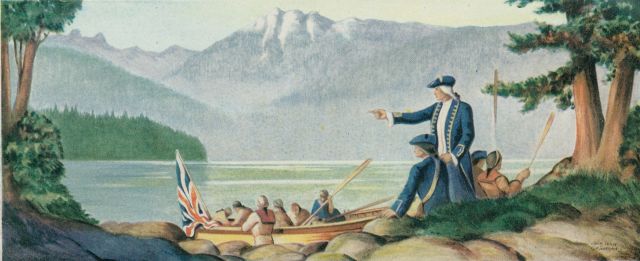
From the painting by John Innes, by courtesy of David Spencer Limited
“Captain Vancouver took us three,
‘Puggie’ Pigot, McKenzie and me.
We had the Discovery’s yawl.
A jolly boat party it was and all
were eating hearty and feeling fit.”
ROBERT ALLISON HOOD
BALLADS OF
THE PACIFIC
NORTHWEST
Its Discovery and Settlement

THE RYERSON PRESS
TORONTO HALIFAX VANCOUVER
COPYRIGHT, CANADA, 1946
BY
ROBERT ALLISON HOOD
PUBLISHED OCTOBER, 1946
REPRINTED, 1947
Printed in Canada
Wrigley Printing Co. Ltd., 1112 Seymour St., Vancouver, B.C.
ACKNOWLEDGMENTS
The author here wishes to make grateful acknowledgments to all those who have helped him with information, criticism and advice in preparation of this work, and more especially to the following:
The late Mr. Lionel Haweis and the late Judge F. W. Howay; to Mrs. A. Chilton and Dr. W. Kaye Lamb for helpful comment after reading the proofs; to Dr. Walter N. Sage; to Dr. Ira Dilworth; to Mr. D. A. Chalmers; to Mr. Noel Robinson; to Mr. Eric F. Gaskell; to Miss Kathleen Shackleton and Miss Yvonne H. Stevenson; to Dr. J. B. Tyrrell; to Mr. E. S. Robinson and the Vancouver Public Library for the use of their special collection of books on the history of the Pacific Northwest; to Mr. Willard E. Ireland and the Provincial Archives of British Columbia for valuable assistance and the use of photographs and source material; to Mr. Thomas Binfords, Portland, Oregon; to Mr. David C. Duniway, Oregon State Archivist; to The Oregon Historical Society and Mr. Lancaster Pollard and Mr. Howard M. Corning of Portland, Oregon; to Mr. W. H. Cleland and Mr. A. E. Fisher of Invermere for the use of a photograph of the David Thompson Memorial Fort.
Also to the Hudson’s Bay Company for the use of the picture of “Dr. McLoughlin Welcoming the Settlers”; to David Spencer Limited for the use of the plates of the frontispiece, “Vancouver Exploring Burrard Inlet, 1792”; to The Native Sons of British Columbia for the use of certain of the pictures by John Innes hanging in the library of the University of British Columbia; to the Canadian Pacific Railway Company for the plates of “Sir George Simpson”, “The Indian Boy (hunter)”, and the scene with the pack train; to the Northern Pacific Railway for the use of a number of the decorative plates; to the Secretary of State of the United States of America for permission to use the picture representing the Lewis and Clark party from the murals in the State Capitol at Salem, Oregon; and to Mr. H. E. White for the interest and skill exhibited in his drawings and decorative pieces.
Books and articles that have been especially helpful to me in addition to standard histories dealing with the period are “Vancouver’s Discovery of Puget Sound” by Edmond S. Meany, “Mackenzie and His Voyageurs” by Arthur P. Woollacott, “Vancouver, A Life” by George Godwin, “The Search For The Western Sea” by Lawrence J. Burpee, “Cariboo Cameron” by Charles Clowes (Maclean’s Magazine) and “The Camels in British Columbia” by W. T. Hayhurst (Okanagan Historical Society).
LIST OF ILLUSTRATIONS
| Captain Vancouver Explores Burrard Inlet | Frontispiece |
| Captain Vancouver Meets Spaniards Off Point Grey | 20 |
| Sat-sat-sok-sis, His Son, the Prince | 59 |
| Sir George Simpson | 85 |
| Alexander Mackenzie Records His Great Achievement | 93 |
| Simon Fraser following the Great River to the Sea | 100 |
| Hunting Was Good | 121 |
| Sacajawea | 125 |
| Meriwether Lewis and William Clark with Party at Celilo Falls on Their Way to the Pacific, 1805 | 132 |
| Doctor McLoughlin Welcoming the Settlers | 137 |
| Fort Vancouver | 150 |
| The Packtrain | 157 |
Contents
| Foreword | ix |
| The Sailor | |
| Hearts of Triple Brass | 3 |
| Captain George Vancouver | 26 |
| The Indian | |
| The White Slaves of Maquinna | 38 |
| The Narrative of John R. Jewitt | 83 |
| The Voyageur | |
| Mackenzie From Canada by Land | 86 |
| Alexander Mackenzie | 95 |
| The Explorer | |
| The Great River of the West: | 97 |
| Koo-koo-sint | 99 |
| David Thompson | 108 |
| An Indian Pilgrimage | 110 |
| The Mission to St. Louis | 118 |
| Sacajawea | 120 |
| The Lewis and Clark Expedition | 131 |
| Doctor John McLoughlin | 132 |
| The Miner | |
| Cariboo Days: | 152 |
| The Rape of the Boot | 152 |
| Walter Moberly | 155 |
| Cariboo Cameron’s Pledge | 157 |
| Moriturus | 165 |
| The Camels on the Cariboo Road | 168 |
| Afterword | 170 |
Pictures in verse I here would bring you
from a romantic period long ago,
when science had not yet won the wondrous triumphs
that now have crowned her. Then the seas
were still perilous; and the lone mariner
left his home port aboard his tiny vessel,
forsaking kin and country
for months, perhaps for years,
the ship his little world
afloat in a watery wilderness of waves.
Steam power and petrol had not yet been harnessed.
There were no wires along the ocean floor
to carry messages from shore to shore;
nor was the air vocal to him with melody
nor charged with the news of current happenings
from day to day. Sport of the winds
he sped before them, his ship a fragile toy
was tossed on the turbulent wave or gently rocked
on the slow swells or it might lie
becalmed and motionless with even keel
’neath tropic suns that scorched the deck
or Arctic frosts that cased the masts with ice
while weevily food and scurvy vexed his body.
Travel upon land had hardships too.
Then were no aeroplanes to scale the sky
disclosing the earth beneath as on a scroll.
The explorer with indomitable courage
set out into the unknown
to traverse lofty mountains and to trace
in frail canoe the course of mighty rivers,
at times shooting their rapids or portaging
with arduous toil through forests nigh impenetrable.
And nature’s fastnesses were not his gravest perils;
for all along his route dwelt savage tribes
that oftentimes resented his intrusion
and either boldly barred his passage
or hung upon his flank to ambush him.
Sometimes he won them o’er with gifts;
at others he had to fight them or to flee;
but with undaunted heart and resolute
he journeyed on through unfamiliar ways,
fired by the fervour of his quest.
Presentments of fact and incident are here,
culled from the chronicles of those simpler times,
imperfect and desultory no doubt,
yet such as mayhap may serve to open vistas,
intimate glimpses of the rich glamour and beauty
of those most stirring days of high adventure
in this Northwest of ours.
What though loved voices seem to speak,
home voices calling kind and dear?
Yet the wanton, west wind fans my cheek
and the salt, salt sea sings in my ear,
as I set my face far lands to seek
with a steadfast heart and joyful cheer.
The stripling, George Vancouver, sailed with Cook,
a blue eyed, fair-skinned boy but fifteen years,
Tells how
George
Vancouver
first went
to seascarce yet the down of nascent manhood showed
upon his tender cheek—for these the days
when Britain’s sea-dogs took their training young—
enrolled “A.B.” as was the custom then
for those who were to tread the quarterdeck
and learn the fine traditions of the sea
and follow their great forbears. He was come
of good Dutch lineage in paternal line,
and on his mother’s side of county blood,
his sire, Customs Collector in King’s Lynn,
that quaint old Norfolk port. ’Twas there the boy
had learned to think long thoughts about the sea,
had heard tall tales from sailors on the docks
and seen strange trophies brought from foreign lands
and thrilled at news of battles fought and won,
perils of shipwrecks on uncharted shores
where savage cannibals and wild beasts swarmed
to prey upon the hapless sailor man.
The sea was in his blood. What luck, indeed,
that such as he should sail with Captain Cook
to search the Antarctic for a Continent
fabled to lie in that far Southern sea!
Three years before he would return again—
three strenuous years of hardships and of toil
in which the Resolution was his home,
a sturdy vessel suited for her task
full bravely manned and nobly captained too.
He benefits
by the
training
of CookCook was an inspiration to the boy,
taught him the best he knew of seamanship,
high sense of duty and of honour too,
courage in danger’s hour and steadfastness,
those sterling qualities that make the man
and fit him to last out life’s trying day
and keep his colours flying to the end.
Fine seaman and a navigator skilled,
Cook had as well the true explorer’s flair
and the great gift of leadership. He kept
his sailors free from scurvy, that dread scourge,
by balanced diet and so saved his crew
from its dread fatal ravages which else
had brought the voyage to an untimely end.
So young Vancouver learned his ’prenticeship
under this famed explorer and he sailed
with him the blue Pacific and he saw
New Zealand and those favoured Southern isles,
decked in their tropic splendour and romance—
had watched the natives eat their enemies
and seen his shipmates flogged for punishment
and witnessed death at sea—all these and more
impinged upon his growing mind ere home
in three years time he came to Portsmouth docks,
still boy in years but now a man in heart.
There as the ship was mooring he looked back
over their rich experience and his breast
thrilled with a poignant thankfulness and pride,
and wonder too that even to such as he
had come these rare adventures and such friends
as ’mongst his shipmates he had made this voyage.
There had been bitter with the sweet, of course.
Some pangs of sheer homesickness he had known
when in the gun-room’s rough-and-tumble play
his fellow-midshipmen had hazed him well—
his seniors, veterans of a year or two—
and flogged him with their colts[1] till black and blue
to teach him due humility; again
when boyish tricks or scrapes brought punishment
and sent him to the masthead for his sins,
sometimes in dirty weather when the wind
cut through his flimsy sea togs clinging close,
till he was numb with cold and when recalled
could scarcely crawl down to the deck again;
or when some sickness kept him in his bunk
for days together. Even these chastened times
in retrospect now seemed scarce hard at all
viewed in the fair perspective of a voyage
that had been full of wonder and of zest,
of things to learn about the ship his home,
her masts and sails and ropes and more, her moods
so quaintly like a woman’s; and of the sea,
that too so changeable.
[1] A piece of rope used as an instrument of chastisement.
Another year and Cook set sail again
the Resolution still his gallant ship.Captain Cook
sets off
on another
voyage
The Discovery was his tender, Captain Clerke.
This time the venture had a wider aim.
First he must chart these far Pacific isles
he had discovered; then to sail North-east
on past the Sandwich Islands and still on,
New Albion and to Nootka forward still
to seek the North-East passage, that bright dream
of mariners for nigh two hundred years,
to link the two great oceans, also chart
the coastline as he went to be a guide
for those should follow. When they sailedand Vancouver
is again
of his
company
Vancouver’s name was on the muster roll
of the Discovery. Proud was he to be
under his loved commander once again.
It was a wond’rous voyage, that they made,
at times heroic, full of incident.
Far, far up North to sixty-nine degrees
along that dangerous, serrated coast
uncharted and unknown ’gainst peril of rock
and tempest, fog and treacherous, hidden shoal,
disease and hostile natives, thrusting through
by small boat parties fingering tortuously,
they penetrated till at last they faced
a wall of ice through which they could not pass,Cook is
forced to
turn South
again
a barrier bleak, awesome, unconquerable!
Cook turned his helm and southward sailed again,
leaving this bleak, inclement, barren coast —
that was in April, Seventeen seventy-eight —
to seek Hawaii’s languorous Southern shore,
that lotus-eater’s paradise far famed,
alas! a fatal shore it was to prove.
There on the beach that fateful day
Cook died at Kealakekua BayHow Captain
Cook met his
death at the
hands of the
savages
on bright Hawaii’s sunbaked strand,
far from his misty native land.
A boat was stolen the night before
and so the Captain went ashore
to ask Kar-re-obbo, the King
to come aboard with him, a thing
the old man first agreed to do—
childlike he marked his pleasure, too,
but his dark subjects showed alarm,
dreading their chief might suffer harm;
for Cook had come ashore attended
by nine marines. They apprehended
some lure behind the invitation—
not without grounds their trepidation—
so scurried fast across the sand
and stopped their patriarch near the strand.
With warning cries they voiced their fears,
threatening the white men with their spears.
Insolent grown, the hostile crowd
hustled the little band and loud,
taunted with shouts derisive till
Cook fired at one and fired to kill.
Too late he found it was not wise
the native valour to despise—
to think a musket shot would clear
the rabble from his path in fear.
He called the boats to come, stand by
and cease their firing. Help was nigh.
The ship’s guns belched with sullen roar—
her Captain now had reached the shore.
The savages about him swarmed,
with spears and daggers they were armed,
all following closely in his track;
and then he fell, pierced in the back
right by the water’s edge; and then
they speared him o’er and o’er again.
His men were forced to swim away—
their Captain dead, why should they stay?
Four of the nine marines were slain.
The five attained the boat again,
which barely could make good its flight
to reach the ship. In piteous plight
powerless the crew before their eyes,
saw their fierce foes with dreadful cries
wreak vengeance on their Captain dead,
dash on the rocks that noble head
and dabble all with gore that brow—
alas, where its bright beauty now!
Those vigorous limbs so strong and straight,
the savage foes, made mad with hate
and following tribal custom, tore
from off the trunk for trophies. More
’t were ill to tell. This the sad end
of Captain Cook; and his young friend,
Vancouver doubtless sorely grieved
for his great leader, felt bereaved
and shaken by the loss, to see
his goods put up for auction. He
would take it hard. Yet life was sweet
and he was young. He sure must meet
this sorrow bravely . . . .
Vancouver came again in “ninety-two”
to drop his anchor deep in Nootka Sound,Vancouver
again
visits the
North-West
Commander now on his own quarterdeck.
’Twas fourteen years since he had sailed with Cook
and seen him stabbed in Kealakekua Bay.
The sailor lad was now a lad no more.
Mature in years and training he had sailed
on active service under Rodney’s flag
in that great naval battle of the Saints
as a lieutenant on the frigate, Fame,
had fought the French and shared its victory.
In the West Indies he had served two years,
surveyed the Kingston Harbour and Port Royal
and did the work with credit so preparing
himself for his great life work still to come.
These had been stirring years in world affairs.
The War of Independence had been won
and Britain lost her colonies; and here
far out at Nootka on this Western coast
John Meares, a former naval officer,
trader in furs, had nigh embroiled in war
England and Spain by a Memorial
in Parliament whereby at Nootka Sound
the latter Power, he claimed, had seized his ships
despite their British flag. A “teapot” storm
itself, yet was, no doubt, a culmination,
the symbol of a graver, weightier issue,
wherein Spain’s ancient sovereignty here
in this Pacific seaboard was involved,
and England’s firm encroachment. That great trade
in furs of the sea otter was at stake
and San Lorenzo (Nootka) was its depot.
The Meares affair set Britain up in arms
and caused a mighty mustering of ships—
an armament indeed—just off Spithead.
So Spain in fear of it ate humble pie
and made a treaty granting Meares’ claim
and ceding Nootka back to British trade,
which she had claimed by prior settlement.
Vancouver, then, came on a twofold mission.
Under the Treaty terms he was to meet
at Nootka with the Spanish admiral
and there receive the territory back
which Meares had occupied before; also
he was to make some survey of the coast.
So ere he came to Nootka, mark him now
proceed with following breeze along the shore
past the Columbia River’s yeasty bar
and quite unconscious that behind it lay
that great, majestic, navigable stream.
Cape Disappointment’s barren promontories
he skirted closely and with favouring winds
he travelled on to Flattery’s rugged capes
between Tatooche’s Isle and Duncan Rock
into the Strait of Juan de Fuca. Here
they could observe the natives on the beach
and others paddling in their frail canoes,
of friendly mien and fain to come aboard
had the Commander wished to shorten sail.
And now beneath the high land’s sheltering screen
the breezes moderated; gently the ships
with easy motion glided down the straits
past Classet’s village; and they sailed so slow,
the smiling natives begged to come aboard
and were with kindness welcomed and with gifts.
The season now was May; and fragrant winds
with summery softness blew from off the land,
caressed the sailors’ crinkled, rosy cheeks
and made them sing for joyance; and when soonHe names
Port Discovery
and
Protection Isle
they struck a sheltered harbour, here they stayed.
Vancouver named it Port Discovery
after his vessel and Protection Isle,
he called the island lying at its mouth.
Menzies and two of the midshipmen went with me in the yawlVancouver
tells how
they
discovered
an alluring
inlet
and Puget, our second lieutenant commanded the launch
and the Chatham’s master had charge of her cutter.
We set off at five on a boisterous May morning
with four days’ provisions on board; for the weather had changed.
It was blowing a moderate gale. We had gone but a mile from the ship
when the fog floated down upon us. Some two or three leagues we rowed
from the shelter of Port Discovery and we moored in another harbour
that stretched away to the southward. Here we laid down our oars
to wait till the weather should clear; and we put in the time fishing,
hauling our big seine net along the beach with great labour
but with scant reward for our pains. To our joy then at last the fog lifted.
Before our admiring eyes there lay a delectable inlet
with a steep bluff right before us and away behind at an angle
reared a most beautiful mountain rounded soft on its slopesHe names
Mount
Rainier
and covered with snow like a mantle right down to the green at its base.
I gave it the name of “Rainier” after my friend the Rear Admiral.
Mount Baker stood up there North-east, stately, remote and grand,
with tinted, diaphanous sides, its white peak pearly and cloudlike.
Onward we steered and still onward and the land on the shores grew more open:
fields fertile and green contrasted the snow peaks above them;and Port
Townshend
and
Puget
Sound
and we found an excellent harbour which I named for the Marquis of Townshend.
The southern part of the Inlet I called after young Mr. Puget,
who showed such an excellent zeal in exploring its numerous fiords.
A likeable lad he was, trustworthy, capable, wise,
one I was glad to honour, one I was sure would go far.
Out of us “middies” five of us went
all very much on discovery bent:
in the ship’s launch there were twoOne of the
‘Discovery’s’
midshipmen
describes
an incident
of a boat
party for
exploration
with Mr. Puget, Barrie and Crewe.
Captain Vancouver took us three,
“Puggie” Pigot, McKenzie and me.
We had the Discovery’s yawl.
A jolly boat party it was and all
were eating hearty and feeling fit.
We were explorers and proud of it.
We passed a cape that we named “Point Grey”
and sailing round it into the bay,
a crowd of Indians came to meet us,
two score or more seemed glad to greet us
and gave us fish, a kind of smelt,
(I soon had some of it under my belt).
They paddled after us up the bay;
at its head we found that an inlet lay
stretching eastward with rocky shores.
The wind had died so we took to the oars.
It was almost night when we neared its head
three leagues from its mouth. Our Captain said
after we’d eaten dinner ashore
and stretched our legs for an hour or more:The
expedition
follows
an Inlet
to its head
“Men, we must back to the boats to sleep.
This coast is too rough, its banks too steep
to make it safe to pitch the tent.”
The others rose and off they went.
We boys asked leave to stay on landThe midshipmen
decide
to sleep
on the beach
while the rest
spend the
night in the
boats
and make our beds upon the sand
and this was given. “What fun,” said I
“to sleep right out beneath the sky
on terra firma safe and sound
and watch the stars go wheeling round.”
“You’re right, it’s fun to be alone,
we five together ‘on our own’,”
said Barrie. “Yes, it’s jolly too
with none to watch just what we do
and we can lark just as we wish
with none to listen but the fish,”
said Mac; but Barrie raised his hand
and filled Mac’s mouth half full of sand.
The two then closed in playful fight
and wrestled in the fading light
prone on the stony beach; I, too,
had straightway flung myself on Crewe
while “Puggie” next the fun to share
hovered about from pair to pair,
thus swiftly joining in the lists
pommelling us with his puny fists
with indiscriminate blows; but soon
wearied we ceased our play. The moon
now rose in silver o’er the scene.
The day’s fatigues had tiring been.
We stretched ourselves upon the beach
well up beyond the water’s reach
(or so we thought) and as for me,The Narrator
has an
exciting
dream
I went to sleep at once carefree
with all a boy’s abandon; dreamed
adventures marvellous. It seemed
my ship had foundered in a gale
and I was riding on a whale,
the last survivor of our crew.
(The Chatham it had perished too.)
The fish had suddenly appeared
above the surface, when I feared
that I must sink. In this sad plight
I seized its tail and held on tight
then climbed up on its back. My state
of mind was piteous to relate
as there I crouched. Then off it went
at racing speed. I knew it meant
that if the creature once should “sound”,
then I must certainly be drowned.
And so I drummed it with my heels
to spur it on. A flock of seals
had gathered round, a strange convoy.
I was a most unhappy boy,
and dumb with terror for, in chase,
swordfish in shoals had joined the race
to sheath their sharp swords in my steed.
Most copiously it seemed to bleed
until the sea was red with gore
and down it plunged and luckless bore
me far down with it, down, down, deep.
Strangely enough I yet could keep
my perch upon its back but fear
still paralysed my limbs for near
the swordfish followed, dogfish too
and sharks, grey shapes of pallid hue,
pursuing grimly snapped their jaws—On awaking
he makes a
surprising
discovery
to perish in these hungry maws,
a fearful fate, indeed! Then more,
I suffered much from cold and bore
the pangs of death, began to choke—
then mercifully I awoke
to find it was not all a dream,
for I was lying, it would seem,
right in the sea. Up softly had crept
the lapping waters while we slept.
I rose in haste. My comrades too,
beside me, Barrie, Mac and Crewe
were half awake; in sorry plight
they surely made a comic sight
all soaked and shivering cold and numb.
The first faint light of morn had come.
I looked for little “Puggie” Pigot.
There he was tossing like a frigate,
a full rod’s distance from the beach
and floating farther out of reach.
I shouted but he slept so sound,
he would have drifted off and drowned
if I had not plunged in once more
and dragged him dripping safe ashore.
The morning air was keen and chill.
Coldly the dawn’s light topped the hill.
Our calls had reached the Captain’s ear
and soon we saw the yawl appear
to take us off. We gladly crept
aboard crestfallen. “Puggie” wept
still half asleep; and as we stripped
the Captain said we should be whipped
for “messing up” the boat; but smiled
to show he was not really “riled”,
then helped to chafe our limbs all numb
with cold and served a swig of rum
from his own flask. So unafraid
we warmed up from our escapade;
and now we five have sworn no more
to make our bed so near the shore.
’Twas a bright and windy morning when we met the Spanish ships
at the opening of the bay
in the breaking of the day;One of the
seamen
describes
how they
met the
Spanish
ships
we were going ashore for breakfast with a shanty on our lips
and to land on Point Grey
whence the mists had blown away;
for the Captain said we might; we’d been cooped up precious tight;
an’ the meanest thing afloat
is a blistering open boat
with the seats so hard beneath you and the broiling sun so bright;
an’ our hams were achin’ sore
but we didn’t get ashore—
no, we never got ashore.
For the Dons were kind and courteous and most amiably perlite,
gave us breakfast of the best
and we ate it with a zest;
and washed it down with wine of a flavour to delight.
They asked us all to stay
but our Captain told them nay;
for our shipmates were awaiting us some hundred miles away;
and we rayther fancied too
he was feelin’ kind of blue
to find the Dons ahead of him—no, no, he wouldn’t stay.
He liked the lads all right
for they really were perlite—
aye, they sure were most perlite.
And as we rowed away from them we gave a rousin’ cheer,
an’ we wished them lots of luck
for they surely showed their pluck;
in these crank and crazy cockleshells to navigate up here,
just a schooner and a brig,
each of rummy, foreign rig,
barely forty-five tons burden and with scarce a score of men,
grizzled sea-dogs out of Spain—
aye, we told them we’d be fain
to broach our rarest vintage when we met with them again.
And the noonday sun shone bright
as we watched them out of sight—
aye, they faded from our sight.
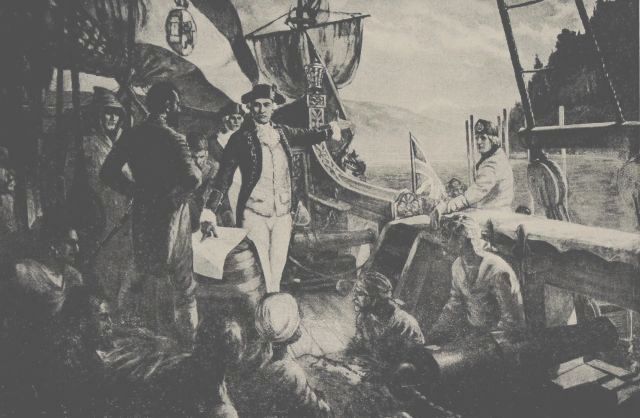
From the painting by John Innes
CAPTAIN VANCOUVER MEETS SPANIARDS OFF POINT GREY
“ ’Twas a bright and windy morning when we met the Spanish ships,
at the opening of the bay
in the breaking of the day; . . .”
I’ll name it Desolation Sound.
No prospect pleasing to the eye is hereVancouver
names
Desolation
Sound
nor pleasant places on the shore; no game
or vegetable food to mitigate
our coarse sea-diet salt and flavourless
recurring daily morning, noon and night,
from which the inner man revolts.
Sometimes the very sap of life seems drained
from out the limbs as if one’s body’s vigour
were dissipated by the parching staleness
and all one’s natural, physical functions
are slowed to dangerous torpidity.
And then the throbbing pain behind the eyes
that comes at times, the gnawing heaviness
that robs the nights of sleep, the dreary watchesHis thoughts
are gloomy
and depressed
when one reviews the progress of the voyage,
its perilous chances, its perplexities—
the loneliness of rulership unshared,
responsibility for the lives of men,
two whole ships’ companies, for good or ill
made subject to my sway and discipline.
To keep their bodies well, their minds content
beneath such hard conditions, no easy task;
the seamen just like children
to be praised or punished;
no easy task to keep the happy mean,
to hold the scales with keen, impartial eye,
neither to be o’er harsh or too indulgent.
Sometimes one’s angry feelings take control
to bring remorseful aftermath. But He
who knows the weakness of our mortal make-up,
will have compassion on our frailty.
Young Thomas Pitt now, that distressful lad,
son of a peer and born to lofty station,
a promising youngster when he joined the ship,
plenty of pluck but not an ounce of balance,
I often wonder what’s to ’come of him.
I’ll not forget the last time he was flogged,
the look of hatred in his eyes for me
as he was led away. Thank God, save him,
I have a loyal staff of officers.
But there’s a wretched loneliness of rank
that hedges the commander of a ship
and bears upon one heavily at times.
These rocky shores inhospitable,
flanked by majestic mountains whose high peaks
proclaim the paltriness of puny man
and mock the effrontery of such as we
who come so far to spy them out,
this night have cast a gloom upon me,
a mood of deep depression.
Johnstone has not come back. For several days
his boat is overdue. He went to seek
a passage outward to the ocean;
and now my mind is prey to grim forebodings
they may be swamped and lost. Shame on me now
for lending harbourage to foolish fears!
’Twere well to change the current of my thoughts.but he is
cheered by
reflecting on
the benefits
of his
explorations
to those
who come
after him
No doubt, ’tis something
to warrant an honest pride,
we should have fared so far
into these Northern latitudes so lone
to name new lands and chart unsounded seas
for other, happier men to follow
and build their homes and plant their crops
and rear their children around them;
and find their ways made pleasant by our pains.
It is a heartening thing to think upon,
consoling to the spirit ofttimes sad
when the mind turns back with poignant longing
and the heart hungers for old scenes and faces.
and then
by the
memory of
his sisters
at homeWhat are they doing at home, at King’s Lynn, my sisters?
There in the arbour tonight, do they sit in our old-fashioned garden,
talking together of me and the happy times of our childhood,
wondering how I may fare and when they may look for my coming?
There I can picture them fondly, there in the deepening twilight,
faces loving and sweet framed in the trellis of roses,
(memory carries me back, almost I scent their fragrance).
Dear Sarah and Mary, the thought of them fills me with comfort.He names
after them
the two
capes at the
entrance to
Desolation
Sound
Names that are sweet to my lips, how shall I do them due honour?
Names that have brought me good cheer I shall give to those capes that we skirted,
sailing into this sound, this Sound I have called Desolation.
Long may they thus be known to call up home thoughts to the sailor.
Thirteen guns for the Spaniard Quadra
rang out across the waves at Friendly Cove,The
‘Discovery’
and the
‘Chatham’
anchor in
Friendly
Cove
waking the echoes from the neighbouring hills
’frighting the seabirds, as the British ships
swept to an anchorage. Then in reply
thundered the Spanish batteries off the shore
an equal salvo in Vancouver’s honour.
And Indian watchers of the Nootkan tribe
hearkening stood rapt in wonder at the sound
but could not catch its import nor could guess
the great occasion that it celebrated.Vancouver isgraciously
received
by the
Spaniard
Quadra
Vancouver with his party went ashore
to be with warmth and graciousness received;
and lavish hospitality was exchanged.
Feasting and fellowship seemed doubly sweet
to these wave-weary mariners so long
cut off from social converse with their kind.
Don Quadra was a nobleman of charm.
The two commanders learned a mutual love
and admiration. This, despite that fate
had given to each an uncongenial rôle
in this, their two-part drama; for the one
was to receive according to the Treaty
the territories back that Spain had seized
from British subjects; to surrender such,
the bitter task the other had to face
if he would implement the Treaty’s terms.
But what the extent of those? Courteous and kind,
with high-bred tact and winsome southern charm
he sought to entertain his English guest
but would not cede more than the merest tittle
of what Vancouver thought the pact provided;
and history’s verdict proves the Spaniard right.Quadra
refuses
to cede
all of
Nootka
“Haul down the Spanish flag at Friendly Cove?
Surrender all of Nootka to the British?”
“No, no;” said Quadra, “for the power of Spain
from San Francisco to De Fuca’s Strait,
still it must reign supreme.” So back and forth
in verbal argument, by formal script,
the controversy raged between the two,
Vancouver firmly holding his contention
for full surrender of the Nootka district,
which Quadra curt denied him. Thus, at length,
lacking a common ground where they could meet,and it is
decided
to refer
the matter
in dispute
to the two
governments
they then agreed to send the matter back
for future settlement to their governments;
and thus they parted, Quadra sailing south.
The two would meet again at Monterey.
Spain’s power on the Pacific it has passed
and Britain rules where once her flag held sway.
The two commanders long ago have gone
to their last rest. Majestic steamers ply
through these great waterways then barely charted.
A noble city bears Vancouver’s name
not far from where they held their controversy,
he and Don Quadra; and as we look back
in time’s perspective, this stands out the foremostLater ages
shall acclaim
the spirit
shown by
Vancouver
and
Don Quadra
for future generations to acclaim,
that these two men each strong in his conviction,
not to be swayed from what he held was right,
could thus contend yet hold the even tenor
of gentlemanly bearing through it all;
they and their companies could meet and part
with kindly courtesy, in cordial friendship.
Their sojourn there at Nootka makes a tale,
one of the fairest annals of their time.
It was the second voyage of Captain James Cook in the Resolution on which the boy, George Vancouver, made one of the ship’s company, really as a midshipman although rated “A.B.” (able-bodied seaman) as was the custom with young gentlemen beginning their career as officers in the Royal Navy. The Resolution accompanied by the Adventure sailed from Plymouth 13th July, 1772, returning 29th July, 1775. Section 2 of the poem deals with Captain Cook’s third voyage. On his way North he stayed at Nootka Sound from the 13th March to the 26th April repairing his vessels, making observations of the Coast and trading with the Indians who became most friendly. He then sailed southward to Hawaii where his vessels cruised around for about six weeks before anchoring in Karakakooa Bay (now Kealakekua Bay), a sheltered harbour on the western side of the Island on 17th January, 1779. He was received with great enthusiasm and honour by the natives, who treated him like a god, prostrating themselves before him as he went about amongst them. He left again on the 4th of February but met with a series of storms. Many of the sails were torn to ribbons and the foremast of the Resolution was badly damaged which made it necessary for them to seek safe anchorage to make repairs. They returned to Karakakooa Bay on the 11th.
Here they were surprised to find that the mood of the natives, before so friendly, had completely changed. The old chief, Kar-re-obbo, was still well-inclined, but other chiefs were exceedingly hostile and had stirred the minds of the people to suspicion and hatred of their white visitors. The culmination came in the tragic happening described in the poem.
In section 4 of the poem years have passed and the boy has become a man. George Vancouver, now a Captain, left Falmouth on this expedition on the 1st April, 1791, with his two ships, the Discovery of three hundred and forty tons burthen and the armed tender, the Chatham of one hundred and thirty-five tons burthen. The Discovery had a complement of one hundred and thirty-five men and mounted ten four-pounder guns and ten swivels; the Chatham had fifty-five men and was also armed. He proceeded southward to the Atlantic, then round the Cape of Good Hope, across the Indian Ocean to Australia and then traversed the Pacific to the western shoreline of the Continent which it was part of his mission to explore from latitude 30° northward.
Referring to the great navigator’s failure to discover the river, Columbia, it is interesting to read this extract from his journal written after he had entered the Strait of Juan de Fuca:
“It must be considered as a very singular circumstance that, in so great an extent of seacoast, we should not until now have seen the appearance of any opening in its shores, which presented any certain prospect of affording shelter; the whole coast forming one compact, solid, and nearly straight barrier against the sea.
“The river Mr. Gray mentioned should, from the latitude he assigned to it, have existence in the bay, south of Cape Disappointment. This we passed on the fore-noon of the 27th; and, as I then observed, if any inlet or river should be found, it must be a very intricate one, and inaccessible to ships of our burthen, owing to the reefs and broken water which then appeared in its neighborhood. Mr. Gray stated that he had been several days attempting to enter it, which at length he was unable to effect, in consequence of a very strong outset. This is a phenomenon difficult to account for, as, in most cases where there are outsets of such strength on a sea coast, there are corresponding tides setting in. Be that as it may, I was thoroughly convinced, as were also most persons of observation on board, that we could not possibly have passed any safe navigable opening, harbour, or place of security for shipping on this coast, from Cape Mendocino to the promontory of Classet; . . .”
Referring to the naming of Port Discovery and Protection Island, the Journal has this to say:
“A picture so pleasing could not fail to call to our remembrance certain delightful and beloved situations in Old England. Thus we proceeded without meeting any obstruction to our progress; which, though not rapid, brought us before noon abreast of the stream that discharges its water from the western shore near five miles within the entrance of the harbour; which I distinguished by the name of ‘Port Discovery’, after the ship. There we moored, in 34 fathoms, muddy bottom, about a quarter of a mile from the shore.
“The entrance of this harbour is formed by low projecting points, extending, on each side, from the high woodland cliffs which in general bound the coast; bearing by compass from N. 48 W. to N. 54 W. in a line with two corresponding points from the island already described, lying off this harbour. Had this insular production of nature been designed by the most able engineer, it could not have been placed more happily for the protection of the port, not only from the N. W. winds to the violence of which it would otherwise be greatly exposed, but against all attempts of an enemy, when properly fortified; and hence I called it ‘Protection Island’.”
The circumstances in the naming of Puget’s Sound, Captain Vancouver describes in his journal of May, 1792, as follows:
“Late on the preceding Saturday night, or rather on Sunday morning, our other party had returned. It was them we had seen the first evening of our excursion from the island, and they very distinctly saw our fire; but as they did not hear the report of the muskets, concluded it a fire of the natives, not having the least idea of any of our boats being in that neighborhood. They had explored all those parts of the inlet we had passed by, and found the three openings we had left unexamined, the first afternoon, leading to the westward, to be channels dividing that shore into three islands; and those we had not attended to on Monday morning formed two small branches leading to the S. W.; the westernmost of which extends to the latitude 47° 6′, about two leagues to the westward of our researches in that direction; that in which the deer was shot communicated with the S. W. branch of the inlet by a very narrow channel. They had also passed the opening we had pursued leading towards Mount Rainier; but agreeably to my directions had not prosecuted its examination; the termination of every other opening in the land they had ascertained. Thus by our joint efforts, we had completely explored every turning of this extensive inlet; and to commemorate Mr. Puget’s exertions, the south extremity of it I named ‘Puget’s Sound’.”
The episode featured in Section 6 of the poem took place during the explorations of Burrard Inlet by Captain Vancouver in the course of an exploratory expedition he made with the Discovery’s cutter and the Chatham’s launch. Leaving these ships in a bay towards the lower end of the Gulf of Georgia, now known as Birch Bay, on the morning of the 12th June with a week’s provisions in each boat, he proceeded northward past the mouth of the Fraser River and around Point Grey into English Bay. On the inlet he then followed nearly to its head is now located the harbour of the City of Vancouver, British Columbia, called by him Burrard’s Channel, now Burrard Inlet. It was named by its discoverer after Sir Harry Burrard of the navy. On the following paragraph from the Journal, this part of the poem has been based and, as will be seen, with imaginative enlargement of detail justifiable by poetic licence. The names of the midshipmen are taken from those actually of the two ships’ companies although it is not certain that they were members of the party.
“The shores in this situation were formed by steep rocky cliffs, that afforded no convenient space for pitching our tent, which compelled us to sleep in the boats. Some of the young gentlemen, however, preferring the stony beach for their couch, without duly considering the line of high water mark, found themselves incommoded by the flood tide, of which they were not apprized until they were nearly afloat; and one of them slept so sound, that I believe he might have been conveyed to some distance, had he not been awakened by his companions.”
The Journal then goes on as follows:
“Perfectly satisfied with our researches in this branch of the sound, at four in the morning of Tuesday the 14th, we retraced our passage in; leaving on the northern shore, a small opening extending to the northward, with two little islets before it of little importance, whilst we had a grander object in contemplation; and more particularly so as this arm or channel could not be deemed navigable for shipping. The tide caused no stream; the colour of its water, after we had passed the island the day before, was green and perfectly clear, whereas that in the main branch of the sound, extending nearly half over the gulf, and accompanied by a rapid tide, was nearly colourless, which gave us some reason to suppose that the northern branch of the sound might possibly be discovered to terminate in a river of considerable extent.
“As we passed the situation from whence the Indians had first visited us the preceding day, which is a small border of low marsh land on the northern shore, intersected by several creeks of fresh water, we were in expectation of their company, but were disappointed, owing to our travelling so soon in the morning. Most of their canoes were hauled up into the creeks, and two or three only of the natives were seen straggling about on the beach. None of their habitations could be discovered, whence we concluded that their village was within the forest. Two canoes came off as we passed the island, but our boats being under sail, with a fresh favorable breeze, I was not inclined to halt, and they almost immediately returned.
“The shores of this channel, which, after Sir Harry Burrard of the navy, I have distinguished by the name of ‘Burrard’s Channel,’ may be considered, on the southern side, of a moderate height, and though rocky, well covered with trees of a large growth, principally of the pine tribe. On the northern side, the rugged snowy barrier, whose base we had now nearly approached, rose very abruptly, and was only protected from the wash of the sea by a very narrow border of low land. By seven o’clock we had reached the N. W. point of the channel, which forms also the south point of the main branch of the sound; this also, after another particular friend, I called ‘Point Atkinson,’ situated north from Point Grey, about a league distant.”
The boat party explored Howe Sound which the explorer named after Admiral Richard Howe, who, as well as his two brothers, took such a prominent part in early American history. It then rounded Point Atkinson and proceeded northward to Jervis Channel (now Jervis Inlet) and was back again opposite Point Grey by the morning of the 22nd. Section VII of the poem celebrates Vancouver’s meeting with Spanish vessels at this time off Point Grey regarding which the journal gives the following interesting account. The friendly spirit evinced on this occasion is in keeping with that later to be noted between Don Quadra and Captain Vancouver and their companies.
“As we were rowing, on the morning of Friday the 22nd, for Point Grey, purposing there to land and breakfast, we discovered two vessels at anchor under the land. The idea which first occurred was, that, in consequence of our protracted absence, though I had left no orders to this effect, the vessels had so far advanced in order to meet us; but on a nearer approach, it was discovered, that they were a brig and a schooner, wearing the colors of Spanish vessels of war, which I conceived were most probably employed in pursuits similar to our own; and this on my arrival on board, was confirmed. These vessels proved to be a detachment from the commission of Senor Malaspina, who was himself employed in the Philippine islands; Senor Malaspina had, the preceding year, visited the coast; and these vessels, his Catholic Majesty’s brig the Sutil, under the command of Senor Don D. Galiano, with the schooner Mexicana, commanded by Senor Don C. Valdes, both captains of frigates in the Spanish navy, had sailed from Acapulco on the 8th of March, in order to prosecute discoveries on this coast. Senor Galiano, who spoke a little English, informed me, that they had arrived at Nootka on the 11th of April, from whence they had sailed on the 5th of this month, in order to complete the examination of this inlet, which had, in the preceding year, been partly surveyed by some Spanish officers whose chart they produced.
“I cannot avoid acknowledging that, on this occasion, I experienced no small degree of mortification in finding the external shores of the gulf had been visited, and already examined a few miles beyond where my researches during the excursion, had extended; making land, I had been in doubt about, an island; continuing nearly in the same direction, about four leagues farther than had been seen by us; and, by the Spaniards, named Favida. The channel, between it and the main, they had called Canal del Neustra Signora del Rosario, whose western point had terminated their examination; which seemed to have been entirely confined to the exterior shores, as the extensive arms, and inlets, which had occupied so much of our time, had not claimed the least of their attention.
“The Spanish vessels, that had been thus employed last year, had refitted in the identical part of port Discovery, which afforded us similar accommodation. From these gentlemen, I likewise understood, that Senor Quadra, the commander in chief of the Spanish marine at St. Blas and at California, was, with three frigates and a brig, waiting my arrival at Nootka, in order to negotiate the restoration of those territories to the crown of Great Britain. Their conduct was replete with that politeness and friendship which characterizes the Spanish nation; every kind of useful information they cheerfully communicated, and obligingly expressed much desire, that circumstances might so occur as to admit our respective labors being carried on together; for which purpose, or, if from our long absence and fatigue in an open boat, I would wish to remain with my party as their guest, they would immediately dispatch a boat with such directions as I might deem necessary for the conduct of the ships, or, in the event of a favorable breeze springing up, they would weigh and sail directly to their station: but being intent on losing no time, I declined their obliging offers, and having partaken with them a very hearty breakfast, bade them farewell, not less pleased with their hospitality and attention, than astonished at the vessels in which they were employed to execute a service of such a nature. They were each about forty-five tons burthen, mounted two brass guns, and were navigated by twenty-four men, bearing one lieutenant, without a single inferior officer. Their apartments just allowed room for sleeping places on each side, with a table in the intermediate space, at which four persons, with some difficulty, could sit, and were, in all other respects, the most ill calculated and unfit vessels that could possibly be imagined for such an expedition; notwithstanding this, it was pleasant to observe, in point of living, they possessed many more comforts than could reasonably have been expected. I shewed them the sketch I had made of our excursion, and pointed out the only spot which I conceived we had left unexamined, nearly at the head of Burrard channel: they seemed much surprised that we had not found a river said to exist in the region we had been exploring, and named by one of their officers Rio Blancho, in compliment to the then prime minister of Spain; which river these gentlemen had sought for thus far to no purpose.”
The reference to “young Mr. Pitt” in Section VIII of the poem, opens up an interesting story and an association that was to prove one of the most painful and distressing in Captain Vancouver’s career.
The first notice we have of him is that when Vancouver went down to Falmouth in March 1791 to join his ship, he found the honourable Thomas Pitt there with his father. He wrote “I found my Lord Camelford here with his family all very well. They had been waiting a few days with some anxiety for the arrival of the ship. I have as yet in course been able to see but little of my young shipmate; however, cannot avoid observing that I was extremely pleased with his appearance and deportment.”
The favourable impression formed by Vancouver at this time unfortunately was not to endure. The young midshipman proved insubordinate and was three times punished by flogging before finally he was dismissed from the ship at Hawaii. At that time he was really Lord Camelford as his father had died the year before although this intelligence had reached neither him nor his Commander. He went from there to Malacca where he joined the Essex with the commander of which also he got into trouble. He finally arrived home in the Union.
He had apparently been brooding over his treatment by Vancouver for when the latter returned home he at once challenged him to a duel.
Vancouver pointed out that Lord Camelford had deserved the punishments he had received which had been found necessary in the enforcement of discipline but consented to meet him and give him satisfaction if any flag officer after hearing all the circumstances of the case should consider that such was due to him. Lord Camelford refused to submit the case to this test and more than once attempted to cane his former Commander publicly in the streets. The latter appealed to the Lord Chancellor for protection and the former midshipman was bound over in a sum of money to keep the peace. His subsequent career shows that he was a man of ungovernable temper. He was once fined £500 for violence in attacking a man in a theatre and he was court-martialled on the charge of murdering a brother officer. In the end he was killed in a duel with one of his best friends which he forced upon the latter much against his will.
Vancouver has been blamed for great harshness in his dealings with young Pitt, but it would appear that there was probable justification for the punishments he imposed.
In reference to the boat party under Johnstone, it returned safely and in high spirits having discovered a passage through to the ocean by Queen Charlotte Sound, now to be known as Johnstone Strait.
The following is Vancouver’s own account of the proceedings on his arrival at Nootka and the reception accorded him there:
“As Senor Quadra resided on shore, I sent Mr. Puget to acquaint him with our arrival, and to say that I would salute the Spanish flag, if he would return an equal number of guns. On receiving a very polite answer in the affirmative, we saluted with thirteen guns, which were returned, and on my going on shore, accompanied by some of the officers, we had the honor of being received with the greatest cordiality and attention from the commandant, who informed me he would return our visit the next morning.
“Agreeably to his engagement, Senor Quadra with several of his officers came on board the Discovery, on Wednesday the 29th, where they breakfasted, and were saluted with thirteen guns on their arrival and departure: the day was afterwards spent in ceremonious offices of civility, with much harmony and festivity. As many officers as could be spared from the vessels with myself dined with Senor Quadra, and were gratified with a repast we had lately been little accustomed to, or had the most distant idea of meeting with at this place. A dinner of five courses, consisting of a superfluity of the best provisions, was served with great elegance; a royal salute was fired on drinking health to the sovereigns of England and Spain, and a salute of seventeen guns to the success of the service in which the Discovery and Chatham were engaged.”
The negotiations between the two commanders were lengthy and involved, but were concluded in the manner described in the poem without any real unpleasantness in spite of the completeness of the break down.
These white men come to trade
and for our furs give guns and blankets
and knives and tools of iron
and rum that makes our stomachs burn
and sweet molasses thick and sticky.
They come from o’er “the lake of stinking water”
in big canoes with monstrous, bellying sails
full of great wealth in weapons of war,
axes to cut with and vessels for cooking,
rare coloured cloths and curious ornaments.
Sometimes they treat us fairly, ofttimes no.
Greatly they prize our skins of the sea otter
of which they rob us when they get the chance,
mistreat our wives and make our children slaves
and shoot with fire on us in our canoes.
So, do you think we will not seek revenge?
and put them to the torture till they die?
and take their goods for our enjoyment?
On a clear calm night in March of Eighteen-three,
the good brig, Boston named for her home port
in Massachusetts out from England last,
dropped anchor close off shore at Nootka SoundThe ‘Boston’
anchors off
Nootka
to take in wood and water. Captain Salter
had sought the place because it was reputed
the natives here were friendly; King Maquinna
welcomed the white man’s ships and loved to barter.
Next morning early ere the sun was high,
the sea still misty and the sky a mournful grey,Maquinna comes out in
his canoe
with some
of his men
he came in his canoe, a stalwart escort with him,
to bid the Captain welcome, welcome to his country,
and climbed up over the side, a savage noble of bearing
with skin of coppery hue where not dyed a bright vermilion.
His eyebrows were lined with black making the face look grim
although the eyes themselves did not seem evil;
the nose underneath them was Roman
and the whole expression was hawklike.
A cloak of the sea otter fur shapely and rich
fell to his knees and was belted with cloth of the country
made from the bark of a tree and wrought with intricate markings.
He wore his black hair in a knot tied on the top of his head
and glistening all over with oil. It was covered with curious down,
white as the mountain snow presenting a striking contrast.
His men not so stately of bearing wore cloaks of a similar fashion
but their dress it was simpler and plainer, their mien was more modest,
like children they gazed around them gaping in awe and wonder
at all they saw in the ship.
I was the ship’s armourer,
John Jewitt, from Hull in England,
just turned eighteen; my first voyage,
these my first savages too.John Jewett,
the ship’s
armourer,
tells how the
natives watch
his forge
Maybe you think I was thrilled
to have them gather about me
there as I worked at my forge
clanging my hammer on anvil
making weapons of war.
(Maquinna had gone with the Captain
to sample a bottle of rum.)
These showed the liveliest interest
in watching me pounding away
or blowing the fire with my bellows.
Their dark eyes glistened with pleasure
to see the sparks fly from the coal;
and their faces were happy and friendly.
Some knew a few words of English
and spoke them again and again
like children proud to show off.
And in the few days that followed,
as soon as they came aboard,
down they would come to see me
and never wearied of watching.
So they all learned to know me.
Lucky for me in the sequel
that it was so as you’ll see.
That was a happy ten days for us all.
The month was March but in the middle
the days were sometimes bright and sunny,
not lionlike at all but mild and pleasant.Jewitt tells
how the crew
enjoyed
the days at
Nootka
The wind no doubt at times was biting, keen
bearing the tang from distant, snow-capped hills
that reared their lofty summits in the east;
but it was freighted too with the soft breath
of nearby forests, balsam, spruce and pine,
and smooth-barked cedar, such a tonic fragrance
that it was like an elixir to inhale
and made my young blood thrill with ecstasy.
The Indians brought us salmon; you may guess
after our long sea diet of pickled pork
and hard ship’s biscuit what it was to feed
on such fine fare. We stretched our legs ashore
and laid in wood and water. All went well.
We gave the natives presents; they in turn
brought us their gifts, such as they had, in kind
and all went pleasantly but for one incident
that rather marred the harmony though then
it seemed to pass without much ill effect.
I was down in the cabin.
I heard the sound of angry voices,
Captain Salter and Maquinna.
The King had just come aboard
and brought as gifts nine pair of wild duck,
a welcome offering and a generous.Captain Salter
and Maquinna
have a
falling-out
Down they came and I could hear ——
the King was speaking,
his voice was harsh and loud:
“The gun you gave,” he said, “is peshak;
the gun is worthless, take it back
I do not want it.” With an oath
the Captain seized it from him, flung it down
to me and to the King he said;
“You dirty liar, what is this you say?
That I would give you something that was bad?
There, John, the clumsy brute has smashed the lo
and puts the blame on me, ungrateful wretch,
so do you try to mend it if you can.”
’Twas plain the King well understood
the tenor of the Captain’s angry plaint
and felt a keen resentment. Not a word
he spoke but he was dark with rage;
for I could see his face contorted
and working strangely while with his right hand
he rubbed his throat repeatedly
and then his bosom as if to try
to quell the mounting passions
that sought to vent themselves.
But then they turned to go on deck
and left me——left me with the broken gun.
Next morning dawned serene; the sea was calm
and bright the sunshine for the sky was clear.
The tree-fringed shore was beautiful nearby.
The dark-green foliage ringed with yellow sandMaquinna and
his men visit
the ship and
make merry
rose in a solid wall behind the beach
backed by the distant snow-capped peaks. It was
a scene to soothe the eyes for peace and gladness;
seaward were dotted here and there canoes
of natives fishing; one or two were moored
beside us floating idly on the tide
with our own longboat, for their dusky owners
had come to trade with salmon in the morning
and idled on the ship curious as children.
Before they came aboard we always searched them
to see they had no arms. For this precaution
the Captain made the rule. Just after noon
Maquinna himself arrived from Friendly Cove.
A small flotilla manned with chiefs and braves
accompanied him. They moored and came aboard.
The King himself seemed in a joyous mood.
He wore a mask of wood grotesque and weird
in semblance of an eagle’s head; in hand
he held a wooden whistle. This he blew
and set his men a-dancing to its tune
upon the deck with curious, antic capers
that won our hearty mirth. The grizzled tars
grinned and clapped hands applauding; while above
the Captain from the quarterdeck looked down
smiling approvingly upon their sport.
It was indeed a novel scene and gay——
the six-foot chief proud in his rich attire,
his black sea otter robe revealing legs
daubed with vermilion on their copper skin,
this hideous mask bird-beaked upon his head;
around him on the deck his painted men,
cutting their capers with loud shouts and chanting,
making the still air vocal with their song;
and then the seamen in their tarry togs
taking their ease and looking on amused,
some with indulgent smile, some laughing loud
according to their bent but merry all.
And I, but yet a youth, surveyed it too
in wonder and elation that to me
should come such luck as to have part in it.
In all my boyish dreams of bright adventureJohn surveys
the scene
delighted
I had not pictured aught so rare as this;
and as my thoughts went back to home at Hull,
that peaceful seaport with its gabled streets
and steepled churches and its masted docks,
its quiet countryside of field and farm
with cattle feeding by fair English streams,
I called to mind my comrades of the town,
these boys I played with, could they see me now,
how they would envy me my happy chance.
Maquinna ceased his piping and the dancers,
wearied and scant of breath, desisted too
and squatted down upon their hams. The King
then joined the Captain on the quarterdeck
and asked of him when he had planned to leave;
(I stood close by and so could overhear.)
“Tomorrow, Chief,” the Captain made reply,
“I weigh my anchor for by now you see
I have my wood and water all aboard,
my men are rested and their bellies full
of your fine salmon which we have enjoyed
for which we give you thanks.” Maquinna smiled——
his mask was doffed and lay upon his knees
an unseen one there was that hid his thoughts——
he smiled well pleased and bowed acknowledgment:The Chief
suggests to
the Captain
that he set his
men a-fishing
for salmon
before he
weighs his
anchor
flattered apparently he was to have
his gifts so valued and he spoke again:
“You like the salmon, why should you not take
a-plenty with you? Why not send today
your men to Friendly Cove to fish for them?”
The Captain seized it for a timely thought.
He called the mate to learn what he should say
and took brief counsel with him. Then replied
“All right, my King, I think your plan is good.
We shall have dinner first and then the mate
will take the jollyboat—and the yawl as well
and nine men with their gear to catch the fish
and you shall show them how and we shall see
what goodly share of spoil their sport may bring.”
Just then he turned and caught my longing eye:
no doubt my pleading face was eloquent.
“Aha, my boy!” he laughed and shook his head.The Captain
consents but
John is not
allowed to go
“I know quite well what you would wish to ask.
You’d like to go a-fishing too. No, no,
you’ve idled long enough, I think, today
and you must earn your wages. Don’t you see
I owe a duty to the men I serve,
my owners down in Boston, for they look
to me to guard their interests and to make
due profit on the voyage? So get your dinner
and then down to the steerage to your vice-bench.”
Clink, clink, clink went my hammer on the anvil
the smith may work and let his thoughts go roaming:
Clink, clink, clink, he may dream as any man will
when left all alone; and mine went a-homing.
John while
working at
his forge lets
his thoughts
fly to EnglandClink, clink, clink, I could see my father’s face
when the day’s work ended, we all sat down to meat,
as reverently he bent his head to say a grace,
thanking the Lord for what we were to eat.
Clink, clink, clink, by a cheerful necromancy
there came before my vision other faces that were dear——
merry faces of my schoolmates——I could see them all in fancy
as I played with them in Donnington but only yester year.
Clink, clink, clink,——
What was that? my thoughts came back
with lightning swiftness to the scene around me——
my vice-bench with the tools that lay about it,
the steerage, its interior dimly lighted,
the polished wood now here and there relieved
with shining brasswork,—and its salt-sea smells——
strange noises overhead of shouts and blows;
dull thuds and heavy scrapings on the deck
chilling my blood with fear. Upstairs I ran
He hears a
strange
hubbub overhead
and
finds the ship
has been
seized by the
savagesconvinced the savages had seized the ship.
But scarcely was my head above the hatch
when I could feel a rude hand grasp my locks ——
thus was I lifted from my feet and hung
in mid air for brief space——my hair being short
the silk that tied it slipped and so I fell
right back again all down the steerage stairs
and as I dropped received a glancing blow
that gashed my brow and took away my sense.
How long I know not——but I did come to
and tried to rise and fainted yet again.
Then I was waked to consciousness once more
by three tremendous Indian yells of hate
that seemed to freeze my blood. A wave of terror
swept over me, a sickness as of death——
for death I thought was near. And then the yells
changed to an exulting triumph song. I saw
the hatch above me had been closed and guessed
that I was held for torture; worse than death
might be my lot for I had heard dread tales
told by a member of our crew of deeds
done by the red men to their prisoners,
skinning alive and burning at the stake
and worse than these too terrible to tell——
tales that came thronging to my palsied mind
as now I lay and listened. The hatch was drawn.
Maquinna’s voice came down,——I knew it well;Maquinna
calls to John
to come on
deck
“John, you come up;” and I must needs obey.
Groping my way I staggered up the stairs,
my vision blinded by the blood that ran
down from my wounded scalp and faint with pain
and terror for the frightful fate I feared
faced me. The King, who saw my sorry plight,
bade a young brave bring forth a pot of water
and wash the clotted blood from off my face
so I could see. And what a sight was there!
Six naked warriors with their daggers raised
still dripping from the gore of my late shipmates
to plunge into my breast. I raised my eyes
in silent prayer that God accept my soul
and waited to receive their strokes of death,
but then the King advanced within the circle
and stood before me. “John,” he said, “I speak,
do not say “no” to me, for if you do,
these daggers drink your life blood and you die;
but you must promise true to be my slave;
for all your life to work and do my will,
to fight my battles and to make me spears
and guns and knives for use against my foes:
then I shall spare you.” I could but assent.
What else with death the grim alternative?He is saved
by the
intervention
of the King
And at his bidding kissed his hands and feet
to show submission; and as there I knelt
the brutes about me clamoured for my death
and shook their weapons with such show of rage
it looked as if the King could not prevail
to save me where I crouched low at his knees
from these red daggers; and they argued loud
that for their safety’s sake I needs must die
so there would be no witness of their deed,
the taking of the “Boston” and her crew,
to bring the white man’s vengeance by and by.
Raising his head with proud and lofty mien
the King spoke quietly, calm before their wrath,
and made them see he meant to have his will;
so, soon with sulky looks they ceased their threats
and I could tell that for a time at least
my life was safe. Yet in the swift revulsion
of feeling following and the chill March air——
for I had doffed my jacket for my work——
I shook as if with ague; and it seemed,
for pain and weakness I must faint away.
This the King noticed and he brought a cloak,——
the one the Captain wore, from out the cabin
to fling across my shoulders——rum to drink
right from the Captain’s flask and this revived
my drooping strength so I was fit to bear
the dreadful ordeal placed upon me now.
Straightway he led me to the quarterdeck
and there were ranged in rows upon the planking——He is shown,
one by one,
the heads of
the crew and
made to tell
the name of
each
a grisly sight that was for years to haunt me——
the heads of my slain shipmates marred and gory.
These one by one were lifted up to show me,
the Captain’s first——and I was made to tell
the name of each and what was his degree
among the crew——it was a ghastly task.
Some I could hardly recognize at all——
and as they passed before me in review,
these my late friends, so hearty and so hale
an hour or so before, I could but wish
that I had perished with them, so at peace
I would not then be facing such a fate,
a mournful vista down the weary years——
which now stretched out before me, as a slave
to these wild savages of Nootka Sound.
I am the Prince Sat-sat-sok-sis,
son of that great king, Maquinna
of the Indian tribe of Nootka,
twelve years old when next moon cometh.The King’s
son tells of
the joy of his
people over
the capture
of the brig
Wondrous things have lately happened ——
all our people are so merry——
we have triumphed o’er the white men,
taken their ship and brought it home here,
killed them all and cut their heads off,
all but two whose lives were spared them ——
spared to be my father’s bondmen.
John the young one, O I love him!
He is good and he is clever,
skin so white and hair all shining,
soft and shining in the sunlight,
eyes so blue just like the ocean,
hands so kind and strong and supple.
He has made me rings and armlets,
brooches, earrings forged from copper,
bracelets burnished like the sunset.
And he combs my hair out daily,
makes me wash with river water,
wash to keep my skin all cleanly,
sweet and fresh so “Wocash, Tyee,”
well the people may acclaim me
when I come to dance before them,
I, the King’s son, Sat-sat-sok-sis
of the Indian tribe of Nootka.
John prays to his own Quahootze,
whom he calls his Great White Father
and although my skin is yellow
I must worship too and fear him,
for he loves the little children
whether they are white or yellow——
so John says and I believe him.
Once I went with John and Thompson——
Thompson is the other white slave,
sire of John but not much like him——
he is cruel and I hate him——
to the lake outside the village
where they prayed to their White Father
from a book of sacred writings.
And I too knelt down beside them
for he is my Father also——
this John says and I believe him.
So you see the days are merry
for our happy Indian people.
We are strong and we are mighty
for we triumphed o’er the white man.He tells of
John’s
sadness
But I think John is not merry
though he’s brave and does not show it ——
never when among my people;
but with only me beside him,
sometimes he looks pale and lonely
and his eyes are sad with longing
for the sight of his own loved ones.
Then sometimes I sidle closer,
lift my hand up to caress him
for I know he is not happy
and I hunger to console him.
Then he puts his arm around me
and I think he feels less lonely.
He is kind and so I love him,
I, the little Sat-sat-sok-sis,
son of that great king, Maquinna
of the Indian tribe of Nootka.
I was the sailmaker of the ship,
John Thompson, of Philadelphia, U.S.A.
saved from the slaughter of the crew,
by the good offices of Johnny Jewitt,Thompson
tells how the
Indians were
induced to
spare his life
who said I was his dad so they might spare me
and so they did. Well, if I had a son
I had as lief that it were John
for he’s a decent boy
and has his wits about him——gad!
’T was like a play to see him rush to hug me
and slaver all my nose and beard with kisses,
me an old sea dog that has served the king
as boy and man for seven and twenty years,
sailed under Howe and fought the Frenchies
and never willingly would look at woman
since from my mother’s apron strings at eight years old
I ran away to sea as cabin boy
aboard a grimy collier. And the old chief
and all these greasy, smelly savages
stood gaping looking on nor did they know
just what to make of it. John vowed he’d die
if I, his poor old father was not spared,
and moaned and wept and wrung his wretched hands.
I could have laughed to split my bloomin’ sides
and yet the youngster’s cries and groans and tears
were done so natural and seemed so real,
damned if they didn’t make me ‘pipe my eye’
and there I sniffed and slobbered down his neck
just like that prodigal’s sire in Holy Writ
until the very savages were fooled
with our play-actin’ an’ they spared my life.
But many’s the time I wished they had not done so
and cursed the day that John thought up the lie
that made the old boy spare me——aye, Maquinna,
that greasy devil in all his furs and feathers.
He never knew how many times his life
hung by a single hair when these ten fingers
trembled to grip his throat and had they done so
not all that blasted, bare-legged tribe of his
would have availed to pluck the bastard free
before the bloomin’ breath had left his body
never to enter it again. Aye, aye,
but there was John to think about; and John
had still his life before him and was all
for getting free again and sailing home
and for the boy’s sake I must needs be prudent,
so swallow all the insults that the King
heaped upon me his bondman, but now John
he was the “white-haired laddie.”
Did not that little nipper, Sat-sat-sok-sis
follow him round just like a silly puppie,
and sleep in his bed at night? The queen
heaps on his plate her choicest dainties
of putrid seal or salmon. To them he’s welcome
for all of me. I laugh to see his nose
turn up disgusted while he tries to feign
appreciation of the loathsome morsels.
Faugh! just to live with such a filthy rabble
and be their slave, it fairly turns my belly
so I could spew! To think that I must bow
and stoop to do the will of such as these
and prostitute my trade of making sails
to shape a cloak for this mad, savage king
and court his favour like a lordling’s lackey!
Indeed, it were far better to be dead.
If there were not the Sunday for our surcease
I never could abide it. Now this John——He tells how
John and he
spend their
Sundays at
the lake
he has his wits about him I have said ——
and he’s as good’s a parson——had the guts
to tell the King that we must have our worship
must walk apart for prayer each weekly season——
nor did the old Maquinna say him nay.
And so we go with Bible and with prayer book
on the Lord’s Day as John has marked it down
to a small lake from Nootka not far distant
but where the yellow heathen never come.
There we sing songs of praise and read the Book
and make our prayers in quiet to the great Captain
that from our bondage he will set us free.
I never was no saint——no not John Thompson——
my lips more apt for cursin’ than for prayer,
so says to John, “The Lord will look askance
to see me on my marrow bones before him.
He’ll say, ‘young lad, you keep foul company,
to bring along a pirate such as he,
soiled with the stains of rank iniquities,
to join in your devotions,’ he’ll have none of you.”
But John he’d only smile his quiet, slow smile
and gravely shake his head and softly say:
“He walked with fishermen and humble folk,——
Peter and James and John and loved them well
vile as they were with sins and sordidness,
why should he not love you?” And so in sooth
I companied with him and sat there attentive
and listened reverently while he read——and how they
read the
scriptures
and prayed
that God
would save
them
and there were passages now and again
words of the Master healing and heart warming,
that seemed to have been spoken just for me
and they would nestle deep within my mind
and linger there like snatches of a song
to comfort me with their recurring strains.
John read of Jesus walking on the water
and how He made the winds and waves obey him
and healed the sick, recalled the dead to life,
and of that shipwreck miracle of St. Paul
wherein he brought the sailors safe to land
and nary a one was lost. And then the Psalms
of old King David——now there was a man
that sure was kin to all our joy and sorrow,
had words of cheer and wondrous consolation
that seemed to fit the case of John and me.
At first, I laughed and scoffed and teased the boy
but after that first Sunday at the lakeand how in
this way
they were
sustained in
their affliction
I never jeered no more for I believe
that had it not been for the blessed peace
and rest these hallowed seasons brought to us,
the sense of trust and hope and quiet communion,
with the supreme All Father, our Creator,
we could not have endured our dreadful lot,
the pain and fear and hardship that was ours
through the long months and years that were to pass
until that fateful day that brought us freedom.
Long were the days for me; wearily they passed
the chiefs were kind but not the common folk,
who while we lived saw danger to themselves
if any ship should come. Even King Maquinna,The King
decrees that
John must
marry or else
suffer death
for all his kindness, kept a jealous eye
to wean me from all wish to leave the tribe
and so decreed I must wear Indian dress
and wed an Indian wife. Not all my pleas
could aught avail to turn him from his plans ——
he said ’t was that or death, the choice was mine.
And so I deemed it were the lesser evil
that I should marry; and I gave assent
to his decree. Then was he greatly pleased
and granted grace that if I could not find
amongst his folk a maiden to my mind,
then I might choose one from some other tribe
and he would back my suit with all his power.
I, Eustoqua, the King’s only daughter,
the King, Upquesta, chief of the A-i-tizzarts,
now relate what did befall me.
The sun in the Western sky was sinking,Eustoqua
relates the
arrival of
visitors
sinking towards the water
and in the golden river of its rays,
lo, dark against its brightness,
we saw approaching two strange canoes.
In a brief space the beach whereon I stood
and where before there had been none but children
became a-throng with all our folk,
who ran out from the lodges and the woods
that lay behind them. Many raised hand to eye
that ’neath its shading they might better scan
the strangers in the offing. Were they friendly?
Or did they come as foes? My father bore his arms,
he and the other chiefs and all the men;
and some did shake them, testing their weight,
feeling the fineness of edge or point
with a fastidious finger. The women
pointing and chattering flitted here and there
with frightened scutterings; but not for me,
the daughter of the chief just turned seventeen,
to show my fear although within my bosom
my heart beat faster and a faint trembling
fluttered my limbs as I stood motionless
gazing to seaward. But they were not foes
in the canoes for as they nearer drew
we saw they were our Nootkan neighbours
with whom we had no cause of strife or quarrel.
Some time at rest they lay upon the bay;
and when he knew their quest was friendly,
my father sent Apala as his messenger
to bid them all a hearty welcome
and summon them ashore to sup with us.
Then in our lodge there was great stir
preparing the meal; my mother let me stay
to see them land; so there I waited
among the throng upon the sands, my cousins
and other maidens standing by me.
Maquinna first whom I had seen before,
a noble figure of a chief,
stept lightly on the shingle.
Next Sat-sat-sok-sis, his son, the Prince
and then the white slave we had heard of.She describes
the white
captive who
accompanied
them
We were all curious just to see him
for we had heard such marvellous things
that he could do, the weapons he could forge
and rings and bracelets fashion out of copper
and how he won the hearts of little children,
he was so kindly with them and so gracious
and made so many of the people love him——
when now I saw him I could understand it.
Nor did he look a slave but walked erect
and gazed about him fearlessly as if
he were a chief; his face with shining fairness;
his hair, not black, but sunny and golden,
round his temples curling soft and lustrous.
He wore his curious, awkward paleface clothes;
right after him came forty Nootkan braves,
and ten remained behind in the canoes
wherein we saw were laden handsome gifts
in furtherance of the purpose of their visit
which we were soon to learn;
nor did I yet know what a fateful thing
it was to prove for me.
They marched up from the shore right to our lodge,
my father led the way with Chief Maquinna
and I was fain to follow and to enter
with all the throng; this was a thrilling hour,
a ceremonial visit. We must await
and here assembled all would learn its cause
and list what these our friends had come to say
with fitting dignity and grave attention.
My heart beat fast. Curious I was to know
what was their quest and I was conscious too
of some new gladness I could not explain,
rapture that swelled within me not unmingled
with subtle pain poignant and penetrating
when thinking of the pale face I had seen
or greatly daring stealing furtive peeps,
that face so lovely like the moon for paleness,
that face I knew would haunt me in my dreams.
To be forced against one’s will to mate,
it is a fearful fate
but I was young and life was dear——
as an alternative there was death to fear.How
John Jewitt
set out to
seek a bride
I felt my courage rise again once more
as our canoes came nearer to the shore,
by the force of fifty paddles spurning
the blue waves and the foam churning
to seek the village of the A-i-tizzart race.
It was nigh sundown when we reached the place
and ushered by their chief we were assembled
in his lodge with his tribe. No wonder I trembled
when told to look about me and choose my bride!
There was a comely maiden by the chief’s side,
modest of mien and winsome with a charming face
lighter of hue than all the others and the grace
of modesty and kindliness were kindled there;
soft were her eyes and she had long, black hair
of such a softness, her form lissome and straight
like a young birch tree. Here might be a mate
that one could learn to love. With hope anew
my heart was lifted up; unwilling I drew
my eyes away lest I should seem to stare
at her alone among the maidens there;
candidates unwitting were they all arrayed
before me; and I too was on parade
for it was plain they looked intent on me
with a fixed, solemn gaze and I could see
not only all the women but each brave
had eyes for none but me. Maquinna’s slave,
whose fame to all the tribes around had spread,
who had wondrous skill making weapons, ’twas said.
I looked to right and left beneath the curious stare
of all assembled there. Maquinna, I was aware
sitting beside me was watching closely too
to see what I would do.
There was a hush upon the throng
and in my nervousness the time seemed long;
but of all the maiden faces there
there were none that could with the first compare
I caught her eyes, one fleeting glimpse and when
she turned them shyly down, why then
it was I knew my choice was made
and pointed her out to Maquinna. He saidMaquinna
approves his
choice and
presents gifts
“You have chosen well. She is good as she is fair
and the King’s daughter. Now must I do my share
to buy her for you to become your bride.”
Then he arose at my side
and took me by the hand
before them all and made me stand
in the midst in front of Upquesta; and then
he gave the sign for those of his men
who were waiting outside, to bring
the gifts to cast at the feet of the king.
With haughty mien they strutted down the hall,
bearing the cedar chests with them while all
kept silence; and they laid them down
before Upquesta, each with a forbidding frownHe then asks
for the
maiden in
marriage for
John and
lauds his
skill and
goodness
as if they hated what they had to do
and would have greatly liked to curse him too,
(such is their curious custom.) All the throng
rattled their spears and shouted loud and long,
acclaiming the gifts, and made the rafters ring
with cries of “Klack-ko, Tyee! thank you, Good King!”
Then when the clamour had somewhat died
Maquinna with an air of great dignity and pride
explained our mission, introduced me by name
and told of the manner in which I came
to be his servant; how though of different hue
I was as good as any of them; wiser too
in many ways for I had wondrous skill
working with metals and at my will
could make from them daggers, harpoons and knives,
vessels of iron to delight their wives
and also the most delicate ornaments and rings
fit for a chief’s adornment. So many things
there were I knew, more than he could tell,
about the countries I had travelled; and well
I knew the heavens, could call the stars by name.
Then he told how good I was——I blushed for shame;
how even the children loved me and his son,
the little Sat-sat-sok-sis was never done
in speaking of me; how all day long
the boy would chant my praise like the chorus of a song
“John this,” “John that” and would follow me around
just like a second shadow on the ground
devotedly. In short Maquinna said so priceless was I
that he would keep me always till I should die;
and now when going to settle down in life
most wisely I had decided to take a wife,
so here tonight many leagues across the water
had come to ask in marriage the King’s daughter,
whose budding beauty held my heart in thrall.
He said these gifts were mine and all
of them I laid here at Upquesta’s feet,
weapons and skins of matchless fineness meet
to purchase such a bride. With accents slow
and faltering first till speech began to flowUpquesta
first refuses
and then
consents
Upquesta made reply and all his people cheered.
First with a long harangue he said he feared
he ne’er could part with such a paragon
as this same daughter, her his only one
and loved so dearly; but in the end
he gave consent, called me his cherished friend
and hoped that I would ever be kind
to his Eustoqua. So would he be resigned
to bid her farewell; and as for her dower
I could take my gifts back, the skins for her bower
and the weapons to guard her; and then
two slaves he would give, two young men
to cut wood for our household, catch fish
for our table as it was his wish
she should never be hungry or cold.
Now the half of it cannot be told
of the feasting that followed that night;The visitors
depart for
home taking
the bride
with them
but our party were off by daylight,
Maquinna, his son and his braves
with me and my bride and my slaves;
and swiftly homeward we glided along
as the paddles kept time with our song.
I have sent her home,
my wife with her babe.
In weakness and pain
from cold and privation
I am nigh unto death.John tells
of his
separa-
tion from
his wife
Forced by Maquinna
to wear Indian clothing
and to work in the woods
cutting fuel for his fires.
Hungry and naked,
soon must I perish.
She is good and kind,
faithful and tender;
but if I should die,
who will befriend her?
Here among strangers,
far from her kindred,
why should I keep her?
I have sent her home,
Eustoqua, my wife;
she has passed from my life
to return to her father.
I shall see her no more;
and I stand on the shore
in weakness and pain,
in sickness and sorrow,
with no hope for the morrow.
Forth into the dark night
her canoe fades on my sight.
To part from my loved one,
’tis torment and pain;
now I’ve left him for ever
ne’er to see him again!Eustoqua’s
Song
For the lodges of Nootka
sink low on my sight;
and swiftly the paddles
bear me far from delight.
Why in life need I linger
now its glory is fled?
From my white love I’m banished
and my spirit is dead.
But his child’s at my bosom,
his babe’s on my breast,
shall I faint ’neath the anguish?
shall I fail at the test?
No, the papoose I suckle
shall bid me to live;
all the love that was John’s
now to him will I give.
But the mem’ries I cherish
shall not dim with the years;
nor his image e’er perish
though blurred by my tears.
All health and vigour have gone out of me.
I crawl along the beach crippled with pain.
Naught can I eat and scarce can sleep at night.
I would that death which seems so near might come.Sick and
suffering,
John longs
for death
Poor Thompson’s case is nigh as bad as mine
for rheumatism has got its grip on him.
Today I saw a sight that made me sad:
An Indian slave had died in dreadful torment;
And when the breath had barely left his bodyHe is
depressed by
seeing the
body of a
dead slave
cast into
the sea
his callous master dragged it down the sands
and tossed it carelessly into the breakers
to pass out on the tide. This, I reflected
in a brief season will be my fate too,
unmourned and unattended to be flung,
food for the fish to feed on, whilst my folk
will never know at home what has befallen me.
My faith in God has hereto been my stay
but in my pain and weakness even this
now seems to fail me. Sweet was the surcease
when every Sunday we could seek the lake,
Thompson and I, and hold our solemn service
but now we’re both too weak——O for a ship
and liberty! or death with ease from pain!
Maquinna, when he saw that there was danger I should die,
allowed me to resume my European dress;With the
resumption
of European
clothes,
John and
Thompson
improve in
health
and with proper warmth and nourishment my health began to mend
and hope of freedom once again revived within my breast;
Then Thompson too could walk again and I could not but feel
that God who had most marvellously saved us from despair;
and had put it in Maquinna’s heart to spare our lives thus far,
might in the end restore us if it pleased his sovereign will.
One day working at the anvil,
I and Thompson making daggers
by command of King Maquinna,
heard the heavy boom of cannon
sounding loud across the waters,A ship at
last arrives
round the shores reverberating.
This was what we long had wished for,
that a ship would come to take us,
and my heart’s tumultuous beating
filled my breast with wild commotion,
panic fear with hope contending.
Soon the natives crowded round us
at the forge where we were working,
crying out with frightened clamour
that a ship was in the offing.
But we both kept right on working
for we dared not show our feelings.
Then came running King Maquinna
crying, “Have you heard the tidings?”
Taking time before I answered,
I kept pounding on the anvil,
feigning but a fine indifference
to the purport of his question
for we dared not show our feelings,John
declares his
unwillingness
to visit the
ship
dared not voice our heartfelt longings
to return to home and kindred.
“Would you like to go aboard her?
go aboard and see the ‘Bostons’,[2]
who have come here in this vessel?”
asked the King, his keen eyes watching,
puzzled by my dogged silence,
“No, indeed,” at length I answered,
“I have learned to live among you,
learned to fish for whale and salmon,
learned to hunt the great sea otter,
and to face the mighty she-bear
rearing with her cubs behind her,
flesh my spear within her bosom.
Why then should I want to leave you?
leave this favoured land of Nootka,
where the fish are never failing
and the woods are full of berries,
where the lean, lank wolf of famine,
never lurks around your lodges?
If I go aboard the vessel,
these my countrymen would take me,
take me back among the white men,
wash the paint from off my body,
dress me all in formal garments,
cramp my limbs to my discomfort.
No, I will not board the vessel.”
“That is good,” said King Maquinna.
“Go aboard yourself,” I urged him,but advises
Maquinna
to do so
“and this ship will make you welcome.
They are here for trade and barter,
seeking skins that you can sell them,
precious furs of seal and otter;
and they have no thought of vengeance,
none at all,” I thus assured him.
“All right, John,” he answered quickly,
“I will go aboard this vessel;
but first you must make a writing
just for me to give the captain,
telling him to make me welcome
for the kindness I have shown you
ever since you came among us.
He’ll be glad then to receive me
and to trade for my sea otter,
plenty rum and sweet molasses,
blankets, guns and shining bracelets
all to make us rich and happy.”John writes
a letter to
the Captain
at Maquinna’s
command
“That I shall,” I promptly answered,
tore a sheet from out the notebook
that I carried in my tunic
and I straightway set about it
while the King sat grimly watching —
and my trembling fingers faltered,
trembling as they held the pencil,
just as if I had the ague.
Then I read the letter to him,
read it over not as written
but as if it gave the message
in the words himself had spoken.
And the tenor of my story
was of widely different purport,
for I told the captain plainly
he must keep Maquinna captive,
hold him hostage for our safety.
Setting out our situation
and the substance of its peril,
I assured him he could save us
if he would but do my bidding.
’Neath Maquinna’s scrutinizing
as I handed him the letter,
I could feel the hot blood flushing
in a flood right to my temples—
he had treated me so kindly
that it hurt me to betray him—
but I put a bold front on it,
luckily my face was painted
so to hide the telltale blushing
of the red stream that protested
this duplicity I hated.
Yet in such dire plight of peril
it was justified I reckoned.
Then the King, still hesitating,
still in doubt, once more to try me,
“Won’t you come with me?” he questioned,
but I hastened to make answer
that I had no wish to do so;
and with this he seemed contented.
So he straight dissolved the council
saying, “This affair is settled.
My canoe, be swift to launch it.
I shall go. Your King has spoken.”
[2] This was the name used by the Indians for American traders as their ships usually hailed from Boston.
So Maquinna arrived with his war canoe,
bravely manned with its royal crew
under the lee of the Lydia lying
at anchor with her house flag flyingMaquinna
is conveyed
to the ship
on the lazy waters of Nootka Sound,
a brig from Boston now homeward bound.
Her kindly skipper was Captain Hill,
he had veered from his course with right good will
taking the risk of the redskins braving,
in the hope of Maquinna’s captives saving.and is
welcomed by
Captain Hill
He welcomed the chief with a hearty hail —
but the crew were all mustered around the rail,
with weapons at hand so should need arise
they would not be taken by surprise.
The afternoon sun shone bright and fair;
balmy and fragrant the summer air
blowing soft on the surface of the sea,
freighted with breath of flower and tree
from the forest of green that fringed the sand
’neath the purple peaks so lofty and grand
outlined sharp ’gainst an azure sky.
The prospect was fair to the Captain’s eye
and as he surveyed the ravishing scene,
he thought of the Boston that might have been
still afloat with her master and crew,
alive to enjoy these pleasures too.
Maquinna climbed up o’er the Lydia’s rail—
his men’s dark hints had had no avail—
Proud was his look and his eyes were bright
as he stepped on the deck with naive delight.
There was something hard in the Captain’s smile,
a wryness of lip, a tenseness the while
he read the letter the King presented
but he shook his hand as if he meant it
and ushered him down at once below
to his cabin snug where a goodly show
of biscuits and bottles and crystal bright
seemed ready prepared for the guest’s delight.
The Captain offered the Chief a chair,
who straightway sat down with a satisfied air
feasting his eyes in expectation,
but not for long was his spirit’s elation;
for into the cabin with faces grim
five sailors filed surrounding him
and there was a pistol cocked and ready
in the captain’s hand held true and steadyMaquinna
is made
prisoner
to plant a ball in Maquinna’s breast
if he showed resistance. Then heavy hands pressed
upon his shoulders and held him fast
and shackles of steel on his wrists were cast
while his ankles were bound with an iron chain.
Resistance was futile, to struggle was vain.
The captured chief did not cringe nor cower
when he found himself in the white man’s power,
but he faced his foes with a courage innate
believing that death would be his fate.
‘A life for a life’ was his tribal rule,
‘Who spares his enemy is naught but a fool.
He is always a danger until he is dead.’
“You are my prisoner,” the Captain said,
“I shall hold you here till you restore
the white men, your slaves on yonder shore,
those who were spared of the “Boston’s” crew,
all done to death by your tribe and you.”
The terms seemed too good to be true to the chief,
such clemency seemed almost past belief;
and when Alana, his sub-chief was brought,He commands
that John and
Thompson
be set free
he told him the trick whereby he had been caught
and he sent ashore his royal decree
that the two white captives should be set free
and brought to the ship without delay.
The message proclaimed this the only way
to rescue him now from the white man’s power
that had ta’en him by guile in an evil hour.
Ere long we saw them coming back
the men—but no Maquinna with themJohn relates
how the
canoe returns,
but without
Maquinna
and from the folk around me rose
a chorus of distressful sounds,
subdued at first but rising fast,
grunts from the men and women’s wails,
for in the paddlers’ drooping mien,
they sensed that there was something wrong.
The big canoe soon reached the shore.
With downcast eyes the men leapt out
and stood dejectedly at bay
before the crowd that sought to know
why had they come without the King?
They replied that their chief was in chains
and ‘John had wrote bad of him,’ so
the Captain was holding him hostage
The people
are told
what has
happenedfor the safety of Thompson and me.
Then there was more howling and tears
and women were tearing their hair.
The men were all arming with spears
and some of them threatened me sore
and vowed they would cut me in bits
or hang me up by the heels
to burn me slow o’er a fire
or would bind me fast to a tree
and strip me and skin me alive.
But I felt I had little to fear
with Maquinna held hostage on board
for they would not endanger his life
by the killing of Thompson and me.
Then the chiefs made the rabble keep quiet
and bade me to tell them why
their King had been treated this way.
Did I think he was going to be killed?
I assured them they need have no fear
if they would but do as I asked
to let me and my comrade go free.
In that case their king would be safe.
No harm would come to him at all.
First they must send over my mate;
and this they were willing to do,
so I saw the sailmaker embarkedThompson
is sent over
to the
“Lydia”
and carried off safe to the ship.
I was heartened to see him go
and to know that at least he was free.
My own fate was still in suspense
but I asked those around me to say
just what they proposed now to do.
They argued together a while,
then Alana, the sub-chief replied.
A “paper-writing” I must make
to the Captain on board the brig
and bid him to send a boat
with five men aboard and no more,
who should bring Maquinna ashore.
As soon as his foot touched the land,
then I should leap into the boat
and be carried back safe to the ship.John rejects
the plan
proposed for
exchanging
him for
Maquinna
but offers one
of his own
Then all would be peaceful again.
But I pointed out this would not do
for the Captain would never consent
to endanger his boat and its crew
by venturing close to the beach,
since he knew what had happened before
to the Boston and all her men,
my shipmates whose lives had been lost
by trusting to them and their Chief.
I proposed they should launch a canoe
and man it with three stalwart braves
and put me forthwith in the prow
to carry me out in the bay
within easy hail of the ship.
Then I would the Captain call
and ask him to send a boat
with Maquinna on board out to us,
so we could make an exchange,
their loved chief for me midway
between the ship and the shore.
All the trouble would then be past.
To this they were soon agreed.
Three of them brought the canoe.He is
embarked in
a canoe with
three Indians
Lightly I leapt to its prow.
They were used to seeing me armed
and forgot I was wearing them now—
my dagger that hung at my side
and my pistol stuck in my belt—
while they had their paddles alone.
Softly we skimmed o’er the sea.
Exultant I looked at the shore,
watching its outlines recede,
the faces grow smaller and smaller,
faces of foes full of fear,
fear for the fate of their Chief
and of hate for me as its cause.
With my back to the ship I could feel
that nearer and nearer we drew.
The faint summer breeze fanned my cheek,
the throb of the waves seemed to croon
of freedom and friends and of home,
fair faces I loved far away,
in this perilous time of stress,
these visions passed through my brain.
We were soon within hail of the brig
and the paddles had ceased to play,
soon motionless lay the canoe.and when
they come near
the “Lydia”
he forces them
to take him
right up to
the ship
Now I knew that the time had come,
I must act but my courage was cold.
My limbs had grown suddenly numb
and my lips dumb with craven fear
as sometimes in a dreadful nightmare;
but I put up a prayer to God
to grant me my manhood again
and straightway my strength was restored.
From my belt then my pistol I drew
and threatened the men whom I faced,
now sitting there irresolute.
I bade them pull up to the ship
or suffer an instant death.
They were taken by sore surprise
and showed no resistance at all
but were fain to obey my behest
and paddled right up alongside.
He goes
aboard and
is welcomed
by the
CaptainSo then behold me climbing o’er the rail
and welcomed heartily by Captain Hill,
then after him by all his kindly crew.
Thompson, whom I had hoped to see on deck,
their hospitality proved too much for him
and now he lay dead drunk down in the hold
lost to the world. Indeed, he had succumbed,
almost as soon as he had come aboard,
to his potations; and thus Captain Hill
could get nor rhyme nor reason out of him.
So I must needs relate our stirring story
from the beginning to him; and his wrath
was fanned to fury as my tale went on.
He vowed to hang Maquinna out of hand
for the fell massacre of all our crew.
Had I not showed him what great provocation
from men of our own race the King had suffered
and pointed out he lived by different standards
than such as he or I; and truly told
how he had saved my life and that of Thompson,
had shown us numerous kindnesses as well,
he would have done so; then he said at last
he would be guided just by what I wished
and thus would guard himself from any blame.
Maquinna brightened up at sight of me
when I went down with Captain Hill to see him
and cried out “Wocash, John!”
I must confess to something of a shockJohn visits
Maquinna
in the cabin
to see the chief in chains.
He, who had lately been my master
even to the power of life and death,
now sat before me with our rôles reversed
shorn of his liberty and pride.
Nor did it cause me any exultation
to see him humbled thus before me;
and I made haste to ask the Captain’s sanction
to strike the irons from his hands and feet,
the which I said it would be safe to do.
I told Maquinna we would spare his life
but he must now surrender all the spoils
that he had ta’en ashore from off the Boston,
so that we could restore them to her owners;
and when his people brought those all aboard,He tells
Maquinna
his life will
be spared
then he would have his freedom and could go.
Darkness was now descending. ’Twas too late
tonight to bring them off but on the morrow
this could be done. The King was much distressed
at the delay and begged that through the night
I would remain with him and this I did.
For despite my assurance he was frightened
the Captain still might punish him with death.
His simple mind trained in the savage standard,
‘an eye for an eye’ could scarcely comprehend
such clemency as promised. All night long
he did not sleep nor would he let me do so,
reminding me how he had stood my friend
when all his tribe were clamouring for my death.
So o’er and o’er again I strove to quiet him
until at length the cheerful morning came.
And then I hailed his men and straightway bade
that they must bring the various things aboard,
cannon and anchors and the Boston’s papers,
my trunk and Thompson’s and my precious journal.
When this was done Maquinna would go free.
So, two hours later all had been restored.
Maquinna’s war canoe came out to get him
with sixty otter skins for Captain Hill,
a present from the Chief in recognition
that he had spared his life. And when at last,
the Captain told him now that he could go,
the Chief jumped up in ecstasy of joy
and drew the royal mantle from his shoulders—
four of the choicest skins it took to make it—
to give his liberator; and the Captain
with generosity not to be outdone,
gave his own hat and topcoat to the Chief,
who showed great satisfaction with the gift.
The Captain also promised to Maquinna
to come back later on within the year
and do some trading with him and his tribe.
Maquinna
says
‘good-bye’
to JohnThen Maquinna turned to me,
deeply moved as I could see.
Down his cheeks the big tears fell
as he faltered his farewell.
Strangely too I felt the parting
nor could stay my own tears starting
as he begged me to come back—
nothing ever should I lack—
he and his held me so dearly.
It was plain he spoke sincerely.
Then to the rail he lightly stept,
and down among his warriors leapt,
who bore him swiftly to the shore,
o’erjoyed to have their king once more.
Soon the little Sat-sat-sok-sis
came out in his tiny shallop,
just to take his farewell also.Sat-sat-sok-sis
comes aboard
to take
farewell
also
And he climbed aboard the vessel,
climbed up o’er the rail to greet me,
took my hand in his so shyly,
hid his face against my tunic,
could not speak he felt so deeply.
In his eyes the tears were starting.
I, too, deeply felt our parting.
In my arms I quickly raised him,
kissed him softly on the forehead;
and he whispered, “Wocash, Tyee;[3]
wocash, John,” he whispered gently.
On the deck then soft I placed him;
but he slipped from out my fingers,
slithered nimbly to the water
where at rest his shallop floated,
seized with haste his tiny paddle,
sped in silence swiftly shoreward.
Thus the little Sat-sat-sok-sis
and his father, King Maquinna
of the valiant tribe of Nootka,
passed from out my ken for ever.
[3] “Wocash”, exclamation of welcome and approval. “Tyee”, Prince.
The White Slaves of Maquinna is based on the “Narrative of the Adventures and Sufferings of John R. Jewitt, Sole Survivor of the Ship Boston During a Captivity of Nearly Three Years Among the Savages of Nootka Sound with an Account of the Manners, Mode of Living, and Religious Opinions of the Natives”. This was written by Richard Alsop and published in Middletown in 1815. It was an extension in narrative form of “A Journal Kept at Nootka Sound” by John R. Jewitt, printed for the Author and published in Boston in 1807. 1807 was the year that Jewitt landed in Boston in the Lydia, the ship that rescued him from his captivity and he lost no time in having his notes put into print as may be seen. He settled down in Massachusetts and eight years later Richard Alsop wrote the Narrative from the particulars of the captivity supplied to him by Jewitt. The latter made his living by travelling around the country selling this story of his adventures. It proved most popular and appeared later in numerous editions and in other forms and once in a broadside entitled “The Poor Armourer Boy, A Song”.
As ethnological material it has proved most valuable because of the excellent and carefully detailed account of the natives and their habits, manners, customs and dress that are contained in it. The Indian Chief who captured the Boston and made slaves of Jewitt and his companion was the same Maquinna who was Chief at Nootka when Captain Vancouver visited there in connection with the Treaty. Their acquaintance was inauspiciously begun as the Journal recounts although later the Chief entertained the Englishman and a certain degree of harmony was established. The opening contretemps Vancouver describes as follows:
“Maquinna, who was present on this occasion (the arrival at Nootka), had early in the morning, from being unknown to us, been prevented coming on board the Discovery by the sentinels and the officer on deck, as there was not in his appearance the smallest indication of his superior rank. Of this indignity he had complained in a most angry manner to Senor Quadra, who very obligingly found means to sooth him; and after receiving some presents of blue cloth, copper, etc., at breakfast time he appeared satisfied of our friendly intentions: but no sooner had he drank a few glasses of wine, than he renewed the subject, regretted the Spaniards were about to quit the place, and asserted that we should presently give it up to some other nation; by which means himself and his people would be constantly disturbed and harassed by new masters. Senor Quadra took much pains to explain that it was our ignorance of his person which had occasioned the mistake, and that himself and subjects would be as kindly treated by the English as they had been by the Spaniards.”
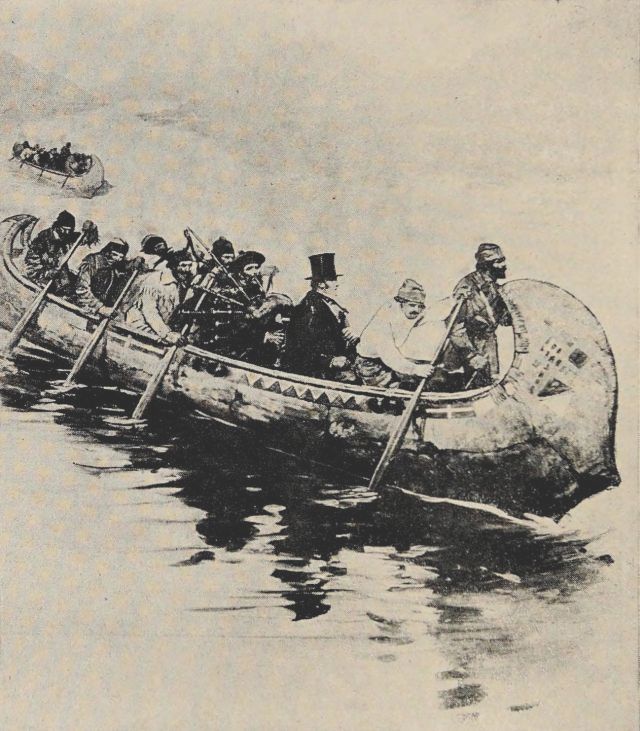
SIR GEORGE SIMPSON
“We are de fur traders an’ we make
our highways o’er de rivière and lake,
our moving home de frail, birch bark canoe; . . .”
We are de fur traders an’ we make
our highways o’er de rivière and lake,
our moving home de frail, birch bark canoe;
mos’ time it carries us, sometime we bear it too
for when de rapides are too swift to run
we make portages. Always we toil from sun to sun
so hard, so hard de precious furs to bring
safe to de Fort, then by gar, we laugh, we sing.
We no care now for perils that are past,
de rapides dangereux, de shrieking tempest blast.
Non, non, forgotten all dose troubles of de trail
when we make beeg revel in de grande regale.
’Tis then, de voyageur he feel like king
an’ he dance, he fight and do mos’ anyt’ing!
We left Fort Chipewyan the Eighth of May
at seven in the evening in our bark canoe,Mackenzie
and his
voyageurs
embark
on their
search
for the
Western Sea
just twenty-five feet long inside,
an easy burden for two men to carry.
Three thousand pounds of load aboard her,
provisions, guns and all our baggage
and ten made up our party,
seven Company men besides myself
of proven loyalty and courage
and then two Indians to interpret for us
and hunt for game along the way.
Ere we set off my people offered prayers
that we might safe return;
and those we left behind to hold the fort
were moved to tears when bidding us farewell,
knowing the dangers that we well must face
on this wild journey now embarked upon,
to cross the mountains to the Westward
and seek a passage to the sea.
This Canyon of the Mountain of the Rocks
through which the mighty Peace flows down tumultuously
to pierce the foothills of the Rockies,Mackenzie
describes
their passage
through the
Canyon of
the Mountain
of the Rocks
deploying with its floods upon the plains,
it nearly brought our enterprise to naught.
Some Indians we had met had clearly told us
that to ascend it was impossible;
but we assayed the task. From side to side
of the great stream manoeuvered skilfully,
our fragile craft bearing its heavy burden
we forced to stem the current. Near the outset
’twas crushed against a rock with shuddering force,
broken and swamped but yet we pulled it forth
and made repairs and dried out all the cargo,
again consigning to the angry waters
that sought to sweep us to destruction.
And now we passed ’twixt walls of beetling cliffs,
three hundred feet above the river’s bed
that hindered from our course the sun’s bright rays
and shrouded us in shadow and in gloom.
By dint of almost superhuman effort
we passed along from island unto island
while up above, the Indians and Mackay
looked down upon our struggles apprehensive
that any moment we might meet disaster
amid the maelstroms of the raging torrent.
And now we used a sixty-fathom towline
to pull our craft against the stream;
and I myself climbed up the cliff,
thinking that from its height I might direct
the struggle with advantage; for from here
the stream with all its whirls and rips and eddies
and hidden rocks lay clear within my ken.
But when I shouted down
at the full pitch of my voice
to tell them they must lighten the load
in the canoe if they would have her live,
the sound was lost in the river’s roar
and the ceaseless din of its seething waters.
O to watch them thus
in their desperate strife
as they fought with the flood,
walking with uncertain footing
when one false step must be fatal,
straining at the laden craft
when the rope might part at any moment
bringing our voyage to swift disaster
and be helpless to aid or guide them,
was to suffer terrible torment.
Nor was the danger from the stream alone;
large rocks were ever hurtling from its cliffs
and falling around them in potential death.
Later the frail canoe was wrecked again
and yet again we patched its broken sides.
The day has been a day of direful toil
and titan struggle. Now, thank God, it’s over;
and here we rest upon a stretch of beach.
And as we sup before our driftwood fire,
our aching limbs relaxing in its glow
that dries our dripping garments and we taste
its pungent, acrid smoke within our nostrils,
there comes a sense of comfort and of peace.
The evening shades are closing in about us.
Here as we thus recline we look on high
o’er to the banks upon the other side
and mark outlined against the darkening sky,The sight of
some elk
feeding on
the bank
opposite to
them brings
encouragement
a peaceful group of elk are quietly grazing
unmindful of our presence. And we feel
here in the desolation of these unknown wastes
not near so solitary as before.
A subtle, soothing sense of solace comes ——
these are our fellow creatures and our kin
‘dreeing their weird’ too ’neath the Creator’s ken,
whose providence thus far has brought us through.
Cheered by the thought of His pervading care,
I fortify my soul to meet the morrow.
Today as usual I went on ahead
Mackay, my foreman, the two Indians with me;
and we climbed up above,Mackenzie
climbs away
from the
river and
loses touch
with the
canoe party
while the canoe and party down below
made progress of their best along the stream.
Laboriously at last we reached the summit
only to find more hills that cupped us round
and so we came back down unto the river
and gave the signal that we had agreed on,
two musket shots, to which no answer came.
Thinking they were ahead we hurried on
taking a short cut through the woods
to cross the loop that there the river made
and struck it higher up where we could see
a long, straight reach ahead. Still no canoe
and still our signal brought forth no reply
to gladden our straining ears. On, on again
we marched till noon and fired two shots once more
with no result except to wake the echoes
that mocked us. So then I went back
to where we first had signalled;
and there I found my men
had retraced their steps four miles
but had seen no sign
of our lost comrades.
So Mackay and Cancre, the Crab,
one of our Indian hunters,
I sent back down the stream
while we, the other Indian and myself,
went forward. The heat and fatigue
and the clouds of mosquitoes and flies
that plagued us each foot of the way
made us ready to faint in our tracks.
At last overcome with fatigue
we were just making ready a bed
of branches whereon we might rest
when we heard musket shots to our rear,
first one, then another, then two
that seemed to be farther away.
But I was not minded to move
and was ready to camp for the night——
in spite of the hunger and cold
that vexed us——but not so the guide,
who was not as spent with fatigue,
and he begged and implored me with tears
to return down the stream. So at last
I yielded myself to his will.
Thank God! for his way was the best.
Just at nightfall we heard a halloo
in answer to ours. Then ere long
we came within sight of a fire;
and there were our friends safe and sound
and there on the bank, the canoe.
Soon with food and a jorum of rum
the trials of the day were forgot.
After all our toil and danger
what a joy it was to find ourselves
on a large navigable stream
on the west side of that great rangeThey find
a stream
flowing
westward
that perhaps might take us to the sea.
But such hopes were ill-founded
for some Indians that we met
told us it was impassible
with swift rapids in many places
and high cliffs and rugged mountains
besides fierce tribes that would murder us.They hear of
a practicable
way to the sea
But we learned that we might pass over land
to a river running westward
and a trail led out from this
that would take us to the sea,
that “lake of stinking water”
as styled by the Indians.
I was eager to attempt it
but my men were faint-hearted,
unwilling to follow me.
They feared the hostile tribes
through which we must pass
and they were anxious to return.Mackenzie
finds a guide
I secured an Indian guide
and then I called my men to council
and put the case before them
when they all agreed to follow me.
For I told them most earnestly
that if they refused to do so
I should still go on alone
to seek a passage to the sea.
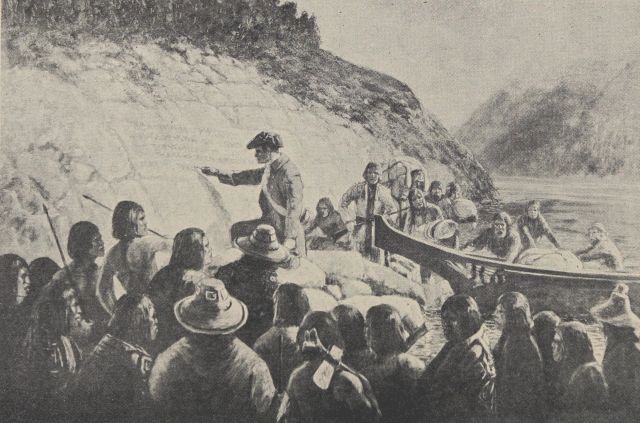
From the painting by John Innes
ALEXANDER MACKENZIE RECORDS HIS GREAT ACHIEVEMENT
“I set my name, writ large, upon a rock
in characters of bright vermilion:
‘Alexander Mackenzie from Canada by land’.”
We went back up the river, Tesse Tatouche.
The Indian tribe to which our guide belongedThe guide
takes fright
and runs
away
took fright at our return and all had fled;
and then, he too, infected by their flight
departing followed them into the woods
and thus it seemed was gone beyond recall.
My people, they completely lost their nerve.
They thought the tribes would surely ambush us
and we would all be massacred; and soMackenzie’s
men wish
to return
they wanted forthwith to turn back again.
Our canoe was quite unfit for any use
so that we had to build a new one.
The men talked sulkily behind my back
which I pretended not to know about.
Then finally I let them understand
that I was cognizant of all their thoughts;
but I would have them frankly speak their mindsbut he lets
them know
he is
determined
to proceed
and open up their plans. Yet as for me,
my course was set and my decision fixed
that I would journey onward to the sea.
But still the work progressed with the canoe
and soon it lay complete beneath our hands
and then to my great joy the guide came back.
He said that now his folk were friendly to us
and he was willing still to lead our way.
Next day we buried some of our provisions,
pemmican, rice and other food supplies;They cache
provisions
and lay up
the canoe,
then set out
afoot for the
Western Sea
and our canoe we set up on a staging
covering it safe from damage by the sun.
Then off we set upon our woeful walk
of nigh three hundred miles to the sea
each man bearing his pack
near a hundred pounds on his back.
This was the Fourth of July
in “Seventeen-ninety three”
and ere but fifteen days had passed
though marching on short rations
suffering much from cold,
meeting with the various tribes
who gave us help or hindrance,
according to their several dispositions,
we had traversed to the ocean.
The Indians on the coast were far from friendly
we dared not linger long among them.
So on the twenty-second of the month
we turned our faces eastward towards home
hoping to reach the Fort ere winter closed.
Before we went, for a memorial,
I set my name, writ large, upon a rock
in characters of bright vermilion:
“Alexander Mackenzie from Canada by land”
and gave the date as well for all to see.
Alexander Mackenzie was the first white man to cross the continent north of Mexico. He was a native of Stornoway and came out from Scotland to Canada while a young man and went into the fur trade. When only twenty-four years old, he was sent to take charge of the district of Athabasca for the North West Fur Company to relieve Peter Pond, one of the partners. Here from Fort Chipewyan he explored the river now bearing his name which flows out of the Slave Lake and followed it about two thousand miles to its mouth in the Arctic Ocean. He travelled in a birch bark canoe with five men to man it. He was disappointed that it did not bring him out to the Pacific as he had hoped. That was in 1789 and it was in 1793, four years later, that he made his celebrated successful attempt to reach the Western Sea which is the subject of “Mackenzie from Canada by Land.”
He was a man of fine physique and indomitable will and was possessed of high intelligence which qualities made possible his great accomplishments. He went back to England in 1801 and published an account of his Voyage. Here he was knighted for his distinguished achievements. He returned to Canada and attained to high influence in the activities of the North West Fur Company. He also entered politics but did not find it much to his taste. In 1808, he went home to the land of his birth and purchased an estate where he lived until his death in 1820.
I penetrate to tracts unknown,
following the course of great rivers
and the shores of large lakes,
finding the passes through the mountains.
With sextant and compass I labour,
making maps for others to follow
that the world’s waste spaces
may become populous and fruitful
David
Thompson
joins the
Hudson’s Bay
CompanyConsider David Thompson now,
bred in Westminster, England,
of humble stock taught in the Grey Coat School
a charity foundation, and from there
apprenticed to the Hudson’s Bay,
a seven years’ term, and sent to Canada.
Behold this tender lad of just fifteen
arriving at Fort Churchill and from thence
sent with two Indians to York Factory,
a walk of just a hundred and fifty miles
in that bleak, desert region of the North
and there he stayed a year.He goes west
to the
Saskatchewan
Then next we find him away out west
trading along the far Saskatchewan.
Then fraternizing for the Company’s weal
among the Blackfeet and the Piegans,
he spent a winter in an old chief’s lodge,
near where the town of Calgary now stands,
and learned a great deal of the Indian ways
and how to win their favour and their trust.
and starts
his great
work of
exploration
and surveyHe then took up the task that was to be
the life work he would follow
for the next nigh on to thirty years,
to explore and to survey this virgin tract
its rivers, lakes and mountains and its plains
in which he travelled fifty thousand miles
with compass and with sextant making maps
and opened it to settlement and trade:
his was a realm of wide expanse and wonder,
the Kootenay Country and the Pend d’Orielles——
where live the Indians of the Pendant Ears——
and the Columbia River’s mighty basin,
that mystic, fabled River of the West.
From the headwaters down its winding flood,
he was the first to follow. Ardent soul,
this David Thompson, great geographer;
of finer fibre than the common clay,
wise with the natives, winsome in his ways,
courageous, strong, and like the Christ in heart.
The ways of destiny are strange indeedDavid
Thompson
recalls how
opportunity
came to him
as one looks back on life, past human probing.
We struggle on for years toward our end
and meet with naught but hindrance and frustration
until at last like pieces in a puzzle,
events arrange themselves in favouring form
the road is opened up which we may pass
towards the dear aim of our hearts’ desiring.
’T was so with me in “eighteen-six” and “seven,”
when I was sent to Rocky Mountain House
with full instructions thence to cross the mountains
and push the North West Company’s trade beyond.
It was a time of progress and achievement.
A friend of mine soon followed to the Coast
the river Fraser which now bears his name——
that was up Northward, ’way there in the South.
Lewis and Clark had crossed from the Missouri
and paddled down the Snake to the Columbia,
by which they traversed right out to the ocean.
But in between there lay a mighty empire
which was my oyster and I opened it.
Our way was by the North Saskatchewan——
Lewis had had a brush with Blackfeet braves
and all the tribes were on the trail for war
and this had drawn the Piegans to the South
and left the passes open through the mountains.
I took my wife and children and MacDonald
and with some half-breeds made the great adventure.
Then when at last, after great pains and struggle,and he sees
water that
flows
westward
we reached a rivulet flowing to the west,
reverend I prayed “May God in His great goodness,
give me to witness where these waters join
with the great sea and come safe home again.”
From thence we travelled on by toilsome ways
to the headwaters of that tortuous river,He describes
the building
of old
Kootenay
House
the great Columbia and we built a fort
on its precipitous bank above the water
stockaded on its landward sides with fir,
that was Old Kootenay House of dear repute,
the first fur-trading post on that famed stream,
a place where I spent many anxious days.
For ’t was not long that we were left in peace.and how the
Piegans
encamped at
his gates,
but depart
after a time
Twelve Piegan Indians camped before the gates,
ere yet the fort was finished; one month more
saw twice as many others pitch their tepees
beside them; and we lived in constant fear
they would attack and kill us one and all.
Though food was scarce I dare not let my men
go forth for hunting so we went on rations
and for our water nightly when ’t was dark
two kettles to the river we let down.
Then suddenly one day our foes had gone
and yet we dare not count the peril pastThen Piegan
spies come
to visit
for shortly after, two more Piegans came,
stalking in stolid fashion to the gate.
At once I took them in, showed them around
and pointed out the strength of our defense,
the stockades and the bastions with the loopholes
pierced in the walls through which to fire our muskets
“We know,” I said, “that you have come as spies.He sends back
with them a
warning as
well as gifts
Your tribe intends to put us all to death
but many of you first shall fare afar
to the great hunting grounds for which you yearn,
your passage sped by bullets from our guns
and those of our good friends and allies.”
Then here I pointed where two Kootenay braves
who, also come to visit us that day,
stood glaring fiercely at their Piegan foes.
“We shall not die alone you may be sure.
This you can tell the chiefs who sent you here.
But still to show my goodwill I shall send,
rich gifts for all of them which you shall take.
For Kootenae Appee, who was once my friend,
a pipe of porphyry red and richly carved
and six feet choice tobacco and for each
of those the lesser chiefs, a fourth as much
that all may smoke in kindly love and peace.”and his
enemies
depart
I then dismissed them with an anxious heart
and forthwith all that host, three hundred braves
who had assembled twenty miles away
with purpose firm to fall upon our fort,
they vanished as by magic on the morrow.
Let Kootenae relate how it befell.
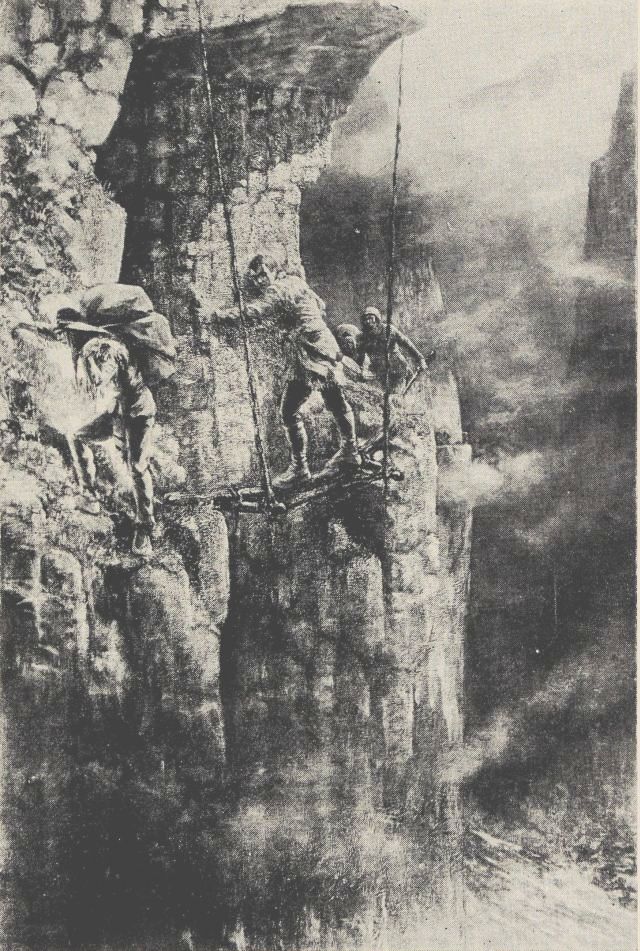
From the painting by John Innes
SIMON FRASER FOLLOWING THE GREAT RIVER TO THE SEA.
“A friend of mine soon followed to the Coast
the river Fraser which now bears his name . . .”
I, Kootenae Appee of the Piegans, chief,
had never wished for war with Koo-koo-sint[4].
He was my friend these many summers goneKootenae
Appee tells
how the tribes
assembled
near Kootenae
House
bent on its
destruction
when we were camped by the Saskatchewan,
(he spent a winter with us in the tent
of old Saukamappee,) a white man true,
who always kept his word and could be trusted
and he would hearken well to all my tales
and loved to hear me talk. Why should I now
go out with other chiefs and seek to kill him?
And this I asked of Big Nose and Tall Feathers,He himself
pleads for
peace
who thirsted for the blood of Koo-koo-sint
and all those who were with him at his fort.
I said to these two chiefs and to their braves:
“How can we smoke to the Great Manitou
and put up prayers that he will prosper us
if, without warning, we swoop down to kill
these friendly folk with whom we are at peace
now ten long summers?” But my words were vain,
the chiefs and all their braves cried out for war
their chatter, first like pebbles in a pan,
became a deafening clamour without sense
like sound of many waters in my ears
till I was forced to yield unto the fools.but is
overruled
So here we were encamped three hundred strong
and we had sent two spies to Koo-koo-sint
to see how best to take him by surprise
and learn the strength or weakness of the post.
Now these had safe returned and we were met,
all the war chiefs in council to confer;
and as the envoys, standing in our midst,
gave their report we lent attentive ear.
The envoys
present their
report to the
War CouncilBut when they told how they had been received,
how Koo-koo-sint had shown them o’er the fort,
his high stockades and bastions and his guns,
and promised that if we should take their lives
full many of us first must needs be slain,
the faces around me fell; frowns of dismayand the
Chiefs are
filled with
dismay
distorted features that before were calm;
and when the spies told how our ancient foes,
the Kootenay Indians would defend the fort
and help the white men and they showed the gifts
of choice tobacco Koo-koo-sint had sent,
a clamour rose, “What can we do” some cried
“with such a man as this? why these our women
cannot e’en mend their shoes but he will see,
this white man who wins wisdom from the stars!”
Big NoseThere was a sudden pause ere Big Nose spoke:
“With my sharp knife,” he said, “I well can cut
through tents to stab and kill my enemies
and so I have done and I still would do;
but these strong walls of wood no ball will pierce
with men behind them, who have been my friends
and whom I cannot see, I do not like them!declares
against war
I go no further!” and he took the pipe,
that wondrous pipe that Koo-koo-sint had sent,
all colours like the rainbow in the sky,
and filled its bowl full with the fragrant weedand the
Pipe of Peace
is passed
around
and handed it to me and I did smoke
and all the others, one by one, they followed
from hand to hand this pipe of peace went round.
Then by the break of day we folded tents
and tribe by tribe, each slipped off silently;
and I rejoiced that Koo-koo-sint sat safe.
He was my friend and liked to hear me talk,
there away North by the Saskatchewan,
and he would hearken well to all my tales,
which, ’tis well known, is love’s true testament.
[4] The Man Who Looks at the Stars, the name the Indians gave to Thompson.
Ho! a great man that David Thompson!One of
Thompson’s
men describes
how the
Great Divide
was crossed
by way of the
Athabasca
Trail
I took the trail with him on that wild trip;
the Piegan Indians they were after us
and we were forced to find a different route
out of the mountains to transport our furs
to save them and our own dear skins as well ——
I’ll take my oath it was no picnic party.
One long detour of nigh four hundred miles
through such a country as you never saw
of mountains, streams and miry muskeg swamp
and fire-swept lands criss-crossed with fallen trees
almost impassable for laden beasts,
we made the Athabasca in a month
of constant struggle. And our food was short
for game was scarce. Not far from Brulé Lake
the guide advised us that it was too late
to take our horses through the mountain trails.
We sent them back to Rocky Mountain House,
all but just four we kept to help the dogs
and make their burdens lighter. Now the cold
was biting keen at “thirty-two below”
with sometimes wind as well to make it worse
and we made shift to build a shelter rude
of logs inside of which we set to work
contriving sleds and snowshoes for the trail.
That took us near a month and then again
we set off bravely up the river’s bed,
urging the dogs along its icy face
with whip and voice for their encouragement.
Five days and we had reached the meadowed pools
where the great Athabasca has its source,
and beyond which there is no pasturage.
Here we were forced to turn the horses loose
to find their sustenance as best they might
and climb the mountains with the dogs alone.They
arrived at
the summit
It took us four days more to reach the summit
and what a desolate, awesome sight we saw.
Ranging all ’round about us lofty peaks
snow-clad and roseate ’neath the Westering sun
shimmered in shining splendour; on our right
a mighty glacier lay whose eastern face
showed a sheer drop of full two thousand feet.
Nearby below upon the mountain side
we could descry where some great avalanche
had shorn the tree trunks with its mighty stroke
to leave a piteous travesty of stumps,
all equal length like bristles in a brush,
where once a forest flourished. ’Twas a scenethe men are
appalled by
the solitude
to chill the heart with loneliness and dread;
and as we gazed around upon this sea
of mighty mountains rising wave on wave
far in the distance and then turned our eyes
on one another, such a forlorn band
of pusillanimous pigmies, then our hearts
seemed turned to water, all our courage dead.
The air was still but should a wind arise,
the snow that clothed the slippery slopes above
might thunder down in fearful avalanche
and bury our whole band in one grim grave.With a long
pole they
pierce down
through the
snow, but to
their great
alarm they
cannot find
any bottom
Three of our lads had trimmed a slender pole
with which they pierced down through the yielding snow
full twenty feet or more yet found no bottom,
then pulled it up again. We looked with awe
into that hole, our faces tense and strained,
aghast and staggered by the stunning thought
of all that depth between us and the ground
and still no contact with it. Words of dread
we spoke of it in accents of dismay
with mien of deep dejection and despair.
A sturdy, stocky figure joined our group,
our leader, David Thompson. He had watched
our operations and had overheard
our colloquy of fearfulness and awe.
Here I should say in justice to us men
that of our courage we had given our proofs
in days gone by. If now we lost our nerve
we were not normally a coward crew
and I were blithe to fight the man who said so.Thompson
gently
reproves their
fear and his
own serenity
restores their
courage
But he, our leader, had a kindly way——
he never spoke with harshness or reproach
and all of us would follow him through fire.
Now he spoke softly glancing round the ring:
“What matters it, Jules Tremblay, that you find
no bottom to the snow beneath our feet,
since we have snowshoes and can stick on top
with greatest ease and walk about on it?
Just look you here in this deep hole you’ve made,
what a remarkable phenomenon
I’ve never found before! See, by degrees
how this same snow that ’frights you changes hue,
grading from darkest blue below to green
of purest emerald here at the top.
My lad, this earth is full of wondrous things
to charm our fancy and to lift our thoughts
to the Creator, who designed it all;
and since we know that we are in His hands
we should not ever show ourselves afraid.”
Serene and calm his mien, assured his voice,
it was the scientist spoke, the man of God,
with the trained mind and understanding heart,
who with his vision clear and quiet faith
was kept immune to sublunary fears.
We looked and listened; and somehow the scene,
before so lone and desolate and drear
all in a moment lost its sinister air,
the mountains seemed more friendly, less forlorn
and we could face the future and fare on
with quiet assurance to our journey’s end.
That night so brightly shone the stars above,
it seemed I might have touched them with my hand;In the
morning they
resume their
journey with
hope renewed
Then in the morning we were up betimes,
and with new hope and courage in our hearts,
harnessed the dogs and started down the slopes
that led to the Columbia’s mighty bed.
David Thompson was born in Westminster, England, in 1771 and was educated at the Grey Coat School. He was apprenticed to the Hudson’s Bay Company in 1784 but changed over to the North West Fur Company in 1797 as the former Company did not look with favour on his exploratory work and wanted him to give that up and devote his energies to trading alone. He worked with extraordinary thoroughness and has been spoken of as “America’s greatest geographer.” Besides his great work in surveying the North West he was occupied for ten years from 1817 to 1826 in the survey of the international boundary line from St. Regis, Quebec to the north-west angle of the Lake of the Woods. He died at Longueuil near Montreal in 1857 at the age of eighty-six, and, notwithstanding the great services he had rendered, his last years were lived in poverty.
It is interesting to note in connection with the discovery of the Kootenay country (to use the present spelling) and the building of Old Kootenay House, that on 30th August, 1922 the old trading post was reproduced by the erection of a David Thompson Memorial Fort at Lake Windermere, B.C. In connection with this, an appreciation of the explorer as Canada’s Greatest Geographer by his biographer, Mr. J. B. Tyrrell, F.R.S.C., was written and printed for the occasion.
In this Appreciation he makes the following striking reference to the crossing of the mountains by the Athabasca route:
“Frequently the Thompson parties were in danger from hostile Indians. Indeed, to get his furs out of the mountains after he and his people were threatened with extermination, he was compelled to use an undesirable route. In 1807 he came in to the Kootenay country, Idaho and Washington by way of the Saskatchewan and Howse Pass. In 1811 he had to abandon the Saskatchewan route and get out by way of the Athabasca, at the cost of a journey which, for perils and escapes, surpasses anything invented by the most romantic writers. The detour was about 400 miles. Roughly, it meant going by the Grand Trunk Pacific instead of by C.P.R., with the difference that the furs had to be taken four hundred miles down the Athabasca up to Lake la Biche, one hundred miles north of Edmonton, and thence down the Churchill River to Cumberland House.”
I am Heeokstekin[5] of the Nesperees[6] tribe
and when I was a boy I can rememberHeeokstekin
tells about
a visitor
a Flathead visitor to my father’s lodge
telling a wondrous tale.
There to his village recently had come
a band of roving Iroquois
far travelled o’er the mountains and the plains
from Coughnawaga Mission near Montreal.
Their leader, “Old Ignace,” a noble chief
honoured the white man’s God,who has
a strange
tale to relate
whom he declared had died to save us all
and now He reigned on high in power and might;
and He was greater far than all our gods.
Yet He was pitiful and tender,
more prone to pardon than to punish,about
the white
man’s God
loving the white man and the red man too,
and caring naught for the colour of the skin
so long as the heart was clean.
As I lay listening upon the ground
before the fire, I saw this Flathead’s eyes,
there as he talked, glow with a kindling flame
of fervour e’en my boyish wits could senseHeeokstekin’s
father
returns with
the visitor to
the village of
the Flatheads
that showed he too now loved the white man’s God
and was His loyal follower. He talked,
my father listening eager to such end
that on the morrow ere the sun was high
they left together for the Flathead’s village.
[5] Means “the rabbit-skin-leggings.”
[6] Contraction for Nez Percés.
That was now twenty years agoHeeokstekin
and his people
learn more
about the
“black robes”
my father learned to love the white man’s God
and so did I and others of our tribe
and many of the Flatheads too.
These Iroquois had wondrous tales to tell
which from the “black robes” they themselves had heard——
white men who served this Saviour whom they worshipped,
whose hearts were loving and whose deeds were kind,
who set no store by furs and sold no guns
but gave and wanted nothing in return
even as they said their Master taught them.The people
long to know
more and are
told that the
“black robes”
if they knew
would come
to teach them
And as the years went by our love grew strong
and we would fain learn from the “black robes” too
all that they had to tell; and old Ignace
said if they knew we wished it they would come
and dwell among us; nor would distance daunt them
nor danger by the way of savage tribes
nor raging torrents, nor of desert suns,
arrow by night or noisome pestilence——
all these they held as naught when call of duty
bade them go forth bearing His joyful tale.
So we set off, a group of us——
mounted on our fleetest poniesA group made
up from the
two tribes
go off
to tell the
“black robes”
their need
in the spring when the sap was flowing——
Flatheads and Nesperees,
on the long, long traverse,
to St. Louis, that great city,
where we might find the “black robes,”
those servants of the Great Spirit,
who would come to teach our people
and tell them about their Lord.
And O the lakes and rivers,Heeokstekin
describes the
difficulty and
dangers of
the journey
and O the weary mountains,
the hunger and the thirst
and the fear of the fierce foes
who ambushed us by night
and dogged us in the daytime,
the heartaches for home,
the longing for our own folk,
that made our spirits heavy
as we journeyed without flagging
to St. Louis, that great city
and we reached it at last——
but not all who set out——
alas not all who set out!and tells of
those who
died en route
For three died by the tomahawk,
two were drowned in a rapid,
a she-bear killed another
whose cubs he had frightened,
and but four of us arrived
at St. Louis that great city
to search out the “black robes”
and make known of our quest to them
and the hope that we cherished.
We never knew there wereHeeokstekin
describes
their feelings
of wonder
and loneliness
in the
great city
so many people in the world;
and all the wonders that we saw
I have not words to tell of them.
Our hearts that ever had been brave
now turned to water at such sights
as we beheld them; and our feet
used to the soft ways of the wild
were weary on their streets of stone,
those endless streets that stretched so far——
our ponies we had long since lost——and their
satisfaction
at reaching
their
journey’s end
We walked as strangers; as we passed
the people turned their heads to stare.
O we were lonely, we were sad
but we were hopeful too and glad
that our long journey now was done
and we might find these “holy men”
and learn more of our Saviour Lord.
Did we find the “black robes?”They find the
“black robes”
and are
hospitably
received
Yea and they took us in,
warmed us and fed us
and washed our torn feet.
They bound up our bruises
with sweet smelling ointment
and couched us in fine linen.but two die
from the
privations of
the journey
But two of our number
died of their hardships——
too late came their kindness,
too late, alas, to save them——
O sad were our hearts!
O solemn the funeral
in the great mighty temple
with its high lofty arches
like the trees of the forest
where their tops come together.and are
buried by the
monks with
pomp and
ceremony
O solemn the service
which the “black robes” provided
to do them great honour;
the singing and chanting,
the burning of candles
and the smoking of incense.
O sad were our hearts
but the “black robes” assured us
that the friends who had left us
the Saviour would take them
to feast at his banquet
and dwell in His lodges
for ever and ever
and so we were cheered
we two, the poor remnant
of those who had braved
this perilous pilgrimage.The monks
promise to
send
missionaries
and
Heeokstekin
and the other
survivor
depart for
home
jubilant
And then when we parted,
took farewell of the Fathers
they promised to follow,
to send from their number,
some who would teach us
to worship the Saviour
with words that were fitting
and songs that were holy.
And so we departed
in joy at their promise,
our hearts overflowing
with praise and thanksgiving.
And now the long, long journey home is doneHeeokstekin
returns alone
and the
people of the
tribe mourn
for the rest
of his party
and I am back again among my own,
a thousand weary leagues or more; but none
of all who left with me returned. Alone
at nightfall to my father’s lodge I crept
and entering silently, I told the tale
of all our wanderings while the listeners wept,
shrilly there rose on high the women’s wail.
“Weep not for them,” I said, “my comrades true,
for they have passed to hunting grounds of bliss
where summer ever stays nor will they rueHe seeks
to comfort
them
the life that they have lost, they will not miss
the joys of earth, the loved ones left behind
when in the richness of their faith’s reward
they taste its bounties with untroubled mind
in the great feasting lodge of Christ, their Lord.”
Now many moons have sped, they have not comeHeeokstekin
looks in vain
for the
promised
coming of
the monks
these holy men of God, these “black robe” visitants
to teach us more of Him whom we would serve
and we have looked in vain, they have not come,
scanning the river’s reaches eagerly
hoping for sight of them in their canoe,
hoping, yet fearing lest they may not come.
The summer waneth and our hearts are sad,
scanning the river’s reaches prayerfully,
wistfully wondering “Will they never come?”
The story told by Catlin, the ethnologist, about the stupendous journey which the Indians made to St. Louis to ask that monks might be sent to them to teach them about Jesus Christ, is a moving and a pathetic one.
The “black robes” did come but not then or as a direct result of Heeokstekin’s pilgrimage. Jason Lee came, however, in response to the appeal, from the Methodist denomination with a considerable party and he founded a colony in the Williamette Valley. On the advice of Dr. McLoughlin of the Hudson’s Bay Company he decided to stay west of the Cascades. He confined his ministrations principally to the white settlers.
When Heeokstekin and his comrades went to St. Louis, the Roman Catholic Church there was unable at the time to spare the missionaries that they asked might be sent. However, in the summer of 1835, Old Ignace, the Iroquois Chief who with his companions had first brought the gospel of Christ to the Flatheads, now with his two sons travelled to St. Louis to ask again that the prayer might be granted. They returned in the following year. In 1837 the old man with three Flatheads and one Nez Percé started off again for the southern city but the expedition turned out disastrously as the party they travelled with was attacked by the Sioux and all the Indians were put to death. Undeterred by the tragic fate of this pilgrimage, in 1839 the tribes sent Young Ignace and another Indian who travelled down the Yellowstone and the Missouri by canoe with a party of trappers. At Council Bluffs they met a Jesuit missionary, Father De Smet, and from thence went to St. Louis with letters from him to the Superior of that Order. They were promised that a priest would be sent in the Spring, and one of them went home to announce the glad tidings while the other stayed in St. Louis to act as guide to the missionary when he should come. The story of the career of Father De Smet and his ministry to the Indian Tribes of the Northwest is a thrilling one. It is pleasant to record that the persistent appeals of the Flatheads and Nez Percés were at length answered by the coming of such a great teacher.
Now has my span filled out a hundred years.
I, Sacajawea, of the Shoshone tribe,
a princess of the Royal blood,Sacajawea
looks back
on the days
of her youth
here in my teepee on our reservation,
calm and serene I sit awaiting death.
My sons, Baptiste and Bazil, still do me honour
and I have naught to crave for, naught to covet.
For I have known rich mercies in my time,
have seen high deeds and mingled with great men
and merited their thanks for help I rendered
and played my little part with credit. Aye!
strangely enough the mirror of my mind,
memory brings back my early years the clearest
when I was young and lithe and light of foot;
and with the brightness of the noonday sun
their happenings flash upon my inner vision.
Only these later days of failing vigour,
of dimming eye and toothless gums
and slower step and grosser body
have suffered the twilight haze
men call forgetfulness.
I can recall as though ’t were yesterday
how happy was my childhood and how free,
the sunny days of merry play and laughter.
I had two maiden friends of my own age——
but fifteen summers had gone o’er our heads——
and of each other we were passing fond.
There were my parents too and elder sister——
my brother Cameah-wait five years my senior——
to cherish me and all were kind and dear.
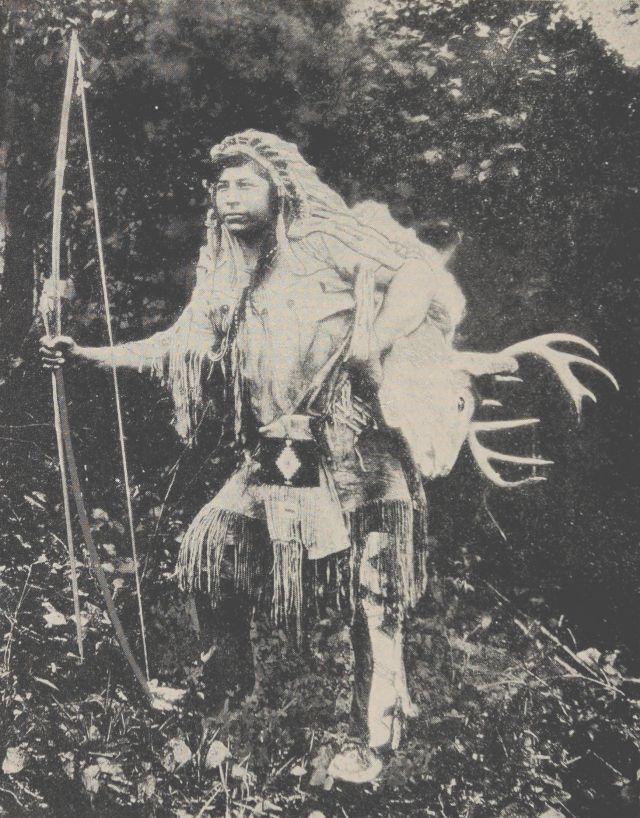
By courtesy of the Canadian Pacific Railway Company
“Hunting was good and we were happy.
The young braves proud to show their prowess,
yet sought to hide it ’neath a show of calm;”
Those days were not to last.
That summer we went hunting far from homeShe tells of a
hunting trip
near the Great Falls of the Missouri river ——
the men allowed us maids to go along
for we could help them with the game they killed.
We were right keen to join the party.
At first, all things went well.
Hunting was good and we were happy.
The young braves proud to show their prowess,
yet sought to hide it ’neath a show of calm;
but we knew how they felt. We knew their eyes
were not unmindful of our presence;
and when the chase was o’er and we returned
there might be hunting of another sort
for these young warriors so strong and brave;
and we would be the not unwilling quarry
for we were nubile now.
Then when alone we maids were wont to chatter
and twit each other with a playful banter
and single out whose eyes had looked at whom;
but there was naught of spite in these our jests
nor jealousies to mar our happy friendship
and all the future seemed so bright with promise;
and then the Minnetares set upon us!
Ah that was long ago,
but still the horror of that hour,
the terror of that night
remain as if ’twere yesterday!
the war whoops of our foes,
the death cries of the slain,
defeat and utter rout
and these young braves, my friends
cut down before my eyes!
myself and my two matesin which she
and her
friends were
taken
prisoner
by the
Minnetares
each seized in the fierce grip
of a Minnetare; thrown across his horse
and carried helpless through the night
knowing a bitterness far worse than death.
Then in the morning with the dawn’s chill light
we were delivered at the old Chief’s lodge,
each tossed like bale of blankets to his womenand carried
to the lodge
of their Chief
to be his slaves and do their bidding,
suffering blows and beatings at their will.
Oh these dread days of horror and suspense!
the numbing fear of what might be our fate,
the furtive, sly regard of the young men,
the uncertainty, the hopelessness!
Only we were together, we three maids
and that was cause for thankfulness indeed.
Then one dark night there came the chance to flee.
One of us was too fast asleep to seize it——
the other made clear away but I——I would not,
I could not leave my comrade to her fate,
and, so I let it pass and stayed behind,
my mind o’erwhelmed with misery and despair.
The Great Spirit willed it otherwise.
Sacajawea
tells how
Charbonneau
comes to the
villageIn the midst of these my woes
a paleface came one day
to visit in the lodges of my foes
and he set up his tent to stay
among us. Charbonneau, his name
and from a bleak land, icy and cold,
French Canada away in the North he came.
As a child I had often been told
of a race in the world such as he.
True his face was as brown as the brackens in spring
but his body where covered was white as could be
’neath his raiment. With joy he would laugh and would sing
not a bit like us Indians——not stolid and stiff.and
frequently
visits the
Chief to
gamble
with him
Quite often he came to the lodge for a while
to gamble and smoke; and to us just as if
we were friends there was always a nod and a smile
even though we were slaves, not the looks harsh and hateful
that we had from our captors as though we were curs
to be kicked. Do you wonder that we should be grateful
for these crumbs of kindness? We learned it was furs
that the white man was seeking. T’was trinkets and knives
that he staked with the Chief. One night as they played,
Charbonneau always winning, the Chief with his wives
all around him, was sulky, while I and the maid,
my mate in mishap, lay there brooding alone,
the stranger cried loudly, “My winnings I’ll stake
against your two slaves of the tribe of Shoshone.”
The Chief quick assented the wager to make.
Our suspense was not long.
The pale face laughed loud,He wins
Sacajawea
and her mate
in a wager
trilled the snatch of a song——
the Chief’s brow was a-cloud——
and each rose in his place,
the guest grasping his furs
in a greedy embrace,
heeding naught the demurs
of the squaws gathered round
and he strode to where we lay,
threw them down upon the ground.
“There,” he cried, “we must away.”
“You are mine now, pack your load.
Henceforth you shall my burdens carry.
Follow me,” and off he strode;
and we did not dare to tarry
for the old Chief waved assent,
looking crestfallen and sad;
fierce his squaws, as thus we went
muttered and fumed; and we were glad,
when we’d passed the portals through,
Charbonneau should hasten faster
from the scene; and happy too
that we had another master.
Ere the dawn began to break
we were paddling down the river.
Half asleep and half awake,
I felt the ripples throbbing quiver.
Soft their voices seemed to speak
bidding me to banish sorrow
while whispering night winds fanned my cheek
and counseled courage for the morrow.
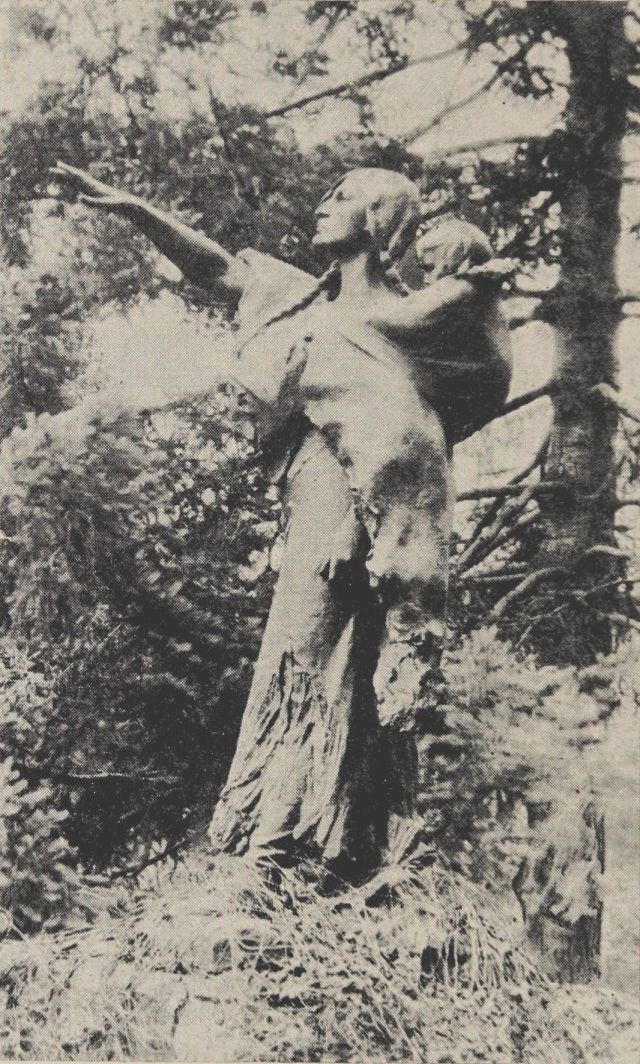
From the statue of Sacajawea by Alice Cooper in the City Park,
Portland, Oregon
“How joyful
to think once more that I might see my loved ones!
might view again the dear scenes of my childhood
bearing the little Ba’tiste on my shoulders.”
We settled in a village of the MandansSacajawea
tells how
they settle in
a village of
the Mandans
and she bears
a son to
Charbonneau
and there I bore a son to Charbonneau;
and I was one of his three wives,
my mate another and we lived in peace;
for he was kind to me after his fashion
and struck me only rarely and without malice.
Soon, following the time my boy was born,
there came to spend the winter near our village
a band of white men and they built a fort,
thirty or more of them but one was black——
never had such a sight been seen before.
His skin was like the raven’s wing in hue,
his hair so thick and curly and our people
came from all parts to look at him.
The leaders of the band were Captain Lewis
and Captain Clark and it was by command
of one, a Great White Chief called Jefferson
that they had set out on a long, long traverse
to cross the chain of mountains to the westward
and then to follow down that mighty river
that wise men tell us joins the great, blue water
far, far away. Soon when the sap was flowing
off they would go. They said they hoped my people
would give them guides to pass the Great Divide
and help them take their goods across the mountains——
for, as they knew, our tribe had wealth of horses.
So when these leaders learned I was a Shoshone——
my husband told them——and I knew the language
and also was acquainted with the countryShe and her
husband
join an
expedition as
interpreters
they straightway hired us both to travel with them
as their interpreters and guides. How joyful
to think once more that I might see my loved ones!
might view again the dear scenes of my childhood
bearing the little Ba’tiste on my shoulders.
The party
leave
by canoeWe left the Mandan villages in canoes
up the Missouri——past the Yellowstone.
Once the pirogue we sailed in was upset
a sudden squall o’ertook us and my man
who had the helm, by fear became confused,
“the world’s worst waterman” our leader called him,
and all the precious gear fell in the water;
but by good fortune I just fished it back
and Captain Clark was thankful for it seemed
without that gear our pains were all for naught
and all their journey would have been undone.Sacajawea
falls sick
Soon after I fell sick, knew weary days
of heaviness and pain nigh unto death.
I lay and languished, oft of wit bereft
thinking myself at home a child once more
carefree at play around my father’s lodge.She is tended
by Captain
Clark and
recovers
under his care
Then every day came Captain Clark to tend me
and I was conscious of his ministering hand
and sensed the gift of healing in its touch.
O he was kind and gentle and his care,
restored me to my wonted health again.
The
expedition
reaches the
Great Falls
and
encounters
storms of
rain and hailAnd when we reached the Great Falls of the river
we needs must make a mighty portage round them
and there was much delay. Then too the weather
was cold and wet and windy; there were hailstones
as big as eagles’ eggs that beat upon us
bruising the flesh and falling thick and heavy
so even strong men sometimes lost their footing
felled by their furious force. One day we went,Sacajawea
goes ahead
with a
small party
the black man and my husband and myself
with Captain Clark ahead of our main party ——
the Falls were only half a mile away——
when suddenly a storm came down upon us.
But ere it broke our leader made us hasteThey take
shelter from
a rainstorm
in a ravine
and are
nearly swept
away in a
sudden flood
to seek for shelter in a deep ravine
under a sloping shelf that served as roof
to shield us from the torrent of the rain
and here we stayed an hour or so and watched
in fearful fascination while it fell——
ourselves immune from danger as we thought.
But the waters above us had gathered
and in a great cataract swept
with scarce a moment of warning
down with devastating force
through the cleft where we waited
as though intent with devilish rage
to dash us to destruction.
And I with my baby as burden
must have been borne before itShe and her
child are
saved by
Captain Clark
had not Captain Clark come to my succour
and, bracing his body behind me,
pushed me up out of all danger,
safe from the swift, swirling waters,——
at the risk of his own life he did it——
and Sacajawea was grateful.
So from that time as we travelled
my gratitude grew to devotion
and I made it my loyal endeavour
to help with his plans for safe passage——
not alone by the help of my people——
but in all the long journey beyond them
down the River That Flows to the Westward.
They pass
into country
which
Sacajawea
recognizesMore than three moons had passed and then at last
I saw familiar hills upon the skyline
and recognized the country of my people
and three days after that we reached the place
where the great river that had been our course
forks in three parts. Here at this well-marked spotCaptain Lewis
with three
others goes
on ahead
one of the leaders, Lewis, went ahead
with three to bear him company, the rest
would follow slowly up. We learned in time
the stirring story of their great adventure.
How they had climbed across the Great Divide
finding the Lemhi Pass that let them throughand makes
contact
with the
Shoshones
and then they met a squaw of my own folk,
who, won by gifts and words of soft persuasion,
guided them to our camp. Here they were met
with smiling welcome from the brave young Chiefwho welcome
his party
warmly
and all his band, who lovingly embraced them
with warmth and fervour. So then Captain Lewis
requested aid from them in men and horses
to bring the others of his party through
up from the place where he had planned to meet them,
there at the two forks of the Beaverhead.The Chief
agrees to go
back with
Captain Lewis
and assist
the rest of
the party, but
becomes
suspicious
when they
are not at the
rendezvous
To this the Chief with eagerness agreed
and he and forty braves set out at once
and all went well; but at the rendezvous
we had not yet arrived. Then ugly gleams,
distrust and doubt becloud the warriors’ eyes.
They feared these white men had it in their minds
to lure them to an ambush by their foes,
the dreaded Minnetares; and accused them
their new-found friends, of this base treachery.
Thus for a space it seemed that all were lost,
the leader and his men might suffer death;
but not for long. Lewis with dauntless nerve
and wit resourceful, made a daring throw,
confiding in the good faith of his host,
handed his gun to him and straightway bade
his men do likewise so the Chief might see
there was no crooked purpose in their mind.
He then proposed that two men be sent on,
one of their own and one of his, as scouts
to meet our party. This was forthwith doneThe two
parties come
together
and so as we came up we met the two
and shortly afterwards with all the rest.
That was a happy moment then for me
when the two bands were joined in one at last;
and I was blithe to recognize my peopleand
Sacajawea
recognizes
the Chief
as her
brother
and in the Chief himself to find my brother,
my dear and loving brother Cameah-wait
and we embraced with joy and happy tears.
That was long years ago. I shall not tell
the many happenings of our later progress,
how the supplies were carried with much care
across the Great Divide upon our horses
and also the bowed shoulders of our women;
and how through stress of strenuous toil and peril
our party travelled westward to the ocean——
“The Lake of Stinking Water” our folk name it,
through dangerous rapids, down the Great Broad River
and how I saw a whale, a wondrous monster,Sacajawea
recalls with
satisfaction
that she had
been able
to aid
Captains
Lewis and
Clark in their
enterprise
and all that followed, no I shall not tell it.
But it is sweet to think on now I’m old
how these heroic leaders, great men both,
kindly and brave and just, above reproach,
gave me their loyal friendship, how they told me,
but for my aid their enterprise had failed.
Here my teepee in our reservation
I view the past and think upon these things.
The Lewis and Clark Expedition was sent out by President Jefferson in 1803 with the object of getting American settlers into the Valley of the Columbia River so as to strengthen the claim of the United States to that territory by exploration. Captain Gray, an American, had been the first to discover the river from the sea. Their journey proved to be a splendid feat of courage and endurance and the rôle which Sacajawea played in it forms an interesting part of the story.
“The Great White Eagle,” the Indians called him
at Fort Vancouver where he held his sway,
for ere he reached his prime his locks were grey;
right kingly too he was in word and deed,
so both by outward port and inward meed,
they classed him with the King of Birds to pay
their highest tribute in the name. For they
found him their stay in every time of need;
but he was also firm though he was kind.
He kept his word with them for good or ill,
was prompt to punish if they gave him cause;
and often when they planned to break his laws,
some helpless settler folk to raid and kill,
counsel from him would bring a saner mind.
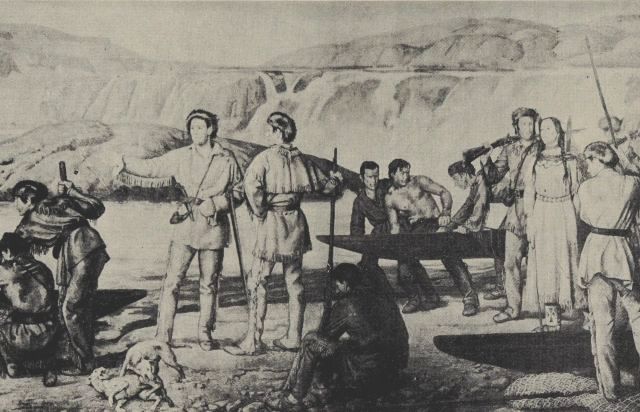
From the murals in the State Capitol, Salem, Oregon, painted by Barry Faulkner and F. H. Swartz.
By courtesy of the Secretary of State.
MERIWETHER LEWIS AND WILLIAM CLARK WITH PARTY
AT CELILO FALLS ON THEIR WAY TO THE PACIFIC, 1805.
“through stress of strenuous toil and peril
our party travelled westward to the ocean . . .”
I strolled on a bleak afternoon in winter nigh to sundownDoctor
McLoughlin
views with
sadness the
canoes of the
first settlers
on the river
in 1843
on the beach in front of the Fort and my heart was heavy and mournful.
I felt the old days so spacious of splendid isolation,
would soon be gone forever. The future seemed dark and forboding.
I loitered there on the beach and looked out over the river
to see with a sense of dismay, dotted here and there on its surface
from the far East arriving, the first canoes of the settlers,
the vanguard of “Forty-three” with a round eight hundred to follow.
Late, too late in the year they had come to this land of promise,
and dearly must pay for their folly, dearly in hunger and hardship.
Food must be found till the Spring to save them from death by starvation;
none but myself could supply it, none else could furnish them succour.
There were the Indians too——these were a perilous problem——
They looked askance at those strangers, doubted their friendly feelings,
feared they would take their land and drive off the game from the forests——
of late I had noticed an air of wildness and strain in their bearing!
He sees a
group of
Indians on
the river
bankNow as I paused in my stride I marked between me and the river,
ten or twelve in a group and they saw me coming towards them.
Indians they were whom I knew and I feared they were plotting some mischief;
one of them called to the others so loud he must know I would hear him.
He overhears
one cry out
that the
white men
should be
killed and
angrily
reproves him“It is good for us that we kill those ‘Bostons’[7] who come here to rob us.”
I knew that he said it to sound me. How would I look on such action?
So I rushed on him then in a rage with my cane uplifted and threatening;
“Who is this dog” I cried, “who would talk of killing the Bostons?”
“I did not mean any harm,” cried the fellow quailing before me,
“but that is what all the Indians up at the Dalles are saying.”
“Then the Dalles Indians are dogs to say such a thing,” I shouted
“and you are a dog yourself who would dare in my hearing repeat it!”
He tells the
means he took
to prevent
the Indians
from killing
the settlersForthwith I turned on my heel and I knew that the others had heard me.
Now they would feel that the settlers were under my Company’s aegis
and I surely would punish severely any who sought to kill them.
In the past I had given them proofs that my justice was prompt and potent.
Then I sent to the Dalles two boats well stored with provisions.
When the later settlers arrived my men would be there to meet them;
and to sell to those who could buy or to give to such as had nothing;
thus all the Indians would know the strangers had me for their ally.
This was the action I took and thus by such means was averted
a horrible Indian outbreak, and murder of many settlers,
and perchance our own death too, the destruction of Fort Vancouver,
and a war between us and the States——a terrible culmination.
and defends
his policy
towards themAnd what of the body I serve, the Honourable Hudson’s Bay Company?
Had I let the settlers be slain or perish of cold and hunger,
would that have made lustrous our name? or rather sunk us in sorrow,
everyone from the Governor down, ignominy and shame for our portion?
and also with
regard to the
missionariesAs for the men of God, the missionaries to the Indians,
who came to teach them the truth, the truth about God and salvation,
a task that by rights was our own which we had but poorly attempted,
could I do less for them than to give them the handclasp of welcome?
I dare not drive them away——I had neither the right nor the power——
only humanity’s law; that was the mandate I followed.
Courteous and kind to them all I rendered such aid as was urgent.
Did that injure my Company’s cause? nay, rather it made for its credit.
Starving, desperate men are a menace to any country.
Hunger will force them to steal! the law of the jungle they follow!
So if I saved them from that was it not to the Company’s profit?
Six thousand miles away, what can they know of my problems?
And of all those goods I have given the half may never be paid for,
this to my personal loss and not at the Company’s hazard.
Surely my conscience is clear. In their need I have clothed the naked,
I have furnished the hungry with food; ’tis the sole vindication I offer.
[7] The Indian name for Americans. The first American trading ships all hailed from Boston.
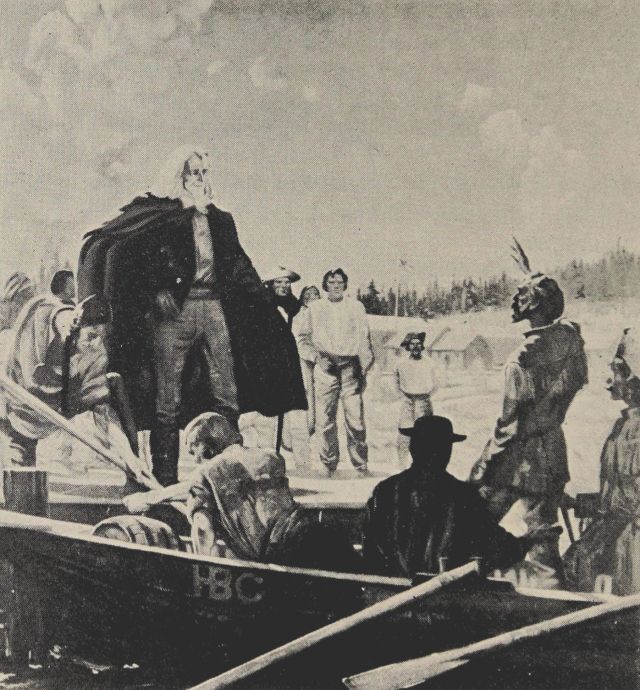
From the painting by Charles F. Comfort; By courtesy of the Hudson’s Bay Company.
DOCTOR McLOUGHLIN WELCOMING THE SETTLERS
“ ‘The Good Old Doctor,’ the settlers called him,
for none had ever asked his aid in vain.”
“The Good Old Doctor,” the settlers called him,
for none had ever asked his aid in vain.
To clothe the naked and to entertain
the stranger guest, this was his joy and pride;
and thus they sought the Fort from far and wide.
Such kindness made the Governors complain——
they did not want these settlers to remain
to till the land. So, often would they chide
but from this policy he would not bend.
He could not let his fellow creatures die,
there in the wilds where none could aid but him.
So when from London came the fiat grim,
‘no aid to settlers,’ curt was his reply,
‘this brings my service with you to an end.’
“Cheer up, my friends, in two hours we’ll be there
at Fort Vancouver; all your trials are pastJoseph Hess
speaks words
of cheer to a
group of
settlers on
their way to
Fort
Vancouver
in 1844
once you set foot within its strong stockade
and you may sleep secure full fed and warm
when the good Doctor takes you ’neath his wing.”
So spoke out Joseph Hess in jovial tones.
He for the Company was in command
of this our crowded craft which it had lent
to bring us from the Dalles to Fort Vancouver.
His cheery words at first brought no response
until that pessimist Pete Hunt replied,
Kentuckian he of pioneering stock,
a proper man for all his grumbling ways,
had shown himself most helpful on the trail;
“Aye, for the killing he’ll be fattening us;
belike we’ll never see the Spring again.but one of
them foresees
a sad fate
ahead of
them
He’ll fling us out ere long to freeze and starve
or fall beneath the Indians’ tomahawks;
and he’ll be joyful to be rid of us.
His Company does not want us settlers here
to till the land and drive away the game.
’Tis furs, not farms, it wants.” He rolled his quid
and spat across the gunwale in disgust.He is
reproved
by the wife
of the
narrator
“Fie, fie, for shame!” my missus took him up,
“have you no faith in God that you speak thus?
It’s true we have no food or money left;
our clothes are ragged and the cold is keen
but He will send us help to see us through
if we but trust in Him. Winter will pass
and we can start our farming in the Spring.”
Pete looked at her with pity in his gaze;
“More like we will be pushing up the grass——
there ain’t no daisies growin’ here I guess——
and these here kids o’ yours, they will be slaves
to them there redskins fetchin’ wood and water
an’ damned for this life and the next to come.
I wish that I at least had had the sense
to stay content at home in ‘ole Kaintuk’;
we never know our luck till it is gone.”
My missus’ cheery face grew grave. Its smile
died and her deep blue eyes were dark with pain.
I saw her arm close tight round little Jim,
who sat upon her knee, as if to shield
the youngster from such fate as Pete foretoldThe latter
describes the
feelings of
the party
and my own heart was weighted down with dread.
The others round about——their faces too
reflected each thoughts that were far from gay.
Empty our stomachs all and lack of food
had left us faint, our minds fit prey to fear
and for the time we were a craven crew,
a score of grownups, five of us were women
and there were children four. Mournful the scene.
The rain had fallen relentlessly all day.and the
desolateness
of the scene
Leaden in hue and sinister the sky,
grim and forbidding was the river’s face.
Forests of oak and pine trees lined its banks
on either side with sad monotony
depressing to our souls. The voyageurs
paddled with steady stroke and easy grace
urging the laden bateau down the stream,
now roused to roughness by the Western wind
that icily chill cut through our ill clad limbs
cramped with long sitting on these weary boards,
damp from the dismal, never-ceasing rain.
We were too sad and miserable to talk.
As for Joe Hess he merely shrugged and smiled
but I could hear him softly to himself:
“Oh well, poor devils, you will soon be there;
and you will see if what I say is true
when once you’re lodged beneath the Doctor’s roof
to taste his generous hospitality.”The settlers
land at Fort
Vancouver
(1844)
Joe Hess had promised true, within two hours
we landed at the Fort; darkness had fallen.
From the log cabins for the men that lined
the river banks there shined forth lightsome gleams
of cheerful habitation. Those we passed
with staggering steps, our limbs all stiff and numb,
through the big gate within the high stockade
its timbered ramparts looming tall and dark
against the sky, to the great lighted Hall.
It stood amid a group of lesser buildings,
grand and imposing to our weary eyes
subject so long to scenes of desolation.and are
graciously
received by
Doctor
McLoughlin
There on its threshold framed against the light
a massive figure stood to bid us welcome,
gracious and dignified with kindly greeting
and friendly grasp of hand to all of us
as one by one we passed into the room
glowing with warmth and friendliness within.
Deft hands removed our cloaks and boots; and all
the ravages of travel were repaired
by ministrant attendants; and the children
were straightway fed, undressed and put to bed.
Then loud and clear the big bell rang for dinner.The Narrator
describes
the scene
at dinner
To the great dining chamber we were led
where stood the Factor at the table’s end——
full twenty feet in length it was and broad ——
ringed round by gentlemen, a goodly group,
chief-traders, traders, clerks and various guests,
to each of whom he quickly gave direction
where he should sit and so to each of us
until the varied company was seated
and everyone according to his rank.
Then in sonorous tones a grace was asked
with reverent air in no perfunctory fashion
by the good Doctor. With his deep-set eyes
and striking features crowned with hoary locks,
and handsome dress he made a noble figure,
like some great lord of ancient feudal days
sitting among his liegemen. Now the viands
were quickly served, roast beef and suckling pig,
mutton and ham and salmon from the river
with various vegetables, wheaten bread
and drink to wash it down. The dinner set
of delicate queen’s ware and the glittering glass,
decanters filled with different coloured wines
and gleaming silver made the table rich
to satisfy the eye. The meal progressed,
course after course. The talk both grave and gay
was rich in story and well spiced with wit
and often merry laughter filled the room,
yet all was with decorum though the wine
was freely quaffed except the host himself
imbibed it scarce at all. His kindly eye
surveyed his guests and spoke the word required
to make the diffident stranger feel at ease.
Then when the meal was over he arose
and said to us: “You good folk from the East
kindly attend me to my office now
that we may take wise counsel for your case,
consider duly your precarious plight
and do our best to mend it.” So we passed
into an ante-chamber bare and strait,
his working quarters. Standing by his desk
he made us form a circle round the room
and then addressed us: “My good friends and neighbours
as you are soon to be, I bid you welcome,
although your coming gives me grave concern,
arriving as you do late in the year
with no provisions for your sustenance
and scant equipment to start operations
upon your farms when Spring comes round again.
Last year I suffered sore embarrassment
with full eight hundred of you on my hands
(this year you number half as many more)
and those I furnished all with food and clothing
and seed to sow their lands preventing famine
that must have followed such an immigration
as has poured in upon us like a flood.
I fear there will be serious suffering
ere I can bring you all down from the Dalles
and see you to your final destination;where he
enquires of
their needs
but I shall do my best. Tell me your names,
each one in turn that I may take them down?
how many in your family and your wants?
and I must needs supply them. These most pressing,and promises
to supply
them
here at the Fort we shall make shift to furnish.
I now conduct a store at Oregon City,
opened for use of settlers such as you,
and I shall see you get your outfit there.”
Then from our number several cried at once,
nigh moved to tears in accents of distress:
“Doctor, we have no money left at all!
How can we take your goods? We cannot pay
and know not how or when we e’er may do so!”
He only waved a deprecating hand:
“Tut, tut,” he said, “I cannot let you starve.
We are all brothers here under Christ’s care.
My friends and neighbours too now and as such
I durst not see you suffer.” One by one
we filed before him and he took it down,
our names and all our needs advising each
with loving interest patient and kind.
That night we slept secure beneath his roof
with hopes restored anew and minds at ease.
“The Father of Oregon,” posterity calls him
and brighter grows his memory year by year.
Succeeding generations will revere
this man who dared to rank his Company’s rule
second to that of Christ, became a fool
for his own interest. Favour nor fear
perforce could move him; and his loved career
of princely power rather than be the tool
of selfish aims, he laid it quietly down
facing with fortitude fortune’s decline;
saw friends grow cold; and felt the bitter sting
of base ingratitude. The Eagle’s wing
’tis true, was clipped; his spirit did not repine.
History accords him now a rich renown.
Old age is upon me,
aye and poverty with itDoctor
McLoughlin
considers his
ill case and
sees death
near (1857)
with death not far distant,
I shall sleep with my sires.
My traducers have triumphed.
They have stolen my land,
heaped my name with contumely——
some of those whom I succoured,
the settlers saved from starving.
Aye and others have charged me,
demagogues without conscience,
for their own paltry purpose
of contriving the massacre
of hundreds of their citizens
at the hands of the red men.He defends
his record
against
false
accusations
They have dared to indict me
for blocking the settlement
of this Territory of Oregon
when the facts find most clearly
that I laboured my utmost
to foster and promote it.
Had those first, early settlers
been my brothers and my sisters
I could not have done more
to aid and advise them.
And for this mine own people,
British subjects have branded me
a traitor to my country
for following Christ’s teaching
and saving those settlers,
all American citizens,
men, women and children
from the torment of famine
and the tomahawks of the Indians.
I was the first one
to take a claim in the country.
What return do I receive
from those whom I succoured?
Why the loss of my land!
for while all may get theirs,
mine alone was reserved.
By wrong representation
and unfair legislation
I am robbed of my rights!and finds
consolation
in his
memories of
the past
But my days have been full
so I should not repine
for not all have been false;
still my friends are not few
and I live o’er again
the brave days in the past
of my prosperous prime——
none can take those away!
Lying lips may malignand the
thought that
time will
vindicate
his honour
my fair fame for a space
and its lustre may tarnish;
but the judgment of time,
free from bias or passion,
will restore its old brightness,
its dear honour once wonted,
when this body is clay
and my soul gone to God.
There is good reason for the name of “The Father of Oregon” which has been applied to Dr. John McLoughlin. Had he adopted a different policy towards the early settlers in the country—the policy that would have suited the Company that employed him—its colonization might have been greatly delayed. Without his aid, many of these early comers would have had to leave. He not only furnished them with food and clothing and supplies but, at times, with seed and farming implements. In many cases he was never paid, but in others, the settlers, years after, honourably discharged what they owed. In the end he was unfairly deprived of his property in Oregon City under Section Eleven of the Oregon Donation Land Law and he died practically in poverty. Five years after his death, the State of Oregon reimbursed his heirs for what he lost in this way.
His presence was a striking one as he was powerful in build and six feet four inches tall. His hair, which he wore long, was almost white in the prime of his age.
He was firm and decisive in his dealings with his subordinates and his authority both with them and with the Indians was unquestioned. At the same time he was generous and humane and had a winning personality.
In religious outlook he was broadminded and showed the same helpful spirit toward Catholic and Protestant, toward Methodist, Presbyterian or Baptist, and all were welcome. He embraced the Catholic religion in 1842 and proved himself a faithful son of the Church. Shortly before his death, he received from the Pope the insignia of the Knights of St. Gregory.
After Dr. McLoughlin had passed away, there was found a document among his papers in which he presents a defense for some of his actions which had been criticized and notably those concerned with his treatment of the settlers. This statement, commonly known as the “McLoughlin Document,” is now in the possession of the Oregon Pioneer Association. The incident described in the text is taken from this document and was an actual happening.
The section of the poem dealing with the group of settlers being brought down the Columbia in the boat and their reception at the Fort by the Chief Factor is based directly on an account given by David Watt, a pioneer of 1844, who was instrumental in starting the first woolen mill in Oregon in 1857. It is found in his “Recollections of Dr. John McLoughlin,” which was published in the Transactions of the Oregon Pioneer Association of 1886. After describing the scene at the Fort where the Doctor writes out orders to the settlers for them to receive the supplies which they need, he says: “When we started to Oregon, we were all prejudiced against the Hudson’s Bay Company, and Dr. McLoughlin, being Chief Factor of the Company for Oregon, came in for a double share of that feeling. I think a great deal of this was caused by the reports of missionaries and adverse traders, imbuing us with a feeling that it was our mission to bring this country under the jurisdiction of the stars and stripes. But when we found him anxious to assist us, nervous at our situation in being so late, and doing so much without charge,——letting us have of his store, and waiting without interest, until we could make a farm and pay him from the surplus products of such farm, the prejudice heretofore existing began to be rapidly allayed. We did not know that every dollar’s worth of provisions, etc., he gave us, all advice and assistance in every shape was against the positive orders of the Hudson’s Bay Company.——In this connection I am sorry to say that thousands of dollars virtually loaned by him to settlers at different times in those early days, was never paid, as an examination of his books and papers will amply testify.”
In the last section of the poem are put forth the principal points in the defense of his actions which Dr. McLoughlin set down at the end of the “McLoughlin Document” in which he wrote as follows: “By British demagogues I have been represented as a traitor. For what? Because I acted as a Christian; saved American citizens, men, women and children from the Indian tomahawk and enabled them to make farms to support their families. American demagogues have been base enough to assert that I had caused American citizens to be massacred by hundreds by the savages, I, who saved all I could. I have been represented by the Delegate from Oregon, the late S. R. Thurston, as doing all I could to prevent the settling (of Oregon), while it was well known to every American settler who is acquainted with the history of the Territory if this is not a downright falsehood, and most certainly will say, that he most firmly believes that I did all I could to promote its settlement, and that I could not have done more for the settlers if they had been my brothers and sisters, and, after being the first person to take a claim in the country and assisting the immigrants as I have, my claim is reserved, after having expended all the means I had to improve it, while every other settler in the country gets his. But as I felt convinced that any disturbance between us here might lead to a war between Great Britain and the States, I felt it my bounden duty as a Christian, to act as I did, and which I think averted the evil, and which was so displeasing to some English demagogues that they represented me to the British Government as a person so partial to American interests as selling the Hudson’s Bay Company goods, in my charge, cheaper to American than I did to British subjects . . . Yet, after acting as I have, spending my means and doing my utmost to settle the country, my claim is reserved, while every other settler in the country gets his; and how much this has injured me, is daily injuring me, it is needless to say, and certainly it is a treatment I do not deserve and which I did not expect. To be brief, I founded this settlement and prevented a war between the United States and Great Britain, and for doing this peaceably and quietly, I was treated by the British in such a manner that from self respect I resigned my situation in the Hudson’s Bay Company’s service, by which I sacrificed $12,000 per annum, and the ‘Oregon Land Bill’ shows the treatment I received from the Americans.”
In 1887 the people of Portland raised a subscription for a life-size portrait of Dr. McLoughlin to be painted and presented to the Oregon Pioneer Association. The portrait was later turned over by it to the State of Oregon. Governor Sylvester Pennoyer, himself an Oregon pioneer, in accepting it on behalf of the State said in part: “This gift is alike creditable to the venerable men of your Association in its bestowment and to the State of Oregon in its acceptance. It does honor to the pioneers of Oregon, because it shows their full appreciation of the high qualities of a true and noble manhood; and the placing of this painting in the honorable position it now occupies in the senate-hall of the state capitol evinces a like appreciation on the part of the representatives and the people of this great state. Dr. McLoughlin was, indeed, a most extraordinary man. Entrusted with a most responsible position under the British flag at a time when there was a bitter contest for governmental supremacy in Oregon, it was the undoubted and honorable wish and prompting of his heart that the flag of his country might continue to wave over Oregon soil, and yet in instances repeated without number, he extended the hand of charity and unstinted aid to the poor immigrants of the contesting people, whose advent here threatened the supremacy of his government over the contested territory. While he was loyal to his country he was, as became his lofty character, more loyal to his conscience; and while never forgetting his full allegiance as a Briton, he never forgot his higher duty as a man . . . Then let this picture of the grand old man, whose numerous deeds of charity are inseparably interwoven in the early history of our state, ever enjoy the place of honor it now holds; and when our children and our children’s children shall visit these venerated halls, let them pause before the portrait of this venerable man and do homage to his memory, who, with his patriotic devotion to his country and his devout service to his God, crowned the full completeness of his high character with an unmeasured love for his fellow man.”
Mine is the maddening quest for gold,
mine the dream of wealth untold.
O’er the mountains wild and steep,
through the valleys dark and deep
in river bed and rushing stream
hunting aye the golden gleam,
still with never failing zest
see me follow on the quest.
Counting not the lands I’ve wandered,
recking not the years I’ve squandered,
though the search hath naught availed me,
though my faltering limbs have failed me,
still until my body perish
aye my heart its hope will cherish
yet to strike rich pay at last,
full reward for labours past.
And if despite her long beguiling
Dame Luck will ne’er be on me smiling,
if scant the gold that I shall find,
when, old and lame and sick and blind
at length the Great Divide I’ve crossed,
I shall not count my labour lost.
Lord, let me search for gold once more
there by the River’s shining shore.
Intrepid Walter Moberly had many a vicissitude
exploring in the Rockies and through the Cariboo.
Right well he knew the dangers and he exercised solicitude
as far as it was possible to obviate them too.
Walter
Moberly
had many
adventuresHe met with weird adventures, remarkable and numerous,
far more than are vouchsafed to the ordinary chap;
and some were spiced with danger, some gay and others humorous
but his spirit never faltered whatever the mishap.
He encountered savage grizzlies and the deadly rattlesnake
and he backed bucking bronchos and rode them on the trail.
Wild Indians could not scare him nor “bad whites” his courage shake,
the Sheriff served a writ on him and then he did not quail.
He had taken the first contract for the road to Cariboo.
His men went off and left the work to join the search for gold.
The Government would not pay him the monies that were due
and cancelled his road contract with loss to him untold.
He could have fled the country and left every obligation,
but that was not his nature, although these were large and many;
and it took him eight long, scrimping years to win emancipation.
He was able then to liquidate and paid them every penny.
but this
concerns an
encounter
with a pigTo go into that deeply here is not in my indenture.
It were a striking subject, a theme inspiring, big;
but the aim of this slight ditty is to set out an adventure
that befell this hardy pioneer pertaining to a pig.
Once when travelling down the Fraser in his work of exploration
one evening tired and footsore he arrived at Chapman’s Bar.
He arrives at
Chapman’s
BarThere was none to bid him welcome but he asked no invitation
to make himself at once at home for he had travelled far.
and after
diningIt was hot and he was thirsty but he found some handy food there
and with flapjacks and with bacon he soon cooked himself a dinner;
and, washed down with fragrant coffee, he adjudged it very good fare
for any old campaigner whether he were saint or sinner.
he lies down
to sleepThere was a new log building with no doors or windows in it
where a stretcher made of gunny sacks invited him to sleep.
So he threw himself upon it and was “fast” in half a minute
and knew no more till morning when the dawn began to peep.
In the
morning he
is awakened
by a pigThen to his waking consciousness there came a curious snorting
and a grunting loud and dissonant just close beside his head.
So he opened wide his eyes in time to see a pig cavorting
naively round the premises and nuzzling at his bed.
He throws
his boot at
the animalIn an instant he had raised himself annoyed by such intrusion
and looked around for something to rap the porker’s snout.
Then he picked up his boot in the heat of his confusion
and threw it at the grunting beast with hope to drive it out.
but to his
chagrin the
pig made
away with itIn this he was successful but, much to his astonishment,
the pig “pinched” the missile and quickly made escape;
nor waited to listen to the traveller’s admonishment,
who followed in his stockinged feet indignant at the rape.
“His pigship” proved the swifter and vanished in the thicket
before poor Walter Moberly could catch him by the tail;
and sadly he soliloquized “Now that just wasn’t ‘cricket,’
to steal my boot away from me when I must walk to Yale!”
So the
explorer had
to walk to
Yale with but
one boot’Twas a twenty-five mile journey without any road to follow
and it proved a painful penance for his bruised and bleeding foot;
but by nightfall he espied with joy the town’s lights in the hollow
where he sojourned to recuperate and bought another boot.
Walter Moberly, C.E., was the explorer who discovered the route by which the Canadian Pacific Railway was built through the Selkirk Mountains. Eagle Pass was revealed to him when he followed, with his eyes, the flight of the eagles and noticed that although the wall of the mountains seemed impenetrable they had a route known to them which they followed through.
In the year 1859 in pursuance of his object he was exploring the canyons of the Fraser River between Yale and Lytton when the incident featured in “The Rape of the Boot” took place. He relates it in his article. “History of Cariboo Wagon Road” published in “Historical Papers” under the auspices of the Art, Historical and Scientific Association, Vancouver, B.C. The writer has followed closely the story as given by him with but one embellishment. The explorer did not throw the boot at the pig as described in the text but the animal just picked it up and ran off with it.
Walter Moberly tells in the same article how he with two associates received a charter to build part of “The Yale-Cariboo Wagon Road” from the Government under Governor Douglas. The contractors got into serious trouble when their men left the job to go off to the goldfields and the Government took advantage of the untoward circumstances and demanded relinquishment of the charter, also the surrender of all the supplies and implements on the works to the value, as he claimed, of over $6000. The Government itself was short of funds and was willing enough to profit by the situation according to Moberly’s account. He not only lost all he had but found himself heavily in debt. Notwithstanding the unfair treatment he had received, he put his personal feelings aside and acted as engineer on the road for the Government and for some of the contractors.
In 1864 he resigned his position as government engineer to enter the Legislative Council of British Columbia as representative of the Cariboo District. He died in Vancouver in 1915 in circumstances of extreme poverty.
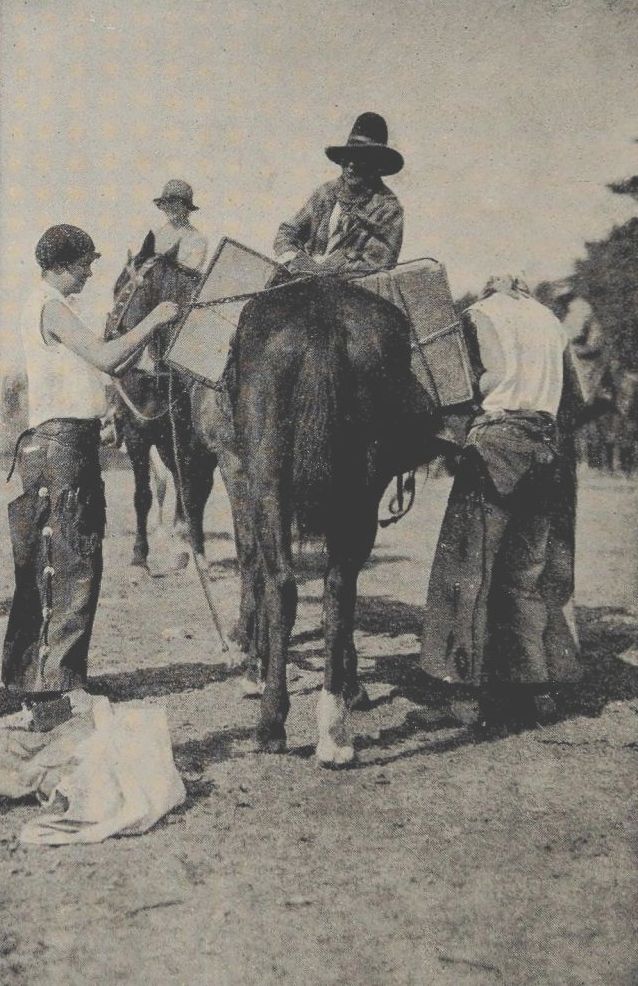
“With a train of goods
on horseback had they come to this raw, mining town
that with a mushroom growth had sprung to being.”
There came to Barkerville in Eighteen-sixty-two,
John A. Cameron and Sophia, his young wife,
from Summertown in Ontario through Victoria
to seek their fortunes. With a train of goods
on horseback had they come to this raw, mining town
that with a mushroom growth had sprung to beingHow John A.
Cameron
and his wife
went to the
Cariboo
out of the golden sands of Williams Creek.
The first stage of the journey was by boat,
Victoria to Yale and that was easy going.
From thence the goods were packed on mules
and the two Easterners rode beside them.
Bob Stevenson, their partner had gone on in Spring.
He had a trading business in the town——
and these had followed when the trail had dried,
leaving in June not to arrive till August.
These were the days before the Road was made.
The trail they had to use was full of perils,
precipitous-sided grades, rockslides and landslides,
cougar and grizzlie bears and poisonous rattlers,
wild beasts and hostile Indians, such dread hazards,
as to affright the gently-nurtured woman,
who chose to bear her husband company
into this land so different from her own,
so desolate and grim in all its grandeur
rather than let him travel forth alone.Their trading
business
proves
profitable
The trading partnership proved fortunate
for goods were at a premium and the two,
Cameron and his friend, thrived on their venture.
But there were richer gains below the ground
but they
abandon it to
take up
miningthan could be won by trade; and gold was all
the talk upon men’s tongues. We find them next
working the Cameron claim with four associates
while yet the summer sun burned hot above them.
September came and brought an early snowfall
and Cameron’s wife fell ill. October followed,
bleak and austere thirty degrees below
with furious driving winds that drove the coldCameron’s
wife falls
sick and dies
through every crack and crevice of the shack
that was the miner’s shelter and ere long
the stricken wife lay dying. Ere she passed
she made her husband vow to take her home,
home to her loved Ontario for her burial,Her husband
promises to
take her body
back to
Ontario
far from this unkind country that she hated
to one wherein her bones might rest in peace.
The sorrowing man made no complaint or murmur
but set his face to carry out her wish.
Naught could be done till Spring except they laid
her body in a coffin made of tin
and cased inside with wood and ere ’t was closed
they laid beneath her head a coloured shawl
that she had worn, a present from her sister,
to be her pillow all that weary way
that she must travel. Then behind the bier
a file of bearded miners followed slow
adown the village to an empty shack
where now they laid it, there to rest a space
until the time should come to bear it forth
to its far bourne. Meanwhile the little group,Cameron
and his
partners
strike gold
who owned the Cameron mine went working on.
Despite the iron hardness of the ground
and the keen, piercing torture of the cold
they dug on doggedly. December came
and they were down some twenty feet or more,
the stricken mourner working with the rest,
though now he took scant interest in the quest,
when they struck gold in plenty of great richness
such as exceeded all their fondest dreams.
January snows piled deep and high
and smallpox raged among the Indian tribes,Cameron
with the aid
of his
partner,
Stevenson,
takes his
wife’s body
to Victoria
more feared than all the perils of the trail
but Cameron was staunch and would not stay.
His promise urged him on to seek fulfilment
and so he started out with steadfast heart,
his partner, Stevenson accompanying him.
When it was found that gold would not avail
to tempt these hardy miners to the task,
to face disease and all the painful rigours
of such a hazardous trip, the faithful friend
rallied to meet the need. “John, I will go,”
he said; and that was all there was to that
and go he did. No need to tell it here,
the epic story of that arduous passage
but it was March, the Seventh when with the body
they reached Victoria and the following day,
after the undertaker of the town
had filled with alcohol the metal casket,
there was a second solemn funeral held.and then the
two return
to their
mine
Then the chief mourners took their journey back—
back to the mine where there was wealth to win—
and by the Fourth of April they were home.
Three hundred and fifty thousand dollars
that was the gold that Cameron took that yearAfter
amassing
wealth from
their mine
they take
Mrs.
Cameron’s
body to
New York
out of his mine—so it had been computed—
and when the autumn came he left Cariboo for the Coast
to finish his pact with the dead
and Stevenson his partner went with him.
So November saw them depart,
taking the body along
on a steamer sailing south,
San Francisco the first port of call,
and then down the Mexican coast
to the Isthmus of Panama,
that zone of withering heat.
Thence to New York they sailed—
these were days when travel was hard,
painful and tedious and slow—
and when they reached there at last
they thought that now all was well
and the worst of their journey was o’er
but still there was trouble in store
for the Customs would not let them pass.
This ponderous casket they brought—
it weighed nearly five hundred pounds—
they thought it must surely contain
something more than a pitiful corpse
and these miners escorting it there
had put forth an incredible tale.
So, this meant a tormenting delay
and the friends were in deepest distress;
but aid influential was found
and they swore affidavits a-plenty
so, at last, those in charge let them through
with the sorrowful burden they bore.and then to
Cornwall,
Ontario,
where they
bury her
And they brought it at length home at last
to Cornwall where she had been born,
the wife who had followed her man
so far and thus bravely to die
away in that lone Cariboo.
And Cameron buried her there
with the friends who had known her in youth
to walk in the funeral train
and see her laid safely away.
And the husband was glad that at last
he had kept his faith with the dead.
Now there you would say was the end
of a sad and a pitiful tale;
and the brave, little wife was at rest
to lie till the Judgment Day.
But rumour like a running flame
was busy now with Cameron’s name.
From lip to lip the story ran
about this strange, mysterious man:Ugly tales
are told
about
Cameron
the wife he made pretense to mourn
was not within this casket borne
from Western wilderness to lie
in Cornwall cemetery hard by
the home where she was born. ’T was said,
the woman was not even dead;
but she had met a harder fate
e’en at the hands of him her mate:
for driven by his thirst for gold,
this man his wife had actually sold
in slavery to an Indian chief—
it was a slander past belief
and yet the story would not down.
It blackened Cameron’s fair renown.
The more he scored the fateful lie,
the more his friends would pass him by
with head averted; if they spoke
’twas with constraint. The ordeal broke
the miner’s spirit; the iron nerve
by which through all he did not swerve
from keeping that grim promise sworn,
daring the hardships he had borne
and all the perils of the trail,
before this danger seemed to fail.
Here was a foe he could not face,
which seemed to lurk in every place
and his partner
advises
him what
he must do.where he might turn. So nigh distraught,
in his perplexity he sought
advice from his old partner, who
told him at once what he must do.
So at Cornwall in the midst of a throng
of relations and friends and of thoseIn order to
quiet the
calumny
Cameron
has his
wife’s body
exhumed
curious to see such a singular sight,
the coffin was raised from its grave
and an opening was made at the head
exposing the face of the dead.
“It’s Sophy,” the sister exclaimed,
“just as she looked in her life,
girlish and fragile and young.”
She spoke to the undertaker,
just a word; and he put in his hand
under the head of the corpse
and pulled forth a patterned shawl.
“It’s the one that I gave her the day
she was married,” the sister declared;
and she covered her face with her hands
and wept; while the people in line
passed by the body to view.and he is
vindicated
He, the husband stood bitterly by
with head bent and bared; but all those
who had cherished and carried the tale—
their heads were averted once more
but now they were lowered in shame.
The body was moved yet again
to Summertown where it was laid
to rest there until the last trump.
And still in that far land of gold
old timers will tell you the tale
of Cariboo Cameron’s task
and the way that he carried it through.
I am the last camel,
the last of the twenty-one
who came to CaribooThe last
camel
expresses
his feelings
about
Cariboo
in the year “sixty-two”
from far-off Manchuria.
What a country! what a people!
and what a road to travel on!
How we longed for the hot suns
and the soft sands of the desert!
How we hated our drivers!
speaking strange oaths,
wearing odd garments,
with no knowledge or skill
of how to load us or to ride us.
How we loathed and despised them!
O the meanness of the mules!
with mouths like crocodiles
and legs like battering rams,
swift to kick like the lightning;
and the horses as hateful
undersized and unkempt,
stubborn and vicious
would go frantic with fury,
try to unseat their riders
with most odd, rocking motions.
They had never seen the like of us
and were terrified at the sight of us,
sought to jump off the road
whenever we met with them.
And their owners swore loudly
and smote us with contumely
whose sires, the pride of Bactria,
were the flower of riding camels.
But we bore it in silence
with heads high despising them,
puny men of no poise,
grasping and garrulous,
fit subjects for ridicule.
We enjoyed their discomfiture
and looked on with derision
as their packmules stampeded
in terror at sight of us.
But my comrades are gone,
all dead now or scattered
and I live here alone,
on a ranch at Grande Prairie,
old and stiff-jointed,
from these terrible winters
at the home of my master,
lonely and loveless
except for his daughter,
who pets me and tends me.
Full gladly I kneel
to permit her to mount me,
and when proudly I bear her,He recalls
with sadness
happier
days
I dream with regret
of the days of my youth
when supple and swift
I swept o’er the desert
and breathed its warm wind
like rich balm in my nostrils.
But my days now are numbered.and knows
that his
doom is
sealed
Tomorrow I perish—
I heard them decree it—
for destroying their fences.
They thought to confine me
with frail barriers of pinewood
me, “the ship of the desert”,
but I put my head under
and tore them asunder.
Yea, I am the last one,
the last of the camels
that came to Cariboo
in the year “sixty-two”
and tomorrow I perish.
The career of the camels as beasts of burden on the Cariboo Road was a short one. They were purchased in San Francisco in 1862 for Adam Heffley and Henry Ingram out of a shipment brought into California from China, either Mongolia or Manchuria according to an interesting article by W. T. Hayhurst on “The Camels in British Columbia” published in the 6th Report of the Okanagan Historical Society (1935). For twenty-three thus acquired, a price of six thousand dollars was paid. Only twenty-two of those arrived in Victoria where they made quite a sensation especially among the Indians who had never seen or heard of such animals before. They were straightway shipped to Yale and put into service packing supplies on the Cariboo Road.
However, from the first they were not a success. Their feet were not suited for the rough and rocky surface of the Road and it was found necessary to shoe them with boots of canvas or rawhide. Then they caused consternation amongst the horses and mules of the pack trains which wound their way along the narrow winding ledge of which for the most part the Road consisted with its precipitous sides reaching far down to the river below. One can imagine the dismay and the disgust of the weary packer on turning around some bend in the Road to come full upon the camels and to have his whole train of horses or mules stampeded in their terror of those outlandish beasts of which even the smell was obnoxious. Ere long an appeal was made to Governor Douglas to have them prohibited from the Road and within a year from their first appearance they were gone. Some were taken over to the Henry Ingram place at Grande Prairie, forty miles from Kamloops, where they were used in hauling the logs for his house. One became a great pet of his daughter who used to ride it about the place. The animals had to be clipped like sheep in the Spring of the year and housewives of the district used the hair for making mattresses and pillows. The last of them was put to death by shooting in or about 1896.
Much of the old simplicity of life has passed.
Speed and efficiency and all those fetishes
of modern civilization have entered in
to rob us of our restfulness and calm.
Science has multiplied our comforts
and medicine has lengthened out our span.
Distance has been abridged and now we know
about our neighbours since the air is vocal
to cast abroad their thoughts and aspirations,
their drama and their music and their songs.
War has intensified its horrors
and slavery has come to many lands
that not long since were free.
Tyrants have raged and fumed and worked their will
upon the peoples around about them.
No more the bane of unemployment
brings misery; for ’neath this new regime
there is made work for all.
But peace has now been won once more
and the buoyant spirit of youth still lives.
Truth, courage and honour are not yet dead
and will in time prevail. When we look back
upon these stirring stories of the past,
and see what common, simple men have done
under the plan of Providence Divine
to shape the destiny of this Northwest,
whether selfishly or otherwise, in faith and hope,
it steels us with fortitude to face the future.
THE END
TRANSCRIBER NOTES
Misspelled words and printer errors have been corrected. Where multiple spellings occur, majority use has been employed.
The sketches by H. E. (Harry Edmund) White have been removed for copyright reasons.
Punctuation has been maintained except where obvious printer errors occur.
Book name and author have been added to the original book cover. The resulting cover is placed in the public domain.
[The end of Ballads of the Pacific Northwest, by Robert Allison Hood.]