
* A Distributed Proofreaders Canada eBook *
This eBook is made available at no cost and with very few restrictions. These restrictions apply only if (1) you make a change in the eBook (other than alteration for different display devices), or (2) you are making commercial use of the eBook. If either of these conditions applies, please contact a https://www.fadedpage.com administrator before proceeding. Thousands more FREE eBooks are available at https://www.fadedpage.com.
This work is in the Canadian public domain, but may be under copyright in some countries. If you live outside Canada, check your country's copyright laws. IF THE BOOK IS UNDER COPYRIGHT IN YOUR COUNTRY, DO NOT DOWNLOAD OR REDISTRIBUTE THIS FILE.
Title: Spanning the Atlantic
Date of first publication: 1931
Author: Franklin Lawrence Babcock (1905-1960)
Date first posted: January 10, 2026
Date last updated: January 10, 2026
Faded Page eBook #20260117
This eBook was produced by: Al Haines, Howard Ross & the online Distributed Proofreaders Canada team at https://www.pgdpcanada.net
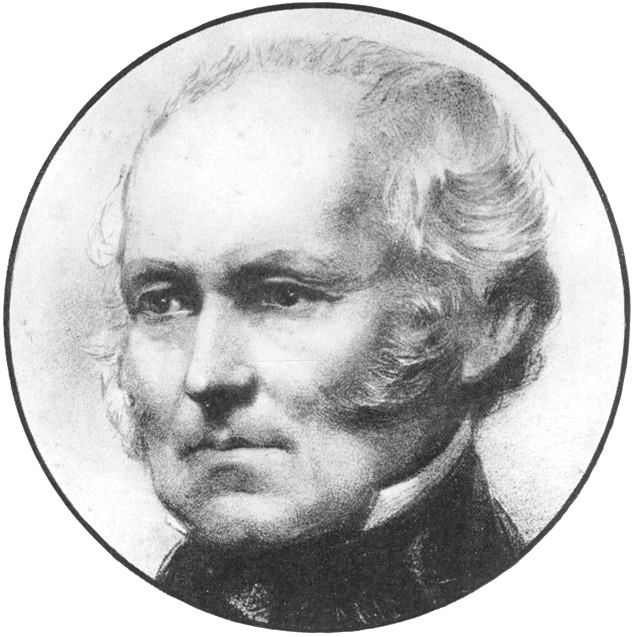
SAMUEL CUNARD
Copyright 1931 by Alfred A. Knopf · Inc.
All rights reserved—no part of this book may be reprinted in any form without permission in writing from the publisher
FIRST EDITION
MANUFACTURED IN THE UNITED STATES OF AMERICA
IN THE interest of the general reader, the author has attempted to eliminate from the text all unnecessary technicalities and specifications. Foot-notes also have been avoided, with a view to subordinating details and minor controversial points to the purposes of a general narrative history of the Cunard Steamship Company. In compensation for these omissions is given a bibliographical list which will suggest further reference sources for such information.
The author wishes to express his gratitude for the many kindnesses extended to him during the preparation of the manuscript. Professor Archibald MacMechan of Halifax generously supplied the keys to some interesting biographical data. Mr. E. Francis Hyde, who for more than sixty years has crossed the ocean on Cunarders, gave him the benefit of his recollections and provided him with valuable material. Miss Alida M. Stephens, Assistant Librarian of Williams College, kindly extended him certain privileges in the use of books which he was unable to obtain elsewhere. Finally, special acknowledgments are due to the many officials of the Cunard Line, in the United States and Canada, who gave their patient co-operation and made available information otherwise inaccessible. The author assumes, however, full responsibility for all of his statements and conclusions, in which he has preserved complete independence of judgment.
F. Lawrence Babcock
| Preface | v | |
| I. | Samuel Cunard, Merchant | 3 |
| II. | The Development of the Steamship | 15 |
| III. | The Foundation of the Line | 36 |
| IV. | The Ocean Ferry | 50 |
| V. | Early Cunarders and Boston | 68 |
| VI. | Competition by Sail and Steam | 78 |
| VII. | The Struggle with the Collins Line | 91 |
| VIII. | The Great Migration | 107 |
| IX. | The End of the Paddle Wheelers | 124 |
| X. | Ocean Travel in the Seventies | 136 |
| XI. | The Mauve Decade | 155 |
| XII. | Twentieth Century Liners | 174 |
| XIII. | Cunarders in the World War | 188 |
| XIV. | Reconstruction and the Tourist Trade | 199 |
| XV. | The Tenth Decade | 210 |
| Bibliography | 219 | |
| Index | 228 | |
| Samuel Cunard | Frontispiece | |
| The Ships of Columbus | Facing Page 4 | |
| Halifax Harbour in 1840 | 8 | |
| John Fitch’s Paddle Steamboat | 16 | |
| The clermont | 20 | |
| The Docks at Liverpool | 40 | |
| The britannia | 50 | |
| Charles Dickens’s Cabin on the britannia | 54 | |
| Old-time Travel | 58 | |
| The First Day | ||
| The Second Day | ||
| The britannia in the ice | 72 | |
| Fashion in Captains’ dress | 78 | |
| The Clipper-ship westward ho | 88 | |
| An Early Cunard Advertisement | 92 | |
| The Broadway Site of the Present Cunard Building | 96 | |
| The Jersey City Docks | 100 | |
| Old-time Travel | 108 | |
| Shuffle-board | ||
| A Gale | ||
| The great eastern | 112 | |
| The persia | 116 | |
| The russia | 130 | |
| The bothnia’s Menu | 136 | |
| The servia | 148 | |
| A Deck Scene in the Eighties | 156 | |
| The mauretania | 186 | |
| The aquitania at Southampton | 190 | |
| The mauretania in Camouflage | 194 | |
| The berengaria at Cherbourg | 202 | |
| “Number 534” as she will look against the Lower New York Sky-line—Scale Drawing of the britannia in the Foreground | 212 | |
SPANNING
THE ATLANTIC
IT SEEMS that into the epochal events of history are mingled the most remotely related factors—expansion of population and discovery of wealth; whim of royalty and conscience of artisan; rapacity of adventurer and courage of pioneer. Galaxies of accidents, tricks, coincidences and personalities miraculously appear to give these impulses common direction.
No combination of causes has a more astonishing variety than that which led to the discovery and colonization of America. The Mohammedans had cut off the eastward route to India just at the time that Europe was learning to dress in silks and to spice its meats. Gunpowder and the printing-press were invented at the moment when feudal states were beginning to draw themselves together into nations and to dream again of overseas empire. Luther and Calvin initiated the Reformation, while political philosophers were beginning to question the divine right of kings. And, finally, had it not been for the improvement of navigational instruments, Columbus’s feat of making an egg stand upright for the amusement of Queen Isabella of Spain would probably have been lost to history.
In the same way the establishment of steam navigation across the Atlantic and its growth to its present proportions have a history which, to be understandable, goes back to a period before the steamboats of John Fitch and Robert Fulton, before James Watt’s adaption of steam power, and before the American continent had revealed to Europe its great wealth and potential power. Perhaps Noah’s ark, the first known ship of the Mediterranean-Atlantic peoples, should be included, and the Niña, Pinta, and Santa Maria, the Greek discoveries in astronomy, and the invention of the compass. But the history of bridging the Atlantic properly begins with the origins of the man by whose influence the most dangerous and most travelled ocean was transformed from a perilous obstacle into a link between two continents. Not that the great movements of history can be attributed solely to the men who first happened to realize them, but the romantic impulse in human nature prefers to associate important events with illustrious names. And, for that matter, history could not have been made without leaders, even though leaders seem to have been made by history.
Out of the fermentation of ideas and impulses which the seventeenth century brought to our shores emerged the elements which gave us great men to fulfil our national destinies. From the gentry of Virginia sprang our first political genius; from Massachusetts came the founders of a world-wide commerce; New York gave to the New World its Flemish prodigality; and Pennsylvania taught our continent the sober ideals of peace and solvency.
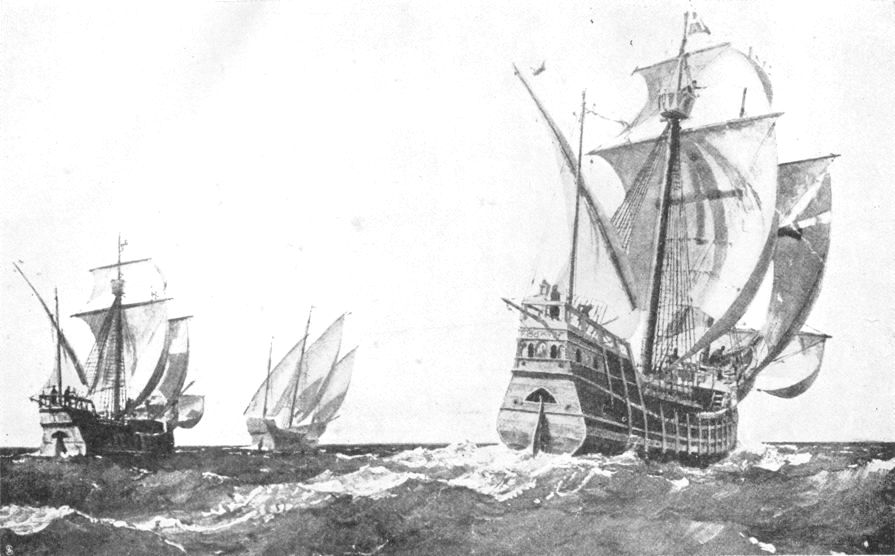
THE SHIPS OF COLUMBUS
It was these same qualities of peacefulness and solid prosperity, brought to this country by the Quakers and Mennonites, that were instilled into the being of Samuel Cunard and translated by him into the matchless record of safety and dependability which has been realized by the line of steamships that bears his name. During the early decades of the Cunard Line, competitors’ ships, designed “to sweep the Cunarders off the sea,” offering more speed and greater luxury, challenged the existence of the enterprise. Yet, sailing over the same seas, in struggles for supremacy, and enduring the same perils, none survived with a career unblemished. Some lines gambled for huge stakes and, forgetting that each trip should be profitable, failed. Somewhere deep in the history of the Cunard Line lies a reason for the fact that for nearly seventy-five years, until the torpedoing of the Lusitania, it has contributed neither life nor letter to the great toll of loss the Atlantic trade has taken. Something in the Philadelphia Quaker ancestry of Samuel Cunard has endured through the two and a half centuries which separate the establishment of his family in this country and the modern Leviathans which fly the company’s emblem.
The first we know of the forbears of Samuel Cunard is that his great-great-grandfather, Thones Kunders, was a prosperous dyer in Crefeld, Germany, a town on the lower Rhine near the Dutch frontier. It is probable that his family came to Crefeld as refugees during the religious persecutions of the seventeenth century. Until Calvinists and Separatists fled from other German states, and Friends and Mennonites emigrated from Great Britain and from France, whence they were driven by the revocation of the Edict of Nantes, Crefeld had been an obscure village. This influx of religious rebels brought new trades, with their new beliefs and the village became a town famous for the weaving and dyeing of linens and silks, for which it is still known. Finally, however, a huge grant of land by Charles II of England to William Penn opened a free country to the Quakers, who had been scattered over Europe, and gave them a leader to the New World. The Frankfort Company was formed to promote the emigration to America of the Friends who had gathered along the basin of the lower Rhine. In Crefeld thirteen families, thirty-three persons in all, were found that, preferring God’s wilderness to men’s wars, dared to exchange their properties and business for the unseen and uncleared acres in Penn’s Woods. The heads of these thirteen families were to draw lots for equal shares in six thousand acres which Penn had granted them. Among them was Thones Kunders, who, with his wife, Ellen, and three sons, embarked on the Concord July 24, 1683. After a passage of seventy-four days they landed at Philadelphia on October 6. Here, in addition to his share of the six thousand acres, Thones Kunders had for ten pounds bought from Lenant Arets, in Crefeld, a warrant for five hundred acres which had been purchased from William Penn.
These transactions were evidently profitable, for we next find him the owner of a house (in what is now Germantown) which must have been large for those days, as it was used by the Quakers as their place of worship before their first meeting-house was built. It was also well built, for some of its walls are said to be still standing as part of the house known as number 4537 Germantown Avenue. Besides working their new lands, the colonists continued in their trade of weaving and dyeing what an account of the Pennsylvania colonies describes as “very fine German lines such as no person of quality need be ashamed to wear.” By diligent industry and frugality Kunders evidently earned a considerable competence and won for himself a leading part in the community. He served as recorder of the courts, as juryman, and, when the town was incorporated, in 1691, as burgess. He is recorded as having contributed ten pounds and eight shillings towards the building of a stone meeting-house in 1705. And it is of special interest to note that he was one of the signers of the first protest against slavery of which there is record in America. Proud described him in his History of Pennsylvania as “an hospitable, well-disposed man, of an inoffensive life and good character.” In 1729, having spent forty-six years in America, he died, leaving a considerable property to be divided among his seven children, Cunrads (or Cunræds) Cunrads, Mathias Cunrads, and John Cunrads, who were born in Crefeld, and Henry Cunrad and three daughters, born in Germantown. Here it is curious to observe the fact that not only did the children of Thones use the name Cunrads, and variations of it, but he himself during his lifetime was sometimes referred to as Dennis Conrad. This may admit the possibility that the family originally came from Great Britain and that their name, having been Germanized, reverted to something like its original spelling during their early years in America. Nothing positive is known in support of this theory except the general belief that the Cunard family originally emigrated from Worcestershire or Wales in the early seventeenth century.
Henry, the sixth child of Thones Kunders, was born in Germantown on December 6, 1688, and on June 28, 1710, married Katherine Streepers, the daughter of another colonist from Crefeld. Shortly afterwards he bought, for £175, 220 acres and 110 perches of land in the township of Whitpain, Montgomery County, Pennsylvania. The Quakers of Germantown recommended him and his wife to those of Whitpain as “both of a sober and honest conversation.” Here he established a home and evidently prospered, for he later acquired more land and, when he died, left a considerable estate to his seven sons, of whom Samuel, being the youngest, received only the modest “sume of Seventy Pounds.” This second generation born in Pennsylvania took, some of it, the name of Conrad, while others chose that of Cunard. Samuel, the son of Henry Cunrads, was known by the latter name, and it was his second son, Abraham, who, after the American Revolution, removed to Halifax, where was born Samuel Cunard, the founder of the Cunard Line. Abraham Cunard, father of Samuel, was the only descendant of Thones Kunders to cast his lot with the British Empire. Others rose to prominence in Philadelphia. Their pioneer blood must have contained a will to succeed tempered by the Quaker background of sober industry and fearless independence of thought.
Thus we come to Abraham Cunard, who, remaining loyal to King George III, effected the second, or probably the third, great change of residence in the history of his family. In 1780 he embarked for Halifax, the chief remaining British seaport on the Atlantic coast. He was a master carpenter by trade and easily found employment in the Dock Yard, which contributed to Nova Scotia’s mercantile fame. So finally the Cunard family looked seaward.
With a great-great-grandfather under whose roof William Penn had probably “sat in silence,” with three generations of forbears “of sober and honest conversation,” engaged in the handicrafts and in tilling the soil, and with a father who was a master carpenter, no one would have expected Samuel Cunard to become an irresponsible roustabout and spendthrift. But neither would one look to him for the originator of a daring, epochal enterprise, a diplomat in negotiation, or a charming figure in London society. His father had married in 1783, however, a Margaret Murphy who had fled to Halifax with a band of United Empire Loyalists from South Carolina. She, no doubt, brought her son the Gaelic imaginativeness which complemented his Quaker heritage of energy, method and perseverance.
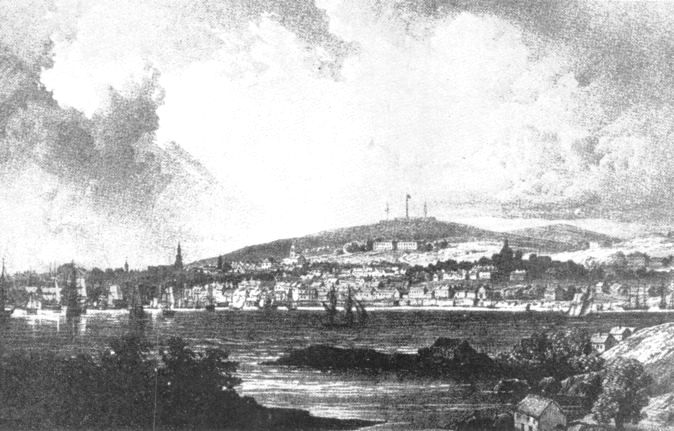
HALIFAX HARBOUR IN 1840
In a small house on New Brunswick Street, overlooking the then busy harbour of Halifax, Abraham Cunard’s second child, a son, was born on November 21, 1787. He was christened Samuel after his grandfather. Little is known of his boyhood and of his early education except the meagre accounts preserved in the local traditions of Halifax. Stories about his youth leave one the choice of supposing him either a prig or a dreamer with an overwhelming ambition. At the age at which other boys are apt to hope to grow up into firemen or policemen, young Sam knitted socks while driving the family cow home from the pasture, and “turned an honest penny” selling herbs he grew in his mother’s garden. While other boys might have spent their earnings in the acquisition of pocketable odds and ends, Samuel took his gains to auction and bought in bargains to sell again at a profit.
During the period of Samuel Cunard’s youth Halifax was a stimulating place to grow up in, filled with a variety of impulses to a boy’s imagination and challenges to a man’s mettle. First it was a haven for Tories emigrating from the United States. Then it began to expand as a great British seaport, a commercial entrepôt for trade between England, Canada, Newfoundland, and the West Indies. England’s needs, during the Napoleonic Wars, stimulated the great shipbuilding industry which made Nova Scotian sailing-ships famous and gave to the seas the “bluenose” boast of “wooden ships and iron men.” Crowded with garrisons, sailors, and a port’s cosmopolitan throngs, Halifax became both notorious and famous, and strongly conscious of its position in the Western hemisphere. It offered pleasure to those who sought it, and rewarded enterprise with wealth, and behind it lay the confidence and hope of a rich new continent and a pioneer people.
However slight may have been Samuel Cunard’s formal education, of which there is no sure record, he evidently had somehow schooled himself for exacting clerical duties; during his teens he obtained a post in the Civil Branch of the Engineering Establishment, a scientific service of the Army which must have required of its employees considerable personal attainments. Here, while drafting and making plans, he must have felt the throb of an empire struggling for its life, and when the town was illuminated to celebrate Nelson’s victory at Trafalgar he may have realized that across the Atlantic the New World had contributed to the history of the Old. When he left the government service he went to Boston and served in a ship-broker’s office. Soon he emerged from his apprenticeship in shipping and himself participated in the expansion of Nova Scotian commerce. Whatever were his earliest enterprises as a merchant, they must have been successful, for when he was but twenty-five years old he received from the Lieutenant Governor of Nova Scotia a permit to trade with any port in the United States during the War of 1812. This bears witness to Samuel Cunard’s early success as a merchant, for it is rare to find such youthful owners of cargo in those days when fortunes were made more slowly. It is also notable as the indication of the bond which already existed between Canada and the United States. Long before the war between Great Britain and America there had been formulated the Anglo-American doctrine that war automatically prohibits all commercial intercourse between opposing belligerents. The fact that notwithstanding this the Lieutenant Governor and Commander-in-Chief of Nova Scotia authorized a Halifax merchant to buy cargoes of foodstuffs and naval stores in New England and promised his ship safe conduct, and the fact that the New England states, bitterly opposed to the war with England, evidently acquiesced, suggest that already the rancours produced by the American Revolution had been forgotten in a new sense of common interests in North America. It was no doubt the fruition of this tendency which eventually made the establishment by a Halifax merchant of a transatlantic steamship company “a landmark in the history of our country”—to use the phrase of Ezra Gannett, a famous Bostonian. Two years later Cunard came into further contact with the United States in the execution of a contract for the conveyance of His Majesty’s mails between Halifax, Newfoundland, Boston, and Bermuda. This important responsibility, undertaken at his own financial risk when he was but twenty-seven, was fulfilled to the entire satisfaction of the Government, and to his great credit.
In the meantime Samuel Cunard was winning for himself an important place in the commercial life of Halifax. Before the city was awake he would be at the wharves, buying cargoes from the United States and the West Indies. When Halifax was yawning to go to bed he was probably planning a larger career in terms of the two hemispheres. Some vision seems to have inspired the dogged progress of his twenties. His father, having for more than thirty years watched Halifax rise to its mercantile pre-eminence, must have seen a brighter future in commerce than in carpentering, and in his eldest son, Samuel, a suitable partner in the firm of Abraham Cunard and Son. Their joint enterprise, thus styled, was founded upon Samuel’s reputation for energy and reliability and aided by Abraham’s broad acquaintanceship, through his position in the Dock Yard, with the commercial and official circles of Halifax. In the space of twenty years it developed into a powerful organization controlling forty sailing-ships. Its first great success came from the purchase, at a bargain, of a prize ship, the White Oak. On July 2, 1813, they advertised “good accommodation” on her, sailing for London with the first convoy (for war still menaced lone merchantmen on the Atlantic). This marked Samuel Cunard’s entry into transatlantic shipping and was probably the shrewd stroke which thrust his name into history, for from that day his personal fortune rapidly increased until, in 1830, it was estimated at the then great sum of two hundred thousand pounds. In 1820 he bought his parents a huge farm on which to retire, changed the name of the firm to Samuel Cunard and Company, extended his shipping-business to whale-fishery, and set up his brothers, Joseph and Henry, in the timber and shipbuilding industry in New Brunswick. These expansions of his activities and his large purchases of land on Prince Edward Island, where he established ironworks, were undertaken despite the crisis which threatened the prosperity of Halifax that year. The depression which followed the close of the Napoleonic Wars and the removal of the Dock Yard to Bermuda, at the whim of an admiral, had already started the famous port on its long decline. Yet his company continued to grow, keeping the local shipyards busy supplying its fleet, and dispatching ships eastward to Newfoundland and England, southward to Boston and to the West Indies, and up the Saint Lawrence to Quebec and Montreal. His wharf became the focal point of the city’s commercial life.
To his own commercial enterprises Samuel Cunard added the agency for the Honourable East India Company, which he undertook in 1825 and which, through his initiative, brought to Halifax the first direct shipment of tea from Canton in the Countess of Harcourt. Two years later he also acquired the agency of the General Mining Association, which had purchased important coal-fields in Cape Breton. This organization, incidentally, eventually supplied the coal for the Cunard steamers calling at Halifax. (At the present day the original firm in Halifax of Samuel Cunard and Company, no longer connected with shipping, still deals in coal and advertises its wares with the inevitable slogan that it “answers the burning question.”)
During these years Cunard had shed some of the plodding austerity which seemed to dominate his boyhood. After his marriage to Susan Duffus, in 1815, he made a place for himself in the gay social life which was at its zenith in Halifax during his thirties. This in those days meant membership in the exclusive Sun Fire Company and a commission in the fashionable Second Halifax Regiment of Militia. As captain of the “dashing” flank company of the latter, known as the “Scarlet Runners,” he is described as “a bright, tight little man with keen eyes, firm lips and happy manners.” Later he became colonel of the regiment. Contemporary newspapers in Halifax are filled with more about the dinners and balls given by these genial groups than with accounts of fire or war. He became successively Fire Ward, Commissioner of Lighthouses, administrator of a bounty for the relief of destitute emigrants, and, finally, the Honourable Samuel Cunard, as member of the “Council of Twelve.” This was then the powerful chamber of the legislature, composed of the most influential merchants and officials. He was also one of the founders of Cogswell’s Bank, still important as the present Halifax Banking Company. In 1828 his wife died, leaving him charged with the education of two sons and seven daughters.
Cunard’s spectacular career in Halifax was marked by only one failure, which entailed serious loss to its promoters. For years enterprising spirits in Halifax had been considering a plan to build a Shubenacadie Canal to link the Bay of Fundy with the Atlantic. The project would facilitate the exploitation of resources from the interior and would prove useful in case of war. Although inspired by an age of canal-building in both Europe and America, the project was long deferred, owing to its great cost. It involved the engineering problems of digging an adequate passage fifty-three miles across the peninsula, and of overcoming the difficulties presented by the tides in the Bay of Fundy. These, being over fifty feet, are the highest in the world. Finally, in 1826, a company was incorporated to undertake the task, with Samuel Cunard as vice-president and as subscriber of a thousand pounds. At that date steam had made its power more felt on land than on the sea, and, like many such projects of the period, the Shubenacadie Canal was marked for failure by the potential competition of the railroad. Perhaps, however, this disaster had some influence upon the future of Samuel Cunard, as it taught the lesson of the revolution in transportation which steam was inevitably to introduce. Cunard was evidently not slow to learn from this experience, for in the year of the failure of the canal he also invested a thousand pounds in a company formed to operate steamboats between Halifax and Quebec. He came to the conclusion that “steamers properly built and manned might start and arrive at their destination with the punctuality of railroad trains on land.” He was evidently not yet ready, however, to coin his famous metaphor of “an ocean railway,” for as late as 1829 he wrote the following letter to Messrs. Ross and Primrose of Pictou, Nova Scotia, declining an offer to participate in a steamship enterprise:
Dear Sirs:—We have received your letter of the twenty-second instant. We are entirely unacquainted with the cost of a steamboat, and would not like to embark in a business of which we are quite ignorant. Must, therefore, decline taking any part in the one you propose getting up.
We remain yours, etc.
S. Cunard and Company
Halifax, October 28th, 1829
With Cunard’s rôle as the pioneer of continuous, safe, and dependable ocean steam navigation in mind, and his remarkable prophecy that “the day would surely come when an ocean steamer would be signalled from Citadel Hill every day in the year,” it is interesting to review the reasons for the disinclination evident in that letter. For what might have been recklessness in 1829 became daring foresight ten years later. Cunard’s ability to distinguish between the two was probably the chief reason for the establishment and survival of his “Atlantic ferry.”
Jonathan Hulls
With his patent skulls
Invented a machine
To go against wind with steam;
But, being an ass,
Couldn’t bring it to pass
And so was afraid to be seen.
NOTWITHSTANDING the quantities of controversial articles which have attempted to bestow upon this inventor or that the credit for originating steam navigation, it cannot be said to have been invented. Steam navigation grew out of centuries of experimentation with mechanical propulsion of boats. The Romans are said to have used the paddle-wheel, motivated by oxen; and the French, Spanish, and English devised substitutes for oar and sail long before steam power was discovered. Even steam was tried as early as 1543 in Barcelona by Blasco de Garay, in France by Papin in 1707, and in England by Jonathan Hulls in 1736. When James Watt finally produced a successful steam engine in 1769, however, several minds in different countries perceived a fresh possibility of releasing navigation from the caprices of the winds. Many of them applied to the problem ingenuities which, although failing through a lack of sufficient engineering knowledge, laid the foundations of future successes. In Great Britain were three notable experimenters, Miller, Taylor, and Symington, who built the Charlotte Dundas in 1802, a steam-driven craft, fifty-six feet long, capable of towing barges at over three knots. America, however, assumed the leading rôle in the development of the steamboat because, although it still lacked trained engineers comparable to those of Europe, its many rivers provided a great incentive to the improvement of water-borne commerce, and its pioneer condition was particularly conducive to experimentation. The credit for the final achievement of a practicable steamboat, popularly accorded to Robert Fulton, has often been questioned by the partisans of other inventors, among them James Rumsey, John Fitch, Colonel John Stevens, Nathan Read, Nicholas Roosevelt, Captain Samuel Morey, Elijah Ormsbee, Robert L. Stevens, and Robert R. Livingston. Among these John Fitch stands out as the one whose claim to glory rivals, if it does not exceed, Fulton’s, for not only did he experiment, with varying success, with the paddle-wheel and screw, as well as the mechanical oar, as means of applying steam to boat propulsion, but he actually operated a regular steam passenger service on the Delaware River seventeen years before the triumphal voyage of the Clermont up the Hudson. But his career was blighted by a series of misfortunes, of which not the least was the prematurity of the faith in the future of the steamship he expressed in a letter requesting a personal loan:
I am of the opinion that a vessel may be carried six, seven or eight miles an hour by the force of steam, and the larger the vessel the better it will answer, and am inclined to believe that it will answer for sea voyages as well as for inland navigation which would not only make the Mississippi as navigable as tide-water, but would make our vast territory on those waters an inconceivable fund in the treasury of the United States. Perhaps I should not be thought more extravagant than I already have been when I assert that six tons of machinery will act with as much force as ten tons of men, and should I suggest that the navigation between this country and Europe may be made so easy as shortly to make us the most popular empire on the earth, it probably at this time would make the whole very laughable.
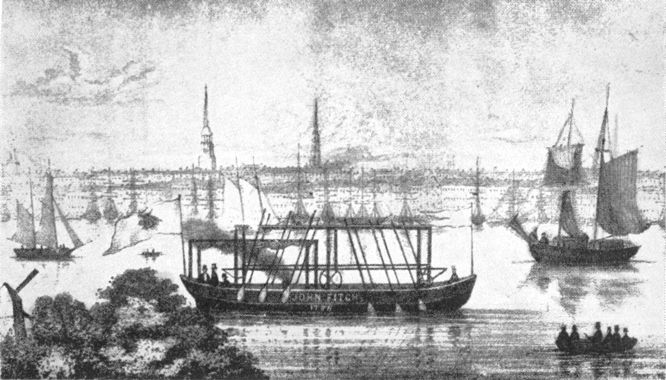
JOHN FITCH’S PADDLE STEAMBOAT
This was in 1786, and in 1792 experience had turned his belief into the conviction that “This, sir, will be the method of crossing the Atlantic, whether I bring it to perfection or not.”
Once, John Fitch came near to the success which would have fulfilled his dream and given him the place of honour Fulton was to occupy in his stead years afterwards. After the partial success of his Perseverance in 1787 he built the Pennsylvania, propelled by twelve oars, acting alternately on each side as paddles. She was intended to run on the Delaware between Philadelphia, Burlington, Bristol, Bordentown, and Trenton. On the day of her maiden voyage, June 16, 1790, Congress, which was then in session in Philadelphia, adjourned to witness the trial. Among those present was Benjamin Franklin, who was one of the shareholders in this enterprise. The boat amazed Fitch’s critics by a performance which fulfilled his every prediction, including the maintenance of a speed of eight miles an hour. After it had been tested by two months’ regular operation, steaming with passengers from both Philadelphia and Trenton three times a week, a correspondent of the New York Magazine reported that “Fitch’s steamboat really performs to a charm.” The support he won with this achievement was soon lost, however, when a larger boat he was building to sail on the Mississippi was destroyed by a storm. The meagre profits accruing from his enterprise were wiped out, and his financial backers, receiving no dividends from their investment, withdrew their assistance. Nevertheless, John Fitch persevered whenever he managed to acquire the means necessary, and he built other boats, including one driven by both a screw propeller and paddle-wheels, which he successfully tested on Collect Pond on lower Manhattan. His every mechanical triumph, however, was defeated by lack of funds, and he finally retired to an obscure village in Ohio and in 1798 ended his life by suicide. He requested that he be buried on the banks of the Ohio River, where he might hear “the music of the steamboats passing up the river.” Friends used to say of him without intentional malice: “Poor fellow, what a pity he is mad!”
There were others after John Fitch who believed in the future of the steamboat and who contributed to its final apotheosis, but it was Robert Fulton who realized with practical success the dreams of his predecessors. He possessed what the others had lacked—a well-disciplined knowledge of engineering and the gift of patient and precise experimentation where others had brilliantly blundered. Even as a boy in Pennsylvania he had devised paddle-wheels to be turned by a crank to propel the flat-boat in which he went fishing. Later he witnessed several of Fitch’s experiments in Collect Pond, and finally, while in England to study art, he made the acquaintance of Symington and others who were interested in the development of steam. When he went to France to continue his painting he must already have believed in steamboats, for it is related that Prince Talleyrand, after having sat next to Fulton at a dinner, expressed delight with his charming personality, but said that he was overwhelmed with sadness, for he could not but feel that he was mad. On another occasion he met the Duchesse de Gontaut, who was returning to revolutionary France under an assumed name, and soon asked her to marry him. When she replied that she already was married, he exclaimed: “Oh, what a pity, what a pity! I would make you rich. I am going to make my fortune in Paris. I have invented a steamboat and I am going to set the whole world going.”
In Paris he took up the study of higher mathematics and physics, and in 1800 he commenced to experiment with a submarine boat and with torpedoes for destroying warships. He also worked out plans and models for a steamboat. At that time France was fresh from victories on the Continent and in Egypt. Only England, with her matchless Navy and inaccessible situation, opposed Napoleon’s ambition for the hegemony of Europe. “A fair breeze and thirty-six hours” were all that the French thought necessary to place an army on British soil. Fulton wrote the First Consul a letter which, although somewhat over-confident, attracted the attention of the Government:
The sea which separates you from your enemy gives him an immense advantage over you. Aided in turn by the winds and the tempests, he defies you from his inaccessible island. I have it in my power to cause this obstacle which protects him to disappear. In spite of all his fleets, and in any weather, I can transport your armies to his territory in a few hours, without fear of the tempests and without depending upon the winds. I am prepared to submit my plans.
A commission was appointed to investigate his proposals. The result was the rejection of his plans for steamships, but he was given a grant of money to defray the cost of experiments with a plunging boat and torpedoes. This he developed with partial success, which was sufficient to cause grave anxiety in England. His progress was checked by the discontinuance of official support, which occurred partly because the Government thought it impossible to give naval commissions to the crews of submarines, as they would surely be hanged as pirates if they were captured.
In the same year, 1801, Chancellor Robert R. Livingston was appointed American Minister to France. He had already paid for the construction of an unsuccessful steamship in New York and had procured from the State Legislature an exclusive grant to operate steamships on the Hudson River. Robert Fulton made the acquaintance of this far-sighted gentleman, who put sufficient sums at his disposal for the development of his plans for steamships. The result of their co-operation was that in 1803, after several failures which he carefully corrected by the construction and observation of working scale models, Fulton launched on the Seine a successful steamer. Her performance was sufficiently encouraging to induce Livingston to promise to pay for the construction of a larger boat to run on the Hudson River. He returned to America and built, at Charles Brown’s shipyard on the East River, a ship with a length of one hundred and thirty feet, sixteen and a half feet of beam, and a draft of seven feet. Her capacity was one hundred and sixty tons. Boulton and Watt of Birmingham, England, constructed her engines after Fulton’s specifications. The result was the Clermont, which startled the world by her voyage from New York to Albany and back, starting September 11, 1807, and making an average speed of over five miles an hour. This famous paddle-wheeler eclipsed her predecessors, and her years of successful service on the Hudson definitely established the future of commercial steam navigation. She was not so much an invention as she was a demonstration of the perfectibility of the less careful works of others. Fulton never claimed to have invented the steamboat, but he is entitled to the honour of producing the first ship which once and for all silenced the gibes of the sceptics.
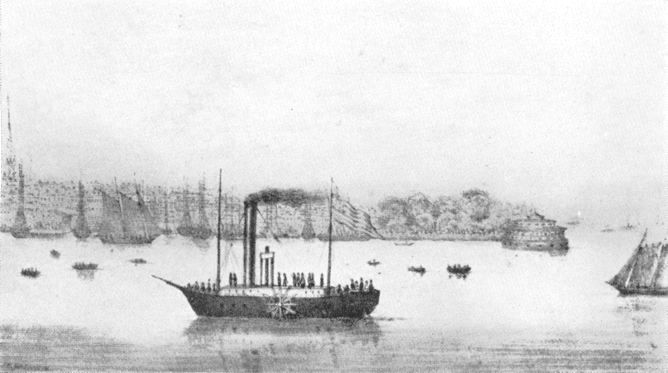
THE Clermont
The following year was another landmark in the history of shipping. John Stevens had built in Hoboken a steamship he called the Phœnix. Unable to contest the monopoly which Fulton and Livingston had obtained on the Hudson, he decided to put her on the route John Fitch’s Pennsylvania had followed eighteen years before. She consequently made the first ocean voyage by steam on her run from New York to Philadelphia, where she was to engage in the river trade. This trip, made under stormy conditions, vindicated Fitch’s predictions that steamers would “answer for sea voyages as well as inland navigation.”
The conclusively happy union of financial and mechanical success represented by the Clermont was blessed with numerous offspring. Several river and coastwise steamers were established in America before the first successful passenger steamship in Europe—the Comet, built in 1812 for Henry Bell. She was a diminutive boat of twenty-four tons with a length of forty-two feet and an engine which developed all of four horse-power. Yet, plying the Scotch coast until 1820, when she was wrecked, she generated in England a steam-mindedness which eventually was to break the power of America’s splendid sailing fleet and to make England more than ever mistress of the seas.
By 1819 the sea-voyage of the Phœnix had been followed by still more daring coastwise trips, and the feeling grew that Fitch’s misfortune was less madness than incredible foresight. Finally a three-masted full-rigged clipper-built ship of three hundred tons burthen was bought in New York by a Savannah firm, with a view to equipping her with a steam engine. Stephen Vail of Morristown constructed it, with a forty-inch cylinder carrying a pressure of twenty pounds. Her paddle-wheels were constructed with joints, so that they could be taken in when the engine was not running, to allow her free sailing. Under steam she had a speed of six miles an hour. She was built with a fuel capacity of only seventy-five tons of coal and twenty-five cords of wood. Captained by Moses Rogers, who had commanded the Phœnix, and navigated by John Stevens, she sailed to Savannah, for which port she was christened. Although her sailing from there to Liverpool was advertised in the local papers, the voyage seemed too chimerical to enlist any passengers, and she finally set out in ballast on May 25, 1819. Her owners had not destined her for transatlantic service but dispatched her in the hope of selling her to the Czar of Russia, who was a steamship enthusiast. She used her engines sparingly in order to save fuel for the finish, and the trip was uneventful until she sighted the Irish coast, on June 17. Her approach was marked by an episode which recalls the story of Sir Walter Raleigh’s servant who, when he first saw his master smoking, dutifully drenched him with water to keep him from burning up. The Savannah was sighted off Cape Clear by a King’s cutter. Seeing clouds of smoke rising from the American ship, which had steam up, the cutter followed in the hope of rescuing the crew of a burning ship. When the Savannah not only failed to stand by to receive assistance but, under bare poles, even outdistanced the government boat, the latter became both mystified and suspicious and fired several shots across her bows until she stopped her engines and received the visit of the amazed British captain. She finally steamed on to Liverpool, where she was greeted by a fleet of boats decked for a holiday, and crowds of enthusiastic and marvelling people. During her prolonged stop there, while her officers were being fêted, there was an amusing incident of bullying versus bluff. A boat from a British sloop of war came alongside of the Savannah, and one of its occupants asked of John Stevens, who was on deck: “Where is your master?” Stevens replied that he had no master. The Britisher demanded to see the captain; then, just as Moses Rogers was appearing from below, he shouted at Rogers: “Why do you wear that pennant, sir?” to which Rogers answered: “Because my country allows me to.” The Englishman replied: “My commander thinks it was done as an insult to him, and if you don’t take it down, he will send over a force to do it!” The American’s retort was to call to his crew to “get the hot water engines ready.” Picturing some infernal device to scald them all, the English boat pulled frantically out of danger, and Rogers had won the skirmish.
From Liverpool, with several passengers, the Savannah proceeded to St. Petersburg, stopping at Copenhagen, Stockholm, and Kronstadt. Among those aboard was Sir Thomas Graham, who presented Captain Rogers with a gold-lined tea-kettle, inscribed as follows:
Presented to Captain Moses Rogers of the Steam Ship Savannah (being the first steamship that had crossed the Atlantic) by Sir Thomas Graham, Lord Linedock, a passenger from Stockholm to St. Petersburg. September fifteenth, 1819.
In Russia the ship attracted great interest, especially on the part of the Czar, who already owned a river steamer for his private use. But, although he presented John Stevens with a handsome gold snuff-box, the Savannah did not find a purchaser who would offer the price her owners had hoped for. She returned to her home port that year, largely under sail, and her engines were removed. Reverted to a sailing-ship, she was wrecked off Long Island in 1822.
The voyage of the Savannah was generally considered more in the light of a novel experiment than as a revolution in ocean navigation. Her passage of twenty-five days was not particularly faster than the averages of the best sailing-packets; and the merely intermittent use of her paddles, rather than demonstrating their value, seemed to imply their relatively small importance. Although she was the first steamer to cross the Atlantic, it was not until eight years later that a vessel undertook the voyage under the continuous propulsion of steam power.
The next venture in the navigation of the Atlantic by steam was a more decisive success, which might have stimulated the earlier establishment of regular transatlantic steamers had it received more notice in England and America. But the fact that the Curaçao is even now largely ignored in the standard histories of steam navigation in circulation in English indicates that the voyages of this Dutch ship, remarkable though they were, did not encourage new enterprises in the two nations most interested in bridging the ocean. In fact there is no evidence that they were then even known of outside of Holland. Nevertheless, despite their isolated place in history, the several trips between Antwerp and the Dutch Island off South America made by the Curaçao gave Holland the distinction of having initiated practical transatlantic steamer navigation. She was a steamer of only 438 tons register, with three schooner-rigged masts, and paddle-wheels driven by independent engines. She was built at Bristol and at first called the Calpe, but was sold to the Netherlands Navy soon after her completion. Converted into a warship and under her new name, she sailed for South America in 1827, continually under steam, and during the next two years she made several passages across the Atlantic, carrying passengers, mails, and valuable freight. In 1830 the revolts in Belgium caused her withdrawal from commercial service and required her use as a man-of-war, in which capacity she continued until 1848.
The distinction which justly belongs to the Curaçao is generally credited to a ship whose career was, indeed, more picturesque and whose voyage across the Atlantic was destined to mark an epoch in the history of navigation. She was the Royal William, built in Quebec in 1830 and sailed from that port to London in 1833. In the Canadian House of Parliament at Ottawa there is a tablet which bears the following inscription:
In Honour of the Men
by whose enterprise, courage and skill
The Royal William
The First Vessel to Cross the Atlantic by Steam Power was wholly constructed in Canada and navigated to England in 1833. The pioneer of Those Mighty Fleets of Ocean Steamers by which Passengers and Merchandise of all Nations are now conveyed on every sea throughout the World.
Ordered by
The Parliament of Canada, June 13, 1894
She is described by one writer as “the first ship to cross the ocean by continuous steam power and the first war steamer.” Another calls her “the Herald of the Canadian Confederation and the pioneer of the Cunard fleet and of Ocean steam navigation.” Although some of these claims for her, made in the prevailing ignorance of the Curaçao’s precedence, are not strictly correct, the Royal William undoubtedly has the distinction of having convinced Great Britain and America of the practicability of transatlantic steamships. The cruise of the Savannah had stimulated no efforts to perfect marine steam engines, and until 1833 none of the energy devoted to the improvement of the sailing-ship was applied to the problem of attempting practical ocean steamers. In fact, the statements of Dr. Dionysius Lardner, a famous English scientist of the day, had had great circulation among the men interested in shipping and had served to convince them that, although coastwise steamers were already numerous, “men might as well project a voyage to the moon as to attempt steam navigation across the stormy Atlantic Ocean.” Besides those sceptics who agreed with Dr. Lardner that the plan would be “perfectly chimerical,” there were those who, being concerned with sailing-ships or believing the innovation of steam a potential menace to naval defence, supported the Duke of Wellington’s statement that “he would give no countenance to any schemes which had for their object a change in the established system of the country.” Just as Fulton’s Clermont had served to prove to England the practicability of steam propulsion twenty-four years before, it required the success of another ship from the New World to shake the inherent conservatisms represented by Wellington and Lardner.
Although the Royal William was not actually the “pioneer of the Cunard fleet,” she occupies an especially interesting place in its history as its forerunner, for the list of her stockholders is headed by the name of Samuel Cunard and includes those of his brothers, Joseph and Henry. The Quebec and Halifax Steam Navigation Company was formed to build her, in response to the Legislature’s offer of three thousand pounds to the first company which should operate between Quebec and Halifax a vessel of not less than five hundred tons burthen. Her keel was laid in Quebec in 1830, and on April 29, 1831, she was launched. This occasion attracted enthusiastic throngs of people, who saw in her the instrument of a closer relationship between Old Canada and the Maritime Provinces, and possibly of the eventual confederation of Canada. The port was decked with flags, military bands played, and the cannons of the fort saluted her. Lady Aylmer, the wife of the Governor General, christened her after the reigning sovereign, King William IV. She was rigged as a three-masted topsail schooner, with 830 tons displacement, length of deck 176 feet, a 44-foot beam including paddle-boxes, and a depth of hold of 17 feet 9 inches. She is described as of “a magnificent appearance, the prow and stern quarter galleries being particularly tasteful and the underdeck cabin fitted out with taste and elegance, containing some fifty berths, beside a splendid furnished parlor.” After the launching she was towed to Montreal, where she received engines of two hundred horse-power. Her total cost was sixteen thousand pounds, a great sum at that time.
In August, 1831, she opened her regular service from Quebec to Halifax, which latter destination was changed, during the fall, to Pictou. The Honourable Samuel Cunard took the opportunity of her calls at Halifax to study every particular of her sea qualities, speed, and fuel-consumption. Although she suffered damages, she proved both her seaworthiness and the reliability of her engines during the severe storms of that year, especially when she was called upon to rescue some people shipwrecked on Green Island.
In the spring of 1832 the Asiatic cholera, then rampant in Europe, burst out in Canada, especially in Quebec, where three thousand inhabitants were stricken. Business was paralysed, and when the Royal William came out of winter quarters her owners were threatened with failure. Finally, on June 16, she started on her first and only trip to Halifax that year, with eleven cabin and fifty-two steerage passengers. When she arrived at Miramichi three days later, the engineer dead and six of her crew showing choleraic symptoms, a panic seized that port, and the ship was quarantined. All passengers and the sick men were landed on Sheldrake Island. A boat manned by men armed with muskets guarded the ships and threatened to fire on anyone who might try to enter the ship’s boat, which Captain Nicholls had refused to surrender to them. The fireman finally went ashore in it to ask Mr. Cunard, her agent there, for sufficient coal to enable the Royal William to proceed on her journey, but the town’s magistrate not only refused to permit the request but seized the boat, after landing the man on the island. Finally, released from quarantine a month later, she sailed for Pictou, only to be turned back by an armed ship guarding the harbour. There was nothing to do but proceed to Halifax, where she was again quarantined. After an absence of fifty-five days she returned to Quebec with a few passengers and was laid up without a further attempt to run her that year. This season’s inactivity plunged the Quebec and Halifax Navigation Company deep into debt, and she was finally sold at a sheriff’s sale before a church door. Among those who joined to purchase her were some of her original shareholders who were willing to risk further investment in the hope that she eventually could be sold at a profit.
Under her new ownership she made a trip to Boston in June, 1833, touching at Gaspé, Pictou, and Halifax. There, as the first British steamer to enter the port, she received salutes from Fort Independence and was greeted at the wharfs with a military band playing God Save the King. Upon her return to Quebec after this triumphal voyage her owner determined to risk dispatching her to England for sale or charter. Cabin-passage for London was advertised for twenty dollars, exclusive of wines. She left early in August and stopped at Pictou to recoal and to await passengers from Prince Edward Island. Finally, captained by John McDougall, she sailed for London on August 18, with an extraordinary cargo consisting of 254 chaldrons (330 tons) of coal, a box of stuffed birds, and six spars, produce of Nova Scotia; one box, one trunk, household furniture, and a harp, all British; and seven passengers. Off Newfoundland she struck a gale which carried away the head of the foremast, disabled the starboard engine, and so battered her that the engineer reported she was sinking. She survived, however, and continued under steam until her crippled engine was repaired. Nineteen days from Pictou she sighted Land’s End and put in at Cowes for repairs. Despite a stormy voyage and serious delays, she finally completed her passage to London in twenty-five days from Pictou, having maintained steam all the way. Although it was not a triumph of speed, the successful voyage of the Royal William disproved the theory that a steamer could not carry enough fuel to propel her across the ocean—a notion which, had it not thus been disproved, might have delayed much longer the foundation of an “Atlantic ferry.” Thus it seems that two misfortunes—the failure of the Shubenacadie canal and the cholera epidemic in Quebec—were linked to produce a blessing. These two lessons in steam helped to make Samuel Cunard the engineer for an ocean bridge.
Ships seem to be ruled by curious destinies, however, and the St. Lawrence passenger ship ended her historic career as a Spanish battleship. Soon after her arrival in London she was sold for ten thousand pounds to a shipowner who chartered her to the Portuguese Government to carry Dom Pedro’s troops. Later she returned to London with invalided soldiers, and finally, still under the command of Captain McDougall, she was sold to the Spanish Navy and renamed the Isabel Segunda. As the flagship of Commodore Henry’s British auxiliary squadron employed against Dom Carlos, she fired the first hostile shot in the history of steamship warfare, in support of the British legion opposing the Carlists along the Bay of San Sebastian. Shortly afterwards, while she was laid up for repairs at Bordeaux, it was found that her timbers were decayed beyond repair, and the hull became a coal-hulk, while her engines were installed in a new Spanish man-of-war of the same name. In 1860 the new Isabel Segunda was wrecked in a storm off the coast of Algeria, and her Montreal-made engines, their purpose fulfilled, came to rest in the Mediterranean.
Up to this point the New World had led in the development of steam navigation, from the rudimentary successes of John Fitch to the successful crossing of the Royal William. This was a natural consequence of the fact that while mechanical ingenuity was absorbed in Great Britain by her growing manufactures, in America its most fruitful application was in the development of inland resources through the improved navigation of our great rivers. The early steamships were at a relatively greater advantage over sailing-vessels in inland waters. While river and coastal steamers were rapidly being developed in America, the fast sailing-ships of New York and New England were breaking records for speed on every ocean. The most glorious chapter of American sea-borne commerce was written by the sailing-ships between the years which saw Fulton’s success with steam and the final collapse of the clipper-ships, about 1860.
Great Britain, on the other hand, was quick to perceive the importance of the American invention and of the Canadian demonstration of its applicability to transatlantic travel. Although Boston merchants had discussed such projects as early as 1825, and Samuel Cunard was revolving the scheme in his mind, it was Bristol which built the first steamer intended for regular passenger service to America. The financial crisis in England of 1837 provided a powerful incentive, for it was believed that many of the substantial firms which failed might have survived the panic had remittances from America not been delayed by the prevailing easterly winds. This resulted in a strong pressure upon commercial interests, which hitherto had been apathetic towards steam navigation, to lend it their active support, in the desperate hope of accelerating the processes of international finance. Junius Smith, an American, having failed to muster sufficient support in his native country, had gone to England in 1832 in the hope of instituting a transatlantic steamship service. He was finally successful in organizing the British and American Steam Navigation Company, which ordered of Messrs. Curling and Young, of Limehouse, a ship of 1,700 tons burthen, to be engined by a Glasgow firm and to be named the British Queen. Her construction was seriously delayed by the failure of the engineering firm, and she was not launched until the Great Western of Bristol and the Sirius had already made passages across to New York and back. The former was built by Mr. Patterson of Bristol for the Great Western Steamship Company, which was formed to supplement the Great Western Railway by a transatlantic steam packet-ship. She was completed in 1837 and sailed for New York on April 7 of the following year, commanded by Lieutenant Hoskins, R.N. The passage was accomplished in fifteen days, with five days’ coal-supply left in her bunkers. Although, to their amazement, the passengers and crew of the Great Western found that another British steamer had arrived in New York just twelve hours before them, they received a frenzied ovation. Twenty-six salutes were fired from the harbour guns, and a fleet of river steamers and tugs came out to greet her. New York had not shown such excitement since the War of 1812. This time England was not the enemy, but the benefactress, the bearer “of all that relates to the communication of intelligence, to the spread of literature, and to the certainty and convenience of travelling.” Even then New York dailies were avid for foreign news, and the people had a sort of nostalgia for the Europe their forefathers had left behind.
The other ship which had arrived from Great Britain was the Sirius, which had sailed from Cork four days earlier than the departure of the Great Western. This was a small ship of only 703 gross tons, which had served on the Irish coast until she was chartered by the British and American Steam Navigation Company to take the place of the delayed British Queen. The impatience of the promoters had led to the hasty departure of the Sirius on April 4. Her voyage was four days slower than that of the Great Western, although she followed a shorter but much more adventurous route. Like Columbus, her captain was obliged to quell a mutinous crew, which, thinking the ship would never succeed in her crossing, demanded that she turn back. Although its weight nearly swamped her, the 450 tons of coal she carried were insufficient, so that she had to burn some of her spars for fuel during the last part of her voyage. Nevertheless, her passage had marked another step in the progress of steam navigation, and during the twelve hours before the Great Western appeared she held the record for crossing.
Both vessels returned to their ports with passengers, the Great Western making an eastward passage of fourteen and a half days. Passage on the Sirius cost $140, including wines and provisions, in the first cabin, and $80 in second cabin. The Great Western charged thirty guineas for a first-class passage, or fifty for a state-room reserved for one person. These steamers were followed by others in the same year. The Atlantic Steamship Company chartered a vessel named after the Royal William and ran her between Liverpool and New York for several trips. She was the first steamer divided by iron bulkheads into watertight compartments. The same company replaced her late that year with the Liverpool, which was nearly the size of the Great Western, but not so fast. In the following year the British Queen, with her engines finally completed by Robert Napier of Glasgow, was launched. She was not only the largest ship afloat, of 1,863 tons burthen, deck length of 245 feet, and 500 indicated horse-power, but she was equipped with unprecedented luxury, possessing shower-baths and a smoking-room. She made a few trips from Cork to New York, but failed to realize the speed expected and was finally sold to the British Government. The Great Western still easily held the best record for speed, cutting down her passage-time to twelve days and ten hours eastward and to thirteen days and three hours westward. The nine-per-cent profits she earned during her first year in service and her comparative regularity definitely established the superiority of steam over sail for transatlantic passenger service.
In the meantime Samuel Cunard had been receiving His Majesty’s mails from Falmouth in slow sailing-ships, popularly known as “coffin brigs,” and conveying them in his own schooners to and from Halifax to Newfoundland, Boston, and Bermuda. The numerous disasters which overtook these ten-gun brigs during the six or eight weeks required for their voyages from England and the irregularities they imposed upon the shipment of mails became more and more galling as Cunard’s far-flung business relations increased. Since his participation in the Royal William he was no longer “entirely unacquainted” with the steamship business; in fact he had become financially interested in coastal steamers. He discussed the project of a regular transatlantic mail service by steam several years before the Great Western entered the passenger trade, but the capital to build several large steamers for the purpose was forthcoming neither in Halifax nor in Boston. Both ports were improving their famous sailing-packets, and their surplus profits were being absorbed by the creation of new industries.
The first step towards the realization of Cunard’s plans came about through a providential coincidence. Two of his most illustrious fellow-townsmen, Joseph Howe and Sir Thomas Chandler Haliburton, the Nova Scotian Mark Twain, better known as Sam Slick, were bound for England on the brig Tyrian in April, 1838, just at the time that the steamer Sirius was returning from her first trip to New York. One of the passengers describes in a letter an incident which, indirectly, had much to do with the foundation of the Cunard Line.
A moment full of excitement . . . when, to our astonishment, we first saw the great ship Sirius steaming down directly in the wake of the Tyrian. She was the first steamer, I believe, that ever crossed the Atlantic for New York, and was then on the way back to England. You will, I dare say, recollect the prompt decision of Commander Jennings (of the Tyrian) to carry the mail bags on board the steamer, and our equally prompt decision not to quit our sailing craft, commanded as she was by so kind and excellent an officer; and the trembling anxiety with which we all watched mail bag after mail bag hoisted up the deep waist of the Tyrian; then lowered in the small boat below—tossed about between the vessels, and finally all safely placed on board the Sirius.
Howe visited the Sirius and “took a glass of champagne with the Captain.” He was particularly impressed with the relative luxury and spaciousness of the steamer, and when he saw her finally leave the Tyrian behind to await a better wind he agreed with his fellow-passenger that “they should bestir themselves, and not allow, without a struggle, British mails and British passengers thus to be taken past their very doors.” These Haligonians decided to discuss the matter of a steamship service to Halifax with the Colonial Secretary. Upon their arrival in England Howe and Haliburton joined two acquaintances from New Brunswick in addressing a letter to Lord Glenelg, urging upon the British Government the advisability of establishing a line of mail and passenger steamers to Halifax.
The result was that in November of that year the Admiralty advertised for offers for the conveyance of mails by steamship of not less than three hundred horse-power each, between England, Halifax, and New York. All tenders for the contract were to be received by December 15 of that year. Two offers were filed on time, by the Great Western Steamship Company and by the St. George Steam-Packet Company, owners of the Sirius. The Admiralty found neither of them acceptable. A copy of the advertisement somehow reached Samuel Cunard that year, probably through Haliburton, and he saw in the proposal the chance of fulfilling his cherished hopes. Although too late to present an offer to the Admiralty within the time-limit required, he set sail for England at once on the possibility that there would still be time to arrange matters.
IT SEEMS curious that the provincial merchant who registered at a Piccadilly hotel in January, 1839, should have snatched from powerful and established rivals the lucrative monopoly of the carriage of British mails across the North Atlantic. He possessed neither steamships adequate for the service nor funds sufficient to found a line on the scale intended. Although he was favourably known to the Admiralty for his excellent performance of the contract for the conveyance of mails between Halifax, Boston, and Bermuda, this enterprise was an essentially local one which did not produce for him a substantial patronage in London. The nature of his business relations in England, notably with the East India Company, was such that he might receive any necessary introductions, but hardly sufficient to procure him preferential consideration by the Government.
Although he was already fifty-two years of age, his portrait of that period, presented to him by Robert Napier, his associate in the foundation of the Cunard Line, shows a rather handsome man evidently still enjoying the full vigour of his prime. His cast of features was what has become known as characteristic of the New World—more that of the pioneer than of the local magnate, with an alert eye, daring nose, and decisive mouth. A fellow Haligonian describes him in a letter:
He was a skilful diplomatist—I have thought, looking at little Lord John Russell, whom he personally resembled (though of a larger mould), that he was the abler of the two. . . . In early life he was somewhat imperious. He believed in himself,—he made both men and things bend to his will.
Certainly to overcome the odds against his success in England he must have possessed all of these qualities and the aid of a generous measure of the sort of good fortune by which daring plans are so often rewarded.
Perhaps before all other circumstances which contributed to the realization of his enterprise must be mentioned the part played by the favour of London’s reigning beauty. Fanny Kemble, the famous actress and authoress, who eventually captured the American stage by storm, describes in her Records of a Girlhood how Cunard made the acquaintance of the persons of influence in London:
Mrs. Norton . . . was living with her uncle, Charles Sheridan, and still maintained her supremacy of beauty and wit in the great London world. She came often to parties at our house, and I remember her asking us to dine at her uncle’s, when among the people we met were Lord Lansdowne and Lord Normanby, both then in the ministry, whose goodwill and influence she was exerting herself to captivate in behalf of a certain shy, silent, rather rustic gentleman from the faraway province New Brunswick, Mr. Samuel Cunard . . . of the great mail-packet line of steamers between England and America. He had come to London an obscure and humble individual, endeavouring to procure from the government the sole privilege of carrying the transatlantic mails for his line of steamers. Fortunately for him he had some acquaintance with Mrs. Norton, and the powerful beauty, who was kind-hearted and good-natured to all but her natural enemies (i.e., the members of her own London Society), exerted all her interest with her admirers in high places in favour of Cunard, and had made this dinner for the express purpose of bringing her provincial protégé into pleasant personal relations with Lord Lansdowne and Lord Normanby, who were likely to be of great service to him in the special object which had brought him to England.
Fanny Kemble’s account marks a certain metropolitan condescension towards a provincial, which was probably not the least disadvantage which Cunard had to overcome. It is probably no more true that he was humble and rustic than it is that he hailed from New Brunswick, for his business career denotes a supreme self-confidence, and the part he eventually took in London’s social life was that of a man of the world. Fanny Kemble herself gives us a more gallant picture of him in a later volume in which she describes a stop in Halifax aboard one of the early Cunarders, bound for Boston. After days of deathly seasickness she had arrived at Halifax, where she was entertained for a few hours by Cunard at his house there, “whence,” she writes, “I returned to the ship for two more days of misery, with a bunch of exquisite flowers, born English subjects, which are now withering in my letter-box among my most precious farewell words of friends.”
While Mrs. Norton was initiating him into the charmed circle of her famous admirers Cunard was seeking a builder for his mail steamers. He was too astute to duplicate the tactical error committed by his chief rival bidder, the Great Western Steamship Company. This company had responded to the Government’s advertisement with a timid offer to enter into a contract for the carriage of monthly mails to Halifax, specifying, however, that the building of adequate ships would require two years. The St. George Steam-Packet Company offered to convey mails from Cork to Halifax in the steam vessels it already possessed, of which the Sirius was the largest, and from British ports to Cork and from Halifax to New York in still smaller steamers. Neither tender had suited the Admiralty. Cunard, on the other hand, intended to order for early delivery several ships to be built especially for the trade and, with this contract with the builder in his pocket, to approach the Government with a proposal which should be neither vague nor insufficient for its requirements.
James C. Melvill, the secretary of the East India Company, recommended Messrs. Wood and Napier of Glasgow as “highly respectable builders,” although Liverpool and London firms, probably out of jealousy for the growing shipyards on the Clyde, assured him that up there he would have “neither substantial work nor completed in time.” In February, 1839, Cunard consequently wrote to friends from Halifax who had settled in Glasgow, Messrs. William Kidston and Sons, asking them to do him the favour of interviewing Wood and Napier in his behalf. He explained that he should want “vessels of the very best description, and to pass the inspection and examination of the Admiralty . . . plain and comfortable, not the least unnecessary expense for show.” If these gentlemen were found likely to meet his requirements, he was to proceed himself to Glasgow to make arrangements with them.
Robert Napier at that time was becoming the most famous marine engineer in Great Britain. For ten years he had engined the coastwise and Isle of Man packets, in which he had improved and developed the side-lever engines employed in the early steamships. John Wood, whose firm Napier finally absorbed, had provided his hulls, and together they rose to pre-eminence in their complementary professions. One of their ships, the Queen of the Isle, served as model for the first Cunarders, and the mixture of bright ochre and buttermilk with which they painted their funnels produced the red colour which has always distinguished the Cunard ships. Thus not only has a long line of famous Cunarders carried on the traditions of their workmanship, but they have each thus been stamped with their individuality long after the obsolescence of their mechanical ingenuities.
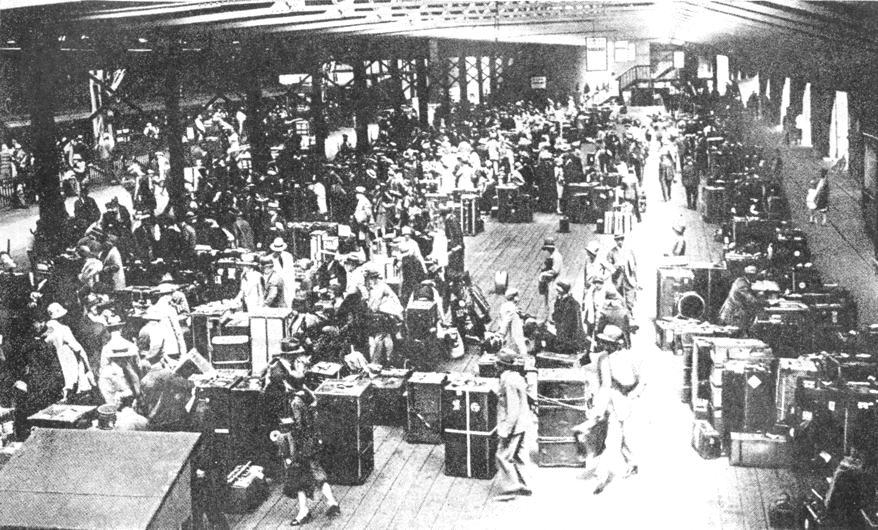
THE DOCKS AT LIVERPOOL
Cunard’s proposal was nothing new to Napier, even though British shipowners were not yet disposed to make more strenuous efforts to secure the Admiralty contract for the carriage of mails to America. As early as 1833 he had engaged in a correspondence with Mr. Patrick Wallace of London regarding the establishment of a steamship service “betwixt Liverpool and New York” and he had foreseen the possibilities with surprising shrewdness. He had even then, in the infancy of the steamship, suggested to Mr. Wallace the system for the management of steamships which is still in use:
I would endeavour to get a very respectable man, and one thoroughly conversant with his business as an engineer. I would appoint this man to be master engineer, his duty being to superintend and direct all the men and operations about the engines and boilers, but to be accountable to the captain for his conduct, namely, to be under the captain. All other men for working the engines should be regular bred tradesmen, and all the firemen boiler-makers. A workshop, with a complete set of tools and duplicates of all the parts of the engines that are most likely to go wrong, should be on board.
He continued:
I would have everything connected with the machinery very strong and of the best materials, it being of the utmost importance to give confidence at first, for should the slightest accident happen so as to prevent the vessel making her passage by steam it would be magnified by the opposition and thus, for a time at least, mar the progress of the Company. But if, on the other hand, the steam vessels are successful in making a few quick trips at first, beating the sailing vessels very decidedly, then you may consider the battle won and the field your own.
Probably not even the companies which dispatched steamers for America five years later, in 1838, had considered the details of the project as closely as Napier had. He alone foresaw the profits to be made in the emigrant trade as well as from cabin-passages, and he estimated every expense of operation, even to a hundred pounds annually for advertising, and a hundred and four pounds for a ship’s doctor. His suggestions were too advanced for the conservative London capitalists, and nothing came of them until Cunard’s inquiry offered him a better opportunity to put them to use.
Napier immediately sent Cunard a favourable reply, and the latter proceeded to Glasgow at once. Their first interview found them in such ready agreement that a contract between them was soon made, and was ratified on March 18, 1839.
The contract provided for the construction of:
Three good and sufficient steamships, each not less than 200 ft. long, keel and fore-rake, not less than 32 ft. broad between paddles, and not less than 21 ft. six inches depth of hold from top of timbers to underside of deck amidships, properly finished in every respect . . . with cabins finished in a neat and comfortable manner for the accommodation of from 60 to 70 passengers or a greater number in case the space will conveniently and commodiously permit thereof; each of which vessels shall be fitted and finished with two steam Engines having cylinders 70 inches in diameter, and 6 ft. 6 inches stroke. . . . The said Robert Napier hereby Binds and Obliges himself . . . to finish and complete, to the entire satisfaction of the said Samuel Cunard, equal in quality of hull and machinery to the steamer Commodore or the steamer London, both constructed by the said Robert Napier, and equal to the City of Glasgow steamer in the finishing of the cabins.
These ships were to be of 960 tons each, 375 horse-power; and were to cost £32,000 each. In a letter to Melvill thanking him for the introduction to Cunard, Napier wrote: “I am of the opinion that Mr. Cunard has got a good contract and that he will make a good thing of it. From the frank and off-hand manner in which he contracted with me I have given him the vessels cheap and I am certain that they will be good and very strong ships.” Frank dealing and strong ships—these always seem to have run through the history of the Cunard Line.
But Cunard was not frank without shrewdness, and the keels of these ships were never laid. While Napier was engaged in completing the engines he was building for the British Queen, Cunard was making good use of his acquaintanceships in London through his friend Mrs. Norton, whose name the gossip of the time connected with that of Lord Melbourne, then Prime Minister. He had come into friendly contact with the members of the Government and he took the opportunity to discuss the mail contract with the Lords of the Admiralty. With his agreement with Napier in his pocket he was able to assure the Government that his ships would be “the finest and best ever built in this country.” Finally, on May 4, 1839, the negotiations resulted in a contract in which he undertook to convey Her Majesty’s mails twice every month from Liverpool to Halifax and return, in three ships of at least three hundred horse-power each; he further agreed to carry mails from Halifax to Boston and, when the St. Lawrence River should be ice-free, from Halifax to Quebec, twice a month in smaller steamers to connect with his transatlantic ships. He also assumed certain fines to be paid in the event of his failure to fulfil the various provisions of the contract, which was to remain in force seven years. The remuneration was to be £55,000 annually.
Here it is interesting to note that the original advertisement issued by the Government had called for tenders for the monthly conveyance of mails between England and Halifax, and also between England and New York via Halifax. Boston had not been mentioned as a western terminus. Cunard was aware that a line between Liverpool and Halifax alone would find difficulty in securing enough passengers and freight to be profitable, as Halifax had not recovered the commercial importance it enjoyed when he was a boy. He had seen and taken part in the rapid development of Boston’s commerce and he perceived in it great opportunities for a steamship service between that port and England. Moreover, the run from England to New York, via Halifax, was a much longer one than to Boston, and this route would place him at a disadvantage in competition with ships which crossed the ocean directly to New York without calling at Halifax. With this in mind he had written in March of that year to shipping friends in Boston, Messrs. Dana, Fenno and Henshaw, outlining his plan to bid for a mail contract between Liverpool and Halifax, with two branch lines of small steamers from Halifax serving Boston and Quebec. This plan had suited the Admiralty as a substitute for service to New York.
The three vessels Cunard had ordered from Robert Napier were just large enough to meet the requirements of the Admiralty, and their total cost of £96,000 just involved the maximum sum for which Cunard felt able to commit himself. The order had served to prove to the Admiralty his good faith and to procure the mail contract before a more powerful competitor could forestall him. Other lines were building larger ships than his, particularly the British and American Steam Navigation Company, which had run the Sirius while awaiting the completion of the British Queen. The same company had also ordered a large ship to be called the President. Now that he had secured the mail contract and averted the danger of having a competitor obtain it in his stead, Cunard was in a position to seek at his leisure additional capital with which to build larger ships than those he had ordered and to render them superior to all potential competitors for the passenger trade.
Robert Napier was in the meantime arriving at the same conclusion through a different process. He had been spending much of his time running all sorts of little steamers between Glasgow and Belfast, standing clad in oilskins in the bows, watching the effect of the waves on the ships. With the same patience through which Fulton had evolved the Clermont, Napier experimented under all sorts of conditions in order to estimate as closely as possible what the contingencies of the Atlantic trade would require of the ships he was to build for Cunard. He finally communicated to Cunard the results of his observations with the recommendation that his steamers should be larger and stronger than his order called for.
This brought Cunard to the next step in the foundation of his line. His order for three ships had made it possible for him to secure the mail contract; now the mail contract should make it possible to raise money to pay for larger ships. The assurance of an annual revenue for seven years of over a quarter of a million dollars from the Government should serve as a much more cogent inducement for capitalists to subscribe to his enterprise than would have been a simple proposal to found a transatlantic steamship service. Yet even now he received little encouragement in London or Liverpool, and again he went to Scotland, this time to raise additional capital. Here once more Napier stepped into the breach and made his plans possible.
In Glasgow Napier had been associated with George Burns, a prominent shipowner who, with his brother James, ran a line of coastwise steamers to Liverpool. In bitter competition with them had been two other Glasgow merchants, David and Charles MacIver, who ran steamships from Liverpool to Glasgow. After many years of rivalry these two lines were merged and a new firm, Burns and MacIver, was founded. Napier suggested to Cunard that if he should offer the MacIvers the Liverpool agency for his line, and the Glasgow agency to the Burns brothers, they might be disposed to invest in his enterprise on a basis of partnership. He arranged a dinner at which Cunard met George Burns and David MacIver to lay his plans before them.
The two Scotsmen were too thoroughly acquainted with the steamship business to ignore the possibilities which lay in a transatlantic line. The mail contract alone seemed, at first glance, sufficiently attractive to warrant their co-operation with Cunard. Yet in it Cunard had bound himself to pay the Admiralty, in addition to the sundry other fines he had undertaken, the sum of five hundred pounds for every twelve hours by which his ships might deviate from their prescribed fortnightly schedule from each side of the ocean. This would mean that an average of only one day’s delay for each sailing during the year would practically cancel all revenue to be derived from the subsidy. The uncertainties which had always characterized the Atlantic crossings, from which even the steamships which had already crossed had not been entirely exempt, rendered such a commitment to unfailing regularity a heavy risk. Moreover, there was no assurance that Cunard’s line would win from the Great Western and British and American steamship companies or from the popular and ever faster sailing-packet lines enough passengers and freight to cover its operating-expenses. It was probably with these very plausible doubts in mind, and in an understandable reluctance to jeopardize the handsome profits Burns and MacIver had been making since their merger in the coastal trade, that MacIver informed Cunard that “the thing would not suit them.” This conclusion to the dinner seemed to end Cunard’s chances to share his financial risk in the enterprise and to enlarge it with fresh capital.
Napier, however, invited the three gentlemen to breakfast the next morning, where they again went over the details of the proposal. There were answers to be made to every objection. The most convincing argument lay in the fame Robert Napier had gained for reliable engines. None were more aware of this than Burns and MacIver. If ships could be built to cross the Atlantic under their own steam, they could cross regularly and on schedule if properly engined. Another telling argument was the fact that America was rapidly expanding westward, uncovering new wealth, starting new industries, and attracting more settlers and travellers from Europe. American produce, rendered by railroads more accessible to the sea-coast, was finding a larger and larger market in Europe. The steamship would not have to wean business away from the sailing-packets; it would create more business of its own. A fast and regular “Atlantic ferry” would both contribute to the growth of American trade and win sure profits for itself. George Burns must have felt the changes which would be wrought by the emergence of a great republic in America, for years later he wrote that his earliest memories “were those connected with the coming of a new century. I cannot exactly describe them, but I felt that a time pregnant with great changes, great events and great inventions lay before us!” Cunard, too, as an apprentice in Boston when he was a boy, had seen these great changes taking place and had come to England with a proposal by which to share in them. Finally he prevailed, and Burns and MacIver “began to see daylight through the scheme.” When finally they agreed to form a partnership, three families were joined in an enterprise which for many years prospered under their control and which has ever since set the pace for Atlantic shipping.
These three which Napier had brought together were particularly well-balanced partners for the business they were undertaking. Cunard’s energy and imagination, his diplomacy, and his personal charm were the first contribution. Burns brought to the combination his Scot shrewdness and solidity, a cautiousness, and a great devotion to detail which ensured their ships against any mishap which was humanly avoidable, and which probably gave the line its reputation for safety through more than ninety years. In America a myth grew up about him that he never allowed a ship to depart without saying a prayer for her safety. He was, in fact, a most devout Presbyterian, his father having been a minister for seventy-two years and his birth-place a part of Glasgow called the “Holy Land” because it was largely inhabited by ministers. The third, David MacIver, had been brought up in the American consulate at Greenock and had early started out as a shipowner. When he died, in 1845, however, his brother Charles continued as partner and Liverpool agent for the line. He brought to the combination a sound knowledge of men, a prodigious energy for business, and a stern discipline which maintained at a high level the morale and efficiency of the personnel. A story is told that once the captain of a Cunard liner asked permission to take his wife to sea with him—a request which was contrary to the usual regulations. MacIver replied that he could take her with him if he wished. The Captain, surprised at his indulgence, arrived with his wife on the day of his ship’s next sailing, only to be handed two first-class tickets for the voyage and to find a new captain on the bridge in his place. Such measures as this were stern, but they served to establish a proud tradition of uncompromising observance of proven rules of conduct.
Imagination, the utmost care for safety, and an inflexible discipline, then, were the qualities which these men brought together in their partnership. The announcement of the enterprise brought forth ample subscriptions of capital from Scots and English merchants who relied on the judgment and integrity of Cunard’s associates. They subscribed £278,800 in shares of £100 each, of which Samuel Cunard took five hundred and fifty, Robert Napier sixty, George Burns fifty-five, James Burns fifty, and the MacIver brothers forty each, the balance being taken up by twenty-seven other investors. The new company was formally named the British and North American Royal Mail Steam Packet Company, but it soon became more popularly known by the less cumbrous title of the Cunard Line.
In the meanwhile Cunard’s letter to Boston had brought flattering results. Upon its receipt the chief merchants and business men of Boston had been called together for a meeting in the old Tremont Bank to discuss the proposed steamship line. They considered the project as of prime potential importance in the development of Boston’s trade, but they were disappointed to learn that Boston would only be served by a branch from Halifax. This meant that passengers and freight to and from Europe would have to be transshipped at extra cost by small steamers at Halifax. A vigorous resolution, drawn up by Francis Crowninshield and signed by the leading citizens, was forwarded to Cunard in London, expressing the hope that he would extend his main line to Boston, making only a call at Halifax. It offered as inducement every co-operation on the part of the merchants and proposed to put at Cunard’s disposal free wharfage on Noddle’s Island, which was just then being connected by a railroad bridge with the mainland and developed as East Boston.
Cunard’s partnership with Burns and MacIver in the British and North American Royal Mail Steam Packet Company created a much larger capital than he had had at his disposal when he ordered the original ships from Napier. The company was now in a position to increase their number from three to four and their specifications to 1,200 gross tons, 2,050 tons displacement, and 420 horse-power. This not only would constitute the only fleet of steamers adequate to maintain a bi-monthly sailing from each side of the ocean, but would also make it possible to extend the regular service via Halifax all the way to Boston. As soon as a new contract had been made with Napier, Cunard returned to London to present this new proposal to the Admiralty. The correspondence he had received from Boston urging him to make this change in plans was ample support for his suggestions for altering the mail contract. He also jocosely offered to settle, for an additional annual subsidy of ten thousand pounds, the pending Northwest Boundary dispute which had been straining the relations between the United States and Great Britain. The Government consented to the extension of the main service to Boston and, in consideration of the larger fleet to be used, increased the remuneration to £60,000. This agreement was signed July 4, 1839.
Cunard left George Burns in Glasgow to oversee the construction of the four liners, and MacIver in Liverpool to arrange for the organization of the British terminus. He himself sailed for New York on the Great Western to organize the Boston and Halifax branches of the company. His mission to England had achieved a more than predictable success and he had laid the foundations of an institution whose name was destined to become during the next ninety years a household word in America. During that period the 5,000 tons of his original fleet were to grow to the formidable figure of 580,000 tons. The same ninety-one years also saw a weak republic of seventeen million people increase, thanks largely to the steamship, into a colossal nation of a hundred and twenty-five million.
How timid and slow, but a few years ago,
The world hobbled on in its motion,
Old Europe seem’d far as the fix’d Northern star,
On the boundless expanse of the ocean;
But though it was hard—at the word of Cunard,
Britannia herself is a rover,
Old England a while, that fast anchor’d Isle,
By steam is now here—half seas over.
Oh dear, think of a scheme, odd though it may seem—
’Tis sure to succeed if you work it by steam.
—Jingle recited at a Cunard festival.
THE YEAR 1840 marked the beginning of the new era for which forty years of experimentation with steamships had prepared. Its harbingers, four “mammoth” wooden steamships, the Britannia, Acadia, Caledonia, and Columbia, all engined by Robert Napier, were launched on the Clyde. Although their hulls were constructed in four different yards, under Napier’s supervision, they were practically identical in size and detail. The first and most famous was the Britannia, built at Glasgow by R. Duncan and Company. Her dimensions were 207 feet on keel, with a beam of 34.2 feet inside the paddle-boxes, and a hold 24 feet 4 inches deep, giving her a gross tonnage of 1,156 and 2,050 tons displacement.
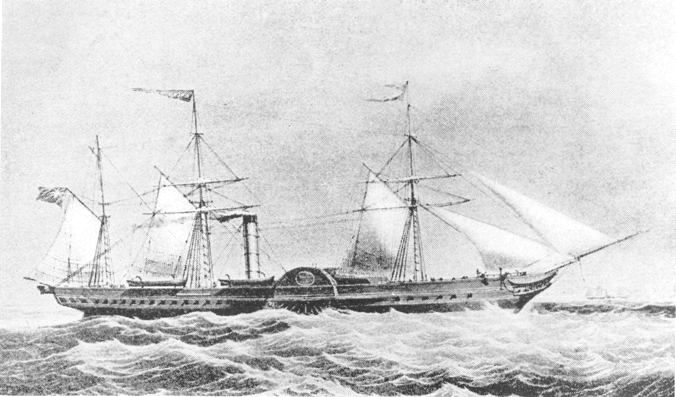
THE Britannia
The engines of the Britannia were constructed on the side-lever principle, then universally accepted, and developed 740 indicated horse-power, capable of driving her at eight and a half knots on a coal consumption of thirty-eight tons a day. She carried three masts rigged fore-and-aft, with two square cross-yards on her fore and main masts.
She was fitted to carry 115 cabin-passengers and 225 tons of cargo. On her upper deck were her officers’ cabins, the galley, a bakery, and—strange to relate—her cow-houses. On the main deck were two dining-saloons and the passengers’ accommodations. Just what these latter were like will be left to Charles Dickens’s account of a voyage on her two years later. Suffice it to say here that she was of a “magnificence” for those days comparable to that of the Aquitania today. And, what was more important, she was equal to the task of conquering by regular uninterrupted service, year after year, the world’s stormiest ocean, which had up till then taken its toll of lives for granted. She was so solidly built that after her engines had been antiquated by her successors, and her furnishings demoded by the effete luxuries of the following decade, she was still sturdy enough to be sold to the Navy of the North German Confederation, in which she served as a crack cruiser. Then even after the German Navy had acquired more powerful engines, her gutted hull survived as a hulk for many years, apparently indestructible.
These four vessels of the Atlantic ferry were preceded to the fame which Boston accorded to their line by a tiny sister, the Unicorn, which the Cunard Company had bought to conduct its St. Lawrence River service. Commanded by Captain Walter Douglas, this little ship of about seven hundred tons “hauled out of the Clarence Dock [Liverpool] into the stream on May 15th, 1840, with 453 tons of coal.” The passengers, numbering twenty-seven, including Mr. Edward Cunard, the son of the founder of the line, went aboard on the 16th, and at noon she rounded the Rock House Lightship. Despite head winds all the way, she arrived at Halifax on June 1. After receiving an enthusiastic ovation and discharging three of her twenty-seven passengers, she proceeded to Boston, where she arrived on the 3rd.
In these days when rapid communication is taken for granted as a perquisite of civilization, it is difficult to understand the frenzied joy with which a steamer hardly larger than our harbour tug-boats was welcomed in Boston after a passage of eighteen days. The cannons fired in East Boston offered so vociferous a greeting that “the handsome painted glass windows of her cabin were broken.” The revenue cutter Hamilton, lying in the harbour, was decked with flags, and her captain went aboard the Unicorn to congratulate Captain Douglas and to see the ship safely into the Cunard wharf, which had been leased free to the line for twenty years. A quaint print of the episode still exists. The artist who drew it must have been either a great friend of the captain of the revenue cutter or else rather uncertain as to the shape and construction of the Unicorn, for it pictures the Hamilton in the foreground, magnificent in bunting, and behind it, half-hidden in smoke, the fore part of the Unicorn.
All over Massachusetts the newspapers carried front pages devoted to the arrival of the Unicorn and the great blessings the Cunard Line was to confer upon Boston. Even the news she brought, always a source of interest to New England merchants, was crowded off many front pages, although there was much of absorbing interest to Boston—the price of American cotton on the Liverpool market, the British side of the Northwest Boundary dispute, and the usual variety of spectacular European war-scares and gruesome murders—items which have fascinated people since the town crier was the source of information.
It would be superfluous here to describe at length the ovations accorded to Captain Douglas and the officers of the Unicorn. Those were times when New England, if she was deeply moved, knew how to celebrate in an expansive and bibulous manner. Boston must have been touched on this occasion, for a history of the city reports that the people were only just recovering from the fêtes in honour of the Unicorn when, about a month later, it reproduced them on a still grander scale to welcome Samuel Cunard when he arrived aboard the Britannia, the first of the regular steamers. Suffice it to say that at the dinner “to celebrate the opening of steam navigation between the Kingdom of Great Britain and this city,” presided over by the Mayor and attended by most of the leading officials and merchants, many antique puns and almost numberless toasts were uttered to be conscientiously preserved for posterity in the local journals. Perhaps the most apposite to quote here is the toast proposed by Edward Everett, one of the nation’s greatest orators: “The Honourable Samuel Cunard—the founder of direct steam navigation between Great Britain and the city of Boston—a wise negotiator—while governments are arguing about the boundaries, he makes a successful incursion with a peaceful force, into the heart of the country.” Following a most graceful speech was the responding toast of the British Consul: “The Unicorn—long considered an apocryphal animal; henceforth an acknowledged type of peace—may the British lion never plant his paw, shake his mane, or lash his tail, in anger, on this friendly soil!” The cordiality which underlay these speeches, perhaps even also the influence of the Cunarders, was instrumental in bringing to a peaceful and, to the United States, a satisfactory liquidation the international quarrel over the contested border of the Oregon Territory. For more than ninety years of peace and mutual respect between England and America the Cunarders have performed the same friendly offices.
Before letting the Unicorn proceed to her service on the St. Lawrence it is interesting to remark that she also ended her days as a warship, the first steam corvette owned by the Portuguese Government. She and the Britannia and the Acadia enjoyed kinder fates in their old age than that which awaits most ships which have outlived their day, and are destined to oblivion in the drudgeries of obscure services.
In the meantime the finishing touches were being applied to the Britannia for her maiden voyage. Every plank and screw in her underwent rigid inspection, every bolt in her engines was tested for flaws, and each detail of her fittings examined to assure their adequacy. The same care has not only been observed, without exception, in the launching of every Cunarder, but it has been repeated each voyage. Even at present, when life-boats are more of an ornament, they are swung out in a practice drill before every departure, to ascertain their fitness in case of emergency. The crews for the four liners were being selected. Seamen who were to have watch duty to perform were tested for colour-blindness so that they might not mistake an iceberg for a particularly large wave. The officers were picked from men of long experience at sea. Mates generally had to have served before as masters of other ships. The later captains had to have served as mates on Cunarders. The engineers were experienced in the profession and their assistants were bred in the trade. In short, the primary injunction of safety was carried out with a thoroughness hitherto unknown to the sea.
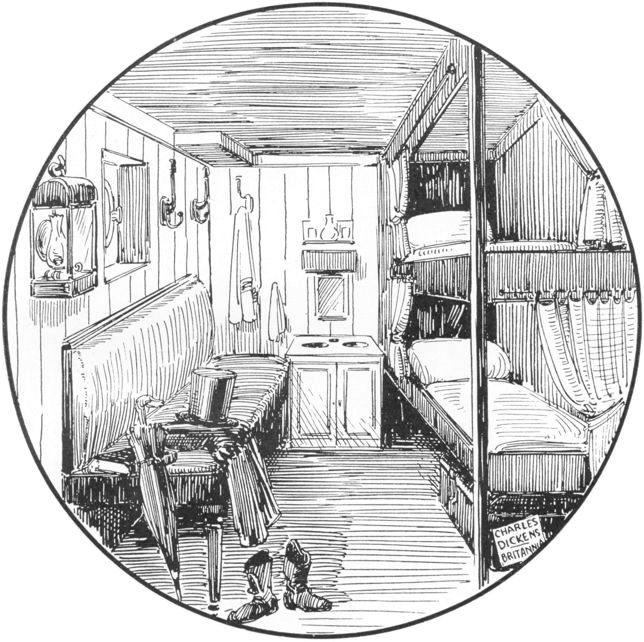
CHARLES DICKENS’S CABIN ON THE Britannia
Some of the instructions issued to Captain Woodruff of the Britannia are illustrative of the responsibilities resting on the master’s shoulders:
The Britannia is now put under your command for Halifax and Boston. It will be understood that you have the direction of everything and person on board. We will class the duties on board under three departments, viz:—
The Sailing: being your own individual duties in particular, and what regards your mates and sailors.
The Engineers and firemen and coal trimmers’ department.
The Stewards’ and Servants’ department.
It will be obvious to you that it is of first importance to the Partners of the Britannia that she attain a character for speed and safety. We trust your vigilance for this; good steering and good look-outs, taking advantage of every slant of wind, and precautions against fire are principal elements.
There followed details as to the management of the ship, and then
The duties earmarked for John McLouchley, the butcher and poulterers, are as follows:—
To take charge of all livestock, and all uncured provisions—taking care and feeding livestock, milking cows, etc., etc.
Messes
Chief—Cabin Table under its particular rules.
Officers’ Mess—Mate, 2nd, 3rd, 1st engineer, chaplain, surgeon, and any respectable 2nd class passenger. Breakfast, 8 o’clock; dinner,—; supper—.
Under this mess, sherry wine, ale and porter, and also spirits, are provided. The quantity used is expected to be moderate, and that the officers in the mess will prevent abuse. The 2nd officer will furnish a list of stores under the above heads; and the mess should fix a quantity per diem to be consumed, and this standard to be conformed to rigidly.
Caterers for Officers’ Mess, 3rd mate, who is expected to see the provisions and spirits served out for the ship, excepting the Cabin department.
Engineers’ Mess—Breakfast, 8 o’clock; dinner—; supper—. Supplies per diem: 1 gill of brandy and 2 bottles of porter, fresh meat and cabin bread.
Ship’s Company’s Mess—Sailors, carpenters, mates and joiners. Breakfast, 8 o’clock; dinner, 12 o’clock; supper, 6 o’clock. Supplies per diem: 2 lbs. of beef and 1½ of pork, 1 pint of flour twice a week, ½ pint of pease twice a week, 2 ozs. of tea per week, 1 lb. of sugar per week, a bottle or two of vinegar per week for the mess, ½ lb. of coffee per week, bread, potatoes and water, as required; not to be wasted. A glass of grog each watch, and as much more as the first officer considers proper.
Firemen and coal trimmers—Same allowance as sailors, the grog additional to be under the chief engineer’s orders.
Servants’ Mess—1 o’clock; after cabin stewards, in the pantry aft.
Cooks, butcher and baker, in their own berths about the same time.
Five cabin stewards, boatswain and carpenter to come immediately after the ship’s officer’s mess.
The official report of the Britannia’s first departure from Liverpool, on July 4, 1840, reads, in part, as follows:
On Friday morning, the R.M.S. Britannia, this new and splendid steamship, the finest of Mr. Cunard’s line of Royal Mail steamers, went into the river from Coburg Dock and came to moorings off Birkenhead. Next afternoon she was ready for sea, her passengers embarking on board a river steamer at the Egrement slip . . . and as soon as the mail bags were ready, proceeded to the Britannia. Every arrangement being completed, shortly after one o’clock she steamed in gallant style down the river and proceeded to sea. . . . The Britannia, which is commanded by Captain Woodruff, R.N., who has had great experience in steam navigation, is expected to reach Halifax on the 20th instant. She takes out sixty-three passengers.
Her departure on the fourth of July was thought to be a good omen for the future of the service to the United States.
Perhaps the most interesting account of the voyage is preserved in the log of a common seaman who shipped on her first trip. It is rare that seamen took the trouble or had education enough to keep a log, but bits of this one give a hint of the behaviour of the Britannia under various conditions and of the extent to which she used her sails. Such entries as “sent up foreyard, fore topgallant yard, yard and the main topmast” are charged with the thrill of a sailing-ship and suggest the boatswain’s whistle sounding on deck through nights and days of making or taking in sail to best advantage. Another entry, however, reports a wind dead ahead; the captain “furled everything, sent down the fore and foretop gallant yards and boused the fore topgallant mast.” The Britannia was, after all, a steamer, and she continued to make her way against contrary winds.
In this decade, when our great liners carry crews of nearly a thousand, the majority of whom are devoted to the comfort of the passengers, and none of whom are engaged in manning the sails, it is interesting to glance back at the composition of the Britannia’s modest crew. Although there is no sure record of it, the following list is probably nearly accurate:
| Captain | 1 |
| Officers | 4 |
| Carpenters | 2 |
| Boatswains | 2 |
| Seamen | 16 |
| Engineers | 6 |
| Firemen | 12 |
| Coal trimmers | 10 |
| Steward for engineers | 1 |
| Boys | 5 |
| Stewards and cooks | 27 |
| Captain’s boy | 1 |
| Doctor | 1 |
| Purser | 1 |
Eighty-nine men on the Britannia’s staff, and sixty-three passengers; and on the Aquitania are three passengers to each member of the crew. Today, when liners offer their passengers suites of rooms decorated in the styles of luxurious periods, when their cuisines produce every delicacy known to epicures, when from the hour of embarkation until arrival at destination the passenger has no concern but to indulge the whims for which the shore does not afford him time, we believe we have reached the epitome of luxury in travel. Yet in the crude days of the cow-house on deck, and the two rough stove-heated saloons below, there was more than one man on the crew to each passenger; men to stoke the engines, men to trim the sails, and twenty-seven cooks and stewards. To cross the ocean at all, with a certainty of arriving in safety on time, was a greater luxury than we can understand.
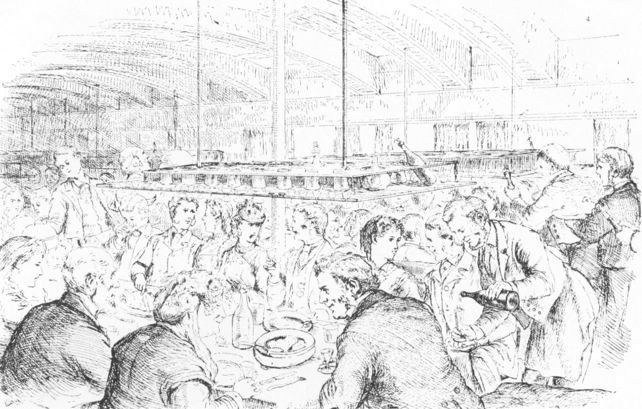
The first day out
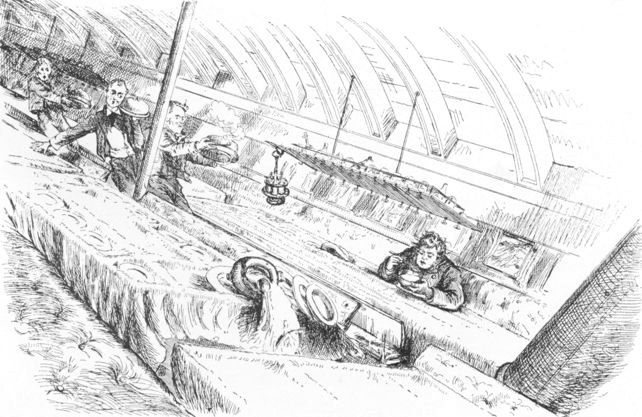
The second day out
OLD-TIME TRAVEL
As to the passengers, though, times have not changed so much. The Britannia’s small list was representative for now as for then—American consuls returning on leave, army officers, merchants travelling on business, and families of substance that had escorted their daughters over to attend French schools. Among them was also Charles Minturn, a New York shipper whose name has recently been recalled to the public in connection with the greatest of Atlantic’s many mysteries. His firm, Woodhull and Minturn, was the one which chartered the Mary Celeste and sent her to Genoa with a cargo of alcohol. She was picked up in mid-Atlantic, in perfect condition, but without a person aboard, dead or alive. Her story has come down to us as proof of the depredations of the phantom Captain Vanderdecken; but in recent years several books, in the rational spirit of our generation, have attempted more logical explanations of the riddle. All of which has harmed the Flying Dutchman’s reputation less than has the steam engine.
Two years later the Britannia had another distinguished passenger—the first stowaway to be discovered on a steamer. He was let off at Halifax, where perhaps his grandsons are now prosperous citizens.
To us who know the security, comfort and luxury of the modern liner and who take these privileges for granted, the steam voyage of ninety years ago seems as unreal and far away as life aboard Noah’s ark or a Roman trireme. In fact because of its very proximity, the near past usually seems more remote than the really ancient. The exploits of Christopher Columbus spring vividly out of books, because the relative similarity of those times with ours seems to belie their antiquity; but the travels of our grandfathers strike us as unbelievably primitive and adventurous.
So for one who has not the habit of re-reading Charles Dickens it is difficult to imagine a voyage on the Britannia. The account of his trip describes the average Atlantic passage as it was known for about two decades. This perhaps justifies a copious use of his narrative in American Notes. About the state-rooms of the Britannia, he writes:
I shall never forget the one-fourth serious and three-fourths comical astonishment with which . . . I opened the door of, and put my head into, a “state-room” on board the Britannia steam-packet. . . .
That this state-room had been specially engaged for “Charles Dickens, Esquire, and Lady,” was rendered sufficiently clear even to my scared intellect by a very small manuscript, announcing the fact, which was pinned on a very flat quilt, covering a very thin mattress, spread like a surgical plaster on a most inaccessible shelf. But that this was the state-room concerning which Charles Dickens, Esquire, and Lady, had held daily and nightly conferences for at least four months preceding: that this could by any possibility be that small snug chamber of the imagination, which Charles Dickens, Esquire, with the spirit of prophecy strong upon him, had always foretold would contain at least one little sofa, and which his lady, with a modest yet most magnificent sense of its limited dimensions, had from the first opined would not hold more than two enormous portmanteaus in some odd corner out of sight (portmanteaus which could now no more be got in at the door, not to say stowed away, than a giraffe could be persuaded or forced into a flower-pot): that this utterly impracticable, thoroughly hopeless, and profoundly preposterous box, . . . in short, could be anything but a pleasant fiction and cheerful jest of the captain’s, invented and put in practice for the better relish and enjoyment of the real state-room presently to be disclosed:—these were truths which I really could not, for the moment, bring my mind at all to bear upon or comprehend. . . .
Before descending into the bowels of the ship, we had passed from the deck into a long narrow apartment, not unlike a gigantic hearse with windows in the sides; having at the upper end a melancholy stove, at which three or four chilly stewards were warming their hands. . . .
We all by common consent agreed that this state-room was the pleasantest and most facetious and capital contrivance possible, and that to have had it one inch larger, would have been quite a disagreeable and deplorable state of things.
So much for the state-room and saloon. These, of course, were the good old times. Then, in contrast with the great mechanical rumble of a modern embarkation, stevedores wheeling on last-minute baggage, silk-hatted roysterers seeing off their friends after farewell parties:
Knots of people stood upon the wharf, gazing with a kind of “dread delight” on the far-famed fast American steamer; and one party of men were “taking in the milk,” or, in other words, getting the cow on board; and another were filling the ice-houses to the very throat with fresh provisions; with butcher’s meat and garden stuff, pale sucking-pigs, calves’ heads in scores, beef, veal, and pork, and poultry out of all proportion; and others were coiling ropes, and busy with oakum yarns; and others were lowering heavy packages into the hold; and the purser’s head was barely visible as it loomed in a state of exquisite perplexity from the midst of a vast pile of passengers’ luggage; and there seemed to be nothing going on anywheres, or uppermost in the mind of anybody, but preparations for this mighty voyage.
Different though this is from the modern leave-taking, Dickens’s account breathes the same air of excitement which always attends the departure of an Atlantic liner. Then he continues to describe the passengers:
. . . who instantly pervade the whole ship, and are to be met with . . . swarming down below with their own baggage, and stumbling over other people’s; disposing themselves comfortably in wrong cabins, and creating a most horrible confusion by having to turn out again; madly bent upon opening locked doors, and on forcing a passage into all kinds of out-of-the-way places where there is no thoroughfare; sending wild stewards, with elfin hair, to and fro upon the breezy decks on unintelligible errands, impossible of execution: and, in short, creating the most extraordinary and bewildering tumult.
Then Captain Hewitt, who had succeeded Captain Woodruff in the command of the Britannia:
What have we here? The captain’s boat! and yonder the captain himself. Now, by all our hopes and wishes, the very man he ought to be! A well-made, tight-built, dapper little fellow; with a ruddy face, which is a letter of invitation to shake him by both hands at once; and with a clear blue, honest eye, that it does one good to see one’s sparkling image in. “Ring the bell!” “Ding, ding, ding!” the very bell is in a hurry. . . . The captain appears on the paddle-box with his speaking trumpet; the officers take their stations; all hands on the alert; . . . the cooks pause in their savoury work, and look out with faces full of interest. . . . Three cheers more: and, as the first one rings upon our ears, the vessel throbs like a strong giant that has just received the breath of life; the two great wheels turn fiercely round for the first time; and the noble ship, with wind and tide astern, breaks proudly through the lashed and foaming water.
The account continues through all of the pleasure of a voyage, and, still more, through the agonies of seasickness, much in the same vein as Mark Twain used, thirty years later, in his sea-going chapters of Innocents Abroad: “The favourite and most coveted seats were invariably those nearest the door.” Then later, as the open sea becomes more boisterous: “Two passengers’ wives (one of them my own) lay already in silent agonies on the sofa; and one lady’s maid (my lady’s) was a mere bundle on the floor, execrating her destiny, and pounding her curl papers among stray boxes. Everything sloped the wrong way: which in itself was an aggravation scarcely to be borne.” Worse and worse, as a storm rises, despite the stability sought in brandy and hard biscuit and the refuge of his bunk:
The water jug is plunging and leaping like a lively dolphin; all the smaller articles are afloat, except my shoes, which are stranded on a carpet bag, high and dry, like a couple of coal-barges. Suddenly I see them spring into the air, and behold the looking-glass, which is nailed to the wall, sticking fast upon the ceiling. At the same time the door entirely disappears, and a new one is opened in the floor. Then I begin to comprehend that the state-room is standing on its head.
And, still worse:
She goes on staggering, heaving, wrestling, leaping, diving, jumping, pitching, throbbing, rolling, and rocking: and going through all these movements, sometimes by turns, and sometimes all together: until one feels disposed to roar for mercy.
But all this, and much more, was surely worse than the usual passage, for after the storm
the life-boat had been crushed by one blow of the sea like a walnut shell; and there it hung dangling in the air: like a mere faggot of crazy boards. The planking of the paddle-boxes had been torn sheer away. The wheels were exposed and bare; and they whirled and dashed their spray about the decks at random. Chimney, white and crusted with salt; topmasts struck; storm-sails set; rigging all knotted, tangled, wet, and drooping: a gloomier picture it would be hard to look upon.
But Dickens does not describe storm and sickness alone. There were also, as there are now, rubbers at cards, “with exemplary gravity,” then “bottles and glasses upon the table,” conversation, affection for the captain (“who never goes to bed and is never out of humour”), and a great eagerness for news. On liners forty times the size of the Britannia, where the terrors of the sea no longer exist, the modern traveller has the same agreeable ways of passing the time.
Perhaps all of this does not properly belong to a history of bridging the Atlantic. Yet in this age, when storms are merely details in the year’s routine, we must recognize as epic such ordeals as Dickens described: “With fifteen thousand Samsons in one bent upon driving her back, and hitting her exactly between the eyes whenever she attempts to advance an inch, . . . with every pulse and artery of her huge body swollen and bursting under this maltreatment, sworn to go on or die,” the Britannia pushed toward her destination and arrived on schedule. In those days they understood the magnificence of her gallantry, for the passengers, in recognition of Captain Hewitt’s good seamanship, to which they owed their lives, subscribed three hundred dollars for a piece of plate which “was presented to Captain John Hewitt, of the Britannia Steamship, by the passengers on board that vessel, in a voyage from Liverpool to Boston in the month of January, 1842, as a slight acknowledgment of his great ability and skill under circumstances of much difficulty and danger and as a public token of their lasting gratitude.” Charles Dickens acted as secretary and treasurer for the presentation of this testimonial gift, which was made, with much éclat, at the Tremont Theatre in Boston. That was Dickens’s first public appearance in the United States—to honour the captain of the ship which had brought him over. On this occasion the credit deserved by the Britannia was broadcast, but it was only by the unrecorded repetition of such feats year after year that her line achieved the distinction of conquering the Atlantic without losing a life.
So much, by violating our chronology, to introduce the Britannia—her crudities, superior though she was to the vessels of her day; her sturdiness, frail though she was by modern standards; and her courage, great enough to set the pace for all the future of navigation.
To return to her maiden voyage, although she did not encounter such savage weather as Dickens describes, it was accomplished against adverse winds most of the way. She arrived at Halifax, nevertheless, on July 17. In commenting upon her captain’s prediction that under better conditions she would make the crossing in still less time, a Halifax paper remarked:
It may be so, but 12 days shall well be considered as a minimum, which is scarcely susceptible of diminution, and of which diminution should scarcely be wished. He who is not satisfied with travelling steadily 255 miles in a natural day scarcely deserves satisfaction.
The worthy editor had “scarcely,” however, foreseen that the Britannia had inaugurated an era in which people not only would wish to travel faster than 255 miles a day but would even be given the means of crossing the ocean at more than double that speed.
After a brief stop at Halifax the Britannia continued to Boston, where she arrived at ten o’clock Saturday evening, July 18. Although it was then a late hour for Boston, the cannonading from Long Wharf, East Boston, and South Boston and the playing of God Save the Queen aboard the frigate in the harbour brought out hundreds of people to cheer her arrival. The following day Samuel Cunard received over eighteen hundred invitations for dinner—a record hardly to be equalled in these lion-hunting days.
In the meantime the citizens of Boston had appointed a Committee to arrange to “welcome the arrival of the Britannia in our waters; and to receive the distinguished projector of an enterprise of so noble a character, in a manner becoming the inhabitants of the Metropolis of New England.” More than 2,300 persons subscribed money for a silver cup to be presented to Samuel Cunard. (This gift, thirty inches high and elaborately embossed with a picture of the Britannia, is believed to be still the largest cup in existence.) On July 21 there was a public procession consisting of thousands of citizens, marching eight abreast, headed by the mayors of the principal New England cities, the foreign consuls and the leading men of Massachusetts. These had gathered “to show to their fellow countrymen and to the world, that they knew how to appreciate the magnitude and importance of the undertaking which was so successfully commenced by that gentleman who, it is well known, is one of the most enterprising and public spirited merchants of today.”
As for the banquet held that day at the Maverick House, it was attended by two thousand people. The Boston Morning Post declared that it was “impossible to give an adequate description of the appearance of the assemblage. . . . It was the first time that ladies had graced, by their presence, a public dinner in Boston; and so novel, gay and beautiful a spectacle they . . . canopied by countless flags and insignia, presented to the eye, has never, it is believed, been previously witnessed in any part of the United States.”
A profusion of verses—of which a sample heads this chapter—was written for the occasion, and there were innumerable toasts and speeches. Daniel Webster himself contributed a more than sufficient number of sonorous phrases. Josiah Quincy proposed a drink to “the memory of Time and Space—famous in their day and generation, they have been annihilated by the steam engine.” At the festival which had been held the month before at Faneuil Hall in honour of the Unicorn’s arrival Mayor Chapman of Boston had toasted “England and America . . . may neither forget that they stand in the interesting relation of mother and daughter!” It had been in the same Hall, sixty-seven years before, that the Boston Tea Party was decided upon. This occasion, however, was in celebration of a new independence for the colonies which had achieved nationhood. The ocean ferry has, in fact, made it possible for our country to win and to populate the rest of our forty-eight states.
Still another toast is apposite: “Cunard’s line of steam-packets—the pendulum of a large clock, which is to tick once a fortnight. The British Government has given fifty thousand pounds for one of the weights, and may the patronage of the public soon add another!” The patronage of the public was, indeed, to add a weight sufficient to make the clock tick eight times faster. In fact, the day following the Britannia’s arrival, the famous preacher Ezra Gannett delivered a sermon of thanksgiving in the Federal Street Meeting House, in which he called the event an illustration “of the power and wisdom of the Creator.” He continued to say:
I confess that no event which has occurred since the commencement of the present century seems to me to have involved more important consequences to this city. . . . With its lines of communication terminating on the one hand on the shores of Europe, and on the other mingling with the waters of the Mississippi, it is impossible that it should not draw to itself a large amount of capital and industry of the most productive kind. . . . It will strengthen the bonds of kind and just consideration between the Eastern and Western continents . . . and we believe that it is fraught with issues of spiritual moment to the whole world.
Recently the bottom of Boston harbour gave up some relics of these early days of the Cunard Line, which are now cherished by those who have obtained them. During dredging operations where the old Cunard slips used to be in East Boston were brought up quantities of porcelain tableware bearing the line’s emblem of a lion holding a globe, and the name of the British and North American Royal Mail Steam Packet Company. They were of such massive weight that there could never have been any question of their loss by breakage, even during such a storm as Dickens describes. But they evidently were not proof against the carelessness of stewards in a hurry to get ashore. In those primitive days the dishes were washed on deck, and the dirty water, containing an occasional cup or two or a plate, was dumped over the side of the vessel. There must have been a long succession of hasty stewards eager to be off from the voyage’s last chores, for the dredge found on the bottom several complete services.
THE Boston Journal for the Monday following the first arrival of the Britannia printed this paragraph:
A gentleman, a firm believer in Mr. Espy’s theory (that the discharge of guns produces rain) by the way, said that he did wish the Britannia would come, as the drought was insufferable, and he had no doubt that the cannonading in honor of her arrival would produce rain. The Britannia arrived on Saturday evening, gunpowder was burned in immense quantities, and it rained merrily yesterday afternoon.
Thereafter not only did the Bostonians look to the arrival of Cunarders as the remedy for drought but they even thought that the sun should regulate its rising and setting by the scheduled voyages of the steamships. And the sun never failed to rise. It must have been about this time, when Boston had four transatlantic steamers to New York’s one, that someone, probably a Bostonian, called Boston “the Hub of the Universe.” Not only was the wish father to the thought, but the Western Railroad, linking Boston with the Hudson River, and the Cunard Line, carrying fast freight to Europe, opened an era in Boston’s commercial history which promised to make her one of the world’s great ports. What the crack stage-coaches and the glorious sailing fleet of Massachusetts had failed to achieve, steam, on land and sea, promised to fulfil.
Now in a generation which takes steamships as much for granted as it does cables and radios and automobiles, it is hard to understand the reverent awe with which every movement of the Cunard ships was noted and admired. One has only to look, however, at the Boston Almanac for the period, or the inaugural speech of Jonathan Chapman, eighth Mayor of Boston, or the daily papers to realize the importance which was attached to the transatlantic steamship service. The fortnightly arrivals and departures of Cunard steamers were occasions for pride and optimism. Even the “fillers” in the daily papers usually contained a note about the liners, just to keep alive Boston’s enthusiasm; for example:
The apparatus on board the Britannia for extinguishing a fire on board that vessel, if unfortunately one should be discovered, is very efficient. By means of large pumps, which may at any moment be worked by the steam engine, an immense volume of water is drawn up from the sea to the deck of the vessel, where it is distributed by means of pipes to any part of the vessel.
This paragraph in the Boston Mercantile Journal was not a paid publicity item. It announced to a seafaring population the news that the terrors of fires at sea, well known to the passengers of sailing-packets, were reduced.
Not only were the reports about the movements of Cunard ships of interest to the population of Boston, but also the news they brought from Europe seemed of great importance to the people of the whole American continent. After the arrival of a steamer extra editions of newspapers would appear, headed “[So many] Days Later News from London.” What the cable is now, the Cunard Line was then. Later, in the fifties, the New York Herald made arrangements with the Cunard ships, which then called at New York, and with the Inman Line, for them to throw off, at Cape Race, a tin watertight canister containing the latest news. This would be picked up by a small boat from shore, and the news telegraphed to the paper. Unfortunately when important news was expected, it was usually too stormy to achieve this operation. Even in those days when the union between the states of the Atlantic coast not only had been firmly knit, but was reaching out into the wealth of the West, America was beginning to understand the place her prodigious growth was to give her in the comity of nations. News and fashions, and new books and their authors, were welcomed from Europe.
The Memorial History of Boston contains interesting comments on the commercial life of the period:
The period from 1840 to 1850 was one of large prosperity for Boston. It was then that the ocean-carrying trade was most active at this port. Here was the controlling market for many articles of foreign production of great importance. . . . The growth of East Boston was so rapid that in 1835 the population had increased to six hundred . . . and the location of the Eastern Railroad terminus at East Boston the next year, the erection of the Maverick House, and the establishment of the Cunard Line to Liverpool in 1840 made the future of the island sure. Its further history merged with that of the city of which it quickly became an important part. . . . The establishment of the Cunard Line, as a swift carrier of mails, passengers and high cost freight, gave impetus and importance to the city.
During the eight years which followed the advent of the Cunard service the foreign trade of Boston more than doubled, the duties collected on imports alone amounting to about five million dollars annually at the end of the decade. Not that this increase was solely due to the steamers, whose carrying capacity was limited, but it indicated a better morale and a self-confidence in the port which was the result, to quote again, “of the energy and public spirit with which its business men pushed the work of railway construction, and of the opening of steam communication with Liverpool by the ships of the Cunard Company.” The duties collected on the cargoes of the steamers was sometimes as high as one hundred thousand dollars the trip. In another work, the History of East Boston, we find a confirmation of this statement:
Probably no one cause has operated more powerfully upon the prosperity of East Boston, and has had such an influence upon the commerce and subsequent growth of the city, as the establishment of the line of British steamers between Liverpool and Boston. The impetus thus given to trade by opening new and important channels of intercourse between the two great nations of the world cannot be overestimated; the benefits received are felt throughout New England and the whole country. An outlet is thus made for our products, and an inlet for imports, indispensable for our use and comforts, which give a healthy and rapidly increasing circulation to our commercial system.
Not only were these statements true of commerce between Massachusetts and England, but it was also through the personal efforts of Samuel Cunard in Washington that the United States and Canada were brought together into the closer contact which has ever since continued. In 1844 Congress passed an act which authorized the transmission, duty-free, of goods from Europe, via Boston, to Canada. The subsequent development of freedom of intercourse between Canada and the United States led to the Reciprocity Treaty of 1854. Although this was eventually abrogated, the mutual confidence it created between the two countries has remained until today as an extraordinary example of international friendliness and co-operation.
The violent winter of 1844 afforded Boston a splendid opportunity to show the sincerity of her affection for the Cunard Line. It had been an arctic winter in Boston, and the harbour was more jammed with ice than it had been in fifty years. Although the water is as salt as in mid-ocean, such weather produced in Boston harbour a seven-foot wall of ice through which even modern ships could not have moved. The tide, which rises twelve feet at four or five miles an hour, lifts surface ice twice every twenty-four hours and deposits it on the previous layer. On February 1 of that year the Britannia was at her dock, scheduled to sail, but between her and open sea were seven miles of heavy ice. Ordinarily such a circumstance would have involved a delay until the passage out should become easier. But the merchants of Boston had written into their credo the doctrine of the infallibility of a Cunard schedule. The Britannia, a quarter of the boast they flung at New York, should not be delayed through any fault of Boston. They appointed a committee, including Benjamin Rich, Caleb Curtis, and Samuel Quincy—names still remembered in Boston—to determine a way to save the situation. The committee decided that the only solution was to raise money for cutting a canal through the ice. When they made known to the city the gravity of the crisis, the citizens promptly agreed that even such an unusual act of Providence should never be permitted to interfere with their beloved steamships, and a large amount of money was immediately subscribed. A contract was made for cutting a canal from East Boston to India Wharf, for fifteen hundred dollars, and another thence to open sea. They began, that day, cutting with ice-ploughs two straight furrows along the channel, seven miles out to sea. From between these, cakes of ice a hundred feet square were hauled up with ropes by horses and squads of fifty men. Finally on February 3, only two days after her scheduled sailing, the Britannia, equipped with iron blades to cut through the new-formed ice, steamed out of the harbour at a seven-knot clip. Throngs of cheering people followed her out along the ice, some in sleighs and some—
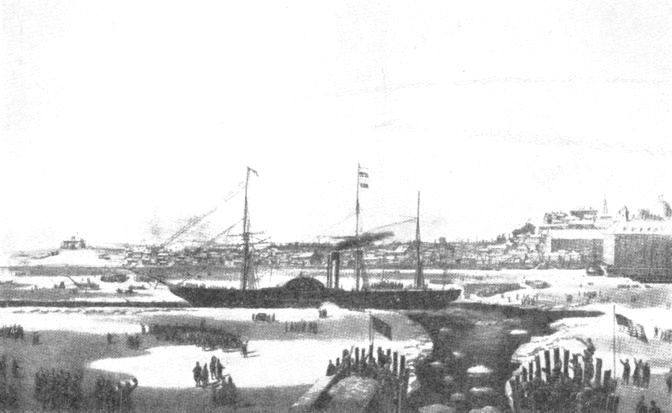
THE Britannia IN THE ICE
in sailing-boats fitted up with long blades of iron, like skates, by means of which they are urged rapidly along by their sails, not only before the wind, but even with a side wind, tacking and beating to windward as if they were in water. The Britannia, released from her bonds, reached Liverpool in fifteen days, so that no alarm had been occasioned by the delay; and when the British Post Office department offered to defray the expense of the ice-channel, the citizens of Boston declined to be reimbursed.
On the day of her release from this embargo, a Mr. King was chatting on the ice with Captain Hewitt, the Britannia’s master. It occurred to him to make a sketch of her course through the canal, and he did so, on a piece of brown wrapping paper, which was all he had at hand. The drawing, which was unusually good, was reproduced as an engraving. New Yorkers sneered at it, however, and remarked that the Cunard Line would have done better to have chosen an ice-free harbour as a terminus. The picture was suppressed by Boston merchants as bad publicity for the port, but it was later reproduced, after having been retouched to show more distinctly the clear water of the ice canal, as an example of Boston’s vigorous enterprise. Copies of the original, which were largely bought up and destroyed, are very rare and have become of great value. In 1857 a similar episode occurred to the America, another Cunarder, which was released in the same way.
The years previous to the Britannia’s escape from the ice had produced the first of the two disasters which the line suffered on the Atlantic route between 1840 and the World War. The Columbia was lost on Seal Island, off the Massachusetts coast. She seems to have taken more than her share of the little bad luck her line has encountered. In 1842 on a westward voyage she broke the shaft of one of her paddle-wheels and had to continue her voyage under sail. Neither the means she had on board nor, strangely enough, any available American engineers were able to repair the damage, and, fitted with extra spars and a large spread of canvas, she was obliged to return to England under sail and the power of one paddle-wheel. She was accompanied part of the way by the Unicorn. The following year, on her passage between Boston and Halifax, with eighty-five passengers, under the guidance of a local pilot, she ran into a thick fog just off the Devil’s Limb (now called Rock Ledge), near Cape Sable. The current, which is exceptionally strong here, drew her towards the rocks, on which she struck. It was possible to take the women ashore, but most of the men remained aboard to assist in a futile attempt to save her. A passing brig responded to her signal-guns and, after standing by a few hours, made for Halifax with the news. Cunard’s reserve steamer, the Margaret, set out at once for the scene of the wreck, with Samuel Cunard aboard. They succeeded in salvaging not only the passengers and mails, which continued to England aboard the Margaret, but also the cargo and movable parts of the ship. This gave New York, which had never regarded the Cunard Line’s service to Boston with much complacency, another opportunity to point to the disadvantages of that route. The New York Herald ascribed the Columbia’s loss to its “four hundred and fifty miles of rock, ledge, shoal, fog, and narrow intricate channels.” The next and only other peace-time loss of the line was to take place by collision off Fire Island, however, to even the score between the rival ports.
In the meantime the partners in the company, Cunard, Burns, and MacIver, had, in August, 1841, signed a new contract with the Admiralty which set the days of sailings between Liverpool, Halifax, Quebec, and Boston for monthly voyages during the four winter months and semimonthly voyages for the rest of the year. This contract stipulated that five, instead of four, steamships of over 400 horse-power should be maintained, as well as at least two vessels not less than 150 horse-power each. As payment for this additional service the subsidy was raised to eighty thousand pounds a year. Finally, the contractors agreed to provide, on nine months’ notice, a sufficient additional number of vessels to double the service if demanded. This was a forecast of the weekly service which was soon to be instituted to include alternate sailings to and from New York.
In consequence of this contract a new steamer, the Hibernia, had been built in 1843 by R. Steele and Son of Greenock and engined by Robert Napier. She was 217 feet long, with a gross tonnage of 1,422, and with accommodations, on two decks, for 110 cabin-passengers. Originally she was bark-rigged, but she later was converted into a brig. Her speed was something over nine knots, and her coal consumption forty-four tons a day. The Hibernia had been put on the service a few weeks before the loss of the Columbia, whose place she then took. She was followed, in 1845, by her sister ship, the Cambria. The latter ship cut the record for crossing between Liverpool and Boston to little more than eleven days, including the call at Halifax. She was dubbed the “flying Cambria” in Boston, and her engines were of such beautiful finish that one paper remarked that “they ought to be put under glass.” Three years later she was to be followed by four larger ships, and in 1850 still two more were added to the fleet.
The four original steamers of the line and those which followed within the same decade had, beyond question, inaugurated a new era in Atlantic shipping. The volume of trade had been multiplied, standards of speed and passenger comfort had increased, the improvement of the communication of news had created a more cosmopolitan state of mind, and the morale of Boston’s commerce had been raised. For all of these things Boston “acknowledged her indebtedness to the foresight and well-directed efforts of the founders of the Cunard Line of steamships.” Nevertheless the actual bulk of trade handled by the steamers was not commensurate with their acknowledged importance in the development of Boston’s shipping. Of the arrivals there from foreign ports, which increased during the forties from a thousand to over three thousand annually, only about twenty were steamers. Although to every steamer which arrived in Boston in 1850 there were a hundred and fifty sailing-ships, the duty of the freights carried each year by the Cunard Line amounted to one million dollars, or about one-fifth of the total duties collected on imports.
These circumstances were conducive to competition with the steamers. Not only was the overwhelming success of Cunarders a demonstration of the profits to be made in rapid transportation, but it also brought to Boston a surplus wealth with which to build up a new fleet of fast vessels. The curious result was, however, that American merchants, who had witnessed the great development of river and coastwise steamers in this country, proceeded to devote their wealth to the improvement of sailing-ships, and the builders, who had seen their fastest creations conclusively outstripped by engined boats, sought to create still faster sailing-vessels. Had the genius and enterprise which went into Massachusetts clipper-ships in the fifties been applied to steamers, perhaps New England would have retained her place on the seas. But the rock-ribbed, conservative merchants of Boston still uneasily felt that there was something “newfangled” about steam. And the great ship-designers and builders of the period satisfied the long-suppressed desire of a salty, practical race for beauty of its own creation. America answered the challenge of steam, which her own Robert Fulton had flung into history, by putting to sea a glorious fleet of towering snowy canvas. This was one of the few truly quixotic gestures in the commercial history of our nation.
IN 1824 a Boston packet-ship, the Emerald, had made the passage from Liverpool in seventeen days, under the command of the famous Captain Fox. She ran all the way before a gale, with her lee rail under water. Her owners, when they learned of her approach to Boston harbour, refused to believe that she had been to Europe and thought she had turned back on account of some mishap. That was phenomenal speed and it encouraged builders, especially those of Baltimore, to attempt to create ships which might more often make similar records. For generations shipbuilders had thought that you could have speed or you could have great capacity in a sailing-ship, but that the two qualities could not be combined. It was a Nova Scotian, Donald McKay, who refuted the theory and launched ships to rival the steamers of his compatriot. In the early forties he was building fast ships at Newburyport, and a few years afterwards he astonished the world with the clipper-ship, a great, fast, square-rigged vessel which, for about ten years, represented in every harbour the mercantile pride of America. The clipper’s hull combined, in form, the “dolphin’s head and the mackerel’s tail”—a principle of ship design which has survived into this century. Its depth of hull afforded capacity and its small resistance to water made for speed.
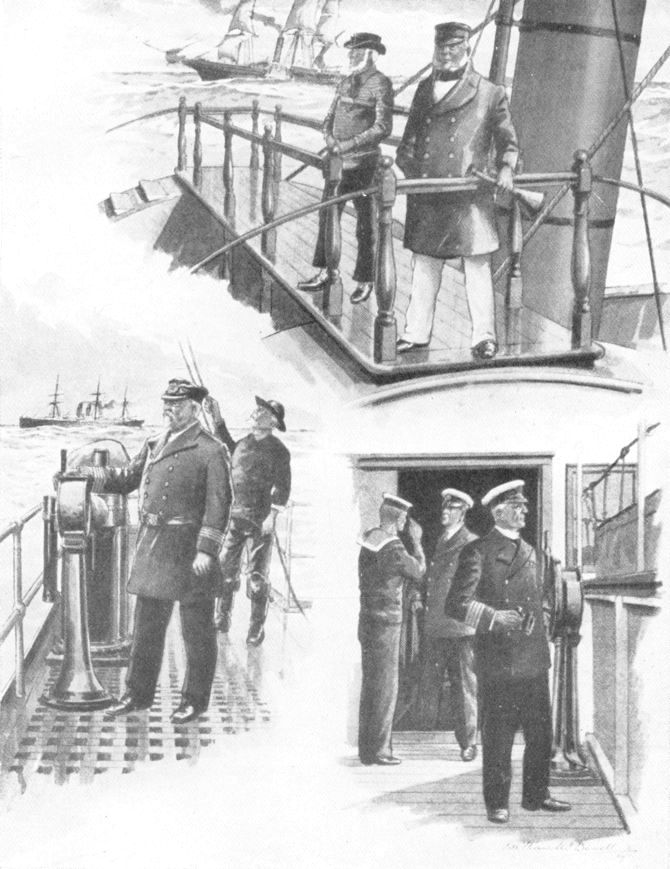
FASHION IN CAPTAINS’ DRESS
McKay’s genius was recognized by Enoch Train, a substantial Boston merchant who had been engaged in the Baltic and South American trades. Train determined to use it to build fast sailing-packets for Liverpool with which to make a bid for the passenger traffic and the profitable fast freight which the Cunard Line was securing. He set up McKay with a shipyard in East Boston and ordered four ships from him. These—to quote his advertisement—“first-class, Medford-built, copper-fastened, coppered and fast sailing-ships” inaugurated, in 1844, his famous Diamond Line. These excellent ships were followed by twelve still faster vessels which, although they never maintained the speed of the early Cunarders, introduced a healthy element of competition. No doubt it was partly through their influence, and the hint of still finer vessels to come, that the Cunard Line ordered four larger and more powerful ships from Robert Napier, to be launched in 1848. This was the beginning of competition in the Atlantic trade, which has vigorously persisted until now, and to which we owe the rapid development of navigation. Until this period few important changes had taken place in shipping for over a hundred years. Merchants and travellers had appeared content with the haphazard service of independent sailing-ships, running without schedule because their irregularities permitted of no schedule, often foundering, with great loss of life and cargo, and generally keeping alive “the terrors of the sea.” Up to this time there had been practically only one great organized fleet of privately owned vessels—that of the British East India Company. But it operated without serious competition, with the result that few or no improvements were made during its history. In the shipping history of the New World there is no evidence that immigrants in the 1830’s suffered much less than did the passengers on the Mayflower.
It was the competition on the North Atlantic, first between sail and steam-packets, and then between rival steamship lines, which produced the modern liner.
While Train’s Diamond Line was making two sailings a month to and from Liverpool, there were two similar lines out of New York to the same port, the Black Ball Line and the Dramatic Line. These alternated their service so as to maintain a weekly schedule, and their speed and excellence retained for them the place of favour in the passenger trade despite the continued operations of the Great Western and, for a short time, of the British Queen. The New York sailing-packets maintained the extraordinary average of about twenty-one days for the voyage. Such speed for sailing-ships meant that, under favourable conditions, they were able to run faster than steamers. During the 1850’s several clipper-ships actually logged well over four hundred nautical miles during a day’s run. It was the chance of light or adverse winds which brought down the average speed of passage and left the steamer consistent winner.
This circumstance led American builders to the conclusion that if they could build sailing-ships whose best speed would beat the steamers, and equip them with engines nearly as powerful as those used by them, they could keep abreast of the steamship’s improvement. The steamers of the period carried a considerable spread of canvas, but their sails were used to steady them and to increase their steaming speed rather than to serve as an important part of their propulsion. The fact that Cunarders maintained a regular schedule regardless of weather demonstrates the subordination of sail. In 1845 the Massachusetts was launched to try to reverse this theory. She was equipped with an engine of 170 horse-power, turning a screw which could be lifted clear of the water when the sailing was good. This principle seemed a plausible means of beating the steamer by retaining the best qualities of the sailing-ship, and it had the advantage of economy in the consumption of coal. But the Massachusetts, like her early predecessor the Savannah, did not prove to be a success, and she was sold to the Government after two trips to Liverpool and finally had her engines removed. The same scheme has been tried over and over again since the invention of steam power and has never been a success. Even before and during the World War auxiliary sailing-ships, equipped with Diesel engines, were tried as competitors of steamers in the freight trade.
The next ship launched to compete with the Cunarders was the Washington, 751 tons gross, with engines indicating 2,000 horse-power. Her cylinders had a ten-foot stroke, and her boilers carried a pressure of thirty pounds. She was launched in 1847 to sail between New York and Bremen, touching at Southampton. Although this vessel is somewhere described as an “elongated three-decker, and about as ugly a specimen of steamship building as has ever been seen,” she was the source of great hope in New York. She was to make her maiden voyage from New York on the same day the Britannia was to leave Boston, and the New York Herald, placing great faith in her comparatively larger size and power, predicted that “if the Britannia beats the Washington over she will have to run by the deep mines, and put in more coal.” Nevertheless, the Cunarder won by two full days. A sister ship to the Washington, the Hermann, followed her, but neither of them fulfilled expectations and they were finally withdrawn as too expensive to run.
There is a still more striking example of the ill fortune attending American steamship ventures during this formative period of the steam traffic. Captain John Codman of Boston arranged to undertake, in connection with a Boston shipping firm, a steamship service to Marseilles and Gibraltar in 1854. The steamer William Penn, an excellent screw ship, was built for the purpose and advertised to sail on a certain date. The project was amply announced in Boston, New York, Philadelphia, and Baltimore papers, and the reputation of the firm which sponsored her was, presumably, an assurance of her success. The rate of passage and freight as advertised was not excessive in view of the speed she offered. Yet not one passenger appeared and not one pound of freight was applied for. The owners were true sportsmen and they filled her with coal as ballast and sent her out as scheduled, even though not a penny was coming in to pay for her voyage. In Marseilles, where she was favourably noticed, she was also unable to book anyone or anything for her return trip. Naturally the service was abandoned, and the owners were spared from serious loss only by the advent of the Crimean War, which offered them an opportunity to charter her profitably to the French Government as a transport. Historians have never provided any explanation for this jinx which pursued American steamers except that the United States had its mind more on other enterprises—on clipper-ships for the Far Eastern trade, on the gold in California, on railroads, and on the approaching Civil War.
Yet even if there is no way to explain the failure of American steam-shipping, the success of the Cunard Line was explainable in the most positive terms. The service possessed certain qualities which were bred into it at Robert Napier’s breakfast-table in the summer of 1839 and which have never abandoned it. Perhaps American travellers avoided the William Penn because newspapers generally were full of notices about “disasters too heartrending to describe” on the river and coastal steamers. For many decades adventurous old ladies bound for Paris would request state-rooms “as far as possible from the boilers,” not because of the heat, but because boilers were thought to be very likely to explode. But the Cunarders which sprang from these dangerous beginnings seemed immune from such mishaps. Napier’s engines not only did not blow up or scald the passengers in steam but got them to their destinations on time. Then, too, there were fogs, collisions, icebergs, and founderings. From these, with the exception of the Columbia’s loss without casualty, the Cunard Line also seemed immune. In the meantime the President, a beautiful ship which was launched on the Thames for the British and American Steam Navigation Company to run in conjunction with the British Queen, had disappeared in 1841, after leaving New York, with 136 persons aboard. The British Queen herself, despite her great cost and the confidence placed in her, failed so signally that her owners were ruined. The Cunard Line prospered. From these examples emerges the paradoxical truth that the company based on the principle of safety and regularity before speed, and on the notion of a substantial working solvency before large profits, led the field in both speed and prosperity. This was due to the rigorous standards of inspection by which Burns kept in touch with every physical detail of his line, to the business acumen of Cunard in the management of its financial affairs, and to the magnificent discipline and esprit de corps which Charles MacIver maintained among his officers and crews.
In Roundabout Papers Thackeray relates an incident illustrative of the matchless precision which built up confidence in the safety of Cunarders:
In a voyage to America, some nine years since, on the seventh or eighth day out from Liverpool, Captain L—— [probably Captain Lott] came to dinner at eight bells as usual, talked a little to the persons right and left of him, and helped the soup with his accustomed politeness. Then he went on deck, and was back in a minute, and operated on the fish, looking rather grave the while.
Then he went on deck again; and this time was absent, it may be, three or five minutes, during which the fish disappeared and the entrées arrived, and the roast beef. Say ten minutes passed—I can’t tell after nine years.
Then L—— came down with a pleased and happy countenance this time, and began carving the sirloin: “We have seen the light,” he said. “Madam, may I help you to a little gravy, or a little horse-radish? or what not?”
I forget the name of the Light; nor does it matter. It was a point off Newfoundland for which he was on the look-out, and so well did the Canada know where she was, that, between soup and beef, the captain had sighted the headland by which his course was lying.
And so through storm and darkness, through fog and midnight, the ship had pursued her steady way over the pathless ocean and roaring seas so surely that the officers who sailed her knew her place within a minute or two, and guided us with a wonderful providence safe on our way. Since the noble Cunard Company has run its ships, but one accident, and that through the error of a pilot, has happened on the line.
By this little incident (hourly of course repeated, and trivial to all sea-going people) I own I was immensely moved, and never can think of it but with a heart full of thanks and awe. We trust our lives to these seamen and how nobly they fulfil their trust! They are, under heaven, as a providence for us. Whilst we sleep, their untiring watchfulness keeps guard over us. All night through that bell sounds at its season and tells how our sentinels defend us.
Perhaps Captain Lott’s sole fault was the lack of humour he betrayed on an occasion when, one Sunday aboard the Asia, which he was commanding, he was quite nettled by a sermon a thoughtless clergyman preached on the text “Remember Lot’s wife.” He was, however, one of the personalities whose name was always associated with the Cunard Line and whose reputation for seamanship established one of the traditions which generations of Cunard captains were to inherit.
Another famous master of the line was Commodore Judkins, whose reputation both for geniality and for unbending sternness grew into a sort of myth, and whose seamanship made his name one to conjure with on both sides of the Atlantic. “He was feared, loved, tolerated, respected and admired,” remarks an old passenger.
One of George Burns’s favourite anecdotes was about Captain Cook, who commanded no less than twenty-four Cunard ships, and whom he describes as “the very type of skillful captain with ‘a nerve of cold blast steel:’ ”
One day he was taking his noon observations, when a cloud interrupted his vision; a passenger coming up said: “Captain Cook, I’m afraid that cloud has prevented you from making your observation.” “Yes, sir,” replied the potentate of the sea, “but it did not hinder you from making yours.”
But the captains of steamers during this period had more to do than to build up reputations for gruff seamanly wit. In those days, when tempests were more serious matters than they are now, when the huge waves of the Atlantic might strike and crush the little wooden steamers, four of which might have been accommodated on the boat deck of the Aquitania, when the seas were not patrolled for icebergs, when trade-routes were not defined, and when the ships had no means of communication with land or with each other, a captain’s job required him to be a hero. These names of masters which come down to us in anecdotes were those of men who endured every hardship, carrying great burdens of responsibility on their shoulders. In a storm the captain’s duties were not delegated to others. He had himself lashed to a stanchion, exposed to the elements, his protecting canvas often whipped to shreds by the gale. This was his post, night and day, until the danger was passed. No wonder that the courage and judgment of such officers won the affection of America, and that the vessels they commanded established a standard of service by which Boston and New York measured and criticized, without envy, their own enterprises.
Although these early American steamship ventures failed, the clipper-ships in the transatlantic packet service were reaching their apogee. Until that time the merchants had owned their own ships and used them to speculate on cargoes they bought in one port to sell in another. Clippers were too expensive for merchants to tie up their capital in, and in consequence shipowning became a separate business, which depended for its revenue on money paid for the carriage of passengers and cargo. This led to the establishment of definite routes instead of random sailings wherever goods were to be bought or sold.
The discovery of gold in California in 1848 and the rush which resulted in the following year created a demand for fast vessels. Thousands of people had beat their way overland to the west coast or chartered ships to take them round the Horn. They settled in a wild country which as yet produced no staple foodstuffs. Prices on goods from the East rose until flour was worth forty-four dollars a barrel, and eggs which had been at sea four months or more fetched ten dollars a dozen. This had a double effect on the Atlantic trade: it produced the clipper, which for another decade was to share the traffic with the steamers; and it diverted the mercantile energies of the United States away from a concentrated effort to retain its share of shipping with Europe. This may appear a contradiction, but the economic history of the period bears it out: Had the sporadic attempts at steam navigation already mentioned been given time to produce more successful ones, New York and Boston might have staked their future in powered vessels. But the Gold Rush called forth the best efforts of builders of clipper-ships. There was no time to experiment with steam.
Partly under this frantic impulsion westward, the size of the sailing-ship was multiplied, within the brief space of very few years, from about five hundred tons to two thousand and upwards. Her speed too was enormously increased. The first result was that, until the glut of 1851 in California when prices dropped to next to nothing, the steamers had a clear field in the Atlantic. The second was that the genius which, under normal circumstances, might have gone into the development of ocean steamships had produced, instead, such fast sailing-vessels that when the California trade was spoiled, a surplus of sailing-packets was on hand to carry on the growing transatlantic commerce.
It was due to this, rather than to any inequalities in the bases of competition arising out of the British subsidy to the Cunard Line, that the United States failed to establish a successful steam service. The politics which led up to the Civil War and which followed it delayed to a still greater degree the construction of an up-to-date American merchant marine. The Cunard Line and its competitors in steam navigation performed for the United States a service which American merchants were not in a position to undertake for themselves.
As we have seen, the clipper-ships, which were placed in the Atlantic packet trade after the deflation in California, had reached the maximum of perfection in sailing-ships. One of the most famous of them plying between New York and Liverpool, the Dreadnought, commanded by Captain Samuel Samuels, made several passages in less than fourteen days. She was called the “wild boat of the Atlantic” and was famed for her “ship sense.” One story about her relates that Captain Samuels, towards the end of a homeward voyage, in impenetrable fog, remarked to a passenger: “I guess we must be thar or tharabouts.” At that moment was felt the gentle shock of the ship nosing in alongside her dock. The Dramatic Line from New York and Train’s Diamond Line from Boston maintained services barely inferior to that of the Cunard Line. But they were the best that sail had to offer, while steam, with its wings thoroughly tried, was making new improvements.
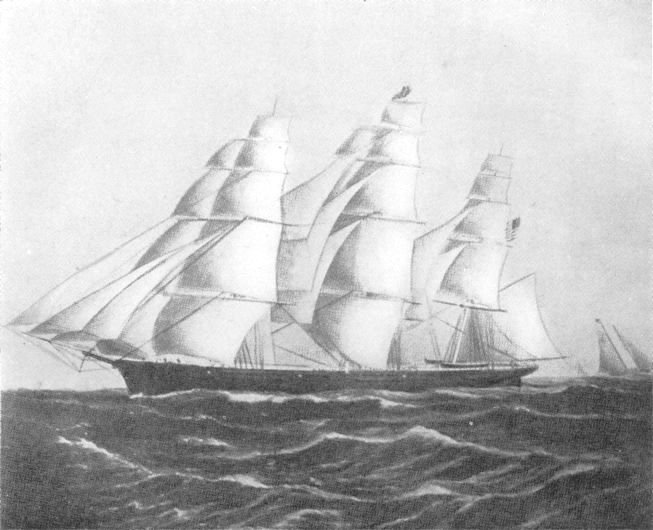
THE CLIPPER Westward Ho
In the meantime New York had enjoyed a mercantile growth, thanks to her river and rail communications inland, which marked it beyond question as America’s greatest seaport. Boston was growing rich too, partly as the result of the new manufacturing industries growing up around her and the profits she made by the transshipment of goods from Europe to Canada. But it was clear that the Cunard Company, if it was to retain its leadership on the Atlantic and to develop along the lines its success was marking, had to extend its service to New York. The partners therefore took advantage of the clause in the Admiralty contract of 1841 which provided for the eventuality of a weekly service, and proposed to double its fleet to make weekly sailings from Liverpool, alternately for Boston and New York. When news of this new negotiation in 1846 became known in Great Britain, the Great Western Steamship Company made a strenuous effort to secure for itself the New York mails. It caused petitions, signed by merchants of Bristol and Birmingham, to be forwarded to the Chancellor of the Exchequer, Sir Robert Peel, urging the consideration of the company’s claims for a share in the subsidy. One of the arguments raised in support of this was the benefits which competition would bring to the service. Mr. Miles in the House of Commons introduced the motion that the record of the Cunard service be investigated and the bid of the Great Western Company be favourably considered. The Chancellor replied that “he felt that that gentleman [Mr. Cunard] was the ablest person with whom the Government could have contracted for the conveyance of H.M. mails, but he was by no means opposed to the appointment of a committee which would afford the House of Commons an opportunity of inquiring into the whole circumstances.” Such a committee was appointed, with the result that not only was the monopoly granted to the Cunard Line amply vindicated but it was also shown that there had not, since the inauguration of the service, been a single breach of the company’s contract with the Admiralty, and not one of the numerous fines provided had been levied. Moreover, the service provided by the company had exceeded the requirements of the mail contract, and this without the application of the “benefits of competition” by rival steam-packets. Cunard’s reasoning before the committee was found unanswerable, despite the patronage enjoyed by the competing bidders, and a new contract was made in July, 1846. This provided for sailings for Boston and Halifax and for New York on alternate Saturdays. In consideration of this increased service the subsidy was raised to £145,000 annually. This was to be effective January 1, 1848, and to continue for ten years.
This arrangement was received in England with general approval and the confidence “that the community at large with many private friends will join in rejoicing at the successful issue of this select inquiry and in the hope that Mr. Cunard should be permitted to enjoy for many years the fruits of his energetic enterprise, the contract for which with the Government is certain to be carried out by him to the full letter, as he had invariably acted in every other most honourably.” In recognition Samuel Cunard was made a Fellow of the Royal Geographical Society. On this side of the ocean emotions were mixed. Boston held the line in such esteem that its disappointment in sharing with New York the advantages of its service was balanced with a generous pleasure in its success. New York, however, greeted the news with unbounded delight. She foresaw the enormous importance such a steam service would have in the development of foreign trade, on which rests a large measure of her wealth today.
Although substantially of the same type, the four new ships ordered of Robert Napier were superior in size, power, and accommodation to the six which had already been built for the line. The hulls of the America, Canada, and Niagara, built by Robert Steele, and of the Europa, built by John Wood, were practically identical—1,825 tons gross; length, keel and fore-rake, 251 feet. The engines indicated about 2,000 horse-power, giving them an average speed of 10.5 knots.
It was the Hibernia, however, which inaugurated the New York service, continuing down from Boston in December, 1847. New York showed its appreciation of the importance the Cunard Line was to have in its commercial development by a reception given at the Exchange to Captain Ryrie to introduce him to the leading merchants and business men. Among the speeches of congratulation and felicitation delivered under the chairmanship of Mr. Griswold, himself a prominent shipowner, was one extolling the “skill and science” by which the Cunard Line had deserved its success. The speaker went on to proclaim the service “the commencement of a new era in steam navigation.” The New York Herald listed this as one of the important world events of the year. It did, in fact, more than fulfil the prediction that it would “redound to the credit, as well as the interest, of all engaged, and tend to the promotion of commercial intercourse between the two nations.”
IN 1849 American enterprise made its one brilliant effort to retain the cream of the Atlantic trade for its own ships. This notable exception to the general apathy with which American merchants had watched the ascendency of steamers produced one of the most sensational chapters in the history of mercantile rivalries. Although it ended in a spectacular collapse, the brief but daring career of the Collins Line of New York was to play an important part in the acceleration of steamship improvement. It is interesting to note that the chief of its founders, Mr. E. K. Collins of New York, was the owner of the famous Dramatic Line of sailing-packets to Liverpool. That he should have chosen steamers “to sweep the Cunarders off the Atlantic” was indicative of the fact that some Americans, at least, realized that the clipper-ship, which was just then being evolved, was destined to cast an only transitory effulgence over American shipping. It finally was understood that the future of the Atlantic trade lay in the directions marked out by the Cunard’s success, and it was determined either to capture this success or, at least, to share in it.
Consequently the United States Government was persuaded to reverse its traditional opposition to subsidies and to award a mail contract to a company pledged decisively to exceed the best speeds of the Cunard ships. It was to be a fair and open fight to the finish, ship for ship, subsidy for subsidy. The Collins Line undertook to build five (later changed to four) steamships which were to make twenty round voyages a year between New York and Liverpool, carrying American mails. It was to receive $19,250 per voyage for the service. The great expense of building these ships, however, each of which cost $700,000, induced the Government, upon the urgent recommendations of Senator Bayard of New York, to raise the subsidy to $858,000 per year for fortnightly voyages, on condition that they should maintain a better average speed than anything afloat. This was a greater sum than the Cunard Line was receiving for a weekly service from Liverpool, but popular enthusiasm in our mercantile cities justified it. The Cunard service was still beloved in both Boston and New York, but perhaps Americans were influenced by the impulsion which makes those who live by the sea and watch passing vessels long to own some as beautiful.
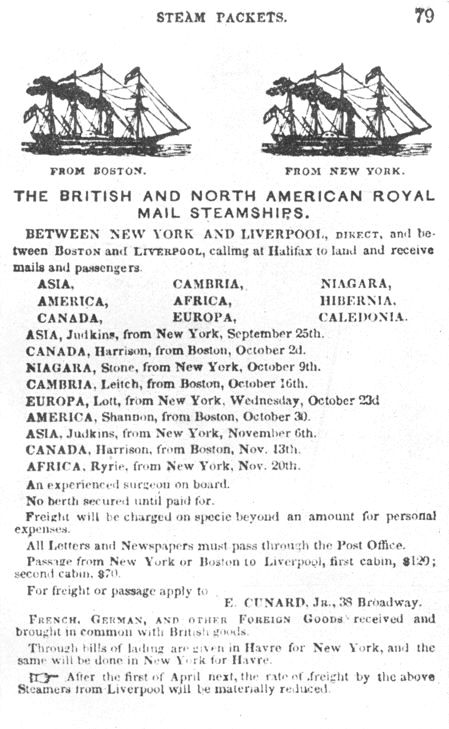
AN EARLY CUNARD ADVERTISEMENT
The following is the text in the poster above.
| FROM BOSTON. | FROM NEW YORK. |
THE BRITISH AND NORTH AMERICAN ROYAL MAIL STEAMSHIPS.
BETWEEN NEW YORK AND LIVERPOOL, direct, and between Boston and Liverpool, calling at Halifax to land and receive mails and passengers.
| ASIA, | CAMBRIA, | NIAGARA, |
| AMERICA, | AFRICA, | HIBERNIA, |
| CANADA, | EUROPA, | CALEDONIA. |
ASIA, Judkins, from New York, September 25th.
CANADA, Harrison, from Boston, October 2d.
NIAGARA, Stone, from New York, October 9th.
CAMBRIA, Leitch, from Boston, October 16th.
EUROPA, Lott, from New York, Wednesday, October 23d.
AMERICA, Shannon, from Boston, October 30th.
ASIA, Judkins, from New York, November 6th.
CANADA, Harrison, from Boston, Nov. 13th.
AFRICA, Ryrie, from New York, Nov. 20th.
An experienced surgeon on board.
No berth secured until paid for.
Freight will be charged on specie beyond an amount for personal expenses.
All Letters and Newspapers must pass through the Post Office.
Passage from New York or Boston to Liverpool, first cabin, $129; second cabin, $70.
For freight or passage apply to
E CUNARD, Jr., 38 Broadway.
French, German, and other Foreign Goods received and brought in common with British goods.
Through Bills of Lading are given in Havre for New York, and the same will be done in New York for Havre.
☞ After the first of April next, the rate of freight by the above Steamers from Liverpool will be materially reduced.
The Collins ships were not only as beautiful but faster and more luxurious. Conceived in a great wave of enthusiasm, born of the resourcefulness which had made American river steamers the finest in the world, and suckled by the Treasury, the pioneer vessels of the Collins Line were raised in the stocks of Brown’s shipyard in New York. They were designed by George Steers, the architect of the famous yacht America. The engines, built by Novelty and Allair Companies, were designed by a government engineer, Mr. Faron, who had studied the construction of Napier’s engines and devised ways to increase the power of the same side-lever type. The result was the launching of four magnificent wooden ships, the Arctic, Baltic, Atlantic, and Pacific, each with a length of about 282 feet, gross tonnage of 2,800, and indicated horse-power of 2,000. They were the first steamers with straight stems instead of clipper bows. Their fittings, including such innovations as electric bell service to state-rooms, and steam-heat, embodied the “elegance” which, in American river steamers, had been the wonder and envy of tourists from Europe. In short they were fully worthy of the pride with which New York gave the first of them, the Atlantic, her send-off in 1849. At first these new ships did not beat the record of eleven days and three hours by which the Europa had humbled her running-mate, the Cambria. But eventually, although the Europa bettered her own record, the Pacific took her laurels from her, only to be again beaten by her sister ship, the Arctic. From this time on, the fastest passages were made by the Collins ships without a single Cunard victory to even the contest.
No doubt it was a shock to the partners in the Cunard Line to find ships on the ocean which beat its service as decisively as did the Collins Line. Not only were the speed and luxury of these new competitors superior but their freight rates were decidedly lower than those charged until then by steamers. Such a surprise, indeed, was so startling that MacIver, Burns, and Cunard might easily have been disconcerted into a radical change in policy to combat it. But the Cunard Line met the crisis as it has met the many more which have followed it—by continuing to improve its ships and service without compromising them by nervous emergency measures. In fact the more than ninety years of its history show its consistently conservative progress, evidently indifferent to the triumphs or failures of its competitors. Since the launching of the Britannia there have been few exceptions to the steady, arithmetical progression by which nearly each new Cunarder became an improvement upon its predecessor without any attempt at sensational departure into untried innovations.
Such phlegmatic progress did not match, however, the brilliant performances of the Collins Line. These new ships secured and held for several years the records for Atlantic crossings. American travellers, in the pride of their line’s success represented by the Arctic’s run from Liverpool of nine days thirteen and a half hours, give it fifty per cent more patronage than the Cunard Line received. The competition, in which the Cunarders were playing a losing part, aroused extraordinary interest on both sides of the ocean. Bets were made on the passages of rival ships, newspapers ventured guesses as to the outcome, comic publications were filled with references to the races being run. Even the English Punch published a doggerel verse at the expense of the Cunard Line:
A steamer of the Collins Line,
A Yankee Doodle Notion,
Has also quickest cut the brine
Across the Atlantic Ocean.
And British agents, no way slow,
Her merits to discover,
Have been and bought her—just to tow
The Cunard packets over.
Whether or not the competing ships of both lines consciously raced each other has remained a matter of controversy, which American writers have attempted to establish in the affirmative, while the British have denied it. It is on record that the Cunard Company emphasized safety above speed in its instructions to officers, while the Collins Line was expressly committed to maintaining records for the crossing. Popular enthusiasm in the United States fed the faction in Congress which backed the Collins subsidy and exerted a pressure for speed, ignoring all other factors which enter into the maintenance of a successful service. It is true that the Collins vessels strained their splendid engines beyond endurance, and at the end of many voyages frantic and expensive repairs were conducted, in strict secrecy, to prepare their overtaxed ships for the next trip. It is also asserted that similar measures were taken to maintain the Cunarders in abnormal racing trim. But if this was so—and it has never been proven—the pushing of the engines was done in the face of express directions forbidding it. In support of the contention that the Cunard Line did not race is the fact that the steamers which had been in commission before the appearance of the Collins Line did not appreciably improve upon their previous records.
The managing partners of the Cunard Line determined, however, to strengthen its service by building two new ships to replace the Britannia and Acadia, which it had sold to the Navy of the Confederation of German States in 1848. The Asia and the Africa were ordered from Steele’s shipyards at Greenock and were put into the service in 1850. They were somewhat larger and more powerful than the four ships which had preceded them, with a gross tonnage of over 2,200 and a length of 266 feet. Their indicated horse-power of 2,400 was greater than that of the four original Collins steamers, but their best speed of twelve and a half knots was still inferior to that of their American competitors. In fact they were about fourteen hours slower.
Intense as was the competition for the supremacy of the Atlantic, encouraged by national pride, though restrained, presumably, by the conservatism of the Cunard partners, it was characterized by a fine sportsmanship. Several incidents bore witness to the mutual respect by which have been dignified decades of friendly rivalry and minor squabbles between the United States and Great Britain. Circumstances often arose in which one rival might have taken advantage of the other, yet on no occasion did either fail to “play cricket,” as goes the English phrase. One instance of chivalry to the credit of the Collins Line occurred when a Cunard steamer was seized in New York harbour for an alleged infraction of the customs laws on the part of some of the crew. She could not be released until a bond of $150,000 had been put up. It was the agents for the Collins Line who stood security for this sum, setting the Cunarder free to run on schedule against her Collins rival.
An article in the New York Herald on the reception of the news that the Atlantic, which had been long overdue, was safe, illustrates the interest and emotion with which the general public followed the movements of liners:
By the arrival of the steamship Africa at this port, on Saturday, the 14th, we received the most welcome and gratifying intelligence that it has ever been our pleasure to lay before our readers, namely, the safety of the steamship Atlantic. We congratulate our readers and the community at large on the receipt of this welcome intelligence. . . . Now, having made this joyful announcement, let us describe, if we can, the sensation which the arrival of the Africa, and the expectation of her bringing intelligence of the Atlantic, created in New York and vicinity. No sooner were her guns heard in the city, than hundreds, and we may say thousands, of our citizens rushed to the Battery and to all the docks on the North River from the depot of the Collins Line to Castle Garden, to ascertain whether the Atlantic had been heard from. They were tantalized by the reports of the Africa’s guns, as they were fired, one after another, for upwards of an hour. “It must be that the Africa brings good news of the Atlantic, or she would not fire so many guns,” said the multitude. At length when the Africa got within hailing distance, one of the officers ascended the paddle-box and with his trumpet announced, “The Atlantic is safe; she has put back into Cork with a broken shaft.” . . . A shout of rejoicing at once went up which made the welkin ring, which was continued for several minutes. . . . “The Atlantic is safe” was announced from the stages of the different theatres. The performances were temporarily suspended in those places of amusement by the cheering which ensued. . . . Every man, woman and child in our great metropolis went to bed last night with a “Thank God” on their lips that the Atlantic was safe.
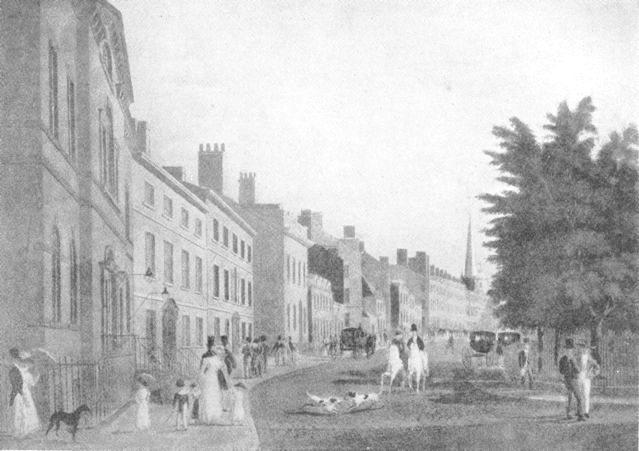
THE BROADWAY SITE OF THE PRESENT CUNARD BUILDING
Such joy sprang not only from relief at the news that the ship’s passengers and cargo were safe, but also from a great pride in the Collins steamers, with which New York was winning her place on the ocean.
The Cunard Line was managed with vigour, which resulted in the construction of still better ships in answer to the challenge. Two larger steamers were ordered from Steele in 1851. The first was to have been named the Arabia, but she was bought on the stocks by the Royal West India Mail Steam Company to replace their ship the Amazon, which had been lost by fire on her maiden voyage. The name, consequently, was passed on to the second of these new ships, which was put into the Cunard service in 1852. The company determined to try her out before ordering another one like her to take the place of her sister ship. She was built of wood, 285 feet long, with a beam of 40 feet 8 inches, and a gross tonnage of 2,402. Unlike all of her predecessors, except the Canada, she was rigged as a brig, and she carried two funnels instead of one. Her lines were exceptionally fine in order to give her as much speed as possible, and her engines indicated 3,250 horse-power, with the result that she was able to make fifteen knots in calm water. But in a head sea the machinery proved too much for her hull, she buried herself in the water, and her speed was cut down to an average of thirteen knots or less. Moreover, her consumption of 120 tons of coal a day, as compared with 76 burned by the Asia and Africa, involved high operating cost to the company with a relatively small additional advantage. She was the last Cunarder to be built of wood.
The Arabia won a popular place in the Atlantic passenger trade, however, for her appointments evidently represented the height of Victorian ideas of sumptuous comfort, judging by the fatuous description which appeared in an American publication:
Her figure-head is an Arab chief in a warlike attitude. Her promenade deck extends the whole length of the vessel. Her internal arrangements are similar to those of the other vessels of the Cunard fleet, convenience and comfort being the prime considerations. Beneath the upper deck are saloons, stewards’ pantry, etc., and between this pantry and the saloon are placed two well-appointed libraries. The saloon is capable of accommodating 160 persons at dining. As she has no mizzen-mast, the saloon forms an unbroken apartment. The ceiling blends oak leaves with green and gold and white alternately. In the upholstery crimson hangings have been adopted. The sofas are covered with Utrecht crimson velvet and the floor is laid with a rich tapestry carpet. The stern lights of the saloon are filled with stained glass, depicting groups of camels and other Oriental scenes, while the opposite end of the saloon is decorated with plate glass mirrors in elegantly wrought frames. The entire apartments are heated by steam-pipes traversing the floors, and the temperature can be regulated at pleasure. The gentlemen’s retiring saloon is panelled with bird’s-eye maple, and curtained and carpeted as is the saloon. The ladies’ boudoir is of satin-wood, exquisitely carved in arabesques. A velvet carpet is laid on the floor, and the panels are adorned with paintings on glass, delineating scenes in the East, some of which are very beautiful. The sleeping apartments are hung with Tournay curtains and the floors are laid with Brussels carpets. The Arabia has the largest and most powerful engines ever put into a ship, and the ease and facility with which they work is a marked feature in their performance. Altogether the Arabia is a thoroughly built and beautifully arranged vessel, and adds another to those models of naval skill and taste which now traverse the Atlantic. How great the contrast which a few years have wrought in the navigation of the world; and what accessions to human progress the inventions and discoveries of the last half century have produced! What shall limit the developments of the future!
Apparently the writer’s only reservation of unqualified approval was regarding the pictures painted on glass. Just how horrible may have been the Oriental scenes which were not then considered “very beautiful” must be left to conjecture. But the account implies that even then steamships were matching luxuries with the best hotels. Probably the splendours of the old Astor House, with the exception of the bar, were no more impressive.
During the early fifties the competition between the Cunard and Collins lines was strenuously carried on, and with dangerous weapons. The Collins Line maintained a slight superficial advantage in speed and in the number of passengers carried eastward. But this was secured at a ruinous cost, which courted eventual disaster. It had built four ships at a fabulous price; it ran these ships on the ocean under forced draughts, involving huge expenses for repairs after each voyage; it maintained a maximum speed through all kinds of weather; and it reduced to almost half the prevailing freight rates on fine goods, although passenger fares from New York on both lines remained at $130 for first cabin and $75 for second. The Collins Line enjoyed a much larger subsidy, but this by no means assured it permanent solvency under these conditions. Any serious accident might destroy an enterprise which worked on so small a margin of reserve strength. Two such accidents occurred within eighteen months of each other.
The Cunard Line began in 1848 to advertise that its vessels carried “a clear white light at the masthead, green on starboard bow, red on port bow, thus reducing the risk of collision.” This now universal practice was not generally adopted, however, and steam whistles had not been invented; in foggy weather it was thought sufficient to have a man tooting a tin horn on the forecastle. Nor had Lieutenant Maury, of the United States Navy, yet proposed his schemes of prescribed steamship lanes for traffic running either way. The result was that a fleet of transatlantic vessels devoted exclusively to speed at all costs was bound to come to grief.
One of the great tragedies of Atlantic shipping was the loss of the Arctic of the Collins Line. In September, 1854, lost in a dense fog, she was rammed by the French steamship Vesta. Thinking that the small French vessel was in danger, the Arctic launched a life-boat to save those aboard her, but the Vesta was kept afloat by her collision bulkheads. In the meantime the Arctic, in unsuspected danger, began to sink. Lack of discipline among her crew added to the confusion caused by the loss of several of her boats in the gale. Only two of them, in fact, got safely off and survived, with fourteen passengers and thirty-four of her crew. A raft also had been hastily constructed before the Arctic went under, and seventy-two persons sought refuge on it. But during the day and a half it drifted all but one man had been swept off it and drowned. The total loss of life was 322, among them many wealthy American passengers, including the wife, son, and daughter of Mr. E. K. Collins. This catastrophe produced in New York a consternation proportionate to the jubilation described in the article quoted from the New York Herald.
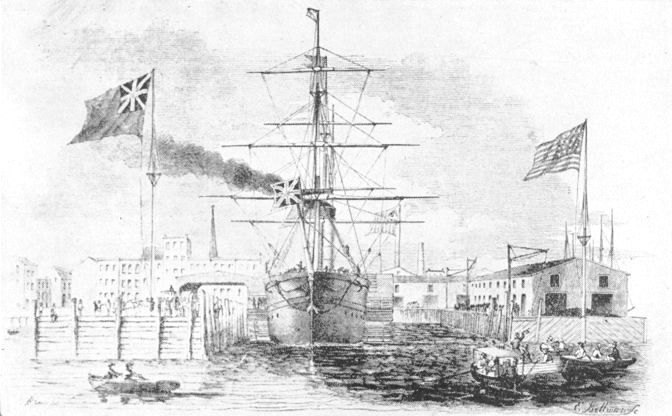
THE JERSEY CITY DOCKS
England and America had not recovered from the shock caused by this incident when the Pacific, also of the Collins Line, sailed out of Liverpool in January, 1856, with 45 passengers and a crew of 114, and was never seen again. What happened is only a matter of conjecture, but the Persia, a new Cunarder crossing at that time, reported that she had encountered an iceberg. Speeding night and day to restore her line’s prestige, the Pacific may possibly have struck the same iceberg and foundered.
The Arctic’s loss made a lasting impression on the travelling public and produced some needed improvements in measures of safety. Steam whistles were introduced for use in foggy weather; the United States Government issued regulations requiring all vessels to carry the system of lights practised by the Cunard Line; and Lieutenant Maury’s proposal of trade-lanes for vessels bound in either direction, a variation of which had been already put into use by the Cunard steamers, was generally accepted, by order of the American Government.
The United States subsidy to the Collins Line was reduced by more than half, to $385,000, and was eventually withdrawn altogether, partly as an evidence of doubt in the advantages of the service, partly as the result of sectional jealousies. American politics have always represented a certain degree of conflict between the maritime and industrial states and the agricultural sections of the interior. In this case the rivalries of other Atlantic ports were also a factor. This was especially true during the decade which preceded the Civil War. The line, nevertheless, bravely attempted to recover its place on the Atlantic, but it was too late. The reckless improvidence of the management had already plunged it into financial difficulties, which the loss of two ships had not caused, but aggravated. Charles MacIver described the situation in a letter to Cunard with the remark: “The Collins people are pretty much in the situation of finding that breaking our windows with sovereigns, though very fine fun, is too costly to keep on.” By the time they produced the Adriatic, in 1857, at a cost of $1,200,000, the financial ineptitudes of the company had lost its cause beyond recovery, and, although she was far superior to her predecessors, she was not equal to Cunard’s new iron ship, the Persia. In January, 1858, the Collins Line collapsed, after a magnificent attempt to win the supremacy of the Atlantic.
The chapter in steamship competition which closed with the discontinuance of the Collins Line and the sale of the Adriatic to the Galway Line was, perhaps, the supreme test of the doctrines on which Cunard had built his success. The rules laid down for the safety of his ships were proved the classics of maritime precautions by the line’s relative immunity from loss of ships. And, as an American writer of the time points out, in connection with the financial wisdom which characterized the Cunard Line:
Solvency is in the ideas and mechanism of the Englishman. The Crystal Palace is not considered honest until it pays;—no matter how much convenience, beauty or éclat, it must be self-supporting. They are contented with slow steamers, as long as they know that swifter boats lose money. They proceed logically by the double method of labor and thrift.
This goes to the root of the question of ship subsidies. Such an enormous bounty as the United States Government offered the Collins Line bred the irresponsibility which led it to disaster. Had the latter, on the other hand, planned a service which should be self-supporting from the beginning, the subsidy would have served as a sort of reserve to cover any losses which might have occurred, rather than as the be-all and end-all of the enterprise.
New construction by the Cunard Line to exceed anything afloat in “convenience, beauty or éclat” was justified by profits. In 1856 it put on the Atlantic route a steamer which exceeded the splendours of the Adriatic. The Persia embodied the lessons which the Arabia’s excellent but inadequate performance had pointed. Wooden ships, she had demonstrated, could not be made strong enough to carry much more powerful machinery. The structural difficulties rendered increased wooden tonnage liable to being shaken apart by the power which marine engines were developing. Iron hulls, on the other hand, had been tested out in smaller boats and found satisfactory, despite the popular prejudice to the effect that “it was contrary to nature” to expect iron to float. This construction material not only was capable of more strength for large ships, but was cheaper and more durable, and permitted of much larger cargo space than had wooden ships of similar size. This much did the Cunard Line ascertain from its experiences with four iron steamers it had bought to run to the Mediterranean as a “feeder” for the Atlantic trade. Consequently, “never experimenting, but always ready to adopt any improvements thoroughly tested by others; avoiding equally extravagance and parsimony”—to quote another American commentator—the Cunard Company ordered from Robert Napier its first great iron liner, the Persia. This marked the second epoch in the evolution from the first steamers to the modern liners.
With a tonnage of 3,300 and a length of 376 feet, beam of 45 feet 3 inches, she was the largest ship then on the Atlantic and had the most magnificent appointments afloat. She could carry 250 first-class passengers. Her engines, having two cylinders 100 inches in diameter, eight boilers and forty furnaces, were capable of driving her at a consistent speed of nearly fourteen knots. This vessel recaptured the blue ribbon for speed by making the voyage in the summer of 1856, under the command of the famous Commodore Judkins, in less than nine days and five hours.
In 1853, again at the request of envious British merchants, another select committee was appointed to investigate for the House of Commons the Cunard Line’s performance of the mail contract. The result was that the committee reported to Parliament:
This line of packets has of late years had to contend against serious foreign competition. We find that the vessels employed in the line are much more powerful, and, of course, more costly than is required by the terms of the contract. The service has been performed with great regularity, speed, and certainty—the average length of passage, from Liverpool to New York, being 12 days, 1 hour, 14 minutes.
The success of the Persia, three years after this statement was made, not only further justified the praise, but proved that the line’s initiative had far surpassed the requirements imposed in the mail contract under which it was operating. She enjoys the distinction of being the only vessel whose plans were ever admitted to the Royal Academy for exhibition.
While the Cunard and Collins ships sailing between New York and Liverpool had retained the interest of two continents and improved oceanic transportation beyond all prediction, other lines had quietly entered the service and, with one exception, quietly disappeared. The success of the Cunard Company had tempted others to try to match it, with lines from New York to France and Germany. The extension of railways to the south and west, the importance of the Erie Canal in the carriage of exportable goods from the Great Lakes, and the great shipbuilding industry in New York all raised the maritime ambitions of that city. It hoped to create a steam mercantile marine not only to carry American commerce but to profit by the repeal of the British Navigation Laws which had prohibited the transshipment of British goods by foreign vessels.
The Ocean Steam Navigation Company, whose ships to Bremen, via Cowes, the Washington and the Hermann, have already been described, had received a subsidy of $400,000 a year to carry mails. But despite their great expense and their enormous consumption of coal, they had rather more rolled than steamed their way back and forth, and the enterprise, as well as the subsidy, had been discontinued.
The New York and Havre Steam Navigation Company, another American enterprise, enjoying a large government subsidy, had commenced service to France, touching at Southampton, but after four years of operation it lost both of its original ships within a year—with the loss, thanks to excellent seamanship, of only one life. These two vessels were replaced by two more, chartered from the New York to Charleston service. But this line shared the ill fate, or ill management, which ruined all of these subsidized American attempts to reconquer the Atlantic. After the line collapsed, one of the chartered ships became historic as the Nashville, which served in turn in the Collins service to replace the unfortunate Arctic, as a Confederate blockade-runner during the Civil War, and as the Confederate privateer, Rattlesnake, which was finally destroyed by a Federal monitor.
Another, more successful, American steamer was built by Commodore Cornelius Vanderbilt, with which he hoped “to beat everything afloat.” In 1855 the Vanderbilt was put on the New York to Havre route, calling at Southampton, and did, in fact, take the record away from the Collins Line, only to be beaten by the Persia. When the Civil War broke out, however, the old gentleman abandoned his hobby of entering the Atlantic trade and made a present of her to the United States Government to be fitted as a cruiser especially to chase the corsair Alabama. After the war she was converted into the famous sailing-ship the Three Brothers, and finally she became a coal-hulk at Gibraltar, where, it is said, she still exists today.
In 1850, however, was founded a famous line of steamers which was to take an important place in Atlantic shipping and which later took up the abandoned sailings of the Collins Line and for many years ran the Cunard Line a close race. This was the Inman Line, running between Liverpool and Philadelphia at first, then changing to New York in 1857. Composed of iron screw steamers designed especially for the emigrant trade, this enterprise marked the way to a new era in steamship history by demonstrating the profits to be made in this business. It was followed, in 1856, by the Anchor Line, which took a share in the same trade.
In the meantime the Cunard service to Boston was continuing with the success already noted. Boston’s foreign trade had mounted to its peak about 1857 and the tonnage locally owned reached over half a million. But the only serious attempt to establish a competing line of steamers was the incorporation of the Boston and European Steamship Company in 1855 with a capital of $500,000. This enterprise included Donald McKay, of clipper-ship fame, and Enoch Train, the owner of the Diamond Line of packets. Both had finally perceived the vast difference between sailing and steam vessels. The collapse of the Collins Line of New York, however, discouraged the enterprise before any steamers were actually built from the models McKay had made.
FIVE years after Charles Dickens’s crossing on the Britannia Ralph Waldo Emerson embarked for Europe on the sailing-packet Washington Irving. Then sailing-vessels were still popular among travellers—of necessity, as there were only five Cunarders and the Great Western on the Atlantic. If what appealed to Dickens about the voyage was a sense of adventure, a pride in the novel power of steam, a congenial admiration for the captain, and a humorous appreciation of the life he shared with his fellow-passengers—rather than the pleasure afforded by the accommodations assigned to him and his lady—Emerson was still less enthusiastic about his experience at sea. He wrote:
I find life at sea an acquired taste, like that for tomatoes and olives. The floor of your room is sloped at an angle of twenty or thirty degrees and I waked every morning with the belief that someone was tipping my berth. Nobody likes being treated ignominiously, upset, rolled over, suffocated with bilge, mephitis and stewing oil—the wonder is always that any sane man can be a sailor.
What Dickens wrote was hardly more encouraging to novelists who thought of travelling than this paragraph of Emerson’s was to philosophers with a thirst for adventure on an Atlantic packet-ship. But only five years after he wrote it, four Collins steamers and seven new Cunarders were plying the sea. The last of these was the Arabia, whose magnificence has already been described. The period between 1840 and 1852, had, in fact, not only settled the superiority of the steamer over the sailing-vessel in the cabin-passenger service but raised travelling comfort above the standards of living prevailing on shore. When Dickens first crossed to America sanitation and ventilation on land were generally so bad that disease was more deadly than war. In England the average length of life among the gentry and professional classes was only about forty-four years, and that of the labouring class under twenty-five. By 1852 steamship cabin accommodations were so much improved that travellers who could afford $130 for a passage were probably safer from death by disease during their fortnight at sea than they would have been on land. But the opposite was true of the emigrants who took steerage passage on the sailing-vessels, which carried practically all those who came to America during the 1840’s. Conditions were such that only the most daring—or the most desperate—would brave them to go to a new and strange country.
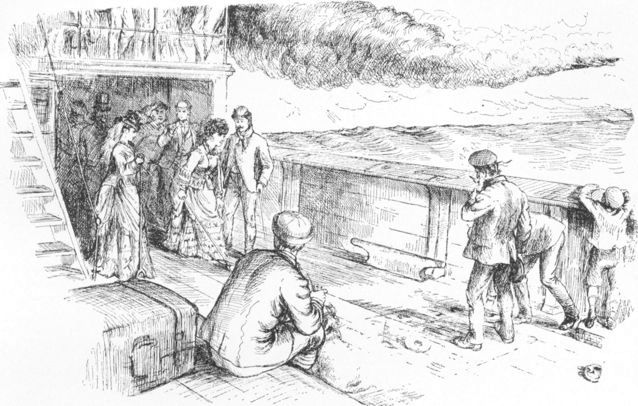
Shuffle-Board
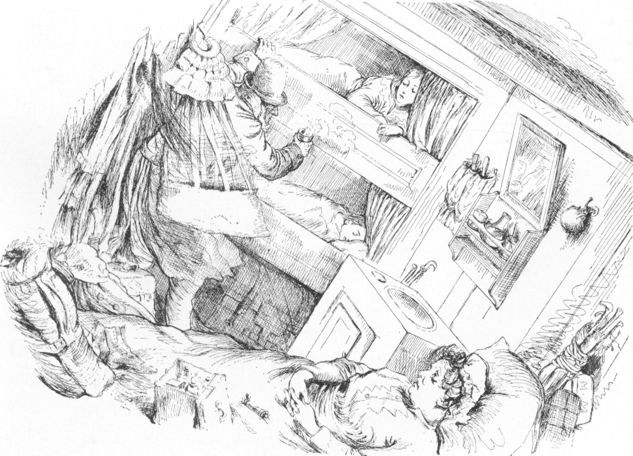
A Gale
OLD-TIME TRAVEL
Their quarters were usually three tiers of bunks, fitted into the eight feet of semi-darkness between the ship’s decks and her beams; and between the bunks ran an alleyway, perhaps a yard wide, to serve as thoroughfare and storage space. The ship provided only water and fire, for cooking, so that the emigrant’s dunnage had to include, as well as a miscellany of household articles with which to start life in America, provisions for the uncertain weeks of the voyage. (They were probably largely rice, salt pork, and hard-tack.) Hundreds of miserable souls were crowded into such quarters, stifling with stench in good weather, nearly intolerable when bad weather required the hatches to be battened down. Emerson’s discomfort was only a hint of the horrors of steerage, when huge waves would tumble whole villages out of their bunks, roll them in the staggering darkness, fling them into heaps, and bruise out all hope and cheer. Then wholesale death was more than possible. The ship might founder, or, while she beat her way against adverse winds, cholera or typhus might wipe out hundreds of her emigrant passengers. In fact sometimes more than 350 deaths would be reported by vessels arriving at New York within the space of six weeks. It was on such a ship that Andrew Carnegie spent seven weeks on his voyage to America as an immigrant in 1848.
Yet in Europe factory production was driving handicraftsmen to destitution, while failing crops and growing populations were bringing whole agricultural communities to the verge of starvation. And in America new wealth was being uncovered faster than pioneers were bred to develop it, new lands were found ready for the plough before there were farmers to till them, railroads were charting better communications westward before there were men to lay the ties, to supply the passengers and freight and to turn the raw materials from the West into manufactured products in the East. During the 1850’s 2,800,000 people emigrated, willy-nilly, from the Old World into the New. Millions more wished to come, and millions more were needed to add their brawn and brains to a small nation with a vast domain. The chief deterrent to the men who had the initiative to throw off the miseries of their native heaths was the greater horror and danger with which the Atlantic threatened them and their families.
The pressure of this movement—which was to become the greatest migration in the history of the world—played nearly as important a rôle in the history of the Cunard Line as did the competition with the Collins ships, or the subsidy for the mail service, or its popularity among globe-trotters. This momentous period determined whether the New World was to remain the economic colony of the Old, a warehouse of wasting wealth, or whether the United States was to rise up as a great self-contained power, if not, as John Fitch predicted, the “most popular empire on the earth.” The same decade marked a turning-point in the history of steam-shipping. Although the Cunard Line began as a carrier of cabin-passengers, mails, and fast freight, and is still among the foremost in the same business, it owes a large part of its success to the profitable conveyance of steerage passengers who were to become new man-power for American production, new initiators of American enterprise, and new citizens of the United States. Between 1840 and 1900 18,347,437 immigrants were conveyed to this country—a number greater than the total population of the United States at the beginning of that period.
Here again it is true that Cunarders did not carry the bulk of the immigrants which were to work this metamorphosis, any more than that they carried the bulk of Boston’s growing commerce during the forties and fifties. But they shared with the Inman ships the distinction of rendering emigration from Europe sufficiently safe and tolerable to quadruple, in fifty years, the numbers of immigrants to America. There was little connection between the sailing-vessel and the prairie wagon which pushed our frontier westward. But the railroad, which converted the new West into a source of wealth for the industrial East, and the steamship, which brought human material to where it was needed, and carried exports to where they found markets, bore a reciprocal relationship of the highest importance. American-owned shipping declined because overland expansions provided more fruitful uses for capital and energy. It was left chiefly to British enterprise, motivated by the restless pressures in Europe, to supply the overseas complement. In Boston the Cunard Line had become, during the forties, almost a household institution. During the decades to follow it became stamped with a national economic character.
The doctrines which, until the World War, had declared America’s hospitality towards social, economic, and political refugees from Europe are too familiar to require review. The factors which made America the “land of hope” for the European peasant and craftsman reduce themselves to simple terms of agricultural and industrial expansion which threw open to farmers fertile free lands in the West, and to unskilled labour almost unlimited employment in the East. It was only after our present forty-eight states were each established and populated that the development of the United States ceased to depend upon immigration.
The reasons that Europe supplied a stream of competent and sturdy people in answer to our needs were more various. The industrial revolution had so disturbed the economic structures of Great Britain and Germany that the situation of great masses of the population became intolerable. Production was not yet adjusted to the changes wrought by the shifts of manufacturing industries from the localities which had possessed skilled craftsmen to new locations near sources of water-power and coal. In Ireland, which supplied the largest numbers of immigrants during the forties and fifties, and in Germany, which was second, the introduction of farm machinery and the concentration of land-holdings had raised the prices of land and lowered farm wages until the increasing peasantries were brought near to starvation. In addition to these factors was the potato famine in Ireland, resulting from several wet years which destroyed the crops of the peasants’ principal staple food. The political disabilities imposed upon Catholics aggravated these circumstances in Ireland, by shutting off means of legislative relief. In Germany the suppression of the liberal movement, culminating in the revolution of 1848, added political motives for a mass exodus to those resulting from the agrarian distress.
These were the chief economic and political forces which produced millions of destitute or discontented people. The steamship, which directly offered them the means of migration, also indirectly provided the psychological impetus which gave them common direction towards the New World. One has only to compare the newspapers of the 1850’s with those of twenty years before to understand the influence of rapid oceanic communication upon the mentality of the average citizen. More space was given to events three thousand miles away. The nearness of other nations shattered the parochial interests of the city dweller, gave him a thirst for news, and developed a curiosity which made him a potential traveller. Weekly newspapers became daily, reporting and editing were made to conform to the tastes and interests which improved communications had built up, and news of the world became accessible at a nominal price. Telegraphs, railroads, and low uniform mail rates were spreading this enlarged consciousness from community to community (with such effect that in 1861 both Germany and Italy became unified national states). Every unit became merged into a larger one. Steamships, without doubt, influenced newspapers, and newspapers, in turn, played a great part in the development of steamships. The dissemination of news and of a comprehension of the opportunities afforded by the growing hospitable republic in America swelled the migration westward. This movement could not reach its full tide, however, until certain changes in steamship construction were realized and applied to the Atlantic ferry.
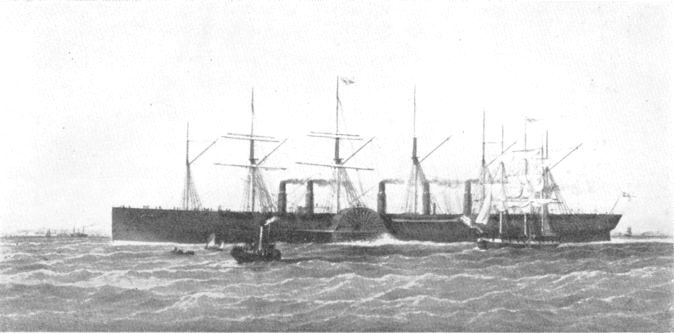
THE Great Eastern
In his correspondence with Mr. Wallace in 1833 regarding the possible establishment of a steamship line from Liverpool to New York, Robert Napier had pointed out the possibility of revenue to be derived from the conveyance of emigrants, who were then only starting to flow westward in large numbers. His suggestions in the matter are interesting now for their foresight, but they were premature. When the Cunard Line was established and for the next ten years the transatlantic service was conducted by wooden paddle-wheelers. Their cargo space was limited by the great size of their engines, and their consumption of coal was so high that the carriage of steerage passengers would not have been profitable. Even the Persia, the first iron side-wheeler on the express service, was said to consume six tons of coal for every ton of freight carried. Cabin-passengers and shippers of valuable merchandise could afford to pay for such service; emigrants could not.
The introduction of the screw propeller in iron vessels was the factor which finally established the superiority of the steamship over the sailing-ship for the steerage trade, by reducing the costs of operation and increasing the available space between decks. Both American and European pioneers in steam navigation had long since been interested in this method of propulsion, including John Fitch. John Stevens had built a screw vessel in 1804, which was followed by further experiments conducted in Great Britain by a Swede named Ericsson and a Mr. F. P. Smith. The latter finally produced the Archimedes, which, in 1839, established the commercial practicability of the device. Among the testimonials he received from witnesses of this ship’s performances are two interesting letters, one from Robert Napier and one from Captain Edward C. Miller, who had been appointed to command the Cunarder Arcadia, soon to sail. Both of them agreed that “the principle of the invention was perfect,” and Napier pointed out that the great noise and vibration of the screw were the results of remediable mechanical defects. Yet the device was more significant to naval officials, because of its relative invulnerability from hits by cannon during warfare, than it was to passenger enterprises, and Napier did not follow up his interest in it. Had the Cunard Line adopted this means of propulsion before it was much improved, it might not have enjoyed such early success and popularity.
The early steam competitor of the Cunard Company, the Great Western Steam Ship Company, had the services of a brilliant and daring engineer, I. K. Brunel, the designer of the Great Western. He followed this success with another steamer, the Great Britain, which was ready for the Atlantic service in 1845. She had a length of 322 feet and a gross tonnage of nearly 3,000—the largest vessel then afloat. On account of her size she was built of iron and divided into six watertight bulkheads. She carried the extraordinary rig of six masts, which were named, technical names for them being lacking, after the days of the week, omitting Sunday—there was no Sunday at sea in those days of constant labour aloft in the rigging. Although originally designed as a paddler she was completed as a screw ship as the result of the success of the Archimedes.
This daring innovation in Atlantic steamships ran on the Bristol to New York route in conjunction with the Great Western, but she was stranded, after a year’s service, and sold by her owners at a quarter of her cost. During her career, however, she proved a good ship, with a speed about equal to that of her paddle-wheel running-mate. On one occasion she broke two of the six blades in her propeller and was obliged to proceed under sail, by which she made better progress than she usually did under steam. Her place in history is as the forerunner of the iron screw liner, but not as the conclusive proof of the superiority of propeller over paddle. The partners in the Cunard Company were never the first to adopt untried devices, but never slow to improve their vessels to the full extent of verified engineering science.
Charles MacIver who, at the death of his brother, David, had become one of the managing partners, represented a progressive tendency which was the happy complement of the conservatism of his other two colleagues. None of them were men to “count their chickens before they were hatched,” but MacIver has been quoted as saying: “Kill your chickens when young.” The iron screw steamer was not to become a tough bird for the Cunard Line to digest. In 1849 he ordered, on his own responsibility, the first such vessel to be fitted with the red funnel of his company. She was a small boat, the British Queen, built to take advantage of the repeal of the British Navigation Laws by carrying French goods from Havre to be transshipped on the liners to America. This was the beginning of a service which included French ports in the company’s activities. Three years later he also sponsored a still more important addition to the Cunard enterprise by building four iron screw steamers for trade between Liverpool and the Mediterranean and the Black Sea—the Teneriffe, Taurus, Karnac, and Melita. Although originally his own vessels, they were incorporated in the Cunard fleet in 1853 and were followed, within a few years, by twenty-one more vessels of the same type. These were intended as feeders for the Atlantic service, but they soon became an important department of the company on their own merits.
The fifties were a decade of extraordinary extension of shipping by the Cunard Line. Besides the new vessels already mentioned, three small steamers were added, the Delta, Alpha, and Beta, to carry British mails from Halifax to Bermuda and St. Thomas. This was the foundation of the West Indian service which replaced the sailing-ships of S. Cunard and Company of Halifax and which recently has been resumed for winter excursions.
The effect of these ramifications upon the line’s Atlantic trade were several. In the first place they insured the enterprise against the seasonal financial fluctuations in the express North Atlantic business. In the second place they proved the economies and other advantages of the iron screw steamers. Third, they led to the construction, in 1852, of two screw ships specially fitted for the carriage of immigrants as well as of cabin-passengers. And, finally, the enlarged fleet carried the company over a crisis, resulting from the Crimean War, which might have disrupted the regular unbroken service the line had conducted between England and America.
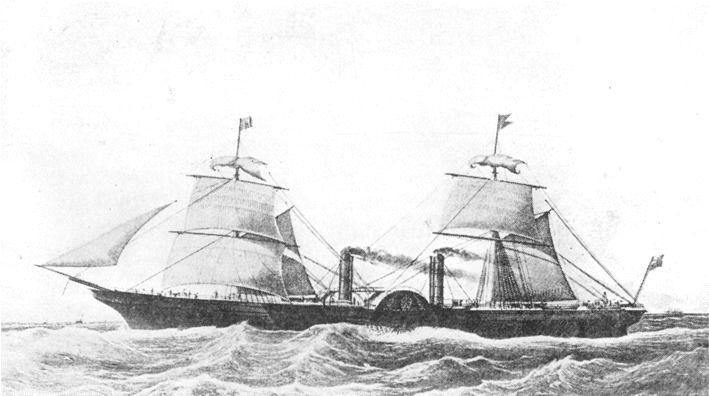
THE Persia
These two new steamers and the two which soon followed them were not intended to run against the Collins vessels in the New York to Liverpool express cabin trade. The paddle-wheelers in commission already mentioned, and the Persia, then under construction, were more luxurious and better suited to the prevailing tastes, including a preference for that type of propulsion. Although the Andes, for example, was fitted with accommodation for 62 first-cabin passengers and for 122 second, her distinguishing features were emigrant quarters and a cargo capacity of a thousand tons. They improved, at favourable rates, upon the service then still performed largely by sailing-ships.
The Andes and the Alps were sister ships of 1,440 tons, and in 1854 they were followed by the Etna and Jura of 2,190 each. They incorporated two novelties which attracted considerable attention in New York and Boston papers. A compass was fitted up at the head of the mizzen-mast, isolated from the magnetism of the iron hulls, to serve as a check upon the variations which there were then no other means to correct; and a separate engine and boiler were used as “servant of all work.” They provided power to heat the cabins, to draw bilge-water, to distil fresh water for use on board, and, in case of emergency, to extinguish fires. Their propelling machinery too, on what is known as the “geared” principle, was a curiosity of marine engineering. The forward end of the propeller shaft was fitted with a large spur-wheel with wooden teeth by which to adapt the slow speed of the type of engine used on paddle-wheelers to the screw, which made from four to ten times as many revolutions per minute. It is difficult to imagine now a liner with machinery partly made of wood. Yet these ships represented an epochal change in the history of American immigration. Though the sailing-ship was still to remain a powerful factor in some freight trades for many years, the horrors of the emigrant ship were first overcome by these four Cunarders and by the new Inman Line, which also appeared at about that time.
In 1854 came an event which gave the Cunard Line occasion to establish a precedent for the glorious record it was to make some sixty years later during the World War. The Crimean War broke out, and England was faced with the necessity of carrying large forces to oppose the Russians in the Crimea. In the midst of the disorganization that reigned in England, which was totally unprepared for such a necessity, the Cunard Line offered the Government, with “no haggle of price, no driving of good bargain,” the use of all its available ships. Fourteen of its steamers, including six of the best it had, were converted into troop-ships and transports in record time, some of them within a week of their returns from America. The Niagara and Cambria, the Europa, and later the Etna and Jura were fitted out to rush troops to the Mediterranean. The beautiful Arabia was equipped to carry enormous cargoes of horses, slung in hammocks. The Alps and the Andes became hospital-ships, carrying dead and wounded from Balaklava to Scutari. Some of the other vessels engaged in the transportation of French troops. It is related that the Europa was frequently mentioned for the kindness of her captain towards his military passengers and for her part in alleviating the miseries of the long winter campaign in the Crimea. On her first arrival in Constantinople, however, she ventured too near the shore and her bowsprit caught, as she swung out, in a row of small wooden houses and ripped out all of their first floors, to the great amusement of the soldiers aboard her.
Although these war duties severely taxed the Cunard fleet the line succeeded in maintaining its New York and Boston services and holding its own against the Collins vessels, by discontinuing the projected West Indian runs and by the purchase, from a line running to Australia, of the Emeu, a ship slightly smaller than the Arabia. However the withdrawal of the best wooden paddle-wheelers from the mail service was only grudgingly approved by the Government which was yet unwilling to acknowledge the advantage of iron hulls and screw propulsion. Neither was it popular with travellers, who found that screw steamers had more vibration and less steadiness than their predecessors.
During this war the Cunard liners proved themselves more efficient than the government vessels especially designed for the service. But this creditable performance in war, to match their successes in peace, was to be eclipsed by the amazing feat of carrying across the Atlantic, in 1914-18, more than nine hundred thousand officers and men and over seven million tons of foodstuffs and war supplies.
In recognition of the valuable services rendered by his ships, both in peace and in war, Samuel Cunard was rewarded by Queen Victoria, at the instance of Lord Palmerston. The latter’s biographer, Philip Guedalla, relates the whimsical manner in which the Prime Minister announced what form this recognition was to take: Palmerston made a remark about “the news that Mr. Cunard had lent his steamships for his Christian name. ‘Samuel,’ replied a puzzled colleague. ‘Sir Samuel,’ said Lord Palmerston.”
A baronetcy was bestowed on him in 1859. Six years later Sir Samuel Cunard died, leaving a fortune of £350,000 (although he had spent great sums to cover the debts of his brother Joseph, whose firm in Chatham, New Brunswick, had failed disastrously). His London residence and his estate in the suburbs had become, during his life, a rendezvous for many of the notable personages of contemporary England. Thus “the shy, silent, rather rustic gentleman” whose father had been a Quaker from Philadelphia became one of the great merchant princes of the Victorian era and founded an illustrious family of the British aristocracy. His title devolved upon his son, Edward, who had, in the meantime, remained in New York as the agent for the line. (The mansion Edward Cunard had built on Staten Island, where he lived until his father’s death, still stands on Grymes Hill—the highest point on the Atlantic coast—where it commands the best view of New York harbour. From its windows can still be watched the arrival of Cunarders, from the first streak of smoke on the horizon beyond Sandy Hook to their progress up the North River towards their piers.)
During the decade which followed the construction of the Asia and Africa, the wooden Arabia and the iron Persia were the only paddle-wheelers built for the Cunard Line. However the extension of its services to the French Channel ports, the Mediterranean, the Black Sea, and the West Indies, and its entry into the emigrant trade had occasioned the addition to its fleet of twenty-six iron screw steamers. Although popular prejudice had tenaciously opposed iron as a building-material, partly because of its effect upon the accuracy of compasses, metal had established its superiority over wood, for the reasons already mentioned. Of these increased strength for large vessels was the most important.
Objections to the screw, however, remained longer among passengers, if not among shipowners. The former complained of the vibration and of a greater tendency to rolling. They also had the Persia as a demonstration of the superior speed maintained by the side-wheelers. The shipowners, on the other hand, welcomed the great economy in coal consumption represented by the screw ship and the increase of space in the hold. It seemed evident that if larger ships were to be built and if greater speed was to be maintained the older style of propulsion would not allow space for steerage quarters and would raise the cost of cabin-passages. The Inman Line from Liverpool to Philadelphia had been founded with two excellent screw steamers of 1,600 tons, the City of Glasgow and the City of Manchester. Although slower than the Cunarders on the New York service they were able to offer cabin-passage at lower rates and to accommodate four hundred emigrants each.
Nevertheless, the mail and passenger service conducted by the Cunard paddlers remained the centre of the line’s activities to such an extent that it neglected the service on its branch vessels. Although the Mediterranean line was intended for cabin-passengers, the catering was left to the captains of the ships, who, through inexperience, managed it indifferently, with the result that complaints on this score aggravated the prevailing antagonism towards screw steamers.
But by 1860 it was clearly time to introduce a screw steamer into the fast New York mail service. The Cunard Company consequently acquired the Australasian from the bankrupt European and Australian Line. They renamed her the Calabria and fitted her to become a popular ship. But, far from improving the public attitude towards screw steamers, she illustrated all of the objections made to them. Although unusually fast, she rolled like a barrel in rough weather and was so generally shunned by travellers that the company willingly withdrew her and offered her to the British Government to be commissioned as a transport to serve in the first Boer War. Later she was sold to the Telegraph Construction and Maintenance Company.
The Collins Line had ceased, and the Inman Line, the Hamburg-American Line, founded in 1856, and the North German Lloyd, founded in 1858—all with screw steamers—had not yet begun to threaten serious competition. Nevertheless, the Cunard policy of constant improvement of its fleet was challenged by the Australasian’s unpopularity. New vessels should be built, and there was no other course open, if the favour of the line’s patrons was to be retained, than to return to the paddle-wheel. Consequently, in 1862, Robert Napier turned out the Scotia, the finest and last paddle-steamer built for the Atlantic trade and one of the most beautiful vessels which has ever plied the sea. She was 379 feet in length, with nearly 48 feet of beam, and with a gross tonnage of 3,781. Her engines were the last and most powerful of the side-lever type that the Britannia had carried, but so improved as to give her a speed of over fifteen knots against wind and tide on her trial voyage. She was fitted to accommodate 240 cabin-passengers and boasted of a promenade, over her deck-house, extending from stem to stern. Under Commodore Judkins, whose privilege it had been to command so many record-breaking steamers, she made a passage from Queenstown to New York in eight days four hours and thirty-four minutes, and an eastward passage of a few hours more. Until she was laid up, in 1876, and sold on account of her fabulous consumption of coal she remained the most popular ship on the Atlantic, and she has even since been remembered as the apotheosis of the paddle-steamer.
No history of Atlantic shipping can be written without a parenthetical description of the Great Eastern, not because she was a success—on the contrary, she was a gigantic failure—but because, although she was completed in 1858, it was more than forty years before any vessel afloat exceeded her in size. The Scotia was little more than half her length, and even the Mauretania is only one-seventh longer than she was. It is an amazing fact that eighteen years after the inauguration of ocean steam-shipping a steamer larger than many of our modern liners was put to sea. The Great Eastern is also interesting because she prematurely embodied several valuable features which, original then, were to be inherited by the modern liner. Those were a double bottom, tubular deck, and steam steering-gear. Like the Great Britain, she was the product of the spectacular ship-designer I. K. Brunel.
This monster, 692 feet in length and with a gross tonnage of nearly 19,000, was driven by two sets of engines powered by a hundred furnaces, one set turning paddle-wheels, the other a screw. She had five funnels and six masts, spreading 6,500 square yards of canvas. Her twenty anchors alone weighed, with their cables, 250 tons. Her extraordinary proportions, which dwarfed the crack liners of thirty-five years afterwards, were intended to suit her for the long run to India and back without recoaling. Foolishly, however, she was placed on the Liverpool to New York service, in which capacity she failed. She never sailed full enough to pay for the three hundred tons of coal she consumed daily at an average speed of only about thirteen and a half knots. She was pursued by very bad luck from the day of her launching until she descended to the ignominious fate of serving as a floating exhibition and fair in England, for which purpose she was bought by a firm of cheap tailors. When she was finally broken up, in the eighties, the skeleton of a riveter, who had been reported missing during her building, was found in her double bottom, and to this the sailors’ superstition against carrying corpses attributed the jinx which followed her. Before she started on her trial trip six members of her crew were killed by an explosion. Her first commander, the famous Harrison, who for many years had sailed the Atlantic without mishap as captain of the Cunarders Arcadia, Cambria, and Canada, was drowned, during this same trial trip, by upsetting in a row-boat while going ashore at Southampton.
A passenger aboard her, bound for New York, relates her experiences during a storm, in which both her paddle-wheels were carried away, her rudder was broken, many passengers were wounded by debris flying about, and, to add to their terror, one of the cows, when the cow-house had been swept off the deck by a wave, was flung through the sky-light into the passengers’ saloon. To make matters still worse, the crew broke into the liquor stores, and the passengers had to be armed to patrol the deck. The huge ship took the seas so badly that the baggage in the hold was later found not only to have been soaked but to have been so violently tossed about that it was churned to pulp and had to be unloaded in buckets! During the confusion of the storm, the passenger writes:
The Scotia, outward bound for New York, hove in sight. The great Cunarder looked stately and magnificent, and as she gracefully rode over the big seas without any effort, simply playing with them, she told us what design, knowledge and equipment could do.
WHILE changes in steam navigation were altering the whole nature of transportation on the Atlantic, and while the moral and material successes of the Cunard Line had brought forth other competitors, soon to be formidable, American shipowners were letting slip their prestige on the ocean. They were not to have another opportunity to take a major share of the world’s shipping for several decades to come. New York had incompetently dawdled with steamships, except for its one brilliant and reckless attempt, of which all hope for success sank with the Collins’ Pacific. Boston had staked its mercantile future on the splendid clippers it put to sea—some of them the finest and fastest afloat, especially those engaged in the China trade. This may have been due partly to the prevailing notion that tea and fruit, then important articles of commerce, would lose their flavour if carried on steamers, and that consequently, sailing-ships were better suited for the Far Eastern trade. This commerce, seriously injured by invoice taxation, began its decline in 1887. But the disappearance of Massachusetts vessels from the Atlantic is chiefly attributable to an “ostrich-like attitude towards the substitution of steam for sail.” In 1860 the crews of the clippers were improvising their farewell chanties:
O, the times are hard and the wages low,
Leave her, Johnny, leave her;
I’ll pack my bag and go below:
It’s time for us to leave her.
By that time passengers and fast freight to Europe were almost all carried in steamships. More and more of the immigrants to America were arriving by steam. And the report of the Postmaster General for 1860 showed that the Cunard Line alone carried nearly sixty per cent of the American mails to Europe, while the total carried by American steamers was only about a third, despite the large subsidies the Government had granted to the New York lines already mentioned. No stimulant, it seemed, including the rapid increase of our foreign trade, was able to check the decline of our shipping. Its total collapse was to be precipitated by the Civil War.
Towards this event steamships were indirectly contributing by their influence upon immigration. Although some slaves were still being smuggled in by sailing-vessels, via Cuba, to work on Southern plantations, the larger part of the new labour brought to America during the fifties was immigrants. The flow of fresh man-power into the ports of the North stimulated the industrial growth of the East and a westward expansion of its resources. The rivalry which resulted between the economic systems of the North and the South was turning heavily in favour of the Yankees and was dividing the nation into two hostile camps.
George Warburton in Hochelaga relates an amusing incident which shows that Americans did not leave their quarrels behind even when they embarked on European travels. In fact the bitterness preceding the Civil War broke the peace and order usual aboard Cunarders by producing an old-fashioned free-for-all during a voyage of the Cambria. On the last evening before her arrival at Liverpool the passengers were celebrating the close of an agreeable trip with ample libations of champagne and eloquent complimentary speeches to Captain Judkins. After he had modestly protested that he was “too much honoured by their words,” the passengers went for a stroll on the deck to cool their heads. But on board, in second class, was a Negro abolitionist preacher, the notorious Frederick Douglass. He took this occasion to emerge from his quarters and, from the quarterdeck, to unburden himself of a vitriolic discourse on the wickedness of Southerners. Among the passengers, and in a particularly exuberant mood, was a gentleman from New Orleans, the master of a sailing-ship. He immediately took violent objection to the Negro’s observations. Two other passengers who disagreed in politics tried to stop the fight, only to come to blows themselves, and still others joined the fray until—
the whole party—who had but half an hour before been drinking mutual good healths, and making all sorts of complimentary speeches, were scattered into a dozen stormy groups on the deck . . . while threats and curses were poured forth in all directions. . . . For at least an hour the dire tumult lasted; luckily, the better class of the passengers, . . . and the military officers on board, kept clear of the squabble, and finally their good offices lulled the tempest. . . . All the rest of the night was, however, passed in explanations and excitement.
The attention this episode attracted in American papers, although it occurred fifteen years before the Civil War, added coals to the smouldering antagonisms. It put the officials of the Cunard Line so well on their guard against future outbreaks, however, that regulations were issued which, somehow, kept Southerners and abolitionists safely apart during the stormy years to follow. This was, in fact, the last such disturbance to occur on a Cunard ship.
The Civil War, when it finally burst, sealed the doom of our merchant marine. This effect was not so much the result of the actual destruction of tonnage by such cruisers as the Alabama—our earlier wars had inflicted much greater losses without checking the growth of our fleets—as it was the consequence of a state of mind. Four years of warfare and blockade had diverted our vessels from their usual occupations, and the years of reconstruction which followed absorbed the best energies of the Atlantic states. In the meantime steam service had reached such a degree of efficiency and adequacy that, instead of envying the foreign-owned lines, American merchants were grateful to them for their services during the emergencies of war. As long as steamers were able to supply, more than ever before, the men and materials necessary for the new industries and farms and railroads, America did not need vessels of its own. As long as the speed and comfort of cabin ships were improving, travellers were perfectly willing to forego such ephemeral moments of pride as the Collins Line had furnished them. The few American ships which did run were so poorly patronized that Punchinello published this conundrum (a form of wit then much favoured by comic magazines): “Why does the ocean commerce of America resemble one of the railings of a gallery?—Because, just now, it is simply Ballast Trade.” The American bark Sarah was the last transatlantic sailing-ship to carry passengers, in 1871.
Meanwhile mail rates between Europe and America had been substantially reduced through the influence of the steamship and by mail conventions the United States had concluded with other countries. (Formerly the charges for sending letters across the Atlantic had been so high that many persons, even substantial mercantile houses, had practised the smuggling of unpaid letters concealed in packages.) In Great Britain the responsibility for making arrangements for the carriage of ocean mail had been transferred from the Admiralty to the Postmaster General. These circumstances indicated the probability that, when the Cunard Line’s contract expired, in 1867, the subsidy would be materially curtailed under new arrangements, even though the service required would be certainly greater.
The emigrant trade and the appearance of important competitors had rendered the economy of screw steamers of prime importance. Consequently, in the same year that Napier built the Scotia, the last of the paddle-wheelers, the Cunard Line also ordered from him a screw steamer, the China. Although a trifle smaller than her immediate predecessors this vessel averaged a speed nearly as great as the Scotia’s on a coal consumption of just half as much—eighty-two tons a day. She was also able to carry more cargo and steerage. Although never so popular as the paddle-steamers, the China helped to reconcile cabin-passengers to screw liners and overcame the prejudice created by the Australasian’s dizzy motions. She settled, in short, the future of the propeller in the fast service to New York. After her came the Cuba, in 1864, and the Java the following year, both excellent vessels of about 2,700 gross tons and with a length of 338 feet.
These were put on the New York service, while several other new screw steamers were divided between the Boston route, which had declined in relative importance, and the Mediterranean trade. Among these, which are still affectionately remembered, if not for speed and size, at least for the service they rendered Boston during the many years when her own shipping had been largely abandoned, were the Hecla, Atlas, Marathon, Olympus, Tarifa, Malta, Aleppo, and Palmyra. They averaged about 2,100 tons and a little over three hundred feet in length. The Palmyra was the last Atlantic Cunarder, except the Oregon (which was purchased from another line), to have a name not ending in “ia.” She remained in the fleet thirty years, however.
While the succession of famous Cunard liners on the Atlantic virtually outlined the progress of steam navigation—as E. Keble Chatterton points out in his excellent history of the steamship—their less spectacular consorts filled out the substance of the line’s achievement. More numerous than the record-breakers, they have carried, without casualty, a great share of our travellers to Europe and of the freight and immigrants we have received. As an example of the reputation for invariable safety these ships enjoyed in common with their sisters, a story is told of a fire on the Atlas. In mid-Atlantic her boatswain came to the saloon one evening and announced to the captain that the ship was on fire. Those who followed him on deck saw a great volume of dense smoke rising from the forward hatch. Ever since men have travelled in boats fire has been the ocean’s most dreaded danger. Yet, while this news created indescribable terror and panic among the steerage passengers, those in the first class only asked how soon the fire would be put out, and went back to their card games and reading. Although the situation was serious, the ship sailed on in perfect order, with an officer on the bridge giving his whole attention to her navigation. When the blaze had finally been extinguished the passengers did not even have the thrill of feeling that they had been delivered from mortal danger. Yet had lives been lost the Scotia herself would have lost a little of her glory and prestige.
The year 1867 marked a crisis in the line’s history. No less than six powerful competitors had appeared on the Atlantic. The Inman Line, which had taken up the abandoned sailings of the Collins Line, was giving up its policy of running ships of moderate speed at lower rates and was building two very fast screw liners. The Anchor Line was maintaining weekly sailings to New York, with excellent ships. There were also the two German lines, and the Guion and National Lines, each of which was to have a turn at winning the honours of the Atlantic.
It was, therefore, with grave concern for its laurels that the Cunard Company ordered a new ship for its fast service. It was essential that she be as beautiful and luxurious as the Persia and Scotia, which were maintaining the line’s prestige, relatively as economical as the China, and, if possible, faster. The Russia was ordered from Messrs. James and George Thomson, Clyde shipbuilders who had already built several Cunarders. Her engines represented a great improvement upon those of the previous screws, replacing the geared type then in vogue with inverted direct-acting cylinders. She was of 2,902 tons gross register, 358 feet in length, and 43 in beam. Unlike most of her running-mates she carried no accommodations for steerage passengers. When she was launched, in 1867, she was generally declared, on both sides of the Atlantic, to have the most graceful lines of any ship afloat. But, although her speed equalled the Scotia’s, she was put in service a month too late to vie with her for the record for the crossing of the ocean. In November the Inman Line’s City of Paris had won the mythical blue ribbon by a westward passage just thirty-three minutes faster than the Scotia’s best time. Two years later the City of Brussels beat her eastward record by five hours, bringing the crossing down to a little under eight days. The Russia was of a speed generally a shade less than that of her rivals, but on one occasion she and the City of Paris left New York within an hour of each other and, after keeping each other in sight for four days, reached Liverpool only thirty-five minutes apart, the Russia having overhauled the Inman liner. She never actually made an Atlantic record, but she won among Atlantic travellers a supreme popularity, which, for a number of years, she shared only with her consorts.
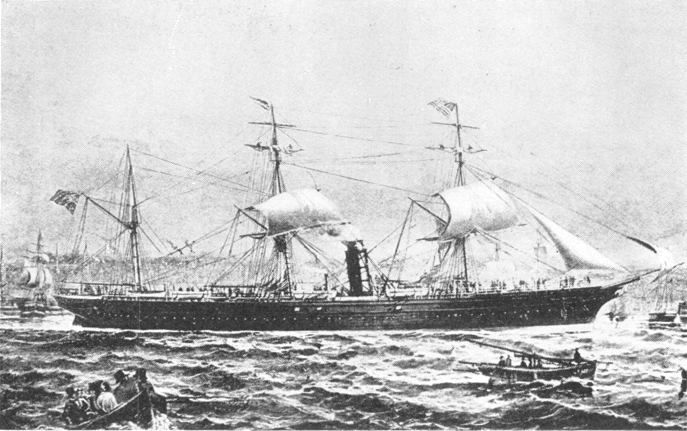
THE Russia
During her career under Captain Cook, who navigated her 630,000 miles, carrying without mishap more than 26,000 cabin-passengers, several incidents made her noted for easy handling, and her master for good seamanship. On one occasion, when she was steaming at a full fourteen knots, the cry of “Man overboard!” was heard. Almost instantly a seaman dived from the deck to attempt the rescue of his shipmate. Despite her speed, the Russia was able to turn back in time to save him from the icy water. Although the rescue failed, the passengers subscribed a purse of five hundred dollars as reward for the man’s gallantry. Later he became famous as Captain Webb, the man who swam the English Channel.
In the year in which the Russia was built six of the vessels which had played a glorious part in the line’s history were sold out of the service. Several of them had been in their turns the fastest steamers on the Atlantic, and collectively they had, only fifteen years before, represented the finest shipping on the ocean. The America, Niagara, Asia, Africa, and Canada were converted into sailing-vessels and scattered over the seven seas to fulfil their strangely varied destinies. The Canada, for example, became the bark Mississippi, plying American waters; then she was placed in the London-Australian trade; and finally, after some mishaps in the East Indies, she was reconditioned and sold to Hajee, Iakrian and Company, a native firm in Calcutta, to carry coolie labour to the sugar plantations in Mauritius. To the retired Boston sea-captains who may have travelled on her during her heyday as a liner it would probably have seemed impossible that such a beautiful vessel would soon be outmoded or even consigned to the drudgeries of local runs in the Indian Ocean. Only the Europa, among the six vessels sold, remained a steamer, after being lengthened and re-engined. This was a striking demonstration of the changes in steam navigation which had taken place within the short span of fifteen years. And fifty years later were to see vessels with displacement tonnage ten times as great as the Russia’s.
The years 1867 and 1868 were important in Cunard history for several reasons. Balanced against the success of the Russia was an expected reduction of the remuneration for the carriage of mails. As the result of an investigation instigated by a rival for a mail contract, Parliament had been informed that since its foundation the Cunard Line had never, in a single instance, deviated from the regularity required by the contracts and had never asked for any indulgence in their performance. Nevertheless, the competition had become so acute that the Postal Department was able to dictate its terms. The agreement which resulted provided for dual weekly sailings from Liverpool, on Saturdays for New York and on Tuesdays for Boston. Moreover, the vessels were to call at Queenstown to receive and to deposit mail. The annual subsidy was placed at £80,000, and the following year, when the contract was renewed for seven years, the sum was further reduced to £70,000.
In 1868 the form of the partnership was changed and the three managing families took over all of the shares which had been held by the other original investors and silent partners. By this time the passing of Sir Samuel Cunard, the retirement of George Burns (who later was also knighted), and the ill health of Charles MacIver—who remained partially active in the business, however—had brought a new generation into the management of the line. These sons inherited a tradition of conservatism, supported by Charles MacIver, which they maintained beyond, perhaps, the limits of sound policy. The line certainly progressed and improved during the next ensuing period, but it nevertheless fell a little behind its competitors for a space of about seven years. The confidence bred of long-undisputed supremacy may have tempted the company to rest on its oars a little rather than to risk exhaustion in a needless spurt; the reduction of the subsidy to a sum manifestly inadequate for the services performed may have induced over-cautiousness. In any case, the triumph of the Russia was followed by an interlude of fumbling progress before the first modern Cunarder restored her line to supremacy on the Atlantic.
The first mistake committed was the underestimation of Boston’s commercial future. The vessels put on that service were instructed to proceed to New York and to load there for Liverpool, rather than to rely upon Massachusetts freights. This neglect both piqued and inconvenienced Boston merchants. The commerce of Boston was, as a matter of fact, just reviving from its post-war depression and was destined greatly to be multiplied during the next two decades through the influence of excellent railroad communications with the West, new manufacturing industries, and a liberal policy towards immigrants arriving by regular steam liners. Although David MacIver the second, as the result of a trip to survey Boston’s commercial possibilities, urged the restoration of full direct service to Liverpool, this was neglected for several years while other lines secured profitable trade there. Boston, and in fact Massachusetts, remained faithful to their first love, however, and although courted by other lines, offered special inducements for the return of the Cunard steamers. This finally resulted, during the early eighties, in the restoration of the service which has ever since existed.
The next error in policy which interrupted the company’s career as pace-maker in the development of the Atlantic passenger service lay in its program for new construction. The first ten Atlantic liners to follow the Russia during the next seven years conformed to the Cunard dogma of constant improvement, but they did not match the revolutionary changes with which the newer lines were inaugurating their services.
The sale of the old paddle-wheelers left a place in the company’s second-string fleet. This was promptly filled, in the same year as the Russia was built, by two new screw steamers, the Siberia and the Samaria, and by the remodelled Calabria (formerly the Australasian). The Samaria was the first Cunarder fitted with double-expansion engines, which were then replacing the single-expansion vertical engine such as the Russia had carried. This created a further economy in the consumption of fuel. Next came two liners for the New York route, the Abyssinia and the Algeria, which, unfortunately, marked no improvement upon the Russia, although they were sufficiently comfortable and sturdy ships to retain the old patronage of the line whose loyalty the earlier Cunarders had gained. Then, in the same year, the Batavia, building for another line, was bought on the stocks, and the Parthia was ordered from the Thomson yard. The old Persia was traded in part payment for her. They were both engined on the new compound principle. The latter became a crack ship of the line, with a tonnage slightly greater than the Russia’s. Finally, in 1874 and 1875, were built the two largest ships the company had owned thus far, the Bothnia and the Scythia, each of about 4,500 tons and 420 feet long. They had straight stems, flush decks with a full-length promenade, and a saloon capable of seating all of their three hundred cabin-passengers at one time. Their cargo space was especially large, and they could carry eleven hundred steerage passengers each. Moreover, they embodied two devices which have achieved as much as any others in rendering modern liners comparatively safe under all circumstances: steam steering-equipment, and watertight compartments capable of being rapidly closed. Theretofore steering by hand had been one of the most troublesome and dangerous tasks, and many a seaman had been maimed when, in heavy sea, the wheel flung him off.
Yet none of these ships equalled the speed or luxury which was bringing the laurels of the Atlantic trade to the new White Star Line. These rivals represented a magnificence which made the steady evolution of Cunarders seem slow.
Though these new Cunarders did not recover the leading position on the Atlantic, they were masterpieces of construction by the solid standards the line had adopted. The Parthia is still performing effective service as the oldest iron steamer afloat, after an extraordinary career which has probably never been matched. Her first adventure outside of the duties of an Atlantic liner occurred in 1879 when she rescued the few survivors of the Jeannette-De Long polar expedition, whose vessel had been caught in the ice seven hundred miles off the mouth of the Lena River. Two years afterwards she served as a troopship during General Gordon’s campaign against Khartoum. Then she was sold to the Guion Line and renamed the Victoria. She later ran for some time to South America, Australia, the Hebrides, and the Straits of Sunda. Next, under the ownership of the Canadian Pacific Railway, she travelled between Vancouver and the Orient. Still new owners ran her from Tacoma across the Pacific. Finally she came under the American flag in time to add gold-crazed Nome to the amazing catalogue of the strange and romantic ports she had known. She spent two years rushing prospectors up to the gold-field and carrying back millions of dollars in gold-dust. She still plies to Alaska every year, usually winning from her rivals the distinction of being the first vessel in Nome after the ice goes out. Cargoes of silk and spices, copra, gold, reindeer, herring—these do not properly belong to Cunard history, but if the old Parthia, with her heavy Victorian decorations, seemed stodgier than her rivals on the Atlantic, at least she deserves reverence for long service and a glorious old age.
But the realization that a rival line was winning away the best of the passenger trade awoke the partners in the Cunard Line from their conservative lethargy. The next chapter restored the red funnels to the pride of leading the way for the Atlantic ferries.
THE Bothnia and Scythia, already described, and their immediate predecessors, were launched into a much more clearly defined and more highly competitive mercantile world than that which the Britannia and her four sister ships had revolutionized. On the one hand, the transitions from wood to iron, from paddle to screw, and from geared to compound engines had changed the very face of the ocean. On the other, political, economic, and social circumstances had altered the two continents served by the Atlantic ferry.
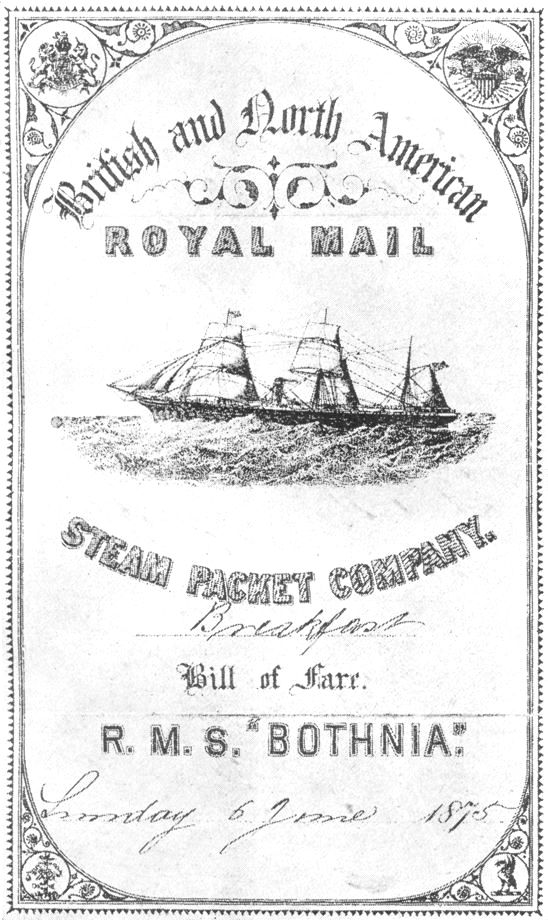
THE Bothnia’s MENU
The following is the text in the image above.
British and North American
ROYAL MAIL
STEAM PACKET COMPANY.
Breakfast
Bill of Fare.
R.M.S. “BOTHNIA”.
Sunday 6 June 1875.
In 1848 steamers had brought to America the news of liberal revolutions in more than a dozen European monarchies. A multiplicity of small states were shaken to their foundations by great popular movements. While the excitement was at its height, the New York Herald announced to its readers, upon the arrival of the latest Cunarder: “Great Britain Still a Monarchy.” The New York Herald did not indulge in whimsicalities. In fact this news probably surprised a good many observers who were wondering what direction the political future of Europe was to take. The result, however, was the disappearance of some of the feudal heritages of Europe and the erection of larger national states, notably a united Italy under Victor Emmanuel, a powerful Prussia ruled by William I and Bismarck, and the Second French Republic. The most direct effect of these changes upon shipping was the substitution for small principalities and kingdoms of large states eager to establish their own merchant marines. Both France and Germany entered the Atlantic trade with subsidized steamship lines. The wealth, energy, and national loyalty which supported the German lines particularly raised them to an excellence which for many years contested with the British the chief honours of the service to America. The United States, in the meantime, which had definitely ceased to be a carrier nation—despite two more abortive attempts to found passenger service to Europe—profited enormously by the improvements produced by this international rivalry.
These political changes in Europe exerted another less direct but very cogent influence upon the development of oceanic transportation: the modernized states turned their attention towards measures for popular education. This virtually created a new public which read more, conceived wider limits to its range of interests, and produced many more potential emigrants and travellers. Standards of living were raised, trade was increased, life and thought in general were quickened and expanded. Wealth was suddenly found to depend on speed. Faster trains and faster steamships were demanded.
In addition to these factors, which stimulated shipping, was the opening of the Atlantic submarine cable. During the brief period in 1858 between the inauguration of the cable and its breakdown, the only messages it carried were official felicitations to Queen Victoria, on the occasion of her Jubilee, and a private communication from Samuel Cunard to his associates in England. But eight years later permanent communication by wire was achieved between Europe and America. This did not detract from the importance of steamships as carriers of news between the two continents, for they became the instruments of the business transactions which the cables accelerated and increased. They also profited by the abolition of distances in the exchange of information, which made Europe and the United States better known to each other.
Although the Civil War was succeeded by a series of economic crises, the United States had staggered to its feet and was embarked upon an era of rapid industrial growth. The new mining and manufacturing industries created by the war were built up permanently and offered European labour a greater market than ever before. The Homestead Law of 1862 also opened new public domains to the farmers from Germany and Scandinavia. Despite the war nearly two million emigrants came to America in that decade.
Thus the twenty years which followed the introduction of screw steamers on the Atlantic saw a multiplication of factors tending to stimulate the improvement of shipping facilities. Although the railroad had already been developed to a speed capacity which has not materially been increased during the last sixty years, the speed of ocean liners has nearly doubled.
The Bothnia and Scythia represented an interesting milestone in the history of navigation. They were vessels which marked the transition between the early steamer and the modern liner. This division is arbitrary, for improvement has shaded into improvement from the beginning until now. But the ships which were to follow are generally recognized as the first modern Cunarders, and after them the temperature of competition rose to a level from which there have been few abatements since. Probably the state of mind in which they were ordered by the Cunard Company—one of calm, unruffled improvement, regardless of rivalry—was what stamped them as ships of the past. Nowadays steamship companies are keenly alert to each other, the odds change with each play, and the existence of a fast and splendid vessel implies the construction of a still finer one to sail under another pennant.
Nevertheless, it is worth while to review the improvements thirty-five years had wrought. Even though rivalry had been more spasmodic than sustained, the Cunard Line had raised the standards of steam-shipping with remarkable rapidity. The Britannia had a gross tonnage only one-quarter that of the Bothnia, a cabin-passenger capacity of about a quarter, and a cargo space of only one-fourteenth. Moreover, the Bothnia could carry eleven hundred steerage passengers, while the Britannia did not provide accommodations for any. Yet the Bothnia with this greater load maintained nearly double the Britannia’s speed on about the same consumption of coal for the voyage. This meant such a saving in rates that cargo and immigrants became profitable trade. Thus the very function of the steamship was revolutionized. It could now bring labour to America in large quantities and in a quarter of the time consumed by sailing-ships, and it could take back to Europe huge cargoes of the products which the United States was exporting in increasing volume. Not only had the nature of the vessels changed, but the fleet had increased, from its original 4,600 gross tons, to a tonnage greater than the entire steam-shipping of the German Empire, and nearly half as great as that of the combined steamships of France, Holland, and Hamburg.
Besides the speed, capacity, and economy attained, the first thirty-five years of steam navigation eliminated the primary dangers of the ocean. The “coffin brigs” and “death ships” of the early nineteenth century were frail creatures, likely to be crushed by a heavy sea. Even the original Cunarders were often in grave peril during such storms as Dickens described, and only prodigies of seamanship maintained their record for safety. In those days a large percentage of the losses was directly attributable to weather. But in 1874 a report on the causes of shipwrecks included the following statistics:
Losses attributable to unseaworthiness of hull, compasses, equipment, and outfit, within the power of the owners to remedy, 4½ per cent; losses to be attributed to carelessness, drunkenness, ignorance, incompetency, and absence of discipline, 65 per cent; losses from stress of weather, and causes not apparently preventable, 30½ per cent. This last item includes 38 wrecks of which no cause is assignable.
Weather, then, was becoming less and less of a factor as the size of vessels increased. The chief sources of danger lay within human control. In this respect the Cunard Line seems to have achieved an immunity in which it stands high among all enterprises whose chief activity is the conveyance of people.
From the day that the Britannia “steamed in gallant style down the river” until the present no Cunarder has left port without having been closely inspected from stem to stern. The inspection covers not only the physical parts of the ship but also that mysterious entity which makes her a safe vessel—the morale of its officers and crew. Every man is assigned a duty, in whose performance he is thoroughly coached, to be carried out in case of any emergency. On the Bothnia, for example, the four departments of the crew—seamen, engineers, firemen, and stewards—were each equally divided up and assigned to the life-boats. Before each sailing they were all mustered on deck. The order “Boats out” would be given, and within three minutes every boat would be in the water, fully manned. Similarly with fire drill: every man would have his exact function to fulfil—lowering buckets, joining hose, playing the jets, and manipulating wet blankets. And still the same with the pumps.
During the voyage, which started with punctuality and followed a carefully charted course, everything was run with extraordinary precision. In the engine-room every man was keyed to a vigilance ready to reverse the engines instantly. On duty were carefully selected look-outs, whose eyesight had been tested, with means of instant communication with the two officers of the watch. The minute instructions issued to the captains may have been superfluous in view of the type of men chosen for the post, but they are, nevertheless, worth quotation here:
We beg your especial care to the drawing-off of spirits. The spirit-room should, if possible, be entered during the day only. . . .
Avoid familiarity with any particular portion of your passengers; avoid national observations and discourage them in others; keep yourself always a disinterested party ready to reconcile differences; be civil and kind to all your passengers—recollect they will value your services on deck looking after their safety more than talking with them in the saloons. . . .
It is to be borne in mind that every part of the coast-board of England and Ireland can be read off by the lead; and on making land, you should never omit to verify your position by soundings; rather lose time in heaving the ship to, than run the risk of losing the vessel and all the lives on board.
You are to understand that you have a peremptory order, that, in fog or snow-storm, or in such state of the weather as appears attendant with risk in sailing, you are on no account whatever to move the vessel under your command out of port or wherever she may be lying in safety, if there exists in your mind a doubt as to the propriety of proceeding; and, at the same time, you are particularly warned against being influenced by the actions of other captains who may venture to sail in such weather. . . . In any case . . . you are not to be actuated by any desire to complete your voyage, your sole consideration being the safety of your ship and those under your charge.
In the navigating of your vessels generally, we have entire confidence in the ability of our captains, and full reliance upon their judgment and discretion, knowing, by experience, the fitness of each man for the responsibility of his post; but in the matter of fog, the best of officers become infatuated, and often attempt to push through, when common sense and prudence would teach them to exercise patience.
The captains to whom these instructions were issued were selected by the partners in the Cunard Line with an invariably sound judgment of character. The discipline with which they handled their ships was perfect, and their personal heroism constitutes one of the most inspiring epics of courage. The sea has always had the quality of bringing out the nobility in men. Captain Grace, for example, who successfully navigated Cunarders for many years, died a glorious death under another flag. He was called to the National Line as Commodore. On his ship, the America, then one of the finest on the Atlantic, he stood on the bridge for forty-eight successive hours during a winter gale. Finally, when the peril was over, he died in his cabin from exposure and exhaustion. Thus for many years and through millions of miles over the wild Atlantic Cunard captains have stood as a bulwark protecting the hundreds of thousands of people they have conveyed between Europe and America.
The results of these means of reducing the perils of the sea were such that Mark Twain was justified in writing of the Cunard Line that “it is rather safer to be on board their vessels than on shore.” Indeed, he witnessed one of those thrilling episodes by which Cunard officers have won the enduring gratitude of ocean travellers. He describes it in a letter, which was published in the Acadian Recorder of Halifax:
On Board Cunard Steamer Batavia at Sea,
November 20, 1872
To the Royal Humane Society
Gentlemen: The Batavia sailed from Liverpool, Tuesday, November 12. On Sunday night a strong wind began to blow and not long after midnight it increased to a gale. By 4 o’clock the sea was running very high. At half past seven our starboard bulwarks were stove in and the water entered the main saloon. At a later hour, the hatchway on the port side came in with a crash, and the sea following, flooded many of the state-rooms on that side. At the same time a sea crossed the roof of the vessel and carried away one of our boats, splintering it to pieces and taking one of the davits with it. At half past nine the glass was down to 28.35 and the gale was blowing with a severity which the officers say is not experienced oftener than once in five or ten years. The storm continued during the day and all night, and also all day yesterday, but with moderated violence.
At 4 p.m. a dismasted vessel was sighted. A furious squall had just broken upon us, and the sea was running mountains high, to use a popular expression. Nevertheless, Captain Mouland immediately bore up for the wreck, which was making signals of distress, ordered out a life-boat and called for volunteers. To a landsman it seemed like deliberate suicide to go out in such a storm. But our third and fourth officers and eight men answered to the call with a promptness that compelled a cheer. Two of the men lost heart at the last moment, but the others stood fast and were started on their generous enterprise with another cheer. They carried a life-line with them, several life-buoys, and a lighted lantern, for the atmosphere was murky with the storm and sunset was not far off.
The wreck, a barque, was in a pitiful condition. Her mainmast was naked. Her mizzen-mast and bowsprit were gone, and her foremast was but a stump, wreathed and encumbered with a ruin of sails and cordage from the fallen foretop gallant, mast and yards. We could see nine men clinging to the main wreck. The stern of the vessel was gone, and the sea made a clean break over her, pouring in a cataract out of the broken stern and flooding through the parted seams of her bows.
Our boat pulled 300 yards and approached the wreck on the lee side. They had had a hard fight, for the waves and wind beat it constantly back. I do not know when anything has alternately stirred me through and through, and then disheartened me as it did to see the boat every little while get almost close enough, and then be hurled three lengths away by a prodigious wave, and the darkness settling down all the time.
But at last they got the line and buoy aboard, and after that we could not make out anything more. But presently we discovered the boat approaching us, and found that she had saved every soul—nine men. They had to drag those men one at a time through the sea to the life-boat with line and buoy—for, of course, they did not dare to touch the plunging vessel with the boat. The peril increased now, for every time the boat got close to our lee, our ship rolled over on her and hid her from sight. But the people managed to haul the party aboard one at a time without losing a man, though I said they would lose every one of them—I am, therefore, but a poor success as a prophet. As the fury of the squall had not diminished, and as the sea was so heavy, it was feared we might lose some men if we tried to hoist the life-boat aboard us, she was turned adrift by the captain’s orders. Poor thing, after helping in such a gallant deed. But we have plenty more boats and very few passengers.
To speak by the log and be accurate, Captain Mouland gave the order to change our ship’s course and bore down towards the wreck at 4.10 p.m. At 5.15 our ship was under way again with those nine poor devils on board. That is to say, the admirable thing was done in a tremendous sea and in the face of a hurricane, and in sixty minutes by the watch—and if your honourable Society should be moved to give Captain Mouland and his boat’s crew that reward which a sailor prizes and covets, above all other distinction, the Royal Humane Society Medal, the parties whose names I have signed to this paper will feel as grateful as if they themselves were the recipients of this great honor. Those who knew him say that Captain Mouland has risked his life many times to rescue shipwrecked men in the days when he occupied a subordinate position—and we hopefully trust that the seeds sown then are about to ripen in the harvest now.
The wrecked barque was the Charles Ward, Captain Bell, bound from Quebec to Scotland with lumber. The vessel went over on her beam ends at 9 o’clock on Monday morning and eleven men were washed overboard and lost. Captain Bell and eight men remained, and these our men saved. They had been in the main rigging some thirty-one hours without food or water, and were so frozen and exhausted that when we got them aboard they could hardly speak, and the minds of several of them were wandering. The wreck was out of the ordinary track of vessels and was 1,500 miles from land. She was in the centre of the Atlantic. Our life-boat crew of volunteers consisted of the following: D. Gillies, third officer; H. Kyle, fourth officer; Nicholas Foley, quartermaster; Henry Foley, quartermaster; Nathaniel Clark, quartermaster; Thomas Henry, seaman; John Park, seaman; Richard Brennan, seaman.
The officers told me that those two quartermasters, the Foley brothers, may be regarded as a sort of permanent volunteers. They stood always ready for any splendid deed of daring. John Park is a sturdy young sailor, and I overheard him say, “Well, that is the third time that I have been out on that kind of an expedition,” and then he added with a kindly feeling for his species that did him no discredit, “It is all right, I will be in a close place like that some day, and somebody will do as much for me, I reckon.”
When our life-boat first started away on her mission it was such a gallant sight when she pinnacled herself on the fleecy crest of the first giant wave, that our party of passengers, grouped together on deck, with one impulse broke into cheer upon cheer. Officer Gillies said afterwards that about that time the thought of his wife and children had come upon him and his heart was sinking a bit, but the cheers were strong brandy and water to him, and his heart never went back on him any more. We would have cheered their heads off only it interrupted the orders so much. Really and truly, these men while on their enterprise were safe at no time except when in the open sea between the vessels. All the time they were near either the wreck or our own ship, their lives were in great peril.
If I have been of any service towards rescuing these nine shipwrecked human beings by standing around the deck in a furious storm without any umbrella, keeping an eye on things and seeing that they were done right and yelling whenever a cheer seemed to be the important thing, I am glad and I am satisfied. I ask no reward. I would do it again under the same circumstances. But what I do plead for, and earnestly and sincerely ask is that the Royal Humane Society will remember our Captain and our Life-boat crew, and in so remembering them increase the high honor and esteem in which the society is held all over the civilized world.
In this appeal our passengers all join with hearty sincerity, and in testimony thereof will sign their names, begging that you will pardon me for approaching your honorable society with such confidence and such absence of ceremony, and trusting that my motive may redeem my manner, I am, gentlemen,
Your obedient servant
(Signed) Mark Twain (Samuel Clemens)
Hartford, Conn.
Not only did the Royal Humane Society grant Mark Twain’s petition by conferring medals and suitable rewards upon Captain Mouland and the life-boat’s crew, but the Cunard Company gave the seamen over a month’s wages each and promoted Officers Gillies and Kyle to the rank and pay of first officers, although there were no vacancies for them to fill. Commenting upon this, in a letter to the New York Tribune, Mark Twain remarked that ordinarily—
the Cunard people would not take Noah himself as first mate till they had worked him up through all the lower grades and tried him ten years or such a matter. They make every officer serve an apprenticeship under their eyes in their own ships before they advance him or trust him. Captain Mouland had been at sea sixteen years, and was in command of a big 1,600-ton ship when they took him into their service; but they only made him fourth officer, and he had to work up tediously to earn his captaincy. He had been with them eighteen years now. . . . It takes them about ten or fifteen years to manufacture a captain; but when they have got him manufactured to suit at last, they have full confidence in him. The only order they give a captain is this, brief and to the point: “Your ship is loaded, take her; speed is nothing; follow your own road, deliver her safe, bring her back safe—safety is all that is required.”
Then, about the traditions of the line, he wrote:
When a thing is established by the Cunarders, it is there for good and all, almost. Before adopting a new thing the chiefs cogitate and cogitate; they lay it before their head purveyor, their head merchant, their head builder, their head engineer, and all the captains in the service, and they go off and cogitate about a year; then, if the new wrinkle is approved it is adopted, and put into the regulations. In the old days corpses were not permitted by the Company to take passage, or to go freight, either—sailor superstition, you know. Very well; to this day they won’t carry corpses. Forty years ago they always had stewed prunes and rice for dinner on “duff” days; well, in this present time, whenever duff day comes around, you will always have your regular stewed prunes and rice in a Cunarder, if you don’t get anything else, you can always depend on that—and depend on it with your money up, too, if you are that sort of a person.
From such an inheritance, to which the Cunard Line owed its unbroken success in the development of steam navigation, it was difficult to make a radical break. The managers of the line were inclined to remark, perhaps a little defensively, that they were unique among their competitors in “still applying the lessons of the past for the advantage of the future.” Behind the policy of the company there may have been a little understandable complacency in the line’s extraordinary record. Nevertheless, there was no escaping the fact that since the Inman liners had won the Atlantic records from the Scotia, the Cunard Line had never recovered the leadership of the Atlantic. The City of Berlin had brought still further laurels to the Inman flag, the Britannic and Germanic had in turn given the White Star Line supremacy, and the Arizona was building for the Guion Line, which, like the Inman Company, had turned its attention to the rapid passenger service. Although still enjoying great popularity, the Cunard fleet required the addition of new ships which should be second to none in any respect.
The result was the Gallia, a beautiful steamer built by Messrs. J. and G. Thomson. She was some 250 tons larger than the Bothnia and Scythia, very much more sumptuously fitted as to baths, bars, smoking-rooms, and the other appurtenances of the “floating palaces” of her time, and nearly two knots faster. Her immediate popularity eliminated any possibility that the Cunard Line was to fall into a secondary rôle in the passenger trade.
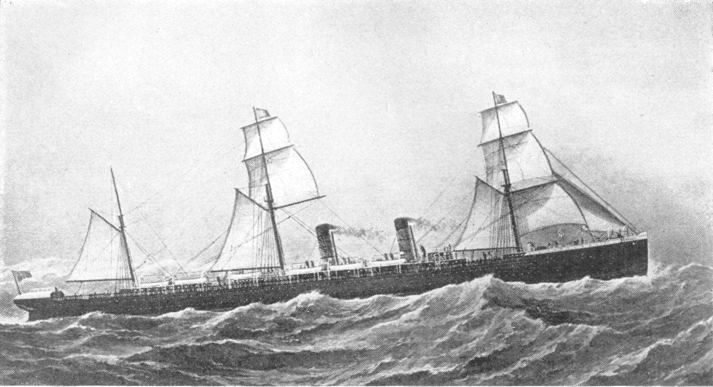
THE Servia
In the meantime the Government had inaugurated a new policy for the conveyance of mails. Instead of entering into subsidy contracts, which, in the case of the Cunard contract of 1869, had provided inadequate returns for the services performed, it announced that three mails a week would be sent to America aboard the ships of the White Star, Inman, and Cunard lines. The rate for letters was four shillings sixpence per pound, while second-class mail was paid for at a low rate.
It was about this time that steel was coming into favour as a material for construction. It possessed the same superiorities over iron that iron had over wood. Not only was it more ductile, more uniform in quality, and capable of enduring greater strain, but it created a saving of twenty-five per cent in weight, with a proportionate increase of cargo space. But the initial cost of steel vessels was then much higher than that of iron. The Bessemer process had not yet been invented.
In 1878 the Cunard Company had become a limited-liability company, capitalized at £2,000,000, of which £1,200,000 was taken up by the families in the partnership. Two years afterwards, with the announcement that “the growing wants of the Company’s transatlantic trade demanded the acquisition of additional steamships of great size and power, involving a cost for construction which might best be met by a large public company,” the remaining available shares were offered to the public. They were eagerly taken up. John Burns, the son of Sir George, was elected chairman of the Board of Directors. It was not until then, forty years after the foundation of the line, that its formal title, the British and North American Royal Mail Steam Packet Company, was changed officially to the Cunard Steam Ship Company, although it had long been known by that name.
Thus recapitalized, the Cunard Line was able to undertake the construction of steel ships of unprecedented size, power, and luxury which would again give it the place of leadership in the passenger service. The new policy was announced in a vigorous letter, signed by John Burns and published in the London Times. The first monster ship to be launched under this program was the Servia, built in 1881 at the Thomson yards at Clydebank. She was the largest vessel ever floated except the Great Eastern, with a tonnage of nearly 7,400 gross, length of 515 feet, and accommodations for 480 cabin-passengers and 750 third class. Her cargo capacity was limited by the great size of her engines, which were capable of nearly seventeen knots, on a daily consumption of 190 tons of coal. This was the beginning of what may be called the Atlantic express service, which is characterized by the sacrifice of freight space to powerful engines and passenger accommodation. By this time tramp steamers, with lower operating-expense, were reducing the profits of the freight trade which the regular lines had enjoyed, while the increase of passenger travel, both cabin and steerage, made specialization possible.
Besides being built of steel and being the largest and finest vessel of the fleet, the Servia embodied several important innovations in fittings and construction. One of them was the adoption of the cellular double bottom. This was one of the inventions by which Brunel had attempted to make strong and safe his fabulous Great Eastern. After she had fallen into desuetude as a freak and a failure, this, like several others of her valuable features, was forgotten during the twenty years which elapsed before the Servia revived this important safety device. No riveter was sealed inside this ship, however, to bring her bad luck.
Another feature of the Servia’s fittings was the installation of electric lighting, which Edison had only recently invented. This innovation was a great boon to emigrants as well as to cabin-passengers. Until the seventies candles had been the chief means of illumination, suspended in swinging trays and flickering and sputtering grease as they swayed back and forth. Later they were largely replaced by oil-lamps which produced a scarcely more cheerful effect, especially as they were used sparingly to minimize the chances of fire. The White Star Line had tried out a gas system, operated by a separate engine, but had found it too subject to leakage to be reliable. The unsteady light, and the heat and smell of these means of illumination, must have broken down many a desperate struggle against seasickness. Electricity was even more appreciated at sea than on land, for—to quote the reminiscences of an old traveller who recalls candles with horror—“on a rough, wild night, when everything in your state-room is flying about, and you begin to conjure up thoughts of possible disaster, if you switch on the electric light, all is peace. The very waves appear robbed of their fury.”
As usual with the building-programs of the Cunard Company, it supplemented this addition to its fast mail service with new slower vessels for the Boston trade, particularly designed for comfort and large capacity. This may have been in deliberate pursuance of a policy to protect itself by maintaining a certain ratio between the two services, as a provision against any financial losses which might be incurred by the costly express steamers of relatively less capacity. These new ships were three iron vessels, two of them larger than the Gallia, fitted with large emigrant accommodations. The Catalonia and Pavonia were built, like most of their immediate predecessors, by Messrs. J. and G. Thomson, while the Cephalonia came from the Laird shipyards on the Mersey. They were all driven by compound two-cylinder engines, while the Servia carried three.
In the same year that the Servia was launched, the Inman Line built a still larger liner, the City of Rome, of which great things were expected. She not only was larger, but had more powerful engines and was fitted with three funnels and four masts. She failed, however, to attain the speed of the Servia and of another rival, built that year, so that she was laid up to be reconditioned, after which she was sold, at a serious loss, to the Anchor Line. This was the last Inman Line ship to be run under British ownership, as the interests of the founders were bought out by American capitalists, who reorganized the company, although it still remained under the British flag.
The other rival of the Servia was the Alaska, built in the same year for the Guion Line. Although somewhat smaller than the Cunarder, she made an extraordinary passage on her maiden voyage in which she further reduced the time between England and America to just under seven days, which record she held for three years.
Thus the relentless competition for the chief honours of the Atlantic increased to fever heat until larger and faster vessels were produced nearly annually. The principal rivals had new ships on the stocks almost constantly and were scrapping older ships which had been the pride of the Atlantic only a few years before. Yet the traffic in passengers was also growing so rapidly that there was profitable business for all the lines. Social and economic factors continued to swell the tide of immigration to America, while travellers in the cabin classes increased every year, impelled by the fascinations of new sea-going luxuries and new thrills of speed. Ocean voyages had so decidedly been ridded of hardships that the steamship lines found it profitable to install special bridal suites for honeymooners.
In 1883 Thomson’s yards built a still faster ship for the Cunard Line. She was the Aurania, which, with the Servia, restored her line to leadership in popularity. The Servia enjoyed a reputation for remarkable steadiness, but this last vessel was constructed on a new principle which still further reduced the rocking and pitching motions. This was the increase of beam from one-tenth to one-eighth of the length. This change in relative proportions was supplemented by a change in the general design of the hull from concavity below the water-line to convexity. Donald McKay’s theory of “wave-line” construction, with a “dolphin’s head and a mackerel’s tail,” had until then generally been inherited, in modified form, by marine architects. The rounded hull not only produced a greater buoyancy and stability but also increased cargo space without sacrificing speed. Another feature of the Aurania’s construction which made her particularly popular was the location of the first-class cabins and saloons amidships, forward of the engines. This change in the arrangement of steamships had been introduced by the White Star Line. That it should not have been made several decades sooner is another example of the persistency of obsolete customs. In the Middle Ages the place of honour aboard vessels was in the stern of the ship, perhaps in order better to survey the labours of the galley slaves. Then the Spanish galleons and caravels, for instance, had raised quarters aft to accommodate the officers and passengers. This general practice continued throughout the development of the sailing-ship, including the clipper, and was adopted by the builders of the early steamers. In fact there was no particular drawback to the arrangement until the introduction of screw steamers, which moved the centre of vibration aft. It was primarily the grinding of the engines and in rough weather the racing of the propeller, directly under the cabin quarters, that rendered the early screws so unpopular.
Thus in the fifteen years between the time that the Russia was a favourite liner on the Atlantic and the time that the Aurania succeeded to the honour remarkable improvements had been made in the comfort afforded by transatlantic steamers. First-class quarters had been moved forward to where vibration was least felt, ships were rendered steadier, electric lights had been substituted for candles. Smokers no longer had to resort to the deck at the lee side of the funnel, or, if the weather was bad, to the fiddley. Music-rooms and ladies’ drawing-rooms, adequately ventilated, offered some relief from the stiff and stuffy boredoms of the old saloons. Meal-times, to be sure, were still at strange though frequent intervals: breakfast at eight, lunch at twelve, dinner at four, tea at seven, and supper some time before ten (if desired!). But into the menus were creeping, if not truly French dishes, at least a few French names, which must have somewhat leavened the imposing lists of roasts and English meat-pies.
The tonnage of ships had, of course, more than doubled since the Russia, and new ships were generally described as “mammoth.” Yet there still were odds in favour of the Atlantic’s waves. The Servia, for example, was struck, during one exciting voyage, by a sea thirty feet high which shattered her forward funnel. The Scythia accidentally collided with a whale, which broke her propeller and forced her to turn back under sail. (Mementos of this occasion are still preserved in Liverpool in the form of a plate and a chair made out of the whale’s bones.) The White Star liner Germanic was struck by a tidal wave which stove in some of her strong iron deck-houses and actually swept her steam winches off the decks. Altogether, forty-seven Atlantic liners were lost during the decade. The first leviathans of the 1880’s were, after all, so small by our present-day standards that to sail on one now would seem almost adventurous. Yet this was the period when the modern steamer was first brought to perfection.
THE various shipyards which were turning out Atlantic liners during this period played an important part in the relative standings of the fleets they supplied. Within the limits of the specifications laid down by the various companies, in pursuance of their building policies, there was considerable latitude for variation in design and construction. The lines were stamped, to a certain degree, with the characteristics of their shipbuilders. This was particularly true during the rapid changes which produced the modern liner. Every marine engineer had a different theory as to how to get the best results. Although the various yards possessed individuality as to workmanship, fittings, and general design, the most concrete feature of their differences lay in the speeds their vessels developed.
The first Inman liners which won from the Scotia the blue ribbon did not represent any important departure from the other early screw steamers. They were succeeded as record-breakers by the new White Star liners, produced by Messrs. Harland and Wolff of Belfast. These famous builders introduced a longer type of vessel with finer lines, not to mention several marked improvements in detail. Their creations maintained the highest average of speed on the Atlantic for ten years. Then the Guion Line won the record with three successive ships, the Arizona and Alaska, already mentioned, and the Oregon, built in 1883.
The Cunard Line during this time had lost its unrivalled supremacy of the ocean through failure to keep abreast of these rapid developments, yet had finally, with the Servia and the Aurania, recovered its prestige. Most of these Cunarders had been turned out of the Thomson yards, but the lapse in the line’s leadership had been due to its over-conservative policy rather than to its builders. In fact it was the matchless workmanship and superb finish which went into the Russia, Parthia, Bothnia, Scythia, and Gallia, for example, that sustained the line’s popularity, and it was the same qualities in the Servia and Aurania that restored it to a leading place. This was accomplished without ever having broken the Atlantic record for speed since the Scotia’s had been exceeded, in spite of the then prevailing thirst for acceleration. To be sure, both of these last Cunarders had a speed within a small fraction of a knot of that maintained by the “greyhounds” the Guion Line had put into the service at the same time, but it was nevertheless under.
In fact the Glasgow firm of John Elder and Company, brought from obscurity into fame by the splendid performances of the Arizona, had established its reputation as builders of ships faster than those of the White Star or those from the Thomson yards. This was further enhanced by achievements of the Alaska and the Oregon. This last ship, although no finer than the Aurania as to accommodations, startled the world, including her owners, on her third voyage. She cut down the westward crossing to six days ten hours and nine minutes, and the eastward crossing to a figure nearly as low. In this triumph Robert Napier deserves, perhaps, some share of credit, for it was in his yards that John Elder and William Pearce, his successor, had acquired their training in engineering.
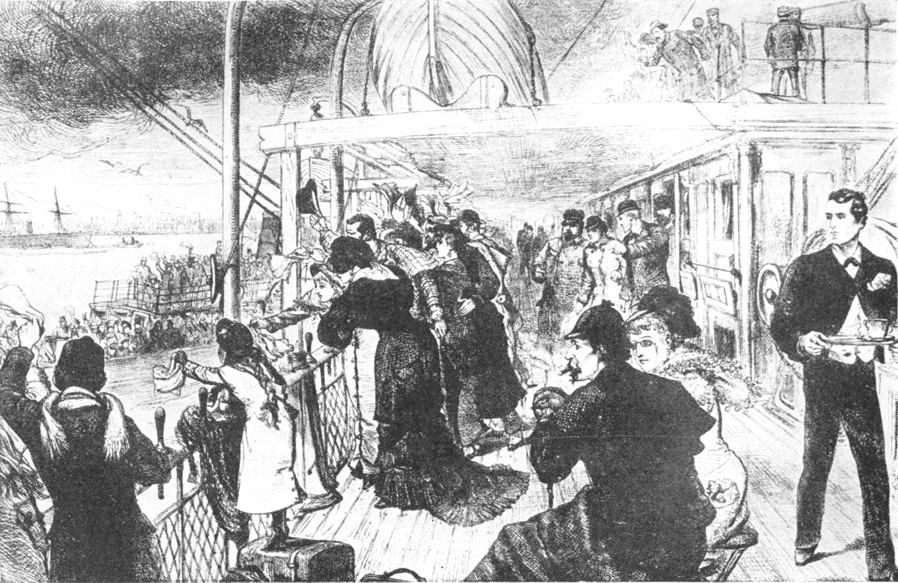
A DECK SCENE IN THE ’80S
By the time the Oregon made her brilliant runs the Cunard Line had climbed back to a foremost position in the passenger trade. But the rôle of leadership was a precarious one for a line whose ships were not the fastest as well as the most popular. That generation of travellers was particularly fond of superlatives. Consequently the next order for larger and faster ships was placed with John Elder and Company. Meanwhile the Guion Line, owner of the Oregon, was approaching a crisis instead of realizing the success its express steamers deserved. During the sixteen previous years it had lost no less than four ships. Its efforts to recover from these disasters had led it into dangerously heavy expense. Finally one of the chief partners in company, a New York merchant, lost his fortune in speculations in other lines of enterprise, with the result that payments on the Oregon were defaulted and she was taken back by her builders. The Cunard Company, prompt to take the opportunity of acquiring the vessel which had demonstrated her superiority, bought the Oregon for the unprecedented sum of £616,000, trading in the Parthia and Batavia as part payment.
She was slightly altered to conform to the general appearance of the Cunard liners, except that she retained her original four masts, of which two were rigged fore-and-aft. Her size was about that of the Aurania, and she was similarly driven by compound triple-crank inverted engines which indicated 13,000 horse-power and gave her a speed of nineteen knots. She carried accommodations for 340 first-class passengers, 92 second class—or intermediate, as it was then called—and 1,100 steerage. Under her new ownership she lowered her own records by about an hour and became the crack ship on the Atlantic, the first blue-ribbon Cunarder since the Scotia. This was in 1884.
In 1886, however, the Oregon was lost, in the first major disaster the Cunard Line had suffered in forty-three years. At three forty-five o’clock on the morning of March 14 she was passing Fire Island bound for New York. The night was fairly clear, but dark. Chief Officer Matthews was in charge on deck, with the fourth officer and three look-outs.
Suddenly they simultaneously saw a bright light flash just off the port bow, as though a white lantern had been shown from the deck of another vessel. Thinking that it was an approaching pilot-boat—as they carried white lights only, while all other vessels carried red and green side-lights as well—Officer Matthews ordered the helm hard aport to avoid her. Before the Oregon had time to answer it, a large schooner on the starboard tack swung out of the darkness and crashed into the Oregon’s side, just below the bridge.
Recoiling from the blow, she struck the Oregon a second time. Then, as the Cunarder swept on under an eighteen-knot headway, she dropped astern and was lost from sight. Officer Matthews had immediately ordered the engines stopped, and the Oregon, answering her helm, described a circle which brought her back towards the vanished schooner. Her commander, Captain Cottier, was on deck by that time and ordered boats to be lowered to go to the assistance of the sailing-ship, which was presumably foundering. No trace of her was found, however. Meanwhile, although no one had thought that the Oregon could have been seriously injured by the blow of a wooden schooner, it was found that two holes, “big enough to drive a horse and carriage through,” had been stove in her side, destroying the effectiveness of one of the bulkheads between two watertight compartments. This meant the probable doom of the Oregon unless the holes were stopped, for the compartments thus exposed could contain three thousand tons of water, enough to sink her. Volunteers were called for to be lowered over the ship’s side to attempt to stuff the holes with bedding and mattresses. One of the firemen offered himself for this difficult duty in the cold water. By that time the passengers had hastily dressed and come on deck. The captain, doubting the possibility of saving his ship, had ordered out the life-boats. Fortunately the Oregon’s rocket signals of distress attracted a pilot-boat and a schooner bound to New York from Florida. The nine hundred and ninety people aboard the Oregon, a large portion of them first-class passengers, were taken to the rescuing vessels without loss of life, despite the bewilderment caused by the fact that a ship of the evidently invulnerable Cunard fleet was actually sinking. Then a North German Lloyd liner, the Fulda, came up, and the rescued passengers and crew of the Oregon were transferred to her, again without loss of life; or, rather, without casualty among the people from the Oregon, for an old woman in the steerage of the Fulda, who had remained in constant terror of the sea since she had left Germany, died of fright when she heard the word “sinkt,” thinking it referred to the ship she was on.
Finally, after being sustained for nearly ten hours by her remaining bulkheads, the Oregon sank at half past one in the afternoon, plunging bow first and coming to rest on the bottom of the ocean with only the tips of her masts showing above water. All of the passengers and nearly a hundred bags of mail had been saved from the Oregon. Although the passengers had in general shown exemplary calmness, only one of them had had the sang-froid to save his luggage. He was an American travelling salesman, who, with perfect self-possession, had packed his bags and, when his turn came in the life-boats, daintily stepped aboard with one in each hand, not even getting them wet.
As is usual in the case of maritime disasters, a portion of the American press declared a Roman holiday in placing the blame for the accident on everyone aboard the Oregon, from the cabin-boys up. The captain was criticized for running down a well-intentioned American schooner. Officer Matthews was libelled for not having seen the other ship before she showed her one light, and for not having guessed what direction she was following in spite of her lack of coloured lights. Even a letter, signed by “Old Salt,” remarked that one could kick one’s heel through the Oregon’s bulkheads. The theory was advanced that the Oregon had simply foundered or that she had struck no ship, but had been charged with dynamite, which blew out her sides, to collect insurance.
But other papers generously gave credit where it was due. Investigations showed that the schooner Charles R. Moss, laden with coal—which accounts for the powerful blows she inflicted upon the Oregon—foundered on the same night at about the same distance off Fire Island. Evidence that she carried no side-lights fairly well established her responsibility for the accident. The fact that the Oregon had remained afloat long enough to save all those aboard her and a good part of her mail vindicated the construction of her bulkheads. Finally, the order in which the ship was abandoned, with Captain Cottier the last to leave the ship, was evidence enough of the disciplined courage with which the crisis was met. As for the losses of property suffered by the passengers, the Cunard Company made them good with a munificence which was not required by the law, as responsibility for the disaster lay entirely with the lost crew of the Charles R. Moss. In fact the loss of the Oregon demonstrated the efficacy of the vigilance which had been maintained for forty-three years, and justified the confidence which the line had earned ever since its foundation.
One of the best results of the unfortunate episode was the good feeling engendered by the generous action of the North German Lloyd Company. Its agents had cabled the inquiry as to how much salvage should be claimed from the Cunard Line—a large sum would have been justifiable, in view of the rescue of the passengers and of the preservation of valuable jewellery which had been left in the care of the purser. The reply from Germany was: “Highly gratified having been instrumental in saving so many lives. No claim.” This magnanimous gesture ranks with the action of the Collins Line in bailing out the Alps as an instance of the fine spirit in which bitter rivals conducted their competition.
The Oregon was lost on her last trip to New York before her scheduled transfer to the Boston route. She had been superseded as the finest vessel afloat by two new Cunarders, also built by John Elder and Company, the Umbria and the Etruria. They were magnificent ships of about 8,000 tons which, like the other ships from those yards, immediately exceeded their intended speed. Although designed to run at about nineteen knots, they proved capable of twenty-one, and they reduced the Atlantic crossing in either direction to about six days and one hour. The speed and size of these new ships made them the engineering marvels of the age, and their five decks, fitted in the height of prevailing luxuries, evoked expressions of wonder and amazement on both sides of the Atlantic. The press hailed these “floating palaces” as “dreams of Arabian Nights splendour.” Although all this magnificence was soon to fade in the wake of new wonders, the Umbria and Etruria deserve more than passing notice for the further changes they made in standards of travel.
Devices to ensure their safety anticipated the lesson to be learned from the Oregon disaster by increasing the number of watertight compartments so that with even two of them filled with water they would remain afloat. The bulkhead doors were fireproof as well as waterproof and were constructed so as to make them easy to close rapidly in emergency. Another feature was the relative emphasis laid upon accommodations for first-class passengers. The Umbria carried cabins for about 750, and no space for third-class passengers; the Etruria was arranged so that a portion of the cabin quarters could be converted into steerage space if occasion required during the dull season. This was due partly to the strong competition for emigrant trade which was driving down third-class rates and partly to the great increase in the volume of cabin travellers whose patronage the fastest and most luxurious ships were sure to retain.
It is interesting to notice the changes which had taken place in the arrangements made for the carriage of mails since the subsidies granted to the Cunard and Collins lines by their respective Governments. The American Government temporarily had abandoned the policy of subsidy and awarded the mails to the fastest ships sailing each month, whatever the nationality. Remuneration was according to quantity. This system of pro rata payment for the mail service proved thoroughly successful. The British Government, although providing through the Admiralty a subvention in consideration of the privilege of taking over the Cunard and White Star liners if necessary, had also abandoned the practice of paying flat sums to British lines granted monopolies. At one time it gave a contract, concurrently with the Cunard, to the North German Lloyd. In 1886, at the expiration of the arrangement previously mentioned, the British Post Office sought to adopt the American plan of sending the mails on a monthly basis without any contract. The White Star and Cunard lines refused to agree to this proposal, pointing out that circumstances at the British terminals differed from those in New York. Their contention was that the expenses of maintaining agencies at Queenstown to take charge of the shipment of mails, and the delays caused by the call there, often involving ten or twelve hours, depending upon the tides controlling departures from Liverpool, rendered necessary secure and regular remuneration for the service. Unwilling to concede upon this score, the British authorities made a brief arrangement with the Inman, Guion, and North German Lloyd lines, with the result that the Umbria, for the first time in Cunard history, left for America without a single bag of mail. But the phenomenal speed of the Cunarders, and their regularity during a particularly severe winter on the Atlantic, rendered them consistently the first, among the steamers which left England at the same time, to arrive in America. The contracts which thus slowed up the mail service across the ocean caused such dissatisfaction in both Europe and America, which had been accustomed to the regularity of the Cunard mail ships, that the British Government finally consented to contract with the Cunard and White Star companies for semi-weekly mails to be dispatched on Saturdays and Wednesdays respectively.
At this point another accident, fortunately without loss of property this time, punctuated the history of the Cunard Line and taught a very profitable lesson. The Umbria’s engines, to attain her speed of twenty knots, developed a horse-power of 14,500. All of this great force was applied to one propeller shaft. Although she had been built with the strength such a condition required, any accident which might break the shaft would leave her in the necessity of resorting to her sails for motive power. In normal weather no such occurrence was probable, but when the weather was rough, the variations of resistance caused by the racing of the propeller as it was lifted out of water and then plunged back again placed a strain on the shaft likely to break it. In 1892, two days before Christmas, while she was bound for America, this happened to the Umbria during a storm. Crippled, she moved slowly on under canvas until she was picked up and towed by another steamship. But the gale sprang up again with such violence that the tow-cable parted and her rescuer was lost from sight. Again she drifted, practically helpless. The sails carried by steamships at that time were proportionately much less than they had been in the earlier days of steam, and their function had become more to steady the ship than to serve as a secondary means of propulsion. Thus, before the days of the wireless, driven off the chief trade-lanes, the Umbria might have been lost for many days. Fortunately, however, her chief engineer was a man of genius, one of those officers who share the glory of the famous Cunard captains. By dint of four days’ work at sea he succeeded, somehow, in the unprecedented feat of repairing the shaft sufficiently to permit her to proceed to New York at half-speed. The anxiety which had been caused by her delay was turned into renewed admiration and confidence.
A similar accident had occurred to the Pavonia some years previous, with the consequence that she was forced to sail for the Azores to seek a tow back to England. The Etruria also broke her shaft several years afterwards, but was fortunate in securing help at once. These incidents demonstrated the necessity of resorting to twin screws in future liners of greater power. Another element in the introduction of this change was the development of triple-expansion engines, which, utilizing steam at three successive pressures, instead of two, greatly increased the power which could be developed on a relatively smaller fuel-consumption. These two innovations were accordingly utilized in the next Cunarders to be launched.
The Umbria and Etruria were soon followed on the ocean by four fresh competitors, the Majestic and Teutonic of the White Star Line, and two new Inman liners, named after their predecessors, the City of Paris and the City of New York. These vessels were slightly larger and faster than the crack Cunarders and cut about five hours off the Etruria’s best crossings. The Cunard Line nevertheless maintained the best average time for the transatlantic voyage until its still faster express liners appeared in 1893 and increased its advantage. During this period Congress had changed the American navigation laws to permit the American Line (the International Navigation Company) to operate British-built ships under the American flag. It consequently bought the City of Paris and the City of New York from the Inman Line, which, already largely American-owned, was discontinued. Theretofore, owing to unwise legislation and high building-costs, shipping under the American flag had been unable to secure any profitable portion of the passenger trade. This enterprise, however, thus permitted by law to reconstitute itself around the nucleus acquired from the Inman Line, made a strong bid for the place the Collins Line had occupied. And, like the Collins Line, it persuaded the Government to grant a large mail subsidy, amounting to about $750,000 a year. The arrangement was a reversion of policy to a type of remuneration which had in general been abandoned elsewhere for many years—a course, in fact, which experience should already have proved inadvisable. The announcement, however, was published with a certain swagger: “The English shipbuilders and shipowners of our time watch the development of a new commercial fleet under our flag with bitter hostility. . . . The American answer is simply: ‘Wait and see!’ ”
In 1893 the Elder yards—now maintained by the Fairfield Company, the successor of John Elder and Company—turned out the two Cunarders whose degree of superiority to all other ships of their time probably never had and never has been exceeded. The Campania and Lucania gave their owners the most complete satisfaction, both as vessels and as investments. Their popularity, which far outlived their physical supremacy, was, perhaps, “the American answer.” One of the many passengers who long remained faithful to them was a wealthy American lady who willed practically her entire fortune to be divided among the officers and crew of the Lucania, with an extra fifty thousand dollars for Captain McKay, her commander.
Descriptions of them, which were sensational at the time, sufficiently resemble those of the greater liners of today to be omitted here. In passing, however, it is worth while to remark that they were the first Cunarders with triple-expansion engines and with twin screws, and, consequently, without sails. They were also the first vessels over 600 feet long and of 13,000 tons register, excepting the monstrous Great Eastern; and the first whose standard of service required a crew of more than five hundred men. They cut down the Atlantic record to about five days and eight hours, the Lucania making a famous run of 560 nautical miles in one day. The latter ship was even used to pace the Lusitania when she was launched, in 1907. In the early part of this century the Lucania also had the distinction of introducing wireless telegraphy on the Atlantic, capable of maintaining simultaneous communications with both sides of the ocean. She also carried the first submarine signals by which to detect the approach of other ships and to avoid collision. Divided into eighteen watertight compartments, these ships would have been practically unsinkable even in case of collision. One of the improvements in comfort they introduced was a system of castings around the boiler rooms by which heat and sound were insulated, as it were, from the cabin quarters.
In 1895 the prevailing rates for passage between New York and Liverpool on the Cunard Line were as follows: On the Campania and Lucania, first cabin, $90 to $150; second, $40 to $50; on the Umbria and Etruria, first cabin, $75 to $175; second, $40 to $45; on the Aurania and Servia, and Gallia, first cabin, $75 to $175; second, $35. Steerage was generally $15, passage for servants $50, and return tickets about ten per cent less than double the fare. The higher maximum passages on the older vessels were for special suites with which they had been fitted and which maintained their popularity against the luxuries of the new record-breakers. The chief competitors were the White Star, the American, and the two German lines. With the exception of the Hamburg-American Line, which charged $95 to $275 in first cabin to cross the ocean, the average charges were five to ten dollars lower.
These were the ships which helped to usher in the “mauve decade,” the rediscovery of America. Before these extraordinary years in American social history Europeans were inclined to consider America a semi-barbarous country, overrun by Indians and cowboys, perhaps deserving to hear a lecture or two on culture, but in general no place to visit on a pleasure trip. And Americans had hearkened somewhat to the admonitions in the sermon that the Reverend Ezra Gannett preached on the arrival of the Britannia. Among the great gifts she brought to this country, he said, was—
a still more direct influence upon the morals of our city which must follow from the establishment of certain and frequent communication with Europe. We must expect an importation of opinions and manners from the old countries. They come to us now indeed. Every packet-ship . . . brings, in one form or another, a large amount of the thoughts and feeling which prevail there. . . . We welcome each new contribution. We read and reprint foreign literature, we copy foreign manners, we adopt the conventional rules of judgment which obtain abroad. This is natural. It is foolish to complain about it. Imitation is the habit of youth; we are a young people, and we look with fond respect to the seats of an elder civilization than our own. Hence we shall, without doubt, for a long time come to receive from Europe a considerable part of our intellectual persuasions and our moral tastes. The arrival of a steamship every fortnight at our doors, freighted with the influence which the Old World is no less eager to send than we are to receive, must increase the danger of our losing our independence, as well as our neglecting to cultivate originality, of character. . . . All that we can do is to form a national character with the help of these influences. We must exercise discrimination, and reject what is bad while we accept that which is good. There is much . . . in foreign manners that is condemned alike by sound judgment and pure taste. But there is also much that would be a benefit to us to adopt; much that is humane and elegant in manners, and much that is just and important in opinions.
America did not neglect to develop her originality of character, to be sure, but when she reached the “gay nineties” she suddenly capitulated entirely to “elegance in manners.” Oscar Wilde had started the epidemic of English lecturers, which bewildered and slightly annoyed us, by a triumphal tour of America in 1881, under the auspices of that ubiquitous international impresario Major Pond—the same Major Pond who bundled his champion orators back and forth across the Atlantic, including Henry Ward Beecher, whom he routed out of retirement and packed off aboard the Etruria for an English barn-storming. Wilde’s lectures on æsthetics, however, took such effect that scores of preachers preached scores of eulogistic sermons about him, urging their congregations to go and hear him speak. But when he was languishing in Reading Gaol in the next decade, the Republic had long since shrugged its disabused shoulders and doubted that it all mattered anyway—why take life too earnestly?
Lily Langtry was installed in Twenty-third Street, New York; Sarah Bernhardt, Yvette Guilbert, Eleanora Duse, Emmy Destinn, Ellen Terry, and dozens of other beautiful and talented women had crossed the ocean to find the metropolitan portions of American youth ready to fall at their feet. Hardly a Cunarder arrived but there was a throng of “stage-door Johnnies” of the best quality waiting at the pier to greet some celebrity. Then there were the gay parties up and down Broadway, at Jack’s and Champagne Charlie’s. A famous bar-tender of the period devised a formidable punch, which he recommended as giving “satisfaction to any bon-ton party in America,” composed of no less than fourteen ingredients and into which was ruthlessly to be poured four good bottles of Château Lafite. And to start off these gay years was the Chicago World Fair.
The result of all this was that in 1893, for example, the Cunard Line, then far ahead of its competitors, carried about 18,500 cabin-passengers. It became the fashionable thing for smart young men to be seen in Montmartre cellars, or sipping something—maybe an absinthe—at the Closerie des Lilas. Daughters would plead for a year in Paris to acquire some prim accomplishment, but in the secret hope that some Svengali would transform them into Trilbys. Even students with a grim purpose to get on in the world spent their Wanderjahren shouting Prosit’s in the beer halls of Heidelberg and Bonn. These were the days of tourisme de luxe in unheard-of volume.
But it was also at this time that Americans of small means began to spend their vacations abroad, travelling by steerage. An enterprising steamship agent of Boston, for example, published a brochure in 1895 describing how best to take a European bicycle trip for a hundred dollars. As to the voyage, “Try the steerage,” it advises.
As Hazlitt said of the “Fairy Queen,” “it won’t bite you.” You will not regret it; you won’t have to undergo any hardships, and in the after days you will look back to the time spent in steerage as a very pleasant experience. I firmly believe, from watching the faces and motions of both classes, that there is more pure unadulterated fun in the steerage of one steamship than there is in the cabins of all of them put together.
I will suppose that having bought your ticket, after deciding upon going, you will want to know what next to do. Go first and buy a bottle or two of coffee essence, some lump sugar and a couple cans of condensed milk. The coffee and tea on board is bad, and you will be wise if you don’t depend on what you get on the ship. Boiling water you can always get on board. Get a couple of bottle of pickles, they are pleasant to the taste at sea and will give variety to your food. As the meat is nearly always fresh, a couple of cans of pressed corn beef will be very welcome to you. Bring your own towels, two will do, and a cake of soap. Bring a pillow with you; you will wish you had if you do not. And then get a camp stool, or better still, a cheap steamer’s chair. It will not cost much and you can leave it at Queenstown till you return. Sitting accommodation is always bad and hard to be got going steerage.
When you get your ticket stamped, in the office at the head of the wharf and are at last on deck, scuttle down into the steerage hold, and throw your satchel into a vacant top bunk, as near the middle of the vessel as possible, and stay by it, until the bunks are all taken up that is the sign of occupancy, and will prevent you from losing your good top bunk; the top is always the best. . . . You will find a clean colored blanket in your bunk and a new straw mattress. There will probably be twenty bunks in your compartment, and you will find that the stewards have put all English-speaking people together. They will be all single men where you are; married couples and children in the other side, and further from you, where you will not be allowed to go, the single women. You will find in your bunk a large block-tin cup, a deep soup plate, with “Cunard Line” stamped on its white surface, a knife, fork and large spoon, all of which you are expected to keep clean yourself. This will be your bill of fare: Beef soup or pea soup, with a scrap or two of meat in your plate, a tin of coffee, and plenty of very good bread and butter, breakfast, at eight o’clock; at eleven, your tin full of nice beef soup, plenty of beef, very good, but nearly always fresh, and potatoes; at supper, five o’clock, bread, butter and tea. On Friday you will have soup in the morning, but no meat, and fish at dinner; you will have pudding at Sunday’s dinner, and a little marmalade once or twice in the evening. Not a great variety, you will say; but everything in plenty, and with a little management you will get along very well. As dinner follows so closely after breakfast you won’t have such a strong appetite, and you will, if you are wise, have got a double portion of bread and butter in the morning which you have laid away. Save your meat; put it in your plate well wrapped up, and you will find it better and more needed at supper-time. This, with what you have brought yourself, will give you about as good food as you will get in many boarding houses. You will find everything scrupulously neat on board, and try to help that thing by keeping your bunk and your dishes neat. Keep a watch, too, of fellows who will try to steal your clean dishes and leave their dirty ones in place of yours; that is about the only kind of stealing you need fear.
There will not be as much singing, dancing or music as there is coming the other way, but there is some and what there is will be enjoyed. You are not at sea disposed to be fastidious; and nearly anything will be applauded, because it pleases. There is, of course, a deal of quiet flirtation going on, some of the prettiest girls finding it not difficult to pick up admirers even among the first and second-class passengers, who occasionally come to the steerage deck. In this amusement the lines of nationality are not drawn. The crews, on the whole, are jolly good fellows, willing to oblige and be obliged, the stewards and those who work in the galley, taking the lead in this last, being always ready to take a quarter out of you if they can.
There is a delicious idleness on board ship, the more delicious if you have been a busy or hard-working man ashore. You will probably get up about seven o’clock, in time to get washed and dressed and have a skim around the deck before breakfast. That over, you are soon on deck again. . . . The dinner bell is rung before you know it, and you’ll find yourself rushing down, not to be behind the others, and standing in line with your plate and dipper to receive your rations. . . . Then follow six hours, all too short, you will find them, in which perhaps for the first time in your life you will have nothing to do. You will read some, not a great deal at sea. . . . You may do a little soft whispering in somebody’s ear, you will rarely find the ear turned away; but the most of your time you will spend lounging about on the broad forecastle deck or leaning over the bows, the best place of all on board, watching the broad furrow of waves that is turned up rising with dazzling whiteness, into a knife-like edge that curls over slowly into the deepest and most beautiful shade of blue you ever saw. Whatever else you do you will either have a nap on deck or find yourself below taking one. Supper will soon be over, there are not many courses and there is no conversation to distract you while eating, and you will come on deck refreshed. You have the comfortable feeling that it would be impossible for you to be any better off. . . . At nine o’clock all women go below, very reluctantly, and if, even, the vessel was filled with professed women haters, you will find yourself very soon left alone upon the deck. Then, if you are a wise man, is the time to take your exercise. The air is deliciously cool, there is no crowd, and a calm moonlight or starlight night at sea, if you are alone with a companion who has sense enough to keep silent, is beautiful. Eleven or perhaps twelve is time enough to go below. . . . Thus passes day after day. . . . If you are an imaginative man, the vastness of this great earth then first dawns upon you, when you see yourself rushing day after day with such speed over it, and yet know how little of its mighty circle you have turned. . . . But more than anything else you will admire the daring and ingenuity of man that will bring you without faltering directly from one port to another over such wide and trackless wastes.
The booklet deserves this copious quotation not only for its quaintness but because, in so naïvely describing the charms of even a steerage passage, it contains something of the universal impulsion to take a sea trip of some kind. It also shows how completely the steamship had democratized travel and opened it up to classes which, only a few years before, neither could nor would have thought of crossing the ocean for pleasure. The agent even said:
Three or four young women going together could make it a charming trip, and even one young woman would suffer nothing by the way; they never see or hear anything that will offend the most fastidious.
Not only did these more than tolerable conditions afford young people the opportunity to satisfy vacation wanderlusts at a moderate cost, but, what was more important, they applied to the accommodation of hundreds of thousands of immigrants. The conditions aboard the old immigrant ships, already described, were scandalously unhealthy, attended with a great loss of life, and liable to spread to America some of the European plagues. Cholera was ravaging the Continent in 1893. Yet the development of the vineyards and vegetable farms in California, the establishment of beet-sugar production, and the great expansion of the mining and manufacturing industries of the East and Middle West were all based on the presumption of a great flow of fresh labour from Europe. Although during the middle of the decade this flow of people to America was reduced from half a million annually to under 300,000, owing to the years of financial depression, it was to be revived from new sources, during the next decade, to a yearly average of nearly a million. This brought on a new and thrilling phase of competition on the Atlantic and further affected the general arrangements of steamships built for the trade.
OF COURSE underlying the famous steamers whose speed and magnificence have thrilled the public, generation after generation, is the management of the companies which own them. Man is proud of the ingenuity and imagination he has applied to the achievement of spanning the Atlantic. To the average person the history of Atlantic shipping is one of a succession of glorious vessels, in unbroken line from the Britannia to the latest marvels of engineering and design.
Yet if the Collins Line, which in its heyday launched the finest vessels afloat, failed through incautious management, the modern liner, which costs many millions of dollars, is more than ever the product of enormous capital enterprise wisely directed. During the sixty years of regular steam-shipping in the last century many lines appeared on the Atlantic, several of them enjoying government subsidy, only to be swallowed up in the relentless competition which takes dividends into consideration as well as knots and saloons.
Until the twentieth century the course of Atlantic shipping, the wonderful success of the steam bridge across the ocean, the realization of a ferry between the Old World and the New, depended largely upon the degree to which individual companies were able to build profitable ships. Rivals operated ship against ship, and the best ones won. In 1900 the lines which had survived the active competition possessed such international ramifications that their futures depended more upon how they were managed and financed than upon the simple matter of ordering better ships to run to America and back again. Cabin-passengers were a substantial part of the trade. Freights and steerage, however, were the variable quantities which determined profit and loss. Ireland, Great Britain and Germany were no longer the great sources of third-class passengers, owing to improved conditions in those countries. But the Mediterranean business ceased to be a mere branch of the Atlantic service and became an essential part of it.
The great economic movements towards combination, under the patronage of multiplying banking facilities, flowed from shore industries into shipping. The Campania and the Lucania had reached the apotheosis of mechanical efficiency and safety, which any competitors with available capital could duplicate. But the future of their line was woven into the great web of international finance.
At this time American capital was seeking markets which would bring it profit. American attempts at holding a high position on the water had met with indifferent success, but there was nothing to oppose our financial genius in an effort to control the shipping activities established by other nations. To this end Mr. James Pierpont Morgan entered the picture with an enterprise more powerful than the combined strength of a dozen famous liners. He proposed to form a great international trust, preponderantly American-owned, which should control the leading Atlantic fleets. This was in 1902, a year in which British shipping was suffering under a severe depression, while the German steamship lines were enjoying a recovery from the low ebb of trade, especially in emigrant passengers, which had threatened a crisis during the 1890’s. Another element in the situation was the organization of American railways. They ran eastward well filled with agricultural goods for export, but returned partially empty to the West.
By this time the Cunard Line had built several new steamers of slower speed and large capacity for the accommodation of third-class passengers and freight. But in general it had not entered competition with the White Star and German lines in this sort of trade. Tramp steamers had cut into its cargo business, while the growth of tourism had justified an emphasis upon luxury. There is, however, space in every express passenger liner unsuitable for first-class accommodations. This, somehow, had to be filled with cargo or immigrants if the great expense of operating vessels employing crews of five hundred and burning five hundred tons of coal a day was to be compensated by profitable revenue. Then, as now, the cabin trade was seasonable. In summer the most popular ships ran more or less full. The rest of the year, however, business was uncertain, as winter cruises, to the West Indies, for example, had not yet become sufficiently general to maintain with profit such large fleets of Atlantic express liners from summer to summer. Competition was bringing all of the lines, including the Cunard, into a phase of uncertainty in which profits one year might be offset by losses the next.
Mr. Morgan’s proposal, therefore, was made during a period of transition in which both German and English shipowners were worrying about the first signs of a great revolution in the economics of transatlantic shipping. Compared to the English, the Germans were in a stronger position to bargain, as they could rely upon a larger portion of the Continental emigrant traffic passing through Germany, which was mounting every year, while the British and Irish decreased. By this time also the Campania and Lucania, although still the most popular ships on the ocean, had lost their laurels for speed to the Kaiser Wilhelm der Grosse, of the North German Lloyd, and the Deutschland, of the Hamburg-American Line.
Mr. Morgan therefore proposed that American capital and the two German lines should combine in a joint control of all of the important transatlantic companies, buying out fifty-one per cent of the British companies, and operating the ships thus acquired under the German and American flags. To this plan Lord Inverclyde (son of John Burns, who had been raised to the peerage by Queen Victoria), the chairman of the Cunard Company, offered no serious objections. Neither did the other British shipowners involved. The former even suggested that the proposed combination should buy out the entire interest in the Cunard Line. As for the White Star Line, which was bound under a contract with the British Admiralty by which the latter reserved the right to buy its three best ships to serve as cruisers, Mr. Morgan proposed, with success, that when the White Star ships were taken over they should continue to fly the British flag until the expiration of the contract. In other words, these British ships would remain reserves of the British Navy although they would be under American ownership. Regarding the White Star cargo ships, which constituted the largest freight service under the British flag, no such reservations were made. The authors of this plan and the shipowners who assented to it decided to announce it to the public not as the virtual acquisition by America of the whole of Atlantic shipping, but in the light of a big “Anglo-American community of interests.” This was intended as a palliative for the excitement the news would naturally create in Great Britain. Nevertheless the plan, even as announced, was extremely unpopular in England, with the result that Mr. Morgan was obliged to offer additional concessions to the British Government regarding the eventual use, if necessary, of the American steamers as British cruisers.
The formation of such a combination naturally depended, in the first place, upon its including every shipping line, or, in the second, if this failed, upon crushing any serious competitors that might have remained outside. It was this consideration which, during the serious depression in business already mentioned, influenced the various companies towards assent. The monopoly thus constituted should be too strong to break. Unopposed, the trust would certainly operate to protect the investments from the financial losses shipowners feared. But it would also reduce, or, rather, altogether remove, the sort of competition which had been responsible for the rapid improvement of Atlantic passenger service. The Cunard Company, although it had expressed a willingness to sell out to Morgan at a high figure, was content to remain outside provided that funds could be secured to build mammoth liners with which to withstand the overwhelming power to be created. To this end it persuaded the British Government to advance a loan thought sufficient for the purpose—£2,600,000 for twenty years at two and three-quarters per cent. This was the first actual subsidy, in a strict sense of the term, as differentiated from payment for mail service, to be granted to the Cunard Company. The rate of interest charged by the British Government seemed low, but as a matter of fact it represented British credit at that time as shown by the yield on British Consols. By now it has been paid off in full.
No doubt this abstention of the Cunard Line has had beneficent influence upon the Atlantic trade. The result was that there were two principal gigantic organizations carrying passengers between Europe and America—the Cunard Line and the International Mercantile Marine, as the modified pool was called. Andrew Carnegie, himself an apostle of consolidation, remarked about it that Morgan had found “the ocean too big for him.” This was the ocean Carnegie had crossed as an emigrant in a slow sailing-ship about fifty-six years before. Competition had abolished the sufferings he experienced during his seven weeks at sea and reduced the crossing to five days.
There followed a spectacular period of rivalry in which rates were cut to dangerous minimums, and every tool at the command of either organization was employed. Looking back on those days causes some wonder as to why more international bitterness was not aroused. The struggle between the two Juggernauts fortunately did not prove fatal to either, but their profits were small until the outbreak of the World War increased neutral trade to an unpredictable level.
The twentieth century saw an important change in the sources of emigrants from Europe. The movement of people from the northern countries, which had supplied over seventy per cent of the immigrants thirty years before, declined to about fifteen per cent. Central and southern Europe was now the origin of three-quarters of an annual movement of almost a million people.
Ireland, whose population had been materially reduced by the exodus which had followed the potato famines, was enjoying better economic conditions. Germany also no longer had such a surplus agricultural population, thanks to the institution of agricultural co-operatives. The same was largely true of Scandinavia. But in Italy, Austria-Hungary, Poland, and Russia were reproduced the conditions which had caused the flow from the North. Political and economic disabilities were driving millions of peasants from their lands. Their economic background was substantially the same as that which had brought us millions during the 1880’s. The rôle these new peoples were to play in America was different, however, for after the open agricultural lands had been taken up employment of cheap European labour was, to a large measure, restricted to industrial work in our Eastern and Middle Western manufacturing and mining centres. This, rather than any inherent quality of “unassimilability,” probably accounts for the concentration of groups of Italian and Slav peoples in our cities.
Public attention was turned, however, to the social evils which attended congestions of alien groups in the cities. Under our economic conditions restriction of numbers was out of the question. Labour was vitally needed. But the quality of immigrants interested the Government to the point that it adopted certain measures of selective restriction, requiring examination of emigrants in Europe to eliminate steerage passengers who might be turned back by United States authorities. This produced a weapon in the hands of the German lines. The bulk of European emigrants from the south and east were sent to Germany through the initiative of Continental railways. Here they were inspected by officials of the lines and, naturally, “ticketed” for German ships.
The consequence was that the Cunard Line was placed in a fair way to lose a business which was an essential complement to the conveyance of cabin-passengers. To checkmate this advantage, through its Mediterranean service, the company concluded an agreement with the Hungarian Government, which hoped to make some profits out of emigration, under which the northern borders of that country were closed to emigrants bound for Germany. Thus a great stream of people was diverted to Fiume. They were taken direct from this port to America on Cunarders making fortnightly sailings. The Austrian Government observed the success of this arrangement between Hungary and the Cunard Line and considered granting the line a similar privilege. This, in effect, would have largely diverted the flow from Southeastern Europe to Cunard ships calling at the Adriatic ports. But the Austrian Government was dissuaded from this by the influence of the Germans, and it undertook not to adopt such a measure until the rivalry between the pool lines—both British and German—and the Cunard Line had reached some issue. The struggle was too desperate to last long. Officials of the “Immco” lines asked Lord Inverclyde why the Cunard Line had maintained such an aggressive attitude, to which the chairman replied, with justice, that, on the contrary, the aggression was on the part of the Morgan pool, whose purpose was to crush competition. Fortunately the rivals came to an agreement late in 1904 by which rates were put at a reasonable level and the transatlantic business was equitably divided. From that time on the appearance of new competitors outside the pool broke its power, although it continued under its modified plan for sharing certain profits and certain expenses from the combination.
During this time there had been thirteen additions to the Cunard fleet. Eight of them were comparatively small vessels destined for various services in the line—the Sylvania, Carinthia, Pavia, Cypria, Tyria, Veria, Brescia, and Pannonia. Several of these were entirely devoted to cargo, as were a number of the ships in the German and White Star fleets. The other five distinguished themselves in several respects. The Ultonia, for example, was fitted entirely with third-class quarters of unusual comfort. The Ivernia and Saxonia, both in the Boston trade, were sister ships of over 14,000 tons, the largest vessels in the Cunard fleet, driven by quadruple-expansion engines at a speed of about fifteen knots. Thanks to this new invention in engines, their coal consumption, about 152 tons a day, was so much less than that of the express liners of smaller capacity, which spent 485 tons daily to attain a speed of about seven knots more, that they were very profitable to run. This was especially true because their larger gross tonnage, compared with their shorter length, rendered them so steady that they earned great popularity among the travellers who were no longer fascinated by the novelty of making record voyages. They were followed by two more similar vessels, the Carpathia and Slavonia. These were the first of the many modern Cunarders of moderate speed and great comfort, designed to cater to a conservative and steady travelling public. The fastest ship afloat may always expect a good share of bookings for cabin-passages across the ocean. Some people have legitimate reason for haste; others take pride in the knowledge that they are travelling on the superlative in Atlantic shipping. But, with the comforts of modern sea travel, many welcome one or two extra days at sea, spent in perfect luxury, and in relative immunity from the disagreeable gyrations experienced in the most expensive cabins on the heroic cockle-shells of two or three generations ago.
A description of steerage travel, only three years before the Ultonia was put in the service, has been quoted to illustrate the immense progress made in the accommodation of emigrants. While standards of cabin comfort on steamships have generally followed those prevailing in hotels on land, third-class conditions were changed from mediæval horror into relative luxury which peasants had never experienced in their homelands. The Ultonia and the ships which followed her provided third-class quarters with dining-saloons in which excellent and varied food was served in tableware, cared for by stewards, instead of the block-tin pannikins which the passengers formerly were expected to keep clean themselves. There were smoking-rooms, ladies’ rooms, baths, promenade and shelter decks and, most important of all, individual cabins containing only two to six bunks, equipped with convenient patent wash-stands, running water, towels, soap, white mattresses, and spring bedsteads. There were even pianos in the steerage. The same features were installed on the older Cunarders which had carried the more primitive facilities described. If young tourists were assured a lark free from hardship in third class in 1895, in 1900 the liners offered comforts perfectly suitable for respectable middle-aged families. For instance, a representative menu included, for breakfast, oatmeal porridge and milk, steak and onions, curried meat, potatoes, bread and butter, marmalade, tea or coffee; for dinner at one o’clock was soup, roast pork and apple sauce, haricot mutton, potatoes and green peas, pickles, bread, plum pudding with hard sauce; tea at six included often a meat, bread and butter with jam, and so forth; then at eight supper was provided. The passenger no longer secretly had to husband a few pieces of boiled beef in his plate from one meal to another in order to stave off the pangs of hunger that inevitably come during any afternoon at sea, particularly on a steady boat.
The success of these ships in thus combining unrivalled accommodations for emigrants as well as excellent and moderately priced tourist service was witnessed by a flood of enthusiastic letters from travellers who had taken third-class passages with serious misgivings. Service was reported courteous and efficient, food good, and quarters agreeable beyond expectation. All of this marked the way for the inauguration of tourist class, which the Cunard Line was the first to introduce, as compensation for the radical curtailment in immigration imposed by post-war legislation in this country.
But during the decade which preceded the World War, the Cunard Line carried an ample share of the annual influx of a million souls which supplied the labour to meet the requirements of our extraordinary industrial growth. In 1905 occurred the only peace-time casualties ever suffered by Cunard passengers, and this was due to one of those natural freaks by which the Atlantic still maintains its reputation as a whimsical ocean. Four steerage passengers were swept off the deck of the Campania by a monster tidal wave, such as the one which had shattered the Servia’s funnel. Over such assertions of nature’s force man can never pretend control. It was nevertheless truly remarked that if there was one position in life in which a man was not likely to die, it was as a passenger aboard a Cunard steamer.
The Umbria’s experience when she broke her shaft not only was an illustration of the importance of twin screws but also emphasized the potential value of wireless telegraphy, in which Guglielmo Marconi was soon to make his first experiments in Italy. The success of his early efforts induced the Cunard Company to offer him accommodation on the Lucania to conduct his experiments at sea. This suggestion was accepted, and to this Cunarder belongs the honour of first maintaining communication from a ship to land. Marconi succeeded in so perfecting the apparatus he installed in her that she was soon able to remain in touch with both sides of the ocean at the same time. The invention was promptly installed in the whole Cunard fleet, especially as a safety measure by which to avoid collisions or to summon assistance in time of distress.
Later the wireless aboard ship came to serve a new function as an assistance to pursers whose ingenuities were strained to the utmost by the task of producing daily papers to regale their passengers. Trivial happenings during the voyage did not give the “ocean editors” much scope for their reportorial gifts. But finally the brief reports the first wireless operators snatched from the air became susceptible of journalistic embellishments. One of these pursers was particularly assiduous in entertaining his readers with thrilling items purporting to have been just received, and when such were lacking, he resorted to a collection of old newspaper clippings calculated to relieve the monotonies of travel. Among his favourite paragraphs, which he often published in the Cunard Bulletin, was the account of a bomb outrage in Warsaw. Once a subordinate who was preparing the sheet in his stead reprinted the story, but maliciously changed its locale to Barcelona. Old passengers on the ship were upset by such a radical departure from the news they were accustomed to, and teased the purser about his “scoop.” To which he replied: “I see from the Bulletin that there has been an explosion in Barcelona. I know nothing of it. My bombs, sir, always explode in Warsaw!”
The recent developments of the ocean radio, however, have a more important influence on travel than mere entertainment. It has made ocean voyages possible to many business men who could not otherwise afford to be out of touch with financial conditions during the time required for the crossing.
In 1905 came the “pretty sisters,” the first Cunarders to be launched which survived the World War and still remain in Atlantic service today. To old travellers they are too familiar to require description. And to other readers they are already known by reputation as the two magnificent liners which, through a quarter of a century of war and peace, and through the period which has seen spectacular advances in the engineering sciences, have been neither scrapped nor even antiquated in ocean service. In fact they appear immune from the mutability of marine standards. No other Atlantic steamers boast of such a record of first-class passenger service for so many years, nor promise such unpredictable longevity.
But the Carmania and Caronia deserve more than passing mention in Cunard history. More than five thousand gross tons larger than their predecessors in the fleet, they established new dimensions. Although both were built by John Brown and Company, in the same town that had produced the Britannia, and both represented the traditions of the Cunard Line in continuous improvement in safety and luxury, one of them marked the highest development of the triple-expansion reciprocating engine, while the other prepared the way for the revolutionary turbine engine with which the Mauretania and Lusitania attained their record speeds. It was the Carmania that supplied the experimental data, with her triple screws driven by three turbines, for these two express liners.
Two years afterwards followed the Lusitania and the Mauretania. It was for their construction that the British Government had loaned the company about twelve and a half million dollars whose repayment their success assured. It was their speed which reduced the Atlantic crossing to four and a half days. And it was the tragic end of one of them that helped to shock our nation into a war.
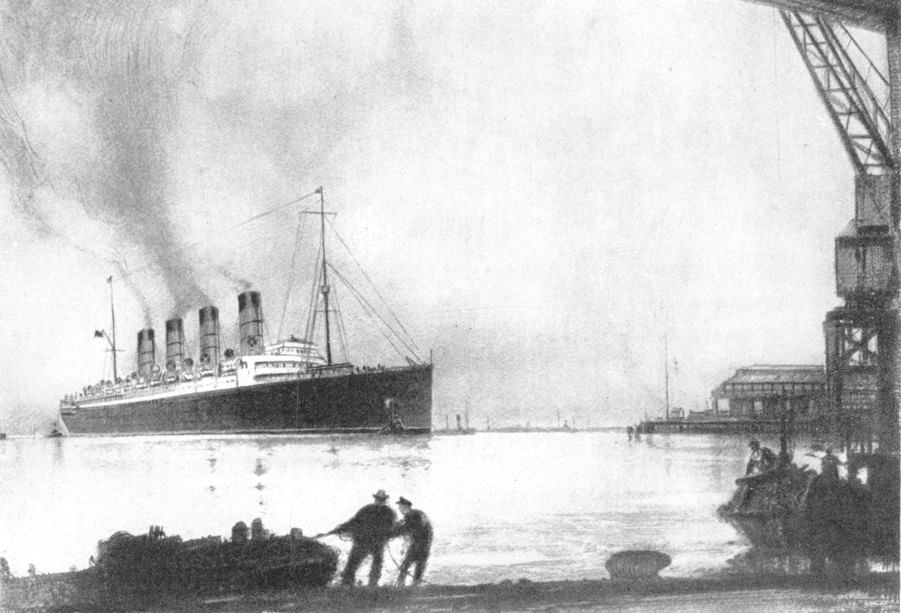
THE Mauretania
Before launching the Mauretania her builders, Messrs. Swan, Hunter and Wigham Richardson, constructed numerous models, and conducted over five hundred trials representing every variety of test necessary to the production of a perfect mammoth express liner. John Brown and Company did the same thing for the Lusitania, with the Carmania herself serving as a gigantic model of engineering science. The amazing result was that for more than twenty-two years the survivor of these two sisters held the ocean record. Only two years ago she bettered her earliest records. She finally lost it in 1929 by a smaller margin than that by which she had won it, to a new vessel built on new principles a whole generation later—in terms of human lives—or two generations later in terms of steamship history. These four Cunarders of 1905 and 1907 represent a daring progress in the face of smashing competition, and perhaps the most magnificent stride any enterprise had ever made from its past into a wonderful and fearful future. Those were the days of the first quaint automobiles, the courageous little hops of the pioneer airplanes, the staccato buzz of the Morse code in the ear-phones of wireless operators. Yet New York harbour, whose panorama was then just being broken by the first skyscrapers, even now offers no more thrilling spectacle than the approach of the Mauretania coming in from the Narrows. Progress in navigation did not cease with these Cunarders, it was simply anticipated.
Again, as usual, these express steamers were supplemented by a great building program of smaller, slower, luxurious ships. Whenever the passenger traffic affords profitable business for two such ships as the Mauretania, it also will bear a fleet of cabin vessels for the Boston and Canadian services and for the summer transatlantic rush and the winter cruises. Most travellers generally prefer leisurely luxury to crossings at high speed. (Leisure, of course, now means double the record speeds of the first Cunarders.) Accordingly, besides three small vessels destined for the branch services, six magnificent cruising liners were built between 1909 and 1914—the Franconia, Laconia, Ascania, Ausonia, Andania, and Alaunia. They are better remembered for gallantry in war than for the services they might still be performing, for five years after the last of them was launched, every one of them was at the bottom of the sea. They were all replaced by duplicates, however, bearing the same names, in 1922—which shows that travel today requires no finer ships than these which were built by the Cunard Line more than twenty years ago.
AS WE have seen, the first decade of this century was one of extraordinary changes in transatlantic shipping. The Cunard Line established, at one stride, a daring precedent which, like several of the other advances which punctuate its history, set the standards for ocean travel. These standards not only gave the Cunard fleet supremacy for that period but were so far advanced that they bridged the next ten stormy years and dominated the transatlantic passenger business during the 1920’s. Only in our present decade are to be expected changes as great as those represented by these first Cunarders of the twentieth century.
The Ivernia and Saxonia rendered third-class accommodations not only agreeable for immigrants but even attractive to a new class of tourist. The Carmania and Caronia introduced new luxuries in first-class travel at high speed, afforded by increased tonnage. The Mauretania and Lusitania realized both greater size and a phenomenal speed, which has not been exceeded until less than a year ago.
The cabin and one-class liners and the cruising steamers already mentioned embodied the benefits of a lesson taught by their more spectacular predecessors—namely, that as speed is increased, it becomes more and more expensive to owners and relatively less interesting to travellers. At the time of the last paddle-wheelers, for example, a difference of one knot in the average speed of a vessel meant a saving of twenty-four hours in the crossing. When ships were slower, therefore, a slight increase in speed made a very important change in the time between America and Europe. But a ship travelling at twenty-five knots has a superiority over one averaging twenty-four of only about five or six hours, or only four per cent of the total time required for crossing the ocean. Yet this extra knot of speed, no longer of such great importance compared to a similar increase fifty years ago, is gained at enormous cost in fuel and space.
The White Star, German, and French lines had deduced this moral from the experience of the Mauretania. Any attempt to beat her speed would surely, especially then, before the use of oil instead of coal for fuel, involve the construction of a vessel with engine space and bunkers so great that passenger accommodations would be limited and expense increased. These lines, therefore, abandoned to a certain degree the contest for speed. They built slower vessels of large capacity. Among the splendid liners which the competitors of the Cunard Line put to sea were the France of the French Line, the Imperator, Vaterland, and Bismarck of the Germans (now, under other ownership, known as the “Big Three”), and the Olympic and Titanic of the White Star. Although all larger ships than the Mauretania and Lusitania, and all capable of a speed better than twenty-two knots, they did not aspire to the Atlantic blue ribbon and consequently provided more space for the accommodation of de luxe travel than had ever before been possible. It was to meet this class of rivalry that the Aquitania was laid down in 1913, despite the spasm of doubt in the virtues of large ships which was produced by the Titanic disaster the year before.
This tragedy, even greater than any which followed during the years of submarine warfare, was the Atlantic’s last great show of force against ingenuities by which man has finally bridled her. All that science had added to the sturdy courage of the Britannia, during seventy-two years of struggle with the ocean, was of no avail against the one remaining menace—icebergs. But although the wireless could not prevent such an accident, it at least was instrumental in saving those who survived the disaster. The Carpathia, under Captain Rostrom (later Commodore of the Cunard fleet) bound from New York to Gibraltar, was in the vicinity. She picked up the Titanic’s S O S and, driving her engines at a speed they had never known before, arrived at the scene in time to save more than five hundred passengers and two hundred of the crew. The Committee of Survivors of the Titanic expressed their gratitude in a report of the tragedy:
Officers and crew of the Carpathia had been preparing all night for the rescue and comfort of the survivors, and at the last mentioned we were received on board with the most touching care and kindness, every attention being given to all, irrespective of class. The passengers, officers and crew gave up gladly their state-rooms, clothing and comforts for our benefit, all honor to them.
Already filled with her own passengers, the Carpathia was so heavily taxed by her fresh load that she struggled back to New York with difficulty, and one of her stewards died of exhaustion on the way.
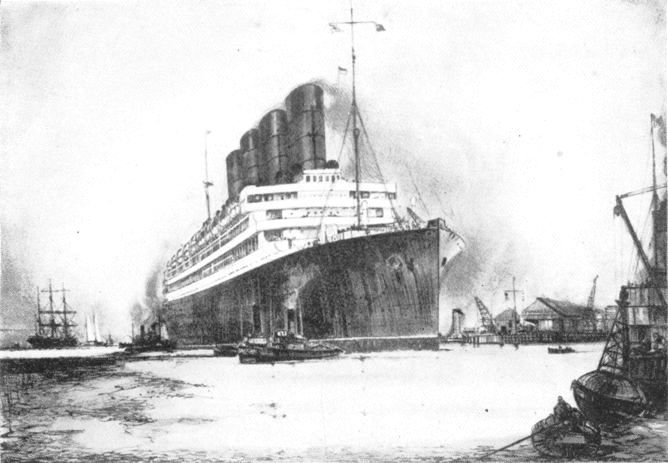
THE Aquitania AT SOUTHAMPTON
Popular pride and faith in the great new ocean liners was shaken to its foundations. Travel was injured, small ships were favoured over large ones, on the theory that they were easier to handle in emergencies, and speed was feared and avoided. For many months controversies raged in the press, and among those who expressed disapproval of the great modern liner was Joseph Conrad. The result, however, was the establishment of patrol service on the Atlantic to find and to destroy any icebergs which might float down across the trade-routes. Thus was eliminated perhaps the last remaining peril of the ocean—except war—the probable cause of the disappearance of more than a score of Atlantic liners whose histories end with the item “Never heard of.” This list includes the famous Collins liner Pacific, in her day the pride of New York.
The Aquitania, popularly dubbed “the wonder ship of the Atlantic,” is the largest ship ever built expressly for the Cunard Line. Although not so large as the White Star and German express liners, nor so fast as the Mauretania and Lusitania, she was generally conceded to be the finest product of shipbuilding ever launched and, in many respects, even retains that honour today. Her tonnage is 45,647, length 902 feet, and average speed about twenty-three knots. On one trip which she accomplished in under five and a half days she actually logged over twenty-seven knots for three consecutive hours, then the best speed ever made on the ocean.
The mere enumeration of the marvels of a modern liner hardly belong in a history. Splendour and space, after all, are relative, and what was said about the Arabia and the Scotia in their day expressed no less admiration than what is now written of the Aquitania. The glory of the record is that there have been “wonder” ships for so many generations since Robert Napier mixed ochre and buttermilk to produce a red paint for his funnels. There is a certain interest, however, in the staggering changes in the mass of proportions, when we consider that the weight of oil pumped into the Aquitania for fuel alone is almost four times the total weight of the Britannia. Nothing else that man builds has been multiplied so quickly in its dimensions, not even the skyscraper as compared with the large buildings of the eighteenth century. The growth of our population from 17,000,000 to 125,000,000 has been proportionately less than the increase of a steamship’s passenger capacity from about a hundred to about four thousand. Our notions of comfort have not kept pace with the comfort offered. Even today no hotel on land affords its guests as much as do the Aquitania’s first-class quarters. And between the things we call progress and civilization and the advance of the steamship there is a close relation. The Aquitania and her contemporaries represent the fruition of a history of enterprise which renders true Kipling’s epigram that “civilization is transportation.” To it we probably owe our existence as a major power as much as to any other one of our institutions, either political or economic.
The test of these statements was made during the World War, and it was not until these giant liners which served us were placed in jeopardy that public opinion in America was really shocked into a conviction that civilization itself was threatened. The part played by the Cunard fleet in the struggle will for many years remain an epic of the sea which Americans will cherish as a chapter in their own history. Armed Cunarders helped to carry our trade as a neutral. Fitted as cruisers, they helped to keep open the Atlantic. The loss of American lives on the Lusitania, a ship beloved in New York, startled us into the realization that we were being intolerably attacked. And, when we finally entered the conflict, it was the surviving Cunarders that, under the protection of our own destroyers, carried a very large part of our troops and supplies to France. The record of those years is proof that the foundation of this great private fleet was, indeed, as much “a landmark in our history” as would have been the establishment of such a line under the American flag. Those who saw the Mauretania and Aquitania in New York harbour, disguised in their fantastic camouflage of war-paint, must think of them still, now and then, as something more than foreign merchantmen bidding for our patronage.
About the exploits of the Cunard fleet in the World War an excellent book has already been written. Of the twenty-six ocean-going vessels owned by the Cunard Company in 1914, fifteen were sunk during the War, as were eight of the ships which replaced them. Some of the episodes must be passed over here as war history which does not concern us. All of them, taken together, present a record of the qualities in Cunard personnel which has maintained the line high in the records of seamanship and courage. But a few of the names of ships which played a part in the war are too important in American history to be forgotten in this chapter.
One of them is that of the Campania, record winner in 1893, which for twenty years held the affections of so many thousands of American travellers. She did a last good turn to the Americans who were stranded in Europe after the outbreak of the war, carrying back a great share of them across the ocean. Then she was commissioned as an airplane-carrier. Thus strangely transformed, with her forward funnel split to allow the placing of an airplane runaway between the new tandem uptakes, she served throughout the War, participating in the Battle of Jutland. She was not lost until immediately after the Armistice, when she collided with a battleship in the Firth of Forth.
Next comes the Carmania, her successor in the Atlantic express fleet, and still a popular passenger vessel. At the outbreak of the war she was converted into an armed cruiser. Within the surprisingly short space of a week after her return to Liverpool, on August 7, 1914, she was stripped of all her fittings as a passenger ship, painted a battleship-grey, reinforced with armoured plates, and armed with twelve 4.7-inch guns. After brief experience patrolling the seas in this capacity, she was ordered to Bermuda and along the east coast of South America in search of German cruisers. Approaching a small island off the trade-routes, she sighted an unidentified vessel which was apparently receiving coal from two colliers in the shelter of its lee. The stranger was evidently a vessel of about the same size and class. Later it turned out that she was the Cap Trafalgar, the newest and finest ship of the Hamburg South American Line. Soon the two vessels approached each other and ran up their respective ensigns, British and German. The fight which ensued was one of those thrilling sea-duels between two skilfully commanded and well-manned antagonists which recall some of the famous battles between the frigates of the last century. Both ships were severely hit and both caught fire. Finally the Cap Trafalgar, listing heavily and wreathed in smoke from the fire that was gutting her, bore away from the Carmania and gradually sank, the survivors of her crew getting off towards her colliers in life-boats. The victorious Cunarder, herself in danger, sighted on the horizon the smoke of another German cruiser, the Kron Prinz Wilhelm, which had been called by the Cap Trafalgar’s wireless. Her chart-house wrecked, the Carmania was obliged to withdraw, steering by the sun and winds. She finally got into touch with another British cruiser and was sufficiently patched up to make Gibraltar to be refitted. For the victory Captain Barr of the Carmania, who remained with her as navigator during the war, was decorated by King George.
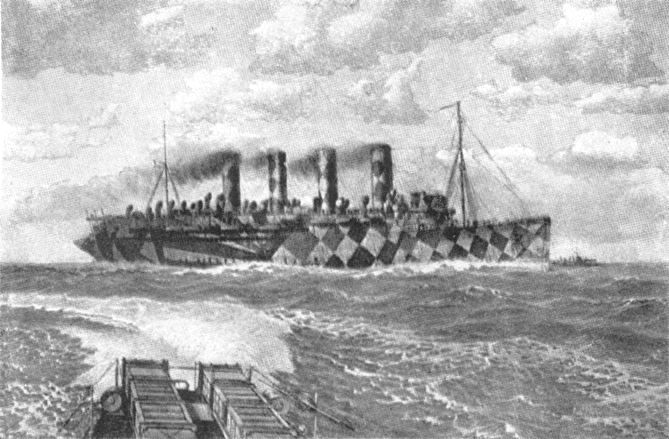
THE Mauretania IN CAMOUFLAGE
Among the other Cunarders which were converted as cruisers in the early months of the war were the Aquitania, Caronia, and Laconia. Although their services in this capacity were useful, they generally exploded the prevailing theory of the potential fighting efficiency of large passenger ships. In fact the Aquitania was soon withdrawn and laid up for a considerable period as too large to be serviceable in cruiser duty. All of these ships eventually reverted to transport service, in which were also engaged the Mauretania, Franconia, Alaunia, Ivernia, and Saxonia. Most of them were torpedoed, during the course of hostilities, and the Mauretania and Aquitania escaped only through good fortune and clever seamanship. Many stories of the heroism and devotion of their officers and crews, some of whom are still in the line’s service, are well remembered. Perhaps the most extraordinary of them was the feat of Captain Capper of the Ausonia, in guiding to safety her survivors, some of them severely wounded and including a stewardess. They spent nine days in open life-boats, rowing over nine hundred miles, passing through a heavy storm, and subsisting on rations of one biscuit and a half and four tablespoonfuls of water a day. One boat of survivors from another vessel under Cunard management was at sea for ten days and reached safety only through the courage of an American naval officer who was aboard her. For this he was honored by the British King.
But the record of achievement most interesting to us was that of the ships which continued to carry American passengers and freight to Europe during the early years of the war and which later conveyed a large portion of the troops and war supplies we sent to Europe. The whole war structure of the Allies depended upon the maintenance of a constant overseas supply of foodstuffs, oil, and munitions. The largest part of these came from America and had to be transported through a wide zone of submarine blockade. Nevertheless, during hostilities Cunarders alone carried seven million tons of goods across the ocean. At the beginning of the war, it must be remembered, there were in European trade only six ships, totalling 70,000 gross tons, flying our flag. Yet the revenue from our enormous export trade played an important rôle in converting the United States from a debtor nation, owing abroad about two and a half billion dollars, into the financial capital of the world, with foreign credits estimated in 1922 at fifteen billions. Perhaps to few other private institutions do we owe as much of our phenomenal rise to power as we do to the Cunard Steamship Company. The company not only operated most of its own available ships in the American service but took over several other merchant lines for the purpose and accepted, altogether, the management of over four hundred ships to carry on the war trade. Cunarders not only carried enormous ordinary cargoes across the ocean, but carried, within one year, 100,000 tons of American oil in their double bottoms to supply the British Navy. Altogether Cunarders steamed, during hostilities, a total distance equal to 132 circumnavigations of the globe.
In over eighty-five years of peace the Cunard Line has carried American travellers without preventable loss of life. But its war record is still more extraordinary. Between 1914 and 1918 Cunarders carried nine hundred thousand troops to Europe. Among the Canadians there were casualties resulting from submarine warfare. But the entire American Expeditionary Force of two million men and women was conveyed to Europe without the loss of a single life, and in this amazing achievement the Cunard Line played a major part. Without its services it is doubtful that a sufficient part of our Army would have arrived in time to break the last great German drive towards Paris.
Before the United States entered the war, however, many American passengers on the liners lost their lives. Some went down with the Laconia when she was torpedoed, without warning, off Queenstown. But the chief tragedy of the warfare at sea was the sinking of the Lusitania, the callous blunder which inflamed world opinion against Germany and hastened our abandonment of neutrality.
The three great Cunarders plying the Atlantic during the war not only were the envy of Germany but were performing vital services for the Allies. Unrestricted submarine warfare against merchant vessels had been declared by Germany early in 1915 as her chief naval weapon against England. Although this proved destructive of commerce, it was not sufficiently effective to assure an adequate blockade, and measures became more and more desperate, with a view to breaking the morale of the merchantmen. Finally, on May 1, 1915, the German Embassy at Washington published an announcement warning passengers on ships flying the flags of Allied nations that they travelled at their own risk. Although there were rumours that this referred to a projected attack upon the Lusitania, most of the passengers booked for her next crossing did not take seriously this extraordinary threat. Consequently, among the 1,959 people aboard her on May 7, near the end of her eastward voyage, there were hundreds of Americans who did not anticipate unusual danger. On that day, at two o’clock in the afternoon, as she was approaching the Irish coast, she was struck by two torpedoes, which blew out her sides amidships. During the short twenty minutes between then and the moment she went to the bottom, the seventy-five years of Cunard training for emergencies was put to its third real test. With the ship taking a heavy list, which soon rendered most of the life-boats useless, and with the certainty of an appalling loss of life, perfect order and coolness were preserved aboard her, and the record is filled with accounts of extraordinary heroism on the part of many of the officers and crew. When she went under, however, there were still the larger part of her passengers aboard her, and most of them were dragged under with her. No less than 1,195 lives were lost, despite prodigious efforts at rescue by those who survived her rapid plunge.
The catastrophe was the first of a series which, culminating with the sinking of the Laconia, so shocked the United States that, for the first time in history, it took part in a European war. It is no exaggeration to assert that the indignation which then came to a point was contributed to by the destruction of a fleet which has served a longer and played a more important part in the development of American trade than has any other private institution. In the absence of a powerful merchant marine under our own flag, the Cunard Line served as our foremost carrier.
THE close of the World War and the completion of the repatriation of American troops from Europe left every aspect of transatlantic shipping in an uncertain state. Fleets were depleted or crippled, several of the former German vessels had been taken over by the United States Government and were operated as an American line, the tourist trade was disorganized, immigration to the United States was drastically reduced by legislation, and the fast freight business formerly carried by passenger lines had partly been acquired by new speedy freighters of economical operation.
Under such conditions the formulation of new policies on the part of the old transatlantic companies required both courage and foresight. The Cunard Line had only four survivors of its pre-war Atlantic liners, the Carmania, Caronia, Mauretania, and Aquitania. It had also acquired, to compensate for the loss of the Lusitania, the enormous German ship the Imperator, of 52,000 gross tons, 919 feet long, and with nearly 100 feet beam. This last vessel was refitted as a Cunarder and rechristened the Berengaria. (This, curiously, is the only vessel in the Cunard fleet to bear the name of a person instead of a geographical locality. Berengaria was the name of the Queen of King Richard the Lionhearted.) Besides these five liners, which, compared with those of the past, constituted only the skeleton of an Atlantic fleet, the Cunard European service had a number of smaller vessels unsuitable for the various American berths.
The other major passenger lines in the trade were those grouped under the International Mercantile Marine, the French Line, the United States Lines, the United American Lines, and the Navigatione Generale Italiana. Of the first the White Star was the chief owner of large express steamers, including the Majestic, which had formerly been the German Bismarck, as well as a number of smaller ships. The French Line had two large steamers and seven smaller ones affording particularly good second-class accommodation, and the United States Lines ran six former German liners, including the Vaterland, renamed the Leviathan. Besides these there were a number of secondary passenger lines which carried, altogether, a good portion of the traffic.
Thus the Cunard fleet was not only unbalanced, in terms of its customary ratio between express liners and smaller ships of moderate speed, but, for the first time in its history, numerically inferior to several of its competitors. The Canadian service had been totally wiped out during the war, as were the vessels formerly engaged in the Boston route and general cabin trades. Under these circumstances it was vitally necessary to undertake an unprecedented building program to restore its normal relative tonnage, even though the new conditions of the transatlantic traffic had not yet clearly defined themselves.
The nineteen new liners launched for the Cunard Company between 1921 and 1925, nine of them before the fall of 1922, represented a policy which has maintained the line in the van of every class of transatlantic service ever since. They raised the combined Atlantic tonnage of the Cunard, Anchor, and Anchor-Donaldson lines, which the Cunard Company had acquired in 1911, to more than half a million gross tons. (In addition to these the company had extended its interest into other shipping fields, acquiring control of one million tons in all.) These new Atlantic liners ranged from 13,000 tons to 21,000, in the case of the Carinthia, Samaria, Laconia, and Franconia. These last were substantially of the same size and class as their predecessors whose names they inherited, but their building-cost was quadruple, owing to the improvements made in their fittings and to the increased expenses of ship construction.
The prompt success of these new ships was witnessed by the fact that they secured the best part of the Atlantic trade, carrying in 1926, for example, over a quarter of a million passengers—ninety thousand more than their nearest competitors. Such an achievement in the face of severe handicaps speaks well for the foresighted policy adopted and for the efficiency of its execution. In fact, Cunard service since the war has sustained against new competition the prestige it won when its position was uncontested on the Atlantic. Its reputation for safety no longer has its original importance. Its record speed, maintained by the Mauretania during the last decade, is represented by only one liner carrying only a fraction of the hundreds of thousands of American travellers. The success was due, rather, to a service which, true to the traditions of the line, was alert to the new requirements of American travel and was prompt to meet them.
The chief problem which confronted transatlantic shipping companies after the war, and especially after 1924, resulted from the abrupt curtailment of immigration to the United States. A considerable part of the tonnage in the trade had been devoted to steerage quarters, in which, as we have seen, great improvement was made. Not only was the ocean voyage made agreeable, but the inland agencies of the companies, and their arrangements with both European and American railroads and banks, had facilitated the migration of people from their own villages directly to the chief markets for their labour in America. This co-operation did much, in fact, to avert congestions of foreign-born in our seaport cities and to distribute them to other parts of the country.
Until the new agricultural lands in the West were entirely taken up, immigration was generally accepted in the United States as an “insurance policy against want” for the industrial worker, assuring an increasing source of raw materials and an increase in the domestic market for manufactures. Then, in the years which preceded the World War, our industrial expansion, particularly in the Middle West, replaced the demand for agricultural labour with new markets for factory labour. It also provided a surplus production for export. Both of these factors favourably influenced the transatlantic lines. The close of the war, however, found our industries so highly mechanized that new labour was no longer necessary to new growth, while an impending flood of refugees from the economic disorganization of Europe threatened American wage levels. The elements which formerly had opposed legislative numerical restriction came to its support, with the result that the Emergency Quota Act of 1921 was passed by Congress, strengthened the following year, and converted in 1924 into the law which forms the basis for our immigration policy today. These measures were taken just in time to avert the crisis which would have resulted from the restoration of an annual flow of nearly a million people. Their effect was to reduce immigration from Europe to about one hundred and fifty thousand a year.
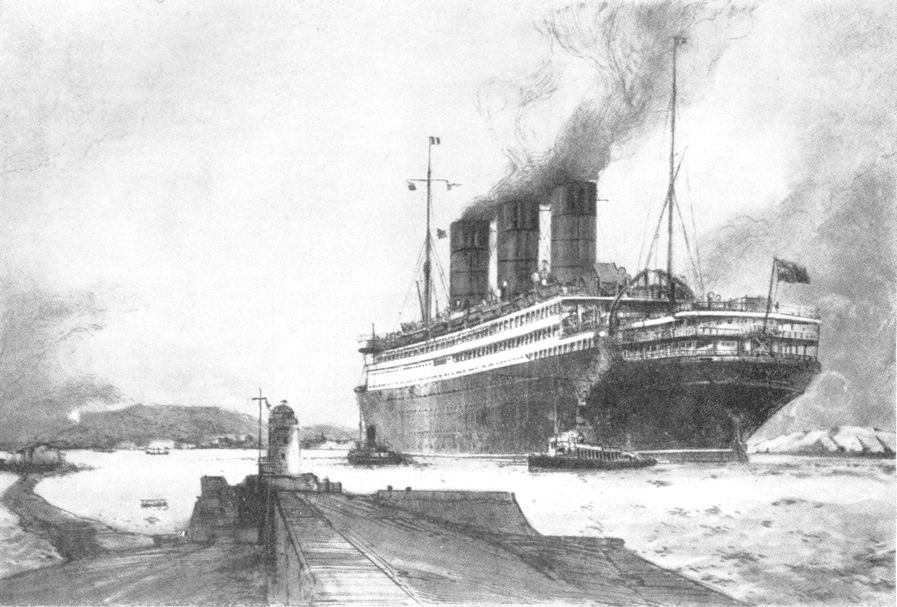
THE Berengaria AT CHERBOURG
The great migrations which had peopled our continent provided, of course, an important and profitable part of the transatlantic shipping-business. In fact, as the size of ocean liners increased, as cabin-class luxuries multiplied, and as expenses of operation become proportionately even greater, steerage traffic appeared indispensable to the operation of express liners. The World War accentuated this by bringing into existence a great number of fast freighters to carry cargoes which might have filled the space formerly occupied by immigrants on passenger liners. Steamship lines, consequently, vigorously opposed the enactment of the restrictive immigration acts, which struck, unintentionally, at a vital part of their trade. The Cunard Company had less at stake during this period than many of the other lines. Its chief steerage carriers had been destroyed during the war, and it was only beginning to lay down a new fleet. The class and fittings of these most recent Cunarders, therefore, were designed to fit the new circumstances, and reconstruction was carried out with a shrewd foresight into the probable course of legislation in Congress and the potential increase of tourism.
This latter factor was an indirect consequence of the World War. The presence of a large American army and of important non-combatant groups in Europe naturally tended to spread among Americans increased interest in the Old World and to reduce the psychological barrier of the ocean. Next, the closer participation of American statesmen in European affairs led to the endowment by American internationalists of foreign scholarships, student unions, and schools of international relations. Among such institutions, for example, was the American Library at Paris, formed from the nucleus of the American Red Cross Library in France. Another influence upon the growth of transatlantic travel was the fact that the flow of gold to the United States, which had become a creditor nation, tended to increase the buying power of Americans travelling in Europe, particularly during the depreciations of foreign currencies. People of relatively small means found vacationing abroad cheaper than at home. European countries offered inducements to tourists and benefited by the important sums spent by them.
All of this produced a phenomenal multiplication of summer travel across the Atlantic. Such was the excess of tourists desiring to go to Europe over the available passenger accommodation that ticket speculators, illegally gambling on the demands for passage, had no difficulty in receiving, until the practice was stopped, prices more than double those charged by the steamship lines. For at least part of every year this movement of tourists more than compensated for the curtailment of immigration. The degree to which this was true of individual steamship companies, after increased Atlantic tonnage had stabilized the trade, depended largely upon the foresight with which they readjusted themselves to new conditions. Competition was determined by ability to offer the new travelling public the sort of service it preferred. It was here that the Cunard fleet secured an important advantage. In its building-projects for the replacement of vessels lost in the war, commenced before the chief immigration acts were passed, it emphasized ships of moderate size and speed and great luxury with relative operating economy. All of them are oil-burners, driven by from four to six geared turbines. Several of them are fitted especially to carry one class, or cabin and tourist third only, and in this latter feature they established a new standard of very comfortable travel at low prices which has done much to promote summer travel to Europe. Several others are equipped particularly for the various popular winter cruising routes—to the Mediterranean or round the world. The remaining three-class ships have reduced their steerage quarters to a proportion suitable to the restricted immigrant traffic, confining it to the forward part of the vessel and using the after part for tourist third class. Devices promoting stability and engineering skill in reducing vibration have largely removed the discomforts which used to characterize accommodations in the extremities of the vessels. In general more space has been rendered available for passenger quarters by better arrangement and by the saving of bunkerage resulting from the substitution of oil for coal.
Not only were the new Cunarders designed to burn oil, but the older ships were reconditioned and converted to burn this fuel. This has produced an important economy. Weight for weight, oil is from forty to sixty per cent more efficient than coal. Thus it saves both weight and space as it can be stored in a vessel’s double bottom. It also saves labour, eliminates the horrors of the old-fashioned stokehole, and reduces time required for refuelling to such a degree that oil-burners can make several more trips across the ocean every year than could coal-burners of the same speed. The importance of these considerations, and the prevailing preference of comfort and space to speed, is illustrated by a striking comparison. When the Carmania was built, in 1905, she averaged the then high speed of twenty knots. Her tonnage was about 19,500, her capacity about 1,500 passengers and 1,000 tons of cargo, and her consumption of coal for the crossing 3,000 tons. The Scythia, built in 1923, has a tonnage of 20,000, speed of 16 knots, consumption per voyage of only 1,200 tons of oil, but a capacity of 2,200 passengers and 8,000 tons of cargo. Thus the new Cunarder carries, on 60% less fuel than the Carmania burned, 50% more passengers and 700% more freight. Not only this, but she affords more general luxury to her passengers. The cost of this difference is only four knots of speed and the use of oil. At present, of course, the Carmania burns this fuel too, with a consequent result in economy. But the engine space required to maintain her superiority of speed nevertheless still leaves much less room available for passengers and freight.
One prejudice which Cunard agents found difficulty in overcoming in winning for the new ships the confidence they now enjoy was the notion that vessels possessing only one stack are inferior. The public, accustomed to measuring splendour by the Aquitania’s and the Mauretania’s four funnels, was hesitant about accepting liners carrying but one. This, in reality, was an important improvement, and a saving in deck space, made possible by the substitution of oil for coal.
One of the most acute problems facing transatlantic passenger lines at the present is the seasonal aspect of the business. Formerly the carriage of emigrants from Europe was an important year-round source of business which, with a steadier rate of cabin traffic, warranted the maintenance of good transatlantic service, large permanent crews to serve the passengers, and fast regular schedules. Moreover, a larger percentage of people taking first- or second-class passages travelled also during seasons other than summer, particularly to the Mediterranean in winter, for example.
The comparatively lower costs of travelling today, considering the change in the value of gold, and the general spread of prosperity to a larger part of the American people, have created the demand for a fleet of liners accommodating many times as many passengers during the summer. But during the other eight months of the year the traffic is proportionately much less. Had it not been for the economies effected by the introduction of oil as fuel and for the further economy resulting from an abatement in the mania for high speed, the standing Atlantic fleets probably could not have been maintained profitably. Under the present competitive conditions the carriage of fast freight cannot replace the steerage trade, as profits are too small to cover, besides the fuel and operating cost, suitable return on the enormous capital investment represented by luxurious fittings and the constant employment of thousands of trained servants.
At present the solution is being sought in the promotion of winter cruises. The market for the longer ones, consuming the same amount of time as a summer trip, or more, is fairly constant and chiefly limited to persons of leisure. Shorter winter trips, however, are becoming attractive to a larger portion of the travelling public. Although winter is normally the period of greatest business activity, many permit themselves a vacation of a week or two to relieve it. Cuba, the West Indies, and Bermuda are the chief mild-weathered foreign places within convenient distance from our Atlantic coast.
In December, 1928, consequently, the Cunard Line inaugurated a service between New York and Havana, thus returning to the waters in which Samuel Cunard had gained his early experience as a merchant a hundred years before, and restoring vessels to the West Indian trade, in which the Cunard Line had engaged in 1850 and again in 1877. The Caronia was placed on the route, with considerable success, and played an important part in developing Cuba as a popular winter resort. Service from England to Havana was also instituted.
The United States Shipping Board protested vigorously against this action and placed the President Roosevelt, one of the great German liners taken over by the American Government, on the same route, as a “fighting ship,” with sailings identical with those of the Caronia. This introduced a certain amount of animus into a situation which contained no good reason for ill feeling. Before opening the route the Cunard Company had reached friendly agreements with two of the principal American lines serving Cuba, by which it undertook to refrain from carrying freight, and to maintain a higher level of fares appropriate to the special nature of the service offered. It did not, therefore, constitute unfair competition against the year-round American commerce with the West Indies any more than the seasonal participation of American vessels in transatlantic trade involves an unfair attack upon the regular business of the Cunard Line. On the contrary, the period of winter travel to the West Indies is more brief and more distinct from the trade carried the other eight months than is the summer travel to Europe. Winter vacationers in Cuba are, moreover, more or less the same class of travellers as those who patronize the de luxe summer European services. In view of the extreme fluctuations in both, the two trades should be developed as complementary, particularly as neither of them need interfere with the carriage of regular commerce in the sense of freights.
The Havana trip in the winter of 1929-30 by the Mauretania brought forth some further unfavourable comment from certain American quarters. Again, as those in Congress who defended this action pointed out, the move was perfectly legitimate. Her speed materially reduced the distance from New York to Cuba and, consequently, rendered more convenient a winter vacation for those who cannot spare the time for a longer trip. The history of travel has never been advanced by attempts artificially to preserve spheres of national influence in international shipping. On the contrary, the ocean has always been a fair field with no favours.
A similar step in response to the demand for shorter vacation trips was taken during the past summer by the Cunard Line. This was the inauguration of week-end cruises to Halifax, Bermuda or the Bahamas. The management again proved itself alert in meeting unusual shipping conditions. This year these had been produced by a major international depression and by the resultant fact that a large class from which is generally recruited the steady trans-Atlantic clientele found it inadvisable to risk a long absence from home and business. On all lines the bookings to Europe had fallen off seriously. Yet there was no less an established market for ocean travel than there was in the better post-war years.
Ocean voyages, therefore, with nearer ports of call, were provided at rates which made them appropriate to the circumstances. This interesting experiment was tried, with marked success, by offering four-day cruises to suitable foreign ports aboard crack liners at the minimum rate of $50. The device, which was also adopted by several other lines, afforded both timely service to old patrons and an opportunity for others to discover the pleasure of a voyage. This was accomplished, moreover, without disrupting the regular European service—thanks to the rapid re-fueling which oil makes possible. Liners which otherwise generally reached New York in the middle of the week to lie over until sailing the next were put to good use in the interim. Thus was established a new service which will probably retain its popularity long after the revival of European travel expected next summer.
Another major shipping event which marked the close of the last decade promises the beginning of a new and thrilling chapter whose outcome it is difficult to foresee. The German lines, whose Atlantic services had lapsed during the war and whose first-class tonnage had been taken over by the Allies, have reappeared on the ocean as formidable competitors. Within a very few years the reconstituted fleets of the Hamburg-American Line and the North German Lloyd have made powerful bids for the Atlantic honours they used to share with the Cunard Line. With the strength behind them of large shipping interests in other fields the German services to the United States are recovering their prestige. Equipped with four seven-day boats, several comfortable slower ones, and, finally, three ocean flyers, of which two have beaten the Mauretania’s records for speed, they have effected a merger in all but name. This co-operation between powerful lines introduces not only a new competitor, but, in the case of the newest North German Lloyd express steamers, the Bremen and the Europa, has reopened the race for speed.
IT WAS predicted in 1907 that a faster passenger vessel than the Mauretania could not be built, or, if so, could not be operated to advantage on account of the costs and sacrifices in space. Her twenty-two years of supremacy on the Atlantic, the longest period the blue ribbon has ever remained with one ship, appeared to bear this out. Heretofore shipowners have not been tempted to refute it, and travellers have not asked for faster service. But in the meantime some new discoveries have been made in marine engineering, particularly in connection with battleship-construction. Not only has oil replaced coal as the standard fuel, and the motor ship appeared as an efficient vessel of intermediate size, but some changes in hull design have made possible increases in speed without prohibitively higher costs. The bulbous prow, for example, generally used in the construction of warships, accomplishes this to some extent, but at the sacrifice of steadiness. The following table, however, gives the power and fuel recently estimated necessary to propel a large vessel of given tonnage at various speeds:
| Speed | Indicated | Tons of oil | |||
| in knots | horse-power | consumed per | |||
| round voyage | |||||
| 20 | 45,000 | 6,000 | |||
| 22 | 55,000 | 6,600 | |||
| 24 | 71,000 | 7,900 | |||
| 26 | 92,000 | 9,420 | |||
| 28 | 120,000 | 11,400 | |||
| 30 | 160,000 | 14,200 | |||
From these figures it will be seen that, while the difference between twenty and twenty-two knots requires an increase of 10,000 horse-power, an equal advance in speed from twenty-eight to thirty knots requires an additional 40,000 horse-power. This means a great sacrifice of carrying capacity for engine space and a consumption of nearly 3,000 more tons of oil per voyage. Yet the advantage secured at this large cost is only seven per cent of the travelling time.
Nevertheless the Cunard Company has on the ways in Glasgow a new liner, now simply known as the “No. 534,” which will have a length of more than a thousand feet, beam of 115 feet, and 73,000 tons displacement. She is to accommodate 5,000 passengers. Such figures are difficult to grasp in visual terms unless we make some comparisons: The ship will measure in length about the same as the height of Chrysler Building in New York. The original “mammoth” Britannia could be held, hull and superstructure, in one of her three funnels. And her power will be about equal to that of seven million galley slaves rowing in unison. Her owners predict that she will be, like her elder sister the Mauretania, twenty years ahead of her times.
No safe predictions as to the future of this “No. 534” may be made until she is launched, early next year, or until she has made her maiden voyage in 1933. But precedents in the history of Atlantic travel have established several schools of prophesy. When Dr. Dionysius Lardner asserted that no steamship could be built to carry enough coal for a trans-Atlantic voyage he won, by his error, a more permanent place in history than he did by his distinguished career as a scientist. And when, in 1840, the Halifax editor wrote that a twelve-day crossing “shall well be considered as a minimum which is scarcely susceptible of diminution” he set a style of prediction which was observed as recently as 1929 when the Bremen made her new records.
But even though we may admit that it is not possible to foretell the physical limitations of the steamship of tomorrow, there remains ground for suppositions as to the future of the shipping-business. In several classic instances, as we have seen, the travelling public has forced shipping companies into ruinous extravagances by demanding new sensations. There has been a very fine distinction between the successes built on courage restrained by common sense and the failures resulting from folly. In both cases it has seemed that progress was being advanced. No doubt the present situation has been closely studied by the managements of the major steamship lines before they have laid down their programs. And the result has been a decision to build new ships to contest the honors with the “No. 534.” This will produce several colossal and expensive express liners which will evidently have to share a limited seasonal trade. The short winter cruise has not yet been developed to a point which will assure a regular two-season profit for all these ships. The smaller liner of moderate speed and expense continues to enjoy a substantial conservative patronage. It appears, therefore, that unless competitive building is abandoned, the 1930’s will bring unwelcome perplexities to the shipowners just as surely as they will afford the public new astonishments.
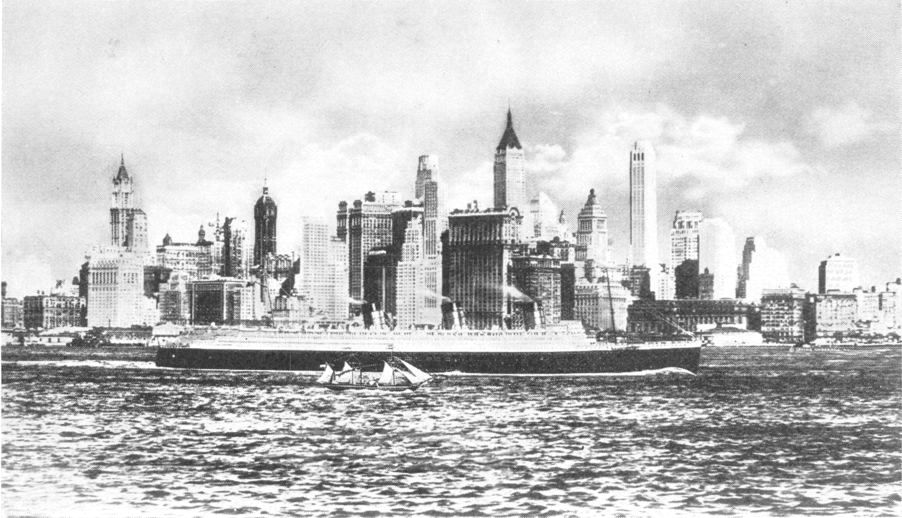
“NUMBER 534” AS SHE WILL LOOK AGAINST THE LOWER NEW YORK SKYLINE
SCALE DRAWING OF THE Britannia IN THE FOREGROUND
The history of the Cunard Line bears out the old paradoxical aphorism that “the seas but link the people they divide.” When Samuel Cunard jocularly offered to settle the Northwest Boundary dispute for the British Government, perhaps he had this in mind. When George Bancroft, at the Cunard festival in Boston, concluded his speech with a toast, he expressed a sentiment particularly apposite today: “Old England—she renounces the ambition of ruling the seas and effects the nobler purpose of connecting continents.” Of course Cunard did not settle the dispute, but it soon was amicably resolved. And his vessels did establish a beneficent rule during the decades when American shipping was dying an evidently natural death—a rule which supplied our most pressing needs in many crises. In fact few foreign organizations have won more grateful affection in America than has the Cunard Line. Few companies, if any, have played as great a part in our history. And certainly none has served better as a medium for international understanding and friendship.
It was a Cunarder which carried to Europe our first exports of manufactured goods. And even when the line’s tonnage became a relatively smaller part of the carriers of American fast freight, owing to the increase of shipping, it continued to carry its share with such consistent reliability that most merchants did not think it worth while to insure their goods.
A nation whose birth on a new continent was the arrival of the first shipload of immigrants naturally owes its rise in power to the enterprise which brought it new workers and citizens. Here again the Cunard Line takes precedence. Not only did it establish regular and safe steam navigation, by which the migration was made possible, but it remained a leader in the improvement of this service and in the amelioration of steerage accommodations.
Besides the importation of population and the exportation of products—the fundamental elements in American history—we owe much to our less tangible exchanges with the Old World. In 1840 we were still a rather provincial nation. Boston, for example, although her merchants traded at every port in the world, was doggedly individualistic and rather suspicious of foreign customs and ideas. She was ready, nevertheless, to accord a frenzied welcome to such visitors as Charles Dickens. Although we have rejected many of the doctrines and movements and standards of which easy transatlantic travel made us aware, others have enriched our national life and supplied fresh impulses to an American civilization. The Cunard passenger lists for the last ninety years include the names of most of the men who have brought us these influences and left their mark on the history of our development. Whether by twelve-day or by five-day voyages, it has been chiefly through travel that our intellectual and artistic horizons have been extended into both other countries and other times. And at present, thanks to the phenomenal development of transportation, travel has become available to a great representative section of our population.
This uninterrupted progress of the Cunard Line, without retrogression and almost without mishap, stands, beyond the possibility of envy, as a matchless human achievement. When we consider that hardly a skyscraper is built without loss of life, and hardly a railroad, laid on solid earth, has not known disaster, we must acknowledge the feat of transporting across a dangerous ocean more people than inhabit some of our states with the loss, in time of peace, of but four lives, especially as these four lives were only the toll of an unpredictable caprice of the waves.
A few years ago a writer in the North American Review remarked:
The success of this Company, taking all things into account, has never been equalled. The vessels are plying constantly between Great Britain and the United States; no gale sweeps that Atlantic that does not toss one of them; no fog rests upon its bosom that does not obscure their path; no floating berg or ice-field drifts to the southward that does not pass immediately athwart their bows. . . . Fortunate! That is not the word to apply to them; it is not to good fortune, but to wise management, that they owe their success. “Providence helps those who help themselves.”
The policies of this wise management were laid down more than ninety years ago, and from them there have been no deviations. They may, perhaps, be summarized as: the determination to employ only the most experienced and reliable personnel available; the practice of absolute punctuality and discipline in every branch of the service; a munificence towards employees which has secured the loyalties of whole dynasties of officers and men and has developed a matchless esprit de corps; the sacrifice of every consideration incompatible with the maximum safety attainable; the tradition of ordering ships from the best builders, to be made of the strongest materials, and to apply every proved advance in engineering science, leaving to others the pursuit of novelty and the adoption of experiments. These policies have characterized the construction and operation of every Cunarder. And in the accommodation of passengers the company has followed the demands of its patrons in offering, in its beginnings, comfort without extravagance, and, more recently, modern luxury without fad.
BIBLIOGRAPHY
In the first section are listed most of the works consulted relating primarily to the history of shipbuilding, navigation, and transatlantic commerce. The more important general books are marked for the reader’s guidance with an asterisk (*). The second list includes the chief sources of economic, biographical, anecdotal, and miscellaneous material of incidental interest, here cited as authority for certain passages rather than as primary references on the general history of the Cunard Steamship Company.
The author has attempted to achieve all possible accuracy in reconciling the differences which frequently occur among his sources of information. Many of the secondary references have revealed errors and omissions in the books upon which he has chiefly relied, to which he owes, nevertheless, grateful acknowledgment.
Books
Ayre, A. L.: British Shipbuilding
Bellows, W.: Ocean Liners of the World
*Bowen, Frank C.: The Sea: Its History and Romance: Vol. IV
*——: A Century of Atlantic Travel
Chadwick, French E. (and others): Ocean Steamships: a popular account of their construction, development, management and appliance
*Chatterton, E. Keble: Steamships and their Story
——: Steamship Models
Croil, James: Steam Navigation and its Relation to the Commerce of Canada and the United States
Cunard Steamship Company: Official Guide and Album (1878)
——: History of the Cunard Steamship Company (1886)
*Fabre, Rene: Les Grandes Lignes de paquebots nord-atlantiques
Fletcher, R. A.: Steamships, the Story of their development to the present day
*Fry, Henry: The History of North Atlantic Steam Navigation
Hall, Cyril: Conquests of the Sea
Hayes, Sir Bertram: Hull Down
Holmes, A. Campbell: Practical Shipbuilding
Holmes, Sir George C. V.: Ancient and Modern Ships: Part II, The Era of Steam, Iron and Steel
Huldermann, Bernhard: Albert Ballin (trans. by W. E. Eggers)
Hurd, Archibald: A Merchant Fleet at War
——: The Sea Traders
Jackson, G. Gibbard: The Ship under Steam
Jones, Clement: British Merchant Shipping
Kirkaldy, Adam W.: British Shipping, its History, Organization and Importance
Knox, T. Wallace: Life of Robert Fulton and History of Steam Navigation
*Lindsay, W. S.: History of Merchant Shipping and Ancient Commerce
Lloyd’s Register
MacDonald, A.: Our Ocean Railways, or Ocean Steam Navigation
*Maginnis, Arthur: The Atlantic Ferry: its ships and working
Martin, W. L.: The American Merchant Marine
Mason, H. B. (editor): Encyclopædia of Ships and Shipping
Miller, Peyton F.: The Story of Robert Fulton
Morrison, John H.: History of American Steam Navigation
*Morrison, Samuel Eliot: The Maritime History of Massachusetts, 1783-1860
Owen, Hugh: Ship Economics, Practical Aids for Shipmasters
*Parker, Captain H. and Bowen, Frank C.: Mail and Passenger Steamers of the Nineteenth Century. The Macpherson collection; with iconographical and historical notes
Preble, Rear Admiral G. H.: History of Steam Navigation
Pond, E. LeRoy: Junius Smith
Rainey, Thomas: Ocean Steam Navigation and the Ocean Post
Russell, W. Clark: The Ship—her Story
Smith, J. Russell: The Ocean Carrier
Smith, T. T. Vernon: The Past, Present and Future of Ocean Steam Navigation (1857)
Smyth, W. H.: The Sailor’s Word-book
Stuart, Charles B.: The Naval and Mail Steamers of the United States (1855)
Talbot, Frederick A. A.: Steamship Conquest of the World
Thoms, William: A New Treatise on the Practice of Navigation at Sea
Todd, John A. (editor): The Shipping World
Whittemore, Henry: Fulfilment of Three Remarkable Prophecies in the History of the Great Empire State relating to the development of steamboat navigation and railroad transportation, 1808-1908
Pamphlets, Broadsides, Magazine Articles and Miscellaneous Sources
Agreement of Cunard Steamship Company with the Admiralty, Board of Trade and the Postmaster General—with Treasury Minutes Thereon. July 1903
Alley, Hon. John B.: Ocean Steam Navigation. A Speech on bill providing a subsidy for a line of steamers to Brazil, delivered in the House of Representatives April 15, 1864
Armstrong, R.: High Speed Steam Navigation and Steamship Perfection (1859)
Boston Board of Trade: A Memorial on behalf of the American Steamship Company (1864)
Bradlee, Francis C. V.: Private collection of original notes, papers, and other documents, relating to the history of navigation, preserved at Essex Institute, Salem, Mass. Also several newspaper articles and magazine articles written by him
Broadley, A. M.: The Ship Beautiful—Art and the Aquitania.
Campbell, Archibald: The “Royal William,” the Pioneer of Ocean Steam Navigation—a paper read before the Literary and Historical Society of Quebec, 1891
Claxton, C.: Logs of the First Voyage made with the Unceasing Aid of Steam, between England and America by the “Great Western.”
Cunard Steamship Company, Limited: Reports of the directors, 1887-1929
——: Numerous pamphlets and broadsides relating the history of the line and describing its fleet
Historical Account of the Application of Steam for Propelling of Boats, by “A Friend to Science” (1811)
Holland, Rupert S.: Historic Ships
Hurd, Archibald S.: The Largest Turbine Steamship in the World: the Carmania of the Cunard Line. Cassier’s Magazine (1906)
Institute of Engineers and Shipbuilders in Scotland: Transactions 1903. Original contract for the construction of the original Cunard liners
Ker, Robert: The Pioneer Atlantic Steamships. Canadian Magazine (1907)
London Society: Proceedings; 1880
New York Public Library: Files of unclassified clippings relating to Atlantic shipping
Parliamentary Papers: Sundry files relating to transatlantic mail contracts
Rigaud, Steven Peter: Account of some Early Proposals for Steam Navigation (1838)
Seaward, Samuel: Memoir on the Practicability of Shortening the Duration of Voyages by the Adoption of Auxiliary Steam Power to Sailing Vessels (1841)
Smith, Junius: Letters upon Atlantic Steam Navigation (1841)
Stevens, John Austin, Jr.: Memorial of the Chamber of Commerce of New York on Ocean Steam Navigation (1864)
Town, Ithiel: Atlantic Steamships: Some ideas and statements, the result of considerable reflection on the subject of navigating the Atlantic (1838)
Walker, James: Investigation of Claims put forward for first “Royal William” as first steamship to cross the Atlantic
Watkins, J. Elfred: The Log of the “Savannah” (facsimile of original preserved in U.S. National Museum Washington, D.C.)
Woodcroft, Bennett: Sketch of the Origin and Progress of Steam Navigation
Files and newspaper clippings collected by Postmaster General of Halifax, N.S.
periodicals and newspapers whose files have provided useful miscellaneous information
Acadian Recorder (Halifax)
Atlantic Monthly
Boston Almanac
Boston Courier
Boston Daily Advertiser
Boston Mercantile Journal
Cassier’s Magazine
Century Magazine
Connecticut Magazine
Cunard Magazine
Cunarder
Edinburgh Review
Engineer
Engineering
Harper’s New Monthly Magazine
Harper’s Weekly
Higham Patriot
Hunt’s Merchant Magazine
Illustrated London News
Illustrated News
Journal of American Society of Engineers
Liverpool Daily Telegraph
London Times
Merchants Magazine
Nautical Magazine
New York Commercial Advertiser
New York Herald
New York Sun
New York Times
North American Review
Penny Magazine
Review of Reviews
Rudder
Scribner’s Magazine
Shipping News
United States Commercial and Statistical Register
American Cyclopedia of National Biography
Chittick, V. L. O.: Thomas Chandler Haliburton
Conrad, Henry C.: (Conrad Family) Thones Kunders and his Family
Conrad, Joseph: Notes on Life and Letters
Council on Foreign Relations (Charles P. Howland, editor): Survey of American Foreign Relations (1929), chapter on Immigration
Dickens, Charles: American Notes
Dictionary of National Biography
Edwards, T. E.: Historical Reminiscences of the Cunard Lines
Gannett, Ezra: Sermon delivered in the Federal Street Meeting House, in Boston, July 19, 1840, on the arrival of the Britannia
Fortunes Made in Business (London)
Fobwood, Sir W. B.: Reminiscences of a Liverpool Shipowner
Guedalla, Philip: Palmerston
Haliburton, Thomas Chandler: The Letter-bag of the Great Western, or, Life on a Steamer (1840)
Hodder, Edwin: Sir George Burns
Kemble, Frances Anne: Record of a Girlhood
——: Records of Later Life
Lyell, Sir Charles: Travels in North America (1845)
——: A Second Visit to the United States of North America (1849)
MacMechan, Archibald: The Rise of Samuel Cunard. In Dalhousie Review, July 1929
Murdock, Beamish: A History of Nova Scotia or Acadia
Napier, James: Life of Robert Napier
Payne, Abraham Martin: Life of Sir Samuel Cunard, Bart. Paper read before the Nova Scotia Historical Society, 1905
Payne, Edward E.: Dickens’ Days in Boston
Perkins, Jane G.: The Life of Mrs. Norton
Punch
Punchinello (1870)
Rae, W. Frazer: The Business of Travel
——: Columbia and Canada
Shackleton, Robert: Book of Boston
Sims, Rear Admiral William Snowden: The Victory at Sea
Spedding, Charles T.: Reminiscences of Trans-Atlantic Travellers
Sumner, W. H.: History of East Boston
Thackeray, William Makepeace: On Ribbons. In Roundabout Papers
Ticknor and Company: Memorial History of Boston: 1630-1880
United States Immigration Commission: Sundry publications
United States Postmaster General: Reports
Wallace, William Frederick: Wooden Ships and Iron Men
Warburton, George: Hochelaga
Sundry newspapers and magazines, also unpublished letters and memoranda
INDEX
Abyssinia, 134
Acadian Recorder, 142-6
Aleppo, 128
Algeria, 134
Alpha, 115
Amazon, 97
America (yacht), 92
American Notes, 59-63
Andania, 187
Andes, 116-17
Aquitania, 51, 58, 85, 189, 191, 192-3, 194-5, 199, 206
Arabia, 97-9, 102, 107-8, 117, 118, 119, 191
Arets, Lenant, 6
Ascania, 187
Australasian, 120, 121, 128, 134
Aylmer, Lady, 26
Baltic, 92-3
Bancroft, George, 212-13
Barr, Captain (Carmania), 194
Bayard, Senator, 92
Beecher, Henry Ward, 168
Bell, Captain (Charles Ward), 145
Bell, Henry, 21
Berengaria, 199;
and see: Imperator
Berengaria, Queen, 200
Bernhardt, Sarah, 168
Beta, 115
Bismarck, 136
and see: Majestic
Blasco de Garay, 15
Boston Almanac, 69
Bothnia, 134, 136, 138, 139, 140, 148, 156
Boulton and Watt, 20
Brennan, Richard, 145
Brescia, 181
Britannia, 50-1, 53, 54-8, 59-65, 67, 68, 69, 72-3, 81, 93, 95, 107, 121, 136, 139, 140, 167, 174, 186, 189, 191, 211
Britannic, 148
British Queen, 30-1, 32, 42, 43, 80, 83, 115
Brown, John, and Company, 186
Burns, George, 44, 45, 46-7, 48, 49, 74, 83, 85, 93, 115, 132, 149
and see: Australasian
Caledonia, 50
Calpe, 24
Calvin, 3
Cambria, 75, 93, 117, 123, 125-6
Campania, 165, 166, 175, 176, 184, 193
Capper, Captain (Ausonia), 195
Cap Trafalgar, 194
Carlos, Don, 29
Carmania, 185-7, 188, 193-4, 199, 205
Caronia, 185-7, 188, 194-5, 199, 207
Catalonia, 151
Cephalonia, 151
Charles II, 5
Charlotte Dundas, 16
Charles R. Moss, 160
Charles Ward, 145
Chatterton, E. Keble, 129
City of Berlin, 148
City of Brussels, 130
City of Manchester, 120
City of Rome, 151
Clark, Nathaniel, 145-6
Clemens, Samuel L., 33, 62, 142-7
Codman, Captain John, 81
Comet, 21
Commodore, 41
Concord, 6
Conrad, Dennis, 7;
and see Kunders, Thones
Conrad, Joseph, 190
Cottier, Captain (Oregon), 158, 159, 160
Countess of Harcourt, 12
Crowninshield, Francis, 48
Cuba, 128
Cunard, Samuel (1787-1865), 4, 212-13;
ancestry, 5-8;
birth, 8;
boyhood, 9;
education, 9;
early enterprises, 9, 10-12, 13-14;
marriage, 12;
life in Halifax, 12-13;
and the Royal William, 26, 27, 29, 30, 33;
and transatlantic mail service by steam, 33, 35, 36, 37-9, 40, 41, 42-6, 49, 75, 88-9;
appearance (1839), 36-7;
and foundation of the Cunard Line, 44-9, 52, 53, 65;
receives baronetcy, 118;
death, 118;
and the first Atlantic cable, 137
Cunard Bulletin, 185
Cunard Line: founding, 44-9;
and Boston, 52-3, 65-74, 76, 105-6, 133;
and the mail service, 74-5, 88-90, 103-4, 120, 125, 127-8, 132, 148, 162-3;
and steam, 76, 112-13, 114-17, 119-20;
and competition, 79-82, 87, 91-103, 104-5, 106, 121, 129-31, 134-5, 138-9, 148, 151-2, 160-1, 164-5;
and service, 82-6, 107-9, 129, 141-2, 147;
and immigration, 109-12, 125, 128, 173, 179-81, 182-4, 201-3;
and the Crimean War, 117-19;
management, 132-3;
and improvements in shipbuilding, 139-41, 152-3, 155-6, 161;
and steel ships, 149-50;
rates (1895), 166-7;
and Morgan’s proposal to purchase, 175-8;
and the World War, 192-8, 203;
and tourist trade, 199-201, 203-8
Cunrad, Henry, 7
Curling and Young, 30
Curtis, Caleb, 72
Dana, Fenno and Henshaw, 43
Delta, 115
Destinn, Emmy, 168
Deutschland, 176
Dickens, Charles, 51, 59-63, 64, 67, 107, 108, 139, 214
Douglas, Captain Walter, 51, 52
Douglass, Frederick, 126
Dreadnought, 87
Duncan, R., and Company, 50
Duse, Eleanora, 168
Edison, 150
Elder, John, 156, 157, 161, 165
Emerald, 78
Emerson, Ralph Waldo, 107, 108
Emeu, 118
Ericsson, 113
Espy, 68
Etna, 116-17
Europa (North German Lloyd), 209
Everett, Edward, 53
Fairy Queen, 169
Faron, 92
Fitch, John, 3, 16-18, 20, 21, 29, 109-10, 113
Foley, Henry, 145-6
Foley, Nicholas, 145-6
Fox, Captain (Emerald), 78
France, 189
Franklin, Benjamin, 17
Fulda, 159
Fulton, Robert, 3, 16, 17, 18-19, 20, 26, 30, 44, 77
George III, 8
Gillies, D., 145-6
Glenelg, Lord, 34
Gontaut, Duchesse de, 18
Gordon, General, 135
Grace, Captain, 142
Graham, Sir Thomas, 23
Great Eastern, 121-3, 149, 150, 166
Great Western, 31, 32-3, 49, 80, 107, 114
Griswold, 90
Guedalla, Philip, 118
Guilbert, Yvette, 168
Hajee, Iakrian and Company, 131
Haliburton, Sir Thomas Chandler, 33, 34, 35
Hamilton, 52
Harland and Wolff, 155
Harrison, Captain, 123
Hazlitt, 169
Hecla, 128
Henry, Commodore, 29
Henry, Thomas, 145-6
Herald (New York), 69-70, 74, 81, 90, 96, 100, 136
Hewitt, Captain (Britannia), 61-2, 64, 73
History of East Boston, 71
History of Pennsylvania (Proud), 6
Hoskins, Lieutenant, 31
Hulls, Jonathan, 15
Innocents Abroad, 62
Isabella, Queen, of Spain, 3
Isabel Segunda, 29;
and see: Royal William
Java, 128
Jeannette-De Long polar expedition, 135
Jennings, Commander (Tyrian), 34
Journal (Boston), 68
Judkins, Commodore, 84-5, 103, 121, 125-6
Jura, 116-17
Kaiser Wilhelm der Grosse, 176
Karnac, 115
Kemble, Fanny, 37-8
Kidston, William, and Sons, 39
King, 73
Kipling, 192
Kron Prinz Wilhelm, 194
Kunders, Ellen, 6
Kyle, H., 145-6
Laconia, 187, 194-5, 196, 197, 201
Langtry, Lily, 168
Lansdowne, Lord, 37-8
Lardner, Dionysius, 25, 26, 211
Leviathan, 200;
and see: Vaterland
Liverpool, 32
Livingston, Robert L., 16, 19-20
London, 41
Lucania, 165, 166, 175, 176, 184
Lusitania, 5, 166, 186-7, 188, 189, 191, 192, 196, 197, 199
Luther, 3
Mac Iver, Charles, 45, 47, 48, 83, 101, 114-15, 132
Mac Iver, David, 45-7, 48, 49, 74, 93, 114
Mac Iver, David, II, 133
and see: Bismarck
Malta, 128
Marathon, 128
Marconi, Guglielmo, 184
Margaret, 74
Mary Celeste, 58
Massachusetts, 80-1
Matthews, Chief Officer, 157, 158, 159
Mauretania, 122, 186-7, 188, 189, 191, 192-3, 195, 199, 201, 206, 208, 209, 210, 211
Mayflower, 79
McKay, Captain (Lucania), 165
McKay, Donald, 78, 79, 106, 152
McLouchley, John, 55
Melbourne, Lord, 42
Melita, 115
Memorial History of Boston, 70
Mercantile Journal (Boston), 69
Miles, 88
Miller, Patrick, 16
Miller, Captain Edward C., 113
Minturn, Charles, 58
Mississippi, 131;
and see: Canada
Morey, Captain Samuel, 16
Morgan, James Pierpont, 175, 176-7, 178, 181
Morning Post (Boston), 66
Mouland, Captain (Batavia), 143, 144-5, 146, 147
Napier, Robert, 32, 36, 39, 40-2, 43, 44, 45, 46, 48, 49, 50, 75, 79, 82, 90, 92, 103, 112-13, 121, 127, 156, 191
Napoleon, 19
Nashville, 105
Nelson, 10
New York Magazine, 17
Nicholls, Captain (Royal William), 27
Niña, 4
North American Review, 214-15
Olympic, 189
Olympus, 128
Oregon, 128, 155, 156, 157-60, 161
Ormsbee, Elijah, 16
Palmerston, Lord, 118
Palmyra, 128
Pannonia, 181
Papin, 15
Park, John, 145-6
Patterson, 31
Pavia, 181
Pearce, William, 156
Pedro, Don, 29
Peel, Sir Robert, 88
Perseverance, 17
Persia, 100, 101, 102, 103-4, 105, 113, 116, 119, 120, 130, 134
Pinta, 4
Pond, Major, 168
President Roosevelt, 207
Proud, 6
Punch, 94
Punchinello, 127
Queen of the Isle, 39
Quincy, Josiah, 66
Quincy, Samuel, 72
Raleigh, Sir Walter, 22
Rattlesnake, 105
Read, Nathan, 16
Records of a Girlhood, 37-8
Rich, Benjamin, 72
Richard the Lionhearted, 200
Rogers, Moses, 21-3
Roosevelt, Nicholas, 16
Rose and Primrose, 14
Rostrom, Captain, 190
Roundabout Papers, 83-4
Royal William, 24-5, 26-8, 29, 32
Rumsey, James, 16
Russell, Lord John, 37
Russia, 130-1, 132, 133, 134, 153, 154, 156
Ryrie, Captain (Hibernia), 90
Samuels, Captain Samuel, 87
Santa Maria, 4
Sarah, 127
Scotia, 121, 122, 123, 128, 129, 130, 148, 156, 157, 191
Scythia, 134, 136, 138, 148, 154, 156, 205
Servia, 149-50, 151, 152, 154, 156, 166, 184
Sheridan, Charles, 37
Siberia, 134
Slavonia, 182
Slick, Sam, see Haliburton Sir Thomas Chandler
Smith, F. P., 113
Smith, Junius, 30
Steers, George, 92
Stevens, Captain John, 16, 20, 22, 23, 113
Stevens, Robert L., 16
Streepers, Katherine, 7
Swan, Hunter, and Wigham Richardson, 186
Sylvania, 181
Talleyrand, Prince, 18
Tarifa, 128
Taurus, 115
Taylor, 16
Teneriffe, 115
Terry, Ellen, 168
Teutonic, 164
Thackeray, 83
Thomson, George, 130, 134, 148, 151
Thomson, James, 130, 134, 148, 151
Three Brothers, 105
Times (London), 149
Train, Enoch, 78-9, 80, 87, 106
Tribune (New York), 146-7
Twain, Mark, see: Clemens, Samuel
Tyria, 181
Tyrian, 33-4
Umbria, 161, 162, 163, 164, 166, 184
Vail, Stephen, 21
Vanderbilt, 105
Vanderbilt, Commodore Cornelius, 105
Veria, 181
Vesta, 100
Victor Emmanuel, 136
Victoria, 135
Victoria, Queen, 118, 137, 177
Warburton, George, 125-6
Washington Irving, 107
Webb, Captain, 131
Webster, Daniel, 66
Wellington, Duke of, 25-6
White Oak, 11
Wilde, Oscar, 168
William I, 136
William IV, 26
William Penn, 81-2
Woodhull and Minturn, 58
Transcriber’s Notes
The following statement, printed at the end of the book, gives an indication of the typographic practices at the time of publication.
This book
is composed on the Linotype
in Old Style No. 7. This face is
largely based on a series originally cut
by the Bruce Foundry in the early seventies
and that in its turn appears to have followed, in
all essentials, the details of a face designed and cut,
some years before, by the celebrated Edinburgh type
founders, Miller and Richard. Old Style No. 7, composed
in a page gives a subdued color and even texture which
~~~~makes it easily and comfortably read.~~~~
set up, electrotyped, printed and
bound by h. wolff estate, new
york. paper manufactured
by s.d. warren co., boston,
massachusetts
Typographic errors were corrected. Spelling and hyphenation were changed to follow the most common form. Some illustrations were repositioned to follow the Table of Contents.
The author’s name and the book’s title have been added to the cover image, and that modified image is placed in the public domain.
[The end of Spanning the Atlantic, by F. Lawrence Babcock]