* A Distributed Proofreaders Canada eBook *
This eBook is made available at no cost and with very few restrictions. These restrictions apply only if (1) you make a change in the eBook (other than alteration for different display devices), or (2) you are making commercial use of the eBook. If either of these conditions applies, please contact a https://www.fadedpage.com administrator before proceeding. Thousands more FREE eBooks are available at https://www.fadedpage.com.
This work is in the Canadian public domain, but may be under copyright in some countries. If you live outside Canada, check your country's copyright laws. IF THE BOOK IS UNDER COPYRIGHT IN YOUR COUNTRY, DO NOT DOWNLOAD OR REDISTRIBUTE THIS FILE.
Title: The Wooing of the Queens
Date of first publication: 1934
Author: Elizabeth Louisa Moresby (as E. Barrington) (1865-1931)
Date first posted: January 7, 2026
Date last updated: January 7, 2026
Faded Page eBook #20260112
This eBook was produced by: Al Haines, Cindy Beyer & the online Distributed Proofreaders Canada team at https://www.pgdpcanada.net
By the Same Author
Anne Boleyn
The Duel of the Queens
The Great Romantic
The Irish Beauties
The Graces
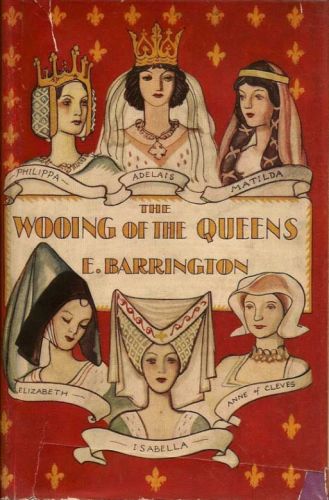
THE WOOING
OF THE QUEENS
by
E. BARRINGTON
CASSELL
AND COMPANY, LIMITED
London, Toronto, Melbourne
and Sydney
First Published 1934
PRINTED IN GREAT BRITAIN BY
EBENEZER BAYLIS AND SON, LIMITED, THE
TRINITY PRESS, WORCESTER, AND LONDON.
F50.634
| CONTENTS | ||
| CHAPTER | PAGE | |
| 1. | THE HEART OF MAUD | 1 |
| 2. | THE LADY OF THE ENGLISH | 43 |
| 3. | ADELAIS THE LOVELY | 79 |
| 4. | PHILIPPA THE CHIVALROUS | 119 |
| 5. | THE LITTLE QUEEN | 161 |
| 6. | THE QUEEN OF MODESTY | 199 |
| 7. | THREE KATHARINES, TWO ANNES, AND A JANE | 243 |
(MAUD, QUEEN OF WILLIAM THE CONQUEROR.
KNOWN AS MAUD IN ENGLAND,
AND AS MATILDA BY THE NORMANS)
The Princess Maud stood before her father the sovereign Earl of Flanders as a culprit had up for judgment, and she looked him as straight in the eyes as he in hers. Indeed they were hewn out of the same marble, strong and daring, haters of the weakness of human nature, lovers of its strength. But she was young and had not yet had time to weave and wear the cloak of astute diplomacy with which her father was obliged to hide his own feelings among warlike neighbours. He hated it, but he wore it, and Maud too must be trained to docility for her country’s sake as well as his own. What good are daughters else?
“I have said and I repeat,” said Earl Baldwin glowering at her, “that you will marry the reigning Duke William of Normandy. And if you refuse it is in my power to have you whipped until the blood runs!”
“And I have said, and I repeat, that I will not marry him. I carry a dagger in my girdle” (she drew it out—a pretty slender thing, but sufficient) “and I will stick it in my throat before I marry a man fit only to wipe my shoes if they were muddy.”
Earl Baldwin invoked St. Ursula and her twenty thousand virgins, though he had found one a match for him. The Princess Maud had been a handful since she had kicked him in the face but an hour after her birth, as she lay on her nurse’s knee and he had brought his short-sighted eyes close to see the queer little specimen of womanhood. Now she was a tall girl, brown-eyed and haired, with a full red mouth, a handsome blunt nose and a throat like a pillar of sunburnt ivory, and she did the same—but figuratively. She had reason for headstrong pride if beauty, quick wit, wealth, and the highest birth in Europe are permitted stilts to vanity, and she stalked with the best.
“Normandy,” said the earl playing on that string, “is a glorious country, fat and fertile. The King of France is overlord, true—but Duke William is a prouder and stronger man than he. And now listen, Maud, and shut your jaws on what I tell you. There is more than that. Much more. Duke William is cousin to the King of England, Edward the Confessor, the saint—a man by far too godly to have children of his own and makes a sister of his wife Edith——”
“The old fool!” said the princess.
“True enough, but listen. In a most secret message, not written, but whispered in my ear by a bird who sings at night, William the Norman tells me that Edward will choose him for his successor—has sworn it by the relics of St. Peter in his new Abbey of Westminster. Therefore William the Norman will be King of England—and Conqueror of France. He can spring on France from Normandy with England behind him. I salute the Queen of England and France in my daughter!”
“That you do not!” retorted the princess sturdily, “and for two excellent reasons. There is Harold the Saxon prince, the true heir of that throne. He will be King of England. I love the brave Saxon men, all gold and white and ruddy—big giants of men. That is one reason. The other is that I will not marry William of Normandy. His father was Duke of Normandy—yes—but his mother—oh, the good God!”
She screwed up her face as if at a pungent smell and went on:
“Arlotte, the daughter of the tanner of Falaise! A light-heeled wench that the duke took as one eats a hearty dinner to quench an appetite. I smell raw leather when I hear her name. And he thrust her brat on his nobles as heir because there was no other of his own blood. And am I to marry a man with a big black bar across his coat-of-arms—if he has one? Am I to see every knight’s wife turn up her saucy nose—‘There goes Maud, the wife of the Mamzer of Normandy!’ That’s what they call him!—and say, ‘Poor slut, her father could find no decent match for her so he took the Mamzer, the tanner’s grandson, and glad to get him.’ I tell you, my father, I will not. Blessed Lady, are we come to this!”
Her astute father looked at her in dismay. It was true—too true. Duke Robert of Normandy had omitted the ceremony which would have made his son William a match for the best in the world. But women are sticklers on such points and will not realize that circumstances alter cases. But why has Providence created women and made them a necessity in continuing the race? Earl Baldwin in a frantic moment had asked that question of his confessor, who had replied:
“They were created so that men who would otherwise doubt the truth of hell may see its visible proof on earth and foretaste its torments.”
Earl Baldwin agreed with him now. Duke William’s suit had a note in it that said “Beware!” as with a clash of swords, and Flanders is near to France and to Normandy, and it is well to be civil when swords talk. Said he, deliberately mixing religion with politics as was the fashion:
“Such pride is hateful to God and man, my daughter. Repeat it and I shall have you guarded in your chamber and fed on bread and water. Your dagger of which you boast shall be taken from you and your hands bound. And I myself will flog you with a scourge of knotted cords until you agree to what is needful. You have it now, short and sweet. Choose.”
In a second out flashed her dagger, and the point was at her throat beneath the ear. A drop of blood sprang where it pressed and trickled down her neck to the pearls. So they remained for a second or two—the duke with fallen jaw, the young woman with a steady hand, and a look that concentrated volumes in one defiant word—Death. At last she spoke.
“I will not be flogged nor put on bread and water. And now I tell you, my father, that you waste breath. Four days ago I sent a messenger riding to Normandy, and not your swiftest can overtake him. He carried my answer to the Mamzer.”
“Holy St. Peter!” gasped the earl and collapsed into his great chair.
His daughter knew she had the heels of him and composedly thrust the dagger into its gay velvet sheath, where it hung at her dropped girdle among half a dozen charming trifles. She leaned against the wall, hung with arras—the duke’s tapestries were famous,—waiting his recovery. He slowly pulled himself together and asked with a gulp:
“I trust in God you at least wrote with civility?”
“Very little!” she admitted carelessly. “I gave my reason as I gave it to you. He will not trouble us again with offers.”
The occasion was too serious for parental bellowing. Earl Baldwin’s voice was small and cold as he said bitterly:
“No. No offers. He will come with sounding trumpets and drums and trample Flanders and take you in your smock and you may pray God in vain that he marries you when all is done. But he will not. The proudest man alive, and you have trampled his pride where it is tenderest! What did you say?”
“I said: ‘My lord Duke of Normandy, our forefathers were princes when your mother’s folk were skinning beasts to make shoes for their betters. I counsel you to seek your like. If my husband is to wear a black bar across his shield he must win me by some deed of courage that shall blind my eyes to it, and this you cannot. I recommend you heartily to God.’ And now, my lord and father, may I go? You and I were always good comrades between our quarrels and the thing is done and over. I will not marry unless I love. And I believe I am in love already, though I am not certain.”
Her audacity terrified her father; he blustered and questioned no more. He could only hope that if she had a passion it might serve his ends. He said almost beseechingly:
“And which of the kings and princes has my beauty chosen?”
Maud laughed. She knew she was no beauty in a picture but merely a handsome girl with the face that sparkles with character and courage, the face which some men fear and some worship, but all will pick out and remember long after they have tired of golden-haired languishers and mincers, and have sought entertainment elsewhere. She slipped into the huge chair beside her father and put her arm about his neck for all the world as if there had been no dagger flashing a few minutes back and rubbed her nose gently against his ear.
“Now that I shall not tell you, my father, nor do you expect it. Did you tell your father the first time you cast sheep’s eyes at golden curls and red lips? Oh, no—nor do I. Besides—I do not expect to marry this man. I will not make trouble for you there. It is a charming distraction. He is to love me for ever, and I am to forget him when I please.”
A handful indeed! The earl’s only clear thought was that he wished William of Normandy had the handling of her instead of her poor bewildered father. She answered the look of horror he gave her.
“No—it will not go too far. I have drawn a line; beyond it I do not step. But—I like love. It is warm. It is a decoration to life. It——”
“If your name is tossed in the dirt none will marry you and into a convent you go,” the earl ejaculated, and wrested his neck free from her.
She laughed like a carillon of bells.
“I am told that one may be very merry in certain convents. No—do not kill him Father, if you guess. Trust me and when I am tired I will perhaps marry who you will.”
On this the earl was obliged to go, for he could get no other satisfaction. His mind worked like a yeasty sea brewing storm. Would the Bastard of Normandy declare war on a girl’s impudent letter? If he did, could France be coaxed to an alliance which might crush Duke William and divide Normandy between France and Flanders? And what about England? A girl’s whim to have such fearful consequences! He shut himself into his innermost chamber to plot a course and could think of none.
But Maud mounting her jennet, hung like a window with purple velvet and silver fringes, rode through the narrow streets of Bruges smiling upon all and sundry as they greeted their princess with frantic applause. She took the quietest ways, but still many welcomed her and the frank gay smiles she shed among them like rosy flowers. Also she dipped a generous hand in the embroidered silk purse that dangled at her side, and to the poorest she gave silver coins and to one poor cripple a bit of shining gold. Some she recognized, and hailed by name—never a franker, more cordial princess won the hearts of her people—and so under narrow eaves and strange high-pitched roofs and barred lattices she rode to the Convent of St. Catherine among its willows, and by its canal. Leaving her train and pride outside as befitted a daughter of the Church, she went in with one confidential lady to make her prayers in the chapel.
The princess was received by the prioress attended by two nuns who, with her lady, were dismissed after the formalities were over. This prioress was a remarkable lady both in and out of religion, and tall and beautiful even though her hair was now white and her blue eyes sunken. For she was cousin to that Countess Godiva, wife to Earl Leofric of Coventry, who was held a saint in Europe for her great deed of mercy in riding clothed only with her long golden hair through the streets of Coventry, when her husband made that deed the cruel condition of his remitting the fierce taxation imposed upon his people there. The prioress herself was famous not only for the noblest blood of England, but also for the strange and dreadful austerities which had won her the rule of this convent in a foreign land. The Princess Maud herself knelt and kissed her hand, and asked her benediction as humbly as any woman in the street outside would have done it.
The blessing was given, and immediately there was a startling change in their manner to one another. The prioress Elswitha seated herself in an almost regal chair surmounted with the Cross and Maud, pulling a cushion to her, sat on the floor before the prioress and leaned one arm on her coarse black serge habit.
“I have a story to tell my reverend Mother,” she said, “and if I was wrong I will ask pardon, but I think I was not wrong.”
So with the nun’s hand laid on her nut-brown hair the princess told what had passed between her father and herself. She looked up at the end to find the stern face smiling down upon her with amusement—even with relish at the dash and glitter of the escapade.
“You are a minx and more,” she said, “but a royal minx, and if you can have your way it is a good way. Women must show they are strong if they are to rule. The meek woman creates tyrants and turns herself into a servile liar. Our women in Saxon England are no slaves. I sat in the castle in Coventry the day the Earl Leofric dared his wife, my Lady Godiva, to ride naked through Coventry if she wanted the taxes removed from the half-starved people. The poets have painted her all shrinking modesty and wifely meekness—both of which are excellent good things, but there are better. For Godiva was all flame and courage. She looked at him with eyes that should have scorched the brute where he stood—the great hulking master—and then she laughed.”
“Laughed? I like her for it. I know how she laughed!” said Maud with coldly sparkling eyes. “To-day I also laughed.”
The prioress herself laughed.
“But she said nothing, except that it was a hard condition and he slouched whistling to his dogs to ride to his hunting grange at Tamworth, and I said to her: ‘You will do it?’ And she laughed again but very differently, for we loved one another. And she said: ‘I would do it if I knew I must drop dead in the street, for the people are right and my earl is wrong. But also, he will dare no more tyranny after that with me for the world shall hear of it. He will fear me because I am a saint who sticks at nothing, and I shall master him. Two birds may be killed with one stone.’ ”
“Her story has certainly been heard,” said the princess. “And two birds may be killed with one stone—I know it.”
“And so when he had ridden off secure in his tyranny she sent out her proclamation to Coventry that no man or woman should stir next morning in the streets until the bell in the gable should ring from the great house. And in the dawn I was with her when she stood robed in yellow hair from crown to ankle, and I held her bridle while she mounted and rode slowly like a queen through the empty city. And I was there when she told Leofric her deed, and he quailed before her and she triumphed like one of the Valkyrie our forefathers worshipped—the maids who choose the slain. And from that day the world sainted her and he was her slave and had he crossed her will all England had risen against him. She had killed her two birds.”
The prioress halted, almost breathless for a moment, then added:
“And it is in England you should reign, Maud, my daughter, for I love you and know that the English love a proud free woman. And that is why I have permitted you to meet the Saxon lord Brictric who comes from England to woo you for Harold, son of Earl Godwin. Harold is the chosen king for England when Edward the Confessor dies, and though his family and mine were enemies, for him I would do all. Also—I have seen in a dream that you will be Queen of England.”
“And I have seen it too,” said Maud clasping her hands upon her knee. “I am as sure I shall be Queen of England as that I sit here and love you. But my father must not know yet—not yet. And I will be brave as Godiva. Will Harold do my will? I must have an Englishman.”
“I think your wills will be one and that is the best. It is a good thing when man and wife are of one mind in a house. Their foes despair. Their friends rejoice. And Harold is a man any woman might desire for her children’s father—tall and fair and mighty and a natural worshipper of good women——”
“And if they are not good?” the princess asked mischievously.
“Still their worshipper for what he hopes in them. But you are good enough,” said the prioress. She had loved the girl for years and trained her to more than prayers.
She touched a little bell of silver that stood on a table beside her, and into the room came a grave old nun, her wrinkled face half hidden by coif and veil. The prioress made a sign with her hand and she went out. Meanwhile the princess rose and stood beside the great chair waiting with a visible flutter of feeling until the heavy curtain swung aside and the nun reappeared with a young man behind her, and then slipped noiselessly away again.
He was a very splendid young man in a dark blue tunic—short to the bare knee; his arms, bare also, tattooed with stars, fishes and animals after the fashion of the English, and laden with great gold bracelets like fetters. He was well able to defend them. His skin was fair as snow—they called him Brictric the White. He was mighty in the shoulders and had great limbs, and a splendid height. Saxon crossed with Dane, he was a man to catch any woman’s eye with his golden hair and the golden moustache that clothed his short upper lip disclosing teeth white as a hunting hound’s. In short, a Norse god with Victory to perch on his shoulder like a tamed falcon when he handled his huge bow and arrows for war. The Princess Maud was a tall girl but she could only have laid her head as high as his heart.
Duke William himself had some of the same blood in him on his father’s side, though he did not show it, for the name of his Normandy commemorates the land of the Northmen who, coming down from the cold North, seized the land and called it after themselves.
This Brictric bent his knee and kissed the hand of the prioress as she blessed him. And then, without a word, like one who follows an expected ritual, she went out and left the young man and woman together.
They were as safe as in the sanctuary. Kings dared not penetrate convent secrets. Armies would have halted at those gates. And this they knew.
The princess, smiling, stretched out her hands and the young man knelt and kissed them, burying his face in them not like an envoy, but a lover. She slipped one away and sitting in the great chair put her arm about his neck so that he knelt beside her, and she could lay her head upon his breast. Half mad with love he kissed her hair and what could be reached of her face—rose-red with happiness and love. Harold of England had chosen his messenger ill.
Yet the Saxon lord had been honest after a fashion. He had drawn a splendid picture of Earl Harold, the king-to-be, of his loveless political marriage with the cold-hearted Welsh princess, so easily to be dissolved, of the glories that would await the Flemish princess when she was his wife.
“For he will kiss the ground your little feet touch,” had said Brictric the Englishman. “In England we do this when our wives are brave and beautiful. And the English people will worship their queen, and your sons will be sturdy and long-lived as oaks, and your daughters lovely as the fairies who dance beneath them.”
Tempting enough, but from the first minute he appeared at her father’s court, an envoy of good-will from the English king-to-be, the princess had taken very much more interest in the messenger than in the message. Did she love him? She really did not know. She was only certain that he must love no one else, and that certainly appeared to be his own opinion.
An ardent lover; Harold of England was forgotten, and the two talked of themselves in the quiet room which looked out into the green cloud of linden boughs and did not even speak of marriage, but only of the delightful dream in that earthly paradise where lips touch lips, and youth is eternal and death a nightmare to be forgotten in love’s surprise.
She told him now of her father’s wrath and her repulse to the mighty Norman, and felt his start of dread. She raised her head and looked at him—his face had paled.
“You fear for me, my dearest, and why?” she asked.
He clasped her hands in his.
“Because of all men living, this Norman is the mightiest. Were it not for the wide sea between Normandy and England I dread that even Harold the earl could not face him. I have seen the man and know. How shall I describe him! He is dark, not over-tall, but most strongly built. Great shoulders and yellow eyes like a dragon’s or lion’s, as they say. And when he fixes those eyes on a man, sparkles flash from them as from red iron when the smith hammers. And then men wither. It is true, my princess! He does not roar or storm as a warrior should in anger, but passion turns him white and silent as though the blood ran back on his heart to swell it with power. You should not have dared him—never, never!”
“Then should I have submitted?” Her own voice was quiet now, and it was observable that she drew one hand away to settle her neck pearls.
“No, my princess—could your lover say such a horror? But you should have won your father and fawned and wiled and slid out of it like a snake. A woman has a hundred ways of escape. I fear for you very greatly. The Mamzer of Normandy never forgets an insult. He sits still and thinks, and his rage grows like a toad with its swelled sides full of death. God and Our Lady only can meet him!”
“Then the Mamzer of Normandy is a greater man than your Harold?” said the Princess Maud thoughtfully.
“How shall I say that?” answered the Englishman. “But I would say to Harold—‘Keep the wide sea between you,’ as I would keep it between myself and Harold if I had offended my overlord.”
The princess turned a curl of his hair about her finger where it shone like a gold ring and smiled her brightest smile.
“So now I understand!” she said. “You are a strong man, but Harold is stronger, and William of Normandy is strongest. And Harold must wear the sea for his shield! Well—it is best I should know the truth. Now let us forget our masters and tell me—have you ever loved any English woman? Be true. I know you love me now.”
He laughed and blushed like the great boy he was, half denying, and half confessing, and fondled her hands, caressing them like a dog with all the love in his body. And at last she pressed him.
“Why, yes, my princess! Young men are young men. I own it. But I have forgotten her now.”
“What like was she?”
Old love rekindled in his eyes as he answered musing.
“A girl of Dane’s blood. Swanhild her name. White as a whale’s tooth. Eyes like a midsummer sea. Hair of the true red-gold the dwarfs find in the Dovrefeld. Lovely. Deep-breasted. Sweeter than sweet, proud to all but me; but to me—a dog fawning—she——”
But the princess interrupted softly with a most beguiling smile: “Does a man ever forget his first love?”
“Never, never!” he answered in a dream, kissing her hand softly. But she knew that his lips caressed a hand over the sea and that memory put it in his own. She withdrew hers, and whispered again softly:
“And shall I be forgotten?”
Again he answered:
“Never—never!” and tried to recapture her hand. But she rose.
“Then you are vowed to me in life and death and out beyond both? You will never hold another in those strong arms? You will never wed. You swear yourself mine for ever. I do not forgive a false heart. No!”
He answered eagerly:
“For ever. Who can forget the princess of the world when she stoops to her slave? I am your man while my heart beats and my blood flows. For ever and ever—and ever and out beyond life.”
“Blood may flow in more ways than one,” said the princess. “Well, do not forget me for Swanhild. That I could not forgive. I have claws! I warn you! Remember I am a woman.”
“Soft hands!” he whispered in a rapture and kissed them with passion.
They went together into the room where the prioress sat attended by her old nun, and she looked eagerly at Maud for some good word of Harold the English king-to-be. Maud said not a word, but her smile was like that of the saint over the great archway, who having been a sinner is now smiling, holy among the holy, but he remembers both sides of life.
Thus the princess rode back through the blessings of the people, and her father commended her pious visit to the convent.
Later, the messenger returned from his errand to William the Norman duke, and was ushered to the room where the princess sat in a great Byzantine brocade of red and gold with wheels and birds in the design. She leaned her round chin upon her hand, looking sidelong at him over the arm of her chair and asked:
“The message?”
“None, my princess. I rode to Rouen—a great city where the Norman sits in state, and to a castle up-towering which armies could not break, and I said: ‘Tell my lord Duke I am come from the Princess Maud of Flanders’—and when that reached him everyone was thrust aside and I went up proudly to the great stone hall where he sat with his councillors in armour.”
“What like was he?”
“He stood a moment before settling himself to hear and I saw. Not over-tall, but mighty. His shoulders like a bull’s; he has a round head, an eagle’s beak for a nose, and beyond all that—oh, a face of clenched iron!—a terrible fighting face indeed! So I knelt and offered my princess’s letter and—a strange thing—he stretched his sword and spitted it on the point—I aiding—and so he took it. Princess, my heart beat like a bird’s! So he read and stood thinking awhile.”
“And then?”
“Madam, he laughed. Not angrily. But softly. And he said this: ‘Had this letter come from a hand less lovely, the tanner girl’s son would have flayed the bearer alive and made his skin into gloves for it. But since it is so, ride back in safety.’ ”
She mused a little on that and asked:
“No more?”
“He called Taillefer his minstrel and bid him sing the song of King Cophetua and the beggar-maid. And that man sang so that my eyes moistened for the fair beggar-maid who kissed the king’s feet. Then my lord duke said ‘Go,’ and I went, but I do not know his meaning.”
She dismissed him and sat awhile pondering, then went to Earl Baldwin and told him the story.
“He took it as a jest. We have got off cheaply. Do not play such a trick again, young fool!” he said eagerly.
Maud was silent.
Again time went by and all the world knew of Duke William’s great doings in Normandy. The princess had bid the prioress send Harold’s messenger back to England without any promise. She was young, she must consider, she said. But she kissed Brictric passionately on the mouth in saying good-bye, and clung to him awhile but with no tears in her eyes, saying:
“Remember! None but me—but me while life lasts!”
And again he swore on the Passion of God.
The princess rode one day to hear Mass at the Convent of St. Catherine. She rode her white horse, with a side-chair saddle inlaid with gold and silver by great craftsmen of Flanders. Her robe was white and gold with a rich border of jewellers’ work about the bosom. Her nut-brown hair rolled back in ripples from her forehead and was bound by a noble golden band with fleurs-de-lis of pearls. She looked a queen in an old romance, her damsels two by two riding behind her.
A shout—a roar—her horse reared violently, and all but fell on the back of the two behind, throwing them into confusion. The girls shrieked. The crowds on either side fell back. A man unarmed, except for his sword, broke from a side-street followed by two companions. Their horses trampled the shrieking crowd. He made for the princess as she frantically tried to control her horse.
“A capture—a capture! Save our princess!” yelled the crowd, huddling together in panic. But it was no capture.
In the wild uproar the stranger rode furiously to the princess, and when she saw his face she dropped her bridle and sat like marble, staring at him.
He towered over her a second, black as a thunder-cloud, then sprang from his horse and winding his hand in her long hair dragged her from her mount. Down into the foul roadway he dragged her, trampling her brocades and flowing hair in the black mud. His followers seized the horses and looked on tranquilly. Along the street he dragged her, silent as death. He flourished a strirup leather above her and thrashed her with it as a man does a stubborn horse. Blood broke on her arm, her face was vile with mud, her hair dabbled with it.
All went in a flash. A man raised a yell of “The Duke of Normandy” and in terror of his name the crowd fled along the side alleys—away—away! The street was suddenly empty, though a few citizens still stared aghast from their windows.
Then he released her, and she lay half swooning in the mud.
“You sent your message. I brought mine!” he said, and mounted with never a look at her as she lay, and so vanished, stooping over his horse’s neck and riding like the wind. It seemed that the thing could never have been. And yet it had been, and the bedraggled princess lay trampled in the mud.
Men-at-arms stormed into the street. Her shuddering ladies returned and men brought a litter, and she was laid in it and brought to the palace and bathed and restored. She was not wounded, except in spirit, but there the wound was heart deep. Earl Baldwin came to her trembling: “My daughter—my daughter! The foul villain!” expecting a Fury, her hair all snakes clamouring for vengeance. Instead she sat humped together like a cat, though not showing her teeth, in a stupor of broken pride, and her father put his arm about her and cursed the Mamzer.
“But it will be forgotten, my child. The world will cry shame upon him.”
She flashed:
“It will not be forgotten. I shall not forget!” she said. “My anguish—my anguish! He did not take me with him.”
Duke Baldwin nearly fell from his chair.
“What?” he screamed. “You would have gone with the brute beast!”
“I would follow him to the world’s end!” said the princess with glittering eyes.
“Yes, to stab him, to drive your dagger in his foul face. To——”
“To kiss his feet. He is the only man I will ever marry. The only man on earth. To ride into my father’s city and flog me in sight of the cowards, to drag me in the dirt; to punish me rightly for the foul shame I did him. I love him—I worship him! I tell you I kiss his feet.”
She was aflame with passion.
“But, God in Heaven!—you refused him!” cried the earl, believing her mad with pain and disgrace.
“I did. I did not know him. Oh, the agony! He despises me, he does not want me. Oh, that he had taken me with him.”
“Women—women!” groaned the earl. “Does even their Creator know them? If I had laid a finger on you——”
“I would have stabbed you,” said Maud, “but he is different. Write to him. Tell him——”
But here the earl sturdily refused. The city was in an uproar. Men were arming. Drums were beating. Soldiers started in pursuit. The princess raved. Trusted women were set to watch her lest she should disgrace herself by writing to William of Normandy. And the tale circled Europe.
A month went by, and the princess agonized under the close guard of these women. No word, apology or defiance, from Normandy. Silence. The physicians feared for her reason and still she repeated:
“I will marry no other—no other. Oh, I see his face—all scorn and hatred, and no wonder! A god among men!”
One day rode into Bruges heralds and men-at-arms, splendid in gold and scarlet, the Lion of Normandy on their banners and pennoncelles—“In the name of the high and mighty Prince, William Duke of Normandy.”
The princess did not hear the confusion where she sat pale and weeping. Her father hesitated to receive the letter, for all Europe knew the insult. But it might be a much-belated apology. In full council, in full armour, he opened it while his barons scowled about him.
It was a beautifully worded, courteous demand for the hand “of my very distant and highly honoured cousin, the Princess Maud. I have heard reports of her excellent beauty and courage——” and so on in the usual manner, through some gratifying details of the provision to be made for her in widowhood, to the end. Not a hint, not an allusion to the “Harrying of Bruges” as the people called it. That might have been a dream. This, the placid reality.
He carried it to the princess and it broke like a sunburst through her gloom. She would hear nothing, would say nothing, would not argue, but repeated her father’s first eager entreaties for the match.
“You desired it once. I desire it now,” she said. “And I tell you this—if you stop it I will run away barefoot to his arms. He is my man to me.”
There could be nothing done against her madness and the match was a splendid one apart from the “Harrying of Bruges.” Therefore a gracious acceptance was sent, and on a given day the bridegroom rode to Bruges for the marriage. The meeting of a bride and bridegroom is always interesting to bystanders, but on this occasion a breathless crowd watched it, and wagered on the issue.
She might fling him off at the last moment, revealing her real heart of pride. He might drag her to her knees and throw the once-scorned ring in her face and ride away to Normandy. Anything might happen.
But what really happened was this. The Earl Baldwin led his daughter forward and William of Normandy advanced to meet them. The bride dropped her father’s arm and fell on her knees before her bridegroom and with her hair sweeping the ground kissed his feet. Those who forgot for a moment to look at her expression—and it was worth considering—were rewarded by his. Steel-hard and ice-cold, it broke up in a moment as the Polar ice might break if all the summers of æons together poured a sudden glow upon it. He raised his kneeling princess and held her to his heart.
This all the world saw. They neither saw nor heard what was said when they were alone; the Queen of England told it to her eldest daughter when she was about to be wed.
For she held him off at arms’ length with her two hands locked in his and whispered:
“I am forgiven or we should not have met to-day. But tell me—is it possible you should love the girl you dragged in the mud and saw disgraced before the people? Tell me your true mind. Better break our marriage than promise to live together with that between us. For never was woman so won before.”
The light of the lamp fell on his dark face. Its pride and resolve were incomparable. But he was used to action rather than thought, and in all this matter he had not reasoned but felt. Now he hesitated, holding her hands.
“I do not know how to use words,” he said. “Even when I fall in a passion I am silent, they say. But you speak sense. We should know each other before I make you mine.”
“And you mine?” she said. But it was a question. His was not. His face was grave, earnestly bent on the problem.
“That I scarcely know. I do not promise you fidelity as the Church calls it. How can I promise even a year ahead? But this I say. I am a man and the fruit of a lawless passion. You taunted me with that and—I cannot tell you why—your scorn won me. I think it is right a woman should feel this, though we men know differently—and if you sinned thus I should kill you. But I have great dreams. Briefly, I shall be King of England and more. My plans are made for many things. Now, if I am away from you or drawn that way it is very possible I may be unfaithful to you. As possible as that I should ride out hunting when you wish to hold me in your bower. Why should I not? I am no churchman. But unfaithful as I count faithlessness I shall never be. I cannot. By the splendour of God, I swear it! Your letter made us one. Your silence, when I saw your white face in the mud and you bit your lips till the blood ran, and made no sound, I loved you. That made us one. We are flesh indeed—the same blood moves our heart. You shall be my crowned duchess and shall be also crowned queen, and my every thought a book for you to read. If you die I will take no other wife. We will lie side by side in the church as in our bed, and when the Trumpet sounds we will face God together hand in hand. Is this fidelity sufficient?”
They looked at each other, held apart still by their arms’ length in a silence.
She dropped her hands, and slipped the great sleeve of splendid stuff up her arm disclosing a white ridge across its warm snow.
“There is your mark, my heart,” she said. “See, I kiss it. I bless it. That fidelity you promise is sufficient. It is such riches that tears blind me reckoning it.”
He opened his arms and she clung to him. Then putting his two hands behind her head he pressed her lips to his.
Great and glorious was the marriage—the bride glowing like a rose of fire in her pride. It conferred loveliness on her. The people stared at her beauty. Her bridegroom sat beside her, still and strong as a sleeping sea hiding its secrets beneath calm.
The Pope commanded them to separate when they reached Normandy, because though remotely cousins they had begged no dispensation, and Holy Church must have her share in so wealthy and royal an alliance.
“We must humour the churchmen. I have reasons,” said William to his duchess, and therefore he built a great monastery to St. Stephen, and she a noble convent to the Holy Trinity, both at Caen. So the Church was bought to their interests, and to-day these two buildings stand to commemorate their wedded passion.
In ancient Roman days brides vowed fidelity to their husbands in this fashion: “Where you are Caius I am Caia”—and of Maud it may be said that where William was lion, she was lioness. She plotted with him to trap Harold to their Norman castle, and to force him to swear on the huddled relics of saints that he would never claim the English throne but would be William’s man, and let him climb to it from his back, so to speak.
“I long to see England,” the duchess said thoughtfully, before Harold left them. “I have never seen an Englishman but I liked and trusted him! There was one at my father’s court—a very brave and worthy man—Brictric, I think, his name. Is he still your man, Earl Harold, as he was then?”
She made no reference, nor did Harold, to that old hope so long forgotten. He smiled with her child upon his knee.
“Brictric, madam? A gracious memory yours! Yes, a rich man, great in lands and King Edward’s favour, and married to a lovely Danish woman, Swanhild, called by the people, the Fair. All is well with Brictric. Shall I give him your commendations when I cross the Channel?”
“My commendations and kind memories!” she said smiling, and added pleasantly, “I could wish to be Queen of England. It must be a fair country.”
Harold smiled also—from the teeth outward.
It was the Duchess Maud who, when Harold broke his oath and had himself crowned King of the English, fanned the sullen flame in William’s heart until it roared heavenward, she who gave him the glorious ship the Mora that led his conquering fleet, and the stroke of her lion-paw was swift and sure as Norman regent for him as his stroke on England.
And so came the great battle of Senlac, or Hastings, and the Duchess Maud, Regent of Normandy, sat with her ladies and stitched with them at her roll of history-pictures which may still be seen at Bayeux, a roll of canvas sixty-seven yards in length. There King Harold sets sail for Normandy from little Bosham in Sussex. There the great three-tailed comet of A.D. 1066, which predicted the humbling of England, glares at the Saxon princes. Over these pictures of needlework the Norman ladies paused to mutter prayers for their men. And when William the Duke conquered and—
Harold, Earl, shot over shield
Lay alone the autumn weald,
to Maud came his hurrying messengers. She was praying for him then in the Benedictine Priory of Our Lady, and rising like a queen she commanded that the priory should be henceforth called “Our Lady of Good Tidings,” and thus it is to this day.
So to England in triumph came the first Queen of England—for before that the wife of the king had been styled always the Lady of England, but William chose otherwise. And in the young April of 1068 she was crowned in the royal and ancient city of Winchester in robes that shamed the sunshine, and her William was crowned again with her.
But when that pomp was past, Maud the Queen came to her husband where he sat alone and said:
“My lord, like the Queen Esther of old I have a petition to make to you.”
And he replied:
“Like her king of old I answer—‘Ask, even to the half of my kingdom.’ What is it?”
And sitting beside him, and holding his sword-hand in one of hers she said:
“This. There is a man in England who has done me a great displeasure. His name is Brictric—and he is an English lord. He came to Bruges to ask my hand for Harold Godwinsson the dead king. But he dared also to make love to myself—then a maiden. And not content with this, when I scorned him he taunted me with his love for one more beautiful than I—a Danish woman called Swanhild. Now you and I are King and Queen in England—what shall we do?”
William sat swearing softly. This was a woman’s matter and perplexed him, but certainly it could not be let pass. He knew his Maud by this time, though it was seldom that she was not dove to him—whatever she might be to others.
“It is in your hands, my dove,” he said presently, “and, by the splendour of God, I pray you to make an example of him! We must grind these English to powder and make roads of their bones before this land can know peace. Stay, I will find out his possessions.”
“But I know them already!” said Queen Maud with composure. “He is lord of the city of Gloucester and much land round about it, and elsewhere. Are he and his possessions mine, and will you take what I do as your own deed?”
“I take it for mine, as you are mine,” replied the Conqueror.
Later she sent for Brictric the Englishman to her palace of Winchester, and with her ladies out of earshot, and sitting in her great carven chair with her hands laid on the two arms like an image, she spoke to him thus, he kneeling before the step of her chair:
“Once we were lovers and you swore to me on the Passion of God that you would be true man to me in life and death and beyond it. That you had done with this Swanhild, and had cast her aside like a used shoe. But you wedded her. What have you to say?”
Nothing apparently. He all but writhed before her.
“Then there is nothing to be said, unless indeed you drive Swanhild out with contempt for the foul thing she is,” said the queen. “That done, and submission made I will let things rest as they are. You are so far below me that it matters little if it were not that queens do not easily bear insults. Those are my conditions.”
There came a silence. The soft voices of the women outside talking gently over the great roll of the Bayeux tapestry, recording the king’s deeds, broke it no more than the distant singing of birds in the garden of the palace.
Then from his crouched kneeling with clasped hands like fear incarnate, Brictric the Englishman rose and stood leaning upon the cross-handle of his sword. So great was his height that as he stood he looked level into the eyes of the Norman queen as she sat uplifted. And so he spoke.
“Once we were lovers, and to my thinking when once man and woman have touched lips there should be no hatred between them, even if the fire is ash. I thought you then a noble young woman—a goddess strong and frank and overmastering. Now I do not know what you are. But this I say, Lady of the Normans—if I leave my wife, the mother of my sons, may she and you despise me together. But I will not put her away. I love her, and she shall not despise me, nor will I bear your contempt. Were I to yield, you would rightly smile and call me niddering, and to the English that is a word for swine and cowards and all foul weak things. I will not be niddering. Now, do with me what you will.”
Pale as death, Queen Maud still kept her long hands on the arms of her stately chair, not a tremble in them.
“To me the king has given all your lands and the city of Gloucester to do with them what I will. I am Lady of Avening, Tewkesbury, Fairford, Whitenhurst, all that stands written yours in Domesday Book. Do you still hold by Swanhild? Do you remember your oath?”
Still looking her in the eyes: “I have answered,” he said.
With the light crown of golden fleurs-de-lis binding her beautiful brows, and the white transparent veil flowing from it, she might have been an image of the crowned Madonna seated to receive homage. More than one sculptor indeed had the queen in mind in carving the gracious statues of her noble Abbey of Caen. That was not now the resemblance which impressed itself on the Englishman. At last she spoke:
“I deprive you of all your lands. They are mine. I deprive you of liberty. You are mine. You have chosen. I accept your choice.”
She clapped her hands to summon a lady—and she the guard. That day Brictric was chained in the strong castle of Winchester and his end none knows, for no man knew it but those who inflicted it, and buried him secretly in the castle. And still in William’s great Domesday Book where the lands of Brictric the White are entered, stands this note: “But afterwards held by Queen Maud.”
Songs were made of this story in the reign of Maud’s son Henry Beauclerc, for many pitied Brictric. As thus:
The Queen Maud
Who when she was a maiden
Loved a count of England.
Brictric the White they called him.
Except the king no man was richer.
To him the maiden sent messengers.
But Brictric refused Maud.
No doubt she was a great queen and lady, but at her heart of hearts very woman, and of this heart another reading also.
Once the stern heart of the Conqueror swerved a little—but a very little—from his royal wife. A canon of Canterbury Cathedral had a niece, beautiful, brown-haired and hazel-eyed, delicate and tender, and upon her the Conqueror swooped as an eagle upon a lamb, trusting in the secrecy of his men with sins of their own to hide. Smiling, they were silent. But women will dare where men hold back, and there was one woman in England who would have dared Hell for vengeance on William—the Lady Gyda, mother of Harold, the last King of the Saxons, he who had fallen fighting at Hastings.
To her the girl fled shamed and sobbing. Immediately, carried swinging in her litter by sturdy Saxon peasants along rough tracks and up hill and down dale, Gyda came to the palace of Winchester, and found Queen Maud sitting under green trees, placidly watching her children at play. To her the fierce, gaunt old woman seemed a ghost set free from the churchyard with her grey hair about her face, and eyes eagle-keen and cruel.
“And you sit here, Maud the Queen, watching children at their games when your lord dishonours Englishwomen and you. You avenged yourself once. Has the fire gone out of you or do you not dare to face your master?”
The queen rose and faced her:
“And what has happened?” she asked, listening in silence very disappointing to Lady Gyda.
The chroniclers relate that she ordered the girl’s jaws to be slit, that “She shall kiss none, nor they greatly desire to kiss her.”
It was vain for William to plead that he had warned her that a man’s heart can be true though his flesh is weak. His Maud smiled and was silent. The story was told, the episode ended. She did not argue.
The centuries roll by and Maud sleeps in her great Abbey of Caen. William made her a glorious tomb of gemmed sculpture and recorded her life thus:
Here she lieth, friend indeed
To the hungry heart of need.
Poor herself, enriching all
Who her gentleness did call
To their aid, and therefore she
Blest to all eternity
Passed to peace most peacefully.
The ancient chronicler writes of her:
This princess, descended from the Kings of France and Germany, was even more famous for the purity of her mind and manners than for her great descent. She united beauty with gentleness, and all the graces of Christian holiness. While her glorious lord subdued all things she never wearied of alleviating distress in every shape. All hearts loved her.
It might be interesting to determine how much of history is fiction, and how much of fiction is truth. Only the gods can know. But there can be no two opinions as to the omissions in obituary notices whether ancient or modern, royal or private, and their effect on the composite picture history presents to the admiring reader.
(MAUD, FIRST QUEEN OF HENRY THE FIRST)
“Maud and Edith are my names,” said the princess, “and both are Saxon and if I needed a further cause to hate the Normans—which I do not—it is that they call me Matilda! But Saxon and English I will be if the Normans leave me not so much as nine inches, the length of my foot, of English ground to stand on. What! am I not of the royalest Saxon blood, of the same stock as the great King Alfred and Edward the Confessor, and am I to listen to the boasts of the verminous Normans that overrun England, feeding on the blood of my people? Thank God and Our Lady I am in free Scotland and not fettered England and can speak my mind!”
Turgot the priest listened to the girl with amusement which he did not hide. The Princess Maud had been committed to his care as a child by her mother, Margaret, the sainted Queen of Scotland. As tutor to an especially wilful child he had more than once beaten her with his own sacred hand, and many had been her meals of bread and water eaten under his austere eye. To the scowls he paid not the least attention, nor did her teeth-clenched endurance under the rod mitigate one blow of the number judged necessary. But in his heart he loved the child beyond her sister Mary, also in his care, and well-behaved and docile. There were times when he felt obliged to lay his hard case before the Heavenly Court of Assize, imploring the Eternal Judge to forgive his preoccupation with a little demon when he might far more Christianly have set his affections on a golden-haired cherub who was never known to have disobeyed orders.
Yes, it was the rebel Maud whom he loved—Maud who never obeyed, who was more intent on catching a little shaggy Scots pony by the mane to swing herself on his back and so away over the moors, than on any prayer and book. Maud who would keep him hunting until she collapsed with laughter, and was caught and led in to receive the attentions of the rod with a meal of bread and water to follow.
“A princess in adversity such as yours and with a royal saint for a mother should set an example of piety to all!” said the good Turgot. “Consider, madam! Your royal grandmother fled with her children from England where most certainly the usurper William the Conqueror would have murdered her and hers, and by God’s gracious providence her ship was driven ashore in Scotland. The good King Malcolm Canmore saw and pitied their sorrowful plight, and married your lovely mother. A saint indeed! Should you not be a very different girl from what I weep to see?”
Princess Maud looked at him out of eyes as blue as the ocean on a midsummer day. Her self-willed hair curled in tendrils opinionated as a vine’s over a milk-white forehead and golden brown eyebrows drawn as straight and fine as if a geometrician had ruled them. A Saxon beauty indeed. She answered laughing:
“If God does not like me as I am it is not my fault. You blame the potter and not the pot if it does not stand steady on its legs. How can I stand steady on legs that must always be dancing or running? Yet, Father, do you think I do not know you love me best?”
“God forgive me, I do. But that is only the sinner in me and when——”
“Never be a saint or you and I part company!” said the inveterate Maud. “When I remember my mother! She kept the pattern of sainthood before her and stitched her copy after it like a girl at a sampler, and my poor father and ourselves were all pressed into the service of adoration.”
For once the good Father Turgot was indignant with his darling.
“Princess I will not call you!” he said, “but rebel against all sacred things. The daughter of a saint whose virtues——”
“I have noticed,” replied Maud competently, “that the daughters of saints are often rebels. And that is as it should be. It holds the balance even. Now when the balance tips one way or the other the world turns a somersault which is not as it should be. My daughter shall be a saint. It is necessary, for I am a sinner.”
Father Turgot shook his head sadly:
“You will never have a daughter, and that brings me to what I came to tell you. Now that your parents are dead and your father’s brother has seized the throne of Scotland he desires to be rid of you and your sister Mary. The Norman king, William Rufus, has demanded it and the King of Scotland will not protect you.”
The colour fell from her bright face. She loved Scotland and to see England under the Norman heel of the sons of William the Conqueror hurt her Saxon heart with agony like the thrust of cold steel. This was the second time the Normans had rendered her and hers homeless. It took a moment’s silence to recover her courage, but presently it flashed in cold fire.
“And where will our Norman masters fling the garbage of the royal family of England?” she asked.
The good father spoke sadly:
“The Normans desire that you and your sister Mary should leave no heirs to injure their succession to the English Crown, and it is agreed that you two shall be sent to the Abbey of Romsey in England as novices. There your aunt, the Princess Christina Atheling, is abbess of the black Benedictines. You shall be placed under that stern rule and you will both become professed nuns when you reach the proper age. The Norman king hopes in this way to quiet the English clamour for their own royal family and to convince them that you prefer the Cross to the Crown. So I say truly you will never have a daughter.”
His words are cold, written, but in reality they were warm with kindliness and pity in his eyes. The truth was, as I have said before, he loved the ground Maud walked on, and could he have seen her sitting crowned as rightful Queen of England would have died for it any day, and taken his chance of Purgatory. It was because she also loved the old man as truly that she spoke her mind to him. With others she could be cold and silent as her mother’s wonder-working image in the church hard by.
“Now, Father, you challenge me!” she said with a brightening eye, “and I challenge you! What will you wager that I have no daughter? It is only my will against William Rufus’s—the bestial Norman! Which will you back? I will have a daughter. I swear it in the face of the Normans themselves!”
Father Turgot threw up his hands in the necessary horror. That concession made to propriety, he lowered them and proceeded:
“My daughter, the future is dark and doubtful. My own heart’s desire is that you should marry a Norman prince and so unite the Conqueror’s claim with the ancient right. If you did this he would perhaps restore your brother to the Scots throne and so all be peace throughout the island. But William Rufus is bestial, and go to England you must. But I will find some place within reach of you and we will pray for better days.”
“You shall pray, Father, and I will work for them.”
There was a moment’s silence. It grew so emphatic that Father Turgot turned and faced the princess almost in suspense. She suddenly threw up her right hand and held it palm out.
“I swear before God and His holy Apostles that I will not be a nun—no, not if they drag me to the altar. You are my witness! May I have a thousand thousand years in Purgatory if I abase myself to the Norman will.”
She lowered her hand, dropped her tragedy air as suddenly as she had shown it and said with humour:
“Set a thief to catch a thief! I match myself against my Aunt Christina and the Normans, and she is worse than they. Well!—when is it the Norman pleasure that we ride to Romsey?”
It was the pleasure of the usurping King of Scotland and of the Norman, King William the Second, that it should be soon, and the two disinherited princesses arrived at Romsey Abbey, were duly frozen by the icy eye of their abbess aunt, and jolted uneasily into the conventional routine. To the Princess Maud it was a minor hell. Every cyclone has its centre, and in her case the cyclone revolved about the terrible black horsehair veil, which the abbess with her own hands placed upon their heads and dared them to remove. Mary obeyed her and went about—a little pale moth in a black chrysalis. When the sacred hands of the abbess placed it on the head of Maud it met a different fate. The princess took it in her two stalwart little hands and wrenched it off, leaving her golden vine-tendrils in wild disorder and with one foot on the veil glared at her aunt the abbess.
“You dare!” she choked out. “I tell you I will never be a nun. No—not if you beat me till my back is raw!”
The great abbess did not argue. People obeyed without argument and if they did not she had other means. A stalwart nun of peasant extraction was called and not unaided administered a discipline to the princess not more minutely to be described than in her words above. She took it in grim silence. The abbess replaced the veil and the moment her back was turned Maud danced upon it with language at which history blushes and passes mutely by. This is the solemn historical truth.
The years slipped by. The abbess was promoted to the great Abbey of Wilton near the royal city of Winchester, and never were the Normans so soundly hated as in Wilton. Nor was there ever a conventual rule so strict as that the Abbess Christina wielded, or two princesses in a fairy tale more rated and driven by any cruel witch than the unfortunate Maud and Mary by their pious aunt. Maud found her sole joy in her books and teachers, her sole hope the steady growth of a secret purpose in her heart. But of that she spoke to no one.
There came at last a certain heavenly October day, when not a russet leaf fluttered to its fall, and no bird sang. It was early morning and silent—the earth’s orisons not yet finished. The princess had walked (with her veil flung over her arm) through the abbey garden under apple trees stripped of fruit but still lovely with red leaves, through the herb and flower garden tended by chaste hands, and she had now come to the forbidden door in the wall leading to the vast forest outside. It was kept locked with a great key, and the key hidden. The abbess’s lips had tightened and her frown blackened as she spoke of the Normans who haunted those forest glades, for hunting even within the convent acreage. They were clad in green. They carried bows and arrows. They rode swift horses who would make nothing of a shrieking maiden bound behind the rider. And these men had the glance and gaiety that appeal to all that is sinful in the heart of a woman. Well might the key be massive and the door fast locked!
The Princess Maud arrived at the gate and remembered and despised the warnings of her aunt. Then she sighed, and in sighing her eye fell on a hole in the wall and in it—the key. The abbess said afterwards that the Father of Lies had undoubtedly placed it there himself where a kindred eye would catch it.
Let us do Maud the justice to say that she put on her black veil before she applied the key to the lock, peering cautiously through its slits as she turned the key. It revolved as smoothly as infernal keys have always done. She opened the door, closed it behind her and stood in a woodland glade where a few innocent grey rabbits hopped in peace. The glades, sparkling with dew on the russet leaves, were peaceful as the glades of Paradise. Where could be the harm in a thickly veiled religious taking a few steps into the loveliness of the free world?
She walked with resolution down the glade for at least twenty minutes, rounded a great oak and came upon a man sitting beneath it notching an arrow with diligence. His unstrung bow lay across his knee. He heard her black robe rustle among the rosy carpet of leaves and saw a grave religious advancing. He sprang to his feet, snatched off his cap of green and bowed deeply. To be courteous to any religious was an easy short-cut to heaven’s favour. He addressed her in Norman-French—a mixture of French and Danish, and as “Ma mère.” The Princess Maud bowed, her eyes through the slits in the veil were attentively surveying the young man.
He was tall and extremely well-formed and the low morning sun shot an arrow through the glades that lit gold in his brown curling hair. His eyes were brown as the forest pool by the oak and gay with quick-witted glances. Instinctively Maud hunched her shoulders under her black. In that young man’s company fifty years would be a much needed fence. She could not jar the young silver of her voice with age’s quaver, but she could do her best to appear an old woman otherwise, and did. She bowed again and turned towards the abbey. The young man carelessly, as it were, placed himself in her way.
“Ma mère, I see you are a nun of the black Benedictines of Wilton Abbey. May I ask three questions of your sanctity? If I say I have left the hunt and sat here three days in succession in hopes of seeing some person connected with the abbey you will believe I am in earnest.”
His voice was very pleasant to the ear, deep and with possibilities of hidden laughter. Keeping her young hands hidden in the great dropping sleeves, the Princess Maud began to enjoy herself. A breeze of youth went singing down the glade and stirred her heart. But again she only bowed in silence. The young man looked embarrassed for a moment.
“Madam, I am a squire attached to the train of Prince Henry, son of William the Conqueror of England, and brother to the present King William, known as Rufus from his ugly red head. My master Prince Henry is a fighting man, but is also most learned in all the arts and sciences. Indeed, because he is thus a learned young gentleman (though a fighter and a huntsman) we Norman-French call him Henry Beauclerc.”
Under her veil Maud’s heart beat quicker. Could it be possible that Providence had played traitor to Aunt Christina and William Rufus and lured her through the locked door for its own wise purposes? She bowed in silence, but her supple body listened and her expression was alert and keen beneath her veil. The young man went on cheerily:
“Madam, you have in Wilton Abbey the heiress—on the English side—to the Crown of England. If my master has a curiosity on earth it is to know what that demoiselle is like? First question. Dark or fair? Willow or scrub? Second question. Is she skilled in the arts and sciences or a niminy-piminy doll? Third question, dependent on the others. Is she a charmer of hearts? For it is possible to have beauty, grace and knowledge and yet be a frost piece, a cold, haughty shrew. You see the royal demoiselle daily. I beg you to answer as to your confessor.”
There was something in this young man’s manner which disarmed anger, even allowing for his impudence, which was superlative. There is no doubt that had the lady before him been in truth an ancient nun she still would have answered and with a smile. Maud cleared her throat for business and replied in Norman-French pure as his own.
“Sir, it is true that I see the princess daily. But may I ask the name of the gentleman who questions so boldly, and his reasons?”
A quick look, instantly quenched, darted from the young man’s eye. He replied courteously:
“Madam, you may. My name is Henri de Selby and I am English born and have a smattering of Saxon. The Prince Henry Beauclerc is very kindly to me on those grounds, for, unlike his father and brothers, he loves the English, who in return hate him as affectionately as they do the rest of his family. My reason could only be told frankly to a holy and experienced person like yourself. I wish with all my heart that a liking could arise between this prince and the princess, for she is the root of the royal tree of England, and it would quiet the English, who are now very turbulent, if that demoiselle sat on the throne with my master. See!—I am frank! In the holy cause of peace be you the same.”
The young man stooped and picked up his bow and settled the loose arrow into his quiver, for the religious made no answer. Was he going? She answered hurriedly:
“Sir, in the abbey our concern is less with ladies’ faces than with their virtues. The princess has two besetting sins, pride of her great family and anger with the Normans. She would not marry an oppressor of her people—no, not though he were shod with gold and crowned with diamonds! She is the descendant of Alfred the great king who loved his subjects, and loved mercy and justice like God the Father and His Son. William the Conqueror loved the tall deer as if they were his children, and for the pleasure of murdering them he drove out the English to make his great forests. And William Rufus is the same—and is Henry Beauclerc any better? And even if he should be, he has two elder brothers and is only a landless prince. He is not worth a glance of her royal eyes!”
“Landless!” The young man threw up his head. “He may be now, but he is rich in treasure and his brains would buy and sell his two elder brothers. William Rufus has no wife and is drinking himself to death. Robert is a good-natured fool that would sell England or Paradise for hunting horses and hawks. My good mother, the next King of England is Henry Beauclerc as sure as I stand here and swear it. Tell me, I beseech you, what is the Princess Maud to look at?”
The nun considered a moment. She slid a more soothing note into her words.
“Sir, a woman cannot judge of beauty. But I can say this—she is golden-haired and blue-eyed, and the monk Leofric of Gloucester, the great illuminator of missals, thought fit to copy her face for that of St. Lucy of the lovely eyes in the jewelled book he made for the Abbey of Romsey. She can be seen there in blue robe and white veil flowing from her martyr’s crown. But again I warn you, sir, that the royal demoiselle loves the English better than her own flesh and blood, and the man who desires her must be good lord to them or he will never see her face.”
The young man smiled quaintly.
“I will certainly see her face, for I will ride to Romsey to-morrow. And I do not dislike the pride of the demoiselle. The English are rough stuff—knotted oak—but I judge they would wear well if they liked a man’s behaviour, and my master would sooner win a man’s heart than lash him into submission.”
“He will not lash the English into submission. There is not the man living who could do it! The country will be a boiling pot until the Normans learn manners, and Henry will yet scald his fingers.”
She forgot her hunched back and stood straight before him as a sapling pine. Through the slits he had a flashing glimpse of angry blue eyes. Her voice rang. Whatever else the lady might have under her veil, she had youth’s zest and fire.
“Ha! A Saxon!” he said.
She turned and walked away rapidly towards the door, gripping the key in her hand. He followed cap in hand.
“Madam, I am English born. I honour any man who fights for his country. I bid you good day and,” he added this in pure mischief, “I beg that you will lay the compliments and commendations of Henri de Selby before the feet of the royal demoiselle—a man who would most willingly do homage to her as his queen provided her king were his master Henry of Normandy.”
Without another word the princess marched to the door. She unlocked it without a backward look, went in and slammed it in his face. He heard the key turn inside.
If, like many another abbey in England, the boundaries of Wilton had been straight wooden palings what happened next could not have been. But, it so chanced, that the walls were of English stone. Over them drooped the boughs of beech and elm not yet stripped for winter.
The young man reflected for a moment—then, with perfect woodcraft, shaped his lips and made a blackbird’s whistle that might deceive the very king of the blackbirds. Another young man slipped snake-like from among the golden bracken. They interchanged signs and Henry of Selby mounting on his shoulders got a grip on the rough stones that soon brought him comfortably atop of the wall and among the flaming beech boughs. Looking down and onward he saw a sight worth seeing.
A black horsehair veil lay on the ground. A girl in black with the morning sun tangled in the tendrils of her hair till they gleamed like a saint’s aureole, stood staring at the door with clasped hands. To set her at her ease and give himself leisure to examine her, he made a sign to his friend below, who walked off immediately, crashing through the bracken with some ostentation of going. She relaxed the tension at once, unclasped her hands and smiled beautifully. Presently another mood. Her face clouded. She clenched her right hand and shook it furiously at the door. She spat at it like an angry cat. She picked up the veil, threw it over her arm and marched away through the trees.
Maud went in unveiled to the refectory where the oldest of the nuns, an ancient of good Saxon family, was preparing the tables, and put her question bluntly:
“My sister, where was the Norman prince Henry born, and is he a dark man like his father?”
“Lady of the Saxons, he was born at Selby in Yorkshire, and for that reason the English in Yorkshire call him Henry of Selby, and say that had he an English right to the Crown he would be a good king, for he is learned and wise and gay. He is brown-haired, they say, and walks like a prince. But why does a royal nun give a thought to a man?”
“I am not a nun and never will be. There is not a soul in this abbey but knows it from my aunt downwards and——”
A gliding step and the abbess lifted the curtain. Her cold eyes pierced the guilty pair.
“Chattering instead of prayers—and chattering of men! Good manners for the Abbey of Wilton! Put on your veil, rebel, and I dare you to remove it. Get you to your work, sister, and take a penance of three days’ bread and water to tame a loose tongue.”
Maud put on her veil in a hot fury that matched the abbess’s cold one. But when she was in her own retreat she dragged it from her head and trampled it. That had become a sacred rite never to be missed. Then sat down to think.
Meanwhile Henry Beauclerc, Henri de Selby, rode slowly and thoughtfully down the wood-ways towards the royal city of Winchester. His wits were like diamond and they lit a dull horizon. He loathed his brother William Rufus, the king, and there the whole world sided with him. He despised his elder brother Robert the Unready—the careless good-natured fool always a day behind the fair—whom all liked and none respected. And Henry’s eyes were so firmly fixed on the throne of England that its dazzle blinded him to the difficulties of a third son with not a rood of land to call his own. Policy fixed his eyes on the Princess Maud. Here she was in England, and the English adored her and what she represented—the freedom and justice of the good old days in England. Had she been thirty, with a squint and a hump, still Henry would have married her and found his solace in quarters to which he had already a well-trodden way. And now he had seen her and found her altogether seductive with her young pride and audacity and beauty. Heavens!—if he could ride into Winchester with her on his right hand as Lady of England or, as his Normans would call her, Queen of England—not an Englishman but would fall on his knees to kiss the hem of her robe. “And what I will, I do!” he said in his heart, and burst into carolling like a troubadour, making his horse curvet and leap for mere pride of heart. She would be a companion—no doll decked out in a crown and jewels. A rare girl indeed! Most surely luck was on his side this blessed day, for he had never hoped to get a sight of her.
“Down this way, beau sire,” his companion said, pointing down a faint track through a coppice, and they rode in silence now under clipped boughs which showed men used it, however seldom. Henry the prince had much to think of. A beautiful girl to sit on a throne and trail her crimson velvet robes furred with royal ermine. That golden head would set off a coronal of gold and pearl trefoils—the most beautiful setting in the world for unbound tresses. He re-read much into that brief talk and her look and threat at the door when she thought herself alone. And what a lineage! Her ancestors were kings when his were rough sea-hawks—Vikings blown on a lucky wind to Normandy—no more.
A hut stood before the two riders, a rough hut of wattled boughs and osiers—as bare a place as human being could seek shelter in. But an old woman crouched before it warming trembling limbs in the sun. It is likely enough that Shakespeare many centuries later drew his witches in the story of Macbeth (not so long dead then in Scotland) from this woman, for this story is no less true than famous in England. When she saw the prince coming she rose on her trembling legs and pointed a skinny finger, and said in a voice like the piping of wind in the keyhole of a long deserted house:
“Stop, Henry of Normandy—Stop! For I have news to make your ears ring!”
His horse swerved and nearly unseated him, but he laughed and tossed her a coin that would keep her for a month, and so made to ride on. She laid a cold hand on his bridle with swollen veins like blue worms crawling on it, and to his amazement and that of the man behind him, broke into verse little suited to the rage that fluttered about her. Her voice gathered strength and in a moment he knew that Fate had met him in the forest.
“Hasty news to thee I bring
Henry, thou art now a king!
Mark the words and heed them well
Which to thee in truth I tell,
And recall them in the hour
Of thy royal state and power.”
He would have thrown her hand off, but gazing into her bleared eyes they widened on him as the grey rings spread when a boy throws a stone into still water. Enlarging, they grew in power and numbed his resistance. The bridle dropped from his hand. He sat and stared into grey that veiled the earth and air and hid all but itself.
“What?—How?” he muttered, and did not know his own voice from a stranger’s. The bounds of personality were wiped clean out for a moment, and he merged into her will.
“Your brother William the Vile lies dead in this wood. Ride, ride for Winchester lest they outride you for the Crown. Go! King of England!”
She flung her hand outward as if she struck the horse, yet did not touch him, and carried away like a sack of wheat, Henry felt the wild speed beneath him and heard the thundering hoofs and saw clods of turf flying, and knew not what he did until he turned and looked back and saw no hut, no woman, but only the empty coppice and the rabbits loping about it and rubbing their grey noses in the sun. It seemed that a laugh followed him, but nothing more. His squire was not in sight.
It was a time uncountable before his brain cleared and he knew he was riding a horse that could race the north wind and win. Shouts and cries rang in the air about him, coming from everywhere and the forest confused him so that he could not tell any direction. “The King!—the King!” they shrieked, and one man yelled: “Wat Tyrrell!—the king-slayer!” and still he rode. A man burst from a thicket with great eyes and the sweat rolling down his ghastly face.
“Sir, the king lies dead, shot by a chance arrow. Stay—stay!”
But still he rode—why stay? He had hated his brother since they were children together. Dead? He rode—not faster, for that could not be—but wildly like the huntsman who follows the ghostly hounds through dark midnight. He did not spur nor urge the horse, for he went beneath him with speed that swept the breath from the prince’s mouth. Now he heard the racing speed of another horse following him through the woods for awhile, then lost it, and so, riding like a man the devil drives, he came into Winchester and to the door of the Treasure House, and as he reached it and leaped down the horse staggered with bleeding nostrils and blood that welled from his mouth and fell dead beside him.
Henry drew his sword and stood before the door where a few men of his following gathered about him, and to them, now wholly clear-brained, he told his tale. Even as he ended, the following horse burst into sight along the street and de Breteuil, the Treasurer of William Rufus, leaped off beside him, frantic with haste.
“Sir, the king is dead. Tyrrell’s arrow glanced off a tree and shot him dead, and your brother Duke Robert is King of England,” he gasped, giddy, with his hand on the saddle. Henry laughed aloud.
“My brother Duke Robert is crusading in the Holy Land and I am here and the man who holds Winchester and the Treasure House is King of England. Do homage to the King, de Breteuil!”
Henry’s friends standing about grappled with him, and though the man struggled long, what could he do?—and like others, he knew well that Henry was the man to back against Robert. The prince snatched the keys of the Treasure House from him, laughing aloud, for with them he had snatched the Crown of England.
The nobles and bishops gathered in the council chamber, the people in the streets of the city, and no man gave more thought to the late king’s body jolting to Winchester in a woodman’s cart, than as if he had never existed. For the air was alive with promise—spring blowing through a wintry world.
Bareheaded, Henry Beauclerc came out on the palace balcony, his strong body girt with the belt and sword, a king indeed. His words were few and pithy as the great crowds beneath stood with upturned faces to hear their doom from a new master.
“Normans and Englishmen, a tyrant is dead. My brother, but certainly a tyrant. My other brother is a weak man and foolish. Here stand I—I swear to give you English laws such as you had from your Alfreds and Edwards. I swear to be good and gentle lord to you. I swear—yes, this I swear with a full heart, to give you a Saxon queen if I can win her and have your help to it—Maud the Atheling, daughter of your kings, and the loveliest lady in England.”
He ceased, but could in no case have said more, for the people roared like a full sea charging on the rocks of an iron-bound coast. Not a bishop or peer of them all dared question that sovereign roar if even they would. The heart of a people thundered in it.
A hole was dug in Winchester Cathedral and what was left of William Rufus huddled into it like a foul thing to be hidden from daylight. With hand and voice, Henry Beauclerc was proclaimed King of England, and he rode hell for leather for London and was crowned king in Westminster Abbey three days after the lucky arrow glancing from the lucky tree had sent Rufus his brother to hell.
A week later, Henry wrote to the Princess Maud, and she carried his letter to her aunt, who sat enthroned upon a raised chair very royal and awestriking to her usual audience. It did not, however, awe her niece though she made the expected obeisance.
“Madam and my good aunt,” said the young lady, “I have received a letter from Henry Beauclerc now King of England, in which he asks me to be his wife, and so unite our rival claims and set England at rest.”
It took a moment for this insult, for so she considered it, to penetrate the ice of the abbess’s pride. At first it was impossible she should believe her senses. The Norman usurper! The royal Athelings—Alfred the mighty ruler, Edward the Confessor. The glories of her race all spun like catherine wheels in her brain and for a moment included the niece who stood tall and veiled before her, and would have the crowning glory of kicking away the offered crown of a miserable Norman descended from bloody sea-pirates. As realization settled in upon her, her ice thawed at the edges.
“You do well to consult me at once. It is possible that your righteous wrath might lead you to too fierce a strain of insult in your rejection, and in dealing with the Norman it is well to walk warily, for they are traitors all. A cold forbidding letter from myself——”
She was interrupted:
“That will not be necessary, madam, my aunt. I have made up my mind to marry Henry Beauclerc.”
No one in her experience had ever defied the abbess except Maud herself, and that was long since. She sat for a moment gripping the arms of her chair until her knuckles glittered white, then rose:
“You will write refusing the man this day, and you will write in my terms. What you—sworn to the obedience of a nun, veiled already—have you no horror of hell in your foul soul? And you an Atheling, and he—the ruin of your people!”
In a flash Maud had torn off her veil and set her foot on it. There was little of the nun about her in face and manner. Her voice rang through the room and cut her aunt’s like a sword.
“Nun? You have tortured and beaten me. You have broken my sister’s spirit and would mine, if it had not been for a hope in me that you never guessed. For that hope I would have married William Rufus himself had he asked me.”
The royal abbess turned on her. Indeed, this conversation was a series of swoops and cross-cuts to dizzy a hearer.
“As to this man—Our Lady forgive me for breathing his name within these sacred walls!—when it is known to you that he owns to twenty illegitimate children and that his name rings through Europe with that of the beautiful devil, Nesta of Wales, even you——”
“Even I,” said Maud savagely, “will own that twenty is a larger number than most men would have the frankness to confess, or most women the courage to face, though whether it exceeds the usual number my inexperience cannot judge. But this I say—that had he a thousand I would still marry him as I would have married Rufus or the devil for the same reasons. And this also I say—that whatever be the number the count is closed. Of that I am as certain as that you sit and glare at me. And as for Nesta of Wales, her web is spun, her day is done. No, I am not to be frightened by a man’s licence while I have my woman’s wits and the English people behind me. That is not what troubles me!”
Figuratively speaking the Abbess Christina towered to the roof. She spluttered, she swore—convent fashion, invoking every saint’s malediction upon the recreant to her country, her religion and her aunt, (as the climax,) but Maud stood unveiled and unmoved. Finally she divulged the fact that a messenger had already ridden for royal Winchester setting forth her conditions, and on her aunt demanding stormily to hear them, refused point-blank to give them to her.
“They are for Henry Beauclerc and for me, at present, madam. Later, the world will certainly hear them, whether I take or leave him.”
In London, Henry sat with Anselm the archbishop and Maud’s letter spread out before them. It was not a love-letter—far from it—and yet that morning Henry had thrust it into his breast and he took it warm from his heart to lay it before his counsellor.
Maud had begun by saying that their meeting had not won her heart, far from it, but it had brought him before her as a man—one who could be treated with for his good and the good of her people. Her tone of calm superiority made Henry wince and glow as she went on to point out that he sat on the throne of the Athelings and needed her help to hold it, therefore she believed a compromise might be made between them. That though she hated the Normans she did not hate him, (Henry had kissed that line,) and therefore she was ready to accept him on certain conditions, which must be publicly ratified in full council and so announced to the people of England. These were her conditions:
First, that Henry should confirm to the English their ancient laws and privileges as established by Alfred the Great, and ratified by Edward the Confessor. The people were to be granted folk-motes or Parliaments of the nobles, clergy, citizens and yeomen whenever they should claim to be heard. The hated curfew bell which rang the free English indoors “like Norman infants” (as she wrote) was to be abolished. She would wed a constitutional ruler and no tyrant, and on these conditions she would consent, and would be to him a true and faithful wife, joint ruler of the English. Otherwise, she ended, she would wed some other prince who would take her terms and set her on the English throne, to gain which end she would work all her life.
“By the birth of God!” said Henry, “when I read that letter the water stood in my eyes, for I think it worthy of a king’s daughter, and with her in my hand I shall hold the English with bonds stronger than steel. Had it been any other woman who tutored me I would have flung it in her face. But there is a something——”
Archbishop Anselm read it gravely.
“There is a something,” he said, “and the something is this, my son; this woman has no thought of herself. She burns with a noble passion for England. She is one who has fixed her heart high. Observe how she asks nothing—not even for her brother, though you could restore his Scots throne to him. She is not ignorant of your amours—who is?—yet does not chide you nor demand fidelity. She is poor in this world’s wealth yet drives no bargain. In her arms she uplifts a whole people and offers God to you in offering them and herself. Do you desire my counsel?”
“How otherwise? It is the wisest in the world,” said the king.
“Not the wisest. This lady’s is wiser. Hers is the way to weld Englishmen and Norman and to make a people. But why rhapsodize? Write to her now. Lay your acceptance at her feet. Bid her draw up with you and me the scheme of lifting her Englishmen to hold hands with your Normans and promote intermarriage and the free flow of good from one country to the other. But, if you will take an ignorant churchman’s advice, surround her with all observance but say nothing to her of love until she is wedded wife. How can she trust the promise of a gaillard like you? And never give her cause to doubt you after marriage, for the sake of all England and Normandy!”
There was a noble emotion in the archbishop’s voice that warmed Henry more than the wisdom of the wisest brain in Europe, though that spoke through him. He wrote to Maud.
The Abbess Christina made what mischief she could. She fought and scratched very much as a wild-cat might do when faced with a lion, and as vainly. She protested in writing to all the religious authorities that “The Princess Maud is a veiled nun and it is sacrilege to remove her from her convent.”
Archbishop Anselm smiled. He was not unused to dealing with excitable religious ladies in high positions, and though this one was also royal he did not waver. He cited the Princess Maud to appear before a court of bishops and abbots and declare the truth as to her alleged devotion to the religious life. The matter must be known, and cleared up before the whole world.
Fair and unmoved, except by a tickling sense of humour, Maud rehearsed the history of the black veil before that solemn assemblage. Strong and clear comes her voice across the centuries in her own words set down by Eadmer the Chronicler, who himself heard her.
“I do not deny that when I was a child my Aunt Christina put a piece of black cloth upon my head. If I attempted to remove it she would torment me with harsh blows and sharp reproaches. Sighing and trembling I wore it in her presence, but as soon as I left her sight I always threw it off and trampled upon it.”
The court had no difficulty in believing this statement and others. The Abbess Christina was known to all the bishops. The verdict was thus:
“That Maud, daughter of Malcolm, King of Scotland, had proved that she had not embraced a religious life and was free to contract marriage with the king.”
And dreading any hesitation the English people implored her through their spokesman thus:
“O most noble and gracious of women, raise up the ancient honour of England! Be a pledge of reconciliation. If you refuse, the enmity between Saxon and Norman races will be eternal and blood flow for ever. Have pity on us!”
Maud of Scotland smiled. None but herself knew for how long she had foreseen and shaped and fought—until now her goal was reached.
Henry Beauclerc and Maud of Scotland were married in Westminster Abbey with such a throng as even she herself had not foreseen, and before the ceremony Archbishop Anselm stood up, proud and tall in his pulpit, and rehearsed before the people the history of the inquiry and its verdict, so that no malicious Norman should say the king had married a nun. And in a loud voice he called upon the free English to say whether there was any objection from them to this decision, and with a lion’s roar they answered like one man that: “The matter was well settled.” Maud turned and smiled upon her people, and at her feet they wept and laughed for joy.
Who would not kindle in reading the wedding poem, written in Latin, by Hildebert—and see with her poet “her maiden seeming making even her youthful beauty to blossom when with blushes that dimmed the crimson of her robe-royal she stood at the altar crowned and sceptred, a virgin queen and bride, in whom the hopes of England hailed the future mother of a mighty line of kings.”
At the banquet an aged knight of Edward the Confessor’s making, stood up and cried aloud amid the ringing of the goblets:
“Now by the Tree is set the Root
And like to bear both flower and fruit.
The Tree you well may understand
To be the kingship of all England.
And now the Tree has gotten root
And it shall bear both flower and fruit,
For Maud our Queen and our Ladye
Is wedded now with King Henri.”
But there are two more things to record of this very great lady. One, that at her marriage a digest was made of the noble laws of her ancestors, and of these a hundred copies were given in charge to the bishoprics and monasteries, and when the time came in the fullness of years one of these became the model of Magna Carta, that foundation of the liberties of the Anglo-Saxon race in old and new worlds. This queen should be remembered in both.
Many were the good laws made in England
Through Maud the good Queen, as I understand.
She bore four fair children to the king, and one of them a daughter, as she foretold. Of King Henry Beauclerc and his lady, an ancient chronicler wrote:
Nothing happened to trouble the King until the death of his Queen Maud, the very mirror of piety, humility, and princely generosity.
And her body lies buried in Westminster, but her monument is the freedom of the English in all lands where they have carried their tongue and their history. And on the throne in England to-day sits a king in whose veins runs her most royal blood.
(ADELAIS, SECOND QUEEN OF HENRY THE FIRST)
Adelais, the Fair Maid of Brabant, was of the noblest blood in Europe, a direct descendant of the mighty Charlemagne, and so beautiful that it did not matter in the least that her father was reigning Duke of Brabant and Lorraine—a kingdom larger than present day Belgium—or that he was a worthy ruler. But still it added greatly to her value in the royal marriage market that the duke was known as Godfrey the Bearded and a saint, and as such eminently desirable as a father-in-law.
He had vowed to Heaven as a young man to leave his golden beard virgin of shears or razor until he had recovered his lost duchy of Lower Lorraine, and that feat took so long and looked at one time so desperately impossible that the beard swept his waist before he was able to summon the barber. But the duchy was recovered and his triumph complete, and all Europe laid its veneration at his feet. No wonder God granted his prayers when he supported them so steadfastly! So Adelais held a unique position among the marriageable princesses of Europe, as daughter of a man under the special protection of Heaven, and this handicapped her rivals most unfairly.
“Look at her!” said Maud, the young Empress of the Holy Roman Empire to Clotilde of France. “I ask you! That girl has everything! Such hair—pure gold—the colour the monks lay on the saints’ aureoles in their missals. My mother, Queen Maud, saw her once and declared Adelais could twist one of her braids about her own head and no one could know the difference from her coronal except for the pearls! And her eyes are so deep a green! Of course the people of Brabant say it comes of her mother’s presenting Our Blessed Lady with the great emeralds she inherited from Gerberga, the daughter of the Emperor Charlemagne!”
“For my part I do not like green eyes and what men can see in them I cannot tell,” said Clotilde of France.
“That’s as it may be!” replied the young empress. “One may safely say Our Blessed Lady never forgets a debt and her payment may be seen in Adelicia’s eyes very certainly. I wish my mother had been equally pious!—But her father is her best suit,” pursued the handsome, bitter-tongued young empress. “He simply lives on the fuss made about his beard, and they say nothing can stand against his luck. Now I ask you—why should a beard win such blessings? And why should they believe all Adelicia touches turns to gold—even her hair—because her father is Godfrey the Bearded, and his beard lies in a gold box in the church of Louvain? Even women would pray for beards at that rate! My father, King Henry, had a beard golden as Adelicia’s hair and curls to his shoulders, and very well a beard became him and all his lords had the same. Well—the clergy set their faces against beards, and the Bishop of Seez shouted from the pulpit that all bearded men were but filthy goats capering into perdition. And down he climbed from the pulpit and whisked out a pair of scissors and took my father by the ear and clipped off his beard and curls, and those of all the lords in the church as they sat weeping for their sins.”
“Blessed Lady!” exclaimed the French princess.
“Yes, and such a slovenly barber was the bishop that they all went about like rat-catchers for months. That old humbug Godfrey the Bearded has made good merchandise out of his beard, however, and you will see, Adelicia will marry better than any woman in Europe but myself.”
The young empress’s prophecy was to be strangely fulfilled. How could she foreknow that her own mother, Queen Maud of England, would die early, that her brother, the heir, was to be drowned in crossing the Channel, and that her father, Henry the First of England nicknamed Beauclerc for his learning, would be in want of a wife to bring him an heir, and so carry on the glorious lineage of his father, William the Conqueror?
Yet this all happened. The great lords about the king saw the necessity for a queen, for since his wife’s death and his son’s drowning, life was no easy matter for those who lived beside him. Furious outbursts of temper alternated with days of deep brooding melancholy.
“Fresh interests will heal our beloved monarch!” said the bishops smoothly to the earls, and the earls responded respectfully: “Fresh interests!”
So they praised the beauty of Adelais to the king. How tenderly they depicted her slim grace and innocent youthfulness, her emerald eyes and rivers of shining hair! And as Henry—now well over fifty-six—listened, the old fire blazed up fitfully in him, for he had been a lover of many women. And there was also the celestial good fortune of Godfrey the Bearded to meditate upon. The king could do with a share of Heaven’s blessings, for things had gone terribly wrong with him in the deaths of his wife and son.
He sent an embassage to Louvain and the reports of the royal girl dazzled the king. He realized, moreover, that if a bridegroom of fifty-six wishes to catch a beauty of eighteen he must put his best foot forward and allow no grass to grow under it. So he did two things instantly.
Firstly, he offered to dower Adelais in proportion to the value of her eyes and hair, and allow Godfrey the Bearded to estimate them in acres and coin. Why not? When his own daughter, the proud young empress, married, he had raised nearly a million of money for her portion by taxing every hide of English land at three shillings. Godfrey the Bearded wagged his smooth chin with delight. Secondly, Henry announced that he himself would come to fetch the girl. King Arthur had suffered for sending the handsome Sir Lancelot to fetch the lovely Guinevere to be Queen of Britain, and he himself could take no risks. So he went, grey and wrinkled, but beautiful still with the sorrowful beauty of age, and when he saw her sweet submissive loveliness sighed for past youth and joys that can never return, and he felt the ruth of such youth to be laid in his cold breast.
He brought her to England and the great marriage was made at Windsor.
As Adelais looked upon silver-winding Thames and the surrounding woods and meadows she saw a white waste of snow under a howling January gale edged with bitter sleet, and it chilled her heart and blood until her very lips were pale with fear of the wintry bridegroom. Fifty-seven.—Eighteen! So she moved slowly, shuddering with the mortal cold of the spirit to the altar where the archbishop waited to make her Queen of England. It was not until the vows were vowed and the work done that Queen Adelais lifted her eyes and looked about her like a lost child.
They met those of a most noble young man who stood behind the king by right of his office, leaning upon a tall cross-handled sword. He was possibly only eight years older than herself, but the calm reflective gaze which he fixed upon her had a quality of quiet self-control, almost sternness, which mingled her first impression of pleasure with a kind of awe for such serene young manhood. This took her thoughts off herself, and unconsciously she fixed her gaze on him for what seemed a long moment to both. For the first time he realized the loveliness famed through Europe—ocean-deep eyes rayed with darkness, golden hair braided with pearls falling over the royal crimson of her velvet robe—the young Queen of Romance coming like spring to the English Court to awaken it from its frozen darkness and despair.
Afterwards, he stood beside the throne where she sat with her king, while Henry of Huntingdon recited before her the verses he had made in her praise, and the barons punctuated them with deep-toned applause. Thus he began:
“When Adelais’ name should grace my song
A sudden wonder stops the Muse’s tongue!
Your crown, your jewels, when compared with you
How poor your crown, how pale your jewels show!
In vain your costly ornaments are worn
You dim their lustre—others they adorn.”
The queen listened with a smile like a child’s, wondering at the praise.
But William d’Albini, who still watched her, did not smile. For him suddenly the world was struck into sunshine, for Love had loosed an arrow smartly from his bow when the fair young maid vowed truth to the king. Nor was it in d’Albini’s nature to break his own honour, for he too had sworn to the king—though a very different allegiance. He knew that this battle would be to the strong heart and though he was called “He with the Strong Arm” the strong arm would avail him nothing—worse than nothing since his physical strength of glorious manhood would plead in every pulse-beat for this loveliness which was the king’s, and his heart would repel the plea with the rebuke of a nobler passion.
“It will be hard—hard as death!” he said within himself, struggling to look away from her, and even before he could withdraw his gaze he had drawn hers again, and, since in duty he stood so near, he saw a kindred flame spring in her eyes before she hid them with a slim white hand where shone the king’s ring.
As soon as he could he strode away, half dazed, to break the charm and found himself with Philippe de Thuan, who stood watching her also—as who did not?
“Beautiful, indeed!” said Philippe with the light wave of a courtly hand. “We have not seen such beauty in England. And she is full of pity and tender-hearted as so fair a lady should be. The king is happy in his wives. I am under orders to write a Bestiary for her—a book of stories and pictures of all beasts that live, that she may know how to share the king’s pleasure in his garden of strange foreign beasts at Woodstock. So like a good wife she will shape her likings by her husband’s and love what he loves. I have written a dedication for it that pleases me. Listen, my lord!
‘Philippe de Thuan in plain French has written a Beginner’s book of Beasts for the praise and teaching of a good and most lovely woman who is crowned Queen of England and named Alix.’ ”
“Alix?” d’Albini questioned doubtfully.
“Indeed, yes! Her name is music on which all the poets ring their changes. The Saxons call her Ethelice. The Provençals and Walloons call her A-de-la-is, and that is in truth her lovely liquid name. The Normans call her Adelicia—delicious and precise! But whatever she is called it spells beauty.”
It did not please the tall, brown-eyed young man that her name should be so lightly tossed from mouth to mouth. He straightened his shoulders and kept his lips closed.
“You do not perhaps admit our Lady’s beauty,” said Philippe engagingly. “Some men are all for blue eyes or black.”
D’Albini broke out as suddenly and unexpectedly to himself as to the other.
“I am for leaving our Lady alone, sir. Her beauty is hers and the king’s. What does it matter what underlings like ourselves think of it?”
De Thuan stared, and conscious of his folly, d’Albini strode off to pour wine for the king’s wife, as his descendants still do at the Coronation to this day. And all his thoughts hovered about the crowned maid.
Only the great central keep of Windsor remains now of all that looked upon d’Albini’s passion, and if those stones could speak they would tell the story of a very brave man, hiding his suffering under an air of coolest nonchalance. His high rank and office kept him about the king when he would have fled to the ends of the earth. And yet—would he? Even he could not answer that question.
For he loved to watch her, and to watch the amazing change she wrought in the court and the king. Manners had grown rude, men jesting and snapping at one another’s heels like angry dogs, swords drawn at a word, and the king’s tempests of fury making all about him sullen.
And Adelais the queen changed all this—not by words, but by the gentleness breathing from her as fragrance from a flower. She sat at banquet by the king, speaking softly, laughing softly, her troubadours with their harps and lutes behind her, her fair maids about her, slender, with gold-garlanded heads. And before her a mighty bowl of hammered silver made by Vikings in the North, and she would have it filled with flowers of each season as it came. It became the pleasure of the younger knights to have others made for the long tables, and when flowers failed they would fill them with golden ash boughs, and in winter glossy holly loaded with scarlet berries, and the December fruit glowed like her lips when the knights and barons drank wassail to the new-born King, and she touched them to the rim of the gold loving-cup before it went its round.
It was d’Albini who swore that the flowers should not fail until they must, and he set the king’s foresters to make a sheltered garden under the keep where may and elder trees blossomed. For homely flowers and the rarer blooms they brought from Normandy and her own country, and the wild flowers from English hedges became courtiers for her sake. D’Albini took his reward in sitting when he could in a window commanding the small paradise, and watching her wander with her maidens there. Sometimes the king’s great chair was brought out under the bowers and she sat on a silken cushion at his feet, young enough to be his grandchild, looking up and talking of his strange beasts and his hunting and everything to please him.
It was a sight strange and terrible to her lover, for it could not but be terrible to see glowing youth and beauty shape its needs to the other, old and grey as a sea-washed crag where a white bird builds its nest just above the wash of the wandering breakers. And yet it was heart-moving to see with what submissive grace she served the king.
The king’s doctor—the Saxon Grimbald—had told d’Albini (and it was known to others), that the king’s nights were dreadful—haunted by the ghosts of the Saxon husbandmen whom he and his Norman lords had driven from their homes to die, that he might make great forests for his deer. So terrified was the king that he would have his great sword and shield by his bedside, and his guards in the room without, and he would rise from his bed with staring eyes and foaming lips to fight the phantoms.
“And as for the queen, her nights are nights of terror too,” said Grimbald, “for she may never leave him, he thinking that her innocent presence keeps the ghosts at bay. And how she bears it I cannot tell. Very mighty is the strength of a pure woman.”
And the queen grew paler and thinner, becoming ghostly herself with these sights of fear, and d’Albini’s heart tormented him at the sight of her patience under this burden and the worse burden of her barrenness, for to the king’s grief and anger she bore no child to replace his dead son. His only heir was his daughter, the haughty young Empress Maud, loved by none, not even by her father.
One day in early June, Adelais sat in the garden alone. In the years since her coming it had blossomed into great beauty with fair walks and cropped lawns of soft grass, shaded and cool under the trees. There was a pool for water-lilies where the blue sky looked down and white clouds drifted. The birds were very tame now and would come about the queen’s feet, flying to her call and feeding from her hand. She had won even the shy wood-pigeons and they mingled with her white doves. D’Albini was not the only man who thought the sight of her there a vision from the monks’ books of saints.
And as he watched her a strange thing happened, for he stood beneath an elm, heavy with leafage, and suddenly a great limb broke from the tree without warning and struck him, and he lay for dead.
When he opened his eyes he saw that his head lay on the queen’s knees, and her tears fell on his face. Yet, though his blood stained her hands and her face was ash-white with grief and fear, it was Paradise for both of them. And above, the grey doves circled in blue air so that he half believed he had forded the river of death and that she, a soul redeemed by her great patience, was God’s messenger to welcome him. At last, slowly recovering, he said:
“You love me?”
And trembling in every limb, she answered:
“I have loved you since the day I first saw your face.”
They looked into each other’s eyes, each a marvel to the other, and in their ears was the song of the birds, and the plaintive voices of the doves.
But as full consciousness struggled back to him, the first clear thought in d’Albini’s mind was to safeguard the queen and the king. For one last instant he lay with closed eyes in her embrace, and then struggled to his knees and to his feet, and holding by a bough of the tree looked at her, but apart now. She stood with clasped hands, as though she had wrung them in some agony.
“We have awaked from a dream,” he said, “and now face to face with truth, I ask my Lady’s leave to tell her my heart when I have taken time to know it, for this is a great matter.”
Speechless, she watched him stumble away half stupid still from the blow, and her heart went with him. But trained in long and bitter endurance, she made no sound, but dried her tears and sat, face hidden, under the tree.
On the fourth day, d’Albini came to where the queen sat in a green bower, and she rose to meet him, slender like a daffodil with her bare golden head and long green draperies, and once again they stood and looked at each other. He spoke first.
“My Lady and Queen, since I last saw you I have considered many things. It was as though we walked hand in hand through a forest in black midnight with fearful shapes hidden about us. But suddenly the moon looked in through the trees as through a great cathedral window, and I saw a clean path on which we might walk to safety—narrow and beset with thorns, but safe.”
Silent and pale she waited, and her heart yearned to him with love unspeakable, and a child’s trust that he would be her shield and sword. He went on:
“I looked and about me saw England. My Lord the King is not fault free, but toiling all his life and bitterly worn and used he has done his part to fulfil the great hope of welding Englishman and Norman into one race. So then I ask myself—can I—a great man in the land, break his heart and make you my queen less noble than the Lady of the English, whose great work you gathered up in your most lovely hands when she crossed hers for the last sleep——” His voice faltered, but he went on: “Few words are needed between us two. Do you not see this as I?”
“But what of me?” she questioned, making no assent. “How may I endure? You have your honour. But I——”
“Your work to you as mine to me,” he answered strongly. “How can we wreck the land in which we were made rulers? It is for us to endure.”
She said in a still lower voice:
“I am a weak woman,” and made no other plea.
There was a silence unfilled with the sweetness of the summer and the doves’ cooing. He stood looking at the ground, but presently feeling her eyes upon him he met them but could not read the secret hidden in their depth, and once again there was silence while he measured his strength against the coming years. Then the queen spoke again, but as one whose hope is broken.
“I have waited that I may know all your mind, and now I know it, let us go to the king.”
There was a little stir at the narrow door in the castle wall and leaning on a man’s arm, came the old king wrapped in his crimson mantle with a golden band about his white hair. Two men carried his oaken chair, and another man the blue cushion upon which the queen sat often at his feet, leaning her head against his knee. He carried also the illuminated book of the story of the good monk St. Brandan who launched his little boat on the stormy Atlantic from a cove in the western rocks of Ireland, and so voyaging found in the western sea-mists the happy Island of the Young, where is neither age nor death, and men and women live for ever, calm, untroubled, and beautiful.
D’Albini sprang to offer his arm, for the king was lamed from a fall at hunting, and the old man leaned trustfully against his shoulder.
The chair was set beneath a blossoming elder, where the faint scent of the flat multitudinous blossoms filled the air, and the king seated himself and folded his mantle about him. And Adelais the queen stood beside him, and d’Albini stood before him. He opened the book of St. Brandan at the first page which shone with jewelled colours and gold.
“Stay, William,” he said to d’Albini, “and hear how this poet has dedicated this wondrous voyage of St. Brandan to our Lady the Queen. Say if she deserves it.”
Not one of the Conqueror’s sons was blind to beauty and the king read now like grave music, giving to each word its worth as well as its fair sound, and as d’Albini listened his own soul echoed the poet’s words.
“Lady Adelais who Queen
By the grace of Heaven hath been
Crowned in England and hath blest
All with gracious laws and rest
Both by King Henry’s stalwart might
And by thy counsels true and right—
For this their holy benison
May the Apostles shed, each one,
A thousand thousandfold on thee!
And since thy sweet command wins me
To turn this goodly history
Into romance, and carefully
To write it and most truly tell
What to St. Brandan once befell
At thy command I undertake
The joyful task for thy sweet sake—”
“I bear witness,” said the king, “that the man says true. Where I was hard she has pleaded like Pity’s self. Where I hated she loved. Much peace has this child growing into womanhood brought, with love for her light, and what I have done in law-making and trouble-healing was by that light she held in her hand. Truer wife had no man ever, and of her might the Psalmist have written: ‘Hearken, O daughter, and consider. Forget also thine own people and thy father’s house. So shall the King have pleasure in thy beauty.’—For she has loved the English as did my Saxon wife, and has blessed Normans and Saxons both with the beauty of a pure woman. The heart of her husband has safely trusted in her.”
D’Albini’s heart loved him as a son loves his father, remembering the long years of kingly toil. He stepped forward, but the queen guessing his mind prevented him, falling on her knees before the king.
“My lord King, no. I have not deserved it. Had I been all he says then I could not have earned your great praise, for I am a very humble woman who walks more by nature than by noble endeavour.”
“So always walk the saints,” Henry answered. “The true heart cannot sin against its own nobleness.” He laid his hand on her head as she knelt before him, and it bowed lower upon his knee.
“My lord King, no!” she went on. “My heart has strayed. A man stood by me in this garden four days since and that great bough fell from the elm and as I thought killed him. And suddenly I knew my own heart—that I loved him better than my life. And I took him in my arms and laid his head upon my knee.”
William d’Albini stood as in a dream. He could not speak nor intervene. Husband and wife spoke as though alone. But he saw the aged hand still lay on the bowed young head.
Said the king:
“And that love was stronger than all others, wife?”
She answered from the shelter of his mantle:
“My lord King, how can I tell?”
“If now you were free to seek him would you go?”
A moment’s silence. Then her low voice:
“Four days since I would have answered—Yes. Now I say—No. I would not seek him. And I am not free.”
“Do you desire that freedom?”
She raised her head and looked at him. Her doves came whirling downward in a storm of wings as if to hide her, and settled upon the trees, but came no nearer for the air was full of disturbance in which they had no part.
“I desire no such freedom. Kings and queens are day-labourers—how can we take our wage unearned? This thing happened as I tell it, but it is gone—cloud that drifts across the sky. Now deal with me as you will for I have broken trust.”
The king, turning his head, looked at d’Albini, and still his hand went monotonously in her hair. The man came forward, leaning upon his sword.
“My lord King, I am the man. Nor can I say I did not know my heart, for since first I saw our queen I have loved her. And to what she says I swear, for it is God’s truth. And now, do with me what you will for I am yours and to me you are as God to spill or save. But spare the queen for she is God’s lily.”
The doves, reassured by the quiet, cooed to one another careless of the human grief and fear. The queen heard and loved them, and quiet stole into her heart and the hope of good, end as it might. The king’s great deerhound, Bran, pushed his head beneath her hand that hung beside her, and the warm woodland scent of fern and earth came from the strength of his noble body, and strengthened her.
“Children,” said the king at last—“Child, look up! In the garden that day was a base fellow hidden who came creeping like a rat to tell me what he had seen—word for word. He looked for his reward and has had it. At first this thing was bitter to me—I dare not deny it, for here we speak before God. Wrath and storm shook me. And then I thought—‘But if they trust me—’ Men do not easily speak of these things. Let your hearts read me, for I read yours. William d’Albini; you have served me loyally. Choose now how I shall deal with you. Choose freely.”
The man’s face was as granite, but his eyes spoke for him. The queen looked up for the first time. Her eyes searched his face. He answered, looking steadfastly at the king and not at her.
“I choose to serve my liege beyond the narrow seas in his duchy of Normandy, there to hold his peace and do his justice as true man and sworn knight.”
Putting his hand beneath her chin the king lifted the queen’s face to meet his eyes:
“And you?”
“I choose to serve my lord and husband all my life, having given myself wholly to him.”
Henry drew her closer and sat holding her hand. He spoke as the last words left her lips.
“It is well. Go, d’Albini.”
“May I ride for Dover to-night?”
“That too is well. Kiss the queen’s hand and mine and go.”
He himself held out her hand to the lover’s lips. She felt them clay cold. In that moment he was not a lover, and the king knew this. There are other consecrations.
At the narrow door, d’Albini turned and looked back for a sign to carry in his heart.
The king sat stiffly in his high chair against the green and white of the elder flowers, and the queen knelt beside him with her head upon his breast, and one slender arm about his neck.
Two years later, d’Albini, a strong ruler of men in Normandy, must needs go to Bourges for the marriage of the young French king, and there another Adelais—the Queen Dowager of France—loved him as many women had loved him before and since he left his heart in a garden of Windsor. A bold and beautiful woman. She saw him lead the charge at the tournament like a war god, and none could stand against him.
Night came, and Adelicia of France hid herself in his room and when his squire left him, threw herself before him, clasping him with her arms, pleading with tears and kisses for his love.
“And you shall be my husband, lord of my life, lord of my riches and beauty—I am beautiful, am I not, you strong lord of England?”
“Beautiful indeed!” he said, willing to heal her pride against his rejection. “But not for me.”
“For you—for you only!”
“For me—no!” he said with a smile beyond her reading, “for I have a charm that keeps me a pure knight.”
She thrust her hand into his breast to snatch away the cruel amulet, he caught her wrist and put the hand away from him.
“Useless, madam!” he said. “You cannot snatch my charm. For one thing, it lies in your name.”
“My name!” She stared bewildered.
“Adelais.”
“And you hate it! The poets have thought it lovely!”
“I wear it as a charm, and for its sake I lead you to the door,” and he smiled again a smile she could not fathom and led her—she dumb with shame and bewilderment—to the door where the arras fell behind her.
In many ways she wooed the man, for her passion grew ever stronger, and would have made him hers by marriage or par amour, and did not care which—but always looking beyond her he saw an old king wrapped in a crimson mantle sitting before a screen of leaves and white flowers, and a young queen clinging to him, her golden head half hidden beneath the snow of his hair that fell about her like winter embracing spring. So he did not know the danger of the French queen’s love when it flamed into hatred, and all but himself knew that he went in danger of his life.
The story is told that she had him surprised and bound and thrust into a great cave in her domain where they let loose upon him a lion, raging with hunger and hatred of those who kept him from his meat. But d’Albini in his strength broke his bonds and set upon the lion, and thrusting his arm into the lion’s jaws dragged out his bleeding tongue and so killed him. And so little did he care for the Queen of France that he did not even accuse her, but returned to serve his king as before in Normandy, though from that day his coat-of-arms bore a ramping lion tongueless.
Sometimes the king came to see how the world went in his stormy Norman duchy, and then d’Albini rode or stood beside him to take his commands. Never a word of that day at Windsor did Henry speak, but still he gave word of the queen’s health to d’Albini, as to any other loyal subject.
“The queen is well. My widowed daughter the Empress Maud lives much in her company. She is proud as fire to others, but with the queen she lives like a dove. It is a great joy to my old age to see my daughter and wife so well together.”
So he would speak, and William d’Albini would listen thoughtfully, for he knew the furious pride of the Empress Maud that would yet ruin her in England, where the people hated “the proud Norman woman.” He was thinking that if Adelais in her pure beauty should lift her hand over the roaring waves of the Channel, storming England and France apart, they would be stilled before her, and so what wonder that the tigerish empress should be gentle when with her!
And again years went by. And then for the last time King Henry crossed the narrow seas to Normandy, and work done a great hunting was called, and the old king rode to kill the tall deer—as all the princes of his house rode—with d’Albini beside him. He noted how feebly the king sat his horse, how ragged his white hair streamed from under his cap, and how tremulous and weak his hands on bow and arrows, and so d’Albini kept close beside him at the ready.
As they turned back towards the town of St. Denis le Froment the king’s brain swam, and he muttered:
“William the Conqueror of England, my father, he died in Normandy, and so shall I! Our roots are in Normandy, and what is England?” Then turning to d’Albini he said: “Ride fast, William d’Albini, and cross the narrow sea and take your high reward from God’s hand and mine.”
And d’Albini put his great arm about the old king, for he swayed in the saddle like one heavy with sleep, and so he brought the king to St. Denis le Froment.
Henry’s old spirit and obstinacy flared up before death took him, and he called for a great supper of wines and meats. With his hunting lords about him, he sat in his high chair wrapped in his crimson mantle, and drank from his golden cup studded with jasper and beryl, and cried the queen’s health, and the men drank it standing, and clashed their swords above their heads till the groined roof rang. Then the king called for lamprey stewed in wine, and his physicians, standing behind him, said:
“Sire, sire, do not eat this. Lampreys are a rich food fit to nourish only strong young men. Forbear for the sake of queen and kingdom.”
But he thrust them aside and ate greedily; and pushed the silver dish from him and drank hot red wine and fell asleep in his chair. The gold circlet about his head slipped off and rolled on the stone floor—a thing men thought the worst of omens. At last, at a word from the physicians, d’Albini gathered the king in his arms and carried him to the bed in the chamber pierced with narrow windows from which he never rose again, and for seven days and nights he lingered, but his mind wandered. But sometimes with sudden flashes of prophecy he started up, crying aloud:
“My daughter Maud will never reign in England. She is too proud for the proud English. And I have no son—no son! God cursed us for my father’s cruelties to the English—and mine. For I have no son!”
And on the last day he cried:
“And my wife!—I have driven her to God because of the sorrow I have put upon her young head, and how shall I stand before Him presently and say—‘Monseigneur, she was Beauty and I took all the world of beauty from her and so drove her to you.’ He cannot forgive me.”
D’Albini listened with a kind of horror, and could not tell the king’s meaning, for surely the desire of every man should be to drive and be driven home to God—and the king spoke of it as a crime.
On the day the king died (and it was then twilight), he raised himself slowly in bed and looked to where a great curtain hung against the arch to keep out the wind, and stared at it as though he saw it drawn aside and one enter, and he said softly:
“So still she walks—you may not hear a footfall, and her dress drifts like a cloud. And when I look at her she smiles but never laughs. You should have come long ago, William. To-day it is too late. You cannot take her from me now—and I am Age and Death.”
And again d’Albini could not know the king’s meaning, yet his heart was leaden. The December moon came out through the frostily glittering branches of the trees, small and silver and infinitely remote, and as she looked in through the great arched window the king opened his eyes and said:
“Little feet to come so far—but who could stay them? Lie here, sweetheart!”
With a feeble hand he smoothed a place on his pillow for a fair unseen head, (but he saw her,) and then laying his cheek against it, he slept and died.
Many weeks later—for storms raged along the Channel—the nobles and d’Albini with them brought the king’s body back to England. With dirge and solemn Masses they buried him in his own Abbey Church at Reading, and d’Albini heard the monks say that Queen Adelais had set a lamp to burn in perpetuity at his tomb. And each day he thought:
“To-day she will send for me, and I shall see my love, though she will hear no word for awhile of love and marriage.”
But she did not send. And months slipped by. When the December day came round again on which the king had died, d’Albini heard that the queen would visit the Abbey of Reading to make an oblation for her husband’s soul by presenting her noble manor of Easton to the abbey, that the monks should pray continually for him. He resolved to attend the service also, that he might see her, not putting himself forward but to know her mind if her eyes should bless him. So he stood in the shadows within the great door of the abbey, and outside the Thames flowed iron-grey through a day of iron frost, and there was silence within and without the church.
Then came footsteps marching to rhythm. Her priests and chaplains went first, robed and with bowed heads, and then followed the great officers of her household with staves, next a band of knights, and lastly the queen led by her brother, Joscelin of Louvain, who carried over his other arm a pall of most glorious embroidery—saints and their haloes and golden gowns worked in gold thread and pearls, with splendid sacred designs. D’Albini saw only the queen, robed in black, with a black veil falling from her golden coronal with its trefoils of pearls and hiding her golden hair.
She went softly as a lady in a dream, and passed him by as if he were but one of the train of barons who stood to meet her majesty. The tears rose in his eyes as she knelt before the high altar and taking the splendour of the pall in her hands held it up to heaven before she laid it upon the great altar in token that so she laid there also her manor of Easton for the repose of the king’s soul. Coming down through the church she had dropped her black veil before her face, and so veiled she passed d’Albini.
Later, the monks showed him her charter.
Be it known to all faithful of Holy Church in all England and Normandy that I, Queen Adelidis, wife of the most noble King Henry have granted and given for ever to God and the Church of St. Mary at Reading for the health and redemption of the soul of my lord my manor of Easton which my lord the most noble King Henry gave to me as his Queen. And this gift have I made by the offering of a pall which I placed upon the altar.
He sighed patiently in reading. He would wait. He thought he knew the generous soul that would redouble observance before she turned to earth and its joys again. It was perhaps more beautiful that in her wifely piety she sent no word. Could not they understand one another without words? So still he waited, and next he heard that she lived in her great castle of Arundel where silver-flowing Arun runs out of St. Leonard’s forest, and that there (having given the manor of Stanton Harcourt also for Henry’s soul’s welfare) she devoted herself to making a story of his life with the help of a troubadour, David. Then William d’Albini of the Strong Arm mounted his horse and rode down to Arundel in Sussex.
Arundel stands high in waving woods over Arun, a fair and royal castle, the very home for a young queen. And still if you go you may see the strong grey keep upon which Adelais sat to see the troop of d’Albini and his men, carrying his banner of the Blanch Lion tongueless and with jaws distended, come winding in and out of the deep forest with the sun glancing and gleaming on their lances.
Adelais consented to see him and he came, his iron-bound feet clashing on the stone stairs, to the little stone room with one window where she sat, with a fair maid standing on each side of her chair. And still her black robes fell about her like night, and her maids were also in black from head to foot.
He entered, and stood for a second by the door and said in a low voice:
“Madam, I ask justice. I demand that these ladies wait outside while I speak with you of great matters.”
She dismissed them, and at last these two who had so loved and so lost one another were alone.
He went forward swiftly and knelt before her, and bowed his head upon her knees, and with his hands held hers cold and small. She did not withdraw them, but sat like a queen in a tapestry, fair, crowned and silent. At last he said:
“Heart of my heart, when I gave you to the king it was to do his will in life. But death has taken him and I have been utterly loyal since that day, and I also have done his will in loyalty. Now for Love’s sake I claim you, for Love is a mighty master, and I command you to affront him no longer, for you and I are his servants.”
He rose and stood before her, tall and strong in all the splendour of manhood, yet no answering flame lit in her deep eyes.
“Love is a hard master and who can know his ways?” she said very low. “Not I. When you gave me to my lord the king I was yours to give or take. Now I am my own and the king’s. Heart and soul and body I served him with prayers in hard days and sleepless nights that I might fail in nothing. And my prayer was heard and I endured the terror of my life to his death. But I also am dead. I died with Henry. Do the dead love any man? No—they lie at rest and careless. You gave me away. I love none. I am dead.”
Amazement and fear seized him. Shall a man be reproached because to his own bitter hurt he leaves the woman he loves for loyalty and honour and to fulfil God’s will? He leaned heavily upon his sword holding it before him so that the cross of the sword-handle supported him and repeated those two words: “Loyalty. Honour!” as if they must move her to pity.
She answered swiftly:
“You made your soul safe. You risked no sin that should lose you God’s favour. But me you handed over to hell. Did I say a word to hinder you? Not one. A man’s soul is his own to save or lose. But as for me I was young and you thrust me out of Love’s arms and from his fire to freeze in a winter’s night. You condemned my soul to the hell of ice that you might sit in Heaven, and now you blame me because I am frozen to the soul. What heart has the wife of Henry to give—I who lay shuddering night after night because in his madness of fear and shame he thrust with his sword at the ghosts that thronged about him for vengeance. Look here!—Look!”
She dragged up her black wide sleeve and showed him a cruel scar seaming her arm, such as men bring from battle.
“He struck at me in his blind fear. He called me by the names of many women he had loved and forsaken. By night and by day I served him for years. You took my youth and poured it out for an offering to your own pride and loyalty, and of the two the king was the better man to me than you, for you murdered my youth. That was the reward you gave my love. He only took his right. And now I am dead—and safe. What more is there to say?”
D’Albini writhed beneath her words. Who could look at her and doubt their truth? Yet it was a thing incredible. It seemed to him that even God had betrayed him, and that there was no place for faith and loyalty any more in the world, but still he loved her and every fibre of his heart was woven warp and woof with hers, and the very thought of leaving her was death. So with all his man’s heat and fire he wooed her, believing that even yet the flame of love and life in her might be re-lit.
“You love me—it could not die! Be my wife and I will warm your frozen heart, and teach you that faith and honour have more joy than snatching at false pleasures!”
“Pleasures!” she said. “Did I ask for pleasure in loving? No—but to serve you always. Now my youth is gone. I have been sacrificed on altars many and mean, and do you want the broken remnant? Take me if you will, but I can be no man’s wife in truth, for what is a dead woman? I care nothing. I have nothing left to care with. I have suffered too long.”
But he would not believe her, and they were married with all the approval of the English and Normans, and d’Albini was made Earl of Arundel and sat with her in her great castle above Arun. With his great possessions and hers he was the greatest man in England after the king, and he swore that love should re-kindle all his fires for her as for him—but love did not.
Adelais bore him strong sons and beautiful daughters—true descendants of Charlemagne the great king. Wealth poured in upon them. The serfs on their great domains blessed her as she went by, and she stumbled in no duty. But William d’Albini remembered not once but daily, the king’s words:
“So still she walks—you may not hear a footfall, and her dress drifts like a cloud. And when I look at her she smiles but never laughs.”
Once in his absence she kindled, and he heard of it.
The proud Empress Maud, King Henry’s daughter, struggling for the crown with Stephen her cousin, fled worsted to Arundel and her step-mother for safety. Stephen besieged the castle, and sent a letter to Adelais demanding his prisoner, the empress. It was then that Adelais broke into a bright flame of courage.
“What? Give up the daughter of my lord King Henry to her enemy—I who was Queen of England and his wife? Never while my heart beats. Never while God reigns. Never!”
Then she wrote to Stephen, saying that the empress was her husband’s daughter and she would die sooner than surrender her, and besought him by all the laws of courtesy not to drive her to violate her conscience or to defend it to death. So Stephen broke up the siege, for all England venerated Adelais, and he dared do no more to take the empress from her.
This was told to d’Albini when he returned, with great praise of her nobility and courage, but he sighed, for she was quiet, and still and silent as before. Then two of her daughters died, Agatha and Olivia, and were buried in the glorious priory of Boxgrove near their home, and that also she endured in silence and submission. But one day she sent for him, and he found her in the room where he had first spoken with her after the king’s death.
“My lord,” she said, “I thank you for all your goodness and great patience that you have shown me. But now I say this—life is over for me. I knew it long since. Very dear to women are the loves of husband and children, but a stronger voice than these calls me to the life of peace. It is there I see the only peace possible and my only hope of understanding why the good one does may be bitterer and more deadly to the soul than the evil, and why a thwarted love leaves only a corpse to God.”
“And if we could go back would you choose to break the king’s heart and distract England, and all for a brief pleasure of love?” he asked desperately.
For the first and last time she flamed upon him, young and glorious and more beautiful than ever before:
“I would have chosen love’s fulfilment and to lie for one night in your arms, and next morning I would have bared my breast to the king’s sword, or used my own dagger if his failed me. He had no heart to break, and England would have cared as little for me as a dead dog! But we should have loved, you and I, and Love’s service is perfect freedom though he rewards it with blood and tears. But for you and me life has been thwarting and cold ash and dull duties, for life without love is hell.”
Who shall know the heart of a woman? Not d’Albini who loved Adelais. Unwavering, she untwined the threads of her life one by one from his and from her children’s. Unwavering, she rode down to the sea and took ship and saw him and his—not hers any longer—diminish to little lonely figures on the long sand dunes. Unwavering, she entered the great convent of Afflingham in her own lands, and there had her great gold hair shorn, and became a nun dead to all at Arundel. And at Afflingham she ended her life in God’s peace in the holy silence of the cloister. After her death, d’Albini made a great grant of land that prayers might be said for the soul of Adelais. But whether he owed her forgiveness or she him he never understood, trusting that now all was peace between them, and leaving the rest to God.
From their marriage sprang the great line of the Dukes of Norfolk, who rule this day at Arundel, and from the brother of Adelais the Lovely, is descended the line—as great—of the Dukes of Northumberland who rule at Alnwick. There are very few who remember now her marriage with d’Albini of the Strong Arm, and none but those who read this story who can understand why Adelais fled to Afflingham and gave her soul to God and her body to the cloister.
So life and death forget.
(PHILIPPA, QUEEN OF EDWARD THE THIRD)
He sent them forth to Hainault for a wife
A Bishop and his great lords temporal.
Among themselves our lords of great prudence
Did ask his counsel and his high sentence.
“Which daughter of the four should be our queen?”
“We will have her with fairest form, I ween.”
To which they all accorded with one mind
And chose Philippe that was most feminine
As the wise Bishop chose that it should be
But then among themselves they laughed in glee
Saying apart: “Our Bishop well can judge
The beauty of a lady!”
“He is the most beautiful lad in England and the kindest, and if I do not find him a wife to match his virtues I am a Jew and no bishop!” shouted Adam Orleton, Bishop of Hereford.
He was impetuous and irritable, and his temper was chafed by the young King Edward’s mother, who was known to her English subjects as “the She-Wolf of France.” She fought now for a daughter-in-law after her own heart. The bishop loathed her and with excellent reason. They had been friends once, but were so no longer, and he had no fear of the execrable Isabel, knowing particulars of her behaviour which would bring her to life-long imprisonment without his help, as they did later. He had his own episcopal eye upon a girl to his own liking and, in his opinion, far better suited to the young king than his mother’s choice.
Queen Isabel stared the bishop haughtily in the face. She was a beautiful woman with lascivious eyes, and a small, cruel mouth which had been ardently kissed by another than her late husband the king. She spoke now deliberately, with fierce determination lurking under the smoothest French and most graceful manners in England:
“He must have his second cousin—one of the daughters of the ruling Count of Hainault and Holland. Those girls are rolling in money from the fat trades and meadows of Flanders. There are only four of them now Sybella is dead—and I know them all. The one I have chosen is Joanna, the eldest. She will guarantee my happiness as well as my son’s, for she is docile and biddable and the good Valois blood in her knows how to reverence mine. And I have other reasons also. The other girls are well-looking, especially that golden-haired, rosy-blooming fool, Philippa—she would turn my Edward to mere love-sick folly. Joanna, for my son, I say, and none but Joanna! So now you have my mind.”
“And in return I give you mine, madam, which is the better worth having,” said the dauntless bishop. “Do I not know your thoughts? Joanna is a slippery fool and her mother dotes on her, and you want her to make your peace with the Court of Hainault where they hold you in horror—that you may plot there as here. You would use her silly little noddle to stir up trouble without which your very stomach cannot digest its meat. And you do not want Philippa because she is strong and fair as a young Amazon and clean in mind as in body. And if you tried to wheedle her she would sooner strike you in the face than swallow your poison. I know you, madam! But I take leave to tell you I am head of the embassy that goes to choose the bride, and I take my orders from the king and not from his very worthless mother. My homage to you, madam!”
She looked him in the face in deadly silence. What could she do? She was almost publicly an accomplice in her husband’s brutal murder, and living in open shame with Roger Mortimer—known throughout England as “the Queen’s paragon,” a black criminal, and himself the inspirer of that dreadful regicide. The queen found it difficult to answer the fearless bishop who had an intimate knowledge of her doings. Still, she could spit like a cat, and she did:
“Take your way and rue it when too late. I swear if you bring me any but Joanna from Hainault or elsewhere she shall curse the day she was born, and you also. What! You know what I have dared and you think I would stop at a trifle like a girl! Wives are easily enough picked up, and a man’s heart soon mends!”
The bishop cast one look of scorching contempt at her and marched to the door. There he turned, crosier in hand, for he was bound to ceremonial audience with the king. He raised his voice with awful distinctness:
“Woman, your crimes reek to heaven, and not the least is that you thrust your will upon the king, who will not strike at his own mother.”
He dropped the curtain behind him, and Isabel, though she sat composedly enough, her head resting on her hand, raged inwardly. She would have written her commands to the Court of Hainault, but dared not. But she would have Joanna, for in the smooth young girl she saw her last hope to rule England.
But the bishop went off to the king.
“Sire, the time grows short. Tell me your mind. Which of the four daughters of Hainault will you have? I have already given my heart to one of those demoiselles.”
“Well indeed for a holy bishop!” said the tall lad, laughing.
It would have been difficult for any but his black-hearted mother to thwart him—he stood there so nobly. As writes a man who knew him: “Six feet in stature, exactly shaped, his face and nose high and handsome. His eyes sparkling fire”—he was a prince for whom the bishop, like other men, was ready to give more than common service. He stood now, leaning against the oriel window with all the jewelled colours setting off his shining head like an aureole. Granted there was nothing of the saint about him, there was everything of the knight and gentleman, which the bishop, personally, much preferred. Froissart, the famous French chronicler who was resident at his court, hands him down to us as fit to head such a Round Table of Knights as the world has not seen since the three mysterious queens lulled King Arthur to sleep in Avalon.
The king said, smiling as if at his own thoughts:
“Well, but tell me your mind, my lord bishop, and why you choose as you do, for a king cannot move as freely as a bishop in life which is not a chess-board. And I cannot fight my mother as yet—bride or no bride.”
The bishop squared his shoulders.
“My liege lord, I have given my heart to Philippa. I saw her a year since. A fair maid, white as country cream and hair like buttercups in sunshine!”
“I know!” said his Majesty, looking aside. “So are many Flemish girls!”
“But this one is different, my liege. No wisp of a blonde maid, mind you! Her throat is no slender lily-stem but a marble pillar, and I would not court a blow from her fair and powerful arm. Infinite courage I discern—a touch of the Amazon—and withal sweet womanliness. She will obey her lord only if she thinks him worthy, and her instinct will be like a fine hound’s, truer than reason. But Joanna——”
The king snapped his finger and thumb with contempt.
“Joanna! She licked my mother’s shoes for my crown’s sake, though she knew her for what she is. Philippa eyed her and went by with her head up. I do not blame her. I know what I know, though the Pope has told me I must not shame my mother openly.”
His brows saddened. His mouth drooped. The bishop looked up to him with pity.
“It is very true, Sire. I had to work with your royal mother while you were crying for comfits, and she darkens the day. Let us worst her this time! Now, tell me your mind. There are two other girls at the Hainault Court. I am sorely perplexed.”
Edward looked at him with an expression hard to read.
“It will be whoever the count and countess choose, for the excellent reason that my mother will either ruin or murder any choice of yours or mine. As to my mind—I must not tell. I cannot fight my mother yet. Not yet. You will know if the girl blushes when you test her with me if she is my choice. But I cannot see what you should do when you know. If my mother has chosen Joanna, they will certainly send Joanna. I can say nothing.”
He turned sharply away, but not before the bishop heard him say under his breath:
“I hate Joanna!”
A delicate position! For though the bishop could face the She-Wolf, hackles up, he knew well that his king could not. She had held the reins in his minority. She was too strong for him still.
And the nobles who went with my Lord of Hereford to Hainault were frightened as rabbits remembering her claws, and the devil’s deeds of her “paragon,” Roger Mortimer.
“All that needs doing is to find out her mind, and suit her with the king’s wife,” said they, “for otherwise the girl will get short shrift and it will be no better for ourselves. For the devil’s sake we must please our She-Wolf!”
The bishop had not mentioned to the king, neither did he inform the barons, that the She-Wolf had generously opened her mind to him. He drank his wine with gusto, and surveyed the situation.
The reception of the embassy headed by the bishop to choose the King of England’s bride was magnificent, as befitted the ruling Count of Hainault’s great wealth, and the importance of their mission. The count and his countess were frantic that Joanna should be Queen of England—she was the eldest of their daughters, and but two years older than the young king. That august marriage would marry her other sisters gloriously. Their minds were made up already: Joanna should be Queen of England.
The bishop watched, smiling warily, to see Joanna set in the foreground and her sisters held back. Such praises as were showered upon her by her eager parents! None of her sisters could write so elegant a letter, none so flatter the lute with her white hand. None trailed a queenly robe with such magnificence, or poised her head with the stateliness a crown demands. Praise was poured out like cream in a cat’s saucer, and the countess watched to see the bishop lap it up.
“Look at Joanna’s foot—how lovely it is!”
But the bishop held his tongue. He complimented all four daughters, yet showed not a feather’s weight of preference for any. All were lovely. It seemed impossible to guess the king’s mind. There were times when wearied he inclined to shift the responsibility of the choice on to the She-Wolf, and please the countess and walk off with Joanna under his arm. After all, from what he had seen of life, it seemed to him that to most men one woman was much the same as another after a year of marriage. And certainly if he returned with any other daughter of Hainault than Joanna, it would be but to sow the wind and reap the whirlwind. But for the boy at home he would have given up the struggle, for he was sick of girls. He thought of nothing but girls, dreamed them, waked to them, ate them, and drank them, so to speak, and knew his own mind all the time but not how to enforce it. Philippa for ever!
But he could not sift the king’s mind. Which daughter did he want?
The king might spit in his face if he brought Philippa and say: “Fool, it was Margaret I wanted!” Margaret—hair like a tumble of red autumn leaves in sunshine. “But red means the devil’s own fire in the temper, and I saw her give the cat a shove with her foot that sent the poor animal flying. Isabel—a beauty, full-breasted, dimpled in the cheeks and the nicks of her wrists, but a year too old, and she has a sidelong eye, that means a girl who cannot keep from picking and stealing hearts. I would not trust her with a chimney-sweep under forty. But Philippa—my Philippa!—a brave girl, frank as a boy, beautifully built and her eyes are clear as blue water. Philippa, with her fine small breasts, and springing feet, and tongue that cannot lie! Philippa for Edward, by the Rood! Lord guide me aright!”
But days went by and the lord bishop had reached no decision as to which daughter he must choose. At last came a messenger from the king, bearing a letter:
Where is my bride? And which? Is your heart so bound that you can think only of one? And again, which, my lord Bishop?
The lords in his train grumbled like the Jews on their way to the Promised Land. They sighed for England, and the end of a difficult mission.
“Whichever it is, let it be the one our She-Wolf demands. Write and ask her. She will gnaw the girl to the bone if she be not the one of her choice, and us with her!”
Driven to resolution, the bishop was now to be observed stalking the maiden of his choice, but she was not easily caught, for she desired no private talk with him and was fleet of foot as Atalanta, while he was heavy with gout. At times he saw a glint of flying goldilocks flashing down the garden alleys, sometimes a glimmer of green satin through the rose-bushes. No more, for one may say on general principles that a woman is never overtaken unless she intends it.
But one day luck favoured him and in the Pavilion of Roses woven of green boughs and blossoms red and white, he came on his prey asleep. She had been stitching at a tapestry and it lay beside her, and on the ground a book bound in velvet and clasped with jewels. He eyed it cautiously—a treatise on the lives of the Virgin Saints, Cecily, Katharine, Lucy and Ursula. Excellent!—that should send any healthy girl to sleep. He picked it up clumsily and it fell from his hand, and the noise startled her awake. In a moment she recovered her self-possession, and having made her reverence to the Church would have slipped out of the arbour like a sunbeam, but the bishop caught her by the sleeve.
“My demoiselle, I must speak with you, and will if I have to bar your way with my person!”
Her blue eyes measured him thoughtfully. His person was very large. So she sat down on a stool, and he in a rustic chair between her and the way of escape. His perfect frankness gave him an air of sternness.
“Princely demoiselle, I am here to choose a wife for my king. He is fine and fresh as Sir Tristan of the romances, brave as Sir Lancelot. A young man to love a lady beyond all loves of poet or troubadour. He speaks Latin, French, Spanish and German with equal ease.”
“He will need to be eloquent in them all if he means to out-talk my sister Joanna!” said the young lady.
The bishop’s eye brightened. A most enlightening rejoinder! But he went on smoothly:
“And king of a mighty kingdom. His speech——”
“All this I know,” said the rose-and-cream Philippa. “My sister Joanna is fortunate.”
“As to your sister Joanna,” answered he of Hereford, and paused—“she is a most beautiful young woman.—Four roses on one stalk at Hainault!”
“And roses have thorns. But Joanna will be Queen of England.”
There was such finality that it frightened him.
“Do you wish it, my demoiselle?”
“I do not wish it. I know.”
He saw her whiter than the white roses, and roseate as the pink. His wits were keenly alert.
“But if you could wish——” he insinuated gently. His tone invited confidence, but she only looked him steadily in the face.
“My three sisters will do as they are bid by my mother. Catch as catch can—and now Joanna is chosen! The others will submit, though why should I deny that every girl thrills to such a king and such a kingdom. As for me——”
“As for you, noble demoiselle?” he prompted softly.
“For me—I retired long since. I would not pull caps for a man if he were Emperor of Europe. And I am always content. My heart is in my own hand. They may have my share, for fight I will not.”
As she spoke she looked such an incarnation of young pride and valour that the bishop longed to carry her off to England willy nilly, and yet despaired of ever doing so. He resumed anxiously:
“But my daughter, you must marry. Princesses are their countries’ ambassadors.”
“But we count three without me, and I shall not marry. I could not unless it were the man I love and who loves me. So here I stay in Hainault.”
Her expression more than her words revealed to the bishop some rooted pain, some deep shame of plotting and planning behind the scenes. The young pride in her had been cut until it bled. But he saw there was more than that, something he could not read—now what had they done to hurt her? His courage almost failed him to probe a young maid’s heart—for she was but sixteen.—But he began with consummate skill and innocence—the innocence of the kindly old man who unbends to please a girl.
“My daughter, I have a secret for you if you will respect it.”
“I respect all secrets and therefore am not greedy to gather them. I would sooner have nothing to guard. One is freer so.”
“True, my demoiselle. But mine is a simple one. I love you.”
She stared at him aghast. Had the famous, the wise bishop, the King of England’s ambassador, gone mad? But in her amazement there was no fear, and he noted it.
“Vicariously, very royal demoiselle. Not for myself, for my king. He loves you with passion and he shall rejoice in his wife, if never in his mother. Therefore I lay my love and such help as is in me at your feet.”
In the ensuing pause the bishop addressed a prayer for aid to all maiden saints who might be supposed to know a young woman’s heart. Suppose he had made a mistake! Suppose the king wanted Margaret or Isabel, or both, or all! Presently he looked up.
The rose had spread from Philippa’s cheek and tinged her very throat. A tremble thrilled in the hand he had grasped. No longer did the bishop fear. Mastering the situation, he said with dulcet tenderness:
“Before I left England I spoke with my king, and he said this: ‘You will know my queen if she blushes when you test her with me. And for your guidance I tell you this—my heart’s love is Philippa.’ ”
He was becoming exuberant in untruth.
“And it is by the king’s command that I demand your confidence, my daughter. With it we shall conquer, without it we cannot!”
He saw the cloudless azure of her eyes dim with nearing tears. The brave eyelids dropped over them and hid them. Silence and only the tremble in the hand he held to speak for her. How often had the same situation confronted him in the confessional! Why, he could have spoken her answer for her if she could not speak it for herself. Trust a prince of the Church for that! But at last Philippa sobbed it out and he smiled inwardly—a friendly serpent, coiled in the Tree of Life, and wise with the wisdom of both worlds.
“Beloved father in God, I love your king. I loved him when he was here at Hainault, and he loved me. In this very Pavilion of Roses we bound ourselves to each other. But he swore me to tell none because his father had forbidden him to pledge himself until they were ridded of the queen. He showed me the letter his father had written, which said: ‘Also, fair son, we charge you by no means to marry without our will and consent.’ And now I thought he had forgotten, and my parents have chosen Joanna. All is over. Oh, my father—I suffer. I suffer!”
The tears stood in her eyes, but she held them back gallantly.
“There is no more to say.”
The bishop captured both trembling hands.
“There is much more to say. Très chère demoiselle, if you stand by me, fighting knee by knee, as the knights say, I opine that we can worst the Wolf and your parents and Joanna. Now take courage and fight for your man.”
She looked at him with a child’s trust, slowly brightening:
“If it could be——”
“It can be!” said the bishop piously. “Let us remember WHO commended the wisdom of the snake commingled with the innocence of the dove! I am willing to be the snake—of course in this instance only! And then—if my demoiselle will rather be the eagle than the dove——” No need for him to end the sentence.
She smiled mischievously:
“My lord, instruct me!”
He approached his mouth to her ear and whispered, she listened in amazement.
“My daughter, I saw the Princess Joanna in the garden. See that paper on the ground. In it is written the hatred of the Queen of England for your sister and her resolution that you and you only shall be the king’s wife. I have hidden this because I knew your parents’ mind, and I knew not yours. But now I know your heart I am more than all yours.—Now bring the demoiselle Joanna here. See that she reads that paper. Beyond that, do nothing, say nothing. Never breathe my name. Only obey your parents in all things as a daughter should. Drift with the stream; it will bring you to England and to your king’s arms.”
She gazed at him, picked up the paper, read a few words and dropped it hurriedly.
“My lord, is it true that she can threaten an innocent girl’s life? The fiend! My poor sister!”
“Most true!” said the bishop, clutching at a shred of truth. “But you she loves,” he added returning to his falsehoods. “God only knows why. I do not. Go!”
Philippa bent and kissed the episcopal ring and slipped out of the arbour.
“Heaven forgive me,” breathed the bishop, “to deceive so sweet a child! But for her own good. And I think even a bishop may expect God’s aid against our She-Wolf! If not——” But he left the sentence open.
He went straight to the sovereign countess where she sat surrounded by her ladies—a noble sight, for they bristled in the famous horned caps which had not as yet reached England, two feet high and two feet wide of wire and pasteboard covered with clear lawn or gold and silver tissue. It was as if all the moons of all the planets surrounded the countess, whose own crescent rightfully exceeded the others in size and splendour. When she and her ladies rose to greet the bishop, even his importance seemed to shrink and pale before them.
“Madame, the honour of a private audience!” said the bishop.
Brimming with smiles the countess consented, and her ladies retreated to the antechamber. The bishop’s chair was drawn up to whispering distance.
“Madame, I have been so dazzled by your four lovely daughters that I wavered from one to another daily. But at last, after prayer, my decision is made. Need I say which one I choose? Your maternal eye reads my heart.”
Beloved bishop! The maternal eye dwelt on him fondly.
“Joanna! Happy England!” she said, casting her eyes heavenwards.
The bishop smiled also.
“How otherwise? The eldest! The loveliest!—a jewel too precious for any crown but ours. Even if my own judgment had not chosen the sweeting, my confidence in the judgment of her parents would have weighed the balance. We are blessed indeed. A bright day for my king and for England. And the lady Joanna is one who will have the courage to meet the only difficulty in our way. It will demand courage, but there is adamant in the character of our sweet princess that is worthy of herself and the difficulty.”
“Mother of God, what is it?” cried the affrighted countess.
“A thing in itself simple, but—now, in the strictest secrecy, madame—the king’s mother has set her face as a flint against the Princess Joanna. The cause? Alas, I do not know it. Only I know that she saw me before I sailed and spoke thus: ‘If you bring Joanna she shall rue the day she was born, and you also. You who know what I have dared; do you think I shall stop at a trifle like a girl! Wives are easily enough picked up and a man’s heart soon mends.’ She repeated this, showing her teeth like the beast they call her—a very fearful woman indeed.”
“But why—why?” gasped the countess.
“Why, madame, what little offence was given when she and our prince visited you I cannot tell, but the real truth is she will have no woman who will engage the king’s heart and lessen her power. And it is my belief,” said the bishop warming into truth, “that if our queen disliked any woman, that woman’s life would not be worth a six-months’ purchase! But, as I said, what is that when an equal courage and brain meets it?”
To say that the countess was stunned is to say little. No sovereign in Europe needed instruction as to the hatred of the She-Wolf and its deadly consequences. But it was not known that the king’s day of release was at hand, and the bishop was not likely to instruct the countess that the long reckoning of the queen’s wrong-doings would soon be footed.
“Joanna, our adored! To face that crowned fiend! Never! Not even the loss of the English crown moves me. But surely, surely the king could protect his wife?”
“Could he protect his murdered father? Could he protect himself and his country? No, madame, his own words before I came hither were these: ‘It must be a daughter of Hainault, for so my mother chooses. But for God’s sake bring none she hates. I must not fight my mother. The choice otherwise I leave to you.’ But, madame, the charms of the lovely Joanna leave me eyes for no other, and the more so as I know her to be worthy to defy our She-Wolf in single combat. But this I entreat—let no word of this be said to her. Let her come free and full of confidence to England, and all will be well.”
“But—Our Lady!—when they met Queen Isabel softened to Joanna, and to her only!” exclaimed the bewildered mother.
“Deep dissimulation! She is famed for it. No, madame, say nothing but let us go forward in all due secrecy. I swear you to secrecy!”
“My Joanna—the apple of my eye—to go to that fearful woman who is bent on her destruction, and go innocent as a lamb to slaughter! Never! Never! All is over——! But oh, the disgrace to our house. A daughter chosen and her young heart broken. Mother of Mercy! What shall I do!”
As all Europe was ringing with the projected marriage the case was pitiable. But the bishop stood firm.
“Madame, our king must not be rejected. We too have our pride. If I return without a bride—and I am convinced the queen spoke only in one of her rages. Let me not feel I have trusted you in vain!”
The countess rose, but a sound of scuffling was heard outside. She paused to listen. The scuffle grew louder. Then the Princess Joanna dashed in dragging the dishevelled Philippa by the arm.
“Madame, ma mère, I will not go to England. I would not go if you gave me Holland, Hainault and Friesland for dowry. See what I have picked up in the Rose Pavilion! Philippa saw—she knows it is true. That fiend of England swears she will have my blood if I marry the king. It is Philippa she wants. For Our Lady’s sake, let her take her! I will not go—I would not. I will not. I swear it on the Rood! And a boy two years younger than me who cannot protect his wife from his wicked mother.”
Her eye fell on the bishop. In horror she struggled to command herself, and spoke calmly.
“My lord, I refuse to go. This chance has saved my life, and do not say this paper is not yours for my sister saw you in the pavilion.”
“But, madame,” cried the frantic bishop, “I am commanded by the king and his mother to bring back a daughter of Hainault. For Heaven’s sake let none hear this dispute! Give me the Princess Joanna, I beseech you. Give me back that cursed paper. The queen’s bark is worse than her bite!”
“Never. Never—never!” said the countess, and re-seated herself.
“Must the truth be told at last!” said the bishop mournfully. “Must we lose the Rose of the World, when I believed the matter was assured? Then, know, madame, that the queen had set her heart on the Lady Philippa. Meaning no disparagement to that fair young lady, I saw that compared with Joanna she is a star lost in sunlight. And a man, though a bishop, must put his country first. And still I say that if the Lady Joanna trusts her own sweetness she will conquer the queen’s heart, as she conquers all others. Curse that paper! The fool I have been!”
The countess however snatched the paper from her daughter’s hand, and read it hastily. Need the end of the scene be told?
Philippa, firmly believing herself to be the She-Wolf’s choice, for had not the bishop so assured her, and did not the paper bear witness?—trembled with joy and hope. Beside her sobbed Joanna, desperately resolved that Philippa and not she should be the She-Wolf’s victim—while the countess raved incoherently, clutching at the English crown for any daughter but her treasure—for had not the dowry of a daughter of Hainault been paid long ago to the She-Wolf, and spent by her also? Fortunate indeed that the betrothal contract mentioned only “a daughter” and not which! Above the three women towered the bishop, who, knowing that he had already endangered his immortal soul for the king, considered it as well to be damned for a sheep as a lamb, and embroidered such a tissue of lies with such lamentations and circumstantial evidence that Philippa, dowered with the passionate attachment of the She-Wolf, a very dove of peace between Hainault and England, was thrust upon his unwilling hands as the solution of a difficulty otherwise insuperable.
“There is no daughter of Hainault but must honour the land she comes to bless,” said he, shaking his head sadly, “but the Lady Joanna was my heart’s chosen! For God’s sake keep silence else there will be great anger with both queen and king, and my Lady Philippa may suffer!”
They swore it. They crowded about him—Joanna kissing his hand most sweetly to console him for her loss. None could deny Philippa beauty, her mother and sister said. All would be well. There was no thought of consulting Philippa who stood with downcast eyes. At last the countess dragged her forward.
“My daughter, assure my lord that you deserve a great queen’s choice!”
Philippa folded her hands obediently as a dutiful daughter should: “I am obedient to the wisdom of my parents.”
She did not dare to meet the bishop’s eye. And the countess never knew that the bishop had wilfully deceived her, and that the She-Wolf’s choice had been Joanna, and not Philippa as he had insisted. As for the English lords he won their agreement by citing Philippa’s perfections point by point with the awful frankness of the period.
When the bishop had conveyed his prize to England and saw the king, his sovereign took him by the hand:
“My lord, you knew my heart. And how?”
“Sire, in two ways. First, because no wise man could think otherwise. Second, because my lady the queen blushed like a May morning when I named your name, and I saw then what any wise man may see, that the young falcon had met her master.”
“As to that,” said the young king laughing, “it remains to be seen. But for the rest—when my eldest son needs a peerless wife it is you my lord, for heading the embassage! May God reward you!”
“There is one thing more!” said the bishop, “I like God’s rewards well, but in case they fail me, I ask from your Grace that you will never take your wife to visit your royal mother. There I exact a promise.”
The king’s promise was gravely given, and kept. And the bishop kept the secret of how he had secured for the king the lady of his choice, and of how he had worsted the She-Wolf. He knew his business well.
When the time came, the She-Wolf was imprisoned for life in Castle Rising in Norfolk, and the king was master in his own realm of England. It may be read in history that when the king visited his mother, Queen Philippa sent her respects by her husband and did not bring them herself.
And now let us see how this girl ruled in England for it is a great story, and splendid with chivalry.
If ever one lived happily and joy-giving it was she, and for her historian she had Froissart the famous French chronicler, and for her poet, Chaucer. Who but he was fit to sing the sylvan joys of Woodstock Palace and the proud maple tree she loved?
That is fair and green
Before the chamber windows of the Queen
At Woodstock.
Queen Philippa bore her husband noble children. The first was that Black Prince whose name still rings down the ages—and all the artists in England drew inspiration for their Madonnas from the golden-haired queen nursing her son at her own bosom, valiantly determined to obey no queenly rules giving that great office to another woman.
“I am a fiend for jealousy!” she said laughing. “I will have my husband and my son for my own, and I dare any woman to tamper with them.”
But Philippa and her husband had a sore lesson to learn before the day when he knew her for the truest, noblest wife in all the world—but yet not the only true and noble wife, as this story shall show of Katharine the Fair, wife of the great Earl of Salisbury.
It was in the second Scottish war and the king was encamped near Berwick, not far from the mighty castle of Wark, which the young Countess of Salisbury was defending gallantly against the Scots who had taken her husband prisoner and held him in far Scotland. But at the coming of King Edward the Scots raised the siege and fled. Froissart writes:
“The moment she heard of the king’s coming she ordered all the castle gates to be thrown open and went to meet him most gloriously dressed so that none could see her without wonder at her nobility, beauty and grace, and when she came near the king she bowed to the ground and thanked him for coming to her aid. The king could not take his eyes off her so that a fine spark of love struck upon his heart.
“They entered the castle hand in hand and to the best chamber, very richly furnished as became so great a lady. But the king kept his eyes so fixed upon her that she was abashed. He went to a window and leaning upon it fell into profound thought. She left him to welcome others and returned with a cheerful countenance:
“ ‘Dear Sir, why do you muse? You should rather rejoice, having freed England without loss of blood.’
“He answered:
“ ‘Dear lady, since I have been in this castle new thoughts have oppressed me. I am uncertain of the future. For in good truth your lovely face and the graces of your behaviour have so overcome me that all my happiness now hangs on you.’
“ ‘Oh, my dread lord,’ she said sighing, ‘I cannot believe that this is truth. You are a noble and gallant prince. How could you dishonour the valiant knight, my husband, who now lies in sorrowful prison for your sake? This would darken your glory.’
“She left him and only returned surrounded by all the knights. And all that day and that night the king grieved, turning over his grief in his own heart. Next day he prepared to follow the Scots, and taking her apart he said:
“ ‘Dear lady, God keep you until I return and I pray that you will then give me a very different answer.’ But she replied steadily:
“ ‘My gracious liege, God drive from you these villainous thoughts, for I am always ready to serve you in what suits with my honour and yours.’ ”
So ends Froissart. But Queen Philippa heard of the king’s love and when Katharine the Fair came to London she desired to speak with her, and these two met at Blackfriars, and the queen taking the countess by the hand, said:
“Lady, I desire to thank you because when I was absent you guarded my lord for me as if you had been my true sister or my own self. And I say this that had he seen the beauty of your spirit so far outshining even your face he could not have loved you otherwise than as true men love Our Blessed Lady. But now I give you my love in place of his, and I pray you accept it.”
“Lady Queen, I accept it as a gift most precious, and in my heart I believe there is not a lady in England but would die sooner than wound your nobility whether in a small thing or great.”
Not long after their meeting the king made a treaty with the King of Scots that he should exchange his prisoner the Earl of Salisbury against the Earl of Moray held by the English. This was done and the earl came back to his true wife. And this lady is she of whom it is said that at a great dancing at Court when dancing with the king she let fall her garter, and when he picked it up, seeing her blush, he said:
“Honi soi qui mal y pense!” (“Shamed be he who thinks evil of it!”) And so he made it the name and motto as it is to this day of that most lordly Order of the Garter. But in that day the ladies of the knights wore the badge as well as their husbands, only they gartered the arm instead of the knee.
Indeed the life of Queen Philippa is like a noble picture woven in silk upon a tissue of royal gold. See her bringing the skilful artisans from Flanders to Norwich to enrich themselves and her English. Thus she wrote to John Kempe of Hainault:
For if you will come to England with your servants and apprentices of your mystery, and with any dyers and fullers willing to accompany you beyond seas to exercise their mysteries in the Kingdom of England they shall have letters of protection and assistance in their settlement.
So they came, bringing wealth to England. And often the queen rode to Norwich to visit them, for they worshipped her as their liege Lady of Help, and not despising them as burghers and artisans she held many a stately tournament there for their pleasure and that they might remember their good days in Flanders.
See Queen Philippa also, while her king fought in France, defending England against King David of Scotland. He took his chance advancing beyond the Border because there was only a woman to withstand him. But he did not know that woman.
She looked down for a moment when they brought her word of the Scottish invasion, and her lips moved in silence; and then, looking up and smiling, she set herself to her preparations and flashing northward like a bright meteor of battle arrived at Durham, there to assemble her army. On her arrival the Scots King sent her his defiance after a knightly fashion enough:
“Madame la Reine, if your men are ready to come forth I wait to give them battle.”
To which the queen answered as chivalrously:
“Sire, I accept your challenge. My barons will risk their lives for the realm of their lord the king.”
On the next day her army was ready for battle at Neville’s Cross. Mounting her white charger the queen appeared before her men, her bright face flushed with ardour, her golden hair shining beneath a gold coronal of trefoils in jewels, robed in a habit of royal blue, so glorious and splendid a queen that the men shouted for joy and wonder as she rode slowly along the lines, smiling on them as though they were her own blood, and she a part of their gallant deeds. Her voice rang over the field clear and strong:
“My lords and gentlemen, my gallant soldiers, I entreat you in the name of God and St. George not to flinch from battle but to defend the honour of England, and of your lord the king. Also the safety of those who trust in your valiancy. For the love of God fight manfully.”
She was compelled to be brief so thundering were the shouts with which they hailed her gallant presence.
“Lady Queen, by God and St. George we swear to acquit ourselves loyally to the utmost of man’s strength and beyond if it may be. Be assured that we will fight under your eyes better than as if the king himself were here. Now go, madam, go pray for us that we may fight like true men.”
“Sirs, I commend you to the protection of God and St. George!” she answered, and so went and kneeling before the altar prayed for her men with passion while the battle raged without. She had made them indomitable. Fifteen thousand of the Scots were slaughtered and their king was taken prisoner.
When this storm had blown over, Queen Philippa crossed the seas to Calais where Edward the King was besieging that famous city. She was present at the great surrender, and well for Calais that she was. She sat by the king when in his furious wrath he commanded that six of the chief citizens should come out to die, bearing the keys of the unhappy city, and with halters about their necks, otherwise none in the city should escape the sword. The six worthiest and bravest citizens accepted the terms of the king and came out, abandoning all hope for their lives to save the lives of the citizens.
The king, stern and terrible, sat on a raised dais draped with crimson cloth, to receive that noble submission. Philippa sat beside him royally robed, her bright hair rolled in circlets on either cheek, and held in a net of little pearls. She watched the six men steadfastly, and made no sign as they advanced and knelt before the king, extending the keys.
“Gallant king, see before you six citizens of Calais who have been wealthy merchants and who now bring you the keys. We surrender ourselves to your pleasure that we may save our fellow citizens. Condescend from your nobleness to have compassion on us.”
It is said that the English soldiers wept at this appeal and the hopeless case of the six men, for the king eyed them bitterly because they had caused him such trouble by land and sea, and he had spilt gold like water to subdue Calais. Even some of the nobles who stood about him pleaded for them; others, seeing they availed nothing, prayed for their departing souls. And now King Edward raising his baton called loudly upon the provost-marshal to strike off the heads of the six and that instantly. An audible shudder ran through the assembled thousands of men, and the condemned six rose silently. Philippa the queen rose also. She stood tall on her crimson dais and her robes falling below it made her seem taller than human. She said softly, but those near heard:
“God aid me! For this I cannot bear.”
Then turning she knelt before the king, looking up into his face, and spoke, and a silence like death received her voice.
“Ah, gentle sir, I have crossed the seas with great peril to see you, and I bless God that neither wind nor wave hindered me and that I am here this day. And now I appeal to you; have I in all our wedded life asked you one favour or knelt as I now kneel?”
Seeing her clasped hands he said as if ashamed:
“Lady, no. Never. But you had been welcome to ask and take and this you know.”
She said:
“Christ!—do I not know it! But now I ask a great thing.”
He writhed back in his chair, looking at her angrily as a man cheated, and muttered in his throat:
“No—no, not this!” And when she caught his wrist made to unclasp her hand, so that all trembled. Therefore she joined her hands again, but more to God than to him, and disregarding the men about her said:
“Sir, I am near my childbirth, and for that and in the presence of all here I most humbly ask a gift of you in proof of your love for me. I ask the lives of these six men.”
Again the silence was dreadful, for the king turned his face from her and a black storm of passion swept across it. But doubtless through her prayers and those joined with hers, he stood up suddenly, tall and black in his chain armour, and leaning on his sword said sullenly:
“Lady, I wish that you had been anywhere else but here, for you ask in such a manner that I cannot refuse you. Well, since you will have it I give you these felons. Do with them what you will.”
The queen rose gently to her feet and turning to the men spoke courteously:
“Sirs, do me the honour to visit me at my apartments. But first let us take these collars from your necks.”
And so she led them to where she dwelt and had them new clothed and set before them a meal of plenty, very grateful after the starvation of the siege. Then to each man she gave six golden nobles and so had them dismissed to freedom and safety from the camp. Furthermore she pleaded with the king so that all who swore allegiance to him might stay in Calais free citizens, undisturbed in their property, but those who would not went out free, and must forfeit the goods they left.
When the queen returned to England and after her labour was safely over, she bent her wise mind to the development of coal mining in Tynedale in the north, where she had great lands. From the king she took a grant with right to work the mines, and from their coal streams of gold poured into the city of London, and men blessed her name.
Indeed, this Queen Philippa shed her chivalry of spirit about her so that it seemed every man and woman it touched must reflect her high and generous nobility. Witness when her son the Black Prince, returning from the battle of Poitiers in France, brought with him as prisoners the French king and many of his nobles. Great and glorious was the entry into shouting, bannered London, but greater when the French king was seen riding upon his own noble white charger, while his conqueror, the Black Prince, rode beside him on a smaller horse, remembering always that his captive was a king though luckless. And who but Queen Philippa smiled when at the dinner of the kings, the fierce young French Prince Philip starting up, boxed the ears of Edward’s cup-bearer because he had served his own king before the French king.
“And the French king, my father, is suzerain of the English king and how dare you?” he shrieked, and laid his hand on his sword. The queen drew him to her, and smoothed his ruffled feathers—the brave young fighting cock. The French loved her courtesy, but especially the greatest and most chivalrous of the knights of that day, the famous Sir Bertrand du Guesclin, defender of all women and weakness and suffering, had cause to love this noble English queen. For him also the Black Prince took prisoner and brought him to England, until a mighty ransom should be paid for him by the French, for to every true French man and woman this one knight was worth more than the king himself.
But one day, in Queen Philippa’s presence, the Black Prince her son did a courtesy worthy of his mother, for turning to du Guesclin he said:
“Sir, I desire that you would honour me by naming your own ransom, and I assure you in the presence of my royal mother that whatever sum you name, however small, shall set you free next day to sail for France.”
The great Breton bent his brows on the question in deep thought in silence. Then raising his head he answered:
“Sir, I thank you for your great courtesy and accept it. Sir, I value myself at a hundred thousand crowns.”
The Black Prince started in amazement, as well he might, at the greatness of the sum. He questioned frankly:
“But, sir, how is this possible? How can you hope ever to raise this enormous ransom? I intended far other things, but you rivet your own fetters.”
Generous fire flashed into du Guesclin’s face:
“In my native Brittany I know a hundred knights who would mortgage their last acre sooner than du Guesclin should be a captive or priced below his value. Yes—and there is not a woman in France now toiling at her distaff, who would not devote a day’s spinning to free me, for I have deserved well of that sex——” He stopped with an emotion not wholly to be hid, and the prince stood silent also.
Queen Philippa leaned forward from her seat with shining eyes:
“Sir, my son, I too am a woman, and should I let so great a chance escape me? I name fifty thousand crowns for my share in ransoming your noble prisoner, for such so great a knight is the protector of all women, and deserves our homage and I give him mine.”
Du Guesclin threw himself at the queen’s feet, saying:
“Ah, Lady, being the ugliest knight in France I reckoned on no protection from fair ladies, save from those whom my sword has shielded. But your nobleness thrones and crowns me in my own heart!”
Shall we wonder that Froissart, then a young man of twenty-four, has left us only praise of such a lady? The French prisoners acted according to her own high example. Her king permitted the French king to return to France to raise his ransom, and when he failed he returned freely to England and gave back his parole, saying:
“If honour were lost elsewhere on earth it should be found in the conduct of kings.”
And surely it was for the brightness of her chivalrous virtues that this Queen Philippa was taken from the sorrows to come upon England. Let Froissart who loved her tell the story of her death, for no one can tell it better, he having had her very words from those who wept beside her bed.
“I must now speak of the death of the most courteous liberal and noble lady that ever reigned in her time, the Lady Philippa of Hainault, Queen of England. This death happened in England to the infinite misfortune of King Edward, his children and the whole kingdom. The excellent lady, the queen, who had done so much good, aiding all knights, ladies and damsels when distressed, was at this time dangerously ill at Windsor Castle and her disorder increased.
“When the good queen perceived that her end drew near she called to the king and stretching her right hand from under the bedclothes put it into the right hand of the king who was bowed with sorrow and said:
“ ‘My husband, we have enjoyed our long union in happiness, peace and prosperity. I entreat before I depart and we are for ever separated in this world that you would grant me three requests.’
“King Edward, with sighs and tears, replied:
“ ‘Lady, name them. Whatever be your requests they are granted.’
“ ‘My lord,’ she said, ‘I beg you will carry out all my engagements with merchants for their wares here and beyond seas. And I beseech you to fulfil whatever gifts or legacies I have made or left to churches where I have made my devotions, and to all my servants, men and women. And lastly I entreat that when it shall please God to call you hence you will choose no other sepulchre than mine and that you will sleep by my side in the cloisters of Westminster.’
“The king replied, weeping: ‘All this shall be done.’
“Soon after, this sweet lady made the sign of the Cross on her breast, and having recommended to the king her youngest son, Thomas, who was present, she gave up her spirit praying to God, which I firmly believe was caught by holy angels and carried to the glory of heaven for she had never done anything by thought or deed to endanger her soul. Thus died this noble Queen of England in the year 1369, the Vigil of the Assumption of the Virgin.
“This lady was perhaps the royalest of any queen who has reigned in England.”
(ISABEL OF VALOIS, SECOND QUEEN OF
RICHARD THE SECOND)
When the good and beautiful Queen Anne of Bohemia died she was but twenty-seven years old, and the breath had scarcely left her body before the whole land of England was uniting in prayers to her Richard the Second, son of the Black Prince, to marry again. It was because they loved this queen so dearly that her death was a sorrow to every man and woman in the country, and they dared not face the stormy times, and the king’s imperious temper without some mediator for their troubles beside him. In the words of an ancient chronicler “she was very precious to the people, continually doing them good.”
When the city of London so deeply offended the king that he suspended its charters and moved all his courts to York, their only hope had been in the queen, and she did not fail them. She rode into London, nobly attended, and the Lord Mayor and citizens met her and presented her with a gold tablet richly embossed with the Crucifixion in jewels, and made their humble appeal to the great princess, daughter of the Emperor of Rome and Germany.
“O generous daughter of Imperial blood, whom God has chosen to wield the sceptre—is it not known that mercy becomes a queen and that lovely ladies have mighty influence with loving lords? Therefore, have pity on our entreaty for pardon, and in mercy present it in those hands to which the king can refuse nothing. Your name of Anne signifies ‘grace’ and was borne by the mother of the Blessed Virgin. As often as you see this tablet, speak for us, plead for us!”
The queen, in her crown glittering with gems, riding in state upon a white horse, received the tablet with reverence. But, none the less, as the Lord Mayor recorded afterwards, she looked him full in the face and smiled like a woman who understands her strength, laying one finger on her lip and saying subtly: “Leave all to me!” And so rode on softly with downcast eyes smiling to herself.
Some complained of the briefness of her reply. The Lord Mayor, however, himself a married man, heaved a great sigh of comfort and said: “Let fly the banners and rejoice!”
Queen Anne knew her business. The speech in which she entreated for her faithful city, kneeling before the king, has been preserved even as she spoke it. Thus it begins:
“Sweet my king, my spouse, my life. Sweet love, without whose life mine would be death, be pleased to govern your citizens as a gracious lord. Consider what worship, what honour they have paid you, noble king! Like us, they are but mortal and liable to frailty, but far from your memory, sweet love, be their offences, and kneeling I entreat that you be pleased to restore their ancient charters and liberties.”
It was an appeal the king could not resist, and so inviting his wife to ascend the throne beside him, and with her smiling upon them, he restored to the penitent Lord Mayor and citizens the keys and sword which they still present to the King of England when he enters his good city of London. Let all ladies learn a lesson from this queen!
It was through her influence also that in a time of want he entertained every day and nobly fed six thousand poverty-stricken beings, who must otherwise have died. So it was little wonder that when she died the people, almost desperate, implored the king to give them another mother as beautiful and wise, and also, since the queen left no child, they feared for the future.
But the king was lost in an agony of grief. For a time men feared for his reason. The queen had died at the woodland palace of Shene, and he commanded that it should be razed to the ground as a place accursed. When the London craftsmen received orders to make the bronze effigy of the Good Queen to repose upon her tomb, by his orders they made his also that they might lie together with clasped hands until the trumpet should summon them to render account to the King of kings. “And Him,” said the king, “she need not fear to meet face to face, and she shall entreat for me, unworthy.” He himself made the inscription, telling the world that she had passed into eternal joy—but he was left “bereft of all comfort.”
And into this uncomforted sorrow pressed the people of England praying, beseeching that he would give them another queen, reminding him of the danger of civil war since he had no heir. At first he would not receive them, repelling them furiously. Then, because he must, clothed in black and stern and dark as his own bronze effigy he received their speakers and bade them mind their own business, and leave him to his. But at last, when he saw the danger—for it was danger to break their hope and risk the turning of their hearts to Henry of Lancaster, his treacherous first cousin—he consented to marry. The king was at this time in his thirtieth year, and a most noble-looking man, as might be expected from his mighty ancestors.
“I will marry,” he said, “but I will choose my own wife freely as any man of low estate in England, and none shall withstand my choice.”
Men agreed eagerly to this, confident that he would choose no lady of low degree, but one worthy to succeed Anne the Good.
So began the hunt for a royal bride, and King Richard was hard to please. He rejected the daughters and sisters of the King of Navarre, giving excellent reasons. He rejected the daughter of the Duke of Gloucester, his kinsman, for “he would not mix kindred blood.” He rejected every princess named and at last in council his lords declared that they were at their wits’ end, and one bolder than the rest growled in his beard that his Majesty had been playing with their hopes all along, and had no intention of giving them a queen. But a queen they must have.
Then the king rose, tall and gaunt, in his black robes more like a monk than a king; at his side hung a great gold-hafted sword, and he set his hand on it as he spoke:
“My lords, you speak too soon. I have chosen my bride for myself as I promised, and none can complain of her beauty for she is fair, nor of her gentleness, for she is tender and obedient to those who guide her, nor of her royal blood for she is of great ancestry, being the eldest daughter of the King of France—the Princess Isabel.”
A roar of applause followed his words, for they foresaw a great queen, and a noble dowry. But through the tumult a voice was heard:
“Sire, you cheat us—you cheat us! I am new come from France and the Princess Isabel is a little child. She is not eight years old!”
For a moment there was silence and the lords stared up at the king who stood above them looking darkly down upon their angry faces.
“My lords, you cared little for my grief, but drove in upon it that the country needs alliances and friendships to be made through my marriage. This is true, and I considered your advice. Here is a great alliance, a great friendship with our sweet enemy France. And for one item of her dowry the princess brings a truce of forty years—and this is to be changed later for a peace. She brings also a noble portion of eight hundred thousand golden francs, and royal magnificence of jewels and royal garments. Is there any more that you can rightly demand?”
Dead silence, for these were things of mighty consequence to England, both the peace and the money. Men looked at each other confusedly, dissatisfied, and scarcely knowing what to say. At last the Duke of Gloucester, his cousin, rose, a grim, jealous man who hated Richard because he himself was a subject and no king, and said sharply:
“Well, indeed, Sire, so far as money and peace go—none better! But the country desires an heir, and this child!—why, in five or six years she will still be too young for your wife and you will then be thirty-six. The country has reason to complain that this is slipping out of your promise unlike a king, and——”
The king tightened his clasp on the sword-hilt:
“My Lord of Gloucester, I have chosen as noble a queen for England as can be found in the universe. In return I choose my companion for myself, and all debts are thus washed clean. There is no more to say than this—I choose to take this royal child and educate her here in England, and train her to my own liking that she may be English of the English—and in caring for the bud I am still young enough to wait for the blossom.”
Not one man there but knew that the king’s heart was still bleeding for his Anne, and some were much moved at the simple fidelity with which he clung to her memory, and would give her no rival. But not all, and the Duke of Gloucester rose once more, dull and menacing:
“Sire, in a private man fidelity to a dead wife may be well enough, but a king has no right——”
Richard cut across him and the murmur that followed with a voice like steel:
“My lord, a king has no right to break fidelity either to his country or another. I impose no law on you. Be as faithless to your wives, dead or living, as you please. I have said my say. The matter will be debated in Parliament. The council is dissolved.”
The men melted away, some on his side, some against him, but none able to object to so mighty a marriage. Still, it did him no good and the Duke of Gloucester never forgave the king, for he himself had been openly faithless to his wife, and when she died had put his mistress in her place, and he used the French marriage like a secret poison against the king, saying that he had cheated the nation with his given word. The Parliament however made no trouble lest France should be offended, and it was agreed to send to France a noble deputation of an archbishop, lords and knights, to demand the little princess formally in marriage.
So the embassage went to France in all pomp, and when the marriage was agreed, demanded of the King of France to see their new liege lady. But the king answered laughing:
“No, no, my lords! Who can say how such a baby may behave when she is brought to meet strange noblemen. She may shame us all. Wait awhile.”
But still the English insisted that they must see their queen, and on a given day they were taken to the palace of the Queen of France, and there they waited in a great room hung with arras in splendid pictures. Presently they heard a child’s clear voice:
“But where are the gentlemen? Where are they?” and the curtains parted and a duchess of France in a magnificent steeple-high head-dress of lawn with a clear veil floating from it like a cloud from a mountain, led in a child by the hand. The English leaned forward to see. The child was dressed like a full-grown lady in a stiff bodice of cherry velvet and a long train of cherry and gold brocade, and rosetted shoes with heels, and on her head a little crown. But not one of them looked at her gorgeousness, but only at the small beautiful face, and the flow of dark curls under her crownlet of gold, and the clear darkness of her amazed eyes as she lifted them to the group of men towering far above her—a child so lovely that there was not one of the English lords who would not gladly have lifted her in his arms and kissed her white-rose cheek, had she been other than his queen—and too great to be so touched.
Presently she looked up at her duchess, turning her head sharply:
“Should they not kneel, madame?”
And immediately the Earl Marshal dropped on his knee saying:
“Madame, if it please God you shall be our lady and queen!” And giving her hand to be kissed the child immediately replied unprompted:
“Sire, if it please God I shall be well pleased to be your queen and lady, for they tell me that if so I shall then be a very great lady. Please you to rise!”
She took him by the hand and led him to the queen her mother.
“And,” says Froissart, “the appearance and manners of this young princess were very agreeable to the English Ambassadors and they thought among themselves that she would be a lady of high honour and worth. And she was from that time styled the Queen of England, and I was at the time told it was pretty to see her, young as she was, practising how to act the queen.”
Very shortly afterwards, Richard the King came to fetch his little bride, and the King of France receiving him with high honour said merrily:
“We wish our daughter were older, for then she would love our son of England much more heartily.”
But Richard answered:
“My father-in-law, the age of my wife pleases me very well. Only I desire very greatly to see her.”
It was a strange meeting. The king, tall and beautiful and pure-faced as Sir Galahad in the story of King Arthur, stood with his lords behind him, waiting for the little bride. She entered, her father leading her by the hand, her dark curls flowing to her waist, magnificently arrayed—for history has preserved that magnificence—in a dress of crimson velvet embossed with birds of pure gold, worked by goldsmiths, perched upon branches of pearls and emeralds worked by jewellers. Sad splendour for a child, thought Richard, as she stumbled towards him over its trailing folds pale with terror and excitement, gazing at him as at her doom—a child that should have sat at a mother’s knee hearing fairy-tales. She clasped a doll to her breast. Standing before him, clinging to her father’s hand, she spoke in a hard little voice like a parrot that speaks his lesson well:
“Sir, you are my husband and I your humble wife. I love you well. I beseech you love me.”
And even as he stooped (very low) to kiss her hand, beginning as formality demanded: “Madame,—I——” her terror unqueened the child and she burst into wild sobs, and turning clung to her father as if death were to part them. In her struggle the doll—her sole comfort among all these men—dropped to the floor. This pierced Richard’s heart, and he threw himself on his knees beside her, and picked it up. Was he not brutal to have stolen this baby to be the barrier of his fidelity? Yet now it could not be undone.
“My child—come to me. I love you!” he said in a voice unlike his own, holding the doll to her. “Come to me!” He touched her cheek gently with the doll’s head until she turned to see who held it. Yet still she shrank from him—but, how leave her treasure in captivity alone? He saw her debating that point in her innocent heart and gently retired the doll, stretching his other hand to her. With her child’s fine instinct she knew his voice was trustworthy, that his eyes did not lie to her, so still clinging to her father’s hand she adventured two steps forward, looking wistfully first at her doll and then at Richard. He wooed her confidence as one woos a bird, with delicate crumb set beyond crumb, and smiling silence. The assembled Court were silent, too—and a mother or two dried tears that started in her eyes.
Presently the little queen dropped her father’s hand and made a step alone to the beautiful kindly young stranger who shone upon her like a crowned St. Michael in the painted panes at Mass. Richard waited breathless—it seemed to him in that moment that all the future turned upon a child’s gesture. Something within him pleaded with Heaven. A moment more and she walked timidly into his embrace, and clasped her treasure once more in her own. He rose to his full height, lifting her proudly above his shoulder.
“My lords, the Queen!” he said, then laid her young cheek to his own, kissing it as a young father might kiss his child’s.
How he guarded her, committing her to the great ladies he had brought from England to receive the precious charge, the Duchesses of Ireland, York, Gloucester and Lancaster. Next day they were to depart for Calais, his own territory in France where the wedding would be held. But strict command was laid upon these ladies that if the queen were proud or disobedient none was to chide her, none to correct her but the king, for she had brought him the first comfort he had known since the death of his Anne.
Strangely and suddenly a whole changed plan of life had opened before the man, in which this child should be the apple of his eye, the heart of his heart, his to train into all noble ways suitable to her greatness and beauty, and the love she had already inspired in his heart. It blew through him on a wind of spring charged with hope, and it seemed to him that she responded in some way far beyond a common childish liking. She would be with him always, eluding all guard that she might run to him and sit clasping his hand or throned upon his knee, her head upon his shoulder.
And so he brought her to Calais, riding beside him or borne in a litter, and they were married in full church and the ring set upon her finger that made them one. He brought her at once onward to London, for all England was seething with curiosity and sympathy to see their little queen.
He took his treasure to the Tower of London, riding beside him on a led horse, gloriously saddled, and all the way the king kept his own hand also on the gemmed bridle. The little queen looked about her with innocent delight—it was a lovely pageant indeed, and her Richard pointed to this and that splendour until she let the bridle fall to clap her hands for joy, and more people cried: “God bless the child!” than “God bless the Queen!”—Richard smiled, hearing that tender greeting. It tuned with his own heart. But he was none the less proud of his queen’s beauty than any English king since the beginning, and the royal child wore her noblest dress, blue velvet embossed with pearl roses—the record exists—faced down the sides with ermine, and a cape and hood of ermine framing her little pale face now warming into rose in the December frosts. The populace talked of the vast treasure she had brought with her—jewels to pave London, chamber-hangings of red and white satin embroidered with shepherdesses and their flocks, and gay vintage and harvest scenes. But the king did not think of the treasures, but of a happy Christmas by the great fires roaring up the Windsor chimneys, and a child’s delight in his hidden store of gifts.
They rode to Windsor, and by Thames she rode and walked with him, a gallant child full of breeding and courage and love to all the world. Naturally, she won all hearts, but his most utterly. They were never apart but when they led her reluctant at night to the great chamber where two maids slept beside the stately bed in which she dreamed her child’s dreams of him. She called him Richard, and to hear him sing to his lute, to learn skill at archery from him, to gallop beside him with flying curls through the long glades was joy as great as to sit beside him in the Council Chamber, nursing her doll, bidding it listen faithfully to the king, and putting its head above the table to gaze at him while he spoke, and bow like a loyal subject in reverence as he ended.
“But I am no subject,” said the little queen, “I am your wife, Richard, and we are one flesh—I heard the bishop say it. You could not marry another wife even if you hated me, could you?”
“Not I!” answers the king gravely. “You have me chained and fettered for life. Be merciful to your prisoner.”
“Dear Heart—Sweet Heart!” she said. “If you knew how I love you—I have forgotten France. Tell me now another story of your Anne.”
For, amazingly to himself, that name of all most sacred which no man had heard him utter since they laid her to sleep in Westminster, came easily to his lips with the child. It began in his desire that she should tread in the path marked out by his beloved’s soon-wearied feet, and the child Isabel listened, and loved the tales of her pride and courage and frank generosity becoming to the daughter of an emperor. After that he guided her into obedience and reason always with the name of Anne, and loved them both the more, and no one had any mastery with her but himself and the dead queen.
The wrench came for them when he must ride abroad from Windsor and leave her with her ladies. She drooped the moment the castle gates closed behind him. Sweet and tender-hearted to all, yes, but opening her heart only to the king so that he took her spring and sparkle with him. But go he must and often, for the Duke of Gloucester was stirring up trouble, and Henry of Lancaster had a glittering and covetous eye on the chance of succession to the throne of a childless king, and a very good will to hasten that day before an heir should come. The king had hurt himself indeed by his faithfulness to his Queen Anne’s memory, and a stout brace of boys would have done him more good in England than the little queen.
For one thing, the people could not see her, since he hoarded her like a treasure at Windsor. She was too young, too small and fragile to be handed about and wearied with State progresses and pageants. Stories of her courage and goodness ran about the kingdom, but few saw her, and it was the interest of the king’s enemies to represent that pure romance as a folly. The king had bought his delight—for delight she was—at the price of his kingdom.
It was bitter hard for both of them when he must lead an army into Ireland to quell the bloody raids upon the English, fomented by Henry of Lancaster, that in the king’s absence he might snatch at England. And Richard foresaw nothing of this treachery, yet black shadows hung about his heart before he went, and to Isabel he said:
“Darling Heart, I must go far, but before I go the people must see you, and I shall make a great tournament at Windsor and you shall give the prizes to the knights that it may go through England that my queen is a queen indeed!”
Never was a more splendid tournament than the little queen’s. Forty knights and forty squires wore her colours—a young green like earliest spring, and she herself wore a robe of it, and a band of gold about her curls with points of green jewels, and on her throne perched her tame white falcon with a gold collar and chain ringed about her fingers. Her knights and squires wore her white falcon embroidered on the breast, and maintained the beauty of the Virgin Queen of England against all comers triumphantly. In the presence of many thousands she gave the rich prizes for valour, carrying herself with a child’s courage and dignity that won hearts.
After that noise and pomp was stilled came their parting—a sorrowful day alike to man and child. Together, walking hand in hand, they attended Mass in the noble church of Windsor, and there through rolling music and celestial pealing of the boys’ voices she sat on her queenly seat beside him, where the golden banners charged with the Lions of England and the fleurs-de-lis of France hung above them. She put her small hand into his, and he held it strongly, knowing well how the lovely helplessness of her youth was stronger than all the wisdom of the aged to lift him from despair. She had completed and fulfilled his passion for his Anne, and if he looked to heaven for the one, the little Isabel filled his earth—they two alone and to each other were all in all.
While the music was still gloriously storming the arches, he rose and led her to the great door, her ladies following, for there he must part from her. Those who watched recorded the scene, for it seemed so strange to them that to a man still young and beautiful a child should mean all womanhood. A cup of wine was brought—the stirrup-cup as the farewell pledge was called—and he made her touch her lips to it before he drank. Then clasping her close in his arms, he lifted her to his breast and kissed her again and again, she weeping. His face was wetted with her tears, and still he kissed the child. At last he set her down, and kissed the queen’s hands saying:
“Adieu, madame, adieu until we meet again.”
He mounted his horse. Then, breaking from her ladies she ran to him, and pressed herself against his foot and the great horse’s side crying: “Take me, sweet Richard. Oh, take me—I beseech you!”
He stooped and swung her to his saddle-bow, and for a moment they thought he would obey her. But a man does not peril what he loves best on earth and he set her down, his face twitching with pain, saying simply:
“I give you to God, madame”—and so rode slowly away and dared not look back.
A year or two later she could write him letters in his absence, always beginning, “My sweet Richard,” as she called him when they were together. Shakespeare has preserved these words of hers in the play that commemorates the king’s sorrow. As the sensitive soul of the man—full of Quixotic resolves and impulses—receded from men and women it drew nearer to the warmth and radiance of this child’s mild planet, and hope sprang up in him if not for himself, at least for her.
“My little Love, my Lady,” he wrote in answer, signing himself always “Your sweet Richard,” and did not tell her how life was darkening round him as more and more Henry of Lancaster thrust his pretensions forward and undermined his power in England and Ireland. Richard’s charm was not the charm of strength. His face beneath the crown royal is a Galahad’s, not a king’s. The slender throat and upward slope of the jaw have a feminine beauty, and Henry, Duke of Lancaster, had the height, the girth, the “lionous,” bullet-headed, florid power of the most successful of the fierce Plantagenets. Still, not a finger would he have dared to move had Richard owned an heir, but England chorused “Amen” to his “Since the throne must be one day mine, why not now? I am the stronger man. Richard craves for peace. I am for war and plunder and wealth and fair women. I have a gallant son soon to be a fair knight. My blood is as good, the same right Plantagenet like his. I am the king for England.”
So while Richard warred in Ireland to break the raids of the wild folk, Henry of Lancaster gathered in England a great army to fight him on his return, and between Henry of Lancaster and the Duke of Gloucester a plot was made to make life-prisoners of Richard and his little queen.
Happy at Windsor, she knew nothing of the dark thunder-storm gathering. Why should she? Now she was a girl of ten and kept hard at work with her tutors and the ladies who drilled her in all the queenly graces that must win hearts. And she learned with a swiftness and docility unlike all their experience of childhood. Why? Because her “sweet Richard’s” queen must out-top his hopes and be a bright banner to which the country would rally. So it had been with Anne. So it must be with Isabel.
But though there was no sadness in the letters the king wrote her, she had already learnt the royal lesson of concealing her heart from all who stood on the steps of the throne, and was quick beyond her years to watch the women about her in smiling silence. They whispered much with heads together now, and she caught drifts of words which to her quick senses told her there was danger for her Richard. What, she could not tell. But listening afterwards, with senses unnaturally sharpened, she divined rather than knew that an army was waiting in England to attack him on his landing. She wrote it to him instantly, by a man in whom he had told her to put all her trust. This was the first news that Richard had of the welcome preparing in England. And the man to whom the letter was given risked his life not once, but many times, in the speed he made to the king, since love lends wings where duty travels on plodding feet. Therefore it came in time, and but for it they had taken him and killed him in Ireland. A week after she had sent that letter, the Duchess of York came into her chamber, and after making the necessary reverence, said for the first time sharply:
“Madame, it is known that you have written to the king.”
Young Isabel was ready, though her heart fluttered in her breast.
“My lady Duchess, I write always to the king. Very certainly the world knows that.”
The duchess stood, tall and forbidding, before her, her stiff-horned head-dress giving her unnatural height. A big woman in bone and flesh as well as in sweeping robes, she looked a mountain to the dark-eyed elf who confronted her. But fear did not disturb the little queen, rather excitement and resolve gave her understanding keenness.
“That is very well, my lady Queen,” said the duchess, “but it is not known or supposed that you write to the king’s grace about great matters!”
“I am too young for great matters. I write to the king’s grace of pleasure.”
“Then I must beseech your Grace to tell me of what pleasures you wrote in the letter which Tyndal carried to Ireland.”
Lie the child could not. Even if she had been naturally false her training would have closed that escape, for Richard had given her a prince’s bent there. “You cannot lie. It is to untrue the arrow and blunt the sword-edge. You may defy or refuse, but you cannot lie. A princess is by birth and calling a knight.”
She reflected on this memory a minute, then raised a small pale face to the towering duchess.
“My lady Duchess, I shall not tell you what I wrote to the king. He is my husband. I do not ask what you write to my lord of York. And he is your king.”
This silenced the duchess, for it must be always remembered that this little queen was the French king’s daughter, and therefore France’s daughter, and France steadily watched her fate across the Channel.
“I can do nothing with her,” the duchess reported to her duke, “but be sure she tells him all he needs to know. She should not be here in Windsor. Wallingford is a strong fortress and we will hold her—not as a prisoner, but a queen left in our care.”
And the duke, brooding over his fears answered:
“You are right, wife. I am on the king’s side now and the girl is in our charge, and we must treat her like a jewel for our own good, as well as hers. But if Henry of Lancaster conquers, as much I fear he will, then I have no choice but to be his man, for he is a hard man and forgives nothing. As hard as Richard is gentle, and that says much.”
They hurried Isabel from Windsor to Wallingford, and there they surrounded her with watchful eyes, and the forms of respect to the French king’s daughter, and the English queen, using those to play their own game, and what that game was the little queen learned very swiftly. It is not without reason that Shakespeare has made her a grown woman in his tragedy of Richard the Second, for as a grown woman this child spoke and acted, driven by her natural genius set aflame by love for her king. Shakespeare dared not tell the truth of her age, for if so the truth of her courage and fidelity could not be believed. Yet at this time she was but ten years of age.
Meanwhile, Richard wandering with a few lords in Wales, fled from castle to castle, and sheltering where he could with his faithful friend Glendower, still found help among loyal hearts. But he wrote in vain to his little queen, for news reached him of this and that brave messenger slaughtered, of his letters falling into the hands of Henry of Lancaster, who gathered strength of men and money daily. After the warning that saved him from death no word came from her for many a long and weary day. Foolish to depend upon a child’s constancy many men would have thought, but not Richard.
“They will watch my darling. She cannot write!” he said to himself, “and if she cannot, she will pine. But I think when the truth reaches the child she will find a way. My heart of hearts!”
It was at this time, sheltering in a rough tower in Wales, sleeping on straw, eating the sour food of the Welsh peasants and glad to get it, that the king wrote many poems to his little queen. He was a man whose thoughts naturally followed to music and to the beauty of verse and it eased his sad heart a little. One such he began:
Lady of my love and wife
Sorrowful our parted life.
Cursed be the men who part
Loving heart from loving heart—
Here it seems that verse failed him and he wrote on, as if in agony:
I die of grief. My fair sister, my lady and sole longing, since I have lost the joy of your sight such pain oppresses me that I am near despair. Isabel, royal daughter of France, my joy, hope and consolation, now through the violence of fortune I have lost you—so sharp a pang that day and night I am in danger of bitter death—I who from such a height have fallen so low and lost my solace, my consort.
One may surely in this, feel across the centuries the man’s heart bleeding, with none to comfort him.
One day the little queen walked in the enclosed garden of Wallingford with two ladies. They relaxed their watchfulness, for none but a bird could overfly those grey towering walls, and amused themselves talking and laughing with the knights on duty while the child wandered here and there among the trees. At last she stopped to watch a gardener and his man crucifying apricot branches on the walls that they might receive full sunshine and warmth.
“Now look you here!” she heard the old man say. “Just you lop off those wild sprays. They do nothing but weaken the trees, and you get no good from them, and I will take a turn at weeding. Those weeds suck up all the good of the ground from the roots.”
The man drew out his pruning knife.
“Why, Gaffer Green, so I will, but I smile to think how little knowledge our king had of the gardening trade and he the gardener of the whole of England. If he had more he would have been the happier man to-day.”
Gaffer Green stared.
“And how, fellow? A king is no gardener.”
“Better if he were. If Richard had pruned the shoots of pride and power in Henry of Lancaster he would not have lain in prison to-day. But he let the time pass.”
“And that is God’s truth!” said Gaffer Green, pleased with the notion. “And if he had dragged up the weed of Lancaster’s treachery as I do these it would not have seeded and raised weeds like itself far and wide, and armies to follow him. But so it is! And he a prisoner. Well, get on with our work! But my eyes are wet when I think of him. A gentle king!”
Isabel came forward to them, smiling and holding her doll as if she had no care.
“And is it true, gardeners, that the king is a prisoner? Oh, the strange story!—And where?”
The gardener looked at the gaily dressed child, not knowing her for his queen.
“Why, yes, little lady. And a great pity, say I, for he had a gentle heart. As to where—they bring him prisoner to London. But I see no good ahead. This year all the young bay trees died, and we know what that means. Whenever bay trees die great people wither.”
“Perhaps these trees will die too if you are sad and cry while pruning them. They say so! Well, good day, old man.”
She strolled away caressing her doll until she was out of sight, then ran through the bushes and up the stone stairs to the room where the Duke and Duchess of York stood talking earnestly together. She stood stiffly before them:
“My lord Duke, I have heard the truth of my husband—that he is made prisoner by Lancaster. And now the Queen of England speaks—I say take me to London that I may be where he is. My father shall hear of it else!”
Stark with amazement they looked at the child, hitherto so docile and, as they thought, contented with the pleasures of childhood. She was tall for her age, and stood now looking at them with dignity very much beyond her years.
“And where are the king’s letters to the queen?” she said. “You have cruelly kept me from all knowledge, and still I have heard.”
They were silent. How should they tell her that at that moment the commander of a Lancastrian army waited to accept the surrender of Wallingford Castle—which was to be delivered to him without a blow—and that she was as much a prisoner as her king? As she ended, the man strode into the room, unknowing of her presence and at the sight of his Lancastrian badge, and the careless look he cast at her she knew into what hands she had fallen. Swift as thought the little queen abandoned womanhood, and fell back on her childhood, a strong weapon with all but devils, and even in their hearts fear of things celestial may give it power.
She wept therefore, and tears streamed down her cheeks.
“I want to be with my Richard! Oh, take me to my Richard. I shall pine and die in this dark castle, and my father will not have me die! Oh, be good to a child! I am in sore fear. Take me to my Richard or I die!”
They tried to soothe her, for they pitied her terror, and always behind her shoulder hovered the image of the angry French king. Apart they talked together—certainly her innocence could plot nothing, and also Henry of Lancaster dreaded the reputation of treating Richard with cruelty. Richard must abdicate, but seemingly of his own will. Presently the duke turned and spoke to her:
“My lady Queen, you say right. You shall go to the king. It is your right place.”
“And my doll must come with me,” said she, clasping it to her bosom.
The three smiled at each other, well content. The doll counted as much with her as the king.
So they set Lancastrian ladies about her and sent her to meet Richard at one of the palaces not far from London. They took her to the room where he sat and let her enter alone, though they listened and peeped, for the very walls were spies upon the captive king. They had not told him she was coming, because they wished to surprise any secrets that in his emotion he might reveal.
He did not hear the door open, nor the rushing feet, for with his chin upon his hand he sat buried in thoughts of her, and her image blinded and deafened him to his little queen herself. Before he knew it, she was there, storming him with wild kisses and embraces, speechless for love, clinging to him as though not even death should tear them apart. In passionate silence he clasped his arms about her, and even then could not believe he had her. It was long before they saw one another’s faces, so long they clung together, and what she saw when at last she freed her eyes scarred her heart until she died. So wan, so changed was her Richard, the bones of his face standing out, and dark shadows encircling his eyes—the first foretaste of death in all her young knowledge.
“My sweet Richard, what have they done to you? Oh, my heart, my heart!” she sobbed.
“They have broken mine,” he answered, “because they took you from me, and because I have dragged your radiance and pride into my despair.”
“I would sooner have your sorrow than all pleasure,” she said proudly, and put her thin arms about his neck. “If they leave us together I care nothing for England. Let them leave us here and in the woods we will be happy as at Windsor, and forget the crown.”
How could he undeceive her, and teach her the sad truth that there is no peace or hope for a discrowned king, and that it is but a step to the grave? He could not, and evaded her plea.
“Let us be happy while we may, my sweet, sweet little Heart!” he answered. “They will not grudge us that. Not for awhile. Let me look at you and fill my eyes with joy. Why, you are grown since I saw you. In a few years you will be a maid!”
He caught her to him again, and buried his face on her childish breast, drinking in like life the pure scent of childhood that surrounded her.
That was all the spies could report, and Richard and his little queen were left together until Henry of Lancaster should have shaped all to his ends. That time came quickly.
When Richard had been forced into abdication they hurried him away to Pontefract Castle in the dead of night with no chance of farewell—she sleeping sweetly in her own chamber. Later they deceived her with lies, of his raising a victorious army and marching on Cirencester, and having led her into marching there herself in state to meet him—joy in her eyes as in her flying banners—they delivered her to Henry of Lancaster, now Henry the Fourth of England—a noble bride for his son the Prince of Wales, when her sweet Richard should be murdered. And in the dark and evil shadows of Pontefract that foul deed soon followed.
For a long time the Lancastrians held her in state and splendour at Havering-atte-Bower—for Henry of Lancaster had given orders that nothing should be spared to honour her. “For, young as she is,” said he smoothly, “she ought not to be made acquainted with all the changes that happen in this world,” concealing at first his resolution to win the girl’s heart for his son—afterwards the Fifth Henry and the hero of Agincourt. They besieged her with the young prince’s love, there was no way in which they did not woo her, and none which she did not reject proudly, and with the scorn of a princess. Never was woman more faithful than the valiant child. At last they said:
“She must know that he is dead, for then her folly of fidelity will die. Children forget the dead.”
So she was told that a fever had killed her Richard at Pontefract and the fearful truth hidden from her that he had been slaughtered with axes, though he fought for his life and her love’s sake like a gallant knight to the last. And when she heard this she turned on them, her eyes flashing fire:
“And now you will never get me!” said she. “You mistook your place and me. While my king lived you could have made me your slave, by any threat to him, for I would have died or lived to save one hair of his head. But now you have no hold upon me, murderers and traitors to your true king! Tell Henry of Lancaster that I am no more Queen of England. I am a French princess of the most royal blood in the world, and I despise his usurping Prince of Wales that should have cleaned my husband’s spurs, and proud to do it. Send me to France. I am done with treacherous England.”
From this they could not move her, and through faithful friends whom they could not track, she wrote letters to France, telling the truth of Richard’s murder, and her own steadfastness. And thus, by three years’ defiance this girl of twelve years broke the English purpose, and France demanded her princess and received her—but not at once. For the Lancastrians still yearned for the alliance and also for her wealthy portion and great jewels. The two first they could not have, but they stole her jewels—a rich booty for thieves—and that was the utmost of their power.
At last the English sent her, sorely grudging the compulsion, to France most royally accompanied, and now a beautiful maiden of fifteen who had won the hearts of all about her, for her valour and fidelity had touched even the cold ambition of Henry and his son. It wrung their hearts more than a little to see her go, clothed in the deep black of widowhood, which she had worn ever since the murder of her king. In London, the people wept to see her go, and there was not a village where the women did not sing the faithful Glendower’s song of “Sweet Richard,” inspired by the little queen’s faithful love.
At Dover she turned, before she set foot on the ship, and stretched her arms towards London, where in Westminster he slept beside his Anne, and said in a low voice:
“God bless England because my king lies here, and my heart on his breast.”
Then she went aboard and stood on the deck, looking to the last towards London until she saw the grey cliffs sink into the sea, and all her joy become a child’s dream at dawn.
“At Calais the French lords met her. And,” says the recorder, “Queen Isabel, whose young heart is full of tenderness and kindliness, brought all her English ladies who sorely lamented her into the French tents and bid them to dine with her. And after dinner took all her remaining jewels and divided them among the English lords and ladies who had accompanied her, who all wept mightily at parting from her. Yet still she sweetly bade them ‘be of good cheer’ though weeping herself. Then the French led her to their own noble ladies.”
France received her daughter back with wrath and scorn against England that did much to ensure the future French wars. It went so far that her Uncle Orleans challenged Henry the Fourth to a single combat as “the sweet young queen’s plunderer and the foul murderer of her king.” Henry coolly refused the challenge, and brooded sullenly over revenge.
In France for two years she knew peace, and her parents hoped her loyal heart would heal its wounds and dispose her to a marriage, for none could believe that a child’s heart could remain bound up for life in the love of a dead man. But to a loyal soul loyalty is its life and substance, and she steadily refused. They well knew her worth in England. Again and again Henry of Lancaster entreated her hand for his son. As often she rejected him.
“Tell Henry of Lancaster that my steady aversion to my husband’s murderer still burns and will until I die. Bid him trouble me no more.” And so it was told to him.
But when she was in her eighteenth year she was married by unwavering persistence and enforcement of her parents to her cousin, the young Duke of Orleans. This Duke of Orleans is one of the greatest poets who ever lived in the fair land of France, and amongst all the loveliness that came from his hand still the poems he wrote to his wife smell sweet and blossom in the dust. But he could not win anything but her gentleness and kindness, for the soul of the woman was as faithful as the child’s to her Richard, more faithful it could not be.
Therefore, when in her twenty-second year she died, going joyfully to meet her Richard and not less his Anne, her husband Orleans made verses for her, most beautiful in their own French, but beautiful also in the rougher English.
Above her lieth spread a tomb
Of gold and sapphires blue.
The gold doth prove her steadfastness
The sapphires mark her true.
For loyalty, and truth in her
Were heavenly portrayed,
When gracious God with both His hands
Her wondrous beauty made.
She was to speak without disguise
The fairest thing to mortal eyes.
No more, no more! My heart doth faint
When I her life recall
Who lived so free from mortal taint
So noble deemed of all,
Who in herself was so complete
I think that she was ta’en
By God to crown His Paradise
And with His saints to reign.
In truth, within this tomb there lies
The fairest thing to mortal eyes.
Surely her sweet spirit, loyal to a friend as to her love, hovered about this poet when the king she had so often rejected, the fifth Henry of England, took Orleans at Agincourt, and held him prisoner for twenty-three long years in the gloom of the Tower? Yet, hers was a happy spirit then, long since with her true lover. Richard indeed had trained her well for time and eternity, and her truth and loyalty irradiates both.
THE LOVE AFFAIRS OF ELIZABETH WOODVILLE, QUEEN OF
EDWARD IV
(The letters are authentic, though slightly modernized and condensed)
The thirteenth century knights and barons of England demanded three qualities in a bride. I put them in order of necessity. A large dowry, preferably in land. Good birth. A certain degree of beauty, but not too much. Immoderate beauty ran the chance of being abducted by some more powerful baron who might also take possession of its dowry with it. So it will be seen that these gentlemen had outlived the illusions of the ancient chivalry, and had not yet attained the modern disinterested spirit. But what could they do in times when the sword ruled all, when a turn of the wheel might make a gallant squire the husband of a royal lady and a ruler of men? A strong arm and a handsome face, which to-day must waste themselves at a desk in an office, looked higher then, for a man’s beauty could do more for him than a woman’s by right of the sword he carried.
What then was the poor Elizabeth Woodville to do with her lovely name and body, and her young hopes? She had all the drawbacks that accompanied them when money and riches did not.
On her mother’s side she had princely birth, but her father was a mere landless squire (the handsomest young man in England, they said) who had had the luck to catch the eye of her giddy mother, the Duchess of Bedford. The Duchess Jaquetta—who was also a princess of Luxembourg—was returning widowed and disconsolate from abroad when she lost her heart to this landless squire, Richard Woodville, captain of her guard. Not only did she lose her heart to him, but she so far committed herself that marriage was the necessary outcome. Then, like a fool, she tried to hide her marriage and turned a spark of scandal into a flaming fire as child after child was born at Grafton Castle. When after five or six years the truth must out, the storm of gossip would have killed a more sensitive woman. The angry king confiscated her revenues, and there were the children scrambling up at Grafton Castle with nothing particular to hope for. Later on the duchess got a title for her Woodville, he was created Lord Rivers, but that counted little in a time when every man’s descent was reckoned over and was worth much fine gold.
So Elizabeth Woodville, the eldest daughter, was heavily weighted with drawbacks against her making a great marriage. Her birth was not good enough to attract suitors, though her mother was a duchess, for no person in England, including Elizabeth, respected her. And naturally there would be no dowry forthcoming for Elizabeth. Also, her beauty was immoderate—a lure to all beholders. No great man who had a greater above him would be likely to risk its possession in marriage. Unfortunate Elizabeth! Even her sharp brother Anthony taunted her with it.
“No man less than a king could venture on you, Elizabeth, unless it were a beggar. Singing along the roads with him in rags and your yellow hair in two tails to your ankles, men would toss you a coin for a kiss! Best aim for the beggar since kings are scarce!”
There she stood, seventeen—in an age when girls married at fourteen—slender as a willow bough, tall, ivory-white with the faintest rose-bloom in cheeks smooth and pale as privet blossom. If her eyes could be wished of a more passionate blue than innocent turquoise, she captured forgiveness instantly by their long golden lashes, and the smooth honey-coloured coils of hair wreathed about her head. These, when released, fell far below her knee and robed her in a silken glory. Surely only a mermaid or some such dangerous siren could match them? They slipped through her fingers cool and smooth as a snake, and whatever way she wore them they framed her face in gold. She had sweetly curved pink lips, a thought too pale, and with these and her downcast eyes she was Beauty’s nun—the most modest maid living.
Elizabeth knew she must prove that she had no part in her mother’s, the Duchess Jaquetta’s, follies, and so she carried herself shyly. Her golden lashes feathered no arrows of conquest—as yet. She spoke little and in the softest note of a dove. She moved to a grave harmony. In fact her very demeanour was an accusation of her mother. It said:
“You might suppose that the duchess’s daughter would be rash, a huntress of men, quick with smiles and kisses. Not I! I am modesty incarnate. My thoughts are dove-white. My blood runs cool!”
But even this did not help her. No offers of wealthy marriage came from the nobles about Grafton, and Elizabeth at seventeen, weary of the companionship of a tribe of brothers and sisters nearly as beautiful as herself, knew she must strike for marriage or consider the question of a convent. Katharine, Margaret, Alicia, and the rest would be tumbling on her heels else. Indeed, they flung her spinsterhood in her face already.
She went up to her mother’s chamber one day in despair. The Duchess Jaquetta lolled half-dressed upon her day-bed—a fair beauty like her daughter, but now large, opulent, with vast white velvety shoulders and bosom, tossed golden hair streaked with grey, and an air of tumbling to pieces as an overblown cabbage rose sheds its petals about it. She lay embedded in cushions, her milky blue eyes moist and yawning, her plump hand dangling beside her over a dropped fan which she was too lazy to pick up. Elizabeth stood and looked at her.
You would not have known the modest virgin in the privacy of her mother’s bedchamber—she stepped so briskly and with such wary eyes. But then, the page in the anteroom was but fourteen, and if he had told the tale that she had boxed his ears because she tripped over the point of his ridiculously long shoe as he opened the door for her, no one would have believed it of Miss Modesty.
“What is it?” asked the duchess with a monstrous yawn.
“This, madam,” responded her daughter promptly. “It is all very well to lie there and yawn after bringing a houseful of unfortunates into the world that have nothing to look to but God and your Grace and——”
The duchess looked up, startled by this odd pairing, with an apprehensive eye and a yawn strangled by shock. She knew Elizabeth well enough in private life to accept disrespect to parents as a matter of course, and had often countered it with a shrewd box on the ear. But this hard daring was new. It bespoke a kind of resolution which would extort submission. To take the line of no resistance at the moment and her own way in the long run was this lady’s habit, and she prepared to use it now.
“Whatever I can do for my Elizabeth’s sake——” she began with a painful smile, and was immediately cut short.
“What I desire is marriage,” said the beauty, standing like a summoning angel over her mother. “Girls of thirteen, fourteen, marry, and here am I—seventeen and not an offer!”
“God knows I wish you had fifty!” sighed the duchess, “though what I have to do with it, Our Lady knows, not I! You are well-looking—every Jack and Jill of you is a picture—and it could hardly be otherwise considering your parents. Then why don’t men gather such a flower? Some fault of manner, I suppose—too modest, too shy, too good to be true? Well, what can I do, daughter?”
There might be a hint of malice in what the duchess had said, for her fault in life had not been an excess of modesty. Elizabeth held her ground, her hands clasped with such resolution that the pink nails went white.
“Madam, I want a place at Court. What is the use of your birth, and your friendship with King Henry’s new-come queen if I cannot have it? Why should I be boxed up in this old rat-hole of a castle with my brothers and sisters jeering at me when there is a fine new queen and Court pleasures for the picking? Ask that I be maid of honour! Nothing else contents me.”
She flung a contemptuous look over the faded tapestry that hung on the walls, and over her own tight-fitting dress of worn blue damask and the little worked gold ring on her finger, and hated her mother for the lack of money she had brought on them. The duchess dragged herself up, half sitting, and leaned on a massive white elbow, her untidy yellow hair falling all about her.
“Have your way, daughter, but I warn you the king is a saint with no eyes but for his wife, and likely enough to lose his crown to the Duke of York. Also there will be little junketing at Court on account of the king, he is too holy. Still, you may pick up a husband. Only do not stand too pat on riches or birth, for what with all the fighting in England, wolf kills wolf, and husbands will soon be like roses at Christmas. But I forget. You have no Court clothes. I have no money. How can you go?”
“I have thought of that,” Elizabeth flashed at her. “There is good handsome stuff in your dresses, madam. Fine lasting silks and brocades from Flanders—none better! And with Annet Lyle and our own girls I can stitch and shape and go fine enough to begin with. As for petticoats and shifts that are not seen, they can wait. And I will take the second best of your pearl necklaces for it is a pretty device and good pearls. Also I will take what else I want, promising to return all when I have a man to get me better.”
The Duchess Jaquetta, never quick-witted, was speechless. She stared with great eyes and open mouth at her daughter. Elizabeth walked over to an old armoire where hung garments long unused to courts, and ridiculous in their outworn fashions. Before those staring eyes she dragged out a garter-blue brocade, gold striped and flowered between the stripes with gold roses, so rich that had you burnt it a lump of solid gold would have remained in your hand. It was stuff enough to make two dresses for a nymph like Elizabeth. She threw it on a chair and clutched a robe of the splendid stuff called baudekins—a tissue of pure golden threads shimmered black and gold in alternate lights as she turned it over, and throwing it over her arm, plunged at another of violet satin. The duchess had once been famous for her wardrobe.
“This will make me a rich over-dress opening over the satin,” the girl said briskly, “but whether the gold will dim my hair——” she looked at the baudekins with deep reflection.
“It will cost you your soul’s salvation if you leave your mother to rags that you may go fine. And what will become of your hypocrite’s modesty decked out in golden glory——” The indignant duchess choked on her rage.
“That will be at my service always!” retorted Elizabeth, gathering up her sheaves. She dragged out a roll of white gauze, bought by the duchess to float from the very tip of the ridiculous steeples worn on noble ladies’ heads a few years before. She had lazily forgotten it. Elizabeth saw in it the gauze wings extended on invisible wires which now framed lovely heads in delicate clouds of transparence. She saw herself a pale moon in mist, and snatched the roll of gauze with a cry of joy.
Her mother’s foot matched her own, long and slender with a well-bred instep—and here were buried deep several pairs of “cracows,” shoes in vari-coloured satins with absurd tapering toes, which still happily tripped over each other in the best circles. She flung four pairs on the growing heap, and plunged shoulder deep into the first of the huge oak chests aligned along the western wall. A shriek of triumph as she dragged out the duchess’s wedding robe—waves of silver tissue but little tarnished, and the spots easily to be avoided. It was royally furred with ermines. An endless possibility for a slip like herself. She flung it on the heap, grabbed a few more robes almost at random and then, flushed and glorying, clapped her hands to summon the page.
“Cover your shoulders, madam, for he has gimlet eyes, and then I will leave you to sleep. I can return for more.”
Before the duchess could summon her wits or rattle one idea against another, the page was loaded like a camel and he and Elizabeth, stumbling over trailing trains and shedding cracows to mark their way, were gone.
Sleep! The duchess sat up and stared at her plundered chests. She realized now that she had always detested Elizabeth, and known that Grafton Castle could spare her excellently well. Hitherto she had only dallied with the thought, because no means of realizing it offered, and what can’t be cured, must be endured. Now it became urgent—more urgent even than sleep. She clapped her hands and bid the page order a mounted messenger to boot and spur and be ready to ride for London.
Next she bid him fetch materials and a grey goose quill ready trimmed, and so sat up to write a letter to the queen—Margaret of Anjou, wife to the monkish King Henry the Sixth. The page’s young eyes almost bolted from his head. No one had ever seen the duchess write, and all were assured that even if she could she never would. This activity implied a moral earthquake, and indeed it shook Grafton Castle for weeks to come.
In an upper region, bands of brothers and sisters leaped and triumphed about Elizabeth overhauling her plunder. They hailed it as a victory over the oppression of parents. They robed themselves in splendour and skipped about the room like mad things. The girls bound her to promise a pocketful of rich husbands, when she should come to her honours, the boys knighthoods and little steeds.
Anthony Woodville, her favourite brother and handsomest of all the tribe—a golden-haired lad with the face of a young St. Michael, and the cunning of a fox—looked coldly at the others careering about the room, and summed up the situation.
“You did well, Elizabeth. Our mother is a fat, white, idle woman, who does not wag a finger to get us put out in the world. She will only stir now because she wants to be rid of you. I shall take the same road as yours with her. I swear you will do well because men are fools and you are as slow and persistent as a snail on the way to the parsley bed. Cold and slow!—that’s you! And I beg, Elizabeth, that when you are promoted you’ll find me a rich wife, rolling in gold. Not a tittle do I care if she be old or ugly, pretty or hideous. I have observed that a rich man never lacks consolations. Therefore I will be answerable for the rest. Money is the only thing in the world worth a kiss or a curse!”
Elizabeth’s very own opinion! Though she would have added power, which comes to much the same thing. She kissed the saintly face of Anthony and promised to do her best if he would persuade their father to allow her to take her white riding-horse to London. He agreed to do this with his heavenly smile.
When Elizabeth reached Court her appearance was not earth-shaking in its effect. Other young women had honey-coloured hair, if not in such abundance, or dusky locks and looks quite as torturing to the heart of man. True, her dresses were magnificent, but they were not as fashionable as those of the foreign young women imported in the queen’s train—trust the foreign queens for setting continental fashions in England! And not a soul at Court but knew the poor thing had no dowry. The duchess at Grafton Castle, through Elizabeth’s few and formal letters, could read with malicious certainty that the horizon was not darkened by swarms of husbands rushing to woo her white rose. Well, let her learn her lesson.
At last an offer! But what an offer! It frightened Elizabeth every night into loss of her beauty sleep, what with weighing one thing against another, and either losing or taking the man.
Here he was—Sir Hugh John or Jones—a fine soldier knight, but twenty years older than herself. Not a penny in his purse, so to speak, but high in favour with that very mighty prince, Richard, Duke of York, whom all men believed to be plotting against the milk-blooded king for the English Crown. Supposing he snatched it from the king? Sir Hugh John (or Jones) might then be truly worthy of a Woodville’s hand, for certainly the Duke of York as King of England would have rich spoils for his friends. But supposing he failed—his knight would go down with him.
And how was a poor girl to measure the chances?
Mercy!—the life she led her Jones! She would and she would not. She was terrified either of his escape or success. She smiled and wept, and evaded and sidled aside when he tried to kiss her. It was a superstition with Elizabeth that she must be able to say she brought her lips virgin to her husband, and she was none too certain that this would be Jones. It must depend upon whether the Red Rose of Lancaster (the present king) or the White Rose of York should triumph. No wonder her fair head tossed on its pillow. Elizabeth John or Jones! The price must be high to win her to the exchange of such a name for Woodville.
To make matters worse, one horrible day a letter from the Duke of York, bound with silk and sealed heavily, was put into her hand. Sir Hugh, mad with impatience, had prayed the duke to write a letter to the doubting beauty, which would really amount to a command, and give her to his arms.
Behold Elizabeth glittering in her mother’s silver tissue, pale as a lily in a spring frost, unpicking the knot with trembling fingers. She looked, and all but fainted, so royal and formal was the tone.
To Dame Elizabeth Woodville.
Right trusty and well-beloved we greet you well. We are told that our right hearty and well-beloved knight Sir Hugh John has wholly given you his heart because of your womanliness and gentleness. With this we are right well pleased. Your disposition towards him is however unknown to us. We desire and pray you to perform this our command and his desire, for this shall be to your great advantage in time to come, for if you fulfil our will we shall be to him and you a good patron. May the grace of God precede and guide you into heavenly felicity.
Written by Richard, Duke of York.
She could have danced on the letter so furious was she, but that two maids of honour were in the long oak chamber chattering over their happier love affairs. The wretch! To creep off to the duke and try to force her hand! And the duke to talk of heavenly felicity when he could secure her earthly felicity which was much more to the point, by making his Jones worth marrying! How could they live on promises when the duke himself might sleep in the Tower of London with the headsman’s block for his pillow, if the king held his own?
“You look sad, Mistress Elizabeth,” said one of the girls, interrupting their bubbling laughter. “Is the duchess’s grace ill? I trust not?”
“Ill news,” Elizabeth lied glibly. “My dearest lady-mother is ailing—would that I could bear her pain!”
She flew up to her little chamber to be alone, and there she sat, her head in her hands, racking her brain. It might be magnificent promotion. It might be ruin. No, she would not answer the duke. She would tell Sir Hugh that so simple a maiden dared not write to a prince on a subject so trying to modesty. And she would be very tender to him—to a point. But not beyond—no!
She bathed her face and emphasized its pallor by dropping a little ink in water and darkening the shadows under her turquoise blue eyes. Then all in white, very sweet and simple, her hair folded smoothly about her head, and carrying a stem of white roses with their leaves, she descended angelically to the room where Sir Hugh snatched his precarious moments with her.
As she thought, he was waiting, in well-worn russet velvet—and a clanking sword swinging at his hip, the terror of his foes, as the duke could witness. But the knight was as nervous as a rabbit at the entrance of the angel who controlled his heart. It beat horribly when she glided in. He thought she had been weeping, and his own eyes moistened for pity of such lovely sorrow.
“What is it, my heart’s sovereign, my well-beloved? You are in grief. Tell me the man or woman who has dared——”
She sank into a chair and drooped in it. Her voice was faint with patience.
“It is the man who kneels beside me!”
Sir Hugh started with horror. What had he done? She continued with the same sad patience.
“How could I think you would tell your heart to the Duke of York? He has written me a princely command. Could not my lover trust me? It was the better pledge.”
The blood forsook his face as she held the letter to him.
“If you knew—if you set him on writing—! But I will not think that. Perhaps he saw you melancholy, and questioned you. If it were otherwise—— But read the letter and see what you have brought upon me.”
He bent his guilty face over it. Thinking himself the cleverest man in England he had sat hopefully by while the mighty duke wrote with the heavy labour common to the brave when they struggled with the pen at that period. Mutual congratulations had passed between the warriors on its contents. Now he affected to read it, lamentably shaking his head.
“I dare not deny that my good lord told me that in view of your ravishing beauty he would condescend to write, for he thought I deserved no less. I own this is too much of a command. But—oh, my Elizabeth——”
She laid a finger firmly on the letter.
“Since you have chosen the duke’s grace for a confidant rather than me, tell him, sir, that a modest maiden must not—cannot write to a great prince nor to any man of her marriage. It is not seemly. Had he written to my mother the duchess——”
She paused eloquently, and still more eloquent were her downcast looks. Sir Hugh gazed at her distractedly. But he knew very well that never would the duke have been induced to write to the Duchess of Bedford—a lady he warmly detested and believed to be a witch in good earnest since she had succeeded in wresting her dowry from Parliament. Who but a witch could wring money from that stony-hearted crew! Possibly Elizabeth also knew this. The duke’s hatred had been often enough made known at Grafton Castle.
“It would have been better had his grace written to your lady-mother,” Sir Hugh admitted thoughtfully. “But, oh, my sweetheart, my delight—is his error to ruin a heart that beats only for you? Have mercy! Those soft eyes were made to heal, not wound. Those——”
And much more to the same purpose. Elizabeth relented exactly to the point she had marked. She drooped against his shoulder, and he was permitted to kiss her cheek—her lips were unattainable. Thus she observed the letter of her resolve that when the true prince came her way she could assure him truthfully, that her lips were virgin from all but family kisses. It was to be expected that he would give a large interpretation to this statement.
So they sat until a whistling page frightened them apart. As soon as possible, Sir Hugh hunted down the Duke of York and laid the anxious case before him.
“My lord duke, she is so modest that the fall of a leaf blanches her. I well believe she would swoon if she attempted to answer your gracious letter. But she received it with the humblest grace, and to me, she permitted such joys that——”
The duke, whose experience of women was admittedly varied, roared like a bull—but with laughter.
“What!—so modest! Innocent as the milk on a kitten’s whiskers, and yet you might have your fill of her lips? Fie, Sir Hugh!—I begin to think you a ninny in love. Attack her as you attacked the French fortress. Her pallor is the white flag of surrender and——”
But Sir Hugh was earnest.
“My lord duke, the demoiselle never gave me her lips. Those she reserves for her husband.”
Again the boisterous gale of laughter, and the duke clapped his hairy hands hard on his knee.
“So be it! But to kiss lovely cheeks is a good start on a fair course—and yet you did not take her meaning! But I do, and I will win your girl for you even if I have to write to the fat white witch of Grafton!”
Sir Hugh fell on his knees and entreated the duke to hold his hand. He could get no answer but laughter and rough jokes best left in their own century.
“But I tell you this——” said the duke when he had relished his humour to the full. “I will promise you one thing, my knight. If I and my boy Edward snatch the crown, as well we may, you shall be Baron John of John, and the lady shall have six fat manors pinned to her petticoat-tail. But do not tell her this, for women may not know our secrets.”
Who could argue with such a hopeful patron? On bended knees Sir Hugh kissed the hairy hand, stuttering his gratitudes and paving the way to a last entreaty.
“Yet I beseech you, my lord duke, to write no more to this delicate creature. She is one whom a breath bruises.”
Anthony Woodville would have grinned at this sentiment. He had often had the clout of Elizabeth’s hard little hand on his ear, and heard her hiss of rage. But these poor gentlemen knew no better.
“I think you a fool, Sir Hugh, but so be it. Now God speed you, for the Earl of Warwick comes to talk of great matters.”
Not so great, however, but what the duke slid in a merry version of Sir Hugh’s love-tale much spiced by conjecture. He had no faith—not he!—in any daughter of the witch of Grafton. She must be a foxy little double-faced jade, bedevilling the good knight with her coaxing and kissing.
“But he shall have her if I kick her into his arms,” ends the duke with a fine ancestral oath, “and because I was fool enough to promise I would not write to her I would have your earlship write instead, and force her into compliance.”
The great earl at whose frown kings trembled like aspen leaves, the most powerful man in England, he who could decide the winning or keeping of the crown by throwing his weight on either side—he to write to a mere maid of honour, hampered too with a most undesirable mother! But when informed of her milk-white skin, turquoise eyes, and lovely carriage, he consented, though shaking a doubtful head.
Let Elizabeth’s wrath be imagined rather than told when a letter was put in her hand next day with much observance. Flattered indeed must be the lady to whom the greatest man in England wrote! But Elizabeth was not flattered when she saw the endorsement: “Ride, ride, ride with haste!” and the signature. She fled to her eyrie and tore it open.
Worshipful and well-beloved, we greet you well. My well-beloved Sir Hugh John (knight) who was lately with you and tells me of his good happiness with you, has informed me that because of the love he has to you, the great modesty he has found in you, as well as for your great and praised beauty, he desires to do you worship by way of marriage. Now, I, considering his said desire, and his good and notable services, pray you that you will at my request condescend to grant his honest desire. Which shall cause me to show you such good patronage as shall content you.
Written by the Earl of Warwick.
Promises again, but no performance! If the earl had told her in confidence that he would take the Duke of York’s side in the coming struggle for the crown she would have risked all and leaped into Sir Hugh’s arms. But not a word as to whether he would fight for the red rose of Henry of Lancaster, the king, or the white rose of the Duke of York! He had not even appended a schedule of his men-at-arms and their bows and arrows to guide her! And the rival roses would soon be unsheathing all their thorns for the fight, and here was a girl of seventeen tangled in the success of the two mightiest men in England.
“They would make me Elizabeth Jones in spite of myself,” says she with concentrated fury. “But I will worst them yet—and that fool, Sir Hugh! See otherwise!”
She could not forget that Henry the red rose king was still on the throne and that possession is nine points of the law, especially in England. Gifts to give were still in his keeping, after all. But who could tell the future? Trembling in the balance, she wrote at last a dutiful letter to her mother, and in a hurry of fear and doubt besought her for counsel as to the lands and gold of the bachelors at court.
Eagerly the Duchess Jaquetta wrote in answer, for on such topics she was knowledge itself. To a nicety she ticked off the said bachelors. Some were too high for Elizabeth’s hopes, some too low for her condescension. One there was who combined so many advantages that, could he be beguiled, lucky would be the lady who won him.
He was John Grey, son and heir of Lord Ferrars of Groby, and the glorious domain of Bradgate, brave and beloved of the king, right noble in descent, ten years older than Elizabeth and last, but not least, possessor of a father in such tottering health that all these glories of house and land would soon be his.
Elizabeth sat and pondered. True, most true! She had seen him often at court, but had never aspired to him as a husband even in the capricious manner of a girl turning over a man’s possibilities in that line. Long in the face and heavy-jawed, with frank eyes and a slow way as if he weighed each word he said and heard, he was no minion for light coquetries. He was also a bigoted friend of the red rose, and no swift subtle traitor to leave the king if the royal flower withered. Such fidelity might be ruin. Oh, how difficult it was for a poor girl to settle herself comfortably amid the hateful distractions of fighting men!
She was not disturbed because he had never looked her way. That could be remedied, and speedily she remedied it. There was a budding liking between John Grey of Ferrars and his distant cousin, a little dark-eyed maid of honour. But the sleepy gold of Elizabeth’s smooth hair, her dreamy eyes and curved sweet lips, and the melting grace of her movements, and, much more, her evident sadness when she gazed at him and hurriedly looked away when caught at it, first surprised, then interested honest John Grey. He paused, he forgot his little cousin, he watched the golden beauty. He glided by slow sure stages into the entanglement of glances, sighs, wishes—words—all the sweetnesses on which the adorer slips down the steep path of courtship into the great and final gulf of marriage. He struggled feebly, and went under. They were married. We hear no more of Sir Hugh John, save that he retired to some country grange.
Judge if Elizabeth Grey exulted at Grafton and at Court! But the saint-faced Anthony was sullen as a bear with a sore head when she came to brandish her glories and her bridegroom.
“And what can he do for me?” says Anthony. “You swore I should have a rich wife. You have a rich husband, but what of me? He can do nothing!”
The devil’s temper sparkled in his beautiful sad eyes and he honestly cuffed her for her pains and swore never to trust her again.
“And if you had had a gosling’s wit, it is young Edward of York you should have trapped. As sure as I hate your fool’s face that always drew the wrong man, that lad will be King of England when the whining prayer-monger is kicked out of kingship. When the Duke of York wrote to you—too great an honour!—you should have made love to him and told him to pass it on to his Edward. Your man has not even the wit to turn traitor when the white rose downs the red rose, as it will. Indeed, I hate you, Elizabeth. You are a fool!”
She looked at him astounded. Of all the Woodvilles, Anthony had the quickest wits and keenest nose at a hunting scent. Could he be right? Could she have chosen wrongly?
Anthony was right. The ring was not long on Elizabeth’s finger when the fierce civil War of the Roses—for so the people called it—broke out, and her John plunged straight into the thick of it, defending his king. His father died, he was Lord Ferrars, Bradgate and Groby his, and had the red rose won Elizabeth would have been one of the greatest ladies in England. But petal by petal the red rose fell in a stark winter, and the two boys she bore to her husband were born to loss and ruin. At the birth of each, looking up wan and piteous, she hinted with skilful delicacy the merits of the flourishing white rose cause. But John Ferrars would not understand, would not listen. It was not in him to be a supple traitor and perhaps it was not all unhappiness for him when he fell, leading his cavalry in a glorious charge at the battle of St. Albans, and carried with him nearly the last hope of King Henry and the red rose.
Unlucky Elizabeth! If she did not grieve for her husband, she had plenty else to grieve her. The Duke of York died and his handsome son Edward, who knew nothing of her, sat on the throne. When the Yorkists seized Bradgate and Groby, she and her two boys were penniless. She must trudge back to Grafton Castle and eat the bread of mortification and drink the bitter wine of poverty. And six bitter years of eclipse went by.
“I told you so!” said Anthony Woodville, sitting on the table and swinging his legs one day, while she wept before him after a bitter scene with her mother. He looked at her pitilessly, blanched herself to a white rose in her flowing black gown. She wore a wide-winged head-dress of transparent black gauze (much to the scandal of many ladies, who would have muffled her in a black veil for her better eclipse). Through it her pale gold hair glimmered, and against its background she looked an ivory saint. One tear slipped down her cheek like dew on a rose petal. In spite of her sorrows she was still the loveliest woman in England.
“Cold comfort to tell you you carried your pigs to a shocking bad market!” says Anthony, staring coldly at the martyr. “Here you are again at Grafton the poorer by two brats, and our mother grudging you house-room—and she fatter and more spiteful with every pound of weight she puts on. Aha, I told you so! Where is the red rose now? Dead as mutton!”
Elizabeth sighed bitterly.
“Have you no comfort for me, Anthony? I own my mistake, but how could a girl weigh swords against each other?”
“I take no excuses,” said Anthony shaking his curls. “Life is a game at tables [chess] and fools make false moves, and wise men checkmate them. But there is this comfort. You are still young and beautiful, and men are still fools, and Ferrars is happily in heaven. Shall I tell you something?”
She clasped beseeching hands. Their mother might not be a witch as some believed, but Anthony’s wits were keen as any wizard’s.
“My Lady Ferrars, the present King of England, Edward of York, is now firmly settled on the throne—God—what a young man! Handsome as his mother, proud Cis of Raby, sunny in the face, long-legged, apt at war and hunting—royal and haughty, towering in temper and body——” he paused.
“What of it? He has reigned for six years and is our enemy,” Elizabeth said wearily. Then the spark in Anthony’s eye fixed her attention. He grew handsomer daily, the image of youthful purity and shrewd as a man of sixty.
“Edward of York is amorous as the devil. Every pretty woman catches his fancy and he denies none of his fancies. He is generous in giving. You are a pretty woman and if I say it, you need not doubt. Elizabeth, you have a grievance. You want your Bradgate and Groby. King Edward comes down in April to hunt in Whittlebury Forest. It is not far from Grafton—a morning’s walk to the primrose bank by the Great Oak. Suppose the king met a lovely widow in the forest, with those black wings about her head—a very well-chosen frame! And suppose she pleaded for bread to nourish so much beauty—a pretty picture with the sun through the leaves. And now I must be out and off. Forester John is waiting and we go to snare rabbits for the kitchen.”
Elizabeth had no sentiment about rabbits, but she could feel Anthony’s firm cool fingers closing on the furry throats without a thought for little lives crushed to nothing. He alarmed and stimulated her always, and now, too wise to say another word, he went off singing like one of God’s choristers, and what he sang was the coronation song of the white rose king:
“The Rose came to London full royally riding,
Two Archbishops of England they crowned the Rose King!
Almighty Lord, save the Rose and give him Thy blessing
And all the realm of England joy of his coroning,
That we may bless the time God ever spread that flower!”
That, too, stimulated Elizabeth. The song of the young king’s power and beauty was raging through England, and no wonder. The fool she had been! Almost weeping, she digested Anthony’s wisdom.
“If I were as beautiful as Anthony and as wise! If I looked as much St. Margaret as he looks St. Michael! If I were not twenty-nine years old and five years older than the king—but the two boys—he will hate me for them! Oh, why did I not ask Anthony’s counsel instead of my mother’s? But I must not cry—it spoils my eyes.”
She did not, and when Anthony, returning with a bag of palpitating rabbits, saw her face, he smiled.
In a shining April, King Edward came down to hunt in Whittlebury Forest. The fat duchess had hoped he would come to Grafton—she was in debt and it would half satisfy her creditors. But he would not. The duchess’s shocking reputation as a witch had grown blacker in England, and he had no wish to be tarred with her brush. It was a ridiculous reputation for the duchess, because a more idle, ignorant woman never put on two pounds of flesh weekly; if she knew what the word sorcery meant it was as much as she did—but there it was. He had not sat six years on a shaky throne without learning to be wary.
The king rode alone one delicious April day through the royal forest towards Grafton. His horse was weary with hunting and he himself a little languid with the new softness of spring. They went slowly at a walk and he was thinking (of all things!) of his marriage. A thorny subject, but marry he must, and many princesses, including the brilliant young Queen of Castile, were offered. A king of Romance, the perfect young knight, handsome and gay—they crowded upon him to be chosen. Now he came through dappling sunshine clad all in Lincoln green, his dark head bare to the breeze, going absently, thinking of fair unknown faces that yet might be in his breast.
Elizabeth, holding a child by each hand (a step which Anthony doubted), leaned against the great oak bole for the simple reason that hope and terror disabled her. The king was far younger, handsomer, than she expected. It was as though an unattainable young god came riding through a world all his own. Her heart raced, her very lips were pale, for this was the turning point of her life. The children looked up amazed at their half-fainting mother. In a gasp she despaired of success, and would have run if her feet had not failed her.
Edward the king halted with a sharp exclamation of surprise. The forest was silent as death, the very breeze sank dead and not a leaf stirred. Here in the wood’s green twilight stood a most lovely lady, leaning with closed eyes against the tree like its sleeping spirit surprised. Black, transparent wings about her face set off its delicate pallor. Beside her stood two noble-looking children. Astonishing!
As a knight, he sprang from his horse. As a man, his very eyes flickered at her beauty. Into the silence dropped the lilt of an unconcerned blackbird.
She unveiled blue eyes clouded with heavy tears, and groping towards him with outstretched hands fell on her knees. Was it a scene from the romance of King Arthur—was there an ogre to be slain? Was he dreaming? He sprang to raise her. She was so faint that he was obliged to support her with a strong arm, while the children looked up with amazed blue eyes at his face. But kings are the heaven-ordained support of fainting subjects.
“Madam, what is it? Tell me your grief!” he murmured tenderly. “If help is in me it is yours.”
A long shuddering sigh thrilled him, but still no speech. She bowed her head against his shoulder. He held her closer. The young Queen of Castile might sit stiff as a golden peacock on her far-away throne. What did he care? This heart beat against his own. So indeed should distressed beauty plead.
With his disengaged hand he flung the horse’s bridle over a stout bough, and drew his silver hunting flask from his pocket and coaxed a few drops between her teeth. At last the white rose—his own flower—flushed a rebellious red, turning before his eyes into a lovely Lancastrian. She struggled feebly:
“Sire—your Grace—I affront the King’s Majesty with my grief. But my case is a sad one——” the silver voice choked in her throat. She added faintly, pointing to the children—“They are penniless orphans.”
That was no ill-hearing to the gay young king. Penniless ladies are accessible to several arguments. He smiled mischievously above her head, then settled his face into kingly gravity.
“That shall not be. I swear it. Your name, sweet lady—I must call you Queen Guinevere of the Royal Forest until I know it, for surely none else was ever so lovely.”
“Queen!”—did the word give her courage to raise her head and disengage herself modestly? She did it, still supporting her arm on an oak bough, and raised her tear-clouded eyes with an effort touching to see.
“Sire, the King’s Majesty is all goodness, but I—I am the widow of a brave enemy. John Grey, Lord Ferrars.”
Edward started. He knew that chivalrous name well, and the fame of the beautiful widow had reached him. But should kings bear malice against dead and gallant foes who, moreover, have the good taste to leave exquisite widows to be consoled? He replied warmly:
“Madam, you name a name respected by all true men. It shall aid your cause.”
Her eyes worshipped him. With dignity she stood up now, tall in her black sweeping dress and laid the case before him, answering his questions modestly and firmly, praying for the just return of Bradgate and Groby “that these poor orphans may grow up to be swords in the hand of a great king.” Straight, handsome children, they strengthened her cause with their frank faces, and the king touched each shining head and smiled at them. She ended tactfully, knowing the king’s dislike of her mother:
“And though I would have the King’s Majesty to know that my lady mother is a much maligned woman and as innocent of sorcery as myself, still she is hard to live with when a daughter is poor and at her mercy. Oh, for a hut of my own where I could receive my friends!”
Possibly it flashed into the king’s mind that it would indeed be very difficult to see this siren at Grafton, under the eye of the duchess. He laughed a little to himself and said:
“If she is only as innocent of sorcery as her daughter then the duchess is a witch indeed! Here have I promised away Bradgate and Groby for the sake of one blue glance! Witchcraft indeed! In the shade of this royal oak—fit canopy for an English king—I swear this matter shall be looked into, and Bradgate and Groby restored. And all I ask in return is this—that I may see you at this same royal oak to-morrow at the same hour, and that you will smile.”
Certainly this king knew how to plead. The smile appeared instantly—a tremulous one, but the earnest of laughter. Nor would he have let her slip away then, but there came the mellow notes of the hunting horn, and the laughter of men searching for their king. She fled on the instant. She hurried through the trees, flushed with victory, to the little ferny dell where Anthony sat patiently whittling a stick with his knife, and whistling softly.
“Hallo, madam, my sister! Was I right or wrong? Why ask? I see Bradgate and Groby in your smile. And more. Is it for to-morrow? Good! But do not make your terms too high. Kings are bad bargainers.”
Elizabeth looked at him with feverishly bright eyes.
“My terms are—marriage!”
He mocked, argued, jeered pitilessly.
“Ridiculous! Madness!”
“Not madness,” says Elizabeth, trailing black robe over fallen leaves, while the children skirmished ahead. “Marriage. Marriage!”
Anthony Woodville pondered. Women have instincts, and in his opinion Edward of York was a fool.
“You can cheapen your price at the end,” he said thoughtfully. “Only do not overstay your market!”
The affair had gone beyond his control. He walked silently beside her to the lawns where the grim old castle brooded in grey silence over its memories of great men and lovely women—dead and gone.
The King’s Majesty was first at the tryst next day. Elizabeth let him spend ten impatient minutes, and needed no support when she arrived alone. She was gay with a soft enchanting gaiety—his goodness had cured all her ills, she told him. But she remained chastely cool and remote from clasping hands, and when his look was too ardent barred it out with dropped gold lashes. They sat on a primrose bank covered with pale stars, and he gathered a posy in wrinkled leaves, and kissing it tried to set it in her bosom. Though he did not succeed she kissed it with a little smile of gratitude as coming from her sovereign, and then Edward snatched the posy from her and thrust it inside his shirt to lie on a thumping heart. He feared Elizabeth missed the action, she was looking upward at the leaves quivering against the sky. But Anthony could have told him that a woman sees more out of the tail of an averted eye than a man with spectacles.
“If you knew the solitude of a king’s life, you darling loveliness,” he said, “a king must make some heartless marriage for his people’s good. All my own tastes are simple, true and domestic. A home for my beloved, a heart to beat on mine. True sympathy. Fidelity——” (and much more to the same purpose). “But I am tied and bound to a life most miserable!”
Elizabeth sighed:
“Sire, it wrings my heart to hear you. Alas!—for one may tell all to one’s king as to a priest—my own marriage was loveless. My parents willed it. A cold, good man—and me, who loves glow and fervour! Indeed, I was early saddened, and I have learnt too late the meaning of love.”
“How late?” he interrupted. “And what taught you, sweetheart?”
And she coloured gloriously, and was silent.
Were all the centuries to assemble and compare their experiences from Adam and Eve down, they would whisper to one another the exact same words in these lovers’ talks when the scene is set and the man and woman haggle over her price, and each side is resolute as those two under the Queen’s Oak—which name that famous tree bears to-day. Why do not men and women who yawn in reading of these words, tire of their own farce? They will when they develop appreciation of the higher comedy, but not till then. So every day Elizabeth met the king at the Queen’s Oak, and the battle raged under all the forms of the highest sentiment, and each took it with complete seriousness.
At last, point-blank, he asked her to bless his life without the cruel forms and ceremonies which clip Love’s wings and bind him to earth and a bargain. His look spoke to Elizabeth of Paradises where monogamy may never enter, and Love’s wings are free to fly, and are used invariably and almost immediately. But she beheld Paradise through the frame of a wedding ring, with fixed tenure and an appropriate dowry. She was silent, and he spoke more boldly and plainly. Eternal adoration—but leasehold, not freehold.
Then Elizabeth flashed into noble beauty. She threw her head up on her long throat and faced him with more than royal pride.
“Sir, I am not worthy to be your queen. I know this. You are right. But I am very much too good to be your mistress. And this it seems you do not know. I have done very wrong in meeting you—my heart——”
She laid a hand upon it, then rose to her beautiful height and gathered her black folds about her—a virtuous gentlewoman, deeply wronged—and so turned to leave him.
“My gratitude betrayed me,” she said haughtily.
Edward the King realized his madness, and gripped at his self-control. To marry the hated duchess’s daughter! To affront his people! To lose twenty magnificent alliances! He could not, would not. So the battle raged within him while Elizabeth moved slowly away. How could he know that two minutes more of resolution would send her quivering to his arms to ask a royal price—but to accept it. She was trembling with terror lest she had lost him. Her foot was on the turn when—— He called half choking: “Elizabeth!”—and still she receded, now with fresh courage.
“Elizabeth!” He sprang towards her. “Come back. I never meant it. Only to try your purity. In the light of day as in the darkness of night you shall be beside me—crowned queen and adored wife. Come to me. Bless me with your love.”
Pale as death, Elizabeth consented.
That evening, Anthony hearing the great news without the exultation she expected, remarked with his usual coolness:
“It is an odd reflection that were you the chastest, innocentest woman alive that is exactly how you would have looked and spoken. Who is to tell the diamond from glass in this preposterous world? I swear that Edward the libertine is more virtuous than you, Elizabeth!” He felt his whole sex deceived and worsted in ridicule.
“I risked losing him for my virtue’s sake,” said Elizabeth with set teeth.
“And he risked marrying you for his!” says Anthony, with his seraphic grin. “No—no. The match was not equal!”
The happy Duchess Jaquetta charged herself with all the plots for a secret marriage.
“Although,” she said regretfully, “God knows I shall be more than ever the witch on a broomstick, for the world will say that nothing but my sorceries could make Edward marry you, my girl!”
And so, in the words of the chronicler:
In the most secret manner on the 1st May, A.D. 1464, King Edward spoused Elizabeth, late being wife of Sir John Grey, which spousals were solemnized early in the morning in the town called Grafton. And within a day or two the King sent to Lord Rivers, father of the bride, saying he would come and lodge with him for a season, when he tarried there four days and Elizabeth visited him so secretly that none but her mother knew of it. There was some obloquy attending this marriage, it being said that the King was enchanted by the Duchess of Bedford or he would have refused to acknowledge her daughter.
For five months he refused obstinately, while Elizabeth trembled. But the coming heir saved her. Their marriage was acknowledged and then the storm broke.
Fury, rage, contempt on every side. His mother “proud Cis of Raby”—a Plantagenet princess—shrieked denunciations at him.
“What! Marry a woman whose father was a beggarly squire and her mother a wanton witch. And a widow! And with children! Such a marriage is bigamy!”
The king stemmed the torrent with one of his great jolly laughs:
“She is indeed a widow with children. But, by Our Blessed Lady, I who am but a bachelor have some of my own already. And as to bigamy—it is forbidden to priests, but kings can do what they will.”
But this did not plaster the pride of “proud Cis,” nor of the angry nobility who must bow down to a Woodville. The king’s outraged relations with the indignant Earl of Warwick, and the jilted Queen of Castile swelled the chorus, and Edward had bitter cause to regret the Queen’s Oak.
Elizabeth, insensitive and calm, sailed swan-like into the fierce light which beats upon a throne with all her tribe of brothers and sisters sailing after her, greedy and beautiful.
For her eldest brother she found the perfect bride in the Dowager Duchess of Norfolk, a ripe lady of eighty summers and money bags bursting with gold. It survives in history as “A diabolical marriage,” but, if the pair were content, what matter? For Anthony Woodville (St. Michael in the marriage market) the orphan daughter of Lord Scales, dowered with a squint but also with the greatest dowry in England. Again, what objections? He became my Lord Scales in her right, and in his own words, “for a rich man there are always consolations.”
Margaret, fair as a wild rose, captured Lord Maltravers, heir to the Earl of Arundel; Katharine, the auburn beauty with green eyes—the Duke of Buckingham. The merry Jaquetta, a peony bud—who would later resemble her mother—pounced upon the Earl of Essex. The brown-eyed Alicia ran down Lord Herbert. But why continue! There were not enough Woodvilles to go round—so popular were they. The king was idle and pleasure-hunting and Queen Elizabeth did what she would. Slow, cold and persistent, Anthony had dubbed her, and this she was to the great advantage of her tribe. The Woodville blood runs in many a channel in England to-day owing to her exertions.
It should be possible to add that Elizabeth’s modest worth was rewarded by a noble and prosperous reign, but history declines happy endings. It had been an easy game for her to catch the king’s heart. It was quite as easy for others, and her wrath showed itself in helpless bitterness of speech. Cruelly direct critics distrusted her every word and action, and she became the best hated woman in England. Never was such a woman for turning friends into enemies and enemies into devils. Men and women hated her and could not say why, and hatred was more constant to her than any love. Also she was one who could learn nothing from either defeat or triumph.
Grafton Castle, emptied of its gay tribe, was left to meditate in vast empty rooms and echoing corridors on the frailty of human glory. Strange streams of life had flowed through it from its ancient beginning. Soon the Woodvilles faded and their glories passed. Their ghosts flit harmless among the great persons who now flit phantasmal. But one Woodville wraith sits apart and weeps, shrouded in rivers of pale bright hair; she of whom the poet wrote:
Thou, Elizabeth, art here,
Thou to whom all griefs were known,
Who was placed upon a bier
In happier hour than on a throne.
It is the ruined widow of the king, “Dame Elizabeth Grey, late calling herself Queen of England,” mother of the little pitiable princes smothered in the cruel Tower of London. One son by her first marriage, and her brave brother, were beheaded, her eldest daughter forced to be a serving maid in London: her family brought to abject misery. The red rose was to blossom again in England, and a white rose, daughter of her own, to twine with it—but her own bloom was past for ever. Did Elizabeth dream of the Queen’s Oak with sorrow or terror in the dreadful days that came upon her? It is long ago. Who shall say?
(ANNE OF CLEVES, FOURTH WIFE OF HENRY VIII)
Three Katharines, two Annes and a Jane sum up Henry the Eighth’s adventures in married happiness. In the present adventure he was entering upon possession of his second Anne—the Princess Anne of Cleves.
Her father, the reigning Duke of Cleves, sat alone considering instructions for her perilous voyage ahead as Queen of England. He felt like the unwilling father who perforce sends a virgin to placate a monster, for her marriage was a matter of politics and not of sentiment, and to make matters worse, he thought, as most people thought, that she was a fool. A fool—and in a case where the wisdom of the serpent could hardly be expected to pull her through alive! Being, however, weary of the hotch-potch of European diplomacy and, as he well knew, ear-marked for death within a few months, the duke decided on reflection to turn his daughter over to her brother, his son and successor—a clever, cynical young man who must take up the bitter business of ruling when he himself slept with his fathers. The more fully he realized the situation the better, for it was highly dangerous.
Therefore the duke sent for his son.
An odd pair; the sickly anxious old man with death at his heels and the fated look of long struggle; the sumptuous young man, shrewd-eyed as any Amsterdam merchant, but with a young smile, kindly behind its cynicism. There was marvellously little formality between them, and the son came to the point at once with an air of taking charge.
“Is it Anne?” he asked, and slipped quietly into his own velvet chair. The duke’s knotted hands gripped the arms of his own, tragedy in every line of his face.
“Certainly it is Anne. She goes to her death if not warned, and worse, may drag all Europe into war if she mismanages the old devil. And she is a fool!”
The prince laughed:
“I have heard Anne was a fool ever since I remember anything, but when I asked for proof I never got it—not even from herself. Is it because she is so silent? Did you ever know anyone dislike her? She is no scholar and cannot harangue us like her sister Sybilla, but why is she a fool?”
The duke put that question by. He went on as if no one had spoken. Everyone must accept his opinions, so he was never concerned to defend them.
“The marriage must go through as certainly as if God had decreed it instead of old Harry. Since his quarrel with the Pope over his marriage with the slut Anne Boleyn, he is the sole hope of the German Protestant princes. Had he asked for two of our daughters instead of one we could not have refused—and Master Luther must have sanctioned it, seasoned with texts, as he did another case. But when I look at our Anne and think of that other Anne——”
He shook his head woefully, and his son laughed again.
“What is wrong with our Anne? She is a fine stately girl. Black hair and eyes as fine as any in Flanders. I like her white healthy skin and her honest upward look! I like her broad brows and kindly smile.” He stopped a moment and then—with a rush of anger—“And that brute—that murderer of women! She is a million times too good for him. To send her like a sheep to the Butcher! His first wife thrown off like a dish-clout after twenty years. His second—a slut, I own!—beheaded. His third, left to die in childbirth, and by his will, because it was a choice between the child and the mother. I tell you, my father, I blush to think we send the girl to play our game for us. And I tell you, too, that I would fight in the last ditch to save the poor soul did I not believe she has that in her which——”
The old duke shook a testy finger at him.
“She has certainly not that with which Anne Boleyn twisted old Harry round her finger. Do men make love to our Anne? Do the poets sing her? Her betrothal to the Margrave of Lorraine was broken as soon as begun, and he went off gaily. Has she a sparkle like Anne Boleyn?”
His son interrupted ruthlessly:
“And Anne Boleyn the sparkler was shorter by a head when they coffined her! And when Sybilla married was there a wet eye among us? For my part I believe our Anne will get her way with old Harry. If you think otherwise will your highness wager on it?”
“I will stake my head on her ruin!” roared the indignant duke. “Now go warn her, and make her clearly understand that a slave’s submission and four sons are her only chances. And even then he is the man to send her packing to the Tower when he has got them. Now go. It is you who will have to face the outcome of this business, not I.”
The prince, walking lightly, went off to the room where his sister passed much of the day, stitching at her embroidery, or playing at cooking with her girls in a little kitchen, amusing herself by making the most delicious cakes and fancies in the world. She was a born housekeeper, loving to pamper the tastes of all about her. She rose as he came in and put her face up for a good hearty kiss, then offered him honey cakes from a plate before her. He munched while he talked.
The Lady Anne was certainly a fine, dignified young woman, though somewhat massive for her twenty-three years. She had broad, perceptive brows, and dark eyes set wide apart in the thickest black lashes imaginable. A man could assure himself that those steadfast lips were locked against errant kisses but might doubt their power of attracting them. Study her portrait and you will see sincerity hiding under silence. Obstinacy under placidity. A woman to become more important in age than in youth. Enigmatic. All these things passed through the prince’s brain as he saw her. Yes, the first Anne had made the tiger’s spring and had failed; there is much to be said for slow, ox-like endurance.
He pushed her in friendly fashion into a chair and sat on the table before her, swinging his long legs and munching his cake.
“I come, sister, on our father’s part to say that though this marriage cannot be undone he is of opinion that you venture your head on it. He has ventured his own in a wager that so it shall be. What is your own mind? We have been friends all our lives though not by much talking. Speak for once!”
She looked at him affectionately:
“Brother, I am not one for talk. You know that. But I have no fear. It will be according to God’s will—with the helping of mine.”
This was said with such passive sweetness that the duke would certainly have muttered “Fool!” had he heard it. She knew the dinner hour was near and for a moment her mind hovered about it. Like a good and wise Flemish girl she loved comfort, and to spread it out lavishly to others. So she added, with her first touch of anxiety:
“Brother, I sent word to the master-cook how you loved the barbecued pig yesterday, and with my own hands have made you a marche-pane of almonds with quince confiture, and I desired he should provide a white Florentine soup. You look thoughtful. ’Twill cheer you!”
She ruled the housekeeping department. No man or woman had ever called her a fool where a well-spread table was in the picture. The prince smacked his lips to please her, though in truth he also liked a generous table. Again he took up his parable, but laughing:
“Anne, I came from my father charged with counsels for you, but you convert me to your philosophy. I throw them overboard and offer my own. As thus. I am told the Butcher of England loves his food hot and aromatic with spices, and his gravies thick with blood. His wine, for choice, spiced also and hot. Feed him. Feed him to death. Over-feed him and return to us a jolly widow with pockets bulging with English gold. To this end introduce no sauerkraut lest it sour his temper and preserve his bloated body. With patience and precautions we may yet do well.”
She smiled indulgently, smoothing her velvet lap with jewelled fingers.
“You love your joke, brother, but love your dinner better. What man does not? I have no fear. Have none for me.”
He laughed and went off, but turned at the door and kissed her white brow.
“I back you against the Butcher!” he said.
Indeed, that attractive nickname for his Majesty of England was much in use among the Germanic princes, and was to be still better earned in the future. There was not a little court which did not compassionate the Lady Anne’s adventure with this spendthrift in wives.
The duke attempted no more instruction—nor the prince. The duke was indeed obliged to turn his attention to the business of dying—a more complicated process then than to-day. He ended it creditably before Anne left home. Her brother, now reigning duke, added nothing to his former counsels, except a cipher for private use. The marriage must be and it was better not to flutter the victim more than was necessary. But to be honest, he expected her back—damaged goods, and probably considerably damaged—within a year.
Such were not Anne’s views. With calm, invincible determination she had resolved upon being a Personage, and in England. No living man should say she had failed.
She departed in state with her ladies, three Flemish nobles and the English lords sent to fetch her. The latter, knowing their master, had hearts like lead. True, this marriage was entirely of Lord Privy Seal Cromwell’s making—but they had misgivings that every man associated in any way with it would pay dear for the honour. They thought Anne comely. They could praise her dignity—but in their very bones was the certainty that Henry desired a willowy girl, with zest, laughter, quick eyes and delicate retreats to court advances with an endless variety of allurements. One hope—one only remained. Must he not think she looked a promising mother of healthy sons? If she fulfilled this hope the king might find the rest elsewhere, and beyond this not one among them would have risked a rabbit on her chances.
Meanwhile, Anne smiled, relished the excellent meals served to her by her Flemish cooks and bakers, appeared each day in a dress so splendid that her English company could only guess at the climax reserved for England. She seemed at ease with herself and all the world, though the impenetrable wall of the Flemish tongue shut her away from them. They remembered the king’s sickly baby heir; his two hated illegitimate daughters, and looked with hope on her fine, firmly built, maternal figure.
As for Henry—in the intervals of his home and foreign cares, and the almost hourly bulletins from his little Prince Edward’s nursery—he looked sometimes with an epicure’s eye upon the charming face depicted for him by Hans Holbein. He imagined her in his arms, looking upward and veiling those dark eyes with amorous sweet delays. From his spies he knew that she was gentle and submissive. He thought of his Katharine’s frozen dignity when offended, of his Anne’s whirlwinds, of his Jane’s plaintive, mewing acquiescence, and promised himself a new flavour in wives, a mellowing autumn calm and fruitfulness, a beautiful mother brooding her chickens under warm feathers and accepting his will as heaven’s revelation. He quoted a comfortable text to himself in this connexion. “Shall we take good from the hand of God and not evil?”—and is not a husband the divinity of a good wife? Dearer, far dearer to him should she be than the chestnut-locked Spanish princess, the topaz-eyed Anne, and Jane, white as pearl with her hair honey-pale and coiling smoothly as snakes in sunshine. He thought of her sons growing up about him, mighty in limb and girth as the Flemish soldiers of whom men talked, and even in his jaded heart expectation fluttered her wings and chirped.
At last they brought him news that the Lady Anne had landed in England, and loud was his content. Their public meeting was to be on Blackheath, not far from London, but he was not the milk-blooded man to take his first kiss before thousands. He would go see her privately “to nourish love” as he put it, and though his dress for the public meeting was to be splendid, the one chosen for the love-nourishing expedition should be the manly riding dress in which he always thought his burly bulk showed to fullest advantage. He liked himself in grey. True he was wearing his tunic longer now, for his leg had an ugly trick of swelling and it could not be denied that he hobbled on a stick. But he could still look with satisfaction on his square face with the pouched cheeks and slanting eyes. He noticed little change there. And so, trimly but gallantly accoutred, he took barge and road to Rochester to dazzle his fourth bride, carrying with him a noble gift of furs to arm her against the January cold. Loud and jovial with the lords and gentlemen of his Privy Chamber he went, exploding in jests and hopes of the frankest as he journeyed through sunshine, where frost glittered on every leaf and glazed every pool.
They told Anne that the king was about to visit her, and hastily flung on her splendour. She preserved a steady serenity—even to her trusted Madame Brempt, who had come with her from Flanders. No one knew what thoughts shaped themselves under the changing lights of her jewels.
Jewels. She sat like an image clothed by goldsmiths. Her beautiful Dutch coif with wings at the ears was of transparent lawn, but stiff like a bonnet with magnificent pearl embroideries fringed with hanging jewels. A plating of gold scroll-work overlaid the silver satin of her short-waisted gown, and gold scroll-work shaped her large hips, a little subduing the swell of the satin folds about them. Jewels flamed from her high-set, narrow belt. Patterns in jewels decorated her sleeves, and jewelled bands girt their fullness below the shoulders. Necklaces elaborate as embroideries—if jewels buy fancy, never a woman was surer!
She rose to meet him with all the dignity of her fine presence; her gaze was full-eyed and unwavering, the natural interest of a woman who looks to see what fate brings her. But it angered Henry. He wanted flutter and amorous panic. Could it be supposed she thought herself privileged—his equal? His slant eyes raked her for justifications that a world’s beauty should not dare. She accepted his scrutiny gravely, and with passive calm. Certainly he must wish to know! And—he turned sharply on his heel, and called to Wriothesley at his back.
“A cup of wine. Quick!”
The die was cast; he hated her at first sight.
The very air of the room chilled into foreboding. Seeing he did not hand her to a chair she seated herself, spreading her splendours like a peacock’s tail and continued looking at him and making her own inventory as he had done his.
He sat a moment and swallowed his wine with confusion hurtling through his brain. One clearly defined thought emerged to balance his aversion—the German Protestant princes. Not for hell’s hatred could he afford to offend them at the moment. He must temporize and think what could be done. A bitter, bad business. He rose, had his chair pulled up to hers and addressed her in English.
“Welcome, sweetheart! You have come far to our meeting.”
She smiled, shaking her head and beckoned to her interpreter.
Henry had known she spoke no English, but now it was a legitimate grievance. He frowned the interpreter away and tried French and Latin in turn. Again she shook her head smiling and beckoned the interpreter.
“Say whatever is likely to please his Majesty.”
The interpreter said it. For half an hour Henry endured, then rose roughly.
“Time I go, madam. We shall meet on Blackheath. God send you good rest!”
He bowed stiffly, touched her cool cheek with his lips and was off with his lords aghast and crowding about him. Anne was alone with her Madame Brempt, who had known and loved her from childhood. The lady threw out her hands with disgust on her broad Flemish face.
“My princess—the manners of a boor! The——”
Anne checked her with placid dignity.
“My Brempt, men are very much so. They know not what is for their good and fret like children for a toy. Take off my jewels. This dress is heavy.”
“But are you content? Tell me, my dear. I thought——”
Anne looked at her:
“Let us dismiss it for awhile. What did his men think of me and my dress? Speak truth.”
The faithful Brempt shook her head.
“Your dress dazzled them, madam my child, but they guessed his mind, as dogs their master’s. They will not court you!”
“They may do even that yet,” said Anne, relaxing into comfort. “Now let us have supper and rest. Tell Hans of Julich that I would like some brodchen—crisp.”
As for Henry, his wrath broke in a billow of furious foam upon the men who had dared to bring him such a piece of goods. It swept them from their foothold into the abyss of terror.
“What have you brought me! A great Flanders mare!” Then swinging about to the admiral, Fitzwilliam—“How like you this woman yourself? Do you find her so personable, fair and beautiful, as the report made to me? She belies her picture shamelessly. The devil damn Hans Holbein!”
Caution—caution! Trembling in every limb the admiral slid snake-like past the point.
“I take her not for fair but for a brown complexion.”
Henry scowled dangerously.
“Alas! in whom shall men trust! Take her this gift. My own hand shall not give it! The dumb Dutch doll!”
How dared they remind him that he had known she had no English? They composed a decent message with the furs and, still shuddering, gathered again to talk and plan and avert the crawling shadows of the Tower and the block. Lord Privy Seal Cromwell had made the marriage—what would be his doom? They shrank from him as men avoid the plague-stricken. They did not even send a hot-foot messenger to Greenwich Palace to prepare him, and the king was upon him before he knew his danger. Cromwell’s gills turned yellow. He fell on his knees, seeing that furious face, and prayed inwardly for the mercy he had so often refused others. Could he have grovelled lower than the floor he would have done so.
Out broke the storm. He, Cromwell, had done it—he! He cried out that it was not he but Fitzwilliam.
“Should not any loyal man seeing her so far from your Grace’s expectation have held her at Calais, and warned your Grace?”
Fitzwilliam, who had followed so that Cromwell should not poison the king’s ear, broke in:
“Never, your Grace! How could I? My commission was to bring her, not to judge her face!” He had fulfilled it. And so forth. The two men snarled at each other like dogs who hanker for each other’s throats. Henry listened moodily. Presently he rose with his ultimatum.
Very good! It was they who had brought him into this mess. Let them get him out of it, or foot the bill. He would not fulfil his contract. Councils, meetings, hurryings, plotting. At last they sent to her noblemen, Osliger and Overstein. Could they swear that a previous contract for her marriage with the Margrave of Lorraine had been formally cancelled, for if not——
Smarting with hurt pride, the two rejoined instantly—certainly it had been cancelled, and was so registered in the Chancery of Cleves. No luck that way! Cromwell rushed to Henry and threw himself on his knees, all his policy crumbling under his eyes—a horrible business indeed! Would the king insult the League of the Protestant princes by not marrying the princess they had sent him? Cromwell argued, dry-throated, for two hours.
Henry towered to his feet at last—raging but beaten, not by Cromwell—by Europe.
“Then there is no remedy but I must place my neck in the yoke. Make ready.”
Huge crowds, ignorant of these tempests, lusting only for the glorious pageant and sight of the new queen, swayed themselves down by river on the meeting day to Blackheath, the great open moor above Greenwich Palace and the Thames. Those who walk there now past suburban villas can little guess how it looked when silken tents sprang up among the furze bushes like rainbow-coloured mushrooms. Royal and noble men and women flashed about, riding and walking like beings of a higher world, glittering awhile on earth. The city of London had sent its crimson-robed Lord Mayor and liverymen, and from these splendours to commonality all were at their best. The cold January sun shone upon glittering frost and cold magnificence as the king rode up from Greenwich to meet his bride, swearing under his breath to the last that he fulfilled the contract against his will and as one dragged to slaughter. But the people applauded in a lusty chorus, and he must smile above set teeth. His lords riding about him tried to soothe him with the promise of a prince next year.
“What? And may not a beautiful girl be as fruitful as a Flanders mare? Go, fools, to hell, where you have brought me by your lies!”
And so they met in the face of the people—even the king’s splendours dimming before his gorgeous bride’s. Purple velvet damasked in gold he wore, and incredible “special emeralds” in the jewelled and plumed cap which he swept low on meeting her. Hall the chronicler, who watched them, declares that he met her “and with loving countenance and princely behaviour embraced her to the great rejoicing of all beholders,” and that “she, with most amiable aspect and womanly behaviour, received his Grace with many sweet words, thanks and great praises given him!”
Anne had certainly done her best to be splendid, majestic and winning, for she, no less than Henry, desired the sympathy of the people. She smiled until the muscles of her face ached, and Henry grinned and made his horse caper. Hall, marking it all, wrote with pious exultation:
And, O, what a sight was this to see so goodly a Prince and noble a King to ride with so fair a lady of so goodly a stature and so womanly a countenance, and, in especial of such good qualities! I think no beholder could see them but his heart rejoiced. And so they brought her to Greenwich Palace.
So much for chroniclers!
Since Anne had no illusions, and since it was the duty of Overstein to know exactly how the land lay, she also knew all Henry said, however unfit for publication. Brempt wept, and Anne took her hand soothingly:
“Why make such an ado? I knew it before I came. If the man does not like me it is neither his fault nor mine.”
“But is not your Highness aghast? Look what he has done to his wives! Can you sleep on his pillow with three wailing ghosts cursing the two of you? Oh, madam—my child!”
“But the ghosts will be on my side,” said Anne, with her placid sagacity. “I shall certainly have their prayers and not their curses for what I intend. I despise no prayers, and remember my Brempt, that two of them had disowned the Pope, therefore their prayers may be called Lutheran after a fashion and so much the liker to reach God.”
“Alas, my child! As for me, I saw the axe in his eye as he stared at you and puffed. The monster! The frightful old sinner!”
“No, no!” said Anne, soothing her, “I have considered the axe. He dares not, and why should he? You shall see, my Brempt! Now let us review my jewels for my marriage.”
The Lady Anne liked England. She had known she would do so. She liked her magnificence and lofty position, liked best of all the soft domesticity. Gliding Thames pleased her, the palaces, the padded, easeful life. Naturally she did not like Henry as a husband—she might not have liked any man in that capacity, but even for him she had a half maternal feeling. A noisy blustering bully, she thought him, but probably as manageable as other men if one could get to the bottom of his peevish wants, and let him have his way in so far as it suited her own comforts. If one tickled his palate and his temper and, calmly smiling, held on one’s own way, surely her great worth must come home to him!
Daily she instructed her Flemish cooks to prepare special Flemish dishes. He seldom ate with her, so they were sent to his rooms and grudging thanks returned. But she persevered. Fractious children must be humoured. And so came the marriage day.
The Flemish lords led her to the altar where the thunderous bridegroom waited. She had purposely delayed her coming that he might wait. Ladies lined in rows to see her pass, and gasped as she broke upon them in glory. Marvellous rubies and pearls flamed and cascaded over such products of the Flemish looms as no English eye had ever seen, masterpieces by men trained not only in the crafts but the arts. Beautiful? Who could be other than beautiful where the eye was too dazzled to analyse? And whatever Henry might say, she was a fine, comely young woman in her first bloom, such as might well content any average man.
“But God knows what his Grace would be at! What a man he is!” twittered many anxious ladies. They liked the look of her, and her wide-apart kindly eyes. They liked her honest smile as she returned their courtesy, and enjoyed her own finery and their awe. And Henry grimly received her to have and to hold. He slipped on her finger the wedding ring with its dubious legend engraved inside—“God send me well to keep.”
The king walked off after the wedding Mass to his own chamber, and the evening ended with a banquet and masquerade.
Next day, a whirlwind. He would repudiate her. He could not bring himself so much as to caress her. His body and mind shuddered at hers. And now what was to be done? The whole Court bubbled and seethed with whispers and head-shakings.
The little Princess Elizabeth sent a petition that she might see her “new mother.” Refused. “Tell her she had a mother so different from this woman that she ought not to wish to see her.” That was not the general view, and this very day while Henry was pouring forth his unspeakable brutalities to Cromwell, Hall, the chronicler, was writing:
“On that day [the one after the marriage] the Queen was apparelled after the English fashion and with a French hood which so set off her beauty and good visage that every creature rejoiced to behold her.”
One week later the Council was summoned. The farce—or tragedy—was to end. A divorce. That was the ultimatum. But a month passed before Brempt, weeping, brought the news to the queen, coupled with the tale that already her successor was chosen—Katharine Howard, niece of the Duke of Norfolk, as her cousin Anne Boleyn had also been—a full-lipped sensuous romp of eighteen. She had stirred that in Henry which would not be denied.
Anne laid down the cards which she was arranging in a solitary game and looked at Brempt reflectively—Katharine Howard! That was a new element. Was it well or ill? She made a sign for Brempt to be silent, propped her chin on her hand and thought long and steadfastly after her own fashion. Finally she sent for Overstein, who came splendid in furs and velvet like the portrait of a nobleman in Holbein’s best manner, though his elderly blond face was twitched with anxiety never displayed in any portrait.
“Too true, your Grace. The king is a villain, a coarse-tongued villain, and if Master Luther and the Germanic princes spare him, then may God avenge you! Now, what to do? A letter to the princes through your gracious brother. One to Master Luther. We will hold you on the throne! We——”
She smiled good-humouredly upon all this fever.
“But no, my Overstein! In that case it is I who shall die which I by no means wish. And if the king does not like me it is not wickedness. Who can control his likings? Be calm, my Overstein, and remember, it is a great difficulty for him also if he does not like me. As a husband I admit I do not like him, though as a friend he might be well enough. All this needs reflection.”
But for his courtly manners Overstein would have dashed his fist in her face, so much did her composure anger him. A hundred anxieties convulsed him, and she only smiled and found it human that Henry did not like her! As if her marriage did not matter more than any Tom or Dick’s light loves!
“His Majesty’s bark is worse than his bite,” she added, “and the plans you propose mere folly. What can he do if wisely handled?”
“Madam, only the great Devil can answer that. All we can say is it will be unforeseen, bloody and dangerous. We shall all be dragged into war. The emperor——”
She sighed the sigh of the victim whose peace is tediously disturbed.
“My good Overstein, do you suppose the king does not know the danger of war? Pray wait on events! Remember how heartily he must dislike me to cause such actions! For my part I think marriage so bad a business even with liking that I would not be tied to an angel if I could escape from him to Purgatory. Leave this to me, I beseech you. And is it not dinner-time?”
“I will not be answerable, madam. I——”
“No one wishes you to be answerable, I am answerable.”
Since Henry did not imagine she knew his resolve as yet, he judged it better to keep up the comedy of their relations until he was ready to strike. They shared their bedchamber, and he was punctilious with the grimace of “Good night, sweetheart!” and in the morning: “Farewell, darling!”—And she smiled back upon him. This and much more Overstein knew, and believed Henry was tricking her to death, and she playing the fool on the slithery edge of a precipice. He shook his head, dumb with fury at her folly.
“My Overstein, I am a good Fleming. I consider my country as well as you. But is it not very natural that this poor king should prefer a wife who can speak with him in her own tongue?”
This to Overstein, who knew she was acquiring English hand over hand! She had no more self-consciousness over blunders than over anything else, and her progress delighted her ladies. Every day she liked England better and England repaid her with real affection coupled with terror of Henry. A contemporary sums up the situation with a sigh:
“Well, it pleased his Highness to mislike her, but to me she always appeared a brave lady!”
And every wife in England sighed also: “What a man is the king! How many wives will he have!” And though two old gossips were arraigned the rest went free and continued sighing.
The pinched, pathetic Princess Mary—daughter of the first queen—came to see her, such a living warning of the hurt Henry could deal his own child as would have sent most women into collapse. But not Anne. She received her step-daughter with comfortable affection and a mighty show of rich Flemish cakes made by her own master-baker. She praised Henry with calm, and knowing the girl’s empty purse and disregarded poverty, she sent to her wardrobe stores and presented her with a Court dress, glorious with gold and orange satin and a border of topaz, also a French hood edged with goldsmith’s work. As she stared at the sheening splendour, tears welled in Mary’s sad eyes. She had loathed Anne Boleyn, and distrusted Jane Seymour bitterly, but she wished this queen might endure. The kindness came from a Lutheran, and Mary was the truest Catholic—yet, when she mentioned the consolations of a true faith in times of danger, the blooming Anne nodded appreciatively and employed her interpreter while Mary held forth like a doctor of the Church. Anne might yet be saved!
On leaving, Mary kissed her “mother’s” hands, and murmured to her lady: “A good, good woman!” Anne had won a friend, unalterable through life, for the Lady Mary was never known to change an opinion.
She won the little Elizabeth also with much kindly behaviour. Mary had too much heart—to balance it the younger sister had none. Yet, unchildlike, uncannily sharp-witted, with gold-red curls and shrewd dark eyes, it pleased her to sit in Anne’s velvet lap eating honey-blobs and “marmalettes.” She loved to finger Anne’s jewels, and wearied her attendants with prayers to be taken to her “good mother,” who had given her a cross set with pearls.
In a word, a presence of peace and tranquil good sense had entered the Court, and made a circle of quiet comfort round which the cyclone of Henry’s passions yelled in vain. For Anne let the king and council take their way and made no political party, and though ruin approached her, was peaceable and soothing as a June day. England rang with her virtues and ill-usage, and naturally she was the idol of the Reformers—a true Lutheran queen. She had the comfort of seeing very little of Henry, who had grimly sent to bid her make herself at home and command all she would—while he contrived her ruin. She returned a dulcet message of thanks and took him at his word. There was no gesture he could make but she met it cheerfully, turning its thorns into flowers for those about her. And so she gathered liking and friendship in bouquets from all but the king and his ministers. The woman was honest and all kindness, and if this kindness hid a good dose of gentle obstinacy men tasted the treacle and not what it hid.
All this told to Henry drove him to the borders of madness. Her position was solid abroad. It strengthened steadily in England. There were times when self-pity broke upon him like a wave of tears. He was ageing, his health was by no means what he deserved, and here was this fool blockishly in his way and all sympathy hers! Had any fool’s folly ever taken a more exasperating turn?
Anne wrote comfortably to her brother, telling him that here she had taken root. Prosperity and peace! He smiled with his own cynicism and since his father was dead, renewed his wager on handsomer terms with his sister Sybilla, who had the poorest opinion of Anne’s intellectual scope and took them eagerly.
But events were moving.
One day, as Anne sat at cards with three of the English girls who had now superseded all but Brempt and one other Flemish lady, terrible news reached her. Cromwell had been arrested and sent to the Tower—the axe hung above his head by a breaking thread. And with it the rumour that she was to follow. On the heels of this came the king’s three commissioners, Suffolk, Southampton, and Wriothesley desiring to see her. Arrest, the Tower, the block—all these floated before her in a confused mist of terror, and for the first time, and only time, her courage wavered.
She would see them, for she must, and it was a woman death-white and clutching a chair to steady herself who met them; she felt there was no fight in her, no endurance. But at the sight of her Suffolk flashed a look of triumph at Wriothesley, and she knew their minds on the instant. They counted on her fear. Fearless she was safe. Again the blood ran from her throbbing brain to her ice-cold feet. It rallied her like a strong cordial into her usual composure.
At once she seated herself with smiling cheer and folded her hands in her lap. Through the interpreter—(how often had she not had cause to bless that wall between her and her enemies!)—she said mildly:
“My lords, being but a weak and womanish creature your sudden coming startled me. But no doubt you bring a comfortable message from his Majesty. However, delay it a moment that I may speak something that is on my mind. I would not have his good bounty wasted on one unworthy.”
She heard Suffolk whisper: “We have her!” (they little knew how much English she had gained!)—and it heartened her. They bowed stiffly.
“Asking counsel of his Grace’s princely intelligence it is this, being a new thing so far as I know, I cannot tell how his generous heart will receive it, though I hope for the best.”
They reassured her with eyes like vultures on a dying animal, and she went on:
“It is this. Since I came to England I have felt a singular love arise in me for his Grace’s noble person and manners and the heartiest desire to profit by his royal neighbourhood to learn the truths of religion and his wisdom in all things.”
They looked at each other grinning. No—no. This would not do for Henry!
“For example,” she continued, “I doubt the validity of the Lutheran persuasion, having seen the truth in his Grace’s wisdom.”
Again they looked at each other. A poor trick! The fool! Did she think religion counted in this business? She went on—her voice singularly pleasing and womanly.
“But—and now comes the rub. I could never from my cradle find inclination to the honourable state of matrimony, and though I knew the manifold perfections of his Grace there is no day, marriage day and all, but I wished the Almighty had made me the king’s sister by blood rather than his wife.”
Under her long black lashes she saw their eyes startle into fixed attention. Breathless they waited to trap her now. She could not know what she was saying!
“For I am a woman given to prayers, to living easy among my women, benefiting my poor alms-children and the like, far from the strife of tongues that must dwell upon a great king. I know not what should come of this. I know nothing. But since the day of wedlock between his Majesty and me I am troubled as to whether a marriage be real or pretended with such thoughts behind it, and I judge it dishonest to hide them and therefore refer myself to his Grace.”
She paused—then continued, as if thinking rather than speaking.
“If I could but see his Grace in felicity with some worthy lady and I, content to see his joy, and abiding under his brotherly care and protection—but it may well be I speak folly from the great and singular love I bear to his princely person, but yet more to his royal virtues.”
She applied her handkerchief to her eyes.
Wriothesley, with an instant instinct of self-preservation, clapped his own to his nose, and, saying it bled, hurriedly left the room to speed to Henry with news that would make him the best paid messenger alive. The others, stunned for the moment, dispersed on the same errand the moment they collected their wits.
The room emptied of them, Overstein looked bitterly in her face:
“Madam, you have ruined us and yourself. Now he will say he was deceived from the first and return you in disgrace to Cleves. Lord, protect us from your folly and keep your head on your shoulders.”
She picked up her cards and piled them neatly, smiling a little.
“My lord, I repeat—wait in patience for the future. You shall see!”
He saw. In two days Henry came to her all boisterous glee and effusion. He raised and kissed her with sounding kisses as she knelt.
“Sweetheart, since you have so honourably and worthily proceeded as I did not think any woman could do the like, I vow to you my protection and favour while life lasts. Better sister need no man desire, and all my will is yours. It is true I must marry—not for my own fleshly will, as God knows, but for my realm’s. But the king’s sister shall be first lady in England after my queen and daughters. Here is my hand on it. And I say this, that if your brother or any naughty folk make mischief you shall never fare the worse for their folly!”
She raised her eyes to his gratefully.
“Sir, what assurance do I need of my natural brother’s bounty when I have yours that is all the world to me?”
He led her to a chair by his own, while with his arm about her and his great body glowing with joy, they discussed the matter with agreement on both sides, seldom achieved in marriage or divorce, and his kiss at parting was so hearty that she trembled lest she had overshot her mark.
She was only just in time. By a rattle of the political dice-box in Europe the friendship of the Germanic princes became of no consequence to Henry, but this cast no shadow on his friendship for her. Briefly, he thought her the only sensible woman alive, and far above rubies. She pointed this out to Overstein with her accustomed serenity.
“Where had we been now, had I held to my rights?”
Overstein bowed—with his opinion of her stupidity unchanged, though that very day Henry confirmed in writing all his magnificent promises to her and they were put before Parliament. Her letter on the occasion survives:
Most excellent and noble Prince, and my most benign good Brother,
I do most humbly thank you for your great goodness, favour and liberality which it has pleased you to determine towards me. Whereunto I have no more answer but that I shall ever remain your Majesty’s most humble Sister and Servant.
With this she sent her wedding ring—with the prayer inscribed—“God send me well to keep”—so fully answered that she felt Heaven’s benediction on her divorce. That was shortly pronounced by the supple Archbishop Cranmer—the third he had carried through for Henry in seven years!
She received a magnificent present of jewels, Richmond Palace, and other manors, and a noble income. The king had her servants admonished that service done to the Lady Anne of Cleves was service done to himself, and they would do well to remember it!
Overstein sat and marvelled. But Anne wrote to her brother of Cleves, ending thus:
I require you to so conduct yourself that I may not fare the worse for your unwillingness in the matter.
It was no doubt owing to this reminder that when Henry sent an ambassador to the Duke of Cleves announcing the divorce, and the sistership, the duke contented himself with the one historical remark:
“I am glad my sister has fared no worse!”
But in private, he clapped his hands and sent instantly to Sybilla requiring his wager’s worth. Yes, Anne had triumphed, had justified all his hopes though after a fashion he had not dreamed. Could his father but have lived to see it!—how infinite would his own triumph have been! She had won where every other woman had lost and would lose. Let the world mark it! Let Katharine Howard match it! Fool indeed! Aha!
Henry swallowed Katharine Howard at a gulp when the divorce was pronounced. Men said he had not waited for it. Anne beamed gently as a May sun and wore a more resplendent dress daily. She knew much more about Katharine than Henry knew—and that knowledge settled her more warmly into the comforts of her own palace.
Her power with Henry was astounding. He could not be happy unless she stayed with him and the new queen. He brought his Katharine to visit her, and she assumed the gently amused attitude of a kindly aunt to the harum-scarum girl of eighteen, but with caution, foreseeing the end of that brief delight.
Henry, indeed, often came to see her, and would sit for hours consulting and taking her opinion on Court matters. She spoke English fluently now, and bloomed in such mellow sunshine that there were moments when he doubted his wisdom in parting with a princess so greatly beloved, so calmly sufficing to herself. She was at least the only woman friend he ever possessed in or outside marriage. She sought his advice in religious matters, and abandoned Master Luther. She, however, conveyed to Princess Mary that, though a Catholic at heart, her acceptance of His Holiness’s supremacy must delay for the death of the Head of the Church in England. It did not lose her Mary’s friendship—another miracle! Men watched in awe.
Cromwell, however, paid for her marriage to Henry with his head a fortnight after the divorce. The king’s “sister” alluded to him—and that to Henry—with unruffled kindness:
“But for him, poor soul, I had never known your Majesty’s gracious goodness. Poor soul! God pardon him!”
The man being dead, Henry could reply with bluff good-humour:
“And that is true, sweetheart. God pardon him!”
A wild rumour spread a few months later that she had given birth to an heir to the Crown. Since Katharine Howard held out no prospect of the kind, Henry was distracted between his desire for heirs and the divorce. An inquiry was set on foot to allay public feeling, and with perfect tact, she smilingly dissipated the whole story. Again Henry thanked and blessed her.
Her contemporaries never understood her. Marilliac, the quick French Ambassador, could write to his own king:
He has forbidden the vicars and ministers to call her Queen any more, but only “my Lady Anne of Cleves,” which is cause of great regret to the people, whose love she had gained and who esteemed her as one of the most sweet, gracious and humane queens they have had, and they greatly desired her to continue her queenship.
Yet he adds:
This is marvellous prudence on her part, though some consider it stupidity.
Stupidity!
Anne lived through the rise and miserable death of Katharine Howard, the hairbreadth escapes of Katharine Parr, who was saved from the scaffold only by Henry’s death, and she never lost the liking of either queen. The people adored her. Her friends and ladies loved her. Her re-marriage with Henry was proposed after Katharine Howard’s execution. Smiling, she checked her brother of Cleves and put the notion aside. The position of the king’s “sister” fulfilled her highest desires (she said) and she was unsuited to marriage. She had always preferred comfort to adventure.
Ten years after Henry’s death she died in peace, leaving her “best jewel” with words of profound affection, to her “Sovereign Lady” Queen Mary, and her “second best jewel” to her beloved Elizabeth (afterwards queen, and famous) who watered it with a few of her infrequent tears.
Henry was the common denominator of his three Katharines, two Annes, and a Jane, and some day the tragi-farce of his relations with them will be truly worked out for the world’s laughter and tears. And when this is done the crown of stupidity which adorns her to-day will certainly be removed from this second Anne’s head—for it was she alone who twisted Henry round her finger and got exactly what she had set her heart upon from life and from him—that is comfort and honour. She lies in Westminster Abbey, the only one of his six wives who had a monument—or deserved it.
TRANSCRIBER NOTES
Misspelled words and printer errors have been corrected. Where multiple spellings occur, majority use has been employed.
Punctuation has been maintained except where obvious printer errors occur.
[The end of The Wooing of the Queens, by Elizabeth Louisa Moresby (as E. Barrington).]