* A Distributed Proofreaders Canada eBook *
This eBook is made available at no cost and with very few restrictions. These restrictions apply only if (1) you make a change in the eBook (other than alteration for different display devices), or (2) you are making commercial use of the eBook. If either of these conditions applies, please contact a https://www.fadedpage.com administrator before proceeding. Thousands more FREE eBooks are available at https://www.fadedpage.com.
This work is in the Canadian public domain, but may be under copyright in some countries. If you live outside Canada, check your country's copyright laws. IF THE BOOK IS UNDER COPYRIGHT IN YOUR COUNTRY, DO NOT DOWNLOAD OR REDISTRIBUTE THIS FILE.
Title: The Secret of the Lost Tunnel (Hardy Boys #29)
Date of first publication: 1950
Author: Stratemeyer Syndicate (Franklin W. Dixon pseudonym)
Date first posted: December 18, 2025
Date last updated: December 18, 2025
Faded Page eBook #20251225
This eBook was produced by: Al Haines, Cindy Beyer & the online Distributed Proofreaders Canada team at https://www.pgdpcanada.net
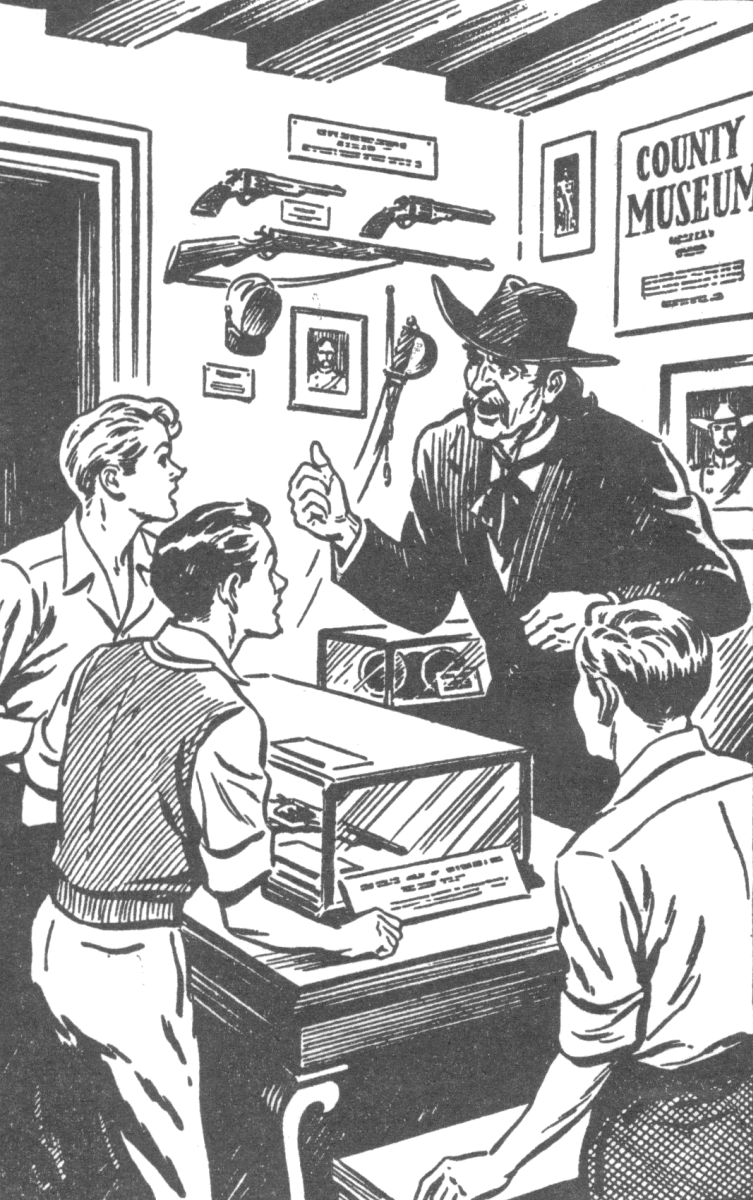
“This is private property! Get out!” the man roared.
Hardy Boys Mystery Stories
THE SECRET
OF THE
LOST TUNNEL
By
FRANKLIN W. DIXON

NEW YORK
GROSSET & DUNLAP
Publishers
Copyright, 1950, by
GROSSET & DUNLAP, Inc.
————
ALL RIGHTS RESERVED
————
THE SECRET OF THE LOST TUNNEL
Printed in the United States of America
| CONTENTS | ||
| I | Double Warning | 1 |
| II | A Mysterious Friend | 8 |
| III | The General’s Enemies | 16 |
| IV | Planned Strategy | 23 |
| V | Dangerous Journey | 34 |
| VI | A Narrow Escape | 41 |
| VII | On the Spy Trail | 50 |
| VIII | The Peculiar Professor | 58 |
| IX | Rifled Luggage | 67 |
| X | The Search | 77 |
| XI | An Important Canteen | 85 |
| XII | The Missing Bandoleer | 95 |
| XIII | The Snare | 103 |
| XIV | A Fighting Foe | 111 |
| XV | A Suspect Disappears | 117 |
| XVI | The Hoax | 126 |
| XVII | Breaking a Code | 133 |
| XVIII | Digging for Gold | 141 |
| XIX | Atom Crackers | 149 |
| XX | The Sniper | 158 |
| XXI | Charred Papers | 166 |
| XXII | A Prisoner | 175 |
| XXIII | the final clue | 186 |
| XXIV | The Lost Tunnel | 197 |
| XXV | The Plantation’s Secret | 202 |
THE SECRET OF THE LOST TUNNEL
The telephone in the Hardy home gave a long, urgent ring, as the clock struck four. Blond-haired Joe bounded into the hall and lifted the receiver.
“Fenton Hardy’s residence,” he said, and in answer to a query, “My father is not at home. Will you leave a message?”
“This is Dr. Bush,” the man informed him in a deep voice. “You’re going to have a caller. Watch your step and pay no attention to his story. He’s dangerous. He’s out of his mind.” Dr. Bush talked a few seconds longer, then hung up abruptly.
Joe returned to the living room, a puzzled look on his face.
“What’s the matter?” asked his brother Frank, who was dark-haired and a year older.
“A General Smith is coming here. Dr. Bush, who just phoned, says the general’s crazy. Thinks his family buried some Civil War treasure and is going to ask us to help find it.”
Before Joe had a chance to explain further, the telephone rang again. He answered it.
“Hello?” Placing his hand over the mouthpiece, he whispered to Frank, “A woman. She knows Dr. Bush.” Then into the instrument he said, “Yes. Yes. Why? Hello, hello!”
The click on the other end of the line was evidence the woman had ended the conversation.
“Who was she?” Frank asked.
“Didn’t give her name,” Joe replied. “But listen to this. She said if we heard from a Dr. Bush we should call the police immediately.”
“Jumping cows!” Frank exclaimed. “A mystery to solve before we even see the people in it. I wonder . . .”
His words were interrupted by the ringing of the front doorbell. Joe opened the door. Before him stood a man in the uniform of the United States Army. On his shoulder he wore the single star of a brigadier general.
“I’m General Smith,” he said. “I’d like to see Mr. Hardy.”
“Step in, please,” Joe said politely. He shot a quick glance at Frank, then surveyed the stranger carefully.
The general, whether mentally unbalanced or not, had all the bearing of a military man. He was of medium build and stocky, with a ruddy complexion, blue eyes, and red hair.
“My father’s not here,” Frank told him.
“That’s too bad. How is your father?”
“Why’m-uh, very well,” Frank replied.
“Wonderful man,” General Smith commented.
“You’m-uh, know him?” Joe asked.
“Surely. I came to speak to him on a very important matter.”
“We could give him your message,” Frank offered. “I’m Frank, and this is my brother Joe. Dad’s been away. We expect him back some time today.”
Frank remembered what his father once had told him about dealing with a mentally unbalanced person. If treated politely and gently, the person might react normally. Only if shocked or upset would he reveal any mental aberration.
General Smith walked into the living room and seated himself in Fenton Hardy’s favorite club chair, looking keenly at the brothers.
“I’ll relate my story briefly,” the man said. “You can tell your father, in case he doesn’t get back before I return to Washington. It concerns a treasure buried during the Civil War. I want him to find it.”
The words electrified the Hardys. This was it. No doubt about it. Just the patter Dr. Bush had warned them about. But on second thought, they had been warned about Dr. Bush too. “A double mystery,” Joe thought.
He stole a glance at Frank. His brother looked puzzled as the man continued.
“My grandfather, a Confederate general,” he said, “was disgraced during the Civil War because he lost a bandoleer containing a silver ammunition box.”
“Bandoleer?” Joe asked.
“Yes. A military shoulder strap. Today they contain cartridges. The old one my grandfather lost merely carried a small box.”
“What was disgraceful about losing that?” Frank asked as he observed the man intently.
“The box contained no bullets,” the general explained. “But it did contain a secret which has remained unsolved to this day. Here’s the way it happened. Just before a certain battle, my grandfather called at the plantation of his cousin, Beauregard Smith, a wealthy planter and president of the local bank. Beauregard confided to my grandfather that if enemy troops got too close, he would bury his gold, together with that belonging to the bank.”
“What happened then?” Joe put in eagerly.
The man moved uneasily in his chair. “Just before the Battle of Rocky Run,” he went on, “an old slave from Beauregard Smith’s plantation ran into Grandfather’s headquarters. He handed him a sealed envelope, saying, ‘It’s de secret Massa told yo’ ’bout!’ Then he dropped dead from exhaustion.”
As the visitor stopped speaking, he sprang from his chair and paced rapidly toward the door.
“What’s he going to do now?” Frank wondered, recalling the telephone warning.
But as if the general read the boy’s mind, he turned sharply on his heel and paced back, continuing his story.
“Grandfather had only time enough to glance at the message. It contained a series of numbers. Sounds crazy, I know.”
Joe gulped and looked at his feet. He agreed; it did sound like a crazy man’s story.
“Across the face of the message,” the general proceeded, “were the letters C S A. Meanwhile, scouts brought in reports of the enemy’s approach, and Grandfather had to issue a call to arms. The opposing sides joined in battle shortly afterward, and the fight continued into the night. In the darkness and confusion, the bandoleer and the ammunition box disappeared, and with them the secret.”
“Didn’t Beauregard Smith remember?” Frank asked.
The general stared directly through Frank as if gazing at an apparition.
“He was killed defending his plantation. His place was cannonaded and burned to the ground.” The brigadier started to pace again.
“Beauregard Smith’s family was penniless, and in disgrace, too, because the bank’s gold was lost. Furthermore, they even accused my grandfather of taking it for his own use!”
Joe let out a whistle. “Some accusation!”
Frank nodded in agreement.
“No sense to it, of course,” the officer stormed. “But Beauregard’s relatives felt my grandfather might not be telling the truth about the secret message disappearing. There was gossip he had found the family treasure.”
The telephone rang again, startling the general and the boys. Frank leaped to answer it. The caller was Dr. Bush.
“Has Smith arrived?” he asked abruptly.
“Hold on a moment,” Frank said.
In the silence that followed, Frank strained to hear any familiar sound that might identify the place from which the doctor was calling. In a second he was rewarded. The words, “Two on a raft!” boomed in the distance. The voice of Pete down at Shorty’s Diner!
Frank beckoned to Joe and whispered, “Bush is at Shorty’s Diner. I’ll try to keep him talking while you nab him.”
Excusing himself to the general, Joe raced from the house.
Joe’s long strides carried him speedily toward Shorty’s Diner, located a quarter of a mile away in the downtown Bayport section. Reaching it, he bounded up the front steps and pushed back the sliding door.
As the tempting aroma of sizzling hamburgers and coffee drifted to Joe’s nostrils, he glanced quickly toward the telephone booth at the end of the long counter. The door was open. Nobody was inside!
Suddenly a rotund youth sitting on a stool swung around. In his hand he held half of a Western sandwich.
“Hello, Joe,” he said. “What’s the big hurry?”
“Chet!” Joe exclaimed. “Did you see anybody come out of the phone booth?”
“Don’t rush me,” Chet pleaded, and bit into the sandwich.
Chet Morton, pal of the Hardys, enjoyed eating and did not like to be hurried. Nevertheless, he gulped what remained of his third sandwich and blurted to Joe:
“ ’Course I saw the guy. He went out that side door. What’s up?”
Joe raced through the door, then halted on the sidewalk. Chet lumbered after him.
“I think that’s the man down the street there,” Chet volunteered. “He was tall and wore a dark suit. Carried a black bag.”
Without a word, Joe sped after the figure who was now a block away. As he ran, Dr. Bush glanced back, then broke into a trot. At that moment a red-and-white taxi turned the corner. The man hailed it. As the cab came to a halt, he hopped in and rode off before Joe could catch up with him.
Joe turned dejectedly as Chet arrived on the scene. “Didn’t even get a good look at him,” Joe moaned.
“Is he a crook?” Chet asked, puffing.
“Maybe. Anyway, somebody asked us to get the police after him. I wish I hadn’t lost him.”
“Don’t worry, pal,” Chet piped up. “I figured this was another detective case, so I decided to help you.”
For the first time, Joe noticed that his plump friend held a strange-looking contraption in his hands.
“I took his picture,” Chet said.
The boy grinned as he held an old battered camera toward Joe. On the front mount was a telescopic lens.
“I got a telephoto snapshot,” Chet said proudly.
“Are you sure?” Joe eyed the camera skeptically. “Where’d you get this?”
“At a pawnshop,” Chet explained. “Just because I got it secondhand doesn’t mean it’s no good.”
Joe examined the camera. The lens was good enough, but the bellows seemed brittle and had been patched here and there.
“I hope it hasn’t any light leaks,” Joe said, handing the box back to Chet. “I’d sure like to have a picture of that man!”
“Count on me,” Chet said as the two boys hurried toward the Hardy home to develop the picture. “You fellows working on a dangerous mystery?”
Chet’s voice contained a note of apprehension. The Hardy boys, his closest friends, were sons of Bayport’s famous detective, Fenton Hardy, and had solved many cases, beginning with “The Tower Treasure.” Although Chet liked their companionship, he always was fearful of the risks they ran.
The memory of their last adventure, which had come to be known as “The Sign of the Crooked Arrow,” was still fresh in his mind. Chet often shuddered anew when he recalled the hostile band of outlaws they had encountered in the Western mountains.
“I said, are you working on a new case?” Chet asked again.
“I don’t know yet,” Joe replied, and explained hurriedly about the mysterious telephone calls.
“I don’t like it,” Chet commented as the two entered the Hardy home.
Frank met them at the door. “Did you find Dr. Bush?” he whispered excitedly.
Joe shook his head, then Frank explained in low tones that the doctor had ended their telephone conversation very abruptly.
“Maybe he saw Joe running toward the diner,” Chet suggested.
After hastily introducing Chet to General Smith, Joe ushered him into the basement, where the Hardy boys had their darkroom.
“You’ll find developer and hypo under the bench, Chet. I hope the picture’s good.”
While Chet was busy removing the film from the old camera, Joe rejoined his brother and General Smith.
“I must say,” the general commented, “that you boys sure dash around.”
Frank apologized for the interruption and explained, “Our friend Chet’s a photographer and uses our equipment sometimes. Please go on with your story about the Civil War, General Smith.”
“When my grandfather failed to clear up the mystery, my father took a hand, because the Beauregard Smith branch of the family still blame us for the loss of their fortune in gold.”
Frank and Joe sat tensely on the edge of their chairs, listening.
“My father was a general, too,” their caller said. “The military tradition has been the pride of our family for over a century. That’s why I’m determined to find the treasure!”
General Smith thumped the table beside him so hard the lamp on it teetered precariously. He jumped from his chair and began to pace the room. The brothers looked at each other in alarm. Were they going to have trouble with the man? Seating himself, the general continued:
“Father questioned old Civil War soldiers about what went on during the battle in which the ammunition box with the secret message had vanished. In the closing of the day’s battle, as darkness came on, my grandfather ordered his men to retreat to a higher position. At dawn the shooting started again. Artillery boomed. Then”—the speaker paused dramatically—“the enemy retreated.”
“So your grandfather’s army won?” Joe queried eagerly, completely forgetting that General Smith might be a bit deranged and the whole story false.
“Nobody won,” he said. “That goes for the Civil War and for all wars. Nobody ever wins. Everybody loses, even those who emerge triumphant from the field of battle. In the Battle of Rocky Run the issue was a draw. Probably the spy had something to do with it.”
“What spy?” Frank asked.
“My father unearthed the fact that the bandoleer had been stolen by a spy. Long after the war, when there was no longer need for secrecy, the story came out that an enemy soldier, named Charles Bingham, had entered my grandfather’s camp. He was seen during the battle, but later was reported missing.”
“And the secret of the buried gold with him,” Joe ventured excitedly.
“No doubt,” the general agreed, rising impatiently and striding around with one fist clenched behind his back. “Nobody ever found out what became of him.”
“He might have been buried in an unmarked grave,” Frank suggested.
Joe’s thoughts ran along a different vein. “You want Dad to help you find the hidden gold?” he asked. “The only clue is Bingham, and you don’t know what happened to him.”
General Smith frowned. “I know it’ll be hard, but I have a lot of faith in your father’s reputation.”
“Dad’s the best detective in this part of the country,” Joe said. “You came to the right man. But there’s just one hitch. Dad’ll want proof of your story before . . .”
The look which flashed across the general’s face was ample evidence Joe had said the wrong thing.
“Proof!” the man sputtered, indignant at having his authority questioned. His red hair fairly bristled.
“General Smith,” Frank said, “my brother meant no offense. After all, we haven’t seen your credentials.”
“Credentials!” the general shouted. “Why you young . . .”
Suddenly the crackling atmosphere was grounded by the click of a key in the front door. The door swung open. In strode Fenton Hardy. Relief surged over the boys.
“Dad!” Frank exclaimed, hurrying toward the tall, broad-shouldered detective.
“Boy! Am I glad to see you!” Joe cried out.
As Fenton Hardy entered the living room, General Smith made a sudden move toward him. “Fent Hardy!” he boomed.
To Frank and Joe’s utter astonishment, their father stood stock-still a moment, then put out his hand, exclaiming:
“Jack Smith!”
Frank and Joe stared wide-eyed as their father and General Smith exchanged greetings.
As soon as he could, Joe took his father aside and whispered, “Dad, we were told the general is crazy!” The boy quickly related what had happened.
The detective, recovering from the shock of the announcement, pondered for a second, then said, “I’ll settle that in one question.” Returning to the officer, he said, “Jack, I’m glad you came at this time. What’s the latest on the Antonesque spy case?”
“How do you know about that?” the general asked.
“Been helping the F.B.I. on it.” The detective smiled.
“Well, then, you’ll be glad to know,” the officer said, “that Antonesque was caught yesterday by a private agent.” Looking his friend straight in the eye, he asked, “Were you that agent?”
Mr. Hardy’s eyes twinkled. “You’ve guessed it. That’s the case I’ve just returned from.”
“The Army’s congratulations, Fenton! You’ve done our country a great service!”
“Thanks. And now, Jack, we have another mystery to solve. Tell General Smith what you just told me, Joe.”
Upon hearing the insanity story, General Smith threw back his head and laughed heartily.
“It only goes to show you can’t tell who’s crazy. I’ve thought ever since I came here, Fenton, that your sons were acting pretty daffy!”
Grinning like a couple of boys, Mr. Hardy and General Smith recalled the happy days they had spent one summer in an officers’ training camp. Frank and Joe could readily visualize the men in their younger days; their father, tall and strapping, with jutting jaw and black wavy hair, and the rugged general, whose red hair was a danger signal to any opponent.
“General Smith’s a regular guy,” Joe whispered to Frank.
“Must be if he’s a friend of Dad’s.” Frank grinned. Then he added aloud, “General Smith, have you any idea who Dr. Bush and the woman caller might be?”
“Not the faintest,” General Smith answered, a worried frown creasing his forehead.
“My guess is,” Mr. Hardy spoke up, “that Bush is no doctor and he’s using a fake name.” He turned to the general. “Did you tell anybody you were going to visit me?”
“Not a soul.”
“Did you make a memorandum somebody might see?”
“No. The only thing I did was write the letter to you saying I was coming.”
“Letter?”
“Yes. Don’t tell me you didn’t get it!”
“No. Where did you mail it?”
“At the hotel in Centerville.”
The officer told how he had made a quick trip down to Centerville, the nearest town to the old Beauregard Smith plantation. While there, he had discovered that someone was digging secretly on the property. At once he had decided to enlist Fenton Hardy’s help and had written the letter.
“Somebody intercepted the mail,” Mr. Hardy surmised, “and learned you were coming here.”
The detective asked the officer for a resumé of the strange story of the missing bandoleer. While he was telling it, Frank and Joe went to the cellar to see Chet. They found him in the darkroom, gazing at a wet print of Dr. Bush.
“Hey, this is only half a picture!” Joe exclaimed, peering at it. “Nothing but the doctor’s legs and a black bag.”
Chet was crestfallen. His telephoto camera had failed him. “Guess I’ll just tear this up and start all over again,” he said glumly.
“Don’t do that!” Frank interrupted. “This might be a valuable clue. Dad says never discard a single bit of evidence.”
When the three boys returned to the living room, Mr. Hardy was saying:
“We ought to find out if anybody in town can give us a good description of the man. That means quizzing cab drivers until we find the one who drove him.”
“We’ll do it,” Frank offered. “Want to come, Chet?”
Chet said he had to go home. The boys walked with him to a bus stop, then hurried toward the Bayport railroad station. Ordinarily, the brothers would have used their own car, but it was in a garage for a checkup.
Arriving at a row of red-and-white cabs parked alongside the tracks, Frank spoke to one of the drivers.
“Did you pick up a fare near Shorty’s Diner about an hour ago?”
“No. Haven’t been out that way all day.”
The other drivers also gave negative answers. Seeing the boys’ glum look, the taxi dispatcher said:
“Probably the cab you’re looking for came from out of town.”
Joe thanked the man for his suggestion, but without a license number it would be almost impossible to trace the cab. When the boys reached home, Mr. Hardy and General Smith were still discussing the mystery. Their Aunt Gertrude, Mr. Hardy’s spinster sister, who lived with them, had come in, and heard the story.
“No good will come of this,” the brothers heard her prophesy as they entered the living room. “The minute I heard a woman was involved—”
“Now, Gertrude,” Mr. Hardy spoke up, used to her quick decisions, “she probably represents law and order.”
“I don’t believe it,” said his sister, who was apt to be peppery in her opinions. “And as for that doctor—oh, my pie’s burning!” She rushed from the room.
“What I’m afraid of,” General Smith said, “is that the secret message in the old bandoleer has been found and the crook is trying to locate the gold.”
Mr. Hardy set his friend’s mind at rest on this score. “It’s possible the message has been found, but if the gold cache had been located, Dr. Bush wouldn’t be on your trail.”
“If he’s a crook, he probably has a criminal record,” Frank suggested.
“That’s logical thinking,” his father said. “We’ll go up to my study and take a look at the pictures in my rogues’ gallery. Jack, you may recognize somebody who was at the hotel in Centerville. Then we’ll know who is on your trail.”
The four trooped to the second floor, and turned on the lights. The detective spread dozens of rogues’ gallery pictures out over his desk. The general scanned each one carefully but concluded he had never seen any of the shady characters.
“I must get back to the hotel now,” he said. “It’s been—”
His words were lost as a shrill shriek sounded downstairs. Aunt Gertrude!
Frank and Joe leaped to their feet and bounded down the stairs. To their amazement, they saw their aunt grappling with two men at the front door. With her eyeglasses dangling wildly over one ear, the spinster clutched one man by the hair and tugged at the other’s necktie.
“You . . . can’t . . . come . . . in . . . here, you ruffians!” she cried, blocking them. “Help! Help!”
“Hold ’em, Aunt Gertrude!” Joe shouted.
When the men spied the reinforcements, one of them cried out, “They’re ganging up on us! Let’s get out of here!”
The thugs, whose faces were screened by the melee of arms, wrenched loose, and dashed into the street with the boys close behind.
At the curb stood a red-and-white taxi, its motor racing and its door open. Before the boys could reach it, the fugitives jumped inside and the cab roared away in the dusk.
“That’s like the cab Dr. Bush took!” Joe shouted. “And look, its license plate is covered!”
“I’ll bet those fellows are working for him!” Frank cried. The boys gave up the futile chase and returned to the house.
“One of those thugs might have been Dr. Bush,” General Smith ventured, when he heard about the doctor’s cab.
“I doubt it,” Joe said, and mentioned Chet’s photograph. “The doctor has long legs.”
Mr. Hardy was trying to quiet his sister and at the time get her story of the intruders.
“Those—those scoundrels said they were guards from an insane asylum,” Aunt Gertrude spluttered. “They said General Smith had escaped and they wanted to take him back. I said he was a friend of ours, and they couldn’t come in!”
“What did they look like?” Mr. Hardy queried.
Aunt Gertrude peered over her eyeglasses. “Do you expect me to fight off cutthroats and remember their looks at the same time?” she asked crisply, her fright gone. “I was too busy to notice, but one was a boy about Joe’s age. He had a round face and peaches-and-cream complexion.” The woman closed her eyes and shuddered. “Imagine a baby-faced boy wanting to murder me! What is the world coming to!”
“We’ll find them, Aunt Gertrude!” Joe vowed.
“No, you won’t. No, you won’t,” their relative protested. “You’ll not go chasing such criminals. Oh, I knew when that woman telephoned, you should stay out of this. General Smith, we expect you to stay to dinner.”
As Aunt Gertrude slumped into a chair, General Smith said he would be glad to stay and talk things over.
“You see how things are, Fent. Will you handle the case for me?”
“Yes,” the detective replied evenly. “Finding the lost gold may be a thousand to one chance, but it would give me great pleasure to nab those two thugs who just tried to break into this house!”
“Great!” the officer burst out. “You’ll start immediately?”
“Not so fast, Jack,” Mr. Hardy said. “I must return to Washington tomorrow to testify in the Antonesque case.”
General Smith looked disappointed. “But suppose Bush finds the gold before we do?”
“We’ll take care of that,” Mr. Hardy assured him. He turned to his sons. “You fellows can start South at once to lay the groundwork.”
“Frank and Joe?” asked the officer in amazement.
“Yes, indeed,” Mr. Hardy replied proudly. “My boys help me on many cases. Sometimes they solve ’em before I do!”
“But this is different,” continued the general, still hesitating. “This may be dangerous.” He tugged the lapels of his tunic with a gesture as if he had suddenly made up his mind to something. “I’ll accompany them to Rocky Run. I have a short leave due. How soon can you boys start?”
“Will tomorrow morning be soon enough?” Joe asked eagerly.
General Smith smiled. “I can see no bugler would catch you boys napping!”
“Our car’s in the shop, but it’s ready now. We’ll pick it up early in the morning,” Frank said.
“Good. Then we’ll leave at nine. We can stop overnight in Philadelphia and make Rocky Run some time the next day.”
Twenty minutes later Chet returned, waving a picture. “Hey, how do you like this one?” he asked enthusiastically.
“It’s a picture of a taxi,” Joe remarked. “How’d you happen to snap it?”
Chet beamed. “It’s the one Dr. Bush rode away in.”
Frank snatched the picture as Chet, bursting with pride, said, “Guess I’d make a pretty good detective myself, eh?”
“If you’d only snapped the license number,” Frank remarked, handing back the photograph.
“Oh, gosh, that’s right,” Chet wailed. “But I was running, and I couldn’t go fast after eating those Western sandwiches.”
Frank and Joe told their stout friend of the planned trip to the South. Chet’s face fell.
“Gee, just when I thought we were going to have some fun with my camera, you’re going away.”
Frank, winking at his brother, said, “Say, Chet, you know we might need a good photographer on this case. How would you like to come along?”
“Oh, boy!” Chet beamed. “I might even get the other half of that crook!”
The general’s permission to take Chet with them was granted, and the boy hurried home to pack.
“We’d better do some packing ourselves,” Frank told his brother.
Their mother, who had been out shopping, and had just returned, looked in upon them.
“Good gracious!” exclaimed the sweet-faced woman, who was a head shorter than her two sons. “Another trip?”
The boys told of their plans. She smiled knowingly.
“I’ll miss you dreadfully. Are you taking the proper clothes?”
“We’ll be outdoors most of the time,” Frank replied, “exploring an old battlefield.”
At the mention of a battlefield, Aunt Gertrude, who had come upstairs, burst out, “Land o’ nonsense! You’re taking too much risk. Why, there may be hidden shells that might explode. And that sun down South. You’re likely to get a sunstroke! Dinner’s ready.”
Aunt Gertrude, who had the habit of hopping from one subject to another, hustled downstairs to the kitchen. Her cooking was as savory as her language was peppery. This evening, as a special treat for Frank and Joe she had baked an apple pie and made ice cream. When she brought in the dessert, the boys’ eyes popped.
“Why, Auntie!” Joe exclaimed.
“Goodness knows when you’ll eat again,” she said tartly. “At least you should start this trip well fed!”
General Smith left immediately after dinner. Frank picked up a history of the Civil War and began reading about battles in the vicinity of Rocky Run. Joe thumbed through the pages of an encyclopedia until he came to an article on bandoleers and ammunition boxes. As he was deeply engrossed reading that the leather shoulder straps first came into use two centuries ago, and that each one held twelve cylindrical boxes of powder, three loud knocks sounded on the front door.
“It’s Chet,” Frank said, recognizing the signal the boys used. “Guess he couldn’t wait until tomorrow.”
As Frank opened the door, three young people burst into the Hardy home, laughing. In the lead was Iola Morton, Chet’s sister, with Callie Shaw following. Chet brought up the rear with two large packages.
“Surprise!” Callie called gleefully. The brown-haired, dark-eyed girl, a friend of Frank’s for several years, took a big white cakebox from Chet and set it gingerly on the hall table.
“This is a bon voyage party,” announced Iola, who was just as slender and good-looking as her brother was fat. “Here. Take this bag, Joe. But be careful. It’s soda pop.”
Frank and Joe carried the refreshments into the kitchen while Callie went to find the boys’ latest phonograph records.
“Don’t yo’-all forget,” Iola teased Joe, “to bring back a good southern accent.” Iola thought the younger Hardy was tops among the boys in Bayport.
“We’ll leave that to your brother,” Joe retorted, grinning. “He can learn it while he’s eatin’ fu-ried chicken.”
After chatting about the trip and dancing until ten o’clock, the young people sat down at the dining-room table for refreshments. They had just finished when a long whistle sounded ominously in the distance.
“Listen!” Frank commanded. “The fire alarm.”
Three long, mournful blasts, then two short ones.
“That’s downtown,” commented Joe, who knew the location of every fire alarm box in Bayport.
Soon the wail of sirens and the excited clang of bells told the listeners the fire department was on its way to answer the call.
“Let’s go see where the fire is,” Joe suggested.
“Wait till I finish this cake,” Chet protested.
Just as Chet gulped the last bite, the telephone rang. Frank answered.
“No! Oh, gosh!” he moaned as he returned to the dining room, his forehead creased with anxiety. “Joe, our car’s gone! Burned up! That fire was in the garage!”
The wail that emitted from the three boys brought the older Hardys down from the second floor.
“It’s a shame,” said Mrs. Hardy, hearing the bad news.
“We can’t go on the trip,” Joe groaned.
“The loss of your car shouldn’t stop you. You can go by bus or train,” his father suggested.
“That’s talking sense,” Aunt Gertrude spoke up. “Lots safer than tearing down there in your own car. Boys under twenty shouldn’t drive cars on wet roads, anyway. It’s going to rain tomorrow.”
“I have an idea,” Chet exclaimed, beaming. “We’ll go in my jalopy.”
Aunt Gertrude snorted. “Put General Smith in that old junk? It hasn’t any top!”
Chet looked downcast a moment, then brightened. “He—he can go on the train,” the boy stammered.
Early the next morning a sound which might have been the gasp of a dying goat sounded in front of the Hardy home. The wheezy horn on Chet’s jalopy! Chet came in and laid his battered camera on the buffet.
“Sit down,” Mr. Hardy invited. “You’re probably hungry from that trip across town.”
“How’d you guess it?” Chet replied, eying a stack of wheat cakes which Mrs. Hardy had set on the table. “Just what I need for the start of a trip.”
“You’re not going today,” Mr. Hardy told him.
“We’re not?” Chet puffed.
Mr. Hardy pushed his chair back and arose. “I’ll be home at five this afternoon. At that time I’ll have news for you.”
“I’ll bet your father’s sending us down by plane,” Chet guessed after Mr. Hardy had left the house.
“Maybe he’s going to let us take his car,” Frank said.
Promptly at five the three boys met in the Hardy living room. Mr. Hardy walked in with General Smith.
Joe was worried. “Tell us, Dad, are we going South or not?”
Mr. Hardy’s keen, dark eyes regarded each boy seriously, even Chet, who was putting a roll of film into his camera.
“Yes, you’re going,” he said slowly. “Take a look in front of the house.”
Frank and Joe looked out the window, then dashed out the door, with Chet a poor third. In front of the house stood a new car—a sporty green coupé.
“How do you like it?” asked the detective, regarding the openmouthed look of amazement on the faces of his sons. “Think it’ll perform as well as your old one?”
“Dad, you mean . . . ?” Joe gasped.
“It’s ours?”
“Yes,” said Mr. Hardy, grinning broadly. “You can start your trip in the morning.”
“Screaming crow!” spluttered Joe. “How do you like that!”
“I’ll take a picture of it,” said Chet, unlimbering his camera and looking through the view finder.
“Take her for a spin around the block,” Mr. Hardy suggested, “and then come inside. We have some planning to do with General Smith.”
The boys purred around the vicinity in the beautiful, smooth-flowing car for ten minutes before returning to the Hardy home.
“It’s sure a beauty!” Joe exclaimed.
Both boys profusely thanked their father for the new car, then sat down with him and the general to discuss the mystery.
“This is like briefing troops before a battle.” The officer smiled. He gave the three boys a layout of the territory around Rocky Run. “It’s not going to be easy to find the treasure,” he added.
“I have a feeling it’s going to be a real fight,” Mr. Hardy said. “You boys must be constantly on the alert. Gold is always a source of—”
Suddenly a splintering crash cut the air. A dark object, hurled through the window, hit Frank full on the chest!
Joe dashed into the yard and peered over the fence, but no one was in sight. Then he returned to the living room, where Mr. Hardy was holding a large heavy hammer.
“That hammer would have killed Frank if it had hit him on the head,” his aunt declared angrily.
In a few minutes Frank was able to breathe more easily. A bruise on his chest was the only apparent injury caused by the mysterious assailant.
“That thug was pretty slick,” remarked Mr. Hardy, after giving the hammer a thorough dusting with fingerprint powder. “Not a print on it.”
“Why would anybody want to hurt Frank?” asked Mrs. Hardy, still trembling from the shock.
“I doubt that Frank was the target,” the detective replied. “I’m sure the hammer was meant either for me or General Smith.”
“To keep you from making the trip South?” Frank put in.
“I told you nothing good would come of solving a case with a woman in it,” Aunt Gertrude sputtered.
“But, Auntie,” Joe protested, “she was right about getting the police after Dr. Bush.”
“Then let the police do it,” Miss Hardy retorted.
“I doubt whether it’s worth while to call the police on this incident,” Mr. Hardy said. “The assailant is probably far from here by now. But one thing is evident. Your movements, Jack, are being carefully watched by some dangerous criminals. I’d advise you to get away from here. Start South tomorrow morning, but do it secretly.”
By morning Frank was himself again, and eager to be off. To make their departure as secret as possible, Mr. Hardy had two of his operatives patrol the neighborhood for suspicious characters. None were found. At dawn, with farewells ringing in their ears, the Hardy boys, Chet Morton, and General Smith set off for the South.
Chet looked the most adventurous of all. His camera was slung over his shoulder and from his belt hung a tripod, collapsed into a leather sheath. With Frank at the wheel, they hummed out of Bayport and soon their native city was miles behind on the state highway.
The boys found the general an interesting companion, with his stories of military life. Then, getting down to the details of the lost gold, the man said:
“When my grandfather got the message from his cousin’s slave, he thought that the C S A written across the face of the note stood for Confederate States of America.”
“Didn’t it?” Chet piped up.
“Apparently not. When nothing came of this lead, my father decided the letters might have been part of a code; the first letters of three words which would solve the whole case. But just how to break the code was another matter.”
“Have you ever tried to?” Frank asked.
“Many times. My father and I thought the C might stand for cellar or cave, and examined several, but found nothing.”
“Maybe it stood for cavern,” Frank ventured.
“There aren’t any around the plantation, so far as we know,” the officer replied. “We once thought the S might stand for stream or stone.”
“Or Stonewall Jackson,” Chet volunteered.
Joe shot a glance at his friend which plainly said, “No wisecracks while we’re trying to solve a mystery.” Chet held his silence as the conversation continued.
“It was decided the S might mean the stream that runs through the plantation,” General Smith said. “As a matter of fact, the banks of Rocky Run were dug into several times, but nothing at all was ever found there.”
“What about the A?” Joe asked.
The general shrugged. “No clues,” he confessed.
“The A might stand for arsenal or artillery,” Frank offered.
“But how that figures in the whole picture only deepens the mystery,” the officer said with a sigh.
“What’ll we do first?” asked Chet, coming out of his silence.
The military man smiled. “I have nothing to suggest. The case is in the hands of the Hardy boys.”
“Before we do anything,” Frank said, “I believe we ought to look over the battlefield and the plantation.”
Late that afternoon the four travelers reached Philadelphia. They registered at a large hotel, in the basement of which was a tremendous garage. As Frank drove the green coupé inside, he said:
“I’m leaving it for the night. My brother or I will call for it in the morning.”
They registered, ate dinner, and went to bed early. After breakfast the next day Joe went for the new car.
“Listen, Bud, nobody’s takin’ the car except the guy who left it,” the attendant declared.
“I’m his brother.”
“Yeah? So was that boy with the baby face.”
“What are you talking about?” Joe demanded.
“Don’t bother me,” the attendant said.
Seeing it was useless to argue, Joe went off for Frank. When they returned, the garageman said a boy about Joe’s age had come in half an hour before, saying he was one of the Hardy boys.
“He didn’t have a claim check,” the man said, “so I wouldn’t let him take it.”
“He was trying to steal our new car!” Joe exclaimed, climbing in behind the wheel.
As the Hardys drove out, both had the same thought. Aunt Gertrude had said one of the intruders at the house had a baby face. Had the fellow trailed them?
Out on the highway once more, the travelers crossed the southeast corner of Pennsylvania and entered Maryland. As usual, Chet became hungry long before the others. Seeing a pleasant-looking house with a sign DINAH’S FRIED CHICKEN, he begged them to stop. Frank pulled in, and the four ordered lunch.
Just before the end of the meal, after several cars had parked, Joe glanced out the window. Suddenly he jumped up and went outside. Returning a minute later, he explained that a man had been sneaking around their car.
“I couldn’t find anything wrong, though.”
“Just the same, let’s get out of here,” Frank suggested. “I’ll take the wheel.”
As the beautifully verdant countryside rolled past, he looked into the rear-view mirror.
“See that car back there?” he asked Joe, who was beside him.
His brother turned in the seat and peered behind. A black sedan was following them a hundred feet back.
“I’ll bet he’s trailing us!” Joe said.
Frank slowed down. When the other car did likewise, Frank speeded up. The trailing sedan kept pace.
“I don’t like this,” General Smith said.
Scarcely were the words out of his mouth when the Hardys’ car coughed and sputtered. As Frank guided the coupé around a sharp curve, the accelerator suddenly failed to respond. Frank steered to the side of the road, losing speed.
As he did, the sedan suddenly shot forward alongside the Hardy car. In a split second it cut sharply in front of the coupé. Frank jerked the wheel quickly to the right and jammed on the brakes.
Joe was hurled heavily against the windshield. Chet and the general pitched halfway over the front seat.
The car skidded on the sandy shoulder of the road, its front wheels over the brink or a deep gully.
“Throw your weight back!”
Frank shouted the warning as the car balanced on the ledge, ready to topple into the gully at any moment. When it settled into the sandy loam, he said:
“Climb into the back, Joe. Then I’ll try to get out this door.”
With catlike movements, Joe slowly crawled over the back of the seat and into the lap of Chet, who was quaking with fear.
“Nice work,” said the general, approving Frank’s plan.
The added ballast in the rear made it safe for Frank to open his door.
“Hold everything for a second,” he said, “I’ll get a rope from the trunk compartment.”
He pulled out a sturdy length of hemp and tied one end to the bumper and the other to a near-by tree.
“Okay!” he called. “It’s fast.”
With a long whistle of relief, Joe opened the right-hand door and stepped out. Chet and General Smith followed.
“Whew!” said Chet. “Maybe I should have stayed home to take pictures. It’s too dangerous down South.”
“Let’s get this car back on the road,” Frank said. “Maybe we can overtake the guy who tried to ditch us!”
“Look! Here comes a truck!” Frank cried out. “Let’s get the driver to pull us out of here.”
He stepped onto the highway and flagged a big van, which came to a halt in front of him.
“Need some help?” the man called.
“Sure do,” Frank replied. “Will you tow us back onto the road?”
“Righto.”
The driver maneuvered his truck into position and helped Frank and Joe untie the towrope from the tree and attach it to the rear end of the truck. Then he eased the boys’ car to the edge of the highway.
“Guess you’ll be okay now,” he said.
They thanked the driver, who waved a cheery good-bye, saying he was glad to have been of service. As the truck rumbled off, Frank lifted the hood of the coupé and examined the motor. With Joe helping, he took the carburetor strainer off.
“Water in the gas line,” he announced.
“Put in by that sneak back at Dinah’s restaurant,” Joe declared hotly. “Say, do you think he was the guy in that car we thought was trailing us?”
“Right,” Frank agreed. “And he followed us, knowing the motor would stall sooner or later. He hoped to get us in a bad jam.”
“I’ll bet Dr. Bush is responsible,” Joe declared. “But if he thinks we went over into that gully, he’s got a big surprise coming. We’re right on his trail now.”
The general smiled wanly. “That would be fine if we knew who Dr. Bush is.”
The coupé sputtered along to a service station. There the watery gasoline was drained out, and new fuel put in. The foursome set off again. Mile after mile raced beneath the wheels of the car as it steadily neared the old battlefield of Rocky Run.
“We’ll stop on the outskirts of Centerville,” General Smith said. “I have a home there. We’ll make it our headquarters.”
Late in the afternoon they drove through the little town of Centerville. The main street, paved with red brick, was flanked by two rows of oak trees. Behind them quaint old houses stood in the shade of blossoming magnolias.
Farther on, the street gave way to a square, on the edge of which sprawled a handful of stores, a small but stately courthouse, and a tall-pillared hotel. A solitary, bewhiskered man sat on the porch of the hostelry, smoking and rocking.
“Looks mighty sleepy around here,” Chet remarked. “I think I’m going to fit right in with this life.”
“A peaceful old town,” the general replied, smiling. “My place is a quarter mile down the road.”
Frank drove on, and presently the general pointed out a driveway, which cut through a thick hedge of boxwood.
“Here’s headquarters,” he said as Frank stopped before a yellow, clapboard house with tall, shuttered windows and doors, nestled far back from the road.
“What a swell place!” Chet exclaimed. “I’m going to sit under this big tree and eat and sleep—”
“I thought you were the official photographer on this mission,” the general said, his eyes twinkling.
“Correct!” Frank agreed as they carried their luggage into the house. “Hup, two, three, four! Come on, Chet, there’s work to be done.”
The wing of the general’s home, which he said they would use, consisted of a long living room, a kitchen, and two bedrooms above. General Smith ushered the boys into the larger of the bedrooms.
“You fellows will bunk here,” he said.
“Pretty fancy bunks,” Frank remarked, eying the mahogany four-poster bed, large enough for the three boys, and silk hangings at the windows.
General Smith grinned. “I picked this place up cheap and have left it just the way it was. But for us it’s just headquarters.”
“When do we shove off on the offensive?” Frank asked.
“Not until tomorrow morning,” the officer replied. “I’d like you boys to get acquainted with Centerville first.”
“What I want to know,” Chet piped up, “is where chow is!”
“Follow me.” The general led the way downstairs and into the kitchen. He opened the door of a shiny white refrigerator, whose shelves were laden with food.
“Wow!” Chet exclaimed. “How did this happen?”
“Centerville’s butcher has a duplicate key to this house,” the general explained. “I sent Mr. Oakes a wire instructing him to provision up for four hungry men.”
The boys set to work preparing the evening meal. When they finished eating, General Smith suggested they set off for town.
Evening was casting long shadows on the square when they arrived in Centerville. General Smith pointed out several large houses whose history dated from the Revolution, then stopped to talk with two men lounging on the hotel steps.
“How’s everything?” he asked, after introducing the boys as friends from the North.
“Tolerable good,” said one of the men, a gaunt-faced fellow who answered to the name of Jeb. “But there’s too many furriners aroamin’ these parts.”
Frank, Joe, and Chet colored up. Did he mean them? The general shot an uneasy glance at Jeb, then bade the men good night.
“What do you think Jeb meant by foreigners?” Joe asked when they were out of earshot of the men.
“One of two things,” the officer replied. “He could have meant you boys, of course, but he probably meant some other strangers that have come to Centerville. Maybe Bush. I don’t like it. Few tourists visit the town this time of year.”
When they returned to the house, General Smith and the boys discussed the plans for the next day.
“It seems to me,” Frank said, “that the best way to try locating the missing bandoleer would be to reconstruct the movements of the spy Bingham.”
“Good idea,” the general agreed. “Tomorrow we’ll go to the farmhouse where my grandfather had his headquarters. The main part is still intact; lies just off the battlefield.”
“Anybody living there?” Joe asked.
“No; it’s a private museum with an old Negro caretaker. People seldom visit it any more.”
“What’ll we do when we get there?” Chet wanted to know.
“Put ourselves in Charles Bingham’s place,” Frank replied. “Suppose, Chet, that you’re the spy, and that camera over your shoulder is the bandoleer, what would you do?”
Chet grinned. “Take a picture.”
His friends laughed. Joe, yawning, said he was going to hit that four-poster so he could be good and fresh in the morning. The rest followed him upstairs.
“Hurry, Frank,” Joe said.
“Why?”
“Chet snores.”
The next morning, the general, his two boy detectives, and their “photographer” drove to Rocky Run. Low, undulating hills, with fringes of trees like Indian topknots, spread before them as they approached the battlefield.
“It wasn’t as still and peaceful as this in 1863,” the officer remarked, surveying the fields and woodlands. “Well, there’s Grandfather’s headquarters.”
Frank drove up to the old building and let the motor idle. What remained of the one-story farmhouse was in fair condition, with ivy vines blotting out parts of the red brick. Off to the left stood two stone pillars, which apparently had been the corner supports of a porch. On the right could be seen the crumbling remains of a wing. Two windows stood bleakly on either side of a large door which bore a metal sign Rocky Run Museum.
“We’ll park here,” the general said. “Now, figuring that the spy Bingham left this spot with the bandoleer, which way would he go?”
Frank and Joe pondered for a moment. To their astonishment Chet set off like a hound after a hare. Soon he was out of sight of the old farmhouse and into a clump of trees on the brow of a little hill. As he looked around, Chet said to himself:
“I think Bingham went right up here to get a better view of the battle.”
Suddenly Chet had the uncomfortable feeling that he was being spied upon. He saw something duck behind a thicket off to one side.
He decided to turn the tables on the spy. He would take his picture! Unlimbering his camera as he went, Chet cautiously approached the bushes.
Sighting the figure through his telescopic view finder, the boy retreated a few paces to get the object in proper focus. The next moment the figure fled from the bushes.
Simultaneously Chet stepped back into space and disappeared!
“Help!” Chet shouted, flinging out both arms as he fell. The camera flew from his hands.
Frank, Joe, and the general, still mapping their strategy in front of the old headquarters, heard the cry and glanced up the knoll.
“Chet’s in trouble!” Frank yelled, and started running.
The others kept close behind him and arrived on the scene almost at the same moment. There was not a sound.
“Chet! Chet! Where are you?” Frank called.
When there was no answer, the Hardys became alarmed. The general suddenly moved forward into the woods. In a moment he called:
“Here he is!”
The officer dropped to his knees beside a deep hole, the opening of which was nearly concealed by a growth of low bushes and grass.
“I’ve got one of his legs. Give me a hand with the other, boys.”
Joe leaned far over and grasped the other leg. Together they pulled Chet to a sprawling position on the level ground.
“Wha-what hit me?” Chet spluttered, still a bit dazed.
“Nothing hit you,” General Smith replied. “You fell into a dry well.”
“You knew about it?” Frank asked the officer.
“Yes. A log cabin stood on this site years ago. This old well is all that’s left of the homestead.”
As Chet rubbed his head ruefully, he told how he had tumbled in while trying to get a picture of a fleeing figure.
“Where’d he go?” Joe asked excitedly.
“That way.” Chet pointed to the right. “He—Hey! Where’s my camera?”
It suddenly dawned upon the boy that his telescopic camera was gone. He dropped flat on his stomach and peered into the well. Only a few rocks and a shred from the seat of his trousers lay on the bottom.
“Help me find it,” he pleaded frantically, getting to his feet.
Frank and Joe were already on the job. They beat the tall grass near by and probed into the brush.
As the general joined in the search, Frank said, “It probably flew out of your hands when you dropped down into the wellhole. How about holding a light rock and going through the motions of your fall, Chet?”
“What? Not me!” the boy protested, eying the well.
“Oh, you don’t have to fall into the hole again,” Frank said, grinning.
Chet picked up a small stone. Keeping a wary eye on the hole, he went through the motions of his spill.
Frank watched the stone sail over Chet’s head. When it landed, he was on the spot immediately. He patted the long grass with his hands.
“Here it is!” he shouted, lifting the camera up. “And not a scratch on it! Luckily it fell into that patch of soft grass.”
Chet took the camera into his hands, caressing it as he would a kitten.
“What about the man you saw?” Joe persisted. “Are you sure you saw one?”
“Sure I’m sure,” Chet replied, a little hurt by the implication.
“What did he look like?” Frank asked.
“I didn’t get a good focus on him.”
“And he’s far away by this time,” Joe said ruefully.
“Gee, I’m sorry,” Chet apologized.
As the group started out of the woods, Frank noticed Chet was limping a little and asked if he wanted to go home.
“I’ll be okay,” the boy answered. “Well, I got in trouble trying to figure out where that spy Bingham went. What do you fellows think?”
Frank and Joe shrugged. “I’d like to hear the story of the battle first,” Frank said. “General Smith, will you explain just where the troops were stationed?”
The officer turned to a hill beyond the one from which they had come, and with a sweep of his arm, said, “That ridge was held by the Northern troops. They had three lines of riflemen, backed by a strong force of artillery.”
“They pushed down the hill and captured your grandfather’s headquarters?” Joe surmised.
“Not exactly. It was in sort of a no man’s land. The Southern troops were in this valley when the attack began. They retreated to that ridge over there.” He pointed to another hill a mile distant which was higher and steeper than the one the Federals had held.
“If Bingham got into your grandfather’s headquarters,” Joe continued, “all he’d have to do would be to hide until the battle was over.”
“It wasn’t as easy as that,” the general said, smiling at Joe. “Grandfather had a force of cavalry in reserve. They counterattacked on the left flank and cut a wedge into the opposing forces.”
“Then Bingham was checked from going straight back to his own lines,” Frank said eagerly.
“It seems to me he wouldn’t have had a chance to get through that line of cavalry,” the officer said. “It was led by Colonel Stone, the Old Mud Fox, and did sufficient damage to turn the tide of the fight.”
“Then Bingham would have had to go around Stone’s men and along the Rocky Run,” Frank reasoned, “until he could contact his own forces again.”
“If he tried that,” the general said, “he probably ran into more trouble, because artillery, which was rushed to my grandfather’s aid, opened up from the opposite ridge. Their cannon fire blasted Bingham’s possible escape route. From all accounts, it was a terrific fight.”
“He might not have come out of it alive,” Joe said, “but if he did, I think he’d have gone in the direction Frank indicated.”
“True enough,” the officer said.
“Then let’s follow that trail!” Joe exclaimed.
“Remember one thing,” General Smith said. “A good soldier makes the most of natural cover. Bingham would have made his way behind trees, boulders, along depressions in the ground, and behind slight rises to afford protection from the artillery. Well, let’s start!”
“Gosh,” Chet said, “I never thought of that. I think I’d go in a beeline just as fast as I could!”
“What a target you’d be!” Joe remarked as they started on the once harrowing trail which Bingham might have taken.
Frank led the way, and the general nodded approvingly as the boy picked a route which provided the least exposure to cannon which years before had thundered from the ridge across the valley.
“You’re a natural soldier, Frank,” the officer said, smiling.
The trek was hot and arduous. Finally they came to the bank of Rocky Run.
“I think Bingham would have followed the stream here,” Frank surmised.
“Right,” the general agreed. “He’d put the water between him and those daredevil horsemen of Old Mud Fox.”
“Why did they call him Mud Fox?” Chet asked. “Did he look like a fox?”
“Not at all. He was a very mild-looking gentleman about five feet tall, but as wiry and foxy as any cavalryman who ever lived. One night he led his men across a mud flat that nobody else dared enter, and attacked a much larger enemy force. He cut down half of them and captured the others. That’s when he got his nickname.”
Joe whistled. “We could use a fox in this case right now.”
“Hey!” Chet shouted suddenly. “There’s a bridge Bingham could have hidden under!”
“Let’s investigate it,” Joe suggested as they came in sight of a span which carried the main highway over the Rocky Run. “Only that’s a concrete bridge. It must have been built long after the Civil War.”
“So it was,” the officer concurred. “But there was an old bridge around here somewhere. My grandfather ordered it destroyed to stop the main drive of the enemy.”
By this time the four were within a stone’s throw of the span. Suddenly a black sedan whizzed over it, the driver glancing down in surprise at the three boys and the officer. Its brakes jammed on, bringing the automobile to a screeching halt out of sight of the searchers.
“Maybe it’s the game warden,” Chet said nervously. “I’ll bet he thinks we’re fishing and wants to see our licenses.”
“More than likely it’s the fellow who tried to wreck our car,” Frank said. “Well, I’m going to get a look at him.”
He made his way up the side of a steep embankment to the edge of the bridge. Just as he spotted the back of the man’s head, the car’s gears meshed furiously, the back wheels spun, and the automobile streaked down the highway with a roar! There was no license plate on the back of the car.
“Where do you suppose the car was going?” Joe asked as he and the others reached the top of the embankment.
General Smith looked down the road and squinted, as if looking at a road map in his mind’s eye.
“The road comes to a fork up there a way,” he said, pointing. “One branch runs past the Beauregard Smith plantation.”
Frank whistled. “I’ll bet Dr. Bush was in that car, and he’s on his way to the plantation!”
“Let’s hurry there!” Joe exclaimed.
“It’s a long way from here,” the general warned. “And a long hike back to our car.”
“One of us can go for the car,” Joe said.
“Let me,” Chet offered. “My feet are tired. Besides, maybe I can stop along the road to buy some food.”
Frank grinned. “Okay. Here are the keys. If we don’t get to the plantation before you do, pick us up on the road.”
Frank, Joe, and the general set off down the road toward the plantation. When they came to the fork, they took the left one and were halfway to the old Civil War farm of the Smith family when a horn blew behind them.
“I’ll bet that’s Chet,” Joe said.
His guess was right. Soon the Hardy coupé rolled to a halt.
“I thought you got lost,” Joe remarked as he and the others got into the car. “What happened?”
“Nothing,” Chet replied. “I just stopped at that little store near the museum. Here. Have some candy.”
He thrust a bar into the hands of Frank and Joe, then he turned to the officer.
“Will you have some, sir?” Chet asked self-consciously.
“Thank you. I’d like it.”
Chet grinned. “I didn’t know whether generals ate the stuff or not.”
“I guess all men have a sweet tooth,” the officer said, smiling. “Besides, soldiers eat candy before a battle to get extra energy.”
“Is that so?” Chet asked, looking askance at the officer. “I’ll take my candy some other way.”
Frank winked at Joe. “You may need it for battle right now, Chet. Never can tell what may happen if we run into Dr. Bush at the plantation.”
“Here’s the place now,” the officer remarked before Chet had a chance to reply. A lane led to the right.
Chet eased the car off the shoulder of the road and into a rutted trail overgrown with weeds. There was no sign of the black sedan or any evidence that a car had recently entered the lane.
“This was a fine place once,” General Smith said. “Those boxwoods over there are all that’s left of a wonderful garden which stretched from the road to the mansion. Father had pictures of the old place.”
“Where was the mansion?” Frank asked.
“We’re coming to the spot now. Pull over to the side here, Chet.”
The boy stopped the coupé alongside a low, crumbling wall.
“Look over there,” the officer continued, extending his arm in a gesture toward a group of large oak trees which seemed to form a military phalanx. “That’s where the big white house stood.”
The ruins of the old place were scarcely visible through the tall grass and brush, which acted as the scar tissue of time to cover the wounds left by the war. The four got out of the car and pushed through the weeds toward the place. Suddenly Joe bumped his shins against an obstacle.
“Ow! What’s this?”
Reaching over, he pushed the grass aside from a brownstone hitching post, which had been broken off at the base.
“This must have been near the front door.”
“Right.” The officer held his two hands parallel in front of him. “The steps to the front portico were right here. They led into the beautiful center hall of one of the most picturesque mansions in the whole South.”
Chet wagged his head, “And look what’s left now.”
“Nothing,” General Smith remarked sadly. “Nothing but ghostly memories.”
“And a cache full of gold somewhere around here,” Joe reminded him, turning his thoughts to the work at hand. “General Smith, has the cellar of this place been searched?”
The officer looked intently at the mass of overgrown rubble before them and mopped his brow with a handkerchief. “It has been searched at one time or another by two generations.”
“And they found nothing?”
“Not a thing. That’s why somebody has been digging elsewhere on the plantation trying to find the gold.”
“I don’t think we ought to begin any digging until we have exhausted every other clue,” Frank remarked.
“That’s the trouble,” General Smith said, a perplexed frown wrinkling his brow. “There are no clues.”
“I don’t agree, sir,” Frank said. “There probably are clues, but they haven’t been found.”
The general looked at the boy for a moment. Then little commas of humor appeared at the corners of his mouth. “I’m glad to see you’ve got a mind of your own. Just like your dad! What’s your idea, Frank?”
“Investigate the old museum. We might find a battlefield relic that would provide a clue. Maybe Bingham hid the bandoleer some place in the old building, and it hasn’t been found yet.”
“Good logic,” General Smith agreed after a pause. “I can see you’re a better detective than I am.”
Joe grinned. “You can’t live with Dad all your life without learning something about sleuthing.”
“Let’s go to the museum immediately,” Frank continued. Then, seeing a distressed look on Chet’s face, he added, “I mean after lunch.”
They made their way back to the coupé and drove to Centerville, past green fields of tobacco which bordered either side of the road.
“I think maybe you boys can do a better job at the museum without me,” the officer said when lunch was over. “I have a little business to attend to in town, anyway.”
Chet, who was sleepy from having overeaten, would have liked to take a nap, but the boys urged him to accompany them. Half an hour later they drove up to the museum. Frank parked, and they entered the front door of the erstwhile farmhouse headquarters.
“Just think,” said Frank in awe, “once old General Smith and his staff walked through this door just as we’re doing.”
“Makes me feel kind of spooky,” Chet remarked.
Inside the doorway the boys were halted by an old Negro wearing a gray uniform similar to the Civil War uniform of the Confederate Army. He had a kindly, wrinkled face, surmounted by a halo of snow-white hair.
“Yo’ visitors?” he asked.
“Yes,” Frank said. “We’d like to look over relics of the Battle of Rocky Run.”
“Yo’ can look all round de place,” the old man said with a flourish of his hand as he sat down again. “It’s full o’ stuff dey dig up from de battlefield.”
Frank noticed a small sign stating that the museum was a private one run by the county historical society and that a small admission was charged. Frank paid for the three of them.
The boys stood for a moment taking in their surroundings. The pungent, musty odor which clung to the large room made them conscious of their intrusion into things of a bygone era.
Pictures of famous battle scenes and historic plantations covered three walls, while a huge fireplace with its carved mantel took up most of the remaining wall.
“This place sure is old,” Joe remarked, gazing at the hand-hewn rafters.
“I guess it’s well over two hundred years,” Frank said. “Look at those wide floor boards, full of cracks.”
“This must be all there is to the museum,” Chet spoke up. “No other rooms.”
Frank already had walked to one of the exhibits. “Look at these pistols,” he said, bending over a table to examine a collection of many shapes and sizes.
The old weapons seemed harmless enough as they lay on a velvet cloth with a little card under each one describing the piece and the place where it had been found.
“They probably fell from the hands of dying soldiers,” Frank said reverently.
“Don’t talk like that,” Chet said uneasily. “It gives me the creeps.”
“Here’s something that’ll interest you,” Joe said to his stout friend. “Some Civil War photographs.”
The boys turned their attention to the wall, where half a dozen rare old pictures showed a local encampment just before the battle of Rocky Run.
“Don’t forget we’re looking for a clue to the old bandoleer,” Frank remarked.
“You’ll not find a clue here!”
The words boomed from behind the boys. They whirled around to face the speaker.
“Sorry I frightened you,” said the stranger, who had appeared as if out of nowhere.
He was a tall, scrawny man with a long, sharp nose, which was accentuated by a broad black mustache and flowing black hair. Dressed in the clothes of a plantation owner of the Civil War period, the man looked as if he might have stepped out of one of the pictures in the museum.
“I’m Professor Randolph,” he said with a deep voice, “and who are these unbidden guests trespassing on my property?”
“We understood this was a museum, professor, open to the public,” Frank explained.
“We paid to come in,” Joe said.
The man raised his eyebrows and with a half-smile said. “It was a museum until I bought it. You see, I am a doctor of philosophy. I’m writing a book on the history of the Civil War so I bought the museum—to catch the spirit of the thing, you understand.”
“We don’t understand!” Joe interrupted. “That old man over there . . .” The boy turned. The chair by the doorway was empty.
“What old man?” Professor Randolph asked.
Chet’s eyes popped. He edged toward the door as the Hardys protested leaving so soon.
“You haven’t any right on private property!” roared the man suddenly. “Get out!”
Frank and Joe exchanged glances. Perhaps Professor Randolph really did own the place.
“I think we’d better play safe and leave,” Frank whispered to his brother. “If he’s the owner, we’re breaking the law by trespassing.”
The professor was quick to perceive the boy’s decision. The smile that came to his face was triumphant rather than friendly.
“So gratifying to see you agree with me,” he smirked as the boys walked out, “but you realize the cause of education must be served!” He bowed stiffly.
“What a character!” Frank remarked as the three boys stepped into their car. “He reminds me of a comic-strip villain.”
Chet bobbed his head to mimic a bow. “To be sure, my dear boys. It’s all for education. What do you suppose he teaches?”
Joe grinned. “Little boys, and knows how to put them in their places.”
“Perhaps General Smith is acquainted with Professor Randolph,” Frank suggested as they drove through Centerville. “If they’re friends, then Randolph will let us in after all.”
Frank drove home. Hardly had the boys entered the house, when they realized the Army officer was battling with a problem of his own. The brigadier was decidedly agitated. He was pacing up and down the living room, his red hair rumpled. So wrapped in thought was he that he barely noticed the arrival of his guests.
Frank was alarmed. What dire turn of events had happened?
“General Smith, what’s the matter?” he asked.
Aroused from his thoughts, the man turned with a start.
“Matter? Everything! The house has been ransacked!”
“Jumping cows!” Joe exclaimed. “Since we ate lunch?”
“It must have happened before then,” the officer replied. “Nothing downstairs was touched. Just the second-floor bedrooms!”
“None of us went up there at noontime,” Frank recalled.
“If you’d only let me go up—” Chet began.
“That’s neither here nor there,” the brigadier snorted impatiently. “The fact is, that an intruder was looking for something in this house!”
“You mean nothing was taken?” Frank asked.
“Nothing so far as I can make out,” the officer replied. “The contents of our suitcases and dresser drawers were strewn about. You’d better check on your own belongings.”
Frank and Joe ran up the stairs three at a time. They found their room a picture of disarray. Clothes which they had hung up in the closet lay on the floor and the contents of their bags were scattered over the rug.
“Gosh,” Chet moaned as he began to pick up his stuff, “I hope they didn’t take it.”
“Take what?” Joe was curious.
“I had a box of special attachments for my camera in this . . . oh, here it is!”
The Hardys went about examining their things minutely, while the officer looked on.
“All my stuff is here,” Joe said finally.
“Mine too,” Frank added, rising from his kneeling position. Then he let out a sudden exclamation “Wait! The picture is gone!”
“Picture?” the general repeated.
“The half-man that Chet snapped in Bayport.”
“That proves it!” Joe shouted. “Dr. Bush has been here! Nobody else but Bush would want that photo.”
“Right,” Frank agreed. “But I don’t think that’s what he was after.”
“What else?” Chet piped up. “That was a valuable picture. I even brought another one in my wallet.”
“That’s good,” Joe said. “But I believe Bush was after a map showing where the lost gold was buried.”
“But we haven’t any map,” Chet said, perplexed.
“Bush probably thinks we have,” Joe came back. “Which proves he still doesn’t know where to look for the treasure and thinks we’ve got a clue!”
By the time the boys had straightened up the place, General Smith had regained his composure.
“We must get a servant to guard this house when we’re away,” he said. “I know just the man for the job, if he’s still in town.”
The officer went to the telephone and in a moment was talking to someone named Sara. As the boys exchanged puzzled glances, Smith said to the woman:
“I’ll send Claude a note. Give it to him when he returns.”
After completing the call, General Smith explained to his visitors that Claude was his Army orderly and was on vacation at his home in Centerville, too. The brigadier requested the boys to deliver the note, as he did not want to leave the house unoccupied. He suggested they continue their sleuthing alone.
Before going, Frank asked the officer if he knew Professor Randolph, and told him about the incident at the museum.
“No, never heard of him,” Smith replied. “But it doesn’t surprise me to learn the museum’s been sold. It always ran at a loss.”
Upon reaching Centerville, Frank parked in the town square. Joe offered to deliver the general’s note and started down the narrow, cobblestone street where the orderly lived. As the others waited for him, Frank gazed across the square. His eyes lighted on the courthouse and an idea occurred to him. If Professor Randolph had bought the museum, the deed would be registered there.
“Wait here a minute,” he said to Chet. “I’ll be right back.”
The courthouse was a low brick building that looked like a church without a steeple. Two heavy white columns stood on either side of the front doorway. Frank entered and asked an attendant where deeds were registered. He was directed to an office at the side of the building. In it sat an old man, on whose desk towered row upon row of thick volumes of records.
“Something I can do for you?” he asked.
“Yes,” Frank replied. “I’ve been told the old Rocky Run Museum has been sold to a Professor Randolph.”
“Hm,” said the man, peering over his spectacles. “That’s news to me. Nothing of the sort has been registered here.”
“Maybe the deed was recorded while you were out,” Frank suggested.
The man hooked his thumbs into his suspenders and tilted back in his chair.
“Son,” he said, “I’ve been settin’ here for forty years, ’cept for lunch, and when I’m out, this office is closed.”
Frank smiled, thanked the man, and walked back to the car. “I had a hunch Professor Randolph’s story was a fake,” he told Chet and his brother, who had returned from the orderly’s house.
Upon hearing Frank’s report, Chet made a decision. “I guess we’ll let Randolph and his fake stories alone. I think that old museum is a good place to stay away from.”
“I should say not!” Frank’s jaw jutted with determination. “We’re going right back and tell Randolph the place isn’t his.”
“And continue our tour,” Joe put in. “I wonder why he didn’t want us in there.”
“Maybe he likes to do his studying alone,” Chet ventured.
“There’s probably more to it than that,” Frank said. “Maybe he knows some secret about the museum.”
“And we’re going to find out if it has anything to do with our case,” Joe added as he stepped into the car.
“Say, fellows,” Frank whispered, “I think somebody’s watching us.” He glanced out the corner of his eye in the direction of the hotel.
“Who?” Chet asked.
“I didn’t see enough to identify him, but I saw a man slip into the alley alongside the building.”
Joe glanced across the square. Nobody was in evidence except a short, thin man with a stubbly gray beard. He wore mud-spattered overalls and was leaning against one of the hotel pillars.
“I don’t like this,” Frank said uneasily.
“Do you suppose that was Dr. Bush spying on us?” Chet wondered.
“If it was,” Frank replied, “we ought to throw him off our trail.”
“How?”
“By finding a back route to the museum. Maybe there’s a side road which only the natives know about.”
“That fellow over there looks like one,” Joe said, nodding in the direction of the man in front of the hotel.
“I’ll ask him,” Frank offered, stepping out of the car and going over to the man. “I’d like to go to the Rocky Run Museum,” he said, “but not by the main road. Is there any other?”
The man looked at Frank suspiciously. “Yeah, there’s another way,” he said slowly. “Why you want to know?”
“To see the country,” the boy answered noncommittally.
The old fellow outlined the directions on the side of the white pillar with a dirty finger.
Frank listened intently. “I get you,” he said. “Thanks.”
Frank returned to the car and told the others of the roundabout way to the museum.
“If anybody’s following us, he’ll be thrown off the track,” he said. “Let’s go!”
A dirt road led the boys off the main highway and through a stretch of woodland. The trees interlaced high overhead, making a canopy which shielded out the afternoon sun.
“We’re not going to get there in a hurry,” Joe said. “This road’s too bumpy.”
Frank deftly steered the car along the rutty road, avoiding large rocks which now and then jutted from the side. They drove down a little gully, then up a steep slope.
“Hey, wait!” Chet shouted suddenly.
“What’s up?” Joe did not want to stop.
“Look at those deer! I want to get a picture!”
A hundred yards to the left near a brook in the woods stood three deer.
“Come on, stop!” Chet pleaded, as Frank made no move to put on the brake.
“Okay. Make it snappy.”
Frank brought the car to a halt and Chet climbed out. He flipped down the front of his camera case, then tiptoed into the woods. The deer, being downwind, did not scent the boys. They did not move.
“Take ’em from here,” Joe said softly.
“No, I have to get closer.”
Chet walked a dozen paces, peered into his view finder, and advanced a few more feet.
In the stillness Frank thought he heard the sound of a motor behind them. He looked back. No car was in sight, and the hum stopped.
“Guess I’m jittery,” he told himself.
“Hurry up!” Joe called to Chet.
But Chet had other ideas. Still thinking he could get a closer snap, the boy continued to advance, tip-toeing as he went. In a moment he was out of sight.
One of the deer turned his head. Chet dropped down on one knee, holding the camera close to his eye. The deer were in perfect range.
But before Chet could click the shutter, a startled shout broke the stillness of the woodland like crashing glass. In a flash the deer leaped away.
Chet whirled about to see who had spoiled his picture. No one was in sight. In sudden panic Chet raced back to the road.
“Frank! Joe!” he shouted. “Hey, fellows, where are you?”
No answer came. The car was deserted!
Chet peered into the car, then stooped to his knees to look underneath it. Frank and Joe had vanished into thin air.
“Hey, Frank! Joe!” Chet shouted in alarm. Beads of perspiration began to trickle down his freckled face.
Then suddenly he smiled. “They’re playing a trick on me. Well, I’ll just wait.”
But when half an hour went by, Chet became alarmed all over again. Once more he shouted for his companions. By this time he was convinced something had happened to them and decided to go for help.
He got into the car, turned it around, and started back to Centerville as fast as the rugged road would permit. Finally the dirt road joined the main highway and Chet sped through Centerville to the general’s home.
“Frank and Joe—they’re gone!” he cried out, running into the house.
As Chet related his story, a look of alarm began to appear on the general’s face. “They disappeared, you say?”
“They wouldn’t go off without telling me. Something’s happened to them.”
The general had no doubt of this. “There’s not a minute to lose. If we can’t locate them, I’ll notify the police.”
As the general drove through town, he asked Chet to look for the fellow who had given them directions to the museum. Chet scanned every person on both sides of the street.
“He’s not here now,” Chet said. “I’d know him right away, because of his gray whiskers.”
“The directions he gave you were false!” the general stated grimly. “The road you took doesn’t go near the museum! Someone must have trailed you.”
Soon they came to the intersection where the Hardys had left the highway. The officer took the bumpy dirt road which led into the woods.
“Where does this go to?” Chet asked.
“It goes straight for a mile, then makes a complete loop and comes out near the old Beauregard Smith plantation.”
“Jumping catfish!” Chet exclaimed. “Then we were going in the opposite direction from the museum!”
It was not long before the coupé dipped into the gully and rose over the brow of the hill where Frank had stopped for Chet’s attempted picture of the deer.
“Here’s the place!” Chet said.
Braking to a halt and shutting off the motor, General Smith stepped out. Chet followed.
“There must have been a struggle here,” the general said, examining scuff marks in front of a dense thicket. “Several people were involved.”
“The marks go this way.” Chet pointed. “Frank and Joe w-were kidnaped!”
With Chet following, the officer pushed into the underbrush and advanced cautiously into the dank woodland. Ferns and tiny white wild flowers which carpeted the forest had been trampled.
“Look at this,” General Smith said, bending down to appraise a long mark on the ground. “Somebody dragged his foot.”
The reason was evident. The ground was hard, and no footprints were visible. One of the Hardy boys had made the mark on purpose.
The officer pressed the search relentlessly, unmindful of the briers that tore his trousers, and seemingly unaware that Chet was puffing along behind him like a Sherman tank.
“Another mark!” the general exclaimed.
The long marks were spaced about thirty feet apart. The way was clear, and the officer was making swift progress.
But night was falling rapidly, and soon the gloom was so dense that further progress was impossible without a light. This irked the general. Precious time would be wasted if he had to retrace his steps. Finally he slapped his right fist into the other palm.
“What a dud I am! Coming off without a flashlight!”
“Must we go back, sir?” Although Chet’s legs ached from the forced march through the woods, his loyalty to the Hardys overcame any fear which might otherwise have beset him. He added:
“If you’ll stay here, I’ll go back to the car and get a flashlight before it’s too dark.”
“Can you make it alone?”
“Yes, sir.”
Chet groped through the partial darkness. The occasional scurrying of an unseen animal frightened him, but he pushed on even faster until he reached the car.
Grabbing the flashlight, he headed back toward the spot where he had left the general. Chet was perspiring when he reached the spot.
“Here you are, sir.”
“Good work.”
They set off again, this time at a snail’s pace, in order not to miss the dragging heel marks made by one of the kidnaped boys. Hour after hour passed.
Chet was aching from head to toe and nearly exhausted from the long trek. But whenever he decided he could not go a step farther, the thought of the Hardys in trouble gave him a surge of energy.
Suddenly they stepped out of the forest into a clearing, evidently used as a pasture until a few years ago. It sloped down to a shallow stream. Across the water a rocky hillside rose abruptly to a craggy top.
“I haven’t seen any tracks for a hundred yards,” said the general, stopping to take stock of the situation.
“Do you suppose the—the kidnapers went down the stream?” Chet asked.
“Very possibly. The boys’ captors may have waded a distance to throw us off.”
“What’ll we do now?” Chet queried.
“Hunt for tracks on this side of the water,” the officer replied.
They combed the pasture grass to the edge of the stream, but not a clue came to light. Discouraged, and completely tired out after hours of searching, they lay down to rest. To add to their discomfort, it began to rain so hard that they crossed the stream and took shelter under some overhanging rocks. A faint streak of light brushed the eastern horizon before the rain stopped. Now the hunt could be resumed in daylight.
“I’ll look on this side of the brook for footprints,” Chet offered.
“Very good,” General Smith agreed. “The boys may have crossed somewhere.”
Chet zigzagged along the bank.
“See anything?” called the brigadier, who was searching in the opposite direction.
Chet shook his head in the negative, then suddenly let out a whoop. “I’ve found something!” He held up a shoe.
General Smith hurried to the boy’s side. “Does it belong to Frank or Joe?”
“Sure does,” said Chet, looking into the shoe.
Impressed into the lining were the words PECK CO. BAYPORT.
“Nice work,” the officer praised him. “The Hardys probably left this to guide us.”
Once more they probed the grass.
“Here’s the trail again,” said the general, following patches of recently broken vegetation over the hill.
“Golly, what a climb!” Chet puffed.
Grasping scrubby trees on the hillside, man and boy worked their way to the top of the incline. The bare rocks revealed no clue of recent travelers, nor had the mossy slope been disturbed lately by any human foot.
General Smith leaned against a boulder and mopped his brow. “We’ve lost the tracks again,” he said.
“Then we have to go back,” Chet sighed.
“To the foot of the hill, anyway,” his companion replied. “Perhaps we can pick up the trail there.”
Slipping over the steep rocks, Chet and the general descended the hill to the spot where the shoe had been found.
“Keep your eyes open for any kind of clue,” the officer ordered.
They moved ahead slowly, examining every bent tuft of grass. Presently Chet came to a spot where the craggy hillside looked different.
“Come here, General Smith!” he called excitedly.
“What’s up?”
Chet did not answer. He stopped, spellbound.
“Listen!”
The officer stood still. At first he could hear only the ripple of the brook and the clear whistle of an oriole.
“I hear nothing unusual.”
“Shh! It may come again.”
The general strained to catch the faintest sound.
Then it came to him! A muffled shout from somewhere down inside the earth!
“Somebody’s inside these rocks,” Chet shouted. He rushed forward, his hands clutching at the vines which blanketed the boulders. “General Smith, look what’s under here!”
By the time the officer arrived at the boy’s side, Chet had uncovered an old wooden door fitted into the face of a big rock. Its rusted hinges were fastened to the boulder with long iron spikes. A rotting leather thong served as a doorknob.
“Frank! Joe!” Chet leaned close to the door and shouted. There was a muffled answer.
“We’ll get you out!” the general called.
He took hold of the leather thong, which broke under his weight. “We’ll have to pry the door open,” he said.
“Let me get hold of it,” Chet offered.
The husky boy picked up a sharp stone and banged out an old knot in the wood, making room for two of his fingers. With a mighty grunt he pulled on the door. It creaked, then suddenly yawned open.
A whiff of stagnant air, redolent of rotting wood and sour earth, burst forth. Chet and the general peered inside the dark hole.
The sound of stifled voices came from the rear of the cave. The general pulled out the flashlight and clicked it on. The glow fell on two figures, lying on the dank ground. They were trussed and gagged.
“Frank!” Chet shouted. “Joe! You all right? How did you get in here?”
Quickly he and the officer removed the gags from the boys’ mouths and unfastened their bindings.
“Oh-h!” Joe said, rising and stretching his cramped legs. “We thought you’d never find us.”
Frank rubbed his arms briskly to restore the circulation. “Gosh, are we glad to see you!”
“What happened to you?” General Smith asked, as soon as he was assured that the Hardys had not been harmed.
“While we were waiting for Chet to get a picture of the deer,” Frank said, “two men attacked Joe and me. A third fellow tied our hands and blindfolded us. They must have followed us from Centerville.”
“Who were they?” Chet asked.
“Couldn’t tell,” Joe replied. “They wore masks. But listen to this: one of them was called Baby Face!”
“Checks with your Aunt Gertrude’s description of one of the men who tried to kidnap me from your house!” General Smith cried out.
“I’m sure this was the same person,” Frank said. “And maybe it’s a clue. There may be some known criminal named Baby Face. I’m going to find out as soon as we get back to town.”
Chet’s eyes were popping with excitement. “What did Baby Face do to you after he tied your hands?”
Frank took up the story when they got outside the cave. “Joe shouted,” he said. “When he did, the fellows stuffed gags in our mouths. Then they dragged us off.”
“And I didn’t see a thing happen,” Chet moaned.
“Go on with your story,” urged the officer. “This must be reported. Kidnaping is a Federal offense. That fellow in town gave you wrong directions so he or his cohorts could waylay you.”
“The kidnapers marched us through the woods,” Joe explained. “Seemed to know the way, too. Since our hands were tied, we couldn’t drop anything for you to find.”
“So you did the next best thing,” remarked the brigadier. “You made marks with your feet.”
Joe smiled. “That was Frank’s idea. Every once in a while he’d drag one of his feet as if he were stumbling.”
“Good headwork,” the general said admiringly.
“When we got to a pasture,” Joe said, “the men decided our tracks were too noticeable, so they decided to double back. They shoved us a hundred yards the way we’d come, then made a wide circle and crossed the creek upstream.”
“It’s lucky Chet decided to look on the other side of the brook,” the general said. “That’s where he found the shoe.”
“Why did you drop it?” Chet asked.
Joe explained that the lace became loose as he stumbled along and the shoe fell off.
“What a break for you,” General Smith said. “Your shoe led us to this place. Here, put it on.”
As Joe tied the lace, Chet Morton asked, “What kind of place is this? Feels like a tomb.”
“It’s an old smokehouse,” Frank replied. “Guess it hasn’t been used for years.” He shuddered. “Let’s get out of the shade so we can dry out.”
The early-morning clear warm air sent a glow through Frank and Joe as they made their way back to the car and rode home. No less comforting to the Hardys was the opening of the front door by a middle-aged Negro, beaming broadly. His courteous bow in his snow-white jacket stamped him as a person well-schooled in the gentle traditions of the old South.
“Good mornin’, General.”
“Right on the job, Claude. I knew I could depend on you.” Then he turned to his three companions, giving his orderly their names.
Introductions finished, Chet sniffed the air and advanced a step toward the kitchen. “Boy, oh, boy! What’s that?”
“Lace pancakes and ham,” the general said with a grin. “It’s Claude’s breakfast specialty.”
“It will be ready in ten minutes,” the servant said as he returned to his duties.
“That’ll give us time for a couple of phone calls,” Frank said.
He got in touch with the local police chief, told him about the kidnaping, and asked if there were any known criminal using the alias Baby Face. The chief searched his files and reported that to his knowledge there was not. He added that he would send out an eight-state alarm for the kidnapers.
Next, Frank called long-distance, placing a message to Bayport. A few seconds later Aunt Gertrude answered. When Frank asked for his father, his aunt said he had not returned yet from Washington. Then she added apprehensively:
“Something serious must be happening, Frank, or you wouldn’t be calling home.”
“You’re right,” Frank admitted with a smile. “We’ve run into a character named Baby Face. I thought Dad could check his files for a criminal by that name.”
The gasp that sounded all the way from Bayport was so intense that Frank could almost feel Aunt Gertrude’s breath on his cheek.
“Baby Face!” The detective’s sister grasped the import at once. “One of the men who tried to break into our house! He’s chasing you down South?”
“He was, Auntie. Now we’re chasing him.”
“Don’t get me all mixed up,” came the reply. “He’s a wolf in sheep’s clothing. Look out for him! I’ll tell your father about Baby Face. You’re running up a big telephone bill. Good-bye.”
Frank hung up when he heard a click on the other end of the line. “I think Aunt Gertrude’s right about a wolf in sheep’s clothing,” he remarked, relaying the story. “She has an uncanny way with her predictions.”
“Breakfast is served!”
With those welcome words, the boys and the general sat down to an old-fashioned southern repast. Chet’s face was aglow as Claude served chilled cantaloupe, followed by crisp-fringed pancakes and broiled ham. Then he brought in a platter of fried eggs, a dish of raspberry jam, and piping hot muffins.
Letting his belt out two notches, Chet asked, “General, does everybody eat like this in the South?”
“They used to,” the officer replied, smiling wanly. “Most people are in too much of a hurry today to enjoy the art of good eating.”
“Not me!” Chet decorated another muffin with a daub of jam. “The South’s a wonderful place, General.”
“Let’s go back to the museum,” Joe said when they finished eating.
“I hope Professor Randolph is around,” Frank remarked. “I’d like to tell him he doesn’t own that property.”
“We’ve already paid our admission,” Chet put in. “We ought to get in free today!”
The general remarked that he was sorry that he could not accompany the boys. He had an appointment with a real-estate agent in a neighboring town to discuss the sale of some property.
A short time later the boys arrived at the museum. When they walked through the front door, a new guard greeted them. In the old Negro’s place sat a stout man, whose red face was particularly striking because of a scar that ran from the side of his mouth like an extra-wide smile.
He apparently was wearing the Negro’s gray suit, because the front gaped here and there where the buttons were struggling to hold the jacket together.
“What do you kids want?” the man asked gruffly, though the scar gave him a look of pseudo kindliness which was not in keeping with his voice.
“We’ve come to look at the exhibits,” Frank said.
“The museum’s closed.”
“No, it’s not!” Joe shot back. “Where’d that old Negro go?”
“The professor will tell you!” growled the man. “Oh, professor!”
Randolph suddenly appeared from behind a glass display case. “Back again, eh?”
“We’re going to finish the tour you interrupted yesterday,” Frank said.
“I repeat,” the professor intoned, his voice rising in a crescendo, “this place belongs to me!”
“There’s no deed recorded in your name at the courthouse!” Frank said evenly.
The man winced, then he said with a curl to his lips, “They haven’t had time to file one yet. I bought the place only yesterday.” Suddenly he became more friendly. “Well, Smi—” he caught himself as he looked at the guard, “I guess we’ll have to let ’em look around. But never again, boys. Keep an eye on things,” he told the man, “till I get the deed recorded.” With that he stalked out the front door and disappeared down the road.
Frank, Joe, and Chet browsed around the museum. A case full of old sabers intrigued Joe, who examined the ornate handles and felt the keen edges of the blades.
“From the forces of General Rosecrans,” stated a card alongside the sabers. Joe was in the midst of a daydream, imagining the charge of the cavalrymen, when he was interrupted by Chet.
“Hey, look! Here’s an old mess kit.”
“Always thinking about food,” Frank quipped, stepping over to see the odd collection of utensils.
Joe picked up a battered pewter pan. “This looks as if it had been creased by a bullet.”
“Here’s an old canteen,” Frank observed.
He held the metal water bottle in his hand, turning it over and over. Its cloth covering had long since rotted off, but the two rings remained where a strap once had held it over a trooper’s shoulder.
Frank unscrewed the top and peered inside. “There’s something in this,” he whispered. “It looks like a piece of paper.”
The boy shook the canteen vigorously. Finally a crumpled piece of paper dropped out.
At the entrance to the museum the guard leaned far back in his chair. Frank caught the movement out of the corner of his eye.
“He’s trying to watch us,” the boy warned. “Let’s go over to the other side of the room.”
Frank put the old canteen down where he had found it and walked to the front of the fireplace, Joe and Chet following. Then, very gently, Frank opened the paper.
“It’s a note!” Joe whispered. “What does it say?”
“We’ve really found something!” Frank exclaimed in a low tone. “Listen to this!” In guarded tones he read aloud the penciled message:
“ ‘Dying. Can’t make it back. Got General Smith’s bandoleer. Maybe war secret. Hid it in Pleasanton’s Bridge when chase hot.
Bing’ ”
Joe gave a low whistle. “Wow! I’ll bet that’s Charles Bingham, the spy suspected of stealing the bandoleer.”
“This practically proves it!” Frank clenched his fist emphatically.
“Let’s get to that bridge!” Joe exploded.
“Gee,” Chet exclaimed in awe, “you’ve solved the mystery! Now we know where the bandoleer is and we can find the gold!”
“I wish it were that easy,” Frank smiled, as he carefully folded the message. “I’d like to take this along, but it really doesn’t belong to us.”
“General Smith should see it,” Joe declared. “Besides, someone may get hold of the secret if we put the paper back in the canteen.”
It was decided to borrow the message for a while. Frank tucked it into his wallet, and made for the door. As the boys left, the guard called after them in a gravelly voice:
“Remind yourselves not to come back!”
The boys paid no attention. After waiting a moment for Chet to snap a picture of the historical building in which the important clue had been found, Frank drove toward Centerville. Stopping in front of a service station, he asked for gasoline, and requested directions to Pleasanton’s Bridge.
“Pleasanton’s Bridge? Never heard of it,” replied the attendant.
“It’s in the vicinity of Rocky Run,” Frank said, “or at least it ought to be.”
“I’ve lived here a long time,” said the man as he wiped the windshield, “but I sure never heard of Pleasanton’s Bridge.”
“More bad luck,” Joe said as they drove off. “Now that we’ve found a good clue, we can’t locate the bridge.”
The boys’ next call was at Centerville’s one-room library. Frank asked the pleasant, gray-haired librarian for a book on local Civil War history. It happened to be a pet subject of hers, and she hurried to find the material.
“Here,” she said, smiling and holding out three volumes, “is the complete history of all the fighting around the area. This one’s a detailed account of the Battle of Rocky Run. My grandfather was in charge of the field kitchens.”
“Oh, boy,” Chet piped up, “that’s the kind of job I’d like.”
“Thanks very much,” Frank said, taking the books. “Perhaps you can help us find what we’re looking for.”
When he told of their quest for Pleasanton’s Bridge, the librarian took off her spectacles and frowned in deep thought.
“A Captain Pleasanton was in the Battle of Rocky Run,” she said. “But I’ve never heard of a bridge by that name.”
Sitting down with the boys, she helped them scan the books, in a vain search for the mysterious bridge.
“I’m sorry,” she said finally. “That’s the first time I’ve ever been stumped on a question about the War Between the States.”
Chet smiled wryly when the boys left the library. “Boy, if people think a needle in a haystack is hard to find, they should try to find a bridge! Sorry, fellows. Guess the mystery of the lost gold ends right here,” he said, sighing. “But I’ve never known you two to give up before.”
“And you won’t now.” Frank set his jaw and snapped his fingers. “I have it!”
“Have what?” Chet asked as he and Joe followed Frank at a brisk jog across the square.
Frank headed for the courthouse. Joe kept pace, but their stout friend lagged behind, his eye on a light lunch and candy store. Finally he ambled in.
Frank and Joe went straight to the old man who registered deeds. He recognized Frank at once.
“Lookin’ up more deeds?” he asked.
“No,” Frank said with a smile. “I’m looking for a bridge. Pleasanton’s Bridge.”
Frank’s pulse quickened at the man’s sudden look of understanding. “Pleasanton’s Bridge! Well, son, I hadn’t heard mention of that in many a year, until just a little while ago.”
“What do you mean?”
A sinking feeling weighted the Hardys down as they awaited the reply; the kind of sensation that creeps over a person who knows he is going to hear bad news.
“You’re the second fellow to ask me that question in less than an hour,” the man said. “You all playing a game?”
Frank assured him they were not, and asked what the other inquirer looked like.
“He was a tall, dark man. Stranger to me. Didn’t give his name.”
“Did he have a mustache?” Joe asked excitedly, suspecting Professor Randolph at once.
“No. Clean-shaven.”
The Hardys swallowed hard at this bad turn of events. Thinking they alone had discovered the message in the canteen, they now had to admit someone else seemingly had plucked the same clue out of thin air. Was the stranger Dr. Bush?
“Did you tell the man where the bridge is?” Frank asked.
His excitement could not be concealed. His informant took a deep puff on his pipe and blew a cloud of smoke into the air.
“Take it easy, son. Nothing to get excited about. The bridge is not there any more.”
“It’s gone?”
The old fellow chuckled. “Don’t cross your bridges till you get to ’em, son, specially one that was destroyed in the Civil War.” Then he added with a twinkle, “What’s so important about Pleasanton’s Bridge?”
“Why—uh, it sounded kind of important in something I was reading,” Frank stammered.
“What happened to the bridge?” Joe asked.
The old man ran his thumbs up and down his suspenders and leaned back in his chair. Then, with measured words, he told how Pleasanton’s Bridge was the military name given a stone and timber span over Rocky Run. It was so named because Captain Pleasanton had been assigned to defend it. A furious battle raged on either side of the span, and when Pleasanton found his position to be untenable, he destroyed the bridge.
“Then there’s nothing left of it?” Joe asked.
“Wouldn’t say that. The old abutments are still standing,” the man replied, drawing the flame of a match into the bowl of his corncob pipe. “I’ll tell you all how to find it. Go south on the county road two miles and turn right till you come to the new bridge over Rocky Run. Pleasanton’s Bridge is ’bout half a mile downstream.”
The boys thanked the old man and hurried out. As they got into their car, Chet arrived with a large bag of sandwiches and three bottles of milk.
“Guess this’ll hold us till lunchtime,” he smirked.
“More’n that,” Frank said. “Hop in. We’re bound for Pleasanton’s Bridge.”
“You found out where it is?” Chet asked incredulously. Then he pointed to a poster on a telegraph pole at the curb. “Civil War Rifle Shoot on the twenty-third,” the boy read. “That’s tomorrow, fellows. I’d like to see it.”
“Sounds good,” Joe agreed.
Frank was so engrossed in the immediate problem of racing to the old bridge ahead of the mysterious stranger that he barely heard his friend’s comment. Following directions, he drove down the highway, turned off where the man had told him, and stopped at the new bridge.
“Say, this is the bridge where the guy in the black sedan stopped to look at us,” Chet remarked. “Hope he isn’t around here now.”
“We’ll keep our eyes open,” Frank replied.
It was necessary for the boys to walk from this spot to the site of Pleasanton’s Bridge, because Rocky Run left the road and meandered through the fields and woods, with only the faintest trace of a long-forgotten trail beside it. Frank drove the car behind a clump of trees, then the boys started out, lugging the lunch.
“This stream must be on the Beauregard Smith plantation,” Joe remarked as they went along. “You know, I have a hunch something big is going to break soon in this case.”
Frank was thinking of the more immediate present. Since there had been no evidence of another car in the vicinity, he hoped they would beat the mysterious stranger to the spot where the bandoleer once had been hidden.
Warily the three boys pushed downstream, searching for any sign of an old bridge. There was none. But suddenly at the base of a little rise they came upon a pile of rotted logs.
“An old cabin,” Chet said. “Maybe Pleasanton’s Bridge was a toll bridge, and the bridge tender lived here.”
The boys walked around the perimeter of the ruins. Frank pointed to broken bits of dishes and a crushed kettle half concealed under one of the logs.
“Guess this is all that’s left of the place, and I don’t see a sign of a bridge.”
Suddenly Joe gave a whoop. “Oh, boy! A rifle!”
Some twenty feet ahead lay an antique firing piece, its barrel glinting in the sun. Joe rushed toward it.
“Don’t!” Frank’s sharp warning stayed his brother’s quick motion. “Don’t touch that thing!”
Joe’s hand was barely six inches from the rifle when he pulled it back.
“This may be a trap!” Frank warned.
“You’re probably right,” Joe admitted. “The gun’s too shiny to have been here long.”
“Exactly,” Frank replied. Then he added, “Got a piece of string?”
His younger brother searched his pockets to no avail. “I have an idea,” Frank said.
He walked into the thicket and ripped a twining vine from an old stump. Tying several pieces together, Frank made a long string from the tendrils. Carefully and without touching the rifle, he tied one end to the stock.
Then Frank motioned Joe and Chet to stand off at some distance behind a tree. When all three boys were concealed, Frank tugged gently on the other end of the vine.
Into the air flew a shower of sparks!
“Good night!” Chet exclaimed. “The rifle’s charged with electricity!”
“I thought there was something phony about it,” Frank said grimly.
He tugged on the vine again. Another arc of sparks flew from the rifle, hissing and crackling.
“I—I think we’d better get out of here fast!” Chet said, moving back.
Suddenly the sparks stopped. Frank felt a gentle release on the rifle as if it had loosened from something. He pulled the weapon toward him.
“What do you suppose charged it?” Chet asked, wide-eyed, as the old gun finally lay at their feet.
“Must have been attached to a battery,” Frank ventured as he picked up the rifle gingerly. “Let’s look.”
The boys cautiously examined the spot where the gun had lain. As they probed the grass with sticks, Joe pointed out a long wire.
“This was attached to the rifle!” he exclaimed. “Let’s see where it goes!”
Knowing that the wire probably was still charged, the boys poked along its course with meticulous care.
“Somebody went to an awful lot of trouble to shock us,” Joe remarked, as they followed the wire among the near-by trees.
Just beyond, the sight that greeted the boys made them shudder. On the other side of the trees was an electric power line. And looped over one of the cables was the wire they were following!
“Boy! What a close shave!” Joe exclaimed. “That rifle could have electrocuted us!”
“Our enemies apparently will stop at nothing,” Frank said grimly. “That trap was laid with professional skill.”
Standing far back from the wire, he knocked it from the overhead cable with a stick. It hit the ground, rendered harmless to any other person who might be passing.
“This proves one thing to me,” Frank declared. “Pleasanton’s Bridge must be near here. Come on, let’s find it!”
But as if the forces of Nature as well as men were conspiring against the Hardys, a flash of lightning streaked the sky, followed by a deep roll of thunder. In half a minute it grew as dark as night. A moment later a torrent of rain whipped the woodland furiously, accompanied by a heavy wind which tore through the treetops. Rocky Run was almost obscured by the downpour.
The boys ducked under some low bushes, hoping the storm would subside. Instead, it grew worse. Lightning traced jagged patterns in the black sky and thunder rocked the ground.
“We’d better go back,” Chet shouted. “It’s not . . .”
A blinding flash, coming simultaneously with a terrible ripping sound, interrupted the boy.
“Watch out!”
Joe pitched himself at Chet, bowling him out of the way of the splintered trunk of a tree a split second before it buried itself in the brush where the boy had been crouching. When Chet regained his wind, he said shakily:
“Th-thanks, Joe. It’s sure not safe here in a storm like this.”
“Right. Let’s go.”
With Joe carrying the rifle, the boys made their way through the howling, thrashing woods. They were drenched, and water was squishing over the tops of their shoes by the time they reached the car and tumbled into the front seat. Frank slammed the door and started the motor. Joe reached back and laid the gun on the floor behind him.
When they arrived at General Smith’s home, the boys made a mad dash into the house and up to their room for a change of clothes. Upon returning to the first floor, they found the officer in the living room and told him about their recent experience. The brigadier was greatly concerned when he heard the story of the electrified rifle.
“Somebody’s trying to kill you! Where’s that gun?”
“We left it in the car,” Joe said. “I’ll get it as soon as the storm’s over.”
When the boys related the episode of finding the note in the canteen, and showed it to the general, he was astonished. “This is remarkable. Your hunch was correct, boys, about finding a real clue at the museum. Now we’re ready for the big push,” he declared. “And I’d suggest no time be lost. If I could lay my hands on the fiend who tried to kill you—”
“I think the rifle may prove to be a good clue,” Frank declared. He glanced out the window. “It has stopped raining,” he said. “I’ll get the gun.”
Side-stepping puddles of water like a football player in broken-field practice, he ran to the garage. In a minute he was back in the house, his eyes blazing angrily.
“The gun’s gone!”
“What?”
“It’s disappeared.”
Joe could not believe it. He dashed out to the car and searched himself. Frank, Chet, and the general followed him. The rifle was not in the car.
“We were followed!” Frank exclaimed. “What chumps we were not to take it into the house.”
“Somebody must have wanted that rifle awful bad to come out in the storm to get it,” Chet commented.
“And that somebody was the man who planted it,” Joe said. “Doc Bush or one of his gang. Maybe it was borrowed from someone who wants to use it in the shoot tomorrow. We’ll have to do some investigating there.”
“You’re a good marksman, Joe,” Chet spoke up. “Why don’t you enter the contest?”
“With what?” Joe asked.
General Smith got up, walked over to a cabinet, and unlocked it. “Here’s a suitable rifle,” he said. “It belonged to my grandfather. Glad to have you use it, Joe.”
Joe Hardy was thrilled. It took no urging for him to accept. That evening the general gave him pointers on its use, and schooled the boys in the nomenclature of Civil War rifles.
“These old muzzle loaders,” the officer said, “fired homemade bullets. I have a box of them you can use tomorrow.” He produced the pellets and also a mold in which they were made.
The three boys could hardly wait until the next morning, which dawned bright and clear, an ideal day for a rifle shoot.
Claude served another delicious Southern breakfast, which included beaten biscuits and fried chicken. Then, taking the general’s rifle, the boys and the officer drove to the site of the marksmanship event, which was at the edge of town. The rifle range was laid out in a field alongside the highway.
Joe got out and registered with the officials, who examined his weapon and approved it. Then he joined his companions, and all walked up to the firing line. On a table lay the prizes. The one marked first prize took the boys’ eyes. It was the latest model rifle with a telescopic sight.
Suddenly Joe clutched Frank’s arm. “There’s the stolen gun!” He pointed to a youth holding the antique firing piece.
The Hardys spoke quietly to the others, doing their best to conceal the excitement they felt.
“This is the time for a showdown,” Joe declared.
“I agree,” the officer said.
“Me, too,” Chet agreed. “But how you going to do it?”
“We’d better put it up to him right now before the meet begins,” Frank suggested.
With the general following them, the boys strode over to where the fellow was standing. Joe confronted him.
“That’s my rifle you’ve got!”
“Says who?” The youth stared defiantly as a crowd gathered, sensing a fracas.
“We all say so!” Frank said firmly.
The youth lowered the rifle menacingly until it was pointing directly at Frank.
“Prove it!” he cried out.
“Don’t point that rifle!” General Smith snapped at the youth.
The officer’s command, plus the added weight of the United States uniform, caused the young fellow to change his attitude. He lowered the rifle until the stock rested on the ground, then continued his protest.
“I didn’t take nobody’s gun,” he said stoutly. “You can’t prove this is yours.”
To be sure, Joe had slim evidence that the rifle belonged to him. He had found it in the woods and could present no receipt to show he had purchased it. Perhaps the boy was right. Certainly he did not look like a thief, and there might be a possibility that two guns were identical.
General Smith broke the deadlock. “We’ll look into this later. The shoot must not be held up.”
At this moment a trumpeter sounded the bugle call. The contestants lined up. The shoot began with burst after burst of musketry.
Joe, his shirt open at the neck, and his eye cocked over the sight of the Civil War rifle, might have stepped out of a history book! The boy’s finely muscled arms held the weapon firmly and the general observed with pleasure his gentle squeeze of the trigger.
“Atta boy, Joe!” Chet shouted as his friend scored a bull’s-eye.
Joe flipped his rooter a brief smile, then hurried to reload the old gun. The boy handled it like a veteran, blazing away round after round.
“Cease fire!”
As one of the judges shouted the command, the riflemen put down their guns so the targets could be inspected. The four with the highest scores would continue. Joe was among them!
“Keep up the good work,” Frank advised his brother as the contest was about to resume. Then he added, “Hey! That fellow with the stolen rifle is still in the shoot!”
“Come on, Joe, beat that guy!” Chet whipped a clenched fist into the palm of his hand.
Joe looked toward the general. The officer nodded encouragingly as the meet resumed. Ten shots apiece!
The Hardy boy’s rifle spoke with precision as Joe sent shot after shot ripping into the target. Once he glanced at the youth, standing beside him. His opponent remained calm and expressionless, firing quickly after aiming.
A sudden silence told the onlookers the marksmen had finished. The judges hurried forward to examine the targets.
“Six out of ten!” one of them reported, peering at the first target.
“Seven out of ten!” came the next call.
Now the suspicious youth’s “Eight out of ten!”
A judge studied Joe’s target. The man paused a moment and beckoned another judge to his side. Together they examined the card carefully. One of them cleared his throat.
“Eight out of ten! Tie score!”
Frank ran up and thumped his brother on the back. “Swell, Joe!”
The boy grinned. “But I didn’t win.” He stepped toward the youth who had tied the score. “Maybe they’ll let us shoot it out.” His rival turned on his heel.
“Good guy,” Chet said sarcastically.
General Smith praised Joe and went on to say the judges were arranging a shoot-off.
“You’ll get a ten-minute rest,” he said. “Sit down on the grass here and relax.”
As Joe stretched out beside his rifle, Frank and Chet wandered off among the spectators.
“Watch for anybody who looks as if he might be a friend of that guy,” Frank told Chet. Then he added, “Oh, hello there!”
“Enjoyin’ yourself?” asked an old man as Frank approached him. He was the Registrar of Deeds at the courthouse.
“We sure are,” Frank answered. “It was lots of fun to watch ’em shoot these old Civil War guns.”
“They really made rifles in the old days,” the man boasted. “My father manufactured ’em.” He hastened to add, “But I don’t know what’s becomin’ of our local boys.”
“What do you mean?”
The old man took a couple of quick puffs at his corncob pipe and sent the smoke idly out of the corner of his mouth.
“Our local boys,” he said, “they ain’t as good shots as you visitors.”
“I don’t get it,” Frank said, smiling. “One of your local fellows tied my brother, and who knows, he might win the meet.”
“You mean that round-faced lad with the steady eye?” asked the man quizically. “He ain’t a kid from around here.”
The remark startled Frank. “You mean he . . . he’s a visitor, too? He talks like the people in Centerville.”
“Don’t know where he’s from, but it ain’t Centerville.”
Just then Chet, who had been standing near by gawking at the crowd, pulled Frank’s arm. “Come here quick!”
“What’s up?”
“That guy over there. Oh, he’s gone now.”
“Who was he?”
“Smi—something, that funny-lookin’ guard at the museum. He was standing right over behind you when you were talking to that old man. I bet he heard what you said.”
Frank was sorry to learn this. If, by some chance, the guard were spying on the boys, he might have picked up some useful information.
“I have big news of my own,” Frank said. “Let’s go back to Joe.”
He hurried to where his brother was reclining. General Smith was sitting on a tree stump alongside him.
Frank told them about Joe’s rival not being a native. “The whole setup looks queer,” he remarked. “I’d say he bears investigating.”
“Perhaps he’s one of the ‘foreigners’ old Jeb was talking about,” General Smith commented, frowning.
“I’m going to ask him where he comes from,” Frank said, strolling off in the direction of the youth.
Chet followed eagerly.
“Nice shooting,” Frank commented, walking up to the young man. He got only a cold stare. “I hear you’re not from town. Where do you hail from?”
“What business is it of yours?”
“Just curious,” Frank replied.
At once the youth’s expression became hard. A frown creased his forehead, suddenly making him look much older. His eyes darted through the crowd as if he were looking for someone.
Frank’s eyes followed. Perhaps the marksman was seeking a pal. As the Hardy boy diverted his gaze for a split second, the youth swung the barrel of his rifle.
“Duck!” Chet shouted, but not in time.
The rifle caught Frank on the side of the head and he fell to the ground.
A shout went up from the onlookers at the shoot. Chet tried to grab Frank’s assailant, but the fellow gave him a stiff arm which sent the stout boy sprawling. Then the stranger whirled around and darted along the fringes of the crowd.
In a second Frank staggered to his feet. Despite the trickle of blood down the side of his cheek, he set off after his adversary. Chet raced behind.
As the attacker ran into the woods, Frank was hot on his trail. Suddenly a voice like chilled steel rang out.
“Stop where you are!”
A long rifle barrel protruded from behind a tree. The marksman kept undercover, but there was little question he was the person they were pursuing.
In a flash Frank hurled himself to the ground, flattening out behind a bush for cover. The sharp report of a gun sounded. But it was not from the stranger’s weapon. Instead, that menacing gun flew into space. It had been shot out of the youth’s hands!
He uttered a cry of pain as the rifle was torn from his grasp. Then he dashed off through the brush like a streak of lightning.
“Are you all right, Frank?” came a voice behind him.
Joe stepped into view, holding the general’s Civil War gun.
“Did you do that?” Frank asked in amazement, as he rose from the ground.
“Sure did. When I saw you drop, I figured something must be the matter. Then I spotted the gun sticking from behind the tree, so I took a shot at it.”
“Good thing you didn’t miss,” Frank remarked wryly, advancing quickly with his brother toward the place where the gun had fallen. “You saved my life.”
Frank picked up the weapon. His brother’s shot had put a dent midway up the barrel, but they recognized the rifle as the one stolen from the car. The youth was out of sight, and pursuit seemed foolish.
“Did you ever find out his name?” Frank asked his brother.
“No. But perhaps the general did. He went over to see the judges about him. Here he comes now.”
The officer hurried up with the judges of the meet, anxious because of the shot they had heard in the woods. With them was a policeman. Joe told of the ambush incident.
“That kid won’t get away with this!” the policeman declared. “He ought to be thrown in jail. I’ll report this to the chief right away. Leave it to us. We’ll get him.” He hurried off.
Joe asked who the boy was.
The general answered. “He signed the register as Jimmy somebody, but he scribbled the last name. We couldn’t make it out.”
“Probably did it on purpose,” Frank surmised. Suddenly he snapped his fingers and said in a low voice to General Smith and Joe, “Why didn’t I think of it before? I’ll bet he’s Baby Face of Bush’s gang!”
“You’re right!” Joe agreed.
Their conversation was interrupted by the sound of somebody crashing through the bushes. Out burst Chet, his clothes bedraggled and perspiration pouring from his face. He panted up to the group.
“Where’ve you been? Running a marathon?” Joe asked his badly winded friend.
Chet clearly showed he had exerted himself to capacity. He gasped for breath, and his face was so pale his freckles looked like splotches of measles.
Frank threw his arm around the boy’s shoulders. “Take it easy, Chet. We can wait.”
When he was breathing normally again, Chet swallowed hard and said, “I saw him! I know where he went!”
“Who?”
“That guy who socked Frank.”
Chet told how he had seen the stranger flee, had circled the woods, and spotted the fellow coming out of them at the edge of Centerville. “Jimmy” had headed into town. Chet had followed, unobserved.
“I . . . I saw him run into the hotel,” the boy reported. “I peeked in the door and there he was, talking to Professor Randolph.”
“Jumping cow!” Joe exploded.
“I wonder what they’re up to?” Frank queried. “Let’s go and find out!”
Leaving the judges, who promised to send Joe the prize rifle with the telescopic sight, which they said he had won by default, the Hardys, Chet, and the general hurried to their car. With Frank at the wheel, they sped to Centerville, pulling up in front of the hotel two minutes later. Frank and Joe dashed through the doorway, where Joe, in his headlong rush, bowled a man onto the plush carpet of the lobby floor.
“Oh, sorry,” the boy said, bending over to help the fellow to his feet. “Professor Randolph!”
The man brushed off his black coat, straightened his string tie, and glared at the boys.
“Watch where you’re going! Do you want to kill somebody?”
“We don’t,” Frank spoke up. “But we have an idea somebody you know would like to murder us.”
“Name’s Jimmy,” Joe blurted. “He nearly took a shot at my brother in the woods! Where is he?”
The professor stepped back a pace, his eyes narrowing as he observed the general walk up with Chet. “I don’t know what you’re talking about,” he said firmly.
“I saw you talking to Jimmy right in this lobby!” Chet declared.
The professor’s eyes snapped fire. “I don’t know anybody named Jimmy,” he said icily. “If you’ll step aside, I’ll continue on my way.”
He hurried out the door into the street.
“Maybe you got your wires crossed, Chet, and saw him talking to somebody else,” Joe said.
Chet insisted he was not wrong.
“I’ll double check,” Frank spoke up. He walked over to the hotel clerk. “Did you see anybody talking to that tall man in the black coat a short time ago?” he asked.
“Yes, for about fifteen minutes. He just left.”
“What did he look like?”
The clerk described Jimmy in detail, even mentioning his big eyes and innocent look.
“That’s the one!” Frank exclaimed. “You know his name?”
“No. Stranger around here.”
“Thanks for the information, anyway,” Frank said. Returning to the others, he said, “Chet was right. Come on, Joe, we’ll make Randolph talk!”
But Frank was doomed to disappointment. The professor was nowhere to be found. The few people around who were not at the shoot had not noticed him.
“We’ll have to go to the museum,” Joe declared, as the brothers returned to the hotel porch where General Smith stood waiting.
The four of them went into the hotel’s washroom where Frank bathed the cut on the side of his head.
Frank felt they should get to Pleasanton’s Bridge without delay. The officer settled the matter.
“You fellows continue your search for the gold,” he said. “I’ll go to the museum to investigate this man Randolph.” The officer grinned. “It’ll give me a chance to find out how much I’ve learned from you Hardys about detective work.”
It was decided the boys would start at once. After a quick lunch at a restaurant, the boys set off once more for Pleasanton’s Bridge. Frank drove to the new bridge, and parked the car back of a gigantic oak tree, hoping no one would notice it.
Presently they reached the pile of rotting logs that once had been a cabin. Today all was peaceful. Rocky Run gurgled and churned musically around the smooth boulders which tried vainly to check the swift-flowing stream.
“Let’s take a rest,” Chet suggested. “This heat is killing me.”
Frank remarked this was no place to be caught napping. “The more we keep our eyes open, the better it will be,” he said.
The boys went on. It was hardly fifteen minutes later when they knew what the elderly Recorder of Deeds had meant when he said they could not miss the old bridge. Some distance back from the banks of the Rocky Run loomed two stone abutments, one on either side of the stream. They were completely covered with vines and moss.
“We’ve found Pleasanton’s Bridge!” Joe shouted, running up to the ancient stoneworks. “Now for the bandoleer!”
Was the clue to the lost gold somewhere within the massive piles of stone and mortar? Or had someone already found it?
“We’ll have to go over each stone individually,” Frank said. “We may as well start on this side of the water.”
He began work on one part of the abutment. Chet and Joe took the opposite side. The fragrant coolness of the stream and trees was a welcome relief to the perspiring boys, who feverishly examined each rock and crack of mortar in the old structure.
“Guess they built this thing to last a million years,” Joe commented.
Frank was too busy to answer. He had found a loose chink and was prying it away with his pocketknife. Like a thin wedge of pie, the piece of mortar slipped out, leaving just enough room for him to slide his hand into the crevice. His middle finger found a small opening in the stone.
“Joe! Chet! Come here!”
“Find something?”
“I think this stone’ll come out,” Frank called excitedly. “Help me chip away the rest of the mortar.”
Using sharp stones and their pocketknives, the three boys speedily cut away the crumbling cement that held the stones together. Frank inserted his finger into the hole he had found before, and tugged. The stone moved a fraction!
“She’s coming!” he shouted.
With a sliding, grinding sound the big stone was yanked from the spot where it had reposed for decades. Quickly Frank peered into the gaping hole.
“I see it!” he cried hoarsely. “The bandoleer!”
Frank reached into the hole and pulled out the bandoleer. Its leather strap was pithy and rotten with age, half worn away from the rusted buckle. But the silver ammunition box was still firmly attached by two rivets. While Joe and Chet looked on excitedly, Frank tried to open the box.
“There doesn’t seem to be any way to unfasten this thing,” he said. “Must be a secret lock on it.”
“Let me try it,” Joe said eagerly, reaching for the bandoleer.
“Careful,” Frank warned. “Don’t break the leather. General Smith will certainly want to keep this.”
Joe handled the bandoleer gingerly, turning the silver ammunition box over and over in a vain attempt to locate a hasp or tiny hinges.
“I can’t find any way to open the darn thing, either,” he said finally. “We’ll have to put it under a magnifying glass.”
“Let me see it,” Chet begged, extending an eager hand.
As Joe gave the bandoleer to his friend, they heard a woman scream. The cry for help that followed came from the woods just ahead of them!
“Someone’s in trouble!” Frank cried. “She may need help.”
The three boys raced toward the direction from which the sound had come. The Hardys soon outdistanced Chet, looking carefully on every side as they ran.
Joe and Frank searched futilely for the woman. “Hello! Hello!” Joe shouted, but got no reply.
“That’s funny,” Frank said. “The voice sounded— Hey, did you hear Chet cry out?”
The brothers turned and rushed back. A hundred feet beyond Chet was struggling up from the ground, rubbing his head.
“G-get him!” he cried hoarsely. “He hit me from behind and grabbed the bandoleer!”
The Hardys waited for no further explanation than Chet’s pointing finger. The woman’s cry, they reasoned, had been only a hoax to separate the boys while someone stole the secret to the missing gold! The brothers could hear two persons crashing through the woodland, and raced after them at top speed. Probably one of them had imitated a woman’s voice.
“They’re heading for the highway!” Frank exclaimed.
The boys saw two men scramble up the embankment to the bridge. A moment later they heard the roar of a motor.
“They’ve got a car!”
A black sedan, which had been parked on the other side of the bridge, sped in the direction of Centerville as the boys climbed to the road.
“We’ll catch ’em!” Frank dashed toward their own car, then let out a cry of despair. “Our tires! They’re flat! Those men let the air out of them!”
“What goofs we were not to leave Chet here on guard while you and I searched for the bandoleer,” Joe said bitterly. “Some more of Dr. Bush’s dirty work.”
At that moment Chet lumbered up the bank and onto the bridge. “What’s the matter?” he asked. “Why didn’t you chase those guys?”
Joe told him as he opened the trunk and pulled out a hand pump.
“Hey, a car’s coming!” Frank said. He raised his hand and the small vehicle squealed to a stop.
“Give me a lift? I’m after a thief.”
“Hop in,” said the young man.
Frank turned to his brother and Chet. “Meet me in Centerville. I’m going to find out where that car went!”
Frank stepped into the car, and the driver continued in the direction in which the black sedan had fled only a few minutes before. Without revealing the details, Frank told the driver the boys had been robbed. Upon hearing this, the man speeded up. When they came to the brow of a small hill, Frank saw the sedan crossing a ridge a mile away.
“There they go!”
The excitement of the chase stimulated the driver, who pressed the accelerator to the floor. But they could not overtake the sedan. Suddenly at a crossroad, Frank’s keen eyes spotted the telltale marks of a swerving car.
“They turned in here,” he said.
The driver stopped, backed up, looked at the skid marks, and agreed with Frank.
“But,” he added, “I must get to Hilton right away. I’m a doctor. Wish I could follow that car, but I have an emergency case.”
“Then let me off here,” Frank said. “And thanks for the lift.”
The doctor sped off. Frank examined the marks of the thieves’ car. After noting the design of the treads for further identification, he set off along the road at a trot. A mile farther on, he paused again at another crossroad, picked out the right-hand fork, and hurried on.
After following the tire tracks half a mile, he stopped short. The lines suddenly left the road and slewed off into a thicket.
Entering the woods, he proceeded with caution, to avoid any possible danger of detection. The tracks led into a thick copse, interspersed with scrubby trees. Except for a few birds and a scampering squirrel, there was not a sound. Suddenly, under a low-hanging tree, Frank came upon the sedan.
“It’s abandoned,” he noted, as he went up to examine the car. “I’ll bet it was stolen.”
The character of Dr. Bush’s gang began to grow clearer on the screen of Frank’s imagination. They were a daring lot, who apparently would stop at nothing to gain their objectives.
Frank jotted down the license number of the car, then studied the footprints near the sedan. They were hard to follow, as the thieves seemed to have separated at this point. Frank chose the deepest prints, which presently led back to the road. From here they were straight, skirting the old battlefield of Rocky Run. Then like magic they were gone completely, as if the man had picked up a ride. As Frank stood debating what to do next, he realized that the old museum was off to the right. Had the thieves gone there? He decided to investigate.
“I’ll see what’s going on anyway,” Frank decided. “That professor and the guard sure are phonies.”
As Frank walked along, he mulled over the events of the past few hours. He was convinced there might be a tie-in between the man who had grabbed the bandoleer and the professor. This time he would spy on the place, and perhaps learn something important.
Frank jumped a ditch beside the road and hid behind a tree. After taking a cautious glance at the museum and seeing nobody, he pressed his way along a field fence and made for the rear of the old museum.
Nobody was in sight. The windows were closed and locked, as well as the cellar door. Deciding to risk a look inside the old headquarters, Frank slipped quietly around to the front door. It stood open. The guard was not there. Frank listened. Not a sound. He walked in.
From somewhere in the building came an indistinct but angry voice. “You fool . . . the secret . . . you bungle everything, Smiley!”
That voice! Where had Frank heard it?
“I tell you it ain’t safe to carry it!” Smiley cried out. “Nobody’d think of lookin’ for it among the souvenirs,” he declared.
Frank’s head spun. Darting around the room like a swallow locked in a barn, he glanced at all the tables and looked under the large exhibits for the stolen bandoleer. Suddenly his eyes spotted something unusual in the display case where he had picked up the old canteen. A general’s cap was tilted at a peculiar angle. Frank lifted it. Underneath lay the silver ammunition box!
In spite of himself, Frank let out a low whistle as he grasped the box, and tiptoed toward the door.
Just before he reached the end of the room, a section of the floor in front of him raised up without warning. Smiley stepped out of a trap door. Frank side-stepped him neatly, but the man spotted the ammunition box in the boy’s hand.
“You’re not getting away with that!” Smiley snarled, and lunged toward him.
Frank’s fleet-footedness might have gained him freedom from the guard had it not been for a new menace. Someone was running toward the entrance. He knew that if he were to escape it would be only by a ruse. Frank’s brain worked with electronic speed. He called out the door:
“Get him, Joe!”
He waited a moment, then turned. Smiley was almost upon him. With head down and arms in front of him, Frank hit the man with the velocity of a fullback plowing through the line. Smiley grunted, reeled, and crashed to the floor.
Frank bolted through the door, ready for his next opponent. No one was in sight. Had the ruse worked?
His long legs fairly flew down the road. He looked back. Someone was following. Frank doubled his pace. His pursuer finally was lost from sight.
Frank did not slacken his speed until he was half a mile away. Then he settled down to an easy lope, clutching the ammunition box tightly.
Presently he came to the highway leading into Centerville. He had not gone far when he heard a car. Apprehension gripped him. Had the enemy caught up with him?
Frank hid behind a hedge and waited, his heart pounding like a riveting machine. As the car approached, Frank’s spirits gave a leap of joy. It was the Hardys’ new coupé!
“Hi, there!” he called out, stepping into the road.
Joe stopped so suddenly Chet hit the dashboard. Frank jumped in.
“I’ve got it!” he panted, showing his prize. “Get to the general as fast as you can!”
“Jumping catfish!” Joe cried, and sent the car racing down the road.
As they drove, Frank told the boys how he had trailed the thieves and seized the precious box.
“There’s no doubt now Smiley—that’s the guard’s name—is mixed up in this thing, and maybe the professor,” he said. “I wish I could place that other voice in the cellar.”
“Was it one of the kidnapers?” Joe asked.
“I don’t know. But you remember only one of those three men talked.”
“Maybe the fellow in the cellar was Baby Face,” Chet suggested.
Frank jumped. “Chet, you’ve got it! It’s Baby Face all right without his Southern accent! He was the one in the shoot.”
“The—the one who tried to clip you? Say listen, fellows, from here on count me out. Let the police take over. It’s their business to run risks and get shot up if they want to, not mine. I—I—why, just think, even if they didn’t kill me—”
“They might starve you to death, you mean.” Frank grinned, then became serious. “You’ve got a point, just the same, Chet. I’m recommending to General Smith that the police investigate the museum and its new owner and his friends.”
When the brigadier heard the story, he lost no time informing the chief of police of the strange doings at the old museum. He did not mention their interest in the missing gold, being of the opinion the gang now had been smoked out and would leave town.
Chet felt relieved to think the troublemakers might be arrested, or at least leave the vicinity, but Frank and Joe were of a different opinion. The missing gold was a big prize. If that was what the men were after, they would not be frightened into running away. Probably they would stick around Centerville, but change their point of operation to a more secluded one.
“I wasn’t much of a detective,” General Smith remarked about his own investigation of Professor Randolph. “The museum was running the same as ever when I visited it. The old Negro was there and everything was peaceful. I didn’t pick up a clue.”
Joe’s eyes popped. “Maybe you did pick up a clue,” he said. “If Smiley wasn’t on guard, he might have been the one who attacked Chet and stole the bandoleer.”
During the conversation, Frank had gone to the kitchen and asked Claude for a jar of silver polish and a cloth. The others followed and watched as he went to work on the ammunition box. In a few minutes the old souvenir, dulled by its long repose in the bridge abutment, shone brightly.
“Why’d you do that?” Chet asked.
“So I can see any faint lines,” Frank said. “Joe, will you get our magnifying glass?”
His brother went to the trunk of the car and returned with a special kit the Hardys always carried. From it he took a powerful glass. Frank held the ammunition box under a bright light and went over it in minute detail.
“I think I see the place where you open this,” he said at last.
“Where?” Joe asked, looking over his shoulder.
“Right here in the corner.” Frank pointed to a tiny circle cleverly worked into one edge of the box. “Now if the spring hasn’t rusted,” he said, “this ought to do it!”
Frank snapped out the can-opener blade of his knife and carefully pressed the point against the circle. With a sharp click that startled the onlookers, the top of the box sprang open as if by magic.
“Bravo!” the general shouted.
“What a clever lock!” Joe said, emitting a low whistle. “No wonder those crooks couldn’t open it.”
Frank pried a piece of folded parchment paper from the bottom of the box, where it had been pressed down so tightly that at first it had seemed to be part of the ammunition box. The paper was in perfect condition despite the many years it had lain secreted. Frank handed it to the brigadier.
“Just think,” Joe said, “the last man to see this was your grandfather, old General Smith!”
The officer did not reply. The room became hushed as the boys observed the solemn demeanor of his handsome, tanned face. Then he spoke.
“This is strange, very strange indeed,” he said. “I suddenly had the feeling that I was standing in my grandfather’s place, there in the old headquarters, when he put this paper back into the ammunition box and made ready for battle.”
Chet gulped and fidgeted. He wanted to know what was on the paper.
“This is a great moment for me,” the man went on. “I wonder what the message says.”
The boys turned their eyes from the officer to a table on which he spread the paper.
“Look at that!” Joe exclaimed. “It’s in code.”
On the sheet was scrawled a series of numbers and across the face of the message, written diagonally, were the large letters, C S A. As if that were not cryptic enough, two odd designs decorated the bottom of the page at either side. On the left were three muskets, stacked together like a sheaf of wheat. On the right was a queer-looking tree, at the base of which rested a round object.
“What a puzzler!” Chet said. “It’ll take all year to figure this one out.”
Frank thrust his fingers back through his dark hair. Joe knew he was concocting an idea.
“I’d suggest,” said his brother, “that we all sit down separately and work on this. When we have some ideas, we’ll get together.”
“Very good,” the general said. “Let’s make four rough sketches so we can each work on one.”
This was done. Then the boys and the officer, their brows knit in deep thought, pondered the secret in the ancient message. The room was so quiet that the ticking of the clock sounded like a noisy metronome.
Suddenly Chet chuckled and burst out, “I’ve got it!”
After half an hour of deep concentration, the boy’s exclamation came as a blessed relief.
“Let’s hear it,” Joe said, grinning. “Probably another one of your brain storms.”
Chet spread himself like a peacock. “It’s this way,” he said, winking at the general. “The C S A stands for ‘Can’t Stand the Army.’ The guns stacked up means they’re going to stop fighting and sit down under that tree and eat ham and eggs. That big round thing’s an egg.”
The general and the Hardys burst into laughter.
“I knew plenty of privates who couldn’t stand the army,” General Smith said with a smile.
Then Joe asked, “What about the numbers?”
With a wave of his hand, Chet said, “That’s just to confuse us!”
When they composed themselves, Frank said:
“Chet, I can’t agree with all of your deductions, but the one about the tree—maybe you’ve got some thing there!”
“Yes,” Joe added, “the tree probably marks the spot for something or other. Now let’s get back to figuring this out again.”
A few minutes later a sudden glow lighted Frank’s face. He reached inside his jacket for a pencil, and began to write down figures on a piece of scratch paper. He had barely finished working out a series of letters and numbers when he shouted:
“This is it!”
With the others crowding around, Frank showed what he had done.
“I took the C S A to mean Confederate States America,” he said.
“I figured that far, too,” General Smith remarked.
“Where does that get you?” Chet asked skeptically.
Frank followed the procedure with the point of his pencil. The numbers on the message were written in four rows: 42236, 12223, 223, and 222123.
“The first figure four stands for the fourth letter in Confederate States America,” Frank explained “That’s F. The twenty-second letter is I, the third letter is N, and the sixth is D.”
“That spells ‘Find,’ ” Joe said eagerly.
“Find what?” Chet was still doubtful of the code breaking.
“The rest is easy,” Frank continued.
He reeled off the other numbers in the sequence; some, one digit at a time, others in pairs. Spelling the letters out as he went, and with the eyes of his onlookers popping in amazement, the boy read the message:
Find coin in iron.
“That’s a grand piece of code breaking,” General Smith complimented. “Army Intelligence could use you!”
“Find coin in iron,” Chet babbled. “Come on! All there is to do is find some iron with the coin in it!”
“We have to fathom these other symbols, too,” Frank reminded the others. “What do you make of the muskets, the tree, and that round thing, Joe?”
“My guess would be,” his brother replied, “that those symbols tell us where the iron is.”
“Near some old Civil War muskets,” Chet ventured.
“Or under a tree,” General Smith said. Then he added with a puzzled expression, “That’s a queer-looking tree. Don’t believe I ever saw one like it.”
“I still think that round thing’s an egg,” Chet persisted.
“Looks to me,” Joe observed, “as if we’re still behind the eight ball so far as finding the treasure is concerned. ‘Find coin in iron’ can mean a dozen different things.”
“That’s right,” Frank agreed. “It might mean that the money is buried in an iron box, or hidden in an iron mine, or in an old forge.”
Chet scratched his head. “Where do we go from here? Gosh, I thought this code would lead us right to the hidden gold.”
“If the gold were concealed in iron,” Joe suggested, “it might be in an old blacksmith shop. They had one on the plantation, didn’t they, General Smith?”
“Yes,” the officer replied. “Every big plantation had a blacksmith shop. I have an old map here of the Smith place. We’ll take a look.”
He pulled it from a desk drawer, and the Hardys eagerly scanned it. The map was an antiquated form of a blueprint, drawn on heavy linen paper and well preserved. The layout of the buildings was clearly delineated, with the tiny, handwritten letters Blacksmith barely discernible at the spot where the old building had stood.
The Hardys were eager to investigate the spot at once, even work through the night, but their host would not hear of it.
“Morning will be time enough,” he said. “Now that we know that our enemies don’t have the secret there’s no need for such speed. Furthermore, maybe the police will have rounded up the men by then and we won’t have to worry about them spying on us.”
The Hardys had to admit he had a good point but still doubted that the gang would be caught easily. Claude, hearing the story, declared he would stay up all night and guard the house against an attack by the thieves. It was finally decided that the boys would stay on watch until one o’clock, then the orderly would take over.
That evening Chet outdid himself at dinner, although Frank and Joe ran him a close second and third on Claude’s superb bird pie and pecan pudding. All was peaceful during the night, and early the next morning the boys and the general were ready to start for the old plantation.
Before leaving, the officer called the police to inquire if any of the gang had been caught. He was told that the thickly wooded area was being combed and all highways were being watched, but so far the gang was still at large. The abandoned black sedan had been identified as the property of a man who lived in the next town to Bayport.
“A beautiful day,” the general observed as they drove along, “but we’ll have to be on the watch every moment.”
“Not like the day when Beauregard Smith hid the fortune,” Frank said, “with the distant thunder of artillery and the smell of powder in the air.”
“Cut it out,” Chet protested. “You guys give me the creeps. I expect to see a g-ghost pop out from behind one of those trees any minute!”
“Don’t worry,” Joe teased. “Ghosts scoot back to their graves at sunup. They won’t be abroad again until it’s dark. Maybe if we stay long enough—”
“Here we are,” Frank said, stepping on the brake and turning the car wheels into the rutted lane that led to the plantation. Presently he pulled up in front of the weed-grown foundation of the old mansion itself. As they got out, the general said:
“Let’s go directly to the blacksmith shop.”
They strode through the high grass toward the spot the blueprint had indicated as the plantation’s horseshoeing and repair shop.
“This is the place,” the general confirmed. He paced off the distance from the site of the barn.
“Nothin’ here but a lot of rocks,” Chet said. “How are you going to find anything in this mess?”
“Put your camera down,” Frank suggested. “It’ll swing against one of those stones and get smashed.”
“That means you want me to work,” Chet said ruefully as he took the hint and removed the camera from around his neck.
Frank winked at his brother. “Full of deductions, isn’t he, Joe?”
“Let’s get at this pile,” the younger Hardy suggested, pointing to a heap of crumbling masonry.
In order to avoid a surprise visit by their enemies, General Smith said they would take turns standing guard. He would start.
The three boys pulled and hauled, removing stone after stone as they delved deeper into the ruins of the old blacksmith shop. General Smith walked around and around the spot, keeping an eye out for Dr. Bush or any of his men. Once he stopped and remarked:
“I gather from the old blueprint that the walls of the shop were ten feet high. When the place was burned, I suppose the walls fell in under a bombardment, so whatever was inside is at the bottom of this rubble. I wonder when it was built.”
Joe triumphantly ran his hand over the face of a rough brown stone. “Here’s the cornerstone.”
The date cut into it had become partly filled with dirt, but when Joe cleaned the crevices with his pocketknife, the bold date, 1780, came into view.
“Wow! This is as old as Methu-Methuselah!” Chet exclaimed as the sweat ran down his forehead and off the end of his stubby nose.
“Methuselah?” Joe said, laughing. “He was 969 years old.”
“It’s going to take us that many years to find anything here,” Chet moaned, straining at another stone.
Nevertheless, Chet stuck to the job at hand and the four worked with silent intensity as the sun rose higher and higher. Finally the brigadier called a halt, and the group sat down to eat the lunch Claude had packed for them. After a rest period, during which one of them remained on guard every moment, work started again.
“Here’s a handle,” Frank said an hour later, grasping a wooden pole that extended out of the ruins.
“That must be part of the forge,” the general called excitedly. He was standing guard at the moment.
“Then we’re getting close!” Joe exclaimed.
Further digging disclosed the rest of the forge. Somewhat later Joe came upon the anvil, which was so heavy it took the concerted efforts of the four to lift it.
“Do you suppose the gold’s in this?” Chet asked.
“No,” Frank replied. “This is a solid piece of iron and has been well used, if the dents in it are any indication.”
As he spoke, Joe shouted, “Here’s an old gun!”
“Now we’re getting somewhere!” Frank cried excitedly, recalling the stacked weapons on the coded message.
Feverishly the boys dug near the spot where the rusty old musket had been exhumed. They were doomed to disappointment, but kept on digging.
At four o’clock, when Chet was about to say they would have to carry him home on a stretcher, his hand suddenly struck something hard and smooth. He dug at it like a bulldog after a buried bone.
“I’ve got the box!” he shouted.
Out of the earth stuck an iron container two feet square.
“Here’s the gold!” he cried out.
“Where’s the gold?” Joe cried, rushing to Chet’s side, as the youth tried to lift the box up and set it on the ground.
“I’ll help you open it,” General Smith offered, excited as a boy.
The officer picked up a flat stone, and with a mighty swinging blow, knocked off one of the rusty hinges. Chet pulled up the lid, as the others looked on, holding their breath in anticipation.
Inside the box were a dozen heavy horseshoes!
“Gosh,” Chet said, a pout of disappointment thrusting his lower lip forward. “Why would anybody put horseshoes in a strongbox?”
“Just for luck.” Joe grinned.
“Maybe they were used as weights,” Frank suggested. “Let’s see what’s underneath them.”
Quickly lifting the horseshoes out of the box, he found a piece of rawhide. Underneath it, in the bottom of the box, lay a sheaf of papers.
“You guessed right, Frank,” the general said. “This probably was the box in which the blacksmith kept his records.”
This proved to be the case. Sheet after sheet were bills for barrels of nails, bars of iron, and other material used in the old shop. The last piece of paper read:
“From Westchester Arms Co., Sheffield, Eng.
30 muskets—100 cannon balls.”
Below was scrawled, “Taken to arsenal.”
Seeing the word arsenal, General Smith’s countenance took on a look of renewed interest.
“So old Beauregard had his own personal arsenal!” he said. “That’s news to me.”
“It wasn’t on the blueprint,” Joe remarked.
“It must have been one of the plantation’s secrets,” Frank ventured.
“I can understand why,” General Smith reasoned. “Whoever controlled the arsenal controlled the plantation.”
“I think this is a hot clue,” Frank spoke up. “If we could find the arsenal, we might find the gold or at least directions to it.”
“Frank, you’ve got something there!” Joe agreed. “Where do you suppose it is?”
“Probably a long distance from the plantation buildings,” the general said, “and underground. In the first place, it would be dangerous to bury explosives near the main buildings, and in the second place, it probably would be in a secret spot. I’d suggest we go home and study the blueprint for clues. Also,” he added with a look at Chet, “Claude has a surprise for dinner.”
“General Smith,” Chet said, beaming, “I’d like to be in your regiment!” The boy picked up his camera. “But before we go, I want somebody to take a picture of me holding this clue.”
Chet posed by the box he had unearthed, while Frank held the camera.
“This is the last one on the film,” Frank said. “You’d better not move.”
Just as he snapped it, however, Chet lost his balance. General Smith wagged his head as he smilingly led the group to the car.
When they arrived home, Joe noticed two letters lying on the hall table. They were for the Hardys.
“One’s from Aunt Gertrude,” he said, recognizing the handwriting. “Let’s open it first.”
He tore off the flap of the envelope, unfolded the crackling piece of paper and read aloud:
“ ‘Dear Boys,
I hope you arrived safe and are well. Joe, be careful about getting your feet wet because it makes you sneeze, and if you must race around, don’t get overheated. I want Frank to be cautious about solving that mysterious telephone call from the woman. Look out for two-faced strangers, too, as people sometimes aren’t what they first seem to be. If Chet gets sick from eating too much, I put a bottle of castor oil in the glove compartment in the dashboard. As for the general . . .’ ”
Joe reddened clear to the roots of his hair and gulped.
“Go ahead,” said the brigadier, smiling as he noticed the boy’s embarrassment. “Read on. I can take it!”
“ ‘As for the general,” Frank continued, “I wish he’d get a haircut now that he’s back home. Land sakes, I never saw a general with such long hair! Oh, there’s the man to cut the grass. With love.
Aunt Gertrude’ ”
“Well,” said General Smith with a chuckle as he fingered the hair of the nape of his neck, “I promise to reform and get a haircut in Centerville tomorrow.”
If the first letter evoked laughter, the second one was destined not to carry any such merriment. Joe opened it, frowned, and read aloud:
“ ‘Hardy Boys,
Clear out and go back to Bayport if you want to stay healthy. Kids who don’t mind their own business end up in the graveyard. If Smith finds the gold, he can’t claim it regardless.’ ”
It was unsigned.
“Jumping catfish!” Joe exploded.
“S-somebody doesn’t like us,” Chet stammered. “Maybe we’d better go home. I think I’ve seen enough of the South, anyway.”
“What’s the postmark?” General Smith asked, taking the envelope. “Centerville, eh?”
“Which means,” Frank reasoned, “that Dr. Bush or his men haven’t left town. Let’s call the police, and see if they’ve arrested anyone.”
The chief informed the general, who telephoned, that no one had returned to the museum, nor had anyone fitting the description of Randolph, Smiley, or Baby Face been picked up.
“So they’re still at large,” General Smith said reflectively as he reported to the boys. “Now that this note has come, perhaps you fellows had better retire from the case. Your lives are in danger.”
“We’ll get Bush before he gets us!” Joe burst out.
“But we’ve got to act fast,” Frank added.
“I admire your spirit.” General Smith smiled. “Your plan of taking the offensive is in the best military tradition. An offense is sometimes the best defense. But we’ll have to be doubly alert.”
“What does this letter mean about your not owning the gold if you find it?” Joe asked.
“That’s a lot of jet wash,” the brigadier replied. “Of course, the gold that belongs to the bank will be returned to that institution, which has survived to this day. The rest of the treasure rightfully belongs to Beauregard Smith’s heirs and I’ll see that they get it!”
“I wish we knew what Dr. Bush looks like,” Frank mused. “We may have seen him many times, but all we know is, he has long legs, carries a black bag, and probably has a number of aliases.”
“I’d like to get a picture of the other half of him,” Chet remarked. “Which reminds me I need some film. I’ll run into town after dinner and get some.”
Leaving the Hardys and the general mulling over their plan of attack, Chet took the coupé and drove to Centerville. He parked in front of the town’s stationery store and went inside. After getting the roll of film he had left there to be developed, he asked for a new one.
“Anything else?” the wizened little man asked.
“Guess not,” Chet replied as he paid the man and glanced around the store in wonder. Everything from jelly beans to furniture cluttered the walls of the establishment. Finally Chet’s eyes fell on a string of tiny red balls hanging from a wooden rack.
“What are they?” he asked.
“Atom crackers.”
“Atom crackers? Do you eat ’em?”
“I should say not,” said the shriveled little man dryly. “If you ate those, they’d blow you inside out!”
“I get it,” Chet said, laughing. “They’re like firecrackers.”
“Only a hundred times as loud,” replied the man. “Want some? Fourth of July’ll be here soon.”
Chet beamed as he thought of scaring the Hardys with the powerful atom crackers.
“I’ll take a dozen.”
The man put twelve of the little red balls in a bag and handed it to Chet. As the boy went out the door, the shopkeeper warned him to run away quickly after he lighted the fuse.
“They’re harmless, but they make enough noise to wake up Jeff Davis.”
Intrigued by the thought of setting off an atom cracker, Chet reached into the bag and pulled one out as soon as he reached the sidewalk. Had he noticed that he stood directly across the street from the Centerville Police Station, Chet would have thought twice before he struck the match in his hand.
But Chet, oblivious to everything but the red atom cracker, grinned. He lit the fuse and hopped back, at the same time lifting his hands to his ears. As he did, the bag slipped from his fingers. The atom crackers landed directly on top of the sputtering fuse!
In a trice Centerville shook to the explosion of the atom crackers, which sounded like a bombardment. Chet shuddered at every blast, hoping no more would go off, but the whole twelve sent their rapid-fire reverberations echoing and re-echoing through the sleepy town.
“Oh! Oh!” Chet moaned, seeing people pop their heads out of doors and windows.
The exclamation was hardly off his lips when three policemen came storming from the station house. All were armed with tommy guns and pistols.
Chet’s jaw dropped when they rushed at him. “Don’t shoot!” he begged, his face the picture of abject misery. “I didn’t mean to do it!”
“You’re the critter, eh?” shouted one of the policemen. “Trying to blow up our town!”
“They were only atom crackers,” Chet pleaded.
The officer did not seem to hear. He grabbed Chet by the arm and marched him into the station house. The other two policemen followed in step, which gave the boy the feeling that he was being ushered to the gallows.
“But I didn’t mean to do anything,” he said with outstretched hands.
“Tell that to the chief.”
The officers led the boy before the chief, whose desk was perched on a dais at the end of the room.
“This boy is responsible for that bombardment!” the policeman bellowed.
The chief, a stout man with three distinct chins, leaned forward and looked over his horn-rimmed glasses.
“I’m going to throw you in jail!” he shouted.
“Don’t put me in jail!” Chet pleaded. He visualized himself spending the rest of his life behind bars. “Please, chief, if you put me in jail, I won’t be able to get a picture of Dr. Bush.” The words slipped out before the boy thought.
The magistrate raised his eyebrows and the policemen exchanged questioning glances.
“Who’s he?” the chief asked.
“The one I got half a picture of in Bayport. He’s a thief.”
The chief leaned far over the bench. “If there are any pictures of criminals to be taken, you’d better leave it to the police. Furthermore, since you’re a stranger in town, I take it you’re one of General Smith’s guests. I’m going to let you go. But only on one condition—that you don’t buy any more atom crackers while you’re in Centerville!”
“Yes, sir!” Chet sighed in relief.
“And now tell me,” the chief said, “what’s this about a Dr. Bush being a thief?”
Chet did not know what to say. He was sure he already had told more than the Hardys would have wanted him to. As the youth hesitated to reply, the officer electrified him by saying:
“Some woman called here only yesterday and warned us to pick up a Dr. Bush if he came around. She didn’t leave her name.”
Chet told the chief a similar request had come to the Hardys in Bayport. The boys had no proof the doctor was around Centerville but suspected he might be. The officer said the police had checked everyone named Bush in the area, and all had good reputations. The wanted Dr. Bush must come from another place.
“We’re looking for him,” the chief said. “You boys keep your eyes open too.”
“We sure will,” Chet promised as he left.
Chet had hardly reached the sidewalk when he came face to face with the Hardys who were out of breath from running.
“You all right, Chet?” Frank panted. “We heard a bombardment. What happened? Who started it?”
“I did!”
“What?”
Chet told about the atom crackers. “It nearly got me in jail, but it was good it did. Listen, fellows, that woman your Aunt Gertrude doesn’t like called the police here about Doc Bush!”
Frank and Joe finally got the story straight. There was no doubt now Dr. Bush was in the neighborhood. And who was the woman? The boys decided to discuss the matter at the house. Before going, Joe said:
“I want to get some of those atom crackers.”
“Better not shoot ’em off in town before the Fourth,” Chet warned. “The cops don’t like it!” Then he added, “I got my pictures.”
“Let’s see them,” Frank said as Chet pulled the packet from his pocket, and held them to view under a street light.
Of the eight snaps the boy had taken, only four were clear enough to print. One showed the old museum, another the ruins of the plantation, and the third a hawk which Chet had snapped in midair.
“What’s this funny-looking thing?” Joe asked as he examined the fourth print.
“Gee, I don’t know.” Chet scratched his head.
“It’s upside down,” Frank remarked.
“Now I see it!” Chet bubbled. “I must have taken this when I backed into the wellhole. Look, there’s the guy who was spying on me!” He pointed to a thick mass of foliage.
“You’re right,” Frank agreed. “There are a man’s back and shoulders, and part of his legs.”
“Another half-man,” Chet moaned.
“Say!” Joe’s eyes lit up. “I wonder if this is the same man we got a picture of in Bayport?”
“We’ll find out,” Chet said, pulling the duplicate of the stolen print from his pocket.
“The legs seem to match,” Joe observed. “Now we know he has long legs and high, square shoulders.”
“If I’d only got his face!” Chet groaned.
“Don’t worry,” Frank said encouragingly. “We have two strikes on Bush now. Next time you’ll get his face.”
As Chet put all his pictures into the envelope, Joe went across the street to buy some atom crackers. He returned in a few minutes with a bagful.
“Let me see ’em,” Chet begged.
“No siree,” Joe said, shoving the bag into his pocket.
Upon reaching the house, Chet related his experience in town to the general. The officer laughed heartily at the story of the atom crackers but frowned upon hearing that Bush definitely was around.
“Our enemies are closing in on us,” he remarked. “We must be alert for an attack.”
The words were hardly out of his mouth when Claude burst excitedly into the house. He had gone over to his own home after dinner. A caller there had mentioned that a farmer friend of his had two boarders, one of them named Dr. Bush.
“We’ll go right out there,” Frank said. “Come along, fellows!”
“Carry on all your maneuvering from the rear,” General Smith ordered as they rushed out. He could not accompany the boys because he was waiting for a telephone call from Washington.
The boys’ enthusiasm lasted exactly fifteen minutes—the length of time it took to reach the farmhouse and meet the boarders. Dr. Bush was found to be quite lame, and admitted he had taken the title of doctor while selling patent medicines at county fairs. A disgruntled customer had thrown the “doctor” off his barker’s stand and injured him. The other boarder was a mild-mannered farm hand.
Disappointed that their trip had been fruitless, the boys drove toward Centerville. Frank was at the wheel. For some strange reason he decided to take the longer route which passed the old Beauregard Smith plantation. Soon they were approaching the overgrown lane which led into the property.
“Now I can get a good night’s sleep,” Chet yawned. “No more sleuthing until tomorrow.”
“Don’t be too sure,” Frank said, slowing down. “I saw a light flash in there! Let’s see what’s going on.”
As he pulled to the side of the road, Chet grunted and announced he would guard the car while the Hardys went to investigate.
“Sure, and fall asleep and be kidnaped,” Joe said. “You’d better come along.”
Chet reluctantly agreed and brought up the rear as the boys, unlighted flashlights in hand, walked silently and cautiously toward the spot where Frank had seen the light. The clear, star-studded sky made it easy for the boys to find their way. When they reached the front of the ruined mansion, Chet flopped down on a granite steppingstone. No light was visible, but there were muffled sounds.
“Somebody’s digging!” Joe whispered. “Let’s get ’em!”
“We’d better wait here awhile,” Frank advised. “Nobody can see us, and we may be able to pick up some useful information.”
The boys strained their ears. A thud sounded emptily in the distance. Then another.
Suddenly Chet sneezed. The thuds stopped.
“Quick! Move to another place!” Frank ordered. “They’ve spotted us!”
As he grabbed Chet by the arm and pulled him from his perch on the steppingstone, a flash winked in the distance and the eerie whine of a ricocheting bullet shattered the stillness.
“I’m shot!” Chet cried out.
Apprehension gripped the boys. Had their friend been badly wounded? Forgetting all other problems, they carried Chet to a safe distance and laid him on the ground. Frank, using his body to shield the beam of the flashlight, bent low to examine the wound. A splinter of stone protruded from the boy’s leg.
“Thank goodness it’s no worse,” he said hoarsely. “A piece of the steppingstone hit you, Chet, not the bullet. I’m going to pull it out.”
Chet gritted his teeth as Frank pressed the wound on both sides until the blood oozed out, then bandaged it with a clean handkerchief.
In the meantime, Joe had put his ear to the ground. Receding footsteps told him there were at least two enemies. Then dull thuds made it evident they had gone back to their work. When Chet had been taken care of, Joe said to Frank:
“Come on! Let’s find that guy who shot him!”
“Right! Stay here till we get back, Chet.”
“But they’re armed!” Chet argued. “You haven’t got a chance against them!”
“We’ll be careful,” Frank promised, “but we must find out what they’re doing.”
With that, the brothers slipped into the darkness, taking a circuitous route toward the spot from which the rifle flash had come.
“Listen!”
Frank grabbed Joe’s arm, and the boys stood stock-still. Work was going on in a pit among the ruins of the plantation owner’s study.
“Sure I scared ’em off,” one of the men said braggingly. “Pretty brave ’til they heard my gun.”
“Good thing we got these stones blasted out before they came,” another said.
Baby Face! And another of the boys’ kidnapers!
Frank whispered to Joe that they ought to get the police at once. Joe was afraid the men would find something valuable and leave before the police arrived. As the brothers debated the best move to make against the armed crooks, Baby Face exclaimed:
“I hit something! Gimme your strong light.”
In a moment a glow sprang up not more than twenty feet from the Hardy boys. Frank and Joe crouched low to avoid detection, all the while observing the bizarre scene before them. The two men, their backs toward the boys, were stooping down in a hole dug along an inside cellar wall of the house.
Their talk now was excited. “It’s a safe, Hank!” said Baby Face.
“Jumping cow!” Joe whispered to his brother. “If they’ve found the gold, we’re out of luck!”
The boys backed away and held a hurried consultation. It was decided they had better try to stop the crooks from opening the safe rather than go for the police.
“But how?” Frank pondered.
“I’ve got it!” Joe said softly. “The atom crackers!”
Frank immediately grasped his brother’s idea. “We’ll scare ’em off! Careful, Joe. If they see the match light, we’re sunk.”
The younger boy pulled the bag of atom crackers from his pocket and crouched at the very base of the wall so that the light of his match could not be seen by the men.
When the fuse on the little red ball sputtered, Joe hurled it in the direction of Baby Face and his companion. It landed silently in a soft mound of earth ten feet from where they were standing.
One second, two seconds, then—wham!
A deafening report burst into the night. The diggers jumped and cursed, as Joe lit the second cracker.
“Sh-shoot back at ’em, Baby Face!”
Joe lobbed the cracker. Baby Face reached for his rifle. As he did, a second explosion burst at his heels. His hand never touched the gun!
“Somebody’s wingin’ grenades!” he cried out. “We’d better scram!”
As if to help the men on their way, a third atom cracker burst behind them, filling the night with a thousand reverberations. It was the boys’ intention to follow and try to nab at least one of the men, but both started shooting over their shoulders as they fled.
Frank and Joe stopped running. Regretfully they watched the erratic course of the men’s flashlights as the two fled to the road, scrambled into an automobile, and roared off into the country.
“Let’s get our car!” Joe urged.
Frank reminded his brother of the distance to their automobile and the fact that Chet was alone, his leg injured.
“I’d say we ought to have a look at that safe before Baby Face decides to return with reinforcements.”
“You’re right,” Joe agreed.
Before investigating the pit, the Hardys reported to Chet, who was in a near-panic because of the shooting. Relieved to see his friends safe, the boy declared he could limp with little pain and insisted upon going to the pit and watching.
“This sure is an old safe,” Frank declared, as he climbed down into the hole and examined the large, rusted object with its old-fashioned dial.
Excitedly the boys looked around for tools the crooks might have left so they could open the safe, but found nothing but two spades, which were of no help.
“Tell you what,” Chet spoke up. “You fellows stay here. I’ll go tell General Smith what happened. He’ll probably want to come out here.”
“Good idea,” Frank said. “You stay home and take care of that leg.”
Chet did not reply, but he was planning to do that very thing. His leg was swelling and ached badly. When he reached the car, Chet gave a couple of blasts on the horn to let the Hardys know he had reached it safely, then drove off.
Frank and Joe figured that the general would arrive by eleven o’clock, but hour after hour went by and he did not come. Had Chet been waylaid?
Finally the boys could stand the suspense no longer. Both started for the road. Reaching it, they turned toward Centerville. At this moment a car came along. Ducking behind some bushes, they let it go past without hailing the driver. There must be no more mishaps tonight!
“It’s our car,” Frank whispered. “But I couldn’t see who was in it.”
“I couldn’t, either,” his brother said. “Look, it’s turning into the lane!”
The boys followed on a run. The condition of the overgrown road was so bad that the car had to crawl along, with the result the brothers easily caught up to it. General Smith was at the wheel. No one was with him. When he stopped, Frank opened the door.
“We were worried about you, sir,” he said. “Is Chet all right?”
“Yes. But he reached home with an empty gas tank. What a time I had getting some at this hour of the night! Well, let’s get to work. I understand we may solve the mystery.”
In the back of the car were a crowbar, sledge hammer, file, and blowtorch which General Smith had borrowed from the garageman who had sold him the gasoline. The boys lugged them to the pit, and pointed out the safe, which had been craftily concealed in the wall of the house.
“It’s not going to be easy to open this,” the officer said, as he stood in front of it. “And the noise may attract attention.”
The general ordered Frank to stand guard, while he and Joe worked. Fifteen minutes later, the brothers exchanged places. The blowtorch had failed to make a hole, but Frank thought they might crack through the hot iron.
“Will you hold this chisel at the edge of the dial, General Smith, while I swing the sledge hammer?” he asked.
The brigadier held the chisel unflinchingly while Frank, his sure eye and sturdy arms guiding the heavy tool, hit one crashing blow after another. The steel dial gave way grudgingly, but finally, with a mighty stroke, Frank knocked it off the rusty safe.
With a little prying, the bolt came loose and Frank pulled on the door. It creaked open. He half expected a cascade of gold to tumble into his hands, but instead only a bundle of charred papers greeted his eyes!
After recovering from his disappointment Frank investigated the safe further.
“Here’s a book,” he said, reaching far back into the safe. He opened the book and flipped its pages. “A diary!” he exclaimed.
“It’s scorched,” General Smith said. “Probably from the heat of the fire which destroyed this building.”
Frank hastily read the entries in the old book which recorded the daily happenings on the plantation. When it mentioned the advance of the enemy army, the entries became terse. Some day’s events were listed in only a sentence or two. Finally, the last entry in the old diary said simply:
“Despairing, have taken cannon balls to tunnel. Sent message to Smith.”
Frank whistled. “What a clue! Joe, come here!” he cried out.
“First an arsenal. Now a tunnel,” General Smith said. “This is getting more baffling as we go along.”
“The arsenal might be a tunnel,” Joe reasoned, when the notation was read to him.
“I have an idea,” Frank declared, “that the bank’s gold, the Smith treasure, and a load of old cannon balls are lying side by side in some secret tunnel. Now we’ve got to start some real digging.”
“The sooner the better,” said Joe.
“I’ll get a couple of laborers to help us,” General Smith offered, “and we’ll dig this place up till we find that tunnel!”
The eastern sky was faintly pink as the group gathered up the papers and set off for the car. Back home they bathed, ate, and caught a few hours sleep. Then the general made some telephone calls to arrange for two workmen in Centerville to help with the digging on the plantation.
Chet, who was the last one awake, was agog over the news. Though his leg was stiff and sore, he insisted upon going with the group to hunt for the tunnel.
Directly after breakfast, they set out for town to pick up the two workmen. On the way the Hardys asked the officer where he thought the tunnel was likely to be.
“I imagine it led from the cellar of the mansion to one of the other buildings. Or it might have been an underground entrance for slaves coming to the house.”
“In that case, the opening would have been somewhere in a garden,” Frank mused.
A few minutes later they picked up the laborers and drove to the old plantation.
“I want you to dig in the ruins of this mansion,” the general told the men. “We think there may be an old tunnel here somewhere.”
The laborers plied picks and shovels, and the boys pitched in to aid in the stubborn task. Together they dug in the hot sun until late in the morning when Joe’s pick struck a layer of bricks.
“Hand me a crowbar!” he called up to Chet, who was sitting on a pile of stones watching the work.
His friend let down the long bar. Joe battered the bricks at his feet. Suddenly they caved in and the crowbar plopped into a deep hole.
“I’ve hit a tunnel!” Joe cried.
The opening he had made in the earth was large enough for Joe to slip through. He beamed his flashlight below. Definitely there was an underground passageway.
“Lower me down here, Frank,” he called excitedly.
Frank and Joe interlocked their wrists, the older boy easing his brother down into the black hole.
“Okay,” Joe called hollowly in the vault below. “I’ve hit bottom. It’s solid.”
“What do you see?”
Joe flashed a beam around the moss-covered walls of the tunnel.
“Nothing here,” he called. “But I’ll find out where it goes.”
“Wait for me,” Frank said.
In a moment he too was in the tunnel. The boys turned left and walked gingerly in the bricked passageway toward what once had been the opening into the cellar of the mansion. The entrance was sealed up by a heap of stones which apparently had fallen down from the old foundation.
“This is as far as we go in this direction,” Joe said. “Let’s find the exit.”
Picking their way along the dark tunnel, the boys walked nearly two hundred feet. There was not a sign of any gold or any cannon balls. Presently the passageway started uphill.
“Here’s a dead end,” Frank said as they came to a halt before a mound of earth.
“Must lead somewhere,” Joe said. “I’m going to give it a kick.” He sent his foot thudding into the soft dirt. “Look! I see daylight!”
Joe’s kick had opened up a slight fissure in the earthwork thrown up at the end of the tunnel.
“I’ll bet I could crash right through that!” Frank exclaimed. “It doesn’t look too thick.”
He stood back a few feet, then ran forward, twisting around so that his shoulder hit the dirt wall with a solid impact. The end of the tunnel gave way and Frank went sprawling on the grass outside.
Joe quickly followed. When the boys’ eyes became accustomed to the sunlight, they realized they were at the foot of a little terrace in back of the ruins.
“This knoll probably was built just to conceal the opening to that tunnel,” Frank remarked.
“And it’s concealing something else,” Joe whispered excitedly. “Frank! Look at that guy! Where’ve we seen him before?”
Frank followed his brother’s gaze to a figure crouched behind a tree observing every move of the boys’ companions. He was thin, and had a stubbly, gray beard.
“Joe,” Frank said in an excited whisper, “he’s the guy who gave us phony directions to the museum.”
“Let’s get him!” Joe cried.
He leaped toward the man, but in his haste stepped on a twig, which snapped with the sound of a revolver shot. The watcher looked around. When he saw Frank and Joe in pursuit, the man took to his heels like a flash.
Hearing the sound of flying feet, the others at the ruins turned in surprise to see the Hardys racing after a stranger.
“How the dickens did they get out of that tunnel?” Chet spluttered.
As the laborers watched openmouthed, Frank and Joe sped after the fugitive, who seemed to be following a familiar route. Though a swift runner, he was no match for the Hardys. In a few minutes they overtook him.
“Lemme go!” he cried loudly as the boys held on to him. “I ain’t done nuthin’!”
“Why were you spying on us?” Frank demanded.
“None o’ your business what I do for the pro—” The man caught himself and refused to say another word.
“Pro?” Frank thought. “Could he mean professor?” There was one man in the gang whose name they had heard as Hank. On a hunch Frank said, “Better talk, Hank!”
Frank’s deduction evidently had been correct. A wild look came into their prisoner’s eyes. He made a desperate effort to escape, but the Hardys held him firmly, and ordered the man to precede them back to the ruins.
General Smith met the trio a distance away from the laborers. “Brought in a prisoner, eh?”
Frank whispered in the brigadier’s ear where they had seen him before. “I’m sure he’s one of the gang. He was watching us work.”
The officer tried to make the man talk, but it was useless. He decided to turn the fellow over to the police at once. Since the Hardys wanted to investigate the tunnel farther, they remained at the spot. Chet went along to Centerville as custodian of the prisoner.
Frank and Joe looked carefully at every brick in the old tunnel, but it was as bare of any treasure as a village sacked by an invading army.
“It’s evident this isn’t the tunnel Beauregard Smith meant,” Joe said at last.
While the boys waited for General Smith, they discussed the mystery from every angle. Perhaps now they would get a break, if the prisoner would confess. But once more luck was against them. The man, a stranger to the area, refused to divulge even his name, General Smith reported upon his return.
“Just the same, I think he’s one of the Bush gang,” Joe declared.
“I don’t like Bush’s silence,” Frank spoke up. “It’s kind of ominous, like a snake. I think we ought to checkmate him.”
“Good idea,” the general agreed. “But how?”
Frank mulled over the problem.
“The man we captured seemed to be heading for some spot. Perhaps Bush and his gang have a hide-out right under our noses.”
“It would be mighty hard to ferret them out,” the general said. “They’re probably in some secluded place where they’d have the draw on us. If they’re in the timberland, it would take an army of men to beat the bush.”
“Unless we got high enough to look down on ’em,” Frank suggested.
“That’s it!” Joe was excited. “We’ll fly over the woods.”
“The noise of a plane would warn them to duck,” the officer reasoned.
“We won’t use a plane,” Frank declared. “We’ll get a blimp. We can shut off the motor and drift around. Is there an airport near here, General Smith?”
“Yes, a big one about twenty miles from Rocky Run. Why don’t you do it this afternoon? I think there’s been enough gold hunting for one day.”
When they arrived home, Chet handed the Hardys a telegram. It said:
GOOD CLUE BABY. WEST COAST SLIPPERY. DOWN SOON. DAD.
Chet grinned. “Gee, that sounds funny. I suppose it’s in code.”
Neither he nor the general could make out the message, so Frank interpreted. “Baby Face is a slippery customer, probably from the West Coast.”
“Wow!” Chet cried. “No wonder he’s handy with a gun!”
General Smith looked very serious. “You boys have done mighty well on this case, and have one prisoner. How about calling it quits? With the material you’ve already gathered, your dad should solve this mystery pronto.”
Joe frowned. “That’s just it, sir. We want to solve it before he gets here.”
“Well, I’m all for you,” the officer said. “You surely have opened my eyes. Didn’t know the younger generation had so much detective ability. We’ll get that blimp today. Call up, and make arrangements, Frank.”
The boy contacted the airfield and talked with a young pilot who operated a blimp for advertising purposes. Most of his work was at night, so he readily agreed to the day job.
At four o’clock Frank, Joe, and Chet arrived at the airfield. By arrangement, General Smith was to post himself at the old plantation. If the boys found the location of Bush’s hide-out, they were to fly over the plantation and drop a message to the officer. He, in turn, was to get the local police to assist in the roundup of the criminals.
As they neared the airport building, Chet burst out, “Just the right kind of day for pictures. Maybe I can take some good ones from the blimp and sell them to a newspaper.”
The blimp nestled alongside its hangar like a giant sausage. A young man came out the door as Frank parked.
“Got here in good time.” He smiled at the boys, and introduced himself as Tom Crandall.
Frank explained his mission, saying they were going to look for a group of men believed to be in the woods near the old plantation.
“We’ll go up right away,” Crandall said.
He climbed a steel ladder into the control car of the blimp. The boys followed. Crandall started the motor, the propeller raced to life, and the big craft tugged at the lines which held it to the ground.
“Okay, let ’er go!” The pilot waved to two ground assistants, who released the lines, and the blimp rose into the air.
Frank sat in a bucket seat next to the pilot, with Chet and Joe directly behind. As the blimp glided over the treetops, Frank watched the pilot as he manipulated the controls.
“Where did you learn to fly these things?” Frank asked him.
“Navy.” He grinned boyishly, turning his head to address Frank. “We’ll crisscross the area. Tell me when we get there.”
It did not take the craft long to arrive over the old plantation, although Frank had asked that they go slowly. Peering out the windows of the car, the boys saw General Smith far below, waving up to them.
“Here’s the place,” Frank said, taking in the area with a sweep of his hand. “Go a mile or so north, then back again. Will you shut off the motor when we get over the middle of the woods?”
“Sure.”
The boys’ eyes were glued to the windows for a possible glimpse of anybody in the secluded area below. Chet fussed with his camera, getting the proper lens opening, then squinted down at the scene.
Suddenly Frank cried out, “Look! There’s smoke over there!”
Far ahead, and apparently rising from a clearing, curled a lazy wisp of smoke. Without being told, the pilot shut off his motors.
“Somebody’s down there, sure as shootin’. We’ll pass right over them.”
Tense with excitement, the boys waited for the blimp to drift slowly above the spot from which the smoke was rising.
“Can you bring her lower?” Frank asked.
The pilot nodded, then manipulated the tail of the blimp so that it nosed down. Barely above the tree tops, he leveled off again. The smoke was closer. Finally a clearing suddenly came into view.
Three men were huddled around a campfire, evidently preparing a meal. They were faced away from the blimp, so that they could neither be seen directly by the boys nor could they see the blimp bearing down upon them.
The shutter of Chet’s camera clicked and clicked again. Suddenly, one of the men who rose to get a another piece of wood for the fire, caught a glimpse of the big blimp out of the corner of his eye. He let out a yell that carried to the soaring aircraft.
The two other men gave a start, whipped out handkerchiefs to cover their faces, and dashed into the bushes. But not before Chet had snapped another picture.
“What do you want to do now?” asked the pilot.
“Hurry back to the plantation,” Frank said. “We’ll drop a note to General Smith.”
With a roar, the motors started again and the blimp picked up altitude. But as it did, one of the men on the ground ran into the clearing with a rifle.
“He’s going to shoot!” Joe shouted.
“Little harm if he punctures the bag,” the pilot said calmly. “Helium won’t burn.”
“But suppose—”
Frank’s remark was cut short as the rifle spoke and a bullet struck home. The pilot gave a groan of dismay. The starboard motor began to cough.
Immediately Crandall tried to coax it back to its normal, pulsating drone, but his feverish manipulations failed. The motor sputtered. Then the propeller feathered listlessly, and all at once a tongue of flame leaped from the cowling.
Crandall shouted, “He hit a gas line!”
A searing blast of black smoke and crimson flame shot past the windows of the control car. At the same time automatic fire extinguishers on the engine sprayed foam onto the blaze, but they failed to put it out.
“The fire’s spreading!” Frank shouted to the pilot, who was diving toward the ground, using the other motor.
“Here! Take the wheel!” The pilot beckoned to Chet.
“I—I never flew a blimp!”
“Just hold her steady.” Crandall slipped out of his seat and pushed Chet into it.
The pilot rushed back to the Hardys just in time to see flames break into the control car.
“We must get out of here quick!” he shouted. “If the fire reaches the gasoline tanks, we’re goners!”
“Where are they?” Frank’s voice sounded terse.
“There.” Crandall pointed to a storage tank toward which the red tongues of flame were licking. He bent over a locker on the side of the car. Reaching inside, Crandall pulled out a wire contraption.
“Lucky we have a Jacob’s ladder,” the pilot said. He slid back the outer door and attached one end of the ladder to specially built hooks in the floor. “Climb down while I bring her lower.”
To hasten the descent, Crandall reached up and turned a big valve.
“Letting out some helium,” he explained hurriedly, then went to relieve Chet at the controls.
As the blazing blimp glided earthward over the plantation, Joe climbed down the ladder speedily. When his legs brushed the top of a tall tree, he let go. Frank shouted to Chet:
“You’re next!”
The stout boy obeyed without question, knowing it was a matter of life or death. The fire was roaring louder as it ate its way nearer and nearer to the auxiliary fuel tank.
“Let go!” Frank shouted as the blimp crossed a small pond.
Chet released his tenacious grip. The plump youth looked like a miniature blimp himself as he sailed through the air and hit the pond with a tremendous splash. Then he bobbed to the surface and started swimming for shore.
“Come on, Crandall!” Frank shouted.
“The pilot goes last,” the young man insisted.
Frank descended, with Crandall right behind him. By this time the blimp was directly over the grounds of the plantation mansion. Frank’s feet were barely ten feet above ground. He let go at about the same time Crandall did. Together, they fell tumbling into the tall grass, rolling head over heels and coming to an abrupt stop near the ruins.
The blimp fell to the earth like a stricken giant some hundred feet away. A belch of red flame shot high into the air as the fuel tank exploded. With a great whoosh, the blimp was enveloped in a sheet of fire.
Crandall limped up to Frank. “I’ve had many close ones,” he said, “but this was the closest.”
“I’m sorry your blimp’s gone,” Frank consoled him.
Crandall managed a half-smile. “It’s covered by insurance,” he said. “I’m just glad we’re safe; that is, if your brother and Chet are all right.”
The two appeared in a few minutes, none the worse for their experience. General Smith ran up to the group, pale and excited. “Thank goodness you all got out alive.”
“Whew! I w-wouldn’t like to do that for a l-living,” Chet stuttered.
Frank introduced General Smith to the pilot, who said he ought to get to Centerville at once and report the incident to government authorities. “Serious business, shooting down an aircraft,” he said grimly.
“We’ll take you to town,” Frank offered.
As they made their way to the coupé, Crandall asked if they had any idea who had fired upon them.
“We think he’s a criminal who calls himself Dr. Bush,” Joe answered. “He’s been bothering us for some time.”
“Well,” Crandall said after a pause, “Bush is in real trouble now. He can’t go around shooting down blimps in peacetime and expect to get away with it.”
The whole group went to the police station. The chief said he would relay the news to the state police, and a determined search would be made for the men responsible for the near deaths of the boys and the pilot. The Hardys would have liked to go with them on the hunt, but General Smith would not hear of this.
“You were up all last night,” he said, after they had bidden Crandall good-bye. “I doubt that Bush and his gang will be caught.”
“Why not?” Chet asked.
“They’ll get as far away from this area as they can.”
“That suits me.” Chet beamed and turned to the Hardys. “Tomorrow you fellows can find the right tunnel without those guys shoving guns in your backs.”
Claude was waiting for them with a sumptuous meal. It was not Chet alone who came back for third helpings of pompano and fried tomatoes. Frank and Joe’s recent experience had given them ravenous appetites.
Chet had planned to take his important roll of films to town for developing after dinner, but he fell asleep in an easy chair. General Smith and Joe discussed the mystery, while Frank for the hundredth time looked over the coded message found in the ammunition box. Finally he said:
“There’s one symbol on this sheet we’ve never tried to solve, and it might be the connecting link in the message.”
“What’s that?” Joe asked.
“The strange-looking tree. You said you never saw one like it, General Smith?”
“I can’t recall ever having seen one.”
Frank became silent again, but in a few minutes he remarked, “Do you suppose there are any oldtimers in town who would remember the plantation before it was ruined?”
As the general pondered, Claude came to say good night. “I beg yo’ pardon, Mr. Frank,” he said, “but I believe Reverend Colts, the pastor of my church, could help you.”
“That’s fine. Thank you, Claude. We’ll call on him in the morning.”
The Hardys’ first stop in town the following day, however, was the jail. The keeper told them the prisoner they had caught still refused to talk, and was being held temporarily for carrying a gun without a permit, and on various other counts.
“We’ll detain him as long as possible,” the jailer said. “Maybe he’ll get tired of keeping quiet.”
The boys also learned there was no news of the wanted gang. While Chet went to the stationery store, the Hardys and General Smith called at the home of the minister. The kindly, middle-aged Negro answered their knock. The general introduced himself and asked if the pastor knew of anyone still alive who could tell them about the Smith plantation before the Civil War.
“Yes, sir, I do,” the pastor replied. “Benjamin Berry. He lives in an old people’s home. As a boy, he had worked for Mr. Beauregard Smith.”
The boys and the brigadier thanked the minister and drove to the home, located a mile away. An attendant pointed out old Ben, who was rocking on the side porch of the red-stone building.
“How do you do, Ben,” said General Smith, smiling and telling the man who he was. “Meet some friends of mine.”
The old man arose. To their questions he said he had served the Beauregard Smith family long after the emancipation. He was delighted to talk about his boyhood days on the plantation. After a few minutes, General Smith steered the conversation around to the lost tunnel.
“Did you ever hear of an old arsenal on the plantation?” the brigadier asked.
Ben shook his head. “No, suh.”
“Ever see a tunnel, or any other hiding place?”
The old man took up a tall cane resting beside his chair, folded his bony hands over its head, and leaned his chin upon his gnarled knuckles.
“I’m tryin’ to think, General.” He paused. “No. I disremember any tunnel, but I knows my grandpop was scared o’ the woods along the run.”
“Why?” Joe was first with the question.
“He once saw Mr. Beauregard swallowed right up by the earth. Grandpop figgered they was some sort o’ hole that nobody but ol’ Massa Smith knew about.”
“That may be just what we’re looking for!” Joe burst out. “Where was the place, Ben?”
“That I don’ know zactly. Some place along Rocky Run.”
“There’s another question we’d like to ask you, Ben,” Frank spoke up. The boy reached into his pocket and pulled out a drawing of the tree as it had appeared on the coded message. “Ever see a tree like this?”
Ben carefully adjusted a pair of gold-rimmed spectacles on the bridge of his nose. After studying the tree a moment, he smiled.
“Well ah declare! Ah haven’t seen a Franklin tree for many, many a year.”
“A Franklin tree?”
“Ol’ Massa Smith planted a lot ob dem along Rocky Run. They was his favorite tree!”
Old Ben was a little vague about the tree except that it “smelled purty.” Excited over the information, Frank asked the attendant if he might use the home’s telephone. He was taken to an office, the door was closed, and he put in a call to the State College Botany Department. The man who answered was an affable assistant professor.
Frank informed the man what the old Negro had told him, and asked, “Is there such a thing as a Franklin tree?”
“Surely is.”
The assistant professor said the tree was discovered first in the Carolinas in the sixteen hundreds. Then all track of it was lost, and the tree was not found again until the middle of the nineteenth century, when it became quite popular, and was named for Benjamin Franklin.
“The tree,” the man added, “stands from fifteen to twenty feet high, has a leaf like a magnolia, and bears fragrant, white blossoms.” Then he concluded, “The trees are still rare, because they’re not a very strong variety. Does that answer your question?”
Frank said it did, and thanked his informant. He hurried back to Joe and the general, and they returned to the center of town. Chet, who had left his film to be developed, joined them and heard the latest news.
“Let’s get out to Rocky Run as soon as possible,” Joe said eagerly.
“Not me,” Chet spoke up. “I have a hunch that this time my pictures are going to solve the mystery. The man said he’d have ’em ready by twelve o’clock, so I’m hanging around here to get ’em.”
General Smith was about to climb into the car with the Hardys when Claude came hurrying along the street, waving for the officer to wait a minute.
“A long-distance call came in for you, sir,” he reported. “Very poor connection, but the telephone company said the party would call again about twelve. It’s very important, and will you please be there.”
As the Hardy boys drove off, they wondered if the call might have anything to do with their case. But the thought was driven from their minds as they eagerly talked about the clue of the Franklin tree which they hoped would lead them to a secret underground spot and the buried treasure.
In the meantime, Chet, to while away the time, walked around the town, had an ice-cream soda, and bought some scenic cards of Centerville to send home. At quarter to twelve his pictures were ready.
“They’re very interesting, son,” the shopkeeper remarked. “Where’d you ever snap ’em from?”
“The air.”
Chet pulled them from the envelope eagerly. One look and he gave a shout.
“What’s up?” the man asked.
“Randolph! The black bag! I’ve got to get home fast!”
Chet left the storekeeper staring openmouthed at his incoherent remarks. He had never moved faster than he did in the next few minutes. Bursting breathlessly into General Smith’s home, he was met by the officer who had just finished a telephone call with one of Mr. Hardy’s operatives.
“Chet, we must find Frank and Joe at once! Mr. Hardy has found out our enemies are wanted bank robbers. He will be here any moment. Bush warned Fenton Hardy they mean to get the Smith treasure at any cost. If his sons don’t leave here today, he may never see them alive again!”
Between ten and twelve o’clock, Frank and Joe covered a lot of ground. They hid the car in a grove of trees, then started their search along the north bank of Rocky Run, the side which was nearest the plantation buildings.
“Suppose you look for signs of a tunnel along the shore, Joe,” his brother suggested. “I’ll keep my eyes open for Franklin trees, or other clues a little distance from the water.”
The boys started upstream, carrying a shovel and a spade. Every little crevice among the rocks, every depression in the ground was carefully probed. When an old stone fence indicated they had come to the end of the plantation, Frank and Joe crossed the shallow stream and started back along the opposite shore.
Suddenly Joe became suspicious of a round stone near the water’s edge. He called his brother’s attention to it.
“I don’t believe that rock just happened to be so round,” he said. “I’m going to take a look at it.” He scanned the brown, pitted stone carefully, then cried out, “It’s carved! It says C S A! Maybe the tunnel’s underneath here!”
Joe dug deep into the soft ground beneath the stone. Suddenly he stopped.
“Frank, I’ve hit something!” He tapped the object. “It’s wooden.”
He and Frank scraped the earth from around the obstacle. Then both halted and looked at each other.
“A soldier’s grave,” Frank said solemnly.
“Bingham’s? The spy?” Joe suggested.
Frank shook his head. “I think not. This rock marked C S A is probably the headstone for an unknown soldier of the Confederate Army.”
Joe reverently started to push the dirt back into the hole. “We won’t disturb him.”
The brothers finished filling the ancient grave and tamped the ground with their feet. Then Frank rolled the stone into place. The boys saluted and silently walked away.
They continued the search, looking at every tree and every inch of ground until their necks ached. Finally Frank called a halt. He went to the brink of the stream, bent down, and splashed his face with the cool water. The refreshing pause must have sharpened his senses, for, taking in a deep draught of woodland air, he remarked:
“Smell that sweet honeysuckle?”
“Honeysuckle?” Joe repeated. Suddenly his eyes lighted with imagination. “Maybe it’s from the blossoms of the Franklin tree!”
“Joe, you’re a whiz. Only I didn’t find any Franklin trees.”
“Let’s look on the other side of the stream,” Joe suggested excitedly.
They crossed the rapidly swirling water and pressed several yards into the woods. Suddenly Frank spotted a flowering tree.
“Follow me!” he cried, scrambling through the brush.
He and Joe gazed at the beautiful tree, whose fragrance scented the woodland. There were no others around like it.
“The only one left of Beauregard Smith’s favorite trees,” Frank murmured in awe.
“Let’s not just stand gaping at it,” Joe said. “We’ve got to find the tunnel!”
Starting at the base of the tree, the boys made ever-widening circles, probing out every inch of ground as they went.
“Hey, look at this!” Frank said as he came upon a large mossy mound close to the stream. Opening his knife, the boy peeled off some of the thick green sod. Underneath a layer of dirt he found a brick.
The boys furiously continued to dig away the sod, uncovering a brick vaultlike enclosure. They loosed the bricks in the side one by one. Finally they had made an opening large enough to allow entry. The daylight which penetrated the dark enclosure revealed old stone steps leading downward.
“The lost tunnel! The arsenal!” Joe exulted in a loud voice. “The hidden gold!”
Frank was just as excited as his brother, but he warned Joe not to tell the countryside of their discovery, and also not to be disappointed if they drew a blank again.
But Joe already was leaping down the steps, Frank close behind. They were in a musty cavern. Both boys whipped out their flashlights, then halted as if welded together.
“Cannon balls!” Frank exclaimed. “A hundred of them. This is the arsenal all right!” The balls were piled in a pyramid in the middle of the cave.
“I don’t see any gold,” Joe said in disappointment, straining his eyes to catch every detail of the place.
The gloomy tunnel was a natural rock cavern which had been enlarged for a storehouse. The brothers ran to the end, about fifty feet ahead. The exit was solidly blocked with stones, bricks, and dirt. There was no evidence the bank’s gold and the Smith fortune had been secreted here.
“Unless,” Frank said. “Yes! I have it! You remember the message, ‘Find coin in iron’?”
He leaped back toward the entrance. At the same moment the sunlight was cut off. There came the sound of men’s voices. Ominous words were projected into the tunnel.
“You’ve had your last chance! We warned your father! Smiley, light the fuse!”
The screeching of brakes sounded in front of General Smith’s house as a taxi raced to a sudden stop. Chet and the officer looked out the window in time to see Fenton Hardy step down, tell the driver to wait, and dash to the front door. Behind him hurried Sam Radley, his operative.
“My sons!” were the detective’s first words when General Smith opened the door. “Where are they?”
When he heard they had driven out to the lonely plantation, a look of intense worry came into Mr. Hardy’s eyes.
“Their lives are in danger,” he said. “I’m glad you’re not with them this time, Chet.” The detective quickly introduced Radley, then said, “Come on, the cabby will drive us out there.”
They got in and slammed the door. The general and Chet in whispered tones brought the detectives up to date on the Bush case. At the end, Chet said:
“I have a good clue to Dr. Bush, Mr. Hardy.”
“What is it?”
“A picture I took from a blimp.” The boy showed the photograph of a tall man carrying a black bag. “That’s Professor Randolph,” he explained. “And I think he’s Dr. Bush in disguise. Remember the half-picture of him I snapped in Bayport?”
“You’re right! Bush and Randolph—his right name’s Skagway—are one and the same! And that black bag contains safe-cracking tools. He’s a bank robber and a killer.” Mr. Hardy leaned toward the cab driver. “Give her the gun, cabby. Speed may mean the matter of life or death!”
The speedometer shot to the limit as the taxi sped toward the plantation.
“There’s the coupé!” Chet announced when they reached the bridge.
As the cab halted, Mr. Hardy thrust a bill into the driver’s hand. The four occupants dashed toward Rocky Run, along whose banks Frank and Joe were searching.
Once within cover of the thick overhanging trees, Mr. Hardy called for silence. They pressed forward with barely a sound. The detective and Radley, accustomed to the job at hand, noiselessly forged ahead of Chet and the general.
Suddenly Mr. Hardy raised his hand. Sam stopped. Voices sounded near them, barely audible above the gurgling of the stream. Through the foliage they could vaguely see three men, who were talking. The trio seemed to be leaning over a hole in the ground.
“Joe Hardy says the gold ain’t down there!” one of them whined.
A tall man said, “That settles it.” Then he cried out into the yawning earth, “You’ve had your last chance. We warned your father! Smiley, light the fuse!”
Mr. Hardy and Radley leaped toward the trio simultaneously with a sharp explosion that shook the earth. Rocks and debris shot into the air. The opening into the tunnel was sealed up!
Chet and the general came running. Ahead of them stood Randolph, Baby Face, and Smiley!
The three men whirled when they heard their pursuers. Baby Face thrust his gun hand into his pocket. It got no farther. The crashing right fist of Fenton Hardy sent a chain reaction from Baby Face’s jaw to his brain. He sprawled full length.
Randolph took to his heels as Radley made a flying tackle. At the same time Smiley quickly leaned over and snatched a hammer from an open black bag. He swung at Mr. Hardy. The detective blocked the blow with his left hand. His right slammed against the criminal’s midriff. Smiley folded up.
“Get Randolph! Get Randolph!” Chet shouted as he saw the ringleader squirm from Radley’s shoe-string tackle and break away.
He and General Smith were hard after the professor when Mr. Hardy called them back. “We need you here. Quick! Tie these two up, Chet! We have to dig, men, and dig fast!”
Using their hands, pieces of flat stone, and Joe’s spade which they had found near by, they went to the job like demons to free the Hardy boys. Their father finally crashed through the barrier.
“Frank! Joe!” A moment of silence followed in the gloomy vault.
“Sam, Jack, help me carry these boys out!”
Radley flashed his light on Frank and Joe. They were lying face down. Blood trickled from Frank’s nose.
“Thank heaven they’re breathing,” Mr. Hardy said in relief as he bent close to his sons.
They carried the boys up the steps. Chet paled “They’re—they’re not—”
“No,” Mr. Hardy said. “Just knocked out.”
He and Radley applied artificial respiration. Joe opened his eyes. Then Frank stirred. In a few minutes both boys were on their feet, telling of their experience.
“I thought we were dead ducks,” Joe said. He shot a glance at the two prisoners who also had regained their senses. Chet had them well trussed and had removed two pistols from Baby Face.
While Chet was telling the brothers how his picture had identified Randolph as Dr. Bush, that Bush had been there but escaped, and that the gang were wanted West Coast bank robbers, Mr. Hardy was getting out a pocket two-way radio.
“I’m going to advise the state police to comb this area for Bush,” he said.
Suddenly Frank called out, “I’ll bet his loot is hidden in the cellar of the museum! Bush may even go there himself!”
Mr. Hardy relayed the message to a mystified police sergeant, whom he finally convinced the story was true. The officer promised to send out men to find Bush and pick up the prisoners at Rocky Run. In the meantime Frank and Joe were hurling accusation after accusation at Smiley and Baby Face.
“You tried to break into our Bayport house and kidnap General Smith!” Joe shot at them.
“You made an attempt to steal our car in Philadelphia,” Frank put in. “Later you tampered with the car and tried to wreck us on the road.”
“After our rescue from the smokehouse, you nearly electrocuted us with the live wire.”
The crooks remained silent. It was not long before three troopers crashed through the woodland to the tunnel. One said news had just come over his car radio that the notorious leader of the bank robbers, posing as Dr. Bush and Professor Randolph, had been found hiding in the cellar of the museum. Secreted in the walls was the West Coast loot. The crook had confessed, as well as the prisoner Hank. Hearing this, his henchmen groaned.
“The jig’s up,” Smiley said. “If we tell ’em everything, we may beat the rap, Baby Face.”
The men related their part in the plot to get the Smith gold and keep the Hardys out of the case. Their boss, they said, was married to a woman who used to live in the Centerville area and had told him the story of the lost gold. She had not known about her husband’s activities until recently, thinking he was off on business trips.
When she had overheard his plans to help himself to the plantation treasure and even go to Bayport to stop General Smith and the Hardys from coming to Centerville she tried to stop him.
“But before she could get the dicks, he run off,” Smiley smirked.
Randolph had helped himself to the secluded museum, and duped the old Negro caretaker into believing he had bought the place. Whenever the robber and his gang wanted to be alone they had sent the old man off on errands.
“How did you find the clue to Pleasanton’s Bridge?” Joe asked. “You never saw the message in the bandoleer.”
Smiley told them that Randolph, instead of going to town to find out about the deed, had returned to the museum through the cellar and climbed up back of the old fireplace. There he had spied on the boys and had heard them mention the bridge.
“Mr. Hardy, I really ain’t got no hate against your boys,” Smiley concluded. “I got to admit they’re smarter’n I am.”
If Smiley held no resentment, such was not the case with Baby Face. As the troopers led the two men away, hatred for the Hardys flashed in the youthful criminal’s eyes.
When the men were out of sight, Frank said excitedly, “I think we’re going to solve another mystery—the mystery of the lost tunnel! Follow me!”
He scrambled down the steps, climbing over the debris from the explosion. When he came to the cannon balls, Frank stopped.
“Remember the message, ‘Find coin in iron’? Hold the flashlight, Joe.”
Frank opened his knife and scratched the corroding surface of one of the balls. The rust fell away. Beneath shone a glint of gold. Feverishly he scraped off more iron.
“The treasure! We’ve found it!”
The others gasped in amazement.
“It can’t be! It can’t be!” the general cried unbelievingly.
Mr. Hardy scraped another ball till the gold winked through. Joe did another, Chet a third.
“Grandfather’s name is vindicated!” the general shouted, after they had cracked open every ball to be sure that they had found the missing treasure. “And the Centerville bank will get back its gold.
“Beauregard’s heirs will be able to restore the plantation and can come back here to live. You Hardy boys turned the trick! Fenton, you’re the luckiest man in the world to have such sons!”
The detective grinned. “I’m not contradicting you!” He turned to Chet. “Mr. Morton’s got a son to be proud of, too. A good photographer.”
Chet beamed. “I’ll use my camera on our next case.”
It was not the secondhand camera, however, which was to figure in the Hardys’ next adventure, “The Wailing Siren Mystery.”
“How’d they get the gold inside the cannon balls?” Chet suddenly asked.
“They melted the gold bars in the blacksmith shop,” Smith answered. “The melting point is very low, you know. Then they either made balls of it and covered them with the iron shells, or else cast hollow cannon balls first and poured the gold in.”
“And plugged up the holes,” Chet said.
“Right.”
Each of the Hardys and their friends lifted one of the golden cannon balls. As they carried them from the lost tunnel, the groups became jubilant. Halfway to the car, Chet said:
“I feel so good, I think we ought to have a celebration.”
“With atom crackers?” Frank grinned.
“Or one of Claude’s dinners?” Joe asked, his eyes twinkling.
“Oh, boy!” Chet exclaimed.
Despite the weight of the cannon ball, he was the first one to reach the coupé. Never before had he gone so many hours without food!
TRANSCRIBER NOTES
Misspelled words and printer errors have been corrected. Where multiple spellings occur, majority use has been employed.
Punctuation has been maintained except where obvious printer errors occur.
[The end of The Secret of the Lost Tunnel, by Stratemeyer Syndicate (Franklin W. Dixon pseudonym).]