* A Distributed Proofreaders Canada eBook *
This eBook is made available at no cost and with very few restrictions. These restrictions apply only if (1) you make a change in the eBook (other than alteration for different display devices), or (2) you are making commercial use of the eBook. If either of these conditions applies, please contact a https://www.fadedpage.com administrator before proceeding. Thousands more FREE eBooks are available at https://www.fadedpage.com.
This work is in the Canadian public domain, but may be under copyright in some countries. If you live outside Canada, check your country's copyright laws. IF THE BOOK IS UNDER COPYRIGHT IN YOUR COUNTRY, DO NOT DOWNLOAD OR REDISTRIBUTE THIS FILE.
Title: Life and Letters of the First Earl of Durham Vol. 2 (Lord Durham—Life and Letters #2)
Date of first publication: 1906
Author: Stuart Johnson Reid (1848-1927)
Date first posted: November 29, 2025
Date last updated: November 29, 2025
Faded Page eBook #20251144
This eBook was produced by: Howard Ross & the online Distributed Proofreaders Canada team at https://www.pgdpcanada.net
This file was produced from images generously made available by Internet Archive.
LIFE AND LETTERS
OF
THE FIRST EARL OF DURHAM
Vol. II.
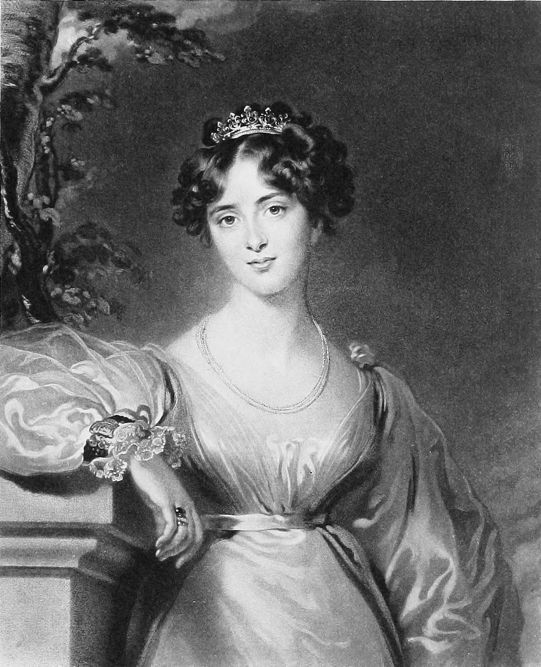
Sir Thomas Lawrence, P.R.A.
Walter L. Colls, Ph. Sc.
Louisa
Countess of Durham
Life and letters
of the first earl
of Durham
1792-1840
BY
STUART J. REID
AUTHOR OF ‘THE LIFE AND TIMES OF SYDNEY SMITH’
‘LORD JOHN RUSSELL’ ETC.
‘Canada will one day do justice to my memory’
Dying words of Lord Durham
IN TWO VOLUMES
VOL. II.
LONGMANS, GREEN, AND CO.
39 PATERNOSTER ROW, LONDON
NEW YORK AND BOMBAY
1906
All rights reserved
| CHAPTER XVII | |
| DURHAM AS AMBASSADOR TO ST. PETERSBURG | |
| 1835 | |
| PAGE | |
| Durham’s friendliness towards France—Peel’s Ministry—The Marquis of Londonderry and the British Embassy in Russia—The Melbourne Government and Durham’s exclusion from it—Durham appointed Ambassador to Russia—A visit to Athens—An audience of the Sultan—Journey through Russia to the capital—The question of the Russian occupation of Constantinople—Death of Lady Frances Ponsonby—Attacks on Russia by the English Press—Russia’s sources of weakness—Fête at the Winter Palace—Durham’s relations with the Tsar | 1 |
| CHAPTER XVIII | |
| REPORT ON THE STATE OF RUSSIA | |
| 1836 | |
| Inability of Russia to engage in a war—Groundless suspicions of the Tsar’s intentions—Changed phases of the Eastern question—Over-estimation of Russia’s power—Weakness of the Tsar’s Army and Navy—Financial resources—Effect on the Empire if Russia conquered Turkey—Influence of the aristocracy—Fatalism in the Army—Lord Grey on Durham’s Report—Austrian occupation of Cracow—Efforts on behalf of the Poles—Palmerston on Russian policy—Durham’s guiding principles in Russia | 28 |
| CHAPTER XIX | |
| DURHAM’S DIPLOMACY | |
| 1835-1837 | |
| Combating British prejudice—Russia’s fiscal policy—The case of Mr. Grant—Russian aggression—King William’s jealousy of Russia—Durham’s illness—The right attitude of England—The Tsar’s tariff reforms—The affair of the Vixen—The Emperor’s designs in Central Asia—The route to India | 53 |
| CHAPTER XX | |
| SIDE LIGHTS ON ENGLISH POLITICS | |
| 1835-1837 | |
| The influence of Parkes on British politics—Passing of the Municipal Reform Act—‘Brougham like a tiger in a jungle’—Radical estimate of Durham—Founding of the Reform Club—Correspondence with Parkes—Comments on public men—Durham’s relations with the Duchess of Kent and the Princess Victoria—The Melbourne Cabinet in difficulties—Durham ‘thrown over’ by the Whigs—Pamphlet on Russia by ‘A Manchester Manufacturer’—Durham’s prophecy about Cobden | 70 |
| CHAPTER XXI | |
| THE WHIGS BEGIN TO DRIFT | |
| 1836 | |
| Correspondence with Bulwer Lytton—Lady Blessington at Gore House—French view of the ‘essence of liberty’—Gossip at dinner parties—Letters from Leslie Grove Jones on the political situation—Grey and O’Connell—Irish Tithe Bill—Correspondence with Sir Charles Wood, Henry Bulwer, and Edward Ellice—Radical dissatisfaction with the Government—Melbourne’s ‘mixed set’—The question of Peerage Reform—Schism between Whigs and Radicals—Durham exhorts the Radicals to support the Whigs | 95 |
| CHAPTER XXII | |
| THE NEW REIGN, AND DURHAM’S POSITION | |
| 1837 | |
| Durham repudiates his alleged rivalry of Palmerston—Roebuck ‘scatters wild-fire in the constituencies’—The Melbourne Cabinet ‘living from hand to mouth’—Banquet to Durham in St. Petersburg—Conferment of honours—Death of William IV. and accession of Victoria—The Countess of Durham, and her admirable qualities—Results of the General Election—Durham’s appearance, manner, and temperament—‘The Queen and Liberty’—Durham’s fidelity to his early political creed—His sympathy with Ireland—On England’s foreign alliances—Lord Grey’s attitude towards Durham | 120 |
| CHAPTER XXIII | |
| THE CLOUD IN THE WEST | |
| 1837-1838 | |
| The rebellion in Canada—Durham offered the post of Governor-General—Melbourne’s disregard of Colonial expansion—‘Little England’ ideas prevalent in 1837—Supremacy of permanent officials at the Colonial Office—A patriotic appeal to the electors of England—Wise and unwise Reform—Attitude of the Tory party towards Ireland—Durham accepts the Governor-Generalship of Canada—Bill to suspend the Constitution of Lower Canada—Durham’s speech in the Lords on his appointment—Charles Buller—Edward Gibbon Wakefield, and Thomas Turton | 136 |
| CHAPTER XXIV | |
| POLITICAL CRISIS IN CANADA | |
| 1838 | |
| Durham’s departure for the West—Sydney Smith and the ‘overtures’—Work on board the Hastings—Hostility of French Canadians—Suspicious movements of the United States—Dissensions of British settlers—Outline of the political history of British North America—The Clergy Reserves—Defiant conduct of Mackenzie and Papineau—Lord John Russell’s narrow Colonial views—Rule of Lord Gosford and Sir John Colborne—The political prisoners—Suspension of the Habeas Corpus Act | 163 |
| CHAPTER XXV | |
| AN EVIL BEQUEST—THE POLITICAL PRISONERS | |
| 1838 | |
| A glimpse of the ‘Dictator’ from Buller’s pen—Durham issues his Proclamation—Enthusiastic reception given to him—Members of his Executive Council—Sentiments of French Canadians—Influence of the British party—The ‘Family Compact’—Sir George Arthur and the condition of Upper Canada—Threats of the refugees—The United States’ support of the outlaws—Burning of the Sir Robert Peel—Criticism at home on the appointments of Wakefield and Turton—Durham’s challenge to the Melbourne Government—Establishment of a police system—Crown Lands—Encouragement of emigration—The question of the political prisoners and their banishment—Durham’s Ordinance and Proclamation—Letter to the Queen | 181 |
| CHAPTER XXVI | |
| THE CONDUCT OF THE MELBOURNE GOVERNMENT | |
| 1838 | |
| The humanity of Durham’s policy—Approval in England of the Ordinance—Attack in the House of Lords on the Ordinance and the Proclamation—Brougham’s spite—Lord John Russell’s support of Durham—Brougham and the daguerreotype picture—Macaulay and Sir George Otto Trevelyan on the persecution of Durham—Abandonment of Durham by his political allies—Tour through the Canadian Provinces—At Niagara—Letter to Melbourne on the possibilities of Canadian development—‘Go on and prosper’—Melbourne’s cowardly surrender | 208 |
| CHAPTER XXVII | |
| DISALLOWANCE OF THE ORDINANCE | |
| 1838 | |
| Durham’s work of pacification—‘A bolt from the blue’—Durham determines to resign—Burning of Brougham in effigy—Meeting of Maritime Delegates—Ovation at the theatre—Address to the Delegates—Lord John Russell’s advice—A Ministry ‘utterly weak and incapable’—Resolutions of confidence and sympathy—Despatches to Lord Glenelg—Melbourne’s treachery—The Indemnity Bill—The Bermuda imbroglio—Durham’s defence of his policy | 230 |
| CHAPTER XXVIII | |
| THE QUESTION OF THE PRISONERS AT BERMUDA | |
| Examination of objections to the Ordinance—Criticism in England of the Proclamation—Reception of the Proclamation at Quebec—Address of confidence to Durham, and testimonies of respect—Dr. Kingsford on the Proclamation.—The objects which Durham had in view—Charles Buller’s comments on the banishment of the prisoners—The danger of the Canadian Provinces separating from Britain—Signs of renewed rebellion—Durham’s final acts in Canada—The Guards’ farewell dinner—Scenes in Quebec on Durham’s departure—Arrival at Plymouth | 266 |
| CHAPTER XXIX | |
| LORD DURHAM’S REPORT | |
| Mill’s vindication of Durham—Addresses of welcome in Devonshire—Melbourne keeps aloof—Lady Durham resigns her place in the Queen’s Household—Presentation of the Report to Parliament—Its keynote, and analysis of contents—Scheme for the future government of Canada—Durham’s advocacy of the union of Upper and Lower Canada—Urges State-aided emigration, and the formation of an inter-Colonial railway—The application of Durham’s views to the problem of Colonial Government—Allegations as to the authorship of the Report—Brougham’s slander—The part taken by Buller and Wakefield in the preparation of the Report | 306 |
| CHAPTER XXX | |
| ‘THE SUNSET GUN TOO SOON’ | |
| 1840 | |
| Resignation of Lord Glenelg—Anti-Corn Law agitation—Melbourne resigns and re-assumes office—Lord John Russell at the Colonial Office—Durham’s interest in the New Zealand Company—Outbreak of another rebellion in Canada—Consideration in Parliament of the Canadian problem—Durham’s last speech in Parliament—Appointment of Poulett Thomson as successor of Durham in Canada—Durham’s welcome in the north—The Duke of Sussex on Durham’s services—A meeting with Brougham—The Canada Bill—Durham’s illness and death—‘The dead man lives in the hearts of the people’—Expressions of sorrow and sympathy—Death of Lady Durham—The verdict of history—Durham’s prominent characteristics—Tribute of Bulwer Lytton | 343 |
| INDEX | 377 |
| LOUISA, COUNTESS OF DURHAM. By Sir Thomas Lawrence, P.R.A. | Frontispiece | |
| From a Picture at Lambton Castle in the possession of the present Earl. | ||
| LORD DURHAM, at the age of thirty-six | To face p. 32 | |
| From a Miniature in the possession of Stuart J. Reid. | ||
| THE COUNTESS GREY AND HER DAUGHTERS. By Sir Thomas Lawrence, P.R.A. | To face p.„ 59 | |
| The child in the foreground is Lady Louisa, afterwards Countess of Durham. | ||
| LAMBTON CASTLE FROM THE BANKS OF THE WEAR. By John Glover, P.W.C.S. | To face p.„ 130 | |
| From a Water-colour Drawing. | ||
| CHARLES BULLER, M.P. | To face p.„ 182 | |
| From a Black and White Drawing from life in the possession of Stuart J. Reid. | ||
| CHARLES, EARL GREY. By Sir Thomas Lawrence, P.R.A. | To face p.„ 216 | |
| From a Picture at Howick in the possession of the present Earl. | ||
| ‘THE DESERTER’ | To face p.„ 274 | |
| From a Cartoon by ‘H. B.’ (Richard Doyle). | ||
| LORD DURHAM’S LIBRARY, 13 Cleveland Row, London, S.W. | To face p.„ 309 | |
| From a Water-colour Drawing in the possession of the present Earl. | ||
| THE DURHAM MONUMENT, on Penshaw Hill, Durham | page 376 | |
| From a Sketch at the time of its erection in 1844. | ||
LORD DURHAM
Everything with the Russians is colossal rather than well proportioned, audacious rather than well planned; and if the end is not attained, it is because they overshoot it.—Madame de Staël.
1835
Durham’s friendliness towards France—Peel’s Ministry—The Marquis of Londonderry and the British Embassy in Russia—The Melbourne Government and Durham’s exclusion from it—Durham appointed Ambassador to Russia—A visit to Athens—An audience of the Sultan—Journey through Russia to the capital—The question of the Russian occupation of Constantinople—Death of Lady Frances Ponsonby—Attacks on Russia by the English Press—Russia’s sources of weakness—Fête at the Winter Palace—Durham’s relations with the Tsar.
Durham was not left in any doubt as to the popular verdict up and down the kingdom on his speeches in the north. The Radicals in every town and village were delighted, and even Whigs of the more cautious school were forced to admit the eloquence and courage which marked them. Sir John Bowring and Sir Henry Bulwer were both in Paris at the moment, and their letters to him show in what high esteem he was held, as a statesman, in France. No public man of that period was more anxious than Durham, as his speeches show, to bring about a close commercial alliance between this country and France. He used to say that, if he was in power, it would be one of the foremost objects of his ambition to make the mutual dependence of the two countries, the shores of which were only five-and-twenty miles apart, so certain and so strong that war between them would be impossible. He never lost an opportunity of trying to dissipate the prejudice against the French nation, then just rising into political freedom, a prejudice which was one of the worst bequests which the war with Napoleon transmitted to this country. He never concealed his opinion that Napoleon, whom he denounced as a cruel despot, had done his best to excite feelings of hatred against England, in order the more successfully to carry out his own selfish designs in Europe.
Meanwhile, Sir Robert Peel, travelling in hot haste, in obedience to the King’s summons, arrived in London from Rome on December 9, 1834, and was accorded an instant audience, and accepted the office of Prime Minister. His first Administration was tentative and short-lived, but it brought him at the age of forty-seven into the front rank of English statesmen, and introduced to office for the first time, in the capacity of Under-Secretary for the Colonies, that ‘stern and unbending Tory’—as Lord Macaulay described him a few years later—W. E. Gladstone, a statesman who was destined to leave a more splendid mark than any other on the political history of the Victorian Era.
Peel coquetted with the Whigs when he formed his Ministry at the close of 1834. He made overtures to Stanley and Sir James Graham to join the new Cabinet, but they declined. His address to his own constituents was a striking example of vacillation, and Lord Wharncliffe was responsible for a bon mot which flew round the town—‘Peel wrote the first half of his Tamworth address at Brooks’s, and then hurried across to the Carlton, and there scribbled the rest.’ Part of it undoubtedly reflected the prevailing opinion of the Whig club, whilst the other part was perfectly in accord with the sentiments uppermost at the headquarters of the Tory party. The result was that it satisfied nobody, and was deemed more in the manner of a man halting between two opinions than as the statement of a Prime Minister’s claims to national confidence. ‘Peel’s address is humbug,’ exclaimed Joseph Parkes, with brusque honesty, and there were a great many people, not as a rule sharing his way of thinking, who were much of the same opinion.
A General Election followed in December, and Durham, as his correspondence shows, threw himself with characteristic energy into the struggle by aiding and abetting the Liberal candidates at Newcastle and throughout his own county. ‘The great nail to drive home,’ he declared, ‘is the formation and organisation of political associations in every town and village of the Empire. With these in existence, we can never be betrayed again by mad Tories or timid Whigs.’ His own position in the country at that crisis is sufficiently clear from the fact that the ‘Times’ and the Tory journals held him up, as he himself put it, as the ‘alarm-creating alternative of the Duke and Peel.’ But he had foes in his own camp, with whose hostility he did not sufficiently reckon, for, if the Tories feared him, high-and-dry official Whigs, who pinned their faith to Grey, were alarmed by his outspoken speeches at Glasgow and Newcastle, and were not in the least prepared to endorse the bold and progressive programme to which he stood pledged.
The elections went in favour of Peel, but they did not place him in a majority. The Whigs lost ground, because nothing seemed to delight them more at that juncture than throwing a wet blanket on popular enthusiasm. Parkes wrote to Durham when the contest was in progress: ‘It seems to me that for four years the Whigs have never tried to rally talent or zeal to themselves, and that now things may take their chance. What they most fear are candidates professing your creed.’ As it was, a great many Radicals were returned, but not enough to make the Durham party master of the situation.
Peel quickly showed his hand. One of the first diplomatic changes, consequent upon the accession of the new Ministry, was the proposal to send the Marquis of Londonderry as Ambassador to St. Petersburg. ‘Londonderry has announced,’ wrote Durham, ‘that he is to go as Ambassador to Russia. This is a pretty commentary on Sir Robert Peel’s declaration that he does not intend to change our foreign policy; Londonderry having declared in every speech in the Lords that his object is to perpetuate his brother Lord Castlereagh’s Continental system.’ The wrongs of the Poles at that time excited as much indignation in England as was afterwards evoked by the Bulgarian atrocities of the Turks. Londonderry was not only a man of slender capacity, but an avowed opponent of the just claims of this oppressed race, and so great was the storm raised by his appointment that he had the good sense to decline the post.
All through the spring of 1835 Durham pursued a waiting policy. Some of his best friends told him to beware of the Whigs, since they were jealous of his influence in the country. He himself was beginning to realise by this time that the powerful influence of his father-in-law was not likely to be cast in his favour. The collapse of the Peel Government was brought about by that rock of offence, the Irish Church. Lord John Russell carried his motion for the appropriation of its surplus revenues to the religious and moral instruction of all classes of the community, and on April 8 the Government resigned. Lord Melbourne was once more called to power, but not before Lord Grey had been sent for, only, however, to decline the task of forming an Administration. Grey’s attitude to Durham at this juncture determined the latter’s fate. Early in the spring of the same year, when it became plain that the Peel Administration was not likely to outweather the storms of the session, Grey and Melbourne were in active correspondence in view of approaching political changes. Grey made no secret that, in his opinion, Durham was impossible. He declared that, even if he felt able to take up the burden of office again, which was not the case, he could not join forces with his son-in-law, since he was opposed to the ‘three additional articles of faith’—the Ballot, Triennial Parliaments, and a further instalment of Political Reform—which Durham had publicly announced as his programme. This constituted, to borrow his own phrase, an ‘insurmountable obstacle.’
Melbourne, who cordially disliked Durham, and recognised him as the statesman who, of all others, was his most powerful rival, quickly seized the hint, with the result that the latter was not even offered the portfolio of Foreign Affairs, a position which he was known to covet, and for which he had sedulously trained himself. He was checkmated, in truth, by Melbourne in one direction, and by Palmerston in another, both of whom represented Whig traditions, and neither of whom, at that period, was in touch with popular sentiment. There is no use concealing the fact—it stands revealed in his private letters—Durham felt keenly the manner in which his claims were passed over, and the reflection that Lord Grey was a party to his exclusion naturally heightened his chagrin.
‘Lambton has formed bad connections,’ was Lord Grey’s assertion at the moment when Cabinet changes were under discussion, a certainly contemptuous allusion when applied to men of the stamp of Grote, Molesworth, Duncombe, Bulwer, and Parkes, who could at least claim to represent the new aspirations of the Liberal party, to which the Reform Bill had given so splendid an impulse. It was this obstinate attitude of the official Whigs to new men, and to popular aspirations, in the closing years of William IV., which did more than anything else to provoke the Chartist movement, which menaced England early in the reign of Queen Victoria.
Apart from Durham, Melbourne had other difficulties, for, as Sheil bluntly put it, there were also ‘a bully and a buffoon,’ who had to be considered. In the end, O’Connell was won over to temporary, though uncertain, co-operation without office, and Brougham was left out in the cold. ‘O’Connell,’ wrote Greville, ‘has behaved admirably well, and the difficulty with regard to him is at an end. Brougham is to be set at defiance; his fall in public estimation, his manifold sins against his old colleagues, and his loss of character, all justify them and enable them—as they think—to do so with impunity.’ Palmerston, whom Melbourne would gladly have seen in another position, absolutely refused to join the new Administration except on his own terms. He went accordingly to the Foreign Office, though, in view of his overbearing attitude, not without some trepidation on the part of his colleagues. Grey, even more than Melbourne, recognised the danger of such an appointment. He declared that the tidings would be received with an unpleasant shock of surprise throughout Europe, but both the old Whig Premier and the new felt that, under all the circumstances, there was no alternative except to gratify Palmerston’s ambition.
Meanwhile Durham’s exclusion from office in the Melbourne Administration was warmly resented by the Radical section of the party. The common opinion of the moment attributed it to personal antipathies, and the King’s jealousy of his position—it was always confidential—with the Duchess of Kent and the Princess Victoria. It was also hinted that his political integrity stood in the way of the just recognition of his unquestionable claims. His health—always an uncertain quantity—was a matter of concern to his friends, even more than to himself, in the late spring of 1835, when he was seriously ill. He might well have refused, on that plea alone, to fill one of the most important and difficult diplomatic posts, which were now urged upon him. The gossip of the hour ran that he would be the next Viceroy of India, but it was to another, and even more difficult post just then, that he was sent. The first hint of the proposal to ask him to accept the position of Ambassador to St. Petersburg occurs in a letter of Lord Grey, written on the 15th of May, to the Princess Lieven. ‘I don’t know yet anything certain as to the person destined for St. Petersburg. But I believe it is intended to send Lord Durham there. My only objection to this appointment arises from my fear that neither his own health nor that of my daughter and her children will be found equal to the severity of the climate.’
Durham might easily have shirked so arduous a mission. He owed nothing to Melbourne, but no man of that period was more sensitive to the claims of public duty. ‘Now that I am getting better,’ he wrote from Cowes on June 7, ‘which I am every day, I am overcome with horror at my hopeless idleness and inactivity.’ His reasons for accepting the offer, which a few days later was definitely made to him, are best expressed in his own words, ‘I cannot be employed at home, and don’t like being idle. The only language I have heard from those who profess to be my friends is, “We don’t wish to see you in office—your time has not yet come.” This feeling has been acted upon by the Government also, and I am thus put out of the pale of home politics.’ He was gazetted as Ambassador to St. Petersburg on July 8, and on the 26th of that month set out for Russia. He went by way of Constantinople, as he wished to consult with Lord Ponsonby on the Eastern Question. The newspapers declared that Durham had accepted St. Petersburg on account of his health. ‘If health was my object,’ was his quiet but amused comment, ‘I would have remained at Cowes,’ where his yacht, one of the chief pleasures of his life, at that moment lay anchored.
Some of his friends openly expressed their disappointment at his acceptance of this diplomatic mission to St. Petersburg. They felt that he had been badly treated by the official Whigs, and thought—perhaps they were right—that it would have been more to his interests to remain in England, even if compelled to fight for his own hand. They thought he had been shelved, and told him that he underrated his influence with the party; but, whatever happened, the Radical section of it looked to him—and would continue to look—as its real leader.
Durham resolutely put aside such counsels. He was proud, sensitive, at times impatient, and even irritable, but he was, in truth, a magnanimous man. He felt a slight keenly, but could rise above it, especially if he thought that the interests of the nation demanded the sacrifice of personal feeling. He was not at any period of his life vindictive, and he went to Russia at this crisis because he believed—and the event proved it—that his personal influence with the Emperor Nicholas was of a kind which made for the peace of Europe. His one ambition was the patriotic desire to serve England, and, not for the first or the last time, he renounced all else for that end in the summer of 1835. He made no secret that he felt that he had been put on one side by the Liberal party; ‘perhaps it was necessary,’ he said quietly, and then added: ‘I owe them no grudge, and am ready at a moment’s notice to do whatever is deemed right!’
He went by sea on board H.M.S. Barham, and was accompanied by his secretaries, Mr. Edward Ellice, jun., and Mr. Arthur (afterwards Lord) Kinnaird. In his private journal, Lord Durham gives a lively account of the voyage, describes his mode of life on board ship, his rubbers of whist with the officers, the Welsh chaplain who had never been at sea before, the progress of the ship, his attempt to catch a shark which followed it, his impressions of the Rock, his desire to land at beautiful Cadiz, which he was forced to forego, as it meant seven days’ quarantine at Malta, and, in short, the usual incidents at sea. Malta was reached on August 17. He landed under a salute, went to the Governor’s palace, saw the usual sights, and foregathered with Mr. Dawkins, late Minister in Greece, slept on board, and on the following day was present at a large dinner given by the authorities in his honour—‘like all great dinners, was very dull and tiresome, and also very hot.’ On Monday, August 24, the coast of Greece was well in view. ‘I have just been on deck, and seen Athens, with the Acropolis and Parthenon, to the left Ægina, with the Temple of Jupiter, on the right Cape Colonna, with the Temple of Minerva. All these are distinctly visible with the telescope, and, with the Gulf of Athens and the high land about Corinth, form one of the most beautiful panoramas in the world.’ Next day he landed five miles from the capital, and was met by Sir E. Lyons, and, under a broiling sun, ‘jolted up to Athens.’ He took up his quarters at Sir E. Lyons’s house, where he met his old friend General Church, and later in the day was presented to the King, who promised him a private audience on the morrow.
‘Otho is a young man, not good-looking or intellectual, and seemed very shy at first. He had his throne in a room about thirty by twenty, and his Court about him of his Ministers and aides-de-camp, all in uniform. It appears he had wished to make the reception as solemn and imposing as his little means would allow him. I presented the “suite” to him, and then we had a conversation of about ten minutes, after which we departed. Taking off our harness, it being the cool of the evening, we went to see the Temples of Theseus and of Jupiter Olympus. The first is nearly all standing. A delightful sea breeze had set in, and was very cool and pleasant.’ Up at sunrise the next morning, Lord Durham and his secretary spent the day exploring the Acropolis, and stood, he states, on the very spot where Demosthenes harangued the Athenians. His visit to the Parthenon was a mixed delight. ‘It is horribly disfigured by Venetian fortifications, Turkish mosques, and Christian erections of all kinds, but still it is splendid and the situation incomparable.’
The following day, August 27, he was received in private audience by the King. ‘It lasted two hours, during which I had to explain to him most minutely the theory and practice of the British Constitution, the powers of the Sovereign and of the Ministers, the House of Commons and the people—in short, all the machinery of our institutions. He seemed very anxious to be informed, but not very bright. I then returned home, and sat with Sir E. Lyons, discussing our mutual business, until dressing time. At seven we went to the palace, where there was a formal official dinner of Ministers, generals, &c. This lasted until eleven, was very hot, but went off well, and they all said they had never seen the young King so pleased or animated. They tell me I have made a most favourable impression on him. At twelve I was in bed, having been nineteen hours in constant action.’ More sight-seeing followed next day, another dinner, with the Greek Chancellor and a large circle of officials, a visit to General Church, and a final audience of the King, who was extremely gracious, and gave him, on taking leave, the Grand Cross of the Greek Order. The modern condition of Athens did not impress Durham. He declared that the new town looked almost as dilapidated as the old.
Constantinople was duly reached on September 3. ‘It is a splendid place. The finest situation for a capital I ever saw, and, if it was only under good and free government, it would be one of the most prosperous cities in the world. The Dardanelles, the Bosphorus, and the entrance to the Black Sea are surpassingly beautiful. I am staying at Lord Ponsonby’s house at Therapia, where the Embassy is situated. As the plague is raging in Constantinople, I fear I shall not see much of the town. I am to have an audience with the Sultan in a day or two. He sent one of his pachas to congratulate me on my arrival. This is supposed to be a great mark of favour.’ In spite of the plague, he managed to see a good deal during the next few days, had long conversations with Lord Ponsonby on the Eastern Question, and especially the attitude of Russia, and made the acquaintance at receptions and dinners of most of his host’s colleagues of the Corps Diplomatique. His description of his audience with the Sultan, on September 11, may perhaps be quoted. It took place at the palace, about a mile from Scutari:
‘At half-past ten we landed from two barges at the gate, and were conducted into an apartment at the entrance, where we found the Ministers. I was introduced to each separately, made a variety of civil speeches, and then sat down on the sofa with them. Pipes and coffee were brought in, and I went through the form of smoking and drinking. We remained about ten minutes, and then started in procession, the pachas and officers of the Porte preceding and accompanying us. We passed through several fine rooms, beautifully painted and decorated, and found the Sultan (Mahmud II.) in a small cabinet, looking on the Bosphorus. He was seated on a sofa at the end, with his back to the window. He is a dark man, of strong, coarse features, not intellectual, but marked with determination and energy. His officers lined the side, we occupied the centre of the room. I then advanced with the dragoman, and addressed him in English as was agreed upon beforehand. This was interpreted first by a dragoman and then by the Sultan’s Minister.
Lord Durham took the opportunity of assuring his Majesty of the goodwill of the English Government, and laid stress on the fact that the commercial interests of England and Turkey were identical. The Sultan replied, through his dragoman, in courteous terms, and begged that his sentiments of friendship might be conveyed to the English Court, as well as to the Tsar of Russia. He declared that he regarded Durham’s presence in Constantinople as a proof of the friendship of the British nation. He was at a loss to know who was now Premier, and asked significantly whether Lord Palmerston was still at the Foreign Office. He told Durham that he had given instructions that everything that he deemed worthy of inspection at Constantinople was to be shown him. ‘He then desired me to present to him all the suite, which I did separately, even to two little midshipmen of the Barham who had smuggled themselves in.’
Next day Durham was shown the Turkish fleet, and the new military college, and had much close talk with the Sultan’s Ministers. ‘I took every opportunity I could of giving them the best advice in my power for the carrying out of new plans of improvement. The chief Ministers of the Porte were afterwards entertained on board the Barham, a compliment which they evidently appreciated. ‘The result of all this has been to replace our influence on that footing from which our false policy has lately suffered it to fall, and Lord Ponsonby feels himself strengthened.’
After seeing the sights of Constantinople, and receiving many marks of attention, Durham resumed his journey on September 15, and arrived at Odessa on the 18th after a voyage in which, thanks to an equinoctial gale, he was ‘knocked and tumbled about’ to a degree that he had never experienced in his life. At Odessa he was promptly put into quarantine, because of the plague in Constantinople. It was a new experience for Durham to be held up in this fashion, but he made the best of the situation. He describes his picturesque quarters in the Lazaretto, the scrupulously clean and neatly furnished apartments, the little courtyard of the house filled with acacias, through the foliage of which he could see the ships tossing in the bay.
Always a great reader, he spent much of his time during this enforced pause with his books; but in the afternoons, when the weather was fine, he and Mr. Kinnaird, Captain Brinkwater, or others of his suite, went down to the harbour and rowed about in a six-oared boat, which had been placed at their disposal. ‘The Governor of Odessa comes every now and then to pay me a visit, and sends me all the papers, “Galignani,” “Journal des Debats,” “Temps,” and the “Morning Post,” so I get regular and late news from England.’ Once out of quarantine, in the four or five days during which he remained, entertainments of all kinds were got up in his honour. He held what he describes as a kind of levée at the Hôtel de Richelieu, since all the consuls at Odessa came to pay their respects in uniform. He saw the cathedral, visited the opera, which was excessively crowded with the fashion and beauty of the city, and met, in familiar talk, all sorts of official people, from Count Woronzow, who had come specially from the Crimea to meet him, and the Admiral in command of the Russian fleet in the Black Sea, to his late custodians at the Lazaretto.
He started for his long journey to Moscow on Saturday, October 10, Count Woronzow taking leave at the carriage door. He was escorted out of the town by a guard of Cossacks, and then, as he puts it, left to his fate on the Steppes. The weather was miserably bad, and just after nightfall the unexpected happened. ‘By some means or other the postillions lost their way, although the lamps were lit. At length I perceived it, and called to them, when they confessed that they had lost the road altogether. After several attempts in vain, I made them draw up under a haystack, took out my compass, and found that the heads of the carriages were exactly the wrong way. I then ordered a lamp to be hoisted on the top as a sort of lighthouse, and sent out four postillions north, south, east and west to hunt for the road. In about an hour they returned, having found it, five miles off.’ The next post was reached at two o’clock on Sunday morning—the result of being lost for eight hours in the dark on the Steppe. He reached Kieff on October 15, where he was received in audience by the Tsar, who arrived towards the end of his stay to inspect the troops quartered in that city. ‘I had the honour of an audience at three o’clock, which lasted until four. I was received by his Majesty in a manner so cordial and friendly that I feel convinced that he still entertains those gracious feelings, the prevalence of which during my former Embassy was of such material advantage to me.’
The journey was resumed on October 24, and he pushed on, along roads that were at times almost impassable, to Orel. He was thoroughly exhausted by the last stages of this tedious progress across Russia, ‘through seas of mud’ and along ‘primitive roads.’ The jolting was so bad that Durham states that he had to ‘hold on as if he were in the Bay of Biscay.’ Once more the postillions lost their way, and were seven hours in traversing twelve miles. Eager as he was to push on, it was almost a relief to him to find that the postillions demanded a halt at Orel for repairs to the carriages. It gave the tired Ambassador the first chance with which he had been favoured for a whole week of sleeping in bed.
Moscow was reached on October 30, and there, as indeed everywhere on his journey, Durham was received with marked attentions. He spent two or three days in the ancient capital, and found the time all too short to do justice to the half-Asiatic, half-European splendour of the city. The Kremlin, the great cathedrals and churches, the palaces, monasteries, picture-galleries, libraries, museums, and arsenal, all were visited. Then the last stage of the journey was accomplished, and at the end of the second week of November he set foot in St. Petersburg. Lady Durham and his daughters were the first to greet him. They had come by the direct route, and were comfortably established in a ‘beautiful though rather small house.’
Almost immediately the opportunity came of presenting his credentials to the Tsar, who had just taken up his residence at the Winter Palace, on his return from the southern provinces. In one of the first letters that Durham wrote from St. Petersburg—it bears date November 16, 1835—the following statement occurs, not merely as to his reasons for accepting the post of Ambassador to Russia, but also what had induced him to make the long and difficult journey by which he approached the capital:—‘Not liking to be idle, I took the opportunity offered me of employment, and I am happy to think that I have done the State some service. When I accepted the Embassy here, I imagined that the circuitous route by Constantinople would be the most advisable one for me to take. It gave me the opportunity of becoming personally acquainted with the state of affairs in Greece and Turkey, and of being able subsequently to judge of the correctness of the representations made to me. I knew that at St. Petersburg I should derive great advantage from the possession of this knowledge, and, besides, I wished to re-establish our influence at Constantinople, which had been suffered to lapse into discreditable abeyance. In all this I have succeeded to the utmost extent of my hopes, and it will be the fault of the Government and of their future policy if we are not all-powerful with the Sultan and throughout the East.’
Durham was convinced that this was the true way to arrest Russian ambition in the near East. He declared that we had left the field open to them so long, that it was not surprising they had availed themselves of such an advantage. He added that, as England was now beginning to show herself on the alert, statesmen at St. Petersburg were inclined to say that they had enough to do at home, and even the possession of Constantinople, far from being an advantage, would be a calamity to Russia. Whether Russian diplomacy was sincere in all this mattered little, he argued, provided it acted up to such declarations, and thus staved off political confusion, misunderstanding, and, ultimately, war. His own language to them was: ‘I do not believe that you entertain the designs attributed to you, because you are too wise and too clever to attempt impossibilities. The retention, nay, the occupation of Constantinople, is an impossibility. We never could and never would permit it, whilst there was a shilling in our treasury, or a drop of blood in British veins.’ They always reply, ‘You are right, we do not entertain the design. Alexander and Catherine did. The Emperor does not; he has enough to do at home.’
During his journey by coach of fifteen hundred miles across Russia, Durham used his eyes to some purpose. He inspected the Russian outposts on the Black Sea, and in the southern provinces of the Empire, and declared that he saw no symptoms of any preparations for war, nor even the power to make them. He was convinced, from all that he had seen in the south of Russia, that the Tsar had not the power, even if he had the will, to call suddenly into action a sufficient force to take possession of Constantinople. His Majesty said to him at Kieff, ‘Vous verrez La Russie dans toute son étendue, et vous verrez que j’ai plutôt à consolider ce que j’ai qu’à chercher de nouvelles conquêtes.’ All classes of Russian society with whom Durham came in contact avowed the same sentiments, and volubly disclaimed any policy of conquest in the East; whilst politicians of the Moscow party went so far as to assert that the taking of Constantinople would be the signal for the dismemberment of the Russian Empire, as it had once been of the Roman. England, Durham held, needed to keep Russian opinion in the same virtuous mood by showing the great Northern Empire that, whatever policy she chose to follow, our own determination was unalterable, namely, never to permit the occurrence of such an event.
Durham was in high spirits during the first two or three weeks after his arrival at St. Petersburg. He felt that his visit to Constantinople and the opportunity which it had afforded him, not merely of talking over the political situation with Lord Ponsonby and other diplomatists, but of forming his own impressions on the spot, had given him a new insight into the Eastern Question. His subsequent journey, in his own carriage, across Russia had enabled him, at every place at which he halted by the way, to gather fresh information as to Russia’s preparations for war and to form his own conclusions concerning the Tsar’s military designs. No Plenipotentiary could have been sent to a foreign Court with more splendid credentials than those which were given to Durham by Palmerston, under the sign-manual of William IV.
In that document it was expressly set forth that the King, being desirous of giving to his Imperial Majesty, the Tsar of All the Russias, an ‘unequivocal and public testimony of our true regard, esteem, and brotherly affection,’ had nominated ‘our right trusty and right well-beloved cousin and councillor, John George, Earl of Durham, Viscount Lambton, Baron Durham,’ as Ambassador-Extraordinary and Plenipotentiary. Lord Durham, it was added, had received the King’s command to repair with all possible diligence to the Russian Court, in order to give the Tsar the ‘strongest assurances’ of the King’s ‘unabated desire to strengthen and improve the harmony and good understanding happily subsisting between us and your Imperial Majesty.’ Finally, the hope was expressed that the Tsar will ‘receive our said Ambassador in the most favourable manner, and give entire credence to everything which we have ordered him to declare in our name,’ not merely when presenting his credentials, but ‘upon every subsequent occasion which may require his opening our sentiments to your Imperial Majesty.’
Whether the Tsar gave ‘entire credence’ to everything that Durham was commanded to say may be doubted, but personally his Majesty, who felt instinctively that he was a statesman he could trust, always received him in the most ‘favourable manner.’ It was, in fact, the confidence which Durham, by his character, much more than his address, inspired in the mind of Nicholas I. that enabled him to accomplish the great work which rendered his mission to Russia during the years 1835-37 so beneficial and memorable.
By the middle of December, finding the house which Lady Durham had taken before his arrival in St. Petersburg much too small, he removed to another, large enough to accommodate, in addition to his family, the members of his suite, whom he wished to have within call. Although the cold was excessive, it was bracing, dry and exhilarating, and though he afterwards felt it severely, and declared that only a man of granite could endure such a climate, there is evidence enough that, during his first months in St. Petersburg, he enjoyed life to the utmost in the brilliant society of the capital. He thought that nowhere did people understand how to warm a house better than in Russia. There were no draughts in the drawing-rooms like those at home, where guests were half toasted on one side and chilled to the marrow on the other. He did not go out much, in spite of all the balls and parties to which he was summoned, for he neither danced nor cared much for cards, though nothing delighted him better than a dinner-party at which talk touched high levels. Everybody in Russia, he remarked, from Tsar to the noble and peasant, did his best to set him at his ease, and just as he was beginning to feel entirely so, and was getting into close touch with Nesselrode on questions of international moment, a bolt from the blue fell upon him in the announcement that his daughter, Lady Frances Ponsonby, was dying at Bessborough in Ireland, after a brief married life, which had scarcely outlasted the honeymoon.
Lady Frances was the only one of the three daughters of his first marriage who had fairly crossed the threshold of womanhood, and up to the time of her marriage she had been her father’s constant companion. Her union with the Hon. J. G. Ponsonby, afterwards fifth Earl of Bessborough, and the son of Durham’s old colleague and friend, Lord Duncannon, took place in London on September 8, 1835. It was a marriage which had his entire approval. It seemed to promise to both husband and wife deep and settled happiness; but the end came quickly, on Christmas Eve in the same year, to the young wife, at the age of twenty-three. Lord Durham’s brother, Hedworth, went to Ireland as soon as he knew that his niece’s illness was critical, and wrote a note to St. Petersburg, to prepare her father for the tidings which he feared must follow. News in those days travelled slowly, and Lady Frances had passed away six days before the following pathetic letter was penned:
‘St. Petersburg: December 30, 1835.
‘My dear Hedworth,—I am very, very grateful to you for going to Ireland. It is a great comfort to me to know that you were there, and I add this to the many other proofs you have given of your affection for me and mine; with you it does not end in words. You may conceive my wretchedness; I cannot describe it. Every post-day I tremble at the thought of receiving the fatal intelligence. If God has spared her life when you get this, give her a million loves. I cannot write to her, for I fear saying anything which might alarm her, and I can say nothing about our life here, for since I got intelligence of her danger we have not been out. If she remarks on this, ascribe it to the cold, but don’t let her think we know of her danger. All this anxiety and misery has made me quite unwell again, and I write to you from my bed after a very violent attack in my head. But what is that I endure to the sufferings of my poor dear child! God bless you, my dear Hedworth.
‘Ever yours affectionately,
‘Durham.’
When those words were written, letters of condolence from a wide circle of relatives and friends were already on their way, for everyone who knew Durham at all intimately recognised that this fresh blow was one which would fall with peculiar severity. Out of such expressions of sympathy it is perhaps enough only to cite one—the letter which Lord Grey wrote to him between the death and burial of his daughter.
‘Howick: December 26, 1835.
‘My dear Lambton,—Though I am well aware of the impossibility of saying anything on such an occasion which can afford any real comfort or consolation, I hope, at least, for an excuse, from the sincere affection which I bear you, for expressing how much and how deeply I have felt for the loss which you have sustained. You must have been prepared for the event, which for some weeks there seems to have remained no hope of averting. But the blow would hardly be less severe when it fell, and I sympathise with you from the bottom of my heart under this new affliction. Could anything lessen its weight, it would be the assurance of the heavenly state of mind in which poor Fanny left this world, with all the prospects of happiness which had so lately been opened to her. Nothing could be more beautiful and affecting than the accounts which we have received of her truly religious feelings, and of the resignation and piety which supported her under the separation from all she loved on earth. She has pointed to us all the way to obtain the same support, under whatever dispensations it may please the Divine Providence to visit us with, and I feel confident that this reflection will at length afford you the comfort which no earthly aid can bestow.
‘Lady Grey writes constantly to Louisa, who will have seen the deep anxiety with which she has watched the approaches of this event, and the sincere sorrow with which she received the account of its arrival. Our best and most affectionate wishes attend you both, with our sincere prayers that the blessings which you still possess may long be preserved to you.
‘At such a time I cannot enter upon any other subject. Indeed, in the complete seclusion in which I live, hearing and knowing nothing, I could have little to say on any public subject; but, from all I can observe, the continuance of Melbourne’s administration appears to me very precarious.
‘Yours most affectionately,
‘Grey.’
The year 1836 opened darkly for Durham, but it was not until the first week of it had passed that his worst fears were fulfilled. When he heard the evil tidings he was reduced almost to the same condition of physical collapse as in 1831, when the boy on whom he built his hopes was snatched away. ‘Poor Lambton is very miserable!’ wrote Lady Durham on January 9. ‘Little did I forebode, in parting from Fanny on the night of her marriage, that I was never to see her again.’ Two days later, Durham wrote himself to his brother, having received a letter from him in the interval, written from Bessborough immediately after the death of his daughter:
‘St. Petersburg: January 11, 1836.
‘My dear Hedworth,—I have received your letter, with all the heartrending details of my poor darling child’s death. Can I tell you how wretched I am! Impossible! You know what she was to me—my companion, above all, from her earliest childhood. Oh God! it seems a frightful dream.
‘I did not look for such a renewal of past afflictions; it makes me tremble for the future. I dare not write on, or I shall go mad.
‘Believe my assurances once more that I am very sensible of your affectionate zeal in all that concerns me. It was a great consolation to me your being there.
‘God bless you.
‘Your ever affectionate
‘D.’
Happily, the duties of his position quickly asserted themselves, and prevented him from brooding over a loss which, to the end of his life, he never ceased to lament. The despatches which he wrote to Lord Palmerston in those sorrowful weeks at the beginning of 1836 reveal how fully he was alive to the necessity of keeping the English Government informed of all that was happening just then in Russia. He assured Palmerston that he was convinced Russia was powerless just then to disturb the peace of Europe, even if she had the inclination. He was in constant communication with Count Nesselrode, and had assured him repeatedly and firmly that England would never consent to the occupation of Constantinople by Russia.
‘I am on the best terms with Nesselrode,’ he wrote, in a letter to Lord Grey, ‘but at the same time I have invariably held the same language to him, namely, that we never could or would permit Russia to occupy Constantinople, or take any portion of Turkey. Once convinced of this, and that it never can become theirs, I can easily convince them that it is for their advantage to make that Power strong and independent. For Russia to conquer Turkey she must be weakened—as an ally (against Austria for instance) she must be strengthened. So conscious of this is Metternich, that he would oppose to the utmost of his power the restoration of Egypt to the Porte. In that I think he is right. The welfare of the Mediterranean and the security of its commerce is much safer with Mahomet Ali acting as a check on the Sultan, than it would be if the ancient Ottoman Empire was restored in all its former extent and strength. With reference to that object, in my opinion, Turkey, as it is now, should be supported and consolidated; but I am against any reformation of the old.’
Durham always held that this country was in danger of showing too much distrust, suspicion, and jealousy of Russia, and he urged on Palmerston that it was to our own interests to cultivate a strict alliance. One of his great difficulties arose out of constant and often virulent attacks on Russia in the English newspapers, all of which quickly found their way, through Count Pozzo di Borgo, Russian Ambassador at the Court of St. James’s, to the knowledge of the Tsar, and were in due course brought before the English Ambassador by Count Nesselrode, as a matter of complaint. Durham, of course, did not for one moment attempt to deny the existence of such sentiments, and declared that they had arisen as the result of a long series of events, concerning the policy and justice of which the two nations held opposite views. He assured Nesselrode that there was nothing for it but to trust to time and future intercourse for the removal of such a feeling. He added that he had already contributed not a little to so desirable a result by informing the English Government of the entire absence of any hostile designs against Turkey on the part of Russia—a matter on which he had satisfied himself by personal observation.
He felt, so he assured one of his most intimate friends, that it was his business to make himself acquainted with the powers and resources of the Russian Empire, as well as with the intentions and declarations of statesmen at St. Petersburg. Russia, he declared, is a great, unwieldy giant, of immense power, with his back against the wall which nature and barbarism have erected behind him. The giant was powerful so long as he remained in that position, as Napoleon had discovered to his cost, but weak and assailable the moment he advanced into an open arena. ‘Russia has, besides, three sources of weakness, inherent and irremediable—Poland, the Caucasus and the Fleet. All these deprive her of immense sums of money and large masses of men. I find weakness where the world imagines strength, and the latter where the former is believed.’ His letters show that he was keenly following public events in England. ‘The municipal elections have produced a great effect, and must show to all but the wilfully blind what are the opinions of the people of England. If the Crown will only go with them in good faith and harmony, Monarchy is invulnerable.’
Sometimes, though rarely, gossip invades his letters. He describes in one of them a New Year’s fête at the Winter Palace, in which all the world, so to speak, was admitted, as well as a supper for officials of high and low degree, to which the Tsar did not sit down, but walked about talking to the guests. His Majesty had heard that one of them was a notorious gourmand. Nicholas, with malicious humour, stepped up to this particular man whenever a plate was put before him, and entered into conversation with him. Instantly the attendants, who were in the secret, whipped off the appetising portion, and this happened all the way through the banquet, so that the unfortunate guest had to be content with the marked and quite unusual attention of his Sovereign. ‘This is not bad fun, to be sure,’ was Durham’s comment, ‘but rather “infra dig.,” as Jonathan would say.’
‘Personally, I am on the best terms with the Tsar, but I daresay he does not relish the plain language I always address to his Ministers on their Eastern policy. Is not mine a singular fate? In 1834 I am received with favour, nay affection, by thousands of the “people.” In 1835 I am equally well and confidentially treated by Sultans and Emperors. I can only account for this in one way—for my principles are the same and cannot suit both parties—namely that they both believe I am honest. I hope this is the true solution. If it is not I must be a great impostor. I own I am a little puzzled.’ Those words of course could not have been published at the time they were written, but, after the lapse of more than half a century they may escape into print, if only as a tardy answer from Durham’s own lips to the old taunt of certain Radicals of his day, that they were at a loss to understand how he, as a champion of democracy, could ingratiate himself at foreign Courts. It was not merely the transparent honesty of the man, but his habitual and conscientious attempt to do justice to the point of view of those from whom he differed, and not less the courage and conciliation which he manifested, which made him welcome wherever he went, as a statesman of the Crown.
Lady Durham’s letters at this period are full of allusions to her husband’s frequent attacks of illness, and his own show how constantly the thought of his recent bereavement oppressed him. All his life he was subject to deep fits of depression, but, happily, like other men of his impressionable temperament, he was able, when occasion demanded, to rise above them. Early in the spring he found himself called upon to play the part of consoler to his son-in-law, the Hon. J. G. Ponsonby, who, after four brief months of wedded happiness, came, utterly broken down, to St. Petersburg, in order to be with those who knew and loved his young wife best. He afterwards became fifth Earl of Bessborough, lived for many years, but never married again; and, though he kept a journal which is now in possession of his nephew, the present Earl, the pages in it which refer to his short married life were removed by his own hand from the manuscript as too sacred for other eyes.
Erratum
Vol. II. page 27.
Bessborough, Ireland, October 11, 1906.
I find that I have unwittingly fallen into error in the last sentence of this chapter, and will, of course, see that the matter is put right in all but the first copies of this edition. After I sent the book to press I came here on a brief visit to Lord and Lady Bessborough, and at once discovered that the statement that the fifth Earl ‘never married again’ was incorrect. The fact is he remained a widower for fourteen years, but in the autumn of 1849 he took as his second wife Lady Caroline Gordon Lennox, daughter of Charles, fifth Duke of Richmond and Lennox. The fifth Earl died in 1880, but the Countess survived until 1890.
S. J. R.
The end of politics is the application of a moral law to the civil constitution of a nation in its double activity, domestic and foreign.—Mazzini.
1836
Inability of Russia to engage in a war—Groundless suspicions of the Tsar’s intentions—Changed phases of the Eastern Question—Over-estimation of Russia’s power—Weakness of the Tsar’s Army and Navy—Financial resources—Effect on the Empire if Russia conquered Turkey—Influence of the aristocracy—Fatalism in the Army—Lord Grey on Durham’s Report—Austrian occupation of Cracow—Efforts on behalf of the Poles—Palmerston on Russian policy—Durham’s guiding principles in Russia.
Early in 1836, in response to Palmerston’s request for an exact account of the political situation at St. Petersburg, Lord Durham prepared his luminous and remarkable ‘Report on the State of Russia.’ It is a document of considerable length, and the outcome of knowledge derived during his first Embassy, as well as from personal investigations made during his journey from Constantinople to Moscow, and ‘diligent inquiry,’ not in one, but in every direction, during the four or five months which had elapsed since his arrival at the Russian Court. It is written with great ability—a skill and felicity in the marshalling of facts, which suggests comparison with his more famous achievement three years later—the historic ‘Report on British North America’—a State paper which has been termed the Magna Charta of the Dominion.
The Russian Report was avowedly an attempt to unravel a political problem which directly concerned the interests of England and the peace of Europe, namely, whether Russia was likely to make a hostile movement for her own security or for territorial expansion. He disclaimed, at the outset, all confidence in verbal assurances on the part of Russia, except in such cases where they were corroborated by facts, accessible to witnesses with no predilections in her favour. His aim was to prove that the Tsar was as much prevented by incapacity as by inclination from going to war, or from seeking to obtain, directly or indirectly, that which was once the object of his ambition, the possession of Constantinople. In defiance of the policy of Canning, we had allowed Russia, in 1828, to pour her armed masses into Turkey without remonstrance or opposition, and then, when war and disease had nearly annihilated her army in the following year—a fact which was now admitted by the most eminent Russian generals—we had allowed her to conclude the Treaty of Adrianople with all the honours and advantages of a triumph, which in reality did not exist, and was within measurable distance of a defeat. Our policy at that time was ignorant and short-sighted, and resulted in the dismemberment of the Ottoman Empire, the military abandonment of the whole of Roumania, the opening of the Bosphorus and the Dardanelles, which gave access to the Black Sea, the right of commerce by Russia throughout the Turkish Empire, and the payment of a huge indemnity for the expenses of the war, which practically compelled Turkey, in lieu of money, to resort to further political concessions.
Durham was at a loss to understand why in 1836 we should reproach ourselves with our blindness in 1829, when Russia was allowed by Europe to advance within a few days’ march of Constantinople, and why we ought now to regard with suspicion and doubt her desire for peace, when she had retired within her own frontiers, when no aggressive tendency was visible, when she had without pressure withdrawn her army from the Bosphorus. Navarino had spelt Russia’s opportunity. Metternich endeavoured to intervene, but neither France nor Prussia at that crisis was prepared for concerted action with Austria, whilst England, under Wellington, was not inclined to take any decisive measures to arrest the advance of Russia. ‘It was comparatively easy, therefore, for Russia at that time to march against her sole antagonist, the Sultan, enfeebled as he was by the successive separations of Egypt and of Greece from the Empire, by the loss of the fleet, and deprived of the cordial and fanatical support of his remaining subjects, who were bewildered by the novelty of changes and reforms, which they then considered impious and impracticable.
‘But the state of things is now very different. These internal ameliorations are not only submitted to by the Turks, but their further prosecution is admitted to be essential to the prosperity and salvation of the Ottoman Empire. The Sultan’s army is rapidly organising on European principles. His fleet is restored. No drain on his resources exists either for Greece or Egypt, and, with common prudence and discretion, a few years will exhibit the Ottoman Empire as powerful and independent as it was then weak and degraded. On the other hand, England, which, in 1829, looked on stupefied or indifferent, has unequivocally declared that any attempt on the independence of Turkey will be resisted to the uttermost.’
Russia, Durham contended, recognised that a fresh and formidable change had come over the Eastern Question. It was no longer possible for her to measure swords with Turkey alone. Any hostile movement against the Ottoman Empire would now bring England against her, and probably France and Austria as well. But this, after all, was only one side of the question. Russia’s external difficulties, great as they were, did not stand alone. There were other obstacles, and they concerned her internal resources. Peter the Great had done wonders, and since he founded the great capital which he called after himself, though little more than a century had elapsed, great strides had been made in civilisation, so much so, in fact, that the Russians themselves had been not merely dazzled but deceived. The power of Russia, in Durham’s opinion, was greatly over-estimated. ‘The difficulties of communication, the vast extent of territory, the inclemency of the climate, prevent, except in isolated cases, all acquaintance with the internal state of Russia, and we are therefore compelled to accept and act upon the representations of her own subjects. Such, in my mind, are the causes of the inflated tone which misrepresents the real position of the Russian Empire. It is not wilful, but it is exaggerated.’
Lord Durham proceeds to show, by an analysis of the population, the military and naval resources of the Russian Empire, and of its economic conditions, that there is not a single element of strength which is not counterbalanced by a corresponding degree of weakness. The Tsar’s subjects in 1836, it is interesting to learn, numbered forty-eight millions in Europe and ten millions in Asia. This vast population—it is of course far greater to-day—was scattered over an area of millions of square miles of territory, an almost insuperable difficulty in days when there was no railway communication. The population of the Russian Empire, moreover, was at that time shorn of all moral force and national unity by the barriers of various climates and customs, as well as by the universal lack of education amongst the middle and lower classes. The Army at that time was strong enough to be a menace to the peace of Europe, for it consisted of no less than eight hundred thousand men; but here again the whole truth of the situation had to be taken into account. Frontiers had to be guarded more than ten thousand miles. Poland on one side of the Empire had to be held in subjection by 60,000 soldiers, whilst on the Asiatic side 70,000 more were required in the military operations in the Caucasus.
Nor was this all; along the southern line of the Russian frontiers it was necessary to keep military watch and ward against the predatory incursions of Tartar tribes, as well as to maintain unsleeping vigilance over the movements of the Persians and Chinese. Even this did not exhaust the demands made on the Russian Army, for all the fortresses from St. Petersburg to Archangel, along the Baltic and on the shores of the Black Sea, had to be garrisoned. Durham held that, when these facts were taken into account, Russia’s military force of 800,000 men was reduced, for any aggressive movement, to less than 150,000. Russia knew perfectly well that, if she attacked Turkey again, and England, in consequence, took up arms against her, another Polish insurrection would immediately follow, which, with such a union of forces against her, would be difficult, if not impossible, to suppress. This, in itself, was one reason, out of many, which made for peace. As to the navy, the Russian fleet made a brave show on paper, and even rode well at anchor, but it was not as formidable at sea as was commonly supposed.
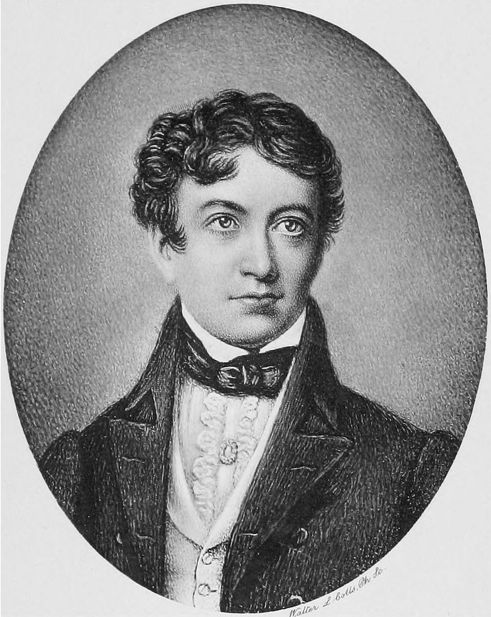
Walter L. Colls, Ph. Sc.
Lord Durham,
at the age of thirty-six
From a miniature in the possession of Stuart J. Reid
‘The genius and spirit of the Russians are not maritime. The service is forced on officers and men, is not congenial to the tastes and habits of the one or the other, and is, moreover, destitute of the best and only supply from which it can be efficiently recruited—a commercial navy. There is, no doubt, to be seen at Cronstadt as splendid a collection of line-of-battle ships, frigates, corvettes, gun-boats, &c., &c., as can well be imagined, but they are firmly embedded in the ice seven months out of the twelve, and when at sea for a summer’s cruise of three months the men exhibit all the symptoms of rawness and inefficiency, which must naturally be expected from crews thus circumstanced. In this light is the Russian navy considered by almost every official person with whom I have conversed on the subject. They all declare it to be a “toy,” and a very expensive toy, with which the Emperor delights to occupy himself, but not one of them, from Prince Menschikoff downwards, anticipates the possibility of its ever being made use of as a means of attack or defence, and all openly deplore the expense which it occasions, as weakening their financial resources, and withdrawing large sums annually from more useful national purposes.’
But it is time to turn from what Durham has to say concerning the position of the Russian army and navy to what he added as to the financial means which the Tsar’s Government possessed for putting either or both in motion—in other words, what about the sinews of war? ‘In 1835 the revenue amounted to 472,457,975 roubles, the expenditure to 520,670,050 roubles, leaving a deficit of more than 48,000,000 roubles. The debt, bearing interest, amounts to 1,000,000,000 roubles at 5% and 6%, in addition to which there is an issue of 600,000,000 roubles of paper money on which no interest is payable. The expenditure of the War Department was 181,862,047 roubles, that of the navy 37,534,999 roubles. Of the receipts, 81,500,000 roubles were derived from the customs; 131,285,539 roubles from the capitation tax and Crown dues; and 119,171,550 roubles from the brandy and salt monopolies. There has been an annual deficit since 1831, amounting on an average to upwards of 30,000,000 roubles, and if the receipts have increased, so has the expenditure. Receipts and expenditure reveal a gradual increase under both heads, but that of expenditure exceeds that of income. It is true that an increase of the capitation tax, from a new revision, is expected, but, on the other hand, it is certain that the customs will fall short of the sum anticipated.
‘It appears then, on this view of the Russian finances, that no extended military operations could be undertaken without an increased expenditure, which could alone be supplied by means of a loan. In what money market in Europe, after a declaration of war against the most influential portion of it, Russia could be accommodated, I am at a loss to conjecture. The more probable event would be such a depreciation of her credit as would render any pecuniary advance from capitalists, however speculative, impossible. But even these statistics based on the latest official returns do not exhaust the economic obstacle to war. There are other difficulties which spring out of the trade and manufactures of the country, and the landed interests of the nobles, and the commercial interests of the merchants. Russian exports in 1834 amounted to 230,000,000 roubles, against imports 218,000,000 roubles. Out of this the extent to which Russia would be crippled by a war with England in her trade alone is at once apparent when it is stated that, out of her total exports, just cited, 105,000,000 roubles represent her export trade with this country.’
Durham proceeds to show that manufactures have been established, involving a capital of 250,000,000 roubles, but, in spite of the ‘forced and unnatural protection’ which is given, worse articles are produced than could be imported and higher prices are demanded for them. Russia, moreover, is absolutely dependent on foreign countries for raw material. ‘She is dependent on England, America, Italy and Persia, for cotton, cotton-twist, indigo, raw sugars, dyes, silk, &c., and the supply would be cut off in the event of a war with England.
‘There is yet another view of this branch of the subject well worthy our attention when we are closely examining hidden as well as open difficulties, which render a war, especially an Eastern war, improbable. What would be the effect on the Russian Empire itself by the conquest of Turkey and the occupation of Constantinople? How long would St. Petersburg remain the capital of this new and extended Empire? Would it ever be transferred to Moscow, which is now the great object of the Russian nobility? No, but to Constantinople. All the advantages of climate and situation are so notorious, that the natural consequence must inevitably be the transfer there of the Court and Government. Russia therefore—real Russia—would become a province. The estates of the nobility, placed at such a distance from their residence and superintendence, must inevitably suffer to the greatest degree, and unless the nobles were to be indemnified by grants of land in Turkey—which again would render the Turkish population discontented and hostile—they would be reduced to the verge of ruin.’
Durham next points out that even the Autocrat of All the Russias is not omnipotent. The power of the nobles is real, though it does not manifest itself, as in former times, in drastic measures of deposal or assassination. The Russian nobility are, moreover, becoming every day more enlightened, and their intercourse with the rest of Europe, in spite of all prohibitions to the contrary, is more frequent. The younger Russian nobility are, in fact, often as well educated and independent as men of their class in other countries nominally more civilised. ‘It is a great mistake, therefore, to suppose that those schemes of visionary ambition which dazzled the imagination of barbarous Tsars and nobles are equally attractive now, when civilisation and education have inspired both with sounder and more rational notions.’ After describing the wide range of the inquiries on which he based his conclusions, Durham alludes to the Tsar’s emphatic declaration to himself, the sincerity of which he sees no reason to doubt, that he had enough to do in the way of consolidation and improvement at home to prevent him from seeking conquest abroad.
This remarkable Report on the state of Russia is finally summed up in the following words: ‘In these circumstances and with the evidence of these facts before me, I humbly conceive that I am justified in reporting to his Majesty and to the Government my conviction that the peace of Europe is not likely to be disturbed by any ambitious or hostile enterprises on the part of Russia, for which she has neither the inclination nor the means. In fact her power is solely of the defensive kind. Leaning on, and covered by, the impregnable fortification with which nature has endowed her—her climate and her deserts—she is invincible, as Napoleon discovered to his cost. When she steps out into the open plain, she is then assailable in front and rear and flank—the more exposed from her gigantic bulk and unwieldy proportions—and exhibits, as in Poland and Turkey, the total want of that concentrated energy and efficient organisation which animates and renders invincible smaller but more civilised bodies.
‘Abroad her soldiers fall by thousands, sullen and dispirited, evincing the passive devotion of fatalism, but neither the brilliant chivalry of the French, nor the determined unyielding courage of the English. At home they fight with desperate, unconquerable fury, for national and domestic objects, consecrated by religious feeling and patriotic traditions. Such a nation therefore cannot be successfully led over her frontiers. Her wants, her weaknesses, her peculiar strength, all demand concentration at home. Once impressed with the conviction of this truth ourselves, and with the belief that it is also apparent to her own rulers, we shall then no longer entertain that jealousy of all the movements of Russia which, in other circumstances, would be wise and necessary, but feel justified in courting openly, and assiduously cultivating, that alliance between the two countries which is so imperatively demanded by common unity of national interests, and by the soundest principles of European policy.’
Lord Grey was quick to recognise the importance of this masterly survey of the position of Russia. In a letter of thanks for birthday congratulations which Durham had sent him, and dealing largely with purely family matters, he alludes to the ‘very interesting despatch’ which he had just seen, and expresses the hope that, in view of Durham’s impaired health, he will not see it his duty to remain much longer in Russia. The letter, it will be seen, throws into relief what was only too apparent to all who knew him at this juncture, the writer’s antipathy to politicians of advanced opinions, and especially the more immediate following of O’Connell, a man to whom he naturally bore a grudge for the collapse of his own Government, and to whom, both by temperament and conviction, he was opposed.
‘Berkeley Square: April 12, 1836.
‘My dear Lambton,—This (the kind feeling so strongly manifested in your letter) has afforded me the same pleasure as your other communications of the same nature. The information it contains of the state of Russia is most important, and affords better means of judging of the policy which requires to be pursued on our part than anything I have yet seen. In the conclusions you deduce from it I entirely concur, and have not the least doubt that a firm but conciliatory spirit is that which ought to prevail in all our discussions with the Court of St. Petersburg. Your conduct appears to have been most judiciously directed to the preservation of peace for the present, and to our being placed in such a position that, whatever may happen in the future, our means of counteracting any designs that might be prejudicial to our interests will be improved and strengthened.
‘People are only just coming back after the holidays, and I have not yet seen anybody from whom I could get information, worth repeating, with respect to our domestic politics. Generally speaking, the Government seems to have acquired strength both in Parliament and in public opinion. The most important questions[1] of the session, however, still remain to be settled, and the Ministers depend too much on the support of a set of men in the House of Commons whose characters I detest, and whose principles and opinions, or, rather, whose designs, aim at objects fatal to all the best interests of the country for me to feel satisfied or at ease. If I am right in the opinion I have formed of these men, a time will come when the Government must be called upon to resist them; unless, which I would not believe possible, they should be led to go all lengths with them, in which case what little power I may still have left a sense of duty would compel me to exert against them.
‘Yours affectionately
‘Grey.’
No one admitted more frankly than Palmerston the value of Durham’s personal ascendency at St. Petersburg at that critical period. It was a veritable triumph of personality. The Tsar Nicholas was a shrewd judge of men, and was quick to detect either flattery or dissimulation. Durham’s open nature, his palpable honesty, the moral courage which lurked beneath his conciliatory speech, his broad grasp of first principles, the practical bent of his quick mind, and the imagination which made the sympathy of his warm heart so effective, all appealed to Nicholas. Even Durham’s weaknesses, love of display, moody depression, the touch of hauteur which marked his bearing, and that strain of impatience which he was not able always to suppress, even in the atmosphere of a Court, were points of similitude between them which promoted mutual understanding. Other Ambassadors to the Imperial Court were received with strict and distant ceremony, which relaxed not even the smallest demands of etiquette; but all this was waived in the case of Durham. He was treated by the Tsar as a personal friend, and, when his health made it imperative that he should not live in the capital, his Majesty at once placed one of his own country houses at his disposal.
The Autocrat of All the Russias, by his position, had few intimates outside a narrow circle of confidential advisers, like Nesselrode, Speranski, the brilliant but cynical Menschikoff, and Pozzo di Borgo, a diplomatist who rivalled Metternich in astuteness. This, the innermost circle around the Tsar, constituted the group to which Durham was admitted on easy terms of intimacy—a position which was unique amongst all the members of the Diplomatic Corps at St. Petersburg. Shortly before he was accredited to the Russian Court, Palmerston summed up the position of England towards it in the words ‘We are bickering with Russia on the point of a quarrel.’ The feeling in England, so far as the great bulk of the people was concerned, was that of hostility and indignation—the outcome of the cruel and despotic treatment of the Poles. This feeling was largely shared by responsible statesmen, who had another, and, in their view, quite as serious a cause for complaint in Russia’s attack on Turkey, and the unfair terms which it had secured through the Treaty of Unkiar Skelessi (June 8, 1833). This treaty blocked the Dardanelles against the navy of any Power with which Russia might be at war, and reduced the Sultan for the time being almost to a state of vassalage, a condition of affairs which lasted until the end of the first year of Queen Victoria’s reign, when the five great Powers checkmated the Tsar by a collective note which placed Turkey under their joint protection.
Palmerston, in 1836, did his best, and with complete success, to curb the warlike instinct of the English people, and he did so avowedly on the principle, which runs through Durham’s despatches, that, in dealing with alleged aggressive designs on the part of another Power, it is never wise to anticipate wrongs, much less to give voice to apprehensions. There were times, it is obvious, when, but for his firmness and common sense, England would have been plunged into that great struggle with Russia which nearly twenty years later became inevitable, under changed conditions, in the war in the Crimea. The long maintenance of peace stands to the credit of Palmerston more than any other man; if a less resolute and far-sighted Minister had held the portfolio of the Foreign Office it is impossible to doubt that England would have been at war with Russia long before the reign of William IV. ended.
That sovereign himself cherished a mortal antipathy to the Tsar, and the jealousy of the English Court made Palmerston’s task all the more difficult. The Melbourne Ministry had, in truth, an uneasy footing at Windsor, where it was tolerated often with a very bad grace, and never really trusted. ‘The King and the Court,’ said Palmerston, in the summer of 1836, ‘hate us, and wish us all to the devil. I believe that I am the only one of the Ministers whom the King likes personally.’ Personal liking counted for much just then. It was the personal liking of William IV. for Palmerston and the personal liking of Nicholas I. for Durham—supplemented by the complete understanding and cordial relations between the two statesmen—which saved the political situation.
Palmerston put the matter in a nutshell when he declared, just after he had received that English Ambassador’s memorable despatch, ‘Russia is coquetting with Durham, and, in order to cajole him, she is obliged to be civil to us—so his appointment has answered.’ It was this union of forces, Palmerston at the Foreign Office, Durham at St. Petersburg, which kept the peace of Europe in that very year 1836, when the English people were indignant over the high-handed military invasion of the little Republic of Cracow—the last stronghold of the Poles. Cracow had been constituted by the Allies, in 1815, a Republic under Austrian supervision. When Poland was dismembered in 1831, it became a rallying place for such patriots as had escaped the sword or exile, when, to borrow a semi-mythical, but grim phrase, the announcement went forth to the world, ‘Order reigns at Warsaw.’ Cracow finally vanished as an independent State in 1846, when Austria absorbed it, an act which Palmerston termed a distinct violation of the Treaty of Vienna.
When Durham represented England at St. Petersburg, Cracow was one of the storm-centres of Europe—a point at which there was imminent danger at any moment that a conflict might arise between the three Powers. Russia, Austria, and Prussia were virtually supposed to safeguard its maintenance as an independent State. It was also a rallying point for English enthusiasm, which had been worked to fever heat by the Polish massacres at Warsaw under the greatest and most relentless of the Tsar’s soldiers, Paskievich, who, as Duke of Warsaw, now governed Poland with as much severity as if it were a conquered province. It was because the spirit of revolt still stirred in Poland, and Cracow, in consequence, was a hot-bed of revolution, that the three Powers determined, in 1836, to occupy the city, and Austrian troops were accordingly sent to reduce it to order.
Palmerston asserted that it was not the relative extent of country, or even the relative greatness of a nation, which had to be considered in a movement of this sort, but rather the great principle of international right. He maintained that it was of as much importance to see that the independence of a small State, like Cracow, should not be wantonly disturbed as if the case had been that of a powerful nation. He made, in consequence, a vigorous protest to the three Powers, and, as Russia was commonly supposed in England to have instigated this act of high-handed aggression in pursuance of her vindictive policy toward the Poles, Durham was instructed to investigate the matter, and to express the disapproval of the Melbourne Government. The result was that the Austrian troops were withdrawn, and the little State preserved its uneasy independence, until the strained relations between England and France in 1846 enabled Metternich to annex it to Austria, in defiance of the Treaty of 1815.
Durham laboured with both hands, as his despatches show, during the whole period he was in Russia, to mitigate the severity of Russia’s treatment of the Poles, and in this direction his success, though not perfect, was far from inconsiderable. His own sympathies were always on the side of oppressed nationalities, and, from first to last, he exerted his powerful influence with the Tsar on behalf of a gallant race, which circumstances had placed under the harrow of the despotic forces prevailing all too long at the Russian Court. Apart from the popular clamour in England, and the attitude taken up towards Russia by William IV., other Ambassadors, and notably Lord Ponsonby at the Porte, were not inclined to endorse Durham’s perhaps too generous interpretation of Russia’s designs, a circumstance which had its weight with the great Foreign Secretary, who had all the strings of diplomacy, so far as this country was concerned, in his hands.
The following letter speaks for itself, and shows, perhaps, better than anything else, how the situation shaped itself to Palmerston’s mind:
‘Foreign Office: May 31, 1836.
‘My dear Durham,—I have taken a holiday to-night from the House of Commons, and have answered your last despatches received yesterday. Ponsonby goes perhaps too far in his suspicions of Russia, and certainly is too warlike in his own inclinations; but if a man is worth anything he must get eager in a business in which he is deeply engaged; and when people get eager in a matter they are apt to dwell more upon one side of a question than upon the other; but Ponsonby has great merits, and has done us good service at Constantinople, and I am quite sure, when he finds that his Government has taken a decided line, he will exert his zeal and ability in forwarding our views. We must not either believe all the things that are written from Constantinople. There are many people there who are, or fancy themselves, interested in crying down the English Ambassador, especially in proportion as he appears to gain credit with the Porte.
‘What you say about Russia very much coincides with our views. Whether we entirely believe, or not, that the Russian Government has altered the policy which, certainly, at no distant period, it pursued as to Turkey, it would be very unwise not to appear to give credit to acts which are in conformity with professions; and, if such acts are done for the purpose of deceiving us, why, so be it; let us encourage Russia to go on deceiving us by allowing her to think that she succeeds. We need not the less (as you justly observe) to hold on our way, and keep our own objects steadily in view, and be prepared to act as occasion may require, should the conduct of Russia change.
‘With regard to the causes which have produced the great and almost universal hostility towards Russia in this country, there is no doubt that the treatment of Poland is among the foremost, and that nothing has so much irritated the people of England against Russia and the Emperor as the vindictive severities and bitter cruelties inflicted upon the unfortunate Poles. This I know is a topic which cannot well be handled in conversation with the Emperor, but it might perhaps be touched upon with Nesselrode. There is nothing by which an English Ambassador could gain more credit than some mitigation of the exterminating policy which is now applied to the Polish nationality.
‘We have three Persian princes arrived. They are not yet come to London, but are waiting at Bath an answer to a letter they have sent me. They are cousins of the Shah; they fled to save their eyes, and are come here, I fancy, for temporary refuge. The King cannot receive them, as they bring no letter from the Shah, but we must be civil to them in private, and try to get them to go back to their own country—that we may not have to pay their hotel bills. . . .
‘Yours sincerely,
‘Palmerston.’
The sentiments expressed in this letter about Russia were in harmony with Durham’s own views. He declared that nowhere had he found the truth of a well-known fable more apparent than at St. Petersburg. ‘A little sunshine will make them throw off their cloak, which they only fold the closer when the cold wind blows.’ He protested against the constant talk in England about treachery and duplicity, and thought that it was impolitic, as well as unjust, when advances were made at St. Petersburg—whatever the motive might be which prompted them—‘in full accordance with our views and in immediate furtherance of our policy.’ He protested against the unnecessary difficulties which were created by what he called the constant hunting after arrière pensées, prompted by distrust and suspicion.
In an unpublished letter, written towards the end of May, Durham makes plain how the denunciations of Russia by England thwarted the firm but conciliatory policy which he consistently pursued. ‘The Emperor has gone to his Windsor (Zarskoe Selo) for a fortnight. I cannot therefore now see him so often; latterly I have seen him almost every day. He is very gracious and confidential with me, and I avail myself of the opportunities to say much to him which even his Ministers shrink from mentioning.’ After reference to a ball at the Winter Palace, at which the Tsar drew him aside into an ante-room, where a conversation of nearly an hour’s duration took place, Durham thus refers to the impression made on Nicholas by wild, irresponsible talk in England. He seemed greatly annoyed at the general want of confidence in him. The fact is, he is merely conscious of his own will, and cannot make allowances for the feeling which exists with regard to Russian policy, as it has been pursued for a long period by his predecessors and even himself. He, no doubt, has abandoned those views, and, having done so bona fide, thinks he ought to be immediately believed, without considering that his personal character and honesty of purpose can only be known by a few, whilst the acts of the Russian Government are matters of history, and therefore open to constant observation by all.’
The principles by which Durham was guided in the performance of his duties as Ambassador at St. Petersburg are admirably expressed in an official communication to the Foreign Office. It was written when he was in mid-career in Russia, and sums up with great clearness the broad lines of his political action. It was a reply to a despatch from Palmerston, expressing the ‘entire approbation’ of his Majesty’s Government of the part which Lord Durham had taken in regard to Silistria, when Russia, on payment of an indemnity by Turkey, withdrew its troops. Palmerston regarded this as the best indication that could be given that the Tsar had, at all events for the present, no further hostile intentions in the near East.
‘St. Petersburg: May 24, 1836.
‘My Lord,—I have been much gratified at receiving from your Lordship the assurance that my conduct in reference to Silistria has merited the approbation of his Majesty’s Government. In the course which I have uniformly followed since my departure from England, both at Constantinople and here, I have ever had in view the maintenance of the proud pre-eminence of England, and the furtherance of that policy through which H.M.’s Government seeks to secure and consolidate the general peace of Europe. In effecting these objects, I have not thought it necessary to wound the feelings or distrust the declarations of the Government to which I am accredited. I have too firm a reliance on the power and resources of my country not to feel myself at liberty to accept facts notoriously favourable to her interests with the belief in their sincerity, and to reject insinuations of unprofitable and therefore unnecessary duplicity.
‘Whenever it has been expedient to speak in the most decided tone as to the fixed, unalterable resolves of England, as in the case of the independence of Turkey, I have not shrunk from the unqualified declaration. When I thought it would effect a useful purpose to proclaim my conviction of the strength of the British and the weakness of the Russian navy, I did not hesitate to express my opinion, however delicate the subject, and unpleasing, naturally, the assertion of the fact. I have never concealed from the Emperor or his Ministers my honest opinions on all matters affecting the intercourse between the two countries, or the general state of Europe. But, at the same time, I have not deemed it wise or politic to interrupt, perhaps entirely to arrest, a most salutary change in the policy of Russia by refusing credence to her solemn declarations, and offensively despising concessions, avowedly tendered by her with a view of conciliation and co-operation.
‘I have, in consequence, recommended that she should be praised for acts in open furtherance of our policy, although they may be at variance with our preconceived notions of her intentions, and that she should be encouraged, by the genial effects of confidence and friendship, to persevere in a line of conduct from which we can reap nothing but honour and advantage.
‘In stimulating her to this course, be assured that I am not insensible to the necessity of strict, unceasing watchfulness. No event, however trifling, bearing on the great question of Russian aggrandisement ought to escape our observance, but, in my judgment, it is perfectly competent to a British Ambassador to temper vigilance with confidence, and to win the friendship and gain the esteem of Russia, whilst he vindicates the honour and asserts the supremacy of England. Such are the principles which have guided me in the performance of the duties devolving on me as Ambassador at this Court. It is a gratification to me to think my humble exertions have been appreciated, and I have to thank your Lordship for the kindness with which you have, more than once, communicated to me the approbation of his Majesty’s Government.
‘I am, &c.,
‘Durham.
‘The Viscount Palmerston, K.B.’
There were times perhaps when Palmerston was inclined to think that Durham went just a little too far in his consideration of the susceptibilities of the Russian Court. He used to say that ‘You don’t stave off war by yielding to urgent demands through fear.’ But the fact remains that Durham’s policy, at a critical juncture in the affairs of Europe, when any false movement would undoubtedly have provoked a general upheaval, was justified by its results. Durham’s courage was shown by braving, not merely the prejudices which William IV., a blunt old sailor with small knowledge of the actual conditions of the problem, only too openly manifested, but also the disapproval of the Radical party in England, which, in consequence of the treatment of Poland, was in open hostility to Russia. It was a hard task, under such circumstances, to preach moderation and to act as a peacemaker; but Durham, as his whole career proves, never quailed before hard tasks, or failed to adhere to what he believed to be the right and patriotic course because, for the moment, it was unpopular.
No Ambassador whom England ever sent to St. Petersburg excelled him in blended firmness and conciliation, and his presence there in the last years of the reign of William IV. was of lasting advantage to his country. He felt, with Palmerston, that England had no eternal allies and no perpetual foes, and, with Canning, that her interests ought to be the shibboleth (of the policy) of all her representatives. Durham, whilst in Russia, was at one with the great Foreign Secretary under whom he served in thinking that it was not his duty to do anything which might plunge the nation into the frightful responsibilities of war, merely because the Power to which he was accredited was disinclined to concur with us in matters which, in the view of its own public men, prompted a line of action scarcely marching with our ideas. Nothing could well be more significant in this connection than Palmerston’s defence of Durham, when the latter was attacked in the House of Commons in 1837, because of his conduct at St. Petersburg. He said that the reflections cast upon Durham were entirely unfounded, and added that he was, of all men, best qualified to judge, as he was in constant touch with him during the whole course of his Embassy. He repudiated the implication that Lord Durham had been indifferent either to the honour or interests of England, and added the emphatic testimony:—‘It was impossible for any public servant at a foreign Court to serve his country with more zeal and firmness.’
Meanwhile, all through those anxious months of 1836, Durham, whilst keenly alive to the interests of England, never forgot the wrongs of Poland. Marshal Paskievich had recently been appointed Governor of Warsaw, and Prince Koziloffsky, a well-known friend to the Poles, was quite unexpectedly made a member of his Council. Nesselrode stated that the Tsar had made this second appointment in order to give effect to the policy of clemency which was urged by Durham, and Durham accepted it as a proof of a new and merciful departure in favour of this oppressed race. It was all the more remarkable because the Tsar at that moment was greatly annoyed by a speech of Thiers, which attributed the evacuation of Silistria to the ‘menacing attitude of the British Government.’ Happily, his good temper had been almost immediately restored by reading an official article in the ‘Journal de Paris,’ which attributed the evacuation to the ‘high influence of France.’ The absurdity of a statement, which excited a great deal of ridicule in Russia, was all the more marked, since it was notorious that the French Government did not know anything at all about the evacuation of Silistria until after the Convention was not merely signed, but published to all the world.
Durham’s despatch to Palmerston on the new policy towards Poland, which thus came into force, deserves to be cited, since it shows, better than any commentary, how zealously affected he was in this matter:
‘St. Petersburg: June 11, 1836.
‘My Lord,—I have at various times spoken to Count Nesselrode, and also to Marshal Paskievich, on Poland, and have pressed them both, as far as the delicacy of the subject would admit, to adopt as lenient and conciliatory a government as possible in that unfortunate country.
‘With Marshal Paskievich I had a long conversation previous to his departure for Warsaw. I urged him to take every opportunity of publicly contradicting, both in fact and assertion, the statements which were circulated throughout Europe, and generally believed, of Russian severities. I reminded him that in these days, when public opinion was omnipotent and omnipresent, no Government could take refuge in what was called dignified silence, or abstain, directly or indirectly, from giving those explanations and contradictions which were necessary to its honour and character. His Excellency did not object to this reasoning; on the contrary, he stated that he had given a similar opinion to his Government.
‘A short time afterwards, Prince Koziloffsky informed me that the Emperor had attached him to the Cabinet of the Marshal, and that he was about to proceed to Warsaw. The Prince was formerly Minister at Turin, but has not been employed of late. He was resident some months at Warsaw last year, was very intimate with the Marshal, and exerted his influence uniformly and successfully in favour of the Poles. . . . I told Count Nesselrode yesterday that in no way, hardly, could the esteem of the English Government and people be more readily reconquered than by the exhibition of a mild and beneficent policy in their Polish administration.
‘I have the honour &c. to be,
‘Durham.
‘The Viscount Palmerston.’
During the whole period of his Embassy to Russia Durham was called upon to investigate a great many real or alleged grievances connected with English commerce, and his despatches show with what promptitude and thoroughness he thrashed out, with the Russian Government, such matters. He used to say, with a touch of amusement—the English Colony in St. Petersburg was not without its bores and busybodies—that he was beset by people who were in the habit of working up every event into a grievance. ‘They called on me to believe all their improbable tales and antiquated speculations—fitter for the times of the Empress Catherine than for the present—and would fain have persuaded me that, unless they were promptly taken up and acted upon by the English Government, India would be invaded, and Turkey would become a Russian province.’
If he acted on the advice of these so-called well-informed people on the spot, England would have been involved in war. He listened patiently, and took, as he drily puts it, ‘exactly the opposite course.’ The result was that Russian hostility towards this country vanished, the independence of Turkey was secured, the evacuation of Silistria became an accomplished fact, the occupation of Cracow was but momentary, and a general tone of moderation and cordiality came into play in all his negotiations with the Tsar’s Ministers. Meanwhile, a section of the English Press, ignorant of the real state of affairs, gave only too ready an ear to these crotchet-mongers, and bombarded him, in consequence, with left-handed compliments, which he accepted with a light heart, because he said he had the consolation of knowing how false such insinuations were, as well as the satisfaction of witnessing daily the good effects of the policy which he had ventured to recommend his Majesty’s Government to adopt, and of which they had again and again expressed their emphatic approval.
|
The Irish Municipal Bill, abandoned in August, because the Lords rejected the Appropriation Clause, was one of them. |
Action, thought, speech, are the three modes of human life.—Amiel.
1835-1837
Combating British prejudice—Russia’s fiscal policy—The case of Mr. Grant—Russian aggression—King William’s jealousy of Russia—Durham’s illness—The right attitude of England—The Tsar’s tariff reforms—The affair of the Vixen—The Emperor’s designs in Central Asia—The route to India.
Durham did not disguise in 1836 that he would have preferred what he called ‘honourable and active employment at home’ to the post of Ambassador to Russia. At the same time he felt, what every diplomatist in Europe recognised, that his presence at St. Petersburg helped to bring about a better understanding, and, consequently, to maintain peace. In a letter written to Parkes, on May 24, he says, ‘Only look how different is the aspect of affairs in the East now from what it was last year. My great object in going round by Greece and Turkey was to re-establish English co-operation and English power. At Malta I met Mr. Dawkins, our Minister at Athens, returning home. I told him my object, and he said, “You are too late—it is now hopeless.” I replied, “I am sorry to hear that, but at any rate I will try.” I succeeded both with Count Armansperg, Otho, and the Sultan. From that time they assumed a different tone towards Russia. Once assured of our protection, they began to assert their independence.
‘The next step was to convince Russia that we were in earnest, and that nothing would ever induce us to connive at her designs on Turkey. Once persuaded that that event was an impossibility, the result in change of policy became obvious. Armed preparation was useless and expensive. The suspicions and jealousies of the rest of Europe became troublesome, and were to be allayed. Of course, I prepared them a bridge over which to cross, and you have, as a consequence, the Convention with the Porte and the evacuation of Silistria. I found here the existence of very unfriendly feelings; harsh proceedings and harsher words had produced a coldness, which had quite annihilated English influence both with Emperor and Ministers. What is the case now? There is no Power for whom the Emperor professes more respect than that of England. There is no Ambassador here whom he treats with more confidence than myself. I see, every day, disappear gradually feelings and intentions which might otherwise have ripened into acts, fatal to the continuance of peace.’
Durham went on to say that one of the greatest difficulties he had to contend with was the vituperative tone adopted toward Russia by the English Press. ‘Is the Emperor to be abused like a pickpocket for preferring what he, perhaps erroneously, considers his own interests, to those of another country? It may be matter of regret, but not of abuse. We are always attacking them about Poland. Might not they retort about Ireland?’ Besides all this, from every corner of Europe came assertions as to the ascendency of Russia, which were duly copied into the English newspapers. He declared that such statements were not true, but if they were, England only played the game of Russia in making them public. ‘The reputation and semblance of power and influence in one quarter produces them in reality in another. The declaration of this assumed “fact” strengthens Russia in the conviction that her system is successful, and ought not therefore to be changed.’
When Durham was living in the immediate vicinity of the Imperial residence, the Tsar honoured him with many informal visits, and paid him such marked attention that the Ministers of other foreign Courts were visibly piqued, and inclined to hint that nothing could be done without the English Ambassador. Durham felt compelled to hint, as delicately as he knew how, at the existence of this feeling; but to the end of his stay at the Russian Court his position was one of exceptional importance, because of the familiar intercourse on which his Majesty insisted. He used this influence to remove, as far as possible, vexatious restrictions on British trade, and his despatches show how constant and practical were his services in that direction. He himself relates a conversation at this time with the Tsar, who begged to be told frankly what was the cause of the enmity toward Russia then so prevalent in England. The question was not less sudden than embarrassing, and, in the political tension which prevailed at the moment, a good deal turned on the reply.
Durham was not taken off his guard. He assured the Tsar that many reasons existed which it would be impolitic to discuss, since they were matters of history—a chapter in it which he, for his part, hoped would never be re-opened. He proceeded to assure the Tsar that one great obstacle to friendly relations was the system of prohibition which marked the policy of Russia, and deeply concerned the commercial interests of England. There was a widespread conviction amongst British merchants that Russia wished to extend that system wherever she had any influence, and this had naturally aroused the opposition and ill-will of the trading and manufacturing classes. The feeling, so produced, was turned by others to political purposes. Moreover, the conduct of other Governments, Durham urged, was contrasted favourably with that of Russia, and the result was—it was idle to deny it—the prevalence of a general spirit of animosity, which it was almost impossible to resist. He added that if any liberal reform could be made in the commercial policy of Russia, it would have a very good effect on the relations between the two nations.
His Majesty at once admitted that the prohibition system was bad in itself, but it had been so long in existence that it would be difficult to get rid of it. Circumstances connected with the general state of Europe had formerly rendered it necessary in Russia. Capital to a large amount, in consequence, had been invested, and considerable portions of the population had been trained to various manufacturing occupations under the system. ‘How could I,’ he asked, ‘all at once sacrifice the one and divert the other? You also in England are sensible of the difficulties of a change, and even now have not relaxed your prohibitive system with regard to the corn laws—a branch of commerce especially interesting to Russia. You yourself must therefore be well aware of the necessity of my maturely considering all the difficulties which surround the question.’ Durham replied that he did not deny the existence of such difficulties, and added, that they had long affected the commercial prosperity of England. That prosperity, he desired the Tsar to remember, had grown to its present height, not in consequence of the prohibitive system, as protectionists imagined, but in spite of it. England endeavoured to remove all impediments to a better system slowly and gradually, and Russia would be well advised to do the same, but he felt it his duty in the interests of both countries to suggest to his Majesty to seize every occasion to encourage and adopt a sounder and more liberal fiscal policy. In small matters, as well as great, Durham exerted his influence with the Tsar for the redress of grievances, and in this connection perhaps it is only necessary to mention a typical case which was much talked of at the time at St. Petersburg.
A British subject, Mr. Grant, had for nearly thirty years been prosecuting a claim on the Russian Government for the recovery of many thousand pounds. He had appealed in vain to all Durham’s predecessors during that period, but none of them had been able to help him. Durham, with characteristic thoroughness, as soon as the matter was placed before him, read over himself all the papers, and came to the conclusion that a gross act of injustice had been committed. The case had been brought before various tribunals, until, at length, the final decision had been arrived at in the Council of State, and this had been confirmed by the Tsar. There was no precedent for the reversal of a decision confirmed in the highest quarter, and official red-tape debarred the way to re-opening the question. Durham, however, was resolute, and finally the matter was brought by Count Benkendorf before the Tsar, in spite of the opposition of the Minister of Finance. His Majesty at once said, ‘I care not for the want of a precedent. If I have unintentionally sanctioned an act of injustice, the sooner I repair the evil the better. I am sure Durham would not call my attention to this matter if he was not firmly persuaded of the justice of Mr. Grant’s claim. Let the whole affair be again referred to the Council of State for re-examination.’
The result was that the decision was reversed and the Tsar at once countermanded the decree. The matter created a great sensation in commercial circles in Russia, not merely because it was a deviation from established rules, but also because justice was done in spite of the determined opposition—maintained to the last moment—of the Minister of Finance, who felt himself responsible for the department which had made the blunder. It was his willingness to take up any just cause, however trivial it might seem, which made Durham popular with British residents at St. Petersburg, who had hitherto found their representations too often disregarded.
It is time to return, if only in passing, to the broad lines of Durham’s policy in Russia—a policy which all the evidence proves to have been firm, vigilant, and conciliatory. There were plenty of alarmists, both in high quarters and official positions, who could not get rid of the idea, in spite of the evacuation of Silistria, that the Tsar was merely waiting to spring, at the first opportunity, on Constantinople, a view which Durham knew to be incorrect, and which he told Palmerston was, at the moment, impossible.
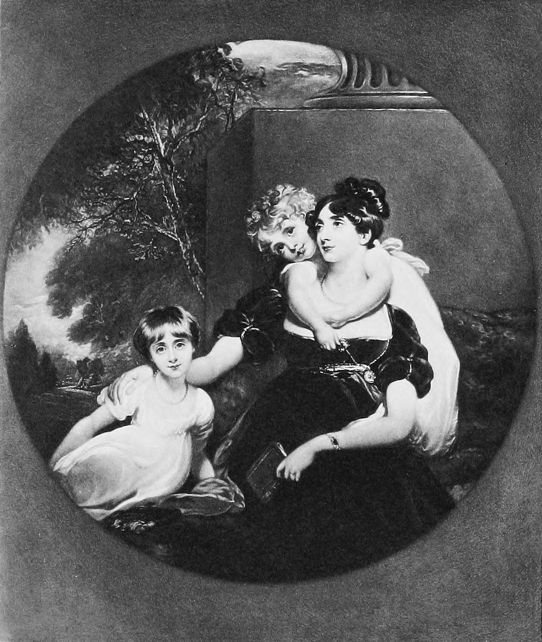
Sir Thomas Lawrence, P.R.A.
Countess Grey and her daughters
Lady Louisa (Lady Durham)
& Lady Elizabeth
Palmerston used to say, and recent events in the far East support his judgment, that the policy of Russia was to push forward encroachments, as fast and as far as the apathy of other Governments would allow, always to stop when met by decided resistance, and then to mark time, until the next favourable opportunity occurred to make another advance. He did not trust Russia as far as Durham did, but took a more cynical view of her assurances. He declared that Russian diplomacy had ‘always two strings to its bow’—moderate language and disinterested professions at St. Petersburg and London; active aggressions by their agents on the scene of operations. If the aggressions succeeded locally, the Russian Government adopted them, as something accomplished, which had not been intended, but from which they could not now in honour recede. On the other hand, if active operations on the outposts of Empire missed fire, the local agents were promptly recalled, and the language which had covered their baffled attempt was at once cited as a proof that they had overstepped their instructions. The policy succeeded when they made the treaty of Unkiar Skelessi; it failed in the attempt to get possession of Herat.
Palmerston, as has already been hinted, was the first to recognise that Durham, in spite of his generous belief in Russia’s good intentions in 1836, was substantially right in his analysis of the political situation, and he always held that he served England uncommonly well at that crisis by mitigating the hostility of her people against the Tsar, and in nothing more than by making it perfectly clear to his Ministers that this country would not permit, under any circumstances, an attempt to seize Constantinople.
Lord Grey, it might be added, was much more in accord with his son-in-law on the Eastern Question than ever he was on political questions at home. He made no secret that he shared Durham’s views, and his intimate acquaintance with the Lievens had undoubtedly disabused his mind of the rooted, and, as it ultimately proved, the just suspicions of Palmerston. He told Durham as much in one of his letters. After stating that he deemed it inadvisable, for reasons which he explained, to enter at length into any discussion of foreign politics, especially as regarded our relations with Russia, he added, ‘I will therefore only permit myself to say what I do not care if the whole world should read, that I agree with you in the belief that Russia does not, at the present moment, meditate any fresh encroachment on the Turkish Empire. There is nothing, therefore, that calls upon us for direct and immediate interference. The interruption of the peace now existing, which might extend the flames of war over all Europe, is so dreadful a calamity that, even if I had no hope of ultimately averting it, I would endeavour to delay its approach as much as possible. Time also has chances which it would be presumptuous, with the limited and uncertain foresight of man, to forego.’
Durham, always high-spirited and sensitive, and straining every nerve at the moment to keep the peace of Europe, did not conceal his annoyance at one of those petulant outbursts of William IV., which were only too common in the King’s last days, and in this instance was directed against himself, because his Majesty elected to think that he took too easy a view of the Tsar’s intentions. Grey did his best to soothe the ruffled feelings of the Ambassador. ‘I think you attach too much importance to that speech of the King’s, which Ellice has so unnecessarily reported to you. These are things to be passed over, as the sudden effusions of the moment, dictated, perhaps, by some excitement or some accidental irritation. Kings and princes have seldom exercised over themselves the discipline necessary to enable them to restrain sudden sallies of this nature. You know, too, that the great object of his Majesty’s present jealousy and dislike is the power of Russia.’ He went on to say that, though a Liberal Administration was in power, the King’s dislike of his Ministers was not at all abated, and that the people about him, who had his confidence, were ‘more than ever decidedly Tory.’ He added the significant remark, ‘This feeling at headquarters, with all the other difficulties that surround him, makes Melbourne’s place anything but a bed of roses’—a statement over which, under all the circumstances, Durham may be forgiven if he chuckled.
No one took more interest in Durham’s career than that fine old north-country squire, his uncle, Mr. Ralph Lambton, who had known him from childhood, and to whom he was most sincerely attached. It was to ‘Mr. Ralph,’ as not merely all the family, but all the country-side in Durham, called him, that he wrote, as the summer of 1836 began to fade into autumn, the following words, which show how keenly he longed to get back to his own people: ‘Your account of Lambton makes me long, more than I can say, to see it again. Alas! duty, public and private, keeps me away from all that I value most. I hope I shall not have made the sacrifice of health and comfort in vain, and that my country and my family may reap some benefit. This is my only consolation.
‘We have a very comfortable house and nice grounds at Michalloffsky, and, when the weather is fine, enjoy the place much. It is a country house of the Emperor’s, and close to his palace at Peterhoff. We have all the advantages of the Imperial Park and gardens for riding and driving, and, as I stand high in his good graces, the neighbourhood is anything but disagreeable. Who do you think, of all people in the world, are coming to pay me a visit? Lord and Lady Londonderry! He wrote to me about some colliery business, and at the end of his letter said that he had a great mind to come to St. Petersburg, if I would receive him. I answered that of course I should do my best to make his stay agreeable, and that here I knew neither Whig nor Tory, but only Englishmen. So it ended in his setting out with Lady Londonderry and Lord Seaham. They are gone round by Stockholm, and I expect them in a few days. Nothing can exceed the kindness with which I am treated by the Emperor and the Empress. They behave to me more like a personal friend than an Ambassador. Last week we got up some races to amuse the English merchants resident in St. Petersburg. I gave them a cup to run for. They rode their own horses; nine started for it. They had matches besides, as you will see by the enclosed list. The young Grand Duke Alexander (the heir-apparent) was there, and was much amused.’
In the early autumn Durham was seriously ill with rheumatic fever. He had been ailing more or less all the year, and had never really recovered from the shock of his daughter’s death at the preceding Christmas. It seemed to those about him, and especially to his devoted wife, that the rigours of another Russian winter would tax his powers of physical endurance to an alarming extent, and, yielding to her entreaties, he wrote, early in September, from his sick-bed to Lord Palmerston for leave of absence. He told Palmerston that he would come home only if he was actually forced by the state of his health, but that, in any case, he would resume his duties in the spring. ‘It is with great reluctance,’ he added, ‘that I make this application, but I am induced to do so at the urgent entreaties of my family. My disinclination to do so does not arise from any distrust of your willingness to oblige me, but from a fear that this circumstance may afford another occasion of wounding my feelings in a quarter where latterly I have found no favour or even justice. However “necessity has no law.” I make, therefore, the request to you for leave, to be used only in case I find myself utterly unable to support the severity of the climate as the winter advances.’
Palmerston’s reply deserves to be cited, not merely because it shows how the wind was blowing at Windsor, but also because it reveals in a diplomatic manner how necessary the Melbourne Cabinet felt it to be to soften the King’s prejudices in regard to Russia:
‘Stanhope Street: September 24, 1836.
‘My dear Durham,—I have taken the King’s pleasure about your leave of absence, and I send you an official communication on the subject. As you allude to the personal feeling that was exhibited when you started, I will tell you exactly how I think matters stand in that respect at present. The irritation, for it was that, rather than dislike, has gone off, and whenever your name is mentioned it is in perfect good humour. Your despatches are praised, as being ably written, but there is an impression that you take too favourable and indulgent a view of Russian policy, and are too much disposed to believe that a temporary suspension of plans of encroachment may be considered as an evidence of entire abandonment. Perhaps one or two of your despatches, if read by a person who had that notion of your opinions previously fixed in his mind, might seem to countenance the supposition. I think, therefore, that it might not be without use if, upon any occasion that might present itself, before you go on your leave of absence, you were to state in some despatch that which I conceive to be your meaning, namely that there is no present intention of aggression on the part of Russia, for the various reasons which you have explained in detail, but that this fact—though highly satisfactory for the present, as affording us security for the continuance of peace—ought not to induce us to relax in any degree the vigilance with which the proceedings of Russia on all the parts of her extensive frontier ought to be watched. I can assure you that some passage to this effect, indicating that you draw a distinction between present safety and future security, would do you much good in the quarter in question, if it should not be inconsistent with your own opinions. Perhaps you will say that, if I will only read your despatches with attention, I shall find that you have already done this in more than one of them; never mind, do it again. Things, as you well know, must sometimes be repeated, in order to make a due impression.
‘My dear Durham, yours sincerely,
‘Palmerston.’
Durham took in good part what he called the ‘friendly hints’ of Palmerston, and wrote at once a despatch, in which he briefly recapitulated, for the King’s benefit, what he had previously said as to the right attitude of England towards Russia. He declared that he had no predilections in favour of that country, but wanted beyond all else to assure the triumph of the foreign policy of England. He felt that more could be accomplished by friendly dealings than by menacing words, and his own observations had convinced him that many of the accusations brought against Russia were false. He was there, he always maintained, as a peacemaker. He wanted to restore the old cordiality, to soften down prejudices on both sides, and above all to prevent personal misunderstandings from interfering with the free scope of political discussion. He ridiculed the ‘hourly dread’ of Russia which seemed to haunt some English statesmen, and instanced the evacuation of Silistria, and the Convention with the Sultan, in proof that his own policy of conciliation had not failed.
‘If I seize every favourable occasion of praising the acts of the Russian Government, it is not because I wish their policy to be triumphant, but because I wish to see prevalent that confidence in us which will make ours successful.’ He added an expression of his thanks to Lord Palmerston and his colleagues for their enlightened appreciation of his motives and actions, and said that he was ‘so far patched up’ that he thought that he could get through the winter without having to avail himself of the leave of absence which he had just received. In October his health was so far restored that, in view of difficult questions which still remained to be settled, he waived his personal inclinations, and remained at his post until the memorable June of the following year, which witnessed the death of William IV. and Queen Victoria’s accession.
Lord Palmerston did not conceal his appreciation of the latest despatch from St. Petersburg, which evidently had produced the desired impression at Windsor:
‘Foreign Office: November 1, 1836.
‘My dear Durham,—Your despatch was very good and well done, and has, I think, been useful. I perfectly understand your views, and, if there is any difference between us, it is merely that which must naturally exist between people looking at the same things from different places. You see details which we do not; and many things strike you which escape us. But I think you would not demur to what I said about Russia in my conversation the other day with Esterhazy upon his return here. I said our situation with respect to Russia is greatly improved, as compared with what it was two years ago. Then there was much personal irritation between the two Governments and no preparation on our part to resist Russia if necessary; whereas now, by your good management at St. Petersburg, the two Governments are placed upon a perfectly good footing of mutual intercourse, while the vote of Parliament of last session has put into our hands the means of giving effect, if requisite, to any remonstrance we might be obliged to make. . . .
‘Yours sincerely,
‘Palmerston.’
Early in 1837 Durham’s representations in the previous autumn to the Tsar, on the obstacles to English trade with Russia, bore unexpected fruit in the shape of substantial tariff reforms, which were not merely important in themselves, but involved a change of attitude of great and far-reaching economic significance. Count Nesselrode described the new tariff ‘as a beginning,’ and both Durham and the British mercantile community regarded it as the turn of a tide which had hitherto flowed steadily in the opposite direction. Palmerston was quick to see the substantial advantages which Durham had thus secured. ‘We are delighted with your new tariff,’ were his words. ‘It is good in itself, but the great point is that it establishes a new principle which, once adopted, must progressively be extended.’
One matter which caused considerable excitement in England, especially in the shipping world, in the spring of 1837 was the capture of a British vessel, the Vixen, by the Russian cruiser Ajax. The affair led to energetic protests on the part of Palmerston, and this, in turn, in Durham’s words, created a ‘great sensation’ in official circles at St. Petersburg, especially as the English Government seemed to dispute Russia’s right to the coast of the Black Sea. If Durham had not acted with the greatest prudence, the feeling excited amongst the nobility and military authorities of Russia might have led to open hostility. The grounds for the seizure of the Vixen were twofold: the vessel had on board contraband cargo, and her captain attempted to trade at a Russian port, where there was no Custom-house, and a cargo, even of goods against which there was no legal embargo, could not, in consequence, properly be landed.
The port in question was Soudjouk-Kaleh. Russia had acknowledged, in the treaty of 1783, this place as a Turkish possession, and it was on this that Lord Palmerston based his protest; he held that it was outside the sphere of Russian control. Count Nesselrode was able to prove that, by the provisions of the treaty of Adrianople in 1829, it belonged to Russia, and that the Tsar’s Government was represented by a fort and a garrison. Durham contended that there had been no violation of international law. England had acquiesced for eight years in Russia’s rights on the Circassian coast, and he held that, as the act of the Vixen was ‘indisputably and knowingly in contravention of the Russian tariff, there was no ground for regarding the seizure of the ship in the light which the English newspapers put it, as a matter which affected the “honour of the national flag.” ’ In the end Palmerston admitted the justice of this contention, and the incident ended with a statement by the British Government that there was no sufficient reason to question the right of Russia, under all the circumstances, to seize and confiscate the Vixen. This admission brought to a happy end the critical relations between the two nations in the spring of 1837. It ought to be added that Durham at once secured the liberation of the captain and crew from their imprisonment at Odessa.
Mr. E. J. Stanley, then Patronage Secretary to the Treasury, who, at an earlier stage, had been private secretary to Durham, wrote to him at the time, deploring the clamour against Russia, and stating that ‘if the Tories were to come in tomorrow, they would take the earliest opportunity to involve us in a war, which would rather please the King, and divert attention from domestic affairs.’ Fortunately, they did not come in until 1841, and by that time hostility towards Russia had vanished, and was not renewed until the events which led to the Crimean War.
It was at this juncture that William IV., who was always jealous of Russia, and had hitherto done scant justice to Durham’s services at the Court of St. Petersburg, was pleased to express his approval of his successful efforts in the maintenance of peace. ‘The King desires Lord Palmerston to take this opportunity of expressing to Lord Durham the satisfaction which his Majesty has derived from the ability and zeal with which he discharges the duties of his important Embassy.’ Sir Herbert Taylor, in forwarding the King’s approval, added that his Majesty requested the Foreign Secretary to ‘assure Lord Durham of the importance which he attaches to his successful acquisition of most valuable materials and essential information, at a period when it is so desirable that his Majesty’s Government should be thoroughly acquainted with the designs of Russia and her means of carrying them into effect.’
The last important despatch which Durham wrote from St. Petersburg related to the ‘designs of Russia’ in Central Asia, at that time attracting little attention, but which he, with rare prescience, even in 1837, thought demanded the ‘most serious consideration’ of the British Government. He stated—May 25, 1837—that, whilst the British Government had imagined that Russia meditated the conquest of Constantinople and the destruction of the Ottoman Empire, it was more and more clear to him that its policy was directed to the growth of its commercial and political influence in Turkey and Central Asia. ‘It is a policy which requires our earnest watchfulness, as much as the one which they have abandoned. The influence of Russia over Persia, and her connection with, and control over, the various States of Central Asia, are questions so directly affecting the security and prosperity of our Indian possessions, and so evidently bearing upon the pre-eminence of British commerce, that they cannot be subjected to too vigilant an observation, with the view of preventing or counteracting all results prejudicial to the one or the other.’
He showed that the project of forming Russian commercial relations between the Caspian and the Oxus was as old as the days of Peter the Great, and proceeded to point out in detail the steps which, in recent years, had been taken by Russia to secure the trade of Central Asia. He forwarded a number of secret documents to Palmerston bearing on the subject, and revealing the success which had marked the movement, and then he added these significant words: ‘It must also be remembered, with reference to the more improbable branch of the question—the invasion of India by the Russians—that there are but two routes for that purpose, one by Khiva, the other by Astrabad and Afghanistan. The successful prosecution of an expedition by either of them must depend on the co-operation of the Khivans and the Turcoman tribes on the one side, and the Persians and Afghans on the other.’ He pointed out, in conclusion, that such assistance was more likely to be given as the result of commercial ties than from any other motive, and hinted that England ought to forestall Russia by enlisting such interests on her side, and so making ‘any practical movements on the part of a Russian army impossible.’ That despatch, like many others which Durham wrote, reveals the range of his political vigilance and his power to forecast great movements which he did not live to witness.
The maintenance of a high standard of right and wrong in the field of politics is one of the first of national interests.—Lecky.
1835-1837
The influence of Parkes on British politics—Passing of the Municipal Reform Act—‘Brougham like a tiger in a jungle’—Radical estimate of Durham—Founding of the Reform Club—Correspondence with Parkes—Comments on public men—Durham’s relations with the Duchess of Kent and the Princess Victoria—The Melbourne Cabinet in difficulties—Durham ‘thrown over’ by the Whigs—Pamphlet on Russia by ‘A Manchester Manufacturer’—Durham’s prophecy about Cobden.
Lord Durham’s political friends in England, who knew how keenly he hungered for news, kept him fully posted up in all that was happening in Parliament and society. His most constant correspondent was Joseph Parkes, one of the ablest and best-informed of the Radicals, and a man of great influence behind the scenes when the question of Reform was uppermost. Parkes was always one of Durham’s most loyal and, at the same time, most outspoken friends, and enough has already been said in these pages to prove both the magnitude of his services to the advanced section of the Liberal party and the close personal relations which existed between him and Durham. Parkes’s position in the thirties was altogether unique. He knew, in the personal sense, not merely nearly all the leading statesmen of that time of his own party, but the freaks and foibles of the leading members of the Opposition. He knew something, more or less to the point, in the political sense, about nearly every member of the House of Commons, and had taken the measure very accurately of all the more active members of the House of Lords, whether their zeal spent itself in the advance of progress or in its defeat.
He was in close touch with both the London and the provincial Press, and, what was now quite as important, he had the confidence of local leaders of public opinion, who bestirred themselves in the interests of progress in all the great towns of the United Kingdom. Parkes had political vision. He was not a man who, in Swift’s ironical words, thought that ‘the whole art of government consisted in the importation of nutmegs and the curing of herrings.’ But though he had ideals, he was practical, and it was the union of such qualities which made him representative of the best aspects of contemporary Radicalism. He possessed great industry, a vast amount of cool courage, savoir-faire, an enthusiasm for the Radical creed, which, in those years at least, was never relaxed, an infinite capacity for taking pains in the accumulation of significant facts, and an enviable skill in the art of putting things adroitly; whilst to all the problems of the hour he brought a trained legal intelligence, and a fund of masculine common sense. Like other sanguine men, he sometimes jumped to conclusions and committed himself to sweeping generalisations, which the logic of events did not justify, and at times he even made the fatal mistake of under-estimating his political adversaries, as well as the vis inertiæ which is typical of the mass of the English people.
He tried, in consequence, sometimes to force the pace, and had not always the wisdom to conceal his chagrin when he did not succeed. Only those who are acquainted with the inner history of the Reform agitation, and the scarcely less important political changes which grew out of the great measure of 1832, are in a position to understand how much the country owes to this half-forgotten man. He was the link between the aristocratic Whigs, when they made the great departure, and the insurgent forces of Radicalism, which made the movement resistless, and he it was who kept the leaders of the Reform party in touch with the people when the great towns threatened to break away from their control.
On arriving in St. Petersburg, Durham was delighted to find a letter from Parkes, announcing that the Government had carried the Municipal Reform Act—a measure in which he took a keen interest, and which he had done much to bring about. Municipal Reform, he was convinced, by his experiences in the great struggle of 1831-32, against political bribery and corruption, was absolutely essential, and he saw that its results would be scarcely less salutary than those produced by the Reform Bill, of which, indeed, this new and sweeping enactment was the logical outcome. He did not think—his letters show it—that the new Act went far enough, but he knew, and no man knew better, that vested interests die hard. Meanwhile, it was a satisfaction to him to think that the ‘small end of the wedge,’ as he put it, had been driven into the close corporation system, which was a curse of the country. ‘Be it your care to drive it home,’ was the message that he sent from St. Petersburg to those who were zealous and alert on the subject.
Later letters from Parkes show how vast and beneficial were the changes brought about by the Municipal Reform Act, which, in Parkes’s judgment, produced neither more nor less than a political revolution. He said that Municipal Reform ‘was the steam-engine for the mill built by Parliamentary Reform.’ This correspondent also repeated strange stories about Brougham’s political vagaries. ‘His systematic treachery to me,’ wrote Durham, ‘I never can forget’; but by this time he had been forced to the conclusion that the only charitable supposition was that his former colleague was undoubtedly insane.
Here and there the letters from Parkes contain facetious allusions to Brougham’s militant powers, displayed amongst his fellow peers. Writing of a discussion, on August 13, 1835, during the passage of the Municipal Reform Bill, Parkes says: ‘Brougham has been like a tiger in a jungle, dealing out death wherever he fixed his prodigious claws. Last night he not only knocked Lyndhurst head over heels, but jumped on his carcase, and stamped his life out of him.’
The position held by Durham in the Liberal party, and the probability of his taking the leadership within a few years, are thus set forth in a letter from Parkes, dated July 21, 1835: ‘You know I always sincerely speak to and write to you, as I know you wish. Do not stay abroad too long. Rely upon it that no public man, of either order, has the position with the Liberals which you have. I could tell you in what they occasionally discount you, and wish, in addition. But all men are to be viewed and estimated, in public and private, as a whole. The Reformers place extreme confidence in your intellectual power, invariable consistency, in your occupying the breach between Monarchy and Democracy, and in your rank—being, as you now are, the only public man of the Lords of age and moral determination. No absence or political fallow will one jot lose you that station. You would find on your return the same estimation of your services in Reform. “The time will come,” in all human probability, if you have life and health, when time must place you at or close to the helm. It is your ambition, and your natural position. I am sure that you occasionally underrate your station with the Liberal party, and sometimes do the Reformers injustice in conceiving yourself not consistently appreciated. You are as fully appreciated as the nature of men and of public life admits; and you will find this when you come some day to draw more cheques on Public Opinion. A public man must keep a large account with the public. You can’t reasonably expect constant recollection of retrospective acts; and you well know how impostors in party and public life beat about the ring, for a time, honest men. Am I always, even if wrong, to say to you what I think?’
Durham never resented anything that Parkes said, even in his most outspoken moods. He knew too well the honesty of the man, and respected his candour. Parkes was in a position to gauge the force and trend of public opinion in the country, and the freedom with which he imparted his knowledge of all that was passing in those eventful years, in Liberal Associations, at the clubs, and in public meetings throughout the kingdom, unquestionably helped Durham to handle with a firm and light touch the great issues of the hour.
One matter which emerges in this correspondence is of sufficient importance to call for detailed statement—the steps which led, in the spring of 1836, to the formation of the Reform Club, a name which was suggested by Mr. Joseph Hume, M.P. Durham had more to do with this than has ever been acknowledged—in fact he, and not Edward Ellice, the famous Whip in Lord Grey’s Administration, was the founder of that institution.
In 1835 Durham urged the necessity of establishing such a political centre. In the following year the movement took definite shape, but it was not until May 24, 1836, that the splendid building in Pall Mall, situated between the Carlton and the Travellers’, was opened; the day chosen being the birthday of the young Princess Victoria. Durham was one of the five original trustees, and his portrait in oils, by Hayter, has long adorned the central hall of the institution, in which he always took a keen and enlightened interest.
The late Mr. Louis Fagan, in his well-known monograph, ‘The Reform Club,’ attributes the origination of the club to Ellice; but he wrote fifty years after the event, and is not to be blamed for having accepted the common view. He describes the ‘Great Bear,’ as Ellice was nicknamed, as a politician whose ‘political principles were regarded by his contemporaries as extremely Radical.’ That is an assertion which is almost ludicrously beside the mark; Ellice was one of the most cautious men in the inner councils of the Whigs when the party was dominated by his brother-in-law, Lord Grey. He took up the cudgels all too vigorously for Grey when Durham broke the traces, in his memorable speeches at Edinburgh and Glasgow, and he was one of the statesmen who were inclined to accept in a literal sense Lord John Russell’s ‘Rest and be Thankful’ attitude after the passing of the Reform Bill. Durham, in consequence, represented, in the later thirties, his thorn in the flesh, and he could not endure the latter’s undiminished enthusiasm in the cause of progress.
Mr. Fagan states that ‘the founder of the Reform Club was the Right Hon. Edward Ellice, M.P., in whose residence, 14 Carlton House Terrace, the preliminary meetings were held in the year 1836.’ This, however, was not the case. Lord Durham was the first to suggest such an institution, and he did so twelve months before Ellice moved reluctantly in the matter. Parkes’s letter to Durham, March 1, 1836, and the latter’s reply on the 20th of that month, both of which are in existence, settle the point beyond controversy. The former states: ‘The most important move lately is the club. Three months before Parliament a dozen of us of the movement revived it. You know when and by whom it was last bruited. Ellice, from Paris, wrote me and others violently against it. We were nothing daunted, and I told him it would, should, and must be. The first circular Molesworth, Grote, Ward, self, and others cooked up a day before Ellice returned home. I forewarned them that we would and could create a power not dependent on the “arm-chairs.” The evening of the next day Ellice and Stanley came to my house with Molesworth, after a House of Commons row. See press copy of minute, which return me, as Molesworth holds the original confidentially. The result you will see in the second circular and present Committee. We are now all cordiality—the Whigs forced in, except that Rice, Lord Lansdowne, and Lord Howick have not joined yet. We have nearly two hundred and fifty members of Parliament, and a thousand members.’ He goes on to say that Durham was elected ‘with cheers’; and adds that ‘Ellice, having taken it up, pets the child (the adopted) as if begat by himself.’
The minute to which Parkes refers also exists. It bears date February 7, 1836, and is signed by Sir William Molesworth and himself. As it throws not merely clear but new light on what actually happened, it may be as well, in the interests of historical accuracy, to give it exactly as it stands: ‘Sir William Molesworth, coming out of the House of Commons on Friday evening (half-past six), met Mr. Ellice, who asked him what was going on about a club. Sir W. Molesworth replied that it was the intention of several of his political friends to establish a Reform Club. Mr. Ellice then asked why he had not been consulted, and Sir W. Molesworth replied that he (Sir W. M.) had understood that Mr. Ellice was unfavourable to a club, and that twice the project had been defeated; that now the Liberals were determined to form a club; that they desired all Reformers would join it, and intended the next day to send a circular to all members of the Reform Association. Some general, and rather warm, conversation took place in consequence of the above, Mr. Ellice expressing strongly his regret that a more comprehensive course had not been pursued, and Sir W. Molesworth strongly observing on the conduct of the Whigs, who had twice defeated the project. Finally, it was agreed by Sir W. Molesworth and Mr. Ellice to go to Mr. Parkes in Great George Street.
‘In leaving the house for this purpose Mr. Stanley (with whom Sir W. M. had had no previous conversation) joined the party and proceeded to Mr. Parkes’s house. Sir W. Molesworth, Mr. Ellice, and Mr. Stanley there opened the subject again, and rather warmly. Mr. Parkes said that Mr. Ellice, at Paris last month, had been repeatedly informed by Mr. Hume, Mr. Stanley, and himself by letters of the project, and that he (Mr. Parkes) had strongly urged Mr. Ellice to support it; that Mr. Ellice, by letters in answer, had been opposed to its expediency, but requested him to consult with Mr. Grote, Mr. Blackburn, Mr. Warburton, and others. Mr. Parkes told Mr. Ellice that he had done so; that all those gentlemen concurred in the opinion that such a club was most desirable. Mr. Ellice and Mr. Stanley then mentioned names of some members of Parliament of the Reform party who did not approve of the project, or who stated their ignorance of it. Mr. Parkes replied that all those mentioned had either attended many meetings to form such a club, or expressly approved of it when mentioned to them. A discussion then took place, Mr. Ellice and Mr. Stanley apparently arguing against the establishment of the club. Sir W. Molesworth and Mr. Parkes then distinctly said that the Liberals could and would form it, whether the Whigs would or would not join, but both as distinctly stated their desire and the expediency of a junction with the Whigs, and that a club should be formed comprehending all classes of Liberals.
‘After some general discussion, Mr. Ellice and Mr. Stanley, referring to the lithograph circular of the 3rd inst., complained that the list of the provisional committee excluded the Whigs. Sir W. M. and Mr. Parkes replied that the list simply contained the names of gentlemen known to be favourable to the project; that it was intended on Saturday to endeavour to obtain the accession of the entire members of the Reform Association, and so to proceed to an ultimate organisation of the club. Mr. Ellice then said that he had no objection to a union, provided a committee was agreed to, containing the names of public men fairly representing all the sections of Reformers, and sufficiently the leading men among the Whigs, in which Mr. Stanley also concurred. Sir W. Molesworth and Mr. Parkes said that such was the original and present object of the friends associated to form the club. Mr. Ellice then sat down at the table, and commenced writing a list of names for the provisional committee. As he proceeded, amicable discussion took place as to some persons on both sides suggested as members of the committee. Mr. Ellice and Mr. Stanley, almost exclusively, suggested the names on both sides, mutual concessions were made, and the list was finally written out by Mr. Ellice.
‘After the settlement of the list, Mr. Ellice distinctly stated that if this list was agreed to and adopted at the meeting the following day, he would exert himself to promote the formation of the club, and had no doubt the Whig party would cordially join, and that he and Mr. Stanley would endeavour to get the consent of all the gentlemen on their side to act as members of the committee. Sir W. Molesworth and Mr. Parkes expressly stated their full and cordial agreement with the list, and that they on their part would exert themselves to obtain its adoption by the gentlemen connected with them on the past proceedings. They further undertook to see Mr. Hume early the next morning, and obtain his concurrence. They accordingly did so, when Mr. Hume fully concurred in the arrangement. Sir W. Molesworth and Mr. Parkes did not consider the above interview with Mr. Ellice and Mr. Stanley as confidential; indeed, as members of the provisional committee of the club, and not seeking the interview, they could not have consented to any such meeting if the interview was to remain secret and confidential as respected their friends.—P.S. Memorandum. The name of Mr. O’Connell was expressly proposed and inserted by Mr. Ellice.
‘William Molesworth.
‘Joseph Parkes.
‘Westminster: Great George Street, February 7, 1836.’
This is conclusive as to the part which Ellice took in the matter, and it shows that, far from being ‘the founder of the Reform Club,’ he was at first opposed to such a scheme, and only gave his adhesion when he saw that it was inevitable. Durham’s letter in reply to Parkes’s, remains to be cited, and comment upon the first paragraph of it is needless, since it sets the question at rest once for all.
‘St. Petersburg: March 20, 1836.
‘Dear Parkes,—A propos of the club, you will remember this time last year how I pressed the vital necessity of it, and of a Registration Committee. How well the latter worked is proved by the Municipal Elections, and I am confident that out of the club will arise, at least if it is well managed, such organisation and concentration as will set all Tory measures at defiance. To be useful it should be in communication with every town in the kingdom, either through its members or through correspondence. Some plan should be devised by which any of the chiefs of the Liberal party coming to town should become acquainted with the committee, and why should they not, being bonâ-fide temporary sojourners, be admitted into the club-rooms, as foreigners are at the Travellers’? I throw out this as a hint merely. Let me have a list of the members sent me.
‘I have been working very hard lately, and sent by the last messenger a report on the state of the country, the condensation of which cost me a great deal of labour. I have the satisfaction of knowing that I have even now done a great deal of good. When I arrived, the bitterest feelings existed against England and the Ministry. I have removed them entirely; I have interposed a barrier between Russia and Turkish conquest, which they admit to be insuperable, and which therefore they disclaim. I have, whilst asserting our own superiority and right and power to intervene, at the same time done it in such a way as to inspire confidence in our motives and determination, and never at any moment was English influence more powerful here. Excuse this “vain-glory”; it is only in private to you; it will never be conceded to me in public, but it is my consolation in sorrow and sickness. Adieu.
‘Yours ever,
‘Durham.
‘I return the Molesworth Memorandum.’
The work to which allusion is made in this letter was the ‘Report on the State of Russia,’ which Lord Durham had just despatched by special messenger to Lord Palmerston.
The letters of Parkes to Durham in 1836—so voluminous that it is only possible to deal with them by summing up their contents with the help of an occasional extract—reflect the cut and thrust of party politics in that memorable session when the fate of the Melbourne Ministry was in jeopardy every hour. Parkes wrote on March 29 to tell Durham that all was going well in regard to the new Reform Club, which, he declared, would open its doors in a month, fifteen hundred strong in membership. He predicted that, on Durham’s return, he would be received with acclamation in its walls. ‘Do not think the popular party ungrateful. Rely upon it there is no public man now so high in the estimation and future hope of the Reformers. I think you have lost and will lose nothing in your absence.’ The evident failure of the old King’s health naturally drew attention just then to the small rival Court at Kensington. The Duchess of Kent, Parkes declared, was becoming very popular and making, on behalf of herself and the Princess Victoria, cordial advances to the Liberals.
Ellice was starting off to Paris again, having paired till the beginning of May. Parkes thought it probable that he would find his way to St. Petersburg, ‘for he always seems to have a yearning towards you, though he likes to abuse you to yourself.’ The Melbourne Cabinet was taking things too easily. They did not oppose Peel as they ought, and Poulett Thomson and Hobhouse, having got to the top of the tree, seemed to have grown idle. The Speaker, Abercromby, whom Parkes regarded as one of the shrewdest men of the time, complained to him that the Government allowed O’Connell, Shiel, Ward, and Gisborne to defend all their measures. Lord John Russell, Spring Rice, and Lord Howick were the only spokesmen of weight at the moment on the Ministerial benches, and this, of course, gave the Radicals a chance which they were duly taking. ‘I am just come out of the Lords,’ he writes on April 18. ‘The blind men are on the Irish Corporation Bill. Lyndhurst is up, and is leading them to destruction. They will read it a second time, and in committee disembowel it, and make it destructive, only breaking the creative parts. The issue will probably be acceptance by the Commons. But the end of the session will be critical.’
It seems from his next letter, on May 1, that Parkes at this time, though ‘swamped in bread-getting engagements’ of a lucrative legal kind, cherished the ambition to enter the House of Commons. He expressed the ardent hope that Durham would live to guide the vessel of the State through the political breakers which he thought were ahead. Meanwhile the unexampled prosperity of the country kept people quiet, and favoured the present Administration. The middle and opulent classes dreaded further political changes, for they at least were satisfied with the existing ‘monsoon of prosperity,’ which Parkes thought was too good to last. Poulett Thomson is described as by far the best-informed political economist of the party, but lacking energy, and, ‘having reached the altitude of his ambition, seems satisfied with drawing cheques on his old reputation, and sacrifices his former appetite for intellectual pursuits to Cabinet dinners.’ He complains that the Melbourne Cabinet have no hold on public opinion. Melbourne’s personal disinterestedness and pluck are undoubted, but there is no ‘master-key’ to the Cabinet. The Radicals in the House merely use Lord John as a ‘temporary walking-stick.’ ‘Hobhouse, for all Parliamentary illumination, is burnt out to the socket.’
The House of Lords ‘seems abandoned to mad Tory Peers.’ ‘They suffer,’ he hints, ‘from lack of the spur.’ Brougham, at the moment, was ill, and chagrined that there was ‘no man left him to run a-muck and keep them on the move!’ He thinks the session will end ‘much like the last.’ ‘The Lords will plane down the Government measures as far as they dare, and the Commons, as last year, will have to pocket the insult.’ ‘I think, viewing the state of parties and your political and personal relation to them, you are on the whole fortunate in your temporary but honourable exile. You cannot wisely covet any secondary position in a Cabinet thus situated, maintaining itself temporarily only as a citadel besieged—able to hold out for a time but sure to fall.’
He tells Lord Durham that people are saying that he is proving himself at St. Petersburg to be anything but the ‘haughty autocrat’ of the old slanders, which had been circulated by those who feared his political power. He assures him that he has not suffered a whit in the estimation of the Radicals, either by his acceptance of the Embassy or the absence from the political arena which it involved; but he adds, what was perfectly true, that Durham’s fault as a leader was too great sensitiveness to the occasional fickleness and injustice of public opinion. At the same time, nothing could rob him of a reputation, ‘based on consistent political action and the pre-eminent merit of the Reform Bill.’ Meanwhile, he had good reason to congratulate himself that he had not to run in the ‘steeplechase’ of existing politics.
Lord Durham’s political admirers in England were occasionally guilty of what appeared, on the face of them, to be blazing indiscretions, of which the following letter to Parkes is an instance:
‘St. Petersburg: May 2, 1836.
‘Dear Parkes,—Do you know Mr. Wilks, the member for Boston? If you do, will you speak to him confidentially for me? I see in the “Hull Advertiser” of April 15 the following paragraph:—“The Princess Victoria and Lord Durham.—At a public dinner given at Boston, Mr. Wilks, the Liberal member for that borough, in giving the health of the Princess Victoria, spoke in the following terms of her Royal mother, and the deference paid by that noble-minded parent of the Heir Presumptive to the opinions of the Lord High Steward of this borough. Never was there a more excellent and amiable being than the Duchess of Kent, and he had been told by Lord Durham, previous to his going to Russia, that he was consulted, by desire of the present King of the Belgians, upon everything that belonged to the political opinions of the Duchess of Kent and the Princess Victoria. Lord Durham was solicited to prepare replies and acknowledge communications, and everything breathed a spirit of attachment on the part of their Royal Highnesses to the constitutional rights of the people.”
‘It cannot be possible, surely, that Mr. Wilks said this. The only opportunities I had of conversing with him were in 1834, on the subject of my taking the chair at the Dissenters’ meeting. I remember he then expressed some doubt as to the liberality of the Princess’s education. I told him I would answer personally for its being all that the country could desire, and that I had means of knowing, from the friendship with which I had been honoured by King Leopold. I was better enabled than most persons to judge of the motives and principles which actuated the Duchess of Kent in the performance of her arduous task, and that, in confirmation of this opinion, I could safely appeal to her replies to public addresses, which always breathe a spirit of wise and constitutional liberty. I never told him that I prepared the replies, that being Sir J. Conroy’s official duty. I could not and did not say so.’
Lord Durham went on to say that the misrepresentation was no doubt unintentional, and that proved to be the case, for Mr. Wilks immediately wrote explaining that he had been erroneously reported by a local scribe, who had jumped to conclusions. As a matter of fact, Lord Durham’s relations, both with the Duchess of Kent and the Princess Victoria, were then, as always, both intimate and confidential, and there are several letters amongst his papers, written by Sir John Conroy, and received by Durham whilst in Russia, which it is not permissible to quote, showing conclusively how high he stood in the esteem of the illustrious lady who was so shortly to be called to the responsibility of the Throne. During the girlhood of Queen Victoria, Lord Durham seems occasionally to have suggested books, at the instance of the Duchess of Kent, which it was desirable the Princess should read, in view of the great constitutional responsibilities which awaited her. His intimacy with the King’s brother, the Duke of Sussex—himself a Prince of advanced and enlightened views—naturally made him, quite apart from the implicit confidence which the King of the Belgians placed in him, a privileged person at the modest Court at Kensington.
The Melbourne Cabinet was amongst the breakers as the session advanced, and it looked uncommonly as if it would go to pieces on the Irish rocks. Parkes wrote on July 12, congratulating Durham that he was off the scene. ‘We all agree that only a new reign can bury the Tories peacefully. If much longer protracted, I won’t say they will have a peaceful burial. Unless the Whigs collar the House of Lords more firmly, the Lords will collar them. Really you are out of the mess, and almost the only public man who keeps a character.’ He added that he should like to come and see ‘Cincinnatus on his Russian farm.’ Durham replied on July 23: ‘You are in a precious “mess,” apparently, in England. If the Government permits public feeling to slip out of its hands, Downing Street will slip out with it. The time is coming when the Liberal party will regret that they threw me over so complacently.’ He doubted whether there was any man who could rally the popular cause, and if that were not so the Tories must be triumphant. ‘My Cincinnatic farm is a very comfortable one; I have fitted it up in the English style, and live very retired.’ ‘The Emperor,’ he adds, ‘is never so happy as when he can get rid of his State and become a country gentleman. There never was a man so grossly belied, but it is of no use saying so; no one will believe me, so I am silent.’ Durham’s opinion of the Tsar would have altered if he had known him in his later and more embittered years.
The next letter of Parkes (July 19) is full of predictions of change. Everything in the political world looks exceedingly ‘queer.’ ‘The Ministry is losing ground to the Tories, and, what is worse, is losing the confidence of its supporters.’ ‘The session will probably close with really no popular gain, except the reduction of a penny off the stamp upon newspapers. The English Registration (as amended by Warburton’s clauses) will scarcely pass, though a treaty is pending for naming the revising barristers equally out of both parties. But as yet Lyndhurst is no party to the proposition, and he reigns paramount. All the other Ministerial bills will be either lost or disgracefully mutilated.’ Lord Melbourne, he hints, had been unnerved by the Norton trial, in which he had figured, and the majority of his Cabinet were not up to the mark. ‘The Lords, having no fear before their eyes at present of Brougham, Spencer, or of Durham, seem determined that if the Whigs continue in office and take their salaries they shall not govern.’
‘Then Dan is obliged to agitate again in Ireland, which is another fuss for the Tories to row about, in view of his illicit connection with the Cabinet.’ The Court was hostile, and recent county elections were adverse, but the Radicals were holding together, and if the Ministry ‘refrains from outrageous inconsistency, they will bide their time and do nothing to provoke its downfall.’ Matters, in his opinion, seemed approaching a deadlock. Neither party could govern. The hereditary peerage must be remodelled. ‘If the Whigs are overturned, and the Tories try their hands again, the whole Liberal party will advance for further organic changes in the representation, a more equal division of the constituencies, household suffrage, the ballot, and shorter duration of Parliaments.’ He pins his hopes to the accession of the Princess Victoria, and indulges in reflections on the fate of the Monarchy if it should happen that she should be badly advised.
‘We are now approaching the real consequences of the great events of 1832, in which you took so prominent a part; 1833 lost us nearly all the gain of our then position, but, though working uphill, we have been regaining ground in some degree. Our present difficulty is in keeping it. I think there is a general wish that you should return home. We are on the eve of other changes, Ministerial and political. Further, I think the old King’s health very precarious. He has been very unwell this last week, and I hear that he gets more lethargic. So much for politics. The club works capitally, and will give you, as a member, a good house-dinner when you return, and a hearty welcome. Of Brougham we hear little except that he is better, and scribbling religion; of his future plans or plots we hear nothing.’
Durham, in reply, wrote on August 6: ‘What an inconceivable imbroglio there seems to be in politics! To me, a distant spectator, no individual and no party comes well out of the various affrays. What repeated abandonment of principles, what sacrifices to expediency, and then the result—all confidence in Government, House, and parties destroyed, and the administration of affairs in complete abeyance! If you ever remember the words of a humble individual like myself (as the late Hiley Attington used to say), you will recollect that I predicted that such would be the result of the compromising system adopted by King and Ministers.’ He adds that the great strength of the Liberal party was in the towns, but he feared that, even there, the effects of the ‘present demoralising system’ would be visible. ‘O’Connell is the only man who is in communication with the English now, and he is not a man whom they can trust.’
The day after this letter was sent, Parkes, writing from Broadstairs, Kent, on August 7, discussed at length Durham’s position, and took exception to the statement, which he had made in his letter on July 23, that he had been thrown over by the Liberal party. Parkes thought that Durham used too big a word in attributing his exclusion from the Cabinet to the ‘Liberal party.’ He hinted that such a statement was unjust to the Radicals, who, though not represented by the Government, were at least a portion of the Liberal party. The men who had held Durham back were, in Parkes’s judgment, a ‘clique of office-hunting Whigs, who used public principles only as promissory notes, which they impudently dishonour in Downing Street’; some of them claim to be ‘your own personal friends, whom you had helped over the stile of Opposition into office.’ It was true, both in letter and in spirit, he asserted, that the official Whigs had thrown Durham over, but they had shown, in other directions, such a lack of principle and quality that Durham’s position in the country was all the better because of his exclusion from the Cabinet.
He reminded Durham that the Radical party had always rallied to his side, and never more splendidly than at the time of his great speeches in the North in 1834, when the ‘Reformers of the whole kingdom immediately recognised you as their natural leader, from your known sincerity of character, your powers, and station as a public man. The Press, moreover, hold you up as the hopeful public leader of the common cause, and the honest part of it hold with you against Brougham’s mad and unprincipled tricks and jealousies.’ Parkes always asserted, what he maintains in this letter, that Durham’s exclusion from office in 1835 was due to the alarm of the backsliding Whigs at the Radical programme contained in his platform speeches in the autumn of the previous year. The Whigs were not ready to make a new departure; they wished to rest and be thankful. If Durham, as a colleague, had an unaccommodating temper, they knew that he had, in still greater degree, an unaccommodating conscience.
The official Whigs knew how he fought—frequently almost single-handed—during the discussions in the Cabinet over the Reform Bill, to safeguard that measure against those who wished to belittle it. They recollected his opposition, in the Grey Ministry, to the Irish Coercion Bill of 1833. Durham ought to be proud, Parkes thought, rather than mortified that for such reasons he had been kept out of office, and he ought not to forget, in justice to his Radical friends, that they were powerless to coerce the Whigs in his favour. Radical confidence in Durham, Parkes declared, was undiminished, for it was founded on the knowledge that he had never hitherto ‘sacrificed public principle to private interest.’ Great changes were at hand. The Ministry was stumbling on into the calm of the recess, but the political horizon wore a threatening aspect. The Cabinet, by its shuffling, vacillating policy, was discouraging and dividing its supporters, and it seemed likely that Parliament would be up before anything was done.
Parkes maintained that Durham was the only public man who could restore the supremacy of the Liberal party. He thought that Durham ought to congratulate himself on being ‘thrown over’ into St. Petersburg, for he had escaped, by absence, the loss of reputation which had overtaken the Melbourne Cabinet. ‘The ship is run aground. If the Tories board the Whig wreck, they cannot get her off the sands. People are already whispering, “Durham must come back”—even unlikely people. The Whigs presently will want him to “splice a broken mast”; but if he is wise he will hold aloof, though he really ought not to stay much longer at St. Petersburg, but come back and judge of the situation himself. I dined at Grote’s last Sunday with the political salt of the land. All agreed in your great good luck in being out of the way of the Whig blacking-brush.’
Meanwhile, he continued, Durham had no need to be anxious. The one thing at the moment was to keep a free hand, for great changes were coming. ‘If we cannot effect the necessary consequence of the political reforms of the representation in 1832 by means of the “Liberal party,” who threw you over, we must even do it by having the courage to begin again as a virtuous minority. In that case the road is what you pointed out in the North—a further reform of the representation. Rely upon it that events are rapidly tending towards this end. If the King lives two, three, or four years, we shall get on in no other way except by an attack on the constitution of the House of Lords.’
Durham’s reply (August 20) was cautious. He evidently did not think Parkes’s scheme for an attack on the House of Lords came within the sphere of practical politics. He admitted that it was the Ministerial Whigs who had kept him out of the Cabinet, but evidently felt that the Radicals had accepted his exclusion too tamely. He reminded Parkes that members of the House of Commons, like Grote, had contented themselves with saying, ‘This is not Lord Durham’s time. He is better out of office,’ &c. The Whig leaders, he felt, had given him the cold shoulder. The Radicals had acquiesced in this cavalier treatment, though with a shower of compliments. ‘Consequently, between the two, here I am, and how have you got on without me? Not over and above well, allow me to say. I have been hard-worked lately, having been for a month in constant attendance on his Majesty in Court, camp, and fleet, by land and by sea, in foul weather and fair; but at length my holidays have commenced, as the Emperor has gone into the interior for two months, and these I have to myself. I shall probably pass them quietly here, as I do not at present see any chance of my being wanted at home, and I had enough of sight-seeing last year to last me some time.’
The end of the session was close at hand, and Parkes, in his next letter (August 23), was able to announce that it was over. ‘The session, you will see, after dragging its weary limbs, is at last scrambled through. At the end, on Lyndhurst’s motion, Lord Melbourne and Lord Holland spoke up to the mark—when there was no good to be got by it! If this tone had been the tone of the session earlier, better things might have been reported.’
Sometimes the unexpected happened when Durham opened his letter-bag at St. Petersburg. He had left instructions that any political pamphlets of importance should be forwarded to him, for, wherever he went, he always kept himself abreast, as far as possible, of what was passing in England. Out of his letter-bag, no longer swollen with Parliamentary papers—for it was the middle of August—there dropped a pamphlet entitled ‘Russia-1836.’ He took it up with indifference, expecting to find another violent attack on the Tsar—an echo of the countless leading articles in the Press which had made his efforts as a peacemaker at the Court of St. Petersburg almost unavailing. He knew only too well that, in spite of his own repeated and closely reasoned assurances to Lord Palmerston, to the effect that the Tsar was in no mood to provoke hostilities with this country, the fear of a Russian invasion lingered in the public mind, for nothing dies so hard as blind animosity. He found, to his surprise, that this was no party manifesto, no ignorant appeal to passion, but a lucid and masterly analysis of the Eastern Question, written from a philosophic standpoint, by one who failed to discover, after an exhaustive survey of all the facts, ‘one solitary ground upon which to found a pretence, consistent with reason, common sense, or justice,’ for the bellicose attitude adopted by a large section of the English people towards Russia. How greatly Lord Durham was impressed by the arguments put forth by the unknown writer, whose merits as a political critic he at once recognised, deserves to be recorded in his own words:
‘Peterhoff: August 27, 1836.
‘Dear Parkes,—I have read an excellent pamphlet, entitled, “Russia” by a “Manchester Manufacturer.” Is he really one? I see in “Tait’s Magazine” for August he is called Mr. Cobden. Could you find out for me? If he is a political writer, and not really engaged in trade, he should be encouraged, for his powers are great. If he really is a silk manufacturer, all I can say is—he has more of the statesman in him than most Cabinet Ministers.
‘Yours most truly,
‘Durham.’
Richard Cobden was at that time quite unknown outside commercial circles in Lancashire. He was only thirty-two, and the great battle for the Repeal of the Corn Laws was still distant. Durham was the first man of any eminence in public life to recognise at once and ungrudgingly his political sagacity and courage. Parkes replied (September 13), giving the information which Durham sought. ‘The author is so far an unknown man. He is Mr. R. Cobden, a Manchester warehouseman and American trader. I have a fancy of American origin. He is well-to-do, self-instructed, with a powerful reflecting intellect, thinks for himself, and is equally above imposing on the world or on himself. Does the Emperor know that all the real Radicals depreciate the cock-and-bull cry of “Liberty for the Poles,” and war with Russia? These pamphlets have done much good. I have personally set dozens of the deluded to read them. Cobden wants to stand against the Tories at Stockport. Luckily Coppock came to me and asked me about him, and I said he would be an honour to them, not they to him. He must be cultivated. He is not above 40, in his prime.’ Cobden, though not until five years later, was duly returned for Stockport, and began in 1841 a career in the House of Commons which made him famous, but which Lord Durham did not live to witness.
Cobden was cradled into statesmanship by the keen sense of social injustice, and it was this that drew him from his counting-house in Manchester, first to the platform, and afterwards to Parliament; it was this which sustained him through all the excitement and opposition which in both places he was called to confront. He made himself a power in the land by his dogged courage, no less than his transparent honesty, his grasp of facts and statistics, and the logic and common sense which he brought to the discussion of intricate economic problems. Flights of fancy and impassioned rhetoric were not the directions in which he excelled; he was a master of clear statement, and he knew the magic appeal of a plain unvarnished tale to the average Englishman. The great development of prosperity in England since the abolition of the Corn Laws was only in part due to the adoption of Free Trade; but the commercial policy, which Cobden did so much to initiate, was responsible, to an extent which his present-day critics seem disinclined to admit, for the expansion, as well as the liberation, of industry. Cobden, though he had his limitations, was a politician after Durham’s own heart—sagacious, far-seeing, practical, alive to the actual needs of the time.
Durham and Cobden met in 1837. Durham, after his return from St. Petersburg, invited the young ‘Manchester manufacturer’ to dine with him at Cleveland Row. The evening was spent in close discussion, and the two found they had much in common. The older politician was more than ever impressed with the broad grasp of affairs and the practical sagacity of the younger. ‘Mark my words,’ he afterwards exclaimed, ‘Cobden will one day be one of the chief men in England.’ That prophecy was fulfilled in 1846, when Durham was in his grave.
I do not mind the railing or the abuse, but I think it would be awkward if half-a-dozen houses came tumbling about our ears.
Lord Melbourne in 1836.
1836
Correspondence with Bulwer Lytton—Lady Blessington at Gore House—French view of the ‘essence of liberty’—Gossip at dinner parties—Letters from Leslie Grove Jones on the political situation—Grey and O’Connell—Irish Tithe Bill—Correspondence with Sir Charles Wood, Henry Bulwer, and Edward Ellice—Radical dissatisfaction with the Government—Melbourne’s ‘mixed set’—The question of Peerage Reform—Schism between Whigs and Radicals—Durham exhorts the Radicals to support the Whigs.
Amongst the most diverting of Durham’s correspondents was the author of ‘Pelham,’ who is credited, with what truth it is impossible to say, with having drawn his friend’s portrait—in the guise of a leading personage who cuts a handsome figure—in one of his brilliant political novels. Bulwer Lytton sat in Parliament in 1836 as member for St. Ives, and Durham liked him for his personal qualities, as well as for the vigorous support which he had given in 1832 to the Reform Bill. He wrote to Durham a long and lively epistle, and described it as all about nothing—an opinion from which, a few extracts will show, it is possible to differ. He disclaimed writing news on the plea that the Ambassador got too much of it from manufacturers of all kinds, wholesale and retail, dealing in politics and slander. As for himself, he never believed anything, he airily announced, until it was three weeks old.
‘Politics look settled enough. The High Tories seem broken-hearted. As long as Ministers have a small majority in the Commons, they seem to me tolerably safe; if ever they get a large one, I suspect they will fall to pieces by the majority falling to loggerheads. By a kind of analogy between Whig parties and physical laws, I fear the extension of the parts will be the cause of the corruption. We had a “leetle” skirmish in the House about the Poles. Dudley Stewart gave us three hours of it—rather a long pole. The House desolate, frigid, freezing—rather a North Pole. But the amusing point was in Palmerston’s explanation that if the House seemed thin and indifferent it was not to be ascribed to any apathy for the cause, but to the complete confidence which it reposed in his own “judicious administration of all foreign affairs.” Brougham still moralizes, but I believe is less ill than they give out—writing books for posterity, retiring from politics, and ruminating on vanished woolsacks, to express it tersely, in a political soliloquy, which he may be supposed to utter when inspired:
New books, I’m blotting ’em,
Whigs I’ve forgotten ’em,
Damn that Lord Cottenham!
‘As for me, I am in all the politics of two thousand years ago—intimate with Pericles and violent against that rogue Alcibiades—in a word, I am finishing a History of Athens I have long been engaged on. I am not sorry that, as a supporter of Government, I have an excuse for Parliamentary indolence, and am willing to let my one thousand and one enemies, who perhaps never forgive me, for having in my way served them, say what they please of me. Every dog, I suppose, will at last have his day—if not, in his old age he can have the satisfaction of howling at the moon. There’s no luxury like snarling. It takes away a little, however, of the conceit one has of oneself for being run down and decried when one sees that the public does have gratitude and does have respect for some men who deserve both; and there is your Lordship just as much talked of, and “Le jour viendra” just as much quoted as if you were not—Heaven knows how many miles off—at St. Petersburg.
‘Lady Blessington has moved into Wilberforce’s old house at Knightsbridge. I consider that a sign of the times, and a sure pledge of carrying the Irish Church Appropriation Clause. She has got Gore House for ten years. It costs her a thousand pounds in repairs, about another thousand in new furniture, entails two gardeners, two cows, and another housemaid; but she declares with the gravest of all possible faces she only does it for—economy! D’Orsay is installed in a cottage ornée next door, and has set up an aviary of the best-dressed birds in all Ornithology. He could not turn naturalist in anything else but Dandies. The very pigeons have trousers down to their claws and have the habit of looking over their left shoulder.
‘I was at Paris for a few weeks in the winter. The French seem to me—I mean the people of the middle class—not much better in character and manner for the Trois Jours. I fancy they have a great idea that the essence of liberty consists in being rude and wearing a beard. It is rather odd the constant connection in history between the hair and political opinions. William Rufus was accused by the Barons of tyrannous designs when he proposed to take an inch or two off their beards. Peter the Great associated the reforming system with the anti-pilatory process. Then there were the rival beards and hair-dressing fashions of the Cavaliers and the Roundheads. Charles Fox declared, I believe, equal war against Powder and Pitt, and now we have the French Carlists curling their mustachios down at us and the French Republicans cocking them triumphantly up. I fancy even in England that I see a vast deal of political meaning in Lord Ellenborough’s Esauish prodigality of locks and Mr. Grote’s stiff, obstinate prig of a feather.’
After telling a long story to illustrate certain peculiarities of French chivalry, Bulwer Lytton caps it with another, to make plain what he terms French sentiment. ‘A very tender-hearted man was informing us of his romantic passion for a lady who died. “I went every day,” said he, “for three months to visit her tomb, until at the end of that time (here a tragic pause and a distortion of feature suitable to the occasion) I learnt I had been weeping over the wrong grave!” ’
In another letter Bulwer Lytton describes a dinner at Lady Blessington’s in her newly completed ‘palace.’ She had engaged Lord Chesterfield’s cook from ‘motives of economy,’ and her salon was more crowded than ever. He dined there, to find that Fonblanque and himself were placed opposite the forensic eloquence of Abinger and Lyndhurst, whilst Barnes and Strangford sat ‘cheek by jowl in the middle of the table, and Disraeli amphibious and alone.’ He adds that he supposes Dizzy was placed there to keep peace between the company. Lady Blessington, ever a consummate hostess, ‘managed the incompatibles with singular dexterity, and we neither bit nor scratched each other.’ ‘The day after, I dined at Lady Sykes’s, to have, as she expressed it, Lyndhurst all to myself, and, as her recommendation of such a tryst must have been formed from personal experience, I could not resist it. I found him highly frank for so astute a personage, but he did not scruple to develop intrigues against Peel—a thing at which I cannot wonder, for if I were a Tory I should certainly consider him my worst enemy. He spoke highly of your genius, &c., but Brougham was most to his heart. Slippery substances have a natural affinity for each other.’
Turning to the House, he describes Lord John Russell as ‘little’ Lord John, and looking woefully ill, and adds: ‘I think he can scarcely long remain where he is.’ ‘The hungry looks of his rivals put me in mind of so many vultures gathering round a well-bred pony, which is almost done for. It seems no enviable life, that of office.’ ‘Stanley,’ he adds, ‘has lost his look of youth, Morpeth is completely grey, Spring Rice is dwindling away, and looks as if he proposed to creep into a quart bottle.’ ‘You have heard probably that poor Orde has been dangerously ill, and, though now recovered in body, they say his mind is quite gone for the present. So much for the rewards of public life, small as well as great. Yet every man goes on staking in that fearful game, quiet and health, body and heart, life and death, to draw a prize at last in the shape of—abuse in the newspapers.’
The Reform Club was in process of formation. Bulwer Lytton thought that, if well managed, it would be an ‘admirable focus’ for the scattered forces of the party. ‘I remember well how much you urged its formation, but I half fear we want the brain that devised the spring to put in play the machinery. At present we look anything but united, and I own I think that before two years are out the Radicals will fly off in solitary particles from the Whigs, as they did before, not choosing either to unite themselves or unite with others. I am persuaded that each positive party in the House requires a leader, and the Radicals are all leaders.’ He hints at other misgivings about the success of the club, and declares that he has cherished them ever since he had heard a rumour that Molesworth was to choose the wines.
Durham’s old friend E. J. Stanley (afterwards Lord Stanley of Alderley) pokes fun, says Bulwer Lytton, at Edward Ellice’s constant dangling at the French Court. ‘Louis Philippe fêtes him, and Ellice believes that he directs all France.’ He expresses surprise that, since Ellice was on such intimate terms with Thiers, it had been found possible to form a French Government without giving him a portfolio. Then we get a glimpse into the Gilded Chamber at the moment when its occupants were groaning over the Irish Tithe Bill. ‘Lyndhurst leads their Lordships by the nose, and, fortunately, though clever, is not a very judicious leader. Lord Grey sits by the Treasury bench, and, upon the whole, I believe is very well disposed, though as bitter as ever against O’Connell, and this feeling he is by no means disposed to conceal.’
Leslie Grove Jones, a minor politician, who attached himself to Durham like a limpet to a rock, scribbled long effusions, chiefly on foreign affairs, out of which it is possible at times to disentangle a bit of piquant gossip. He lifts up his hands in horror at the sort of men who, under the auspices of Grote and Parkes, were enrolling themselves as members of the Reform Club, and is uncomplimentary enough to describe them as Stock Exchange men and the off-scouring of the town. Unlike E. J. Stanley, who thought that the new club would work well, keep the party together, ‘humanize the Radicals and liberalize the Whigs,’ Colonel Grove Jones was anything but sanguine as to the new venture, especially as Joseph Hume, for whom he cherished a mortal antipathy, was prominent in the matter.
‘Ministers,’ he writes at the beginning of the session, ‘are in very good spirits, and entertain no fears. This Hobhouse tells me directly, and I infer the same from Melbourne and Lansdowne. Mulgrave has done very well in Ireland, and on the whole has made himself popular, but I fear he is ruining himself by the expense he has incurred. His entertaining O’Connell at the Castle did considerable mischief, but I do not see how he could avoid it. It was not so much in Ireland that the mischief was done as in England, as the language which O’Connell used in the North was very violent and abusive. The conduct of the Edinburgh Whigs towards him was very dirty. They would not attend the dinner, but they looked at him from hiding holes as he made his entrance into the town, and he broke out at Glasgow, where few respectable persons welcomed him.
‘Brougham has been very unwell in the North, and is still so indisposed as to be ordered to keep away from town, and is ordered to keep quite quiet. This will save him from committing himself, should he feel sore. Joseph Hume has been floundering in the mud by making repeated mistakes and having to acknowledge them. He has so lost himself by his meanness and stupidity that he will not be returned again for Middlesex. Duncombe is playing good boy, having completely drawn in; he has given up his house and carriages, and taken his name out of the Clubs. He had become so involved that he could not carry on the war any longer. They say that he has committed himself to the amount of 120,000l. His father is trying to do what he can to relieve him, but I fear his embarrassment is so great that there will be much difficulty. The Duke of Sussex is not yet prepared for his operation. He is very well and in good spirits. I was dining there the other day, and you were the principal subject of conversation. His Royal Highness speaks of you as his “child.”
‘The appointment of Dr. Hampden to the Regius Professorship at Oxford has rendered all the bigots of that University furious. Melbourne in this has shown great nerve, and the Church has received a lesson, but that body seems so eager to provoke its own destruction as not to profit by it. . . The Carlow Committee met yesterday (February 28), and Raphael went through his principal examination and completely broke down. There never was such an exhibition of folly and parsimony. The labours of the Committee will terminate this week, and the result will be that O’Connell will only be blamed for having had transactions with a fool, and thus again will the Tories and Orangemen be discomfited. Last night the Tories would not divide, as they had threatened to do, on the second reading of the Irish Municipal Bill, but Peel and Stanley are to make fight the first night on its going into Committee, when they will be beat by forty or fifty.’
Six weeks later, Colonel Jones reported progress—the progress not merely of the session but of the country. ‘Ministers go on and are, I believe, very secure, but, somehow or other, there is something wanting—higher character to command respect and ensure confidence. The strength of the Ministers is the weakness of their opponents. The Tories are completely divided. Johnnie Russell’s Tithe Bill will be a failure, and I consider that question cannot be settled. Johnnie does not understand the subject, and the lawyer who has drawn up the Bill may have done it with correct legal technicality, but was totally ignorant of all practical agriculture, and hardly able to distinguish pasture from arable land. Peel will have the upper hand of Johnnie, and I shall not be surprised if the Bill is withdrawn, and the question postponed to next session.
‘The Lords mean to play the fool about the Irish Municipal Bill. Peel’s proposition for the annihilation of all the boroughs would be the wisest measure, but then it should have been proposed years ago. Such legislation is not suitable to the present temper of Ireland, as a change must be made in the principle of government. It is only madness to postpone the day of equality for the Three Kingdoms. I very much fear there must be a fight before the Protestants recover their senses, or the Popish priests are taught wisdom. I hear the King is behaving well. His Majesty said to a person, to whom he speaks unreservedly, he could not understand the views of the Opposition, or what it was they sought. The country, he added, was never more prosperous nor more contented. What, then, could they desire? If the King continues in this disposition, then all will be well. The country generally is most flourishing. Manufactures and trade never were in a higher state of prosperity. Every mechanic of conduct and ability commands employment; the labourer’s condition is improved; if he will only work, he can obtain every comfort. The Poor Law Bill has been most successful, and has afforded the greatest relief to the agriculturist. The character of the peasant is changing and he is becoming industrious and well-behaved.’
The eccentricities of the English climate come into view in a letter written by Colonel Jones on May 3, in which he assures Durham that he is quite as well off in St. Petersburg in that respect as he would be at Cleveland Row. He starts by stating that, though he dates his letter according to the almanack, yet December or January would be more to the point so far as the weather was concerned. ‘Every night this last week there has been hard frost, and ice so thick as to be drawn away to the confectioners, and in the day continual hailstorms. In the country, and particularly in the North, there have been heavy falls of snow. Lord Yarborough, who came up on Sunday from Lincolnshire, said he had left it behind him ankle deep. Snow fell heavily on that day, even in Hertfordshire, and here in town for half an hour we had heavy flakes. I never saw Covent Garden make so miserable an appearance. I could not believe my servant that vegetables were so bad, scarce, and dear as she represented, so I toddled there but found her report to be quite correct. Everyone is wrapt up in cloaks as in the dead of winter. The town is very sickly with sore throats and rheumatic affections. I met Lord Grey the other day, looking very well and apparently in good spirits.
‘At the last Levee the King was most gracious to him, keeping him in conversation, and laughing in his loud way. His Majesty is very gracious to all the Ministers, and, I understand, is quite content with them. He is, however, somewhat shrunk both in mind and body. At the dinners he has lately given at Windsor he directed that royal salutes should be fired as he gave particular toasts, to the great surprise of the quiet folk at Windsor; but all this may be kingly. After his dinner naps he wakes shaking, and he is not so strong on his legs. I am aware that the medical men about him consider the decay of age is fast coming upon him, but, as he is tough, he may not slip the cable for some time.
‘Lord Grey has taken his name out of Brooks’s, and I am not surprised that so high-minded a man as he is should have done so. He could not well come where O’Connell is deified. It is quite disgusting to witness how men who held him in detestation and were constantly abusing him in the coarsest manner now court and fawn upon him.’ He goes on to say that O’Connell is a man to be kept at a distance, and congratulates Durham that he has not known him at close quarters. Then he adds: ‘Do not believe that it is prejudice or personal feeling that influences my opinion. I know O’Connell well; I have been behind the curtain with him; I have his letters. Be assured he has no principle, no real patriotism.
‘I will just relate to you what occurred but the other day at Brooks’s, the morning after the foolish resolution of Stanley as to the Carlow business. We were sitting writing at the large table in the back room. There were several others. Many came to congratulate him. He was in the most buoyant spirits. In general he is very cautious in speaking out when I am near him, but now he seemed not to see me. Some one said: “Well, O’Connell, what will the Lords do with the Irish Municipal Bill?” “Destroy all it’s worth,” he replied. But he added: “I wish to God Ministers would make a compromise with the Conservatives.” “What would you have?” was asked. “Why, to get a good Municipal Bill, I would give up the Appropriation Clause.” “How would you manage it?” “Easily enough; I only wish Ministers would give me the commission, I would settle the matter in ten minutes. I would have a present good for a future benefit; with the one I should have an advantage—the other I shall never see.” These are the exact words that were uttered.’
In a subsequent letter (June 14), Colonel Jones declares that there is no man in the present Cabinet who can overawe opponents or command public support. He adds that there is a growing opinion, even amongst people who have hitherto disliked or feared him, that Lord Durham must be placed at the head of the Cabinet. He declares that those who fear such a change are the middle classes, who imagine that Durham would make more drastic reforms than are required. He assures the Ambassador that no one doubts his integrity, and all admit his talents, but the difficulty with which he would be confronted if he were Premier would be to find competent and honest colleagues.
In his opinion, the character of the House of Commons justified a much bolder course than that which the Melbourne Cabinet was inclined to adopt. O’Connell was a stumbling-block to them. ‘They fear him, and yet are not equal to put him down. He is aware of their individual and general weakness, and this knowledge is his real strength. . . . The great bulk of the English are no longer averse to justice being done to Ireland. The absurd prejudices and hatred against Catholics is gone, and it is universally admitted that they are just as well fitted to manage their local affairs and public property as are Protestants.’ He represents O’Connell as openly ridiculing the Appropriation Clause as of no importance in the changed aspect of affairs. But Melbourne stood firm, and declared, whilst the struggle was still at its height, that, however O’Connell might disgrace himself, he would not. ‘My Administration was formed upon it, and I would rather cut off my right hand than swerve the least from it.’ The Lords, however, ultimately rejected, by a sweeping majority, this provision of the Irish Tithe Bill, and the measure was abandoned at the close of the session, though Melbourne remained in power.
Sir Charles Wood (afterward first Lord Halifax), writing to Durham, describes the Lords as doing all the mischief that they dare over the Irish measures of the Government. He states that the latest tidings from Paris is that, ‘out of pure compliment to you,’ the Tsar proposes to review his Baltic Fleet with more than usual splendour. ‘I beg that you will rake up all your yachting knowledge and inform us of the state and condition of the squadrons, which you insinuated might see the inside of an English port in a way not very agreeable to their crews.’ The frolics of the ‘Bear’ in France come up again in an amusing sentence. ‘Ellice is just come back, very triumphant at being the lion of Paris; he dines with the King, shoots with the Duke of Orleans, flirts with Madame de Lieven, and spends his days between Talleyrand and Thiers.’
Sir Charles Wood reports a little later that the ‘Duke of Wellington and Peel met at Drayton, and seemed to have arranged matters for the campaign, and, though there were rumours of a split, there was no appearance of it last night (February 4). Quite the contrary, there was a large meeting at Peel’s. He appears as the recognised head of an organised opposition, and a pretty beginning he has made of it. He made a very weak speech, refusing to adopt for the Irish Corporation Reform the principles of the English and Scotch bills, because it was impossible to say what those principles were, quite forgetting that, having himself voted for or not opposed them, he could not plead ignorance. Stanley made a speech quite as silly as Peel’s in support of him. John Russell, Howick, and O’Connell all made very good speeches, especially Lord John, whose scarlatina seems to have sharpened him, for I never saw him so lively and decisive. It is supposed that the King was so pleased at being freed of all fear of Brougham that he jumped at the legal appointments, and Bickersteth’s good looks captivated the Court ladies.’
Henry Bulwer, at that time Secretary of Legation at Brussels, was another of Durham’s correspondents. His allusions to Leopold I. and his Ministers are worth quoting. ‘I have become tolerably well acquainted with the King, of late more especially, since he has been particularly civil. Leopold has been wrongly judged by us; he is shrewd, sensible, and slow-speaking. Few people ever took more pains to understand a country than he has given to the study of Belgium, and it is but just to say that he succeeded. No one knows it better, and it is to be regretted that his Ministers, as well as the men out of whom any Ministry could be formed here, are far inferior to their master. Their ignorance, indeed, is a great obstacle in the way of transacting business, since you have first to explain to them their own affairs, and then to argue upon their bearings. The Minister of Commerce, for instance, with whom I have most to do, is a great adept at his Prayer-book, but knows nothing of his tariff, and the Minister of Finance is well skilled in the construction of bridges (he was an engineer), but is equally ignorant as to the construction of budgets. I stopped them when they were more in a hand-canter towards all sorts of iniquitous proceedings, such as heightening duties upon us and lowering them upon France. At first they resisted my remonstrances, but when, contrary to their expectations, they found that Palmerston backed me, I succeeded, with some little credit, I understand, to myself, and some little advantage to the Government, since, now that the Tories are looking out for foreign questions, our policy in respect to Belgium—if she had adopted the commercial changes she had intended—would have been a fair field for Peel’s ponderous jokes or Mahon’s limping eloquence.’
Edward Ellice, Lord Grey’s brother-in-law, who by this time was once more on intimate terms with Durham, sent him many gossiping letters, written in that microscopic hand, which is so hard to decipher, and in ludicrous contrast with his burly personality. He congratulated Durham on the Tsar’s goodwill, and begged him not to copy the tone and manner of Palmerston, even if he agreed with his principles. ‘The suaviter in modo never interferes with the fortiter in re in the hands of a man of sense and firmness, and sovereigns are often willing to acknowledge the kindness and feel the value of advice so given, even in opposition to their most fixed opinions.’ Ellice, as an old Whig may perhaps be forgiven for doing, always took himself seriously. In a note from Paris he told Durham: ‘Lord Melbourne will make me go home, and indeed it is right, with a view of bringing people together, that I should. I really believe the Team would get to a dead halt in the House of Commons if someone was not on the spot who had more influence, and was disposed to be more communicative than our consequential friends, who wrap themselves in the assured importance of their position, and think the machine will move on without assistance, in deference to their superior natures. Howick is, after all, the most powerful amongst the lot in the Commons, but he wants many requisites to qualify him for a leader—much improved, as I think, within the last twelvemonth.
‘Hobhouse is a good fellow, but without courage or influence, and, as for our friend Pam, now that he has arrived at his high honours, he seems to have abandoned his old industrious courses, which made amends in a trifling degree for his universal unpopularity. How is it that men will not have sufficient sense to regulate their conduct so as even to avoid being odious to their fellow-creatures? I hear the best accounts of you, first from Ministers, that they are entirely satisfied, and next from the Russians, that the Emperor and Nesselrode are equally pleased with their communications with you. I express no opinion either on Polish or Eastern affairs. I am not less an abhorrer of the division and oppression of Poland than any Liberal, either in England or France, and not less a sturdy opponent of what may be a national policy of Russian encroachment in the East than Lord Ponsonby.
‘I only say Peace, really, if peace is to be our motto, or War, openly, if it be necessary, either in vindication of our honour or our interests. No threatening, no incivility, no intriguing, in short, no snarling for years, before we are justified in biting, if we cannot, after all, settle the question without quarrelling. Nor is it necessary that we shut our eyes because we close our mouths, or copy the weak and blustering policy of the Duke of Wellington, who allowed the Russians to cross the Danube with an overwhelming fleet at sea, and forty thousand Austrians to assist him in opposing them, if he had only had foresight and courage to have foreseen the consequences, and avoided them by decision.’
Palmerston’s bellicose attitude towards Russia—which required all Durham’s adroitness at times to soften—was attributed by Ellice to the fact that he had not forgotten his rebuff over the proposed appointment of Stratford Canning to St. Petersburg. Ellice, it must be admitted, took a censorious, not to say unjust view of the militant Foreign Secretary’s attitude towards other nations. ‘The archives of every embassy in Europe would show endless proofs of Palmerston’s captious and unstable policy—ready to wound, but being without the means or the courage to strike. How can you, then, be surprised that, with such a disposition, he should be personally unpopular, and that his communications should be regarded with apprehension and want of confidence in all those Cabinets whose objects are the maintenance of peace and of the existing state of things in their respective countries? I am even of opinion that England and France should now dictate peace between the Sultan and Mohammed (Ali), and offer to guarantee to the former the integrity of the Turkish Empire.’
In the spring of 1836 Ellice was accused in the newspapers of intriguing to get Palmerston and Grant (Lord Glenelg) out of office. There was no truth, of course, in the absurd rumour, but he never disguised the fact that he had done his best to keep both of them out of the Melbourne Cabinet when it was formed in 1835. In a letter to Durham, dated March 21, 1836, he makes no secret of the matter, whilst laughing at the tattle of the hour. ‘Certainly there can be no doubt of my opinions, which were no secret at the formation of the Government, and which have not changed from further experience—their original appointments were a cruel necessity. The great object was to get the Government under weigh, and you may recollect what I have sometimes told you of the difficulties which beset us in the attempt, and which made me constantly apprehend the possibility of failure. We did all we could to throw over both the worthies—at least, to oblige them to change characters, for the unpopularity of the one and the indolence and indecision of the other were admitted on all hands, and they have not hitherto changed their habits. But necessity left us no choice, which would have made the formation of a Cabinet practicable on other grounds, and we were obliged to submit. The inconvenience and embarrassment apprehended at the time have been now fully realised. . . . It is evident that the alliance between Peel, Graham, and Stanley is founded on the principle of cutting the more violent Tories:—for evidence of this, see the scene between the Duke of Wellington and Londonderry, with which Lyndhurst is furious. The Tories are endeavouring to reconcile themselves to the country by criticism and amendment, rather than opposition to the measures of the Government. But it will not do. The Irish Church is still the line of separation.’
All through the closing months of 1836 the Radical party in England were secretly badgering Lord Melbourne, in view of the approaching session, and hinting at all kinds of pains and penalties to the Government unless the most drastic reforms were adopted as part of the political programme. The Ministry, in their view, was at best but a ‘broken pitcher kept together by a string,’ to borrow the homely simile of Roebuck, and the string, of course, was themselves. Some of them, like Hume, went so far as to say, ‘Do not let us destroy the Whigs, but let them fall to pieces’; but the majority, as one of the most prominent of them admitted, deemed it best to ride the Ministry with spurs, in order to keep up the political speed. Lord Grey, on the other hand, though he had little sympathy with such a policy, took the most gloomy view of the situation, and told Durham he did not think that Melbourne could retain power for six weeks after the meeting of Parliament. Everybody had come to the conclusion that great changes were approaching, and even Melbourne privately declared that he had, apart from his difficulties with the Court, ‘a mixed set’ in the Cabinet, but that an article by Mill had converted him to at least one of the demands of the Radicals—the adoption of the Ballot.
Durham was bombarded in St. Petersburg with all kinds of proposals by politicians, who were eager to bring about, at the spear-point, many startling changes; but he knew, better than his correspondents, Lord Melbourne’s difficulties, and felt that it would be unfair to urge him to adopt an impossible course. The Whigs might be vacillating, he assured his Radical friends, but at the same time more mischief, in his opinion, would be done by the Tories in one month’s possession of power than could be effected in a year by the timidity of the Government. His letters show that he steadily refused at that juncture to countenance anything that would drive Melbourne out of office. He told his Radical friends that it was one thing to urge upon the Government sound and efficient measures of Reform, and quite another to urge them to quit office if they could not carry them out. The King was only waiting for a plausible opportunity for ‘recalling the Tories,’ and therefore it would be madness not to bear in mind the folly of extremes. In the ordinary course of Nature one great obstacle to progress could not exist much longer, therefore, ‘let us bear and forbear, as much as we can, in our present provisional state. I am for keeping up the steam to the highest pressure, but not for blowing up the boiler.’
The reactionary policy which had been steadily pursued by the House of Lords in the last session of Parliament led to a great deal of angry feeling in the country in the autumn of 1836, and many of the Radicals were eager for an attack in that Assembly. Durham cherished no illusions about men of his own order. No man in England had been more indignant than himself over the hectoring attitude adopted by the Peers in 1831, when their opposition to the Reform Bill brought the country to the verge of revolution. He knew that, though the Lords had yielded at the last moment under pressure, they, unlike the Commons, were still unreformed, and their treatment of the measures brought forward, alike by Grey and Melbourne, was proof enough that the old, intolerant, unreasonable temper still prevailed. There can be little doubt that if Durham had been called to power, as many people thought likely, at the beginning of the Victorian era, he would have set himself to the task of what the Radicals in those days called Peerage Reform. He had the advantage of great experience, high moral courage, and remarkably little veneration either for institutions which had outlived their usefulness, or for men who were out of touch with the needs of the modern world.
He knew, as indeed he had declared years before, in his most famous speech at Newcastle, that there might exist as much true nobility under ‘a mechanic’s jacket’ as ever existed under ‘the ermine robes’ of a peer. He knew, moreover, though that was a small matter to a man of his temperament, what it was to be ignored by people of rank, who could not forgive, what was rare enough in those days, Durham’s swift and generous recognition of capacity wherever it was found, or his contention as to the right of the masses to freedom of opportunity in the battle of life. He was always a man who dreamed dreams and saw visions of a far more majestic England than that in which his lot was cast; and because he laboured with both hands to realise his ideals, the pinchbeck celebrities of the hour, who fluttered like butterflies in the sunshine of the Court, could not endure his insistence on the duties of the privileged classes. How his mind was moving in the late autumn of 1836 is shown by words which he then wrote. He knew how deeply the democratic tide was flowing, and, though he was in sympathy with it, he was too much of a statesman not to perceive the practical difficulties.
‘I see some persons propose electing the House of Lords. If so, by whom, by what classes, and in what manner? Are all the Peers to be elected at once by the whole constituent body throughout the Empire, or are they to represent districts, as in the House of Commons? If the latter mode is adopted, shall we not have a repetition of the great blot, in my opinion, of the Commons representation—the delegation of local interests to individual members, at variance with the general interests of the country; it seems to me, “much meditating” (as Cicero Brougham and Vaux said once in the Lords, in imitation of his little prototype, the Roman orator), that, if a Second or Upper House of Assembly is necessary in a State, it is for the purposes of checking or auditing, as it were, the acts of the Lower. To do this effectually the members of it should be exempted from the influences which operate naturally on those who are chosen by particular bodies or constituencies. I do not mean exempted from general efficient responsibility, but placed in a state of representative independence of narrow and special interests.
‘Can this be if they are elected by votes within a particular district? For instance, could the noble Peer for the West Riding of Yorkshire give a vote either on a private bill, or on any public act affecting the manufacturing interest, differing in any degree from that given in the Lower House by the hon. member for that division? I humbly submit that these and many other important considerations are wholly lost sight of in the general abhorrence which is justly excited by the conduct of the Tory Peers. When, as a Minister, I wished to bring the Lords into harmony with the Commons by such a judicious creation of independent gentlemen—united in principle and property with them—as would counterbalance the weight of the Pitt creations, I was not listened to, or, rather, my advice was scouted.’ It was along such lines that Durham would have proceeded if he had become Premier when the new reign brought with it fresh and wide opportunities for constructive statesmanship, opportunities which were thrown away on a Minister like Melbourne, who grew more and more cautious with time, until he ultimately reduced expediency to a fine art.
Durham resented the manner in which the more extreme Radicals made use of his name during his absence in regard to the sweeping changes which they advocated in the constitution of the House of Lords. One of the first speeches which he made after his return from St. Petersburg reveals that conclusively. It was delivered at a meeting of the North Durham Reform Society, held on October 17, 1837, and was afterwards published as a pamphlet. He was received with extraordinary enthusiasm, and he took the opportunity of stating his views on a variety of questions then at issue, and, amongst the rest, on the subject of the House of Lords. He declared that he was altogether opposed to organic change, and gave his reasons for thinking that what he called ‘An Elective House of Lords’ was out of the question. ‘What is the defect in the constitution of the House of Lords for which it is proposed to make it elective? It is because it is not in harmony with the House of Commons. How will you correct this? By election? If by a higher rate of constituency than that which elects the House of Commons, the House of Lords would become more Tory than it is now. If by a lower, you would raise the House of Lords higher in the scale of liberality than the Commons. And if by the same constituency that elects the House of Commons, you would have it exposed to the same influences which too frequently produce these more personal and local feelings in opposition to the general interests of the country.’
He held, consequently, that the existing mischief could not be removed by such a process. He wished to see the House of Lords continually leavened by fresh creations, and would have welcomed the advent to it of men of proved capacity and character, in real touch with the enlightened and progressive aspirations of the nation. He would have gone even further if he had been convinced that the time had come for more drastic changes. His last words on the subject are significant: ‘If you come to the question whether or not there should be a second House of Assembly, that is a very different matter; but, as it has not yet been mooted, I need not discuss it now.’ If Durham had lived, that great issue might possibly have come within the sphere of practical politics, but Canada broke his heart, and within three years his career was ended.
During the closing months of his stay in Russia, Durham was holding back the more restive and short-sighted of the Radicals. He told them that nothing would be gained if they succeeded in making Melbourne’s task impossible. He urged Grote, and those who worked with him, not to commit such an ‘act of suicide’ as was involved in driving out a Liberal Government and letting in a Tory one. He wrote, January 16, 1837, to one of his friends: ‘My mission is nearly over. I have done all the good that in present circumstances can be effected, and my health has been so seriously injured by the atrocious climate that my physician will not allow me any longer to delay seeking a change. The preservation of my Embassy cannot therefore be imputed to me when I advise anything rather than letting in the Tories. After all, we have gained a great deal during the last session. Is there nothing in having those good measures we have already got worked by friendly hands? Is there no advantage in having a Government ready to take the first favourable opportunity of advancing in every quarter the Liberal cause, and only deterred from doing more by obstacles which are not to be overcome? Is there no danger in having a Government ready to take the first favourable opportunity of undoing all that we have done, of spying into the weakness of the Liberal interest, in order to wound it in every part, and who would be supported in these attempts by the Court?’
He went on to say that even if the Radicals drove the Melbourne Cabinet out of power, because they could not get reforms like that of the Ballot carried, they would throw their own programme back at least a quarter of a century. The duty of the Radical party at the moment was above all things forbearance. Let them vindicate their own opinions, but let them abstain from pressing them to a point which would bring about the overthrow of the Government. ‘By pursuing this course they will give their principles fair play; by a contrary one they will inflict a severer blow on them than ever could be dealt by the most bitter of their enemies.’
Durham did not exaggerate the danger of open hostility between the Radicals and the Whigs, and his own vigorous protests against such folly did not a little to save the situation. Bulwer Lytton wrote to him that the Tories were in high spirits, and that at the Carlton Club the quidnuncs of the party were speculating how Peel would get over the difficulty of satisfying the numerous claimants to office. He declared that the schism between the Radicals and the supporters of the Government seemed to ‘menace results, not only fatal but speedy,’ and he told Durham that he did not think any man less powerful or less popular than himself could ‘save the Administration’ from at least a temporary downfall. The Government was weakened both within and without.
Bulwer Lytton thought that it showed a strange lack in the knowledge of human nature on the part of the Whigs to imagine that the Radicals would go on giving support to men who seemed on principle to exclude them from a share of authority. ‘It is vain to say to a servant, “I am a much better master than Mr. So-and-so; I shall be very kind, very indulgent, but there is one thing I must promise—you must never talk to me about wages. They are not even an open question. You will have the pleasure of serving a much better master than you can get anywhere else, but it must be for nothing!” The Whigs are doubtless much better masters than the Tories, but the principle of no wages is a danger.’ It was a principle which the Whigs had ultimately to surrender in the new reign, which was then so quickly approaching, but they did it, it must be confessed, with singularly bad grace. The Whigs had to discover, though they blundered dismally before they found it out, that it was possible to transplant beyond the sea, what Gladstone once described as the ‘ancient English tradition’ of the rights of the governed, to a controlling voice in their own affairs. The pity of it was, that the Whigs learnt that lesson at Durham’s expense.
A broken pitcher, kept together by a string, is no bad representation of the present Ministry and the Rads. Ministers are the broken pitcher, and the Rads are the string.
Roebuck to Francis Place in 1837.
1837
Durham repudiates his alleged rivalry of Palmerston—Roebuck ‘scatters wild-fire in the constituencies’—The Melbourne Cabinet ‘living from hand to mouth’—Banquet to Durham in St. Petersburg—Conferment of honours—Death of William IV. and accession of Victoria—The Countess of Durham, and her admirable qualities—Results of the General Election—Durham’s appearance, manner, and temperament—‘The Queen and Liberty’—Durham’s fidelity to his early political creed—His sympathy with Ireland—On England’s foreign alliances—Lord Grey’s attitude towards Durham.
As Durham’s career at St. Petersburg drew to a close there was a good deal of speculation as to his future position. The post which rumour gave him was one which he had coveted at an earlier stage—that of the Foreign Office; but his relations with Lord Palmerston were now much more cordial, and if that had not been the case he was not the man to aspire to a position which was not vacant. If any proof of this were needed it is furnished by the following note to his son-in-law, Mr. Ponsonby, afterwards Lord Bessborough:
‘St. Petersburg: February 28, 1837.
‘My dear Ponsonby,—I have received a very kind and friendly letter from Palmerston, which I have answered this day in the same spirit. I am very sensible of his amicable and cordial intentions, and I beg of you particularly so to state to him. In the newspapers they are always putting me forward as his rival, and as wishing to supplant him at the Foreign Office. If you find a fitting occasion, pray assure him I have no such wish, and, if I had, no such intention. His conduct to me has been too fair and honourable to admit of my permitting myself to be made the means, however indirectly, of annoying him, and, therefore, if his removal is to depend on my co-operation he will be there a long time. My only desire is to find some public employment in a climate not so prejudicial to my health as this. But I have so often talked the matter over with you that I need say no more.
‘Ever affectionately yours,
‘Durham.’
All through the short session, which came to an end abruptly with the Dissolution, immediately following the death of the King on June 20, the House of Commons was discussing Grote’s motion for the adoption of the Ballot, and also the bill for the abolition of Church Rates, and the interminable question of Irish Tithes, and lastly the problem beyond the seas, represented by the Rebellion in Canada. Parkes, Stanley, and others kept the Ambassador in touch with all that was passing, and their letters are lively reading—the Tories bullying, the Whigs hesitating, the Radicals bickering, some following Durham’s advice about moderation, though Molesworth, Roebuck, and a small section were, on Stanley’s testimony, as violent and intemperate as ever. Roebuck, Grote, Molesworth, and Charles Buller had already won their spurs, and were beginning to use them with a vigour which the Whigs did not appreciate. Roebuck especially was coming to the front. ‘I never recollect,’ wrote an old member of the House, ‘so rapid a success, and this, too, under every circumstance of disadvantage. Manners decidedly unpopular, appearance and voice against him, and principles at variance with those of almost all his audience.’ Parkes took the true measure of Roebuck when he wrote at that moment a less enthusiastic opinion than that just quoted. ‘He is a fire-ship which will never sail in convoy,’ and when he credited him with scattering ‘wild-fire in the constituencies,’ the political barometer, in his view (April 11), registered stormy weather.
‘There is no chance, I fear,’ added Parkes, ‘of getting a better Ministry without first having a worse; nor can I see how possibly we can put down the overwhelming Lords’ majority till the latter have tried their hands at governing and failed. This Parliament is the best legacy we can leave Peel. There is much apathy towards the present Government. The lower classes are wandering in errors and popular prejudices, and are led by the old gang.’ ‘Matters are a little less gloomy,’ he wrote a week or two later (April 25); ‘I am more inclined to think that the Ministry will hold through, though that must be very uncertain, and contingent on the contents of hidden leaves in the Book of Fate. . . . I think and hope that you will find the jury-mast still up when you return, though it may go overboard. My last packet would tell you that we were all at sixes and sevens in the Liberal and “People’s Press.” In fact, no member of the Government ever troubles himself to instruct the public mind. To live in office, from hand to mouth, seems the only design of the Cabinet. I can’t tell you how anxious members are for your return. Be assured that you occupy your proper place in Liberal public opinion.’
Grey told Durham in the spring of 1837 that the position of the Melbourne Government seemed to him more precarious than ever. He evidently did not think it could outweather the storms of the session. He declared that it was impossible that the Melbourne Government could last. He hinted that the violence of the Radicals had improved Peel’s chances, for the country wanted security. ‘Even a Tory Government can no longer be conducted on Tory principles, and, from the opinions lately professed by Peel, I see no reason to suppose that he would not proceed upon a principle of national improvement consistent with the spirit of the time.’ He added that he thought Peel would resist the ‘propensity to ceaseless and unbounded change,’ and he was candid enough to admit that he wanted to see a Government in power strong enough to withstand such demands. ‘This was the system on which I endeavoured to act after the passing of the Reform Bill.’ Durham had just presented his father-in-law with a copy of Lawrence’s beautiful picture of Master Lambton, a child to whom the old statesman was deeply attached. No gift could have been more welcome, especially as Lord Grey thought it ‘little, if at all, inferior to the original.’ ‘I look at it with feelings that you can better understand than I can describe.’
The last weeks of Durham’s stay in, what Grey called, the ‘odious climate’ of Russia were brightened by many proofs of esteem. The English merchants at St. Petersburg gave a banquet in his honour, at which a great many prominent Russians were present, a circumstance which led Durham to reply in French to the toast of his health. He got through the ordeal admirably, though he afterwards declared that he was astonished at his own audacity. As the spring advanced, every letter from England brought disquieting tidings about the condition of the King, but the reign was not to end without an unmistakable sign of his Majesty’s changed attitude to Durham. It came in the shape of a letter forwarded by Lord Palmerston:
‘Windsor Castle: May 23, 1837.
‘The King does not delay acknowledging the receipt of Viscount Palmerston’s letter of yesterday, enclosing one from the Earl of Durham of the 11th inst., as he is anxious that Viscount Palmerston should, by the evening’s post, apprize the Earl of his Majesty’s intention to confer upon him, in further approbation of the manner in which he continues to discharge his duties as his Ambassador at the Court of St. Petersburg, the Grand Cross (Civil) of the Order of the Bath.
‘His Majesty cannot doubt the satisfaction which Viscount Palmerston will feel in making this communication to the Earl of Durham, especially as he is aware that the honourable distinction has, as in his own case, been altogether unsolicited, and, to the fullest extent of the word, is the spontaneous act of the Sovereign.
‘William R.’
The covering note which Lord Palmerston sent with the King’s instructions reveals how fully he felt that the proposed honour had been earned:
‘Foreign Office: May 23, 1837.
‘My dear Durham,—I have the greatest pleasure in sending you the accompanying letter which I have received from the King, and which cannot fail to be highly gratifying to you. It is no more than your just due, but in this world it is not always that people do get their due, and the thing is done so handsomely and graciously that the manner of conferring the distinction adds to the intrinsic value of the honour itself. The King has been ill, but he is rallying.
‘Yours sincerely,
‘Palmerston.’
Durham’s reply deserves to be recorded:
‘St. Petersburg: May 31, 1837.
‘My dear Palmerston,—I have this day received your letter of the 23rd, enclosing his Majesty’s communication to you, and I cannot lose a moment in requesting you to lay before the King the assurances of my heartfelt gratitude for this gracious mark of his Majesty’s favour. The honour itself I prize most highly, but the manner in which his Majesty has been graciously pleased to cause his intentions to be communicated to me inexpressibly enhances its value in my estimation. I know I have assiduously laboured in the King’s service, but anything that I may have done has been more than repaid by this honourable testimony of his Majesty’s approbation. All that I humbly pray is that I may be enabled to justify, by my exertions in future, the good opinion which his Majesty has been pleased to express as to the past. My services will never be wanting when the honour of the Crown or the interests of my country call for their exercise.
‘Believe me, yours very truly,
‘Durham.’
Within a month after that letter was written William IV. died. Lord Erroll told Durham, on his return to England in the summer, that just before the end the King spoke in high terms of his services. On June 8, two days before he quitted St. Petersburg, Durham had a final audience with the Tsar, and in a letter to Palmerston of the same date he gives the following account of what passed: ‘I have had the honour of an audience of leave of the Emperor, which lasted for more than two hours. At this moment of my departure it is impossible for me to describe adequately the extent and importance of the subjects which were brought under discussion, but I shall have the honour of reporting them personally on my arrival in England. The knowledge which I have obtained of his Imperial Majesty’s sentiments on some most interesting and delicate questions cannot but be useful, and must have a great effect on European events. The Emperor was pleased most graciously and cordially to congratulate me on the high mark of distinction which my Sovereign has been pleased to bestow upon me, and said: “I also am desirous to show the world in the most public manner my sense of the mode in which you have represented your Sovereign, and advocated the interests of your country here. I have therefore written to the King, my brother, and enclosed in my letter the Order of St. Andrew, requesting his Majesty to do me the favour of presenting it to you, in my name. It is the highest mark of my esteem that I have to bestow, and I beg you to consider it, not as a proof of my private regard, which you cannot doubt, but as a public testimony of my feeling towards your King, your country, and yourself in your public capacity.” His Imperial Majesty then placed in my hands a letter for his Majesty the King, which I shall have the honour of delivering on my arrival in England.’
When the Tsar entrusted to Lord Durham the autograph letter alluded to in the last sentence, the illness of William IV. had suddenly grown critical; ten days later his condition was hopeless, and, early on the morning of June 20, one of the most memorable reigns in English history began. It was a strange and pathetic circumstance that the last, or almost the last, honour conferred by William IV. was the first distinction bestowed by Queen Victoria after her accession. Lord Durham had expressed a wish to see Stockholm on his way back from Russia, and the Tsar at once placed his private yacht at his disposal. From there he proceeded to Gothenburg, where the English Government sent a ship to bring him home. He landed in England two or three days after the death of the King, and on June 27, a week after Queen Victoria’s accession, was received in Kensington Palace in private audience, when the Queen invested him with the Order which the late King had announced his intention to bestow.
Her Majesty had known Lord Durham from her childhood, and she received him as the trusted adviser of her mother, the Duchess of Kent, and as an intimate friend of her uncles, Leopold, King of the Belgians, and the Duke of Sussex. Durham had done much to determine the young Queen’s outlook on public affairs. He knew the exalted sense of responsibility with which she had come to the lonely splendour of the Throne, and no man in England rejoiced more heartily at the fair prospect—so amply redeemed in years which he did not live to see—dawning upon the nation with her Majesty’s accession.
One of the first acts of the young Queen was to appoint Lady Durham, on July 1, 1837, a member of the Royal Household. The Countess was one of the first six Ladies of the Bedchamber, and in the first year of the new reign she stood high in the confidence of the Sovereign, who, like everybody else, esteemed her for her rare womanly qualities. ‘Ever since I have had the pleasure of making your acquaintance,’ was the gracious assurance of the Queen, ‘I have always had the highest regard and esteem for you.’ The daughter of Grey, and the wife of Durham, was one of the most beautiful ladies in the land, and in character not less attractive. No woman ever shared with more devotion the cares and burdens of a statesman’s life, and by few was she equalled in depth of affection for husband and children. No one who knew the first Countess of Durham—her life, like her husband’s, was short and shadowed—failed to cherish her memory as other than that of a sweet and noble woman. Her letters to her family still exist, and throw into relief in winning manner her sound judgment, no less than the warmth of her affections.
Another act of the Queen in the first days of her reign which gratified Lord Durham forms the subject of the following note:
‘Stanhope Street: June 29, 1837.
‘My dear Durham,—The Queen has commanded me to send you this box, which was enclosed in the packet you delivered to her the day before yesterday, and which contains the insignia of the Order of St. Andrew, conferred upon you by the Emperor of Russia, and, under all the peculiar circumstances of the case, her Majesty has commanded me to prepare an answer to the Emperor’s letter, to say that her Majesty has given you permission to accept and wear the Order.
‘Yours sincerely,
‘Palmerston.’
The accession of a Princess of eighteen to the Throne was a fortunate circumstance for the Government. It gave them a new lease of power, and called forth all the best qualities of Lord Melbourne. His position had been well-nigh intolerable during the last two or three years of the preceding reign. William IV. had strong prejudices, and never concealed his dislikes, and Melbourne, to put the matter diplomatically, was assuredly not a man after his own heart. Queen Victoria, young, inexperienced, and brought up in almost absolute seclusion, was quick to recognise the fact that the Prime Minister was one of the most capable and experienced statesmen which the nation possessed. He was an accomplished man of the world, of easy and unembarrassed speech, full of ready wit and playful banter, and endowed with the charm of fine manners. But, though he assuredly was not too eager in the cause of progress, under his gay nonchalance there lurked more earnest and patriotic conviction than he ever cared to admit. ‘I am sorry to hurt any man’s feelings,’ said Sydney Smith, with a flash of insight as well as humour; ‘but I accuse the Prime Minister of honesty and diligence.’
The General Election which followed as a matter of course scarcely altered the balance of parties. Melbourne was confirmed in his tenure of power, though with a lessened majority. The Radicals were disappointed and restive at such a result, and they dreaded Melbourne’s influence over the young Queen. The Tories were chagrined and suspicious; the Duke of Wellington thought the accession of a woman to the Throne was a barrier to the return of his own party to supremacy. He recognised frankly that there were limitations of a courtly kind which placed them at a disadvantage. ‘I have no small talk,’ he bluntly exclaimed, ‘and Peel has no manners.’ The re-settlement of the Government in authority left no place at the moment for Durham. Men of all shades of political thought believed just then that he was destined to play a foremost part in the political achievements of the new reign. He himself felt that he could well afford to wait. His long absence in Russia made it imperative that he should devote himself to his great mining interests in the North of England, and, as soon as the public rejoicings were over, he went back, like a lad released from school, to his own home at Lambton, where he was still, in spite of all his honours, ‘Radical Jack’ to the whole country-side ‘ ’twixt the Tyne and the Wear.’
Durham was forty-five at the time of the Queen’s accession, an age at which in political life all things are possible. Portraits apart, it is possible to gain from contemporary evidence a tolerably vivid glimpse of his appearance. He was a man of more than average height and slight build. His bearing evinced no pride, except that which is born of conscious honesty and strong mental endowments. His manner was alert, easy, self-possessed and cordial, though his quick, susceptible temperament was easily ruffled. His complexion was dark, almost olive; his mouth was mobile, sensitive and eloquent, his eyes searching, brilliant and full of fire, his voice mellow, sympathetic, finely modulated, and responsive to every mood, his brow full and square, and his hair jet black and curly. His expression, though kindly, was sad; he was never the same man after the death of the beautiful boy on whom he had built his hopes. He possessed an attractive personality, and his honest, manly, refined, if somewhat emotional, face was a true revelation of his character—a character in which firm adherence to the reasoned convictions of a lifetime was supported by a quick but chivalrous temper and a capacity for moral passion in every righteous cause.
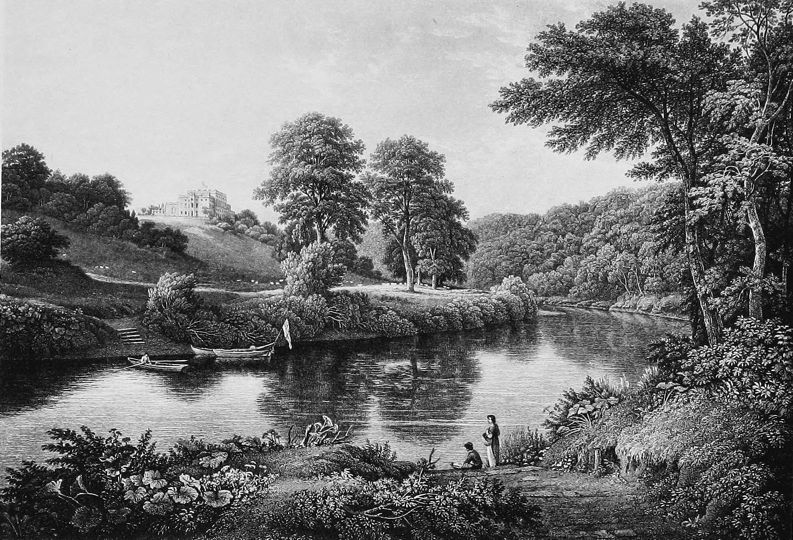
John Glover, P.W.C.S.
Walter L. Colls, Ph. Sc.
Lambton Castle
from the Banks of the Wear
—The scene of the fabulous Worms exploits.
When Durham returned to his own home in the North the General Election was in progress. He, of course, as a peer could take no direct part in it, and he rightly declined to have anything to do with the nomination of a candidate for North Durham, as he held that ought to be the spontaneous act of the electors, quite apart from the territorial influence of anyone. He took the opportunity, however, in response to an urgent appeal, to make his own views on the broad principles at issue clear to the people of the division. ‘This is not a moment when apathy can be tolerated. On the energies and determination of the Liberal party depend the destinies of the Empire. A glorious opportunity now presents itself of strengthening that great cause of Reform and amelioration to which we have been so long devoted. A new reign has commenced. Our Sovereign, with all the cordial confidence of an open heart and generous feeling, has placed herself unreservedly in the hands of a Liberal Government. Let us, by our exertions, justify that step, and add to their means of efficiently serving her Majesty. Let us rally round her throne all that is good, wise, and patriotic in the Empire. Let our watchword be, “The Queen and Liberty!”
‘Educated by one of the best and wisest of her sex, her illustrious mother, our Queen knows that no throne is so secure as that which is based on the affections of its subjects, no crown sits so lightly or so gracefully as that in which are harmoniously blended the liberties of the people and the prerogatives of monarchy. I wish to rally as large a portion of the British people as possible around the existing institutions of the country. I do not wish to make new institutions, but to preserve and strengthen the old. Herein lies the difference between me and my opponents. Some would confine the advantages of those institutions to as small a class as possible; I would throw them open to all who have the ability to comprehend them and the vigour to protect them. Others, again, would annihilate them for the purpose of forming new ones on fanciful and untried principles. I would preserve them, but increase their efficiency, and add to the number of their supporters. I have often stated the modes by which, as I imagine, that efficiency can be most readily produced; but I have ever accompanied those declarations, as I do now, with the announcement of my determination never to force them peremptorily or dogmatically on the consideration of the Government or of Parliament. If they are—as on my conscience I believe them to be—useful and salutary measures, the course of events and the experience of every day will remove the objections and prejudices which now exist, and ensure their adoption whenever they are recommended by the deliberate voice of public opinion.
‘This, in a few words, is my political creed, and no one can look for my co-operation or support on any other grounds. It has been my ruling principle throughout my political life to endeavour to bring all classes, especially the middle and lower, within the pale of the true, not the spurious, Constitution. I have ever wished to give the latter an interest in the preservation of privileges which exclusion would no longer render obnoxious to them—to make them feel that, whilst the Crown enjoyed its prerogatives and the upper classes their honours, they also were invested with privileges most valuable to them, and, moreover, that all, separately and collectively, rested on the common basis of national utility.’
If there remained any lingering suspicion that Durham had lost his old fervour for Reform through his intercourse with the autocratic Court of St. Petersburg, it was dispelled once for all by that noble deliverance.
One of the first letters which followed him to Lambton was from Daniel O’Connell. It was written three weeks after the Queen came to the Throne. He stated that he had in preparation a pamphlet on ‘Ireland and the Irish.’ He described it as a ‘brief but rather quaint and very distinct’ exposition of the evils inflicted on Ireland during seven centuries by English misrule. He declared that it could be read in a quarter of an hour, that it was addressed to the Queen, and requested Lord Durham to submit it to her Majesty, if, on perusal, he found nothing in substance or form to which he could take exception. He told Durham, with characteristic fervour, that the Three Kingdoms looked to him to work out, to its natural and designed intent, the Reform Act, of which he was the chief author. He added that that measure had destroyed the direct power of the aristocracy of birth, but only to substitute, so far, the inferior aristocracy of mere wealth. He added: ‘You are public property, and no part of the Empire desires so much to claim you for her own share of political improvement as Ireland.’ He concluded by stating that Durham’s sentiments on the mode of consolidating the Union represented the only method of rendering it permanent, and were congenial to all right-thinking men in the country.
Durham’s reply was as follows. It bears date July 18, 1837, and was written within a week of O’Connell’s communication: ‘I have delayed answering your letter until I could ascertain whether your project was feasible or not. I find that, constitutionally and honourably, I cannot transmit any communication to the Queen, and that it ought to go alone through her confidential advisers. In these circumstances you will perceive the impossibility of my doing what you suggest. I return you many thanks for your flattering expression in regard to myself. I am at the disposal of my Sovereign and my country. If my humble services can be made available for the honour of the one or the interests of the other, I will not shrink from offering them; but I will confess I am little prepared either in health or spirits for the arduous contest which must take place whenever Parliament meets. Whether I am in the field or not, I earnestly hope that the result will be beneficial to the Empire, and more especially to that much injured portion of it to which you belong.’ Durham always held that the affairs of Ireland had been grossly mismanaged, and his sympathy with her wrongs was deep and lasting.
His views on foreign policy in 1837 were far in advance of the old quibbling traditions which were still too common among statesmen of both parties at the beginning of the Queen’s reign. He said, and his words show how broad was his outlook: ‘I hold that England, in her foreign alliances, has nothing to do with Toryism, Liberalism, or Radicalism. I hold that she can be and ought to be on as good terms of national alliance with the President of the United States as with the Emperor of Russia, and that she ought not to permit her general European connections to be influenced by English politics, whether Whig or Tory be in the ascendent. Conservatism on the Neva, in my view of what is right, is as impossible to be talked or practised by an English Ambassador as Republicanism at Washington, or juste milieuism at Paris, or Metternichism at Vienna. I am for allowing to each country their own institutions, however much they may differ from our own, and attending, not to their internal affairs, but to those external considerations which affect the rights and interests, commercial and political, of my own country.’ It was this largeness of vision which made Durham misunderstood by men of affairs who took short views and persisted in looking at every question more or less from a party standpoint. But, by way of compensation, it won for him in critical years the confidence of responsible statesmen in Europe, who knew that to every question which arose he brought a bold and dispassionate mind.
Lord Grey, who by this time was embittered by his exclusion from office, and has been well described as by nature cold, haughty, and unsympathetic, and, moreover, unimaginative, and without a gleam of humour, regarded the outspoken deliverances of his son-in-law, especially on home politics, with a characteristic touch of impatience. He made no secret of his opinion that Durham was still too much enamoured with the popular demand for an extension of the principles of the Reform Bill, and declared that that was not the way to office, or even to ascendency with what he termed the ‘rational part of the community.’ When Durham was sent to St. Petersburg, William IV. expressed his misgivings at such an appointment. The King thought his opinions altogether too liberal. Palmerston’s comment at the time was characteristic. He declared that his Majesty ought to remember that there was no place on earth where Liberal opinions would be more harmless than at the Court of the Tsar. Durham, regardless of the cheap sneers with which he was assailed on his return because of the honours paid him by the Autocrat of All the Russias, came back to England more in love with liberty than ever, and no statesman in the land was a more pronounced optimist on the threshold of the Victorian era, with its fair promise for new triumphs of the programme of social, no less than political, Reform.
The crisis awakened the sympathy, as well as the fears, of some of England’s best men. When Lord Durham went across the Atlantic he went as the emissary of peace and reconciliation.
Greswell’s ‘Dominion of Canada.’
1837-1838
The rebellion in Canada—Durham offered the post of Governor-General—Melbourne’s disregard of Colonial expansion—‘Little England’ ideas prevalent in 1837—Supremacy of permanent officials at the Colonial Office—A patriotic appeal to the electors of England—Wise and unwise reform—Attitude of the Tory party towards Ireland—Durham accepts the Governor-Generalship of Canada—Bill to suspend the Constitution of Lower Canada—Durham’s speech in the Lords on his appointment—Charles Buller—Edward Gibbon Wakefield, and Thomas Turton.
The first cloud which overshadowed the Queen’s reign arose in the West. Canada was torn with internal strife and openly disloyal. All over the world, wherever the British flag was unfurled, there were public rejoicings when Queen Victoria came to the throne in 1837. But in the churches along the banks of the St. Lawrence, when the jubilant notes of thanksgiving were raised on her accession, the French Canadians sullenly arose, and left, like men who had neither part nor lot in such proceedings. Two months later the storm broke. The story, it is needless to anticipate it, of the origin and the growth of the Canadian rebellion, and the manner in which it was dispelled, is indissolubly linked with the closing phases of Lord Durham’s career, and therefore must be recounted fully in the light which his own letters, despatches, and famous Report throw upon it. Nothing is more certain than that only an over-mastering sense of public duty led him to attempt the reconciliation of the French and English in Canada, the restoration of peace and order to the distracted North American provinces, and the settlement of the grave constitutional questions then at issue. But he had served the nation so well that he was not allowed to rest, though he might well have claimed the right to do so, for his health had visibly suffered, not merely through the long strain of exacting political duties at St. Petersburg, but through personal sorrows and the harsh rigours of the Russian climate.
He had not been six weeks in England, and was just beginning to recover a little of his old vigour, when he was startled by the proposal contained in the following letter from Lord Melbourne:
‘South Street: July 22, 1837.
‘My dear Durham,—I have been anxious to see you to-day, and intended for that purpose to call at your house, but I have been prevented by the number of persons who have come here, and it is now so late that I am afraid of missing you, and therefore I write. The matter which I have to mention is of great importance and also presses. I am aware that what I am about to say is open to great misconception and misinterpretation, but I am confident that you will take it as it is intended.
‘It has long been evident that not only the Government, but the country, is subject to daily increasing embarrassment from the present state of affairs in Lower Canada, and consequently in all the British North American possessions. The final separation of those colonies might possibly not be of material detriment to the interests of the Mother Country, but it is clear that it would be a serious blow to the honour of Great Britain, and certainly would be fatal to the character and existence of the Administration under which it took place. It is, I apprehend, possible that, by the exertion of great abilities, by great prudence, judgment and discretion, by a careful consideration of the real state of those provinces, and by judicious concessions, a catastrophe might be not only postponed, but finally prevented. You are well aware that the qualities requisite for such a task are not possessed by those who are at present at the head of affairs there, and that a change is necessary in order to lose not a chance of arriving at the fortunate conclusion.
‘Now what I wish to ask is, whether you would for a moment entertain the idea of undertaking this duty, and of rendering this great and important service to her Majesty, her Ministers, and the country. You are the fittest man for it, certainly the fittest in my opinion. You have every quality which will enable you to perform such a duty, and your character, your station, your abilities and your principles, all combine to give you a weight and influence, and to command for you a respect and a confidence, which will attend upon no other individual.
‘As I have already said, this proposition may be attributed to motives of present political interest and convenience. If you draw this inference, I must submit to it; but I can assure you that I make it in the full conviction that the question is pressing and full of difficulty, pregnant with danger, and that what I propose would offer to the country the best chance of a favourable issue. I would make the appointment as high and honourable as it can be made, in order, by giving it weight, to give it a better chance of success. If you entertain inflexible objection, dismiss the matter at once and let no more be said upon it; but I feel so strongly the state of peril in which these countries are placed, and also the imminent danger of continuing to trust their affairs in the hands of mediocrity, that I cannot reconcile it to my conscience to omit taking this chance of producing a better result.
‘Believe me, my dear Durham,
‘Yours faithfully,
‘Melbourne.
‘The Earl of Durham.’
Lord Melbourne, as this letter clearly shows, had little faith in the Imperial destinies of England. If that had not been the case, he never could have looked with complacency at the possibility of the ‘final separation’ of Canada from the Crown as a matter not of material detriment to the interests of the Mother Country. He was in truth a Whig of the old school, and, as such, adhered, in spite of the warning which England received in the loss of the American Colonies under George III., to the stiff bureaucratic traditions of the eighteenth century so far as the government of dependencies was concerned. The utilitarian philosophy of Jeremy Bentham was in those days nowhere more in evidence in the sphere of practical politics than in the Whig view of the relation of England to her colonies. That eminent thinker was altogether opposed to an Imperial policy. He contended that it was not the interest of Great Britain to have any foreign dependencies whatever, because, forsooth, the chances of war were increased, and colonies, moreover, seldom were of profit to the Mother Country. Lord Melbourne’s colleagues, with scarcely an exception, evinced the same lack of enthusiasm, and members on both sides of the House of Commons showed a curious apathy, which amounted at times to positive indifference, when matters even of vital interest to the colonies came up for discussion.
Statesmen who ought to have known better, like Lord John Russell and Lord Glenelg, seemed inspired by a belief in the omniscience as well as the omnipotence of Downing Street. Lord John, for example, in 1836, when the House of Assembly of Lower Canada asked for an elective Legislative Council and an Executive Council which should be responsible to it and not to the Government of England, declared that such demands were so inconsistent with the relations which ought to subsist between a colony and the Mother Country that it would be better to say at once—‘Let the two countries separate, rather than for us to pretend to govern the colony afterwards.’ Even Roebuck asserted in 1837 that, whatever course England pursued, the time ‘must inevitably come when all American Colonies will become independent States.’ It was this short-sighted, churlish, pessimistic attitude which rendered the problem which Durham was now asked to solve so difficult and critical. It is possible to understand how the Duke of Wellington, who never forgot that he was a soldier, and always interposed in politics, so to speak, with his hand upon his sword, came to lay down the law that ‘local responsible government and the sovereignty of Great Britain were completely incompatible.’ But it is strange that Liberal statesmen, who had helped to pass the Reform Bill, and might have been supposed to have laid to heart the moral of the War of Independence, proved equally blind to the perils of the situation.
Charles Buller, a man whose services in Canada can never be forgotten, during the memorable period when he worked at Durham’s side as Chief Secretary, described admirably the deadlock which existed in regard to the government of the colonies at the beginning of the Queen’s reign. He declared that the general indifference of Parliament to colonial questions was fatal, since it resulted in the entire absence of efficient control either over the making or the administration of laws for our great dependencies. ‘In nine cases out of ten, Parliament merely registers the edicts of the Colonial Office. It is there that nearly the whole public opinion which influences the conduct of affairs in the colonies really exists. It is there that the supremacy of the Mother Country really resides; the centre of this responsibility is the occupants of the large house that forms the end of that cul-de-sac so well known by the name of Downing Street.’ Buller maintained that however colonists, or others, might talk of the Crown, the Parliament, or the public—of the honour of the first, the wisdom of the second, or the enlightened opinion of the last—nor Queen, nor Lords, nor Commons, nor the great public itself exercised any appreciable power or thought on the more important aspects of Colonial affairs. The appeal to the Mother Country, he did not hesitate to add, was in reality an appeal to the ‘Office.’
He scouted the idea as altogether erroneous that the Colonial Secretary, even though he had a seat in the Cabinet, was supreme at the ‘Office.’ Scarcely any post had witnessed so many changes, with the result that no one in recent years had really grasped the significance of the task entrusted to him. As a matter of fact, in eleven years there had been no less than ten different Secretaries of State for the Colonies, and, in consequence, each in turn had been dependent to a perilous degree on the permanent officials. They were a class of men who, whatever other merits they might possess, lived in a narrow world of official routine, were not able to follow, much less to gauge, either the convictions or the prejudices which lay behind the demands of a country like Canada, were out of sympathy with the aspirations of its people, and stood aghast when a problem arose which could only be settled by some bold scheme, which, whilst granting colonial liberty, would retain, undiminished and unimperilled, the imperial ascendency of the Crown. Statesmen like Lord John Russell, ‘whilst not prepared to give immediate independence’—the words are his own—regarded the possibility of being compelled to take such a step with strange complacency. The burden, but not the glory, of Empire was realised; the chances of war and disaster were seen all too well, but not the opportunities of advancement, the wealth of vast and undeveloped resources, or the moral prestige.
Durham’s private letters in 1836-7 reveal how eagerly and constantly he longed during his two years’ residence at the Court of St. Petersburg for the quiet of his ancestral home at Lambton. Those two years in Russia had been crowded with difficult tasks, especially during a term of critical months, when but for his wise and conciliatory attitude the chances of war between Russia and England were by no means remote. He had come home, as it was said at the time, with flying colours, though with impaired health, and it was evident to all who saw him that he needed rest. Yet before he had been two months in England he was urged to cross the Atlantic, when that was a much more arduous journey than it is to-day, and to do so in order to undertake a mission which involved, even on Lord Melbourne’s own showing, tremendous risks.
The wonder is, not that he at first refused to undertake the task which the Prime Minister pressed upon him in July 1837, but that he eventually yielded to the renewed appeal of the Government in January 1838. If he had consulted his own inclinations, or listened to the advice of those who knew him best, he would have remained in England. He had the confidence and respect, in an unwonted degree, of the young Queen; and the Radical party saw in him the most probable successor to Melbourne in the Liberal ranks. The new reign brought untold possibilities of progress; the young Queen, unlike her uncles, took her exalted position seriously, and that, in itself, meant that the great influence of the Court was thrown in the direction of liberty. It seemed to Durham’s friends—and they were many and enthusiastic—that the great opportunity of his life was dawning. He had kept clear of the mistakes and humiliations which had discredited the Melbourne Administration, and he, more than any other man, stood for the aspirations of the Radical party, aspirations which the existing Government had persistently flouted. He represented, not merely the solid achievements of the Reform era, but the new impulse, half romantic and half practical, which the advent of the young Queen Victoria had awakened in the nation.
Edward Ellice, who had heard of Lord Melbourne’s proposal, wrote, as the summer wore on, to ask Durham whether he intended to accept the onerous position which had been so unexpectedly pressed upon him. His reply shows that at that time his mind was made up:
‘Lambton Castle: August 27, 1837.
‘My dear Ellice,—I am not going to Canada, and have nothing to do with the settlement of that unfortunate question. Lord Melbourne was kind enough to express his opinion to me that I had the requisite qualities, above all men he knew, for arranging it. But as I could not give him any hopes of my undertaking the business, the matter began and ended with his good opinion of me, and my sense of his compliment. This occurred when you were out of town, on your road to Ireland, and I had no opportunity of asking your advice—indeed, there was no room for it—for, both considering my own position and that of others, the thing was out of the question. Of course, if I had felt the possibility of my usefully undertaking it, you would have been consulted, on account of your connection with that country and your general good judgment.
‘Yours ever,
‘Durham.’
Keenly interested though Lord Durham was in the menacing situation which was rapidly developing in Canada, he felt—and all his friends were of the same opinion—that it was not his duty to attempt the solution of the great constitutional question which had suddenly loomed on the horizon. There were questions nearer home which he thought he might help to settle, and his own private affairs claimed his attention. Meanwhile he made no secret of his views. In a speech delivered in the North, at a great Liberal gathering in October 1837, at which he received an extraordinary ovation, he referred to his own life-long association with the county of Durham, and urged those whom he addressed to recollect that the new responsibilities of an extended suffrage imposed greater duties, and ought to render idleness impossible to all who had the interests of England at heart. ‘You must put your shoulders to the wheel, and work as others have worked before you. I will ask you whether my own has been a life of idleness—whether, in reference to the political affairs of the country at large, or to the provincial business of the county of Durham, it has not been a life of hard-working industry? I have sacrificed even the consideration of my private affairs to the general advantage of the country. Have I not a right, then, to call on you to exhibit something of the same spirit?’
Durham declared his allegiance to the bold programme which he announced in 1834 in Glasgow. He still adhered to Household Suffrage, Triennial Parliaments, and Vote by Ballot, but he told them now, as he had told them in Glasgow then, that he would never attempt to force them upon the nation in a dictatorial spirit. ‘If I have read history aright, when great changes in the polity of States have miscarried, it has been because those who proposed them have endeavoured to force their doctrines on the people before they were ripe to receive them. The true and wise reformer prepares the ground and sows the seed, affords time for its ripening, and when the season for reaping the harvest arrives has the proud satisfaction of having attained an object of the highest importance to his country without having forced it against their feelings and convictions. Such have been, and such always will be, my principles; and such my course of conduct. While I live I will never lose sight of those measures which I think best calculated to promote the honour and interests of the nation; but, at the same time, I will never refuse to give the freest scope to the arguments and feelings of those who differ from me in opinion.’
He went on to say that his own convictions were unchanged, and to add that he saw no reason to alter them. ‘If I had seen any reason for change it has been such as would strengthen rather than impair them. For what has happened since I declared them at Glasgow in 1834? The English Corporation Bill has been passed, in which household suffrage has been established as the qualification for voting. The Town Councils are elected, not by 10l. occupiers, but by householders, who react upon the Parliamentary constituency; and if they can be entrusted with the municipal franchise, surely they may safely possess the privilege of electing members of Parliament. With regard to the Ballot, I stated in 1834 that it was advisable. Now every day’s experience adds to the number of its supporters. The last election has increased them a hundredfold. What do I mean by the Ballot? I do not mean alone the wooden box or the six letters that spell the word. I mean independence to the voter. Even the opponents of the Ballot declare that they are anxious to give him that, but unfortunately they deny him the only means of securing it. If any other mode of effecting this object can be found, I, for one, shall be most ready to adopt it. My wish would be, were I a member of the House of Commons, that I should be elected by the true and conscientious convictions of my constituents, and not by force and intimidation.’
He said further that ‘Providence at last has blessed the country with a Queen who loves and protects all classes of her subjects, whether Protestant or Catholic, Churchmen or Dissenters, and who scorns to be the Sovereign of a faction or the ruler of a section of her Empire.’ He deplored the attitude of the Tory party towards Ireland. There were few subjects which moved him more deeply than the wrongs of that country. ‘The Irish Catholics, notwithstanding centuries of Tory persecution, have grown up in wealth, industry, and education. They form 7,000,000 of our fellow-subjects. They are not “aliens,” but part and parcel of the British Empire.’ Yet, if the appeal to religious bigotry, which was so industriously fomented in certain quarters, succeeded, the Irish, in Durham’s opinion, would be reduced to outlaws. The whole speech, which contained rebukes to the extreme Radicals as well as to the ultra-Tories, showed the country that Durham’s official position at the Court of St. Petersburg had not altered by a hair’s-breadth the clean-cut, courageous convictions which had given him, in the stormy days of the Reform struggle, his hold on the confidence as well as the imagination of the nation.
Durham declared, in the autumn of 1837, that he had but one political object in the world, and that was to serve his country, and it was that desire alone which induced him to reconsider his decision about Canada. What led him at last to consent was an over-mastering sense of public duty. Between Lord Melbourne’s first and last appeal to him, the situation had suddenly grown dramatic. Canada, in 1837, was in revolt. The Queen’s authority was openly challenged; a great calamity, the issues of which no man could forecast, darkened the fair promise of the new reign. Lord Gosford’s weak government of the North American Provinces was ending in a pitiful confusion and an abject collapse of authority. Conscious of his own inability to stem the rising tide of disaffection, Lord Gosford asked for his recall, which was granted, and that valiant old soldier, Sir John Colborne, afterwards Lord Seaton, was placed in temporary authority. It was at this crisis that Lord Melbourne once more appealed to Durham to go to Canada, and, to his honour, he rose to the occasion. Lady Durham states that he was only induced to take this momentous step after ‘much solicitation,’ and it was not until the middle of January 1838 that he finally made up his mind to accept an appointment, the difficulty of which no one attempted to disguise.
The condition of affairs in Canada was so disquieting at the end of the year that Parliament reassembled much earlier than usual, in order that Lord John Russell might bring forward the Government’s drastic proposal for dealing with the situation. It seemed at one time during the recess as if the Melbourne Cabinet would come to grief over the question of Canada. For a time Ministers were hopelessly divided as to the best course to pursue, and Melbourne, at the end of December, was almost in despair. He admitted that the chances of a collapse of the Government through Cabinet dissensions over Canada was by no means unlikely. But before the first week of the new year had passed, Lord Howick, the last and most strenuous of the objectors to the policy ultimately adopted, gave way, and the Prime Minister was free to approach Durham once more on the subject.
‘Windsor Castle: January 7, 1838.
‘My dear Durham,—I enclose you a sketch of the Bill which it is intended to introduce into Parliament upon its re-assembling, and at the same time I have to express the earnest wish of myself and my colleagues that you would undertake the arduous task of carrying it into effect by assuming the government of the British North American Provinces. I am aware that this is not a tempting offer, nor unattended with great risk and hazard to him who accepts it, but it is an opportunity of rendering great and essential service to your country in a great emergency.
‘You will perceive that the measure confers very large powers, and it is highly to be desired that the character of the individual selected should be such as to justify the extent of the authority given, and to be a security for the exercise of it. Many of my colleagues would not be induced to concur in giving such powers unless to a person, like yourself, of great personal weight and of known popular and liberal principles. It will of course be necessary to make the appointments correspond with the dignity of the mission.
‘You will, I am sure, at once admit the importance that it is to all of us that a decision should be come to without delay upon this matter, and you will also feel the necessity of abiding firmly by the decision when once taken. Glenelg will be ready to give any further explanation of the details, and, if you are desirous of conversing with me upon the subject, I will come up to town on any morning for the purpose.
‘Believe me, my dear Durham,
‘Yours faithfully,
‘Melbourne.’
Durham took a week to make up his mind. He realised, more perfectly than the statesman who pressed the appointment upon him, all that it involved; but the interests of England were at stake, and the knowledge that the Queen personally desired him to undertake so perilous a mission led him, though not without misgivings, to look favourably upon a task which a less patriotic man, with his record, might well have shunned. It was not until the eve of the meeting of Parliament, when an official intimation of some sort was imperative, that he finally came to a decision. He hesitated till the last moment, swayed in one direction by a sense of public duty and in another by his desire, after so long an absence in Russia, to remain in England, a desire which was shared to a pathetic extent by his devoted wife, who knew full well that his health was unequal to so great a strain. The unselfish motive it was which prevailed.
On January 15—Parliament was to meet on the morrow—he wrote to Lord Melbourne: ‘I will consent to undertake this most arduous and difficult task, depending on the cordial and energetic support of her Majesty’s Government, and on their putting the most favourable construction on my actions.’ Melbourne replied the same day, expressing ‘great satisfaction’ at this decision, and adding words which read strangely in the light of all that was so soon to happen. ‘I can assure you that I consider you as making a great sacrifice for the chance of doing an essential service to the country. As far as I am concerned, and I think I can answer for all my colleagues, you will receive the firmest and most unflinching support.’ Lord Melbourne further stated that he had received the Queen’s commands to ‘express her anxious wish that you should undertake this important and difficult duty, a wish which her Majesty herself will repeat to you in person.’
Next day Parliament met, and Lord John Russell brought into the Commons a Bill for the suspension of the existing Constitution of Canada. He explained in outline the scheme of the Government, and made it plain that, when the Queen’s authority had been vindicated, a full inquiry was to be made on the spot into Canadian grievances with a view to their practical redress. The Government had determined to send out a Governor-General as Lord High Commissioner, armed with exceptional and even extraordinary powers, not merely to deal with the rebellion, but also invested with full power to remodel the Constitution of Canada. He laid stress on the imperative necessity that such great powers could only be exercised with advantage by a man of exceptional knowledge and ability. ‘I think it is most important that the person to be sent from this country ought to be one whose character and conduct should be beyond exception—a person conversant not solely with matters of administration, but with the most important affairs which are from time to time before the Parliament of this country. I think he should be conversant also with the affairs of the various States of Europe, and, moreover, that it should be implied by his nomination that he was not at all adverse to all opinions the most liberal, and favourable to popular feelings and popular rights. Having said this much, I know not why I should refrain from adding that her Majesty has been pleased to entrust the conduct of this affair and these high powers to one whom her advisers think in every respect fitted for the charge—namely, the Earl of Durham—and that noble lord, having accepted the office, will proceed in due time to perform its important duties.’
Without loss of time the Bill to suspend the Constitution of Lower Canada until November 1840, and to enable the Governor-General and Council to frame and pass any laws they might consider requisite during the suspension of the Legislature, was brought in, and provoked a somewhat stormy and prolonged debate. Roebuck, who was then out of Parliament but was acting as agent in England for the House of Assembly of Lower Canada, on the motion of Grote on the second reading, was heard at the bar of the House, and made a wild speech distinguished by declamation rather than argument against the measure, and also did his best outside Parliament to provoke through the Press, though happily without success, hostility in the country. Disraeli, who was present at the debate, declared that Roebuck’s speech was sharp and waspish, and rendered him ‘ridiculous’ when he posed as the representative of the nation arraigning the Ministry of high crimes and misdemeanours. The discussion went on for two nights, and, though captious objections of one kind or another were made by ultra-Tories and ultra-Radicals, the second reading was carried by a majority of 246.
Two points were made perfectly clear by the debate. One was the extraordinary ignorance on both sides of the House as to the real condition of Canada, and the other the universal feeling that, if autocratic powers were to be entrusted to any man, the Government could not have made a better selection than Durham. Gladstone quoted the magistrates of Montreal as stating that no jury, called in the ordinary course of the law, would convict turbulent and disaffected persons, even if it had been proved that they were guilty of inciting the peasantry to rebellion. Sir William Molesworth, who was jealous of anything in the nature of coercion, declared that, while he was reluctant to pin his faith to any man, he felt confident that Durham, if left to the unfettered exercise of his judgment, would accomplish the object of his mission. Grote spoke in similar strains, whilst Hume attested that he should be sorry to see the ‘despotic power granted by that Act—for despotic it was in every sense of the term—exercised by any person but Lord Durham, to whom he had no objection to confide it.’ Nothing was more certain, before the third reading was passed, than that statesmen of all parties in the House of Commons, from Lord John Russell and Sir Robert Peel down to the rank and file on either side, recognised that, if Durham went to Canada at all, he went armed with powers such as had never been before entrusted to any other servant of the Crown. In the Lords, Brougham spoke for three hours against the Bill, without, as Lansdowne afterwards said, so much as touching the real point at issue.
Whilst all this was happening in Parliament, Lady Durham wrote a letter to her sister, in which she says: ‘I am beginning to think, after all the pains we have been taking to reconcile ourselves to the Canada expedition, we may perhaps not be called upon to make any efforts on the subject. The matter seems very hard to settle. I hear of nothing but disputes and disagreements, of which I cannot pretend to judge, and nobody seems confident of a majority for Ministers in the House of Commons. I suppose it is wrong not to wish for them more cordiality, but I cannot help feeling that I could not lament it if they were turned out and we were saved from such an undertaking.’
When the Bill was under consideration in the House of Lords, Durham made a speech, so frank, manly, and convincing as to win universal approval, and in it he sketched in bold outline his proposed policy. ‘It is impossible for words to express the reluctance with which I have consented to take this arduous task, and nothing but the most devoted attachment to the service of my country could have induced me to place myself in a situation in which I very much fear I shall not answer the expectations, either of my noble friends who placed me there or of the nation generally. I believe that my duty in the first place will be to assert the supremacy of her Majesty’s Government, to assert the dignity and honour of the British Crown, and to see that the law is carried into execution—that it is not set aside in the remotest cabin or in the most distant settlement. Having effected that necessary and essential preliminary object, I shall consider without reference to party—casting aside all reflections that may concern either British or French—that I ought to extend protection to all, give justice to all, and endeavour to protect as much the local rights and privileges of those who are the possessors and proprietors of the soil, as the great commercial interests which affect those who are called the British settlers.’
He protested against the idea, as one which was entirely misleading, that he was going out to suspend the Canadian Constitution. The Constitution, as a matter of fact, had already been suspended, not by any Act of the British Parliament, but by the actual rebellion of the Canadians themselves. ‘I consider, therefore, that I go there for the purpose of endeavouring to provide, as well as I can, for the extraordinary state of circumstances which has been produced by the rebellious part of the Canadian community, and which has rendered it impossible for the Constitution to continue in operation. These are the views with which I shall consent to undertake what I admit to be a great and awful responsibility. These are the views with which I shall enter upon the exercise of powers greater, I know, than are usually entrusted to the discretion of an individual. Great and dictatorial as these powers are, I shall be anxious to lay them down at the earliest possible moment.
‘Believe me, my Lords, I shall endeavour to execute as speedily as possible this highly honourable but most difficult and dangerous mission. As far as concerns the principal province (Lower Canada), it will be my wish to effect such a kind of settlement as shall produce contentment and harmony amongst all classes, enable me to establish, not temporarily but lastingly, the supremacy of the law, and, finally, to leave behind me such a system of government as may tend to the general prosperity and happiness of one of the most important portions of her Majesty’s dominions. If I can accomplish such an object as that, I shall deem no personal sacrifice of my own too great. I feel, however, that I can only accomplish it by the cordial and energetic support—a support I am sure I shall obtain—of my noble friends the members of her Majesty’s Cabinet, by the co-operation of the Imperial Parliament, and by the generous forbearance of the noble Lords opposite to whom I have always been politically opposed. I go to restore the supremacy of the law, and, next, to be the humble instrument of conferring upon the British North American Provinces such a free and liberal Constitution as shall place them on the same scale of independence as the rest of the possessions of Great Britain, and as shall tend to their own immediate honour, welfare, and prosperity.’
Unfortunately for the best traditions of English public life—in spite of the ‘applause from all parts of the House’ with which this statement was greeted—Durham received in Canada neither the ‘cordial co-operation’ of the Ministry nor the ‘generous forbearance’ of his political opponents. He was thwarted and hindered at every stage of his mission by those on whose loyal adherence he implicitly relied, and when he was assailed with vindictive rancour by men like Brougham and Lyndhurst, who notoriously had axes of their own to grind, he was deserted at a most critical juncture—after a half-hearted show of defence—by the Melbourne Administration. It will be the purpose of the pages which remain to throw into relief both the magnitude of the work which he achieved and the nature of the betrayal, which clouded for the time his reputation and broke his heart. To-day, all men admit the greatness of his political prescience, and the scope and quality of his work; but the pity of it all is that one of the most brilliant and disinterested servants of the Crown was sacrificed by the Ministry, at the climax of his career, to political clamour and passion, although Melbourne and his colleagues had pledged themselves to give him at all hazards ‘the firmest and most unflinching support.’
When once Durham’s appointment was ratified, he set about with characteristic energy to surround himself with men who were likely to help him in his onerous task. The most remarkable of them in every sense of the word was Charles Buller. Durham could not possibly have chosen as First Secretary a more enlightened or more chivalrous man. Claims have been advanced on behalf of Buller which will not bear scrutiny, and which he himself would have been the first to repudiate. Internal evidence is enough to show, even if nothing else was forthcoming, that Durham, to all practical purposes, wrote the memorable and, indeed, classic Report on British North America which bears his name, gave Home Rule to Canada, and broadened, once for all, the lines of constructive statesmanship in all that relates to the colonial policy of England. Buller’s services to Durham were so great, his co-operation with him so unstinted, his attitude in the closing days of a great career so chivalrous, that nothing shall be said in these pages, even if that were possible, to diminish his just and honourable claims to remembrance as a capable, far-sighted, and loyal colleague in the redress of the wrongs of Canada. This pupil of Carlyle and friend of Durham was in every sense an exceptional man, and these final chapters will fail in their purpose if they do not make that fact more plain than it has ever been before, by the records of his words and work in the strenuous and critical months when, under Durham’s direction, he gave himself with splendid and undivided devotion to the task of unravelling the confused threads of Canadian affairs, and of evolving out of the discord of conflicting ideals the foundations of a permanent and worthy settlement of the relations of the Crown to the Colonies.
Charles Buller, on the advice of Edward Irving, became, in 1822, a pupil of Thomas Carlyle, and so began a friendship, intimate, and even tender, which was only terminated by the sudden and untimely death of the brilliant young statesman in 1848. Buller owed much to Carlyle, and not least the scorn of mere political expediency and the hatred of half measures in the presence of injustice. Seldom has a more beautiful eulogy been written on the morrow of a man’s death than the glowing tribute which was penned at Chelsea, when the author of ‘Sartor Resartus’ was told that one of the few real friends he possessed, an old pupil in whose growing Parliamentary distinction he took the keenest interest, had passed away at the moment when he stood, to all human seeming, on the threshold of a great public career. Carlyle used to say that Buller was the ‘greatest Radical’ he had ever met, and other people—a wide and distinguished circle—were quick to endorse the verdict. Buller was not merely shrewd and witty—so witty indeed that it seemed at one time as if his smart sayings were likely to hinder his preferment—but singularly kind-hearted, and as brave as he was transparently honest. Bulwer Lytton’s couplet deserves to be recorded:
Farewell, fine humorist, finer reasoner still,
Lively as Luttrell, logical as Mill.
Such was the man who, at the age of thirty-two, was summoned by Lord Durham to his side when he determined to accept the Queen’s commission to restore peace and goodwill in Canada. Durham had no reason to regret his choice of Charles Buller, and if the latter had lived there can be little doubt that he would have vindicated, as only he could have done, Lord Durham’s conduct in Canada. He died too early, however, to write that full vindication of his old chief’s policy which would have rendered the present narrative superfluous; but, fortunately, four years before his death he wrote a manuscript of one hundred and fifty pages, entitled, ‘A Sketch of Lord Durham’s Mission to Canada,’ which he left in the possession of that statesman’s family. It forms a fascinating and valuable chapter in the annals of colonial policy, and has never been printed. It has been placed, however, at the disposal of the present writer, and from it many significant quotations will presently be given. It contains a succinct view of the state of affairs with which Lord Durham had to deal, of the incidents which occurred during his presence in the colony, of the steps that he took to overcome the immediate difficulties which he had to encounter, and of the plans by which he proposed to put the government of British North America on a basis of permanent tranquillity, freedom, and progress. One quotation, for the moment, alone is necessary—an account of the circumstances under which the two men came together:
‘My personal acquaintance with Lord Durham only commenced in the summer of 1837 on his return from Russia, and I had seen very little of him at the time when the Bill for the temporary government of Canada was brought into Parliament. Absolute as the necessity for some such measure was, it would have been very difficult to get the assent of all parties to the establishment of such a power in the hands of any other individual than Lord Durham. So high did he stand in the estimation of all parties, that the Tories were obliged to be as unanimous in their acquiescence as the Liberals of every shade were in their loud approval. His memorable speech in the House of Lords on the night that the measure was first announced in it increased the feeling of confidence in him. Such an occasion admitted indeed of no display of reasoning or information, but Lord Durham’s short speech showed that he was actuated by firm determination and a spirit of most impartial justice; it marked a deep sense of the heavy responsibility which he had taken upon himself, and breathed a chivalrous reliance on the cordial support of friends and the generous forbearance of opponents that made both of them affect a show of such feelings, and led the public to believe that they entertained them. This was most unfortunate for Lord Durham, for it led him to expect cordial support and generous forbearance where prudence would have induced him to count on one as little as the other, and thus have spared him the pain of the double disappointment which he afterwards experienced.
‘It was a day or two after this speech that Lord Durham, whilst sitting under the gallery of the House of Commons, desired me to call on him the next morning. Anticipating the purpose for which he desired to see me, and having had a good deal of discussion with my own family, I went to the interview, having made up my mind not to accept any offer of going out to Canada. Lord Durham made me the proposal in very flattering terms and with much kindness. I was not very easily induced to change my resolution, but he desired me to take a little time for consideration ere I gave my final answer, and the result of re-consideration and of consultation with friends was that the next morning I accepted the offer.’
It would have been well for Durham if he had been equally happy in the choice of his other lieutenants, but such was not the case. Neither Mr. Edward Gibbon Wakefield, nor Mr. (afterwards Sir Thomas) Turton, was a man above suspicion. Their capacity was undoubted, but on the score of character they had lost ground, though not to the same extent, in public estimation, and though they brought, in the one case, trained administrative capacity, and in the other legal acuteness to the problems at issue, they were, on other and delicate grounds, unquestionably a source of weakness in Lord Durham’s mission. Turton probably owed his appointment partly to the fact that he won a measure of distinction at the Bar in Calcutta, and partly because he was an old schoolfellow of Durham’s at Eton. Always chivalrous in his attitude towards men who had come to grief in life, Durham saw the opportunity of helping, as Charles Buller puts it, an ‘old and unfortunate friend’; but that alone would probably not have led him to take a man of such reputation with him if his former private secretary, Mr. Stanley, who was now in the Cabinet, had not suggested the appointment to him, and another Minister, Sir John Cam Hobhouse, on whose judgment he placed reliance, had not warmly seconded the proposal.
Buller admits that Turton went out without the written approval of Ministers, but he adds that it was distinctly arranged between them and Lord Durham that, though the appointment was not to be made by Ministers or in England, ‘Mr. Turton was to go out with us, it being left to Lord Durham to appoint him to office on his own responsibility after our arrival in Canada.’ In other words, Lord Melbourne and the Cabinet, although they did not sanction the step, were perfectly aware that Mr. Turton accompanied Lord Durham, on the understanding that he was to be employed in a responsible capacity when the actual work of the mission began in Canada. The importance of such a fact will be seen in the light of what subsequently happened. At the last moment Melbourne took alarm and urged Durham to throw Turton over. Melbourne, as a censor of morals, was scarcely impressive, and Durham, with certain episodes in the Premier’s antecedents fresh in his mind, did not relish such interference, especially as he felt that he had acted quite openly in the affair.
Gibbon Wakefield—it is idle in his case as well as in that of Turton to rake up old scandals—was in every sense a man of much greater account. So far as his personal character is concerned, it is enough to say that he injured and well-nigh ruined his chances in life on the threshold of his career by a social indiscretion—which brought him into conflict with the law. In spite of his courage, generosity, and skill in the management of men, his career was further marred by faults of temper and lack of self-control. It is impossible to ignore either his faults or his foibles, but, when so much is admitted, he was a man of extraordinary political vision, who saw what Downing Street in those days had never dreamed—the possibility of building up, by timely concessions and bold statesmanship, a Greater Britain beyond the seas. Though boisterous and self-assertive, he was as astute as he was magnanimous. There must have been something really great in a man who, at a time when the follies of his youth seemed to have eclipsed his chances of public service, rose steadily by sheer force of character, and by splendid achievements for the State, to the position which he ultimately held of the most commanding public exponent of the right methods of colonial expansion. It was Durham who gave Wakefield, at a time when he was still regarded as a political theorist, the opportunity, which he so amply redeemed, first in Canada and afterwards in the Antipodes. Wakefield had already published the remarkable ‘Letter from Sydney,’ and his luminous exposition of the ‘Art of Colonization,’ but, in spite of his splendid abilities, his way was blocked because of the shadow which rested on his early character. Durham saw the potential strength of the man, and, to his honour, held out the right hand of fellowship, and gave him the chance, which a statesman of less prescience and courage would have denied.
Wakefield’s work in Canada was altogether remarkable, and, though Lord Durham had to suffer at the time for his allegiance to such a man, it may be doubted whether, without Wakefield’s assistance, a scheme as wise and as bold as that set forth in the pages of his classic Report could ever have been formulated. Wakefield was, in truth, a path-finder in the thorny wastes of colonial policy, and the New Zealand Company of 1839 is perhaps his noblest monument. It is easy to say, and in one sense it cannot be denied, that Durham imperilled the success of his great enterprise by calling to his aid at the outset men at whom it was easy to throw stones. Like every man who braves public opinion, he had to pay the penalty, at the moment, in cheap pharisaical condemnation. But the end justified the means. Gibbon Wakefield and Turton—the former in a great sense, and the latter in a real, though less known, way—did not disappoint the generosity which led Durham to give them another chance in public life.
Of Durham’s ability there has been no question. Of his personal honour and character there has never been a doubt. He was one of those men who are born to exercise authority, who may be managed, but not contradicted—Kingsford’s ‘History of Canada.’
1838
Durham’s departure for the West—Sydney Smith and the ‘overtures’—Work on board the Hastings—Hostility of French Canadians—Suspicious movements of the United States—Dissensions of British settlers—Outline of the political history of British North America—The Clergy Reserves—Defiant conduct of Mackenzie and Papineau—Lord John Russell’s narrow Colonial views—Rule of Lord Gosford and Sir John Colborne—The political prisoners—Suspension of the Habeas Corpus Act.
Although Lord Durham was impatient to get to work, a variety of small difficulties arose, too tedious to recount, and it was not until the spring was well advanced that he actually sailed in H.M.S. Hastings on April 24, 1838. Charles Buller perhaps exaggerated the gravity of this delay. He asserted that it took the bloom off the mission. The revolt in Canada, though it broke out again later, was for the moment suppressed; the danger, in consequence, seemed less urgent, and the general conviction of the necessity for great powers and unusual measures was somewhat weakened. Political opponents began to draw invidious comparisons between Durham and Sir John Colborne, and to deprecate the moral effect of the powers of the new Governor-General. The Tories, recovering from their alarm at the possible loss of Canada, took up a carping attitude, which the newspapers that reflected their views were not slow to adopt, with interest.
Charles Buller has described the actual departure, and so also has the Countess of Durham in the minute and touching journal, hitherto unpublished, which she began at sea, recounting from a woman’s standpoint all that happened to her illustrious husband in Canada.
Lord and Lady Durham, with their children and suite—a party in all of twenty-two—embarked at Plymouth, and Charles Buller describes the scene. Durham, worn and ill, came on board, looking very pale, and wrapped in a large cloak, amid all the parade of a naval reception. ‘Painful thoughts arose within me at the sight of a man so distinguished leaving his country with his whole family in what, though an honourable, was still a painful exile and a duty of arduous responsibility, and when the band struck up its loud and slow strain the sudden excitement brought the tears at once to my eyes. I did not long indulge these feelings. I thought that this was but a passing and necessary trial attendant on the outset of a career of high utility and honour, of which the first glory would be the pacification of Canada, and the ultimate reward renown, power, and happiness at home. But the foreboding of the first moment was unfortunately more prophetic than my calmer afterthought. In one respect we did most certainly merit success, for never, I believe, did man embark on any public undertaking with more singleness and honesty of purpose.’
Always fond of music, Durham took care to be provided with it on a voyage, formidable enough before the days of steam. That circumstance was duly chronicled in the newspapers, and it recalls a brilliant jeu d’esprit of Sydney Smith. That inimitable wit was one of the departing Governor-General’s personal friends, and, to his credit, he never wavered in his allegiance to a statesman whose courage and capacity were exactly of a kind which appealed to him. When someone expressed surprise to Sydney Smith that Durham took out so many musical instruments with him amongst his personal belongings, he instantly replied that he did not wonder at all, and added, ‘Don’t you know that Durham is going to make overtures to the Canadian people?’
A letter written by Charles Buller to his friend Mr. E. J. Stanley, from on board the Hastings on April 25, and taken back by the pilot, shows that the sea breezes quickly restored his gay humour. ‘Thus far we have gone on prosperously with a fair wind and no storm. A slight drawback to our enjoyment is that all the ladies, except Lady Mary (Lambton), are sick. My brother (Arthur) is the only suffering male; thus strikingly does the superiority of our sex display itself in the great deep. We pass our time as Britons usually do on such occasions; a large portion is spent in sleep, much in eating, some hours in tramping up and down deck, and but little in prayer. The band is agreeable, and when we hear it play we do not much regret the chaplain. The “Dictator” and I have lightly skimmed over the surface of the gigantic project for the welfare of the Canadians. In a day or two we shall bring our mighty minds to trying to reduce them to practice. Do you, in the meantime, take care of the Ministry. Whip well, and do not quarrel with Ellice.’
As Buller predicted, they had scarcely got out to sea before Durham, with characteristic energy, settled down to business. He always maintained that Durham took little thought about himself, and that on the voyage the one thing uppermost in his mind was how to promote the best interests both of Canada and Great Britain. The ‘Dictator’ worked steadily for many hours each day over his voluminous papers, and kept his secretaries, as well as himself, fully employed. Buller makes it plain that he was not at first in complete agreement with the views which his chief expressed. He thought that Durham had too strong a feeling against the French Canadians, on account of their recent insurrection, which he himself was inclined to defend as having been provoked by what he called the ‘deplorable imbecility’ of Downing Street. Buller argued that the ultimate purposes of the French Canadians were right, and maintained that they had been driven into rebellion by the high-handed folly of others. Durham, whilst admitting the force of all this, took, as Buller afterwards admitted, a far sounder view of the matter. ‘He saw what a narrow and mischievous spirit lurked at the bottom of all the acts of the French Canadians, and, whilst he was prepared to do individuals full justice, and to temper justice with mercy, he had made up his mind that no quarter should be shown to the absurd pretensions of race, and he must aim at making Canada thoroughly British.’
Paramount as were the questions at issue concerning Canada, they did not exhaust the long and earnest discussions which day after day took place in the saloon of the Hastings. People who thought Durham haughty and distant had never seen him when he unbent, for then at least everyone surrendered to the charm and vivacity of his talk. ‘I look back,’ says Buller, ‘with satisfaction to the interesting views which Lord Durham often gave me of the great questions of European policy, and of the important events in which he had borne so great a part. Many a stirring scene of old political conflicts did he recount, and many a secret history did he give which explained the nature and causes of some of the great political movements of our time.’
In spite of work and talk and music, and, occasionally, amateur theatricals, Durham grew restless. He was eager to take up the reins of government, and was impatient when a dead calm in the Gulf of St. Lawrence delayed his arrival. When at last the ship came into touch with land, the first tidings that reached him were not reassuring. The French Canadians had taken up a sullen attitude, and, though they appeared to be inactive, there was a general apprehension, for that very reason, that they were plotting some new attempt. The people of the United States were represented as fomenting the designs of the disaffected colonists, and had taken up a position of scarcely veiled hostility. The British population of Lower Canada, on the other hand, was torn in pieces by fierce dissensions.
An entry in Charles Buller’s journal, made when the ship was slowly creeping up the St. Lawrence, shows how he interpreted the news contained in the bundle of Quebec newspapers, which by this time had come on board. A violent party in Lower Canada, he says, whilst it called for war with the United States and for the harshest measures against the French Canadians, kept no terms with its own Government, and denounced both local and imperial authorities in the most unmeasured language. ‘We learned that a few days before—in anticipation of our arrival—a meeting of the British population had taken place at Quebec. At this the violent party appear to have carried the day. Various speakers had used language expressive of very little confidence in the Governor-General, and an address had been adopted, which, though it contained nothing positively offensive, showed the bad spirit that animated those who had assumed the lead of what was called the British party. This intelligence, disagreeable as it was, proved, nevertheless, of use, because it prepared Lord Durham beforehand for the kind of feeling and language which he was to meet with on landing. And during the two or three days that elapsed before our arrival at Quebec he prepared the Proclamation to the inhabitants of British North America, which he published on disembarking.’
Here, whilst the good ship Hastings is making her way as rapidly as possible up the St. Lawrence towards Quebec, it may be as well to prefix the story of Lord Durham’s reception in Canada with a brief survey of the existing political conditions, as well as the constitutional problems which he had crossed the Atlantic to solve if possible. So much has been written first and last about the history of the Dominion, and, moreover, so much will emerge about the political deadlock in 1838 in what remains to be stated concerning Durham’s mission, that nothing in the nature of detailed exposition seems necessary. At the same time, it is imperative to place on record, in outline at least, the crucial facts which led up to the rebellion, as well as to indicate succinctly the nature of the great and complicated task which Durham sought to achieve.
When Wolfe conquered Montcalm on the Heights of Abraham, above Quebec, in 1759, the power of France was shattered in the New World. But it was not until the Treaty of Paris, of 1763, that the surrender was ratified, and Lower Canada, with about sixty-five thousand industrious French settlers, who rigidly adhered to the customs of their native land, and had grown up under laws introduced as far back as the reign of Louis XIV., and scarcely modified in the long interval, became subjects of the Crown. Quite late in the nineteenth century it was said—and even yet it is still true to a large extent—that Lower Canada, or, as it is now called, the province of Quebec, was rigidly conservative to old ideals. As late indeed as 1880, a paper on some historical point, sent by a French Canadian, was read before the Antiquarian Society at Rouen. An old abbé who was present rubbed his eyes, and, expressing surprise, exclaimed: ‘Our learned correspondent in Canada speaks the classic French which we have forgotten. His essay is written in the courtly language of Louis Quatorze.’ That is a mere straw in itself, but at least serves to show that fifty years after Lord Durham was dead there still lingered in Nouvelle France the old traditions of the Augustan age of the monarchy.
At the outset, the English, flushed with victory, tried to improve off the face of the earth old institutions and manners, but the task proved harder than was at first imagined. It was useless to try and pass a fresh Act of Uniformity on the banks of the St. Lawrence; the French peasantry were a stubborn race, tenacious, superstitious, and by no means quelled by defeat. Moreover, England soon had other and more burning questions to settle across the Atlantic, and, when menacing perils arose in New England, it happily was judged expedient to leave these French subjects of the Crown alone, and even give to them, by the Quebec Act of 1774, the religious and legal rights which they demanded.
No great political movement ends with itself; it provokes upheavals elsewhere. The fall of New France in 1759 brought about the opportunity of New England in 1776. Shrewd observers like Vergennes, the French Ambassador at Constantinople, were sufficiently alive to the trend of events to foresee the issue. ‘The consequences of the cession of Canada are obvious. I am persuaded England will erelong repent of having removed the only check which will keep her colonists in awe. They stand no longer in need of her protection; she will call on them to contribute towards supporting the burden they have helped to bring upon her, and they will answer by striking off all dependence.’ That prediction was fulfilled to the letter when, in 1776, the Congress at Philadelphia asserted the independence of the thirteen colonies, a declaration which led to an appeal to the sword, not ending until 1783, when the United States of America were consolidated into a nation.
The Quebec Act, of 1774, held out the olive branch to the disaffected French colonists, and represented, so far as English dominion in Canada was concerned, the instinct of self-preservation. Lord North was responsible for it, and its object was to conciliate, as far as possible, French sentiment and to secure the allegiance of the inhabitants during the war with America, which was then imminent. The Act restored the old régime, and established the Roman Catholic Church—to which the great majority of the people belonged—in all her old privileges. At the same time it conceded a legislative council, with authority over everything except taxation, and ‘confirmed the French Canadians in their possessions, their laws, and rights, on condition of their taking an oath of allegiance which was so worded as not to hurt the conscience of Roman Catholics.’ The Quebec Act not merely put an end to the military rule, which had existed from 1760, but freed the Roman Catholics in Canada from all political disabilities—an act of toleration which anticipated, by no less than fifty-five years, Catholic Emancipation in this country. By the provisions of the Quebec Act, French laws were made paramount, so far as property and civil rights were concerned, but the English criminal law was at the same time brought into force. In other words, the old arrogant tone of supremacy was abandoned, and it was no longer insisted that English should be the sole medium of communication. The laws, customs, and judicial forms of the French Canadians, which it had been intended to sweep aside with a high hand, were reinstated. The English settlers by no means relished the Quebec Act, since it placed them in the New World under French law, and, as they increased in numbers and in wealth, they urged upon the home Government, with more and more insistence, its repeal.
At the outset, Canada, to all intents and purposes, was the province of Quebec, which was divided into three districts—namely, Quebec, Three Rivers, and Montreal; but in 1774 new boundaries were declared, which covered not merely Nouvelle France, but Labrador, and the vast and to a large extent undiscovered country west of the Ohio and Mississippi. After the War of Independence and its outcome—the creation of the United States—new political conditions came into play, with the result that in less than twenty years fresh legislation and a revision of the map became inevitable. The successful revolt of the American colonies rendered the United States anything but a delectable land to those settlers whose sympathies in the struggle had been with the Mother Country. There were a great many industrious and well-to-do farmers who wished to end their days under the flag which had sheltered them since their birth, and, in consequence, there was an exodus of many thousand colonists to the rich and virgin country which lay west of the Ottawa River. These people styled themselves ‘United Empire Loyalists.’ They were British to their finger-tips, and inclined to look somewhat askance at the French Canadians, with whom, in truth, they had little in common. They constituted a new colony, perfervid in its loyalty to Great Britain.
Pitt was far too great a statesman not to see the justice of the English demands, and his response to them was the Constitutional Act of 1791, which divided Canada into two provinces, the Upper and the Lower, the boundary line of which was the Ottawa River. The Act has been described as the first attempt to introduce into a British colony the institutions of the Mother Country. Pitt himself admitted that it was of the nature of an experiment; whilst Fox laid it down as a broad principle, which ought never to be departed from, that every part of the British dominions ought to possess a Government, in the constitution of which monarchy, aristocracy, and democracy were represented and united. To each province were given a Governor and an Executive Council, as well as a Legislative Council appointed by the Crown, and a Representative Assembly elected by the people. The Legislative Council, directly appointed by the Crown, represented practically a colonial version of the House of Lords, whilst the Assembly, which rested on the suffrages of the people, stood for the Commons. But there was a missing link. The new Constitution resembled that of England before the growth of Cabinet responsibility, for the Executive Council was practically independent, except to the Governor, and this it was which brought about the deadlock which afterwards arose. The Canadian Act of 1791 gave legislative powers to the two provinces, but withheld responsible government, and the only remedy of the people in consequence, when their grievances grew acute, was the refusal which they exercised, when driven to desperation, to grant supplies. Upper Canada was as Protestant as Lower Canada was Catholic, and, apart from religion, it proceeded to organise its affairs on an entirely different basis. There was not at the end of the eighteenth century in Downing Street any consuming desire for the expansion of the Colonies; the Mother Country was smarting under the indignity of the great disaster out of which was evolved American Independence, and Pitt’s adoption of Grenville’s scheme for the administration of Canada was probably due to the conviction that it was imperative to hold in check the growth of purely democratic ideals by the creation of a Legislative Council, which held its authority independently of popular election. It has even been suggested that the complicated scheme of government introduced into Canada in 1791 was due to the successful revolt of the Thirteen Colonies; whether this was so or not, it is obvious that the Act was an attempt to redress the balance of power by the introduction of an exclusive and conservative element in the new Constitution.
Canada, therefore, at the end of the eighteenth century, and indeed until the dawn of the Victorian era, consisted of two nations under one flag, and, though all went well for a time, the balance of power slowly began to move westwards, especially after Waterloo, when the tide of emigration set in swiftly towards the New World, a movement which was accelerated a few years later when steam brought about the industrial revolution and began to annihilate space. Emigrants from England naturally pushed west of Lower Canada, and many of them were filled with bitter resentment against the French because of the privations which England’s struggle with Napoleon had brought to the country which they had left. They had no wish to settle amongst French colonists, and the latter were not in the least desirous of their presence. Moreover, there was very much land to be possessed, and possessed on more easy terms west of the Ottawa, and so, what with the Loyalists from the United States, and the English, Scotch, and Irish settlers from Great Britain of a later generation, Upper Canada grew strong, prosperous, energetic, and, to a certain extent, intolerant with the pride of race.
Two great political movements on either side of the English Channel bore fruit respectively in Lower and Upper Canada; one was the French Revolution of 1789, and the other the great political upheaval in England, which culminated in the Reform Bill of 1832. After the Terror, the French Canadians, startled and alarmed by the excesses of the revolutionary party, grew more rigidly conservative; they congratulated themselves openly that they had neither part nor lot in the downfall of the Monarchy, and the Jesuits, who flourished in their midst, did their best, and with no mean success, to heighten the general indignation at the overthrow, not merely of the Throne, but of the Church. In Upper Canada, on the other hand, men subsequently watched with ardent enthusiasm the struggle over the Reform Bill, and hailed its triumph as the beginning of a new era of peace and contentment in the country which, though they had left it, they loved. But more than this—that bloodless revolution gave them courage to demand wider liberties for themselves, and, above all else, the boon of self-government. The grievances of the two provinces were the outcome of such conditions, and, though typical, were by no means identical. Lower Canada, acting on an instinct of self-preservation, which was quickened by the ever-increasing growth of the rival Province, clung tenaciously to her social characteristics and privileges. She detested the ruling official English class; she laid stress on her nationality, and countenanced no member of the Assembly who was not French in sympathy as well as in blood.
For a time all went well; Canada had received the first instalment of representative government, and was inclined to rest and be thankful, in spite of frequent disputes between the Legislative Council and the Houses of Assembly, and the noisy talk of a small clique amongst the French, who vapoured from time to time about an independent republic and the claims of a ‘nation Canadienne.’ But a new and curious factor in the problem came into play at the beginning of the nineteenth century. Napoleon, in 1803, seizing the psychological moment, gave the United States a new sense of power by surrendering the claims of France to Louisiana for a substantial equivalent, which represented in a literal sense the sinews of war, and a curious alliance was brought about between despotism in the Old World and democracy in the New. The bitter struggle, which resulted in American Independence, bequeathed bad blood to both England and her newly emancipated colonists, and when the trade of America was crippled by England’s supremacy on the high seas, and British frigates exercised the right of search over American ships, the ill-will of the United States steadily increased.
The American Congress of 1811 was a somewhat vainglorious assembly, and one inclined to magnify the ‘manifest destiny’ of the young Republic, with the result that during the war of 1812-14 Canada was thrice invaded. The colonists, to their credit, stood firm in their allegiance to the Crown, and the movement was successfully repulsed, whilst, to add an additional humiliation to the invaders, Massachusetts and other Puritan States were so much opposed to this hostile advance that they actually threatened to secede from the Union. The American War of 1812-14 was, from first to last, a deplorable blunder. But it had at least one good result; it evoked in Canada the patriotism of the Upper Province and the loyalty of the Lower, and drew them, for the time being at least, into harmony. It has been said with truth, that at this juncture ‘the habitant of Lower Canada, the fisherman of Nova Scotia, the lumberer of the Ottawa Valley, and the trapper of the Far West felt their patriotism glow when the news came that the Yankee meant to conquer their country.’ In short, this second war between England and America rallied the people of Canada to the Crown and inspired them with a common sentiment of loyalty.
There is no need to trace the events which led up to the rebellion of 1837, for Lord Durham’s despatches and Report sufficiently reveal the questions at issue which brought about that menacing situation. Canada, from Waterloo to almost the year of Queen Victoria’s accession, was advancing, both in wealth and population. The tide of emigration had set in, for, when England had settled her quarrel with Napoleon, thousands of her sons were set free to seek and to find new homes for themselves, under the British flag, on the other side of the Atlantic. Vast tracts of land were for the first time brought under the plough, improved methods of communication between Upper and Lower Canada were established, and the material resources of the colony were developed. The Lachine Canal, near Montreal, and the Welland Canal at Niagara Falls, were the precursors of other public works, which ultimately gave the country an unbroken waterway from the Atlantic to Lake Superior; whilst the Rideau Canal, another great feat of engineering, quickened the commercial relationship of the two provinces by enabling the merchandise of Toronto on the one hand, and of Montreal on the other, to find an alternative route to that presented by the dangerous waters of the Upper St. Lawrence.
It was in 1822 that the first proposals were made for a legislative union of the two Provinces, but neither Upper nor Lower Canada was at that time ripe for a solution, which was not brought about until 1841, as the direct outcome of Lord Durham’s great scheme for the pacification of the country. Meanwhile, and indeed all through the first thirty-five years of the century, racial disputes kept recurring in Lower Canada; whilst in the Upper Province, where the population is so exclusively British, the great grievance was the Clergy Reserves, or, in other words, the land set apart for the benefit of the Church by the Act of 1791. This measure gave an allotment of Crown lands in each Province, to the extent of one-seventh of the whole, for the ‘support and maintenance of a Protestant clergy’ and power was given to the Governor of each Province to erect parsonages and endow them for such ‘Protestant clergy.’ The latter phrase was somewhat ambiguous, and, as many of the colonists were Presbyterians, Methodists, and members of other Protestant dissenting communities, they naturally resented an interpretation of it which excluded their own ministers.
Out of such grievances, slowly gathering strength, grew the deadlock between England and the Colony which culminated in the defiant measures of the Upper Province, under the leadership of Mackenzie, and of the Lower, under Papineau. The Act of 1791 gave the colonists of both Provinces power of control over the assessment and levying of taxes, and also the appropriation of them. The ten years between 1818 and 1828 represent the period when Canadian grievances of one kind and another provoked growing discontent and political restlessness. They have been described as a series of disputes and misunderstandings, partly arising from race animosities, partly from religion, partly from land questions, partly from patronage questions, and not least perhaps from the inherent defects of the Constitution. In 1828, as the result of many petitions to the English Government, a Parliamentary inquiry was instituted, which made it plain that the grievances of the Colonists were not imaginary, but real. It might have been supposed that, when so much was made clear, energetic measures of redress would at once have been undertaken. But this was not the case. The policy of laissez faire, so far as the Colonies were concerned, still prevailed, and matters were allowed, in consequence, to drift from bad to worse. At length, in 1833, the Assembly of the Lower Province, driven to desperation, refused to vote supplies for the payment of official salaries—an example which was followed by the Upper Province in 1836.
In 1834, the grievances of the colonists were embodied in the historic Ninety-two Resolutions, which may be briefly described as a sort of Grand Remonstrance. Finally, the demands of the two Provinces culminated in two distinct proposals. The Upper Province petitioned that the Executive Council should be made responsible to the Assembly, whilst the Lower Province argued that the Legislative Council should be made elective. This last demand was rejected by the House of Commons on March 6, 1837, when the financial deadlock in Lower Canada had existed for a period of four years. Lord John Russell had the temerity to assert that the government of Canada had been one long series of concessions; he might have added that the administration of any progressive country had been the same. He carried his hostile resolutions by a majority of upwards of two hundred, and before the year was out Canada was in a state of open rebellion. Lord Gosford, unable to quell the storm, resigned his post as Governor-General, and the authority of the English Government was entrusted to the hands of that stern but capable old soldier, Sir John Colborne, who exercised martial law until the arrival of Lord Durham. The appeal to arms was of short duration and easily crushed; but it was not crushed without deplorable bloodshed, and in the Lower Province the defiant attitude of the French Canadians gravely imperilled in the opening year of Queen Victoria’s reign the supremacy of the Crown.
When Lord Durham arrived at Quebec, on May 28, 1838, the rebellion, thanks to the energetic action of Sir John Colborne, had been quelled. Papineau, described by a Canadian historian as a ‘braggart in the forum and a coward in the field, who provoked a storm which he knew neither how to allay nor direct,’ had vanished from the scene. Other great difficulties, however, blocked the way. Force is no remedy, and the grievances of the colonists still remained, for though the people were cowed at the moment, they were sullen and defiant. Over and above all this, there hovered a menacing question, which ought to have been settled before Durham’s arrival, and proved the rock of offence which, in a sense, shipwrecked his career—the fate of the political prisoners. In other words, Durham’s embassy of peace and goodwill was imperilled at the outset by the necessity, which immediately confronted him, of settling once for all this burning question at issue. The question of the political prisoners was an evil bequest from the period of anarchy. It ought, in the interests both of England and Canada, to have been disposed of before the reins of government fell into Durham’s capable, if impulsive, hands.
Meanwhile, the Act for suspending the Constitution of Lower Canada, by which England asserted her paramount authority, was officially proclaimed in Canada on March 29, and the Special Council which it created, for making temporary provision for the government of the country, assembled at Montreal on April 18. The decrees of the Special Council, the members of which were composed of an equal number of persons of French and British origin, as expressly stipulated by the Act, were to have, for the time being, the same authority as if they had passed through the usual methods of legislation into law. As soon as the Council had assembled it suspended the Habeas Corpus Act until the middle of August, in order that Lord Durham, during the first few weeks of his rule in Canada, might settle, by some decisive action, the fate of the political prisoners.
The news of Lord Durham’s appointment, and the fact that he was armed with extraordinary powers, as his Commission put it, for the ‘adjustment of certain important affairs affecting the Provinces of Upper and Lower Canada,’ helped to quiet the storm. All through the spring there was a good deal of wild talk on the part both of the Sons of Liberty and the Constitutionalists, but there were no longer open conflicts in the streets. Both French and British realised that Lord Durham’s presence would alter the whole political situation, and felt that, on every ground, even that of mere expediency, it was only right to await the new turn of affairs. The consequence was that, whilst the Hastings was still crossing the Atlantic, martial law was relaxed, the Volunteer Militia were disbanded, and the outlook had grown pacific.
Tennyson, speaking of Canadian affairs, ‘gloried in the work done by Lord Durham, and in the form of Colonial Government initiated by him in Canada.’—‘Life of Tennyson,’ by his son.
1838
A glimpse of the ‘Dictator’ from Buller’s pen—Durham issues his Proclamation—Enthusiastic reception given to him—Members of his Executive Council—Sentiments of French Canadians—Influence of the British party—The ‘Family Compact’—Sir George Arthur and the condition of Upper Canada—Threats of the refugees—The United States’ support of the outlaws—Burning of the Sir Robert Peel—Criticism at home on the appointments of Wakefield and Turton—Durham’s challenge to the Melbourne Government—Establishment of a Police System—Crown Lands—Encouragement of emigration—The question of the political prisoners and their banishment—Durham’s Ordinance and Proclamation—Letter to the Queen.
Three days before Lord Durham landed at Quebec, Charles Buller wrote a second letter, hitherto unpublished, from on board ship to his friend, Mr. E. J. Stanley, which gives an interesting glimpse of the ‘Dictator,’ as the members of his suite called the Governor-General:
‘River St. Lawrence: On board H.M.S. Hastings,
‘Friday, May 25, 1838.
‘Dear Stanley,—We have had rather a longish passage, this being the thirty-first day, and my Lord is not much pleased at being kept loitering by foul winds and calms in the St. Lawrence, when the other ships from England get out, some in twenty days, and all in less than a month. We have had only a couple of Canadian newspapers, and it appears that Colborne is legislating away whilst he has the power. I wish to God we could get up and take it out of his hands. But we are now lying off Cape Chatte, about two hundred and fifty miles from Quebec, in a dead calm. I think the chances are, however, that we shall get up to Quebec either on Sunday or Monday.
‘We get on very well with the Dictator. He has composed a very good proclamation to throw off with, and I observe that he is very amenable to good advice. He means to have no Canadians of either side in Council. I like Turton very much. We agree in everything of importance, and his influence with the Dictator is useful. Make my duty to Mrs. Stanley; I have nothing to tell her that would please her malignant and jaundiced mind, because I see only excellencies in that great character, which she cannot appreciate.
‘Yours very truly,
‘Charles Buller.’
The playful message to Mrs. Stanley, with whom, apparently, Durham was no favourite, is significant. Close intercourse with the ‘Dictator’ had revealed to Charles Buller the great qualities of the man, and his subsequent letters abundantly prove how deep was the attachment—it lasted to the end—which grew up between them. Buller’s predictions as to the time of arrival were not falsified. The Hastings came to anchor opposite Quebec on May 27, and the next day Durham disembarked, and made his state entry into the city, receiving a great ovation from the vast crowds in the streets, which were lined with troops. He rode on a white charger by the side of Sir John Colborne, who had gone to the wharf to receive him with military honours, and took up his residence at the ancient and historic Castle of St. Lewis. The enthusiastic reception accorded to him from all classes showed how great were the expectations of the people that a new and better era had dawned on Canada. Always quick and decisive, Durham issued, on the same day on which he took the oaths, his first proclamation, and won the confidence of the whole community by announcing, in clear and unmistakable terms, the principles to which he intended to adhere in the administration of the country.
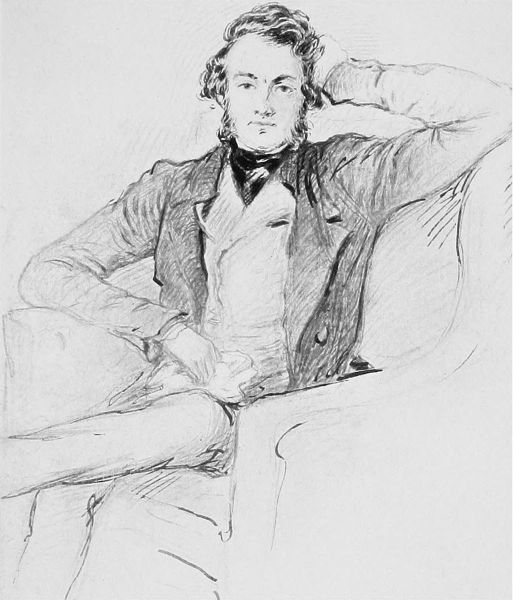
Walter L. Colls, Ph. Sc.
Charles Buller, MP.
From a Drawing from life in the possession of Stuart J. Reid
‘The Queen having been graciously pleased to entrust to me the Government of British North America, I have this day assumed the administration of affairs. In the execution of this important duty, I rely with confidence on the cordial support of all her Majesty’s subjects as the best means of enabling me to bring every question affecting their welfare to a successful issue, especially such as may come under my cognizance as her Majesty’s High Commissioner. The honest and conscientious advocates of reform and of the amelioration of defective institutions will receive from me, without distinction of party, race, or politics, that assistance and encouragement which their patriotism has a right to command from all who desire to strengthen and consolidate the connection between the parent State and these important colonies; but the disturbers of the public peace, the violators of the law, the enemies of the Crown and of the British Empire will find in me an uncompromising opponent, determined to put in force against them all the powers, civil and military, with which I have been invested. In one Province the most deplorable events have rendered the suspension of its representative Constitution, unhappily, a matter of necessity, and the supreme power has devolved on me. The great responsibility which is hereby imposed on me, and the arduous nature of the functions which I have to discharge, will naturally make me most anxious to hasten the arrival of that period when the Executive power shall again be surrounded by all the constitutional checks of free, liberal, and British institutions.
‘People of British North America, on your conduct and on the extent of your co-operation with me, will mainly depend whether that event shall be delayed or immediate. I therefore invite from you the most free, unreserved communications. I beg you to consider me as a friend and arbitrator—ready at all times to listen to your wishes, complaints, and grievances, and fully determined to act with the strictest impartiality. If you, on your side, will abjure all party and sectarian animosities, and unite with me in the blessed work of peace and harmony, I feel assured that I can lay the foundations of such a system of government as will protect the rights and interests of all classes, allay all dissensions, and permanently establish, under Divine Providence, the wealth, greatness, and prosperity, of which such inexhaustible elements are to be found in these fertile countries.’
The impression produced by this manifesto was immediate and marked. All classes of the people, even the most disaffected, seemed to regard Durham’s presence in their midst as an omen of peace, and the French were especially enthusiastic. It was everywhere recognised that the Governor-General was not merely a statesman of the first rank, but he possessed exceptional powers, which, it was believed, he would employ with courage and impartiality to the settlement, on broad constructive lines, of the vexed questions at issue, which had so long distracted the country. It was believed that he would at once investigate political grievances, and it was recognised that he was a man of too strong and independent a character to come under the control of any of the cliques and parties which had hitherto sought openly or secretly to entrap his predecessors, and by doing so to determine the course of affairs.
The first step which Durham took confirmed this opinion, for it was as unusual as it was bold. It had been the custom for the new Governor-General, immediately he had taken the oaths, to swear in those whom he intended to form his Executive Council, and every new Governor had confirmed in authority the Council of his predecessor. Durham, however, made a new departure, and startled the whole of Canada by quietly setting aside this important group of men, none of whom possessed the confidence of the whole community. Charles Buller always maintained that this was the wisest course of conduct which Durham could have pursued, for it gave him freedom of action, and kept him aloof from some of the most mischievous elements in the political life of the country. There were other and substantial reasons for such a departure from precedent, for the members of the old Executive Council, with scarcely an exception, had antecedents which did not recommend them to a man who was determined to make a clean sweep of abuses, and to settle the affairs of both Provinces on new and progressive lines.
Durham accordingly composed the Executive Council, required by the Constitutional Act, by appointing his three Secretaries, together with the Commissary-General, and Mr. Daly, the Provincial Secretary, whom Sir John Colborne had assured him was the most unexceptionable of all the existing officials. This act, and the frank statement of the grounds on which it was done, whilst they startled the old official set, met with guarded approval from the British, and were viewed with lively satisfaction by the French. ‘Il a fait déjà une bonne chose,’ was the comment of a shrewd old colonist; ‘il a tué les deux conseils.’ Nothing was further, however, from the thought of Durham than to wish to dispense with local experience, or to disregard wise advice. But the truth was that the men whom he superseded were identified with the old pernicious system of government, and were known to cherish such violent antipathies that it would have been hazardous in the extreme to allow them to continue in office, at a time when questions had at once to be raised, to which it was impossible that they, after all the cabals in which they had taken part, could bring an open mind. Durham realised that he had a great deal more to lose than to gain by association with official advisers on the spot, who, with scarcely an exception, were men of small experience and great unpopularity. They could, in fact, do little for him, and their mutual jealousies and antipathies were so great that he felt that the wisest course, under all the circumstances, was to dispense with their services.
When he landed, the French Canadians were thoroughly disaffected to British rule. They cherished the hope of avenging their real or imaginary wrongs with the aid of foreign arms, and meanwhile were smarting not a little under their recent defeat. The majority of their leaders were either fugitives or prisoners, and of those who remained in Canada some were too timid, and others too sullen, to take an open part in any attempt to settle, on constitutional lines, the grievances on which they laid almost hysterical stress. Durham found the utmost difficulty in getting, behind wild words and impracticable schemes, at the real sentiments of the French Canadians. The majority professed to believe that the new Governor-General would place things exactly in the position in which they had been before the rebellion. They clamoured for the immediate re-establishment of the Constitution which the British Parliament had suspended, and a complete amnesty to leaders, who had not scrupled to appeal to force. The addresses with which they greeted Durham were for the most part constrained and formal, but in some instances the language used was of a kind which no man in authority could tolerate, and when Durham was compelled to check their extravagant demands they relapsed into sullen and distant apathy.
The leaders of the British party, on the other hand, were, for the most part, prominent merchants in Montreal, with a few of the same class in Quebec. They were energetic men of affairs, who for some time, through their influence in the Legislature, and subsequently in Sir John Colborne’s Special Council, had exercised a great influence over the Government of the Province. These men were slow to recognise the changed conditions which had been brought about, partly by the suspension of the Constitution and partly by Durham’s own determination not to imperil the success of his mission by admitting them to a direct share in the control of public affairs. Their attitude was at once vigilant and critical; but the mass of the British population saw clearly enough that the first object to secure was the tranquillity and improvement of the Province, without which it was idle to expect that the trade of the country could be placed on a secure and profitable basis.
The truth was that the humiliation of the French Canadians had gone far enough to satisfy all but the most vindictive of the British party, and this sentiment gathered force as Durham’s great powers and liberal opinions became better known. The leaders in consequence found it prudent to relax their attitude. Durham’s replies to the addresses of the British party—they were at once skilful and sympathetic—gained for him the confidence of almost the whole of the community. He spoke of the greatness of the Mother Country, and awakened the pride of race. He laid stress on the wonderful resources of Canada, and appealed to them to use every effort, for their own sakes and for those of their children, to develop its soil and to expand its trade. He pledged himself to do all in his power to further their legitimate ambitions, and assured them that the powerful help of the Imperial Government would be exerted to the same end. The apathy which had greeted him vanished like the snows of a Canadian winter at the breath of spring, and he evoked an enthusiasm and personal attachment which no Governor-General before him had ever aroused.
The splendour of Durham’s surroundings at Quebec was made the subject of cheap criticism and even ridicule in England. But all competent observers on the spot admitted that it produced a beneficial impression on the minds of the colonists. Durham, in all ceremonial and social functions, carried himself with grace and dignity, and evinced so much tact and consideration as to win golden opinions. He had the art of inspiring confidence; his appearance and manner kindled respect; whilst the evident sincerity of his motives, and the brave and statesmanlike character of his utterances gave him a personal ascendency which, to his credit, he used for no personal ends.
The condition of affairs in the Lower Province, crucial though it was, did not exhaust Durham’s difficulties. The reports which he received from Upper Canada, almost as soon as he landed at Quebec, were sufficiently disquieting, revealing, as they did, dissensions and turbulence. The divisions in Upper Canada arose from the jealousies of three factions: those who were nicknamed members of the Family Compact—namely, settlers of the second or even third generation, who had attained to wealth and social importance; less well-endowed inhabitants, and recent emigrants, who were dissatisfied with the ascendency of the old privileged clique, and loudly proclaimed themselves as ‘Reformers’; and, lastly, patriotic emigrants from the United States, who had crossed the frontier since the last war between England and that country. The chief bone of contention was the Clergy Reserves, a subject which since the year 1820 had provoked a great deal of angry feeling in the Province.
The Governor of Upper Canada at the time of Durham’s arrival was Sir George Arthur. He was arbitrary and vacillating, and seemed perpetually to hover between the conciliatory policy dictated by Lord Glenelg, and subserviency to the tyrannical proposals of the Family Compact, under whose influence he had more and more fallen. As soon as Durham landed, Sir George Arthur bombarded him with despatches, giving the most alarming descriptions of the insurrectionary spirit in the Upper Province, as well as of the sinister plans of the refugees of the late rebellion who hung on its borders—men of reckless antecedents, who received a great deal of support as well as sympathy from the United States. Within a month some confirmation was given to Sir George Arthur’s exaggerated statements by the hostile movement which took place under Morrow, Chandler, and others in the Niagara district. Charles Buller makes no secret, in his unpublished account of Durham’s mission, of the fact that there was enough in the condition of England’s relations with the United States to fill the boldest and calmest mind with apprehensions.
‘The Canadian refugees, collected along the frontier, from New Hampshire to Michigan, rendered desperate by their exile and the ruin of all their prospects in life, were everywhere threatening to prepare an invasion, and doing almost as much mischief to the peaceable inhabitants of Canada by the alarms which they thus kept up as could have resulted from actual incursions. They kept the appearance, if not the reality, of an incessant correspondence with disaffected persons on our side of the frontier, and they seemed to have the support also of the general and active sympathy on the other side.’
It was next to impossible to determine, in the midst of all the wild rumours that were in circulation, to what extent the American people were prepared to aid these lawless fugitives; but it was quite plain that a great many of the rough settlers along the shores of the Great Lakes were only too ready to throw in their lot with any desperate enterprise which promised plunder or conquest. Public meetings were held, countenanced in many cases by people of character and property, at which the most violent language was common, and the movement was believed to be supported by wealthy men in the States, professing to sympathise with colonists who were supposed to be struggling against the tyranny of the Mother Country under conditions which, it was claimed, scarcely differed from those which in a previous generation had brought about the War of Independence. A large section of the American press supported the outlaws and their allies, and each of the great political parties in the Union was inclined to recruit its partisans by pandering to the warlike attitude of the border States towards Great Britain. Even the Government of Washington seems to have connived at the movement, and it is at least clear that it did nothing to arrest it.
The first lawless act with which Durham had to deal was one which in less firm hands might have provoked war with the United States. He had scarcely set foot in Canada before tidings reached him of the burning of the Sir Robert Peel, a Canadian steamer, in the American waters of the St. Lawrence, at the orders of a notorious smuggler called Johnson. This man was the American who had long haunted the Thousand Isles, and had placed himself at the head of a large band of disaffected Canadian ‘patriots,’ who acted under his orders. The captain of the steamer was a well-known Loyalist, and not only was his vessel wantonly destroyed, but he, and the passengers and crew, were treated with the utmost barbarity. Almost before the significance of this outrage could be realised, tidings reached Durham that British sentries had fired, at Brockville, on an American steamboat without the least provocation. At once, on both sides of the frontier, the excitement rose to fever pitch, and it seemed hardly possible to preserve peace. Charles Buller afterwards admitted that he believed at this crisis Lord Durham’s mission to Canada would be wrecked at the outset by the outbreak of a war between Great Britain and the United States.
But Durham at once rose to the occasion. He saw that nothing could be more disastrous either to Great Britain or Canada than such an issue, and he recognised, not less clearly, that, if he was to fulfil the great task with which he had been entrusted, it was imperative that no rupture of relations should arise with the American Commonwealth. As soon as tidings reached him of the burning of the Sir Robert Peel, Durham gave signal proof of his belief that the United States Government was in no way responsible for such an outrage. He instantly offered a reward of 1,000l. to anyone who should bring the offenders to justice, not in Canada, but before a tribunal of the United States. It was a step which only a strong and wise statesman would have undertaken, and it showed that Durham was not merely determined to protect the rights of the colonists, but believed that the lawless miscreants who brought about the outrage, though American subjects, would be treated with due severity by the authorities of the United States. The confidence which he thus showed in the good faith of the American Government was not thrown away, and his firm but friendly attitude dispelled almost in a moment the cloud of ill-will which was rapidly gathering between the two countries. Not content with this action, Durham went further. He sent Colonel Grey, his brother-in-law, to Mr. Fox, the British Plenipotentiary at Washington, to place all the facts before President Van Buren. Colonel Grey was not only a distinguished soldier, but a man of rare tact, and he was successful in removing at once the danger of any rupture of relations between Canada and the United States. Both Governments determined to take energetic action, and, within a fortnight after Colonel Grey’s arrival in Washington, the military and naval forces of Great Britain and the United States were co-operating on the Great Lakes and along the shores of the St. Lawrence, in repressing all attempts to stir up bad blood and provoke hostilities between the two countries.
It was whilst Durham was busily engaged in these critical negotiations on the one hand, and in laying his plans on the other, for a broad and systematic inquiry into the grievances, real and imaginary, of the colonists, as the initial step to formulating his scheme of reform, that the first tidings of a disquieting kind reached him from England. Charles Buller always maintained that Durham had been scarcely a week in Canada before his old political enemies at home, more eager to air their own crotchets and to gratify their own spite than to give him fair play in the onerous task which he had not sought—and had only accepted from an over-mastering sense of duty—began their congenial work of sowing tares amongst the wheat. Even whilst Durham was still on the Atlantic, acrimonious discussions were started in the House of Lords in reference to the appointment of Mr. Turton. The result was that Durham was compelled to turn aside from the critical points at issue, in order to make personal explanations, of an irritating and superfluous kind, to the Melbourne Cabinet. It seemed as if the Tory Peers, who had never forgiven him for his bold stand over the Reform Bill, and his fearless advocacy, at every stage of his career, of popular rights, were determined to keep up a running fire of criticism, and that of a kind which to a man of his proud and sensitive temperament was the hardest of all to brook. It so happened that he knew the real value of such attacks, and, what was more, the character and antecedents of the men who made them. Conscious of his own rectitude, so long as barbed insinuations, palpably the outcome of the spirit of faction and personal spite, came only from the opposite camp, he could have borne with equanimity such ungenerous strictures; but there was a point at which both his forbearance and his patience failed, and it was reached when the Melbourne Government were content to defend him in a half-hearted and timid manner, which seemed almost to imply that their real sympathies were with those who attacked him.
Charles Buller makes this perfectly plain. He states that what really discouraged Durham was the apparent readiness of Lord Melbourne to abandon and even blame him. Buller makes no secret of his own opinion that the Cabinet was either cowardly or perfidious, and the judgment of history, in the light of all that subsequently happened, hovers still between those conclusions.
‘There hung over us from the first, like a cloud, the depressing consciousness that faction would make no allowance for the difficulties and dangers of our position, but seize hold of every pretext for discrediting and thwarting Lord Durham, and that, to uphold him against such assaults, he could rely on no sincerity or energy on the part of the Ministers whom he was serving.’
One thing that cheered Durham at the outset of his task was the cordial support which he received from Sir John Colborne, a man who knew the condition of Canada better than any of the Melbourne Cabinet, and in whom he had perfect confidence, both as a civil and military administrator. As attempts have been made in recent years to prove that the relationships of the two men were, at the first, scarcely cordial, it may be as well to cite a passage from one of Durham’s letters to Melbourne, written just after his arrival at Quebec, and bearing date June 1, 1838. After speaking of the violence of political animosity in Canada as almost beyond belief, and stating that he felt compelled in consequence to keep aloof from either side, he adds: ‘I have had a very long and confidential interview with Sir John Colborne, and you will be glad to hear that we are on the most friendly terms. He enters into all my views, thinks they are the best calculated to settle this question, and will assist me to the utmost of his power by his influence and acts. He agrees with me also that it will be for the advantage of all that I should form my Executive independently of colonial participation, there being no man here not committed in one way or the other, and whose presence in my councils would not expose me to the suspicion of being influenced by the colour of his politics. I have already prepared the chief persons here for this course of action, and have received their assurances of being perfectly contented with any system of administration I may consider most useful to my mission. So far, then, I am satisfied, but the labour of the task is Herculean. All these different parties I have to prepare, to soothe their feelings, to inspire them with confidence, to infuse a higher description of political feeling into their minds, and, at the same time, to keep myself entirely independent of them with respect to my executive and administrative acts. However, I think I see my way, and that the prospect is not so clouded as I might have imagined.’
This letter had scarcely been despatched before Durham received both from Melbourne and Glenelg letters of protest—the outcome of questions in Parliament about his relations with Mr. Turton and Mr. Wakefield. They were both exceedingly able men, and Durham, rightly or wrongly, thought that, if there were passages in their lives at which austere moralists could look askance, they ought at least to have a chance of proving their merits by their services at that crisis. Moreover, he winced not a little at a Cabinet, over which Melbourne presided, throwing the past in their teeth. Perhaps it was impolitic, however chivalrous, on Durham’s part to associate himself with Turton and Wakefield; but, like most quick-tempered ardent men, he was beyond all else generous. Mr. Turton had sailed with him to Canada, and Mr. Gibbon Wakefield followed almost immediately, and before the arrival of the official protests the former was already appointed one of his secretaries. Durham, in a letter dated June 15, 1838, reminded Melbourne that he had distinctly told him at the Duke of Cleveland’s house that, whilst he waived Mr. Turton’s nomination as legal adviser to the mission, he held himself at liberty to employ him in Canada after his arrival, on his own responsibility as Governor-General. He told Lord Melbourne that he had done this before receiving his letter, and could not recede from it. He added that, if he had received the protest earlier he would have complied with the wishes of the Government. He declared that Mr. Turton had already proved himself of ‘inestimable service,’ but that he held no office, and received no official salary either from Canada or England. He stated that he intended to have appointed Mr. Turton either to the Commission of Inquiry into the Judicature of the Province, or as a member of the Special Council, but now he would at once abandon that idea. ‘The proceedings about him in England have created general disgust here, and the most strict people in the Province have gone out of their way to be civil to mark their sense of them.’
As for Mr. Wakefield, the letter of protest arrived just in the nick of time. ‘I have, therefore, been enabled, without compromising my own character and independence, to comply with your desire.’ He assured Lord Melbourne that Mr. Wakefield held no official situation whatever, and then added, with a touch of humour, ‘Oh! no—we never mention him; his name is never heard. Really, if it was not very inconvenient, all this would be ludicrous.’ He felt particularly sore about the hubbub over Turton. ‘I never thought of him. He was recommended to me repeatedly by the Secretary of the Treasury. The President of the Board of Control offered him the promise of an Indian judgeship, to induce him to go with me. You then, in the Cabinet, take fright, and ask me to cancel the appointment, for which you might be considered responsible. I yield, and name him on my personal staff, and you wish to interfere, even with this petty, miserable exercise of my own patronage. Oh! jam satis, you may easily believe that all this annoyance being confined to Lord Winchelsea and England is some consolation. Here I have met with no attack; on the contrary, the whole Press, the whole population, all parties unite in supporting my Government.’ He ended by declaring that his scheme of governing Canada had lulled all those petty provincial passions and feelings of rivalry, which had baffled the measures of preceding administrators. Then he added these significant words, and they are pathetic in the light of all that followed: ‘They believe in my good intentions towards all, and in my having support from home. See you to that; I will provide for the remainder. The colonies are saved to England as far as I am concerned, but you must be firm. Don’t interfere with me whilst I am at work. After it is done, impeach me if you will. I court the fullest responsibility, but leave me the unfettered exercise of my own judgment in the meantime.’
Durham, in a letter to Glenelg on the same date—June 15, 1838—assured the Colonial Secretary that Mr. Turton had not been given any official appointment under the Crown. He was merely in the position of a private secretary, and no salary would be required either from Parliament or the Provinces on his behalf. As to Mr. Wakefield, although he had intended to give him a public appointment, he felt compelled, in view of the hostility which his name had evoked, to give him no official position of any kind. In making this announcement Durham referred with pardonable warmth to what he termed the ‘incessant interference’ with all his arrangements which had taken place since he had quitted England, and had imposed upon him an amount of anxiety which imperilled not only his peace of mind, but his health. He went on to say that, in spite of all this, he had succeeded so far beyond his expectations. He rightly claimed that he had obtained the confidence of both parties, as well as their respect, and that, of course, was the first condition of any real solution of the questions at issue. The words which follow are significant, especially when read in the light of all that so quickly followed. ‘If you, the Government at home, only support me and show a good front to the Tory marplots in England, I will answer for handing over to you, in a few months, all the North American Provinces in a state of loyalty and contentment. If you cannot do this, but show the slightest want of confidence in me, you will do well immediately to replace me by another, whom you can consistently support, for nothing can be so fatal to British supremacy here as an appearance of disunion and want of concord in the authorities of the State, colonial and metropolitan.’
No one had ever a more perfect right than Durham at that crisis to insist on such conditions. He had not sought the onerous and responsible position in which he was placed. On the contrary, he had reluctantly accepted it at the importunity of the very men who now adopted the policy of pin-pricks against which he protested. Behind him, though he was still only forty-six, lay a great career, spent in the advocacy of popular rights and in the delicate tasks of diplomacy. The beginning of the new reign, to leave out of account for the moment his peculiarly intimate relations with the young Queen, seemed to offer a splendid opportunity to a statesman of character and capacity, with such a record of hard and honourable service. If the Whigs distrusted him, or those of them at least who were now in authority in Downing Street, and the Tories feared him, he still had the confidence of the working classes, as well as of the great trading community in the land, who knew how sound were his views on all economic and commercial questions, and looked upon him as the ultimate leader of any really progressive Liberal party. There was no position, to which a subject of the Crown could aspire, which, in the popular judgment of 1838, was not, in spite of his detractors, open to ‘Radical Jack’ of the Reform struggle. Nothing short of the enthusiasm of lofty patriotism would have led Durham to proceed to Canada, under circumstances which other men, less unselfish, would have shirked. Nothing, therefore, could well have been more unfortunate, both in the personal and in the political sense, than the treatment which he received. The wonder is not that he made passing mistakes, but that he succeeded, in spite of the obstacles that were thrown in his way, and the foibles incident to a man of his temperament, in doing a great and permanent service, the fruits of which are everywhere apparent to the Anglo-Saxon race to-day.
It must be remembered, when he set foot on the shores of Canada, the state of both Provinces was deplorable. All the ordinary powers of government, both legislative and executive, were either in abeyance or hopelessly out of working order. Everything, in fact, had either to be created anew or else remodelled. With such a task on hand, Lord Durham may surely be forgiven the touch of impatience which he displayed at the carping criticisms on minor matters arriving by almost every mail from the Cabinet, which, only a few weeks before, had entrusted him with plenary authority. The Canadian newspapers show that people on the spot correctly gauged the situation. One of them, ‘The Quebec Mercury,’ put the matter in a nutshell. ‘It must be clear to every sensible mind that Lord Durham would not have consented to come all this distance to govern these Provinces if he had not been trusted with sufficient discretionary power to appoint a secretary or to nominate an executive councillor, without sending home for—instructions!’
Meanwhile, like all strong men, Durham found relief from petty vexations in hard work. He received deputations, investigated grievances, and sent men whom he could trust far and wide, to Nova Scotia, New Brunswick, Prince Edward’s Island, as well as up and down the disaffected Provinces on the banks of the St. Lawrence and the shores of Ontario, to find out on the spot the real causes of discontent. One of the first practical reforms which he instituted related to the protection of person and property in the cities of Quebec and Montreal. Quebec had hitherto been without any system of police, and yet no place, in consequence of the lawless character of a great part of its population, more urgently required such supervision. Crimes of violence were not uncommon, and murders occurred in the streets, whilst the criminal class, to a deplorable extent, escaped punishment. He modelled the police force on that of London, and the moment that he discovered that Montreal was in almost the same evil case, he extended the system to that city; but the chief practical grievance with which he had to cope was the gross mismanagement of the Crown Lands. One of the first objects of his mission was to lay the foundations of such a reform in the administration of them as might make them instrumental in promoting emigration on the broad scale, without which, he saw clearly enough, it was impossible to bring about lasting and ever-widening prosperity in North America. He wished, by the disposal of the Crown Lands, to remedy the evils which had arisen as the direct outcome of their abuse. He advocated, as his famous Report shows, the setting aside of large funds for emigration, and for the bettering of the means of communication throughout the Provinces. He desired to see emigrants of the labouring class encouraged to try their fortune in the New World under the British flag. He wished to extend the demand for British manufactured goods, and to bring British capital, as well as labour, across the sea to consolidate the authority of the Crown and to develop the resources of the colony.
If Durham was in advance of his times in proposing aided emigration, and other great schemes for the welfare, not of Canada alone, but, indirectly, of the Mother Country, Downing Street was behind them, and that, broadly speaking, was the cause of the deadlock which presently arose. He saw clearly enough that, whilst the disorders in Upper Canada sprang almost entirely from what he termed mere defects in its constitutional system, which were capable of being removed by the adoption of a sound and consistent method of administration, those of Lower Canada arose from evils more deeply rooted, with which, however, on that account, he was all the more anxious to grapple. The first great problem which confronted him in this direction, and the one which brought disaster to himself, though not to Canada, was the question as to the best method of dealing with the political prisoners.
Strictly speaking, Sir John Colborne ought to have settled this problem before Lord Durham’s arrival in Canada; but, as Charles Buller put it, he preferred to ‘shift the responsibility of this most delicate business’ to the shoulders of his great successor. The difficulty of disposing of the prisoners had not been diminished by the delay; on the contrary, it had been increased. Clemency was the keynote of Lord Durham’s policy in Canada. All the traditions of his life were opposed to anything which in the least savoured of a vindictive spirit. The problem which confronted him was how to vindicate law and order, and, at the same time, to show mercy to a misguided but desperate group of men, who, everyone admitted, had laid themselves open to the severest penalties of justice. He himself confessed that the situation was at once delicate and dangerous. As a matter of fact, the course which he adopted was regarded by many people in Canada as much too magnanimous. At the same time, the leaders of the revolt were, for the moment, popular heroes with a large section of the people, and the danger was that they might be acquitted by a jury empanelled in the ordinary course of law. Moreover, some of them had fled from justice, and were actively engaged across the frontiers in fomenting disaffection. A general amnesty was therefore impossible; it would have been regarded as a sign of weakness, if not of fear.
Durham knew very well, and so did the Melbourne Cabinet, from the representations made by the law officers of the Crown in Canada months before his arrival, that there was small chance of the conviction of the prisoners by any ordinary jury. If a trial before the regular courts took place, there existed a probability of an acquittal, and that would have meant a triumph for the disaffected, and one which would have produced the worst consequences. On the other hand, even if conviction was obtained, Durham felt that the turmoil of the proceedings, the exposure of the acts of treason, and the revival of the old animosities, of which it was the outcome, would have reawakened a state of feeling, proving fatal to the permanent settlement, on wise and enlightened lines, of the affairs of Canada. A picked jury would have meant a packed jury, and Durham was far too fair-minded a man to lend himself to a judicial farce. He could have tried the prisoners by a Special Commission, but he knew that if that course were adopted there was no escape from the penalty of death. In his judgment, there had been bloodshed enough, and he was not anxious, moreover, to invest a rather sorry set of men with the halo of political martyrdom. When all these considerations are borne in mind, there still remains the fact that it was imperative to make an example, in order to deter others in the future from taking up arms in open rebellion, and plunging Canada into what was neither more nor less than Civil War.
Durham’s determination to proclaim, on the day of Queen Victoria’s Coronation—June 28—a far-reaching, though not a universal, amnesty, was not taken until he had personally sifted all the facts, and weighed all the evidence against the prisoners. The chief instigators of the rebellion, and notably Papineau, had fled to the United States. They were desperate and defiant outlaws, and it would have been madness to allow them to return to sow afresh the seeds of disaffection. As for the rest, there were only eight prisoners who, in his judgment, merited severe punishment, and these were the men who, if trial by jury had been resorted to in the ordinary course, would either have been sentenced to death, or have escaped scot free.
Charles Buller urged that the best course would assuredly be to punish the prisoners; but lightly, by means of an ex post facto law. Durham at first refused to entertain such an idea. He saw that it might lead to an outcry in England, and refused to take the step, unless the prisoners themselves were prepared to plead guilty, and to throw themselves on the mercy of the Crown. They were, in Charles Buller’s words, ‘very ready to petition to be disposed of without trial, for they had the wholesome dread of capital punishment before their eyes.’ Accordingly, they expressed their willingness, to cite the words of their own petition, to ‘plead guilty, to avoid the necessity of a trial, and to give, as far as in their power, tranquillity to our country.’ Such were the circumstances under which Durham issued his historic Proclamation, and with it the Ordinance, which brought about the detention in Bermuda of Dr. Wolfred Nelson, M. Bouchette, and the six other political prisoners, during the Queen’s pleasure. M. Papineau and the other fugitives were, at the same time, forbidden to return to Canada under pain of death.
The Proclamation, issued with the Ordinance, gave a free pardon to all who had taken part in the rebellion, with the exceptions just named. Those in prison were released, on giving a pledge of good behaviour, and those who were in hiding were declared to be ‘at liberty to return to their homes,’ with the assurance that they would ‘remain wholly unmolested.’ No amnesty could well have been more generous, and everywhere throughout Canada it was hailed with enthusiasm, except on the part of a few over-zealous partisans, who were inclined to think its terms too liberal. Thus, to borrow the words of Canada’s greatest historian, Dr. Kingsford, the ‘rebellion was terminated without a drop of blood having been judicially shed.’
Writing to Melbourne on June 20, Durham says: ‘I have at length, thank God, been enabled to settle this most difficult and delicate question of the prisoners. It is a great weight off my mind, and a great gratification to find that the proceedings I have adopted have been approved by all parties—Sir J. Colborne and all the British party, the Canadians and all the French party. I enclose the Ordinance and the Proclamation. I hope you will send directions to the Governor of Bermuda to treat the prisoners with all due lenity. They are only eight in number—not of the most guilty, for they had fled, and are in the United States.’
Lord Durham’s letter to the Queen, written on the day of her Majesty’s Coronation, deserves to be printed, for it shows not only his devotion to the Throne, but how little he anticipated the cruel strictures on his policy of mercy which so quickly arose, to his own undoing, in England.
‘Quebec: June 28, 1838.
‘Madam,—I trust your Majesty will permit me, as one of your Majesty’s most faithful and devoted subjects, to offer my humble congratulations on the event of this day. May every succeeding year add to the happiness and glory which must be the attendants on your Majesty’s reign, and which I fervently pray may long grace the Crown which has this day been solemnly placed on your Majesty’s brow!
‘Unable as I am, in the execution of your Majesty’s service, personally to tender my homage and assist in the ceremonies of this day in England, I can only console myself by laying at your Majesty’s feet, from America, the best tribute of loyal respect and devotion which I can offer. It is an act of grace and favour, granted in your Majesty’s name, to your erring subjects in this Province; it will console the unhappy, reassure the timid, and spread that peace and contentment which is ever the object of your Majesty’s beneficent heart.
‘I have been enabled to do this in your Majesty’s name without danger, because I have in my own done all that sound policy required in the way of punishment and security. Not one drop of blood has been shed. The guilty have received justice, the misguided, mercy; but, at the same time, security is afforded to the loyal and peaceable subjects of this hitherto distracted Province, and I may now undertake, without interruption, the remaining part of my mission—the final arrangement of the Constitution of these important Colonies.
‘With the most fervent prayers for your Majesty’s happiness and prosperity, I have the honour to subscribe myself
‘Your Majesty’s devoted servant,
‘Durham.’
In a despatch, written on the following day to Lord Glenelg, Lord Durham states at considerable length the reasons which induced him to send to Bermuda the prisoners who had pleaded guilty. They are reasons which do credit to a man who might make mistakes, but was always merciful. He felt that political prisoners ought not to be committed to a convict settlement, since that would affix a charge of moral infamy to them—an accusation which, in this instance, public opinion would not endorse. He saw that to brand them in that way with wholly superfluous indignity would be, moreover, impolitic, since it would give them the opportunity to pose eventually as political martyrs. His sole desire was to put them out of the way of mischief, until more settled conditions prevailed in Canada, when a further act of clemency on the part of the Crown might allow them also to return to their homes, ‘wholly unmolested,’ and disarmed, by the progress of political liberty, of all power, even if they still cherished the desire, to work disaster to the State. Writing to Lord Melbourne on June 30, Durham thus alludes to the tranquillising effect of the Ordinance: ‘You will not believe it perhaps, but it is a fact that here all are charmed at being relieved from self-government, and being for the time under a pure despotism. That is all very well for the moment, but cannot last.’
Charles Buller, with his usual common sense, argued that, whilst the Ordinance might appear to people in England, who had no means of gauging the real gravity of the situation, both ‘unconstitutional and despotic,’ it was in reality an act of clemency. None of the prisoners were put to death; even their transportation, though the direct outcome of an act of treason, was not linked with any pains and penalties, beyond the loss of liberty, outside a given area. In his view a great difficulty had been solved, by what he knew was a bold and high-handed expedient, but one which the political anarchy of the moment made inevitable. ‘The legal guilt of these men was clear. From an ordinary jury their certain acquittal was equally clear.’ If that happened, the ignorant French Canadians, who had taken up arms at their bidding, would have declared that ‘their leaders in revolt were right all along, or that the Government had not dared to punish.’ Nor was this all. ‘The British party would have said that our trial was a mere mockery of justice, and that we had let their guilty enemies loose on them by a trick.’ All this, supported as it was by his own observations on the spot, seemed to him at the moment a sufficient vindication. ‘Our present act does something like substantial justice; it will do good to both parties, and in no way corrupt the great judicial institutions of the country. The prisoners petitioned to be disposed of without trial.’
Durham of course knew that, so far as Bermuda was concerned, he had stretched his authority; but he expected that the Secretary of State would send formal instructions to the Governor of Bermuda to receive the prisoners and hold them in custody. He looked forward to the time when, to borrow the words of the Ordinance itself, ‘it should appear consistent with the peace and tranquillity’ of Lower Canada ‘to grant permission’—to the offenders named—‘to return.’ He acted, as Lord John Russell admitted when the matter was raised in Parliament, to the best of his discretion, and it is certain that he believed that, if he had exceeded his powers about Bermuda, the end justified the means, and that this would instantly be recognised and set right.
Durham has been thwarted, but he has not failed.
John Stuart Mill.
1838
The humanity of Durham’s policy—Approval in England of the Ordinance—Attack in the House of Lords on the Ordinance and the Proclamation—Brougham’s spite—Lord John Russell’s support of Durham—Brougham and the daguerreotype picture—Macaulay and Sir George Otto Trevelyan on the persecution of Durham—Abandonment of Durham by his political allies—Tour through the Canadian Provinces—At Niagara—Letter to Melbourne on the possibilities of Canadian development—‘Go on and prosper’—Melbourne’s cowardly surrender.
Lord Durham’s action met with immediate and almost universal approval in Canada. The British population of Lower Canada, after a few half-hearted murmurs, everywhere acquiesced in it. The French, in spite of their extravagant demands, were conciliated by it. The question of the disposal of the political prisoners had blocked the way. It was impossible for Durham to do anything, in the constructive sense, until the fate of the rebel leaders was settled, and all the angry feeling excited by their conduct was allayed.
The object of the Ordinance was twofold. Durham desired to vindicate the authority of the Crown, and, at the same time, to shield these misguided men—who had acknowledged their guilt—from death, which would have been their fate had they been tried by an impartial jury.
Apart from all questions of humanity, he did not wish to make political martyrs of men who, until they had been driven into open revolt, represented the prevailing sentiment of even the well-disposed amongst the French Canadians. At the same time, it was impossible to ignore their guilt, or the bloodshed to which it had led; but the rebellion was already a thing of the past, and Durham, on all grounds, was anxious not to stir the dying embers of disloyalty into renewed outbreak, which assuredly would have happened if anything in the nature of stern reprisals had been adopted. He therefore adopted the plan of placing the political prisoners in a position where they were deprived of all power of doing further mischief. The verdict of history—in Canada at least, where, if anywhere, all the facts are known—is that he did rightly. Dr. Kingsford, writing as late as 1898, declared that it remains to the Dominion to do justice to the sagacity, wisdom, and courage with which Durham acted at that crisis. Humanity was, in short, as another eminently qualified Canadian scholar, Sir John Bourinot, asserted, the keynote of Durham’s too short career in Canada.
All parties in the United States praised Durham’s solution of the difficulty, and declared that it was both wise and liberal. It provoked, in fact, a revulsion of feeling in the United States, and this was so marked that Charles Buller asserts that from that hour the disloyal in Canada ceased to derive any aid from public opinion across the frontier. One great difficulty of Durham’s position in Canada was instantly removed—in short, there was no longer any chance of war with the United States. The Canadian Press made no secret of its satisfaction at the manner in which this great problem had been solved. Though the ‘Montreal Herald’ was disappointed that the prisoners had escaped with their lives, and was inclined to think that Lord Durham had been too merciful, the ‘Quebec Mercury’ of June 30, 1838, expressed what was all but the universal view. As this is contemporary evidence, and reflects, better than anything else, the opinion of people on the spot at the time, it may be well to cite the exact words: ‘There are many, no doubt, who will consider this punishment far too light for the heavy crime with which the political prisoners are charged. But, when all the circumstances are considered, it will be clearly seen that had they now been brought to trial and convicted, it would have been considered in England, and by all moderate persons in these Provinces, as little less than the infliction of political vengeance, and a sacrifice of human life, which the actual state of the Province does not require. Had the prisoners been tried and convicted in a court of justice, and the punishment awarded to them commuted for that which they are now to endure, we should have considered it a mockery of justice, and as holding out an encouragement for treason. But on confession made, as has been done by these persons, transportation to a situation where they cannot disturb the peace of the Province is all that justice, or a regard for the public peace, now actually requires. Therefore, had greater severity been used it would have been denounced as cruel and vindictive, and the culprits would have been exalted by the multitude into political martyrs.’ It was felt in Canada that, whilst the amnesty was a bold step, it was one which appealed to the better qualities of men, and the belief was common that Durham, by an act which leaned to mercy rather than to judgment, had done what was best for the good of the whole community.
If he had overstepped his powers, he had not done so in a despotic spirit, and neither he nor the Canadian subjects of the Queen dreamed for a moment that, when all the circumstances of the case were taken into consideration, the Melbourne Cabinet would fail to recognise that in an extraordinary crisis he had acted for the best. As a matter of fact, the Melbourne Cabinet, as will be presently shown, did at first support him. It approved of the Ordinance, whilst reserving its judgment on the strictly legal issue. It might, and it ought, to have exonerated him completely, but in the end it abandoned him, with despicable lack of courage, to the malice of Brougham, and wrecked, in consequence, a great career. Durham might well ask, as indeed he did, when accused of having exceeded his powers, ‘What are the Constitutional principles remaining in force when the whole Constitution is suspended?’
That was the actual condition of Canada in 1838, and such a state of affairs must be borne in mind in any attempt to estimate the circumstances under which Durham acted. Here it is only frank to admit that he undoubtedly made a mistake, which had consequences that no one on the spot just then could possibly have foreseen. In announcing to the Home Government the terms of the Amnesty and the Ordinance, he ought to have placed Melbourne and his colleagues in full possession of the reasons which had led him to appoint his Special Council and to dispose of the prisoners in this particular manner. It must be remembered that communication with England in those days was tedious and difficult; there was no Atlantic cable to correct or modify first impressions, or to supplement, on inquiry, original statements by further information. The absence of such knowledge led to uncertainty and even misapprehension, and it gave Durham’s assailants an opportunity, which they amply redeemed, to darken counsel and to prejudice public opinion.
Tidings of the bold step which Durham, relying on the support of the Melbourne Cabinet, had taken, reached England on July 29. Parliament was still sitting, and Brougham promptly took up the cudgels against his former friend. The attack on Durham and the Government began on July 30. One or two extracts from a letter written by Mr. E. J. Stanley to Durham on the following day will indicate the attitude of the assailants: ‘There was a discussion last night in the Lords about your Proclamation, and Brougham fiercely attacked it, declaring it was illegal, that you had no power to punish the parties who might return from banishment, and no power to pronounce sentence on those who were not yet in custody. Ellenborough was as eager to have a finger in the pie, and found out that the proceedings of the Council must have been illegal, as he said there could not have been five members of the Special Council present, since it was said in the papers that one of the five only arrived at Quebec the day after. Lyndhurst and Wynford joined the cry, and Glenelg only said that he should be prepared to defend the proceedings at the proper time, and did not object to produce the papers and your despatch. . . .
‘The opinion seems to be that there is nothing in Brougham’s attack, and that you had the power to act as you have done; but they say there is some force in the objection that you have not any power to send the prisoners to Bermuda, as directions as to the detention of prisoners there can only be given by the Secretary of State in England. It would also appear that if the Proclamation was agreed to at a Council where there were not five it would be irregular. As far as I can learn, notwithstanding the violence of these intemperate ex-Chancellors, opinion is in your favour, and the parties interested in the Canadas think you have acted wisely and done well. The “Times” said nothing this morning, and the “Standard” this evening on the whole approves.
‘You are not likely to be deterred from doing what you think best for the object you have in view by the attacks of your opponents; but if unfairness, misrepresentation, spite, and dishonesty could have such an effect on you, you would have ample grounds for retreating, and altering your course. As long, however, as you continue to give satisfaction in the Colony it matters little what these gentlemen say or do in the meantime, and, after all, you must remember that it is even more for the sake of annoying and embarrassing the Government that they malign and attack your acts than for the pleasure of venting their spite against yourself.’
Brougham did not conceal his satisfaction, but went about declaring that he had ‘got them at last,’ meaning Melbourne in Downing Street and Durham in Canada. He had a grudge against both of them, and at once took advantage of his opportunity, animated, as Greville puts it, ‘by nothing but the delight of giving a double shot to Durham there and the Ministry here; and as to the consequences he cared not a straw.’ He found allies in two other lawyers, Sir Edward Sugden, afterwards Lord St. Leonards, and Lord Lyndhurst. The first attacked Durham in the Commons for the composition of his Council; but the more serious charges were made in the Lords by Brougham and Lyndhurst, who argued that the banishment of the prisoners to a colony over which Durham had no jurisdiction was illegal, and rendered the Ordinance a dead letter. Had Melbourne defended Durham with any warmth, the situation would have been saved by the immediate passing of a Bill to render valid the one clause in the Ordinance to which legal exception was taken; but the Government contented itself with a feeble and half-hearted defence, and finally gave way when hard pressed, and took the extreme course of abandoning the man, who, on leaving England, had asked for the generosity of his political opponents, believing that it was needless to ask such consideration from his political friends. Melbourne and his colleagues all gave way before the passionate rhetoric of Brougham’s denunciations. All, save one honourable exception, Lord John Russell, a statesman who had borne with Durham the brunt of the battle for Parliamentary Reform, and who felt that it was an unmanly and unworthy thing for the Melbourne Cabinet to leave him at this crisis, not merely in his own fortunes, but in the history of England and her Colonies, to be, as a great wit put it, ‘asphyxiated by lawyers.’
‘Brougham,’ wrote Roebuck, a politician who knew the actual condition of Canada in 1838 better than Lord Glenelg or any of the statesmen in Downing Street, ‘is evidently all astray as to Lord Durham in Canada, misled by a desire to find Durham in the wrong, and by a passion for talking on all matters, whether he understands them or not.’ Those words reveal the true inwardness of the situation, and if ever there was a man who, to borrow a famous phrase, was intoxicated by the exuberance of his own verbosity, it was Brougham, on those hot August nights, when he did his mean and cowardly work.
Durham wrote to Lord John Russell: ‘I do not conceal from you that my feelings have been deeply wounded by the conduct of the Ministry. From you, and you alone of them all, have I received any cordial support.’ In spite of his brilliant gifts and his unquestionable public services, Brougham, though still in the prime of life, was already a discredited statesman. He was out of office, and he must have had the uneasy consciousness that his chances of again winning a place in a Liberal Government were, not to put too fine a point upon it, exceedingly remote. He had lost the confidence of his party, was feared in some quarters, disliked in others, distrusted in all. In the cynical talk of the hour he was ‘Vaux et praeterea nihil.’ His carriage bore on the panel of the door the big initial letter ‘B,’ and the man in the street was quick to appreciate the sting of the jest that ran round the town: ‘A bee outside and a wasp within.’
When Lord Brougham died, exactly thirty years after the Canadian rebellion, an incident in his life was recalled which deserves to be recorded here, with the moral which it then suggested. ‘Lord Brougham was at his château at Cannes when the first introduction of the daguerreotype process took place there, and an accomplished neighbour proposed to take a view of the château, with a group of guests in the balcony. The artist explained the necessity of perfect immobility. He only asked that his Lordship and friends would keep perfectly still for “five seconds”; and Brougham vehemently promised that he would not stir. He moved too soon, however, and the consequence was—a blur where Lord Brougham should have been; and so stands the daguerreotype view to this hour. There is something mournfully typical in this. In the picture of the century, as taken from the life by history, this man should have been a central figure; but now, owing to his want of steadfastness, there will be for ever—a blur where Brougham should have been.’
Lord Macaulay, writing from Florence in 1838, expressed what was, in truth, the common opinion when he said: ‘Lord Brougham, I have a notion, will often wish that he had left Lord Durham alone.’ In his view, the Tories in the House of Commons would lose reputation by their action in this matter, nor did he think that the Government would gain any. Then follows a scathing verdict on Durham’s chief assailant: ‘As to Brougham, he has reached that happy point at which it is equally impossible for him to gain character or to lose it.’ The comment of Sir George Otto Trevelyan, Macaulay’s nephew and biographer, on this statement sums up the verdict of a later generation: ‘No episode in our political history is more replete with warning to honest and public-spirited men, who, in seeking to serve their country, forget what is due to their own interests and their own security, than the story of Lord Durham. He accepted the governorship of Canada during a supreme crisis in the affairs of that colony. He carried with him thither the confidence of the great body of his fellow-countrymen—a confidence which he had gained by his earnest and courageous demeanour in the warfare of Parliament; by the knowledge that when he undertook his present mission he had stipulated for the largest responsibility and refused the smallest emolument, and, above all, by the appeal which, before leaving England, he made in the House of Lords to friends and foes alike. From his political opponents, in the place of “generous forbearance,” Durham met with unremitting persecution; and, as for the character of the support which he obtained from those Ministers who had themselves placed him in the forefront of the battle, it is more becoming to leave it for Tory historians to recount the tale.’ After all, nothing is more damaging than the simple statement of the fact that Durham was abandoned, almost at the outset of his great task in Canada, by Melbourne and his colleagues for, at most, an error of judgment, which could easily have been rectified, and in deference, forsooth, to the overbearing attitude of so reckless an assailant as Brougham.
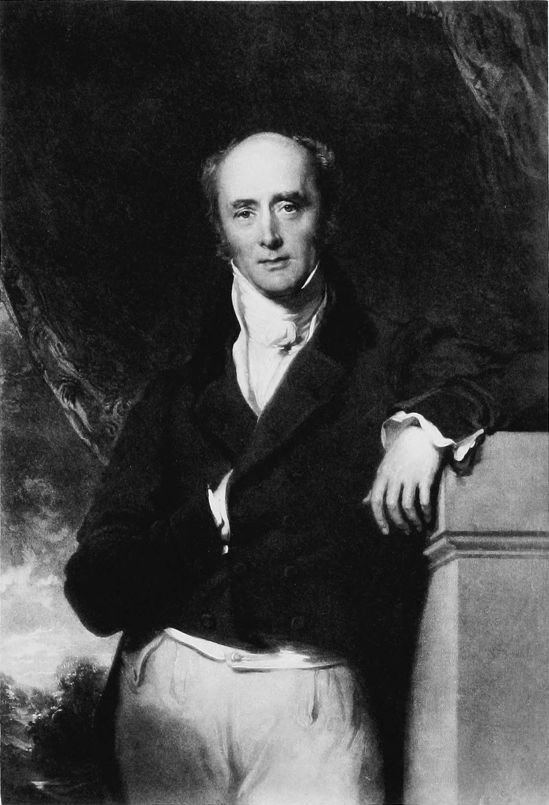
Sir Thomas Lawrence, pinx.
Walter L. Colls, Ph. Sc.
Charles Earl Grey
Lord Grey, who always, more or less, played the part of candid friend to his son-in-law, and assuredly cannot be charged with any animus against the statesman who succeeded him in the leadership of the Liberal party, declared that the conduct of the Melbourne Cabinet was ‘very shabby’ as regards Durham, and very ‘discreditable’ as far as they themselves were concerned. That, briefly put, is the verdict of history.
Just before the Ordinance was disallowed Arthur Kinnaird, who had been attached to Lord Durham’s embassy at St. Petersburg, but had not gone out with him to Canada, told his old chief that his bitterest foes were on this side of the water; but Durham little thought at the moment that amongst them were his own colleagues—the leaders of the party which had entrusted him with so great a task.
The conduct of the Melbourne Ministry was all the more extraordinary when it is remembered, as was pointed out at the time, that they annulled Lord Durham’s Ordinance in deference to a sudden outburst of anger in the House of Lords, a branch of the Legislature, whose resistance on other occasions they were in the habit of meeting almost with a touch of scorn. The memory of the Reform Bill, and of Durham’s bold advocacy of it, was still fresh in the recollection of the Peers, and the majority of the hereditary legislators had neither forgotten nor forgiven the bitter humiliation and chagrin caused by the proposal which Durham made, when the crisis was at its height, for a wholesale creation of Peers, to bring an antiquated assembly into line with the flowing tide of national opinion.
The only member of the Government who espoused Durham’s cause in other than a half-hearted or vacillating manner was—as has already been made clear—Lord John Russell, who, in the debate in the Commons on the Bill of Indemnity, had the courage to declare that his policy was ‘wise and statesmanlike,’ since it reconciled the ways of mercy with all that the safety of the Province and the interests of the Queen’s subjects really demanded. Durham never forgot Lord John’s chivalrous defence, and one of the most touching letters he ever wrote in his closing years showed how deeply he felt both Russell’s manly protest, and the pusillanimous surrender of the others to the envenomed rhetoric of a disappointed and discredited statesman like Brougham, who so contrived his impeachment that, for the moment at least, all the odium of it fell not on himself but on the Melbourne Government, which had refused him Cabinet rank.
Meanwhile, Durham, in happy ignorance of the storm which he had raised in Parliament, with restless and characteristic energy, had set out on a tour through Canada in order to acquaint himself, by actual inquiry on the spot, with the political grievances of the people. He might have had misgivings, but no thought of disaster was in his mind; he was far too great a man not to believe the best of others. But it looks now as if he realised then that his time was short, and his health uncertain, and so he threw himself with splendid energy into the work, to which, in an evil moment for himself, though not for his ultimate renown, he had put his hand. No one in Canada at that moment dreamed of accusing him of harshness in banishing, without a trial, to Bermuda, political prisoners, who had pleaded guilty of high treason. The current of public opinion, as already shown, ran the other way, and his act was regarded as one of clemency and mercy. The trial, in September 1838, of the murderers of Chartrand, a French Canadian, a man who was done to death without any provocation, was itself a vindication of his policy. The miscreants who were guilty of this man’s assassination had their guilt brought home by evidence which no one in Canada ever pretended to doubt, and yet, for so-called patriotic reasons, they were triumphantly acquitted, and the jury who brought in this dishonest verdict were invited to public banquets, in order that they might be thanked for their services. If any vindication of Durham’s conduct was needed, it was supplied by that gross miscarriage of justice only a few weeks later. It proved, as Durham thought, that, in political cases, justice was impossible in any trial by ordinary juries before the regular courts. The jury, in this instance, was purely Canadian, the accused having challenged all but his own compatriots.
Lord Durham quitted Quebec on July 4, and as he sailed up the St. Lawrence all sorts of wild rumours were in the air. The moment that the boat anchored off Montreal, three distinct and circumstantial accounts were brought to him in hot haste of the armed invasion of the Provinces by American sympathizers with the late rebellion. Feeling ran high in Montreal, and the rich and responsible merchants of that city were not inclined to conceal their opinion that the Governor-General had treated the political prisoners with too much consideration. If they had been hanged, Montreal would probably have been illuminated almost at the very moment when Brougham and Lyndhurst were thundering against Durham in the British Parliament, for what they regarded as his high-handed and despotic conduct. A month or two later, when the news of the disallowance of the Ordinance fell like a thunderbolt on Canada, the greatest indignation was expressed, and Brougham was burnt in effigy in Quebec. The people recognised that he was a marplot who had wrecked the hopes awakened by Durham’s settlement of the question.
When Durham landed at Montreal on July 6, the whole city poured out to meet him, for he had previously seen on board the Hastings the leaders of the British party, and had spoken to them in such wise and conciliatory terms that, almost as if by magic, the tone and temper of the whole community was turned from an attitude of sullen resentment to almost unbounded enthusiasm. It was in conference with the leaders of the British party at Montreal that Durham, for the first time, developed, in broad outline, his policy in regard to the permanent settlement of the Colonies. Many addresses were presented to him from public bodies, which gave him the opportunity of setting forth, first in one direction and then in another, the views which he had already formed for the welfare of the community. No man knew better than Lord Durham how to turn even formal occasions of ceremony to political purpose, and during the four days that he was at Montreal he won the confidence, not merely of a few representative men, but of the great mass of the people. The chord which he touched, states Charles Buller, was the determination of Great Britain to uphold her connection with these Provinces. He laid stress on the vast resources of Canada, and the ease with which they might be developed. He urged the necessity of laying aside party strife, and the petty jealousies of race, in the interest of practical reforms and common progress. He made no secret of his own opinion that it was well to forget the rebellion and the long course of irritating events which had led up to it.
Quitting Montreal on July 10, Lord Durham sailed up the St. Lawrence, and, wherever the boat stopped, addresses were presented to him. He visited in turn Kingston, Toronto, Niagara, and at the latter place an imposing military review took place. It was a timely display of force, and its effect was not lost on the United States. Charmed with the majestic beauty of the Falls, which, he said at the time, only the genius of Milton was worthy to commemorate, he lingered on the frontier line of the British dominions in the New World, and many Americans took the opportunity of making his personal acquaintance. He received them with cordiality and hospitality, which were in marked contrast with the stiff and suspicious bearing to which they had been accustomed by other and less distinguished servants of the Crown. It is difficult to understand now, in the light of the happy relations which exist between the two countries, the enthusiasm which Durham created when he drank at Niagara to the health of the President of the United States. That simple act was accepted far and wide as a token that the Queen’s representative repudiated the rumours that Washington favoured the rebels, or, at least, had secretly abetted the dastardly outrages of the American pirates, infesting the banks of the St. Lawrence.
Some of the letters which he wrote during this memorable progress, ending at Niagara, must be cited, since they reveal his own impressions at the moment of the condition of Upper Canada, where the problem created by misrule took an entirely different shape from that which had caused so much disaster in the Province of Quebec. The divisions in Upper Canada arose chiefly, as already stated, from the jealousies of three classes of the community—members of the ‘Family Compact,’ the ‘Reformers,’ and patriotic immigrants from the United States. But the great ground of contention in Upper Canada, apart from the jealousy of such factions, was the question of the lands allotted for the support of the Church, commonly known as the Clergy Reserves, a subject with which Durham dealt, as will hereafter be seen, in his famous Report.
The following letter, written just before Durham retraced his steps to Quebec, speaks for itself. It shows that he had grasped the whole situation, and the possibilities of a country which, he was quick to recognise, long before the tide of emigration had turned to it in any broad sense, was great enough to find homes, under hopeful and honourable conditions, not merely for the surplus inhabitants of England, but even, as he put it, for the overflowing population of all Europe. He saw quite as clearly that the existing conditions of government in the Province needed to be entirely remodelled, and foreshadowed the method by which such a practical reform might be effected. Canada, he felt, could only be held for the British Crown, and its power consolidated, by concessions to public sentiment, which were not merely just in themselves but imperative. He believed, in short, that the people ought to be allowed to govern themselves on some broad principle of Home Rule, which, far from weakening, would strengthen the ties which bound them to the Throne. He sought to make the Government of Canada responsible to its own people, and to limit the functions of the local Legislatures to affairs strictly colonial.
‘Niagara: July 17, 1838.
‘My dear Melbourne,—I am now in the midst of the worst district of all—opposite to the largest assemblages of American sympathisers, outlaws and refugees, and behind the most disaffected districts, where American squatters and American principles abound—namely, the London and Western Districts. And yet I see nothing to make me despair of removing all disturbances and the causes of them. It is wonderful that more has not been done by the Americans. The line of the frontier is so extended—so few troops, until lately, have been concentrated here, and so agitated and excited have been the volunteers. But it is less difficult to account for the alarms which have been created than for the meagre results which have ensued.
‘The tables, however, are now turned. The Americans, on their side, are beginning to experience salutary apprehensions. Our presence here (Sir J. Colborne, Sir C. Paget, Sir G. Arthur and myself), the encampment of the 43rd Regiment at the Falls, with Artillery, and the declaration which I have made in general conversation that any robber or pirate taken in the act ought to be immediately tried and summarily punished by a court-martial, as authorised by the late Act of the Upper House of Assembly, have produced the desired effect, and confidence is beginning to be restored. This may be completely established by some wise measures on the part of the Government. I have suggested the principal one in my despatch to Lord Glenelg, No. 25, to which I beg your particular attention. The finances of Great Britain will not be affected by it, as it will be only a loan on the credit of the Government. The resources here for the payment of the interest are ample, and the repayment of the principal at no distant date unquestionable. There is no private company that could not raise the money for a profitable investment if tranquillity existed. If you had seen the American town of Buffalo, with its splendid buildings, wharves, streets, and churches—raised as it were by magic, and owing its rise, continuance, and increase to the trade of the West, which is legitimately and naturally ours, and which we have neglected with such supineness—you would not be surprised at the confidence with which I anticipate the speedy repayment of any loan made by the Mother Country for the attainment of this essential object.
‘This measure will do more for the present pacification of the Canadas than anything else, and will save you immense sums of money. Only consider at what a cost you maintain now, and must maintain every year, a large army of regulars, volunteers, and militia, and a corresponding fleet. All this positive drain on the finances may be avoided by a temporary advance. I would not require it without offering sufficient security, from the tolls and duties, for the payment of the interest, and eventually of the principal.
‘A few hundred thousand pounds will complete the great works of opening the Lakes and the St. Lawrence to the sea, on which millions have been spent already in gift, not in loan. All this outlay is useless unless they are finished. Once completed, the intrigues of the Americans would cease, for they well know that the result of these improvements would be to draw away all the trade which now centres in them, and they therefore endeavour, and successfully, to prevent its accomplishment by producing such a state of insecurity as will deter any capitalist or colonist from settling in our territories. Remove that insecurity, give the necessary facility to commercial communication with the sea, and the result must be investment for capital, employment for labour, and the finest field in the world for emigration and successful colonisation. The country is really beautiful—not one hundredth part settled—and there is room for the overflowing population of all Europe; but then the Government is wretched in all its branches. The Colonies have the mockeries, the shadows of English institutions, not the realities—the names, not the substances; a magistracy composed of the worst material, some hardly able to write, administering justice, or rather injustice, according to their private interests; juries perjuring themselves; classes and parties protecting themselves by political associations, and the Government dependent on the House of Assembly, or the Legislature, for financial support, alternately the slave of one or the other. Such is the state of Upper Canada, and was lately of the Lower Province.
‘The only remedy for all this is the taking the great questions out of the hands of the local provincial assemblies, and assigning them to a higher and less numerous body, composed of the better class, out of each Province, forming a General Assembly, with a High Court of Appeal attached to it. I have already ascertained from communications with Sir J. Colborne, Sir J. Hervey, Sir G. Arthur, and the most influential persons in the two Provinces, that this affords the only practicable solution of our difficulties. I shall privately and confidentially consult with all the Governors and the principal men in all the Provinces, and, having collected their sentiments, shall be prepared, as I told you, with my plan, which you will receive by the end of November. Thus far all looks well. Everyone approves of the general principles of the scheme I suggest, and thinks it will work well in practice. In fact, I have not met with one dissenting voice as to the propriety and feasibility of committing all British, Imperial, and general interests to the care and control of a General Assembly, representing the Legislatures of the six Provinces.
‘I enclose you a letter which I received from Sir J. Hervey after we parted, which will show his opinion. I mean to have all my consultations over in the month of October, having summoned all the Colonial notabilities to meet me at Montreal in that month.
‘Everywhere I have said, and I hope I shall be sanctioned by you, that the object of my mission, and of my measures, is to perpetuate the connection between England and these colonies, indeed to render their separation impossible. You have no idea what general satisfaction this declaration has given. An opinion had gone abroad that we were indifferent in England to the connection, and consequently men’s minds were everywhere unsettled, and looking first to independence, and then to American connection, as the necessary consequences of their being abandoned.
‘Adieu. You must excuse the hurried and indistinct manner in which this letter is written, but I have no time to spare. It is now five in the morning, and later I am no longer master of my own time. We are to have a review of the troops this day, and tomorrow I go to Burlington and Toronto, returning to Kingston the day following. Thence to Montreal, the Eastern townships of Sherbrook, &c., and the French districts, where the revolt occurred. So that, you see, I am not letting the grass grow under my feet. In August I have requested the attendance at Quebec of the Governors of Nova Scotia, Prince Edward’s Island, and Newfoundland.
‘If I had any right to insert anything of a private nature in this letter on public matters, I should say that I am now writing to you in sight of the grandest and most magnificent spectacle which ever presented itself to my eyes—the Falls of Niagara. They infinitely surpass the most extravagant notion I ever entertained of their sublimity. No man ever lived, but Milton, who could adequately have described them.
‘Ever yours truly,
‘Durham.’
The curious irony of life stands revealed by the fact that this letter crossed one from Melbourne, written on July 28, stating that, on the previous day, he had handed to her Majesty the letter in which Durham had announced to the Queen how the day of her Coronation had been marked in Canada by the proclamation of a free pardon to all but the chief offenders who had taken part in the late rebellion. Lord Melbourne was commanded to express the Queen’s approval. Two days before Melbourne’s audience of the Queen, her Majesty had written to Lady Durham in the following terms:
‘Buckingham Palace: July 26, 1838.
‘Dear Lady Durham,—I have to thank you very much for two kind and interesting letters. You may be assured that the good accounts you have given on all subjects have given me great satisfaction, and I sincerely trust they will continue so.
‘I had the pleasure of seeing your father last night at a large dinner I gave to all the ambassadors, and thought him looking remarkably well. Lady Mary, I hope, is more reconciled to Canada since she arrived there than when she left England. I trust you and Lord Durham and all the children continue in good health, and bear the climate well. Please remember me most particularly to Lord Durham, Lady Mary, and your brother and Mrs. Grey, and believe me always, my dear Lady Durham,
‘Yours affectionately,
‘Victoria R.
‘I hope to hear from you soon again.’
Almost immediately after Melbourne’s communication the Queen wrote again:
‘Buckingham Palace: July 31, 1838.
‘My dear Lady Durham,—Though I have written to you but a very few days ago I cannot refrain from again doing so to thank you for your letter of the 29th June, and for all the kind expressions it contains, for which I feel very thankful. Pray be so good, my dear Lady Durham, as to convey to Lord Durham my sincere thanks for his kind letter, which gave me much satisfaction. You will have, I suppose, heard by this time how well everything went off at the Coronation, and what marks of affection and loyalty I received from the whole nation. It was a proud day for me, and one which I shall ever remember with gratitude.
‘With my best love to your daughters and Mrs. Grey, believe me always, my dear Lady Durham,
‘Yours affectionately,
‘Victoria R.
‘The Countess of Durham:
‘Quebec.’
The Prime Minister stated that Durham’s communication to himself was clear and satisfactory, and that what he had done had his ‘entire approval and concurrence.’ He added that he was gratified that Durham had not merely settled the difficult affair of the prisoners, but had ‘settled it so well.’ It is only fair to say that Melbourne at that moment had some misgivings about Bermuda. He told Durham that his Ordinance would have no power there, but left him with the impression that the Government would deal with the situation which had arisen.
By the same mail came a letter, dated July 31, from the Colonial Secretary, acknowledging, unofficially, Durham’s despatch of June 29, which described the manner in which he had disposed of the political prisoners. Lord Glenelg assured Durham that, though there might be some legal inaccuracies of form, the substance of the Ordinance was entirely right, and the result satisfactory. He declared that his colleagues, as well as himself, entirely approved of the course which Lord Durham had taken; he assured Durham that he had solved a very difficult question ‘most judiciously and ably, in a way at once merciful and just, and equally grateful to rival parties and impartial judges.’ He referred to the attack of the previous night in Parliament, by ‘old enemies,’ on the Ordinance, but assured Durham that such criticisms were of no account in England, and he expressed a hope that they might prove ‘equally harmless’ in Canada. He ended by congratulating him on the confidence which, he heard on all sides, the people of the colony reposed in him. ‘Go on and prosper,’ he ended; ‘Parliament will soon be up, and your measures will not have this running fire to meet.’ Yet, three weeks later, Durham was thrown over by the very men who had thus expressed their approval of his Ordinance.
Melbourne and his colleagues, by every consideration of loyalty, ought to have thrown the whole weight and protection of the Government around a Governor-General who had been entrusted by the Crown with extraordinary powers. Setting aside all claims of private friendship, Durham, in his absence, ought to have been defended by the whole Liberal party, and most of all by its official chief, against the legal quibbles of a group of lawyers. Lord Melbourne had to choose between the disapproval of the House of Lords and the abandonment of Lord Durham. He elected to disallow the Ordinance, rather than risk a hostile vote. He yielded to clamour, when he might have saved the situation by the adoption of a bold course. He surrendered to panic, as represented by the rhetoric of Brougham, a man who denounced Durham’s measures as tyrannical, though he himself had been one of the loudest advocates of the Irish Coercion Bill of 1833.
If Durham had been guilty of the worst excesses of power which Burke charged against Warren Hastings, he could not have been more fiercely denounced in the House of Lords.
Justin McCarthy.
1838
Durham’s work of pacification—‘A bolt from the blue’—Durham determines to resign—Burning of Brougham in effigy—Meeting of Maritime Delegates—Ovation at the theatre—Address to the Delegates—Lord John Russell’s advice—A Ministry ‘utterly weak and incapable’—Resolutions of confidence and sympathy—Despatches to Lord Glenelg—Melbourne’s treachery—The Indemnity Bill—The Bermuda imbroglio—Durham’s defence of his policy.
Meanwhile, Lord Durham, cheered by the letters of his colleagues, had returned to Quebec, and was hard at work trying to master the voluminous evidence, which Buller and Wakefield had accumulated by this time, in proof of the practical grievances existing in various parts of the colony. Their statements, and those of many responsible officials in Upper and Lower Canada, are still preserved amongst the Lambton Papers, and they show how thoroughly every question at issue was investigated, every testimony weighed and sifted. Durham’s own despatches to Glenelg, notably one which he wrote on August 9, foreshadow his Report, and indirectly dispose of the oft-repeated statement that he did not himself write that historic and indeed classic Blue Book—a State Paper which has been well called the Magna Charta of the Colonies.
The month of August was spent in considering the vexed question of the Clergy Reserves, and weighing the advantages of a legislative union of the two Provinces, considering various schemes of judicial and administrative reform, and in receiving deputations from various parts of the colony, who came charged with the task of placing before the Governor-General all kinds of political grievances, and submitting more or less practical schemes for their removal. Durham, during the whole period of his residence in Quebec at the Castle of St. Lewis, was given to hospitality on a broad and stately scale, and, at the very time when the Melbourne Cabinet abandoned him in Parliament, was in the full tide of his political work and social popularity. News travelled slowly in those days, and it was about as difficult in 1838 to get a written reply to a despatch from England as it now is from New Zealand. It is scarcely too much to say that if Melbourne and Durham could have communicated then with the ease with which the electric telegraph now makes possible, the whole situation would have been saved. Ministers would have obtained the information which they wanted, and Durham would have been able at once to vindicate himself, or, at all events, to give the explanations which would have rendered harmless the attacks upon his policy. Whether he would have disarmed the opposition of Lord Brougham, even in that case, is another matter, for the ex-Chancellor knew that, in attacking the Ordinance, he was wielding a two-edged sword. He was damaging, on the one hand, Durham’s reputation, of which it was notorious he was envious, and on the other he was bringing the Melbourne Cabinet into contempt, and so gratifying his old grievance at his exclusion from office. He was still smarting under Melbourne’s refusal in 1834 to avail himself of his services—and was probably beginning to realise that the door of office was closed to him for ever.
It was whilst busy with the great tasks of reconciliation that Durham, little dreaming of any mischance, heard suddenly, on September 19, of the proceedings in Parliament on August 7, 9, and 10. Lord Melbourne had been in no hurry to chronicle his own desertion of his colleague. His letter, not written till August 19, was still on the water when Durham took up an American newspaper, and read in its columns that his Ordinance had been disallowed. Though he had been invested with extraordinary authority, and placed in a position of unparalleled difficulty, yet the Cabinet, in spite of their previous declarations of warm approval, had deserted him, and ruined at one fell stroke what he regarded as the crowning work of his life. Durham was not merely a proud, but a sensitive man, and the iron entered his soul. Charles Buller has described his chief’s reception of the news. Delegates from Nova Scotia, Prince Edward’s Island, and New Brunswick were at that moment in Quebec, and Lord Durham was already in conference with them, the basis of discussion being the principle of a federal union of all the existing colonies in North America. It was in the midst of these amicable discussions that the ill tidings came. ‘I recollect well,’ states Charles Buller, ‘the day that the news arrived. I happened, amid my usual fatigues, to have that morning a few hours of leisure, and at Lord Durham’s request I went with him on an excursion in the neighbourhood. The incidents of this little journey are fresh in my recollection; I well remember what we said and how we talked, and how we laughed under the bright Canadian sky on that fine autumn day.’ He adds that, on his way back to his lodgings, someone told him the news in general terms. He thought it must be a joke, or at least a mistake, and gave no further heed to it. When he went to dinner that night at the Castle, he continues: ‘Lord Durham sent for me, told me the news, and, almost more by manner than words, let me know that his mind was made up to resign his government. I saw, indeed, from the first that such would inevitably be the result, and that here—for a while at least—was destroyed the whole fabric of improvement that he had with so much labour and anxiety been building up.’
If Lord Durham’s health had been equal to the strain, Charles Buller thought that he would have been wise to have remained at his post, in spite of what he described as the ‘fearful chances of failure,’ to which he was suddenly exposed, in the task of restoring peace and order to Canada, by the ‘factious conduct of the Tories and the more fatal abandonment of Ministers.’ Durham was so strong a man, and he had rallied around him to such an extraordinary extent the confidence of all classes in the three months he had been in Canada, that his chances of success, in spite of this sudden and angry cloud of detraction in England, seemed other than remote. But against this had to be placed another consideration, and here again Charles Buller’s testimony as to its nature must be cited. ‘I approved of his resignation on the ground which now (1840), alas! I may plainly mention. Without surmising the real nature or extent of the mischief, I saw that Lord Durham’s health was fearfully affected by what had passed. Such a degree of nervous agitation did his disease produce, and such a reaction of that agitation on his bodily health was constantly going on, that it was evidently impossible for him to bear up against the anxieties and labour of his government under existing circumstances, or display that energy and promptitude of decision which had so eminently distinguished him when his health was better. I felt convinced, and, unhappily, it is now too clear that I was likely to be right, that Lord Durham’s life would very soon have been the sacrifice for his continuance in Canada, even for two or three months, and that, at any rate, he was liable to have his energies impaired by illness, at moments in which any relaxation of them would have been fatal to success. I lamented his resignation then. I deplore it yet more deeply now, but I approved of it then, and approve it now as an act done in compliance with a stern and sad necessity.’
The closing words of this statement effectually dispose of a passage in Torrens’s ‘Life of Lord Melbourne,’ where it is declared that ‘Lord Durham could not bear rebuke or question from the Home Government, and forthwith announced his resignation. A few days later, when talked over by Charles Buller, he repented, and wrote privately, as if he might yet be coaxed for the sake of the public service to remain.’ No authority is given for that assertion, and Buller’s own words, now published for the first time, prove that such a statement was absolutely unfounded. If any further proof of this is needed, it is to be seen in the decisive course which Durham, rightly or wrongly, immediately took. He was stunned—there is evidence enough of that—by the sudden blow; but he at once made up his mind, and lost no time in announcing his decision. Quebec was full at the moment with the stir of political life. Men felt that a new era in the annals of North America was in truth beginning, at the very moment when the ominous news from England shattered the fair prospect of reconciliation and reform. Even the Republican section of the community could scarcely credit the news. They said that it was a strange thing that statesmen thousands of miles away across the Atlantic, whose leanings were assuredly not too much in the direction of liberty, should accuse Lord Durham of ‘despotic’ conduct, which the people at his side in Canada had never discovered. It was everywhere felt that the charges against Durham were unjust, and were inspired by personal motives, and intended to wreck his career. The burning of Brougham in effigy in itself shows how high the tide of indignation ran, and how quick the people were to lay the blame for the frustration of their hopes on the right shoulders. It was even proposed to pay the same left-handed compliment to Melbourne and Glenelg.
Meanwhile, Durham, little dreaming of the disallowance of his Ordinance, had summoned official delegates from the Maritime Provinces to Quebec in order to consult with them as to the best measures of settlement of outstanding political grievances. These representatives from Nova Scotia, New Brunswick and Prince Edward’s Island had actually reached the city for this purpose when the tidings arrived, so that the irony of the situation was palpably heightened. Durham was present at the theatre on the night of September 21, and by that time the news, which should have arrived two days earlier, was public property. The Castle of St. Lewis had been besieged all day by callers, anxious to show their sympathy with the Governor-General by inscribing their names in the visitors’ book. When Durham appeared at night, ‘bearing no less a gallant face because so broken-hearted,’ the whole audience sprang to their feet and gave him a magnificent ovation. It was one of those spontaneous outbursts of public feeling which are worth more than all formal compliments. It showed Durham that, though he might be disgraced in the official sense, the people he had served so well were not prepared to endorse the cruel verdict. Looking back now, it is easy to say that he ought to have stuck to his guns. Probably he would have done so if he had been a mere scheming politician, like the men who denounced him. But a man in the supreme moments of his life is always more or less at the mercy of his temperament, and yet, quite apart from the proud sensitiveness which was always Durham’s characteristic, he believed that his task was no longer possible, now that his authority had not been merely challenged but set aside. If the personal affront had been all, it cannot be doubted by anyone who has followed this story so far, and is therefore able to look at his whole career, that the sense of duty would have triumphed, and he would not have put himself, as it must be admitted he did, in the wrong by proceedings which, however natural, were certainly ill-advised. He had persuaded himself, however, that this last indignity, following, as it did, on much previous carping criticism, rendered his continuance at the head of affairs inexpedient, in—what was next his heart as long as life lasted—the interests of Canada itself. So it came to pass that the die was cast.
He made two speeches on September 22 to the assembled delegates. They had come to discuss a federal union of the five provinces, and, when they met, rumours were in the air that Lord Durham meant to propose the repeal of old feudal tenures, restrictions on the sale of real estate, and other measures of practical redress. The Maritime deputies, who had already formed their own conclusions of Durham in previous discussions, presented him with an address, expressive of gratitude for the manner in which he had considered their case, and of confidence in his policy. The address ended with an appeal to him not to resign the post which he had so admirably filled, in spite of what had happened in England. Durham, in reply, said: ‘I assumed the government of the North American Provinces with the pre-determination to provide for the future welfare and prosperity of them all, never doubting that such would be the best, nay, the only real security for their permanent connection with the British Crown. In communications which have taken place between us, and from which I have derived equal pleasure and information, you have been fully apprised of my views and intentions. These you have appreciated and recognised in a manner for which I can never be sufficiently grateful. I have indeed had a difficult and laborious duty to perform. The result of my endeavours, however, is one of which I need not be ashamed. In the short space of little more than three months I have seen tranquillity restored and confidence reviving. I have caused substantial justice to be administered, tempered by mercy. I have carefully examined, with a view of reformation, all the institutions of the Province more immediately committed to my charge, and I was on the point of promulgating such laws as would have afforded protection to all those great British interests which have been too long neglected. I had also, as you well know, devoted the most careful attention to subjects which affect the general interests of all the colonies, and had brought nearly to maturity the plan which I intended to submit in the first instance to the consideration of the Provinces, and eventually to the Cabinet and the Imperial Parliament. In this, I trust, useful course, I have been suddenly arrested by the interference of a branch of the English Legislature, in which the responsible advisers of the Crown have deemed it their duty to acquiesce. Under those circumstances I have but one step to take—to resign that authority, the exercise of which has thus been so weakened as to render it totally inadequate to the grave emergency which alone called for its existence. Be assured, however, that this unexpected and abrupt termination of the official connection which united me with the North American Provinces will not weaken in my mind the feelings of deep interest which I shall ever take in their fate, or render me less anxious to devote every faculty of my mind, and every influence I possess, to the advancement of their interests and to the establishment on the most lasting foundation of their welfare and prosperity.’
Up to this point Lord Durham had read his reply. He now threw down his paper and addressed the assembled delegates as friends out of the fulness of his heart. He began by thanking them for their promptness in complying with his invitation to meet him, in order that they might consult together on the welfare of the several provinces. He rejoiced to find that but one sentiment prevailed—the determination never to break the tie with England, the home of their fathers. He had called them together in the hope that some plan might be adopted that would benefit each province, and yet strengthen the bonds of the whole of British North America, and so shed a lustre on England, which was the glory of the world. He knew that difficulties might present themselves in the bringing about of a Federal Union. He had summoned that representative assembly, prepared to listen to every argument which might have been brought forward, and with a determination that, so far as he was concerned, everything should be done openly and fairly, for he never would stoop to deception to gain any point. That was the language, he added, he had used to the Tsar of Russia when he was Ambassador to the Court of St. Petersburg, and it was the ruling principle which inspired his public life.
He confessed that the affairs of Canada were very imperfectly known in England. He himself knew very little about them prior to his appointment as Governor-General. He had crossed the Atlantic, not to gratify his own personal feelings, but in obedience to the command of his Sovereign. His views of the political situation in Canada had greatly changed since he had become acquainted at first hand with Canada, its resources and its inhabitants, and nothing would alter his ardent wish, wherever he might be called, and however he might be employed, for the prosperity of that vast country. He went on to say that, not merely his aim, but the dearest object of his wishes, was to be able to assure the Queen that her fine possessions in British America might be considered one of the richest gems in her dominions. He wanted to assure her Majesty that the entire population was in a state of harmony and friendship, and each party was striving, in friendly rivalry, to promote the good of the whole community. Then he added: ‘At a moment when I was about to complete those plans which were maturing, party spirit (in England) interposed its withering hand, and blasted all my hopes for the welfare of the Canadas. I cannot, I do not wish to conceal from you who are present that the recent intelligence from England, although not official, has made a very deep impression on my mind. Opposition from Lord Brougham and from those acting with him was no more than I might expect, but I am compelled to say that I have been put down—sacrificed—by my friends, whose duty it was to stand fast in my defence, at a period when my political enemies were using their utmost energies to destroy me.’
At this point in his speech Durham completely broke down. He was ill, and his whole nervous system was exasperated. His condition indeed was so alarming that Charles Buller said at the time that he thought that his chief would not live to reach England. When Lord Durham resumed his speech, tears were glistening in the eyes of the whole assembly. The men whom he addressed felt that they, as well as Lord Durham, had been betrayed, and they made no secret of their indignation at the pusillanimous attitude of the Melbourne Cabinet. He resumed by apologising for the physical weakness that had unmanned him, and added: ‘It was the duty of her Majesty’s Ministers to support me in the hour of persecution, and not to join with my bitter enemies in striking at me. Deprived of all ability to do anything for Canada, it can be of no use for me to remain any longer in the country, and I shall leave it as soon as I receive the official account of the Parliamentary doings.’ He then took a touching farewell of the delegates, every one of whom realised only too clearly that his spirit was broken.
After the Conference some of the leaders remained behind in Quebec for a few days, and Durham, though he felt that his mission was ended, seized the opportunity of making himself still better acquainted, in long personal talks, with the actual needs of Canada. His own work as Governor-General might be ended, but his interest in the welfare of the country was quite independent of office. He wanted to be in a position to deal wisely with the affairs of Canada long after his connection with the country ceased. He had his Report to prepare, and his place to fill in Parliament as an authoritative exponent of a new and enlightened policy. It was at this juncture that he received a letter from Lord John Russell, written on August 18, the day on which Parliament rose. It began by stating that Durham would have before him all that had passed in Parliament on the subject of Brougham’s Indemnity Bill; but official papers, Lord John felt, would not tell Durham how high public feeling ran on the subject. ‘You will not learn from these proceedings how much the public mind is disgusted by the spirit of the attacks made upon you. People feel the value of our North American Provinces, and are alarmed at the attempts made to endanger our dominion for the purpose of a party attack upon you. . . . My advice to you, in a word, is, if you find you can maintain your authority in spite of these proceedings, you should feel bound to stay and carry on the public service. If, on the contrary, parties split, and deny obedience to your directions and orders, then I think you are not under any obligation to struggle against difficulties, which may get more formidable every day.’
This letter was sent by a merchant ship, and was not received by Lord Durham until a fortnight after official despatches dated September 7 had arrived. Lord John’s letter, as a matter of fact, only reached Durham on October 11, two days after he had ‘burnt his boats’ by the issue of his Proclamation. In his reply, dated Quebec, October 12, Durham says:
‘If the hostile acts in England had merely been the speeches of Lord Brougham in the House of Lords and the passing of his Bill there, my government would not have been damaged. The support of the Ministry, and the consequent rejection of the Bill in the Commons, would have left me as strong as I was in the estimation of the people here. But when, by the disallowance of the Ordinance by the Ministers, there became arrayed against me the Crown, the Lords, and the Commons, as well as the Ministry, the blow to my authority was fatal and irreparable.
‘Now that I am going, the universal sympathy and feeling of regret which prevails amongst all classes gives no occasion for difference of opinion on political or provincial matters. But, if I had determined on remaining, every act of my government would have been disputed by each party, accordingly as they disapproved of the measure. French and English alternately, as they were pleased or displeased, would have denied all permanent obedience, and appealed to the Imperial Parliament, where they would, from past experience, have been justified in expecting censure and disavowal of me. I had no course to pursue in these circumstances but to transfer the scene of action from Quebec to London. I do not conceal from you that my feelings have been deeply wounded by the conduct of the Ministry; from you, however, and you alone of them all, have I received any cordial support personally, and I feel, as I have told you in a former letter, very grateful to you.’
Lord John replied at once to this letter in the following terms:—‘I am very much pleased that you are satisfied with the stand I made in the House of Commons for your government. . . . I still hope you may stay in Canada. I retain the opinion I had that the question of your remaining should be decided by the degree of support you met with in the Province, and this has been to the utmost extent satisfactory and gratifying.’
The rebellious section of the community at once took fresh heart. Durham was a discredited man, and they saw their opportunity. He had cowed those who had refused to be conciliated, but the disastrous disallowance of the Ordinance revived their hopes. Lord Durham, so they argued, had been thrown over by the English Government, and therefore they began to scheme and plot with the old alacrity. The habitants of Lower Canada met secretly by night to drill, revolt was in the air, and open rebellion was once more only a matter of time. The Loyalists, on the other hand, were filled with dismay; they had seen with admiration how rapidly, and with what complete mastery of all the issues involved, Durham had grasped the problem of Canada, and with what skill and patience he had done his best to bring all the warring questions at issue to a peaceful and honourable settlement. The ‘Montreal Gazette,’ which hitherto had given his policy only a modified support, now came to the defence of Lord Durham in words which deserve to be recorded: ‘We cannot conceive how any man of high spirit could submit to the utter degradation of serving a Government who had neither the power to support him in the exercise of his public functions, nor the courage to defend him and themselves from the factious insults of party politicians, or the more infamous inroads of personal and jealous enemies. A Ministry so utterly weak and incapable, so grossly ignorant of the duties of their station, of their obligations to their Sovereign, and of their responsibility to their country, are totally unworthy of the services of any man of honour who values his own reputation. It is, therefore, no wonder if the Earl of Durham has resolved upon abandoning the future administration of the affairs of these Provinces.’
A great meeting of protest quickly followed at Quebec. Resolutions were passed in which confidence in Durham was expressed, linked to regret at the weak and impotent attitude of the Melbourne Cabinet. It seemed incredible to those assembled that Lord Durham should be forced to leave Canada just as he had got to the root of the political difficulty, and all the well-affected colonists were cherishing the hope that he was about to bring forward some comprehensive scheme which would put an end to disaffection. It was significant that, at this thoroughly representative meeting, one of the resolutions affirmed that the only remedy was the legislative union of the Canadas, since any proposal for federation would, at the moment, only increase the difficulties of the situation. Meanwhile, the hope was expressed that Durham would remain at his post. Influential deputations waited upon him from Montreal, Kingston, and Toronto, and expressed the indignation with which the inhabitants of those cities regarded the action of the Melbourne Government. No secret was made in these public protests of the opinion that it would be nothing less than a calamity to Canada if Lord Durham was driven from power. It was significant that the more enlightened section of the French Canadians everywhere openly expressed their regret. Even people who had most violently condemned Durham’s policy at the outset now joined in the chorus of dismay, and many were the private letters from prominent colonists, up and down the country, which he received in the few critical days when it was still thought possible to alter his decision.
If personal motives or mere pique had swayed Durham he might have wavered, but he saw clearly enough that, to borrow Charles Buller’s words, his resignation was ‘absolutely necessary,’ not for the vindication of himself, for that, after all, was a small affair, but in the interests of Canada, which he had come to love with all the passion of an undivided heart. Every one around him concurred in this opinion, and not least Sir John Colborne, who made no secret of his opinion that, under all the circumstances, this was the only course open to him, consonant not only with personal dignity, but with the welfare of the community. Only two months before Durham received the news of the disallowance of the Ordinance, Sir John Colborne had expressed his desire to relinquish his command in Canada. He felt that there was no longer any need for his services as a soldier, for not only had revolt been crushed, but tranquillity, in consequence of Durham’s policy, had been absolutely restored. Lord Glenelg, writing on July 7, told him that his request should be granted. But in a subsequent despatch, on August 18, after the disallowance of the Ordinance, Colborne was requested to remain at his post, because of ‘the inconvenience and even injury to which great national interests might be exposed by his retirement.’
Lord Glenelg even then seemed aware of the false step which the Government had taken, and of the probable effect of the ill-judged measure which had been rushed through Parliament. It looks as if he even anticipated not merely that Durham would resign, but that there would be, in consequence of that act, a fresh outbreak of rebellion. History was, in this case, to repeat itself, for Durham was no sooner on board ship on his homeward voyage than hostilities actually began. Lady Colborne, who assuredly was not too well disposed to Durham, declared that he was ‘far too conscientious to take any steps he really thinks bad for the country’; and even those on the spot, who thought that he had gone too far in his attempts to pacify the disaffected, shared that opinion.
The reasons which induced Durham to relinquish his office as Governor-General of Canada are set forth in the three despatches which he wrote, on September 25, 26, and 28, to Lord Glenelg, as soon as he knew of the proceedings in Parliament. He was ill when he wrote them, so ill indeed that Charles Buller, as already shown, had grave misgivings whether he would live to reach England. But the ability with which they are written is as little open to question as that of the famous Report, though the prevailing note is, of course, more personal. These despatches, numbered 66, 67, and 68 in the official correspondence, contain Durham’s protest against the manner in which he had been treated by the Melbourne Cabinet ever since he had left England. They explain also the changed attitude which his policy brought about in British North America. He begins by calling Lord Glenelg’s attention to the injurious effects in Canada of the running fire of criticism to which he had been exposed. He states that his own representations on the subject are but the ‘echo of the public voice in these colonies.’ All men, irrespective of class or party, were at one in thinking that, unless he was cordially supported by the British Parliament, which had entrusted him with extraordinary powers, and by the Melbourne Cabinet, which had placed ‘extreme authority’ in his hands, there was not the slightest chance of any satisfactory result. The House of Lords, from the moment he left England, had made it all too plain that the moral support essential to success was denied to him.
He complained not only of the direct attack made upon him, as early as July 4, by the Duke of Wellington, who directly challenged his authority and asserted that he had no other powers than those which are ‘ordinarily given to any Governor of a colony,’ but also of the action of Lord Melbourne, who had allowed such a statement to pass absolutely unchallenged. His position in Canada had been ‘seriously weakened’ from that time forward—on the one hand by the ‘unqualified expressions’ of the Leader of the Opposition, and on the other by the ‘consenting silence’ of the Prime Minister. ‘The effect upon the public mind was instantaneous and most remarkable. The disaffected were encouraged to believe that, as my authority was so questioned, the manner in which it had been, or might be, exercised would to a certainty be vigorously assailed by the Opposition, and feebly defended by the Government. They inferred that the success of my mission, which—as all parties at home had allowed when the danger was imminent and all here still felt—depended upon the vigorous exercise of an extraordinary authority, was thus rendered next to impossible. In forty-eight hours after the speech attributed to the Duke of Wellington had been published here, the tone of that part of the Press which represents the disaffected exhibited a remarkable change, giving evidence no longer of submission, however unwilling, to extraordinary powers unhesitatingly exercised, but of discontent, irritation, and seditious hopes.’
He proceeds to describe how his hands had been weakened in dealing alike with the French Canadians and the British colonists, in consequence of Lord Melbourne’s careless apathy. Grave rumours were accumulating, on good authority, of a disquieting kind as to the attitude of the French peasantry, and the outlook for the winter was far from reassuring. The British colonists, on the other hand, were everywhere filled with despondency at the lack of adequate support of his measures in England. Many of the most intelligent and progressive men amongst them had entered with enthusiasm into his plans for the settlement of the grievances of British North America—a land hitherto so much neglected by the Mother Country. They were ‘aware of my determination, so far as it might depend upon me, to remove the causes, to dry up the very source of past dissensions, and to render this colony essentially British in its laws, institutions, and character.’ Such men had given him their confidence. They were engaged in drawing away the public mind from the miserable past, and seeking to fix it on the ‘happy prospect of peace and prosperity.’ They had recognised the difficulties of his task, but when the news in question arrived they gave way to a feeling, first of despair, and then of resentment, and felt that he was powerless to carry out the important measures which he had announced, and Colonial interests were once more to be sacrificed to the objects of mere party in the Mother Country.
Durham next explains with equal vigour and clearness the motives which had upheld him in his work and had led him to believe in its ultimate success. ‘The first was the great extent of the legal powers conferred upon me, enhanced, as they had been morally, by the universal approval in England at my having undertaken to exercise them. The second was the impression, which prevailed throughout these colonies, that I might reckon with perfect confidence on the undeviating approval and support of the members of her Majesty’s Government, with most of whom I had been so long and intimately connected, as well by personal friendship as by political relations. By the proceedings in question I was deprived of these, the only but all-sufficient grounds of confidence in my own exertions.’ He proceeds to show how the colonists came to attach so much weight to the discussions in Parliament. They were as ignorant, in truth, of the hidden ‘springs and influences of party politics in England’ as the majority of English statesmen were with the political cliques and public affairs of Canada. ‘It was supposed that the great party in Opposition at home really believed my authority to be no more extensive than that of an ordinary Governor in ordinary times, that her Majesty’s Ministers were of a similar opinion, that all my promises of unusual measures, suited to the unusual circumstances of the case, had been made inadvertently or delusively, and that I had no more prospect of healing the wounds, inflicted on this country by a long course of shifting and temporising policy, than if the Act for suspending a Constitution, and conferring legislative powers on an individual, had never passed. In fact, whatever may be the powers which that Act legally confers upon me, the moral authority of my government, the prestige, if I may so speak, of power, once imagined to be so great, and of a supposed unbounded influence with her Majesty’s Government, was gone, apparently for ever.’
Durham goes on to state that, unlike the people of Canada, he was able to make due allowance for the party character of Wellington’s speech, and that therefore, though discouraged by it, he deemed it his duty to the Queen, to England, and to the colonists who relied on his good intentions, to go on with his work. He knew that Parliament would shortly rise, and then he hoped to be free to pursue the course on which he had embarked without further attacks. He felt at that time that the measures which he was about to propose would promote British trade, as well as the general prosperity of the Colony. Moreover, he saw that the worst consequences might follow his resignation. So, banishing all thoughts of failure, he bent his energies to bring to maturity the series of far-reaching measures by which he hoped to make Canada a happy and loyal portion of the British Empire.
Whilst Durham was so engaged he received despatches from Lord Glenelg. They contained no hint of disapproval; on the contrary, they conveyed the ‘most flattering expressions of the satisfaction which all my measures, including the Proclamation and Ordinance relating to the political prisoners, had given to her Majesty’s Government.’ Nor was this all. These official despatches were accompanied by numerous personal letters of approval; amongst the rest were private communications from Glenelg and from Melbourne himself, in which the ‘official approbations were most warmly and kindly confirmed.’ These despatches and letters were still before Durham when an American newspaper, which had reached Quebec by the same ship, was placed in his hands, and in it he read that his authority had been once more assailed, in the closing days of the session, by Lord Brougham, and the Melbourne Cabinet had disallowed the Ordinance. He closed his first despatch on the subject by stating that he would make no comment until he had the official account of the Cabinet on the proceedings in Parliament. But he enclosed the reply which he had already made, on September 22, to the deputies from the Maritime Provinces, in which he had announced his intention to resign a post which had suddenly become intolerable.
Lord Glenelg had officially informed Durham—in a despatch, dated August 5, 1838, acknowledging the receipt of one from Quebec, of June 29, in which the Governor-General had reported how he had solved the question of the disposal of the political prisoners—of the Queen’s approval of the course which he had adopted. He added: ‘Her Majesty’s Government are fully alive to the difficulties by which this question is surrounded. It has therefore afforded them much satisfaction that you have been able to surmount those difficulties, and that the course which you have adopted has been favourably received in the Provinces, as equally free from the imputation of too great severity, or of excessive and ill-considered lenity. While, however, I convey to you the approbation of her Majesty’s Government of the spirit in which your measures have been conceived, I abstain from making any observations on the legal objections which may possibly occur to some of the provisions of the Ordinance, a copy of which is transmitted in your despatch, as it is at present under the consideration of the law officers of the Crown.’ The Queen herself wrote an autograph letter to Lord Durham expressive of her satisfaction.
This despatch was accompanied by a second, dated the following day, in which the Melbourne Cabinet, through Lord Glenelg, expressed the entire approval of the Commission which Lord Durham had appointed to dispose of the vexed question of the Crown Lands, with a view to the promotion of emigration on the broad scale. Two days after Glenelg had written, expressing the approval of the Melbourne Cabinet of Durham’s Ordinance, Brougham denounced it in the House of Lords, and, after a long and angry debate, in which Durham was damned by faint praise by the Government who had promised him at the outset loyal and vigorous support, the Ordinance was disallowed on August 9.
On July 30, before the Colonial Office had received any official intimation from Durham of the passing of his Ordinance, Brougham, upon mere newspaper information, attacked the Ordinance in the House of Lords. By August 5 Lord Glenelg had received the Ordinance and laid it before the law officers. On the 7th Brougham returned to the attack, denouncing the Ordinance as wholly illegal, and declaring that the unconstitutional powers granted to the Governor of Canada did not justify him in departing from the law relative to the trial of treasonable offenders. Lord Glenelg admitted that the jurisdiction of the Governor of Canada did not extend to the Bermudas, but asserted that Durham’s justification would be found in the great principles on which he had proceeded to legislate, and in consulting the real and substantial interest of the Province. Lord Melbourne stated that he also had to give up that part of the Ordinance relating to Bermuda, but insisted that all other parts of it were perfectly legal, and warranted by powers committed to Lord Durham. He protested against the course pursued with respect to the Governor of Canada. ‘If you consider,’ he continued, ‘that he has exercised powers entrusted to him unfortunately, and in such a manner as to hazard the interests of the country in that part of the Empire, it would be unquestionably wise in your Lordships to interfere to prevent such a course from being persevered in; but if you do not see any ground for interfering, then you ought to place some reliance on his judgment, and not to be perpetually interrupting the course of his proceedings by comments on his conduct, thus weakening your own authority and the authority of the Government.’ At the same sitting Brougham gave notice of his intention to introduce a Declaratory Act, to explain, define, and limit the power given to Lord Durham.
On August 9, Brougham moved the second reading of this measure, afterwards known as the Indemnity Act, ‘for declaring the true intent and meaning of an Act passed in the present session of Parliament, entitled, “An Act to make temporary provision for the government of Lower Canada,” and for indemnifying all persons who had acted under or had carried out the Ordinance.’ Glenelg opposed the Bill, and Melbourne stated the strong reason which made him refuse to be a party to the disallowance of the Ordinance. ‘When I consider,’ he said, ‘that the disallowance of the Ordinance would be destructive of the moral effect of the noble earl’s government, and almost the same as pronouncing the termination of his connection with the colony, and throwing everything loose to every chance of confusion, I cannot, with any regard for the prosperity of the country, be a party to that course, especially as any part of the Ordinance which is unauthorised by the law would, as a matter of course, become itself inoperative and without effect.’
The Duke of Wellington denied that either he or his friends had any part in the responsibility respecting the proceedings done under the Act. The responsibility rested with the Government, and he was sure that more gross illegality than the Ordinance displayed, as far as it concerned Bermuda, could hardly be committed. On a division the Bill passed the second reading by a majority of 18. The Peers voting in its favour numbered 54, and those against it, 36. On the following day (August 10) the House went into Committee on the Bill, and Melbourne, changing his attitude of the preceding day, said that, although he had received the decision of their Lordships with deep regret, he had been much struck with Lord Ripon’s argument that the Government had not the power to disallow a part of the Ordinance and allow the other part, and, under these circumstances, he had decided to advise her Majesty to disallow the validity of the whole of the Ordinance, though with feelings of great apprehension.
The Indemnity Bill passed the third reading in the Lords on August 13. On the same day it was introduced into the Commons by Lord John Russell, and passed the third reading two days later. Strong feeling against it was expressed by various members, and Lord John had considerable difficulty in preventing a division. Durham was supported by the Attorney-General and the Solicitor-General, whilst Lord John Russell expressed the hope that he would still consider himself bound to continue his service to his country, in spite of the attacks upon him and of the obloquy attempted to be thrown upon his conduct.
The law officers of the Crown—Sir John Campbell, at that time Attorney-General, and afterwards Lord Chancellor, and Sir R. M. Rolfe, then Solicitor-General, and afterwards also Lord Chancellor—gave their opinion on Durham’s Ordinance to the Melbourne Cabinet on August 6. This document stated that the part of the Ordinance which ‘directs the class of persons therein enumerated to be transported to Bermuda, and to be kept in restraint there, is beyond the power of the Governor and Special Council, and void; but that all the rest of the Ordinance is within their power and valid.’ In other words, Lord Durham had only exceeded his authority in one particular, even in the view of those who looked at the matter strictly in its legal aspects. He contended, and with justice, that, even if a part of his Ordinance was inoperative without the co-operation of her Majesty’s Ministers and Parliament, the first thing which he had to consider at that crisis was the tranquillity of Canada. The question of the prisoners ought to have been decided before he landed. Buller always maintained that Durham’s mission of conciliation was imperilled at the outset through the timidity, in this respect, of Sir John Colborne. It was impossible for Durham to do anything until a problem, which was a public menace so long as it remained unsettled, was removed out of the way; therefore, in his patriotic desire to associate the coronation of the young Queen with an act of clemency, he, as he himself put it, anticipated the operation of the Home Government by an Ordinance which, they themselves admitted, was, in its broad principles at least, a wise and enlightened act of statesmanship.
Lord Melbourne ought to have risen to the occasion, instead of basely surrendering Durham to the angry clamour of a hostile majority in the House of Lords, led by a bitterly chagrined lawyer like Brougham. The law officers of the Crown were consulted on the constitutional question involved in the Ordinance, but there is no evidence that they were asked to reconsider it with a view to amendment. It was surely not beyond the wit of man to devise a supplementary measure to cancel the solitary error in an enactment, which was substantially legal. This is the more extraordinary since Durham had issued it under the conviction that the Melbourne Cabinet would support it, and if necessary supply its deficiencies. If Lord Melbourne believed that Durham had acted to the best of his judgment, and with no motive outside the public service, he ought unquestionably, on all grounds, both public and private, to have introduced such a measure, and elected to stand or fall by its adoption or rejection. It is idle to say there was no time for such a course; there was time enough, not merely to disallow the Ordinance, but to bring in an Act of Indemnity. The whole situation could have been saved if generosity and courage had prevailed; but both were lacking, and the consequence was, Durham was sacrificed, and more through the desertion of his colleagues than even through the action of Brougham, who was determined if possible, at one blow, to overthrow the Ministry and wreck the career of Durham.
Nothing in Melbourne’s whole record as Prime Minister is more discreditable than his treatment of Durham at this crisis. He forced Canada upon his most brilliant rival in the party, and some people have said that he did so in order to get Durham out of the way at the beginning of the new reign. That may be an ungenerous statement, but it is at least certain that, in spite of Melbourne’s repeated protestations of cordial and unrelaxing support, he allowed the man whom he had placed in the post of danger in a distant part of the Empire to be denounced in Parliament, and finally abandoned him on a legal quibble.
Durham maintained that no part of the Ordinance was in itself illegal, though he admitted that it was, of necessity, inoperative without the co-operation of the Home Government and the British Parliament, or the Legislature of the Bermudas acting under the sanction of her Majesty’s Ministers. He claimed that the Legislature of Lower Canada had a legal right to transport any offenders to Bermuda, and to carry out such a sentence by conveying them there. He knew perfectly well that his power ceased the moment the prisoners were landed. The object was not, primarily, the punishment of these political offenders. The chief reason was to place them in a position where they were disarmed of all power to make political mischief. Their presence in Canada as rebels, arrested, guilty, but not convicted, was a public menace. It was imperative that the question of their disposal should be settled decisively, and with the least possible delay. He did not create a precedent by sending prisoners to Bermuda, as was commonly supposed at the time in England. They had been sent there, again and again, from Canada. He knew perfectly well, and so did the Legislature of the Lower Province, that he had no actual power in the Bermudas. He makes this perfectly plain in his despatch of September 26 to Lord Glenelg; but he relied on the authority of the Government to render effectual an Ordinance passed for the security of the Province. He asserted that to impose a lesser penalty would have been practically to condone the crime of treason, which the men, whom he banished from Canada for a period of four years, with the penalty of death if they returned, had admitted. ‘I maintain that in no respect is the Ordinance illegal, although in part it might have been inoperative without the co-operation of her Majesty’s Ministers and the British Legislature. Instead of waiting for the express directions of the Government, I determined, for the sake of tranquillising the Province, to anticipate such co-operation and to remove the prisoners immediately.’ Just after this despatch was written, in fact on the evening of the same day, Lord Durham received the full official report of the proceedings in Parliament in August, with respect to his mission, together with many private letters expressive of indignation at the disallowance of the Ordinance.
Two days later, on September 28, Durham wrote a despatch to Glenelg, in which he explained the grounds on which he felt it his duty to resign the position with which he had been entrusted—that of High Commissioner and Governor-General of British North America. Broadly speaking, he had come to the conclusion that, under the extraordinary circumstances which had arisen, his further presence in Canada would be injurious rather than beneficial, alike to the colony and the Crown. Lord Glenelg had informed him that the Melbourne Cabinet, during the debates in Parliament, had felt it their duty to ‘offer a decided opposition’ to the second reading of the Bill introduced by Lord Brougham. Lord Durham asked, as he was well entitled to do, what form this decided opposition took. It resulted in a concession, which was far more calculated to weaken his hands than any vote of the House of Lords, in which it was notorious that the Melbourne Government had few supporters. ‘A vote of the House of Lords, adverse to her Majesty’s Government, or condemnatory of any proceedings of mine, would have been considered almost as a matter of course in the present state of parties, and would, if decidedly opposed by the Ministers, have left my authority untouched, because it would have been attributed to the mere party motives of a powerful Opposition.’
He went on to argue that, even if the Lords had passed a hostile vote, there still remained the House of Commons, where the Government, if it had put forth its strength and shown itself to be ‘decidedly opposed’ to such a measure, could have carried the day. It was no new thing for a Liberal Government to survive hostile proceedings in the House of Lords. A vote of censure from that quarter would not have carried great weight in Canada. ‘At all events, my acts and my authority would have been supported by the House of Commons and the Crown. How different is my actual position! In order to stop hostile proceedings—for after your Lordship’s despatches approving of all my measures I can discover no other motive for the step—her Majesty’s Ministers determine on advising the Crown to render abortive the most important act of my government. The Crown, therefore, whose representative I am, condemns me on the ground that I have acted illegally. But this is not all. The manner of the condemnation requires—at least so it is supposed by those who advised it—that I should be secured harmless from the consequences of the measure, which, whatever it may have been before, they render null and void. They imagine that I require such a shield. They think that, without it, the prisoners now in Bermuda, whom I refused to subject to the jurisdiction of such a tribunal as would assuredly have condemned them to death—whose property as well as lives I spared, whom I saved from the ignominy of transportation as convicts—whose parole of honour I took as sufficient security for their not attempting to escape—that these men are to sue me for damages for such treatment. This is the opinion of her Majesty’s Ministers, and therefore, having disallowed the Ordinance, they support in both Houses the Bill of Indemnity. The condemnation of the most important measure of my government has thus become the act of the whole British Legislature.’
But even this did not exhaust the indignity to which Durham was subjected. The Act of Indemnity contained a clause which stipulated that its provisions should be proclaimed in Canada. He therefore felt that he must either at once resign or acquiesce, in his official capacity, in the condemnation passed upon him by the British Government. Well might he think that adverse votes in the House of Lords would have been, to borrow his own phrase, infinitely preferable to the fatuous course which, according to their own statements, had been adopted by the Melbourne Cabinet to avert that evil. Durham knew perfectly well that if he resigned at once, as he assuredly was entitled to do, he would be accused of acting on the impulse of personal resentment. He therefore determined, though the temptation to adopt a different course was well-nigh resistless to a man of his proud and sensitive temperament, to retain his authority for the moment, and to proclaim the Act of Indemnity in the next ‘Official Gazette,’ though it meant, in spite of its smooth phrases, his own condemnation.
He reminded Lord Glenelg, what everybody in England at the moment seemed to have forgotten, that the particular measure which had been condemned was, after all, only a part of the policy which he had adopted. The Ordinance required to be read side by side with the Proclamation, which was issued on the same day. He and the Special Council had taken all responsibility for the penal measure which the circumstances of the case demanded and the Ordinance announced; but the Proclamation was issued in the Queen’s name, and in it mercy was extended to all other offenders, and this was done expressly to associate the day of her Majesty’s Coronation with an act of clemency. The ‘Official Gazette,’ in which both documents were simultaneously published, had, further, contained the announcement that the Governor-General and Council were actively engaged in the preparation of various practical reforms, which struck at the root of disaffection in Canada, as, for example, a Jury Law, a readjustment of the judicial and municipal affairs of the whole Province, the inauguration on broad lines of a new system of education, the establishment of registry offices for the transference of land, and a plan for the equitable commutation of feudal tenures. Durham, in fact, pledged himself at the outset of his mission to do everything in his power to remove the primary causes of popular discontent, and to turn Canada, as he himself put it, into a loyal and truly British colony.
He claimed to be judged not by a part, but by the whole of his proceedings, and he urged that the disallowance of the Ordinance gave the most lawless portion of the French Canadians the ‘opportunity to play over again their part as leaders in a rebellion’ against the Crown. He made it plain that the single defect of the Ordinance, which had led to the disallowance of the whole of it, was not due to any oversight on his part. ‘I believed, and still believe, that we were authorised to banish persons from the Province, and that, according to a constant course of precedents furnished by the legislation of the Province, our power extended to the custody and disposal of prisoners while on the high seas, and to landing them on the shores of Bermuda.’ He laid stress on the fact that he had taken exceptional pains to spare them the indignity of being landed as convicts. The detention of political prisoners in Bermuda rested simply on their personal honour.
The part of the Ordinance which had been objected to was mere surplusage, for the prisoners, apart from their own recognisances, could not be compelled to remain in Bermuda without the authority of the Crown. He urged that he had acted on the impulse of a twofold motive—zeal for humanity, and the desire to preserve the integrity of the Empire. He had adopted this course in the interests of peace, and against the judgment of a great many people in Canada, who thought that harsher measures should be adopted. He claimed that what he had done was in accord with justice, mercy, and discretion; and nowhere had his action been more applauded than in the United States, a nation which was the ‘most competent to judge, without passion, of the local necessities of the case.’ If the Melbourne Cabinet was anxious for the tranquillity of Canada, cared for the interest of humanity, or was alive to the honour of the British Crown, it would not lightly have set aside the benefits which such a policy promised, and had already in great measure secured. ‘They would have taken care that its great and beneficent purpose should not be frustrated by any error which they could rectify, or by the want of any power which they could supply. If they found the Ordinance inoperative, they would have given it effect; if illegal, they would have made it law.’ Lord Durham felt himself to be in the position of a man who had the semblance of power but not the reality. He recognised that a delegated authority, when not sustained by the power that has bestowed it, is deprived of all moral force. His pledged word lost under such circumstances all weight in value.
‘I need not remind your Lordship,’ Durham wrote to Glenelg, ‘that a Government of mere physical force is neither possible on this continent, nor would be otherwise than wholly inconsistent with my feelings and opinions. Therefore I am satisfied that the proceedings of the Government at home entirely preclude me from carrying out the policy which I had proclaimed, and on which I have acted. I could not adopt a new policy now without bringing ridicule on all concerned. I am thus disabled from rendering any important service to the public in my present situation.’ Durham felt that by retaining an authority, which the disallowance of the Ordinance had rendered merely nominal, he would only fan false hopes. Under these circumstances, he saw no alternative but to resign his position. He reminded Lord Glenelg that the difficulty which had proved such a rock in his course was not one which he had created; it was there before he came to Canada, and had to be removed out of the way before he could steer a clear course. ‘The question of the disposal of the prisoners implicated in the late insurrection was foreign to my mission, an obstacle left in my path by previous neglect in one quarter or another. I succeeded in removing it; the effects of its existence had been effaced. It is now placed in my way once more, with this additional disadvantage, that, having all that is difficult and odious to do over again, I have lost the power of accompanying it by an act of grace.’
But the measures now proposed by the Melbourne Cabinet involved the suspension of the Habeas Corpus Act, and invented fresh difficulties, and Lord Durham took grave exception to such a proposal. He saw no need for it, and felt that such a ‘violation of every man’s dearest right’ was not called for by the circumstances of the case. He did not deny that such a drastic line of action might be required in the event of a general outbreak, but at the moment, at least, there was no occasion to supply so desperate a remedy. ‘I cannot think it justifiable to take away the franchises of the whole people in order to punish a few known and dangerous individuals.’ He pointed out how the Ordinance, which was to come into force in place of the one which had been disallowed, would defeat the ends of justice. ‘If the Ordinance which you propose were to exclude only the eight persons now in Bermuda, it would be useless and iniquitous. There would be no justice in punishing M. Bouchette for being taken, while M. Gagnon, the companion of his guilty enterprise, is allowed to return unmolested to his home, or in dooming Dr. Wolfred Nelson to a severer lot than that assigned to his brother, who was not only guilty of treason previous to leaving the Province, but has since invaded it at the head of an armed band of foreigners and refugees. If it be politic to allow M. Papineau to return and resume his former course, it were surely a needless and petty cruelty to banish from their homes his bolder and, therefore, less dangerous tools. If the Ordinance were to include M. Papineau and the others, who have been banished without a trial or confession of guilt, the ends of substantial justice would be attained in the same way as in the disallowed Ordinance, and the new Ordinance would be liable to the same objections as those urged against the former one.’
Durham went on to show that he had deviated from the ordinary law in order that he might exercise a more than ordinary clemency. He had attached the penalty of death only to the possible and unlikely contingency of the defiant return of the prisoners before the order for their banishment had been relaxed. It was meant to enforce submission to the penalty, and was linked with a threat that the extreme penalty would have to be paid if the prisoners took it upon themselves to return to the Province. Lord Glenelg’s instructions in regard to the new political situation, which had been created by the disallowance of the Ordinance and the subsequent adoption of the Act of Indemnity, were not accompanied by any expression that they should be instantly enforced. On the contrary, Lord Durham was allowed, in that respect at least, to act on his own discretion. He therefore, setting aside all personal considerations, at once came to the determination to pursue the course which seemed to him the best calculated for the public advantage.
Here it seems desirable to fall back again on his own statement: ‘I do not instantly resign my authority, because I have made engagements and imposed upon myself obligations, which it is absolutely necessary that I should fulfil. In my character of Governor-General I have set on foot the reform of some practical grievances, which are among the many that have been long suffered by the people, and, I fear, they might continue to suffer if the governing hand which has first ventured to meddle with abuses in this country were suddenly withdrawn from the work of reformation. In some cases, both of individuals and of classes, I have held out hopes and made virtual promises, to which every sense of honour and truth commands me, as far as remains in my power, to give effect. In my character of High Commissioner I have instituted inquiries, some of them relating to the whole of these colonies, and all to subjects of great importance. Considering the great expense necessarily incurred in carrying out the objects of my mission, and the lamentable want of information upon these subjects which prevails in the Imperial Legislature, I should take shame to myself if, except under some absolute necessity, I were to leave these inquiries incomplete. Above all, I am desirous that my mission should not prove fruitless as to its main object—the preparation of a plan for the future government of this part of the British Empire.
Such a plan could only be framed on ample information as to the wants, dispositions and interests, as well conflicting as general, of every class of her Majesty’s subjects in these colonies. I have endeavoured to gain such information from all quarters, but have not yet completed that arduous task. Still, it is so near completion that I cannot bear to think of leaving it unfinished, and, if unfinished, productive of no other result than a waste of public money, of the laborious exertions of those whom I have employed, and of the patience of the people of these colonies, which, I do solemnly assure your Lordship, may be tried overmuch. I have no doubt that in a few weeks nothing really essential to this object will be left undone. I shall then return to England without loss of time, for the purpose of laying at the feet of the Queen the commissions of Governor-General and High Commissioner, with which her Majesty has been graciously pleased to honour me. And then, in my place in Parliament at least, I may be able to render my mission productive of good by satisfying the British people and the Legislature of the absolute necessity of steadily pursuing towards these colonies a very different policy from any that has yet been adopted.’
Durham next proceeded to show that the Government of the North American Provinces required—what Downing Street at that moment did not recognise—something more than a mere knowledge of the common and statute law of England. It was desirable that the great principles of the British Constitution should be established in Canada, but it was absurd to act as if that were already an accomplished fact. He asked, as he was well entitled to do, ‘What are the constitutional principles that remain in force when a whole Constitution is suspended? What principles of the British Constitution hold good in a country in which the people’s money is taken without the people’s consent, in which representative government is annihilated, in which martial law has been the law of the land, and trial by jury exists only to defeat the ends of justice, and to provoke the scorn and indignation of the community?’ Durham ended by describing Canada as a country which had been brought into a condition of anarchy by misgovernment and continual dissensions.
The only method of retaining distant colonies with advantage is to enable them to govern themselves.—C. J. Fox.
Examination of objections to the Ordinance—Criticism in England of the Proclamation—Reception of the Proclamation at Quebec—Address of confidence to Durham, and testimonies of respect—Dr. Kingsford on the Proclamation—The objects which Durham had in view—Charles Buller’s comments on the banishment of the prisoners—The danger of the Canadian Provinces separating from Britain—Signs of renewed rebellion—Durham’s final acts in Canada—The Guards’ farewell dinner—Scenes in Quebec on Durham’s departure—Arrival at Plymouth.
Lord Durham’s defence of his policy in regard to the treatment of the political prisoners in these despatches is not only able, but, in all essential respects, unanswerable. He was judged by his opponents in Parliament on the letter of the law; he takes his stand on the broad principles of justice. The Ordinance was disallowed not because it was substantially illegal, but because, in the opinion of those who looked at the whole problem purely in the light of forensic precedent, it was open to question, though on merely one point. Durham, as these despatches conclusively prove, trusted to the sense of honour of the Melbourne Cabinet—how vainly, their proceedings quickly showed—to make good whatever was lacking in a measure to which they had given their approval in quite unusual terms. The session, it is true, was far advanced, but there was still opportunity to render the Ordinance valid on the only invalid clause which even the most lynx-eyed lawyers could detect. There was ample time for weak but hostile discussion, and for the passing through both Houses of Parliament of that fatuous measure, the so-called Act of Indemnity. Nothing can save the Government from the reproach of a vacillating policy, which culminated in the abandonment of a statesman who, at its bidding, accepted the most irksome task, just then, in the whole Empire, in order, at the beginning of the young Queen’s reign, to quell the menacing revolt of the Canadian subjects of the Crown.
The head and front of Durham’s offending, when stripped of vindictive rhetoric, resolves itself into three charges. It was asserted that the Governor-General and the Special Council had not the power to alter, much less to supersede, the criminal law which they found in existence in Lower Canada. It was declared by others, who were not prepared to go so far as that, that, if they had such power, they had not, at all events, the right to transport the prisoners. It was further urged that if, for the sake of argument, it was granted that Lord Durham and his Council had the right to transport, they had no authority to restrain the prisoners in the Bermudas, and that the assumption, in one clause of the Ordinance, of such a power rendered the whole measure not only inoperative but illegal.
It may be well, as briefly as possible, to take these points in order. The Act 1 Victoria, c. 9, which empowered the Governor in Special Council to make laws and ordinances for the Government of Lower Canada, expressly limited such power in certain directions. No new taxes, for instance, could be imposed; no alteration of the constitution of the Legislative Assembly was possible. It was further expressly stated: ‘Nor shall it be lawful by any such laws or ordinance to repeal, suspend, or alter, any provision of any Act of the Parliament of Great Britain, or of any Act of the Legislature of Lower Canada as now constituted.’ The latter proviso was inserted in the Act at the suggestion of Sir William Follett, and was distinctly stated at the time to have reference to the tenures of land, the Clergy Reserves, and matters of that kind with which it was not deemed expedient that the temporary Legislature should intermeddle. But it was now contended, at the end of scarcely more than twelve months, that the effect of this proviso was to restrict the Governor in Council from passing any Ordinance, and altering the criminal law and procedure as it existed at the time of the Proclamation of the Act 1 Victoria. If this reading was correct it followed that the Governor in Council had no power to suspend the Habeas Corpus Act, or to condemn offenders, even after confession, without a trial by jury. In fact, if that interpretation held good, Lord Durham could not depart in any way from hard-and-fast established procedure. Such a construction of the Act involved consequences which went much further than the disallowance of the Ordinance; it meant, in short, that not merely that measure of Lord Durham was invalid, but also all the Ordinances previously made by Sir John Colborne were equally null and void, so far as they touched the criminal law. Nothing could have been further from the mark than to have created a temporary Legislature for the special purpose of restoring order in a disturbed Province, presided over by a Governor-General, armed, as all men admitted, with extraordinary powers, if that Governor-General in Council was deprived, in the same breath, of authority in penal law in the direction in which it was most imperative he should act decisively.
The law officers of the Crown, in their opinion of the Ordinance, which has been already cited, refused to countenance such an interpretation of the Canada Act. It was perfectly well understood from the outset that the Governor in Council had precisely the same power as the old Legislature in Lower Canada. Therefore, it followed that, if Lord Durham resorted to other measures than trial by jury, he was fully authorised in Special Council to pass laws accordingly. One point must steadily be borne in mind. The Ordinance was a legislative, not a merely judicial act. The exceptions to the Canada Act, as already stated, had reference to the tenures of land, the Clergy Reserves, the imposition of new taxes, and, as the course of criminal law was not so excepted, or indeed intended to be so excepted, the subject-matter of the disputed Ordinance was clearly within the jurisdiction of Lord Durham in Council. If that were not so, then there was no end to the illegalities which had been committed, not only under Lord Durham’s government, but under that of Sir John Colborne, to which not even a solitary legal purist had taken exception.
We come now to the second point—namely, whether the transportation of political prisoners was an arbitrary act in excess of authority. Lord Durham in Council had clearly succeeded to the powers formerly wielded by the old Legislature of Lower Canada. Did those powers give the right to banish offenders against the laws? Transportation had for many years been a recognised form of punishment under the provincial laws of Lower Canada. The Governors of Colonies, by an Order in Council of George IV., dated November 11, 1825, were authorised to appoint places of transportation. It may be urged that this applied only to prisoners who had been convicted, and sentenced by a court of justice. Even if such was the case, it had been decided in the Court of Queen’s Bench, a few months before Lord Durham’s Ordinance was disallowed, in the case, the Queen v. Leonard Watson and others, that prisoners who had not been convicted in the ordinary course of the law, but had been sentenced to transportation by an Ordinance of the Legislature of Upper Canada—men who were not strictly convicts but had been pardoned conditionally—were not entitled to their discharge when they reached England on their way to their place of banishment. Lord Denman distinctly recognised the power of the Legislature of Upper Canada, in that instance, to pass the Ordinance in question, declaring the conditional pardon to be valid, since the men charged with crime had taken advantage of an Act which enabled them to obtain a conditional pardon by binding themselves to suffer the less severe punishment of transportation instead of death. He cited several historical precedents in support of his position, in order to show that the death penalty might be commuted under certain circumstances for a punishment of less degree. Lord Denman instanced the case of the Earl of Clancarty, in the reign of William III., who was charged with high treason, and pardoned on condition of transportation for life. He further instanced the case of Sir J. Maclean, who, in the reign of Queen Anne, was pardoned on the condition of not leaving the country without the consent of the Crown, and that of others, all of whom were pardoned, though exiled. In every case these prisoners were pardoned after indictment, but without trial. The Duke of Ormonde and Lord Bolingbroke were attainted without evidence in 1715, and Napoleon Bonaparte was imprisoned for life, for no proved offence, but for reasons of State policy.
All this goes to show that conditional pardons had been sanctioned by precedents in English law, and since the Ordinance under which the Upper Canadian prisoners were transported had been recognised, early in the year 1838, as valid in the Court of Queen’s Bench, it follows that the Legislature of Lower Canada, or its representative for the time being—the Governor in Special Council—was also authorised to impose the penalty of transportation as a commutation of the death penalty, and to carry that penalty into effect so far as to convey the prisoners to the place appointed.
This brings us to the third point. Had Lord Durham in Council the power to restrain prisoners in the Bermudas? In other words, was that part of the Ordinance illegal? Surprise was expressed in England at the choice of Bermuda. It apparently was not known in England at the moment that it was usual to transport prisoners to that part of the world from Lower Canada. As a matter of fact, between the years 1829 and 1834, a considerable number of prisoners had been sent to Bermuda. The Ordinance, it must not be forgotten, was dictated by political reasons and inspired by mercy; it meant banishment, as distinct from transportation in the usual criminal sense of the term. Lord Durham did not think it right to send political offenders, who had confessed their guilt and thrown themselves on the clemency of the Crown, to exclusively penal settlements like New South Wales or Van Diemen’s Land. He believed that at no distant date it would be possible to allow these men to return to Canada upon security for good conduct, and meanwhile he was anxious to shield them from the indignity of ordinary criminals. He might have sent them to France, or to any other foreign country, for they would be made amenable to punishment only in case they returned to the Province without permission.
He knew perfectly well that he had no jurisdiction in Bermuda, but he relied on the consent of the prisoners themselves to go there, and on their word of honour to remain until they were recalled. They could not have brought actions in any court of law, or obtained any legal redress, for a sentence which they voluntarily accepted, in order to escape from the penalty of treason. They all signed a written paper, pledging themselves not to attempt to escape from the ship which conveyed them to their place of banishment, and before quitting the vessel which conveyed them they all signed another paper, pledging themselves not to go beyond such limits in the island as the Governor might from time to time prescribe to them. They were allowed a range of from eighteen to twenty miles, and so long as they kept within such limits—and they seem to have shown no inclination to go beyond them—no restrictions of any kind were imposed upon them.
After the landing of the prisoners in Bermuda, it depended of course on the co-operation of her Majesty’s Government to give effect to that small part of the Ordinance which related to the custody of the prisoners. Lord Melbourne ought unquestionably, under all the circumstances of the case, to have introduced a Bill into Parliament to render valid this part of the Ordinance. The law officers of the Crown had assured him that in every other respect the Ordinance was perfectly legal. But a mere question of surplusage—according to legal phraseology—was allowed to invalidate an Act which in other respects was constitutionally sound. Everyone who has the slightest acquaintance with the principles of English law is aware that no rule is more binding than that words of mere surplusage do not vitiate an instrument which is otherwise valid. According to established maxims of legal construction, whether civil or criminal, the Ordinance could not possibly be rendered null and void in substance by reason of the inoperative clause, which related to the detention of the prisoners in Bermuda.
Lord Durham felt that the disallowance of the Ordinance completely shattered his authority. He had succeeded far beyond his most sanguine hopes in restoring tranquillity, and in inspiring confidence all over the continent of North America. He never thought that the Ministers of the Crown would have abandoned a public servant, zealously and faithfully engaged in her Majesty’s service, under circumstances of peculiar difficulty. ‘I never could have anticipated’—he wrote in a private letter to Lord Glenelg, which accompanied his despatch of September 29—‘the possibility of such treatment as I have received. I little expected disavowal and condemnation.’ He had one consolation, quite apart from the consciousness that he had only done his duty, in the assurances of confidence and sympathy which instantly came to him in letters, addresses, and deputations from almost every part of Canada. Even those who had most violently condemned his policy expressed their alarm at the prospect of his departure at such a crisis. But the die was cast, and on October 9 he carried out the instructions of the Melbourne Cabinet by announcing officially the disallowance of the Ordinance and the Act of Indemnity. But this was not all, for, in the Proclamation about the Ordinance, he explained the reasons for his resignation and justified the course which circumstances had forced him to adopt.
Nothing that Lord Durham did in Canada was more fiercely assailed than this Proclamation. Lord Grey, who had hitherto been content to damn with faint praise his brilliant son-in-law’s political actions, grew hot in denunciation. But Durham was always a sort of ugly duckling to the punctilious ex-Premier, who, beyond all else, liked everything to be done decently and in order. Lord Grey, in common with almost everybody else in England, was not in a position to understand just then all the facts of the case, much less to appreciate the motives—they were public far more than private—which induced Durham to issue his famous and much-assailed manifesto. Even the Princess Lieven was not able to persuade Lord Grey that she was right in thinking it ‘a very statesmanlike act,’ though she backed up her own opinion by adding that the same view was held in Paris, where she was then residing. Lord Grey held that Durham had put himself quite in the wrong, and had not acted with ‘becoming dignity.’ It was the kind of criticism which all through her married life taxed the powers of Lady Durham, as peacemaker between her husband and her father. Lord Grey was as politic as Lord Durham was impulsive; it was a conflict of temperaments from first to last between them, and the fact that each respected the other, and both loved the woman who stood between them, did not lessen the strain.
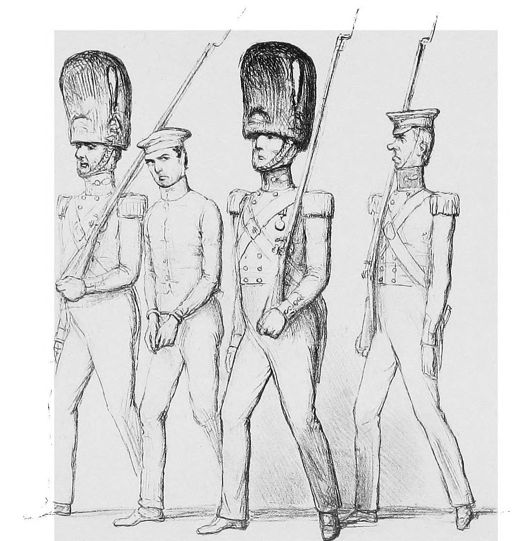
A Deserter
Lord Melbourne, Lord Durham & Duke of Wellington & Lord Brougham
It was asserted that Durham, in the Proclamation, had thrown discretion to the winds, had appealed to the people of Canada against the Government which had appointed him, and had practically defied the Crown. He was described by one section of the Press as ‘Lord High Seditioner,’ and his action was attributed by a great many people to no motive more worthy than that of wounded vanity. The political cartoon which ‘H. B.’ drew at the time, and which is here reproduced, shows Durham as a deserter. He is in the custody of Melbourne and Wellington, who are depicted as grenadiers. Durham walks, handcuffed and dejected, between these Whig and Tory representatives of the offended majesty of the law. Brougham, the more active man to bring the culprit to bay, follows the prisoner, with unctuous satisfaction, as a member of the light infantry. The Proclamation contains so closely reasoned a statement of the grounds on which Lord Durham relinquished his position in Canada, that it seems well to cite it in its entirety and then to consider the criticisms with which it was assailed, and what, in the clear light of to-day, can be urged in its defence:
‘Proclamation.
‘In conformity with one of its provisions, I have this day proclaimed the Act 1 and 2 Victoria, c. 112, entitled “An Act for indemnifying those who have issued or acted under certain parts of a certain Ordinance, made under cover of an Act passed in the present session of Parliament, entitled ‘An Act to make temporary provision for the government of Lower Canada.’ ”
‘I have also to notify the disallowance by her Majesty of the Ordinance 2 Victoria, c. 1, entitled “An Ordinance to provide for the Security of the Province of Lower Canada.”
‘I cannot perform these official duties without at the same time informing you, the people of British America, of the course which the measures of the Imperial Government and Legislature make it incumbent on me to pursue. The mystery which has heretofore too often, during the progress of the most important affairs, concealed from the people of these colonies the intentions, the motives, and the very actions of their rulers, appears to me one of the main causes of the numerous errors of the Government and of the general dissatisfaction of the people. Undesirable at any time, such concealment on the part of one intrusted with the supreme authority in the present crisis of your affairs would be most culpable and pernicious. With a people from whom I have had so many and such gratifying proofs of warm and confiding attachment I can have no reserve; and my implicit reliance on your loyalty and good sense will justify me in making you acquainted with what it most imports you to know.
‘It is the more necessary for me thus to act because, when I first entered upon this government, I explained to you in a Proclamation, issued immediately on my arrival on these shores, the nature of the powers vested in me, and the principles on which it was my intention to exercise them. Now, therefore, that I am about to return to England, I feel it to be my bounden duty to state to you, as fully and as frankly, the reasons which have induced me to lay down powers, rendered inadequate to the carrying into effect these or any other principles of government.
‘I did not accept the government of British North America without duly considering the nature of the task which I imposed on myself, or the sufficiency of my means of performing it. When Parliament concentrated all legislative and executive powers in Lower Canada in the same hands, it established an authority which, in the strictest sense of the word, was despotic. This authority her Majesty was graciously pleased to delegate to me. I did not shrink from assuming the awful responsibility of power, thus freed from constitutional restraints, in the hope that by exercising it with justice, with mildness, and with vigour, I might secure the happiness of all classes of the people, and facilitate the speedy and permanent restoration of their liberties. But I never was weak enough to imagine that the forms by which men’s rights are wisely guarded in that country, where freedom has been longest enjoyed, best understood, and most prudently exercised, could be scrupulously observed in a society almost entirely disorganised by misrule and dissension. I conceived it to be one of the chief advantages of my position that I was enabled to pursue the great ends of substantial justice and sound policy free and unfettered. Nor did I ever dream of applying the theory or practice of the British Constitution to a country whose Constitution was suspended, where all representative government was annihilated, and the people deprived of all control over their own affairs; where the ordinary guarantees of personal rights had been in abeyance during a long subjection to martial law and a continued suspension of the Habeas Corpus; where there neither did exist, nor had for a long time existed, any confidence in the impartial administration of justice in any political case.
‘To encourage and stimulate me in my arduous task I had great and worthy objects in view. My aim was to elevate the Province of Lower Canada to a thoroughly British character, to link its people to the sovereignty of Britain, by making them all participators in those high privileges, conducive at once to freedom and order, which have long been the glory of Englishmen. I hoped to confer on an united people a more extensive enjoyment of free and responsible government, and to merge the petty jealousies of a small community, and the odious animosities of origin, in the higher feelings of a nobler and more comprehensive nationality.
‘To give effect to these purposes it was necessary that my powers of government should be as strong as they were extensive—that I should be known to have the means of acting as well as judging for myself, without a perpetual control by distant authorities. It were well, indeed, if such were the ordinary tenure of government in colonies, and that your local administration should always enjoy so much of the confidence of those with whom rests the ultimate decision of your affairs, that it might ever rely on one being allowed to carry out its policy to completion, and on being supported in giving effect to its promises and its commands. But in the present posture of your affairs it was necessary that the most unusual confidence should accompany the delegation of a most unusual authority; and that, in addition to such great legal powers, the Government here should possess all the moral force that could be derived from the assurance that its acts would be final and its engagements religiously observed.
‘It is not by stinted powers or a dubious authority that the present danger can be averted, or the foundation laid of a better order of things.
‘I had reason to believe that I was armed with all the power which I thought requisite by the commissions and instructions under the Royal Sign Manual, with which I was charged as Governor-General and High Commissioner, by the authority vested in me by my Council, by the act of the Imperial Legislature, and by the general approbation of my appointment which all parties were pleased to express. I also trusted that I should enjoy throughout the course of my administration all the strength which the cordial and steadfast support of the authorities at home can alone give to their distant officers, and that even party feeling would refrain from molesting me whilst occupied in maintaining the integrity of the British Empire.
‘In those just expectations I have been painfully disappointed. From the very commencement of my task, the minutest details of my administration have been exposed to incessant criticism, in a spirit which has evinced an entire ignorance of the state of this country, and of the only mode in which the supremacy of the British Crown can here be upheld and exercised. Those who have in the British Legislature systematically depreciated my powers, and the Ministers of the Crown, by their tacit acquiescence therein, have produced the effect of making it too clear that my authority is inadequate for the emergency which called it into existence. At length an Act of my Government, the first and most important which was brought under the notice of the authorities at home, has been annulled, and the entire policy of which that Act was a small, though essential part, has thus been defeated.
‘The disposal of the political prisoners was from the first a matter foreign to my mission. With a view to the most easy attainment of the great objects contemplated, that question ought to have been settled before my arrival. But, as it was essential to my plans for the future tranquillity and improvement of the colony that I should commence by allaying actual irritation, I had in the first place to determine the fate of those who were under prosecution, and to provide for the present security of the Province by removing the most dangerous disturbers of its peace. For these ends the ordinary tribunals, as a recent trial has clearly shown, afforded me no means. Judicial proceedings would only have agitated the public mind afresh, would have put in evidence the sympathy of a large portion of the people with rebellion, and would have given to the disaffected generally a fresh assurance of impunity for political guilt. An acquittal in the face of the clearest evidence, which I am justified in having anticipated as inevitable, would have set the immediate leaders of the insurrection at liberty, absolved from crime, and exalted in the eyes of their deluded countrymen as the innocent victims of an unjust imprisonment and a vindictive charge. I looked on these as mischiefs which I was bound to avert by the utmost exercise of the powers intrusted to me. I could not—without trial and conviction—take any measures of a purely penal character; but I thought myself justified in availing myself of an acknowledgment of guilt, and adopting measures of precaution against a small number of the most culpable or most dangerous of the accused. To all the rest I extended a complete amnesty.
‘Whether a better mode of acting could have been devised for the emergency is now immaterial. This is the one that has been adopted; the discussion which it at first excited had passed away, and those who were once most inclined to condemn its leniency had acquiesced in, or submitted to it. The good effects which must necessarily have resulted from any settlement of this difficult question had already begun to show themselves. Of these the principal were—the general approval of my policy by the people of the United States, and the consequent cessation of American sympathy with any attempt to disturb the Canadas. This result has been most gratifying to me, inasmuch as it has gone far towards a complete restoration of that goodwill between you and a great kindred nation, which I have taken every means in my power to cultivate, and which I earnestly entreat you to cherish as essential to your peace and prosperity.
‘It is also very satisfactory to me to find that the rectitude of my policy has hardly been disputed at home, and that the disallowance of the Ordinance proceeds from no doubt of its substantial merits, but from the importance which has been attached to a supposed technical error in the assumption of a power which, if I had it not, I ought to have had.
‘The particular defect in the Ordinance which has been made the ground of its disallowance was occasioned, not by my mistaking the extent of my powers, but by my reliance on the readiness of Parliament to supply their insufficiency in case of need. For the purpose of relieving the prisoners from all apprehensions of being treated as ordinary convicts, and the loyal inhabitants of the Province from the dread of their immediate return, words were inserted in the Ordinance respecting the disposal of them in Bermuda, which were known to be inoperative. I was perfectly aware that my powers extended to landing the prisoners on the shores of Bermuda, but no further. I knew that they could not be forcibly detained in that island without the co-operation of the Imperial Legislature. That co-operation I had a right to expect, because the course I was pursuing was pointed out in numerous Acts of the imperial and provincial Legislatures, as I shall have occasion most fully to prove. I also did believe that, even if I had not the precedents of these Acts of Parliament, a Government and a Legislature, anxious for the peace of this unhappy country and for the integrity of the British Empire, would not sacrifice to a petty technicality the vast benefits which my entire policy had already in a great measure secured. I trusted they would take care that a great and beneficent purpose should not be frustrated by any error, if error there was, which they could rectify, or the want of any power which they could supply. I trusted finally, that if they found the Ordinance inoperative, they would give it effect; if illegal, that they would make it law. This small aid has not been extended to me, even for this great object; and the usefulness of my delegated powers expires with the loss of that support from the supreme authority which could alone sustain it.
‘The measure now annulled was but part of a large system of measures, which I promised when I proclaimed the amnesty. When I sought to obliterate the traces of recent discord, I pledged myself to remove its causes, to prevent the revival of a contest between hostile races, to raise the defective institutions of Lower Canada to the level of British civilisation and freedom, to remove all impediments to the course of British enterprise in this Province, and promote colonisation and improvement in the others, and to consolidate those general benefits on the strong and permanent basis of a free, responsible, and comprehensive government.
‘Such large promises could not have been ventured without a perfect reliance on the unhesitating aid of the supreme authorities. Of what avail are the purposes and promises of a delegated power whose acts are not respected by the authority from which it proceeds? With what confidence can I invite co-operation, or impose forbearance, whilst I touch ancient laws and habits, as well as deep-rooted abuses, with the weakened hands that have ineffectually essayed but a little more than the ordinary vigour of the police of troubled times?
‘How am I to provide against the immediate effects of the disallowance of the Ordinance? That Ordinance was intimately connected with other measures which remain in unrestricted operation. It was coupled with her Majesty’s proclamation of amnesty, and, as I judged it becoming that the extraordinary Legislature of Lower Canada should take upon itself all measures of rigorous precaution, and leave to her Majesty the congenial office of using her royal prerogative for the sole purpose of pardon and mercy, the Proclamation contained an entire amnesty, qualified only by the exceptions specified in the Ordinance. The Ordinance has been disallowed, and the Proclamation is confirmed! Her Majesty having been advised to refuse her assent to the exceptions, the amnesty exists without qualification. No impediment, therefore, exists to the return of the persons who had made the most distinct admission of guilt, or who had been excluded by me from the Province on account of the danger to which its tranquillity would be exposed by their presence; and none can now be enacted without the adoption of measures alike repugnant to my sense of justice and policy. I cannot recall the irrevocable pledge of her Majesty’s mercy. I cannot attempt to evade the disallowance of the Ordinance by re-enacting it under the disguise of an alteration of the scene of banishment, or of the penalties of unauthorised return. I cannot, by a needless suspension of the Habeas Corpus, put the personal liberty of every man at the mercy of the Government, and declare a whole province in immediate danger of rebellion, merely in order to exercise the influence of a vague terror over a few individuals.
‘In these conflicting and painful circumstances it is far better that I should at once and distinctly declare my intention of desisting from the vain attempt to carry my policy and system of administration into effect with such inadequate and restricted means. If the peace of Lower Canada is to be again menaced, it is necessary that its Government should be able to reckon on a more cordial and vigorous support at home than has been accorded to me. No good that may not be expected from any other Government in Lower Canada can be obtained by my continuing to wield extraordinary legal powers, of which the normal force and consideration are gone.
‘You will easily believe that, after all the exertions which I have made, it is with feelings of deep disappointment that I find myself thus suddenly deprived of the power of conferring great benefits on that Province to which I have referred, of reforming the administrative system there, and eradicating the manifold abuses which had been engendered by the negligence and corruption of former times, and so lamentably fostered by civil dissensions. I cannot but regret being obliged to renounce the still more glorious hope of employing unusual legislative powers in the endowment of that Province with those free municipal institutions, which are the only sure basis of local improvement and representative liberty, of establishing a system of general education, of revising the defective laws which regulate real property and commerce, and of introducing a pure and competent administration of justice. Above all, I grieve to be thus forced to abandon the realisation of such large and solid schemes of colonisation and internal improvement, as would connect the distant portions of these extensive colonies, and lay open the unwrought treasures of the wilderness to the wants of British industry, and the energy of British enterprise.
‘For these objects I have laboured much, and have received the most active, zealous, and efficient co-operation from the able and enlightened persons who are associated with me in this great undertaking. Our exertions, however, will not and cannot be thrown away. The information which we have acquired, although not as yet fit for the purposes of immediate legislation, will contribute to the creation of juster views as to the resources, the wants, and the interests of these colonies than ever yet prevailed in the Mother Country. To complete and render available these materials for future legislation is an important part of the duties which, as High Commissioner, I have yet to discharge, and to which I shall devote the most anxious attention.
‘I shall also be prepared, at the proper period, to suggest the constitution of a form of government for her Majesty’s dominions on this continent, which may restore to the people of Lower Canada all the advantages of a representative system, unaccompanied by the evils that have hitherto proceeded from the unnatural conflicts of parties, which may safely supply any deficiencies existing in the Governments of the other colonies, and which may produce throughout British America a state of contented allegiance, founded, as colonial allegiance ever must be, on a sense of obligation to the parent State.
‘I fervently hope that my usefulness to you will not cease with my official connection. When I shall have laid at her Majesty’s feet the various high and important commissions with which her royal favours invested me, I shall still be enabled as a Peer of Parliament to render you efficient and constant service in that place where the decisions that affect your welfare are in reality made. It must be, I humbly trust, for the advantage of these Provinces if I can carry into the Imperial Parliament a knowledge derived from personal inspection and experience of these interests, upon which some persons there are too apt to legislate in ignorance or indifference, and can aid in laying the foundation of a system of general government which, while it strengthens your permanent connection with Great Britain, shall save you from the evils to which you are subjected by every change in the fluctuating policy of distant and successive Administrations.
‘Given under my hand and seal at arms, at the Castle of St. Lewis, in the city of Quebec, in the said Province of Lower Canada, the 9th day of October, in the year of our Lord 1838, and in the second year of her Majesty’s reign.
‘By command,
‘Charles Buller,
‘Chief Secretary.’
The Proclamation was read at an immense public meeting at Quebec—the largest political assembly which had ever been held in Canada—amid a scene of the greatest enthusiasm. Lord Durham was presented at that gathering with an address of confidence, signed by between four and five thousand representative people in Canada. Lady Durham, who was on the platform beside her husband, in a few graphic sentences in her private journal, describes what took place—the suppressed excitement amongst the packed audience, the great crowd in the streets unable to gain admission, the eagerness with which every point was caught up by all within sound of his voice, the strong sense of indignation which promised violence unless it was curbed. ‘His aim was directed to turn their attention towards England, to inspire fresh hopes that his presence and earnest representations, with the faithful report of the state of the country, would at last be met with consideration, and produce a change of system in the government of the colony. This was his object both in his speech and answer to the address, and in the Proclamation, which was made the subject of so much reproach in England, and called from the Ministers the formal expression of the Queen’s disapprobation. Far, however, from inflaming the minds of the people, the Proclamation had, as was intended, the effect of soothing and allaying the irritation and ill-feeling which prevailed, by directing their views to the expectation of a last effort in England.’ Lady Durham describes how greatly her husband was touched at that crisis by the overwhelming testimonies of respect and confidence which poured in upon him from every quarter of Canada. He was sustained by the consciousness of his own rectitude, and by the knowledge that the great majority of the Canadians stood behind him, not merely in unbroken, but, if possible, in enhanced goodwill.
Dr. Kingsford, in his ‘History of Canada,’ contends that Lord Durham possessed the right to say at that moment why he felt powerless to act in accordance with wishes so universally expressed. He asserts that no fair mind can deny the justice of Durham’s claim to exonerate himself against the consequences of the failure of the Melbourne Cabinet to support him in England, and their abandonment of him to the vindictive personal feeling of Lord Brougham. In Dr. Kingsford’s view, the Proclamation was not merely Durham’s vindication of his policy, but an appeal to posterity on behalf of his good name. There is justice in the plea that to affirm that a public man has no right to vindicate himself against what he regards as the arbitrary and unjust proceedings of a Ministry is to deny to a statesman the privilege accorded to a criminal at the bar of justice. ‘Lord Durham had been arraigned in the court of public opinion, and he felt himself justified in setting his case clearly before the people of the Province, who had expressed approval of his conduct, accord with his policy, confidence in his wisdom and justice, and deep sorrow at his departure from Canada.’ Such a testimony, weighty though it is, by no means exhausts all that can be said in defence of the Proclamation.
It was denounced in England because it brushed aside conventional usages, and because it was regarded as treating the mysteries of statecraft with contempt. It was described as a direct appeal to colonists against the authority of England, inflammatory in tone and without precedent. But it was neither an appeal nor a complaint. It was an explanation, expressed perhaps too warmly in parts, of the reasons of his retirement. All the addresses and all the resolutions expressed the hope that, even at the eleventh hour, he would remain at his post. The Proclamation, the full vindication of which is to be found in Durham’s memorable Report, was the answer which he felt he ought there and then to give to the people.
Charles Buller, in the unprinted account of ‘Lord Durham’s Mission to Canada,’ from which quotation has already more than once been made, states that his chief had two great objects in view. One was to calm public feeling, which had been raised to fever point by the announcement of his approaching departure. Durham wished to show the people that, though he was forced to relinquish the helm of affairs, he did not despair. On the contrary, he hoped, by ‘immediate and energetic remonstrances at home,’ to bring about a new condition of things, which he could not now secure by remaining in Canada. The other was, unquestionably, the natural desire to vindicate himself by the only public means in his power. His policy had been condemned in hot haste without hearing any explanation, and he believed that he had the right to shield himself against the aspersions of those who had treated him so ungenerously.
The Proclamation was assailed as an inflammatory document, but it was not intended to inflame the people, and did not produce that result. In Canada, at least, it fell like oil upon the troubled waters. Charles Buller makes that quite plain. ‘No disorder, no increase of disaffection ensued; on the contrary, all parties in the Province expressed a revival of confidence. We had it very clearly shown to us that one effect of the Proclamation had been that of inducing a much more general readiness to enlist in the volunteer corps, and to take other measures for the defence of the Provinces.’
The Proclamation was, as John Stuart Mill said at the time, the necessary completion of Lord Durham’s brief administration—the explanation which was due to the people of Canada for the past, and the best legacy which he could leave them for the future. In his view it needed no apology; it showed Durham to be the pioneer of Empire. ‘Next to doing the noble things spoken of in the Proclamation, to point them out as fit to be done was the thing most calculated—was the one thing calculated—to restore harmony in the colony. So far from being inflammatory, it was in all probability the only kind of address to the people which, in the then state of men’s minds, could have had any healing effect.’
The terms used by Lord Durham in the Proclamation to show the causes which rendered it imperative on him to relinquish the task of government were, in substance, identical with those used by the Melbourne Cabinet in their despatches to him—the despatches in which they sought to clear themselves from the charge of leaving him in the lurch. Lord Glenelg declared, in reference to the disallowance of the Ordinance, that the Ministry ‘could not indeed hope to neutralise the evil consequences of what appeared to them an ill-timed and injudicious interference with the exercise of those powers with which Parliament had invested the Government of Canada.’ But when Durham ‘adopted that course which was calculated to render those proceedings as little injurious as possible to the public interests,’ they did not relish the fact that he had merely copied their example, though he adopted that course under circumstances of constraint to which, provided they had shown a little more courage and magnanimity, they need not have surrendered.
The best defence of Durham’s Proclamation is to be found, after all, in its magical effect on the public mind in the Province itself, and in the circumstances which are set forth in detail in the pages of the Report, which has been described by a great living authority as the ‘most valuable document in the English language on the subject of colonial policy.’ One passage in the Proclamation was assailed, even by those who were most inclined to judge favourably of Lord Durham’s conduct in Canada. It is that part of the manifesto in which he states that, since the Ordinance had been disallowed, there was no obstacle to the return of the prisoners who had been banished to Bermuda. This was regarded as a mere outbreak of temper on Durham’s part, and some people went so far as to assert that, by it, he had actually invited the political prisoners to return to the colony. Durham himself foresaw the possibility of such an interpretation of his words. It was Charles Buller who suggested them, and he states that Durham was very reluctant to adopt them; in fact, he only yielded on strong pressure. Here it may be as well, once more, to fall back on Buller’s unprinted account of Lord Durham’s Mission. He shows conclusively that the words were inserted on practical grounds, which had no reference whatever to the indignity which Lord Durham had experienced at the hands of the Melbourne Cabinet. The statement is so important, and clears up so much that is obscure in the whole controversy, that it seems imperative to quote it in its entirety. ‘The instant that the news of the disallowance reached Canada, it was supposed that some of the exiles would enter the Province. It seemed doubtful whether in that case they would be liable to be tried for their original offence.
‘Nobody could deny that they had undergone some punishment, however inadequate, and the sound principle of Non bis in idem seemed therefore applicable to their case. But this point just admitted of so much doubt, as to make it quite certain that criminals, so obnoxious to a large and violent party, would not be allowed to re-establish themselves quietly at their former abodes without some proceedings against them being attempted. We felt quite sure that they would be arrested, and that half the magistrates in the Province would be eager to commit them for trial. The grand juries would have found bills, the trials must have taken place, and then would have recurred all the mischiefs which the Ordinances had been designed to avert. The angry passions of the past insurrection would have been revived by the proceedings in the Courts, the guilt of the prisoners would have been proved in the clearest manner, and there would have infallibly followed (as in the recent case of the murderers of Chartrand) a verdict of acquittal in the face of evidence.
‘The punishment of the exiles could only have been secured by suspending the Habeas Corpus, or by altering the constitution of the tribunals, by either substituting court-martial for the ordinary courts of criminal law, or packing the juries. The last Lord Durham did not choose to do, and the two former courses (though defensible in certain emergencies) appeared most inadvisable in the circumstances of the case. He had abstained from having recourse to such encroachments on constitutional principles and personal rights, when the difficulty of disposing of the prisoners had just presented itself to him in all its magnitude on his arrival in the Province, and he was most averse, for the sake of punishing a few, to take a course from which he had shrunk when it would have enabled him to punish all the guilty. And it should always be borne in mind that the measures of rigour, which may be most necessary during an insurrection, may be most inadvisable when insurrection is apprehended. At that time, to have suspended the Habeas Corpus, or substituted courts-martial for juries, would simply have been to supply the disaffected with a pretext for the rebellion, which we knew them to be meditating; and what was more, give them some chance of success by setting public opinion in the United States against the Government of Canada. These were evils not even to be risked, except for the most important objects, and the exiles in question were mostly so insignificant that the keeping them out of the Province really was a matter of no consequence. As for Papineau, the only one among them of any consideration, we had learned enough of his character to feel assurance that his presence among the disaffected would have been the surest means of paralysing their operations. Besides which, however great his moral culpability, I knew that the evidence in the possession of Government, all of which I had gone through, would not in his case have justified a legal conviction.
‘The evils which appeared thus likely to result from the return of the exiles rendered it imperative on us to take some precautions to avert them. We were perfectly sure that some of the exiles would return, without permission, the moment that they heard of the disallowance of the Ordinance; and the fact is, that one or two actually did return before the proclamation was out. After the first step taken against any of them after their return the consequences would have been beyond Lord Durham’s control; and as he could not bring himself to commit the Government to an arbitrary course for the purpose of punishing a score of persons, he would have no choice but that of letting matters run their course of arrest, trial, and unjust acquittal. The great thing was to prevent any step being taken against the exiles, and, as they were sure to obtain impunity in the end, to let them have it at once without all the intervening excitement, and without bringing the administration of justice into further contempt. I therefore pressed on Lord Durham to take the bull by the horns, and as he knew that he could not punish the exiles if they came back, at once to tell them that there was nothing to prevent their doing so. By taking this course, Lord Durham did, in fact, avoid all the excitement, exposure, recrimination, and subversion of justice, which would have followed from his doing nothing and, on the other hand, the worse mischief, which would have resulted from his having recourse to violent exceptional measures. When the subsequent insurrection actually did break out, the rebels could allege no harsh act on the part of the Government as a provocation. And what was the practical mischief that resulted from letting these people back? None that I ever heard of. None of those that returned did any harm, or even, as I firmly believe, took any part in the subsequent insurrection. But those who remained out of the Province did all the harm they could.
‘Of course, it is always an evil in the way of example if notoriously guilty persons enjoy perfect impunity. I trust, however, that I have shown that punishing the persons in question by any unconstitutional means would have produced far worse effect even than their going unpunished. In order to keep up the confidence of the loyal portion of the Canadian public in himself personally, and generally in the Provincial Government, it was necessary for Lord Durham to point out that the impunity of these guilty and obnoxious persons was not his doing, but that of the Home Government. He could say this with perfect justice, for he had done his best to punish; his measures had been defeated by the interference of Parliament, and the present difficulty had been created solely by the disallowance of the Ordinance. And I think that it was quite as much in accordance with sound policy as with justice for him to lay the blame on Parliament. For as blame must in the opinion of the colonists rest on some portion of the Government, it was far better that it should rest on the Home than the Provincial Government. A little more discredit thrown on the proceedings of Parliament could hardly produce any sensible effect in augmenting the odium which, at that moment, rested on that body in the opinion of the colonists. But anything that cast suspicion on the policy of the Provincial Government would have seriously increased the practical difficulties which surrounded not only Lord Durham, but also his successor. In Parliament the colonists had no confidence, in the Provincial authorities an entire trust, and it would have been very unwise to weaken the influence of the latter by subjecting them to any part of the blame, which Parliament and the Home Government alone deserved.
‘At any rate, as I began by saying, the course pursued by Lord Durham in this matter, and the passage in the proclamation, were both adopted at my urgent suggestion, and I, not he, am answerable for what was done, as well as for the way in which it was announced. He was, of course, obliged to depend greatly on me with respect to all that concerned the internal administration of the Province, and more particularly in matters connected with the administration of justice. If my advice was wrong, he could not be blamed for acting on it in such matters.
‘I am bound to take on myself whatever blame is due to me; for well I know he never would have cast it on me. Every man who has to act in a great variety of matters of importance must rely on those whom he employs and trusts; and Lord Durham was necessarily compelled, in much that he did, to rely on me, and act on my advice. Some steps that he took on my suggestion were among those that were most fiercely assailed either at home, or in Canada. Yet never, have I any reason to believe, did he throw on me even the blame that I deserved. Never certainly, though often he might justly have done so, did he reproach me with the consequences of my counsels—never, at least but once, in a moment of very natural excitement, and then he repaired the reproach in half an hour.’
In one of the last despatches which Durham wrote to Lord Glenelg, dated October 20, 1838, he describes the outcome of his final discussions with Sir John Colborne, which had made him more than ever convinced that for the next six months it was imperative that all authority should be concentrated in the hands of the Commander of the Forces. ‘My only sphere of utility to these colonies must, I am more than ever convinced, be henceforth in the Imperial Parliament; where, if I can force on the knowledge of my countrymen the true state of these colonies, and the true policy to be adopted for their future good government, I may contribute towards rendering available the last opportunity which I believe will ever be afforded to Great Britain of maintaining a useful and honourable connection with her possessions in the North American Continent. There is great danger to be apprehended from the rapidly increasing familiarity with which the idea of separation from the British Empire is expressed and canvassed by the British in these Provinces. I do not mean to disparage their severely tried and well-proved loyalty to the Crown, and attachment to the British Empire; their preference for monarchical institutions and their affection for the Mother Country are as strong as ever. But their hope of maintaining either has been suddenly and materially weakened. . . . To what extent this feeling prevails, or how soon and in what form it may exhibit himself, it is impossible to say. It is one of no recent growth. Do not imagine that it owes its origin to my recall, or that it could be obviated by my retention of the Government. Long lurking in the minds of even those inhabitants of the Provinces, in whom it had not been openly manifested in the course of the late discontents and disturbances, it was in a great measure removed by the apparent indications of a better policy which was hailed in the appointment of a Governor, armed with the extensive and sufficient powers, that I was supposed to wield when I landed on these shores. This feeling has sprung into sudden and rapid growth from the hour in which the public mind was disabused as to the extent of my previously exaggerated powers, by the weightiest authority in the British Legislature, which deprived me of moral influence by asserting, without contradiction, that I “possessed only the ordinary legal powers of a common Governor.” From the same moment, and from the same cause, sprang the other feelings of which the wide diffusion among perfectly different classes menaces even greater danger.’
The last few days of Lord Durham’s stay in Canada were spent in busy consultation with Sir John Colborne, whom he empowered to raise any volunteer force which might be necessary for the defence of the frontier. The troops in Canada were totally inadequate for the emergency which the overthrow of the policy of conciliation had once more provoked. The extremists amongst the French Canadians were obviously bent on fresh mischief. Midnight meetings for drill grew common, and there were signs that the conspiracy was rapidly spreading. Meanwhile Durham was constantly approached by representative people from various parts of the colony, eager, if they could not reverse his decision, to learn from his own lips the best course that they ought to pursue. He told everyone whom he saw that one duty was imperative—to uphold and strengthen the hands of Sir John Colborne. Even amid the bustle of departure Durham never relaxed his attention to public duties; in fact, he did everything in his power, as long as he remained in Canada, to render the task of government more easy to his successor.
Lady Durham’s journal, and many letters which she wrote during those anxious weeks to the Countess Grey, reveal clearly the life at the Castle of St. Lewis, with its constant coming and going, its alternations of hope and fear as to the prospect of hostilities in the winter, and the anxiety of Durham to leave no stone unturned to put matters on a satisfactory basis as far as that was now in his power. One of the last public acts of Lord Durham was to settle the intricate question involved in the rights of squatters on Crown lands. Another was to place the affairs of Prince Edward’s Island on a just basis. The Legislature of the island had in vain passed bill after bill to authorise the escheat of waste lands, on the principles commonly acted on in almost every new country, but, though the Governor of the Island had repeatedly recommended the Crown to sanction such a measure, and to abolish the rights of absentee landowners, who held nearly the whole of the island, hitherto nothing had been done. The truth was, as Charles Buller put it, the proprietors in England had more weight with Ministers than the desires and interests of the whole colony. Lord Durham took the matter up with characteristic vigour, and secured the Royal assent to a Law of Escheat, removing a blight which had hampered the colony from the start, thus giving it, what it needed, the chance of development, and therefore prosperity. What Durham did was to provide a remedy for the people on the spot, at the same time benefiting absentee owners by rendering their property more valuable.
One other act of substantial justice was done by Durham on the eve of his departure, and that was the appointment, which he made without any solicitation whatever, of Mr. (afterwards Sir James) Stuart to the post of Chief Justice of Quebec. The new Chief Justice was by common consent the ablest lawyer in Canada. During Lord Aylmer’s Government he had been Attorney-General. But he rendered himself at that time so obnoxious to the French majority that he was impeached by the Assembly, and, though there was nothing to justify such an extreme course, he was removed from his post, with the sanction of the Colonial Office. Lord Durham felt that this eminent lawyer had been unjustly dismissed, and, to the satisfaction of the whole of the British population, he made Mr. Stuart Chief Justice of the Province. Few men were more active in the critical years, which immediately followed, in procuring the union of Upper and Lower Canada than Chief Justice Stuart, who was created a baronet in 1841 for his services. He, more than anyone else on the spot, inspired the policy of Lord Durham’s successor, Lord Sydenham.
Lord Durham’s intention was to return to England by the United States, and great preparations had been made for his reception at every town through which he was to pass on his way to Washington, where he proposed to discuss the alarming state of affairs on the frontier with President Van Buren. It had been arranged, indeed, that Durham was to be entertained at the White House as a national guest, an honour never hitherto conferred on anyone but Lafayette. But the situation in Canada became so alarming, as the time approached for his departure, that he hesitated to carry out this plan. He was prepared to do whatever seemed best in the interests of Canada. Two alternatives presented themselves: one was to remain in the country, in order to throw his personal influence on the side of peace, and the other to proceed direct to England, in order to acquaint the Melbourne Government with the menacing position of affairs.
At this juncture he consulted the two men whom he most trusted, and, in his opinion, were best able to advise him. One was Charles Buller, and the other Colonel Couper. There seems to have been a division of opinion between them. Buller always regretted that the proposed American visit was not carried out. He thought that it would have been a great support to Lord Durham at home, for the American people were prepared to receive him, not as a discredited Governor, but as a statesman who had been grievously thwarted by the Government which he represented. They recognised his honesty, and were waiting to show him how much they resented the treatment he had received. Durham urged, however, that it would be unseemly in him to be travelling in the United States, and receiving public honours, at a time when her Majesty’s Government was again imperilled. He therefore agreed with Colonel Couper that it seemed his duty to forego the honour, and return home with the least possible delay. The matter was finally referred to Sir John Colborne, and it was his reply which determined the issue. It was given in a letter, dated Quebec, October 19, in answer to one of the previous day from Colonel Couper. Lord Durham ‘is anxious to know his opinion whether, in view of the alarming information which had come to hand since his determination to return home, he ought to leave Canada in the present crisis.’ Sir John, in reply, said that he was fully convinced, in the public interest, that it was not advisable for Lord Durham to remain. The grounds which led him to take this view were that both the civil and military authority now required to be placed absolutely in the hands of the Commander of the Forces. ‘The affairs in both provinces have now begun to be altogether military, and military preparations will occupy the attention of all classes.’ Sir John urged, further, that it was of importance on every account that Lord Durham should proceed direct to England, since his presence in London might be of the ‘utmost importance to the welfare of the North American Colonies.’ He added, ‘The sooner Lord Durham can bring before her Majesty’s Government the actual state of affairs the better.’
There is an amusing letter in existence, written on October 20, from Quebec, by Buller to his friend Mr. E. J. Stanley, and sent home by Captain Dillon, one of Lord Durham’s aides, who was leaving just then, with Wakefield, in advance of the Governor-General. In it he states that Lord Durham was now coming home direct. He assured Stanley that his chief might be expected in England by the end of November, and that he was remaining behind in order to gather up the threads of the mission. Meanwhile ‘martial law or utter lawlessness’ prevailed. Soldiers were pursuing rebels up and down the country, searching houses, stopping people in the streets. He expected to be back about New Year’s Day, and then ‘His Lordship and I will have the opportunity, each in our separate “Spears,” of blowing the “shabby” Ministry to its father the devil.’ ‘Lay your hand on that part of the body where other people have a heart, and say whether you do not think we are very ill-used, and, if you think we are, make up your mind to back us.’
Just before Durham sailed, a farewell dinner was given to him by the Guards, and the old Waterloo hero, Sir James Macdonnell, then in command in Canada, was in the chair. Durham took the opportunity of laying stress on his confidence in Sir John Colborne, both as a soldier and as an administrator. He declared that he would have stayed in Canada as one of the volunteers, if Sir John had not deemed that he could be of greater service to the colony by placing all the facts of the situation before the Cabinet. On the last night of his stay in Canada another banquet was given in Lord Durham’s honour, at which it was plain to every one that he was ill, so ill, indeed, that Charles Buller was seriously alarmed. But, ill as he was, he went through the ordeal with all his old courage and courtesy. His actual departure took place on November 1. Heavy snow had fallen in the night, and the streets, though thronged, were silent.
Charles Buller has described the scene in his unpublished sketch, and so also has Lady Durham in her private journal. The Chief Secretary’s account—it has never been printed before—is graphic. ‘It was on November 1 that Lord Durham sailed from Quebec in the Inconstant. It was a sad day and a sad departure. The streets were crowded. The spectators filled every window and every house-top, and, though every hat was raised as we passed, a deep silence marked the general grief for Lord Durham’s departure. His own presentiment depressed him and those about him; he had told me, and others also, that he did not expect to reach England alive. When I left him—for I had to stay some time behind to collect some materials for the Report—I had, as a member of the Executive Council, to repair to the castle, where Sir John Colborne was to be sworn in. There were but few people in the room, but the countenances of the old Executive Councillors seemed to mark the restoration of the ancient system of administration. A good many military officers also were present; they seemed to think that their ascendency also was restored. The ceremony was silently hurried over; and when it was finished, I went to the window which commanded a full view of the harbour. The cannon were just sounding, in honour of his successor’s installation, when the frigate that bore Lord Durham was slowly towed out of the harbour. The sky was black with clouds, bearing the first snow-storm of the winter, and hardly a breath of air was moving. I returned to my office; and, some hours after, from the window which commanded the wide basin below the city, I saw the dark form of that ill-omened ship slowly, and, as it were, painfully, struggling on its course. My heart filled with many a bitter regret, many a superstitious presentiment, and alas! many a too true misgiving. We dined that evening at Mr. Daly’s, and the party was composed of Mr. Turton, my brother, and myself, forming, with him, the last remains of Lord Durham’s Government. It was a mournful meeting, and none mourned more deeply than our kind and honourable host, who said that with Lord Durham’s departure all his hope had gone. A heavy fall of snow was coming down as we left the house, and the very morning after, the winter completely set in. The next day we heard the alarming report that Lord Durham’s worst forebodings had been nigh being fulfilled, in the most fearful manner, by a fire on board the ship. This was perfectly true; not so the reports which reached us every now and then during the next fortnight to the effect that Lord Durham had been forced to put in to Halifax, or that he had been driven ashore on some other part of the coast. After fearful perils at the outset, the Inconstant kept on her course to its appointed end, amid almost perpetual storms, which did not cease even when she had reached the shelter of Plymouth Sound.’
Lady Durham gives a few additional particulars concerning what happened on Thursday, November 1, which she describes as a day never to be forgotten by herself. It seems that, on that very morning, a high official from Upper Canada arrived in hot haste, to say that there was great difficulty in raising militia for the defence of the Province. He declared that the people had lost confidence in the Melbourne Cabinet, and had ceased to believe that an effectual stand would be made against this fresh outbreak and spirit of rebellion, and that, in short, the situation seemed desperate. Lord Durham told the sheriff of Upper Canada and the deputation which accompanied him, and brought this intelligence, that he was confident their interests would be cared for at home. He begged them not to abandon themselves to unworthy fears, and declared, in the most explicit terms, that nothing should be wanting on his part to bring about prompt and decisive action by the Government in the interests of Canada. He gave them letters to the same effect, and they left him with renewed hope and courage. Outside, the streets, packed with people, were lined with the Guards. A great procession of the citizens, three thousand strong, stood ready to follow the open carriage, in which Lord and Lady Durham, Sir John Colborne, and Sir J. Macdonnell left the Castle at a quarter past two. The procession was headed by the Friendly Societies of Quebec, with their banners. An escort of officers surrounded and immediately followed it, and behind walked, in close ranks, the sorrowful people.
‘The weather was bright and clear,’ states Lady Durham, ‘but intensely cold. We continued our way down the steep hill and on to the landing-place (the Queen’s Wharf). There was almost a perfect silence prevailing amongst the dense masses of the people surrounding the carriage. Here and there, at some particular spot, some builder’s yard perhaps, acclamations would burst forth, but, in general, the feelings of deep respect and profound interest seemed to prevent all the common demonstrations of applause. The gloom which prevailed seemed indeed as if the people were parting with what was most near and dear to them. I never beheld any public ceremony so deeply affecting, and all the feelings which pressed upon me on leaving England were slight in comparison with those I now experienced on departing from Quebec. Little did I imagine, on the first occasion, that I could ever feel regret on returning home; but there was now something so sad and solemn in the scene, so heart-breaking in the unmerited disappointment which had fallen upon him and upon a great people, that a long life of happiness afterwards could never have effaced the impression made upon me at that moment. . . . The occasion itself was certainly one of the most painful interest, but it has seemed since to have been but the foreboding and forerunner of the fatal termination, which was impending at so short an interval. On the deck of the Inconstant we took leave of Sir John Colborne, and the gentlemen who had accompanied us on board.’
Even then the goodwill of the people did not cease. The merchants of Quebec, engaged in the lumber trade, volunteered the services of steamers to tow the Inconstant out into the St. Lawrence. These vessels were crowded with sympathisers, and when the ropes were finally cast, six miles down the St. Lawrence, the people on board broke into the familiar strains of ‘Auld Lang Syne,’ as the darkness fell on the good ship ploughing its way to the Atlantic.
Lord Durham had scarcely put to sea before he was seized with fever, and when he landed at Plymouth, on November 30, without the customary honours due to a supreme representative of the Crown, he was worn almost to a shadow. One of his companions on board the Inconstant was his old friend Mr. T. S. Duncombe, M.P. He had been Lord Durham’s guest in Canada, and he seized the opportunity to return with him to England. His comments on the final scene at Quebec are characteristic:
‘It seemed a melancholy parting when the boat put off; then the last loud cheer bade farewell to the last hope these ill-fated colonists had entertained for a restoration of peace and tranquillity by his appointment. Many told me that perhaps upon our arrival we should hear that some of our worst fears were realised; and it was impossible to leave them without feeling that we were going from a kind, loyal, and enterprising body of men, who would perhaps in a few weeks have to struggle for their lives and property, all owing to the imbecility and cowardice of a Government, stationed four thousand miles off, enjoying every luxury and comfort that home could afford them, but totally ignorant of the high qualities and energies of those they presumed to govern and whose destinies were in their hands.’ Almost as soon as they landed, Duncombe adds, came the grave tidings of the outbreak at Beauharnois. Durham’s fears had not been falsified.
The period of Durham’s Government was, after all, but of five months’ duration, and yet in that short time what great practical results did he bring about. His policy it was that pacified Canada and secured its retention. Lord Durham saw the defects—he devised the remedies.—Charles Buller in 1840.
Mill’s vindication of Durham—Addresses of welcome in Devonshire—Melbourne keeps aloof—Lady Durham resigns her place in the Queen’s Household—Presentation of the Report to Parliament—Its keynote, and analysis of contents—Scheme for the future Government of Canada—Durham’s advocacy of the Union of Upper and Lower Canada—Urges State-aided Emigration, and the formation of an Inter-Colonial railway—The application of Durham’s views to the problem of Colonial Government—Allegations as to the authorship of the Report—Brougham’s slander—The part taken by Buller and Wakefield in the preparation of the Report.
No one had followed Lord Durham’s career in Canada with more keen and intelligent interest than John Stuart Mill. He saw, through all the misrepresentations of the hour, that his policy had not been one of coercion but of conciliation, and he claimed, in a powerful article, which appeared in the ‘Westminster Review’ at the very moment when Durham landed in England, that he deserved, not mere acquittal, but praise and honour. He argued that Durham had been thwarted but had not failed, and claimed that if anything could allay the dissensions of the colonists, and attach them to the Mother Country, it was assuredly the wise and enlightened policy that Durham had pursued. Durham, once for all, had disposed of the great immediate embarrassment, which he did not create, the question as to the fate of the political prisoners. He had shown well-intentioned and honourable men of both parties the ground on which they could arrange their difficulties, without the surrender of anything that was worth a struggle. He had deprived rash and unreasonable partizans of their chief support—the sympathy of the United States, and it was in his power to detach from partizans, not less unreasonable, on the other side, the sympathy of England. ‘He comes home,’ added Mill, ‘master of the details of those abuses which he has recognised as the original cause of the disaffection, prepared to expose them as they have never before been exposed, and to submit to Parliament, after the most comprehensive inquiry that has ever taken place, the system on which the North American Colonies may be preserved and well governed hereafter.’ If this was failure, Mill argued, then failure was but the second degree of success, and the prelude to a lasting triumph.
Mill’s vindication of Durham did more than anything else at the moment to turn the tide of public feeling in the country. He was an uncompromising Radical, and when he took up arms in defence of a man who had been persistently assailed, all the wild talk about Durham’s arbitrary policy melted, like a bit of ice in the sun. Mill had no sympathy with dictators, and therefore people felt, when he took up his defence, that Durham must have been misrepresented. Meanwhile Durham had not received Glenelg’s final despatch of November 15—it had passed him on the water—which conveyed to him the formal expression of her Majesty’s disapprobation of his final Proclamation. He had been subject to one humiliation already—in the refusal at Plymouth of the usual honours given to a returning plenipotentiary; but by way of amend he had received a great popular ovation. The people of Devonport presented him with an address of welcome at a meeting, which Sir William Molesworth had organised. The Town Hall was crowded at a great public meeting, over which the Mayor presided, on December 1.
When the enthusiastic applause subsided, Durham said, ‘You will never have reason to regret the confidence you have this day placed in me, or the declaration that you have made of your approbation of my government in British North America. So far as it seemed to me imperatively necessary—in order to allay the most alarming irritation and excitement in the Canadas, and to lead men’s minds from the contemplation of present evils to the prospect of future remedies—I have already explained the nature and scope of the policy which I pursued as Governor-General. Upon that subject I shall be prepared, when Parliament meets, to make a representation of facts wholly unknown here, and I shall then fearlessly demand from the assembled Legislature that justice, which neither they nor the people of England ever will deny to a public servant who has faithfully and honestly discharged the duties assigned to him.’
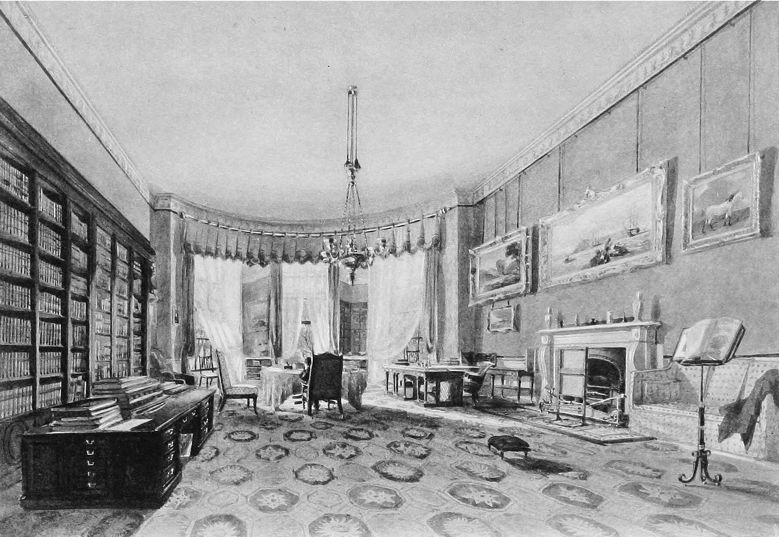
From a water-colour drawing
Walter L. Colls, Ph. Sc.
Lord Durham’s Library,
13, Cleveland Row, London SW
Where the scheme of the Reform Bill was drawn up
The people of Plymouth also sent a deputation, with an address of welcome and confidence. In his reply Lord Durham said, ‘It is gratifying to me to find the same feeling of sympathy which cheered me on my leaving the shores of North America greeting me on my arrival in my native land.’ He dwelt with pride on the fact that he had been the means of quelling the rebellion without being called upon to shed a drop of blood, or to confiscate the property of a single person. He had sought to act with justice and impartiality towards all classes, and to bring about reforms, based on such broad and comprehensive foundations as seemed likely to insure the good government of the colonies and to perpetuate their connection with the British Crown. He confessed he was disappointed that his career had been suddenly arrested, and added that all personal considerations were thrown into the shade by the alarming and dangerous crisis in Canada, which such treatment had evoked. ‘I hope I shall be supported by the Parliament and the people of England, whose interests are alike involved in the solution of the great question, as to whether those vast and most valuable colonies are to be preserved to the British Empire, or to be abandoned, and with them the supremacy of British commerce.’
At Exeter a great meeting was held in the Guildhall, and, in his reply to the speeches of the citizens, he said he was proud that his administration of the affairs of British North America, which they were good enough to praise, had won him the regard and confidence of all the loyal and well-affected classes in that vast continent. ‘My course of policy has been to administer strict justice, but not bloodthirsty vengeance, to respect the rights of all classes, but at the same time to endeavour to raise them still higher in the scale of freedom and civilisation.’ He added that he had sought to apply sure but temperate remedies to all abuses, and to inaugurate a course of legislation which would not leave untouched or unredressed any well-founded grievance.
Wherever he stopped on the road to London the people received him with enthusiasm and addresses, and, meanwhile, his house in Cleveland Row was besieged by letters and callers. The warmth of his reception placed the Melbourne Cabinet in the awkward position of seeing its own verdict reversed by public acclamation. Canada apart, their policy was flouted and discredited. They had lost touch with the people, and, what Carlyle called ‘the Condition of England Question,’ was coming menacingly to the front, as the riots of the physical-force Chartists of Newport only a month before had abundantly proved. London, in those days, was intensely Radical, and the working classes all over the country were beginning to split into two camps, one of which advocated moral force and the other physical, for the redress of political and social grievances. Durham’s return was hailed by the extreme Radicals as opportune. They needed a great leader, and thought that he, smarting under the sense of the injustice done to him, might be induced to lead a new movement, which had already assumed an angry aspect. He refused, quietly but firmly, to identify himself in any way with the noisy clique of agitators who professed to represent—though in reality they caricatured—the aspirations of the people. He devoted himself instead, as his own letters and those of the Countess clearly prove, to the preparation of the Report, and from his arrival in London, at the beginning of December, to the middle of January 1839 he toiled laboriously, resisting all overtures to address public meetings, in drawing up, from the voluminous materials accumulated during his mission, that memorable State paper.
Lord Melbourne was in no hurry, when Durham arrived in London, on December 8, to make advances to him. The tide of detraction had already begun to turn, and the Press of the country was no longer filled with violent denunciations—based on no real knowledge of the situation in Canada—of the man who had done so much for it, and so badly for himself. Possibly Melbourne was beginning to share the fear of Durham which he once said everybody felt, and confessed airily that he could not understand. Perhaps the Prime Minister felt a touch of compunction, knowing perfectly well that he had treated Durham badly, and there is an old saying about conscience making men cowards. Anyhow, he discreetly kept away. He did not wish now, he admitted in so many words, to ‘court and truckle’ to a man whom the Government had abandoned when he was on the Queen’s errands in a high capacity. He expected that Durham would display a stiff and unaccommodating temper, but the latter was presently seen by Stanley, then Secretary to the Treasury, who quickly reported to the Prime Minister his rather embarrassing interview. He said that Durham was calm and quiet, though much vexed and hurt over the final despatch, which disapproved of his Proclamation. The point to which he took most exception in it was the expression of the Queen’s disapprobation, which he rightly held to be a marked and unusual slight. But what surprised Lord Melbourne most was that Durham ‘expressed no animosity nor resentment against anyone.’ The truth is, Durham’s whole thoughts were with Canada and the wrongs of its people, and he did not wish, by raising any personal question, to imperil the success of his Report. He had suffered too much and too deeply not to suffer a little longer, if only British North America could be saved to the Crown. Conscious of his own rectitude, he could afford to be patient, and all the more because he saw that the nation—hitherto perplexed and misinformed—was beginning to rally to his side.
Lady Durham’s letters, at this period, show how deeply she resented the conduct of Lord Melbourne. She declared that she could not resume her place at Court as one of the Queen’s Household, because of his presence, and accordingly sent in her resignation, which was accepted with an unusual expression of regret, for she had always stood high in her Majesty’s esteem. ‘In accepting your resignation,’ wrote the Queen, ‘I cannot do otherwise than express my great personal regard for you, and my concern at being deprived of your services.’ Lady Durham’s letters show, not less clearly than other evidence, how absolutely absorbed Lord Durham was in the preparation of the Report. He longed to get back to his home at Lambton Castle; but even when Christmas came he stayed on in London, busy over his papers, which he was eager to complete before the meeting of Parliament. Melbourne, late in December, told Lord John Russell, ‘I do not expect much from Durham’s suggestions.’ The words were ill-advised. Melbourne little knew that a triumphant reversal of public opinion concerning Durham’s action in Canada was to follow in a few short weeks.
Lord Durham’s ‘Report on the Affairs of British North America,’ with the more important despatches which had passed between the Colonial Office and himself, was laid before Parliament on January 31, 1839. On February 5, Lord Glenelg conveyed to him the expression of her Majesty’s approbation of the Report, and an intimation that it would receive the ‘most careful and attentive consideration’ of the Government. On February 11, Parliament ordered the Report to be printed, and, from that day forward, Lord Durham’s political reputation emerged from the temporary eclipse, involved in the disallowance of the Ordinance, with a lustre which has been heightened, rather than dimmed, during the passage of more than sixty years. When Lord Milner’s policy in South Africa was under discussion, the Durham Report, as for convenience it may be called, was opportunely reprinted, for it was recognised that the principles which it embodied had in no sense lost their force, but were applicable, under other conditions, for the settlement, on any permanent lines, of political strife in that country. The Durham Report is therefore before the world, and its actual text is within the reach of all who care to read it. It is so comprehensive, that it fills a closely printed volume of some two hundred and fifty pages. Under such circumstances, all that seems necessary is to examine its broad characteristics, and, by an appeal to salient passages, to lay stress on its prevailing temper and the hold and enlightened policy to which, from first to last, it gave expression.
Durham’s Report awakened instantly an extraordinary degree of interest on both sides of the Atlantic. England felt that, at last, a statesman had arisen who could grapple with the problems imposed by the burden of empire beyond the seas. It broke new ground, it proposed new methods, it was inspired by a new spirit, alike of justice and of patriotism. It showed that the old niggardly policy of small and ungracious concessions, of alternate harshness and apathy, of hasty suspicions and uneasy wranglings, would no longer avail, if the Mother Country was to retain her hold on the loyalty of her distantly scattered sons. Canada knew Downing Street and its red-tape system only too well. Durham knew Canada, and determined, in the interests of England, no less than of British North America, to break an effete and irksome thraldom, so far as in him lay, and to substitute for it passionate devotion to the parent stock, which is only possible when liberty reigns, and the appeal is not primarily to authority but to sentiment. It has been justly said that he made a country, but marred a career. Durham was not infallible; some of his predictions were not justified by the logic of events, but he laid the broad and strong foundations of our colonial expansion at the beginning of the Queen’s reign. He taught Downing Street its limitations, and evoked a new spirit of loyalty in Canada. He stood on the frontier line of modern progress, and had the courage to make a new departure, sagacious and enlightened in itself, and memorable and far-reaching in its issues, not only in Canada, but wherever the task of Empire-building has called forth the splendid energy of the English race.
The Report was not merely brilliant—it marked a turning-point in England’s relation to the colonies. It was based on vision as well as knowledge, on lively sympathy with the colonist, no less than on chivalrous allegiance to the Crown. It not only described the causes of the rebellion, but probed to the quick the deep-seated grievances out of which it sprang. But that was not all, for it showed what was the practical remedy for all the complicated ills which it disclosed. Well might a recent historian assert that Lord Durham, by this document, built himself a monument, which will remain for centuries after Brougham’s name has been forgotten. The Durham Report has become the ‘text-book of every advocate of colonial freedom’ in all parts of the globe. It was the best vindication of his mission, and it silenced the most vehement of his detractors. Although it was written when Durham was smarting under the sense of personal wrong, yet there is no hint in its pages of the injuries which he had suffered. On the contrary, it is concerned exclusively, from first to last, with great constitutional issues, and the magic which makes it resistless is not the appeal for justice to himself, but justice to the people of Canada, and, incidentally, justice on the part of England to her own highest ideals.
The keynote of the Durham Report is the memorable words: ‘The Crown must consent to carry the government on by means of those in whom the representative members have confidence.’ That sounds a truism now, but it was the first recognition by a responsible statesman of the principle of self-government in the Colonies. Durham saw that the rebellion was due to a conflict of races and a conflict of authority. When he arrived in Canada as High Commissioner, the country was divided into two hostile camps, exasperated, as it was said at the time, by the taste of each other’s blood. The Constitution was suspended. He was, so to speak, an ‘armed umpire’ with power—so at least it was supposed—to bring both parties to reason in the general interests of the country. Scarcely anyone in England in 1838 really understood how grave and fundamental were the difficulties which confronted Lord Durham, and it is certain, from the events which quickly followed, that no one in the Melbourne Cabinet had more than a superficial acquaintance with the task which had been thrust into strong and masterful hands. Durham himself, though he had a more cosmopolitan experience than the majority of her Majesty’s advisers, scarcely understood the magnitude of his mission. But he had an infinite capacity for taking pains, and he carried to Canada an alert and open mind, and set to work the moment he arrived on its shores, as a great mass of papers which have been available for this biography show, to master the political situation. With the able support of his lieutenants, Charles Buller, Wakefield, Turton, R. D. Hanson, and Stuart Derbishire, he traced, in the course of a month or two, the prevailing disaffection to its source. He had gone prepared to confront the difficulty of the moment, and to suggest measures, not merely for its removal, but for the future prosperity of the country. He found himself confronted not only by political, but also by racial, religious, and economic problems.
‘I expected to find a contest between a Government and a people; I found two nations warring in the bosom of a single State; I found a struggle, not of principles, but of races; and I perceived that it would be idle to attempt any amelioration of laws or institutions until we could first succeed in terminating the deadly animosity that now separates the inhabitants of Lower Canada into the hostile divisions of French and English. The national feud forces itself on the very senses, irresistibly and palpably, as the origin or the essence of every dispute which divides the community; we discover that dissensions, which appear to have another origin, are but forms of this constant and all-pervading quarrel, and that every contest is one of French and English in the outset, or becomes so ere it has run its course.’ The French Canadians, as Lord Durham knew them in 1838—it is only fair to add that they are not so to-day—were an old and conservative community in a new and progressive world. The great mass of them were uneducated and superstitious, frugal and industrious, but prejudiced and stubborn. Lord Durham likened them to the French of the provinces in their Mother Country under the ancien régime. The period of the colonisation of Canada, so far as they were concerned, represented the institutions of France under the hard, repressive rule of Louis XIV., and the bondage, which their compatriots had thrown off, still held, in matters temporal and spiritual alike, the habitants on the banks of the St. Lawrence in a condition of feudal dependence. ‘They clung to ancient prejudices, ancient customs, and ancient laws, not from any strong sense of their beneficial effects, but with the unreasoning tenacity of an uneducated and unprogressive people.’
Although the rebellion had been crushed, it left behind bitter memories and animosities, amongst both the French and the English. ‘The French population, who had for some time exercised a great and increasing power through the medium of the House of Assembly, found their hopes unexpectedly prostrated in the dust. . . . Removed from all actual share in the government of their country, they brood in sullen silence over the memory of their fallen countrymen, their burnt villages, their ruined property, their extinguished ascendency, and their humbled nationality. Nor have the English inhabitants forgotten, in their triumph, the terror with which they suddenly saw themselves surrounded by an insurgent majority, and the incidents which alone appeared to save them from the unchecked domination of their antagonists. They find themselves still a minority in the midst of a hostile and organised people. Apprehensions of secret conspiracies and sanguinary designs haunt them unceasingly, and their only hope of safety is supposed to rest on systematically terrifying and disabling the French, and in preventing a majority of that race from ever again being predominant in any portion of the Legislature of their Province.’
The French and the English in Lower Canada, Lord Durham pointed out, were divided not merely by origin and language, but by religion and education. The English, broadly speaking, were Protestants; the French, almost to a man, were Catholics, and, for the most part, priest-ridden. This difference of religion tended to keep the people apart, and there were no schools in which children of both races and creeds mingled. Neither in the ‘sports of childhood, the associations of youth, nor in the studies by which the character of manhood is modified’ was there any real intercourse. The newspapers, as well as the books which they read, were different. So the whole population lived in a world of misconceptions, in which each party was opposed to the other, not only by diversity of feelings and opinions, but by an actual belief in utterly different interpretations of facts. Neither in business nor in social amusements did the two races come into contact, and in 1838 intermarriages had become surprisingly rare, though at an earlier stage in the annals of the colony such unions had been by no means uncommon. Even in the tasks of charity French and English never acted in harmony; in short, the ‘only public occasion on which they ever meet is in the jury-box; and they meet there only to the utter obstruction of justice.’ The result of all this was that no confidence was felt in the stability of any institution, or even in the security of person or property. Landed property had steadily depreciated in value; the public revenue had continuously declined for some years; the number of emigrants landed at the Port of Quebec had diminished from 52,000 in 1832 to 5,000 in 1838.
It should be remembered that, although Papineau was in exile, and the rebellion which he had led was crushed, his name was still a talisman with the ignorant habitants, who believed that he would return at the head of an immense army and re-establish ‘la nation Canadienne.’ He was a showy, boastful demagogue, all too fond of mischievous and violent tirades, and though he acquired some political wisdom in his closing years, his influence in Canada—at the time when it counted for most—was the reverse of excellent. Occasionally Papineau was rash enough to make wild political prophecies. One example of this is perhaps enough. It occurred during a debate in the House of Assembly in 1834, when one of the speakers had expressed his loyalty to the Crown. ‘My honourable friend boasts of his attachment to monarchy, and thinks it can be perpetuated on this continent. I will venture to say to him that, instead of Europe giving kings and kingdoms to America, the day is not far distant when America will give presidents and republics to Europe.’ Language of that sort was not of much account with the more responsible and sober-minded of the community, but it did much to inflame the minds of the more ignorant habitants, and to prepare the way for the anarchy and bloodshed which marked the Rebellion of 1837-8. It was said of Papineau, and with truth, that he provoked a political storm in Canada, which he knew neither how to suppress nor control. Meanwhile, the old antipathy to the United States had vanished. Lord Durham believed that an invading army from that country might rely on the co-operation of almost the entire French population of Lower Canada. Many of the people talked airily of a Canadian Republic, but the more far-seeing of them perceived that separation from Great Britain would be followed inevitably by annexation to the States. One and all, however, were reckless of consequences, provided they could wreak their vengeance on the English.
The state of public feeling amongst the English population, though less theatrical in its manifestations, and not so violent in its expressions, was scarcely more satisfactory. They had helped to maintain the supremacy of the law and the authority of the Crown when both were imperilled by the rebellion. But, nevertheless, their loyalty had been taxed, almost to the breaking point, by what they regarded as the mischievous policy, during a long term of years, of the Home Government. ‘They complain loudly and bitterly of the whole course pursued by the Imperial Government, with respect to the quarrel of the two races, as having been founded on an utter ignorance or disregard of the real question at issue, as having fostered the mischievous pretensions of French nationality, and, by the vacillation and inconsistency which marked it, discouraged loyalty and fomented rebellion. Every measure of clemency or even of justice towards their opponents they regard with jealousy. . . . They feel that, being in a minority, any return to the due course of constitutional government would again subject them to a French majority; and to this I am persuaded they would never peaceably submit. They do not hesitate to say that they will not tolerate much longer being made the sport of parties at home; and that, if the Mother Country forgets what is due to loyal and enterprising men of her own race, they must protect themselves. In the significant language of one of their own ablest advocates, they assert that “Lower Canada must be English, at the expense, if necessary, of not being British.” ’
The origin of this evil state of things was not difficult to trace, though no one at the outset seemed to cherish any political misgivings, nor did any serious difficulties at first arise. Lord Durham saw clearly enough that the instructions which were sent out from England, giving directions about grants of land within the Province of Quebec, which then comprised both Upper and Lower Canada, in 1775 were at the root of the evil. The old policy of the Crown in regard to the Colonies was to govern them by means of division, to break them up as much as possible into petty isolated communities, and so to render them incapable of resistance to the central authority. In the Georgian era, the policy which was pursued in British North America was to separate the French of Canada from the growing tide of English emigrants, and to conciliate the former, in the presence of this peaceful invasion of their country, by allowing them to retain their language, their laws, and their religious institutions. It was in adherence to this policy that ‘Canada was afterwards divided into two provinces, the settled portion being allotted to the French and the unsettled being destined to become the seat of British colonisation. Thus, instead of availing itself of the means, which the extent and nature of the Province afforded, for the gradual introduction of such an English population into its various parts, as might easily have placed the French in a minority, the Government deliberately constituted them a majority, and recognised and strengthened their distinct national character. Had the sounder policy of making the Province English in all its institutions been adopted from the first, and steadily persevered in, the French would probably have been speedily outnumbered, and the beneficial operation of the free institutions of England would never have been impeded by the animosities of origin.’
This mistaken policy was not even consistently carried out, for its provisions did not apply to the whole of the Province, which, on paper, was parcelled out to the French. When such a policy was decided upon, care ought to have been taken that the susceptibilities of the French were respected in every part of Lower Canada. Such, however, was not the case. Within Lower Canada, but outside the old feudal seigniories, was an unoccupied portion of the Province, and there the English were encouraged to settle in townships, in which the law was partially established and the Protestant religion alone endowed. ‘Thus two populations, of hostile origin and different characters, were brought into juxtaposition under a common Government, but under different institutions. Each was taught to cherish its own language, laws, and habits, and each, at the same time, if it moved beyond its original limits, was brought under institutions and associated with a different people.’ The growth of commerce, the facilities offered by the old cities, which had hitherto been exclusively French, and the necessity of access to the banks of the St. Lawrence, where the habitants were chiefly settled, brought the two races first into contact, and then, through a process of long friction, into open conflict.
Lord Durham maintained that Lower Canada ought to have been set apart to be wholly French, if the ultimate intention was not to render it completely English. ‘The attempt to encourage English emigration into a community, of which the French character was still to be preserved, was an error, which planted the seeds of a contest of races in the very constitution of the colony; this was an error, I mean, even on the assumption that it was possible to exclude the English race from French Canada. It will be acknowledged by everyone who has observed the progress of Anglo-Saxon colonisation in America that, sooner or later, the English race was sure to predominate, even numerically, in Lower Canada, as they predominate already by their superior knowledge, energy, enterprise, and wealth. The error, therefore, to which the present contest must be attributed is the vain endeavour to preserve a French Canadian nationality in the midst of Anglo-American colonies and States.’
This rivalry of race had grown more and more acute with the settlement and development of Lower Canada, and the consequent encroachment on the old stationary social and economic conditions of the French Canadians. It was not until the English had established a great trade, accumulated considerable wealth, acquired a share of the landed property of the Province, and had formed busy communities in the townships, that a feeling of bitter animosity began to prevail. This was manifested in all kinds of forms, and not least in the strife of political parties, in which dangerous appeals were made on both sides to pride of race. ‘Occupied in a continued conflict with the Assembly, successive Governors and their councils have overlooked in great measure the real importance of the feud of origin, and the Imperial Government, far removed from opportunities of personal observation of the peculiar state of society, has shaped its policy so as to aggravate the disorder. In some instances it has actually conceded the mischievous pretensions of nationality in order to evade popular claims, as in attempting to divide the Legislative Council and the patronage of Government equally between the two races, in order to avoid the demands for an Elective Council and a responsible Executive; sometimes it has for a while pursued the opposite course. A policy, founded on imperfect information, and conducted by continually changing hands, has exhibited to the colony a system of vacillation which was in fact no system at all. . . . The struggle between the Government and the Assembly has aggravated the animosities of race, and the animosities of race have rendered the political differences irreconcilable. No remedy can be efficient that does not operate upon both evils. At the root of the disorders of Lower Canada lies the conflict of the two races which compose its population; until this is settled no good government is practicable; for, whether the political institutions be reformed or left unchanged, whether the powers of the Government be entrusted to the majority or the minority, we may rest assured that, while the hostility of the races continues, whichever of them is entrusted with power will use it for partial purposes.’
Lord Durham then discusses in detail, with a masterly appeal to a wide array of illustrative facts, the characteristics of the deadlock, of which the rebellion of 1837 to 1838 was the inevitable expression. He lays stress on the lack of municipal institutions, the inefficient administration of justice, the disgraceful condition of great cities like Quebec and Montreal, the deplorable state of the prisons, hospitals, and asylums, the absence of rural police, and, outside the great centres, the deplorable lack of any organised system of education.
He next proceeds to review the situation in Upper Canada. There, there was no question of race animosity; the quarrel was one of an entirely English-speaking community. The struggle assumed various shapes, and was concerned with a variety of questions of more or less importance, but it culminated, broadly speaking, in the demand for responsibility in the Executive Government. Upper Canada had long been dominated by an influential clique, which, as already stated, was commonly called throughout the Province the Family Compact. The name was in itself misleading, since the people to whom it was applied were not in the majority of cases related to each other by any other bonds than those of self-assertion and the desire for political power. ‘For a long time this body of men, receiving at times accessions to its numbers, possessed almost all the highest public offices, by means of which, and of its influence in the Executive Council, it wielded all the powers of government, maintained influence in the Legislature, through its predominance in the Legislative Council, and disposed of the large number of petty posts, in the patronage of the Government, all over the Province.
‘Successive Governors either submitted quietly to its influence, or, after a short and unavailing struggle, yielded to this well-organised party the real conduct of affairs. The bench, the magistracy, the high offices of the Episcopal Church, and a great part of the legal profession are filled by the adherents of this party. By grant or purchase they have acquired nearly the whole of the waste lands of the Province; they are all-powerful in the chartered banks, and, till lately, shared among themselves almost exclusively all offices of trust and profit. The bulk of this party consists, for the most part, of native-born inhabitants of the colony, or of emigrants who settled in it before the last war with the United States; the principal members of it belong to the Church of England, and the maintenance of the claims of that Church has always been one of its distinguishing characteristics.’ A monopoly of power so extensive naturally excited envy and created discontent. This, in turn, gave rise to an opposition in the Assembly, which assailed the ruling clique by denouncing corruption, and by instituting inquiry into abuses, the aim of which was to bring about reforms, notably in the direction of expenditure.
The most burning question which arose was the disposal of the Clergy Reserves. These consisted of lands, allotted by the Constitutional Act of 1791, which directed that, in respect of all grants made by the Crown, an allotment equal to one-seventh of the land so granted should be reserved for the Church. Lord Durham pointed out that in this way, in Upper and Lower Canada, upwards of 3,000,000 acres of Clergy Reserves had been created. They were scattered, for the most part, in lots of 200 acres each, and remained, with scarcely an exception, entirely uncultivated. He showed that the great objection to these Reserves arose out of the fact that those for whom the land was set apart made no attempt to cultivate and settle the property, which remained barren and unfruitful, a bit of wilderness, in many cases, in the midst of a prosperous community. It was notorious that, in Upper Canada, the provisions of the Constitutional Act had been violated from the first, for no less than 300,000 acres more than the statute enacted had been added to the Clergy Reserves. The Reform party in Upper Canada suggested various modes of applying the funds derived from the sale of the Clergy Reserves to public purposes, but the members of the Family Compact, or official party, were stoutly opposed to any concession. The matter was fought out at the elections, and, first one party and then the other, was placed in a minority in the Assembly. ‘The Reformers, however, at last discovered that success in the elections ensured them very little practical benefit. For the official party, not being removed when it failed to command a majority in the Assembly, still continued to wield all the powers of the Executive Government, to strengthen itself by its patronage, and to influence the policy of the Colonial Governor and of the Colonial Department at home. By its secure majority in the Legislative Council it could effectually control the legislative powers of the Assembly. It could choose its own moment for dissolving hostile Assemblies, and could always ensure, for those that were favourable to itself, the tenure of their seats for the full term of four years allowed by the law. Thus the Reformers found that their triumph at elections could not in any way facilitate the progress of their views, while the Executive Government remained constantly in the hands of their opponents.’ The Reformers of Upper Canada, therefore, directed their exertions to obtaining an alteration of the Executive Council, for they saw that, if they succeeded in this object, the Legislative Council would be unable to offer any effectual resistance to the measures which they had in view.
Lord Durham next discusses the circumstances which led to the rebellion in Upper Canada, and shows, quite conclusively, that it was due in large measure to the singularly imprudent and impulsive action of the late Governor of the Province, Sir Francis Head, who has been described by Dr. Bourinot, one of the greatest of Canadian historians, as about the most incapable Governor ever chosen by the Colonial Office. Like Sir John Colborne, Sir Francis was a gallant soldier, who had fought at Waterloo, but, unlike Sir John, he was a noisy, confident personage, distinctly feather-brained, and lacking both in political judgment, and in the capacity for taking a wise and tolerant attitude at such a crisis. There is no need to dwell on Sir Francis Head’s political escapades; that is another story. It is enough to say that, though nobody challenged his good intentions, the outcome of his policy was to make confusion worse confounded. He talked nonsense, and the kind of nonsense, moreover, which exasperated all moderate men, and he ridiculed the notion of a rebellion, until it was sprung upon him, literally in a night. He was the sort of man who brings about disloyalty by an excess of zeal for authority. His tactics towards the Assembly were unfair, and, though he prided himself on his insight, he failed to discriminate between the designs of men like Mackenzie, the leader of the rebellion, which so quickly followed, and the legitimate demands—they were more economic than political—of the great mass of the people. ‘He succeeded, in fact,’ states Lord Durham, ‘in putting the issue in such a light before the Province that a great portion of the people really imagined that they were called upon to decide the question of separation by their votes.’ He won an election in consequence, but lost his authority, and practically drove the Province into revolt. Lord Durham recognised that the rebellion in Upper Canada was not the outcome of any deep-seated revolt against British rule. He recognised that ‘almost the entire body of the Reformers of the Province sought, only by constitutional means, to obtain those objects for which they had so long peacefully struggled before the unhappy troubles, occasioned by the violence of a few unprincipled adventurers and heated enthusiasts.’ The rebellion in Upper Canada in the autumn of 1837 was quickly quelled, but it left behind it a great deal of bitterness, and rendered Sir Francis Head’s resignation inevitable. He was unfortunately succeeded by another soldier, Sir George Arthur, a man of harsh temper, who had gained such experience as he possessed as Governor over the convicts of Van Diemen’s Land and the negro population of Honduras. Sir George found the gaols of Hamilton and Toronto filled with political prisoners. He sanctioned the execution of two of the leaders, though strong appeals for mercy were made to him on their behalf. There was something to be said in the way of extenuation, though scarcely anyone really felt much commiseration at the moment, for reckless desperadoes who had done their best with a light heart, to provoke hostilities between England and the United States.
Upper Canada, Durham pointed out, had real and substantial grievances. Its commercial interests had been neglected by England; its progressive policy had been continually thwarted by the lack of co-operation in Lower Canada in great public works, like the Welland and Cornwall Canals. The Province, in consequence, was burdened by an enormous debt, and its commercial enterprise was hindered by the jealousy and apathy of Lower Canada, and the practical refusal of that Province to enlist, in any broad and concerted action, in the interests of the whole community. The secret of the rebellion in Upper Canada was to be found in a deepening sense of despair, which was linked with the growth of a dangerous sentiment that union with the United States might be, after all, in spite of the strong repugnance of the Loyalists, the only solution of the difficulty.
The people of Upper Canada, Lord Durham argued, ‘ask for greater firmness of purpose in their rulers, and more defined and consistent policy on the part of the Government; something, in short, that will make all parties feel that an order of things has been established, to which it is necessary that they should conform themselves, and which is not to be subject to any unlooked-for and sudden interruption, consequent upon some unforeseen move in the game of politics in England. Hitherto the course of policy adopted by the English Government towards this colony has had reference to the state of parties in England, instead of to the wants and circumstances of the Province; neither party could calculate upon a successful result of their struggles for any particular object, because, though they might be able to estimate accurately enough their strength in the colony, they could not tell how soon some hidden spring might be put in motion in the Colonial Office in England, which would defeat their best-laid plans, and render utterly unavailing whole years of patient effort.’
But it is time to turn to the constructive side of Lord Durham’s Report. His analysis of the constitutional issues at stake have already been stated; they were masterly in themselves, and the prosperity of Canada, which advanced at an ever-increasing ratio through the long and glorious reign of Queen Victoria, is itself evidence enough that he not merely understood the situation, as no statesman before him had ever done, but saw—what was vastly of more account—what was the remedy. He sailed to Canada with no cut-and-dried programme; on the contrary, he went with an open mind and a determination to make himself personally acquainted with the views of all classes on the spot. Nothing in his mission was more remarkable than the patience and thoroughness with which he investigated all the political grievances of the people. He quickly found out that some of them were real and some imaginary, and that the former class greatly outweighed the latter. He personally interviewed responsible men of all parties with the utmost patience, and sent those who served under him up and down the country to make inquiries, where, in the time at his disposal, and in a land where there were then no railways, it was impossible for him personally to proceed. Voluminous evidence of the thoroughness and care with which every question was sifted still exists in the mass of letters and papers which have been available for the present biography.
Durham, on a review of all the facts, came to the conclusion that no permanent remedy for the disorders of Lower Canada was possible without a fusion of the Government in that of one or more of the surrounding provinces. He believed that the only way out of the difficulty was to establish a responsible Government, in which the English race was predominant, and he saw that this was not feasible on any lasting basis, unless the North American Colonies had not merely common interests, but were given an increased importance in the politics of the British Empire. Two kinds of union presented themselves—one federal, the other legislative. ‘On my first arrival in Canada I was strongly inclined to the project of a Federal Union, and it was with such a plan in view that I discussed a general measure for the government of the colonies with the deputations from the Lower Provinces, and with various leading individuals and public bodies in both the Canadas. I was fully aware that it might be objected that a federal union would, in many cases, produce a weak and rather cumbrous Government; that the colonial federation must have, in fact, little legitimate authority or business, the greater part of the ordinary functions of a Federation falling within the scope of the Imperial Legislature and Executive, and that the main inducement to federation, which is the necessity of conciliating the pretensions of independent States to the maintenance of their own sovereignty, could not exist in the case of colonial dependencies, liable to be moulded according to the pleasure of the supreme authority at home.’
In the course of his discussions with the representatives of the Maritime Provinces Durham was led to modify his conclusions. He found grave political difficulties to any plan of federal government presented themselves, and the chief of them arose from the control of the general revenues. Apart from all this, he was led in the direction of a legislative union, in order to defeat the bellicose aspirations of the French Canadians, who, in 1838, had by no means abandoned the hope of becoming an independent nation. The English colonists in Lower Canada were, at that time, in a hopeless minority, and a French Assembly, if again called into existence, was certain to prove oppressive, and likely to place in fresh jeopardy the interests and the authority of England on the banks of the St. Lawrence. ‘I cannot doubt that any power which they might possess would be used against the policy and the very existence of any form of British government.’ Lord Durham never relinquished the idea—which ultimately came to pass largely through his sagacity at that crisis—of the Federation of all the Provinces in one strong and responsible Government. But he realised that the scheme at that moment was premature, and could only be brought about by time, and the readjustment of the balance of power, which was certain to follow any wise and enlightened scheme, would turn the full tide of emigration to the shores of Canada. ‘If the population of Upper Canada is rightly estimated at 400,000, the English inhabitants of Lower Canada at 150,000, and the French 450,000, the union of the two provinces would not only give a clear English majority, but one which would be increased every year by the influence of English emigration; and I have little doubt that the French, when once placed, by the legitimate course of events and the working of natural causes, in a minority, would abandon their vain hopes of nationality.’
Durham, before leaving England, had prepared the outline of a plan for the government of Canada. It was based on his own study of official papers, and on discussions with public men who had given attention to the subject. He was inclined to the scheme which Roebuck, in the first instance, had suggested in the House of Commons, and which had met with the approval of Sir Robert Peel, Lord Howick, Edward Ellice, and others. Durham went out to Canada, in short, with the conviction that the basis of settlement lay in the adoption of the principle of a federal union of all the existing colonies of North America. This plan appeared to him to offer the chance of ending the existing distractions. He persuaded himself that it would extinguish the pretensions of French nationality, and, at the same time, prevent the growth of the disloyal sentiment which imperilled the existence under the Crown of Upper Canada. At the same time, it would leave each different community in possession of its own laws, and with the control of its own affairs. This plan had, in Lord Durham’s eyes, the still greater merit of uniting the Provinces for common purposes of improvement, as well as for the development of the vast internal resources of the country on some ordered and concerted principle. He held that British North America would be able, in this way, to hold its own in the New World, and would use its power, no longer to thwart the Imperial Government, but, on the principle of self-interest, to support it.
Canada, he quickly discovered, was not ripe for so bold a scheme. Charles Buller makes it plain that it was in discussions with the representatives of the Maritime Provinces that the ideas, which were afterwards embodied in the Report, took shape in Lord Durham’s mind. He states, in so many words, that the proposal for a federal union ‘faded away by degrees’ as these discussions proceeded, and Durham became convinced that the only solution of the difficulty, for the moment at least, lay in the legislative union, which he afterwards advocated in the Report. ‘The language held by the deputations showed us that the public mind of all the provinces was prepared for this union, and that such a measure would be conducive to their separate interests, as well as to the common good of the Empire.’
He was altogether opposed to the idea of placing the French of Lower Canada under the rule of the English minority in that province. Such a course, he felt, would be manifestly unjust, especially after the rankling memories of the recent rebellion. But the union of the two provinces was a different matter, though it could only be brought about by respecting the endowments of the Catholic Church in Lower Canada, and the existence of the actual laws of the Province, at all events until altered by the proposed united Legislature. This could be secured, he contended, by stipulations similar to those adopted in the union between England and Scotland, and he was sanguine enough to believe that, when once common interests had been established, the provincial temper in either Upper or Lower Canada would be submerged in a broader outlook on more enlightened and concerted lines. Upper Canada, by such a union, would gain access to the Atlantic, whilst the saving of public money which would be ensured by the union of the two provinces, would supply the means of carrying on the general government on a more efficient scale than had hitherto prevailed. Public works, which would benefit not this or that Province, but the whole of Canada, could be carried out, without local jealousy, to the common advantage, whilst financial burdens, involved in the development of the country, would be equally shared by all concerned.
Durham saw that, in every department of administration, such a union, by placing the control of the affairs of Upper and Lower Canada under a common management, would lead to economy and efficiency in the public service. But he saw far more than this, as one eloquent passage in the Report clearly proves—the passage in which he forecasts the confederation of all the provinces. ‘But while I convince myself that such desirable ends would be secured by the legislative union of the two provinces, I am inclined to go further, and inquire whether all these objects would not more surely be attained by extending this legislative union over all the British Provinces in North America, and whether the advantages which I anticipate for two of them might not, and should not, in justice be extended over all. Such an union would at once decisively settle the question of races; it would enable all the provinces to co-operate for all common purposes; and, above all, it would form a great and powerful people, possessing the means of procuring good and responsible government for itself, and which, under the protection of the British Empire, might in some measure counterbalance the preponderant and increasing influence of the United States on the American continent. I do not anticipate that a Colonial Legislature, thus strong and thus self-governing, would desire to abandon the connection with Great Britain.’
Lord Durham made no secret of his conviction that, if the people of Canada were set free from undue interference with their own affairs, and linked to the Mother Country more by the bond of sentiment, the connection with England, far from being imperilled, would be immeasurably strengthened. What they needed was equality, freedom, and local independence. ‘I am, in truth, so far from believing that the increased power and weight that would be given to these colonies by union would endanger their connection with the Empire, that I look to it as the only means of fostering such a national feeling throughout them, as would effectually counterbalance whatever tendencies may now exist towards separation. No large community of free and intelligent men will long feel contented with the political system which places them—because it places their country—in a position of inferiority to their neighbours. The colonist of Great Britain is linked, it is true, to a mighty empire, and the glories of its history, the visible signs of its present power, and the civilisation of its people, are calculated to raise and gratify his national pride. But he feels also that his link to that empire is one of remote dependence; he catches but passing and inadequate glimpses of its power and prosperity; he knows that, in its government, he and his countrymen have no voice.’
Durham contrasted the position of the citizens of the United States with that of the Canadians. Across the frontier, every man felt that, through his vote, he had a direct voice in the ‘onward progress of a mighty nation’; but the subjects of the Crown in North America felt the ‘deadening influence’ of the narrow, subordinate, and divided communities in which their lot was cast. ‘If we wish to prevent the extension of this influence, it can only be done by raising up for the North American colonist some nationality of his own; by elevating these small and unimportant communities into a society, having some objects of a national importance; and by thus giving their inhabitants a country which they will be unwilling to see absorbed, even into one more powerful. . . . There is hardly a department of the business of government which does not require, or would not be better performed by being carried on under the superintendence of, a general Government; and when we consider the political and commercial interests that are common to these provinces, it appears difficult to account for their having ever been divided into separate Governments, since they have all been portions of the same Empire, subject to the same Crown, governed by nearly the same laws and constitutional customs, inhabited, with one exception, by the same race, contiguous and immediately adjacent to each other, and bounded, along their whole frontier, by the territories of the same powerful and rival State. It would appear that every motive that has induced the union of various provinces into a single State exists for the consolidation of these colonies under a common Legislature and Executive.’
He proposed to make the Executive responsible to the United Legislature, and to grant the latter the most complete constitutional privileges. ‘The responsibility to the United Legislature of all officers of the Government, except the Governor and his Secretary, should be secured by every means known to the British Constitution.’ The Governor, he contended, ought to be instructed that it was his duty to exercise authority by heads of departments, who should be responsible to the United Legislature. In every case the Governor’s instructions must be explicit. He must be told that he can look for no support from England in any contest with the Legislature, except on points involving strictly Imperial interests.
One other significant passage in the Report must be cited. ‘It cannot be a matter of surprise that, in despair of any sufficient remedies being provided by the Imperial Government, many of the most enterprising colonists of Upper Canada looked to that bordering country, in which no great industrial enterprise feels neglect or experiences a check, and that men, the most attached to the existing form of government, would find some compensation in a change, whereby experience might bid them hope that every existing obstacle would be speedily removed, and each man’s fortune share in the progressive spirit of a flourishing state.’
The gist, then, of Durham’s Report may be summed up in two or three words. He recommended the union of the provinces of Upper and Lower Canada; the creation of an Executive Council, responsible in every sense to the proposed new Assembly; State-aided emigration on the broadest possible scale; the repeal of the old mischievous laws with respect to the Clergy Reserves, and the formation of an inter-colonial railway for the development of the whole country. This latter suggestion is, in itself, a remarkable evidence of his alert and progressive mind, for railways at the dawn of the Queen’s reign were in their tentative stage, and in 1838 were looked at askance by half the landed gentry of England. He made various proposals of a lesser but a practical kind, all of which were afterwards adopted, to the public advantage. Four great questions, he felt, must be left to the Imperial Government. One was the preparation of the new Constitution, another the control of foreign relations, and the other two the regulation of external trade and the administration of public lands. The free application of the principle of self-government was to be trusted in every other direction.
The Report was, in short, a noble and far-sighted plea for autonomy and equality. Durham, to borrow his own words, sought to turn Canada from a ‘barren and injurious sovereignty’ into ‘one of the brightest ornaments’ of the young Queen’s Crown. The Durham Report brought about, not merely the union of two distracted provinces, but gave the people of Canada self-government, without imperilling a single prerogative of the Throne. It marked a new era in the relation of England to her colonies, for the broad and philosophic principles upon which it was based were capable, as after years have shown, of application to similar problems of government in almost every quarter of the globe. Its outcome was not only the redress of political grievances, or even the creation of new and splendid opportunities for adventurous but loyal sons of England under other skies; it was all this, but it was more. It was the recognition, based on the knowledge, inspired by sympathy, and made luminous by moral vision, that the authority of the Mother Country rested on other than material ascendency. Lord Durham appealed to the sentiments and ideals of men, and laid four-square to all the winds that blow the foundations, not only of that great Dominion, which he did not live to see, but also of that passionate loyalty—a veritable union of hearts—which served England well in recent years of warfare and of peril.
It would be idle to ignore the oft-repeated statement that Durham did not write the Report which bears his name. It rests on mere hearsay evidence at best, and is untrue, and therefore unjust. The man who first circulated the story was the man who, more than any other, wrecked Durham’s career in Canada, and readers of these pages are already in a position to estimate at its real worth the testimony of Lord Brougham. The statement is commonly supposed to have been first made by John Stuart Mill. It occurs in the pages of his autobiography, which was written in old age. When that book was published, Durham had been in his grave for the lifetime of a generation, and, meanwhile, the false rumour had been allowed to pass unchallenged until, in the absence of any authoritative statement to the contrary, on the part of those who alone were in a position to make it, the world was inclined to accept it as indisputable, though not without a touch of incredulous surprise. There seems to have been a conspiracy of silence in regard to Lord Durham. At the time of his death his son was a mere lad, and his colleagues—fearful perhaps of reviving old quarrels—appear to have left his reputation to take care of itself. Lord Grey, who might have spoken, held his peace. Melbourne, who, on his own showing, disliked him, had reasons, which at least satisfied himself, for allowing Lord Durham’s memory to subside, in the political sense. Palmerston—Russia apart—never understood Durham, and seems to have regarded him as a rival; the two men looked at home politics from an entirely different point of view. Even Lord John Russell, who has been described as the first really Liberal Colonial Secretary, and was not a man to be bound by the red-tape of the permanent officials, scarcely did justice, when Durham was no longer on the scene, to the magnitude of his friend’s proposals.
Brougham, whom everybody regarded at the beginning of the Queen’s reign—Durham’s supposed high crimes and misdemeanours apart—as little better than a madman, let it be repeated, originated the story that other people were responsible for the Report. In order to prove that that is so, it is only necessary to appeal to the testimony of Lord Macaulay. He says that he met Brougham in the streets of London one day in 1839, and proceeds to describe how the latter began to talk ‘bitterly of Lord Durham’s Report.’ Macaulay thought the Report exceedingly able, but the ex-Chancellor dismissed it with contempt, as a second-rate performance. ‘The matter,’ he exclaimed, ‘came from a felon, the style from a coxcomb, and the dictator furnished only six letters D-u-r-h-a-m.’ That traces the slander to its source, and it does more: it reduces the charge to an absurdity, and prepares the way for the statement of the truth.
No one has ever denied that the two distinguished men, to whom Brougham alluded in such execrable taste, assisted Durham materially in the preparation of the Report. Dr. Kingsford, in his ‘History of Canada,’ refuses to discuss the question whether Durham himself wrote the Report. He says, in so many words, that he regards the contention to the contrary as ‘mere childishness.’ He sums up his own view by adding that Durham availed himself of the able men who accompanied him to Canada, just as every statesman does of the subordinates whom he instructs. ‘No public man can individually perform all the obligations of his office. It might as well be said that a general must alone fight a battle.’ Durham possessed the creative mind, which planned the work, suggested its method, and fused all the details, which others collected, under his instructions, into the unity of the ordered and lucid statement on which his conclusions were based. Oddly enough, it was the ‘coxcomb,’ to whom Lord Brougham attributed merely the ‘style’ of the Report, who in process of time obtained the credit of the whole production.
The late Henry Reeve was responsible for this, perhaps more than anyone else, by a footnote which he inserted in the Greville Memoirs. He gives no authority whatever for the statement, and it may therefore be dismissed as gossip, which, after floating about the world for a generation or more uncontradicted, was accepted as historical fact. Gibbon Wakefield, so far as is known, never claimed the authorship of the Report. Charles Buller, so far from doing so, actually denounced as a ‘groundless assertion’ the view that Lord Durham did not write it. This declaration was made in the pages of the ‘Edinburgh Review’ in an article on Canadian affairs, which was unsigned. It is now possible to state with authority that that article was actually written by Charles Buller, and, therefore, though even in the ‘Dictionary of National Biography’ he is credited with the authorship of the Durham Report, the statement, on his own showing, falls to the ground.
It may be further added that, in the unprinted ‘Sketch of Lord Durham’s Mission to Canada,’ Buller speaks at some length of the Report, expresses admiration of its contents, and by no single phrase or even word hints that he was responsible for it. Unless the present writer is greatly mistaken, such a claim was never made in Buller’s lifetime; if it had been, he would instantly have repudiated it. The truth is, the Report, so far as the facts which it embodied were concerned, was necessarily to a large extent the work of Durham’s assistants. Buller, Wakefield, Turton, and lesser men, all had a hand in gathering the materials for it. Durham himself admitted as much in one of his last speeches in the House of Lords, where he paid a generous tribute to the men who, under his directions, had accumulated the evidence which he turned to such memorable account in this great State paper. Sir William Molesworth—perhaps, at that time, the best-informed man in the country on the subject—declared that the Report was a revelation as to the actual nature of England’s responsibilities to the Colonies.
Nothing can rob Lord Durham of the merit of this splendid bit of work. The Report was the culminating service which he rendered to Canada, as well as towards the vindication of the only just principle of colonial government, wherever the grant of free institutions is possible. The whole scheme of it, no less than the arguments which rendered it resistless, the statesmanlike grasp of the real issues involved, which made it impressive, and, above all, the moral vision which dominated it, sprang from Durham’s far-seeing and sagacious brain.
Tennyson’s words suggest themselves at the close of such a review:
We sail’d wherever ship could sail;
We founded many a mighty state;
Pray God our greatness may not fail
Thro’ craven fears of being great!
Beyond all question, ‘the craven fear of being great’ menaced the nation when Melbourne was in power, basking in the sunshine of the Court, and Durham was in disgrace, shunned by a Cabinet which he had served to his own undoing. It is not the danger of to-day. Our peril lies in another direction. It consists in the abandonment of high ideals, in the refusal to act in Imperial affairs on those principles of rectitude and justice, which are neither of to-day nor yesterday. The supremacy which we need to safeguard is not chiefly territorial; it is that of moral conviction. This alone can shield England from the great betrayal constantly presented by vulgar and base conceptions of Empire. We need to think more of our world-wide responsibilities, and less of mere outward prestige; nay, rather, we must learn to find glory in the fulfilment of duty. That way lies the security and the peace of the Empire, and in no other way is it possible that England can keep the splendid heritage of ascendency won by the loyalty and sacrifice of her sons in every part of the globe. It is the moral, not the material, strength of the Empire which stands in jeopardy. The high qualities of the nation, its generous instincts, its best traditions, its old-fashioned love of fair play, even to the weak and the misguided, must be perpetuated in the policy of the State, if the Mother Country is to retain her great authority in new communities across the seas, where liberty is in the air, self-government is more than a name, and patriotism rests lightly but securely on the sentiment of race.
Men of character are the conscience of the society to which they belong.—Emerson.
1840
Resignation of Lord Glenelg—Anti-Corn Law agitation—Melbourne resigns and re-assumes office—Lord John Russell at the Colonial Office—Durham’s interest in the New Zealand Company—Outbreak of another rebellion in Canada—Consideration in Parliament of the Canadian problem—Durham’s last Speech in Parliament—Appointment of Poulett Thomson as successor of Durham in Canada—Durham’s welcome in the north—The Duke of Sussex on Durham’s services—A meeting with Brougham—The Canada Bill—Durham’s illness and death—‘The dead man lives in the hearts of the people’—Expressions of sorrow and sympathy—Death of Lady Durham—The verdict of history—Durham’s prominent characteristics—Tribute of Bulwer Lytton.
Lord Glenelg’s political reputation, which had never been brilliant, collapsed dismally when the Durham Report, and the official papers which accompanied it, were placed before Parliament. He had bungled over the affairs of Canada, and the Government needed a scapegoat. The truth is, Melbourne ought to have removed Glenelg from the Colonial Office before asking Durham to proceed to Canada. Glenelg’s incompetence was even then fully established. ‘Need I,’ said Sir William Molesworth in the House of Commons, in the beginning of that year, ‘count over again the long list of promises forgotten, of assurances never fulfilled, of instructions which never arrived until it was too late?’ Glenelg reduced the art of doing nothing to a system, and when he abandoned that attitude what he did was usually wrong. People felt in the spring of 1838 that it was absurd to subject a man like Durham to such control, especially at a crisis when judgment, courage, decision, and, above all, breadth of view were essential. Lord Melbourne now demanded his resignation, and Glenelg, who has been called the last of the followers of Canning, retired into political obscurity. When he disappeared from the scene of his labours at the Colonial Office, members of the House of Commons went about saying, ‘Durham’s Report has shot Glenelg.’ The political outlook was gloomy in the spring of 1839, especially for the Whigs. Canada apart, the Ministry had made a succession of humiliating blunders, and was out of touch with the spirit of the age. The Chartist movement would never have grown formidable if met in a wise and conciliatory manner; but force is proverbially no remedy in the presence of a great popular upheaval, and the policy of coercion, in consequence, failed. The people believed the Whigs to be reactionary, and it is quite certain they were not progressive. Not merely the Chartists, but the rank and file of the working classes, who did not side with them, were in sullen opposition, and the great manufacturing towns of the country—Manchester, Birmingham, Leeds—which were now beginning to take their rightful place in the formation of public opinion, were inclined to resent the apathy manifested by Lord Melbourne to the demand for the repeal of the Corn Laws.
Lord Durham had scarcely landed in England before he was requested to take part in a great demonstration in Lancashire, in connection with the newly constituted Anti-Corn Law League. The advanced Liberals of the country did their utmost, not only then, but on other occasions after his return from Canada, to induce him to take a bold and independent course in public affairs. They knew his name was one to conjure with, for in every town and village of the United Kingdom his services to the cause of Parliamentary Reform were fresh in men’s recollection; whilst he himself was regarded as an absolutely honest, fearless, and disinterested champion of the popular cause. The people had been hoodwinked and bewildered by the denunciations in Parliament of the imaginary high crimes and misdemeanours of Lord Durham in Canada; but the truth was coming out at last, and it made short work of the temporary eclipse of his reputation. There was nothing reactionary in Durham’s attitude. He had little in common with official Whigs, who adopted an attitude of political complacency, which exasperated the Radicals after 1832, and indirectly provoked the Chartist movement. On the contrary, Durham, after his return from Canada, publicly avowed his ‘unchanged and unchangeable opinion in favour of diligence in the work of progressive reform.’ He declared that the true end of all political exertion was the ‘permanent dignity and happiness of the whole people,’ without distinction of class. The agitation for the abolition of the Corn Laws, which was then beginning in an organised and resolute form, filled him with enthusiasm, though he refused at the moment to publicly identify himself with its advocacy.
The people of Manchester wanted him to address a great public meeting on the subject, but he declined, because he felt that he stood committed to Canada, and he did so on grounds that were honourable to himself, for he made no secret of his fear that the cause of Free Trade would suffer if he interposed just then in its discussion. When quite a young man, standing on the threshold of his public life, so far back as the year of Waterloo, he had the courage to move the rejection of the Corn Act of 1815, which was the outcome of an unjust enactment made in the reign of Charles II. But in the days of the Regency popular rights were flouted and derided, and, in spite of the sharp cry of distress which arose from the commercial and manufacturing classes all over the land, the measure was hurried through Parliament, though not without serious riots in the country. ‘It was my belief in 1815,’ wrote Lord Durham in 1839, ‘when I moved the amendment to the second reading of the Corn Law Act in the House of Commons, that the measure was unwise and impolitic, and subsequent experience has confirmed me in that opinion. I am convinced that the operation of the Corn Laws is as injurious to the agriculturist as to the manufacturer, and that their repeal would equally tend to the mutual advantage of both classes. I believe that diminution in the price of corn would be more than counterbalanced by that increased consumption of all other articles of agricultural produce, which would be created by the extension of commercial enterprise, the fresh impulse which would be given to manufacturing industry, and the great additional employment which would consequently be afforded to the labouring classes. I feel that, from my peculiar position, both the Corn Law and the Canadian questions would be prejudiced by my taking such a step. I have had so lately, in my own person, the severe experience of the effects of political animosities acting on one public question, that I am most anxious they should not operate hurtfully on another, and especially on one in which are involved interests vitally affecting the general welfare of the country.’ These words express the large view which Durham consistently took of public matters. It was because he felt that he might damage a splendid cause, whilst obtaining for himself a little temporary applause, that he declined to place himself in the forefront of a battle in which he had borne arms when the struggle seemed hopeless.
Invitations from various parts of the country were sent to him, in the spring of 1839, to address public meetings, but to all such overtures he returned a courteous refusal. He did not wish to do anything to embarrass the Government, for affairs both at home and abroad were critical, and the problem which Canada represented was still unsettled. The sins of omission and commission, of which the Melbourne Cabinet had been guilty, were coming home to it. Although Lord Glenelg had been thrown overboard, the Government was still in unquiet waters; it had lost the confidence of the nation by its weak and vacillating policy. It was like a house built upon the sand; it only wanted a storm to overturn it. In the month of May the storm sprang up suddenly, and, oddly enough, over a question of colonial policy which had nothing to do with Canada.
The Government proposed to suspend the Constitution of Jamaica for five years, in consequence of difficulties raised by the Assembly of that island in connection with the emancipation of the slaves. Sir Robert Peel attacked the measure, and Joseph Hume and other prominent Radicals—who had independent grievances—supported him, and the Government resigned. The Tory triumph was, however, short-lived. Peel, who was called to power, with singular maladroitness, stiffly refused to take office unless the Queen was prepared to sanction an immediate change in the ladies of her Household. The statesman was obdurate, and so was her Majesty, and, in the course of two days, Melbourne was again in office—without the goodwill of the country. He held on ingloriously for exactly two years, and was then succeeded by Sir Robert, who ‘dished the Whigs’ by the frank and politic espousal of Free Trade.
Lord Durham, in a letter to General Grey, dated May 17, 1839, amusingly describes the situation. ‘The question of Canada is now—as are all others—in abeyance, for we have been for some time, and still are, without a real Government. What is to be the end of all this no one knows. Parliament adjourned yesterday for ten days, but for what object I cannot imagine. The old Administration is in again, and the men and their measures are the same. However, it is something gained to have retarded the Tory advent even for a month. You cannot conceive their triumphant bearing on Wednesday and their crestfallen appearance on Thursday; forty-eight hours saw their victory and their defeat. If others had the spirit, decision, and energy of the young Queen, all would go right, but——’ He spoke according to knowledge. Spirit, energy, and decision were the qualities which the Melbourne Cabinet lacked at that crisis, and yet, forsooth, because of a mere ‘question de jupons,’ the situation, for the moment at least, was saved.
Lord Normanby succeeded Glenelg at the Colonial Office. He had won his spurs as Viceroy of Ireland; indeed, O’Connell asserted that he was one of the best Englishmen who had ever been sent in an official capacity across St. George’s Channel. But Normanby at the Colonial Office was another matter, and Melbourne quickly discovered that the new appointment was a mistake. It needed a stronger man than the amiable Marquis in that position at such a crisis, and after a few uneasy weeks, marked by a good deal of official friction, Lord John Russell, then Home Secretary, and Normanby changed places, greatly to the public advantage. No one hailed Lord John’s advent at the Colonial Office with more gladness than Durham. He was the only member of the Melbourne Government who had really supported him whilst in Canada, and Durham knew that he was more likely than any other statesman then in office to do justice to the Colonies. Brief as the interval was between Glenelg’s practical dismissal and Lord John’s advent at the Colonial Office, Durham had seen enough of Normanby to recognise that not merely Canada, but the Colonies generally, would fare badly under his authority.
Canada did not exhaust the colonial problem which pressed for solution in 1839. Energetic action was imperative if the designs of France on New Zealand were to be frustrated. Durham had long been interested in the promotion of emigration to that beautiful part of the world. He was almost the only statesman of front rank, when the Queen came to the throne, who was inspired with the passion for Imperial expansion. His zeal in this direction was of no recent date. He was a member of the New Zealand Company of 1825, which made the first attempt to plant an English colony on those shores, and was in complete sympathy with the New Zealand Association, which, though founded in 1837 on broad and enlightened lines, was flouted and discouraged by Lord Glenelg, who apparently had no sympathy whatever with dreams of empire.
The New Zealand Association had no ulterior aim. It was founded for the public advantage, and one of its primary rules was that no member should have any pecuniary interest in the proposed development of the colony. Its driving-belt was Gibbon Wakefield, who had already succeeded in bringing about the foundation of the colony of South Australia. His plan was to raise money by the sale of land, and to expend it by assisting the right kind of people to emigrate. He wished these virgin territories of the earth to be peopled, not by degraded convicts, but by cultured colonists, who would carry the best traditions of the English race, and plant them as a new germ of civilisation at the uttermost ends of the world.
Lord Glenelg had neither enthusiasm nor imagination. He refused to grant a charter to the New Zealand Association, unless it turned itself into a joint-stock company, and the project accordingly languished, for the people who were at the back of it had already pledged themselves not to attempt to exploit the country in their own interests. Eventually, however, a Bill was introduced into Parliament in 1838, when Durham and Wakefield were both in Canada, which was based on the original programme of the Association. It was promptly thrown out, and matters again came to a standstill. Meanwhile, the French, fully alive to the importance of New Zealand as a trade centre in the South Pacific, were not inactive. England had driven them from India and from Canada, and Australia was no longer possible, for there, too, ‘perfidious Albion’ had established its supremacy. The French navigators who followed in the wake of Captain Cook had brought back glowing accounts of a delectable country, at which the English Government, in spite of its own pioneer settlers, seemed to look askance. Baron de Thierry, a French adventurer with English blood in his veins, had actually landed in the South Island in the opening months of Queen Victoria’s reign, and had purchased, on the easy principles of primitive barter, a large tract of land from the natives. He promptly returned to France with the self-chosen title of ‘Sovereign Chief of New Zealand,’ and, as the outcome of his representations, a company was ultimately formed at Nantes and Bordeaux, the aim of which was to found a French colony in the island. The French Government took the question up, and announced its intention to appoint Baron de Thierry French Consul in New Zealand.
This was the position of affairs when Durham and Wakefield returned from Canada; in other words, France was on the point of annexing New Zealand. Durham at once saw the need of instant action. The New Zealand Colonization Company, aware that everything would be lost if it did not remove the difficulty which had caused the Bill to be thrown out, had issued a private prospectus in the autumn of 1838, and was now in possession of a subscribed capital of 250,000l. Durham sought an interview in March with Lord Normanby, and told him that the stipulations of the Government had now been met. But the latter refused to reopen the question. Durham then reorganised the whole movement, and a month later became chairman of the newly constituted New Zealand Company, which was formed by uniting the two older associations.
At a meeting of the New Zealand Company on April 27, one of the speakers, in allusion to a threatened disturbance with the United States over the question of the New Brunswick frontier, exclaimed that the sun of England’s glory in the West had only set, to rise again in the South. Durham at once challenged such a statement. The sun of England’s greatness might be in eclipse, but it was not setting, across the Atlantic. He scorned such consolation, and declared that he would rather lose his right hand than see our possessions in Canada lost to the Crown. The New Zealand Company, unlike Lord Normanby, was fully alive to the gravity of the situation. Lord Durham and his colleagues felt that there was not a moment to be lost if the French were to be forestalled. They told the Colonial Office, towards the end of April, that they were sending a ship, with emigrants on board, to form a settlement under the charge of Colonel William Wakefield, the younger brother of Edward Gibbon Wakefield. The Company asked that the expedition might be furnished with letters to the Governors of New South Wales and Van Diemen’s Land. Lord Normanby still vacillated; he apparently could not make up his mind to any decided course of action, though he was now inclined to open negotiations with the natives in order to secure territorial advantages. At the same time, he refused to recognise the Company, and seemed half disposed to detain the proposed expedition. Whilst the Government hesitated, the little ship Tory, a vessel of eight hundred tons, fully armed, slipped quietly out of the Thames on May 8, and, after calling at Plymouth, made the long voyage to New Zealand. Colonel Wakefield was just in time to hoist the British flag at Port Nicholson on September 20. Two days after he had done so, Baron de Thierry, at the head of a French expedition, arrived for the same purpose, to find himself thus suddenly forestalled. A curious instance of the truth of the saying that history repeats itself happened in 1840, for another French expedition appeared upon the scene, to annex the South Island, but, before it could carry out its purpose, a British naval officer got wind of its coming, and was able to take possession, in the Queen’s name, exactly four days before its arrival.
In January, 1840, Captain Hobson arrived in New Zealand, with the rank of Lieutenant-Governor, and concluded the Treaty of Waitangi, which placed the new colony under the sovereignty of the Queen. But for the audacity of the New Zealand Company in taking decisive measures just in the nick of time, New Zealand would have been lost to the Crown. Charles Buller used to say, after his old chief’s death, that future generations would regard as not the least of Lord Durham’s claims to distinction the part which he took at that critical juncture in founding the colony of New Zealand.
Canada, in the winter of 1838-39, was in a condition which assuredly called for some decisive settlement on the lines laid down in the Durham Report. One of the last despatches which Lord Durham wrote before leaving its shores had been only too fully justified by the course of events. It was written on October 20, and in it he assured Lord Glenelg that there existed a formidable secret combination amongst the bolder and more lawless settlers on both sides of the frontier in Upper Canada, and that the French population, at all events in the district of Montreal, were once more assuming a menacing attitude—the outcome of the renewed chagrin which had been evoked by the proceedings of the British Parliament in the summer. Matters came to a crisis almost immediately after Durham sailed, both in the Montreal district and on the Niagara frontier; but Sir John Colborne proclaimed martial law, called out the volunteers, crushed the rising at Beauharnois, and scattered the irresponsible, reckless invaders, who had joined forces with the disaffected minority in Upper Canada. By the end of November the whole movement in both directions was completely crushed, though not without lamentable bloodshed. Charles Buller was still in Canada, and his letters, though it is scarcely necessary to cite them, give a vivid picture of that final but dramatic outbreak of rebellion.
Canada was held at the point of the sword by Sir John Colborne during the spring of 1839; it was too soon to relax martial law. Meanwhile the Durham Report was beginning to bear splendid fruit. Lord Melbourne, on May 3, brought forward the Queen’s message, which recommended the union of Upper and Lower Canada; but on that very night the debate on the Jamaica Bill commenced in the Commons, which overthrew the Government. Sir Robert Peel’s refusal to take office, except on his own terms, brought Melbourne back to power in less than a week, and this cleared the way for the consideration of the Canadian problem. Lord John Russell, on June 3, proposed two resolutions on the subject. The first affirmed the necessity of the legislative union of the two provinces; the second was in favour of renewing the special powers under which Lord Durham had acted until 1842; in other words, the suspension of the government of Lower Canada until that period. It quickly became apparent that both resolutions, though eminently advisable, outran public opinion, and were therefore not acceptable. As the month ran on, Upper Canada on one side of the Atlantic, and the Tories on the other, raised protests, and Lord John, chiefly in deference to the Legislative Assembly of Upper Canada, withdrew his proposals for the time. It was a vexatious delay in the settlement of a great question, but Lord Durham, anxious though he was to see the problem solved, and all too conscious of his own failing physical powers, acquiesced in the decision.
He declared in the last speech—on July 26—which he ever delivered in Parliament that the people of British North America had a ‘perfect right to claim for themselves an opportunity of expressing their own opinions on a matter so important’ as the Union of Upper and Lower Canada. He stated that the Report was the redemption of a pledge which he had made to the people of Quebec when he left them, that he would devote his best energies to bring their case before Parliament. He went on to say that he had acted to the best of his abilities, and in reference to the Report, he should be ungrateful if he did not acknowledge how much he was indebted to the men by whom he had the good fortune to be surrounded. That Report was the epitome of all the information which they gave to him.
Here it may be added that no one has ever challenged Durham’s authorship of the despatches from Canada. They exist, copied in duplicate, in two manuscript volumes—for the most part in his own hand—amongst the political papers still preserved at Lambton Castle. The Durham despatches are, in many respects, as remarkable as the Report, the conclusions of which, to a large extent, they foreshadow. Both contain phrases and ideas which reveal the identity of the writer. When Durham’s generous acknowledgment in the House of Lords of the assistance which he received from those who were associated with him is placed side by side with Buller’s statement that it was a ‘groundless assertion’ that anyone else wrote the Report, there is no room for further doubt. Durham declared, in that last speech in Parliament, that he was most anxious that the great question as to the settlement of Canada should not be mixed up with party disputes. Canada was still in a menacing position, and, though he had been wronged, he preferred peace between England and her colonists to any mere personal triumph. He declared that he felt it to be his duty, after having provided the Government with all the information in his power, to rest satisfied for a time, and not force his opinions upon Parliament, much less increase the difficulties with which the question was already surrounded, merely for the gratification of his own personal feelings.
Lord Durham’s first speech in Parliament was made in 1814, so that he was exactly a quarter of a century before the world. He began on the high note with which he ended. His opening speech was on behalf of the brave Norwegian people, who were fighting for national independence, and almost the last was an earnest protest against the policy of coercion in Ireland. The love of liberty inspired his whole career, and those final words on Canada had the old ring in them, and, with it, the added touch of generosity. The unsolved question in Canada was the reason why he dropped his personal quarrel with the Melbourne Cabinet. The Report, with its consummate mastery of complicated issues, its broad outlook, its entire freedom from recrimination, was his vindication. Durham could afford to wait, even though he did so with a wounded heart, and with the clouds of sunset gathering round him. Nothing in his whole life so well became him as this fine sense of public duty—this quiet refusal to press, at a dangerous hour for England, the question of his own political treatment. He might have relinquished all interest in Canada. He might have refused to interest himself any further in the solution of difficulties, with which he had no longer any official connection. But he followed the more excellent way.
Sir John Colborne was of course impossible, if a policy of conciliation was to be pursued. The gallant old soldier was himself anxious to retire from an uncongenial post, now that the renewed Canadian revolt had been crushed. The Melbourne Cabinet therefore accepted his resignation, and raised him to the peerage as Lord Seaton. Their choice of successor to Durham—for Colborne had of course only held authority whilst martial law prevailed—fell upon Mr. Charles Poulett Thomson, afterwards Lord Sydenham. His career, though meritorious, had not been distinguished. He was a plain, capable man of business aptitudes, which had found admirable scope as President of the Board of Trade. It was arranged that Poulett Thomson should proceed to Canada in the autumn, invested with the same powers as Lord Durham. His mission was to combat the objections, raised in Upper Canada, to the proposed union of the provinces, and generally to carry out the policy of the Colonial Office, which was now in the capable hands of Lord John Russell, who was in full agreement with the Durham Report.
As soon as this appointment was announced, Durham determined, if the way opened, to do everything in his power to strengthen the hands of his successor. The opportunity quickly presented itself, for Poulett Thomson, who felt that he had undertaken a difficult task, and was by no means sanguine of success, had the good sense to appeal to Durham for information and assistance. ‘I certainly can and will give you with pleasure,’ was Durham’s reply, ‘some useful, nay almost essential information, as to things and men in Canada, if you really wish to have it. You have, personally, my best wishes for your success, the attainment of which, believe me, depends upon your relying on yourself and judging for yourself.’ This generous response brought the two men together, and Durham, in the early autumn of 1839, gave himself, with all his accumulated experience of the situation, to the self-imposed task of educating his successor.
Poulett Thomson’s policy was based on the Durham Report, and most of his schemes in regard to Canada were devised under Durham’s own roof in Cleveland Row. Some of Durham’s political friends grew restive when he failed to state his own case in regard to all that had happened during his short-lived authority in Canada. They thought that he was standing in his own light, and it was his duty to supplement the Report by the statement of his own position. One of them, Sir H. G. Ward, M.P., afterwards Governor of Madras, wrote him an energetic letter of protest. Durham’s reply was characteristic. He declared that no change had taken place in his views, or with respect to the advantages to be derived by Canada from the adoption of the plans advocated in his Report. But he saw the need of patience. He stated that it was his decided conviction that to press them just then, ‘with Upper Canada divided and Lower Canada silent, with a Government weak and inefficient and an Opposition unscrupulous and powerful,’ would have been to court their rejection. ‘I might, unquestionably, have made sundry orations, attracted public attention to myself, and annoyed, perhaps deeply injured, the Government, but, at the same time, I should have irreparably damaged the interests of the North American Provinces, and the great national interests attached to this important question. If I had been supported by the expressed voice of the Canadas, or even of one of them, I could then have made head against both parties—Tories and Ministerialists. Speaking in the name and on behalf of the declared opinion of the Colonies, I should have forced on a discussion, in which the contending forces would have been equal, but, having unfortunately no such authority, I did not deem it just or politic to provoke from both parties in Parliament a rejection of those propositions which, when supported by the Colonies, they would not dare to reject, but when coming from myself alone they would treat with scorn.’
Extreme partisans, both in Upper and Lower Canada, were not satisfied with the Durham Report, but the great bulk of the people of both provinces, when once they understood its provisions, were of another mind. They saw that its object was to create, out of warring elements, a new condition of things which meant peace, and, with it, prosperity. Durham’s proposals might disappoint those of the French Canadians, who still cherished the dream of a ‘nation Canadienne,’ and it certainly shattered the pretensions of the mischievous Family Compact in the Upper Province. But Canada, broadly speaking, recognised that in the Union of the two provinces lay the only hope of progress. It was Durham’s desire that his scheme, as formulated in the Report, should be discussed in Canada before its adoption that led him to hold his peace in Parliament during the session of 1839—the last at which he was ever to be present. Time was against him, for the sands of his life were running out all too quickly; but, for all that, he would not force a premature discussion in the British Parliament. He wished the Canadian people to master the Report for themselves, and, ill as he was, he was content to wait, and to leave the fruits of his work for his successor to reap.
Poulett Thomson went out to Canada in full possession of Lord Durham’s mind on the situation, and had the wisdom to adopt his suggestions. He was able to report, on November 20, that, so far as the Lower Province was concerned, the question of the union was already practically settled, and, though he had a more difficult task in Upper Canada, where financial and administrative corruption prevailed, and prejudice died hard, he was able, by the end of the year, to bring both the Legislative Council and the Assembly to reason, and, when 1840 dawned, the union of the two provinces, on which Durham had set his heart, was already assured, though it still awaited discussion in the British Parliament and the sanction of the Crown.
Durham was at Lambton in the autumn of 1839—much to his own content. He had seen very little of his own people for a term of years, for Russia and Canada had called forth all his powers, and he felt like an exile who had suddenly regained his home. The best verdict on a man is that which can be gathered from the lips of his neighbours, and, whenever he appeared amongst them in those closing months, Durham reaped the harvest of his life.
Addresses were presented to him, and wherever he went the people showed their gladness at his return. Those who knew him best betrayed an almost pathetic eagerness to persuade him that not all the slings and arrows of outrageous fortune had alienated their goodwill. He knew that he had not failed in Canada, but he was none the less happy when he saw that the people who had known him all his days were in advance of the public verdict. His reply to the merchants and inhabitants of South Shields may stand as typical of the manner in which he received these demonstrations of respect. It is dated ‘Lambton Castle, November 11, 1839,’ and in it he says: ‘Of the many proofs of sympathy and regard which I have received since my return from North America, none are more gratifying than those which have been evinced by my friends and neighbours in the North, for they assure me that, amidst all the vicissitudes of an active and varied political life, I have not forfeited that good opinion and confidence with which my family has been honoured for centuries. I have ever availed myself of all fair opportunities both in Russia and North America to advance the interests of your trade and commerce, and feel happy to think, by the testimony you thus afford me, that my efforts have been attended with success. In this instance, as in all others, I have endeavoured to render my humble but zealous services available for the advantage of all classes of my countrymen, and the promoting of the best interests of the Empire.’
Charles Buller was at Lambton in the autumn of 1839, fresh from his duties on circuit, and in gay and festive mood. Melbourne had offered him the post of Secretary of the Board of Control a month or two previously, but he had declined it, as he himself put it, ‘very civilly,’ with the statement that there was not an office in his Administration which he would accept, since it meant to be ‘tongue-tied in Parliament.’ He wrote to Mr. E. J. Stanley from Lambton Castle an amusing letter, some parts of which it is permissible to quote. ‘Lord Durham has, I find, written to ask you to come here. Do come if you can. It will do good. He is in the best disposition, and I much wish that advantage should be taken of the present state of affairs to bring the Liberal party together. I see indications of a better disposition in all sections of it, and I think the Tories are so impressed with the hopelessness of their prospects, that they are likely to have internal divisions and commit blunders that will give us the advantage, if we only use our opportunity. The Duke of Sussex is here, with Lady Cecilia. He is inoffensive for a Prince of the Blood, but, so far as he does interfere with us, it is to prose and bore. But he is a good old soul, and honestly Liberal. Then there are the Duke and Duchess of Cleveland. I think the old Duke is in a baddish way. He has an awkward cough, and if it should take a bad turn I think I could settle myself very comfortably with the Duchess, on whom I have very honourable designs.’
He proceeds to describe other members of the house party in terms which it is, perhaps, still discreet to ignore. At this point he takes up his parable again with a personal introduction. ‘There is Mr. Charles Buller, whom you will find, if you find him still here, very fat and good-tempered, reasonable, and ultra-ministerial. Lord and Lady Grey were here for two or three days. We got on very well. I avoided politics, for which the old gentleman seemed very ready. He talks very badly occasionally, but I suspect all this is from no real inclination to Conservatism, but mere pique at the neglect which he has always met from certainly the most ill-bred Ministry that ever ruled this country. Howick, the Bear tells me, is in the most amiable, discreet, and forbearing of all possible moods. Come if you can, and come soon, before I am gone. I want to see you, and talk to you about many things. . . . Lady Normanby was here, and very sadly tantalised by the report of Brougham’s death. What an admirable article that character of him in the “Times” was! The defence of the Whigs in the “Edinburgh” is well done.’
It was during this visit to Lambton, as Lord Durham’s guest, that H.R.H. the Duke of Sussex, the most enlightened and liberal-minded of all the sons of George III., paid a visit to the neighbouring town of Sunderland on November 12, 1839, in order to lay the foundation stone of the Athenæum in Fawcett Street. The Duke drove in state, with Lord Durham and the Earl of Zetland, from Lambton Castle, in a carriage drawn by four grey horses, preceded by outriders. The visit evoked great local enthusiasm, and the people of the surrounding district poured into the town to welcome, not only the Duke, but Durham, on his first appearance there since his return from Canada. The stone was laid with full Masonic ceremony by the Duke, who was Grand Master of the Freemasons. Durham, who was himself a Pro Grand Master, assisted in the function. At the banquet which followed his Royal Highness made an interesting speech, in which he recalled the fact that he had been a Freemason for more than forty years, and that his niece, the young Queen, was the daughter of a Mason. He described himself as the oldest friend of Lord Durham, and added some personal reminiscences which deserve to be recorded. ‘When Lord Durham’s excellent father, Mr. W. H. Lambton, was obliged to seek a foreign climate for the recovery of his health, I was one of the first individuals who welcomed his arrival, surrounded by his children, at Naples; and there was my noble friend, at that time a little boy, not so old or so tall as his own son at present. At that time I could only feel the affection and love for him, which everyone entertains for the children of those they esteem. The affection which I entertained for the father naturally led me to take a deep interest in the son. As my noble friend advanced in years, the character of the man was assured—his faculties were developed, and I saw him rising into what he now is.’ At this point the Duke was interrupted by the long and continued cheers of the people, which, at subsequent parts of his speech, were again and again renewed. ‘I was well aware of the talents he possessed. Time has shown that he knew how to employ those talents, not only with credit and honour to himself, but with great advantage and benefit to his country. I may say this with great safety, for, without any compliment to my friend, it was universally admitted that when, in another place, he explained the plan of the Reform Bill, a plainer, clearer, or more eloquent statement had never been heard. I confess it was a great gratification to me to be present at the delivery of that speech. My noble friend’s intelligence attracted the attention of the Government of that time, and his valuable services were requested in Russia. No Minister or Ambassador ever rendered more important service to his country than did Lord Durham, during the period that he represented the Sovereign of these realms in Russia. It is well known that matters long pending between the two countries, which previous Ministers had striven in vain to adjust, were, by his energy and clearness of statement, finally settled, to the advantage of the British nation. All this was accomplished with a courteous firmness, which commanded the respect, and secured the goodwill of the Sovereign, with whom he had to argue delicate points in dispute.
‘Then Lord Durham proceeded to Canada, and it was gratifying to me yesterday to listen to an address from Shields, setting forth and acknowledging the services which he rendered to his country in that quarter of the globe. The same feelings which instigated Lord Durham to step forward, at an earlier period, in support of Liberal notions and a Liberal Government, prompted him in the measures which he was anxious to carry into effect in Canada. That they did not succeed was not his fault. I am not here to blame others; but this I will say, that, had Lord Durham’s plans been carried into effect, it would have been happier for that country and more advantageous for this. He has returned to England with the satisfaction of feeling that he discharged his duty, as far as it was in his power to do so.’ The Duke ended his speech by stating that the whole course of Lord Durham’s life, as expressed by the ‘liberality of his views, his patronage of the arts, and his love of his country, showed that Masonry had exercised a deep influence upon his character and his conduct.’ All through Lord Durham’s life, the Duke of Sussex was one of his most loyal and attached friends. No shadow ever darkened their intercourse, and many of the letters which passed between them still exist, and show how closely they were associated, not merely in Freemasonry, but in public movements of all kinds.
Charles Buller’s allusion to the extraordinary hoax which Lord Brougham perpetrated in the announcement of his own death recalls an incident which is quite unknown, but ought to be stated. It happened just after the termination of the Duke of Sussex’s visit to Lambton. Durham was back in town towards the close of November, in eager consultation with Lord Grey, Edward Ellice, and E. J. Stanley on public affairs. One day, calling upon Lady Tankerville, he found himself, by the irony of chance, in the same drawing-room with Lord Brougham. Both were startled, neither was pleased. It was an embarrassing situation to be thus suddenly confronted with the man who had done most to wreck his career in Canada. But Durham knew that his own life was ending. He was too noble to cherish mortal antipathies. He did not wish the sun to go down upon his wrath. He shook hands with the man who had so grossly injured him, and presently Brougham slipped uneasily out of the room. They never met again. Lady Durham used to say in 1839 that she felt a certain pity for Brougham. He was so clearly, at that time, a madman; but her resentment towards Lord Melbourne, even when her husband seemed inclined to ignore his desertion, was deep and lasting. Lord Glenelg, she felt, had been a mere tool of the Cabinet which ultimately threw him over.
The rest of the story is soon told. Lord John Russell at the Colonial Office was the right man in the right place. It would have been well for Durham if he had been there twelve months earlier. He knew when to ‘take occasion by the hand,’ and was endowed with a political vision, which Glenelg, who was little better than a wordy pedant, notoriously lacked. Durham’s Report fired Lord John’s imagination; he recognised its far-sighted political wisdom; he based his own policy upon it, and determined to carry it into effect. It was one of the chief satisfactions that Durham possessed, as his health failed rapidly in the spring of 1840, that Lord John had caught his ideas in regard to Canada, and had the courage to act upon them. Lord John saw, beyond most of his contemporaries, the coming magnitude of the British Empire. He did his best to shape on broad lines, and to far-reaching issues, the policy of England to her widely-scattered sons beyond the seas. Some statesmen stand still, others turn back; Lord John, though at times somewhat timid, was always open to conviction, and, when once convinced, he moved swiftly, and with a courage which was characteristic of the man. Lord Durham’s Report was a revelation to him. ‘There was a time when we might have stood alone,’ were his words; ‘that time is past. We conquered and peopled Canada. There is no going back. For my part, I delight in observing the imitation of our free institutions, and even our habits and manners, in colonies at a distance from the Palace of Westminster.’ He declared that the Queen’s Government had no desire to thwart the representative assemblies of British North America in their measures of reform. The Queen looked, so he wisely asserted, to the ‘affectionate attachment of her people in North America’ as the best security for the permanent dominion of the Crown. Such a message—it occurs in a despatch to Mr. Poulett Thomson—was a complete reversal of the old, coercive policy of the Colonial Office. It broke down all opposition to the Union of the two provinces, and rendered the task of the new Governor-General easy.
Lord John adopted the principle of local self-government which Durham had advocated, and sought, with due regard to Imperial supremacy, to make the government of Canada a transcript of the British Constitution. He told the people of British North America that, so long as they desired to remain the Queen’s subjects, they should receive the support of the Crown, and be defended as a part of the British dominions. The Union Bill—which was drafted by Sir James Stuart—was laid before Parliament by Lord John Russell in the session of 1840, and passed through both Houses without any substantial change. It provided for the union of the two provinces, with one Legislative Council and one Legislative Assembly. The former was to consist of not less than twenty members, nominated by the Crown, and the latter of eighty-four members—forty-two from each province elected by popular suffrage. The measure has been described as a Reform Bill and a Redistribution Bill, and in both respects it was an unqualified success. It put matters, once for all, on a popular basis, and gave the people control over their own affairs.
Whilst the Union Bill was under discussion in the House of Commons, the following letters passed between Lord John Russell and Lord Durham:
‘Wilton Crescent: March 25, 1840.
‘My dear Lord Durham,—I am very sorry that your illness and my occupations prevented my going to see you before I moved for leave to bring in the Canada Bill. I shall send you the papers as soon as they have been reprinted in a corrected form. You will find that all the general principles of your Report, which can be embodied in a bill, are adopted. . . . Thomson has worked very hard, and has certainly had a very great triumph over all the carpers at his appointment. I hope you are getting strength.
‘Yours very truly,
‘J. Russell.’
‘Putney Heath: March 26, 1840.
‘My dear Lord John,—I thank you much for your kind letter. I have seen no one since the debate, and know nothing more of the Canada Bill than what I have seen in the report of your speech. That, however, is to me perfectly satisfactory. The principles of my Report are, as you justly state, adopted as far as they can be embodied in a bill, and I can conscientiously assure you of my cordial concurrence in all the views which you took of this important question. I sincerely rejoice in Thomson’s success. Buller will have already told you that I contributed to it to the utmost of my ability. He is a fortunate person in having at the Colonial Office one who has the ability to comprehend this intricate subject, and the spirit to support him in his efforts to unravel it.
‘Yours very truly,
‘Durham.’
The Royal Assent was given to the Canada Bill on July 23, 1840, five days before Lord Durham’s death.
All through the Parliamentary session of that year Durham’s friends were anxious to bring forward the question of his personal treatment. It was said at the time that he could have given at any moment the finishing blow to the existence of the Melbourne Cabinet, but he had a great and pathetic longing to see the question of Canada once for all settled, and therefore he exerted all his influence to repress the feelings of his political friends, and to the last day of his life—the statement rests on the authority of Charles Buller—with a certain proud dignity, he told his friends to leave his wrongs alone, lest the interests of Canada should be imperilled. He was too magnanimous a man to snatch a personal triumph at so great a crisis. He had his reward; he knew before his death that the union of the Canadas was an accomplished fact.
Early in June 1840, Durham set out from London, with the intention of proceeding to Carlsbad in search of health. Whilst awaiting the final preparations on board his yacht, he fell ill at Dover, but not in a sense which excited serious alarm in his devoted wife. Still, this sudden accession of illness was disquieting enough, and he determined, in consequence, to rest awhile at his marine retreat at Cowes. The Isle of Wight was always to him a favourite place of resort. There his illness, for a few days, seemed to diminish, but early on the morning of July 28 his strength suddenly failed, and in a few hours all was over. He died as he had lived, with the courage of his race. Almost the last words he uttered revealed his devotion to Canada.
His strenuous life ended—he was only forty-eight—at an age when the majority of statesmen stand on the threshold of their most responsible years. But, as he wrote in the last feeble scrawl which he sent to his brother Hedworth, only two or three days before his death, he was ‘getting tired,’ and it is certain that he was willing to depart. When John Stuart Mill heard the sorrowful and unexpected tidings, he exclaimed with generous warmth, ‘Canada has been the death of him’; and thousands of people, both at home and abroad, who had followed Lord Durham’s career and were acquainted with the tragic circumstances which marked its closing phase, shared that opinion.
He was buried amongst his own people in the county where he had been born, and the name of which he had chosen for his title in 1828, when he was raised to the peerage. In the great towns on the banks of the Tyne and the Wear, Lord Durham’s death was regarded by people of all classes almost in the light of a personal calamity. One word, it was said at the time, was on every man’s lips—it was the word which Durham would have most rejoiced to hear, ‘He was an honest man.’ Signs of public mourning sprang up spontaneously, not only in every town, but in every village of that densely populated district. ‘Dark and true and tender is the North,’ and Durham’s death evoked the deepest and most widespread expression of sympathy which had ever been witnessed on the banks of the Wear, where he had rambled as a boy, and where now he lies in the silence of victorious peace. His body was borne in the yacht Albatross—surely rightly named in view of his stormy career—from Cowes to Sunderland, and lay in state for a few days at his ancestral home, in order that the Lambton tenantry and colliers might have the opportunity, which they amply redeemed, of paying a last tribute of respect. He was buried, on August 10, in the family vault at Chester-le-Street, the little town just beyond the gates of Lambton Park, and fifty thousand people attested by their presence how much he was beloved. ‘He was a good friend to the poor,’ exclaimed a labourer, as the sad procession left the church, and those simple words expressed the sentiment of the sorrowing crowd. The stately monument—a magnificent reproduction of a Greek temple—which was erected by public subscription, at a cost of several thousand pounds in 1844, on Penshaw Hill, within two or three miles of Lambton Castle, is to this day one of the landmarks of the county of Durham. It stands there, high and lifted up, in enduring testimony of the affection and admiration which the character of Lord Durham won from the people who knew him best. ‘The dead man lives in the hearts of the people,’ was one of the first messages which his widow received in the dark days of her bereavement. It came from Canada, and was prophetic.
Lady Durham did not long survive him. She had been ‘equal to either fortune,’ and, of a truth, well tried in both, and when he died, life held for her little attraction, beyond the wish to make his children worthy of his name. There still exists in manuscript a pathetic little volume of some twenty or thirty pages, which she wrote in 1841. It consists of simple recollections of her distinguished husband, concerned exclusively with his home-life, and intended, as she herself expressed it, for the guidance of his young son, at that time a mere boy. It reveals her heart, the high and serious view she took of life, and, beyond all else, it is eloquent with affection for the living and the dead. The Countess of Durham only lived sixteen months after her husband’s death. She died, after a short illness, at Genoa, on November 26, 1841, and was buried a month later in the grave to which her thoughts were always turning. She was one of the excellent of the earth, a woman of rare sense and sensibility, honoured and beloved by the young Queen Victoria and in society, but honoured and beloved most of all by the people of the villages around the home both of her girlhood at Howick, and that of her married life at Lambton.
These pages will have been written in vain if the necessity is felt, as they end, for any elaborate estimate of Lord Durham’s personal traits. His characteristics are disclosed in his life as it is here recorded, though a few final words may perhaps be permitted. It would be easy to cite eloquent and warm-hearted tributes to his memory, written under the immediate sense of loss, but letters of that kind, numerous and representative as they are, may surely be discarded. The lifetime of two generations has passed since he died. What is the verdict of history? The materials for a judgment have been too long withheld; but in these volumes they at length stand revealed. Durham has been represented, chiefly on the testimony of that idle eavesdropper, Charles Greville, as proud and domineering, unduly sensitive, and at times unreasonable. The world is always ready to seize on the weak points in a great reputation, and, when there is a lack of evidence to the contrary, to accept, as a matter not to be challenged, imputations, however cruel and unjust.
No attempt has been made in these pages to deny that Durham had his faults. He wore them on his sleeve, and, such as they are, it would be idle to deny that they are apparent at every turn of his career. Proud he was, though in no ignoble sense, and of nothing more proud than of his political integrity. There was a touch of impatience in his manner, and if his temper was ruffled it was all too evident. He was curiously sensitive to criticism—even that of his own friends; he grew restive under opposition, and was not always content to wait. He was ardent, impulsive, and said his best or his worst as he felt impelled at the moment, sometimes to the verge of recklessness. His mind moved rapidly; he seemed to grasp the broad issues of a question at a glance, and did not make sufficient allowance for the cautious and leisurely processes which other men adopted. But he never claimed for himself more than he was prepared to give in return, and it is certain that he had no idea that he sometimes left on other people the impression that he was too impetuous, or inclined to press unduly his own view of a public question. If his discretion had been equal to his ability, to say nothing of his courage, he would have gone further and not fared worse in the cut and thrust of party politics. There is ample testimony that he took infinite pains to master every intricate problem placed before him; he would sit down, and thrash out all the points that were presented, and, in his quick, nervous manner, would ask clear and direct questions which went to the heart of the controversy.
Whatever Durham’s hand found to do, he did it with his might—sometimes in generous but ill-requited scorn of consequence. He had, in truth, a passion for work. He never spared himself. If he prided himself on anything, it was his devotion to the public service. He was an optimist in an age of pessimists, with an old-fashioned belief in the ultimate triumph of justice and liberty. He believed that the people never went wrong for long, and used himself to say that, whatever obstacles stood in the way, they would ultimately gain every object which they had a right to expect. The pity of it was that he had an impetuous, and, at times, caustic power of speech, which did injustice to a warm and generous heart. He made enemies in public life almost as readily as he made friends; it seemed, indeed, at times as if he were more eager to deepen the hostility of opponents whom he despised than to bind to himself the great mass of his countrymen, who trusted and admired him. His faults were those of temperament, and at best were the small dust of the balance. His merits were the outcome of a character of transparent honesty, of high aspirations—not for England alone, but for the Empire—quick and noble sensibilities, and inflexible moral purpose. There was nothing mean or shifty in his nature; he never stooped to a base expedient, or tried to evade consequences by a plausible subterfuge.
Durham, as Hazlitt said of Fox, judged everything by the downright sincerity of his own nature. There is justice in the assertion that he had a genius for truth; both for its perception and its expression. He kept an open mind, and had a ceaseless desire to learn, but when he detected a fallacy he exposed it, sometimes not wisely but too well. His resentments were short-lived. Even Brougham was forgiven by him in 1839, though in the previous year he had done his best to blast his political career in Canada. It was the same in the little affairs of life as in the great; had it been otherwise, Durham never would have been beloved by those about him with a devotion, hard to match. If ever a man’s countenance revealed the secret of his character, it was the noble face of Lord Durham. No one can look at Lawrence’s splendid portrait without perceiving at a glance that he possessed a winning personality. The carriage of the shapely head, the refinement and distinction of every feature, but supremely the imaginative, fearless eyes, the firm but sensitive lips, leave the impression of a man of blended strength and charm.
One of his grandchildren, the present Duchess of Leeds, relates an incident, which reveals at once his quickness of temper—it was like a summer storm—and the manner in which he would make amends for it. He was dining one night at Lambton Castle with the Countess, and the only other persons in the room were the servants. He spoke unguardedly across the table to his wife, and swept aside her remarks with brusqueness. When the men withdrew, she, the gentlest of women, remonstrated. Instantly, Durham, who had not realised the force of his words until that moment, sprang to his feet, rang the bell, and—fearful that his words had already been reported—ordered the whole of the household into the room. He told the astonished servants that he had been momentarily betrayed into hard and unjust words, declared that he was sorry for the fact, and assured them there was one thing they must remember, which was that, if he ever contradicted the Countess again, he had put himself into the wrong, and she was always right. Then, turning to his wife, he apologised to her in their presence and dismissed them.
One purpose controlled his public life. He believed in the beneficent reconstruction of the social order, and this it was which determined his attitude in 1831, and, indeed, much earlier, to the question of Reform in England. It determined also his proposed solution, in 1838, of the political problem which was thrown into relief by the Rebellion in Canada. Durham’s public career ended in disappointment, under a cloud of detraction. But he was conscious, even in the darkest hour of his life, that his work would stand, and that, no matter what men said at the moment, he had served England and her scattered children well. He went to his grave without redress—a great but, at the moment, a discredited man. Yet he had no misgivings. He was content to wait the verdict of history—the triumph, which he foresaw, of his policy in Canada, and the acceptance of the principles of government on which he based his political reputation in the ‘Report on the Affairs of British North America.’ Meanwhile he sought approval where, Epictetus declares, all wise men seek it, not from without, but from within; he knew that the sense of justice amongst his countrymen was too strong to ‘disallow’ his claims, and this upheld him, when assailed and driven to bay by evil tongues.
Few men, it was declared, when Lord Durham was laid in his untimely grave, were more feared by their opponents or more beloved by their friends. In his case the circle of the latter was singularly wide; for, with all his foibles, kindliness was the basis of his character. Sir Edward Bulwer Lytton (afterwards Lord Lytton) wrote, soon after Lord Durham’s death, a beautiful tribute to his memory, and part of it must be here recorded:
Courts may have known, than thee, a readier tool:
States may have found, than thine, a subtler brain:
But States shall honour many a formal fool,
And many a tawdry fawner Courts may gain,
Ere King or People in their need shall see
A soul so grand as that which fled with thee!
For thou wert more than true, thou wert a Truth!
Open as Truth, and yet as Truth profound:
Thy fault was genius—that Eternal Youth,
Whose weeds but prove the richness of the ground.
And dull men envied thee, and false men feared,
And where soared genius there convention sneered.
Ah! happy hadst thou fallen foe to foe,
That bright race run—the laurel o’er thy grave!
But hands perfidious sprung the ambushed bow,
And the friends’ shaft the rankling torture gave,
The last proud wish in agony to hide,
The stricken deer to covert crept—and died.
Durham was conscious as he lay, weak, lonely, baffled, misjudged, on those bright summer days, in 1840, on the shores of the Isle of Wight, quietly preparing himself to ‘put out to sea,’ on that mystic voyage that awaits us all—that coming generations would recognise the honesty of his intentions, no less than the magnitude of his work. Perhaps the proud Lambton motto, ‘Le jour viendra,’ flashed through his mind, as he murmured, when dying, ‘Canada will one day do justice to my memory.’ Surely that day is at hand.
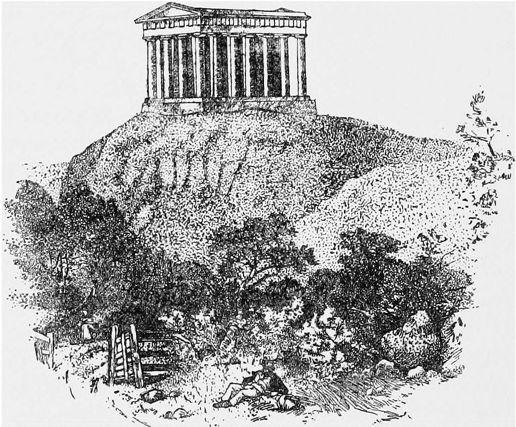
MONUMENT TO LORD DURHAM, PENSHAW HILL, DURHAM.
Abercromby, James, Speaker of the House of Commons, ii. 81
Aberdeen, Lord, as a statesman, i. 201;
acts for the Wellington Cabinet in the arrangements for Leopold’s accepting the throne of Greece, 203, 204;
annoyed by Leopold’s ultimate refusal of the Greek Crown, 204
Adelaide, Queen, her supposed influence on the fate of the Reform Bill in the Lords, i. 265;
her hostility to the Bill, 276, 286;
assertion of Brougham that she was the cause of the fall of the Melbourne Government, 401
Airy, Professor, i. 357
Albemarle, Lord, i. 258
Alexander I., Emperor, his promise of Norway to Prince Bernadotte, i. 70;
proclaimed King of Poland, 303;
monument to his memory, 307
Alien Bill (1818), i. 110;
of 1820, 139;
of 1824, 162
Althorp, Lord, appointed Chancellor of the Exchequer in the Grey Ministry, i. 218;
leader in the House of Commons, 218;
an unready speaker, 245;
characteristics, 246;
advocates the creation of peers, 276, 277;
his loyalty to Grey, 277;
opposed to the Irish Coercion Bill, 316;
employs Joseph Parkes to persuade the Birmingham Union to abandon an armed demonstration, 327;
opposes the renewal of the Coercion Act, 362;
resigns office, 363;
his sagacity, 365;
joins the Melbourne Cabinet, 368;
called to the House of Lords as Earl Spencer, 400;
his opinion of the King’s dismissal of Melbourne, 402
Anglesey, Lord, appointed Lord Lieutenant of Ireland, i. 215, 216;
his unpopularity, 319
Arthur, Sir George, his rule as Governor of Upper Canada, ii. 189, 327, 328
Assess taxes, Lambton presents a petition for their reduction, i. 85
Attwood, Radical Reformer, i. 327;
his reckless statements, 334;
attempts to present an address to Durham at Gateshead, 334, 335;
his position in the eyes of ultra-Radicals, 346
Auckland, Lord, takes office in the Grey Ministry, i. 218
Bagehot, Walter, on the Reform Bill, i. 296
Ballad, popular, on the Lambtons, i. 137
Ballot, voting by, advocated by Durham, i. 238, 405;
struck out from the Reform Bill, 243;
Whig objections to it, 337;
approved of by Lord Melbourne, ii. 112;
Grote’s motion for its adoption, 121;
Durham’s restatement of his views on the question, 146
Bamborough Sands, duel between Lambton and T. W. Beaumont on, i. 171
Bamford, Samuel, the misery of the people and political unrest reflected in his writings, i. 97, 122
Barracks, building of, in large towns, i. 21
Barrett, Mr., one of Lambton’s friends, on the escape of Lafayette, i. 84, 85
‘Battle of Peterloo,’ i. 122, 123;
denunciations of it, 124, 125
Beauharnois (Canada), outbreak at, ii. 305, 353
Beaumont, T. W., candidate for Northumberland (1826), i. 170;
fights a duel with Lambton, 171
Beddoes, Mrs. (wife of Dr. Thomas Beddoes), her attractive character, i. 41, 42, 45
Beddoes, Dr. Thomas, consulted by W. H. Lambton regarding his health, i. 25, 26;
Professor of Chemistry at Oxford, 26;
opinions of Southey and Coleridge of him, 26;
his regard for W. H. Lambton, 36;
undertakes the tuition of J. G. and W. H. Lambton, 40;
his plan of education, 42, sqq.;
his opinion of the mental and moral qualities of the young Lambtons, 43, sqq.;
on the study of the classics, and on the value of scientific knowledge, 49;
on the training of the children of the wealthy, 49, 50;
on the ‘market price’ of Latin and Greek, 51;
on the progress made by his pupils, 51, 52;
his death, 56;
Sir H. Davy on his qualifications, 56
Beddoes, Thomas Lovell, author of ‘Death’s Jest Book,’ i. 25
Bedford, Duke of (father of Lord John Russell), joins the ‘Friends of the People,’ i. 20;
his beneficial influence, 53;
his aversion to English University training, 56
Belgium: revolt against Holland, i. 209, 222, sqq.;
declaration of independence, 223;
election of Prince Leopold to the throne, 224;
its boundaries, 224;
hostilities began by the King of Holland, 224;
intervention of England and France, 224, 229-232;
the question of the fortresses, 228;
Russian view of its affairs, 307, 310, 312
Bell, Matthew, candidate for Northumberland (1826), i. 170
Bentinck, Lord William, his proclamation to the people of Genoa, i. 76;
supports the Spanish Committee, 159
Bernadotte, Prince, and his claims to the throne of Norway, i. 70, 71
Birmingham, enfranchisement of, i. 295
Birmingham Political Union, i. 208, 294, 326
Blandford, Lord, his proposal for Parliamentary Reform, i. 199
Blessington, Lady, her political receptions at Gore House, i. 369;
meeting of Durham and Disraeli at her house, 369;
her advice to Durham, 369;
Bulwer Lytton’s allusion to her acquisition of Gore House, ii. 97;
one of her dinner-parties described by Bulwer Lytton, 98
Bonaparte, Napoleon, at Ancona, i. 31;
his surrender of French claims to Louisiana, ii. 175
Bonomi, architect of Lambton Castle, i. 25, 187
Bouchette, M., one of the political prisoners in Canada, deported to Bermuda, ii. 203, 262
Boulton & Watts, works at Birmingham of, i. 27
Bourinot, Dr., quoted, ii. 209, 325
Bowen, Lord, on the finesse of wit, i. 89
Bowring, Sir John, on French opinion of Durham, ii. 1
Bread riots, i. 98
Breadalbane, Lord, i. 399
Bright, John, his election to Parliament for Durham City, i. 10
Brinkwater, Captain, one of Durham’s suite in Russia, ii. 13
Brougham, Lord, lampoons by, i. 89;
presents a petition to Parliament in favour of Reform, 101;
beginning of his acquaintance with Lambton, 111;
his letter of condolence on the death of Lambton’s first wife, 111, 112;
rupture of friendly relations with Lambton, 112;
his election to Parliament in 1818, 113;
his defence of Queen Caroline, 136;
his advocacy of universal education, 150, 354, 355;
attacks Lambton on the Irish question, 166;
on Lambton’s support of Canning, 177, 178;
gives notice of his intention to introduce the question of Parliamentary Reform (1830), 213, 214;
the difficulty of finding him a place in Grey’s Government, 215, 218;
appointed Lord Chancellor, 218;
first appearance in the Court of Chancery as Lord Chancellor, 219;
inclined to wrangle about the Reform Bill, 245;
opposed to Russell introducing the Bill, 246;
speech on the Reform Bill in the Lords, 265;
on the vote of the bishops, 265;
his sympathy with Durham on the loss of his son, 266;
his animosity towards Durham, 352 sqq.;
his exclusion from the Committee of Four a cause of resentment, 352;
loss of influence among the working classes, 353, 354;
his motion for a Royal Commission on the Irish Church, 361;
vituperative powers, 365;
lack of discretion, 366;
his influence on the construction of the Melbourne Ministry, 368;
his campaign in the north of Scotland, 374, 375;
criticism of the ‘Times’ on his meretricious speeches, 375;
repulsed by Grey at Edinburgh, 375;
speech at the Grey banquet, 376;
attack on Durham at Salisbury, 378, 384;
attacks Durham in the ‘Edinburgh Review,’ 379, 382, 383, 387, 391;
determines to keep out Durham from the Government, 380;
his treacherous conduct after the dismissal of Melbourne, 401;
excluded from Melbourne’s second Administration, ii. 6;
his attack on Lord Lyndhurst in the Lords described by Parkes, 73;
Bulwer Lytton on his occupations, 96;
his opposition to the Canada Bill, 152;
his attack on Durham’s Ordinance and Proclamation, 212, 213, 214, 231, 250, 251;
a saying about the ‘B’ on his carriage, 215;
his portrait taken at Cannes, 215;
Macaulay’s opinion of him, 215, 216;
burnt in effigy in Quebec, 219;
in a cartoon by ‘H. B.,’ 274;
on the authorship of Durham’s Canadian ‘Report,’ 339;
false report of his death, 361;
meets Durham at Lady Tankerville’s, 364
Broughton, Lord. (See Hobhouse, John Cam)
Buckingham, James Silk, action of the Indian Government against him, i. 162;
Lambton’s speech on his behalf, 162, 163;
East India Company grants him a pension, 163;
founder of the ‘Athenæum,’ and M.P. for Sheffield, 163
Buller, Arthur, ii. 165
Buller, Charles, on the indifference of Parliament to Colonial questions, ii. 140, 141;
appointed Durham’s First Secretary in Canada, 155;
character and qualifications, 155-157;
a pupil of Carlyle, 156;
Carlyle’s opinion of him, 157;
his ‘Sketch of Lord Durham’s Mission to Canada,’ 157;
his first impressions of Durham, 158;
his acceptance of the Secretaryship, 159;
describes Durham’s departure from Plymouth, 164;
describes the occupations of the passengers onboard the Hastings, 165, 166;
letters to E. J. Stanley on the ‘Dictator,’ &c., 165, 181;
the close attachment between him and Durham, 182;
stigmatises the Government as either ‘cowardly or perfidious’ in its desertion of Durham, 193;
his account of the arrival of the news of the rejection of the Ordinance, 232, 233;
on Durham’s resignation, 233, 234;
on the objects aimed at in Durham’s second Proclamation, 287, 288;
on the clause in the Proclamation giving the political prisoners the right to return to Canada, 289-294;
letter to E. J. Stanley on Durham’s return to England, 299, 300;
describes the scenes at Durham’s departure from Quebec, 300-302;
his share in the preparation of Durham’s Canadian ‘Report,’ 340, 341;
his article on Canadian affairs in the ‘Edinburgh Review,’ 340;
visit to Lambton Castle, and letter to E. J. Stanley, 360, 361
Bulwer, Sir Henry (afterwards Lord Dalling) on French opinion of Durham, ii. 1;
on King Leopold and the affairs of Belgium, 107, 108. (See also Dalling, Lord)
Burdett, Sir Francis, supports a petition for Parliamentary Reform (1817), i. 101;
elected for Westminster, 113;
his reckless assertions, 115;
his motion for Parliamentary Reform, 116, 121;
hostility to Lord Grey, 118;
introduces a Bill dealing with Catholic claims, 165;
his misgivings about the Reform Bill, 247
Buren, Van, President, ii. 192, 298
Burke, Edmund, his ‘Thoughts on the Causes of the Present Discontents’ quoted, i. 18;
application to W. H. Lambton of his encomium on Fox, 37
Byron, Lord, unpublished verses by him in Lady Louisa Grey’s album, i. 94, 95
Cambridge University petition against religious tests, i. 357
Campbell, Sir John (Attorney-General in the Melbourne Government), his opinion of Durham’s Ordinance, ii. 253
Camperdown, Earl of, i. 380
Canada: the rebellion, ii. 136;
Lord Durham offered the post of Lord High Commissioner, but declines it, 137, 142, 143;
short-sighted views in England with regard to its Government, 139, 140;
governed by the Colonial Office, 141;
the rule of Lord Gosford, 147;
Durham accepts the post of Lord High Commissioner, 147, 149;
Bill for the suspension of the Constitution, 150 sqq., 179;
ignorance of Parliament as to its real condition, 151;
Durham’s view of the French Canadians, 166;
violence of the British party in Lower Canada, 167;
the chief facts which led up to the rebellion, 168 sqq.;
the French settlers become subjects of the British Crown (1763), 168;
conservatism of the French, 168, 316;
the Quebec Act of 1774, 169, 170;
provisions and concessions of the Quebec Act, 170;
dissatisfaction of the English, 171;
divided into Upper and Lower Canada by the Act of 1791, 171, 172;
nature of the new Constitution, 172;
feeling of the British settlers towards the French after Waterloo, 173;
increasing number of immigrants, 173, 176;
effect of the French Revolution and of the English Reform Bill of 1832, 174;
three American invasions, 175;
patriotic spirit of British settlers, 175;
the opening up of the country after 1815, 176;
proposals of 1822 for a legislative union of the two Provinces, 176;
the question of the Clergy Reserves, 177, 189, 221, 231, 335;
defiant measures of Mackenzie and Papineau, 177, 179;
refusal by the Provinces to vote supplies, 178;
the demands of the Provinces, 178;
the question of dealing with the political prisoners, 179, 201-211;
suspension of the Habeas Corpus Act, 179;
Durham’s arrival, and state entry into Quebec, 182;
Durham’s first Proclamation, 183, 184;
formation of a new Executive Council, 185;
demands of the French party, 186, 187;
attitude of the British settlers, 187;
jealousies arising from the Family Compact, 188, 189, 221;
rule of Sir George Arthur in Upper Canada, 189, 327, 328;
sympathy of Americans with lawless Canadians, 189, 190;
burning of the Sir Robert Peel, 191;
condition of the Provinces on Durham’s arrival, 199, 315;
reforms aimed at by Durham, 200;
tranquillising effect of the Ordinance and Proclamation relating to the political prisoners, 204, 206, 208;
opinions of the Press on the Ordinance, 209, 210;
Durham’s tour through the Provinces, 218-222;
trial of the murderers of Chartrand, 218;
responsible rule advocated by Durham, 222;
the question of a loan for the development of the country, 223, 224;
Durham’s plan of government, 224, 225, 247, 277, 281, 283, 284, 314 sqq.;
fresh outbreak of rebellion after the disallowance of the Ordinance, 242, 245, 296, 305, 353;
regret at Durham’s resignation, 244, 273;
Durham’s second Proclamation, 273-285;
resolutions in Parliament on its government, 353, 354;
the impression made by the Durham Report, 358;
the work of Poulett Thomson in bringing about the union of the two Provinces, 359;
the Union Bill passes Parliament, providing one Legislative Council and one Legislative Assembly for Upper and Lower Canada, 366;
message from Canada on the death of Durham, 370. (See also ‘Report on the Affairs of British North America’)
Canada (or Union) Bill, passes Parliament, ii. 366, 368
Canning, George, satirised, i. 90;
cost of his mission to Lisbon, 102;
passage of arms with Lambton on the Indemnity Bill of 1818, 104, 105;
his death, 109;
on Lambton’s first great speech on Reform, 149;
moves the closing of the debate on Lambton’s motion, 149;
secures the independence of the Spanish American Colonies, 160;
becomes Prime Minister, 175;
effect of his advent to power on Whigs and Tories, 175, 176;
Disraeli’s description of him, 176;
Lambton’s allegiance to him, 177;
the work he accomplished, 178;
his death, 179;
triumph of his policy in the settlement of the Greek question, 200;
discourages the idea of Prince Leopold accepting the Crown of Greece, 201
Canning, Stratford, a contemporary of Lambton’s at Eton, i. 55;
appointed Ambassador to Russia, 315, 316, 320
Capital punishment, before the Reform epoch, i. 150
Capodistrias, Count, first president of the newly formed Greek Government, i. 201;
his career, 201;
his representations to Prince Leopold, 202;
assassination, 202
Carlyle, Thomas, his description of Joseph Parkes, i. 327;
on Charles Buller, ii. 157;
allusion to the ‘Condition of England Question,’ 310
Carnarvon, Earl of, opposes the enfranchisement of Metropolitan Districts, i. 291
Caroline of Brunswick, Queen, indignities suffered by, i. 113;
repudiated by the King, 135;
received with enthusiasm in London, 135, 139, 140;
her trial, 136, 139;
State visit to St. Paul’s, 136;
her popularity, 136;
receives addresses of congratulation, 141;
exclusion of her name from the Liturgy, 135, 142;
grant made to her, 142, 152;
Lambton’s speech on the conduct of the Government regarding her, 142;
prevented from attending the King’s coronation, 151, 152;
her death, 152;
inscription for her coffin, and her request to be buried among her own people, 152;
her funeral procession, 152-154
Cartoons, political, by ‘H. B.,’ i. 235, 236, ii. 274
Cartwright, Major, joins the ‘Friends of the People.’ i. 20;
candidate for the representation of Westminster, 118;
advises sending a ‘petition’ to Parliament in the ‘form of a living man,’ 121;
remark as to the shyness of the Whigs, 350
Castlereagh, Lord, i. 70;
proposes to renew the Property Tax, 74;
defends the placing of a military guard at the House of Commons, 79;
satirised, 90;
his ‘disagreeable’ political experiences, 92;
his determined fight against liberty and progress, 100;
Shelley’s denunciation of him, 100;
his suicide, 100;
his funeral procession cheered by the people, 100;
his contempt for petitions for Reform, 101;
and the Alien Bill of 1818, 110;
plot for his assassination, 134;
introduces Alien Act (1820), 139;
hissed by the people, 140
Catholic Association, i. 165, 194
Catholic Emancipation, advancement of the subject in 1825, i. 165;
Bill introduced by Sir F. Burdett dealing with the subject, 165;
concessions on the question by the Liverpool Administration, 166;
favourable attitude of Canning towards it, 175;
secured by the passing of a Bill under the Wellington Government, 192, 193, 197;
advantages arising from it, 252
Cato Street Conspiracy, i. 134, 135
Chapel of Bridgeford, i. 2, 3
Charlotte, Princess, marriage and death, i. 93, 103;
grant by Parliament for her wedding outfit, 98
Charlotte, Queen, death of, i. 114, 115
Chartist movement, one of its causes, ii. 6, 344, 345
Chartrand, trial of the murderers of, ii. 218, 219, 290
Chester-le-Street, town of, i. 2;
church of, 7;
address to Queen Caroline from the inhabitants of, 141;
burial place of Lord Durham, ii. 369
Children, their employment in factories, i. 208
Cholmondeley, Henrietta, her marriage to Lambton, i. 63, 64. (See also Lambton, Mrs. J. G.)
Cholmondeley Castle, i. 64
Church of England: Durham on its privileges, i. 358;
Durham on the cry ‘The Church is in danger,’ 405
Church Rates, Bill for their abolition, ii. 121
Clare, election of O’Connell for, i. 192, 199
Clarendon, Lord, on Wellington’s action for procuring the passing of the Catholic Emancipation Bill, i. 197
Clayton, Mr. John, Town Clerk of Newcastle, i. 170
Clergy Reserves, in Canada, ii. 177, 189, 221, 231, 325
Cleveland, Duke of, ii. 361
Club, Westminster, precursor of the Reform Club, i. 325
Coal duties, Lambton’s motion on the question of, i. 116, 117
Cobbett, William, the misery of the people and political unrest reflected in his writings, i. 97;
his flight to America and his denunciation of the suspension of Habeas Corpus, 99;
his views on the Reform Bill, and on Grey’s share in it, 243;
his indictment of the Whig Ministry, 350
Cobden, Richard, his pamphlet on Russia, ii. 92;
Durham makes his acquaintance, 93
Coercion Bill (Ireland), i. 316, 321;
(1834) 361
Colborne, Sir John (afterwards Lord Seaton), his government of Canada, ii. 147, 178, 179;
his Special Council, 187;
friendly relations with Durham, 194;
leaves the disposal of the political prisoners to Durham to settle, 201, 254;
approves of Durham’s decision to resign, 244;
requested by Lord Glenelg to remain in Canada, 244;
his resumption of authority, 294, 296, 301;
urges Durham to proceed direct to London, 299, 303, 304;
quells the outbreak in Canada of 1838-39, 353;
resigns his post and is raised to the peerage, 356
Colborne, Lady, her testimony to Durham’s character, ii. 245
Coleridge, John Taylor, a contemporary of Lambton’s at Eton, i. 55
Collieries, Lambton, Lord Durham establishes an Association of the workpeople at, i. 324
Colonies, the, inquiry into the emoluments of public servants in, i. 86
‘Committee of Four’: formation, i. 235;
place of meeting, 184, 237;
its ‘plan’ of Reform, 237;
principles guiding its deliberations, 238;
Durham’s Report of its proceedings, 238-242
Congress of Philadelphia, ii. 170
Congress of Vienna, i. 74;
and the annexation of Genoa to Sardinia, 76;
subjects discussed at, 80;
settles the partition of Poland, 303
Conroy, Sir John, ii. 85
Constantine, Grand Duke, his rule in Poland, i. 304
Constantinople, Lord Durham’s visit to, ii. 11-13;
the designs of Russia for its occupation, 16, 17, 23, 29, 35
Conyngham, Lady, i. 205
Copyright Act, Lambton proposes its amendment, i. 117
Corn Bill of 1815, i. 78, ii. 345
Corn Laws, the question of their repeal, ii. 344-346
Cornwall Canal (Canada), ii. 328
Corporation Reform, i. 338, 356, ii. 145
Cosin, Bishop, i. 9
Cowes, Lord Durham’s house at, i. 324, ii. 368
Cracow, its independence under the protection of Austria, i. 303, ii. 41;
‘Crisis Examin’d, The,’ pamphlet by Disraeli, i. 370-372
Croker, J. W., satirised, i. 90, 91
Crown Lands in Canada, ii. 200, 297
Cumberland, Duke of, his influence over George IV. on the Catholic Emancipation question, i. 197;
his influence over William IV., 306, 326
Daine, General, i. 229
Dalling, Lord (quoted), i. 175, 176, 199, 316, 320, 321. (See also Bulwer, Sir Henry)
Dalrymple, General, and the annexation of Genoa to Sardinia, i. 77
Dalrymple, Sir William, congratulates Lord Durham on his elevation to the peerage, i. 182
Daly, Mr., a member of Durham’s Council in Canada, ii. 185, 301
Darwin, Dr. Erasmus, consulted by W. H. Lambton, i. 27, 28;
his character, 27, 28
Davy, Sir Humphry, becomes assistant to Dr. Beddoes, i. 41;
his description of J. G. and W. H. Lambton as boys, 42;
the service rendered to him by Dr. Beddoes, 56;
on the intellectual gifts of Dr. Beddoes, 56;
his Safety Lamp and his experiments with it in Lambton’s collieries, 86, 87;
his claim as inventor of the Safety Lamp challenged by George Stephenson, 87, 88;
presentation to him by coal-owners, 88, 89
Dawkins, Mr., British Minister in Greece, ii. 9, 53
Derbishire, Stuart, one of Durham’s secretaries in Canada, ii. 315
Devonport: meeting to welcome Durham on his return from Canada, and Durham’s speech, ii. 307, 308
Devonshire, Duke of, i. 219
Diebitsch, General, quells the Polish insurrection, i. 304
Dillon, Captain, ii. 299
Disfranchisement of rotten boroughs, i. 240
Disraeli, Benjamin, his description of Canning, i. 176;
his admiration for Lord Durham, 368;
his early political opinions, 369;
meets Durham at Gore House, 369;
sends his pamphlet, ‘The Crisis Examin’d,’ to Durham, 370;
passage on Durham in the pamphlet, 371;
his comments on O’Connell, Beckford and Durham, 369;
letter to Durham on the High Wycombe election and the provisional Government of Wellington, 408, 409;
allusion by Bulwer Lytton to him, ii. 98;
on Roebuck’s speech on the suspension of the Constitution of Lower Canada, 151
Dorchester, Lady, i. 94
D’Orsay, Count, ii. 97
Doubleday, an ultra-Radical, i. 334
Dublin, riot in, i. 156
Dudley, Lord, retires from the Wellington Government, i. 199
Duncannon, Lord, takes office in the Grey Ministry, i. 218;
one of the ‘Committee of Four,’ 235, 335;
qualifications and character, 238;
opposed to the Irish Coercion Bill, 316
Duncombe, T. S., i. 329;
his debts, ii. 101;
accompanies Durham on his return from Canada, and describes the farewell scene at Quebec, 304, 305
Dundee, Durham’s reception at, i. 380, 381
Durham, City of, the question of its representation in Parliament, i. 8 sqq.;
meeting on the ‘Manchester massacre’ at, 125
Durham, Countess of, i. 65;
her interest in her husband’s career, 66, 168, 182;
appointed by Queen Victoria a member of the Royal Household, ii. 127;
her attractive character, 127;
letter on her husband’s appointment to Canada, 152;
her journal, 164;
describes the testimonies of respect for her husband in Canada, 286;
on the life at the Castle of St. Lewis, 296;
describes the scenes in Quebec on Durham’s departure, 302, 303;
resigns her place in the Queen’s Household, 311;
her opinion of Brougham, and her resentment towards Melbourne, 365;
recollections of the Earl’s home-life, 370;
her death and character, 370
Durham, County of, the question of its representation in Parliament, i. 8 sqq.;
episcopal jurisdiction in, 8 sqq.;
illegal voters and the Parliamentary election of 1761, 13, 14;
election of J. G. Lambton for its representation in Parliament, 68;
cost of Lambton’s election in 1820 for, 136;
canvassing incident at the election of 1826, 172, 173
Durham, Earl of, ancestry, i. 1 sqq.;
parentage, 25, 38;
place of birth, 38;
allusions to his childhood, 32, 39,40;
placed, with his brother William, under the care of Dr. Beddoes, 40, 42;
character as a boy, 43 sqq.;
at Eton, 53-55;
contemporaries at Eton, 55;
decides to enter the Army, 57;
cornet in the 10th Hussars, 60;
imposed upon by an artist, 61, 62, 63;
marries Henrietta Cholmondeley, 63, 64;
children of the marriage, 65;
enters Parliament for Durham county, 68;
speech at the Fox banquet, 69;
popularity in the north, 69;
speech on the affairs of Norway, 70-72;
proposes Lord Grey’s health at the Fox banquet (1814), 73;
denounces the Property Tax, 74, 75;
on the annexation of Genoa to Sardinia, 76;
champions the cause of the people, 77, 78;
opposes the Corn Bill (1815), 78;
protests against the military guard at the House of Commons, 78, 79;
death of Mrs. Lambton, 81;
visit to Scotland after his wife’s death, 82;
makes the acquaintance of Lafayette, 84;
protests against increased taxation, 85;
interest in Humphry Davy and his Safety Lamp, 86 sqq.;
his jeux d’esprits, 89-91;
pasquinade on John Gladstone, 92;
marries eldest daughter of the second Earl Grey, 93;
esteem for his father-in-law, 93, 94;
influence in Parliament, 96;
passage of arms with Castlereagh on Reform, 100;
on the mockery of debates in Parliament, 101;
on the extravagant cost of Canning’s mission to Lisbon, 102;
denounces the suspension of the Habeas Corpus Act, 103;
on the employment of ‘Oliver the Spy,’ 104;
urges Grey to take the control of the Whig party, 105 sqq.;
supports Tierney as leader of the Opposition, 108;
impatient at Grey’s inactivity, 109;
moves the rejection of Alien Bill (1818), 110;
weak health, 110;
beginning of acquaintance with Brougham, and later relations with him, 111, 112;
returned again for Durham county, 113;
acquaintance with Sir Robert Wilson, 113;
on General Gourgaud’s arrest, 115, 116;
speeches on the Coal Duties and the Copyright Act, 117;
his portrait by T. Phillips, 117;
takes part in the Westminster election, 118, 119;
friendship with Prince Leopold, 120, 226;
friendship with the Duchess of Kent and the Princess Victoria, 120, 226, 230, ii. 7, 85;
advice to extreme Radicals on the question of Reform, i. 124, 125;
on the ‘Manchester Massacre,’ 125;
opposition to the Six Acts, 127;
defends the working classes, 128;
gives notice of a motion on the state of the representation, 128, 129;
complains of Lord Holland’s lack of sympathy with Reform, 130, 131;
again returned for Durham county, 136;
cost of this election, 136;
takes the part of Queen Caroline, 136;
letter to T. H. Liddell, 137;
warns the Government against neglecting the demand for Reform, 138;
again denounces the Alien Bill (1820), 139;
epigram on the Lords and the Queen’s trial, 141;
presents petitions in defence of the Queen, 141;
denounces the Bill of Pains and Penalties, 142;
describes at the Fox banquet the condition of the country, 143;
his views in advance of Whig sympathies, 144;
the link between Whig leaders and irresponsible Radicals, 145;
first great speech on Reform (1821), 146 sqq.;
defends Sir Robert Wilson, 154;
appeals for the liberation of ‘Orator Hunt,’ 156;
on an alleged conspiracy in Dublin, 156;
friendship with the Duke of Sussex, 157, ii. 85;
helps British volunteers in Spain, i. 158-160;
on the political situation in Spain, 160;
again opposes the Alien Bill, 162;
presents a petition from Mr. J. Silk Buckingham, 162;
on the abuses of the Indian Government, 162, 163;
proposes an annual grant for encouraging the fine arts, 163;
attacks the Irish Franchise Bill, 166;
beginning of rupture with Brougham, 166;
relations with John Cam Hobhouse, 167;
serious illness (1825), 168;
visits Italy, 168;
called ‘Radical Jack’ and the ‘King of the Colliers,’ 169;
domestic relations and private life, 168, 169, 182, 183;
fights a duel with T. W. Beaumont, 171;
his opinion of Canning and Peel, 172;
humorous encounter with a Radical shoemaker, 173, 174;
on the loyalty of the men of the North, 173, 174;
gives up his racing establishment, and visits the south of Europe, 174;
accepts Canning’s leadership, 176;
on Lord Goderich’s Government, 179;
on Wellington’s Cabinet, 180;
raised to the peerage as Baron Durham, 181;
his sympathetic nature, 182;
town residence, 184;
letters to his eldest boy, 185 sqq.;
urges a re-union of the Whigs, 191;
his views of the Church of England in relation to the Nonconformists, 193, 194;
letter to Prince Leopold on the Catholic question, 195;
opposes the disfranchisement of Retford and Penryn, 198;
advises Prince Leopold with reference to the offer of the crown of Greece, 203, 204;
criticism of the Wellington Government, 208, 209;
appointed Lord Privy Seal in Grey’s Ministry, 218;
declaration of his political creed, 220, 221;
takes an important part in the settlement of Belgian affairs, 226 sqq.;
entrusted with the task of drawing up the plan of the Reform Bill, 235;
chairman of the ‘Committee of Four,’ 237;
his report of the Committee’s proceedings, 238-242;
letter to Lord Grey, after the second reading of the Reform Bill, advocating dissolution, 249-251;
speech in the Lords on Reform, 251, 252;
deprecates alterations in the Reform Bill, 252;
letter to Grey on the question of dissolution, 254-256;
accompanies Grey and Brougham to an audience of the King, 257;
his summons to the Master of the Horse, 258;
bears the crown on the occasion of the dissolution of Parliament, 258;
grief at the loss of his eldest son, 261;
letter and visit to King Leopold, 266, 267;
on Palmerston’s attitude towards the Reform Bill, 269;
favours the creation of additional peers to ensure the passing of the Bill, 269;
letter to Grey on the creation of peers, 270-275;
contemplates resignation, 277;
speech in the Lords on the Second Reading of the Reform Bill, 279-283;
speech on the Enfranchisement of the Metropolitan Districts, 291-294;
family bereavements, 298, 299;
his mission to St. Petersburg, 300 sqq.;
on Stanley and his Irish policy, 316;
his views on the Irish question, 316, 317;
called the ‘Dissenting Minister,’ 319;
his opinion of Palmerston, 321;
resigns office, and accepts an earldom, 321, 322;
establishes the Lambton Collieries Association, 324;
relations to his workpeople, 324;
buys a house in the Isle of Wight, 325;
elected Lord High Steward of Hull, 325;
acquaintance with Joseph Parkes, 325;
on the Irish Church Bill, 329;
influence in the education of Princess Victoria, 331;
his proceedings against newspapers for libel, 332;
speech at Gateshead (1833), 335-339;
reasons for his accepting a peerage, 340, 341;
friendship with Harriet Martineau, 343, 344;
on the intimidation practised by trades unions, 344, 345;
his support of Freemasonry, 347;
relations with Edward Ellice, 348, 349, 351;
relations with Brougham, 352, 353;
letter to Brougham on the latter’s scheme of National Education, 354, 355;
advocates the claims of Protestant Dissenters, 356, 358;
opposes the Suppression of Disturbances Bill (Ireland), 359;
attitude of William IV. towards him, 363;
his acquaintance with Disraeli, 369, 371;
at Gore House, 369;
popularity in 1834, 372;
speech at the Grey banquet, Edinburgh, 376, 377;
attacked by Brougham at Salisbury and in the ‘Edinburgh Review,’ 378, 379, 382, 383;
address at Dundee, 381;
replies at the Glasgow banquet to the attacks of Brougham, 386 sqq.;
declaration of his views on further reform, 393;
attends a series of meetings in Scotland, 398;
address at Newcastle, 403-406;
disliked and distrusted by leading Whigs, 407;
describes the demonstration at Newcastle, 407, 408;
his views about Disraeli’s politics, 409;
friendliness towards France, ii. 1, 2;
his efforts at the General Election of 1834, 3;
excites the jealousy of the Whigs, 4;
his exclusion from Melbourne’s second Ministry, 5, 6;
appointed Ambassador to St. Petersburg, 8;
journey to Russia, and his visits to Greece and Turkey, 9-18;
impressions of King Otho, 10;
describes his audience of the Sultan, 11, 12;
journey across Russia to St. Petersburg, 14-17;
his royal credentials, 18;
opinion of Russian houses, 19;
death of his daughter, Lady Frances Ponsonby, 20, 21;
his despatches to Palmerston and communications with Nesselrode, 23;
assures Nesselrode that Russia can never occupy Constantinople with the consent of England, 23;
on English distrust of Russia, 24, 45, 54, 55;
describes a New Year’s Fête, 25;
friendly relations with the Tsar, 26, 39;
his ‘Report on the State of Russia,’ 28-37 (see also Russia);
his ascendency at the Russian Court, 39, 55;
endeavours to mitigate Russia’s treatment of the Poles, 42, 43, 50;
principles of his action in St. Petersburg, 46-48;
his conduct in Russia defended by Palmerston, 49;
despatch on Russia’s improved policy towards Poland, 50, 51;
investigates grievances connected with English commerce, 51, 52;
the peaceful tendency of his work in Russia, 53;
conversation with the Tsar on commercial prohibition, 55, 56;
secures justice for Mr. Grant, 57;
his policy in Russia, 58 sqq.;
annoyed with the King, 60;
correspondence with Ralph Lambton, 61;
illness, 62;
despatch, for the King’s benefit, on England’s attitude towards Russia, 64;
secures reform in Russian tariffs, 66;
his action with regard to the affair of the Vixen, 66, 67;
wins the approval of William IV., 67, 68;
despatch on the designs of Russia in Central Asia, 68, 69;
correspondence with Parkes, 72 sqq., 79 sqq., 122;
founder of the Reform Club, 74;
‘Cincinnatus on his Russian farm,’ 85, 86;
on English politics (1836), 87, 88;
on his exclusion from the Melbourne Cabinet, 91;
his acquaintance with Richard Cobden, 92, 93;
correspondence with Bulwer Lytton, 95-99;
correspondence with Leslie Grove Jones, E. Ellice and others, 100-111;
advocates the support of the Melbourne Government, 112, 117;
attitude towards the House of Lords, and the question of Peerage Reform, 113-117;
repudiates any rivalry with Palmerston, 121;
banquet in his honour in St. Petersburg, 123;
receives a G.C.B., 124;
the King’s high opinion of him, 125;
receives the Order of St. Andrew from the Tsar, 126;
arrives in England (1837), 127;
invested with the Order of the Bath by Queen Victoria, 127;
appearance, manners, and characteristics, 129, 130;
gives a watchword for the new reign, 131;
on Queen Victoria and political prospects, 131, 132;
letter to O’Connell, 133;
views on England’s foreign policy, 134;
declines, but afterwards accepts the post of Lord High Commissioner to Canada, 142, 143, 147, 149;
restatement at Durham of his political views, 144-146;
speech in the Lords on his appointment to Canada, 153-154;
hindrances placed in his way in the course of his Canadian mission, 155, 245, 278;
appoints Charles Buller his First Secretary, 155;
engages E. G. Wakefield and Thomas Turton to accompany him to Canada, 159, 160;
his departure for the West, 164;
aims to make Canada thoroughly British, 166, 277;
arrival at Quebec and state entry into the city, 182, 183;
his first Proclamation, 183, 184;
his Executive Council, 185;
gains the confidence of the British party, 187, 188;
the splendour of his surroundings at Quebec, 188;
his action in the case of the burning of the Sir Robert Peel, 191;
attacked in the Lords about the appointment of Turton, 193;
relations with Sir John Colborne, 194;
protests against the criticisms of Parliament on the connection of Wakefield and Turton with his Mission, 195, 196;
protests against ‘incessant interference’ with his arrangements, 197;
establishes a police system in Quebec and Montreal, 200;
his proposed reforms, 200, 201, 224, 225, 247, 277, 281, 283, 284;
the question of dealing with the political prisoners, 201-204, 279;
Proclamation and Ordinance relating to the political prisoners, 204;
letter to the Queen, 205;
reasons for sending the prisoners to Bermuda, 206;
the humanity of his policy, 209, 271;
his Proclamation and Ordinance attacked in Parliament, 212-214, 217;
hostility of Brougham towards him, 212, 213, 214;
abandoned by the Cabinet, 214, 216;
disallowance of the Ordinance, 217, 219;
animosity of the House of Lords towards him, 217, 246;
tour through Canada, 219 sqq.;
letter to Melbourne on the resources and the development of Canada, 222-226;
receives the news of the disallowance of the Ordinance, and determines to resign, 222, 223, 251;
his weak health, 223;
receives an ovation at the theatre, 235;
addresses the Maritime Deputies, 236-240;
letter to Lord John Russell, 241;
despatches to Lord Glenelg, 245;
maintains the legality of the Ordinance, 255, 256;
explains the reasons of his resignation to Lord Glenelg, 256-258, 259, 261-265;
alarm in Canada at his projected departure, 273;
publishes the disallowance of the Ordinance and his second Proclamation, 273-285;
cartoon by ‘H. B.,’ 274;
described by a section of the Press as ‘Lord High Seditioner,’ 274;
Dr. Kingsford’s defence of the Proclamation, 286, 287;
denunciation and defence in England of his Proclamation, 287-289;
on the effect on Canada of the disallowance, 295;
his last days in Canada, 296 sqq.;
appoints Mr. Stuart Chief Justice of Quebec, 297;
abandons his intention of returning to England by the United States, 298, 299;
dinner given to him by the Guards, 300;
scenes at his departure from Quebec, 300-304;
arrives at Plymouth, 304;
vindicated by J. S. Mill, 306, 307;
welcome given to him in Devonshire, 307-309;
prepares his ‘Report,’ 310;
avoided by Melbourne, 310;
his ‘Report’ presented to Parliament, 312;
his assistants in the preparation of the ‘Report,’ 315;
authorship of the ‘Report,’ 338-341, 355;
on the Corn Law question, 344, 345, 346;
declines invitations to address meetings, 346, 347;
letter to General Grey on the political situation (May, 1839), 347, 348;
his interest in the colonisation of New Zealand, 349, 351;
last speech in Parliament, 354;
authorship of his despatches, 354, 355;
again protests against coercion in Ireland, 355;
refuses to bring before Parliament his treatment in Canada, 356, 357, 358, 368;
instructs Poulett Thomson, his successor in Canada, 357;
receives congratulatory addresses, 359;
his reply to an address from South Shields, 360;
visits Sunderland with the Duke of Sussex, 362;
shakes hands with Brougham at Lady Tankerville’s, 364, 365;
letter to Lord John Russell on the Union (Canada) Bill, 367;
illness and death, 368;
deathbed letter to his brother Hedworth, 369;
his burial at Chester-le-Street, 369;
monument to his memory, 370;
his personal traits shown by the actions of his life, 371;
his passion for work, 372;
enemies made by his impetuosity, 372;
the strong devotion of his friends, 373;
illustration of his chivalrous nature, 373, 374;
Bulwer Lytton’s tribute to his memory, 374. (See also ‘Report on the Affairs of British North America,’ and ‘Report on the State of Russia’)
East Penryn, bribery at, i. 198
Ebrington, Lord, moves a vote of confidence in the Grey Government, i, 286
Edinburgh: Banquet to Lord Grey, i. 272 sqq.
‘Edinburgh Review,’ the, Brougham’s attack on Durham in, i. 379, 382, 383, 387, 391
Education, universal, Brougham’s plan of, i. 150
Eldon, Lord, his allusion to the ruin of English farming, i. 98;
on the coronation of George IV., 151;
retires from public life, 175;
his forecast on the Catholic Emancipation question, 195
Electors, qualification of, as determined by the Reform Bill, i. 238, 240, 241, 253, 269, 336
Elgin marbles, purchase of, i. 98
Ellice, Edward, said to have originated the rallying cry about the Reform Bill, i. 259;
rupture of friendly relations with Lord Durham, 348, 351;
his politics and character described, 348, 349;
official appointments, 349;
his labours in the cause of the Reform Bill, 350, 351;
honourable character, 352;
said erroneously to have originated the Reform Club, ii. 74, 75;
takes part in establishing the Reform Club, 77-79;
at the French Court, 100, 107;
correspondence with Durham, 108-111;
accused of an intrigue to get Palmerston and Glenelg out of office, 110, 111
Ellice, Edward, junr., ii. 9
Elliot, Robert, the ‘parson’ at Gretna Green, i. 64
Emerson, on the benefits of travel in times of sorrow, i. 82
Emigration to Canada, after 1815, ii. 176;
advocated by Lord Durham, 200
Epigram on the Lords, Lambton’s, i. 141
Errol, Lord, i. 216, ii. 125
Erskine, Thomas, i. 18;
joins the ‘Friends of the People,’ 20
Essex, Lord, letter to Durham on the latter’s mission to Russia, i. 305, 306
Esterhazy, Prince, i. 80
Eton College, in 1805, i. 53;
under Dr. Goodall, Keate and Hawtrey, 53-55;
Lambton’s curriculum and contemporaries at, 55
Exeter: meeting to welcome Durham on his return from Canada, and Durham’s reply, ii. 309
Fagan, Mr. Louis, his account of the origin of the Reform Club, ii. 75
‘Family Compact,’ the, a faction in Upper Canada, ii. 188, 189, 221, 358
Farnborough, Lord, on the suspension of the Habeas Corpus Act, i. 23
Finchdale, Abbey of, i. 1
Fitz-Clarence, Frederick, i. 216
Fitzwilliam, Earl, i. 123, 127, 130, 131
Follett, Sir William, ii. 268
Fonblanque, Albany, on Lambton’s speeches at the Durham election of 1820, i. 138;
on Lord Durham’s advanced views on Reform, 340;
his opinion of Durham’s influence in the country, 370
Fox banquet at Newcastle (1813 and 1814), i. 69, 73;
at Edinburgh (1821), 143
Fox, Charles James, his opposition to Pitt, and friendship with Samuel Whitbread, i. 17;
opposes the suspension of the Habeas Corpus Act, 22;
allusion to his character, 28;
his death, 109;
advocates religious equality, 193;
the great principle which he laid down for modelling the governments of British dominions, ii. 172
Fox, Stephen, a contemporary of Lambton’s at Eton, i. 55
France: declares war against England, i. 21;
her intervention on behalf of Ferdinand VII. of Spain, 158;
co-operates in the settlement of the Greek question, 200;
sends an army into Belgium to expel the Dutch, 232;
high estimation of Durham, ii. 1;
Durham’s friendliness to the nation, 1, 2;
surrender of Louisiana to the United States, 175;
its failure to annex New Zealand, 352
Freemasonry: Lambton’s and the Duke of Sussex’ support of the craft, i. 157, 347, 348, ii. 362;
presentation of a Masonic jewel to Durham, i. 347;
the Masonic offices held by Durham, 347, 348
‘Friends of the People, The,’ association for advancing the subject of Parliamentary Reform, i. 19;
some of its members, 20;
its petition to Parliament, 22;
its proposal of Household Suffrage, 403
Froude, J. A., on the benefits resulting from the Reform Bill, i. 296
‘Gagging Acts,’ the, i. 127, 128
Gagnon, M., one of the political prisoners in Canada deported to Bermuda, ii. 262
Gas, as an illuminant, introduction of, i. 151
Gascoigne, General, his motion on Parliamentary Representation, i. 253, 257
Gateshead banquet (1833), the, Attwood’s attempt to present an address to Durham at, i. 334, 335;
Durham’s speech at, 335-340;
incident at, 342
Genoa, its annexation to Sardinia, and Lambton’s speech on the subject, i. 76
George III., his proclamation against seditious meetings, i. 20;
condition during his closing years, 114, 119, 120;
his death, 133;
his encouragement to artists, 163
George IV., his accession, i. 134;
insists on the removal of the Queen’s name from the Liturgy, 135;
his attitude towards the Queen, 135;
unpopularity, 140;
coronation, 151;
friendly feeling towards Canning, 175;
relations with the Goderich Cabinet, 179;
health and irritable temper, 179, 180;
influence of Wellington over him, 191, 192, 195, 197;
opposed to Catholic relief, 194, 195;
his death, 200, 205;
opposition to the acceptance by Prince Leopold of the crown of Greece, 201;
the gloom and suffering of his closing days, 205. (See also Regent, Prince)
Gladstone, John, Lambton’s pasquinade on, i. 91, 92
Gladstone, W. E., his election to Parliament for Newark, i. 10;
as a ‘stern unbending Tory,’ 365;
Under-Secretary for the Colonies in Peel’s Administration, ii. 2;
speaks on the question of trial by jury in Canada, 151
Glasgow, banquet to Durham at, and Durham’s reply to Brougham’s attacks, i. 387 sqq.
Glenelg, Lord, his short-sighted views on colonial questions, ii. 140;
protests against Durham’s employment in Canada of Wakefield and Turton, 195;
congratulates Durham on his Ordinance, 228, 229, 249, 250;
his defence of Durham, 251;
opposes the Indemnity Bill, 252;
withdraws from the Colonial Office, 343, 344;
attacked by Sir William Molesworth, 343. (See also Grant, Charles)
Gloucester, Duke of, i. 219
Goderich, Lord, made Prime Minister, i. 179;
resigns office, 179;
his character and political views, 180;
on the question of Lambton’s call to the House of Lords, 181;
the shortness of his term of power, 191;
his government a makeshift, 192;
takes office in the Grey Ministry, 218
Goodall, Dr. Joseph, condition of Eton College under him, i. 53, 54
Gosford, Lord, his government of the North American Provinces, ii. 147, 178
Gourgaud, General, arrest of, i. 115, 116
Gowland, Major, unseated for Durham County, i. 13
Graham, Sir James, joins Grey’s Cabinet, i. 216;
one of the ‘Committee of Four’ who drew up the Reform Bill, 235, 335;
letter to Durham, 236;
leaves the Liberal party, 236;
proposes a plan of registration, 237;
resigns office, 361
Grampound, representation of, i. 279
Grant, Charles (afterwards Lord Glenelg), retires from the Wellington Government, i. 199;
takes office in the Grey Ministry, 218. (See also Glenelg, Lord)
Grant, Mr., his claim against the Russian Government, ii. 57, 58
Granville, Lord, British Ambassador to France, i. 268;
his letter to Durham on the latter’s mission to St. Petersburg, 314, 315
Greece: new situation in its affairs created by the battle of Navarino, i. 200;
settlement of its affairs by England, France, and Russia, 200;
the first president of the new Government, 201;
offer of the throne to Prince Leopold, 201, 202;
the proposed frontier lines of the new kingdom, 204;
visit of Lord Durham, ii. 9-11
Grenville, Lord, his attitude towards the Radical party, i. 116
Gretna Green, Lambton’s marriage at, i. 64
Greville on the Melbourne Ministry, i. 368;
on Brougham’s attack on Durham, ii. 213;
on Durham’s character, 371
Grey, Earl, contemporary at Eton of Lord Durham’s father, i. 17, 18;
denounces a projected war with Spain (1790), 18;
one of the ‘Friends of the People,’ 20;
presents a petition to Parliament from the ‘Friends of the People,’ 22;
opposes the suspension of the Habeas Corpus Act in England, 22;
the Prince Regent’s overtures to him to form a Ministry, 73;
congratulates Lambton on his denunciation of the Indemnity Bill, 104, 105;
his reluctance to control the Whig party, 105, 106;
his pessimistic views on the prospects of the Whigs, 108;
differences with Lambton, 109;
on Romilly’s suicide, 114;
contemplates retirement from political life, 114;
attacked by the Radicals, 118;
on the Westminster election, 119;
his attitude with regard to the ‘Manchester Massacre,’ 123, 124;
speech in the Lords on the ‘massacre,’ 127;
on Lambton’s Reform motion, 129, 130, 169;
his opinion of Canning, 176, 177;
unfavourable to Leopold’s acceptance of the throne of Greece, 202;
attitude towards the Wellington Government, 212;
forms a Government, 214 sqq.;
the aristocratic composition of his Ministry, 219, 247;
his reluctance to take the head of affairs, 219;
entrusts the preparation of the Reform Bill to Durham and Russell, 234, 235;
considers the Reform Bill final on the subject, 243;
submits the Bill to the King, 244;
supported by the nation, 248;
appeals to the King to dissolve Parliament, 253, 257;
his firm attitude when the King wished the Reform Bill modified, 260;
his grief at the death of ‘Master Lambton,’ 262;
speech on the Reform Bill in the Lords, 264, 265;
opposed to the creation of peers, 269, 275, 277;
resigns office, 286;
returns to office, 290;
urges Durham to undertake a mission to St. Petersburg, 300;
on Russian views of the English Government, 305;
regrets the non-intervention of England in Polish affairs, 308;
divisions in his Cabinet on the Irish question, 316;
on his harmonious relations with Durham, 317;
tired of office, 318, 320, 333;
in a dilemma about political unions, 327;
differences of opinion between him and Durham, 328, 329;
dissension in his Cabinet (1833), 333;
eulogised by Durham at Gateshead, 336, 337;
public criticism of his Government, 340, 350;
repudiates any connection with Radical Reformers, 350;
his dissent from Durham on suppressing public meetings in Ireland, 359;
his Cabinet loses its zeal for Reform, 360;
proposes the renewal of the Irish Coercion Act, 362;
resigns office, and reviews in the Lords the achievements of the Reform Ministry, 363;
his lack of humour, 366;
makes no effort to secure a place for Durham in Melbourne’s Ministry, 367;
ovation accorded to him in northern towns, 372 sqq.;
describes Durham’s speech at the Edinburgh banquet as ‘very mischievous,’ 379;
on Brougham’s attack on Durham in the ‘Edinburgh Review,’ 382;
his letter to Durham respecting public statements as to the preparation of the Reform Bill, 392, 393;
on Durham’s utterances at Glasgow, 398, 399;
resents Durham’s Newcastle manifesto, 407;
declines to form a Government on the resignation of Peel, ii. 5;
opposition to Durham on the Ballot, &c., 5;
on Durham’s ‘bad connections,’ 5, 6;
on Durham’s appointment to St. Petersburg, 7;
letter to Durham on the death of Lady F. Ponsonby, 21;
on Durham’s Russian Report, 37, 38;
agrees with Durham on the Eastern question, 59;
his bitterness towards O’Connell, 100, 104;
on the position of the Melbourne Government in 1837, 112, 122;
embittered by exclusion from office, 134;
his opinion of the treatment of Durham by the Melbourne Cabinet, 216, 217;
disapproves of Durham’s second Proclamation, 273, 274
Grey, Lady Louisa Elizabeth, marries J. G. Lambton, i. 93;
her interest in politics and literature, 94;
letters and autographs, and a poem by Byron, contained in her album, 94, 95. (See also Durham, Countess of)
Grey, Colonel, sent to Washington by Durham on Canadian affairs, ii. 192
Grote, George, his attitude towards Lambton, i. 145;
letter to Durham on the Lords’ resistance to the Reform Bill, 287-89;
in Parliament, 318;
his motion for the adoption of the Ballot, ii. 121;
speech on the Canada Bill, 152
‘H. B.,’ political cartoons of, i. 235, 236, ii. 274
Habeas Corpus Act, its suspension in England under Pitt’s Administration, i. 22, 23;
suspended by Lord Liverpool, 99
Halford, Sir Henry, i. 205
Hampden, Dr., his appointment to the Regius Professorship at Oxford, ii. 101, 102
Hampden Clubs, i. 99
Hanson, R. D., one of Durham’s assistants in Canada, ii. 315
Hardwicke, Lord, one of the ‘Waverers,’ i. 284
Harraton House becomes the seat of the Lambton family, i. 12;
replaced by Lambton Castle, 25
Harrowby, Lord, i. 134, 179;
one of the ‘Waverers,’ 284
Hawtrey, Dr., his influence on Eton College, i. 53, 54, 55
Haydon, the painter, his petition to Parliament for the encouragement of the Fine Arts, i. 163;
his suicide, 164;
paints the Reform Banquet picture, 164
Hayter, Durham’s portrait by, ii. 75
Head, Sir Francis, his rule in Upper Canada, ii. 326, 327
Hedworth, John, of Harraton, marriage of his daughter to Henry, son of Ralph Lambton, i. 12
Hervey, Sir J., ii. 225
Heytesbury, Lord, i. 300
Hobhouse, Sir John Cam (afterwards Lord Broughton), presents to Lady Louisa Grey unpublished verses by Byron, i. 94;
defeated at the Westminster election, 119;
supports Lambton’s motion for Reform (1821), 149;
his differences with Lambton on the Irish Franchise Bill, 167;
his opinion of Lambton, 167;
quotes Samuel Rogers respecting Leopold’s refusal of the crown of Greece, 204;
his misgivings about the Reform Bill, 247;
‘burnt out to the socket,’ ii. 82;
criticised by E. Ellice, 109
Hobson, Captain, first Lieutenant-Governor of New Zealand, ii. 352
Hodgson, Dr. Francis, Lambton’s private tutor at Eton, i. 55
Holland: the revolt of the Belgians and the final separation of Belgium. (See Belgium)
Holland, Lord, and the question of Grey’s leadership of his party, i. 107;
and the question of Reform, 130, 131;
appointed Chancellor of the Duchy of Lancaster in Grey’s Ministry, 217, 218;
his advice to Durham as to his reply to Brougham’s article in the ‘Edinburgh Review,’ 283
Hook, Theodore, his attacks on Durham in the ‘John Bull,’ i. 333
Horner, Francis, opposes in Parliament the annexation of Genoa to Sardinia, i. 77;
his death, 109
House of Commons: sale of seats, i. 259
House of Lords: reasons for its opposition to Reform, i. 148;
scene at the second reading of the Reform Bill, i. 284;
Radical eagerness for its reform, ii. 113;
Lord Durham on the question of its reform, 113-117
Houses of Parliament, protected by soldiers, i. 78;
decorated with historical frescoes, 164
Howard, Major the Hon. F., marries Lord Durham’s sister, and is slain at Waterloo, i. 25, 81
Howick, Lord, candidate for Northumberland (1826), i. 170, 171, 173, 215;
his conversation with Harriet Martineau about Brougham, 353, 354
Hull, Election of Durham as Lord High Steward of, i. 324
Hume, Joseph, his agitation on financial abuses, i. 150;
denounces the Emperor Nicholas, 305;
and the Westminster Reform Club, 325;
Melbourne’s opinion of his politics, 366;
supports Disraeli, 408;
takes part in establishing the Reform Club, ii. 77, 79;
his political mistakes, 101;
speech on the Canada Bill, 152
Hunt, ‘Orator,’ i. 100, 115, 122, 126;
Lambton appeals to Parliament for his release from prison, 156
Huskisson retires from the Wellington Government, i. 199
Hutt, Sir William, i. 325
Income tax. (See Property tax)
Indemnity, Bill of (Canada), ii. 217, 252;
passes Parliament, 253;
its provisions to be proclaimed in Canada, 258, 267
Indemnity Bill, of 1818, i. 103;
Lambton’s denunciation of it, 103, 104
Ireland: plan of Reform, i. 237, 238, 295;
Coercion Bill, 316, 321;
Durham’s views on Irish Reform, 316, 317;
result of the election of 1832, 317;
Irish Church Bill, 329, 330;
of 1835, ii. 4;
Suppression of Disturbances Bill, i. 358, 359;
Tithe Bill, 360 sqq., ii. 102, 106;
Ward’s motion for the reduction of the Church Establishment, i. 361;
Coercion Act (1834), 362;
Durham’s views on its government, 381, 382;
industry and education of the Catholics, 146
Irish Church Bill, i. 329, 330;
of 1835, ii. 4
Irish Franchise Bill (1825), i. 166
Isle of Wight, Lord Durham’s residences in, i. 324, 325;
ii. 368
Jamaica, proposal to suspend its Constitution, ii. 347
Jeffrey, Francis, describes the scene in the Lords at the second reading of the Reform Bill, i. 284
Jersey, fourth Earl of, marriage of his daughter, the Lady Anne Villiers, to W. H. Lambton, i. 25;
J. G. Lambton named after him, 38
Jervis, Admiral, his victory off Cape St. Vincent, i. 32
Jones, Colonel Leslie Grove, his correspondence with Durham, ii. 100-106;
describes the members of the Reform Club, 100;
his allusions to the Marquess of Normanby, O’Connell, Hume, Duncombe, and others, 100, 101;
on Lord John Russell and the Tithe Bill, 102;
allusions to the condition of Ireland and the Municipal Bill, 102, 103;
on O’Connell at Brooks’s, 104, 105
Keate, Dr., his rule at Eton College, i. 53, 54, 55
Kent, Duchess of, her friendly relations with Lambton, i. 120, 226, 331, ii. 7, 85;
attitude of William IV. towards her, i. 331;
her plan of education for Princess Victoria, 332;
her popularity, ii. 81
Kent, Duke of, his naming of Princess Victoria, i. 120, 127
Ker, Captain Walter, i. 171
Kingsford, Dr., quoted, ii. 204;
his defence of Durham’s Proclamation 286, 287
Kinnaird, Arthur (afterwards Lord), ii. 9, 13, 217
Koziloffsky, Prince, ii. 50, 51
Lachine Canal, near Montreal, ii. 176
Lafayette, the flight of, i. 84, 85
Lamb, George, elected for Westminster, i. 119
Lambton, Alice, monumental brass to, i. 7
Lambton, Lady Anne (afterwards Lady Anne Wyndham), mother of Lord Durham, i. 25, 31, 32, 35, 36, 40, 64. (See also Wyndham, Lady Anne)
Lambton, Charles William (‘Master Lambton’), Lord Durham’s eldest child, i. 168;
his picture by Sir Thomas Lawrence, 168, 184;
his death, 184, 261;
letters to his father, 185 sqq.;
called the ‘Crown Prince’ by Prince Leopold, 227;
his burial at Chester-le-Street, 262
Lambton, Frances Charlotte (eldest daughter of J. G. Lambton by his first marriage), marries Hon. J. G. Ponsonby, i. 65
Lambton, Frances Susan, sister of the first Earl of Durham, marries Colonel F. Howard, i. 25, 81;
allusion to her childhood, 39
Lambton, George Frederick D’Arcy, afterwards second Earl of Durham, i. 189
Lambton, Georgiana Sarah Elizabeth, a daughter of J. G. Lambton by his first marriage, i. 65;
her death, 320
Lambton, Harriet Caroline, a daughter of J. G. Lambton by his first marriage, i. 55;
her death, 289
Lambton, Hedworth, a brother of the first Earl of Durham, i. 25;
his birth, 31, 32;
his impressions of a tour on the Continent, 79, 80;
at the funeral of Charles William Lambton, 262;
visits his niece, Lady F. Ponsonby, in Ireland, ii. 20
Lambton, Henry (1) supports the claims of freeholders of Durham, i. 8, 9;
his death, 10
Lambton, Henry (2), Attorney-General to Crewe, Bishop of Durham, i. 10, 11
Lambton, Henry (3) marries the heiress of John Hedworth of Harraton, i. 12;
ninth in descent from Sir John Lambton the Crusader, 12
Lambton, Henry (4), a brother of the first Earl of Durham, i. 25;
allusion to his childhood, 39
Lambton, General John (grandfather of the first Earl of Durham), i. 12;
contests the election of Major Gowland for Durham, 13;
elected to Parliament (1762), 14;
letter to Mr. Baker on the Durham election, 14;
marriage to Lady Susan Lyon, 15;
J. G. Lambton named after him, 38;
offered a peerage, 39, 178
Lambton, Sir John, de, Knight of Rhodes, i. 2 sqq.
Lambton, John George, first Earl of Durham. (See Durham, Earl of)
Lambton, Lady Louisa. (See Durham, Countess of)
Lambton, Lady Mary, ii. 165
Lambton, Ralph (1), i. 7
Lambton, Ralph (2), son of General John Lambton and uncle of the first Earl of Durham, i. 15;
one of W. H. Lambton’s trustees, 28;
letters to him from W. H. Lambton, 28-35;
conducts Lady Anne Lambton and her children from Italy to England, 36;
obtains a commission for J. G. Lambton in the Prince of Wales’s Own, 60;
extricates his nephew from the toils of an impostor, 63;
retires from the representation of Durham City in Parliament, 68;
at the funeral of Charles William Lambton, 262
Lambton, Sir Thomas, Governor of the Leeward Isles, i. 8
Lambton, William (1), i. 7
Lambton, William (2), head of Balliol College, i. 7
Lambton, William (3), i. 8
Lambton, William (4), elected to Parliament for Durham County (1685), i. 10;
called ‘Old True Blue,’ 11;
his admission to the House of Commons challenged by the doorkeeper, 11, 12
Lambton, Sir William, Royalist officer, i. 7, 8
Lambton, William Henry (1) father of the first Earl of Durham, i. 15;
early days and education, 16, 17;
supports Fox in the House of Commons, 17;
contemporary of the second Earl Grey at Eton, 17, 18;
influence in Parliament, 18;
one of the founders of ‘The Friends of the People,’ 19;
mobbed as a Jacobin, 22;
opposes the suspension of the Habeas Corpus Act in England, 22, 23-24;
begins the building of Lambton Castle, 25;
marriage to Lady Anne Villiers, 25;
his children, 25;
seeks medical advice from Dr. Beddoes, 25, 26;
visits factories at Birmingham, 27;
consults Dr. E. Darwin, 27;
travels in Italy, 28-36;
letters to Ralph Lambton, 28-35;
criticisms on public affairs, 29 sqq.;
his death, 36;
characteristics, 36, 37;
aversion to public schools, 41
Lambton, William Henry (2), second son of W. H. Lambton and brother of the first Earl of Durham, i. 25;
allusion to his childhood, 39;
becomes a pupil of Dr. Beddoes, 40, 42
Lambton Castle, i. 6;
the building of, 25, 30
Lambton Collieries Association, established by Lord Durham, i. 323
Lambton Hall, i. 4, 5
Lambton Worm, the, legend of, i. 2-6
Lambtons, the, saying illustrating the estimation in which they were held, i. 2
Lamton, John de, i. 1
Lamton, Richard de, i. 1
Lamtun, John de, i. 1
Lansdowne, Lord, his attitude towards the Radicals, i. 116;
appointed President of the Council in Grey’s Ministry, 217, 218;
not enthusiastic on the subject of Reform, 244
Larkin, an ultra-Radical, i. 334
Lawrence, Sir Thomas, his picture of ‘Master Lambton,’ i. 168, 184;
his portrait of Lord Durham, 185;
a copy of his ‘Master Lambton’ presented to Earl Grey, ii. 123
Leeds, Duchess of, relates an incident of Durham’s home-life, ii. 373, 374
Leeds, enfranchisement of, i. 295
Leopold, King, his marriage to Princess Charlotte, i. 93;
intimate friendship with Lambton, 120, 226;
offered the throne of Greece, 201, 202;
Princess Lieven’s opinion of him, 202;
appeals to Durham for advice, 203;
accepts the crown of Greece conditionally, and afterwards declines it, 203, 204, 219;
elected King of the Belgians, 224;
contemplates abdication, 225;
seeks Lord Durham’s advice, 226, 228;
his interest in Durham’s family, 227;
his correspondence with Durham, 227;
claims the help of the Powers in opposing the King of Holland, 228;
assisted by England and France in expelling the Dutch from Belgium, 232;
his comments on English affairs, 232;
warns Durham about the Russian people, 233;
invites Durham to visit him, 266;
Durham’s second visit to him, 325;
his knowledge of the affairs of Belgium, ii. 107, 108
Libel, actions for, against newspapers, i. 332, 333
Liddell, Sir T. H. (afterwards Lord Ravensworth), letter to Lambton on the Durham election, i. 136;
candidate for Northumberland (1826), 170
Lieven, Princess, her opinion of Count Capodistrias, i. 202;
alleges that Prince Leopold intrigued for obtaining the crown of Greece, 202;
on ‘Master Lambton,’ 261;
her allusion to Russia’s antipathy to intervention in Polish affairs, 308;
on Durham’s mission to St. Petersburg, 313;
styles Durham the ‘Chief of the True Believers,’ 330;
calls Lord Grey ‘a thorough old woman,’ 331;
her opinion of Durham’s second Proclamation, ii. 274
Lilburne, Colonel John, i. 9.
Lilburne, Colonel Robert, i. 9
Lisbon, Canning’s mission to, i. 102
Littleton, Mr. (afterwards Lord Hatherton), introduces, as Irish Secretary, a new Tithe Bill for Ireland, i. 360
Liverpool, Lord, Administration of, i. 70;
suspends Habeas Corpus Act, 99;
his Indemnity Bill (1818), 103;
alarmed at the state of the country, 121;
discreditable character of his Administration, 134;
threatens to resign, 135;
attitude towards reform, 149, 150;
his death, 175
London: Association of Merchants, i. 21;
its representation as compared with its population, 292
London University: the question of granting it a charter, i. 356
Londonderry, Marquis of, declines the British Embassy at St. Petersburg, ii. 4, 61
Louis Philippe, his jealousy of Prussia, i. 223;
declines to allow his son, Duke de Nemours, to accept the Belgian crown, 223, 224;
wishes to intervene in the struggle of Poland with Russia, 304
Lyndhurst, Lord, his attack on the Reform Bill, i. 285;
appointed Lord Chancellor, 402, ii. 86;
attacked by Brougham, 73;
Bulwer Lytton on his leadership in the Lords, 100;
his opposition to Durham’s Proclamation, 212, 213
Lytton, Bulwer, his correspondence with Durham, ii. 95-99;
on Brougham, 96;
on Lady Blessington and D’Orsay, 97;
on the connection between the hair and political opinions, 97, 98;
his story of a mourner at the wrong grave, 98;
describes a dinner-party at Lady Blessington’s, 98;
allusion to Lord Lyndhurst, 98;
describes Lord John Russell, Stanley, Spring Rice, and others, 99;
thinks the Radicals are all leaders, 99;
allusion to Ellice ‘dangling at the French Court,’ 100;
on Lyndhurst’s leadership in the Lords, 100;
describes the attitude of the Whigs towards the Radicals, 118, 119;
his couplet on Charles Buller, 157;
his lines on Durham, 374
Macaulay, Lord, his description of the scene in the Commons at the second reading of the Reform Bill, i. 248;
his description of Gladstone, ii. 2;
his opinion of Brougham, 215, 216;
opinion of Durham’s Canadian ‘Report,’ 339
Macdonnell, Sir James, presides at the farewell dinner of the Guards given to Durham at Quebec, ii. 300, 303
Machinery, destruction of, i. 98
Mackenzie, leader of rebels in Upper Canada, ii. 177, 327
Mackintosh, Sir James, one of the ‘Friends of the People,’ i. 20;
his opinion of Lambton as a speaker in Parliament, 66;
opposes the annexation of Genoa to Sardinia, 77
Maitland, ——, joins the ‘Friends of the People,’ i. 20
Malmesbury, Lord, his mission to France, i. 30
Malpas, parish church of, marriage of Lambton at, i. 64
Manchester, enfranchisement of, i. 295
‘Manchester Massacre,’ the, i. 122, 123;
denunciations of it, 124, 125
Mansfield, Lord, on the motions of Ministers in attempting to pass the Reform Bill, i. 258
Martineau, Harriet, describes the scene in the palace when William IV. decided to dissolve Parliament, i. 257, 258;
her ‘Illustrations of Political Economy’ recommended by Durham for the Princess Victoria’s reading, 331;
her friendship with Durham, and the help she received from him in her literary work, 343-345;
her account of Brougham’s quarrel with Durham, 352
Meetings, seditious, proclamation against, i. 20
Melbourne, Lord, appointed to the Home Office in the Grey Ministry, i. 218;
becomes Prime Minister, 363;
early life, character, and qualifications for political leader, 365-367;
his exclusion of Durham from office, 367;
dismissed by the King, 401;
resents Durham’s Newcastle manifesto, 407;
succeeds Peel as Prime Minister, ii. 4, 5;
again excludes Durham from office, 5;
his vacillating policy, 89;
weakness of his Government, 112, 122;
approves of the Ballot, 112;
his Ministry supported by Durham, 113, 117;
described by Sydney Smith, i. 367, ii. 129;
confirmed in office by the General Election (1837), 129;
offers Durham the post of Lord High Commissioner to Canada, 137;
his narrow views on Imperial policy, 139;
letter to Durham on the powers of the Lord High Commissioner in Canada, 148, 149;
promises Durham ‘unflinching support,’ 150;
protests against the employment of Turton and Wakefield in Canada, 195;
at first approves and then condemns Durham’s Ordinance and Proclamation, 211, 214, 216, 217, 218, 228, 229, 249, 250, 251;
defends the Ordinance, 252;
decides to recommend the disallowance of the Ordinance, 253;
his discreditable treatment of Durham, 255;
avoids Durham on his return from Canada, 310;
speaks slightingly of Durham’s suggestions for governing Canada, 312;
popular discontent with his Government, 344, 347;
resignation of his Ministry, 347;
his Ministry resumes office on the refusal of Peel to form a Government, 347
Merchants of London, association of, for the defence of liberty and property, i. 21
Metropolitan Districts, enfranchisement of, Lord Durham’s speech on, i. 291-294
Metternich, Prince, on the effect of the battle of Navarino, i. 200;
his change of attitude on the Greek question, 200;
opposes the restoration of Egypt to the Porte, ii. 24
Milbanke, Sir Ralph, i. 347
Mill, John Stuart, on the Radicals accepting Durham as leader in 1834, i. 364;
his defence of Durham’s second Proclamation, ii. 288;
vindicates Durham in the ‘Westminster Review,’ 306, 307;
his statement as to the authorship of the Durham ‘Report,’ 338;
his exclamation on hearing of Durham’s death, 369
Milman, Henry Hart, a contemporary of Lambton’s at Eton, i. 55
Molesworth, Sir William, his attitude towards Lambton, i. 145;
takes part in establishing the Reform Club, 76, 77, 78, 79;
speech on the Canada Bill, ii. 152;
organises meeting at Devonport to welcome Durham on his return from Canada, 307;
on Durham’s Canadian ‘Report,’ 341;
his attack on Lord Glenelg, 343
Montreal: Durham’s establishment of a police system, ii. 200;
feeling of the merchants as to the treatment of the political prisoners, 219;
enthusiastic reception given to Durham, 219, 220;
Durham’s address, 220
‘Montreal Gazette,’ its defence of Lord Durham, and denunciation of the Melbourne Government, ii. 242, 243
Monument to Lord Durham on Penshaw Hill, ii. 370
Moore, Thomas, lampoons by, i. 89
Municipal Reform Act, ii. 72
Murray, Lady Augusta, wife of the Duke of Sussex, i. 157
Naples, its government criticised by W. H. Lambton, i. 33
National Debt, in 1821, i. 143;
in the reign of George III., 147, 281
Navarino, battle of, its influence upon the Greek question, i. 200;
ii. 30
Nelson, Dr. Wolfred, one of the political prisoners in Canada deported to Bermuda, ii. 203, 262
Nesselrode, Count, on the affairs of Holland and Belgium, i. 307;
discusses the Polish question with Durham, 308, 309;
his communications with Durham on the Eastern question, ii. 23;
resents the attitude of the English Press, 24;
on tariff reforms, 66;
and the affair of the Vixen, 67
New Zealand: the work of Gibbon Wakefield in extending its colonisation, i. 161, ii. 349;
Durham’s interest in promoting emigration to the islands, 349;
Associations formed for its colonisation, 349, 350, 351;
efforts of France to acquire it, 350, 352;
expedition of the Tory, sent out by the New Zealand Company, 352;
its annexation to Great Britain, 352;
Treaty of Waitangi, 352;
the first Lieut.-Governor, 352
New Zealand Company, ii. 349 sqq.
Newark, Parliamentary representation of, i. 10
Newcastle: Lambton speaks at the Fox banquet, i. 69;
Lambton’s eulogy on Earl Grey at the Fox banquet of 1814, 73;
Grey banquet, 372;
banquet to Durham (1834), 402-406;
Durham’s description of the demonstration in his honour, 407, 408
Niagara: Durham’s review of troops, and reception of Americans, ii. 220, 221;
description of the Falls, 226
Nicholas I.: denounced in the House of Commons, i. 305;
welcomes Durham to St. Petersburg, 306;
his distrust of Louis Philippe, 307;
his view of English intervention in Belgium, 307, 310, 312;
visit to H.M.S. Talavera, 307;
opinion of the English Reform Bill, 307;
friendly relations with Durham, 308, ii. 8, 14, 26, 39;
his obduracy, i. 310;
his high opinion of Durham’s abilities, 313, ii. 39;
antipathy to Stratford Canning, i. 315;
plays a joke on a gourmand, ii. 25;
confers the Order of St. Andrew upon Durham, 126
Nonconformists: repeal of the Test and Corporation Acts, i. 192, 193, 198;
the question of University tests, 356, 357, 358;
church rates, 357
Normanby, Marquess of, Lord Lieutenant of Ireland, entertains O’Connell, ii. 101;
succeeds Lord Glenelg at the Colonial Office, and is afterwards removed to the Home Office, 348
North, Lord, and the Quebec Act of 1774, ii. 170
North Shields, Lambton’s speech, on the loyalty of the working classes, at, i. 173, 174
Northumberland, election of 1826 for, i. 170
Norton trial, the, ii. 86
Norway, Lambton’s speech on the affairs of, i. 70-72
O’Connell, Daniel, elected to Parliament for Clare, i. 192, 199;
denounces the Emperor Nicholas, 305;
his revolt against Stanley’s policy in Ireland, 319;
motion for the repeal of the Union, 355;
reveals in Parliament secret negotiations between himself and the Irish Secretary, 362;
his disregard of Brougham’s utterances, 399;
supports Disraeli, 408;
co-operation with the Melbourne Government, ii. 6;
entertained by the Lord Lieutenant of Ireland, 101;
an unfavourable view of his character and tactics, 104, 105;
letter to Durham (1837), 132;
testimony to Lord Normanby as Lord Lieutenant of Ireland, 348
Oliver the Spy, i. 104
Ord, W. H., M.P., presides at the Durham banquet at Newcastle, i. 402
Oswald, James, M.P., Chairman at the Durham banquet at Glasgow, i. 389
Otho, King, Lord Durham’s visit to, ii. 9-11
Pains and Penalties, Bill of, i. 135, 136, 140, 141, 142
Palmerston, Lord, satirised, i. 90;
retires from the Wellington Government, 199;
on Metternich’s attitude on the Greek question, 200;
joins Grey’s Government as Secretary for Foreign Affairs, 217, 218;
his policy in the settlement of the affairs of Belgium, 227;
lukewarm on the subject of Reform, 244, 269;
proposes to Durham to undertake a mission to St. Petersburg, 300;
instructions to Durham regarding the St. Petersburg mission, 301-303;
protests against the denunciation of the Tsar, 305;
his appointment of Stratford Canning as Ambassador to Russia, 315, 316;
relations with Durham, 320, 321;
his self-assertion, 365;
on the composition of the Melbourne Ministry, 368;
considers Durham a dangerous innovator, 371;
resents Durham’s Newcastle manifesto, 407;
Foreign Secretary in Melbourne’s second Administration, ii. 6;
his appreciation of Durham’s influence at St. Petersburg, 39, 59;
policy towards Russia, 40;
on the good effect of Durham’s appointment in Russia, 41;
on the independence of Cracow, 42;
letter to Durham on British policy towards Russia, 43-45;
defends Durham in the House of Commons with regard to his Russian Embassy, 49;
on Russian policy, 58;
on Durham’s Russian despatches, 63, 65;
and the affair of the Vixen, 67;
criticised by E. Ellice, 109;
his bellicose attitude towards Russia, and captious foreign policy, 110;
on the conferment of the Order of the Bath on Durham, 124;
never understood Durham, 339
Papineau, M., leader of rebels in Lower Canada, ii. 177;
described by a Canadian historian, 179;
takes refuge in the United States, 203;
forbidden to return to Canada, 204, 262;
belief of the French that he would return at the head of an army, 318;
the political storm which he provoked, 319
Parkes, Joseph: Lord Durham’s friendship with him, i. 325;
one of the founders of the Westminster Club, 325;
his knowledge of the secret history of the Reform Bill, 325;
induces Attwood to abandon a projected armed demonstration, 327;
appointed secretary to the Municipal Corporations Commission, 328;
preservation of his correspondence with Durham, 328;
on Peel’s address to his constituents, ii. 3;
on lack of zeal among the Whigs, 3, 4;
his influence in bringing about Reform, 70-72;
letters to Durham on English politics, 72 sqq., 81 sqq.;
on Durham’s position in the Liberal party, 73, 74;
on the origin of the Reform Club, 76;
on the Melbourne Government, 85, 86;
on Durham’s exclusion from the Cabinet, 88, 89;
thinks Durham the only man to restore the supremacy of the Liberal party, 90;
describes Cobden, 93;
his description of Roebuck, 122;
on the Melbourne Ministry, 122
Parliaments, duration of, as determined by the Reform Bill, i. 238
Paskievich, Marshal, ii. 42, 50
Patriotism in England, during the war with Napoleon, i. 97
Peel, Sir Robert, refuses to join Canning’s Administration, i. 175;
his opinion of the Reform Bill, 248;
refuses to form a Government on the resignation of Grey, 286;
called to power on the dismissal of Melbourne, 402, ii. 2;
his short-lived Ministry, 2, 4;
proposes to send the Marquis of Londonderry as Ambassador to St. Petersburg, 4;
speech on Irish Corporation Reform, 107;
attacks the Jamaica Constitution Bill, 347;
summoned to form a Government, but declines, 347
Peers, creation of, to ensure the passing of the Reform Bill, i. 269;
Durham’s letter to Grey on the subject, 270-75;
advocated by Lord Althorp, 276, 277;
the proposal submitted to the King, 286
Penryn, bribery at, i. 198, 279
Penshaw Hill, monument to Lord Durham on, ii. 370
Phillips, Thomas, R.A., his portrait of Lambton, i. 117
Pitt, William, shirks the question of Parliamentary Reform, i. 17, 21;
his Bill for the suspension of the Habeas Corpus Act, 22, 23;
conduct towards France, 30;
obtains a vote of ten millions for the war with France, 32;
his death, 109;
his Canadian Act of 1791, ii. 171
Place, Francis, i. 118, 123, 344;
his political creed and characteristics, 345, 346;
Durham’s opinion of him, 346, 347
Playfair, Professor, Lord John Russell’s tutor at Edinburgh, i. 57
Plymouth: address presented to Durham on his return from Canada, and Durham’s reply, ii. 308, 309
Pocket boroughs, i. 144, 147
Poland: Mansion House Fund for the relief of the people, i. 21;
its fate discussed at the Congress of Vienna, 80;
English intervention on behalf of the people, 303;
its partition settled at the Congress of Vienna, 303;
Alexander I. proclaimed king, 303;
receives a Constitution, &c., 304;
insurrection of 1830 and flight of the Grand Duke Constantine, 304, ii. 41, 42;
declared an integral part of the Russian Empire, i. 304;
discussion of its affairs by Durham and Nesselrode, 308, 309, 312;
the cry of its women, 309;
the Tsar grants a ‘merciful ukase’ in response to Durham’s appeals, 310;
Durham’s efforts on its behalf in 1836, ii. 42, 43, 50, 51
Ponsonby, George, death of, i. 109
Ponsonby, Hon. John G. (afterwards fifth Earl of Bessborough), marries Durham’s eldest daughter, i. 65, ii. 20;
death of his wife, 19;
visits St. Petersburg, 27
Ponsonby, Lord, Ambassador at Constantinople, ii. 8, 11, 13, 17, 43
Poor Law Amendment Act, i. 360
Poor Rate, in 1821, i. 143;
in 1830, 208
Portland, Duke of, his opposition to the Bill of Pains and Penalties, i. 140;
President, of the Council in Lord Goderich’s Government, 179
Poverty of the people at the beginning of the nineteenth century, i. 97;
in 1830, 208
Powlett, Hon. W. Vane, i. 136
Pozzo di Borgo, Count, i. 312, ii. 24
Press, Liberty of the, in India, i. 162
Prince Edward’s Island, affairs at, ii. 297
Prisoners, political, in Canada: the question of their disposal left by Sir John Colborne for Durham’s settlement, ii. 201, 279;
objections to their being tried by a jury, 202, 203;
banishment to Bermuda of eight prisoners, and others set at liberty, 203, 204, 279;
Durham’s reasons for sending the eight prisoners to Bermuda, 206, 280, 281;
examination of objections to the Ordinance banishing the prisoners to Bermuda, 267-72;
free to return to Canada after the disallowance of the Ordinance, 282, 289-294
Proclamation, Durham’s first, in Canada, ii. 204, et passim;
his second, 273 sqq.
Property tax, agitation for the repeal of, i. 74;
its repeal, 75
Quebec, City of: Durham’s state entry and reception, ii. 182;
burning of Brougham in effigy, 219, 235;
reception of the news of the disallowance of Durham’s Ordinance, 234;
ovation to Durham in the theatre, 235;
meeting of the Maritime Deputies, 235 sqq.;
meeting to express confidence in Durham, 243;
farewell banquets given to Durham, 300;
scenes at Durham’s departure, 301-304
Quebec, Province of: new boundaries fixed by the Act of 1774, ii. 169, 170;
establishment of a police system, 200
Quebec Act of 1774, ii. 169, 170;
its provisions and concessions, 169;
disliked by the English settlers, 171
Radicals, extravagant demands of the ultra-section amongst them, i. 115, 116, 123;
their struggle to win the Westminster election, 117-119;
classified with Jacobins, 145;
prosecution and imprisonment of the more violent of them, 150;
their view of the Reform Bill, 243;
disappointed with the result of the first elections under the Reform Act, 318;
how they regarded Durham’s resignation, 323;
Grey repudiates any connection with them, 350;
their expectations of Durham being called to the head of affairs on the fall of the Grey Ministry, 363;
Melbourne’s opinion of them, 366;
Durham’s popularity with them in 1834, 372;
adoption in Radical manifestoes of a saying of Durham’s at the Newcastle banquet, 403;
they resent Durham’s exclusion from Melbourne’s second Administration, ii. 6;
attitude towards the Melbourne Government, 111, 112;
exhorted by Durham to forbearance, 112, 113, 117, 118;
their satisfaction at Durham’s return from Canada, 310
Railway, inter-colonial, in Canada, recommended by Durham, ii. 337
Railway, Liverpool and Manchester, opening of, i. 208
Raine, Dr., i. 59
Reeve, Henry, attributes the authorship of Durham’s Canadian ‘Report’ to Charles Buller, ii. 340
Reform Bill: its preparation entrusted to Lord Durham and Lord John Russell, assisted by Sir James Graham and Lord Duncannon, i. 234, 235;
Lord John Russell’s ‘Plan,’ 237;
outline of proposed Bill in Durham’s report, 238-242;
a compromise between the demands of the Radicals and the misgivings of the Whigs, 243, 296;
said by Cobbett to have been forced upon Grey, 243;
submitted to the King, 244;
introduced into the Commons, 246, 247;
its reception by the Commons, 247;
the tumult which it created in society, 248;
second reading in the Commons carried by a majority of one, 248;
its defence by Durham in the Lords, 251, 252;
enthusiasm of the nation on the subject, 259;
third reading of the second Bill passed in the Commons, 261;
speeches of Grey and Brougham, 264, 265;
rejected by the Lords, 265;
excitement created by its rejection, 268;
the third Bill passes the Commons, 276;
sent up to the Lords, 276;
the Duke of Wellington’s speech, 276, 279;
the question of creating peers, 269, 270-275, 276, 277;
Durham’s speech on the second reading, 279-283;
second reading in the Lords carried, 284;
passes the Lords and receives the Royal assent, 294;
its main provisions, 295;
benefits resulting from it, 295, 296;
views of Walter Bagehot and Froude on the subject, 296, 297;
first elections under the new Act, 318;
its preparation alluded to by Durham at Gateshead, 335, 336;
Durham’s allusions to its imperfections, 338;
misrepresentation by Brougham as to its originators, 384;
Durham’s allusions at Glasgow to its preparation, 395;
the blow it gave to the Tory oligarchy, 404, 405
Reform Club: its origination, i. 324, ii. 74-80;
Lord Durham the first to suggest it, 75;
provisional committee and minute of meeting, 76-79;
Bulwer Lytton’s opinion of it, 99;
its members described by Leslie Grove Jones, 100
Reform, Parliamentary, Pitt’s pledge on the subject, i. 17, 279;
agitation on the question in 1792, 19;
Corporation of London petitions in its favour, 100;
speech by Lambton (1817) on, 100, 101;
petitions from Shoreditch and Bristol in favour of, 101;
Lambton’s notice of a motion on the question, 128, 129, 138, 146;
Lambton’s great speech on the subject (1821), 146-148;
the position of the question during Wellington’s tenure of office, 198, 208;
Lord Blandford’s proposal on the subject, 199;
proposals of Lord John Russell and O’Connell, 199;
proposals of the Duke of Richmond and others, 279. (See also Reform Bill)
Reformers, early, i. 18, 20
Regent, the Prince, his letter to W. H. Lambton, i. 60;
hostility of the people towards him, 93;
becomes more autocratic, 103;
his reckless and despicable life, 114, 120;
indifference to the misery of the people, 121;
approves of the conduct of the magistrates and troops at the ‘Manchester Massacre,’ 122, 123;
urges in his speech from the throne the adoption of repressive measures for checking seditious practices, 126, 127. (See also George IV.)
Registration of votes, i. 237, 239, 311
‘Report on the Affairs of British North America,’ Durham’s: its preparation, ii. 310, 312;
laid before Parliament, 312;
its great value and importance, 312;
its principles applied in the government of South Africa, 312;
the interest it excited in England, Canada, and America, 313;
its leading features, 313-337;
the text-book for governing other colonies, 314;
its keynote, 314;
condition of the French Canadians, 316-319;
feeling amongst the English, 319;
policy of governing in the Georgian era, 320;
conflict between the English and French, 321-323;
the condition of Upper Canada, 323-325;
the question of the Clergy Reserves, 324;
circumstances leading to the rebellion in Upper Canada, 326-329;
Durham’s constructive scheme, 329-337;
advocacy of a legislative union, 333;
the extension of a legislative union to all the British provinces of North America, 334;
contrast between Canadians and the people of the United States, 335;
the gist of the Report, 339;
the question of the authorship of the Report, 338-341;
origin of the rumour that Durham did not write the Report, 339;
the part taken by Buller, Turton, and Wakefield in its preparation, 340, 341;
the ‘redemption of a pledge’ made by Durham to the people of Quebec, 354;
forms the basis of the policy of Durham’s successor, Poulett Thomson, 357;
the impression which it made in Canada, 358
‘Report on the State of Russia,’ Lord Durham’s, ii. 28-37
Retford, bribery at, i. 198, 279
Revolution, French, misunderstood by Pitt, i. 21;
its effect in England, 22, 70, 209
Rice, Spring, humorously described by Bulwer Lytton, ii. 99
Richmond, fifth Duke of, appointed to a place in Grey’s Government, i. 216, 218;
his resignation, 361
Rick-burning, i. 98, 208
Rideau Canal, Canada, ii. 176
Ridley, Sir Matthew White, i. 158
Riots, Reform, i. 268, 290
Ripley, T. H., his letter to Lambton after the death of Mrs. Lambton, i. 82-84
Ripon, Cuthbert, M.P., chairman of the Gateshead banquet (1833), i. 335
Ripon, Lord, retires from office in Grey’s Government, i. 361, ii. 253
Roebuck, J. A., his success in the Commons, ii. 121, 122;
described by Parkes, 122;
predicts the independence of American colonies, 140;
speech against the suspension of the Constitution of Lower Canada, 151;
on Brougham’s attack on Durham, 214;
his scheme for the government of Canada, 332
Rogers, Samuel, his allusion to the annoyance of Lord Aberdeen at Leopold’s refusal of the crown of Greece, and to the authorship of the letter declining the offer, i. 204
Rolfe, Sir R. M. (Solicitor-General in Melbourne’s Government), his opinion on Durham’s Ordinance, ii. 253
Romilly, Sir Samuel, his opposition to the Indemnity Bill of 1818, i. 104;
his suicide, 109, 114;
elected for Westminster, 113
Rosebery, Earl of, presides at the Grey banquet at Edinburgh, i. 373
‘Rotten boroughs,’ i. 129;
their disfranchisement proposed by Lambton (1821), 149;
dealt with in the ‘Plan’ of Reform, 237, 240;
alluded to in Durham’s great speech on Reform in the Lords, 282;
disfranchised by the Reform Bill, 294
Rush, Richard, on the condition of the Whig party, i. 150
Russell, Lord John, his birth contemporaneous with that of Lord Durham, i. 39;
his training at Edinburgh University under Professor Playfair, 57;
on the state of political parties (1818), 116;
takes up the cause of the people, 150;
his advocacy of the repeal of the Test and Corporation Acts, 192, 193, 198;
takes office in the Grey Ministry, 218;
helps Lord Durham in the preparation of the Reform Bill, 235, 334;
proposes a graduated scale for the franchise, 238;
considers the Reform Bill final on the subject and is consequently called ‘Finality John,’ 243, 407;
his fears for the success of the Bill, 245;
introduces the Bill in the Commons, 246, 247;
called by Sydney Smith ‘Lord John Reformer,’ 247;
speech at the General Election (1831), 259;
introduces the second Reform Bill, 261;
congratulates Durham on his decision to retain office, 278;
opposed to the Irish Coercion Bill, 316;
urges Durham to attend the meetings of the Cabinet, 321;
objects to Stanley’s plan for the reform of the Irish Church, 330;
his speech on the revenues of the Irish Church, which led to the fall of the Grey Ministry, 360, 361;
his self-confidence, 365;
motion for the appropriation of Irish Church surplus revenues, ii. 4;
used by the Radicals as ‘a temporary walking-stick,’ 82;
described by Bulwer Lytton, 99;
his Tithe Bill, 102;
his short-sighted policy in 1836 with regard to Canada, 140, 142, 178;
brings in the Bill for suspending the Constitution of Canada and announces Durham’s appointment to the post of Lord High Commissioner, 150, 151;
carries resolutions in the House of Commons rejecting the demands of Canadian colonists, 178;
his defence of Durham, 207, 214, 217, 218, 242;
letter to Durham on the question of resigning his post, 240, 241;
introduces the Indemnity Bill (Canada), 253;
attitude towards Durham’s Canadian ‘Report,’ 339;
becomes Colonial Secretary, 348;
proposes resolutions respecting Canada, 353, 354;
bases his policy towards Canada on the Durham ‘Report,’ 365, 366;
introduces to Parliament the Union Bill, providing one Legislative Council and one Legislative Assembly for Upper and Lower Canada, 366;
letter to Durham, 367
Russia: attitude on the Greek Question, i. 200;
said to have intrigued with regard to the affairs of Belgium, 224;
treatment of the Poles, 303, 304, 309, 310;
violates the Treaty of Vienna by declaring Poland an integral part of the Empire, 304;
its view of the English Government, 305;
Durham’s mission to St. Petersburg, 306-313;
appointment of Stratford Canning to the British Embassy, 315, 316;
appointment of Durham as Ambassador, ii. 8;
Durham’s journey across the country to St. Petersburg, 14, 15;
the Tsar’s designs in the East, 16, 17, 24, 29, 35;
attacks of the English Press, 24, 45, 54;
her sources of weakness, 25;
Durham’s ‘Report on the State of Russia,’ 28-37;
British policy in 1828, 29;
its power over-estimated, 31;
military and naval resources, 31-33;
finances, 33-34;
manufactures, 34;
probable result if it conquered Turkey, 35;
powers of the Tsar and the nobles, 35, 36;
new policy towards Poland, 50;
system of commercial prohibition, 55, 56;
tariff reforms, 66;
its designs in Central Asia, 68, 69;
banquet given to Durham by English merchants, 123. (See also ‘Report on the State of Russia’)
St. Alban, Madame, i. 64
St. Petersburg, Lord Durham’s mission to, i. 300 sqq. (See also Russia)
Sale of seats in the House of Commons, i. 251
Salisbury, Brougham’s attack on Durham at, i. 378, 384
Scarlett, Sir James (afterwards Lord Abinger), speech on the Duke of York’s allowance, i. 118
Scheldt, the, blockade of, i. 232
Scotland: agitation for the dismissal of the Liverpool Cabinet, i. 150;
Sydney Smith on the Tories, 151;
plan of Reform, 237, 238, 295;
the ovation given to Grey, 373 sqq.;
Brougham’s campaign, 374, 375;
banquet to Durham at Glasgow, and Durham’s reply to Brougham’s attacks, 386 sqq.
Sedgwick, Professor, i. 357
Sefton, Lord, on the county elections of 1831, i. 259
Septennial Act, the, Lambton’s motion for the repeal of, i. 128
Sharp, Sir Cuthbert, i. 347
Sharpe, Kirkpatrick, on Henrietta Cholmondeley, i. 63
Sheil, R. L., ii. 6
Shelley, Percy Bysshe, one of Lambton’s contemporaries at Eton, i. 55;
his impeachment of Castlereagh, 100;
his lines on George III. and George IV., 120
Sheridan, R. B., one of the ‘Friends of the People,’ i. 20;
opposes the suspension of the Habeas Corpus Act, 22
Sidmouth, Lord, hissed by the people after Queen Caroline’s trial, i. 140
‘Sidmouth Circular,’ the, i. 99
Silistria, evacuation of, and the indemnity paid by Turkey to Russia, ii. 46, 50, 52, 64
Six Acts, the, debate on, i. 127, 128
Slavery Abolition Act, i. 360
Smith, Adam, the influence of his ‘Wealth of Nations’ in furthering the triumph of Free Trade, i. 331
Smith, Sydney, on the condition of Liberalism during the Administration of Lord Liverpool, i. 77;
on the controversy between Davy and Stephenson, 89;
on Lambton’s approaching marriage to Lord Grey’s daughter, 93;
on the ‘Manchester Massacre,’ 123;
on the improbability of a Whig Administration, 138;
on the Tories of Edinburgh and lighting with gas, 151;
on the fall of Wellington’s Government, 214;
the epithet he applied to Lord John Russell, 247;
his comparison of the Lords with Dame Partington, 268;
optimistic views as to the passing of the Reform Bill, 269;
his description of Melbourne, 366, 367, ii. 129;
witticism about the musical instruments taken by Durham to Canada, 164, 165
Society for the Diffusion of Useful Knowledge, i. 353
Soudjouk-Kaleh, and the affair of the Vixen, ii. 66, 67
Spa Fields riots, i. 99
Spain, the struggle between Ferdinand VII. and the Cortes in, i. 158, 160;
appreciation shown by the people of the energetic action of Lambton and the Spanish Committee, 161
Spanish Committee, the, Lambton’s support of, i. 158-160, 161
Stanley, E. G. S. (afterwards Lord Derby), appointed Secretary for Ireland, i. 215, 216;
his Irish Coercion Bill, 316;
arbitrary policy towards Ireland, 319;
Durham’s opinion of his powers of debate, 319;
separation from the Whigs, 319;
his plan of Irish Church Reform, 330;
becomes Colonial Secretary, 360;
his influence over Lord Grey, 360;
his resignation on the Irish Church question, 361
Stanley, E. J. (afterwards Lord Stanley of Alderley), ii. 67;
takes part in establishing the Reform Club, 76 sqq.;
letter to Durham on the discussion in the Lords on the Canadian Proclamation, 212
Stephenson, George, challenges Davy’s claim for the invention of the Safety Lamp, i. 87, 88
Stewart, Professor Dugald, i. 56, 57, 59
Stockmar, Baron, his opinion of Wellington, i. 190;
asserts that Russian intrigue led the King of Holland to take arms, 224;
his advice to King Leopold, 224, 225
Strathmore, Earl of, marriage of his daughter to Major-General John Lambton, i. 15
Stuart, Mr. (afterwards Sir James), appointed by Durham Chief Justice of Quebec, ii. 297;
his services to Lord Sydenham, 298;
drafts the Union Bill, 366
Sugden, Sir Edward (afterwards Lord St. Leonards), ii. 213
Sultan (Mahmud II.) of Turkey, Lord Durham’s audience of, ii. 11, 12
Sumner, Charles, a contemporary of Lambton’s at Eton, i. 55
Sunderland, Lambton’s speech at a great meeting at (1814), i. 73;
Lord Durham’s speech at a banquet there in 1833, 341, 342
Suppression of Disturbances Bill (Ireland) opposed by Durham, i. 358, 359
Sussex, Duke of, i. 127;
his marriage, Liberal opinions, and friendship with Lambton, i. 157, ii. 85, 364;
reception given him in Sunderland and Newcastle, i. 157, 158, 219;
as a Freemason, 157, 348;
on the attack on Durham in the ‘Edinburgh Review,’ 383;
at Lambton Castle, ii. 361;
lays the foundation stone of the Sunderland Athenæum, 362;
speech on Durham’s services rendered to the nation, 362-364
Talleyrand, Prince, co-operates with Palmerston in the settlement of the affairs of Belgium, i. 227
Tavistock, Lord, moves a resolution denouncing the conduct of Ministers, i, 142
Taxation, excessive, at the beginning of the nineteenth century, i. 97, 121;
Metropolitan, 293
Taylor, Sir Herbert, i. 399, ii. 68
Tempest, Sir Henry Vane, i. 67
Test and Corporation Acts, repeal of, i. 192, 193, 198
Thierry, Baron de, buys land in New Zealand on behalf of France, ii. 350;
forestalled in New Zealand by the British, 352
Thistlewood, Arthur, and the Cato Street conspiracy, i. 134, 135
Thomson, Charles Poulett (afterwards Lord Sydenham), ii. 81;
as a political economist, 82;
succeeds Durham as Lieutenant-Governor of Canada, 356;
bases his policy on the Durham ‘Report,’ 357;
adopts Durham’s suggestions, and accomplishes the union of the two Provinces, 359
Tierney, George, i. 18;
one of the ‘Friends of the People,’ 20;
the question of his leadership of the Whig party in the Commons, 106, 107;
appointed leader, 108;
interview with Lambton, 108;
proposes a committee for considering the state of the nation, 116
Tierney, Sir Matthew, i. 205
‘Times,’ the, on Brougham’s campaign in Scotland, i. 375;
on Brougham’s attack on Durham at Salisbury, 379, 384;
on the antipathy of William IV. to Brougham, 400;
article from Brougham’s pen on the dismissal of Melbourne, 401;
on Durham’s position during the General Election of 1834, ii. 3
Tithe Bill (Ireland), i. 360 sqq., ii. 102, 106
Torrens, incorrect statement in his ‘Life of Lord Melbourne,’ ii. 234
Trade unions, tyranny of, i. 345, 347
Treaty of London (1827), i. 178, 200
Trevelyan, Sir G. O., on Lord Durham’s Mission to Canada, ii. 216
Triennial Parliaments, Lambton’s scheme for, i. 148, 237
Turkey, Lord Durham’s visit to, ii. 11-13;
its improved condition in 1836, 30
Turner, C., A.R.A., engraver of Lawrence’s portrait of Lord Durham, i. 185
Turton, Mr. (afterwards Sir Thomas), accompanies Lord Durham to Canada, ii. 159;
his early friendship with Durham, 159;
Melbourne’s opposition to his appointment, 160;
references in the House of Lords to his appointment, 193;
Durham’s statement about his appointment, 195, 196;
his share in the preparation of Durham’s ‘Report,’ 341
Union, Birmingham Political, i. 208, 326;
said to incite sedition, 326
Union (or Canada) Bill passes Parliament, ii. 366, 368
Unions, political, i. 276, 285, 326;
royal proclamation against them, 326;
their formation advocated by Durham, 406
United States: invasion of Canada, ii. 175;
attitude towards the disaffected in Canada, 189, 190;
Colonel Grey’s mission to Washington and its good results, 192;
favourable opinion of Lord Durham’s Ordinance and Proclamation, 209, 280;
Durham’s friendly meeting with Americans at Niagara, 221;
abandonment of Durham’s intention to return to England by the States, 298, 299
University tests: petitions from Dissenters on the subject, i. 356, 357, 358
Unkiar Skelessi, treaty of, ii. 40, 59
Vergennes, French Ambassador at Constantinople, predicts the separation of the American States from England, ii. 168
Vesuvius, Mount, W. H. Lambton’s ascent of, i. 31, 32
Victoria, Queen, her birth and the names given to her, i. 120;
Lambton’s friendly relations with her as a Princess, 120, 226, 331, ii. 7, 85;
‘the hope of the country,’ i. 405, 406;
her accession, ii. 126;
invests Lord Durham with the Order of the Bath, 127;
appoints Lady Durham a member of the Royal household, 127;
sends the Tsar’s Order of St. Andrew to Durham, 128;
her view of Lord Melbourne, 128;
prospects of the Empire at the opening of her reign, 143;
approves of Durham’s Proclamation, 226;
two letters to Lady Durham, 227;
disapproves of Durham’s second Proclamation, 307, 311;
letter to Lady Durham on her retirement from the Royal Household, 311;
approves of the ‘Report on Canada,’ 312
Villiers, Lady Anne, her marriage to W. H. Lambton, i. 25. (See also Lambton, Lady Anne, and Wyndham, Lady Anne)
Wakefield, Edward Gibbon, engaged by Lord Durham to accompany him to Canada, ii. 159;
his personal character, 160;
his fine abilities, 161;
his efforts for the colonisation of South Australia and New Zealand, 161, 349;
objections of the Government to his appointment, 195, 196;
acts as private secretary to Durham, 197;
leaves Canada, 299;
his share in the preparation of Durham’s ‘Report,’ 340, 341
Wakefield, Colonel William, takes charge of a party of emigrants sent to New Zealand, ii. 351;
hoists the British flag at Port Nicholson, 352
Wales, additional members for, provided by the Reform Bill, i. 295
War, American, of 1812-1814, and its result in Canada, ii. 174
Ward, Mr., his motion for the reduction of the Church Establishment in Ireland, i. 361
Ward, Sir H. G. (afterwards governor of Madras), urges Durham to make a statement in Parliament as to his position regarding Canadian affairs, ii. 357
Warsaw, insurrection of 1830 at, i. 304, ii. 41, 42
‘Waverers,’ the, i. 284, 285
Welland Canal, at Niagara, ii. 176
Wellesley, Marquis of, takes office in the Grey Ministry, i. 218, 219
Wellington, Duke of, the grant of half a million made to him, i. 98;
on the character of George IV., 140;
relations with Canning, 175;
as Prime Minister, 190, 191;
the two principal measures passed by his Ministry, 192;
attitude on the Catholic Emancipation question, 194;
opposition in the settlement of the Greek question, 200;
threatens to resign because of the King’s opposition to Prince Leopold’s acceptance of the throne of Greece, 201;
wishful to secure the services of Melbourne and Palmerston in his government, 206;
Lord Durham on his government, 209-211;
weakness of his party in Parliament after the General Election of 1830, 211;
his defence of the existing Parliamentary system, 213;
fall of his Government, 214;
hears at Brooks’s of the defeat of his Ministry, 215;
effect of his ‘no surrender’ policy, 244;
his windows at Apsley House broken by the people, 259;
speeches on the Reform Bill, 276, 279;
attempts to form a Ministry, 286;
his influence over William IV., 306;
on the question of university tests, 357;
summoned by the King on the dismissal of Melbourne, but recommends Sir Robert Peel for the post of Prime Minister, 402;
carries on the Government until Peel’s return from abroad, 402;
Durham on his resumption of power, 406;
policy towards Russia, ii. 110;
hostile to local responsible government, 142;
his attack on Durham, 246, 248;
speech on Durham’s Ordinance, 252
Westminster Club, precursor of the Reform Club, i. 325
Westminster election of 1819, i. 117-119
Wharncliffe, Lord, his motion for the returns of the population, i. 251;
his question in the Lords on the dissolution of Parliament, 257;
on Peel’s address to his constituents, ii. 2
Wheat, price of, in 1816, i. 98
Whigs, the question of their leadership in the House of Commons, i. 105-108;
Lord Grey’s pessimistic views on their prospects, 108;
deserted by the middle classes, 109;
the name said to be no longer synonymous with ‘Liberals,’ 115;
their position between the Tories and the ultra-Radicals, 116;
out of sympathy with Lambton’s advanced views, 144, 149;
their alarm at the French Revolution, 145;
divided on the question of Reform, 149;
their condition described by Rush, 150;
disinclined to carry out the wishes of the Radicals, 318, 319, 349;
their objections to the ballot, 337;
said to be jealous of Durham’s influence in the country, 369, ii. 4;
‘a difficult pack to sort,’ i. 380;
their view of political progress, 407;
alarmed at Durham’s speeches at Glasgow and Newcastle, ii. 3;
their attitude towards the Radicals described by Bulwer Lytton, 118, 119;
indifference to colonial questions, 139
Whitbread, Samuel, contemporary of Lord Durham’s father at Eton, i. 17;
marries Earl Grey’s sister, 17;
one of the ‘Friends of the People,’ 20;
on the loss to the Liberal party by the death of W. H. Lambton, 37;
his suicide, 109;
seconds Lambton’s motion for Reform (1821), 149
Wilberforce, William, on the Income Tax and war, i. 76
Wilkinson, Thomas, one of W. H. Lambton’s trustees, i. 28, 31;
protests against J. G. Lambton entering the Army, 57, 58;
his interest in Lambton, and advice against luxury and extravagance, 61
William I. of Holland, his rule in Holland and Belgium, i. 222, 223;
appeals to the Powers, 223;
tries by force of arms to regain supremacy, 224
William IV.: accession, i. 206;
character and political predilections, 206, 207, 305;
early years and manners, 207;
condition of the country at his accession, 208;
approves of the Reform Bill, 244;
dissolves Parliament in response to Lord Grey’s appeal, 258, 259;
suggests modification in the Reform Bill, 260;
his zeal for Reform cools, 276;
accepts Grey’s resignation and summons Wellington, 286;
loss of popularity, 289;
recalls Grey to office, consents to the creation of peers as a last resource, and appeals to the opponents of the Reform Bill in the House of Lords, 290;
antipathy to Durham in 1832, 306;
his satisfaction with Durham’s mission to Russia, 310;
his proclamation against political unions, 326;
assures the Irish bishops of his support, 362;
annoyed with Durham at his appeals at Glasgow to the democracy, 399;
angry with Brougham, 399;
dismisses the Melbourne Ministry, and sends for Wellington, 401;
on Lord John Russell as leader in the Commons, 401;
jealous of Durham’s relations with the Duchess of Kent and the Princess Victoria, ii. 7;
his antipathy to the Tsar, 40;
attitude towards the second Melbourne Government, 41;
his approval of Durham’s Russian despatches, 63;
expresses satisfaction with Durham’s efforts in Russia, 68;
orders salutes to be fired at Windsor to accompany toasts, 104;
confers the Order of the Bath on Durham, 124;
Williamson, Sir Hedworth, i. 32
Wilson, Sir Robert, imprisoned for aiding the escape of Lafayette, i. 85;
his visits to Howick, 110;
M.P. for Southwark, 113;
dismissed from the Army, 113, 154;
his relations with Lambton, 113;
devotion to the cause of Queen Caroline, 113;
on Brougham’s defence of the Queen, 139, 140;
supports Lambton’s motion for Reform (1821), 149;
orders the soldiers in the Queen’s funeral procession to cease firing, 153;
his dismissal discussed in the House of Commons, 154;
his reinstatement, 155;
helps the revolutionists in Spain, 159, 161
Winchelsea, Lord, his opposition to the employment in Canada of Wakefield and Turton, ii. 196
Wolseley, Sir Charles, appointed by Birmingham to represent its grievances to the House of Commons, i. 121
Wood, Sir Charles (afterwards Lord Halifax), his announcement of the fall of the Wellington Government, i. 215;
his correspondence with Lord Durham, ii. 106, 107
Working classes, their condition during the Administration of Lord Liverpool, i. 78;
their poverty and unrest, 97, 121, 208;
their discontent with political extravagance, 98;
regard for Lambton, 168, 169;
loyalty, 173, 174;
Lord Durham’s interest in them, 345
Worm, the Lambton, legend of, i. 2-6
Woronzow, Count, ii. 14
Wyndham, Lady Anne, i. 64;
her death, 297. (See also Lambton, Lady Anne)
Wyndham, Hon. Charles W., marries the widow of W. H. Lambton, i. 64
York, Duke of, his death, i. 207
Zetland, Earl of, ii. 362
THE END
PRINTED BY
SPOTTISWOODE AND CO. LTD., NEW-STREET SQUARE
LONDON
Minor changes were made to hyphenation to achieve consistency. Variant spellings have otherwise been retained.
The book title and author’s name have been added to the cover image, and that image is placed in the public domain.
[The end of Life and Letters of the first Earl of Durham Vol. 2, by Stuart J. Reid]