* A Distributed Proofreaders Canada eBook *
This eBook is made available at no cost and with very few restrictions. These restrictions apply only if (1) you make a change in the eBook (other than alteration for different display devices), or (2) you are making commercial use of the eBook. If either of these conditions applies, please contact a https://www.fadedpage.com administrator before proceeding. Thousands more FREE eBooks are available at https://www.fadedpage.com.
This work is in the Canadian public domain, but may be under copyright in some countries. If you live outside Canada, check your country's copyright laws. IF THE BOOK IS UNDER COPYRIGHT IN YOUR COUNTRY, DO NOT DOWNLOAD OR REDISTRIBUTE THIS FILE.
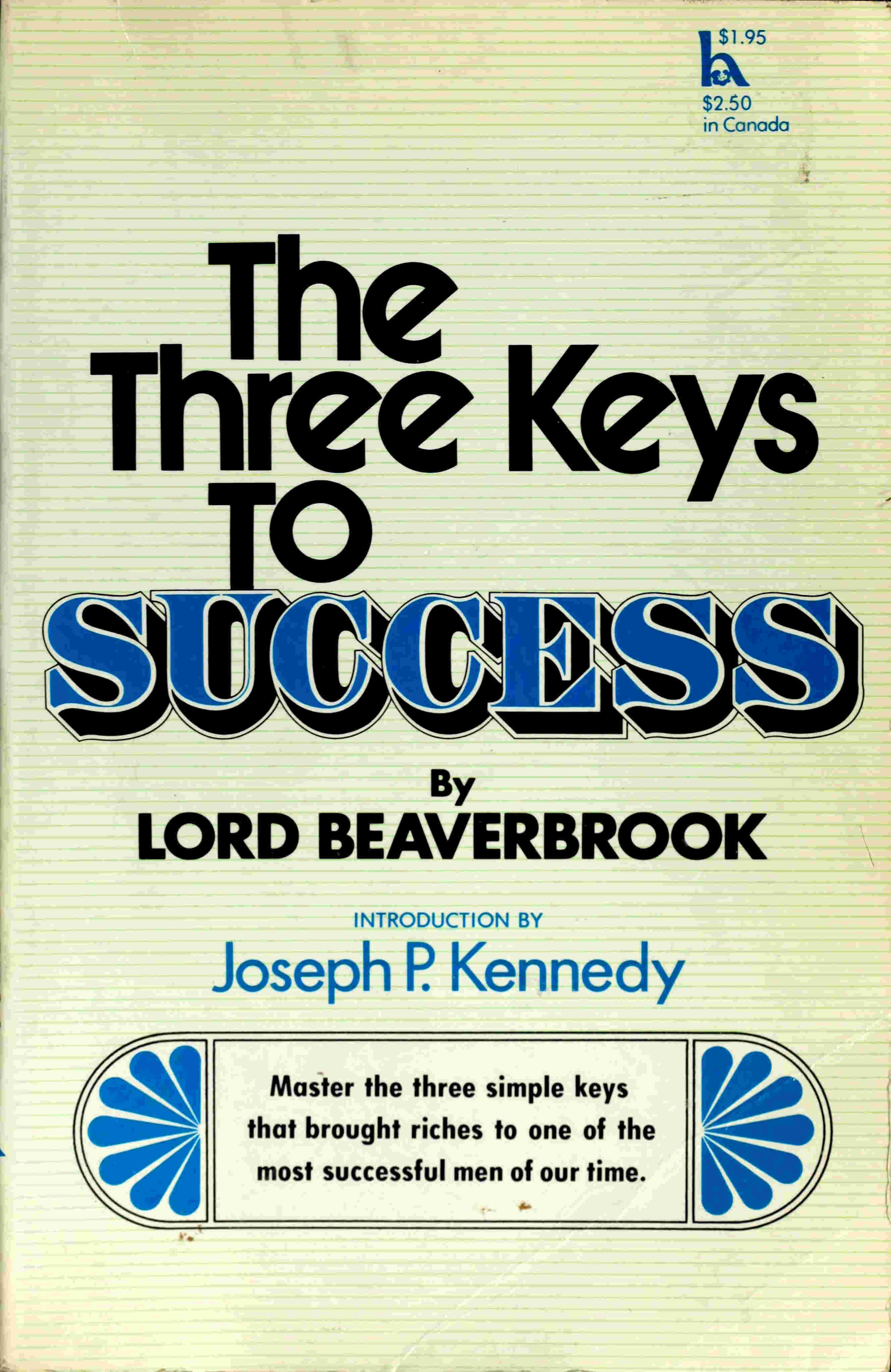
Title: The Three Keys to Success
Date of first publication: 1956
Author: Max Aitken (Lord Beaverbrook) (1879-1964)
Contributor: Joseph P. Kennedy (1888-1969)
Date first posted: November 19, 2025
Date last updated: November 19, 2025
Faded Page eBook #20251127
This eBook was produced by: Mardi Desjardins, John Routh & the online Distributed Proofreaders Canada team at https://www.pgdpcanada.net
This file was produced from images generously made available by Internet Archive.
THE THREE KEYS TO SUCCESS
Copyright © 1956, 1954, by Sir William Maxwell Aitken, 1st Baron
Beaverbrook. Copyright under International and Pan-American
Copyright Conventions.
by
Joseph P. Kennedy
While enjoying a leisurely reading of Lord Beaverbrook’s volume of practical advice to young Englishmen, I was forcibly struck with the idea that young Americans would also enjoy the book. When I mentioned this to Lord Beaverbrook, he undertook a revision of the text and additions to it, which would make his message equally applicable to the United States. I know of no one better qualified to advise youth, and no one whose own story of success has greater appeal.
Born of humble circumstances in New Brunswick, Canada, Max Aitken (later to be Lord Beaverbrook) at an early age gave indications of his talent for trade. When he was ten, for instance, he very much wanted a bicycle. But his chances of getting one seemed even smaller than his Presbyterian minister father’s salary, which was small indeed. Then one day a soap company offered a brand-new bicycle to the boy who turned in the greatest number of soap wrappers. Max immediately used his head—instead of simply pestering his neighbors to use more of the wrapper-bearing soap, he invested his small capital in whole cases of it. He sold his stock at reduced prices—stipulating always that the wrappers be returned to him—and repeated the process time and again. Thus Max won the bike hands down and chalked up the first of his many business successes.
Subsequent applications of similar industry and good judgment were to bring him a fortune; international fame; knighthood, a baronetcy; houses in Surrey, Jamaica, Nassau, and Fredericton; an Ontario farm, a London penthouse; an imposing steel-and-black-glass Fleet Street office building; interests worth millions in many great enterprises; and the newspaper with one of the largest circulations in the world.
Max earned his first money selling newspapers, eventually consolidating their distribution throughout his home town of Newcastle. As that still did not satisfy him, he established and published his own little paper, The Leader, writing it, setting the type, and running it off on a hand press.
On finishing school, Max worked for a while in a drugstore, then in a law office, studying concurrently at the University of New Brunswick law school in St. John. He worked hard at making new acquaintances. On one occasion, believing that he would be asked to an important social affair, the Assembly, he rented evening clothes and waited for the invitation up to the very hour the Assembly began. It never came.
The rebuff rankled. Max made up his mind to achieve such a great measure of success that no doors could ever again be closed to him. Convinced that a man must have money to get anywhere, he determined to pour into the making of money every ounce of industry and judgment he could demand.
After a turn at selling life insurance, he went to Halifax and got a job as secretary to John F. Stairs, an elderly financier with extensive interests in eastern Canada. The man and the boy became fast friends.
Max suggested to Stairs that if several small banks in the vicinity were amalgamated, they could all give better service and make more money. Stairs authorized Max to amalgamate them—if he could. The boy accepted the challenge. Just twenty-one, he met and conferred with the austere directors of the banks involved and convinced them of the soundness of his idea. The merger took place—and Max earned his first $10,000.
Delighted, Stairs then assigned him to selling bonds of the Nova Scotia Steel and Coal Company. Max, carrying the bonds in a satchel, canvassed prospective buyers from office to office. This mission having been accomplished with further personal profit, Max formed the Royal Securities Corporation, with Stairs as president and himself as managing director.
Those early days of this century saw the beginning of the electrical services by which we now so largely live. Fabulous fortunes were made out of all kinds of electrification—residential, industrial, rural, railway. Max Aitken plunged into the thick of this popular business, bringing the Royal Securities Corporation regular profits.
When John Stairs died, Max’s share of the general settlement amounted to some $50,000. He moved to Montreal and resumed dealing in organizations and mergers, but now on a larger scale.
At the height of his Montreal success, the powerful Bank of Montreal asked him to look into the affairs of three Canadian cement companies. In doing so, Max saw an opportunity to combine the three and some other cement firms into a great new organization. It would be a $38,000,000 merger, the largest in Canada’s history and one that would benefit the whole country. The bank and other powerful Canadian interests approved his plan and backed him.
In the course of the negotiations, however, one of the parties to the deal proposed that a cement company he owned be included. Max refused. In his judgment the asking price was too high and the company was unsound. The author of the proposal resigned from the group forthwith and fought Max in Parliament, charging him with making an excessive personal profit by overcapitalizing the combine. Thus Max found himself facing a seasoned foe, powerful enough to vanquish most any youngster not quite out of his twenties.
But Max was not vanquished. He simply put the facts in the case before Parliament and the public. And that was the end of the matter—except that the combine turned out to be sound and successful and, once in operation, generally reduced the price of cement in Canada.
The great public clamor that Max’s enemies in the affair had incited against him, however, hurt and embittered him. As a result, he liquidated his holdings—now worth almost $5,000,000—and declared that he was “through with business forever.”
Now he could give more attention to an ambition he had long held—the desire to help weld the Empire into a more prosperous whole, by breaking down trade barriers. He began to think seriously of entering politics to fight for tariff reforms that would further Empire unification.
He had met Bonar Law, another New Brunswick boy who had entered politics in England years before. Max now went to London, called on Law, and talked Empire and tariff reform. Law became keenly interested, and a long, close friendship began.
Soon afterward, when Law was conducting his election campaign for the Unionists, he asked Max to help him. Max decided to do so by running for Parliament himself on Law’s ticket. He became the candidate for a constituency in Lancashire.
As the election was only ten days away when he began his campaign, and as his opponent was a popular local man, Max had his work cut out for him. But that was nothing new. He had worked fast before. Now he mapped a campaign to cover every voter in the district.
Max was not an experienced political speaker. Furthermore, his Canadian accent and idiom sounded strange to the English ear. When speaking for his friend, Bonar Law went so far as to plead: “Don’t judge him by his first speech. He will be a credit to any constituency which returns him as its representative.”
Law need not have been so concerned. Max’s sincerity, and his boldness in refusing to evade touchy issues, captivated his down-to-earth-Lancashire audiences. He won the election by a good margin.
During Max’s first year in Parliament he caused no great stir. He studied British politics thoroughly, however, and made friends among its different factions just as he had developed contacts in business. He worked at improving his speech-making, accepting invitations to address gatherings near and far. Gradually his political stature lengthened. In 1911 he was knighted.
But with all its demands, politics consumed only a part of Sir Max’s dynamic energy. In spite of his declaration that he was through with business, he became chairman of the Colonial Bank and of the Equitable Trust Company before he had been in London a year. And on one visit of only a month’s duration to Canada in 1912, his industry surely set a record. He engineered the purchase of all the grain terminals in one province, 135 elevators, two flour mills, and $1,370,000 worth of Montreal real estate; and raised the capitalization of one steel company from $200,000 to $1,000,000 and increased its output accordingly.
Then, in 1913, he paid the penalty for his years of unceasing work. He fell seriously ill. During his convalescence he had to admit to himself that the industry and judgment upon which he had wholly depended were useless without good health. He promised himself to slow down thereafter. Thus, taught by bitter experience, he added his third key of success to the other two which had brought him so far.
Now to most of the “promising” proposals that were brought to his office in Threadneedle Street, Sir Max gave firm, if reluctant, refusals. One of his few acts—which seemed inconsequential at the time, but which was really his first step toward greater fame than he had so far enjoyed—was to purchase a small block of stock in a London newspaper, the Daily Express.
Then came the lightning bolt—Sarajevo and World War I, and “taking it easy” was forgotten overnight. Sir Max was concerned because the government kept from the British public the bad news that came from the front almost hourly. He thought the truth should be told, bad or good, and that only by knowing the worst would the Empire be inspired to put forth its supreme effort. Particularly he wanted the Canadians to know: they were his people, and he was certain they could take the worst—and then rise above it.
He pressed his case hard—and was made the Canadian Government’s representative at the front. Starting with Ypres in 1915, Sir Max told the world of the hardships and heroisms of the Canadians in battle. The government still glossed over the terrible losses of other British troops, but Sir Max stuck to his policy, freely admitting correspondents to the Canadian lines and giving them all the information they wanted that did not endanger military security. His work told. Canadians from New Brunswick to Vancouver renewed their efforts, until their record became one of the proudest in the war.
And Sir Max’s efforts did not go unremarked in London. In January 1917, he became Lord Beaverbrook.
Later that year he acquired complete control of the Daily Express. The betting in Fleet Street was that he had bitten off more than even he could chew. Lord Northcliff, publisher of the great Daily Mail, prophesied that he would lose every penny he owned.
At the end of his first year the Express was a million dollars in the red. Beaverbrook kept right on, however, asking questions, studying, perfecting his publishing judgment as he had perfected his financial judgment. And as if the Gargantuan task of lifting a newspaper into greatness “with his bare hands” were not enough of a tax on any man’s industry, he accepted the Ministry of Information in 1918, and acquitted himself ably in that post as well.
Then his hard work began to pay off. Five years after he took over, Daily Express circulation passed the million mark. Today, its London, Manchester, and Glasgow editions, and the two other newspapers Beaverbrook later acquired, the London Evening Standard and the Glasgow Evening Citizen, have a total of five million readers.
When the clouds of World War II gathered, Beaverbrook (now sixty) was one of the handful of men to whom England turned for guidance. Favored as I was with a ringside seat at that Armageddon, I can testify as an eyewitness that Lord Beaverbrook, as much as any one individual, can be credited with having forged victory out of the molten lava of defeat that seemed irresistibly to be submerging proud Britain. For the war was won in the air, by the RAF in September, 1940; and Lord Beaverbrook, as Minister of Aircraft Production, gave to “the few,” who contributed “so much,” the planes with which they won the Battle of Britain for “so many.”
When Prime Minister Winston Churchill appointed him to the Aircraft Ministry on May 14, 1940, Beaverbrook did not wait even for the government to supply him with the space he needed for that tremendous job. Turning his town house into a temporary headquarters, he immediately established a daily work schedule for himself and his staff that began at eight-thirty in the morning and ended two hours after midnight.
That same first day, he paid a surprise visit to one of the regular meetings of the leaders of the aircraft industry. Their duty was not, he assured them, to waste time at such gatherings discussing problems. The very life of their country was at stake. Their one and only job was to return to their factories and build aircraft. He spoke simply, but the gist of his message was plain: if they wanted their country to go on existing, they had better act faster than they ever had before to furnish British fliers with something, with anything, to knock down Hitler’s bombers.
When a group of executives presented him with elaborate plans for their next three months, he brushed them aside. He was not interested in their plans for the next three months. How many planes could they give him tomorrow?
He cut red tape by the yard, affronted anyone who got in his way, stole sites for factories that belonged to other departments, drafted the most expert assistants he could find regardless of their standing with the government or their nationality—all to produce planes.
Result? In one year Beaverbrook increased the production of Hurricanes from 500 to 2,580; Spitfires from 430 to 1,500. He increased the number of repaired planes delivered to the RAF to 9,000 per year; the number of repaired engines to 12,000. And his negotiations with the United States Government brought the RAF an additional 3,000 planes per month.
His pleas induced the housewives of England to donate scarce aluminum by the ton. He started a movement to have people send in money to have “a plane named after them.” At first, collections came from groups to buy single planes. Then money began to come in for whole squadrons. Finally checks came for $25,000, $100,000; there was one for a million dollars.
When Lord Beaverbrook took over the Aircraft Ministry, Britain’s greatest problem was to find planes for her pilots to fly. Within a year, the problem was to find enough pilots to man the planes he produced.
When peace came, Beaverbrook, through his newspapers, resumed his fight for a unified, co-operative, self-sustaining Empire. He supported the United States wholeheartedly during the Korean War, going so far as to dismiss one editor who took his policy lightly. Since then he has always worked to bring Britain and the United States closer together. He believes the relationship between the two nations to be the biggest issue of our time.
His first love, after his family, has always been the British Empire; his ideal, British-American world dominance at international levels. Everything he has ever done has helped to advance the cause of Empire. That was just as true of his first merger, which enabled the group of small Halifax banks to serve their clients better, as it was of his production of fighter planes during the war. Even his great newspapers are not operated primarily as money-makers. Most of what they have earned has been plowed back for their constant improvement, for their ability to serve the Empire better.
Recently, Lord Beaverbrook has professed to be seeking something new to occupy his energies. Whatever he finds will be no surprise to anyone who has ever known him. I am sure he will still be “building” even beyond his present stature. Nor will there be much heavy betting anywhere against the probability of his success. Lord Beaverbrook has fashioned his keys too well. The following chapters show how he has used them.
Joseph P. Kennedy
New York
February, 1956
THE THREE KEYS
TO SUCCESS
The theme of this book is that the three main qualities necessary to achieve success are Judgment, Industry, and Health.
A man may have two of these attributes and go far. But unless he has all three, he will not go all the way.
Are there exceptions that prove the rule? I can think of only one—Franklin Delano Roosevelt. Roosevelt lacked good health, and Roosevelt was a great man. He might have been supreme if he had not suffered from his grave affliction.
Sir Winston Churchill, on the other hand, has been supported in his prodigious career by all three of the keys to success—sound judgment, immense industry, and excellent health. He is the greatest living exemplar of these basic attributes.
Heed Churchill’s life story. It shows that judgment can be improved, that industry can be acquired, and that health can be maintained. If the young aspirant really devotes himself to the cultivation of these attributes, he can achieve a very great success in the career of his own choosing.
The bitterest thing in life is failure. And the pity is that it is almost always the result of some avoidable error. There need be no such thing. Every man can achieve his own success.
The trouble in so many cases is that it takes time and opportunity for a man to discover in what direction his own natural bent lies. Hence the misfits. A young man may choose the wrong trade or profession, or he may be in the right business but the wrong department. The employer, nevertheless, votes him of little or no use. Much worse, the employee himself admits his failure. And by that very act of admission he has failed.
Anyone who has strayed in youth to the wrong profession and failed may yet, however, prove himself an immense success in another field. To take a practical instance: salesmanship requires, above all, the spirit of optimism. Yet that same spirit in the finance department might ruin a firm. Thus the quality that brought failure in finance might mean sure success in the sales department. Hence no young man should be judged a failure on his initial try. He may yet succeed in another venture.
The first Lord Reading began life as a ship’s cabin boy. It is probable that he did not make a very good cabin boy. I can imagine the chief steward shaking his head and saying: “This young fellow isn’t very bright at his job. He won’t get anywhere.” Nor would he, had he made ships’ cabins his career. But he did nothing of the kind. And where did he get? To the position of Lord Chief Justice of England and then of Viceroy of India.
Like all human affairs, success is partly a result of predestination and partly of free will. You cannot create genius, but you can either improve or destroy it.
What are the qualities that make for success? I repeat my answer. They are three: Judgment, Industry, and Health. And the greatest of these is Judgment.
In the affairs of the world, Judgment is the supreme quality. Many men think up brilliant schemes and yet are quite unable to execute them. Through their very brilliancy, unsupported by sound judgment, they stumble upon ruin.
Genius goes to the heart of a matter like an arrow from a bow, but Judgment is the quality that learns what the world has to teach and then goes the world one better. Judgment, indeed, is the power to assimilate knowledge and the power to use it.
But Judgment may prove sterile if it is not accompanied by Industry. The mill must have grist on which to work. It is Industry that pours in the grain.
The faculties, therefore, must be kept constantly alert. A great opportunity may be lost and an irretrievable error committed by a brief break in the train of thought. “He who would be Caesar anywhere,” said Kipling, “must know everything everywhere.” Nearly everything comes to the man who is always all there.
Men are not born either hopelessly idle or feverishly industrious. They may move in one direction or the other as will or circumstances dictate, but it is open to any man to work. Industry has to be applied in the right direction—and it is therefore the servant of Judgment. The true secret of Industry well applied is concentration, and there are many ways of learning that art—the most potent handmaiden of success. Industry can be acquired; it should never be squandered.
Health is the foundation both of Judgment and Industry—and therefore of success. Without Health everything is difficult. Who can exercise sound Judgment if he is feeling irritable in the morning? Who can work hard if he is suffering from a perpetual illness?
The future lies with the people who will take exercise, and not too much exercise. No ordinary man can hope to succeed who does not work his body in moderation, but the danger of the athlete is to believe that in making a home run he has won the game of life. His object is no longer to be fit for work, but to be superfit for play. Obsession with sport leads only to failure, satiety, or impotence.
The pursuit of pleasure is equally ephemeral. Time and experience rob even amusement of its charm. The night before is not worth next morning’s headache.
Practical success alone makes middle age the most pleasurable period of a man’s career. What has been worked for in youth then comes to its fruition.
“Pleasures are like poppies spread.” And I am not unwilling to gather poppies, for life must strike a balance between work and pleasure. But I do maintain this—if the scales must lean in any direction, let it be toward work. A man will come to less harm by overworking than he will by overplaying.
Never before has the world offered more scope to men and women whom ambition stirs to make a success of life, who will work hard and intelligently. No artificial obstacles will impede them. No bar now prevents poverty rising to the heights of wealth and power.
One cannot repeat too often that Judgment can be improved, Industry can be acquired, Health can be attained by those who will take the trouble.
These are the foundations on which to build Success.
It has been said that money is the root of all evil. That is nonsense. If money is sometimes made the servant of a wicked purpose, then the master and not the servant is to blame.
I am sometimes regarded as the apostle of pure materialism. The description is false. Humbly do I recognize the existence of values other than money values. Even so, I have never noticed that the creator of an artistic achievement becomes downcast if it also proves to be a financial success.
The maker of money has become unjustifiably suspect in recent times, not least in the eyes of men and women who would make money if they could. To win a prize in the Irish Sweepstakes is considered justified, but to amass a fortune by hard work that creates opportunities of life and happiness for thousands is considered wicked by silly politicians and journalists. This is the envy and the malice of the foolish and wicked.
There is a lot of hypocrisy talked and written about money. But it is as well to remember that although we often hear of riches not honestly come by, poverty is not always come by honestly either.
In reality, money carries with it only two qualities of value: the character it creates in the making; the self-expression of the individuality in the use of it, when once it has been made.
The art of making money implies all those qualities—resolution, concentration, economy, self-control—which make for success and happiness. The power of using money makes a man who has become the captain of his own soul in the process of its acquirement also the master of the circumstances that surround him. He can shape his immediate world to his own liking.
Apart from these two qualities—character in acquirement, power in use—money has little value. It is just as likely to be a curse as a blessing. For this reason the money master will care little for leaving vast wealth to his descendants. He knows that they would be better men for going down stripped into the struggle, with no inheritance but that of brains and character.
Mohammed said God never took a prophet save from the sheepfold. Moreover, wealth without the wish, the brains, or the power to use it is too often the medium through which men pamper the flesh with good living and the mind with inanity, until death, operating through the liver, hurries the fortunate youth into an early grave.
The value of money is, therefore, first in the striving for it and then in the use of it. The ambition itself is a fine one, but how is it to be achieved?
I would lay down certain definite rules for the guidance of the young man who, starting from scratch, is determined to go on to great financial achievement.
1. The key that opens the door of success is the trading instinct. This can be defined as sensing the real value of any article. Without it a man need not trouble to enter business at all. But if he possesses it, even in a rudimentary form, he can cultivate it in the early days when the mind is still plastic, until it develops beyond all recognition. The practice of valuing articles of commerce becomes a subconscious habit.
The young man who will walk through life developing the capacity for determining values, and then correcting his judgments by his information, will help himself on the way that leads to success in business.
2. But supposing that a young man has acquired this sense of values, he may yet ruin himself before he comes to the fruition of his talent if he will not practice economy.
By economy I mean the economic conduct of his business. Examine your profit-and-loss account before you go out to conquer the world, and then go out for conquest—if the account justifies the enterprise.
Too many men spend their time in laying down “pipelines” for future profits that may not arrive or only arrive for some newcomer who has taken over the business.
There is nothing like sticking to one line of business until you have mastered it. A man who has learned how to conduct a single industry at a profit has conquered the obstacles that stand in the way of success in the larger world of enterprise.
There is much to be said in support of always holding to one enterprise and one occupation. Men who make very large fortunes usually put all their eggs in one basket.
3. Do not try to cut too wide a swath. This rule is the most important of all. Many promising young men have fallen into ruin from the neglect of this simple principle.
It is so easy for ambition to launch men prematurely into daring schemes for which they have neither the resources nor the experience.
Acquire the knowledge of values, practice economy, and learn to read the minds of men, and your technique will then be perfected and ready for use on wider fields. The instinct for values, the habit of economy, the technique of business are only three forms of the supreme quality of that judgment which is success.
For these reasons it is the first $5,000 that counts. There is the real struggle, the test of character, and the warranty of success.
Youth and strength are given us to use in that first struggle, and a man must feel those early deals right down to the pit of his stomach if he is going to be a great man of business. They must shake the very fiber of his being as the conception of a great picture shakes an artist.
With the first $5,000 made, he can advance with greater freedom and take affairs in his stride. He will have the confidence of experience and can paint with a big brush because all the details of affairs are now familiar to him. With this assured technique, nothing will check the career. Such, in effect, has been the career of the great captains of industry.
Yet the man who attains a fortune by the practice of these rules may still fail of real achievement and happiness. He may not be able to recognize that the qualities of the aspirant are not exactly the qualities of the man who has arrived. The sense of general responsibility must supersede the spirit of private adventure.
Money that is striven for brings with it the real qualities of life. Here are the counters that mark character and brains. The money brain is, in the modern world, the shrewdest brain.
Why? Because that which the greatest number of men strive for will produce the fiercest competition of intellect.
Leaving out the man of genius who flares up, perhaps, once or twice in a century, the amount of ability that enables a man to cut a very respectable figure in politics is extraordinarily low compared with that demanded in the world of industry and finance. The politician will never believe this truth, but it is truth.
There are many men, attractive, popular, able to argue a case with eloquence and skill, but when it comes to carrying out their ideas, they are impotent. They lack the power of action. Such men usually excel in public life. As men of business, as administrators, they are not successful.
Consider the converse. There is often in an office a man with no ability to present a case. When required to do so, he becomes confused, even incoherent and embarrassed. But confront him with a situation requiring action, and he is magnificent. He deals effectively on the instant with the problem. He shows himself a man to be relied upon in the hour of crisis. In business, a man with the capacity for action is worth any number of talkers.
The battles of the market places are real duels on which realities of life and fortune or poverty and even of fame depend. Here men fight with a precipice behind them. The young men who go down into that arena must win their battles by no man’s favor. But youth can triumph; when the mind is still plastic, youth has the resolution to gain that judgment which experience gives.
My advice to the young men of today is simply this: Money is nothing but the fruit of resolution and intellect applied to the affairs of the world. To an unshakable resolution, fortune will oppose no bar.
Lasting success in the modern world demands moderation. The men of action understand that a sacrifice of health is a sacrifice of years—and that every year is of value. They protect their constitutions as the final bulwark against the assault of the enemy.
Moral courage springs as much from the nerves of the stomach as from the brain. And without such courage no businessman is worth anything. Moderation, therefore, is one secret of success.
Above all, I would urge on ambitious youth the absolute necessity of moderation in alcohol. I am the last man to favor the regulation of the social habits of the people by law, but this much is certain: no man can achieve success who is not strict with himself in this matter; nor is it a bad thing for an aspiring man of business to be a teetotaler.
It is the complexity of modern life that enforces moderation. Science has created new conditions and brought into existence huge industries, and also given the means by which single minds can direct them. Invention gives these gifts and compels man to use them.
Man is as much the slave as the master of the machine as he turns to the telephone or the telegram, the dictating machine or the wire recorder. In this fierce turmoil he can keep his judgment intact, his nerves sound, and his mind secure only by the process of self-discipline, which may be equally defined as restraint, control, or moderation. This is the price that must be paid for the gifts the gods confer.
I would also enjoin upon young men the need to cultivate moderation in their attitude toward themselves and their achievements. Particularly I would warn them against that immoderate attitude known as arrogance.
What is arrogance? To begin with, it is the besetting vice of young men who have begun to prosper by their own exertions in the affairs of the world.
It is not pride, which is a more or less just estimate of one’s own power and responsibilities. It is not vanity or conceit, which consists in pluming oneself on the qualities one does not possess.
Arrogance is something of far tougher fiber. It is the sense of ability and power run riot; the feeling that the world is an oyster, and that in opening its rough edges there is no need to care a jot for the interests or susceptibilities of others.
For every individual the young man tramples on in the arrogance of his successful career, a hundred enemies will spring up to dog the middle of his life with an implacable dislike.
A fault of manner, a deal pressed too hard in equity, the abruptness by which the old gods are tumbled out to make room for the new—all these are treasured up against the successful newcomer.
In the heat of business strife men take no more account of these things than of a flesh wound in the midst of a hand-to-hand battle. It is the later recollection on the part of the vanquished that breeds the sullen resentment rankling against the arrogance of the conqueror.
Years afterward, when all these things seem to have passed away, and the very recollection of them is dim in the mind of the young man, he will suddenly be struck an unlooked-for blow dealt from a strange, or even a friendly, quarter.
He will stagger, as though hit from behind with a stone, and exclaim: “Why did this man hit me suddenly from the dark?” Then, searching back, he will remember some long-past piece of arrogance—conceived of at the time merely as an exertion of legitimate power—and he will realize that he is paying in maturity for the indiscretions of his youth.
Then there is prejudice. That, too, is a symptom of an immoderate attitude.
Prejudice is worse than arrogance, for it comes before the age of achievement, which may give arrogance some excuse. It is imbibed with one’s mother’s milk, fortified by all one’s youthful surroundings, and only broken through, if at all, by experience of the world and a deliberate mental effort.
Prejudice is, indeed, a vice in the most serious sense of the term. It is more damaging and corroding in its effects than most of the evil habits that are usually described by that word.
It is destructive of judgment and devastating in its effect on the mentality because it creates a narrowness of outlook on the world. The man who can learn to outlive prejudice has broken through an iron ring that binds the mind.
Prejudice can harden into consistency. And nothing is so bad as consistency. There exists no more futile person than the man who remarks: “Well, you may say what you like, but at any rate I have been consistent.” This argument is generally advanced as the palliation of some notorious failure. And this is natural.
The man who is consistent must be out of touch with reality. There is no consistency in the course of events, in history, in the weather, or in the mental altitude of one’s fellow men. The consistent man means that he intends to apply a single yardstick to all the chances and changes of the universe.
He does not know, he has not learned, that it is essential at all times to make an adjustment of thought or action to circumstances.
The successful man will not adhere to consistency. He will deal with each situation as it arises. He will veer with each change as his ever-fresh judgment may suggest.
No man can travel far along the road to success without courage.
I do not refer to the physical courage that sustains men on the battlefield, but to that rarer quality—moral courage.
This quality has nothing to do with mere stubbornness, which is sometimes a kind of cowardice. Many weaknesses derive from stubbornness.
Men cling to a business indefinitely in the fond wish that a loss may yet be turned into a profit. They hope for a better day, which their intelligence tells them will never dawn.
For this attitude of mind, stupidity is a better word than stubbornness, and a far better word than courage. When reason and judgment bid us give up the immediate battle and start afresh on some new line, it is intellectual cowardice, not moral courage, that bids us persevere.
Courage cannot be divorced from judgment.
On the other hand, cowardice can also consist in too great a readiness for compromise. To the compromising mind the certainty of half a loaf is always better than the probability of a whole one.
Great affairs, above all things, require for their successful conduct sensitivity to the drift of events, to the characters or changing views of friends and opponents. Great affairs require a careful avoidance of that rigidity of standpoint that stamps the doctrinaire or the mule. The mind must be receptive and plastic.
But this quality in the man of affairs, which is akin to the artistic temperament, may degenerate into mere pliability.
Never to fight, always to negotiate for a remnant of the profits, then becomes the rule of life. At each stage in the career the primrose path will beckon more attractively toward the bonfire and the uphill path of contest look more stony and unattractive. In this process the intellect may remain unimpaired, but the moral fiber degenerates.
I once had to make a difficult choice between sticking to my guns or compromising. It was in the days of my youth when I was forming the Canada Cement Company. One of the concerns offered for sale to the combine was valued at far too high a price. In fact, it was obvious that only by selling it at an overvaluation could its debts be paid.
The president of this overvalued concern was connected with the most powerful group of financiers that Canada has ever seen. Their smile would mean fortune to a young man, and their frown ruin to men of lesser position. The loss of including an unproductive concern at an unfair price would have been little to me, personally, but it would have saddled the new amalgamated industry and the investors with a liability instead of an asset.
It was certainly far easier to be pliable than to be firm. Every kind of private pressure was brought to bear on me to accede to the purchase of the property.
When this failed, all the immense engines for the formation of public opinion which were at the disposal of the opposing forces were directed against me. And that attack was cleverly conducted. Those who had failed to induce me to break faith with the investing public appealed to that public to condemn me for forming a trust.
I am prepared now to confess that I was (in my youth) bitterly hurt and injured by the injustice of these attacks. But I regret nothing. Why? Because these early violent criticisms taught me to treat ferocious onslaughts in later life with complete indifference.
What is more, that innate judgment that dwells in the recesses of the mind tells me that my whole capacity for action in affairs would have been damaged by the moral collapse of yielding to that threat. Pliability would have become a habit rather than a matter of judgment and will, for fortitude comes only by practice.
Every young man who enters business will at some time or another meet a similar crisis that will determine the bias of his career and dictate his habitual technique in negotiation.
But he may well exclaim, “How do you help me? You warn me in one and the same breath against rigidity and pliability!”
It is the old question: How can firmness be combined with adaptability to circumstances? There is no answer except that the two qualities must be made to run concurrently in the mind. One must be responsive to the world and yet faithful to one’s own instincts.
It is only the special circumstance of a grave crisis that will put a young man to this crucial test of judgment. He will have to judge the case on its merits, and yet his final decision will affect the whole of his career.
But one piece of practical advice can be given. Never bully, and never talk about the whip hand—it is a word that should never arise in big business.
Every man who leads a life of big business must in time face the day of panic. That is when he will most need moral courage. It will insure for the venturesome operator a flying start over all competitors and enable him to increase his lead.
Be sure that panic will return again and again in the course of the cycles of business. For long we have been passing through a series of prosperous and expansive years, but times will change and depression will again beset us in our careers.
To face a business panic one must first of all marshal the facts, and then allow for the misreading of others. It is the plastic and ingenious mind that will best grapple with unusual circumstances. It will invent weapons and expedients with which to face each new phase of the position.
“Whenever you meet an abnormal situation,” said the sage, “deal with it in an abnormal manner.”
But a business panic is, after all, rare. It is the panic in the mind of the individual that is the perpetual danger.
Those who see only the mask put on in the daytime would be astonished to know the number of men who lie awake at night quaking with fear at some imagined disaster, the day of which will probably never come.
These are the men who cannot keep a good heart—who lack that particular kind of courage that prevents a man becoming the prey of his own nervous imagination.
They sell out good business enterprises at an absurdly low price because they do not have the nerve to hold on. Those who buy them secure the profits. One may pity the sellers, but one cannot blame the buyers. Those who have the courage of their judgment are bound to win.
How can the victim exorcise from his mind this dread of the unknown—this partly conscious and partly subconscious fear—“which eats the heart away?”
Nothing can throw it off, except a resolute effort of will and intelligence.
I would give one simple recipe for the cure. When you feel anxious about the present, think of the worst anxiety you ever had in the past. Instead of one grip on the mind, there will be two distinct grips—and the greater grip of the past will overpower the lesser one in the present.
“Nothing,” a man will say, “can be as bad as that crisis of old, and yet I survived it successfully. If I went through that and survived, how far less arduous and dangerous is the situation today?”
A man can thus will himself into the possession of a stout heart.
If a man can still that inner panic, he will very little need to fear all the storms that may rage against him from outside.
The courage of the heart will let no expedient be left untried. But both ingenuity and courage will find their real strength in a health that has not yet exhausted the resources of the body.
I have written that moral courage is rarer than physical courage. It is much too rare. The man with the courage of his own convictions is the exception rather than the rule. Sometimes it may seem that his fearlessness and independence of judgment serve him but ill, that he would do better for himself were he to cultivate the arts of the courtier and the flatterer and say what he does not believe whenever his genuine beliefs might be unpardonable.
What is the answer to that?
I would say that where a man can prosper only at the expense of his manhood, it is better that he should remain poor.
But I do not accept the necessity for sycophancy. It never leads to real success.
Firmness that is not obstinacy, health that is not a fad, adaptability that is not weakness, enterprise that is not rashness—these are the qualities that will preserve men in those evil days when the “blast of the terrible one is against the wall.”
To young men who complain of defects in their education I would give this message:
Never believe that success cannot come your way because of the manner of your education.
The nineteenth century made a god of education. Its eminent men placed learning as the foremost influence in life. Yet education imposed from without may be a hindrance rather than a help. The young man on the verge of life need not be discouraged by the fact that he has been denied the hallmark of a great university. Valuable, indeed, is the training offered to youth in these venerable establishments, but the inquiring mind may have escaped a grave danger; for if, in the impressionable period of youth, attention is given to one kind of knowledge it may be withdrawn from another.
The truth is that education is the fruit of temperament, not success the fruit of education. What a man draws into himself by his own natural volition is what counts, because it becomes a living part of himself.
Of course a child or an adult should learn what he can from teachers. I value formal education and I recommend university training. In these days of scholarships the bright, ambitious, and venturesome youth will make full use of the opportunities they afford. But if the student should find that he has genuine difficulty in learning lessons imposed upon him from above, let him not despair. He will be in good company. Did not the great Churchill almost break the hearts of his schoolmasters?
My own education was most rudimentary. It may be difficult for the modern mind to grasp life in the parish of Newcastle, New Brunswick, in the ’eighties—sparse patches of cultivation surrounded by the virgin forest and broken by the rush of an immense river. For half the year the land is in the iron grip of snow and frost, and the Miramichi is frozen right down to its estuary, so that “the rain was turned to a white dust, and the sea to a great green stone.” In such conditions and in those days education lacked continuity.
Men and books have been my real school. Reading is the source of education and of style. Read what you like, not what somebody else tells you that you ought to like. That reading alone which becomes part of the reader’s own mind and nature is valuable.
Read anything and read everything—just as a man with a sound digestion and a good appetite eats largely and indifferently of all that is set before him.
The process of selection and rejection—in other words, of taste—will come naturally to any man who has the right kind of brains in his head. Some books he will throw away; others he will read over again.
As a liking for the right kind of literature grows on a man, he unconsciously forms his mind and his taste and his style, and by a natural impulse, without forced growth, the whole world of letters is his.
There are, of course, certain special branches of education which many youths consider unnecessary equipment for a business career. Foremost among these are mathematics and foreign languages. Knowledge of the higher mathematics is not essential to a successful career; nonetheless, the type of mind that takes readily to mathematics is the kind that succeeds in the realm of industry and finance.
I regret that my business career was shaped on a continent that speaks one single language for commercial purposes from the Arctic Circle to the Gulf of Mexico. Foreign languages are, therefore, a sealed book to me.
If a man can properly appraise the value of something he does not possess, I would place a knowledge of languages high in the list of acquirements making for success.
But when all is said and done, the real education is the market place of the street. There the study of character enables the boy of judgment to develop an unholy proficiency in estimating the value of the currency of the realm.
Experience teaches that no man ought to be downcast in setting out on the adventure of life by a lack of formal knowledge.
The first Lord Birkenhead many years ago asked me where I was going to educate one of my sons. When I replied that I had not thought about the matter, and did not care, he was unable to repress his horror.
And yet the real reasons for such indifferences are deep rooted in my mind. A boy is master, and the only master, of his fortune. If he wants to succeed in literature, or in any other walk of life, he will read until he obtains by what he draws into himself that kind of trained perception that enables him to distinguish between good work and bad, just as the wine expert with his eyes shut knows the difference between a good and a bad glass of wine.
Neither may be able to give any reason for a verdict based on unconscious knowledge, but each will be right when he says, “Here I have written well,” or “Here I have taken bad drink.”
The message, therefore, is one of encouragement to young men who are determined to succeed in the affairs of the world and yet have not been through prep school and college. There is the danger that the prep school may turn out a boy to type—the individual turns out himself.
In the hour of action it is probable that the individual will defeat the type.
Style cannot be acquired except by reading for oneself. Nothing is of advantage in the art of learning to know a good cup of wine but the actual practice of drinking. Nothing can help in business except going in young, liking the game, and buying one’s experience.
In a word, man is the creator, and not the sport, of his fate. He can triumph over his upbringing and, what is more, over himself. The lack of education in the formal sense need be no bar to advancement.
Every young man has his chance. But will he practice industry, economy, and moderation, avoid arrogance and panic, and know how to face depression with a stout heart? Even if he is a genius, will he take off with caution and soar with safety?
The secret of power is the method by which the fire of youth is translated into the knowledge of experience. I have suggested a short cut to that knowledge.
I once had youth, and now I have experience. I believe that youth can do anything if its desire for success is sufficiently strong to curb all other desires. I also believe that a few words of experience can teach youth how to avoid the pitfalls of commerce that wait for the most audacious spirits.
I write out of the conviction of my own experience.
Improvisation is the gift of invention in its most primitive form. It is the art of coping with the unexpected, of dealing with entirely unforeseen circumstances in such a way that one snatches advantage from them.
The young man who would succeed must learn to practice this art until it becomes habitual, until his mind is ever alert and never at a loss when situations arise which he had not contemplated.
Improvisation is a large part of the art of life. It is of immense importance in the art of success in business.
I strongly urge the young man who would be successful to learn to improvise.
Although the examples of improvisation that I place before him are taken from war, it is far from my mind to prepare him for another outburst of senseless savagery. My devout hope is that he will live his life in peace. But war does present in an accentuated form many of the problems of business life. For that reason its lessons are more vivid.
Let the young improviser begin by studying the life of Sir Winston Churchill. Almost every act of his throughout the war was an act of improvisation.
Britain’s struggle against foreign invasion is an epic of improvisation and individualism. The nation’s defense turned on opportunities taken, on individual decisions, on improvised means. How to meet what seemed the virtual certainty of invasion from the French coast?
Everything depended upon British domination of the air over England. And domination depended upon a supply of fighter planes. The Battle of Britain was won by the pilots, but it was also won by scrapping plans and improvising planes. The plans would have led to certain defeat; the planes gave Britain victory.
When Europe fell, the supply lines to Britain were cut. Aluminum is the first need for aircraft production. The supply of bauxite, the raw material of aluminum, was cut off altogether. Three quarters of the import of iron and steel, most of the import of iron ore, came from Europe. How did Britain face this crisis?
By improvising new sources of supply; by setting up new lines of transportation for the aluminum, iron ore, iron, and steel. What was lost in Europe was found in Africa and America.
By December 1941 Churchill wanted more “tools to finish the job.” Did he wait on organization? Did he trust to the machine? Did he tell his Minister of Supply to “tidy it all up”? Not at all! Churchill, the individualist, set out for Washington in search of weapons for British soldiers and ships for British sailors. He took me with him.
On arriving at Washington we found that the Americans had drawn up an elaborate program for production. Their plans had been prepared down to the last detail. On paper they made a most imposing sight. The typescripts had been gorgeously bound, while some of the plans had even been printed, to indicate finality and perfection.
There was only one thing wrong with this scheme—it was fantastically inadequate to meet Allied requirements.
My role was to make its inadequacy clear to the United States Government. I had to persuade Washington to base its production program, not on the theories of the painstaking planners, but on the realities of America’s enormous productive capacity.
To do this the United States Government would have to improvise as no country had ever improvised before.
The United States official publication Industrial Mobilization for War gives an account of the ferment we caused in Washington. We certainly went all out to smash official complacency. We pressed our point of view at innumerable meetings in the White House, the vice-president’s office, and elsewhere.
I took the battle to President Roosevelt, plying him with letters and memoranda and putting to him, at personal interviews, the case for abandoning the planned program and adopting a policy of improvisation on a mighty scale. We campaigned with such force that soon all official Washington seemed to become involved in the controversy. The newspapers joined in, adding to the general stir.
My argument was based on my own experience. I claimed that America could produce in 1942 alone 45,000 tanks, 17,700 antitank guns, 45,000 antiaircraft guns, 24,000 fighter airplanes, and other war matériel.
The planners exclaimed: “Preposterous! The demand is ridiculous!”
Their inadequate schemes would assuredly have been accepted had not the imaginative grasp of President Roosevelt seized on our program and made it his own. Had the worthy planners prevailed over the improvisers, the war certainly could not have been won in 1945.
Thanks to the President, our estimates of production were adopted. A war program increased by billions of dollars for 1942 was presented to the Congress. It was designed to give us overwhelming superiority in armaments.
This revised program was not only fulfilled but exceeded—a triumph for improvisation.
Improvisation, whether in peace or war, serves its greatest use when danger menaces and misfortune is on the prowl. The man set in his ways is then lost, because he demands too much time to think and thus moves slower than events. The improviser is off on a new tack before the man of routine has fully appreciated the problem.
But improvisation must be used while there is still time to gain an advantage. It is of little use to follow routine ways until all is lost and then expect improvisation automatically to put everything right again. Improvisations must be carried through at once, as soon as the first difficulties are glimpsed. Take them on the run and they are nothing. Walk at a slow and ponderous pace and they may seem insurmountable.
To the man who can make snap decisions—and alter them as quickly if he finds that they are not so good as he thought—advantage can come from the most frightening situation.
Success belongs to those who, by swift improvisations, snatch triumph from catastrophe.
Beware of the rigid minds. The man who sits back and says complacently that something cannot be done is always beaten by the enterprising fellow who makes a way of doing it.
That is another way of saying, “Beware of paying too much attention to organization.” Overorganization is the enemy of improvisation.
The ever-present temptation that obsesses organizers, as always, is to overorganize. And overorganization leads to the strangulation of enterprise.
Nowhere has this truth been more clearly demonstrated than in the Soviet Union, which relies for its production upon long-range state control of every branch of industry. Stalin told this story of his conversation with a commissar responsible for organizing the work of the collective farms.
Stalin: How are you getting on with the sowing?
Commissar: With the sowing, Comrade Stalin? We have mobilized ourselves.
Stalin: Well, and what then?
Commissar: We have put the question squarely.
Stalin: And what next?
Commissar: There is a turn, Comrade Stalin; soon there will be a turn.
Stalin: But still?
Commissar: We can say that there is an indication of some progress.
Stalin: But for all that, how are you getting on with the sowing?
Commissar: So far, Comrade Stalin, we have not begun to sow.
The organizers have an honorable part to play in any enterprise, but it must never be the leading part, otherwise there will be nothing but organization.
The successful man may have a flair for organization, but the very fact of his success proves that he is not its slave. Such a man has little patience with endless committee meetings in which talk stifles action.
Neither does the successful man give undue importance to “plans.” Plans can go awry. Then new plans are laboriously prepared and followed, but before they are followed they must be approved, and by the time they are approved the situation they are designed to meet may have altered completely.
The art of dealing with the unexpected is lost when a man is waiting on a machine, on an organization, or a committee. And the lamps of passion and conviction burn low when we do not seek by every instrument of persuasion or education to maintain the integrity of our own judgment and conscience.
That lesson has remained with me. I urge every leader of an enterprise to keep under vigilant observation every kind of organizational device, to make sure that it is not stifling the activities it was created to help.
Organization, if not watched, will cease to be the servant of industry. It will become its master. And that, for industry, will be the beginning of the end. Overorganization takes the punch out of business.
Although wars are won by improvisers, they also offer great opportunity for the organizers to become deeply entrenched in a country’s economic life. They remain entrenched long after the armies have been demobilized.
It happens in this way. When war breaks out, government becomes the only purchaser and the sole consumer of all the great producers in the country. They are confined to a single market, and transactions are conducted on the basis of cost plus a percentage of profits. As a result, efficiency declines, there are wasteful increases in salaries, and the only brake on complete extravagance is the patriotism that animates all branches of industry.
When peace comes, the system is slowly disbanded. The producers cling to the cost-plus-profit system and administrators are loath to divest themselves of the control of industry that makes for personal importance. Changing demands are ignored, new opportunities neglected. The planning authorities still impose their fixed conditions.
Gradually, as government control is lifted, efficiency increases, economic working is restored. The field is again open for free enterprise.
Related to the danger of overorganization is the danger of trusting new enterprises to men who “know it all.” There is a general idea that if you want some enterprise to succeed and prosper you must pick the most experienced man you can find to run it. He must be the man—or so they say—with the greatest measure of success already behind him. Put him in charge of the new venture and expect that the results he has already achieved in life will be repeated.
But things do not always work out that way. In fact, this is a bad principle. It is a principle that results in more errors and failures than successes. Frequently, very frequently, the selection of such a man brings to bear on the task a tired and weary mind, someone who is already set in his ways and fixed in his ideas. Often he is so hidebound that he has no capacity at all for improvisation. He cannot meet a new situation in a new and changing world.
The proper method in which to start a new enterprise is to select new men, relying on one’s own knowledge of human nature. Experience will train the untried talent. First of all, settle in your own mind the qualities you wish to develop, and then decide where you can find these qualities in the raw, ready and ripe for development. Now when these qualities are present in the men you select, you have a fortunate and utterly satisfying experience.
Such men will make fruitful use of their opportunities. They will enrich the world.
“Blessed is the man whose strength is in thee: in whose heart are thy ways. Who going through the vale of misery use it for a well: and the pools are filled with water.”
Errors in business are of two kinds. They may be the result of inexperience or of experienced folly.
It is no use talking to mature incompetence, for it will not heed the words either of experience or wisdom. Nothing can prevent the man who has had all his chances and continues to lose them rushing on to his fate. The reading of a textbook will not correct a fundamental incapacity for judgment. Advice is wasted on middle-aged error.
But the errors of youth can be easily forgiven, just because they can be corrected with such ease. A young man can learn the lesson through a bitter experience, or he may take a short cut to success by the precept and experience of those who have trod the hard path before him.
The one man in a thousand who is a natural genius in the realm of affairs may even be the better for allowing his ignorance and his spirit of adventure to break him once or twice on the wheel.
But to the main run of rising youth the acceptance of a wise precept is better than a financial disaster that may destroy that self-confidence which is the soul of success.
What, then, are the besetting errors of the able, the inexperienced, the self-confident, and the untried?
The first is that of chasing the rainbow vision.
For the man laboring under this error, the little things that are the beginnings of greatness appear unworthy of consideration. Somewhere in the background there lurks that wonderful scheme, that mirage in the financial desert, which will make the optimist a capitalist in a night. The youthful victim explains that he is dominated by his possession of imagination. His rivals are mere plodders; he alone has grasped the golden key that unlocks at a single turn the fates of fortune.
If this were indeed so, he would have nothing to fear. But the truth is that he is not the possessor of imagination, but the victim of that terrible disease—the pursuit of the rainbow. The gates do not swing open and the victim knocks in vain.
No man who has not, in the day of small things, acquired that technique which means the mastery of business can step into a fortune in a fortnight.
Beware of the man who proclaims that he alone possesses the genius of imagination. It is too probable that he is making a mistake.
The second error may be called the disease of the personal interview.
This error devastates those who are susceptible to it. It generally takes the form of procuring personal introductions to prominent men of business and asking for a minute’s conversation “absolutely uninterrupted,” not on any definite proposal, but simply in order to make a favorable impression.
Now, as a matter of fact, an extremely busy man in the midst of his own day’s work is not to be impressed at all by such methods, and in three weeks’ time will have probably forgotten the whole incident. But the young man who insists on such an interview calls it “establishing contacts.”
What he means is that he is preparing for very remote and contingent ramifications of his business, which are as improbable as they would be unwise. (It may be added that the man who grants such an interview is as guilty as the man who asks for it. Both parties devote energy to a waste of time.)
Both these errors spring from what may be described as an overdevelopment of the artistic temperament applied to affairs. They exhibit the temperament of the painter who has a magnificent conception of a picture but is devoid of the technique necessary to put his ideas on the canvas.
The third error is the tendency to run to extremes in a precisely opposite direction.
This is chiefly found among young men who are the victims of the card-index system and the mentality which a devotion to that system implies. It is as though the human race had been created in the form of a perfect skeleton without the advantage of flesh and blood and life. The card-index system is the bane of a businessman.
I was once persuaded to introduce the most perfect form of it in my office in Canada. The card-index system worked admirably, until I noticed that a substantial falling off in business coincided with its introduction. The explanation was simple. The energy of the office was concentrated on working the card-index system. No one had enough time for doing business. I abolished the system instantly.
Many promising careers have been ruined by the card-index habit of mind.
The conscientious letter writer is also akin in temperament to the man who believes in system at the cost of practicability. The mania for letter writing leads him to spend two or three hours in his office answering with skill and elaboration communications that might be just as well answered by a form letter.
Certain important letters must, of course, be dictated personally. In these, brevity is the essence of business letter writing. Even the most important matters do not need pages and pages of explanation. The shorter the letter, as a rule, the clearer it is.
But the man with the mania will not have it so. After the morning toil, the wretched man sits down in the early evening to read and correct his dictated letters. He immediately begins to see mistakes and to reconstruct on a large scale. By the time he has thoroughly finished expressing through a blue pencil his discontent with the output, another two hours have slipped away, the business day is over, and a good many of the letters have not even been sent.
When such a young man has finished his personal interviews of a futuristic character, and has written and corrected his letters on a thoroughgoing business basis, and when his staff have exhausted themselves completely at the typewriter and the card-index, a few moments will still remain in which business may be done.
It might be imagined that all these various and discordant errors in the business mind could not be included in the mentality of a single individual. The imagination that outstrips reality seems far removed from the type of mind that places its faith in the card-index system, or in an interminable waste of time over the answering of telephone calls or letters. The curious fact is that these two divergent forms of character are often found in conjunction.
They are expressed in the final type of error found in the “hustler”—the man who is too energetic and busy ever to arrive at his goal. His imagination overleaps the bounds of reality and, as though he were in his innermost mind painfully conscious of this fact, he safeguards himself by a meticulous regard for system and detail that robs him of his last energies.
The menace of this type of hustler is that he is like a hen without a tail. He can push ahead, but he cannot steer a steady course. His imagination stretches to the extent of the absurd. His energies are concentrated on the details of the ridiculous.
There is one attitude against which I warn the young man who would do well in life. It is summed up in the phrase: “Trust to luck.”
No attitude is more hostile to success, and no phrase more foolish.
The phrase is foolish because in a universe governed by the law of cause and effect, strictly speaking, there can be no such thing as luck. There is much in the saying: “Mrs. Harris’s pies are not always good by chance.” In other words, Mrs. Harris was a good cook.
So with the consistently “lucky” man. It is a fair assumption that he is a consistently industrious and able man.
What we really mean when we say “Trust to luck” is “Trust to circumstances outside our own control.” But as long as there is any chance whatever of controlling those factors, it is, of course, folly not to bring them under control.
As the years pass, I become increasingly reluctant to believe in any kind of luck. I once wrote that “It is luckier to be born heir to half a million dollars than to be born in the slums.” Even that no longer is true. Being born to poverty may be a spur, whereas being born to riches may lead to ruin.
If a disaster should destroy a man’s fortune, something he has labored many years to build, we naturally think that he has had bad luck. But it may be that the disaster was caused by factors that he neglected to control. Or it may be that the disaster was a blessing in disguise, forcing him to exercise intellectual muscles endangered by atrophy, or to strengthen his character at some hitherto-unsuspected weak point.
So I will not dogmatize about the existence of luck except to say this—do not trust in it.
The idea that some are born lucky and some unlucky, in the same way that some are born to be tall and some born to be short, is just nonsense.
Most “good luck” may be explained by industry and judgment, most “bad luck” by a lack of these qualities.
The gambler’s creed has been defined as a belief in the imagined tendencies of chance to produce events continuously favorable or continuously unfavorable. To live in this sort of mental atmosphere is to live in a nightmare. It seems to drive some people nearly insane. They constantly consult oracles of one sort or another or perform compulsive actions in a ceaseless endeavor to propitiate Fortune.
Fortune cannot be flattered by such fetish worship. But she can be wooed and won by hard work.
The law of some games of chance is inexorable. It is inevitable, for instance, in card games such as canasta or cribbage, that in the long run a skillful player will beat a player less skilled. So with the great game of life. He who succeeds will be he who, through the totality of his qualities, deserves to succeed. He who fails will be who deserves to fail, and nowhere more than in this—that he has trusted to luck where he should have trusted to himself.
It may be that most of us have something of the gambler in us. We achieve real success, however, only when we have got the better of that imp or demon. In business, the gambler is doomed before he begins to play.
Consider the young man who stakes everything on the hope that some magic key to success will be placed before him on a golden plate. Pathetic is his plight. He consistently refuses good offers or even small chances of work because they are not good enough for him. He expects that Luck will suddenly bestow on him a ready-made position or a gorgeous chance suitable to the high opinion he holds of his own capacities. After a time people tire of giving him any openings at all.
In wooing Luck this young man has neglected Opportunity.
Such men, in middle age, fall into a well-known class. They can be seen waylaying their more industrious and successful associates to pour out a sorry tale of the misfortune that has dogged them throughout life and prevented them reaping the rewards which ought to have been theirs. They develop that terrible disease known as “the genius of the untried.”
Far different is the attitude of the man who really means to succeed.
Such a man will banish the idea of luck from his mind. He will accept every opportunity, however small it may appear, which seems to lead to the possibility of greater things. He will not wait on the airy-fairy concept called Luck to launch him royally on his career. He will make his own opportunity and develop its chances by his industry. Here and there he may go wrong, where judgment or experience is lacking. But out of his very defeats he will learn to do better in the future, and in the maturity of his knowledge he will attain success.
At least he will not be found sitting down and whining that luck has been against him.
There remains to be considered a more subtle argument in favor of a belief in luck. It is that certain men possess a kind of sixth sense, so that they know by instinct what enterprise will succeed or fail, or whether the market will rise or fall. These men are supposed to make their way to success by what might be called a series of “psychic bids.”
Do not believe any of this mystical rubbish.
The real explanation is very different.
Eminent men who are closely in touch with the great affairs of politics or business often act on what appears to be instinct. But in truth they have absorbed, through a careful and continuous study of events, so much knowledge that they appear to reach a conclusion “without stopping to think,” just as the heart beats without any conscious stimulus from the brain. Ask them for the reasons of their decision, and they can say no more than, “Just a hunch.” But their conscious minds do not take into account the long-hoarded experience beneath the level of their conscious thinking.
When these men prove right in their forecasts, the world exclaims: “What luck!” The world would do better to exclaim: “What judgment! What a wealth of experience!”
The “lucky” speculator is a very different kind of person. He makes a brilliant coup or so and then disappears in some overwhelming disaster. He is as quick in losing his fortune as he is in making it.
Nothing except Judgment and Industry, backed by Health, will insure real and permanent success. The rest is sheer superstition.
It is natural for youth to hope, but if hope turns to a belief in luck, it becomes poisonous and debilitating.
Youth today has before it a splendid opportunity, but let it always remember that nothing but work and brains count, and that a man can even work himself into brains.
No fairy godmother will waft a young man to success. He can attain to that goal only by his own sense of direction and relentless work.
There is no substitute for work. He who is work-shy will never achieve a permanent success. At best he will eke out a bare subsistence.
Saving is a habit that few men acquire. The man who saves in youth lays the foundation of success. Of him may it be said: “Wisdom is his only choice.”
Saving builds character. It is essential to strengthen a man’s resolution and give edge to his determination to triumph in life.
Nevertheless, saving by itself today will not speed any man to fortune.
Those of us who devote ourselves to an industrious life, wishing to provide for ourselves and for others in our care, must recognize that under existing systems of taxation we can no longer greatly prosper simply by not spending money. Fortunately, in spite of the tax collector, there are other methods of improving our “outward estate”—our position in life.
With a small measure of capital we can lavish care upon it to make it grow, and to make it grow we must deal with products expected to expand.
The young man may deal with them in manufacture, in wholesale distribution, or in the retail trade. To do so successfully he must retain and plow back a large proportion of his earnings. He must develop an unusual ability to make his assets grow and expand. So saving is the foundation.
It is my calculation that only one man in five saves. And even from that figure one must deduct the numbers of those who save not for the purpose of reinvestment or increasing their capital, but for safety’s sake. There are many who dread illness, misfortune, or premature death. They assess the limit of safety against these evils at a certain sum and, when that amount is attained, cease to strive.
The small percentage of men who save with the intention of using their capital productively soon acquire certain habits that spring from the original saving motive.
Time is money to them, and they save one as religiously as they do the other. They work continually, with no thought of overtime. As long as there remains anything to be done, they do it.
They are like the scholar who will not leave a lesson until he is word perfect. They take their example from the farmer in harvesttime who goes on bringing in the crops until the light fails—and begins again as soon as the sun rises. In the good times of commerce they work hard, and in the bad times they work harder.
The opposite type is all too common.
He is the man who is fond of declaring that “the world owes him a living.” He is wrong. The world owes him nothing. On the contrary, he is indebted to society for his existence. If he labors at all, it is for four hours a day in good times because work is at a premium price and for four hours a day in bad times because industry can supply no longer hours. This is the type of man who takes every advantage of the welfare state.
The great bulk of taxation comes from the invested savings of the people—that is, on the profits of industry. And the chief creator of that wealth is the man who saves and reinvests his capital. It is right that, through taxes, he should pay for the machinery of government. He can afford to do so out of the superabundance of his energy and wealth.
There is no need to pity the payers of high taxes. Nor will they ask for commiseration. In shouldering the burden they strengthen the muscles of their own backs.
Such men look with equanimity on all systems of government and taxation, save those that would deny them the right to work.
Salesmanship in commerce is the master quality.
The young man who aspires to be a successful merchant should develop the capacity for salesmanship to the utmost of his power. Should he fail to do so, others will beat him to the post and claim the prize.
Salesmanship does not consist of selling at the biggest possible profit. This is a fallacy into which the young salesman is apt to fall at the start of his career. If the responsibility of fixing the price is his own, he may be tempted to make an excessive profit while opportunity offers itself. This is a short-term policy that is fatal to long-term success.
Some ancient philosophers, indeed, regarded all salesmanship as “exploitation” in the unpleasant sense of the word. Their argument was an extremely simple one. The merchant buys the article for what it is worth; he can sell it for a higher price only by misrepresenting its value. The bigger the profit, therefore, the bigger the lie, and the glibber the liar the greater the success in the career of merchandising!
This error of the ancient world was owing to ignorance of economics. The real cost of an article is that of production plus the value of the services that place it on the market. In other words, the profit made on a sale is the price for the service in exchanging goods.
Experience has proved that it does not pay to sell on a small scale at an exaggerated profit. Such a policy is not the basis of a big business. Much better is the sale at a small profit of a large turnover on a great scale.
Whether the salesman has to deal with a small number of luxury articles or with a large turnover of cheaper goods, his business is to sell them. That is the art of salesmanship, springing not—as the philosopher thought—from a gift for dishonesty, but from the power of persuasion.
On what does the capacity for salesmanship depend? On the ideal combination of two qualities that appear opposed to each other—strength of personality and that imaginative power of putting oneself in touch with another man’s mind which is best known as tact.
There are two extremes that fail; there is the mean between the two that succeeds.
One extreme may be described as “the excess of personality.” The power of arresting attention and making an impression—that subtle and indefinite thing called personality—is essential to salesmanship. But it can be so overdeveloped as to constitute a defect. The man makes his impression, states his case, and is so carried away by his own arguments that he fails to register what is happening in the mind of the buyer opposite him. At the critical moment there is a failure of contact—and no sale.
The other extreme is the passivity of the salesman who possesses the nervous ability to follow the twists and turns of the buyer’s brain. But in so doing he loses the upper ground in the maneuver. He is not making the impression he wants; another mind is forcing an impression on him. He begins to adopt a pleading attitude of subservience that is fatal to success. The buyer at once becomes elusive. The salesman loses control of the interview.
It has been well said that the seller is the courtier and the buyer is the king; but the great courtier never cringes.
These are the dangers of the extremes. The successful salesman will aim at a combination of power and persuasiveness, personality, and tact. He will walk an intellectual tightrope, swaying now this way and now that to maintain his proper balance. He must exhibit, in turn, strength and subtlety. He will allow his personality as much free play as will make the right impression—and not an inch more; the other inches must be in reserve, ready for bestowal as a tribute to the personality of the buyer.
As in war, all depends on the last battle. Salesmanship must supply the power of clinching the bargain. It is to this climax that the whole conversation has led.
The great salesman has that decisiveness of mind that enables him to grasp the right moment and close in an instant. Lack of that instancy of decision proves fatal to success.
An indifferent salesman is too often like the tennis player with a pretty stroke who cannot carry through.
Yet that lack can be made good. In so far as a man is ready to cultivate his character and his confidence, and to apply his imagination to his experience, he can make himself a salesman. He can take a course of training in salesmanship at no expense to himself.
If he aspires to big position and high distinction, let him begin his career by selling life insurance (that’s how I began) or any other form of activity known in my day as “selling blue sky.” The job will be tough, but the hard worker will swiftly equip himself for a larger, more remunerative task, and possibly one more to his liking.
Salesmanship is a worthy pursuit. It is a splendid ambition. It is the second of the arts that have led humanity into the paths of civilization. It is not the first, because the man who can make with his hands the fine things or the practical instruments of human desire, or the man who can help the hands to create these objects, stands first in the roll of those who minister to human needs.
But second only to the craftsman and the industrial producer as the pioneers of civilization are the salesman, the merchant, the trafficker in unknown economic seas, bringing the individuals and then the nations together through the medium of exchange.
The Tyrians who sold the silk and coins of the East for English tin and trafficked in the marts of Tyre and Alexandria, the traders who took skins and amber from the Baltic in exchange for the produce of the Mediterranean civilization, the men who organized the caravan routes between China and Western Europe and made their bargains in Rome or Constantinople, the sea adventurers to America and the East, the merchant adventurers of Canada, and the firms they dealt with in London, were the forefathers of the salesman of today. They made production possible and profitable by selling the products of one man to another, of one district to another, and of one country to another.
Individuals and nations, on either side of the process of exchange, work with their minds and hands. The intermediaries work with their brains to put the handiwork of one nation into the possession of another.
While the creation of a nation or a civilization depends on the producer, its economic success and its place in a world polity depend on the salesman.
Let the young man who embarks upon such a career have a feeling of pride, because great may be his service to mankind.
Every man who would be successful in business should learn to speak in public.
This capacity is not a “must” in the realm of commerce, but it is an advantage, like speaking two languages.
He who cannot express his ideas clearly and confidently may be compared to an athlete who goes to the track with shoes that pinch. He has a disability. And it is needless disability. From long experience with men and women I declare that anyone can learn to speak well if he will practice with perseverance and industry.
I list four methods of public speaking:
First, there is the speech that is read.
Churchill is perhaps the greatest exponent of this method. I once asked him of what the art of public speaking consisted.
“A strong pair of spectacles and a fountain pen,” he replied with a broad beam. And he meant it. Although he has improved as an extemporaneous speaker, he is at his best when he speaks from manuscript. The measured emphasis of his sentences compels attention.
Second on my list is the memorized speech.
Capacity for this kind of performance is rare; those who would be public speakers should be warned of the dangers of relying on it.
Churchill would be able, from his own experience, to confirm this warning. Fifty years ago, unwisely setting aside his usual practice, he addressed the House of Commons, from memory, on an important bill.
In the middle of his speech he completely “dried up.” After agonized efforts to recover the “lost chord” he said, bowing to the Speaker, “I thank the House for its indulgence,” and resumed his seat amid a round of sympathetic cheers. Immediately afterward he left the chamber.
Let the young aspirant brood upon that unhappy scene and learn from it. He will ask me whether I would have him avoid such pitfalls by reading his speeches. By no means. Reading is the most difficult of all methods of public speaking. It requires a master of phrase such as Churchill to make such a speech sparkle. To make it even bearable the speaker must practice over and over again—preferably in private—otherwise his speech will be flat and clumsy.
Premeditated speaking is next on my list.
The general outline of such a speech—when it is not sheerly impromptu—may be carefully thought out, but the actual words are left to the occasion. This is the method I recommend.
Lloyd George was a master of the premeditated speech. He would give much consideration to what he proposed to say, but when he had established contact with his audience he would rely upon the magic of his inspiration to carry his theme to triumph.
His best speech I ever heard was unprepared. His prepared speech he discarded at the last moment. It happened when I took him to visit Canadian troops during World War I. These troops had accumulated certain grievances, and Lloyd George was brought to the camp to speak to them.
While in the car he was thinking seriously about what he would say. As we approached the camp some Canadian soldiers marching to the parade ground caught sight of him and gave him a spontaneous and tumultuous welcome. It was vastly different from the more formal applause of public meetings. Lloyd George was affected by it, and when he made his speech he rejected the ideas he had been marshaling in the car and spoke in truly impromptu sentences. I have rarely heard anything more majestic or exciting.
It was indeed a speech delivered on the spur of the moment. When this is not done by a master, however, it is nearly always a failure.
That is the warning I would give to the young man who is tempted to rely on this fourth type of public speaking—the impromptu speech.
Although often successful, the impromptu speech cannot be practiced with safety. It serves well enough for after-dinner speeches, when no reporters are present, but to use it on important occasions is to plunge into grief.
John Wilkes, the reformer, who did not believe in reform, gave this advice to speakers: “Be as impudent as you like, as merry as you can, and say what comes uppermost.”
It is not advice to be taken too literally. The lighthearted approach might brighten a funeral oration, but the mourners would scarcely applaud.
But there is something in what Wilkes said.
I have noticed that men whose conversation is gay and easy often become unbearably stilted when they speak in public. Conversely, attractive orators usually make dull writers. A man may have a brilliant intellect, an enormous fecundity of speech, personal magnetism, and a great outpouring of ideas, and yet in essence be a failure as a writer.
Lloyd George was far and away the most brilliant speaker of my time. His temperament was responsive to his audience—and his genius inflamed them. And yet as a writer he was not a marked success. Great brains, imagination, and oratorical gifts do not make a writer. He must possess the knack.
Writing is a deadly convention, whereas oratory depends on lively presentation.
Public speaking is an act. The speaker is an actor. Showmanship is the secret of success, and delivery is the showman’s trick.
Am I telling the beginner that he should be insincere? Certainly not. No actor whose acting is insincere can hope to do any good on the stage.
So with the public speaker. He must be sincere. He must believe in what he says. But he will not cast doubt on his sincerity if he makes an unashamed appeal to the emotions. Nor need an emotional appeal be at the expense of the intellect. What a man thinks to be true, however, will have little force, unless he also feels it to be true.
Now for some practical advice.
Let the opening sentence be electric, so that the audience’s attention is captured.
Do not fidget your listeners by unnecessary movements. Stand still. Gestures should be natural, not rehearsed beforehand in front of a mirror.
Watch out for nervous habits and crush them with iron resolution.
Do not allow your gaze to wander round the hall. It is better to select one member of the audience and speak to him.
I once made just such a choice, during an election campaign, with gratifying results. The man I selected repaid me by a continuous look of rapt attention that made me feel a really inspired orator. He was the last member of my audience to stop applauding.
Next day I encountered him sitting on a doorstep while I was canvassing for votes, and was disappointed at not striking the same responsive chord. His wife came to the door, welcoming me excitedly and explaining, “Oh, don’t worry about him; he’s stone deaf.”
I was deflated.
But the advice is nonetheless sound.
How should one prepare a speech? Every man chooses the method best suited to himself. I give here the method that has served me well.
The procedure should be to trust only to steady, persistent work. Go through every phase of your projected speech with deliberation, classifying your ideas and then writing down the heads of what you want to say in orderly sequence.
You cannot hope to carry your audience with you unless you have first made of your argument a broad, straight path leading to an inevitable conclusion.
Having reached this stage in preparation, having made brief, incisive, and—above all—legible notes in heading form, use them as the basis for rehearsing your speech. But only as a basis. Leave the exact form of words in which you embody your ideas to the inspiration of the moment. Allow your speech enough flexibility to meet the challenge of the audience and the requirements of the occasion.
The extemporaneous phrase may not be the neatest or the most pleasing phrase, but it will certainly be the freshest. And it is the fresh phrase, not the dreary, hackneyed formula, that touches the imagination of the audience and makes it receptive to the idea which the speaker wishes to propound.
The word-perfect speech, unless given by a master, is dead before it is delivered.
Some parts of the speech should, nevertheless, be committed to memory. The opening sentences, for example. And I would say the closing sentences, too. At the beginning of a speech one has to engage the attention of one’s listeners. At the end of a speech one has to set the seal upon their approval.
So begin strongly and end strongly. I do not mean, of course, that the middle can be allowed to sag. Good openings and eloquent perorations are useless unless the argument throughout has been well sustained.
Except when occasion suits the theme, do not try to entertain the audience with stories. Such artifices creak.
But give wit and humor plenty of opportunity. Never be facetious. But when the subject is not too grave, by all means be as amusing as you can. Even serious matters are often best presented by a light technique.
Do not be too abstract. When you feel that you are in danger of becoming airborne, keep firmly to the earth by illustrating your argument with simple analogies, preferably taken from daily life. Entertain!
But entertaining the audience will not lead to an acceptance of your arguments. Only your own honesty of approach can do that.
Whatever method of public speaking the young aspirant may choose, he will get nowhere without practice—constant, unwearying practice. A friend of mine, at the outset of his career, made a habit of attending meetings of all kinds—directors’ meetings, stockholders’ meetings, political meetings, for no other purpose than to take advantage of the opportunities afforded of practicing speaking in public. It is a good habit. “By dint of smithing a man becomes a smith.” By dint of public speaking a man becomes a public speaker and learns to persuade other men to accept his leadership.
But here is a warning. Good speaking, fluent speaking, is not synonymous with speaking at great length. Beware of “the gift of gab.” Given the opportunity of public speaking, the love of hearing his own voice may grow upon even the most modest of men. The least modest of men may become intolerable in the demands he makes upon his audiences. Such men care not whether what they have to say is of interest to others: they say it at the greatest possible length, and say it over and over again.
We can avoid such men in our private lives, but our public lives seem destined to be afflicted by them, because they have a peculiar flair for becoming chairmen at meetings.
Let the young man beware of following their loquacious example. He will be in no danger of doing so if, when about to make a speech, he remembers the old injunction: “Stand up! Speak up! Shut up!”
Does success bring happiness?
Obviously not by itself. Everything depends on the use made of it. Success brings power. In the right use of power lies happiness.
Many people quote the dictum that “power corrupts” without stopping to examine the possibility that it is a piece of nonsense. Who is the more likely to be corrupted—he who, by bringing his ambitions to fruition, fulfills himself, or he who is warped and frustrated by defeat?
In the hatred of the world—really a form of self-hatred—that lodges in the breast of the failure is to be found evidence of an all-consuming corruption.
Of course I do not deny that the successful man often succumbs to the temptations of power. That is why he must be careful of the way he deals with other men who come within the scope of his patronage. He must conduct himself toward them in a manner that does not belittle their gifts and personalities. Never must he reduce them to flunkydom, making them mere puppets dancing attendance upon his whim.
Where his power is over another man’s very bread, he must be at great pains never to do anything that detracts from that man’s proper pride and stature. Otherwise, in my belief, he may commit a mortal sin. (I have committed this mortal sin.)
In the main, however, I assert that successful men are freer from corruption than are defeated men. They have less cause for malice, a loftier opportunity to be magnanimous.
There are three great rules for the successful man who wishes to be happy: “To do justly, love mercy, and to walk humbly.”
The first rule demands a fixed intention to be fair in dealing with money or politics, a natural desire to be just and to interpret all bargains and agreements in the spirit as well as in the letter.
The idea that nearly all successful men are unscrupulous is widespread. But it is untrue.
Success is not the final test of character, but it is the best rough-and-ready reckoner. The notion that success probably implies a moral defect derives from judging a man by the opinions of his enemies. The real judges of a man’s character are his colleagues. If they speak well of him, there is nothing much wrong.
The failure, on the other hand, can always be sure of being popular with the men who have beaten him. They give him a testimonial instead of a check.
The second quality, mercy, is sometimes regarded as being in conflict with justice. It is not really so. Mercy lies in the prerogative of the judge to temper the law to suit individual cases. It must be of a kindred temper with justice, or it degenerates into mere weakness or folly. A man should be certain of his own just inclination before he dares to handle mercy.
But the quality of mercy is, perhaps, not so common in the human heart as to require this caution. It has to be acquired. The successful man ought to be the last person to complain of the difficulty of acquiring mercy. In his early days he has felt the whip hand too often not to sympathize with the feelings of the underdog. And he always knows that at some time in his career he, too, may need a merciful interpretation of a given situation.
Shakespeare may not have had this in mind when he said that mercy “blesseth him that gives and him that takes.” But he spoke a great truth. Those who exercise mercy lay up a store of it for themselves.
What, then, is the quality of mercy? It goes far beyond the mere desire not to push an advantage too far. It is a feeling of tenderness springing out of harsh experience, as a flower springs out of a rock. It is an inner sense of gratitude for the scheme of things, finding expression in outward action, and therefore assuring those who exercise it of an abiding happiness.
Mercy also involves generosity and charity. There are many projects and much latitude for the rich man who wishes to show gratitude for the benefits bestowed upon him. In the pursuit of happiness he will not fail to make use of opportunities afforded him. Thus he will help himself to the happiness that all men desire.
The quality of humility is by far the most difficult to attain. There is something deep down in the nature of a successful man of affairs that seems to conflict with it. His career is imbued with a sense of struggle and courage and conquest, and seems almost to invite arrogance.
I cannot pretend to be humble myself; all I can confess is the knowledge that in so far as I could acquire humility I should be happier. Many instances prove that success and humility are not incompatible. The difficulty in reconciling the two qualities lies in that “perpetual presence of self to self which, though common enough in men of great ambition and ability, never ceases to be a flaw.”
After years of command it is understandable that a man should become arbitrary in his ways. But he should not be blind to this failing. He should resist it. And although he may be defeated over and over again, he should never regard the battle as lost.
There is certainly one form of humility that all successful men should practice. They should avoid a fatal tendency to despise the younger men who are following in their footsteps.
The arrogance that refuses credit or opportunity to rising talent is unpardonable. A man who gives way to what is really simply a form of jealousy cannot hope to be happy, for jealousy is, above all others, the passion that tears the heart.
Humility is essential for happiness.
Lacking humility, even the most successful man will be imagining slights to his dignity and be spiritually ill at ease. The result is that he will communicate his ill-humor to others and create an atmosphere in which contentment cannot thrive.
A man feels slighted. Some recommendation of his may have been turned down too abruptly. He finds he cannot have his way. He feels neglected. So he resigns.
Such a resignation damages a man’s own interests and is a nuisance to his firm. It is much better for him to continue at work and seek other means of securing acceptance for his policy. To try to enforce it by resignation weakens his authority. If he prevails, his future in the firm will be uncomfortable. If he fails, and his resignation is accepted, the policy for which he fights will lack a champion.
Therefore, I say that a man should not resign. There is such a thing as a “resigning mind.” Beware of this vice.
But retirement is an entirely different matter. The businessman who has achieved success should consider and meditate upon the need to retire.
That may seem to be heartless counsel, but it is sound. If enterprise is to flourish and expand, the young must be given a chance. And that is impossible where the old are cluttering up the road to promotion.
I agree with Bacon’s observation: “Men of age object too much, consult too long, adventure too little, repent too soon, and seldom drive business home to the full period, but content themselves with a mediocrity of success.”
That is why they should get out before their hardened intellectual arteries destroy the good work done in their prime.
Retirement is neither a punitive measure nor a bulldozing tactic, but an act of grace, based on the recognition that younger men should be given their chance.
But it is not alone for the sake of the young that I recommend the successful man to retire. He should retire for his own sake as well. Let him not try to repeat a success in the same field. It is never so joyous the second time.
There is no truth more difficult to impress upon the man of business than this declaration. The more successful he has been, the greater the difficulty. He sees no reason why he should not carry on in the future and repeat over and over and over the triumphs of the past.
It is, of course, an understandable temptation to hang on to the old patterns. All you have to do, the tempter says to him, is to reproduce the process of success indefinitely. The riches and the powers of the world are to be had in increasing abundance by the mere exercise of qualities which, though they have been painfully acquired, have now become the very habit of pleasure. How dull life would seem if the process of making money were abandoned; how impossible for a man of ripe experience to fail where the mere stripling had succeeded!
The temptation is subtle, but the logic is wrong.
Success is rarely a process that can be reproduced indefinitely in the same field. The dominant mind may lose its elasticity; it may fail to appreciate real values under changed conditions. Victory has become a habit rather than a struggle.
But let there be no mistake; when I urge a man to retire I do not mean that he should retire from an active life. On the contrary, I say that he should change his occupation. He should embrace what may prove to be an even more purposeful life by engaging in entirely new activities. Because change rejuvenates.
I myself have lived four separate lives. First I engaged in banking and promoting finance. Then I entered politics, serving in Lloyd George’s government. When I retired from politics, it was to produce newspapers. The fourth life, brief but packed with the stuff of history, began when I undertook cabinet duties under Churchill as the Minister of Aircraft Production.
It was not as a politician that I plunged into the fourth life. Politics were ignored. Cabinet ministers had no influence with me. My Production colleagues were drawn from industry. They joined me in going all out for the simple purpose of providing airplanes.
There were plenty of pilots for the battle front, but many lacked “mounts.” Upon our ability to provide planes depended the nation’s safety.
Important political persons could not be allowed to stand in our way. We pushed them aside. I told them to go “jump in the river.” That is how we succeeded in mobilizing on the instant the necessary resources of labor and materials in the face of opposition from the obstructionists.
We had to deal as ruthlessly with some military brass hats who took no part in the Battle of Britain but added to our difficulties with their foolish objections. Wherever possible we ignored them. When they resisted, we made well-considered counterattacks.
We just managed to meet the demands of the Battle of Britain, with only a handful of planes left in our storage units. Thereafter our output overtook the numbers of pilots who were fully trained and available for war duty but wanting airplanes.
At last there were more planes than pilots.
Did I enjoy this fourth life that was lived so intensely? I did. (But the good time was certainly not shared by some of the Ministry’s delinquent contractors and their voluble apologists.)
In each of these lives I have experienced fulfillment and happiness. I have renewed my youth. Now, I seek yet another outlet for my activities.
A man does not run down his batteries by changing his interests: he recharges them. He replenishes himself by feeding his faculties on different tasks and new problems.
What I advocate as suitable for a man’s re-employment is not a mild hobby at which he can gently doze, but a real job.
The work he chooses should be vital work. It should be charged with the stimulus of responsibility. It should plague him with doubts and worries. It should bring upon him triumphs and disasters. In short, it should keep him occupied.
By that means he may conceivably become immune from Bacon’s shrewd criticism of the weaknesses of old men. He will certainly save himself from a life of boredom.
The uplifting effect will be enormous, although only by experience can its full benefit be understood.
No resourceful man on retirement will fail to find work suited to his temperament. To some, recreation and the pursuit of art or science or study may bring satisfaction, but these will be the exceptions. Public service will beckon to most. And this is natural. Politics, journalism, the management of charitable organizations, all require much the same kind of aptitudes and draw on the same kind of experiences that are acquired by the successful man of affairs.
It is a great advantage to a nation that it should have at its disposal the services of those who possess this kind of capacity and experience. What public life needs, above all things, is the participation of men who have a knowledge of reality.
I have no intention to rhapsodize about old age. Were I to do so, somebody would silence me by quoting Dr. Johnson’s remark: “No man sought to persuade me when I was nineteen that I was happy.” It is the perfect retort to those who become ecstatic about growing old.
But old age, despite its disadvantages, can be made quite tolerable. All depends on the approach.
There is no reason why the old should not be of service to their fellows. The services of many old people are invaluable. Age at least has this on the credit side—experience of the world.
Not that experience alone can give to the old preeminence in any walk of life. It has to be accompanied by a determination to move with the times. What was successful thirty or forty years ago is not necessarily successful today. This has to be borne as much in mind by the man exploring new paths as it has by the man who remains in business.
We all have a nostalgia for the past. But failure to recognize when methods are out of date or when the social climate has changed is to become ossified. Men who deplore everything that is new have sent their minds in advance to stand sentinel over the grave.
To those who retain their zest, old age has much to offer. From them the world has much to gain. But only if they retire in time and seek new outlets for their talents.
There will be some who wish not only to retire from business but to retire from all useful activity. “Is there to be no repose?” they will demand of me in indignant voices. “Must the hubble-bubble go on without pause?”
The answer is that repose must be earned. One must go on earning it to the last moment of one’s days. What follows can then have no terrors for the man who has spent all of himself in the service of life.
“When thou liest down, thou shalt not be afraid; yea, thou shalt lie down, and thy sleep shall be sweet.”
There is comfort for the old.
But youth is far removed from such meditations. I have written this book for youth, and now I address myself once again to the young.
I bid them throw themselves with energy into the great struggle of life and not to concern themselves too much with the problems discussed in this chapter until they have won their way to Success.
There is today no bar to Success that resolution cannot break.
The young man with courage and ability has the Key to Success in his pocket.
The wide world of business and finance is open to him.
If I give encouragement to a single young man to set his feet on the path that leads upward to Success, I shall feel satisfied that this book has not been written in vain.
Be studious in your profession, and you will be learned. Be industrious and frugal, and you will be rich. Be sober and temperate, and you will be healthy. Be in general virtuous, and you will be happy. At least, you will, by such conduct, stand the best chance for such consequences.
Benjamin Franklin
After reflection, and with many years of experience of the affairs of men in relation to money matters, I have written this additional chapter. It is somewhat different in tone and character. Although it is based almost entirely on the deeds of old men, I hope it appeals to youth and also to middle age.
Many boys and most men wish to make money. There is a natural appetite for making money—like a longing for food and leisure.
Do not discourage this legitimate and healthy longing for a measure of success. Rather give support to such a worthy ambition.
We are directed by the shorter Catechism of the Church of Scotland to support “the lawful procuring and furthering of the wealth and outward estate of ourselves and others.” By the same authority we are forbidden “whatsoever may unjustly hinder our own or our neighbor’s wealth.” In other words, to do our duty by the community, we must be good doctors, engineers, lawyers, and good money-makers, too, if we adopt that vocation.
Some teachers tell us that it would be a terribly lonely business to know how to do something well if we are advancing a personal interest only. They are the critics of individualism, the exponents of economic planning, and the advocates of equality (which in their jargon means equal misery).
In this short book I have not claimed that making money is the highest form of human endeavor, but I have tried to show that it is a worthy pursuit.
If the making of a fortune is successfully pursued, opportunity for public service is opened up, with all the benefits that follow, provided the man has the aptitude.
It is right and proper that the servant of the nation who sacrifices himself for the public benefit should be given a full measure of approbation and applause. It may be his only reward save in the consciousness in himself of tasks unselfishly undertaken and offices honestly administered.
Obviously, too, there would be no opportunities in public life if the working men and women in trade and industry and commerce also failed to carry out their responsibilities. For instance, the tax structures of the world depend upon the money-making elements in every community, upon the rich and the not so rich. Even the poor pay taxes, direct and indirect.
Moreover, if you set out to make money and attain your objective, you have, among other things, the satisfaction and the pleasure, at any rate, of getting to first base, and every now and then connecting for a home run.
If you fail, even though it may be your own fault, nonetheless you have benefited by the discipline, the concentration, and by the determination that you’ve been compelled to rely upon while you’ve been making your effort.
I do not deny that an age is upon us in which the rich man is held up to criticism. He is no longer looked upon as a public benefactor merely because he bears the risk of a great enterprise or an immense public utility. Indeed, it is doubtful if the rich man has escaped from attack and misrepresentation since time began.
The Ford Foundation has just conferred on university life up and down America a benefaction of such magnitude that it is almost impossible for human intelligence to conceive the measure of it. Yet Henry Ford persevered in the face of opposition. He was ridiculed in circles that regard themselves as the custodians of the intellectual and spiritual life of the community.
Ford has continuously influenced for good the youth of the United States and of other English-speaking countries. His shining light has illuminated the way for ambitious lads through the years.
To me, the most interesting and the most exciting of all the great money-makers was Andrew Carnegie, the Scots boy who emigrated from a humble and lowly home in Dunfermline at the age of twelve, and returned again at the age of fifty-five to his castle at Sutherlandshire, on the northern shore of Gairloch.
When he reached his own country, he told the Scots:
“What Benares is to the Hindu,
Mecca to the Mohammedan,
Jerusalem to the Christian, all that and more
Dunfermline is to me.”
He called Scotland “my mother country” and America “my wife country.” He was on the voters’ register in Sutherlandshire and also in New York.
When he entertained Lloyd George and the Master of Elibank (eldest son of Lord Murray of Elibank) and also master of the Liberal Party Funds, at his Scottish home, Skibo Castle, political circles were convinced that he contributed a large sum of election money. He was bitterly criticized in Tory circles. He was denounced as an interfering foreigner.
It is not known whether this Tory hostility was justified. But certainly Carnegie bequeathed to Lloyd George, the Liberal leader, an annuity for life of £2,000.
Asked if he would have a British title, he replied: “I am an American citizen, and every citizen of the United States is a king.”
Carnegie used his millions for educational endowments. Although very large at the time, they are now relatively small, if you apply the measure set up since by Ford and Rockefeller. The funds are distributed in Great Britain as well as in America and Canada.
Not all of Carnegie’s benefactions were sensible or acceptable. He offered £750,000 if the University of New Brunswick in Canada, of which I am Chancellor, would close its doors and amalgamate with Dalhousie at Halifax. His offer was refused.
Carnegie was the first of the great benefactors, and I regret to say that for his labors he received little praise and much condemnation. He showed rich men how to use their wealth for the public good, but he was not universally loved. Nor was he the only rich man to be reviled.
When I was a boy John D. Rockefeller was looked upon as the incarnation of Satan himself. And perhaps in that guise he would still dwell in the minds of the new generation had it not been for the strange and interesting figure of Ivy Lee, who was engaged by the Master of the Oil Fields to explain and demonstrate the goodness and sweetness of his employer’s disposition.
Ivy Lee knew his business. He had a difficult task, but he was equal to the occasion. He set out on his job by studying Rockefeller’s habits.
Every Sunday morning Rockefeller attended the Baptist church, of which he was a devout member, highly respected and greatly admired in that religious community for his generous contributions. One Sunday when the service was over, and as the congregation dribbled through the doors and out into the street, a number of little children gathered there to see the fabulous Mr. Rockefeller. They did not cry out like the children who followed Elisha, “Go up, thou bald pate!” And Rockefeller was in a more kindly disposition than the prophet. To each little child he gave a new ten-cent piece. The gifts were well received. Rockefeller had made an impression, not only on the little children, but on Ivy Lee, too.
This master of propaganda reasoned that if the old gentleman continued to give out souvenirs in the form of ten-cent pieces to all the little children, and whenever he was greeted by curiosity seekers, then his popularity would be increased and fortified. But should not Rockefeller scatter dollars instead of dimes?
Ivy Lee reasoned that if, instead of ten-cent pieces, Rockefeller gave hundred-dollar bills, the public would say, “Why shouldn’t he return to us some of the money he stole in selling kerosene for more than it’s worth?”
And Ivy Lee was right when he advised Rockefeller to give dimes and not dollars.
Ten cents performed miracles. Rockefeller passed from an era of bitter obloquy to an age of curiosity, followed by a sunset of modest popularity.
Now I have never sympathized with the criticism of Rockefeller and I really think that Ivy Lee was on a winner. Certainly the Foundation bearing Rockefeller’s name has conferred on the Americans benefits and advantages that would not be available save for the charity of this man. More, too, can be said in praise of Rockefeller. His benefactions have spilled over into other lands and even reached out to distant continents.
Moreover, the first Rockefeller must have been an excellent man, for we are told “like father, like son”; and there has been no doubt in any direction of the high character and good conduct of John D. Rockefeller’s sons. The benefit of paternity was also extended to the grandsons.
Rockefeller’s name is honored in many lands. He has brought healing to homes of humble and lowly human beings. His benefactions exceed the Carnegie gifts, and although surpassed by Ford, there can be only one measure of public gratitude to all three Masters of Charity who took little in reward, though they gave greatly.
Of Ford I can speak with personal experience. He was an unusual and arresting figure—he did not conform to any pattern. When Britain was involved in World War I, he went there with a plan that seemed to me, then and now, absurd and preposterous. Besides, he had no capacity for explaining it.
Mr. Balfour, the Prime Minister, said: “It’s amazing to behold the incoherence of these great men of finance and commerce who are possessed of a money-making genius. They have no understanding of anything outside their own affairs.”
Mr. Balfour’s comment appealed to me at that time, but I have since learned never to undervalue a man merely because he has no power of self-expression. He may be quite incoherent, yet certainly capable and thoroughly competent in all business transactions, and with a clear understanding of political issues.
I once heard a speech during the war in Britain which I have on occasion referred to jocularly as the greatest speech I have ever heard. It was made by His Excellency, John Gilbert Winant, Ambassador of the United States to Great Britain. He was highly respected, greatly admired, and much praised by the British.
It is unwise to argue that an ambassador to a foreign country serves his own people best by appearing in a popular light in the capital to which he is accredited. In fact, it is simple for men of little character to build up popularity by being pliable and easygoing. But it is bad for their own state department.
For instance, a British ambassador to the United States made himself extremely attractive to the American public because he sang in effect “From the Valleys” in the morning and “From the Mountains” in the evening. Good for his personal relations with the American people, but not effective service to his own foreign office.
So it may have been that John Winant owed some of his popularity to the fervor with which he joined in the singing of “Land of Hope and Glory.” For he could sing, even though the spoken word led to his confusion.
John Winant was once the principal speaker at a British banquet—what is known as the guest of honor. He was introduced with resounding praise and many wonderful tributes to President Roosevelt, with exciting references to General Eisenhower and other American military commanders whose names were familiar to the chairman.
Then it was that John rose to make his reply on behalf of the President, General Eisenhower, and the American people. The assembled crowd burst into loud applause lasting for more than a minute. When the applause died down, John was silent. Led by some of the prominent British politicians who were present, the company broke into loud cheers for the second time, waving their napkins.
And then, silence.
John Winant stood still, looking like Abraham Lincoln but saying no word. For the third time the applause broke out—not so long but louder than ever. Then John, with supreme effort, made this wonderful speech, this remarkable pronouncement:
“The greatest mistake I ever made was to get up.”
Then he sat down. The enthusiasm was without restraint. He had given a brilliant lesson to after-dinner orators.
Now don’t let it be supposed that I am deprecating the art of public speaking. The reader will have found in this book a most earnest plea to young men to equip themselves in the art of public speaking. But I do wish to make it clear that neither Ford nor John Winant should be undervalued in political circles on account of their depressing inability to explain themselves in the spoken word.
My second experience with Ford was not an occasion for praising his silence. It was his spoken word of which I then complained.
The first time I was a grain of sand in the millstone that crushed his peace scheme. On the second occasion he was the millstone and I was crushed, for his son Edsel and another had agreed on behalf of the Ford Company to build for the British Government, at the Ford works in the United States, 6,000 Rolls-Royce-Merlin airplane engines for $80,000,000.
I was the minister responsible for making the agreement.
Down I went at once to the House of Lords, announcing this immense extension of airplane production for the defense of Britain against the German raiding bombers. Up to my house I went in the evening to tell the British public the heartening news that would sustain and encourage them in the hour of bitter and desperate trial.
But who could believe, after a night of such joy, that awful morn could rise? A telegram to say that the agreement made by his general manager and his own son Edsel had been rejected because Mr. Ford “would not make engines for the British.”
We later forgot about Ford when the Packard Company took over the task and made of the whole project a great success for the British Government and for themselves. It was the first but not the last occasion when an important American concern would undertake production according to British specifications.
We were also grateful to Henry Ford and indebted to him for the services of Sir Patrick Hennessy, his general manager in England, who was permitted to join the Ministry of Aircraft Production, where he accomplished as much as any other individual in the struggle for airplane production in the crisis of the Battle of Britain. And it is only right to record that the Ford works in Manchester proved to be an effective source of supply of the same Rolls-Royce engines that Dearborn refused to build on Ford’s authority.
There is much to be said in criticism of these money barons. Plenty has been spoken. But often the criticism comes from ignorance, sometimes from jealousy and envy, and then again from sheer hatred of wealth and power.
For my part, I admire these three most important figures in the industrial history of the United States and I share the belief that they did much to build up and strengthen their country in advance of the day of trial when foes battered down the national defenses at Pearl Harbor.
But I am asked, “Can young men emulate in modest measure the examples of Ford and Carnegie?”
“These great capitalists,” says the youth of today, “made money in times when there were new frontiers to be crossed, when new territories awaited development. There are no new frontiers now—they’ve all been exhausted. We bear a burden of taxes, rising costs of living, and abominable burdens of war.”
These are words of despair. The truth is otherwise. There are many frontiers that have not yet been crossed. There is much new and unexplored territory to develop.
Lord Birkenhead, speaking at Glasgow University, declared, “The world continues to offer glittering prizes to those who have stout hearts and sharp swords.”
Moralists of little experience and much conceit may find grounds for criticism of the materialistic character of this declaration. Others will appraise correctly, and approve entirely.
Look upon the changing conditions in which we live, the revolution in transportation—perhaps the most remarkable of all the developments that we have seen in our century of change and progress.
Power from the sun, the waves, the tides, and the wind. These projects await the conquering youth of this generation and possibly the next. A solar-battery system dispensing with the need for vast hydroelectric works. Then again electronics, automation, and many other forms of new life in the making, of which I am incapable of giving any detailed account, call for the daring and adventure of youth.
After all, when a man has sought out many inventions, he must still be prepared to walk in the paths of self-sacrifice as his predecessors have done. He must be ready, first of all, to develop the spirit that goes with hard work. Kipling wrote, “Work him lightly but always.” Not a bad rule, although it is unnecessary to put too much emphasis upon the word “lightly.”
Work is a habit, just like smoking cigarettes, and of course a good habit. You can easily attain to it.
It is well to repeat that good health is a necessity, but that depends on yourself. I don’t deny there is the exception, but he’s a rare bird. Man, as a rule, enters life in a healthy state and he can maintain physical efficiency if he studies moderation. Take enough exercise. Movement is essential, not necessarily in games but maybe in the routine tasks of daily life.
Then health is promoted by a state of mind. There is much to be said for the central truth on which Christian Science has built, healing by faith.
And Lourdes is not always a state of hysteria.
Lastly there is the need for repeating again and again the value of judgment; and judgment is, to a considerable extent, a training of the mind. It flows, in part, from experience. But judgment is like a radio beacon on an airfield which the pilot must reach through rain and cloud and sleet, requiring skill and concentration.
It is only by frequent trial and elimination of repeated error that the state of efficiency is finally attained.
Youth may be weary of too frequent repetition of advice on health and industry, and ask, somewhat impatiently, “How can I get about the big task?”
One thing we can all do. Study our contemporaries. Let us meditate on the men about us in our own neighborhood who have shown the way. Naturally, I draw from my own experience and tell of examples from my own intimate contacts in life.
I have mentioned the great Carnegie, Rockefeller, and Ford. Now I will write of two men I have known, one intimately and another very well. In truth, these might be called my case histories.
First the man I’ve come in contact with in business affairs on two occasions—Mr. Arthur Vining Davis.
He is eighty-eight years of age and is still chairman of the board of the Aluminum Company of America, having spent a lifetime in building up that extraordinary industry from small beginnings to immense proportions.
No doubt the production of aluminum is the basis of his fortune, but it is right to say that he has scattered his mercies abroad. He has interests in agriculture, horticulture, in dairy farming, and even in health and pleasure resorts. I do not know how many other interests he possesses, but I know, for instance, that at the age of eighty-eight he purchased control of a bank. In the Bahamas he controls a trust company.
Now Davis is also interesting because he has never ceased to work. No element of retirement, no suggestion of laying down tasks, no curtailment of duties on account of old age has ever entered into his philosophy.
My first meeting with him took place nearly fifty years ago, when Davis was a young man, thirty-eight years of age. I was then a boy wonder in my community and president of the Montreal Trust Company. Davis was launching his aluminum ventures on the Saguenay River in Canada. He required the service of the trust company in connection with land and water-power deeds.
I saw him again from time to time; and in 1931, when the money panic was in full force, I joined him in a project for the acquisition of newsprint-manufacturing interests. We were a group of four, including the Royal Bank of Canada.
I saw in the early years of this brilliant and imaginative and splendid product of American business enterprise an attractive and agreeable personality sure to make an immense impression on industry.
It did not occur to me then that his business activities would be so widespread and so diverse. Indeed he demonstrates the wisdom of the Spanish proverb, “Don’t venture all your eggs in one basket,” although my experience leads me to the opposite conclusion. I agree with Mark Twain: “Put all your eggs in one basket, and—watch the basket.”
Another great lesson may be learned by the curious seeker after Success who studies the life of Sir James Dunn, baronet, who was born in the little town of Bathurst on the Nipisiguit River in northern New Brunswick and lived for eighty-two years.
His mother, a widow, took the precaution of educating her son in a course of law at an important university. It was not an ample education. There was no degree in arts as a preliminary of the law course; just the three years in law, with the young man making his own contribution in money through his labor in the holiday time.
Equipped with a degree in law, he set out on his career. His health was good, his industry was prodigious, and his judgment was developed by the necessity for the knowledge of values of securities on the Montreal Stock Exchange and elsewhere.
I will not attempt to give a biographical account of Sir James Dunn. I will content myself with trying to tell the secret of his life.
He determined on the development of iron and steel works in Western Canada and with unerring judgment decided that raw materials constituted an essential feature of his project, including coal and iron ore. Now comes the lesson that we have from him. He encountered endless obstacles, disheartening troubles, wearing difficulties, indifference by banking institutions that ought not to have turned away from him, considering the national value of his great developments. He had the tenacity to hold on; he could not be diverted from his purpose.
With a courage and devotion to his beliefs, which will be an inspiration to all young men who study his life, he came through to triumph, establishing possibly the only fully-equipped steel works in the world of which the control in share capital was vested in a single individual.
Responsibility was a pleasure to him throughout his life, even when he was past the normal age of personal drive.
He celebrated his attainment of threescore years and ten by embarking upon the constructive era of his life. It was ushered in by a severe and painful attack of angina, which held him to a bed of anguish and woe for several weeks. It was an affliction that would have sent a lesser figure into immediate and futile retirement.
Sir James Dunn was, of course, an optimistic believer in himself. Courage and confidence dominated his confidence in his own vital strength. Thus, when he was stricken, he proved to be no passive element in his own cure.
It was of importance to him that he had a wise medical adviser, and he swiftly began to enjoy the intricacies of his own restoration to health and strength.
He laid down the theory that the relationship between himself and the doctor was that of an equal partnership. And he was no sleeping partner.
He never became the football of medical practitioners, which is the fate of so many wealthy patients who seek out the specialists of the medical profession. In that game both patient and practitioner lose out—and usually the football gets lost as well.
Sir James declared himself in for 100 years of life, and his faith and his fortune were directed to the fulfillment of the ancient proverb, “Farm as if you would live forever.”
Now Sir James Dunn’s story is the greatest argument against those who believe that opportunity and endeavor are reserved for the youthful, for his most wonderful work was accomplished, in the main, after he had reached the allotted span of life—the threescore and ten years that make up our days.
He did more and bigger building after his seventieth birthday than in all the years that had gone before.
Sir James not only made money; he enjoyed money. He lived usefully and he died rich.
I am familiar with politics in Great Britain, and I try to keep in touch with the political movements of the United States and Canada too. But it is in Britain that we get the most interesting and exciting examples of great men of affairs, masters of success, who give up time and energy to the pursuit of public business.
Possibly the reason for the advent of many men of business in British public life is due to the ease and facility with which rich men find places for themselves in the political structure.
The Bible tells us that it is as difficult for a camel to pass through the eye of a needle as for a rich man to enter the Kingdom of Heaven. There have been many interpretations of this text, some quite unfavorable to the accumulation of wealth. But I have always given what may be called a more liberal meaning to the passage. In any case it is just as easy for rich men to enter the House of Commons in Great Britain, as it is for the poor man, the tinker, and the tailor.
We have for example Lord Halifax, Ambassador to the United States during the war. It is true he inherited his estates, but he has made full use of the opportunities given. He sat for long in the British Parliament, thence to India, where he was Viceroy, returning to the political arena and serving for many years as Secretary of State for Foreign Affairs. He might have led a life of ease. Instead, he labored long and earnestly in the public service.
Many a businessman would be willing to offer himself for public service; in truth, many desire, but few deserve, the opportunity. Yet it is the duty of every man of affairs to take a deep and abiding interest in the machinery of government.
The man of business who wishes to succeed in politics must cultivate the powers of persuasion, for that is the secret of success in democratic statesmanship. He must bear in mind that there is always an element of compromise in the best of all possible governments. And he must learn to put up with imperfections in the public services.
He should meditate on the career of Franklin Roosevelt, who combined wisdom with general consent. He knew how to shape and temper politics so that his government might prevail.
The life of Roosevelt and his conduct and public acts will be the subject of more than a thousand books. Some have been given to the world. Many are in preparation. And I can make a contribution, though slight, to the Roosevelt literature.
It was in May 1943, at Shangri-la in the President’s camp in the forest in the hills of Maryland, far, far from the highways and the thoroughfares—an unpretentious building of the bungalow type with a large, dark living room and only one small cold bathroom for the guests and no fastener on the door.
A porch was tacked onto this house after the style of our own New Brunswick architecture. Roosevelt sat in a corner of this flimsy porch structure between two windows to the right and left, well lighted, and too well ventilated—Roosevelt anchored to his chair by reason of his infirmities.
Churchill, making use of the opportunity, said he wanted more ships and tank-landing craft. What could Roosevelt do? As each demand was put forward, the President developed arguments for delay in decision until consultation with the United States Chiefs of Staff.
Again and again Roosevelt would try to turn Churchill’s conversation to subjects both important and trivial, but Churchill held on with tenacity and fixity of purpose. At last Roosevelt, in defense, took up his stamp book. He appeared to be poring over the collection. When asked by Churchill to concur in some suggestions, the President talked about his stamps.
At last Churchill left in despair, and took up a position in the next room in a dark corner.
The President, with evident relief, put his stamp book aside and led in conversations on many subjects with gaiety and good comradeship.
He talked of his visits to London, of World War I; of the late Edward Bok who was editor of the Ladies’ Home Journal; of his own plans for retirement. He would be president of a university. Or he might be king of the Portuguese in the Azores—they had offered him a throne. All this in high spirits and with much gaiety.
Yet Roosevelt, although he talked often, was diligent in the transaction of public business. He never shirked responsibility. He took his decisions with confidence and he always showed an abundant measure of imagination.
There was not any log-cabin-to-White-House legend in Roosevelt’s life. He was born to the purple.
Certainly a large measure of opposition and resentment that he encountered in astonishing measure arose from the belief that he was not merely a democrat but principally a demagogue. Possibly if the thirty-second president had been born in a log cabin he might have stilled some harsh voices.
A story of another president elaborates my meaning. Andrew Jackson, one of the many examples in the long line of presidents of the United States whose origin was a humble one, supplies us with just such an illustration.
On one occasion, addressing an important gathering at Washington, Jackson began by describing the course of his political career, his service as an alderman, passing on to various stages of the legislature. From the crowd a voice called out, “From a tailor up!”
Jackson made a telling reply. “Some gentlemen say I have been a tailor,” he said. “That does not disconcert me in the least, for when I was a tailor I had the reputation of being a good one and making close fits; I always was punctual with my customers, and always did good work.”
Andrew Jackson was not a popular president. But unpopularity may be the price of good government. For unhappy is the country whose government seeks to be popular at the expense of sound administration. Unhappy is the land whose people fail to support their public men in the pursuit of difficult, burdensome, but necessary policy. Unhappy is the nation that demands the fleeting comfort of good politics and pays for it with bad government.
Let there be among business leaders a clear conception of the duty of man to his neighbor. Of the responsibility of the individual to the state. Let there be in commerce and industry a firm determination to influence politics; to insist upon maintenance of high standards in public life; to demand clean and vigorous administration; to protect and sustain all those servants who are responsible for forms and acts of Congress which are wise and sound; to secure for the law the consent of all the people.
I have wandered from the realm of great money masters and the company of statesmen and politicians.
And now I mention a man of affairs who was also a student of wide repute—Lord Avebury, a distinguished banker, a politician, and a student of nature.
He was Rector of St. Andrew’s University in Scotland, an active Parliamentarian, and combined a leading part in public life with an abiding interest in natural science. He was the author of many books on nature: bees, wasps, leaves, fruit, wild flowers; not always accurate, but good reading.
He wrote one book, The Pleasures of Life, which is the grandfather of the well-known works, How to Make Friends and Influence People and The Power of Positive Thinking. It is a book unknown in America, and not generally read in England. Yet it ought to have a wide circulation. Many quotations from this book have appeared in works on success in living and doing. Possibly Lord Avebury’s writings have afforded material for some of the more widely circulated textbooks on similar subjects.
Another message that is not ignored by successive authors is Samuel Smiles’s Self-Help published in London nearly a century ago.
Some of Joseph Addison’s poems will stimulate the ambitious and give encouragement to the industrious youth of this day. He may be studied with benefit by those who are setting out on the journey of life.
Whenever I meditate on Addison, I recall the famous lines about the moon:
“And nightly to the listening earth,
Repeats the story of her birth.”
It recalls a comic interlude in the serious reflections on public affairs that fell from Harcourt, the great Liberal leader of the Gladstonian period. There was a member of Parliament by the name of Knightly. He said he was descended from the Normans who came over with William the Conqueror. He talked of his high birth in the smoke rooms and the Lobby of the House of Commons. And even when he assailed Harcourt in debate, he could not refrain from making some reference to his high-born ancestors.
Harcourt replied by adapting these same lines, declaring:
“And Knightly to the listening earth,
Repeats the story of his birth.”
No further argument was necessary or desirable. Knightly was crushed.
It is not this quotation from Addison, however, with which I would conclude my labors on this little book. It is rather with these lines from the poem The Campaign.
“Unbounded courage and compassion join’d,
Temp’ring each other in the victor’s mind,
Alternately proclaim him good and great,
And make the hero and the man complete.”
Misspelled words and printer errors have been corrected. Where multiple spellings occur, majority use has been employed.
Punctuation has been maintained except where obvious printer errors occur.
[The end of The Three Keys to Success, by Max Aitken]