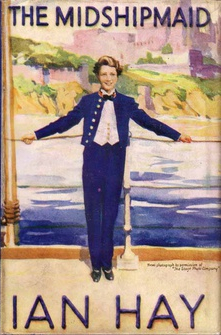
* A Distributed Proofreaders Canada eBook *
This eBook is made available at no cost and with very few restrictions. These restrictions apply only if (1) you make a change in the eBook (other than alteration for different display devices), or (2) you are making commercial use of the eBook. If either of these conditions applies, please contact a https://www.fadedpage.com administrator before proceeding. Thousands more FREE eBooks are available at https://www.fadedpage.com.
This work is in the Canadian public domain, but may be under copyright in some countries. If you live outside Canada, check your country's copyright laws. IF THE BOOK IS UNDER COPYRIGHT IN YOUR COUNTRY, DO NOT DOWNLOAD OR REDISTRIBUTE THIS FILE.
Title: The Midshipmaid—The Tale of a Naval Adventure
Date of first publication: 1934
Author: John Hay Beith (ps Ian Hay) (1876-1952)
Date first posted: November 18, 2025
Date last updated: November 18, 2025
Faded Page eBook #20251123
This eBook was produced by: Al Haines, John Routh & the online Distributed Proofreaders Canada team at https://www.pgdpcanada.net
This file was produced from images generously made available by Internet Archive.
Works by IAN HAY
NOVELS
Pip: A Romance of Youth
The Right Stuff
A Man’s Man
A Safety Match
Happy-Go-Lucky
A Knight on Wheels
The Willing Horse
The Lucky Number
Paid with Thanks
Half a Sovereign
The Poor Gentleman
The Middle Watch (with Stephen King-Hall)
The Midshipmaid
WAR, TRAVEL, ETC.
The First Hundred Thousand
Carrying On, After the First Hundred Thousand
The Last Million
The Lighter Side of School Life
The Shallow End
(With Illustrations in Colour by Lewis Baumer)
The Ship of Remembrance: Gallipoli-Salonika
Their Name Liveth (the Book of the Scottish National War Memorial). Illustrated
The Great Wall of India. Illustrated
Over two and a half million copies of
Ian Hay’s books have now been sold
The characters in this book are entirely imaginary
and have no relation to any living person.
First published January 1933
Reprinted January 1934
Printed in Great Britain for Hodder and Stoughton, Limited,
by Richard Clay & Sons, Limited, Bungay, Suffolk.
TO
STEPHEN KING-HALL
But for whose ready aid and
expert knowledge this Naval
Manœuvre could never have
been executed
| CONTENTS | |
| CHAPTER ONE | Sir Percy—And one d |
| CHAPTER TWO | Freddie |
| CHAPTER THREE | Prepare to Receive Company |
| CHAPTER FOUR | The Naval Manœuvre Begins |
| CHAPTER FIVE | Oh, Geminæ! |
| CHAPTER SIX | Is All Our Company Here? |
| CHAPTER SEVEN | Audition |
| CHAPTER EIGHT | The “Pending” Tray |
| CHAPTER NINE | Stage Fever |
| CHAPTER TEN | Make-believe |
| CHAPTER ELEVEN | Der Tag |
| CHAPTER TWELVE | Reality |
| CHAPTER THIRTEEN | Orders are Orders |
| CHAPTER FOURTEEN | Mistress of the Robes |
| CHAPTER FIFTEEN | The Little Stowaway |
| CHAPTER SIXTEEN | Overture and Beginners |
| CHAPTER SEVENTEEN | Intermission |
| CHAPTER EIGHTEEN | Star Turn |
| CHAPTER NINETEEN | Fallen Stars |
| CHAPTER TWENTY | Extra Turn |
| CHAPTER TWENTY-ONE | Finale |
The Midshipmaid—The Tale of a Naval Adventure
All Valetta was astir. The carrozzi drivers had given their horses an extra scrap of feed and covered the cushions of their vehicles with clean linen. The shopkeepers had rearranged their shop-windows. The dghaissa men, having titivated their craft, looked expectantly towards the harbour entrance. The Admiral Superintendent of the Dockyard sent for the heads of his departments and showed them a long wireless signal which he had received, beginning, Defects—Urgent. The Governor’s lady sent for her husband’s A.D.C., and began to discuss dinner-parties. The staff of the Marsa sports ground marked out courts, rolled greens, tidied up flower-beds, uncovered furniture, and over-groomed polo and racing ponies. A large number of wives put on their best frocks and rushed to the hairdresser. By eleven o’clock everyone who was anyone was at the Barraca Battery.
Far below them, down the steep, grim battlements flung up long ago by the Knights of St. John as the barricade of Christendom against the Turkish infidel, stretched the inletted and almost vacant Harbour. Two or three powerful yellow Admiralty paddle-tugs moved restlessly about in Dockyard Creek, churning the still water into creamy foam. High up—higher even than Barraca Battery—stood the Castille signal tower, dominating all Malta. It was a perfect September morning, and the sea was true Mediterranean blue. The crowd increased until the battlements were black with people, all gazing steadfastly eastward.
Suddenly, from out the sun-hazy horizon, came a tiny flicker of light. A ripple ran through the crowd: the Mediterranean Fleet was coming home from its summer cruise.
A faint clatter-clatter reached the Barraca Battery, as the Castille signal-station came into action. More flashes were visible; the Fleet flagship was beginning to pour in a series of routine messages. Soon the Fleet itself took shape. First, little grey smudges growing into destroyer flotillas, which increased speed and drew across to the westward, since they must enter Sliema harbour. Then cruisers, executing complicated manœuvres, which the knowledgeable ones explained meant that they were taking up station for entering port.
Finally, great silver-grey shapes, massive and eerie, loomed out of the haze. These were the battleships—floating fortresses housing thirteen hundred officers and men apiece, and costing five million pounds or so. These same engines of war, exclusive to the Navies of the British Empire, the United States, and Japan, were the craft of whom the delegate of a minor Power had plaintively observed at Geneva: “I know when battleships are defensive—when they fly an American or British flag!”
The Fleet advanced further, and the battleships drew into single line, with the flagship in the van. Five hundred yards separated each giant from his neighbour, no more and no less: a wave of blue and green fell away from each ram. A hush fell over the watching thousands as the leading ship approached the narrow entrance: so huge was she, and so narrow the gap between the bastions, that the slightest miscalculation of compass course meant complete disaster in thirty seconds.
Cones rose and fell as the Fleet reduced speed: a string of flags fluttered up on board the flagship. The signal was repeated on each of the towering masts down the line, and then the hoists fell to the deck as if lowered by one hand. On each great ship six hundred men stood at their “stations for entering harbour,” and on each quarter-deck, beneath a vast expanse of awning, stood the guards of the Royal Marines, their bands making a cheerful noise. In each ship, from the chains on either side, the leadsmen hove the lead and chanted their deeps and marks to the small groups of officers on the upper compass platform. No one paid any attention to these musical efforts, for the hand-lead is obsolete for taking soundings, and the depth of water in Valetta harbour is known to an inch. But—it is laid down in King’s Regulations and Admiralty Instructions that “the leadsmen shall be in the chains on all occasions of approaching the land”; and as it was in Nelson’s time, so it is to-day. After all, why try to improve on Nelson?
The Admiralty tugs had slipped out of Dockyard Creek, and were hovering round the buoys in order to help to turn the great ships; for the Fleet always moors bows to the sea at Malta, in readiness for instant departure upon some unlooked-for naval occasion.
As the leading ship entered the narrow channel between the bastions at the entrance to the Harbour, she was greeted by a fluttering of handkerchiefs from the crowds ashore. The watchers in the Barraca Battery were able to see that the officers on her bridge in their turn were subjecting the terrestrial scene to a close scrutiny through their glasses.
It was a romantic and superb spectacle, and Miss Celia Newbiggin said so to her father, Sir Percy. That serious-minded man merely replied:
“Do you know how much those things cost?” He waved a hand towards the Harbour, which was now filling up with battleships.
Celia shook her head.
“About four or five million pounds each. Think of it! Think what that means in taxation!”
“Yes; they’re lovely, aren’t they?” said Celia.
Words failing Sir Percy (as they frequently did in his verbal jousts with his daughter) he took out a note-book and jotted down:
Ceremonial and pageantry displayed by Navy blinds taxpayer to real cost involved.
At this moment one of the battleships—H.M.S. Crusader—gliding slowly and majestically towards her billet, passed so close to the shore beneath the Newbiggin vantage point that one could almost look down her huge single funnel. The strains of music from her band, which was playing a selection from one of the latest and most epileptic masterpieces of jazz, reached Celia’s ears.
“I should adore dancing to a ship’s band,” she said.
Sir Percy took out his note-book again, and inserted the words—“especially women,” after “taxpayer.” He looked carefully down on to the deck of the ship, then pronounced judgment.
“There must be at least five hundred sailors standing on the deck of that vessel. Doubtless there are as many more out of sight inside. Rows and rows of able-bodied, active men confined within the—er—vitals of a ship, with nothing to do but twiddle their thumbs and listen to a band! This is not sailoring; it is yachting! And I shall tell the Admiralty so. I am glad I came out here: it was time!”
Which last remark reminds me that I have not yet told you why Sir Percy had come to Malta, or in fact who Sir Percy was. As Sir Percy would undoubtedly be deeply hurt by such an omission, it shall be repaired forthwith.
I cannot do better than begin with Sir Percy’s estimate of himself, as set forth in that most revealing publication, Who’s Who.
NEWBIGGIN, SIR PERCY HIGGINSON, K.B.E., cr. 1919; Member of Parliament for the Mickleham Division of Podsbury since 1927; o.s. of the late Albert Edward Newbiggin, of North Finchley, and Amelia Higginson, of Stoke Newington. Educ. privately; m. 1912, Violet Mary, daughter of John Pounderby, Esq., J.P., of Much Moreham, Lincs; one d. Founder of the Newbiggin Cold Storage Corporation; retired from active business in 1924, in order to devote himself to public work, but retains position of Honorary Chairman of the Board. In the Great War, being above military age, performed civilian war work of national importance; O.B.E. 1918. Chairman of many social and philanthropic societies; has been in particular a persistent and fearless promoter of international good-will; is also a keen supporter of all schemes for the reduction of national expenditure. Publications: “The Romance of Cold Storage,” 1910; “Getting the Nations Together,” 1921; “Waste Not, Want Not!” 1928. Recreations: travel, conversation. Address: 247, Eaton Square, S.W.1. Clubs: none; the House of Commons is the only worthwhile club for a public man.
Yes, that is the sort of public man that Sir Percy was. Who’s Who is full of them.
In the House itself his outstanding characteristic was a consuming passion for information. It did not matter whether the information was of value or even reliable; what Sir Percy enjoyed was the process of extracting it. As already indicated, he was a prominent figure on innumerable futile commissions and footling committees of inquiry. He was naturally a notorious pest at question time:—
Sir Percy Newbiggin—to ask the Home Secretary for further and fuller information regarding the circumstances under which the Taxpayers’ money——
Sir Percy Newbiggin—to ask the Financial Secretary to the War Office by whose authority and at whose expense——
Sir Percy Newbiggin—to ask the Postmaster-General why, whereas in the republic of Costa Rica the charge for local telephone calls is only——
The Treasury clerks, and others whose task it was to work out the answers to these daily conundrums for the benefit of their official mouthpieces on the front bench, called him Parsimonious Perce. The young ladies who typed the answers called him Percy Parker—in oblique reference, presumably, to a mythical gentleman of the same surname but with the baptismal name of Nosey.
After National Economy, Sir Percy’s main predisposition, as already indicated, was to a fussy participation in international politics. He was an earnest and forceful member of various societies for the promotion of a better understanding between small Continental nations which understood one another only too thoroughly already, and had (quite rightly) mistrusted one another profoundly for centuries. But that did not worry Sir Percy. Lausanne was his wash-pot, Geneva his stamping-ground.
Behold him then in Malta, the guest of His Majesty’s Government, which, in the wistful hope of getting on with Parliamentary business unencumbered for a few weeks by Sir Percy’s gadfly presence—or perhaps an outsize bumble-bee would be a more appropriate comparison—had made him Chairman of a small Commission for investigating the possibility of still further reducing expenditure upon the Royal Navy, and despatched him to Malta to conduct his investigations on the spot, with full leave to prolong the same until the crack of doom, if this could possibly be arranged. He would probably harry the Commander-in-Chief into an early grave—but the Navy was overstaffed, anyhow.
By a happy thought the Permanent Under-Secretary for Foreign Affairs, a wizened old gentleman whom a lifelong experience of Big Diplomacy and Little Ententes had not entirely deprived of a sardonic sense of humour, had suggested that while Sir Percy was about it he might as well drop in at Geneva for a week or two and satisfy himself by personal inquiry on the spot of the efficiency or otherwise of the League of Nations Secretariat, and generally show the League of Nations how to conduct its business. Sir Percy, needless to say, had accepted the invitation with a becoming sense of responsibility.
I think that that is really all we need know about him for the present. We might add that he was a widower with one daughter, Celia, who appeared to have inherited nothing from her parent but the knack of getting her own way—though her methods were entirely different from his. Her name and record had not so far appeared in Who’s Who—she was only twenty—but had it done so, it might have run something like this:—
NEWBIGGIN, CELIA MADELEINE ANN; o.d. of Sir Percy Newbiggin, K.B.E. (q.v.). Educ. Heathfield and Paris, and all the time everywhere else. Complexion fair, eyes blue, nose slightly retroussé, smile jolly; strong sense of humour, but not of the giggly kind; at heart warmly affectionate, but superficially a modern young miss of the usual sophisticated type; particularly quick on the trigger in her dealings with the opposite sex. Publications: none—otherwise there might be libel actions. Recreations: bullying Freddie. Clubs: Gargoyle, Punch’s, Blue Lagoon, Silver Slipper.
Let us rejoin Sir Percy and his one fair daughter, where we left them in Barraca Battery, looking down upon the incoming Fleet.
“Yachting!” repeated Sir Percy severely. “Subsidized idleness! The shame of it!”
“I don’t suppose they’re idle all the time,” said Celia. “The stormy winds do blow, now and then—and there are reefs and things. Lord Dore once told me that a Navy must be as efficient in peace as in war, or it goes to the bottom. That was where Navies differed from Armies, he said.”
But Sir Percy paid no attention. Like many of the world’s thinkers, he was not a ready listener.
“As a Taxpayer,” he continued, “the spectacle appals me; as an Internationalist, it fills me with the gravest——”
“Personally, it gives me rather a jolly feeling inside me,” said Celia. “Rule Britannia, and what not!” Her cheeks were slightly pink: on the broader issues of world politics she was obviously a hopeless reactionary. “It would do Freddie a bit of no harm to have to spend a year or two in one of these ships,” she added inconsequently.
Sir Percy turned to her.
“Celia, please do not speak of your fiancé in that way. It pains me, and it is also disrespectful to a very distinguished family. What would Lord Dore say, if he heard you refer to his eldest son in such terms?”
“He’d agree with me. He and I are quite unanimous about Freddie, Dad. We both consider him rather a lamb, but in need of a shock. I’m very fond of Freddie, though you might not think it; but he is rather futile, you know.”
“Celia, that is a most unjust observation. You must think—look deeper! All old families have—must have—their eccentricities of speech and character—the inheritance of the past—of the centuries, as it were. We of a more recent and perhaps more vigorous stock should make allowance for that fact. Freddy’s ancestors fought at Hastings, in—er——”
“Ten-Sixty-Six, and all that. Which side?”
“The Norman side.”
“All wrong! Buy British, and be proud of it!”
Sir Percy sighed patiently, and tried another tack.
“He is deeply devoted to you, Celia.”
“Then why didn’t he come and see us off at Victoria?”
“Doubtless there is some perfectly satisfactory explanation, which you will receive with his first letter to you.”
“Oh, there’ll be an explanation all right; but I shan’t receive it, because it wouldn’t have been a satisfactory one. I’ll bet you he went to a party the night before, and met something in the platinum blonde line, and made a date with it for lunch. Will you take me, or do you think I’m betting on a certainty?”
Sir Percy ignored this challenge, which was foolish of him, for as it happened Celia was wrong.
“I sometimes wonder, Celia,” he said instead, “if you fully realize the honour which is in store for you, and indeed for our family.”
“I sometimes wonder too,” admitted Celia frankly. “Hallo! Look! They’re sending ashore the big stuff.”
The battleships were now secured to their buoys; their lower booms were out; picquet boats, dangling from derricks, were being lowered into the water. A bugle-call rang from the Fleet flagship, echoed in other ships; and a brass-funnelled, green-painted steam barge shot away from her after gangway.
Presently it slid alongside the Customs House steps. An alert figure in Admiral’s uniform stepped out, and entered a waiting car. The Commander-in-Chief had come ashore, and the Fleet had come home.
The name of Frederick, Viscount Chinley has already been mentioned more than once in this narrative. If the reader has by this time (as I hope) begun to take an interest in Celia, probably a little further information as to her betrothed will be acceptable.
Let us follow our usual practice, and summarize Freddie in the manner (if not the matter) of that indispensable publication, Who’s Who.
CHINLEY, VISCOUNT; FREDERICK VERSCHOYLE FITZWIGGIN; e.s. of the Rt. Hon. the ninth Earl of Dore, First Lord of the Admiralty (q.v.). Born 1907; educ. Eton (superannuated 1923), and Trinity Coll., Camb. (sent down 1927). Holder of numerous sporting records; the first diner-out to swim the Thames from Maidenhead to Bray wearing full evening dress and a silk hat; once got up at seven o’clock in the morning (for a bet), but otherwise has not been to bed on the day he got up on for four years and eight months. Recreations: in his younger days collected door-knockers and policemen’s helmets; now devoting his time entirely to poodle-faking. Engaged, Jan. 1926, to Miss Birdie Briggs (of Lew Lichfield’s No. 2 Touring Company, in “Hot Mommas”); June, 1926, to Miss Fluffie Foljambe (of the London Pavilion); April, 1927, to Miss Happie Houpée (of Hollywood); Dec. 1927, to Mlle. Chichi de la Brassière (of the Folies Bergère); May, 1928, to Mrs. Bertha Blumberg (relict of the late Solomon Blumberg, Esq., of Hatton Garden); June, 1928, to Miss Ada Gulching (of the Pavilion Pier, Brighton: cigarettes, sweets, and picture postcards); Feb. 1929, to Miss Prudence Barm (only daughter of the Very Rev. Aubrey Barm, Rural Dean of Much Moreham); Oct. 1929, to Donna Dolores Espadillo (of Buenos Aires). Unmarried. Address: between noon and lunch-time, usually Buck’s; after bedtime, The Albany. If no reply, try Vine Street.
That, probably, is how Freddie would have filled up his own history-sheet, for, like many of his race and breed, one of his principal pleasures was humorous self-disparagement. Celia would have summarized him more charitably; indeed, she has already done so in these pages. All the same, she sometimes caught herself wondering why she had ever agreed to marry him.
On the morning after Celia and Sir Percy had left Eaton Square for Malta, Freddie Chinley, immaculate in a new flannel suit and feeling extraordinarily virtuous at being up and about by ten-thirty a.m., rang the bell of the Newbiggin stronghold in Eaton Square, and offered the butler a cheery good-day.
“Well, Wickham,” he said, “here we are—and here you are! I wish I could feel as plump and rosy in the early grey of the morning as you look. And how’s young Albert?”
Young Albert was the butler’s youngest. It was one of Freddie’s pleasing characteristics that he not only remembered butlers’ names, but took a genuine interest in their domestic affairs. Probably Sir Percy did not know that Wickham had a family at all; if he had known, he would very likely have considered it extremely improvident of Wickham.
Wickham reported at some length, going into considerable detail on the subject of German measles, second teeth, and progress in spelling. Freddie listened with pleased interest, and when all was over looked at his watch and then round the hall.
“Isn’t it time the heavy stuff came downstairs—steamer trunks, deck-chairs, diplomatic dispatch-boxes, and what not?” he asked. “Doesn’t the convoy move off at eleven sharp? Don’t tell me I’ve got up at dawn all for nothing, Wickham! Or did Sir Percy send everything ahead by goods train? National Economy Campaign, and so forth!”
“Sir Percy and Miss Celia left for Malta yesterday, my lord,” replied Wickham kindly.
“No?”
“Yes, my lord; Wednesday, the fourteenth.”
“My good Wickham, do you mean to say that this isn’t Wednesday, the fourteenth?”
“No, my lord. Thursday, the fifteenth.”
Freddie plunged into eloquent contrition.
“Fancy selling poor little Celia a pup like that!” he said. “I can’t imagine how it happened. I can’t imaging what happened to Wednesday either: I’ll swear yesterday was Tuesday. Never mind, I’ll send a wire, apologizing. Did she seem to feel it much, Wickham?”
“I couldn’t really say, my lord: Miss Celia did not raise the point with me at all. As a matter of fact, there was a good deal of commotion going on at the time, over Sir Percy; and your absence may have been overlooked.”
“Wickham, you fill me with renewed hope. But what was the commotion?”
“The Press photographers were late, my lord, and Sir Percy had a few words with them.”
“Press photographers?”
“Yes, my lord. Have you seen The Daily Reflector this morning?”
“No. I don’t really read the papers much before Sunday.”
“Here it is, my lord.” Wickham picked up The Reflector from the hall table. On the middle page stood Sir Percy—posed in a Napoleonic attitude beside the open door of the Rolls. Celia was dimly visible within.
“How jolly Celia looks!” said Freddie, picking out non-essentials as usual. “What is Sir Percy making that face for?”
“It says underneath, my lord.”
Filing down the Fleet, read Freddie. Sir Percy Newbottle, the Economy Ace, hotfoot for Malta.
“Why Newbottle?”
“A slip on the part of the reporter, I fancy, my lord. Names mean nothing to these persons; but I imagine Sir Percy will be annoyed about it.”
“I should shay sho. We must send him a copy!”
“I don’t suppose, my lord, that Sir Percy will care about being referred to as an Ace, either.”
“Well, I don’t know; they might have called him Mossy Face, or The Curse of Scotland. We must always be broadminded, Wickham.”
“Yes, my lord.”
Freddie laid down the paper.
“However, to get back to the subject in hand, I seem to have torn things all round. I’ll go and wire to Celia at once. So long, Wickham! All the best to young Albert.”
“Good morning, my lord.”
Wickham closed the street door and said to himself:
“She might do better—and she might do a dam sight worse!”
Freddie, hot in quest of a telegraph office, had left Eaton Square behind and was bowling along Hobart Place at a steady four miles an hour, when he suddenly realized that he did not know the name of Celia’s ship. He paused, and reflected.
“It must be a P. & O. boat, though,” he said to himself. “I mean, nobody has ever heard of any other line.”
Sustained by this patriotic reflection, he hailed a taxi and told the man to drive to the P. & O. offices, wherever that might be. In due course he was set down in Cockspur Street. Here a friendly and quite omniscient young man in spectacles, behind a counter, not only told him the name of the ship, but identified Sir Percy and Celia in the passenger list.
“Miss Newbiggin will be on board by this time,” he said, “at Marseilles; but it is possible that the ship may have left. You could wire to our office there, and it would be forwarded, if necessary. Or you could wire to Malta direct. Or of course you could send a Marconigram, which would find Miss Newbiggin anywhere. We can do everything from here, in any case. Which would you prefer, Lord Chinley?”
But Freddie was overtaken by another idea altogether.
“I say,” he said suddenly, “there’s absolutely nothing doing in town just now, is there? I mean, the time of year, and everything. Why shouldn’t I go to Malta myself? Then I needn’t wire.”
The friendly young man agreed that it would be an excellent idea.
“What ship would you like to sail by, Lord Chinley?” he asked, getting down to business while Freddie’s fit lasted. “The next sailing is on the twenty-eighth. There are still several cabins available.” He produced the ship’s plan, and began to explore it with a pencil. But Freddie’s eye had wandered to a large framed photograph upon the wall opposite—a photograph of a majestic white vessel with three funnels.
“That’s a jolly-looking packet,” he said. “I should like to sail in her. What about it? Does she go to Malta, by any odd chance?”
Odd chance was the exact word, for as it happened the Strathmore—the most recent addition to the P. & O. fleet and the legitimate pride thereof—was due to sail for the Mediterranean on a pleasure cruise, and would touch at Malta in about a fortnight’s time.
“Absolutely!” said Freddie with enthusiasm. “When does she push off?”
“This afternoon, from Tilbury. I am afraid that is rather short notice. You could easily join her at Marseilles, though, next week.”
“Oh, no! I mean—definitely! I am bound on a rather special mission, as it were. I should feel no end of a tick if I put it off for a week.”
“I must point out to you, Lord Chinley, that you will arrive at the same time whenever you start.”
Freddie leaned across the counter confidentially.
“I’ll tell you something,” he said. “It may be useful to you in after years. With women, it isn’t exactly a matter of what you do; it’s when you do it. They don’t mind so much when you arrive, but it braces them no end to feel that you started at the first possible moment.”
Rather to his surprise—for if he could not advise a fellow-creature how to handle women, who could?—Freddie noted that the friendly young man was allowing his attention to wander. His spectacles were directed upon someone, or something, at Freddie’s right elbow. Freddie turned.
Beside him stood the most lovely girl that he had ever seen in his life. Her eyes were large, brown, and appealing; her manner was that of a startled fawn—or possibly a wistful gazelle, Freddie decided. She addressed the friendly young man—and her voice sounded like heavenly music.
“Please, are my libels ready?”
The young man handed her a packet.
“The boat train leaves St. Pancras for Tilbury at four, madam,” he reminded her.
“Thenks,” said the vision, with a liquid look, and faded away.
Freddie stood gazing at the gap in space which she had recently occupied; then turned to the young man.
“Is she sailing in the Strathmore?” he asked.
“Yes, Lord Chinley.”
When Freddie came to himself he was in Trafalgar Square, gazing up into the yawning countenance of one of the Landseer lions.
“That’s what comes of doing the right thing, old son,” he said. “Virtue rewarded, and so forth!”
The lion merely continued to yawn.
H.M.S. Crusader lay at her moorings in Valetta Harbour. She had been there for two days now, drowsing in the Mediterranean sunshine and enjoying a little well-earned recreation.
It was eleven o’clock in the morning; except for a painting party on the boat-deck and the Midshipman of the watch walking to and fro upon the quarter-deck below, all was peace.
Half-way up the after-screen hung a horizontal plank, about eight feet in the air. The after-screen itself was a wall of grey steel, separating the sacred quarter-deck from the battery-decks on either side. Access to these decks was obtained from the quarter-deck through two doors, one on either side of the screen. The top of the quarter-deck screen was flush with the boat-deck, which extended across the beam of the ship and was carried forward to the forecastle.
Presently a Corporal of Marines, the leading hand of the painting party, walked to the after-end of the boat-deck and looked down upon the heads of the two men seated on the plank. He observed that they were hard at work: they were enamelling the screen, using paint-pots which, like the plank, were suspended by ropes from the level of the boat-deck.
Satisfied, or at any rate frustrated, the Corporal moved away forward, to supervise other members of the party. The enamellers promptly relaxed. One of them, a fat man with a brick-red face and a blue anchor tattooed upon the back of his left hand, went so far as to lift his left leg over the plank, so as to sit it astride and lean back against the rope supporting it. He was dressed in a blue overall, a dirty white cap-cover, and brown shoes. He answered to the name of Able Seaman Pook, and he owned three badges. Many divisional officers had tried to persuade him to be ambitious—to pass that educational test which would lead him to the more exalted rank of Leading Seaman, or even to that of Petty Officer—but without avail. Pook was conscious of no urge towards a position of responsibility. Nevertheless his prestige and influence on the lower deck was second to none.
He addressed his companion—a little, alert Cockney, similarly attired, save that he wore a Marine’s cap. His name was Bundy.
“Free, Universal, and Compulsory,” said Pook. “And what’s the use of it all?”
“What’s the use of what all?”
“Education. Free, Universal, and Compulsory—that’s what it is in this country. People like you and me ’as to pay millions a year in taxation to keep it up. And what do we get for it? Things like that!”
With a vague wave of his paint-brush, Pook indicated the boat-deck above him. Apparently he was referring to the receding Corporal.
“Just a slab-sided, flat-footed, cock-eyed Lobster,” he continued, “with a couple of stripes on ’is little sleeve to prevent ’im from being mistaken for another Lobster. About as much use at ’is job as that there bucket would be. Less; after all, you can keep beer in a bucket—or turn it up and sit on it. And why? Because all the free education in the world can’t teach intelligence to a chap what ’asn’t any. See?”
“Close your face, you fat old fool!” replied Private Bundy, nettled probably by Pook’s slighting reference to one who, however objectionable in the execution of his duty, was, after all, a member of the Royal Marine Corps. Then, feeling better: “What’s the name of this song you’re singin’, Pookey?”
“I’m explaining to you,” said Pook, with dignity, “about the foolishness of education without intelligence. You see that there Corporal—tackin’ along on ’is little toes, and popping ’is ’ead over the rails, and tryin’ to catch a couple of ’ard-workin’ men not sloppin’ the paint on proper? And all the time ’e doesn’t know that this ’ere after-screen acts like a soundin’-board! I ’eard ’im comin’ when ’e was ten yards away. But then I’ve got intelligence—see?”
“What I can’t see,” replied Bundy respectfully, “is why you ain’t Commander-in-Chief of the British Navy.”
Pook was silent, cogitating a suitable rejoinder. Finally:
“Funny, ain’t you?” he said. Then, feeling that Bundy had won on points, he descended to a more amicable note.
“I don’t ’old with officials of any kind,” he explained. “Lot of jacks-in-office, most of ’em! Of course we got to ’ave a Commander-in-Chief, just for the look of the thing; but we could ’eave ’alf the officers of this Fleet overboard, and never miss one of ’em. That’s the curse of the Navy—jacks-in-office. Many a time I’ve been approached about accepting promotion—just to raise the tone of the Petty Officers’ Mess, like. The Old Man begged me to—’imself—with tears in ’is eyes. But I said no. ‘I’m a Socialist’—that’s what I said to ’im! Equality for all—that’s the only stuff!”
“You’re right there,” said Bundy approvingly. “Every time, you are! Equality! That is, of course, so long as everybody ’as a proper respect for ’is betters—see?”
“What do you mean—betters?” asked Pook suspiciously.
“Well, take ships’ sideboys. You know that new one of ours?”
“What—the one with the red ’air and the squint?”
“No, not ’im: the one with the warts. Do you know ’im?”
“Do I know ’im?” repeated Pook bitterly. “Go on! What about ’im?”
“Well, yesterday I told ’im to nip down and bring up my oilskin—and what do you think ’e said to me? ‘I’m a Socialist!’ ’e says. Just like that!”
“ ’E did?” said Pook, genuinely shocked.
“ ’E did! ’Owever, I gave ’im a clip over the ear’ole that settled ’is politics for the rest of the afternoon.”
Pook nodded approval, then shook his head despondently.
“There’s a wrong spirit abroad to-day,” he said. “No respect for authority.”
“That’s right,” agreed Bundy. “No pride in honest work, neither.” He leaned forward earnestly, pointing an impressive forefinger. “Pookey, old man, barrin’ you and me——”
A cold voice from above interrupted him.
“Ain’t you two web-footed swabs finished that bit yet? Have you died in your sleep, or what?”
Obviously Pook’s sounding-board had basely failed in its trust. He hastily hoisted his leg back to its official position.
“We’re all ready, Corporal,” he said politely. “Just waitin’ for a ’oist.”
“Hold tight, then,” said the Corporal.
The pair obeyed, and the plank was jerked up another four feet.
“Easy on!” shouted Pook, who had not been intended by nature for a trapeze-artist.
“That’s right!” echoed Bundy. “Drop us on the deck, won’t you? We ain’t got no nets under us!”
“Less of it!” said the Corporal shortly. He leaned over the rail again. “Now that you’re nice and comfortable, get a move on, both of you! Slap it about!”
Pook indicated the paint-pots, now dangling far below the plank.
“ ’Aul up these things, then,” he said. “What are we—monkeys with arms six feet long?”
“No—three feet!” replied the Corporal swiftly, and departed with the honours of the encounter.
Pook said something under his breath, then checked himself as the First Lieutenant appeared upon the quarter-deck below him, through the port-side door of the screen.
“Jimmy the One!” breathed Bundy, and both artists began to ply their brushes vigorously.
The First Lieutenant, having punctiliously saluted the quarter-deck, after the immemorial tradition of centuries, bellowed:
“Snotty!”
Midshipman Golightly hurriedly crossed the deck and saluted.
“Sir?”
“What time did the Officer-of-the-Watch send the first picquet boat away?”
“Six bells, sir.”
“She ought to be back by now.” The First Lieutenant surveyed the crowded harbour through his telescope, Golightly zealously following suit.
“I think I see her, sir,” he said presently.
“Where?”
“There, sir—a little more to your left—just beyond that crowd of dghaissas.”
Number One examined the craft indicated, and then shut up his telescope with a snap.
“When you learn to distinguish between a picquet boat and an ash boat, my lad, you can come and let me know,” he said acidly.
“I’m sorry, sir,” replied Master Golightly, but grinned quietly to himself. He was a stolid-looking youth, with a pink moon face, but he possessed a certain dry humour of his own.
A Corporal of Marines came through the after-screen and saluted the First Lieutenant smartly.
“Bridge reports first picquet boat coming down from right ahead, sir,” he announced. “Seems to be making for the starboard midships gangway.”
“Good,” said the First Lieutenant. “Snotty!”
“Sir?”
“Nip up to the signal bridge, and confirm that. We’ve got to receive this guest in real style. It’s Sir Percy Newbiggin.”
“Aye, aye, sir!” Golightly skipped through the after-screen, while the First Lieutenant, crossing to the starboard side of the ship, continued his inspection of the harbour. This time he succeeded in picking out the picquet boat, which was rapidly approaching. Pook and Bundy, pleasantly intrigued at the arrival of company, were only prevented from aiding him in his investigations by the thundercloud presence of the Corporal on the quarter-deck below. So they fell back on sotto voce conversation.
“Who is this Sir Perishing Percy,” inquired Pook of Bundy, “what Number One and the Snotty are singing the duet about?”
“What—ain’t you ’eard?”
“Of course I ain’t ’eard. Am I a Marine servant, ’anging about officers’ cabins all day, with me ears sticking out like a pair of ’ydrophones?”
“Officers’ cabins ain’t the reason why they stick out, old man,” said Bundy gently. “You got to blame nature.”
“Who is Perce, anyway?” repeated Pook, ignoring this counterthrust.
“ ’E’s a K.C.B. and a Member of Parliament, and a lot of other things like that.”
“Members of Parliament don’t mean no more to me than ships’ sideboys with warts. What’s ’e doing in Malta?”
Bundy, the ship’s gossip, had a complete answer to this.
“ ’E’s one of them ’igh-up civilians at ’ome, what’s got some sort of ’old over the Admirality; and ’e’s come out ’ere, all the way from Westminister, to show us ’ow to run the blinkin’ Fleet on about ’alf the money what it costs now.”
“Slap on some more of that paint,” murmured Pook. “I can ’ear little Two-stripe fox-trotting along this way.”
Sure enough, the Corporal’s head appeared over the rail, scowling down on them. Pook and Bundy smiled affectionately up at him, and then reapplied themselves to their artistic labours. He drifted away, a disappointed man, and Bundy continued:
“They’ll play the old Service game on Percy—make a fuss of ’im, and fill ’im up with rum and receptions.”
“Reeceptions!” said Pook bitterly. “You’ve ’it it! More work for the likes of you and me! More painting ship, more decorating of the quarter-deck; and”—he glanced venomously upwards—“that blasted ceremonious awning goin’ up again! Do you know what I’d do with a million pounds, supposing somebody was to give it to me?”
“You mean, what would you do with the change.”
Pook cast a suspicious glance at the humorist beside him.
“What do you mean—change?”
“What you ’ad left—after you’d ’ad something done about your face. Of course that’s the first——”
“I’m askin’ you,” repeated Pook with dignity, “what would I do with a million pounds?”
“Well, what would you do with it?”
“I’d build a ship that didn’t ’ave a quarter-deck at all—just a foc’sle at each end.”
Bundy nodded approvingly.
“I see. And a brewery in the middle!”
“That’s right. ’Ullo, ’ere’s that Snotty again.”
Golightly was addressing the First Lieutenant.
“It is the picquet boat, sir!”
“Of course it is, you young fool! Do you think I’m blind?”
“No, sir. They’ll be a bit early for lunch, won’t they?”
“Yes. But Sir Percy wants to walk round the ship beforehand, and see the men at work. Corporal!”
“Sir?”
“Go forward and see that the boat-keepers aren’t lounging about in the boats at the boom.”
“Very good, sir.” The Corporal doubled off, and Master Golightly ventured to continue the conversation.
“Did you see a lady’s hat in the picquet boat, sir?”
“I did. And as soon as they come on board, you can find out from the Midshipman of the boat what was underneath it.”
“I know already, sir.”
Number One detached his eye from his telescope, and turned it coldly upon Master Golightly.
“You know a damned sight too much. Who is the lady?”
“Miss Newbiggin, sir—Sir Percy’s daughter. A smooth piece.”
“A what?”
“A most attractive girl, sir.”
“Is she? Well, my lad, I don’t know where you got your information from, but remember this: seventeen Ward-Room officers have got to take tea with her before she so much as hears that there’s a Gun-Room in this ship.”
“Yes, sir,” said Golightly meekly—perhaps a little too meekly.
The First Lieutenant, agitated possibly by the prospect of encountering a smooth piece in the immediate future, turned and glared suspiciously down upon him. The hapless youth gazed woodenly down his own nose, but in vain. An iron hand descended upon his shoulder and swung him round.
“Is that the cleanest collar you’ve got?”
“Yes, sir. It’s one of the Gun-Room public collars. All the private collars are in the wash.”
“Filthy little brute! You would have to pick a day like this to disgrace the ship on! Keep well in the background when the party comes on board. Now let me look at your neck. H’m—I thought so! Sandpapering is what it really—— hallo, that blasted picquet boat is very nearly at the ladder! Nip off as hard as you can, and tell the Commander that Sir Percy is coming on board. Get a wriggle on!”
“Yes, sir,” said Golightly. A second later he had vanished.
The First Lieutenant, having adjusted his tie and canted his cap the slightest fraction of an inch to the side of his head, strolled carelessly in the direction of the starboard midship gangway.
The enamellers immediately relaxed again.
Being received ceremonially for the first time on board a battleship is almost as unnerving as the moment of presentation at one’s first Court. There is, decided Celia when she reviewed the matter in retrospect, the same feeling of being but a fleeting incident against a background of immemorial tradition and custom.
Just before the picquet boat reached the Crusader, a sailor placed a small portable step in position in the stern-sheets of the boat. This done, he produced a diminutive white mat, which he laid upon the seat. As the boat came alongside the lower platform of the accommodation ladder, the midshipman of the boat came aft and bent down to help Celia, first to step on to the mat, thence, via the portable step, on to the lower platform. At this moment another midshipman took reverent charge of her and set her upon her course up the ladder, which had been screened from beneath by a strip of canvas.
When Celia reached the top of the ladder, she found herself the centre of a semicircle of uniformed and saluting man-power. The reception committee consisted of the Commander, the First Lieutenant, the Officer-of-the-Watch, the Midshipman of the Watch (all these with telescopes), the Quartermaster (a fat and comfortable-looking Petty Officer), the Corporal of the Gangway (a thin, tall Marine), and a sideboy. Beyond this foreground stretched an immensity of deck, incredibly clean and sparsely dotted with rigid figures of men standing woodenly at attention.
The first person who forced himself definitely and permanently upon her notice was a tall man with a very brown face and curiously light blue eyes. She noted the eyes particularly, because when first they caught sight of Celia they made a determined effort to leave their sockets. Next moment their owner was shaking hands with her—a ceremony which was sufficiently prolonged to enable her to observe that he wore three gold rings round his sleeve.
“Name of Ffosbery—with two ‘f’s,” he said briskly. “I am the Commander. Let me introduce Mr. Valentine, our Number One, and Mr. Kingsford.”
He relinquished Celia’s hand, which was now ferociously grasped, first by Number One, and then by the Officer-of-the-Watch. Rather to her disappointment, nobody made the slightest attempt to introduce Master Golightly.
Meanwhile, the Commander was greeting Sir Percy.
“Sir Percy Newbiggin? Good morning, sir. The Captain has asked me to welcome you on board the Crusader.”
“Where is the Captain?” asked Sir Percy, for whom no reception committee was ever quite large enough.
“He has had to go on board the flagship, sir, to see the Commander-in-Chief. He will be back in time for lunch. He has invited a small party to meet you. Meanwhile, I understand that you would like to look round the ship. We are making no special arrangements; the Captain tells me that you merely wish to see the hands at their ordinary routine.”
“That is so. I like to receive my impressions first-hand.”
“Quite, sir.”
“Quite. We will begin at once.”
“Certainly, sir. You would like to see everything, I suppose—mess-deck, engine-room, stokehold?”
“Most certainly. I have some small reputation for thoroughness. Come, Celia!”
Celia glanced down at her white georgette.
“The stokehold—in this frock? Don’t be silly, darling! You trot along, and I’ll go for a walk round the deck, or something.”
“Miss Newbiggin will be well looked after, sir,” said the Commander.
“I do not doubt it,” snapped Sir Percy, with a disapproving glance at Messrs. Valentine and Kingsford, who were simultaneously converging on his daughter.
“The Officer-of-the-Watch will take you round the ship, sir,” continued the Commander swiftly: “it is a part of his routine duty to go round, in any case. I will bring Miss Newbiggin to the Captain’s cabin at lunch-time. Meanwhile, you might like to see the quarter-deck, Miss Newbiggin. This way!”
And thus, by prompt seamanship and the firm exercise of his rights as a senior officer, Commander Ffosbery cut out the prize, and bore her aft beneath the very noses of her father and his disgruntled colleagues.
Kingsford and Sir Percy disappeared below. The First Lieutenant merely glared at Master Golightly, and retired to the wardroom for a pre-prandial glass of sherry.
Left alone, Golightly raised his telescope and once more swept the waters of Valetta Harbour. Another picquet boat was approaching—and in its stern-sheets were displayed no less than three ladies’ hats. One of these was smartly austere, but definitely middle-aged; the other two were large, filmy, and floppy, and precisely alike in every detail.
Master Golightly grinned affectionately.
The Commander and Celia had the quarter-deck to themselves, the painting party having retired below for a moderately well-earned dinner.
“What do you think of our ship, Miss Newbiggin?” inquired the Commander. “This is only a conversational opening,” he added; “I’ll do better presently.”
“I love her,” said Celia. “Is she new? Not that that matters, but she looks so new: everything so smart and clean!”
“She’s pretty new—a post-Jutland type, anyhow. The only old thing about her is her name. There has been a Crusader in the Service for four centuries or so. Come, and I’ll show you.”
The Commander led the way to the after-screen, upon which, in letters of brass, newly burnished by the joint labour of Messrs. Pook and Bundy, one might read the battle honours of previous Crusaders—The Armada 1558—Quiberon Bay 1759—Battle of the Saints 1782—The Nile 1798—Jutland 1916. The Commander filled in the details. For ten minutes they wallowed in tradition together.
“What do you think of that?” asked the Commander, when they had finished.
“It makes me go all patriotic—sort of queer inside, you know.” Celia’s eyes were shining.
The Commander nodded, understandingly.
“Come and walk,” he said. “Sailors always walk when they talk, you know. A few steps one way, then a few the other. They can’t take more, or they’d walk overboard; and they can’t take less, or they’d be standing still and freezing to death. The Captain walks up and down the starboard side of the quarter-deck, the rest of us walk up and down the port side. The Warrant Officers have the boat-deck, and the Gun-Room—well, they just keep out of the way, as a rule!”
Celia looked up at the Commander and laughed. She was beginning to like him. Oddly enough, he reminded her in some vague, elusive way of Freddie Chinley. In most respects the two men were as opposite as the poles; but there was a something—possibly a drawling intonation of voice, or a calculated inconsequence of phrase—which sent her thoughts on a journey to Eaton Square. However, they speedily returned; there was too much to occupy them on board the Crusader.
“Why is a quarter-deck called a quarter-deck?” she asked.
“I don’t know. We’ll find out from Schooley: he knows everything.”
“Who is Schooley?”
“Our Mr. Tompkinson—our Instructor. He rounds up the Snotties into the Gun-Room every day, and learns them. You’ll meet him presently, I expect.”
“At lunch?”
“No. Schooley lunches with the other officers in the Ward-Room—a very low place. So do I, for that matter; but to-day I am promoted. I have been invited to lunch in the Captain’s cabin—to meet you.”
“I hope they put us together,” said Celia. “Then you can tell me who everybody is,” she added, a little belatedly.
“That has already been arranged. I can give you the complete plan of the table. The Owner will have Sir Percy on one side, and Lady Mildred on the other——”
“Who is Lady Mildred?”
“Lady Mildred Martyn—rather a dear. She’ll make you laugh. She is some sort of relation of the Captain’s. She’s been living in Malta this spring, and usually entertains for him. Then there are Rear-Admiral Ponsford and lady, and you and me. You will sit between me and the Rear-Admiral. What would you like to do after lunch?”
“Anything you like.”
“We might go sailing.”
For the second time Celia looked down at her white georgette.
“I’m afraid I’m not quite dressed for sailing to-day.”
“Of course you aren’t. A foolish suggestion—but we could easily do it another day. You’re going to be here a long time, I hope.”
“So do I,” said Celia, against her better judgment.
“We want to entertain you a lot, you see.”
All this time they had been walking backwards and forwards up and down the quarter-deck. Suddenly the Commander halted, and turned to face her.
“I think it would be a sound plan,” he said, after a gentle cough, “if you and I were to meet every morning about eleven, and hold a sort of informal committee-meeting about the day’s programme of events.”
“What sort of events?”
“All the things we want to get up for you. There’s sailing, of course. Then we could give you some shore excursions, and perhaps a moonlight picnic. And a dance, certainly.”
“Where would you dance?”
“Here, on the quarter-deck; it makes a first-rate ball-room. We put up a special inside awning—red-and-white stripes”—evidently Pook’s worst fears were about to be realized—“and make walls out of canvas side-screens decorated with bunting, and so on. Ship’s band—coloured lights—lots of refreshments—a few sitting-out places—and there you are! What about it?”
“It sounds divine. But——”
“But what?”
Celia hesitated. She was quite accustomed to the homage of young men, but being fundamentally honest, it was her habit never to obtain goods by false pretences.
“I am not quite sure what my parent would say about my participating in such goings-on. Moonlight picnics, and dancing, and all that.”
“Sir Percy? Of course we were hoping that he would be there too,” said the Commander, untruthfully.
“That wouldn’t help. He wouldn’t come, and he wouldn’t let me go without him.”
“The stern old Roman type, eh?”
“Yes. And as obstinate as a mule.”
“Still, I should have thought you could wheedle him. You ought to be able to wheedle anybody, I should say. I know, if you started wheedling me——”
Plainly, half-measures were useless against the direct methods of the British Navy. Celia therefore dealt the swift, merciful, knock-out blow.
“The fact is,” she said, “my father doesn’t approve of my going about—dancing especially—with anybody but—my fiancé.”
“Oh! Quite. Of course. You are—engaged?”
“Yes.”
“I see. Naturally. Rather. Perhaps we had better be strolling towards the Captain’s cabin: you must be hungry.”
“I should just think so. I’m ravenous. Aren’t you?”
“Not very.”
They resumed their walk.
By the end of luncheon the Commander had sufficiently recovered his morale to have decided that half a loaf—or rather the temporary loan of a whole loaf—was better than no bread.
During coffee time, in pursuance of this decision, he took Sir Percy over from the Captain—much to that officer’s relief, for he had been having a heavy time of it—and suggested that they might finish their cigars out on the stern-walk. Sir Percy graciously agreed. He was in an excellent temper, for he had spent the last two hours asking questions, and writing down the answers in his little note-book. In that period he had accumulated sufficient useless information to furnish the House of Commons with a full hour of boredom, and the Press with at least half a dozen letters.
Meanwhile he gazed round Valetta Harbour—at the great grey hulls and the lazy floating White Ensigns—and gave a little nod of satisfaction.
“Of course all this must go,” he said. “In fact, I think I may say without undue optimism that it is going already. As I was observing only last week to my friend the First Lord, the Earl of Dore—you have not met him, I suppose?”
“Not for some years,” said the Commander. He looked curiously at Sir Percy, but Sir Percy did not notice. He very seldom noticed anything significant.
“I said: ‘My dear Dore’—we are naturally on intimate terms—‘the time has come to take the “E” out of Empire, and put it into Economy.’ He didn’t like that, of course; but then, naturally, he wouldn’t. After all, the First Lord has his salary to consider.”
“Quite, sir.”
“Quite.”
“Quite.”
There was a brief pause. Then the Commander swallowed once, silently counted three, and spoke again.
“By the way, sir, I have an invitation for you and Miss Newbiggin from the Ward-Room Officers, to a little dance on board this ship—given in your honour, of course.”
“Dance—on board ship? Where?”
“On the quarter-deck, Sir Percy.”
Out came the little note-book.
“Who pays for this sort of thing?”
“The officers.”
“Oh!” The note-book went back, disappointedly. “Why should they wish to squander their pay upon such pleasures?”
“We receive a good deal of hospitality when ashore, and we find that to give an occasional small dance is the most acceptable way of repaying it.”
“I see.” Then—importantly—“Do the crew participate? I hope so: we must not foment class-feeling these days.”
The Commander was equal to the occasion.
“They do not actually dance, Sir Percy, but they share in the fun in other ways. They are allowed to arrange the ball-room, put up the decorations, and so on. It makes a pleasant change from their ordinary routine: I can truthfully say that they talk about it for weeks ahead. Would Tuesday be a convenient evening, Sir Percy?”
But Sir Percy’s attention had wandered. As already noted, he was not a good listener.
“Commander,” he said suddenly, “I want a word with you—about my daughter. In strict confidence, of course.”
“Your daughter, sir?” (Hallo, hallo, hallo! Surely I haven’t given myself away as badly as all that!)
“Yes. I like you, and I think you are the man I am looking for.”
“Thank you, sir.” (But this is incredible—marvellous!)
“You are a man of certain age (He needn’t have put in that bit) and likely to be a little more responsibly inclined than your brother officers. My daughter, I regret to say, has two faults (Rot—she’s perfect!)—she is of a highly susceptible disposition, and she is as obstinate as a mule. The latter trait she inherited from her poor mother, who——Confound it, here they are—just as I wanted to talk to you!”
Celia had appeared upon the narrow iron stern-walk, preceded by Lady Mildred Martyn, the owner of the smartly austere but definitely middle-aged hat. (Not the hat itself, by any means: its import, or aura.)
“Commander,” said Lady Mildred, “I want you to organize a search-party for me at once—and lead it yourself. Come along!”
“What have you lost, Lady Mildred?”
“A pair of twins—probably kidnapped.”
“I see. Is their sex known?”
“My dear, would male twins get kidnapped on board a battleship? They’re nieces of mine, and they’ve never been outside a vicarage until a fortnight ago. I brought them on board to visit a brother, and they vanished from my sight the moment they set foot on deck. Can they have fallen down the hold, or anything?”
“I’m afraid we haven’t got a hold.”
“My good man, don’t make difficulties! They must have fallen down somewhere. Where do you think they are?”
“In the Ward-Room or Gun-Room—but quite safe in either case. We’ll fish them out for you presently. Stay out here for a moment longer, and enjoy the view. I was just telling Sir Percy,” continued the Commander, slightly raising his voice, “that the Ward-Room Officers are most anxious to give a dance on board in his honour—and Miss Newbiggin’s, of course.”
Lady Mildred looked sharply at Sir Percy.
“Well, why not? Any objections?”
Sir Percy entertained very strong objections indeed; but in the world of snobs a K.B.E. thinks twice before exchanging broadsides with the daughter of a Duke. Lady Mildred, though anything but a snob herself, was perfectly aware of this, and waited with grim amusement for Sir Percy’s reply. It came, accompanied by a rather feeble smile.
“I fear, Lady Mildred, that I no longer dance—except at such functions as the League of Nations Union Ball.”
“Don’t be a silly old man! These boys want to dance with your daughter, not you!”
“I had already appreciated that fact,” said Sir Percy meekly. “It is of my daughter that I am thinking, as always. I may be old-fashioned, but I hold rather strong views on certain fundamental points. In my youth a young girl was taught—very properly, I think—that she must always maintain a space of at least six inches between herself and any man who was neither her father, her brother, nor her fiancé. The modern style of intimate dancing, I fear, has swept away that very salutary precaution; and——”
“Salutary grandmother!” boomed Lady Mildred. “Young people to-day are just as nice-minded as they were in yours and mine. You can take my word for that!”
“There is a further reason. I must leave for Geneva to-morrow. A sudden telegram; a call to public duty, in fact. Obviously, if I am in Geneva, I am precluded from attending a ball given in my honour in Malta.”
“How long are you going to be in Geneva?”
“Probably a fortnight.”
“Then we’ll have the ball when you come back,” replied Lady Mildred cheerfully. She turned to the Commander. “Meanwhile, what are we going to do to amuse Celia? Of course I shan’t dream of allowing her to be taken to that dreary hole Geneva: she’ll stay with me. What can you think of in the way of fun?”
“I know—we’ll get up a theatrical show,” said the Commander, suddenly inspired. “There would be no objection to that, I hope, Sir Percy.”
Sir Percy, almost grateful at being consulted at all in Lady Mildred’s presence, forced an indulgent smile.
“I should raise no objection whatever to a sufficiently refined entertainment,” he said. “But would you not be somewhat restricted in your choice of vehicle?”
“Vehicle?” said Lady Mildred impatiently. “What do you mean—char-à-banc?”
“I mean play. I am not in any sense a frequent theatre-goer, but I imagine that there are not many plays without ladies’ parts. How do you propose to meet that difficulty, Commander?”
“The ladies’ parts are usually played by midshipmen, sir—and shockingly badly, too! This time we were rather hoping that Miss Newbiggin might come to our rescue.”
Simultaneously the Commander discharged an urgent telepathic appeal in Lady Mildred’s direction. But it was Sir Percy who answered.
“That, I fear, is quite out of the question. I spoke just now of intimate dancing. Private theatricals tend to come under precisely the same head—especially on a naval station.”
Lady Mildred’s long-delayed broadside, which had been pending for some minutes, came at last.
“Sir Percy Newbiggin,” she said, “don’t talk stuff! Come down off the Treasury Bench, or wherever else you think you’re sitting, and behave like a human being, if only for five minutes. Listen to me! You shall go to Geneva to-morrow, and have a nice chatty fortnight with the polyglot collection of bores you will find there, while Celia stays here in Malta with me, and helps these officers with their theatricals. She shall play the leading part in whatever affair they get up, and I’ll throw in the Twins to keep her company—always provided they can say ‘boo!’ to a goose, which I very much doubt. The entertainment shall be given on the quarter-deck of this ship, on the evening of your return. You’ll hate it, of course. So shall I. So will the audience; but after all, amateur theatricals aren’t got up for the benefit of the audience, are they? You and I will sit as good as gold, side by side in the front row, and pull everybody to pieces. Won’t that be fun? Of course it will. Well, that’s settled: I’m glad, because you and I are going to be great friends. Commander, take us to the Ward-Room, quick, before Sir Percy thinks of any more silly objections. Come along in and say good-bye to the Captain, Celia. In two minutes, Commander!”
Once more Sir Percy and the Commander stood alone upon the stern-walk—the latter an interested spectator of the process of self-reinflation, as applied to a recently punctured politician.
Presently Sir Percy was himself again. He turned to the Commander.
“We were interrupted a few minutes ago,” he said.
“Quite, Sir Percy.”
“Quite. Lady Mildred’s most unwarrantable interference between myself and my own daughter has merely enhanced the importance of what I was about to say to you.”
“Yes, Sir Percy.”
“Now, about Celia. At the present moment I am particularly anxious that her thoughts should not be diverted from the future which I have mapped out for her, by any foolish love-affair with some impecunious naval officer. You are entitled to ask why. I will tell you.”
“Thank you, sir.”
“She has recently become engaged to be married.”
“So she told me, sir.”
“At my suggestion—and I think I may add, with all modesty, with my indispensable aid—to a most desirable parti—Viscount Chinley.”
“Freddie?” cried the Commander, despite himself. “I mean—Viscount Chinley?”
“Yes—the eldest son of my friend the ninth Earl of Dore. Lord Chinley’s name appears to be familiar to you. You have met him, perhaps, in London society?”
“I used to see a good deal of him at one time; but if one joins the Navy, one rather loses sight of people ashore. They sink below the horizon, so to speak.”
“Admirably put! But you have been the loser in this particular case, Commander. Lord Chinley is a most exceptional young man—modest, amiable, affectionate, and as steady as they make them. Is that your recollection of him?”
The Commander reflected.
“He was certainly affectionate,” he said.
“I am glad to have my opinion endorsed. The engagement is not yet public property; naturally, important social events of this kind cannot be blown upon beforehand. It will probably be announced, with the proper formalities, upon our return to England. Meanwhile, my dear fellow”—Sir Percy actually slipped an anxious paternal arm into the Commander’s—“I look to you, through this period of theatrical proximity and intimacy, to preserve my only child, by every means in your power, from the attentions of your brother officers.”
“You may rely upon me, sir,” said the Commander solemnly. But his heart was like a singing bird.
“Only old Freddie! Only old Freddie!” he was chanting to himself. “Only old Freddie! Well, I mean to say——!”
Instructor Lieutenant-Commander Tompkinson sat at the Ward-Room piano, that long-suffering instrument, endeavouring to pick out The Blue Danube with one finger. He was not naturally a musician, but he possessed the bull-dog spirit which has always characterized British assaults upon the Arts. His method in this case was sure but slow. As soon as he had correctly located the next note upon the keyboard, he registered the same, by scribbling a number on the key with a blue pencil. (For the black keys, if and when they occurred, he employed white chalk.) This ultimately enabled him to play all the notes in their right order, though not in their right rhythm. But Rome, after all, was not built in a day.
Lunch in the Ward-Room was over, and most of its inmates had disappeared. But two remained—the First Lieutenant, still nursing somewhat bitter memories of the Commander’s recent sharp practice, and Major Spink, the Marine Officer of the ship, who, in sturdy defiance of Mr. Tompkinson’s hammer-blows upon the piano, was sleeping like a child.
“Pom-pom-pom-pom pom-pom—no, damn!” remarked the Instructor.
The First Lieutenant could stand it no longer. He took up the current number of The Tatler, which was covering Major Spink’s face at the time, and hurled it across the Ward-Room. It fell upon the keys of the piano and broke the point of Mr. Tompkinson’s pencil, which was converting a B flat into a B natural at the moment.
“Shut up, Schooley!” he said. “We are digesting.”
“Music,” replied Schooley coldly, “frequently affords relief to an overloaded stomach.”
“And sometimes,” replied the First Lieutenant coarsely, “it works the other way.”
“That may be; but it affords relief to mine. I need soothing, anyway, after the morning I’ve had.”
“What do you mean—morning you’ve had?”
“I am referring to our esteemed guest, Sir Percy Newbiggin—Gawd bless him! Kingsford brought the old blighter into the Gun-Room just now, where he disorganized my Snotties’ class for the day—probably for the week.”
“I suppose he asked the Snotties questions?”
“No; I wouldn’t have minded that. He asked me! About fifty of them—all dam silly ones, too!”
“Well,” interposed the voice of the Marine Major, who was apparently awake again, “I expect he got an equal number of dam silly answers; so you’re all square. Who is this bird Newbiggin, anyhow?”
“He’s the head and the behind of a Commission,” said the First Lieutenant, “which has been sent out here to inquire into the possibility of still further reducing naval personnel.”
“What, again?”
“Yes, again. We shall have to rub him the right way—do a bit of softly-catch-monkey stuff—or we shall all be on the beach this time. The Owner has got him in his cabin at present, doping him with lunch. The Commander is there too.”
“Well, thank God I’m not!”
“I’m not so sure about that. Have you seen the daughter?”
“No.”
“Ha!”
“What do you mean, ha?”
“Wait till you see.”
“As long as you like, and the longer the better!” replied that Ward-Room misogynist. “Now—I’ll zob anybody for a glass of port.”
“I’m on,” said the First Lieutenant. “Robbins!”
An elderly Marine waiter appeared.
“Sir?”
“Two glasses of port.”
“Number One port, or Number Two port, sir?”
“Number One. The Major of Marines will pay.”
“Will he?” said Spink, nettled. “Come on, and we’ll see! Which is it to be—Paper, scissors, stone, or Tiger, man, gun?”
“Tiger, man, gun—with two claps. Best of three lurks. Sit down. Ready? Go!”
Robbins disappeared in quest of the port, and the two officers, drawing their chairs close until they sat facing one another, knee to knee, embarked upon that primitive but diverting method of tossing for drinks known in the Royal Navy as zobbing.
Each clapped his hands twice. Then the First Lieutenant swiftly set his hands behind his ears, and waggled his fingers. He was impersonating a tiger. The Major, simultaneously and with equal rapidity, folded his hands across his chest, indicating that he was a man, and proud of it.
“Tiger eats man,” said the First Lieutenant. “One up to me!”
Again they clapped, and the First Lieutenant went through the motions of a man pointing a gun. His hope and expectation was that this time the Major would make a tiger of himself, thus rendering himself liable to be shot. But he was disappointed; the Major folded his hands again, and remained a man.
“Man holds gun,” he announced, with satisfaction. “One each. Now, last lurk!”
As the crisis of the combat was at hand, the participants glared into each other’s faces long and appraisingly before clapping for the last time. The Major’s features, rubicund at their most tranquil moments, deepened to a strong puce.
Finally they clapped—and discovered that this time they were both tigers.
“Wash-out,” said Number One. “Try again!”
This time they both impersonated guns.
“Once more will do it,” said Number One.
But he was wrong—they were both tigers again. At the same moment the door of the Ward-Room opened, and Kingsford, the Officer-of-the-Watch, entered hungry and hasty.
“Any lunch left?” he inquired, unbuckling his sword.
“None whatever,” said Schooley.
“Hell!” The plump Kingsford, who enjoyed his victuals, strode to the trap-hatch behind the sideboard, through which the dishes were passed at meal-times, and banged it. “Blast these Maltese messmen! Outside, there! Outside!”
Clap, clap!
“Gun shoots tiger!” announced the First Lieutenant, triumphantly. “Twice to me and once to you! You pay, Major.”
“That yelling fat fool Kingsford put me off!” grumbled the Major. Then, taking his glass from the waiter: “Put these down to my wine and spirit account. Well——” he nodded courteously towards the First Lieutenant—“may it choke you to death!”
“The same to you—with sound effects!” replied Number One, affably.
By this time the ravening Kingsford, after a heated and polyglot altercation with the Maltese gentleman whom the Ward-Room kept immured on the other side of the hatch, had settled down to a lukewarm decoction of dishwater and stamped carrots, which called itself Soup Julienne.
“I wonder why I always have to be Officer-of-the-Watch,” he remarked morosely, “when people like that are sent on board.”
“What has been biting you this time?” asked Schooley.
“An outsize blister known as Sir Percy Newbiggin.”
“Don’t bring him up again—please! We have all had some, except the Major: and he’s going to.”
The self-centred Kingsford took no notice.
“The Commander did the dirty on me,” he continued—“detailed me to show Sir Percy round the ship, while he walked off with the daughter. What a peach, all the same! By the way, they’re on their way here.”
The whole of the Ward-Room, as at the moment constituted, rose to its feet.
“Who?”
“The Commander, Lady Mildred, and Miss Newbiggin. I passed them on the half-deck.”
“You infernal idiot! Why didn’t you say so sooner? Let’s tidy this dam place up a bit! Rob-bins!”
Five minutes later Celia and Lady Mildred were presented, by a slightly proprietorial Commander, to a slightly resentful First Lieutenant, a highly appreciative Officer-of-the-Watch, a spectacled and nervous Instructor, and a Major of Marines who was all forced smiles and hoarse, gallant noises.
Lady Mildred, as usual, went straight to the point.
“I want my nieces,” she announced. “Have you got them?”
“I’m afraid they’re not here, Lady Mildred,” said the First Lieutenant.
“Try the Gun-Room,” suggested the Commander.
The First Lieutenant went to the navyphone which hung behind the Ward-Room stove, and inquired brusquely:
“Have you got two young ladies down there?” Then he turned to Lady Mildred.
“It’s all right, Lady Mildred; they’re there.”
“Tell them to come up here at once.”
“Send them up to the Ward-Room at once,” repeated Number One. “And tell the Senior Midshipman to come with them,” he added grimly. “They will be here in a moment, Lady Mildred.”
He spoke truly. Probably the Senior Midshipman, who turned out to be Master Golightly, had gauged the atmospheric pressure and decided that delays might be dangerous. Anyhow, he ushered the Twins into the Ward-Room in what amounted to even time.
As a spectacle, the Twins were a surprise. One might go even further, and call them a shock. Vicarage twins somehow suggest tightly screwed pigtails, shiny faces, and sensible shoes and stockings. But these twins were different. Their cheeks were pink, their eyes large, grey and wondering; their mouths were of the rosebud variety. Their voices were low, gentle, and sweet.
They were dressed in white muslin frocks with Cambridge blue sashes; their shoes were of white suède, and they wore silk stockings. (The latter, they ultimately confided to the Ward-Room, were a present from Aunt Mildred.) Their age was probably eighteen, and each of them was exactly, uncannily, like the other.
The Ward-Room had risen upon their entrance, standing well back upon its heels and prepared to be laboriously avuncular. One glimpse of the Twins, and it was on its toes, its outlook on life completely changed. Number One forgot all about Celia, and turned pink with boyish excitement; the Major of Marines emitted purring sounds, and twisted his moustache. Schooley took off his spectacles and hid them behind his back.
Lady Mildred made no attempt to introduce anybody.
“Cora and Dora,” she said, “tell me exactly where you have been, and what you have been doing since you came on board this ship—and what you mean by it!”
Thus enjoined, the Twins embarked upon their explanation. Sometimes one spoke, sometimes the other; sometimes they both spoke at once; but the effect in each case was the same—the effect of a single virgin soul, expressing itself in simple, artless phrase.
“The lift stuck, Aunt Mildred.”
“What lift?”
“The one we were in—with the two officers.”
“What two officers?”
“We don’t know, Aunt Mildred. We met them, on the deck—and—they—they——”
“Picked you up. Yes, go on.”
—“And offered to show us round the ship.”
The Commander interposed.
“What sort of officers were they?”
“Young officers.”
“Midshipmen?”
“We—we weren’t sure.”
“Never mind who they were!” said Lady Mildred impatiently. “What made the lift stick?”
“We don’t know, Auntie. It just stuck—half-way up from the place where the engines are.”
Lady Mildred turned to the Commander.
“Why do your lifts stick, Commander?”
The Commander grinned.
“They don’t, as a rule. It is possible that this one was a trifle overloaded, though.”
“I see. How many passengers does one of them hold in the ordinary way?”
“One, Lady Mildred. Two, at a pinch.”
Lady Mildred rounded majestically on the Twins.
“And there were four of you in it?”
“Yes, Auntie.”
“I shall write to your poor father to-morrow. What happened when you finally got out of the lift?”
“We found two other officers waiting. Bigger ones.”
“And what did they say to you?”
“They didn’t say anything to us, Auntie: it was to the Midshipmen.”
“Oh! What did they say to them?”
The Twins turned to one another, in maidenly embarrassment.
“You tell, Dora!” urged Cora.
“No—you, dear!”
“All right. They told them to buzz off, Auntie,” said Cora.
“Dam quick,” said Dora, lowering her eyelashes.
“And then they showed us round the ship,” continued Cora.
—“Until we lost them,” added Dora.
“And then we lost ourselves!” concluded both—and smiled seraphically. “Oh, and then Puffin found us, and took us to lunch in the Green-Room.”
“Where?”
“Gun-Room,” suggested the Commander.
“Well, wherever you have been, the sooner you come on shore the better.” Lady Mildred rose abruptly to her feet. “But first of all I must dispose of you, Celia. Come back to the Captain’s cabin with me, and I’ll hand you over to Sir Percy; or Heaven knows what will happen to you—in this place!”
“Let me show you the way, Lady Mildred,” said the indefatigable Commander.
Lady Mildred eyed him sternly.
“I have known my way about this ship tolerably well for some months, Commander,” she said; “but come if you must!” She turned to the rest of the Ward-Room, and indicated the Twins.
“On no account allow these two out of your sight until I come back,” she said, and stalked out, followed by Celia and the Commander.
“It’s a bit dark out in the half-deck, Miss Newbiggin; you’d better take my arm,” were the last audible words of that opportunist.
But the Ward-Room were not listening to him. They were benevolently contemplating their new charges—who still stood side by side and hand in hand, the picture of innocent wistfulness—and wondering what the hell to do with them.
Suddenly the First Lieutenant noticed that Master Golightly, having received no instructions to the contrary, was still standing woodenly just inside the Ward-Room door. Here at any rate was a situation which could be dealt with summarily.
“All right, Golightly,” he barked; “you can get out of here! And quick!”
“Yes, sir,” said Golightly respectfully, and turned to go.
The Twins promptly turned too, and ran after him. Having overtaken him, they threw their arms round his neck and kissed him, one on each cheek.
“Good-bye, darling,” they cried.
“So long!” mumbled Master Golightly, uncomfortably conscious of the popping eyeballs of four superior officers.
“I must warn you ladies,” said the First Lieutenant, when he recovered his breath, “that that lad is not nearly so young as he looks.”
“But we know how old he is!” said Cora. “Don’t we, Dora?”
“Of course we do!” cooed Dora, and kissed Master Golightly again.
“Have you been telling them lies about your age, you young devil?”
Golightly grinned.
“It wouldn’t be much use, sir. They’re my sisters!”
“What?” thundered the Ward-Room.
“Yes, sir. They had leave to come on board——”
Number One advanced swiftly upon Golightly, and slapped him violently upon the back.
“Well, well, well!” he exclaimed. “Think of that! Stout fellow!”
“Have a seat, old man!” said Schooley, and hurried to fetch one.
“Give me your cap, and let me hang it up!” suggested Kingsford; and did so.
“Have a glass of port?” shouted Major Spink.
Golightly, realizing that his merits were at last receiving from the Ward-Room the recognition for which they had been waiting since the beginning of the Commission, accepted the situation with easy grace; and presently found himself established in a deep armchair, with a glass of Number One port in his hand, a cigar in his mouth, and his tongue in his cheek.
The First Lieutenant had by this time planted the Twins on the sofa, and wedged himself in between them. Schooley was sitting perched on one arm of the same sofa, Kingsford on the other. Major Spink, last as usual, was brooding heavily over the back.
“Don’t go away, waiter!” called the First Lieutenant to the retreating Robbins. “What will you have, Miss Cora?”
“I’m afraid I’m Dora.”
“I’m so sorry——. No, I don’t mean that! What will you have, anyway? Orangeade—lemon-squash—coffee?”
Miss Cora Golightly raised a pair of liquid grey eyes to his.
“Have you got any gin?” she asked timidly.
“Gordon’s Gin,” added the soft voice of her sister.
“As we were driving through London last week,” explained Cora, who evidently felt it incumbent upon her to mitigate the effect of the obvious shock which she had just administered to the four old gentlemen before her, “on our way to catch the Boat Train, we passed through that place—what was it called, dear?—with everything going round.”
“Piccadilly Circus.”
“Yes, Piccadilly Circus; that was it. We saw a great big advertisement there, all in coloured lights, high up somewhere. It said——” Cora turned to Dora again. “You tell them what it said, dear.”
“Gordon’s Gin,” announced Dora, in the voice of a Novice taking her preliminary vows, “Is the Heart of every Good Cocktail. We’ve never drunk a cocktail before,” she added.
“So we thought we’d like to try,” explained Cora. Then, evidently, a disquieting thought occurred to her. She turned to her sister.
“Perhaps Officers don’t drink cocktails,” she said. “We were wrong to ask for one.”
“Oh, Cora!” said Dora.
The Ward-Room, moved by their obvious distress, hastened to reassure them.
“We’ll show you!” said Number One, jovially. “Robbins, six Orange-blossom cocktails, right away! And don’t spare the orange-blossom in two of them!” he added, cryptically.
Robbins retired to his pantry and, having rightly interpreted the last injunction, presently emerged with the six cocktails, two of which consisted almost entirely of orange juice.
The Ward-Room raised their glasses on high.
“Here’s how!” they cried, with boyish abandon.
“Bung ho!” replied the Twins, modestly.
Sir Percy departed for Geneva next morning. Profound peace reigned in Malta.
On board the Crusader after lunch the assembled Ward-Room discussed the rumour which had leaked out that morning, that in a fortnight’s time a theatrical entertainment would be given by the ship’s company—in honour of Sir Percy Newbiggin and his daughter.
The news on the whole was well received. Spare time at sea can hang very heavily indeed, a fact which has always rendered the Royal Navy adept at organizing diversion out of its own resources. A theatrical show is particularly popular, because for many weeks it provides everybody with something to talk about and nearly everybody with something to do. Those with literary and dramatic leanings can write the play and enact the parts. The artistically inclined can paint scenery. The inventive can devise mechanical and lighting effects, which expert carpenters and electricians carry out for them. The sailmaker becomes a modiste, for a change. The Bandmaster gets a chance to show what his pupils can do when they escape from hymn tunes and “duty” music generally. And on the night, all and sundry not directly concerned in the production can sit on the back benches and enjoy one of the purest of human pleasures—that of giving one’s friends “the bird.”
But before all this could happen there had to be talk—and much talk. So far, no authoritative information had come through as to the exact nature of the entertainment, so speculation was free and suggestion abundant.
Schooley, as representing the Intelligentsia, was quite definite in his ideas.
“As the entertainment is to be in honour of a rather advanced political thinker, it will have to be a sincere and genuine effort,” he said. “No slap-stick or knockabout stuff. We must seize the opportunity to do something really worth while for once. Pirandello—or Tchechov—or even Galsworthy. Or why not something Shakespearian—in plain clothes, of course?”
“Why not something Parisian—with no clothes at all?”
“Oh, dry up, Number One! Julius Cæsar would be a good one; it’s practically all men. You could be Cassius, Kingsford, and the Major Brutus. I don’t mind doing Mark Antony——”
Kingsford rose lazily to his feet.
“Schooley, my poor friend, if you want to interest us in the drama, you must get rid of this all-men complex. Import a couple of dozen lovely frippets, with nice straight legs and smiles all the same shape, and we’re on. But Brutus and Cassius——! Number One, come over here and help me to kill Schooley. Painfully if possible—but kill him!”
“Sit down!” said the First Lieutenant. “To a certain extent, and for once in a way, Schooley is talking sense. I’m with you on the girl question all the time, Kingsford, but there isn’t a hope.”
“What about those Twins?”
“Is it likely—with Lady Mildred in charge? Especially after she caught them red-handed with those cocktails yesterday!”
“Miss Newbiggin, then? The Commander ought to be able to do something about that.”
“This show is being given in honour of Miss Newbiggin and her old man. She can’t very well be a performer on the stage if she’s going to be principal guest in the auditorium. No, we must fall back on the ship’s corps of female impersonators, as usual. Major, what were you in that show at Eastney Barracks last Christmas? Was it the Fairy Queen?”
“Get this,” replied the Major firmly. “I am not going to shave my chest, or wear pink silk tights again, to oblige anybody.”
“Why not?” asked the Navigator. “Your legs aren’t too good, but your upper works are most impressive. What are you afraid of?”
The Major replied with a comprehensive gesture.
“Pneumonia up here—and ladders down there! Anyhow, I’m getting too senior. You must conscript a snotty. Young Golightly is about the best of them, I think. The least foul, that is.”
Kingsford, whose ideas all led to a single goal, intervened again.
“I don’t know what we want with theatricals at all. Why not a ball? Straightforward body-clutching, and no bones about it!”
“Ball be blowed!” said the Major. “Let’s have a simple, old-fashioned, strictly formal At Home. Whisky. Beer. What more does anyone want?”
“It seems to me,” remarked the First Lieutenant, “that we are rather overshooting our target. We don’t know in the least what sort of show the Commander has decided on; but we do know this, that what the Commander has decided on we’ll get, and no back answers. So let’s wait.”
They had not to wait long, for at that moment the Commander entered, direct from an interview with the Captain.
“The theatrical show is all fixed,” was his opening announcement. “It was a bit of a job steering clear of the Commander-in-Chief’s Inspection, but everything is now set for the twenty-first.”
“Have you decided on the precise form of entertainment?” asked Schooley.
“That decides itself. Sir Percy happens to be an economy hound of the most rabid type, so if we want to give him a really enjoyable evening we shall have to do everything on the obvious cheap. That means we can’t have anything new in the way of costumes or properties: we shall have to make use of existing material.”
“Have we got any existing material?”
“Yes. Here’s a list, furnished by the Padre. He took over the gear of the funny-party of the last Commission, when they paid off. I’ll read it to you: you can be exercising your constructive faculties as I go along.”
He produced a tattered piece of foolscap from his pocket, and read:
“One suit of mediæval armour, with helmet. One kneecap deficient. Whoever wears it will have to stand sideways. Three suits of pierrot clothing, gents’—complete. They’ll go well with the mediæval armour, I don’t think! Three suits of pierrot clothing, ladies’. One or two serious deficiencies.” He looked up. “What does that mean?”
“It means that the Lower Deck will enjoy part of the show, anyhow.”
“Don’t be coarse. What I want to know is, how serious are these deficiencies?”
“Perhaps,” suggested Kingsford, “they’re only deficiencies that a Padre would regard as serious.”
“Well, perhaps you’re right. Let’s hope so. Now I’ll get on:—One horse——”
“One horse?”
“It says so here.”
“Is it alive or dead?”
The Commander studied his list more closely.
“It’s a canvas horse, made by the sailmaker. The fellow in the mediæval armour might ride it. One Tyrolean peasant’s costume—gala—male. With meerschaum pipe. One small painted back-cloth, representing a distant view of Clarence Pier, Southsea: mouse-hole on horizon. That’s the lot.”
The Commander folded up his list amid a pregnant silence.
“And are we expected to write a play round that collection of junk?” asked the First Lieutenant.
“That’s about the size of it. What suggestions?”
“Let’s give an At Home,” said the Major again. “A simple, old-fashioned, strictly formal——”
“For my part,” remarked the Commander, “I don’t think it’s any use at all trying to write a play. It’ll have to be a variety show—a revue of all the talents. The great advantage of that kind would be that we could rehearse our turns separately. We’ll have one or two big concerted numbers, of course, wearing the pierrot clothes, but the rest can be small stuff. In that way, whenever a couple of us have a quiet quarter-of-an-hour to spare, we can slip off into a corner and practise our steps.”
“And whom exactly are you proposing to play puss-in-the-corner with?” asked the Major. “Schooley, or Number One, or the Padre?”
“Oh, didn’t I tell you?” replied the Commander calmly. “I must have forgotten.”
“Forgotten what?”
“There’ll be no need for any of that sort of thing. I have arranged for the services of some ladies.”
“What?” Everybody present set down his glass and sat up with a single movement.
“We shan’t have to rely on snotties for once. The Golightly Twins are coming into the show, and—er—Miss Newbiggin. What do you think of that?”
“So far as I am concerned,” replied Kingsford, “life begins again. The Newbiggin is a peach.”
“Yes,” said the Commander shortly. “And by the way, she’s engaged to be married. Abandon hope, all you young poodle-fakers!” He moved to the table. “Now, let’s get down to a programme of some kind.”
“I still stand out for an At Home,” said the Major. “Whisky—beer——”
“Get some paper, Schooley, and chalk things down. First of all, what can the Gun-Room contrive?”
“We’ll put them down for a ukulele quartette,” said Schooley, scribbling rapidly. “That’s about all they’re good for.”
“Wait a minute,” said Kingsford. “What about that burlesque sketch they put up for us one Saturday night? A strong man show—weight-lifting. You remember? Not too bad.”
“Not too good either. The strong man’s leopard-skin fell right off just as he lifted his biggest weight. No; I think we’ll stick to ukuleles; they’re safer in mixed company. Now, what are the Ward-Room going to contribute?”
Kingsford sat down heavily on the arm of Schooley’s chair.
“Schooley will write us a nice sketch,” he said, “full of dramatic situations and clean, honest fun, with fat parts for all.”
“How the hell,” inquired Schooley—he was still sore over the abandonment of his classical programme—“am I going to write a dramatic sketch round six pierrot costumes, three of which are seriously deficient, and a view of Southsea Pier with a mouse-hole on the horizon?”
“I don’t know,” replied the Commander candidly. “But whatever show we do put up, it has got to be written round our existing properties—that’s flat.”
“By the way,” remarked the First Lieutenant, who had been looking through the list, “some of these properties have been existing rather a long time, you know. Isn’t the pantomime horse idea a trifle played out?”
“Schooley will think of something,” replied the Commander tactfully. “He’s the brain-box of this Ward-Room.”
“As a matter of fact,” said Schooley, reacting at once, “an idea has occurred to me—a new angle altogether.”
“Trot out your angle.”
“I propose to combine the horse with the knight in mediæval armour, in a sort of tableau representing the ship’s crest—Crusader and Steed. You see the idea? They’ll be discovered when the curtain goes up, posing. They come to life; the Crusader makes a bow, and welcomes the audience in a few well-chosen words. Then he and the steed get off the stage.”
“Good!”
“If necessary, they can come on again about half-time, and tell the audience more about the show.”
“Perhaps the audience will be able to tell them something by that time,” said Kingsford. “Who is to be your Crusader?”
“I thought of doing that myself. You see, the Crusader has to recite a good deal of stuff written by me——”
“Then you shall be the Crusader,” said the Commander cordially. “Now, volunteers for the horse—two of you. Kingsford? Number One?”
“No fear,” replied both these gentlemen in unison.
“Why not?”
“For my part,” said Kingsford frankly, “I am reserving myself for a couple of duets with a Twin. Number One has got the same idea, only he won’t admit it.”
“For the front legs,” suggested the First Lieutenant, rather red in the face, “I suggest the Padre.”
“Why?”
“Well, nobody will know it is him, you see. He loves acting, but he dislikes making public appearances as an actor. The part will be ideal for him. Anyhow, I’ll fix him. Now, who is going to round the animal off?”
All eyes turned automatically to Major Spink, who, frustrated in his attempt to popularize an At Home, was lying on a sofa with his face to the wall, sulking.
“What about you, Major?” asked the Commander cheerfully—“for the hind legs?”
“Yes, what about it?” chorused the Ward-Room.
“I look like the stern-end of a cart-horse, don’t I?” said the Major sarcastically.
“Yes; that’s what made us think of it. Will you?”
“No.”
“That’s a pity, because it means that the part will have to be played by somebody who knows nothing whatever about horses,” sighed the guileful Commander. “It seems a real waste of an expert, somehow, not using you.”
He did not sigh in vain. Major Spink turned half over and appeared to consider. He was visibly softened. Opportunities for equitation on board ship are slight; still, Marine Field Officers wear spurs and Naval officers do not. To ignore the Commander’s very proper tribute would be ungracious.
“I admit,” he said loftily, “that I do know one end of a horse from the other.” He was sitting right up now.
“Then you’ll do it?”
“Don’t rush me: there will be conditions. In the first place, I will not have the Chaplain as front legs.”
“Why not?”
“He is an earnest worker, but he has no head in a crisis. I must have some one I can control completely.”
“Then we’ll put a Lower Deck Rating in the forepart,” said the Commander. “Some docile matlow, who will obey by instinct. You shall navigate the entire animal from aft; you will be the brains of the outfit, as it were.”
“Funny place to keep brains, isn’t it?” suggested Kingsford.
“Shut up!” hissed the Commander. “Then you’ll do it, old man?”
“On one other condition. I must give a proper turn of my own as well. I am not going to languish unseen in a horse’s backside for the entire evening. Is that reasonable?”
“Quite.”
“Then I’ll put on that Tyrolean gala costume, and do a drinking song—In Cellar Cool, or Simon the Cellarer. For that I shall require a tankard, filled with real beer, supplied by the management—and one of the Twins.”
“One of the Twins?”
“Yes. She will come on and say funny things to me—things which I can answer back. It ought to be a roar. Is that settled?”
“All right, old man.”
“By the way, Schooley, I shall want you to devise some little bit of business which will get me off the stage directly after my first verse.”
“Why?”
“To fill up the tankard, you fool!”
“It shall be attended to,” said the Commander. “Now what does the programme look like, Schooley, so far?”
“There’s not very much of it. I’ll read it to you.
Overture. That’s the Bandmaster’s pidgin, of course.
Crusader and Steed. Introductory Tableau and Speech.
Drinking Song. Major Spink (with Twin)——”
“I can’t do it as early as that,” said the Major. “I’ve got to change from Hind Legs to Tyrolean——”
“All right, all right! This isn’t the order of going in: I’m just reading out the items we’re sure of.
Ukulele Quartette. Four Snotties.
Concerted Number. Six Pierrots.
Circus Act. Horse and Crusader.
“That’s all so far. How many turns shall we require?”
“Eighteen at least,” said the Commander. “Let me see, what can our ladies do for us? That reminds me, Miss Newbiggin has promised to sing a duet.”
“By herself?”
“With me. Then there’s your duet with a Twin, Kingsford—if it comes off, which I doubt. Even that only brings the total number of turns up to eight. Let’s think of one or two serious items—something the audience won’t laugh at.”
“You’ve got eight of those already,” said Kingsford.
“I mean, a really high-class effort—a tenor solo, or something. What about the Navigator? He hasn’t Taken a Pair of Sparkling Eyes for months.” The Commander looked round the Ward-Room. “By the way, where is he?”
“He went on leave this morning,” said the First Lieutenant.
“Well, what about letting the Paymaster give his Unrecognizable Imitations?”
“Only in the last extremity! Even then we should have nine more turns to find. We’ve run dry. What are we going to do about it?”
The Commander reflected. Then:
“I’ll tell you what we are going to do,” he said. “We’ll let the Lower Deck in on this. The officers will do one half of the programme, and they shall do the other. That ought to go down with Sir Percy; the democratic spirit, and so forth. Have we much talent on board, Number One?”
“I have no idea; the ship hasn’t been long enough in commission to be sure. But I’ll turn the Bandmaster on to find out.”
“Right; tell him to produce his candidates to-morrow afternoon at three—and he can cut out everybody who proposes to sing Mother Machree or I’m Dancing with Tears in my Eyes. That’ll reduce the field to sizeable proportions. Now, let’s get some fresh air.”
Mr. Tappett, the Bandmaster, stood outside the Ward-Room door, surveying a long line of humble but eager aspirants to musical and dramatic distinction.
Some of these had dressed for the part, and nearly all were carrying apparatus of some kind. There were humorists in bowler hats, either too large or too small for them; there were jugglers and conjurers; there were sentimental vocalists, nervously fingering rolls of music; there were female impersonators in home-made wigs of tow; there were two men with black faces and sagging opera-hats. There was even a one-man band, who began with bells on his hat and ended with a drumstick attached to his left heel, while between his knees he clutched the bulb of a battered motor-horn. The ship’s champion club-swinger stood cheek by jowl with a ship’s sideboy who was prepared to tear a newspaper into an antimacassar.
At the head of the line, by right of moral worth and masterful shoving, stood Able Seaman Pook. He carried no apparatus of any kind: his was not the sort of talent which required adventitious aid. Bundy was ranged beside him, with a mysterious cylindrical contrivance, about three feet long, gripped under his arm.
“Keep in line, there,” said the Bandmaster, “and no talking!” Then he knocked at the door of the Ward-Room and disappeared within.
“I wonder ’ow many of us they’ll want,” said Bundy.
“If they’ve got any sense,” replied Pook, “they’ll use the lot of us—and keep themselves out of it altogether. ’Ave you ever ’eard the Bloke sing? Coo!”
Meanwhile, within the Ward-Room, Robbins had just handed the Bandmaster a claret glass of port. After the usual formalities, Mr. Tappett drained the same at a gulp, and with his natural nervousness in the presence of his superiors sensibly abated, wiped his red moustache, and slid back from the edge of his chair on to the seat.
“Perhaps, sir,” he said, addressing the Commander, “the Ward-Room could let me have their ideas as to programme. Just a hint or two.”
“The general idea,” explained the Commander, “is that the entertainment shall consist of two halves—the officers and their ladies contributing one half, and the Lower Deck the other. How does that strike you?”
“A very happy idea, sir. Which lot were you proposing to put on first?”
“Have you any opinion on the subject?”
Mr. Tappett had, and gave it. He felt that the Lower Deck ought to perform first, the officers coming later.
“The audience is usually much less critical during the second half,” he explained.
“Quite,” murmured the Ward-Room coldly; and Mr. Tappett, having gained his point, continued:
“You would like me to take charge of the music, I suppose?”
“Of course,” said the Commander. “Mr. Tompkinson will be responsible for the lyrics, and you must fit them with tunes.”
“Avoid hymn tunes as far as possible, Mr. Tappett,” said Schooley. “They don’t really go with light lyrics.”
“I’ll see what I have in stock, sir. I suppose we shall start with an overture: it’s usual. If I may venture on another suggestion, there’s a little thing of my own I’d like to contribute—a Pot Poorey, or Musical Meelange, including the following effects: a blacksmith’s forge, a storm at sea, and the whistling of nightingales.” He coughed modestly. “Very effective.”
“It’ll do to play the audience in with, anyhow,” said Schooley, and the Ward-Room felt that, in so far as Mr. Tappett’s recent reference to the second half was concerned, honours were now easy.
“Now, Mr. Tappett, perhaps we’d better cast an eye over these candidates of yours,” said the Commander.
“Certainly. Hold an audition, sir—as we term it in the profession.”
“Do you? Well, Lady Mildred and the young ladies are due here shortly for tea, so get on with it, whatever it’s called.”
“Very good, sir.” The Bandmaster rose and went to the door, while the Entertainment Committee slid its chairs backwards so as to clear sufficient space.
“Able Seaman Pook!” announced Mr. Tappett, and our friend appeared in the doorway, cap in hand. He had discarded his overall for his regular uniform, which fitted him somewhat tightly in two places. He marched to the centre of the floor, and favoured the Committee with a paternal smile. Schooley, in his capacity as energetic Secretary, drew a pad of paper towards him, and wrote Pook’s name at the head of it.
“Good afternoon, Pook,” said the Commander. “What can you do?”
“I can do almost anything, sir.”
“Excellent! But I’m afraid there’s hardly time for that: we shall have to content ourselves with a mere selection from your repertoire. What are you going to do first?”
Pook considered.
“Would you like me to give you an imitation of a few well-known birds, sir?”
“No!”
Pook thought again.
“Euphonium solo, sir? Female impersonation? Song and dance? Or”—his face lit up—“a respectful imitation of yourself, sir, taking Defaulters? It’s ’ighly popular with the Lower Deck, sir. I ’ave entitled it ‘Justice with Mercy.’ ”
The Commander turned to the Bandmaster.
“Mr. Tappett,” he said, “take this man away: he’s giving me a headache! We’ll pick our other performers first, and then turn him on to do everything they can’t do. How’s that?”
“An excellent idea, sir, if I may say so. Pook, wait outside.”
Pook proceeded reluctantly to the door, then turned appealingly.
“I can imitate film stars too, sir,” he said. “Miss Greta Garbage—Miss Glorious Johnson—that there Mary Ann Dirt-track——”
“Outside!” said Mr. Tappett’s voice in his right ear.
“ ’Op it!” murmured a smaller voice in his left. It was Bundy, waiting to come in. With a heavy sigh, Pook disappeared.
“Marine Bundy, sir,” announced Tappett.
“Well, Bundy, what’s your line?”
“Fancy dancing, sir. Shall I give you a few steps?”
“Yes—just a few.”
Bundy unrolled his mysterious cylinder, which turned out to be a jointed wooden mat, and slapped it on the floor. Stepping on to the middle, he began to execute a complicated double shuffle, whistling through his teeth by way of accompaniment, and ending up with a high kick which just missed taking the Bandmaster under the chin. There was a murmur of approval.
“All right,” said the Commander; “you’re selected.”
“Thank you kindly, sir,” said Bundy. He rolled up his mat smartly, replaced it under his arm, and marched out, head in air.
“Come along, Mr. Tappett,” urged the Commander, glancing at the clock. “Who’s next?”
The Bandmaster, who had been engaged in a gabbling colloquy with an unseen being behind the door, re-entered.
“Your Ward-Room waiter would like to try his hand, sir.”
“What—old Robbins?” said Major Spink incredulously. “What’s his line of country?”
“Conjurer, sir, he says.”
“Doesn’t he mean juggler? We’ve seen him handing round soup-plates, you know.”
Mr. Tappett turned and consulted with the invisible Robbins. Then:
“No, sir. Conjurer—and Illusionist.”
“All right. Chase him in!”
“Very good, sir. Marine Robbins!”
The illusionist entered. To heighten his illusions, he had discarded his usual linen jacket and white gloves and was attired in a dingy dress-coat, much too long and large for him. He took his stand before his superiors and waited, staring into vacancy.
“Well, Robbins,” said the Commander, “I hear we’ve been entertaining an illusionist unawares.”
“Yes, sir. I was in the profession as a lad—Second Assistant and First Plant to the Great Bombo,” said Robbins modestly. Then, with distressing suddenness, he bawled:
“Ladies and gentlemen, with your very kind permission——”
“Why the fancy dress, Robbins?” asked the First Lieutenant.
“It contains trick pockets, sir, etcetera, etcetera. La-a-dies and Gentlemen, with your kind permission and attention, I will now endeavour to entertain you with a few feats of ledger-dee-mang, more commonly known——”
“Get on with it, Robbins!” urged the Commander, not unkindly. “Do a trick.”
“Certainly, sir. Can any gentleman present oblige me with the loan of a silk ’at?”
“NO!”
“Do a trick!” rasped Major Spink, in his parade voice.
“Yes, sir—with pleasure, sir. You will pardon me, sir, but surely you would be more comfortable without this?” Robbins stepped forward, leaned over, and deftly produced an egg from the Major’s left ear. The Major was startled into profanity; the Ward-Room roared.
“Do it again!” was the unanimous command.
“Yes, sir.” This time the illusionist turned to the Bandmaster, who was standing just behind him, and tapped him sharply on the back of the neck. A second egg promptly shot out of the Bandmaster’s mouth into Robbins’ waiting hand—and Robbins was unanimously awarded a place on the programme.
“I wonder where he gets our breakfast eggs from!” murmured the Major, uneasily. But his ruminations were interrupted by a fresh announcement from Mr. Tappett.
“Sick-Berth Attendant Slingsby, sir. Leading Torpedoman Huggins.”
“Two of them?”
“Yes, sir. Cross-talk comedians.”
The Commander looked doubtful.
“Oh—are they? You’d better tell them to be careful.”
“Yes, sir.” Mr. Tappett went to the door again. “Come in, and be careful,” he said.
The cross-talk comedians entered, marching in what is technically known (in Sing-Sing Prison) as the lock-step. Huggins, a worried-looking individual with a bald head, came first. Close behind him, with his hand on Huggins’ shoulder, marched Slingsby—youthful, dapper, and obviously the controlling spirit of the combination. They halted, and turned to face the Committee. Slingsby assumed a humorously knowing expression; Huggins merely broke into a light perspiration. A protracted and deadly silence ensued. Finally Slingsby gave Huggins a nudge, and the duologue began.
“Good morning, Mose!”
“Good morning, ’Rastus!”
“Can you tell me the difference between a young lady riding a bicycle and a little dawg running be’ind?”
“No, ’Rastus, I can not tell you the difference between a young lady riding a bicycle and a little dawg running be’ind. What is the difference between a young lady riding a bicycle and a little dawg running be’ind?”
Huggins took a deep breath, and assumed a look of intense mental concentration: obviously the point of the joke was on the way.
“The difference is—the young lady wears bloomers, and the little dawg knickers.”
“Pants!” corrected Slingsby, out of the side of his mouth.
“The little dawg wears pants.”
“ ’E doesn’t wear them!”
“You said ’e did!”
“ ’E just does it!”
“Does what?”
At this point both comedians frankly abandoned histrionics, and plunged into a straightforward row.
“You’ve ruined it, you damned old fool!”
“I still don’t see what I done——”
“Out!” said the Commander loudly.
“We’ve only re’earsed it once, sir,” explained Huggins, apologetically.
“Take them away, Mr. Tappett!”
The cross-talk turn was removed, still functioning loudly, and an enormous A.B. in a bowler hat was introduced in their stead. His name, it appeared, was Dawks. He handed a tattered sheet of music to Mr. Tappett.
“It’s rather a melancholy song, sir,” he announced to the Commander—“about a little girl what lorst ’er canary: but it goes all right if everybody shouts ‘Tiddley-push!’ at the end of each line. I’ll show you, sir.”
He did—removing his bowler at each “Tiddley-push,” and employing the same as a baton for the encouragement of any who might feel disposed to join in.
At the end of the fourteenth line the guillotine descended, and the singer was relegated to the half-deck from which he ought never to have emerged. As he left, Major Spink advised him to throw his bowler hat overboard—without taking it off.
He was followed by Hammond, the champion club-swinger of the ship, who was not required to give an exhibition, but sailed triumphantly into the programme without question.
“How many have we got now, Schooley?” asked the Commander, as Hammond retired.
“Conjurer—fancy-dancer—club-swinger; and a general specialist who has been put on the waiting list—Pook.”
“We seem to be very shy on vocal talent. Have Pook back, and we’ll see what he can do.”
Once more Pook, to his own surprise and gratification, found himself facing the Entertainment Committee.
“Pook,” said the Commander, “we want you to sing us something.”
“With pleasure, sir!” Pook put on his cap, closed his eyes tightly, and began:
“A blue-eyed young sailor lay dyin’;
And as ’e laid there on the deck,
’Is Admiral kind—”
(Here Pook saluted respectfully)
“—with tears almost blind,
Placed ’is arm round the young ’ero’s neck;
And asked ’im if to ’is relations
Could any last word be expressed?
To which ’e replied, with ’is eyes opened wide
And ’is ’ead on the Admiral’s breast—”
(A slight convulsion shook the Ward-Room, but Pook held on.)
“ ‘Give my regards to me wife;
Give my regards to me mother,
Tell the Nation at ’Ome ’ow we o’er the foam
’Ave them in our ’earts and no other.
Never forget your sailor boys,
So gallant, brave, and true;
Then ’ats off, I say, with an ’ip ’ip ’ooray!’ ”
(Here Pook reached his top note. It was not the note called for by the composer, but it was as high as he could get.)
“ ‘’Ats off to our boys in berloo!’ ”
Having finished as suddenly as he began, the vocalist opened his eyes and let his face go.
“Well?” asked the Commander, looking round.
“I think he’d better recite, sir,” said Mr. Tappett.
“Perhaps it would be kinder. Recite, Pook.”
Pook cleared his throat respectfully.
“Something of a reefined nature, sir, or something comical?”
“Both!”
Pook smiled indulgently.
“I fear that would be impossible, sir. But I’ll oblige with a old favourite. Could I ’ave a little obligater, sir, to ’elp me out?”
“Help him out, Mr. Tappett.”
Mr. Tappett struck a few majestic chords on the piano. Pook once more closed his eyes, and began, in a despondent monotone:
“Tell me not in mournful numbers
Life is but a empty dream;
For the soul is dead what slumbers,
And things are not what they seem—”
“We shall find them all in here, Lady Mildred,” announced a cheerful voice outside the door. Simultaneously the Commander leaped from his seat and shot through the door. But Pook neither saw nor heard anything.
“Life is real! Life is earnest!
And the grave is not its goal—”
“Come along in, Lady Mildred! Come in, Miss Newbiggin! Come in, Twins! Come in, Golightly!” The Commander’s voice rang out hospitably: then the curtain over the door was drawn back, and the ladies entered. All the officers rose to their feet.
“Dust thou art, to dust returnest,
Was not spoken of the soul!”
“Let me see,” said the Commander; “you know our Number One, Lady Mildred, and Major Spink. Everybody, in fact. No, you don’t; this is Mr. Tappett, our notorious Bandmaster. Miss Newbiggin—the Misses Golightly—Mr. Tappett! Now we’re all happy and comfortable. Shall we sit down?”
“Art is long, and Time is fleeting,
And our ’earts, though stout and brave—”
Pook became suddenly conscious of two things: one was the fact that his obbligato had been discontinued; the other was the presence of a faint feminine fragrance in the air about him. He opened his eyes. Before him he beheld two female figures—unreal, ethereal, and disturbingly alike. He closed them again hurriedly, and continued:
“Still like muffled drums are beating
Funeral marches to the grave.”
By this time conversation had become general. Chairs were being pushed about, and groups were forming. Still Pook, of the bull-dog breed, having received no orders to the contrary, stuck doggedly to his guns; indeed, he elevated them to fortissimo pitch.
“Lives of great men—”
he bawled,
—“all reemind us
We can make our lives sublime—”
He opened his eyes again. The previous apparitions were still there, round-eyed and giggling helplessly; but they had been reinforced by another, reassuringly solid and frankly interested in Pook. It spoke:
“Commander, what on earth is this man doing? Having a fit?”
“And, departing, leave be’ind us
Footprints on the sands of time!”
“I am so sorry,” said the Commander, who was still shaking hands with Celia. “We are giving a trial trip to some of our Lower Deck talent; I’d forgotten to tell this candidate to pipe down. All right, Pook; you’re selected. Get out! How many more of these people have you got waiting outside, Mr. Tappett?”
“About forty, sir.”
“Great heavens! Pick out the best half-dozen, and bring them along to me during the second dog-watch. You can dismiss the rest. And send Robbins in here: we want tea.”
Lady Mildred spent the next hour in appreciative observation of the ravages of love upon the nautical heart. The degree of devastation, she noted, was about the same in each case, but the symptoms differed with the individual.
Major Spink, having possessed himself, by what can only be described as smash-and-grab methods, of one of the Twins, had borne her away to the corner behind the stove, and was now barking affectionately into her face, as if she had been some kind of pet platoon of Royal Marines. Kingsford had outwitted the First Lieutenant in some polite manœuvring for the other Twin, and he and his prize were now moored in the opposite corner, bow to bow. The Commander, that man of action, had simply taken Celia by the arm and led her to the piano, where, under the pretext of looking through some music, he was now understudying Viscount Chinley to the best of his not inconsiderable ability.
Lady Mildred herself sat in the middle of a somewhat constrained group, consisting of the First Lieutenant, Schooley, the Bandmaster, and Master Golightly, who was now to become a sort of ex officio appendage to all functions which included his sisters. The general tenor of the surrounding conversation, as it fell upon Lady Mildred’s receptive ears, was somewhat as follows:
“Let me give you another cup of tea, Lady Mildred—straight from the China Station” . . . “I can’t really sing, Commander, but if you’ll promise to help me” . . . “You come on after my first verse, and smile at me very roguishly, and say” . . . “Oh, Mr. Kingsford, it would be lovely! But do you think Auntie would let me wear them?” . . . “If I may venture on another suggestion, sir, I rather think we might give the Pot Poorey during the intermission instead of as an Overture” . . . “Will you teach me yourself? I’ll practise every day if you will: I don’t mind being scolded a little bit” . . . “It’s quite an easy tune; I’ll write some words for it, and you and I will sing them together” . . . “You’re a jolly little girl, and I’m going to call you Dollikins—what?”
Here Lady Mildred decided that it was time the meeting was called to order. She accordingly rose, and went to the piano.
“Commander,” she said, “I want to know exactly what these girls are going to do in your entertainment.”
“I have just been settling things with Miss Newbiggin,” said the Commander. “First of all, we shall require all three for a pierrot sextette.”
“That ought to be fun,” said Lady Mildred. She turned and spoke compellingly across the Ward-Room. “Major Spink, you will look wonderful as a pierrot. Come over here, and tell me about your costume.”
“The Major is not in the sextette,” said the Commander.
“I say——” began Spink, striding indignantly across the Ward-Room.
“But he has very kindly consented to be the hind legs of the Horse. Number One, Kingsford, and myself will do the sextette, with the three ladies.”
“What is the sextette going to be about?” asked Lady Mildred, sitting down on the corner sofa, and so separating Cora and Kingsford. “What is it going to be called?”
“What is it going to be called, Schooley?”
“It hasn’t got a name yet, but I’ve got a great idea for a theme. In fact, I’ve jotted down some of the lines. I’ll read them to you. If you don’t like them—well, we shall have to fall back on some old standby like the Sextette from Floradora.” Schooley took up his overworked scribbling-block. “The men and the girls sing alternate lines.
“There’s a shortage of men in London—
But there isn’t a girl in the Fleet—
So the Admiralty’s chosen Malta—
Where the chaps and frippets can meet!
That’s as far as I have got. How do you like it?”
“We’ll do the Sextette from Floradora,” said several voices.
“After that,” continued the Commander, as the deeply injured Schooley resumed his seat, “Miss Newbiggin and I are going to sing a duet. It isn’t written yet, of course. Twins, what about you?”
The Twins by this time had closed in on each other, and were standing in their usual attitude, ready to link fingers at any moment.
“We thought we might do a little dance, Auntie,” said Cora.
“H’m! There are dances and dances. What sort is this going to be?”
“A hornpipe.”
“Can you dance a hornpipe?”
“No. But——”
“But Mr. Kingsford has promised to teach you.”
“Yes, Auntie.”
“And I am going to be responsible for Miss Dora,” said the First Lieutenant, quickly.
“Are you? Well, you have my sympathy. How are you two creatures proposing to dress for your hornpipe?”
Cora glanced at Dora, and the pair interdigitated.
“We thought of wearing bathing suits, Auntie.”
“Two-piece?”
“One.”
“I might have known! I might have known!”
“We could wear something across our chests as well, Auntie.”
“Nothing short of a green baize apron would be of the slightest use. What else are you proposing to wear?”
“A strip of ribbon, going over one shoulder and down across—like this—with ‘Miss Malta’ on one——”
“And ‘Miss Gibraltar’ on the other, Auntie!”
Lady Mildred turned to the deeply interested and hard-breathing Ward-Room.
“Talk about the eleventh hour——!” she said grimly. “You can delete that item, Mr. Tompkinson.”
There was a chorus of deferential protest.
“Must it be cut out altogether, Lady Mildred?” asked Celia, with a sympathetic glance towards the frustrated Twins. “Couldn’t they wear something else, and still do the dance?”
“Well—what?”
“Sailor-suits,” said the Twins promptly. Evidently this had long been decided on as a second line of attack.
“I think we can rig them out, Lady Mildred,” added the Commander, “with something from the Central Store. They’ll look great. Have we your permission?”
“Please, Auntie?”
“Yes—please, Auntie!” echoed the Ward-Room.
Lady Mildred rose, with the air of one who washes her hands of all responsibility.
“Very well—but don’t blame me if you find the Vicarage doors closed to you when we get home. Do exactly as you like: don’t consider me on any account! Commander, I am now going to take them all ashore, before anything else happens.”
“Can’t we have one shot at the Floradora Sextette first, Lady Mildred? It’ll need all the rehearsing we can give it.”
“Well—just ten minutes.”
With a cry of gratification, five-sixths of the Sextette surged towards the piano, impelling the Bandmaster with them. Schooley and Major Spink, the wallflowers of the occasion, turned sorrowfully towards the door. As they did so, a Corporal of Marines entered with a cablegram. He saluted the Commander, who, absorbed in propitiating Lady Mildred, had not yet joined the maelstrom round the piano.
“A cablegram, sir,” he said, “for Sir Percy Newbiggin.”
“All right, Corporal,” said the Commander; “I’ll attend to it.”
The man walked out, on the heels of the Major and Schooley, and the Commander turned to Lady Mildred.
“Do you happen to know Sir Percy’s address in Geneva?”
“I do not, thank Heaven! But Celia may.”
“Tell me, gentle maiden, are there any more at home like you?”
roared Messrs. Valentine and Kingsford. To which Celia, Cora, and Dora replied, in a quavering soprano:
“There are a few, kind sir, and—diddle um dee umpty oo!”
“Celia’s busy,” said the Commander. “I’ll open it myself, and see if it’s urgent.”
He read the cable, and appeared to consider.
“What does he say?” asked Lady Mildred.
“Who?”
“Lord Chinley.”
“How do you know it’s from Lord Chinley?”
“Because I can read faces. Give that to me.”
Without a word, the Commander handed her the cable. It was a somewhat extravagantly worded document.
Most fearfully sorry not to have said so long to Celia just one of those regrettable errors sailing Malta to-day to put things right should come beetling along in about a fortnight
Freddie.
She handed back this characteristic effusion, and surveyed the Commander with a quizzing air.
“What is your reaction to that little bombshell, my friend?” she asked.
“What do you mean?” The Commander’s brown face had deepened a shade.
Lady Mildred smiled.
“I don’t know how old you think I am—probably about two hundred—but as a matter of fact I still retain enough of my faculties to be able to see when a man has fallen head over heels in love. Am I right?”
The Commander glanced over towards the piano. Celia, a little flushed and breathless, but thoroughly enjoying herself, was busy beating the Twins to a top note: plainly she had no suspicion that she was being discussed on the sofa. The Commander turned back to Lady Mildred, and nodded.
“Guilty,” he said.
“Very well then. What are you going to do about her young man’s cable?”
The Commander grinned.
“I’m going to leave it in the ‘pending’ tray for a few days,” he said.
“While you make love to Celia?”
“No; I wouldn’t put it that way. I just want to find out—and I want Celia to find out—exactly how fond she is of Chinley; and to do that she must be allowed to keep a perfectly open mind for the next fortnight. Of course, if I see her pining noticeably, I’ll give her the cable. Till then, it can wait. Is that fair? Am I keeping within the rules?”
Lady Mildred laughed.
“There are no rules,” she said—“except those we make for ourselves; and then we usually break them. But I don’t think you’ll break yours.”
“Thank you.”
“Don’t mention it. By the way, what reason have you for being doubtful about Chinley’s staying power? Do you know him?”
“Intimately.”
“How intimately?”
The Commander told her.
“Good gracious!” she said. “How did I come to forget that?”
For the next fortnight all the world was a stage so far as H.M.S. Crusader was concerned, and a remarkably high proportion of her ship’s company became, if not actors, at all events men of the theatre.
It is the normal procedure in His Majesty’s Navy for the drama to adapt itself as best it can to naval routine. This means that the Commander, who is usually thinking more of his promotion than the calls of art, flatly refuses to allow the stage to be erected until the last moment. Tradition dies hard in the Navy, and the story still goes round of the ghastly predicament of the Commanding Officer of a battleship who once turned his quarter-deck into a ball-room several days before the day of the dance—a fact duly noted by a too observant Commander-in-Chief, who immediately signalled to the Fleet: “For exercise. Clear ship for action!”
But for the Crusader theatrical tradition was to be violated, and for several exceptional reasons. Firstly, real ladies—females, three in number—were to take part in the show. Every effort was made to keep this fact a secret outside the ship, for, as Kingsford truly observed: “These poppets make the show a cinch. Everyone from outside will be expecting to see a gang of hairy Snotties masquerading, and instead they’ll encounter the real goods. They’ll think it’s a dream!”
Obviously, even the Commander agreed, one could not expect real ladies to rehearse without a stage.
Secondly, it must be a proper stage—not a few planks laid on rum-casks. Mr. Chippington, Warrant Shipwright, had been taken into consultation, and he had explained that he knew all about stages—and to prove his words became immediately and severely technical upon the subject of borders, flies, pan-cloths, and false prosceniums. Given unlimited authority to draw stores of great variety, to stop all work on the boats, and of course all work on that big job in the potato store, he would guarantee a stage which would be better than any stage ever seen afloat. It should have the right rake, it should be absolutely weather-proof; indeed, the audience would almost be content to sit and gaze at it untenanted.
The Commander, with Celia at his elbow, gave Mr. Chippington carte blanche.
Reason number three: the problem of lighting. This was the province of Lieutenant-Commander Hartfield, the Crusader’s Torpedo Officer—short title, “Torps.” Here again it was the presence of the ladies which clearly justified very special lighting effects. Torps had often longed to show what he could really do with his Torpedo Party of some hundred technical experts, and unlimited amperage. He had an interview one afternoon with the Commander—once again Celia was having a cup of tea in that gentleman’s cabin—and after the interview Torps sent for the Chief Torpedo Gunner.
“Mr. Potts.”
“Yes, sir.”
“About this theatrical show we’re doing—the lighting, I mean.”
“The usual thing, I suppose, sir. A row of thirty-two candle-powers as footlights, and a few coloured lights overhead——”
“Not this time, Mr. Potts. The Commander has arranged for the stage to be in position a week before the show, so you will be able to do something really impressive for us.”
“But—what about General Drill on Monday, sir? Suppose we was to get the order, ‘Out stern anchor’? We wouldn’t half be in a pot-mess: the stage would go out with the cable! Has the Commander thought of that, sir? Anyhow, I take it he won’t run no risks with any of our circuits.”
“This,” reiterated Torps, “is to be rather a special theatrical performance. The Commander has seen the Captain, and the Captain has seen the Chief of the Staff, who has seen the Commander-in-Chief, and the ship is to be out of routine so far as evolutions and harbour drills are concerned. It’s perfectly safe to put the stage up.”
Mr. Potts was staggered, and said so. In twenty-five years’ service, man and boy, he had never heard the like. It must indeed be a very special performance. He vaguely wondered if His Royal Highness the Prince of Wales, or perhaps the whole Board of Admiralty, were about to pay a flying visit to the Fleet. But his surprise at hearing that the Crusader was to be put out of routine was as nothing compared with the astonishment with which he listened to the lighting scheme evolved by his superior.
There were to be three rows of footlights, each a different colour; there were to be six rows of top-lights. Four ten-inch searchlights were to be mounted in swivelling brackets for use as spot-lights. A dimming-switch capable of carrying one hundred and fifty amperes was to be borrowed, or stolen, from the dockyard, or in the last resort constructed on board. A main switchboard, in a master controlling position, was to be fitted up.
As for the auditorium, Torps proposed to light the quarter-deck with temporary overhead circuits carrying sixteen candle-power lamps, each wrapped in blue, white and red tissue-paper. He had calculated that fifteen hundred bulbs would be sufficient. Finally—and he would be obliged if Mr. Potts would give the technical details of this his immediate attention—the word “CRUSADER” was to be picked out in electric lights above the proscenium opening, to flash, in the approved Piccadilly Circus style, before the performance and during the intervals.
“Of course,” concluded Torps, artfully, “if you are prepared to let Mr. Chippington build a first-class stage—as he says he will—and then have people going round saying we couldn’t light it——!”
“Leave it to me, sir,” said Potts shortly. “I didn’t realize that the Warrant Shipwright had been chucking his weight about. We’ll show him, sir! . . . Of course, sir, I shall need to draw some extra lamps.”
“Of course.”
“And it might be a good opportunity, sir, to use the occasion to write off those twenty-five special bulbs we’ve still got on our fixture list—that lot what you sat on by mistake in Number Three Store, you remember. Fifteen hundred bulbs! Why, twenty-five is a drop in the ocean!”
“Not a bad idea, Mr. Potts. Those bulbs have been on my mind too.”
Mr. Potts, now all agog, offered a suggestion of his own.
“Why not do something that’ll be a real knock-out, sir?”
“Such as?” inquired Torps.
“Get one of the thirty-six-inch searchlights down from the mainmast. It only weighs a ton and a half, sir.”
“How would you use it?”
“Fit it up at the side of the stage, sir. Take a heavy length of hundred-amp. cable down to Number Three Dynamo. We haven’t got any in the ship, but I know where there’s a reel in the dockyard, sir. We could go ashore after dark with a cutter’s crew, and borrow it for a few days. It might mean a couple of pounds of ship’s tobacco for the policeman there——”
“How would you use the light?”
“On the audience, sir—what we call a sweeping spot. Fifty thousand candle-power. Very striking, sir!”
Torps tried to imagine what the Commander-in-Chief would look like in the front row of the stalls, with a “sweeping spot” of fifty thousand candle-power impinging on his features.
“I’ll think it over,” he said brusquely. “Meanwhile, get on with my ideas!”
“Yes, sir,” said Mr. Potts, almost tearfully.
In all this enthusiasm there were only two dogs in the manger. One was the Paymaster Commander, principal store-keeping officer of the ship, and Petty Officer Ruggles, the sailmaker.
The Paymaster Commander stated his case as follows:
“If,” he protested in the Ward-Room smoking-room, to an audience consisting of most of the departmental chiefs of the ship, “you blokes are entirely indifferent to the fact that most of you are using up your year’s allowance of consumable stores on that damned contraption on the quarter-deck there, I’ve nothing more to say—beyond remarking that it’ll be no good coming howling to me in a month’s time for an extra allowance. I simply haven’t got the stuff—and I’m not going to scrounge round the dockyard at my time of life!”
The Paymaster Commander, however, was soon appeased. He suffered from the delusion that he was a born mimic; so the First Lieutenant, deciding that a state of emergency had arisen, invited him to take part in the entertainment, as an Impersonator of Well-Known Celebrities.
Mr. Ruggles, on his part, was frankly appalled at the demands for canvas which poured in upon him from all sides. Canvas for the floor of the stage: ladies couldn’t dance on rough planks. A double thickness of canvas for the sides and roof of the stage: ladies must be sheltered from draughts and rain. Yards and yards and yards of canvas for portable dressing-rooms: the decencies must be preserved.
“You might think,” he growled, as he watched another bolt of superfine material leaving his store, “that we’d ’ad instructions to make all plain sail on this ’ere ship!”
“Any’ow,” comfortingly urged his mate, “canvas ain’t consumable: we’ll get it all back.”
Ruggles looked contemptuously at the speaker.
“Get it back? Yes—and in what condition?” He lowered his voice. “Mark my words, Able Seaman Twigg, it wouldn’t surprise me if ’arf that canvas wot we’ve issued come back to us cut! Yes, you may look as surprised as you like; but I’ll lay you a pint they’ll cut some of it, and with the Commander’s O.K.!” His voice sank to a whisper. “I was up on that perishin’ stage last night, and one of them skirts, she said to ’im: ‘Couldn’t we dye this canvas ’eliotrope, or pink, Commander?’ Like that! Dye Number One Admiralty canvas ’eliotrope! I ask you!”
“Which skirt was it?”
“The one that’s got the Bloke in tow. I believe, if she asked for it, ’e’d give ’er my canvas to make ’er little underclothes out of—and charge it up to target practice!”
Rehearsals, of a disjointed character, were in full swing. The Ukulele Quartette soon became the scourge of the Gun-Room. Marine Robbins practised conjuring-tricks in his pantry with eggs, tumblers, and spoons—all Government property, and therefore easily replaceable. Bundy and his mat were practically inseparable. Pook was constantly incurring minor physical injuries through wandering about the ship with his eyes closed, reciting.
The Ward-Room promptly took full advantage of the Commander’s injunction that they should slip off into corners and practise their steps separately. (The adverb they interpreted to mean in pairs.) For the most part, however, they rehearsed in congenially selected relays upon the quarter-deck. With the “ceremonious” awning above, and discreetly lowered canvas screening either side, that sacred enclosure had been converted into a most serviceable Concert Pavilion. The line of sight, it is true, was interrupted here and there by a high-angle gun or other immovable body; but then, as the Commander pointed out to Lady Mildred, there are pillars in the pits of several West-End theatres in London.
The stage itself faced—or would face, as soon as the dockyard had disgorged the necessary timber—towards the stern. It was entered—or would be—from the port side, up a short flight of steps composed of biscuit-boxes—down which the horse was destined to take many unrehearsed but diverting headers. This entrance was to be closed by a pair of side-curtains (Union Jacks) which would be drawn back on running lines (by the unreliable hand of Able Seaman Pook) to admit of the passage of the performers. At other times these would be kept carefully closed, to preserve inviolate the secrets of the Green-Room.
The other side of the stage was to be closed in by a screen of ship’s canvas, without any opening in it at all. The back-cloth was the distant view of Southsea Pier, its mouse-hole still awaiting repair.
The Green-Room itself—in other words, that part of the quarter-deck not occupied by the stage or auditorium—was a somewhat congested enclosure. In addition to a table covered with properties, under the able direction of Mr. Bundy, a piano stood against the after-screen, to serve in lieu of orchestra during the earlier rehearsals. There were also two mysterious canvas erections, each about the size and shape of a London telephone kiosk, which were intended as quick-change dressing-rooms.
The Twins, needless to say, were having a strenuous time of it, learning the hornpipe from a multitude of counsellors. It is difficult to dance a hornpipe in skirts—even skirts as short as those which surrounded the neat and agile legs of the Twins—so a suit of blue overalls was issued to each, for practising purposes. Their full sailor-suits, of white duck, were being kept pure and unspotted against the arrival of the dress rehearsal and the great night itself.
Major Spink was particularly busy these days. He rehearsed his Drinking Song incessantly, fortified by tankards of real beer, and persisted in his project of brightening the intervals between each verse by fatuous and irrelevant patter of his own composition. In this he was assisted by one of the Twins—the one whom he imagined to be Dora, and whom he addressed as “Dollikins.” As a matter of fact, she was frequently Cora; for the Twins had all things in common, and had furthermore reduced the art of impersonating one another to an exact science. Consequently, the unregenerate pair were able to enjoy the pleasurable excitement of being wooed by the same gentleman alternately—a gentleman, moreover, who fondly imagined that he was paying his addresses to one lady and not two.
“You nearly landed me to-day, dear,” said Cora to Dora one evening. “You forgot to tell me that bit he told you about his being able to tell whenever you were anywhere about by instinct.”
“So I did,” said Dora. (The Twins had never any difficulty in unravelling one another’s syntax.) “I’m so sorry, darling. What happened?”
“He grabbed my hand as soon as I came round the corner, and said: ‘Little Dollikins, little Dollikins, I knew you were round that corner before I saw you! And why did I know—eh? Tell me, little Dollikins!’ ”
“Oh, my dear! I’d forgotten about that! What did you do?”
“Not knowing there was a catch in it, I just switched on the shy smile, and said I wasn’t nearly clever enough to know anything like that. That started something!”
“I know: I ought to have warned you, darling. Well, what happened?”
“He said: ‘But Little Dollikins, I told you yesterday! I explained to you why I knew! I said I was—don’t you remember the word I used? I said I was—now, think! An adjective ending in ic. What adjective, little Dollikins?’ ” (Cora’s imitation of the Major’s amorous bellow was lifelike.)
“What a hope for you! What did you say?”
“ ‘Alcoholic.’ That wasn’t right, I suppose?”
“No, dear.”
“I was afraid it wasn’t: it didn’t seem to go with much of a swing. His eyes bulged right out of his head when I said it. What was the rotten word, anyhow?”
“ ‘Psychic,’ I think, or something like that. Never mind, I’ll square it with him to-morrow.”
“Well, don’t overdo it, darling. Hold him at bay. He’s made up his silly old mind to kiss us sooner or later; let’s postpone the evil day as long as possible. Personally, I’d rather be kissed by a poached egg.”
“So would I. I wonder”—meditatively—“which of us it will be, when the breathless moment does arrive. You, I hope, dear. Hallo, there’s Number One! It’s no good trying to ring the changes on him: he knows us apart, all right, all right! I wonder why.”
“Perhaps he’s in love with one of us, dear. I mean, a real, hopeless, consuming affair. That would account for it. Oh, Corrie, I wonder which of us it is! Promise to tell me if he shows any signs—and I’ll tell you!”
“Righto! . . . Good evening, Mr. Valentine. Won’t you sit down? . . . Auntie will be here presently . . . You’re sure you don’t mind having to put up with us just for a few minutes? . . . Oh, how nice you are, Mr. Valentine! Isn’t he, dear?”
From the general turmoil of preparation the Commander and Celia held largely aloof. They obeyed the official summonses of the First Lieutenant (Producer and Stage-manager) whenever the Floradora Sextette had to be rehearsed, but at other times they eschewed the society of their fellow-artistes to a marked extent—a fact upon which the Ward-Room did not fail to comment humorously.
The explanation was simple enough. As the only officer on board (with the possible exception of the Captain and the Chaplain) who was entirely uninterested in the Twins, the Commander felt no urge whatever to haunt the quarter-deck on the off-chance of a fleeting smile or word from that unprincipled pair of sirens. Besides, had not Sir Percy charged him with the solemn duty of keeping Celia segregated from the contaminating atmosphere of Ward-Room theatricals?
The daily committee-meeting, which you may remember the Commander had arranged for at their first encounter, frequently took the form of shore excursions together. They traversed the narrow, crowded streets of Valetta, and explored its more interesting shops. They visited Saint John’s Cathedral, and the Commander told Celia as much as he could remember of the history of the Order of Saint John of Jerusalem. They gazed at the wonders of the Armoury in the Grand Palace, and fingered the crimson Gobelin tapestry of the Council Chamber in Parliament Hall. Eluding the hospitality of shore-dwelling friends, they lunched habitually at the Great Britain Hotel, as a preliminary to an afternoon drive—jogging contentedly along over flat, dusty roads, in a horse-drawn vehicle shaped like a small four-poster bedstead.
Celia enjoyed everything, and asked impulsive questions of guides, door-keepers, cab-drivers, and beggars. There was a fearless friendliness about her which few could resist, and which the Commander (who had long ceased to resist it himself) regarded as the most adorable feature of an entirely adorable character.
One afternoon they returned to the ship a little earlier than usual. Their duet, upon the composition of which Schooley’s rather unreliable Muse had been concentrating for a week, was now written, and they proposed to rehearse it upon the quarter-deck, which the Commander had reserved for their exclusive use during the first dog-watch.
Swiftly the brass-funnelled picquet boat carried them across the sparkling waters of the Great Harbour. They sat side by side, under the little stern awning—but at a discreet interval apart, for coxswains and midshipmen of the boat must not be given opportunity for irreverent observation—deep in conversation, as usual.
“The tune,” said the Commander, “is that jolly old affair of Herman Finck’s, In the Shadows. You know it. Ta tum-tum ta-ta tum-tum; ta—— Anyhow, I’ve got the music on board. You’ll recognize it when you play it over. By the way, I hope you do play the piano; then we can do without the Bandmaster at rehearsals.”
“I can read music a little,” said Celia; “but I play chiefly by ear.” She gave a little gurgling laugh. “I remember once, when I was a small girl”—the Commander, with a happy sigh, edged a little nearer; his malady had reached that point at which the patient derives genuine pleasure from listening to anecdotes of his beloved’s infancy—“playing by ear instead of reading got me into fearful trouble.”
“Do tell me!”
“I had one piece—one show piece—it was called The Snowdrop Waltz—which I had to play whenever I came into the drawing-room after dinner to be shown to anybody who might be there, before I was sent to bed. I had played it so often that I never really needed to follow the music at all. Well, one night there was a dinner-party, and I was put into my best frock and sent down to do my little bit.”
“How old were you then?”
“Just fourteen. I remember I was wearing my first pair of silk stockings.”
“Wonderful! Well?”
“Well, I opened the music, as good as gold, and sat down, and began to play—trying hard to look as if I was doing it off the sheet in front of me instead of out of my own head. Perhaps I was over-confident; that very night—— Oh dear! The pitcher at the well, you know!”
“Oh, I say! Tell me.”
“Well, you know how it is if something happens to put you off in the middle of something you are doing absolutely mechanically? You stick—dry up—hopelessly! You don’t even remember where you were when you stuck. That’s what happened to me.”
“How did it happen?”
“I was tinkling along very nicely; in fact, I was just getting to the end of the first page. Not that that mattered: I hadn’t turned over that page for years. Unluckily, a terribly polite guest—a rather stout young man with fat hands—he was standing behind me, and must have been following the music all the time—suddenly reached over and turned it for me. I was so startled that I gave a sort of yelp, and stopped playing completely. You see, no man in all my life had ever turned over music for me before, though I’d often seen them do it for bigger girls. I suppose the fact was, I was getting a big girl myself—and men were beginning to take notice. It’s always a bit of a shock the first time that happens.”
“It would have happened sooner if I’d been anywhere about,” said the Commander earnestly.
Celia flashed him a little glance of acknowledgment. “Well, as I say, when you dry up like that, there’s only one thing to do—and that is to go right back to the beginning, and start all over again. Like breaking down in the Lord’s Prayer, you know!”
“I don’t; but it was marvellous of you to think of it.”
“So I mumbled, ‘Sorry!’ to the company in general, and started off again. What I didn’t do—what I ought to have done—was to tell that interfering idiot to go away and lose himself. When I was about half-way down that same old page, I suddenly realized that he was still there, and was going to turn over for me again! I tried hard not to think about it; I concentrated and concentrated; but it was no good. I could see his large pobby hand over my right shoulder—waiting to pounce. It came nearer and nearer—it tickled my hair! I could bear it no longer! I——”
“You stuck again?”
“Yes—in exactly the same place. But this time I was clever. I dashed back to the beginning at once, as if I’d stopped on purpose, and started off again at full speed. That surprised him a bit—and I hoped it would discourage him, too. But no—presently he picked up the place where I was, and began to hover once more. This time I looked up and made a perfectly horrible face at him. He thought I meant that he was too late in turning over, so he dashed at the music, and turned it all over. There I sat, staring at the advertisement on the back!”
“What happened then?”
“Well, I can’t have been my usual calm self that night. Perhaps it was the silk stockings. Anyhow, I got right up on my feet, and said: ‘For God’s sake go away!’ Then I burst into tears and, anticipating a parental request, dashed upstairs and jumped into bed. That was the sort of sweet child I was at fourteen: I thought it might interest you to know!” Celia looked up at the Commander again, and smiled reassuringly. “Of course I’m a big girl now: you’ll never see me fly off the handle like that!”
“I wonder,” said the Commander. “Well, here we are alongside. Let’s hope we get the quarter-deck to ourselves.”
At first it seemed they were doomed to disappointment. They found the quarter-deck occupied by the First Lieutenant, who, in his official capacity as Producer and Stage-manager, was engaged in a highly technical argument with Mr. Potts regarding the stage lighting arrangements.
“We must have a dimming-switch,” the First Lieutenant was saying. “Have you tried the dockyard?”
“Yes, sir; and there’s absolutely nothing doing there. In fact, they passed some very nasty remarks about a length of hundred-ampere cable that seems to be missing, somehow.”
“Well, we must make one on board. Can you do it?”
“I think so, sir. A bucket of salt water, and a couple of zinc plates——”
“All right. Send one along as soon as possible. I want to check up all the lighting apparatus by to-night. Thank you; that’s all.”
Mr. Potts retired, and Number One turned to greet his superior.
“Everything is clear for your rehearsal,” he said. “Shall I stay and prompt?”
“No, thanks, old man. I think we can do without a prompter.”
“You ought to—by this time!” observed Number One, and departed, emitting curious noises.
“I wonder what he meant by that,” said the Commander.
“I can’t think,” replied Celia, examining the tips of her small shoes.
All seemed to be quiet on the theatrical front. The gaunt framework of the temporary stage, resting on a solid foundation of biscuit-boxes and rum-casks, and reaching right up to the striped awning, had now been invested with its full complement of draperies—back-cloth, curtain, and side-walls. From each corner of the proscenium a screen of canvas stretched to the side of the ship, completely concealing the auditorium.
“This stage looks lovely,” said Celia—“from the outside.”
“I doubt if it’ll look so good inside,” said the Commander. “I don’t believe it has a floor yet. Trust the dockyard people for that! Let’s investigate.”
He advanced to the prompt corner, and tugged at a halyard. A hasty exclamation was immediately audible from the gloom within. The side-curtains parted, and the Twins, the Major of Marines, and Mr. Kingsford descended the shallow staircase of biscuit-boxes in somewhat self-conscious procession.
“Hallo, what have you been doing?” asked the Commander, rather superfluously.
“We were rehearsing, old man,” replied the Major. “Always toiling at the task, you see!”
“How did you manage to rehearse on a stage without any floor to it?” asked the Commander, coldly—and pointed. Except for a single plank in position across the rear end, a chasm yawned from the footlights to Southsea Pier.
“We weren’t going through the actual motions, old man,” explained the Major. “We just sat on that plank, and dangled our legs, and said our stuff to each other. We’re going now,” he added, in a reassuring tone.
“The time is fast approaching,” remarked the Commander, as the precious quartette disappeared, “when some one will have to smack those Twins. And as for that brother of theirs, our Master Puffin——!”
“He told me yesterday that he was my understudy,” said Celia.
“Did he? Like his cheek! I should love him to play your part for about five minutes—with me playing opposite to him. I’d teach him to dance with tears in his eyes! Now, let’s get on with our duet.”
He led the way over to the piano, at which Celia seated herself, fingering the keys daintily.
“There’s a copy of In the Shadows somewhere,” continued the Commander, rummaging in a pile of music.
“Never mind; I can play it without. Better, in fact. Have you the words?”
The Commander produced a typewritten sheet from his pocket.
“Here it is,” he said. Celia perused it, and smiled.
“Who wrote this?” she asked. “Schooley?”
“I’m a little doubtful. There’s a ring about the last two lines that doesn’t sound to me like Schooley at all. However, the song’s the thing, not the author. I’ll run through it for you, and then we’ll cut it up between us and do it as a duet. Off we go!”
Celia began to play, and presently the Commander joined in, in a throaty, self-conscious, but not unpleasing baritone.
“The younger the lambkin,
The sweeter the chop;
How I’d like the butcher’s boy to call round—
“Wait a minute! How on earth does the line scan? How I’d like the butcher’s boy to call round—— The thing hasn’t got any rhythm at all!”
“Yes, it has. You’ve got to let the first few words go just anyhow, and concentrate on ‘butcher.’ Listen.
“How I’d like the BUTCH—er’s boy to call round—see?”
“How wonderful you are!” said the Commander, not for the first time that afternoon. “All right. Heave ahead again!
“The younger the lambkin,
The sweeter the chop;
How I’d like the butcher’s boy to call round
With you from the shop.
The younger the vintage,
The sweeter the juice;
How I’d adore to decant you
For my per-hersonal use!
“There we are! Great!”
“I wonder,” said Celia thoughtfully, “who wrote those last two lines.”
“My money is on the Major of Marines. It might have been young Kingsford; but there is a Bacchanalian touch about them which suggests the Royal Marines. Anyhow, it wasn’t Schooley: he’d have been much more academic. Now, let’s take the floor together, and sing it unaccompanied. You stand here, and I’ll stand here, about a yard away. You sing the first two lines; then I come in with the next two—the bit about the butcher’s boy. Then we join hands—like this—and you sing the two lines about the vintage and the juice. Then I think it would be a good plan if I were to put my arm round your waist. You lay your head on my shoulder, and I get off the line about How I’d adore to decant you. Then you look up, and I—er—kiss you. We hold that for a moment; and then we both finish up on For my per-hersonal use. How’s that?”
“It sounds all right,” said Celia doubtfully.
“Well, let’s walk through it, and try. When we’ve got things absolutely right, we’ll repeat the motions in quick time—eh?”
“Yes. But——”
“But what?”
“I—I don’t think you’d better kiss me properly.”
“Of course not—at present. Naturally, we shall have to do it properly on the night; but we’re only rehearsing now—aren’t we? Just make-believe!”
“Yes—just make-believe: that’s it! Do I start?”
“Yes.”
“Let’s have a short rest first, shall we?” suggested Celia. There was a troubled note in her voice.
They sat down on the edge of the stage.
“I’m not too happy about this duet,” said Celia.
“We’re doing it perfectly.”
“I know; that’s why I’m not too happy. After all, I am engaged, and I also have a stern parent, who will be present on the night. Have you got a stern parent, by any chance?”
“I have a parent, but he’s not a bit stern.”
“Neither is Freddie’s—old Lord Dore. I love him. Do you know what I said to him once?”
“What?”
“I told him I was only marrying Freddie to get him for a father-in-law!”
“And how did the dear old boy respond to that?”
“How would you have responded?”
“I think I’d have hugged you.”
“That’s what he did.”
“He would!”
“Of course, you know him. You said so once.”
“Yes—and that’s a thing I want to talk to you about. Celia, I’ve got something on my mind—it concerns Freddie too. I must tell you——”
Celia rose, a little breathlessly.
“Suppose we get the duet perfect first,” she suggested.
“Of course. How right you are about everything. Come on!”
“Do I start?”
“Yes.”
“Very well.
“The younger the lambkin,
The sweeter the—ooh!—chop!
“Sorry—that chop’s rather a low note for me!”
“It sounds lovely.
“How I’d like the butcher’s boy to call round
With you from the shop.
“Now I put my arm round your waist. Lay your head on my shoulder, please.”
“The younger the vintage,
The sweeter the juice”—
“Look up: I’m going to go through the kissing motions——
“How I’d adore to decant you—
“Hold it!”
“You’re rather close.”
“Sorry! Is that better? Now, both together——
“For my per-hersonal use!
“There!”
They stood, slightly flushed, and surveyed each other silently. Finally the Commander said, with great heartiness:
“I think this duet’s going to be immense. Let’s work hard at it, and get it absolutely perfect. Shall we?”
He struck a fresh chord on the piano, and they went through the song again. Once more they joined hands; once more the Commander placed his arm round Celia’s waist; once more she laid her head upon his shoulder and looked up at him. But this time she did something that she had not done before—she smiled, straight into his eyes. And it was the very last thing that she had intended to do.
What might have happened next no man can say, for at this moment Providence intervened—in the unlikely shape of Able Seaman Pook, carrying a bucket of fair cold water. The dimming-switch had arrived—and not before it was time.
Able Seaman Pook, Marine Bundy, Leading Stoker Hammond, and other less distinguished artistes stood in single rank upon the quarter-deck. Behind them loomed the shrouded stage; before them, like Napoleon reviewing his troops before Austerlitz (or Waterloo; you never can be certain), stood the First Lieutenant, supported by Mr. Tappett. The electric lights glowed softly overhead; the quarter-deck itself was completely screened from the afternoon sunshine and the curiosity of passing dghaissas by impenetrable walls of canvas.
On the other side of the proscenium, in the auditorium, sounds of turmoil could be heard. A working party under the personal direction of Lieutenant-Commander Legge were placing seats in position.
In short, the great day had arrived, and the Dress Rehearsal was in progress. Part One, which you will remember consisted of items contributed by the Lower Deck, had just concluded.
“Before dismissing,” announced the Bandmaster, “the First Lieutenant will address a few words to you.” He turned courteously to his superior, who took up the tale.
“That wasn’t too bad for a dummy run,” he said. “If you don’t do any worse to-night I shall be pleased and surprised. However, I have been making one or two notes that I want to pass on to you. Pay attention. Marine Bundy.”
“Sir?”
“Where did you get those trousers?”
“From the Pusser, sir—I mean, the Paymaster Commander, sir. He very kindly said as ’ow——”
“Borrow his braces as well. Remember this—officers’ trousers don’t stay up without standing rigging. In any case I don’t trust belts on critical occasions.”
“No, sir.”
“Marine Robbins.”
Bundy stepped back two paces, and Robbins took two forward. He wore his uniform trousers and his celebrated dress-coat-with-trick-pockets-etcetera. He had also oiled his hair, and adorned the opening of his evening waistcoat with a red silk pocket-handkerchief.
“Sir?”
“Robbins, your patter needs a complete overhaul. First of all, there must be no reference of any kind whatsoever to officers’ ladies.”
“Not even when I bring the baby’s sock out of the ’at, sir?”
“Not then, in particular. And that gag about the two parrots must come right out. It made even the bass drummer blush.”
“It upset the whole band, sir,” corroborated Mr. Tappett severely.
“It’s my best gag, sir,” pleaded Robbins. “ ’Ow would it be if I was to alter the parrots a bit, sir? Refer to them as love-birds, instead?”
“That,” replied Number One firmly, “would make things ten times worse. Cut the whole affair out. Forget it.”
“Yes, sir,” sighed Robbins, and stepped back.
“Leading Stoker Hammond.”
Hammond, still perspiring freely after an epic performance with the Indian clubs, came uneasily to attention.
“Sir?”
“You know what I’m going to say to you?”
“Yes, sir. I’m very sorry, sir, I’m sure. I never ’ad a club slip out of me ’and before.”
“I’ll take your word for it; but safety first! To-night, in that final frenzy of yours, you will turn eight points and face sideways. Then if you kill anybody, it will be Pook, and not the Commander-in-Chief.”
“Very good, sir,” said Hammond, and slipped back, obviously relieved at getting off so lightly. He winked at Pook, who glared at him.
The First Lieutenant came to the last item on his memorandum.
“Able Seaman Pook.”
“Sir?”
“Why do you keep your eyes shut all the time you are reciting?”
“To avoid looking at the audience, sir.”
“But, damn it all, they’ve got to look at you! Be fair, Pook!”
“I don’t quite mean it that way, sir. What I intended to signify was that if I don’t shut me eyes I can’t remember me words, sir.”
“Why not?”
“It’s a kind of self-defence, sir. You see, whenever I give a recitation, some of the riffraff in the back benches tries to catch me eye and put me off. The last time it ’appened”—Pook’s glance slid venomously towards his friend Bundy—“was when a beer-eating Turkey—a Marine, sir—kept doing this to me.” Here Pook, by an eloquent gesture, demonstrated the exact nature of the insult. “So I keep me eyes closed now, sir—in case!”
“I see,” said the First Lieutenant, biting his lips. “But to-night you’ll keep them open, and chance it!”
“I’ll do my best, sir.”
“You’d better! That’s all at present, I think. Keep your heads, everybody, and you’ll hit the target all right. I want a word with men who are on special jobs. Pook, curtain; Hammond, lights; Bundy, properties; Robbins, front legs of the horse. Dismiss the rest, Mr. Tappett, and then see if the ladies are ready. It’s time we got on with Part Two. Hallo, where is Mr. Tappett? Where the hell—— Mr. Tappett!”
“ ’E went on the stage, I think, sir,” said Pook.
“Well, see!”
Pook turned to the stage behind him and hauled on the halyards of the side-curtains. Sure enough, Mr. Tappett was revealed, standing with folded arms in front of the footlights, and brooding heavily upon the orderly rows of seats which now filled the auditorium.
“What’s the matter, Mr. Tappett?” asked the First Lieutenant.
Mr. Tappett shook a heavy head. “I was rather afraid this was going to happen, sir. Something seemed to tell me——”
“Well, what is it?”
“My orchestra’s gone, sir—been gone for the last ten minutes.”
“The band, do you mean?”
“No, sir—the place where they were to have played—in the auditorium, immediately abaft the footlights. They were there during Part One. And now, while my back’s turned, Lieutenant-Commander Legge has inserted an extra row of soft-bottom chairs, and my little lot here is out!”
“Well, don’t get tearful about it. You must find them another snug berth.”
“Lieutenant-Commander Legge has done that for me, sir—and done for me is the exact word! He’s split me band, sir. He’s seated them over in that corner, right up against the proscenium wall”—Mr. Tappett indicated the canvas screen which ran from the prompt corner of the stage to the starboard rail of the quarter-deck—“with Number Six electric bollard slap in between them. They can’t see each other; and wherever I sit, half of them won’t be able to see me. And I shan’t be able to see more than a quarter of the stage. I ask you, sir!”
“What’s the moan about, Tappett?” It was the Commander speaking. Celia was with him.
Mr. Tappett repeated his lament, an octave higher. The Commander turned to Valentine.
“We shall have to bring Mr. Tappett and his band in behind the scenes, in the wings,” he said. “We’ll give them a whole side of the stage to themselves—the prompt side, over there.”
“There wouldn’t be room, sir,” said Tappett. “There’s only a six-foot clearance between the side of the stage and the starboard rail, and I’ve got seventeen bandsmen. The bass drummer alone would take up half the space.”
“You make a suggestion, Miss Newbiggin,” said the Commander.
“Couldn’t you bring Mr. Tappett into the wings by himself,” asked Celia—“in the prompt corner there—and leave the band in the auditorium? Then he would be nice and close to us, and I know we shall want all the help he can give us.”
The Commander immediately pronounced this a perfectly splendid idea; but Tappett inquired coldly:
“And how am I going to communicate with my band, Miss, through a double thickness of ship’s canvas? By short-wave wireless?”
“There’s no need to be sarcastic, Mr. Tappett,” said the Commander sternly, “or to make difficulties. We’ll cut a square opening in the proscenium wall, and the band can watch your beat through that.”
“Cut canvas, sir?” Mr. Tappett fairly reeled under the suggestion. Even the First Lieutenant quivered violently. In the Royal Navy canvas is technically known as a non-consumable store, which means that it is slightly more sacred than the Ark of the Covenant. The sailor who would cut canvas would strike matches on Nelson’s Column. But the Commander was unmoved.
“Certainly,” he said; “Miss Newbiggin is perfectly right.” He turned to the First Lieutenant in a manner which automatically conveyed the information that he was now speaking officially—making a Service matter of it, as the saying is.
“I authorize the cutting of that canvas,” he announced. “Come along, Miss Newbiggin; we must change for our duet. Carry on, Number One: it’s time you started Part Two.”
The First Lieutenant gazed after the retreating pair and shook his head.
“The last infirmity of a noble mind!” he murmured sorrowfully.
“Get it in writing, sir!” whispered Mr. Tappett, referring apparently to the canvas.
“I should say so! Now, what the hell do you want?” This to Master Golightly, who had entered with a ukulele.
“Can you lend me a G string, sir?”
“No, I cannot lend you a G string, or any other kind of blasted string. And why aren’t you ready? You open Part Two. Where are Allison—Johnson—Coombes?”
“At the dockyard, sir, drawing timber.”
Number One raised clenched hands to heaven.
“There are eight hundred men in this ship, and they have to send three of my performers for a job on shore! All right. Report when they get back. We’ll fill in with some one else in the meanwhile. The Major and his rotten Drinking Song will do. Go and find him.”
“Very good, sir.”
Golightly was turning to go, when the Bandmaster uttered a strangled cry.
“Oh, my Lord! What’s that?”
All eyes were switched to the starboard opening in the after-screen, from which protruded the head of a horse. A horse on board a battleship is an unusual spectacle in any case, but this particular horse would have attracted attention at Barnet Fair.
Its features were those of a melancholy circus clown—dead white, picked out with dabs of red and black about the cheeks and nostrils. The head, poked cautiously round the corner as if justifiably doubtful of its reception, was now followed by the neck, then by the forelegs and trunk. As the latter, owing apparently to a miscalculation on the part of the sailmaker, was about ten feet long, quite an appreciable interval elapsed before the hind legs ambled into view. When they did, it was observed that they were wearing the trousers of an officer of Marines.
Having threaded a precarious course through the litter upon the deck, the animal came to a halt a few feet from the First Lieutenant. Or rather, the Front Legs did; the other pair continued to advance for some time; after which they halted, and the off hind hoof kicked the off fore fetlock with vicious deliberation. This apparently amounted to an official order of some kind. The sagging Front Legs stiffened; the head assumed a perpendicular position. Robbins, inside, had come to attention.
“What the hell do you want?” said Number One, addressing the Horse generally. “Get out of here, and send Major Spink to me.”
The Horse’s mouth opened wide, in obedience to an obvious piece of string.
“The Major of Marines, sir,” it announced politely, “is in the after-part of the animal.”
“Of course; I was forgetting that.” The First Lieutenant advanced to the part indicated, and thumped it.
“Are you there, Major?”
The off hind hoof pawed the deck affirmatively.
“Good! We’ll do the Crusader scene. Where’s Schooley?”
“We can’t do the Crusader scene,” replied a muffled voice. “They haven’t got him out yet.”
“Got him out? Out of what?”
“He’s practically blind.”
“Drunk?”
“No; they can’t get him out. The front’s behind.”
“The front of what, you old fool?”
“His blasted helmet. He’s got it on wrong way round, and it won’t come off.”
“All right—sorry! I’ll send the blacksmith to him. Go and sit down somewhere, old man, and I’ll carry on with another item.”
“Well, give me a cigarette.”
“Here you are.” Number One having passed his cigarette-case, with a box of matches, through a convenient aperture in the Horse’s stomach, the animal retired to an adjacent bench, where front and hind legs proceeded to sit amicably side by side.
“Now, is anybody ready?” asked the First Lieutenant.
He was answered by the Twins, who came tripping demurely into view, attired in becoming kimonos. At the sight of the Horse they gave a delighted squeal.
“What a darling!” they said.
The Hind Legs promptly rose to their feet. When the subsequent anatomical disturbance had been adjusted, Dora went to the Horse’s head, peered into its still open mouth, and inquired tenderly:
“Are you there, Major dear?”
A cloud of cigarette smoke emerged from the aperture in the Horse’s stomach, after which the Hind Legs strode forward and demanded the attention of the Front Legs in the usual manner. Presently the voice of Robbins announced:
“The Major of Marines says he hopes to see you shortly, ladies. And will Miss Dora please not talk to anybody till he comes out. Ow! Oh! Ooh! Sir!”
Here, unexpectedly, the Front Legs began to dance the cachucha.
“What’s the matter?” asked the First Lieutenant.
“I beg your pardon, sir,” replied the agonized voice of Robbins, still dancing, “but I rather think the Major of Marines has dropped a lighted cigarette down my starboard leg.”
“Well, stamp on it, you fool!”
“I ’aven’t got me boots on, sir. Oh!”
“Oh, go and put yourself out somewhere!” said the First Lieutenant impatiently. “Golightly, take this howling brute away. Turn the hose on it, or something!”
“Very good, sir. Come on, Steve! Full speed ahead!”
With a long-drawn wail, like that of a goods train entering a tunnel, the afflicted quadruped disappeared through the after-screen. The First Lieutenant turned to the Twins.
“You aren’t dressed,” he said severely.
“No. Were you ready for us?”
“Was I ready? I’ve been ready for everybody for the last half-hour. There isn’t a soul on the horizon.”
“We’re so sorry. We can dress in a jiffy, can’t we, dear? Our sailor suits are all laid out for us in the Commander’s cabin.”
“Well, hurry up, like good girls. We’re in a complete pot-mess at present. The show starts in exactly four hours—and look at us!”
“Oh, look at Celia!” cried the Twins.
Celia Newbiggin had appeared upon the quarter-deck.
She was wearing a fluffy pierrette’s dress, which barely reached her knees, and a little clown’s cap—altogether a refreshing sight for the eyes of an overwrought producer. The Commander followed, a trifle self-conscious in green satin trousers and numerous pom-poms.
“Here we are, Number One,” he remarked, gratuitously.
“Good! Now we can start. Will you and Miss Newbiggin do your duet right away? The stage is clear. Stand by your lights, over there, Hammond. All right, Mr. Tappett, get to your station.”
“The band are quite ready, sir,” said the voice of Mr. Tappett from behind the curtains.
“Is there anybody in the auditorium, Mr. Tappett?” asked the Commander nervously.
“Not a soul, sir. You’ll have the place entirely to yourselves.”
“We might as well have the curtains up and down properly, for the sake of routine,” said the First Lieutenant. “Pook! Pook! Where is that old fool, Bundy?”
“ ’Aving ’is tea, sir, I think. I’ll fetch ’im.”
Another delay ensued until the missing functionary was produced, still masticating kippered herring. After one glance at the First Lieutenant’s face he gulped heavily and came to attention.
“I’ll explain exactly, once and for all, what you have to do with these curtains, Pook,” said Number One. “You pull up the side-curtains first, and let the Commander and Miss Newbiggin go on; then you lower the side curtains and shut them in; then pull up the front curtains, so that the audience can see them. Do you understand?”
“I ’ope so, sir.”
“Then don’t muck it up. Are you there, Hammond?”
“Aye, aye, sir,” replied a voice from the far side of the stage.
“Good! Turn on your lights. That’s right. Now—— Good heavens! Who’s this?”
This was Schooley, whose gaunt frame was arrayed in the suit of mediæval armour (one kneecap deficient). Over that he wore a dingy white garment with a red cross embroidered on its chest. The helmet from which he had recently been released—it resembled a road-mender’s brazier—was under his arm. He still wore his spectacles, behind which his eyes glared balefully—the glare of an artist whose soul has been outraged.
“Commander,” he said, “before you go on the stage to sing my song, I wish to lodge a formal complaint against the way in which the original text has been tampered with.”
“What part of it?”
“The last two lines.” The Commander smiled at Celia. “In my version they concluded thus:
“The younger the vintage,
The sweeter the juice;
But you’re the sweetest thing in all the wine-list—
Whether yellow or puce.”
“I don’t consider that very complimentary,” said the Commander. “You simply can’t call a lady yellow or puce.”
“I was referring,” said Schooley coldly, “to the colour of the wine; and I maintain that they are sentiments which can be addressed to any lady by any gentleman with perfect propriety. Those substituted by the Major of Marines are not.”
“What’s the matter with them?”
“I object to the word ‘decant.’ ”
“Well, why not?”
“Have you considered the literal meaning of the word?”
“No.”
“Then I have.” From the recesses of his costume Schooley now produced a copy of Nuttall’s Dictionary, and turning up a marked page, read: “Decant—to incline a vessel gradually, so as not to disturb the sediment.”
“Well, what’s wrong with that?”
“It seems to me a thoroughly indelicate way of manipulating a lady.”
The Commander turned to Celia.
“Do you mind being decanted?” he asked.
“Not a bit.”
“Objection overruled, Schooley,” said the Commander. “Come on, Celia.”
“But I’m down on the programme as author of this song,” lamented Schooley, “and I shall get the credit for it!”
“You shall have it all, old man,” said the producer soothingly. “Haul away, Pook!”
Pook obeyed. The side-curtains opened, and Mr. Tappett was revealed upon his stepladder, conducting his invisible band through the opening bars of In the Shadows. The Commander took Celia’s hand, and they raced up the steps together, and struck a formal attitude. Then the side-curtains fell, screening them from view.
“Up with your front-curtain, Pook!” cried the First Lieutenant.
“Aye, aye, sir.”
Pook hauled manfully on his halyards: Celia’s voice was faintly audible:
“The younger the lambkin, the sweeter the chop—”
“We’re under weigh at last, thank God!” said the First Lieutenant, sitting down on the step.
“All the same,” persisted Schooley, “those two lines of the Major’s—what shall I do with them?”
The candid First Lieutenant was about to tell him, when voices were heard, and Sir Percy Newbiggin entered through the after-screen. He was escorting Lady Mildred and the Twins; these were followed by a comely young person in the discreetly distinctive garb of a lady’s-maid.
Sir Percy was all affability. He had already shaken hands with the Twins and the lady’s-maid on the other side of the after-screen. He now shook hands with Number One, and then with the overwrought Schooley—addressing him as Mr. Kingsford, and diagnosing his character as that of St. George and the Dragon. Then, advancing a few steps further, he shook hands with Pook, observing that he remembered his face perfectly. Pook, who was a little sensitive on this point (his features were invariably employed by the Lower Deck for purposes of comparison when any particularly unforgettable object was under discussion), received the news without enthusiasm.
“What is it all about?” inquired Number One, sotto voce, of Lady Mildred. “All the soft-soap?”
“I think he must be practising for a by-election. Well, Sir Percy, how did you enjoy yourself at Geneva?”
“At Geneva,” replied Sir Percy gently, “one hardly enjoys oneself.”
“I’m sorry. Why not?”
“I merely intended to imply that the League of Nations is not an institution which lends itself readily to frivolous amusement.” The speaker cleared his throat, ominously. “At Geneva, one might say, Life is real; Life is earnest; one can make one’s Life—as it were—er——”
“Sublime and deeparting leave behind us footprints——”
Sir Percy, conscious of the presence of a prompter, turned sharply round. All he saw was a stern-on view of Able Seaman Pook, apologetically blowing his nose.
“Well, you’re safe back again now,” said Lady Mildred. “That’s something: you might have taken the wrong turning, and gone down the Polish Corridor by mistake.”
“The Polish Corridor,” explained Sir Percy, “is not a real corridor—a corridor, that is, in the sense——”
“All right; you win! Anyhow, you’re back in time for to-night’s show.”
“The entertainment? Naturally. A public man does not forget his engagements.” Sir Percy turned to the First Lieutenant. “At what hour does the curtain rise?”
“Eight-thirty, sir.”
“And my daughter? What contribution does she make to the programme?”
“You won’t see her till the second half, sir: the first half is being entirely contributed by the Lower Deck.”
“Very proper. By the way, why was my daughter not present when I was received at the gangway just now? Did no one warn her of my approach?”
“She was rehearsing, Sir Percy. In fact, she’s rehearsing now, on the stage, here.”
“Is that the stage? Dear me! I should never have known. Now I come to think of it, I do not believe that I have ever penetrated—er—among the wings before, as the saying goes. And my daughter is there?” He pointed to the closed side-curtains.
“Yes, sir—trying out her duet with the Commander. You can hear them.”
“No, I cannot.”
“Neither can I,” remarked Lady Mildred.
“They must have finished,” said the First Lieutenant. “Pook, why on earth haven’t you let the Commander and Miss Newbiggin off? You know they can’t leave the stage till you get those side-curtains up. Get a wriggle on! Haul away!”
“Aye, aye, sir!” said Pook, and hauled. The side-curtains rose.
It became immediately apparent that Celia and the Commander had not finished after all. They had only reached the end of the line, How I’d adore to decant you—where, it will be remembered, a kiss was scheduled to occur—a kiss which had sooner or later to be done “properly.”
On this occasion an agreement had obviously been reached that the matter admitted of no further delay or postponement. Indeed, so absorbed were the performers in the conscientious fulfilment of an artistic duty, that they entirely failed to observe that they had an audience. (Mr. Tappett, by the way, had disappeared—perhaps from innate delicacy of feeling, but more probably in response to a short, sharp order.)
It was an awkward situation. Possibly they might have dealt with it at Geneva, but it was entirely too much for the Select Committee gathered upon the quarter-deck of the Crusader. You had only to look, inter alia, at the purpling features of Sir Percy, the open-mouthed ecstasy of the Twins, and the popping eyes of Able Seaman Pook, to realise that.
Number One was the first to find his tongue.
“Do something, you fool!” he hissed to Pook.
Pook blindly pressed an electric button, and all the lights turned green.
The Commander and Celia took not the slightest notice. The latter stood with her back to the audience, on tiptoe. The Commander had his eyes shut.
“Let down that curtain, you old——!” began Number One; but Sir Percy interposed.
“Let the curtain remain up!” he thundered.
“Worthington,” commanded Lady Mildred, turning swiftly to her maid—“go away!”
“Yes, my lady. Where to?”
“I’ll show you, Miss,” said Pook politely—and so escaped alive. He was followed by Bundy, at the double. A glance from Lady Mildred, and the Twins disappeared like a pair of conjurer’s rabbits. The arena was being rapidly cleared of non-combatants. Number One noted the fact.
“Come on, Schooley!” he said quietly. “Come on, Kingsford! This is no place for us.” But Sir Percy overheard him.
“You will all be so good as to remain,” he said. “This matter concerns all of us: for all I know, this ship may be—ah—honeycombed with this sort of thing. Lady Mildred, you will kindly remain as well.”
“Of course I will. Don’t be silly: do you think I’m going to miss the chance of sitting in at a first-class row?”
Sir Percy, throwing away upon the speaker a majestic frown, swung round upon the Commander, who by this time had opened his eyes, disentangled Celia’s arms from round his neck, and descended from the stage.
“Good afternoon, sir,” said the culprit politely. “Welcome back to the Crusader!”
“Hallo, Dad!” cried Celia. “How perfectly grand, you turning up in time for to-night!” She made a courageous attempt to embrace Sir Percy, but that Roman father held up a forbidding hand.
“Commander,” he said, “I await your explanation.”
“Explanation, sir? I don’t quite follow.”
“Do not palter!”
“You realize that we were rehearsing, Sir Percy.”
“I do not realize anything of the sort.” Sir Percy mounted the steps, and inspected the stage. “Are you in the habit of rehearsing after the conclusion of your song, and with the curtains down? Answer me that, Commander!”
But it was Celia who answered.
“We weren’t rehearsing, Father.” She slid her hand into the Commander’s. “It was all real!”
The stupefied silence which followed was broken by Lady Mildred.
“Well done!” she cried. “Capital!” and clapped her hands enthusiastically.
Sir Percy turned upon her with cold dignity.
“Please, Lady Mildred!”
“Sorry!”
“It was the very first time that it had happened, though,” explained Celia. “He’d never once tried to——”
“You will forgive the impertinent curiosity of a mere parent, Celia, but why should ‘it’ ever have happened at all?”
“Because I love him—and I’m never going to marry anybody else!”
Sir Percy pivoted round just in time to prevent that child of impulse, Lady Mildred, from applauding again. Then he turned to the Commander.
“You hear what my daughter says!”
“I do, sir. And do you know, I rather think she means it.”
“Indeed? Indeed? I hope you are satisfied with this fortnight’s work!”
“Considering I only had a fortnight to do it in, sir, I am, completely.”
“I advise you to refrain from flippancy, Commander. So far, you have failed entirely to comprehend the seriousness of the situation. It seems to have escaped your recollection that you gave me a solemn undertaking, less than a fortnight ago, that my daughter, during her visit here, should be protected from every kind of undesirable attention.”
“Not quite that, Sir Percy. You asked me to protect your daughter from the attentions of my brother officers.” The Commander turned to the group behind him. “I have done that, haven’t I?”
“You most certainly have!” replied a deep-throated chorus.
“You see, Sir Percy?”
“You are again pleased to be facetious, Commander. I warn you that you are doing yourself no good. However, I am a patient man. Let me explain to you, in a very few words, what you have done.”
“Now we’re off!”
“Lady Mildred, please! In the first place, Commander, you have inflicted a cruel wrong upon an innocent and affectionate young man—my son-in-law to be.”
“No, he isn’t!” said Celia.
“That is, if he still desires to remain my son-in-law to be. Secondly, you have brought down disappointment and sorrow upon the head of that venerable nobleman, my friend the Earl of Dore. Moreover—really, Lady Mildred, if you cannot control your feelings, I think it would be in better taste if you were to relieve us of your presence.”
“It’s all right, Sir Percy. I’m laughing at a joke that you don’t know about yet. Carry on!”
“Er—upon the head of that venerable nobleman, my friend the Earl of Dore; who, in the evening of his days——”
“He’s only fifty-seven, Father,” said Celia. “He told me so himself.”
Sir Percy wisely decided to abandon this line of attack.
“Thirdly, you have seriously jeopardized my own political future. That, of course, is a mere detail, and I shall not refer to it again. Now, have I brought home to you in some small measure the realization of the harm that you have done?”
The Commander, conscious of certain significant wireless signals from Lady Mildred, replied promptly.
“Sir Percy, no harm whatever has been done.”
Sir Percy, that patient man, exploded.
“Damme, sir! You wreck the happiness of two fathers; you destroy my prospects of political advancement; you break a faithful heart; and you call that——?”
“The faithful heart may or may not be on the point of fracture,” replied the Commander calmly. “We will leave that question over for the moment. But as for the two wrecked fathers, I can salvage the pair of them in a single sentence. The truth is——”
“Commander, I have already warned you against unseemly levity.”
“Sir Percy, I was never more serious in my life. I am trying to tell you something about myself which you don’t know.”
“Thank you; I know all about you that I wish to know.”
“Then I’ll tell Celia instead. Celia dear——”
“Commander, I forbid you to address my daughter in such terms. I forbid you to address her at all. Indeed, you have spoken to her, I may tell you, for the last time. Celia, you are going ashore.”
“Ashore, darling? It wouldn’t be worth while: the curtain goes up at half-past eight.”
“The curtain,” declaimed Sir Percy, “shall not rise to-night!”
“What?”
“The entertainment is cancelled.”
“Who cancelled it?”
“I shall cancel it, if my poor authority goes for anything.”
“But it doesn’t.” Lady Mildred had now definitely entered into the fray, and this was her opening gun. “You aren’t the only pebble on the beach, you know. The Governor is coming. The Commander-in-Chief is coming. All Malta is coming. If anything’s going to be cancelled, it’ll be yourself.”
“I think you forget, Lady Mildred, that the entertainment is being given in my honour.”
“Then what do you want to cancel it for, you silly old man?”
“I have no desire,” announced Sir Percy, after a pregnant pause, “to deprive others of their legitimate recreation——”
“Come, that’s better!”
“The performance shall take place—in fact, must take place—but my daughter will not participate. That is final.”
There was a stunned silence. Celia continued to hold the Commander’s hand, only rather more tightly. It was that sorely tried entrepreneur, the First Lieutenant, who spoke first, in a voice of anguished appeal.
“It’ll wreck the show, sir! We can’t do anything without Miss Newbiggin.”
“She has a deputy, I presume?”
“An understudy, sir? Yes. A midshipman of sorts.”
“Summon him.”
“But, Sir Percy——!”
“Find Golightly, Number One,” said the Commander briefly. He was speaking in his Service voice.
“Very good, sir.”
“I’ll help you,” said Kingsford promptly.
“So will I,” added Schooley; and the three officers hurried away. Sir Percy, Celia, Lady Mildred, and the Commander were left alone.
The great man uttered his last word.
“I must now leave you: I have an appointment in the Captain’s cabin. You, Celia, will change into your proper clothes and proceed to one of the exits from the ship as soon as possible. Commander, you will be good enough to provide a boat of some sort.”
“Sir Percy,” said the Commander earnestly, “wouldn’t you like to listen to what I have offered to tell you, just for a moment? I guarantee——”
“If you continue to dispute my authority, Commander, I shall have no alternative but to refer the whole matter to the Captain of this ship. Be ready in ten minutes, Celia. I have spoken.”
“And what,” inquired Lady Mildred, as Sir Percy disappeared, “did that final brickbat mean, exactly?”
The Commander shook his head.
“It means that if we don’t do exactly as we’re told—cut Celia right out of the show and bring that miserable little worm Golightly in in her place—Sir Percy will make an official matter of it, and report me to the Captain. Coming from him, the Captain would have to take official action.”
“What sort of official action?” asked Celia.
“He might feel bound to pass the matter on to the Commander-in-Chief. And that would put a nasty kink into my prospects of promotion—and do the ship no good. That’s what really matters—the ship.”
“Oh,” said Celia—“is it?”
“It’s no use being annoyed with him, dear,” said Lady Mildred. “I know what sailors are about their silly ships; he really isn’t thinking of himself at all. Ah, here’s your understudy!”
Master Golightly stood saluting the Commander.
“You sent for me, sir?”
“Yes. You’ve got to play Miss Newbiggin’s part to-night.”
“Me, sir?”
“Yes. And I advise you not to ask me why, if you are thinking of doing so. You will wear Miss Newbiggin’s clothes, of course. Put them on at once, and then come here, and we’ll rehearse the Sextette. And get a move on! Don’t stand there goggling!”
“The poor child cannot very well put Celia’s clothes on,” mentioned Lady Mildred, “until Celia has taken them off.”
“Sorry! The quickest way will be for them to use these two emergency dressing-rooms.” The Commander indicated the two canvas cubicles against the after-screen. “You take one, Celia, and Golightly will take the other. Get to work. I’ll send Lady Mildred’s maid along with your ordinary things from my cabin, and she will hand your pierrette clothes over to Golightly as soon as you have shed them. I must run and order a boat for you.”
“Must you?”
“I’m afraid so, dear. I’m terribly sorry, but it’s a Service matter now. Orders are orders, you know. Au revoir!”
Celia stood gazing after the tall figure until it disappeared from her sight. Then she turned to Lady Mildred and Golightly. Her eyes were suddenly bright again, and she was smiling.
“Orders are orders!” she repeated. “Are they?”
“I’m afraid they are, my dear. Isn’t it ridiculous the way men obey one another’s orders?”
“Perfectly idiotic! But women aren’t men, are they?”
Lady Mildred surveyed Celia’s flushed cheeks curiously.
“That last remark sounded ominous,” she said. “There’s mischief brewing. What is your little game?”
Celia laid a coaxing hand on Lady Mildred’s arm.
“Darling, will you do me a great favour?”
“If you want me to go and be civil to your father, I decline, flatly.”
“It isn’t that.”
“Then I’ll do anything in reason. What is it?”
“Will you please go right away from here, and leave me with Puffin? I want to talk to him.”
“Celia, you’re a baggage! I believe you’re up to something. What is it?”
“You’d better not know. Nobody must know. Above all, the Commander mustn’t know. Then they won’t be able to blame him—if—when——”
“All right; don’t tell me any more!”
“I wasn’t going to, dear. Wait a minute, though! There is just one other little thing. If you sit next to my Dad at dinner to-night, and he lays his pince-nez down on the table beside him (he sometimes does, once he has read the menu through), just drop them under your chair and tread on them, or something, darling. Will you, please?”
“I will do no such thing—and you’re a wicked, unnatural child! Have nothing whatever to do with her, Master Puffin! For my own part, I shall retire forthwith to the sharp end of this ship, to establish an alibi. I wash my hands of the whole affair!”
And Lady Mildred departed, with her head in the air and a slight quiver of the shoulders. Celia turned eagerly to Golightly.
“Puffin,” she said, “listen! If you are going to wear these things of mine, you won’t require your uniform, will you?”
“Er—no. Not for a——”
“Then I want to borrow it. Do you mind?”
“But—I don’t understand.”
“You’re not expected to. Leave all your things in your cubicle: Worthington will collect them when she gives you mine. Here she is, coming now! You run in there and take them off, and hand them out to her—there’s a darling!”
“But, Miss Newbiggin——!”
“And whatever you do, don’t tell the Commander anything! Bless you! Good-bye!”
Ten minutes later the Floradora Sextette, at the urgent behest of the stage-manager, began to assemble for its dress rehearsal. There were two absentees—the Commander and Celia.
“She isn’t in her dressing-room,” announced the Twins. “What can have happened to her?”
“She has gone ashore,” replied the First Lieutenant—and was beginning to recite his tale of woe, when the Commander came hurrying in.
“Sorry to keep you waiting, Number One,” he said brusquely. “I had to see the Officer-of-the-Watch. Now then, Twins, get your masks on. Masks, Bundy! Stand by your curtain, Pook. Mr. Tappett, are you there?”
“I am in position, sir—and have been for some——”
“Well, listen. There’s been a slight change in the cast. Mr. Golightly will deputize for Miss Newbiggin, who has been called ashore. You will have to watch Mr. Tappett’s beat for all you’re worth, Golightly. If you don’t—— Where is he? Golightly!”
“Here, sir!”
Master Puffin emerged coyly from his tiring-room. He was dressed as a pierrette, with a blonde wig. The Twins greeted him with cries of concern.
“Puffin, darling! You look awful!”
“Look at your face!”
“Your stockings are coming down!”
“You’ve put rouge on your nose!”
“Never mind,” said the Commander impatiently. “He’ll do for a rehearsal. Put his mask on, though, for pity’s sake! Get into position, everybody. Man’s arm round girl’s waist; girl’s left hand in man’s left hand. Each man runs his girl up on to the stage and twirls her. Cora and Kingsford first; then Number One and Dora; then us. That’s right. Good! Good! Now us, Golightly! . . . You disgusting little brute, why the hell is the small of your back full of pins? And look at your neck! Wash it by to-night, or you’ll pray for death! Now, take my left hand in yours. . . . Yes, you can wash that too, while you’re doing your neck. Then—who the devil’s that, sculling about in that corner over there? Hi! You! Snotty! Come here at once! Don’t you know you aren’t allowed on the quarter-deck during rehearsal? Come here!”
A slim figure in the uniform of a midshipman had emerged from the other cubicle, and could be seen edging furtively past a heap of stage lumber in the direction of the after-screen.
“Come along, Commander!” called the First Lieutenant from the stage. “We can’t stand on one leg much longer. Give him another chord, Mr. Tappett!”
“Ta-ta!” said the band—and the Commander, who owing to this distraction had for the moment lost sight of the furtive figure, abandoned his scrutiny and seized Master Golightly by the scruff of the neck.
“Come on, you knock-kneed hairpin!” he roared, and ran his howling consort up the steps on to the stage.
“Tell me, gentle maiden——” carolled the Sextette, and Pook let down the side-curtains with a run. At the same moment, Miss Celia Newbiggin, who had been crouching behind a property basket on the far corner of the quarter-deck, rose to her feet and slipped unobtrusively through the starboard opening of the after-screen, into the alleyway which led to the “sharp end” of the ship. She was wearing Puffin Golightly’s uniform, which fitted her to perfection.
Miss Lucy Worthington emerged from Cubicle Number Two, wherein she had recently been assisting Celia to attire herself in Puffin’s discarded habiliments, and proceeded to pick up two suit-cases containing sundry belongings of the Twins, which were lying on the quarter-deck outside. She had removed her hat, and assumed a white muslin apron with cerise bows on it. With her retroussé nose and haughty upper-lip, she presented an ensemble at once ravishing and aloof.
So thought Able Seaman Pook, who was watching her covertly from his post by the curtain halyards. The final rehearsal of the Floradora Sextette was in full swing—or rather, to judge from the agonized contribution of Master Golightly, in full cry—and for the moment Pook’s time was his own. He looked carefully round: except for himself and the vision in the apron no human being was visible. Bundy had been sent on an errand; performers and orchestra were screened from view by the side-curtains and proscenium hangings. Miss Worthington was looking about her inquiringly: perhaps she was in need of help.
Pook adjusted his forelock, hitched up his trousers, and bore down upon her.
“Might I ’ave the pleasure of relieving you of that gear, Miss?” he said, with old-world courtesy. “It looks far too ’eavy for a fairylike little thing like you.”
“Don’t you dare to lay one finger!” replied the fairylike little thing.
“No, Miss,” said Pook respectfully; “I wouldn’t dream of such a thing. But you mustn’t be afraid of me, you know,” he continued, with an amiable smile: “I’m not nearly so flighty as I look: I’m one of the faithful sort. You and me’s going to be great friends, I can see.”
“Pook!”
“Sir?” Pook returned to his deserted post at a rate of knots. The First Lieutenant’s head had appeared through the side-curtains. It said:
“Where the hell are you? The front curtains are slipping down. Brail them up tighter, and stick to your job.”
“Aye, aye, sir!”
Pook carried out the order with a great display of zeal, and then turned to continue his conquest. But there was now another Richmond in the field, representing a more modern school of tactics—a prominent exponent of what is technically known as the Forward Policy. In other words, Marine Bundy, inopportunely returned from his errand.
“Good morning, Gladys,” he said cheerfully.
“A little less of the Gladys, if you please,” replied Miss Worthington. “Besides, it isn’t my name, anyhow.”
“Don’t apologize, girlie. I only called you Gladys to make a start. What is your little name?”
“My name, to the crew of this boat, is Miss Worthington.”
Bundy smacked his lips.
“I often dream of that name,” he said truthfully. Then, overcoming the young lady’s languid resistance, he took the suit-cases from her and deposited them on the property table; after which he dragged forward the wooden bench which offered the sole sitting accommodation of the Green-Room.
“Won’t you bring yourself to an anchor for a spell, Miss Worthington?” he inquired.
“I have been warned against anchoring near sailors,” replied Miss Worthington, distantly. But she anchored none the less.
“That’s perfectly all right, Miss,” said Bundy, sitting beside her. “I’m not a sailor at all: I’m a Royal Marine. Very trustworthy! You may not know it, but the Royal Marines are the only trustworthy chaps in the whole Fleet. That’s history, that is.”
“It’s the first I’ve heard of it.”
“Then I’ll tell you.” Bundy edged a little closer. “Do you know why the Marines’ quarters on board a ship of war are always next to the Officers’? To protect the Officers from ’aving their throats cut by the sailors! They used to be a real bloodthirsty lot, sailors, till we came along. You ask anybody.” Another lateral movement followed. “And now what’s your little Christian name?”
Miss Worthington, unable by this time to edge any further away without falling off the bench altogether, gave the exponent of the Forward Policy a sidelong and more tolerant glance. Certainly he was a well-favoured young man, and apparently educated. She cast down her eyes modestly.
“Lucy,” she said.
“Lucy. What a lovely name! My name’s Bert—Bert Bundy. And you’ll trust me now, Lucy, won’t you?”
“You can’t trust anybody that lives in a boat, Mr. Bundy. My mother told me that. Here to-day, Central Africa to-morrow!”
“Not in a boat, Miss,” said Bundy gently. “Now, I’ll—— Hallo, if it isn’t old Pook! What cheer, Pookey?”
“ ’Ere I am again, Miss,” said Pook, having decided to ignore Bundy’s distasteful presence altogether—“at your service, as before. I was sorry to ’ave to leave you for a moment, but duty is duty.”
“You ’aven’t been missed, old sport,” said Bundy. “The Marine Corpse ’as taken this little destroyer in tow.”
Pook took up his stand on the other end of the bench (there was no room to sit down) and inquired earnestly:
“ ’As this person been molesting you, Miss? I must warn you against ’im. ’E’s a byword, ashore and afloat.”
Bundy responded by putting his arm round Lucy’s waist.
“You give that fat old man a wide berth, Miss,” he said.
“Old man?” Pook’s voice was shrill with indignation.
“ ’E’s a terror, Miss. ’E’s known as the Mormon of the Mediterranean. ’E’s been married three times, to my knowledge.”
“Twice,” said Pook firmly.
“Three times!”
“Twice! Would I deceive you, Miss?”
“For that matter, would I deceive you, Lucy dear?” asked Bundy.
“I wouldn’t put it past either of you,” said Miss Worthington calmly.
“But, Miss——”
“Pook!”
“Oh, my Gawd, they’ve finished, and I never ’eard them!” Pook hurried, panicstricken, back to his corner. “Sir?”
“Pull up these curtains, curse you!”
“Yes, sir.”
The side-curtains flew up, and the Sextette were revealed, bowing low to an imaginary audience. Mr. Tappett, with extended baton, was holding a prolonged and vibrant chord.
“Up!” shouted the First Lieutenant. “Now, down again! No, not the curtain, Pook; I’m talking to the Company! Up! Down! Get right down, Golightly! Look at the Twins; see how they do it; they’re practically touching their toes. Now, grab your partners, everybody, and skip off down the steps. That’s right, Golightly; break your filthy neck and make a job of it!”
“It’s these high heels, sir.”
“Shut up! Now, all on again. Bow again. Up! Down! Up! Now run off again. Down with those side-curtains, Pook. Down with the front! Masks off, everybody, and give them to the property man! Bundy! Bundy! Pook, where’s Bundy?”
“Marine Bundy, sir?” Pook looked round towards the bench which Bundy and Miss Worthington had recently been occupying, and from which he himself had been so humiliatingly repulsed. Bundy had disappeared; so had Miss Worthington.
“That’s a funny thing, sir,” he said. “ ’E was ’ere less than a moment ago, with——”
“Well, don’t stand there doing nothing. Take these masks, and put them on the property table. That’ll be all, everybody. The curtain goes up at eight-thirty, but most of you won’t be wanted till after nine. What about you till then, Twins?”
“We’re dining with the Captain, thank you, Number One.”
“In those things?”
“No. We’re going to put on our own evening frocks in the Commander’s cabin. Aren’t we, Commander?”
“Are you?” The Commander surveyed the pair absently. His thoughts were far away—on shore, in the Great Britain Hotel, where Celia would soon be sitting down to a solitary dinner. For her he had converted his cabin into a leading lady’s boudoir—with flowers, and cigarettes, and a bottle of eau-de-Cologne, and a pair of shaded candles, and a crystal jar of powder with a great puff in it. And all for what? To be desecrated by these two pop-eyed little squirts! While he—to-night he must grin and posture, and perform grotesque antics in the company of a hairy, flinching, perspiring Snotty. Pagliacci himself had never had to do that! How he would like to smack the Twins, and kick Golightly round the quarter-deck!
That was how he felt. All he said, however, was:
“Righto, Twins! You’ll find my cabin all fixed up for you. Your hornpipe comes on early, so go slow on the ice-pudding in the Owner’s cabin. Golightly, go and hop into your uniform again, at once. If you keep that dress on much longer, you’re bound to tear it, or spill something on it. Then come to the Ward-Room, and I’ll take you through our Decanting duet. Au revoir, Twins! Ten o’clock, or thereabouts, for the Sextette, I suppose, Number One?”
“Yes, sir. I’ll be here at eight, of course. Pook, straighten up this mess, and see that all unnecessary lights are turned down for the time being. And tell Bundy to be sure to check all properties before the curtain goes up. All right, Mr. Tappett, you can dismiss the band. Now for a spot of emergency ration in the Ward-Room!”
Two minutes later the quarter-deck was untenanted, except by that much-enduring deputy, Master Puffin Golightly.
He was in an alarming quandary. He had been bidden by the Commander, whose word was law, to resume his uniform at once; and he had just remembered that he had lent it to Miss Newbiggin—for a purpose unknown and for an undefined period of time. Well, he must get it back from her: orders were orders. It was just possible, however, that she had returned it already. He would see.
He entered Cubicle Number One, where he had previously changed; but no uniform was there. Over the back of the solitary chair lay the summer frock which Celia had been wearing that afternoon, with the appurtenances thereof. But of his uniform there was no sign or vestige.
The methodical Puffin sat heavily down upon the appurtenances, and put two and two together. He nodded his head. That had been her, then—that mysterious snotty whom he and the Commander had seen dodging about by the after-screen just before the Sextette. A good one on the Commander: he had entirely failed to recognize his own girl! Ticked her off into the bargain! However, that was neither here nor there. Where was Puffin’s uniform? Celia had undoubtedly been wearing it then; and as her only other available raiment was occupying the chair upon which he was sitting, she must be wearing it still. But where was Celia? In the Commander’s cabin, of course. No—her last word to him had been that the Commander was to know nothing of this. Then where was she? Running wild about the ship, or—— Wait a minute! Why—of course!
He emerged from Cubicle Number One and approached Cubicle Number Two, which stood curtained and ghostly under the dimmed lights a few feet away. He knocked respectfully upon the upright spar which formed one corner, and coughed.
“Are you there, Miss Newbiggin?” he asked. “I want my uniform back, if you don’t mind. Miss Newbiggin, are you there? Miss Newbiggin!”
There was no answer. Not a sound could be heard save the noises of the Great Harbour, dimly audible through the canvas awning, and the faint hum of one of the ship’s dynamos far below.
“No? This is damned mysterious,” remarked Puffin, not without justification. “Well, I’ve got to find her and get my uniform, or the Commander will have the skin off me. I wonder if she is in the Gun-Room. I’ll try there first. Anyhow, she must be somewhere!” And off he set upon what, had he but known it, was to prove a lengthy and at times embarrassing search for his own property.
It was as well that he did not look into Cubicle Number Two. Had he done so, he would have found Marine Bundy and Miss Lucy Worthington there. They were sharing one chair, and Marine Bundy was feeding Miss Worthington with chocolates from a large and ornate box, recently the gift of Commander Ffosbery to Miss Celia Newbiggin.
Celia’s immediate objective was the Gun-Room, provided she could find it; but she had only been there once before, and then under heavy and solicitous escort. All she remembered was that to get there one went down a ladder, along a passage (probably called something else), then down another ladder, and there one was.
In due course she came to a ladder, and descended it. She now found herself in a dimly lit corridor (or whatever its correct name was), from either side of which opened what were obviously officers’ cabins. Having peeped into one of these and ascertained that it was empty, and therefore available as a place of retreat in case of final emergency, Celia sat down upon the coaming of the doorway, with her back to the brown curtain which screened the interior of the cabin from view, and her feet, feeling strangely lost in Golightly’s shoes, upon the strip of matting outside.
She wanted to think. So far, she had acted entirely upon impulse. From the moment when the Commander had kissed her “properly,” and she had kissed him back, an entirely new and quite irresistible spirit had taken charge of her. It had impelled her to proclaim to all the world, including her own father and three Ward-Room officers, that she loved a man; and now, having cozened the unsuspecting Golightly out of his uniform, she had committed herself irrevocably to the adventure of remaining concealed, for at least three hours, within the limited confines of a tin box of tricks containing eight hundred men. As well might a butterfly undertake to escape notice in a beehive.
She had arranged to meet Worthington, Lady Mildred’s maid, in her dressing cubicle at eight, that demure young person having undertaken meanwhile to recover Celia’s pierrette costume from Puffin after rehearsal, and execute such repairs as would undoubtedly be necessary. For Celia had made up her vigorous young mind that, father or no father, her part that night was to be played by the principal, not the understudy.
But it was now not much after five. What was she to do till then?
Her natural refuge would have been the Commander’s cabin. Unfortunately the Commander was not in her secret—nor must he be. Indeed, he must be preserved from every appearance of complicity if there was a row; and undoubtedly there was going to be a row of the first magnitude; for it seemed hardly possible that Sir Percy, even if Providence or Lady Mildred did something final with his pince-nez, could fail to distinguish between Puffin Golightly masquerading as his daughter and his daughter masquerading as Puffin Golightly. And in any case, the Commander would have refused to join in the conspiracy. “It might do the ship no good.” The ship, indeed! Well, he and his pathetic old ship were going to have the surprise of their lives.
“I wonder what he’ll say,” mused Celia, “when he puts his arm round my waist and finds it isn’t Puffin’s!” The thought amused her. She gave a little chuckle—a chuckle, alas, which tailed off suddenly into a startled squeal. Heavy feet were descending the ladder.
Self-preservation being the first law of nature, Celia promptly tipped herself backwards. Her feet flew up, and a neat back-somersault carried her under the brown curtain and on to the floor of the cabin behind, a rather confused heap of arms and legs.
She scrambled to her feet, dusted herself, pulled Puffin’s cap, which was rather large for her, more firmly down over her curls, and listened. The feet were coming closer—heavy feet—recognizable feet—and their owner suddenly began to sing. Celia knew feet, voice, and song: it was the Major of Marines. Heavens! She glanced round her, and observed for the first time that a Marine officer’s mess uniform was laid out on the berth. He was coming in here.
Next moment she was in the wardrobe, cowering amid a small forest of trousers and tunics.
The door of the wardrobe was of iron, and had a number of ventilation holes at the top. Celia, applying a round and apprehensive eye to one of these, beheld Major Spink enter the cabin, in the full gala costume of a Tyrolean peasant (with meerschaum pipe), lustily carolling the last verse of Simon the Cellarer.
Another voice was now heard, in the passageway outside. It was urging the singer to stop, or at least try a pint of chloroform as an aid to voice-production. The curtain was thrust aside, and Kingsford entered.
“Well, how did your old Sextette go?” asked the Major affably.
“Go? It’s gone! Haven’t you heard the news?”
“What news?”
“About the Commander and his little bit. Sir Percy caught them necking—absolutely red-handed, as it were.”
“It does not make the hands red to neck, my boy.”
“Oh, don’t talk like Schooley! Anyhow, Sir Percy copped them fair, and the lovely Celia is now languishing in her bedroom ashore—bread and water, and so forth—what time the Commander gives hell to young Golightly. He says if he does it again he’ll murder him.”
“Who does what again?”
“Golightly is the Newbiggin’s understudy. We lugged him into the dress rehearsal just now—and his final high kick got the Commander full in the stomach.”
“I am sorry to have missed that,” said the Major sincerely. “What did the Commander say?”
“Say? He couldn’t speak for the next five minutes: he could only make a noise like a torpedo breaking surface. However, at last he got his second wind, and—— Hallo, what was that?”
“What was what?”
“I thought I heard a sort of twittering noise.”
“Where?”
“It seemed to come from that wardrobe. You haven’t started keeping canaries, or white mice, have you, Major?”
“Don’t talk like a fat fool. But I say, it’s a bit rough on little Newbiggin getting axed out of the show, you know. I suppose Sir Percy hasn’t started persecuting the Twins too, by any chance? Because if he has——”
“The Twins, so far, are intact. Are you sure there’s nothing inside that wardrobe? I could swear one of the ventilator-holes winked at me just now.” Kingsford rose to his feet and pointed an accusing finger. “Major, you’re a bad lad! I believe you’ve got a Twin stowed away in there. Let me have a look—just a dekko. I won’t tell anybody.”
“Don’t talk tripe, old man,” said the Major sternly. “You don’t intend any harm, but you can’t take that tone about a couple of really nice little girls, you know.” He rose from his chair. “Come and have a quick one in the Ward-Room, and then we’ll see about scratching for a meal of some sort. No dinner for us to-night, curse it!”
“Bravely spoken!” said the hygroscopic Kingsford, forgetting the wardrobe and its contents. “I’ll zob you for a double sherry. Full speed ahead!”
Celia heard the curtain-rings over the doorway click, and the voices die away. She breathed again.
“Now,” she said to herself, “if they can be trusted to stay in their Ward-Room for five minutes—— Good gracious, what’s that?”
Some one was tapping gently on the door of her refuge. The light, too, which filtered through the ventilation-holes, had been suddenly obscured by a large human head.
“Is that really you, Dollikins?” inquired a husky voice—a voice which indicated that its owner had suddenly been converted to a belief in fairies. “Can it possibly be my—— You marvellous little——”
Celia thought swiftly. Plainly, if she said she was Dora Golightly she would be telling a lie. Besides, the Major might recognize her voice. In either case, he would probably open the wardrobe door and look in. On the other hand, if she said nothing at all, he would open the door and look in just the same. So she compounded on a mumbled “Go away!”
“It is you,” whispered the Major excitedly. “I knew I couldn’t be mistaken: I’d know your little voice anywhere. Please, please come out!”
“Go away!” repeated Celia, speaking through clenched teeth.
“Go away? I see. How right you are! Of course I must, mustn’t I—just to put that nosey young ass Kingsford off the scent? Very well; I’ll have a drink with him and then come creeping back, as quiet as a mouse—and then you and I will have a nice long chat, and perhaps a cocktail together. I suppose little Corrikins isn’t there too?”
“No.”
“Good. Now I’m off. Don’t lose your nerve, or run away, whatever you do!”
The exultant Major left the cabin (so far as Celia could judge by the noise) in a single bound, and could be heard scaling the ladder like a young chamois.
Ten seconds later the figure of a midshipman emerged from the same cabin, and fled blindly in the opposite direction.
For the next hour a series of untoward and quite inexplicable happenings disturbed the wonted calm of the Second Dog-Watch. Various members of the ship’s company were involved.
The first of the series—the affair of Major Spink—has already been partially described. Having drugged the willing Kingsford into a state of comparative acquiescence by means of two double sherries, that resourceful lover returned triumphantly to his cabin, only to find the wardrobe bare and his Dollikins flown. This was regrettable, but at least understandable. However, when later in the evening he rallied his beloved upon her lack of constancy, she professed entire ignorance of what he was talking about; and was able, further, to evince virtuous indignation when he suggested that she had been so unmaidenly as to hide herself in his cabin wardrobe. But of this more anon.
Then there was the adventure of Schooley—a methodical person, and an ideal witness in all matters connected with the investigation of the occult.
About ten minutes after the Major had left the Ward-Room to keep his fruitless tryst, Schooley remembered that he had certain routine matters to discuss with the Officer-of-the-Watch. Accordingly he set out to find him. He was half-way on deck when, stumbling over the coaming of a hatchway, he realized that he was not wearing his spectacles. Being, as I say, a methodical person, he stopped at once to consider where he had left them. He remembered without difficulty, having a card-index mind, that they were lying inside the Crusader’s helmet on the property table of the quarter-deck. He immediately hailed a passing midshipman—at least, the midshipman was not exactly passing: he was dimly visible at the further end of the alleyway, silhouetted against an open watertight doorway. Moreover, owing to the absence of his glasses, Schooley was unable to say afterwards whether the midshipman was approaching or receding at the time, or indeed who he was. However, he shouted:
“Hi you, come here! I want you to fetch——”
The midshipman took not the slightest notice—an unusual attitude for a midshipman to adopt towards his superior officer. Schooley, that strict disciplinarian, roared:
“Hi, Snotty! Are you deaf?”
The midshipman promptly took to his heels. Schooley, rightly deciding that discipline must be maintained, whatever happened to his own shins, set out in pursuit. His vision was faulty, but his legs were much longer than those of his quarry, with the result that he was able to keep him in view for the space of two alleyways and an iron ladder. Schooley gained slightly up the ladder, but the midshipman drew away again on the level. Finally, with a running jump through the starboard doorway of the after-screen, he disappeared on to the quarter-deck.
“After that,” explained Schooley to Kingsford, ten minutes later, “the little devil just vanished into thin air. I found my spectacles and searched the whole quarter-deck—looked under the stage—under the chairs in the auditorium—inside the ventilators—everywhere. But it was no use. I wonder where in hell he could have got to.”
“No Snotty would be such a fool as to run away from you, Schooley,” said Kingsford. “Why should he? Does a calf run away from a cow? You’ve been dreaming. Overstrain, brought on by superhuman literary exertion, I expect. Sit down and have a spot of comfort with me.”
The third adventurer was Able Seaman Pook—an unimaginative, and to that extent reliable witness—who, having been detailed to clear away a heap of superfluous bunting left over by the signalmen from the scheme of quarter-deck decoration, was petrified, upon approaching the aforesaid heap, to see it come suddenly to life and crawl hurriedly under the stage. A prey to nervous shock, and anxious to have the evidence of his senses supported by a second opinion, he went to fetch Bundy. When he returned with that sceptic, after ten minutes had been wasted in persuasion, the heap of bunting, entirely inanimate, was lying exactly where Pook had first seen it. There was nothing under the stage at all.
“Well, that’s a funny thing,” said Pook. He shook his head mysteriously. “Something spirituous, I should say.”
“Spirituous nothing!” replied Bundy severely. “It’s just ordinary beer!” After which the indignant Pook had to listen to an earnest homily upon the subject of moderation in the consumption of malt liquor from a man who could allow him, roughly, a pint in the gallon.
Lastly, the Engineer Commander. Having occasion, about half an hour after the adventures above described, to visit the engine-room in the course of his duty, this officer proceeded from the Ward-Room to the head of the appropriate lift-well and pressed a button.
The lift in question was a compact affair, capable of holding one passenger, or two at a squeeze. (As a matter of fact, it had held four—two of them Twins—upon an occasion already described.) It was an automatic lift, which meant that when you wanted it you pressed the appointed button, as the Engineer Commander was doing now, and when the lift came up to you—or down, as the case might be—you got inside, closed the door carefully to establish the necessary contacts, and pressed the Up or Down button within the lift—again as the case might be—in order to arrive at your destination.
But upon this occasion the behaviour of the lift was most peculiar. The indicator beside the door showed that the lift itself was at rest about half-way down the well. The Engineer Commander accordingly pressed the Up button. The lift rose, as per indicator, for a couple of feet or so, and then stopped. The Engineer Commander encouraged it by pressing the Up button again. The lift rose another couple of feet, stopped, and then descended to its original position.
“Blank, blank, blank, the blank thing!” said the Engineer Commander genially. He was an easy-going person, and this lift had always been tricky. He pressed the Up button once again. The lift ascended as before, stopped, and sank once more to an intermediate position.
Plainly, it was on some sort of dead centre. The Engineer Commander, humming patiently, pressed the Down button this time, in order that the lift might sink to the bottom of the well and so get a fair start upwards.
But all in vain. This time the lift sank three feet, stopped, and rose two; and though the experienced Engineer Commander tried every known variety of Up and Down button pushing, it remained obstinately poised, like Mahomet’s coffin, between heaven and earth—or rather, between wind and water.
The Engineer Commander, distinctly less patient by this time, was conscious, somewhere behind him, of a human presence. He turned, and emitted an ejaculation of nautical frankness.
There was some excuse for him. Behind him stood Master Golightly, attired in a ballet skirt of green chiffon. His features, where they were not pale with anxiety, were immodestly bedizened with some vermilion substance. He came respectfully to attention.
“For heaven’s sake, Golightly, what have you been doing?”
“Rehearsing, sir.”
“Of course; I forgot. There’s a show to-night, isn’t there?”
“Yes, sir.”
“Well, never mind that. This sanguinary lift has jammed: I can’t get it either up or down.”
“I’m very sorry, sir.”
“Thank you for your kind words. Would you like to say anything else?”
“Do you know why it jammed, sir?”
“If I knew that, my lad, should I be standing here talking to a figure of fun like you about it?”
“No, sir.”
“Well, then, say something sensible.”
“Yes, sir. Perhaps there’s somebody inside the lift, sir.”
“A futile suggestion, but better than nothing. We’ll see.”
The Engineer Commander opened the door and peered down into the well. The top of the lift was dimly visible—half-way down, as the indicator had maintained all along.
“Below, there!” he called. “Is there anybody in that lift?”
Echo answered. The Engineer Commander withdrew his head.
“Nobody there,” he announced. “After all, how could there be? You’re a fool, Golightly.”
“I thought there might have been an E.A.[1] down there, sir, doing repairs.”
“Don’t argue with me. Slip down that ladder into the engine-room, and press the Up button at the bottom of the well. Perhaps the damned thing will work from there. I’ll wait here, and see if it comes up. No, I won’t: I’m bound for the engine-room, anyhow: I’ll go down myself, and ring for the duty E.A. to come and fix the thing. In any case you would probably strangle yourself in your own ballet skirt if you tried to climb down there. Get out of my way!”
“Thank you, sir.”
Next moment the Engineer Commander was blasphemously descending the series of iron ladders which led to the lower depths of the ship. Ultimately he disappeared from view—and from these pages.
Puffin Golightly turned to go. Then a thought struck him. He leaned over into the lift-well, and called softly:
“Oy! Are you there? Come up—quick!”
Then he closed the door of the well, and waited.
“I wonder!” he said. “Yes, by Jove, it is!”
The indicator began to slide upwards, and this time it did not stop. A minute later the door of the lift-well opened, and Miss Celia Newbiggin stepped out, with a seraphic smile.
“Oh, Puffin,” she whispered, “bless you!”
“I have been hunting for you all over the ship,” said Puffin severely. “I want my uniform.”
“But didn’t you see Worthington?”
“Who?”
“Lady Mildred’s maid. I told her to wait till you had finished your rehearsal, and then tell you that I would rather like to keep this uniform till eight o’clock. I wonder what happened to her.”
“I never saw a sign of her. She left your ordinary gear in my cubicle, though. Perhaps she thought I would like to wear that for a change! But we mustn’t talk here. Let’s run—this way! He may be back any minute.”
“Who?” asked Celia, beginning to run.
“The Engineer Commander. He’s half potty with wrath at the way you kept him out of the lift.”
“I did work it rather cleverly, though, didn’t I? It was fun pressing all those——”
“Can’t you please run a little quicker?”
“Your trousers are so tight, Puffin dear—round—I mean, it’s not very easy for a girl to run in them, is it? Are we going to the Gun-Room?”
“Yes. I told the other fellows to make ready for you, as you seemed to have decided to stay on board. I suppose you want to see the show.”
“See it? I’m going to be in it!”
“And I’m not?”
“Certainly not, if I can help it!”
“Three hearty cheers! But I say, I have to go and rehearse the Decanting Song with the Commander as soon as I get my uniform on. Must I—now?”
“I’m afraid you must, Puffin dear, or he’ll smell a rat.”
“All right, Miss Newbiggin. What a game! Down this ladder!”
|
Golightly meant an Electrical Artificer. |
In that sociable Cave of Adullam, the Gun-Room, Celia found perfect sanctuary.
It was a rectangular compartment, generally resembling the Ward-Room, except that its appointments were of a less luxurious character. The difference, roughly, was that between a first and a third-class dining-car.
A nest of lockers ran down one side: a vast collection of sports gear littered one corner. The principal piece of furniture was a long table covered with a green cloth. Seating accommodation was furnished by a long settee, a number of solid chairs, and three armchairs of wicker, very hollow in the seat. The pictures on the walls bore testimony to a healthy difference of artistic opinion—the best position being shared by The First Kiss and a reproduction of an etching by Muirhead Bone.
At the forward end was a sideboard, above which the pantry trap-hatch broke the expanse of white enamelled wall. At the other end a stove, a letter-rack, a notice board, two card tables, and the three wicker armchairs reproduced as far as possible the amenity and atmosphere of the Ward-Room smoking-room.
In addition to all this, Celia found a solid phalanx of hospitable but tongue-tied young gentlemen.
However, she soon set that right. As already indicated, she was one of those fortunate beings to whom fear or constraint in the presence of her fellow-creatures was unknown. In five minutes she had the entire Gun-Room at her feet, while she consumed boiled eggs and recited to them the saga of the Second Dog-Watch.
“How perfectly splendid!” exclaimed everybody, when she had finished.
“You certainly put one over on old Schooley, Miss Newbiggin,” said an admiring voice.
“I should have loved to see Pook’s face when the bundle of bunting came to life,” remarked another.
“And that lift! Did she bluff the Engineer Commander?” inquired a third.
“Meanwhile,” suggested Puffin deferentially, “do you think I could have my uniform back?”
“Oh, Puffin, I’m so sorry! Of course you shall have your uniform back. But how? I mean——”
“That’s all arranged, Miss Newbiggin. You can change here. We’ve screened off that corner for you on purpose.” Puffin delicately drew the guest’s attention to the after-end of the Gun-Room. Here a couple of white canvas deck-cloths had been hung along a wire jack-stay, screen-wise, one end being secured to a ventilator duct and the other to the top of the stove-pipe.
“We’ve laid out a mirror, and one or two odd things for you,” he said. “There’s an armchair as well, in case you feel like taking a nap before the show starts. We won’t make a sound.”
“You’re all the sweetest things!” said Celia, with sincerity.
“Oh, that’s all right, Miss Newbiggin. Now, if you’ll slip into your quarters, I’ll get these duds off and chuck them over to you; and you can chuck mine when you have—when you’re ready.”
“Certainly; I’ll start at once. I’m afraid I’ve kept you waiting too long as it is.”
Next moment Celia had disappeared into her improvised bower, where, to the deep gratification of the band of somewhat self-conscious but perfectly genuine Paladins outside, she could be heard uttering delighted exclamations over the almost startling completeness of the arrangements which they had made for her comfort.
“Here’s your skirt, Miss Newbiggin,” announced Golightly, throwing it over. “And there’s just one other matter. If by any chance a Ward-Room officer comes along and wants to butt in here, we may have to shove you under the table for five minutes. Would you mind?”
“Mind? I should love it! Trousers coming over, Puffin. Catch!”
Certainly the after-part of the quarter-deck made a snug and commodious auditorium. The walls thereof were composed of canvas side-screens, reaching up to the outer edge of the famous red-and-white-striped ceremonial awning, which roofed in the whole place. The awning stanchions were cunningly concealed and draped in red-and-white bunting. The only definite evidence that the scene was the quarter-deck of a man-of-war and not the interior of a terrestrial marquee was furnished by the great sixteen-inch guns, which soared upward from the after-turret. Even these were destined to play their part in the entertainment, by discharging coloured balloons on to the heads of the audience during the Finale. (Number One’s idea.)
Mr. Potts’ fifteen hundred bulbs, veiled in tissue-paper of varied hues, created a pleasing atmosphere of warmth and colour. To Mr. Potts’ sorrow, however, his pet scheme for a “sweeping-spot” of fifty thousand candle-power had been vetoed by the Torpedo Officer.
The illuminated “CRUSADER,” too, over the proscenium, was only a partial success. Something went wrong with the first four letters shortly after eight o’clock, and the audience were confronted for the next half-hour with the mysterious legend, “ADER”—which the collective humour of the Lower Deck decided to regard as the name of a lady friend of the Ward-Room. However, just before the beginning of the Overture, Ader extinguished herself altogether, and the tongue of scandal was stilled.
The task of handling the guests had been entrusted to a well-drilled corps of junior midshipmen. Indeed, as one poetically-minded lady put it, it was a case of Middies, Middies all the way. A midshipman had handed her into the picquet boat at the Custom House steps; another had helped her out of the picquet boat on to the Crusader’s ladder; a third had conducted her to the Ladies’ Cloak Room—the Engineer Commander’s cabin, surrendered under protest, because an atmosphere of scent always kept the Engineer Commander awake—and a fourth had shown her to her seat and handed her a programme.
The seating arrangements conformed strictly to custom. In the very forefront came a row of sofas and armchairs for the Governor, the Commander-in-Chief, the G.O.C., the Bishop, the Flag Officers, and their respective and numerous ladies. Then came many rows of soft-bottomed chairs for the Ward-Room officers and their ladies; then wooden chairs for the Warrant Officers. As for the rank and file—“the troops”—they filled every other cranny of available space. Some of them sat on their mess-stools, brought up from the lower deck, row upon row; others perched themselves on top of the turret, or sat astride the guns. In fact, they were anywhere and everywhere—boisterously vocal, especially during the half-hour preceding the Overture, while they had the place to themselves and were still free from the awesome presence of Authority.
It was half-past eight, and the Overture had begun. Sir Percy Newbiggin, wearing the full insignia of a Knight of the Most Excellent Order of the British Empire, sat in the front row, on the right of the Governor’s lady. On his right sat Lady Mildred, who after a regrettably brief struggle with her own sense of duty had decided to eschew the turmoil and discomfort of the region beyond the curtain in favour of a Chesterfield sofa in the auditorium. The Twins could chaperon themselves.
On her other side sat the Venerable the Archdeacon of Bilchester, at present the guest of the Bishop—a leading authority upon Black-Letter Missals, but not an habitual theatre-goer. Lady Mildred foresaw rocks ahead when the time came to interpret to him the more technical and topical allusions of the evening.
Conversation in the soft-bottomed chairs languished, for Mr. Tappett’s pot-pourri, or musical mélange, had just reached the climax of that passage which dealt with the Storm at Sea, and there was practically nothing else to do for the present but grip the arms of one’s chair and pray earnestly for fine weather. Lady Mildred, with her fingers in her ears, but her eyes, as usual, wide open, watched the bass drummer, whose duty (and obvious pleasure) it was to contribute the necessary thunder, with fascinated interest; dumbly cogitating the while as to why it had pleased Providence, in the shape of Lieutenant-Commander Legge, to plant her seat within five feet of such an area of devastation. The orchestra, you will remember, having been ousted from their rightful position, were stationed in the angle between the proscenium and the starboard rail, to the right of the audience. Mr. Tappett, framed in a square-cut hole in the canvas, looked rather like a miniature edition of Mr. Punch enacting an entire Punch and Judy show by himself.
Suddenly the Storm blew itself out, and an almost uncanny calm fell. Mr. Tappett wiped his forehead, and turned over two leaves in his score. Everybody in the front row sat up and relaxed.
“It has more than once occurred to me,” began Sir Percy to the Governor’s lady——
Bang! Crash! Zing! Boom! The calm was over, and the Blacksmith’s Forge was in full operation. The bass drum was now reinforced by the cymbals and triangle. The front row sank once more into a state of flinching resignation, and occupied itself with its own meditations. Here are a few selections:
First, His Excellency the Governor:
“Damn this infernal noise! I suppose it can’t go on for ever, though; even an amateur show must begin some time. The usual thing, I suppose—wishy-washy sentiment from the Lower Deck, and third-rate revue jokes from the Ward-Room. What about these Twins, though? Didn’t some one say at dinner that they were going to show us something? They might cheer things up for five minutes or so. They both looked as if they knew what time it was, all right, all right. And didn’t I hear that this fearful fellow Newbiggin had a daughter somewhere? Why don’t they trot her out? I don’t know, though; she might take after her father, both in looks and legs. Perhaps they’re right to let well alone. Blast this band!”
The Archdeacon of Bilchester:
“Really, that was excellent Madeira of the Captain’s. Perhaps I should have resisted—but, after all, to-night appears to be a special occasion. What delightful music! What a pleasant hubbub! How these jolly jack-tars enjoy their lives, the dear fellows! And how gratifying to think that all ranks are combining to give us this evening of mirth and music. Such co-operation cannot but conduce to a closer and more cordial relationship between officers and men, especially during the agreeable intimacy of choir-practice—rehearsal, they would call it. Let me see now, who are my immediate neighbours? On my right is—how stupid of me! I know I was introduced to her. Her face is perfectly familiar: I must have met her somewhere. My memory for faces is not what it was, I fear. Never mind; I will question my other neighbour on the subject presently. I recollect her name—a Lady Muriel—or Maureen—or Margaret Somebody. She looks a nice woman. It would be useless, however, to address her until this spirited selection of music is concluded. Meanwhile, I must endeavour to master the contents of the programme. Now, have I brought my spectacles? Yes; both pairs, in fact. Most fortunate!”
The Captain:
“I hope to God the Commander has remembered my warning, and produced the show on the absolute cheap, or else this cheeseparing pest will be on my neck for certain. What a curse these people are! And why the hell does the Commander-in-Chief always wish them on me? Now I come to think of it, why wasn’t that daughter of his at dinner to-night? An attractive piece of goods. I know I invited her, because the Commander specially asked me to do it; but all I seem to remember is that pair of saucer-eyed Twins. Tappett’s little lot seem to be even more discordant than usual to-night, if possible. Damn all concerts, anyhow!”
Next, Sir Percy:
“Really, it is all most upsetting—throwing herself away on a penniless fortune-hunter, and then defying me. What else could I do but exercise my authority as a parent, especially after being flouted in such a public manner? And now—this incomprehensible message from Chinley! Is he really on his way here? And if so, why could he not have informed me sooner? And when precisely is he going to arrive? He is so vague, the dear fellow. And what is he going to say when he hears? His arrival will at least bring matters to a head—but I fear the worst. ‘My foolish, headstrong child!’ No, not headstrong; ‘credulous’ would be better; or perhaps ‘gullible.’ Why not both? ‘My credible, gulbulous——’ Blast this noise! I can’t even think!”
Finally, Lady Mildred:
“I wonder what that little monkey Celia is really up to. Well, I’ve established my alibi, anyway. But I rather fancy one or two of us are going to have a somewhat unexpected evening of it—the Commander for one. Ah, thank heaven the Blacksmith’s Forge has blown itself to bits at last! Now for a little peace. No; what is this unpleasant noise that the flute and piccolo are making between them? Let me see the programme. Whistling of nightingales—oh, that’s what it is. Well, so long as we know; but it sounds to me like a wireless set gone wrong. I wonder what she’s up to. I beg your pardon, Archdeacon? . . . On your other side? Lady Laverock, the wife of the Commander-in-Chief. Charming woman! You took her in to dinner, you know. . . . Yes, Sir Percy, it was most unfortunate that you should have broken your pince-nez. Still, it was stupid of you, wasn’t it? You must have pushed them off the table with your elbow that time you reached out for the salted almonds. However, that was no reason why you should tread on them as well, was it? Never mind! If anything particularly exciting happens on the stage, I’ll describe it to you. Ah! there’s the curtain going up at last. Look at old Pook! Of course he would have to poke his head round the corner. Get out of sight, man! Am I shouting? Oh, I’m so sorry!”
From the audience’s point of view, one ship’s concert is very like another. The occupiers of the front seats are well disposed, but entirely without hope. Those who, to borrow Private Mulvaney’s heart-felt phrase, “have to sit in the back benches and stamp with their feet for the honour of the Regiment,” are in happier case; they can at least look forward to a contretemps of some kind, and they are seldom disappointed.
The first of these was furnished by Marine Robbins, conjurer and illusionist. He took so long to extract the egg from the mouth of Mr. Tappett (who had graciously consented to act as his assistant and foil), that Mr. Tappett, who had been holding it there for nearly five minutes, could endure the strain of breathing through his nose no longer, and with one Gargantuan and long-pent-up sneeze, blew the egg right out of his mouth into the footlights, where it burst messily. Two electric light bulbs promptly exploded in sympathy. Robbins, who was right down-stage at the moment, addressing the audience, noticed nothing, but ascribed the howl of delight which greeted the occurrence to the excellence of his own patter, censored though it had been. It was Mr. Tappett, assisted by the back benches, who apprised him of the true facts of the situation. After this his nerve entirely failed him, and his retirement from the stage followed almost immediately—assisted by a series of prolonged and unmistakable chords from the band, and some equally unmistakable noises from the back benches.
Bundy followed, mat and all, and saved the situation by some really spirited step-dancing. The knowledge that Miss Lucy Worthington’s eye was glued to one of the mouse-holes in Southsea Pier may have stimulated him to a special brilliance. Then came our friends Leading Torpedoman Huggins and Sick-Berth Attendant Slingsby, who had been included in the programme, faute de mieux, at the last moment, in their impersonation of ’Rastus and Mose. ’Rastus’s memory, as usual, proved faulty. Knickers, pants and bloomers were soon inextricably mingled, and Lady Mildred spent a critical five minutes trying to straighten matters out for the Archdeacon.
Hammond restored the balance by a masterly Indian club display.
He was succeeded by Able Seaman Pook—and Longfellow. Needless to say, Pook and the Poet were soon in mutual difficulties—difficulties which the back benches did nothing to smooth over—and his recitation (for Pook was of the bull-dog breed which declines to admit defeat) was prolonged for a considerable period.
As the triangular duel is likely to be a lengthy affair, let us seize the opportunity to take a peep “among the wings,” as Sir Percy would say.
“Well, Watchman,” inquired the Commander, adjusting his pierrot’s ruff, “what of the night?”
He was sitting on the steps leading up to the side of the stage, and he spoke in a voice which made it clear that how the night went meant less than nothing to him.
“The audience are holding up wonderfully, considering,” replied the First Lieutenant, who, similarly attired, was deputizing for Pook in the curtain corner, what time that unappreciated genius made the most of his own brief occupancy of the stage.
“Considering what?”
“Considering what they’ve had so far. Can you imagine——?”
“Yes; but think what they’re going to get—Golightly as a pierrette!” The Commander caressed his waistband tenderly. “However, I’ve told him that if there is any repetition of his previous errors to-night, he will be laid out upon the property table after the show and given six of the best with the Crusader’s spear. Who’s on now?”
“Pook. And making heavy weather of it, I fancy.”
“I should say so. Who goes next?”
“I’m in a bit of a difficulty about that. Strictly speaking, this turn of Pook’s ought to end Part One; but I can’t afford a flop just before the interval. I think we shall be wise to alter the order of the Fleet a bit—adopt the policy of following up any particularly ghastly turn with something rather special. What about bringing the Twins on for their hornpipe now, and winding up Part One with that? Or would you like to do your Decanting Song?”
“The Decanting Song is out.”
“Out?”
“Yes—right out. I had a trial run with young Golightly an hour ago, and he was so utterly awful that I threw him out of the Ward-Room and called the whole show off.”
The First Lieutenant, who had rather been expecting some such news as this, nodded his head sympathetically.
“Righto,” he said; “I’ll send the Twins on.”
“And the sooner the better, I should say: the audience are beginning to sound a bit restive. Tip the wink to Pook to pipe down and get off. Oy—Twins!”
But the Twins, very natty in their white duck sailor suits, with caps bearing the legend H.M.S. Crusader, were for the moment immersed in other business. They had just rounded up a Tyrolean peasant in gala costume, in the angle formed by the after-screen and the starboard rail, and were now gently but remorselessly engaged in blowing him out of the water at point-blank range.
“And you really thought that I would do a thing like that, Major Spink? I believe he did think I would do a thing like that, Cora.”
“Oh, Dora! Do you really believe he thinks you would do a thing like that?”
“Well, after all, he did tell me that he found some one in his wardrobe and knew it was me at once, didn’t he? Didn’t you, Major Spink?”
“My dear little Dollikins, if you would only listen——”
“I’d rather you didn’t call me that any more, if you don’t mind, Major Spink. I don’t suppose you really want to, anyhow—now. Do you think he really wants to, Cora—now?”
“No, dear, I don’t see how he possibly can—now. I expect he’s just doing it out of kindness. Don’t you, dear?”
“Yes. I expect he is just doing it out of kindness, dear. Of course he can’t mean it, after believing that of me, dear—can he?”
“No, dear. I don’t see how he can—now!”
Both Twins sighed, and regarded the Major with large, blue, reproachful eyes.
“But,” protested their unfortunate victim, rushing on his doom, “if it wasn’t one of you, who could it be?”
Cora and Dora nodded to one another gravely.
“You see, he still believes it. Oh, Dora darling!”
“But I don’t believe it—really! Listen!”
“I think that’s the Commander calling us, Cora. We’d better not keep him waiting, had we? Good-bye, Major Spink!”
The Twins turned brokenly away, and proceeded hand in hand, with bowed heads, in the direction of the stage. A minute later they were dancing their hornpipe, to frenzied yells from the back benches, with a joie de vivre which suggested that they had not a care in the world—as indeed they had not. Very much the reverse, in fact.
“You’re in the wrong kit, Major,” said the First Lieutenant, passing on his way to the after-screen: “the Horse opens Part Two. Drinking Song after the Sextette. Go and put on your hind legs, old man—and quick about it! You mustn’t keep your public waiting, you know.” And he gave the Major a resounding smack on the shoulder.
That afflicted man merely groped his way to the property table, and emptied his tankard of real beer twenty minutes before its time.
Meanwhile Pook, flushed with a somewhat tardy victory over Henry Wadsworth Longfellow, had resumed his duty in the curtain corner.
“Good work, Pook!” said the Commander, insincerely. “Now, I want you to keep a general eye on things while I rout out the Sextette. Let the young ladies off promptly when they’ve finished. They’re bound to be encored; see that they take a couple of bows, and then push them on again for a repetition of the whole evolution. Pass the word to Mr. Tappett.”
“Aye, aye, sir.”
The Commander next advanced to Cubicle Number One, and banged on the upright.
“Are you there, Golightly?”
“Yes, sir.”
“Are you ready—on the top line?”
“Very nearly, sir. I’ve just got to put some stuff on my face.”
“Then put on plenty. The Sextette comes on second in Part Two. The Horse and Crusader will open, to give the Twins time to change.”
“Very good, sir.”
The Commander hurried away, and Master Golightly peered cautiously forth from his lair. So far from being very nearly ready, he was fully dressed in his ordinary uniform.
At the same moment Miss Lucy Worthington emerged from Cubicle Number Two, and advanced upon him primly.
“Could I have Miss Newbiggin’s afternoon frock—and other things, sir?” she said. “I put them in there by mistake.”
“Oh, rather!” Golightly handed out an armful of feminine mysteries, and retired once more behind his curtain. Lucy passed the bundle into the other cubicle, and then turned and cast a predatory eye about her.
All for the moment was quiet. The sound of the hornpipe music was faintly audible on the other side of the proscenium; the Twins themselves, boxed into the stage by the surrounding scenery and curtains, were entirely invisible. Bundy had momentarily disappeared, for the purpose of restoring himself to his personal comforts after the exertions of his step-dance. Pook, in sole charge, was peering through a hole in the proscenium, apparently criticising the audience.
Miss Worthington coughed carelessly: Pook turned and saw her. With an ingratiating smile, he made room for her at the peep-hole.
“Come and take a slant at the Soft-Bottom Chairs, Miss,” he said. “You’ll see best if you stand just here.” He placed a guiding arm round that nautical lodestone, Miss Worthington’s waist, and kept it there. “That’s the Commander-in-Chief, ’alf right, with the white whiskers, sitting next to the old girl with the purple bilge-keels. Your lady is moored alongside Sir Perishing Percy—and very nice she looks, too! Like mistress, like maid, you might say!”
“Thank you,” remarked Miss Worthington coldly; “but I am not a concertina, Mr. Pook!”
Pook moved his arm regretfully.
“I’m sure I beg your pardon, Miss. And ’ow are you enjoying our little entertainment?”
“Is there much more?”
This was not the answer that Pook had hoped for; but he continued, stoutly:
“We’ve sailed about ’alf-way round the course.” He coughed. “And which of us ’ave you liked best, so far?”
“There’s only one worth looking at, in my view,” replied Miss Worthington.
Pook experienced a sudden pang.
“Not that lop-eared ’alf-portion—that Marine—that Bundy?” he said.
“Oh dear, no!”
“Who, then?” asked Pook, with renewed hope.
“That Mr. Valentine.”
“Mr.——? Oh, our Number One. Why, Miss?”
“He’s less like a sailor than the others. More like an officer in the Army, if you know what I mean. Nearly all my people are in the Army: I have officer relations in galore.”
“Officers are all right in a amachoor sort of way, Miss,” said Pook condescendingly; “but give me the Lower Deck for what they call tecknick. Talking of that, ’ow did you enjoy my little recitation? ’Ow did you think it went?”
“It seemed to make them laugh all right.”
“That was a mistake, Miss,” said Pook hurriedly—“owing to lack of education in the back benches. I’m going to attend to some of that lot presently. They won’t laugh next time!”
“What—are you going to do something else?” asked Miss Worthington, in apparent concern.
“No, Miss; you mistake me. I’m only making one appearance this evening, owing to the crowded state of the programme. I’m sorry, in one way: I should ’ave liked them to ’ear my song. Nobody could laugh at that. They’d cry.”
“I like a good cry myself,” said Miss Worthington, unbending. “What is it called?”
“Give My Regards to me Wife, Miss.”
Miss Worthington turned and eyed Pook sternly.
“You were going to sing that?”
“I was going to do my little best, Miss.”
“You’ve got a sauce, haven’t you?”
Pook was saved the embarrassment of dealing with this undoubted home-thrust by a final crash from the band, and a roar from the audience. The hornpipe was over.
“Excuse me, Miss,” he said, hauling on his halyards. The Twins, bright-eyed and panting, came racing down the steps.
“Two bows, young ladies!” directed Pook, thrusting them on again. “And remember to ’itch up your trousers, sailor fashion, before you skips off. Then go back and do a full engcore. Up you go! Up again! Now, stop there, and get on with it! All right, Mr. Tappett, sir: Commander’s orders!”
Down came the side-curtains again, and the hornpipe was renewed. Pook turned to continue his conversation with Miss Worthington: he was ready now with an answer to her last question. To his annoyance, he found that Bundy had returned.
“Well, Lucy,” inquired that interloper with hateful familiarity, “what ’as this old man been talking to you about—Bass or Guinness?”
“We was talking about love,” replied Pook loftily.
“We were talking about Mr. Pook’s wife,” said Miss Worthington.
“What—the one ’e’s got now?”
“Certainly the one I’ve got now,” said Pook, working up to his premeditated answer. “We were talking romantic like, and one thing led to another. I suppose it was with being in these ’ere ’istrionical surroundings——”
“Please, please!” said Miss Worthington—who was a little doubtful (as indeed was Pook) about the exact meaning of the last adjective.
“And I was on the point of explaining that I was a widower, without encumbrances——”
Bundy laughed sardonically.
“Widower? Encumbrances? Don’t you believe a word ’e says, Lucy. The lead-swingin’ old grampus! I’m the only one in this outfit that’s got no encumbrances.”
“No enc——!” cried Pook, and choked. “No enc——! Five pubs in a row on Portsmouth Hard, and a barmaid in each one of them what’s wearing jewlery and ornaments what was presented to ’er by—— Strewth! there’s them everlasting kids again! Excuse me once more, Miss: I’ve got this ’ere curtain to attend to.”
The side-curtains flew up, and the Twins flew down.
“Ten minutes’ interval, young ladies!” announced Pook. Then, raising his voice importantly: “Switch up them auditorium lights over there!”
“All right: and a little less of the quarter-deck stuff!” replied the voice of Hammond from the other side of the stage.
“And now, Miss——” resumed Pook, with great stateliness.
But Lucy and Bundy had once more mysteriously disappeared. Their place had been taken by the Horse, which, by extending its full length across the deck between the stage and side-rail, had effectually barred the path of the retiring Twins.
“Get out of the way, please!” commanded the Twins in unison. “We’ve only got about five seconds to change in!”
“The Major of Marines, ladies,” announced the Front Legs, as ambassadorially as ever, “desires me to say to Miss Dora——”
“You can tell the Major of Marines that I don’t want him to say anything—and I’m never going to speak to him again!”
Realizing that he was inadvertently listening in to a somewhat intimate conversation, Pook delicately drew away at least eighteen inches. The Horse, meanwhile, had abandoned its rectilinear pose and adopted a formation resembling a fried whiting. Evidently instructions of more than usual urgency were being issued from the seat of control. Pressed for time though the Twins were, it was to be noted that neither of them took advantage of the avenue of escape offered by the animal’s change of contour.
Presently the ultimatum was issued.
“The Major of Marines, ladies, says that unless Miss Dora speaks to him he won’t be able to sing the Drinking Song, or appear as the Hind Legs this evening. Oh, yes—and, ladies,” added the Front Legs, having been sharply prompted in the usual place, “if the entertainment is a failure, you will know where the blame lies!”
It was now the turn of the Twins to go into conference. It was a very brief one, however; in fact, it consisted of two understanding nods. Then one of the twain advanced to the part of the horse containing the Major, and tapped it delicately.
“If Dora promises to speak to you again, Major, will you promise to do something for us?”
A sort of convulsive tidal wave ran through the Horse’s frame.
“The Major of Marines, ladies,” announced the Front Legs, “is coming out.”
And out the Major came—dressed in the hind legs of a horse and the embroidered shirt of a Tyrolean peasant. He grasped a Twin in either hand.
“Tell me!” he said hoarsely.
Twins and escort retired to the shadiest corner of the quarter-deck. The Front Legs sat gratefully down upon the steps of the stage. Pook moved sadly back into his corner.
The audience, refreshed by ten minutes of rest from entertainment, received the opening of Part Two with cheerful toleration. This was fortunate, because although Schooley and the Front Legs comported themselves irreproachably, the dignity of the opening tableau (representing, you will remember, the ship’s crest) was seriously impaired by the lamentable frivolity of the Hind Legs, which broke into a lighthearted pas seul at what should have been the most arresting moment.
The back benches were delighted, and asked for more. So insistent were they that Schooley, making the best of a bad job, signalled privily to Mr. Tappett, who with great presence of mind struck up a fox-trot, with the result that what should have been an impressive fragment of historical pageantry was straightway transformed into a Corybantic orgy—with the Hind Legs, so to speak, in the van. Major Spink was himself again.
Meanwhile, behind the side-curtains the Floradora Sextette were mustering for the outstanding item of the programme.
The first Lieutenant and Kingsford were the first to arrive. Then came the Twins, fluffing out their short green skirts, and generally preening themselves.
“We’d better fall into line,” said the First Lieutenant; “there isn’t too much time. Get to your marks, everybody, and put on your masks. Masks, Bundy! Bundy!”
“Coming, sir!”
Bundy came running round from the far side of the stage. At a discreet interval Miss Worthington emerged from the same fastness, and disappeared haughtily into Cubicle Number Two.
Masks were by this time adjusted, and the First Lieutenant took his place at the foot of the steps, with his arm round Cora’s waist. Dora and Kingsford formed up behind them.
“Where’s the Commander?” asked Kingsford.
“He was called away by some message from the Dockyard signal tower,” replied the First Lieutenant. “He’ll be along in a minute. Where is our celebrated understudy, though?” He hurried to Cubicle Number One, and kicked it. “Are you ready, Golightly?”
“Just coming, sir.”
“Well, get a move on! The Horse has finished.”
But the Horse had not quite finished. In endeavouring to make an impressive exit from the stage, the Hind Legs gave a skittish high-jump, tripped heavily, and fell headlong down the side steps, bringing the Crusader, who was hanging blindly on to the tail (his glasses having some time previously slipped down inside his coat of mail) with them. The Front Legs followed in ordinary course of nature. The male members of the Sextette promptly formed themselves into a first-aid party.
During the confusion which accompanied the dismemberment of the Horse and its removal piecemeal to a place of safety, a third pierrette slipped unobtrusively out of Cubicle Number Two, and took her place at the tail of the line. She received her mask from a startled Bundy, and put it on.
A moment later the Commander hurried in.
“Sorry I was adrift,” he said. “I had to see the Officer-of-the-Watch about something. Bundy, where the hell is my mask?”
“Gent’s mask, one in number, sir!” said Bundy efficiently, and proffered it. The Commander turned to the demure figure by his side.
“Fix this for me, Golightly, you gaping fish,” he said—“and hurry up!”
He turned his back, and the pierrette, having deftly adjusted the mask, proceeded to tie the strings behind.
“Now, remember,” continued the Commander in his Service voice, “you will hold your skirt down—well down—and keep those cab-horse knees of yours out of sight as far as possible. Handsomely, handsomely, you little blighter! You’re pulling my hair.”
The pierrette said nothing.
“And you know what’s coming to you,” continued the Commander savagely, “if you kick me in the stomach again? Six of the very best, my lad, on the place where there’s most room for them! Now, have you got that mask tied? Right! Come along, and I’ll try to pretend I like it! Grab hold of my hand. By the way, if you haven’t washed your neck as I told you——”
He was interrupted by a resounding chord from the band.
“There’s our cue,” said the First Lieutenant. “Stand by your front curtain, Pook. Up with it! Now your side-curtains!” Simultaneously he ran Cora lightly up on to the stage, and twirled her, as per rehearsal. Kingsford and Dora followed, repeating the evolution.
Meanwhile, strange things were happening to the Commander. He had passed a mechanical and preoccupied arm round his partner, and was completing his strictures upon the subject of personal ablution, when he became aware that the waist which he encircled was soft and yielding—a complete contrast to the vertical toast-rack garnished with pins which he had been gripping that afternoon. At the same moment he realized that the hand which was holding his (rather tightly) was small, pink, and manicured. Incredulously his eye travelled from the hand up a slim white arm, up a white graceful neck, until it came to rest upon a pair of mischievous, smilingly parted, lips.
“Celia?” he gasped. “You? . . . Darling!”
“Come on, Commander!” An agonized whisper descended from the stage, where the fast wilting Twins were still being religiously twirled. “We’re waiting! Boot your snotty up here!”
“Sorry,” said the Commander absently. “Up we go!”
Next moment, Celia, light as a feather, was pirouetting with the rest. Then the side-curtains came down with a run: the Sextette were in action.
Pook, who had been a deeply interested witness of the little drama which had just enacted itself, turned to find Miss Worthington within a few feet of him. Needless to say, Marine Bundy was in attendance.
“And what do you know about that?” he inquired. “You’re in this little plot, Miss, too, I’ll be bound.”
“I fear you have the advantage of me,” said Miss Worthington.
“I know I ’ave, Miss; but I won’t give you away. And I’ll see that that tittle-tattling ’alf-a-yard of nothing over there don’t do it neither!”
Bundy, oblivious to this somewhat personal reference, was peeping through the side-curtains.
“Them Twins ain’t doing too bad,” he commented. “Ooh! Look at that one!”
“Which?” asked Pook, joining him.
“The old-fashioned one. She’s steaming thirty knots all right, she is!”
“You ain’t far wrong there, boy.”
“And just cast your eye over the Bloke!” continued Bundy excitedly. “ ’E ain’t ’alf cuddling of ’er! Fancy our Bloke being ’uman! Coo!”
“And yet,” remarked Pook, after a satisfying scrutiny, “what’s ’e doing, after all? I ask you, what’s ’e doing?”
“Can’t you see what ’e’s doing?” asked Bundy, surprised.
“Cuddling another feller’s girl,” said Pook sadly. “That’s life, that is—the drammer of life! You can see better if you stand closer to me, Miss.” He endeavoured to pass the usual steadying arm round Miss Worthington; but finding that that office had already been usurped by his colleague, gave a resigned sigh and embarked upon a fresh topic.
“We shall ’ave a nice song and dance from Percy, if ’e trains ’is rangefinder on ’is daughter. What are they doing now, Miss?”
“They’ve got to the bit where he kneels on one knee, and she sits on the other.”
“That’ll fetch the old man away from ’is moorings if anything will!” said Pook, with gloomy relish.
Meanwhile, on the stage, the Floradora Sextette were scoring a succès fou—a not altogether surprising occurrence, in view of the fact that the audience were being regaled, for the first time, with the spectacle of the full female strength of the company.
Celia, with the Commander’s arm clasping her waist, sang her lines and pranced through her steps with every appearance of care-free abandon; but all the time her eyes were scanning the audience. Where was her parent sitting? And wherever he was, had he realized that she was not Master Golightly? She was half blinded by the glare of the footlights and overhead battens, for Mr. Potts had determined that, wherever else the entertainment failed to shine, it should not be in the department of electrical illumination. To her—and indeed to the other five—the auditorium was one large, black, echoing cavern.
Just at the end of the first verse, however, the Commander took her right hand in his and raised it aloft for the purpose of submitting her to another twirl. For a moment his deep pierrot sleeve hung between her and the footlights, and like magic a row of faces jumped out at her from the front row of seats. They were gone in a flash, but in that fiery instant Celia had located her father. He was sitting next to Lady Mildred, smiling indulgently—and he was not wearing his pince-nez! Why not? Without them she knew that he was incapable of focusing any object distinctly from a range of more than three yards. Had he lost them? Had he forgotten to bring them? Or had Lady Mildred——? It seemed too much to hope.
The final dance ended amid a roar of acclamation. Celia bowed low with the rest; then, standing upright again, she swiftly interposed her horizontal forearm (she had picked up the trick by this time) between her eyes and the blazing footlights. Once more her father came into view. He was still smiling, and he was applauding—the somewhat self-conscious applause of a guest of honour who feels that the eye of the audience is upon him—but applauding none the less. Had the incredible happened? Had they got away with it?
Celia raced down the steps, excitedly squeezing the Commander’s hand. Then, with the usual preoccupation of lovers, the pair abandoned their chattering colleagues and crossed to the far side of the quarter-deck, where part of the canvas screen had been brailed up to admit of a little fresh air.
They leaned over, side by side, in comfortable intimacy, surveying the myriad lights of Malta, reflected in the calm water. Calamity threatened them on every side, but they were blissfully oblivious to externals.
“Did he spot you, do you think?” asked the Commander.
“Dad? No. He wasn’t wearing his glasses, thank goodness! Perhaps he has lost them. And I had my mask on, anyhow.”
“It wasn’t that end of you that I was worrying about,” remarked the Commander, thoughtfully.
Celia extended a silken leg.
“You mean—my cab-horse knees?” she asked.
The Commander nodded, then chuckled.
“How I bullied you!” he said. “Do you forgive me?”
Celia replied by edging a little closer and slipping her arm into his. Then her eyes fell upon a great passenger steamer, a blaze of lights, lying anchored near the Harbour mouth.
“Hallo, what’s that?” she asked. “It wasn’t here this afternoon.”
“No. That is the Strathmore—a big P. & O. liner, out on some sort of cruise. She only arrived this evening. And that reminds me”—Celia became conscious that her companion was bracing himself, as if for some considerable effort—“I have a piece of news for you. Two pieces in fact. You ought to have had them both a fortnight ago, but somehow—well—it was very sweet having you all to myself. I tried to tell Sir Percy this afternoon, but——”
“Tell me afterwards,” said Celia: “I want to concentrate for a moment.”
“What on?”
“Our duet.”
“The duet? The Decanting duet? Do you mean to say we’re going to take a second risk?”
“Why not? We might as well be hanged for sheep as lambs.”
“But—you will be singing by yourself this time. Won’t your father recognize your voice?”
“Shall we chance it?” asked Celia, coaxingly. “I do so love that duet.”
The Commander looked at her. “Do you?” he said.
“Yes. Don’t you?”
“More than anything on earth! But if we do it, I warn you I shall kiss you properly again. Do you mind?”
Celia laughed, unsteadily.
“Not fearfully,” she said.
Lady Mildred, conning her programme for the hundredth time, calculated that on an optimistic estimate the performance ought to be over in about twenty minutes. The remaining items were to be furnished by the Major of Marines—who, with tankard replenished, was even now embarking upon his final verse—the Commander and Celia in their duet, the Ukulele Quartette, and Paymaster Commander Pilkington, in his deservedly famous “impersonations of well-known celebrities.” After that came the Finale, whatever that might be.
The Major, be it noted, was performing solus. During rehearsals, as previously indicated, he had been assisted by a Twin—the young lady’s assistance taking the form of handing him fresh pots of real beer and acting as smiling target for his unintelligible gags. But to-night no Twin was there. However, her absence did not appear to have affected the Major’s spirits: he was in enormous form. One would have said that he was in touch with some new-found and secret source of self-satisfaction.
At last he retired, with obvious reluctance. Indeed, a perfectly audible argument between himself and the stage-manager as to the advisability of taking an encore was only decided (in favour of the stage-manager) by a narrow margin of vituperation.
“Now,” said Lady Mildred to herself, “I wonder if those two beauties will have the effrontery to try it on a second time. If they do, she must have reduced that poor man to a state of complete imbecility. He may have to resign his commission, or whatever they call it in the Navy. And if they are looking to me to keep Sir Percy not only blind but deaf—Goodness gracious!” She half rose from her chair. “Freddie Chinley? Where in heaven’s name did he spring from? Oh, I forgot: that cable. Well, the fat is fairly in the fire this time—or soon will be!”
A tall, monocled, immaculate young man was shaking hands with most of the Front Row, with the Captain at his shoulder.
“How d’ye do, Sir Thomas?” he was saying. “How d’ye do, Lady Rachel? I’ve just surged on board, to meet the folks and make a spot of whoopee—straight from the Strathmore over there. Pleasure cruise, and what not. All hail, Lady Mildred! And there is Sir Percy. How do you do, sir? I hope you got my wireless. How’s little Celia? And where’s little Celia? I’ve got a lot to say to her. In fact——”
At this moment the orchestra broke into the opening bars of the famous duet, and most of the Front Row, realizing that the only way to stem Lord Chinley’s flow of small talk was to offer him a seat, rose to its feet and did so. But Freddie declined such prominence; and, having chattily edged his way out of the line of sight, sat down on the end seat of the back row of the soft-bottoms, just as the curtain rose.
“Yes, here they are,” said Lady Mildred to herself. “Well, it’s no business of mine!”
The appearance of the Commander and Celia was greeted with loud applause, in which Viscount Chinley took a vigorous part. Sir Percy, still wearing the affable smile of a public man, participated conscientiously. The greeting of the back benches was terrific: the Commander was a popular officer, and the Lower Deck had long made up its sentimental mind about him and Celia.
“The younger the lambkin, the sweeter the chop”—
began Celia, a little breathlessly.
Sir Percy started violently, and turned to Lady Mildred.
“Is that the—er—what is the term?—the underbody, singing?” he asked.
“I suppose so,” said Lady Mildred carelessly. “He’s got a wonderful falsetto voice, hasn’t he?”
“Quite remarkable. And, so far as I can see, he is most convincingly—er—disguised.” Sir Percy blinked myopically into the haze of pink and amber illumination surrounding his daughter and her partner; but all he could see was a tall blue figure and another, much smaller, in green. “I only wish I could distinguish his features more clearly. I regret the mishap to my glasses more than ever.”
“Take it from me,” said Lady Mildred with conviction—“some things look better from a distance.”
Suddenly the Archdeacon of Bilchester leaned forward.
“Did I overhear you say that you had mislaid your glasses, Sir Percy?” he asked. “Let me beg of you to try mine. Fortunately I am provided with a duplicate pair.”
“You are very kind,” replied Sir Percy.
“It wouldn’t be the slightest use,” interposed Lady Mildred hurriedly. “Nobody can ever see through anybody else’s glasses. You must know that!”
“The possibility of a happy coincidence can never be entirely eliminated,” said the Archdeacon gently. “Pray try, Sir Percy!”
He handed the glasses—right across Lady Mildred’s bows. For a moment that loyal partisan was tempted to seize them and grind them to powder under her heel. However, reflecting in time that repetition spells monotony, she let them go, and hoped for the best. The Archdeacon leaned back again in his seat, with the happy smile of an octogenarian Boy Scout. Sir Percy settled the spectacles carefully upon his nose, and looked up.
“The younger the vintage,
The sweeter the juice.
How I’d adore to decant you—”
sang the Commander exultantly. The, for him, artistic climax of the duet was on the way.
Next moment it had arrived. . . .
“Can you see, Sir Percy?” inquired the Archdeacon, leaning forward again. “Is the focus correct?”
“Perfectly correct, I thank you,” replied Sir Percy grimly.
The Commander and Celia took their final call, and ran down the steps together. The side-curtains fell behind them.
“What a noise!” said Celia. “Do you think they enjoyed it?”
“Enjoyed it? They want you to go on all night! How did Sir Percy take it this time?”
“I was too excited to look: everybody was shouting and cheering so. There was somebody in particular, about four or five rows back, at the end of a row. He was standing up and waving his programme. I couldn’t see who he was, but he seemed to like us.”
“Not us—you!” said the Commander. “Who wouldn’t? Now then, young Golightly, get that Quartette of yours into action.”
“Yes, sir.”
“Good luck, Puffin!” said Celia, as Golightly and his three highly nervous accomplices filed up the steps.
“Thank you, Miss Newbiggin,” replied Puffin gratefully, and disappeared. A discordant tinkling followed.
“Well, heaven help even them!” said the Commander, who was feeling charitably disposed to all God’s creatures at the moment. He turned to find a Corporal of Marines at his elbow. “What is it?” he asked.
“There is a personal message for you, sir,” said the man, “to say a guest is waiting to be brought on board.”
“At this hour?”
“Yes, sir.”
The Commander turned to Celia.
“Some people have a nerve,” he said; “they seem to think that ship’s boats are like taxi-cabs. What sort of a guest?” he asked the Corporal.
“A lady, sir.”
“It would be! Alone?”
“Yes, sir.”
“Who on earth can she be? Do you know, Corporal? Is she anybody important?”
“I couldn’t say, sir. No name given.”
“All right, you can go. I shall be seeing the Officer-of-the-Watch in a moment, anyhow.”
“Very good, sir.” The man disappeared. The Commander turned to Celia.
“The next and most immediate step,” he said, “is to get you ashore, one-time and chop-chop. The only possible alibi for you in the present circumstances is bed. To-morrow morning I will form myself into a landing party, and we will have everything out with Pop.”
“Very well, dear,” said Celia, obediently. “I’ll change back into my frock at once. Au revoir!”
“Au revoir!” The Commander moved a step nearer. Then, looking round and observing the elaborate—indeed, pointed—aloofness of Pook and Bundy a few yards away, he thought better of it, and hurried off through the after-screen—cannoning violently into Paymaster Commander Pilkington, who, burdened with numerous wigs and false noses, had arrived to give his celebrated impersonations.
Celia, with a friendly smile to the newcomer, was about to enter her cubicle, when the tinkling of ukuleles on the stage ceased. A satisfactory round of applause followed, and the Quartette descended the steps, thankful and thirsty.
“Well done, all of you!” cried Celia, clapping vigorously. “Go on—run up and take a bow!”
“It’s a bit of a risk,” said Puffin doubtfully. “Never mind—we’ll chance it.”
The Quartette took their call safely, and dispersed. The Paymaster mounted the stage with his paraphernalia, and the side-curtains descended once more.
Puffin Golightly had lingered.
“Did you get away with it, Miss Newbiggin?” he asked.
“I think so, Puffin dear—at least, I hope so. All thanks to you!”
“Oh, I didn’t do anything,” said Puffin modestly, “beyond lending you my kit. I say, you looked most awfully well in it. You ought to have done a turn as a midshipman in this show.”
“I think I’ve done enough turns for one night!” replied Celia, with a little grimace. “Still, it’s been lots of fun, hasn’t it? Now I must fly and change, and get ashore. Good-night, Puffin—and thank you again! Why, what’s the matter with Mr. Pook—and Mr. Bundy? Look!”
Golightly turned in the direction of the two functionaries indicated. They were standing side by side, having turned away simultaneously from the peep-hole in the proscenium. Their eyes were popping out of their heads: they had abandoned all pretence of disinterested aloofness now.
“Miss! Miss!” gasped Pook. “Your Pa ’as broken away from ’is moorings!”
“And ’e’s ’eading in this direction,” added Bundy, “under forced draught!”
Celia and Golightly stared at one another in consternation. Celia spoke first.
“Pop has spotted me! He’d never want to come behind the scenes if he hadn’t.”
“Oh, I say, Miss Newbiggin! What are you going to do? Hide?”
“Hide? What’s the use, if he has seen me? It’ll only make things worse for the Commander.”
“Then what are you going to do?”
Celia had been thinking swiftly.
“Of course he may not be sure,” she said; “he may only be coming here to make certain. I’ll tell you what I’m going to do, Puffin; I’m going to bluff it out. The Commander will get into most fearful trouble if I don’t succeed, so I’ve got to risk it. And you’re going to help.”
“Me? What do you mean?” asked Puffin apprehensively.
“You and I are going to change clothes again, Puffin dear. Dad must find you wearing my pierrette dress, and you must pretend it was you all the time. I’ll put your uniform on again, and go and sit under the Gun-Room table, or somewhere.” Celia ran to her cubicle, and called:
“Worthington!”
There was no reply.
“She must have gone to help the Twins,” she said. “Never mind! I’ll throw my things over to you. You hop in there, and take yours off.”
“But there’s no time.”
“We’ve got to make time! In you go!” And Celia bustled her dazed confederate into his appointed place. Then she turned to Pook.
“Mr. Pook,” she asked, “what is my father doing now?”
Pook applied his eye once more to the peep-hole.
“ ’E ’as become slightly entangled with a couple of Soft-Bottomed Chairs, Miss,” he reported.
“Good! Now, Mr. Pook, you heard what I said to Mr. Golightly?”
“Just a word ’ere and there, Miss. Of course I wouldn’t purposely——”
“I know. But listen! You’d like to help me, wouldn’t you?”
“Certainly, Miss. But ’ow?”
Celia pointed to a suspended White Ensign, which she knew masked the opening through the proscenium into the auditorium.
“If my father comes through there,” she said, “you must stop him—for five minutes.”
“I see, Miss,” said Pook thoughtfully. “Keep ’im ’ove to, like. ’Anging in the wind’s eye, so to speak?”
“That’s the idea, exactly. Just for five minutes.”
Pook shook his head.
“It’ll seem like five years, Miss. ’Ow exactly am I going to set about ’im?”
“Oh, you’ll be able to think of something. Tell him he’s not allowed behind the scenes. Ask him for his ticket. Anything! Mr. Bundy will help, I’m sure. Won’t you, Mr. Bundy?”
“With pleasure, Miss.”
“Thank you; I knew you would. Now I must change.” Celia ran into her cubicle, then looked out again.
“Only five minutes, Mr. Pook!” she said appealingly. “Four—three! Be as stupid as you can.”
“Don’t you mean clever, Miss?”
“No—stupid! Fearfully stupid! And good luck!”
She disappeared behind her curtain. Next moment her little clown’s cap flew into the air, and dropped neatly into Golightly’s cubicle. Other and more essential garments followed. Golightly’s cubicle reciprocated.
Meanwhile Bundy had applied his eye to the peep-hole again.
“ ’E’s broken clear of the Soft-Bottoms,” he reported. “Now ’e’s ’eading directly this way.”
“This is a nice little shipping-order I’ve been landed with,” said Pook, morosely—“I don’t think! All along of trying to be affable to a skirt! Weak with women, that’s what I am, and always was! I shall get properly in the rattle over this! What am I going to do?”
“Do?” repeated Bundy. “Do what she said. Be yourself!” He took another glance through the peep-hole. “Look out, mate; ’e’s just outside—feeling ’is way through these curtains. ’E ’asn’t found the entrance yet, though.”
“ ’Ow would it be,” suggested Pook, suddenly inspired, “if I was to pretend to be deaf?”
“You’d better pretend to be dead; it’ll come more natural to you.”
Pook favoured his colleague with a withering glare.
“The late Doctor Barnardo,” he remarked bitterly, “ ’ad a lot to answer for.”
“When?”
“When ’e took your basket in! Look out—’ere ’e is!”
He was referring, not to the deceased philanthropist, but to Sir Percy Newbiggin, who at this moment discovered the concealed opening. He thrust aside that not inappropriate barrier, the White Ensign, and found himself once more “among the wings.” His path was barred by Able Seaman Pook. (Bundy had mysteriously disappeared.)
“Where is my daughter?” he asked impressively.
Pook, playing for time, came to attention with great deliberation, and then took a step forward.
“Are you a artiste, sir?” he inquired.
“Am I what?”
“Are you one of the ladies or gentlemen what are giving this entertainment, sir?”
“My good man, do I look as if I were giving an entertainment?”
Pook inclined his left ear.
“Pardon, sir?” he said politely.
“Do I—— No!” bellowed Sir Percy.
Pook nodded, as if he had rather expected this admission.
“Thank you, sir. Then I must ask you for your pass, sir.”
“What pass?”
The game was developing automatically. Pook calculated that at least a minute must now have elapsed. He closed his eyes tightly, and began to recite, as from some official document.
“Visitors-to-artistes’-retiring-rooms-are-to-be-issued-with-an-official-permit-counter-signed-by-the-ship’s-Commander. If we didn’t do that, sir,” he added, opening his eyes suddenly, “we should be crowded out with stage-door mashers and ’angers-on.”
“Mashers? Hangers-on?” By a superb effort Sir Percy controlled himself. “I am here,” he explained, with great dignity, “upon somewhat urgent business—connected with a young lady.”
“Most of ’em are, sir,” said Pook.
“You mistake me: the young lady in question is my daughter.”
“That’s what they all say—or else their cousin.” Pook threw a swift glance over his shoulder. What on earth was Bundy doing? Did he call this a-backing of his friends? Still, half of the five minutes must be over now.
Sir Percy meanwhile had decided to give this underling a lesson.
“I am Sir Percy Newbiggin,” he announced.
“Pardon, sir?” said Pook, inclining his left ear again.
“Are you deaf?”
“Yes, sir, very deaf—almost stone deaf.”
Sir Percy immediately produced his famous memorandum-book and pencil.
“Deaf men,” he observed, scribbling rapidly, “have no place in the Royal Navy.”
“Yes, sir,” agreed Pook affably; “that’s what I say.”
“The exigencies of active service,” continued Sir Percy, “call for a man in full possession of his faculties. Supposing you were taking part in a naval engagement of some kind, and a”—what was the word? Not cannon-ball—“a shell were approaching you? Could you hear it?”
“Quite right, sir,” agreed Pook. “I see you understand these things. And I shouldn’t be able to see it neither: my eyesight’s bad too. Perhaps you would like to write that down as well, sir. What I really need is to be reetired, with a nice pension.” (Four minutes must have passed by now; but he was almost at the end of his resources.) “You see, sir,” he continued desperately, “it’s like this. Art is long and time is fleetin’ and our ’earts though strong and brave still like muffled drums are beatin’ funeral marches——”
Sir Percy shut his memorandum-book with a bang.
“My good fellow,” he said, “you are an imbecile! Stand out of my way! I must find my daughter, or at any rate speak to some responsible person, forthwith. Ah!”—as a figure came sidling into view from the back of the stage—“here is somebody! Come here, my man! Perhaps you can make this fellow understand that—— Great Heavens!”
The resourceful Bundy had not been wasting his time. He had removed as much of his uniform as possible, and was now attired in his trousers and vest. His slick hair was standing on end, and his usually elegant quiff had been pulled well down over one eye. He now presented a front view of himself to Sir Percy, with the result recorded above. Still, anything human must be an improvement on Pook. Sir Percy advanced importantly upon Bundy.
“Explain to this man,” he commanded, “that I am Sir Percy Newbiggin, the official guest of the Commander-in-Chief and of the Captain of this ship, and that it is imperative I should see my daughter at once.”
“No spikka da Engleesh!” replied Bundy simply. Then, with a deprecating smile, he spread his hands abroad and broke into a torrent of Anglo-Maltese—the only distinguishable feature of which was a determined and oft-repeated attempt to shift responsibility for anything which might be happening, or might have happened, to “My brother from Gozo.”
Sir Percy shouted him down at last, and turned to Pook.
“Who is this person?”
“Only a poor foreigner, sir—our officers’ Maltese messman. It’s no use talking to ’im: ’e’s ’ardly ’uman.”
Out came the memorandum-book again.
“Is this ship’s company entirely composed,” inquired Sir Percy dramatically, “of half-witted deaf-mutes and foreign spies? What is the Royal Navy coming to? I promise you, England shall ring with this!”
It was what an actor would have called a good exit line—but it missed fire. Needless to say, Pook was responsible.
“ ’Alf a minute, sir!” he said. “I rather think the Paymaster’s coming off.” He signed to Bundy, and the pair raised the side-curtains.
“A rotten audience!” remarked the Paymaster, as he descended the steps, followed by a little conscientious applause.
“I’m sorry to ’ear that, sir,” said Pook sympathetically. “I ’ad the same experience myself, in Part One. It’s want of education in the back benches, reelly. Didn’t they recognize your imitations?”
“Not a single damned one, so far as I could see! And the people I imitated were well enough known, Lord knows! Charlie Chaplin—Lloyd George——”
“That’s just it, sir,” said Pook. “What I always say is, in giving imitations it’s best to imitate people what the audience ain’t never seen and don’t know nothing about. Then there can be no argument, if you see what I——”
The Paymaster ignored this sage counsel entirely.
“Bundy!” he called.
“Sir?” replied Bundy, smartly and thoughtlessly.
“Take all these props of mine, and put them in my cabin.”
“Very good, sir.”
The dejected impersonator of celebrities disappeared, and Pook and Bundy turned to address themselves once more to the frustration of the common foe. They were met by an accusing finger, and the voice of doom.
“Impostors, both!” said the voice. The finger pointed at Pook. “You are not deaf!”
“It comes in fits, sir,” stammered Pook.
“And you”—Sir Percy rounded on Bundy—“can speak English.”
“Just a few simple words, sir,” replied Bundy soothingly.
“This,” announced Sir Percy, “is a plot—a conspiracy!” He indicated the two cubicles against the after-screen, to which his attention had wandered during Pook’s fatal chat with the Paymaster. “What are those places?”
“I don’t really know what they are, sir,” replied Pook, faint, yet pursuing. “I rather think that they’re where the officers keep their odds and ends.”
Unfortunately at this moment an odd and end, in the shape of a flesh-coloured silk stocking directed by an unreliable feminine hand, flew into the air from Cubicle Number Two, missed Cubicle Number One altogether, and came fluttering down upon the deck. In a moment Sir Percy had hurried forward and picked it up.
“Indeed? And what is this?” he asked.
Pook inspected the stocking carefully. “I couldn’t say, sir, I’m sure,” he said. “I’ve never seen anything like that before,” he added, for good measure.
The accusing finger was now pointed at Cubicle Number One.
“Who is in there?”
“I don’t think anybody is, sir.”
For answer Sir Percy rapped sharply upon the corner of the cubicle.
“Is anybody there?” he asked. “Is anybody there? Unless I receive an answer, I shall enter instantly.”
He received his answer. It took the form of Puffin Golightly, completely attired as a pierrette, except for the stocking which Sir Percy was holding in his hand.
“Good evening, sir,” said Puffin politely. “Are you looking for anybody?”
“I am looking for my daughter. Who are you?”
“I am Miss Newbiggin’s understudy, sir. I played her part this evening, owing to her—her—absence on shore. I’ve just finished. I’m—I’m—just taking my things off.”
A creditable, if unconvincing, effort. So thought Pook and Bundy.
But Sir Percy merely dangled the incriminating stocking under Golightly’s nose.
“Taking things off, sir?” he trumpeted. “You are doing no such thing: you are putting things on. Do you deny it?”
“All right, Dad; nobody’s denying anything!”
It was Celia who spoke. She had emerged from the other cubicle, completely dressed in Golightly’s uniform, and holding her curly head very high indeed.
“My only daughter—and in male attire!” announced Sir Percy, superfluously. “Where is the Commander?”
“I don’t know. But it wasn’t his fault. It was my idea from start to finish, and——”
Sir Percy turned to Golightly.
“You will find the Commander forthwith——”
“Yes, Sir Percy.”
“And tell him to come here.”
But Celia interposed.
“No,” she said decisively; “we simply can’t have an argument here. Ask him to meet us in his cabin.”
“Yes, Miss Newbiggin,” said Puffin, and fled thankfully.
Celia and her father surveyed one another, not without a certain mutual respect. Where wills were concerned, they were fairly evenly matched.
“I’ll show you the Commander’s cabin,” said Celia. Without further word she turned and passed through the after-screen. Sir Percy followed. Pook, looking after them, heaved a regretful sigh.
“That’s a pity,” he said. “I should ’ave liked to ’ave listened in on that little scrap.”
But now fresh voices were heard on the other side of the proscenium. Again the White Ensign was drawn back, and Lady Mildred entered. She was escorted by a tall young man, monocled and immaculate.
“Is Miss Newbiggin here?” asked Lady Mildred of Pook.
“She’s just gone along to the Commander’s cabin, Mum, with ’er old—with Sir Percy.”
“We must step out, Lady Mildred,” said the tall young man, “or we shall miss the first round. Do you know the way?”
“Yes. Come along!”
Taking no further notice of the appointed wardens of the quarter-deck, the pair hurried through the after-screen, and were seen no more.
“Matey, ain’t they?” inquired Pook sarcastically.
“ ’Ark! What’s that?” replied Bundy. “Listen!”
Pook obeyed, and was immediately conscious, at the other side of the proscenium, of a confused and rising volume of sound, as of a slightly discontented ocean, or of the Lion House at the Zoo about 2.45 p.m. He uttered a startled exclamation.
“My Gawd,” he said, “the stage is bare! The ’ouse is waiting! What about the next turn, Bert? Where’s Number One? Where’s them blasted Twins? Where’s anybody?”
“I expect,” said Bundy, applying a hasty eye to the peep-hole, “that Number One is where one of the Twins is—the one the Major doesn’t require just now. I’ll take a cruise round and find ’im.”
“Cruise? You’ll ’ave to do a speed-trial! If we don’t send somebody on quick, the Soft-Bottoms will get peevish and the ’Ard Benches rough.”
“You needn’t worry about the Soft-Bottoms,” said Bundy, peeping through the hole again. “They’ve gone—’ooked it—cleared out! Putting down drinks in the Owner’s cabin by now, I should say. I rather thought the Pusser’s imitations would finish them. Why, what’s the matter, Pookey?”
Pook was industriously arranging his hair, straightening his collar, and otherwise preparing himself for a ceremonial appearance.
“I’m going to sing my song,” he said firmly.
“That one? Don’t be an old fool! You can’t!”
“I’m going to sing it if it kills me!”
“Don’t you worry about no killing: the ’Ard Benches’ll attend to that. They’ll murder you—with the Soft-Bottoms not there to stop them!”
“Give me an ’and with these ’ere curtains,” commanded Pook.
“All right; ’ave it your own way,” said Bundy resignedly. “But don’t expect me to come to the funeral.”
The side-curtains rose, revealing Mr. Tappett, puzzled and indignant.
“Now then, now then!” he fussed. “What’s all this delay about? You can’t keep your audience waiting, you know. Where’s the stage manager?”
“It’s all right, Mr. Tappett,” said Pook importantly; “there’s a extra turn coming on now—Give My Regards to me Wife, sir.”
He stepped on to the stage, anchored himself firmly in the centre, and cleared his throat inexorably. Bundy lowered the side-curtains and waited until the band gave the singer his opening chord. Then he raised the front curtains.
The audience emitted a menacing yell.
“A blue-eyed young sailor lay—”
began Pook. Then he broke off.
“ ’Ere, stop that!” he said earnestly.
Thud! The back-cloth oscillated violently: something had just scored a direct hit upon Southsea Pier.
“Where’s Number One?” wailed Bundy—and fled.
Two minutes later, Celia ushered her parent into the Commander’s cabin. It was empty, but upon the floor lay two white duck sailor suits, small size. From the disorder of their appearance, it was plain that they had been vacated somewhat hastily. Celia picked them up and laid them tidily on the bunk.
Sir Percy was all primed now. He began at once.
“I am at least glad, Celia, that you have made a frank confession of your fault. You will shortly have an opportunity of repeating that confession——”
“What—to you?”
“To another—who is now waiting, with (I doubt not) commendable fortitude, to receive it. I have to a certain extent prepared him——”
“For goodness’ sake! Who?”
“I refer to that deeply injured young nobleman, Viscount Chinley.”
“Freddie? But how can you be preparing him, as you call it? He’s in London.”
“He is here. He arrived this evening, on board a large liner, the Strathmore, and was present in the audience during the whole of your recent deplorable exhibition.”
“Oh!” Celia was frankly interested. “Did he like me?”
“His magnanimity was remarkable: he even joined in the applause.”
“Now I think of it, I heard him. Bless his heart!”
“Celia, you do not yet appear to appreciate——”
“Is this a private fight?” inquired a voice at the door, and Lady Mildred entered. “If so, I’ll go and pick a quarrel with the Twins—if I can find them, which I very much doubt.”
“Please come in, Lady Mildred,” said Celia.
“All right. But I warn you I have got Freddie with me. Come on in, Freddie!”
“Oh, I say; may I?” Next moment Freddie was in the cabin, and Sir Percy’s long rehearsed moment had come.
“Lord Chinley,” he said solemnly, “here stands my unhappy child!” He indicated the infant in question, who promptly ran to Freddie and kissed him affectionately on both cheeks.
“Celia—darling!” exclaimed Freddie. “How jolly you look in those trousers!”
“Nobly spoken!” said Sir Percy, a little taken aback, but profoundly relieved. “Celia, I hope you now appreciate the magnanimity——”
But no one was listening to him.
“And you came all the way to Malta to see me?” Celia asked.
“Absolutely! At least, that was the idea when I sent you the cable.”
“What cable?”
“Didn’t you get it? That’s a rum thing: it must have stuck somewhere. Anyhow, I cabled a fortnight ago to say I was coming out in the Strathmore.”
“I shall make a point,” announced Sir Percy loudly, “of taking the matter up personally with my friend the Postmaster-General. Ah—the Commander! Come in!”
“Thank you, I will,” said the Commander, and entered his own cabin. He had changed from his pierrot costume, and was now in mess uniform.
“We have a guest on board,” continued Sir Percy, “whom you will doubtless be pleased to meet. If not pleased, at least surprised!”
He stepped aside, and revealed to the Commander the smiling features of Viscount Chinley.
“Hallo, Moppy!” said the Commander, grinning.
“Podge? You old stiff! I haven’t seen you for moons and moons and—well, well, well!”
And, to the astonishment and disgust of Sir Percy, accuser and accused shook violent hands, and then proceeded to slap one another loudly upon the shoulder.
“And to think that that pierrot guy was you!” continued Freddie. “I suppose I ought to have spotted you, but—well—the fact is, I was watching Celia practically all the time.”
“Naturally, old man. Who wouldn’t?”
“May I ask——?” began Sir Percy.
“And another thing,” said Freddie. “I hadn’t the slightest idea that you were on board this packet at all. A Commander, and everything! Haw, damme! That’s the worst of not being a ready correspondent: one loses touch, and what not. How long is it since we——?”
“Four or five years, I suppose.”
“That accounts for it. After all, one can’t keep track of people for ever and ever. Anyhow, old chap, this is a real, fruity, first-class surprise for me.” And Freddie shook hands again.
“Not for me though,” said the Commander; “I’ve been expecting you. I’d forgotten you were due to-day, though.”
“But how were you expecting me when nobody else was?”
“Well, to be frank, I was the lad who opened that cablegram you sent a fortnight ago. Wasn’t I, Lady Mildred?”
“Don’t be a cad,” replied Lady Mildred, who was sitting placidly in the Commander’s armchair. “Leave me out of this!”
“Sorry. Anyhow, Moppy, I opened it—and I tore it up. Do you mind?”
“Not a bit! It was silly of me to send it, really. After all, I would have got here without it. I mean, wouldn’t I?”
Meanwhile Sir Percy had come to the conclusion that all this was most irregular. He accordingly inserted the front of his evening waistcoat between the Commander and Freddie Chinley, and deftly edged the pair apart.
“May I inquire, Commander,” he asked, “why you tore up a cablegram addressed to me?”
“Certainly, Sir Percy,” replied the Commander cheerfully. “A state of emergency had arisen. Two things had happened. One, I had fallen in love with Celia; two, I had discovered that she was engaged to old Moppy here; so naturally I had to find out for myself exactly how deep it all went. Unluckily, right at the very start of my investigations, before I could take any reliable soundings at all, this cablegram arrived from Moppy, to say that he was on his way to Malta. So I tore it up. Wouldn’t you have done the same, Moppy?”
“Absolutely!”
“Lord Chinley,” interposed Sir Percy, “your generosity carries you away!” He turned to the Commander.
“Sir,” he said, solemnly, “you are a blackguard!”
The Commander appeared to consider the question. Then—
“Now, why, Sir Percy?” he asked.
“Why? You ask me that! Have you no shame at all? You intercept a private message—you suppress it—you make violent love to another man’s fiancée——”
“No, Sir Percy, not that. Did I make love to you, Celia?”
“No, you didn’t.” Celia’s tone was almost plaintive.
“You were a mug, old man!” said Freddie Chinley. “Why not?”
“I had made up my mind to postpone that part of it until you arrived.”
“I wouldn’t have postponed anything.”
“I know; but I did.”
“But why?” pursued Freddie, definitely puzzled. “I mean—a whole fortnight! It isn’t human!”
“I’ll tell you why. I had a kind of feeling that in this case Old Father Time was on my side.”
“Will you kindly abandon the language of allegory,” broke in Sir Percy, “and explain!”
“Certainly. You may remember I did try to explain this afternoon, Sir Percy. It’s this way.” The Commander addressed himself to Lord Chinley. “You won’t mind if I’m brutally frank, will you?”
“I should love it.”
“Thank you!” The Commander turned again to the assembled company. “I feel sure that Moppy here won’t take it amiss if I describe his heart as a somewhat elastic and capacious organ. Am I right, sir?”
“Your description gets right home. Or would have. But never mind that. Continue.”
“So when Celia told me a fortnight ago that she was engaged—or rather, when I learned from Sir Percy a few hours later that the lucky man was Moppy—I couldn’t help wondering whether Moppy had found time to mention that getting engaged was something of a hobby with him. Seven times in five years, wasn’t it, Moppy?”
“Eight, old boy, if we count the Argentine widow.”
“Sorry—eight! And that was in the first five years after leaving school. Of course, not having seen him for a considerable time, I may not be completely up-to-date in my figures——”
Sir Percy held up his hand, like a policeman at a crossing.
“Will you kindly inform me,” he asked, “how you have contrived to make yourself so familiar with the most intimate details of his lordship’s early life?”
“Certainly. He’s my brother.”
“What!”
“Ha, ha, ha, ha!”
“Lady Mildred, will you kindly restrain yourself? Your brother, sir!”
The Commander looked genuinely penitent.
“I hadn’t told you that, had I? Stupid! Unpardonable!” He turned to Chinley. “That’s a good one, Moppy! He didn’t know!”
His lordship dissolved into happy laughter.
“Oh, I say! Isn’t that beyond rubies? He didn’t know!”
And the brethren, regardless of Sir Percy’s feelings, proceeded once more to slap each other on the shoulder.
“But, darling,” asked Celia, justifiably, “why didn’t you tell me?”
“I did try to tell you, dear, on three separate occasions. But you wouldn’t listen, you know. I wasn’t altogether sorry: I wanted to be loved for myself alone, as it were. You will forgive me, won’t you?”
Celia replied by slipping her arm in the Commander’s. Sir Percy, who had been taking a much-needed walk round the cabin, now came into action again.
“Do not listen to him, Celia! He is an impostor—I may add, a peculiarly shallow and transparent impostor. The family name of the Earl of Dore is Fitzwiggin. Is it not, Lord Chinley?”
“I believe it is,” said Freddie. “Only we hush it up as much as possible. Wouldn’t you?”
“Then,” demanded Sir Percy, turning on the Commander, “why do you call yourself Ffosbery—with two ‘f’s’?” he added, as if this made matters worse.
“I can tell you that too, Sir Percy. My name was Fitzwiggin, but I had to change it. Didn’t I, Moppy?”
“You had—you lucky dog!”
“What had you done which compelled you to change it?”
“My father’s cousin, old Lord Invershin, being a bachelor and my godfather, and having no one in particular to leave his property to except some cousins on his mother’s side whom he hadn’t spoken to for half a century, made me his heir five years ago. The only condition was that I should take his family name.”
“And sooner or later,” said Lady Mildred, “he will have to take the title too. Do you grasp that, Sir Percy?”
Sir Percy turned to Freddie and the Commander.
“Then,” he said reverently, “you are in point of fact both of you sons of the Earl of Dore?”
“We are,” said Freddie. “Mr. Flotsam and Mr. Jetsam, so to speak.”
“And whichever one of them Celia marries,” added Lady Mildred, “she will get the First Lord for her father-in-law. You seem to have backed your political future both ways, Sir Percy!”
But Sir Percy took no notice: it is doubtful if he heard. He flung an impulsive arm round his daughter, and said:
“Celia, my dear, it is for you to choose. Which of these two dear fellows do you desire to marry? Do not be in a hurry; consult your own heart! When it comes to the—er—final issue, the heart, and not the head——”
“For heaven’s sake sit down!” Lady Mildred’s patience had come to an end at last. “My dear man, where do you think you are—Hollywood? Go on, Celia! You may as well settle things now while you’re about it.”
Celia turned to Chinley.
“It’s for you to say, Freddie,” she said, rather tremulously. “I did promise. What about it? Am I still the one and only?”
“I should say so!” replied Freddie—“especially in those!” He again indicated Mr. Golightly’s best trousers.
“Then you want to go through with it?”
“My dear, who wouldn’t? But——” His Lordship was suddenly and unexpectedly at a loss for words.
“Well?”
“Well, to come right down to brass tacks—I mean, to unburden the Chinley conscience completely—you see—in other words—putting the matter absolutely tersely—I’m married already!”
Celia promptly threw her arms round Freddie’s neck and kissed him.
“Oh, darling! Bless you, bless you!” she cried.
Then she kissed the Commander.
“Is it anybody one knows?” asked Lady Mildred, when she could get a word in.
“Well, yes and no,” said Freddie. “I don’t suppose you’ve met her socially, and so forth; but she’s a public character for all that. Oh, yes!”
“How do you mean? Has she swum the Channel, or something?”
“No; but you’re on the right track. She’s Miss Wallop-in-the-Wold.”
“Wallop-on-the-What?”
“Wallop-in-the-Wold.”
“No human being ever had such a name,” announced a sepulchral voice. It was Sir Percy, who had not spoken since Lady Mildred had told him to sit down.
“Ah, there you’re wrong, sir,” said Freddie. “It’s a kind of title: it was printed on her sash. She’s the winner of the Daily Something prize—in one of those London papers that are always giving away money, you know. Philanthropists, that’s what I call them!”
“Would you mind descending to details for just two seconds, old man?” suggested the Commander.
“Rather! It was a competition for all the village beauties in England. They had to send in their photographs to the Daily What-ever-it-was, and a few coupons as well, or something; and the winner got a hundred pounds and a free trip round the Mediterranean.”
Light began to dawn upon the assembled company.
“And you met Miss Wallop-in-the-Wold on board the Strathmore?” said Lady Mildred.
“Yes—practically.”
“And married her?”
“Well, not right off. The nuptials were celebrated in Naples, last Tuesday. She’s a darling. She has the neatest——”
“And where is she now?” asked Celia.
“On shore, at the Great Britain Hotel, in bed, with a tin of toffee and last week’s Tatler. You ought to see her little——”
“Moppy!” said a plaintive voice.
All turned to the door. A vision stood there—a vision with large brown eyes and the manner of a startled fawn.
“I’ve finished all that there toffee!” said the vision, piteously.
“Great Scott, she’s got up again!” remarked his lordship. “Let me introduce you. Angel, these are——”
But now another figure was standing in the doorway. It was the First Lieutenant, with agitation written on every feature.
“Sir! Sir!” he said to the Commander. “The show! The entertainment! Come at once, or there’ll be a riot!”
“I’d forgotten all about the show,” said the Commander simply.
“So had I,” said Celia. “What’s happening?”
“Old Pook went on, ten minutes ago, to fill a gap. He got the bird from the start. God knows what’s happened to him by this time! I’m trying to get the Company together, to go on and give them the Finale. Kingsford’s looking for the others. Please hurry!”
“All right, Number One,” said the Commander. “Excuse us for a moment, everybody. Come along, Celia!”
“I can hear the audience already,” said the Commander, as he and Celia raced hand-in-hand along the battery-deck. “Poor old Pook! I hope we aren’t too late to recover the body!”
Next moment they were on the quarter-deck. It appeared to be entirely deserted. They stopped, and listened intently to the turmoil on the other side of the proscenium.
“They don’t sound so very angry,” said Celia. “Rather pleased, if anything.”
She was right. The audience were roaring, but it was a roar of frenzied delight. Even the ship’s band, going all out, were but faintly audible.
“I don’t know what Pook’s giving them,” remarked the Commander, “but he’s certainly putting it across.”
“It isn’t Pook,” said Celia. “Look!”
The quarter-deck was not entirely deserted after all. The curtain of Cubicle Number One was drawn back, and its interior exposed to view. Within sat Able Seaman Pook—limp, perspiring, and dishevelled. Marine Bundy, with one of the Major’s unfinished tankards in his hand, was administering first aid.
“Hallo, Pook!” said the Commander. “We heard you were on the stage, giving a turn.”
“I ’ave given it, sir. Give My Regards to me Wife, sir—my song! It took me the best part of twenty minutes to sing it, but I sang it! If I started the last verse once, I started it a ’undred times! But I beat down the opposition in the end. They ’ad to let me finish, ’adn’t they, Bert?”
“Yes,” said Bundy, removing a damaged orange from the interior of his friend’s shirt. “They ran out of things to throw.”
“Pook,” said the Commander warmly, “you have saved the situation. You’re a sportsman.”
“Thank you, sir.”
“But,” asked Celia in a puzzled voice, “if that isn’t you on the stage, Mr. Pook, who is it?”
“You’d better look for yourself, Miss,” replied Pook darkly.
Celia started for the side-curtains; but Lady Mildred was before her. She had entered with Sir Percy, Freddie, and the ci-devant Miss Wallop-in-the-Wold, a moment before. Lady Mildred gave one peep between the curtains and nodded her head.
“I thought as much!” she said. “Look!” She held aside the curtain for the other two.
A pas de trois was being performed, to frenzied applause, by the Twins and the Major of Marines. The Major of Marines was once more attired as a Tyrolean peasant in gala costume, but without meerschaum pipe.
The Twins were wearing their one-piece bathing suits.
THE END
Misspelled words and printer errors have been corrected. Where multiple spellings occur, majority use has been employed.
Punctuation has been maintained except where obvious printer errors occur.
[The end of The Midshipmaid—The Tale of a Naval Adventure, by Ian Hay]