* A Distributed Proofreaders Canada eBook *
This eBook is made available at no cost and with very few restrictions. These restrictions apply only if (1) you make a change in the eBook (other than alteration for different display devices), or (2) you are making commercial use of the eBook. If either of these conditions applies, please contact a https://www.fadedpage.com administrator before proceeding. Thousands more FREE eBooks are available at https://www.fadedpage.com.
This work is in the Canadian public domain, but may be under copyright in some countries. If you live outside Canada, check your country's copyright laws. IF THE BOOK IS UNDER COPYRIGHT IN YOUR COUNTRY, DO NOT DOWNLOAD OR REDISTRIBUTE THIS FILE.
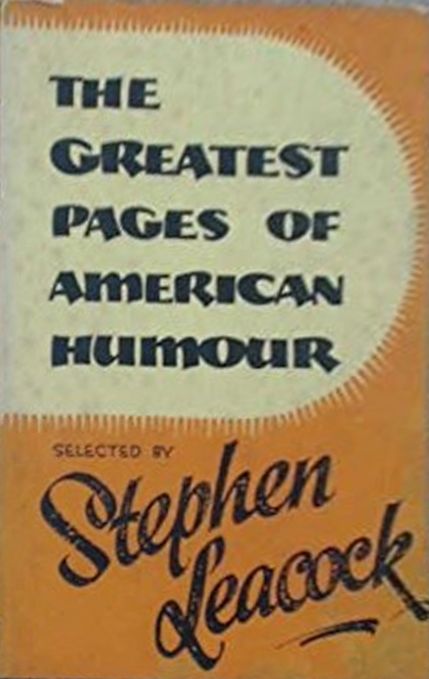
Title: The Greatest Pages of American Humor
Date of first publication: 1936
Author: Stephen Leacock (1869-1944)
Date first posted: October 11, 2025
Date last updated: October 11, 2025
Faded Page eBook #20251017
This eBook was produced by: Alex White & the online Distributed Proofreaders Canada team at https://www.pgdpcanada.net
This file was produced from images generously made available by Internet Archive.
THE GREATEST PAGES OF
American Humor
SELECTED AND DISCUSSED BY
Stephen Leacock
A Study of the Rise and Development of Humorous Writings in America with Selections from the most notable of the Humorists.
COPYRIGHT, 1936
BY DOUBLEDAY, DORAN & COMPANY, INC.
ALL RIGHTS RESERVED
| CHAPTER | PAGE | ||
| I | The Origins of American Humor | 1 | |
| The Indians and the Puritans—A Poor Start for Fun—Action and Reaction—Puritan Sobriety Breeds Yankee Irreverence—From Psalm Books to Farmer’s Almanacs—Benjamin Franklin Brings Down Lightning and Light and Laughter. | |||
| II | Selections From Benjamin Franklin’s Works | 12 | |
| Poor Richard’s Almanac | 12 | ||
| Sending Felons to America | 17 | ||
| Petition of the Letter Z | 18 | ||
| III | Classic America Smiles | 19 | |
| The Young Republic Learns Its Letters—Journalism in a Flood—The Thespian Mirror and The Ladies’ Tea Tray—Who Reads an American Book?—The Barber and the Owl—Irving, Hawthorne and Classical Humor. | |||
| IV | Selections From Irving and Hawthorne | 25 | |
| Rip Van Winkle | 25 | ||
| The Celestial Railroad | 44 | ||
| V | Democracy Starts a Laugh of Its Own | 67 | |
| The New West—It Loosens Up the Old East—The Age of Irreverence—The Minstrel Show—Tall Talk from the West: Captain Crockett—Major Downing and Sam Slick. | |||
| VI | Selections From Crockett, Major Downing and Josh Billings | 73 | |
| Colonel Crockett Snubs Harvard | 73 | ||
| Crockett Finds Philadelphia Too Fast | 77 | ||
| Captain Downing Defies the British | 79 | ||
| Billings on the Mule | 85 | ||
| Billings on the Hen | 86 | ||
| Josh Rebukes Billings | 87 | ||
| VII | Artemus Ward: His Life, His Book, His Death | 90 | |
| High-handed Outrage at Utica | 91 | ||
| Artemus Ward in the Egyptian Hall | 100 | ||
| VIII | Sunrise in the West | 105 | |
| The Happy Isolation of the Pacific Slope—The Lonely Flowers—Bret Harte: the West His Inspiration, the East His Audience, England His Hotel—Mark Twain—Roughing It—The Colours of the Morning that Made a Gilded Age. | |||
| IX | Bert Harte’s “Lothaw” | 109 | |
| X | Mark Twain | 122 | |
| Boyhood as Tom Sawyer—Roughing It Out West as Sam Clemens—Returns East as Mark Twain—Discovers Europe as an Innocent Abroad—Rediscovers America as Huck Finn, and England as a Connecticut Yankee. | |||
| XI | Selections From Mark Twain | 127 | |
| From The Innocents Abroad | 127 | ||
| From Huckleberry Finn | 137 | ||
| Mark Twain Roughs It Across the Plains | 142 | ||
| XII | The “After-Mark” of American Humor | 154 | |
| The Last Quarter of the Nineteenth Century—Bill Nye and the Inspired Idiots—Uncle Remus Brings Back Fairyland—Boston Still Boston. | |||
| XIII | Selections From Max Adeler, Uncle Remus and Oliver Wendell Holmes | 160 | |
| An Accident in a Newspaper Office (Max Adeler) | 160 | ||
| Uncle Remus Initiates the Little Boy | 161 | ||
| Thoughts at the Breakfast Table | 164 | ||
| XIV | The Century Runs Out | 172 | |
| The New Horizon—Mr. Dooley Looks across the Ocean—Mr. Bangs Calls Up the Spirits—Potash and Perlmutter Internationalize Business. | |||
| XV | Selections From Mr. Dooley, John Kendrick Bangs, Hashimura Togo (Wallace Irwin), and George Ade’s Fables | 177 | |
| Mr. Dunne Presents Mr. Dooley | 177 | ||
| Mr. Dooley on the Philippines | 179 | ||
| From A Houseboat on the Styx | 182 | ||
| From Letters of a Japanese Schoolboy | 186 | ||
| “The Fable of Springfield’s Fairest Flower and Lonesome Agnes Who Was Crafty.” | 190 | ||
| XVI | The Enchanted World of O. Henry | 195 | |
| An American Writer—A Shadowed Life—The Amazing Genius of O. Henry—His Visions in Exile and New York—Eyes that Could See without Looking—The Effortless Ease of Genius. | |||
| XVII | Selections From O. Henry | 201 | |
| A Municipal Report | 201 | ||
| Jeff Peters as a Personal Magnet | 221 | ||
| XVIII | Humor in a Changing World | 230 | |
| A Distressed World—Laughter Turns to a Bark—The New Technique of Fun in the Dark—Robert C. Benchley, Irvin Cobb, Ring W. Lardner and Their Fellows. | |||
| XIX | Selections From Benchley, Cobb and Lardner | 235 | |
| From Of All Things | 235 | ||
| From Here Comes the Bride—and So Forth | 246 | ||
| Haircut | |||
| XX | L’envoi: Our Present Need of Humor—Our Brilliant Contemporaries | 270 | |
| From Life | 274 | ||
| From Vanity Fair | 276 | ||
| From the New Yorker | 280 | ||
| Syndicated Laughter | 286 | ||
| The Columnist | 290 | ||
| A Wreath for Will Rogers | 292 | ||
The Indians and the Puritans—A Poor Start for Fun—Action and Reaction—Puritan Sobriety Breeds Yankee Irreverence—From Psalm Books to Farmer’s Almanacs—Benjamin Franklin Brings Down Lightning and Light and Laughter.
On its first settlement from Europe, the outlook for humor in America, and chiefly in New England, looked rather grim. Here on the spot was the Indian, probably the least humorous character recorded in history. He took his pleasure seriously—with a tomahawk. Scientists tell us that humor and laughter had their beginnings, in the dawn of history, in the exultation of the savage over his fallen foe. The North American Indian apparently never got beyond the start. To crack his enemies’ skull with a hatchet was about the limit of the sense of fun of a Seneca or a Pottawottomie. The dawning humor of such races turned off sideways and developed into the mockery and the malice which are its degenerated forms. The distinction is still seen today as between the genial writings of the humorist compared with the snarls of the literary critic.
Not all races were like this. The equatorial Negroes were laughing when the white found them and are laughing still. The Vikings and the Anglo-Saxons were fond of a roaring laugh but had to get drunk first to enjoy it properly. They still do. As beside these merrier races the saturnine Indian, his face carved in stone, seems a thing to shudder at. Long after he had ceased to terrorize the frontier he still terrorized the sidewalk in front of the tobacco stores. Of him it has been written
The painted Indian rides no more;
He stands, at a tobacco store;
His cruel face proclaims afar
The terror of the cheap cigar.
To the Indian was added the Puritan. He came from a land where there was plenty of laughter. But he didn’t care for it. Indeed, it was on that account that he left it. Puritanism was one of the products of the break-up of the Europe of the Middle Ages. The old feudal world was a stagnant place, rather piggish and rather brutal, but rudely comfortable and little changing from century to century. It broke up to give way to a new and restless world—of eager discovery, of unwonted luxury, of rising art and learning, and furious religion. It brought with it a contrast between the new strenuousness and the older ease, between the fat friar, round as Bacchus, and the lean sectary, narrow as a lath; the placid Abbot dozing over a vellum book, and the inquisitive Galileo searching the sky with glass. People of an easy temperament no doubt looked upon the new reformers and preachers, printers and astronomers, much as later ages, rightly or wrongly, looked upon suffragettes, osteopaths and prohibitionists.
Out of the conflict came the Puritan. From a world that laughed too much and worshiped too little, which roared over profane play-acting and danced around maypoles, he turned to the silent ecstasy of the wilderness.
In any great quarrel it is always clear, in retrospect, that both sides were right. It must be so, or there could be no great quarrels among people of valor and conscience. So the Puritan, patterned on an Oliver Cromwell, was right, and the cavalier, embodied at his best and bravest in the merry King Charles the Second, was just as right as he was. The cavalier went to Virginia hoping to laugh. The Puritan went to New England determined not to. In the course of time the Virginian, in a land of beauty and adventure, turned to chivalry and romance; the Puritan, grown irreverent from overpiety, turned into a humorist.
But, at the start, at any rate, the Puritan got what he wanted. Sermons that lasted for hours in plain log meeting-houses, bitter with the cold: no note of music but the human voice and the cheerless pitchpipe; in meeting and out of it a perpetual searching of the soul, varied only with the rude struggle to keep alive the body. Danger was always near. Death was always imminent.
Away went all the festivals and “holy days” of the Church of England, their public celebration forbidden by the laws of the Puritan settlements. Judge Sewell of Boston could write, in 1685, of Christmas Day:
Some somehow observe the day but are vexed to believe that the body of the people profane it, and blessed be God, no authority yet to compel them to keep it.
All evil games were prohibited: the import, the sale and the use of cards were equally against the law; so too dice; and, very generally at first, quoits, bowls and ninepins. It was not till well on in the seventeen hundreds that a reverend pastor first allowed himself a set of pins. But the path was too hard, the pace was too arduous. It went beyond the capacity of human nature. “You may throw nature out with a fork,” says the Roman poet, “but back it comes.” With one kind of holiday gone, another kind rose up. Thus originated Thanksgiving Day—or rather Thanksgiving Week—that first appeared in 1621. It was an orgy of feasting, including the consumption of “a great store of wild turkeys and enough deer and waterfowl to last six days. The company had ‘King Massasoyt’ and ninety of his Indians as fellow revellers with the fifty-five whites.” In the pauses of eating there were public prayers and military drill. For the young folks there were such games as religion sanctioned, such as “stool-ball” or “wicket,” a bat and ball game in which one can reconstruct with reverence the twilight beginnings of the World’s Baseball Series.
Nor could the highest pitch of piety be maintained even in church. Members would doze off asleep, and a “tithing man” was needed to prod them back to attention. The young folks got inattentive and giggled. We read how in the town of Norwich—the year might be about 1670—“Tabatha Morgus of said Norwich did on ye 24 day of February, it being Sabbath on ye Lordes Day, profane ye Lordes day in ye meeting house of ye west society in ye time of ye forenoon service on s’d Day by her rude and Indecent Behaviour in Laughing and Playing in ye time of ye said service which Doinges of ye s’d Tabatha is against ye peace of our Sovereign Lord ye King, his Crown and Dignity”. Tabatha’s parents had to pay three shillings and sixpence. But someone ought to put up a monument to the wicked little girl as America’s first comedian.
But in spite of grimness, merriment would have its way. The law forbade dancing schools, but dancing grew apace. A colonial governor in 1713 actually gave a ball. All sorts of games broke loose, some innocent some cruel, such as capturing wolves and tying them up to be worried to death by dogs. Music came back to its own. The organ appeared in 1711. There was a “consort perform’d by Sundry Instruments at the Court Room by the Town Dock in 1732.” Public punishments, whipping, the stocks, the pillory, and, above all, public executions, developed in New England as in old, into a form of public diversion. The hanging of Captain Quelch and five other pirates at Boston in 1704 was a huge event: Judge Sewell wrote that “cousin Moody saith there were a hundred fifty boats and canoes in the river to look on. He told them.” Meaning he counted them. “When the scaffold was let to sink there was such a screech of the women that my wife heard it,” says the Judge, “sitting in our entry a mile away.”
With the public executions came the funerals as scenes, not of merriment, but of the super-excitement bred from the very dullness of life. In such scenes does our perplexed humanity seek in a make-believe hilarity to cheat the finality of its despair. There was much drinking. “Our Ancestors,” wrote Nathaniel Hawthorne, “were wont to steep their tough old hearts in drink and strong wine and indulge in an outbreak of grisly jollity.” We read that when a Connecticut youth David Porter was drowned in the river at Hartford in 1678, the sum of 1 shilling was spent for a pint of liquor for those who dived for him, 2 shillings for a quart of liquor for those who brought him home, 5 shillings for two quarts of wine and 1 gallon of cider for the jury of inquest who sat on him, and 1 pound 15 shillings for 8 gallons and 3 quarts of wine for the funeral. After that the 12 shillings spent on his coffin seems a mere afterthought.
Literature loosened up and lightened up last. Only long after the exuberance and natural irreverence of youth laid a basis for the rise of humor did any such element appear in the books and writings of the Puritans in America. Such literature as struggled into life among them bore the stamp of their stern and wild surroundings, their fight for life, and their imminent sense of death. Here among their earliest productions is the first real printed book of New England, second only to an Almanac, the famous and venerable “Bay Psalm-Book” of the year 1640. The singing of psalms was notoriously a godly practice. It was looked upon as a vent for the natural merriment of which even a Puritan was guilty at times. The Psalm Book itself, quoting from the fifth Chapter of the Epistle of St. James, says, “If any be merry let him sing psalms.” Any of us today, looking at the rare old book, or a reproduction of it, would certainly feel that to sing it would take all the merriment out of us. But to the people of New England it was an object of love and veneration. They had brought with them various “psalm-books” like the “well-worn psalm-book of Ainsworth,” which Longfellow says lay in the lap of Priscilla (artful creature) when John Alden came to make love by proxy for Miles Standish. But the Puritans were not satisfied till they bought a press, fetched out an English printer and made “a psalm-book”—that is, a singing English version of the songs of David—of their own. To the cruel and irreverent eye of today it is a fearful and wonderful production. Its punctuation would have made Artemus Ward ashamed of his own. Plenty of the type came out upside down, and the spelling was without prejudice. But as Cotton Mather said of it, “God’s altar needs not our polishings.” To the Puritan it was by definition and purpose a merry book. One looks in vain in it for humor, except here and there a touch of that grim exultation over a fallen foe which is the basis of primitive laughter. Take for example the cheering verses, lustily sung, in which is described how “Jael the Kenite” (try Canaanite) woman killed Sisera:
He water asked: she gave him milk,
him butter forth she fetch’d
in lordly dish: then to the nail
She forth her left hand stretched.
Her right the workman’s hammer held
And Sisera struck dead:
She pierced and struck his temple through
And then smote off his head.
He at her feet, bow’d, fell, lay down.
he at her feet bow’d, where
he fell: ev’n where he bowed down
he fell destroyed there.
There would seem from the text little doubt that Sisera fell down. The singing of this in loud and cheery unison, led by the notes of little wooden “pitch-pipes” (a compromise with music), must have been rather good fun. It may have been at such a verse as this that Tabatha Morgus started to snigger. But to get proper information on such a point one must turn to a real book on the subject such as Alice Earle’s book of half a century ago on The Sabbath in Puritan New England.
The Psalm Book came first. After that New England turned out sermons, works on religion and histories. Here we have The Wonder Working Providence of Zion’s Saviour in New England, a history of the settlement written by an Edward Johnson and published in London in 1654; Bradford’s History of the Plymouth Plantation; Cotton Mather’s Magnalia Christi Americana, and Jonathan Edward’s Sinners in the Hands of an Angry God. None of this sounds very cheerful. Indeed it took New England pretty well a century to cheer up. The Harvard library of 1723, we are told, had not admitted Bolingbroke or Addison or Swift or Pope. Yet reading was spreading. Boston booksellers of Queen Anne’s time reaped a harvest, selling works on theology and “execution” sermons—preached at hangings and much sought after, such as Cotton Mather’s tribute to the pirate Captain. Then there were imported pamphlets, poems and plenty of Latin bound in vellum.
But the humblest of all the books was presently destined to outrank and outsell all other profane literature. This was the family Almanac, the parent spring in the rocks of Puritanism from which flowed the current that widened into American Humor. The first Almanac, as already said, had come to New England alongside of the Psalm Book. It was a necessary compilation for pioneer settlers who must needs keep track of days and months and seed time or harvest. The Almanac originally was but a sort of poor cousin of a real book. One recalls how Charles Lamb spoke of it as among “books which are no books.” But in New England, through force of circumstances, it gathered into itself all kinds of useful, miscellaneous and even facetious matter.
“This Family Almanac,” says the New England historian already mentioned, “was a guide, counsellor and friend; a magazine, cyclopedia and jest book.” In many a log cabin the Almanac, hung on a convenient hook, represented along with the revered Bible and the Psalm Book the whole kingdom of letters. The jottings and the commonplaces and the jokes of the Almanac became the seed bed of native literature. People wrote notes into their Almanacs, and, when they possessed books, often inscribed in these, too, notes to chronicle local and domestic happenings. At times the notes have a touch of grim humor. “This day,” so runs one such entry, “died Joseph Bellamy and went to Heaven where he can dictate and domineer no longer.” Into books were often written elaborate cautions against stealing them.
This is Hannah Moxon Her Book.
You may just within it look.
You had better not do more
For old black Satan’s at the door
And will snatch at stealing hands,
Look behind you. There He stands.
In the New England graveyards the home-made epitaphs betrayed, not humor, but at any rate the struggle of unlettered imagination to seek expression. In a few cases the epitaphs are very beautiful.
I came in the morning—it was spring
And I smiled.
I walked out at noon—it was summer
And I was glad.
I sat me down at even—it was autumn
And I was sad.
I laid me down at night—it was winter
And I slept.
In these verses is seen that mystic quality of significance, of reflection and retrospect on life which is found in the highest and greatest humor—where laughter and tears meet.
Some of the old epitaphs, too, contain humor for the beholder but quite unconscious in the author. Thus:
Beneath this Ston’s
Int’r’d the Bon’s
Ah Frail Remains
Of Lieut. Noah Jones.
This ancient composition made such a hit with the Jones family that they followed a not unusual custom of using it over and over again as the especial epitaph of the Jones family whether “frail” like Lieutenant Noah, or otherwise.
Out of this compound of theology and piety, of random Almanacs and odd irreverences grew up the literature of New England: and one of the earliest blossoms on the stem was that which was to become the American Humor. It reached a real blossoming first in the mind and the works of Benjamin Franklin.
Few people will deny that Benjamin Franklin (1706-1790) was one of the greatest men who ever lived, and greatest in the highest sense of the term. As a scientist, an inventor, an author and a patriot, he ranks among the first of mankind. His glory as one of the fathers of the republic and one of the pioneers of science, has dimmed the lesser luster of the humorist. “He snatched the lightning from the cloud, the sceptre from the tyrants,” so runs (in his memory) the happy Latin verse. It might have added “and the laughter from the gods.” Born at Boston in 1706, as number fifteen in a family of seventeen, Franklin had all the sweet uses of adversity. He learned as a child of twelve the trade of a printer, and by that back door, like so many other gifted men, entered the temple of learning. His migration to Philadelphia severed him from New England, but in the sequel his life was continental, and even wider, and his citizenship that of the world. There is no need to list here his achievements at large or the full measure of his writings. But for American Humor a great event happened when young Franklin published in Philadelphia the first of the annual editions of his Poor Richard’s Almanac.
Franklin (1706-1790) wrote in his memoirs: “In 1732 I first published my Almanac under the name of Richard Saunders: it was continued by me about twenty-five years and commonly called Poor Richard’s Almanac. I endeavoured to make it both interesting and useful and it came to be in such demand that I reaped considerable profit from it, vending annually ten thousand.” A special feature of the Almanac was what Franklin himself called “Prudent Maxims and Wise Sayings.”
He’s the best physician that knows the worthlessness of the most medicines.
Love your neighbor, but don’t pull down your hedges.
Whate’er begun in anger ends in shame.
Don’t think to hunt two hares with one dog.
Where there’s marriage without love, there will be love without marriage.
He that is rich need not live sparingly, and he that can live sparingly need not be rich.
None preaches better than the ant, and she says nothing.
A long life may not be good enough, but a good life is long enough.
God heals, and the doctor takes the fees.
He that can travel well afoot keeps a good horse.
Vainglory flowereth, but beareth no fruit.
If you’d have a good servant that you like, serve yourself.
Pride breakfasted with Plenty, dined with Poverty, supped with Infamy.
To be proud of virtue is to poison yourself with the antidote.
Buy what thou hast no need of, and ere long thou shalt sell thy necessaries.
If you do what you should not, you must hear what you would not.
A good example is the best sermon.
Search others for their virtues, thyself for thy vices.
Sound and sound doctrine may pass through a ram’s horn and a preacher without straightening the one or amending the other.
Proclaim not all thou knowest, all thou owest, all thou hast, nor all thou canst.
Lend money to an enemy, and thou’lt gain him; to a friend, and thou’lt lose him.
If you would keep your secret from an enemy, tell it not to a friend.
POOR RICHARD HELPS HIS CIRCULATION
Not the least amusing of Franklin’s quips and fancies as Poor Richard was the ingenious way in which Richard helps the sale of his almanac by posing as an astrologer and prophesying the death of Mr. Titus Leeds, his only trade rival. Leeds angrily replied by calling attention to his continued existence. No one knows if Leeds was an easy mark or a kindred spirit. Franklin rejoins but explaining that Leeds is really dead and some impostor is replacing him. When Leeds later on actually died, Franklin claims to score at last—a piece of humor too grim for our age.
RICHARD PROPHESIES LEEDS’S DEATH (1733)
Indeed this motive (the prospect of considerable profits) would have had force enough to have made me publish an Almanac many years since, had it not been overpowered by my regard for my good friend and fellow student, Mr. Titan Leeds, whose interest I was extreamly unwilling to hurt.
But this obstacle (I am far from speaking of it with pleasure) is soon to be removed, since inexorable death, who was never known to respect merit, has already prepared the mortal dart; the fatal sister has already extended her destroying shears, and that ingenious man must soon be taken from us. He dies, by my calculation, made at his request, on Oct. 17, 1733, 3 ho., 29 min., P.M., at the very instant of the ♂ of ☉ and ☿. By his own calculation he will survive till the 26th of the same month. This small difference between us we have disputed whenever we have met these nine years past; but at length he is inclinable to agree with my judgment; which of us is most exact, a little time will now determine.
LEEDS’S DENIAL (1734)
Kind reader:
Perhaps it may be expected that I should say something concerning an Almanack printed for the Year 1733, Said to be writ by Poor Richard or Richard Saunders, who for want of other matter was pleased to tell his Readers, that he had calculated my Nativity, and from thence predicts my Death to be the 17th of October, 1733, at 22 min. past 3 a-Clock in the Afternoon, and that these Provinces may not expect to see any more of his (Titan Leeds) Performances, and this precise Predicter, who predicts to a Minute, proposes to succeed me in Writing of Almanacks; but notwithstanding his false Prediction, I have by the Mercy of God lived to write a Diary for the Year 1734, and to publish the Folly and Ignorance of this presumptuous Author.
RICHARD KILLS LEEDS AGAIN (1734)
In the preface to my last Almanack, I foretold the death of my dear old friend and fellow-student, the learned and ingenious Mr. Titan Leeds, which was to be the 17th of October, 1733, 3 h., 29 m., p.m., at the very instant of the ♂ of ☉ and ☿. By his own calculation, he was to survive till the 26th of the same month, and expire in the time of the eclipse, near 11 o’clock, a.m. At which of these times he died, or whether he be really yet dead, I cannot at this present writing positively assure my readers; for as much as a disorder in my own family demanded my presence, and would not permit me, as I had intended, to be with him in his last moments, to receive his last embrace, to close his eyes, and do the duty of a friend in performing the last offices to the departed. Therefore it is that I cannot positively affirm whether he be dead or not; for the stars only show to the skilful what will happen in the natural and universal chain of causes and effects; but it is well known, that the events which would otherwise certainly happen, at certain times, in the course of nature, are sometimes set aside or postpon’d, for wise and good reasons, by the immediate particular disposition of Providence; which particular dispositions the stars can by no means discover or foreshow. There is, however, (and I cannot speak it without sorrow,) the strongest probability that my dear friend is no more; for there appears in his name, as I am assured, an Almanack for the year 1734, in which I am treated in a very gross and unhandsome manner; in which I am called a false predicter, an ignorant, a conceited scribbler, a fool, and a lyar. Mr. Leeds was too well bred to use any man so indecently and so scurrilously, and moreover his esteem and affection for me was extraordinary; so that it is to be feared that pamphlet may be only a contrivance of somebody or other, who hopes, perhaps, to sell two or three years’ Almanacks still, by the sole force and virtue of Mr. Leeds’ name.
LEEDS RESURRECTS HIMSELF AND DIES
Leeds violently protested again that he was alive. Franklin denied it and then got tired of Leeds and let him go. But when Leeds really died in 1738 Franklin saw good copy in him and used it, thus:
Courteous reader:
You may remember that in my first Almanac, published for the Year 1733, I predicted the Death of my dear Friend Titan Leeds, Philomat, to happen that Year on the 17th Day of October, 3 h. 29 m. p.m. But W.B. and A.B. have continued to publish Almanacks in his Name ever since; asserting for some Years that he was still living. At length when the Truth could no longer be conceal’d from the World, they confess his Death in their Almanack for 1739, but pretend that he died not till last Year, and that before his departure he had furnished them with Calculations for 7 Years to come. Ah, My Friends, these are poor Shifts and thin Disguises; . . .”
SENDING FELONS TO AMERICA
Franklin’s writings contain many quaint and humorous conceits in the guise of little essays such as the well-known Petition of the letter Z, The Craven Street Gazette, and the following protest, cast in humorous form, against the sending of criminals to the colonies.
We may all remember the time when our mother country, as a mark of her parental tenderness, emptied her gaols into our habitations, “for the BETTER peopling,” as she expressed it, “of the colonies.” It is certain that no due returns have yet been made for these valuable consignments. We are therefore much in her debt on that account; and, as she is of late clamorous for the payment of all we owe her, and some of our debts are of a kind not so easily discharged, I am for doing however what is in our power. It will show our good-will as to the rest. The felons she planted among us have produced such an amazing increase, that we are now enabled to make ample remittance in the same commodity. And since the wheelbarrow law is not found effectually to reform them and many of our vessels are idle through her restraints on our trade, why should we not employ those vessels in transporting the felons to Britain?
On second thoughts, I am of opinion, that besides employing our own vessels, as above proposed, every English ship arriving in our ports with goods for sale, should be obliged to give bond, before she is permitted to trade, engaging that she will carry back to Britain at least one felon for every fifty tons of her burthen. Thus we shall not only discharge sooner our debts, but furnish our old friends with the means of “better peopling,” and with more expedition, their promising new colony of Botany Bay.
BENJAMIN FRANKLIN’S PETITION OF THE LETTER Z
From The Tatler, No. 1778
To the worshipful isaac bickerstaff, esquire, Censor-General.
The petition of the letter Z, commonly called Ezzard, Zed, or Izard, most humbly showeth;
That your petitioner is of as high extraction, and has as good an estate as any other letter of the Alphabet;
That there is therefore no reason why he should be treated as he is, with disrespect and indignity;
That he is not only actually placed at the tail of the Alphabet, when he has as much right as any other to be at the head; but is by the injustice of his enemies totally excluded from the word WISE; and his place injuriously filled in by a little hissing, crooked, serpentine, venomous letter, called S, when it must be evident to your worship, and to all the world, that W, I, S, E, do not spell Wize, but Wise.
Your petitioner therefore prays, that the alphabet may by your censorial authority be reversed; and that in consideration of his long-suffering and patience he may be placed at the head of it; that s may be turned out of the word Wise; and the petitioner employed instead of him.
And your petitioner, as in duty bound, shall ever pray, &c, &c.
Mr. Bickerstaff, having examined the allegations of the above petition, judges and determines, that Z be admonished to be content with his station, forbear reflections upon his brother letters, and remember his own small usefulness, and the little occasion there is for him in the Republic of Letters, since S whom he so despises can so well serve instead of him.
The Young Republic Learns Its Letters—Journalism in a Flood: The Thespian Mirror and The Ladies’ Tea-Tray—Who Reads an American Book? The Barber and the Owl—Irving, Hawthorne and Classical Humor.
All that Benjamin Franklin did in the way of imaginative literature, humorous or otherwise, was merely a beginning. It was notable rather for its promise than for its achievement. Nor had his colonial contemporaries produced any work of imagination beyond a certain amount of very “elegant” verse, and a few equally “elegant” narratives which people were beginning to call “novels.” These included such effusions as Wiggleworth’s Day of Doom, and such tales as The Power of Sympathy, or The Triumph of Nature, a Novel Founded on Truth and Dedicated to the Young Ladies of America. The high standard of morality and female impeccability maintained in these works disarms all criticism. Franklin’s fellow patriots of the Revolution and of the young republic only took up the pen to use it as pamphleteers, as lawyers, as the writers of state papers. Such humor as they expressed aimed rather at the form of Attic wit and classic satire than that of native fun and broad grins. Indeed there was all through this period during which American literature was struggling into existence a sort of contrast and conflict between the classicism of the schools and the native thought of the people. It was in point of culture a classic age, knowing nothing else. Science was still for the ingenious investigator, not for the student at large. The colleges lived on Latin and Greek. Patriots named their new towns as Athens and Syracuse and Troy; Carthage called to Rome; and Utica invited still its Cato. The veterans banded as Cincinnati, and correspondents to the newspapers labeled themselves Pater Familias and Marcus Brutus Junior.
Thus they struck the rock of ancient learning, but the spring failed to flow from under it. “Literature pure and simple,” says the American, the “100 per cent American,” historian McMaster, “never existed in America till Washington Irving began to write.” McMaster thinks that it “could not have been otherwise. They were too busy clearing farms, cutting woods, building towns, acquiring wealth, to have any time for literature.” It is true that when the new century got started on the rapid development that followed the peace of 1815, there was a terrific outbreak of journalism. Here began the “Magazines,” the “Repositories” and the “Mirrors” that soon flooded the country. Editors vied in originality in the titles of their publications. There was a Thespian Mirror at New York together with a Ladies’ Literary Cabinet. Baltimore had a Ladies’ Tea-Tray, and Philadelphia, among many others, a Juvenile Port Folio. Some of the magazines jumped into the new arena in the capacity of the clown. There was a journal, The Fool, by Tom Brainless, published at Salem. In New York was the Trangram or Fashionable Trifler, by Christopher Crog Esquire, his Grandmother and his Uncle. It was outdone, however, by The Luncheon, Boiled for People about Six Feet High by Simon Pure.
Thus was the mountain in labor and brought forth scarcely a mouse. The truth is that the Americans themselves suffered in the matter from what we now call an “inferiority complex.” The effect of classic education was to make America seem a mere uncouth wilderness, to let the story of human courage end with Thermopylae, and to let human love die with Dido. They were like people in a treasure chamber with no light to see its wealth.
Thus a certain John Bristed, a journalist of the period, could write in 1818:
Of native novels we have no great stock, and none good; our democratic institutions placing all the people on a dead level of political equality; and the pretty equal diffusion of property throughout the country affords but little room for varieties, and contrasts of character; nor is there much scope for fiction, as the country is quite new, and all that has happened from the first settlement to the present hour, respecting it, is known to every one. There is, to be sure, some traditionary romance about the Indians; but a novel describing these miserable barbarians, their squaws, and papooses, would not be very interesting to the present race of American readers.
And if the Americans had an inferiority complex in literature, their British cousins offered to them no aid to get out of it. It was the thing in polite Edinburgh and polished London to despise all things American. One recalls the sneers of the Quarterly Review and its fellows.
The States of America [wrote a London critic in the course of the Second War] can never have a native literature any more than they can have a native character. Even their wildernesses and deserts, their mountains, lakes, and forests, will produce nothing romantic or pastoral, for these remote regions are only relinquished by pagan savages to receive into their deep recesses, hordes of discontented Democrats, mad unnatural enthusiasts, and needy or desperate adventurers.
Best remembered of all, and not likely to be forgotten, is the sweeping condemnation of Republican America written in the Edinburgh Review in 1820 by the famous Sydney Smith.
In the four quarters of the globe [he writes], who reads an American book? or goes to an American play? or looks at an American statue or picture? What does the world yet owe to American physicians or surgeons? What new substances have their chemists discovered, or what old ones have they analyzed? What new constellations have been discovered by the telescopes of Americans? What have they done in mathematics? Who drinks out of American glasses? or eats from American plates? or wears American coats or gowns? or sleeps in American blankets?
Sydney Smith, who was a humorist, stopped just in time. It is lucky that he didn’t go on to say, “Who laughs at an American joke?” For the time was coming.
The Americans, for the most part, took it lying down. Attacks on their institutions they resented and repudiated. For their literature they had nothing but apologies. And then—just when all the world had agreed that America couldn’t write, it began to. There appeared Washington Irving. One recalls the ancient rhyme of the stuffed owl in the barber shop, criticized by a customer in the chair for its lack of correspondence to a live owl, the barber maintaining a discreet silence.
“That owl up there,”
Said the man in the chair,
“Is stuffed all wrong, I do declare.
See the feet—wrong size!
Wrong feathers, wrong eyes.”
And the barber kept on shaving.
* * * * *
And, then, when the man in the chair got through,
The owl hopped off its perch and it flew,—
And the barber kept on shaving.
With Washington Irving began the long honor roll of American writers who carried on in America the form and tradition of their British predecessors. They wrote English—the Washington Irvings and the Fenimore Coopers, the Hawthornes and the Longfellows—English, not American. Every now and then there breaks out in our literary journals the controversy as to what is American literature and whether Longfellow and such wrote it. If by American literature is meant books written by Americans in an American way, in a way that a British writer might admire but couldn’t emulate, then there was no American literature at this epoch—none till Mark Twain and O. Henry and such showed how to write it, just as there is no such thing as Canadian literature today, meaning books written by Canadians in a Canadian way.
The American writers of Irving’s time belonged with the British in a common stock. Beside and beneath the classic writers were another crowd striving for utterance in their own way. Ultimately they were to find it, and it was in the province of humor that American literature first came into its own. But for the time, humor was represented by the polished “classical” work of Washington Irving, direct descendant of Addison and Steele of the eighteenth century. Irving (1783-1859) came before the American public as early as 1809 as a newspaper contributor of odds and ends of burlesque which presently turned into “Knickerbocker’s” History of New York. But it was the London publication of his Sketch Book in 1820, the very year of Sydney Smith’s denunciation, which admitted him once and for all into the first rank of the world of letters. From the Sketch Book is taken the story of Rip Van Winkle, reproduced in the next chapter. As the old French chroniclers used to say, “Who hasn’t read that, hasn’t read anything.”
Side by side with Irving one places Nathaniel Hawthorne (1804-1864), his counterpart in style and training. Though with each a different cast of mind, for Hawthorne ran to mysticism, they shared something of the same beautiful detachment from sordid things, the same power of absorption in nature and the same vision of much in little. In their humor they came together. In each case it is based on the polished models of England and France. There is nothing “native” about it. Hawthorne’s “Celestial Railroad,” reproduced in the next chapter, an adaptation of Bunyan’s Pilgrim’s Progress to the wicked, clattering world of railways and machinery, runs closely parallel to Irving’s work.
Whoever has made a voyage up the Hudson must remember the Kaatskill Mountains. They are a dismembered branch of the great Appalachian family, and are seen away to the west of the river, swelling up to a noble height, and lording it over the surrounding country. Every change of season, every change of weather, indeed, every hour of the day, produces some change in the magical hues and shapes of these mountains, and they are regarded by all the good wives, far and near, as perfect barometers. When the weather is fair and settled, they are clothed in blue and purple, and print their bold outlines on the clear evening sky; but, sometimes, when the rest of the landscape is cloudless, they will gather a hood of gray vapours about their summits, which, in the last rays of the setting sun, will glow and light up like a crown of glory.
At the foot of these fairy mountains, the voyager may have descried the light smoke curling up from a village, whose shingle-roofs gleam among the trees, just where the blue tints of the upland melt away into the fresh green of the nearer landscape. It is a little village of great antiquity, having been founded by some of the Dutch colonists, in the early times of the province, just about the beginning of the government of the good Peter Stuyvesant (may he rest in peace!), and there were some of the houses of the original settlers standing within a few years, built of small yellow bricks brought from Holland, having latticed windows and gable fronts, surmounted with weather-cocks.
In that same village, and in one of these very houses (which, to tell the precise truth, was sadly time-worn and weather-beaten), there lived many years since, while the country was yet a province of Great Britain, a simple good-natured fellow of the name of Rip Van Winkle. He was a descendant of the Van Winkles who figured so gallantly in the chivalrous days of Peter Stuyvesant, and accompanied him to the siege of Fort Christina. He inherited, however, but little of the martial character of his ancestors. I have observed that he was a simple, good-natured man; he was, moreover, a kind neighbour, and an obedient hen-pecked husband. Indeed, to the latter circumstance might be owing that meekness of spirit which gained him such universal popularity; for those men are most apt to be obsequious and conciliating abroad who are under the discipline of shrews at home. Their tempers, doubtless, are rendered pliant and malleable in the fiery furnace of domestic tribulation; and a curtain lecture is worth all the sermons in the world for teaching the virtues of patience and long-suffering. A termagant wife may, therefore, in some respects, be considered a tolerable blessing; and if so, Rip Van Winkle was thrice blessed.
Certain it is, that he was a great favourite among all the good wives of the village, who, as usual with the amiable sex, took his part in all family squabbles, and never failed, whenever they talked those matters over in their evening gossipings, to lay all the blame on Dame Van Winkle. The children of the village, too, would shout with joy whenever he approached. He assisted at their sports, made their playthings, taught them to fly kites, and shoot marbles, and told them long stories of ghosts, witches, and Indians. Whenever he went dodging about the village, he was surrounded by a troop of them, hanging on his skirts, clambering on his back, and playing a thousand tricks on him with impunity; and not a dog would bark at him throughout the neighbourhood.
The great error in Rip’s composition was an insuperable aversion to all kinds of profitable labour. It could not be from the want of assiduity or perseverance; for he would sit on a wet rock, with a rod as long and heavy as a Tartar’s lance, and fish all day without a murmur, even though he should not be encouraged by a single nibble. He would carry a fowling-piece on his shoulder for hours together, trudging through woods and swamps, and up hill and down dale, to shoot a few squirrels or wild pigeons. He would never refuse to assist a neighbour even in the roughest toil, and was a foremost man at all country frolics for husking Indian corn, or building stone fences; the women of the village, too, used to employ him to run their errands, and to do such little odd jobs as their less obliging husbands would not do for them. In a word, Rip was ready to attend to anybody’s business but his own; but as to doing family duty, and keeping his farm in order, he found it impossible.
In fact, he declared it was of no use to work on his farm; it was the most pestilent little piece of ground in the whole country; everything about it went wrong, and would go wrong, in spite of him. His fences were continually falling to pieces; his cow would either go astray, or get among the cabbages; weeds were sure to grow quicker in his fields than anywhere else; the rain always made a point of setting in just as he had some outdoor work to do; so that, though his patrimonial estate had dwindled away under his management, acre by acre, until there was little more left than a mere patch of Indian corn and potatoes, yet it was the worst-conditioned farm in the neighbourhood.
His children, too, were as ragged and wild as if they belonged to nobody. His son Rip, an urchin begotten in his own likeness, promised to inherit the habits with the old clothes of his father. He was generally seen trooping like a colt at his mother’s heels, equipped in a pair of his father’s cast-off galligaskins, which he had much ado to hold up with one hand, as a fine lady does her train in bad weather.
Rip Van Winkle, however, was one of those happy mortals, of foolish, well-oiled dispositions, who take the world easy, eat white bread or brown, whichever can be got with least thought or trouble, and would rather starve on a penny than work for a pound. If left to himself, he would have whistled life away in perfect contentment; but his wife kept continually dinning in his ears about his idleness, his carelessness, and the ruin he was bringing on his family. Morning, noon, and night, her tongue was incessantly going, and everything he said or did was sure to produce a torrent of household eloquence. Rip had one way of replying to all lectures of the kind, and that, by frequent use, had grown into a habit. He shrugged his shoulders, shook his head, cast up his eyes, but said nothing. This, however, always provoked a fresh volley from his wife; so that he was fain to draw off his forces, and take to the outside of the house—the only side which, in truth, belongs to a hen-pecked husband.
Rip’s old domestic adherent was his dog Wolf, who was as much hen-pecked as his master; for Dame Van Winkle regarded them as companions in idleness, and even looked upon Wolf with an evil eye, as the cause of his master’s going so often astray. True it is, in all points of spirit befitting an honourable dog, he was as courageous an animal as ever scoured the woods—but what courage can withstand the ever-during and all-besetting terrors of a woman’s tongue? The moment Wolf entered the house his crest fell, his tail dropped to the ground, or curled between his legs, he sneaked about with a gallows air, casting many a sidelong glance at Dame Van Winkle, and at the least flourish of a broom-stick or ladle he would fly to the door with yelping precipitation.
Times grew worse and worse with Rip Van Winkle as years of matrimony rolled on; a tart temper never mellows with age, and a sharp tongue is the only edged tool that grows keener with constant use. For a long while he used to console himself, when driven from home, by frequenting a kind of perpetual club of the sages, philosophers, and other idle personages of the village, which held its sessions on a bench before a small inn, designated by a rubicund portrait of his Majesty George the Third. Here they used to sit in the shade through a long lazy summer’s day, talking listlessly over village gossip, or telling endless sleepy stories about nothing. But it would have been worth any statesman’s money to have heard the profound discussions that sometimes took place, when by chance an old newspaper fell into their hands from some passing traveller. How solemnly they would listen to the contents, as drawled out by Derrick Van Bummel, the schoolmaster, a dapper, learned little man, who was not to be daunted by the most gigantic word in the dictionary; and how sagely they would deliberate upon public events some months after they had taken place!
The opinions of this junto were completely controlled by Nicholas Vedder, a patriarch of the village, and landlord of the inn, at the door of which he took his seat from morning till night, just moving sufficiently to avoid the sun and keep in the shade of a large tree; so that the neighbours could tell the hour by his movements as accurately as by a sun dial. It is true he was rarely heard to speak, but smoked his pipe incessantly. His adherents, however (for every great man has his adherents), perfectly understood him, and knew how to gather his opinions. When anything that was read or related displeased him, he was observed to smoke his pipe vehemently, and to send forth short, frequent, and angry puffs; but when pleased, he would inhale the smoke slowly and tranquilly, and emit it in light and placid clouds; and sometimes, taking the pipe from his mouth, and letting the fragrant vapour curl about his nose, would gravely nod his head in token of perfect approbation.
From even this stronghold the unlucky Rip was at length routed by his termagant wife, who would suddenly break in upon the tranquillity of the assemblage and call the members all to naught; nor was that august personage, Nicholas Vedder himself, sacred from the daring tongue of this terrible virago, who charged him outright with encouraging her husband in habits of idleness.
Poor Rip was at last reduced almost to despair; and his only alternative, to escape from the labour of the farm and clamour of his wife, was to take gun in hand and stroll away into the woods. Here he would sometimes seat himself at the foot of a tree, and share the contents of his wallet with Wolf, with whom he sympathised as a fellow-sufferer in persecution. “Poor Wolf,” he would say, “thy mistress leads thee a dog’s life of it; but never mind, my lad, whilst I live thou shalt never want a friend to stand by thee!” Wolf would wag his tail, look wistfully in his master’s face, and, if dogs can feel pity, I verily believe he reciprocated the sentiment with all his heart.
In a long ramble of the kind on a fine autumnal day, Rip had unconsciously scrambled to one of the highest parts of the Kaatskill Mountains. He was after his favourite sport of squirrel-shooting, and the still solitudes had echoed and re-echoed with the reports of his gun. Panting and fatigued, he threw himself, late in the afternoon, on a green knoll, covered with mountain herbage, that crowned the brow of a precipice. From the opening between the trees he could overlook all the lower country for many a mile of rich woodland. He saw at a distance the lordly Hudson, far, far below him, moving on its silent but majestic course, with the reflection of a purple cloud, or the sail of a large bark, here and there sleeping on its grassy bosom, and at last losing itself in the blue highlands.
On the other side he looked down into a deep mountain glen, wide, lonely, and shagged, the bottom filled with fragments from the impending cliffs, and scarcely lighted by the reflected rays of the setting sun. For some time Rip lay musing on this scene; evening was gradually advancing; the mountains began to throw their long blue shadows over the valleys; he saw that it would be dark long before he could reach the village, and he heaved a heavy sigh when he thought of encountering the terrors of Dame Van Winkle.
As he was about to descend, he heard a voice from a distance, hallooing, “Rip Van Winkle! Rip Van Winkle!” He looked round, but could see nothing but a crow winging its solitary flight across the mountain. He thought his fancy must have deceived him, and turned again to descend, when he heard the same cry ring through the still evening air: “Rip Van Winkle! Rip Van Winkle!”—at the same time Wolf bristled up his back, and, giving a low growl, skulked to his master’s side, looking fearfully down into the glen. Rip now felt a vague apprehension stealing over him; he looked anxiously in the same direction, and perceived a strange figure slowly toiling up the rocks, and bending under the weight of something he carried on his back. He was surprised to see any human being in this lonely and unfrequented place, but supposing it to be some one of the neighbourhood in need of his assistance, he hastened down to yield it.
On nearer approach he was still more surprised at the singularity of the stranger’s appearance. He was a short, square-built old fellow, with thick bushy hair, and a grizzled beard. His dress was of the antique Dutch fashion—a cloth jerkin strapped round the waist—several pair of breeches, the outer one of ample volume, decorated with rows of buttons down the sides, and bunches at the knees. He bore on his shoulder a stout keg, that seemed full of liquor, and made signs for Rip to approach and assist him with the load. Though rather shy and distrustful of this new acquaintance, Rip complied with his usual alacrity; and mutually relieving one another, they clambered up a narrow gully, apparently the dry bed of a mountain torrent. As they ascended, Rip every now and then heard long rolling peals like distant thunder, that seemed to issue out of a deep ravine, or, rather, cleft, between lofty rocks, toward which their rugged path conducted. He paused for an instant, but supposing it to be the muttering of one of those transient thundershowers which often take place in mountain heights, he proceeded. Passing through the ravine, they came to a hollow, like a small amphitheatre, surrounded by perpendicular precipices, so that you only caught glimpses of the azure sky and the bright evening cloud. During the whole time Rip and his companion had laboured on in silence; for though the former marvelled greatly what could be the object of carrying a keg of liquor up this wild mountain, yet there was something strange and incomprehensible about the unknown that inspired awe and checked familiarity.
On entering the amphitheatre, new objects of wonder presented themselves. On a level spot in the centre was a company of odd-looking personages playing at nine-pins. They were dressed in a quaint outlandish fashion; some wore short doublets, others jerkins, with long knives in their belts, and, most of them had enormous breeches, of similar style with that of the guide’s. Their visages, too, were peculiar: one had a large beard, broad face, and small piggish eyes: the face of another seemed to consist entirely of nose, and was surmounted by a white sugar-loaf hat set off with a little red cock’s tail. They all had beards, of various shapes and colours. There was one who seemed to be the commander. He was a stout old gentleman, with a weather-beaten countenance; he wore a laced doublet, broad belt and hanger, high-crowned hat and feather, red stockings and high-heeled shoes, with roses in them. The whole group reminded Rip of the figures in an old Flemish painting, in the parlour of Dominie Van Shaick, the village parson, and which had been brought over from Holland at the time of the settlement.
What seemed particularly odd to Rip was, that though these folks were evidently amusing themselves, yet they maintained the gravest faces, the most mysterious silence, and were, withal, the most melancholy party of pleasure he had ever witnessed. Nothing interrupted the stillness of the scene but the noise of the balls, which, whenever they were rolled, echoed along the mountains like rumbling peals of thunder.
As Rip and his companion approached them, they suddenly desisted from their play and stared at him with such fixed statue-like gaze, and such strange, uncouth, lacklustre countenances, that his heart turned within him, and his knees smote together. His companion now emptied the contents of the keg into large flagons, and made signs to him to wait upon the company. He obeyed with fear and trembling; they quaffed the liquor in profound silence, and then returned to their game.
By degrees Rip’s awe and apprehension subsided. He even ventured, when no eye was fixed upon him, to taste the beverage, which he found had much of the flavour of excellent Hollands. He was naturally a thirsty soul, and was soon tempted to repeat the draught. One taste provoked another; and he reiterated his visits to the flagon so often that at length his senses were overpowered, his eyes swam in his head, his head gradually declined, and he fell into a deep sleep.
On waking, he found himself on the green knoll whence he had first seen the old man of the glen. He rubbed his eyes—it was a bright sunny morning. The birds were hopping and twittering among the bushes, and the eagle was wheeling aloft, and breasting the pure mountain breeze. “Surely,” thought Rip, “I have not slept here all night.” He recalled the occurrences before he fell asleep. The strange man with a keg of liquor—the mountain ravine—the wild retreat among the rocks—the woebegone party at nine-pins—the flagon—“Oh! that flagon!” thought Rip—“what excuse shall I make to Dame Van Winkle?”
He looked round for his gun, but in place of the clean, well-oiled fowling-piece, he found an old firelock lying by him, the barrel encrusted with rust, the lock falling off, and the stock worm-eaten. He now suspected that the grave roysters of the mountain had put a trick upon him, and, having dosed him with liquor, had robbed him of his gun. Wolf, too, had disappeared, but he might have strayed away after a squirrel or partridge. He whistled after him and shouted his name, but all in vain; the echoes repeated his whistle and shout, but no dog was to be seen.
He determined to revisit the scene of the last evening’s gambol, and if he met with any of the party, to demand his dog and gun. As he rose to walk, he found himself stiff in the joints, and wanting in his usual activity. “These mountain beds do not agree with me,” thought Rip, “and if frolic should lay me up with a fit of the rheumatism, I shall have a blessed time with Dame Van Winkle.” With some difficulty he got down into the glen: he found the gully up which he and his companions had ascended the preceding evening; but to his astonishment a mountain stream was now foaming down it, leaping from rock to rock, and filling the glen with babbling murmurs. He, however, made a shift to scramble up its sides, working his tiresome way through thickets of birch, sassafras, and witch-hazel, and sometimes tripped up or entangled by the wild grape-vines that twisted their coils or tendrils from tree to tree, and spread a kind of network in his path.
At length he reached to where the ravine had opened through the cliffs to the amphitheatre, but no traces of such opening remained. The rocks presented a high impenetrable wall over which the torrent came tumbling in a sheet of feathery foam, and fell into a broad deep basin, black from the shadows of the surrounding forest. Here, then, poor Rip was brought to a stand. He again called and whistled after his dog; he was only answered by the cawing of a flock of idle crows, sporting high in air about a dry tree that overhung a sunny precipice, and who, secure in their elevation, seemed to look down and scoff at the poor man’s perplexities. What was to be done? The morning was passing away, and Rip felt famished for want of his breakfast. He grieved to give up his dog and gun; he dreaded to meet his wife; but it would not do to starve among the mountains. He shook his head, shouldered the rusty firelock, and, with a heart full of trouble and anxiety, turned his steps homeward.
As he approached the village he met a number of people, but none whom he knew, which somewhat surprised him, for he had thought himself acquainted with every one in the country round. Their dress, too, was of a different fashion from that to which he was accustomed. They all stared at him with equal marks of surprise, and, whenever they cast their eyes upon him, invariably stroked their chins. The constant recurrence of this gesture induced Rip, involuntarily, to do the same, when, to his astonishment, he found his beard had grown a foot long!
He had now entered the skirts of the village. A troop of strange children ran at his heels, hooting after him, and pointing at his grey beard. The dogs, too, not one of which he recognised for an old acquaintance, barked at him as he passed. The very village was altered; it was larger and more populous. There were rows of houses which he had never seen before, and those which had been his familiar haunts had disappeared. Strange names were over the doors—strange faces at the windows—everything was strange. His mind now misgave him; he began to doubt whether both he and the world around him were not bewitched. Surely this was his native village, which he had left but the day before. There stood the Kaatskill Mountains—there ran the silver Hudson at a distance—there was every hill and dale precisely as it had always been—Rip was sorely perplexed—“That flagon last night,” thought he, “has addled my poor head sadly!”
It was with some difficulty that he found the way to his own house, which he approached with silent awe, expecting every moment to hear the shrill voice of Dame Van Winkle. He found the house gone to decay—the roof fallen in, the windows shattered, and the doors off the hinges. A half-starved dog that looked like Wolf was skulking about it. Rip called him by name, but the cur snarled, showed his teeth, and passed on. This was an unkind cut indeed—“My very dog,” sighed poor Rip, “has forgotten me!”
He entered the house, which, to tell the truth, Dame Van Winkle had always kept in neat order. It was empty, forlorn, and apparently abandoned. The desolateness overcame all his connubial fears—he called loudly for his wife and children—the lonely chambers rang for a moment with his voice, and then all again was silent.
He now hurried forth, and hastened to his old resort, the village inn—but it too was gone. A large rickety wooden building stood in its place, with great gaping windows, some of them broken and mended with old hats and petticoats, and over the door was painted, “The Union Hotel, by Jonathan Doolittle.” Instead of the great tree that used to shelter the quiet little Dutch inn of yore, there now was reared a tall naked pole, with something on the top that looked like a red night-cap, and from it was fluttering a flag, on which was a singular assemblage of stars and stripes—all this was strange and incomprehensible. He recognised on the sign, however, the ruddy face of King George, under which he had smoked so many a peaceful pipe; but even this was singularly metamorphosed. The red coat was changed for one of blue and buff, a sword was held in the hand instead of a sceptre, the head was decorated with a cocked hat, and underneath was painted in large characters, GENERAL WASHINGTON.
There was, as usual, a crowd of folk about the door, but none that Rip recollected. The very character of the people seemed changed. There was a busy, bustling, disputatious tone about it instead of the accustomed phlegm and drowsy tranquillity. He looked in vain for the sage Nicholas Vedder, with his broad face, double chin, and fair long pipe, uttering clouds of tobacco-smoke instead of idle speeches; or Van Bummel, the schoolmaster, doling forth the contents of an ancient newspaper. In place of these, a lean, bilious-looking fellow, with his pockets full of handbills, was haranguing vehemently about rights of citizens—elections—members of Congress—liberty—Bunker’s Hill—heroes of seventy-six—and other words, which were a perfect Babylonish jargon to the bewildered Van Winkle.
The appearance of Rip, with his long grizzled beard, his rusty fowling-piece, his uncouth dress, and an army of women and children at his heels, soon attracted the attention of the tavern politicians. They crowded around him, eyeing him from head to foot with great curiosity. The orator bustled up to him, and, drawing him partly aside, inquired “on which side he voted?” Rip stared in vacant stupidity. Another short but busy little fellow pulled him by the arm, and, rising on tiptoe, inquired in his ear, “Whether he was Federal or Democrat?” Rip was equally at a loss to comprehend the question; when a knowing, self-important old gentleman, in a sharp cocked hat, made his way through the crowd, putting them to the right and left with his elbows as he passed, and planting himself before Van Winkle, with one arm akimbo, the other resting on his cane, his keen eyes and sharp hat penetrating, as it were, into his very soul, demanded in an austere tone, “what brought him to the election with a gun on his shoulder; and a mob at his heels, and whether he meant to breed a riot in the village?”—“Alas! gentlemen,” cried Rip, somewhat dismayed, “I am a poor quiet man, a native of this place, and a loyal subject of the King, God bless him!”
Here a general shout burst from the bystanders—“A Tory! a Tory! a spy! a refugee! hustle him; away with him!” It was with great difficulty that the self-important man in the cocked hat restored order; and, having assumed a tenfold austerity of brow, demanded again of the unknown culprit, what he came there for, and whom he was seeking? The poor man humbly assured him that he meant no harm, but merely came there in search of some of his neighbours, who used to keep about the tavern.
“Well—who are they?—name them.”
Rip thought himself a moment, and inquired, “Where’s Nicholas Vedder?”
There was a silence for a little while, when an old man replied, in a thin piping voice, “Nicholas Vedder! why, he is dead and gone these eighteen years! There was a wooden tombstone in the churchyard that used to tell all about him, but that’s rotten and gone too.”
“Where’s Brom Dutcher?”
“Oh, he went off to the army in the beginning of the war; some say he was killed at the storming of Stony Point—others say he was drowned in a squall at the foot of Antony’s Nose. I don’t know—he never came back again.”
“Where’s Van Bummel, the schoolmaster?”
“He went off to the wars, too, was a great militia general, and is now in Congress.”
Rip’s heart died away at hearing these sad changes in his home and friends, and finding himself thus alone in the world. Every answer puzzled him, too, by treating of such enormous lapses of time, and of matters which he could not understand: war—Congress—Stony Point—he had no courage to ask after any more friends, but cried out in despair, “Does nobody here know Rip Van Winkle?”
“Oh, Rip Van Winkle!” exclaimed two or three. “Oh, to be sure! that’s Rip Van Winkle yonder, leaning against the tree.”
Rip looked, and beheld a precise counterpart of himself, as he went up the mountain; apparently as lazy, and certainly as ragged. The poor fellow was now completely confounded. He doubted his own identity, and whether he was himself or another man. In the midst of his bewilderment, the man in the cocked hat demanded who he was, and what was his name?
“God knows,” exclaimed he, at his wit’s end; “I’m not myself—I’m somebody else—that’s me yonder—no—that’s somebody else got into my shoes—I was myself last night, but I fell asleep on the mountain, and they’ve changed my gun, and everything’s changed, and I’m changed, and I can’t tell what’s my name, or who I am!”
The bystanders began now to look at each other, nod, wink significantly, and tap their fingers against their foreheads. There was a whisper, also, about securing the gun, and keeping the old fellow from doing mischief, at the very suggestion of which the self-important man in the cocked hat retired with some precipitation. At this critical moment a fresh, comely woman pressed through the throng to get a peep at the grey-bearded man. She had a chubby child in her arms, which, frightened at his looks, began to cry. “Hush, Rip,” cried she, “hush, you little fool; the old man won’t hurt you.” The name of the child, the air of the mother, the tone of her voice, all awakened a train of recollections in his mind. “What is your name, my good woman?” asked he.
“Judith Gardenier.”
“And your father’s name?”
“Ah, poor man, Rip Van Winkle was his name, but it’s twenty years since he went away from home with his gun, and never has been heard of since—his dog came home without him; but whether he shot himself, or was carried away by the Indians, nobody can tell. I was then but a little girl.”
Rip had but one question more to ask; but he put it with a faltering voice:
“Where’s your mother?”
“Oh, she too had died but a short time since; she broke a blood-vessel in a fit of passion at a New England peddler.”
There was a drop of comfort, at least, in this intelligence. The honest man could contain himself no longer. He caught his daughter and her child in his arms. “I am your father!” cried he—“Young Rip Van Winkle once—old Rip Van Winkle now! Does nobody know poor Rip Van Winkle?”
All stood amazed, until an old woman, tottering out from among the crowd, put her hand to her brow, and peering under it in his face for a moment, exclaimed, “Sure enough! it is Rip Van Winkle—it is himself! Welcome home again, old neighbour—Why, where have you been these last twenty long years?”
Rip’s story was soon told, for the whole twenty years had been to him as one night. The neighbours stared when they heard it; some were seen to wink at each other, and put their tongues in their cheeks: and the self-important man in the cocked hat, who, when the alarm was over, had returned to the field, screwed down the corners of his mouth, and shook his head—upon which there was a general shaking of the head throughout the assemblage.
It was determined, however, to take the opinion of old Peter Vanderdonk, who was seen slowly advancing up the road. He was a descendant of the historian of that name, who wrote one of the earliest accounts of the province. Peter was the most ancient inhabitant of the village, and well versed in all the wonderful events and traditions of the neighbourhood. He recollected Rip at once, and corroborated the story in the most satisfactory manner. He assured the company that it was a fact, handed down from his ancestor the historian, that the Kaatskill Mountains had always been haunted by strange beings. That it was affirmed that the great Hendrick Hudson, the first discoverer of the river and country, kept a kind of vigil there every twenty years, with his crew of the Half-Moon; being permitted in this way to revisit the scenes of his enterprise, and keep a guardian eye upon the river, and the great city called by his name. That his father had once seen them in their old Dutch dresses playing at nine-pins in a hollow of the mountain; and that he himself had heard, one summer afternoon, the sound of their balls, like distant peals of thunder.
To make a long story short, the company broke up, and returned to the more important concerns of the election. Rip’s daughter took him home to live with her; she had a snug, well-furnished house, and a stout cheery farmer for a husband, whom Rip recollected for one of the urchins that used to climb upon his back. As to Rip’s son and heir, who was the ditto of himself, seen leaning against the tree, he was employed to work on the farm; but evinced an hereditary disposition to attend to anything else but his business.
Rip now resumed his old walks and habits; he soon found many of his former cronies, though all rather the worse for the wear and tear of time; and preferred making friends among the rising generation, with whom he soon grew into great favour.
Having nothing to do at home, and being arrived at that happy age when a man can be idle with impunity, he took his place once more on the bench at the inn door, and was reverenced as one of the patriarchs of the village, and a chronicle of the old times “before the war.” It was some time before he could get into the regular track of gossip, or could be made to comprehend the strange events that had taken place during his torpor. How that there had been a Revolutionary war—that the country had thrown off the yoke of old England—and that, instead of being a subject of his Majesty George the Third, he was now a free citizen of the United States. Rip, in fact, was no politician; the changes of states and empires made but little impression on him; but there was one species of despotism under which he had long groaned, and that was—petticoat government. Happily that was at an end; he had got his neck out of the yoke of matrimony, and could go in and out whenever he pleased, without dreading the tyranny of Dame Van Winkle. Whenever her name was mentioned, however, he shook his head, shrugged his shoulders, and cast up his eyes; which might pass either for an expression of resignation to his fate, or joy at his deliverance.
He used to tell his story to every stranger that arrived at Mr. Doolittle’s hotel. He was observed, at first, to vary on some points every time he told it, which was, doubtless, owing to his having so recently awakened. It at last settled down precisely to the tale I have related, and not a man, woman, or child in the neighbourhood but knew it by heart. Some always pretended to doubt the reality of it, and insisted that Rip had been out of his head, and that this was one point in which he always remained flighty. The old Dutch inhabitants, however, almost universally gave it full credit. Even to this day they never hear a thunderstorm of a summer afternoon about the Kaatskill, but they say Hendrick Hudson and his crew are at their game of nine-pins; and it is a common wish of all hen-pecked husbands in the neighbourhood, when life hangs heavy on their hands, that they might have a quieting draught out of Rip Van Winkle’s flagon.
Not a great while ago, passing through the gate of dreams, I visited that region of the earth in which lies the famous City of Destruction. It interested me much to learn that by the public spirit of some of the inhabitants a railroad has recently been established between this populous and flourishing town and the Celestial City. Having a little time upon my hands, I resolved to gratify a liberal curiosity by making a trip thither. Accordingly, one fine morning after paying my bill at the hotel and directing the porter to stow my luggage behind a coach, I took my seat in the vehicle and set out for the station house. It was my good fortune to enjoy the company of a gentleman—one Mr. Smooth-it-away—who, though he had never actually visited the Celestial City, yet seemed as well acquainted with its laws, customs, policy, and statistics as with those of the City of Destruction, of which he was a native townsman. Being moreover a director of the railroad corporation and one of its largest stockholders, he had it in his power to give me all desirable information respecting that praiseworthy enterprise.
Our coach rattled out of the city, and at a short distance from its outskirts passed over a bridge of elegant construction, but somewhat too slight, as I imagined, to sustain any considerable weight. On both sides lay an extensive quagmire, which could not have been more disagreeable, either to sight or smell, had all the kennels of the earth emptied their pollution there.
“This,” remarked Mr. Smooth-it-away, “is the famous Slough of Despond—a disgrace to all the neighborhood; and the greater, that it might so easily be converted into firm ground.”
“I have understood,” said I, “that efforts have been made for that purpose from time immemorial. Bunyan mentions that above twenty thousand cartloads of wholesome instructions had been thrown in here without effect.”
“Very probably! And what effect could be anticipated from such unsubstantial stuff?” cried Mr. Smooth-it-away. “You observe this convenient bridge. We obtained a sufficient foundation for it by throwing into the slough some editions of books of morality; volumes of French philosophy and German rationalism; tracts, sermons, and essays of modern clergymen; extracts from Plato, Confucius, and various Hindoo sages, together with a few ingenious commentaries upon texts of Scripture,—all of which, by some scientific process, have been converted into a mass like granite. The whole bog might be filled up with similar matter.”
It really seemed to me, however, that the bridge vibrated and heaved up and down in a very formidable manner; and, spite of Mr. Smooth-it-away’s testimony to the solidity of its foundation, I should be loath to cross it in a crowded omnibus, especially if each passenger were encumbered with as heavy luggage as that gentleman and myself. Nevertheless we got over without accident, and soon found ourselves at the station house. This very neat and spacious edifice is erected on the site of the little wicket gate, which formerly, as all old pilgrims will recollect, stood directly across the highway, and, by its inconvenient narrowness, was a great obstruction to the traveller of liberal mind and expansive stomach. The reader of John Bunyan will be glad to know that Christian’s old friend Evangelist, who was accustomed to supply each pilgrim with a mystic roll, now presides at the ticket office. Some malicious persons it is true deny the identity of this reputable character with the Evangelist of old times, and even pretend to bring competent evidence of an imposture. Without involving myself in a dispute I shall merely observe that, so far as my experience goes, the square pieces of pasteboard now delivered to passengers are much more convenient and useful along the road than the antique roll of parchment. Whether they will be as readily received at the gate of the Celestial City I decline giving an opinion.
A large number of passengers were already at the station house awaiting the departure of the cars. By the aspect and demeanor of these persons it was easy to judge that the feelings of the community had undergone a very favorable change in reference to the celestial pilgrimage. It would have done Bunyan’s heart good to see it. Instead of a lonely and ragged man, with a huge burden on his back, plodding along sorrowfully on foot while the whole city hooted after him, here were parties of the first gentry and most respectable people in the neighborhood setting forth towards the Celestial City as cheerfully as if the pilgrimage were merely a summer tour. Among the gentlemen were characters of deserved eminence—magistrates, politicians, and men of wealth, by whose example religion could not but be greatly recommended to their meaner brethren. In the ladies’ apartment, too, I rejoiced to distinguish some of those flowers of fashionable society who are so well fitted to adorn the most elevated circles of the Celestial City. There was much pleasant conversation about the news of the day, topics of business, and politics, or the lighter matters of amusement; while religion, though indubitably the main thing at heart, was thrown tastefully into the background. Even an infidel would have heard little or nothing to shock his sensibility.
One great convenience of the new method of going on pilgrimage I must not forget to mention. Our enormous burdens, instead of being carried on our shoulders as had been the custom of old, were all snugly deposited in the baggage car, and, as I was assured, would be delivered to their respective owners at the journey’s end. Another thing, likewise, the benevolent reader will be delighted to understand. It may be remembered that there was an ancient feud between Prince Beelzebub and the keeper of the wicket gate, and that the adherents of the former distinguished personage were accustomed to shoot deadly arrows at honest pilgrims while knocking at the door. This dispute, much to the credit as well of the illustrious potentate above mentioned as of the worthy and enlightened directors of the railroad, has been pacifically arranged on the principle of mutual compromise. The prince’s subjects are now pretty numerously employed about the station house, some in taking care of the baggage, others in collecting fuel, feeding the engines, and such congenial occupations; and I can conscientiously affirm that persons more attentive to their business, more willing to accommodate, or more generally agreeable to the passengers, are not to be found on any railroad. Every good heart must surely exult at so satisfactory an arrangement of an immemorial difficulty.
“Where is Mr. Greatheart?” inquired I. “Beyond a doubt the directors have engaged that famous old champion to be chief conductor on the railroad?”
“Why, no,” said Mr. Smooth-it-away, with a dry cough. “He was offered the situation of brakeman; but, to tell you the truth, our friend Greatheart has grown preposterously stiff and narrow in his old age. He has so often guided pilgrims over the road on foot that he considers it a sin to travel in any other fashion. Besides, the old fellow had entered so heartily into the ancient feud with Prince Beelzebub that he would have been perpetually at blows or ill language with some of the prince’s subjects, and thus have embroiled us anew. So, on the whole, we were not sorry when honest Greatheart went off to the Celestial City in a huff and left us at liberty to choose a more suitable and accommodating man. Yonder comes the engineer of the train. You will probably recognize him at once.”
The engine at this moment took its station in advance of the cars, looking, I must confess, much more like a sort of mechanical demon that would hurry us to the infernal regions than a laudable contrivance for smoothing our way to the Celestial City. On its top sat a personage almost enveloped in smoke and flame, which, not to startle the reader, appeared to gush from his own mouth and stomach as well as from the engine’s brazen abdomen.
“Do my eyes deceive me?” cried I. “What on earth is this! A living creature? If so, he is own brother to the engine he rides upon!”
“Poh, poh, you are obtuse!” said Mr. Smooth-it-away, with a hearty laugh. “Don’t you know Apollyon, Christian’s old enemy, with whom he fought so fierce a battle in the Valley of Humiliation? He was the very fellow to manage the engine; and so we have reconciled him to the custom of going on pilgrimage, and engaged him as chief engineer.”
“Bravo, bravo!” exclaimed I, with irrepressible enthusiasm; “this shows the liberality of the age; this proves, if anything can, that all musty prejudices are in a fair way to be obliterated. And how will Christian rejoice to hear of this happy transformation of his old antagonist! I promise myself great pleasure in informing him of it when we reach the Celestial City.”
The passengers being all comfortably seated, we now rattled away merrily, accomplishing a greater distance in ten minutes than Christian probably trudged over in a day. It was laughable, while we glanced along, as it were, at the tail of a thunderbolt, to observe two dusty foot travellers in the old pilgrim guise, with cockle shell and staff, their mystic rolls of parchment in their hands and their intolerable burdens on their backs. The preposterous obstinacy of these honest people in persisting to groan and stumble along the difficult pathway rather than take advantage of modern improvements, excited great mirth among our wiser brotherhood. We greeted the two pilgrims with many pleasant gibes and a roar of laughter; whereupon they gazed at us with such woeful and absurdly compassionate visages that our merriment grew tenfold more obstreperous. Apollyon also entered heartily into the fun, and contrived to flirt the smoke and flame of the engine, or of his own breath, into their faces, and envelop them in an atmosphere of scalding steam. These little practical jokes amused us mightily, and doubtless afforded the pilgrims the gratification of considering themselves martyrs.
At some distance from the railroad, Mr. Smooth-it-away pointed to a large, antique edifice, which, he observed, was a tavern of long standing and had formerly been a noted stopping place for pilgrims. In Bunyan’s road book it is mentioned as the Interpreter’s House.
“I have long had a curiosity to visit that old mansion,” remarked I.
“It is not one of our stations, as you perceive,” said my companion. “The keeper was violently opposed to the railroad; and well he might be, as the track left his house of entertainment on one side, and thus was pretty certain to deprive him of all his reputable customers. But the footpath still passes his door; and the old gentleman now and then receives a call from some simple traveller, and entertains him with fare as old fashioned as himself.”
Before our talk on this subject came to a conclusion we were rushing by the place where Christian’s burden fell from his shoulders at the side of the Cross. This served as a theme for Mr. Smooth-it-away, Mr. Live-for-the-world, Mr. Hide-sin-in-the-heart, Mr. Scaly-conscience, and a knot of gentlemen from the town of Shun-repentance, to descant upon the inestimable advantages resulting from the safety of our baggage. Myself, and all the passengers indeed, joined with great unanimity in this view of the matter; for our burdens were rich in many things esteemed precious throughout the world; and, especially, we each of us possessed a great variety of favorite Habits, which we trusted would not be out of fashion even in the polite circles of the Celestial City. It would have been a sad spectacle to see such an assortment of valuable articles tumbling into the sepulchre. Thus pleasantly conversing on the favorable circumstances of our position as compared with those of past pilgrims and of narrow minded ones at the present day, we soon found ourselves at the foot of the Hill Difficulty. Through the very heart of this rocky mountain a tunnel has been constructed of most admirable architecture, with a lofty arch and a spacious double track; so that, unless the earth and rocks should chance to crumble down, it will remain an eternal monument of the builder’s skill and enterprise. It is a great though incidental advantage that the materials from the heart of the Hill Difficulty have been employed in filling up the Valley of Humiliation, thus obviating the necessity of descending into that disagreeable and unwholesome hollow.
“This is a wonderful improvement, indeed,” said I. “Yet I should have been glad of an opportunity to visit the Palace Beautiful and be introduced to the charming young ladies—Miss Prudence, Miss Piety, Miss Charity, and the rest—who have the kindness to entertain pilgrims there.”
“Young ladies!” cried Mr. Smooth-it-away, as soon as he could speak for laughing. “And charming young ladies! Why, my dear fellow, they are old maids, every soul of them—prim, starched, dry, and angular; and not one of them, I will venture to say, has altered so much as the fashion of her gown since the days of Christian’s pilgrimage.”
“Ah, well,” said I, much comforted, “then I can very well readily dispense with their acquaintance.”
The respectable Apollyon was now putting on the steam at a prodigious rate, anxious, perhaps, to get rid of the unpleasant reminiscences connected with the spot where he had so disastrously encountered Christian. Consulting Mr. Bunyan’s road book, I perceived that we must now be within a few miles of the Valley of the Shadow of Death, into which doleful region, at our present speed, we should plunge much sooner than seemed at all desirable. In truth, I expected nothing better than to find myself in the ditch on one side or the quag on the other; but on communicating my apprehensions to Mr. Smooth-it-away, he assured me that the difficulties of this passage, even in its worst condition, had been vastly exaggerated, and that, in its present state of improvement, I might consider myself as safe as on any railroad in Christendom.
Even while we were speaking the train shot into the entrance of this dreaded Valley. Though I plead guilty to some foolish palpitations of the heart during our headlong rush over the causeway here constructed, yet it were unjust to withhold the highest encomiums on the boldness of its original conception and the ingenuity of those who executed it. It was gratifying, likewise, to observe how much care had been taken to dispel the everlasting gloom and supply the defect of cheerful sunshine, not a ray of which has ever penetrated among these awful shadows. For this purpose, the inflammable gas which exudes plentifully from the soil is collected by means of pipes, and thence communicated to a quadruple row of lamps along the whole extent of the passage. Thus a radiance has been created even out of the fiery and sulphurous curse that rests forever upon the valley—a radiance hurtful, however, to the eyes, and somewhat bewildering, as I discovered by the changes which it wrought in the visages of my companions. In this respect, as compared with natural daylight, there is the same difference as between truth and falsehood; but if the reader has ever travelled through the dark Valley, he will have learned to be thankful for any light that he could get—if not from the sky above, then from the blasted soil beneath. Such was the red brilliancy of these lamps that they appeared to build walls of fire on both sides of the track, between which we held our course at lightning speed, while a reverberating thunder filled the Valley with its echoes. Had the engine run off the track,—a catastrophe, it is whispered, by no means unprecedented,—the bottomless pit, if there be any such place, would undoubtedly have received us. Just as some dismal fooleries of this nature had made my heart quake there came a tremendous shriek, careering along the valley as if a thousand devils had burst their lungs to utter it, but which proved to be merely the whistle of the engine on arriving at a stopping-place.
The spot where we had now paused is the same that our friend Bunyan—a truthful man, but infected with many fantastic notions—has designated, in terms plainer than I like to repeat, as the mouth of the infernal region. This, however, must be a mistake, inasmuch as Mr. Smooth-it-away, while we remained in the smoky and lurid cavern, took occasion to prove that Tophet has not even a metaphorical existence. The place, he assured us, is no other than the crater of a half-extinct volcano, in which the directors had caused forges to be set up for the manufacture of railroad iron. Hence, also, is obtained a plentiful supply of fuel for the use of the engines. Whoever had gazed into the dismal obscurity of the broad cavern mouth, whence ever and anon darted huge tongues of dusky flame, and had seen the strange, half-shaped monsters, and visions of faces horribly grotesque, into which the smoke seemed to wreathe itself, and had heard the awful murmurs, and shrieks, and deep, shuddering whispers of the blast, sometimes forming themselves into words almost articulate, would have seized upon Mr. Smooth-it-away’s comfortable explanation as greedily as we did. The inhabitants of the cavern, moreover, were unlovely personages, dark, smoke-begrimed, generally deformed, with misshapen feet, and a glow of dusky redness in their eyes as if their hearts had caught fire and were blazing out of the upper windows. It struck me as a peculiarity that the laborers at the forge and those who brought fuel to the engine, when they began to draw short breath, positively emitted smoke from their mouth and nostrils.
Among the idlers about the train, most of whom were puffing cigars which they had lighted at the flame of the crater, I was perplexed to notice several who, to my certain knowledge, had heretofore set forth by railroad for the Celestial City. They looked dark, wild, and smoky, with a singular resemblance, indeed, to the native inhabitants, like whom, also, they had a disagreeable propensity to ill-natured gibes and sneers, the habit of which had wrought a settled contortion of their visages. Having been on speaking terms with one of these persons,—an indolent, good-for-nothing fellow, who went by the name of Take-it-easy,—I called him, and inquired what was his business there.
“Did you not start,” said I, “for the Celestial City?”
“That’s a fact,” said Mr. Take-it-easy carelessly puffing some smoke into my eyes. “But I heard such bad accounts that I never took pains to climb the hill on which the city stands. No business doing, no fun going on, nothing to drink, and no smoking allowed, and a thrumming of church music from morning till night. I would not stay in such a place if they offered me house room and living free.”
“But, my good Mr. Take-it-easy,” cried I, “why take up your residence here, of all places in the world?”
“O,” said the loafer, with a grin, “it is very warm hereabouts, and I meet with plenty of old acquaintances, and altogether the place suits me. I hope to see you back again some day soon. A pleasant journey to you.”
While he was speaking the bell of the engine rang, and we dashed away, after dropping a few passengers, but receiving no new ones. Rattling onward through the Valley, we were dazzled with the fiercely gleaming gas lamps, as before. But sometimes, in the dark of intense brightness, grim faces, that bore the aspect and expression of individual sins, or evil passions, seemed to thrust themselves through the veil of light, glaring upon us, and stretching forth a great, dusky hand, as if to impede our progress. I almost thought that they were my own sins that appalled me there. These were freaks of imagination—nothing more, certainly—mere delusions, which I ought to be heartily ashamed of; but all through the Dark Valley I was tormented, and pestered, and dolefully bewildered with the same kind of waking dreams. The mephitic gases of that region intoxicate the brain. As the light of natural day, however, began to struggle with the glow of the lanterns, these vain imaginations lost their vividness, and finally vanished with the first ray of sunshine that greeted our escape from the Valley of the Shadow of Death. Ere we had gone a mile beyond it I could well nigh have taken my oath that this whole gloomy passage was a dream.
At the end of the valley, as John Bunyan mentions, is a cavern, where, in his days, dwelt two cruel giants, Pope and Pagan, who had strown the ground about their residence with the bones of slaughtered pilgrims. These vile old troglodytes are no longer there; but into their deserted cave another terrible giant has thrust himself, and makes it his business to seize upon honest travellers and fatten them for his table with plentiful meals of smoke, mist, moonshine, raw potatoes, and sawdust. He is a German by birth, and is called Giant Transcendentalist; but as to his form, his features, his substance, and his nature generally, it is the chief peculiarity of this huge miscreant that neither he for himself, nor any body for him, has ever been able to describe them. As we rushed by the cavern’s mouth we caught a hasty glimpse of him, looking somewhat like an ill-proportioned figure, but considerably more like a heap of fog and duskiness. He shouted after us, but in so strange a phraseology that we knew not what he meant, nor whether to be encouraged or affrighted.
It was late in the day when the train thundered into the ancient city of Vanity, where Vanity Fair is still at the height of prosperity, and exhibits an epitome of whatever is brilliant, gay, and fascinating beneath the sun. As I purposed to make a considerable stay here, it gratified me to learn that there is no longer the want of harmony between the town’s people and pilgrims which impelled the former to such lamentably mistaken measures as the persecution of Christian and the fiery martyrdom of Faithful. On the contrary, as the new railroad brings with it great trade and a constant influx of strangers, the lord of Vanity Fair is its chief patron, and the capitalists of the city are among the largest stockholders. Many passengers stop to take their pleasure or make their profit in the Fair, instead of going onward to the Celestial City. Indeed, such are the charms of the place that people often affirm it to be the true and only heaven; stoutly contending that there is no other, that those who seek further are mere dreamers, and that, if the fabled brightness of the Celestial City lay but a bare mile beyond the gates of Vanity, they would not be fools enough to go thither. Without subscribing to these perhaps exaggerated encomiums, I can truly say that my abode in the city was mainly agreeable, and my intercourse with the inhabitants productive of much amusement and instruction.
Being naturally of a serious turn, my attention was directed to the solid advantages derivable from a residence here, rather than to the effervescent pleasures which are the grand object with too many visitants. The Christian reader, if he have had no accounts of the city later than Bunyan’s time, will be surprised to hear that almost every street has its church, and that the reverend clergy are nowhere held in higher respect than at Vanity Fair. And well do they deserve such honorable estimation; for the maxims of wisdom and virtue which fall from their lips come from as deep a spiritual source, and tend to as lofty a religious aim, as those of the sagest philosophers of old. In justification of this high praise I need only mention the names of the Rev. Mr. Shallow-deep, the Rev. Mr. Stumble-at-truth, that fine old clerical character the Rev. Mr. This-to-day, who expects shortly to resign his pulpit to the Rev. Mr. That-to-morrow; together with the Rev. Mr. Bewilderment, the Rev. Mr. Clog-the-spirit, and, last and greatest, the Rev. Dr. Wind-of-doctrine. The labors of these eminent divines are aided by those of innumerable lecturers, who diffuse such a various profundity, in all subjects of human or celestial science, that any man may acquire an omnigenous erudition without the trouble of even learning to read. Thus literature is etherealized by assuming for its medium the human voice; and knowledge, depositing all its heavier particles, except, doubtless, its gold, becomes exhaled into a sound, which forthwith steals into the ever-open ear of the community. These ingenious methods constitute a sort of machinery, by which thought and study are done to every person’s hand without his putting himself to the slightest inconvenience in the matter. There is another species of machine for the wholesale manufacture of individual morality. This excellent result is effected by societies for all manner of virtuous purposes, with which a man has merely to connect himself, throwing, as it were, his quota of virtue into the common stock, and the president and directors will take care that the aggregate amount be well applied. All these, and other wonderful improvements in ethics, religion, and literature, being made plain to my comprehension by the ingenious Mr. Smooth-it-away, inspired me with a vast admiration of Vanity Fair.
It would fill a volume, in an age of pamphlets, were I to record all my observations in this great capital of human business and pleasure. There was an unlimited range of society—the powerful, the wise, the witty, and the famous in every walk of life; princes, presidents, poets, generals, artists, actors, and philanthropists,—all making their own market at the fair, and deeming no price too exorbitant for such commodities as hit their fancy. It was well worth one’s while, even if he had no idea of buying or selling, to loiter through the bazaars and observe the various sorts of traffic that were going forward.
Some of the purchasers, I thought, made very foolish bargains. For instance, a young man having inherited a splendid fortune, laid out a considerable portion of it in the purchase of diseases, and finally spent all the rest for a heavy lot of repentance and a suit of rags. A very pretty girl bartered a heart as clear as crystal, and which seemed her most valuable possession, for another jewel of the same kind, but so worn and defaced as to be utterly worthless. In one shop there were a great many crowns of laurel and myrtle, which soldiers, authors, statesmen, and various other people pressed eagerly to buy; some purchased these paltry wreaths with their lives, others by a toilsome servitude of years, and many sacrificed whatever was most valuable, yet finally slunk away without the crown. There was a sort of stock or scrip, called Conscience, which seemed to be in great demand, and would purchase almost any thing. Indeed, few rich commodities were to be obtained without paying a heavy sum in this particular stock, and a man’s business was seldom very lucrative unless he knew precisely when and how to throw his hoard of conscience into the market. Yet, as this stock was the only thing of permanent value, whoever parted with it was sure to find himself a loser in the long run. Several of the speculations were of a questionable character. Occasionally a member of Congress recruited his pocket by the sale of his constituents; and I was assured that public officers have often sold their country at very moderate prices. Thousands sold their happiness for a whim. Gilded chains were in great demand, and purchased with almost any sacrifice. In truth, those who desired, according to the old adage, to sell any thing valuable for a song, might find customers all over the Fair; and there were innumerable messes of pottage, piping hot, for such as chose to buy them with their birthrights. A few articles, however, could not be found genuine at Vanity Fair. If a customer wished to renew his stock of youth the dealers offered him a set of false teeth and an auburn wig; if he demanded peace of mind, they recommended opium or a brandy bottle.
Tracts of land and golden mansions, situate in the Celestial City, were often exchanged, at very disadvantageous rates, for a few years’ lease of small, dismal, inconvenient tenements in Vanity Fair. Prince Beelzebub himself took great interest in this sort of traffic, and sometimes condescended to meddle with smaller matters. I once had the pleasure to see him bargaining with a miser for his soul, which, after much ingenious skirmishing on both sides, his highness succeeded in obtaining at about the value of sixpence. The prince remarked, with a smile, that he was a loser by the transaction.
Day after day, as I walked the streets of Vanity, my manners and deportment became more and more like those of the inhabitants. The place began to seem like home; the idea of pursuing my travels to the Celestial City was almost obliterated from my mind. I was reminded of it, however, by the sight of the same pair of simple pilgrims at whom we had laughed so heartily when Apollyon puffed smoke and steam into their faces at the commencement of our journey. There they stood, amid the densest bustle of Vanity; the dealers offering them their purple and fine linen and jewels, the men of wit and humor gibing at them, a pair of buxom ladies ogling them askance, while the benevolent Mr. Smooth-it-away whispered some of his wisdom at their elbows, and pointed to a newly-erected temple; but there were these worthy simpletons, making the scene look wild and monstrous, merely by their sturdy repudiation of all part in its business or pleasures.
One of them—his name was Stick-to-the-right—perceived in my face, I suppose, a species of sympathy and almost admiration, which, to my own great surprise, I could not help feeling for this pragmatic couple. It prompted him to address me.
“Sir,” inquired he, with a sad, yet mild and kindly voice, “do you call yourself a pilgrim?”
“Yes,” I replied, “my right to that appellation is indubitable. I am merely a sojourner here in Vanity Fair, being bound to the Celestial City by the new railroad.”
“Alas, friend,” rejoined Mr. Stick-to-the-right, “I do assure you, and beseech you to receive the truth of my words, that that whole concern is a bubble. You may travel on it all your lifetime, were you to live thousands of years, and yet never get beyond the limits of Vanity Fair. Yea, though you should deem yourself entering the gates of the blessed city, it will be nothing but a miserable delusion.”
“The Lord of the Celestial City,” began the other pilgrim, whose name was Mr. Foot-it-to-heaven, “has refused, and will ever refuse, to grant an act of incorporation for this railroad; and, unless that be obtained no passenger can ever hope to enter his dominions. Wherefore every man who buys a ticket, must lay his account with losing the purchase money, which is the value of his own soul.”
“Poh, nonsense!” said Mr. Smooth-it-away, taking my arm and leading me off, “these fellows ought to be indicted for a libel. If the law stood as it once did in Vanity Fair we should see them grinning through the iron bars of the prison window.”
This incident made a considerable impression on my mind, and contributed with other circumstances to indispose me to a permanent residence in the city of Vanity; although, of course, I was not simple enough to give up my original plan of gliding along easily and commodiously by railroad. Still, I grew anxious to be gone. There was one strange thing that troubled me. Amid the occupations or amusements of the Fair, nothing was more common than for a person—whether at feast, theatre, or church, or trafficking for wealth and honors, or whatever he might be doing, and however unseasonable the interruption—suddenly to vanish like a soap bubble, and be never more seen of his fellows; and so accustomed were the latter to such little accidents that they went on with their business as quietly as if nothing had happened. But it was otherwise with me.
Finally, after a pretty long residence at the Fair, I resumed my journey towards the Celestial City, still with Mr. Smooth-it-away at my side. At a short distance beyond the suburbs of Vanity we passed the ancient silver mine, of which Demas was the first discoverer, and which is now wrought to great advantage, supplying nearly all the coined currency of the world. A little further onward was the spot where Lot’s wife had stood for ever under the semblance of a pillar of salt. Curious travellers have long since carried it away piecemeal. Had all regrets been punished as rigorously as this poor dame’s were, my yearning for the relinquished delights of Vanity Fair might have produced a similar change in my own corporeal substance, and left me a warning to future pilgrims.
The next remarkable object was a large edifice, constructed of mossgrown stone, but in a modern and airy style of architecture. The engine came to a pause in its vicinity, with the usual tremendous shriek.
“This was formerly the castle of the redoubted giant Despair,” observed Mr. Smooth-it-away; “but since his death Mr. Flimsy-faith has repaired it, and keeps an excellent house of entertainment here. It is one of our stopping-places.”
“It seems but slightly put together,” remarked I, looking at the frail yet ponderous walls. “I do not envy Mr. Flimsy-faith his habitation. Some day it will thunder down upon the heads of the occupants.”
“We shall escape, at all events,” said Mr. Smooth-it-away, “for Apollyon is putting on the steam again.”
The road now plunged into a gorge of the Delectable Mountains, and traversed the field where in former ages the blind men wandered and stumbled among the tombs. One of these ancient tombstones had been thrust across the track by some malicious person, and gave the train of cars a terrible jolt. Far up the rugged side of a mountain I perceived a rusty iron door, half overgrown with bushes and creeping plants, but with smoke issuing from its crevices.
“Is that,” inquired I, “the very door in the hillside which the shepherds assured Christian was a byway to hell?”
“That was a joke on the part of the shepherds,” said Mr. Smooth-it-away, with a smile. “It is neither more nor less than the door of a cavern which they use as a smoke house for the preparation of mutton hams.”
My recollections of the journey are now, for a little space, dim and confused, inasmuch as a singular drowsiness here overcame me, owing to the fact that we were passing over the enchanted ground, the air of which encourages a disposition to sleep. I awoke, however, as soon as we crossed the borders of the pleasant land of Beulah. All the passengers were rubbing their eyes, comparing watches, and congratulating one another on the prospect of arriving so seasonably at the journey’s end. The sweet breezes of this happy clime came refreshingly to our nostrils; we beheld the glimmering gush of silver fountains, overhung by trees of beautiful foliage and delicious fruit, which were propagated by grafts from the celestial gardens. Once, as we dashed onward like a hurricane, there was a flutter of wings and the bright appearance of an angel in the air, speeding forth on some heavenly mission. The engine now announced the close vicinity of the final station house by one last and horrible scream, in which there seemed to be distinguishable every kind of wailing and woe, and bitter fierceness of wrath, all mixed up with the wild laughter of a devil or a madman. Throughout our journey, at every stopping-place, Apollyon had exercised his ingenuity in screwing the most abominable sounds out of the whistle of the steam engine; but in this closing effort he outdid himself and created an infernal uproar, which, besides disturbing the peaceful inhabitants of Beulah, must have sent its discord even through the celestial gates.
While the horrid clamor was still ringing in our ears, we heard an exulting strain, as if a thousand instruments of music, with height, and depth, and sweetness in their tones, at once tender and triumphant, were struck in unison, to greet the approach of some illustrious hero, who had fought the good fight and won a glorious victory, and was come to lay aside his battered arms for ever. Looking to ascertain what might be the occasion of this glad harmony, I perceived, on alighting from the cars, that a multitude of shining ones had assembled on the other side of the river, to welcome two poor pilgrims who were just emerging from its depths. They were the same whom Apollyon and ourselves had persecuted with taunts, and gibes, and scalding steam, at the commencement of our journey—the same whose unworldly aspect and impressive words had stirred my conscience amid the wild revellers of Vanity Fair.
“How amazingly well those men have got on,” cried I to Mr. Smooth-it-away. “I wish we were secure of as good a reception.”
“Never fear, never fear!” answered my friend. “Come, make haste; the ferry boat will be off directly, and in three minutes you will be on the other side of the river. No doubt you will find coaches to carry you up to the city gates.”
A steam ferry boat, the last improvement on this important route, lay at the river side, puffing, snorting, and emitting all those other disagreeable utterances which betoken the departure to be immediate. I hurried on board with the rest of the passengers, most of whom were in great perturbation, some bawling out for their baggage; some tearing their hair and exclaiming that the boat would explode or sink; some already pale with the heaving of the stream; some gazing affrighted at the ugly aspect of the steersman; and some still dizzy with the slumberous influences of the Enchanted Ground. Looking back to the shore, I was amazed to discern Mr. Smooth-it-away waving his hand in token of farewell.
“Don’t you go over to the Celestial City?” exclaimed I.
“O, no!” answered he with a queer smile, and that same disagreeable contortion of visage which I had remarked in the inhabitants of the Dark Valley. “O, no! I have come thus far only for the sake of your pleasant company. Good by! We shall meet again.”
And then did my excellent friend Mr. Smooth-it-away laugh outright, in the midst of which cachinnation a smoke-wreath issued from his mouth and nostrils, while a twinkle of lurid flame darted out of either eye, proving indubitably that his heart was all of a red blaze. The impudent fiend! To deny the existence of Tophet, when he felt its fiery tortures raging within his breast. I rushed to the side of the boat, intending to fling myself on shore, but the wheels, as they began their revolutions, threw a dash of spray over me so cold—so deadly cold, with the chill that will never leave those waters until Death be drowned in his own river—that, with a shiver and a heartquake I awoke. Thank heaven it was a Dream!
The New West—It Loosens Up the Old East—The Age of Irreverence—The Minstrel Show—Tall Talk from the West: Captain Crockett—Major Downing and Sam Slick.
By the time Washington Irving and Nathaniel Hawthorne were in the mid course of their writing, population in the United States had passed seventeen millions, had crossed the Alleghanies, left Europe out of sight and had entered on the epoch of the “roaring forties.” It had left behind, as it moved west, the stately good manners of the Virginian home. It had left behind the grim sobriety of the Puritan household. It drank raw whisky, bred race horses, fought Indians and raised hell. All the world knows how democracy presently captured the Presidency, invaded Washington and took over the White House. In this new democracy every man was as good as everybody else, and often, so it was said, better. Yankee irreverence transported across the Alleghanies became more irreverent still. Democracy, determined to have its share in everything, took up the pen. Not content with the subtle wit and the gentle smile of the literary humorist, it undertook to raise a laugh of its own, a real one. Hence began the age of irreverence, in which the very ignorance of democracy was turned into an asset, an inspiration of audacity. The new “comic writers” stepped boldly out on ground where Harvard feared to tread. William Cullen Bryant had looked across the waving prairies with the eye of an archeologist, dreaming of lost races. Longfellow had caught in Hiawatha the vision of an Indian Odysseus, a Greek God moving among birch trees. It took Artemus Ward and Josh Billings to teach people how to deal properly with prairies and Indians and to extract the real fun out of them; and it presently took a Mark Twain to show what a fine view of Europe you can get from the Rocky Mountains.
A special feature of the new West and the new America which it helped to create was that everybody could read and write. Settlers carried their tattered spelling books to frontier cabins. The little red schoolhouse was shoved along in the van of civilization. Newspapers, people’s newspapers, multiplied in the new settlements.
The liberated mentality of the new West reacted on the journalism and the literature of the East. What was happening would have seemed to a classical scholar of the Old World a deplorable smashing up of all the ideals and models on which literature had been based. He would have witnessed with consternation the rise of the one-cent newspaper, that began with the New York Sun in 1833 and soon lit up all the East. In this new light things had to be written down to the people, not up to the colleges. Writers must seek queer titles and funny pen names. Thus Q. C. Philander Doestriks, P.B.—his very pseudonym a laugh on the colleges—enlivened the world with his Plu-Ri-Bus-Tah letters. His real name was Thompson, but that was not good enough. George Derby called himself John Phoenix and put forth the Squibob Papers. Ballad writers and nigger minstrels and comic end-men thrummed a chorus to the new music. An English historian has said grandiloquently of Elizabethan days, “England became a nest of singing birds.” So of the age in question one might say with less pretentiousness, “America became a minstrel show.”
Very little of this new humor has any survival value. We have passed it long ago. But we can see in it one of the forces that made the mold in which our present thought is cast. We can forget, or remember only with a smile, the cracker-barrel humorist, the comic editors and the black-faced artists, whose influence was to help to make the triumphant American Humor, applauded of all the world. Yet some of them like Josh Billings (1818-1885) achieved a continental reputation, and he perhaps deserved it. The key to much that he wrote is lost for us. Things that were brand new then are stale now, such as the comic “answers to correspondents” that Billings helped to invent. Even the atrocious misspelling—now utterly repugnant—at times forces a smile. “You have talons of the highest order,” he writes to a lady correspondent, “good bi, Alice.” All of this was once as bright and new as youth itself.
Nor is it to be thought that in America classical and cultivated writing came to a full stop, and popular writing took its place. We cannot, outside of a schoolroom, artificially thus divide up a national literature into schools and periods. Action and reaction move together, and every moving stream has its swirling eddies and its still back-waters. Edgar Allan Poe and Cullen Bryant and Longfellow sat pen in hand, absorbed in thought, and never heard the noise of the minstrel show around them.
But smashing things up is often the best step in remaking them. When the Normans took hold of Anglo-Saxon and clipped and cut it all to pieces they created modern English, the most workable of all languages. When the new irreverence and the new cheapness overwhelmed the American literature of the fathers, it opened the way for a better.
Above all the new West, spacious and unlimited, ran easily to big talk and tall stories. It helped to bring back into humorous literature the feature of exaggeration which was one of its primitive elements. The primitive mind sees little difference between art and lies. Hence tales of giants, who lift mountains and wizards who cast spells reappear in Western form in terrific tales of rifle shooting, mule riding and Indian killing. There was a certain David Crockett who wrote in 1834 an Autobiography which set up a mark for all later comers to aim at. Crockett was a famous Tennessee frontiersman and Indian fighter, who later sat in Congress, wrote a sort of autobiography and was killed at the Alamo (1836).
After his death he was resurrected almost at once to appear in a sort of folklore of tall stories about his supposed achievements. Crockett stories multiplied in the West just as Jesse James stories did later in the half-dimes, and Lincoln stories in the anecdote books. His name filled the almanacs; his deeds became a legend; it was told how, as a boy, he tamed buffaloes by tying their tails together; how he twisted the tail off a comet; how he lighted a fire by striking a flint with the back of his hand; how he leaped on the back of a swimming alligator and rode it up Niagara Falls. The writers of the old Norse sagas and the talented author of the Chanson de Roland have got to work hard to beat this.
Naturally the real merit would lie in bringing all this new energy into the service of real literature; in putting the new wine into old bottles. It was this feat, done of course by the instinct of art and not by the effort of craftsmanship that was the achievement of Mark Twain. But of course there were pioneers before him in the field such as Seba Smith, otherwise Major Downing; James Russell Lowell in the capacity of Hosea Bigelow, and Judge Haliburton of Nova Scotia in the character of Sam Slick. Many writers have called Judge Haliburton the father of American Humor. If he was, then Seba Smith was its grandfather, which seems, on examination, strangely the same thing.
Seba Smith was a graduate of Bowdoin (1818) and equipped therefore with the classic cultivation without which no man could get out of Bowdoin in those days. Yet he followed the new tendency of the time in breaking into New England dialect and connected up with the already popular myth of the Yankee—shrewd, philosophical and unbeatable—appearing as a peddler or a horse trader, or soldier, sailor or tinker. This Yankee was already a familiar figure on the cheap stage and in the newspaper stories when Seba Smith took hold of him. Later on, he developed a long-tailed coat, red-and-white pants, lifted himself by his bootstraps and became “Uncle Sam.” Seba Smith used him as Major Jack Downing, and gave him much the same part in national life and politics as Mr. Dooley enjoyed two generations later. Smith’s sketches in the newspapers of Portland, Me., had been running for over a decade and had been collected into a first volume of Letters of Major Jack Downing, 1830, when another Yankee appeared on the scene. This was the famous Sam Slick the clockmaker, of Thomas Chandler (Judge) Haliburton of Windsor, Nova Scotia. As far as literary celebrity goes, Sam Slick utterly eclipsed Major Downing and became, and has remained since, in the history of literature, the Yankee character par excellence. What Haliburton owed to Seba Smith or whether he owed anything, we don’t know. Both works—Downing’s Letters and Sam Slick—have drifted out of present-day appreciation. Sam Slick to any candid mind, not forcing admiration, makes pretty dreary reading. To many people Major Downing, being a little less prosy, is better. But in the present work, for reasons of modesty, American Humor is supposed to not reach beyond the St. Lawrence River and the Bay of Fundy, and Judge Haliburton lies outside its province.
Colonel David Crockett, 1786-1836, famous Tennessee frontiersman, Indian fighter and bear-killer, served under Andrew Jackson and presently sat in Congress, 1827-1831, 1833-1835. As a congressman he took a tour through the East and duly reported it in a journal. He was killed at the Alamo, 1836.
When I returned, there were some gentlemen that invited me to go to Cambridge, where the big college or university is; where they keep ready-made titles or nicknames to give people. I would not go, for I did not know but they might stick an LL.D. on me before they let me go; and I had no idea of changing “Member of the House of Representatives of the United States,” for what stands for “lazy lounging dunce,” which I am sure my constituents would have translated my new title to be, knowing that I had never taken any degree, and did not own to any, except a small degree of good sense not to pass for what I was not—I would not go it. There had been one doctor made from Tennessee already, and I had no wish to put on the cap and bells. I recollected the story of a would-be-great man who had put on his sign, after his name, in large capitals, D.Q.M.G., which stood for Deputy Quarter Master General; but which one of his neighbours, to the great diversion of all the rest, and to his mortification, translated into “damn’d quick made gentleman.” No indeed, not me—anything you please but Granny Crockett; I leave that for others; I’ll throw that in to make chuck full the “measure of their country’s glory.”
I told them I did not go to this branding-school; I did not want to be tarred with the same stick; one digniterry was enough from Tennessee; that as far as my learning went, I would stand over it, and spell a strive or two with any of them, from a-b-ab to crucifix, which was where I left off at school.
This day I dined out again; but I’m most tired talking of dinners, especially after I have eaten them. I went to the theatre that night. The acting was pretty considerable, considering that one actress, who, it was very plain, was either a married woman, or “had ought to be,” as they say there, was playing the character of a young lady; and one fellow tried to sing that was not half up to a Mississippi boat-horn.
We got a little dry or so, and wanted a horn, but this was a temperance house, and there was nothing to treat a friend to that was worth shaking a stick at; so, says I, “when there was a famine in the land of Canaan, there was plenty of corn in Egypt; let us go over to the Tremont; Boyden keeps stuff that runs friends together, and makes them forget which is which.” Over we went, and soon forgot all about the theatre.
I had promised next morning to go to Lowell with Mr. Lawrence, Mr. Harding, and others; but when I woke up, it was pouring down rain, so that kept me in the house all day.
I was not idle, for I had a heap of talk with the folks in the house. One gentleman asked me to come and see him; but he gave me so many directions about getting to where he lived, that I asked him to write it down, and told him if ever he came to my part of the country, I hoped he would call and see me. “Well,” said he, “how will I find where you live?”—“Why, sir, run down the Mississippi till you come to the Obion river, run a small streak up that, jump ashore anywhere, and inquire for me.”
Says I to one of them, “Do you believe in the sea-sarpint?”—“If I don’t, there’s no snakes. I believed it to be as much true as there is lie in our deacon when he says his red face a’n’t made by drinking ‘New England.’ ”—“Do you consider him dangerous, or is he peaceable?”—“Well, now, to keep to the truth, I never saw him; but Capting Hodijah Folger said as how he considered the critter as a sort o’ so, and a sort o’ not.”—“Had he a long tail?”—“Tail, did you say? You’d a-died to hear Didge tell about that thar verming. Didge said he was like skying a copper—head or tail—but you had to guess which. Ses Didge to me, ‘Don’t you mind,’ ses he, ‘that are angel what stood with one leg on the sea, and t’other on the dry land?’—‘I guess I do.’—‘Well,’ ses he to me, ‘that are sarpint’s skin was long enough to a-queued his hair.’ ”
I asked to sup with a Mr. Richards, whom I had seen at Washington. He had a house full of ladies and gentlemen, collected to see me; so I was on my manners, and I hope they were all as much gratified as I was. We had a fine supper, plenty of conversation, and some fun. I don’t think the northern ladies talk as much publicly as they do in the south and west. In private conversation they are ready enough.
When I got back, I saw my old cock again. “Well,” says I, “what do you think of nullification up here?”—“Why, they say, some of them, that it was got and bred by the tariff. Squire Williams, my neighbour, said he didn’t think so: it was a kind of come-by-chance, that was too wicked to know its own kin; and he thought it was a very ugly thing.” “Well,” says I to him, “squire, setting a case as how the congress of Jackson-men should pass a law taxing of all the looms and spindles, and letting cottons and woollens come in from foreign parts, free of duty—what should we do?”—“Why, ask ’em to repeal it.”—“Suppose they would not do it; and when we were growing poorer and poorer, the taxgatherer should come to sell you out, stock and fluke.”—“Why, I’d dispute his authority desperately; and if that would not do, I’d fight him, by the blue blaizes.”—“And so would I: but a’n’t that nullifying, or something mighty like it?”—“Why,” ses he, “the toe that’s tramped on feels most; and a man that don’t swear, had better try a stumpy field with a young yolk of cattle.”—“Well,” ses I, “them there people down there fought desperate in the old war. They whipped Captain Cornwallis, and scared Sir Harry Clinton out and out; and I reckon then no more nor now they don’t like nobody to wrong them out of their rights.”—“But I’m glad it’s over: and I’ll tell you what I think; you don’t work hard enough in the south, and take good care of your grounds, and cattle, and so on; at least, I heard Josiah Norton say so, when he come home from down to south, where he had been peddling a spell. Si ses to me, ses he, ‘Please goodness! but that’s a poor country down yander; it makes the tears come into the kildear’s eyes when they fly over the old fields. Dod drot me, if you can even get a drink of cider!! They a’n’t got no apples but little runts of things, about as big as your thumb, and so sour, that when a pig sticks his tooth into ’em, he lays back his jaw, and hollers, you might hear him a mile: but it’s ‘eat, pig, or die’—for it’s all he’s got. And then again, they’re great for huntin’ of foxes; and if you were to see their hounds! lean, lank, labber-sided pups, that are so poor they have to prop up agin a post-and-rail fence, ’fore they can raise a bark at my tin-cart. It’s the poorest place was ever made.’ ”—So, said I, “Stranger, you had better come down and judge for yourself, both as to principles and habits; you would be as much pleased, I am sure, as I have been in coming north.”
Arrived at the exchange, I crowded through, went up to the second floor, and walked out on the porch, drew off my hat, and made my bow; speaking was out of the question, the huzzas for Crockett were so loud and so long.
The time had come when my promise must be kept. There must have been more than five thousand people, and they were still gathering from all parts. I was now loudly called for from all quarters to begin. I could not help again thinking what a poor type I was to stand up before such an enlightened people; but screwing up my fortitude, I commenced.
Three times three cheers closed the concern, and I came down to the door, where it appeared as if all the world had a desire to shake hands with me. I stood on the doorstep, and, as Major Jack Downing said, shook hands as hard as I could spring for near an hour. After this I returned to the hotel, and remained until night, when I was asked to visit the theatre in Walnut street. The landlord, Dorrance, and others were to go with me, to see Jim Crow. While we were talking about it, one of them said he could go all over the world “To crow juicy.” Some laughed very hearty, and others did not. I was among the latter, for I considered it a dry joke, although there was something juicy in it. Some of them said it was Latin; and that proved to me the reason why I did not laugh—I was tired of the “old Roman.” But these Philadelphians are eternally cutting up jokes on words; so I puts a conundrum to them; and says I, “Can you tell me why the sacking of Jerusalem was like a cider mill?” Well, they all were stumpt, and gave it up. “Because it made the Jews fly.” Seeing them so much pleased with this, says I, “Why is a cow like a razor-grinder?” No one could answer. “Well,” says I, “I thought you could find that out, for I don’t know myself.”
We started for the theatre, and found a very full house, and Jim a playing for the dear life. Jim makes as good a nigger as if he was clean black, except the bandy-legs.
Everybody seemed pleased, particularly when I laughed; they appeared to act as if I knew exactly when to laugh, and they all followed.
What a pity it is that these theatres are not so contrived that everybody could go; but the fact is, backwoodsman as I am, I have heard some things in them that was a leetle too tough for good women and modest men; and that’s a great pity, because there are thousands of scenes of real life that might be exhibited, both for amusement and edification, without offending. Folks pretend to say that high people don’t mind these things. Well, it may be that they are better acquainted with vice than we plain folks; but I am yet to live and see a woman polished out of the natural feelings, or too high not to do things that a’n’t quite reputable in those of low degree.
Their fiddling was pretty good, considering every fellow played his own piece; and I would have known more about it, if they had played a tune, but it was all twee-wee-tadlum-tadlum-tumtum, tadle-leedle-tadle-leedle-lee. “The twenty-second of February,” or the “Cuckoo’s Nest,” would have been a treat.
I do not think, however, from all I saw, that the people enjoyed themselves better than we do at a country frolic, where we dance till daylight, and pay off the score by giving one in our turn. It would do you good to see our boys and girls dancing. None of your stradling, mincing, sadying; but a regular sifter, cut-the-buckle, chicken-flutter set-to. It is good wholesome exercise; and when one of our boys puts his arm round his partner, it’s a good hug, and no harm in it.
SEBA SMITH, MAJOR JACK DOWNING
Seba Smith (1792-1868) a graduate of Bowdoin, contributed to the Portland newspapers a series of “Letters” by Jack Downing. They are the prototype of the Down-East-Yankee colloquial humor, developed further by Judge Haliburton as Sam Slick. Downing’s letters are nearly all political, Haliburton covers a wider area.
The Captain—he had not yet promoted himself to be a major—writes at the height of the international tension over the disputed boundary of Maine. The award of the King of the Netherlands, which Downing repudiates, had just proposed to give 12,000 square miles to New Brunswick. President Jackson followed Captain Downing’s advice. The Captain dates his letter from, “Madawaska, State of Maine, or else Great Britain, I don’t know which, March 12, 1832.”
To the Editor of the Portland Courier—this with care and speed.
My dear old friend,—I cleared out from Augusta in such a kind of a whirlwind, that I hadn’t time to write you a single word before I left. And I feel so kind of crazy now, I don’t know hardly which end I stand upon. I’ve had a good many head-flaws and worriments in my life time, and been in a great many hobbles, but I never, in all my born days, met with any thing that puzzled me quite so bad as this ere selling out down here. I fit in the Legislator as long as fighting would do any good, that is, I mean in the caucus, for they wouldn’t let me go right into the Legislater in the day time and talk to ’em there, because I was only a lobby member. But jest let them know it, lobby members can do as much as any of ’em on sich kind of business as this. I laid it down to ’em in the caucus as well as I could. I asked ’em if they didn’t think I should look like a pretty fool, after marching my company down there, and standing ready all winter to flog the whole British nation the moment any of ’em stept a foot on to our land, if I should now have to march back again and give up the land and all without flogging a single son-of-a-gun of ’em. But they said it was no use, it couldn’t be helped: Mr. Netherlands had given the land away to the British, and the President had agreed to do jest as Mr. Netherlands said about it, and all we could do now was to get as much pay for it as we could.
So I set down and figured it up a little to see how much it would come to, for I used to cypher to the rule of three when I went to school, and I found it would come to a pretty round sum. There was, in the first place, about two millions of acres of land. This, considerin the timber there was on it, would certainly be worth a dollar an acre, and that would be two millions of dollars. Then there was two or three thousand inhabitants, say twenty-five hundred; we must be paid for them too, and how much are they worth? I’ve read in the newspapers that black slaves, at the south, sell for three or four hundred dollars apiece. I should think, then, that white ones ought to fetch eight hundred. This, according to the rule of three, would be two hundred thousand dollars. Then there’s the pretty little town of Madawaska that our Legislater made last winter, already cut and dried with town officers all chosen, and every thing ready for the British to use without any more trouble. We ought to have pay for this too, and I should think it was worth ten thousand dollars.
And then the town of Madawaska has chosen Mr. Lizote to be a representative in the Legislater, and as the British can take him right into the Parliament without choosing him over again, they ought to pay us for that too. Now I have read in the newspapers that it sometimes costs, in England, two hundred thousand dollars to choose a representative to Parliament, reckoning all the grog they drink and all the money they pay for votes. But I wouldn’t be screwing about it, so I put Mr. Lizote down at one hundred thousand dollars. And then I footed up, and found it to be,—
| For land, including timber, two millions of dollars, | $2,000,000 |
| For inhabitants, including women and children, two hundred thousand dollars, | 200,000 |
| For the town of Madawaska, officers and all, ten thousand dollars, | 10,000 |
| For Mr. Lizote, all ready to go to Parliament, one hundred thousand dollars, | 100,000 |
| ————— | |
| Total, | $2,310,000 |
This was a pretty round sum, and I begun to think, come to divide it out, it would be a slice a-piece worth having; especially if we didn’t give the Feds any of it, and I supposed we shouldn’t, as there wasn’t any of ’em there in the caucus to help see about it.
“In this view of the subject,” I almost made up my mind that we ought to be patriotic enough to give it up, and help the general government out of the hobble they had got into. And I was jest a-going to get up and make a speech and tell ’em so, when Mr. McCrate of Nobleborough, and Capt. Smith of Westbrook, two of the best fellers in our party, came along and see what I was figuring about, and, says they, Capt. Downing, are you going to sell your country? In a minute I felt something rise right up in my throat, that felt as big as an ox-yoke. As soon as I got so I could speak, says I, No, never, while my name is Jack Downing, or my old rifle can carry a bullet. They declared too, that they wouldn’t sell out to the general government, nor the British, nor nobody else. And we stuck it out most of the evening, till we found out how it was going, and then we cleared out, and as soon as the matter was fairly settled, I started off for Madawaska; for I was afraid if my company should hear of it before I got there, it would make a blow up among ’em, and I should have to court-martial ’em.
When I first told ’em how the jig was up with us, that the British were going to have the land, without any fighting about it, I never see fellows so mad before in my life, unless it was Major Eaton at Washington when he sot out to flog Mr. Ingham. They said if they could only have had one good battle, they wouldn’t care a snap about it, but to be played tom-fool with in this way they wouldn’t bear it. They were so mad, they hopped right up and down, and declared they never would go back till they had been over to Fredericton and pulled the jail down, or thrashed some of the New Brunswick boys. But, after a while, I pacified ’em by telling ’em if we didn’t get a chance to fight here, I rather thought we might away off to Georgia, for there was something of a bobbery kicking up, and if the President should want troops to go on there, I was very sure my company would be one of the first he would send for.
So here we are, lying upon our arms, not knowing what to do. I have written to the President, and hope to hear from him soon. If the land is to go, I want to know it in season to get off before it’s all over; for I’ll be hanged if ever I’ll belong to the British.
Your distrest friend,
Capt. Jack Downing.
JOSH BILLINGS
Josh Billings (Henry W. Shaw), 1818-1885, was a New England boy who attended Hamilton College, Clinton, N.Y., and was expelled in his sophomore year for removing the clapper from the chapel bell. This arrested his education halfway, and he took vengeance on it later. He wandered round the country working at this and that, and came to rest as a real-estate dealer and auctioneer in Poughkeepsie. Here just before the Civil War he began, as Josh Billings, to write “pieces” for the papers. His success took him, in the war period, to New York. Here he met Q. K. Philander Doesticks, Orpheus C. Kerr and Artemus Ward, then showing his “panorama” in Dodsworth Hall. Ward, sixteen years younger, was greatly taken with the sedate “Mr. Shaw” who looked old enough to be his father. He got him a publisher and launched him in the world of funny men. Josh had already tried his hand at lecturing in Poughkeepsie. Now he entered a wider field. The first results were ghastly failure. The audience sat in stony silence without a laugh. This at a humorous lecture is a bad sign. At one place the audience numbered only twenty people. Josh gave them back their money. At another town the “audience” consisted of only one man. Josh took him out to supper. The gross receipts of the tour from Poughkeepsie to Milwaukee were just equal to the railway fare from Milwaukee to Poughkeepsie.
But presently success came: and when it came it spread: reputation once gained works wonders. In the years that followed the Civil War Josh Billings lectured all over Canada and the United States. His technique both for publicity and performance was that of the professional “comic” man as modeled on Artemus Ward, and now quite abandoned on the platform. Here for example is a typical announcement.
JOSH BILLINGS
Will Deliver his Plaintiff Discourse on
“Natral History”
(and warrant it for 60 days)
at Hall,
On Evening.
It is with the most grave apprehensions that I consent to read a discourse on “Natral History,” a subject so nearly exhausted by the following distinguished authors. . . . Josh Billings, (521 Broadway, New York)
“The Cockroach, in my humble opinion, is a surplus bug.”—John Bright, M.P.
“The goose is a bird of much feathers.”—Duke of Markborough.
“The Angleworm, though filled with grit, is not quarrelsome.”—Lord Palmerstone.
“Tree Toads, are the only make of Toads, who can mount and dismount a tree.”—Louis Napoleon.
The announcement might vary but the lecture, after the ghastly fashion of those times, was always the same and was read out word by word. Billings read Skim Milk hundreds and hundreds of times. It was before the motorcar and the travel habit had abolished distance. The audience, ten miles away, was new. The lecturer could rely on the kind of assurance once given to the writer of this book, “The people who heard you before won’t be here tonight.”
Josh Billings’ lectures consisted of little sententious sayings, very much like those on the Mule and the Hen, given below. Of the great success of the lectures, once started, there can be no doubt. Still less of the success of the series of little books that began with Josh Billings His Sayings (1865) and which flooded America and England. Josh’s fame reached France in 1872 in the publication of his aphorisms as translated by Madame Bentzon, the same lady who, a month before, had similarly conferred immortality on Mark Twain’s Jumping Frog. Such aphorisms as La Vérété est la seule chose qui ne soit pas susceptible du progrès; Les secrets font du cœur un donjon et de son propriétaire un geolier would hardly be recognized as “Josh” in Indiana. Perhaps Madame Bentzon confused him with La Rochefoucauld.
The muel is haf hoss, and haf Jackass, and then kums tu a full stop, natur diskovering her mistake. Tha weigh more, akordin tu their heft, than enny other kreeture, except a crowbar. Tha kant hear any quicker, nor further than the hoss, yet their ears are big enuff for snow shoes. You kan trust them with enny one whose life aint wirth enny more than the muels. The only wa tu keep them into a paster, is tu turn them into a medder jineing and let them jump out. Tha are reddy for use, just as soon as they will du tu abuse. Tha haint got enny friends, and will live on huckel berry brush, with an ockasional chanse at Kanada thissels. Tha are a modern invenshun, I don’t think the Bible deludes to them at tall. Tha sel for more money than enny other domestik animile. Yu kant tell their age by looking into their mouth, enny more than you kould a Mexican cannons.
Tha never hav no disease that a good club wont heal. If tha ever die tha must kum tu life agin, for I never heard nobody sa “Ded muel.” Tha are like some men, very korrupt at harte; I’ve known them tu be good muels for 6 months, just tu git a good chance to kick sumbody. I never owned one, nor never mean to, unless there is a United States law passed, requiring it. The only reason wha tha are pashunt, is bekause tha are ashamed ov themselfs. I have seen eddikated muels in a sirkus. Tha kould kick, and bite, tremenjis. I would not sa what I am forced tu sa agin the muel, if his birth want an outrage and man want tu blame for it. Enny man who is willing tu drive a muel ought to be exempt by law from running for the legislatur. Tha are the strongest creetures on earth, and heaviest, ackording tu their size; I herd tell ov one who fell oph the tow path, on the Eri Kanawl, and sunk as soon as he touched bottom, but he kept rite on towing the boat tu the nex stashun, breathing thru his ears, which stuck out ov the water about 2 feet 6 inches; I didn’t see this did, but an auctioneer told me ov it, and I never knew an auctioneer tu lie unless it was absolutely convenient.
A HEN
A hen is a darn phool, they was born so bi natur.
When natur undertakes tew make a phool, she hits the mark the fust time.
Most all the animile kritters hav instinkt, which is wuth more to them than reason would be, for instinkt don’t make enny blunders.
If the animiles had reason, they would akt just as ridikilus as we men folks do.
But a hen don’t seem tew hav even instinkt, and was made expressly for a phool.
I hav seen a hen fly out ov a good warm shelter, on the 15th ov January, when the snow was 3 foot high, and lite on the top ov a stun wall, and coolly set thare, and freeze tew deth.
Noboddy but a darn phool would do this, unless it was tew save a bet.
I hav saw a human being do similar things, but they did it tew win a bet.
To save a bet, is self-preservashun, and self-preservashun, is the fust law ov natur, so sez Blakstone, and he is the best judge ov law now living.
If i couldn’t be Josh Billings, i would like, next in suit, tew be Blakstone, and compoze sum law.
The letter was printed by Josh as if it came to him from Mark Twain. He knew that Mark thought that Josh’s spelling spoilt the fun of his humor. It is reproduced from Mr. Cyril Clemens’ excellent volume Josh Billings.
Dear Josh:—
I think a very great deal of you, as a personal friend of long standing; I admire you as a philosopher; I actually revere you as almost the only specimen remaining with us, of a species that used to be common enough—I mean an honest man.
Therefore you can easily believe that if I don’t write the paragraphs you desire for your department of the paper, it is not because there is any lack in me of either the will or the willingness to do it.
No, it is only because my present literary contracts, and understandings debar me.
I am thus debarred for three years to come. But after that—however, you wouldn’t want to wait, perhaps.
I wish we could compromise; I wish it would answer for you to write one of these books, for me, while I write an almanac for you.
But this will not do, because I cannot abide your spelling.
It does seem to me that you spell worse every day.
Sometimes your orthography makes me frantic.
It is out of all reason that a man, seventy-five years of age, should spell as you do.
Why do you not attend a night school? You might at least get the hang of the easy words.
I am sending you a primer by this mail which I know will help you, if you will study it hard.
Now is the most favorable time that you have had for seventy years, now that you are just entering your second childhood.
It ought to come really easy to you.
Many believe that in the dominion of natural history you stand without a peer.
It is acknowledged on all sides that you have thrown new light on the mule, and also on other birds of the same family; you have notably augmented the world’s admiration of the splendid plumage of the Kangaroo—or possibly it might have been the cockatoo—but I knew it was one of those bivalves or the other; that you have uplifted the hornet, and given him his just place among the flora of our country; and that you have aroused an interest never felt before, in every fur bearing animal, from the occult rhinoceros clear down to the domestic cow of the present geologic period.
These researches ought not to die; but what can you expect?
Yale University desires to use them as text books in the natural history department of that institution, but they cannot stand the spelling.
You will take kindly what I am saying; I only wish to make you understand that even the profoundest science must perish and be lost to the world, when it is couched in such inhuman orthography as yours.
Even the very first word of your annual is an atrocity: Allminax is no way to build that word.
I can spell better than that with my left hand.
In answer to your other inquiry, I say “No” decidedly.
You can’t lecture on “Light” with any success.
Tyndall has used up that subject.
And I think you ought not to lecture on “Nitro-Glycerine, with Experiments.” The cost of keeping a coroner under salary would eat up all the profits.
Try “Readings.” They are all the rage now. Yet how can you read acceptably when you cannot even spell correctly.
An ignorance so shining and conspicuous as yours—— Now I have it—go on a jury.
That is your place.
Your friend,
Mark Twain.
The civil war turned all the funny men into camp followers—either with the army or behind it, or at a desk. The Papers of Orpheus C. Kerr—his name was Newell, but his pseudonym recalled the scramble of the “office-seeker”—reached a nation-wide audience, with Abraham Lincoln in a front seat. The Letters of Petroleum V. Nasely (David Locke, an Ohio local editor) were “as eagerly expected,” so a historian tells us, “as the news of battles and universally read by the federal soldiers.”
But one reputation of the period eclipses all others. Around the memory of Artemus Ward a loving world has twined a garland of affection as for a lost child. In his case it is not possible to separate his work from his personality. The two go together. In much of art, in most of the best, the artist is a thing apart, of no consequence, quite unnecessary for the purpose of interpretation or appreciation. Not so with Artemus Ward. His fame, that now is mere history and memory, and no longer carries a present enjoyment of his work, rested upon his queer personality, the appealing innocence of his so-called lectures, the naïveté of his outlook on the world. His work, or the little fragments dignified by that name, should be presented in immediate connection with his life. Take first the most momentous episode in his story.
It is the morning of Monday, September 22, 1862. Abraham Lincoln has called his Cabinet together at the White House. He wishes to announce to them what is undoubtedly the most important decision of his life. He is to read to them the Proclamation, which he has written the day before, setting free the slaves in the rebel states and destined to end American slavery forever.
But first Lincoln informs the Cabinet that Artemus Ward has sent him his new book and that he would like to read them a chapter of it, with which, he reads to them as follows:
In the Faul of 1856, I showed my show in Utiky, a trooly grate sitty in the State of New York.
The people gave me a cordyal recepshun. The press was loud in her prases.
1 day as I was givin a descripshun of my Beests and Snaiks in my usual flowry stile what was my skorn & disgust to see a big burly feller walk up to the cage containin my wax figgers of the Lord’s Last Supper, and cease Judas Iscarrot by the feet and drag him out on the ground. He then commenced fur to pound him as hard as he cood.
“What under the son are you abowt?” cried I.
Sez he, “What did you bring this pussylanermus cuss here fur?” & he hit the wax figger another tremenjis blow on the hed.
Sez I, “You egrejus ass, that air’s a wax figger—a representashun of the false ’Postle.”
Sez he, “That’s all very well fur you to say, but I tell you, old man, that Judas Iscarrot can’t show hisself in Utiky with impunerty by a darn site!” with which observashun he kaved in Judassis hed. The young man belonged to 1 of the first famerlies in Utiky. I sood him, and the Joory brawt in a verdick of Arson in the 3d degree.
It appears that the Cabinet listened to the reading with mixed feelings. The dignified Secretary of the Treasury, Salmon P. Chase, heard it with dry disapproval. “The President,” he tells us in his diary, “seemed to enjoy it very much.” The rest of the Cabinet apparently laughed at it, except Stanton, who wouldn’t. Yet Stanton had a certain claim as a man of humor, being quite famous for his power to quote from Dickens. No doubt he scorned to laugh over poor Artemus, not yet approved by London.
Yet there are no two names more fitted to recall to us at once the mingled tragedy and laughter of life than those of Lincoln and Artemus Ward—both marked by fate, the one for martyrdom, the other for a tragic, premature death. For both of them life’s tears and laughter, life’s joys and sorrows, ran easily together. To both of them was shown that higher vision, that larger and kindlier wisdom to which humor and pathos became one.
The Artemus Ward of 1862 was already something of a national figure—his own name long since forgotten or never known. He had been born in 1834 and baptised as Charles Farrar Browne. His people lived in the village of Waterford in Maine and he enjoyed that rural and penurious upbringing that has been the privilege of so many great men on this continent. When he had finished school he learned how to set type and so became a journeyman printer wandering round from town to town. The printer of those days was a sort of troubadour, carrying his composing stick as the troubadour carried his guitar, or Scott’s Last Minstrel his harp. Easily enough they changed from printers to composers, from artisans to artists.
Browne wandered into Cleveland and then he settled down as a local reporter on the Plain Dealer. His business was to write up anything that happened, or if it didn’t, to write up something else. Journalism was a sort of roving commission, but most of all it was commissioned to rove round in the surrounding locality and “get in a good one” on a rival town, or a rival political party. So after a while young Browne invented the idea of “Artemus Ward”—supposed to be a traveling showman and writing in to the paper to give information and to ask for it. These letters were the first of Browne’s work that can perhaps be called “literary” as apart from mere news and personal items. Presently they transformed him into Artemus Ward.
It is very difficult for any reader of today to find much fun in these early sketches in the Plain Dealer, or to find them interesting in any but a biographical and historical sense. They belong to another world, another day and another setting. In those earlier and restricted days journalism turned much on local jokes and local “cracks,” especially as from one town to another. This form of humor is of course as old and as enduring as humanity. Egypt made jokes about Rameses building the Pyramids; Aristophanes of Athens took a rise out of Corinth; Chaucer took a crack at Stratford atte Bowe. In Ward’s own boyhood, young Charles Dickens, at dinners in America, made his most colossal hit as a humorist—it was at Richmond, Va.,—by “getting in a crack” at the new Richmond and Frederichsburg Railway.
So with the young Browne of the Plain Dealer. He invents the notion that there is a “showman” traveling round and sending in pieces of news to the paper. He finds just the name for him as “Artemus Ward”—the sound of it, on an old law document, had lingered from Charles Browne’s childhood. He makes out that the showman is just about to arrive! he’s in Cincinnati, he’s in Tiffin, he’s in Toledo, and, wherever he writes from, it means a crack on that town. He tells his readers that in “Tiffin was pasted his wax figure, Judas Iscariot” and said that “Judas Iscariot couldn’t show himself with impunity in Tiffin!” That was a big joke. It still is. Let a New Yorker read it that Judas Iscariot had better not show up in Yonkers!—or for a Boston reader warn him off Chelsea—or for a Montreal man to keep him out of Verdun—and the joke retains all its original glory. . . . This particular joke Artemus Ward thought so good that he used it again and again: it is in the Lincoln episode above; he hated to let it go; all humorists will sympathize. The form of the humor of these early sketches, apart from the local hits, depends very largely upon bad spelling, or at least combines bad spelling with whatever other basis it may have. For the world today this practically rules it out of court. To us bad spelling isn’t funny.
People might well ask why it ever was, but the explanation is not so very far to seek. We have to remember that although art is everlasting its form changes from time to time. Thus the art of the moving picture, with its huge shadowed figures, all lines and wrinkles, figures of people often twenty feet high (if you measure them out at full length), with its “fade outs” and “close ups,” “retrospects” and “cut ins,” represent a mass of conventions which it has taken us twenty-five years to learn. We go and see something from which Leonardo da Vinci would have run away frightened, and we call it a “sweet, simple story.”
Now spelling in the days of Abraham Lincoln and Artemus Ward was a very solemn thing. It was the great art and mystery, learned at school and at times brought to a high pitch of excellence by “scholars” who could spell ten hard words correctly one after the other. The “spelling bee” was a part of rural life. A good speller, like Lincoln, was already an eminent person. Hence the very eminence of spelling rendered it all the better mark for artful degradation. Bad spelling had in it something of the supreme fun of irreverence, without the evil conscience. So it came about that Ward and his predecessors, and even those after him, revelled in bad spelling. Mark Twain had the sense to break away from it and use it only in and through his characters for phonetic effect. He realized that the expansion of education had left spelling to the primary school; grown-up people, for good or ill, were done with it.
At times, of course, the bad spelling of Artemus Ward and of Josh Billings was so ingenious as to be funny on that account—the misfit of ingenuity, fitting where it ought not to. A supreme example is the word “wife,” spelt by Josh as “yph.” So in Artemus’ sketches, as when he designates a boa constrictor snake as a “boy constructor.”
But on the whole the bad spelling exercises for us a repellent effect and makes the written humor of Artemus Ward a purely historical product. But so too, for those candid enough to admit it, are the works of Homer and the Chanson de Roland, and dare we say Milton—and does someone murmur Shakespeare. Ward is in good company.
Artemus presently (1860) became a contributor to Vanity Fair of New York and in 1861 accepted a post on that journal. Ward worked on this paper in his own lazy and intermittent fashion. Some of his best sketches appeared in it in the years 1860 to 1862. Among these were his famous interview with President Lincoln, which he never had, and his various Civil War sketches which delighted Lincoln, who never saw him.
Whatever we may think of these “pieces” now, there is no doubt that they made a great hit and brought him a wide reputation. Artemus Ward, indeed, has often been called the first “national” humorist of America, though his celebrity and his achievement was soon to be far surpassed by that of Mark Twain, whose star rose just at the sunset of Artemus’s brief day.
But Artemus Ward’s growing fame was soon to rest not only on his written work but on his success as a platform humorist. He had always had an odd turn for public appearance—as a nigger minstrel or as a comedian—as a sort of entertainer at large. Unlike most good “lecturers,” he liked lecturing, and he liked the wandering life that went with it. He began professional lecturing in 1861 and visited a number of Eastern centers. This led him in 1863 to take ship via Panama for the new world opening up on the Pacific side of America. There he “lectured” in mining towns and camps with vast success; “blew” into Virginia City in Nevada, where he met and fraternized with Samuel Clemens, just turning into Mark Twain.
There is no doubt that as a platform lecturer Artemus Ward achieved a success equal, or almost equal, to anything in his day. The colossal and sustained achievement of Charles Dickens—whose performance seems to have contained a sort of mesmeric power—had set in England a high standard for others to aim at; and Mark Twain was already beginning that unique career upon the public platform which was to extend over thirty years.
But Artemus, in his own way, called forth a tumultuous and almost affectionate response.
Success upon the public platform, in its highest form, is a rare achievement. A “lecture” can mean anything or nothing—or even less. It runs all the way from solid exposition to artistic “ecstasy.” When a professor lectures on thermo-dynamics, or radioactivity, there is no ecstasy. The professor does not get outside of himself, and the audience keep well within theirs. But when such a man as Charles Dickens lectured, he “carried away” both himself and his audience. These supreme effects are not exactly obtained by acting. They depend on something else—a sort of magnetic stimulation of the imagination and of the audience. This may be done in different ways. Mark Twain did it by being Mark Twain, but Charles Dickens did it by not being Charles Dickens—by shifting somehow into the soul and body of Bill Sykes, the murderer, or becoming Mr. Pickwick and a group of Pickwickians all together. But no written record or transcription can convey the effect. It passes forever with him that produces it.
Artemus Ward had a technique and method of his own. In actual life he was—till his fatal ailment began to wear him down—a merry creature with an appealing eye, a ready smile and a pleasant laugh. On the platform he was solemnity itself. He affected an intense dullness of intelligence. His face was stamped with melancholy. He assumed an air of utter embarrassment, and in this mood, with his assumption of sorrow, he got off the little sayings and epigrams that he called his lectures.
All people realize, as soon as they start to think about it, that there are two schools of humorous performers, the solemn and the hilarious—those who invite laughter by their own solemnity and those who seek it by infection from their own. There is no doubt that the latter is in general the harder task and the higher art. Anyone can be solemn, if only with his own stage misery. But let anyone try to come forward with a little merry, spontaneous laughter and he will soon see how hard is the technique. “Laugh and the world laughs with you,” said Miss Ella Wheeler Wilcox—or someone else. Many “humorists” would wish it were true. One must of course admit that both methods have their place. Among the fun makers of our own day one may set the wilful imbecility of Mr. Jack Pearl “doing” a newly immigrated Ukrainian, beside the smiling and agreeable Mr. Chic Sale introducing the village choir accompanied on a “zither.” Ward’s success was from the first overwhelming.
Just before Artemus Ward started for the West he had gathered his “pieces” into a little volume: Artemus Ward, His Book. It went over “with tumultuous success.” There was a sale of forty thousand copies, and Artemus received six thousand dollars, which lifted him to affluence. His newspaper salary had been only a mere trifle, and for the earlier lectures that he gave he received only from fifteen to twenty-five dollars.
His book was published presently in London and met with an immediate acclaim. It was a case of the meeting of extremes. Nothing could be further from the staid, classical culture of England than the mind and thought of Artemus Ward; nothing further from the humor of Dickens and his imitators than what Artemus Ward brought from over the sea—irreverent burlesque and burlesque irreverence, Gargantuan exaggeration and the orthography of a printer’s delirium. But the English seem to have delighted in the sheer “cussedness” of the new American humor.
There followed Artemus Ward’s visit to England and his triumphant reception in London. He lectured in the Egyptian Hall, crowded to capacity. His manner and his method fascinated the audience. He would stand still till they started to laugh; apologize for his ill-contrived maps, and they laughed again; make a few little comments—more laughs; and so on for an hour of uproarious merriment. And they treated him not as a comic entertainer but as a comic genius. The Savage Club opened its arms to Artemus, Punch its columns and all London its ears. But it was all too bright to last. Artemus was wearing out, he was ill, he was dying. He gave up his work in the hope that rest and sea air might restore him. But his consumption had gone too far. He died at Southampton in March, 1867.
It seems a thousand pities that his success was so brief. In the personal sense it is. But in the history of letters it is doubtful whether Artemus Ward would ever have had much more to give the work than what, still under thirty-three, he had already given. His range was after all but small. One can see no depths in his work. It all lies on the surface. One can see no goal in front of it; it is not leading to anything else. Mark Twain’s early merriment over “jumping frogs” and “petrified men” was to prepare the way for the vast canvas of Huckleberry Finn; in the foreground are little Huck and Nigger Jim talking on their raft, and in the background all the majesty of the Mississippi moving in the mists of sunrise, and with it all the pageant of America. In Mark Twain’s work, even the earliest, in the flashes of description, in the sudden seriousness—one can see all the rest coming. Not so with Artemus Ward. The opinion may at least be hazarded that there was nothing more to come. When Ward died his work was already done. So, perhaps, when Time’s accounts are all closed, it is better as it is. The garland of affection that a loving world has entwined about his memory is as for a lost child. He gave to the world for a short spell the bright happiness of a childish merriment. It was all he had to give, and giving it, he passed on.
Artemus Ward’s first lecture in London was delivered on November 13, 1866, in the Egyptian Hall, Piccadilly. It is reported as follows.
You are entirely welcome, ladies and gentlemen, to my little picture-show.
I couldn’t give you a very clear idea of the Mormons—and Utah—and the Plains—and the Rocky Mountains—without opening a picture-show—therefore I open one.
I don’t expect to do great things here—but I have thought that if I could make money enough to buy me a passage to New Zealand I should feel that I had not lived in vain.
I don’t want to live in vain.—I’d rather live in Margate—or here. But I wish when the Egyptians built this hall they had given it a little more ventilation.
If you should be dissatisfied with anything here to-night—I will admit you all free in New Zealand—if you will come to me there for the orders. Any respectable cannibal will tell you where I live. This shows that I have a forgiving spirit.
I really don’t care for money. I only travel round to see the world and to exhibit my clothes. These clothes I have on were a great success in America.
How often do large fortunes ruin young men! I should like to be ruined, but I can get on very well as I am.
I am not an Artist. I don’t paint myself—though, perhaps, if I were a middle-aged single lady I should—yet I have a passion for pictures—photographs—taken of myself. Some of them are very pretty—rather sweet to look at for a short time—and as I said before I like them. I’ve always loved pictures.
I could draw on wood at a very tender age. When a mere child I once drew a small cartload of raw turnips over a wooden bridge.—The people of the village noticed me. I drew their attention. They said I had a future before me. Up to that time I had an idea it was behind me.
Time passed on. It always does, by the way. You may possibly have noticed that Time passes on.—It is a kind of way Time has.
I became a man. I haven’t distinguished myself at all as an artist—but I have always been more or less mixed up with Art. I have an uncle who takes photographs—and I have a servant who—takes anything he can get his hands on.
When I was in Rome—Rome in New York State, I mean—a distinguished sculpist wanted to sculp me. But I said “No.” I saw through the designing man. My model once in his hands—he would have flooded the market with my busts—and I couldn’t stand it to see everybody going round with a bust of me. Everybody would want one of course—and wherever I should go I should meet the educated classes with my bust, taking it home to their families. This would be more than my modesty could stand—and I should have to return to America—where my creditors are.
I like Art. I admire dramatic Art—although I failed as an actor.
It was in my schoolboy days that I failed as an actor.—The play was the “Ruins of Pompeii.”—I played the Ruins. It was not a very successful performance—but it was better than the “Burning Mountain.” He was not good. He was a bad Vesuvius.
The remembrance often makes me ask—“Where are the boys of my youth?”—I assure you this is not a conundrum.—Some are amongst you here—some in America—some are in gaol.—
Hence arises a most touching question—“Where are the girls of my youth?” Some are married—some would like to be.
Oh my Maria! Alas! she married another. They frequently do. I hope she is happy—because I am.—Some people are not happy. I have noticed that.
A gentleman friend of mine came to me one day with tears in his eyes. I said “Why these weeps?” He said he had a mortgage on his farm—and he wanted to borrow £200. I lent him the money—and he went away. Some time after he returned with more tears. He said he must leave me for ever. I ventured to remind him of the £200 he borrowed. He was much cut up. I thought I would not be hard upon him—so I told him I would throw off one hundred pounds. He brightened—shook my hand—and said—“Old friend—I won’t allow you to out do me in liberality—I’ll throw off the other hundred.”
As a manager I was always rather more successful than as an actor.
Some years ago I engaged a celebrated Living American Skeleton for a tour through Australia. He was the thinnest man I ever saw. He was a splendid skeleton. He didn’t weigh anything scarcely—and I said to myself—the people of Australia will flock to see this tremendous curiosity. It is a long voyage—as you know—from New York to Melbourne—and to my utter surprise the skeleton had no sooner got out to sea than he commenced eating in the most horrible manner. He had never been on the ocean before—and he said it agreed with him.—I thought so!—I never saw a man eat so much in my life. Beef—mutton—pork—he swallowed them all like a shark—and between meals he was often discovered behind barrels eating hard-boiled eggs. The result was that when we reached Melbourne this infamous skeleton weighted 64 pounds more than I did!
I thought I was ruined—but I wasn’t. I took him on to California—another very long sea voyage—and when I got him to San Francisco I exhibited him as a Fat Man.
This story hasn’t anything to do with my Entertainment, I know—but one of the principal features of my Entertainment is that it contains so many things that don’t have anything to do with it.
My Orchestra is small—but I am sure it is very good—so far as it goes. I give my pianist ten pounds a night—and his washing.
I like Music.—I can’t sing. As a singist I am not a success. I am saddest when I sing. So are those who hear me. They are sadder even than I am.
The other night some silver-voiced young men came under my window, and sang—“Come where my love lies dreaming.”—I didn’t go. I didn’t think it would be correct.
I found music very soothing when I lay ill with fever in Utah—and I was very ill—I was fearfully wasted.—My face was hewn down to nothing—and my nose was so sharp I didn’t dare stick it into other people’s business—for fear it would stay there—and I should never get it again. And on those dismal days a Mormon lady—she was married—tho’ not so much so as her husband—he had fifteen other wives—she used to sing a ballad commencing “Sweet bird—do not fly away!”—and I told her I wouldn’t.—She played the accordion divinely—accordingly I praised her.
I met a man in Oregon who hadn’t any teeth—not a tooth in his head—yet that man could play on the bass drum better than any man I ever met.—He kept a hotel. They have queer hotels in Oregon. I remember one where they gave me a bag of oats for a pillow—I had night mares of course. In the morning the landlord said—How do you feel—old hoss—hay?—I told him I felt my oats.
The Happy Isolation of the Pacific Slope—The Lonely Flowers—Bret Harte: the West His Inspiration, the East His Audience, England His Hotel—Mark Twain—Roughing It—The Colors of the Morning that Made a Gilded Age.
While the Civil War was ravaging the republic, and while the Orpheus C. Kerrs and the Petroleum V. Nasebys were enlivening the war public, California, in happy isolation, blossomed into a life of its own. The flowers of literature are like all others: isolated too much they wither upon the stem; if too much crowded, each half-developed blossom helps to choke its fellows. To California in those days of overland distance and Isthmian adventure even the tumult of the war two thousand miles away came only as an echo. It was beyond the immediate reach of the telegraph, the journals and the thoughts of the East. It must look to itself. Already the metropolitan press of New York was beginning its rise to that overshadowing influence since cast over the whole continent. This has become in America one of the great factors of our time, and the centralization of publishing and of the syndicated press in New York and the overwhelming commercialization of literature which it occasions, tends to set up for all writers a single pattern, a single stamp, one kind of joke, one form of prayer. Outside of such a center everything else must grow as best it can in the shade. Great Britain, more fortunate, still has Oxford to chasten London, Manchester, thinking for itself, and Scotland, thinking for the world. Not so our unhappy continent, where the baleful shadow of New York blankets even Canada.
The California of the gold days was too full of life and movement to die of inaction, too isolated to imitate the life of others. In such a new environment all men became men of exception; everybody and everything was interesting and words crowded upon the lip. Newspapers, journals and literature blossomed fast. Nor was humor the least or slowest of the new growth, running to an exuberance of its own, intoxicated by the heady air of the Nevada mountains, and the sunshine of the Californian coast.
Such is what is called in the colleges the genesis of the new California “school” of writers—who never went to school. Of these Bret Harte and Mark Twain stand preëminent.
Francis Bret Harte (1836-1902), of Albany, N.Y., was a delicate, bookish child absorbed in reading and in daydreams and in writing poetry for poetry’s sake. The loss of the family money took him out of school at the age of thirteen, and the quest for a living took him to California at nineteen (1855). There he taught school, worked as a drug clerk and as an express messenger, and then entered the magic gateway of a printing room. Setting type for the Humboldt Times and for the Golden Era soon set him to writing sketches and stories of his own. Within five years he acquired a reputation that filled all California, and within fifteen a celebrity that filled two continents. He left the West in 1871 and never saw it again. After a few years as a writer and lecturer he went to Europe in the consular service—Germany till 1880 and then in Great Britain, where he lived till his death in 1902. But like Mark Twain the West, and the West only, was for Bret Harte his abiding inspiration. The East was just his audience, and England only his hotel. When he ceased to talk about the West, he had nothing more to say.
Bret Harte has a permanent place for his serious writings, among which his poem on the death of Charles Dickens deserves, and has received, immortality. But all of his serious Western tales are permeated with humor, which at times breaks to the surface and floods the page. It is in his lighter verses that this humor is best known. “The Heathen Chinee” belongs to the literature of the world. It would afford the obvious and proper selection from Bret Harte’s humor but that the domain of verse lies outside of the scope of the present volume.
But in another corner of the field of humorous literature Bret Harte achieved a conspicuous and quite unparalleled success. This was in his burlesque stories—the parodies, if one must call them so, in which he imitated the hand, and exposed the shortcomings, of the great masters of contemporary literature. The word “parody” is an ill-used word. There are parodies and parodies. In its schoolroom use a parody is just a more or less silly imitation of the verbal form of an author. But in its higher range it goes much further. Inside of the form there appears a new meaning; a satire directed against the thought of the author. The test of a good parody, or burlesque, is whether it makes good reading without the original. Those of Bret Harte in his Condensed Novels certainly do. More than that—and the fact seems to have escaped the literary historians—they represent American Humor in the real sense. Underneath the surface of many of the stories, the basis of amusement lies not only in the verbal parody but also in the ridicule of the thought and institutions of Europe. This is perhaps best seen in the story called Lothaw, which is quoted in the ensuing chapter. The story represents a satire on the aristocratic and over-elegant life of English society as seen by Western eyes. It is exactly the same theme as that of Mark Twain’s Connecticut Yankee except that the Yankee’s eyes turn towards machinery and economic life, and those of Bret Harte towards the fads and foibles of society. The fact that Lothaw is a “parody” of Disraeli’s Lothair is of no consequence whatever. It may be like it or it may be not: it doesn’t matter. There are thousands of people, like the writer of this present book, who never read a word of Disraeli’s novels and didn’t know that he wrote Lothair and can yet exult in the delicious satire of Lothaw.
With Bret Harte in California worked the child of the West, the man of the world, the old man of restless wandering, Mark Twain. Round him too were all the colors of the morning. But his fame demands a separate chapter.
Francis Bret Harte (1836-1902) in his Condensed Novels not only parodied the form of the leading European writers, but at the same time satirized the life and thought they represented. The following tale called Lothaw is a parody of Disraeli’s Lothair, a fact which is quite immaterial. It can stand by itself as a parody on England.
LOTHAW;
OR,
THE ADVENTURES OF A YOUNG GENTLEMAN
IN SEARCH OF A RELIGION.
BY MR. BENJAMINS.
[“What causes young people to ‘come out,’ but the noble ambition of matrimony? What sends them trooping to watering-places? What keeps them dancing till five o’clock in the morning through a whole mortal season? What causes them to labour at pianoforte sonatas, and to learn four songs from a fashionable master at a guinea a lesson, and to play the harp if they have handsome arms and neat elbows, and to wear Lincoln Green toxophilite hats and feathers, but that they may bring down some ‘desirable’ young man with those killing bows and arrows of theirs?”—Thackeray.]
“I remember him a little boy,” said the Duchess. “His mother was a dear friend of mine; you know, she was one of my bridesmaids.”
“And you have never seen him since, mamma?” asked the oldest married daughter, who did not look a day older than her mother.
“Never; he was an orphan shortly after. I have often reproached myself, but it is so difficult to see boys.”
This simple yet first-class conversation existed in the morning-room of Plusham, where the mistress of the palatial mansion sat involved in the sacred privacy of a circle of her married daughters.
One dexterously applied golden knitting-needles to the fabrication of a purse of floss silk of the rarest texture, which none who knew the almost fabulous wealth of the Duke would believe was ever destined to hold in its silken meshes a less sum than £1,000,000 sterling; another adorned a slipper exclusively with seed pearls; a third emblazoned a page with rare pigments and the finest quality of gold-leaf.
Beautiful forms leaned over frames glowing with embroidery, and beautiful frames leaned over forms inlaid with mother-of-pearl.
Others, more remote, occasionally burst into melody as they tried the passages of a new and exclusive air given to them in MS. by some titled and devoted friend, for the private use of the aristocracy alone, and absolutely prohibited for publication.
The Duchess, herself the superlative of beauty, wealth, and position, was married to the highest noble in the Three Kingdoms.
Those who talked about such matters said that their progeny were exactly like their parents—a peculiarity of the aristocratic and wealthy.
They all looked like brothers and sisters, except their parents, who, such was their purity of blood, the perfection of their manners, and the opulence of their condition, might have been taken for their own children’s elder son and daughter.
The daughters, with one exception, were all married to the highest nobles in the land.
That exception was the Lady Coriander, who—there being no vacancy above a marquis and a rental of £1,000,000—waited.
Gathered around the refined and sacred circle of their breakfast-table, with their glittering coronets, which, in filial respect to their father’s Tory instinct and their mother’s Ritualistic tastes, they always wore on their regal brows, the effect was dazzling as it was refined.
It was this peculiarity and their strong family resemblance which led their brother-in-law, the good-humoured St. Addlegourd, to say that, “ ’Pon my soul, you know, the whole precious mob looked like a ghastly pack of court cards—don’t you know?”
St. Addlegourd was a radical.
Having a rent-roll of £15,000,000., and belonging to one of the oldest families in Britain, he could afford to be.
“Mamma, I’ve just dropped a pearl,” said the Lady Coriander, bending over the Persian hearth-rug.
“From your lips, sweet friend,” said Lothaw, who came of age and entered the room at the same moment.
“No, from my work. It was a very valuable pearl, mamma; papa gave Isaacs and Sons £50,000 for the two.”
“Ah, indeed,” said the Duchess, languidly rising; “let us go to luncheon.”
“But your Grace,” interposed Lothaw, who was still quite young, and had dropped on all-fours on the carpet in search of the missing gem, “consider the value——”
“Dear friend,” interposed the Duchess, with infinite tact, gently lifting him by the tails of his dress-coat, “I am waiting for your arm.”
Lothaw was immensely rich.
The possessor of seventeen castles, fifteen villas, nine shooting-boxes, and seven town houses, he had other estates of which he had not even heard.
Everybody at Plusham played croquet, and none badly.
Next to their purity of blood and great wealth, the family were famous for this accomplishment.
Yet Lothaw soon tired of the game, and after seriously damaging his aristocratically large foot in an attempt to “tight croquet” the Lady Aniseed’s ball, he limped away to join the Duchess.
“I’m going to the hennery,” she said.
“Let me go with you. I dearly love fowls——
broiled,” he added, thoughtfully.
“The Duke gave Lady Montairy some large Cochins the other day,” continued the Duchess, changing the subject with delicate tact.
“Lady Montairy,
Quite contrairy,
How do your Cochins grow?”
sang Lothaw gaily.
The Duchess looked shocked. After a prolonged silence Lothaw abruptly and gravely said—
“If you please, ma’am, when I come into my property, I should like to build some improved dwellings for the poor, and marry Lady Coriander.”
“You amaze me, dear friend, and yet both your aspirations are noble and eminently proper,” said the Duchess; “Coriander is but a child—and yet,” she added, looking graciously upon her companion, “for the matter of that, so are you.”
Mr. Putney Padwick’s was Lothaw’s first grand dinner-party.
Yet, by carefully watching the others, he managed to acquit himself creditably, and avoided drinking out of the finger-bowl by first secretly testing its contents with a spoon.
The conversation was peculiar and singularly interesting.
“Then you think that monogamy is simply a question of the thermometer?” said Mrs. Putney Padwick to her companion.
“I certainly think that polygamy should be limited by isothermal lines,” replied Lothaw.
“I should say it was a matter of latitude,” observed a loud, talkative man opposite.
He was an Oxford Professor, with a taste for satire, and had made himself very obnoxious to the company, during dinner, by speaking disparagingly of a former well-known Chancellor of the Exchequer,—a great statesman, and brilliant novelist,—whom he feared and hated.
Suddenly there was a sensation in the room: among the females it absolutely amounted to a nervous thrill.
His Eminence, the Cardinal, was announced.
He entered with great suavity of manner, and, after shaking hands with everybody, asking after their relatives, and chucking the more delicate females under the chin with a high-bred grace peculiar to his profession, he sat down, saying—
“And how do we all find ourselves this evening, my dears?” in several different languages, which he spoke fluently.
Lothaw’s heart was touched.
His deeply religious convictions were impressed.
He instantly went up to this gifted being, confessed, and received absolution.
“To-morrow,” he said to himself, “I will partake of the Communion, and endow the Church with my vast estates. For the present I’ll let the improved cottages go.”
As Lothaw turned to leave the Cardinal, he was struck by a beautiful face.
It was that of a matron, slim, but shapely as an Ionic column.
Her face was Grecian, with Corinthian temples; Hellenic eyes, that looked from jutting eyebrows like dormer-windows in an Attic forehead, completed her perfect Athenian outline.
She wore a black frock-coat tightly buttoned over her bloomer trousers, and a standing collar.
“Your Lordship is struck by that face,” said a social parasite.
“I am; who is she?”
“Her name is Mary Ann. She is married to an American, and has lately invented a new religion.”
“Ah!” said Lothaw eagerly, with difficulty restraining himself from rushing toward her.
“Yes; shall I introduce you?”
Lothaw thought of Lady Coriander’s High Church proclivities, of the Cardinal, and hesitated.
“No, I thank you, not now.”
Lothaw was maturing.
He had attended two woman’s rights conventions, three Fenian meetings, had dined at White’s, and had danced vis-à-vis to a prince of the blood, and eaten off of gold plates at Crecy House.
His stables were near Oxford, and occupied more ground than the University.
He was driving over there one day, when he perceived some rustics and menials endeavouring to stop a pair of runaway horses attached to a carriage in which a lady and gentleman were seated.
Calmly awaiting the termination of the accident, with high-bred courtesy Lothaw forbore to interfere until the carriage was overturned, the occupants thrown out, and the runaways secured by the servants, when he advanced and offered the lady the exclusive use of his Oxford stables.
Turning upon him a face whose perfect Hellenic details he remembered, she slowly dragged a gentleman from under the wheels into the light and presented him with lady-like dignity as her husband, Major-General Camperdown, an American.
“Ah,” said Lothaw, carelessly, “I believe I have some land there. If I mistake not, my agent, Mr. Putney Padwick, lately purchased the State of—Illinois—I think you call it.”
“Exactly. As a former resident of the city of Chicago,[1] let me introduce myself as your tenant.”
|
Chicago, the most important town in the State of Illinois, remarkable for its sudden rise and commercial importance.—Ed. |
Lothaw bowed graciously to the gentleman, who, except that he seemed better dressed than most Englishmen, showed no other signs of inferiority and plebeian extraction.
“We have met before,” said Lothaw to the lady as she leaned on his arm, while they visited his stables, the University, and other places of interest in Oxford. “Pray tell me, what is this new religion of yours?”
“It is Woman Suffrage, Free Love, Mutual Affinity, and Communism. Embrace it—and me.”
Lothaw did not know exactly what to do.
She however soothed and sustained his agitated frame, and sealed with an embrace his speechless form.
The General approached and coughed slightly with gentlemanly tact.
“My husband will be too happy to talk with you further on this subject,” she said with quiet dignity, as she regained the General’s side.
“Come with us to Oneida.[2] Brook Farm[3] is a thing of the past.”
|
Oneida, a Communistic colony in Central New York State, founded by Father Noyes. Readers can learn all about it in Hepworth Dixon’s “New America;” or they can consult Father Noyes’ own work on “American Communities.” Very recently it was reported in London circles that Mr. Oliphant, late of our diplomatic service, had joined an American Socialist colony, but his reappearance in Piccadilly gives a denial to the rumour.—Ed. |
|
Brook Farm, a school of American Socialists, founded about thirty years since, and to which Nathaniel Hawthorne and other distinguished individuals belonged. The colony was settled at a farm, a short distance from Boston, and was under the patronage of Emerson and Margaret Fuller, who, however, declined to become members. |
As Lothaw drove toward his country-seat, the “The Mural Enclosure,” he observed a crowd, apparently of the working class, gathered around a singular looking man in the picturesque garb of an Ethiopian serenader.
“What does he say?” inquired Lothaw of his driver.
The man touched his hat respectfully, and said, “My Mary Ann.”
“ ‘My Mary Ann!’ ”
Lothaw’s heart beat rapidly.
Who was this mysterious foreigner?
He had heard from Lady Coriander of a certain Popish plot; but could he connect Mr. Camperdown with it?
The spectacle of two hundred men-at-arms who advanced to meet him at the gates of the Mural Enclosure drove all else from the still youthful and impressible mind of Lothaw. Immediately behind them, on the steps of the baronial halls, were ranged his retainers, led by the chief cook and bottlewasher, and head crumb-remover.
On either side were two companies of laundry-maids, preceded by the chief crimper and fluter, supporting a long Ancestral Line, on which depended the family linen, and under which the youthful lord of the manor passed into the halls of his fathers.
Twenty-four scullions carried the massive gold and silver plate of the family on their shoulders, and deposited it at the feet of their master.
The spoons were then solemnly counted by the steward, and the ceremony was ended.
Lothaw sighed.
He sought out the gorgeously gilded “Taj,” or sacred mausoleum erected to his grandfather in the second story front room, and wept over the man he did not know.
He wandered alone in his magnificent park, and then, throwing himself on a grassy bank, pondered on the Great First Cause, and the necessity of religion.
“I will send Mary Ann a handsome present,” said Lothaw, thoughtfully.
“Each of these pearls, my Lord, is worth fifty thousand guineas,” said Mr. Emanuel Amethyst, the fashionable jeweller, as he lightly lifted a large shovelful from a convenient bin behind his counter.
“Indeed,” said Lothaw, carelessly, “I should prefer to see some expensive ones.”
“Some number sixes, I suppose,” said Mr. Emanuel Amethyst, taking a couple from the apex of a small pyramid that lay piled on the shelf. “These are about the size of the Duchess of Billingsgate’s, but they are in finer condition. The fact is, her Grace permits her two children, the Marquis of Smithfield and the Duke of St. Giles—two sweet pretty boys, my Lord—to use them as marbles in their games. Pearls require some attention, and I go down there regularly twice a week to clean them. Perhaps your Lordship would like some ropes of pearls?”
“About half a cable’s length,” said Lothaw, shortly. “And send them to my lodgings.”
Mr. Emanuel Amethyst became thoughtful.
“I am afraid I have not the exact number—that is—excuse me one moment. I will run over to the Tower and borrow a few from the Crown jewels.”
And before Lothaw could prevent him, he seized his hat and left Lothaw alone.
His position certainly was embarrassing.
He could not move without stepping on costly gems which had rolled from the counter; the rarest diamonds lay scattered on the shelves; untold fortunes in priceless emeralds lay within his grasp.
Although such was the aristocratic purity of his blood and the strength of his religious convictions that he probably would not have pocketed a single diamond, still he could not help thinking that he might be accused of taking some.
“You can search me, if you like,” he said, when Mr. Emanuel Amethyst returned; “but I assure you, upon the honour of a gentleman, that I have taken nothing.”
“Enough, my Lord,” said Mr. Emanuel Amethyst, with a low bow, “we never search the aristocracy.”
As Lothaw left Mr. Emanuel Amethyst’s, he ran against General Camperdown.
“How is Mary Ann?” he asked, hurriedly.
“I regret to state that she is dying,” said the General, with a grave voice, as he removed his cigar from his lips and lifted his hat to Lothaw.
“Dying!” said Lothaw, incredulously.
“Alas, too true!” replied the General.
“The engagements of a long lecturing season, exposure in travelling by railway during the winter, and the imperfect nourishment afforded by the refreshments along the road, have told on her delicate frame. But she wants to see you before she dies. Here is the key of my lodging. I will finish my cigar out here.”
Lothaw hardly recognised those wasted Hellenic outlines as he entered the dimly lighted room of the dying woman.
She was already a classic ruin,—as wrecked and yet as perfect as the Parthenon.
He grasped her hand silently.
“Open-air speaking twice a week, and saleratus[4] bread in the rural districts, have brought me to this,” she said feebly; “but it is well. The cause progresses. The tyrant man succumbs.”
|
Saleratus, a preparation of soda used instead of yeast in making bread and pastry. A few minutes before the repast is ready the bread is made and clapped into the oven. It is generally served up hot, and hence, perhaps, has helped to spread dyspepsia in the United States more than any other characteristic of American cookery.—Ed. |
Lothaw could only press her hand.
“Promise me one thing. Don’t—whatever you do—become a Catholic.”
“Why?”
“The Church does not recognise divorce. And now embrace me. I would prefer at this supreme moment to introduce myself to the next world through the medium of the best society in this. Good-bye. When I am dead be good enough to inform my husband of the fact.”
Lothaw spent the next six months on an Aryan island, in an Aryan climate, and with an Aryan race.
“This is an Aryan landscape,” said his host, “and that is a Mary Ann statue.”
It was, in fact, a full-length figure in marble of Mrs. General Camperdown!
“If you please, I should like to become a Pagan,” said Lothaw, one day, after listening to an impassioned discourse on Greek art from the lips of his host.
But that night, on consulting a well-known spiritual medium, Lothaw received a message from the late Mrs. General Camperdown, advising him to return to England.
Two days later he presented himself at Plusham.
“The young ladies are in the garden,” said the Duchess. “Don’t you want to go and pick a rose?” she added, with a gracious smile, and the nearest approach to a wink that was consistent with her patrician bearing and aquiline nose.
Lothaw went, and presently returned with the blushing Coriander upon his arm.
“Bless you, my children,” said the Duchess. Then, turning to Lothaw, she said, “You have simply fulfilled and accepted your inevitable destiny. It was morally impossible for you to marry out of this family.
“For the present, the Church of England is safe.”
Boyhood as Tom Sawyer—Roughing It Out West as Sam Clemens—Returns East as Mark Twain—Discovers Europe as an Innocent Abroad—Rediscovers America as Huck Finn, and England as a Connecticut Yankee.
The name and fame of Mark Twain towers over all others who might claim a place among the American humorists. His reputation even in his lifetime had reached the remotest corners of the civilized earth. His work has been translated into every language capable of expressing an American joke. All this is deservedly so. For Mark Twain far outran and surpassed all his contemporaries and his predecessors. After all, such people as Seba Smith (Major Downing) and Sam Slick (Judge Haliburton) are now of little more than historic interest. Washington Irving and Hawthorne were not so much American humorists as humorists in America; so too was, very largely, Bret Harte, apart from his poetic excursions in the character of Truthful James. Artemus Ward was a personality rather than an author. But the development of Mark Twain’s peculiar genius and its embodiment in his greatest works of humor represents the full blossoming of the flower that adorned this new field. It is time that a younger generation is growing up which knows not Mark Twain; or knows him only as a legend; or at second and third hand; or in the cold storage of a college textbook. Mark Twain was a singularly mixed product. Among his own writings he never seemed able to distinguish the grain from the chaff. The book he treasured most among his works, his Joan of Arc, is worthless as history, practically without humor, utterly false and artificial in its picture of the times, and bears witness to nothing more than the desire of a man hailed as a humorist to show that he has a bitter nature too. Mark Twain’s fierce elemental theology, his denial of things that people of today don’t take the trouble even to deny—his “Visits to Heaven” and his “Mysterious Strangers” on earth—these things belong only to the daring speculations of a rebellious Sunday-school pupil of Missouri in the eighteen forties.
More than this, Mark Twain was born a little prolix, or at least never had a chance to say all he wanted to. This prolixity grew upon him, and in his old age, with the license of a crowned sovereign, it became appalling. So it comes that the younger people, reading the wrong things of Mark Twain, very often “don’t care for him” or at times “can’t stand for him.” But Mark Twain’s real books, namely Tom Sawyer, Roughing It, The Innocents Abroad, Life on the Mississippi, the Connecticut Yankee at King Arthur’s Court, and, above all, Huckleberry Finn, are among the world’s great books; are as much a part of our literary heritage from the past as Plato’s Republic, Shakespeare’s Hamlet and Molière’s Bourgeois Gentilhomme. Let those who think otherwise think otherwise.
Yet even here Mark Twain’s work suffers a detraction from the fact that much of the mere technique of it—the formed methods of being funny—have since become common property. Like Josh Billings’ Answers to Correspondents and Artemus Ward’s bad spelling they seem hopelessly stale, whereas in their time they were as fresh as the colors of the morning.
Mark Twain was born as Samuel Clemens in Missouri, 1835, and spent his childhood in the river town of Hannibal in the old days of slavery and national expansion, with the Mississippi steamboat as the symbol of its rising splendor, and with the hidden frontier and the vast illimitable West as the background. Mark Twain was as restless in his youth as he was in his old age. He left home to work as a journeyman printer in the cities of “the East,” and drifted back to the Mississippi to become a river pilot. The Civil War closed the great river, and Mark Twain, like Othello, found his occupation gone. He went west across the plains, on a stagecoach, as the unpaid secretary of his brother Orion Clemens, who had become the slightly paid secretary of the new Territory of Nevada.
There Mark Twain came into his own. A failure as an official and as a miner, he turned into a Western local journalist, and there, in exactly the right soil at exactly the right season, his genius flourished like a tree. What he wrote, the basis on which it rested, all depended on one thing: to see things as they are and have the art of language to say what they are. It would be a paradox to say that anything sufficiently truthful is funny. But there is a great deal in the thought just the same. Our world gets so overgrown with conventional points of view, with accepted interpretations, with standardized judgments, that it is necessary every now and then for someone with the original innocence of genius to challenge and re-examine our canons of art and our code of admiration. Mark Twain looked across at Europe with the eye of innocence from the altitude of the Nevada mountains and saw it in a new light.
The travel trip to write up Europe on the Quaker City in 1867, that rewarded Mark Twain’s efforts as a journalist of the West and a discoverer of the Sandwich Islands, gave to the world The Innocents Abroad. Its immediate and spectacular success on both sides of the Atlantic transplanted its author to an editorial chair in Buffalo, 1870 (an uncongenial seat), and then to a chair at large at Hartford, Connecticut. Henceforth his life was spent in lectures, journeys, periodic trips to Europe—everywhere in a thick haze of cigar smoke. In him was already stored up the material for a lifetime of writing. He didn’t need “the East.” That supplied only an audience and the applause. To write, he half closed his eyes in the tobacco smoke and called up the vision of the Mississippi and the plains and the mountains. This gave the world Roughing It (1872) and presently Tom Sawyer (1875), a sort of autobiography that led him unconsciously to the larger and loftier picture of Huckleberry Finn. With these were the European books, The Tramp Abroad (1880) and the Connecticut Yankee at King Arthur’s Court (1889). This last book was a denunciation of aristocracy, privilege, medievalism and clericalism—all supposed by Mark Twain to be as alive and as wicked as ever. Mark Twain was elemental in his judgments, incapable of relativity in his thinking; he started with a fierce passion for righteousness, a hatred of tyranny, and fitted his history to match it. To him every king called Louis was a tyrant, every noble a dungeon keeper, every monk a bigot and every bishop a torturer. The Connecticut Yankee aroused a passing bitterness in England, but fortunately most people read it for the sheer fun of it without bothering to come to the rescue of the Middle Ages. Huckleberry Finn is far and away Mark Twain’s best book. It seems, so to speak, to have written itself. He threw the manuscript aside and left it, like a deserted child, to be salvaged later. But it is a great book. It elevates humor to that high reach, beyond the comic and the accidental, in which our human lot itself invites at once our tears and our smiles. After Huck Finn, the outcast, came Joan of Arc (1896), the petted child of an author’s vanity. In Mark Twain’s old age came a work of necessity (Following the Equator): an account of his round-the-world lecture trip made to lift the debt piled up by business incompetence and overfaith in inventions and patents. The debt cleared, Mark Twain for the last ten years of his life sat on a golden throne as a crowned King of Humor. But it was no better than such thrones are. Around it was an altered world, a bereft home, behind it the call of distant memories in the sunset from the West, and beyond it—nothing.
In this connection I wish to say one word about Michael Angelo Buonarotti. I used to worship the mighty genius of Michael Angelo—that man who was great in poetry, painting, sculpture, architecture—great in everything he undertook. But I do not want Michael Angelo for breakfast—for luncheon—for dinner—for tea—for supper—for between meals. I like a change occasionally. In Genoa he designed everything; in Milan he or his pupils designed everything; he designed the Lake of Como; in Padua, Verona, Venice, Bologna, who did we ever hear of, from guides, but Michael Angelo? In Florence he painted everything, designed everything nearly, and what he did not design he used to sit on a favourite stone and look at, and they showed us the stone. In Pisa he designed everything but the old shot-tower, and they would have attributed that to him if it had not been so awfully out of the perpendicular. He designed the piers of Leghorn and the custom-house regulations of Civita Vecchia. But here—here it is frightful. He designed St. Peter’s; he designed the Pope; he designed the Pantheon, the uniform of the Pope’s soldiers, the Tiber, the Vatican, the Coliseum, the Capital, the Tarpeian Rock, the Barberini Palace, St. John Lateran, the Campagna, the Appian Way, the Seven Hills, the Baths of Caracalla, the Claudian Aqueduct, the Cloaca Maxima—the eternal bore designed the Eternal City, and unless all men and books do lie, he painted everything in it! Dan said the other day to the guide, “Enough, enough, enough! Say no more! Lump the whole thing! say that the Creator made Italy from designs by Michael Angelo!”
I never felt so fervently thankful, so soothed, so tranquil, so filled with a blessed peace, as I did yesterday, when I learned that Michael Angelo was dead.
But we have taken it out of this guide. He has marched us through miles of pictures and sculpture in the vast corridors of the Vatican; and through miles of pictures and sculpture in twenty other places; he has shown us the great pictures in the Sistine Chapel, and frescoes enough to fresco the heavens—pretty much all done by Michael Angelo. So with him we have played that game which has vanquished so many guides for us—imbecility and idiotic questions. These creatures never suspect; they have no idea of a sarcasm.
He shows us a figure, and says: “Statoo Brunzo.” (Bronze statue.)
We look at it indifferently, and the doctor asks: “By Michael Angelo?”
“No—not know who.”
Then he shows us the ancient Roman Forum. The doctor asks: “Michael Angelo?”
A stare from the guide. “No—thousan’ year before he is born.”
Then an Egyptian obelisk. Again: “Michael Angelo?”
“Oh, mon Dieu, genteelmen! Zis is two thousan’ year before he is born!”
He grows so tired of the unceasing question sometimes, that he dreads to show us anything at all. The wretch has tried all the ways he can think of to make us comprehend that Michael Angelo is only responsible for the creation of a part of the world, but somehow he has not succeeded yet. Relief for overtasked eyes and brain from study and sight-seeing is necessary, or we shall become idiotic sure enough. Therefore this guide must continue to suffer. If he does not enjoy it, so much the worse for him. We do.
In this place I may as well jot down a chapter concerning those necessary nuisances, European guides. Many a man has wished in his heart he could do without his guide; but, knowing he could not, has wished he could get some amusement out of him as a remuneration for the affliction of his society. We accomplished this latter matter, and if our experience can be made useful to others they are welcome to it.
Guides know about enough English to tangle everything up so that a man can make neither head nor tail of it. They know their story by heart—the history of every statue, painting, cathedral, or other wonder they show you. They know it and tell it as a parrot would—and if you interrupt, and throw them off the track, they have to go back and begin over again. All their lives long they are employed in showing strange things to foreigners and listening to their bursts of admiration. It is human nature to take delight in exciting admiration. It is what prompts children to say “smart” things, and do absurd ones, and in other ways “show off” when company is present. It is what makes gossips turn out in rain and storm to go and be the first to tell a startling bit of news. Think, then, what a passion it becomes with a guide, whose privilege is every day to show to strangers wonders that throw them into perfect ecstasies of admiration! He gets so that he could not by any possibility live in a soberer atmosphere. After we discovered this, we never went into ecstasies any more—we never admired anything—we never showed any but impassible faces and stupid indifference in the presence of the sublimest wonders a guide had to display. We had found their weak point. We have made good use of it ever since. We have made some of those people savage at times, but we have never lost our own serenity.
The doctor asks the questions generally, because he can keep his countenance, and look more like an inspired idiot, and throw more imbecility into the tone of his voice than any man that lives. It comes natural to him.
The guides in Genoa are delighted to secure an American party, because Americans so much wonder, and deal so much in sentiment and emotion before any relic of Columbus. Our guide there fidgeted about as if he had swallowed a spring mattress. He was full of animation—full of impatience. He said—
“Come wis me, gentlemen!—come! I show you ze letter writing by Christopher Colombo!—write it himself!—write it wis his own hand!—come!”
He took us to the municipal palace. After much impressive fumbling of keys and opening of locks, the stained and aged document was spread before us. The guide’s eyes sparkled. He danced about us and tapped the parchment with his finger.
“What I tell you, genteelmen! Is it not so? See! handwriting Christopher Colombo!—write it himself!”
We looked indifferent—unconcerned. The doctor examined the document very deliberately, during a painful pause.—Then he said, without any show of interest—
“Ah—Ferguson—what—what did you say was the name of the party who wrote this?”
“Christopher Colombo! ze great Christopher Colombo!”
Another deliberate examination.
“Ah—did he write it himself, or—or how?”
“He write it himself!—Christopher Colombo, he’s own handwriting, write by himself!”
Then the doctor laid the document down and said—
“Why, I have seen boys in America only fourteen years old that could write better than that.”
“But zis is ze great Christo——”
“I don’t care who it is! It’s the worst writing I ever saw. Now you mustn’t think you can impose on us because we are strangers. We are not fools, by a good deal. If you have got any specimens of penmanship of real merit, trot them out!—and if you haven’t, drive on!”
We drove on. The guide was considerably shaken up, but he made one more venture. He had something which he thought would overcome us. He said—
“Ah, genteelmen, you come wis me! I show you beautiful, oh magnificent bust Christopher Colombo!—splendid, grand, magnificent!”
He brought us before the beautiful bust—for it was beautiful—and sprang back and struck an attitude.
“Ah, look, genteelmen!—beautiful, grand,—bust Christopher Colombo!—beautiful bust, beautiful pedestal!”
The doctor put on his eyeglass—procured for such occasions.
“Ah—what did you say this gentleman’s name was?”
“Christopher Colombo!—ze great Christopher Colombo!”
“Christopher Colombo—the great Christopher Colombo. Well, what did he do?”
“Discover America!—discover America. Oh, ze devil!”
“Discover America. No—that statement will hardly wash. We are just from America ourselves. We heard nothing about it. Christopher Colombo—pleasant name—is—is he dead?”
“Oh, corpo di Baccho!—three hundred year!”
“What did he die of?”
“I do not know!—I cannot tell.”
“Small-pox, think?”
“I do not know, genteelmen!—I do not know what he die of!”
“Measles, likely?”
“Maybe—maybe—I do not know—I think he die of somethings.”
“Parents living?”
“Im-posseeble!”
“Ah—which is the bust, and which is the pedestal?”
“Santa Maria!—zis ze bust!—zis ze pedestal!”
“Ah, I see, I see—happy combination—very happy combination, indeed. Is—is this the first time this gentleman was ever on a bust?”
That joke was lost on the foreigner—guides cannot master the subtleties of the American joke.
We have made it interesting to this Roman guide. Yesterday we spent three or four hours in the Vatican, again, that wonderful world of curiosities. We came very near expressing interest, sometimes—even admiration—it was very hard to keep from it. We succeeded though. Nobody else ever did in the Vatican museums. The guide was bewildered—non-plussed. He walked his legs off nearly, hunting up extraordinary things, and exhausted all his ingenuity on us but it was a failure; we never showed any interest in anything. He had reserved what he considered to be his greatest wonder till the last—a royal Egyptian mummy, the best preserved in the world perhaps. He took us there. He felt so sure this time, that some of his old enthusiasm came back to him—
“See, genteelmen!—Mummy! Mummy!”
The eye-glass came up as calmly, as deliberately as ever.
“Ah—Ferguson—what did I understand you to say the gentleman’s name was?”
“Name?—he got no name!—Mummy!—’Gyptian mummy!”
“Yes, yes. Born here?”
“No! ’Gyptian mummy!”
“Ah, just so. Frenchman, I presume?”
“No!—not Frenchman, not Roman!—born in Egypta!”
“Born in Egypta. Never heard of Egypta before. Foreign locality, likely. Mummy—mummy. How calm he is—how self-possessed. Is, ah—is he dead?”
“Oh, sacré bleu, been dead three thousan’ year!”
The doctor turned on him savagely—
“Here, now, what do you mean by such conduct as this! Playing us for Chinamen because we are strangers and trying to learn! Trying to impose your vile second-hand carcases on us!—thunder and lightning, I’ve a notion to—to—if you’ve got a nice fresh corpse, fetch him out!—or by George we’ll brain you!”
We make it exceedingly interesting for this Frenchman. However, he has paid us back, partly, without knowing it. He came to the hotel this morning to ask if we were up, and he endeavoured as well as he could to describe us, so that the landlord would know which persons he meant. He finished with the casual remark that we were lunatics. The observation was so innocent and so honest that it amounted to a very good thing for a guide to say.
There is one remark (already mentioned), which never has failed to disgust these guides. We use it always, when we can think of nothing else to say. After they have exhausted their enthusiasm pointing out to us and praising the beauties of some ancient bronze image or broken-legged statue, we look at it stupidly and in silence for five, ten, fifteen minutes—as long as we can hold out, in fact—and then ask—
“Is—is he dead?”
That conquers the serenest of them. It is not what they are looking for—especially a new guide. Our Roman Ferguson is the most patient, unsuspecting, long-suffering subject we have had yet. We shall be sorry to part with him. We have enjoyed his society very much. We trust he has enjoyed ours, but we are harassed with doubts.
We have been in the Catacombs. It was like going down into a very deep cellar, only it was a cellar which had no end to it. The narrow passages are roughly hewn in the rock, and on each hand, as you pass along, the hollowed shelves are carved out, from three to fourteen deep; each held a corpse once. There are names, and Christian symbols, and prayers, or sentences expressive of Christian hopes, carved upon nearly every sarcophagus. The dates belong away back in the dawn of the Christian era, of course. Here, in these holes in the ground, the first Christians sometimes burrowed to escape persecution. They crawled out at night to get food, but remained under cover in the daytime. The priest told us that St. Sebastian lived underground for some time while he was being hunted; he went out one day, and the soldiery discovered and shot him to death with arrows. Five or six of the earlier Popes—those who reigned about sixteen hundred years ago—held their papal courts and advised with their clergy in the bowels of the earth. During seventeen years—from a.d. 235 to a.d. 252—the Popes did not appear above ground. Four were raised to the great office during that period. Four years apiece or thereabouts. It is very suggestive of the unhealthiness of underground grave-yards as places of residence. One Pope afterward spent his entire pontificate in the Catacombs—eight years. Another was discovered in them and murdered in the episcopal chair. There was no satisfaction in being a Pope in those days. There were too many annoyances. There are one hundred and sixty catacombs under Rome, each with its maze of narrow passages crossing and recrossing each other, and each passage walled to the top with scooped graves its entire length. A careful estimate makes the length of the passages of all the Catacombs combined foot up nine hundred miles, and their graves number seven millions. We did not go through all the passages of all the Catacombs. We were very anxious to do it, and made the necessary arrangements, but our too limited time obliged us to give up the idea. So we only groped through the miserable labyrinth of St. Callixtus, under the Church of St. Sebastian. In the various Catacombs are small chapels rudely hewn in the stones, and here the early Christians often held their religious services by dim, ghostly lights. Think of mass and a sermon away down in those tangled caverns under ground!
In the Catacombs were buried St. Cecilia, St. Agnes, and several other of the most celebrated of the saints. In the catacomb of St. Callixtus, St. Bridget used to remain long hours in holy contemplation, and St. Charles Borroméo was wont to spend whole nights in prayer there. It was also the scene of a very marvellous thing.
Here the heart of St. Philip Neri was so inflamed with divine love as to burst his ribs.
I find that grave statement in a book published in New York in 1858, and written by “Rev. William H. Neligan, LL.D., M.A., Trinity College, Dublin; Member of the Archaeological Society of Great Britain.” Therefore I believe it. Otherwise I could not. Under other circumstances I should have felt a curiosity to know what Philip had for dinner.
This author puts my credulity on its mettle every now and then. He tells of one St. Joseph Calasanctius, whose house in Rome he visited; he visited only the house—the priest had been dead two hundred years. He says the Virgin Mary appeared to this saint. Then he continues:—
His tongue and his heart, which were found after nearly a century to be whole, when the body was disinterred before his canonisation, are still preserved in a glass-case, and after two centuries the heart is still whole. When the French troops came to Rome, and when Pius VII was carried away prisoner, blood dropped from it.
To read that in a book written by a monk far back in the Middle Ages, would surprise no one; it would sound natural and proper; but when it is seriously stated in the middle of the nineteenth century, by a man of finished education, an LL.D., M.A., and an Archaeological magnate, it sounds strangely enough. Still I would gladly change my unbelief for Neligan’s faith, and let him make the conditions as hard as he pleased.
The old gentleman’s undoubting, unquestioning simplicity has a rare freshness about it in these matter-of-fact railroading and telegraphing days. Hear him, concerning the Church of Ara Cœli:—
In the roof of the church, directly above the high altar, is engraved, “Regina Cœli laetare Alleluia.” In the sixth century Rome was visited by a fearful pestilence. Gregory the Great urged the people to do penance, and a general procession was formed. It was to proceed from Ara Cœli to St. Peter’s. As it passed before the mole of Adrian, now the castle of St. Angelo, the sound of heavenly voices was heard singing (it was Easter morn), “Regina Cœli, laetare! alleluia! quia quem meruisti portare, alleluia! resurrexit sicut dixit; alleluia!” The Pontiff, carrying in his hands the portrait of the Virgin (which is over the high altar, and is said to have been painted by St. Luke), answered, with the astonished people: “Ora pro nobis Deum, alleluia!” At the same time an angel was seen to put up a sword in a scabbard, and the pestilence ceased on the same day. There are four circumstances which confirm[5] this miracle: the annual procession which takes place in the western church on the Feast of St. Mark; the statue of St. Michael, placed on the mole of Adrian, which has since that time been called the Castle of St. Angelo; the antiphon Regina Cœli, which the Catholic Church sings during paschal time; and the inscription in the church.
|
The italics are mine.—M. T. |
|
Reprinted by permission from Harper & Brothers. |
Two or three days and nights went by; I reckon I might say they swum by, they slid along so quiet and smooth and lovely. Here is the way we put in the time. It was a monstrous big river down there—sometimes a mile and a half wide; we run nights and laid up and hid daytimes; soon as night was most gone we stopped navigating and tied up—nearly always in the dead water under a tow-head; and then cut young cottonwoods and willows, and hid the raft with them. Then we set out the lines. Next we slid into the river and had a swim, so as to freshen up and cool off; then we set down on the sandy bottom where the water was about knee-deep, and watched the daylight come. Not a sound anywheres—perfectly still—just like the whole world was asleep, only sometimes the bullfrogs a-cluttering, maybe. The first thing to see, looking away over the water, was a kind of dull line—that was the woods on t’other side; you couldn’t make nothing else out; then a pale place in the sky; then more paleness spreading around; then the river softened up away off, and warn’t black any more, but gray; you could see little dark spots drifting along ever so far away—trading-scows, and such things; and long black streaks—rafts; sometimes you could hear a sweep screaking; or jumbled-up voices, it was so still, and sounds come so far; and by and by you could see a streak on the water which you know by the look of the streak that there’s a snag there in a swift current which breaks on it and makes that streak look that way; and you see the mist curl up off the water, and the east reddens up, and the river, and you make a log cabin in the edge of the woods, away on the bank on t’other side of the river, being a wood-yard, likely, and piled by them cheats so you can throw a dog through it anywheres; then the nice breeze springs up, and comes fanning you from over there, so cool and fresh and sweet to smell on account of the woods and the flowers; but sometimes not that way, because they’ve left dead fish laying around, gars and such, and they do get pretty rank; and next you’ve got the full day, and everything smiling in the sun, and the song-bird just going it!
A little smoke couldn’t be noticed now, so we would take some fish off of the lines and cook up a hot breakfast. And afterwards we would watch the lonesomeness of the river, and kind of lazy along, and by and by lazy off to sleep. Wake up by and by, and look to see what done it, and maybe see a steamboat coughing along up-stream, so far off towards the other side you couldn’t tell nothing about her only whether she was a stern-wheel or side-wheel; then for about an hour there wouldn’t be nothing to hear nor nothing to see—just solid lonesomeness. Next you’d see a raft sliding by, away off yonder, and maybe a galoot on it chopping, because they’re most always doing it on a raft; you’d see the ax flash and come down—you don’t hear nothing; you see that ax go up again, and by the time it’s above the man’s head then you hear the k’chunk!—it had took all that time to come over the water. So we would put in the day, lazing around, listening to the stillness. Once there was a thick fog, and the rafts and things that went by was beating tin pans so the steamboats wouldn’t run over them. A scow or a raft went by so close we could hear them talking and cussing and laughing—heard them plain; but we couldn’t see no sign of them; it made you feel crawly; it was like spirits carrying on that way in the air. Jim said he believed it was spirits; but I says:
“No; spirits wouldn’t say, ‘Dern the dern fog.’ ”
Soon as it was night out we shoved; when we got her out to about the middle we let her alone, and let her float wherever the current wanted her to; then we lit the pipes, and dangled our legs in the water, and talked about all kinds of things—we was always naked, day and night, whenever the mosquitoes would let us—the new clothes Buck’s folks made for me was too good to be comfortable, and besides I didn’t go much on clothes, nohow.
Sometimes we’d have that whole river all to ourselves for the longest time. Yonder was the banks and the islands, across the water; and maybe a spark—which was a candle in a cabin window; and sometimes on the water you could see a spark or two—on a raft or a scow, you know; and maybe you could hear a fiddle or a song coming over from one of them crafts. It’s lovely to live on a raft. We had the sky up there, all speckled with stars, and we used to lay on our backs and look up at them, and discuss about whether they was made or only just happened. Jim he allowed they was made, but I allowed they happened; I judged it would have took too long to make so many. Jim said the moon could ’a’ laid them; well, that looked kind of reasonable, so I didn’t say nothing against it, because I’ve seen a frog lay most as many, so of course it could be done. We used to watch the stars that fell, too, and see them streak down. Jim allowed they’d got spoiled and was hove out of the nest.
Once or twice of a night we would see a steamboat slipping along in the dark, and now and then she would belch a whole world of sparks up out of her chimbleys, and they would rain down in the river and look awful pretty; then she would turn a corner and her lights would wink out and her powwows shut off and leave the river still again; and by and by her waves would get us, a long time after she was gone, and joggle the raft a bit, and after that you wouldn’t hear nothing for you couldn’t tell how long, except maybe frogs or something.
One of these fellows was about seventy or upwards, and had a bald head and very gray whiskers. He had an old battered-up slouch hat on, and a greasy blue woolen shirt, and ragged old blue jeans britches stuffed into his boot-tops, and home-knit galluses—no, he only had one. He had an old longtailed blue jeans coat with slick brass buttons flung over his arm, and both of them had big, fat, ratty-looking carpet-bags.
To be, or not to be; that is the bare bodkin
That makes calamity of so long life;
For who would fardels bear, till Birnam Wood do come to Dunsinane,
But that the fear of something after death
Murders the innocent sleep,
Great nature’s second course,
And makes us rather sling the arrows of outrageous fortune
Than fly to others that we know not of.
There’s the respect must give us pause:
Wake Duncan with thy knocking! I would thou couldst;
For who would bear the whips and scorns of time,
The oppressor’s wrong, the proud man’s contumely,
The law’s delay, and the quietus which his pangs might take,
In the dead waste and middle of the night, when churchyards yawn
In customary suits of solemn black,
But that the undiscovered country from whose bourne no traveler returns,
Breathes forth contagion on the world,
And thus the native hue of resolution, like the poor cat i’ the adage,
Is sicklied o’er with care,
And all the clouds that lowered o’er our housetops,
With this regard their currents turn awry,
And lose the name of action.
’Tis a consummation devoutly to be wished. But soft you, the fair Ophelia:
Ope not thy ponderous and marble jaws,
But get thee to a nunnery—go!
The extracts below are from the famous book Roughing It, in which Mark Twain, writing in 1872, recalls his experience of crossing the continent in the days (1861) before the railways had reached across the plains.
The first thing we did on that glad evening that landed us at St. Joseph was to hunt up the stage-office, and pay a hundred and fifty dollars apiece for tickets per overland coach to Carson City, Nevada.
The next morning, bright and early, we took a hasty breakfast, and hurried to the starting-place. Then an inconvenience presented itself which we had not properly appreciated before, namely, that one cannot make a heavy traveling trunk stand for twenty-five pounds of baggage—because it weighs a good deal more. But that was all we could take—twenty-five pounds each. So we had to snatch our trunks open, and make a selection in a good deal of a hurry. We put our lawful twenty-five pounds apiece all in one valise, and shipped the trunks back to St. Louis again. It was a sad parting, for now we had no swallow-tail coats and white kid gloves to wear at Pawnee receptions in the Rocky Mountains, and no stove-pipe hats nor patent-leather boots, nor anything else necessary to make life calm and peaceful. We were reduced to a war-footing. Each of us put on a rough, heavy suit of clothing, woolen army shirt and “stogy” boots included; and into the valise we crowded a few white shirts, some underclothing and such things. My brother, the Secretary, took along about four pounds of United States statutes and six pounds of Unabridged Dictionary; for we did not know—poor innocents—that such things could be bought in San Francisco on one day and received in Carson City the next. I was armed to the teeth with a pitiful little Smith & Wesson’s seven-shooter, which carried a ball like a homeopathic pill, and it took the whole seven to make a dose for an adult. But I thought it was grand. It appeared to me to be a dangerous weapon. It only had one fault—you could not hit anything with it. One of our “conductors” practised awhile on a cow with it, and as long as she stood still and behaved herself she was safe; but as soon as she went to moving about, and he got to shooting at other things, she came to grief. The Secretary had a small-sized Colt’s revolver strapped around him for protection against the Indians, and to guard against accidents he carried it uncapped. Mr. George Bemis was dismally formidable. George Bemis was our fellow-traveler. We had never seen him before. He wore in his belt an old original “Allen” revolver, such as irreverent people called a “pepper-box.” Simply drawing the trigger back, cocked and fired the pistol. As the trigger came back, the hammer would begin to rise and the barrel to turn over, and presently down would drop the hammer, and away would speed the ball. To aim along the turning barrel and hit the thing aimed at was a feat which was probably never done with an “Allen” in the world. But George’s was a reliable weapon, nevertheless, because, as one of the stage-drivers afterward said, “If she didn’t get what she went after, she would fetch something else.” And so she did. She went after a deuce of spades nailed against a tree, once, and fetched a mule standing about thirty yards to the left of it. Bemis did not want the mule; but the owner came out with a double-barreled shotgun and persuaded him to buy it, anyhow. It was a cheerful weapon—the “Allen.” Sometimes all its six barrels would go off at once, and then there was no safe place in all the region round about, but behind it.
We took two or three blankets for protection against frosty weather in the mountains. In the matter of luxuries we were modest—we took none along but some pipes and five pounds of smoking-tobacco. We had two large canteens to carry water in, between stations on the Plains, and we also took with us a little shot-bag of silver coin for daily expenses in the way of breakfasts and dinners.
By eight o’clock everything was ready, and we were on the other side of the river. We jumped into the stage, the driver cracked his whip, and we bowled away and left “the States” behind us. It was a superb summer morning, and all the landscape was brilliant with sunshine. There was a freshness and breeziness, too, and an exhilarating sense of emancipation from all sorts of cares and responsibilities, that almost made us feel that the years we had spent in the close, hot city, toiling and slaving, had been wasted and thrown away. We were spinning along through Kansas, and in the course of an hour and a half we were fairly abroad on the great Plains. Just here the land was rolling—a grand sweep of regular elevations and depressions as far as the eye could reach—like the stately heave and swell of the ocean’s bosom after a storm. And everywhere were corn-fields, accenting with squares of deeper green this limitless expanse of grassy land. But presently this sea upon dry ground was to lose its “rolling” character and stretch away for seven hundred miles as level as a floor!
Our coach was a great swinging and swaying stage, of the most sumptuous description—an imposing cradle on wheels. It was drawn by six handsome horses, and by the side of the driver sat the “conductor,” the legitimate captain of the craft; for it was his business to take charge and care of the mails, baggage, express matter, and passengers. We three were the only passengers, this trip. We sat on the back seat, inside. About all the rest of the coach was full of mail-bags—for we had three days’ delayed mails with us. Almost touching our knees, a perpendicular wall of mail matter rose up to the roof. There was a great pile of it strapped on top of the stage, and both the fore and hind boots were full. We had twenty-seven hundred pounds of it aboard, the driver said—“a little for Brigham, and Carson, and ’Frisco, but the heft of it for the Injuns, which is powerful troublesome ’thout they get plenty of truck to read.” But as he just then got up a fearful convulsion of his countenance which was suggestive of a wink being swallowed by an earthquake, we guessed that his remark was intended to be facetious, and to mean that we would unload the most of our mail matter somewhere on the Plains and leave it to the Indians, or whosoever wanted it.
We changed horses every ten miles, all day long, and fairly flew over the hard, level road. We jumped out and stretched our legs every time the coach stopped, and so the night found us still vivacious and unfatigued.
As the sun went down and the evening chill came on, we made preparation for bed. We stirred up the hard leather letter-sacks, and the knotty canvas bags of printed matter (knotty and uneven because of projecting ends and corners of magazines, boxes and books). We stirred them up and redisposed them in such a way as to make our bed as level as possible. And we did improve it, too, though after all our work it had an upheaved and billowy look about it, like a little piece of a stormy sea. Next we hunted up our boots from odd nooks among the mail-bags where they had settled, and put them on. Then we got down our coats, vests, pantaloons and heavy woolen shirts, from the arm-loops where they had been swinging all day, and clothed ourselves in them—for, there being no ladies either at the stations or in the coach, and the weather being hot, we had looked to our comfort by stripping to our underclothing, at nine o’clock in the morning. All things being now ready, we stowed the uneasy Dictionary where it would lie as quiet as possible, and placed the water canteen and pistols where we could find them in the dark. Then we smoked a final pipe, and swapped a final yarn; after which, we put the pipes, tobacco, and bag of coin in snug holes and caves among the mail-bags, and then fastened down the coach curtains all around and made the place as “dark as the inside of a cow,” as the conductor phrased it in his picturesque way. It was certainly as dark as any place could be—nothing was even dimly visible in it. And finally, we rolled ourselves up like silkworms, each person in his own blanket, and sank peacefully to sleep.
Whenever the stage stopped to change horses, we would wake up, and try to recollect where we were—and succeed—and in a minute or two the stage would be off again, and we likewise. We began to get into country, now, threaded here and there with little streams. These had high, steep banks on each side, and every time we flew down one bank and scrambled up the other, our party inside got mixed somewhat. First we would all be down in a pile at the forward end of the stage, nearly in a sitting posture, and in a second we would shoot to the other end, and stand on our heads. And we would sprawl and kick, too, and ward off ends and corners of mail-bags that came lumbering over us and about us; and as the dust rose from the tumult, we would all sneeze in chorus, and the majority of us would grumble, and probably say some hasty thing, like: “Take your elbow out of my ribs!—can’t you quit crowding?”
Every time we avalanched from one end of the stage to the other, the Unabridged Dictionary would come too; and every time it came it damaged somebody. One trip it “barked” the Secretary’s elbow; the next trip it hurt me in the stomach, and the third it tilted Bemis’s nose up till he could look down his nostrils—he said. The pistols and coin soon settled to the bottom, but the pipes, pipe-stems, tobacco, and canteens clattered and floundered after the Dictionary every time it made an assault on us, and aided and abetted the book by spilling tobacco in our eyes, and water down our backs.
Still, all things considered, it was a very comfortable night. It wore gradually away, and when at last a cold gray light was visible through the puckers and chinks in the curtains, we yawned and stretched with satisfaction, shed our cocoons, and felt that we had slept as much as was necessary. By and by, as the sun rose up and warmed the world, we pulled off our clothes and got ready for breakfast. We were just pleasantly in time, for five minutes afterward the driver sent the weird music of his bugle winding over the grassy solitudes, and presently we detected a low hut or two in the distance. Then the rattling of the coach, the clatter of our six horses’ hoofs, and the driver’s crisp commands, awoke to a louder and stronger emphasis, and we went sweeping down on the station at our smartest speed. It was fascinating—that old Overland stage-coaching.
The next morning it was still snowing furiously when we got away with our new stock of saddles and accoutrements. We mounted and started. The snow lay so deep on the ground that there was no sign of a road perceptible, and the snowfall was so thick that we could not see more than a hundred yards ahead, else we could have guided our course by the mountain ranges. The case looked dubious, but Ollendorff said his instinct was as sensitive as any compass, and that he could “strike a bee-line” for Carson City and never diverge from it. He said that if he were to straggle a single point out of the true line his instinct would assail him like an outraged conscience. Consequently we dropped into his wake happy and content. For half an hour we poked along warily enough, but at the end of that time we came upon a fresh trail, and Ollendorff shouted proudly:
“I knew I was as dead certain as a compass, boys! Here we are, right in somebody’s tracks that will hunt the way for us without any trouble. Let’s hurry up and join company with the party.”
So we put the horses into as much of a trot as the deep snow would allow, and before long it was evident that we were gaining on our predecessors, for the tracks grew more distinct. We hurried along, and at the end of an hour the tracks looked still newer and fresher—but what surprised us was, that the number of travelers in advance of us seemed to steadily increase. We wondered how so large a party came to be traveling at such a time and in such a solitude. Somebody suggested that it must be a company of soldiers from the fort, and so we accepted that solution and jogged along a little faster still, for they could not be far off now. But the tracks still multiplied, and we began to think the platoon of soldiers was miraculously expanding into a regiment—Ballou said they had already increased to five hundred! Presently he stopped his horse and said:
“Boys, these are our own tracks, and we’ve actually been circussing round and round in a circle for more than two hours, out here in this blind desert! By George, this is perfectly hydraulic!”
We seemed to be in a road, but that was no proof. We tested this by walking off in various directions—the regular snow-mounds and the regular avenues between them convinced each man that he had found the true road, and that the others had found only false ones. Plainly the situation was desperate. We were cold and stiff and the horses were tired. We decided to build a sage-brush fire and camp out till morning. This was wise, because if we were wandering from the right road and the snow-storm continued another day our case would be the next thing to hopeless if we kept on.
All agreed that a camp-fire was what would come nearest to saving us, now, and so we set about building it. We could find no matches, and so we tried to make shift with the pistols. Not a man in the party had ever tried to do such a thing before, but not a man in the party doubted that it could be done, and without any trouble—because every man in the party had read about it in books many a time and had naturally come to believe it, with trusting simplicity, just as he had long ago accepted and believed that other common book-fraud about Indians and lost hunters making a fire by rubbing two dry sticks together.
We huddled together on our knees in the deep snow, and the horses put their noses together and bowed their patient heads over us; and while the feathery flakes eddied down and turned us into a group of white statuary, we proceeded with the momentous experiment. We broke twigs from a sage-bush and piled them on a little cleared place in the shelter of our bodies. In the course of ten or fifteen minutes all was ready, and then, while conversation ceased and our pulses beat low with anxious suspense, Ollendorff applied his revolver, pulled the trigger and blew the pile clear out of the county! It was the flattest failure that ever was.
This was distressing, but it paled before a greater horror—the horses were gone! I had been appointed to hold the bridles, but in my absorbing anxiety over the pistol experiment I had unconsciously dropped them and the released animals had walked off in the storm. It was useless to try to follow them, for their footfalls could make no sound, and one could pass within two yards of the creatures and never see them. We gave them up without an effort at recovering them, and cursed the lying books that said horses would stay by their masters for protection and companionship in a distressful time like ours.
We were miserable enough, before; we felt still more forlorn, now. Patiently, but with blighted hope, we broke more sticks and piled them, and once more the Prussian shot them into annihilation. Plainly, to light a fire with a pistol was an art requiring practice and experience, and the middle of a desert at midnight in a snow-storm was not a good place or time for the acquiring of the accomplishment. We gave it up and tried the other. Each man took a couple of sticks and fell to chafing them together. At the end of half an hour we were thoroughly chilled, and so were the sticks. We bitterly execrated the Indians, the hunters, and the books that had betrayed us with the silly device, and wondered dismally what was next to be done. At this critical moment Mr. Ballou fished our four matches from the rubbish of an overlooked pocket. To have found four gold bars would have seemed poor and cheap good luck compared to this. One cannot think how good a match looks under such circumstances—or how lovable and precious, and sacredly beautiful to the eye. This time we gathered sticks with high hopes; and when Mr. Ballou prepared to light the first match, there was an amount of interest centered upon him that pages of writing could not describe. The match burned hopefully a moment, and then went out. It could not have carried more regret with it if it had been a human life. The next match simply flashed and died. The wind puffed the third one out just as it was on the imminent verge of success. We gathered together closer than ever, and developed a solicitude that was rapt and painful, as Mr. Ballou scratched our last hope on his leg. It lit, burned blue and sickly, and then budded into a robust flame. Shading it with his hands, the old gentleman bent gradually down and every heart went with him—everybody, too, for that matter—and blood and breath stood still. The flame touched the sticks at last, took gradual hold upon them—hesitated—took a stronger hold—hesitated again—held its breath five heartbreaking seconds, then gave a sort of human gasp, and went out.
Nobody said a word for several minutes. It was a solemn sort of silence; even the wind put on a stealthy, sinister quiet, and made no more noise than the falling flakes of snow. Finally a sad-voiced conversation began, and it was soon apparent that in each of our hearts lay the conviction that this was our last night with the living. I had so hoped that I was the only one who felt so. When the others calmly acknowledged their conviction, it sounded like the summons itself. Ollendorff said:
“Brothers, let us die together. And let us go without one hard feeling toward each other. Let us forget and forgive bygones. I know that you have felt hard toward me for turning over the canoe, and for knowing too much and leading you round and round in the snow—but I meant well; forgive me. I acknowledge freely that I have had hard feelings against Mr. Ballou for abusing me and calling me a logarithm, which is a thing I do not know what, but no doubt a thing considered disgraceful and unbecoming in America, and it has scarcely been out of my mind and has hurt me a great deal—but let it go; I forgive Mr. Ballou with all my heart and——”
My own remarks were of the same tenor as those of my comrades, and I know that the feelings that prompted them were heartfelt and sincere. We were all sincere, and all deeply moved and earnest, for we were in the presence of death and without hope. I threw away my pipe, and in doing it felt that at last I was free of a hated vice and one that had ridden me like a tyrant all my days. While I yet talked, the thought of the good I might have done in the world, and the still greater good I might now do, with these new incentives and higher and better aims to guide me if I could only be spared a few years longer, overcame me and the tears came again. We put our arms about each other’s necks and awaited the warning drowsiness that precedes death by freezing.
It came stealing over us presently, and then we bade each other a last farewell. A delicious dreaminess wrought its web about my yielding senses, while the snowflakes wove a winding sheet about my conquered body. Oblivion came. The battle of life was done.
I do not know how long I was in a state of forgetfulness, but it seemed an age. A vague consciousness grew upon me by degrees, and then came a gathering anguish of pain in my limbs and through all my body. I shuddered. The thought flitted through my brain, “this is death—this is the hereafter.”
Then came a white upheaval at my side, and a voice said, with bitterness:
“Will some gentleman be so good as to kick me behind?”
It was Ballou—at least it was a tousled snow image in a sitting posture, with Ballou’s voice.
I rose up, and there in the gray dawn, not fifteen steps from us, were the frame buildings of a stage-station, and under a shed stood our still saddled and bridled horses!
The last Quarter of the Nineteenth Century—Bill Nye and the Inspired Idiots—Uncle Remus Brings Back Fairyland—Boston Still Boston.
In the period between the rise of Mark Twain to international eminence and the close of the century, American Humor was immensely influenced by the formulation of his thoughts and the model of his work. One may be pardoned the feeble facetiousness of calling it the “After-Mark” of American Humor. There appeared everywhere in American journalism writers whose style and method was fashioned in the mold that had been cast by Mark Twain, or developed and inspired by him from the work of his associates and predecessors. Of the writers who followed, a great many did little more than substitute a mannerism for originality, imitating, like a second-rate conjurer, a trick already invented. Others again contributed a fine talent and originality of their own, while others still, such as Max Adeler, who had been writing before Mark Twain, found in the new era a new appreciation and a new opportunity. Thus much of Mark Twain’s peculiar technique was taken over by those writers, and here and there they even improved on it. Take, for example, the humor of self-depreciation—of making oneself the butt, the “goat,” the “easy-mark”—a form which Mark Twain developed as far back as his Roughing It, of 1872. We have, for example, the amusing passage in his description of his overland stagecoach journey, where he describes his meeting with Slade, the notorious desperado, afterwards hanged in Montana. At the moment of meeting, Slade was in an apparently mild mood and offered Mark Twain, or young Sam Clemens, a cup of coffee at the stage stopping place, or rather offered to give up in his favour the last available cup of coffee. “I thanked him,” writes Mark Twain, “and I drank it, but it gave me no comfort, for I could not feel sure that he would not feel sorry presently that he had given it away, and proceed to kill me to distract his thoughts from the loss.” Similarly, one recalls in Mark Twain’s Sketches his account of his (alleged) amiable idiocy as secretary to a Senator, as an agriculture correspondent and so on.
This rôle of the self-confessed idiot became a favorite pose of the succeeding humorists. It was especially the mode of Edgar Wilson Nye (1850-1896), the famous “Bill Nye” of a generation ago. Nye was a New Englander transported to the West to become the editor of the Laramie Boomerang in Wyoming. He had therefore all the claims and titles of a humorist. Nye gave lectures, along with Whitcomb Riley, and heightened the fun of them by his profound solemnity and gravity, enhanced by his bald head and his tall lean stature. His special line was the assumption of an inspired and enthusiastic idiocy. He speaks, for example, with great gusto of how a lecture audience had said, “Come again, we should like to see you in broad sword combat with a meridian of longitude.” On the same basis is his cheering report on the American navy, written as if to allay all public apprehension:
The condition of our navy need not give rise to any serious apprehension. The yard in which it is placed at Brooklyn is enclosed by a high brick wall affording it ample protection. A man on board the Atlanta at anchor at Brooklyn is quite as safe as he would be at home. The guns on board the Atlanta are breechloaders; this is a great improvement on the old-style gun, because in former times in case of a naval combat the man who went outside the ship to load the gun while it was raining frequently contracted pneumonia.
There were so many of these “after-Mark” humorists and lecturers, so many worthy of mention that one would gladly speak of them all. But the list is too long. One can at least recall Charles Lewis, who signed himself M. Quad and wrote of the Lime Kiln Club, and Robert J. Burdette. The list of the writers of satirical and humorous verse, of necessity excluded from these pages, includes John Godbred Leland, the “Hans Breitman” of the Ballads, and still more celebrated Eugene Field and James Whitcomb Riley. The author of this book hopes some day to reward a suffering and grateful public with an account of the greatest pages of comic and supercomic verse in America. But meantime they must wait.
But the honor of extended citation can best be extended to “Max Adeler” (Charles Heber Clark, 1841-1915). Even before the Civil War Max Adeler, as a journalist writer of fugitive pieces, had come before the American public and had found an audience before Mark Twain was known. But it was after the war that his sketches collected into books, such as his Out of the Hurly Burly (1874), gave him a vast notoriety. His work, like that of his contemporary—Bunner, author of Short Sixes—is marked by high literary form, keeps clean away from the artifices of bad spelling and make-believe rusticity, and is written for the educated rather than the illiterate world. In these terms Max Adeler found an enthusiastic reception in England.
People outside of the United States always think of the South in terms of romance and chivalry, as the scene of natural tragedy and the home of a lost cause. In literature, before the Civil War we connect it with the political philosophy of Jefferson and Madison and the supreme art of Edgar Allan Poe. But we never connect it with humor or think of it as the abode of fun. Yet the South, before the war, had developed a line of humor of its own, something like the rollicking fun of adventure and misadventure of Captain Marryat and Charles Lever over in England. The “Ned Brace,” invented by Augustus Longstreet, and plunged into fox-hunts and horse-trades and duels, is a sort of Harry Lorrequer. “Captain Suggs,” a cheerful crook invented by an Alabama journalist, is of the family of Gil Blas and Alfred Jingle. But the Southern humor of the pre-war days was little known to the outside world and is quite forgotten now.
The case is different for the period which followed the Civil War. In George W. Cable (1844-1925) the South produced a humorist in the highest sense of the word, and one whose works reached two continents. His long career dates back to his service in the Confederate Cavalry and ended as it were only yesterday. His was the humor of that high type that does not excite the loud laughter, exploding over single strokes of comicality and single incongruities of words, but that is interwoven as a golden thread in the texture of depicted life. Cable’s Old Creole Days will not readily be forgotten. Nor has the world quite forgotten him as a lecturer, a “running mate” with Mark Twain. Mark’s roaring fun contrasted with Cable’s quiet simplicity. Everybody likes to be everything at once, and Mark Twain felt a pang of envy at the quiet dignity of his abstemious fellow lecturer, whose walk in life never led his feet astray. “Oh! Cable,” said Mark once, as he came off the platform from his turn, leaving behind him a house convulsed with merriment, “I am demeaning myself.” But Cable’s stories would be difficult to reproduce unless quoted at greater length than these pages warrant.
Much more quotable—in fact, eminently quotable in any length from an inch to a fathom, is the work of Joel Chandler Harris. His Uncle Remus stories may be said at once to break new ground and turn old furrows. “Talking animals” are as old as Chaucer, as old as Aristophanes. “Brer Fox” was known to the world for centuries as “Reineke Fuchs” and “Maître Renard.” Scholars tell us that Brer Rabbit and Brer Fox are to be found in Indian folklore. Probably Joel Chandler Harris cared as much about this as he did about medieval German literature. There is too great a tendency in the academic world to explain where a writer takes things from. Anyone can take them: the trouble is in using them. It was a Ulysses bow that John Chandler Harris strung. The legend and the folklore of the Negro race had never yet been worthily reflected in literature; nor yet the sweet and kindly relationship of the Negro to the little white child for whom he was at once an inferior and an oracle. The Negro in literature till now had appeared as Sambo, as the “faithful black,” or as the martyred Uncle Tom. Harris revealed him as Uncle Remus—let the medieval chroniclers laugh that off if they can.
One must not suppose that the rise of popular humor, of Western extravagance, of the artifices of bad spelling, assumed rusticity, inspired idiocy and Southern Negro folklore—that these things extinguished the steadier flame of cultivated writing, the lamp handed down burning from the shrines of Greece and Rome. After all, the colleges were still there; the East was still the East and Boston was still Boston. Hence American humor still revealed itself in the form of the polished prose of Washington Irving and Nathaniel Hawthorne. Nor did any writer better exemplify and adorn the classical tradition than Oliver Wendell Holmes. His long life (1809-1894) pretty well spanned the century. He was already well up in medical practice and medical teaching, when, as one of the “young men of Boston,” he helped to entertain Charles Dickens in 1842. He first took up his pen at the Breakfast Table, as the Autocrat, four years before the Civil War: he was still writing Over the Teacups in 1888. All through this long time, in his books and in his walk in life, he set an example of human kindliness, of thought free from malice, of reflection without anger, which is the very soul of humor. More than that: Holmes, who was a doctor all his life, as a practitioner first, a teacher always, brought to bear upon it the beautiful sympathy of those who see our human thoughts in the light of our poor haphazard bodies and our suspended sentence of death. To them there is room for tears, for smiles, but none for anger. Seen at its best the medical profession outranks all others. This best was Oliver Wendell Holmes.
Charles Heber Clark (Max Adeler) was a journalist who began his fugitive writing just before the Civil War. Later on his “pieces” were gathered together into books such as Out of the Hurly-Burly and Elbow Room and delighted a generation both in America and in England.
The Argus is in complete disgrace with all the people who attend our church. Some of the admirers of the Rev. Dr. Hopkins, the clergyman, gave him a gold-headed cane a few days ago; and a reporter of the Argus was invited to be present. The foreman in giving out the reporter’s “copy” mixed it accidentally with the account of a patent hog-killing machine which was tried in Wilmington that same day, and the Argus next morning contained this somewhat obscure but very dreadful narrative:
Several of Rev. Dr. Hopkins’s friends called upon him yesterday, and after a brief conversation the unsuspicious hog was seized by the hind legs and slid along a beam until he reached the hot-water tank. His friends explained the object of their visit, and presented him with a very handsome gold-headed butcher, who grabbed him by the tail, swung him around, slit his throat from ear to ear, and in less than a minute the carcass was in the water. Thereupon he came forward and said that there were times when the feelings overpowered one, and for that reason he would not attempt to do more than thank those around him, for the manner in which such a huge animal was cut into fragments was simply astonishing. The doctor concluded his remarks, when the machine seized him, and in less time than it takes to write it the hog was cut into fragments and worked up into delicious sausage. The occasion will long be remembered by the doctor’s friends as one of the most delightful of their lives. The best pieces can be procured for fifteen cents a pound; and we are sure that those who have sat so long under his ministry will rejoice that he has been treated so handsomely.
Out of the Hurly-Burly.
The Uncle Remus stories of Joel Chandler Harris (1848-1908) struck a universal note of sympathy, old as the ages, recalling the folklore of the past, and at the same time as new as the dawn of childhood.
One evening recently, the lady whom Uncle Remus calls “Miss Sally” missed her little seven-year-old. Making search for him through the house and through the yard, she heard the sound of voices in the old man’s cabin, and, looking through the window, saw the child sitting by Uncle Remus. His head rested against the old man’s arm, and he was gazing with an expression of the most intense interest into the rough, weather-beaten face, that beamed so kindly upon him. This is what “Miss Sally” heard:
“Bimeby, one day, arter Brer Fox bin doin’ all dat he could fer ter ketch Brer Rabbit, en Brer Rabbit bin doin’ all he could fer ter keep ’im fum it, Brer Fox say to hisse’f dat he’d put up a game on Brer Rabbit, en he ain’t mo’n got de wuds out’n his mouf twel Brer Rabbit come a lopin’ up de big road, lookin’ des ez plump, en ez fat, en ez sassy ez a Moggin hoss in a barley-patch.
“ ‘Hol’ on dar, Brer Rabbit,’ sez Brer Fox, sezee.
“ ‘I ain’t got time, Brer Fox,’ sez Brer Rabbit, sezee, sorter mendin’ his licks.
“ ‘I wanter have some confab wid you, Brer Rabbit,’ sez Brer Fox, sezee.
“ ‘All right, Brer Fox, but you better holler fum whar you stan’. I’m monstus full er fleas dis mawnin’,’ sez Brer Rabbit, sezee.
“ ‘I seed Brer B’ar yistiddy,’ sez Brer Fox, sezee, ‘en he sorter rake me over de coals kaze you en me ain’t make frens en live naberly, en I tole ’im dat I’d see you.’
“Den Brer Rabbit scratch one year wid his off hine-foot sorter jub’usly, en den he ups en sez, sezee:
“ ‘All a settin’, Brer Fox. Spose’n you drap roun’ termorrer en take dinner wid me. We ain’t got no great doin’s at our house, but I speck de ole ’oman en de chilluns kin sorter scramble roun’ en git up sump’n fer ter stay yo’ stummuck.’
“ ‘I’m ’gree’ble, Brer Rabbit,’ sez Brer Fox, sezee.
“ ‘Den I’ll pen’ on you,’ sez Brer Rabbit, sezee.
“Nex’ day, Mr. Rabbit an’ Miss Rabbit got up soon, fo’ day, en raided on a gyarden like Miss Sally’s out dar, en got some cabbiges, en some roas’n years, en some sparrer-grass, en dey fix up a smashin’ dinner. Bimeby one er de little Rabbits, playin’ out in de backyard, come runnin’ in hollerin’, ‘Oh, ma! oh, ma! I seed Mr. Fox a comin’!’ En den Brer Rabbit he tuck de chilluns by der years en make um set down, en den him en Miss Rabbit sorter dallo roun’ waitin’ for Brer Fox. En dey keep on waitin’, but no Brer Fox ain’t come. Atter ’while Brer Rabbit goes to de do’, easy like, en peep out, en der, stickin’ out fum behime de cornder, wuz de tip-een’ er Brer Fox tail. Den Brer Rabbit shot de do’ en sot down, en put his paws behime his years en begin fer ter sing:
“ ‘De place wharbouts you spill de grease,
Right dar youer boun’ ter slide,
An’ whar you fine a bunch er ha’r,
You’ll sholy fine de hide.’
“Nex’ day, Brer Fox sont word by Mr. Mink, en skuse hisse’f kaze he wuz too sick fer ter come, en he ax Brer Rabbit fer ter come en take dinner wid him, en Brer Rabbit say he wuz ’gree’ble.
“Bimeby, w’en de shadders wuz at der shortes’, Brer Rabbit he sorter brush up en santer down ter Brer Fox’s house, en w’en he got dar, he yer somebody groanin’, en he look in de do’ en dar he see Brer Fox settin’ up in a rockin’ cheer all wrop up wid flannil, en he look mighty weak. Brer Rabbit look all ’roun’, he did, but he ain’t see no dinner. De dish-pan wuz settin’ on de table, en close by wuz a kyarvin’ knife.
“ ‘Look like you gwineter have chicken fer dinner, Brer Fox,’ sez Brer Rabbit, sezee.
“ ‘Yes, Brer Rabbit, deyer nice, en fresh, en tender,’ sez Brer Fox, sezee.
“Den Brer Rabbit sorter pull his mustarsh, en say: ‘You ain’t got no calamus root, is you, Brer Fox? I done got so now dat I can’t eat no chicken ’ceppin she’s seasoned up wid calamus root.’ En wid dat Brer Rabbit lipt out er de do’ and dodge ’mong de bushes en sot dar watchin’ fer Brer Fox; en he ain’t watch long, nudder, kaze Brer Fox flung off de flannil en crope out er de house en got whar he could cloze in on Brer Rabbit, en bimeby Brer Rabbit holler out: ‘Oh, Brer Fox! I’ll des put yo’ calamus root out yer on dish yer stump. Better come get it while hit’s fresh,’ and wid dat Brer Rabbit gallop off home. En Brer Fox ain’t never kotch ’im yit, en w’at’s mo’, honey, he ain’t gwineter.”
In the domain of humor, Dr. Oliver Wendell Holmes of Boston (1809-1894) will be remembered for his delightful humorous verse, including such oft-quoted pieces as “The Wonderful ‘One Hoss Shay’.” In prose he holds his place by his series of Breakfast Table books, of which the first set of papers, The Autocrat at the Breakfast Table, began as far back as 1857. These were followed by the Professor and the Poet.
There is no doubt when old age begins. The human body is a furnace which keeps in blast three-score years and ten, more or less. It burns about three hundred pounds of carbon a year (besides other fuel), when in fair working order, according to a great chemist’s estimate. When the fire slackens, life declines; when it goes out, we are dead.
It has been shown by some noted French experimenters, that the amount of combustion increases up to about the thirtieth year, remains stationary to about forty-five, and then diminishes. This last is the point where old age starts from. The great fact of physical life is the perpetual commerce with the elements, and the fire is the measure of it.
About this time of life, if food is plenty where you live,—for that, you know, regulates matrimony,—you may be expecting to find yourself a grandfather some fine morning; a kind of domestic felicity which gives one a cool shiver of delight to think of, as among the not remotely possible events.
What is the use of fighting against the seasons, or the tides, or the movements of the planetary bodies, or this ebb in the wave of life that flows through us? We are old fellows from the moment the fire begins to go out. Let us always behave like gentlemen when we are introduced to new acquaintances.
Incipit Allegoria Senectutis
Old Age, this is Mr. Professor; Mr. Professor, this is Old Age.
Old Age.—Mr. Professor, I hope to see you well. I have known you for some time, though I think you did not know me. Shall we walk down the street together.
Professor (drawing back a little).—We can talk more quietly, perhaps, in my study. Will you tell me how it is you seem to be acquainted with everybody you are introduced to, though he evidently considers you an entire stranger?
Old Age.—I make it a rule never to force myself upon a person’s recognition until I have known him at least five years.
Professor.—Do you mean to say that you have known me so long as that?
Old Age.—I do. I left my card on you longer ago than that, but I am afraid you never read it; yet I see you have it with you.
Professor.—Where?
Old Age.—There, between your eyebrows,—three straight lines running up and down; all the probate courts know that token,—“Old Age, his mark.” Put your forefinger on the inner end of one eyebrow, and your middle finger on the inner end of the other eyebrow; now separate the fingers, and you will smooth out my sign-manual; that’s the way you used to look, before I left my card on you.
Professor.—What message do people generally send back when you first call on them?
Old Age.—Not at home. Then I leave a card and go. Next year I call; get the same answer; leave another card. So for five or six,—sometimes ten years or more. At last, if they don’t let me in, I break in through the front door or the windows.
We talked together in this way some time. Then Old Age said again,—Come, let us walk down the street together,—and offered me a cane, an eyeglass, a tippet, and a pair of over-shoes.—No, much obliged to you, said I. I don’t want those things, and I had a little rather talk with you here, privately, in my study. So I dressed myself up in a jaunty way and walked out alone;—got a fall, caught a cold, was laid up with a lumbago, and had time to think over this whole matter.
The Autocrat at the Breakfast Table.
I have lived by the sea-shore and by the mountains.—No, I am not going to say which is best. The one where your place is is the best for you. But this difference there is: you can domesticate mountains, but the sea is ferae naturae. You may have a hut, or know the owner of one, on the mountain-side; you see a light half-way up its ascent in the evening, and you know there is a home, and you might share it. You have noted certain trees, perhaps; you know the particular zone where the hemlocks look so black in October, when the maples and beeches have faded. All its reliefs and intaglios have electrotyped themselves in the medallions that hang round the walls of your memory’s chamber.—The sea remembers nothing. It is feline. It licks your feet,—its huge flanks purr very pleasantly for you; but it will crack your bones and eat you, for all that, and wipe the crimsoned foam from its jaws as if nothing had happened. The mountains give their lost children berries and water; the sea mocks their thirst and lets them die. The mountains have a grand, stupid, lovable tranquillity; the sea has a fascinating, treacherous intelligence. The mountains lie about like huge ruminants, their broad backs awful to look upon, but safe to handle. The sea smooths its silver scales until you cannot see their joints—but their shining is that of a snake’s belly, after all.—In deeper suggestiveness I find as great a difference. The mountains dwarf mankind and foreshorten the procession of its long generations. The sea drowns out humanity and time; it has no sympathy with either; for it belongs to eternity, and of that it sings its monotonous song forever and ever.
The Autocrat at the Breakfast Table.
The natural end of a tutor is to perish by starvation. It is only a question of time, just as with the burning of college libraries. These all burn up sooner or later, provided they are not housed in brick or stone and iron. I don’t mean that you will see in the registry of deaths that this or that particular tutor died of well-marked, uncomplicated starvation. They may, even, in extreme cases, be carried off by a thin, watery kind of apoplexy, which sounds very well in the returns, but means little to those who know that it is only debility settling on the head. Generally, however they fade and waste away under various pretexts,—calling it dyspepsia, consumption, and so on, to put a decent appearance upon the case and keep up the credit of the family and the institution where they have passed through the successive stages of inanition.
In some cases it takes a great many years to kill a tutor by the process in question. You see they do get food and clothes and fuel, in appreciable quantities, such as they are. You will even notice rows of books in their rooms, and a picture or two,—things that look as if they had surplus money; but these superfluities are the water of crystallization to scholars, and you can never get them away till the poor fellows effloresce into dust. Do not be deceived. The tutor breakfasts on coffee made of beans, edulcorated with milk watered to the verge of transparency; his mutton is tough and elastic, up to the moment when it becomes tired out and tasteless; his coal is a sullen, sulphurous anthracite, which rusts into ashes, rather than burns, in the shallow grate; his flimsy broadcloth is too thin for winter and too thick for summer. The greedy lungs of fifty hot-blooded boys suck the oxygen from the air he breathes in his recitation-room. In short, he undergoes a process of gentle and gradual starvation.
The mother of little Iris was not called Electra, like hers of the old story, neither was her grandfather Oceanus. Her blood-name, which she gave away with her heart to the Latin tutor, was a plain old English one, and her water-name was Hannah, beautiful as recalling the mother of Samuel, and admirable as reading equally well from the initial letter forwards and from the terminal letter backwards. The poor lady, seated with her companion at the chess-board of matrimony, had but just pushed forward her one little white pawn upon an empty square, when the Black Knight, that cares nothing for castles or kings or queens, swooped down upon her and swept her from the larger board of life.
The old Latin tutor put a modest blue stone at the head of his late companion, with her name and age and Eheu! upon it,—a smaller one at her feet, with initials; and left her by herself, to be rained and snowed on,—which is a hard thing to do for those whom we have cherished tenderly.
About the time that the lichens, falling on the stone, like drops of water, had spread into fair, round rosettes, the tutor had starved into a slight cough. Then he began to draw the buckle of his black trousers a little tighter, and took in another reef in his never-ample waistcoat. His temples got a little hollow, and the contrasts of colour in his cheeks more vivid than of old. After a while his walks fatigued him, and he was tired, and breathed hard after going up a flight or two of stairs. Then came on other marks of inward trouble and general waste, which he spoke of to his physician as peculiar, and doubtless owing to accidental causes; to all which the doctor listened with deference, as if it had not been the old story that one in five or six of mankind in temperate climates tells, or has told for him, as if it were some thing new. As the doctor went out, he said to himself,—“On the rail at last. Accommodation train. A good many stops, but will get to the station by and by.” So the doctor wrote a recipe with the astrological sign of Jupiter before it, (just as your own physician does, inestimable reader, as you will see, if you look at his next prescription,) and departed, saying he would look in occasionally. After this, the Latin tutor began the usual course of “getting better,” until he got so much better that his face was very sharp, and when he smiled, three crescent lines showed at each side of his lips, and when he spoke, it was in a muffled whisper, and the white of his eye glistened as purely as the purest porcelain,—so much better, that he hoped—by spring—he—might be able—to attend—to his class again.—But he was recommended not to expose himself, and so kept his chamber, and occasionally, not having anything to do, his bed. The unmarried sister with whom he lived took care of him; and the child, now old enough to be manageable and even useful in trifling offices, sat in the chamber, or played about.
Things could not go on so forever, of course. One morning his face was sunken and his hands were very very cold. He was “better,” he whispered, but sadly and faintly. After a while he grew restless and seemed a little wandering. His mind ran on his classics, and fell back on the Latin grammar.
“Iris!” he said,—“filiola mea!”—The child knew this meant my dear little daughter as well as if it had been English.—“Rainbow!”—for he would translate her name at times,—“come to me,—veni”—and his lips went on automatically, and murmured, “vel venito!”—The child came and sat by his bedside and took his hand, which she could not warm, but which shot its rays of cold all through her slender frame. But there she sat, looking steadily at him. Presently he opened his lips feebly, and whispered, “Moribundus.” She did not know what that meant, but she saw that there was something new and sad. So she began to cry; but presently remembering an old book that seemed to comfort him at times, got up and brought a Bible in the Latin version, called the Vulgate. “Open it,” he said,—“I will read,—segnius irritant,—don’t put the light out,—ah! haeret lateri,—I am going,—vale, vale, vale, good-bye, good-bye,—the Lord take care of my child!—Domine, audi—vel audito!” His face whitened suddenly, and he lay still, with open eyes and mouth. He had taken his last degree.
The Professor at the Breakfast Table.
The New Horizon—Mr. Dooley Looks across the Ocean—Mr. Bangs Calls Up the Spirits—Potash and Perlmutter Internationalize Business.
There is no reason why the end of a century should indicate the end or the beginning of anything in particular. The figures are just figures. But it does seem to have happened that for the United States the end of the nineteenth century really marked a change. There was a transition occasioned and represented by the Spanish-American War, external conquest, maritime expansion and world trade. The mold in which the republic had been cast was broken; or, if one will, the eagle’s egg broke and hatched out a sea gull.
This change is at any rate reflected in American humor. In the old days Artemus Ward joked about the Shakers of Oneida, or of high-handed outrages in Utica; Petroleum Naseby wrote of the Civil War and Mark Twain of the Mississippi: even the Innocents Abroad stresses, rather than bridges, the distance and the difference between the Old World and the New. But with the new century appear new people and new thoughts. Here is Mr. Dooley, mopping up the beer on the bar of his Archer Street Saloon and discoursing on his perplexity over the Philippines. Here is Hashimura Togo to suggest to us that the Honourable East is just around Honourable Corner. And here are Potash and Perlmutter, so international and cosmopolitan that they belong all over the world: they would move from New York to Buenos Aires and never notice it.
Not that the whole of America and all of American writing became at once cosmopolitan. But among the newer elements of a civilization growing increasingly complex there was that of a wider outlook, a larger horizon. Indeed, the very joy we take in Mr. Dooley is based on the incongruity and contrast between his situation behind his basement bar, sunk in the very middle of a continent, and the width of the horizon that he sees from it.
But there is far more in the creation of Mr. Dooley than his peculiar political and international outlook. Mr. Dooley belongs to the humor of character, a far higher thing than the mere fun of words or incongruity of situation. It is characteristic that as American Humor deepened in complexity and widened in scope it developed in higher and higher forms the humor of character. By this is meant the humor that bases its contrasts and incongruities in the peculiarities—the inconsistencies of character. Here to our hand, as an illustration, is Mr. Pickwick, the dignity of his situation contrasting with the simplicity of his mind, the range of his enterprise with his physical limitations of girth and locomotion. Here is Uncle Remus, at once, as said above, a humble inferior and a lofty oracle. In the earlier phases of American Humor the characters had tended to be mere types, like Major Jack Downing, not real people, or even caricatures like the figures, wax and otherwise, in the pages of Artemus Ward. Mark Twain began with jumping frogs and petrified men and Tennessee editors and ended with the marvelous creation of Huckleberry Finn, contrasting in his humble character the evils of a civilized world with the unsullied, unspoiled beauty of the natural mind. It was a mark and measure of the progress of American Humor that as time went on these colors deepened. Mr. Dooley is one of the blossoms on this tree. For the “characters” of Humor must please: they must call for a response in ourselves, something of the universal in each of us that matches them. In them we catch a glimpse of our super-self. In Uncle Remus it is not the mere animal stories that please as incident: that is nothing: it is the strange vision into a pictured world, a “nice” place where we too would fain fit in. So too in Mr. Dooley there is something large, something ideal: Dooley, though he doesn’t know it, lives in a world of wide vision and great men, a world as it should be; he walks with Pericles and Charlemagne: they would have recognized him at once.
There is this same quality in all the best character humor, that carries with it a suffusion of something above the level of our common selves. The true humorist must be an optimist. He must present the vision of a better world, if only of a lost one. There is no room for a snarl. This high quality is seen to appear all through the saga of Potash and Perlmutter, the creations of Montague Glass (1877-1923). “Abe” and “Mawruss” please us, not for the mere sake of their queer Yiddish English and the ups and downs of their business enterprises. They please for a certain strange quality that makes us like the world they live in. The East Side clothing trade, the law office of Harry D. Feldman, the Koskinsho Bank, turn to a magic country, like the larger Bagdad of O. Henry.
But it is not only the more developed and subtle depictions of character that mark the continued progress of American Humor. There are new subtleties of form and language as well. There is, and always has been, a domain of humor that depends on what one might call literary artifices and conceits. Thus Boccaccio sets a group of people to telling stories, as a relief from the terrors of the plague—which the stories frightened away. Chaucer imagined a caravan of Pilgrims; Josh Billings presented wit and wisdom as an answer to correspondents, John Kendrick Bangs in the conversation of departed spirits, and Mr. Wallace Irwin reflected the thoughts of the world in the Letters of a Japanese Schoolboy. Of these literary conceits perhaps the most ingenious and noteworthy, as a type, is John Kendrick Bangs’s book. The idea of a Houseboat on the Styx, as fully and pleasantly equipped as if it floated on the quiet reaches of the Thames, and serving as a sort of club or meeting place for departed shades of the great people of the past, is a glorious notion. The test of a first-class literary idea is that it should make other writers wish they had thought of it first: and this is just the case with Mr. Bangs’s houseboat. Whether he makes as good a use of the houseboat as the idea warrants, is quite another matter. Bangs never got quite clear as to whether his characters (Napoleon and Sir Walter Raleigh and George Washington and everybody else) were historical satires or just mediums for making fun of things today. But even at that the thing is delightful.
More complete in execution is Wallace Irwin’s Hashimura Togo, the supposed writer of the Letters of a Japanese Schoolboy. The form is admirable as a mere example of fun taken out of words—the destructive and critical parody of our speech made by Togo’s earnest efforts to write it. But the humor goes further: our civilization is seen through the unsullied eyes of Hashimura, whose very guilelessness condemns our guile. There is a certain parallel to Huckleberry Finn; so that Hashimura Togo reaches up from the humor of nonsense to the humor of character.
Another happy discovery of a literary conceit as much to be envied as that of the Houseboat is seen in George Ade’s Fables in Slang. Here is a wonderful device! One takes the peculiar form of the old Greek fables of Æsop or the Latin and medieval imitations of them, and uses it as a medium through which to tell little incidents of modern life. Here is the Greek sentence in place of the modern paragraph, the condensed Greek aphorism, the nouns and adjectives buckled up together and dignified with capital letters, so that such combinations as “Side Whiskers,” and “Gentleman Broker Friends” become new thoughts. Infuse into this the rich metaphors and the imaginative language of modern slang, and the effect is a medium like that of a prism, through which every sunbeam breaks in a shower of color.
The name of Finley Peter Dunne (1867- ), an Irish-American journalist of Chicago, is well known for his creations of Mr. Dooley, who became the recurring joy of a generation of newspaper readers. Mr. Dooley cannot be better described than in words of his own creator, in a preface to the first of the Dooley books.
Archey road stretches back for many miles from the heart of an ugly city to the cabbage gardens that gave the maker of the seal his opportunity to call the city “urbs in horto.” Somewhere between the two—that is to say, forninst th’ gas-house and beyant Healey’s slough and not far from the polis station—lives Martin Dooley, doctor of philosophy. . . .
In this community you can hear all the various accents of Ireland, from the awkward brogue of the “far-downer” to the mild and aisy Elizabethan English of the southern Irishman, and all the exquisite variations to be heard between Armagh and Bantry Bay, with the difference that would naturally arise from substituting cinders and sulphuretted hydrogen for soft misty air and peat smoke. Here also you can see the wakes and christenings, the marriages and funerals, and the other fêtes of the ol’ counthry somewhat modified and darkened by American usage. The Banshee has been heard many times in Archey Road. On the eve of All Saints’ Day it is well known that here alone the pookies play thricks in cabbage gardens. In 1893 it was reported that Malachi Dempsey was called “by the other people,” and disappeared west of the tracks, and never came back. . . .
The most generous, thoughtful, honest, and chaste people in the world are these friends of Mr. Dooley,—knowing and innocent; moral, but giving no heed at all to patented political moralities.
Among them lives and prospers the traveller, archaeologist, historian, social observer, saloon-keeper, economist, and philosopher, who has not been out of the ward for twenty-five years “but twict.” He reads the newspapers with solemn care, heartily hates them, and accepts all they print for the sake of drowning Hennessy’s rising protests against his logic. From the cool heights of life in the Archey Road, uninterrupted by the jarring noises of crickets and cows, he observes the passing show, and meditates thereon. His impressions are transferred to the desensitized plate of Mr. Hennessy’s mind, where they can do no harm.
“There’s no betther place to see what’s goin’ on thin the Ar-rchey Road,” says Mr. Dooley. “Whin th’ ilicthric cars is hummin’ down th’ sthreet an’ th’ blast goin’ sthrong at th’ mills, th’ noise is that gr-reat ye can’t think.”
He is opulent in good advice, as becomes a man of his station; for he has mastered most of the obstacles in a business career, and by leading a prudent and temperate life has established himself so well that he owns his own house and furniture, and is only slightly behind on his license. It would be indelicate to give statistics as to his age. Mr. Hennessy says he was a “grown man whin th’ pikes was out in forty-eight, an’ I was hedge-high, an’ I’m near fifty-five.” Mr. Dooley says Mr. Hennessy is eighty. He closes discussion on his own age with the remark, “I’m old enough to know betther.” He has served his country with distinction. His conduct of the important office of captain of his precinct (1873-75) was highly commended, and there was some talk of nominating him for alderman. At the expiration of his term he was personally thanked by the Hon. M. McGee, at one time a member of the central committee. But the activity of public life was unsuited to a man of Mr. Dooley’s tastes; and, while he continues to view the political situation always with interest and sometimes with alarm, he has resolutely declined to leave the bar for the forum. His early experience gave him wisdom in discussing public affairs. “Politics,” he says, “ain’t bean bag. ’Tis a man’s game; an’ women, childher, an’ pro-hybitionists’d do well to keep out iv it.”
It was at the time of the Spanish-American War of 1898 that Mr. Dooley’s thoughts on politics first reached the ears of a listening nation. In spite of his loyal support of “Mack” and “George”;—President McKinley and Admiral Dewey,—Dooley viewed his expanding Empire with apprehension.
“I know what I’d do if I was Mack,” said Mr. Hennessy. “I’d hist a flag over th’ Ph’lippeens, an’ I’d take in th’ whole lot iv thim.”
“An’ yet,” said Mr. Dooley, “ ’tis not more thin two months since ye larned whether they were islands or canned goods. Ye’er back yard is so small that ye’er cow can’t turn r-round without buttin’ th’ wood-shed off th’ premises, an’ ye wudden’t go out to th’ stock yards without takin’ out a policy on yer life. Suppose ye was standin’ at th’ corner iv State Sthreet an Archey R-road, wud ye know what car to take to get to th’ Ph’lippeens? If yer son Packy was to ask ye where th’ Ph’lippeens is, cud ye give him anny good idea whether they was in Rooshia or jus’ west iv th’ thracks?”
“Mebbe I cudden’t,” said Mr. Hennessy, haughtily “but I’m f’r takin’ thim in, annyhow.”
“So might I be,” said Mr. Dooley, “if I cud on’y get me mind on it. Wan iv the worst things about this here war is th’ way it’s makin’ puzzles f’r our poor, tired heads. Whin I wint into it, I thought all I’d have to do was to set up here behind th’ bar with a good tin-cint see-gar in me teeth, an’ toss dinnymite bombs into th’ hated city iv Havana. But look at me now. Th’ war is still goin’ on; an’ ivry night, whin I’m countin’ up the cash, I’m askin’ mesilf will I annex Cubia or lave it to the Cubians? Will I take Porther Ricky or put it by? An’ what shud I do with the Ph’lippeens? Oh, what shud I do with thim? I can’t annex thim because I don’t know where they ar-re. I can’t let go iv thim because some wan else’ll take thim if I do. They are eight thousan’ iv thim islands, with a popylation iv wan hundherd millyon naked savages; an’ me bedroom’s crowded now with me an’ th’ bed. How can I take thim in, an’ how on earth am I goin’ to cover th’ nakedness iv thim savages with me wan shoot iv clothes? An’ yet ’twud break me heart to think iv givin’ people I never see or heerd tell iv back to other people I don’t know. An’, if I don’t take thim, Schwartzmeister down th’ sthreet, that has half me thrade already, will grab thim sure.
“It ain’t that I’m afraid iv not doin th’ r-right thing in th’ end, Hinnissy. Some mornin’ I’ll wake up an’ know jus’ what to do, an’ that I’ll do. But ’tis th’ annoyance in th’ mane time. I’ve been r-readin’ about th’ counthry. ’Tis over beyant ye’er left shoulder whin ye’re facin’ east. Jus’ throw ye’er thumb back, an’ ye have it as ac’rate as anny man in town. ’Tis farther thin Booklgahrya an’ not so far as Blewchoochoo. It’s near Chiny, an’ it’s not so near; an’, if a man was to bore a well through fr’m Goshen, Indianny, he might sthrike it, an’ thin again he might not. It’s a poverty-sthricken counthry, full iv goold an’ precious stones, where th’ people can pick dinner off th’ threes an’ ar-re starvin’ because they have no step-ladders. Th’ inhabitants is mostly naygurs an’ Chinnymen, peaceful, industhrus, an’ law-abidin’, but savage an’ bloodthirsty in their methods. They wear no clothes except what they have on, an’ each woman has five husbands an’ each man has five wives. Th’ r-rest goes into th’ discard, th’ same as here. Th’ islands has been ownded be Spain since befure th’ fire; an’ she’s threated thim so well they’re now up in ar-rms again her, except a majority iv thim which is thurly loyal. Th’ natives seldom fight, but whin they get mad at wan another they r-run-a-muck. Whin a man r-runs-a-muck, sometimes they hang him an’ sometimes they discharge him an’ hire a new motorman. Th’ women ar-re beautiful, with languishin’ black eyes, an’ they smoke see-gars, but ar-re hurried an’ incomplete in their dhress. I see a pitcher iv wan th’other day with nawthin’ on her but a basket of cocoanuts an’ a hoop-skirt. They’re no prudes. We import juke, hemp, cigar wrappers, sugar, an fairy tales fr’m th’ Ph’lippeens, an’ export six-inch shells an’ th’ like. Iv late th’ Ph’lippeens has awaked to th’ fact that they’re behind th’ times, an’ has received much American amminition in their midst. They say th’ Spanyards is all tore up about it.
“I larned all this fr’m th’ papers, an’ I know ’tis sthraight. An’ yet, Hinnissy, I dinnaw what to do about th’ Ph’lippeens. An’ I’m all alone in th’ wurruld. Ivrybody else has made up his mind. Ye ask anny con-ducthor on Ar-rchey R-road, an’ he’ll tell ye. Ye can find out fr’m the papers; an’, if ye really want to know, all ye have to do is to ask a prominent citizen who can mow all th’ lawn he owns with a safety razor. But I don’t know.”
“Hang on to thim,” said Mr. Hennessy stoutly. “What we’ve got we must hold.”
“Well,” said Mr. Dooley, “if I was Mack, I’d lave it to George. I’d say: ‘George,’ I’d say, ‘if ye’re f’r hangin’ on, hang on it is. If ye say, lave go, I dhrop thim.’ ’Twas George won thim with th’ shells, an’ th’ question’s up to him.”
John Kendrick Bangs (1862-1922) first became known as opening and shutting the Editor’s Drawer of Harpers Monthly, then as editor of Puck (1904). Later he was widely known as a lecturer. He was especially happy in his titles and literary conceits—Half-Hours with the Idiot, A Houseboat on the Styx, etc.
Charon, the Ferryman of renown, was cruising slowly along the Styx one pleasant Friday morning not long ago, and as he paddled idly on he chuckled mildly to himself as he thought of the monopoly in ferriage which in the course of years he had managed to build up.
“It’s a great thing,” he said, with a smirk of satisfaction—“it’s a great thing to be the go-between between two states of being; to have the exclusive franchise to export and import shades from one state to the other, and withal to have had as clean a record as mine has been. Valuable as is my franchise, I never corrupted a public official in my life, and——”
Here Charon stopped his soliloquy and his boat simultaneously. As he rounded one of the many turns in the river a singular object met his gaze, and one, too, that filled him with misgiving. It was another craft, and that was a thing not to be tolerated. Had he, Charon, owned the exclusive right of way on the Styx all these years to have it disputed here in the closing decade of the Nineteenth Century? Had not he dealt satisfactorily with all, whether it was in the line of ferriage or in the providing of boats for pleasure-trips up the river? Had he not received expressions of satisfaction, indeed, from the most exclusive families of Hades with the very select series of picnics he had given at Charon’s Glen Island? No wonder, then that the queer-looking boat that met his gaze, moored in a shady nook on the dark side of the river, filled him with dismay. . . .
. . . Some hours later, returning with a large company of new arrivals, while counting up the profits of the day Charon again caught sight of the new craft, and saw that it was brilliantly lighted and thronged with the most famous citizens of the Erebean country. Up in the bow was a spirit band discoursing music of the sweetest sort. Merry peals of laughter rang out over the dark waters of the Styx. The clink of glasses and the popping of corks punctuated the music with a frequency which would have delighted the soul of the most ardent lover of commas, all of which so overpowered the grand master boatman of the Stygian Ferry Company that he dropped three oboli and an American dime, which he carried as a pocket-piece, overboard. . . .
. . . At eight the brilliant company was arranged comfortably about the board. An orchestra of five, under the leadership of Mozart, discoursed sweet music behind a screen, and the feast of reason and flow of soul began.
“This is a great day,” said Doctor Johnson, assisting himself copiously to the olives.
“Yes,” said Columbus, who was also a guest—“yes, it is a great day, but it isn’t a marker to a little day in October I wot of.”
“Still sore on that point?” queried Confucius, trying the edge of his knife on the shade of a salted almond.
“Oh no,” said Columbus, calmly, “I don’t feel jealous of Washington. He is the Father of his Country and I am not. I only discovered the orphan. I knew the country before it had a father or a mother. There wasn’t anybody who was willing to be even a sister to it when I knew it. But G. W. here took it in hand, groomed it down, spanked it when it needed it, and started it off on the career which has made it worth while for me to let my name be known in connection with it. Why should I be jealous of him?”
“I am sure I don’t know why anybody anywhere should be jealous of anybody else anyhow,” said Diogenes. “I never was and I never expect to be. Jealousy is a quality that is utterly foreign to the nature of an honest man. Take my own case, for instance. When I was what they call alive, how did I live?”
“I don’t know,” said Dr. Johnson, turning his head as he spoke so that Boswell could not fail to hear. “I wasn’t there.”
Boswell nodded approvingly, chuckled slightly, and put the Doctor’s remark down for publication in The Gossip.
“You’re doubtless right, there,” retorted Diogenes. “What you don’t know would fill a circulating library. Well—I lived in a tub. Now, if I believed in envy, I suppose you think I’d be envious of people who live in brownstone fronts, with back yards and mortgages, eh?”
“I’d rather live under a mortgage than in a tub,” said Bonaparte, contemptuously.
“I know you would,” said Diogenes. “Mortgages never bothered you—but I wouldn’t. In the first place, my tub was warm. I never saw a house with a brownstone front that was, except in summer, and then the owner cursed it because it was so. My tub had no plumbing in it to get out of order. It hadn’t any flights of stairs in it that had to be climbed after dinner, or late at night when I came home from the club. It had no front door with a wandering key-hole calculated to elude the key ninety-nine times out of every hundred efforts to bring the two together and reconcile their differences, in order that their owner may get into his own house late at night. It wasn’t chained down to any particular neighbourhood, as are most brownstone fronts. If the neighbourhood ran down, I could move my tub off into a better neighborhood, and it never lost value through the deterioration of its location. I never had to pay taxes on it, and no burglar was ever so hard up that he thought of breaking into my habitation to rob me. So why should I be jealous of the brownstone-house dwellers? I am a philosopher, gentlemen. I tell you, philosophy is the thief of jealousy, and I had the good luck to find it out early in life.”
“There is much in what you say,” said Confucius. “But there’s another side to the matter. If a man is an aristocrat by nature, as I was, his neighborhood never could run down. Wherever he lived would be the swell section, so that really your last argument isn’t worth a stewed icicle.”
“Stewed icicles are pretty good, though,” said Baron Munchausen, with an ecstatic smack of his lips. “I’ve eaten them many a time in the polar regions.”
“I have no doubt of it,” put in Doctor Johnson. “You’ve eaten fried pyramids in Africa, too, haven’t you?”
“Only once,” said the Baron, calmly. “And I can’t say I enjoyed them. They are rather heavy for the digestion.”
“That’s so,” said Ptolemy. “I’ve had experience with pyramids myself.”
“You never ate one, did you, Ptolemy?” queried Bonaparte.
“Not raw,” said Ptolemy, with a chuckle. “Though I’ve been tempted many a time to call for a second joint of the Sphinx.”
Wallace Irwin (1876- ) who shares the celebrity of his name with his brother Will, is a Californian, with the stamp of culture set on him by Stanford University. His career as a journalist begun in 1900 led to the production of his famous Letters of a Japanese Schoolboy and the delightful sketches and books which have followed it. In the extract below Hashimura Togo “takes in” a ball game and gives forth Wisdom.
In spring young American mind naturally turn to sport of baseballing. Japanese Boy have found out how-do to get there to place where them National Sport is done. Walk some distance to suburbs of trolley when, all of a suddenly, you will notice a sound. It is a very congregational lynch-law sound of numberous voices doing it all at once. Silence punctuates this. Then more of.
“Why all this yall about, unless of mania?” I require to know from Hon. Police.
“San Francisco is in it and Oakland is outside of it,” say Hon. Police with moustache. “San Francisco have made bat-hit and three gentlemans have arrived home.”
“So happy to welcome travellers!” I decry. “Have them gentlemans been long absent for such publick banzai?”
“All over bean-farm,” say Hon. Police. “They was all on bags,” he say, “and two mans had died on first basso——”
“I shall enjoy mourning for them heroes,” I retort.
“—then Hon. Murphy acquire one base by high finance.”
“How-so he possess this base?” is next question for me.
“He steal it,” say Hon. Police with cigar.
I admire talents of that Hon. Murphy who can steal things while all publick make shout of applaud. With practice he would become very delicious Senator.
More loud yall of shouts is heard. I am an enthusiasm. What fierce harakiri of patriotism was going on to make them Americans so loud? Such sound of hates! Port Arthur was took with less noise than that. Therefore I must see about it.
I go to fence where ticket-hole demand 50¢ of price to see it.
“Why must Japanese Boy pay such price?” I renig.
“Because-so,” say Ticketer, “Baseballing is National Sport. Therefore each patriot must pay them 50¢ for Campaign Fund to Hon. Cortelyou.”
I admit myself to gate.
In seats around gallery all-American persons is settled in state of very hoarse condition. Downstairs on ground is 10 to 11 Baseballers engaged in doing so. I am scientifick about this Game which is finished by following rules:
One strong-arm gentleman called a Pitch is hired to throw. Another gentleman called a Stop is responsible for whatever that Hon. Pitch throw to him, so he protect himself from wounding by sofa-pillows which he wear on hands. Another gentleman called a Striker stand in front to that Stop and hold up club to fright off that Hon. Pitch from angry rage of throwing things. But it is useless. Hon. Pitch in hand hold one baseball of an unripe condition of hardness. He raise that arm lofty—then twist—O sudden! He shoot them bullet-ball straight to breast of Hon. Stop. Hon. Striker swing club for vain effort. It is a miss & them deathly ball shoot Hon. Stop in gloves. “Struck once!” decry Hon. Umperor, a person which is there to gossip about it in loud voice.
“Why do Hon. Umperor demand Hon. Striker to struck when he have already did so?” I demand to know from one large German intelligence what set next by me.
“He is fanning himself outside,” make that courteous foreigner for reply, so I prefer to understand.
One more-time that Hon. Pitch prepare to enjoy some deathly agony. He hold that ball outside of twisted forearm, turn ½ beside himself, throw elbows away, give whirling salute of head, caress ankle with calf of leg, then up-air—quickly shoot! Ball journey to Hon. Stop with whizz, but before arriving there Hon. Striker see it with club. There is considerable knock-sound as club collide to ball which stops continuing in that direction and bounds uply to air. Great excitement for all America! All spectacles in grandstand decry, “O make sliding, Hon. Sir!” and many voices is seriously spoiled as Hon. Striker run with rapid heels from each base to next & all other Baseballers present endeavor to pull down that ball which is still in very high sky. But soonly that ball return down and is bounded into hands of second basso sportsman who shoot it to Hon. Stop just as Hon. Striker is sliding to fourth base by the seat of his stummick.
“Out!” decry Hon. Umperor, so Hon. Striker go set himself on back bench, which is deserving place for all heroes.
So many Strikers is brought up to do them clubbing acts during game that it become a monotony to Japanese Boy in a very soon time. But not-so it was to Americans who was fuller of Indiana yalls. Occasionally that large German intelligence what set next to me would say with voice, “Kill that Umperor!”
“Why should Hon. Umperor be executed?” I require for answer.
“I am not sure why-is,” extort that German. “But it is courteous to demand his death occasionally.”
“Is this Umperor such a sinful citizen?” I make note; but that Hon. German did not response because he was drownding his voice from one bottle of pop-soda for value of 5¢.
I wait for very large hour to see death of this Hon. Umperor, but it did not occur as I seen. Too bad! I had very good seat to see from.
Baseballing is healthy game for Americans. It permits them to enjoy sunstroke in middle of patriotick sounds, it teach them a entirely courageous vocabulary and put 10,000,000,000,000 peanuts in circulation by each annual year. Japan must learn to do it. If all Japanese wishing to become heroes should go set in bleachers each afternoontime it might change them from Yellow Peril to yelling section in short generation.
But warfare is a more agreeable way.
George Ade (1866- ) first caught the attention of the newspaper public nearly half a century ago with the quaint conceit of his Fables. Since then his Fables in Slang, Modern Fables, etc. have quite literally gone round the world. Here follows: “The Fable of Springfield’s Fairest Flower and Lonesome Agnes Who Was Crafty.”
Springfield had a Girl who was being Courted by a Syndicate. She was the Girl who took First Prize at the Business Men’s Carnival. When the Sunday Paper ran a whole Page of Typical Belles she had the Place of Honor.
If a Stranger from some larger Town was there on a Visit and it became necessary to Knock his Eye out and prove to him that Springfield was strickly In It, they took him up to call on Mazie. Mazie never failed to Bowl him over, for she was a Dream of Loveliness when she got into her Glad Raiment. Mazie had large mesmeric Eyes and a Complexion that was like Chaste Marble kissed by the Rosy Flush of Dawn. She carried plenty of Brown Hair that she Built Up by putting Rats under it. When she sat very straight on the edge of the Chair, with the queenly Tilt of the Chin and the Shoulders set back Proudly and the Skirt sort of Whipped Under so as to help the General Outline, she was certainly a Pleasing Object to size up. She did not Fall Down at any Point.
Mazie had such a Rush of Men Callers that the S.R.O. Sign was out almost every Night, and when the Weather permitted she had Overflow Meetings on the Veranda.
Right across the Street from Beautiful Mazie there lived a Girl named Agnes, who was Fair to Middling, although she could not Step it Off within twenty Seconds of Mazie’s regular Gait. Sometimes when she happened to get the right Combination of Colors and wore a Veil and you did not get too Close, she was not Half Bad, but as soon as she got into the same Picture with Mazie, the Man Charmer, she was faded to a Gray Bleach.
All the plain, everyday XX Springfield Girls, designed for Family Use and not for Exhibition Purposes, used to wish that Mazie would go away somewhere and forget to come back.
The Other Girls had to Admit that Mazie was a good deal of a Tangerine, but they did not Enthuse the same as their Brothers did. You cannot expect a lot of Spirited Girls to strike a Chord in G and sing any Anthem of Praise to a Friend who is trying to make Wall Flowers of them. When some Poor Man who Was off his Dip on Matchless Mazie, the Sprite of Springfield, would start a Rhapsody to some other Girl, the Other Girl would say Yes that Mazie was a Sweet and Lovely Girl, but when she said it she would look as if she had tasted a Lemon.
But Agnes, who lived across the Street from the Pearl of Springfield, tried to be Cheerful and Keep her Hammer hidden, although goodness knows she had Reason to feel Put Out. It is Hard Lines for a Sociable Girl to sit around the House and practise Finger movements on the Piano and see everything Lighted Up across the Street.
Agnes felt sometimes as if she would just have to Up and Tell the Boys what a deceitful, two-faced old Thing this Mazie really was. But she knew better than to do it, for Mazie had all of them Zizzy and they would have said that Agnes was Miffed because of Mazie’s Popularity.
Agnes understood that Men always show a Strong Preference for a Feather Headed Girl, if she has the Looks and a Circus Style, and particularly if all the sedate, well read, plain, intellectual Girls are trying to Close Up ahead of her, so as to throw her into a Pocket.
So long as Mazie was the Reigning Fad, and while Mazie’s Front Room was the Mecca for Golf Players and Glee Club Undergraduates, Agnes sat back, a trifle Forlorn, but not so Rattled that she took any Chances of Queering her own Game.
Sometimes when there was such a Push at Mazie’s Home that the Late Comers could not get up to within Rubbering Distance of the celebrated Siren of Springfield, and it was too Early to go Home, one or two of the Young Men would drift over to pay a little Attention to Agnes. Here was the chance for Agnes to make the Mistake of her Life. But she never asked them if they had been to see Mazie first, and she never made any of these unwelcome Cracks about being Second Choice. She received them with the long Hand Clasp and the Friendly Smile, and threw herself to Entertain them, wotting well that now and then a Girl must pocket her Pride and she Laughs Best who postpones her Laughing until after the Banns have been Published.
Instead of seeking to undermine the Uncrowned Queen of Springfield and put the Skids under her, she lauded Mazie to the Skies. She asked the Boys if they did not think that Mazie was a Dashing Beauty and by far the Swellest in Town, and was it any Wonder that the whole Crowd was Dotty about her. When she talked like that, Beaux who had been getting the gleaming Cold Shoulder from Mazie, were inclined to Demur and say that Mazie was unquestionably an Artist on the Make-Up and a Caution when it came to Coquettish Wiles, but there were Others just as Nice.
In this Town of Springfield there was a Steady Young Fellow who wrote Junior after his Name, and was Prospective Heir to an Iron Foundry. He was Foolish about Mazie for quite a Spell, but when he went up to see her and try to make it worth her Time to look him over, the Door-Bell kept ringing, and he found that instead of conducting a Courtship he was simply getting in on a Series of Mass Meetings. So he dropped out of the Competition and took to calling on Agnes, and found that he was the Whole Thing. She treated him Kindly and never disagreed with him except on one Point. Whenever he would say that Mazie was getting the Big Head and put on too many Frills to suit him, and had been Spoiled by having so many on her Staff at one time, Agnes would stick up for her Friend, and say that she could hardly blame any Man for giving in to the Superlative Charms of One who had Julia Marlowe set back a Mile.
She kept that Talk going until he was good and tired of having Mazie dingdonged at him. One Evening he stopped her right in the middle of an Eulogium and suggested that they let up on the Mazie Topic and talk about Themselves for a while. And although she Protested, he convinced her that she was worth a Ten Acre Field full of Mazies.
So they were Married and went to Niagara Falls and came Home and still Mazie remained Single.
She was supposed to be several Notches too High Up for any One Man in Springfield. After getting such Job Lots of Adulation and having at least six pulsating Courtiers kneeling on her Sofa Pillows every Evening it would have been a Tame Let-Down for her to splice up with one lone Business Man and settle down to a dull Existence in some Apartment House.
So it came about that there was a General Impression in Springfield that Mazie was the Unattainable. She was a kind of Public Character to be Idolized, but not removed from the Pedestal. The discouraged Suitors fell away one by one, and married the ordinary Girls who were willing to Play Fair and not keep the Applicants dangling. Mazie took up with a new Generation and seemed to believe that she could reign Forever, the same as the Elfin Queen in the Fairy Tale.
But the Peach Crops come and go.
After a few Years Mazie’s Door-Bell did not Tinkle with its whilom frequency, and right down the Street there was a Seventeen-Year-Older who had shot up out of Short Dresses like a Willow Sprout, and it was her Picture that went into the Special Illustrated Edition as Springfield’s Fairest Daughter.
Mazie saw that the Vernal Season had passed and the Harvest Time was at Hand, so she decided to chop the Philandering and pick one for Keeps. But when she began to encourage the Eligibles they took it to mean that she was prolonging the same old String Game. The Men who knew that she had turned down at least Fifty figured that there was no Possible Chance for them, so they were Leery and would not be led into Committing themselves. Besides, Mazie had been handed around by so many that she was beginning to be Graded as Second Hand, and there was not the same keen Anxiety to capture her that there had been along about the Year of the World’s Fair.
At last Accounts she was supposed to be Guessing. Agnes is doing Nicely, with a well trained Husband.
MORAL: Cheer Up, Girls.
An American Writer—A Shadowed Life—The Amazing Genius of O. Henry—His Visions in Exile and New York—Eyes that Could See without Looking—The Effortless Ease of Genius.
It was a special feature of Mark Twain’s work that he was an “American writer” in the full sense of the word. Reference has already been made of the use of this phrase being the cause of so many angry disputes. An American writer may mean merely a writer who lives—entirely or chiefly or at least while making his name and fame—in America. Writing in the English language, his work may be indistinguishable from that of his British contemporaries, as was the case with Longfellow and Fenimore Cooper. He may, or he may not, write on American themes. But there presently grew up on this continent modes of thought and turns of phrase distinct from those of British writers. They made a new form of “American literature” not superior to any other but unique and separate from the main body of British literature. English readers delighted in Mark Twain, English critics recognized in him a man of letters, while Boston still thought of him as a comic man from the West. Yet no Englishman could have written in the terms and modes made use of by Mark Twain.
So it was with O. Henry. From first to last he wrote in a distinctive way, quite different to that of British writers, although many of the most distinguished British writers, when, late in the day and after O. Henry’s death, they got to know his work, accorded him a higher place in the hall of fame than the one commonly assigned to him by American authorities.
O. Henry was born as Sydney Porter in Greensboro, N.C., in 1862. He had but little school and no college. He worked in a drugstore in his native town, then went West and in Texas drifted about as a cowboy, a bank clerk and as the editor of a small journal in Austin. He married there and had one daughter. His life till he was well over thirty was undistinguished and unknown to the outer world. He was, to those who knew him, a queer, bright and humorous companion; he had contributed a few “pieces” to the press. Beyond that he was nothing and nobody in particular. Then on his life fell the heavy shadow that never left it, and that knew no illumination but that of the bright and radiant mind it could not altogether darken. In O. Henry’s bank days he had as bank teller cashed certain checks without legal warrant. Whether this meant theft or merely Western civility, whether O. Henry profited personally or not, we do not know. But some years after he had left the bank he learned that a warrant was out against him and fled to Central America. Here he became a wanderer and an exile, in that strange world of tropical languor, of lost hope and unredeemed ambitions which forms the background of some of his best stories. The writer of this book has said elsewhere:
Latin America fascinated O. Henry. The languor of the tropics; the sunlit seas with their open bays and broad sanded beaches, with green palms nodding on the slopes above,—white-painted steamers lazily at anchor,—quaint Spanish towns, with adobe houses and wide squares, sunk in their noon-day sleep,—beautiful Señoritas drowsing away the afternoon in hammocks; the tinkling of the mule bells on the mountain track above the town,—the cries of the unknown birds issuing from the dense green of the unbroken jungle—and at night in the soft darkness, the low murmur of the guitar, soft thrumming with the voices of love—these are the sights and sounds of O. Henry’s Central America. Here live and move his tattered revolutionists, his gaudy generals of the mimic army of the existing republic; hither ply his white-painted steamers of the fruit trade; here the American consul, with a shadowed past and $600 a year, drinks away the remembrance of his northern energy and his college education in the land of forgetfulness. Hither the absconding banker from the States is dropped from the passing steamer, clutching tight in his shaking hand his valise of stolen dollars; him the disguised detective, lounging beside the little drinking shop, watches with a furtive eye. And here in this land of enchantment the broken lives, the wasted hopes, the ambition that was never reached, the frailty that was never conquered, are somehow pieced together and illuminated into what they might have been,—and even the reckless crime and the open sin, viewed in the softened haze of such an atmosphere, are half forgiven.
News his wife was ill and must soon die brought O. Henry back to Texas to face the law. He was condemned to five years in the Ohio State Penitentiary. He served there his allotted time, most of it in a trusted position as a night attendant in the infirmary. He saw there life in its saddest forms and death in its loneliest aspect. There, in the grim silence of his prison nights, Sydney Porter received his literary training. The stories sent out, without a personal identification, from the prison found acceptance in good magazines.
His allotted time served, O. Henry came forth from the shadow to the shade. The sunlight he never knew. He lived a nondescript existence in New York, wandering the streets, frequenting the saloons, seeing everything without looking at anything. Bob Davis in his fine book The Caliph of Bagdad has told all about it. But it may be permitted again to quote from what was written a quarter of a century ago by the present writer.
What O. Henry did for Central America, he does again for New York. It is transformed by the magic of his imagination. He waves a wand over it and it becomes a city of mystery and romance. It is no longer the roaring, surging metropolis that we thought we knew, with its clattering elevated, its unending crowds, and on every side the repellent selfishness of the rich, the grim struggle of the poor, and the listless despair of the outcast. It has become, as O. Henry loves to call it, Bagdad upon the Subway. The glare has gone. There is a soft light suffusing the city. Its corner drug-stores turn to enchanted bazaars. From the open doors of its restaurants and palm rooms, there issues such a melody of softened music that we feel we have but to cross the threshold and there is Bagdad waiting for us beyond. A transformed waiter hands us a chair at a little table,—Arabian, I will swear it,—beside an enchanted rubber tree. There is red wine such as Omar Khayyam drank, here on Sixth Avenue. At the tables about us are a strange and interesting crew,—dervishes in the disguise of American business men, caliphs masquerading as tourists, bedouins from Syria and fierce fantassins from the desert turned into western visitors from Texas, and among them—can we believe our eyes,—houris from the inner harems of Ispahan and Candahar, whom we mistook but yesterday for the ladies of a Shubert chorus! As we pass out we pay our money to an enchanted cashier with golden hair,—sitting behind glass,—under the spell of some magician without a doubt,—and then taking O. Henry’s hand we wander forth among the ever changing scenes of night adventure, the mingled tragedy and humour of The Four Million that his pen alone can depict. Nor did ever Haroun al Raschid and viziers, wandering at will in the narrow streets of their Arabian city, meet such varied adventure as lies before us, strolling hand in hand with O. Henry in the new Bagdad that he reveals.
It is said that O. Henry’s fame is fading. It may be so. Everything is. In the rushing world in which we now live nothing seems to last. But at least it can be said that O. Henry’s place in the history of American humor ought not to fade. In the mere technique of words O. Henry was a rare artist. He had Mark Twain’s gift of making old words do new tricks. He used language with a careless ease as if contemptuous of style or rule. He never elaborated or polished, or strove for art. Life was not worth it, for him. It is often said—indeed it is now the stock thing to say—that O. Henry wrote only anecdotes, not stories. In a literal sense this is true, but in the wide sense it is not. O. Henry’s work must be taken altogether, or at least gathered in large canvases; his pictured West with amiable and inimitable scoundrels like Jeff Peters and Andy Tucker, the sanded beaches of his Central America with its sunlit exile, and the vast panorama of his great city of the Four Million. O. Henry’s picture of New York, seen not in one but in twenty stories, grows to the magnitude of Zola’s Paris or Dickens’s London. The “anecdotes” join up into a saga.
Greatest of all of O. Henry’s characteristics is the power of bringing good out of evil, of finding a place for love and laughter, where all around seems misery and sin. He has the same power, known best to Charles Dickens, of turning a crook into a sort of genial soul, an embezzler into an admired companion. He makes a kind of Robin Hood world in which the social values are reversed, and the outlaw becomes the real man, and the sheriff and the bishop the villains of the piece.
The stories selected below need no comment nor explanation to carry them. The first one, “A Municipal Report,” shows O. Henry’s extraordinary originality in creating such a setting and the wonderful power of presentation which it involves. The second, “Jeff Peters as a Personal Magnet,” shows the typical O. Henry story of the West at its very best. If these are anecdotes, let us have more of them.
A MUNICIPAL REPORT
The cities are full of pride,
Challenging each to each—
This from her mountainside,
That from her burthened beach.
R. Kipling.
Fancy a novel about Chicago or Buffalo, let us say, or Nashville, Tennessee! There are just three big cities in the United States that are “story cities”—New York, of course, New Orleans, and, best of the lot, San Francisco.—Frank Norris.
East is east, and West is San Francisco, according to Californians. Californians are a race of people; they are not merely inhabitants of a State. They are the Southerners of the West. Now, Chicagoans are no less loyal to their city; but when you ask them why, they stammer and speak of lake fish and the new Odd Fellows Building. But Californians go into detail.
Of course they have, in the climate, an argument that is good for half an hour while you are thinking of your coal bills and heavy underwear. But as soon as they come to mistake your silence for conviction, madness comes upon them, and they picture the city of the Golden Gate as the Bagdad of the New World. So far, as a matter of opinion, no refutation is necessary. But, dear cousins all (from Adam and Eve descended), it is a rash one who will lay his finger on the map and say: “In this town there can be no romance—what could happen here?” Yes, it is a bold and a rash deed to challenge in one sentence history, romance, and Rand and McNally.
Nashville.—A city, port of delivery, and the capital of the State of Tennessee, is on the Cumberland River and on the N. C. & St. L. and the L. & N. railroads. This city is regarded as the most important educational centre in the South.
I stepped off the train at 8 p.m. Having searched the thesaurus in vain for adjectives, I must, as a substitution, hie me to comparison in the form of a recipe.
Take of London fog 30 parts; malaria 10 parts; gas leaks 20 parts; dewdrops gathered in a brick yard at sunrise, 25 parts; odor of honeysuckle 15 parts. Mix.
The mixture will give you an approximate conception of a Nashville drizzle. It is not so fragrant as a moth-ball nor as thick as pea-soup; but ’tis enough—’twill serve.
I went to a hotel in a tumbril. It required strong self-suppression for me to keep from climbing to the top of it and giving an imitation of Sidney Carton. The vehicle was drawn by beasts of a bygone era and driven by something dark and emancipated.
I was sleepy and tired, so when I got to the hotel I hurriedly paid it the fifty cents it demanded (with approximate lagniappe, I assure you). I knew its habits; and I did not want to hear it prate about its old “marster” or anything that happened “befo’ de wah.”
The hotel was one of the kind described as “renovated.” That means $20,000 worth of new marble pillars, tiling, electric lights and brass cuspidors in the lobby, and a new L. & N. time table and a lithograph of Lookout Mountain in each one of the great rooms above. The management was without reproach, the attention full of exquisite Southern courtesy, the service as slow as the progress of a snail and as good-humored as Rip Van Winkle. The food was worth traveling a thousand miles for. There is no other hotel in the world where you can get such chicken livers en brochette.
At dinner I asked a Negro waiter if there was anything doing in town. He pondered gravely for a minute, and then replied: “Well, boss, I don’t really reckon there’s anything at all doin’ after sundown.”
Sundown had been accomplished; it had been drowned in the drizzle long before. So that spectacle was denied me. But I went forth upon the streets in the drizzle to see what might be there.
It is built on undulating grounds; and the streets are lighted by electricity at a cost of $32,470 per annum.
As I left the hotel there was a race riot. Down upon me charged a company of freedmen, or Arabs, or Zulus, armed with—no, I saw with relief that they were not rifles, but whips. And I saw dimly a caravan of black, clumsy vehicles; and at the reassuring shouts, “Kyar you anywhere in the town, boss, fuh fifty cents,” I reasoned that I was merely a “fare” instead of a victim.
I walked through long streets, all leading uphill. I wondered how those streets ever came down again. Perhaps they didn’t until they were “graded.” On a few of the “main streets” I saw lights in stores here and there; saw street cars go by conveying worthy burghers hither and yon; saw people pass engaged in the art of conversation, and heard a burst of semi-lively laughter issuing from a soda-water and ice-cream parlor. The streets other than “main” seemed to have enticed upon their borders houses consecrated to peace and domesticity. In many of them lights shone behind discreetly drawn window shades; in a few pianos tinkled orderly and irreproachable music. There was, indeed, little “doing.” I wished I had come before sundown. So I returned to my hotel.
In November, 1864, the Confederate General Hood advanced against Nashville, where he shut up a National force under General Thomas. The latter then sallied forth and defeated the Confederates in a terrible conflict.
All my life I have heard of, admired, and witnessed the fine marksmanship of the South in its peaceful conflicts in the tobacco-chewing regions. But in my hotel a surprise awaited me. There were twelve bright, new, imposing, capacious brass cuspidors in the great lobby, tall enough to be called urns and so wide-mouthed that the crack pitcher of a lady baseball team should have been able to throw a ball into one of them at five paces distant. But, although a terrible battle had raged and was still raging, the enemy had not suffered. Bright, new, imposing, capacious, untouched, they stood. But, shades of Jefferson Brick! the tile floor—the beautiful tile floor! I could not avoid thinking of the battle of Nashville, and trying to draw, as is my foolish habit, some deductions about hereditary marksmanship.
Here I first saw Major (by misplaced courtesy) Wentworth Caswell. I knew him for a type the moment my eyes suffered from the sight of him. A rat has no geographical habitat. My old friend, A. Tennyson, said, as he so well said almost everything:
Prophet, curse me the blabbing lip,
And curse me the British vermin, the rat.
Let us regard the word “British” as interchangeable ad lib. A rat is a rat.
This man was hunting about the hotel lobby like a starved dog that had forgotten where he had buried a bone. He had a face of great acreage, red, pulpy, and with a kind of sleepy massiveness like that of Buddha. He possessed one single virtue—he was very smoothly shaven. The mark of the beast is not indelible upon a man until he goes about with a stubble. I think that if he had not used his razor that day I would have repulsed his advances, and the criminal calendar of the world would have been spared the addition of one murder.
I happened to be standing within five feet of a cuspidor when Major Caswell opened fire upon it. I had been observant enough to perceive that the attacking force was using Gatlings instead of squirrel rifles; so I side-stepped so promptly that the major seized the opportunity to apologize to a noncombatant. He had the blabbing lip. In four minutes he had become my friend and had dragged me to the bar.
I desire to interpolate here that I am a Southerner. But I am not one by profession or trade. I eschew the string tie, the slouch hat, the Prince Albert, the number of bales of cotton destroyed by Sherman, and plug chewing. When the orchestra plays Dixie I do not cheer. I slide a little lower on the leather-cornered seat and, well, order another Würzburger and wish that Longstreet had—but what’s the use?
Major Caswell banged the bar with his fist, and the first gun at Fort Sumter re-echoed. When he fired the last one at Appomattox I began to hope. But then he began on family trees, and demonstrated that Adam was only a third cousin of a collateral branch of the Caswell family. Genealogy disposed of, he took up, to my distaste, his private family matters. He spoke of his wife, traced her descent back to Eve, and profanely denied any possible rumor that she may have had relations in the land of Nod.
By this time I began to suspect that he was trying to obscure by noise the fact that he had ordered the drinks, on the chance that I would be bewildered into paying for them. But when they were down he crashed a silver dollar loudly upon the bar. Then, of course, another serving was obligatory. And when I had paid for that I took leave of him brusquely; for I wanted no more of him. But before I had obtained my release he had prated loudly of an income that his wife received, and showed a handful of silver money.
When I got my key at the desk the clerk said to me courteously: “If that man Caswell has annoyed you, and if you would like to make a complaint, we will have him ejected. He is a nuisance, a loafer, and without any known means of support, although he seems to have some money most the time. But we don’t seem to be able to hit upon any means of throwing him out legally.”
“Why, no,” said I, after some reflection; “I don’t see my way clear to making a complaint. But I would like to place myself on record as asserting that I do not care for his company. Your town,” I continued, “seems to be a quiet one. What manner of entertainment, adventure, or excitement have you to offer to the stranger within your gates?”
“Well, sir,” said the clerk, “there will be a show here next Thursday. It is—I’ll look it up and have the announcement sent up to your room with the ice water. Good night.”
After I went up to my room I looked out the window. It was only about ten o’clock, but I looked upon a silent town. The drizzle continued, spangled with dim lights, as far apart as currants in a cake sold at the Ladies Exchange.
“A quiet place,” I said to myself, as my first shoe struck the ceiling of the occupant of the room beneath mine. “Nothing of the life here that gives color and variety to the cities in the East and West. Just a good, ordinary, humdrum, business town.”
Nashville occupies a foremost place among the manufacturing centres of the country. It is the fifth boot and shoe market in the United States, the largest candy and cracker manufacturing city in the South, and does an enormous wholesale drygoods, grocery, and drug business.
I must tell you how I came to be in Nashville, and I assure you the digression brings as much tedium to me as it does to you. I was traveling elsewhere on my own business, but I had a commission from a Northern literary magazine to stop over there and establish a personal connection between the publication and one of its contributors, Azalea Adair.
Adair (there was no clue to the personality except the handwriting) had sent in some essays (lost art!) and poems that had made the editors swear approvingly over their one o’clock luncheon. So they had commissioned me to round up said Adair and corner by contract his or her output at two cents a word before some other publisher offered her ten or twenty.
At nine o’clock the next morning, after my chicken livers en brochette (try them if you can find that hotel), I strayed out into the drizzle, which was still on for an unlimited run. At the first corner I came upon Uncle Cæsar. He was a stalwart Negro, older than the pyramids, with gray wool and a face that reminded me of Brutus, and a second afterwards of the late King Cettiwayo. He wore the most remarkable coat that I ever had seen or expect to see. It reached to his ankles and had once been a Confederate gray in color. But rain and sun and age had so variegated it that Joseph’s coat, beside it, would have faded to a pale monochrome. I must linger with that coat, for it has to do with the story—the story that is so long in coming, because you can hardly expect anything to happen in Nashville.
Once it must have been the military coat of an officer. The cape of it had vanished, but all adown its front it had been frogged and tasseled magnificently. But now the frogs and tassels were gone. In their stead had been patiently stitched (I surmised by some surviving “black mammy”) new frogs made of cunningly twisted common hempen twine. This twine was frayed and disheveled. It must have been added to the coat as a substitute for vanished splendors, with tasteless but painstaking devotion, for it followed faithfully the curves of the long-missing frogs. And, to complete the comedy and pathos of the garment, all its buttons were gone save one. The second button from the top alone remained. The coat was fastened by other twine strings tied through the buttonholes and other holes rudely pierced in the opposite side. There was never such a weird garment so fantastically bedecked and of so many mottled hues. The lone button was the size of a half-dollar, made of yellow horn and sewed on with coarse twine.
This Negro stood by a carriage so old that Ham himself might have started a hack line with it after he left the ark with the two animals hitched to it. As I approached he threw open the door, drew out a feather duster, waved it without using it, and said in deep, rumbling tones:
“Step right in, suh; ain’t a speck of dust in it—jus’ got back from a funeral, suh.”
I inferred that on such gala occasions carriages were given an extra cleaning. I looked up and down the street and perceived that there was little choice among the vehicles for hire that lined the curb. I looked in my memorandum book for the address of Azalea Adair.
“I want to go to 861 Jessamine Street,” I said, and was about to step into the hack. But for an instant the thick, long, gorilla-like arm of the old Negro barred me. On his massive and saturnine face a look of sudden suspicion and enmity flashed for a moment. Then, with quickly returning conviction, he asked blandishingly: “What are you gwine there for, boss?”
“What is that to you?” I asked, a little sharply.
“Nothin’, suh, jus’ nothin’. Only it’s a lonesome kind of part of town and few folks ever has business out there. Step right in. The seats is clean—jes’ got back from a funeral, suh.”
A mile and a half it must have been to our journey’s end. I could hear nothing but the fearful rattle of the ancient hack over the uneven brick paving; I could smell nothing but the drizzle, now further flavored with coal smoke and something like a mixture of tar and oleander blossoms. All I could see through the streaming windows were two rows of dim houses.
The city has an area of 10 square miles; 181 miles of streets, of which 137 miles are paved; a system of water-works that cost $2,000,000, with 77 miles of mains.
Eight-sixty-one Jessamine Street was a decayed mansion. Thirty yards back from the street it stood, out-merged in a splendid grove of trees and untrimmed shrubbery. A row of box bushes overflowed and almost hid the paling fence from sight; the gate was kept closed by a rope noose that encircled the gate post and the first paling of the gate. But when you got inside you saw that 861 was a shell, a shadow, a ghost of former grandeur and excellence. But in the story, I have not yet got inside.
When the hack had ceased from rattling and the weary quadrupeds came to a rest I handed my jehu his fifty cents with an additional quarter, feeling a glow of conscious generosity, as I did so. He refused it.
“It’s two dollars, suh,” he said.
“How’s that?” I asked. “I plainly heard you call out at the hotel: ‘Fifty cents to any part of the town.’ ”
“It’s two dollars, suh,” he repeated obstinately. “It’s a long ways from the hotel.”
“It is within the city limits and well within them,” I argued. “Don’t think that you have picked up a greenhorn Yankee. Do you see those hills over there?” I went on, pointing toward the east (I could not see them, myself, for the drizzle); “well, I was born and raised on their other side. You old fool nigger, can’t you tell people from other people when you see ’em?”
The grim face of King Cettiwayo softened. “Is you from the South, suh? I reckon it was them shoes of yourn fooled me. They is somethin’ sharp in the toes for a Southern gen’l’man to wear.”
“Then the charge is fifty cents, I suppose?” said I inexorably.
His former expression, a mingling of cupidity and hostility, returned, remained ten seconds, and vanished.
“Boss,” he said, “fifty cents is right; but I needs two dollars, suh; I’m obleeged to have two dollars. I ain’t demandin’ it now, suh; after I knows whar you’s from; I’m jus’ sayin’ that I has to have two dollars to-night, and business is mighty po’.”
Peace and confidence settled upon his heavy features. He had been luckier than he had hoped. Instead of having picked up a greenhorn, ignorant of rates, he had come upon an inheritance.
“You confounded old rascal,” I said, reaching down to my pocket, “you ought to be turned over to the police.”
For the first time I saw him smile. He knew; he knew; HE KNEW.
I gave him two one-dollar bills. As I handed them over I noticed that one of them had seen parlous times. Its upper right-hand corner was missing, and it had been torn through in the middle, but joined again. A strip of blue tissue paper, pasted over the split, preserved its negotiability.
Enough of the African bandit for the present: I left him happy, lifted the rope and opened the creaky gate.
The house, as I said, was a shell. A paint brush had not touched it in twenty years. I could not see why a strong wind should not have bowled it over like a house of cards until I looked again at the trees that hugged it close—the trees that saw the battle of Nashville and still drew their protecting branches around it against storm and enemy and cold.
Azalea Adair, fifty years old, white-haired, a descendant of the cavaliers, as thin and frail as the house she lived in, robed in the cheapest and cleanest dress I ever saw, with an air as simple as a queen’s, received me.
The reception room seemed a mile square, because there was nothing in it except some rows of books, on unpainted white-pine bookshelves, a cracked marble-top table, a rag rug, a hairless horsehair sofa and two or three chairs. Yes, there was a picture on the wall, a colored crayon drawing of a cluster of pansies. I looked around for the portrait of Andrew Jackson and the pine-cone hanging basket but they were not there.
Azalea Adair and I had conversation, a little of which will be repeated to you. She was a product of the old South, gently nurtured in the sheltered life. Her learning was not broad, but was deep and of splendid originality in its somewhat narrow scope. She had been educated at home, and her knowledge of the world was derived from inference and by inspiration. Of such is the precious, small group of essayists made. While she talked to me I kept brushing my fingers, trying, unconsciously, to rid them guiltily of the absent dust from the half-calf backs of Lamb, Chaucer, Hazlitt, Marcus Aurelius, Montaigne and Hood. She was exquisite, she was a valuable discovery. Nearly everybody nowadays knows too much—oh, so much too much—of real life.
I could perceive clearly that Azalea Adair was very poor. A house and a dress she had, not much else, I fancied. So, divided between my duty to the magazine and my loyalty to the poets and essayists who fought Thomas in the valley of the Cumberland, I listened to her voice, which was like a harpsichord’s, and found that I could not speak of contracts. In the presence of the nine Muses and the three Graces one hesitated to lower the topic to two cents. There would have to be another colloquy after I had regained my commercialism. But I spoke of my mission, and three o’clock of the next afternoon was set for the discussion of the business proposition.
“Your town,” I said, as I began to make ready to depart (which is the time for smooth generalities), “seems to be a quiet, sedate place. A home town, I should say, where few things out of the ordinary ever happen.”
It carries on an extensive trade in stoves and hollow ware with the West and South, and its flouring mills have a daily capacity of more than 2,000 barrels.
Azalea Adair seemed to reflect.
“I have never thought of it that way,” she said, with a kind of sincere intensity that seemed to belong to her. “Isn’t it in the still, quiet places that things do happen? I fancy that when God began to create the earth on the first Monday morning one could have leaned out one’s window and heard the drops of mud splashing from His trowel as He built up the everlasting hills. What did the noisiest project in the world—I mean the building of the tower of Babel—result in finally? A page and a half of Esperanto in the North American Review.”
“Of course,” said I platitudinously, “human nature is the same everywhere; but there is more color—er—more drama and movement and—er—romance in some cities than in others.”
“On the surface,” said Azalea Adair. “I have traveled many times around the world in a golden airship wafted on two wings—print and dreams. I have seen (on one of my imaginary tours) the Sultan of Turkey bowstring with his own hands one of his wives who had uncovered her face in public. I have seen a man in Nashville tear up his theatre tickets because his wife was going out with her face covered—with rice powder. In San Francisco’s Chinatown I saw the slave girl Sing Yee dipped slowly, inch by inch, in boiling almond oil to make her swear she would never see her American lover again. She gave in when the boiling oil had reached three inches above her knee. At a euchre party in East Nashville the other night I saw Kitty Morgan cut dead by seven of her schoolmates and lifelong friends because she had married a house painter. The boiling oil was sizzling as high as her heart; but I wish you could have seen the fine little smile that she carried from table to table. Oh, yes, it is a humdrum town. Just a few miles of red brick houses and mud and stores and lumber yards.”
Some one knocked hollowly at the back of the house. Azalea Adair breathed a soft apology and went to investigate the sound. She came back in three minutes with brightened eyes, a faint flush on her cheeks, and ten years lifted from her shoulders.
“You must have a cup of tea before you go,” she said, “and a sugar cake.”
She reached and shook a little iron bell. In shuffled a small Negro girl about twelve, barefoot, not very tidy, glowering at me with thumb in mouth and bulging eyes.
Azalea Adair opened a tiny, worn purse and drew out a dollar bill, a dollar bill with the upper right-hand corner missing, torn in two pieces and pasted together again with a strip of blue tissue paper. It was one of the bills I had given the piratical Negro—there was no doubt of it.
“Go up to Mr. Baker’s store on the corner, Impy,” she said, handing the girl the dollar bill, “and get a quarter of a pound of tea—the kind he always sends me—and ten cents worth of sugar cakes. Now, hurry. The supply of tea in the house happens to be exhausted,” she explained to me.
Impy left by the back way. Before the scrape of her hard, bare feet had died away on the back porch, a wild shriek—I was sure it was hers—filled the hollow house. Then the deep, gruff tones of an angry man’s voice mingled with the girl’s further squeals and unintelligible words.
Azalea Adair rose without surprise or emotion and disappeared. For two minutes I heard the hoarse rumble of the man’s voice; then something like an oath and a slight scuffle, and she returned calmly to her chair.
“This is a roomy house,” she said, “and I have a tenant for part of it. I am sorry to have to rescind my invitation to tea. It was impossible to get the kind I always use at the store. Perhaps to-morrow Mr. Baker will be able to supply me.”
I was sure that Impy had not had time to leave the house. I inquired concerning street-car lines and took my leave. After I was well on my way I remembered that I had not learned Azalea Adair’s name. But to-morrow would do.
That same day I started in on the course of iniquity that this uneventful city forced upon me. I was in the town only two days, but in that time I managed to lie shamelessly by telegraph, and to be an accomplice—after the fact, if that is the correct legal term—to a murder.
As I rounded the corner nearest my hotel the Afrite coachman of the polychromatic, nonpareil coat seized me, swung open the dungeony door of his peripatetic sarcophagus, flirted his feather duster and began his ritual: “Step right in, boss. Carriage is clean—jus’ got back from a funeral. Fifty cents to any—”
And then he knew me and grinned broadly. “ ’Scuse me, boss; you is de gen’l’man what rid out with me dis mawnin’. Thank you kindly, suh.”
“I am going out to 861 again to-morrow afternoon at three,” said I, “and if you will be here, I’ll let you drive me. So you know Miss Adair?” I concluded, thinking of my dollar bill.
“I belonged to her father, Judge Adair, suh,” he replied.
“I judge that she is pretty poor,” I said. “She hasn’t much money to speak of, has she?”
For an instant I looked again at the fierce countenance of King Cettiwayo, and then he changed back to an extortionate old Negro hack driver.
“She ain’t gwine to starve, suh,” he said slowly. “She has reso’ces, suh; she has reso’ces.”
“I shall pay you fifty cents for the trip,” said I.
“Dat is puffeckly correct, suh,” he answered humbly. “I jus’ had to have dat two dollars dis mawnin’, boss.”
I went to the hotel and lied by electricity. I wired the magazine: “A. Adair holds out for eight cents a word.”
The answer that came back was: “Give it to her quick, you duffer.”
Just before dinner “Major” Wentworth Caswell bore down upon me with the greetings of a long-lost friend. I have seen few men whom I have so instantaneously hated, and of whom it was so difficult to be rid. I was standing at the bar when he invaded me; therefore I could not wave the white ribbon in his face. I would have paid gladly for the drinks, hoping, thereby, to escape another; but he was one of those despicable, roaring, advertising bibbers who must have brass bands and fireworks attend upon every cent that they waste in their follies.
With an air of producing millions he drew two one-dollar bills from a pocket and dashed one of them upon the bar. I looked once more at the dollar bill with the upper right-hand corner missing, torn through the middle, and patched with a strip of blue tissue paper. It was my dollar bill again. It could have been no other.
I went up to my room. The drizzle and the monotony of a dreary, eventless Southern town had made me tired and listless. I remember that just before I went to bed I mentally disposed of the mysterious dollar bill (which might have formed the clew to a tremendously fine detective story of San Francisco) by saying to myself sleepily: “Seems as if a lot of people here own stock in the Hack-Driver’s Trust. Pays dividends promptly, too. Wonder if——” Then I fell asleep.
King Cettiwayo was at his post the next day, and rattled my bones over the stones out to 861. He was to wait and rattle me back again when I was ready.
Azalea Adair looked paler and cleaner and frailer than she had looked on the day before. After she had signed the contract at eight cents per word she grew still paler and began to slip out of her chair. Without much trouble I managed to get her up on the antediluvian horse-hair sofa and then I ran out to the sidewalk and yelled to the coffee-colored Pirate to bring a doctor. With a wisdom that I had not suspected in him, he abandoned his team and struck off up the street afoot, realizing the value of speed. In ten minutes he returned with a grave, gray-haired and capable man of medicine. In a few words (worth much less than eight cents each) I explained to him my presence in the hollow house of mystery. He bowed with stately understanding, and turned to the old Negro.
“Uncle Cæsar,” he said calmly, “run up to my house and ask Miss Lucy to give you a cream pitcher full of fresh milk and half a tumbler of port wine. And hurry back. Don’t drive—run. I want you to get back sometime this week.”
It occurred to me that Dr. Merriman also felt a distrust as to the speeding powers of the land-pirate’s steeds. After Uncle Cæsar was gone, lumberingly, but swiftly, up the street, the doctor looked me over with great politeness and as much careful calculation until he had decided that I might do.
“It is only a case of insufficient nutrition,” he said. “In other words, the result of poverty, pride, and starvation. Mrs. Caswell has many devoted friends who would be glad to aid her, but she will accept nothing except from that old Negro, Uncle Cæsar, who was once owned by her family.”
“Mrs. Caswell!” said I, in surprise. And then I looked at the contract and saw that she had signed it “Azalea Adair Caswell.”
“I thought she was Miss Adair,” I said.
“Married to a drunken, worthless loafer, sir,” said the doctor. “It is said that he robs her even of the small sums that her old servant contributes toward her support.”
When the milk and wine had been brought the doctor soon revived Azalea Adair. She sat up and talked of the beauty of the autumn leaves that were then in season, and their height of color. She referred lightly to her fainting seizure as the outcome of an old palpitation of the heart. Impy fanned her as she lay on the sofa. The doctor was due elsewhere, and I followed him to the door. I told him that it was within my power and intentions to make a reasonable advance of money to Azalea Adair on future contributions to the magazine, and he seemed pleased.
“By the way,” he said, “perhaps you would like to know that you have had royalty for a coachman. Old Cæsar’s grandfather was a king in Congo. Cæsar himself has royal ways, as you may have observed.”
As the doctor was moving off I heard Uncle Cæsar’s voice inside: “Did he git bofe of dem two dollars from you, Mis’ Zalea?”
“Yes, Cæsar,” I heard Azalea Adair answer weakly. And then I went in and concluded business negotiations with our contributor. I assumed the responsibility of advancing fifty dollars, putting it as a necessary formality in binding our bargain. And then Uncle Cæsar drove me back to the hotel.
Here ends all of the story as far as I can testify as a witness. The rest must be only bare statements of facts.
At about six o’clock I went out for a stroll. Uncle Cæsar was at his corner. He threw open the door of his carriage, flourished his duster and began his depressing formula: “Step right in, suh. Fifty cents to anywhere in the city—hack’s puffickly clean, suh—jus’ got back from a funeral——”
And then he recognized me. I think his eyesight was getting bad. His coat had taken on a few more faded shades of color, the twine strings were more frayed and ragged, the last remaining button—the button of yellow horn—was gone. A motley descendant of kings was Uncle Cæsar!
About two hours later I saw an excited crowd besieging the front of a drug store. In a desert where nothing happens this was manna; so I edged my way inside. On an extemporized couch of empty boxes and chairs was stretched the mortal corporeality of Major Wentworth Caswell. A doctor was testing him for the immortal ingredient. His decision was that it was conspicuous by its absence.
The erstwhile Major had been found dead on a dark street and brought by curious and ennuied citizens to the drug store. The late human being had been engaged in terrific battle—the details showed that. Loafer and reprobate though he had been, he had been also a warrior. But he had lost. His hands were yet clinched so tightly that his fingers would not be opened. The gentle citizens who had known him stood about and searched their vocabularies to find some good words, if it were possible, to speak of him. One kind-looking man said, after much thought: “When ‘Cas’ was about fo’teen he was one of the best spellers in school.”
While I stood there the fingers of the right hand of “the man that was,” which hung down the side of a white pine box, relaxed, and dropped something at my feet. I covered it with one foot quietly, and a little later on I picked it up and pocketed it. I reasoned that in his last struggle his hand must have seized that object unwittingly and held it in a death grip.
At the hotel that night the main topic of conversation, with the possible exceptions of politics and prohibition, was the demise of Major Caswell. I heard one man say to a group of listeners:
“In my opinion, gentlemen, Caswell was murdered by some of these no-account niggers for his money. He had fifty dollars this afternoon which he showed to several gentlemen in the hotel. When he was found the money was not on his person.”
I left the city the next morning at nine, and as the train was crossing the bridge over the Cumberland River I took out of my pocket a yellow horn overcoat button the size of a fifty-cent piece, with frayed ends of coarse twine hanging from it, and cast it out of the window into the slow, muddy waters below.
I wonder what’s doing in Buffalo!
Jeff Peters has been engaged in as many schemes for making money as there are recipes for cooking rice in Charleston, S.C.
Best of all I like to hear him tell of his earlier days when he sold liniments and cough cures on street corners, throwing heads or tails with fortune for his last coin.
“I struck Fisher Hill, Arkansaw,” said he, “in a buckskin suit, moccasins, long hair and a thirty-carat diamond ring that I got from an actor in Texarkana. I don’t know what he ever did with the pocket knife I swapped him for it.
“I was Dr. Waugh-hoo, the celebrated Indian medicine man. I carried only one best bet just then, and that was Resurrection Bitters. It was made of life-giving plants and herbs accidentally discovered by Ta-qua-la, the beautiful wife of the chief of the Choctaw Nation, while gathering truck to garnish a platter of boiled dog for the annual corn dance.
“Business hadn’t been good at the last town, so I only had five dollars. I went to the Fisher Hill druggist and he credited me for half a gross of eight-ounce bottles and corks. I had the labels and ingredients in my valise, left over from the last town. Life began to look rosy again after I got in my hotel room with the water running from the tap, and the Resurrection Bitters lining up on the table by the dozen.
“Fake? No, sir. There was two dollars’ worth of fluid extract of cinchona and a dime’s worth of aniline in that half-gross of bitters. I’ve gone through towns years afterwards and had folks ask for ’em again.
“I hired a wagon that night and commenced selling the bitters on Main Street. Fisher Hill was a low, malarial town; and a compound hypothetical pneumo-cardiac anti-scorbutic tonic was just what I diagnosed the crowd as needing. The bitters started off like sweetbreads-on-toast at a vegetarian dinner. I had sold two dozen at fifty cents apiece when I felt somebody pull my coat tail. I knew what that meant; so I climbed down and sneaked a five dollar bill into the hand of a man with a German silver star on his lapel.
“ ‘Constable,’ says I, ‘it’s a fine night.’
“ ‘Have you got a city license,’ he asks, ‘to sell this illegitimate essence of spooju that you flatter by the name of medicine?’
“ ‘I have not,’ says I. ‘I didn’t know you had a city. If I can find it to-morrow I’ll take one out if it’s necessary.’
“ ‘I’ll have to close you up till you do,’ says the constable.
“I quit selling and went back to the hotel. I was talking to the landlord about it.
“ ‘Oh, you won’t stand no show in Fisher Hill,’ says he. ‘Dr. Hoskins, the only doctor here, is brother-in-law of the Mayor, and they won’t allow no fake doctor to practice in town.’
“ ‘I don’t practice medicine,’ says I, ‘I’ve got a State peddler’s license, and I take out a city one wherever they demand it.’
“I went to the Mayor’s office the next morning and they told me he hadn’t showed up yet. They didn’t know when he’d be down. So Dr. Waugh-hoo hunches again in a hotel chair and lights a jimpson-weed regalia, and waits.
“By and by a young man in a blue necktie slips into the chair next to me and asks the time.
“ ‘Half-past ten,’ says I, ‘and you are Andy Tucker. I’ve seen you work. Wasn’t it you that put up the Great Cupid Combination package on the Southern States? Let’s see, it was a Chilean engagement ring, a wedding ring, a potato masher, a bottle of soothing syrup and Dorothy Vernon—all for fifty cents.’
“Andy was pleased to hear that I remembered him. He was a good street man; and he was more than that—he respected his profession, and he was satisfied with 300 per cent profit. He had plenty of offers to go into the illegitimate drug and garden seed business; but he was never to be tempted off of the straight path.
“I wanted a partner, so Andy and me agreed to go out together. I told him about the situation in Fisher Hill and how finances was low on account of the local mixture of politics and jalap. Andy had just got in on the train that morning. He was pretty low himself, and was going to canvass the town for a few dollars to build a new battleship by popular subscription at Eureka Springs. So we went out and sat on the porch and talked it over.
“The next morning at eleven o’clock when I was sitting there alone, an Uncle Tom shuffles into the hotel and asked for the doctor to come and see Judge Banks, who, it seems, was the mayor and a mighty sick man.
“ ‘I’m no doctor,’ says I. ‘Why don’t you go and get the doctor?’
“ ‘Boss,’ says he, ‘Doc Hoskins am done gone twenty miles in de country to see some sick persons. He’s de only doctor in de town, and Massa Banks am powerful bad off. He sent me to ax you to please, suh, come.’
“ ‘As man to man,’ says I, ‘I’ll go and look him over.’ So I put a bottle of Resurrection Bitters in my pocket and goes up on the hill to the mayor’s mansion, the finest house in town, with a mansard roof and two cast iron dogs on the lawn.
“This Mayor Banks was in bed all but his whiskers and feet. He was making internal noises that would have had everybody in San Francisco hiking for the parks. A young man was standing by the bed holding a cup of water.
“ ‘Doc,’ says the Mayor, ‘I’m awful sick. I’m about to die. Can’t you do nothing for me?’
“ ‘Mr. Mayor,’ says I, ‘I’m not a regular pre-ordained disciple of S. Q. Lapius. I never took a course in a medical college,’ says I. ‘I’ve just come as a fellow man to see if I could be of assistance.’
“ ‘I’m deeply obliged,’ says he. ‘Doc Waugh-hoo, this is my nephew, Mr. Biddle. He has tried to alleviate my distress, but without success. Oh, Lordy! Ow-ow-ow!!’ he sings out.
“I nod at Mr. Biddle and sets down by the bed and feels the mayor’s pulse. ‘Let me see your liver—your tongue, I mean,’ says I. Then I turns up the lids of his eyes and looks close at the pupils of ’em.
“ ‘How long have you been sick?’ I asked.
“ ‘I was taken down—ow—ouch—last night,’ says the Mayor. ‘Gimme something for it, doc, won’t you?’
“ ‘Mr. Fiddle,’ says I, ‘raise the window shade a bit, will you?’
“ ‘Biddle,’ says the young man. ‘Do you feel like you could eat some ham and eggs, Uncle James?’
“ ‘Mr. Mayor,’ says I, after laying my ear to his right shoulder blade and listening, ‘you’ve got a bad attact of super-inflammation of the right clavicle of the harpsichord!’
“ ‘Good Lord!’ says he, with a groan. ‘Can’t you rub something on it, or set it or anything?’
“I picks up my hat and starts for the door.
“ ‘You ain’t going, Doc?’ says the Mayor with a howl. ‘You ain’t going away and leave me to die with this—superfluity of the clapboards, are you?’
“ ‘Common humanity, Dr. Whoa-ha,’ says Mr. Biddle, ‘ought to prevent your deserting a fellow-human in distress.’
“ ‘Dr. Waugh-hoo, when you get through plowing,’ says I. And then I walks back to the bed and throws back my long hair.
“ ‘Mr. Mayor,’ says I, ‘there is only one hope for you. Drugs will do you no good. But there is another power higher yet, although drugs are high enough,’ says I.
“ ‘And what is that?’ says he.
“ ‘Scientific demonstrations,’ says I. ‘The triumph of mind over sarsaparilla. The belief that there is no pain and sickness except what is produced when we ain’t feeling well. Declare yourself in arrears. Demonstrate.’
“ ‘What is this paraphernalia you speak of, Doc?’ says the Mayor. ‘You ain’t a Socialist, are you?’
“ ‘I am speaking,’ says I, ‘of the great doctrine of psychic financiering—of the enlightened school of long-distance, sub-conscientious treatment of fallacies and meningitis—of that wonderful in-door sport known as personal magnetism.’
“ ‘Can you work it, Doc?’ asks the Mayor.
“ ‘I’m one of the Sole Sanhedrims and Ostensible Hooplas of the Inner Pulpit,’ says I. ‘The lame talk and the blind rubber whenever I make a pass at ’em. I am a medium, a coloratura hypnotist and a spirituous control. It was only through me at the recent séances at Ann Arbor that the late president of the Vinegar Bitters Company could revisit the earth to communicate with his sister Jane. You see me peddling medicine on the streets,’ says I, ‘to the poor. I don’t practice personal magnetism on them. I do not drag it in the dust,’ says I, ‘because they haven’t got the dust.’
“ ‘Will you treat my case?’ asks the Mayor.
“ ‘Listen,’ says I. ‘I’ve had a good deal of trouble with medical societies everywhere I’ve been. I don’t practice medicine. But, to save your life, I’ll give you the psychic treatment if you’ll agree as mayor not to push the license question.’
“ ‘Of course I will,’ says he. ‘And now get to work, Doc, for them pains are coming on again.’
“ ‘My fee will be $250.00, cure guaranteed in two treatments,’ says I.
“ ‘All right,’ says the Mayor. ‘I’ll pay it. I guess my life’s worth that much.’
“I sat down by the bed and looked him straight in the eye.
“ ‘Now,’ says I, ‘get your mind off the disease. You ain’t sick. You haven’t got a heart or a clavicle or a funny bone or brains or anything. You haven’t got any pain. Declare error. Now you feel the pain that you didn’t have leaving you, don’t you?’
“ ‘I do feel some better, Doc,’ says the Mayor, ‘darned if I don’t. Now state a few lies about my not having this swelling in my left side, and I think I could be propped up and have some sausage and buck-wheat cakes.’
“I made a few passes with my hands.
“ ‘Now,’ says I, ‘the inflammation’s gone. The right lobe of the perihelion has subsided. You’re getting sleepy. You can’t hold your eyes open any longer. For the present the disease is checked. Now, you are asleep.’
“The Mayor shut his eyes slowly and began to snore.
“ ‘You observe, Mr. Tiddle,’ says I, ‘the wonders of modern science.’
“ ‘Biddle,’ says he. ‘When will you give uncle the rest of the treatment, Dr. Pooh-pooh?’
“ ‘Waugh-hoo,’ says I. ‘I’ll come back at eleven to-morrow. When he wakes up give him eight drops of turpentine and three pounds of steak. Good morning.’
“The next morning I went back on time. ‘Well, Mr. Riddle,’ says I, when he opened the bedroom door, ‘and how is uncle this morning?’
“ ‘He seems much better,’ says the young man.
“The mayor’s color and pulse was fine. I gave him another treatment, and he said the last of the pain left him.
“ ‘Now,’ says I, ‘you’d better stay in bed for a day or two, and you’ll be all right. It’s a good thing I happened to be in Fisher Hill, Mr. Mayor,’ says I, ‘for all the remedies in the cornucopia that the regular schools of medicine use couldn’t have saved you. And now that error has flew and pain proved a perjurer, let’s allude to a cheerfuller subject—say the fee of $250. No checks, please, I hate to write my name on the back of a check almost as bad as I do on the front.’
“ ‘I’ve got the cash here,’ says the mayor, pulling a pocket-book from under his pillow.
“He counts out five fifty-dollar notes and holds ’em in his hand.
“ ‘Bring the receipt,’ he says to Biddle.
“I signed the receipt and the mayor handed me the money. I put it in my inside pocket careful.
“ ‘Now do your duty, officer,’ says the mayor grinning much unlike a sick man.
“Mr. Biddle lays his hand on my arm.
“ ‘You’re under arrest, Dr. Waugh-hoo, alias Peters,’ says he, ‘for practicing medicine without authority under the State law.’
“ ‘Who are you?’ I asks.
“ ‘I’ll tell you who he is,’ says Mr. Mayor, sitting up in bed. ‘He’s a detective employed by the State Medical Society. He’s been following you over five counties. He came to me yesterday and we fixed up this scheme to catch you. I guess you won’t do any more doctoring around these parts, Mr. Fakir. What was it you said I had, Doc?’ the mayor laughs, ‘compound—well it wasn’t softening of the brain, I guess, anyway.’
“ ‘A detective,’ says I.
“ ‘Correct,’ says Biddle. ‘I’ll have to turn you over to the sheriff.’
“ ‘Let’s see you do it,’ says I, and I grabs Biddle by the throat and half throws him out the window, but he pulls a gun and sticks it under my chin, and I stand still. Then he puts handcuffs on me, and takes the money out of my pocket.
“ ‘I witness,’ says he, ‘that they’re the same bills that you and I marked, Judge Banks. I’ll turn them over to the sheriff when we get to his office, and he’ll send you a receipt. They’ll have to be used as evidence in the case.’
“ ‘All right, Mr. Biddle,’ says the mayor. ‘And now, Doc Waugh-hoo,’ he goes on, ‘why don’t you demonstrate? Can’t you pull the cork out of your magnetism with your teeth and hocus-pocus them handcuffs off.’
“ ‘Come on, officer,’ says I, dignified. ‘I may as well make the best of it.’ And then I turns to old Banks and rattles my chains.
“ ‘Mr. Mayor,’ says I, ‘the time will come soon when you’ll believe that personal magnetism is a success. And you’ll be sure that it succeeded in this case, too.’
“And I guess it did.
“When we got nearly to the gate, I says: ‘We might meet somebody now, Andy. I reckon you better take ’em off, and——’ Hey? Why, of course it was Andy Tucker. That was his scheme; and that’s how we got the capital to go into business together.”
A Distressed World—Laughter Turns to a Bark—The New Technique of Fun in the Dark—Robert C. Benchley, Irvin Cobb, Ring W. Lardner and Their Fellows.
The world in which we have lived for the last twenty years has undergone the shock of forces unparalleled in human history. There was the appalling catastrophe of the Great War, at first a stimulus and later an obsession, a dead weight, a paralysis upon the collective thought of mankind. We do not yet know how much has gone under with it. To it was added the vast collapse of the industrial system of the world, unimagined and unimaginable before. The youngest of us now is a more experienced economist than Adam Smith. To this is being combined, with what seems a terrifying suddenness, the specter of another war, uncontrollable, beyond human power in its approach, beyond human calculation in its consequences. We live thus in an age of preoccupation, of apprehension, of fear. All the old dead certainties are gone. Mankind, restless and distressed, is passing into a kind of mass hysteria of apprehension. In such a situation it is easy to see and to say that we have greater need of humor than ever. But can we get it? Children who ought to be reading Josh Billings and Artemus Ward are babbling about leagues of nations and answering questionnaires on bloodshed. Young lovers whisper of the “profits motive” and whether “capitalism” is doomed. Churches become forums. Lunch clubs sit like parliaments, discussing subjects dry as dust a generation ago, now wet with vitriol. The chairman opens with a joke, as did a Greek, with a tribute to Apollo; then falls the gloom and deepens as the speaker of the day delivers his “message” on the latest phase of our damnation.
Nor is this all. The expression of all art, and of none more than that of humor, is being revolutionized under our eyes by the new mechanism of the communication of thought, found on the screen and the radio. Here is a new world of mechanical voices and illusive visions, of inconceivable rapidity, things made, executed and forgotten in a fraction of a second. Here appreciation turns into a spasm, ecstasy to a twinge and humor to a bark. From the “bark” of a moving-picture audience one can perhaps forecast the outline of the “humor” that is to come—short and snappy, sarcastic—a bark, a snarl—reverting towards the primitive mockery that was cast out long ago.
But even apart from the question of mental hurry and over-rapidity the technique of the art of presenting thought, including that of humor, is bound to be affected by the new physical mechanism of film and radio. Here is a new thing—fun in the dark. Hitherto the dark was for ghosts. Now we are to have, we are having, merry little playlets in the dark, nigger talk in the dark, a dark Fourth of July and dark poetry. The presentation of humor by the voice alone is already creating a new technique, a new set of symbols. Presently the perfection of television and the invention of talking books will further alter the conditions. The nineteenth century took its humor through books. The printed page stimulated the mind to create a picture. The twentieth century will take its humor direct, with words and pictures all supplied, nothing to invent. The effect may be to dull, in the spectator, the warm power of creation; or it may not.
But of all this no one can speak. So much depends upon the point of view. The world, even this harassed world, looks very different to the old and to the young. Old men are apt to see in it, as they always have, a world hurrying to its downfall. Young people see in it a world with but one side visible, close behind them, and the rest opening into an infinity of years and of possibilities. Middle-aged people, absorbed in it from day to day, see nothing and then suddenly wake to realize that it is over, that that is all there was of it.
One turns to humor. Here it is, still among us, with plenty of laughter still in the foreground whatever the shadows in the back. Is it about to pass into something bigger and brighter, as who should say, “louder and funnier,” or will it fade? People have often thought that great periods in national art and literature come either at the moment of a nation’s sunrise, as in Elizabethan England, or in the evening shadow of its decline, as in Athenian Greece. Plato and Aristotle, said somebody, reflect the departing glory of Hellas. So it may be that the American Humor of Mr. Bob Benchley and Mr. Irvin Cobb and their fellows represents a swan song of fun, never to be recaptured.
It would be impossible to enumerate the names of those worthy to be classed, since the Great War, as American humorists. One can at least select the work of two or three as typical of the kind of high achievement in which great numbers of their fellows have shared. In one sense humor may be divided into high and low: the lowest stage of mere buffoonery and the fun of words, the highest on the lofty height from which we mingle smiles and tears as we look down upon the vanity of life. But in point of performance there are great humorists of every stage. Humorists of the first order represent not a scale but a circle. You may start anywhere in the circle and go round.
Here, for example, is Robert C. Benchley, perhaps the most finished master of the technique of literary fun in America. Benchley’s work is pure humor, one might almost say sheer nonsense. There is no moral teaching, no reflection of life, no tears. What Benchley pursues is the higher art of nonsense and he has shown in it a quite exceptional power for tricks of word and phrase. His work is of a kind more cultivated in England than in America and would easily be taken there for the native British product.
Very different is Irvin Cobb, whose work in literature has a range that runs all the way from terror to tears, from romance to laughter. Cobb’s narrative stories are mostly not “humorous” in the first place, often not humorous at all; but they are, as a rule, adorned by humor. There is thrown over many of them the peculiar charm that lies upon the South, and the lingering memory of the lights and shadows of the Civil War.
Ring Lardner was a great humorist, fit to rank anywhere. It was his literary lot in life to traffic overmuch with baseball and such lesser activities of the human intellect. But when he turns to life itself, from the home run to the home, from the world series to the world serious, so to speak, the effect is often marvelous. Some of his finest stories, such as the one quoted below, touch that high plane on which humor becomes a vehicle of reflection rather than of laughter.
Robert C. Benchley (1889- ) a graduate of Harvard, an ex-editor of the Harvard Lampoon, a journalist, librettist, and public entertainer at large, has made his name known throughout the English-speaking world as a humorist of the highest literary type. The samples of his work which follow are taken from his book Of All Things, one of a number of volumes that produce the endless rosary of cheerful conceits which Mr. Benchley has threaded on the string of life.
SHAKESPEARE EXPLAINED
Carrying on the System of Footnotes to a Silly Extreme
pericles
Act II. Scene 3
Enter first Lady-in-Waiting (Flourish,1 Hautboys2 and3 torches4).
First Lady-in-Waiting—What5 ho!6 Where7 is8 the9 music?10
notes
1. Flourish: The stage direction here is obscure. Clarke claims it should read “flarish,” thus changing the meaning of the passage to “flarish” (that is, the King’s), but most authorities have agreed that it should remain “flourish,” supplying the predicate which is to be flourished. There was at this time a custom in the countryside of England to flourish a mop as a signal to the passing vender of berries, signifying that in that particular household there was a consumer-demand for berries, and this may have been meant in this instance. That Shakespeare was cognizant of this custom of flourishing the mop for berries is shown in a similar passage in the second part of King Henry IV, where he has the Third Page enter and say, “Flourish.” Cf. also Hamlet, IV, 7:4.
2. Hautboys, from the French haut, meaning “high” and the Eng. boys, meaning “boys.” The word here is doubtless used in the sense of “high boys,” indicating either that Shakespeare intended to convey the idea of spiritual distress on the part of the First Lady-in-Waiting or that he did not. Of this Rolfe says: “Here we have one of the chief indications of Shakespeare’s knowledge of human nature, his remarkable insight into the petty foibles of this work-a-day world.” Cf. T.N. 4:6, “Mine eye hath play’d the painter, and hath stell’d thy beauty’s form in table of my heart.”
3. and. A favorite conjunctive of Shakespeare’s in referring to the need for a more adequate navy for England. Tauchnitz claims that it should be pronounced “und,” stressing the anti-penult. This interpretation, however, has found disfavor among most commentators because of its limited significance. We find the same conjunctive in A.W.T.E.W. 6:7, “Steel-boned, unyielding and uncomplying virtue,” and here there can be no doubt that Shakespeare meant that if the King should consent to the marriage of his daughter the excuse of Stephano, offered in Act 2, would carry no weight.
4. Torches. The interpolation of some foolish player and never the work of Shakespeare (Warb.). The critics of the last century have disputed whether or not this has been misspelled in the original, and should read “trochies” or “troches.” This might well be since the introduction of tobacco into England at this time had wrought havoc with the speaking voices of the players, and we might well imagine that at the entrance of the First Lady-in-Waiting there might be perhaps one of the hautboys mentioned in the preceding passage bearing a box of troches or “trognies” for the actors to suck. Of this entrance Clarke remarks: “The noble mixture of spirited firmness and womanly modesty, fine sense and true humility, clear sagacity and absence of conceit, passionate warmth and sensitive delicacy, generous love and self-diffidence with which Shakespeare has endowed this First Lady-in-Waiting renders her in our eyes one of the most admirable of his female characters.” Cf. M.S.N.D. 8:9, “That solder’st close impossibilities and mak’st them kiss.”
5. What—What.
6. Ho! In conjunction with the preceding word doubtless means “What ho!” changed by Clarke to “What hoo!” In the original ms. it reads “What hi!” but this has been accredited to the tendency of the time to write “What hi” when “what ho” was meant. Techner alone maintains that it should read “What humpf!” Cf. Ham. 5:0, “High-ho!”
7. Where. The reading of the folio, retained by Johnson, the Cambridge editors and others, but it is not impossible that Shakespeare wrote “why,” as Pope and others give it. This would make the passage read “Why the music?” instead of “Where is the music?” and would be a much more probable interpretation in view of the music of that time. Cf. George Ade. Fable No. 15, “Why the gunny-sack?”
8. is—is not. That is, would not be.
9 the. Cf. Ham. 4:6. M.S.N.D. 3:5. A.W.T.E.W. 2:6. T.N. 1:3 and Macbeth 3:1, “that knits up the raveled sleeves of care.”
10 music. Explained by Malone as “the art of making music” or “music that is made.” If it has but one of these meanings we are inclined to think it is the first; and this seems to be favored by what precedes, “the music!” Cf. M. of V. 4:2, “The man that hath no music in himself.”
The meaning of the whole passage seems to be that the First Lady-in-Waiting has entered, concomitant with a flourish, hautboys and torches and says, “What ho! Where is the music?”
Sunday morning these fine fall days are taken up with reading about the “40,000 football enthusiasts” or the “gaily-bedecked crowd of 60,000 that watched the game on Saturday.” And so they probably did, unless there were enough men in big fur coats who jumped up at every play and yelled “Now we’re off!” thus obstructing the view of an appreciable percentage.
But why stop at the mention of the paltry 50,000 who sat in the Bowl or the Stadium? Why forget the twice 50,000 all over the country, in Chicago, St. Louis, San Francisco, Atlanta, who watched the same game over the ticker, or sat in a smoke-fogged room listening to telegraphic announcements, play by play, or who even stood on the curbing in front of a newspaper office and watched an impartial employee shove a little yellow ball along a blackboard, usually indicating the direction in which the real football was not going. Since it is so important to give the exact number of people who saw the game, why not do the thing up right and say: “Returns which are now coming in from the Middle West, with some of the rural districts still to be heard from, indicate that at least 145,566 people watched the Yale-Princeton football game yesterday. Secretary Dinwoodie of the San Francisco Yale Club telegraphed late last night that the final count in that city would probably swell the total to a round 150,395. This is, or will be, the largest crowd that ever assembled in one country to watch a football game.”
And watching the game in this vicarious manner isn’t so bad as the fellow who has got tickets and carfare to the real game would like to have it. You are in a warm room, where you can stretch your legs and regulate your remarks to the intensity of your emotions rather than to the sex of your neighbors. And as for thrills! “Dramatic suspense” was probably first used as a term in connection with this indoor sport.
The scene is usually some college club in the city—a big room full of smoke and graduates. At one end is a score-board and miniature gridiron, along which a colored counter is moved as the telegraph behind the board clicks off the plays hot from the real gridiron. There is also an announcer, who, by way of clarifying the message depicted on the board, reads the wrong telegram in a loud, clear tone.
Just as the crowd in the football arena are crouching down in their fur coats the better to avoid watching the home team fumble the kick-off, the crowds two and ten hundred miles away are settling back in their chairs and lighting up the old pipes, while the German-silver-tongued announcer steps to the front of the platform and delivers the following:
“Yale won the toss and chose to defend the south goal, Princeton taking the west.”
This mistake elicits much laughter, and a witty graduate who has just had lunch wants to know, as one man to the rest of the house, if it is puss-in-the-corner that is being played.
The instrument behind the board goes “Tick-ity-tick-tick-tickity.”
There is a hush, broken only by the witty graduate, who, encouraged by his first success, wants to know again if it is puss-in-the-corner that is being played. This fails to gain.
“Gilblick catches the kick-off and runs the ball back to his own 3-yard line, where he is downed in his tracks,” comes the announcement.
There is a murmur of incredulity at this. The little ball on the board shoots to the middle of the field.
“Hey, how about that?” shout several precincts.
The announcer steps forward again.
“That was the wrong announcement,” he admits. “Tweedy caught the kick-off and ran the ball back twenty-five yards to midfield, where he is thrown for a loss. On the next play there was a forward pass, Klung to Breakwater, which——”
Here the message stops. Intense excitement.
“Tickity-tickity-tick-tickity.”
The man who has $5 on the game shuts his eyes and says to his neighbor: “I’ll bet it was intercepted.”
A wait of two triple-space minutes while the announcer winds his watch. Then he steps forward. There is a noisy hush.
“It is estimated that 50,000 people filed into the Palmer Stadium to-day to watch Yale and Princeton in their annual gridiron contest,” he reads. “Yale took the field at five minutes of 2, and was greeted by salvos and applause and cheering from the Yale section. A minute later the Princeton team appeared, and this was a signal for the Princeton cohorts to rise as one man and give vent to their famous ‘Undertaker’s Song.’ ”
“How about that forward pass?” This, as one man, from the audience.
The ball quivers and starts to go down the field. A mighty shout goes up. Then something happens, and the ball stops, looks, listens and turns in the other direction. Loud groans. A wooden slide in the mechanism of the scoreboard rattles into place, upside down. Agile spectators figure out that it says “Pass failed.”
Every one then sinks back and says, “They ought not to have tried that.” If the quarterback could hear the graduates’ do-or-die backing of their team at this juncture he would trot into the locker building then and there.
Again the clear voice from the platform:
“Tweedy punts—” (noisy bond-salesman in back of room stands up on a chair and yells “Yea!” and is told to “Shut up” by three or four dozen neighbors) “to Gumble on his 15-yard line. Gumble fumbles.”
The noisy bond-salesman tries to lead a cheer but is prevented.
Frightful tension follows. Who recovered? Whose ball is it? On what line? Wet palms are pressed against trouser legs. How about it?
“Tick-tickity-tick-tickity-tickity-tickity.”
You can hear the announcer’s boots squeak as he steps forward.
“Mr. A. T. Blevitch is wanted on the telephone,” he enunciates.
Mr. A. T. Blevitch becomes the most unpopular man in that section of the country. Every one turns to see what a man of his stamp can look like. He is so embarrassed that he slinks down in his seat and refuses to answer the call.
“Klung goes around right end for a gain of two yards,” is the next message from the front.
The bond-salesman shouts “Yea!”
“How about that fumble?” shouts every one else.
The announcer goes behind the scenes to talk it over with the man who works the Punch-and-Judy, and emerges, smiling.
“In the play preceding the one just announced,” he says, “Gumble fumbled and the ball was recovered by Breakwater, who ran ten yards for a touchdown——”
Pandemonium! The bond-salesman leads himself in a cheer. The witty man says, “Nothing to it.”
There is comparative quiet again, and every one lights up the old pipes that have gone out.
The announcer steps forward with his hand raised as if to regulate traffic.
“There was a mistake in the announcement just made,” he says pleasantly. “In place of ‘touchdown’ read ‘touchback.’ The ball is now in play on the 20-yard line, and Kleenwell has just gone through center for three yards.”
By this time no one in the audience has any definite idea of where the ball is or who has it. On the board it is hovering between midfield and second base.
“On the next play Legly punts—”
“Block that punt! Block that punt!” warns the bond-salesman, as if it were the announcer who was opposing Legly.
“Sit down, you poor fish!” is the consensus of opinion.
“Legly punts to Klung on the latter’s 25-yard line, where the first period ends.”
And so it goes throughout the game; the announcer calling out gains and the dummy football registering corresponding losses; Messrs. A. T. Blevitch and L. H. Yank being wanted on the telephone in the middle of forward passes; the noisy person in the back of the room yelling “Yea” on the slightest provocation and being hushed up at each outbreak; and every one wondering what the quarterback meant by calling for the plays he did.
In smaller cities, where only a few are gathered together to hear the results, things are not done on such an elaborate scale. The dummy gridiron and the dummy announcer are done away with and the ten or a dozen rooters cluster about the news ticker, most of them with the intention of watching for just a few minutes and then going home or back to the office. And they always wait for just one more play, shifting from one foot to the other, until the game is over.
About a ticker only the three or four lucky ones can see the tape. The rest have to stand on tip-toe and peer over the shoulders of the man in front. They don’t care. Some one will always read the results aloud, just as a woman will read aloud the cut-ins at the movies. The one who is doing the reading usually throws in little advance predictions of his own when the news is slow in coming, with the result that those in the back get the impression that the team has at least a “varied attack,” effecting at times a field goal and a forward pass in the same play.
A critical period in the game, as it comes dribbling in over the ticker, looks something like this:
YALE . PRINCETON . GAME....CHEKFMKL ........KLUNG . GOES . AROUND . LEFT . END. FOR . A . GAIN. OF . YDS........A . FORWARD . PASS . TWEEDY . TO . KLUNG . NETS........ (Ticker stops ticking).
Murmurs of “Come on, there, whasser matter?”
Some one suggests that the pass was illegal and that the whole team has been arrested.
The ticker clears its throat. Br-r-r-r-r-r-r-r-r-r-r
The ticker stabs off a line of dots and begins:
“BOWIE . FIRST . RACE .. MEASLES . FIRST .. 13.60 .. AND .. 6.00 .. WHORTLEBERRY . SCND . PLACE . 3.80 .. EMMA GOLDMAN, THIRD .. TIME . 1.09.4.5 .. NON . START . PROCRASTINATION . UNCLE TOM’S CABIN”
A few choice remarks are passed in the privacy of the little circle, to just the effect that you would suspect.
A newcomer elbows his way in and says: “What’s the good word? Any score yet?” and some one replies: “Yes. The score now stands 206 to 0 in favor of Notre Dame.” This grim pleasantry is expressive of the sentiment of the group toward newcomers. It is each man for himself now.
Br-r-r-r-r-r-r-r-r-r-r-r-r-r-r-r-r!
“Here she comes, now!” whispers the man who is hanging over the glass news terminal, reading aloud: “Yale-Princeton-Game-Second Quarter (Good-night, what became of that forward pass in the first quarter?) Yale’s-ball-in-mid-field-Hornung-takes-ball-around-left-end-making-it-first-down-Tinfoil-drops-back-for-a-try-at-a-field-goal. (Oh, boy! Come on, now!)”
“Why the deuce do they try a field goal on the first down?” asks a querulous graduate-strategist. “Now, what he ought to do is to keep a-plugging there at tackle, where he has been going——”
Br-r-r-r-r-r-r-r-r-r-r-r-r-r-r-r-r-r!
“Bet he missed it!” offers some one with vague gambling instincts.
“.. INS . NEEDLES .. 1¼ .. ZINC .. CON .. 4½ .. WASHN .. THE CENSUS . OFFICE . ESTIMATES . THE CONSUMPTION . OF COTTON . WASTE . IN . THE . MFGR . OF . AUTOMBLE . HOODS . AS . 66.991.059 LBS. . INCLUDING . LINTERS . AND . HULL . FIBER..”
And just then some one comes in from the outside, all fresh and disagreeably cheery, and wants to know what the score is and if there have been many forward passes tried and who is playing quarter for Yale, and if any one has got a cigarette.
It is really just the same sort of program as obtains in the big college club, only on a small scale. They are all watching the same game and they are all wishing the same thing and before their respective minds’ eyes is the picture of the same stadium, with the swarm of queen bees and drones clinging to its sides. And every time that you, who are one of the cold and lucky ones with a real ticket, see a back break loose for a long run and hear the explosion of hoarse shouts that follows, you may count sixty and then listen to hear the echo from every big city in the country where the old boys have just got the news.
Irvin S. Cobb, born in Paducah, Ky., in 1876, would be classed by many people as America’s foremost living humorist. But even apart from such odious comparisons, there can be no doubt of the high character of Mr. Cobb’s work, whether grave or gay. The following typical discourse on “Trade” is taken from a delightful volume of selections, Here Comes the Bride—and So Forth.
One pleasant afternoon I was sitting on our front porch enjoying the beauties of the sunset. We live in a highly restricted community and our sunsets are particularly fine. If you had never made a scientific study of sunsets you would say that it was about a five-minute walk from our house to the place where the sun sets.
When the agent for the real-estate company is selling a lot to anybody he always calls the attention of the buyer to the desirable sunsets. He somehow manages to convey the impression that these sunsets are practically an exclusive feature with us.
I recall how it was in my own case. When we were buying out here the agent, on one pretext or another, kept me hanging round until the sun was in the act of sinking to rest in the golden west, and then he took me by the hand and led me to a spot where we should have an uninterrupted view of it, and talked so entertainingly about the superiority of their sunsets that I forgot entirely to inquire regarding the train service and signed the papers on the spot. Sometimes now we feel that we would like to exchange a few high-grade sunsets for a train leaving the city at five-thirty. Under the present schedule we have to wait for the six-ten, which leaves at six-fifteen or six-eighteen. I am passionately fond of the beauties of Nature, but there have been times in my life when it seemed to me that even Nature was a trifle overdone.
Be that as it may, on the afternoon in question I was sitting on our front porch, at peace with the world, enjoying the beauties of the sunset, when I saw approaching a person whom I instinctively recognized as a book canvasser or agent. A subtle, intangible, indescribable something about his manner warned me that he had marked me for his prey.
Now I distinctly did not want to buy any more books. We have plenty of books. We had to move nearly everything out of the library, which is in weathered oak and opens off the living-room, to make room for an encyclopedia in thirty volumes that I purchased some time back. This is a very handsome encyclopedia. It is impressively heavy too. The gentleman who sold it to me dwelt upon this attractive feature at the time. He said, as I recall, that each volume would weigh seven pounds and a half if bound in the half-morocco binding, or eight pounds in full calf.
However, the weight was not the main consideration that actuated me in making the deal. It was more what the man told me. He started out by explaining that he was not a regular book agent in the vulgar acceptation of the term. He was a high officer of the publishing company—the president, I think, or something of that general nature—and he was really not trying to sell the books. He was engaged in introducing them amongst a few prominent and widely known persons residing in homes of undoubted refinement and culture, in order to advertise the work and give it the right prestige. In this connection my name had been handed him, but before he had called on me he had made diligent inquiries to assure himself that I was entitled to share in this important and beneficial movement. Unless a person were really prominent in the community he would have absolutely no use for him—he told me so.
This argument appealed to me naturally. It was gratifying to think that in the leading publishing centers of the metropolis true worth was finally being recognized and that a desire had grown up to introduce this great work in thirty volumes amongst me; so I called the wife into conference and after some talk back and forth we took the entire set. We bought the full calf, which seemed to be more appropriate, buying it on the installment plan—so much down and so much a month until entirely paid for. If nothing happens that encyclopedia will be ours a year from this coming April.
So we signed up and I made the first payment; the president of the publishing company asked me who lived next door and went upon his way. In about ten days a van drove up to our house and two brawny men got out and unloaded our encyclopedias. They have caused the living room to sag down a little at one end, but that is more than compensated for by the highly refined tone they impart to the whole place.
Therefore when I became aware that this man, with the marks of the book agent about him, was stalking me I made up my mind that no matter how attractive his proposition might be I would not allow myself to become interested. I said to myself that under no consideration would I be tempted. I had already established my position in the literary field through buying my encyclopedia, and I could afford to sit back and let others, who were equally deserving, perhaps, but less known, have their chance. How often, though, one makes those high resolutions only to have them crumble into an impalpable dust before the arguments of a superior and highly trained mentality.
This person came up on the porch and shook hands with me warmly and took a chair and made some remarks of a complimentary nature in reference to the weather. His tone implied that he regarded me as being largely responsible for the weather and that personally he wished to thank me for it and congratulate me. Of course he did not come right out and say this in so many words, but I could gather from his general attitude what his feelings in the matter were. He had beautiful manners. He said he was engaged in presenting to the favorable attention of the discriminating reading public a work that belonged in every well-run household. No library, he said, however vast, could be called complete without it. I broke in on him there.
“We have a library,” I said; “we have thirty volumes weighing on an average eight pounds a volume and——”
“But,” he demanded, “have you a copy of the invaluable work entitled Ten Thousand Priceless Facts and Secrets?”
He had me there. I had to confess that we did not. This statement seemed to give him mingled pleasure and pain. He reached back somewhere into the remote recesses of his person and produced the book in question. It was in one volume—dark red with green lettering. He hitched his chair up close, where he could put his arm round me without straining himself. I repeat that he had beautiful manners, but he was addicted to the raw-onion habit.
“In that case,” he said, “you will want this book without delay—won’t you? You need it in your everyday life—don’t you?”
I saw I must be firm with this man. I began to fear his powers, began to realize that he had winning and persuasive ways about him, and that to win his point he would go far indeed. I saw I must be very firm.
“Perhaps so,” I said; “but I do not wish to buy it at this time.”
I do not know yet why I stuck that last part on—“at this time.” I did not wish to buy it at this time or any other time, yet something in the searching and impelling look of his eye made me add those words.
“Conceded,” he said—“conceded; but it cannot possibly do you any harm to look at it, can it now?”
That seemed fair enough and I felt impelled to agree with him that it could not do me any harm to look at it. Besides, the sun had finished sinking by now and it would be some little time yet before the boy got round with the evening papers.
“This work”—he began, spreading it open across my knees, so I could not move my legs without seeming impolite, and at the same time holding me down with a firm yet friendly pressure of his free hand—“this work, as its name implies, contains ten thousand priceless facts and secrets. I will briefly enumerate some of its contents. It tells how to charm those whom you meet and make them love you. It tells how to make people at a distance think of you. It tells how to perform the Davenport Brothers’ famous mysteries; how to make an egg stand on end; how to communicate with the spirit world; how to make a cheap radio set; how to make writing appear upon the human arm in blood characters; how to make a candle burn all night; how to remove warts and superfluous hair; how to cure drunkenness; how to cure stammering; how to cure hams; how to cure diseases of the common barnyard or domestic fowl; also eight hundred other cures alphabetically arranged.
“It tells how to make butter yellow in the winter; how to make love powders; how to make the famous eggs of Pharaoh’s serpent, from one of which when lighted, though but the size of a pea, there issues forth a coiling, hissing, writhing reptile similar to a genuine snake, affording excitement and pleasure to young and old alike.”
He inhaled deeply and continued:
“It tells how to make sympathetic or secret writing ink; how to conduct flirtations with cards, postage stamps and the pocket handkerchief. It tells how to train bloodhounds to track criminals. It tells how to make a horse appear as though badly foundered when he is in reality absolutely unfounded—how to make him appear lame; how to make him stand by his food without eating; how to put a young countenance on an old horse; how to cover up the heaves; how to make a true-pulling horse appear lame. It tells how——”
I think it was just at this point that I made up my mind to invest in the book. Looking back on the transaction, I do not seem to be able to recall how it all came about. Mentally I appear to have been in a dazed state for the moment. Naturally it is worth while to have ten thousand priceless facts and secrets in one’s possession—one then has subjects of conversation ready for almost any company. Yet really many of the topics touched on in this book were things that never vitally concerned me before; they are interesting, I concede you, but they have not entered into my life to any noticeable extent.
For example, take butter. I have never even thought about making butter yellow in the winter. Both winter and summer we buy our butter ready made from a person who is in that line of business, and if we could only keep it from smelling yellow I would not care what its color might be. The complexion of butter is a thing that does not appeal to me particularly, one way or the other.
I would like, of course, to make those who meet me love me and to be able to charm persons at a distance, though when you are already married I imagine even this may be embarrassing at times. But we have never owned but one horse and if we did own one I could imagine nothing more distasteful to me than spending any considerable period of time trying to put a young countenance on a horse of mine. If the horse had a naturally youthful face, very well and good; if not he would have to look elsewhere for his cosmetics. I realize I never would be a success as a beauty doctor to a horse. I lack the requisite sympathy that makes for success in any calling. And why should I cover up his heaves? Let him cover up his own heaves or leave them out. A horse’s heaves are no affair of mine.
My feelings have always been much the same in regard to training bloodhounds to run down criminals. I know something about bloodhounds. I was reared in a section where the authorities at one time put much dependence upon bloodhounds, and therefore I say never again will a bloodhound be able to impose upon me by his air of profound wisdom and his long drooping ears.
It has been my experience that one is forever reading of the wonderful feats in tracking accomplished by bloodhounds; but those feats always take place at some remote point that one never heard of before and will probably never hear of again. You read in the paper a dispatch stating that an estimable lady, the wife of a presiding elder in the Southern Methodist Church, inadvertently took a drink out of a wayside spring in the dark and, after suffering severely for months, was discovered during the following summer to be full of sprightly green lizards. You read a reprinted clipping purporting to describe how the champion eater of Ossibawhaw County, while attending a street fair and carnival, ate three dozen raw eggs on a wager and immediately afterward, while riding on a steam merry-go-round, was scrambled to death before medical assistance could reach him. And, still again, you read a spirited account telling how a pair of bloodhounds belonging to a sheriff trailed a fugitive four days and nights back and forth across land and water, crossing one creek so often they wore a path in it, and finally treed their exhausted quarry two hundred miles from the starting-point. But these startling things never seem to occur at places mentioned in the Postal Guide. You cannot find them on the map. If you desire confirmation of such reports you do not know who to write to.
On the other hand, I have frequently seen bloodhounds engaging in their favorite pastime of tracking somebody and except once in a while, at an Uncle Tom’s Cabin show, their work was invariably disappointing in the extreme. I never saw a bloodhound that I thought could track a Brie cheese across a pool table, without getting hopelessly lost in one of the side pockets. Even at that exciting moment when Eliza is crossing the ice I have an idea that, instead of a baby, she is really carrying a sirloin steak or an aniseed bag dressed up in a cap and long clothes. There must be some stage secret to account for the relentless way in which those baying bloodhounds pursue her; otherwise they would be morally sure to wind up in the orchestra or the box-office or somewhere. If I had lost a criminal I would let the bloodhounds start and then I would go in the opposite direction and look for him.
All these reflections came to me later; but at the time that the agent was sitting there on our porch I did not stop to reason them out. There was a kind of mental numbness that came stealing over me, and the faculty of argument had fled, leaving me in a helpless and unresisting state. I have a vague recollection of having a fountain pen pressed into my nerveless grasp, of signing along a dotted line, and of paying something on account—and the deed was done. I emerged from my trance, if you could call it that, to find our little home enriched with still another literary treasure of inestimable value; yet at the same time our library now undeniably has a lopsided and uneven appearance, due to the Ten Thousand Priceless Facts and Secrets not matching our thirty other volumes, they being larger and the color of a full calf.
The point I have been trying to bring out by reciting these incidents is that I personally have not that instinct which makes so many persons succeed in trade. To me the intricacies of this profession are a source of constant amazement. In me they rouse not only wonder but admiration and vain longings.
The power to sell people things they do not want, and at the same time make them think you are conferring a favor upon them by so doing, is indeed a wonderful power. I know I will never have it, and it is a cause of great sorrow to me. I am a natural-born buyer, but I am no seller. Daily I realize the truth of this more and more and I envy those who have the gift. I would like to be a promoter and interest investors in attractive oil propositions located in the states of the West. It seems such an easy way of earning a living. I notice after a few years the average promoter is able to retire to a handsome country estate near some large city and take things easy. To be sure, a few of them from time to time have retired to one or the other of large estates maintained by the Federal Government in the suburbs of Atlanta, Georgia, and Leavenworth, Kansas, but those are sporting risks that must be figured on as a part of the game in certain lines of commercial endeavor.
Ring W. Lardner (1885-1933) was born at Niles (Mich.) and educated chiefly at the Armour Institute of Technology, Chicago. He worked as a reporter in Chicago and elsewhere and first won the hearts of the public with his baseball stories and the quaint original colloquialism of his letters to “Dear Friend Al”. His books You Know Me, Al, Gullible’s Travels and his collected sketches have been widely admired, and his death, all too early for his ripening genius (1933) deeply deplored. The following story, taken from the volume Round Up, is entitled:
I got another barber that comes over from Carterville and helps me out Saturdays, but the rest of the time I can get along all right alone. You can see for yourself that this ain’t no New York City and besides that, the most of the boys works all day and don’t have no leisure to drop in here and get themselves prettied up.
You’re a newcomer, ain’t you? I thought I hadn’t seen you round before. I hope you like it good enough to stay. As I say, we ain’t no New York City or Chicago, but we have pretty good times. Not as good, though, since Jim Kendall got killed. When he was alive, him and Hod Meyers used to keep this town in an uproar. I bet they was more laughin’ done here than any town its size in America.
Jim was comical, and Hod was pretty near a match for him. Since Jim’s gone, Hod tries to hold his end up just the same as ever, but it’s tough goin’ when you ain’t got nobody to kind of work with.
They used to be plenty fun in here Saturdays. This place is jam-packed Saturdays, from four o’clock on. Jim and Hod would show up right after supper, round six o’clock. Jim would set himself down in that big chair, nearest the blue spittoon. Whoever had been settin’ in that chair, why they’d get up when Jim come in and give it to him.
You’d of thought it was a reserved seat like they have sometimes in a theayter. Hod would generally always stand or walk up and down, or some Saturdays, of course, he’d be settin’ in this chair part of the time, gettin’ a haircut.
Well, Jim would set there a w’ile without openin’ his mouth only to spit, and then finally he’d say to me, “Whitey,”—my right name, that is, my right first name, is Dick, but everybody round here calls me Whitey—Jim would say, “Whitey, your nose looks like a rosebud tonight. You must of been drinkin’ some of your aw de cologne.”
So I’d say, “No, Jim, but you look like you’d been drinkin’ somethin’ of that kind or somethin’ worse.”
Jim would have to laugh at that, but then he’d speak up and say, “No, I ain’t had nothin’ to drink, but that ain’t sayin’ I wouldn’t like somethin’. I wouldn’t even mind if it was wood alcohol.”
Then Hod Meyers would say, “Neither would your wife.” That would set everybody to laughin’ because Jim and his wife wasn’t on very good terms. She’d of divorced him only they wasn’t no chance to get alimony and she didn’t have no way to take care of herself and the kids. She couldn’t never understand Jim. He was kind of rough, but a good fella at heart.
Him and Hod had all kinds of sport with Milt Sheppard. I don’t suppose you’ve seen Milt. Well, he’s got an Adam’s apple that looks more like a mushmelon. So I’d be shavin’ Milt and when I’d start to shave down here on his neck, Hod would holler, “Hey, Whitey, wait a minute! Before you cut into it, let’s make up a pool and see who can guess closest to the number of seeds.”
And Jim would say, “If Milt hadn’t of been so hoggish, he’d of ordered a half a cantaloupe instead of a whole one and it might not of stuck in his throat.”
All the boys would roar at this and Milt himself would force a smile, though the joke was on him. Jim certainly was a card!
There’s his shavin’ mug, settin’ on the shelf, right next to Charley Vail’s. “Charles M. Vail.” That’s the druggist. He comes in regular for his shave, three times a week. And Jim’s is the cup next to Charley’s. “James H. Kendall.” Jim won’t need no shavin’ mug no more, but I’ll leave it there just the same for old times’ sake. Jim certainly was a character!
Years ago, Jim used to travel for a canned goods concern over in Carterville. They sold canned goods. Jim had the whole northern half of the State and was on the road five days out of every week. He’d drop in here Saturdays and tell his experiences for that week. It was rich.
I guess he paid more attention to playin’ jokes than makin’ sales. Finally the concern let him out and he come right home here and told everybody he’d been fired instead of sayin’ he resigned like most fellas would of.
It was a Saturday and the shop was full and Jim got up out of that chair and says, “Gentlemen, I got an important announcement to make. I been fired from my job.”
Well, they asked him if he was in earnest and he said he was and nobody could think of nothin’ to say till Jim finally broke the ice himself. He says, “I been sellin’ canned goods and now I’m canned goods myself.”
You see, the concern he’d been workin’ for was a factory that made canned goods. Over in Carterville. And now Jim said he was canned himself. He was certainly a card!
Jim had a great trick that he used to play w’ile he was travelin’. For instance, he’d be ridin’ on a train and they’d come to some little town like, well, like, we’ll say, Benton. Jim would look out the train window and read the signs on the stores.
For instance, they’d be a sign, “Henry Smith, Dry Goods.” Well, Jim would write down the name and the name of the town and when he got to wherever he was goin’ he’d mail back a postal card to Henry Smith at Benton and not sign no name to it, but he’d write on the card, well, somethin’ like “Ask your wife about that book agent that spent the afternoon last week,” or “Ask your Missus who kept her from gettin’ lonesome the last time you was in Carterville.” And he’d sign the card, “A Friend.”
Of course, he never knew what really come of none of these jokes, but he could picture what probably happened and that was enough.
Jim didn’t work very steady after he lost his position with the Carterville people. What he did earn, doin’ odd jobs round town, why he spent pretty near all of it on gin and his family might of starved if the stores hadn’t of carried them along. Jim’s wife tried her hand at dressmakin’, but they ain’t nobody goin’ to get rich makin’ dresses in this town.
As I say, she’d of divorced Jim, only she seen that she couldn’t support herself and the kids and she was always hopin’ that some day Jim would cut out his habits and give her more than two or three dollars a week.
They was a time when she would go to whoever he was workin’ for and ask them to give her his wages, but after she done this once or twice, he beat her to it by borrowin’ most of his pay in advance. He told it all round town, how he had outfoxed his Missus. He certainly was a caution!
But he wasn’t satisfied with just outwittin’ her. He was sore the way she had acted, tryin’ to grab off his pay. And he made up his mind he’d get even. Well, he waited till Evans’s Circus was advertised to come to town. Then he told his wife and two kiddies that he was goin’ to take them to the circus. The day of the circus, he told them he would get the tickets and meet them outside the entrance to the tent.
Well, he didn’t have no intentions of bein’ there or buyin’ tickets or nothin’. He got full of gin and laid round Wright’s poolroom all day. His wife and the kids waited and waited and of course he didn’t show up. His wife didn’t have a dime with her, or nowhere else, I guess. So she finally had to tell the kids it was all off and they cried like they wasn’t never goin’ to stop.
Well, it seems, w’ile they was cryin’, Doc Stair came along and he asked what was the matter, but Mrs. Kendall was stubborn and wouldn’t tell him, but the kids told him and he insisted on takin’ them and their mother in the show. Jim found this out afterwards and it was one reason why he had it in for Doc Stair.
Doc Stair come here about a year and a half ago. He’s a mighty handsome young fella and his clothes always look like he has them made to order. He goes to Detroit two or three times a year and w’ile he’s there he must have a tailor take his measure and then make him a suit to order. They cost pretty near twice as much, but they fit a whole lot better than if you just bought them in a store.
For a w’ile everybody was wonderin’ why a young doctor like Doc Stair should come to a town like this where we already got old Doc Gamble and Doc Foote that’s both been here for years and all the practice in town was always divided between the two of them.
Then they was a story got round that Doc Stair’s gal had throwed him over, a gal up in the Northern Peninsula somewheres, and the reason he come here was to hide himself away and forget it. He said himself that he thought they wasn’t nothin’ like general practice in a place like ours to fit a man to be a good all round doctor. And that’s why he’d came.
Anyways, it wasn’t long before he was makin’ enough to live on, though they tell me that he never dunned nobody for what they owed him, and the folks here certainly has got the owin’ habit, even in my business. If I had all that was comin’ to me for just shaves alone, I could go to Carterville and put up at the Mercer for a week and see a different picture every night. For instance, they’s old George Purdy—but I guess I shouldn’t ought to be gossipin’.
Well, last year, our coroner died, died of the flu. Ken Beatty, that was his name. He was the coroner. So they had to choose another man to be coroner in his place and they picked Doc Stair. He laughed at first and said he didn’t want it, but they made him take it. It ain’t no job that anybody would fight for and what a man makes out of it in a year would just about buy seeds for their garden. Doc’s the kind, though, that can’t say no to nothin’ if you keep at him long enough.
But I was goin’ to tell you about a poor boy we got here in town—Paul Dickson. He fell out of a tree when he was about ten years old. Lit on his head and it done somethin’ to him and he ain’t never been right. No harm in him, but just silly. Jim Kendall used to call him cuckoo; that’s a name Jim had for anybody that was off their head, only he called people’s head their bean. That was another of his gags, callin’ head bean and callin’ crazy people cuckoo. Only poor Paul ain’t crazy, but just silly.
You can imagine that Jim used to have all kinds of fun with Paul. He’d send him to the White Front Garage for a left-handed monkey wrench. Of course they ain’t no such thing as a left-handed monkey wrench.
And once we had a kind of a fair here and they was a baseball game between the fats and the leans and before the game started Jim called Paul over and sent him way down to Schrader’s hardware store to get a key for the pitcher’s box.
They wasn’t nothin’ in the way of gags that Jim couldn’t think up, when he put his mind to it.
Poor Paul was always kind of suspicious of people, maybe on account of how Jim had kept foolin’ him. Paul wouldn’t have much to do with anybody only his own mother and Doc Stair and a girl here in town named Julie Gregg. That is, she ain’t a girl no more, but pretty near thirty or over.
When Doc first come to town, Paul seemed to feel like here was a real friend and he hung round Doc’s office most of the w’ile; the only time he wasn’t there was when he’d go home to eat or sleep or when he seen Julie Gregg doin’ her shoppin’.
When he looked out Doc’s window and seen her, he’d run downstairs and join her and tag along with her to the different stores. The poor boy was crazy about Julie and she always treated him mighty nice and made him feel like he was welcome, though of course it wasn’t nothin’ but pity on her side.
Doc done all he could to improve Paul’s mind and he told me once that he really thought the boy was gettin’ better, that they was times when he was as bright and sensible as anybody else.
But I was goin’ to tell you about Julie Gregg. Old Man Gregg was in the lumber business, but got to drinkin’ and lost the most of his money and when he died, he didn’t leave nothin’ but the house and just enough insurance for the girl to skimp along on.
Her mother was a kind of a half invalid and didn’t hardly ever leave the house. Julie wanted to sell the place and move somewheres else after the old man died, but the mother said she was born here and would die here. It was tough on Julie, as the young people round this town—well, she’s too good for them.
She’s been away to school and Chicago and New York and different places and they ain’t no subject she can’t talk on, where you take the rest of the young folks here and you mention anything to them outside of Gloria Swanson or Tommy Meighan and they think you’re delirious. Did you see Gloria in Wages of Virtue? You missed somethin’!
Well, Doc Stair hadn’t been here more than a week when he come in one day to get shaved and I recognized who he was as he had been pointed out to me, so I told him about my old lady. She’s been ailin’ for a couple years and either Doc Gamble or Doc Foote, neither one, seemed to be helpin’ her. So he said he would come out and see her, but if she was able to get out herself, it would be better to bring her to his office where he could make a completer examination.
So I took her to his office and w’ile I was waitin’ for her in the reception room, in come Julie Gregg. When somebody comes in Doc Stair’s office, they’s a bell that rings in his inside office so as he can tell they’s somebody to see him.
So he left my old lady inside and come out to the front office and that’s the first time him and Julie met and I guess it was what they call love at first sight. But it wasn’t fifty-fifty. This young fella was the slickest lookin’ fella she’d ever seen in this town and she went wild over him. To him she was just a young lady that wanted to see the doctor.
She’d came on about the same business I had. Her mother had been doctorin’ for years with Doc Gamble and Doc Foote and without no results. So she’d heard they was a new doc in town and decided to give him a try. He promised to call and see her mother that same day.
I said a minute ago that it was love at first sight on her part. I’m not only judgin’ by how she acted afterwards but how she looked at him that first day in his office. I ain’t no mind reader, but it was wrote all over her face that she was gone.
Now Jim Kendall, besides bein’ a jokesmith and a pretty good drinker, well, Jim was quite a lady-killer. I guess he run pretty wild durin’ the time he was on the road for them Carterville people, and besides that, he’d had a couple little affairs of the heart right here in town. As I say, his wife could of divorced him, only she couldn’t.
But Jim was like the majority of men, and women, too, I guess. He wanted what he couldn’t get. He wanted Julie Gregg and worked his head off tryin’ to land her. Only he’d of said bean instead of head.
Well, Jim’s habits and his jokes didn’t appeal to Julie and of course he was a married man, so he didn’t have no more chance than, well, than a rabbit. That’s an expression of Jim’s himself. When somebody didn’t have no chance to get elected or somethin’, Jim would always say they didn’t have no more chance than a rabbit.
He didn’t make no bones about how he felt. Right in here, more than once, in front of the whole crowd, he said he was stuck on Julie and anybody that could get her for him was welcome to his house and his wife and kids included. But she wouldn’t have nothin’ to do with him; wouldn’t even speak to him on the street. He finally seen he wasn’t gettin’ nowheres with his usual line so he decided to try the rough stuff. He went right up to her house one evenin’ and when she opened the door he forced his way in and grabbed her. But she broke loose and before he could stop her, she run in the next room and locked the door and phoned to Joe Barnes. Joe’s the marshal. Jim could hear who she was phonin’ to and he beat it before Joe got there.
Joe was an old friend of Julie’s pa. Joe went to Jim the next day and told him what would happen if he ever done it again.
I don’t know how the news of this little affair leaked out. Chances is that Joe Barnes told his wife and she told somebody else’s wife and they told their husband. Anyways, it did leak out and Hod Meyers had the nerve to kid Jim about it, right here in this shop. Jim didn’t deny nothin’ and kind of laughed it off and said for us all to wait; that lots of people had tried to make a monkey out of him, but he always got even.
Meanw’ile everybody in town was wise to Julie’s bein’ wild mad over the Doc. I don’t suppose she had any idear how her face changed when him and her was together; of course she couldn’t of, or she’d of kept away from him. And she didn’t know that we was all noticin’ how many times she made excuses to go up to his office or pass it on the other side of the street and look up in his window to see if he was there. I felt sorry for her and so did most other people.
Hod Meyers kept rubbin’ it into Jim about how the Doc had cut him out. Jim didn’t pay no attention to the kiddin’ and you could see he was plannin’ one of his jokes.
One trick Jim had was the knack of changin’ his voice. He could make you think he was a girl talkin’ and he could mimic any man’s voice. To show you how good he was along this line, I’ll tell you the joke he played on me once.
You know, in most towns of any size, when a man is dead and needs a shave, why the barber that shaves him soaks him five dollars for the job; that is, he don’t soak him, but whoever ordered the shave. I just charge three dollars because personally I don’t mind much shavin’ a dead person. They lay a whole lot stiller than live customers. The only thing is that you don’t feel like talkin’ to them and you get kind of lonesome.
Well, about the coldest day we ever had here, two years ago last winter, the phone rung at the house w’ile I was home to dinner and I answered the phone and it was a woman’s voice and she said she was Mrs. John Scott and her husband was dead and would I come out and shave him.
Old John had always been a good customer of mine. But they live seven miles out in the country, on the Streeter road. Still I didn’t see how I could say no.
So I said I would be there, but would have to come in a jitney and it might cost three or four dollars besides the price of the shave. So she, or the voice, it said that was all right, so I got Frank Abbott to drive me out to the place and when I got there, who should open the door but old John himself! He wasn’t no more dead than, well, than a rabbit.
It didn’t take no private detective to figure out who had played me this little joke. Nobody could of thought it up but Jim Kendall. He certainly was a card!
I tell you this incident just to show you how he could disguise his voice and make you believe it was somebody else talkin’. I’d of swore it was Mrs. Scott had called me. Anyways, some woman.
Well, Jim waited till he had Doc Stairs’ voice down pat; then he went after revenge.
He called Julie up on a night when he knew Doc was over in Carterville. She never questioned but what it was Doc’s voice. Jim said he must see her that night; he couldn’t wait no longer to tell her somethin’. She was all excited and told him to come to the house. But he said he was expectin’ an important long distance call and wouldn’t she please forget her manners for once and come to his office. He said they couldn’t nothin’ hurt her and nobody would see her and he just must talk to her a little w’ile. Well, poor Julie fell for it.
Doc always keeps a night light in his office, so it looked to Julie like they was somebody there.
Meanw’ile Jim Kendall had went to Wright’s poolroom, where they was a whole gang amusin’ themselves. The most of them had drank plenty of gin, and they was a rough bunch even when sober. They was always strong for Jim’s jokes and when he told them to come with him and see some fun they give up their card games and pool games and followed along.
Doc’s office is on the second floor. Right outside his door they’s a flight of stairs leadin’ to the floor above. Jim and his gang hid in the dark behind these stairs.
Well, Julie come up to Doc’s door and rung the bell and they was nothin’ doin’. She rung it again and she rung it seven or eight times. Then she tried the door and found it locked. Then Jim made some kind of a noise and she heard it and waited a minute, and then she says, “Is that you, Ralph?” Ralph is Doc’s first name.
They was no answer and it must of came to her all of a sudden that she’d been bunked. She pretty near fell downstairs and the whole gang after her. They chased her all the way home, hollerin’, “Is that you, Ralph?” and “Oh, Ralphie, dear, is that you?” Jim says he couldn’t holler it himself, as he was laughin’ too hard.
Poor Julie! She didn’t show up here on Main Street for a long, long time afterward.
And of course Jim and his gang told everybody in town, everybody but Doc Stair. They was scared to tell him, and he might of never knowed only for Paul Dickson. The poor cuckoo, as Jim called him, he was here in the shop one night when Jim was still gloatin’ yet over what he’d done to Julie. And Paul took in as much of it as he could understand and he run to Doc with the story.
It’s a cinch Doc went up in the air and swore he’d make Jim suffer. But it was a kind of a delicate thing, because if it got out that he had beat Jim up, Julie was bound to hear of it and then she’d know that Doc knew and of course knowin’ that he knew would make it worse for her than ever. He was goin’ to do somethin’, but it took a lot of figurin’.
Well, it was a couple days later when Jim was here in the shop again, and so was the cuckoo. Jim was goin’ duck-shootin’ the next day and had came in lookin’ for Hod Meyers to go with him. I happened to know that Hod had went over to Carterville and wouldn’t be home till the end of the week. So Jim said he hated to go alone and he guessed he would call it off. Then poor Paul spoke up and said if Jim would take him he would go along. Jim thought a w’ile and then he said, well, he guessed a half-wit was better than nothin’.
I suppose he was plottin’ to get Paul out in the boat and play some joke on him, like pushin’ him in the water. Anyways, he said Paul could go. He asked him had he ever shot a duck and Paul said no, he’d never even had a gun in his hands. So Jim said he could set in the boat and watch him and if he behaved himself, he might lend him his gun for a couple of shots. They made a date to meet in the mornin’ and that’s the last I seen of Jim alive.
Next mornin’, I hadn’t been open more than ten minutes when Doc Stair come in. He looked kind of nervous. He asked me had I seen Paul Dickson. I said no, but I knew where he was, out duck-shootin’ with Jim Kendall. So Doc says that’s what he had heard, and he couldn’t understand it because Paul had told him he wouldn’t never have no more to do with Jim as long as he lived.
He said Paul had told him about the joke Jim had played on Julie. He said Paul had asked him what he thought of the joke and the Doc had told him that anybody that would do a thing like that ought not to be let live.
I said it had been a kind of a raw thing, but Jim just couldn’t resist no kind of a joke, no matter how raw. I said I thought he was all right at heart, but just bubblin’ over with mischief. Doc turned and walked out.
At noon he got a phone call from old John Scott. The lake where Jim and Paul had went shootin’ is on John’s place. Paul had came runnin’ up to the house a few minutes before and said they’d been an accident. Jim had shot a few ducks and then give the gun to Paul and told him to try his luck. Paul hadn’t never handled a gun and he was nervous. He was shakin’ so hard that he couldn’t control the gun. He let fire and Jim sunk back in the boat, dead.
Doc Stair, bein’ the coroner, jumped in Frank Abbott’s flivver and rushed out to Scott’s farm. Paul and old John was down on the shore of the lake. Paul had rowed the boat to shore, but they’d left the body in it, waitin’ for Doc to come.
Doc examined the body and said they might as well fetch it back to town. They was no use leavin’ it there or callin’ a jury, as it was a plain case of accidental shootin’.
Personally I wouldn’t never leave a person shoot a gun in the same boat I was in unless I was sure they knew somethin’ about guns. Jim was a sucker to leave a new beginner have his gun, let alone a half-wit. It probably served Jim right, what he got. But still we miss him round here. He certainly was a card.
Comb it wet or dry?
There never was a time when one might turn back with more profit than at the present moment to the golden treasury of the world’s humor. We live in a harassed world. Some of the most solid foundations of our civilization seem crumbling under our feet. Our older forms of belief no longer seem to fit the mind and circumstance of our time. Our governments threaten to break asunder and show us a world plunged in social revolution. Our economic system that seemed built upon a rock now appears to rest only on shifting sand, defying all attempts to underpin or buttress it. The economics of scarcity in which man strove against the forces of nature, with machinery as his ally, is now changed into the economics of abundance in which the ally has turned traitor, and the machine overwhelms mankind in a glut of plenty, a surfeit of wealth which we cannot use and cannot organize. It seems as if the old landmarks were disappearing, the old lights growing dim: in place of them is a wall of black shadows broken here and there with a dancing will o’ the wisp of false doctrine and vain hope.
Such a distress spreads over all mankind a dead weight of apprehension, a sort of mass feeling of impending fate. We feel ourselves no longer masters of our fate, but drawn in a vortex towards the unknown. Very great is our need of relaxation, of forgetfulness if only in the pauses of our distress. Nor can we find it anywhere better than in the magic pages of the bygone humorists. Here the vital issues that called forth the passing jest have faded so far into the past that all the pain and fret is out of them, and nothing left except a smile. Artemus Ward wrote in strenuous days, with the fate of a great nation hanging in the balance, and death walking abroad to mow down thousands in what had been the fields of peace. But today Artemus’s discussion of Judas Iscariot, victim of a high-handed outrage in Utica, has nothing left in it for us but its merriment. We can turn with profit from the formulas of European diplomacy to the far superior aphorisms of Josh Billings. It is well to lay down the latest treatise on submarines and naval warfare and go back to Huck Finn on his raft. If the ill times in which we live can make us reopen the half-forgotten pages of bygone American Humor, there is at least that much good in them.
But a great part of the American Humor of today never makes its appearance in books. It is in its nature topical and ephemeral—what the classical scholars used to call “occasional” till current usage degraded the word. It is written for the moment, and with the moment it passes. Its essence lies in its brevity: it must be as short as possible and then a little shorter still. Our grandfathers, so we are forced to infer, loved prolixity. They wanted a thing told at full length, like a local ghost story told around the fireplace of an inn. They didn’t want the sudden electrocution of a good thing by ending it up with a short snappy point. Rustics even preferred everything to be told twice over. Who of us that is past middle age has not heard a country narrator tell his story, laugh at the end of it and then begin it again: “Yes, sir, he says sez ’ee,” and so on. Even then one of the auditors would take it up and tell it again with a slight variation: “The way I heard it was,” and so forth. Hence three generations ago the stories were slow, the books ponderous and the sermons anticipated eternity.
All this is gone from the metropolitan press of today. For it, idea must move fast and keep awake. A tragedy can be “put over” in five minutes. A sermon in three. About twenty or thirty years ago somebody invented the fiction or the convention of the “tired business man.” The business man was presumed to have reached such a state of spinal exhaustion after his business day that he was incapable of further effort. It was not possible even to amuse him unless it were done quickly and unexpectedly. In the old days the reader was presumed to make an intellectual effort to “get into” a book, to get started with it. Such people as Walter Scott made him work hard. The spectator at a play was not supposed to get any fun out of it till after one or two acts had gone by. But the tired business man was presumed incapable of all this. For him everything must begin well in the middle and stop nicely before the end.
All this was already happening even before the moving picture and the radio speeded it up to high gear. Nor does this intellectual process of speeding up our brains to quicker forms of apprehension represent altogether a loss. In the technique of humor it gives us extraordinary and rapid effects done by innuendo, by what is left out rather than what is put in.
Let me even at the risk of becoming didactic give an example. Let us take the best known funny story in America to serve as an illustration,—the reference is to the story “Put Me Off at Buffalo,” which has often been used by others as well as myself as an illustration of technique. Twenty-five years ago no humorist could have told the story in fewer words than as follows:
In a Pullman car one winter night a passenger said to the porter, “I want you to put me off at Buffalo at three o’clock tomorrow morning. Don’t mind if it is still stormy and snowing, and don’t mind if I try to stay in bed, just put me off; if need be, throw me off.” Next morning, when the train was long past Buffalo, the passenger said angrily to the porter, “Why didn’t you put me off at Buffalo?” The porter stood a minute in openmouthed amazement. “If I didn’t put you off this morning at three o’clock, who was that gentleman who fought so hard when I threw him out?”
But now see to what dimensions that story would be reproduced in the modern “tabloid” form of humor.
Pullman Passenger: Porter, I told you to put me off at Buffalo at 3 a.m.—to sling me off if you had to. Why didn’t you do it?
Porter: I did!
On this principle is based a lot of the brilliant work of the new tribe of humorists known as columnists, some samples of whose methods are appended below. Here belong, too, the aphorisms and the political wisecracks of that kindly soul Will Rogers, over whose memory any writer on humor may well pause for a moment of affectionate recognition.
The best of the American humorous and satirical journals, such as Life and the New Yorker and Vanity Fair, still keep something of the older traditions, but even they have greatly speeded the tempo of comic art. In point of comic drawing and illustration, a phase of humor with which this book is not immediately concerned, they and their fellow journals almost everywhere in America have, for good or ill, left the older methods and models far behind.
The extracts appended to the longer selections in the ensuing chapter are not chosen as necessarily superior to the work of other pens and other pages; they are inserted rather as being illustrative and typical of the mood and trend of this very minute. True estimation and comparison in such an immediate foreground is not possible: the seeing eye is too near. Yet it may well be that through a vast alternative in mode and form we can still trace the distinctive outline of American Humor, resting still on that characteristic of environment and circumstance that made it American.
The three selections which follow here are typical examples of magazine satire and humor of the present hour. The first is from Life, a journal of so long and honorable a record that it has established itself as a sort of institution in the United States and Canada. No reading room is complete without it. Among writers there are many of us, now old men, who can look back to our first appearance in print in Life as one of the high spots of reminiscence.
Well, ya certainly got a nice coat of tan, Killer.
That’s what YOU say, not me.
Where’d ya go on your vacation?
Who wantsa know?
Why, I do. You know, justa friendly question, Killer. You know, just among us muggs.
I ain’t talking.
Sure, O.K., Killer. I just wondered what kinda time you had, that’s all.
Well, it ain’t worrying me, is it? Why should it worry YOU?
It ain’t worrying me, Killer. I was just wondering, that’s all.
Well, go on wondering.
I suppose you had a great time?
Yea, maybe I did and maybe I didn’t. A smart guy like you ought to know the answer to all them questions.
I suppose you slept under blankets?
Suppose I did. Then what?
Oh, nothing. Only it’s the usual thing to ask, ain’t it? I mean, guys go away on their vacations and write back “Am Having Fine Time. Slept Last Night Under Blankets.”
What guys?
What guys what?
What guys write like that?
Lots of guys write like that.
All right, wise guy. Just name one. Just name ONE guy what writes like that.
It’s kind of hard to do right off, Killer. But I mean, everybody does.
So you can’t do it, eh?
Gosh, put away your rod, Killer. I ain’t done nothing.
Name ONE guy.
How about Mike the Pipe? He wrote to me last year: “X marks my room.”
Yea, and what happened to HIM?
He got knocked off.
So who’s the smart guy, me or him?
You are, Killer. You see, the only reason I asked was I seen Tony the Rat and he said he seen you at Atlantic City with a couple of frills.
It’s a lie. I got six guys to prove it.
So you won’t say a single word about your vacation?
You can’t get nothing out of me.
And you won’t come around in a week or a month and start to tell me ALL about it?
I ain’t no punk.
Well, then, Killer, put ’er there. I wanta shake hands. The world could use a couple of hundred million guys just like you.
I’m not commenting.
Doug Welch.
The extract that follows is taken from the pages of Vanity Fair, a journal to which the compiler of this present work lies under a permanent debt of gratitude. Under the able editorship of Mr. Frank Crowninshield, Vanity Fair has made itself a unique place in America and abroad. A recent incident in connection with one of its cartoons would seem to imply that Vanity Fair is always on the breakfast table of the Mikado of Japan. No doubt it numbers also among its readers the Negus of Abyssinia and the Begum of Bhutan.
The following clever and not unkindly satire is produced by a Vanity Fair author writing under a nom-de-plume. It is a blend of the matter of a book by Cornelius Vanderbilt, Jr., entitled Farewell to Fifth Avenue, with the manner of another book called Forty-two Years in the White House.
Wandering boy.—My father, Brigadier General Cornelius Vanderbilt, did not approve of my writing a book about the Vanderbilt family. He said so very often to his wife, Mrs. Cornelius Vanderbilt, my mother. (Both of my parents were Vanderbilts, my mother by marriage.) My mother would always worry about me when I was away somewhere writing a book. “Where is my wandering boy tonight,” she would ask, “and how can we help him to find his way home again?” “Just light a scandal in the window,” my father would suggest bitterly.
Six seventy seven.—Our house on Fifth Avenue was naturally the center of the social and financial life of New York. Frequent visitors were Andrew Carnegie, Andrew Mellon and Andrew Rockefeller. The bewhiskered George F. Baker and the crimson nosed J. P. Morgan would drop in now and then to ask my advice about some problem of international banking. By sixteen I had lunched and dined with every crowned head in Europe, and I was only too glad to lend them the benefit of my wide experience. Andrew Carnegie was especially kind to my sister and myself, and often gave us libraries.
George F. Baker had a fat gold watch on a chain, and J. P. Morgan carried a handkerchief in the breast-pocket of his coat. Andrew Mellon had a moustache. From my intimate association with these men I was able to learn many other little-known but fascinating facts, such as the fact that Theodore Roosevelt wore glasses with a long black ribbon and showed his teeth when he smiled. Roosevelt often used to send for me to come down to the White House and lend him advice, but I felt it was more his place to come to Six Seventy Seven.
Fifth versus park.—Society in New York is divided into two sets, the Fifth Avenue set and the Park Avenue set. On Saturday nights the boys from the Fifth Avenue set would meet the Park Avenue boys somewhere on East 56th Street and pepper them with cobblestones and bricks until they retreated back to the other side of Madison Avenue again. In return, the Park Avenue set would sometimes storm the Union Club or the New York Yacht Club, but we would lean out of the upper windows and drop paper-bags filled with water on them until they went away. Mrs. Cornelius Vanderbilt, my grandmother, used to explain to me that the Park Avenue set lived over the railroad tracks.
Winning the war.—My grandmother, Mrs. Cornelius Vanderbilt, objected to my going to war. “It really seems too bad, just when we have a nice war started and everybody has bought his or her uniform and we have all these charity Bazaars and Liberty Balls arranged,” she said, “for you to enlist and end the whole social season!” Unfortunately Theodore Roosevelt appealed to me, and I had no choice. “I’m afraid you’ll have to get into it, Neil,” said the old Colonel, “because Pershing and Wood and the other generals have written me that they need you to win the war. They want you to go over there and get behind the troops.” So I went over to France, and got behind the troops, pretty far behind, in fact, and sure enough, five years later, the war was over, America winning.
Here and there.—Society was never the same after the War. We were restless. Before the War we would rent Buckingham Palace from its tenants for the summer—my father, Cornelius Vanderbilt, disliked hotels—or else we would remain sequestered on our yacht at Kiel or at Cowes. Now all was different. Summers we spent in Newport or Europe, winters in New York, Virginia or Florida. We had several flattering offers from California and Asia, but our family really couldn’t be everywhere.
Addendum: social lists.—Contrary to popular opinion, no attention whatsoever is paid by the leaders of Society to the names decorating the pages of the numerous social registers. When a social leader prepares to give an elaborate party, she (or he) recognizes the existence of just TWO lists. One, known as “The Backbone of American Society,” includes seventy-five names. The other list contains some hundred-and-fifty names of people on the fringe of Society who didn’t quite make the first list, but who are allowed to drop around after dinner. It is located just below The Backbone of American Society, where the first list sits down.
My grandmother, Mrs. Cornelius Vanderbilt, had no use for either list, of course, and used to make up her own register of guests who might attend a function at the Vanderbilt mansion. After numerous weedings and prunings, the final list would emerge as follows:
Mr. and Mrs. Cornelius Vanderbilt
Mr. and Mrs. Cornelius Vanderbilt II
Mr. and Mrs. Cornelius Vanderbilt III
Any other Mr. or Mrs. Cornelius Vanderbilts up to ten.
A dinner at Six Seventy Seven consequently came to be known as “The Vanderbilt Convention.”
An amusing incident.—Should the brother of the former President of the Republic of Bolivia be seated on the right of the hostess and the cousin (by marriage) of the grandson of the late Ethiopian Minister be seated on her left, or vice versa?
Should the impoverished scion of a decadent Russian nobility precede the son of a chain-store grocer who happens to possess several cool millions and a desire to marry the hostess’s daughter, and, if so, how rapidly?
Should the butler decant the wine before serving the guests, or wait till after dinner and decant the guests?
These were but a few of the daily social problems that wracked the household at Six Seventy Seven, and often a nice point in “savoir faire” would arise, such as the problem of seating a visiting pair of Siamese twins on either side of the host. I recall one amusing incident when a foreign nobleman, Mr. X., was invited to dinner, and informed that he was to sit on the right hand of my grandmother, Mrs. Cornelius Vanderbilt. Unfortunately Mr. X. did not understand English idioms any too well, and as a result my grandmother had to eat her entire meal with her left hand. Her right arm was numb to the shoulder before the dinner was over.
Progress.—My great-grandmother, Mrs. Cornelius Vanderbilt, could never get used to modern inventions like dial telephones. She was greatly perturbed, for example, when the telephone company informed her that “Vanderbilt” was now “Vanderbilt-5”. “There is only one Vanderbilt,” retorted my great-grandmother crisply, as she ordered her phone taken out.
The remaining contemporary magazine extract is taken from the New Yorker, a publication more youthful than the others, but second to none in its brilliance and originality. As has been said above, it shows, along with all the art of the immediate hour, a sort of hurry and eagerness for effect, a condensation of matter that at times leaves the older generation breathless. But that’s what they ought to be anyway.
Among the thousands of letters which I received two years ago from people thanking me for my article “How to Drive the New Ford” were several containing the request that I “tell them how to distinguish a major poet from a minor poet.” It is for these people that I have prepared the following article, knowing that only through one’s ability to distinguish a major poet from a minor poet may one hope to improve one’s appreciation of, or contempt for, poetry itself.
Omitted...
Transcriber’s Note: This section is by E. B. White (1899-1985), who is not yet in the public domain in Canada. Since it appears to be a fairly long section, we do not believe it falls under fair dealing in copyright.
We have hence included only the first and last paragraph, with a considerable section omitted.
Omitted...
There are many more ways of telling a major poet from a minor poet, but I think I have covered the principal ones. The truth is, it is fairly easy to tell the two types apart; it is only when one sets about trying to decide whether what they write is any good or not that the thing really becomes complicated.
E. B. White
A great part of the written humor of the hour finds its way to the reading public in the form of syndicated matter spread broadcast over a wide chain of newspapers. Syndication has become the art of a specialist. Its difficulty lies in the fact that there is wide range of jokes which a syndicate must not crack and funny ideas which it dare not mention, as witness the limitations of the departed days of Prohibition. But the strength of the process lies in the width of the appeal and the opportunity offered to a specialist editor for discovering and promoting writers of rising talent. Just such a specialist is my friend John N. Wheeler, to whose courtesy I am indebted for liberty to reproduce here a recent “release” of the Associated Newspapers from the pen of Mr. H. I. Phillips.
Examination for Radio Students
(“Training for the profession of radio broadcasting is now a course at the University of Michigan.”—News item.)
1.—Write an essay not to exceed 150 words on the influence of popular dentrifices on the American art, music and literature. Include your opinion on the part played by shaving cream manufacturers in the development of American humor.
2.—Which of the following men do you think has had the greatest educational influence on the young?
Nicholas Murray Butler.
Joe Penner.
Will Durant.
Jack Pearl.
Walter Lippman.
3.—Name the authors of the following famous phrases or exclamations within the time limit specified after each:
“Yowsir!” (Two seconds.)
“Damn the torpedoes, go ahead!” (Two hours.)
“Millions for defense, but not one cent for tribute.” (One-half day.)
“Wanna buy a duck?” (One-half minute.)
“If that be treason, make the most of it!” (Three hours.)
“Vas you dere, Sharlie?” (Three seconds.)
4.—Rate in the order of their importance in their influence on the American home the following noted persons:
George Washington.
Ed Wynn.
Lowell of Harvard.
Vallee of Yale.
Roosevelt and Garner.
Amos and Andy.
Ethel Barrymore.
Gracie Allen.
Franklin D. Roosevelt.
Fred Allen.
5.—Write a 200-word treatise on the advantages of the hill-billy craze in giving employment to entertainers who have never been south of Fourteenth Street, New York City, in their entertainment careers, and state which instrument you think the American public is more familiar with, the grand piano or the musical saw.
6.—State whether you believe Ed Wynn has been greatly benefited in prestige by his affiliation with a well-known brand of gasoline, or whether you think the gasoline has been greatly benefited by the affiliation with Wynn.
7.—Study the following titles and see if you can correctly identify the persons associated with them within the time prescribed:
The Father of His Country. (Ten minutes.)
The Fire Chief. (One second.)
The Great Emancipator. (Fifteen minutes.)
The Old Maestro. (Fifteen seconds.)
H. I. Phillips.
ITINERANT
Some find their heart
On a Capri isle;
Oh, Cupid’s dart
Goes many a mile.
Some find amorous,
Ardent yen
In a clamorous
Five-and-ten.
In little gypsy
Tea rooms, few,
Becoming tipsy,
Strange maids woo.
* * * * *
Many the places where
Cupid struts—
When a writer of modern
Songs goes nuts!
Sam Michael Gevins.
It looks as if the big munitions salesman is in for a tough winter and might wind up writing sentimental verse for the holiday greeting cards.
F. W. C. insists that after a trip over the country and a careful review of the American scene he thinks the buggy days are back.
When a man picks on someone his own size he often becomes extremely modest in his own estimation of himself.
Poverty is a point of view; wealth is a view with alarm.
Introspection is like peeking through the keyhole at a directors’ meeting: the room is too full of smoke to see anything.
Johnson accused someone of having ants in his pants, but said nothing about the fellows with termites in their hats.
Charles Corwin.
Add similes: As successful as a motorcycle cop selling tickets for the policemen’s ball.
“Wanted—Superintendent, 50 footer, 25 furnished apartments; $30 monthly. 1497 Times.”—New York Times.
Better bring your stilts.
George Sterney says everybody is wondering whatever became of Mahatma Ghandi. He thinks he famished into thin air.
(Copyright, 1935, by the Associated Newspapers.)
A hundred years ago there used to flourish a clever type of journalist called a “penny-a-liner.” The designation meant that he could write readily and easily on anything and everything. He has been reincarnated within the last generation, at much higher rates, in the form of the “Columnist.” No metropolitan newspaper is complete nowadays without its quaint and amusing column of odds and ends, little jests and gentle aphorisms, about anything or nothing, so it be enveloped in an atmosphere of human kindliness. From the fever and fret of the day’s news one turns with relief to the “column” as one turns from the noise of the city to the seclusion of a shaded square. It is not so very long since B. L. T. (Bert Taylor) first began filling up an odd column for the fun of the thing in the intervals of his work as a reporter. Franklin P. Adams and perhaps one or two others began the same kind of thing at about the same time. They were at first like Iliads without a Homer. Now the work has expanded until the “American Columnists” begin to outrank in literature the Greek Sophists and the Welsh Bards and the Italian Cinquecentisti. Most of us think them better anyway.
To quote from “columns” is like exhibiting bricks to show a house. In a kindred book to this I have gathered together some samples of the real thing in column work which are here reproduced (with my permission).
“The Church cannot be holy on Sunday and worldly on Monday,” says Bishop Freeman, of Washington. Bishop, you’d be surprised.
Malcolm Bingay, Detroit Free Press.
One of those Earnest Minds writes me a circular letter wanting to know what 10 books I would enjoy reading most. Ten that I have not read.
M. B.
Minneapolis reports a seven-pound baby born to a 48 pound midget. Just a block off the old chip.
M. B.
Of course, the people could go and mine their own coal, and we suppose an elephant might rise his own peanuts.
Don Marquis.
Poetry is not what a poet creates. It is what creates poets.
D. M.
A gasoline war, now that prices are rising, is said to be imminent. Ho! for the stormy petrol!
Franklin P. Adams.
These samples of the humor of the hour may fittingly conclude with a tribute to Will Rogers, whose death came as a personal shock to the millions to whom his name seemed that of a merry companion. When Will Rogers met his sudden and tragic fate in an airplane disaster on August 16, 1935, the newspapers quoted in tribute to his memory some of the innumerable aphorisms and wisecracks of which he was the author. Among them were the following:
A hotel was named after Rogers in Claremore, a six-story building which he boasted had more bathrooms than Buckingham Palace. “I use to envy General Grant and Jesse James because they had cigars named after them. But shucks now I’ve kinda got it on ’em.”
On being criticized once for the liberties he took with the rules of syntax he asked: “Syntax. What’s that? Sounds like bad news.”
When he found out it meant grammar, he laughed and replied: “Didn’t know they were buying grammar now. I’m just so dumb I had a notion it was thoughts and ideas.”
In referring to the English and the Americans, in his radio in celebration of the Silver Jubilee of the King and Queen May 6, 1935, he said: “We both have manners and customs that drive each other pretty near crazy and an American with a mouthful of chewing gum can get on your nerves (an Englishman) almost as much as an Englishman can with only one eye full of monocle can get on ours, but after all, neither commodity contributed to the success the nations have made.
“We will never have trouble with each other, England, you or us. We both have humor. If we started to fight, we would have to stop in the middle and start laughing at each other. I don’t know—you are naturally funny to us and we are like a mickey mouse cartoon to you.”
THE END
Extensive reformatting was done due to the many quotes.
A magazine extract from The New Yorker is by E. B. White (1899-1985), who is not yet in the public domain in Canada, and has been omitted.
[End of The Greatest Pages of American Humor by Stephen Leacock]