* A Distributed Proofreaders Canada eBook *
This eBook is made available at no cost and with very few restrictions. These restrictions apply only if (1) you make a change in the eBook (other than alteration for different display devices), or (2) you are making commercial use of the eBook. If either of these conditions applies, please contact a https://www.fadedpage.com administrator before proceeding. Thousands more FREE eBooks are available at https://www.fadedpage.com.
This work is in the Canadian public domain, but may be under copyright in some countries. If you live outside Canada, check your country's copyright laws. IF THE BOOK IS UNDER COPYRIGHT IN YOUR COUNTRY, DO NOT DOWNLOAD OR REDISTRIBUTE THIS FILE.
Title: The Mantle of Elijah
Date of first publication: 1901
Author: Israel Zangwill (1864-1926)
Illustrator: Louis Loeb (1866-1909)
Date first posted: September 23, 2025
Date last updated: September 23, 2025
Faded Page eBook #20250924
This eBook was produced by: Marcia Brooks, Howard Ross, Al Haines & the online Distributed Proofreaders Canada team at https://www.pgdpcanada.net
This file was produced from images generously made available by Internet Archive.
THE
MANTLE OF ELIJAH
A Novel
By I. ZANGWILL
AUTHOR OF “DREAMERS OF THE GHETTO,”
“THE MASTER” ETC., ETC.
ILLUSTRATED BY
LOUIS LOEB

HARPER & BROTHERS PUBLISHERS
NEW YORK AND LONDON
1901
Copyright, 1900, by Israel Zangwill.
All rights reserved
TO
M. W. and E. W.
| chapter | Book I | page |
| I. | Allegra | 3 |
| II. | “Elijah” | 13 |
| III. | “Bellona” | 26 |
| IV. | Home Politics | 29 |
| V. | Tom | 39 |
| VI. | Life and Letters | 50 |
| VII. | “Fizzy, M.P.” | 58 |
| VIII. | The Duchess | 73 |
| IX. | Fizzy Falls | 87 |
| X. | Family Life | 101 |
| XI. | Midstoke | 110 |
| XII. | Reconciliation | 124 |
| XIII. | Feudalism | 129 |
| XIV. | Home News and Foreign | 145 |
| XV. | A Bloody Banquet | 166 |
| XVI. | War | 176 |
| XVII. | Dark Days | 192 |
| XVIII. | Bob Broser | 195 |
| XIX. | “The House” | 203 |
| XX. | Mrs. Broser at Home | 214 |
| XXI. | The World and the Flesh | 226 |
| XXII. | Eve in the Garden | 234 |
| XXIII. | Elijah Translated | 240 |
| chapter | Book II | page |
| I. | Tenebrae | 251 |
| II. | “A Deliverer?” | 256 |
| III. | Resurrection | 265 |
| IV. | Causerie | 276 |
| V. | Raphael Dominick | 282 |
| VI. | Mors et Vita | 291 |
| VII. | Power | 298 |
| VIII. | Talk and Trumpet | 310 |
| IX. | Margaret Engelborne | 319 |
| X. | Christian Martyrs | 331 |
| XI. | Feudalism Again | 339 |
| XII. | Arms and the Men | 345 |
| XIII. | Raphael Returns | 358 |
| XIV. | Carried Forward | 363 |
| XV. | Modern Love | 368 |
| XVI. | Old Comrades | 380 |
| XVII. | The Duchess in Journalism | 385 |
| XVIII. | A Race to the Death | 391 |
| XIX. | At the Bazaar | 398 |
| XX. | The Brink of Love | 404 |
| XXI. | The Brink of Death | 413 |
| XXII. | Reaction | 426 |
| XXIII. | The Goal | 441 |
| XXIV. | The Duel of the Sexes | 447 |
| XXV. | Farewell | 464 |
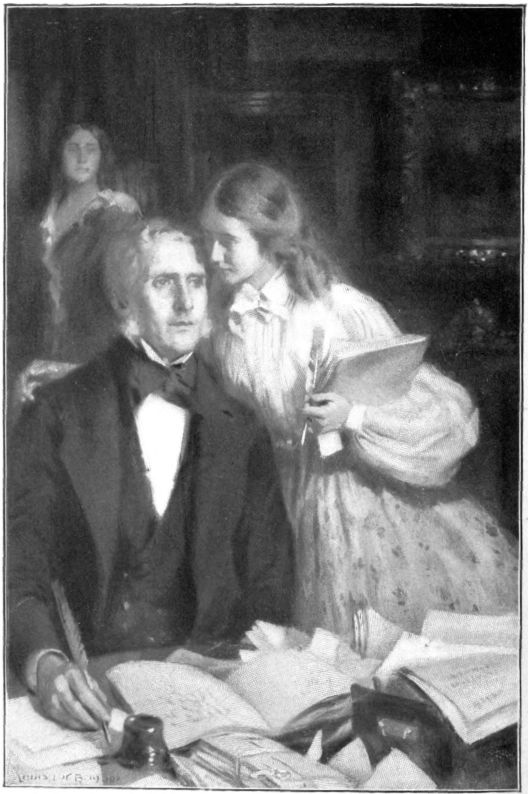
| “ ‘GOOD-NIGHT, ALLEGRA’ ” | Frontispiece | |
| “ ‘YOUR NIECE? ALLIGATOR?’ ” | Facing p. | 82 |
| “THE CROWD DREW BACK” | Facing p.“ | 182 |
| “ ‘I CAN’T, BOB, I CAN’T’ ” | Facing p.“ | 218 |
| “ ‘AFTER MY DEATH’ ” | Facing p.“ | 288 |
| “ ‘KIT IS KILLING YOU’ ” | Facing p.“ | 358 |
| THE POISONED ARROW | Facing p.“ | 422 |
Book I
THE MANTLE OF ELIJAH
“Oh, there you are, Miss Ally, blazing away the gas. Here’s a letter for you.”
“Put it down, Gwenny.”
Allegra’s eye, “in a fine frenzy rolling,” did not lift itself from the paper on which her pen was rhyming, and the bedroom mirror before which she wrote continued to reflect only a curly head of reddish-brown hair.
The old Welsh family servant stared. Allegra’s wont was to fall on her rare letters like a famished tigress and tear open their vitals in a twinkling. “You might be telling us the news from the young ladies,” Gwenny said with asperity.
Allegra did not reply, but made a long erasure, frowned, and gnawed at her quill.
“You might be telling your mother the news from the young ladies,” persisted Gwenny severely.
“Hasn’t mother got a letter, too?”
“Not a scrap. Blood is cheaper than ink. We are of no account.”
Allegra fidgeted, unwilling to be dragged from Parnassus either by domestic politics or the epistolary chatter of Dulsie or Mabel. Had she not been looking forward to the silence of the bedroom—the unruffled twin bed beside hers? Otherwise of what use to have packed the girls off to the gayeties of Cambridge?
“If they write, they must be well,” she said curtly. “What other news can there be?”
“Indeed! Two girls going into a barracks of young men, like Daniel in the lions’ den. A university isn’t exactly Pabell Dofydd.”
“Pabell—?” Allegra looked up for the first time.
A flush spread over Gwenny’s sallow, emaciated face. “I suppose you’d be saying ‘the Tabernacle of the Lord.’ ”
Allegra laughed—a merry, girlish laugh that dissipated the eye’s poetic frenzy. “Is that Welsh?”
“And if it is, it’s as good as English,” and the fine frenzy passed to Gwenny’s eye. The old woman had never forgiven the tyrannical prohibition of Welsh in the State schools of her youth.
“You silly old Gwenny! I love funny words.”
Gwenny threw the letter down on Mabel’s bed. “It’s like an oven in here,” she said gruffly.
“Is it? So it is. Open the window, please.”
Gwenny jerked up the small-paned black sash viciously. A refreshing air blew in from the Thames. Allegra unconsciously drew a deep breath.
“Oh!” she cried ecstatically: “what a beautiful moon!” She peered out into the warm June night, and thrilled at the mystery of the gray masses of foliage on the uninhabited bank opposite. Two wisps of cloud on the moon’s face gave it a momentary appearance of an illuminated dial with hands, and she thought of the Clock Tower of the House of Commons farther down the river, and then compassionately of her father, still prisoned by dull business in the stuffy national vestry.
“And who’s been putting up that text?”
Gwenny’s querulous voice reminded her that the Family Skeleton (as Dulsie had christened her) was still waiting to read the letter. She popped in her head. “I put it up,” she said, smiling.
“It doesn’t match the others—and it isn’t printed nicely at all.”
“It isn’t printed at all. I wrote it.”
The old woman put on her spectacles and read out slowly, with waxing mistrust, for her world was divided into Christians and Church-of-England:
“Fame is the spur that the clear spirit doth raise
(That last infirmity of noble minds),
To scorn delights and live laborious days.”
“Is that in the Bible?” she asked.
“It’s in my Bible,” said Allegra, evasively.
“Your Prayer-Book is not the Bible,” Gwenny reminded her, resentfully. “I never saw anything in the Bible about fame, except ‘And Herod the Tetrarch heard of the fame of Jesus.’ ”
“Tetrarch! What a lovely word!” And Allegra’s eyes relit as she wrote:
“The purple Tetrarch vanquished by the Babe.”
“Babe,” she muttered, “cabe, fabe, labe, mabe, rabe, sate, tabe.” An anxious frown darkened her bright young brow as with an ink-stain. “Yabe, zabe, clabe, crabe, shabe, stabe. Is it possible there’s no rhyme to babe? I never knew that before. Such a simple word, too!” She wondered lugubriously how the idyllists of the nursery had managed. Then some inner sprite whispered “Astrolabe,” and she had a flash of joy, followed by a cloud of doubt. Could she possibly get Astrolabe in? And what did it mean exactly? Anxiously she turned the pages of her dictionary. A sigh of relief escaped her lips, and she wrote:
“That star unkenned of earthly Astrolabe.”
The banging of the door awoke her from bliss. Gwenny had gone. Allegra’s lip quivered in remorse, and she rose as if to go after the old woman, but she went no farther than picking up the letter. She was only sixteen, a-flutter with sweet impulses, and her chin was pointed, which is said to be a sign of indecision. Soul and body seemed to play into each other, interflashing in a fascinating femininity. You had the sense of frank, girlish, blue-gray eyes, of an erect, limber figure, of bubbling laughter, breaking into tears, of quick emotion and nervous half-hysteria, of humor playing about the closed mouth and the dancing eyes; of ambition reaching towards the coming years, and conceiving failure as more tragic than death, of high heroics mingled with schoolgirl giggles and love of candy—the woman half out of her shell.
Once the letter in her hand, Allegra’s lapsed instinct reasserted itself, and she tore it open, anxious to know whether it was from Dulsie or Mabel, for the pointed penmanship of the early Victorian period was a symbol of the general absorption of woman’s individuality into the ladylike. The contents, however, were not so prim.
“Darling Allegra,—Oh, what a fool you were not to come! This is all I have time to tell you. Such fun! Connie makes a splendid chaperon. What a luck one of us is married! Concerts, dinners, and even a ball! They say this is the first year there has been one, for they have never had so many lady visitors, but this is the ideal place for balls, there are such quiet moonlit quadrangles to sit out the dances in. (Dulsie has a cold, but don’t tell mother.) And then the river! The bumping is a joy forever. Tom’s college went up two, and everybody says it was all owing to Tom being stroke. I was so proud of him, and I never knew how handsome he was till I saw him in his flannels. And I never knew how lovely Dulsie was till I saw her in Tom’s cap and gown, just like the pictures of Kitty Clive as Portia. It was in Tom’s rooms and he has such a lot of nice friends. He is in the very best set—all lords, and honorables, and sporting men—and Lord Arthur Pangthorne, such a handsome boy, said it only needed to put a pipe in Dulsie’s mouth and send her into the streets under the eye of a ‘Bull-dog.’ How we laughed! I only saw one good-looking Don, but all, even to the baldest, are more amiable than you would expect of such learned owls; indeed I do believe they would flirt, if one held out a finger. But of course they are the worst kind of detrimentals, for they are not allowed to marry at all. Poor Monks! Then we have seen all the sights, and the ‘Backs’ and the ‘Bridge of Sighs,’ and King’s College Chapel, which is just too sweet for words, and makes you feel religious, and spine-shivery, and all that. But, talking of bumping, the real bumping only begins when all is over, and you row home on the sunshiny Cam, which isn’t as big as our river but they are proud of it all the same and don’t you remember father telling us he could have jumped across the Ilissus? And when you row home it is all one jam packed solid, such a swarm of parasols of every color, every boat scrunching into every other, and all the oars locking and crisscrossing, and everybody laughing and shouting and squeezing, and skiffs capsizing, and the people coming up like wet rats. Tom showed me a dripping Duchess, and it’s a wonder we didn’t drop in ourselves at the River God’s ‘At Home,’ as Dulsie called it. I trembled for our new frocks, not because of mother’s howling when we get home, but because—well, you know we’ve got only one change. I do wish I had bought one of those new little Spanish toques. Well, I really must stop now, for we have to take tea with the Master of I forget what—only it’s not Hounds. But he is very important all the same, and says he admires father’s speeches, although he doesn’t agree that the paper duty should be repealed, as it would produce a swarm of cheap and nasty newspapers. I listened in silence, pretending to understand all about it. Well, good-bye. Dulsie joins me in love and in thinking you a fool.
Affectionately yours,
Mabel.
“P.S.—Look in the second drawer and see if there isn’t another pair of evening gloves, and if not lend me the ones you were presented in—I dare say they’ll fit, if you didn’t make them dirty. The Family Skeleton will pack them up, as I know you hate being bothered.”
Allegra’s face grew wistful at the picture of the sunlit boats and the diamond-dripping oars, but she fixed her eyes on the text she had added to the bedroom decorations. “The Way of the Ungodly shall Perish,” and other Methodistic sentiments from the Old Testament, chosen by Gwenny, were grown meaningless from years of familiarity, but Milton’s lines had the acuteness of a trumpet-call. Fame was indeed Allegra’s present spur in more than one sense, for she was composing a heroic poem on it in the hope of attaining it. Allegra, in a word, was a Cornucopian.
The Children’s Cornucopia was a weekly budget of tales and essays and verses, of unimpeachable moral tone, counting among its readers children of all ages, not excluding second childhood, and of all social planes, not excluding the highest, though had the writers known that in Allegra they addressed a Cabinet Minister’s daughter, they might have dreamed wildly of state pensions. But the Cornucopia’s chief circulation was among ill-to-do schoolboys and schoolgirls; a fact to the credit of the juvenile mob, begirt by importunate illustrations of ghosts and pirates. For, whereas your superior cherub has his reading matter sifted like his diet, the youngster of the streets lays out his infrequent penny to his heart’s content. Nothing could be more elevating than the Cornucopia’s “Answers to Correspondents,” in which moral guidance was mixed with recipes for making rockets. Allegra herself had once received information on the training of rabbits, and though her rabbits had pined away, Allegra’s faith in the Editor’s omniscience was undisturbed. He was to her a divinity, shrined in Fleet Street from mortal gaze. The Cornucopians—that was the Editor’s name for his gentle readers—felt like a happy family, over which he presided like a grandfatherly god. But perhaps the paper owed its success less to the Editor’s austere principles and radiating benevolence than to its fostering the literary passion in its purchasers. The itch of writing is regarded as a malady of the mature, but it is in truth an infantile disease, which is worked out of the system early, save in an incurable minority, mostly fools. The Cornucopia was earliest to discover this, and by a back page of versified riddles, written by its readers, it provided an easy gradus to Parnassus. (Parnassus was a word often on the riddlers’ pens.) My first was a lyric, and my second a sonnet, and my whole was a charade quite easy to guess. By this device a high heroic strain might be worked off as an acrostic, torsos of epics found the light as anagrams, and Clio assisted at the parturition of a palindrome. W.P.B. was the Cornucopians’ humorous-melancholy synonym for failure. If Parnassus was Paradise, the Waste-Paper Basket was the Inferno, but under the cheery editorial tact there was no need to abandon hope if you entered here. Doubtless most of the doddering septuagenarians who feverishly bought the paper for their imaginary infants were riddling rhymesters; print was the bait at which they nibbled with toothless gums, and the ingenuous pseudonyms of Baby Bunting and Little Red Riding-Hood masked the poetic outpourings of still hopeful senescence.
But there was a broader path to Parnassus, for you might actually aspire to contribute unpaid matter to the prior pages, and sometimes—O golden spur!—money prizes were offered for the best poem or story. The same uncanny insight into human nature which had brought the Cornucopia into universal request had dictated its choice of the subject for competition—“Fame.” Nothing obsesses the imagination of the unpublished so much as the trials and triumphs of the literary aspirant. The amateur author’s pet theme is the professional author, to wit, himself magnified and haloed. Five pounds awaited the best hundred lines on “Fame” in heroic couplets; two pounds the second best! while half a guinea consoled the Pegasus that was placed.
In Allegra’s day-dream world nothing loomed so vast and shining as this same “Fame,” and so she had been working desperately what time Dulsie and Mabel assisted at the May-term festivities. To-night or never the poem must be finished. Posted to Fleet Street the first thing in the morning, it would just arrive in time. In the remorseless progression of the days the term of the competition had arrived.
Allegra’s poem was a haggis of motley allusions in the catholic spirit of her favorite Milton. Chatterton and Apelles, and the Cid, Plato and Byron and Charlemagne, Mrs. Siddons and Thermopylæ and Clio, were blended with Paladins, Crusaders, Seraphim, and the Holy Grail. Parnassus came three times and Fame’s Scroll four, not including its “Bead-Roll.” But the main note was martial. Armor clanked and the bugle blew throughout.
But alas! the poetess did not feel that her verses, even in their eleventh incarnation, had risen to the height of their great argument; they had not even risen to her own height. And she had so set her mind on the big prize, on thrilling that little inner circle of Cornucopians, whose rustling laurels kept one another from sleep; to say nothing of the vaster circle of mere readers, which was as the circle of the horizon. If her inspiration did not come to-night, all was lost.
And it had come, it was coming. Gwenny’s entrance and Mabel’s letter had not disconcerted it. The moon had even given it a fillip. She resumed her bent posture at the dressing-table under the gas-globe: her eyes shone, her heart sang, her cheeks glowed. Verses seemed to hover about her head like a whirl of bright butterflies; she had only to pin them down.
And then suddenly something fell with a little thud on her paper: not a butterfly, but a poor singed moth tumbled from the gas-globe. Allegra’s cheek grew as pale with pity. She touched the sprawling insect delicately with her pen, helping to set it on its legs again. It crawled off lop-sided, with one-winged, spasmodic efforts to fly. She was glad when it dragged itself out of sight. Alas! it was but the pioneer of a suicidal swarm that kept fluttering round the candescent orb. Allegra waved them away with her handkerchief, but they returned recklessly—strange, dingy, fluffy creatures of all sizes and shapes, spawn perhaps of the abnormal heat wave, whirring dizzily downwards, frizzled and contorted. Allegra was sorry the old woman had opened the window; and though, now that her consciousness was directed to the point, she felt the room oppressively hot, the descent of a daddy-long-legs with its legs shrivelled short made the air from without even more intolerable. With a sharp tug she shut out the night and the river.
In vain. An invading cohort seemed to be already in possession—an army bent on storming the fiery position. Insect after insect plumped on her paper, scorched into a hobbling creature, disfranchised of the æther. Some she aided as best she could: others, wriggling in fragmentary life—fricassees of nerves, they seemed to her tortured fancy—she stamped out of their agony, though she had to clinch her teeth, and there was sickness at her heart.
What fatal perversity drew them to self-slaughter? she wondered. Why had Nature given them so self-destructive an instinct? Or was this perhaps their hell—were they sinners under metempsychosis? She examined the wounded with new interest, striving to read spiritual remorse behind their physical writhings. Well, souls or moths, she would be no party to their punishment.
She turned down the gas till she could hardly see, but the episode had added a vivid image to her couplets.
With flaming heart he sought the heart of flame,
And crippled fell upon the page of Fame.
She plodded away, almost happy again at this windfall. But the flame was still sufficiently seductive, and more souls or moths continued to illustrate the image literally. Allegra burst into tears. She could bear it no longer. Fame, purchased at such a price—was it worth having? She looked at her watch. Past ten o’clock. No, there was no other room to go to, without disturbing some one or being disturbed.
Fame—or the well-being of the moths? It was too vexatious. Here was the very summit of Parnassus in view. And the poem could not be finished, the post could not be caught. Perhaps she might rise with the dawn. But how could the Muse work at such pressure? To-night she had had the leisurely feeling of the long calm hours ’twixt her and the post. No, the dream was over. Her tears of pity turned to self-pity as she extinguished the gas. She sat in the darkness, too miserable to brush her hair, forgetting even to open the window and look at the moon.
Presently she heard her younger sister Joan ascending the stairs to the neighboring bedroom, which she shared with Dulsie.
“Asleep, Ally?” came a careless cry as Joan passed the door.
“Yes!” Allegra answered crossly. “I mean, I want my room to myself.”
“Don’t be so cock-a-hoop about it. I’ve got two beds of my own.”
Allegra heard Joan singing as she undressed, and she envied the light-heartedness of Youth.
After a vague period of numb misery and wandering thoughts, Allegra found her brain turning out fresh couplets, and presently lo! she was afire with the old eagerness, intensified by dread of everything now being too late; the Muse flown, the post lost, the prize missed. She held her watch to the moonlight and discovered it was eleven o’clock.
“At the eleventh hour!” she murmured dramatically, pleased with the position. “All may yet be snatched from the flame!” She opened her door, and found the landing and staircases dark. She would go down to the now surely deserted drawing-room, where moths were improbable. She slid down two flights of banisters and arrived softly outside the drawing-room door. An unexpected bar of light stole from under it. Could her mother have fallen asleep in her arm-chair? She turned the door-handle quietly, then saw with a shock her father’s whitening head and broad shoulders bent over a litter of papers on the round table, and at his elbow the red despatch-box that meant dry-as-dust Cabinet affairs. She remained glued to the threshold, hesitant whether to advance or retreat. Time was when she had shared the general indifference of the household to his convenience. When she was rearing rabbits on Cornucopian principles, she had once dumped the whole family down on his manuscript, as he sat writing. He had taken them up gently by the ears and placed them silently on the floor, and resumed his writing without a word of reproach; but somehow she knew she had sinned. His present attitude brought the episode back, and she had a lively twinge of remorse, conceiving now the horror of little rabbits’ legs scurrying across the wet lines of “Fame.” The memory decided her for retreat; but her father turned his head vaguely.
“Ah, come in, Mabel,” he said pleasantly, not ceasing to write.
Allegra’s face flushed up as if to match her hair. “I’m not Mabel,” she said apologetically. “Mabel’s at Cambridge.”
He smiled; the wistful fascinating smile which had won over howling mobs, and which Allegra had inherited from him. In fact there were moments when he seemed only a whiskered and world-worn Allegra. Something of womanly sweetness shone in the brown eyes under the great white forehead, and sometimes the pain in them vanished in a gayety less boyish than girlish in its tenderness and humor.
“It’s a wise father that knows his own child,” he murmured; “then you must be Allegra. And why is Allegra roaming about at this hour?”
Allegra crimsoned deeper. Her literary passion had roots of virginal shyness; not even her sisters were in the secret. And how could one lay bare one’s pity for moths? Not since that moment—a month ago—when she was curtsying to the Queen, walking backwards, had Allegra felt so uncomfortable.
“I didn’t know any one was here,” she murmured.
“Am I in your way, dear?” he said, with quick considerateness. “Do you want anything?”
“Oh, no, no, father; don’t disturb yourself. I—I only—” she ended desperately. “May I use your ink?”
“Certainly, dear. And would you like the Great Seal too?”
His laughing eyes, gleaming benevolently behind his reading-glasses, met hers, and at once a great ease fell upon her. Then he did definitely disentangle her from her sisters. The Great Seal joke—though it had not been mentioned between them for years—was hers and his exclusively. In her imaginative childhood she had overheard a snuffy, red-nosed old gentleman, who she understood had just given up being Lord Chancellor, telling her father of what Her Majesty had said when he brought her back the Great Seal. The picture of a Great Seal flopping about the steps of the throne fascinated the child; it completed her idea of the beautiful young Queen. She asked her father who would look after the Seal now, and her father told her the next Lord Chancellor, that official being the Keeper of the Great Seal. He showed her the title in an official list, and she read further how the creature was carried behind him by the Deputy-Sergeant-at-Arms and deposited upon the Woolsack. He told her some Chancellors he had known never parted with the Seal, day or night: which gave new pictures of its riding in carriages and sprawling at bedsides as well as squatting on sacks of wool vaguely connected with the Black Sheep. Two years later, when she had grown to glimmerings of doubt, every spark of scepticism was stifled for another term by his gravely hunting out for her the passage in the history of England that told how, when James II. was crossing the horse-ferry on the Thames in his first baffled flight to France, he had thrown the Great Seal into the river, patently restoring it to its native element.
“But did they fish it up for William of Orange?” Allegra had inquired.
“Yes—the very next morning, and took it to Whitehall.”
Encouraged therefore by her father’s mood, Allegra drew up a chair to the table, but though he abstractedly cleared a little place for her, he had apparently already forgotten her in the manuscript he was revising. One page he had tossed towards her, and the bold, clear caligraphy of the Departmental Clerk flashed its sense upon her indifferent eye.
“And be it further enacted that the said Commissioners shall receive from time to time, for their guidance in the execution of their said Commission, such instructions, not being repugnant to the provisions of this Act, as shall for that purpose be issued to them by Her Majesty, through one of her principal Secretaries of State. . . .”
Somehow it reminded her of Joan sharpening a slate-pencil, and she shuddered.
Poor father! To have things like that added to his domestic worries. No wonder his nice tawny head was growing all silver, losing even that “bimetallism” which Dulsie’s wit had detected in it. A wave of tenderness for him began to heave her breast. But she chanced to see the clock, and she settled severely to her poetic task.
It was a colossal clock, purchased, like all the furniture, by the mistress of the house, and remarkable even after the Great Exhibition of bad taste had misled an artless nation into the rococo. The eye was enticed, not only by a floral gilt maze, populated with figures, but by bas-reliefs of allegorical cherubs surmounted by semi-detached and semi-attired statuettes of Grecian nymphs. The dial itself, tiny in size and swaddled in an ormolu wreath that depended from a crowning basket of ormolu flowers, would have been lost to the vision had it not been so near the summit of the structure. That clock alone would have told you the time of the century. It was the period when the simple outline of the Greeks was regarded as only the A B C of art; mere ground-theme for the pizzicato passages of a more enlightened posterity. Even these decorative convolutions were obscured in a gorgeous riot of minute involutions. Big ornaments had little ornaments on their backs, and little ornaments had lesser ornaments, and so ad infinitum. You could not see the forest for the trees, nor the trees for the twigs. The aim of the artist was not to conceal art but to conceal the article.
Even the plain round table at which Allegra and her father wrote had contrived to complicate itself below the surface: for its leg after losing itself in a bush of ornament reappeared as two, each striding as far as possible from the other, and sprouting forth a limbless cherub, which turned its back on its fellow. The demands of gravity were answered by further pedal bifurcations.
And Allegra’s father, too, the Elijah of whose mantle there is question in this story, was early Victorian. His soul was of the old eternal pattern that seeks the Kingdom of God and is jarred by Ahabs and Jezebels, but his coloring was according to the epoch. He was tinged by Dickens, by Cobden, by Carlyle, by Combe’s Constitution of Man, by the Great Exhibition, by the Chartists. If he vibrated to the Continental unrest, if the Rights of Man and the Brotherhood of Nations were in the background of his mind, the foreground was English, practical, concrete, solid. And his first thought was for England—England at peace, clean, contented, sober, happy—a beacon to a weltering Continent. Freedom was no nebulous figure, aureoled with shining rhetoric, blowing her own trumpet, but Free Trade, Free Speech, Free Meals, Free Education. He did not rage against the Church as the enemy, but he did not count on it as a friend. His Millennium was earthly, human; his philosophy sunny, untroubled by Dantesque depths or shadows; his campaign unmartial, constitutional, a frank focussing of the new forces emergent from the slow dissolution of Feudalism and the rapid growth of a modern manufacturing world, steam-hatched. Towards such a man the House of Commons had an uneasy hostility. He did not play the game. Whig and Tory, yellow and blue, the immemorial shuffling of Cabinet cards, the tricks and honors—he seemed to live outside them all. He was no clubman in “the best club in England.” He did not debate for argument’s sake or to upset Ministers. He was not bounded by the walls of the Chamber nor ruled from the Speaker’s chair: the House was resentfully conscious it had no final word over his reputation or his influence. He stood for something outside it, something outside himself, something large, vague, turbulent, untried, unplumbed, unknown—the People. The late-minted word Radical—which when the Queen came to the throne had only meant an out-and-out Reformer of the Franchise—had taken on a more sinister significance, a brazen resonance of strikes and trade-unions and the anarchy of Americanism, since Thomas Marjorimont had fallen a-prophesying.
And the paradox was that he was not of the mob himself. His very name of Marjorimont was an index of kinship with the inner gang that had owned and ruled England for centuries, and at whose privileges the dreaded Reform Bills had but nibbled. Fortune did her best to give him the happy life of a rich and nobly connected English gentleman, but he wedded himself to a daughter of the people as well as to democratic principles, and in despite of these leaden drags had by sheer strength of genius and honesty forced a great industrial measure on a kicking Tory Cabinet, and himself on the next Whig administration, still more reluctant to let in upon itself the on-sweeping flood of Radicalism. But he bore about him the marks of the fight: of the People’s long distrust of a Tory sprig, whose very name of Marjorimont with its pretentious pronunciation as Marchmont was a lingual tripping-rope, scarcely removed by his formally spelling it Marshmont, as it was most easily pronounced: of the opposition of the Middle Classes, expressed in refusals of halls for him to speak in, or even hotel beds for him to sleep in: of the hatred of his own order for a “traitor,” acutest in his noble relatives.
The late hours and lifeless air of the House of Commons had undermined what health was left from his oratorical crusades, and lately a touch of unearned hereditary gout—in ironic flouting of his theories of life—had added itself to a well-earned throat disease.
“Oh, there’s a moth here, too.” And Allegra started up in distress, chivying it away from the chandelier. “Please forgive me, father; I have interrupted you.”
“No, no. I am glad to see you so kind to the lower creatures. You take after your mother.”
“But aren’t you kind, too?”
He smiled. “I wasn’t always. Once I used to ride to hounds.”
“What, and see foxes torn in pieces—ugh!”
“Worse! Poor little hares.”
“I should never have believed it of you.”
“Ah!” He smiled mysteriously. “You evidently don’t read the Tory papers.”
“I don’t read any papers; they’re so dull compared to books.”
He shook his head. “Then you know nothing of contemporary history.” His fingers fondled her hair. “Curl-papers are all little girls want, I suppose.”
“But I don’t use curl-papers,” she said, indignantly. “It’s all natural. But if the papers speak ill of you, why do you want more of them—cheaper and nastier ones?”
He smiled. “Oh! then you do know something of contemporary history.” Allegra did not confess she owed all her information to Mabel’s letter, and he went on. “But think how selfish it would be of me, Allegra, to object to the growth of newspapers merely because they might disparage me. I should be as bad as Mr. Dickens, who warned me at the Reform Club that we should only bring upon our heads the same flood of illiterate vulgarity that rages in the untaxed American press. He was violently abused in the States, you see.”
“Was he? What a shame! I do wish you’d bring him in one day instead of those stupid politicians.” She had a swift vision of herself surreptitiously kissing the novelist’s coat-tail, and perhaps slipping a manuscript into it.
Her father laughed heartily. “Thank you, thank you, my dear. If this is what you say of my Whigs and Radicals, what would you say if I brought you Tories?”
“I don’t suppose I should see any difference. They would talk of amendments and divisions just the same, wouldn’t they?”
He laughed again. “But what were we talking about?”
“You were telling me you used to hunt poor little hares.”
“Don’t make such faces at me—if I hadn’t, you would never have been born.”
Allegra shook her quill at him. “That’s not hare, that’s Great Seal.”
“No, it’s true. I see I’ve cried ‘Wolf’ too often, and you do read the Tory papers after all. But I sometimes speak the truth despite them. It all happened when I was staying at Llangellan Castle in the beginning of my political career, before it had dawned on the old Viscount what a red Radical I was. Now I am as hated in the county as if I had shot foxes. Such a windy November morning it was, we could hardly sit our saddles! And I can still see Lady Barbara, a slim little thing my people rather wanted me to marry, bent forward like a reed. But we soon started a hare, and off we flew to the music of hounds and horn.” A note of the old Pagan exultation crept into his voice. “On we went in the wind’s teeth, up hill, down hill, over field and fence, the hare running straight and extraordinarily like a fox, and we almost thought it would give the dogs leg-bail, but at last the pack mobbed it in a patch of mangel-wurzel, and the Master and I dashed up just in time to be in at the death. But we were not. A tall, beautiful creature, with flashing eyes like an angry wood-nymph, flew out of a thicket, and with her bare hands beat off the blood-thirsty dogs—I never saw anything like it in my life—and snatched the poor screaming hare to her bosom.”
“Was that mother?” cried Allegra breathlessly.
“Guessed it in once.”
“How splendid! But didn’t the dogs fly at her?”
“No; they just skulked back. You see harriers are used to being beaten off from the carcass by the whippers-in, because nothing tastes so nice as hunted hare. But had they been fox-hounds—”
“And that’s how you fell in love with her!”
“Fell is the word. Stronger than the wind, she lifted me—metaphorically—out of my saddle. Indeed, with her hair flying, she seemed like the spirit of the wind. And how she lashed out at us in Welsh, no more afraid of the lord of the manor than of his dogs. I didn’t understand a word, but it sounded delicious. I wanted her to go on abusing us.”
Allegra’s eyes sparkled. Here was unexpected romance in the life of a father hitherto associated only with tiresome politics. She wished she had time to pursue the subject, but the little hands of the wee dial of the great clock were marching on. Her father’s business might wait, but not hers. The Muse had been kind till the new moth appeared, and the laurels might still be for her brow. But as she dipped her pen into the ink, the sprite that suggested verses suggested instead the speculation as to what her father thought of Fame. The question flowed off her tongue involuntarily.
“What do I think of Fame?” He looked at her awhile quizzingly. “Ah, that is a question you should put to Mr. Disraeli.”
“But I know what he thinks. To be famous when you are young is the gift of the gods. How I should like to see a famous man!”
“But you have seen the Prime Minister.”
Allegra’s lip curled. “Oh, I don’t mean men like that. I mean heroes. Like the Duke of Wellington.”
“That’s not the only kind of hero.”
“Of course not. There’s Tennyson.”
“Is he a hero?”
“You know what I mean—a great man.”
“What is your idea of a great man?”
Unused to such Socratic searchingness, Allegra checked the reply on her impulsive tongue, and meditated, with lips adorably puckered.
“A great man is one who works for the world.”
What “working for the world” was, Allegra did not know exactly, but it was something that went to the sound of music and the throbbing of angelic wings, and you walked uplifted in a great light, with tears in your eyes.
The great Radical surveyed her with fresh interest. She had developed a personality, then, while he was not looking, this odd, fascinating child. He had let her soul run wild.
“And you think soldiers work for the world? I should rather say they provide work for the world—to repair the damage they do. Have you ever thought what war means, Allegra?”
“It means glory.”
“It means fifty millions on the National Debt; it means—” Here the moth Allegra had tried to save fell opportunely. “That’s what it means.”
“Oh, poor thing!” Allegra forgot the argument.
“Yes,” said her father sternly, “burnt moths, and torn hares, and drowned kittens, and all that you detest. How would you like it if Chelsea were cannonaded?”
“Oh, but that’s impossible. No foreign foe can set foot on British soil. The last time it saw a battle was a century ago.”
“And the next time may be next year. Bang! comes a bombshell through that window. It explodes; my head flies through the ceiling; yours through the door, and the clock up the chimney.”
“You are joking.”
“Joking? Have you never read an account of a battle, a siege?”
“Of course,” she said resentfully, yet sinking into deep swamps of self-mistrust under this continued cross-examination. “I know all about the siege of Troy, and the charge of the Light Brigade. Doesn’t Milton describe it all?—
‘Legions and cohorts, turms of horse and wings.’
And then there’s Ivanhoe—shining steel, and banners, and pawing horses.”
“Horses! Yes, poor things. Stabbed with bayonets and disembowelled with cannon balls for causes they know nothing of. Ah, if only for the sake of the horses we must make an end of war.”
She sat silenced, athrob with new thoughts. He resumed his work. “But you don’t really think such things could happen here in England?” she said at last.
He glanced up. “Why not? What immunity has England? In any case war’s a curse that comes home to roost. I saw the Queen giving away the Victoria Cross at the Garden of the Admiralty. Officers were wheeled up in Bath chairs. Their legs had been shattered by shells. One of them was my own cousin Nick Yeoford.”
Who has gauged the blindness of youth, the thick scales of inherited or insinuated opinion, the unthinking stupidity of the most intelligent? One day a look, a touch—and the world is changed. Scarred and medalled soldiers had figured in Allegra’s own poems, but somehow she had never really thought of their scars, only of their stars. War had been a pure artistic convention; a fine æsthetic frenzy. But now it would seem one’s father’s cousin might be hacked to pieces.
Allegra always counted that as the moment in which the first veil of happy illusion fell from her eyes. War was not, then, an exotic nebulous splendor, but a thunder-cloud that might burst over one’s own door, in this dear, cozy old England, amid these quiet carpeted houses, disturbing the snug succession of breakfast and dinner, of Easter and Christmas, and mutilating not vague foreigners, but persons one actually knew. Her mother, Gwenny, Joan, the snub-nosed page-boy, the polyglot governess, burly Wilson the coachman—each and all might become as the moth—formless, limbless, crawling lop-sided from the hell of war. Nay more! That warm breathing flesh she called herself might be stabbed and shattered. The planet lay suddenly bare and raw—a brutal arena of pitiless savagery. But she shuddered back into her warm self, into the domestic snugness of the drawing-room. And all that was left of that brutally vivid moment was a pale intellectual deposit—a conviction that it was impossible now to send her poem to the Cornucopia. It was full of war—the wrong thing glorified, the mischievous concept transmitted. How if it won and was published?—the whole world might be infected. Perhaps that was why the moths had been sent to her, she thought mystically. They suffered, to stay her pen. Pity for them and her ruined hopes gave new tears to her eyes, a swelling as of hysteria to her breast. She had come here to save her poem from the moths, and lo! she must herself destroy it. She gathered up her papers hastily.
“Good-night, Allegra,” he murmured, relapsed into concentration. But she felt the parting inadequate to the new relation established between them that night: the strings seemed already loosening; they must be knotted. She leaned affectionately over his shoulder, stroking it, and letting her eye rest with a new sympathy on his manuscript:
“Her Majesty’s justices of the peace and for the county, riding, division, district, borough, parish. . . .”
From war to justices of the peace! What a fall! But then if war were sordid, justices of the peace might hold more poetry than appeared on the surface. To the aid of this argument from inversion sprang a line of her Milton:
“Peace hath her victories no less renowned than War.”
But at this moment she became aware, by some subtle instinct of attraction, that her mother was in the room. She turned her head, and there in a hastily donned red wrapper stood the expected, beautiful figure, the white rat on her shoulder.
She had eyes like a gazelle, and was, for all the marring of the years, still the wood-nymph of the windy morning. Her face was flower-soft and dark, flashing a hint of gypsy blood. She carried her tall figure with a sweet dominating dignity.
Allegra left her father instantly to go to her. The magnetism her mother had for her had been quickened by the story of the hare. She was about to express her regret if her voice and movements had awakened her mother, whose bedroom was just overhead, but Mrs. Marshmont anticipated her crossly:
“Why are you not in bed, Allegra?”
“I have been writing, mother.”
“Oh, to the girls. Gwenny told me you had a letter and that you kept it to yourself. I dare say it makes fun of us.”
“Oh, mother, how can you—?” She was about to produce it, when she remembered the reference to the Family Skeleton. She colored, feeling tangled in a double lie.
“How can I? When I find you and your father with your heads together—plotting against me!”
“My dear Mary!” The Minister threw a deprecatory smile over his shoulder. “Quite the contrary. I was telling Allegra of your virtues.”
“I quite understand that she doubted them.” Allegra quivered, struck speechless. But, as a cat will try to rub itself against those who swoon at its presence, she tried to take her mother’s hand. Mrs. Marshmont pushed her away violently. “Go to bed!”
Allegra went without a word, hypnotized by this imperial Bellona, but choking with suppressed sobs.
“And don’t sit up writing any more and wasting the gas” followed her out of the door; and behind her, as she went up stairs, came the reproach to her father: “If you were so desirous to speak of my virtues, Mr. Mar-jor-i-mont, I was ready to hear them; but of course I never hear a kind word.”
The Mar-jor-i-mont was fatal. Allegra knew the ill augury of this mispronunciation of him as an aristocratic alien with whom his own wife had no rights of familiar speech. Poor father, poor mother, poor poem, poor moths, poor Allegra! Life was all at sixes and sevens. War? What was Peace? She thought she knew now why her imagination had always played with banners and trumpets. Anything to escape this squabbling sordid atmosphere, the flippancies of her sisters, the suspected peculations of cooks and page-boys. She had always lived alone, alone with her visions. Perhaps “ ’twere better done as others use,” to sit out dances in moonlit quadrangles. But even then there were colds. She was trembling violently as she mounted the two flights, but she clinched her teeth, resolved not to let this yearning to scream terrify the household.
Outside Joan’s door she could not resist crying: “Joan, are you asleep?”
“Of course I am,” grumbled Joan. “What do you mean by waking me up in the middle of the night?”
“I wanted to tell you—I am not going to take any more fencing-lessons.”
The statement surprised herself, but when she had uttered it, she saw she meant it. She must metaphorically beat her foil into a ploughshare: it had kindled her imagination with false lights.
“Cock-a-hoop again!” Joan sneered. “You think because you touched the Swedish Turnip yesterday, you could challenge the Three Musketeers.”
The Swedish Turnip was the nickname of their fencing-master, a ruddy Swede, but Allegra was as surprised at Joan’s reply as at her own remark. The misconception touched her sense of humor; her nervous currents passed off in a prolonged laugh.
“Crow away!” said Joan. “But wait till Jim comes home. He’ll take you down.”
“We shall see. Good-night.” She went to her room, smiling and relieved, not troubling even to strike a light. But that beautiful moon shone on her as she knelt at her bedside, a sweet penitent in white.
“O God,” she added extemporaneously, “teach me to win back my mother’s love, and teach her to be as gentle to my father as she is to hares and rats. Teach me what is Truth, what is Right. And O teach the silly moths to fear the flame.”
With a heavy sigh the Minister rose from his work, pushed back his spectacles, and confronted his wife.
“You are vexed because I am working,” he said gently. “But it is very important, this Bill—it is really, Mary.”
“But you have time for Allegra!”
“Allegra did not disturb me.”
“Oh, and I do.”
“Don’t be so unreasonable, sweetheart. Allegra came down here to write. If I had come up to you, this drafting—”
“What’s your Honorable Andrew for?”
“He’s not very well. I’ve worked him very hard at the Office.”
“Oh, of course! Because he’s your relation, he is to be cockered and pampered. My relations may starve.”
“I thought we had done with that.”
“No, we haven’t done with that! What’s the use of being a Cabinet Minister’s wife if you can’t throw a little patronage to your own kith and kin? Look at Lady Treville, with her godsons—only related to her by water!”
“My dear, you never will understand these things. If you are still harping on young Evanston, I’ve told you I’d rather give him a hundred a year out of my own pocket.”
“Out of my pocket, you mean.”
He waved his hand. “But it shall not be from the State’s pocket.”
“As if the State knew what’s in its pocket! Except everybody’s hands!”
“All the more reason for keeping ours out. I am sorry, Mary, but I can’t discuss these things with you.”
“I know; there is nothing you can discuss with me. I’m not wanted; I might as well be dead.”
He drew nearer to her and put into his voice the caress he had not the courage to attempt otherwise. “Dearest, you know it’s my only joy that you are alive.”
She softened, and there was a half-sob in her voice. “It doesn’t seem so. When once in the blue moon you do get home before midnight, you sneak in like a thief; you never dream of me. If it isn’t writing, it’s reading.”
“I thought you would be asleep. You see, the House got counted out—the enemy caught us napping. It was vexatious, of course, but I consoled myself with the thought of a quiet hour’s work—”
“I should have thought the day was long enough.”
“At the Office there is always so much to do: oceans of correspondence, answers to members’ questions to be got ready for the afternoon, and this morning a pig-headed deputation of Tory farmers into the bargain! And at the House it’s worse. There’s a fever in the air, half the time I have to be in my place listening or speaking, and even when I do settle myself in my den, I have to rush upstairs whenever the Division bell rings. Ah, my dear, the Treasury Bench is not so far from the galley bench.”
“Lord Ruston seems to thrive on it. His wife told me he never gets up till noon.”
“The Foreign Office is a fixed tradition. Claridge really does the work, though the public has never heard of him. Ruston has only to take the credit; that can be done in the afternoons.”
“But you’ve got a permanent official, too.”
“That’s what makes so much work,” he said dryly. “I will not be swaddled in red tape. The precious hours I waste in listening to legends of my predecessors!”
“I don’t care how it is,” she said plaintively. “I see less and less of you every year.”
“I know it’s very hard on you.” He ventured to caress the rat on her shoulder, as a first step towards caressing her.
“When you were a mere member you managed to come home for dinner, despite the Whips. Now you are a lord and master—”
“Ah, but I could pair then.”
“And why can’t you pair now?”
“If I did, my vote wouldn’t be counted unto me for righteousness.”
“Ridiculous! A parcel of old women’s rules. A Minister oughtn’t to have to vote at all—it’s understood he’s with the Government.”
He smiled. “That would be common-sense—not the British Constitution. The Premier himself has no legal existence.” His hand slipped from the rat to her shoulder, and lay there tenderly. He felt easier in the conversational level to which the quarrel had fallen.
But Mrs. Marshmont had abrupt resources. “And then people tell me I ought to consider myself lucky!” she cried, bursting into tears and sinking into her easy-chair.
It was an uneasy easy-chair, in harmony with the clock and the leg of the table. Each arm consisted of a dog, the right rampant, the left couchant. On this odd throne Mrs. Marshmont would sit, patting the carved dogs as if they were alive, while her rat ran over them in the joyous security of their deadness.
Her husband knelt beside her, and put his face to hers, as if to share her tears. She did not repulse him.
“I know it’s very hard on you,” he repeated. “But, sweetheart, a Minister is not his own master. I don’t see how it’s to be helped.”
“No,” she admitted lugubriously. “How you need the money.”
He winced, and his face drew away from hers, with a flush as swift as Allegra’s. This self-suspicion that perhaps the salary had been a factor in his acceptance of a seat in the Cabinet poisoned his rare moments of human pleasure in the position. He had been so against it at the outset: it seemed dishonorable to take office from a Premier he had denounced. But his friends, almost to a man, were insistent. He owed it to the country, to his followers, to himself. It was the proverbial thin edge of the wedge. Through him, this great force of the future, Radicalism, would enter for the first time into the inmost councils of the Nation. The British Constitution, like Nature, did not make leaps. You could not expect earthquakes. A complete Radical Cabinet could not grow up in one night like Jonah’s gourd. Once inside the Whig Cabinet he could wake it up, snap fingers at the dukes. His mere presence would tinge the whole: a drop of live red blood in a cup of ditch water. And then what gnashing of teeth in the Tory camp when fronted with a coalition of Whigs and Radicals, in an invincible Liberal Party! And to these serpentine arguments his Continental friends had added by cable, eager to have a lover of mankind in the forging-place of British thunder-bolts.
He had given in. He had accepted the apple and munched it on the Treasury Bench. But there was a worm at the heart of it. He had exiled himself from the Paradise of Independence. The direct opposition of the Tories was a spur, but this purring of friends, this murmuring of compromise and conciliation, above all this courteous disregard of him at the Council Table, chafed his soul. The Premier sat bland, genial, surrounded with traditions and respect. With a few henchmen he ruled all. Even the dukes had only the privilege of agreeing with him, however imposing their names on the prospectus, however autocratic their Departmental sway.
“Wait, wait,” the Marshmontites whispered. “You are paving the way for a real Radical Party.”
“I am paving hell,” he retorted. He tried, like the dukes, to find consolation in his Department, but the formalism of the staff was wearing, especially in its insidious resistance to innovations, new and untried policies. He hated the beautifully written documents presented to him for signature, not dissection.
But of all this his wife knew little. Of a poor Welsh family, with a corresponding education, mitigated by a love of Shakspere—the medium through which her lover had taught her English—she had scarcely higher ideals than the gypsies whose blood she suggested. Her value lay in the realms of the unconscious; she was magnificently elemental.
If she sometimes betrayed herself in society, it was never a betrayal of vulgarity. She gave the air, not of lacking breeding, but of being a law unto herself. Thomas Marshmont, too, was autonomous, and like all men who marry half-mates, he lived his intellectual life apart, and this solitude was become so habitual by the time his children grew up, that they had never occurred to him as companions. Besides, they were mostly daughters, and girls seemed to him merely extensions and reduplications of their mother’s personality, annexes to her individuality, if not, indeed, proofs of its predominance over his. The elder boy had passed from Harrow to Cambridge; the younger, Jim, was at Harrow now. And so this feverish, strenuous political life of his, vibrant with passions, clanging with tumults, girdled with wild hopes and fierce hatreds, colored with historic episodes, had been lived alone.
In the early days when he was fevering the provinces with great speeches, he would pass from a throbbing triumph to a cold railway carriage or a chill hotel-bed. Even now his own house was only another hotel, with a faithful feminine clientèle. It was pleasant to see the same faces, but he did not talk politics at the board. That he occasionally made a famous speech in the House his wife learnt from Gwenny, who alone read a newspaper. He made no more of it all than a business man makes of his day’s doings, and in the same spirit his wife had been down twice to see him at work—once in the old House, where she was stuck like a ceiling decoration over the hot, noisome chandelier, and once in the new and more commodious premises.
And now if she rudely reminded him of the profits of the business, could he wonder? He replied, more to convince himself than her:
“The money doesn’t count at all. If it were the money, I’d gladly give up twice as much to save you an hour’s pain.”
She laughed, softened. “You silly old thing! That would give me twice as much pain. You always forget I have to manage on the money.”
It was one of her delusions—based upon occasional capricious economies—that she administered his finances like a chancellor of genius; in verity, she dissipated his substance on a scale proportioned to her ideas of what befitted a family related to the peerage.
He leaned his face again to hers, and she wept again.
“We were happier at Hazelhurst. Why couldn’t you have remained a country gentleman?”
He forbore to explain. At first he had imagined that the divine instinct which urged her to rescue hares was of a piece with that which urged him to save mankind, but he was soon disillusioned and permanently puzzled by psychological contradictions he had not the temperament to analyze away. He did not see that the crude, visible, physical fact touched a highly sensitive nerve-system, while complex mental suffering or a large outlook found no apparatus of sympathetic registration in her elemental nature. He said evasively: “We’ll have our holiday at Hazelhurst, if you like.”
She clapped her hands childishly: “Yes, let’s go down—you and I alone—to the woods and waters. Let’s go Saturday.”
“I meant when the session’s over.”
She pouted. “Then let’s go Saturday to Monday.”
“You forget the Ruston dinner.”
“Can’t you cut that?”
“I wish I could. The reception is official. You know how I hate my Court dress.”
She pushed his head away. “You love it more than me. You never will do the least thing I ask you.”
“When you ask me something reasonable—”
“I won’t go to Ruston’s—I won’t go in to dinner after Lady Trumper. It’s too mortifying, a woman whose father was an apothecary. Your family is of the best in the land.”
“But I am not the rose, if I live near it. Two lives are between me and the peerage—good sound lives, thank Heaven.”
“But even the nobodies crow over me. Mrs. North has the Queen’s permission to drive down Constitution Hill.”
Her very pettiness gave her an artless witchery—wonderful in a woman of her years. He kissed her eyes. “I had rather see you driving down Hazelhurst Hill.”
“Then why won’t you go?” she said, less fretfully. “We’ll take the mid-day train. You shall have a whole morning’s work with your stupid papers.”
“Impossible, dearest. You forget this stupid paper.” He pointed with a conciliatory smile to the formal summons: “Sir, you are requested to attend a meeting of Her Majesty’s servants on Saturday at twelve o’clock at 10 Downing Street.”
“Oh, bother the Cabinet Council! They can do without you.”
“There you are right,” he said, bitterly.
“Then we’ll go—yes?” she cried, joyous.
He winced again. Nothing could mark more sharply her alienation from his real life. He replied softly but sadly. “But, darling, I must be at the Council all the same. The war spirit is gaining on this country—our own Allegra has imbibed the poison—and I believe, but this of course you mustn’t breathe to a soul, we shall have fights over the navy and Novabarba. I may not be able to effect much, but protest I must. Who knows? I may save the country a score of millions.”
“The country! The country!” She sprang up, and her voice rose too. “Your own fortune goes to ducks and drakes for want of management.”
“There isn’t so very much to manage.” He smiled wistfully.
“But I have to manage on it—and even give dinner parties to your political friends.”
There was a note of hysteria now. He tried the humorous. “Well, Mary, you don’t want to give them to my enemies.”
But she was the one woman in the world his smile could not soothe; also she had no sense of humor, a fact which her husband should have known by this time. “Oh, yes, make fun of me.” Her eyes flashed fire; the beady eyes of the rat on her shoulder seemed to glitter sympathetically.
“My darling, be sensible,” he pleaded, alarmed.
He wished to stroke her hair, but lacking the courage, he again stroked the rat. But she rejected the overture, plucking the rat away and setting it down on the table.
He snatched his papers from under the rodent’s feet, and crammed them into the despatch-box. The action aggravated her wrath.
“Sensible!” she shrieked. “If I had been sensible, I never should have married you.”
The shriek hurt him more than the sentiment. He hoped she had not changed her servants recently. Gwenny’s stability in a world of flux was a background of comfort, like a permanent secretary to an easy-going minister. He did not know that this strange wife of his ruled servantdom like a queen, was the fetich of the kitchen, and the adored of the dismissed and down-trodden. He himself, tamed and contrite, said humbly, “I am sorry my work has spoiled your life. I should never have married you.” What indeed had he given her in return for the joy of her beauty and wild grace, for the birth-pangs she had endured?
But she, misunderstanding: “And didn’t I tell you to marry your Lady Barbara, Mr. Mar-jor-i-mont? Oh, I might have known it—a man who sets the dogs on animals, what pity could he have for a woman?”
She delivered her words dramatically, raising her hands, unashamed of the midnight and the household, like a Mrs. Siddons playing to an audience and perfectly in the normal order. No shrewish vulgarity, only the high dignity of the tragédienne. Allegra, lying sleepless in the heat, with the sheets thrown off, heard her—with a novel transference of sympathy to the poor statesman. She had listened to her mother’s grievances so often that she took their truth for granted, convicting her silent father by his default. She waited tremblingly for hysterical developments, but instead, to her wonder and joy, fell a blessed peace.
It came from a twinge of the gout, which caught the Minister as (in the lack of anything to say) he locked his despatch-box with the precious key on his watch-chain. The groan he could not repress was the salvation of the situation. Instantly Mrs. Marshmont had him lying back in her own arm-chair between the two carved dogs, while his right foot lay prone on the masculine easy-chair, whose arms had pendent fringes and looked like Brobdingnagian clothes-brushes.
“Does f’anwylyd [my darling] feel easier now?” she cooed. But somehow for once her sympathy failed to soothe him: she had excited acuter pangs than physical. For the first time in his busy unselfish career he found himself wondering what life would have been like with a wife that understood. It was a thought his loyal bosom had not lodged, even in face of the obvious devotion of other wives to their husbands’ Parliamentary careers; careers not always dignified by unworldly aspiration. But he must bear his burden alone—or only with God’s whispered help. Perhaps it was the death of Bryden, his chief companion-in-arms, that gave him this new consciousness of solitude. He had not realized how Bryden had filled the void in his soul, Bryden the golden-mouthed, Bryden the Berserker of Peace. They had not been close comrades in the flesh, but their spirits were knit. He thought of him now with tears—“passing the love of women.”
The War Spirit continued to pursue the Right Honorable Thomas Marshmont with its irony.
When the girls returned from Cambridge, they brought Tom Marshmont back with them. He had succeeded ignominiously in his examinations, but he was the envied of some who had taken honors, and who had now to pass from the cloisters to the world. In that unpleasant period when life uplifts its crude question-mark, and consulted tutors murmur vague commonplaces, his contemporaries saw Tom Marshmont as secretary, consul, inspector, governor, attaché, diplomatist, future ambassador, anything, everything, his paternity being supposed to cover a multitude of pickings. He, however, saw himself in only one rôle—officer in a crack regiment. Cæsar was the one penman of the classics who had interested him and made him understand that blooded lips really spoke Latin once.
No ambition could have been more distressing to his father, brought violently down from his world-schemes to face another crisis in his own family. It was the last thing he had expected of his boy, though to outsiders the fresh-skinned, breezy giant was cut out by nature for a guardsman.
The inevitable interview took place at the top of the house in the garret which had begun life as a nursery and was now the study of a Minister of state. Before the children had grown too big for it, the great Radical—in the fiercest years of his political strife—had done all his writing and thinking in the common drawing-room, and his Blue Books and Hansards lay about him higgledy-piggledy. It was one way of being with his children and of placating his wife; and they ignored and interrupted his work at will. He in his gentle unselfishness made no personal claim, demanded no special attention. But the advent of a private secretary made it necessary to live up to this gentleman’s title, and so the deserted garret was rediscovered and swept out. But the original furniture was still there, nor had any one troubled to remove the pictorial scraps pasted on the wall by the nurse-maids. He wrote on the table at which his progeny had taken their tea and jam, and if a pigeon-hole adorned the wall, it was of the secretary’s fixing. In the corner unregarded stood a large, ill-groomed rocking-horse with faded stripes and a moulted tail, and under his belly a battered regiment of tin soldiers stood at ease or lay careless, in a truce that had lasted since Tom’s childhood (for Master Jim had preferred the reversion of his sisters’ dolls).
The fat bullfinch that piped in its little round white-barred cage at the window was the only expression of the Minister’s own personality, for this bullfinch was as much with him as the rat with his wife, or the Great Seal with the Chancellor of Allegra’s infantile imagination. But, unlike the rat, which had been picked out by its mistress as a pet, the bullfinch had picked out the head of the household from among the general members, and had developed from a parlor ornament into a personality. It fell in love with the Minister, and sang its happiest in his presence, and gradually enforced equal recognition from his reluctant attention. It hopped on his writing-table by day, and was removed to his bedroom by night, where it slept in its cage under the shade of a silken bandanna. Nothing made it so spiteful as to be fooled by Dulsie masquerading in her father’s hat and spectacles. After a moment of ecstasy, it would open its mouth and hiss, its feathers flat with anger. Its presence brightened the garret, which, for the rest, was far pleasanter than the Minister’s sunless den in the House of Commons, especially when the warm morning light sent long gold-dusty beams through the many-paned casement and inspired the bird to sing. What wonder if this study still remained the arena for Joan and Allegra’s fencing-lessons, the Swedish Turnip’s hours being fixed not to clash with the Minister’s, and the central writing-table being rudely shifted to the region of the rocking-horse.
It was a bitterer fencing-match that the garret was now witnessing, the tragic contest of father and son.
“I never thought my own boy would hurt me like this,” said the Minister, with a sigh.
“My dear father!” the young man retorted, in an insulted but not insulting tone, “if you knew what I have had to suffer from your speeches! The chaff I’ve been subjected to! Every time there’s been a cartoon in Punch—”
“You take Punch seriously!” his father interrupted sarcastically. “Why, even the ladies stick to their crinolines!”
“It’s got to be taken seriously. All these skits about the Peace Party, and the way they’re putting L.S.D. on the Arms of England, supplanting the Lion and the Unicorn by the hare and the puppy. People take you for a Quaker, sir, ’pon my honor they do.”
“Nonsense! Everybody knows the Marshmonts are Church of England.”
“How are they to know? You don’t go to church, sir.”
“I had not observed your own zeal in that direction. You didn’t even come down to prayers this morning.”
“I can’t endure your mutilation of the service. The Prayer Book must be discarded, forsooth, to please Gwenny!”
“And your mother, Tom,” his father reminded him mildly. “That was our compromise. And it was very good of her, reared as she was in that fanatical Calvinistic Methodism, to agree to sit in the Marshmont pew at Hazelhurst Church. And that reminds me that your accusation is only true as regards London. No, no; I am proud to count Quakers among my friends, but nobody could possibly imagine we were Quakers ourselves.”
“Everybody knows who and what the Mar-jor-i-monts are, but Marshmont is another pair of shoes.” The father winced, reminded of his wife’s “Mar-jor-i-mont,” and too pained by this new issue to remonstrate. “Our name has been defaced out of all recognition. It’s like pulling down a wing of an old house. A Mar-jor-i-mont is a fellow who serves king and country; a Marshmont you can quite figure in a broad-brimmed hat and drab toggery, like that Quaker chap who said he was tired of the British Lion.”
“And who never wore a broad-brimmed hat in his life,” said the father dryly.
“I go by Punch.”
“In which Palmerston always sucks a straw.”
“I don’t care a straw about the details. I go by the broad fact.”
“The broad-brimmed fiction, you mean.”
Tom smiled. “I always heard you were good at Parliamentary repartee, sir. But the fact remains that up at Cambridge a cad once tried to ‘thee’ me in his talk. Perhaps he expected me to turn the other cheek. He certainly didn’t expect to see his nose run claret.”
“You were right to assert yourself, my boy. But the exploits of our ancestors do not commend themselves to me.”
“Not Sir Rupert’s at Marston Moor against the Roundheads? Not the first earl’s at Malplaquet? You don’t see the beauty of a pedigree like that?”
“I prefer to think of the few scholars and divines behind us. Physical courage, no doubt, some of our progenitors had, in moments of bellicose intoxication; but I question if they had the higher nobility of every-day chivalry. At any rate I desire to see our own branch of the family carrying on the work of civilization, not of barbarism.”
Tom gasped: “Barbarism! No wonder they call you a Quaker!”
“Whatever they call me, I desire to continue to call you my son.” There was a tense silence. The neglected bullfinch on the writing-table seized the opportunity to recall itself to its master. It made its pretty little cooing noise—one low note, one high note. In vain.
“Is this a threat, sir?” asked Tom at last, in a quiet voice.
“Not at all, Tom. I had hoped you would carry on my work, be a true son to me.”
“I am sorry, sir. Elijah’s mantle doesn’t fit me. The soldier’s uniform does.”
His father’s head drooped hopelessly. “I thought Harrow would have liberalized you more,” he murmured.
“Is that why I didn’t go to Eton?”
“Partly.”
He sniffed sarcastically. “But even Byron wasn’t ashamed of being a lord.”
“If he had been, he would have been a greater poet.”
The young man made a petulant movement. “It was lost time sending me to ’Varsity: you see what a mess I’ve made of it. I haven’t got your head for books or figures. I ought to have gone straight from school into the service like so many chaps, like your own grandfather.”
“Our grandfathers cannot rule us from their urns. Each generation must face life for itself—none must bind the others.”
“And yet you would bind me!”
It was an unexpected blow—straight between the eyes—and the older man physically staggered back before it. There was another moment of silence. The bullfinch, thinking the tiresome conversation at an end, flew over and perched on his hand, but he tossed the creature impatiently into the air. As this was, however, his usual playful custom, the deluded bird returned to his hand, and as he had not the courage to undeceive it, it remained on its perch, fluffing all its feathers with joy, and putting its tail from side to side. The heart behind its little red breast was the only happy heart in the room.
When the father spoke again, his voice was husky but firm. “I have not the right to bind you.”
“But will you help me? I am dependent on you.”
“To curtail your independence would be to bind you.”
“Thank you, father. I appreciate your attitude. Of course my ordinary allowance will not provide for a commission.”
“You wish to purchase a commission!”
“How else?”
“There are a few regiments here and abroad—oh, I didn’t suppose those appealed to you. But you know how I have voted year after year against this corrupt system.”
“Oh, who pays attention to that annual motion! It’s a standing joke. We have the best army in the world—why not let well alone? Come, father,” and he smiled, “surely you wouldn’t ask me to wait till the purchase system is abolished—till I am old and gray?”
“It will be abolished sooner than you think.”
“Then I shouldn’t want to join. Fancy messing with a lot of cads!”
“Cads! When they would have worked their way up by merit.”
“Merit or not, they’d have dirty finger-nails.”
“For dirty work you don’t want clean hands.”
The young man laughed. “Wait till Louis Napoleon invades England, father—you’ll change your tune.”
“The first Napoleon didn’t purchase even his rank as lieutenant. No, no, Tom; if there must be war, the French system’s the finer. Every corporal carries a marshal’s bâton in his knapsack.”
“England isn’t France, no, nor America either. Our men require to be led by gentlemen. And are you going to, examine a gentleman in Greek to see if he’s likely to lead a forlorn hope? Can a man ride a horse? That’s the question. Not Euclid’s riders.” And he laughed sunnily. “I’m afraid if they started examining for the Army as they’ve begun to do for the Civil-Service, I should be nowhere beside a half-starved sizar who’s never been across an animal in his life.”
The pain on the father’s brow deepened, but he only said, “Well, let me know what regiment you wish to join, and the price, and I’ll see what I can do.”
“Thank you, sir. I shall not do our name discredit.”
“Of that I am convinced—as the world understands credit. And, by-the-way, let me know at the same time how much you are in debt.”
Tom smiled: “How did you know that, sir?”
The father let his stern mouth relax a little in return. “You forget I am a professional student of finance. I can see by your face you are not up to your neck.”
“No, sir. But I rode a steeple-chase and backed my own mount, and I did get up to my neck—in mud—ha! ha! but not so deep in debt.”
“Ah, and you paid that—but not your tailor!”
The young man smiled again, but his father frowned.
“And so you consider the gambling debt is the debt of honor, not the bill you owe your tailor.” Tom looked gloomy, but his face grew cheerful again as his father continued: “Had you owed the gambling debt, I should not have helped you. The tailor must be paid instantly.”
The bullfinch struck up a joyous whistle, as if in sympathy with snips and morals.
But the worst of Tom’s troubles was before him. He had to face his mother and Allegra. To the former he broke the news that night in the drawing-room, after the girls had retired to bed.
“Go soldiering!” Mrs. Marshmont shrieked. “No, no; I won’t have you murdered.”
“But, mother,” and the good-natured giant took her hot nervous hands, “I may never even see a battle.”
“Yes, you will. You’ll be sent out as soon as your uniform comes home, and you’ll be killed by the first shot.”
He laughed. “You are indeed a Cassandra.”
“Cassandra or Cleopatra, I tell you you shall stay at home. Let go my hands!” She tore them from his good-humored grasp and pushed him violently backward against the mantel-piece. To her he was still the small boy she had slapped. With difficulty he saved his head from colliding with the great clock.
“You see,” he said humorously. “It’s just as dangerous to stay at home.”
“Dangerous!” He had roused the hysteric note, and her hands went dramatically heavenwards. “And this is what I get for waiting on him hand and foot, and airing his under-garments myself, and lying awake sleepless till I hear his latch-key in the door! And a nice father—to arrange all this behind my back! I thought at least he had hands without hair, but he’s an Esau of Esaus. What else can you expect of a hunter of God’s creatures? And he hunts me—I crouch bleeding in the thicket. Because he has no heart, he can’t understand how other people’s hearts may drip blood. But I’ll go to him—he sha’n’t rob me of my first-born. Out of my way!” she screamed, as her first-born half-seriously barred her passage. She took him frenziedly by the shoulders and thrust him aside. Then she fell to wringing her hands and bemoaning herself in Welsh.
Allegra ran in, with flying hair, and a huddled-on dress. She had urged her sisters to descend with her to the scene of war, but Joan’s mock recitation of “How do the waters come down at Lodore?” had turned their first anxiety to levity, for to all Allegra’s apprehensions, Joan had retorted imperturbably with lines like
And crashing, and lashing, and bashing, and gnashing;
or,
And scowling, and growling, and howling, and yowling.
Allegra found her Viking of a brother leaning limp and helpless against the mantel-piece. In her new sympathy with men she understood at once how impotent he must feel against this feminine inconsequence: understood, too, how much more disconcerting and terrifying the outburst must be to him, so much away from home, than to the rest of the habituated household.
She sidled up to him. “What’s the matter, Tom?” she murmured shyly.
“Your father and brother have conspired against me,” the mother screamed. “The eagles’ young shall suck up the blood of my first-born.”
Allegra’s eyes grew wide with terror. Was her mother mad? If not, what wild tragedy was afoot?
Tom’s uneasy laugh made her easier. “It’s all right, you little goose. I want to join some chums in the Dragoons, and mother’s imagination already sees me dead instead of decorated.”
“It isn’t my imagination, it’s my second sight. My mother saw my father shattered at the foot of the precipice before we knew there was a mist on the mountain paths. A hundred times she warned him of the Old Woman of the Mountain.” She brought a touch of weirdness into this atmosphere of artificial furniture. Allegra shuddered.
“Well, if you see truly, it’s got to come. So it would be silly to try to dodge it,” said Tom, with British phlegm.
“But you mustn’t go to war, Tom, indeed you mustn’t,” Allegra cried.
“And why not, pussy? For fear I’d be killed?”
“No: for fear you’d kill others.”
“And why shouldn’t he kill others?” Mrs. Marshmont interrupted fiercely. “Shall he let himself be hewn in pieces like the Amalekite?”
“War is wicked,” Allegra declared, with stern white lips.
Tom, relieved by this new opposition, burst into a roar of laughter.
“Oho! is thee, too, a Friend?”
“I’m for peace, not war. If we must fight, let us fight with the forces of evil around us, with the poverty and the pain. Think of the women and children crawling like beasts in the coal-mines. O Tom, let us make England great, not big.”
Tom’s blue eyes danced with honest merriment.
“Why, mother, the child has been studying father’s speeches.”
The mother flashed angry eyes upon her. “I saw them plotting together.”
“Why shouldn’t I study father’s speeches?” the girl asked hotly. “It would be better for you both if you had more respect for him. For he is in the right,—father is in the right. I have proved it, not from his speeches only. All the books say the same thing. Do you know how many people in England have no crust for their stomach, no bed for their back? Four millions. Four millions, while we eat four meals a day.”
“And don’t you do your share?” asked Mrs. Marshmont shrilly.
“I do, and I’m ashamed of it.”
“The remedy is simple,” Tom laughed.
“Not so simple as your ideas of political economy.”
“Don’t talk to your elder brother like that, miss,” her mother snapped.
“If my starving could do any good, God knows I would starve. But the only way is to improve the general conditions. We must assure every man the fruits of his own industry. Is nine shillings a week the fair reward of the agricultural laborer? How can he bring up a family on nine shillings?” Her pretty eyes flashed with anger and tears.
“Hush, Allegra,” said Mrs. Marshmont, reddening. “What do you know of bringing up families?”
“I’ve seen you bring up yours. I know what it costs.”
“Do you indeed? If you did—if you understood the agonies and the anxieties I’ve been through for all of you—you would not treat me like this.” And Mrs. Marshmont anticipated Allegra by bursting into tears.
Big-hearted Tom, startled, went over to her and put his arm around her. “Who is hurting little mother?” Mrs. Marshmont let her wet face fall on his manly shoulder: “My Tom, my own boy, the only person in the house who has a kind word for me.”
Allegra’s overwelling tears froze on her eyelids. Her heart stiffened itself against this illogical parent. What kindness did she deserve, this woman who darkened her husband’s unselfish life! No helpmate she, mar-mate rather.
Happy in the sudden lull, Tom purred over his mother, who cooed back. Allegra stood by stonily, watching with contempt her mother’s gradual oblivion of the point at issue.
“Wait till you see me in my regimentals, mother,” Tom ventured at last.
“My own handsome boy! But promise me my baby sha’n’t get killed.”
“Me killed! No, no, pet, of course not. General Marshmont, eh? How do you like that?”
“I sha’n’t live to see it, cariad anwyl” [dear love].
“What! a slip of a girl like you!”
They kissed each other. Allegra turned on her slippered heel and went back to bed, disgusted.
It was in a dream of this night that the germ of Allegra’s new poem came to her. Probably it all grew out of the nightmare that haunted her even by day, since she had begun to follow her father’s footsteps through the maze of human misery. Political economy radiated back the glow of her young soul and became passionate and palpitating. Even statistics took on flesh and blood to her phantasy—very appalling flesh and blood sometimes. The four million paupers stood in a solid phalanx, ragged, hungry, dishevelled, and raucous, a Dantesque horror.
Perhaps, too, the poems of Deldon—which, despite their vast popularity, she had not known till she chanced on them among her father’s pamphlets—contributed to her latest manner: Deldon with his strange blend of revolutionary Radicalism and celestial allegory, “the angel Israfel banging a drum,” as the Edinburgh Review christened him. Anyhow, Allegra’s new poem was so beautifully vague, so vaguely beautiful, that she could not have explained what it meant, even to herself. The theme that gleamed so magically golden in her dream faded to drab in the cold dry light of day, yet a sort of elusive splendor still seemed to hover about it, and Allegra worked at it in shamefaced secrecy. It concerned a beautiful stone statue that stood solitary in a great deserted hall, amid the crumbled pillars of a ruined ancient palace, and all around it stretched a vast desert of sand. And through the hall blew the four winds, bearing “the music of humanity.” From every part of the earth and from times long past came the passionate, pitiful wail, long-sounding ’cello and violin notes, and a faint tremulous fluting of far-away miseries. And gradually, through æons measureless, the statue began to change: a heart of flesh developed under the stone, and the music broke upon the heart, and the heart throbbed and thrilled in pity. But alas! it could do nothing. It was only a living heart in a lifeless statue. And so now there was a new pain added to the world’s pain: the pain of the heart that felt it all, and beat out its daily endless life, unseen, unheard, under the enduring marble peace of the beautiful stone figure, in the forlorn hall of crumbled pillars, in the ruined ancient palace, amid the vast stretches of sand.
The new poem was written in Spenserian stanzas, and served as a vent for all the novel forces seething in the girl’s soul. But for this outlet she might have done something desperate. Indeed, she did once think of polishing her own shoes.
“Joan!” she said one night, as the two sisters coincided in thumping down their shoes outside their adjoining bedrooms, “don’t you think it’s a shame that Saunders should clean our shoes?”
“I do indeed,” said Joan. “Gwenny used to do them much better.”
“I don’t mean that. I think we ought to do them ourselves.”
“You can. I’ve got better things to do with my time.”
“What better things?”
“You know as well as I do.”
Joan was not unlike Allegra, but she was shorter and plumper, and her chin was squarer. She was never in two minds about anything.
“You mean flannel waistcoats for the poor,” said Allegra contemptuously.
“And woollen socks,” added Joan imperturbably.
“You only pauperize them. You don’t touch the real problem. How dare we give the poor presents? Our hands are not clean.”
“And so you would clean them by blacking shoes?”
“Physical dirt might be moral cleanliness.”
“Good heavens, Allegra, if only old Mrs. Rhys heard you! After mother and I have lectured her by the hour to scrub her floors and her children!”
“Give her more air and light—cleanliness will come of itself. If you squeeze her into a dog-kennel—”
“Why, when have you been to Mrs. Rhys’s?”
“I’ve never been. I know on general principles.”
“General principles! You’d know better if you went visiting with mother and me. That reminds me, where’s that half-a-crown?”
“What half-a-crown?”
“The one you promised me in aid of the cotton-spinner who was caught in the machinery.”
Allegra blushed. “Oh, I am so sorry, Joan. I forgot. I bought a book with it.”
“And didn’t even lend me the book?”
“It wouldn’t have interested you. It was about the Factory Act.”
“Oh, a present for father! You might have given him something nicer.”
“Stop squabbling, you pair of nincompoops!” Dulsie’s voice rang out. “I can’t go to sleep.”
While the great Spenserian, mystical, allegorical poem was on the stocks, the result of the Cornucopian competition was published in large capitals. With what a thrill Allegra read the name of the first prize-winner—Raphael Dominick—a name henceforward to be inscribed on “the Scroll.” All through the length and breadth of England people must be speaking of him, waiting as anxiously as herself for the next number to read the epoch-making heroic couplets on “Fame.” The second and third winners interested her scarcely at all—she noted with a touch of sadness that neither was feminine. Ah! women, they could not reach the heights: Pegasus was not to be ridden with a side-saddle. When the great poem appeared, Allegra and her sex shrank even more in her estimation. What majesty of diction! what clang of brazen rhyme! No victim, this great soul, of the false martial concept. Deeds of derring-do had their place, but sternly subordinated to moral heroism and lofty national purposes. It was a high paean of spiritual beauty, of the faith that achieves, of the name that rises slowly to a star. Allegra read it with tears and flames. She re-read it under the elm-tree in the back garden; recited it to the heavens as she dashed through the Park on the mild steed which she shared with her sisters: she added its most inspiring couplet to her bedroom texts. She wondered over the poet. What was his history? How did he bear this dazzling glory? Famous at a bound, he would go from splendor to splendor. Young, of course, he was. And married? Oh, Heaven forfend! Perhaps a nagging wife! Ah, women were poor creatures, with their whims and whams, their furbelows and flirtations and hysterics. They had no sense of national polity; still less could they make poems! She must burn her silly allegorical stanzas—flabby and meaningless beside this virile resonance. Oh, to smooth the path of such a man! She found herself mentally mothering him, shepherding his little ones. She looked up his address, given in last week’s number as a guarantee of good faith. Mile End Road! It sounded like the places to which Joan and her mother took jellies. He was poor, then, this God-gifted genius. At this very moment he might be hungering for bread, like Chatterton. Great Heavens, he might be imbibing the fatal draught! Stop! Stay thy hand a moment, divine boy! Dost thou not hear Allegra dashing up the stairs to thy attic! She breaks through the door, she— But no! of course: how foolish! there were the five pounds he had won.
Allegra came to herself with a little laugh, both of relief and self-mockery, and the blood returned to her whitened cheeks.
But she burnt the Spenserian stanzas—very dramatically—as one offering a burnt-offering for past vanities—and with a vow of self-consecration to the service of humanity. Fame was for the great: enough if she could find a humble channel of “work for the world.” Perhaps her father would let her help him. Surely she could do something for him, copy something, look up something, especially with all her new wealth of knowledge anent Factory Acts and pauper statistics, her daily study of the newspapers, and “contemporary history.” Yes, Providence had marked out her path. She would do for the statesman what his wife should have done for him; she would be at his beck; she would anticipate his call.
And in this religious uprising, this sense of the world as a selfish place of eating and drinking, she grew alien from Dulsie and Mabel, as mere exemplars of flippant womanhood, whose very church-going held no more spirituality than their croquet-matches. How could they enjoy, as they did, this empty egotistic round? An obscure poet, one Browning (of whose verses she had picked up a reviewer’s copy, uncut, in the fourpenny box), seemed to supply the answer:
“Finished and finite clods, untroubled by a spark.”
The line recurred to her again and again, always in the presence of women, especially women with smug jewelry. Their radiating acquiescence in the injustice of things stung her to comprehensive disdain. Would she ever sink to that—turn vegetable? No, never; she swore it. Yet disquieting suspicions floated to her from her motley reading; in this very Browning, as in so many of the poets, there were lines suggesting that the passage of the years brought despair and cynicism. It was a pet theme, indeed, with the young Cornucopians, this desiccation of their emotions, the waning of the visions of childhood. Nay, Allegra herself had played with the idea as a literary exercise, sometimes even taking herself in, particularly when the glow of a red fire in the shadowy drawing-room at twilight added zest to her delicious misery. She had devoted a double acrostic to yearnings for her lost illusions, and coquetted with melancholia in a conundrum. But in her unliterary hours she knew that her heart of hearts was pulsing with love, and with faith in God, and Man, and Nature.
Allegra’s seat at table faced the sideboard, and this sideboard very often drew her eyes between the courses, not because of the dishes on its marble top, but by virtue of its own eccentricities. Conventional enough in its great mirror, crowned by the gigantic gilt pineapple, it was supported on the wings and heads of eagles, themselves standing irrelevantly on carven books. The artist had got a sense of strain into the eagles’ talons, but Allegra often wondered how the wings and heads could transmit this strain, yet themselves remain so buoyant and uncrushed.
Now she suddenly read a high allegory into the false design. Even thus would she—Allegra—bear the strain of the years with their prosaic burdens: joyous, unyielding, supporting herself firmly on great literature, spreading wings heavenward. A verse of the Psalms, often in Gwenny’s mouth—“Thy youth is renewed like the eagle’s”—mixed itself mystically with this imagery. Yes, age should not ossify her: she would remain always young, ardent, altruistic. And so, whenever the conversation at table hinged on levity and worldliness and young men, whenever a chance phrase illumined as with lightning the sordidness and vanity of this valley of tears and giggles, Allegra turned her eyes for comfort to the sideboard.
But sometimes even the eagle could not sustain her. She had perturbing visions of herself as old and tired, and zoological doubts about the eagle itself. In the flame of sixteen, one might glow and burn, but how would it be amid the ashes of forty?
In such a mood of apprehension Allegra wrote herself a letter. She addressed the envelope, “To Allegra at Forty.”
“My dear Allegra,—Although we have not met for a quarter of a century, I take the liberty of addressing you still by your Christian name. It is possible you may not remember me, and, for my part, I do not know whether you are married and have lots of children (but I hope not, for how can we work for humanity if we have to be worried with nursery cares?), or whether your name is still Allegra Marshmont. I only know that you are very old. It may be, too, that you are very blasée, that you say all is vanity, and there is nothing new under the sun. Please, please, don’t go on thinking that. Remember that day in the woods of Hazelhurst, when you walked in God’s Cathedral, and Milton’s organ rolled through the leafy aisles. Now, as then, you are ‘in your great Taskmaster’s eye.’ I can well imagine that during this vast stretch of time you have met with sad things and disappointments and disillusions, but yet the world is very beautiful and very wonderful, and there is so much we can do to make humanity nobler and happier. Ah, don’t despair, Allegra dear. Think of the scent of the hawthorn, and the song of the blackbird, and how glorious it is to gallop across a moor or skate across a pond. I am just out, and you are very, very old, but I know that the sunlight prevails, and not darkness.
‘So on our heels a fresh perfection treads,
A power more strong in beauty, born of us
And fated to excel us, as we pass
In glory that old Darkness.’
“You may sneer at the poets, but Keats is right. Yes, Evil shall never triumph over Good. Keats did not despair, though he knew he must die of consumption. Ah, if you should happen to have married a man like Keats, or Raphael Dominick—a man with the eye of faith and the lips of song—then you may at once throw this letter into the W.P.B. But if you despair of your own happiness, remember, dear, there is always the life of service. And, perhaps, if you have grown sick of the world, it is not the world but yourself that you are sick of. Perhaps you have fallen by the way—into the slough of selfishness. Perhaps, as Gwenny would say, the tares have choked the good seed. Perhaps you have abandoned your early ideals and sought for mere material happiness. No wonder, then, you have despaired of goodness and nobleness. Not believing in light, you have ceased to be a child of light. (See the twelfth chapter of St. John.) If this be so, then I pray you remember me, and repent for my sake. Be brave, strong, and if I may misquote Shakspere,
‘To thy young self be true.’
“Please take this as a letter from a dead person, and be solemnly impressed. For you know you will never see me or speak to me again, and this is the voice of a ghost; a ghost that shakes its long white finger at you, and reminds you that you, too, will be a ghost some day. Oh, but I didn’t mean to frighten you. I dare say you will live many years more—unless you are dead already. Perhaps, like the poor mortals in ‘The Vision of Mirza,’ you have tumbled through one of the early trap-doors in the Bridge of Human Life. Oh dear, and then this letter will be wasted, so I had better not make it any longer, but remain, your old friend,
Allegra Marshmont.”
She sealed the letter with black wax, and hid it among her unburnt poems.
About half-past four of a Saturday afternoon, late in the London season, the Right Honorable Thomas Marshmont arrived home, arm in arm with his dapper and brilliant henchman, William Fitzwinter, M.P., otherwise Fizzy. The diminutive expressed felicitously the sparkle of the man and the contempt or affection of his contemporaries. He was in some sort the complement of Marshmont. As the latter had shown that noble birth was no bar to democratic principles, so did Fizzy, son and heir of a middle-class manufacturer, testify to their compatibility with enormous wealth. In appearance the pair made a notable contrast, the burly carelessly dressed Minister with his Jovian forehead and stately port, leaning heavily on his gnarled stick, and the dandified little manufacturer with his air of fashion contradicted only by his cigar. A man of enormous courage, Fizzy was one of the first of his generation to smoke in the streets, and as he now walked in friendship’s hook with the Minister, he did not hesitate to becloud even his companion’s reputation.
Fizzy ran the organ of the newest of English parties—the Morning Mirror—and although he was too much a man of pleasure to edit it systematically, he was understood to be generally responsible for its libels. At any rate it was only its policy that he ever disclaimed in private. He was the one Radical of importance not in favor of Marshmont’s acceptance of office, but the Morning Mirror had thundered huzzahs, and to Marshmont’s simple-minded expression of surprise Fizzy had replied with a wink, “The People’s Tribune can do no wrong.”
“But you thought I did do wrong!”
“Our party isn’t big enough yet for a split. A man with only one hair can’t afford to part it in the middle.”
The Mirror continued to applaud Marshmont’s every word and move, till the Minister grew ashamed to look at it. Once he begged Fizzy to blot out his name from the leaders, or to bespatter it with a little blame. But Fizzy was unrelenting.
“You have to be praised for the good of the party,” he said sternly. “You must sacrifice yourself.”
“But are you sure it is for the good of the party? You remember the Greek who got tired of hearing Aristides called the Just?”
“In those days there was no opposition paper. If Athens had had the Chronos, the man could have found relief by reading quite other epithets for Aristides, that brass-mouthed inciter of Demos to the pillage and murder of the upper classes.”
Marshmont smiled faintly. “But,” he urged, “because The Times goes to one extreme, there is no need for the Mirror to go to the other.”
“On the contrary, that is the very reason; else the average will be struck wrong. If we put in a truthful estimate of you—that is to say, my private estimate of you—the world would say, oh if that’s all his friends can say for him, his enemies can’t be so very wrong after all.”
“But nobody believes what a friend says.”
“Yes, they do: quite as much as what an enemy says. Every bold statement sticks. Even that of the people who advertise that their cocoa is the best. Why, the public swallow the Mirror’s praises of William Fitzwinter, M.P., despite that so many of them know I am myself the fountain of honor. No, no, my good friend, your very instinct of fairness would make you unfair. The world weighs on a false balance—to be just, therefore, one must make corrections for the defects of the machine. Suppose one of my bagmen in selling that product on whose profits the Mirror is established, and which therefore affords us a pertinent illustration, suppose one of my young men should declare it was worth twenty-seven and sixpence the piece instead of thirty shillings? What would be the result? A decline of the price from twenty-seven and sixpence to twenty-five shillings! Bang go my honest profits, the Mirror smashes, and the Feudal System is in for another long run. Fatal consequences of one small truth is an unprepared world! No! Language to be used truthfully must be used in its living meaning, not in its dead dictionary meaning; and in a world where ‘worth thirty shillings’ is understood to mean ‘worth twenty-seven and sixpence’ the man who tells the truth is a liar.” “But we who love truth must try to get words back to their face-value.”
“Impossible: neither praise nor blame will ever be accepted at par.”
“Not so long as we acquiesce in depreciating the currency. Better hold your ‘Mirror’ up to Nature.”
Fizzy laughed. “Till people’s eyes get truer lenses, the true ‘Mirror’ must be a distorting one.”
And out of this position Marshmont could never shake him, and so was doomed to wince nearly every morning under the monstrous eulogies of his astute partisan. Yet he knew Fizzy’s value to the common cause. Of the trio who created the new party, a memoir-writer has said that Marshmont tried to persuade, Bryden to move, and Fitzwinter to provoke. Reasoner, orator, sharpshooter, they made a formidable trio, which Death alone could divide.
Fizzy had waylaid the Minister in Whitehall after the Cabinet meeting and had been trying to pump him on what had taken place in the historic pillared room, but Marshmont carried the Privy Councillor’s punctiliousness to a vice and was morbidly afraid of Fizzy’s journalistic instincts.
“My dear chap,” Fizzy remonstrated, “all the world knows that there’s trouble in Novabarba, and that there’s trouble in the Cabinet is shown by your being an hour and a half beyond your average. Your time performances are watched like the foals at Newmarket.”
“And how goes the betting?” asked Marshmont, amused.
“Well, some say you are riding for a fall.”
Marshmont looked startled. “The Cabinet or I?”
“You of course. You begin to see how right I was—and to dislike being made a tool to keep the Prime Minister in power. What do the Whigs care about Reform? Yo more than the Tories. To blazes with them both. We’ll join whichever side offers most—sell our phalanx to the lowest bidder—of franchise! I’ll bet you five to two, there’s a more democratic suffrage to be got out of the Tories than out of the Whigs.”
“We could not consistently prop up the old aristocracy.”
“Why not? As a sign they’re coming down—like an old house. I assure you they hate the Whigs worse than they hate us Radicals, and the Whigs hate us worse than they hate the Tories.”
“Hate! Hate!” sighed the Minister. “Must politics be always all hate?”
“Of course not! What a cynical idea! Both parties love power more than they hate each other.”
“Yes, I fear it is a mere chess-match. If only the honor and happiness of England were not the pawns in the game.”
“If! See how your Cabinet which was all for Retrenchment and Domestic Reform is now a-prancing and a-pawing like that misguided war-horse in Job. The Prime Minister edits his policy, just as Delane edits The Times, steering by John Bull’s shifting moods.”
“Yes, indeed.” The Minister sighed more deeply.
“And these crack regiments you are sending to Novabarba—if the Continent chooses to bristle up, who knows but we may find ourselves suddenly in a European war.”
“That is what I told them, but—” began the Minister, and stopped short, both in his sentence and in his walk, while Fizzy burst into a roar of laughter.
“Don’t look so glum. Every journalist in London knows you are sending out a battalion—”
“How can they know, when we only just—”
“How can they know? Didn’t you invite General Maxy to your pow-wow? Didn’t the Secretary of State for War come up from Carlsbad, didn’t the Duke of Woodport walk to the Treasury in grave confab with the First Lord of the Admiralty, didn’t the—”
“Spare me!” interrupted Marshmont, smiling despite himself. “You are like the Dervish in the Oriental story who described the ass he hadn’t seen.”
“Except that I do the trick in the plural. But here is your carriage and here is your wife getting into it with all the grace of sixteen. How do you do, Mrs. Marshmont?” and at the apparition of that overwhelming beauty in the swelling skirts of the period, he threw away his cigar, and raised his hat, for his courage was only equalled by his chivalry. Mrs. Marshmont bowed almost imperceptibly, and turning angrily to her husband, she cried: “It’s too bad of you, Thomas. I’ve lost an hour of this glorious sunshine waiting for you and I had just made up my mind to put up with Allegra’s society. The other girls are so busy with their frocks for to-night.”
“Ah, how do you do, Miss Allegra?” interjected Fizzy suavely, perceiving the pretty creature blushing desperately under her veil. Allegra had tried hard to delegate the honor to Joan, but that sturdy young person was conscientiously engaged in fumigating aphides in the garden and remorselessly catching rose beetles.
“Are the girls going out again to-night?” the father asked lamely.
“You don’t mean to say you’ve forgotten Lady Ruston’s last evening.”
“Good gracious, is that to-night? No, no, I really feel I cannot meet Ruston again to-day.”
“You see, Mrs. Marshmont,” explained Fizzy, “your husband is at loggerheads with the Foreign Secretary and there’s been a scrimmage in the Cabinet.”
“I never told you that,” said Marshmont helplessly.
Fizzy laughed again.
Allegra was returning in-doors, but her father made her take a seat in the carriage, though he himself was thereby compelled to sit queasily with his back to the horses. Mr. Fitzwinter was likewise invited to drive, and sat contentedly with his face to the ladies. The page-boy, converted into a groom, handed Mrs. Marshmont her rat (which snuggled in her lap with all the complacency of a beribboned poodle), and the barouche bowled along the drowsing Belgravian streets with their rich-massed window-flowers and gayly striped sun-blinds.
As they approached the Park, Fizzy said, “Well, now, Marshmont, you may as well confess about the troops—”
The Minister replied resignedly: “So much all the world will know on Monday. I am afraid my wife will be a little upset.”
“Tom is ordered out to Novabarba!” that lady screamed instantly.
“Yes—it’s rather unfortunate he should just be in the very Dragoon Guards. But there’s nothing to worry over. There won’t be any fighting. It’s only a parade of power—just the thing to stop fighting.”
“Ah, that was Ruston’s argument, was it?” said Fizzy with a twinkle.
“But I don’t want to lose my boy!” Mrs. Marshmont was on the verge of a break-down. “You ought to have voted against it.”
“I did, my dear; I was very strong, and if it hadn’t been for the Prime Minister—” Again he jerked himself up on his conversational haunches.
“Yes, your husband convinced half the Cabinet, but the Prime Minister gave the casting vote.”
Marshmont laughed ruefully: “Well, between you and my wife—”
“Tell Wilson to drive home, Thomas. There’s no sunshine for me any more.”
“Oh, mother,” said Allegra contemptuously. “If Tom’s a soldier, he can’t be tied to your apron-strings.”
“But I didn’t want him to be a soldier!”
Only the presence of the stranger prevented her from shrieking. Father and daughter knew this and felt glad he was with them.
“My dear Mrs. Marshmont,” Fizzy intervened urbanely, “the climate of Novabarba is excellent. I am thinking of wintering there myself.”
“But I thought it was all swamps and malaria.”
“What an idea! Why, young Stacks the Governor, who was a mere skeleton when he was answering the Duke of Woodport’s begging letters, is now making his subjects regret he abolished cannibalism.”
Mrs. Marshmont neither heeded nor grasped the joke.
“But Gwenny—I mean I read in your own paper yesterday,” she persisted, “that the climate of Novabarba is absolutely fatal to whites.”
“Ah, that’s what we tell the Continent—keeps ’em off.” William Fitzwinter, M.P., was never at a loss for an answer, not being limited by Truth. He proceeded to point out how much better it would be for Tom to travel under new skies than to lounge in the bow-window of the Club amid the dandies. The arrival at the How completed Mrs. Marshmont’s pacification: for the drive now became a crawling circuit in the squirrel-cage of fashion, with more blocks than progressions, amid an admiring avenue of nurse-maids and idle citizens, the great spaces of the Park being deserted. There was an unbaring of gentlemen’s heads, and a smileful masking of ladies’ hearts, and these social amenities, supplemented by the ravishing toilets and equipages, postponed hysterics.
The scene—the sun-dappled sward, the flamboyant rhododendrons, the gay bubble of life, the hanging-garden of parasols, the chariots with armorial panels of the old dowagers—was blotted out for an instant by Allegra’s tears. All this beauty and sparkle seemed ephemeral and empty; a craving after pleasure that must pass, not after the righteousness which endures. And through the heart of her dream-statue the wail of humanity was piercing poignantly. And in workshop and mine the people sweltered, delving and weaving and forging that these who toiled not neither spun might be arrayed in glory. “Ah, I love the Row,” Mrs. Marshmont sighed voluptuously. Allegra repressed a sneer. “It’s the only part of London,” Mrs. Marshmont explained, “where one may be sure of not meeting a starved or ill-treated horse.”
Allegra repressed an apology, and her reverie hastened to add the dumb agony of animals to the wail of humanity.
But the conversation of William Fitzwinter, M.P., drew her out of her spiritual trance—that conversation which held in thrall the House of Commons smoking-room, but which was now toned down for Allegra’s ears. Fizzy had a genial way of stripping life of its glamour and death of its dignity. An unequalled experience of men and cities had made him the chronique scandaleuse of Europe. Princes, grand chamberlains, immortal bards, Chancery judges, ballerinas—all was stinking fish that came to his net. The human interest was the breath of his nostrils; to romance and the mellowed historic he was color-blind. St. Paul’s Cathedral suggested to him only the absurdities of the Dean and Chapter, and Westminster Abbey was connected mainly with the washing of dirty surplices. And yet he did not give the effect of wilful cynicism. His was the unpretentious attitude of the man who takes it for granted that the pomp of history is a stage illusion worked by the dramatis personae, with appropriately purple costume and elaborate scenic background, for the edification of the pit and gallery and the more stupid of the stalls, while in the green-room everybody relaxes, throws off robes and wig, and drinks beer out of pewter pots. And so, under his careless talk, Popes became asthmatic old gentlemen, Queens unhappily married, middle-aged ladies, Ambassadors elderly practical jokers. He made Allegra’s world rock like a ship at sea. And with it all, this illogical idealism of his own, these preachments of the Morning Mirror, this passion for the coming of the Kingdom of Pure Season. His monologue this afternoon—which Marshmont was too moody to interrupt much—ranged literally from China to Peru; from the metaphoric plucking of mandarins’ pigtails by our cocksure plenipotentiary, to the spread of European small-pox and brandy among the native Indians. The passage of an elderly diplomatist in a landau evoked reminiscences of incredible pranks on the roof of the British Embassy in Constantinople. Fizzy skipped easily across the Dardanelles into Asia; and the disillusions of Damascus, with its boggy camping-grounds, paved the way for adventures in one of the Southern States of America, and an account of the futile attempts to execute the Governor’s son-in-law for murder. Twice he had been found guilty, and when Fizzy left for New York the third trial was being quashed by the rejection of all the jurors on the ground of prejudice. In despite of which to Allegra’s astonishment both men proceeded to talk wistfully of the Great Republic.
Now the United States meant to her the Falls of Niagara, because of the picture in her Wonders of the World, so she waited impatiently for their arrival, and at last interrupted almost rudely.
“But have you seen the Falls, Mr. Fitzwinter?”
“Seen ’em? I’ve stayed with them!”
“Oh, do please tell me how they impressed you.”
“They impressed me as dangerous!” said Fizzy calmly. “A roaring mass of water like that—seven hundred thousand tons, I believe—it’s like a savage beast, of no profit to the human race. This Park is vastly finer—this well-rolled turf, these spruce symmetric paths—”
“But surely,” Allegra cried, “that’s the beauty of Nature—the wildness!”
“I can’t agree, my dear young lady. I like Nature brushed and combed and dressed up like our friend on the box, and taught to know her place. Nature is Man’s enemy: she must be tamed, like your mother’s little rat. That’s what we are doing in Novabarba—cutting away the forests and laying railway lines.”
“But I thought you and father were against our doing that in Novabarba?”
“Not at all, dear,” Marshmont broke in. “We are only against sending out the nation’s troops to back up the exactions of private speculators, who are often not even Englishmen.”
“What then?” Allegra inquired.
“International traitors,” Fizzy interjected.
“International traitors is good,” Marshmont chuckled.
“It shall be yours—in Monday’s Mirror.”
“But, Thomas, Gwenny told me,” Mrs. Marshmont urged, “that the Novabarbese were in revolt against us.”
“Assuredly,” said her husband.
“Then we must put them down! Why, if we allowed them to revolt, all our other colonies would rise up against us.”
Fizzy’s small thin face expanded like Father Christmas’s with joyous good-will. “Delicious! You could not have said anything that would have delighted me more keenly.”
Allegra and her mother were equally puzzled.
“You typify the Briton, my dear lady. You seriously are under the impression that Novabarba is a British Colony.”
“Is it not?” said the British lady with naïve astonishment.
“Even of colonies,” Fizzy replied in slow syllables, with lingering enjoyment, “there are three kinds, but Novabarba is not even a third-class colony; it isn’t as much as a Dependency. No part of Novabarba belongs to Britain. Most of Novabarba belongs to the Novabarbese, if I may use one epithet for a hotchpotch of races, colors and creeds united only by their distrust of the European. A fraction of the Western district is under British protection.”
“Well, then!” said Mrs. Marshmont triumphantly.
“True, this bit is twice as big as England,” Fizzy went on unctuously, “just as Novabarba itself is seventeen times as big as England, but your average Englishman conceives it as the size of an English county. This is partly because England has a page to itself in every schoolboy’s atlas, while Novabarba is only a portion of a page-map. That the maps are drawn on different scales is, perhaps, not unknown, but it is not vividly visible, and, as I was just telling Mr. Marshmont apropos of cocoa and reputations, it is the vividly visible that tells. But even were Novabarba as small as it appears to the Briton, it would still neither be British nor a Colony.”
“But then why is my brother going out there?” asked Allegra.
“Ah, that is another story. It is not British—but West Novabarba belongs to Britons. At least it did at the start. Now it’s mostly in the hands of those whom your father cleverly christens international traitors.” Ignoring the Minister’s grimace of deprecation he went on: “And since your father has been good enough to tell us that your brother is going to Novabarba, I don’t mind telling you the history, which will appear in Monday’s Morning Mirror. Not that it is new: but to a journalist anything is new, if it is old enough. One of my staff hunted up all the facts in the Blue Books, assisted by a Foreign Office clerk who looked through the old correspondence for a consideration. It kept the young gentleman from playing fives. Don’t look so serious, Marshmont, I was in the civil service myself in the good old patronage days.”
“Oh of course, you’ve done everything!” the Minister said half sarcastically.
“Except pray,” admitted Fizzy. “Well, it seems the whole business began with one Linwood, a West India planter whose sugar-canes had ceased to pay. This gentleman by way of speculation acquired from the Sultan of Novabarba a province just as it stood: lands, rivers, villages, gum-trees, natives, gods—a going concern. He had power of life and death over his motley subjects and, what was more important, the right of taxation. But when he tried to collect the taxes, he got mainly axes. As this sort of thing didn’t pay, he naturally thought of turning it into a Company, and this, with the aid of Bagnell, a prosperous Scotch promoter in Cornhill, he achieved, and retiring soon after, bought a baronetcy with the purchase-money, married so as not to waste the good-will value of his title, and died last year, leaving a baby Baronet. The more astute Scotchman stuck to the Company, and pegged away at getting a Royal Charter, much to the annoyance of the Foreign Office, which became involved in a vexatious correspondence with several Great Powers having spheres of influence in the neighborhood. The ambassadors used to appear once a month with ultimatums. But Bagnell held on like a bull-dog. After he had nearly converted one Foreign Secretary, there was a change of ministry, and Sisyphus had to roll his stone up the mountain all over again.
“In the new Cabinet Warbrooke was Colonial Secretary. How a briefless and brainless barrister named Stacks had been prudent enough to allow Warbrooke’s equally penniless sister to contract an imprudent marriage with him. Warbrooke, who was too honest to risk charges of nepotism, had refused to appoint him to anything, but he foisted him on the Duke of Woodport as one of his private secretaries. The Duke, discovering his uselessness, tried hard to find an official post for him, but could not manage it decently. Stacks and his wife and children were thrown again on the cold world. The poor man applied for the post of secretary to a new company Bagnell was bringing out, and gave as his references Warbrooke and the Duke. He received no reply, but Mrs. Bagnell, a charming woman desperately anxious to become Lady Bagnell, got herself invited to the Scotch country house at which Warbrooke was staying for the salmon-fishing, and managed to ask him if there was any nice young clerk at the Colonial Office who could be recommended to rule over West Novabarba, as she understood from her husband a Governor would shortly be wanted. So the Company got the Charter, Bagnell the K.C.B., Stacks the Governorship and the shareholders a higher quotation on the Stock Exchange. Ten years later when most of the shares had fallen into the hands of the International Traitors—International Traders they soften it to, in their own parlance—they worked Great Britain into establishing a sort of Protectorate over the Company’s possessions. To-day Sir Donald Bagnell, K.C.B., struts about with his star, Lady Bagnell’s parties are chronicled in the Morning Post, Mr. Stacks poses as a great proconsul and plays the Solon to a savage empire, Sir George Linwood howls for his feeding-bottle, and Britain holds her own.”
“Is that how Britain expands?” asked Allegra, open-eyed.
“That’s how the mother-country hatches her chicks. She lays an egg here and an egg there in silence, never a cackle; with equal silence they are hatched, but every year you discover cocks crowing on new dunghills.”
“Then it’s all for private gain!” cried Allegra, disgusted. The glory of the Empire seemed evaporating like the glory of War.
“Did you imagine we acquire semi-savage territories in order to provide them with the British Constitution and the Bible? The British Constitution couldn’t possibly be run at a profit in Novabarba just yet, and even the Novabarbese régime only pays two per cent. to the debenture-holders, and nothing at all to the common shareholder. As for the Bible, let it be admitted to the credit of Britain that a Novabarbese version does circulate, even,” he added slyly, “in parts that are still independent.”
“Then after all England is a civilizing agency!” cried Allegra.
“Certainly, except in England. And yet it would really be more economical to civilize at home, because when you civilize abroad there are so many competitors in the business, each with a Constitution and a Religion superior to all the others. In England you would be let alone and have none of these excursions and alarums.”
“But why do the other Powers tamper with our territory?” inquired Mrs. Marshmont patriotically.
“Didn’t I tell you that they have spheres of influence? They are afraid West Novabarba will expand North, and East, and South. The question wasn’t so acute till those blessed mines were discovered. The embassies had only protested on general principles. But now they are afraid we shall get mineral concessions outside our own sphere, and that will of course interfere with their civilizing. Indeed it is quite curious to find how even small Powers, like Belgium and Portugal, have swooped down on Novabarba, anxious to civilize even the tiniest corner. That was what the Convention was about last year.”
“I never heard of Novabarba till last year,” admitted Mrs. Marshmont.
“Who did? It was only when we realized that there was more than caoutchouc in the country that we became aware that foreigners grew there, too. For the next ten years Novabarba’s principal export will be gold, and her principal import adventurers. All this has turned the Sultan’s head, and his Vizier has lost his altogether for having advised his master to part with his auriferous province for a bagatelle. Being still uncivilized, the Sultan itches to undo the bargain, and they say he is backed up secretly by Continental emissaries and egged on by his youngest wife, a masterful minx educated above her station by the missionaries, while his army is being organized and trained in gunnery by a German expert, the mysterious Paul Haze. Paul, by-the-way, is doing the only real civilizing in Novabarba—teaching the warriors civilized methods of massacre!”
“Of course I knew the story generally,” said Marshmont, whose face was as pained as Fizzy’s was flippant. “But I am glad to have my memory refreshed with the details. All you say strengthens me in the position I am taking up.”
“It’s Tom’s position I am thinking of,” cried Mrs. Marshmont with swift reproach. “I see it all now—the Dragoons will be fighting the Sultan.”
“More like flirting with the Sultanas,” said Fizzy, reassuringly.
It was rather unfortunate that Allegra’s first important party should find her in this religious revolt against the pride of the eye and the joy of the world, so that she should walk up Lady Huston’s celebrated staircase with a conscientious hostility towards what really interested her exceedingly. A few months ago she had been grateful to her mother for rushing her “out” with a precipitation which less good-humored spinsters than Dulsie and Mabel might have resented: her spirit had yearned towards the great world thronged with brilliant men and wonderful women. Even now, she told herself, that famous salon must hold, amid all its selfish glitter, abundance of men who “worked for the world.” And in truth it was full of the glory of life and power and adventure, and threads went out of it to the four quarters of the earth. Allegra’s girlish curiosity prevailed over her prejudice, and she kept Mabel—who would have preferred to note the dresses—busy with questions as to who was who.
Dulsie had been early detached from the group of girls by a young Spanish diplomatist, and Allegra only caught occasional glimpses of her, sailing under the flags of all nations, as was her cosmopolitan custom of flirtation. It was her method of expressing her father’s universalism. But the good-natured Mabel’s knowledge was not unequal to Allegra’s curiosity, for political society was small and met itself everywhere, and Lady Ruston addressed her cards herself, and was not dependent upon the self-constituted masters of the revels who supplied so many hostesses with “lists.” At this, her last reception for the season, she had drawn the line a little less stringently, not only because some of the great men, especially those under the milder régime of the Upper Chamber, sick of rout and drum and the Italian opera, had unscrupulously and prematurely made for the grouse-moors, but because the obscure members of the Party needed occasionally to have their celebrity recognized, and their convictions heated in an atmosphere of old tapestry, ornate ceilings, and political empery.
Poor Lord Ruston, whose memory like a net held all the big fish but let the little fish escape, had a bad time on these occasions, and even his now celebrated question: “Are you better?” had begun to leak out. And yet if the science of phrenology, which was then in its glory, had been consulted, many of these minnows would have been taken for tritons. It was usually the political pygmies who had the frontal developments, and the big bumps, and the grand manner, and some whom Allegra had imagined Olympians turned out what Tom used to call “mere pass-men.”
Allegra was not aware that she was herself the cynosure of many lorgnettes, especially after a sudden swirl of the currents, produced by the wind-like passage of Royalty through a fluttered and curtsying avenue, had separated her from Mabel. She stood forlorn at a doorway between the rooms, catching scraps of conversation about dissensions in the Cabinet, and philosophic generalizations on the brittle nature of Coalitions, and beneath and over it all the pleading music of some hidden orchestra; like the still small voice, Allegra thought, that whispers beauty through all the vapid buzz of life. Her conscience remembered, too, how she had neglected her piano practice of late, in the study of political economy, and she reminded herself that the Useful need not exclude the Beautiful. Novabarba, too, often flitted through the air in sweet feminine tones, and set her a-thinking of all that Mr. William Fitzwinter had said, and she wondered if the savages in their mud-swamps would ever realize how they were being discussed by these scented lips.
A tap on the shoulder roused her, and an untuned voice at her ear said with girlish eagerness, “Oh, Minnie! There’s Lord Henry, do shove through and bring him to me.”
Allegra turned startled eyes on a stout handsome elderly matron, upon whose head sparkled an amazing tiara of diamonds.
“Oh, aren’t you Minnie? I’m so sorry. I did so want to talk to Lord Henry about his goings-on at Ascot. But ’pon my word, you are very like my Minnie. Who may you be?”
Allegra flushed with her wonted readiness. She felt this was the brusquest person she had ever met, but her “Nobody in particular,” was murmured in sheer nervousness, not meant to repay rudeness by rudeness.
“You needn’t be angry, my dear,” said the matron in more conciliatory accents. “After all I’m old enough to be your mother. And I thought I was, too.” She laughed and her laugh was more likable than her voice. “And it’s no small compliment let me tell you to be mistaken for my Minnie. She’s the handsomest gal in London, and would have been the Queen of Beauty at the Eglinton Tournament.”
Allegra flushed deeper but found nothing to reply. The lady with the tiara had, however, no need of replies.
“Of course now I come to look at you, it’s more the white frock and the red hair. Your chin and your nose are not a bit like Minnie’s—but then of course Minnie’s features are exceptionally fine. And your complexion—well, if I were really your mother, I wouldn’t let you go to so many parties in the small hours. When I was your age, I wasn’t out at all—but I was out in something better than society—the fresh air. A good gallop, that’s what a girl wants—not a gallop in a ball-room with a man’s arm squeezin’ her stays but up hill and down dale. You don’t mind my talkin’ candidly, do you, my dear?”
“No.” Allegra had recovered her tongue and determined to use it against this vulgar person, and a gleam of humor shot from her eye. “But this happens to be the first grown-up party I’ve been to at night.”
“Oh, you poor thing! No wonder you look so out in the cold. Of course my Minnie who goes everywhere knows everybody, and she gets whirled away at once. I never see anything of her till she wants to go home. But whatever are the men comin’ to nowadays? A sweet child like you—why when I made my début I had every man in London at my feet!”
“How do you do, Duchess?” and a tall man, glittering all over his shirt front and lapels with stars, ribbons, and medals, accosted Allegra’s interlocutor.
“How de do, Sir George. I don’t approve of your doin’s in Novabarba. You ought to have struck while you had the chance. But then you don’t care what I think. Nobody does nowadays.”
“Surely people care as much as ever,” said Sir George, gliding off.
“There! did you hear that? What a charmin’ man!” And the Duchess beamed. Allegra’s confusion had returned. So she had been “answering” a duchess. She had never talked to one before, and all the romance that had gathered round duchesses in history and ballad surged up half to clothe and half to contradict this prosaic figure. Mrs. Browning’s rhymes rang in her ears:
“Then from out her bower chambère did the Duchess May repair—
Toll Slowly.
Tell me now what is your need, said the lady, of this steed
That ye goad him up the stair?
Calm she stood! unbodkined through, fell her dark hair to her shoe,
Toll Slowly.
And the smile upon her face, ere she left the tiring-glass,
Had not time enough to go.”
Certainly this duchess’s smile lingered complacently as she continued:
“The art of compliment—it’s becomin’ a lost art like all the other arts. To-day everybody is so rude and matter-of-fact. There is no consideration for people’s feelin’s—I don’t care whether Sir George meant what he said or not, I like the gallantry of it, the chivalry. Ah my dear Mrs. Gantin, and how’s the Bishop? Of course, these dreadful Ritualists, I know. Ten years ago I told Newman to his face that he was only a Jesuit in disguise. But you ought to give that archdeacon the sack, you really ought. Talkin’ of the Scarlet Woman, did you ever see such a painted creature in your life? Who is she? Why, the widow of General Penford who was massacred at Cabul. Oh yes, that’s her daughter with her. The mother says she’s seventeen, but as the date of the massacre may be found in the history books, the widow is taking heavy risks with her reputation. No, don’t go away, my dear,” she said, as the uninterested and forgotten Allegra was seizing the opportunity to escape. “I’m so anxious to know all about you. I am sure I could improve you. Do tell me your name.”
“Allegra Marshmont.”
“What!” The duchess grew as vermilion as General Penford’s widow. “That rascal’s daughter!”
“You are speaking of my father!”
“And of my own brother. Tut! tut! I suppose I may call my own brother a rascal.”
“I—I—didn’t know.”
“Well, if I didn’t know I was your Aunt Emma, how should you know you were my niece what’s-a-name?”
“Allegra.” She was astounded to find herself so near the purple, though she had always known vaguely that there were coronets on the paternal horizon.
“Allegra! A silly name for a charmin’ gal. My niece, eh?” And she chucked her mannishly under the chin. “No wonder you’re pooty. I thought I couldn’t be such a fool as to mistake you for Minnie without rhyme or reason. But it’s a wonder you didn’t know me—everybody knows me.”
“I am very sorry,” she said simply. “But father never told me he had a sister who was a duchess.”
“Oh! he didn’t!” The Duchess was visibly taken aback. “It’s the Marjorimont blood. We’re all so proud. No, of course, I quite understand he’d cut the tip of his tongue off rather than mention us, once we had cast him off.”
“Oh you cast him off! I see—because he is against the nobility.”
“Not entirely, it was because of—” The Duchess stopped, for once prompted by an instinct of reticence. “Well, you see it was father’s doin’—I wasn’t the Duchess of Dalesbury then. But we all thought Tom crazy—and that’s the plain English of it—foulin’ his own nest, upsettin’ Property and the Throne and the Church and puttin’ power into the hands of the Mob. You ought to see Rosmere Park after we’ve let the Mob in; saplin’s torn up by the root, greasy brown paper over the flower-beds, broken cider-bottles on the paths. My dear, that’s what your father is makin’ of England.”
“Well, if you think that, I don’t know that I ought to speak to you.”
“Tut! Tut! There’s the Marjorimont blood again! I’m glad I met you, Alligator. You don’t mind my callin’ you Alligator? I can remember that and I’m sure I never could remember the other thing. Some day your father and I will make it up—now he’s gettin’ back into his natural world again. People make a stoopid distinction between Whig and Tory—some of my friends won’t come to this house—but I always say that’s ancient history. Nowadays it’s just a personal fight for the pickin’s—the great houses should stick by each other against the demagogues and the atheists.”
“You mean honor among thieves,” said Allegra calmly.
The Duchess’s eyes blazed like her tiara.
“You young—Alligator!” she gasped. Then she burst into a good-humored laugh. “Why you’ve caught it from Tom. Poor silly little child, didn’t I say I could improve you? Not that I don’t admire your spirit. I forgave your father the day he took office. It’s in the blood, I said to myself, you can’t keep the Marjorimonts down. They may cut off their noses to spite their faces, and cut off their names to spite their relations, but they’re bound to rise. And after all, Tom hasn’t played his cards badly. We Tories are on the shelf—the only way he could get a chance was by going over to the Opposition. But that wouldn’t have been very dignified, and besides the Whig Dukes wouldn’t have looked at him, if he’d been a mere commoner with a few thousands a year, just enough to pay for his borough. No, but Tom’s invented a new party all to himself—he’s frightened ’em with fee-fi-fo-fum talk of the new ogre—the People. He’s got a new paper all to himself, that terrible Morning Mirror which won’t let us build war-ships or flog our soldiers and would be the ruin of England, if any one took it seriously. As it is, it’s only the makin’ of Tom.”
“But it seems to me people did take it and father seriously,” said Allegra stoutly. She had been lately reading the back numbers, having discovered a file in the nursery study.
“You mean that dreadful Law Tom forced on Parliament, which cuts down our rents, and does the masses no good—because we’ve less to spend among ’em.”
“That is an economic fallacy,” said Allegra.
“Good gracious—what is the world comin’ to! Such a phrase in your mouth—it’s like a cigar! You shouldn’t really use such words, Alligator. Why, you’ll become like that creature who wrote to the Times the other day to complain that woman has no career, you’ll be dressin’ like Mrs. Bloomer. Economic fallacy indeed! If it wasn’t that Tom had to find some way of makin’ himself felt, I’d be very angry with him. But he won’t do it again, I am sure, now he’s in office.”
“Oh yes he will—father hasn’t changed—not a bit,” Allegra protested earnestly.
“Pooh! You know Tom Moore’s lines—poor dear Tom Moore, I was so fond of him, he was such an amusin’ person—
“ ‘As bees on flowers alightin’ cease their hum,
So, settlin’ upon places, Whigs grow dumb.’ ”
“But father isn’t a Whig. He’s a Radical.”
“He’s neither—he’s a Minister,” laughed the Duchess.
“A Minister to Humanity,” Allegra assented.
“A Privy Councillor, a Right Honorable,” said the Duchess teasingly. “Who already takes precedence of Baronets. By-and-by he will be in the Upper House.”
“Never! He is right and he is honorable. These are the only titles he will ever crave.”
“Little spitfire, you’ll marry a title yourself. You should do almost as well as my Minnie. Ah, Mr. Plumward, how de do? My daughter tells me you are a useful person to have at a country house, that you caper and clap your hands whenever the cotillions slacken.”
The Beau Brummel of the ball-room, accustomed to the deference of princesses, whose parties he regulated, was taken aback. “Your Grace flatters me,” he sneered.
“Then we must certainly have you at Rosmere. Minnie will be so pleased. Talk of the angel—here she is, Alligator, lookin’ for me.”
“Where?” Allegra was anxious to know this remarkable cousin.
“Don’t you see that tall divine creature leanin’ on the arm of the distinguished-lookin’ man with the white beard?”
Allegra stared at the couple indicated, but saw only a gawky girl and a hobbling spectacled old man, and even his pock-marked face did not give him distinction in his unvaccinated generation.
There must be a mistake. “That couple!” she murmured.
“Yes!” said the Duchess, beamingly misinterpreting her amazement. “That’s the Duke. Isn’t he a sweet creature? So devoted, so good, such an encyclopædia. Haughty Minnie to desert her dotin’ mother,” she added, as they approached.
Allegra’s shock was half compounded of a question whether she herself really looked like that. An impression that she was pretty—gathered from governesses and old gentlemen, and supporting her in comfort—quaked under her. Of course she knew Joan didn’t approve of her pointed chin, but then others—
“This is my niece, Alligator, Tom’s gal.”
The old gentleman looked as amazed as Allegra.
“Your niece? Alligator?” The words sounded husky, and as if muffled by his beard. Allegra had an odd sense of his soul being wrapped up in it against the cold world.
“Well, Ally something,” said the Duchess. “I call her Alligator for short, and she doesn’t mind, do you, dear? And this is my Minnie. Isn’t she sweet? You may kiss each other, dears—first cousins.”
Both girls hung back awkwardly. But Allegra said smiling, “You are the first cousin I’ve ever met.”
“Oh, indeed!” cried Minnie restored to speech. “I’ve got lots, all sorts—firsts, seconds and thirds—like railway passengers.”
“Ah, always the witty word!” cried the Duchess. “You can’t catch my Minnie asleep.”
The Duke here took Allegra’s hand and held it. “So you are Tom Marshmont’s daughter.”
“One of them.”
“What! Are there more?” screamed the Duchess.
“Lots more. Connie, Dulsie, Mabel—”
“Stop! Stop! I won’t have anything to do with them. I dare say they are horrid. You can’t have more than one nice gal in a family. All my sisters were frumps. But you—I’m goin’ to take you in charge. You’re comin’ to stay with us at Rosmere in the autumn, isn’t she, Dalesbury?”
“Certainly, certainly,” said the Duke, still retaining Allegra’s hand.
“There, isn’t he a darling? Never a wish of mine but he anticipates it. That’s the kind of husband we’re goin’ to find for you at Rosmere.”
Allegra was now one flame, for the Duchess did not at all moderate her tones, and the Duke was patting her hand with the hand that did not hold it.
“But father may object,” she stammered.
“Object? To your gettin’ married? Fiddlesticks! With all those gals on his shoulders. Everybody knows we have the most charmin’ young men—they’re simply crazy to come to Rosmere—the very pick of the heirs.”
“Oh I see my father!” cried Allegra in glad relief. “Over there by the pillar. If you will excuse me, Duchess.” And she withdrew her hand from the Duke’s.
“Only if you bring him to me—he’ll do instead of Lord Henry. There! I knew my instinct was sound in sendin’ you to fetch some one. Run, run, I’m dyin’ to scold him!”
Allegra hesitated. “If he will come—”
“Come? Of course he’ll come. Dear Tom, the same old boy, just a bit fatter, that’s all. I see one of your elder sisters is with him—bless my soul if she isn’t nearly as good-lookin’ as you! We’ll marry her too!”
Allegra laughed merrily. “Why she is married!”
“To who?” The Duchess was not pedantically grammatical.
“To my father.”
It took some instants for the full bearing of the jest to penetrate through the Duchess’s tiara. The Duke was already smiling.
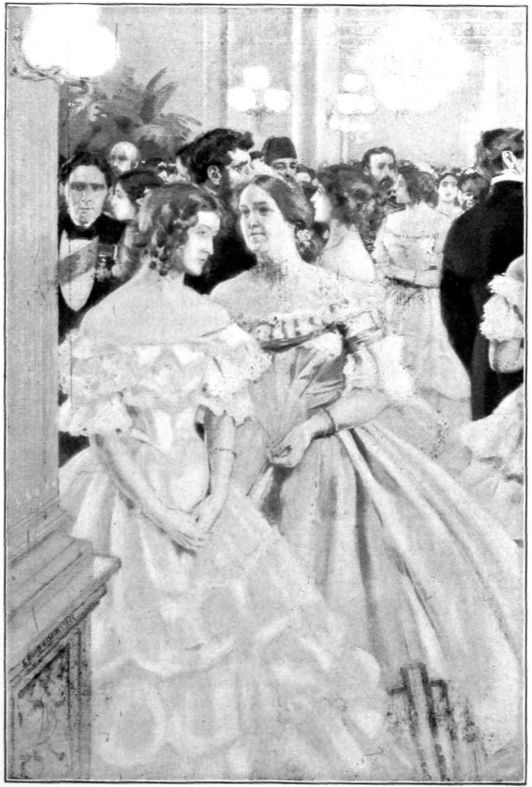
“ ‘YOUR NIECE? ALLIGATOR?’ ”
His wife turned on him. “I don’t see any call for sniggerin’. I didn’t know Tom had married again. I thought from the odd resemblance it must be your sister.”
“It’s not my step-mother, it’s my mother.”
The Duke chuckled.
“You have a peculiar sense of humor, Dalesbury,” said his wife freezingly. “But really in these days of paint and powder, you can’t tell a gal from an old ’ooman.”
Allegra’s haughtiness matched the Duchess’s.
“My mother is not painted. She has always been the most beautiful creature in the world.”
“Tut, tut!” said the Duchess. “Every child thinks its own mother the best. Well, well, run to your mammy, if you’re so fond of her.”
Allegra hesitated. “And am I to tell my father that you—”
“No, no, tell him nothing. I won’t see him just now. He—he is so occupied with his wife—we can’t meet after all these years before a stranger. You understand, Alligator.”
“Yes, I understand,” said Allegra, and thought she did, till she came to think it over.
The gawky girl blocked her path with an offered hand.
“Good-by, Ally,” she said. “I’m sure it isn’t gator. I hope we shall meet again.”
“I hope so.” And Allegra sought her father.
“Why, what became of you?” he cried playfully. “You’ve missed such a treat. I wanted to introduce you to—guess!”
“Tennyson,” she gasped.
He shook his head. “That lion stays in his den—but one nearly his equal in name and mane.”
“Deldon!”
He nodded, laughing.
“Where is he? Where is he?”
“Lost, swallowed up. I was thunderstruck to see the Poet of the People asked here.”
“It seems to me quite natural. Aren’t they going to bring in the Reform Bill he cries for?”
“I suppose they were—when he was asked,” he said with melancholy humor.
“If you mean the long-haired doll, there he is!” Mrs. Marshmont broke in.
Allegra’s eyes dilated. She stared in perturbation at the first poet she had ever seen.
For once no disillusion awaited her.
Blue-eyed, with a high marble forehead and pendent flaxen locks, tall and graceful of figure, faultless yet careless of costume, and departing from the conventions of evening dress by a florid tie, the young Deldon, encircled by beautiful ladies, incarnated all the Cornucopian ideas. She wished she could have added herself to his worshippers. What was he saying now? Could he talk prose at all? Unconsciously she moved towards him, towing her parents, and by straining her ears heard him say one word—the word “No”—of which it was hard to say, whether it was prose or poetry. Had he said “Nay” she would have had a stronger thrill. But she extracted consolation from its significance, for she had heard the feminine question to which it was a reply. “Don’t you write feverishly, Mr. Deldon, and so rapidly that you don’t know what you’ve written till you see it on the paper?”
“No,” said the Poet.
“I’m so sorry,” said the lady, naïvely. “I thought I was inspired.”
Allegra’s sense of humor was tickled, and she was moving nearer to catch the Poet’s rejoinder. But her mother’s impatient “Where’s Dulsie and Mabel?” arrested her.
“Dulsie’s with some Egyptian Emir now, I think, but Mabel I’ve lost.”
“Well, go and find them. It’s very dull here. We must go.” She spoke sharply and several people eyed her, amazed by her candor and her beauty. Occasionally Mrs. Marshmont would crave for the grand world, but invariably it bored her. This did not prevent her from craving again, as soon as she had forgotten her feelings.
“I don’t think, mother, that Dulsie will like to go home just yet,” Allegra suggested slyly.
“Then it will be good for Dulsie’s soul not to follow the desire of her heart, and the inclination of her eyes. When I was a girl, the only party I went to was the tea party at a funeral. But they were a good deal more enjoyable than these political parties.”
Allegra suppressed the desire to point out that at that rate her mother had fared as well as Dulsie, and Mrs. Marshmont continued: “I don’t really see what Dulsie can find to attract her. I would rather be at home with my rat.”
“There are rats here, too, my dear,” said Marshmont, smiling.
Allegra’s eyes flashed first with amused apprehension, then with wrathful remembrance. “That’s what she said you would be, father.”
“Who said?”
“The Duchess of Dalesbury!”
“The Duchess. Why, you have never met her?”
“Yes, father. Just now. She wanted me to fetch you to her.”
Mrs. Marshmont interposed sharply. “She wanted you to fetch father, like a pet rat?”
Father and daughter laughed.
“No, mother, she wanted to make it up with father; she seemed very fond of him still.”
Mrs. Marshmont’s eves blazed. “Fond of him still?” she repeated, with bewildered jealousy.
“Stupid old darling,” he whispered. “She’s my sister.”
“Your sister!” she cried, even more bewildered and even more angry. “And why did you never tell me that! And why don’t we see her? She might have been very useful to the girls. But how comes your sister to be a Duchess? You’re not a Duke,” she ended confusedly.
“No, but her husband is,” Allegra explained.
“Oh, I see, of course. Any one can be a Duchess.”
“The easiest thing in the world,” Marshmont said dryly. The ennobled Emma had become very shadowy to him: to his low-born wife, Society, conscious of the breach, had refrained from speaking of her. “And so Allegra, you’ve been talking to my sister?”
“Yes, we had a long chat.”
“Who introduced you to her?”
“Nobody. She just talked to me. She thought mother was my sister.” Allegra took her mother’s hand and pressed it with some of her old affection.
Marshmont was radiant with pride in his wonderful wife-pet. “And what did you think of my sister?” he asked.
“Candidly?”
“Of course.”
“Well, she seems to me the vulgarest and most conceited person I have ever met.”
“Oh Allegra!” Mrs. Marshmont was shocked.
He laughed. “Oh! Emma’s not so bad as that.”
“Well, you haven’t met her for centuries.”
“Perhaps you are right,” he said meditatively. “When I knew her she was merely the eldest Miss Marjorimont. Duchesses deteriorate.”
Allegra was cantering in the Park a few days later, attended by burly Wilson the coachman in the character of groom, when a more agreeable cavalier attached himself to her; none other than William Fitzwinter, M.P., in his flawless equestrian attire, on a tall black horse.
“Its name is Novabarba,” he told her as they slackened to a trot. Allegra inquired its connection with the storm-centre of foreign politics.
“None. It’s my latest horse, that’s all. Nova, new, Barba, a barb.”
“Oh!” said Allegra, disappointed. Then smartly, “Well, I hope it never will be beaten.”
His joyous roar of laughter applauded the jest. “A hundredfold better reason. I adopt it forthwith. But let us keep it to ourselves, else we shall be torn to pieces. What would your brother say!”
“My brother!” Allegra made a mouth. “He actually says he hopes there will be fighting when he gets there.”
“I’m afraid he’ll have his wish.” And Fizzy looked grave.
“Then I wish he would fight on the Novabarbese side.”
“Be careful! That was the Chevalier Garda on the gray horse—an Italian blackmailer.”
“And what is a blackmailer?”
“Heaven guard your innocence, my dear child, and may you never learn! But for your father’s sake, don’t say things against Britain aloud!”
“But you say them in the Morning Mirror.”
“Ah, you read the Mirror?”
“Of course.”
“Then write your views there! It will be safer.”
Allegra checked her horse while her heart set off at a gallop. What! The world of print was thrown open to her!
“But I can’t write—at least not articles—” she stammered. Her eyes and cheeks sparkled bewitchingly; the outlines of her young form revealed by the riding-habit had an appealing grace.
“What can you write?”
“I—I’ve tried verses.”
“The very thing! Deldon’s terms are becoming impossible—since he’s been taken up by Society. You shall be the new Poet of the People.”
“But how could I?” she gasped. “Write like Deldon!” But all the same the Cornucopia suddenly seemed poor and shrunken.
“If I put his name to your poems, nobody would know the difference,” Fizzy exclaimed airily.
“Oh, how can you say that?”
“See it in your eyes!” And he looked into them. She laughed with girlish glee as she touched up her horse. “Do they roll in a fine frenzy?”
“They’re the finest eyes I’ve ever seen,” he replied, giving chase.
By some mysterious instinct Allegra urged her animal to its swiftest. “That was not fair,” he said, as he came up at last. “You know I could never beat Novabarba again.”
“And I beat him!” she cried, in gay remorse. “What a bad omen!”
Three days later she met Mr. Fitzwinter again. In the mean time she had written and torn up several Poems for the People.
“You don’t ride every day?” he said inquiringly.
“No. You see we girls have only one saddle-horse between us. Tuesday and Friday are my lucky days.”
“My lucky days, you mean.”
“Why, what can it matter to you?” asked Allegra frankly.
Fizzy coughed. “I don’t like one-horse affairs, as they say in the States. I’d like to see you with a horse of your own.”
“Oh, wouldn’t that be lovely?” she cried wistfully. And another rhyme of the Duchess May floated through her brain.
“Then the good steed’s rein she took, and his neck did kiss and stroke.
Toll Slowly.
So he neighed to answer her; and then followed up the stair,
For the love of her sweet look.”
Fizzy began to describe his rides in Algeria. He told her of the mysterious underground telegraph of the desert, wherein you will be astonished to find the Chief of the Tribe expecting you, though you have come at a gallop unannounced, and he fascinated her with the idea of one day tasting for herself the charm of the East, and the life in the tents. He insinuated he must be at hand to protect her, for there were lawless hordes who captured you and demanded blood-money of your relatives. Allegra suggested smilingly, not without a shadowy thought of her mother, that they must sometimes blunder into capturing somebody whose return was not urgently desiderated. Fizzy admitted that there was bad luck in all businesses, but that in her own case he would be glad if her relatives refused to redeem her, as that would give him a chance. Allegra laughed girlishly and said she thought her father would raise the ransom, or at the worst Tom would ride to her rescue at the head of a squadron of Dragoons.
“What! and provoke new complications with the Powers! Fancy the questions there would be in the House about you!”
“That would be nice. How important I should feel! I might have a Blue-Book all to myself.”
“I would contribute a great speech about you.”
“There might be a Royal Commission on me.”
“Goodness—what a lot you know about politics! What a wife you would make for a politician!”
“No, I wouldn’t. Why, I’ve never heard a speech in my life!”
“You amaze me. Never been to the House? Never heard your father speak?”
“Only to the bullfinch.”
“What! He rehearses sometimes.” Fizzy’s roar of laughter—so disproportionate to his size—shook the reputable air of the Row.
“Don’t you?” she asked.
“Never!”
“But you are so clever! Something always comes to your tongue.”
He beamed. Then lugubriously he said “But it doesn’t always come to my tongue. . . . You must come to the House and hear me one day, won’t you?” he wound up after a pause.
“I should like to ever so much. Only father never seems to think of it.”
“You shall explore his den in the basement and climb to the Clock Tower in the firmament.”
Her eyes shone. “But you will be sure to speak the day I come?”
“Sure. Perhaps—perhaps—I will ask a question in the House.”
“No, I bargain for a full speech,” she said. “In your most amusing vein.”
This seemed to silence him altogether, and presently Allegra turned her horse homewards. As Fizzy waved his hat in farewell, she realized with a pang of disappointment that he had not said one word about the People’s Poems. It was particularly vexing, because just now a really good chorus was buzzing in her brain, beginning:
“Back, back from Novabarba,
Like Christ be meekly bold.
Teach Europe England’s honor,
And not her love of gold.”
Anyway, it ought not to be lost. The Cornucopia expanded to its ancient dimensions.
But the next day a beautiful bay mare pawed at her door-step. It bore a card “For Miss Allegra Marshmont, with Mr. William Fitzwinter’s humble request that she will not look in its mouth. Its name is Reform.”
Allegra, summoned from Parnassus and Novabarba, had a whirl of emotions. “But I can’t accept such a beautiful present.”
“Why not?” said Mrs. Marshmont who had rushed indecorously to the hall door and was now caressing the creature’s nose.
“But Mr. Fitzwinter is practically a stranger!”
“Did you expect anything from your relatives? Look at that old Duchess. I call it shameful.”
“I can’t accept it all the same. Please take it back with my thanks,” she said to the man.
“Arxin’ your pardon, miss, but I was told to say your father’s daughter couldn’t reject Reform.” Allegra smiled.
“Put on your habit at once,” said her mother imperiously, “and try its paces.”
And within a few minutes, Allegra, dazed and dazzled, was passing out of the drive, while her mother posted herself between the stone lions at the gate, surveying her critically.
“I didn’t know you could ride so well,” she said, as Reform thundered up for the third time.
Allegra sprang down, glowing and blushing. “She’s a darling. I must write at once to thank him.”
“I don’t know that you ought to write to a gentleman,” said Mrs. Marshmont.
“Why not?” said Allegra, guiltily conscious of a whole series of letters—albeit pseudonymous—to the Editor of the Cornucopia.
“It isn’t right for young ladies. I am sure Dulsie or Mabel never would. I’ll write myself.”
Allegra gasped. A panorama of Dulsie’s admirers passed before her, like the picture of the races of mankind in her early geography book: she thought of Dulsie’s secret correspondence in French, German, and even Italian, and Dulsie’s plea that flirtation was the cheapest method of learning languages, but though she did not approve of Dulsie, her tongue was tied. She contented herself for the moment with sending verbal thanks through the man. Mrs. Marshmont proved too lazy to write the letter, and the father agreed to do it. As, however, the sickly secretary, his honorable relative, continued to confine his work to Whitehall, and Allegra had now the privilege of helping with the home correspondence, it ended in Allegra really writing the letter herself, though her father signed it.
“My dear Fitzwinter,” it ran. “My little girl desires me to express her deep gratitude for your very kind and valuable gift, and though she is sorry you have put yourself to so much trouble for her, and is puzzled to think how she has deserved it, she is delighted with Reform. Allegra has the advantage of us, for while we have to carry Reform, Reform will carry her. And now since you have done her a kindness, will you do me one? In the Morning Mirror you said the other day that my eloquence has been unsurpassed since the days of Demosthenes; surely, such eulogies should be reserved for poor Bryden (at the unveiling of whose bust, by-the-way, I am to preside as soon as Parliament rises). I do wish you would establish the proper perspective in these matters. You know you have never read a line of Demosthenes. Everybody agrees that it was our lost leader whose lips were touched with the sacred coal, while I am only a man of facts and figures. I would have drawn your attention to this in the House, but you were always so surrounded, and if I had beckoned you away privately, the lobbies would have buzzed with grandiose rumors. Of your hinted foreshadowing in the Mirror of my resignation, in the event of the Cabinet sanctioning hostilities in Novabarba, I have less ground to complain. It would seriously prejudice my action, if I were a politician, but as I am not, I am ready to meet whatever position arises, heedless of rumor or repute.
“Believe me, my dear Fitzwinter, with kind regards, and renewals of my daughter’s gratitude,
Yours sincerely,
Thomas Marshmont.”
To which Fizzy replied laconically: “As to poor Bryden, you know I have never been able to see any good in the dead languages. Dead men turn no votes. Your speeches are alive and kicking. When Feudalism is kicked to death, let the ‘proper perspective’ be established. The utmost concession I will make meantime is that you are the greatest living orator.”
Allegra did not meet the greatest living journalist for some days, because all the other girls wanted to try Reform. Each in turn reported meeting Mr. Fitzwinter, who had only, however, raised his hat as he flew by. But at last her own turn came round, and in the new pride of possession she was dashing along the sunlit mould when Novabarba advanced to meet her. She drew rein, and repeated her thanks. Fizzy stopped her with: “Your father has already scolded me sufficiently.”
“Ah, that was for overpraising his oratory.”
“My dear child, if you had ever been to the House and listened to the other men’s speeches, you would see that any exaggeration is pardonable.”
“Yes,” she said meditatively. “I suppose it must be dreadful to listen to those tiresome Tory speeches.”
“I shouldn’t say the Tories have a monopoly—”
“Well, twaddle without even truth—!”
He roared again. “Excellent—excellent—the greatest wit since Aristophanes. That’s what you’ll become if you’re not careful.”
“You mean if the Mirror is not careful,” she laughed back. Then fearing that the mention of the Mirror might seem an indelicate reminder of his invitation to its columns, she went on quickly: “But seriously, how do you endure the flood of talk?”
“I don’t. I escape to the Ararat of the smoking-room.”
“Your Ararat is a volcano.”
“How don’t blame the Mirror, Miss Aristophanes.”
She flushed, reminded again of her poor poem. “But aren’t there some members who sit through it all, who listen to everything from mid-day to midnight?”
“There is one such person—and one only—who listens and listens to every syllable, every ‘hem’ and ‘er’—who dares not even seek refuge in sleep, through whose ears pours or rather dribbles the whole drearisome, wearisome flood.”
“Who is that?”
“He is called—supreme irony—the Speaker!”
Allegra laughed heartily. “You see what a poor politician I am. I’ve heard father say he was dining with the Speaker, but I never quite understood what the Speaker had to do.”
“Yes, the Speaker is the Listener. He gets paid royally for it and he has a house within the House, so as to get to sleep as early as possible. But it’s a wonder he doesn’t end in a lunatic asylum.”
“He does end in the House of Lords, doesn’t he?”
“Yes; that is his reward—even worse speeches, but not to have to listen to them.”
“But they don’t read so badly in the papers.”
“No, we polish ’em up and cut ’em down; ‘establish the proper perspective,’ as your father puts it. By-the-way what a pretty feminine hand he writes.”
Allegra could only mechanically quicken Reform to a trot.
“I wish I had somebody to lend me a hand like that,” Fizzy continued.
“You! You must have a hundred.”
“A Briareus! How? Where?”
“At the Mirror, of course,” tripped off Allegra’s lips; and again she flushed delicately and hastened to add: “Everybody has secretaries.”
“But not secretaries with soft hands and bright eyes.”
Allegra felt vaguely uneasy. “What have bright eyes to do with writing letters?” she murmured.
“Letters can’t be written without eyes.”
“Is that a pun?” she asked, more easily.
“As if I would dare do such a thing!”
Allegra laughed. “I think you would dare anything.”
“No—I have my limits. There is something I want very much to do. But I don’t dare.”
“I don’t believe it.” He was silent and her mind drifted to the simultaneous beating of the horses’ hoofs, finding pleasure in the rhythm.
“It’s true,” he said at last, and his voice was low and husky, “I want a wife.”
“Well, aren’t there hundreds?” She spoke lightly but her pulses began to throb with dim disquiet.
He tried to answer in the same key. “Where? At the Mirror?”
“Now you have dared to make a pun!”
“Please forgive me. It was a pure accident. I only meant to echo what you said before.”
“I know, I know,” she murmured.
“But since I have dared to make the pun, I might dare further.” His voice grew husky again.
“The man who would make a pun—” she quoted jestingly, but with gathering discomfort.
“Would pick a wife. Just so. But where?”
“You have been all over the world, you ought to know.”
“Ah, but now I am in a new world altogether, and I feel so strange, and I don’t know the language. Can’t you help me out?”
He leaned from his saddle towards her. Her suspicions were growing momently more definite and painful, but what she perceived most vividly was that there were beads of perspiration on his forehead, and she felt dully that she had made him ride too fast in the hot sun. How strange his eyes were! And hardly any lashes! Why had she never noticed that before?
“Give me a word,” he half whispered.
“What word?” she said helplessly.
“Any word except ‘No,’ ”
“What do you mean?” she breathed.
They rode on in a painful silence. So this was that wonderful thing—a proposal! How curious and disappointing—not unlike a Duchess! How cold and leaden her heart seemed in her breast, yet how fiery her cheeks felt! To think that love—associated only with the Shelleys and the Deldons of the world—should incarnate itself in the dapper person of a newspaper proprietor! A man who had seemed to sneer at all romance, and to see behind the veil of everything! She felt like laughing and she felt like crying, and presently she was only listening pleasurably again to the rhythmical beating of the horses’ hoofs. What a lovely breeze fanning her hot face! Was her hat straight? Her net seemed slipping backward. Suddenly she bethought herself with a start that she would have to give back Reform. Her eyes filled with tears.
They passed several ladies whom Mr. Fitzwinter saluted with his wonted gallantry. Allegra found her voice.
“There are so many women in the world,” she said.
“But only one Allegra.” He had got it out now at last in the most unoriginal fashion. But her name on his lips frightened the girl. She felt the situation even more embarrassing than her interview with the Queen. In both the problem was to go backwards gracefully.
“I must really be turning home now,” she said awkwardly.
“I had hoped to change your home.” His voice was quite hoarse.
“I am too young—just out of short frocks. I couldn’t possibly suit a man of your age.”
He winced. “I am the best judge of that,” he muttered.
“But I never dreamed you wanted to marry—anybody!” Allegra was gravely distressed.
“I didn’t—only you!”
“Oh please, don’t be vexed. I am so sorry.”
“Don’t you like me—just a little bit?”
“I like you a great deal. I think you are a force for good, though you pretend not to care. You are going to help England.”
“And yet you won’t help me!”
Allegra turned from red to white. Here was a new idea. Could she really help this man in his life work? If so was there not a call upon her? Was not this indeed the rôle of which she had dreamed so much of late—the true woman’s rôle, to sweeten life for some great strong man? But no! This man was too strong and not great enough. He neither needed nor dominated her. He was not a great, weak, loving creature like her father. She sought for words to soften her refusal. But he saw her hesitation. “Don’t decide in a hurry, Allegra,” he pleaded. “Let us talk of other things—about—about those poems for the Mirror.”
She saw now the Mirror must be given up, too, and again her eyes filled with tears. How tiresome life was! But she felt it was no use letting her unexpected suitor indulge hopes—it was kinder to stamp them out like the scorched moths.
“Yes. I would rather talk of other things,” she said bluntly, “and I never wish to talk of this thing again.”
He replied with welcome lightness: “This is the first time I have ever proposed. I’m thrown at the first fence.”
“But you said you had done everything except pray,” she reminded him, gladly catching his tone.
“Proposing is praying. Yes and confession, too!”
“I absolve you then. Go and sin no more.”
“I had already planned out the wedding number of the Mirror,” he said, returning to melancholy. “All framed in gold, in place of the black we had when Bryden died.”
Allegra ignored the gold and pounced on the black. She said she had persuaded her father to let her accompany him—in her new character of amanuensis—to the Bryden Memorial meeting in Midstoke. Thus she would be able to hear him speak.
“And what about hearing me?”
“Father says it’s so late in the session. They are just winding up things.”
“And you are winding me up!” he said dolefully.
“You will go again—like a clock. And dear me! I was quite forgetting the time—I shall be late for lunch.”
“And I shall not eat any.”
She laughed at the mock tragedy of his tone, and with a word of farewell galloped away. But she forgot to return to the head of the path where, when she met a cavalier, Wilson was wont to wait, half from amiability, half to spare his horseflesh. She forgot all about Wilson in fact, nor was she reminded of his existence when she found she had galloped unthinkingly to the wrong side of the Park and must go all the way back. When she did arrive on the homeward side, and found herself in the streets, her unattended condition came upon her with a shock, and she turned again to find Wilson. But Wilson was nowhere to be seen.
When she got home at last, she found her mother on the verge of hysterics. Wilson had, it appeared, galloped up to find if she had arrived, and then darted back in search of her. But this was enough to set Mrs. Marshmont’s vivid imagination picturing a dozen varieties of catastrophe, not even limited to equestrian. In fact so clearly had she seen Allegra’s brains bespattering the pavement, and her hair dabbled in blood, that it was as much a shock as a relief to see her come up, all sound and glowing. Mrs. Marshmont felt angrier than if the girl had arrived on a stretcher.
“Never any more, my lady!” she cried vaguely, rushing into the hallway.
“I am so sorry I’m late, mother. I lost Wilson and went back for him.”
“And he’s lost you, and gone back for you. Oh yes, you can smile. It’s a Comedy of Errors for you. But it’s King Lear for me. Such daughters! Not one cares a pin, if I’m on the rack! And the lunch is spoiled too.”
“I don’t mind.”
Mrs. Marshmont screamed. “What did I say? You don’t care how I fare? Any bone is good enough for a dog.”
“Forgive me, mother—I didn’t know you had waited.”
“Do you suppose I am like you—without a scrap of feeling! Did you think I could eat, when you were lying bathed in your blood?”
“But I wasn’t—”
Mrs. Marshmont glared at her. “No! You hadn’t even that excuse for torturing me. Don’t stand there flicking your whip—I know you’re itching to try it on me. If I had been a sensible mother, I shouldn’t have spared the rod.”
Allegra began to be angry. Her bones held memory of too many a mauling at the irate maternal hands, whose rings were especially unpleasant. Now to be reproached for not having been chastised! It made the remembered wounds smart doubly.
“If I am spoiled,” she said, “it’s because you didn’t spare the rod, not because you did.”
“That is right. Contradict Scripture. What next, I wonder. Go in and stop your mouth with lunch before new blasphemies come out.” She pushed her into the dining-room. “You think because you sneak and purr around your father and write a few miserable letters for him you can say and do what you please. Oh, and there’s a letter for you—came by hand. In a gentleman’s hand too!”
The girls, who were expectant at table, sent droll glances at her as, under her mother’s militant eye, she opened the elegant envelope beside her plate. The carven eagles under the sideboard brought her small consolation in the crisis. Their uncrushed heads seemed merely untrue.
It was only a note from Fizzy: “Dear Miss Marshmont, I fear you will now be thinking I gave you Reform as a bribe—as the Cabinet gives it to the Radicals—but please dismiss from your mind all that passed to-day. I shall always be glad to think that you accepted the horse if you refused the donkey.”
With a smile that held back a tear, Allegra crammed this into her pocket hurriedly. Sensitiveness and shyness blending with her resentment, she refused to soften her mother’s inquisitorial gaze by showing it to her. Which was, perhaps, ungrateful. But then none of the Marshmont girls realized what comparative freedom their incongruous parentage had brought them, in a period when the English girl’s life was as cramped as the feminine foot in China. Allegra merely thought it hard that while Dulsie should flourish, undiscovered and unreprimanded, her first and entirely legitimate affair should bring her under suspicion.
Mr. William Fitzwinter’s good-humored retreat touched Allegra more than all his advances, and to show that she met him in the proper spirit, she rode out the next day on Reform without, however, meeting him at all. Such delicacy pleased and disappointed her, and she had twinges of remorse as to whether she had blighted a noble life. This experience of hers made Dulsie’s debonair handling of affairs of the heart more puzzling than ever. Dulsie cheerfully admitted that half a dozen men expected to marry her. “But I can’t keep all my engagements,” she would say. Allegra almost wished she could make as light of Mr. Fitzwinter’s feelings, but they pressed upon her conscience, and a few nights before leaving for Midstoke with her father, she sought the aid of Joan’s conscience. Although she despised her younger sister’s judgment of high general ethics, on a practical question she respected her swift clairvoyance, her precocious knowledge of the world, more than she admitted—even to herself. Joan cut short the blushing confession. “But I guessed he was going to! The moment the mare came! A gift-horse took Troy.”
“Then why didn’t you warn me?”
“You’re so top-lofty. You would have flown at me for chaffing you.”
“No, I wouldn’t.”
“There you are! Contradicting me already. I shall wear pale peach at the wedding, and a bouquet of azaleas.”
“How you jump!” said Allegra in confusion.
“You mean to say I’m not going to be a bridesmaid!”
“Not at my wedding.”
“What! You’ll have strangers!”
“There won’t be any wedding,” Allegra murmured.
“You’ve refused him!” cried Joan sharply.
Allegra hung her head.
“Show me that note at once!”
“What note?” asked Allegra.
“The note mother was dying to see the other day—the proposal!”
“That wasn’t a proposal—that was an acceptance.” Joan glared. “An acceptance?”
“An acceptance of my rejection.”
“Then it is all over!”
Allegra breathed a “Yes.”
“You’re a young fool!”
Allegra recovered her haughtiness: “You forget I am older than you.”
“You old fool then!”
“I don’t know what you mean, Joan. How could I marry a man I didn’t—didn’t care for?”
“I believe the ceremonial is the same as in the other case,” replied Joan dryly.
“But he is so old.”
“And so rich: and so full of common-sense. What’s your idea of a husband? One of those young men you see in the Fops’ Alley at the Opera. Or is it a squalling foreign tenor?”
Allegra flinched under Joan’s withering scorn, but remembering she was guiltless of desiring either of those species, she recovered herself. “Whatever my notion of a husband may be, Mr. Fitzwinter does not fulfil it.”
Joan sniffed. “I see! you want a love-match.”
“And don’t you?”
“I? No, indeed! Not after seeing mother and father. That was a love-match.”
Allegra was staggered, but again she found her feet. “But it might be a thousandfold worse, if one began without love.”
“If one began without love, one might end with it. Anyhow, I don’t see how it could be any worse.”
“It couldn’t be much worse,” admitted Allegra. “But all the same, mother’s in love with father even now.”
“Whom she loveth she chastiseth!” Joan retorted irreverently.
Allegra’s young brow wrinkled itself. “It seems to me the best thing is not to marry at all,” she concluded.
“And the next best thing is to marry,” added Joan imperturbably “I shall wear white satin at the wedding and a bouquet of orange blossoms.”
“At what wedding, Joan?”
“At Mr. Fitzwinter’s.”
“Oh Joan! What do you mean?”
“I mean I shall marry Mr. Fitzwinter myself. Don’t look so jealous. I return him you, if you say the word.”
“You’re joking.”
“Marriage is no joke,” said Joan sternly. “Mr. Fitzwinter wants a wife, a wife must be found for him. Shall the Marshmont family lose such a valuable accession? Think of the good one can do with Mr. Fitzwinter’s money, yes and with his newspaper too. Think how pleased father will be—how it will knit together the Radical party.”
Somehow Allegra’s cheeks had grown quite white. She was more unnerved at Joan’s proposal than at Mr. Fitzwinter’s. What that plump little schoolgirl was saying sounded blasphemous—a spiritual profanation. But a solacing thought came to her.
“But he’s not in love with you!” she cried.
“Well,” retorted Joan, “I’m not in love with him.” And she tossed her square chin, as if to dismiss the subject, and made staccato stitches at the night-cap she was finishing for Tom’s use in Novabarba. The young cornet’s departure—which would precede the Midstoke expedition by a day—was throwing Allegra’s into the shade, or rather postponing Mrs. Marshmont’s agitation over it. As her mind only realized one thing at a time, she never economized her emotions by taking her troubles in the lump. She went out to meet each misfortune half-way, receiving it as with an emotional etiquette: and the fevers and more or less mortal wounds that awaited Tom would be duly succeeded by the railway accidents on the London and Midstoke line. Her husband, strengthened by her weakness, refused to let her see Tom off, but he went down to the dock himself, taking only Jim, who was now up from Harrow for the holidays. He returned doubly sad, with a confused impression of martial music, waving helmets and handkerchiefs, weeping wives, and a huge roaring mob swaying deliriously with patriotic frenzy, as if, though the nation was at peace, some brute instinct joyously scented war. He had never before been brought into such personal contact with the army, and for the first time in his life the People impressed him, not as a mild, heavy-eyed, half-starved ox, stupidly bearing the intolerable yoke of the classes, but as a wild carnivorous beast, lusting for blood. The one touch of pleasure the scene brought him was Jim’s unexpected comment: “Cannibals beating the tom-tom!”
The supercilious young gentleman, with his spruce jacket, shining white collar, and glossy high hat, towards whom he had been feeling curiously unsympathetic, seemed suddenly a representative of civilization, and his son. On the way home he tried to dig into this new unknown mind, hoping for Allegra-like treasure. But to his simple spade it seemed full of baffling windings. Jim appeared almost a changeling, without the family beauty or the family tallness; delicate in health, yet coarse in feature, and with a nose turned up as in permanent disapproval. At Harrow he sneered at his contemporaries and worked his fags like a slave-driver, yet he had something of his mother’s fascination, for he was never without a following. His only physical prowess was with the foils, but this sufficed to redeem him socially from his triumphs in Latin verse. Perhaps, too, the tradition of Tom was in his favor—the golden legend of long-jumping and swift bowling.
During the absence of the males the Marshmont household rocked with a feminine storm. It arose from Mrs. Marshmont’s unexpected invention of a new grievance—that no plans had been made for the autumn.
“Of course I couldn’t think of anything before Tom was gone,” she declared with tearful truth. “But now that we ought to be escaping from this brick and mortar oven, your father has not arranged a thing. He would go and let Hazelhurst for the year against all my advice and protestations, and now we have not a resting-place for the sole of our foot. Why, we must be the only people in London. And now he’s off to Midstoke, leaving us like Shadrach, Meshach, and Abednego.”
“It’s worse at Midstoke,” laughed Mabel incautiously. “Think of all those blast-furnaces.”
“Of course: you all take his part.” From such small beginnings Mrs. Marshmont mounted till she reached her bedroom, threatening suicide. Allegra flew after her in alarm, but the door was locked in her face. She ran down, her heart palpitating wildly, and implored Joan to return with her and stave off tragedy.
“Go down and get Gwenny,” Joan said coolly: “Gwenny has more influence than I.”
“No, no,” Allegra panted. “Gwenny cowers before her. You don’t.”
“You’re all fools. Not one of you knows how to take her.”
Joan walked up the stairs, softly reciting:
“And bouncing, and flouncing, and trouncing,
And squalling, and bawling, and mauling,
That’s how the mother goes up to her door.”
She tapped at it gently. “Mother, dear, can I help you to pack father’s box?”
“Yes, Joan.”
They heard a portmanteau being dragged from the dressing-room. Joan pinched Allegra. “But the handle is stuck,” she said.
The key grated, and Mrs. Marshmont, holding a coat, appeared at the open door. The rat was perched on her shoulder.
“I shouldn’t think he’d want that blue one, mother,” Joan said instantly.
An elaborate discussion ensued, in which Allegra bore her share very seriously, as being the fellow-pilgrim. She found it quite interesting to think out how many neck-ties a man needed in three days, and was very proud to find herself the only one who remembered the throat-medicine. When the head of the house got home, he found no marks of its having rocked. His wife was indeed far calmer than he had expected, so soon after Tom’s departure and so soon before his own. He was delighted to find she had packed his luggage, and was now helping even Allegra to pack hers.
“We must be thinking of a holiday, dear, as soon as I get back,” he said, smoothing her soft face.
“It will be sufficient holiday to see something of you, fy nghariad (my love),” she cooed back.
“Yes, but we must bring the roses again to my darling’s cheek. She has had so much to bear. I wish now we had not let Hazelhurst.”
“But you wanted the money, sweetest.”
“Yes, towards—” He broke off, not desiring to recall “Tom’s commission.” “But I expect we shall manage to get quarters at a farm-house.”
“A farm-house!” she panted. “With two of your sisters’ places standing empty. I looked it up in Debrett. There’s Rosmere and—”
He interrupted her smilingly. “But, Mary, we can’t go a-begging of my sister.”
“My sisters are not backward in begging of me!”
Of this her husband had become gradually aware more in admiration than in anger, though he was still ignorant that herds of minor Welsh relatives hovered about the tradesmen’s door, and were occasionally harbored cautiously for weeks in the nether regions, like people on whose head a price was set, rather than people who cost so much a head.
“Yes, yes,” he said, soothingly. “But I’ve never spoken to Emma for years. The places are not even hers—but the Duke’s. And the Duke I’ve never spoken to at all. No more have I to the Duchess for the matter of that,” he added, smiling.
“Well, it’s a shame she should have three country houses, and we none at all.”
“It’s a shame we should have five servants, mother, and many people none at all,” Allegra put in.
Mrs. Marshmont kindled. “We haven’t got five servants.”
“Yes, reckoning Wilson.”
“And if we have, I’m sure I work as hard as the five put together, while you are jingling on the piano.”
“It’s a question of society, not of the individual.”
“Hush, hush, Allegra,” her father interposed. “I’m afraid you’re getting infected with some of that Continental socialism.”
“She is always hankering after the Continent,” Mrs. Marshmont added resentfully.
“No, father, I know very little about Continental socialism. But I see for myself how badly things are arranged.”
“I wish you saw how badly your things are arranged,” Joan intervened contemptuously. “You’ll simply ruin that frock.” And she extracted it from Allegra’s box and refolded it.
“Without free competition, Allegra,” said her father mildly, “the world would come to a standstill. The individual must fight, but fight fair, and be fairly rewarded.”
Allegra received the dictum with respect, but with a growing suspicion that her father’s sweet reasonableness was too tame for the monstrous miseries that obsessed her imagination. She sometimes yearned even for Fitzwinter’s poisoned rapier. If she could only have felt in him a touch of the prophet.
The next morning at breakfast—even while the carriage waited outside to carry Allegra and her father to the station—the Minister announced, looking up from a letter, that Mr. Fitzwinter had invited the family to his Devonshire country house. The table buzzed with surprise and pleasure, and Joan’s foot pressed Allegra’s.
“I don’t see how we can all go,” said Allegra, coloring.
“You selfish chit,” cried Mrs. Marshmont. “Do you think because he gave you a horse, he doesn’t want to see anybody else?”
“I shall be delighted to see more of Mr. Fitzwinter,” said Joan, treading more heavily on Allegra’s foot.
“But you can’t see anything of Mr. Fitzwinter,” said her father. “He is going off to Novabarba for the shooting, he says. He puts the house at our disposal.”
Allegra shot a mischievous glance at Joan. “Oh, in that case—”
“But what shooting will he get in Novabarba?” asked Mabel.
“There are sure to be wild animals,” said Jim.
“My belief is he means the wild animals who are going to shoot one another,” cried Mrs. Marshmont shrewdly. “He is going off to see the fun as he calls it, but what is fun to him is death to me.”
“Health to you, you mean, mother,” hastily intervened Joan. “You forget we’re to have that beautiful Manor House: I read about it once—there are the most wonderful domed conservatories stretching out on a cliff. I could live there for ever.” And her eye sought Allegra’s roguishly.
“But I hope it’s not too lonely,” said Dulsie. “One doesn’t want to be buried in a conservatory on a cliff.”
“The horizon is not clouded with majors,” replied Mabel, “but a man who stayed there last Christmas told me there are quite old families within a five-mile radius, and naval and military men come up from Plymouth for the cotillions.”
“It is indeed most kind of Mr. Fitzwinter,” said Mrs. Marshmont, “and I hope, Thomas, you will express as much in your letter.”
“I shall attend to it as soon as we are settled in our hotel,” he assured her; whereupon Allegra, bethinking herself that it would be written in a “pretty feminine hand,” blushed with apparent irrelevance.
“And how long shall you be away?” asked Mrs. Marshmont, who had known for ever so long that her husband was reducing the expedition to a minimum—one day to go, one day to speak, and one day to return.
“Three days,” he replied patiently.
“ ’Tis twenty years till then,” she quoted—a matronly Juliet.
“Then why not go down to Devonshire—I’ll come straight to The Manor House!”
“Oh no, there wouldn’t be time to pack and—”
“Not in twenty years, mother?” Joan asked.
Mrs. Marshmont stared at her. “Twenty years? Are you out of your senses, Joan?”
“No, mother, only in my sixth sense—the sense of humor.”
The Minister created a diversion by farewell embraces. “Don’t tease the bullfinch, Dulsie,” was his final cry, as Wilson with a cluck jerked off the horses.
Midstoke was a vertebra of the backbone of Britain, a humming hive of money-making, and, as in celebration of its prosperity, what seemed a perpetual jubilation of fireworks rose over the low stone houses of the town proper. But it was only the blazing jets from the furnaces—bonfires proclaiming the glad tidings of the conversion of iron into steel and of steel into gold.
To feed these unsleeping fires, a section of Midstoke woke when the world lay snuggled under the blanket of darkness, and went shivering and yawning through the narrow, dim-lit, but spasmodically ruddied streets under the keen stars. And besides these sleepless iron-works with their double shifts, Midstoke pulsated with factories, wherein, from dawn to dusk, coarse-jowled men and unshapely women and shuffle-footed girls tended the iron monsters whose slaves they had become, and which dragged them down as in envy of their humanity to the same endless monotony of blind recurrent movement; avenging an instant’s disrespect by beating out their brains with steel rods or grinding their bones between toothed wheels.
Allegra had been looking forward to these Moloch fires and Juggernaut wheels as to an emotional orgie, for her father had promised her the spectacle. But an emotional orgie of another sort awaited her.
Marshmont had refused private invitations in favor of real privacy at an hotel. His long years of platform touring had familiarized him with the hardships of local hospitality—the general atmosphere of amiable ladies with birthday-books and confession-albums; the “few friends at dinner” turned into a lion-exhibition by the proud host; the slippered chat after supper frustrated by incursions of near neighbors and distant relatives: never a moment in which to possess one’s soul or indeed excogitate one’s speech. Against these drawbacks was to be set the acquisition of local knowledge and useful commercial data, or rather the possibility of sifting some grains of fact from a medley of prejudiced gossip. Sometimes he fluctuated in favor of particular hosts, but in this instance his decision in favor of hotel bills was really part of the tribute he was come to pay Bryden. It was Bryden whose guest he had always been at Midstoke. Bryden’s bachelor freedom had permitted of glorious hours of dreaming and scheming a regenerated England, and any lesser host would profane so dear a memory.
But the Minister had reckoned without his real host—the town of Midstoke. Midstoke was very proud of Bryden, and of its position as the metropolis of Radicalism. It was a self-made town, whose factory chimneys had an instinctive opposition to ivy-mantled towers, and it was the only town in England that returned no representative of mediævalism. Marshmont himself had to divide his constituency with a sporting Tory squire. But in Midstoke revolutionary thought flamed and hissed like the blast-furnaces, and there were voices daring to say that even the puddlers who tended them should have their vote just as well as the folks in the fifteen-pound houses. It was the era of Franchise Bills, of Ministers outdoing one another in lowering the franchise, like competitive salesmen, of Cabinets upsetting on a question of five pounds; of parliamentary jeremiads on the Deluge that would follow the removal of another pound from the political dam. Midstoke cried in the wilderness for universal suffrage—that the wilderness might blossom as the rose.
Since his elevation to the Cabinet, Marshmont had not set foot in Midstoke. Midstoke had therefore still to celebrate his triumph, and the fact that he was come to praise its own dead Cæsar added glow to its welcome.
The travellers found a motley deputation, headed by the Mayor and one of the Members and tailed by small boys, excitedly thronging the platform. A brass band struck up “See the Conquering Hero Comes.” Marshmont looked miserable, Allegra tearfully happy, and the unexpected sight of this pretty creature kindled the enthusiasm to a white heat, sufficient to melt a heart of pig-iron.
“God bless your gowden locks,” cried a head-shawled factory-girl, and there was an inarticulate roar of approval, and a red-faced young man, with an air of Master of the Ceremonies, called out “Three cheers for the young lady,” and they were given, while Allegra, suddenly translated to a public personage, looked as shamefaced as her father. An open carriage, too, had been provided, and when, escorted and embarrassed by a mob, they had ploughed their way through the station, Allegra became aware that a blacker and grimier mob was heaving outside, brightened by flags and banners. She took her seat by her father’s side, the Mayor and the Member facing them, and through a haze of tears she saw the great swarthy town and its swarms of sunless faces. And then the same young man had a further inspiration. He started to unhitch the carriage, and presently the triumphal car was being drawn along by what Allegra afterwards described as “huzzahing horses!” The crowd, the cheers, as enkindling and uplifting as the spurts of flame over the houses, thrilled Allegra with a strange new sense of her father’s greatness and the greatness of his cause. Here he was the royal lion. At home she saw him tame as her mother’s rat. In the London streets he was unrecognized or taken as a matter of course. And these swelling throats, too, gave body to the dreams he dreamed, transmuted them from words to living realities. These great-hearted, rough-handed toilers who loved him so—for them one could live and die.
And her anger mounted suddenly against her mother—shooting up like those fiery jets—against the woman who made herself the centre of a household which held this man of men: who sacrificed and tortured, where she should have soothed and worshipped: who, immersed in her petty domesticities, heard not the flutter of angelic wings, was blind to the beauty at which the ages would wonder. Unconsciously her own hand sought her father’s and sent her warm love through its loving warmth.
Her first contact with the crowd was as vitally instructive to Allegra as her father’s experience of the mob at the dock had been to him the day before. For him, indeed, that lesson was already being obscured by this, his more familiar conception of the People: the vision of the wild beast receded to a nightmare shadowiness, and his old image of the overladen ox returned, the ox, heavy-eyed but lowing at sight of Christ in the manger.
Allegra’s anxiety for her other emotional orgie was only whetted by this. She dragged her father that same afternoon through the whirring mills with their marvellously dovetailed machines, ingenious to the verge of humor in their automatic adjustments, and midnight found her within the dusky glare of the iron Inferno, dazed by the thwack of steam-hammers, the gride of giant shears, the clangor of rollers, and picking her way gingerly amid blasts of burning air. At first it was very terrifying to dodge long beams of white-hot iron shooting past her on tiny trucks, and fierce glowing knobs in the grip of huge tongs, or to steer amid yawning, roaring caverns of flame of a temperature so transcendental as to seem subtilized into spirituality, and she had an impulse to let them suck her in, which reminded her of the moths. But she was astonished to find how soon she had accommodated herself to the situation, with what coolness she followed her guides over the hot sand through the hissing maze of colossal brick cones, tended by red demons perpetually poking, with what a sense of home she returned to the furnace at which she had first watched the blast of air whiten the melting metal to unimaginable ardency. She wondered if it would be so in the literal Inferno, and from the tear-misted remotenesses of the past came up the memory of a childish conversation on the topic with Gwenny, to whom she had once pointed out (after getting half scalded in a bath into which she had jumped prematurely) that nothing hurt very much after the first few seconds. “The Omnipotent has specially arranged that the agony shall endure,” Gwenny had replied reassuringly, “even as the soul shall bum everlastingly, yet never be consumed. It is like the agony of thirst, which grows not less but more as time goes on. The lost shall thirst for a cup of cold water through all eternity.”
When Allegra at last went to bed in the small hours and in the strange hotel bed, she was long in falling asleep, but when the silent beauty of the scarlet dawn stole over the belching town, her aching eyes closed, and she dreamed of Gwenny sweeping the chimneys of hell with a great black fire-brush, surrounded by small demons shouting “God bless your gowden locks.”
But there is no rest for the wicked, or those who meddle in politics, and Allegra must wake to the wilder frenzy of the First Bryden Anniversary. Her father was to unveil the bust and make a great speech in the afternoon, for so high did the fever mount that Midstoke had given itself a half-holiday, and everything closed, except the furnaces, which bore out Gwenny’s ideas to the last spark.
The brief hours before lunch were devoted to the Minister’s correspondence, swollen by fatuities and futilities, applications for alms, Government berths, nominations to the Bluecoat School in London. But at last Allegra found herself seated on a platform amid politicians and potted palms, in an environment of wall placards that recalled Gwenny’s texts, and of hysteria that recalled her religious excitement. The girl had never before been at a political meeting and it seemed to her to supply the something she had always missed in the frigid services of the Church of England. Perhaps this passion for human progress which seethed around her was religion—the religion of the future.
Even the frock-coated saints of progress in the stained-glass windows of this new Town Hall, held something of sublimity, ridiculous though they were at first sight. And there was the sublime without the ridiculous, she knew, in the fine bust of Bryden, which stood on the platform swathed in its unlovely drab cloth. Perhaps it was a type of the beautiful spiritual things that lay swaddled about by this uncouth Midstoke.
The fervor of the opening simmered down under the tedious formalities and meandering speeches that preceded Marshmont’s address. The Radical Member who was in the chair—the other Radical Member had stayed away out of jealousy, because both of them could not sit in it unless one sat in the other’s lap—was not so very tiresome in his own remarks on the perfectibility of humanity, but he edited the meeting rather worse than most meetings are edited. After announcing a rigid ten-minutes’ rule, he made an exception to it in favor of every speaker but the liveliest, who being merely bookkeeper at the oilcloth works, might be cut short without ceremony. But all this made Marshmont shine by reflected dulness, and when he at last arose, the audience seemed to forget it had already at his entry sung “For he’s a jolly good fellow” twice through.
The ripe sun streamed through the colored frock-coated saints and the hall was very hot, yet the perspiring folk that packed both floor and gallery and overflowed indefinitely adown the street, never seemed to tire of shouting and waving hats and handkerchiefs. The Minister stood bowing at regular intervals like a wound-up toy, and Allegra wondered when he would be allowed to speak, and how any man could speak up to that standard of emotion. She felt like a mass of stripped nerves, suffering yet exultant, morbidly apprehensive of his break-down, yet simultaneously sure of his triumph. She saw he had put his few notes into his hat and she hoped he would not forget where they were, as, she had discovered, was his habit of mind at home.
She scarcely realized how stale to him was all this preliminary pother; to what storms of approving thunder or sibilant lightning he had opposed the same pained forehead; how all this was but the mere rolling wave on which to launch the boat the instant it receded.
And yet there was neither professional calm nor professional tremor in his tones, as he began to speak of the solemn occasion that had brought them together. It was evident that he was shaken, if not by their emotion, by his own. Early in his speech he undraped great Cæsar’s bust—not undramatically—and there was a hush of awe, a reverential upstanding, followed by a round of cheers. And over the rest of his speech that beautiful stone head threw the majestic simplicity of its marble silence. He spoke of how the heart of him, whose noble features nobly sculptured were now a Midstoke monument for all time, had ever thrilled to “the still, sad music of humanity,” and Allegra lost the sense of his next sentences through groping after a dream-like reminiscence, which finally turned out to be a dream, indeed: none other than her vision of the stone statue with the heart of flesh in the ruined palace amid the desert of sand. Her thoughts wandered away to the burnt poem that she had based upon it. But her father startled her back into attention.
“I loved this man,” he cried with sudden ringing passion, and threw his arm around the bust. “Why should I be ashamed to speak of my love? O Jonathan, my brother, how are the mighty fallen, and the weapons of war perished!” And at this strange heart-cry, this visible contrast of the dead stone and the living man, the Hall seemed to rock as with an earthquake, and people sprang on chairs and shouted and Allegra felt herself swept upward to her feet, too, by the mighty wave of exaltation, and she was crying and laughing and watching the big tears roll down the orator’s face. She wished to wipe them away, and yet she wished them to be there. He, all unconscious of them, put out a deprecating hand, which like a mesmerist’s waved the mob down to their seats and their silence. And now the speech grew soberer, more in his wonted manner, returning to earthen facts and iron laws. He sketched out the programme of the future, the lines on which all good men and true should work—not Radicals only, there were good men and true in all parties; let them not imitate the follies of the past by ticketing men off into camps; he was not even sure that the working-classes needed special representatives in Parliament. At this point Allegra was sensible of a slight loss of temperature in his audience, and what made her feel it more morbidly in them was that she felt it in herself. But he regained his hold as he spoke of Novabarba, of this eternal red-herring of foreign complications dragged across the path of domestic reform: of this “spirited foreign policy” which was usually only the cover for a spiritless shuffling out of all Governmental promises. And at this almost open attack on the Cabinet of which he was part, the Hall grew frenzied again, flattered to be the scene of a declaration so sensational, so palpably destined to be telegraphed far and wide, and to be the nucleus of articles innumerable. As the speaker passed to his peroration, he rose again to the lyric heights of his exordium, threw off from his wings the clog of facts and figures, kindling to the inspiration of the great orator he celebrated.
He limned in a few strokes the world that Bryden had prophesied—every man with a voice in the ruling of the realm, the peerage shrivelling away before the aristocracy of simple manhood, the corrupt corse of feudalism buried fathoms deep, to “suffer a sea change into something rich and strange”: the Empire limited to its natural racial expansion, the wen of India amputated, with all else through which the life-blood of the British Constitution did not circulate: war-ships replaced by merchantmen, the glory of war by the service of humanity, its cost expended on the education of the people, the spider spinning his web across the cannon’s mouth; a world of free peoples freely exchanging their products, material and spiritual, obscuring their frontiers by friendly fusion, casting out their fear by love. And they should beat their swords into ploughshares and their spears into pruning-hooks: nation should not lift up sword against nation, neither should they learn war any more. His voice had a dying fall, and left a religious hush behind it, so that even when the great orator resumed his seat the tense silence still held for an instant, nor was it really dispossessed by the inevitable punctuation of applause.
“Mr. Chairman, ladies and gentlemen,—Like the snore of the fat boy in Pickwick—” Allegra felt a jar through every fibre. Who was this tall, red-faced young man, sprung so unexpectedly upon the palpitant scene, and plunging on his brazen way with such cocksure complacency? The fat boy in Pickwick always fell asleep; so did the Government unless perpetually prodded. Their great representative, Bryden, had been denounced as a Quaker: Cabinets had found him a Shaker. Mr. Marshmont had spoken of the red-herring of Novabarba—he should say, the blood-red herring. It was all out of key with the noble oration, with the silent marble face,—these witticisms, these crude, caustic epigrams, these colloquial tropes and turns, this rush of breezy prose. But she was in the minority. The audience seemed rather to accept with relief these draughts of common air after the tenuous ether of the heights. The young man was apparently a local favorite. A ripple of laughter occasionally swelling to a roar followed his sentences. And presently, as he grew less smart and more serious, Allegra herself was drawn into the sympathetic current. Perhaps it was because she suddenly recognized in him the young man of yesterday, who had called on the mob to give three cheers for her, and who had headed the “huzzahing horses!” Perhaps it was because he had arrived at the eulogium which, it seemed, he had to pronounce on her father, through the medium of this vote of thanks. And now the flippant note died away altogether. Emotion came into his harsh incisive tones as he spoke of the great apostle of light who was honoring them and their dead hero that day, and who might now say, like Elijah, “I, even I only, am left a prophet of the Lord; but Baal’s prophets are four hundred and fifty men.” What a privilege for himself that afternoon to kiss, so to speak, the hem of Elijah’s mantle! And then growing prophetic himself, he declaimed against the wrongs of the poor and the down-trodden, and the corruptions of princes and bishops and the aristocracy till great cords of passion stood out on his temples.
A brazen speech enough, but the brass was martial and Allegra thrilled to it. This bold outspokenness, this blasphemy against Church and Crown, was what her mood demanded: her father’s words shrank to timidity before this iconoclastic vigor. Here was a fighter. Before he had finished, she had forgiven his unhappy beginning, assigned it to a rehearsed jest, the prepared spring-board for impromptu soarings.
When he sat down, she could have joined in the “Bravo, Bob,” of a fervent admirer. His other name was Broser, she learnt from the seconder of the motion, and when the vote of thanks was passed, and the hubbub of exodus began, she was not sorry to find the young warrior pushing his way towards her father, as if bent on a personal hand-shake. Her father gave it effusively, and just as Allegra was hoping Mr. Broser would insist on her acquaintance, too, the fiery sledge-hammer introduced his wife to the Minister. Allegra gazed with interest at the lady, glad to find her a small meek creature who might be expected duly to sink herself in her husband’s perfervid personality. But she had scarcely satisfied her curiosity, when she felt a dig in the back as from a stick. She turned and saw with a shock the Duchess of Dalesbury brandishing a parasol.
“Let us congratulate each other, Alligator,” said the Duchess.
“You here?” murmured Allegra.
“Yes—Rosmere is not so many miles off, I was dyin’ to hear how he spoke, and I’ve been behind you incognita all the time. He is splendid—splendid—tells these poor fools nonsense of course, but the English of it, the English of it. There ain’t many that can use English like the Marjorimonts. But what a terrible person—that Bob.”
“Terrible to the Throne and the Church, I grant you,” said Allegra sturdily. Her last repugnance to Broser vanished before the Duchess’s disapproval.
“What! You admire that brass-mouthed atheist?”
“Hush, hush, he can hear you.”
“And didn’t I have to hear him? The fat boy in Pickwick, indeed! I felt like thumpin’ him with my parasol.”
“If you had spent a night in the iron-works, you would have felt like thumping the capitalists.”
“And who is your Bob—a mill-owner’s son, I heard somebody say.”
“I don’t know—but if so, it’s all the nobler of him—to feel for the poor—like father.”
“Like your father! You dare to compare that beef-faced bully to my brother! O Alligator!”
“He isn’t a bully, and if he is, you all deserve it. He is the kind of man England wants—to carry on father’s work.”
“England in need of men like that! No, Alligator, England needs gentlemen.” Allegra restrained herself.
“And how is Lady Minnie?” she asked distantly.
“More beautiful than ever.”
“And the Duke?”
“He is writing another book.”
Allegra, alarmed lest she should betray ignorance of the others, hastened to say, “Shall I tell father you are here?”
“No, I will tell him myself—as soon as he disentangles himself from his horny-handed worshippers.”
This, however, proved a longer process than the Duchess could endure, so protruding her parasol through a hole in the mob, she prodded the Minister between the ribs.
“Good-afternoon, Tom!”
“Emma!” The Minister dropped the glass of water Broser had just handed him, and Mrs. Broser’s meek bodice was copiously besplashed.
“I beg your pardon,” he stammered.
“No matter, no matter in the least,” cried Broser. “My only regret is that the glass you drank from is broken, and I had hoped to guard it as an heirloom.”
“Are you comin’, Tom?”
“Presently, Emma, presently.”
“But I want you to dine with me.”
“At Rosmere? Impossible.”
“Then, I’ll dine with you.”
“I am sorry. I have just promised Mr. Broser to dine with him. Emma, may I introduce Mr. Broser? Mr. Broser—this is my sister, the Duchess of Dalesbury.”
Mr. Broser having no glass to drop, dropped an “h” in his agitation as he declared his ’appiness at meeting the Duchess. The Duchess smiled sweetly upon him in return and declared her happiness at witnessing his oratorical triumph. His face shone like a patted schoolboy’s as he rejoined: “I am sure we shall be only too delighted and honored to have her Grace, too, at our humble board.”
“Nothing would give me greater pleasure,” returned the Duchess, with infinite suavity. “But I have not met my brother for so long that I am sure a gentleman of Mr. Broser’s taste and good feeling will surrender him to me altogether, just for this once.”
Mr. Broser replied with his ready wit that, placed as he was between Scylla and Charybdis (he mispronounced both), and having to choose between paining himself and paining the Duchess, he had no option but to deny himself the honor and pleasure of entertaining Midstoke’s revered visitor. Whereupon with much gallant bowing and curtsying the Duchess and the Demagogue took leave of each other. Her Grace bore off the Minister, and Mrs. Broser, forgotten of all, followed in the wake of her husband. Awed by the presence of a Duchess, the rest of the crowd dissipated, leaving the lion free.
Allegra had beheld the little comedy with silent amazement. It was the only time she had seen the Duchess polite. But when, as they descended the platform the Duchess said sharply: “Oh Tom, to think if I hadn’t come, you would have broken bread with that beast!” Allegra intervened angrily: “But you told him you enjoyed his speech.”
“My dear,” said the Duchess, “one isn’t rude to that sort of person.”
Allegra turned to her father and took his hand lovingly: “Are you tired, dear?”
“No, not tired—but a little ashamed.”
“Ashamed, father? Of what?”
“I was too theatrical—that clasping of the bust!”
“That was fine, father. It had all the thrill of drama with all the weight of reality.” Allegra was unconsciously summing up her impressions of the whole meeting.
“My only consolation is that I hadn’t rehearsed it. It came of itself. But how they cheered that, while the real solid parts of my speech made them restive, so that I caught myself working up to fresh cheers. Ah, that is the worst of addressing meetings. You sink to an actor. You long to spice and over-color, you can’t endure long arid tracts of silence, even though you know that frequent cheers are the sure signs of bad speaking; of a mere firework display.”
“I don’t see that, Tom,” said the Duchess, as they came into the street.
“Surely, Emma! Frequent cheers mark a lack of continuous exposition. The cheer should be the climax of a gradual ascent.”
“Three cheers for Marshmont!” cried a voice, and the mob that had not got in, gave them.
“How badly you must have been speaking just then, father,” Allegra laughed, as they entered their carriage.
“Yes, he was talkin’ nonsense,” assented the Duchess. “Cheers are the certificates of eloquence.”
“Well, Mr. Broser got more than father,” said Allegra slyly.
“Possibly your father may be right,” the Duchess admitted meditatively.
The dinner, served in the private sitting-room, began placidly enough, politics being left behind with the high-hatted saints in stained glass, though the mildness thus engendered in the conversation gave the meal rather a vegetarian air. The Duchess had heavy arrears of family gossip to deliver to her prodigal brother, who listened with more patience than Allegra. The girl was still under the intoxication of her first public meeting, and resented trivial details concerning commonplace creatures of fashion, who, instead of “working for the world,” let the world work for them. Even so had Mabel, fresh from the romance of her first ball, resented her mother’s reminder in the homeward carriage that cook had given notice to leave, and father’s throat was beginning to worry him.
But if Allegra still felt hostile to the Duchess and her world, the Duchess had apparently nothing but the most amiable sentiments towards Allegra, and having renewed her invitation to Rosmere, she grew so eager when Allegra refused it that nothing could content her but to carry off the girl at the point of her fork.
In vain Allegra wriggled in deprecation, protesting to the point of mendacity.
The Duchess was not accustomed to other people getting their own way. “A bird in the hand is worth two in the bush,” she said.
“Then let me help you to some more partridge,” said Marshmont good-humoredly.
She held out her plate instantly. “I’ll have partridge and Alligator too.”
“My dear Emma! What a menu!”
“Yes, it does seem as if the child was afraid I would eat her.”
“No,” said Allegra smiling. “Only that I should disagree with you.”
“Tut! I’m not afraid of that,” replied the Duchess, missing the jest.
“Alligator is tougher than partridge,” her brother hinted slyly.
“Ha! ha! In that sense. Why, that was almost worthy of my Minnie. But as aunts don’t eat nieces, dear,” and she put down her fork to pat the girl’s cheek, “there’ll be no disagreein’. When you are older”—Allegra shuddered, foreseeing that eternal cocksure croak of pessimism—“no, you needn’t shudder, you’ve got ages before you, but when you do get older, you’ll find out that all the nice people agree more than they disagree. Take this bird, for instance—you and I both agree about that.” And she resumed her fork.
“I doubt it,” replied Allegra obstinately. “To you a partridge’s life is more precious than a peasant’s.”
“Nonsense. Who told you that?”
“I have read about the Game Laws. A partridge may only be shot between now and February, a poacher all the year round.”
“The child is right, Emma,” said Marshmont.
“Then the Bible is wrong, Thomas, for the Bible says ‘Thou shalt not steal.’ ”
“The stealing isn’t entirely on the poacher’s side,” said Marshmont. “The ground game injure the farmer’s crop, but he has no remedy. That’s where the United States are so ahead of us—they started free from Feudalism. Here, if Hodge throws his stick at a hare that crosses his path, he may be clapped into prison. The whole thing’s a superstition.”
“Not at all, Thomas,” said the Duchess smartly. “The superstition is, that it is unlucky if a hare crosses your path. If you throw your stick at the hare, you deserve to be unlucky.”
“Not if you are unlucky already,” Allegra protested. “Not if—as Deldon puts it—
‘You sow that others may reap,
And reap that others may riot.’
“A farm-laborer who toils and sweats all the week round yet never earns enough to taste meat, has the right to catch all he can.”
“So has the policeman,” laughed the Duchess.
“And the Devil!” added Allegra sternly.
The Duchess dropped her fork again, but not to pat Allegra’s cheek. “Well, Thomas,” she said, “this is nice language your daughter holds.”
“Do you mean the sentiment or the phraseology? Both seem to me essentially religious.”
“If that is your idea of religion,” said the Duchess frigidly, “I will trouble you to serve the apple tart. Argument is useless.”
The grand manner somewhat abashed Allegra. “I warned you, Duchess, we should never agree,” she murmured.
“Don’t call me Duchess. I’m your Aunt Emma. You’ll be saying your Grace next.”
Allegra laughed merrily. “Why, so I will, Aunt Emma. For that’s my idea of religion.”
Her father chuckled too as he served the apple tart, and the Duchess after a moment of bewilderment joined in the laugh.
“Then it’s settled you’re comin’ with your Aunt Emma,” she said beamingly.
Allegra was taken aback. “But—”
“But what? Haven’t we threshed it all out? Your sisters will send you on extra frocks. Your father admits he won’t mind goin’ home by himself—he’s accustomed to solitary travel.”
“But he has no secretary when he does get home.”
“Well, to tell the truth, Allegra,” said the Minister, “that young man—I forget his name—who made such a clever speech—”
“Broser,” she prompted instantly.
“Ah, yes, Broser. He was just begging me to use him in some such capacity when your aunt came up. He said—well, he was very flattering, and—”
“And what does he expect for his services?” interrupted the Duchess.
“Nothing: nothing whatever.”
“Precisely what they are worth, Thomas. But you know I don’t mean money. Half the heirs and all the younger sons would be glad of the job at the same salary. It’s the short cut to a political career.”
“Oh, aunt,” protested Allegra flushing. “It was very fine of him. It showed his reverence for father was not merely oratorical; that he really does want to kiss the hem of Elijah’s mantle—”
“By way of hangin’ on to it.”
“No, really, Emma. I cannot permit you to say that. One must beware of reading low motives into everything. I would stake my life on that young man’s sincerity.”
“And so would I,” said Allegra.
“When you have lost both your lives,” said the Duchess, “don’t forget I warned you. Meantime I will take some more cream with my tart. Thank you, Alligator. How long shall you need to pack?”
“But mother—”
“Your mother will be delighted. Your father admits that much. A girl of your age must be provided for. At home you stand no chance. Mr. Fitzwinter’s place is doubtless delightful, but you’ll never get a proposal there! At Rosmere now, with Minnie attractin’ all the nice young men—”
“You think I may come in for her cast-off proposals. No, thank you, aunt.”
“You little minx! Did I offer you Minnie’s leavin’s?”
“Here is the waiter back,” murmured Allegra, her cheeks burning.
“Then he can remove our leavin’s,” said the Duchess loudly.
Allegra discovered later that the Duchess did not mind discussing intimate topics before servants—a habit of which she was not quite weaned even when they began to contribute to society journals. But there was one thing which she discovered almost immediately and with no less surprise: to wit, that the Duchess’s kiss was warm and motherly. Not that she remembered such a kiss from her mother’s lips, but it had the quality which she instinctively associated with motherliness. The kiss was given while the waiter was handing round the black coffee; so disconcerting Allegra that she forgot to take sugar, and so dulcifying her that she forgot to notice its absence. All her dislike for the prejudiced patrician melted in this sudden sense of a kind stout lady. And now that she allowed herself to be seduced to Rosmere, she found that an under-current had all along been flowing in that direction, towards this larger unknown life, even towards the shy Duke, and the interesting if unbeautiful Minnie. The Duchess herself had always had the attraction of repulsion. Now she appeared a more desirable protectress than Mrs. Marshmont, even as, despite Tizzy’s delicate absence, the Devonshire house seemed less habitable than Rosmere. Mr. Broser’s reverential discipleship had suggested how she could be replaced as amanuensis. Replaced? Nay, her father for the first time would find at his elbow a spirit of fire and love! Broser would even serve as an antidote to her mother!
At Hazelhurst—the rural suburb of her father’s constituency—where the Marshmonts had an old house of the same name standing in a couple of acres, Allegra had lived with the woods and streams, her acquaintance with the natives being limited to the old gardener who grew on the premises, and the nearest farmer’s wife, who came to cackle over her chickens before they were hatched; and her impression of the life of the village, being founded mainly on its flamboyant fineries in church, had something of an operatic color. It was little Joan who had taken those opportunities for more intimate acquaintance which Charity affords, and had accompanied her mother’s crinoline and Gwenny’s jellies into the poky cottages of the poor—poor Dissenters preferred. But at Rosmere Allegra saw the whole social phenomenon both from an unfamiliar point of view and with her new purged vision. She congratulated herself on her opportunity, and resolved to collect data and draw up a Report that might be of use to her father—or even Mr. Broser—in the campaign against Feudalism.
At Rosmere was a more comfortable palace than most kings have possessed in the long run of history, so was the territory it dominated more drowsily content than most kingdoms. Far from uneasy lay the head that wore this coronet. The gracious father of his country-side, the Duke radiated patriarchal authority for miles around; or rather, it was the ducal House, surrounded by its stiff bodyguard of park palings, that threw its spell over the district—a spell independent of transient ducal individuals, yet requiring the duke regnant for its plenary magic. For when the flag forbore to fly on the hunting-tower, an aching emptiness exhaled from the historic house, given over to gaping tourists and admiring artists. Long before you reached the house’s visible presence you became aware of it, as of the distant rumor of a great city. “The Duke,” “Rosmere,” “Her Grace,” hovered perpetually on the lips of men and yokels. It was the Temple at which all was offered up—oxen and sheep, horses and asses, and man-servants and maid-servants—whence all help proceeded: a very present refuge in trouble.
The farmers got their farms from it, the tradesmen their shops, the schoolmaster his main subsidy, the schoolchildren their treats, the clergyman his cure of souls, the peasants odd jobs, the needy alms, and everybody advice: it offered places to foresters, woodmen, gardeners; the boys beat its coverts, the poachers robbed them, and were caught by its keepers and sentenced by itself. In its magisterial capacity the house agreed with its own ideas as a landlord. Its weight predominated in all questions of county government and taxation. In brief, the temporary occupant of this Temple became Providence’s vicegerent for the parish.
Absorbing all this through her sensitive pores, Allegra understood why the first sight of the Duchess had given her so muffled a thrill. A Duchess out of her castle was like a tortoise out of its shell, a soft green shapelessness, without a jot of the clamped dignity of its native scaliness. “A peer and his possessions should never be parted,” she noted in her Report. And of a truth the humblest periwinkle is an impressive object concealed in its contorted fastnesses, whilst exposed to a cold world on a pin’s point its flaccid personality is painfully apparent. And even an inviolate periwinkle loses if, instead of clinging solitary to a remote rock, it comes to London and is accessible in pints.
“How differently I should have addressed Aunt Emma,” wrote Allegra, “if, instead of her tapping me on the shoulder, I had had to penetrate through all this public rumor of Rosmere, all these sacred privacies of moor and forest, and deer-dappled vistas of Park, and avenues of footmen, before I could get a worshipful glimpse of her, just as I had to pass through scarlet soldiers and solemn beef-eaters and courtiers in fancy dress, and shiver in a carriage, and be kept dangling in a ball-room, before I could kiss the Queen’s hand. What you find wrapped up in so many papers must be precious. No wonder the Duchess behaves as she does. She carries Rosmere with her when she goes abroad, and forgets we are not all of her parish. And yet I dare say her title dazzles many into stomaching her rudeness. Burns says:
‘The rank is but the guinea stamp,
The man’s the gowd for a’ that.’
“But often the rank seems to me more like the stamp on a bank-note, which depends for its value entirely on the stamp. Is the Duchess stamped gold or stamped paper? At present I put her down as silver, but as I began by thinking her copper, or rather brass, her intrinsic value may rise further. All the same she imposes herself by dint of her stamp, not of her essence.”
When she avowed to the inquiring Minnie the secret of her frequent withdrawals to the solitude of her room, Minnie said with an indignant air that she was a spy in enemy’s country.
“I am no spy,” Allegra retorted. “A spy sneaks in secretly. You all knew which side I was on when you invited me.”
“You are a spy,” Minnie persisted, “and as such liable to be shot—especially if you go out after the birds with father.”
Allegra laughed. The Duke’s plebeian awkwardness with his gun brought him many a scolding from his head keeper, and was one of the bitters in the Duchess’s ambrosial cup. While Allegra was laughing, it occurred to her that Minnie had been joking all along, for she had not yet discovered anything in life which Minnie seemed to take as earnestly as she herself took everything; unless it was making little sketches of scenery and people: an occupation for which Allegra in her present phase had a Puritan contempt. At any rate she felt Minnie would have done better to minister to a great male painter than to express her own feeble femininity on canvas.
Another cause that threw her back on herself she did not confess even to Minnie. It was an experience that, but for her knowledge of her father and Mr. Broser, might have shaken her faith in masculinity. “The heirs”—served without their shells—not attracting her, she confined her conversation largely to the elderly personages of distinction who passed through the house, and from whom she gleaned much instruction, particularly when they were foreigners. But the more fascinatingly instructive they were, the more they seemed to fall into the flippancies of flirtation. It was very surprising to Allegra, this Dulsie-like levity of the learned and the famous, with names on “the Scroll”; still more surprising when she had glimpses of deeper designs than flirtation, as when the old Admiral of Arctic renown, whose pretty young wife was the magnet of “the heirs,” began to pour out his passion for her among the orchids. Startled as Allegra was to find a breezy seaman, whom she associated unconsciously with white glaciers, expressing himself tropically in a conservatory, a deeper amaze forced from her lips the cry: “But you are married!”
“Don’t be so morbid, my dear!” said the ruddy-faced old hero. He attempted to kiss her, but she fled out of the glass-house as if its air was stifling her.
Thus was another veil of happy illusion removed from the girl’s eyes, and a new and “morbid” world opened to her. What! Marriage neither prevented men from making love, nor was the aim of their love-making. One could not be safe even with the married! Tossed between bachelors who wanted to wed, and husbands who did not, a girl might well take on the look of a hunted creature. And what Protean shapes this love could assume—an orchid itself surely, now poetic, now fantastic, now grotesque! To evade the men’s conversation altogether, Allegra often played to them after dinner in the vast Louis Seize drawing-room—so gracious to her eye after the rococo of home—and as she had many pieces at her fingers’ ends, she dodged even the masculine turning over of the music. By day shooting and, later, hunting rid her of the sex, so that after passionate arguments against both amusements, she had come to see their value. When the ladies were invited to join the men at the billiard-table in a harmless game of “shell-out,” Allegra would slip up to her room and her Report.
But to the Duchess, Allegra made no report of any kind. She did not like to tell her Grace—so beamingly pervasive a fairy godmother—that some of her guests could not be trusted beyond her nose. She wished that similar things would happen to Minnie, so that the offenders might be expelled, but either Minnie was respected by all, or she was as reticent as Allegra.
The Duke himself, though he was very affectionate in his manner, never went beyond holding her hand or patting it, as at Lady Ruston’s, and it was pleasant to walk with him in the sculpture-gallery or sit with him in his great solemn library with the frescoed ceilings, and calf and morocco walls, and turn over his vast collection of engravings of the Old Masters, and realize with sudden complacency that here she was at the very heart of hearts of this wonderful historic Rosmere. And in such moments a sense of some greatness, that was and yet was not the pock-marked kindly old man, some real golden bullion in History’s vaults to justify this ducal bank-note, mingled dimly and as if apologetically with her irrepressible snobbishness. After the belch and whir of Midstoke, Rosmere with its great tradition, its treasure of art and memories, seemed the protest of the human soul against the rawness of life, an expression of its own essential dignity. Thus, and no otherwise, should the human spirit be housed. She felt herself equal to this shell. But in the Report such considerations were dismissed as the “soporific sophistry of possession.”
Remembering that the Duke too was literary, she hunted secretly in the catalogue for his works, but could not find them, and was driven to ask for them. He explained deprecatingly that he had only published one of them as yet, and at her instance he produced it shyly. It was a slim elegant folio, called Orvieto, consisting largely of elaborate colored illustrations. He explained the title was the name of a town, not far from Rome, which contained some of the earliest monuments of Italian art. These and the Etruscan antiquities had so interested him, when he was making the Grand Tour with his tutor, that he had set to work to write a monograph on the town, which he believed had helped to direct attention to it. He showed her in the Preface his grateful acknowledgments to the tutor.
“Is that architecture?” cried Allegra, catching sight of the gorgeous frontispiece—a many-colored reproduction of a cathedral façade. “It looks like a page of an illuminated missal.”
“That’s exactly what I say it is—in stone,” said the Duke, pointing, enchanted, to the text. “These quaint Biblical scenes are bas-reliefs.”
“How young God is in the Garden of Eden!” she said. “In most of your other Italian engravings He is an old man. But I suppose it is just as defensible to figure Him as a young man. How I should love to go to Italy and see all these wonderful things!”
“Perhaps I shall take you some day,” said the Duke, and Allegra wondered why he sighed. In the interim she devoured his book at a gulp, and expressed to him her pleasure at the meal: whereupon he presented her with a copy, inscribed “To the Dear Reader.” It seemed almost too expensive a present—a sort of reduced edition of Rosmere—and Allegra considered remorsefully if she had seemed to tout for it, as for Fitzwinter’s mare. His next book seemed, however, both a safe and a pleasing topic, and she wormed out of him that it would be called Five French Cathedrals, but that he would not publish till he had revised his early impressions by another visit. Owing to the Duchess’s reluctance to cross the Channel, he could not fix the date of publication. He spoke of the actual publication of the work as if that were the least part; he trampled magnificently upon the Cornucopian traditions, and Allegra had a vision of publishers’ doors flying open at the talismanic password: “Rosmere!” Allegra’s first impression of him as a soul muffled protectively in a great beard persisted—it seemed a shrinking, beautiful soul; and if she could not share the Duchess’s vision of his physical beauty, she made no secret of her admiration of his spiritual gifts. “Didn’t I tell you he was an encyclopædia?” cried the Duchess, enraptured. “And so handsome, too! Like an encyclopædia in a beautiful bindin’! Don’t you think his beard becomes him? He set the fashion in beards. Nobody wore a beard before the Crimean war—except a few dowagers. I always tell Minnie how grateful she ought to be for having had two chances of beauty.”
It still appeared to Allegra that she had taken neither, having at most a curious subtlety of expression that neutralized the indistinction of her somewhat overgrown figure, but in the face of the Duchess’s extraordinary conviction she doubted her own senses. Politics was the only topic of conversation on which she was sure the Duchess was wrong, the truth here being so simple and obvious.
When the Novabarbese trouble came to what The Times called a climax, and the British Lion roared for blood, Allegra shocked the breakfast table by retailing Mr. William Fitzwinter’s revelations. It was as if a number of the dreadful Morning Mirror had been served up instead of The Times. Allegra barely saved the situation by mentioning that, according to a letter from Joan, her father had gone up hurriedly from Devonshire to London, to attend a specially summoned Cabinet Council. This titbit of news not being in The Times yet, was savored and turned over and over on every tongue, and so Allegra was forgotten, if not forgiven. For although Britain allows of two sides in politics in time of peace, in war-time there are only patriots and traitors.
And before she left Rosmere her loose principles and Deldonian quotations shocked the County at the Bachelors’ Ball. Young squires, who had incautiously taken two waltzes on the strength of her appearance, knocked breathless by her earnest conversation, returned for their second round with apprehension. “Don’t you think we’re all as bad as Nero—fiddling like this?” she asked one—to which he replied vacuously: “But we’re not fiddling—it’s the band.” And her supper partner, to her plaintive cry (drowned by the popping of champagne corks), “We ought not to be feasting, when so many are starving,” replied reassuringly: “Don’t you hurry—let ’em forage for themselves. Besides, there’s a little table quite empty in that corner.”
The Duke had a way of evading politics; he simply existed ducally and said nothing. Sometimes he sat on the Bench, and sometimes he rode over his broad lands with Minnie or a bailiff; and sometimes he retired to the stables to smoke, the Duchess not having yet tolerated cigars in the house, and even shooting-jackets being forbidden at the breakfast table. Indeed, it was soon borne in on Allegra that it was the Duchess who wore the peer’s robes. Allegra heard her consult her husband about something and she never forgot the gentle pathetic humor of the Duke’s reply: “Do as you like, my dear. You know you will do as you like.”
Though the internal life of Rosmere really went very simply, visitors getting the plainest of breakfasts and lunches, and the hostess inspecting the kitchen with the regular irregularity of a canny housewife, and even intruding on the butler’s brew-house, yet the Duchess saw to it that the magnificent traditions of Rosmere did not get moth-eaten. It was the Duchess—though the Duke was beside her—who drove to the local races in a chariot drawn by six superb horses, with a dozen tall outriders in powdered curls and cocked hats; the Duchess who opened flower and vegetable shows, and distributed the prizes; the Duchess who kept up the mediæval custom—dating from the days when Rosmere was an Abbey—of passing a loaf of bread through the postern-gate to every mendicant, and who rewarded by a blue swallow-tail with brass buttons the oldest parishioner who had brought up the largest family without parish relief; the Duchess who exacted some quaint annual tribute of eggs or farthings from every parishioner in sign of feudal homage, and duly distributed the potatoes for which an ancestor had purchased a right of way from the village; the Duchess who reverenced—as a pagan wife reverenced her husband’s gods—this ancestor and all the other ancestors whose hatchments and memorials made of the village church a shrine of the Dalesbury blood, rather than of the blood of Redemption. What wonder if the story goes that when the parson, in reading the Thanksgiving Service after the birth of Minnie, said: “O Lord, save this woman Thy servant,” the Clerk responded: “Who putteth her Grace’s trust in Thee!”
As for the parson’s wife, her only chance was when the Duchess went to her other seats or to town. But there was little left for interference. The Duchess had already decided how the schoolgirls must do their hair, and the limits of feathers and ribbon, so that the clerical lady could only taste the sweets of empire by pouncing upon culprits who had divagated from the sumptuary laws of Rome. Not that it was her desire to strike out for herself; her whole deportment was modelled on the Duchess’s; her voice, originally sweet and caressing, unconsciously imitated the harsh note of the Duchess’s; and instead of growing like her husband, as is the wont of a dutiful wife, she became more and more a duplicate of the Duchess.
This grandmotherly government—“by three old women, including the clergyman,” as Lady Minnie irreverently described it to her astonished cousin—formed the ground-work of Allegra’s Report. “There are two diseases in especial against which the peasant has to be protected—Small-pox and Dissent, and the latter is the more dangerous. It is the beginning of Independence. If you dare to differ from the Established Church, you might slide into disrespect of the Established Order. Gwenny was right: the Devil lays his traps subtly. To counteract the Devil, the Dissenter is deprived of doles in aid. As Minnie puts it somewhat profanely, the Dissenter gets no blankets in this world, and is warned he will need none in the next! I spoke to one named William Curve who had been preaching in a barn, and he admitted that intolerance was all they had to complain of here, and that the rule of the Duke is really a beneficent autocracy—that the Duke has made good roads and erected way-side fountains, but that in some villages to which he tramps on his preaching tours—and he has tramped ten thousand miles for Christ’s sake he tells me—the condition of the peasants is nearly as bad as in France before the Revolution. Barley—meal—dumplings are a staple dish. Very often they live on kettle-broth (bread soaked in hot water) and tea made with burnt crusts, and even for this bread—with the four-pound loaf at tenpence—they often cannot pay till harvest bounty. He himself had slaved on a farm from four in the morning till ten at night without tasting a bit of bacon except on Sundays. As for fresh meat, that was a Christmas dream. Even if after years and years you scrape together enough to buy a patch of ground or a little cottage, nobody will sell it to you. And the ivy-clad cottages with climbing roses that poets rave about—alas! I have done it myself, though I am not a poet—are, according to my friend William Curve, often simply centres of pestilence, physical and moral. He told me that thirteen people sometimes slept in one small room, and that there was a mort (he meant a heap—to listen to him was like hearing mother read Shakspere) of abominations not fit for a young lady’s ears. This, like ‘wait till you’re older,’ is one of the expressions that annoy me so terribly. As if I did not need to know everything. And as if there could be any greater abomination than thirteen people in one bedroom. I know how it frets me even to share my room with Mabel, and how satisfying is the sense of privacy in the bedroom in which I am writing now. I told Minnie about it, and asked her to join me in forming an organization to right the peasants’ wrongs, but all she answered was: ‘It is certainly unlucky for thirteen people to sleep in a room.’ It will certainly be unlucky for these aristocrats—they will get themselves guillotined—that is what will be the end of it all. If only our English peasants had more manhood. They bow and smirk and swallow insults and Charity soup, and suffer the social order as piously as if it were the will of God. They are even worse Tories than Minnie.”
But Lady Minnie’s character continued to baffle Allegra. Much as Allegra had come to disdain her own mother, she could never have analyzed her to Minnie as candidly as Minnie analyzed her Grace. Perhaps it was because Allegra had even now not shaken off the purely physical fascination of her mother’s fadeless beauty.
“The trouble with mother is that she takes herself and her position so seriously,” said Minnie, as she copied in pencil the engraving of “Mona Lisa” from one of the Duke’s portfolios. “She sees herself exactly as the village sees her. Whereas we should pray for perspective—not to see ourselves as others see us.”
“You are very clever,” said Allegra reflectively.
“I wish mother could hear you say that. She would think even more highly of you than she does.”
“Does she think highly of me?” inquired Allegra in pleased surprise.
“Aren’t you her niece? Whatever is hers she thinks highly of—her husband and her daughter, her niece and her brother, her house and her park, yea even her Church and her God. She feels she lives the best life, and her last breath will boast that she is dying the best death, and express her assurance of the best life to come.”
“But that’s a very enviable frame of mind,” said Allegra, smiling. “And some mothers might be the better for thinking less meanly of all that is theirs.”
“Yes, if she kept her appreciation for home consumption; if she wasn’t such a babbler.”
“Well, everybody makes allowance for a mother’s eye.”
“A mother’s I you mean—with a large capital. It’s just an extension of egotism. She actually imagines I think as she does, that I am just an overflow of her personality. I’ve long given up the attempt to persuade her that I have a will of my own. At first I used to argue—but I soon made the discovery that it was more profitable to contradict her with my brain than with my tongue. What a blessing we have got a secret Council Chamber behind our foreheads that nobody can penetrate!”
And she sketched in Mona Lisa’s unfathomable smile.
Allegra smiled her sweet transparent smile: “I’ve often wondered what lay behind the foreheads in your ancestral portrait-gallery. If the painters could only have painted that!”
“If they could only have painted the foreheads!” said Minnie. “Why, our gallery is as bad as the Royal Academy in London.”
“You ought to paint the present generation, then.”
“Mother wouldn’t endure my doing any real work. I wanted to live in Rome and study. But she said the Dalesburys don’t paint, they are painted. That is her idea of aristocracy—to be a model, not an artist.”
Allegra smiled again: “My brother Tom has similar ideas, that it is nobler to be a butcher than a statesman. I’m so glad, Minnie, you don’t agree with your mother. ‘Never forget, Alligator,’ she said to me the other afternoon, when I drove out with her to distribute the bottles of tar-water to the cottagers, ‘never forget that you belong to the Chosen People.’ ”
“Yes, I know. She talks like an Anglo-Israelite. But what a ridiculous phrase—when you think of all the proselytes!”
“Proselytes?”
“Shopkeepers and brewers who have become touched with the true faith in escutcheons and family portraits, and whose blood, I presume, turns blue—a sort of sacred mystery.”
“You must have a drop of father’s blood,” cried Allegra excitedly.
Mona Lisa’s smile became more mysterious than ever under Minnie’s skilful touch.
“I only trust mother didn’t make you drink the tar-water,” she replied evasively.
“I—I did take a glass,” Allegra confessed with an involuntary shudder.
“There! That’s mother all over. Because it does her good—or she fancies it does—everybody else must swallow it.”
A more amusing instance of the Duchess’s “extension of egotism” was forced upon Allegra’s observation the very next time she accompanied her hostess on a matriarchal round. At lunch there had been talk of the by-election that was temporarily deposing the Novabarbese crisis, and in which the Radical candidate was a blind man. Despite his abhorrent opinions, the Duchess admired his pluck, and coming upon an old blind carrier who complained that his master had withdrawn him from the road, “though many’s the moonless night I’ve druv ’twixt here and Midstoke, before the Lord blindfolded me,” she was moved to tell him about the blind politician.
“I like to see people of spirit,” she said, as he stood bent with age, affliction, and reverence in the doorway of his step-daughter’s thatched cottage. “Spirit is what I have tried most to cultivate in the parish. You know there is a blind gentleman—a man of university breedin’—who wishes to go into Parliament.”
“Is there, yer Grace?” he said apathetically.
“Yes—isn’t it splendid?”
“Ess, yer Grace.”
“And isn’t it wonderful that in all ranks of life the Almighty should send the same affliction?”
“Ess, yer Grace.” He shuffled his aged limbs.
“The same misfortune might happen even to me!”
“Nay, nay, yer Grace, I’ll never live to see that.” And he shook his gray head incredulously.
“Well, I don’t suppose it will. But all the same, isn’t it a comfort to you to think that your betters have to suffer in the same way as you?”
“Ess, yer Grace.” And his sightless eyes roved hopelessly up and down the landscape they had so long possessed.
“And must it not be a comfort to us all, Alligator, to see that in all ranks of life people meet fate with fortitude?”
“Certainly, aunt.”
“And so, my poor fellow, they won’t allow you to drive a wagon because you might smash it up!”
“But I could blow my horn, yer Grace, and the old ’oss knows every—”
“But they would allow the blind gentleman to guide the country. It’s perfectly shameful.”
“That’s what I told master, yer Grace.”
“But then all the Radicals are blind, so he wouldn’t stand out.”
“Noa, yer Grace.”
At dinner, to an audience of peers and plenipotentiaries, Allegra heard the Duchess narrate the episode. “We have a poor blind wagoner in the village. He takes great interest in the career of the Radical candidate—it is touchin’ to see how misfortunes knit the world together, and he said how wonderful were the ways of Providence in exemptin’ no class from the burden of affliction, and thus practically equalizin’ all ranks. But he argued, and not unnaturally to my thinkin’, that if a blind man was allowed to guide the country, why should he not be permitted to drive his wagon?”
This was one of the Duchess’s methods of self-delusion, Allegra perceived: first to suggest appropriate sentiments to other persons, and then to believe that the other persons had originated them.
The poor Duke’s anxiety to become Mayor of King’s Paddock (an ancient borough half-way betwixt Rosmere and Midstoke) Allegra now saw was entirely invented by the Duchess, who had one day confided to her how this noble patriot, finding the old Rosmere influence imperilled by the Radical brimstone belching forth from Midstoke, had resolved to save the town by heroic measures. Being cut off by his rank from representing King’s Paddock in Parliament, he had taken steps to become its mayor. There was bathos, of course, in this descent to civic heights, but the mob must be kept back at any cost. The Duchess sighed as she said she hoped that when the Tory Party did come back to power, they would not forget to give the Duke the Garter.
“Why, what is the Garter, Aunt Emma?”
The Duchess stared. “You little savage! Wherever have you been brought up?”
Allegra blushed. “Oh yes, I remember. Honi soit qui mal y pense.” But she merely pictured the Duke with something in gold round one stocking and she wondered why its possession should gratify the owner of Rosmere. Even when, to guard against any return of the Duchess to the subject, she had studied the whole glittering panoply of collars and plumes from a book in the library, the thought remained with her that the Garter had been invented to give Dukes something to desire.
All this while The Manor House, Devon, and Rosmere had been exchanging friendly shots. These paper pellets were discharged mainly betwixt Allegra and Joan, and dealt largely in feminine trivialities and the relays of Allegra’s wardrobe.
Remembering the weight of her father’s post-bag, Allegra modestly refrained from adding to it. She interchanged loving messages with him through Joan. Besides, he would get the Report some day. Meantime she received with a superior smile Joan’s rapturous report anent the rival mansion.
“The Manor House is wonderful, an old, old house with the newest comforts and an Italian garden and an English wilderness laid out by Brunei. Sitting in the great hall you see right out through the domed conservatory and palm-house on to the blue sea dotted with white sails. The grand staircase is in oak and is lighted by a beautiful Gothic window, and there are early English mantel-pieces in the hall and principal rooms, and quaint tapestries in the music-room—all with an immemorial flavor, not patched in from somewhere else—and the drawing-room is panelled with oil-paintings by foreign masters and Mabel says they are really good, especially those over the mantel-pieces. I am no judge of that, but I am sure the stables (which you get to through a stone archway) are first class and the kennels superb. But what seemed most unique were the piggeries and pheasantries.” Here Joan waxed minutely enthusiastic. “Dear old Joan,” thought Allegra, with a complex contempt for Joan’s pagan enjoyment of grandeurs which were really second-rate. “She’s only seen our little place at Hazelhurst, so The Manor House seems Aladdin’s Palace. I am glad Aladdin is not there. She might be tempted to do something desperate. I don’t suppose Minnie would think much of those paintings.” And she felt an art-critic herself, uplifted on Minnie’s scorn.
From Dulsie there came only one communication, the handwriting exactly like Mabel’s, but revealing itself as Dulsie’s—the moment the envelope was torn open—by the absence of italics and the abundance of dashes and brackets.
“I like Devon—an earthly Paradise—surely the rich red earth from which Adam was made. (Adam means ‘red earth’ a Jewish adorer once told me.) I wish I knew the secret of the manufacture—but it’s a lost art, like Henri Deux pottery-ware—so I shall never possess my ideal adorer. There is a cat here, named ‘Larrups’ (which is Devon for ‘ragged,’ I learnt from a local young squire.) He is the pet of Mr. Fitzwinter’s housekeeper and a maid told me yesterday she liked his character, because he wasn’t ‘so English as some.’ You see the Devonians regard themselves as far above Englishmen:—your Duchess may have the strawberry leaves but we have the cream of the cream—I’ll tell the Family Skeleton to post you some (though she says my love for it is ‘idolatrous’). Silly old Skeleton!”
“Silly old Dulsie!” Allegra thought. “Will she never think of anything but being adored? Why doesn’t she try to think of men seriously, of being a man’s helpmate?” Turning the page accidentally, she found a postscript. “Since writing the above there has been a deadly set-to between mother and the housekeeper over this very ‘Larrups’ and mother’s rat. At first the housekeeper promised to keep her feline pet in the kitchen, except at nights—but it got into the drawing-room and went for the rat—every bit ‘as English as some.’ Mother sprang to the rescue—and then rang for the housekeeper. O what scenes! We were all glad that the Brosers—father’s new secretary and his wife—provincials awed by our fine manners—had driven in to the village with the telegrams. Mother was for packing up and going home on the nail—father and Gwenny combined could not soothe her—she called him Mar-jor-i-mont and ordered us in quite Shaksperean language to ‘shake the blood-stained dust of The Manor House’ off our Balmoral boots—but Joan pointed out that the week’s washing hadn’t come back yet—so mother agreed to wait for that—and now she’s as merry as Christmas, with the beastly rat on her shoulder. The moral of it all is that cats should be converted to vegetarianism, and their fondness for Devonshire cream no longer discouraged.”
“I should draw a very different moral,” thought Allegra severely. “And this in the middle of a political crisis, with England’s future turning on whether father could keep his head cool!”
In truth, it was very soon after this that she got from Joan the news of her father’s summons to a Cabinet Council. They had also heard from Mr. Fitzwinter, half on his way to Novabarba with his sister in his own yacht. He hoped his housekeeper had made them comfortable.
“Comfortable!” commented Joan angrily. “Yes—if she had only not kept an odious cat which made a spring at mother’s odious rat. A pity they didn’t kill each other!” Here followed Joan’s superfluous account of the episode, skipping only her own part as dea ex machinâ. “Isn’t it disgusting how women make pets of animals, from pug-dogs to husbands? I suspect you’ll be keeping a husband soon, having rejected the husband who wished to keep you. By-the-way, Reform doesn’t appear to miss you much, nor should we miss her, for the stables are almost as full as the piggeries. And talking of piggeries reminds me to tell you of the new ‘home secretary’ father picked up and installed here—a Mr. Broser, who has brought about the impossible, for he has made us all wish the Honorable Andrew had not taken a back seat. Not that he doesn’t try to be entertaining, for he is full of quips and cranks, but, as Dulsie says, we now realize the difference between the Honorable Andrew and a Merry Andrew. Besides our gentle kinsman (if father’s nephew’s brother-in-law can be called a kinsman) has no consort, whereas Mr. Broser means likewise Mrs. Broser, a lady who seems to have sprung from a beastly rich Midstoke family with iron-works and things, but to be pathetically aware that she’s not in it with us for breeding. This at least gives her better manners than her lord and master, who certainly fancies himself the fine gentleman. Poor little woman! I never knew any one wear such a large crinoline and yet take up so little room. You almost forgive her for dressing like a housemaid on her Sunday out. Her reading seems to comprise only a few novels and sermons—Jim, who can hardly bring himself to be civil to the man, declares her husband hasn’t read as much, but I must admit the male Broser is very smart in catching up things and of course he can see a joke, whereas Mrs. B. just gawks at you blankly with her watery blue eyes. But, as Dulsie says, it’s no use casting pearls before pig-iron. Mr. Broser is fearfully polite to all of us girls, but Dulsie from the depths of her experience of mankind says that this is only French polish, concealing a stern contempt for our sex. Certainly he has a right to his opinion, judging by Mrs. Broser, who simply makes herself a door-mat for him, though I am sure she brought him a considerable dowry. We all told father he ought to get a young man from his Department or somebody of position, instead of this ignoramus, some younger son, like Lord Arthur Pangthorne, who says he’d be awfully glad of the chance of a career. He was here the other day—it seems he met Mabel and Dulsie at Cambridge, and his people live near Torquay. . . .”
Allegra’s reply shot was red-hot. “Mrs. Broser is perfectly right to make herself the door-mat. Would you have her make herself the hammer and tongs, like mother? If she makes herself a door-mat for him, remember he makes himself a door-mat for father. Both devotions do honor to the devotees. I have not the pleasure of Mr. Broser’s personal acquaintance but I saw and heard him, and although the world knows little of him yet, he is destined to do great things for it, to sweep away Feudalism and build up the more righteous society of the future. Your self-consciousness of your good breeding seems to me to hold more vulgarity than Mrs. Broser’s consciousness of her bad breeding. It is not for you who meditate marrying piggeries and pheasantries to sneer at her devotion to a husband to whom she owes nothing but the honor of being his wife. The manners of Masaniello were not polished, and I have just been reading in that divine Mr. Carlyle all about Cromwell and his muddy top-boots. Yet those top-boots kicked all the curled and pomaded cavaliers. ‘A rugged Orson rending his rough way.’ The Sham Hero is for the Valet World.”
Joan did not answer this. The next pellet from The Manor House was fired by Mabel a week later.
“Just a line, dearest Ally, to tell you I am engaged. It isn’t my fault, I’m sure, for Dulsie gave him our address, and I never dreamed it was poor little me he was after. Everybody is delighted, except Jim, who says nothing, and Joan who says too much. Of course father doesn’t know yet; he went up to a Cabinet Council, and now telegraphs this Novabarbese business is so troublesome he will remain in town till Parliament meets, so the bourgeois Brosers have gone up to keep him company (every sorrow has its compensations, you see). But I expect as mother is satisfied, father will give in. I really did fear she would join that chit of a Joan in objecting to a younger son, but Dulsie declares mother is jealous of us all and will only be glad when she is left alone with father and her rat. This is a hint for you to hurry up—mother told Gwenny she expected any moment to hear of your engagement to a belted earl. I wish to goodness Arthur was an earl. It is terrible, this law of primogeniture. I never realized before the injustice of it. Eclipse first, and the rest nowhere. Mr. Broser was saying once at table that if ever he gets into Parliament, he will sweep away the whole system. I laughed at him then, but now I see he was right. Arthur, too, would like to get into Parliament, because then he says the Whips will give him some post and we can marry on it. Arthur’s people are all Tories of course, but he thinks it best to go in as a Radical, because father’s a Radical and the Tories are all out of it, just now. He says he expects poor people will like to be represented by a lord. Joan, who is as nasty as she can well be, tries to dishearten us by saying she’s certain father’s already pledged all his influence to Mr. Broser, but surely they need not clash.”
Clash? Allegra paused to laugh sardonically to herself. Clash? This jejune lordling and that Viking of the platform! She pictured a Midstoke steam-hammer clashing with a china doll. And then the impudence of the poppet’s Radicalism. No, no, my fine fellow, the People is not such a simpleton as you think! She could hardly bear to read further in this foolish feminine epistle,—why was there no W.P.B. in the ducal dining-room? she thought—but she went through it dutifully to the last foolish feminine line. “Write to me at once and wish me happiness for he is a handsome boy.”
“And hasn’t even told me who he is!” she thought, crumpling up the letter disdainfully. “If Joan hadn’t happened to mention Lord Arthur Pangthorne, I should have been all in the dark. Mabel can’t realize that what bulks so largely in her mind doesn’t exist at all in mine. . . . Oh, what feather-headed creatures women are—they don’t need to peacock out their heads with feathers from poor slaughtered birds to show it. A handsome boy! Give me an ugly man! Well may Mr. Broser despise our sex. Never thought of the injustice of primogeniture before, didn’t she? Not till it touched herself! That is just like women—no sense of great principles, only of little personalities. Oh, to sink one’s self, to serve, to minister, to be caught up into the splendor of a great life!”
“Aren’t you goin’ to take any breakfast, Alligator?” the Duchess interrupted.
Allegra wandered to the sideboard and helped herself to she knew not what.
“You look hipped, my dear. I hope there’s no bad news from home.”
“There is rather. But—but I think it’s private just yet.”
“I should have thought the bad news from abroad was enough for anybody!” said the Duchess in an aggrieved tone.
Minnie’s coffee seemed to gurgle in her throat.
“In these dark days we must sink our private griefs in the degeneration of England,” pursued the Duchess, buttering her toast carefully. “The language these filthy Novabarbese dare to use towards our envoys! O Dalesbury, if I were in the Cabinet!”
Colonel Orr-Stenton, the only guest down, smiled, showing his handsome teeth. “I wish you were, we’d see a bit more service.”
“You really would like to fight, Colonel Orr-Stenton?” Allegra inquired in astonishment. The good-looking Colonel had commended himself to her breast as an exception to country-house manhood. His lovable nature, his soft voice and kindly manners that held no hint of even the mildest flirtation, his quiet teetotalism in a world in which old port was handled with almost ritual reverence, and above all his fondness for literature and his unassuming Christian piety, had at moments made Allegra regret that the world’s state should make Broser’s, and not his, the highest type of modern manhood. Broser’s strong red face, the veins on the temple swelling with righteous passion, Broser’s massive voice, these alas! were needed: not a cheerful placidity of fine-cut feature, a caressing utterance of beautiful quotations.
“Would I like to fight, Miss Marshmont! Why, what else am I for?”
“You are just a watch-dog.”
He bowed laughingly. “Thank you. But it’s rather dull without an occasional burglar.”
“But the burglar occasionally destroys the dog.” She had a horrid vision of this charming gentleman mutilated like the moths.
“That is all in the day’s work—or should I say the night’s work?”
“Besides, there’s promotion,” put in the Duke from the husky depths of his beard.
“But surely you wouldn’t want to see England at war just to get a chance of promotion?”
“I don’t say I would. But I’d like my chance all the same.”
“There, aunt! Didn’t I tell you of the danger of a standing army? It sees things topsy-turvy. The dog—to get his bite—or his rewarding biscuit—would rather see his master’s house attacked!”
“It’s you who see things topsy-turvy, Alligator. I’m surprised at your impoliteness. I shall have to give you the paper on politeness which I read to the Young Women’s Christian Association at King’s Paddock.”
“You really ought to read it, Allegra,” said Minnie suavely, “especially the warning against rebuking your friends in public.”
“Such as callin’ gentlemen house-dogs,” said the Duchess, highly pleased.
“Yes,” said Minnie. “As if a soldier waited for a bite—like an angler! If you had called him a fox-hound or a harrier or a greyhound or a boarhound—”
“A blood-hound, then,” said Allegra viciously. “All the same, Colonel Orr-Stenton, I hope the Government will stand out against this popular outcry, and that you will never taste blood.”
“Alligator, you forget yourself. Colonel Orr-Stenton won the Victoria Cross before you were born.”
“Oh, please, please,” he said, laughing and blushing quite like Allegra. “Don’t give away my age.”
“He has put down insurrections in all parts of the world. With his own hand he killed the notorious Yost Ali.”
“Oh, please, please, madam,” interrupted the Colonel in consternation. “Never rebuke your friends in public—remember your own rede.”
Allegra gazed at the Colonel in horror. That white hand elegantly manipulating a fish-fork had stabbed a mighty chief fighting for his father-land! For a moment she had a sickening sense of breakfasting literally with a butcher, cleaned up after the shambles. Then this gave way to a remorseful remembrance of his bravery and modesty. Why had he been so reticent of all these marvellous adventures? And how was he able to split his conscience and his being thus in twain, and be a cherub at home and a demon in the field? Was he made in two pieces like his name? And how stupid she had been! Almost as stupid as when she had been writing her poem on “Fame.” Soldier after soldier she had met at Rosmere, and yet never had she seen the blood on their hands. Their “majors” and “colonels” had seemed no more vitally related to their personality than the “Lords” and “Sirs” of the others: handles to names, not to knives. And again a veil seemed to fall from her eyes—disclosing she scarce knew what, save that it was somehow another revelation of the complex and ruthless forces of life.
Immediately after lunch next day—cheered by a blue sky after a rainy morning—the Duchess despatched a telegram to a lawyer and drove out with Allegra in an open carriage to inspect Ethelstan Hall, eleven miles away, just outside King’s Paddock. She explained that the Duke was thinking of buying the place, as it would conduce to his mayoral popularity to have a local seat. This, the only worthy residence, had been in the hands of one family from Anglo-Saxon times—a record probably unequalled—but just this year, as if under providential influence, the only surviving representative had put it on the market.
The carriage road skirted a rising rolling moorland, silvered here and there with the living sparkle of cascades. An air, Alpine in its exhilaration, blew across the craggy loneliness. They passed some great red houses.
“Hydropathic establishments!” the Duchess explained with a shudder. “Horrible places in which people play at bein’ ill. Isn’t it wonderful what things people, especially women, can persuade themselves into believin’? I had a sentimental German governess who confided her love-affairs to me. ‘Ach, Fräulein Marjorimont,’ she would say, ‘it ees terrible, how many hearts zat I must break.’ It was terrible, and I longed to tell her what a fool she was, but that would have put an end to these interruptions of the lesson. But one day it struck me I could just say in my brain: ‘Fräulein Mahlberg, you are a nincompoop.’ And I used to say it over and over, smiling amiably with my outside. It was a wonderful relief. Isn’t it lucky one can say things like that in one’s brain? Drive slowly, Tenby, as you pass the cemetery. I want to show Miss Alligator the Runic stones.”
But Allegra gazed at the Runic stones with her eyes only: she was saying something “in her brain.” She remembered how Minnie, too, had discovered the advantages of this “secret council-chamber” which enabled her to contradict her mother peacefully, and the suggestion of heredity was startling.
“Though we beat at our bars so wildly, are we just the parent birds over again?” thought Allegra. “Shall I, too, only make the ‘discoveries’ which the dead who sleep here have made? Or is it just the hypocrisy of our common womanhood—to say things ‘in one’s brain’?”
At the lodge of Ethelstan Hall they found a wizened gentleman with mutton-chop whiskers who saluted them respectfully, and whose professional parchment face introduced him as Mr. Sadler, the lawyer. He walked beside the carriage as it went crunching along the gravel drive. Soon an ascending path to the right, with the dull gleam of a statue through the greenery, caught the Duchess’s eye.
“What’s that?” she asked.
“They call that Apostles’ Avenue, your Grace. It leads to a Calvary.”
“How curious! Can we go up there?”
The lawyer hemmed. “I don’t know if there’s room for the horses, your Grace, and the grass is wet after the rain.”
“We can do it, your Grace,” said Tenby.
The carriage backed and the horses turned, their hoofs falling muted on the thick coating of russet leaves that seemed a mournful symbol of more than the year’s decay. Tall neglected trees hugged one another with manifold skeleton arms, and the beautiful, keen, blue day suddenly changed into a dank gloom. On either side they passed moss-grown mouldering stone figures, chipped and worn, which they surmised were the Apostles.
“Catholic family, your Grace,” explained the lawyer apologetically, as he scraped along betwixt the wheels and the trees.
The Duchess sniffed. “But I thought the Ethelstans were pure Anglo-Saxons.”
“Certainly, your Grace. But converted to Christianity. And Catholicism was—your Grace will remember—the original form.”
“But England threw off the yoke of the Scarlet Woman!”
“The Ethelstans kept the faith.”
“They seem to have neglected everything else,” said the Duchess with asperity. “I never saw a place so ruined. What’s that lurkin’ in the grass yonder? The Virgin Mary, I dare say.”
“No, your Grace; that’s a tomb. The Ethelstans had themselves buried here. We are approaching the chapel.”
“And do the Ethelstans expect me to buy their ancestors?”
“No, your Grace,” replied Mr. Sadler simply. “You may cart them away.”
“Cart them away!” screamed the Duchess.
“Those are my instructions,” he replied unmoved. “I asked young Mr. Ethelstan just before he left for Paris, if he made a point of their retention, and he said, ‘No; they can cart ’em away!’ ”
“And that’s your modern young man!” exclaimed the Duchess bitterly. “From immemorial ages, even before the Conquest, the family has lived here and died here. And now this young gentleman deserts the historic nest, and is off to Paris to drink absinthe on the boulevards with a demoiselle! And any bumpkin with money may play bowls with the bones of his ancestors! I hope you see the disgrace of it, Alligator.”
“I do indeed, aunt.” And Allegra for once felt herself in sympathy with the Duchess.
The carriage came to a forced stop at the chapel—a mildewed stone building, over the portal of which a dilapidated Christ hung on a moss-grown cross. There was an unhomely look about the Christ, forlorn and deserted in a world which had once been His.
And yet as Allegra’s eye turned from the beautiful horses, and the groom with his smart cockade, and the speckless coachman, and the shining equipage, and the gayly dressed Duchess, to that crumbling figure of reproach, she wondered if perhaps He had not been even more bitterly despised and rejected of men in the hour when the Ethelstans had come to bend the knee to Him. And a sudden nausea seized her for beautiful Rosmere and all its pagan pomp. What did it mean, the civilization nominally founded on this crucified figure?
“Sell that thou hast and follow Me!”
And she recalled the Duke stepping from his curtained state-pew to read the lessons for the day, and imperturbably declaring himself the equal of the smock-frocked laborer, who was not even permitted to approach the Communion rails till the farmers and shopkeepers had risen from their knees.
“Ugh!” said the Duchess. “What a damp cold place! We won’t go in there! I hope the house is more cheerful.”
“It’s not been so long unused,” said Mr. Sadler with his prosaic simplicity.
But now a difficulty arose. There was no room to turn round. Mr. Sadler’s first instinct had been sound. The horses had to be backed all down Apostles’ Avenue. And Allegra, with that passion for symbol which had found support in carven eagles, felt one could not turn one’s back on the Christ.
At Rosmere, Minnie came down the drive to meet the returning carriage. For the first time Allegra saw her excited.
“War is declared! Colonel Orr-Stenton has gone up to town!”
“Thank Heaven!” cried the Duchess.
“Oh, mother!” And Minnie laughed, for all her excitement, and Allegra joined in, though she had turned pale.
“It’s no laughin’ matter, you silly creatures. But how do you know, Minnie?”
“He had a telegram from headquarters.”
“Then my father must have resigned!” said Allegra, growing whiter.
“What!” shrieked the Duchess. “Who told you that?”
“Nobody: my own heart. He objects to war; he cannot possibly countenance—”
“Nonsense—he will ruin himself. I never remember the country so unanimous.”
“Let him ruin himself. Christ said, ‘Sell that thou hast and follow me.’ ”
“Yes, but not sell your country,” put in Minnie quietly.
“You, too, Minnie!” And Allegra burst into tears and ran up to her room and locked the door—like her mother.
The last post brought a letter from Joan, who evidently had not yet heard the great news. “You don’t deserve I should write, but this is to tell you not to write any more here. We are going home. Larrups has eaten mother’s rat.
* * * * * * *
“These asterisks are hysterics. The bloody halls of Devon &c. But I believe she is not sorry for an excuse to get back to father. A much more serious catastrophe—Mabel’s engagement to a penniless, brainless boy—mother met with resignation. I expect she’s as tickled at being mother-in-law to a lord, as Mabel is to become Lady Arthur. A nice Lady Arthur—without a farthing for a trousseau. Father confessed to me that his income had diminished almost in proportion as his family had increased. ‘But you get a big salary from the Government, don’t you?’ I asked. ‘I don’t know what we should do without it,’ he said, instead of answering. So if the Tories ever come into power again, the look-out will be cheerful—with a pauper lord on our hands, too. Poor father! he really ought to have had a wife like me. I think I shall have to take our finances seriously in hand. Mother who seems disappointed at your failure to capture a coronet wants to know when you are coming home. Never, if I were you. Home, sweet Home. And now Mr. Broser will be added! Heigh ho!”
Allegra, her soul already resolved to shake off Rosmere, slept little that night. Had her father withheld his resignation after all? Did sordid yet unselfish money cares stifle the diviner impulse? “Father which art in heaven,” she prayed, “strengthen my father on earth to choose the highest.” Her mind tossed and turned like her body, revolving feverish plans for earning her living. She would go so far as to submit her poems to Mr. Fitzwinter. She would get up early and toil at anything, everything. And so at last she tossed herself to sleep, and got up late.
The Duchess looked black—The Times in her hand.
“It’s all over with your father!”
“Thank God!” said Allegra.
“Actum est de Balbo,” murmured the Duke. “Nothing, Emma—only a classical reminiscence.”
“Please, please, aunt, let me see the paper.”
The Duchess regarded her sternly, and then read out: “The infelicitous experiment of including an extremist in the Ministry has had the results we ventured to predict. Always a thorn in the side of a patient Cabinet, Mr. Marshmont has done his colleagues a favor by withdrawing himself. Her Majesty’s Government has not rushed into war. On the contrary, it has almost imperilled England’s prestige by its reluctance to take the decisive step before every measure of conciliation had proved futile. Mr. Marshmont’s conscientious doubts of the justness of this war will go for nothing, because the public clearly understands that his conscience is not against this war, but against any war. It is curious that a politician, so sober in his commercial judgments, should so miscalculate the forces of history. Perhaps it is because he has his eye too much on our commercial developments to perceive the other and more brilliant threads that make up the mighty fabric of a nation’s life. We cannot always be considering our pocket. Mr. Marshmont would doubtless prove a valuable Minister in the Millennium. Meantime a United Cabinet will have the support of a unanimous nation.”
“Don’t cry, my child,” said the Duke, perceiving the big round drops beginning to fall. “You’ll spoil your pretty eves.” And he moved towards her and took her hand.
“Let her cry,” said the Duchess. “I could cry myself over Tom’s silliness.”
Allegra raised a tear-stained face. “I am crying for joy,” she said proudly.
“Alligator’s tears,” murmured Minnie.
“We cannot always be considering our pocket—that’s the only true thing in what your wretched organ of the Classes says. But oh, how ironical to say it! I must go home to my father now, Aunt Emma.”
“Tut, tut! you’re not the Prodigal Daughter, if he’s the Prodigal Son.”
“Your father won’t be at home, my dear,” the Duke interposed. “He is going to address his constituents, the paper says. Though if I were he, I’d keep my thunder till Parliament meets.”
“He’ll have plenty left for Parliament,” said Allegra pugnaciously, as she withdrew her hand from the Duke’s. “Do you know what time the next train goes?”
“The next train may go, Alligator, but you’ll stay here. The idea of snivellin’ round your father! I’ve told you you shall go up to London with us, when we pass through town, as soon as this Mayor business is over.”
“But my people are returning at once. Oh, it is terrible to think of my father being worried by their return now.”
“Perhaps that is why he is going to address his constituents,” suggested Minnie.
“My mother will need me anyhow.”
“What, with a litter of gals treadin’ on one another’s trains!”
“I don’t know why you want to keep me,” Allegra broke out desperately. “You all hate me!”
“Oh, my child!” said the Duke gently, “I’m in love with you.”
The Duchess deliberately walked over to her and administered that motherly kiss of hers.
“My poor Alligator!” she said. “How you remind me of myself at your age! That is why the Duke is in love with you.”
“But you never had my opinions,” said Allegra, half bemused, half mollified.
“I had the same opinion as you of the Duke. You’ll end by agreein’ with me about everything else. Wait till you are older.”
Again that paralyzing phrase.
“Wait till you’re as old as I,” added Minnie slyly.
“You!” said Allegra, missing the subtlety. “Why, you are—”
“Old enough to agree with mother!” And Allegra, self-convicted of obtuseness, somehow felt disarmed.
“But my mother will be worrying dreadfully about Tom,” she said, with a new recollection.
“Tom?” said the Duchess. “Is that the way to speak of your father, Alligator?”
“Tom is my brother. He’s with his regiment in Novabarba. He will have to fight now.”
The Duchess’s face glowed like a patriotic beacon. “What did I tell you, Dalesbury? Barks like a—like a Broser and bites like a Briton. The Marjorimont blood, eh? How it comes out!”
“Let us hope it won’t come out,” murmured Minnie.
“And yet, Alligator, you expect me to listen to what you say with your silly little tongue, when all the while I can hear the beatin’ of your heart.”
Minnie hummed the then popular ballad:
“The beating of my own heart
Was the only sound I heard.”
It served as a fresh hint to Allegra not to argue.
“And so even this move of your father’s,” pursued the egotistical dame, “may only mean that he sees his way to upset the Government, become Premier, and carry on the war better himself. But it’s a dangerous game.”
At that the bombshell in Allegra’s brain nearly exploded, but Minnie humming fortissimo, she merely said: “I must send a telegram to him anyhow, to ask if I can be of use.”
“And I’ll send one,” said the Duchess, “to tell him he’s broken my heart.”
Curiously enough, it was the first time either had held written communication with the Minister. Allegra penned, moreover, the first telegram of her guarded life, and had a fitting sense of importance.
“Your little Ally is proud of your splendid protest and desires to know if she can be of use at home. Love to all.”
“I’ll walk in with it, aunt,” she said. “Shall I take yours too?”
“Yes, but see if you can make it out.”
Allegra read out with cumulative blushes: “Disgusted with your diplomacy. A blunder of the first order. Don’t make another by recalling Allegra. We have all grown fond of the sweet child and are gradually weaning her of her ridiculous opinions. My love to my nephew in Novabarba. Rule Britannia. Emma.”
The task of handing this to the telegraph-operator loomed terrible to the shy girl. However, she could not back out now, and besides she wanted to buy a Morning Mirror surreptitiously. With heavily veiled and averted face she handed the clerk both messages together, as if they cancelled each other’s indelicacies, but he merely mentioned the cost.
In the shadow of Rosmere, the nefarious Mirror could not be found, and this renewed her sense of revolt, and the feeling of being somehow kept a prisoner aggravated it to hysteric anger. Rosmere hung like a low ceiling over all aspiration, all free thinking. The ceiling might be of ancient oak, and charged with historic poetry, but oh, how it weighed one down! The past, the past, always the past. It was the future that beckoned, that glimmered. Yes, he was right, that modern young Ethelstan. Cart away their graves! Let the past consume its own smoke. To-day too has its rights, demands to draw great free breaths. Down with the ghosts on our shoulders, the yoke of the dead. The world needed sledge-hammers—Dantons, Tom Paines, Brosers—to crash rudely through all these historic mendacities, tyrannies, injustices; the more and not the less grievous for the longer duration of their oppressiveness.
And amid the feudal curtsying of the village children and the cottagers she welcomed the chance encounter with William Curve, the fustian-coated Methodist; her pleasure increasing when he was found to be in possession of the Morning Mirror, and anxious to congratulate her father’s daughter.
“Ay, that’s a man!” he said, giving her the paper. “An honest man’s the noblest work of God.”
She smiled so as not to shed a tear. “But I must pay you for the paper. Women are honest too.”
He shook his head, refusing the silver coin. “Women!” he murmured.
“Ah, you don’t think highly of women!” she said eagerly.
“My mother was a good woman.” He bared his head.
“You mean she was as rare as my father.”
“Ay, but the best of ’em’s born with a twist. I sometimes think an honest woman’s the noblest work of man. I’ll be bidding you good-afternoon, miss.”
Allegra looked after him. Another great soul hampered by his wife, she surmised. Yes, it was true. Women were never honest—unless some noble man remade them. She herself was all hypocrisy and guile, often permitting herself to chat gayly to the ducal circle—with bombshells “in her brain.”
She walked back, rapt in the study of the newspaper, drinking in the praises of her father like wine, her tread growing springier with each superlative.
The young gentleman who distributed adjectives in the absence of “Fizzy” had, like all imitators, left his original in the rear. The fall of the Ministry, under the speech which Marshmont would contribute to the Debate on the Address, was confidently prognosticated. The second leader was also devoted to the Novabarbese crisis, but here the same hand had followed “Fizzy” into the realms of the satiric and the mordant, and elaborately quizzed the public confusion as to what it was all about and “what they fought each other for.”
“How it arose is wrapped in a mist of State Papers and Foreign Office Cyphers, thickened to a London fog by journalistic lying, and we venture to affirm that no two men in the street would assign the same reason for their sanguinary intoxication. Whether it was the capture of the missionary, or the disrespect to the British envoy (whom they confound with an ambassador); whether the attack of the panic-stricken Bangaree tribesmen on the Frontier Force escorting the telegraph construction staff, or the equally foolish British misconception that the Sultan was responsible for the raids of Talu Ben, a simple robber chief on whose head the Sultan himself has set a price; whether it was the British assertion of suzerainty over the new Novabarbese mines, or the European complications as to tithes, or the private feuds occasioned by the intrigues of the Dragoons with the native women—those very Dragoons sent out, be it noted, to stave off war; whether it was the Sultan’s scheming to get back his province, or his fear lest he lose the others; whether he was spurred on by Paul Haze’s ambition or his own or his youngest wife’s, or insulted by the refusal of Queen Victoria’s hand, to which in his barbaric ignorance he aspires; or whether the whole thing is the work of those whom Mr. Marshmont has brilliantly stigmatized as ‘international traitors,’ anxious to declare a dividend on the common shares of British West Novabarba, Limited; or has been manœuvred by the secret agents of the Continental Powers wishful to see Britain expelled from Novabarba and their own Hinterlands extended; whether it was the bungling diplomacy of Governor Stacks, or his obedience to secret orders from Whitehall, or the overzeal of a brilliant soldier with his deaf ear turned to Downing Street, making unsanctioned attacks on the natives, or unauthorized promises to them; or whether it was the policy of the Colonial Office to depose the Sultan and replace him by a sovereign more subservient to British interests—in short, from whichever of the entanglements that beset the feet of the white man insinuating himself among inferior races the present war arises, one thing is clear: the man in the street only knows that a pack of mongrels has dared to bark at the British Lion, and must be wiped out.”
When Allegra returned home, she found a telegram—her first.
“So glad you approve of my giving up the great seals of office stay with your aunt Broser is a blessing love Marshmont.”
Possibly the Duke could have become Mayor of Midstoke itself. King’s Paddock at any rate bowed to the dust, overwhelmed, and added a lantern procession to the civic festivities of the gala-day.
The house-party at Rosmere made merry over the new dignity. Even the foreigners were tickled. The host was addressed as “Mr. Mayor.” Those poor simple townspeople! Those innocent important Aldermen! The young Marquess of Stornaway discovered that the Duchess was now “the Mayoress,” and more hilarity prevailed. Some of the visitors went down to see the fun of the Duke’s inauguration, and the local reporters wrote feverishly of the éclat of this red-letter day in the annals of King’s Paddock, and of the illustrious personages, native and foreign, who graced the ancient ceremonials and partook of the Mayoral Banquet.
In the evening, after an early dinner at Rosmere, Minnie and Allegra, and Lady Sheen, who was the Marquess’s sister and the wife of a notorious Earl about town, drove over to King’s Paddock to hear the after-dinner speeches. The Duchess, though dying to hear her husband’s brilliant oration, felt it unbefitting her dignity to sit among the civic ladies in the gallery, nor would she make a breach in the time-honored British etiquette by sitting at the Mayoral table, though the bosoms of the corporation would have swollen with even greater pride, had she drunk their turtle soup or taken wine with each in turn.
As the carriage passed through the dusky old-fashioned arcaded streets, the town seemed alive with revelry. Bands were blaring, unconcerted concertinas were squeaking, girls were hawking large colored streamers, and despite the raw November air a great crowd hovered about the Town Hall like flies round a banquet, though more futilely. The newspaper boys standing about the quaint market-cross were comparatively unregarded, despite their placards of “More British losses.” For, although it was annoying to find the Novabarbese illogically withstanding Britain’s more civilized troops, yet everybody knew they were only making things worse for themselves in the end. What was more serious was the discovery by the public that most of the tribes were Christians of one denomination or the other—so well had the missionaries done their work—and hence their conversion could not be looked for to redeem the bloodshed.
An illustrious French missionary, returned to Europe, testified that he yearned to go back to his dear Novabarbese, who called him “Père,” and who, if they returned from a toilsome hunting expedition with only one piece of game, would lay it at his feet. His flock was the most nomadic and primitive of all the tribes, yet they had not even a tradition of cannibalism, but on the contrary faded legends of a civilization anterior to the glories of Tyre and Sidon. They were a noble, simple stock, half children, half lions.
To crown their perverseness, all the tribes appealed to Christian ethics and the justice of their cause, though united under a paynim Sultan whose polygamy, it was felt, made such protestations unbecoming and even indecent. Moreover, these guileless people seemed to be aware (oh those Continental intriguers with their rival missionaries!) that they had sympathizers in Europe, and even a spokesman in Britain’s own Council Chamber, a great chief, who had abdicated from his leadership rather than send his troops out against them. Altogether the contest boded to be longer and bloodier than had been foreseen, the Teutonic military adventurer, Paul Haze, having done his work almost as well as the missionaries, while the possibilities of European complications at some stage of the struggle had contributed to embitter the Mirror’s “man in the street.” Marshmont had been a straw fighting against a current. His speech to his constituents had met little favor in his own constituency (where the Tory squire was still paramount), and had raised a storm of hostility without; his protest in the Parliament, which had met to vote supplies, did nothing to diminish them, finding few supporters outside the seasoned members of the Peace Party, and evoking many catcalls and cries of “Shame” and “Order,” besides being interrupted and damped by the Tory cheers acclaiming the news just arrived of the defeat of the blind Radical. Marshmont’s mixture of moral arraignment with punctilious arithmetic in this speech won him the nickname of the Prophet Petty Cash; a title lending itself felicitously to the pictorial grotesqueries of the caricaturist.
The outcast Prophet Petty Cash in his hundred shapes became better known to the mob than the Right Hon. Thomas Marshmont had ever been in the fullest glory of his ministerial career. And what wounded him more deeply, Midstoke—Midstoke itself—at a mass-meeting, had proclaimed its confidence in the Government and broken the heads of the dissenting few. Marshmont, at a safe distance, had only his heart broken. Although the Radical M.P. who had not been asked to take the chair at the Bryden Memorial Meeting had occupied it at this, Marshmont did not suspect the man’s good faith. He put down the collapse of the centre of Radicalism to Broser’s absence, and did not know that Broser had inspired the explanation.
Allegra had been looking forward to the humors of the Mayoral Banquet by way of relief, so surfeited had she been with these horrors and those of her imagination. Ever since the night of the burnt moths, the thought of war had been a pictured chaos of atrocities, and now that she was able definitely to visualize Tom and Colonel Orr-Stenton in the thick of the mêlée, the wounds—of which she read with morbid fascination—were felt through her own body, sometimes so vividly that they might have left stigmata. Nor did she suffer less for the Novabarbese, whose cause—on her father’s authority—she esteemed the more righteous. All this made her pale and sleepless, her mouth had lost its trick of humor, the sun had gone out of her eyes. She longed to return home, and hence this fête-day had been a point of light for the further reason that it marked the term of her stay at Rosmere. Sunday would see the Duke enduring the religious supplement of the civic ceremonies, but after Monday, Rosmere would return to the tourist.
Allegra looked down on six long tables agleam and aglow with glass and silver and fruit and flowers, and tall loving-cups and racing trophies, and bordered by rows of heads, in various stages of baldness, with here and there a uniform blazing amid the black dress-coats. Overhead stretched a florid white and gold ceiling, but the wall panels were blank, “evidently designed,” said Minnie, “to be filled some day with bad frescoes.” Over the lintel of the central doorway ran the inscription in Old English lettering, “In God we trust.” At the farthest extremity of the room was a platform with what seemed to Allegra a large Christmas tree, on which men-toys dangled, as if for the edification of a nursery of giants, but suddenly, with a burst of music, it turned into a medley of palms and chrysanthemums, half concealing, half revealing, an orchestra.
“Ha, there’s father!” And Minnie’s face wrinkled in a broad smile.
“Where?” cried Allegra, craning her head over the grille.
Following the angle of Minnie’s neck and shoulder, Allegra discovered the little man shrinking shyly into the recesses of a great chair of state, but with his furred robe of office thrown back as though it stifled him. Over his head rose from behind his chair an infinitely grander being, all gold lace, and shouldering a gilded mace like a sceptre.
“Who is that?” she whispered.
“That’s the toast-master,” said Lady Sheen gravely. The Countess was the very antithesis of Minnie: placid, platitudinarian, and with a sneaking affection for High-Church practices.
Allegra’s glance met Minnie’s and Allegra stifled a laugh. When she became aware that she must not laugh, because somebody had just started speaking, her desire to laugh became hysterical, and she was glad when a great guffaw of amusement enabled her to work off her emotion politely.
At first she could scarcely catch the words of the speakers or concentrate her attention on their banal verbiage, but gradually it was borne in upon her that her expectations of petty civic humors were to be balked, that she was to hear nothing but braggart allusions to the Flag and Novabarba. It was not only that the Army and Navy toast was drunk with deafening enthusiasm—for this was natural with a Major-General and an Admiral brought over from Rosmere; it was not only that the Major-General declared that never had Britain had so brave an army as to-day, while the Admiral, with the cocksure cheeriness which Allegra was learning to associate with Admirals, certified that England’s fleet could beat back the Armadas of Europe; every one of the speakers went out of his way to mention the War, and Britain’s honor. Both occurred even in the toast of the Town Clerk, together with the recapitulation of stale newspaper anecdotes illustrative of British valor, and the Town Clerk in replying said that England would not falter in her Imperial mission, no, though a thousand Prophets of Mammon counted the Petty Cash, and a thousand Quakers stuffed their ears to History’s trumpet-call with their own cotton—an allusion to some manufacturing members of the Peace Party that was vastly enjoyed. The trumpet-call itself was sounded by the orchestra between the speeches, and the war-drum was banged with savage gusto, and there was a great glow of patriotism and champagne.
At Midstoke, Allegra had gained her first perception of the forces that were with her father; at King’s Paddock, she realized sensuously for the first time the forces against, and their crushing predominance was intensified by the bitter recollection that even Midstoke had failed him. Britain’s blood was up, a speaker cried, and for one mad moment of delirious defiance to United Europe, Allegra almost seemed to see it staining red those white-and-black uniforms of peace. The next moment her own blood glowed furiously in her veins. The speaker had passed on to taunt her father; he declared that but for Marshmont’s known sympathy the Novabarbese would not have had the courage to go on fighting: such a man was a traitor to his country; on his head lay the blood of the slaughtered English soldiers.
On his head—her father’s head? Oh infamy! Oh thrice-accursed British Pharisaism! Her hands gripped the gallery bar frenziedly, her eyes shot sparks, her throat ejaculated hoarsely, “Liar!” But her cry was drowned in the vast roar of approval; and Minnie, amused and dismayed, pulled her back, saying, with a smile, “Women may not speak.”
“I will speak,” hissed Allegra, white-hot. “They sha’n’t lie about my father.”
“You mustn’t annoy mine.”
Allegra’s eye turned involuntarily to the Mayor’s chair. The poor Duke was writhing nervously, waiting for the rattle and roar to subside. But they rose again and again, mingled with cries of “Down with traitors.” And then somebody called for three groans for the Prophet Petty Cash, and the festive company became a patriotic fog-horn. It was Midstoke reversed with a vengeance. There, she had been elated by noise, had built dreams on breath. Oh how foolish! And now—women might not speak! Oh for a moment of Broser! Oh for his strenuous voice to thunder against these blood-thirsty guzzlers, these defamers of a great soul who had given up all to follow the God their lintel paraded and their groans denied! England’s Imperial mission? England’s providential destiny? What did it all mean? Was it to multiply Midstokes through the world, people the grassy spaces of the planet with famished factory girls, or even well-fed Aldermen? If an apple was rotten at the core, its swelling to the size of a melon did not make it greater. Nay, were not swellings the sign of disease? What was this vaunted England? Was it something apart from the millions seething in its slums, or rotting in its honeysuckled cottages, or even swilling champagne in its banqueting halls? She could not understand. Was it not sufficient of a mission—enough to task the finest hearts and brains—to set things straighter at home? That was all her father preached. And for this he was to be called traitor, hooted like a felon, caricatured, pursued with hue-and-cry! Heaven save England from her patriots, he had cried in Parliament, and it was this phrase, she felt sure, that England could not forgive him; this phrase that rankled in the breasts of the speakers to-night and poisoned their complacency, while it envenomed their utterances.
The Duke’s evident uneasiness on her behalf—he now seemed to be instructing the gilded toast-master to cry “Order”—softened Allegra’s anger. The Duke at least was a gentleman. By the time the speaker was able to resume, she had simmered down to disdain. She borrowed an opera-glass which the Countess had brought with her. That beef-faced, low-browed bourgeois her father’s censor!
So far from giving up India, as these false prophets counselled, Britain, he was crying, would never sleep till the Union Jack waved over every inch of Novabarba.
“Does he mean one flag per inch?” whispered Minnie, who had begun to sketch him on a scrap of paper.
But Allegra was now too fascinated to reply. She was watching the red fleshy back of his neck bulging out, in the stress of his emotion, against his high shirt-collar like a purple wen, and she was wondering if he would die then and there of patriotic apoplexy. Rather to her relief, he sat down uninjured, his wen subsiding peacefully. And then an agreeable interlude was provided by a company of mummers, who came by ancient custom to present an address to his Worship. But these, too, were heralded by patriotic strains from a street band, and masqueraded mainly as soldiers and sailors. They halted awkwardly before the mayoral chair, playing their parts with the uncouthness of an inartistic race; some achieved clumsily a military or nautical salute, the highest reach of their invention.
But now the toast of the evening approached, and the toast-master in his most impressive tones begged silence for it. The Dean of Mossop proposed it, to a running fire of cheers. He had a spacious countenance, bushed in white. He said, on account of the lateness of the hour, and the well-known modesty of his Grace, he would not praise their new Mayor, but just ask them to drink the toast. Besides, everybody knew that for a combination of manly and statesmanly qualities the Duke of Dalesbury was unsurpassed in his generation; that, setting an example to the peerage of devotion to the City as well as to the State, he had added the responsibilities of the Civic Council to the burden of the House of Lords; that in an age in which the upper classes did not always remember the motto, Noblesse oblige—
“Thank Heaven, the cloven hoof of Radicalism at last!” whispered Allegra.
“No; the aureole of the Church,” Minnie reminded her.
—that in an age in which the domestic virtues were flouted by some so-called leaders of society, the Duke, by his shining example of matrimonial stability and felicity, was in the strictest sense a pillar of State and Church; that his world-wide reputation for philanthropy was supplemented, he might even say hall-marked, by a local reputation for goodness of heart, for personal interest in the humblest of his cottagers; that amid all these diverse interests and occupations he had yet found time to win another reputation as an authority upon art and history; that whatever rôle he had hitherto filled, he had filled brilliantly; and who could doubt, therefore, but that in the capacity of Mayor of their ancient borough, their noble friend would add new lustre to his name and the annals of King’s Paddock? Since all men knew these things, why should he, the Dean, take up their time with recapitulating them? No; he would spare the noble Mayor’s blushes. He would not say that—
Here began a new list of virtues. Had a degenerate posterity forgotten the very vocabulary of virtue, it might have been reconstructed in its entirety from the exhumed description of the Duke of Dalesbury by the Dean of Mossop on the memorable occasion of his Grace’s assumption of the mayoralty of the ancient borough of King’s Paddock. Allegra fretted impatiently. Much as she liked the Duke, it seemed to her that larks fell into his mouth roasted; that he was complimented on the cooking of them, and thanked for consuming them. But she forgave the Duke his good fortune when she found that in his reply he carefully neglected Novabarba, save by a backhanded allusion. Although men might differ—and differ honestly, he said with emphasis—about foreign politics, there could be no two opinions on the home politics of King’s Paddock. (Here came a Latin—sounding quotation which Allegra did not understand, but which everybody else applauded.) The historic glories of its medicinal springs must be restored, and to this end the beautiful orchestra they had heard to-night should play all the season in the public gardens—at his expense. And in the perfervid cheers hailing the happy prospect of a rejuvenated King’s Paddock, Novabarba and the Empire were forgotten.
Nor was Allegra wholly cheated of the anticipated humors, though they came a day after the fair. The world was just revelling in the early developments of photography, and a shrewd King’s Paddock photographer, foreseeing an immense demand, had begged the Duke to honor him with a sitting in his mayoral robes. This the Duke had shudderingly declined: once in his life he had donned his Peer’s robes, and then relapsed with relief into his dressing-gown. He had taken to his bed to avoid wearing his coronet at the Queen’s coronation, and loyally hoped there would be no other coronation in his lifetime. The brave Admiral nevertheless displayed at Rosmere a photograph of “Our noble Mayor” bought in the town. Under pressure the photographer confessed that the head had been got from a miniature, while somebody had sat in the robes for the body.
“We sha’n’t wait any longer,” said Mrs. Marshmont decisively, as she got up from her dog-armed easy-chair. She was a radiant figure in a red dinner-gown, from which her shoulders rose in almost arrogant beauty. Nor were her four daughters less dazzling in their several frocks. Allegra, happy to be home again, and magnetized afresh by her mother, nestled in blue near the parental red. Lord Arthur Pangthorne was to come to dinner and be broken to his future father-in-law, who, all unaware of the reason, had promised faithfully to escape from the House of Commons. So far neither male had appeared, though the dinner hour had gurgled softly from the infantine interior of the colossal allegorical clock. Mrs. Marshmont’s temper always spoiled synchronously with the dishes, and the better the dinner the worse her temper.
“But, mother,” urged Mabel, whose beautiful face had grown whiter and whiter with each tick of the clock, “we can’t begin without Arthur.”
“And pray who is your Arthur that he should be more important than your father? If we can begin without the one, we can begin without the other.”
“Let us wait five minutes longer,” pleaded Allegra. She was quite anxious to see the young gentleman who had bowled over Mabel.
“No; now is the time for Mabel to teach her sweetheart a lesson. I have had to suffer this all my life from your father.”
“He has had more important business to attend to,” said Allegra gently.
“More important, Miss Impudence! And what can be more important than a man’s own household? I hope you may never come to marry a politician!”
“I hope I may,” slipped from Allegra’s tongue.
“Then marry one with sense—not one who ruins his wife and children to gratify his selfish ideas. And with his throat in that state, too! I don’t know how we’re to live.”
“We are all going to earn our own livings,” said Allegra gravely.
“Earn your livings!” screamed Mrs. Marshmont, genuinely shocked. It was the day when women were divided into ladies, housewives, and servants.
“I shall open a school for languages,” said Dulsie.
“You!” cried her mother seriously. “What girls would obey you?”
“I shouldn’t teach girls,” Dulsie replied gravely. “Young men.”
Mrs. Marshmont gasped.
“By correspondence,” Dulsie added suavely.
“And mother could give Shaksperean readings,” said Mabel, brightened by her sister’s humor.
“No,” corrected Joan, who was doing Berlin wool-work. “ ‘How does the water come down at Lodore?’ ” She winked at Mabel to keep it up and gain time.
“Arthur will earn my living,” said Mabel.
“I didn’t know he could earn his own,” snapped her mother.
“Well—he has an allowance.”
“It doesn’t allow for two.”
“Wait till Arthur becomes an M.P.,” she replied incautiously.
“I will not wait another moment,” said Mrs. Marshmont, sweeping doorwards.
“Listen!” said Joan. “What’s the newsboy calling?”
“I hear no newsboy,” said her mother.
“I made sure I heard him,” and Joan approached the window and gazed out on the empty road and the lights of the river twinkling brilliantly in the frosty November air.
“Do let’s send out and get a paper, mother,” said Mabel, catching up the cue. “There may be a British victory by now.”
“There will be no British victories this week,” said Mrs. Marshmont gloomily. “If things go wrong on a Monday, they go wrong all the week.”
“But you don’t suppose the English generals will sit down a whole week under their thrashing,” Joan urged.
“Tom’s regiment was never thrashed,” said Mrs. Marshmont indignantly.
The war had ceased to be a dangerous domestic topic. Before the first battle, Mrs. Marshmont had lived in a state distressing to herself, and still more to her family. But when Tom’s regiment came out of it with only one man killed and one wounded, and neither of them Tom, Mrs. Marshmont began to perceive that battle and sudden death are not synonymous. When he emerged unscratched from the second, and received a poisoned arrow in Gwenny’s Bible during the third, Mrs. Marshmont’s conviction that he bore a charmed life grew bullet-proof, and his joyous letters to her turned her thoughts from winding-sheets to medals.
“No,” assented Allegra, who was as proud as her mother of Tom’s prowess, despite all her theories and imaginative sufferings. “Tom has been lucky enough to be in all the wins, and out of all the losses.”
“It is extraordinary,” complained Mrs. Marshmont, breaking out in a new place, “that Tom can go to war and get never a scratch, while my poor rat goes to a haunt of peace and gets killed!” She spoke as if both halves of the proposition were grievances alike, and even Joan was disconcerted by this flank movement and might not have known how to turn it, had not a double knock at the door set all hearts jumping. In another minute Gwenny appeared with a telegram. “For Miss Mabel,” she said, “and I’ve come to say my dinner can’t wait any longer.”
The girl tore it open, trembling, then passed it to her mother, who read aloud in tragic accents:
“Awfully sorry prevented coming dinner awful family row they are awfully annoyed at your governor’s speeches against the war my governor threatens to cut off allowance its simply awful shall try to come in later no more imagine the rest as wires are so awfully public besides being expensive Arthur.”
“There! and what did I tell you?” said Mrs. Marshmont. “Your father is not content with ruining my happiness, he will ruin my children’s too.” She spoke impersonally, as if they had all elected a father and foisted him on her.
“And a very good thing for Mabel!” said Joan.
“You will please mind your own business. You ought to be in the nursery with your doll,” and Mabel burst into tears.
“My poor lamb!” The mother was at her side instantly, pressing her to her bosom, regardless of both their gowns.
“And you with your doll ought to be in the nursery,” retorted Joan.
“Is there any answer?” interrupted Gwenny impatiently. “The boy is waiting.”
“Let him wait. Haven’t we been waiting hours?” said Mrs. Marshmont incoherently.
“When young people once get following one another,” said Gwenny sternly, “it always plays the mischief with meal-times.”
“Following one another!” cried Allegra. “What a beautiful phrase!”
Dulsie laughed: “You are ignorant, Ally. That’s Welsh for ‘engaged’! A Welsh officer told me.”
“The boy need not wait, Gwenny,” said Joan. “There is no answer.”
Mabel started out of her mother’s arms as if to protest, but not bethinking herself of anything to say, she let Gwenny depart.
“And we need not wait either,” said Mrs. Marshmont, leading the way firmly. “Your father promised me to come, but it’s no use relying on his sense of honor. Come, my poor Mabel, there is some nice lobster soup.”
“All is lost save lobster,” said Dulsie dramatically.
“But listen!” said Joan, still at her window. “There is some street row.”
Even poor Mabel suppressed a smile—Joan’s inventiveness was too audacious. Ere Mrs. Marshmont had reached the door, however, it became evident that Joan was speaking the truth. Shrieks, groans, whistles, hoots, dulled and stifled the sense of the articulate cries that seemed blent with them. All ran to the windows, and Allegra was about to throw up a sash. Joan’s hand restrained hers. “We shall all catch our death of cold, you idiot.” In the dim light they could just descry through the glass the figure of a man followed by a menacing gang. In another instant, as he came through their own gate, a cry broke from Allegra’s lips.
“It’s father!”
Simultaneously with her cry came the crash of a stone at their window—provoked by the galaxy of beauty so radiantly revealed. Mabel shrieked and Dulsie fell back, trembling violently.
“Cowards!” their father’s voice rang out, heard clearly through the broken pane. “Attacking women!” He had turned and faced them, brandishing his great stick, as they followed him up the drive, and they shrank back, as louts without a leader will always shrink before a defiant eye, and perhaps with some vague British instinct against trespassing on private property.
“Yah! Petty Cash!” they groaned as in farewell. But a jocose rough in the middle, to whom the eye was invisible, gave a violent shove to those in front of him, so that they toppled upon Marshmont, who thrust them back with the ferrule of his stick. Then the hustling mob, howling obscenely against traitors and Prophets of Petty Cash, closed upon him, and Allegra felt herself being bruised and trampled upon as she gazed paralyzed upon this unexpected scene. But ere she could move or speak, a beautiful red-robed bare-shouldered figure burst upon the gravel path, and into the heart of the affray, and dragging back the ex-Minister, confronted the mob, with her white bosom panting indignantly, and her hands and voice raised like a tragedy queen’s.
“Brutes! You call yourselves Englishmen! Fifty to one! Fight fair, you hounds of hell!”
The roughs cowered before the blaze of beauty and wrath—fascinated like all animals by this strange creature; the more respectable of the crowd drew back in sudden shame. Allegra was irresistibly reminded of the hare-and-hounds episode, which had united these two ill-matched lives, and she wondered at this curious complex development of Fate’s freakishness, as she watched her mother pass majestically into the house with her rescued husband, who had hastily thrown his scarf round her shoulders. She ran down into the hall, to find her mother unexpectedly sobbing over him, wiping blood from his face with her dainty lace handkerchief, and mingling little pitiful love-murmurs with her sobs, while the maid-servants and the page-of-all-work stood gaping.
“It is nothing, darling, it is nothing,” he kept protesting laughingly. “Do let me run up and dress for dinner.”
“There is no dinner,” she sobbed vaguely. “Lord Arthur hasn’t come. Oh my poor forsaken lambkin!”
“Lord Arthur?” he repeated inquiringly.
“Never mind now—nothing matters now. You are safe, that is all I want. But how they have gashed you!”
He laughed. “Why, this is not a patch—literally—on what I used to get in my early days. Makes me feel quite young again.”
“They used to hunt you like this! and I knew nothing of it? Ah, now I know why you used to cut yourself so often in shaving!”
“Why should I bother you with trifles? But London is becoming quite provincial. This never happened to me before in London. It must be those caricatures. Bolt the door somebody,” he said, as the groans for the Prophet Petty Cash recommenced outside.
“It serves you right—you shouldn’t fly in everybody’s face. No wonder they fly in yours. You object to war, and you get it at your own door.”
“As long as I don’t get it inside my door,” he laughed, kissing her. “Come, dear, you shall help me dress. Don’t look so glum, Allegra. Go and tell the girls I’ll be ready in a jiffy.”
Allegra ran up with a lighter heart, and found Dulsie and Mabel sitting white-faced on the sofa, grasping each other’s hand desperately. “Father’s all right,” she panted. “Mother saved his life. But where is Joan?” she added in alarm.
“Upstairs, shutting all the front shutters,” Mabel moaned.
She glanced at the now shuttered windows. “Have they been throwing more stones?” One smashed against a shutter as she asked, and the shattered glass rattled behind it. Her alarm returned. “The dining-room!” she cried.
“They’re always shut before we feed,” Dulsie wailed.
“Are they?” Allegra had never noticed it. She ran down to make sure, and found Joan instructing the page-boy to slip out by the back garden door and run to the police station.
“And don’t dodge any policemen you meet on your way, you little idiot. Send them here too.”
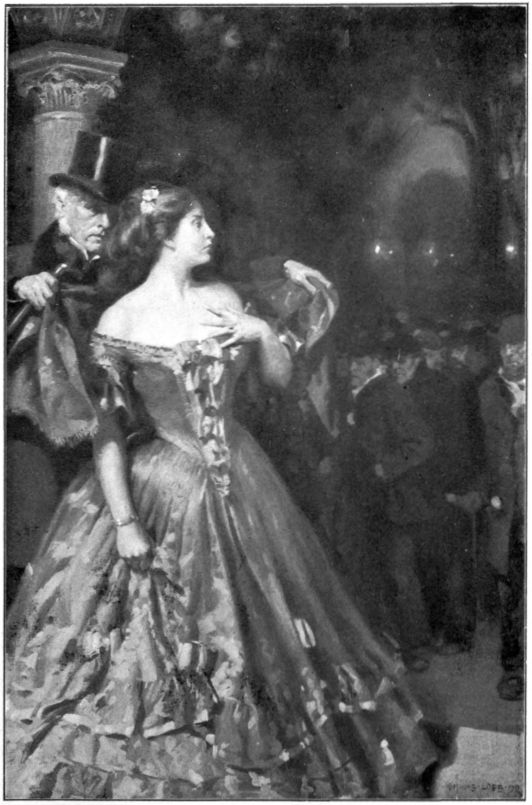
“THE CROWD DREW BACK”
“Yes, miss.”
“Here! Come back—you can’t go without your overcoat in this weather!”
Despite the weather the crowd still lingered, and seemed to be swollen momently, especially by shrill-voiced urchins. And presently, as the four girls waited in the drawing-room amid a hailstorm of stones and the ceaseless tinkle of falling glass, the crowd struck up a patriotic chorus:
“Rule, Britannia. Britannia rules the waves.
Britons never—never—never—shall be slaves.”
“Methinks they protest too much,” said Dulsie, who had recovered her spirits under the expectation of Joan’s police. “I hope the Bobbies will make a good many slaves to night.”
“Yes—they ought to get hard labor, the brutes,” said Joan viciously. “But I suppose the police are waiting till the last pane in the house is smashed. And that’s your Demos, Allegra, that you’d like to see governing England.”
“It’s misgovernment that has made them what they are! There must be Free Education. Their souls must be—”
“Their souls! They’ve got no souls.”
“Oh, really, Joan. Every human being has a soul—a spark of God.”
“A spark of God!” Joan snorted. “These beery savages! Listen to ’em.”
“But surely you don’t believe God has left Himself out of any soul?”
“He has left Himself out of mine,” said Joan calmly. “What!” Allegra stared at her in horror. “You don’t believe in God?”
“I hear the word often enough—I see no signs of the reality.”
“And the immortality of the soul?”
“On a par with Gwenny’s hell. We’re just a lot of little ants running about.”
“Then how can you live on?” Allegra asked, awestricken.
“Oh, I can just run about with the rest. Go to the ant and be wise—isn’t that what Gwenny says?”
“You silly children!” interrupted Dulsie. “This isn’t the time to talk theology.”
“What then is it the time to talk?” Joan retorted scathingly. “Anthropology?”
Here the great clock chirped nine.
“No! Dinner!” laughed Dulsie. “I’ve forgotten I’m starving.”
“I couldn’t have eaten anything, anyhow,” whimpered Mabel, prostrate on the sofa. “Now—I think I’ll go to bed.”
A terrific rat-a-tat-tat and a ringing at the bell resounded even above the patriotic clamor. Mabel sprang up, glowing with life. “There’s Arthur. He said he’d try to come!” Then, with a change of voice, “Oh, I hope they won’t hurt him.”
“Not if they know he’s a lord,” said Joan sarcastically.
The knocking went on and on, as if keeping time with the crowd’s
“Tow-row-row-row-row-row,
To the British Grenadier.”
“Well, why don’t they open the door?” cried Mabel impatiently.
“I suppose they’re afraid,” said Joan. “They think it’s only the roughs.”
“He’ll go away,” Mabel whined.
The ringing recommenced.
“I’ll run down and let him in,” said Allegra, with an impulse of girlish curiosity and sisterly kindness.
“No,” said Joan. “You may get hurt.”
But Allegra was already half down the stairs. She pushed through the trembling maid-servants. “Who is it?” she cried cautiously through the door.
“Only me,” came a strong voice. Allegra’s heart leapt up. She felt a sudden sense of security. Here was re-enforcement, here safety.
She opened the door and Broser slipped in, accompanied by a waft of cold air and a louder burst of song. He shot the bolts again swiftly, hardly looking at her and not even removing his hat till the door was secured.
Meantime she saw that his hands were scratched, his face was flushed and perspiring, his tie and collar were crumpled. She took his umbrella and his hat and his overcoat. They had never spoken to each other before, but this was no time for conventionalities.
“I hope you are not hurt?” she said.
“This is nothing to the football scrimmages at Midstoke. I see they’ve broken your windows. I hope that’s all?”
“Practically all. Only Petty Cash,” said Allegra with a bright smile.
“Ruffians!” He clinched his fist and looked dangerous. She noticed there was a telegram in his hand. “For your father,” he said, smoothing it out. “The boy gave it me at the gate—he couldn’t get through—fortunately he knew me. I’ll run up to the study at once. Nine o’clock, your father told me, I was to knock off some letters.”
Allegra smiled. Her mother had plotted clumsily. Lord Arthur would not have seen much of his future father-in-law.
“He hasn’t dined yet—he is dressing. You must dine with us.” She thought: “Lucky there’s Lord Arthur’s cover.”
“In this state?” he queried ruefully, looking into the hall mirror. “Not dressed, and not straightened out—and, to tell the truth, not hungry. Mrs. Broser and I dine early for the sake of the little ones.”
“Then you can call it supper.” She rather wondered at her own insistence, especially as her mother had not yet invited Mr. Broser to her London table.
“It depends on whether your father has work for me to do,” he replied.
“Well—you must wait for him in the drawing-room, anyhow,” she said, turning to mount the stairs and catching sight of the impatient Mabel at their head. “It’s only—it’s Mr. Broser,” she called up. Poor Mabel disappeared. From without came the stentorian chant:
“Britannia, the pride of the ocean,
The home of the brave and the free.”
“How long have they been howling?” asked Broser.
“It seems an eternity—but I suppose it’s only a bad quarter of an hour. We have sent for the police.”
“They deserve a cavalry regiment. How did it begin?”
“They seem to have followed father.” His face of horror pleased her. She assured him hastily: “He’s only a little cut about the face.”
He looked thunders. “Was it those blackguards in the garden?” He made as if to unbolt the door.
“No, no,” she cried, torn between alarm and admiration.
His hand dropped. “England shall rue this,” he muttered.
The sentiment did not seem to her disproportionate to the occasion or the speaker, set as it was to the turbulent music without. She tingled with electrical excitement, feeling herself in the thick of history and face to face with an immortal who would make it. Her eyes shone, her breast heaved.
“You do not know my name, Mr. Broser,” she said gayly, as they mounted the stairs. “I have the advantage of you.”
He laughed. “You have many advantages over me, but not that. Do you suppose I did not hear of Allegra all day long at The Manor House?”
Her name in his mouth gave her a curious thrill. “Ah,” she smiled, “but I’ve seen you and you’ve never seen me!”
“What! How about Midstoke station? And do you think I didn’t take another peep at you in the Town Hall?”
“How silly I am! Of course!” She blushed deeply, remembering he had started the cheers for her when the train came in. And from without, in strange ironic contrast, came the rousing chorus:
“Hurrah for the Red, White, and Blue!
Three cheers for the Red, White, and Blue!
Thy banners make tyranny tremble
When borne by the Red, White, and Blue.”
“You hear?” he said. “They are cheering again for you. The red, white, and blue.”
She flushed deeper, becoming conscious that she wore a blue frock and a pretty one.
“Then the other line’s for you,” she retorted.
“ ‘Thy banners make tyranny tremble.’ ”
“Thank you! I wish they did.”
Mr. Broser certainly did not make Joan tremble. She inquired sternly: “Why didn’t you go for the police?”
Disconcerted, he stammered that he ought to have done so. Then he pleaded the telegram.
There seemed now a vast multitude in the street, augmented by curiosity and the love of fun, not dangerous, yet not to be easily dispersed, even if the police were already there, as was probable. The melody changed to “God save the Queen.”
“Ah, thank Heaven!” cried Dulsie. “They are winding up.”
“I’m afraid they’re only beginning,” said Broser.
“Ah, here is the hero-martyr,” as husband and wife came in. “How do you feel, sir?”
“Hungry. We shall have a musical dinner,” said Marshmont, smiling through sticking-plaster.
“You’ll have a ruined dinner,” Mrs. Marshmont burst forth. “You ruin everything with your politics.”
Allegra’s face became one glow of anger and shame. Could her mother not restrain herself even in the presence of this outsider? Must she humiliate the Prophet before his own disciple?
“I think, mother,” she said quietly, “this must be the proudest moment of father’s life.” She took her father’s hand, and as she felt his warm response, a wave of passionate happiness swept away her anger. He withdrew his hand to receive the telegram from Broser. The crowd had returned to its
“Tow-row-row-row-row-row,
To the British Grenadier.”
“That’s appropriate, anyhow,” laughed the ex-Minister, as he tore open the telegram, “for I heard a rumor in the lobby as I left the House—I don’t know how true it is—that the Grenadiers—” He paused, and the flesh of his face changed almost to the hue of the plaster.
Mrs. Marshmont gave a terrific shriek: “My boy is dead!”
“No, no!” he stammered, trying to hide the telegram. Then, hopelessly, “It is very good of the War Office to let us know.”
The spiritual darkness that can be felt descended on the room. Fear for the mother strengthened the rest. There was one breathless moment in which they waited for her shrieks. But no shrieks came. She sank down on her arm-chair, moaning dazedly: “My Tom, my baby-boy.” She had been immeasurably more violent at the death of the rat, yet nobody felt this calmer mood a relief.
Her husband, the tears rolling down his cheeks, knelt at her side. “He died bravely, Mary,” he said hoarsely. “In an unrighteous cause—but he helped to end the war, thank God. He fell in the last victorious charge. It is all over.”
“Yes, it is all over,” she repeated dazedly. “How hot it is!”
Then her eyes closed and her head fell back.
“Open the window! Give her some air!” said her husband. He picked up a fleecy shawl and threw it over her, Broser ran to pull back the shutters, Allegra darted in futile search of smelling-salts, and Joan turned the gas lower. “What are you doing, Joan?” inquired her father.
“Won’t attract stones, keeps the room cooler,” she replied laconically.
Broser had no need to raise the window-sash: the cold air dashed through every broken pane. A dull red glare leapt up fitfully without. Dulsie and Mabel shrieked, and Mrs. Marshmont opened her eyes.
“It’s nothing,” Broser reassured them bitterly from the window. “They are only burning you in effigy, sir.”
“Ah, the witches!” said Mrs. Marshmont. “I knew one who made an image of a man in wax and burnt it. She lived in a hut in the mountains, and a stream danced down past her door. How cold it is! Y mae hiraeth arnaf am fy ngwlad!” (“There is a longing on me for my country.”)
The mood of the crowd outside seemed to have changed. Its vocal unanimity had lapsed into a disordered rumor, through which now penetrated the jubilant antiphonal cries of two news-vendors. “The Sultan killed.” “Complete Rout of the Enemy.” “Dragoons in at the Death.” “End of the War.” For an instant longer the dull chaos continued, then it evolved into a mighty cheer, renewed again and again, till the house seemed to shake in a gale. And then “God save the Queen” started afresh, really a finale this time, for the gratified mob began to move off as they sang. Mrs. Marshmont, too, rose and began to walk to the door, like a somnambulist. The others gazed after her, scarce daring to address her, as though to wake her were fatal.
“Where are you going, sweetest?” her husband whispered.
“To the nursery, f’anwylyd,” she answered.
They all followed her, breathless, up the stairs and into the statesman’s study with its litter of Blue Books and papers. The bullfinch set up an ecstatic piping at sight of its master, but none heeded it. Mrs. Marshmont went over to the faded rocking-horse in the corner, and stooped to caress its ragged mane.
“He rode on you,” she said, “my little Tom.” Suddenly she caught sight of the tin soldiers underneath it, and with a cry of rage she stamped on them, making the horse rock violently. “You killed him!” she said. “You killed my Tom!”
They could not tell whether this was sanity or insanity. Her husband encircled her waist with his arm.
“Come, darling, you must come away.”
She threw off his arm violently and he staggered against the table.
“Murderer!” she screamed. “You let him go. You sent him to the shambles. And you, you pack of girls, why do you stand round me? Do you come to gloat over my grief? To exult that you are alive, while my boy is dead? I hate you.” She burst through them, and flung open the window; and leaning out above the deserted garden behind the house, shrieked into the blackness of the night: “Tom! Tom!”
Joan flew to her, and clutched her gown. “You will fall out!” she cried.
Mrs. Marshmont turned fiercely on her, and thrust her against the high nursery fender, bruising her side.
“I don’t want you. I want my son. What right have all of you to be alive and my boy dead? Bring me my son!”
“Yes, mother,” said Joan, bravely mastering the pain of her bruise. “We will send for Jim.”
“Yes, bring me Jim! Quick! quick! or your father will be killing him, too. Go, why don’t you go?”
Gwenny came and took her hands and held them, murmuring to her in Welsh. Mrs. Marshmont broke into sobs, and then the two women wept in each other’s arms.
“And this is war,” murmured Allegra, too numbed for tears. The images of a dashing young Dragoon overflowing with life and gayety, and of a distorted dead lump, strove with each other.
“Yes, multiplied by thousands,” said a deep-toned tremulous voice at her ear. She turned and saw that tears were rolling down Broser’s face. To see a man weep loosened her own tears, and unconsciously her hand went out to his, with a little pressure, half of gratitude, half of consolation.
“But, please God, we shall make an end of war,” she said, while the walls with their childish pictorial scraps blotted themselves out in mist.
His clasp became as the iron grip of a solemn compact. “Yes, we shall make an end of war.”
The bullfinch gushed out its little heart in joyous appeal. Outside, the National Anthem was dying away in the distance.
“Send her victo-rious,
Happy and glo-rious.”
The bell rang again. It was Lord Arthur, bringing the eager flush of young love into the house of death.
A severe cold, caught by Mrs. Marshmont in her bare-shouldered sortie, helped the household to tide over the first days of bereavement. The bustle of doctors and medicines, as for a physical ill, was a diversion even to the patient. But her mind was only fitfully stirred from its daze, its continuous brooding on the dead. Even the fetching of Jim from school did not rouse her as had been anticipated, and she remained indifferent to the no less unwonted presence of Connie with the crowing infant, whose recent advent had made her a grandmother. One happy break in her stagnation had come when the heart-felt letter of condolence from her Majesty was read to her, and she had almost as much pride in the unexpected letter from the Duchess of Dalesbury, envying her the noble son she had borne for her country’s service. This, the first overture from her husband’s family, probably helped to save Mrs. Marshmont’s reason, and she faithfully drank the accompanying six bottles of port-wine and six bottles of tar-water and ordered her mourning-dress to be made from the great piece of black silk. The Duchess gave funeral-presents as other people give birthday and wedding presents. She also put up a brass in Hazelhurst Church to the memory of the young hero, whom, however, she insisted on spelling Marjorimont. His old school-fellows put up another tablet at Harrow, and as John Bull could afford to be generous in victory, there was a reaction in Marshmont’s favor. “Tom has died for father,” thought Allegra striving to extract some comfort as she read Tom’s letters, which came with weird regularity for a few weeks after his death and had to be kept from the poor woman to whom they were addressed. Their enthusiasm for England’s empire renewed Allegra’s feeling of the perversion of heroic forces. One of them had a gruesome description of the slow but sure action of the weapon to which he was destined soon to serve as target—the Novabarbese poisoned arrow. Another Marjorimont had also died, in the interests of British West Novabarba, Limited, no less a person than the Viscount of that name, the heir of the Earldom of Yeoford, leaving an old father and a young son to lament him.
“If poor Stanley had not had a little boy,” the Duchess wrote to Allegra, “your father would have become the heir. The poor Earl, your father’s uncle and mine, has taken his little grandson to live with him. That young life is more precious than ever now, but I pray God, the old Earl will live many a long year, for I hate to see baby Earls. Yet even a baby Earl is better than no Earl. And no Earl is better than no baby. I mean if it had happened to be a girl. I could wish my darling Minnie had been a boy, but it is useless repining.”
That last sentence was a side-light upon the Duchess, revealing a flaw in the perfection of her contentment. Allegra liked her aunt better for this shade of nearness to common humanity; though it was not till years later that she understood how the Duchess lived under the shadow of a possible eclipse, should the Duke die. Not only his love, but Rosmere and the other beautiful places would be taken from her; such are the risks and drawbacks of Duchessdom.
All through Mrs. Marshmont’s illness, Broser proved himself an indefatigable handy man about the house, so that even Joan’s prejudices began to melt. He hovered around Thomas Marshmont as protectively as Marshmont around his wife. Mabel one day declared that the bullfinch was growing jealous of Broser.
“Look how it hisses at him and flutters its feathers.”
“That’s not from jealousy,” Dulsie said promptly. “It’s because Broser’s masquerading as father.”
And indeed, in the almost constant attendance of the ex-Minister at his wife’s bedside—a devotion that was facilitated by the arrival of the Parliamentary recess—Marshmont’s political position necessarily devolved upon his secretary. Broser received his master’s constituents, and answered most of his letters on general principles, without even troubling the poor bedside watcher. Marshmont’s own nerves were breaking down, his throat was growing worse, and more twinges of his hereditary gout were being paid over to him, but, with some vague, remorseful sense of having sacrificed his wife to his career, he now felt he must sacrifice his career to his wife. He tried to combine the two ideals by scribbling a political pamphlet in the sick-room, and this Allegra copied out neatly in the study, verifying the figures and the quotations by the aid of Mr. Broser. This throwing together of the twain in the garret kindled Gwenny’s concern. She spoke of it to the father at last.
“The mistress would not like it,” she said, “if she knew.”
“What are you talking about, Gwenny? She’s quite a child.”
“Then she’d be better at a Children’s Communion. But she’s no child, and she’s quite taken with that young man.”
“Pooh, pooh! He’s a married man with children.”
“The devil isn’t only at the ear of bachelors.”
Marshmont smiled sadly. “Mr. Broser knows how to deal with devils.”
“Yes, he’d outdevil ’em,” admitted Gwenny.
“You’re getting a foolish old thing, Gwenny. Mr. Broser is a gentleman.”
“If he was a lady, I wouldn’t have spoken,” and tossing her head, Gwenny retired to the kitchen to pray for the devil’s discomfiture. Probably she mixed him up with Mr. Robert Broser.
Mr. Robert Broser, with whom this history is increasingly concerned, had at least one quality in common with Joan. His vision of life was simple and direct. Change as it might from year to year, it was never blurred by doubts or metaphysics, or even by remembrance of its own mutations, or by expectation of future developments. When he married Susannah Clagg, it was perfectly clear to him that he was doing exceedingly well in loving a richly dowered young lady of higher social position than his own, for though to the aristocrat in his balloon all these midland middle—class manufacturing families might have appeared monotonously flat, yet to themselves they were an Alpine world, chaotically peaked. In the social atlas of Midstoke all these heights and valleys lay marked with that microscopic exactitude which makes a mountain out of every mole-hill. No consideration of birth, connection, calling, or income was too minute for registration, and Broser, as the son of one of those geniuses of the soil who are born in a hut, spend their days in a factory built by themselves, and end them in a mansion built by a nobleman, was hampered in his aspirations by his father’s aspirates. If the young bridegroom on the day he scaled one of the higher peaks of Midstoke was aware that elsewhere in the great wonderful world were Himalayas that outdid even the highest of his Alps, these ranges had not come under his own eye, nor challenged his own foot.
He lived four years of ample satisfaction with his Susannah, marred only by the death of one of the four children she bore him. Then the demon of unrest entered into his soul.
Old Broser had kept his boys down almost to his own early pecuniary level, much as in higher circles a man who has suffered tortures as a fag, sends his sons to the same public school. Besides, the old peasant had in exaggeration the general Midstoke desire to “cut up well,” and the imaginary posthumous satisfaction of dazzling Midstoke by the revelation of his hoard overcame even his repugnance to the Legacy Duties, which would make his death so expensive.
Now, realizing that he had to wait until his father’s death for financial independence, Broser began to grow tired of his prosaic position in his father’s business, and in the petty church and parochial matters of Midstoke, and to yearn for a larger field for his militant instincts. He had always been connected with a local Radical association, and now he began to push himself forward more and more in its affairs. Even Susannah’s people were Radicals, having, like the rest of Midstoke, succumbed to the spell of Bryden, and realized that the manufacturers were left out of the distribution of political power. When but a lad, Broser had thrown himself headlong into the Cause, steeped himself in polemic literature, discovered his grievances, and added to them by daily study, till he grew to hate bitterly the classes that had monopolized power. For as, after his marriage, his social vision widened, and the Himalayas dawned upon his ken, their soaring summits seemed to abase him to the plain, and forgetting his own peak, he demanded that every hill should be laid low and every valley exalted; yea, even that the crowned apex of all should be smitten to the dust. Monarchy was an outworn superstition. Divine right was only an impertinent synonym for human wrong. It was human right that must be the watchword of the future. The peerage was a brainless diseased crew, descended from royal favorites. The House of Lords was a relic of mediæval barbarism. The House of Commons was the happy hunting-ground of the idle rich, to the exclusion of the world’s workers. The army and navy were run as branches of Society, and the governmental departments were constellations of cousins. For the poor man only one function—to pay for it all. The social system was simply disguised slavery. The helotry was the depositary of virtue. But the People would no longer be content with virtue’s reward. Bryden’s prophetic vision had reached to one man, one vote—there lay the last horizon of Radicalism. Broser and the boon companions of his political intoxication saw endless perspectives of progress, even unto that last utopian Holland dotted with grazing equals.
For himself, too, Broser began to see perspectives of progress—beyond this narrow provincial society which had begotten him and had so satisfied his energies that he had never been to London, except as a youth in his teens to see the Great Exhibition. It was from this very narrowness, this intense living, that, all unsuspecting, he drew the strength which now drove him forward to impose himself upon a wider world. But Broser was not so popular with his colleagues as he was with his audiences, who had only to sway to his intellect and emotion. His colleagues had to bend to his will. He was a screw-steamer amid sailing-vessels, ploughing his way straight ahead regardless of wind or weather. It was as President of the Young Men’s Radical Association that he had proposed the vote of thanks to Marshmont, though the meeting was really under the auspices of an older organization. But years before, when a famous writer had come to read from his works before this same Y.M.R.A., Broser, who was then only a member of the Committee, equally insisted on making the speech which should introduce the writer to the audience. His claim was that he was President of the Literary Section, and as such practically the President on this literary occasion. But the real President of the Association refused to surrender his privilege of introducing the great man. It was a nice point. Weeks of excited wrangling throughout the Club heralded the coming of the star, and even when he came, the point had not been decided. Broser and the President were still arguing it when the celebrity stood on the small stage behind the curtain. Before it, the audience was stamping its feet with impatience. The disputants appealed to the celebrity.
“But it is too delicate a question for me to decide,” he said, in dismay.
“But surely it is obvious,” cried Broser, “that the President of the Literary Section—”
“But the reading is for the whole Club, not for the Literary Section only,” said the President. “Everybody expects me to introduce you, sir.”
The clapping and stamping became louder.
“Gentlemen, gentlemen,” appealed the celebrity, “don’t make me lose my reputation for punctuality.”
“Yes, the Club must not lose its reputation for punctuality,” said Broser to the President. “The curtain must be rung up instantly. Have the goodness to walk to the wing, Mr. President, leaving me to be discovered with our illustrious guest.”
“I shall do no such thing. On such red-letter occasions the President must surely be in the chair. The position of our guest demands no less.”
“Oh, I shall not be insulted,” said the celebrity genially. Then, quaking under the President’s eye, “I mean, don’t consider me in the least.”
“It will be a great blow to the Literary Section if I don’t preside,” said Broser.
The celebrity had a happy thought.
“Well, why can’t one of you introduce me at the beginning and the other thank me at the end?”
The waiting public became clamorous.
“Our audiences don’t like to be kept waiting after the reading,” said the President.
“They don’t seem to relish it before,” said the celebrity grimly.
“Then suppose we neither take the chair,” Broser suggested sulkily. The celebrity, in his relief at the suggestion, overlooked the grammatical inelegance of the President of the Literary Section.
“Even that would be better than the President’s seeming to fail in respect,” said the President of the Association in general.
“It seems to me a fair compromise,” observed the celebrity anxiously, for the audience was by now furious.
“Very well,” said Broser. “We’ll both leave the stage. Ring up.”
The man at the right wing began to pull up the curtain. The President hurried to the left wing. As the curtain rose, Broser was discovered in the centre of the stage. The celebrity hovered in the background. As soon as the applause died down, Broser introduced the great man in a few brief phrases, and went off to join the fuming President at the wing.
“But you did introduce him!” hissed the latter.
“I suggested neither of us should occupy the chair,” replied Broser coolly. “I am not occupying it. It is yawning vacantly—thanks to your obstinacy.”
“But you introduced him.”
“Those few words cannot be considered a speech. I had to throw overboard all that the Literary Section expected me to say about our illustrious visitor.” And he looked so aggrieved that the President felt apologetic. But his rage returned the next morning when he found that the newspapers reported that Mr. Robert Broser “introduced the famous writer in a few well-chosen words.”
Nor was Broser more popular with the members for Midstoke. The great Bryden had politely rejected all his social overtures, without, however, diminishing Broser’s admiration for his eloquence and comparative boldness, and Mrs. Broser subscribed handsomely to the bust. When the Right Honorable Thomas Marshmont came to Midstoke to unveil it, Broser was thrilled with the greatness of the man and the hour, and strove enthusiastically to secure an important speech in so momentous a ceremonial. When he offered his fealty to the Minister and besought the great man to use him, his desire thus to get into touch with the great world was redeemed from sordidness by the halo which surrounded this world, as of a rallying-ground for the forces which move mankind, and which he would use to lift the People. For indeed there were wings under his provincial frock-coat, a-quiver to burst their sheath and spread to the breeze of adventure. It was not, however, till he had forced himself upon the gentle Marshmont and accompanied him to The Manor House that he began to be aware that his Susannah would burden those wings oppressively on their upward strain. A certain gaucherie stamped her as other clay than the radiant Dulsie and Mabel, and though her anæmic personality, as neutral as the tint of her pale hair, had hitherto satisfied his need of an idolatress needing protection, he began to feel that an idolatress at home but an idol abroad were the happier combination. Her worshippers would have supplemented his, and her known worship of him would have exalted his public personality, besides adding a subtle sweetness to her private incense. And apart from this, there was the necessity for adequate behavior in the higher social groups among which his mission for human brotherhood would take him. He himself was equal to any fate, had boundless intelligence and adaptability, but how about poor Susannah? Broser had moments of heart-sickness in the thought of how his life-work might be impeded by her.
His father had not brought him up to the cult of the morning tub, yet when he had found a cold-water bath in his room at The Manor House, he had instantly understood—where Susannah would have betrayed herself—and, even before he had schooled himself to endure it, he had had the wit to splash the water over the floor with his hands, so that the servants should not suspect.
When it was settled by the doctors that Marshmont must take Mrs. Marshmont abroad to divert and rouse her mind, Broser with vague foresight of diplomatic circles had likewise the wit to throw cold water on his wife’s enthusiasm for foreign travel, pleading the children. When Marshmont in his turn declared that he would not need Mr. Broser, as he must devote himself body and soul to his wife, Broser proved to him that this was the very reason he, Broser, was needed. The great leader must not let go the thread of politics. It would save him from depression, and the country from degeneration.
Nevertheless Marshmont, in his dejection at the death of Tom and the backsliding of the Radical party, and in the uncertainty of the duration of his wife’s illness, did offer to resign his seat, but his constituents refused to surrender him. After all they enjoyed the reflex of his importance, not least, perhaps, when he was unpopular. Let him take a long holiday by all means. And so Thomas Marshmont, M.P., travelled hither and thither on the Continent, and Broser developed into an admirable courier, who, though he had not the gift of tongues, was never dumfounded or discountenanced, but ploughed his stolid British way through mediæval cities, ancient catacombs, and complicated currencies. He packed the luggage and took the railway tickets and was never cheated at the booking-offices, even in Italy. He made the journey as smooth as a good sea-passage, though Gwenny, who acted as the invalid’s maid, refused to budge from her prejudices against him. But over Marshmont his ascendency grew, the more subservient he became. To the filial note of the young man, the elder responded with the paternal. He tried to mend the gaps in Broser’s culture, to direct his reading in English, to improve his style and his taste, and generally to teach him—what others accused Marshmont himself of forgetting—that the humanities were as important as books of information.
By which teaching the late President of the Literary Section of the M.Y.M.R.A. profited eagerly. In particular he skimmed the English poets from Chaucer to Deldon, so as on his return to have to pretend less before Allegra’s allusions. But even more profitable was the teaching which he received as unconsciously as it was given. His manners improved by involuntary assimilation; and his private voice grew distinct from his public voice. Add the equally unconscious broadening given by travel, and Broser’s tour will be seen well worth his railway and hotel bills. Indeed no young nobleman of the ancient time ever had a better chance of meeting eminent personages, though Marshmont’s visitors were mainly Continental Radicals come to pay their respects to the English prophet, turned sick-nurse, and Broser could only occasionally snatch the centre of the stage and exchange political views with them as at par.
As he heard himself talk, Broser felt himself more than ever equipped for membership of the House of Commons.
Until he came to London from The Manor House, Broser had never seen the House of Commons. On the night of Marshmont’s impeachment of the Government he saw it for the first time and in all its feverous glory. And his emotion was one of surprise at the smallness of the historic chamber.
“Is this the mighty ocean—is this all?”
A small oblong room, with rows of dark green benches neatly parted in the middle, crowded with men, lolling and wearing their hats as in a tap-house. Why, to speak here was nothing, to one who had forced his personality upon the ultimate bench of great halls. One could hold this in the hollow of one’s hand. The Prime Minister? Just that gray-haired gentleman sitting by the table! The Treasury Bench—was it only a common form, on which you sprawled, nursing your knee? And the Opposition? You just sat on the other side of the table and shook your fist across? If you were a Minister, you rose and looked disdainful: you took a step forward and banged a brass-bound box on the table. Why, in these small spaces politics was almost a personal encounter: it had nothing of the rotund magnificence of platform publicity. And as the speaking went on, as these London gladiators buffeted one another, as historic names turned out to be channels for “hems” and “ha’s,” and historic gray-beards mumbled and stumbled, poring painfully over pages of notes, the provincial heavy-weight in the gallery looked down on it all with an actual sense of superiority, in lieu of the awe he had expected to feel. And when they did get a man who could speak—when Marshmont rose to his feet to denounce the Novabarbese campaign—lo! these cowardly champions of War howled him down; hitting him below the belt, so to speak. Broser’s blood boiled. Oh, to be in Marshmont’s place down there! How he would smite these Philistines hip and thigh!
Parliament had for years been in his mind as a final ambition. Now the dream-like remoteness of it faded: it became a workaday thing, a practical possibility on the near horizon. Bah! he could easily dazzle and amuse some constituency into electing him. And then—look out, you down there! He grasped his umbrella tighter, as great streams of energy ran through his every limb. The Front Bench did not seem so far ahead. These old fogies and middle-aged nonentities on the back benches, one could brush them aside as one sweeps through a crowd to catch a train. And the immemorial corruptions, how he would sweep through them, too! Nothing should awe him any more, not the Throne itself. He had seen what this Parliament was—just the debating society of the Midstoke Young Men’s Radical Association over again, and far less brilliant, instructive, and expeditious. The Association settled the country’s affairs in a fourth of the time. Ay, the House was a “soft job,” as they said up North. And, unknown to himself, a smile of complacency softened his strong features.
His chance came sooner than even he had dared to expect. One of the members for Midstoke—he who had presided at the war demonstration—applied for the Chiltern Hundreds, having been appointed to a Colonial post in recognition of his services during the crisis. The news reached Broser in Naples, where Mrs. Marshmont had had a relapse, literally brought on by the bare ribs and sore flanks of the unhappy cab-horses that toiled under the radiant blue. But in a few days Broser bad persuaded everybody that they were longing to return to England.
“O to be in England, now that, April’s there!”
He read to them from Browning—one of the few lines he understood. Gwenny needed no such reminder of the superiority of England. The images of Catholicism had combined with the discomforts of hotel life and long railway journeys to disgust her with travel. Gwenny understood pauper emigration, but the rich nomad puzzled her.
“O ma’am,” she said to Mrs. Marshmont, “I can’t understand why people with money should want to travel.”
Broser admitted candidly that he himself was bitten by the idea of going back to restore Midstoke to its senses. He would put up for the vacancy: otherwise—who knew?—a Tory might even creep in. Unless, of course, Marshmont could not spare him temporarily.
“But, my dear Broser, I must come down and help you.”
“No, no, sir; you have already done more than I can ever repay.”
But Mrs. Marshmont pined for the English country-side, and the old war-horse, her husband, yearned for battle, and shared Broser’s fears for the metropolis of Radicalism.
So they all went home, and the name of Broser became temporarily famous as that of the most startling of the triangular duellists in a fiercely contested election. For a section of the Radicals, mistaking dislike of Broser’s personality for distrust of his too advanced programme, brought forward a more moderate candidate in opposition, and this split in the camp giving the Tory minority the very chance Broser had professed to dread, a Tory candidate was put up in the hope the two Radicals would neutralize each other. The more moderate Radical styled himself in his election address, “a humble follower of Bryden.” As Broser styled himself “a humble follower of Marshmont,” the latter had the pain and bewilderment of feeling himself somehow opposed to his old comrade-in-arms, as well as entangled with opinions more iconoclastic than he had ever professed. But he was borne along on the current of Broser’s and Allegra’s enthusiasm.
For Allegra, who had reattached herself to her father’s person, drove about the fiery, sooty town, canvassing dubious voters and preaching the doctrine of Broser to them with a convincing play of pretty eye and lip. She felt that at last she had entered the world of action, and was no longer open to Joan’s scorn for the unpractical. Midstoke itself with its slag heaps and its polluted river, into which steam-jets hissed from factory walls, grew dearer and diviner than Rosmere—from this strenuous ugliness should spring the future’s gospel of light. Even the h-less old Broser was glorified to her eyes as the rugged progenitor; though she found it difficult to persuade him that there was something after all in his Bob’s opinions. The world was all right, he argued obstinately: a man with gumption could always get on, while loafers and drinkers must go to the wall. In the stress of all this polemics, Allegra’s shyness began to wear off; by the end of the campaign she could almost have spoken at the hustings. She was not allowed to go to the meetings, for they were often riotous.
When the poll was declared, alas! the Tory was on top and Broser at the bottom! The seat was lost to the party, Marshmont’s prestige was seriously undermined, and Mrs. Marshmont’s condition had grown worse than ever through this ill-advised return to England. But no one thought of blaming Broser. Everybody was too busy condoling with him and admiring the brave face he put on misfortune, and his proud prophetic speech to the crowd. “I am young,” he said. “The abuses I challenge are old. Yet neither I nor they can wait. If not from Parliament, then from the house-tops I will cry against them, till they crumble. Midstoke, to which Bryden and Marshmont brought the sacred torch of light, has chosen darkness. But the light will shine on, and in shining burn away the historic shams, the antiquated feudalisms which stifle and cripple us.
“Ay, it must come! The Tyrant’s throne
Is crumbling, with our hot tears rusted;
The Sword earth’s mighty have leant on
Is canker’d with our heart’s blood crusted.
Room! for the men of Mind make way!
Ye robber Rulers, pause no longer;
Ye cannot stay the opening day;
The world rolls on, the light grows stronger,
The People’s Advent’s coming.”
“Yes, the future is yours,” cried Allegra, rapt from her gloom.
This proved to be Marshmont’s last public campaign for more than a year. Worried by money affairs and his wife’s tragic helplessness, which but for Joan’s cheerful activity would have made his home utterly unendurable, he seldom went to the House, unless for an important division. His pioneering had to be done by the pen, and Fizzy had induced him to let the Morning Mirror have the first benefit of his pamphlets instead of publishing them at once independently. Fizzy’s cheques in payment were as handsome as his adjectives, but whilst he did not repudiate all responsibility for the latter, he declared that complaints against the former must be addressed to his editor. “You don’t suppose an editor would overpay a contributor! It is you, my dear fellow, who are ignorant that your stuff is worth its weight in gold. You are like the late Sultan of Novabarba, poor chap, who gave away a province for a pound of tea or a barrel of beer. Some day you would be finding it out, and you would begin to kick. Then I should send out my office-boys against you, and annex all your other pamphlets. No, no, don’t let us lay the train of war.”
A by-product of this generous policy was Mabel’s marriage to Lord Arthur Pangthorne, in defiance of the heads of both families: to wit, the Marquis, and Joan. Fizzy further found a place for the bridegroom as assistant bailiff on his estates, for the young aristocrat had had some experience on the broad lands that would come to his brother, and preferred the post to sheep-farming in New Zealand.
“Younger sons are the salt of the peerage and the salvation of the system,” said Fizzy at the wedding-breakfast. “If the estate was left to the eldest son, and the title to the youngest, we should have a House of Lords which even I shouldn’t want to sweep away.”
This wedding brought a needed touch of color into the life of the Marshmonts, and proved better than Italy for Mrs. Marshmont. She tried to disguise it from Joan, but she was vastly proud of having given birth to a Lady Arthur, and her retrospective vision saw this child of hers as if gilded from the cradle. She felt Lord Arthur more as a son than Connie’s husband, and had wild unspoken hopes that a grandson of hers would some day somehow arrive at the Marquisate.
As if this influx of new blue blood had tinged Broser’s thoughts too, he expressed a wish to see a famous political salon—like Lady Huston’s. That lady had been excessively amiable to Marshmont since he had retired from the Ministry, and readily sent Broser a card at his request. Besides, she had a faint curiosity to see the roaring Radical of nine days’ notoriety. Both Marshmont and Broser forgot about Mrs. Broser, while Lady Ruston remembered to forget her, having had experience of the wives of rising politicians. But she found one peep at the newfangled monster enough: he was not to her sensitive nostrils. Poor Lord Ruston, however, with his muddled memory for faces, and that incapacity to recognize his own henchmen which sometimes changed the history of England, imagined that the young man strutting about so masterfully must be a son of one of his tame dukes.
“How is your father?” he asked. It was his stock question for young men, though occasionally he blundered upon an orphan. The gratified Broser replied that his father was perfectly well, and would be delighted to hear that Lord Huston had inquired after him.
“Well, we old fellows—a fellow feeling, eh?” said the great man with genial vagueness.
“I trust your lordship does not suffer from age,” replied Broser with his best society manner.
He was proud and flattered, yet at the same time his critical eye was analyzing this historic person, without whom no Cabinet was complete, and seeing only an amiable nonentity whom he was sure he could smash in fair debate. As Lord Ruston turned away to welcome a new guest with a non-committal remark about the weather, Broser felt angry to think how this titled mediocrity had found all gates flying open before him, while he, Broser, was rejected of the town he had served so faithfully.
Ah, those miserable Midstokers. How they would gnash their teeth when the Right Hon. Robert Broser was sitting for a constituency which was other than theirs! But never would he go back to them, never, though seven manufacturers plucked at his coat-tails. Let them live on the memory of their Bryden. Yes, perhaps it was better he should stamp himself upon a virgin town. It would not do for a young author to settle at Stratford-on-Avon.
Nevertheless, when the opportunity came, Broser was glad enough to divide the honors with Marshmont. For it was as the junior member for the Hazelhurst district that Broser forced the portals of the House. The death of the Tory squire from apoplexy had given the chance of converting the whole constituency to Radicalism. The squire’s election had been a form of feudal homage to his family. But he left no heir, and the new Tory candidate represented only political opinions. Marshmont’s local influence and Allegra’s sweet smiles were enough to secure the victory, denied at Midstoke; and sponsored by such celebrities as William Fitzwinter and the ex-Minister, Robert Broser, M.P., stalked proudly past the Sergeant-at-arms, and took the oath of fealty to that Majesty it was understood he purposed to destroy. For his platform had already attracted some attention, thanks mainly to his having contested two by-elections: when the super of the general election occupies the centre of the stage. And, thrilling with this dramatic self-consciousness, feeling every inch the “Fighting Bob” he had already been nicknamed, Broser made his first appearance in the historic Chamber much as young author or painter enters his first salon. The hostess, past whose gracious vision all the gods of the era have defiled, looks with kindly curiosity at the young man, but he enters with the conviction that she is abased at his feet and that every eye is watching his entry.
Broser had made up his mind that his maiden speech should be Amazonian. He would not catch the Speaker’s eye coyly. Not for him the perfunctory applause of an encouraging House. He would be a personality from the start. Of course he would follow Marshmont—even in the sense of letting him speak before him, but, though he would mount on Marshmont’s shoulders, it must be seen from the first that he had a head of his own.
Fortune gave him an opening. There was a question of a Parliamentary grant to a relative of the Crown. Broser girded up his loins to smite the Court hip and thigh. He would unveil the expense of keeping a Royal Family. He would crystallize the vaporous Republicanism that floated up from the lowly places of the People. He would import into English politics the French or American accent.
He arranged to give his first London party in honor of his first speech, and carefully instructed Mrs. Broser how to comport herself. The good creature was ready enough to be rid of her provincialisms, save in the matter of Sunday, at the loose observance of which in metropolitan Radical circles she remained obstinately shocked. In Midstoke the sexes had a way of accentuating themselves by separation. The women would herd at one end of the drawing-room, the men at the other, or quite by themselves in a card-room or a smoking-room. When the Brosers received, the host had been the pervasive spirit, not the hostess. At the Rustons’ Broser had observed with astonishment the deference paid to the Lady. He was sorry he had not taken his wife about, so that she should observe the deportment she was now called upon to imitate.
“Don’t be surprised if gentlemen converse with you,” he warned her, “and try to say something sensible in return.”
“But I don’t know anything about politics,” said Mrs. Broser timidly.
“Well, talk about me. That will always interest them.”
“Ah, I wish I was like Allegra Marshmont. She is so clever she would know what to say. And must I stay all the time at the top of the stairs?”
“Yes, and smile all the time.”
“All the time?” she repeated in alarm.
“On everybody and at everything?”
“And mustn’t I go down a few steps even to meet the Marshmonts?”
“Good gracious, no! That you must do only to the Prince of Wales. And he’s not likely to come—after my speech!” He laughed sardonically.
“I should like to see the Prince of Wales,” said Mrs. Broser irrelevantly.
“Pooh!” said her husband. “Do you suppose he looks any different from me? A fig for your Royalties!”
And this was the text of his sermon to the House. But after the first few sentences, even the indulgent kindliness of the House to a new-comer gave way to a growing sense of outrage. Interruptions, groans, hisses, cries of “ ’Vide, ’Vide,” sprang up to divert the roaring stream of oratory. But over all these hinderances Broser passed, foaming; stirred to fresh vigor. He must outshout the House, if only that Allegra, up there behind the grille, should not be cheated out of hearing him. They should not brow-beat him, these fossilized representatives of the comfortable classes. He knew their prejudices. Marshmont, who had no glory even in the war of words, to whom it was a pain to provoke well-meaning folk, had done his best to moderate his disciple. But Broser, despite his residuum of reverence for his master, felt there was need of a terrible truthful Goth to trample through their lace-work of conventions. He was not to be bamboozled by their stained-glass windows, their mediæval mummeries of robe and wig and hour-glass, of ushers and Black Rods, of swords and maces, and cocked hats. The hot blood of the down-trodden glowed in him: he felt himself the incarnation of the People, rising in leonine majesty and shaking the bars of its cage. In truth Broser was the conduit through which there at last arrived in the House that crude flood of thought that had carried the intelligent artisan off his feet: all that irreverent challenging of Throne and Church which divided with sensational crimes the columns of the People’s journals; all the righteous resentment of the scandals of high life and extravagances of Courts in implicit contrast with the blameless purity of the British working-man; all that stream of pamphlets and leaflets and poems and pasquinades which had become the scriptures of a discontented Demos, the gospels of a movement not without religious sincerity.
But even Broser with all the strength of his lungs and of his apostolic conviction could not outbellow the throat of the House, and the cock-crow of a young Tory blood threw everybody into convulsions. In vain Broser gesticulated and thundered: Parliament, he found, was not the Midstoke Y.M.R.A. There was borne in upon him a gloomy perception that he had underrated the forces of the fossils. But, he told himself, they were underrating him, too; they should yet hang upon his lips.
He went on impatiently to the end, through all the clamor, though in pure pantomime, and resumed his seat amid a pandemonium of derisive cheers. Yet he was not utterly cast down. A copy of his speech—minus only the few impromptus, extorted by opposition, but in compensation punctuated with “Cheers”—was already in type at the Morning Mirror and Hazelhurst Herald, and the country would hear it all the same. That the House dared not hear it was a triumph, not a defeat.
Mr. and Mrs. Broser dined earlier than usual on the evening of their first London reception. It was the Saturday evening following the great unheard speech. Mrs. Broser had begged for Wednesday—the other political vacation—so that the festivities might not brim over into the Sunday, but Broser had replied that she must do as Lady Ruston did. To-night her uneasiness returned.
“Oh, I wish we weren’t going to break the Sabbath.”
“Don’t begin that again. We are not among your Midstoke gossips any longer.”
“I know, Bob, but couldn’t we finish at twelve!”
“What! Like a public-house?”
Old Broser—tickled by Lord Ruston’s solicitude as to his health—had parted with a bin of his oldest port for the occasion—and indeed would have come up himself to witness its imbibition, had Bob taken the hint as readily as the bin. The old fellow had become a Town Councillor, as though catching ambition from his son, and was prepared to follow sympathetically his boy’s career, conducted at Mrs. Broser’s expense. But Bob was satisfied he should follow it at a distance. He was sipping some of the port now, holding it up to the light to admire its color, and letting it linger voluptuously upon his palate, for he loved the best in wines, cigars, meats, and fine linen, his taste in such things needing little refinement by London society standards. But he still cherished a fear of those standards, and was plaguing his wife all through dinner with questions as to whether this or that was duly arranged. He did not observe how ill she looked under the strain and anxiety of this momentous evolution.
The children still sat at table with them, Bobby prisoned in his high baby-chair, and the twins, Polly and Molly, aged seven. Mrs. Broser studied their rations carefully, and with morbid solicitude cut up their food and her own prandial enjoyment. They were not handsome, even as children. Little Bobby Lad his father’s high forehead and massive jaw, Polly and Molly had pale faces and strawy hair, and eyes like slits. But to Mrs. Broser they were marvels of beauty and intelligence. Bobby’s pugnacious obstinacy she considered manly spirit, while she never ceased to wonder over Polly’s and Molly’s premature remarks about adult things, which she mistook for signs of genius, when they were merely precociously commonplace.
To-night the children’s normal behavior seemed to their tensely strung father intolerable naughtiness, and he threatened that they should never be allowed to eat with their parents again.
“Then we’ll give dinner parties ourselves, in the nursery,” said Molly.
Mrs. Broser laughed, but her lord frowned at her.
“You’ve brought up these children very badly, Susannah.”
“They have been hearing so much of this party,” she said apologetically.
“I shall stand at the head of the stairs,” said Polly.
Mrs. Broser smiled with pleasure. “There! she catches up everything.”
“Yes, they listen to everything,” he growled.
“Well, you were angry because they wouldn’t listen to you in Parliament,” Molly protested.
At this point Bobby choked, and had to be slapped on the back. He had taken the opportunity surreptitiously to swallow something beyond his years.
“Greedy! Greedy!” said the mother admiringly, when he was better.
After these terrible infants were packed off to bed, Mrs. Broser retired to array herself for the great evening. Broser, who was already in his dress clothes, with a gardenia in his button-hole, marched up and down the reception-rooms, feverish with energy and far-reaching meditation. The rooms looked well to his eye—he had taken a house in a fashionable London square, and added imitations of the Marshmont drawing-room to his Midstoke furniture. He could not find so florid a clock, having to content himself with as tiny a dial, hidden between a crablike foundation and a crown of three Cupids playing with pigeons. Nor could he parallel Mrs. Marshmont’s easy-chair with the canine arms. But the aquiline sideboard was easy to emulate, and the general effect of the rooms was similar. The flowers scattered everywhere to-night filled his heart with gay images. And so he paced and paced, lost in brilliant reverie.
The chirping of the hour behind the little dial roused him, and he wondered impatiently why Mrs. Broser was not ready. In half an hour guests might begin to arrive, and it was her duty to be dressed in that wonderful new dress, and to give a last look round and final directions to the servants. He waited five minutes more, then he burst into her room without knocking.
“My dear Susannah!” rushed remonstrantly from his lips, ere he perceived that she had been taken ill, half-way through her toilet, and was lying prostrate in her arm-chair by the fire, groaning, with her maid standing by, frightened.
“What’s the matter?” he said in a tone softer but still remonstrant.
“It’s my liver again, I suppose,” she moaned apologetically.
“You mustn’t give way to fancies,” he said encouragingly.
Mrs. Broser burst into tears. “Oh Bob dear! It has been coming on all day.”
“Why didn’t you tell me? Why didn’t you send for the doctor?” He turned on the maid. “Why didn’t you go for the doctor, Clara? Don’t you know Mrs. Broser has to receive her guests?”
“I can’t, Bob, I can’t. Oh!”
“But you must, old lady. Take a dose of salts or something—you’ll be all right.”
“Can’t you do without me? They won’t miss me. Let me go to bed.”
“Go for the doctor, Clara. He’ll pull you round. I know I’ve often had to have a pick-me-up just before speaking.”
“No, don’t go, Clara. I know exactly what he’ll say. I’ve been disobeying all his directions these last two days. He’ll only scold me.”
“What! You’ve been having the doctor!”
“Don’t be angry, Bob. I didn’t like to upset you.”
“Well, make an effort now, dearest. Do, for my sake.” He picked up the wonderful new dress. “There, dear! I do so want to see how pretty you look in it!”
A light leaped into Mrs. Broser’s eyes, but died out in a spasm of pain. She hid the tempting frock from her vision, covering her face with her hands, and rocked herself, moaning hysterically, “I can’t. I can’t.”
“Help her on with it, Clara. Come, Susannah, just pull yourself together.”
She shook her head and sobbed out: “Don’t you think I want to see all your friends, dear? Oh, it is very hard on me.
“But you mustn’t desert me like this, darling. It will be so awkward to receive everybody myself, when they’re expecting a pretty hostess, and such a nuisance to explain to everybody you’re not well. Just fancy what a heap of questionings I shall have to endure. Come, Susannah, don’t spoil my evening. Brace up.” He raised her gently, and put the frock on her clumsily. Instinctively she adjusted it, and then the maid fastened it.
“That’s all right, you see,” he said, kissing her. “Look—look at yourself. Fancy my doorway without that charming figure. Bathe her eyes, Clara.”
Invigorated and magnetized by his rude healthy energy, Mrs. Broser ceased to sob aloud: only her breast heaved and fell while the maid ministered to her. Once or twice she drew in her breath sharply, as if at a spasm. Then, when she was all tricked out, and Broser was surveying her complacently, she collapsed suddenly, and fell across the bed, moaning afresh.
“I can’t,” she sobbed, “I can’t.”
Broser was in despair. He had set his mind on paralleling the Ruston reception just as he had paralleled the Marshmont furniture. And without a hostess, his party was spoiled. “My poor Susannah! Wait a little! Wait a little! You will feel better. Give her a dose of her medicine, Clara.”
Clara measured out various fluids with teaspoons, and Broser, dismissing her, forced the sufferer to swallow the mixture.
“There!” he said. “I’m sure you feel better. You mustn’t give way to these morbid fancies, darling. Come, stand up. That’s right! I couldn’t bear you to be away at the beginning of my social career. It would be such a bad omen. Think of it all, Susannah—this is just the opening out. Who knows how high I shall go? How would you like to have me Prime Minister of England?”
Susannah smiled through her tears: “I’m afraid I sha’n’t live to see that.”
“Don’t be so sure. The House is simply a mass of mediocrities. In ten years’ time—where will they be? As forgotten as their mediæval superstitions, as dead as Royalty. In ten years England will be a Republic. The forces are gathering. I hear the rumble of doom. And Prime Minister of England—think what that will mean then.”
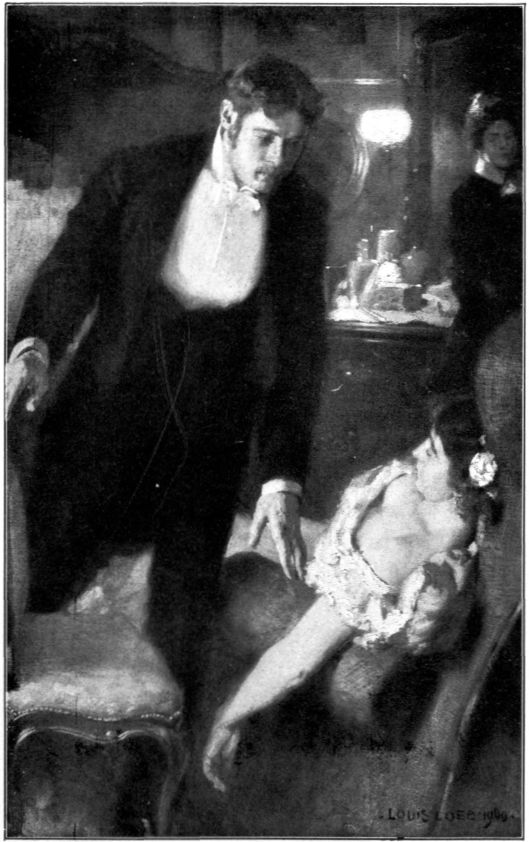
“ ‘I CAN’T, BOB, I CAN’T’ ”
She gazed at him in open-eyed wonder, yet with more of admiration than incredulity. He had got to London, he was a Member of Parliament. Yes, this glorious giant with whom Heaven had blessed her—who knew where he would end? And he, swollen by his fantasy, half believed the things he said to inspirit her, allowed latent thought to express itself, as it sometimes comes to the surface in dreams.
It was a curious gathering at which he gazed complacently an hour or so later—a rally of the revolutionary elements in London that he had knocked up against in his preliminary survey of the field of action: a few M.P.’s, three editors of small rival socialist organs, two freethinking journalists who alternated between heavy metaphysics and jocose blasphemies, and occasionally debated in public with platform Christians; some Continental exiles, one Russian Prince with a high forehead and an imposing black beard; odd British minor poets and musicians, a comedian accenting each feeble jest with the wink of the conscious wit, a Malthusian lecturer with a long train of daughters, and other drifting Bohemians. Despite his glimpse of the Ruston salon, these were still the luminaries of his own world, the London stars of his years of provincial enthusiasm, and his superfine shirt-front expanded with pride as he looked round his rooms and saw how they were all come to twinkle in his honor. Yea, even the great Deldon himself—who had shone in the Ruston firmament—was here, connecting the two circles. Ladies, it is true, were in a marked minority, the womenkind of many of the guests being not producible. And as Broser glanced at Mrs. Broser, awkward and anæmic at the head of her stairs, grasping the balustrade as if to steady herself, and deserted by her male guests as thoroughly as at Midstoke, his satisfaction waned, and he almost regretted he had produced her instead of adopting the pretext of her illness. Then at least she would not have upset the “Camarade” Prince—so proud of his humility—by calling him “Your Highness”; nor the “resting” comedian by thanking him for coming on Saturday night, “when the theatres are so busy.” And when her captious consort caught sight of Allegra surrounded by a galaxy, which included even Deldon, his dissatisfaction with Susannah was dashed with a shade of self-discontent. Why could he not have waited for one of those beautiful brilliant girls who matched his destiny? Together, they would have had the world at their feet, and trampled on it. True, he could not have hoped for an Allegra at this stage of his career, aware though he was of the girl’s interest in it and him, but he might have fought to merit such a mate. That star could have shone over his forward path. Now, however high he went, there would always be a drag upon him. That insignificant Susannah with her insipid conversation would have to do the honors of his household, even when he should be a Cabinet Minister. Well, well, he must bear it: he could not hide her away, now he had shown her. And after all she was a docile little person. See how she stood there, doing her best for him, though she was probably still far from well. He was really very fond of her, and when everybody was gone, he would tell her so, and she would cling to him, murmuring words of adoration.
Deldon was not the only man in Allegra’s magnetized group. The Professor was there, too, and the Frau Professorin, as the Otto Ponts, the German doctor of Philosophy, and the partner of his home and opinions, were known among their comrades. They had both migrated from the Fatherland, where the police objected to their point of view. They spoke admiringly of England and its freedom, much to Allegra’s surprise, for, since the Novabarbese war, she had come to think her country a synonym for brutality and oppression. There was only a slight German accent in their tones, but a good deal in their thinking. They philosophized and generalized and pigeonholed the universe. They saw everything in large cycles as points of a mathematical progression. Withal a glow of intellect, a large breath of encyclopedic knowledge, emanated from both, while the woman gave in addition the sense of a warm heart. They seemed to speak every European language and be familiar with every literature. These were new persons to Allegra, and proportionately delightful. Listening to them one might learn much more quickly than from books. You touched a button and they responded. They pleased her, too, by their regard for Broser as the coming man, though their own opinions went even beyond Broser’s, and made her wonder what perspectives were left. They had no religion but humanity, she perceived, but for that they seemed to work fanatically, addressing labor meetings, organizing clubs, carrying out fatiguing lecture tours, even as far as America, like mediæval zealots imposing upon themselves the penance of the pilgrimage. Engrossed by these wonderful persons, Allegra almost forgot to worship at the shrine of Deldon. Was it that since she had canvassed voters and copied out pamphlets, her admiration had somewhat shifted in the direction of the practical? The Poet of the People, however, seemed content to worship at her shrine instead, and begged permission to send her a copy of his new book: a privilege which set Allegra’s poetic pulses leaping again.
It was past midnight. The party was at its zenith. The refreshments had refreshed it, and the friendly babble had reached that steady roar which signifies success. The string quartet in a recess had, partly in disgust, partly in neglect, given up attempting to send their tinkle through the din. A few late-comers in the shape of writers on the great People’s Weeklies were still arriving, and explaining that they had just put their papers “to bed.” And poor Mrs. Broser, scandalized by their Sunday labors and her own Sunday enjoyment, obediently smiled and smiled her ghastly smile, twinges of physical pain aggravating those of her conscience. Of a sudden the guests and the staircase began to whirl round her. With scarcely a cry she loosed her grip on the balustrade, swayed, and pitched head-forward down the stairs. An ascending Sunday editor arrested her descent, and her unconscious face smiled faintly upon the new-comer, the muscles stretched for hours having scarcely relaxed.
The exclamations of alarm, the agitation around the doorway, soon dominated the din, and in the sudden comparative silence the startled musicians awoke to their duty and started a gay air from a Donizetti opera. No one hushed them down, and it was as to a maladroit melodramatic accompaniment that Broser bent over his wife’s body, in wild alarm.
“She should have let Clara go for the doctor,” he thought. “I was a fool not to have insisted upon it.” He was vastly relieved when, under the ministrations of Professor Otto Pont—who, it appeared, added medicine to his other acquirements—poor Susannah opened her eyes and automatically put on her smile.
She was removed to her bedroom, her own doctor was sent for to assist Pont, and the party broke up in confusion and condolence.
“Oh, Bob,” she moaned, “God has punished me for breaking the Sabbath.”
“Nonsense, my poor Susannah. At that rate we should all have been punished. You just lie quiet, dear. Dr. Wedsmore will soon be here.”
Her hand stole out of the coverlet and took his. “You are not angry with me, darling, for spoiling your—” She gasped: a spasm of pain curtailed the sentence.
“I’m not going to die, Bob?” she whispered, with the first horrible suspicion of the truth.
“Die? No, no.” His hearty contempt of the idea cheered her.
“I do so want to see you Prime Minister.”
“You shall, old lady. Now lie still.”
Dr. Wedsmore held out but little hope to the horror-stricken husband. She had been greatly weakened by childbearing, and he had warned her, he said, against overstrain.
“If she had only told me!” moaned Broser.
“Women don’t tell their husbands everything,” said the doctor.
“Yes, but I was not an ordinary husband. I thought there was such confidence between us. I told her everything—even to my mildest indisposition.”
As early as Tuesday the children were brought to the bedside, that they might say “Good-by” while their mother was still conscious.
The poor woman had no illusions by this time; except a curious one which she confessed to her husband on the Monday night. Her imagination had been greatly exercised by all she could extract from her husband about this mysterious House of Commons, to whose headship he was to rise, and the cry of “Who goes home?” with which the attendants closed the House in the dead of night had impressed her vividly. Now it haunted her sick fancy, nullified every reassurance that she would get well.
“I’m going home,” she said obstinately. “I hear the voices calling ‘Who goes home? Who goes home?’ ”
Broser shivered. He had a sense of noises hushed, lights going out, the stepping into the cold dark.
“You must get it out of your head, you foolish baby,” he said tenderly. “You’re only remembering what I told you about the House—the attendants crying out so that members in olden times might go home together as a protection against footpads. It’s only a silly survival—and just as silly in your mind, dear.”
“I wish we could go home together, Bob,” she said wistfully.
He shuddered, “Don’t think of such things, Susannah. We are not going home at all—we are going to stay in the House, and be Prime Minister. Eh?”
“No; I hear them calling. ‘Who goes home? Who goes home?’ But I shall find little Susie at home, thank God. I did not thank Him when He took her. But now I see His goodness. How lonely I should have been!”
When she took farewell of her living little ones, Broser broke down and blubbered like a child, while the children themselves were comparatively stoical.
“Bobby will be good, and never be noisy on Sunday,” she admonished the youngest. “Then God will bless him. My darlings, I will think of you all day in Heaven.”
“You mustn’t go there yet, mother,” said Polly. “We are not grown up yet.”
“Nurse will smack us,” added Molly. “You mustn’t go, mother.”
“It is God’s will, darlings. He does all things for the best. ‘Our Father which art in Heaven—Thy will be done.’ Don’t you remember?”
“ ‘Thy Kingdom come’—you’ve left that out, mother,” said Molly.
“Because that’s where mother’s going—isn’t it, mother?” said Polly.
Mrs. Broser smiled a last wan smile of admiration of her children’s prodigious intellects. Then her eyes closed. She had exhausted her last reserve of energy.
Bobby howled with his usual suddenness. “Muvver!” he screamed, “Muvver! Take me wif oo!”
Her voice seemed to come from afar. “No, dear; you must stay with father.”
“No! No! Don’t want faver!”
Broser wiped his eyes. “You deserve their love, Susannah.”
She put out a blind hand. “Dearest, don’t let them forget me.”
His voice choked. “How can they forget you? How can I forget you?”
There was a long pause. Her strength ebbed away momently. Then her resignation broke down too, in a heart-cry:
“I should have liked to see you Prime Minister, Bob.”
“Yes.” His great tears rained upon her face. The pathos of the thought seemed intolerable. That he should fight and fight and win, and she not be there to see! Success seemed suddenly empty. The world was a great hollow place, full of the echoes of weeping.
“Don’t cry, Bob,” she said brokenly. “You have always been so good to me. God bless you, sweetheart.”
She lived through the night, but this was the last thing she said.
Broser mourned for his wife. There was scarcely a day in which he did not remember her virtues. The children were almost uncontrollable. The twins with true democratic instinct treated their nurses and governesses as equals; they conversed like commonplace middle-aged women; but the commonplace middle-aged women they addressed mistook this premature mediocrity for impertinence, as their poor mother had mistaken it for brilliance. Bobby’s perverseness took the form not of talk, but of action. He did what he liked, and kicked and clawed at opposition. He had developed his howls into a system of tyranny. Altogether the father wondered what impish ancestral strain could have crept into the blood of the sainted Susannah.
Then there was the house-management, and even the care of his wardrobe. Although the wealth she had left him permitted an extravagant establishment, no hireling could replace the touch of a vanished hand. Nor could he distract his great career by personal attention to domestic details. The very intensity with which Broser lamented his late partner suggested her rapid replacement. That was no disloyalty to her memory, he told himself: rather, a testimonial to the gap she had left in his life.
One Sunday night over the port he was bewailing the woes of the widower to Professor Otto Pont. The philosopher and his whilom admirer had become friends since the night when Otto Pont had ministered to the stricken Susannah. They had soon changed rôles. Otto was now the admirer, and Broser the admired. In fact, Broser had constituted Pont his confessor, to whom he confessed all his virtues. The Professor was a pro tem. substitute for the lost Mrs. Broser: never tiring to hear of his ambitions and to applaud his successes, and superior to Allegra—who also officiated at the shrine—by being available at all hours. Besides, to the Professor he could avow all his paternal goodness under the trials inflicted by Susannah’s children: an aspect his delicate prevision of possibilities kept from Allegra’s attention. Broser’s nature, for all its surface gnarl, needed the waft of the censers, as a weak woman needs the smelling-salts. He must have a dresser to prepare him for the scene, and a gallery to play to. The admiration of the German Encyclopædia was peculiarly fortifying, inasmuch as Broser in his Midstoke days had gaped at the marvellous erudition of this pillar of the freethinking press. To be felt by this philosophic prophet as the man of the future made Broser feel himself the man of the present.
Pont’s flattery was almost as pervasive as the delicious smoke into which he converted Broser’s cigars. One might, indeed, have fancied these aromatic clouds the literal incense. But the Professor had Broser’s interests truly at heart. For had not his own become entwined with them? He knew more than many a college of Professors united, and he had written and lectured prodigiously, yet every silver hair in the venerable beard he caressed represented some sordid struggle for a shilling. For there was a leakage in him: that touch of fecklessness, of stupid dishonesty, which, like drink, ruins the greatest in the end.
He had sunk very gradually, always condemned to begin life anew among groups that had not yet found him out. His amazing versatility enabled him to seek his bread in a dozen intellectual directions, but as each environment found him out in turn, he was passed to another, and generally a lower. From writing for the leading Reviews he had become a pseudonymous penny-a-liner, at which rate he was contributing articles on Astronomy to a science monthly, on “The Ethics of Pain” to a religious organ, and on “Comic Croquet” to a humorous journal. He was still only half-way on his downward career, and Broser, who took him at the old Midstoke valuation, had not yet found him out, which was not surprising, as the Professor had not found himself out yet. His decline was as gentle as a fluttering leaf’s: no noise of scandal marked its stages. Those who found him out were too pained to tell him so to his face—so irradiate with intellect. To pluck such a beard were sacrilegious. Each in turn dropped him quietly, and he drifted farther. Sometimes a favoring wind lifted him again: managements, editors, secretaries changed, and then he re-entered lost services—to be found out afresh.
He warned Broser not to remarry hurriedly. “This Indian summer of bachelorhood has its charms,” he said poetically. “A widower is a bachelor with experience. He of all men should choose sagaciously. And while an ordinary man can perhaps afford to make himself a fool, not so the leader of a party. He has a duty to posterity—other people’s posterity, I mean. Ha! ha! The joke is good. Nicht wahr?” And he made a note of it on his cuff for his comic weekly. It meant at least twopence to him.
“This is no matter for joking,” said Broser, who, unaware of the contributions to the Halfpenny Hornet, was puzzled by the laughing-philosopher aspect of the great thinker. “It is precisely as the leader of a party that I feel the need of a political and social partner.”
“I thought you said a nursery governess and housekeeper?” murmured Pont.
“That too. A good wife is a combination.”
“Precisely. But where is such a prodigy to be found? A pair of scissors which is also a pen: a poem which is likewise a pudding. The wise man takes his ideal wife in sections.”
“That may be all very well for you.” He laughed uneasily. He knew that Mrs. Otto Pont was tied only by “the higher law” to her comrade, for the Professor had told him so. Pont combined with his pecuniary dishonesty a scrupulous intellectual honesty: it was one of the reasons why he had not yet found himself out. His right cheek was oddly pouched, the left eye looked young. His face did not belie him.
On receipt of the dual invitation to the memorable “At Home,” he had written Broser privately to warn him that Mrs. Broser might object to Mrs. Pont. Broser, who was shocked himself, but who feared to appear provincial, said nothing to his wife, and wrote back that though he was not fettered by mediæval prejudices of any description, his wife had better be left in ignorance. At heart he resolved that the female Pont should never be asked again. Open flouting of the conventions, while uninjurious to a German professor living on the purlieus of the people, and having his sphere of action among the people, would not do for one destined to rise, and to work for the people from above. No, Broser’s wife must be like Cæsar’s, and even his own friendship with Pont must never become a public relation.
“One may not realize the ideal,” he admitted, after a moment’s more serious reflection over Pont’s notion of sectional matrimony, “but one can idealize the real. And—without going far afield—Marshmont himself has some nice daughters.”
“You are already too much mixed up with Marshmont.”
Broser’s heart felt of lead. In that moment he knew decisively that he desired Allegra; that the hopeful prospect of her was the sustainment of his days and the dream of his nights.
“How do you mean?” he murmured.
“Well—if I had dared, I would have suggested to you long ago to give up that secretaryship. It drags you down. It blunts your personality.”
Broser had begun to think that too: but then the secretaryship was the “Open Sesame” to Allegra’s society.
“It would matter less if Marshmont were a rising force. He has played and lost. He had his chance and spoilt it.”
“You mean by resigning.”
“Not entirely: had he been able to keep up the attack, that bold coup might have succeeded. But this illness of his wife—he has never recovered from it. You see how the Ewigweibliche zieht uns hinab, not up, as Goethe says. Marshmont was useful in his day, but his day is over. You agree?”
“Certainly. The more I probe his mind, the more I see that he is—at bottom—a Tory. The day will come when his enemies will be sorry they didn’t stick him up as a dam.”
“Just so. Ach, my friend, did I not always say—you and you alone have the true political insight?”
Broser’s schoolboy flush under praise dyed his cheeks.
“To marry one of Marshmont’s daughters,” Pont went on, “would be fatal. The old man would expect you to support him—I mean politically. But perhaps also pecuniarily, nicht wahr? It’s no secret that he has made ducks and drakes of his fortune. Some day the Bankruptcy Court—who knows? A ruined politician in every sense—mein Gott, that makes not a pleasant father-in-law. At present you can cut yourself apart from him at any moment. If I were you I would resign the secretaryship and take the first opportunity of voting in the opposite lobby, just to show that you are yourself.”
“But I think I have shown that,” Broser said, bridling up. “My speech on the Income Tax,—the House had to listen to that. Eh?”
“Gewiss! You show, but people don’t see. To the world you are still Marshmont’s man, only with a little more devil. What was it you said in a speech of yours—kiss the hem of Elijah’s mantle? My friend, till you get a brand-new mantle, you will be second-hand.”
The Professor was only speaking Broser’s own suppressed thoughts: the nebulous doubts which, together with the recentness of Susannah’s death; had prevented him compromising himself verbally with Allegra. He had begun to see how greasy was the pole he had set himself so confidently to climb. His first impression of the House of Commons had been largely illusive. He had not gauged the pachydermatous forces of prejudice, the brute strength of supercilious stupidity. He had underrated these as much as he had overrated Marshmont’s position. He had not understood the all-importance of social advantages, secret strings, feminine intrigues, back stairs. Frontal attacks on these hidden batteries were futile. The eagle no less than the dove needed the wisdom of the serpent. In his reaction against his provincial credulity, he exaggerated his London scepticism: listened to so much talk of the back door as to forget there were still people who marched up the grand staircase. The gossip he heard now seemed of itself to lift him to a higher social atmosphere: it was not the gossip of the masses. All the insinuations of the People’s Press paled before the open talk of the Clubs and the lobby, and he was amused to see how between these social layers of scandal the capitalistic newspapers steered their bland and blameless way. Altogether he felt immensely more equipped with knowledge of the maze than his cicerone, Marshmont, and he had moderated his reverence for his whilom Elijah even as he had toned down his phrases to the ear of the House; recoiling to jump farther. For he had altered no jot of his programme; though he had begun to see it was not to be achieved solely by elephantine trampling. The Republic might be more than ten years in coming, but come it would. So corrupt an aristocracy must sap itself. Meantime he must not stamp himself with Marshmont’s failure. His dissent from that gentleman’s amiable compromises must be decisively indicated.
“But they are nice girls,” he said ruefully.
“Nice girls. Who denies it? Dulsie—she is called Dulsie, nicht?—Dulsie is rather old, but the two younger ones are pretty. But prettiness—a politician cannot marry for that. That would be no other than the Venusberg, what? You will have to keep the whole family—yes, and that Pangthorne couple, too. But you need all your money for the cause. It would be wiser to add to your sinews of war. A man of your position can pick where he will.”
Broser shook his head modestly, so as to be contradicted in turn. But the Professor unexpectedly modified his statement.
“Well, of course, the range is limited at present But every step you take in your career means a grade higher marriage possible.” The Professor’s Teutonic mind sometimes made his English cumbrous.
Broser was shaken. It was true. Once before he had jumped imprudently. Susannah had seemed to him as seductive and superior as Allegra now: would the day come when Allegra would seem second-rate, compare! with what might have awaited him? Not in breeding and education, assuredly. Still, in position and prestige. A fallen Cabinet Minister soon sank back to obscurity: he was like a Lord Mayor who had failed to get knighted. Yes, the Professor was right. The outsider could see the game. And Allegra took on a new aspect—changing from the inaccessible she, to the not-good-enough.
But the next time he saw her in the flesh, with her dancing eyes and grave, winsome mouth, a sudden anger flamed in his breast against Marshmont for having squandered his fortune on behalf of watery political principles that made his daughter inadvisable. What added to Broser’s anger was the recollection that Allegra’s political principles were entirely correct, modelled on his own. She shared his passion for the poor, for human brotherhood, for justice, ay, even for Republicanism. It was malicious of Providence to have dangled so ideal a helpmeet within his reach. Besides, had he the right to desert her? Did not her sweet face soften when he came in, beyond what mere comradeship would warrant? Why had she thrown herself so eagerly into the canvassing? A woman never espouses a cause, but a man, he told himself. “These pretty sensitive creatures have not our large self-sacrifice for abstractions.” Was she to lose the man she loved, the rise to political sovereignty hand-in-hand with him? Tears started to his eyes. Poor Allegra! Yes—and poor Bob, too, for she was an exquisite creature. The cause of the People was indeed exacting.
By a curious coincidence the question of marrying Broser was startlingly obtruded upon Allegra’s maiden consciousness just as Broser had decided to look elsewhere for his official partner.
The superior Jim had gone to Oxford, having scorned Cambridge, and Allegra had come up for Commemoration in the charge of Lord and Lady Arthur Pangthorne. She had snatched at this brief interlude in the domestic drama, which was growing daily more tragic, and in which Dulsie’s international flirtations provided the only vein of comedy, unless Mrs. Marshmont’s renewed outbreaks were to be taken gayly, in the spirit of Joan. From Joan herself Allegra had drifted away: alienated by Joan’s humble unquestioning atheism and her frank wooing of William Fitzwinter, M.P., though in charitable moments she suspected that Joan had really made her god of the brilliant Fizzy. Marshmont’s throat had grown worse, though he taxed it less and less, and his gout defied all Joan’s dietary solicitude, and worn out by his wife’s trials and his own, he had reached a moody consciousness of the failure of his life-work and the futility of his sacrifices. His despair of the future exaggerated the barrenness of the past, saw even his one great historic measure corroded by gnawing heresies, the old vermin-plague of fallacies springing up afresh. He was spared the knowledge that Jim himself wrote satirical verses involving these very economic fallacies. But then Jim wrote satirical verses against everything in a learned, classical style, and, surrounded as ever by affectionate cronies, believed with them that he was Aristophanes over again—only with better taste. “A genius need not cease to be a gentleman” was one of his dicta.
At the College Garden Party, Allegra was as surprised to see this superfine young gentleman bringing Lady Minnie strawberries and cream, as she had been to meet the Duchess again. She had always refused to revisit Rosmere, pleading home or political duties, and the Duchess had not followed up her letter to Mrs. Marshmont by a call, though Mrs. Marshmont still lived in hopes of it.
“A very ugly boy, your brother,” was the Duchess’s comment on her new nephew.
“Hush, he’ll hear you,” Allegra breathed.
“I’ve told him already,” said the Duchess reassuringly. “I wonder who he takes after.”
Allegra felt inclined to suggest some common ancestor for him and Minnie; but was content to make the suggestion “in her brain.”
“I know who he’s like!” the Duchess cried. “He’s like poor Stanley’s boy—the same turn-up nose; the same coarse—”
“Who’s Stanley?” interrupted Allegra in terror.
“Oh, Alligator! Forgotten your own cousin, Viscount Marjorimont, who was killed in Novabarba the same time as your brave Tom! Yes—when Stanley’s little boy grows up to be Earl of Yeoford, he’ll look exactly like your Jimmy—and I’m sorry for it!”
“Well, let us hope he’ll grow to fit his name,” said Allegra, smiling. And then suddenly strange tears came into her eyes at the beautiful day, the sunlit grass, the pretty faces and dresses, the old College walls, the old College elms and copper beeches, the play of dappled light through the branches upon the white table-cloths and the gleaming jugs and glasses. So lovely a world, but a worm at the heart of it! The Kingdom of God on earth so slow in arriving, for all Broser’s prophet-thunders. That hoary, ivied chapel with its ancient windows—how its very age preached the powerlessness of Christianity! Her brimming eyes rested on Mabel and Lord Arthur, and she wondered with a shade of envy at their perfect satisfaction with life and each other, as they ate their coffee-ices. Then she found herself listening to Minnie’s and Jim’s emulous epigrams, quizzing their fellow-creatures. This, too, seemed to satisfy them; nor did they even appear to be aware that others might find equal amusement in themselves.
“What’s become of that Bob?” the Duchess’s strident voice broke in on her reflections.
“What bob?” said Allegra, startled. For a moment she thought the Duchess had descended to slang, and was speaking of a lost shilling.
“The fat boy in Pickwick.”
Allegra got very red. “Oh, you mean Mr. Broser. He’s an M.P. now.”
“That I know. And I was very angry to hear that you canvassed for him. I felt like writin’ a long letter to scold you.”
“You did.”
“Did I? I am so glad. I hope you never see him, now he has got what he wanted out of your father.”
“You are unjust. He is still acting as father’s secretary.”
“Then I hope you keep him in his place.”
“His place!” echoed Allegra angrily. “His place will one day be in the Cabinet.”
The Duchess smiled confidently. “The outlook for our dear country is not so bad as that, Alligator. We still require manners and education in our Ministers.”
“You mean because Mr. Broser doesn’t stick in Latin quotations—because his speeches deal with realities.”
“When Latin quotations leave public life, England’s greatness will be ended.”
“But do you understand Latin?”
The Duchess flushed. “That has nothing to do with it. I insist on Latin in public life.”
“And I insist on great hearts and big brains.”
“Alligator!” screamed the Duchess. “If you go and marry that brute, I’ll never forgive you.”
Allegra felt the earth rocking, and she wished it were indeed from an earthquake, that she might be swallowed up.
Never had she consciously seen herself as anything but Broser’s friend and humble co-worker, and Broser’s unconcealed grief for his lost wife had made her vaguely figure him as a perpetual widower, faithful to a precious memory. The Duchess had grossly destroyed her simple unconsciousness, set her cheeks burning with stranger fires than shame’s. And amid all her agonized confusion rose her instinctive defiance of the Duchess. If only Broser should really ask her some day! What a noble mission were hers—the very mission she had come to crave: to surround a great strong soul with a mother’s love. Ay, and she could be a mother to Broser’s children, too: relieve him of the trials and burdens which she had divined beneath his stoical reticence. How she would atone vicariously for her own mother’s superaddition of trials and burdens to those of his Promethean prototype. There was a fascination in this idea of satisfying a spiritual equation.
“Well, why don’t you speak?” said the Duchess. “I do believe you’ll throw yourself away like your father. You’re all bewitched. As for Tom, he’s a blind owl not to see what’s goin’ on. And you, Alligator! Isn’t there enough of the Marjorimont blood in you to burn with shame at the thought of—”
“I don’t know what you mean, Aunt Emma,” she murmured, to silence her; “Mr.—, the gentleman you speak of, is inconsolable for his wife’s death.”
“He has the devil’s own luck,” the Duchess replied grimly. “Parvenu politicians may be divided into two classes: the lucky and the unlucky. The lucky are those whose wives die.”
“I won’t listen to such dreadful things, Aunt Emma. Where is your Christian charity?”
“It is the office of a Christian to foil the devil. But tell me—that I may sleep soundly—tell me what are your intentions?”
“My intentions?”
“Towards the inconsolable widower.”
“My intentions are—strictly honorable!” And, mistress of herself again, Allegra smiled gayly in her aunt’s face. The Duchess turned peevishly upon Minnie.
“Haven’t you had enough strawberries yet?”
“But I have not had enough of my new-found cousin!” protested Jim.
“Ah! I don’t wonder. She’s better to look at than the lookin’-glass, eh? Minnie, speak to your misguided female cousin. Jimmy, give me your arm and point me out the Dons.”
“What’s the matter, Ally?” asked Minnie, as the Duchess bore Jim away—to enlist him against her union with Broser, Allegra divined angrily.
“Nothing,” she murmured.
“Has mother been telling you how superior she is?”
“No: only how inferior I am.”
“Ah, there’s her whole gamut.”
“You’ve always been a puzzle to me, Minnie,” Allegra said after a pause. “Do you—or do you not—share this superstition of the Marjorimont blood?”
Minnie assumed her enigmatic smile.
“Why should I share the superstition? Enough that I share the blood.”
“Don’t be such a sphinx, Minnie.”
“Don’t be such a stupid, Ally. If the world reverences the Marjorimont blood—how lucky for the Marjorimonts! Look sphinxlike, and say nothing. Don’t blab, like mother.”
“Then you don’t believe it deserves reverence, really!”
“I don’t say that. But it’s not my business to reverence it. I am it. And I’ve got better work for my organ of veneration.”
“I don’t believe you’ve got any organ of veneration.”
“And yet you’ve seen me copying old Masters by the hour! O, Ally, Radicalism has addled your brain.”
“I would rather see you worshipping in the Temple of Humanity!”
“I don’t think you’ve had any strawberries and cream, yet. Shall I get you some?”
“You’re making fun of me.”
“Never was more serious in my life—because I want some more myself.”
When the Duchess returned from her round on Jim’s arm, Allegra could not help fancying gratefully that Jim had risen superior even to the Duchess. At any rate the Duchess looked snubbed. But perhaps it was only by Allegra’s imperturbable swallowing of strawberries.
In the height of the following season London was visited by an epidemic of home-grown cholera, which, not content with devastating its native slums, spread in the most exclusive quarters, to the disgust of the upper classes, who had a vague feeling that Nature had been converted to the new Radicalism. But Mr. Robert Broser did not trust his convert. He was one of the first to plan his exodus abroad. True, the Parliamentary session claimed him, but then—“the poor little children!” He could not risk the snuffing out of their brilliant promise, nor place the burden of them upon other shoulders. He went one forenoon to tell Marshmont so, and to resign his secretaryship “in consequence.” It seemed a providential opportunity. Marshmont was practically extinct. And Allegra was prettier than ever. She occupied his thoughts to the exclusion of other possibilities; tempted him to forget them, and be content with her. Yes, the double cut must be made. When he returned from the Continent he would be a free man, with his career before him.
He found Marshmont sitting in the sunlit nursery-study, with his head on the table. The whole attitude expressed despair, and the bullfinch perched on his arm seemed to droop in equal dejection. Broser’s salutation of “Good-morning” went unheeded.
“Has anything happened, sir?” he said, alarmed.
Marshmont raised a white face. Broser’s face blanched sympathetically. He foresaw he knew not what.
“Have you not heard?” said Marshmont.
“No—what?” Broser gasped.
“God laughs at me.” And he let his head fall between his arms again. Was Marshmont going mad? If so, how lucky! Robert Broser was cutting himself away!
“My dear Mr. Marshmont,” he said, infusing deep concern into his tones, “do tell me. Perhaps I can help—”
“No; I am beyond help. My career is at an end.”
What new damage could have been done to the poor man’s prestige, he wondered. Perhaps Robert Broser ought to have resigned earlier.
“How can you say that, sir?” he replied reproachfully. “A great leader—still in the prime of life!” It was an assurance he had often had to apply of late to his Chief’s despondencies. This time Marshmont unexpectedly accepted it.
“That’s the damnable irony of it. I am to be kicked up into the House of Lords.” And with a passionate gesture he rose to his feet and shook off the bullfinch into the air.
“Eh?” Broser’s cheeks took the hue of the bullfinch’s breast, under the shock and the rush of thought. A lord for a father-in-law! A stumbling-block removed from his Parliamentary path! “The Premier has given you a peerage!” he cried confusedly.
“What an idea! As if I could take anything at the Premier’s hands! No; it’s this ghastly cholera. The old Earl of Yeoford and his grandson carried off in one day! Did you ever hear anything so horrible and pathetic! And how little one can foresee the freaks of succession! Two buffers between, and yet I was not safe.”
“It wasn’t in the papers!” breathed Broser, open-mouthed. An ancient peerage and a wealthy! Son-in-law of the Earl of Yeoford! Husband of the Lady Allegra! Better and better. Unless perhaps it was too late. That over-worldly German Professor had tried to stifle all his heart’s best instincts. He should have proposed long ago.
“It’ll be in the evening papers,” replied the Earl. “I had a wire to spoil my breakfast from my sister the Duchess of Dalesbury. She rushed down to nurse them both yesterday—good foolhardy creature! But it was too late. I hope she goes scot-free, herself.”
“I hope so too,” said Broser fervently. He desired to keep a Duchess in the family. “I met her at Midstoke, if you remember, on the ever-memorable day of your great speech at the Bryden Memorial Meeting. A rare noble soul I thought her at the time—with such old-world courtesy. Ah! what an epoch that was in my life! What do I not owe to your lordship?”
“Lordship! Lordship!” cried the Earl angrily. “Leave that to the lackeys. A pretty lordship!” He threw off the bullfinch, which had returned to its perch on his person, and began to stride about the room. “All my life-work a failure—and—for ironic climax—the Earl of Yeoford!”
“But you must accept, sir?” said Broser sympathetically, seeing he had blundered.
“My poor wife is naturally delighted, and I dare not rob her of any gleam of hope or happiness life still holds for her. You must have seen how she has suffered from my career. Ah, how Fate flouts all my theories!”
“It is indeed a calamity for you, sir,” said Broser, marvelling that the dregs of Marshmont’s career should again seem precious wine as soon as the vessel had been shattered, and that the broad lands and revenues of the Earldom could bring no balm to the soul of the baffled politician. “It is a calamity for me no less,” Broser went on. And his voice had genuine tremors—but of anxiety.
“I know—I know your sympathy for me.” And Marshmont ceased in his stride to grasp his henchman’s hand.
“It is not only that I shall lose my leader, my master—” Broser swallowed a lump. To have his hand held affectionately by an Earl gave him a real emotion. “You have always been a father to me. I had dared to hope you would have been so in a fuller sense. But now—it is too late.”
“What do you mean?” The Earl looked at him with no gleam of perception.
Broser’s cheeks published his discomfort in the fieriest of letters. His hand involuntarily loosed the Earl’s.
“I love your daughter,” he said in an unaccustomed whisper.
“You love—” The Earl was startled by this further turn of Fortune’s wheel. He leaned his back against the high nursery guard and stared at Broser. “Which?”
“Which but the one with whom I have unfortunately collaborated in your work in this very room—to the destruction of all my future!”
“Allegra?”
“Allegra.” Broser bowed his head. “I ought never to have told you. I know there is no hope for me.”
“How do you know? Have you asked her?”
Broser’s heart gave an exultant and astonished leap. But his head remained bent. His oratorical and dramatic instinct mixed pictures and expressions from plays with his own emotion. “No—and I shall never ask her now. Yesterday perhaps—but now, with this fatal knowledge of her rank and riches! No, no. Please”—he clutched the Earl’s hand again and wrung it—“please forgive this wretched confession. I was taken by surprise. Promise me Allegra shall never know.”
“Certainly if you wish it.” (Broser’s blood ran cold.) “But faint heart never won fair lady,” the Earl added.
O great soul! O incomparable Elijah! In the glow of reaction Broser returned with a bound to his boyish worship. Ah, that miserable Otto Pont, fouling with cynical slaver our godlike humanity!
“Ah! sir,” he cried, in a shaking voice, “you raise heavenly visions. But how can I hope for an angel?”
“That’s the way to talk to Allegra.” And the old smile of humor played for the first time round the new Earl’s mouth.
“I have your permission to speak?”
“And my best wishes! It will give me a son in the House to carry on my ideas—now I am exiled.”
“You had that all the same, sir!” said Broser in a choking voice, and for the moment he believed himself.
The Earl of Yeoford polished his spectacles with his handkerchief, then blew his nose so vigorously that his delicate throat ached. “God bless you!” he faltered. “You give me fresh hope. You in the one House, I in the other—we may perhaps do something yet between us!”
“We shall pull down your House,” said Broser, jovially. “I shall be the enemy at the gate—you the Samson within.”
“But I am not blind,” laughed the Earl. The bullfinch gave a sort of whistle, as if in query.
“No—I am supposed to be that: love is blind,” Broser laughed back. And the bullfinch whistled again.
“That is Allegra practising in the drawing-room,” said the Earl kindly. “You know she’s had a musical fit of late.”
On the stairs Broser met the Countess of Yeoford, all wreathed in smiles, and still beautiful despite all her sorrows.
“Have you heard the news, Mr. Broser?” she cried gayly.
“Yes, your ladyship,” he replied promptly.
“I shall be presented again, and this time the Queen will have to kiss my cheek!”
“It is a privilege greatly to be envied,” he said gallantly. But the Countess’s brain was too excited to grasp the compliment. She applied it naïvely to her new Court perquisites, and replied, with equally unconscious ambiguity: “Mr. Marshmont—I mean the Earl—doesn’t seem to think so. He’s all in the dumps. But I never saw the old Earl, or his grandson—so why should I pretend to grieve? I’ve never even seen the Duchess of Dalesbury, and I’m sure I don’t want to. The old Welsh witch said I should die young but rich. Half is true anyhow.”
“It is all true, Lady Yeoford. You never will be old.”
“How sweet of you! If only Mr.—I mean, if only Yeoford wouldn’t age so unnecessarily. But things will be better, now he is out of that beastly House of Commons. Are you looking for the girls? Lady Joan has run out to see about the mourning-dresses, and Lady Dulsie has rushed over to tell Lady Arthur Pangthorne what a fool she was not to wait, but you’ll find Lady Allegra thumping away as usual in the drawing-room. Quite heartless, I call it.”
Allegra ceased playing as he came in, and whirled round on her music-stool, but her face set sweeter music flowing within him. He seemed in a southern land of sunshine and melody. The welcoming touch of her soft magnetic fingers—the daintily fashioned hand of a lady of title—seemed an earnest of a lifetime of ecstasy.
“Have you seen father?” she said, a little anxiously. “He’s shut himself up and won’t have even me.”
“I think I may say I left him better than I found him.”
“I don’t doubt. You always do him good. It is an odd ending for him.”
“Don’t say ending. It is a new beginning.”
She shook her head. “You always called him Elijah, and Dulsie was saying how appropriate it is for him to be taken up to the House of Lords while yet alive. He feels it not as heaven, but as a living death.”
“But that is morbid. Many a Prime Minister rules from the Upper House.”
“I thought you were about to say from his urn. However, I will not pretend to be altogether sorry. The money is very nice for mother, and, after all, father’s throat already incapacitated him from active service—not to say father’s opinions.” And she flashed her frank look at him, thrilling him. “He has done his work, and may well repose on his laurels and have a little happiness. Fortunately Elijah’s successor is in the field. He will alter the mantle to suit the times. But his prophetic vision will be the same.”
He took the hand he had reluctantly let go. “Do you really regard me as the wearer of the mantle?”
“You know I have seen it round you always.”
He plunged audaciously, but confidently. “Your father has seen even farther than that—into your future and mine.” He sighed. “Would my prophetic vision were indeed the same!”
She flushed furiously under the startling significance of his gaze, the tightening of his hand-clasp.
“My father has seen—?” Her girlish bosom rose and fell painfully. Strange reminders of Fizzy in the Row, of the Admiral in the orchid—house, emanated from Broser’s eager eyes, and made an under-current of discomfort beneath her astonishment and excitement. The play of emotion across her beautiful mobile face made him forget the exact point of his first attacking movement.
“Yes—your father surprised the secret I have hidden so long. He saw my fear of the Lady Allegra—the grand new creature.” It was an even more effective line of attack. What could she do but laugh with embarrassment: “Oh, you can’t be so absurd!”
“I am so absurd as to love you!” he said, with a hoarse undertone of despair. But he was far more confident than in his prior proposal to the father-in-law, and he tried to take her other hand. But she withdrew even the one he held. She had resolutely banished the Duchess’s suggestion from her waking thoughts, yet she had always known that if the impossible happened, she would gladly say “Yes.” But now that it had happened, she did not feel at all glad. Perhaps it was the suddenness of the crisis that gave her this sense of grave intensity, as of the threatened destruction of the world in which she had lived hitherto. Chaotic thoughts raced through her brain—incongruous memories of other dramatic episodes that had had this very room for theatre. She saw her mother walking across it like a somnambulist, while the mob howled without. And then—was it hallucination, or did she see her dead brother Tom lounging against the mantel-piece, as on the night when he had first told his mother he must go a-soldiering? He seemed to wish to tell Allegra something, but he looked limp and helpless, just as she had found him under her mother’s volleys. She shivered and Tom vanished, and she heard Broser saying bitterly: “I told your father his vision of our future was colored by his own flattering wishes to have me for a son. I knew there was no hope for me. But I assured him I should be a son to him none the less.”
The adroit removal of parental complications replaced these grim shadows of the past by a sudden vision of an open Paradise—her own chosen Paradise, not of idleness, but of noble joint labor. Why was she hesitating at the gate? Her eyes filled with religious tears. But he, disconcerted by her coyness, blundered.
“That night,” he reminded her tenderly—“that night when your dear little hand stole into mine, and we vowed together to make an end of war—that was the night when I first dared to dream. The end of war, the beginning of love—was it not symbolical?”
Allegra’s tears froze. “But you were married, then!”
He stammered, growing as uncomfortable as she. But the repartee of the trained Parliamentarian did not fail. “Yes, but—but—that was the first time I discovered I was not married: not married, as I now understand marriage. It was not the real marriage—the union of souls for great purposes.”
Her subtle instinctive jealousy of the dead past was allayed, and, repentant of her rigidity, she let herself be drawn slowly into his arms, feeling a new painful hypnotic pleasure in surrendering to this fascinating masculine strength. Broser’s pulses hammered furiously. To hold in his arms this exquisite palpitating being, so white, so warm! He drew her sweet young lips to his in a fiery kiss. She tore herself from his grasp, and stood, dazed, angry, happy, unhappy—flushing and fluttering deliciously to a lover’s eye.
“Dearest Allegra,” he said, with exultant tenderness, “your father was truly a Prophet.”
END OF BOOK I
Book II
Before an altar in the Cathedral of Orvieto a beautiful, fashionably dressed Englishwoman knelt in silent prayer. Beside her knelt a ragged contadina, with a small baby and a large basket. And the ancient Cathedral canopied and environed both women with its impartial glories of arch and gallery and marigold window, with its warmth of mosaics and many-hued marbles, with the gathered peace of its centuries.
The Italian peasant woman prayed to a very definite Madonna, with a bambino like her own: a Madonna who looked down graciously on you in marble as you passed under the portal, and shed her sweetness on you from the frescoes as you came within, and from her shining home in heaven—especially in this Holy Week—leaned down lovingly to hear your sorrows and send you your heart’s desire. But the Englishwoman prayed to she knew not what, sent out her bruised soul to the nameless silences, as a wrecked creature clinging to a spar in the waste of ocean cries aloud to the starless darkness for help, unknowing if there be any ship to hear. She had come to admire this miracle of Italian Gothic art: had, indeed, duly admired the marvellous façade with the quaint bas-reliefs of the human story, from God’s kindly presence in the Garden of Eden, to the scrambling from coffins on the Resurrection Day—remembering it all from the beautiful reproduction in the Duke of Dalesbury’s monograph—and had passed within, promising herself a rich feast of black and white perspectives and carven choir-stalls, and fretted arches and glowing windows and mosaics, and gently stimulated by the thought of seeing a fresco by Gentile da Fabriano, whose Flemish naïveté particularly pleased her. But suddenly—perhaps it was from the girlish memories brought back by that many-colored façade—she knew that all this cult of the æsthetic was a barren mockery, empty of the faith which had built cathedrals, and for which cathedrals were really built: that all her interest in life was a make-believe, that her long struggle was hopeless, that she had come to the end of her strength, that she must throw up her arms and sink.
And she sank—before the waxen candles and the marble images—less in prayer than in prostration beneath the crushing weight of existence, and, thus fallen, prayed, not with her lips, but with the heaving of her racked bosom and the hot bitter drops of her tears. Oh for the faith of this simple market-woman, enfolded still by this mediæval atmosphere of love and worship, treading surely amid the relics of saints, under whose feet, as they had walked on earth, sprang up the blossom of miracle, and whose dead bones still brought healing to the living. Ah, surely for the complex, for the modern, there was healing, too!
But a slight relief from the pressure on her brain was all the answer to her prayer, and that she knew was only the relief of tears. If she had only had a baby, like this twice-blessed peasant woman! All her emotions had to be turned inwards.
The tragedy of herself terrified her: still young, still pretty, a leader of society, a Cabinet Minister’s wife—the envied of the mob—and with it all a parched heart and soul, a joyless dragging-on, ennui alternating with fits of dull fury against the nature of things, with a longing to shriek out against everything. Impossible to endure it all another hour!
Long after the contadina—the little baby on her arm and the big basket on her head—had gone, long after her own passion of abandonment had ebbed back, leaving an arid despair, she remained kneeling, as if the effort to rise and face life again were beyond her powers. Here, with the sense of religious gloom and incense, with Earth so naïvely near to Heaven, she was in a harbor of refuge, she was in the Middle Ages. Outside in the garish sunlight, she would be back again in her own century, and even the grass-grown old-world streets had failed of late to obliterate her consciousness of the grinding present.
At last she arose, and forgetting even to look at the Gentile da Fabriano, she walked out into the silent Piazza S. Maria, under the deep blue, cloudless sky, and as in a daze descended the long slope of the tufa rock till she found herself outside the town, and overhung by its sheer cliff. Far off some oxen with tinkling bells were drawing a cart; otherwise only the murmur of insect life broke the drowsy stillness. Her eye followed the green flicker of lizards on the barren rock. And as she looked upwards there came into her head a long-forgotten sentence from the Duke’s monograph: “Orvieto on its rock is not unlike Jerusalem.” And with it came a stir of girlhood’s fresh feeling. Orvieto! Jerusalem! How the words had rung like music through her brain, prolonged their echoes in her rich young blood. Even now, though Orvieto—actually confronting her—had lost its visionary charm, Jerusalem still held a vibratory magic, touched long-latent, religious emotion, rekindled the vivid imaginings of childhood. With her old trick of fantasy and allegory, she crowned the and rock with the Temple of David, and lifting her hands towards it, prayed aloud—no longer wordless—in her solitude.
“O God, send me a Deliverer!”
Surely from Jerusalem her help would come.
“O God, send me a Deliverer!”
But though her anguish was now translated into words, she knew not what she meant, nor who could deliver her, nor how.
“O God, send me a Deliverer!”
But Heaven stared at her—an azure impassible blank. And Earth was this bare rock. And herself was emptier, arider than either.
She turned back up the path that climbed gradually towards her visionary Temple, but had made but a few paces when, raising her eyes, she saw a man’s figure descending to meet her.
Her heart leaped violently—the Deliverer! Then she smiled sadly at her childishness.
As he approached, she saw that he was a gentleman, but whether a native or a traveller she could not tell. He wore a tweed suit and a felt hat, such as English tourists affected, but his face seemed to wear the color of the South. He walked broodingly, with a slight stoop, each hand grasping one end of a walking-stick held behind his neck, as if to prop up his weariness. For an instant her morbid fancy figured him on a cross. And as he passed her there gloomed from his face such tragic peace that her memory instantly linked it with that painted head in “The Last Supper” at Milan, Da Vinci’s head of “the Redeemer.”
Was this indeed her Deliverer? Had God indeed sent her an answer? Again she smiled bitterly at her superstitious make-believe. Unconsciously to herself, her smile seemed an accentuation of her polite salutation.
“Buon’ giorno,” she said, as was her way-side habit.
“Giorno,” he replied, startled, dropping one end of his stick, to raise his hat.
The solitary word rang Italian in cadence. Her miseries and fantastic make-believes vanished before her sudden interest in the earthly man. He struck long-silent chords, reached back mysteriously into some far past in her soul. She would have liked to turn back and look after him, but dignity forbade. Would they ever meet again, she wondered, as she mounted towards her hotel. Probably never. But he had given a distraction to her thoughts; to speculate on his personality, on the mystery of his face of sorrows, was a relief from her own intolerable pain.
She found her Welsh maid, Barda, impatiently awaiting déjeuner in the sitting-room she had engaged in the queer old hotel popularly known as La Posta. It was not a luxurious sitting-room, but it had a native flavor, as of metaphoric garlic. Large and oblong, it was not unlike a Venetian room in its unstinted spaces, but the windows were in the longer wall. A sliding panel in the wooden wall opposite the windows led to two connected bedrooms. The furniture was old and heavy fashioned, and included a bookcase with glass doors, devoted to cutlery and crockery. Colored prints of the King and Garibaldi hung near the fly-blown mirror. Greasy back-numbers of Roman newspapers and comic journals had been lying on a little chess-table near the door, but these were now piled on the faded piano, and replaced by a table-cloth with a cover for one.
“The silly waiter would lay the things there for me, my lady,” the maid explained. “I told him we ate together, so he laid here for me, and left the other there as well, the idiot.”
“I’m afraid your Italian isn’t equal to your Welsh,” her mistress laughed. She liked to eat with Barda—that escapade from social forms. She was always glad to make such facile concessions to her democratic principles. She had also begged Barda not to call her “my lady,” but the girl would not be robbed of this superiority over the maids of plebeians. As if to make amends, she was sometimes more familiar than even her ladyship desired, while she also allowed other maids to recover their superiority by not vying with them in impersonal expenditure. Perhaps both the familiarity and the altruistic economy were hereditary—Barda’s aunt, Gwenny, had always run service on those lines. Over the black olives, Barda inquired wistfully whether they were going back to Rome by the evening train. Reminded thus that though she had prayed in the Cathedral, she had not “done” it, the mistress replied that after all it was too tiring to rush about, especially as they had got up so early to catch the train. Perhaps they had better stay the night. The bedrooms seemed decent. Anyhow she could decide later.
Barda looked disconcerted, yet not astonished; she was used to her ladyship’s whims. “It’s lucky I brought a bag in case of accidents. But I told your ladyship to let me take the india-rubber bath.”
Her ladyship laughed. “I shall manage quite well with that speckled and spotted thing I see hanging in the corridor.”
“It will be two lire at least.”
“Poor folks—there’s not much custom here—let them have a windfall.”
“If they’d only be satisfied with windfalls,” grumbled the girl. “I shall have to lock up the bag every time I stir out of the bedroom.”
“You did the same even in Grand Hotels.” She got an additional spice of enjoyment from Barda’s detestation of outlandish places, especially as aggravated unnecessarily by outlandish hotels. Barda liked those elegant English hotels which annex to Belgravia all that is mediæval and mystic, plant the flag of fashion in the shadow of hoary cathedrals, dot the eternal mountains with billiard-rooms, and supply French menus and Church of England services near the shrines of sainted ascetics.
The honeyed waiter had borne away the plates of their first course when the door opened. Both were vaguely aware of the waiter’s re-entry. But when her ladyship looked up an instant later, lo! there was the brooding stranger, seated far away at the little table in this private sitting-room of hers, and already munching his bread. She was pleased, yet puzzled.
“Well, I like that!” said Barda, outraged in all her lady’s-maiden instincts.
“So do I,” said her mistress, smiling.
“Waiter!” Barda began angrily.
“Hush, hush, Barda. The waiter doesn’t understand your English, but that gentleman may. There’s some mistake.”
“There’s no mistake,” the girl muttered crossly. “They pretended to let us a sitting-room, but they hadn’t any, and they palmed off the common dining-room on us because there happened to be nobody in the house when we came.”
“Perhaps it’s his private sitting-room, only he’s politer than you. Box and Cox.”
“Well, and will he dine here and sit on here to-night? And your ladyship’s bedroom—” her horrified glance indicated the sliding panel. “I think we had better go back to Rome.”
“You have no spirit of adventure.”
“I don’t like his face—he frightens me.”
Her ladyship gave the girl a hushing glance, yet shivered herself. The furtive glimpses she had taken at the face had combined with his curious proximity to renew her sense of weirdness.
Surely this man was to play some part in her life. Perhaps a Deliverer, indeed.
She tortured herself to divine something of his personality. But the outer indications were contradictory. The neat dress, the short hair punctiliously parted at the side and brushed up from the forehead, suggested a man of affairs; the stoop, a scholar; the mobile mouth was an actor’s, but the small trim Vandyke beard eliminated this possibility and suggested rather a painter; the fingers prosaically handling a spoon were those of a musician. But there was an absence of expansiveness, a sense of suppression that repudiated those romantic occupations. Even the lips, she noted, returned, as soon as she put down the spoon, to their stern compression. Well might the face frighten the simple Welsh maid—a face of infinite mobility frozen to impassivity, less a face than a deathmask with live coals for eyes.
She saw him draw out a cigarette-case, then as by an after-thought replace it in his pocket. She called the waiter.
“Tell the signore he may smoke.”
“The signore thanks the signora,” came the reply, “but he will smoke in the air.”
And presently the signore rose, and, with an almost imperceptible bow towards his fellow-guests, disappeared.
“Well, I’m going down to talk to that Ananias of a landlady.” Barda was still outraged at the invasion of her ladyship’s privacy, as well as at the man’s being served from the same dish.
“It’s only for a day,” the signora argued deprecatingly.
“Then we do stay to-night?”
“Yes.”
“Well, we should have had to pay for the bedrooms just the same.”
But despite this consolation, Barda looked so bored that her mistress resolved to let her accompany her to the Cathedral, at the risk of the Methodist’s iconoclastic comments. On their way she told the landlady they would be remaining, and sent a telegram to her sister at Rome to inform her of her whereabouts and her plans. Barda behaved unexpectedly well, the famous façade striking her open-mouthed. The Biblical scenes, the copious angels and saintly companies, and the remorseless resurrection of the damned, accorded so agreeably with her Calvinistic conceptions that her mistress left her outside. This time the beautiful Englishwoman was her artistic self again: the despair of the morning had irrationally vanished, and a mild disappointment before the Gentile da Fabriano was her deepest misery. When at last Barda rejoined her, they passed together into the Cappella Nuova in the right transept. And here the first thing that she saw—despite the painted masterpieces that seized the eye—was the stranger. He was seated on a bench, gazing at a fresco, his chin sunk on the ivory pommel of his stick. It was not surprising to meet him again—there were few points of repair in Orvieto—yet her heart leaped: here in this small side-chapel they would be too near together for silence.
“Look, look—oh, the poor soul!” Even Barda’s creed-hardened heart softened at the horror in the face of the dishevelled nude woman who was being borne hellward on the back of a loathly devil, with horrid wings outspread. Her mistress followed her direction, and was overpowered by the sense that here was another great master, surely as Titanic as Michael Angelo himself. Later, she found that everybody, even the Duke of Dalesbury, had discovered Signorelli long ago, but she was no less pleased to have rediscovered him for herself. It was an hour of rare sensations. And even Barda, to whom technique made no appeal, did not tire; for, after she had quite exhausted Hell, there was Heaven with its lute-playing and fiddling angels, and after that there was the upstanding of the dead at the last trump, some with joyous bodies swift-clothed in flesh, doleful resurgents still in the nudity of their bones, other skeletons in all stages of scrambling out of their graves, and—lowest stage of all—odd skulls and bones that had not yet found themselves.
But the stranger gave no sign of consciousness of his companions. In the intervals of her æsthetic glow, the Englishwoman remembered him, peeped at him out of the corner of a beautiful blue-gray eye. She would have liked to compare notes with him about this forerunner of Michael Angelo. A few hours ago life had held nothing; now she wished intensely to know this strange soul. But she felt a subtle circle of isolation drawn round him and she had to go away at last, leaving him still in that strange brooding immobility, the chin sunk on his stick, the eyes gazing at the “Descent Into Hell,” the shadows falling round him.
She was angry with him, and though she expected to see him at dinner, she had no hope that they would speak. They, the only two civilized creatures on this mediæval rock, must waste the good company hazard had thrown to each. It seemed absurd.
At dinner he sat silent and far away at his little round table, the dish passing between them—by way of the waiter—but no conversation, not even by way of the waiter. After the meal she had a fire lit of pine-branches and logs, partly because the evening struck chill, partly for the picturesque companionship of the flames and the shadows. He gave no sign of desiring to draw nigh. The waiter brought lamps—one for the big table, one for the little. The Englishwoman was glad—in a town lit incongruously by electric light—to find her hostelry devoid even of gas.
The stranger began to write on some sheets of paper. Ah! a writer, then! How wonderful his face in the little circle of lamp-light, in the dusk of the spacious apartment! She established herself and Barda in the two rickety but cozy arm-chairs at the fireside, and threw on kindling-wood for the mere joy of the glorious flare.
But perhaps he was only writing a letter.
“We ought not to keep the fire from him, Barda.”
Barda tossed her plump head. “It’ll be on our bill.”
Presently Barda’s eyes closed, and she fell asleep in the comfortable arm-chair, and the firelight danced upon her lids. And then the silence became painful.
The Englishwoman got up to break it. She walked deliberately towards the signore, then repelled by that intangible barrier of aloofness, walked back to the fire; turning back again and pacing pensively up and down the room to explain her first movement.
“My walking does not disturb the signore?” she said at last, in Italian.
“Not at all; but I am sadly afraid I disturb your ladyship,” he replied, in flawless English.
She had a double shock. “You know me?” she murmured.
He did not reply; he bent over his papers, as if regretting he had said so much. “Where have you seen me?” she persisted.
“At Midstoke, when you were a girl.”
It was a third shock, and a more complex. Ah, those dear divine days of girlhood! Her emotions came and went with the old eloquence on her beautiful candid face. “You recognized me after all those years?”
He bowed.
She ignored his reticence. “Then let us talk for auld lang syne. I love talks by great wood-fires—don’t you?”
He hesitated: a faint smile of deprecating sweetness passed over his face. “They are delightful—when one has not to catch posts.” He gathered up his papers, turned out his lamp as if mechanically, and murmuring “Buona notte,” left her to her speculations.
Baffled, she re-established herself opposite the sleeping Barda, and let herself float on half-mystic clouds of conjecture, not without rosy tints.
Her thoughts passed to her mother, the Countess, so rich and aristocratic in her radiant old age, a centre of patronage to swarms of Welsh dependents, including Barda’s father, the younger brother of Gwenny. She smiled tenderly at the poor poet’s Druidic and mystical theories which had broken up his flourishing pawnbroker’s business in Cardiff. His daughter’s name was really Gwendolen, like her aunt’s. But there could not be two Gwennies. Old memories forbade. Allegra had first thought of calling the girl by her “bardic name,” but even that was unfortunately Gwenllian; so she compromised by calling her Barda. She watched her now as she slept, thought with a shade of envy of the naïve conceptions of life housed within that pretty firelit forehead.
Presently she touched Barda on the shoulder. The girl awoke with a scream.
“Oh!” she cried, in blinking relief. “Is it only your ladyship? I thought it was the devil carrying me to hell on his back. I saw the flames leaping, leaping. He had such eyes—coal-black. Ah, I remember—it was that Jew.”
“What Jew?”
“That foreign-looking man. Is he gone?”
She looked fearfully around; the wind began to howl, shaking the windows. Both women shuddered. It seemed suddenly courageous, even foolhardy, to sleep in this deserted old posting-inn.
“You are tired, Barda. Go to bed. I shall not need you.”
She drew back the panel with a creaking rattle; and Barda, relighting and carrying the smaller lamp, passed through her mistress’s bedroom into her own.
“Good-night, Barda.”
“Good-night, your ladyship. I am sorry about the india-rubber bath.”
Lady Allegra stood in her own dusky bedroom, lost in reverie. It was no longer the apathy of ennui, but of delicious sadness, accentuated by the fitful firelight leaping through the open partition. The fountains had been loosed, and all her girlhood rose up enchanted through the haze of tears.
She moved lingeringly into the cheerier sitting-room. Ah, how splendid—this fire so full of pictures! She crouched on the fender, heaping log on log from the great wood-box. The flame roared in the chimney, and the wind without. And as she listened, lonely, to the dual roar, her thoughts passed from herself—passed to things even more melancholy, to a panorama of the dead over whose bones one walked in this marvellous tomb called Italy. In vain she strove to call up its living beauty—sapphire seas and pergolas overlooking them from terraced hills; white villages and way-side shrines; the lovely gleam of oranges through thatch; olive-trees and pink and white almond blossoms and solemn lines of cypresses. The dead underworld obsessed her—that vast stratified ossuary of the vanished generations. She saw pagan skulls, perfect after thousands of years; the catacombs of the early Christians with their naïve pictures of the raising of Lazarus; the portraits of Etruscan wives and husbands outside their stone urns; the bones of swashbuckling nobles, once marrowed with the gross lustful life of the Middle Ages; coffined saints and virgins exposed in ancient churches; the tumbled Roman forum more funereal than a sepulchre, mute memorial of stilled voices. And suddenly it came upon her—so clearly, so very clearly—what the wind was saying out there.
It was the voice of the dead generations calling—calling—calling to Life, whose antiphonal roar of flame rose jubilantly in the warm lighted room. All around the great barren rock and through the narrow sleeping streets they wailed their pitiful yearning, making their vain appeal to the strange new world that had trodden them down, that had grown its grass over them.
When would the angels of Signorelli’s fresco blow their great silver trumps for them? When should they scramble from their graves back to the sunlight?
And with their voices joined the plaint of her dead self, her self that had lived and loved; very small and piping in the vast chorus, but oh, so full of heart-break!
It, too, called aloud to Life. Was there no Resurrection, no Redeemer?
Her lamp went out abruptly, as if in reply. She looked up startled, and saw the silent stranger fumbling at it. She was shy of her childish posture on the fender, but unable to amend it without further loss of dignity. The rustle of her dress drew his eyes down towards her.
“A thousand pardons,” he said, disconcerted. “I thought you had gone to bed. And the poor moths—” He broke off, and looked at the scarred, quivering fragments on the table, and the firelight flickered on his face of mystery. What vague memory stirred within her, so that she needed no further explanation?
“I think it is much nicer like this,” she said, “with only the firelight.”
“Well, good-night again. I was on my way to bed when I noticed the lamp. Forgive my intrusion on your meditation.”
He turned to go. She cried desperately: “Why are you afraid to talk to me?”
He paused and looked back at her; at the face so witching in the firelight.
“Because you are a woman,” he said at last.
Little spurts of flame flickered across her face like blushes.
“Ah, you are a woman-hater!” She raised herself unobtrusively into the arm-chair behind her.
“I hate no one.” He moved towards the fire and stood with his back to it, his gigantic shadow shrugging spasmodic shoulders.
“A man who won’t talk to a woman must be a woman-hater.”
He looked down sadly at her. “How do you know I am a man?”
Her heart almost stood still with a sense of eeriness. His downward glance had decapitated his shadow, and a monstrous blotch loomed over her. She forced herself to laugh.
“If you are not, your conversation will interest me all the more. Come, let us chat of Midstoke. The very name of that blatant municipality gives me courage in this uncanny nook of the Middle Ages. I am nervous, frightened. I’m glad there’s an Englishman in the hotel. There! did you hear that wail of the wind? Do you know what it seems to me—the cry of the dead generations?” His impassive face twitched a little. How luminous his eyes were in the half-gloom! “Come,” she said, her fluent torrent of words coming from depths below her conscious will, “make yourself cozy in the other arm-chair. I want to get the cry of the dead generations out of my ears. Let us talk—we, the only two living people in this world of the dead.”
“How do you know I am living?”
This time she had a clammy feeling at her heart. The wind moaned, shrieked. He stood statuesque, impassive, the face full of its tragic peace.
“You frighten me,” she said.
He smiled faintly. “Oh, I was not speaking your language.”
“Now you mystify me.”
“That is why. You wished us to talk. But first have we a common medium of intercommunication? Secondly, can a man and a woman ever really intercommunicate?”
“But you are not a man?” she retorted, smartly.
“No—not in my language. Man is a species I hope I have outpassed. In his language, I am a Superior Person, a Prig. And that is what you will end by calling me.”
“Not if you take that arm-chair.”
He shook his head. “That is how you will end.” But he sank into the chair opposite hers, and their two shadows hovered behind them like the tall swarthy attendants on Oriental monarchs.
And, thus seen face to face, it seemed to her that he was verily an Oriental monarch, that his short hair and neat English clothes were unreal. Exquisitely as his coat followed the lines of his figure, it did not fit. His personality demanded the flowing robes of the Magi, ay, and the flowing locks. His apparent desire to disguise himself in order to pass through life unobtrusively was thwarted by his face.
“Prig is the last thing I should call you,” she assured him.
“The last thing you will call me,” he repeated obstinately, with his faint smile. “People hate the idea of Superior Persons. One’s simple knowledge of how tall one is they confound with conceit. Though why people should suppose Evolution can stop suddenly short at man, I do not understand. As a matter of fact, man long ago disappeared from this planet.”
A new idea leaped like a flirt of flame into her terrified eyes. What if he were merely mad?
“You mean—?” she muttered uneasily.
“I mean that as soon as bows and spears came in, the animal that had evolved from the ape gave way to an animal with detachable weapons of offence and defence; instead of the cumbrous fixed horn or the heavy irremovable hoof, man protruded a separable club or sword. Arms and the man are one. On horseback he changed to the centaur. To-day he has evolved into a monster worse than the chimeras dire that wallowed in antediluvian marshes—no fire-breathing dragon of primeval imagination could spit shells to destroy towers and troops miles away. His eyes are the microscope and the telescope, his arms reach electrically round the globe. What each generation inherits in detached shape is no different in essence from what it inherits in fixed structure. We do not rank the snail as more of a housed creature than man, because its habitation is not even semi-detached.”
“No,” she said, smiling, and reassured as to his sanity.
“You admit this evolution of the animal man. But the spiritual man—did he stand still? No; there came the type that meditates on all—and finds its apotheosis in the Buddha, the type that loves and pities all—and finds its apotheosis in the Christ. The Christian is literally a ‘new man.’ He has reached the stage of opposing Love to Force. Such a type is of course still very rare, for the Christian spirit, like other forms of genius, is an unfavorable variation that can scarcely maintain itself in the hostile environment, still less propagate itself. The reason why we assume that all ‘men’ are ‘men’ is that man’s further external evolution being rendered unnecessary by these detachable limbs and weapons, and taking place outside him in balloons and bicycles, the real human evolution has gone on in the brain, which is not superficially visible. Only when we wear our brains outside does the higher type become patent.”
“But we can’t wear our brains outside!” laughed Allegra.
“That is just what we can do. Self-expression means pressing ourselves outside. All literature and art are our brains made visible; detachable like the weapon-limbs and transmissible to our posterity. It is thus the poets, artists, mystics, philosophers, recognize and gravitate to one another: schools are formed, religions, sects. Religious wars are really racial wars. Externally there is no telling; the banker might take Browning for a banker, and no man is a hero to his valet.”
“I see, and so you doubt whether I am of your species.”
“Even if you are, the difference of sex is in itself almost an insuperable bar to profitable conversation. Women refract life, they never reflect it.”
“Then this is the first time you have talked to a woman!”
“Your choice of this hotel made me suspect you were not a woman.”
“Ah!” she said, comforted. “I had suffered enough in our English hotel in Rome. Rome is but an annexe to it. We keep a Protestant parson on the premises, and, to quote Mr. Fitzwinter, his sermons are longer than they are broad.”
“Ah, the English! The earth is theirs and the fatness thereof; and they have a mortgage on heaven, and will foreclose when they die.”
“Come—let us abuse our countrymen!” she cried joyfully.
“Ah, you are like Whitlock. I was in Paris during its last paroxysm against perfidious Albion. He read the French abuse religiously. ‘One knows it’s mostly lies,’ he said to me. ‘But it’s very pleasant to read.’ ”
“But is it lies? Are they not warranted in suspecting we desire now to annex the whole of Novabarba?”
He hesitated. “Block number one. You are the wife of a prominent Cabinet Minister.”
“My husband and I are two persons,” she said recklessly, and stooped to throw a bundle of kindling-wood on the fire. It blazed effulgently in a splendid spurt of flame. “Ah, if one could have lived always like that!” she cried.
“You are not still at your Midstoke furnace-heat?”
“Was it at the Bryden Memorial Meeting you saw me, or when I was canvassing—?”
“At the meeting. I heard Mr. Broser’s panegyric on your father.”
Her face contracted in pain. “And that makes you wonder at his political position to-day.”
“Not at all. It is another interesting study in evolution.”
“Evolution! Evolution!” she repeated, scornfully.
“Well, the survival of the fittest,” he conceded, with a smile.
“Ah, yes!” she said, unsmiling. “Anything—anything—that he may survive.” Her recklessness was gaining on her; she wished to pour out her years of misery to this unknown. He sat there so imperturbably—appeared to think it simple and natural that she should bare her soul to him. And this poise of his reacted on her; she explained his face to herself now—the face of a priest, to whom women are drawn; of a modern priest who could understand the modern soul.
“He will survive to be Prime Minister,” he said.
“I hope to God not! The country in his hands!”
“It is practically in his hands now—despite his nominally minor post.”
She sighed. “Yes, he always gets his own way.”
“But does he? Didn’t he start to make England a Republic?”
“You know I don’t mean that. The way he gets is the way to Power. When we married, I thought it was the way to the Kingdom of God on earth.”
His gaze, she fancied, had a compassionate softening. “You must have had many shocks,” he said, and surely his voice was gentler.
“Ah, how I draped him in illusions—”
“In your father’s mantle!”
“Yes. He was to carry on the great tradition.”
“You and he together.”
“I was to work for him and he for the world. And he has worked only for himself.”
“Then you and he have both worked together—for the same man. Ah, he will end as the Earl of Midstoke. And that will be following your father, after all.”
“Don’t laugh at me. When I look back to that Midstoke meeting, and see how far he has diverged—I wonder that I have been able to live with him at all.”
“Ah, it is the problem of the Soros.”
“What is the Soros?”
“The Soros is the heap. The Greek sophists used to ask, when was a heap a heap? They added pebble to pebble till you said it was a heap, then they took the last pebble away, and asked you to explain why it had ceased to be a heap. The change in your husband was subtle, gradual. There was no moment in which you could cry convincingly, ‘Soros!’ Every time you remonstrated he said that you didn’t understand the world—that in politics you had to give a little in order to get more, that the line of advance was up a spiral staircase—”
As he spoke, Allegra’s mind was taking a bird’s-eye view of her husband’s political career, so prematurely successful in the face of so many obstacles. How apt that sophistic image! At no moment had Broser deserted his principles. Never in her frequent passionate protests had she been able to outfence his skilled repartee. And yet here he was at his own antipodes on the political globe. He would have said the globe had revolved, not he.
“You are a seer,” she said.
“A simple student of spiral evolution. By-the-way, have you seen the Pozzo di S. Patrizio near the amphitheatre here?”
“Didn’t know there was an amphitheatre.”
“Yes—go and see the view of the Tiber Valley and the Umbrian Mountains, and then go down the wonderful well. There’s a spiral staircase down and another up from it. Poor Truth! She is approached spirally and abandoned spirally. Your husband is very near the top now. Even the Prince who has never forgiven him his plain-spoken attacks on Royalty will shake hands with him on the day when, head of a Tory government, he moves that the grant to the Crown be doubled. If only he doesn’t tell you that to double his Sovereign’s income was his boyish day-dream!”
“How well you know him!”
“His character has always fascinated me.”
“Why?”
He did not answer. She repeated her question.
“Oh, because—because he is everything I am not.”
“Then I am glad I spoke to you,” she cried impulsively.
“You are premature. But I am glad I spoke to you. Your own Soros is so much more interesting than your husband’s.”
“You mean,” she said, a whit taken aback, “my gradual concessions to him.”
“I mean—what have you done to realize the Kingdom of God on earth?”
One of her girlish blushes suffused her cheek. The voice and face of a priest, indeed!
“I tried—I did try,” she said humbly.
“But you got entangled in society functions, in keeping house for a rising politician. Then also the romantic revival in art and letters interested you, and the professors thereof. You allowed them to build you the House Beautiful. Also you went to Bayreuth.”
“Well, think of those early Victorian sideboards! And oh, the clock in my father’s drawing-room.”
“Ah, yes—we have all travelled very far from the antimacassar period. Let it be counted unto you for righteousness that you have not become a leader in the smart set.” He shuddered. “And I have seen your name on Charity Committees. But I will wager you never attended them like your sister.”
“You know about Joan, too?”
“One cannot escape knowing the champion lady philanthropist, interested in all humanity, plain and colored, in all animals, wild or tame; herself keeping the largest stud of hobby-horses in England.”
“Poor dear Joan! Don’t be satirical. I am living with her in Rome now, and see her life. Day and night she works for humanity. Its woes keep her from sleeping.”
“She should use mosquito-nets—like you.”
“Ah, I lie awake, too, sometimes.”
“Still?”
“Still. If only I could work, too, like Joan!”
“You cannot. You have a generalizing intellect. You wish to set things straight by a great universal method. You cannot stoop to set right small individual lives and isolated grievances. Between the impossible universals and the intolerable particulars you fall to the ground.”
“You are a magician. Ah, I had almost forgotten. You may smoke.”
“Do magicians smoke?”
“No, but you will oblige me by smoking. Joan would have thought of it long ago.”
He lit a cigarette at the fire and puffed at it.
“The new man does smoke?” she said, smiling.
“Yes—to build a spiral staircase by which his dreams mount.”
“What do you see in the smoke?”
“I see,” he said slowly, “a pair of yoked carriage-horses fallen down in the Corso, and kicking themselves to death in their efforts to rise.”
“And the interpretation thereof, O magician?”
“The interpretation is as obvious as the oracle. Cut the traces before the horses fall.”
She opened her eyes wide. “Oh, I thought you were dreaming about your own life.”
“My own life! That has done with dreams—and with yokes, too!”
“So has mine!” she confessed desperately.
“With dreams or yokes?”
“Both,” she murmured, blushing furiously.
“A truly modern evolution,” he commented with provoking priestly calm. “Marriage as a public partnership, and a private divorcement.”
“Well, I had to consider the children.”
“Ah, you have children—that makes a difference.”
“Not children of my own. There were Polly and Molly and Bobby. Oh, what have I not suffered!” Old memories flashed upon her of scenes with all three: of the gradual process by which she had converted them from rebels into adorers.
“But they are grown up now?”
“Polly and Molly got married in their first season—one to a poor Marquis who supports Mr. Broser in the Lords, and one to a baroneted brewer who supports Mr. Broser in the Commons.”
“Ah, he strengthens himself by alliances—the peerage and the beerage. And Bobby?”
“Bobby is at Oxford.”
“A mistake! He will grow ashamed of his father.”
“You forgot his father is a doctor of every university in Great Britain!”
He smiled. “And you have no children of your own. How lucky! That solves your problem. Leave him. Even by your title you were always symbolically semi-detached. Accept the omen.”
“You seriously advise—?”
“Ah, you think all these things serious—title, position, politics, scandal—”
She interrupted, flushing: “No, I do not.”
He continued languidly, as he watched the smoke spirals. “Society—to rule—to shine—all dearer to you than you think—the breath of your nostrils.”
“You wrong me!”
“And then to be the Prime Minister’s wife!”
She felt teased, tormented. She broke down with a sob: “Oh, if you only knew how I have prayed for deliverance from it all!”
“Forgive me,” he said gently. “I see you are of my species.”
Then rising he put out his hand. “Good-night,” he said.
“Good-night,” she murmured, too disconcerted by his abruptness to give him the smile and the cordial hand-clasp she felt. And when he was gone, she abandoned herself to her fit of sobbing.
But when it was over, and she was undressing in her bedroom, it occurred to her suddenly that something improbable, something entirely unworldly and unreal, had happened. She, the cold Englishwoman, had stripped her inmost soul before this stranger, whose name—good heavens! whose very name—she did not know. And yet her soul refused to blush. On the contrary some of its virginal buoyancy was miraculously returning: she felt the sap rising, some reserve battery of energy revealing itself, sending thrills of life upwards to her brain, nerving her anew for the battle of idealism. Merely to sleep in this strange room revived the old girlish sense of adventure. And by some queer resuscitation of buried impressions, she recalled that night of insomnia at Midstoke in the first hotel bed of her girlhood, after her first glimpse of the red-faced young man whose name she did not know.
In the morning, he appeared imperturbable, at his little breakfast table, and except that the “Good-morning” they exchanged was cordial, all that had passed between them might have taken place in dream-land. She had confessed everything to him—everything except that this was her private room. And he—he had told her nothing.
She wanted to ask him to come over to her table, but the presence of Barda—that specimen of a lower human species—would make real conversation awkward. His morning coffee sipped, he left the room with a courteous salutation, a revert to silence. Perhaps he had already repented of his assignment of her to his own species. She was a little piqued, and yet relieved to find she had made no mistake—that he was not to presume on her reckless confidence. And then there was Barda waiting to know by what train they were going back to Joan. And she had a faint memory that her husband had written about joining her at Rome during the Easter recess. But the outside world beat faintly on the mediæval portals of Orvieto, and stronger than anything else was her desire to solve the riddle of this sphinx of whom she had made a Father Confessor.
“I want to see those Signorellis again,” she murmured.
“Those pictures, my lady?” Barda shuddered. “I should think once was enough to give anybody the creeps.”
“You seemed to enjoy them.”
“So I do Welsh rabbits. But they give me the nightmare.”
Allegra laughed. The girl was growing as decisive as her aunt Gwenny, though she had not inherited her ascetic tastes. In Rome there was fun. The band played. The Scala di Spagna was gay with flower-women. You could watch the carriages on the Pincio, and perhaps the King himself would bow to you. But in these sunless old streets! Allegra knew well that every hour in Orvieto beyond the original day’s excursion was a grievance to Gwenny’s niece.
But how delicious that talk beside the roaring fire, with the dead wailing outside! A golden hour snatched out of life’s dross. Surely one other at least fate held for her. To-morrow there was time enough to return to the Fitzwinters. All roads lead to Rome: only a rare by-path led to romance.
“There’s a wonderful well to see,” she said, with a happy recollection. Barda consented to see the well, and they inquired their way to it. The maid was disgusted to find her mistress had to pay for their admission to the spiral staircase.
“The whole country is a show,” she said. “Even the beggars show their sores as if they expect you to pay for the peep.”
Her mistress’s chagrin was not so overt. But she had cherished a hope—of which she was unconscious till it was disappointed—that the sphinx would be at the well. He had instructed her so definitely to go to see the view. “In a French novel that would have meant a rendezvous,” she thought, with a self-mocking smile. Still, she would see him at lunch.
But she did not. His place was empty, and only the fact that his cover was laid suggested that he had not left the hotel. She could not bring herself to ask the waiter. Vaguely promising Barda that they should take an evening train to Rome, she started out alone down the Corso in the opposite direction from the well, to walk to the Etruscan Necropolis, a sight Barda had no stomach for.
But near one of the mediæval towers she came upon her Father Confessor, his stick clasped behind his neck. She smiled upon him.
“You are late for lunch,” she said.
“I have already lunched,” he rejoined, “with an agnostic priest.”
“Is there such a thing?” she asked, as they walked along together.
“Oh, yes: a delightful person: the father of his flock.”
“And does he teach them Signorelli?”
“You mean paint Damnation? Of course! Why should he spoil their zest of life?”
“I should have thought the contrary—that he made them morbid.”
“Oh, no: as I was looking at Signorelli’s ‘Descent into Hell’ yesterday, I was thinking how vividly our ancestors enjoyed life, how important each individual soul was, to have the ranged battalions of Heaven and Hell fighting for it. What an intense sense of the significance of life, when the Church Fathers taught that between Right and the smallest Wrong lay an infinity! Asceticism gains all its saintliness from the supposed intensity of pleasure. What rich vitality to give material for Dantesque tortures! To the modern soul the material Crucifixion is no longer the divinest tragedy. Do you know Nietzsche’s wonderful saying: ‘God hath His own hell: His love for men.’ And again, ‘God is dead. He hath died of His pity for men.’ ”
“I have not read Nietzsche, but after those two sentences I shall.”
“Do: you will find in him the doctrine of the Beyond-Man. But don’t imagine I’m a disciple.”
“So, to get a hold on life, I must brood upon death.”
“No: it must come naturally. Do you care where you are buried, or what your tombstone will say?”
“No.”
“Then you are hopelessly decadent. Think of the tomb Napoleon built himself in the Invalides. He who thinks death worth dying alone thinks life worth living.”
They had left the little town unconsciously and were now on a country road. Despite her companion’s diagnosis of her, Allegra strode along with buoyant stride under the blue heaven. Her fearlessness, her grace, her wild beauty—she had inherited her mother’s witchery, magically proof against the years and the griefs—smote him to the unuttered thought: “She should be waving the thyrsus and crying ‘Evoe Bacche!’ ”
“You stride like Botticelli’s Judith,” he said, “and I follow like the handmaid with my caput mortuum of Philosophy.”
“But I haven’t slain your Philosophy.”
“It might be a holy deed. Let us forget death. Even Signorelli did. Let me figure you as the wine-bearing donzella in his ‘Temptation of the Fasting Monk’ at Monte Oliveto. Wonderful frescoes, are they not? There are bits you can hardly believe are four centuries old—bits in the latest daintiest Parisian manner.”
“I am ashamed to say I haven’t seen them. Signorelli is only an acquaintance of a day. I only ran over to Orvieto—a thing I have been waiting to do for years—because of the monograph on the town given me by the Duke of Dalesbury when I was a girl. There were no reproductions of Signorelli, if I remember—it was mainly architectural.”
“The Duke’s monograph!” He sneered.
“Isn’t it good?”
“For a Duke.”
“I was disappointed in the Gentile da Fabriano, which he gushes over. Poor old Duke! I should like to see him again.”
“What hinders you?”
“The Duchess. She cut me dead when I married.” Her face clouded. “The last time I ever saw her was at my brother’s wedding, and then she wouldn’t even insult me. But I wish I had taken her advice. I shall really have to make it up with her.”
“By taking it now?”
“Don’t be absurd. We cannot undo the past.”
“We can undo the future.”
She shook her head sadly. Then her eyes lit up. “A sudden thought strikes me.”
“Please let it ricochet to me.”
“Minnie and my brother! They must be your and Nietzsche’s Beyond-Persons!”
“Who’s Minnie?”
“The Duchess’s daughter; she married my brother Jim, you know—Lord Marjorimont. It always struck me as amusing—this union of a Superior Couple.”
“You see you still laugh at us.” He smiled, himself. “They might found, like Noah, a new race!”
“Unfortunately they haven’t even an heir. I hear the Duchess worries dreadfully over it.”
“What a variety of shoes Providence has invented to put a pea in. A sudden thought strikes me, too! I saw the Duke’s name—in all the majestic isolation of ‘Dalesbury’—in the Visitors’ Book at the monastery of Monte Oliveto—where the Signorellis are.”
“Recently?”
“Last week. I often go there and chat with the padre.”
“How happy the Duke must be! He must have persuaded my aunt to cross the Channel at last.”
“Or to let him cross it alone.”
“No; she would never desert Mr. Micawber. And now I shall be going to Monte Oliveto.”
“To see the Signorellis?”
“No—to see your name in the Visitors’ Book.”
He smiled. “My name is Raphael Dominick.”
“Raphael Dominick!” she repeated, with a strange throbbing of her veins. The name was a moon to frozen depths of herself, and they stirred. But all her struggles to associate something definite with the name failed.
They walked on, and he began to talk of Rome and its strata of civilizations—ancient Pagan, mediæval Christian, and neo-Pagan, or Fashionable Modern—all on view together as in a great natural socio-geological museum. Allegra listened, gaining more in five minutes from him than from all the lecturing cicerones under whom she had explored the Forum or the Coliseum. His mind had the instinct of relations, brushed aside men’s own labels. The chaos of phenomena ranged itself. You saw currents of influence rising, meandering, drying up, losing themselves in oceans, or joining in confluences. The pedestrian’s blocked view was exchanged for the aeronaut’s, over-traversing a lucid chart of cities and mountains. His scholarship embraced the arts, the religions, the sciences, but nothing was dead lumber in his mind. All things were vitally interrelated, expressions of man’s changing spirit; even forms and modes outworn were not withered leaves pressed between the pages of a history, but glowing with sap and greenness.
And in the middle of an excursion into the Saracenic Empire, she remembered.
Raphael Dominick! Raphael Dominick! Her old competitor in the Cornucopia. The victorious poet of “Fame!” He whose verses she had hung up as wall-texts, the singer of Truth and Beauty, whose name she had imagined registered eternally on “The Scroll!” No wonder she had felt him a friend of immemorial standing. The freemasonry of the Cornucopians had drawn them together unconsciously.
She was no longer listening to his analytical lore. He grew aware of it.
“Ah, I bore you!” he said.
“No, no,” she replied hastily. Then, with a humorous mouth: “Forgive me if I have seemed to throw your conversation into the W.P.B.”
He flushed under her arch look.
“Arcades ambo,” she cried, laughing heartily.
He seemed puzzled.
“Do I pronounce it wrong? I don’t know Latin. But I do know Raphael Dominick. His ‘Fame’ has reached me—in heroic couplets.”
He laughed with embarrassment, but she was glad to hear how his laugh sounded. It was low and pleasant.
“Now you are the magician,” he replied. “How do you know of my early sins?”
“I, too, am a Cornucopian. Ah, how jealous I was of you when you won that Five Pounds!”
“Why—did you compete?”
“Yes—that is—no.”
“A truly Hegelian answer.”
“Oh, well—it was very stupid.” She stammered and became crimsoner than he. “I couldn’t finish my poem because the moths would fly at the light. So I had to put it out—just like you last night.” His crimson leaped up to her standard. “That was why I felt you so simpatico, I suppose. Tell me, what do you think of Fame now?”
“The prize-poem, or Fame itself?”
“Both.”
“I think that—neither is worth five pounds.”
“Oh!” she said glumly. “And you wrote about it so beautifully!” She quoted a couplet.
“It is like a voice from another world,” he said. “But the world in which young poets yearn for Fame is not the world in which they achieve it. Theirs is a dream-world of strenuous fellow-souls, aspiring, winging, tremulous with love and pity, enamoured of musical words, a world whose ears are pricked up to catch the faintest accents of new melody. Overhead hover the Old Poets, as in Mrs. Browning’s ‘Vision’! But they grow up to find out that it is a world of trading publishers and jealous critics and sharp lawyers and leaseholders, a world of puffs and paragraphs. And if they are wise, they find out, too, that it is all one whether Raphael Dominick or Jack Robinson is buzzed on the lying lips of men. Not till ‘the last infirmity of noble minds’ is gone, can their Evolution be complete.”
His bitterness saddened her afresh. “I, too, seem to have lived in a great darkened room of many windows, from which blind after blind was lifted till I saw the whole bleak landscape around me. But still at the time you won your poetic bays, you must have been happy, and I shall always be glad to think you did get the five pounds.”
“But I didn’t.”
“You didn’t! And I imagined them saving Chatterton in his garret!”
“What made you fancy I was poor?”
“I beg your pardon—but I—”
“But you were right. In my garret the moths had no chance at all, and they have now consumed my poem in revenge. We had no candle, and it was written under a gas-jet on the common staircase of a great tenement-house. When the gas was turned out, I arose from the stairs, where many a foot had trampled on my poetic inspiration, and went to bed—on two chairs and a pillow.”
“Did you live alone then?”
“I have always lived alone.”
“But I mean, literally.”
“My biography is irrelevant.”
“I beg your pardon.”
“What, again! I had better extend you a general amnesty in advance—a papal indulgence. You are at liberty to say what you like, and I am to be at liberty to be silent when I like.”
“It is a fair contract. Then, I ask, why didn’t you get the five pounds?”
“First, because I needed them. Secondly, because the Editor of the Cornucopia was a scoundrel.”
“What!” Allegra gasped. “All those high editorial principles, all those noble ‘Answers to Correspondents!’ ”
“Another window-blind up?”
“Yes—the nursery-window, alas! He stuck to the five pounds?”
“No—only to three. He sent for me to his sanctum—that long-mysterious sanctum.”
“Yes—” Allegra breathed, her eyes sparkling betwixt smiles and tears.
“It was also a garret—worse than mine. There was a rickety wooden desk, and the floor was littered with heaps of old numbers, technically known as ‘returns.’ Over the door was a great rusty bell without a clapper—I don’t know why I remember that, because I only saw it as I was leaving—”
“And the Editor—what was he like? How I used to wonder!”
“Not a bit English-looking—that was the first shock. In fact he wasn’t an Englishman at all, despite his weekly gush about the glories of the Empire, and the wooden walls of old England. He had a big beard, with a curious pouch under his right eye, which gave his face a strange look of intensity.”
Allegra wrinkled her forehead. “Where have I seen such a face? What was his name?”
“Otto Pont.”
“The Professor!” She came to a standstill.
“You know him!” He paused, too.
“Ah, I might have left my nursery illusions in peace. Pont used to come to our house in the early days.”
“Till your husband found him out?”
“Till my husband found out that the Ponts weren’t married. I had already discovered the Brosers weren’t. But Mr. Broser was virtuously indignant. It just occurs to me,” she added reflectively, “that as he never would let me ask Mrs. Pont, he must have known all the time.”
“Probably the Professor exploited your husband somehow and he didn’t like to tell you. Poor old Otto! Everybody treated him very considerately, but he at last stumbled on a Philistine who not only had the indelicacy to tell him he was a scoundrel, but who clapped him into gaol.”
“Yes, I remember something of it now. I wanted to help Mrs. Pont, but—don’t tell me she was a fraud, too.”
“No; she was a fine spirit. And why didn’t you help her?”
“She was away in America lecturing on Land Nationalization. And so—so I put off writing, until—”
“Soros. But she’s made a brave struggle. I think she’s a Theosophist now, though. She never stands still.”
“But why are we standing still?”
“Shall we sit amid the olive-trees? You must be tired.”
“Has Nature ever made anything more beautiful than an olive branch?” she said, as she sat down on a grassy mound.
“It is partly artificial.”
“Another illusion gone! Great heavens, is nothing real?”
“Real? ‘Nature is made better by no mean but Nature makes that mean.’ You yourself do not disdain a pretty bonnet.”
“Joan chose this one. But you haven’t yet told me why you only got two pounds?”
“Oh, the Professor told me, stroking his big beard”—he stroked his own little beard mimetically—“that the best poem on ‘Fame’ had really been written by a cousin of his, also named Pont. But he was afraid to award the prize to Pont, for fear of being thought unfair. I was therefore to have the public glory, but only the coin of the second prize. Overwhelmed by such scrupulousness, I signed the nominal receipt for five pounds from the proprietor.”
“When did you find him out?”
He flicked the grass with his stick. “When I sent him to report the Oxford and Cambridge boat-race.”
“You sent him?”
“Yes—the rôles soon changed. You see, our Editor, finding me such a dab with the pen, gave me journalistic work to do; which for a year appeared in a leading weekly paper. Long after, I found out that the Professor had been using me as a ‘ghost,’ and getting five times what he gave me.”
“The brute!”
“It was for this paper I went to Midstoke—in the Professor’s place.”
“Ah, I wondered what you were doing in that galley.”
“Doing a descriptive report. Of course I was delighted with Mr. Broser’s speech, being then a Socialist and disciple of Pont. That reminds me of a Concert in aid of the Cause (the Cause was Pont) at which I recited ‘Fame’—by request.” He smiled. “The curtain couldn’t go up till I had lent the Professor a guinea towards the rent of the hall.”
“But about the boat-race?”
“Oh, that was years later. I had just been appointed sub-editor of an evening paper. Pont came begging me to let him do the boat-race. Then he asked for a sovereign for the press-boat. Unless you were on that, you could not really describe the race. When his ‘copy’ came in, it was obviously faked. Journalism, you know, is the art of disguising your ignorance in order to add to other people’s, but Pont’s was too palpable. He had probably taken a lady to dinner with the sovereign. That was not my only failure in sub-editing. I would not put lies on the bills, so I resigned.”
“And then?” Her voice was tender.
“Oh, another organ tried me as dramatic critic. When I look back, I wonder at the number of people that have believed in me.”
“I don’t wonder,” she murmured almost inaudibly.
“Ultimately I came to forge quite far-reaching thunder-bolts in that mysterious anonymous underworld; chief of a gang of gnomes of the night.”
The hammer-beat Leit-motif of the Nibelungen throbbed in her brain, as she replied, more prosaicly: “Then you did get to the top of the tree.”
“It was scarcely a Californian giant. But in its effects on my versifying it was a upas tree. Ah! what an apprenticeship to Life for a dreamer! To see the elusive palpitating fiery flux of things run into partisan moulds by professional puddlers, to tend the seething caldrons in which opinion is manufactured.”
“You must have seen more than me at Midstoke,” she said, smiling.
He ended broodingly, not replying. “To accord fame to others, and learn its vanity!”
“It is always depressing to be behind the scenes,” she said, thinking of all her husband had told her of the political coulisses, in his hours of gossip or self-defence.
“Yes—but not only that: journalism is even more subtly nocuous. Disillusioning enough to see log-rolling, wire-pulling, ignorance, incompetence, dishonesty—but these are behind all the scenes. This post-haste transformation of life into ‘copy’—this word-weaving mill so scientifically organized since the ingenuous days of Buckley’s Courant—makes the great panorama pass before the journalist, as mere material for pompous articles or flippant paragraphs. Life and death, love and war, the high tragedies, the historic dreams—they lose at once their body and their soul, their substance and their vital relation to human hopes and emotions, flit in a ghostly world of hollow phrases. And then the brilliant young men who sell their own souls in producing these bubble-phrases, colored to suit the organ—! My own newspaper was bought up a couple of years ago by Sir Donald Bagnell and devoted to this wretched conspiracy for the total British annexation of Novabarba in the interest of his Company.”
Some of the old righteous indignation leaped into her face.
“And you resigned?”
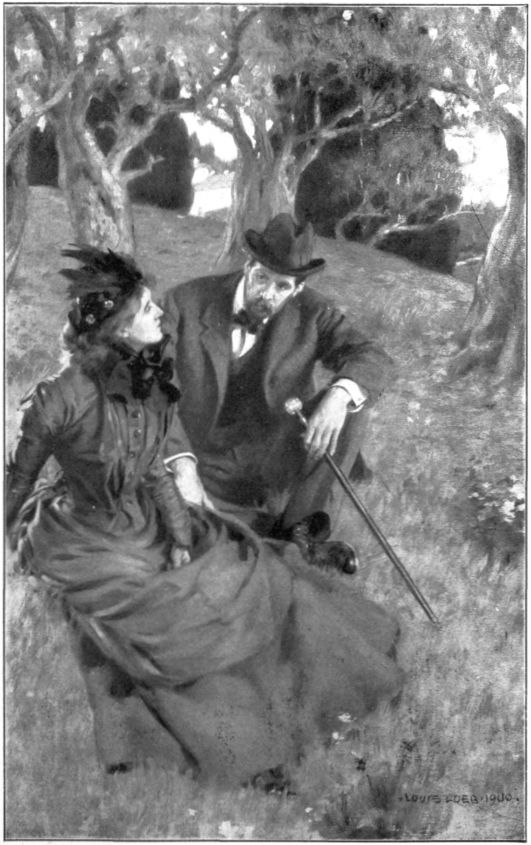
“ ‘AFTER MY DEATH’ ”
“Very soon; but most of my staff remained, pleading that they became mercenaries of Bagnell on the same principle as the penniless mediæval free-lances took service with this or that marauding prince. Of course my standing out made me seem trebly desirable. Bagnell invited me down to his Highland Castle to talk it over, and hoping to talk him over into leaving me a free hand, I went. Bagnell, however, said nothing for a week, and his pretty wife and daughters purred round me. Then one day Bagnell took me out for a walk, and we climbed up a mountain to see the view of the lochs and six counties. Bagnell suggested my standing for Parliament at his expense—he needed mercenaries there, too—told me everybody predicted a brilliant political career for me. He foreshadowed my marrying a daughter of his and carrying on the Novabarbese business—”
“The mantle of Elijah!” interrupted Allegra. “You, too! How strange! I am so glad you refused.”
“Not without a moment’s temptation. The girl was very sweet and innocent, and Bagnell in his home life was quite a paragon of domestic virtue, a charming host and father, though he could meditate plunging two countries into war for his own ends—men have these little contradictions. No, there was, I admit, a moment in which, feeling in my brain tissues the force of the Beyond-Man, I was tempted to prey, like Nietzsche’s ‘free-roving splendid beast of prey,’ upon the lower creatures, called men, to use them for my purposes as they use horses, which bear their burdens in peace and are shot for their quarrels in war. Backed by riches and power, what might I not achieve? In that moment the empery of the earth seemed at my feet, to be had for the stooping. But all I picked up on that mountain was the skull of a poor frozen lamb, which still adorns my mantel-piece in the Mile End Road.”
“You live there still?”
“Yes—I went back there—after my death.”
“After your death?”
He sprang up. “We ought to be going back.”
She rose. “But what do you mean?”
“I appeal to our contract.”
“You mean the Beyond-Man had committed suicide on the mountain?”
“No, but not bad for a beginner. However,” he went on quickly, “Bagnell has got on without me; he has acquired several other press-organs since (detachable poisoned weapons very useful in his struggle for existence), and you see the result in this swelling of John Bull’s veins and arteries. He itches for a second Novabarbese war, to repair his magnanimity in not having annexed the whole country after the first. Ah, the mob! It is a barrel-organ into which any air may be inserted. What tunes have I not heard it grinding out—in Italy, in Germany, in France; unconscious of the politician turning the handle. Bagnell has made Britain resound with martial melodies.”
“But he will not get his war. That, at least, my husband will never permit.”
“You think not?”
“If he does, he will not be my husband. The first Novabarbese war brought us together—the second would separate us forever.”
“Then I shall pray for war.”
“Ah, no! no! Don’t say such horrible things. If you only knew how I suffer from every one of ‘England’s little wars,’ which we are flippantly told exist to teach us geography!”
“You suffer from hyperæsthesia. Your hell is also a love of men. You will have to follow me and die, too.”
Some obscure glimpse of his meaning came to her. Her old idealizing faculty, incurable by all life’s lessons, was busy draping him in the radiance of honor, self-sacrifice, martyrdom for great principles. Before her rose Orvieto and her visionary Tower of David, and the drowsy town and brooding sky affected her like some mystic fresco.
“I could follow you,” she said simply, “like the women who followed Christ.”
He turned a sad startled glance upon her. “But I shall not rise from the dead,” he said.
They reached the Corso almost in silence.
“I shall be going back to Rome to-morrow,” she said, “and to England after Easter.”
“Ah, the London season!” he said dryly.
She winced. “My day is Wednesday, but I suppose it’s no use asking you to come when you return to the Mile End Road.”
“Not unless you have a day of the dead, as in Paris.”
“How about dinner?”
“I shouldn’t care to meet your husband.”
“Well, I shall have to read you, then.”
“I publish nothing.”
“Oh, why?”
“What shall I publish? Love-tales for the libraries? My early thoughts I no longer believe: my later thoughts nobody would believe.”
“I should believe them.”
He shook his head. “Nobody could read them but myself. All writings are in cipher: though the key to the average writing is supplied by the average experience. Consider! What should a Hottentot make of Hegel?”
“Well, let me have a try at the MS.?”
“Useless. No woman has ever understood life. Ah, you are angry already. Woman is an inveterate idealizer, a roseate refractor—I dare say you have already a fancy picture of me.”
He was truly provoking. “I have a truer picture than you fancy.”
“Is it anything like this?” He held up the ivory pommel of his stick, showing it a motley of carved heads, cherubic, Mephistophelian, grinning, weeping, poetic, bestial. “That is the only true picture of me.”
She smiled obstinately. “You are making faces at me.”
“It is at myself.”
“Japanese, I suppose?”
“Yes.” That launched him upon Japanese art and brought them up to the hotel.
Barda waited anxiously at the doorway with a telegram.
It was from Joan. “Broser telegraphs arriving Rome this evening.”
“We start to-morrow morning, Barda,” she said calmly. And poor Barda, vaguely hypnotized into a belief that the telegram ordained thus, uttered no protest.
Raphael Dominick, too, was docile that evening, joining Allegra at the fireside as from old habit, and conversing in Italian till Barda had gone to bed. And, as if the exotic language made it easier for him to unveil himself—removing everything, as it somehow did, into an impersonal artistic atmosphere—he allowed Allegra to penetrate his simple secret.
The new additions to his biography astonished her, so romantic were they. He was illegitimate to begin with, and doubly illegitimate, for his mother was a Jewess and his father a Christian. This father Allegra now remembered to have heard of in her girlhood—a dilettante Englishman, who wrote fantastic novels, penetrated the Mosque of Omar in Jerusalem disguised as a Mohammedan, and was drowned during a mistral in the Mediterranean. She now learned that he bore with him a beautiful Jewish girl, who was saved from the shipwreck and picked up by a French cattle-boat, on board of which Raphael was born prematurely. From Marseilles mother and child had been passed on by charitable Jewish committees to London. Here they had undergone terrible poverty and isolation, till the boy grew up, and then—when years of comparative happiness lay before the poor woman—she died lingeringly of cancer. With her death, soon after the Bagnell episode, the frenzied Raphael had felt his relations with life ended. “Already the habit of journalism—co-operating with my temperament—had made life shadowy. I seemed to live outside everything. Nothing seemed real. I moved in a shadow-world, men passed to and fro before me like images on a screen, and I was a shadow too. My mother’s claim upon me was my one relation to reality. Even her I regarded with a pitying aloofness wondering at the happiness it was so easy to bring her—ere this grim disease clawed at her. With her, the last vestige of meaning died out of existence—I saw men rushing to and fro, pursuing vain ends, perjuring themselves for phantasms, passing tragedy with a stupid laugh and fighting tragically for farcical differences. Some pined in slums, others in prisons; their equals in virtue or gilt—if either was real—lolled in purple and fine linen in emblazoned chariots. The greatest seemed like actors grimacing on stages, to hear a roar of applause inaudible a hundred yards off. Why should I continue to be part of this foolish pother, the recording whereof was the climax of the folly? The universe had no further claims upon me—I was a pariah, who had morally no right to be in the world at all. Whether suicide was wrong for others or not, I belonged to myself. I was without parents or relatives, or creed, or country, or rights, or duties.”
“What a unique position!” said Allegra.
“Was it not? It was the consideration of that which kept me from crude physical suicide. I felt that never before had a man been so well born for the impartial observation of life. I therefore retired from actual living—just as, had I been a believer, I should have retired to a monastery—I committed suicide of the emotions and the will, and became the passive spectator of the tragic humors of existence. I took out of my life all aspiration, all pity, all love.”
“How horrible!”
“Horrible! It was life that was horrible. Before my death I heard the grass grow. Every drowning fly hurt me, every whipped horse. I wished to be the voice of all dumb creatures. The hypocrisies and injustices of the social order fretted every nerve. The mere reading of history was a torture. I could as little live with ‘men’ as you could live with the lepers of Assisi, or in satisfying sisterhood with the Chinese, your soul uncramped by their standards.”
“But if everything was shadowy, how could it hurt you so?”
“That was the paradox: only the suffering seemed real. Now I sit serene,” he puffed lazily at his cigarette, “as deaf to the agony of my days as to that of antiquity. I had done nothing to mitigate that, why should I stick my little finger into this? I enjoy the strut of the Pharisees and the Philistines. The social spectacle gives me an exquisite and bitter laughter. It amuses me to see England fooled by Bagnell. I say to suffering and injustice, Let me alone, cry to the living!”
“If I believed you,” said Allegra, “I should think you a fiend.”
He rose and looked down mockingly at her, making again that monstrous headless shadow, for only the small lamp by which Barda was knitting pierced the gloom. But Barda’s presence steadied Allegra’s nerves, and the strange baleful look in his eyes did not frighten her. “Didn’t I say you wouldn’t believe me? But shall there be no peace even in the grave? How could I live in this poverty-stricken Italy at all, unless I reminded myself hourly that I am dead? No, I am content to know and not to be, and with my small income safe in consols I rejoice that nothing save the bankruptcy of England can touch me personally.”
“Niente?” she asked, mocking in her turn.
“Niente!” he replied fiercely. Then in English, “Cursed be she that moves my bones.”
She replied calmly, almost rebukingly: “And how long will you go on like this?”
“Until my organ of consciousness grows diseased. I cannot hope it will always remain lucid and clear. The nervous tissues will wear away. Aphasia and amnesia will overtake my brain as rheumatism and senility my body.”
His deadly lucidity made her shudder despite Barda’s presence. He seemed like one crucified on the cross of consciousness.
“But what if the brain were not the organ of knowledge?” she remonstrated. “Goethe took your own ideal of omniscience, but didn’t he say, no one can write about anything unless he writes about it with love?”
“Goethe was a creature of Courts and Kings, and mistresses,” he said brutally. “I wish to be the first man to face life straight.”
An immense maternal pity welled up in her breast: all her latent optimism resurged to do battle with this sicklier soul.
“Shall I play you something?” she said abruptly, remembering Saul agonizing in his tent, “drear and stark, blind and dumb.”
“It would be more pleasant than quarrelling. But I doubt if you’ll get anything out of that old piano.”
“Barda—you are nodding. Go to bed.” She lit the big lamp and gave Barda the little. Raphael Dominick resumed his easy-chair and threw on another log. Allegra tried the keys.
“Not so bad,” was her verdict. She started a soft rippling melody, touching the notes lightly as though her fingers were soothing his forehead. To-night the wind was still, and the room listened to the cheerful uprush of the flame and the gentle music.
“What was that?” he said, when she ceased.
“The Allemande of Paradies.”
“I don’t know it. Play me something else I don’t know.”
She laughed. “That might be as difficult as telling you something you don’t know.” She pondered. “Do you know John Field’s things?”
“No.”
“He was an Englishman who lived in Russia—a forerunner of Chopin.” She played a dreamy reverie, but as he expressed no opinion at the close, her fingers glided into the Melancholie. When she had finished that, it struck her suddenly that she had soothed him asleep. “A successful Schlummerlied,” she thought, smiling. She moved on tiptoe towards him and sat down opposite him, and studied his sleeping face, so spiritual in its repose, so different from the animality of that other man’s sleeping face. And then she thought that on that very spot where his head was resting, Barda’s head had rested the night before, and it came over her that he was right, that he and Barda might be inhabitants of different planets; ay, and if human evolution moved through soul, not body, Robert Broser, too, was several species behind Raphael Dominick.
She watched his gentle breathing—his simple unconsciousness. The universe had passed through that brain, with its seas and forests, and the stars in their courses: the panorama of history had passed through it; the grotesque kaleidoscope of modern social life; the arts, the sciences, the mathematics, the Babel of languages; Egypt and Babylon and the old civilizations—what had it not harbored?
Through the window the Southern night faced her, and the throbbing clusters of stars in the vast silences. The earth, bathed in moonlight, continued its imperceptible spinning. And there, against the back of the chair, lay the head that had reflected the immeasurable vision: apparently as blank and dreamless as the chair itself. What a mockery was human knowledge! And she knew that the head knew this, and—when the blood-tide flooded it back to consciousness—itself mocked at itself.
She groped for a memory, that began calling to her from the deep. Yes—surely here was the statue of her girlish dream-poem, the dead figure with the heart of flesh that felt impotently the tears of things.
A perfunctory knock at the door was followed by its abrupt opening and the appearance of the waiter, with a gentleman behind him. Allegra started up from her chair.
“Ecco la signora!”
The gentleman advanced quickly towards her. Allegra grew scarlet with surprise and resentment. It was the Right Honorable Robert Broser.
“Carissima!” he said. It was one of the few Italian words he had picked up. She drew back, shuddering.
“But I was coming to Rome in the morning!” she said.
“Your sister was not certain. I could not wait. I caught the last train. You forget how long you have been away from me.”
“It seems very short to me.” She addressed the waiter. “Il signore voule una camera—ma buona.”
“Subito, signora.” He smirked himself out.
“What did you tell him?”
“To get you a good room.”
He frowned at her. They had not even shaken hands.
“You must be very tired,” she said more gently.
“Not now I see you.” He threw down his hat and came nearer.
“No, no. We are not alone.”
Startled, his eye followed her nod. Raphael Dominick still slept in his easy-chair. Broser’s brow grew blacker, Allegra’s cheek redder. It came upon her as a sudden embarrassment that it would be too complex to explain how the stranger came to be in her room.
“Who is this gentleman?” said her husband grimly, yet half dazed.
“He is staying in the hotel.”
“He seems to be very much at home in your room.”
His tone set up her instinct of antagonism so strongly that she heard her voice saying coldly, “It is not my room,” almost before she had consciously remembered that this was indeed the fortunate case.
“Not your room? Whose then? His?”
“Nobody’s—everybody’s—the public room.”
“I find my wife in a public sitting-room!” His shock was little lessened. His respect for the Right Honorable Robert Broser’s wife amounted to a cult.
“There are no private sitting-rooms.”
“And why did you poke yourself in such a pig-sty? I was wondering as I came up the fusty stairs.”
“I like pig-sties. It is the only way of avoiding pigs.”
“Don’t talk such nonsense, Allegra.” He sniffed. “A smoking-room, too! I’m glad your sleeping beauty isn’t an Englishman, and I sincerely trust your undignified freak won’t leak out.”
She tossed her head. “Have you dined?” she said.
“With the Fitzwinters, but I want a snack of something. Oh, by-the-way, I have brought some letters for you. And I have lots of news and messages from London.”
“It is kind of you to trouble.”
He produced a little packet. “Joan gave me two. Five I brought from home, not reckoning that large unstamped one with the printed envelope and the great black seal. It fell out of your desk.”
“Out of my desk?” She took it, wondering.
“Yes—your desk was overturned and flew open. That was picked up among the papers. It seems only about one of your charities, but I brought it along.”
She opened it automatically, her mind engaged apprehensively in trying to remember whether there was anything among the other papers picked up that she would have preferred kept from the servants’ or her husband’s gaze. But she had only a vague memory of old poems buried deep down under the accumulations of years, like her own freshness of emotion. Even when she found a smaller sealed envelope inside, addressed in her own handwriting “To Allegra at Forty,” she did not remember that this was the letter which she had written to herself in her girlhood, and which (finding it in her desk after her marriage) she had sealed up for privacy in a big printed charity envelope. She opened it wonderingly, though even her enemies did not call her forty, and began to read.
“My dear Allegra,—Although we have not met for a quarter of a century, I take the liberty of addressing you still by your Christian name.”
Ah, she remembered: tears started to her eyes. How could she read it now in this incongruous environment—this whimsical appeal to her young self! She turned the page with a confused sense of an innocent voice calling to her in the wilderness. She skipped the second page, reading only the quotation that stood out:
“So on our heels a fresh perfection treads,
A power more strong in beauty, born of us
And fated to excel us, as we pass
In glory that old Darkness.”
Emotion overcame her: the lines radiated light, shimmered with infinite suggestiveness and promise. She was about to put away the letter for after-perusal when the name “Raphael Dominick” caught her eye and beat at her heart: “Ah, if you should happen to have married a man like Keats or Raphael Dominick—a man with the eye of faith and the lips of song—then you may at once throw this letter into the W.P.B.”
O God! What involuted irony! And that her letter should reach her now and thus!
She turned her head involuntarily towards the fire. Raphael Dominick had risen, and the two men were surveying each other, the table between them: it seemed to Allegra like Death looking at Life. Broser was so aglow with bouncing vitality: he exhaled success from every pore. He had grown stouter, and even ruddier, and seemed to throb with will-power as a steamer with its screw. Seventeen years of fierce Parliamentary fighting had left his face fresh and clear, for he had enjoyed the gradual rise to power, as a hard-working tradesman enjoys the extension of his business. If he had found the struggle severer than he had imagined in his cocksure beginnings, if he had found the lot of the poor harder to amend than in his young days of enthusiastic dissatisfaction with the universe, his ear had been spared those deeper dissonances of fact and dream which had brought into Raphael Dominick’s face that look of pained listening, those graven lines of gloom. He had simply had to smash his enemies and back up his friends,—and he had done both. And his conception of national policy was as crude. Getting a fresh impression of him after absence, Allegra was astonished that she had succeeded so long in keeping him at arm’s-length. Was it that her own will had developed under antipathy?
“Forgive my rudeness, Lady Allegra,” said Raphael Dominick. “Your music must have charmed me to sleep.”
His impeccable English startled Broser as it had startled his wife. Allegra hastened to say: “You must have been very sleepy already, or my husband’s arrival would have woke you.” She introduced the men, and they nodded curtly to each other.
“Was there anything urgent in that letter?” her husband asked.
“Quite the contrary,” she said, thinking ruefully of her premature breaking of the seal.
The waiter popped in his head to ask if the signore would inspect the room chosen. Broser hesitated. Allegra stood in frozen dignity. “Si,” he said, “and bring me acqua calda—I want a wash. Tell the beggar also to get me something to eat, Allegra. Good-night, Mr. Dominick,” he said, with intention.
Raphael Dominick dropped languidly into his arm-chair and threw a log on the fire. “Good-night, Mr. Broser.”
The Right Honorable gentleman banged the door.
“We had better say good-night, Mr. Dominick,” said Allegra quickly, “and good-bye too. I shall go by the first train. I could not bear to be in Orvieto any longer.”
“Ah, you would hear only the voice of the living!”
“Alas!”
He got up. “But you play beautifully. And I did not sleep in vain—I had a dream. From heaven, chi sa? You said you were tired of society, that you prayed for deliverance.”
“Yes?” Her eyes flashed eagerly.
“Could you spare an hour, say twice a week?”
“Certainly.”
“Then go to a flat, whose address I’ve scribbled on this card—it’s quite near you—a Japanese man in armor will receive you. There you will play on the piano—a grand and good.”
She took the card. “It sounds like the Arabian Nights. And when I play, you will appear?”
“Not at all. I may never appear.”
“Then I sha’n’t play.”
“Yes, you will. My complementary half lives there.”
“Your complementary—?”
“A girl who is dying—crudely dying of an incurable and agonizing disease. A girl who can neither live nor die.”
“How ghastly!”
“It is only her body. Being my complement, she lives intensely by her emotions and her faith. This Katherine Engelborne has a sister, Margaret, who lives only for her, and who, I fear, is dying of her. Margaret used to give her the consolation of music, but the Nemesis which dogs virtue dislocated her shoulder-bone.”
“But hasn’t she any friends—in this piano age?”
“Even Heine’s friends wearied of the dead-alive. I will write her that you are coming. One day you will knock and say, ‘Here I am.’ ”
“But the girl may be dead.”
“I fear not. Perhaps Margaret may.”
“And what shall be my reward? The Nemesis that dogs virtue?”
“You will meet my only Christian.”
“Margaret?”
“Yes. Not having been brought up as a Christian, I have always been curious—in my thirst for omniscience—to know what this rare species was like, or whether it was entirely mythical.”
“And Margaret is the only one you’ve met.”
“Yes—and even she isn’t a Christian.” He smiled whimsically as he gave her his hand. “Good-night and good-bye.”
“Good-bye,” she murmured, with no responsive smile, but with oppressive emotion. “I will go to her. I will be a bit of a Christian—for your sake.”
Broser found her reading the letter to herself, the others still unopened. She put it hastily away when he entered.
He saw it and looked suspicious. “He’s gone, is he? Where is Barda?”
“In bed.”
He picked up a card on the table. “Raphael Dominick!” he said aloud, and threw it fireward.
“Oh, I want that card,” said Allegra. “It has an address.”
He rescued it, looked at the address pencilled, and gave it to her silently. The waiter brought him a cold fowl and salad and the best bottle of wine in the house, and he supped voraciously, flinging Allegra the home news between mouthfuls. He spoke of the children with pride and affection—he loved his brood—and of a large addition to his income consequent on the falling in of some leases of Midstoke property he had inherited from his poor old father. She listened, reading her letters. When he was satisfied, he went over to her and captured her soft warm fingers.
“Has my little Allegra no welcome for me after all my journey?”
“I hope the holiday will refresh you. Parliament must have risen rather early for the Easter recess.”
“I did not wait. There was nothing further for me to do in the House. I had better work. I am to have an audience with the Pope, and we are to attend Mass in the Sistine Chapel. I have brought my ministerial dress.”
The juxtaposition of the venerable Pope and Broser made her smile—the smile of Raphael Dominick.
“Ah, you are pleased,” he said. “But you will have to wear black, and I prefer you in white, as to-night.”
Her loveliness was infinitely alluring to him after his lonely journeyings. The strange shabby room and the log fire, and the old-world town—all stimulated his sense of romance. His wife moved him afresh; he was angry with himself for having let her slip away from him too easily in the whirl of politics. His ambitions had occupied his whole soul: enough to kill a Bill or a Minister, to circumvent a rival, or carry a measure unscathed through furnaces of foiled hate. Now, in this holiday moment, he felt that nothing could replace the loss of Allegra’s love.
He bent his cheek to touch hers, but she sprang away and wrested herself free. His dignity and hers forbade that he should provoke the noise of a scuffle, but his face grew demoniac, his eyes protruded almost comically: the expression of gigantic will ludicrously self-baffled.
“Do you permit me at least to smoke a cigar?” he said sardonically.
“I permit you anything that excludes me.”
He gave a sneering laugh, and seating himself upon Dominick’s vacated chair, surrounded himself fiendishly with thick volumes of smoke, that had, however, a heavenly smell. “Won’t you take the other arm-chair?”
But she would not profane her memories. “I prefer this,” she said, and seated herself rigidly nearer the table than the fire. There was a silence.
“So this is your conception of a wife’s duty!” he said at last.
“I tell you for the hundredth time—I will give you everything except love. In what else have I been remiss?”
“You scarcely consulted my dignity when you came here.”
“I will be more careful.”
Her unexpected humility softened him, gave him new hope. At the worst he had this glorious creature to flaunt before the world.
“If you don’t consider your own rank, you should remember that the Premiership is almost within my grasp. And but for the drag of your domestic arguments, of the perpetual critic on the hearth, I should have grasped it already. You have never understood politics.”
“It is true. I only understood principles. I will never argue any more with you.” She was ready to promise anything, anything that would cut her life away from his. He was unscrupulous: let her accept it, as Raphael Dominick accepted what he could not alter.
“Now you speak sense, Allegra. Trust me and I will yet carry out your principles. Unless one is Premier one is so hampered. How much nicer it would be if I could tell you my plans, sure of your sympathy. That would be a true partnership.”
“I am sorry. I will do my best in future.”
“Thank you.” He reached out his hand again and took hers and it lay passively in his own. “Let me tell you, then, that my visit to the Pope is only a blind. In reality I left England last Thursday, though even The Morning Mirror announced that I left Saturday night, receiving an ovation on the platform of Victoria Station. He’s very smart, that new secretary of mine, and in with all the press agencies.” He chuckled, glad as ever of a confidante for his cleverness.
“You did go somewhere else first, then?”
“Don’t give it away to Fizzy. I went to Brussels to meet Sir Donald Bagnell and representatives of the northern countries that have percentages on the Novabarbese railways, or suzerainty over parts of the country. Of course I didn’t dare meet Bagnell in England.”
Novabarba! The fatal word sucked the blood from her cheek. Oh, but this was horrible, incredible.
“We’ve settled the concessions they are to get in compensation, when England acquires the country.”
“But how will England acquire it? Most of the tribes are still independent.”
“That was Lord Huston’s mistake. They must be conquered again.”
“On what pretext?”
“Pretexts we have always with us—like the poor.”
“Yes, poor pretexts—the wolf’s to the lamb!” She rose in agitation.
“Not at all. We don’t desire to eat ’em: only to civilize ’em.”
“To shear ’em, you mean.”
He shrugged his shoulders: “They’re dirty—and too lazy to develop their own country. The dark places of the earth must be lit up.”
“That the electric-light companies may make a profit!”
“Why not? If I add Novabarba to the Empire, I shall ultimately become Premier. Granted. But all the same it is the march of civilization.”
“And the Dead March of Christianity! I can see the tribes mowed down by your machine-guns. Oh, how can you wade through blood to your throne?”
He flushed angrily: “Have you forgotten your promise already?”
“My promise! My promise!” She laughed half hysterically. “And what of your promise to my father whose mantle you were to inherit? What of your promise to me? We were to make an end of war—you and I. My God, a pretty pair!”
“And so we shall, Allegra, so we shall. The more we consolidate the world into great empires, the more we check these internecine racial insanities. You are a woman—you see only the crude present fact. But we politicians—we have to dream and build for generations to come.” She was silenced for a moment. “If you only trusted me a little, Allegra,” he said pathetically.
“But how can I trust you? It was Novabarba for which my father sacrificed his career; it was the Novabarbese war that killed my brother, and made you and me swear to war against war.”
“We were young. Good heavens, Allegra, do you still hold the opinions you expressed to your dolls? Why, ha! ha! ha! it was in a nursery that we made our highfalutin compact. Accept the omen.” He threw away the cigar that had gone out in the argument and lit another.
Her brain was busy reviving the tragic scene in that nursery, and she did not share his laughter. He went on complacently:
“Do you think that Sir William Orr-Stenton, the Governor of British Novabarba, would recommend war unless he believed it was justified?”
“Does he recommend war?”
“To tell you another secret, yes. He has advised the Colonial Office that if we don’t annex, one of the northern countries will. Isn’t it better it should fall into the hands of England and get the boon of British government?”
“Sir William Orr-Stenton is an English gentleman, and you know I still consider that order the highest in Europe.”
“Well, then!” he said triumphantly.
“But when he was Colonel Orr-Stenton and I was a girl, I saw a good deal of him at Rosmere. And in his mind’s eye he sees the whole round globe under the British flag—like one of those Christmas puddings, with a flag stuck in it.”
“So do I, Allegra, so do I. It is the note of English gentlemen. And what a delightful destiny for the globe—to be a Christmas pudding. Peace on earth and plums to all men. It is your father’s very ideal, and if I help to bring it about, I shall be truly the inheritor of his mantle. And you accuse me of not keeping my promise!” He laughed, highly pleased with his neat Parliamentary repartee.
Allegra bit her lips. “I shall keep mine,” she said. “I was a fool to argue. Good-night.”
He sprang up: “And you’ll not tell your inconvenient brother-in-law?”
“An English gentleman should understand the laws of honor. Good-night.”
“Not without a kiss?”
She snatched up the lamp, half in defiance. Their shadows shifted grotesquely. “Ring for another,” she said. “I need this for my room.”
“Put it down and say ‘Good-night’ like a good little girl.”
“No murderer’s lips shall touch mine.”
He laughed sneeringly. “You are becoming melodramatic. You remind me of the Midstoke Theatre Royal.”
“Remember rather the Midstoke Town Hall.”
He winced. But her defiance stung his blood, intensified her piquancy. “Come,” he said more lightly, “You cry ‘Peace, Peace,’ and you are all war. Let us kiss and make it up.”
“Not if you are to bring this war.”
“Your terms are high, my dear Allegra. The Premiership for a kiss? They ask less even in the Charity Bazaars.”
“Good-night!” She pushed back the panel, disgusted, passed through, and slid it back. But he stuck his foot in the aperture ere it closed, laughing good-humoredly.
“Sliding panels, too! No wonder we are melodramatic.”
She put down the lamp on a chair and tried to close the panel. “I’ll scream for Barda,” she threatened.
“Little spitfire! You shall have your terms. All for love, or the world well lost.” And, as she hesitated a moment, he thrust back the panel and kissed her on the lips. “Good-night, you little fool,” he laughed. “All’s fair in love and war—and this is both. What do you think of my melodrama?”
And as he went to his room he pondered on the vexatiousness and feather-headedness of the modern woman, thrusting her pretty personality into affairs of state. But all the same he felt that the situation between them had been improved.
Fizzy was enjoying himself, chaffing the Right Honorable Robert Broser for the amusement of the ladies and the mystification of the Italian Deputy who had been Fizzy’s dinner guest, in his magnificent suite of apartments in the hotel at Rome. All the men were smoking (by request). Fizzy’s Radical spirits had not been damped either by age or matrimony, but Broser refused to take either him or the attacks of the Mirror seriously. The Deputy took both men very seriously as illustrious British Deputies, and this dinner would figure in his Memoirs. He spoke English and was a great admirer of English institutions. In Rome he was a rabid Socialist, with a venomous hatred of the Vatican, and whenever he stopped in his street walks, ground his teeth, rapped the pavement with his cane, and barked out oaths, his friends knew that a cardinal’s carriage was within eyeshot. He was an ecclesiastical pointer or setter. “Those cursèd intolerant priests!” was his mildest invective. Joan, too, had abated no jot of her atheism, and Allegra, lonely among them all, felt in herself stirrings of all sorts of mysterious impulses, vague instincts, flashes of insight, divinations, emotions, which to them were apparently as music to the deaf: she reached out as with antennae towards a dim, evasive, yet pervasive spiritual world, of which they had no suspicion. Was there indeed more than fancy in Raphael Dominick’s theory of new species groping to adjust themselves to new spiritual environments?
“Ah, you are a great man, Bob,” said Fizzy. “I am wondering what poor corpse you are destined to displace at Westminster Abbey. That is our Pantheon, you know,” he explained to the Deputy, “but it is so chockful that whenever we wish to bury a new god we have to dig up an obscure citizen who was buried there before we made it a temple.”
“Not really?” exclaimed Lady Joan.
Fizzy puffed out a mouthful of smoke. “When Lord Ruston had that great national funeral, the sextons quietly chucked a poor peaceful citizen into the Thames: as quietly as they smuggle corpses out of this hotel in the height of the season.”
“But that is scandalous!” his wife cried.
Fizzy squeezed her fingers affectionately. “Aha! have I found a new grievance for my pretty to play with?”
Broser laughed. “There will be a new Society.”
“Yes. The Anti—Ghoul Association,” said Fizzy. “A Home for h’less millionaires will be her next institution. Still it’s not for me to complain. In my far-off bachelor days people said The Morning Mirror was Satan’s own paper: now they say, Fizzy’s not so bad for all his brilliance. Look what his wife does for poor drunken temperance lecturers.”
“Ah!” said the Deputy sagely.
“Yes, I wonder myself to see how my wife gratifies her unselfishness all day long. She weeps even over the waiters limping at nightfall. She reminds me of the image of the Virgin I saw in the Canary Islands, which has a tear screwed into each cheek, and only smiles on Corpus Christi Day, when they are taken out.”
“Ah, those scoundrelly priests!” cried the Deputy.
“Leave the priests alone,” said Fizzy. “The fact that my valet believes in the next world saves policemen in this.”
“But the waiters here are shamefully overworked,” persisted Joan, unabashed. “I shall not come to this hotel again. That Hôtel de Castile looks attractive. Is it quite respectable?” she asked the Deputy.
“My wife means, is it an hotel where ladies can smoke cigarettes and have golden hair?”
“Oh yes!” said the Deputy, and the others laughed.
“Golden hair seems to be in circulation again,” said Broser.
“I wish I could get change for my silver,” said Fizzy ruefully.
Lady Joan passed her hand lovingly over his white hair. “Don’t,” she said. “That would leave you almost bald—at the current rate of exchange.” This time even the Deputy laughed.
“Did I ever tell you I was in China when the amusing gold-silver gang were exposed?” asked Fizzy.
“No,” Lady Allegra laughed. “But we know you have been everywhere when anything happened.”
“The gold-silver gang quartered themselves in different coigns of China, which then knew even less about ‘foreign devils’ than now, and began steadily giving the Chinese twenty English sovereigns in return for one English shilling.”
The ladies gasped.
“What daring!” said Broser admiringly. “And so they hoodwinked the Chinese into the belief that silver was the metal that was twenty times as valuable as gold?”
“Yes,” replied Fizzy, “as certain politicians bamboozle the British as to which is the really valuable national ideal. After some months of this unblushing persistence that gold was silver and silver gold, the Chinese began eagerly bringing them their gold for small bits of silver. But in the end the rogues’ ears were cut off. We British,” he blew a smoke-cloud at his brother-in-law, “only eject them from office. For my part, so long as I get twenty shillings over the counter for my gold piece, I don’t care who keeps the bureau. I’d as lief be governed from New York or Berlin as from London.”
“Surely not! Surely not!” said the bewildered Deputy.
“Well, perhaps New York is too far off. But Berlin—why not? We should learn German quicker, and there would still be suppers after the play. The dirty work of government could be taken off our hands, as we’ve taken it off the hands of the Hindoos. We don’t possess India, by-the-way; it possesses us, and sits smoking its opium-pipe while we fuss in the sun. The British Empire is only a great firm of Government Contractors, supplying Governments as Gunter’s supplies ball-suppers.”
“I wish it would take over Italy,” sighed the Deputy.
“It is doing so, with the help of America. Already Anglo-Saxon capital runs your electric cars and your factories. That is real conquest, real possession. Military conquest is only skin-deep. England is really a French conquest—the greatest boast of our families is to have come over with the Conqueror. Yet the Saxon absorbed his Gallic conquerors. To plant one’s self inside a lion is not to conquer the lion.”
“Bravo!” cried Broser. “That’s the first time I’ve heard you do justice to the British Lion. You are right: we shall soon be running Italy as a picture gallery.”
A waiter here appeared to say that an old lady wished to see Lady Allegra Broser. She was in the public drawing-room: she would not come up. No, nor give her name. She had an ear-trumpet. Oh, yes, sufficiently well dressed, the waiter assured Broser. Nobody could identify her, and Allegra cut the interrogatory short by volunteering to descend. She pushed open the swinging door timidly, for the room was full of people in evening dress, and she had never entered it before, not because she was Broser’s wife, but because of her personal shrinking from the wealthy tourist. She had, however, met many ladies in the hall and on the stairs who had struck up an informal speaking acquaintance with her. In fact she could not but be aware that their anxiety to talk about the weather and her health had exceeded the due courtesies of hotel life. As she entered, a group clustered round her. Near her, she was morbidly conscious of another group of ladies and gentlemen listening eagerly, almost reverentially, to the disquisitions of a horrible American boy of about twelve, who was holding forth on the history and antiquities of Italy.
“It was in Perugia that the Baglioni—”
“Show me Perugia on the map, dear,” said a stout lady.
“There, mother. The capital of Umbria!”
“The capital, dear? But it’s not in the middle.”
“Don’t be so stupid, mother. You’ve put me out. At Perugia we have got to see some more Pinturicchios.”
She was disgusted: “I thought we were through with those!”
“We had such lots in the churches here,” her husband added.
“Well, anyhow, I guess you’ll have to do the Peruginos,” said the boy relentingly.
“Perugino!” cried another lady in self-congratulatory accents. “I got through with him when I was a girl.”
Lady Allegra’s eyes roved in search of the old lady with the ear-trumpet. And presently she found the stranger sitting stiffly, but very lonesome-looking, in a deserted corner. She disentangled herself from her gushing acquaintances, and walked towards the pathetic old-fashioned figure, so pointedly ignored of all this swiftly sociable crowd.
“O Alligator, how your dress smells of smoke!” And even before she had felt the old motherly kiss, she knew by this scolding that she and the Duchess she had failed to recognize were friends again. “Somehow it was easier to see you abroad than at home,” the Duchess explained, and Allegra cut short her apology by taking the whole blame of the long separation upon herself. It was delightful in her loneliness to rest upon this garrulous breast and to know, too, that she comforted it, and she listened to the Duchess’s “extensions of egotism,” and to her plaints of the degenerate age (whose so-called gentlemen smoked even in the Row) with a loving tolerance she had not felt in her girlhood.
“I am sorry I didn’t get to Rome before the Beast arrived!” said the Duchess.
“You talk like Revelations,” smiled Allegra.
“Revelations! I dare say you have had plenty of Revelations of what he is. A Beast like that to get a Beauty like you, and to have our beloved country under his unwashed thumb.”
“But you agree with his poli—” Allegra protested into the ear-trumpet.
“Yes, I’m glad you agree with me,” interrupted the Duchess, and hastily shifted the trumpet. “I always said you’d come round to my views in everything—when you were older.” And she refused to raise the trumpet for the reception of Allegra’s contradiction, but rattled on. Allegra, amused, saw that her aunt had now a new weapon in the battle of existence—“a detachable weapon of defence, Raphael Dominick would have phrased it,” she thought. But she was determined to foil it, and waiting till the dear dogmatic old creature had automatically resumed this detachable ear, she persisted: “What I said before was—Mr. Broser agrees with you.”
“Mr. Broser agrees with me! Like goose-liver at midnight.”
“But he’s on your side now.”
“Fightin’ Bob on my side! Never!”
“But he is! He’s changed his coat. And he’ll have a coat-of-arms too, some day,” she added provokingly.
“He! I’ll swallow my ’scutcheon first. How you could cover him with your coat-of-arms! Phaugh! I blush for you, Alligator.”
Allegra was human enough to dislike being told “I told you so” by the person who had actually done it, especially as—despite the brisk chatter around—curious ears might be straining towards this corner of theirs. “I thought you came to make it up,” she replied coldly.
“I did. I came to make up for fifteen years’ silence. Oh, I am boilin’! How have you been able to live with him?”
“How is the Duke?”
“We are talkin’ of the Demagogue.”
“But he’s not a Demagogue. He leads all you aristo—”
But the Duchess peremptorily removed her trumpet. “Wasn’t I a true prophet? Didn’t I tell you power was all he was after?” and she hugged her trumpet to her breast, refusing the right of reply. But Allegra, nettled, replied all the same—as loudly as she dared—
“Yes, but you prophesied he wouldn’t get it. You said he’d never be in office.”
“Yes, in an office! That’s where he ought to be. I’m glad you admit I was right. Perhaps in future, Alligator, you will trust your Aunt Emma?” And she put the trumpet pleadingly to her ear. “Tell me everything, dear.”
“There is nothing at all to tell.”
“Ah, you will tell me all. That’s right.”
“No, that’s wrong. You didn’t hear me.”
“No, so you may talk without fear. You got over your infatuation very soon, didn’t you? Ah, I’m glad you are blushin’! That’s the Marjorimont blood showin’ itself after all.” Glowing with satisfaction, the Duchess proceeded to make complimentary remarks about her family in general and to congratulate herself in particular on having proved a Cassandra. “I always said the marriage would turn out a miserable failure. Ah, my dear, I never thought I should come to agree with the new woman, but when I look at my poor Alligator, I could wish women were not freehold. The lease should be terminable.”
“I wish it was,” Allegra murmured. And the Duchess enchanted, babbled on: “I’m so glad you haven’t a baby, though I’m not so pleased with my Minnie. I don’t know what’s comin’ over the women. It was bad enough when they had babies and no husbands: now they have husbands and no babies. As for London society, I can’t set foot in it. People talk of nothing but Stock Exchange and racin’-tips. The parvenu plutocrats have it all their own way, and spend as much on the flowers as we used to do on the season. You heard how that little Russian actress was allowed in the Royal Quadrille at the Court ball, and how that Mrs. Duncan was in the enclosure at Ascot. Stanfield House is the only decent house left, and when the Duke dies, even that will join the smart set, especially if the heir marries that Miss North, as they say he will, though she is twenty-nine. Ah, they are a bad lot, the heirs.”
“But what about my house? Won’t you come to that, Aunt?”
But the ear-trumpet would not receive the question. Allegra saw the Duchess to the hotel door.
“Good-bye, Alligator!” She kissed her. “Oh, I’ve forgotten my purse. Go and get it.”
Allegra went back to the drawing-room.
“So you’ve got rid of your frumpy caller,” smilingly cried a lady in elegant toilette, anxious to put herself on Allegra’s plane and at the same time relieve her ladyship of the imputation of having descended from it.
“The Duchess of Dalesbury is my aunt,” Allegra replied with a touch of malice.
Consternation spread through the drawing-room.
As the Duchess walked off purse in hand, her heart was warm with virtue and venom. She had humbled herself to meet again the darling child who had so strangely fascinated her at first sight, and after whom she had hankered all those obstinate lonely years since Minnie’s marriage. But her sweet Alligator had humbled herself in turn, had admitted her prophetic sagacity, nay, had come to partake her abhorrence of the Dragon. Was there no way of rescuing her from him? Why did he not die? This new certainty of Alligator’s unhappiness, coming on top of her morbid hatred of the man, swelled her poor old brain almost to bursting point. She felt like rushing back to the hotel and bearing off Alligator then and thence, leaving Broser wifeless and howling. How dared the brute claw and domineer over a Marjorimont—a sweet young thing like that, too!
“Oh, my poor Alligator, my poor Alligator,” she moaned, and the passers-by in the Piazza turned and looked at the old lady with the ear-trumpet. But her venom ebbed, old lady with the ear-trumpet. But her venom ebbed, and only the high tide of virtue was left. That darling Alligator! How sweet to feel the loving pressure of her fresh young lips. Yes, she would make it up with mankind at large, even with her own relatives. Chaotic memories of people she had scolded jostled in her brain. Yes, she could forgive them all. It was as if she was exchanging all these minor enmities—the small change of social friction for a lump sum, so as to have more to add to the hatred she felt was Broser’s due.
Ay, Alligator’s mother herself—poor Tom’s evil genius should be finally and fully forgiven—on Broser’s account. Even after Minnie’s marriage to Jim, the Duchess had refused to recognize the opposition mother-in-law as anything but an intruder into the sacred pale. Now she would write to invite her to Rosmere.
“Yes,” she thought in an overflow of generosity, “and we will attend the next Drawing-room together.”
A pretty girl in a spotless cap and apron—shining seraph of earthly ministry—opened the door, and Allegra stepped into a strange little hall, guarded by the Japanese man in armor, who, however, turned out to be absent from his lacquered suit and crescent-topped helmet. Perhaps the lively little fox-terrier replaced him on guard. “Down, Ned!” said the maid, and in an instant Allegra and he were friends, and he stayed with her, while the maid took in her name. In another instant she found herself being welcomed to a sort of boudoir-museum by a tall pale girl, radiating an indefinable aroma of spiritual sweetness and physical suffering. But there was a more definite aroma curiously intermingled, and Allegra’s first impression of Margaret Engelborne reminded her comically of the Duchess’s greeting in Rome: “Oh, how your dress smells of smoke!”
It was a shimmering, golden-brown tea-gown, at odds with the odor, for which perhaps it was the other occupant of the room who was responsible—the girl with the soulful face and the wonderful eyes, who lay back in an easy-chair. Her Allegra recognized. She could be no other than Miranda Grey, the much-photographed actress, whose eyes were stars of divine light and whose voice trembled with the music of the spheres and the tears of the pitying angels. When this glorious creature was actually introduced as Miranda Grey, Allegra wondered that she should be so like herself off the stage or off the photograph, even sitting with her back to the light. This was the very spirit of goodness, who had glided, a vestal virgin of lustration, through a recent society drama.
It was impossible even to talk of anything else while Miranda was in the room: she monopolized the conversation both as speaker and as subject. Even the wife of a Cabinet Minister did not interest her. Allegra could barely edge in an inquiry as to the sick sister. Her own relegation to the background—novel in itself, and accentuated by her subconscious sense of patronage and philanthropy in coming—took her aback a moment, but the little shock passed instantly into amusement, as she surrendered herself to the situation, and waited for the revelation of her hostess’s personality, which lay under the same eclipse as her own. Miranda’s relations with her hair-dresser occupied much time, and subsequently it transpired that her dairyman had conceived a passion for her—as pure as his milk—and in consequence brought her the best of everything without sending in a bill. “Cream—butter—cheese—eggs, too!” And her dazzling eyes dilated at each new article, till at “eggs, too,” they were spheres of spiritual light, and in Allegra’s vivid imagination little winged cherubim seemed to break out through the egg-shells. Later she spoke of potatoes with a radiant play of feature; and when she said the weather was beastly for so near to May, she had the air of a Joan of Arc.
When Margaret Engelborne demurred, “The skies are not friendly, but neither are they horrid—just preoccupied—to look up into them is like looking into eyes one loves and finding them too busy to smile,” it seemed natural to Allegra that even the weather should be maintained in the plane into which Miranda had lifted it. It was not till later that she realized that the poetry belonged to Margaret, that Margaret saw everything through images of tenderness, vivified even the inanimate creation with child-heart fancies. It was not, indeed, easy to realize this to-day, seeing that when Miranda, in a moment of self-forgetfulness, remarked that Ned didn’t seem so lively as usual, Margaret replied: “Poor little Ned. He is recovering from a bad bout with a bigger dog. The other dog’s master by way of parting them picked up his own animal. He ought to have known that he would pick up Ned too: that a terrier with a pedigree like Ned’s would never let go.”
“Has Ned a pedigree?” murmured Miranda with waning interest.
“Haven’t you noticed it hanging up in the hall? Dear little fellow! I’d rather have him die than let go.”
The contrast between the sweet voice and the savage sentiment was Allegra’s first vivid impression of the real Margaret.
The talk veered round to Miranda’s work: it appeared that she had become an actress-manageress at a minor theatre, and was speculating in Cross and Crown, a romantic religious drama. But it was not, she confessed in divine accents, “raking in the shekels.” She seemed more interested in the crowns than in the crosses: indeed, the absence of crowns seemed to constitute her cross. She had even dropped the Saturday matinée. “This time last Saturday I was in my war-paint, I mean my grease-paint.” She feared that the name of the author must be leaking out, and this prevented people from going. Because poor Otto Pont had been in prison, he was never to write anything any more, even under a false name. What a hypocritical public! Besides, she herself had revised the play a good deal, and cut down the part of the wicked pagan woman who had too much to say. Now, Virtue had the word almost the whole time, and what did the public want?
Otto Pont! So the irrepressible Professor was still energizing, albeit darkly. Poor Otto! She wondered how it felt to be ruined materially: whether it was worse than the spiritual foundering she had herself known. She wondered, too, at the Bohemian—even anti-Christian—atmosphere of a home she had imagined Puritan, especially when Miranda absent-mindedly relit the cigarette she had laid aside at the stranger’s advent. But her faith in Raphael Dominick’s judgment remained strong, and there was something in the imperturbable yet sympathetic attention of Margaret Engelborne to Miranda’s babblings that reminded Allegra of Raphael’s priestly attitude towards her own confidences. As she sipped a cup of tea she studied Margaret’s long, oval face with its delicate features and spiritual radiance, the chin not unlike her own, the eyes greenish, the hair dark and short; she studied the room in which she sat, and found it as distinguished and original as its mistress. The old furniture, she perceived, had never passed through the shops, the china had lived always in hereditary homes. There was a Chippendale cabinet, a Chippendale bookcase gleaming with classics in English, French, and German, and a long set of Notes and Queries. There was a piano with a blue and white punch-bowl upon it. A Dresden clock ticked on the mantel-piece. Daffodils met the eye everywhere in beautiful Italian or Worcester vases. But mixed with this classic and cheerful serenity was a wealth of savage curios, exhaling grim suggestions of battle and sudden death, the chase and the torture-chamber; not merely the properties of the old English hall, antlers, and guns, and blunderbusses, and buffalo horns, but big bows and arrows, and javelins, and boomerangs, and stone cannon-balls, and a rhinoceros horn, and strange-shaped swords in unfamiliar scabbards, and uncouth, unknown instruments and weapons. And underneath this dominating note of violence a later impression of the innocuous grotesque awaited her; a collection ranging from Turkish tombstones to tiny Hindoo gods, from opium-pipes to Chinese puzzles. She feared to seem impolite by asking if she might begin to play, though she had barely snatched the hour from the endless social, philanthropic, and domestic duties of a great London hostess.
A child arrived mysteriously—a great-eyed cherub—and sprang into Margaret’s arms with a cry of “Muvver-Meg,” and soon constituted herself the prattling point of interest.
“My muvver says she dejected five men before she married favver. How many men have you dejected, Muvver-Meg?”
And with the turning of the laughter and the applause from herself, Miranda, no longer in the centre of the stage, made her exit, and Allegra had the little girl to play with and the little dog to fawn on her while Margaret escorted her other visitor without.
“What a naughty girl!” And the child pointed to a fantastic vignette, in an open volume of poems, of a nymph swinging airily from a bending branch.
“How do you know she is naughty?” inquired Allegra, astonished.
“Look how she’s pulling down the tree!”
Allegra laughed. It was long since she had spoken with a child on terms of equality, and little Chrissie’s acceptance of her was softening. She took up the book, saw it was among her own favorites: the poems of the singer whose virility had ousted Deldon’s shadowy allegories, and who had been silent too long: songs of a Christ-like soul, touched with a pagan sense of the beauty of the earth. The fly-leaf bore the inscription: “To Margaret Engelborne from Raphael Dominick,” and she was glad he had picked out such a book for his gift. It seemed a sign he was not so frozen as he professed. But then the inscription was some years old.
“Do excuse me,” said Margaret, returning, “I had something to ask Miss Grey.”
“She doesn’t seem as spiritual as I had imagined,” Allegra commented, smiling. But Margaret only smiled back vaguely and replied:
“It is so good of Mr. Dominick to find us a new friend. He is very good to us.”
Allegra was so glad of this additional testimony that she said, unthinkingly: “He contradicts his theories, then.”
But whether Margaret was aware of these theories or not, she replied: “Will you have some more tea?” so that Allegra had again the sense of being checked. But it was only after several visits that she discovered Margaret would not discuss one friend with another.
“No, thank you. Shall I play now?”
“I am afraid I must not expect you to now. Your time is precious, and I could not ask you while Miss Grey was here, because she enjoyed talking, and it might have seemed rude to her.”
“But I have plenty of time!” Allegra protested mendaciously. Although amused at the scrupulous meanderings of Miss Engelborne’s unselfishness—which had, after all, resulted in the neglect of herself—she was attracted to this curious household, had already mentally and with scant regret thrown over the private view of some R.A.’s pictures. The carriage could wait. “Shall I go in to your sister?”
“It is so sweet of you, Lady Allegra, but I fear she will never be strong enough to see you. But she has been expecting you, and now I shall tell her that you are just as we dreamed you would be! She will be so happy! If you play on this piano, she will hear you quite well through the wall—it is better that the sound comes muffled.”
“Then I had better play something soft, too.”
“Yes, please. But may I go in a second and see if she is comfortable?”
Margaret returned with a longer face. “I am so sorry: the nurse is just busy with her. She could not be ready to listen for ten minutes. But she told me to thank you with all her heart, and you will come again, won’t you?”
“Not if you drive me away like that. Surely it is no bore to spend ten minutes in your amateur armory, to say nothing of your company.”
“Oh, would you like to look at some of the things? People so rarely do. Sometimes, I wonder if they even see them.”
“But I see ’em,” said Chrissie, “only you won’t let me play with ’em.”
“They bite, Chrissie. That’s why.”
“But they wouldn’t bite me. Ned doesn’t.”
Margaret snatched up the child and hugged her fervidly.
The collection had been made by her father, she said, a man who had travelled widely and had enjoyed every moment of his life. The Oriental weapons were newest to Allegra: the Malay kris, with its blade “wriggled at the edges so as to make terrible wounds,” as Miss Engelborne explained imperturbably, and the Japanese “Happy Despatch” knife, very heavy-hefted and equipped with a pen-knife and a pick; Indian swords with hilts too small for English hands; the Indian sword of state with its velvet sheath bound in copper and its supplementary stiletto. Ghastliest of all was the Chinese executioner’s sword, wooden-handled, which Margaret drew from its leather scabbard, recounting how it had executed thirty men every day for thirteen weeks. “So beautifully poised, it cuts clean,” she said.
Allegra felt sick. “Where could they find so many criminals?”
“They don’t value life so much in China,” Margaret replied, with a touch of scorn. “Many of those executed were not even the actual criminals, but paid substitutes bent on enriching their families.”
“Horrible! But it redeems the savagery. And what are those curious toasting-forks?”
“Chinese prayer-prongs.”
“What!”
“They are stuck in the shoulders, but so as to dodge the lungs. Blobs of incense are burnt on the prongs.”
“But is that a way of praying?”
“A form of penance. It doesn’t hurt as much as it appears. The shoulders are first pounded to insensibility. But here is a penance even more showy.” And with a faint smile Margaret indicated another pair of prongs connected by a horizontal piece of wood, and described how they were hung up and stuck into the thick muscles of the back, so that the penitent swung from them, as from a milkman’s yoke, his feet off the ground.
Allegra felt the prongs in her shoulders and turned faint. It was unfortunate to have inherited her mother’s vivid physical sympathy as well as her father’s more complex interest in the human tragedy, and she was still as hypersensitive as on the night of the burnt moths. “Did they think that would please their god?” she said contemptuously.
“It was their way of pleasing the god within themselves. They set themselves right with their own conscience.” There came from these words and from Margaret’s expression a waft of vitality which dispelled Allegra’s faintness. “But here is something more pacific,” said Margaret, producing a notched stick, “though I dare say you won’t know what it is.” And as Allegra failed to guess, she told her it was a tally—an old East India Company receipt for seventeen thousand pounds.
Allegra laughed at her own ignorance. “I remember reading about them. A lot were burned in the fire in the old House of Commons, weren’t they? But after that, perhaps you’ll tell me these sticks,” she touched one, “aren’t arrows.”
“Don’t! Be careful!” Margaret pulled her hand back. “They are poisoned.”
“Poisoned?”
“Yes. Poisoned Novabarbese arrows. My father brought them back before the Novabarbese war broke out. They have been superseded now, I believe, by German cannon except among the more backward tribes.”
Allegra contemplated them curiously, remembering how poor Tom had died of one of them. “But surely, they don’t retain their virulence still?”
“Yes, it’s a vegetable poison; a vegetable poison on wood doesn’t fade with age, and this is peculiarly strong, a Novabarbese war-secret. I have to remove them with my own hand, whenever I change my address. I dare not let the men touch them. The tiniest prick would be fatal. They are not all poisoned, but unfortunately I have muddled them up, and forgotten which are and which aren’t.”
“You ought to destroy them.”
“Father would not like his collection impaired.”
“Is he alive, still?”
“Not with an earth-life. But he has still his earth-interests, of course. How happy he will be at your kindness to Kit!”
Allegra was startled and impressed by Margaret’s calm assurance in the great matters that were monthly in doubt in the half-crown reviews. “But he would not have been happy if I had pricked myself,” she urged.
“It would have been with a harmless arrow,” Margaret affirmed.
“But one wouldn’t know at first whether it was death or a pin-prick!”
“No—it’s like the stock joke about how to tell a mushroom,” said Margaret, coolly. “Eat it. If you die, it’s a toadstool.”
“But how long would it take to know?”
“About five minutes, father told me. First, there is just a little swelling as at an ordinary prick. The agony commences only when the poison has got well into the blood, but then the end comes quickly.”
“How dreadful! What a curious position—to be waiting to know!”
“I have been in that position.”
“You pricked yourself?”
“No, but once a half-wild Chinese bitch father had brought home flew at his throat, and she bit my hand as I was tearing her away. I had to wait to know whether hydrophobia would set in.”
“That must have been a terrible time!”
“Not so terrible. Does it matter so much when we go to God? But only this mark remained.” She showed it—a great scar. “The worst was, it spoilt my playing.”
“I thought that was due to the dislocation of your shoulder. So Mr. Dominick said.”
“That, too. I was dancing about on the top of the stairs because it was my birthday, and father who was standing at the foot had just given me a new coat. But suddenly I swayed and caught at the banister, and I can still see his white face swimming up towards me. Poor father!” She turned away. “These are the original stone cannon-balls that were fired red-hot from the British batteries during the siege of Gibraltar.”
“Your father seems to have collected all the crudest things,” Allegra said, unsympathetically.
“We are a race of soldiers,” Margaret replied simply.
Allegra’s vestiges of sympathy dwindled. She wished to change the subject. She saw some framed letters. “Ah, you collect autographs, too.”
Margaret’s eyes kindled. “You don’t often see Tennyson’s. Look there! I got his when I was a schoolgirl in France by pretending I was a little French girl. I wrote as Henriette la Comblée, and that quite bowled him over. Victor Hugo’s I got by writing as a little English girl.” She laughed; Allegra laughed, too, relieved to find Raphael Dominick’s “only Christian” not priggishly conscientious.
“You have Deldon’s, too,” she said.
“Yes—but I have outgrown my interest in him. His politics I always hated, and now his verses are not even musical. Your friend’s my favorite poet among the moderns.”
“Who is my friend?” Allegra was puzzled.
“Raphael Dominick. I am so proud of having a copy from the author.” She pointed to the volume, still open at the vignette of the naughty nymph pulling down the tree.
“Is that his?”
This time Margaret was puzzled. “Didn’t you know?”
“I love the poems. But he never told me they were his.”
Margaret flushed, as if she had been guilty of boasting a superior intimacy. “Perhaps he took it for granted you knew,” she suggested. “I think he did not like to put his real name to them because he was so well known among pressmen as a brother, and so he was afraid he would be log-rolled.”
“That is so like him,” said Allegra, with glistening eyes.
“Kit loves his poems so. She prays to God every night that he may be inspired to write more. I so hope he will publish another volume before she dies.”
Allegra felt embarrassed. “I am glad anyhow that he has achieved his early poetical promise,” she said.
“Ah, then you did know?”
Allegra smiled: “Well, it’s a little roundabout to explain.”
“He has been very kind to my poor promise,” said Margaret.
Allegra was astonished to hear that Margaret wrote, too. She asked craftily, “And what is your pen-name?”
Margaret laughed. “What a delightful way of confessing you have never heard of me. I use my own name. But I belong to the etceteras of literary gatherings: just an obscure work-woman, to whom Mr. Dominick and a few other editors, God bless them, have been kinder than she deserved. How I should rush to give anybody my autograph! Apropos, I mustn’t forget to show you Bismarck’s.” She pointed to it with pride.
“At that rate she is capable of admiring Broser,” thought Allegra, slightly chilled again. “Your sister will be ready now,” she said.
“Of course: how selfish I am, to be chattering about myself!” She ran out, and returned to say that Kit sent a thousand thanks and was full of happy anticipation.
Allegra sat down to the piano and found herself playing the “Allemande” of Paradies. She smiled through tears when she made the discovery.
“But it is only proper,” she told herself. “He sent me here.” And she passed on defiantly to the “Melancholie” of John Field, conscious at moments of the pensive smiling Margaret and the rapt little Chrissie, and the visioned Kit upon her bed of pain, and at others only of the sadder figure in the arm-chair at Orvieto, and the roar of the flame and the voices of the centuries.
She had expected to come to a lazar-house. But she drove away with a sense—beyond and above all the quaint contradictions—of daffodils and music, of life and love, and little children, of sweet dignity, and noble endurance.
She had come to help, but it was she who had been helped.
The playing to the unseen Katharine Engelborne, for which the sick girl sent pretty messages of thanks, soon became the pleasantest part of Allegra’s whirling life, and she looked forward to Ned’s welcoming bark and the snatched boot or other object with which he ran to meet his favorites (though it was not etiquette to accept anything at his mouth). She knew that one day Raphael Dominick would turn up in the quaint sitting-room, but that was not the centripetal force exerted by it. Margaret’s sympathy was so penetrating that but for having already opened her soul to Raphael Dominick, and for her intuitive distrust of Margaret’s intellectual standpoint, Allegra could scarcely have resisted seeking relief from this mother-confessor, to whom babes and the world-worn brought their sorrows. She shrank, moreover, from adding to Margaret’s manifold burdens, inasmuch as she soon discovered that Margaret’s was not a passive sympathy, but a soul-racking, body-wasting effort to amend the evil. And thus it came about that Allegra got to know more of Margaret than Margaret of Allegra. Katharine she did not see—perhaps she could scarcely have endured the sight—but she early learnt her sad history.
“The pity is,” said Margaret, “that it was not I to whom this happened. Kit was always the pretty, merry, dancing one, fond of riding and skating and rowing, the inheritor of father’s strength and joy of life, while I was the ugly duckling, the sickly one with the weak lung, who at dances had to rest for half a dozen waltzes on the dressing-room sofa. It was there I read Sartor Resartus,” she interpolated with a smile. “She was the one who was to marry—we had arranged it all. And she used to be the lucky one, too, while I was always tumbling down stairs or falling out of hansoms, and even when we were thrown out of a dog-cart together she was unhurt, while I was laid up for weeks with my spine.”
Allegra saw as clearly as possible that as they fell Margaret had caught Kit in such a way that it should be her own back which was broken. But she replied, “And then that dog-bite—you are indeed unfortunate.”
“But Kit, thank God, was always fortunate till one day, as she stretched out her hand to take something which was teasingly withdrawn, she discovered that she could not extend the forearm. From that time her limbs began to be paralyzed. Technically, it was a wasting away of the gristle. She has been ill some nine years now, getting worse and worse. For some years she was able to hobble about on sticks; for the last four she has been in bed, in that darkened room.”
“Not suffering, I hope.”
“Physically she suffers horribly. If I could only bear it for her, my poor darling! But spiritually she is the happiest of creatures.”
“She looks forward to death.”
“In God’s good time. But meanwhile her interest is in life. She has not lost one of her old interests—every thread is drawn to her bedside. According to the doctors she ought to have died years ago, and if she had listened to them, she would have clouded her brain with opiates.”
“Do you mean to say she will not relieve her pain?”
“Did our Lord drink from the hyssop?”
Allegra was shaken to her depths. “But since she cannot live much longer, why should she suffer?”
“While God grants us intellect, we have not the right to bemuse it with drugs.” Allegra amid all her emotion noted with her old pleasure the infrequent literary word. “Kit has saved all that is best in her, and has thereby a good influence over certain poor strayed women who care for what is said from a death-bed. God must have told her she should live far longer than the doctors said, and that gave her strength to keep her brain clear. Perhaps she remembered what they said about me years before—that I was about to go blind. But I did so much writing for father that I prayed God he might not be deprived of my help, and lo! I have lived to see you.”
She spoke with the simple illumination of the mystic, but of a mystic unaware that all Christians are not thus. Orvieto should have been her cradle rather than this palpitating London, Allegra thought. She enabled one to understand the Middle Ages. But London or Orvieto, Margaret lived in neither, she felt: she made her own atmosphere. Round about her was the spiritual world, interfluent with the material, a world whose dynamics were as sure, whose laws of equivalence and conservation as certain, so that when she wrestled in agonized prayer on behalf of others, it was not of no avail. And at the heart of this world was the Christ, still crucified by the world’s sin, and sending His wonderful smile of love to cheer the sorrowful and aspiring. No lip-religion this, but life’s central reality, as clear as the sky, as real as the earth. To Allegra, moving amid the chatter of the London world and the services in fashionable churches, such a faith in what everybody was supposed to believe was astounding. She found in it some of her girlish self: her own intense realization of things spiritual. It was only as a channel for the divine that “the Poet” had had for her his halo and aura.
“Poor Kit! If only it could have been I!” This was Margaret’s constant thought. In a moment of expansion, when they were exchanging childish reminiscences, and Allegra had confessed how she had always oddly imagined that the text “he shall raise up seed to his brother,” meant pomegranate seed, Margaret confessed to an even quainter interpretation of a text in Revelation. The hundred and forty-four thousand who were mentioned as to be saved, she had reasoned, must at this stage of chronology be almost complete. Those born late in the world’s history had but a poor chance of heaven. Wherefore of two sisters, one at most could get in. “Take Kit in, please,” she had used to pray. “She is so much littler than I. And I don’t really mind hell so much.”
But she was really transferring Kit’s earthly hell to herself, for gradually Allegra discovered that Margaret went to her sister every now and then if only to turn her, she having no power to move, and growing tired of each successive position. This task was merely interruptive by day, but at night it meant that Margaret lay watchful at her side, sleeping only by snatches, while through her feverish slumbers ran the thought of Kit, as the Parisian concierge is haunted by the anticipation of the door-bell. Her reward was that, though four years in bed, Kit had never a bed-sore—it was unprecedented, said the doctors, marvelling. But Margaret grew daily more wan and hollow-eyed: often she fainted. Her literary work was done by ten minutes at the stretch, and yet—Allegra found—bore scant signs of the conditions of its genesis. There were a couple of charming children’s books, overflowing with fun and tenderness, products natural enough in a child-lover whose pride was to possess twenty-seven pet names, and whose pleasure at being spontaneously rediscovered as “Mother Meg” by a new mite was greater than her pleasure at a favorable review. More surprising to Allegra were the stories of adults, the grim strength of which Allegra might trace to the influence of the domestic armory, but whose shrewd cynicism was a revelation of the value of personal goodness as a search-light on the shoddy in character. No mawkish sentimentality, but a stern probing of soul-depths. Situations, too, startlingly unconventional for a maiden authoress, yet treated always for their spiritual drama. Margaret must find her material to hand, Allegra decided, so many diverse characters did she herself encounter in this wonderful flat.
Babies were perhaps in the ascendant. Nurses brought them on visits, or Margaret foraged for them in adjoining flats. They were always laughing and crowing: no crying baby could resist Mother Meg. Women on the streets passed through the hall on their way to Kit—“Kit’s special friends—women who have missed God’s sunshine,” Margaret called them. It was strange she should receive these, yet lack strength to see Allegra, even once. But it was right to nurse her strength for the useful occasions, Allegra agreed, while suspecting Kit wished to spare her the pain of the sordid reality, and to meet her only in the world of music. It was a poetical relation.
The flat proved likewise a rendezvous for lovers, separated by parents and guardians, but united by the astonishing Margaret: the man strolled in casually and was delighted to find the woman accidentally at hand. Margaret conducted these plots to a happy issue, more conventional in her realistic novel-making than in her literary stories. Sometimes two pairs of lovers turned up at the same time, and Margaret had to drive a four-in-hand, but she tried if possible to keep them in separate couples, and this involved much humorous management of entrances and exits, as of a dramatist hampered by a sub-plot. Nor was Miranda Grey the only actress who adorned the boards of Margaret’s variety theatre. An equally winsome but less self-centred favorite of the footlights came to be heard her part and even coached. But perhaps it was the ladies out of engagement who found most consolation there. In startling contrast with these fluttering feathered creatures, wimpled sisters of Nazareth might be found sitting at meals, for only Margaret remembered that on their long begging-days nuns do not buy food, and they in turn refrained gratefully from trying to undermine the Protestant heresy, which loyalty to her traditions would alone have sufficed to render unshakable. Novelists, too, would bask in Margaret’s spiritual radiance, and smoke cigarettes with her—the inmost circle of Margaret’s friendship was ringed with cigarette smoke—and she had paradoxical relations with advanced women-novelists, whose work she refused to read lest that should imperil the friendship. People in distress came for condolence, and happy people for congratulation: men to talk about the women they loved, and women about the women they hated, or the children that had been taken from them by an unjust divorce law. The undergraduate whom Margaret was educating at Cambridge would run down in the vacation, and the “French boy” would come for his lesson. A few people turned up drunk and had to be isolated like fever cases, and some even of the sober had to be kept from contact with their antipathies. Strong Anglicans would not meet Jesuit fathers, and respectable matrons drew the line at divorcées, so that sometimes the variety theatre was given over to farcical comedies, with contrary people hidden away behind doors and screens; dining-room was divided against sitting-room, and sitting-room against spare bedroom. There was one occasion on which Margaret admitted that had a new visitor turned up, there would have been no accommodation but the bath-room. For besides the people who came to be helped, there were not wanting friends who came, like Allegra, out of love and admiration. A famous poetess, admitted to the bedside as an old friend, would read to Kit by the hour, and more than one chivalrous young Englishman with a heart and a brain would hover about Margaret anxious to do her fealty and service. And amid all this coming and going, and under all the burden of Kit, she would write her stories and sell them very disadvantageously, and find time to visit the bedridden and the dying, and dine with friends, and see the new pieces at the theatres, and read all the best books. With her eyes failing, and her body aching, often keeping herself by sheer will-power from fainting, her sleep at night averaging two hours, she moved, gracious and sunny, among her friends and dependants, her only anxieties lest Kit should see through her, or friends worry over her, or lest she should forget some little thing or other that would please them—gifts to mark birthdays, or anniversary flowers on tombs.
Her heart full of childish joy and childlike faith, she lived in unbroken communion with the Christ who inspired her, and whose sorrow at the world’s impurity she strove to diminish, praying that God might turn from their evil ways the sinners whom she could not persuade to abandon their darling sin. There was nothing she did not pray for, except her own personal well-being. And with these prayers were nightly mingled thanks for the blessings of the day. The sisters prayed together, and felt their dead father and their scarce-known mother were praying with them. The beads they counted were each separate pleasure the day had brought—the kindness of visitors, the acceptance of Margaret’s last story, the success of an actress-friend, the beauty of offered flowers, the charm of a new book, the sun that had shone for others, some good item of national news, and if there was nothing else, there were always the happy memories of childhood to say grace for.
“Truly a literal martyrdom, a divine witnessing,” thought Allegra. The little flat—with the unseen figure of Kit stretched on the rack—seemed to her a point of light in this great, sordid, roaring, reckless London. And she grew ashamed of herself and angry with Raphael Dominick.
What wonder Margaret Engelborne spoke calmly of tortures and wars! She had the right to conceive the universe as a place of fire and tears, no rose-bower for the languorous. She had the right to treat as universally exigent the stern law by which she lived. And so Allegra came to view even the Chinese penitential instruments with a more tolerant eye: to feel that this torture of the flesh sprang out of intense living, out of the sense of a strong and valid reality, of a divine importance in things. Such pain was well repaid by the glorious assurance of a significant universe; devoid of which the modern man, heir of the lore and beauty of the ages, with creation’s forces under his thumb, obedient to electric buttons, was poorer than the lowest Novabarbese fanatic dashing himself on the British cannon in the unperturbed certainty of a prepared Paradise. That nothing matters—this was the one, the only atheism, as it was the only pessimism. The pleasure of childhood was that the pains were real. Yes, Raphael Dominick was right. Hell was essentially the flame of conviction that things mattered terribly. That was the true significance of Dante, though his material hell was as blurred now as Michael Angelo’s fresco in the Sistine Chapel. The nature of things was strenuous, was worth while. Even an age of persecution was better than an age of persiflage. Both sides at least were in earnest, the persecuting and the persecuted.
Margaret’s keen interest in the pomp and pride of life, her love of color and beauty, was perhaps the most unexpected trait of her complex temperament. She was better posted in the fashionable round than Allegra herself, and on the days of the meet of coaches in Hyde Park her fancy always heard the horns. The general tricking out of grooms with cockades excited her disgust. “Cockades should only be worn by the grooms of Army and Navy people, or of people in the Queen’s direct employ.”
“But what does it matter?” asked Allegra.
“I hate a meaningless symbol. I am so glad they are prosecuting the tradesmen who put up the Queen’s arms. I wish they were stricter as regards the crest on silver.”
The more Allegra saw of this side of Margaret’s character, the more she came to perceive that Margaret Engelborne had the feudal sense even more strongly than her aunt, the Duchess, and in the more aristocratic form of reticence.
“It may be good enough for her, but it isn’t good enough for me,” Margaret had once said of a wall-paper, but this was probably pride of taste. It was only by accident that Allegra discovered her pride of birth.
One day, sitting in an unaccustomed chair, she raised her eyes and saw a painting of a house on a cliff.
“Why, that’s like my sister’s place in Devonshire,” she cried.
“Yes, The Manor House, now in possession of Mr. Fitzwinter, belonged to us once.”
“How strange! I suppose you still think of it as yours.”
“Only because I was born in Devonshire. We lost it altogether in George I.”
“Oh, are you a Devonian?”
Margaret smiled sadly. “There is an old dying Devonshire woman I go to see now, poor thing, because she feels lonely among ‘the foreigners,’ as she calls people of every other county, and she thinks my Devon voice helps her. I have never faced death before in which the Christ has borne no part, and it is horribly painful. But I ought not to have saddened you with my troubles—forgive me. Let us think of the Devon grass—that wonderful emerald-green which makes the best carpet for sunshine—and the Devon earth—the rich glowing red, in lieu of the sullen browns and grays of other counties. It looks as if it were dyed deep with the heart-blood of its brave sons. And indeed Devon has furnished a longer roll of soldiers and sailors than any of the ‘English’ counties.”
“Don’t talk of blood—with the Novabarbese war on the horizon.”
“Why not? Devon is eager to follow your husband’s clarion-call. I know it offends your own modesty to hear him praised, because you feel so at one with him, but I feel I must tell you how I admire you both for breaking away from your father’s Little-Englander ideals. It must have been a pain to all of you, I know, but perhaps even he may learn to see that nothing counts but England’s honor.”
Allegra, outraged, felt it was so hopeless to answer this, that she said: “You must go down and stay in the home of your ancestors. Joan will be delighted.”
“If I could! But you know it is impossible.”
“Ah, I was forgetful—Mr. Fitzwinter’s opinions.”
“Oh, nobody minds them,” said Margaret, airily. “And I would forgive him anything for his wife’s sake. I don’t sit on committees—I can’t work that way—but I appreciate those who can. I cannot leave Kit, though she would love me to go. She will be so enchanted to know you suggested it. It would have been poetic justice, too, for Joan was the name of the heiress whose marriage to Sir Nicholas Engelborne took us away from Devonshire to Kent for four hundred years.”
“Joan will be interested to hear that. Sir Nicholas Engelborne—where have I heard that name?”
“Perhaps you remember he was Lord Mayor of London, or you have read in Stow how, clad in red, with his horse caparisoned in red, he received Henry V. at Temple Bar when he came back from Agincourt. I have a picture of him.”
“I should so like to see it.”
“Would you really?” Margaret hesitated, and then timidly produced a book looking like an album, but which she handled with all the reverence due to a Bible. “Most people are bored by genealogy, even more than by curios,” she said. As Margaret shyly turned the leaves with her long artistic fingers, Allegra saw that it was devoted to the Engelborne family, and began with a beautifully colored series of family ’scutcheons for over eight hundred years.
“Here you see the ’scutcheon hanging in the hall,” said Margaret, pointing to it.
“Is there an escutcheon in the hall?”
“Yes—near the pedigree of Ned.”
“How funny! I never noticed either. But I shouldn’t have understood them if I had.”
At this Margaret’s eyes showed swift suppressed wonder. “The shield is argent, you see,” she explained, “a saltire engrailed betwixt four mullets sable.”
“Why, the crest is a devil’s head!”
“Yes.”
Allegra laughed the heartiest adult laugh the flat had known for months. “How delicious! Your crest, a devil’s head. Yours!”
“Here is the first mention of us in the Domesday Book,” said Margaret, laughing too.
“In the Domesday Book!” Allegra was more and more astonished. “No wonder you have the pride of the devil. You are much older than the Marjorimonts.”
“But not so eminent to-day,” said Margaret soothingly. “Even our title, being a close one, died out in George I., because there was no ‘heir of the body, legally begot’; and I am perhaps the only Engelborne who cares for all the great past, or who makes a pilgrimage to our tombs and monuments. I am certain I am the only one who has pored over the will of Henry VIII. because an Engelborne was one of the executors, or burrowed among the Archives of Venice to trace the activities of Sir Henry Engelborne.”
“Sir Henry Engelborne! Why did I never connect you with him? Ah, that is where you get your literary talent from. I don’t think I ever saw an anthology without that lyric of his. And I remember being struck by his portrait at Oxford. The high square brow, the long straight nose, more like a soldier than a student, I thought.”
“I told you we were a fighting race,” said Margaret, highly gratified. “He won his spurs himself, for he was the youngest son, though his father was Lord Engelborne, and his mouth always makes me think of the old Elizabethan expression ‘my dearest dread.’ But he was a scholar, too, as you know, this amorous poet, and the Provost of Eton College, as well as eleven times ambassador here or there. There is an amusing story about his father, by-the-way. He made a vow never to marry a relative or a widow, or anybody mixed up with law, and while hanging about Westminster Law Court on business of his own and losing large sums thereby, he met a pretty widow who had similar grievances against the lawyers. He helped her to win her case, was delighted to discover she was a relative, and married her.”
She turned another page less diffidently. “Here is an Engelborne in a cowl, among the pall-bearers at Sir Philip Sidney’s funeral. And here is the tomb of Dean Nicholas Engelborne in Canterbury Cathedral. He was the only person who was ever Dean both of York and Canterbury.”
“You seem to have flourished gorgeously under the Stuarts,” observed Allegra, turning the pages for herself.
“Yes. Charles I. and Henrietta Maria spent their wedding-night with us, and the Kit—the Katharine Engelborne—of the seventeenth century won the greatest distinction of any of us by being created Countess in her own right. This was because she followed the royal exiles into France, and when better times came, Charles II. was grateful. He was very good to his friends, whatever people say—a kind-hearted good fellow. I always stick up for Charles II.”
“You stick up for Charles II.? Why, Margaret, this is even more delicious than your devil’s head!”
“But my devil’s head is ‘proper,’ ” and Margaret joined in Allegra’s laughter.
But behind Allegra’s laughter was a reverence for Margaret’s reverence, a half-sense of shame in never having felt the appeal of her own ancestry. Had her father been wrong, she wondered, in repudiating the past as a burden, instead of returning to it as an inspiration? Was there not something after all in this sense of linked generations, transmitted traditions, the torch of nobility handed on, something enkindling in the memory of scholars, knights, poets, behind one? And the masses, too, were they the losers by the existence of this clique? Did it not radiate out to them a sense of dignified and beautiful human living? Were the Scotch peasants the worse for their reverence for old names? Was aristocracy, as she knew Raphael Dominick would put it, Evolution by artificial selection? But then, why were there so many silly scapegrace young lords? She put the question to Margaret.
“If there is anything low or vulgar, it comes through exogamy,” replied Margaret, with her usual readiness, “you will always find a strain of base blood has crept in.”
Allegra smiled pensively at the symmetrical theories of life Margaret had built up for herself. But then, types like Raphael—how did they spring out of fortuitous conjunctions? No, the blue-blood theory did not work: humanity’s only chance lay in a universal national tradition, a common fund of inspiring ideals into which any and every man might be born, so that all might die noble, but none could be noble at birth.
“I wish I could share your belief in Feudalism, Margaret,” she said.
“A Marjorimont ought not to differ from an Engelborne. To me it seems that chivalry and the Christliest interpretation of Noblesse Oblige both sprang from the feudal system, that it taught reciprocal responsibility, and crushed out the each-for-himself doctrine better than any other system has done. Do you believe, then, in the Modern World, with its fierce competitions, its war of Capital and Labor, its main bond of union, self-interest?”
Allegra puckered her lips as in her girlhood, wondering humorously if by this roundabout channel she would ever be converted to the Duchess’s point of view, as the Duchess had so often predicted. “Wait till you are older!” The very timbre of her aunt’s voice rang in her ears. It was at least true that never since that far-off moment when the Duchess had railed at the degenerate scion of the Ethelstans had such a sense of the ennobling value of a historic tradition penetrated her. And as it was the gentlest and tenderest of Christian souls that made her see any dignity in fighting, so it was the friend of those poor women and the slum-babies that made her feel any virtue in pride of birth. And then it came upon her how curious it was that just to “Fizzy” The Manor House should have fallen—“Fizzy” with his conception of History as a pompous fraud and the British Empire as a badly organized business.
“England needs a war.” That was Broser’s new argument to the ungenial critic on his hearth, for Allegra had not been able to keep to her mental resolution to let her husband go his own way, especially as her valetudinarian father from his distant country-seat was writing her pathetic private letters, urging her to use all her influence against this final annihilation of his life-work.
“That your husband is honestly convinced of the necessity of annexing Novabarba I do not doubt,” he wrote, “though it will always remain the bitterest memory of an unhappy career that it was I who stood sponsor for him. But pin him to his own utterances, ask him to consider how he undermines all his own schemes of social legislation. What money will be left for the greater purposes of peace? In a war twenty, nay fifty, millions flow away like water, while in peace Parliament grudges every million it doles out for educational or humanitarian purposes. They called me Petty Cash, but it seems to me ’tis the Great Exchequer I look after. They accused me of the commercial spirit, and I have indeed been a manufacturer. I have manufactured peers. Instead of destroying the old aristocracy, I have created apes of it. The middle classes whom I endeavored to emancipate from the feudal servitude have become feudal lords themselves, with second-hand military ideals.” And so he would ramble on, and Allegra tried hopelessly to be his mouthpiece.
“England needs a war,” Broser retorted, obstinately. “A woman cannot feel that we have all grown womanish. We are stagnant, infected with literary and artistic corruptions. The national fibre needs renewing. A war will shake up all classes.”
“And shake you up to the top!”
“How clever! You think that’s at the bottom of it.” And Broser laughed sneeringly.
“You confessed as much—in Orvieto.”
“Somebody has got to be at the top. Can you name anybody stronger?”
Allegra was silent. She felt his was the voice of the new England: not of the new England as he had hastily misconceived it in his first gropings, taking for the onward flood a back-wash of eighteenth-century optimism, but of the new England generated by the throbbing screws and pistons of the age of machinery, emerging through an exotic æsthetic green-sickness and socialistic sentimentalism to a native gospel of strenuousness and slang, welcome to the primordial brute latent beneath the nebulous spiritual gains of civilization. Broser’s was this dynamic energy, this acceptance of brute facts, this cockney manliness, this disdain of subtleties, this pagan joy of life: it had underlain his championship of the poor and was as honestly available in the service of the rich. And his gifts were the more potent that he had polished his manners and phrases, absorbed almost automatically from Allegra contemporary literature and art, and exuded them with apt brilliance in the House and in society. No, there was no reason why he should not rule England.
“Ah, you know there is nobody else,” he said, delighted by his wife’s failure to reply. “Your silence is golden. You know we must rise to the top.”
“Speak for yourself.”
“You will rise with me.”
“I will not.”
“You can’t help it.”
“I can. I will leave you.”
“What! Like what’s-her-name in The Doll’s House. You have too much originality to take a leaf out of Ibsen.”
She bit her lips. She had herself instructed him in the play in the early happy days.
“Come, don’t look so glum. I saw the Prince to-day, and he was more cordial than he has ever been.”
“I have always found him cordial enough.”
“You, of course. But he has never asked to be asked here.”
Allegra turned away.
“He’s a good fellow—he doesn’t bear malice. I shouldn’t be at all surprised if he honors us one day—”
“I shall be honored.”
When war was actually declared, the poor old Earl of Yeoford, who had hoped against hope, took to his bed, and the Countess, always apprehensive of the worst, telegraphed for all his children.
But when the half-distracted Allegra arrived—only outraced by Joan (with Fizzy in her train)—she found him being wheeled about his sunny deer-park in a Bath chair, and suffering merely a few twinges of his gout. The person who wheeled him was his devoted Countess. Nothing could exceed her solicitude for his health and comfort now these were no longer useful in the service of the nation. He had in fact supplanted every rival creature as the pet of her old age, and she had never replaced the rat which Larrups had killed, though dogs might now be found curled up in every cushioned seat, and she seemed to think it rude of human beings to disturb them. The Earl’s throat, too, had grown better by its long rest, for, although the aged statesman still occasionally wandered into the House of Lords to vote for something Radical, he rarely spoke, and was still more rarely reported at any length. A generation had arisen that knew him not, but which when he fulfilled his wife’s fears would learn from the papers that another link with the past had been broken. But this resurrection of the Novabarbese excitement roused the sleeping lion. He was determined to go to London and roar amid the crimson upholstery and rich-dyed windows of the aristocratic arena, much to Lady Yeoford’s anxiety.
“Nonsense! What can you do?” she urged with unconscious cruelty.
“I can denounce the Government.”
Allegra was touched to tears.
“But you know it’s no good denouncing it in the House of Lords,” she said gently.
“You might as profitably denounce it in the Monkey House at the Zoo,” put in Fizzy more brutally.
“What is the House of Lords but a Monkey House?” said the old man, grasping eagerly at his favorite grievance. “All these brand-new peers—these brewers and bankers—aping the old feudal lords, mimicking their mediæval militarism.”
“The war is certainly very popular with all classes,” remarked Lady Yeoford. “I saw a flag waving at the vicarage, and poor little Tim, the cripple, pretending to bayonet another boy with his crutch.”
“Popular!” he echoed angrily. “Of course it’s popular. So is sport. A war is so obvious. Brass bands, uniforms, bayonets, blood: the prize-fighter interests everybody, only some classes are ashamed to say so. Ancient races may have been soldiers first and nothing after, but, in the modern world, the soldier is only the guardian of civilization. The miner, the railway servant, the sewer laborer—each risks his life daily but not so intoxicatingly, and is shovelled into an obscure grave. The sailor fights the common foe of all humanity and is the intermediary of civilization. Hence the truer romance of the sea. The soldier’s risk is only run in actual war-time; otherwise his occupation is healthy and easy. He is rightly boycotted from the theatres. We keep him out of sight as we do the slaughter-man. When he does his duty, when he really fights and earns all the back wages, we fall at his feet astounded. We heap honors upon him, and make up a purse for his generals. We gloat over his ghastly gallantry. We thrill as he transfixes two savages on one bayonet. The brute in us licks its chops over all this blood, and the coward in us is secretly content to watch the devilry as securely as the Spaniards a bull-fight.”
“But don’t you think it really stirs up people to noble emotions?” the Countess asked, as if collecting information.
“Noble emotions!” he roared, “to want to slaughter their fellow-men!”
“But they are slaughtered themselves, poor things.”
“The risk is generally not very much against the savages we fight,” he growled. “We lose fifty to their ten thousand—that’s about our average. A child could turn a machine-gun and annihilate an army.”
“You ought hardly to say there’s no risk. Look at the poisoned arrow that killed poor Tom.”
“Poor Tom was poisoned before he left England. Oh, if some one would only discover how to destroy this microbe of militarism which ravages the world.”
“You did your best, you and Bryden,” put in Allegra, tenderly.
He sighed. “There was a moment in which the world was sane and listened to us, and dreamed like Isaiah and Virgil of universal peace. That was a brave day when, deaf to the barking of patriotic puppies, we gave the Ionian Islands back to Greece, and reducing England’s Empire enlarged England’s honor. Oh, but I have seen this coming; the first Novabarbese war was only the advance wave. These jubilant martial processions, this persistent representation of England as an imperial nation of soldiers and sailors, this slurring over the fact that it is really a nation of shopkeepers, and that its best interest is to be a nation of shopkeepers, this concentration of royal favor on the non-working, non-intellectual classes, while the wife of a shopkeeper may not even be presented at Court, this outworn military feudalism bolstered up in the interests of portionless younger sons—all this, set to music-hall measures by the Jingo bards who have caught the ear of a nation that once listened to Deldon, all this, I say, had fomented a fever, which was bound to seek a cure in blood-letting. And my only consolation is that this Novabarbese war will stave off a more serious conflict with France, with Germany, with America—but who knows? God send it does not set the whole of Europe in a blaze! Patriotism no longer means, Love your country: it means, Hate your neighbors. Scramble with them for every inch of unappropriated territory. A new Shakspere play would be a greater addition to the Empire than a thousand square miles of Novabarba.”
“I wish Shakspere had written another play,” said Lady Yeoford. “There is nothing worth reading nowadays, except the works of our Welsh bards, especially the Chief Bard Positive of the Order.”
This reminded Allegra to ask after the Positive Poet in question, Barda’s father, who, she knew, was now attached to the household as a factotum, and who dedicated his poems to the Countess of Yeoford, generous patron of the Muses.
“We shall meet him,” said the Countess. “He went into the village with the telegrams to tell the children your father is better, but I suppose, like you, they will have started already. Still, I think I deserve some attention from my family. Oh, there is a poor dead hedgehog on the path.” She took it up tenderly and hid it in the bushes.
Soon after, Gwenny’s bardic brother came towards them—a squat man with a red beard. Nobody could look the mystic less than this ex-pawnbroker, yet at the faintest encouragement he would throw open to you the world of Druidic lore in which he had his being. He discoursed now to Allegra on the “Nôd Cyfrin,” the mystic symbol of the Druids, and how he had discovered it in the tripod of the Greek, the God-symbol of the Hebrews, the phylactery of the Pharisee, while the Prince of Wales’s feathers and the broad arrow of the convict were only modern transformations of it. As his endless learning meandered on, Allegra wondered at this calm centre of unreason amid the unrest of sane humanity.
He was not the only poet on the premises, for the Earl, too, kept one, and the Bath chair presently halted at a summer-house in which Deldon was writing his name on slips of paper.
“They are doing me justice at last,” he said to Allegra. “And though my first poems were not copyrighted in America, they are paying me ten pounds for a thousand autographs to be pasted in an ‘Autograph Edition.’ I have dedicated it to your noble father, ‘to the Mæcenas of our era, most illustrious of the Earls of Yeoford.’ ”
The poor forgotten Deldon looked every inch an immortal, with his great white brow and his flowing white hair and beard, a slight shade of brown in a fraction of the mustache alone testifying to the colored past. He wore a shabby black jacket suit with a corded silk cape, a high clerical collar, and a clerical waistcoat, a red shirt showing at his wrists. On his head was a sort of chocolate night-cap, with a black tassel swinging behind. The fire of his candid blue eyes was unquenched. Allegra recognized with a flash of insight that those wonderful blue eyes had looked out on the world for a lifetime and seen nothing; that the poet’s youthful visions stood and would always stand between him and the truth of things. Happy poet in his bower, unaware that the world had revolved, still writing his name on slips of paper, still chiselling and polishing his old Swedenborgian allegories and labor-lyrics for a posterity that would not read them, still musically enamoured of the fine words that had buttered his parsnips, the rolling and crashing thunders to which the cause of the People lent itself so felicitously. Happier, Allegra thought, than his noble patron, morbidly over-conscious of failure, prematurely despairing of a posterity that would perhaps after all worship, nay, even follow him.
By dinner-time the whole Marjorimont brood had arrived from town to see the Earl die, all delightfully disappointed to find the Countess had cried “Wolf,” yet all vexed to be torn from the opening season. There was that happy couple, Lord and Lady Arthur Pangthorne, who had married for love and found money come to them as profusely as babies. There were Jim and his Minnie, living in a secret world of their own, painting and writing, but neither exhibiting nor publishing. Jim had risen superior even to his own desire to bring out erratic little magazines, and the last, which began with the unconventional design of appearing at unstated intervals, had ended conventionally by ceasing to appear at all. There was Dulsie, interrupted in the flirtations she pursued under the wing of Connie, still unwed, but masking her sorrow or parading her satisfaction—one knew not which—in her flaunted motto: “You grow tired of any one man, especially if you marry him.” There was Connie, a portly fashionable matron, strikingly like the Duchess of Dalesbury in the days when that lady had first dawned upon Allegra. Only the Duchess herself was wanting, for if the Hon. Robert Broser had refrained from disturbing the last thoughts of his whilom Elijah, he was represented by his daughters, Polly and Molly, the twins untwained by matrimony, and now distinguishable by the husbands tacked on to them. Even before marriage, they had come to believe themselves of the exclusive caste, and to speak of themselves as members of the Marjorimont family, finding that connection more congenial than the Midstoke Brosers, from whom the paternal Broser was entirely dissociated in their twice-proud souls. Their father and the Earl never met now, for as Fizzy used to complain: “Yeoford always took politics so seriously. If I refused to speak to all the axe-grinders and turn-coats, I might as well retire to La Trappe. After all, politics is only inconsistency reduced to a career.”
As William Curve, the farm-laborer M.P., was, like Deldon, already staying in the house, the indomitable and immemorial Gwenny, “the family skeleton” now in no mere metaphoric sense, had her yellow shrivelled hands full, and but that the funeral meats warmly furnished forth the dinner table, she would for once have fallen before the occasion.
It was not a gay dinner all the same, though there was much cordiality in some of the reunions, the twins being always delighted to find themselves with the step-mother who had been the guardian angel of their girlhood. But the Novabarbese war, the first blow of which had been struck immediately by the troops on the spot, with success indeed, but with heavy toll of lives, overshadowed everything. The conversation was left to Mr. William Fitzwinter; nor did any one contradict his sentiments, for fear of exciting the Earl and restoring the family gathering to its original character.
“What puzzles me,” said Fizzy, “is why we support hospitals or cocker wretched incurables whose life is a burden. Is human life sacred or is it not? One little murder in Whitechapel convulses the nation, while in Novabarba we stick men like pigs. We pay our own war-dragon his annual tribute of young men. Yet in India we put down Juggernaut and Suttee. For my part I think Suttee a much misunderstood institution. If English wives understood they had to be cremated with their husbands’ corpses, we should have fewer girls marrying old men.”
“I am sorry I did,” said Joan.
“My darling—you forget you made me young again. Tell me, O soul of the Society for the Prevention of Cruelty to Animals, are there not fighting-cocks even among your own members?”
“Lots,” sighed Joan.
“Just as I thought. And they don’t mind twenty thousand horses being disembowelled?”
“Don’t, please,” said Allegra.
Fizzy smiled. “Truly the Englishman’s mind is a muddle. His left hand knoweth not what his right hand doth. He pays Churches to say one thing, Armies to do the opposite, and Board Schools to unteach both things. His nearest approach to a principle is the international duty of guaranteeing investments. They say that trade follows the flag, but it is the flag that follows trade. The march of Empire is a commercial advance covered by cannon. Once this movement was described as the advance of Christianity. But the missionaries having lost prestige, it is now described as the advance of civilization, so that John Bull is still happy. The old Roman motto was to conquer the world for Rome’s good—”
“His ego nec metas rerum nec tempora pono,
Imperium sine fine dedi,”
quoted the Earl.
“I suppose that means ‘grab all the Empire you can.’ Rome was honest. Now that the ancient ideal of military glory is discredited, and Christianity has forced hypocrisy upon the world, we pretend to conquer the world for the world’s good. At bottom it is the same lust for bigness.”
“And will have the same end,” said the Earl solemnly.
“Don’t take any of that, father,” interposed Lady Joan hastily. “There’s sugar in it.”
The Earl went on, thwarted fork in hand: “But what maddens me is the idea that we are spreading civilization. Why, we have scarcely arrived at the conception of civilization at home. When we have swept away our own slums, it will be time to clear the Augean swamps of Novabarba. The conquest of Novabarba really means an uncivilized millionaire or two moving into Belgravia.”
“Yes; but it reacts also on the temper of the race,” urged Polly.
“We tend to grow flabby and anæmic,” added Molly.
“We must become strenuous,” they wound up in a duet.
Fizzy gave one of his old table-shaking laughs.
“Good gracious, children, has papa been stuffing you with that conventional cant?”
The filial branch of Polly and Molly’s pride was aroused. “But it’s not cant,” they said together.
“You two!” retorted Fizzy. “You should be the last to object to Polly-and-Molly-coddling!”
“Oh! oh!” from the whole table.
“Well,” said Fizzy, unabashed, “do you mean to say that we must become strenuous—at the expense of our victims!”
“Hear, hear,” said Allegra, who had at last thought out the reply to her husband’s pet contentions. “All these arguments put forward the compensations of a righteous war as the reasons for a wicked war.”
“In any case,” added Fizzy, “I can’t see how you become strenuous because somebody else sweats and bleeds five thousand miles away. I shall next expect to hear that we must sweep away the Novabarbese because they don’t wash.”
“Well, father does say the hegemony of the world is to the cold-tubbing races,” admitted Polly, blissfully ignorant of her father’s floor-splashing début.
“My child,” replied Fizzy, “I was not aware that Whitechapel washes enthusiastically, and I do know that at the People’s Palace nobody is allowed in the swimming-bath without passing through what I think washer-women call ‘the first water.’ ”
“My dear William!” remonstrated the Countess.
“My dear mother! I take wine with you.”
“At Eton,” said the Earl, “I housed with the pick of our Novabarbese generals. There wasn’t a tub in the place. All through winter we waited till the Thames was tepid.”
“The ’Varsities boasted of very few baths, either,” Fizzy added. “And how many bath-rooms were there in Belgravia when we were young? Our Empire was built up by the unwashed, who were made Companions of the Bath in reward.”
“An Oxford man told me that in the monkish ages dirt was a virtue,” said Dulsie.
“Quite true,” said Fizzy. “Dirt was next to godliness.”
Jim here made his one contribution to the conversation. “All the cackle about cold tubs and muscle is irrelevant. Modern battles are won by brain, not brawn. The future Napoleon will be a paralytic chess-player carried about the field on a water-bed.”
“And paralytic poets on water-beds are responsible for all this cracking-up of strenuousness,” said Fizzy. “Convalescents and incurables dream wistfully of flourishing cutlasses on pirate ships, and a man who can’t stick on a horse sings lovingly of cavalry charges. Thomson, the author of ‘Rule Britannia,’ was never in cold water in his life, while he died, according to Dr. Johnson, of a chill caught on the Thames.”
“Yes,” put in the Earl eagerly. “Aeschylus fought at Marathon and Salamis but you don’t find him shrieking for war. His interest is in moral problems. For war-songs we go to the deformed schoolmaster, Tyrtæus.”
“Was Tyrtæus deformed?” cried Fizzy. “I’m so glad. Proves my point. There’s some use in the Classics after all.”
“But he sang the Spartans to victory,” said Lady Minnie coldly.
“Pure literary lasciviousness,” Fizzy persisted. “Our admirals and generals don’t yowl about manliness. Their joy is to read books, and their ambition is to write them. They yearn for plays and music and pictures and the blessings of civilization. Do you think they enjoy seeing their friends or their men with their jaws blown away, or their eyes gouged out, or their—”
“Please!” interrupted Allegra beseechingly.
“Be strenuous!” he mocked her.
“The Empire itself is only a literary invention,” said the Earl. “A Latin word misused. It all began with Palmerston’s Civis Romanus sum. India we possess in a way, but it’s a white elephant. But Australia? New Zealand! Canada? Do you think they’d tolerate one stroke of empery! Say Federation of Free Peoples and I am with you.”
“Well, the mission of England should be to prepare peoples for federation with her,” urged Allegra. “Isn’t it inspiring to picture one great nation spread everywhere with the same great ideals of justice and freedom!”
“Anglo-Saxons, of course?” said Fizzy sarcastically.
“No. Why leave out the French Canadians, or the Irish? Or the Cape Dutch? Anglo-Imperials!” Allegra suggested.
“By Jove, what a good name!” cried Lord Arthur.
“Bob will bless you for that,” said Fizzy. “Feder-Angles, I should suggest myself, for you may be sure there will be wrangles enough.”
Raphael Dominick gazed at Margaret Engelborne in stern disapproval.
“But this will never do! To come back and find you like this!”
“I feel very white, I assure you.” Margaret had a gamut for her happy moods, where other people have only blue and black for their miserable.
“You look it,” Raphael said severely. “What have you been doing?”
“Enjoying myself.”
“Let us not fence.”
“It is the literal truth. I have so many keen interests, my nerves get worn out. Ask the doctors. But I get paid in pleasure.”
“In pleasure! You are in pain at this moment.”
“I am happy to see you. Let us smoke cigarettes and pretend it’s old times.”
He lit a cigarette and she lit hers from his, male-fashion. She tried to take Miranda Grey’s wonted chair, which backed the light, but he forestalled her and continued his severe, judicial scrutiny of her peaked and wan features. Then his glooming brow announced a black-cap verdict.
“Don’t be too hard on me,” she pleaded.
“I am going to be brutal. Kit is killing you.”
She closed her lips.
“You are committing suicide.”
That stung her. “Can I desert Kit?”
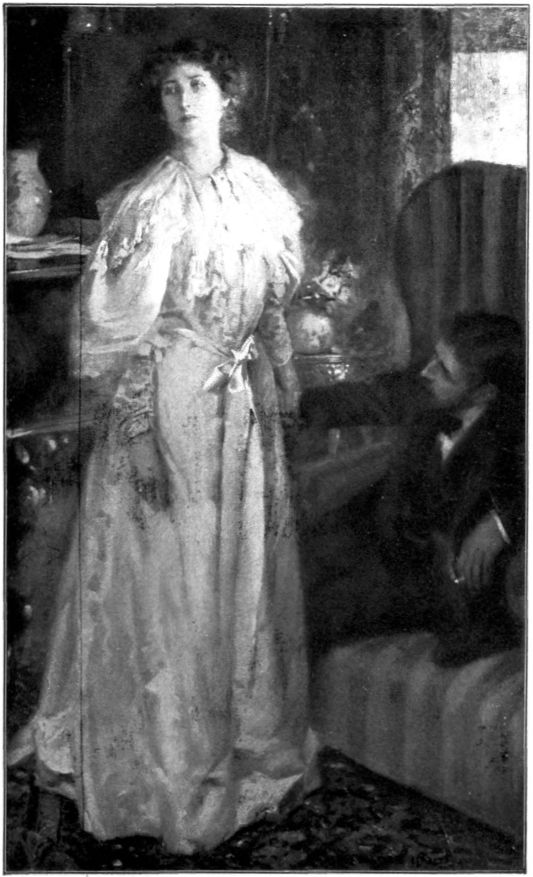
“ ‘KIT IS KILLING YOU’ ”
“Yes. Of two lives one must be saved.”
“We are both in God’s hand.”
He turned the surgeon’s knife in the wound. “You see yourself like a Sunday-school heroine. You wish to die at her bedside.”
She gasped. “You are cruel.”
“I am kind. Beware of spiritual pride.”
“You force me to speak. I pray God every hour that Kit may be taken. It is a race between our lives.”
“O great rare soul!” he thought. He took her hands. The long fingers lay deadly cold in his. “Forgive me,” he said. “You have the courage to face life as well as death. Did I hurt you much?”
“I am stinging all over. But perhaps it was because I could not see your face very clearly, and the expression sometimes contradicts the tongue.”
“Your eyes are growing dim again?”
“You would sit with your back to the light.”
“No prevarication.” His grasp of her hands became imperious. “Your eyes are failing again.”
“With the rest of me,” she said, more hopelessly than he had ever heard her speak.
“But it will be terrible if you go blind,” he said. He thought: “She will perhaps see clearer than I.”
“God has let me have my eyes longer than I dared to hope. Perhaps He will still spare them.”
He could have shaken her. Why did she not “curse God and die”? He thought of the thousands of lewd, leering eyes in the London streets, eyes that sparkled in the sunshine, while Margaret’s must fade in darkness.
The serving-maid came in: their hands unclasped.
“Professor Pont, miss.”
“What!” Raphael sprang to his feet.
“You don’t want to meet him, I know. Nobody does. I’ll see him in the dining-room.”
“What nonsense! I should particularly like to see him. He’s an old friend.”
“Really? Then perhaps you would like a word with him alone.”
“Your delicacy is only equalled by your obstinacy. That is just what I should like.”
“And I’ll go and tell Kit you are looking years younger. She will be so delighted.”
Professor Pont was startled to find Raphael instead of Margaret. He was blanched by years and shames; the pouch under his right eye was weirdly wrinkled. He shambled in with self-conscious shabbiness. The dapper Raphael’s extended hand of equality visibly astonished him more than Raphael’s presence.
“My dear Professor! Take a chair and a cigarette. Miss Engelborne will be in presently. Here is a match. I cannot tell you what peculiar pleasure it gives me to see you.”
“Wirklich?” said the Professor, surprised into his mother-tongue.
“You occupy in my mind an honorable niche, mein lieber Otto, a unique position which nobody else can ever fill.” He caressed his well-trimmed beard.
“Ah!” said the Professor, smoothing his ragged beard in a sort of hirsute harmony.
“You are my first disillusion.”
The Professor scowled.
“Nehmen Sie es mir nicht so übel, lieber Professor. I owe you infinite gratitude. You are the window through which I first looked on life as she is. Education consists in unlearning all we learnt at school, and you are my abecedarian. To some their first illusion comes as their first love. I, more fortunate, find it in my first Editor.”
“But I brought you out. I gave you your first chance.”
“True: you published my ‘Fame,’ but I have never published your dishonor.”
“Don’t hit a man when he’s down.”
“Pardon me. I was thoughtless. My poor Professor, you who are a fellow Beyond-Man, an Uebermensch, how came you to let these lower creatures best you? You must have set their backs up by posing as their superior. Be sure the first man who let the apes know he was indifferent to their chatter got mauled. Mum’s the word. And what are you doing now?”
“Starving.”
“That soon comes to an end. You must find a more permanent occupation.”
“Nobody will give me a chance. Miranda Grey is making a fortune out of my Cross and Crown, but twenty pounds is all I got for it.”
“Did you write Cross and Crown?”
A faint rose of Shame’s dawn showed on the grayed face. “What is a man to do? The public won’t have my real ideas. For my new System of World-Philosophy through the Not-Self-Ego-Concept, I can’t get a publisher, even under a false name.”
“When did you write it?”
“I thought it out in—in retirement. It wipes out all the moderns. They are so superficial. Even Hegel evades the problem of Qualitative Becoming. As for your British Neo-Kantians, pooh!”
“I should like to see it,” said Raphael with genuine interest. His heart warmed to the rogue who had mixed ontological speculation with the picking of opium.
“I should be very grateful.”
“The gratitude is owing to you. I’ll pay you a reading-fee of two guineas—no, two pounds! The finer harmonies demand two pounds—on one condition.”
“I accept.”
“That you cease to pester Miss Engelborne.”
Otto tugged uncomfortably at his beard. “She invited me.”
“How could that be?”
“Through Miranda Grey.”
“That impossible Margaret!” he thought tenderly. “No sooner does she hear of a new sorrow than she aches to assuage it. She will never forgive me my self-sufficiency.” Aloud he said: “But Miss Engelborne is a poor woman; she will have the brokers in herself, if she is not careful. Ah, there is the bell ringing. Another pensioner, probably.”
“Will you advance me the reading-fee now?” asked Pont desperately.
“I haven’t it with me. Bring the MS. to my lodging in the Mile End Road. Here is my card.”
Pont surveyed it slowly. Ned’s joyous bark greeting a favorite visitor broke the silence.
“Well, give me the two shillings you docked. I’m hungry.”
Raphael smiled and slipped the florin into his hand as Margaret entered.
Raphael had scrupulously timed his visit to Margaret so as not to coincide with Allegra’s days or hours. It was for Margaret alone he came. Yet the fates would have it that Allegra should be driving near the flat, should be seized with the idea of buying flowers and leaving them for Kit, that Margaret should open the door to the groom, and, learning that Allegra was in the carriage, should beg her to come up.
It would be throwing good material away to neglect such a chance of weaving one of her real-life episodes. What a pleasant surprise for the two friends!
“Good-afternoon, Mr. Pont,” she said. “Will you please come into the dining-room?”
As the Professor passed through the hall, he was astonished to brush against a beautiful, reddish-haired woman. Involuntarily he looked after her, as she entered the room he had left and shut the door behind her.
“Isn’t that Lady Allegra Broser?” he inquired.
“Yes,” said Margaret curtly.
Thus unexpectedly arrived the moment which Allegra had been expecting. What was the real Raphael Dominick, she had wondered amid the resumed whirl of her life. Was she under the glamour of her own fantasy of a redeemer? Did he borrow color and mystery from the mediæval city!
But the instant she saw him sitting there, sad, inscrutable, and comfortable, haloed by cigarette smoke, she perceived that, like Margaret Engelborne, he bore his atmosphere with him, that the old spell was upon her, and that they were to begin where they had left off.
He jumped up and they shook hands.
“You are in London for the season,” she said, smiling.
“For the slumming season. Really, an obscure person has much more chance of meeting the fashionable world by pitching his tent in the Mile End Road than by insinuating himself into Park Lane. Lady Joan Fitzwinter is not the only swell that hunts among the species in our back streets, though she makes the biggest bag.”
“But you don’t want to meet the swells. Why should you live there?”
“Why not? The Mile End Road is much finer than any in Orvieto. And of a Saturday night we have market scenes, quite Neapolitan. Belgravia holds nothing so picturesque.”
“But it is so far from the centre.”
“I told you my little hoard was in consols, and you know how the Chancellor cuts down our interest. Probably it never occurred to you, O plutocrat, that to be near the centre is impossible save for the species with detachable golden weapons. O fortunatos nimium. London is Piccadilly and the Park or it is nothing. The rest is provincial, nay worse, parochial. To live in London one must be born rich or die dishonest. Ah, it is a terrible town, this London, that tries to squeeze every ounce of truth and honor out of us, every drop of art and ambition. When will some Beyond-Man arise to give his friends bread and cheese, as Wordsworth did? Like Wordsworth,
“I am opprest
To think that now our life is only drest
For show: mean handiwork of craftsman, cook,
Or groom. We must run glittering like a brook.”
“I am glad you are opprest,” she said mischievously. “Any emotion is better than death.”
He dropped into his chair and sent a provokingly calm smoke-puff towards her. “My emotion is purely literary. If I had lived, I should have lived in Piccadilly. But Mile End is good enough to bury one’s self in.”
She thought of the real “living-dead” creature, buried in the next room, and replied with a touch of impatience, as she instinctively seated herself on the piano-stool: “You still consider yourself a ghost?”
“The prig amuses you, nicht wahr?”
She smote a discord on the piano with her gloved fingers, as if thumping him. “Why will you keep on saying that?”
“It is part of my philosophy. I face the inevitable.”
“You meet troubles half-way. Your death is characteristic.”
“And I thought you understood!” He was so contemptuous that she murmured:
“I thought I did—at the time.”
“To save one’s life, one must lose it. Is that such new doctrine?”
“Now I don’t even think I understand.”
“To live means to act. But action is only for the brutal or the dishonest. Your husband has the luck to be both; I have the misfortune to be neither. Too strong to be dishonest, I am too weak to be brutal.”
“But is Margaret dishonest? Is Margaret brutal?”
“Margaret has not struggled in the crowd. She is the hereditary grande dame, moving among dependants.”
“But I have acted.”
“You! You who cannot bear to see a moth burn! Think of the life-struggle of the white-haired shopman who has to dye his hair because customers dislike the aged.”
“I know,” she sighed, drawing off her gloves automatically. “Joan has taken that up.”
“You started out to act—but only your husband has acted. You died out—like me.”
Something in her breast rose in protest. “I am not dead. It is he that is dead.”
“No; he has merely evolved. Like the tadpole. The tadpole starts out as a fish and a vegetarian, and winds up with lungs, and carnivorous. There is an intermediate stage in which it feeds on its own obsolescent tail. You and I have this draggle of early ideals behind us, and not till we devour our past can we become carnivorous.”
“Mr. Broser was always carnivorous.”
“That is pure wifely prejudice. But if you knew he was the ‘great blond beast’ of Nietzsche, why did you marry a man so much younger than yourself?”
“Younger?”
“Yes; he is b.c. You are a.d., and very late a.d. Two thousand years is really too great a disparity between man and wife. No wonder you are unhappy. But I am keeping you from your duties, am I not? Play to the poor thirteenth century in the next room.”
“You must not sneer at Kit.”
“Sneer at St. Kit! Why, I had two candles lit for her in Orvieto Cathedral.”
“You!”
“Yes—Kit might object if she knew, the stiff-necked Protestant. But it pleased the priest and it pleased me. White candles burning—it seems such a beautiful symbol. My mother used to light two white candles on Friday night. She practised her Judaism, you know. It was a double waste, because she might not extinguish them, and that was the only night I must not write by them. The other nights we often had none. But,” he added gently, “their light shone over the rest of the week.”
Her fingers began playing very softly the Melancholie of John Field. Presently, glancing round shyly, she saw that his face was no longer fathomless. Only the despair on it was fathomless.
“My music makes you sad,” she murmured.
“No, no; play on. Even this kind of death has its hell. Don’t look at me, please—like St. Gregory’s gloating saints.”
“I am not in heaven, so cannot gloat.” The music flowed on soothingly. “Margaret has quite deserted us,” she murmured.
“It is her goodness,” he said.
“When I am in Orvieto again, I shall put up candles for St. Margaret.”
“Old Isaac Walton was right about the Engelbornes,” said Raphael.
“What did he say?”
“ ‘The Engelbornes are a race beloved by God.’ ”
Allegra heaved a sigh. “Whom He loveth He chastiseth. Are they not incredible? In their place I should feel like Job’s wife.”
“That is exactly what I felt for a moment this afternoon. But that is because we are faithless. We are like tramps out of work. Margaret is the amateur tramp.”
“I do not follow you.”
“Haven’t you noticed the plague of books and articles written by journalists intent on gauging the sensations of tramps and mendicants? They mouch across England, or even from New York to ’Frisco without a copper, so as to know how it feels to be friendless, foodless, and roofless, even how it feels to be on the brink of dying from hunger. But the experiment is absurd. The gentleman tramp knows he can never quite fall over the brink. However he juggles with himself, he knows in the far back of his being he has only to telegraph to his father, his editor, his bankers, and that wee bit of consciousness makes all the difference. So it is with Margaret and Kit. Hungry and footsore tramps, they know Rothschild is behind them. In short—there is always God.”
“But even the son of His Father said ‘Lama Sabachthani’—why hast Thou forsaken me?”
“That is the finest touch in the Gospels,” said Raphael Dominick.
Allegra and Raphael met several times at Margaret’s flat: for though they had no positive appointment, not to meet would have been a disappointment. Margaret continued to fade away, and Raphael to remonstrate violently with her on her dissipation of her strength in a hundred and one passionate labors and prayers for others. “Economize your goodness: it will last longer and do more.” To which she would retort, “One might spare one’s self and still die, and then what vain remorse!” Allegra, too, would sometimes lunch with her, just to see that she ate, for when left to herself her meals were mere bird-pecks, and one square meal satisfied two days. But there was nothing to be done but wait the issue in the ghastly race, and hope that Margaret would survive her sister and then be not too far gone for recuperation. Margaret herself never complained. To cry “Oh” before a servant would have been undignified, before an equal, selfish. She was always unruffled and sweet in a flowing gown, with a spray of blossom at her aching breast. Once she wore a sprig of oak, for it was Oak-Apple Day, and her heart yearned over the Stuarts.
Pont turned up one day when she had left Raphael and Allegra together and was conducted to the same room by the maid. Allegra was glad Raphael was there to help her bear a meeting that brought up so many poignant recollections, and to relieve her of making conversation with the poor wretch. She was afraid even to inquire after the Frau Professorin, lest pain lurked for him in the question. But Pont inquired respectfully after her own consort, and was accorded a conventional answer.
“Well, I’ve been reading that MS. of yours,” broke in Raphael in no tone of irony. “Almost thou persuadest me, Pont, to be a Pontist, and drop all this crude Spencerian evolutionism that has cramped and dominated my thinking of late.”
“Nicht wahr?” said the delighted Professor: “these Englishmen, they cannot think. And you will find me a publisher?”
“Not while the war is on, I fear,” laughed Raphael. “These Englishmen, they cannot think—of more than one thing at a time. But even in peace-time, Philosophy—” he shook his head.
“I could get it set up myself for fifty pounds. I know so many printers.”
Raphael checked a visible impulse of Allegra’s to offer the fifty pounds.
“But that would not help you to live. And such, I understand, is your curious desire.”
“Ach, always this dreadful alternative—shall one live or one’s ideas?”
“It’s a sad world for the thinker, I know. But the Bread-and-Butter-concept—eh?”
“If I could open a sanatorium, I should make my fortune. I have a new idea, picked up in this flat.”
“Miss Engelborne should have a percentage, then.”
“Sanatoriums are collections of cripples and consumptives. The patients radiate ill health, depress one another to death. In my sanatorium half the residents would be cheerful young gentlemen and pretty girls, radiating health. These would get a salary and board and lodging. It would provide a new profession for women—”
“And for younger sons of the aristocracy,” laughed Raphael.
“We should call it the Sunny Society Sanatorium, and charge high fees. If I could only get up a syndicate. We could set them up all over England—nay, all over Europe. There are millions in it.” Pont departed, with a sovereign from Allegra, pending operations. Ultimately a job was found for the Professor, needless to say by the tireless and ingenious Margaret. The continued failure of Cross and Crown in London induced Miranda Grey to take it out on a provincial tour, and with the same reliance on provincial ignorance she was persuaded to take the Professor in her train as acting-manager.
“But do you understand the duties of acting-manager?” Raphael asked him in amusement.
“Certainly. He has only to work up calls, to drink with the local journalists, and to help them with their criticisms,” said the Professor quite seriously. He had ceased to have any sense of the humors of dishonesty.
One day the sky was so blue that Allegra dismissed her carriage and let Raphael walk homewards with her. But they found it unexpectedly windy, and Allegra was depressed by the troops of schoolchildren just let loose from school, cheering boys and girls, who waved flags and carried a boy in an ambulance with a grewsome, red-stained bandage across his forehead; thus far-reaching were the new military influences set loose by the swarm of war-pictures.
“The Cornucopia would fare ill in this generation,” she said, with a sigh.
“Oh, Pont would have made it bluggy, if blugginess was in fashion. All the children’s papers run blood to-day. A war isn’t all waste, you see, as your father thought. He forgot to count emotions and excitements, the boon to theatres and music halls, the patriotic suppers after the play, the immense and universal thrill of the great war-serial, to be continued in our next edition.”
“You are a mocking fiend.”
“A sober, calculating machine. We cannot go on without excitement. Life is a dull business. Seventy years is a long time to go on dressing and undressing one’s self. Married people put it down to matrimony, and the unmarried to celibacy, but it’s life itself. Your father used to say, why spend money on the Lord Mayor’s Show, when so many are starving? I was a starving boy, but I tell you the Lord Mayor’s Show was worth more to me than ten dinners.”
“That was romantic, artistic. But this is brutal.”
“The brute feels dim great things. Think in how many dull villages one-legged veterans will tell the tale. These flag-waving children are thinking less of themselves than are the countesses of your War Fund tableaux vivants, anxious not to be hidden behind the banners they bear.”
“I know. Disgusting.”
“Why? Mere healthy egotism. ’Tis self-love that makes the world go round. I, the latter-day fly on the wheel, sit and wonder why it goes round. Life has only the meaning we put into it.”
“No, no,” she cried, struggling desperately against the obsession of his diabolical tolerance; “there is a larger meaning outside of us.”
“What is it?”
“Progress.”
“You are your father’s daughter—and a child of the Great Exhibition. I see only change, and plus cela change, plus c’est la même chose.” Some scraps of newspaper blew about frenziedly in the wind. “Ah, there you have an image of life—the whirl of dirty paper in the wind—a futile pother informed by apparent significance—see how passionately the pieces chase one another. The torn sentences printed on them only add to the ironic meaninglessness.” A horse bolted, frightened by one of the scraps, and Raphael by making a dart was just able to pull out of the way the rear child of the military procession.
“You deny Progress,” said Allegra quietly, “yet you preach the Beyond-Man.”
“He is in a minority of one at the time. Androcles relieves the lion but the thorn goes towards his crown.”
“Truth will prevail,” she said passionately.
“Only crucified Truth can conquer. The masses will only receive it mutilated. The allegory was profound.” He laughed sardonically. “It is time the nineteenth century dropped the shallow optimism of the eighteenth.”
“I thought you approved of the eighteenth century.”
“In a way. It was the century when the superficially true displaced the profoundly false. Fizzy is the typical eighteenth century. In his rage against the corruptions of creeds, he forgets that man is born to faith as the sparks fly upward. Nor in his contempt for humanity’s self-contradictions does he see that mankind must stand on contradictory ideals, and that his own legs are like the legs of a compass at a hundred and sixty degrees. A pure ideal is like pure alcohol—a poison. Two contradictory ideals mixed are a vivifying potion. War itself we carry on with the punctilious etiquette of civilization, the Red Cross follows the red sword. Did you ever notice in Margaret’s armory the great stone clubs used by the Plantagenet bishops?”
“I’ve noticed stone clubs—I thought they were savage.”
“So they were. They were anticipated by the lake-dwellers. But they were re-invented to enable bishops to fight without using steel.”
“But why?”
“A Gospel text was tortured to prove they mustn’t shed blood. A bashed head also bleeds, I believe, but they did not inquire too anxiously. It is really touching to see mankind straining its leg-muscles apart on slippery standing-places. Less hypocritically, though Hallam says more, the Greek Church required the lustration of a canonical penance from every soldier who had shed the enemy’s blood. Origen and Tertullian admitted that Christianity and War were inconsistent. The Crusades were really due to the victory of the Mohammedan ideal of a Church militant. ‘Our only Christian’ is herself an eclectic. From Christianity she gets her genius for love and self-sacrifice, but her gospel of war and aristocracy comes from Feudal Chivalry, and her taste for writing and reading beautiful stories and having beautiful furniture is the mark of the Greek. From Bohemia comes her charming camaraderie. Had she been any of these things in isolation, she would have been a monstrosity—like the latter-day Tolstoi—as it is she comes as near perfection as humanity may.”
“She is an angel, and I think you are in love with her.”
“Perhaps I am.”
“Is she the Beyond-Woman?”
“No; she is just the best of the past—a Christian without cant, a Bohemian without vice, a patrician without arrogance.”
“Then I prefer the woman of the past.”
“I prefer the woman of the future.”
“Who is the woman of the future?”
“You.”
“I? But I am as old-fashioned as possible.”
“Only in the old fashion of beauty and goodness. But you face life through your own eyes.”
“You just said through my father’s.”
“No—his are still dazzled by his own dreams. I remember being struck, when I reported that famous speech at Midstoke, by his beautiful image of Peace. He looked forward to the day when the spider would spin its webs across the cannon’s mouth. But why is the spider spinning its web? To catch the poor fly. That cannon’s mouth will still be the theatre of war. Nature has woven life of war and love. We have no option. You and I may suffer from hyperæsthesia, due to the shrivelling up of our fighting instincts, but we do not blink the fact that where interests clash, war must be.”
“With the lower creatures, perhaps: not with men.”
“I thought I convinced you that most men were lower creatures.”
“At the time. Later, I thought such reasoning would justify slavery as against the human brotherhood.”
“Fine words don’t alter facts. Is the freed slave the equal of the white man? Have you never heard of the colored cars in the Southern States? I wanted to travel in one when I was there, thinking it wouldn’t matter as I wasn’t a Christian, but they wouldn’t let me.”
“Then you approve of sweeping away the Novabarbese,” she said, with a swift, feminine jump.
“It is not my business,” he said coolly. “The Novabarbese probably swept away some other Barbese.”
“But didn’t you say you gave up a brilliant future rather than support Bagnell?” she answered hotly.
“That is my business.” He was too provoking.
“How do you mean?”
“To be the tool of Bagnell and his Jews! Let others do the dirty work of civilization!”
“Just now you had a Jewish sneer at the Christians, now you are anti-Semitic.”
“All intelligent Jews are anti-Semites—and all unintelligent Christians.”
She could not help smiling. “The more I see of you, the less I know of you.”
He held up the many-headed pommel of his stick in silent reminder.
She laughed outright, and touched one of the carved ivory heads. “What does that one think of the war, anyhow?”
“That canny old chap? He says, ‘It is a traders’ war.’ ”
“That’s what Mr. Fitzwinter says. The flag follows trade.”
“But he says it sneeringly, endorses the Continental view of British hypocrisy. Whereas here is just the proof of John Bull’s sincerity. Unlike Russia or Germany, he has had till now no conscious scheme of imperial expansion. He has no general conceptions at all. And just as his ‘Freedom broadens slowly down from precedent to precedent,’ so his Empire broadens slowly down from accident to accident. Adventurers and traders have built it up—East India Companies, British Fur Companies, British West Novabarba Companies. He blundered into Australia as he blundered out of America.”
“Father says our Empire will end like Rome’s.”
“No: it is not founded on military force, nor therefore as mortal. It represents the unconscious expansion of the Anglo-Saxon race, the overwelling of its energies. England never advances anywhere till she is already there. The Foreign Office accepts each new possession under protest, and if she registers them with blood, it is under compulsion.”
“Then you admit we don’t aim at spreading civilization.”
“That is the poetical veil necessary for the plain citizen at home. John Bull on his island never even sees the people he oppresses or the campaigns he conducts. It all comes to him idealized, almost as art. He truly believes he is spreading righteousness and the best, nay the only possible, Constitution. Hence an unjust war produces as great a moral glow as a just, much as a false coin does the work of a true one, so long as everybody is taken in. But the puzzled Continent talks of perfidious Albion.”
“But my husband is aware the coin is false.”
“Who knows?”
Again he angered her. “But he was to be Broser the Peace-Maker.”
“Blessed are the poor in spirit, for theirs is the kingdom of heaven. But not the kingdom of earth. Your husband agrees with Spinoza: destroy whatever impedes your development. Would you were a Spinozist, too!”
“But I thought Spinoza was a sort of Christ.”
“Only in conduct, not in thought. Believe me, Broser is not so black as you paint him. I told you women always idealize—for good or ill. I catch curious twists in him—yearnings to do big things for the masses, for the Empire. If Nature has given him a thick skin, it is because she intends him for tough work.”
“You will persuade me out of my senses. You shamelessly argue that Might is Right.”
“Ah, that is this fellow.” He pointed to a more truculent head, like a gargoyle. “But Might and Right are not such opposites. Right is Might anyhow. But Might involves Right, too. Might is weakness unless morally federated. You cannot empty Might of morality. God is not on the side of the biggest battalions, unless they are faithful to one another and obedient to their generals. And since there will always be big battalions, is it not better that, like the old Hebrews, they should think God on their side?”
“Yes, but the old Hebrews had prophets who reminded them of their backsliding. The new national prophet simply flatters his people.”
“But not only the new. Virgil flatters the Romans as much as Victor Hugo the French. The Jews are the only people whose literature is one long denunciation of themselves, and who of these inspired libels made their liturgy. True,” he added musingly, “it became the worship of the letter. But what a letter!”
“Well, but in the modern world, with all these self-flattering nations, each trying to push its own wares, material and spiritual, which are we really to believe has the divine mission?”
“I refer you to Nathan der Weise and Lessing’s fable of the rings.”
“You mean, whichever in practice makes most for righteousness.”
“Precisely. Do you know Wordsworth’s lines:
“England, all nations in this charge agree:
But worse, more ignorant in love and hate,
Far—far more abject is thine Enemy.
Therefore the wise pray for thee, though the freight
Of thy offences be a heavy weight.
O grief that Earth’s best hopes rest all with thee.”
“But you don’t care about righteousness.”
“It is one ideal; there are others. But it is the one that religion must concentrate on, because the others can take care of themselves. You enjoin upon a woman to go to church but not to wear a pretty bonnet. Personally, I agree with Victor Hugo. Paris is Jerusalem. It is the one self-conscious city. London—like the British Empire—is an aggregate of accidents, sprawled out by speculative builders, to the destruction of old-world gardens.”
“Yes—here I am at home. A thousand a year rent, and not even a tree!”
“And this is the civilization we would spread! Our ships go everywhere and arrive nowhere.”
He would not go in, and they did not meet at the flat for a week. But her next greeting of him was excited.
“Have you seen the Quarterly? The article on your work!”
“Has Margaret been buying the Quarterly? What waste! I never read criticism. Criticism is absurd. The critic cudgels me, I cudgel him. Only Time can show which rod is Moses’s—to swallow up the other.”
“But he doesn’t cudgel—he crowns! He says you are truly a Poet.” The word Poet, she found to her surprise, still trembled with undertones, shimmered with lights.
He quoted:
“Last stage of all—
Where we are frozen up within and quite
The phantom of ourselves,
To hear the world applaud the hollow ghost
That blamed the living man.”
“But nobody ever blamed you.”
“How do you know that?”
“You told me your life.”
“Yes—as one shows a railway tour on a map. I had to sit in the slow train—third-class—with the stuffy, snuffy people, and endure the endless crawl, and choke in the long tunnels. You see it all in a whisk. No, no one will ever really know my life—least of all a woman.”
“But you have come out of the tunnels—the sunlight of immortality is shining on you.”
“True. That means some money. The advantage of writing immortal works is that they last at least your own lifetime. Otherwise—to be one of the D’s in a Biographical Dictionary, sandwiched between a twelfth-century bishop and a twenty-fifth-century aeronaut! Oh, I am sick of the little people who compile the big dictionaries. The ants are wiser. Let us endure and die in silence.”
“Is there nothing that could make you happy?” she cried desperately.
“Nothing: save the repopulation of the planet.”
“By whom?”
“By people I could live among.”
“By Beyond-Men? But then you would have nobody to despise!”
“Ah, you despise me for despising.”
“I think you might put a little more love into your contempt—and forgive them, for they know not what they do.”
“In short—I am a prig.”
This time she was desperate. “Yes!”
He came over and took her hands. “And a prophet! Confess that, too.” They laughed and looked into each other’s eyes, and his grasp tightened. “So I am to put a little more love into my contempt.”
“I don’t say into your contempt for me,” she said, smiling, and trying to release her hands.
“Forgive me,” he said, loosing them, “I know not what I do.”
“What you are to do is to sit down instantly and read the article,” she said sternly.
He took the Quarterly. “I dare say I should have read it when you were gone,” he said.
She dared not be as candid, even in self-mockery. For she suddenly realized that her repudiation of his hand-clasp was merely instinctive. Was she about to suffer even more poignantly than at Orvieto? There it was the dull ache of emptiness, the despair of the blank void. Was the void to be filled with a more positive pain—the consciousness of the great thing her life had missed and must now deny itself, even, if found? No, she answered herself resolutely. This was but a flash of recrudescent, schoolgirl romanticism. Void? There was no void. Since—at Orvieto—Raphael and Margaret had come into her life, the void had been filled up with new duties, with exquisite friendships.
It was the greatest night of Broser’s life. The Opposition had tried to turn out the Government on its War Policy, but Broser was a great Parliamentary cricketer—a hard hitter and a terribly twisty bowler—and to-night he had scored his century not out, against the nastiest balls. In the rival House the poor old Earl of Yeoford had made a duck’s egg. The original British West Novabarba Company had been swallowed up by the Government and the district turned into a Crown Colony, but the rest of the unhappy country was given over—as Broser put it—“to companies and quarrels.” Annexation was pacification, he said, and the House had applauded, and the Prince, listening, had applauded, as all England, and all the Empire would applaud to-morrow. All, that is, except the small minority who shared the opinions of Allegra or the prejudices of the Duchess of Dalesbury. The Sermon on the Mount he had repudiated with aplomb. “I agree with Lord Lyndhurst,” he said, shrewdly endorsing an aristocrat’s bill: “To turn the other cheek is unworthy of a great nation.” He had on a prior occasion endorsed Lord Palmerston’s: “Man is a fighting animal.” And this breezy fearlessness, so sensitively in tune with the temper of the day, was fast making Broser the idol of Britain. The British working-man, who twenty years before had plunged feverishly into politics, reading history and debating in his clubs, the working-man who had assembled in his thousands to cheer “Fighting Bob’s” republicanism, was now the devotee of athleticism and sport. Even the thinking classes had been undermined by several decades of Darwinism. Britain would be safe under “Fighting Bob” it was felt. He might have changed his coat, but he was always ready to take it off. No damned sentimental nonsense, no wishy-washy diplomacy, but a blow straight from the shirt-sleeve.
What wonder if Broser’s boots trod on air, if he felt himself a storehouse of electric energy, wires radiating from him in every direction, charged with his will! The administration of his department, the patronage at his command, provided countless channels for the passage of his force. And from all parts of the world letters and cables came to him, and the other great men of the earth reached out antennae to him across the seas. Supremely self-centred, he moved through the scenes of daily life and social diversion with complacent condescension, distributed his words and smiles as so many pieces of patronage, became the great actor who enters to music and goes out to applause.
But as he trod the silent streets to-night, walking home alone to quell his cerebral excitement and give himself a chance of sleep, the springiness of the victor’s step was not his. Technical necessities had kept him till the House rose, and in this supreme moment of triumph the cry of “Who goes home?” struck jarring notes from his tense nerves. What home had he to go to? In the cool night air, under a sky of cloud-tangled stars, he remembered his long-lost Susannah, heard her heart-cry: “I should have so liked to see you Prime Minister, Bob.” Ah, how she would have twined warm arms around him, sobbed with joy and pride, while this intellectual iceberg of an Allegra radiated freezing airs of scorn and hauteur, unmoved by all his achievements. Why had she not been in the Gallery to-night to hear his great speech? They could have driven home together, nestling cosily. Curse her, she took after her mother. Marshmont’s wife was a bad example. He might have known it was in the blood. They thought only of themselves, these hysterical minxes, never of the great causes incarnated in their husbands. But he would be revenged upon her, he would no longer live this loveless life. His fancy lingered on other possibilities, kindled by memories of small dinner-parties at which great ladies had looked at him with bright eyes and seductive smiles.
He digressed to Westminster Bridge to calm himself by the contemplation of the river with its wonderful twinkling reaches. As he turned back he was conscious of a shadow crossing his, and started nervously. After some moments he became sure he was followed. His heart beat quickly. A vague apprehension of assassination gave the last touch to his sense of importance. This Novabarbese war touched many interests. He must really be more careful. He grasped his stick tighter and turned suddenly.
“What the devil are you following me for?”
The white-bearded tramp jumped back.
“Don’t you know me, Mr. Broser?” he said whiningly. “Professor Pont.”
“Professor Pont!” Contempt and reassurance were mingled in the statesman’s laugh, as by the light of a street lamp he beheld the unreverend, white-bearded figure.
“I’ve called on you many a time: but they never would let me into the lobby or through your hall door. You might have answered my letters.”
“Did you write to me?”
“Half a dozen times.”
“My secretary did not mention it. Begging-letters are not passed on to me.”
“How do you know they were begging-letters?” Pont murmured.
“I begged the question,” said Broser, with one of his neat Parliamentary repartees.
“Your old insight has not deserted you. I was touring with a theatrical company and improving the business every night, but the stage-manager grew jealous of me.”
“Ah,” said Broser, dryly; “every one finds you out sooner or later.”
“You might help an old chum.”
“You have the impudence to call me a chum!”
“I have been out of prison quite a long time now,” he replied humbly.
“Then be thankful I didn’t press my charge likewise. As you make your bed, my man, so you must lie on it.”
“And who made your wife’s death-bed—that I lifted her to lie on that night?” Pont shouted angrily. “It was you that killed her.”
“You scoundrel! You low, malicious, criminal liar! I see you are hankering after your old prison-quarters.” Broser raised his stick, outraged in every instinct.
“You don’t frighten me. Unless you recognize our old friendship, I’ll write up the whole story in the papers.”
“You!” Broser sneered. “Who would publish your vaporings?”
“There’s many a paper that would be glad to see you fall. Nicht wahr?”
“Ha! There’s a policeman.” And Broser moved forwards.
“And the history of your second marriage—a boon for the society journals. What?”
Broser paused, startled. Was it possible any one had an inkling of his domestic secrets?
“Aha! I warned you against that little Allegra. Who was it, you told me, used to call her Alligator?”
Broser caught him by the throat. “How dare you? How dare you mention my wife’s name? You scum, you foul-mouthed blackguard, who never knew what the word wife means!”
“Let me go!” gasped the Professor. “The policeman is turning his lantern on you.”
It was true, and in this ridiculous situation Broser loosed his bull-dog grip.
“Give me fifty pounds and I’ll save you from a scandal, before it leaks out.”
“Pooh! What scandal can you save me from?”
Pont looked mischievous meanings. “I have told you more than I should without a fee.”
Venomous thoughts darted, poisonous, through Broser’s veins. But all he said, calmly, was, “You know the sentence for blackmailing.”
“Give me fifty pounds. The day will come when you will wish you had given me a thousand.”
“I never pay blackmail.”
“Then make me a bet,” said the Professor eagerly. “Bet me that a certain person will not be found at a certain address next Tuesday afternoon. If she—if the person is there, you pay me fifty pounds.”
Broser walked on in dignified silence. But inwardly he was on fire with rage and shame. He had no doubt who was the person and what the address—had he not seen it on a card in Orvieto?—and amid all his tumult of mind, he was pleased with himself at outwitting the Professor.
“Five pounds!” cried Pont desperately.
“No; but you may call me that hansom and I’ll give you sixpence.”
Professor Otto Pont called the hansom and pocketed the sixpence.
The man who drove off was, however, the unhappier of the two. He who had been so true, so faithful, so long-suffering! This was his reward! To be stabbed in the hour of his triumph!
On cooler thoughts, the Duchess of Dalesbury had not been able to remain at her magnanimous resolve to let the Countess of Yeoford accompany her to Court, but she duly invited her to Rosmere, and Lady Yeoford did not fail to jump at the opportunity.
“We go nowhere now, my dear Duchess, but Yeoford and I will be delighted if you and the Duke will spend a few days with us.” And the Duchess actually accepted the counter-invitation and the rebuff, after the barest attempt to save her dignity by stipulating that Mr. Broser should not be in the house: a stroke parried by the Countess’s calm reply: “Yeoford never sees Mr. Broser now.” She replied by withdrawing the Duke, but this was feeble, as she had taken to going out without him, to the recluse student’s huge content.
But when after a delightful drive through the territorial Park, the Duchess alighted at the portals of Yeoford, lo! there in the hall stood her second bugbear, Fizzy! She felt trapped, tricked, betrayed. To be thrown into the society of The Morning Mirror—the paper that had so helped to found Broser’s political fortunes! She had told Fizzy plainly what she thought of him and his dreadful organ, when they met at Minnie’s marriage. It was characteristic of the Duchess that she never went out of her way to revise her first impressions—whether of love or hate—and she still thought of Fizzy as the companion-in-arms and journalistic champion of Broser, even though she knew Fizzy was now left almost alone in his early Victorian Radicalism.
“Ah, Duchess,” said Mr. Fitzwinter, bowing elegantly, “you are just in time to bid me good-bye.”
“I am so glad,” said the Duchess, drawing a deep breath of relief.
Fizzy’s roar shook the antlered hall. The Duchess heard it without her trumpet.
“Yes,” he went on, “I’m off to Novabarba!”
“Oh, you are leavin’ England altogether. Better and better!”
Fizzy roared louder and louder. His method of receiving her rebukes disconcerted the Duchess, but the sight of his luggage being borne into the carriage she had left preserved her good-humor.
“What good are you in Novabarba?” she said amicably. “You won’t fight.”
“No, thank Heaven, but my wife insists on the excursion. We are taking out nurses and blankets in my yacht. That foolish little Joan can’t bear to think of the wounded soldiers lying blanketless and untended in the wet trenches, with nothing to cover themselves with, except glory.”
“Glory without blankets is better than blankets without glory,” said the Duchess sternly.
“I am afraid the Rosmere poor would not agree with your Grace.”
“Not agree with me! Why, we have six families in mournin’. Two mothers almost at death’s door with grief, yet proud of havin’ given birth to heroes.” Fizzy acutely recognized the Duchess’s habit of putting appropriate sentiments into the mouths of her retainers. “Your wife mustn’t think,” the Duchess wound up with resentful self-assertion against Joan’s aggressive goodness, “that all the nursin’ is done in Novabarba.”
“No,” Fizzy admitted, “any more than all the war-correspondence. I am glad I shall be able to check that—yes, and our Generals’ despatches, too.”
“Ah!” the Duchess snorted. “I dare say you will be sendin’ over dreadful nonsense to your paper.”
“Oh, no! I leave it behind!” said Fizzy airily.
“That’s right—leave all that behind you,” said the Duchess.
“That’s just what I’m doing,” Fizzy explained. He produced a sheaf of printed slips from an inner pocket. “My leaders for next month,” he went on blandly.
“Eh?” The Duchess stared. She had no experience of the Pontian paths of journalism.
“I can’t trust my employees to rise to the greatness of the occasion—or the opportunity,” he explained calmly.
“But how can you know what’s goin’ to happen?”
“Oh, it’s easy enough, with a bull-dog like Broser in power. He takes no chances.”
The Duchess put up an eager ear-trumpet. The “bull-dog like Broser” arrided her, was a pleasant foretaste of unexpected possibilities. Ah, of course. Joan’s husband would naturally be on Alligator’s side—he must have turned against his wife’s brutal brother-in-law. Moreover, she was genuinely fascinated by Fizzy’s reduction of prophecy to a profession.
“I should like to see a sample,” she said.
Fizzy glanced at his watch. “My wife must be having a fine farewell scene with her mother,” he said. “Lady Yeoford is persuaded we shall both die of poisoned arrows, and nothing will convince her that the arrows are obsolete, and that in any case we shall be out of the firing-line. The real possibility of shells never crosses her mind—but we gain nothing by that.” He shuffled the proofs of his leaders card-wise. “What shall I deal you, Duchess?” he inquired.
“The Knave!” she replied, entering into his humor.
He cut, shuffled, then selected one. “The Knave of Trumps!” he announced.
“Ah!” The Duchess drew a breath of happy expectation.
“It is for the day he takes all the tricks and becomes Prime Minister!”
“Nonsense!” shrieked the Duchess, turning quite pale.
“What! Haven’t you heard the rumor that the Premier is going to resign?”
“No. There is not a syllable in The Times.”
“You should read The Morning Mirror.”
“You don’t mean to say—” the Duchess breathed.
“The rumor is in this morning’s number.”
“But it can’t be true.”
“As a man, I sincerely hope it is false. But as a journalist, I hope it is true. We pride ourselves on our rumors.”
“But at the worst, Broser can’t succeed him. Why, he’s quite a boy!”
“That is his one qualification. I don’t believe, Duchess, in your theory that armies and nations are peculiarly fit to be governed by the decrepit. The younger Pitt was Premier at twenty-four.”
“But he had the tradition. Broser comes from the gutter.”
“We all end in the grave, Duchess. The gutter is good enough to begin in.”
“Tut! Tut! That is not the point. Broser hasn’t been in Parliament twenty years!”
“All that is vieux jeu. When I first went to America it took me three weeks.”
“But he began as a Jacobin.”
Fizzy smiled: “In politics, as in business, honesty is the slowest policy.”
“In politics, as in business, dishonesty is criminal,” the Duchess retorted.
Fizzy shrugged his shoulders. “Only the little criminals are put in prison. The big are put in the Cabinet.”
“And is that the tone your wretched paper takes?”
“Heaven forbid. That is only my private tolerance.” He began to read into the ear-trumpet:
“The rumor we were able to give our readers so long ahead of any other paper turns out to be only too well founded. The Prime Minister has resigned and Mr. Broser has been summoned to Windsor to—”
The Duchess withdrew her weapon in spasmodic self-defence. “It will never be. I won’t torture myself by hearin’ your fancies. Give me facts.”
“As you please. But that leader will appear one day, or I’m no tipster.” He shuffled the pack of prophecies. “Will you have the one when the war ends?”
“Ah—that is more like reality.” Her trumpet waited eagerly.
“Knave of spades,” said Fizzy. “The earth over the dead.” He began to read: “ ‘Once again Mr. Broser has triumphed. That blatant brass-browed bully—’ ”
“Eh! Very good!” These being the Duchess’s own expressions she perceived a Junius come to judgment.
“ ‘In the passionate pursuit of personal power—’ ”
“Delightful!”
“ ‘Has wiped out the independence of a spirited people, whose valiant—’ ”
“No—no—I don’t care about the Novabarbese—read the bits about Broser.”
Mr. Fitzwinter obediently ran his eye down the column. “ ‘The annexation of—ahem—the Government’s—er—the intrigues of Sir Donald Bagnell—’ ” The trumpet quivered with impatience. “Ah! here we are. ‘This savage Midstoke steam-hammer—’ ”
The Duchess gave a voluptuous sigh.
“ ‘This blind brute force that goes crashing through all the finer delicacies of political life—’ ”
The Duchess inhaled a deep breath of satisfaction. “But should you say ‘blind brute force’? His eye is always on the main chance.”
“True.”
“ ‘This hungry-eyed brute’—eh?” the Duchess suggested: “leave out ‘force.’ ”
“Certainly,” said Fizzy in cheery acquiescence, producing a stylograph from his waistcoat pocket. “ ‘This hungry-eyed brute who goes crashing—’ ”
“With elephantine feet,” the Duchess interpolated.
“Eh? Very good,” said Fizzy, mischievously mimicking her. “ ‘With elephantine feet,’ ” he read, writing it in.
“And the odor of his native swamps,” dictated the Duchess, pursuing her advantage.
Fizzy laughed and shook his head. “That’s a little strong.”
“It is very strong,” said the Duchess, with her usual unreceptiveness to double meanings. But just then they heard Lady Yeoford’s tearful voice in farewell admonition to Joan, and looking up they saw her in the gallery, with a handkerchief to her eyes.
“You are sure that that will be in The Morning Mirror?” the Duchess wound up hastily.
“As sure as that I shall be in Novabarba.”
“Ah!” Then with her air of magnificent patronage: “Put me down as a subscriber.”
“I’ll put you on the free list,” Fizzy responded blithely.
“Eh?” The Duchess froze. “I am in the habit of paying for my goods.”
Mr. William Fitzwinter smiled his suavest smile. “Contributors always get free copies, Duchess.”
“Margaret seems very happy to-day—quite pink, she says,” said Raphael, when, after Allegra’s playing, she had left the room to turn her sister. “Yet she cannot hide that she is now going lame as well as blind.”
“She walks by faith,” Allegra reminded him.
“That is normal. There is something else.”
“Perhaps it is that despite everything she was able to start a new story this morning—so the worry of having to conceal her impotence from Kit is over.”
“No; I cannot help fancying you are connected with her pinkness.”
“Well, my visit to-day was unexpected.”
He shook his head: “That would be happiness on her own account.”
“You are uncanny.”
“Confess.”
“Well, I went to Communion this morning,” Allegra admitted.
“You!”
“You put up candles.”
“That was for Kit.”
“And this was for Margaret. I knew she was praying so passionately that I might find grace to resume my old spiritual exercises—she has enough anxieties to kill her, without me.”
“But that is unfair pressure on one—she will never be quite happy until I admit that the Messiah has come: I who do not even share the Jewish belief that He will come.”
“When do the Jews expect Him?”
“After Elijah reappears.”
“How interesting!” she said, thinking of her old name for her father. “And what is Elijah to do?”
“To bring peace into the world.”
Allegra had a thrill of the supernatural. “If father had only succeeded!” she murmured.
Even had her fidelity to her father’s teaching been sapped by Margaret’s romantic imperialism, or Raphael’s realistic logic—and it still stood solid—her mere hereditary hyperæsthesia would have made the perusal of the war news a torture. As of yore she could not read of wounds without feeling them through her own nerves, and assuredly in the Middle Ages the marks of the crucifixion would have been found upon her sainted person. Hence she was almost as sorry as Margaret when the Novabarbese had a stroke of futile success: she wished the war to be over at a blow. And at every fresh addition to Death’s inventory, her instinct rebelled against her new friends, yearned towards her discredited father in his feudal home.
“Margaret has succeeded in making me pray too,” Raphael said with a tender smile. “But I exacted a usurious condition in return.”
“What condition?”
“Oh, that Margaret shall not keep all the fasts. I got my pound of flesh, you see.”
Her eyes smiled but her mouth quivered. “And what do you pray?”
He grew gloomy. “That Kit may die first. The same prayer as Margaret’s—the only sensible thing she does pray.”
“But she doesn’t mean it sensibly, I fear. She is thinking, if she were to die first, of the day or two of awful loneliness for Kit before Kit would rejoin her. ‘Of course God would not let it be very long,’ she says.”
He struck his brow with the ivory pommel of his stick. “Dolt! I have been as gross as a man. I might have known the supersubtle Margaret was juggling with some finer quixotry. The other day she hurt her head badly, but would not let the maid know it, because she would not take an emotion from her. All you have told me about your aunt pales before such pride as that. I shall never believe in physiognomy again.”
“Why not?”
“Because Margaret has a weakish chin.”
“So have I.”
“But you are weak—despite your fiery hair.”
“Yes.” Allegra sighed. “You see through me. But people—even my husband—think I am strong, and that Joan is the sentimental one. But I have no sense of my personality—it effuses at every pore—while Joan would never forgive in a thousand years.”
Margaret limped in. She was but the shadow even of the self Allegra had first known. But even the limp could not annul the soft graciousness of her movement, the restful sweep of her flowing white gown, any more than the physical pain always at the back of her eyes could sap their sweetness. Ned frisked at her heels, quivering with vital joy, and the room was full of roses and sunshine.
“We were talking about you,” said Raphael, “wondering why your face contradicts you.”
“You mean my green eyes,” said Margaret, with morbid readiness. “Yes, they worried me dreadfully when I was a little girl, because of the couplet
‘Les yeux verts
Vont aux enfers.’
“But when I grew up and found Dante loved them for Beatrice’s sake, I grew reconciled.”
“I am glad you have the redeeming vice of vanity,” Raphael laughed.
“If that were all!” said Margaret seriously. “But I was a horrid impatient fly-at-your-throat little girl, and my claws are only sheathed.”
“But you’re not the green-eyed monster—jealousy.”
“Wait till I scratch.” Then her wan smile faded. “Oh, that poor Pont, thrown out of work by professional jealousy!”
“Don’t worry about Pont,” said Raphael impatiently. He was angry with the Professor for being found out again and dusking Margaret’s pinkness. “Miranda Grey didn’t put it down to jealousy, did she?”
“She hasn’t referred to it.”
Margaret, in fact, had got a letter from Miranda, who hoped a certain sick royalty wouldn’t die, because she would have to close her theatre for a night, just when Cross and Crown had “caught on.” This point of view saddened Margaret, but Miranda’s request to have a new town flat found for her restored her spirits. She was of course sure that Miranda’s mercurial return to confidence in the play, her desire to try it again in the metropolis, was entirely unwarranted by its success in small dull towns, but though Miranda begged for her advice in the matter she had telegraphed instantly that the idea was excellent. Margaret had no petty honesties. She saw that Miranda had set her heart upon another London trial, and there was no use in augmenting her risk by diminishing her self-confidence.
“Well, you’ve done your best for Pont anyhow,” Allegra said soothingly.
“But have I?” queried this ever-surprising Margaret. “St. Cyril says that if we of Christ’s Church followed His teachings for one short day, the whole world would be charmed to Christianity by nightfall. If I were better, there would be less jealousy in the world, and Pont would be still drawing his salary.”
“Monstrous!” cried Raphael. “You are indeed a green-eyed monster of mediæval mysticism. As well blame yourself for the poison in your Novabarbese arrows. Or—for the matter of that—as well hope to pray it away, as you torture yourself to pray away certain people’s sinfulness.”
Allegra was, however, immensely impressed by St. Cyril’s saying. “If each thought I, I am to blame, I can set it right—” she urged.
“But Miss Engelborne is too good already,” he cried angrily. “She has quite enough sorrow at home without flying abroad in search of new.”
He had never quarrelled with her before in Allegra’s presence.
“I am flying abroad in search of pleasure,” Margaret said quietly, “and if you are going Charing Cross way, you shall have a lift in my hansom.”
Raphael sobered down. “A neat dismissal,” he said smiling. “But I am glad you are going out.”
“Yes, I have to hunt for a flat for a friend. It is very thoughtful of her to give me such an excuse to be in the fresh air. It is good for my eyes.”
Raphael was disgusted. “A day at the sea-side would do you more good than poking about stuffy flats.”
“Ugh! You know I hate the sea.”
Margaret was smiling, but Raphael remembered she seriously considered the sea treacherous, personified it as wilfully evil. The poet behind the ultra-modern thinker delighted in these twists of Margaret’s mind, and he was particularly taken by her banishment of coal-scuttles and shovels, and whatever marred the pure beauty of burning fires by the vulgar revelation of machinery.
“Why don’t you use my carriage, Margaret?” said Allegra, knowing the scanty resources on which she miraculously maintained her own state and her train of pensioners.
“You have your own round.” Margaret was unshakable. She put on a becoming black-plumed hat and stuck a fresh sprig of syringa in her bosom, and they all went down the two flights of stairs together and through the hall into the broad sunny street. Margaret’s aching eyes lit up at the sight of Allegra’s beautiful horses.
“What a pity we are to lose them!” she cried.
The others looked at her wonderingly.
“We didn’t treat them properly while we had the chance. That is why they are being taken from us.”
“Oh, you mean the motor-car,” said Allegra, while Raphael smiled tenderly at this new outbreak of naïve mysticism.
Whilst he shared her hansom, she spoke critically of the pictures at the Academy, and affectionately of the dainty new edition of “dear Charles Lamb’s Letters,” and her thin, sallow features glowed with the joy of the busy streets. Her one disapproval was for a woman driving: an exercise “too manly for town.” The sad news on an evening-paper bill, “Murder of all Missionaries in South Novabarba,” merely provoked the comment, “What a lot of missionaries will be attracted there now by the hope of martyrdom!” She loved passing faces, the flower-girls, the shop windows, every touch of color and quaintness: enjoyed the surprise of a napping dog sprinkled by a water-cart.
“I envy you—you get pleasure out of everything,” he said.
“Those who don’t enjoy life in this world will get punished for it in the next.”
“You got that out of Dante—with your green eyes.”
“I don’t remember it. But I am certainly not with him in his ‘sorrow’s crown of sorrow’ theory. For me, to remember past felicity is to be happy over again; and every gift I’ve had, every unselfish word it has been vouchsafed me to hear, gives me as acute pleasure now as in its first freshness.”
“She truly believes,” he thought. “How her Faith shines beside that of theologians for whom religion is a metaphysical mystery, or of fools for whom it is a long-drawn face! For her all is love and life.”
That night his landlady brought up a letter from her to his book-lined study-bed room. The mere caligraphy hurt him, for he knew it meant a strain upon her poor eyes.
“Do forgive me for having seemed rude. Indeed, indeed, I know your considerateness for me, and I ought to have been more patient, for God had made me very, very happy. But my limbs were aching and my head was muddled, and I could not defend myself. But I do feel that we must all ‘pull in’ with the Christ. I never try to ‘pray away’ poison. I always try to apply the antidote. But if I simply tried to help people without reference to His desires, I should fail, however successful I might seem to mortal eyes. And conversely it would be a mockery to pray to Him without trying to apply the antidote myself. But where the poison is (like that on these Novabarbese arrows) one to which there is no earthly antidote; in cases where my hands are as tied as if some one was wounded by one of them—then surely I may pray without self-contempt, for I think, for I know, that the dear Christ does it all, if only we care enough and pray enough about it.”
“There is nothing to be done with her,” he thought gloomily. “She must die.”
On the Tuesday afternoon—a stifling summer afternoon—the Right Honorable Robert Broser tore himself away from the Governmental bench of the stuffy Bill-factory, and knocked at the door of Margaret Engelborne’s flat. He was like a simmering volcano, ready to shoot flames and lava. Since his encounter with Pont he had avoided meeting his wife: the impulse to knock her down and thus cheat himself of a convincing exposure would have been too strong. Ah, it was a wise, if unconscious uneasiness, he told himself, that had taken him so swiftly from Rome to Orvieto. Oh, he would humble her, reduce her to terms, this innocent-faced idealist!
But a pretty girl had thrust forth an interrogative white-capped head, and he must assume that impassive Parliamentary manner reserved for the keenest pricks. He put a square boot in the doorway. “My wife is here. Lady Allegra Broser,” he said, with calm authoritativeness.
“No, your lordship.”
His angry blood flushed his face and burned in his veins. The base intriguers! “But she is usually here on Tuesdays!” he said.
“Yes, my lord, and on Thursdays. But to-day she couldn’t come—she has a stall at the Great Bazaar.”
His heart beat “Fool.” Had he not himself given her to understand it was necessary for his sake to be associated with the princesses and duchesses who were providing for the widows and orphans of the soldiers he had sent out? Yes, she had escaped him. And now she would be warned.
“Ah, of course! I forgot. You needn’t tell Mr. Dominick I called.” He slipped half-a-crown into her hand.
“No, your lordship. Thank you, my lord.”
He turned back. “Mr. Dominick is in?”
“Yes, my lord. Shall I—”
“No, no, don’t mention my calling at all. Good-day.”
In the street a newsboy was shouting “Great British Victory.” Broser added himself to the hustling purchasers. “Strange I have to buy my news,” he thought as he got into his hansom and ordered himself to be driven to the Bazaar. “What a good fillip for the Bazaar! If we could only get a success in South Novabarba now, and avenge those bothersome, meddling missionaries, we could safely stop the new Division from sailing on Thursday.”
“Broser! Bob Broser! Hooray! Bravo!” Some one had recognized him, and the bystanders, always tindery in those days, had caught fire. People were as ready to break out in cheers as the houses in bunting. In an instant the hansom was surrounded by a huzzahing mob, excited by the conjunction of the good news and the hero. Perspiring mortals ran up from all sides. Broser’s face glowed in the old schoolboyish way. A young man took the horse’s head—it looked as if there were to be men in the shafts. Broser had a sudden vision of himself drawing Allegra’s carriage at Midstoke, and it interfered with his enjoyment. Confound these fools—Raphael Dominick would look out of his window. “No, no,” he pleaded, “I’m in a hurry. Push on, driver.” Then furiously, “Let go, I tell you,” and he whirled away to a thunder of cheers.
He approached the Bazaar through another avenue of cheers from the dense throng of the poor and obscure watching the passage to and fro of the rich and celebrated, and even among the latter his course created a buzz, as, feverish to find Allegra, he pushed his way through the sweltering scented mob, with a chaotic impression of flags, flowers, gorgeous kiosks, chattering women, glittering stalls. It was indeed an orgie of femininity, from princesses of the blood to the ladies who ruled society on a hundred a year, free of income tax. Duchesses voluminously veiled jostled actresses in piquant hats and cajoling smiles, and flamboyant society beauties known to every bookseller’s window revealed themselves as realities, side by side with the shyer damsels, the great heiresses, and the beautiful débutantes, irresponsible for the vulgar paragraphs of the society quidnuncs. Broser brushed roughly by these amateur beggars, with their self-conscious irresistibility, elbowed his way through shrill conversations.
“Is that the Duchess of Yarrow?”
“Yes—they used to call her Helen of Troy in her young days.”
“She looks more like Helen of Avoirdupois now. It consoles one for not having been beautiful. Isn’t that Broser!”
“What skimpy dresses! Call these stylish gowns! I guess they’re more like night-gowns.”
“You’re too fresh from Paris, my dear. I like that tall gray-haired woman with the black hat—so distinguished.”
“Probably she serves in a shop. Look! look! there’s Broser.”
Broser’s success in turning these conversations on himself did not enliven him. Journalists darted towards him like spiders, kodaks snapped him up as he passed.
“Hullo, Bob! Come and have a drink,” and the uncle of Polly’s husband, old Lord Winch, who was hobbling about in spats, pulled the statesman into a bar, tended by young noblemen made up excellently as barmen and not noticeably disguised. Miranda Grey, with the air of a ministering angel receiving the martyred saints in Paradise, and proffering the cup of balm to their tortured lips, mixed “Novabarba Squashes” for infatuated millionaires, while Lady Dulsie Marjorimont, looking bewitching and twenty in her black apron, neglected her duties as one to the manner born.
“Where’s Allegra?” Broser asked her.
“She’s at the literary stall by the fountain.”
“Have you heard from the Fitzwinters?” the old lord inquired.
“No—yes. Perhaps my wife has. Let us go and ask.”
“Where’s the hurry as long as you’re happy? Let’s have another drink—a fizzy one, he! he! he! I suppose you’re not sorry he’s gone to Novabarba.”
“We don’t take Fizzy seriously, or Joan either. She’ll have a pleasant trip—Fizzy’s yacht is a floating hotel—but as for the good she’ll do with her staff of nurses—” He shrugged his shoulders. Joan hated him, he knew, and her trumpeted enterprise—to which The Morning Mirror had devoted shameless columns—seemed to him only to accentuate unnecessarily for the public the darker side of imperial glory.
Ah! there was Allegra at last, radiant and pure-eyed, surrounded by courtiers whom she had converted into customers. They moved away delicately, but the dogging reporters drew as near as they dared. Allegra’s face, according to the evening papers, “showed a pleased surprise.” The reporters did not know husband and wife had not met for days.
With a cold smile she tendered him an autographed photograph of himself. “One guinea,” she said.
He gave her a five-pound note. “I don’t remember writing it.” He stood an instant, turning over the books on her stall, to keep his hands from striking that saint’s face, aureoled by its own hair.
“There’s another big British victory,” he said, unconsciously fingering Raphael Dominick’s poems. Allegra perceived the reporters, was loyally silent. Broser ploughed his way back to his cab, digging his nails into his palms.
“To the House,” he said curtly.
The cabman—now conscious of his fare—showed his Cockney cuteness by driving to Broser’s own house—the well-known corner house in the Belgravian square, triumphantly beflagged like all its neighbors. Broser sprang out mechanically. He found an old-fashioned chariot outside his door, and his door-step occupied by a smart groom colloguing with his butler. Simultaneously he realized that the Duchess of Dalesbury was unprecedentedly calling on him, and that his cabman was a clever ass. Ere he had time to act on either discovery, the groom returned to the carriage, and the Duchess, touching her bonnet respectfully to her astonished menial, said to him in her harsh and now tremulous voice: “Not at home, your Grace.” Then, handing him a slim folio, she said: “Say that I am very, very sorry to find her ladyship out, and that the Duke of Dalesbury sends her his new book.”
“Yes, your Grace,” gasped the man, still dazed. As the Duchess lifted her eyes she perceived Broser, and cast him a look of deadly scorn. He, however, with his quick brain, had grasped what had happened, and his eyes danced with amusement. The Duchess, he knew, had often promised to return Allegra’s visits, but being resolved not to set foot in Broser’s house, had craftily taken this opportunity of Allegra’s advertised presence at the Bazaar. On her way to Allegra’s house the old lady had brooded with such malicious gusto on her groom’s sure report with its respectful digital touch, “Not at home, your Grace,” that she had automatically been delivered of the reply with its gesture, in her triumphant anticipation of receiving it.
“How are you, Duchess?” he said airily. Great as her standing was, he did not care now whether she came or not. He would soon be making peers himself.
“Eh?” She put up her ear-trumpet. “I don’t think I have the pleasure, sir.”
“Yes, Duchess, we met years ago at Midstoke. You liked my speech.” The recollection of how he had been tickled by her praise amused him. Now, Princes hung upon his word.
“What happened at Midstoke?” the Duchess inquired deafly.
“You liked my speech,” he shouted into the trumpet.
“Liked your screech? No, sir. Nor your manners either.”
As her groom and coachman and his own servants were listening, with the cabman in the background, Broser winced.
“My manners!” he thought hotly. “And what about your niece’s morals?” But with his wonted resourcefulness he said to the ear-trumpet, with a pitying assumption (for the lackeys’ benefit) of humoring a lunatic, “I’ll tell Allegra that you called.”
“What I called you? Do!”
He lost the remains of his temper. “Have you had a sunstroke? You ought not to sit in an open—” But the ear-trumpet was jerked away.
“Tell her also that I agree with her. Now I see you, I feel sure the war is a crime.”
He smiled and motioned for the trumpet to her ear.
“There’s another great British victory,” he bawled into it.
“I always said you had the devil’s own luck,” and she snatched from his mouth his means of repartee, and cried: “Home!”
Broser, tapping his forehead significantly to his liveried critics, took from his butler’s hands the slim folio.
“Five French Cathedrals,” he read. “Good old Duke,” he thought contemptuously, giving it back. He remembered the Duke’s mayoralty, chuckled over a Club anecdote about an alderman’s saying to him: “Dook, the Duchess and I ’as one taste in common. We both love weak whiskey and water.” As he drove to the House of Commons he was rather pleased at the cabman’s mistake. How else would he ever have seen the Duchess touch her bonnet to her groom? Then he thought of Thursday, and his amusement vanished.
Allegra’s carriage had some difficulty in getting to Margaret on the Thursday afternoon, as the new outgoing Division of troops was to march through her street on the way to the dock, and London had shut out the sky with flags and the pavements with people. The Union Jack flew bravely from Margaret’s open window, the Royal Standard flung its gay folds over Kit’s never-raised yellow blind. The police made a path for Allegra through the crowd in front of the building, but would not let her carriage wait.
“Kit is so glad the soldiers are passing,” said Margaret, whose desperate desire to survive her sister endued her with miraculous vitality. “She never thought to hear military music again. We are pretending that an Engelborne is going out to fight for the Empire, and we are so happy.”
“Then she doesn’t want my music to-day,” said Allegra, a shade unsympathetically.
“Perhaps her nerves cannot bear too much pleasure,” Margaret answered unexpectedly. “It is a shame to have dragged you here, but I shall pretend your visit is to me, and in honor of our soldiers.”
“Isn’t it getting too noisy for her?” Allegra asked evasively. Spasmodic cheers and snatches of song were floating up from the impatient sight-seers.
“Her gladness will overpower everything. And then her window is closed—it will all be deadened. I only hope the pigeons will not be too frightened to come to tea.”
“Another young pair of lovers?”
“No. Real nameless pigeons who have lately tapped at my window-sill at meal-times, dear things. I hope the soldiers won’t scare them away.”
“The pigeon is Peace,” thought Allegra with her old trick of symbolism. “All the tender interests of Peace are banged and blared away.”
The bell rang.
“Ah, that is Miss Oxager’s ring. She is one of Kit’s dearest friends, just on a visit from Australia. How brave of her to come through the crowd! I don’t know why people are so good to us. But she will have her reward—she will meet you, if you will allow her. The Australians are such admirers of Mr. Broser, you know.”
Allegra talked to the plump elderly lady with the shrewd eyes and the lovable face till Raphael arrived, heated from his struggle, and Margaret took Miss Oxager in to Kit.
They sat down near the open window and talked, the liberal sunshine, the festive atmosphere of the crowd, the firmament of flags, the singing, the whistling, the wafts of laughter, exciting them despite themselves. Ned couched at their feet, his ears cocked up.
“I seem to have known you all my life,” Raphael said suddenly.
“And I have known you since your earliest ‘Fame.’ ”
He smiled sadly. “Yes. The Germans in America make their wedding-cake in the form of a Cornucopia: that is what we should have done. I ought to have carried you off from the Midstoke Town Hall. I, the young reporter, and you, the great Marshmont’s daughter. A newspaper romance, indeed!” He went on more bitterly. “But after all, what was Broser then? I, too, might have become a politician, a patriot—”
“You might still—you are young—we need idealists in Parliament. My father has still some influence in his shire—” Vague new fore-visionings of a Mantle-bearer flitted through her brain. Perhaps here was the true Elisha.
“Don’t remind me that I am young—that I may live again.”
“I shall. Why should you not raise your coffin-lid and scramble out, like the dead in Signorelli?”
“Who is to blow the trump of resurrection?”
“Who? Your better self.”
“That is you,” he retorted.
“I?”
“How can you ask?”
“I thought it was Margaret.”
“Haven’t I told you Margaret satisfies my heart, not my brain? You satisfy both. I am in love with you, and you know it.” He spoke quite simply, making the confession as quietly as he had received hers at Orvieto.
She, unembarrassed, replied in the same key: “If loving me help to resurrect you, I am glad of it.”
“But you! What do you feel?”
“What is the use of asking that? I am bound.”
“Bound? You with your free intellect!”
“I was bound ere my intellect was free.”
“But now that it is free?”
“I am bound.”
“It is absurd. The you that married Broser is not the present you. The girl that promised him fidelity is dead. Do you, too, prefer labels to facts?”
“I prefer feelings to arguments.”
“Then what do you feel?”
“I feel chained to my dead self.”
“But what do you feel about me?”
“I feel more sorry for you than I have ever been for myself.”
“That is love, Allegra,” he said gravely. It was the first time he had used her name; all the air seemed to vibrate tremulously with the sound of it. She was frightened.
“Is it more than pity?” she murmured.
“Pity is akin to love. The tenderness in your voice makes me turn uneasily in my grave—it is like the spring stirring in the grass overhead.” He took her hand. “Allegra, Angel of Resurrection, I am waiting to hear you sound the trumpet.”
“How can I help you?” She did not withdraw her hand; her bosom heaved. The consciousness she had suppressed now asserted itself volcanically.
“Teach me to know.”
“To know? You know everything.”
“Except the one thing which matters. I told you how I have always been outside of things—ever since the first flush of youth was over. I have looked on, as a deaf man looks on at a symphony, seeing only a mad gallop of fiddle-bows and a puffing into brass tubes. What does it mean to hear? or to be lapped in music? What does it mean to be inside things—to be alive, to hope, to love, to dream, to believe—to see children grow up round one, to move in a real world, not in a shadow-mist, to row in real water that resists the oar? This is the privilege of every yokel—why should I be cut off from it?”
“You cut yourself off.”
“No—not now. You quoted Goethe to me once. But how can I write with love, if I am loveless? I cling to you, Allegra, as a drowning man clings to a boat, begging to be taken in.”
“But if there is no room?” she said gently.
“Ah, yes, Broser fills it all up.” He loosed his grip. “And so you hack at my hands, and I may drown.”
“No—swim on. Fight for your life. The water is real. You will find it sustain you.”
“Swim alone? In the great void? You are cruel.”
“Am I crueler to you than to myself?”
“Yes—you called me into your life,” he said harshly. He got up. “I prayed not to be awakened. I tried not to speak to you.”
She hid her face. “You have the right to reproach me. I was mad, unstrung, superstitious. I had prayed for a Deliverer—and you came.”
“And now I am to go. And neither of us is to be delivered?”
“It would not be a deliverance. Think, Raphael.” His name came involuntarily.
“I have had enough of thinking. Let us act.”
“And what shall we do?”
“The simple lyric thing. We shall live and love. With you, it would be worth going on. Without you—” He shrugged his shoulders.
“We should be socially crippled—we could do nothing for the world.”
“For what world—yours, or Barda’s? Or Ned’s world of scents? There is no world but what surrounds the individual soul.”
“But we can help other souls.”
“You can help my soul. But these lower species, howling down there in the street—as they howled when Nero made a bonfire of the Christians—what can you do for them? Leave them to their twaddling parsons, their sentimental novelists, their jingly composers. As well try to influence the four hundred millions pullulating in China. This itch for interference is a mere disease. You don’t even interfere. You only dream and sentimentalize about it. Haven’t you found yourself out yet?”
“You are hard on me,” she said humbly. “Since I have seen Margaret’s life, I have tried to do things: she has made me feel that it is the duty of the stronger soul—if mine be the stronger—to serve the weaker. My husband is a great force. I cannot move him now; but the war will soon be over, and then, if I am patient—”
“And then? Believe me, Allegra, one day of sunshine like this diffuses more happiness than a season’s acts of Parliament. The Power that made the world will mend it.”
“But what if our help is necessary?”
“We are too presumptuous. Æons elapsed before we appeared at all. Our habitation was prepared for us—the scientist and the Psalmist agree. The Creation wasn’t referred to an Executive Committee, or no doubt Joan would have been on it.”
“You paralyze the will.”
“Why should you upbear the world? Are you Atlas? No; you are Allegra,—Allegra, the spirit of joy. Be true to your name.”
“I have another name, Broser. And yet another—Marjorimont. I must be true to those.”
“Ah, even the blot on the ’scutcheon counts!” he said bitterly.
“Yes,” she answered defiantly. “I think my father underrated the inspiration of tradition. Noblesse oblige. Think of the newspapers. Another society scandal! And how my father would suffer—without reference to ’scutcheons! Hasn’t he suffered enough? And are there not enough wicked women?”
“Then it is time for a good woman—”
“Think of Margaret! Think of Kit! Would they call me a good woman?” A horrid image of the Duchess painted itself on her retina, a stony statue of judgment, flinging away her ear-trumpet, lest any plea for mercy reach her ear.
“Margaret and Kit do not think. They accept the world’s morality, as they accept the color of their hair. Margaret told me she was twenty-two before she knew there was such a thing in the world as a ‘bad woman.’ What can she know of the realities of things?”
“That is to know the realities of things: not to know there are ‘bad women.’ The ‘bad women’ are unreal: nightmares, monsters, chimeras dire, that should be swept out of the centre of consciousness. Life tends to be simple and sweet as grass to be green in the sun.”
“That is what I say: and you remain chained to a man you have ceased to love and a woman you have ceased to be.”
“I remain responsible for both.”
“Ah, you are thirteenth century. And I took you for twenty-first.”
“Yes—I was older than I looked. Or is it younger?”
“You can still jest.”
“To prevent myself weeping.”
“Ah, you do feel. Trust yourself to me, Allegra. We will look down on all the kingdoms of the world. Let me be indeed your Deliverer.”
“You delivered me without knowing it. You sent me to Margaret.”
“And she has asphyxiated you with her mediæval atmosphere! You listen to Margaret—Margaret, who is ready to immolate all human happiness on the altar of faith, who defends every historic perversion of zealotry, the Inquisition itself. And I thought I had met a modern woman. Ah, my first theory was right: no woman will ever face life.” He looked at her sardonically. “How I envy Broser his talons! These are the men to whom women yield everything.”
“You are cruel to me,” she said, paling.
“You hack at my hands,” he repeated. “You drive me back to drown.”
Her heart’s tears flooded her eyes at last.
“Why is life such a tangle? I meant you to help me, and now I have hurt you.”
Her tears softened him. “No; you have only left me as I was, after just a peep into the world of meaning. O for Margaret’s light—pains and all! Only the darkness is unbearable.”
“I shall never forgive myself. But I thought you would be content to be my friend. After all we are souls—”
He froze again. “Conversation with a woman is impossible.”
“Yes, when the Beyond-Man sinks to a Man.”
“I am tired of being a Beyond-Man. It is so lonely.” He took his hat and stick. “I was foolish to live on.”
“You were not foolish,” she said, terrified. “Live on for my sake. I wish to feel you strong, believing in good. Sing on—I won’t have your voice stilled.”
He laughed mockingly. “Spare me platitudes. You will next tell me to be manly and join the troops for Novabarba. But there are severer forms of manliness. Good-bye. We shall not meet again.”
“Where are you going?” Her hypersensitive nerves already felt a dozen forms of suicide.
“Don’t be afraid; I shall not use the conventional threat. I am only going back to my books and my thoughts. Probably in my own room the sunshine will look less mocking. Life is very, very long, but one must bear it. Contempt of the world once meant love of the divine. I have not even that to fall back on. If only I could give my life to Kit or Margaret. But they must die and I must live. It’s a somewhat ingeniously muddled universe, nicht wahr? as Pont would say. You and Pont—my first illusion and my last.”
He turned towards the door. “But why are we not to meet again?” she said desperately.
“Ah, a woman can never face a fact. Evasive, elusive, she loves to play with possibilities, to dodge realities.”
A wilder cheering rose from the street.
“The soldiers are coming,” said Allegra. “You will not be able to get by. You had better wait till they pass.”
Raphael paused uncertainly.
“Bravo, Broser. Hooray for Fighting Bob!” The cheers grew more distinct. Allegra, looking out of the window, saw a hansom bowling along, specially respected by the mounted police, who had now stopped all traffic.
“See the conquering hero comes,
Sound the trumpet, beat the drums.”
The mob commenced to sing.
“Surely my husband is not heralding the procession,” Allegra murmured.
Raphael came to her side. “Yes—he is stopping here.”
A delirious mob surged round the arrested hansom; Broser was scowling, disgusted by this second contretemps of popularity. Raphael looked at Allegra.
“Now you must stay with me,” she said.
Raphael stuck his hand out of the window and tore the Union Jack from its fastenings.
“Bravo! Bravo!” he shouted, waving it frenziedly. Then joining in the chorus with a melodious voice that startled Allegra as much as his behavior, he sang, with the ornate flourishes:
“Myrtles wreathe and roses twine,
To deck the hero’s brows divine.”
Broser looked up and saw him and Allegra side by side.
Raphael Dominick waved his flag amicably at Broser as he entered the room.
“How do you do, Mr. Broser? Delighted to meet you again under such auspicious conditions.”
Broser gave him a haughty stare. To him Raphael appeared like some under-clerk of his Department caught disporting himself in office hours, yet paradoxically backed up by the Premier.
“What are you doing, Lady Allegra,” he said bluntly, “in Mr. Dominick’s flat?”
“It is not Mr. Dominick’s flat,” she cried, and then bit her tongue for having answered his insolent question.
“And at Orvieto it wasn’t your room! A singular coincidence. May I ask, sir, why I find my wife here?”
“Don’t answer him,” cried Allegra. “What right has he to follow me?”
“Perhaps he wished, like you, to see his soldiers from this excellent point of vantage. Will you take a chair at the window, Mr. Broser?”
“I am more likely to throw you out of it.”
“On the heads of your worshippers! Oh, fie! Fighting Bob must not take himself so literally. It would be kinder to make them a speech. Listen! They are still calling for you. Do make them happy. The ironic gods are in form to-day, but that would complete my enjoyment of the situation.”
“This persiflage will not save you from an explanation, sir,” Broser roared.
“Gently, gently, sir. Your head is not out of the window.”
Margaret limped in. Allegra drew a half-sob of relief. “Miss Engelborne,” she said, “my husband has come to see me home through the crowd. The carriage wasn’t allowed to wait.”
Margaret bowed and smiled. “It’s an ill wind that blows nobody any good. My flat will always be honored to have had a visit from Mr. Broser. I hope Lady Allegra has told you what an Imperialist I am!”
Allegra could have stabbed her for stupidity with one of her own Indian daggers. She knew that Margaret was dying to bring in her Anglo-Imperial, Miss Oxager, but she spitefully forbore to suggest it. Polite conversation ensued, mainly on the probabilities of a speedy subjugation of Novabarba. It was one of those comedy truces that interrupt tragedy, and the final touch was given to it when the shining seraph brought in tea and pent the storm in a teacup. Raphael helped Broser to sugar. The exquisite and bitter laughter he had professed to derive from the social panorama was his in full measure as he watched the silent fume of this great creature, this monster of will-power, through whose small self-seeking a great Empire was being made bigger, as a railway is extended for the world’s benefit and the shareholders’ percentage. And he thought of Kit lying in earthly darkness and heavenly light under the same roof that sheltered this arch-materialist: the crucified girl and the complacent Cæsar.
When Margaret went back to Miss Oxager, Raphael took the word. “Let us have no more of this farce, Mr. Broser.”
Broser gave him a baffled scowl. He had gathered by now whose home this was, and why Allegra was there. But he was only the angrier at being put in the wrong when he knew he was in the right.
“Still your scowl is not unwarranted—for—I am in love with your wife.”
Broser glared dumfoundered.
“But your wife, alas! is not in love with me.”
Broser found his voice. “My wife will at once put an end to your acquaintance.”
Allegra flushed. “I shall certainly choose my own friends.”
“And lovers?”
Allegra’s color ebbed and flowed.
“Come, come, Lady Allegra,” Broser went on. “You promised to remember my dignity.”
“Remember mine, please.”
“Don’t let us bandy words. I am not going into subtleties. Things are always plain enough.”
“To the superficial,” Raphael added dryly.
“I hope there isn’t anything below the surface,” Broser retorted. “I must insist, Lady Allegra, that this room and this gentleman see you no more.” He offered her his arm with imperious deference. Allegra drew back.
“I am afraid, Mr. Broser,” said Raphael, with a gentle smile, “we are fellow-sufferers.”
“You—!” And Broser, growing apoplectic, made a motion as if to strike him. Allegra stepped between them.
“Don’t take him seriously. He cannot afford to make a scene. It is the hour of his star.”
Raphael’s detached impersonal view of things, which had so often irritated Allegra, maddened her husband. “If I horsewhipped you, sir,” he said, in a low tone of impotent fury, “it would discredit me in nobody’s eyes.”
“Discredit you? It would be the crowning stroke of your career. Physical force is at a premium to-day. It would show you did not merely send out your mercenaries to fight. I confess I should itch to try this many-headed stick myself, if it were not for the presence of the lady whose life you have darkened, but who still clings to you with a blind superstition and a wifely devotion that I have failed to sap.”
“You confess it, you shameless blackguard!”
“Ah—you recognize a brother. It is so rarely I meet a man of my own mettle, devoid like myself of morals and religion, that but for the pain we are giving your wife, I should rejoice in the prolongation of this unique conversation.”
Broser gasped. “Is this a lunatic, Allegra?”
“Please, don’t say you believe in anything outside yourself,” Raphael entreated, “that you recognize any law but your own will. Don’t let us play the game on conventional lines. Why, we might as well start talking of a duel. There is certainly a goodly choice of weapons.”
Broser’s eye followed Raphael’s and his face paled before Margaret’s bristling armory, at command of this maniac. “Come, Allegra,” he said peremptorily.
The faint strains of military music were borne to their ears.
“Ah,” said Raphael, “here come the men you are sending to death. Show yourself to them at the window. Let them cry morituri te salutamus—must I translate it for you?—we salute thee, Cæsar, we who are about to die.”
Allegra sprang to the window and shut it down. Overstrung by the two scenes she had passed through, every nerve quivered. “I don’t want to hear them,” she cried hysterically. “If you knew how the thought of them stabs me, Robert. Can’t you spare them, Robert? Do! Oh, you must!”
“How can you talk so wildly—and before a stranger!”
“But you can end it all—do end it all, I know you can. The Novabarbese are suing for peace.”
“I am surprised at you. Come!” He seized her arm rudely. She was trembling in every limb.
She tore herself from his grasp and fell sobbing on the couch.
Broser’s eyes protruded semi-ludicrously—his expression when thwarted by trifles.
“People must die for the good of their country,” he said harshly. “Novabarba is worth the price.”
Raphael snatched an arrow from the wall. “One touch of this poisoned Novabarbese arrow, and you die for the good of your country.”
Broser retreated towards Allegra’s couch. “Come away, Allegra, from this madman of yours.” He lifted her to her feet.
Raphael smiled sardonically. His strange eyes shone.
“A madman who has not even the sanity to kill you. A madman—yes, a man who once dreamed of a righteous world, and then, cheated of that vision, dreamed yet again—of a woman’s love. A madman indeed! Not for such as I, these wonderful women, but only for such as you, tramplers through life. You enfold the angels with your gross, carnal arms, while we shadows—must be content with shadows. You are a great man, Robert Broser, you will live in history, and I am only a poor poet whose name is written in water; but this woman was meant for me. She knows it in her soul, but she leaves me to die alone.”
“No, no. I would have you live.”
“Alone?”
“Alone. Even as I.”
“But you are not alone.”
“No—I have not even my loneliness to myself. How I envy you! You are alone to live and dream and think. You do not belong to any one.”
“Nor you: no soul can own another.”
Broser waved a hand, as brushing him away. “My wife knows her duty.”
“Her duty is to herself. Nothing else is real.”
“My duty to myself is my duty to my bond,” Allegra pleaded.
“There speaks the voice of savage ages. I ask you to be free—in his very face—and come to me, in the light of day.”
“You devil!” Broser gasped. “You would poison her soul, as you would poison my body.”
“I am speaking to Lady Allegra.”
“I cannot. Our world is so full of evil. No one would understand.”
“Then I will no longer play at being dead.”
“What do you mean?” she breathed.
“I will have the courage to die.”
Allegra was darting towards him: Broser held her back. This time the mocking smile was his. “A pretty gentleman! To kill himself in a lady’s apartment—with a dying girl, too, I understand, on the premises.”
The arrow drooped in Raphael’s hand. Then, with a muttered “Good-bye,” he walked rapidly doorward.
“Stop him! stop him!” she cried. “Don’t let him take it away. Its prick is fatal.”
Broser sneered. “He’ll not hurt himself.”
Allegra ran to the door. Raphael was in a mad mood, she felt. His freak with the flag had shown her a new Raphael. He was capable of anything. “Throw it down,” she implored.
“No. Good-bye.”
She plucked at it suddenly. He wrested it back. She uttered a cry. The point had pricked her upper arm near the shoulder. Raphael, terrified, let the weapon drop. A great hush fell over Allegra’s soul.
“Are you hurt?” said Raphael. His face was ashen; his voice and his limbs trembled.
Her voice was low but steady. “It ran into my arm.” There was an instant of weird silence.
“Good God!” Broser shrieked. “You have killed my wife.”
“No, no; it was my own stupidity.” She was dazed: her voice sounded unnatural to herself.
Broser began rolling up her sleeve. “But something can be done,” he cried. “There is only a little red swelling—and a few drops of blood.”
“Nothing can be done,” she said simply. “It takes five minutes to begin to work, and then I shall die quickly.”
He rang the bell in a frenzy. “Where is this person? She must know what to do.”
“Perhaps cauterizing,” said Raphael hoarsely.
The servant hurried in, respectfully interrogative, an irritation in such a crisis.
“Where is Miss Engelborne?” Broser cried.
Oh, but this was incredible! Neither Broser nor Raphael yet realized that Allegra could die, though cold sweats were breaking out all over their bodies, and their hearts were thumping like pistons. Only Allegra felt that death was upon her, with the unexpectedness of everything in life. There came oddly into her brain scenes from “The Vision of Mirza,” which had so impressed her in childhood: the multitudes in pursuit of bubbles falling through the trap-doors in the bridge. Well, was it not best to slip suddenly out of the procession? What was there for her on the long, long bridge with its threescore and ten arches? Only the hovering passions and harpies. Perhaps in a few minutes she would be on the shining islands. Then the horror of the coming agony began to crawl and creep through her veins like a myriad live things. The shining islands were blotted out—she could think only of the racking voyage, not of the peaceful harbor.
Summoned by the mystified maid, Margaret dragged herself into the room: its dazed terror communicated itself subtly to her. Her eye fell first on Raphael, who was stooping to pick up the arrow.
“You are poisoned, Raphael!” Neither he nor she noticed that she called him thus.
“Nothing so fortunate,” he groaned, throwing the arrow behind the piano.
“It is I, Margaret,” said Allegra.
“You!”
“Don’t fool about!” Broser burst forth. “Where is the nearest doctor? Quick! quick!”
But Margaret had sprung upon Allegra’s bared arm like a tigress: her mouth was at the wound.
“No! No!” Allegra fought with her, pushed her face away with the other hand. “You shall not. You have Kit to live for.”
Raphael pulled Margaret away. “That is my business. This death is mine. Give it me.”
But Allegra beat him off desperately:
“No, no; let me alone. It is the best way out!”
“Die in agony! You!” Raphael gasped. But he could not prevail.
“Where is the nearest doctor, I ask you?” Broser roared at Margaret.
“He could not come in time,” Margaret moaned.
“But he shall come in time.”
“He could do nothing,” said Allegra.
“But he shall do something. There must be something to inject, to swallow— Where is he? I’ll go myself.”
The cheers they had not noticed forced themselves now through the closed window. The music was coming nearer.
“Nobody could get through the crowd,” said Raphael hopelessly.
Broser’s pallor became ghastly. He flung open the window—nothing but flags above, black myriads of heads below. “Good God!” he cried, the full horror beginning to grip him. “Is my wife to die like a rat in a hole? Damn this mob!”
“They have come to see your soldiers,” said Allegra, with all the bitterness of death. “God wills that you shall see me die by a Novabarbese arrow—like my brother.”
Broser thrust his head out farther. “Is there a doctor down there?” he shouted.
A few heads turned, looked up.
“Is there a doctor down there?”
“Broser! Bravo, Bob! Hooray for Broser!” The crowd took up the cheer.
“Silence! Silence!” he cried hoarsely.
“Silence! He’s going to speak! Speech! Speech!”
“Is there a doctor among you?”
“Three cheers for Fighting Bob! Hooray! Hooray! Hooray! For he’s a jolly good fellow!” The song was taken up all down the line: it flew to meet the martial music that grew momently louder and nearer. Broser saw the bear-skins and helmets on the horizon. He felt like a cockle-boat before a tempestuous ocean. His face grew apoplectic. He turned back to Allegra.
“Great God!” he cried, choking. “To see you die and not be able to help you!”
His agitation smote tenderness for him through Allegra’s daze, and the softening thrill unloosed a flooding wave of self-commiseration. O God, the pity of it! To have had such vast opportunities in the world—health, wealth, birth, beauty—and to go down to the darkness a miserable failure! A phrase began buzzing in her brain. “To Allegra at Forty,” “To Allegra at Forty.” Ah, it was well she had read that letter prematurely. Its sentences started repeating themselves:
“But if you despair of your own happiness, remember, dear, there is always the life of service. . . . Perhaps you have fallen by the way, into the slough of selfishness.”
Yes, indeed, she had “fallen by the way.” Oh, if God would only give her another chance! But no, that could not be. Already she felt the pricking in her veins, the buzzing in her ears. She saw herself in the dear old house of her girlhood, writing the letter to herself, and great tears began to trickle down her white cheeks.
Margaret was on the floor, groping for the arrow behind the piano pedals. “If it should not be a poisoned one!” she whispered.
“Is there any doubt of it?” Raphael breathed, his heart going off at a frenzied gallop.
She drew forth the arrow. “I cannot tell. I mixed them up.”
“O God, let it not be a poisoned one!” Raphael uttered the first spontaneous prayer of his manhood, and even as he did so he felt it was the most futile and absurd prayer imaginable—nay, his very synonym to Margaret for vain petitioning. The arrow was poisoned, or it was not.
Margaret sprang up wildly. “Allegra! Allegra! God will not let you die. It must be a harmless arrow, it must be.”
“But I feel—I feel the poison beginning to work.”
Margaret put her arms round her. “No, no; God will not let you die.”
“It would have worked by now—it is ten minutes,” cried Raphael.
“It is not three,” said Allegra, her dreadful calm returning. “I looked at the clock.”
“Two minutes more!” said Raphael huskily. “Must we wait two eternities more?”
“Don’t worry any more, Robert. I have only two minutes. Give me your hand.”
Margaret released Allegra and motioned to Raphael to follow her. They stole outside, to join in heart-broken prayer and wordless hope; Raphael seeking as humbly as Margaret to “pray away poison.”
Broser’s look was like a trapped beast’s. Impotence was terrible to him. Allegra let her head fall on his shoulder. This beautiful creature—this unbared white arm—to be plucked from him, to go down to corruption—impossible! But he had felt the same when Susannah was being taken, and yet she had been taken.
“Try to remember,” Allegra said brokenly, “that I was not so bad to the children. I think they will be a little sorry.”
“Yes, I will forgive you, Allegra. I will think only of our happy years.”
“It is beginning to burn. Oh, my poor father! My poor father!”
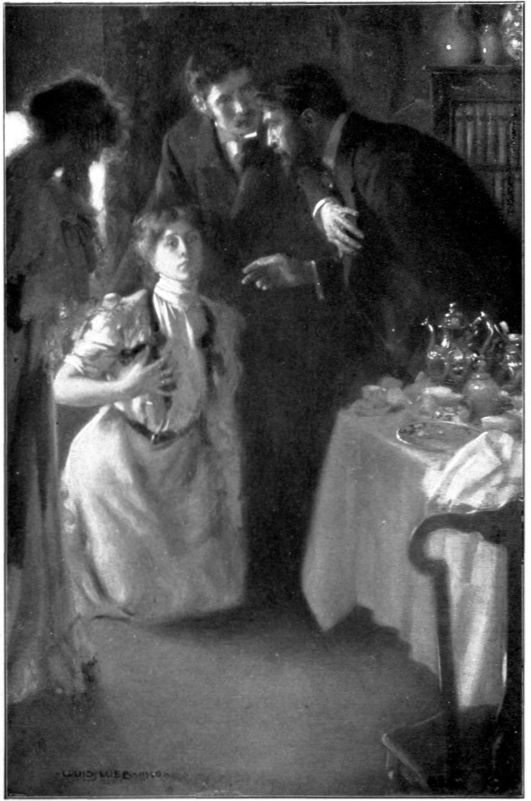
THE POISONED ARROW
The soldiers were passing at last. The music, the cheers, the sunshine—was she to leave this intoxicating, beautiful world? Farewell, blue sky! Good-bye, dear streets! She ran to the window. Heaven was a flutter of flags, and earth a sea of handkerchiefs. How joyously went the rhythm of the tune that should be melancholy:
“They dressed me up in scarlet red,
And used me very kindly,
But still I thought my heart would break
For the girl I left behind me.”
How they marched, the brave, strong men, the swing of their movement like the tramp, tramp of one gigantic foot. But the spirited music changed to a dolorous wail of bagpipes. The Highlanders passed, bare-legged, with stern set faces, that softened as women cried to them or reached out a hand to touch them.
Oh, the soldiers! The great strong soldiers, going down, out of the sun, breaking the hearts of their dear ones! And she—she who had been so strong, so sure of good and truth, so keen to right every wrong and wipe away every tear—her life had ended in nothing.
“O God!” she cried. “Take me for these at least!” She turned to her husband—the tears rolled down his face. She clung to him: “Bob! Bob! Remember we were to make an end of war. Save these men. Let me die happy.”
“Yes, yes.”
“No, no; swear to me you will make peace before these men reach Novabarba.”
“Is that in my hands, my poor darling?”
“Yes. Swear to me. In another moment the agony will grow fierce. Then I shall not be able to plead, then close your ears to my shrieks—but now—”
“I swear to you, dearest.”
“Thank you, Bob.” She kissed him. He clasped her closer, but she slid to her knees and waited for death.
The clock ticked away, second after second, and still the soldiers went by, each regiment with its own marching music, environed by the same cheers.
Presently Margaret tapped at the door, and then she and Raphael glided in. Their eyes met in a hope more agonizing than their fear. Another minute ticked itself off, each tick like the drop of cold water on the head of the tortured prisoner. Raphael could endure it no longer.
“You feel nothing! You are in no pain!”
Allegra uplifted a tear-stained, bewildered face. “I—I—just before it seemed to burn.”
“Seemed! Ah, thank God!” he cried hoarsely. “It is your morbid fancy. I hypnotized you by saying it was poisoned. The arrow was harmless.”
“But I felt—I am sure—” Her eyes blinked at life as at a sunburst.
“No, no! I understand. It is your old hyperæsthesia. Your nerves always work out suggestions of pain. You feel nothing, I tell you.”
“Can God be so good to me?” she whispered.
“Ah, how good God is to me!” said Margaret. Save for the stranger’s presence she might have burst into tears. But the long habit of lonely endurance and proud reticence bore her unbroken even through this moment of immeasurable relief. Broser wiped the cold perspiration from his brow.
“Come, get up,” said Raphael. “Wake from your nightmare.” He moved to lay a hand on her shoulder.
Broser stepped between them. “Down on your knees, Mr. Dominick, and thank your Maker you have been saved from murder.” He helped Allegra to her feet, and she fell sobbing upon his shoulder.
“O Mr. Dominick!” said Margaret, “will you ever forgive me?”
“Forgive you?”
“I should have destroyed the arrows.”
“You have perhaps saved my life by them,” he said quietly. “Good-bye, Lady Allegra. I shall go back to Italy. Try to forget all my madness of to-day.”
She raised her head and met his sad eyes. “I shall remember only that you wished to take death from my veins. I shall always regret I could not give you life.”
“You have given me life. I have had a real moment. I have choked in the deeps—in real water. I have been inside things, if not through love, through pity and terror.”
“The pity and terror were for me, and therefore the higher love—the love that asks nothing and gives all.”
He saw that she was to give all to Broser once again, but the perception only lifted him to higher levels of tenderness and abnegation.
“Good-bye,” he said again. “I have been inside, and I know that I have known nothing.”
Death-bed repentances should be followed by deaths. Life tries them too hard. It took but a few days of living to make Allegra repent of her repentance: of the fit of exaltation in which she had given herself back to Broser in loving reconciliation, in which she had sought to obey Margaret’s doctrine of the sacrifice of the morally stronger to the morally weaker. But how if such stooping did not uplift the lower, merely degraded the higher?
Margaret had given herself to Kit—but she had sacrificed only the body. She remained herself in soul. Whereas to live amicably with Broser, one must flatter his moods, applaud his self-satisfaction. She loathed herself for having once again abandoned herself to wifely duty. Raphael Dominick was right: no soul could possess another. She was no more Broser’s chattel than she could be Dominick’s. Broser was intolerable, impossible, fatuously wrapped in conceit and success. This renewed intimacy with him only demonstrated more clearly how they had grown apart. She found him worse than in his Republican days, for all his finer manners. It was not that he made no effort to end the war, despite his promise, contenting himself with predictions of the speedy destruction of the enemy, it was not that he swam exultant on the tide of victory, it was the man himself. His politics might be as defensible as Raphael argued or Margaret believed, but she would not take even the Millennium at his hands. Oh, if love is blind, hate sees, and she saw every little vulgarity, every touch of studied impressiveness, every grain of coarseness. Even neutral details hurt her—his very way in dressing of stamping his feet into his boots. He seemed to be stamping on everything—on her ideals, on her father, on her girlhood, on her woman’s heart.
Well, indeed, might he stamp a masterful foot. Allegra had come back to him, the Prince had at last invited himself to his house, and its mistress had hastened to send out universally coveted cards for the great reception that would wind up and crown the season. A galaxy of eminent Anglo-Imperials would lend special color to the occasion. Another British victory, too—clearly the penultimate—was come to shed its forward-reaching lustre over this night of nights. The detachment that had just sailed would probably land in a conquered country, and with a little more luck the annexation of Novabarba might even coincide with the visit of the Prince to whom he was presenting a province.
The night of this newest victory, filled with after-dinner elation, he proposed to Allegra an impromptu jaunt to a great music-hall, urging he needed the relief of some lightness and gayety after all this public strain. They could sit, hidden in the depths of a box. In truth he itched for the roar of the People’s approbation—not the People of his young days, the sad-eyed overladen ox turning at length to gore the oppressor, but that jolly music-hall public with which he was as popular as “the great Vance,” and contact with which always gave him a benevolent sense of being father of his people. To-night he longed to receive his own self-satisfaction back again from that mighty multiplier—from all those thousands of hearts and throats and hands.
Allegra hesitated, then decided not to be a kill-joy. Poor Broser, poor “great blonde beast,” as Raphael had defined him, let him gambol and relax as he knew how.
“I couldn’t risk hanging about,” he laughed carelessly, as she took her place beside him in the brougham. “I’ve wired for a box.”
A suspicion that what he could not risk was being incognito, awoke within her a feeling of absolute pity for his limitations.
But the progress of their brougham was slow. Gratified pugnacity, mixed more creditably with jubilance over the relief of a long-beleaguered garrison, had sent the town mad. Their house had been serenaded by the mob ere they drove off, and now rollicking foot-passengers, wrapped grotesquely in flags, and sporting portrait-buttons and rosettes, stole the roadway from the vehicles, shrieked through whistles and tin trumpets, squeaked and banged in fife-and-drum bands. Omnibus roof called to omnibus roof, deep to deep. Pennants fluttered in lieu of whips from the tops of hansoms, and four-wheelers crawled along, decorated with bunting and aglow with Japanese lanterns. Every horse, every dog even, was pranked with patriotic emblems. Little boys staggered along under standards heavier than themselves. Little girls flaunted it as nurses in mob-caps. Young men organized in great disorderly companies and waving fools’ bladders made sudden ugly rushes, by which pickpockets profited. Gangs of professional roughs snatched off the passers’ hats and threw them skyward, filching their watches while their eyes were with their hats. Endless processions of girls and young women tickled the men with peacocks’ feathers, or squirted them with dirty water, or pelted them with confetti, or swished them with cat o’-nine-tails of colored paper, and at each provocation the men kissed them. From every public-house, gay with flags and the tricolor ribbons of the barmaids, came beery choruses. Nor were the Clubs of the elect less hilarious, elderly cynics vying with prim young dandies at the blazing bow-windows. Even the art-students had thrown off their British frigidity, were parading with Parisian paroxysms side by side with reputable citizens flinging off a lifetime of villadom. Casual red-jackets were shouldered and deified; the very Salvation Army, the butt of the streets, was received with sudden respect, because it marched in military fashion and banged a sounding drum. And not only had Allegra this sense of a city given over to flags and illuminations and music and cheers and revelry and rowdyism, she knew that joy-bells were pealing and bonfires flaring and torch-light processions passing through all Britain, nay, that the whole great Empire rang with jubilance, bloomed with bunting, palpitated with festive fires. At first her eyes filled with tears; the physical contagion of all this delirium was irresistible. But soon every nerve quivered under the brutal jar. It was almost a relief to her to think of the quiet dead in Novabarba. For this Comus crew the Novabarbese had been expunged, that this civilization might spread over their happy hunting-grounds.
Ah, she understood the French Revolution now. How soon the diked-off sea of savagery stole back over the hard-won tracts of tenderness. How easily Broser might have led a British Revolution, had he been a little bolder and honester; how easily the barrel-organ, as Raphael put it, would have played Republican tunes. Broser should have struck in that moment of his fiery youth when he held the masses white-hot under his hammer. He might have been President instead of Premier.
“I told you a war would shake ’em up,” he laughed, ignorant of her train of thought. “I really think Germany ought to be content without any concession for its petty Novabarbese rights.”
“Why?” she murmured.
“Look at the profit the German factories must have made turning out all these millions of British flags and military toys and portraits of our heroes. I hear that they positively can’t keep pace with our nursery demand for toy soldiers. Oh, it has shaken us up,” he replied joyously.
“There seems to be somebody badly shaken up,” she replied bitterly.
“Where?”
“There—in that ambulance wheeled by two policemen. Oh, there will be many crushed and trampled upon to-night, I fear. Do see what has happened.”
“I dare not get out—I might be mobbed.”
“Then I’ll get out.”
“You’re as bad as Joan,” he grumbled, as he sprang out, pulling his hat over his face.
“Drive on,” he said, jumping in again. “It’s only a woman being taken to the workhouse.” He resettled himself comfortably in his cushioned seat, his hand in his wife’s, pleasantly conscious of her warmth and beauty.
“Only!” she repeated. “But why on a stretcher?”
“She was found senseless from hunger in her garret—nobody knew she was starving.”
Allegra turned white. “A flag of triumph waved over the ambulance,” she said mordantly.
“Yes,” he replied with satisfaction. “The very cradles and perambulators blossom. There isn’t a disloyal heart in Britain.”
“Except your wife’s,” she longed to shriek.
At one point the carriage must needs come to a standstill. A great crowd was hooting and throwing stones at a shuttered house.
“Why, it’s Joan’s!” Allegra cried in alarm.
“Ah, that’s why Fizzy ran off to Novabarba,” Broser laughed.
Allegra drew her hand from his: the memories that scene brought up were too bitter.
The music-hall was the street over again. The vast audience packed to suffocation rose to its feet with a roar of welcome as the illustrious couple entered the bower of flags and roses, which in less exciting times was a box. Allegra saw she had indeed been lured into sharing his pompous publicity. “Rule Britannia” and “God Save the Queen” rang from thousands of throats, nor could the performance proceed till the mad waving mob had sung “For he’s a jolly good fellow.” Yes, this was what her husband had done. This was what his Republicanism and Universal Peace had come to. He had engineered an outburst of feudal romanticism unknown since the days of the Tudors. The Army, the Navy, the Old Nobility, the Queen, God bless her, God bless them all. The air palpitated with tremulous affection for all he had set out to destroy. Every schoolboy longed to be a soldier. Rifle drill invaded the gardens of the ancient universities. Britain had been rebarbarized; Novabarbarized, as The Morning Mirror put it. England was on the highroad to join the military despotisms of the Continent. Verily the wheel had come full circle.
On the homeward drive she only said, “I’ll not go with you to the Thanksgiving Service at St. Paul’s.” And he, misunderstanding,
“Oh, but the music is sure to be good!”
He was going out to dinners this week, stealing hours from the dying session, tasting his triumph, rolling under his tongue the compliments on every menu. And Allegra was waxing hourly wearier of the phantasmal whirl and the fashionable cynicism. This London society—with its cosmopolitan chatter and its cycles of migration, with its habits more rooted in pleasures than in duties—seemed to her, in Raphael Dominick’s phrase, to “go everywhere and arrive nowhere.” A saving remnant redeemed it, perhaps, but the flamboyant section, alternating private immorality with public showiness, and fluttering feverishly round the turf and the Stock Exchange, offered an ironic spectacle of civilization’s climax to the Novabarbese under civilization’s broom. At one dinner a brilliant barrister, her neighbor, explained to her that the law was more exciting than Monte Carlo. “All such a toss-up. You can never tell if your client is lying to you. And even when you feel sure the other side is in the right, you can’t be sure it’ll strike the judge and jury as it does you.” And the next night Mrs. Whindale, an aged satirist of her own sex, famous for her dogmatic utterances in print, confessed to her that she was approaching the grave without the faintest assurance on any of the great questions. “I started life with a full equipment of answers. Now I ask myself in vain: What am I? Where did I come from? Whither do I go? What is right? What is wrong?” And the poor old woman kept back a tear. But why then was she so hard on the new womanhood, Allegra thought; on the young generation putting forth anxious feelers, in the travail of a new evolution?
Ah, it was time for a new revelation, she felt. The Sermon on the Mount had failed to roll the stone up the Mount. The stone had rolled back now with a vengeance. Paganism had thrown off the mask, and lolled once more at flower-crowned tables in festal garments, its veins full of youth and lust and wine. But for her, Allegra, it was horrible to eat these dainty foods, to sip these sparkling wines, the soul looking on joyless, self-conscious of futility: one’s own skeleton, felt through the evanescent flesh, sat at every feast. She was falling more and more into this habit of aloofness, surveying herself from without, like a figure in a play. Perhaps she had caught it from Raphael Dominick. At any rate it served to facilitate the living with Broser. On their way home from dinner she again made him stop the carriage. This time it was an old female scarecrow chivied from a street bench by a policeman.
“But why mustn’t she stay there?” she asked from the carriage window.
“We’ve got our orders, mum,” the policeman said tartly.
“But what is the use of the bench, then?”
“We should have it full of sleeping tramps.”
Broser curtailed the discussion by giving the creature money for a bed. As the carriage rolled on, Allegra kissed him with a sudden impulse.
“That’s a cheap kiss,” he said. “You remember the price you wanted in Orvieto—the Premiership!”
She drew back from his attempted repetition: it was an unfortunate reminder.
She had not gone to the Engelborne flat on the Tuesday, but Thursday found her yearning to know how Margaret and Kit fared, and how that ghastly race was going. She found Margaret daintily gowned as usual, and petting a child, but with her outer bulwarks of cheerfulness evidently abandoned at last. The whole air of the flat was subtly different. Was it that Raphael Dominick had been removed? Allegra had a new pang. She had virtually robbed poor Margaret of a friend.
“I expected to find you in better spirits,” she said.
“Why?”
“The coming end of the war.”
“That is what depresses me.”
“You! the Imperialist!”
“Oh!” Margaret cried, “don’t you think I feel it—all this terrible suffering? Now the stress is over, now England’s honor is safe, one may think of it all. Oh, the mothers I have tried to console! And then there is one of Kit’s special friends, dead of fever, poor thing, in the prime of her youth: Kit showed her the light, and she went out to Novabarba as a nurse. Of course Kit mustn’t know—she is terribly low to-day.” She shuddered, and suddenly fell back on her chair, fainting.
“Mother Meg! Mother Meg!” screamed the child.
Allegra rang the bell in equal alarm. Evidently the death-race was a close one. She chafed the hands, admiring, despite her agitation, the beautiful artistic fingers, the rings, the rare old lace at the wrists. But the maid had scarce appeared when Margaret opened her eyes and smiled.
“Did I faint again?” she said.
“O my poor Margaret! This is terrible.”
“It’s nothing. I always come to. And I faint warm, while most people faint cold. That’s a blessing. The only real inconvenience is, I dare not hold babies.”
“If you would only go away to The Manor House. Joan is out in Novabarba, you know: the whole place is at your disposal, she says.”
“It is so sweet of her. We are so looking forward to it, for if I am spared to go, Kit will share my gladness without any alloy of earthly pain.”
Allegra sighed hopelessly. Well, the race could not last much longer now.
“We have been rejoicing The Manor House didn’t fall into the hands of a Robinson,” Margaret went on, smiling. “A Brown has Wimpole Hall, and Lord Cowderleigh’s house belongs to a Smith.”
“How you’ve kept track of the country-side!”
“The only time I was there,” said Margaret proudly, “I was able, standing at cross-roads, to tell an inhabitant the way to a Hall I had never seen. It was my dear father who made old Devon such familiar ground.”
Allegra felt a pang of envy, had an instant of selfish narrowness. Surely it was better to have had a father who devoted himself to his daughters than one who gave his whole life to his country. She had a novel flash of sympathy for her semi-neglected mother. Poor blundering parents. Why had they not guided her better at life’s cross-roads? Why had they let her fall into the hands of Broser? Her father loved man, yet had proved so ignorant of men.
She wondered suddenly what Margaret would have done, wedded to a Broser. Sacrifice herself, no doubt! Stick to her contract! Pray for her husband, hoping and enduring all things! And Allegra’s instinct and reason rose in revolt. The original contract was iniquitous; this promise to love, honor, and obey, extorted from a girl ignorant of life, ignorant of her own womanhood. And had she not fulfilled enough? She had been denied children to bind her to Broser, but his children—his Polly and Molly and Bob—had she not given herself to them without stint or question, so long as she could serve them? Had she not spent her best of youth and enthusiasm in the service of his career—that career now sure of its climax? No, he could not complain of his bargain, though no jot more of love or honor or obedience were paid over to him.
On the Friday night—the evening before her own party—she was glad to be free of him, and at a Symphony Concert. She needed music, to wash away all this impurity and wretchedness. It was a great house, almost like a Grand Opera audience: only in the highest gallery could she perceive frock-coats and covered shoulders. But the mere radiation of wealth and ease had long ceased to sting her. Even the fluffy jewelled notoriety of the “smart” world, who sat in front of her in a wonderful green silk ermine-trimmed cloak, seemed merely pitiable. As little as Broser did she now dream of equating gallery with stalls. Life was too chaotic and nimble for bureaucratic organization—Raphael Dominick’s conversation had dispelled her last cloud-Utopias—and the real troubles of life were not those of the empty stomach, but of the empty heart. But what still had power to sting her, as she listened to the Parsifal Prelude (the remembered visual pictures of Bayreuth flowing past her with the music), was the barren æsthetic response these people made to what the prophets cried through music or poems. She, too, had wallowed enough in fine feelings—Raphael had found her out there—but still she had at least felt as realities the Love and Faith of which the music spoke. With what seriousness she had once set out herself to seek the Holy Grail: even now was it too late to win the cup of salvation, the kiss of peace? She was not of this world; she must join the fervently loving, solitary Knights, pass through the dense cypresses and cedars. The delicate throbbing music grew intenser, acuter, vibrating with bitter-sweet emotion.
“How subtly it expresses Schopenhauer in every bar!” said at the close her cultured Jewish companion, patroness of all the arts.
The view astonished Allegra. “Do these people enjoy pessimism then?” she asked.
“Pessimism beautifully expressed is pleasurable,” replied her philosophic friend. “But what these people enjoy to-night is the massive staccato barbaric bursts. Their nerves are strung up for war.”
“Oh,” said Allegra reproachfully, “and I was forgetting the war, and congratulating myself that at last I had found a place without a reminder of it.”
“What about those military bandmasters on the platform?” laughed her friend.
“I didn’t notice them. What are they doing there?”
“Watching the conductor—to learn how to conduct.”
“Oh, then civilians have still some virtue!” said Allegra bitterly. She had been bored to death by the military portraits in every newspaper, shop window, and button-hole; by the perpetual gospel of “strenuousness.” As she watched the great conductor, tiptoeing towards his orchestra on his long legs, he suddenly seemed to her like a great black bird, his coat tails spreading like rear feathers. And then she thought, with a tender whimsical smile, Raphael Dominick might have called him a Beyond-Bird, with a detachable throat that trilled celestial harmonies, now like pealing thunder, now like the ripple of a sunlit brook, controlled and infinitely modulated at his will and pleasure. How it obeyed his subtlest sense of time and tune, this complex musical apparatus of his with its manifold pipes and strings. What a highly evolved creature, this conductor: how foolish to annihilate all these wonderful potentialities with a fragment of shell. Yet there were those who scoffed at all men who were not in the firing-line. Verily, civilization had forgotten itself, the watch-dog had been elevated above the master of the house.
She studied the orchestra with new interest, admired the splendid symmetry of the movements of the bows, the swift precision of each instrument: she thought of the striving of each performer after perfection, his long hours of practice, the risings in the cold dawn, the struggle to get and keep a place in his little world, the labor for wife and children, all the patient travail of peace.
Strenuousness? What was the soldier’s burden? Forced marches, rain, scant food, the risk of wounds, even death, but often enough a joyous picnic; mere pleasure-seekers worked as hard in travelling, hunting, gypsying. War-courage was mainly contagious excitement. In sieges the civilians were always as brave and patient as the soldiers. What wonder? They had all been under that stern drill-master, Life.
Ah, Life! Music alone expressed it, its nebulousness, its elusiveness. Her relation to Raphael, to her mother, to Margaret, to her father, to her husband even—how vague and floating. Poor Raphael, God send him happiness. Oh, the pity and heart-break of things. On the side-bench, facing her diagonally, was a beautiful girl of sixteen. The high-necked dress, the flowing hair, the cheek of cream and roses, the candid eyes, the glow of innocence and idealism—she must have looked like that once. Was that child destined to become as she? Music, music, one needed music to express the magic mystery of it all. And she no longer wanted to be a poet, only a great wordless creator, flinging out her passion in diapasons of sobbing sound.
The fluffy “smart” person had slipped out of her green silk cloak and taken her white shoulders to another bench, to chat with a friend. The cloak occupied her place, followed the lines of her figure, represented her, nay, Allegra suddenly saw, was her—listened as intelligently, fulfilled her smart social round. And the Lady Allegra—what was she herself in the social whirl? Only her outer dress, her vesture; and even that, cut as fashion dictated. The real self lived only in such moments as these.
St. Cyril was right. One saved society by saving one’s self. The call was to the individual soul.
When she got home she found a letter from Joan:—
“Oh, my darling Ally, I dare not tell you what I have seen here . . . a nightmare of blood and fever. The one blessing is, it can’t last much longer. Oh, the poor soldiers! Oh, the poor Novabarbese! And yet people prate of a God of Mercy. . . .”
Despite her first sentence Joan slid into more details with every page of her voluminous letter, till Allegra turned physically sick, and Barda, brushing her hair, became gravely concerned lest she should not look her best on the morrow.
Joan wound up excitedly:—
“But I have taken an oath that when I come back, I will never rest until we get Woman Franchise. The men have failed to produce civilization. They have had all ages and all lands to experiment in and have never got there. Nineteen centuries after Christ the world is still all armed camps, mutually snarling. The greatest nations are thinking only of the coming struggle for the hegemony of the world, and how much of its territory they can snatch; not of civilization’s progress but their own. It is time for the women to take a turn. We must be everything, even legislators. We must repair all that social rottenness which war gilds over for a time and then leaves us too poor to set right. Of course, dear old Fizzy chaffs me endlessly—says we’ll want to smoke in the Chamber, etc.; but I, too, have a sense of humor. Or tell me, dear, have I lost it of late years? Sometimes I think it has been ground out of me by all this devilry. Ally, dear, I count on you to give up your dilettanteism, to help in organizing our forces and baffling these brutes.”
Yes, yes; she would give up her gropings and wanderings, obey this providential trumpet-call. The ruin of her life had been her idea that the woman must sink her life in the man’s. If no soul could possess another, neither could any soul represent another. She had been wrong to look to a man to carry on her father’s work—no Salic law forbade a spiritual mission to fall on a woman’s shoulders: there was no exclusive inheritance through the male. The Mantle of Elijah—how if she dared to wear it herself? Its inheritor had gone over to the prophets of Baal. Not one prophet of the Lord was left, not one. Was not this the only thing she was fit for—action on large lines? She had canvassed for Broser, she could take the field again. To set things straight by a great universal method—Raphael had truly diagnosed her deepest longing. Of course he had scoffed—there would be abundance of scoffers. Even Fizzy himself for all his revolutionary recklessness could not conceive a Parliament of women. And in truth there was enough to justify him: millions of women even of the wealthy classes as unbalanced as her mother, as capricious as Dulsie, as aloof as Minnie, as selfish as Miranda Grey, as mediocre as Polly and Molly, as ruthless as the fluffy owner of the green silk opera-cloak, as pretty and malicious as Mrs. Whindale could paint in her blackest moods. But women had been so long the toys or the torturers of men—they could not be untwisted in a day. Many, too, loved fighting, adored brute force as they adored the reek of their husbands’ pipes, the tang of virility and brutality. But let men struggle for male ideals, woman’s mission was to struggle for female ideals: ideals of love, pity, tenderness. Fate would strike the diagonal of the forces. Yes, whether through women like Joan or men like her father—for both sexes must work for it hand-in-hand—there must be forced upon the world woman’s vision of life; the desire of the gentler heart.
“So on our heels a fresh perfection treads,
A power more strong in beauty, born of us
And fated to excel us, as we pass
In glory that old Darkness.”
The lines she had quoted to herself in that letter of hers went throbbing endlessly through her brain like a haunting tune as she tossed sleepless.
Her husband breakfasted with her on the fateful Saturday, talking over the preparations for the evening. He was vastly excited, had half refurnished his rooms (though Allegra’s taste had made them the talk of the town), spending money like water for the brief edification of a royal eye that had seen all the grandeurs of the earth. Allegra was reading her letters quietly.
“Thank God!” she said.
“What is the matter?”
“That poor girl is dead.”
“What poor girl?”
“The girl I used to play to—Kit Engelborne.”
“Oh, then there will be no need for you to go there any more. I am glad.”
“I shall go this afternoon.”
“You can’t do that—you have so much to do here.”
“It shall all be done. But I must go and see Margaret. It was a race between their lives. I am glad she survives.”
She was thinking Raphael would be pleased too, to have his first prayer answered. “She is to stay at The Manor House after the funeral, and I shall go down to see her installed, with physicians within call.”
“Your interest in these persons is somewhat excessive. I was looking forward to having you all to myself, now the session is over.”
“I am sorry to disappoint you.”
She spoke quietly, but he could not tell if she were sincere or sarcastic. He seemed to see the cloven hoof beginning to peep out again, but he was afraid to provoke her to-day. After to-night was safely over, he could take her in hand, annex her totally as he was annexing Novabarba. At present she seemed much like Novabarba after the first war, still simmering with revolt. He had been too weak and considerate, he must stamp his sovereignty indelibly upon her.
Margaret Engelborne met Allegra with a grave wan smile. They kissed.
“She passed from my arms to mother’s,” said Margaret.
“I have brought some lilies. May I lay them on her breast?”
“She will be happy at your sweet thought. Can you wait a few moments? Miss Oxager is with my darling. It is such a blow for her, poor dear soul. She is so fond of Kit.”
“So am I. But I am glad that one of you is left to us; that you are bearing up so well.”
“Miss Oxager would break down, if I broke down,” said Margaret simply.
Presently Miss Oxager’s kind face appeared, her glasses dewy, and then Margaret led Allegra towards the room she had never entered, and opened the door for her, pausing herself on the threshold.
Not dark—as she had somehow expected—only under a sacred hush. There was no need of darkness now. The window was open, the blind up, Margaret’s vagrant pigeons cooed on the window-sill. A flood of sunlight lay over all; over the bright furniture, the pretty knick-knacks, the picture of St. Barbara, the crucifix, the white bed, the wasted pointed face with great hollows under the eyes: the face she had never seen in life, a face of sorrows and agonies heroically endured, yet a face of peace, a face whose sufferings seemed ended æons before. There was an air of the immemorial dead.
“She met death jubilant,” said Margaret, “like a woman going to her lover.” She closed the door, leaving Allegra alone with the auditress of her music.
Flowers were already upon the breast. Allegra took the dead hand, the beautiful waxen dead hand, and pressed the lilies in it.
She could scarcely see the poor dead face for tears. Impossible Kit could have been only nerves and a brain, whose molecules, their vain biological agitation over, had relapsed to chemic existence. Allegra’s soul threw off the gray ashes of modern wisdom, yearned towards the soul that had once shone through that deathmask, tender, heroic, infinitely strong and patient. Surely such a creature could not be as the beasts that perish.
Strenuousness? Alas, she thought again, life offered opportunity enough for strenuousness. One need not seek it at the bayonet’s point. By the side of these ghastly nine years of suffering, what were the heroism of a hundred V.C.’s? Strenuousness? Relaxed in civilization’s Capua, must it always be resought through the fighting passion, through man’s kinship with the beasts, never through his kinship with the angels?
This dead girl was not merely herself; she was a large pitiful symbol of the faith and martyrdom of the ages, dreaming of a divine significance in things, and a divine purpose in the process of the suns. Was it all to lead up to the blatant triumph of a Broser, callous to all the spiritual subtleties which the centuries had agonized to evolve? Had civilization come thus far only to perish by the Goths it bred in its own bosom? The century that had seen poets and philosophers hail the coming Kingdom of God, was ending in darkness: France forswearing Justice, America Equality, England Freedom.
Back in the music-room, Allegra arranged to come to the funeral, and to bear off Margaret to Devonshire.
“I only hope you won’t be lonely,” she said. “Of course there’s the housekeeper and her cat.”
“I am never alone,” said Margaret. “Thank you for both of us. The only thing on earth we have now to wish for is another volume of poems from Mr. Dominick.”
“I think he will write it,” said Allegra softly.
“Yes—I think he will. The prospect of it will be one of Kit’s chief earth-interests, and the day I get the new book I shall hear her earth-laughter.”
“Earth-laughter! What a quaint phrase!”
“Why quainter than heavenly laughter? The man who loves a woman dearly speaks of her laughter as heavenly, as divine, does he not? I suppose he feels in her an accentuation of the Christ’s smile, all holy and pure and joyous. So I have often seemed to hear earth-laughter from my dead father, when, amid all the novel calls, trials, and pleasures of the after-life, a wave of happiness has reached him from the old earth he knew and loved.”
Descending the staircase, Allegra saw through misty eyes a venerable white-bearded figure in a glossy high hat and a broadcloth frock-coat, with a rose in his button-hole, and in his white-gloved hand a little white box tied with pink ribbon. To her surprise the glossy hat came off in the gloved hand, and the venerable beard bobbed in a courtly inclination.
“Good-afternoon, Lady Allegra.” There was a vinous reek in his breath.
“Good-afternoon, Professor Pont,” she said, startled. “Don’t go up to-day.”
His face clouded. “Is it over?”
“Yes.”
“Which?”
“Ah, you saw it was a race. But Miss Engelborne herself has been spared, thank Heaven.”
“Ah, she has great will-power. There is no death if we so choose. It was a great score for Christian Science. I am only sorry the sister gave in. My wife will be sorry, too. I say my wife with intention, for I was married yesterday and I was bringing Miss Engelborne a piece of the Cornucopia—of the wedding-cake.”
“I congratulate you,” she murmured. So that was the secret of his fine clothes. He had found some fond moneyed female.
“My wife”—he gloated on the phrase—“will be so pleased to hear I met you. You are the first person she asked after, when she returned from her American lecture-tour.”
“What! Is it the same Mrs. Pont?”
“My dear Lady Allegra, what do you take me for? You see, one does not need the fetters of matrimony to be faithful for a lifetime. However, as Christian Scientists we thought it best—she has converted me, I confess; though I do not propose to join her on the platform, or obscure in any way her phenomenal success—moral and financial. And, truly, her system is not incompatible with my World-Philosophy.”
Poor foolish Professorin! To bind herself irrevocably to this man after a lifetime of proved worthlessness. Oh, the unceasing self-abandonment of women: the strange unpredictable movement of life. Here was she growing more and more to feel the impossibility of marriage: and here was a woman who had safely dispensed with it, tying herself like a schoolgirl!
“It would be inappropriate to give Miss Engelborne the wedding-cake now, nicht wahr? May I present you with it?”
“Me!” Wedding-cake at such a moment! “No, thank you.”
“You must not be so stand-offish! I accepted some of your wedding-cake.”
“Did you?” she murmured, anxious to be gone.
“Did I? Why, but for me there would have been no wedding.” His alcoholized imagination believed it for a moment, and prompted him to add, with a malicious remembrance of the scene on Westminster Bridge: “It was I that told Bob not to miss the chance of marrying a lady of title.”
She flushed crimson, then went back to white. She hated the speaker, and hated what he said, but it accorded only too well with what her detestation for Broser had been whispering of late. She bowed. “Good-afternoon.”
He put out his hand. She made a dab at it as the quickest way of getting rid of him. But his great white glove closed on her little gray glove. “Yes,” he said, “it’s very strange. I was in at the first Mrs. Broser’s death, and the second Mrs. Broser’s marriage. And he hasn’t even asked me to meet the Prince. If Bob hadn’t made poor Susannah stand on her feet for hours receiving his guests, she might have been in your place to-night.”
Her memory went back to that gruesome reception, saw a girlish enthusiast talking to the Ponts, heard the cry of consternation as the hostess fell adown the staircase. “But he didn’t know she was ill,” she said, defending him.
“Didn’t he? Why, there were frightful scenes between them, the maid told me. Poor Susannah almost went down on her knees—she was in agony.”
“I cannot listen to gossip.”
“Gossip! Why, wasn’t I in attendance on her? Didn’t she say with her own lips—”
“I really must go,” and Allegra hurried towards the carriage door the groom was holding open.
But her heart wished to believe, beat “Soros! Soros!”
People were loitering about the great beflagged and festooned corner house, watching the comings and goings. It was known the preparations were for Royalty, and the very brick-work was invested with glamour. The crowd was growing thicker with the waning afternoon: by nightfall the street would be impassable save for the carriages of the elect.
In the great hall, which the workmen had just converted into a fairyland of flowers and palms, she met her husband, complacently supervising.
His brutally healthy face jarred on her memory of that other face—ivory against the white pillow. The festal preparations, the riot of roses on the staircase—the reek of the triumph of life and selfishness—made her gorge rise. To stand at the head of those ornate stairs, presiding over his apotheosis, while Kit lay dead, while her own father sat heart-broken, while Raphael Dominick wandered sad and lonely, while Novabarba was red with blood—no, she suddenly knew it was impossible.
“I am going to my room,” she said.
“Nothing must be wrong to-night,” he said, half authoritatively, half humorously.
“Nothing shall—except me.”
“How do you mean?” He was alarmed.
She was mounting the stairs. “I fear I cannot face your guests.”
For a moment his dazed brain scarcely grasped the full implication of her words. Then he pursued her up that floral staircase which his imagination had so oft pictured them descending in state to receive the royal guest.
“What is the matter—are you ill?”
“Not physically.”
“Oh, you frightened me. But you oughtn’t to have the blues to-day, all sun and happiness, the best day of my life. Drink a glass of champagne.”
“No, thank you. I really must ask you to get on without me to-night.”
“Allegra, what do you mean?” His voice had a touch of terror.
“Do you forget I come from a death-bed?”
“That girl! But she isn’t a relative, or a public personage.”
“She was a heroine. I’d rather see national mourning for her than national rejoicing over the dead Novabarbese.”
“Do you begin that again? I thought you had learned to understand.”
“I don’t want to argue.” She mounted the second flight. He ran after her, passing a staring footman.
“But have you forgotten that the Pr—”
“I have forgotten nothing.”
“You are doing this to spite me—to spoil my best hour.”
She entered her bedroom. He followed ere she could turn the key. Barda was laying out the latest Parisian creation. The sight of it made her shudder. In this shimmering robe she was to adorn his triumph, like some beribboned beast in a conqueror’s procession.
“I shall not need it, Barda,” she said.
“Go away,” he growled to the open-eyed girl. He argued, pleaded, stormed. Then he took Allegra by the shoulders. “You shall receive my guests.”
“Beat me black and blue, and with these bare shoulders I will receive your guests.”
He let her stagger back. “I could kill you,” he muttered.
“As you killed your first wife?”
He staggered in his turn. For a moment he actually saw the earlier scene. It was a very simple hallucination. The dress was on the bed. Susannah had only to stand for the moment in Allegra’s place.
“I see—somebody has poisoned your mind. I didn’t realize she was seriously ill.”
“Then realize now I am serious. I am going to lie down. Please leave me.”
“On condition you get up later.”
“You have my ultimatum.”
“Oho! then it is war. You have mine. You shall be nowhere in this house but at the head of my stairs.”
“Then I shall be nowhere in your house. I shall go.” The moment the words left her lips she saw that this was the one true course. Here was the solution for which her brain had been groping for days. Now it had shot up the answer. Her first semi-separation in the interests of hypocrisy had been as absurd as Raphael had proclaimed it. Ah, he had not had to grope for the true solution: he had found it at the first hearing. But all these years she had been learning to know herself; she had moved through a countless series of subtle actions and reactions, and now at last—through lessons of love and death and hate—it seemed to her that she had found herself: no society opera-cloak, but an individuality, a woman self-centred, not despairing, ready to go out, to fight, first hand, for her own ideas, for her own ideals. And a great peace fell upon her soul. But upon Broser’s fell a violent tempest.
“Go where?” he thundered.
“That is my business.” Had he been suffering, she felt she could have clung to him; had he been cast into a dungeon, she could have played the Fidelio to his Florestan. But he possessed everything in the world: he should no longer possess her.
“Ah, I see it all,” he shouted. “You have been to that vile flat—you have seen your Dominick again. You are going to him.”
“You cannot insult me. He has gone back to Italy.”
“And you itch to follow him!”
“Yes, at once.” She went towards the bell. “I shall pack my personal belongings.”
He pulled her back from the bell. “Have you lost your senses? You, who talk of ideals! How can you leave your lawful husband?”
“Your first wife left you—you had to endure that.”
“My first wife died.”
“The first Allegra you married died: you killed her.”
“I’ll kill the second Allegra, too, rather than have this scandal.”
“You saw Death has no terrors for me. But—a budding Premier hanged by the neck! The Novabarbese will be avenged, nicht wahr, as your old friend used to say.”
He clenched his fists. “You are a brazen vixen. The world will spit on you when it learns the truth.”
“Indeed! Let us hope for your sake it never will learn the truth.”
“For my sake? What have I to be ashamed of? That my wife ran away with a Jew!”
“You know that is a falsehood.”
“Any other reason would be too ridiculous. Will you tell people it’s politics—they’ll laugh at you. Do you think anybody who knows the world will believe that you eloped with an idea—that you left your husband because you were sentimental over savages?”
“That is not my reason.”
“What other?”
“That I am no longer sentimental over a savage.”
“If I am a savage I will act up to it.” His eyes protruded, but it was the glare of potency, not impotency. They were grotesque, but too menacing to be comical. She flinched before them. “You shall receive my guests to-night, or—”
She sprang to the bell. “I’ll ring for Barda.”
He laughed: his fury passed. “That threat is played out, you little idiot. In the face of the scandal you threaten, nothing else counts. Servants’ gossip? What is that to Society’s gossip? You shall not leave my house, if I have to lock you in your room for the rest of your life. Mind you are dressed in good time.”
And he went out, smiling sardonically. To-morrow he would be gentler; they would kiss and make it up. To-night he had no option but war.
Allegra saw she had blundered. She should have fled and explained afterwards. Her heart beat spasmodically, her cheek was white. She had the strength to go, but not the strength to endure these vulgar squabbles, these physical encounters of hate, as loathsome as of love. Well, let her endue herself in her gown, let her surrender to his will for the last time. To-night he was on the watch, was capable of stopping her by violence. Fighting Bob might achieve a supplementary domestic reputation. It would be easy enough to slip away to-morrow or the next day: his threat of mediæval incarceration was ridiculous.
Besides, she had not really planned where to go. She must take care, too, that he did not smirch her future and cripple her powers for good. Her departure must be chaperoned by the most unimpeachable matron of her circle. She must leave in a blaze of publicity, and live for a time under protective wings. Yes, on second thoughts, it was just as well he had delayed her flight.
She rang for Barda and went to bed—to think.
First, there was her family. Her mother was too old and too hysterical. There would be too many scenes, too many explanations. The poor decrepit Earl would suffer by them. Joan was in Novabarba. Connie she had never really known. Mabel was too comfortably domesticated to be sympathetic. Polly and Molly would side with their father in an emergency. She ran over the list of her female friends—she was surprised to find how superficial were her relations with the women she kissed. Margaret was the only one she could endure to live with, and Margaret was just now with her dead. But then that Devonshire project—could they not take up their abode at The Manor House? No, not at the start of her new career. Margaret was single, was Bohemian. The outer world knew nothing of her saintliness, quite possibly would condemn her easy friendships with men, would rate her as “fast.” That would be grimly ironical, no doubt, but the world was like that. Nay, Broser might even depict Margaret as the accomplice in the Dominick intrigue. No, there was nothing for it but to go home to her parents, in the first instance at least. Later she could, perhaps, live with Margaret, if indeed—and here was a new doubt, most grimly humorous of all—if, indeed, Margaret’s ethics would permit her to live with a woman who had left her husband! Possibly she would grieve bitterly over the sinner, pray for her return. No, Joan must be her ultimate haven. Joan her protectress, the little Joan she had patronized in the nursery! How humorously things worked out, life smiling waggishly through its tears. In the meantime, though, how to leave Broser’s house? To go alone, or even with Barda, would be to play into her husband’s hands. He had already his Orvieto story. Barda would figure in his denunciations as the chamber-maid of Spanish comedy. But to summon her mother to London and for such a purpose—that was scarcely feasible. How explain the case to her? “The union of souls for great purposes”—that was to have been their marriage: the definition was Broser’s own. His soul had been unfaithful, divorce was therefore just. Why, the very data of the argument would be caviare to her primitive parent. But suddenly a thought came, like a flash of light. The Duchess of Dalesbury! That queer old figure sprang up, infinitely motherly. She felt her kiss on her lips. And the Duchess had hated Broser from the first. Ah, Alligator was indeed coming round to some at least of her aunt’s opinions. “Wait till you are older,” rang mockingly in her brain. Surely the Duchess was the ideal protectress; prepared by Providence itself for this stage of the tragi-comedy. Her sharp tongue, her austere morality, her refusal to receive persons even with the Lord Chamberlain’s certificate—all these known eccentricities of the dear old Tory gentlewoman would now be turned to the refugee’s advantage. The Duchess had of course, had a card “to meet the Prince.” If she should come, Allegra might perhaps find a moment in which to plot her Hegira. But of her coming there seemed scant chance. Well, she must be whipped up. Allegra found herself yearning for this comfortress in her loneliness, a loneliness that would be accentuated amid the brilliant throng of her guests. At any rate she would write to the Duchess while resentment was hot in her breast. To-morrow she might weaken again, vacillate, hypnotized by this brutal Broser, by the world’s opinions, by Margaret’s. The Duchess would serve to keep the fire alight, once she knew it was burning: would pour oil on the flames.
She had writing materials brought to her, and she scribbled:
“Dear Aunt,—Don’t be upset but I have resolved to leave my husband as soon as possible. You were right about him from the first. He threatens he will imprison me here by force sooner than let me go, but that of course is all nonsense. Anyhow, I want you to come some day and take me away, so as to throw your ægis over me, as he is capable of any malice. I know you hate coming to-night, or we might have had a talk as to ways and means. But to-morrow will do. My love to the Duke, and I am enjoying Five French Cathedrals.”
She had really liked the pictures.
Barda undertook to post this secretly. It would be in time for the last delivery; she would put on express stamps to make sure.
For over an hour and a half Lady Allegra had stood at her post, looking down on the banks of white roses that hid the balustrade and the columns of crimson roses that concealed the pillars. The celebrated rooms buzzed with celebrities, and their womankind or their mankind, shone with historic jewels and pageant costumes. The eminent Anglo-Imperials felt themselves bourgeoning in this gorgeous hot-house of the elder civilization; they drank in the stifling, heavy-scented air as though it were ambrosial. The cachet of Fashion and Aristocracy had been given to the colonies in their person; they themselves would plant similar oases of feudalism in the deserts of democracy. Uniforms, court dresses, coronets, rich-gleaming orders, emblazoned carriages—these ought to be native elements of decent society, not the mere exotic pomp of imported governors. Even the barbaric splendor of the Indian princes—their begemmed turbans, the armlets and bracelets glittering on their bare dusky flesh—stirred a subtle regret for that wonderful, regal old world, submerged by slapdash modern societies, whooping for equality.
And Broser, agent under Providence of this transformation of ideals, exuded an immense content from his ministerial person. The tighter grew the crush, the more his breast expanded. How lovely and stately his wife looked, more magnificent in her simple gown than some of those ladies whose dresses were scarcely visible through their jewels. Surely the first woman in London for brains, breeding, and beauty, spite all her private whimsies, doubtless inherited from her mother. No need to instruct her how to talk to the lions, how to receive Royalty. She was the fit appendage of his greatness—he really would conciliate her a little on the morrow. Yes, he would yield her some little point of social legislation. What a pity that diamonds could not propitiate her! From the streets there was borne to his ears the dull roar of cheer after cheer—herald of the mightier outburst to come—as some popular politician or soldier stepped out upon the street-carpet from the interminable procession of carriages. Whenever there was a lull some patriotic strain would burst forth. Yes, Britain was as proud of Broser as Broser of Britain.
Allegra, with that ever-increasing detachment of hers, felt herself outside of it all—her astral self surveyed that strange bejewelled and beflowered Lady Allegra Broser smiling and handshaking and receiving congratulations upon her husband’s brilliantly successful policy. That was but the shell of herself, the opera-cloak keeping the lines of her figure. All at once her Self leapt back into her body. She was shaking hands with the Duchess of Dalesbury, and her “How good of you to come!” was no longer the stereotyped formula but a cry from the depths.
“Yes—I have come for you,” said the Duchess with a diabolical smile, and she dragged at Allegra’s hand as if to pull her forward and down the stairs.
Broser had darted sideways and extended his hand.
“Ah, Duchess!” he said sarcastically, “delighted to see you at last under my humble roof.”
The Duchess ignored his hand, but put her ear-trumpet interrogatively to her left ear, while her right hand continued to tug at Allegra.
“Delighted to see you,” Broser was forced to repeat, his sarcasm rendered abortive.
“It is the first time and the last,” she replied in her harshest tone. “Good-night. The police won’t let my carriage wait.” She was blocking the ascent of the new arrivals now, preventing them saluting their hostess, so that the chatter on the great staircase grew louder. Broser scowled, trying to smile.
“You are not going so soon, Duchess,” he said.
“Yes—Alligator is coming away under my protection.”
“Poor old thing,” he said to Allegra in a loud whisper, in case the bystanders and the ascending guests should hear anything over the buzz of conversation and the music of the band.
The Duchess put out her trumpet. “What have you to say against it, sir?”
He was disconcerted. “Come into the room and I will tell you,” he said into the trumpet.
“Thank you, no. Come, Alligator!”
Damn that Strauss waltz—why did they play it so low, you could hardly hear it! Why didn’t they crash it out in drowning thunders? His Parliamentary resourcefulness rose to the crisis. He bent forward to bawl into the trumpet:
“I hope your sunstroke—?”
The Duchess whisked the trumpet away, and dragged the hostess a step forwards. Allegra had returned to her astral aloofness: she was fascinated by the dramatic duel between the master of the show and the beloved old face under the towering tiara.
Broser put his hand detainingly upon his wife’s arm. He was flushed and perspiring. “Get rid of her, please,” he breathed, “don’t let us have a scene.”
A scene! Allegra thought the scene was there, and odd enough to amuse the most fastidious playgoer. The few instants of its duration seemed to her the length of an Act, and she wondered the excitement of it had not vibrated through all the rooms, that behind her and around her people were still humming pleasantly, and that the Strauss waltz was still gliding on in spiral sweetness through everything. Then she heard herself replying firmly: “There must be no scene, Aunt Emma. I will come with you—but later.” And as the reply with its immense implications penetrated her own brain, she awoke again.
“We can’t always avoid scenes,” said the Duchess. She was prepared to enjoy herself immensely—touch the crowning moment of a lifetime of public scolding, the town-crier climax of a candid career.
But Allegra looked at her dominatingly and shook her head, and imperceptibly pulling at her hand in turn drew her towards the room. “Wait!” she said authoritatively. “Till the Prince has gone.” The reminder contributed to calm the Duchess. As Allegra turned her head again to greet the next guest, her eye, still full of its dominating fire, met Broser’s and he knew that he was beaten.
He had been outwitted. Allegra, standing there for hours so innocently, had planned this unprecedented humiliation, this craftily feminine and cowardly circumvention. He could have throttled her, the criminal conspiratress, hurled her down the stairs. And that absurd old confederate of hers—he could have battered in her ridiculous tiara with her own ear-trumpet. He remembered the episode of the hall-door, her touching her bonnet to her own footman. Who knew what she might say or do? She was capable of any mad folly. Heaven grant this night at least passed without the breaking of the now inevitable storm of scandal. He was in a fury of apprehension and impotency, tortured by his deepest instincts of domestic propriety and public dignity.
The flow of late arrivals continued; running thinner. Allegra’s daze had been replaced by a clear consciousness that she was winding up her relations with Broser. In a few hours the long hypocrisy would be over. Nevermore the need to keep the bombshells “in her brain.”
“But surely,” Broser protested in a fierce undertone, “you don’t mean to go.”
“With the last of your guests. How do you do, Sir Percival?”
His monstrous will was conclusively baffled for the first time, and that not by a European coalition, but ingloriously by two specimens of the sex he had never taken into his serious calculations. To aggravate the irony, Fate had bided its time till the scowls and protrusive eyeballs, which were wont to relieve his tension under opposition, must be replaced by smiles. Allegra, on the other hand, was grateful that in this last quarrel of all she was spared all physical expression, and the intolerable strain of verbal argument. Again and again, as they waited, in this palpitant atmosphere of music and light and flowers and buzzing voices, amid the many-colored brilliance of the ever-shifting crowd, in a fever that made hours of the few minutes, he edged in a passage of entreaty, of command, of threat. But Allegra would not answer, went on with her smiling greetings. He had ridden rough-shod over every rival will: he must endure this one exception. Only once—to his husky whisper: “How do you expect me to explain things?” did she vouchsafe a reply.
“You have explained away so much. Explain me away.”
And she reassured herself that her consciousness of coming freedom was no illusion, by glancing at that quaint old figure of the Duchess, who, she was aware, remained posted close behind her, with an air of waiting implacability, which seemed to invest her with the dignity of a figure of Fate.
The thrill from the frenzied street passed across the hall, mounting the rose-heaped stairs, penetrating the packed rooms. Private herald of the advent, the equerry whispered his little list of those whom the Prince would delight to honor in the sanctum of reception below.
The band stopped the Strauss waltz in the middle of a bar, and broke into the familiar anthem, doubly familiar in the feverish war-time:
“Among our ancient mountains,
And from our lovely vales,
O let the pray’r re-echo” . . .
Broser was tottering ceremoniously down the stairs.
THE END
By I. ZANGWILL
DREAMERS OF THE GHETTO. Post 8vo, Cloth. Ornamental, $1 50.
In this book the modern Jew lives. The Jews of Dickens and George Eliot are but pale imitations, wooden representatives of these strange, mysterious people, who mingle in all the streams of modern civilization, and yet live a life which to the Gentile is simply an enigma.—Christian Register, Boston.
There is no open-minded Christian but may read with interest and moral gain. . . . His book is the creation of an artist and of a lover of truth.—Churchman, N.Y.
THE MASTER. A Novel. Illustrated by T. de Thulstrup. Post 8vo, Cloth, Ornamental, $1 75.
He who begins “The Master” will find a charm which will lure him through adventures which are lifelike and full of human interest. . . . A strong and an enduring book.—Chicago Tribune.
To those who do not know his splendid imagery, keen dissection of character, subtle views of humor, and inthralling power of narration, this work of Mr. Zangwill’s should prove momentous and important.—Boston Traveller.
“The Master” is the best novel of the year.—Daily Chronicle, London.
HARPER & BROTHERS, Publishers
NEW YORK AND LONDON
☞ Either of the above works will be sent by mail, postage prepaid, to any part of the United States, Canada, or Mexico, on receipt of the price.
Minor typographic errors were corrected. Hyphenation was adjusted to achieve consistency.
[The end of The Mantle of Elijah by Israel Zangwill]