
* A Distributed Proofreaders Canada eBook *
This eBook is made available at no cost and with very few restrictions. These restrictions apply only if (1) you make a change in the eBook (other than alteration for different display devices), or (2) you are making commercial use of the eBook. If either of these conditions applies, please contact a https://www.fadedpage.com administrator before proceeding. Thousands more FREE eBooks are available at https://www.fadedpage.com.
This work is in the Canadian public domain, but may be under copyright in some countries. If you live outside Canada, check your country's copyright laws. IF THE BOOK IS UNDER COPYRIGHT IN YOUR COUNTRY, DO NOT DOWNLOAD OR REDISTRIBUTE THIS FILE.
Title: The Shallow End
Date of first publication: 1924
Author: John Hay Beith (as Ian Hay) (1876-1952)
Illustrator: Lewis Baumer (1870-1963)
Date first posted: September 18, 2025
Date last updated: September 18, 2025
Faded Page eBook #20250914
This eBook was produced by: Al Haines, John Routh & the online Distributed Proofreaders Canada team at https://www.pgdpcanada.net
TO
THE AVERAGE BRITISH CROWD
WITH GENUINE REGARD FOR ITS
QUALITIES OF GOOD SENSE, GOOD
TEMPER, AND BLESSED APPRECIATION
OF THE HUMOROUS POSSIBILITIES
OF EVERY SITUATION,
THIS LITTLE RECORD OF JOINT ADVENTURES
JOINTLY ENJOYED IS MOST
SYMPATHETICALLY
DEDICATED
| THE LIST OF CONTENTS | |
| AUTUMN | |
| I. | MIDNIGHT REVELS |
| II. | THE CELLULOID DRAMA |
| III. | LEGAL CRUELTY |
| IV. | MECCA (W.1) |
| V. | UNIVERSAL UNCLES |
| WINTER | |
| VI. | THE MEN OF THE MOUNTAIN |
| VII. | GRAVEN IMAGES |
| VIII. | THE NOBLE ART |
| IX. | A REST CURE |
| X. | THE VOICE OF THE GODS |
| SPRING | |
| XI. | THE SEVEN AGES |
| XII. | EXPERT WITNESSES |
| XIII. | YOUTH, YOUTH, YOUTH! |
| XIV. | WILL YOU WALK INTO MY PARLOUR? |
| XV. | EASTER AT THE ZOO |
| SUMMER | |
| XVI. | A PLACE IN THE SUN |
| XVII. | HANDS ACROSS THE CHANNEL |
| XVIII. | FATHER THAMES |
| XIX. | LIONS AND CHRISTIANS |
| XX. | FREE AIR (F. & H.) |
| ALL THE YEAR ROUND | |
| XXI. | FORBIDDEN FRUIT |
| XXII. | ROYAL AND ANTIENT |
| XXIII. | THE BRETHREN |
| XXIV. | THE SPRINGS OF LAUGHTER |
A Frenchman once said that the English take their pleasures sadly. It is quite true: they do. So do the French. A Frenchman in his working clothes is, on the whole, a jolly fellow; but on occasions of festivity—Dimanches et Fêtes, as they say in the theatre advertisements—he can give points in dress and deportment to a Free Kirk elder. The average French citizen’s idea of spending a congenial Sabbath afternoon is to sit outside a café, wearing black clothes and a bowler hat with crape round it, making one sirop go as far as possible, and arguing with his wife’s relations. This is known as the Continental Sunday, and has caused our moralists much concern.
As for French night life, there is no such thing. If you look for it, you will find something of the kind, but it will not be French. No Frenchman would dream of wasting good money in such a fashion. If foreign visitors demand late hours, high prices, and inferior champagne, that is a different matter altogether—a business proposition. But the Frenchman does not patronize these entertainments himself. He provides them, and his wife presides at the pay-desk.
But that is by the way. We are concerned here with our own countrymen. For years the Englishman has smarted beneath the imputation mentioned above, and at last he has decided, in his quiet, methodical way, to do something about it. So he has gone in for the gay life. Elderly gentlemen who formerly signed their office mail on the stroke of four-thirty now allow their correspondence to go forth to the world bearing the damning endorsement, Dictated, but not Read, and slip up west shortly after three o’clock for a dancing lesson. Families with comfortable homes and reliable cooks in Streatham have suddenly taken to dining in Soho. People who used to go to bed at eleven o’clock now go to a night-club, where twice a week there is a “gala” night, when paper caps and false noses are issued by the management as an incentive to gaiety, after which total strangers throw celluloid balls at one another, with shamefaced grins. This is called Brighter London.
The truth is, we revel with difficulty, because we are an ancient and dignified people, and you cannot teach an old dog new tricks. Of course if you are on the sunny side of twenty-five all these things come by nature; but middle age is self-conscious. Still, it’s dogged as does it. Here we are at the famous All Night Roof Romp, doing our bit. The All Night Roof Romp does not go on All Night. Except on special occasions it closes promptly at twelve-thirty. It is not held on a Roof, but in a perfectly respectable apartment on the first floor, with a ceiling made to look something like a sky. And you could not always strictly describe the proceedings as a Romp. Otherwise the title is substantially accurate.
There is a dance floor in the middle of the room, with little tables all round it. In the corner is a band, chiefly remarkable for its peculiarly shaped instruments and its obvious desire to mingle with the guests on a footing of social equality—a band which leers and winks, and transgresses in every way an ancient law of our youth which said that musicians should be heard and not seen.
Then there are the Rompers themselves. They are a strange medley. Some are quite at home: for instance, there is a young lady obviously of the Chorus, taking supper with a young gentleman obviously of His Majesty’s Foot Guards. They are happy enough: heaven help Young England if they were not. Then, two gentlemen in dinner-jackets and tortoise-shell spectacles. They, too, are enjoying themselves, because they belong to a nation which really does take its pleasures gladly—the only nation in the world young enough to derive a thrill from the prospect of being allowed to sit up after bedtime. In Chicago one actually sees picture-houses which proclaim the fact that they are Open All Night. Why any human being should cherish an ambition to go to the Pictures at five o’clock in the morning it is difficult to say: and I don’t think Chicago really does anything of the kind; but it likes to feel that it could do it if it liked, like Todgers’.
But beside young men and maidens and hotel visitors there are others—not so easy to classify or account for. There is a middle-aged couple at the next table to ours whose appearance, for some indefinable but irresistible reason, suggests West Croydon. One feels that he telephoned to her from the office this afternoon, proposing an evening out. Perhaps it is her birthday, or his. She came up by the 6.10, bringing his evening clothes in a bag. They dined and went to see a play, then impulsively decided to come on here and make a night of it. And here they are—meekly eating what is thrown before them, conversing with unnatural calm, and hoping that the Cabaret Show will come on early enough to enable them to catch the 12.55 from Victoria.
They are not disappointed. Suddenly there comes a reverberating crash from all the metalware in the band; the lights go down; the atmosphere assumes an amber hue; and a procession of young ladies dressed as Red Indians and carrying paddles advances down a flight of steps and proceeds to “take station,” as they say in the Navy, along the sides of the dancing floor. Presently they are joined by an Indian chieftain, who walks into a pool of limelight and sings a song about his Love and his Little Canoe. His lady friends wave their paddles and assist him with the chorus. Then, without the slightest warning, they face about, and sing to the audience—or, rather, to the occupiers of the tables in their immediate vicinity. It is an embarrassing business: the young ladies themselves are not too happy about it. They are accustomed to disporting themselves upon the stage of a theatre, with a proscenium arch and a row of footlights between them and their victims. The present situation is a little too intimate. They have more courage in America; both audience and performers throw themselves into the spirit of the game. I have seen a bevy of partially arrayed maidens march on to the floor of a New York Cabaret Show, where each, having selected a table, produced a frock from a satchel, slipped it over her head, and requested one of the occupants of the table to “Button Me Up the Back!”—a service promptly and proudly rendered by the gentleman selected.
But this audience—well, consider the position of the gentleman from West Croydon. He is accompanied by his wife. Not three feet away from him stands a beautiful creature in tights, with her eyes heavily blacked, a ready-made and entrancing smile painted upon her lips, gazing woodenly through him and inviting him, in song, to Come and Row in her Little Canoe. He has never been in such a situation before. He feels vaguely that he is rather a dare-devil: at the same time he is conscious that his moral privacy is being outraged. He does not quite know how to comport himself, and his indecision causes his forehead to shine. For a while he simply looks down his nose and simpers; then he looks up, catches the siren’s eye, and smiles feebly. The siren takes not the slightest notice, but continues to sing: probably she does not know he is there. Then his glance slides furtively round in the direction of his wife, and the look which he receives from that quarter makes up his mind for him. He removes his pince-nez, bows his head, and feigns insensibility until the young lady has gone away.
After that the tension is lightened. A man in evening dress comes in and tells humorous stories. He, too, has evidently been accustomed to frontal attack only, and his efforts to face all ways at once in order that no one shall miss the point of his anecdote imparts a certain atmosphere of inconsequence to his entertainment. However, the audience, having decided to regard him as a mere stop-gap, seize this opportunity to gobble some food before the Indian maidens return.
And return they do. This time they are clothed chiefly in small balloons. They march round the arena, and the initiated in these matters lean over and puncture the balloons with glowing cigarette ends. The young ladies evince neither surprise nor resentment: it is doubtful if they notice the liberty: indeed, it is doubtful if they ever notice anything. They disappear, and two rather dismal young men in dinner-jackets—twins apparently—come flip-flopping down the staircase and perform a sort of double-shuffle in a meticulously uniform manner. The audience avails itself of this respite to get on with its inclusive supper, while the wife of the small gentleman in pince-nez seizes the opportunity to send for the bill.
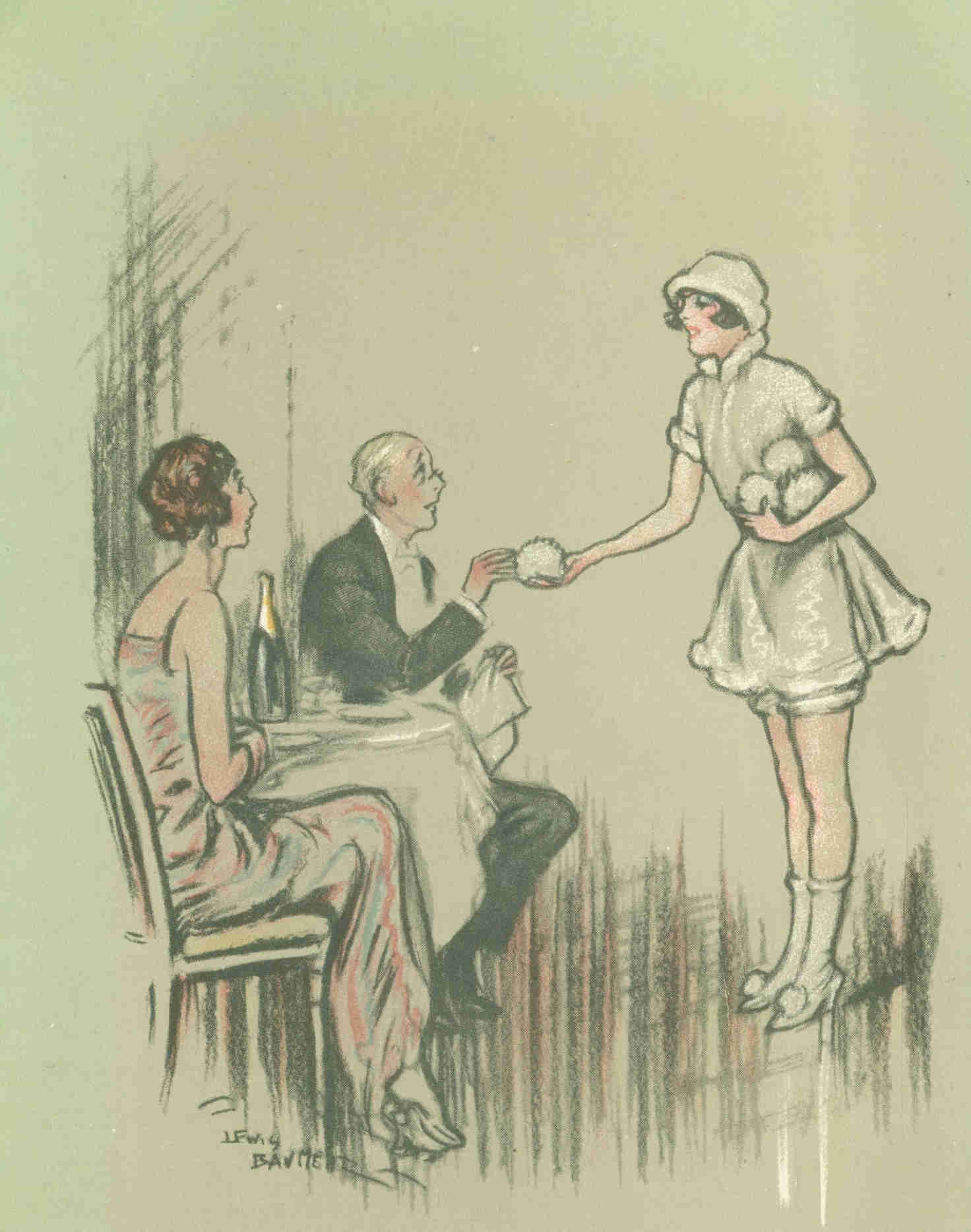
“With her right hand she is offering him a large snowball made of cotton-wool.”
The shufflers retire, amid applause—chiefly from the back of the room, where the waiters are standing—and once more the Beauty Chorus is upon us. This time they are attired in dazzling white. They represent rabbits, or polar-bears, or possibly Snow Queens. They take up their usual stations, while their leader sings a song about Winter in Labrador. Then they face about as before, and the member for West Croydon shrinkingly realizes that he is in familiar company. She is still singing, she is still gazing right through him; no gleam of animation or humanity illumines her features; but with her right hand she is offering him a large snowball made of cotton-wool. Completely hypnotized, he accepts it; then breaks into a gentle perspiration as he realizes that he is expected to throw it at her. His neighbours have already done so: some are begging for more ammunition: one of the gentlemen in tortoise-shell spectacles can be heard addressing his unresponsive target as “Baby.” But he who hesitates is lost—or perhaps in this case saved. The song finishes; the Snow Queens melt away; and the snowball has not been thrown.
The lights are turned up; the entertainment is over for the time being, and the audience can do its own romping. Stewards appear, handing out mouth-organs and false beards made of coloured paper. The band suddenly invades the floor in serpentine formation, weaving a course among the dancers. The leader wears a miniature bowler hat, secured to the side of his head with elastic; his colleagues loyally second his mirth-provoking efforts by simulating the palsy. The air is filled with fluttering paper and the braying of mouth-organs.
“Have you got your change yet, Robert?”
“Yes, dear.”
Prisoner and escort rise, and make their way towards the door. But as his wife disappears into the vestibule West Croydon turns suddenly and impulsively upon his heel, and with a defiant shout hurls a large cotton-wool snowball into the thick of the dancing throng. Then, glowing with satisfaction, he hurries out to catch the 12.55. He has lived his hour.
Cinema-going offers two great advantages over theatre-going—you can never be late, and you can go by yourself. One of the chief deterrents of the spoken drama is the necessity for arriving at a fixed hour, and of finding a companion to go with. No one likes to be seen at a theatre all alone: it looks unnatural—almost morbid. At any rate, it feels like that. So busy people, and casual people, and solitary people—and heaven knows this crowded world is too full of such—welcome the cinema both as a recreation and a refuge.
It is cheap too. Here we are—some thousand strong—sitting in comfortably upholstered armchairs, for which most of us have paid the sum of one and threepence, getting at least our money’s worth. For the moment the orchestra have left us—doubtless to fortify themselves against further exertions—and the story upon the screen (a riotously comic story, incidentally) is unfolding itself to the accompaniment of a majestic recital upon the grand organ. Around us, in the soft, warm darkness, pierced by a broadening pencil of light from the lantern, innumerable cigarettes are glowing, and there is a steady rustling of the crinkly paper which lines chocolate-boxes. We are not a demonstrative audience: British cinema audiences seldom are. It is not easy to be enthusiastic in the dark, though they manage to do it in America. (There is a certain comic film in which that amazing genius, Charlie Chaplin, lightly attired and covered with soapsuds, engages in battle with a gigantic masseur in a Turkish bath—a Turkish bath with a treacherous floor and many obtrusive steam pipes. I saw that film released in Chicago. Before the fight was half over the audience were standing on the seats roaring like a football crowd, addressing the hero by his Christian name and acting precisely as if he were present in the flesh. It was one of the greatest triumphs of sheer personality that I ever saw.) But over here we are more stodgy and phlegmatic: we laugh, we chuckle, sometimes we shed a furtive tear—but we take a pride in keeping ourselves and our emotions to ourselves. Besides, our logical faculties ask us why we should waste perfectly good applause upon an insensible strip of celluloid.
Let us survey the audience in detail so far as the obscurity will allow.
On our left are a pair of lovers, locked in the peculiarly uncomfortable embrace usually favoured upon these occasions; and we turn tactfully away, realizing at once that no new feature of interest can be expected in this quarter. On our right sits a very remarkable product of the present day—the cinema child. This specimen is aged possibly twelve, but she is completely grounded in the conventions of the film drama. However rapid the changes, however inconsequent the succession of the scenes, she never falters in her comprehension of the plot: she understands perfectly the special significance of the close-up, the cut-back, and the fade-in, and elucidates these intricate mysteries with patient indulgence to her escort—a bewildered but humorous uncle, who is not apparently a seasoned patron of this form of entertainment.
“No, dear, it isn’t all jumbled, really; it’s perfectly clear if you attend. He’s having supper at the Moulin Rouge—in the Underworld of Paris, you know——”
“Honestly, Molly, I don’t!”
“—With Fie-Fie, the Queen of the Latin Quarter—that’s all.”
“I’m glad that’s all. Why are they drinking ink out of champagne glasses?”
“I don’t know: perhaps it’s port. Anyhow, his wife doesn’t know he’s there.”
“You surprise me. What’s the matter with him now? Why is he staring at us, and not at Fie-Fie? Look at his face! Is he going to have a fit?”
“No; that’s only to show he’s thinking. Wait, and you will see what he’s thinking about.”
Sure enough, the picture begins to fade out, and presently the tensely drawn features of our hero, one Terry de Lancy—already introduced to us as A Basker in Broadway’s Brightest Lights—are mercifully eclipsed. The picture fades in again, to reveal to us a lady in a becoming négligé, with her hair down her back, gazing tearfully out of her bedroom window—presumably in the direction of the Underworld.
“That’s his wife—what he’s thinking about,” explains Molly. “Now you’ll see the Moulin Rouge again.”
The uncanny child is right. The errant husband is once more revealed to us, and promptly takes a deep draught of ink—evidently to stifle the pangs of conscience.
“He needed that!” comments Uncle. “Hallo! who is this?”
The Moulin Rouge has disappeared in a flash, and we find ourselves confronted by a gentleman of foreign appearance, in evening dress (which includes a grey satin waistcoat with diamond buttons) seated in the interior of a taxicab which rocks in a realistic manner. Suddenly his face swells to enormous size, filling the whole screen. Uncle starts violently.
“Great Scott, Molly!” he exclaims. “What’s that? Mumps?”
“That’s a ‘close-up.’ It’s done to show him biting his lips with rage.”
“What for?”
“I expect he’s Fie-Fie’s Discarded Flame. He’s on the trail of her and Terry de Lancy.”
“I hope he finds them.”
“I’m sure he will. But you’ll see her spurn him if he does.”
We see more than that. Straightway we are involved in a spectacular shooting affray, interspersed with a bewildering welter of cut-backs and close-ups—the Queen of the Latin Quarter clinging hysterically to a marble pillar; a negro drummer goggling in the adjacent band; a broken bottle exuding froth under the table; a police superintendent behind a desk answering an urgent telephone call; a discharged automatic lying on the carpet; and, at frequent intervals, the anxious lady in the négligé, still at her casement.
Of course everything comes all right in the end, with that uncanny speed which characterizes the work of the super-producer who has lingered too lovingly over his detail and suddenly realizes that he has only one hundred feet of celluloid left in which to round off his plot.
So much for Molly and her uncle. Behind us sits a lady of a type not uncommon in these places, who considers it her duty to read aloud (for whose benefit it is not quite clear) the whole of each printed caption as it is thrown upon the screen. She does not do it well, but she does it thoroughly. She possesses in a remarkable degree what opticians call “persistence of vision,” and this enables her to pursue the current sentence to a stately conclusion long after it has vanished from the screen and the picture been resumed.
“And at this poy-ignant moment the soul of Daphen Van Skewler, once a coke-wet of New York’s most exclusive cote-righ, blossomed a new, and found its shoelace—solace——”
Here the picture resumes its normal course; but she continues, quite unruffled
“—In the love of a REAL MAN—a son of The Great Outdoors—Len Lonergan, the Hermit of Smithson’s Gulch. See, Father, that’s ’im a-kissing of ’er now. I expect it’s the end: perhaps the next will be another comic.”
“I ’opes so,” says Father resignedly.
But they are doomed to disappointment. The next film is devoted to items of news. We behold sundry happenings of the week—the opening of a Municipal Building somewhere, with the inevitable close-up of an embarrassed celebrity obediently soliloquizing; a March Past of the Grenadier Guards in the presence of Royalty, enhanced by a patriotic caption, British in sentiment but Broadway in expression, somewhat as follows:—King George gives his boys the once-over. And we’ll tell the world they are some boys!
It is followed by the announcement—The Mystery of Insect Life.
“I am afraid this is Educational,” remarks Molly.
Molly is right. The film deals, in unpleasant detail, with the life of a singularly repulsive member of the insect world. It accompanies him from his cradle to his grave. We see his parents, his birthplace, and himself—as an egg, as a grub, in the form of larva, and of course in a “close-up.” Beetles are never pleasant objects to contemplate, especially brown, leggy, sticky beetles; but a beetle expanded to a diameter of about two feet, with all its personal deformities magnified in proportion, is an outrage upon human vision.
All over the hall the tip-up seats begin to click to attention, as their occupants rise and stumble out. Uncle, in a strangled voice, is heard to suggest tea somewhere. Fortunately, Molly acquiesces.
“I wonder why they show a silly picture like that?” she says. “It only makes people go out.”
“I expect they know their business,” replies Uncle, gratefully inhaling the fresh air. “Your friend the beetle is what is technically known as a ‘chaser.’ Our seats can now be sold to someone else. The humblest insect has its uses, you see. Rumpelmayer’s, please!”
As a philosopher once pointed out, there is always something pleasing to us in the spectacle of a fellow-creature in difficulties. That is why people flock to the Law Courts for a day’s pleasure. And they seldom draw a blank day, for our Royal Courts of Justice offer an infinite variety of entertainment. If you are seriously interested in legal problems you can visit a court containing as many as three judges at once, taking it in turn to keep awake while counsel discuss among themselves, in passionate undertones, something absorbing in re Perkins dec. (App. by defdts. from judgt. of Mr. Justice Dudde, pt. hd.). At least, that is what it says on the printed slip out in the corridor. You sometimes see as many as half-a-dozen spectators in these courts. You can get a seat there, which is more than you can do in the Probate, Divorce, and Admiralty Division, where people stand packed like herrings all day long, on the off chance, presumably, of hearing some stirring tale of a collision between two dredgers off Wapping, or the romantic proving of a faultily drafted will.
Or if you are not specially interested in any particular branch of the law, you can simply browse round, as we are doing to-day. By “we” I mean myself and my cousin George, from Rutlandshire, who has come up from the country to buy his autumn suit and see life in London. Last autumn he bought blue serge and went to the Hippodrome; this year he has gone in for a grey tweed and the Royal Courts of Justice. After all, variety is the spice of life.
We met with disappointment, however, on the very threshold of our enterprise. We asked a question of an affable policeman at the entrance.
“Which court, sir? You won’t find him in any court to-day. He’s retired, quite recent.”
“Oh, I say!” said George. “How rotten!”
We paused irresolutely upon the steps.
“Let’s go to the Vaudeville,” I said. “They’ve got a pretty funny man there just now, and it’s quite close.”
But George demurred.
“No,” he said, “let’s go in. We’re sure to find somebody. Who else is funny here?” he asked the policeman.
“Nobody at all, sir—present company always excepted,” replied the policeman politely.
We passed into the central hall, feeling somehow that we had lost the first hole.
If you are a stranger to the Law, you are conscious at first of a certain diffidence about entering a court of justice at all. It seems so impertinent to push open a swing door uninvited, and intrude upon an intimate discussion of somebody else’s private affairs. So at first we walked delicately, shrinking painfully from doors furnished with doorkeepers. Presently we paused outside one which no one appeared to be guarding, and peeped through the glass panel. Beyond a red curtain we caught a glimpse of a white wig, presiding over more white wigs.
“Let’s oil in here,” said George. “They can only throw us out.”
“And we do pay income-tax,” I added resolutely.
At this moment I felt a tap on my shoulder. I started, I admit. One does in these surroundings.
“Entrance reserved for counsel in robes, gentlemen,” intimated a stern voice. Then, with a genuine effort at mitigation: “Of course I might oblige you——”
“Oh, sorry!” we said, and hurried guiltily away round a corner. Here we found another court, and entered, timidly. But our diffidence was unjustified. Nobody took the slightest notice of us. The Judge sat apparently writing a letter home, while a gentleman with wig much awry, surrounded mysteriously and unexpectedly by pyramids of cigar-boxes, read to him, with passionate emotion, extracts from an extraordinarily prosaic periodical called The Trademarks Journal. The same thing was happening in the next court, except that the reader this time was mumbling from a musty volume of Law Reports, while the Judge was sleeping like a child. Evidently the bedtime story has caught on in the Law Courts in no uncertain fashion.
“This is pretty fair rot,” observed George, as we emerged once more into the comparative ozone of the corridor. “I wonder where the Nuts are. We’ll find them all together somewhere.”
He was right. The very next court was packed to the doors. A blast of hot air—I speak literally, not figuratively—greeted us as we struggled in. It was a large court, and in the centre of the throng stood an extremely important-looking King’s Counsel, who, we were informed in a reverential whisper by an unclean stranger with whom we found ourselves sharing some fifteen square inches of floor space, was Sir Turnham Dippey, the celebrated witness-baiter, engaged in his daily avocation of impressing his personality upon the court—in other words, scoring off people who were not in a position to retaliate. Presently we began to grasp the rules of the game. They were simple, and the system of scoring was clearly defined. For instance, to irritate opposing Counsel counted one point. Thus:
“I am afraid I must ask the witness to repeat his answer. My friend was talking, and I could not hear.”
If you can administer an indirect reproof to the Judge for inattention, you score two points. A good plan is to refer to a note of his which you know he has not taken, and make him hunt for it. But full points can only be attained by proficiency in that favourite and perennial sport of the legal profession, the scarification of witnesses. There are three clearly marked variations of the theme.
Firstly, comic repetition of a perfectly ordinary answer, for the edification of the jury; or indeed of anybody present who will laugh. Thus:
“And what were you doing there at all?”
“I was waiting for my wife.”
“Oh! You were waiting for your wife.” (To the jury) “Note, ladies and gentlemen—he was waiting for his wife!” (Loud laughter.)
The Judge (exercising his undoubted right). “He was there for the purpose of keeping an appointment with his better half.” (Roars of delight.)
Secondly, simulated indignation over the shiftiness of some particularly straightforward witness.
“You were standing about six or eight yards away? What do you mean by giving me an answer like that? Six or eight yards! Which was it—six yards, or eight? Come now, answer me! You can’t waste the time of the ladies and gentlemen of the jury in this way, you know. Six or eight yards, indeed!”
But the third gambit is the favourite. It is the most consummate jest in the legal repertoire.
On this occasion the great man began by lulling his victim into a sense of false security.
“Now, Mr.—thank you! Mr. Dumble! You say you were standing at the corner of the street about fifty yards from the scene of the quarrel, at about five minutes to four in the afternoon on the day on which the quarrel occurred, and that it was raining at the time. Is that correct?” He cooed encouragingly.
“That’s right, sir,” said Mr. Dumble nervously.
“Thank you.” His voice rose. “Now, you’re quite sure? Positive? You would swear to that?”
“That’s right, sir.” Mr. Dumble, who was not accustomed to public appearances, or words of more than one syllable, broke into a light perspiration.
“Then why,” demanded Sir Turnham Dippey, throwing off the mask and plucking a document from the desk before him, “when you made a declaration upon the subject last October—a declaration which was taken down in writing and read aloud to you, and which you afterwards signed—did you say that you were standing sixty yards away, and that it was five minutes past four, and that the weather was only moderately fine? What? You don’t remember saying these things last October? My dear sir, look at this document! Isn’t that your signature? You didn’t read the statement? Then why in the name of common sense and common honesty did you put your signature to it? Answer me that, if you can! You thought it didn’t matter? Great heavens—not matter? You see, ladies and gentlemen of the jury, the type of witness which my friend thinks fit to put into the box!”
“What a game!” remarked honest George, sotto voce. “Let’s get out!”
In the next court the atmosphere was comparatively salubrious: that is to say, it smelt of decayed book-bindings instead of warm humanity. Here a rosy-faced old gentleman in gold-rimmed spectacles was benignantly refereeing in a rough-and-tumble between two overheated Counsel, engaged, as far as we could gather, in a life-and-death struggle for the person of a dazed youth, with rumpled hair and a dirty collar, who stood behind a barrier in one corner. We sidled into a pew, and endeavoured to pick up the thread of the story. Apparently a motor-car (of an inexpensive and widely-advertised brand) had run into a stationary donkey-cart and killed the donkey; and the first Counsel, a prognathous gentleman with a Lancashire accent, was claiming damages in no uncertain voice. The defence suggested that the donkey had in some way provoked or enraged the Ford, and submitted that there was no case. The Judge pointed out with a kindly smile that a dead donkey is a case in itself, and that the court was sitting to appraise responsibility for its decease. This intimation came as an obvious surprise to the rumpled young gentleman in the witness-box. Appearances to the contrary, he was not a criminal on trial for his life, but an independent citizen of London who, passing at the time of the accident, had volunteered, under an impulse of misguided public spirit, to come and give evidence. What his original impression of the cause of the disaster may have been it was now impossible to say: after his examination in chief, cross-examination, and re-examination, it was obvious that he had made up his mind that he had assassinated the donkey himself; and he stood waiting, in limp and apathetic resignation, to hear sentence pronounced.
The roar of battle grew louder.
“Going to see a good scrap at last!” said George, in my ear.
Again he was doomed to disappointment. With startling suddenness the tumult ceased; the prognathous one sank back like a dying gladiator, and Counsel for the Defence announced:
“My friend and I have decided to settle the case, my lord.” (He did not say “m’lud.” They never do, we found.)
“I thought you would,” replied the Judge, as unruffled as ever. “How much?”
A modest figure was named—painfully disproportionate to the magnitude of the recent conflict.
The Judge began to write in a book. There was a general upheaval, and the young gentleman behind the barrier, amazed and incredulous, staggered out into the world a free man. We followed his example, while there was yet time.
“Well,” remarked George, “if ever I find myself up against those chaps”—alluding apparently to the Legal Profession in general—“I hope I shall be in the dock and not in the witness-box! Taxi!”
Piccadilly Circus on a fine Saturday evening in October presents London at its most attractive, almost. Falling darkness—crisp air—bright lights—and London’s cheerful roar, punctuated by the shouts of newsboys. Only a June morning in Kensington Gardens can beat it.
But we must emphasize Saturday. The scene between five and six o’clock on the other evenings of the week is characteristic enough, but the actors play their parts with a smoothness which borders upon the mechanical. Take Friday. At five o’clock, on the first of the ebb, comes a wave of clerks and typists—the female element predominates largely in this area—released from office and hurrying to form voluble queues for this ’bus route or that; or possibly repairing to a teashop, for a meal more satisfying than nourishing, before proceeding to take station outside a pit door.
The tide of home-bound shop-assistants will not begin to run for another hour yet; but already you may behold their natural prey, the shoppers, escaping from the field of battle in many divergent streams to their own particular Tube station. From the direction of Holborn come luxurious cars, containing prosperous-looking gentlemen who, having signed the day’s mail at half-past four, are now rolling out to some lordly mansion situated somewhere in that elastic area, stretching from Knightsbridge to Wimbledon, which the Post Office calls S.W. Most of these, though, follow the Embankment route, which leaves more room for London’s most conspicuous feature, the motor-’buses, packed inside and out—the regulation scarlet Dreadnoughts, handled with incredible skill and consideration by the finest body of drivers in the world, and their many-coloured and more aggressively inclined competitors.
Here and there, too, the pavement is encumbered by suburban femininity recently removed from the shrine of Miss Gladys Cooper or Sir Gerald du Maurier—there is a matinée of some kind in the West End almost every afternoon now—acrimoniously deciding whether to go home and have tea or have tea and go home.
But all these are seasoned actors in the stock drama of the week. Saturday evening is reserved for the amateurs. The professionals hastened from the stage at one o’clock, when the shops and offices closed, and are no more to be seen. A happy-go-lucky atmosphere prevails: there is no unseemly haste displayed; and no one seems to want to go home, for the simple reason that everyone has just arrived. Many types are represented, and they are almost exclusively Saturday types.
Observe this jolly band of youths with hockey-sticks. They have probably been playing a match away from home, say at Norbiton or Surbiton, and are now crossing London by Tube, on their way back to Hampstead or Highgate. But they are not going home yet, by any means. Non semper arcum tendit Apollo—which means, roughly, that Piccadilly Circus is a pleasant place to be a gay dog in. They will deposit their hockey-sticks and little bags in the cloak-room at the Tube station, and then proceed to embark upon an evening of innocuous and inexpensive revelry. Not that it will sound like that when they describe it to their colleagues in the office on Monday morning; but after all, what would life be without Romance; and what is Romance but fact expanded to fable?
And here are three slightly more sophisticated pilgrims—undergraduates on absit—or possibly exeat. Twenty-five years ago an absit or an exeat was a highly prized privilege—especially the latter, because it lasted longer. With an absit you had to be back in Oxford or Cambridge by midnight, which necessitated catching the last train; and a shocking bad train it was, and is. But in these days of cars and motor-cycles, who knows whether anyone ever troubles to apply for an absit at all?
Still, though customs may change, the type abides. Our three friends, fortified against physical stagnation by an afternoon of violent exercise, are now prepared to devote the balance of their day to the cultivation of the gentler arts. They are not Blues, or supermen of any kind. They represent that sterling stuff, University rank-and-file—the kind that does a reasonable amount of work during term time (if you take a reasonable view of what a reasonable amount of work is) and is sufficiently athletic to represent its College at games; and goes down after three blissful years with a degree of sorts and a collection of photographic groups of young men with bare knees and lowering brows all exactly like itself, to carry on its immemorial tradition wherever the Flag flies. This trio, not content with playing Rugby football for the College against other Colleges on Monday, Wednesday, and Friday of this week, have come up to town to indulge in an extra allowance of the same reposeful pastime in the ranks of some metropolitan “A” Team—say the London Scottish, or Blackheath. Now they have gravitated instinctively to Piccadilly Circus, partly because Piccadilly Circus is the Mecca of London’s pleasure-seekers, but mainly because the average undergraduate does not know London nearly so well as his conversation would lead you to expect, and likes to select some safe and easily rediscovered base from which to conduct his urban operations.
How are they going to spend the evening? Well, in days not far distant they would probably have dined sumptuously at the Trocadero, à prix fixe, and gone to the Empire. This evening, for all one knows, they may be bound for the Palais de Danse, to air an accomplishment which was rather despised in what we are pleased to regard as a more Spartan day. Still, one may be forgiven for regarding fox-trotting at Hammersmith, under conditions of rigid propriety, as a recreation at least as suitable for callow youth as promenading at the old Empire.
But there are others in Piccadilly Circus with far less definite plans than these—no plans at all, in fact. Expensive restaurants and theatre stalls are not for them. Like the Scotsman in the story, they do not propose to spend much more than the evening.
A large proportion of the throng is made up of lovers. Many of these have been married for quite a long time, and they have the children with them. To such the week-end is a festival of reunion. Sunday will be devoted mainly to eating, slumbering, and the overtaking of the week’s news, in popular form. But Saturday evening is set apart for high jinks. There will possibly be a rather exciting meal, with a band playing, at that palatial establishment which the enterprising and ubiquitous Mr. Lyons has just erected in Shaftesbury Avenue, with as many floors as an Atlantic liner has decks, and a restaurant on each. After that, the upper-circle—or the cinema, perhaps; but more probably they will wander contentedly about the streets near by, keeping resolutely to the wrong side of the pavement and respectfully inhaling the atmosphere of the wild night life of the Haymarket or the Strand. A high but not particularly hazardous adventure in these days: it is doubtful whether in their peregrination they will encounter so much as a drunken man. The ever-increasing sobriety of London is the most hopeful feature of this difficult era of ours.
But that does not exhaust the list of pleasure-seekers. We come now to those who are only able to patronize amusements that are free—and in purveying and enjoying these London and Londoners have no equal. For instance, a serried mass of humanity is now occupying the island which surrounds the Circus fountain—sacred during the hours of daylight to the flower-selling sisterhood—rapturously beholding the electric advertisements, which have just been switched on for the evening. A New Yorker present in the crowd is “tickled to death,” and with some reason, for in this particular industry Broadway can make Piccadilly Circus look, as our guest is too courteous to point out, like thirty cents.
Indeed, the Broadway signs probably represent the greatest waste of electricity in the world.
Of course it may be argued that no money spent on successful advertising can be wasted. But are these Broadway advertisements successful? Many of us have seen them; some of us have lived under them. What recollection have we brought away with us? The recollection of a whole heaven ablaze with electric devices so huge, so wonderful, so ingenious, that we were too much occupied in admiring the devices themselves to notice what they were advertising. We have blurred memories of chariot-races across the sky; of kittens playing havoc with balls of worsted in mid air; of giant typewriters punching out lines of illuminated text which never stayed long enough to be read. What were they advertising? Ah! At the most we remember an exhortation to buy some kind of motor tyre, or somebody’s chewing gum. But which tyre? Whose chewing gum? The fact is, the famed Broadway signs advertise Broadway, and not much else.
Meanwhile the Londoner is pleased enough with his own little display. Of course electric signs are no novelty in London. There used to be one in Trafalgar Square long, long ago, high up in the sky somewhere above the Grand Hotel. Here an invisible hand would begin to write V-i-; and just as your breast was beginning to swell with loyal approbation (it was about the time of the Diamond Jubilee) the succeeding letters followed, and the word turned out to be Vinolia. Then the hand, as if ashamed of such sordid commercialism, hurriedly rubbed out the word and began it all over again.
Shortly after that London sky-signs underwent a period of eclipse. Someone in authority discovered that they were undesirable things: they might frighten the horses, or attract the moths; and they were abolished. I think the building of the Coliseum was immediately responsible. The proprietors of that institution finished it off with an enormous glowing knob, revolving upon its own axis on the topmost pinnacle. That galvanised the powers into frenzied action, and moving sky-signs were taboo henceforth.
And now, with the War over and commerce regaining its ancient élan, they are coming back. Mostly they are grouped here into one corner of the Circus—that is, if a circus can have a corner—but there are a few outposts further afield. Oxford Street, for instance. And then there is the lady in the short skirt, who dances all by herself in the sky near Charing Cross. She looks better by night than by day, for the pitiless light of the sun reveals the fact that she possesses four legs—one fixed, three intermittent. That is to say, she stands upon one permanently radiant leg; of the other three one is swung right forward, the other right back, and the third occupies an intermediate position. The effect when these limbs are illuminated in rotation is most exhilarating. (To all, that is, except the dear old lady whom I overheard the other evening, while waiting for a ’bus about lighting-up time, expressing the opinion that it was “very dangerous for that poor thing up there.”)
But most of the signs are gathered here—upon the spot which an adjacent place of entertainment designates, not without reason, as the Centre of the World. There is quite an assortment of them. There is a motor-car, with revolving wheels which churn up a cloud of sparks—or possibly dust—conveying a lady passenger emitting flames from the back of her head—or are they feathers? There is a puppy of the Bonzo breed, smoking a cigarette. There is a bottle of port which empties itself into a glass, and then, after momentary eclipse, reappears miraculously replenished, and begins all over again. There is a cocktail shaker in full action. (New York was once rich in such signs, but the Eighteenth Amendment to the American Constitution has removed these pleasant temptations from the firmament.)
Last but not least comes the Baby with the Bottle. The baby suddenly appears before us—gloriously bald-headed, except for a luminous forelock. Its eyes are closed, and its mouth is attached to an empty bottle. The corners of the mouth are turned down, and the expression is discontented. Suddenly the bottle becomes filled with some opalescent fluid. The pucker in the baby’s brow vanishes; the corners of its mouth turn up; a dimple appears in either cheek; the left eyelid is lifted knowingly and lowered again. As the liquid in the bottle is absorbed, the baby’s satisfaction is visibly indicated. Its face is now framed not in golden lights, but in crimson. The bottle is almost empty; the infant toper’s features grow apoplectic; and just when we feel that it must either draw breath or burst, the lights are providentially extinguished, and when next we see the baby he is suffering once again from insufficient nourishment. This is by far the most popular exhibit. Not less than a dozen mothers are holding their offspring aloft, to the entire dislocation of traffic, that they may obtain vicarious enjoyment from the spectacle.
“Little things amuse little minds!”
This observation comes from a pompous gentleman who has been impeded by the multitude of star-gazers in his course toward a Number 19 ’bus, waiting at the corner of Shaftesbury Avenue. His remark is addressed to a traffic policeman, evidently for the edification of the bystanders.
The policeman, as becomes the dignity of his office, makes no reply. But a man in a threadbare coat takes up the challenge.
“Give us a chance, ole friend!” he says. “We can’t all afford to drop into the pitchers every time we’ve ’alf an hour to spare—see? A free show and no amusement tax—that’s what some of us are jolly well glad to get, these days! Besides, life ain’t so merry and bright for everybody, you know. Look there!” He points.
In the growing darkness two wagonettes have entered the Circus, driving slowly, as if for sight-seeing purposes. They are not distinguished-looking wagonettes. They have obviously been hired on the cheap, by some person or society with just sufficient money to provide an occasional outing for people who do not go out very much, and who are glad to get out on any terms—people, perhaps, whom the rest of the world has almost forgotten. The passengers are all men—curiously quiet-looking men of about the same age—military age—with rather resigned-looking eyes, that light up in grateful amusement as the Baby enters upon its celebrated entertainment for the hundredth time that evening. A sheaf of crutches projects from the back of each wagonette.
“Look at them!” says the threadbare man, still pointing. “Do they have much fun, guv’nor? I ask you? Do you grudge ’em anything?”
The pompous man follows the finger, and his pomposity falls from him like an ill-fitting cloak. It is possible that he once possessed a son of military age.
“You’re quite right,” he said. “I beg your pardon.” He glances up at the twinkling signs again. “And I—I think they ought to put up more of those things.”
“Understand,” I said to George, “I will not kiss anybody.”
“Don’t you worry about that,” replied George. “You’ll be lucky if any of them give you two fingers to shake. Children aren’t what they were when you and I were promoted to braces.”
“And I won’t do conjuring tricks.”
“You won’t be asked. They’re going to have a bran pie and Broadcasting. All you and I have to do is to make ourselves generally affable—run round effecting introductions, breaking down social barriers, and what not. Barbara is fearfully pleased you’re coming. I told her that going to children’s parties was the one thing in the world you did everything but; so, naturally, she feels honoured that you should have broken the rule of a lifetime in favour of her two kids.”
With such soft sawder he beguiled me until we reached Barbara’s.
The first half-hour was well enough, because the young lions were upstairs having tea. We elderly Christians had ours in the drawing-room, with Barbara and four more young mothers. Barbara is George’s first cousin on the side of the family remote from mine. That means that Barbara is not related to me. Sometimes I wish she were: she is what is technically known as “a dear.”
George and I sat meekly nibbling éclairs, listening to nursery politics. I heard some things about modern under-nurses which made me glad that I was safely grown up. We were just getting down to the pros and cons of shingled hair for youthful matrons with Early Victorian husbands, and George and I were enduring some pretty nasty side-kicks, evidently designed to be passed on to the proper quarter, when the double doors were thrown open by a white piqué head-nurse, and the guests of the evening filed in.
There were about a dozen of them, of various sexes, and one sorted them out gradually. I was introduced to three or four; others I eventually recognized as old acquaintances. With the rest I just clicked, to employ George’s plebeian expression, as occasion arose.
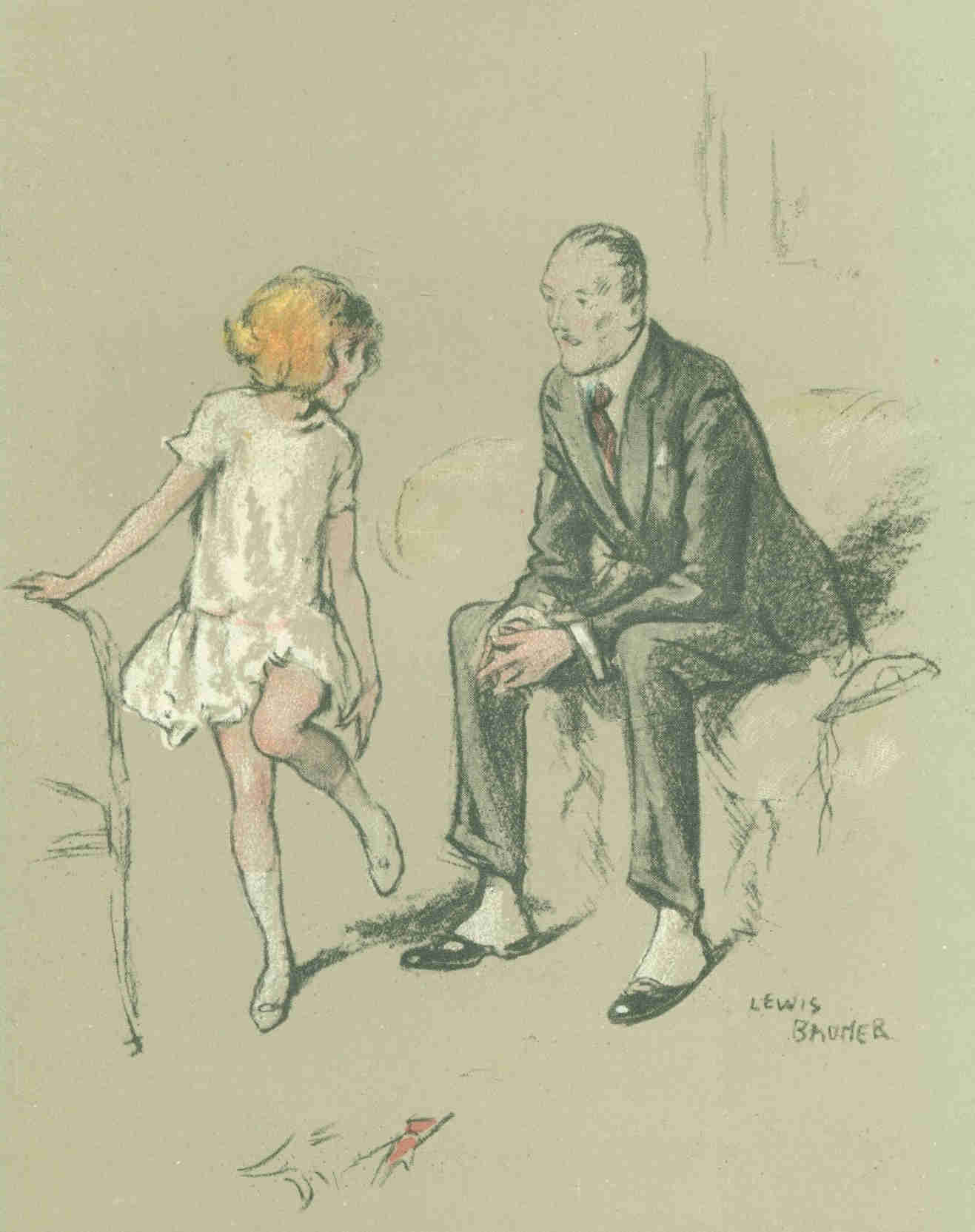
“She explained that they had white elastic sewn round the tops, inside.”
I liked Rosemary best. In fact, we took to one another at once—or rather, Rosemary adopted me, evidently recognizing me as the pariah of the party from the start. I am inclined to be shy with children, and Rosemary was by nature the mother of all living, so we got on famously. She wore white silk socks. Not that she was singular in that respect, but her socks seemed to be the only socks in the company, always excepting George’s and my own, which would stay up. After we had pulled our third cracker together I asked her how it was done—less because I really wanted to know than because I was a little short of conversational openings. She explained that they had white elastic sewn round the tops, cunningly concealed inside. Her mother had invented the idea. Rosemary cherished an enormously high opinion of her mother, I found. Unfortunately that gifted lady was not present, having to stay at home and look after Reggie, who was having one of his bad days, it seemed.
Then Rosemary asked me how I kept my socks up. I explained, and even revealed to her a portion of the mechanism employed. After that we were practically inseparable.
But I must tell you about the other members of the party. When first introduced into our presence they were obviously suffering from repletion, and betrayed a languor of demeanour and a fixity of expression which amounted, in the case of one or two of the young gentlemen guests, almost to a state of coma. The case of one Gwennie went further than that. Shortly after her arrival in the drawing-room she developed frontal pains of a nature so instant and tear-compelling as to necessitate her temporary removal to the night nursery, with someone else’s hot-water bottle.
But the rest soon roused up over the pulling of crackers and the donning of paper caps—I got a pea-green glengarry bonnet, by the way—and when the bran pie was opened the birds began to sing with a vengeance, and individual characteristics, hitherto dormant, sprang out like knobs.
Foremost in the fray were Barbara’s own two fair daughters, aged about eight and six, and named by an observant but unsentimental male parent the First Murderer and the Second Murderer respectively. These, I thought, made rather more than justifiable use of what is known upon golf courses as “local knowledge” when their turn came to dip into the pie. Then there was a youth named Basil, to whom I took an instant and violent dislike. He was attired in puce velveteen, and breathed loudly through an ever-open mouth. However, as a fundamental explorer of bran pies he showed us that the meanest of God’s creatures is an expert at something. The bran pie, by the way, was contained in a barrel, cunningly draped in book muslin, which stood in the centre of a dust-sheet in the adjoining room—the smoking-room, in fact. By the time the pie had been rifled and the presents unwrapped the room looked more like Hampstead Heath on the Tuesday after Easter than anything else; but Barbara said that it served Harry right for not coming home to help with the party, and George and I basely applauded her.
Prominent among the other guests was Charlotte, a sharp-featured child with the soul of a nursery governess, who devoted herself throughout the proceedings to shrill reproof and the herding of stragglers. At the opposite end of the scale came Blossom, the junior member—so recently arrived, it seemed, in this profoundly interesting world that the wonder of it all had not yet died from her large unwinking blue eyes. She sat upon a cushion upon the hearthrug, supervised by a proud and absurdly youthful mamma, gazing placidly, benevolently, and a trifle absent-mindedly upon the revels, receiving more attention and giving less trouble than any other guest. Rather like Royalty, George thought.
But to return to the revels. To be frank, we made heavy weather of them. The modern child does not seem to romp with any degree of spontaneity. It eats heartily, and is well to the fore when anything is being given away free—especially things which seem to be coveted by someone else—but as a guest it is a heart-breaking proposition. Gone is that responsiveness to hospitable intention, that readiness to be amused, which marked the finer product of a bygone age. The only real joy which the present generation seems to derive from being taken to a party is in sitting well back and disparaging the arrangements made for its entertainment.
We were soon to discover this. A game of Oranges and Lemons was proposed by Barbara. Needless to say, George and I were bidden to clasp hands in the middle of the floor and form the nucleus of the conflict. George was Oranges, and I was—and felt like—Lemons. A string of reluctant infants was hounded (by the officious Charlotte) under our outstretched arms, and each, upon being encircled and captured, was asked the usual question. Some said they would be Oranges, others Lemons; but all practically implied that they did not care a twopenny curse which they were. Excepting Rosemary, of course. With a ravishing smile, she replied in a hoarse whisper that she would be whatever I was. Old age has its moments.
Presently the usual tug-of-war began. George and I threw ourselves loyally into the task, wrestling furiously together, getting exceedingly hot and dishevelled, and uttering encouraging cries to our supporters. Presently George said:
“I think we’re making ourselves rather conspicuous, old man—what?”
I looked over my shoulder. Rosemary was hanging nobly to my coat-tails, but the rest of my flock had abandoned me. I looked over George’s shoulder: there was nobody there at all. Our late adherents were sitting silently round the room, regarding our futile entertainment with the indulgent boredom of county families watching yokels climbing a greasy pole. Abashed, we crept to our seats.
“Splendid!” said Barbara kindly.
“We won!” announced Rosemary, squeezing my hot hand with a hotter one.
George and I merely sat and panted. Nobody else said anything. Plainly, the party had reached what is mechanically known as a dead-centre. Barbara glanced at the clock, and rose briskly from the floor.
“I think it is time,” she announced, “for Uncle Septimus.” She removed a screen and revealed a contraption of brass knobs and electric bulbs unfamiliar to me.
“What’s this?” I asked George. “Gramophone?”
“No—a listening-in outfit. Broadcasting, and so forth. We’re going to have bedtime stories, from Uncle Septimus and other well-known raconteurs.”
By this time, needless to say, Charlotte had arranged seats in a convenient semicircle, and was conscripting an audience. I distinctly saw her cuff a conscientious objector considerably larger than herself.
“This is something quite new to me,” I said to Rosemary. “I suppose you know all about it?”
“We’ve got a set at home,” replied Rosemary—adding, with characteristic tact: “but it’s only a little one. Not nearly so nice as this. This’ll be loverley.”
“We’ve got one like this at home,” announced Basil—“only bigger.”
“Is it a valve set or a cwystal set?” briskly inquired a cherubic little girl, apparently about five years old.
“Valve set, of course! You can’t have a loud speaker with a crystal set. You are a silly kid, Dorothy. Where do you keep your aerial?”
“On ve woof. Our earf is a tap in the bafroom. We nearly got Aberdeen ve uvver night, only ve wave-wength——”
“Are our services urgently required for the next ten minutes?” I whispered to George, whose tongue, I noted, was still hanging out.
“I don’t think so.” Together we caught Barbara’s eye. She smiled and nodded.
“You’ve both been sweet,” she said. “You’ll find the tray in the smoking-room. You’ll have the room to yourselves. Don’t be too long: we shall miss you.”
We tiptoed out, as from a meeting of the Royal Society. As we left the room the horrid child Basil hurled the following remarkable taunt at his seraphic opponent:
“I bet you’ve never picked up the Eiffel Tower!”
“No; but next week Daddy’s goin’ to inthtal a high-fwequenthy ampwifier—and then you’ll see!”
A sound retort, we decided.
Barbara was wrong about our getting the smoking-room to ourselves, because we found the Second Murderer there.
We did not recognize her immediately, because all we could see of her at first was a pair of inverted and agitated legs protruding from the top of the barrel which had contained the bran pie. Apparently she had returned privily to the smoking-room upon a scavenging expedition. (How she eluded Charlotte I do not pretend to explain.) Delving far down into the very bottom of the barrel, in the hope of an overlooked parcel, she had quite literally over-reached herself, and now stood immovably upon her head, with every prospect of remaining there until the arrival of the coroner.
We pulled her out, plum-coloured and inclined to tears, and having brushed the bran out of her curls, eyes, and ears, comforted her with fancy biscuits, which we found upon our refreshment tray. After that we promised faithfully not to tell Mother. (Evidently Barbara is more of a disciplinarian than she looks.) Then George and I helped ourselves to refreshment, the Second Murderer kindly operating the siphon for us, and thereby converting the already unpleasant litter on Harry’s carpet into an adhesive bran-mash.
Suddenly a ghostly male voice was audible in the drawing-room—a voice suggestive of a rowing coach on a towpath contending with a March gale through a megaphone.
“Now we’ll have another of these interesting old sea-chanties, children,” said the voice. “This one was used long ago by sailors when they were getting the anchor up. I’ll ask the orchestra to play it.”
“Is that Uncle Septimus?” I inquired.
“No, that’s Uncle Bartholomew. He’s only educational. He’ll be finished in a minute, though, and then we shall get Uncle Septimus. Will you drink any more whisky or brandy, or anything? I’ll pour it out.”
We declined this bald but hospitable suggestion, and returned to the drawing-room, completely braced for a further spell of duty.
The children were grouped round the loud speaker, kept at arm’s length therefrom by Charlotte, on point-duty. I was pleased to observe that Gwennie was sufficiently recovered to have rejoined the party. (After all, it might have happened to any of us.) I sat down on the floor beside Rosemary. The orchestra concluded its chanty, and Uncle Bartholomew’s enthusiastic comments came booming after.
“I say, wasn’t that jolly? Did you notice that little bit in the middle—tiddy-um-tum-tum? I really think I must ask the orchestra to play it again. Shall I?”
“No!” replied Basil.
But Uncle Bartholomew took no notice, and the encore was immediately forthcoming.
“It’s no good talkin’ back to them,” explained Rosemary to me. “They can’t hear you. I’ll tell you afterwards.”
Uncle Bartholomew now gave way to Uncle Septimus, an extraordinarily bluff and breezy person, who greeted us in a manner which made it clear that he was the “featured” item on the programme.
“Hallo, hallo, hallo, kiddies!” he bellowed, “here I am! Wait a minute while I push Uncle Bartholomew out of the way; he’s always under my feet.” Sounds of a playful struggle followed, wherein Uncle Bartholomew was plainly outmatched from the start. Then the hearty voice of Uncle Septimus resumed:
“That’s all right, kiddies. I’ve put Uncle Bartholomew to sleep inside the big drum. Now, somebody take the baby out of the loud speaker, and we’ll get to work. First of all, I have some letters to answer. Is Winnie Wigham, of Wimbledon, here?”
“No!” we all shouted.
“I expect Winnie is listening somewhere, children,” Barbara reminded us gently.
Apparently Uncle Septimus thought so too, because he proceeded to wish Winnie many happy returns of her birthday. Furthermore he informed her that if she looked in the right-hand top drawer of her mother’s dressing-table she would find a present from the Wireless Fairy.
Our audience uttered squeals of altruistic rapture.
Uncle Septimus now addressed himself to Maudie Bates, of Notting Hill.
“Well, Maudie, so you have caught the measles? That’s very clever of you: I can’t! Now that you’ve caught them I’ll tell you what to do with them: count them! That’ll help to pass the time, and take your headache away. Count ’em, Maudie! See if you haven’t got more than brother Arthur, and then ask your mother to write and tell me. Meanwhile, be sure and take all your medicine, like a good little girl, and think of all the jolly things you’ll have to eat when you’re getting better. Good-night, Maudie! Good-night, Arthur, old chap!”
I caught Barbara’s eye. It was suspiciously bright.
“Can’t you imagine those two waiting all day for that moment?” she said.
I nodded. I was beginning to like Uncle Septimus. Meanwhile I became conscious of a small and rather wistful voice beside me. It was Rosemary.
“I wish he would talk to Reggie,” she said.
“Why not?”
“I asked him once, but it was no good.”
“How did you ask him, Rosemary?”
“I called out down one of those things”—Rosemary indicated the trumpet-shaped mouth of the loud speaker—“when I was left alone with it for a minute. It was at a party, you know. Ours at home is only a thing you put on your ears.”
“What did you say?”
“I told Uncle Septimus about Reggie lyin’ in bed ever so long with his back, and gettin’—and gettin’ fractious towards the end of a long day; and how Mother had said that if only he could take an interest in somethin’ he might get better; and would Uncle Septimus speak to him and say he’d soon be sittin’ up again, if he didn’t wiggle about and fret; and would he promise to call him again if he was good? But”—Rosemary shook her golden head despondently—“he never did. That’s why I knew just now it was no use shoutin’ back. They can’t hear you.”
By this time Uncle Septimus had concluded his entertainment, and was audibly struggling, with the aid of Uncle Bartholomew and a pleasant-voiced lady called Auntie Hildegard, to wake up a fourth relative with the singular name of Uncle Lazybones Van Winkle.
“He’s nearly always asleep,” whispered Rosemary.
Ultimately the awakening was successfully accomplished, and Uncle Lazybones, having audibly stretched himself and asked if it was really Thursday, was on the point of obliging with a song, when the doors were thrown open and a bevy of nurses entered, carrying shawls and overshoes and miniature topcoats. The revels were over.
“Well,” said George pensively, as we walked through the gathering darkness to the club, “I take off my hat to those Uncles. I’ve tried their job for a couple of hours, and I’m a corpse. Fancy doing it every day!”
“I suppose you don’t happen to know Uncle Septimus?” I inquired.
“No, but I have a friend in the business. He could bring you together. Why?”
“I want him to call up a friend of mine.”
“Oh! What’s his name?”
“Reggie.”
A League Football Ground possesses few physical attractions, because it is that most unlovely of all things, matter in the wrong place. The right setting for open-air sports is the country. Amateurs know this. Amateur sport flings its votaries far afield: professional sport sucks them into the very centre of the vortex, where population is thickest and shillings (including tax) most numerous. A League Football Ground is of necessity embedded in some great city, and in the humblest part of that city. If it were not a football ground it would be a slum. Still, utility has a beauty of its own. The great arena looks black enough and stark enough on an ordinary week-day, but few of us look our best when we are not working. Wait until Saturday afternoon, and you will realize that there is romance in everything, even concrete and mud, if the human touch be not lacking.
But in League Football Matches the game is only part of the afternoon’s adventure. First of all, you have to get to the Ground. To collect fifty thousand people into a space of the earth’s surface about two hundred yards square between dinner-time and three o’clock involves a considerable feat of transportation. Experienced military Staffs have frequently failed to achieve it, and wars have been lost thereby. Yet it is done every Saturday afternoon in almost every centre of population in Great Britain, and nobody thinks anything of it.
There is very little congestion of traffic. Thousands of spectators come by train, for there is an Underground Station within a stone’s throw of the great gates. There is also an endless stream of omnibuses, each setting down a full load and passing swiftly on its way. As for taxicabs—well, now we know where taxicabs go on Saturday afternoon; why they are so scarce in the West End. They have all come here—and they stay here. Having discharged their freight they do not turn their faces homeward, but whisk away up one of the innumerable mean streets which radiate from the ground. Here the cabs stand parked in long, solitary, close-packed ranks, abandoned by their own drivers, who presumably have paid their shilling and gone inside too. The only persons visible are the inhabitants of the street. Evidently minding motors during football matches is one of the staple industries of the locality—almost as essential an industry as holding gentlemen’s horses in the old days. In fact there is a strong element of competition about the business—not so much in the matter of the taxicabs, which are probably an unprofitable line, but round the private cars, especially owner-driver cars. As your two-seater pauses irresolutely at the end of a dingy cul-de-sac, a dirty-faced little girl waves to you to turn in. You do so. A dirty-faced gentleman, presumably her parent, emerges from a low doorway and signals to you cheerfully to draw up opposite his residence. He is assisted by a lady in a tweed cap, who shows you to a baby in another tweed cap. The small girl directs you in a shrill voice to move up another yard or so: “ ’alf your car is in front of somebody else’s ’ouse.” The idea is now clear. One house, one car, and no overlapping or recrimination.
We are inside the ground now. Along one side of it runs a covered stand, full of unenterprising persons in bowler hats, who have actually paid to sit down. They number a few thousands. We, the balance, some fifty odd thousand, prefer to stand on the mound. It is no mound really: it is a mountain. It extends round three sides of the ground; and on the west side, where it faces the stand, it positively towers. And every available inch of space upon its surface is packed with human beings, thousands upon thousands of them, all standing up and pressed together, surging like a field of grimy wheat in a summer breeze, and all shouting the same thing at once.
That is the interesting part of it all. When a football crowd says “Ooh!” everybody in that crowd says “Ooh!” because the situation calls for “Ooh!” and nothing else. When it yells “Ah!” everybody yells “Ah!” for the same reason. Under no circumstances does one half yell “Ooh!” and the other half “Ah!” No, the Men of the Mountain speak with a single voice, because they are operating, though they do not know it, under the law of averages and mass psychology. But, whatever the scientific explanation may be, the material result is a noise like one huge gigantic baby—on the whole an extraordinarily good-tempered baby—expressing gratification or disappointment in its accustomed manner.
Away down at the foot of the Mountain we may behold the Men of the Plain, battling for our entertainment. It is not an exhilarating business. One League Match is very like another League Match. Eleven little men with long bodies and short legs (which are almost invariably bandy) are everlastingly trying to score a goal against eleven other little men similarly deformed, who always frustrate them at the last moment. They dribble beautifully, they pass beautifully, they are always agile and often graceful; but they never seem to get anywhere. The reason is that both sides do the same thing equally well, and the result is mechanical futility. Mechanical is the exact word. They have to do what they are doing now every Saturday afternoon from September until April—with a few additional performances thrown in, upon the occasion of our national religious festivals. Both these teams are about half-way down the League table, which means that there is no hope of their reaching the top or fear of their sinking low enough to be squeezed out into the Second Division. Their labours are purely perfunctory. All they have to do for an hour and a half is to give an entertainment sufficiently good to attract a gate and earn a dividend. And they look so unimportant and irrelevant down there, anyhow, in the presence of this roaring giant. Yet they are what the giant is there for.
Let us return to the Men of the Mountain: they are much more interesting. Like the Men of the Plain, they are mechanical enough in their collective reactions, but there is plenty of individual variety among them. Here is a pair of lovers. Ladies are not numerous on the ground, and it is difficult to understand why her swain should have brought this damsel here at all, except perhaps to avail himself of numerous opportunities to place a protecting arm round her waist. Next to them stand three men in the uniform of the Scots Guards, all inclined to be a little supercilious over English “fitba’.” Next, a waiter from a restaurant, in the black trousers of his office, with a frayed tweed jacket buttoned tightly across his bedickied bosom. Next, a couple of men in Burberrys and club ties: they look like schoolmasters who once played Soccer for their Colleges. They appear to be the only persons present who take any sort of impartial interest in the game, as such: the rest are more interested in the actors than in the play.
Here are two rather anæmic youths, endeavouring to advance themselves in the opinion of their neighbours by claiming acquaintance with one of the players. They shout to him all the time, addressing him by his Christian name, which appears to be Ernie. Ernie cannot possibly hear them; it is not probable, even if he did, that he would recognize their voices. But that does not matter. They can hear themselves; and so can all the spectators within twenty yards, and that is all they desire.
Behold, lastly, this gentleman supporting himself affectionately upon our right shoulder. He appears to be a member of some profession intimately associated with warm oil. He is much exercised over the referee: the referee is an obsession with him. For the last ten minutes he has not ceased to exhort that harassed official, fortissimo, to go and buy a whistle. Nobody seems to think it worth while to point out to him that the referee has a whistle already, and is using it constantly; so the poor gentleman perseveres, uncomforted.
It is well past half-time. No one has scored a goal, and there seems to be no particular reason why anyone ever should. The November sun sinks red behind the crest of the Mountain, throwing its swaying, gesticulating, human skyline into black relief. The whole face of the Mountain itself becomes irradiated with a thousand twinkling points of light, which appear and disappear just like the fairy glow-worms in the last scene of Peter Pan. It is merely men lighting pipes, but the effect is astonishingly picturesque. Already the crowd is streaming away; the result of the match is a secondary matter. They have had their outing, after a hard week’s work; they have seen most of the game; they have said all they had to say about it—to the players, the referee, and the Almighty—many many times over; and—well, in this district they open at five-thirty.
Probably a more varied assortment of humanity visits Madame Tussaud’s than any other place of entertainment in London. The mere fact that the doors are frequently open as early as 8 a.m. makes it clear that Madame caters for the all-day country excursionist as well as the lie-abed Londoner. Behold them here this afternoon—country mice who come here just as they come to the Abbey and the Tower; town mice who have been contemplating the same step for the last twenty years. Children come here; students of history come here; people whose principles will not permit them to visit a theatre or a racecourse come here, to slake their thirst for sinful sensation in the Chamber of Horrors. What do the exhibits think of them all, we wonder?
For that matter, what do the exhibits think of one another? One may be excused for speculating as to what they converse about after the crowds have gone away and the lights are out. The management, with grim humour, has grouped many of them in a manner most convenient for piquant debate. At the very threshold of the Grand Hall we find Mr. Kipling and Mr. Bernard Shaw, seated at opposite ends of a small table, with Charles Dickens between them, acting apparently as referee—or possibly buffer. “Boz” does not seem to be enjoying his office; his attitude is constrained, his expression slightly dazed. And no wonder, under the strain of steering the conversation away from the respective merits, say, of Imperialism and Vegetarianism, into the genial, uncontroversial atmosphere of Dingley Dell or an evening at the Kenwigses. He has not been too successful, it is to be feared. Both combatants look thoroughly truculent, especially Mr. Kipling, whose collar and tie have mounted quite high up the back of his neck in his extreme emotion.
Then there is a political group. Mr. Lloyd George (who apparently has not been informed by his Secretariat that frockcoats are not worn much now) is haranguing Mr. Asquith—doubtless inquiring when he intends to make way for a younger generation of Push and Go. Mr. Asquith looks intensely canny, and slightly amused: you feel perfectly certain that he is shortly going to say “Wait and See!” and that if he does there will be a riot. The referee in this group is Mr. Baldwin, who appears to be enjoying himself much more than Charles Dickens: possibly he is reflecting that it is an ill wind that blows nobody any good. But the colleagues of the rival leaders are manifestly uneasy, especially Lord Grey, who obviously would like to wring his hands, if only Mr. John Tussaud would let him. The Labour Members present stand stiffly aloof, in pious horror at such goings-on. The only members of the party who appear indifferent to their surroundings are Lady Astor, who is sitting down and obviously triumphant at having crowded into this group at all, and Lord Balfour, in brown spats, sunk in an armchair and philosophic doubt.
Over on the other side of the hall four ladies are seated round a table, glaring at the tablecloth with a malignant intensity which carries us back, with a vague sense of discomfort, to the days, ten years ago, when these same ladies were going round London breaking windows and slapping policemen.
“They don’t seem to ’ave ’eard that they’ve got the vote now!” observes a sympathetic bystander. “Someone ought to wake ’em up and tell ’em: it might make them look a bit more cheerfuller.”
Next, the Hall of Kings. In view of the acute, almost morbid, interest taken by the present generation in tonsorial fashions, it is interesting to note that every monarch of this realm up to Henry the Fourth was a beaver—a King Beaver, in fact. A small boy in a sailor suit, reluctantly improving his practical knowledge of English history under the supervision of a relentless governess, notes this cheering fact, and promptly claims full points from a less alert young sister.
The largest crowd is assembled round the athletic group in Room Four. Athletic fame is a short-lived thing, and consequently the composition of this group changes more rapidly than anywhere else in the exhibition. The Carpentier of yesterday has to be melted down and recast as the Dempsey of to-day. The only two friends of our youth who appear to have escaped the oblivion of time are W. G. Grace, who has stood here to our personal knowledge for more than twenty-five years, and Fred Archer, the jockey. All the other celebrities are of very recent vintage indeed, with the exception of a stout, bearded gentleman in a double-breasted coat—identified by most of the spectators as Mr. John Burns—who proves on reference to the catalogue to be Mr. Burgess, the swimmer of the Channel. Sir Thomas Lipton is also there, in a yachting costume composed of a black opera-cloak and a dinner-jacket.
As usual, we reserve the Chamber of Horrors for the last. On our way we pass through the historic Napoleon Rooms. The profound interest of this collection is a little above the heads of certain visitors, who have come here, frankly, to sit down.
“Keep still, Sonny,” says an old lady to her grandson, as she sinks on to a bench, “and eat your rorringe. Katie, what’s that big kerridge in the middle of the room?”
“That’s a Waterloo kerridge, that is,” replies her daughter, observing a placard fixed upon the side of the historic vehicle.
The old lady nods, comprehendingly.
“I see. One of them things they used to drive about in years and years ago. Just you think of that, Sonny!”
“And now,” suggests Sonny, ignoring the injunction and bolting the last half of his orange, “let’s go and see if we can’t find ole Crippen somewheres!”
It is interesting to speculate why the Chamber of Horrors at Madame Tussaud’s should be one of the most popular resorts in the world. My own impression is that if it were not called the Chamber of Horrors no one would go to it, because it is not horrible at all—only intensely interesting. But mere interest does not guarantee the attendance of the public: it is wiser to try to make people’s flesh creep. If you can achieve this, you may safely set up extra turnstiles.
We make the usual round, past countless faces—calm and dispassionate enough now—of men and women who in their day broke the Eleventh Commandment and paid the penalty. Some are repulsive, others are strangely attractive: a few are refined, and even beautiful. One thing is certain; there is no such thing as a criminal cast of countenance. If there is, we are all criminals.
We note that the place of honour on the platform at the end of the room is occupied by a recently executed murderess and her youthful accomplice. The favourite of yesterday, a horticultural expert, has been deposed from his former eminence, weed-killer and all, and now stands upon the floor, like the rest of us—next to Charles Peace.
Incidentally, the small boy with the governess suffers a partial set-back at the hands of his sister in the popular game initiated upstairs. Madame Dumollard, late of Lyons, France, who participated with her husband in eighteen murders, is found to be possessed of a small brown moustache.
It is nearly closing time. The crowd reluctantly abandons the Chamber of Horrors, and climbs the stair leading to the exit. Just ahead of us an old-fashioned parent is being upbraided by a small and self-reliant daughter, aged possibly six.
“I don’t see why you said I wouldn’t like those people down there, Farver. Why, they ain’t nothink but lydies and gentlemen—that’s all!”
A profound and philosophical reflection, when you come to think of it—and incidentally a worthy tribute to the convincing artistry of Mr. John Tussaud and his forbears.
Q. When is a ring not a ring?
A. When it is in the Blackfriars Road.
For that matter, why is a boxing arena, which is always four-cornered, called a ring at all? Even if you apply the term to the building in which the boxing takes place, the description fails. The Ring in Blackfriars Road, for instance, is severely rectangular, with a distinctly ecclesiastical suggestion about its internal arrangements. (I should not be surprised if the Salvation Army commandeered it on Sundays.) Still, square or circular, there is no doubting the genuine nature of the combats that take place there. Whatever may happen elsewhere, here is a circle that cannot be squared, because it is square already in every sense of the word. Boxers come here to box, and not to recite. They do not ask to be paid in advance; neither do they, in a spirit of respectful deference to the moving picture industry, undertake to prolong their struggles to a minimum length of two thousand feet. No, the Ring débutant comes here with his fighting kit stuffed into his overcoat pocket; he wastes no time over negotiations or preliminaries; and he does his best to knock his opponent into a cocked hat from the word Go. If he succeeds, he trudges home with a pound or two in his fist, as proud as Lucifer. If he fails, he resolves to do better next time.
The Ring is especially interesting upon Saturday nights, because the spectators, who are quite as much a feature of the establishment as the competitors, are at their best upon that evening. They may or may not be born experts, but every man of them is a born critic, and does not hesitate to make himself audible when he considers it his duty. There is less concerted roaring than in that home of vast spaces, the Albert Hall, because here every spectator sits comparatively close to the platform, and can deliver his impromptus without raising his voice or sacrificing that humorous inflection which is a comedian’s chief asset.
As George and I took our places in the five-and-ninepenny gallery, the critics were getting to work upon Ernie Blott, of Ponders End, and Corporal Goggin, late of His Majesty’s Foot Forces, who were engaged in what the programme described as a “Special Six-Round Contest.” Mr. Blott was a bandy-legged young man with short arms, while the Corporal rather ran to legs and neck. At the moment of our entrance the latter was reclining against the ropes, in an attitude suggestive of exaggerated disdain, patting his foreshortened opponent nervelessly upon the head; while Ernie, who appeared to be a man of more initiative than reach, pummelled the Corporal vigorously in the neighbourhood of the diaphragm. The combatants had evidently maintained this pose for some time, and the gallery were growing restive.
“Don’t get be’ind your stripes, Corporal!” urged a jovial man with three Service ribbons on his waistcoat, who apparently resented the supercilious attitude of his late brother-in-arms. “ ’It ’im back!”
“ ’E’s waiting for the Redkeps to come along and pinch Ernie—that’s what ’e’s a’doing of!” announced a caustic gentleman lacking three front teeth.
“What they both wants,” piped an unshaven octogenarian sucking a cold cigar, “is a kitching chair for the little ’un to stand on. Then they could reely——”
Here a bell clanged, and the ring was invaded by four stout gentlemen in white flannel trousers and sweaters. Two of these bore Blott to a corner, where they extended him upon a small stool, and proceeded to render what they clearly imagined to be first aid. The other pair performed a like service for Corporal Goggin.
Ernie, we observed, got off the more lightly of the two. His seconds were obviously well pleased with him. One leaned heavily upon him, in the posture of an affectionate dentist, whispering words of comfort and commendation into his ear; and having tenderly wiped his face with a sponge, lent him a mouthful of fair water; while the other proffered encouragement by means of nods and becks and cheery flappings of a towel, in a manner suggestive of a photographer endeavouring to coax a reluctant baby to a smile. The corporal, on the other hand, was obviously in disgrace. One of his seconds gave him what looked like a good thrashing with both fists, while the other poured cold water all over him and then dried him savagely with a rough towel, in a manner painfully reminiscent both to George and myself of a temperamental under-nurse. The Corporal must have been glad when the bell rang, and he was left alone with the comparatively inoffensive Mr. Blott.
This, it appeared, was the last round; and the Corporal, goaded into action by the taunts of his supporters (or possibly through fear of further chastisement from his seconds), made a sudden dash at Ernie and chucked him under the chin. At least, that was how the toothless critic described it. Ernie, oscillating slightly upon his feet, recovered, and smote the Corporal in the stomach. There was a roar of protest from the militarists present; but the referee, who sat at a table just below the ropes, made no sign. Apparently he considered, with reason, that Ernie had hit his opponent as high up as he could reach, and that his honour was untarnished.
There were no more active hostilities after this. The Corporal contented himself with weaving uncertain patterns in the air with his gloves, while Ernie walked steadily backwards, with a bleeding nose, glaring defiance and keeping well out of reach. So the fight limped to a lame conclusion; and presently a Master of Ceremonies, in a frock-coat, climbed on to the platform, and seizing the hand of Ernie Blott, of Ponders End, held it triumphantly aloft.
Hardly had victor and vanquished left the platform when another pair took possession. They waste no time over frills in the Blackfriars Road.
“These,” announced George learnedly, “are either Bantam-weights or Feather-weights. I’m not sure which.”
“Then you ought to be,” I replied. “Who ever mistook a feather for a whole bird? I might as well mistake your moustache for your face.”
George, who is inclined to be sensitive over the Theory of Relativity as employed between his moustache and his other features, sternly recommended me to listen to the Master of Ceremonies, who was introducing the newly-arrived pair to the company—a very youthful couple.
“On my left,” announced that gentleman—“Kid Murger, of Soho. On my right—Bert Brannigan, of Bethnal Green. Six rounds.”
He retired from the Ring, and the Bantams fell upon one another. It is a curious thing how one takes sides, even between complete strangers. From the first our sympathies were with Bert Brannigan, not because of the superiority of his boxing—the pair were very equally matched—but because of the comparative benignity of his expression. He was a chubby lad, with a wide and invincible grin, which he maintained under every kind of punishment. On the other hand, George and I agreed that we had rarely seen anyone of tender years quite so forbidding in appearance as the beetle-browed and furtive Murger.
“I bet he cheats at marbles,” said George.
In the end, to the gratification of the majority of the company, virtue triumphed, and Brannigan was declared the winner, on points.
The Bantams (each of whom had shed a considerable number of feathers in the fray) having been chased out of the ring, we now addressed ourselves to the serious business of the evening—a fifteen-round contest for the considerable stake of twenty pounds a side, between Jan Kinky, Heavy-weight champion of (I think) Schleswig-Holstein, who, the programme informed us, was making his first appearance in England, and Alf Rumbelow, of Blackfriars, who, we learned from the same source, was “One of our Coming Heavy-weights, who recently K.O. Spike Springer.”
But at this point, before sating the appetite of the company with the pièce de résistance, the Management very wisely announced the details of next Saturday’s menu. They even produced samples thereof, in the shape of two burly and self-conscious gentlemen in reach-me-down suits, each of whom climbed upon the platform in turn, and, having made an entirely unsuccessful attempt to bow in four directions at once, shook hands with himself, à la Carpentier, and retired in some disorder. Both were obviously men who preferred straight hitting and words of one syllable to social amenities of any kind.
Then came the event of the evening. Here we abandoned some of the pleasant informality which had hitherto marked the proceedings, and got down to what George described as “Albert Hall eyewash.” That is to say, a mysterious box was laid in the middle of the ring and opened as if it contained a live bomb at least, to emit nothing more surprising than two pairs of boxing gloves. Also, an aggressive-looking person in a dinner-jacket climbed upon the platform and told the world that a client of his own, with an undistinguishable name, intended to challenge the winner of this contest as soon as it was decided. The threat was received by the combatants with equanimity and by the audience with derision.
At last the champions were hoisted up on the platform and introduced. Mr. Kinky, as a foreigner and new-comer, received a characteristic round of hospitable applause; but the local hero—the hope of Blackfriars—was greeted by his friends and supporters, in truly British fashion, with a hollow and heartfelt groan. He did not appear to resent this; in fact, he evidently expected it. He was a powerfully-built but resigned-looking young man—a major edition of that specialist in human calamity, Mr. Alfred Lester—while his opponent, with his broad, flat face and high cheek-bones, simply radiated affable optimism.
Still, it was a good fight. Heavy-weight boxing matches usually fall into two categories. The combatants either rain blind blows upon one another—any of which, if it reached its mark, would procure instant insensibility, if not dissolution, only it never does reach it—or else they fall limply upon one another’s necks and shuffle slowly round the ring as affectionately entwined as a pair of lovers at the Palais de Danse, exchanging playful pats upon the spine and evincing not the slightest animosity towards anyone or anything—except perhaps the officious pertinacity with which the referee elbows his way between them, like a tug endeavouring to separate two entangled liners.
Luckily there was no nonsense about Jan and Alf. True, their methods of action were dissimilar; but their purpose was obvious and identical. Kinky took the offensive from the start, getting to work with a series of curious tiger-like springs; while his adversary, though obviously pessimistic about his own chances, put up a manful defence, employing for the purpose a pair of fists somewhat resembling the hydraulic buffers you see in railway stations, designed to stop runaway trains.
Plainly it was simply a question of endurance between them. The energy of the chosen Schleswig-Holstein was amazing. Again and again he sprang upon his foe; but every time the railway buffers, after receding mournfully into their sockets, slid resolutely forth again and pushed him back. But defensive tactics never yet carried a position; and unless Mr. Rumbelow exhibited a little more initiative he was obviously booked for defeat. His friends were not slow to realize this. In the middle of the tenth round the toothless man rose to his feet, expectorated philosophically, and said:
“Well, good-night, Alf!”
Whether Alf heard him or not is problematical, but the fact remains that he promptly feinted with his reluctant right, shot forth a despondent left, and knocked the champion of Schleswig-Holstein in a heap upon the floor. As the latter exhibited no anxiety to abandon this posture, the referee counted ten; after which Mr. Rumbelow, having gloomily assisted his fallen foe to his feet, left the ring with a heavy sigh, pursued by facetious voices which implored him not to take his victory too much to heart.
The career of the small-time pugilist is not spectacular. He earns more knocks than guineas. Amateurs despise him because he fights for money; intellectuals despise him because he fights at all; the Mandarins of his own profession despise him because he fights for so little. Still, he fulfils certain not entirely despicable canons of manhood. Probably his life is not a continuous round of austerity, but he does make sacrifices most of the time, usually under difficult circumstances, to keep himself physically fit. He is not content to sit in the gallery and give advice; he steps down into the arena and puts his fists up. He does not soliloquize in the Press beforehand, explaining how and why he is going to win; or afterwards, explaining how and why he lost. And, if he does not set the cause entirely above the prize, he at least is willing to put his fortune to the touch and risk it all on victory, asking for nothing if he loses. They do not always do that at the Albert Hall—or in other departments of the Game of Life, for that matter. Good luck to you, Alf!
A game of billiards between amateurs, upstairs after dinner, is not any particular aid to digestion. There is too much downsitting and uprising; and they talk too much. Spot observes that this time he proposes to cannon off the cushion, kiss the white, and then go on in off the red. He plays the stroke. . . . When he pauses for breath, Plain says, “Rotten luck!” or, in extreme cases, “Hush!” After that Plain retrieves his ball from the hearthrug, puts it back on the table, and takes up the solo part.
They cover a good deal of floor space, too. One of them always wants the rest, and it is never in the place where he left it, for the simple reason that the other has used it since. As a rule it is projecting from somewhere, and he discovers it by falling over it. Or else he cannot find his cigar. He lays it down every time he makes a stroke, and this means that he never lays it down in the same place twice. The edge of the table is much favoured. In that case the best place to look for the cigar is on the floor underneath, or in one of the pockets. Upon the few occasions when it maintains its precarious balance it deposits its ash on the cloth, and an armistice has to be proclaimed while the cloth is brushed. Or sometimes it is discovered on the mantelpiece, lying in the middle of a neat marqueterie pattern of its own design and construction. If the master of the house, or his deputy, be present, this involves a further interlude for explanation and apology.
There are other sources of disturbance—the marker, for instance. The amateur billiard marker is probably the most talkative and the least competent underling on earth. Sometimes he takes his office very seriously, recording the score in a sort of Gregorian chant, something like this:—“Seventy-four-sixty-two-Spot-to-play-and-all-the-balls-on-the-table-Amen!” for the entire duration of the game. Sometimes he reclines in an armchair, with his feet on another, eyes half-closed, and pushes the indicators along with the tip of a cue. In either case the result is the same—mutual recrimination and an entirely unreliable record of the game.
Or of course your marker may be something in a dancing frock, with a dazzling smile, shingled hair, and a cigarette; in which case the result is simply chaos. But this can hardly be classed as billiards at all: it is another game—an older game—and does not come within the scope of the present review.
Lastly, there are the spectators. These either offer unsolicited criticism and advice, or they talk loudly and distractingly of other matters. As a rule one of them, who is sitting facing the fire, pushes his chair back in such a manner that the players have to squeeze between him and the table every time they pass that way; and he is bound to be the one member of the party to whom a certain deference is owed. And as a rule there is a seraphic small boy in an Eton jacket, flatteringly interested in the game, who stands breathing heavily at the player’s elbow what time he prepares for his stroke, and asks him an unanswerable technical question just as he makes it.
The scene is changed. We have just lunched quite adequately. We pay at the door and go upstairs. Outside in Leicester Square the sun is shining, and a biting east wind is churning up whirlpools of that early March grit and dust which are popularly estimated at a King’s ransom a peck. In the chamber where we presently find ourselves all is tranquillity. The curtains are closely drawn, to exclude the garish daylight. In the centre of the darkened room the electric light falls softly, in a radiant pool, upon the restful green of a billiard-table. Here two unobtrusive little men are playing a match for several thousands up.
On either side of the room are ranged tiers of tip-up chairs. Most of these are occupied by motionless figures, dimly visible in the gloom. At one end is a bench accommodating reporters, most of whom appear disposed to slumber. At the other end a rather melancholic young gentleman with a cold in his head is mechanically recording the score.
“Sebty-wud, sebty-free, sebty-eight, sebty— . . . Four fousand, two huddred and eighty: five fousand, seben huddred and sixty-dide. The break was wud huddred and sebty-eight.”
He turns to adjust the indicators upon the score board, and there is an outbreak of decorous applause from the figures upon the chairs. Spot, whose ball has come to rest in the jaws of a top pocket instead of dropping in, sits down unconcernedly upon a chair beside the reporters’ table, while Plain rises to his feet with equal unconcern and sets to work.
They are curiously alike, these two, both in their appearance and the catlike neatness with which they play. Both are in their shirt-sleeves, so their natural curves are readily observable. Spot has slightly the better of it in the matter of waist, but Plain possesses more hair. Plain wears button-boots; Spot favours lace-ups. Otherwise they resemble Tweedledum and Tweedledee. They never treat the balls roughly; they nurse them round the table almost caressingly; and they play without expression or visible emotion of any kind.
Tweedledee’s visit to the table is a short one. He begins by trying to edge his opponent’s ball out in the open, but he only succeeds in tipping it into the pocket. Either of our friends described in the after-dinner scene above would have greeted such an occurrence with outcries and lamentations—heaven knows why, seeing it added two whole points to his score—but Tweedledee simply says nothing and makes the best of a bad job. However, he scores seven losing hazards off the red, until it sidles into balk; when he gives a safety miss and sits down with a promptness suggestive of musical chairs. Tweedledum rises as promptly, and without glancing to the right or left places his ball carefully in position and tries for a cannon up and down the table. He gets it: there is a murmur of applause; and presently he has the balls well in hand, nursing them up the cushion in a series of little cannons. Click-click, click-click, click-click! On he goes; the young gentleman with the cold in his head has hard work to follow him. Now he is at the top of the table, somewhere near the spot. The red ball, in a sudden fit of insubordination, rolls too far away to make the next cannon a certainty. Tweedledum promptly pots it, just to teach it a lesson, and replaces it on the spot, three inches from the white, where a second series of nursery cannons is inaugurated. The whole thing is sheer magic—red and white magic. We glance at the clock and the score board. Between them the players have scored nearly a thousand in an hour.
Still the performance seems to lack something, and presently we realize what it is. Neither player ever seems to have a difficult stroke to play. Their art lies in looking ahead, and leaving themselves a certainty every time. As we watch Tweedledum at work we realize that he is not playing this stroke at all; he is playing the next one. There are not a dozen men alive in the world to-day who can do what this quiet little man in shirt-sleeves is doing now.
As we watch Tweedledum—or possibly it is Tweedledee by this time—we grow introspective. We reflect that his system is capable of extension to other spheres of human activity. Perhaps some of our successful political and commercial friends, whom we have always regarded as mere pampered favourites of fortune, were not so infernally lucky as we thought. Perhaps they were playing all the time with an eye on the next stroke, or even the stroke after that. Perhaps that was why, when it came to actual performance, they never seemed to have any obstacles to overcome.
We continue to watch Tweedledee—or is it Tweedledum?—and we are suddenly conscious of a wild desire for sensation—for fireworks. How impatient we are of the successful plodder—the man who gets on merely by taking pains! Our thoughts go back to that giant of a bygone age, John Roberts. In the main he used to conceal his art and calculate his game like the rest. He would keep the balls clicking close for hundred after hundred. Then, suddenly, as if bored with his own respectability, he would throw discretion to the winds and range round the table at will, taking the balls as he found them, bringing off one impossible shot after another, until he had the whole house standing up and shouting. (We saw him once, long ago, with the red in balk and the white trembling on the very edge of the top pocket, take his niblick, so to speak, and loft his own ball on to the top of the white, diving thence into the pocket and kicking the white back into play.) And possibly it is the absence of that touch of irresponsible frivolity in these two intensely efficient players before us—the fact that they never need a niblick—which induces in the spectator just the slightest tendency to . . .
There is a burst of applause, louder than usual, and a general uprising. We glance at the clock: it is just five. We glance at the board: both scores have increased materially since last we noticed them. Tweedledee and Tweedledum are putting on their coats.
A beautiful exhibition of the game—and a capital nap. One would not have got either in the billiard-room after dinner. We shall come here again.
When we desire to enjoy the design of St. Paul’s Cathedral we do not sit upon the steps outside, with our noses pressed against the west door: we climb the adjacent Monument, and conduct our scrutiny from there. In the same way, all playwrights, producers, West-End actors and critics ought to be compelled by law to witness a play, at least once a week, from the back of the gallery. This would adjust their perspectives for them, and rid them of a tendency to sacrifice outline to detail.
On the other hand, it must be admitted that it is very difficult in a London theatre to preserve one of these things without injuring the other—in other words, to present a play which will serve the need of both gallery and stalls. Not that their taste or judgment differ much; they are practically identical: but the focus is not the same.
When the hero is seen to be eating a real poached egg in the second act, the Stalls feel that they are getting the genuine article.
“Here,” they say approvingly, “we have that minute attention to small details which marks the work of a really great producer.” And both they and the producer are surprised and hurt when and if the play fails to make a popular appeal. What they have forgotten is that from the back of the gallery a real poached egg looks exactly the same as a cotton-wool poached egg; and that not even stark realism of this kind will be accepted by the occupants of the gallery as a substitute for a satisfactory story.
Again, when the characters lounge about on the stage with their backs to the audience, chatting in confidential undertones, the Stalls say:
“How charmingly natural! So much better than the old plan of sitting in a row and mouthing like Christy Minstrels!”
The Gallery say, quite simply: “Speak up!”
The fact is, in most London theatres you are in a hopeless dilemma. If you are going to present your play (as you should) in such a manner as to make dialogue audible and facial expression distinguishable all over the house, you will have to sacrifice a great deal of “intimate” elocution and “artistic” lighting. That means that the Stalls will probably condemn your production as crude and stagey. On the other hand, if you give the Stalls what they want—or think they want—some rather important people up aloft are going to be left out in the cold.
The trouble is really an architectural one, and can only be met by building theatres which will permit an entire audience to follow subtleties of diction and expression with equal facility. The competition of the film, with its close-ups and illuminated sub-titles, has intensified this necessity. That is what they are doing in New York to-day. The modern New York theatre is low, broad and shallow; the entire floor is covered with stalls, and the nearest approach to a gallery is a single so-called balcony, holding perhaps six rows of seats. In such an auditorium everyone can see and hear without effort. But they can afford to follow counsels of perfection in a city which contains the largest and most dramatically-minded theatre-going population in the world. (There are nearly two million Jews alone in New York—theatre-goers to a man.)
Over here we cannot afford to build or rebuild theatres. So we adopt a different plan. We divide theatres, more or less arbitrarily, into “Stalls” houses and “Gallery” houses, and we cater exclusively for one audience or the other. The majority of West-End theatres are Stalls theatres. That is to say, the hero eats real poached eggs, mumbles his words, and kisses the heroine upon the chin instead of the nape of the neck, because he is playing to that part of the house which is in a position to appreciate and demand these intimate details.
Other theatres ignore such refinements, and direct their appeal to a more distant audience—to people who demand clear speaking, clean-cut movement, and broad gestures. And straightway the whole atmosphere is changed—whether for better or for worse need not trouble us. This is not intended to be a criticism either of intimate or gallery acting. There is need for both, and both can be obtained in perfection in London. But our present concern is with the latter.
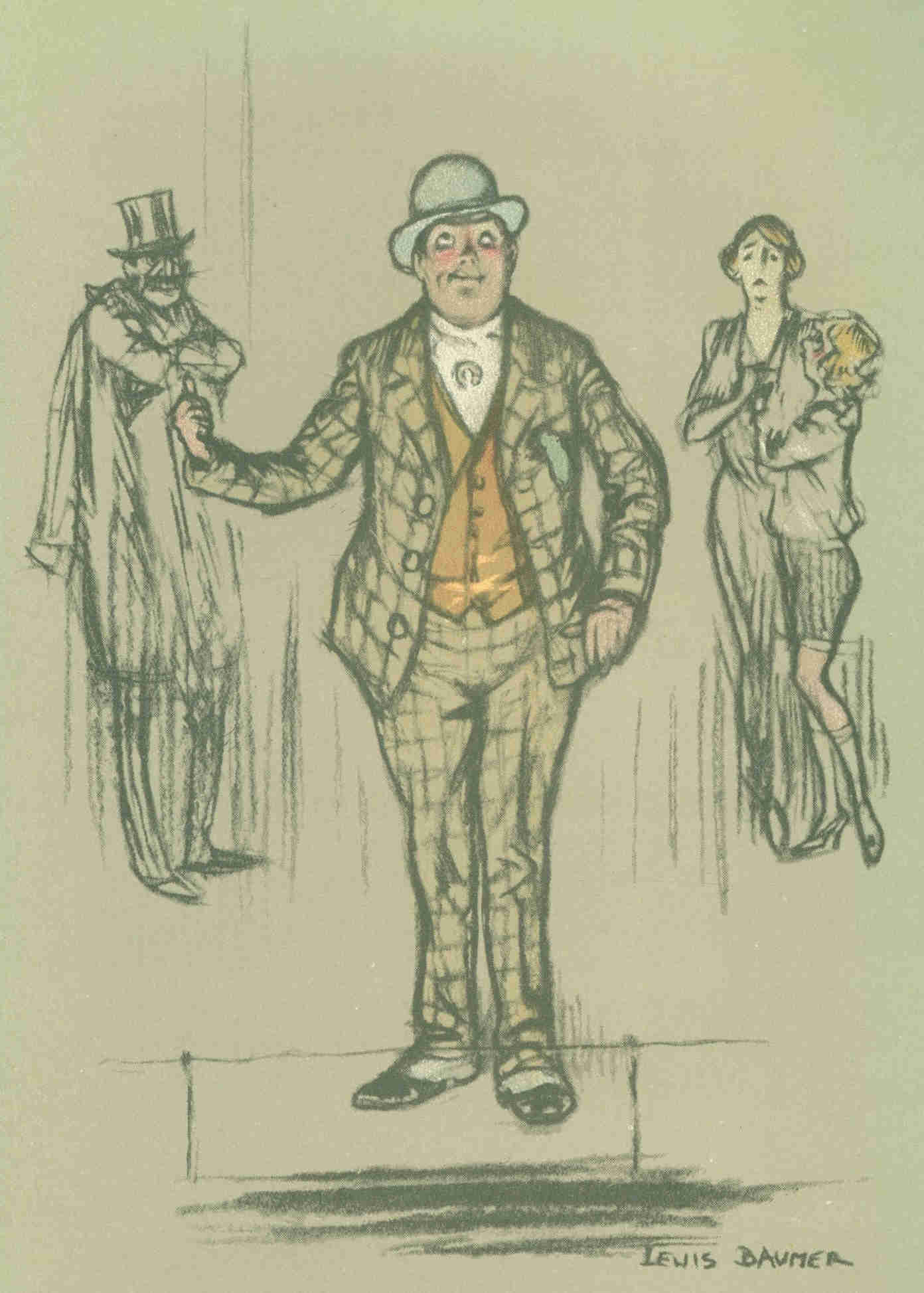
“When the comedian makes a joke, he comes right down to the footlights to make it.”
Here we are, up in the gallery of the Lyceum—perhaps the outstanding Gallery house of London—gloating over The Two Orphans. There is no niggling “intimacy” here. The whole picture is spaced out on the broadest of canvases. Possibly if we got close to it we should discover sketchy detail and crude colouring; but from where we sit the general perspective is the essential thing; and that is admirable. The Stalls here do not matter; or, rather, they are occupied by people who do not mind. We, seated in serried ranks right up to the spacious roof—and remarkably comfortably seated, be it said—we are the objective of the players. The players know it. They speak up; they look up. They are deliberate both in speech and movement, for they know that it takes longer to convey an effect to the gallery than to the stalls, and they are not afraid of waiting till it gets there—and back. When the comedian makes a joke, he comes right down to the footlights to make it, and the dialogue is not resumed until the laughter has subsided. When the sympathetic cripple cries aloud to his tormentor: “I do not fear you; for my courage is greater than your strength!” he strikes an attitude, holds it, and waits until his sure reward comes in the shape of a storm of applause. They do not risk such rigid pauses in a Stalls theatre: audiences there are self-conscious; they might giggle; and the actors are painfully aware of this. A Stalls actor is constantly devising business to forestall such a disaster. He fiddles with his tie; he lights a cigarette; he straightens the tablecloth. Sometimes one wonders that he does not wind up the clock. At the Lyceum he dares to stand still.
And, as already noted, we up in the gallery are not self-conscious. We are not obsessed by a half-hysterical sense of the ridiculous. The first entrance of each character is heralded by a few appropriate bars of music—stately, pathetic, or frankly comic. We do not regard this as a subject for mirth: we welcome such an eminently sensible method of indicating to us the sort of person we are going to meet. And when a French Marquis is compelled to play an earnest love scene with the heroine to a running fire of impertinent comment from a comic man-servant standing about four feet away, we are dramatically-minded enough to thrill over the sentiment and roar at the comments simultaneously without any sense of incongruity. Of course the clear diction sometimes degenerates into ranting, and the expression of pity or horror is distorted into a grimace. But the essentials of drama are all there—conflict, suspense, surprise, most cunningly blended; and above all, the human touch.
What a picture that great gallery presents. It must hold close on a thousand people, all there for one purpose—to be moved to laughter and tears. They are not concerned with realities or probabilities: they are there simply to be “taken out of themselves.” The world to-day is full of stern realists who would have us for ever go in off the deep end, get below the surface, and grapple with “life as it really is.” These do not always appreciate the fact that the majority of workaday men and women have to spend much of their time below the surface in any case, grappling with life as it really is; and that possibly it may refresh and encourage them to come up occasionally from below the surface and live for an hour or two in a world where, though tribulation may endure for a while, the blind ultimately receive their sight, dreams come true, and journeys end in lovers’ meeting.
Clapham Common, as such, may not sound romantic or distinctive. To the aristocrats of Clerkenwell, for instance, Clapham, Brixton, Surbiton, Peckham, Balham, Streatham and Hoxton are all identical and inseparable items in a howling wilderness called South London. But Clapham Common on a fine Saturday afternoon in April is a very fair reproduction of the Elysian Fields, for the simple reason that everyone there is doing the thing he likes best. Play may be defined as that form of hard work which appeals to us most; and here we are, putting our hearts into it, whether we be old or young.
All the Seven Ages of Man are represented.
First, the Infant—that is to say, human beings so young as to require an attendant. These are everywhere—staggering, crawling, being carried, being dragged, or being trundled magnificently in perambulators, usually by shrewish and voluble little girls. Whenever the perambulator comes to anchor amid a flotilla of other perambulators its occupant is lowered over the side and permitted a short cruise in the open, unaccompanied.
The diversions of a Clapham Common baby appear to be threefold. First, rising on its hind-legs and remaining there for one breathless moment, thereafter pitching forward to tearful disaster, or else subsiding backwards with a terrific but apparently painless bump; secondly, engaging in battle with other infants of similar tonnage and armament; thirdly, eating mud.
The next size of child is just large enough, quite literally, to paddle its own canoe. In the small round pond (possibly as deep as eighteen inches in the middle) you may behold a great concourse of shipping. Each ship is just large enough to contain one extremely small passenger—or rather, one captain, engineer and crew combined. He operates a horizontal crank with his hands, and thus turns a pair of miniature paddle-wheels which propel his craft, at a rate inversely proportional to the amount of splash, in divers directions. This type of vessel has no rudder, and collisions are frequent. Fortunately the rate of speed is low, and the loss of tonnage is not serious. Female relatives, chanting a chorus of admonition and reproof, form a melodious ring round the pond.
The third class consists of small boys of about ten, too young to be entirely exempt from petticoat supervision, but old enough and sinful enough to be able to dodge it fairly consistently. They climb such trees as they can find, play catch with one another—to a sisterly accompaniment of “butter-fingers!” and “fat ’ead!”—if they own a ball; or retrieve balls for other people if they do not. A few of them possess one roller-skate, upon which they propel themselves with astonishing speed and some lack of definite direction—as meditative pedestrians have occasion to discover.
Then come the emancipated ages—the Warrior class—the players of football and cricket. Both these games are being played here to-day, side by side. To a certain extent they overlap. A moment ago a googlie bowler in a cricket match just beside us bowled a quite phenomenal wide right into the middle of an adjacent football match, just as the ball from the football match, soaring high into touch out of the field of play, spread-eagled all the wickets of the batsman in the cricket match. However, fair exchange is no robbery.
The football players fall into two categories—Recognized and Unrecognized. The Recognized occupy more space and enjoy more privileges than any other combatants on the Common. Each match—and there are scores of them—is played upon a comparatively rectangular piece of ground, with real goal-posts, their tops joined by a tape; and the players wear regulation football kit, including club colours which put the spring flowers to shame. There are even touch-judges, a referee, and spectators. Probably the two teams have names—the Battersea Park Hornets, we will say, as against the Vampires of Tooting Bee. Possibly the result of the match will be published in to-morrow’s Sunday papers. Good luck to them both!
But wherever we may bestow our admiration, our sympathy goes out to the Fifth Age, the Unrecognized. They do not seem to play any worse than their more favoured brethren; but apparently they lack the numbers, or the means, or the influence, to stage a full-dress battle. They play with their trousers tucked into their socks, upon an irregular polygon of ground much obstructed by trees and notice-boards; their goal-posts are represented by heaps of coats, and doubtful points as they arise are decided not by a referee, but by mutual recrimination. One would like to find a complete ground for them, with goals and colours like the rest. But perhaps they are merely undergoing a period of probation, and will ultimately rise to higher things. Good luck to them too, for they, beyond all present, are playing the game for its own sake.
The irregularities of the ground whereon they play calls to mind a certain public park in distant Edinburgh, where many of the “fitba’ ” pitches are set upon the side of a considerable hill. Here, if you lose the toss, you will have, quite literally, an uphill battle to fight. But your turn will come after half-time. It is no uncommon thing in these heroic combats for a side to change ends twelve or fifteen goals down, and win the match.
The Sixth Age takes itself very seriously. It consists of middle-aged gentlemen of preoccupied appearance who sail model yachts in the largest pond. They arrive from all quarters early in the afternoon, carrying their yachts; sometimes the yacht is wheeled in a perambulator, followed by an indignant and bandy-legged baby, walking. Obviously they have hurried home from the week’s work and eaten their dinner with forced calm: after which their wives have lifted down the recently dusted Britannia or Valkyrie from the shelf and deposited it in the arms of its owner, saying, with an indulgent smile:
“There now, run off to the pond, and don’t get your feet wet; and don’t let me see you back here again before six o’clock!”
They are beautifully made, some of these little yachts, and their fitting and rigging have obviously been a matter of loving care through many a winter evening. There is an ingenious arrangement which enables you to fix the rudder in any position, and so counteract the natural tendency of a fore-and-aft rigged boat to luff up into the eye of the wind.
Here is a race starting now, between Shamrock and Bluebell. The respective owners are an uncommunicative man in pince-nez and an old gentleman in a species of yachting cap, obviously an enthusiast of several generations’ standing. The yachts’ names are painted upon their little companionways, and each sports a small burgee marked C.M.Y.C., which stands, presumably, for “Clapham Model Yacht Club”—or, possibly, “Clapham Makes You a Commodore.”
The procedure is simple. The boats are pushed off from the lower end of the pond, and the one which reaches the other end first is the winner. Hypnotic control of rudders not yet having been introduced into yachting practice, this achievement sometimes takes time. Sometimes—usually—a yacht runs ashore half-way up the pond; you are then permitted to prod it in the required direction with a stick and push it out again—repeating the operation as often as may be necessary until the goal is reached.
Plainly no small skill and knowledge are required in the exact adjustment of the sails. To-day, for instance, the breeze is blowing diagonally down the pond, and progress can best be achieved by alternate long reaches and short beats. Consequently, by an ingenious arrangement of the mainsheet, the good ship Shamrock, while upon the starboard tack, is given a comparatively loose rein; but when put about after her first beaching and sent off into the teeth of the wind upon the other tack, she finds herself so close hauled that after beating out ten yards or so she goes about of her own volition, and accomplishes another rapid and profitable reach upon the starboard tack.
Ultimately Shamrock wins the race, for Bluebell rams a strange craft en route—which is not altogether surprising, considering the congestion of traffic. The pair, with their riggings locked inextricably together, drift ignominiously towards the bank, and are finally recovered by the ancient device of casting stones into the water just beyond them—an operation in which several volunteers from Class Three co-operate enthusiastically, if not always entirely acceptably.
And the Seventh Age? There it is, sitting in the lee of that hedge—a dozen sedate and mainly elderly gentlemen, bowed over chess-boards, draught-boards, domino-boards—oblivious to their surroundings and the intensely wise comments of the spectators. The spring has brought them, even them, out under the open sky.
They are not all elderly, though. Note this player here—a youngish, soldierly man, playing dominoes. We note that he makes all his moves with his right hand. His left hand, or rather his empty left sleeve, is tucked neatly into his coat pocket. Perhaps, if the truth were known, his heart is out among the Warriors, upon one of the football pitches. If so, he does not show it. He smiles resolutely upon his elders, does the thing that’s nearest, and plays the double six.
After self-appointed critics of the drama, self-appointed critics of sport probably talk more nonsense than anyone else in the world. This is natural enough, for the easier a thing looks the more people feel competent to criticise the way it is done. Accomplishments which appear comparatively difficult—such as doing the splits or whistling two tunes simultaneously—are treated with the profound reverence which they merit; but people naturally adopt a severely critical attitude towards things which they know they can do themselves. For instance, if there is one thing that looks easier than acting, it is running, or pulling an oar, or kicking a ball about.
At this time of the year most of the critical talent of London is lining the Thames from Putney to Mortlake, sitting in judgment upon the University crews, and enjoying itself exceedingly, because it is sure of an audience. A critic is always on safe ground upon one of two occasions—firstly, when he knows what he is talking about; secondly, when no one present is in a position to contradict him.
Since persons possessed of the first qualification do not appear to frequent the waterside at Putney—at least, they are not vocal—the second class have a glorious time of it.
Here are two of them, engaged in a learned discussion for the benefit of the untutored throng around them. Riverside spectators make an ideal audience, for they are a simple and credulous race. To them the Boat-race itself is a lofty mystery—a hoary tradition—a solemn rite to which they pay periodical reverence. They know little about those nebulous institutions, Oxford College and Cambridge College, though they are always fierce partisans of one or the other; but they are grateful to them for providing an annual carnival, and they are spasmodically interested for the moment in the technicalities of rowing. So they gather round the two experts and listen respectfully.
“It stands to reason,” announces the first expert, a tall gentleman with a walrus moustache and no tie, “that a light crew must travel faster than a ’eavy crew. Look at jockeys!”
“That’s just where you makes your error,” replies his opponent, a caustic little man with a red nose and slight bronchial trouble.
“There’s no error about it,” the Walrus insists. “Which travels fastest—a ship with a ’eavy cargo or a ship with a light cargo?”
“Cargo? The crew ain’t the cargo: they’re the injins! Which is best—a ship with big injins or small injins?”
This is a telling counter-thrust, and the audience, beginning to breathe a little harder, close in tighter. But Walrus is quite equal to the occasion.
“The ’ole tendency of injineerin’ to-day,” he announces, by a brilliant inspiration, “is to make injins lighter and lighter. Look at Ford cars!”
“Now you’re getting away from the point,” wheezes Red Nose sternly. “We’re talking about boat-racing, not Tin Lizzies. What I say is, you wants a crew with good ’eavy men in it. If a light crew’s best, why not make a job of it, and get eight little dwarfs out of Madame Tooswords?”
Why dwarfs should infest the premises of Madame Tussaud is not clear, but the point is evidently regarded by the crowd as a legitimate one.
“Because we got to live and let live!” replies Walrus, referring apparently to some mysterious Society for the Prevention of Cruelty to Dwarfs. “I favours the Dark Blues, because I favours a crew which ’as less dead weight to pull along than the other. That’s logic, that is. I can carry one bucket of coals upstairs quicker than two buckets of coals, can’t I?”
“I ain’t never seen you do neither,” replies his friend frankly. “But I’ve watched your old woman do it, over and over again. Let’s go and ask ’er what she thinks!”
There is a shout of laughter. It is decided that Red Nose has had the better of the argument. Cambridge will win the Boat-race this year.
One of the crews has just pulled up after a row between Bridges, and the members thereof, in blessed oblivion to all save the knowledge that they need not row any more for the present, are panting contentedly with their heads between their knees.
“That’s bad,” announces an elderly expert on Hammersmith Bridge. “Not ’alf in condition, they ain’t—layin’ about all over the boat, ’alf dead, after a row over only ’alf the course. What will they do next Saturday, I wonder? There’s only one of them that’s worth anything at all—that one third from the end, sitting up and arranging his ’air. ’E’s as fresh as a daisy. But the rest——”
And the judge, having passed sentence, goes sorrowfully on his way, oblivious of the fact that he has paid the highest possible compliment to the crew—with perhaps the exception of the gentleman who is sitting up and arranging his hair. There are said to be seventy-three faults which you can commit in rowing upon a sixteen-inch slide in a light ship; and most of these work in a circle; so that if you commit one it involves you automatically in a whole vicious series. For instance, you may swing forward too rapidly. If you do this your hands will drop down, and your blade will fly up just as you ought to be gripping the water for the beginning of the stroke. This means that you will row the first half of the stroke in the air, thus involving yourself in much postponed labour during the second half, together with a dirty finish, caused by the fact that you are not lying back as you should, but are humped over your oar, struggling with your arms instead of thrusting with your legs. This means that you will be late in getting your hands away from your chest; and that means that you will have to hurry to get forward in time for the next stroke; and that means that you will hit the front stop of your slide with a bang; and that means that your hands will drop down, and your blade will fly up just as you ought to be gripping the water. And so round the Inner Circle of Error again.
But—there is only one rule which you need really remember when it comes to business, and that is, that you must row yourself right out in the first minute of the race, as if that race was only going to last for that minute. This applies equally to a practice row. The fact that there are going to be about nineteen minutes more of it has nothing whatever to do with the case; your sole business is to be dead to the world at the end of that minute—so dead that it seems a physical impossibility that you should row another stroke. Yet you will; and if you possess a stout heart and are in proper training you will continue to row just as well and as hard right up to the finish, though you may be praying for death all the time. Your first wind is gone; your muscular strength is gone; everything is gone, except two things—your fighting weight, which will continue to apply itself automatically to the handle of your oar every time you swing back with the rest of the crew; and—“the will that says to you, ‘Hold on!’ ”
That is practically all that rowing amounts to. That is what makes it, with the possible exception of Rugby football, the greatest of all manly sports. It is certainly the greatest test of endurance. It offers little attraction to the egotist, for your only possible avenue to personal advertisement in rowing is to catch a crab. You cannot run gloriously up the steps of a cheering pavilion with a hundred runs to your credit, or send an already hysterical baseball crowd into convulsions by “hitting a homer” on your own. You do not even appear before the public with a number on your back, after the regrettable modern fashion of certain Rugby football players. You are simply a link in a chain, and your sole business is to see to it that your link does not snap.
And, as already indicated, “there be some sports are painful.” There is little of the joy of battle about rowing: its pleasures are entirely retrospective. Rowing men get little comfort out of anticipation or actuality. They are almost perpetually in training, for rowing claims its votaries almost the whole year round. They row every day; sometimes twice a day; they give up smoking, they go to bed early, and generally abandon their small personal comforts for weeks on end. Then, when the great day comes, and the battle is joined, they endure a living death for twenty minutes or so in order to make a London holiday. But they are minutes which no rowing man ever forgets, and their memory lasts while life lasts. That is why men row.
And as you lie with your head on your stretcher, gasping your heart out at the end of the race, and reflect that even now several special correspondents are recording the discreditable fact that you “appeared much distressed at the finish of the race,” you will know that what you did was well done, and that, win or lose, you pulled your weight and rowed yourself right out. After all, that is all that matters—in other things besides rowing.
“A Mr. Wilkinson has called, sir.”
Club servants are notoriously imperturbable, but the fact remains that when Christopher, our impeccable night porter, presented himself at my bedside at the unusual hour of 5.30 a.m., in order to make the announcement recorded above, he was visibly rattled. I distinctly saw an eyebrow twitch.
I blinked at the electric light.
“What time is it?” I inquired mechanically.
Christopher told me, in a very distinct voice.
“What did you say the name was?”
“A Mr. Wilkinson, sir.”
I pondered sleepily.
“Did he say what he wanted?”
“Yes, sir,” replied Christopher woodenly, “he did. The English Cup, sir.”
I remembered now—an invitation rashly given and forgotten for weeks.
“Tell him,” I said, “to go away and come back a little later”; and resumed my slumbers forthwith.
But, prompted by an instinct of resigned hospitality, I was dressed and downstairs by a quarter to eight. A charwoman was washing the tiles of the hall floor, and Christopher, within fifteen minutes of the end of his nightly vigil, was nodding in his box. On a bench by the door sat a small, dirty, unkempt, but entirely alert youth of fourteen or so. On the lapel of his coat he wore an enormous blue-and-white rosette.
“Hallo,” he said. “Up at last?”
I ignored the ingratitude of the remark, and asked him where he had come from. He explained that he had travelled up from his home in the north of England through the night in an excursion train.
“It was bung-full,” he added. “There were twelve in our carriage, not including a chap under the seat without a ticket. He passed his hat round just before Willesden.”
“How much did he get?”
“Oh—most of his hat back. How are you?”
“Pretty well, thanks. What time did you arrive?”
“About four, I think.”
“You must be hungry,” I said.
“I am a bit,” replied Dicky Wilkinson, wistfully.
My heart smote me, for I was his host, and I had once been young myself. Still, there would be little breakfast available at the club at this hour. We must go further afield.
“Come along,” I said, and told Christopher to call a cab.
Propped against the railings outside the club I found a second youth. His matted hair hung down upon his forehead, and he looked as if he had slept in a dustbin for a week. With a sinking heart I noted that he, too, wore a blue-and-white rosette. At our approach he raised his head and regarded me with what I can only call a wolfish eye.
“Come on, Crump,” said Dicky. “This,” he explained to me in a luminous aside, “is old Crump.”
Mr. Crump, who was evidently far too famished to speak, greeted me with a perfunctory smile, and immediately hurled himself into the cab. Dick followed him with a hungry roar, and I, feeling rather like the prophet Daniel on an historic occasion, clambered in after them.
I have always regarded a fixed charge of four-and-sixpence for a hotel breakfast as a gross imposition; but on this occasion I think the laugh was on my side.
My two guests, on being confronted with a menu—an elaborate and comprehensive document—read it through, smacked their lips in horrible enjoyment, but said nothing. The waiter hovered expectantly over them.
“What are you going to have?” I inquired.
Dicky regarded me with a slightly surprised air.
“Have?” he said. “We’re going to have the first thing on the list. We aren’t going to miss anything out, you know!”
I said no more. The joke, after all, was on the hotel.
After an hors-d’œuvre of porridge and cream, my friends consumed a salmon steak apiece, followed by fillets of sole. Having by this operation exhausted the fish course, they proceeded to kidneys and bacon. Dicky, noticing that one or two items, such as mutton chops and savoury omelettes, required fifteen minutes’ notice, prudently avoided the twin vexations of disappointment and delay by ordering these trifles in advance, and then set to work upon bacon and eggs.
Interrogated as to their choice of beverages, both my friends selected chocolate with whipped cream. Mr. Crump, I may mention, uttered no word. He ate everything that was offered to him and left any ordering that had to be done to his colleague. But the wolfish light was dying out of his eyes, and I began to feel comparatively secure.
I consumed my own breakfast as slowly as possible, and devoted my energies to directing the conversation into congenial and appropriate channels. Old Crump remained utterly unresponsive, but Dicky chattered ceaselessly, without for one moment relaxing the severity of his attack upon the dishes around him. He was madly enthusiastic about the chances of his local team—I need hardly say that they wore blue shorts and white shirts—who had come up to London for the first time in their mud-stained history to do battle for the Cup. He gave me the pet name, age, and fighting weight of each gladiator. I think he said that old Crump had once shaken hands with one of them, but the hero of this achievement exhibited no symptom of corroboration. Probably he did not hear us, though we could hear him.
Once more the waiter presented the menu. By this time he had thoroughly entered into the spirit of the game.
“What will you try now, sir?” he asked respectfully.
Dicky ran his finger down the list to his last stopping-place. A slightly puzzled expression appeared upon his face, but he replied without hesitation:
“We’ll have some Cold Viands, please.”
The waiter departed, and Dicky said to me:
“I say, what are Viands?”
I replied by quoting the slogan of the Liberal Party of a decade ago. Two minutes latter the pair were resolutely devouring liberal helpings of cold beef—underdone.
Symptoms of languor set in after the marmalade course, and we adjourned to the lounge. Here I extracted the information that Dicky’s father had supplied them with stand tickets for the match, and that the excursion train returned at midnight. Their plans for the rest of the day were extremely vague.
My own happened to be numerous and complicated; so, having advised them to make an early start for the ground, and presenting them with tickets for the evening performance at the Coliseum, I made my excuses and departed. Neither gentleman made any attempt to see me off the premises; they reclined in armchairs, following my receding form with glazed eyes. As I passed out through the revolving door I looked back. Old Crump had just produced a packet of Wild Woodbines.
“A Mr. Wilkinson has called, sir.”
Once more the words crashed through my slumbers like a stone through a window. This time it was half-past five in the afternoon, and I was snatching a brief respite from an arduous day in an armchair in the smoking-room. I sighed resignedly, and went out into the hall. There they stood, more disreputable than ever, but radiant.
“We just looked in to say good-bye,” said Dicky. “We’ve had a ripping day.”
I shook hands with them warmly. Under the stress of parting Mr. Crump was moved to break the silence (so far as I was concerned) of a lifetime.
“Thanks awfully,” he said, and, catching his heel in the mat, lurched heavily backwards through the glass door and was no more seen.
“Did you enjoy the match?” I inquired of Dicky as I grasped his grubby paw for the last time. “I hope your side won.”
“I don’t know who won,” said Dicky. “We got to the place early, as you told us—about twelve, I should say; but it turned out to be the wrong place. Of course it wasn’t your fault, but we went to the Crystal Palace. They told us there that they don’t play the Cup Final on that ground any more. However, we had quite a good time: we went out in a boat on the lake for a bit. I think we must have gone to sleep, for we didn’t wake up till about an hour ago. But they’ll tell us the result in the train. So long! And thanks most awfully for the theatre-tickets. We’re off to find the place now. By Jove, this is a day and a half!”
Altogether an apt summary of the occasion. Ah, me! Heaven lies about us in our infancy, Dicky.
A week ago George and I decided to attend a football match at Wembley which has since become historic.[1] Unfortunately, a considerable number of other people came to the same decision. That would not have mattered so much, only most of them started before us. Somewhere between Maida Vale and Willesden our train, which had been showing signs of heart trouble for some time, fainted in the middle of the tunnel. Ultimately we decided that it was dead, and were just about to get out and walk, chancing the third rail, when it revived sufficiently to crawl to the next station, where we abandoned it. We emerged into the open air, to find ourselves in what we took to be the Harrow Road, which is a busy thoroughfare on a Saturday afternoon. It was now a quarter to four, so, deciding that the fate of the English Cup would have to be settled without us, we started to walk home.
Presently we passed a shop from which the entire front had been removed, exposing its interior in a rather indelicate manner to every passer-by. It was crammed with people, and a mighty placard above our heads announced that an Auction of Bankrupt Stock was in progress.
“Let’s go in here for a bit,” suggested George.
“All right,” I said. “But don’t nod your head, whatever you do, or you’ll get stuck with a pair of ormolu vases at least.”
George promised to control himself, and we entered.
The shop, as previously noted, was full of people—people, in the main, who seemed to have come out with their weekly wage burning a hole in their pockets. Behind a rostrum at the far end, surrounded by gold watches, silver butter-dishes, and cut-glass flower-bowls, stood a red-faced man of bluff and candid presence. He was supported by two unshaven young gentlemen in their shirt-sleeves, charged apparently with the task of handing round the goods and, when necessary, preventing the auctioneer, who appeared to be subject to fits of impulsive and prodigal generosity, from giving things away for nothing. An altercation on this subject was in progress as we entered.
“Now don’t interfere with me!” protested the auctioneer. “Let me sell things in my own way. Am I here to dispose of these articles at a loss? No; because if I do, I get no commission.”
“A candid lad, this,” observed George.
“You say,” continued the auctioneer to his still grumbling assistant, “that the genuine Dresden China Shepherdess that I have just sold to this gentleman for two-and-six is worth ten shillings at least. Well, so it is. And I’ll tell you why I sold it for two-and-six. Because I am going to diff—differentiate between the people here who are really out to bid and the people who have simply come in to amuse themselves.” (George and I blushed guiltily, but no one noticed). “I’m trying to encourage genuine bargainers, and that’s why I gave you, sir, a ten-shilling Shepherdess for two-and-six. Now, to show that I mean what I say, and to teach my assistants not to interfere with a man who was an auctioneer before they were born, I am going to give you your two-and-six back. Hand it to the gentleman, Willie, with my compliments, and stop whispering things to me. That Shepherdess, sir, is yours for nothing. Of course people will say that you are a confederate, or a relation, or a favourite of mine; but take no notice. I have no confederates, no favourites, and no relations—none that I’d give presents to, anyhow!”
There was a little appreciative laughter at this, led, most magnanimously, I thought, by Willie.
“Now we’ll go back to the business in hand,” announced the auctioneer. “I have to sell four more cases of these Apostle spoons.”
Apparently he had sold eight already, for six shillings apiece, but all were still stacked on the desk beside him; for the bargain, it appeared, was void unless a round dozen sets were disposed of. The interest of the company in Apostle spoons was plainly flagging, and the auctioneer began to drop hints of a pleasant surprise, unspecified, which awaited all who adventured the nominal sum of six shillings upon one of the remaining sets. In this way three more were disposed of, but the last hung fire badly. Finally the auctioneer, who was obviously a psychologist of no mean order, suddenly snatched a toast-rack from a shelf behind him and asked:
“Will anyone bid me three-halfpence for this?”
A lady with a string-bag, obviously lured in here from her lawful occasion of buying the Sunday dinner, snatched at the offer. A servant-girl raised the price to threepence; but the owner of the string-bag accepted the challenge, and finally secured the toast-rack for one-and-twopence. She passed up the money from a lean little purse. The auctioneer handed down the toast-rack and, in another sudden paroxysm of generosity, instructed his second assistant, whose name appeared to be Sam, to refund the lady a shilling.
“I did that to establish confidence,” he explained. “Now, who will give me six shillings for this last set of Apostle spoons?”
For some mysterious reason he promptly received three simultaneous bids, including one from the purchaser of the toast-rack, who was awarded precedence in the matter, and left the shop in a slightly dazed condition, obviously beginning to wonder what her husband would say when she got home. We noticed that she did not wait for the spoons: possibly the auctioneer noticed too, but he refrained from remonstrance.
To establish further confidence, the auctioneer now placed a pound note inside a solid silver cigarette-case, and sold it to a young man in a coloured neckcloth for twenty-three shillings.
“I sell you that, sir,” he announced, shouting down the agonized cries of Willie and Sam, “because you are a genuine bidder. You gave me twenty-three shillings for a solid silver cigarette-case containing a one-pound note. Are you satisfied?”
A self-conscious nod.
“Well, I’m not. Will you kindly accept your three shillings back from me, and buy cigars with them?”
By this time the necessary atmosphere had been created, and a universal impression prevailed that anybody who bought anything whatever would at least get his money back, and probably a handsome present into the bargain.
“So far,” said George, turning to me, “he has sold twelve sets of Apostle spoons for three-pounds-twelve all told, one of which sets will not be claimed, and given away a cigarette-case and a Shepherdess, and sold a toast-rack for twopence. When is he going to begin to earn his living?”
“Now here,” announced the auctioneer, answering the question, “I have something really good.” He produced a glittering gold watch. “Will any gentleman offer me a shilling for this?”
Someone promptly did, and finally the watch was knocked down at a pound. A Treasury note was handed up, but the watch was not passed down immediately. Instead, the note was laid upon the auctioneer’s desk, with the watch doing duty on top of it as a paper-weight.
“I know you will trust me with that for a few minutes, sir,” he cooed to the purchaser, the self-conscious young man in the coloured neckcloth; and received another nervous nod.
We all waited expectantly. Then:
“I think I have got one more of these watches somewhere,” announced the auctioneer.
He was right: he had; in fact, he had several, and he actually succeeded in selling two of them, also for one pound each. The three watches were set out upon his desk upon the notes which bought them, and we all waited respectfully to see what sort of conjuring trick our friend was going to perform with them. The general impression appeared to be that the lucky purchasers would shortly have the notes returned to them, wrapped round the watches. This impression became a conviction when the auctioneer remarked, with assumed ferocity:
“Now, I suppose none of you gentlemen expected to get a real gold watch for a pound?”
It was obvious that they did, but under the auctioneer’s hypnotic eye all three shook their heads vigorously.
“And you don’t expect anything for the pound note except the watch you bid for?” he continued.
More head-shaking; but the audience smiled at one another. They were certain now that some delightful surprise would shortly be sprung. However, for the moment they had to contain themselves, for the auctioneer, after suddenly selling a butter-dish to someone for seven-and-six, and returning seven shillings before either Willie or Sam could do anything about it, announced genially:
“We have been neglecting the ladies!” and produced a solid gold bracelet, with wrist-watch attached.
“Now this,” he announced, “is real gold—not rolled gold, or Abyssinian gold, but the gold they make sovereigns out of. If you went to Mappin and Webb for an article like this, they would probably ask ten pounds for it. Will anybody bid me a shilling?”
A flushed young woman with a baby did so, and the bidding mounted, by a series of shy whispers and furtive nods, to three pounds. Not without much encouraging banter, however, from the auctioneer and the raucous assistance of Willie and Sam; who, scenting really profitable prey at last, commanded the company in a most threatening manner to bid up.
“Of course there’s no need to pay all the money now,” explained the auctioneer. “A small deposit will secure any article. Give me ten shillings now, young lady, and this watch-bracelet is yours, any day next week, for two-pounds-ten.”
The bait was taken. A ten-shilling note was passed tremulously up to the rostrum, a receipt was written and handed down with ceremonial formality, and the watch-bracelet joined its three male companions upon the desk. Now surely the distribution of prizes and surprises would begin! Not at all. The auctioneer, after announcing very sternly that he would not sell to dealers, succeeded in disposing of two more watch-bracelets at three pounds apiece—or, rather, ten shillings on account—to ladies who had obviously lost their heads, and would probably decide with tears to-morrow morning to let their ten shillings go by the board and not throw good money after bad; and at last we arrived at the distribution of bonuses.
Each of the purchasers of Apostle spoons was presented with what looked like a small clothes-brush, though it might have been a large nail-brush. The purchasers of the watch-bracelets, having only paid a deposit, got nothing, and departed sorrowfully, without even the watch-bracelets. This brought us down to the three male protagonists who had invested in the one-pound watches. The auctioneer singled out his especial pet—the young gentleman in the neckcloth.
“Now, sir, you have shown more sporting spirit than anyone else here to-day.” He took up a small imitation leather box, which might or might not have contained a safety razor, and continued:
“This little article would probably cost you a guinea in Bond Street. If I were to slip this ten-shilling note inside, as a lining for the lid, would you give me ten shillings for the lot? Would you, or would you not?”
The gentleman addressed, having worked out this rather complicated problem in mental arithmetic, cautiously admitted that he would.
“Very well then,” announced the auctioneer indulgently, “you shall! Here is the little article in its box, and a ten-shilling note in exchange for your ten-shilling note. Pass up his note, Willie. No—that’s a waste of labour. Keep your note, sir, and I’ll keep mine; and I’ll assume that you have paid me the ten shillings. There’s your gold watch, sir, and there’s the little article. Now, here’s another little article and another ten-shilling note. Will one of you two other gentlemen make a bid? . . . All right, Willie, I know what I’m doing!”
“He certainly does,” remarked George, as we made our way out of the shop.
“It’s a complicated way of earning a living,” I remarked.
“Yes. Let me see, how much exactly did he make out of it all?”
“Well, he took three-pounds-twelve for the Apostle spoons. Let’s say he cleared fifty per cent. profit: that’s thirty-six shillings—assuming that good lady comes back to claim her spoons, which I doubt.”
“And he gave away a dozen brushes of some kind, say, at sixpence each—that’s six shillings. That makes his profit thirty shillings, neglecting the brush which our absent friend missed.”
“Then the toast-rack, and the butter-dish, and the other gadgets which he practically gave away—what about them? Shall we say ten shillings?”
“I don’t think we need say more. They were probably sold to confederates: he’ll get them back.”
“All right. That leaves twenty shillings profit, so far. Now the gold watches at one pound each, say, at fifty per cent. profit—that’s thirty shillings. Then ‘the little article’ in its box, whatever that may have been. There were three of them. Say they were worth two shillings apiece—that’s a net profit of twenty-four shillings on the watches. Two-pounds-ten altogether, so far. Then the three ladies’ watches at three pounds apiece. I bet there’s a profit there, all right! How much would you say—a fiver?”
“Quite, if they pay. But my impression is that when they get home and come out of the chloroform the poor things will decide to forgo their deposit and get out while the going’s good. That’s a free gift of thirty shillings, and the watches still in stock. How much does that make in cash?”
“About four pounds, I think.”
“In half-an-hour! Well, it’s more than I have ever earned in the time,” admitted George. “Still, on the whole I think I should prefer to make a living in some other way—as a Soccer pro, perhaps. I wonder who has won the Cup?”
|
The Final Cup Tie of 1923, played for the first time at the Stadium, Wembley, with multitudinous results. |
The zoo on Easter Monday is essentially the resort of people with long families and short purses. Some people, alas! have no purses at all, and must content themselves with such entertainment as London provides free gratis. Fortunately, this is considerable. But for those who possess the necessary shilling (or sixpence, according to your span of years) the Zoo offers a combination of pleasure-park, restaurant, and circus that cannot be resisted—especially by children with muscular and long-suffering parents, who are prepared to hold small, wriggling bodies aloft for indefinite periods in order to give round, excited eyes an uninterrupted view of the Lion at lunch or the Boa-constrictor enjoying a six weeks’ siesta.
There is an entirely domestic note about the crowds that pack the grounds to-day. We will attach ourselves to this family party just ahead of us. They appear to be seven in number: first, Father—big, genial, imperturbable, smoking a ceremonial cigar and carrying a small boy (age probably three, addressed as Young Alfie) astride his shoulders; next, Mother—calmly pessimistic, bearing an infant whose name appears to be Baby Emmer. Her spare hand is tightly clutched by a hot-faced little girl named Lizzie; while two elder children, of a more adventurous and difficult age, named Young Sid and Ader respectively, struggle in the wake of their parents—sometimes running free, sometimes, at moments of extreme congestion, closing in for a tow.
Like most of the visitors, we begin with a tour of the Mappin Terraces—no easy task to-day. We struggle up some steps and along a narrow passage-way closed in on either side by iron bars. The Terraces themselves are spacious enough: the only constricted area is our passage. Indeed we, the lords of creation, peering through its windows—down upon the Bears or up at the Ibexes—present to the eye of the animal kingdom the appearance of being the only caged things in sight.
“They seem to have roped in a lot of new humans to show us to-day,” observes the Ibex, posing self-consciously upon the concrete skyline, to a Barbary Sheep.
“Easter Monday, I believe,” replies the Sheep, looking down with a bored air—“one of the few days in the year when they can be spared for exhibition here. I am told they keep them pretty closely at work the rest of the time. They have packed them in to-day, though! They’ll be having the S.P.C.H. people on their track if they’re not careful—if there is such a Society.”
“I rather fancy not,” says the Ibex. “I’m told their treatment of one another is absolutely human.”
We are extruded at last from the other end of the passage, and shape a course for the Sea Lions, still in close order with Father, Mother, and their offspring. A slight delay is occasioned while Young Sid is retrieved from beneath the wheels of a heavily-laden governess-cart, drawn by a pair of bored and supercilious Llamas—the Elephants, the Camels and the Llamas regard the expression “Easter Holiday” as a misnomer in the worst possible taste—and we struggle on.
A deeply interested crowd is assembled round the Sea Lions’ pond, wherein those arch-comedians of the Zoological world are obliging with a selection from their vocal and acrobatic repertoire. We make our way to a board, bearing a notice.
“Let’s see if you can read it, Young Sid,” commands Father.
“ ‘Feedin’ time, ’alf-past fower,’ ” announces Young Sid proudly.
“That’s a good boy,” replies his gratified parent. “But it’s only ten minutes to now. Would you like to ’ave a lay down on the grass for a bit, Mother; or shall we go and take a look at the Monkeys?”
“We might as well see everythink while we’re ’ere,” replies Mother resignedly, giving a fresh hitch to Baby Emmer, “and get it over with. Which way?”
“Along ’ere. My word, but there’s a crowd! ’Old on to Father’s ’and, Ader, or ’e’ll fall down. You wouldn’t like poor old Father to fall down, would you?” And thus, with simple guile, having secured the hand of his elusive but maternal elder daughter, Father heads our convoy towards the most popular spot in the Zoo.
The Monkey House, as we can see it through its glass sides, is packed to overflowing, and a queue extending the whole length of the building is patiently waiting its turn outside. Observe this queue well: it is emblematic of the whole conduct of this vast crowd—and more than sixty thousand have entered the Gardens to-day. It forms itself automatically, without injunction or assistance: there is not a policeman or a keeper in sight. People arrive at the entrance, and at once observing the presence of other would-be entrants, make no attempt to steal a march on anyone else: they simply walk down the queue until they come to the tail, where they take their places and wait their turn. There is no elbowing, no recrimination. Nearly everyone is tired, and looks tired: the children are restless and sticky, and the sun is quite hot. But in the whole of our crowded pilgrimage this afternoon we have not heard one impatient word spoken. The inability of British Labour to fuss is a marvellous thing. It is a national asset. You cannot rattle or stampede people of this breed, whether you be an oncoming foe or merely a windy politician.
We take our places in the queue, and in due course find ourselves carried by the stream to the very portals of the simian paradise. Father glances up at the flushed features of his younger son.
“Now then, Young Alfie,” he remarks humorously, but rather thoughtlessly, “you ’old tight and I’ll take you to see your little brothers!”
Presently we find ourselves inside, squeezed against a barrier, face to face with a race of beings bearing a dreadful and uncanny facial resemblance to some of our own friends and relations, engaged upon uncomfortably familiar pursuits—indulging in aimless and fitful exercise, accepting refreshment from total strangers, and habitually trying to get the better of one another. The youthful spectators shriek with delight at each fresh confirmation of Darwin’s celebrated theory. Our own vis-à-vis is an animal described upon his visiting-card, which is displayed outside the cage, as the Common Macaque. . . . We can only hope that his type is not as common as his manners. . . .
We stagger out, and gulp the fresh spring air again.
“A quarter-past four?” announces Father, mopping his brow. “Just in time to see the Sea Lions ’aving of their tea. We’ll take a look at the Ostridges on the way, Mother, shall we? Eh—what’s that?”
“Where’s Ader?”
It has been a long day, and a dusty day; but the Gardens are closed at last, and all the members of the human and animal kingdom are thinking of bed. Here are a few final soliloquies.
Father:—Well, all’s well that ends well; but my back’s nearly broke. Alfie, my lad, next year you’ll walk, and give your poor old father a chance. What? I’ll be carrying Baby Emmer next year? None of your sauce! Still, there’s many a true word spoke in jest. He’s a quick little nipper, ain’t he, Mother, to think of that by ’imself? No, I’m not spoiling of ’im, old girl: it isn’t often I gets a chance of a bit of fun with any of ’em, that’s all.
Mother:—Well, we ’ad a nice day for it, anyhow; and I dare say it’s good for the ’ealth to be out in the fresh air now and then. I don’t suppose we shall be much the worse in the morning. As for you, Miss”—to Ader—“next year you’ll ’old on to your father’s ’and the ’ole time; and then we shan’t ’ave to waste ’alf the afternoon looking for you in the Lost Children’s Department!”
The Common Macaque:—A dozen peanuts, half a Gold Flake, two banana skins, and a coloured handkerchief! (Half a handkerchief, rather, seeing brother Pongo has sneaked the other half. I’ll get it from him in the morning.) Not a bad day!
The Chief Sea Lion:—If they have the nerve to make us work like this again to-morrow, we might as well sign on for the Palladium at once—and get paid for it!
The Ostrich:—Three quarts of peanuts, a golf ball, two cigar-ends, and a wrist-watch. I shall feel quite run down to-morrow, I’m afraid!
My Lord the Elephant:—The record proclaims that a thousand two hundred and fifteen little ones rode upon the backs of the Elephant Folk in the course of the day, taking no account of the Camels and the Llamas. O brothers, how many of the baba folk does that mean that each of us three bore upon his own back between dawn and dusk? Four hundred and five! Allah! ’Strewth!
A sententious person once said: “Show me a man’s friends, and I will show you the man himself.” One might say with equal truth and less truism: “Describe to me a national game, and I will show you a nation.”
Cricket is beyond dispute our national game. Its complicated and unchanging laws, its sacred ritual, its maddening deliberation, and its entire disregard for the feelings of outsiders—the people, that is, who have paid to come in and look on—stamp it as a typical by-product of the British Constitution.
Consider. A first-class cricket match can last three days. It is played upon a distant spot in the centre of a vast ocean of turf, where it is quite impossible for the casual spectator to distinguish one player from another. This in itself constitutes a bar to an attitude of unhealthy strained attention. Moreover, its rules necessitate a cessation of play after every six balls, with longer cessations between each innings and the fall of each wicket. Custom demands other and more protracted intervals for refreshment and meditation. The spectator is admitted to the ground upon the strict understanding that he is to expect nothing and be disappointed at nothing. The match shall begin if and when the umpires think fit, and it may terminate almost at any moment or never terminate at all—except as an undecided issue. The players do not undertake to appear before the public in any given order, and never under any circumstances all together; and they are at liberty to retire to the pavilion, upon the ground of bad light, insomnia, or the act of God, whenever it seems good to them to do so.
In all other respects a first-class cricket match can fairly be described as a whirlwind affair. American visitors, inured though they are to the feverish tensity of baseball and college football, with fully rehearsed choral effects from the spectators, rarely survive the first six or seven hours of an English cricket match. After that, to employ their own heartfelt expression, they “blow up”; and are removed from the ground, the victims of nervous prostration.
It is a hot afternoon at Lord’s, late in the season—mid-August, in fact—and a match is in progress between the home county and the county of Umptyshire. Both are rather lower down in the championship table this year than they should be, and it is too late for either to climb much higher. In other words, the match is nothing at all in the lives of those who regard cricket as a point-scoring competition. The ground is only sparsely filled, and the great sun-baked Mound stand is almost a desert. Still there are some hundreds of spectators present, and if we examine their composition we shall find that they fall roughly into three classes, present for three separate and distinct reasons:
To revel in the thousand technical niceties of a first-class exposition of the most intricate and beautiful outdoor game in the world.
To encourage or discourage one side or the other by making partisan noises.
To sit, quite simply, in the sun, and relax from worldly care.
The representatives of the first class are either lounging in the Pavilion or clustered down by the bowling-screen at the opposite end of the ground, where they can get the wickets in line and watch the ball come with the bowler’s arm. Not that they expect to see anything particularly novel or unusual occur. The batsman in action is perfectly familiar with the entire stock-in-trade of the bowler opposed to him: he has stood up to his deliveries, season after season, for the best part of twenty years, and his only doubts at the present moment are concerned with the exact order in which his assailant will present the contents of his bag of tricks—as he would say, “mix ’em up”—during the current over.
The bowler, on the other hand, knows—has always known—that this particular batsman’s weak point is a fast yorker on the leg stump; and at present he is bowling off the wicket, round the wicket, over the wicket, at the umpire—anywhere, in fact, except on the leg stump, with studious and transparent guile, until the moment shall come round again for trying another shot at Achilles’ heel. The experts down by the screen know this; so do the country parsons in their carefully burnished urban toppers, and the choleric colonels in Zingari straw hats, sitting in the Pavilion; and they watch the duel with seasoned appreciation.
Over in the shilling seats a small but compact phalanx of the members of Class Two are getting just a little peevish. The finer points of the game are not for them. They are out for results—quick and frequent results—a series of boundary hits or a cascade of wickets—and they are not getting anything of the kind.
The motto of first-class cricketers in these days appears to be that irritating slogan with which some self-appointed army of busybodies has recently been plastering our London omnibuses, tube-trains, and derelict banana skins—“Safety First!” The game which we are witnessing has been in progress for about two days and a half. The home side have scored in their two innings two hundred and five and two hundred and forty-seven runs—four hundred and fifty-two in all. To these totals the County of Umptyshire have responded with a first-innings score of two hundred and fifty-five. Consequently they find, or found, themselves required to score one hundred and ninety-eight runs in their second innings to win. Nearly three hours of time were available; the wicket was still in admirable condition; and the feat of winning the match was obviously well within the powers of resolute hitters willing to take certain risks.
Unfortunately the opening pair of the visiting eleven—the Honourable Rollo Dumkins, the captain of the side, and his professional associate, Podder (A.)—set about their task of hitting off the runs as if wickets were human lives and time was eternity. It is now nearly five o’clock: the two batsmen have been at work for an hour and a quarter, and the score is fifty-three, of which the veteran Podder, whose reputation as a cricketer has been entirely built up on his ability to impede the ball on its way to the wicket without any material advantage to himself, has contributed fourteen, mostly off his legs. No wonder the young gentlemen in the shilling seats are growing restive. Their voices are uplifted in well-tried sarcasm and hoary insult, but to little purpose. The law of averages—cricket averages—must of necessity follow a mean course.
However, none of these things worry Class Three, among whom my cousin George and I, in our pursuit of the popular point of view, have for to-day enrolled ourselves. Basking pensively in the sun, somewhere about the middle of the almost empty Mound stand, faintly conscious of George’s regular breathing at my side—I may say we have lunched with George’s aunt, whose ideas of hospitality are massively Victorian—and vaguely wondering why it has pleased the M.C.C. authorities to furnish Lord’s Cricket Ground with seats whose backs incline forward instead of backward, I am roused by the sound of voices. A party is settling down in the seats directly in front of us.
“ ’Ere’s a nice place, Mr. Speddick,” announces a comfortable, wheezy female voice. “I’ll set down on this seat, and take young ’Erb beside me. Dougliss, you watch the cricket, like a good boy, and show your appreciation to Mr. Speddick.”
Plainly Mr. Speddick is standing treat. I inspect him, with the deference due from labour to capital. He is a little, tidy old man, in a black tail-coat and a bowler hat, clean-shaven except for two tufts of white whisker. He has a face like a rosy apple: he looks like a small tradesman—a greengrocer, mayhap, who occasionally goes out as butler to suburban dinner-parties. His lady guest is what her voice would suggest—stout, amiable, and of a gentle but remorseless verbosity. Her relationship to Mr. Speddick is obscure: perhaps she is his daughter-in-law. On second thoughts, no: or she would have referred to him, in the presence of Dougliss and ’Erb, who are obviously her offspring, as “Your grampar.” Perhaps she is a widow and he an elderly suitor. Possibly she is his landlady: she looks as if she kept lodgings.
Of the other two, Master Dougliss is about ten—precocious, assertive, and threatened with adenoids. ’Erb is roughly four, and entirely contemptuous at present of field sports. Released from maternal vigilance, he promptly crawls off under the seats—possibly in search of edible garbage.
Dougliss has possessed himself of a match-card which some one has dropped, and has brought with him also a copy-book and pencil. It is his intention to keep the score, to check possible inaccuracy or dishonesty on the part of the official recorders. He exhibits the match-card to his mother, who examines it with disinterested indulgence.
“The two batting now, Muvver,” he announces, pointing to the order of going in, “are Dumkins and Podder. I wonder which is Dumkins.”
“The Honourable Dumkins, dearie,” amends his parent reverently. “I expect he’s one of them two with the long white coats on. ’E wouldn’t be running about in his shirt-sleeves like the others.” Before her scandalized firstborn can correct this gross misapprehension, she turns to her host.
“I’m reely much obliged to you, Mr. Speddick,” she begins, “for bringing of us all ’ere——”
“The obligation’s mine, Mariar,” declares the old gentleman. (No, she can hardly be his landlady; but I will consult George later.) “It does us all good to come and watch a bit of cricket now and then. I recollect, when I was a youngster——”
Mariar, who plainly possesses the rare and valuable faculty of never allowing her thoughts to be disturbed by the conversation of other people, continues steadily:
“—because now we can ’ave a little talk about somethink.”
“That’s right. I used to be reckoned quite a promising player. And cricket was cricket in those days, I can tell you. Now, that young feller that’s bowling over there——”
Master Dougliss, who has been scrutinizing the great score board on the opposite side of the ground, and absorbing the diversity of information displayed thereon, breaks in. Plainly he has inherited from his parent the rare faculty already mentioned.
“Muvver, that’s the Honourable Dumkins ’itting of the ball now. ’E’s Number One. And the bowlers are Nine and Ten—Luffey and Struggles. Ain’t they, Mr. Speddick?”
“Yes, yes, my lad; I expect that’s right. Talking of bowlers, I was just telling your mother——”
“There’s nobody bowled anybody or caught anybody yet, Muvver; and Podder, ’e’s made——”
Mother inserts her hand into a paper bag upon her lap and produces a banana. Handing this to her firstborn—whether as a prize, a bribe, or a plug is not quite clear—she continues:
“What I wanted to ask you about, Mr. Speddick, is this. If a man was to die and leave no will——”
“Muvver!”
“—No will, or pipers of any kind, what I want to know is——”
“Muvver!”
“Eat your banana, ducky, like a good boy. What I want to know, Mr. Speddick, is—who gets ’is property?”
But Dougliss, who has just made a mathematical discovery unparalleled since Newton intercepted the apple, is bounding in his seat.
“Muvver, that scoring-board’s wrong! Look, Muvver! It says, ‘Total seventy-three: Number One, fifty-two, Number Two, fifteen.’ That on’y mikes sixty-seven. They’ve added it up wrong. Why ’ave they added it up wrong, Muvver?”
Muvver considers.
“You can’t expect people to be right all the time, dearie,” she replies tolerantly, and resumes:
“Well, Mr. Speddick, the reason why I’m asking you is——”
“Mr. Speddick, why ’ave they added up the score wrong? Why ’ave they added——?”
Mr. Speddick, in whose youth byes, no-balls, and extras generally had not apparently been invented, replies solemnly:
“I expect they’ll find out their mistake sooner or later, my boy. Most of us finds out our mistakes sooner or later. I recollect, when I was your age——”
“It’s this way,” resumes Mother, with the massive placidity of a Dreadnought shouldering its way through a flotilla of tugboats: “Albert’s father is very poorly, and getting worse, and ’e’s made no will; and as you know, ’e married again not long ago; and ’is second wife she’s never tiken to Albert—nor me neither, for that matter. But then, you know what second wives are. Any’ow, she seems to ’ave found out, in ’er nosey way——”
Here Dumkins and Podder run a leg-bye, to vociferous cheers from the Shilling Seats, and George stirs wearily in his sleep. The vigilant Dougliss notes that the total on the board is increased by one, but that neither batsman is credited with a run. He demands an explanation. His mother automatically hands him another banana, and continues:
“Well, she’s found out that the only thing that Albert and me reelly want out of the ’ole of Albert’s father’s property is the china tea-service, what——”
“Muvver, why are those men over there shouting to Podder? Listen to them: they’re asking if ’e takes tea or coffee with ’is brekfuss. Why are they asking, Muvver, whether——”
“I expect because they don’t know which ’e does tike, lovey.—And the other day the old woman says to the gel wot does for ’er, and the gel repeated it to our gel the next time they ’ad their evenin’ out together, as she would, that sooner than let Albert and me ’ave a single thing out of that china tea-service she’d take the coal ’ammer in ’er ’and and smash the ’ole blooming lot to atoms. Now, Mr. Speddick, ’ow does the Law stand over a thing like that?”
To the extreme and obvious relief of the oracle addressed, the necessity of answering this conundrum is for the moment averted by an occurrence in the field of play—a change of bowling. Luffey, whose fast yorkers on the leg stump have recently degenerated into long-hops on nowhere in particular, is relieved from his duties and relegated to the distant horizon, his place being taken by a slow bowler of extraordinary deliberation and sinuosity. Mr. Speddick is amazed.
“Well, of all the ridiculous ideas!” he exclaims. “Here they’ve absolutely been and failed to get these men out with fast bowlers, and now they actually go and put on a slow bowler! Childish, I call it! Throwing good money after bad, that’s what it’s like!”
“Now,” resumes Mother, apparently quite insensible to the interruption, “ ’ow does the Law stand over a thing like that? It isn’t likely ’e’ll make a will at all now: ’is kidneys——”
Again Providence intervenes on behalf of Mr. Speddick. The new bowler has been permitted by the cautious Podder to bowl a maiden over, and the Shilling Seats bellow an anxious inquiry. The insatiable Dougliss is at once to the fore.
“Muvver, why do they want to know how Podder likes his eggs done? Why do they want to know, Muv——”
A third banana.
“What I want to get at is this, Mr. Speddick. Who does that china tea-service belong to by rights—by ’eridittery, so to speak?”
Mr. Speddick decides to chance it.
“It belongs,” he announces firmly, “to Albert.”
“Well, that’s a weight off of me mind. Why, whatever are they doing? Is the game finished?” The players are retiring to the Pavilion, followed by loving messages from the Shilling Seats.
“I expect they’re going to have tea now,” replies Speddick.
“Then that’s what those young fellers over there were shouting about, Dougliss,” says Mother, with the air of one happy to relieve another’s anxieties. “Tea, not breakfast. ’E’ll be goin’ to ’ave an egg with ’is; and it stands to reason——”
“What about ’aving a cup ourselves?” suggests Mr. Speddick, seizing the opportunity to divert the conversation from Albert’s father’s testamentary dispositions. “There’s a place below the stand——”
The bait takes.
“Well, that would be nice,” exclaims Mother. “I never thought you could get a cup of tea in a place like this. Come along, Dougliss. Throw away that banana skin, like a tidy boy. Young ’Erb, put down that bit of dirt you’re playing with, and let Mother blow your nose. We’re all going to ’ave a nice cup of tea with Mr. Speddick. Now blow! That’s a good boy! We’re all ready, Mr. Speddick.”
I woke George.
“Let’s go,” I suggested. “They’ll never finish now.”
“Probably not,” yawned George. “It’ll be a draw all right, and our honest differences will be adjusted by an honourable compromise, as usual. Hallo! Nearly five o’clock. I must have dropped off.”
“And to think,” I grumbled, “that I once saw Gilbert Jessop knock up forty-four in eight minutes on this very ground!”
“When was that?”
“The ’Varsity Match, about twenty-five years ago.”
“Before my epoch, I’m glad to say. Well, that was a thundering good lunch; but old port on a hot summer day——”
George rose to his feet and stretched himself. He then gave a convulsive jerk, described an almost complete parabola, and fell heavily across my lap.
“What’s the matter?” I asked. “Epilepsy?”
“No, old son; banana skin!”
English people rather like taking trips abroad, not because they are good travellers, but because their natural feeling of superiority over the inhabitants of the country in which they happen to find themselves keeps them in a benevolent and comfortable frame of mind for the whole period of their visit. But first of all they have to get there, and that is where they show to no greater advantage than members of the humbler races.
The summer crowd for Paris and Switzerland, although it does not think so, is a typical holiday crowd, because it consists of people who never travel except when everybody else is travelling; for whom, consequently, travelling is entirely associated with confusion, recrimination and panic.
Travelling, on however humble a scale, is an exact science. The holiday crowds which travel by Tube and excursion train are no greater than the crowds which have to be dealt with during the rush hours of an ordinary business day; but railway officials will tell you that it takes just about three times as long to get them in and out of the train.
Your expert Continental week-ender thinks nothing of his trip. He has his seats on the Dover train and the Paris train reserved in advance, so he need not arrive at Victoria until five minutes to the hour. As soon as he leaves the Pullman and boards the steamer he secures a chair on the lee side of the deck. After that he goes below and gets his passport viséd before the queue forms up. He knows that on reaching Calais harbour the ship will turn round and go in backwards, thus adding to the mental confusion of those who have been trying to guess the side from which they will disembark. Consequently he is found standing, two minutes before anyone else, opposite the precise spot where the gangway is going to be run on board. He is early off the ship, and early through the Customs. He understands the system under which the train-seats are numbered, so he is able to deposit his bag there at once, without the expensive assistance of a courtly brigand with Garde-Places upon his brassard, whom indeed he repulses, in choice vernacular. After that he goes straight to the dining-car and secures a ticket for luncheon, première service, and thus escapes having to eat his midday meal at half-past three in the afternoon, in an atmosphere vitiated by the fumes of garlic and cigar-smoke. Like the billiard-player whom we recently described, he never seems to have any difficulties, because he is always playing for the next stroke. To him a holiday really is a holiday—almost a monotonous holiday.
The uninitiated have a more stirring time of it. To begin with, they carry enormous quantities of personal luggage—not merely suit-cases and hat-boxes, but cameras and opera-glasses, and curiously shaped receptacles containing possibly cats or dogs, or gramophones. Many of them bring their own provender—string-bags full of sandwiches and seed-cake, and soda-water bottles insecurely corked, containing mysterious beverages. They do not do this from poverty or economy, for most of them are travelling first class; but partly from profound mistrust of Continental food-values and partly from the inborn colonizing and pioneering spirit which enables an Englishman, provided with a thermos flask and a couple of crumbling buns, to penetrate to the end of the earth and, if necessary, annex it.
Thus burdened, they arrive at the station very early, and get into difficulties at once. The earlier they arrive the more deeply they become involved, because there is more time to do so. They can never decide how much luggage to register through and how much to carry with them. If not firmly handled by the porter they will ultimately endeavour to have everything put into the railway carriage, beginning with the wardrobe-trunk.
Once on the platform, the leader of the party issues Battalion Orders.
“Now don’t let us all get lost,” she commands, shouting above the tumult. “Listen to me! Uncle and I will go and get the heavy luggage labelled. Alfred, you go and telegraph to Granny and say we’ve started. Jimmy, run to the bookstall and get a Mail and a Mirror and the Easter Number of Butterick’s, and mind you don’t drop the patterns out. Arthur, blow your nose, and sit on this hat-box. Enid, you hold on to Little Eric; and, Stella, you watch Ethel. And remember, everybody, we all meet here again in five minutes. The train starts in less than half-an-hour, so don’t dawdle!”
Needless to say, when they do meet again, with disconsolate cries, twenty minutes later, it is in an entirely different spot. They sweep towards the barrier in a fever of recrimination. Here they get into fresh difficulties, because they keep their tickets and passports in a place accessible only to partial disrobement. And when they are through the gate—irrevocably through—they find they have lost Ethel.
The ticket-collectors, policemen, and porters handle them with enormous and fatherly urbanity, both at Victoria and Dover, and in due course they are shepherded on board the steamer. Here they have time to round off disputes, count packages, and remobilize generally. Sometimes they even find Ethel.
But the plan of campaign goes awry again the moment they step upon foreign soil. They handicap themselves hopelessly from the start by trying to speak French to people who are doggedly determined to air their knowledge of English, and they are as wax in the hands of the expert mendicants who presently fasten upon them. Before reaching the train they have purchased from a small but threatening French newsboy, almost without realizing the fact, an English newspaper two days old and a copy of that embarrassing publication La Vie Parisienne; from another, several picture-postcards of Boulogne Town Hall; and a couple of suspiciously shiny apples from a dear old lady in a frilled cap. They have also placed in a box, steadily rattled in their faces by a stout matron in hospital uniform, a contribution to the French Red Cross. And, besides bestowing largesse with dazed and automatic insistency upon porters, waiters, interpreters, gendarmes—anybody, in fact, who looks as if he could do with a bit—they have bought some francs, on vendor’s terms.
Probably the easiest place in the world to-day to make money is upon Boulogne or Calais pier. All you require in the beginning is, say, a hundred francs, which you can borrow. Furnished with this you set up a small booth, or kiosk, on the edge of the human tideway that flows between the boat and the train. The current official rate of exchange, we will say, is seventy-five francs to the pound. An overheated Anglais presents himself at your pigeon-hole and proffers a one-pound Treasury note. You give him seventy-three francs for it. He thanks you, grabs the money, and passes on. An hour later the tide turns, and Englishmen begin to leave the country in large numbers. A face appears at your window and asks for a pound. You hand out yours, and charge seventy-seven francs for it. The owner of the face thanks you, pays, and dives on board. You have now, without any particular effort on your part, earned four per cent. on your capital in the space of one hour. If you multiply your capital by a hundred (as you will) and repeat the transaction just described half-a-dozen times a day (as you can) you will have gone far to justify the assertion with which this paragraph started.
But the most interesting feature of foreign travel is its power to bring home to us the profound truth of the adage about Seeing Ourselves as Others See Us. Plant the holiday-making Englishman in the environment we are considering, and his national peculiarities begin to protrude at once. In ordinary times at home, when you see a man with a heavy moustache, an Albert watch-chain, and two chins, consuming soup with his hat on, accompanied by a lady whose hat, per contra, is nearly slipping off the back of her head and whose mouth hangs permanently open, we simply remark: “That’s a pretty unattractive couple!” It never occurs to us to say, as a Frenchman would say at once: “There is a typical Englishman and his wife.” That is a fundamentally true story of the foreigner who, a hundred years ago, landed at Leith upon his first visit to Great Britain and saw a drunken sailor arguing with a red-haired fishwife; whereupon he wrote in his diary: “Scotsmen are a maritime race, inclined to intemperance. The women have red hair.”
And we do it ourselves. Consider our stage Frenchman, our stage American.
Still, there is an original for every caricature. The truth is, practically the only people of any nation who travel abroad upon pleasure excursions are the people out of comic papers. We all know the legendary Englishman of Le Rire and the French music-hall, and his female counterpart. We have never seen him in England, but you have only to step on to the Calais boat, say the Saturday before the August Bank Holiday, and there he is—teeth, pipe, chessboard tweeds and all. And Frenchmen have sadly confided to me, as a singular law of nature, that the only French people whom they ever encounter making holiday in England are French people out of Punch.
Still, we are all square in the matter. And as practically everybody in this world improves on acquaintance—the human family would not have survived so long if that had not been the case—the oftener and the longer we make our mutual visits the better for all concerned.
“Feeling happy in that punt? Thanks, very much, sir! Don’t apologize! I can reach it all right.”
The dusky minstrel retrieves the coin—a silver one—through the rails, and continues:
“Want any favourite? What about ‘Whose Baby are You, Dear?’ ”
And before anyone in the packed lock can expostulate he gives the signal, and his sooty accomplices burst into cacophonous melody. There are four of them all told, including the tax-gatherer. He seldom sings, devoting himself to exchequer business; but the next two—cheerful knaves both—make all the noise that is necessary, to the accompaniment of a single unvarying chord upon their banjos. Number Three makes an excellent foil. He is a small man, attired in a very dingy suit of pyjamas and a silk hat which he has evidently mistaken at some period for a gibus. On his back hangs a battered clock-dial, minus the hands. Across this in sprawling characters runs the legend, “Rag-time,” an achievement in the art of symbolical humour so stupendous that it has apparently drained its perpetrator’s stock dry, for his aspect is one of profound depression. Still, he is the best musician of the lot, for whenever his colleagues pause, as they frequently do, to exchange repartees with their audience, his chords ring out sweet and true.
“Now then, launches, come in behind the steamer. No, sir, not that side, there isn’t room. Come over here. Now those other boats. Don’t get your punt across the lock, sir; you can’t fish here. Just unhitch your canoe from the stern of that launch, sir; we’ve no time for rescue work to-day. It’s you I’m talking to, Jackie Coogan! You’ll be swamped if you aren’t careful. Let go of Nell Gwynn when I tell you! (fortissimo). Jackie Coogan!”
Thus the lock-keeper, solo, with all the aplomb of a privileged character. The whole lock takes up the refrain, con brio, and the owner of the good ship Jackie Coogan, blushing painfully and avoiding the basilisk glare of his lady companion, severs his surreptitious connection with Nell Gwynn amid a thunderous chorus.
“Just room for one more. Come in this side, Frou-Frou! Very good, sir! All right, Bill.”
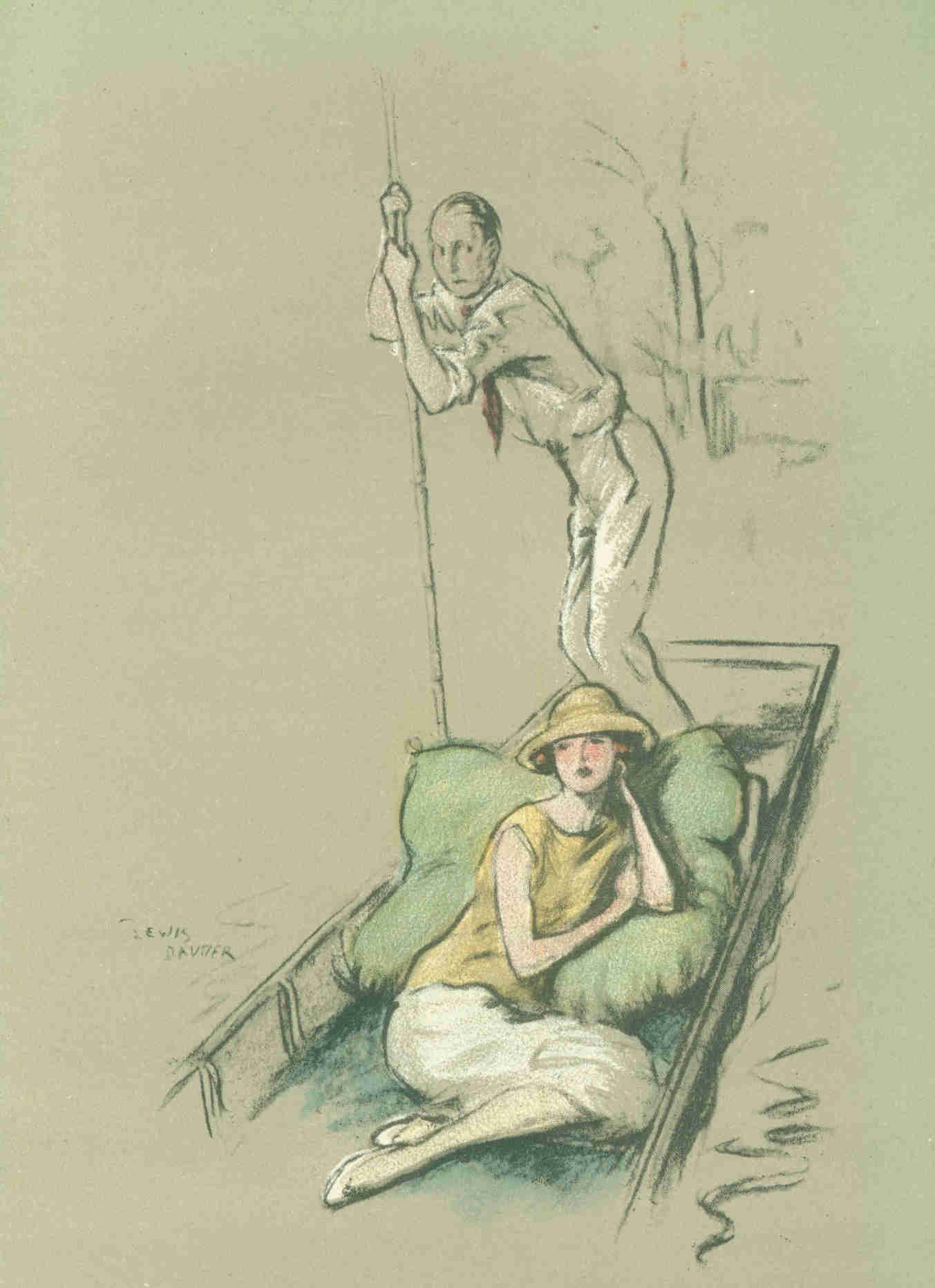
“They loll gracefully among the cushions, while an incompetent male wrestles with the punt-pole.”
Frou-Frou is packed into the teeming lock; the upper gates swing to; a perspiring gentleman at the lower end begins to operate the sluice-wheels, and the great flower-bed in the lock begins to sink with uncanny suddenness. It is composed chiefly of small craft—punts and skiffs. And there are girls—girls in every one of them. They all wear white, supplemented by a coloured jumper, with a hat to match. Pink is greatly in favour for these jumpers, also blue; and there is quite a rage for bright yellow. The general effect is amazingly decorative. The girls are nearly all pretty. They loll gracefully among the cushions, while an incompetent male wrestles with the punt-pole. Here and there you recognize a face from the Winter Garden or the Gaiety, and you may be sure that most of the other ladies are entitled to enjoy a day off too. Many must have hurried straight from their work to their hard-earned play; they have not even had time to remove their make-up. At least, it looks like that.
To the outward eye the people who are enjoying themselves least are the occupants of the launches. These launches are very grand, and have “Private” written all over them. The company on board usually numbers about six, and they sit one behind the other in armchairs. They do not look comfortable: they are the breed which puts on its best clothes to play tennis or go for a picnic. Many of the launches are adorned with silver rails and sport pots of flowers everywhere, but somehow they look neither seaworthy nor sociable. The couples in the punts are far happier.
But for real joie de vivre commend me to the steamer. She carries a good hundred passengers. Who they are and what they do it would be hard to say, but they are evidently all friends of long standing, if one may judge from their bonhomie and lack of stiffness. Through the windows of the saloon we descry backs, and more backs, all bowed over plates. Occasionally a back straightens, in order to permit of the prolonged lifting of an elbow. On deck, under the awning, a dazed but pertinacious pianist is following—or rather searching for—a young gentleman vocalist who has got himself hopelessly lost amid the higher ranges of “The Garden of Love.” The pursuit is not very successful, for the singer’s motto appears to be: “When in doubt, ‘Excelsior’!” and the accompanist’s is: “Go back to the beginning of the page and start life afresh.” However, the audience are not critical, and the couple’s efforts are well received by such as happen to be listening.
But the majority of the company is devoting its delighted attention to the antics of an extremely stout lady passenger and a gentleman in a blue overall, apparently a member of the engineering staff of the ship. They are performing a stately jig to the accompaniment of a hundred rhythmically clapped hands. Periodically, without warning, they rush violently together and treat us to a humorous perversion of the Bunny Hug.
The paternal lock-keeper collects his last threepence, the water ceases gurgling, and the lower gates swing open. There is a warning ring below in the engine-room of the steamer; the gentleman of the blue overall forsakes the dance and dives down an iron ladder; and his place opposite the stout lady is immediately taken by a sprightly octogenarian in a frock-coat and a Panama hat. The engine gives a rumble, and the steamer shoulders her way out into the crowded river again; the launches glide after her, and the punts, canoes and skiffs laugh and push their happy way out after them.
That is our bit of the River on a Sunday afternoon in June.
Profound silence. The lock walls re-echo our voices; and as we paddle our solitary way through the one gate which is reluctantly opened for us we have the impression of being admitted into an extremely damp dungeon. But it is the same lock.
The spectators to-day are few in number. They consist chiefly of babies in perambulators, with complementary nurses. The babies are contented enough. They come to the lock daily, and are quite accustomed to be encouraged to wave their hands to total strangers in boats. They do so now, although there is only one boat. But the nurses are obviously bored.
Upon the river bank outside the lock reclines a languid figure, strangely familiar. It is one of our Sabbath minstrels, in mufti. It would be over-stating the case to assert that his face is white; but we may safely say that he has not blacked it since Sunday.
That is our lock—on any week-day.
“To-night,” I said to my cousin George from Rutlandshire, “we are going to see the first performance on any stage of a new play.”
“Oh! Why?”
That is the worst of these people who live alone with Nature. They think too much. Consequently, when you spring a delightful surprise upon them they ask you a question like that. And the trouble is that there is no answer. I pondered.
“Well,” I said presently, “people like going to first nights. They love it. It is considered a privilege to get in at all.”
“But why do they want to get in?”
I pondered again.
“It’s the craving for novelty,” I said at last. “They want to see something new.”
“It will be just as new to the people who see it to-morrow night—or next week, for that matter—and far better done.”
“But perhaps it won’t run till next week.”
“Then for the love of Mike let’s give it a miss to-night!”
I tried a fresh line.
“It’s an event,” I pointed out; “a thrilling occasion. People will be wondering whether the play is going to succeed or fail. There will be excitement—suspense——”
“Now we are getting down to it,” said George. “It’s the hunting instinct. Why do people go to see a man jump out of a balloon? To see the parachute work? No—on the off chance that it won’t! I don’t think it’s decent to be seen with a crowd like that. Any other reason?”
“Yes—the audience—the brilliant first-night audience. Boxes and stalls will be full of lions and lionesses—statesmen, thinkers, actresses——”
“What?”
I repeated the last word.
“Young?”
“Some of them, quite.”
“All right,” said George, with affected indifference. “Have it your own way. We’ll go and see your lions and lionesses putting it across the Christians.”
Of course, when you come to think of it, George is quite right, and the parallel which he suggests between a London première and a Roman holiday in the time of Nero is uncomfortably accurate. Consider the composition of our brilliant first-night audience. They fall, roughly, into six groups.
Critics. Well, ask yourself how a critic appears to an actor and an author on a first night. How does a boa-constrictor appear to a rabbit?
The Unemployed—the theatrical Unemployed. At normal times there are no kinder-hearted people in the world, but to-night natural acumen and sheer common-sense tell them that the sooner this play comes off and makes room for another, with a more competent cast, the better for the credit of the British Drama.
The Lions proper. To most of these a first night is an occasion for standing up in the stalls and being recognized by the Pit. This is their meat and drink. The more failures, the more first nights.
Stern purists up in the gallery, come to see that there is no tampering with the established canons of dramatic construction on the part of the author, or loose presentation by the actors.
The Jackals. Scouts and emissaries of other managements, who can be relied upon for some whole-hearted broadcasting to-morrow if the play falters in its stride to-night.
The self-appointed claque—friends of the author, the actors, and the management, whose misdirected and untimely enthusiasm is bound sooner or later to irritate groups (1) and (4) into direct hostility.
It is not an audience at all: it is an Old Bailey jury. No wonder the ladies and gentlemen of the company sit gibbering in their dressing-rooms, despite the fortifying presence of sheaves of reassuring telegrams which they have received from their friends or sent to one another, while the author paces the Embankment, considering the possibilities of Cleopatra’s Needle as a diving-board.
We wore tails and white waistcoats in honour of the occasion.
“We mustn’t be the only people in dinner-jackets,” said punctilious George.
We need not have troubled. The gentleman who sat upon my immediate right—an eminent littérateur of the younger school, we gathered—wore bobbed hair and a grey flannel úcollar. Upon George’s left sat an elderly lady exuding an atmosphere of naphthalene so pungent as to suggest that her garment of ceremony was only occasionally required. In front of us a dark, clean-shaven man, in one of those intriguing black evening ties which go twice round the neck, was dispensing information, mainly incorrect, to anyone who would listen as to the identity of everyone present. Behind us, to the secret gratification of George, two radiant creatures in pink chiffon were discussing theatrical politics in a subdued but steady gabble.
It was ten minutes to eight, and the celebrities were beginning to arrive. Each, upon entrance and recognition, received a friendly greeting from pit and gallery. It is a pretty custom, but it throws a certain strain upon its recipients. George noted that one celebrity had to come in three times before anyone recognized her at all.
Apart from open expressions of approval and disapproval, the surest gauge of a new play’s prospects is the coughing of the audience. We coughed, most of us without realizing the fact, during the first quarter of an hour of this play, because the author was a long time getting his machinery in motion, and important characters were kept off the stage while conscientious bores lingered superfluously, explaining to one another what the play was going to be about. At last the leading lady and her male vis-à-vis made their appearance, amid cheers of relief, and the first act swung along to a satisfactory curtain.
Then there were five terrible minutes about half-way through the second act when the play literally lay down and died, and superior people turned to one another and whispered: “Why on earth didn’t they cut this scene out at rehearsal?”—little realizing that the producer who knows infallibly just which five minutes to cut out at rehearsal could, if ever he appeared on earth, afford to retire on a comfortable competence in five years—and the coughing rose to a storm. Suddenly the machinery started into life again, and the storm was weathered. After that all was smooth sailing, and about a quarter to eleven the curtain came safely down on at least an average success and a favourable reception.
Of course, for the moment, values were exaggerated. The curtain was raised and lowered upon the thankful and thirsty players with such persevering regularity and rapidity that presently the audience succumbed to its artful suggestion, warmed up, and began to call for speeches. A tired, smiling, slightly tearful heroine was thrust before the curtain by unseen hands, and offered some inaudible observations. She was succeeded by a husky-voiced gentleman, who thanked the audience from the bottom of his heart for the quite phenomenal and stupendous success which they had enabled him to achieve with “this brilliant play” (a voice—“Rot!”—ignored) and presently dragged into view a writhing gentleman in spectacles, obviously unaccustomed to the glare of footlights and recently retrieved from the Thames Embankment, with whom he shook hands with immense solemnity; after which the audience decided that it had had its money’s worth, and disposed itself for departure.
George and I added ourselves to the chattering stream on the staircase.
“How did you like it?” said a voice behind us.
“Oh, I thought it was perfectly lovely! Didn’t you?”
“Yes—sweet!”
“It is brave of her to go on playing those young parts, isn’t it? How long do you give it?”
“Three weeks, I should think. Where’s Bertie? I’m simply ravenous!”
The above symbol represents the two kinds of air that can be obtained in Hyde Park—fresh, and hot. Fresh is laid on most of the time, but hot is only periodic. You will encounter it most surely, if you happen to want it, in the neighbourhood of the Marble Arch on a fine Sunday afternoon.
But upon Sunday morning the Park is chiefly the resort of those in search of the refreshing variety. Of course they do other things besides breathe. Some take horse exercise, and the less they know about it the more exercise they take. You can meet all types on a Sunday morning in Rotten Row—supercilious habitués, making it clear by the very elevation of their chins that they come here on week-days as well; flushed children on ponies, scampering rebelliously ahead of a staid and paternal groom; a flock of overheated young ladies with their hats at all angles, bumping breathlessly along in the wake of a Byronic riding master; and gentlemen in pink hunting-stocks, who gallop up and down the tan with elbows well out, or else pose carelessly by the rails for the edification of lady pedestrians.
But down by the Serpentine there is more stirring sport than this to be had; for Summer has come at last, and the Tiddler Season has opened. The devotees of this particular spot arrive early in the day, and they arrive in battalions. Infants three feet high escort infants two feet high: these in turn are heavily supervised by an infant four feet high, carrying a baby about a foot in diameter when folded up. Heaven knows where they come from, or how far they have walked. But here they are, eager to be at it.
Their first proceeding on arrival is to split into groups. The sexes do not mingle at all, except sometimes in the case of a very small boy who cannot help himself. A clique or coterie of four or five, either male or female, is the usual thing. On arrival upon the south bank of the Serpentine boots and stockings are removed, and the business of the day begins. The ladies, possibly from humanitarian instincts, do not fish much: their aquatic exercises are devoted chiefly to wading. This they do with suitable caution, testing the depth of water step by step, and sometimes employing Little ’Melia as a sounding-rod. But their cavaliers roll up their ragged trousers as far as they will go, hang their boots round their necks, and get to work like the sportsmen they are.
To catch a tiddler calls for at least three persons, though five may be employed with equal profit and more noise. The apparatus required is simple—a square yard of sacking and a glass jam-jar containing water. The leader of the party carries this in his hand, and issues orders from the water’s edge. The other four, each holding a corner of the sacking, descend into the Serpentine and press the sacking horizontally down upon its waters, until the bottom is reached. After that they wait breathlessly until some unwary tiddler swims over it; then they lift the sacking by its four corners as one man, allow the water to drain through the material, pick the wriggling prize from its bed, and drop it into the jam-jar. That is the theory of the sport; but in practice it is neither so simple nor so certain. The waters of the Serpentine are troubled waters, rendered turbid by the paddling of many small, cold, eager feet, and direct observation upon the quarry is impracticable. There is only one thing to do—sink your sackcloth in a likely spot, wait a minute, then pull it up suddenly and hope for the best.
It is astonishing that any self-respecting tiddler should allow itself to be captured by such a crude device; but many are, as the jam-jars show. What happens to the tiddler after this is a matter for interesting speculation. Presumably for a few days the jar is employed as an aquarium, wherein the tiddler enjoys the status and emoluments of star boarder. One cannot help suspecting that a tiddler’s “expectation of life,” as the Insurance Companies say, is not a high one. Still there are as many good tiddlers in the Serpentine as ever came out of it—and next Sunday is not so far away.
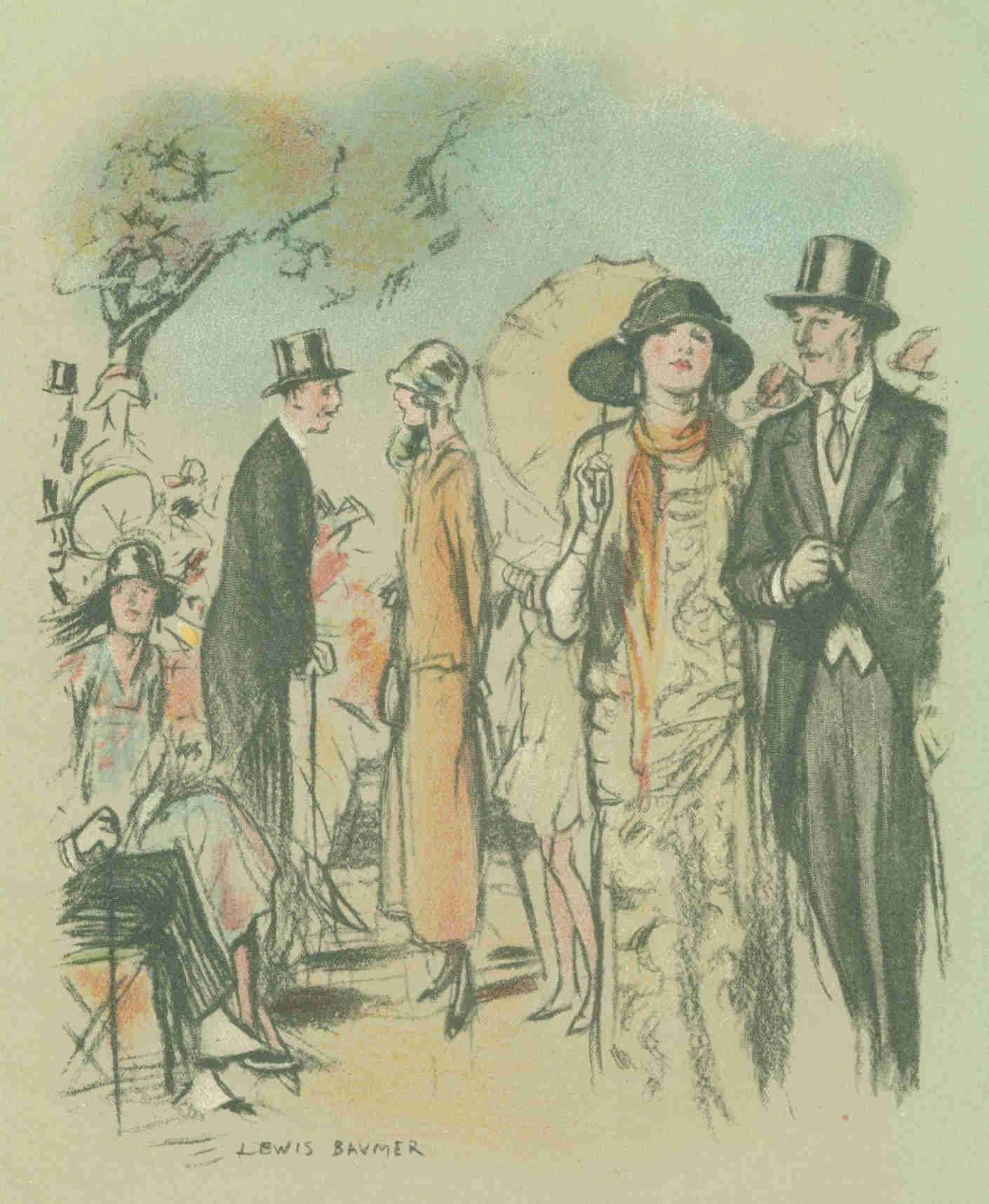
“People who come and sit in the park . . . dressed as if they had been to church.”
It is afternoon now, and the Park is full. The Church Parade people—the people who come and sit in the Park about half-past twelve, dressed as if they had been to church—have disappeared long ago, and the Park has now been made safe for Democracy. Let us take a stroll towards the north-east corner, and enjoy some oratory. This is a more formidable undertaking than you might imagine, because in setting out to listen to a Park orator you are confronted by two difficulties—firstly, to find out what subject he is debating; secondly, to discover which side he is on. In the first instance he is addicted to lengthy digressions upon topics quite foreign to the matter under discussion, which is confusing in itself; in the second, he has a disconcerting habit of quoting the arguments of an imaginary opponent in tones of such profound conviction that for the moment you imagine they must be his own: the fact that he is presently going to refute them with scorn and ridicule is unrevealed to you. Also, since the length of his speech depends entirely upon the length of time he can hold his hearers, he seldom, if ever, comes to the point. If he did, his audience would melt away. So he keeps us guessing; and so far as one humble auditor is concerned he succeeds admirably.
Still, there is always a blessed seasoning of humour, usually unconscious, about his performance. Here, for instance, is an earnest but rather illiterate gentleman delivering a discourse in which a few obvious and familiar religious aphorisms float forlornly amid an ocean of irrelevant reminiscence.
“No, you people,” he announces impressively to a small and calmly sceptical audience, “you simply can’t serve God and Mammon, see? I tell you, I might ’ave bin livin’ in Park Lane over there if I’d a’wanted. In the War, all along of my being a costermonger, I knew exactly where the market was, and ’ow the market was, fer empty bottles and things like that—and mind you, you could get your price for empty bottles in the War!”—he calls it the Wower—“and I could ’ave bin a millionaire by this time if I’d liked. But I reefused. Why? Simply beecause of some of the people I was asked to work with! ‘Simply beecause,’ I reeplied to the War Office, ‘I will not work with men who ’ave not clean ’ands!’ ”
“You mean that’s what they said to you!” a bystander suggests, not unkindly.
“No, no! that’s what I said!” replies the orator, hastily putting his hands into his pockets. “ ‘And,’ I told the War Office, ‘take back your luker! I spurns it! My treasure is laid up in ’eaven!’ ” And so on.
The ears of the inhabitants of Park Lane must burn every Sunday. Their pretentious thoroughfare is a perfect godsend to speakers in search of an object lesson. The red-hot sort, who are convinced that Park Lane is the residence of the British aristocracy, announce their intention of burning it down, and frequently invite the crowd, to its languid amusement, to come and help to Do It Now. The gentler sort are merely sorry for Park Lane. They don’t want it: anybody can have it. Thus:
“No, brethren, I do not live in Park Lane. I admit it. But I flatter myself that when the Great Day comes I shall find myself living in a ’Eavenly Park Lane, enrolled among the Aristocracy of the ’Eavenly ’Ost.”
What is at the back of the minds of all these people? Why are they here at all, making themselves hot and hoarse for the amusement of a frankly ribald audience? Some are obviously salaried propagandists—and skilful propagandists at that. Others, such as our friend the ci-devant retailer of empty bottles, are just ordinary bores. This band of rather self-conscious young women, singing a hymn with an uneasy smile to an unresponsive audience of gentlemen smoking pipes—are they inspired by deep religious fervour, or the ordinary human craving for conspicuity of some kind, or just smug self-righteousness? Probably a little of all three. This unkempt elderly gentleman in an aged Panama hat (which he has adorned with a pink feather and a couple of ’bus tickets), waving a home-made banner with an unintelligible device and mumbling gibberish into his beard, has obviously eluded his friends for the afternoon.
But two outstanding impressions remain.
Firstly, it is much better fun to be a heckler in a crowd than an orator on a box, because the average audience would sooner laugh at a repartee than follow a reasoned disquisition. Nothing is so dull as an uninterrupted windbag. Last week, on May Day, our revolutionaries had the Park to themselves. They arrived in a procession, red flags and all, carefully chaperoned by indulgent policemen; and, mounting their platforms, proceeded to denounce that section of the British nation which, through the sordid necessity of having to earn its daily bread, had failed to put in an appearance at the meeting. But the whole affair was as dull as ditchwater. Orators worked themselves into convulsions, but all to no purpose; for there were no hecklers, and no back answers. Small children who, owing to their devotion to revolutionary principles, had been awarded a half-holiday and conveyed hither in wagonettes to listen to their elders chanting the hymn of freedom, chased one another shrieking round the platforms. Their mothers sat on the grass with their backs to the speakers, frankly talking scandal; while the capitalistic police, bored stiff, lay with their heads pillowed upon one another’s stomachs, openly and shamelessly slumbering.
There is more fun this afternoon. The positions are reversed, and the “Bolshies” are happy, since other people are doing the work and they are doing the criticizing—and getting the laughs, which is what really counts in Park debates.
The other feature is the curious fashion in which independent debating societies spring into existence and “calve off” from the main body of a crowd, as small icebergs calve off from the parent floe, at short notice. Here is one now. A chance word from an orator on the rostrum has dropped into a section of his audience like a spark into a bucket of petrol, and a local conflagration is the result. A fierce argument—needless to say, upon some topic quite remote from the matter in hand—has sprung up between a hygiene faddist with no hat and a small, truculent man with a chin-beard and a falsetto voice. The nearest spectators promptly close round, straining their ears respectfully. In this way a sort of human eddy of some twenty or thirty persons goes straggling away across the grass, revolving slowly round an axis, or vortex, composed of the rival orators, pressed close together by their deeply interested supporters, arguing simultaneously with their noses practically touching.
Words! words! words! How mankind loves the sound of its own voice; and how seldom lung-power ever achieves anything definite! Still, such exercises strengthen the chest and furnish a very valuable safety-valve, not merely for sedition, but for ordinary windiness, whether you be castigating Park Lane or sketching out the foundations of Utopia.
However, on the whole our hearts are with the sportsmen by the Serpentine. They talk as much, they squabble as shrilly as their elders; and they never agree for a moment as to the right way of going about things. But—they do occasionally catch a tiddler.
[This narrative was written on the invitation of a New York editor for a New York Sunday newspaper. It is therefore couched in a language which, though it may sound strange to our ears, will be readily recognized by any American as colloquial English—as spoken in England.]
My name is Lionel Clarence Maltravers, of Dormouse Manor, Beds., Eng. I arrived in jolly old New York yesterday afternoon. This is my first visit to the United States. I do not know so much about America as I should like. Of course one meets many charming Americans in London society, and during the War my brigade was in close touch with some stout fellows wearing uniform very like ours, somewhere in the Argonne Forest. I clicked heavily with several of them, notably one named Mike Smith, who told me he had been raised in a California orange-grove called Pittsburgh. But after the Armistice our acquaintance lapsed. A busy man like myself, immersed in the ceaseless labour of managing an English country estate, finds it difficult to keep in continuous touch with foreign affairs.
However, last November I ran across an old American friend of mine in London, in Buck’s Club, one of our quieter social centres, like the Y.M.C.A. My friend’s name was Larry Lynch, one of the aforementioned stout fellows from the Argonne Forest, with whom I had chummed many a time in those messy but matey days behind the line.
I did what I could for Larry. Not that one can do anything very much for anybody in London, of course. I took him to dine at the Berkeley. After that I showed him round the West End—a musical comedy, a boxing-match, and the tail end of the Drury Lane autumn drama. Then we had supper with a few friends at the Grafton Galleries, and watched the cabaret show on the floor. I am afraid it must have been a deadly dull evening for Larry; because, after all, what is more boring than being taken out to dine at one place in London and sup at another, eating food and drinking wine which one has consumed week in week out practically from birth, or watching shows in which jokes and performers alike were once equally familiar to one’s old dad? But Larry was really frightfully decent about it, and assured me that he had enjoyed himself immensely. I remember him saying, in his picturesque way, that he felt like a million dollars. When we parted about dawn—or what would have been dawn if the sun ever rose in London in November—he said I must come over and visit him in New York; and the only possible answer at that tide of our joint affairs appeared to be, “I’ll tell the world I will!” One picks up these topping phrases very quickly.
Well, just before Christmas, since the frost seemed to have settled down upon my native land for good, and hunting in Bedfordshire looked like an indefinite wash-out, I snaffled a steamer-ticket, wangled a passport, hopped on to an old packet called the Majestania, dodged Ellis Island, and landed in New York yesterday, as already announced. Larry Lynch met me at the dock. As I have been in his company practically ever since, except for about three-quarters of an hour when I called on ex-Senator Hoozitt—but I’ll tell you about that presently—you may say that I have seen America so far entirely under old Larry’s auspices; and all I can say is that New York has London absolutely tucked up and put to bed so far as social welfare is concerned.
What a wonderful thing a young country is! What energy! What resource! Above all, what freshness of inspiration! What a lot of new ways of playing old games, and so forth! But I am anticipating a bit: I must get back to my horses.
Larry Lynch, after he had fixed me up at my hotel—by the way, I must tell you about that: I never met such a friendly crowd in my life. After I had tipped the fellow who brought up my bag, he went away and brought back all his friends—chambermaids, bell-boys, lift-men, and so on, all Irish—who assured me that they would be at my service at any time. I can’t think what made them so jolly cordial: perhaps it was because we have just given them Home Rule, or something. It couldn’t have been the tip: I had been warned against overdoing that sort of thing over here, so I only gave the chap five dollars.
However, that’s neither here nor there. To get back to Larry. As soon as I was settled into my quarters, Larry suggested that, as it was now five o’clock, I should come over with him and visit the locker-room at his club. Inspecting a row of lockers in a dressing-room seemed to me a rum amusement, and I said so. Larry replied that rum was right.
However, I thought it better to attend to duty first—namely, to call on ex-Senator Hoozitt. I had a letter for the old boy from our Rural Dean, who had met him once on a co-operative trip to Jerusalem; and when the Dean heard I was going to New York he asked me to take a letter of greeting to his old friend. I thought I had better deliver the thing before I lost it, so set off at once, arranging with Larry to meet him at dinner-time.
The ex-Senator turned out to be a rather paralysing old gentleman with a long white beard. I forget now what he used to be Senator for: it was one of the Southern States, I think—Saskatchewan, or Guatemala, or something like that. He welcomed me to America very kindly, in a short speech of about twenty minutes; and when he appeared to have finished, I said I must be going.
It was at this point that I got my first glimpse of America’s freshness of inspiration and new ways of playing old games, which I mentioned just now. Without a word the ex-Senator grabbed me by the arm and led me out of the room, down a stair into a sort of vault. Here he unlocked an iron door and led me into a kind of strong-room, with a safe in it. Out of the safe he produced a bottle and two glasses.
“Have some hooch?” he said.
I had no idea what hooch was, but I drank some.
When I got my breath again, I said I supposed this hooch must be of some absolutely priceless old vintage, if it had to be kept locked in a safe in a strong-room.
“No,” he replied, quite simply: “I make it myself. You gotta, nowadays.”
I rather failed to grasp the idea, and said so. Then he explained to me that in America legislation has recently been enacted under which certain rather interesting formalities have to be observed when one consumes wine or spirits. This is called Prohibition, and is designed to introduce a little colour and variety into the somewhat humdrum and monotonous social round of these modern days. Of course, when I came to think of it, I had heard of Prohibition before, but I am afraid I had been a little hazy as to what it meant. I thought it had something to do with freeing slaves in Lincoln’s time; but evidently I had mixed it up with something else.
I said good-bye to dear old Hoozitt outside the strong-room, and presently found myself back with Larry.
“Now you are coming out to dine with me,” he said.
I rather wondered where he would take me. One had heard so much about the famous restaurants of New York—Delmonico’s, and Sherry’s, and Child’s, and places like that. I thought there would be no harm in asking, so I did.
He laughed.
“Delmonico’s and Sherry’s are closed up,” he said.
“I understand,” I replied. “The tide of fashion flows hither and thither, does it not, dear old top?”
“You’re right,” he said. “The place I’m taking you to is quite new—the very last word in the New York mode.”
I said no more, because I knew I could trust Larry not to take me to a place where the right sort of people couldn’t afford to be seen. But I must say I was a bit surprised at the place he did take me to. The taxi stopped in a quiet by-street somewhere, and when it had driven off we walked along for twenty yards or so and stopped at a house—a tall, reddish-brown affair, dark and silent, with a high flight of steps leading up to the front door. But we didn’t go up the steps. Instead, Larry led me to a door underneath, where he pressed an electric button. Presently the door opened a couple of inches, and Larry said something to some one inside. After that the door opened sufficiently to let us slide in, and we found ourselves up against another door, an iron one this time. The whole incident recalled to me strongly the Hoozitt home.
The man who had let us in then gave a sort of mystic series of taps on the iron door, and a round hole appeared, and a human eye looked out at us. Of course after what old Hoozitt had told me I wasn’t at all surprised or alarmed: I simply realized that we were going to play the new game on a fresh and more exalted plane—that we were on the point of entering some pretty high-up lodge, in fact.
We were passed in, and found ourselves in an ordinary dwelling-house, with a staircase running up from the hall. Every room on the ground floor seemed to be bung-full of people, dining, and doing themselves pretty proud, too. The doors all stood open, and waiters were running in and out with plates and glasses. We went upstairs. That floor was bung-full too; for all I know they were eating in the attics.
Larry and I took our places in a short line of people waiting outside what must once have been the drawing-room. It was very much of a dining-room now, with a most pleasant aroma and a cheery hum proceeding from it. It was twenty minutes before we could get a table inside, but the manager was frightfully civil about it, and sent us a cocktail apiece, which made the time pass nicely. Too nicely, in a way, because my cocktail, on reaching its destination, kicked like a live fish; and its efforts, backed by those of the ex-Senator’s hooch, which was still functioning, made it pretty clear to me that I should have to be careful. You see, where I come from we only drink during meals, but these New Yorkers are such a hardy race that they seem to be able to do it whenever the new regulations tell them to.
Fortunately we got our table pretty soon after that, and a really top-hole dinner, accompanied by some excellent white wine. The other people in the room looked a thoroughly jolly crowd—not boisterous, but just quietly enjoying their evening meal. Some wore evening clothes, some ordinary kit; but they all looked comfortable and contented, and most of their ladies were perfectly lovely. I told Larry that this club of his was absolutely the goods—quiet, exclusive and with a touch of real romance about the whole idea—and that when I got home I should try to get some of my statesmen friends to start Prohibition in London too.
Larry laughed, and said I tickled him to death. I did not ask him why, because after all he was my host, and Americans have a very distinct and individual sense of humour of their own.
After we had smoked our cigars, Larry, who appeared to know everybody in New York, took me to see one or two plays. We never actually reached the auditorium, though. We were taken either to the manager’s office or some one’s dressing-room, where refreshment was immediately forthcoming. However, when I explained that I had just arrived from Europe, and was not yet acclimatized to the American standard of hospitality, I was excused. But they always laughed. Life seems to be one continual joke to this festive people. I can never make anyone laugh in London.
About eleven o’clock Larry said it was time to go along to another welfare centre and have a bite of supper. I asked if there were many of these in the neighbourhood, and he replied that to his knowledge there were a hundred and forty-one of them within a mile of us. I asked what made them so numerous and popular, and he said it was the sporting spirit of the American people. He said that the authorities, who were wise believers in the tonic properties of honest fun and innocent make-believe, fostered this spirit by organizing periodical raids upon these lodges—technically known as “joints”—and it was a point of honour never to be caught napping.
I was just going to ask what happened when somebody was caught napping, when our taxi stopped somewhere not far from a brightly lit and crowded street full of flashing advertisement signs—I think it was called Broad Street, or Main Street, or something like that—and after Larry Lynch had exchanged the usual masonic signals with the man at the door, we shot up in a lift with a lot of other people, to find ourselves in a very pleasant sort of roof-garden. A band was playing and tables were grouped round a dancing-space in the middle of the floor. The place was packed, and everybody was supping or dancing or chatting. Of course one had seen places like this in London and Paris—the Embassy and Ciro’s, and so on—but somehow things here seemed different. There was an electric something in the atmosphere—the thrill one used to get while smoking a cigarette in the middle of a rhododendron bush at home at the age of eight, with the parent birds calling in the distance. Once more I saluted the genius which could recapture such an atmosphere for ordinary steady-going citizens.
Larry took me to a table already occupied by some friends of his—two perfectly charming couples—and we all had supper together. Presently I danced with one of the ladies. I found she knew London, so we compared the old place with New York as a spot to kick up one’s heels in. I told her I thought that the New York idea of making every party a sort of close-tiled lodge meeting was a corker. She agreed, and said it sure gave pep to things. She added that there was a wave of pep sweeping over the country, and that wherever I went on my travels I could be sure of finding a community club or fraternity lodge like this. She told me the names of some of the leading pep-producing organizations, which I tried to remember—the Alpha Beta Something, and the Elks, and the Redsox, and the Ku-Klux-Klan, and many others. I said I hoped I should be made an honorary member of some of them, and she replied that she wouldn’t be at all surprised if something of the kind happened to me. Altogether she was a most attractive and intelligent girl.
Suddenly a most tremendously exciting thing happened. A lot of electric bells began to sound all over the place. Everybody stopped dancing and hurried to their tables. When I got to mine I found that my whisky-and-soda had disappeared. I was a little hurt about it at first; but presently I noticed that everybody else’s had disappeared too, and that the entire company were sipping ice-water.
I asked my fair partner what was the matter.
“It’s a raid,” she said. “That’s what the bells are for. There’s a Federal Officer coming up.” By Jove, it was thrilling!
A moment later a rather stern-looking man in plain clothes came into the hall and began to move about among the tables. I played the game, of course, and sipped ice-water like anything. The Federal Officer stopped at a table near us, and took up someone’s glass and sniffed it. Apparently the contents disappointed him. He put it down again with a little sigh, and went out. After that our drinks miraculously reappeared, and the business of the evening was resumed.
“What would have happened, dear old bean,” I asked Larry afterwards, “if those bells hadn’t been rung, and the Federal Officer had walked right in on us?”
“It couldn’t happen,” replied Larry simply. “He rings them himself!”
Considering the stranglehold that it exercises upon its devotees, the game of golf arouses surprisingly little enthusiasm among the residue of mankind. People who never saw a racehorse or a yacht will grow quite hysterical over the Derby or the America Cup; tennis enthusiasts who do not play tennis will fight like maniacs to witness the All-England championships at Wimbledon; experts who have never bowled a ball or handled a bat will sit for three days at Lord’s or the Oval, explaining to one another (and to the players) exactly how first-class cricket should be played. But golf—no. Either golf exists for you—in which case you usually exist for golf—or it does not. And if it does not, golf is merely a subject for ribald comment, inextricably commingled with monocles, plus-fours, and retired colonels. In novels and plays the hero is frequently a gentleman rider or a tennis champion; but a golfer, if he is introduced at all, appears in one rôle only—comic relief. Even people who desire to be charitable towards all men, such as Evangelical Bishops, have only been able to describe golf as “a game of propelling a small ball into a hole, with implements singularly ill-contrived for the purpose.”
It is a pity that the modern golfer does not realize this: if he did, it would adjust his perspectives and abate his ego for him nicely. Not so many years ago he was a very humble member of creation—in England, that is: in Scotland the golfer has been a familiar and accepted feature of the landscape since the dawn of civilization. But thirty years ago the English golfer was so rare and so timid that if he found himself in a railway carriage with a stranger also equipped with a bag of clubs, he would frequently throw overboard the Englishman’s hereditary right to keep himself to himself and enter into conversation with him. He would say: “I perceive you are a golfer, sir.” The other pariah would respond gratefully, and edge closer; and the pair would huddle together in a corner and discuss the mysteries of their craft with furtive relish. But now, if two strangers with golf bags meet in the train, they merely glare at one another, and wonder who will have the presumption to take up the game next. Yes, golfers in these days wax fat, and kick.
And therefore one feels a certain diffidence in including an article on Golf in this volume at all, for the simple reason that people who do not play golf have not the slightest desire to read about it, while those who do cannot see in their sacred pastime any material for profane comment. But certain things may be pointed out.
In the first place, golf has grown to be the most cosmopolitan game in the world, and has produced in consequence a certain international breed of golfer. Just as the Royalties and the aristocrats of Europe find—or used to find—common ground in intermarriage and the interdependence of caste, so the first-class golfers of the world to-day form a sort of cosmopolitan coterie of their own, to the partial effacement of nationality: it is only in the middle and lower classes of the golfing world that national characteristics shine out undimmed.
In Scotland, the cradle of the game—yes, we know all about Holland and Blackheath, but these were only incubators—golf is a serious matter, because it is played by working men, and working men are never frivolous. Before the War you could play on the Braid Hills at Edinburgh for a penny a round. The first thing an Edinburgh artisan did on Saturday, at noon, was to go home and put on his Sunday clothes, including a stiff collar and a bowler hat. After that he repaired to the Braids, with perhaps three clubs and one well-dinted ball; where, after waiting patiently for a couple of hours or so, he played a round that would have put many a fully equipped London stockbroker to shame.
Of course there are other types of Scottish golfer, but these are too often mere Anglomaniacs, addicted to running up to London and rubbing shoulders with English and American colleagues at Sunningdale and Walton Heath, or even penetrating as far as Le Touquet. But in the main Scotland stands where she did, and Scottish golf remains as it was—a religious rite, to be cultivated in solemn silence and at a strictly processional pace.
Then there is the American golfer. With the ardour of youth—and all American golfers are young, even Mr. John D. Rockefeller, who is rising eighty-something—he is out to excel at the game; and, with his passion for getting to the root of the matter and his genius for analytical research, he has developed the game to a higher pitch of excellence than ever before. He practises incessantly with each club in turn, until he is master of all. Before he sets out to play he changes into special clothes: when he returns to the clubhouse he has a bath and a rub down. He keeps himself as physically fit as a runner or a wrestler. No wonder he has begun to filch championships from the easy-going, unmethodical, late-sitting Britisher. This is not intended to be a criticism of American or British golf: it is merely a statement of two points of view. The American believes that if a thing is worth doing at all it is worth doing superlatively well; the Englishman considers that there is a point where play ceases to be play and becomes work. But it looks as if we were going to lose some more championships.
Then there is French golf. There are some exceedingly fine French golfers of the cosmopolitan type just mentioned, but to the French bourgeoisie le golf is merely a vehicle for the exploitation of the domestic virtues. A French paterfamilias arrives upon the tee, say at Boueville-sur-Mer, accompanied by his wife and possibly three children. He hands a club to each, distributes balls, and the party sets off towards the first green. Whoever gets there first is the winner of the hole. No account is taken of the number of the strokes: you might as well try to count the strokes in a hockey match. Anyhow, somebody wins the hole—usually the knowing one who has drawn the niblick—and all concerned move harmoniously on to the second tee, leaving it to the foreign foursome which follows to replace the divots.
Then there is the English golfer. He varies a good deal in type, because the English nation have not quite standardized their golfing types as yet. Sometimes they play golf because they have a natural turn for the game, sometimes for companionship, sometimes because their wives want to get rid of them for an hour or two, but mainly for the sake of exercise. You see, in golf, in distinction from all other games, the worse you play the more exercise you get.
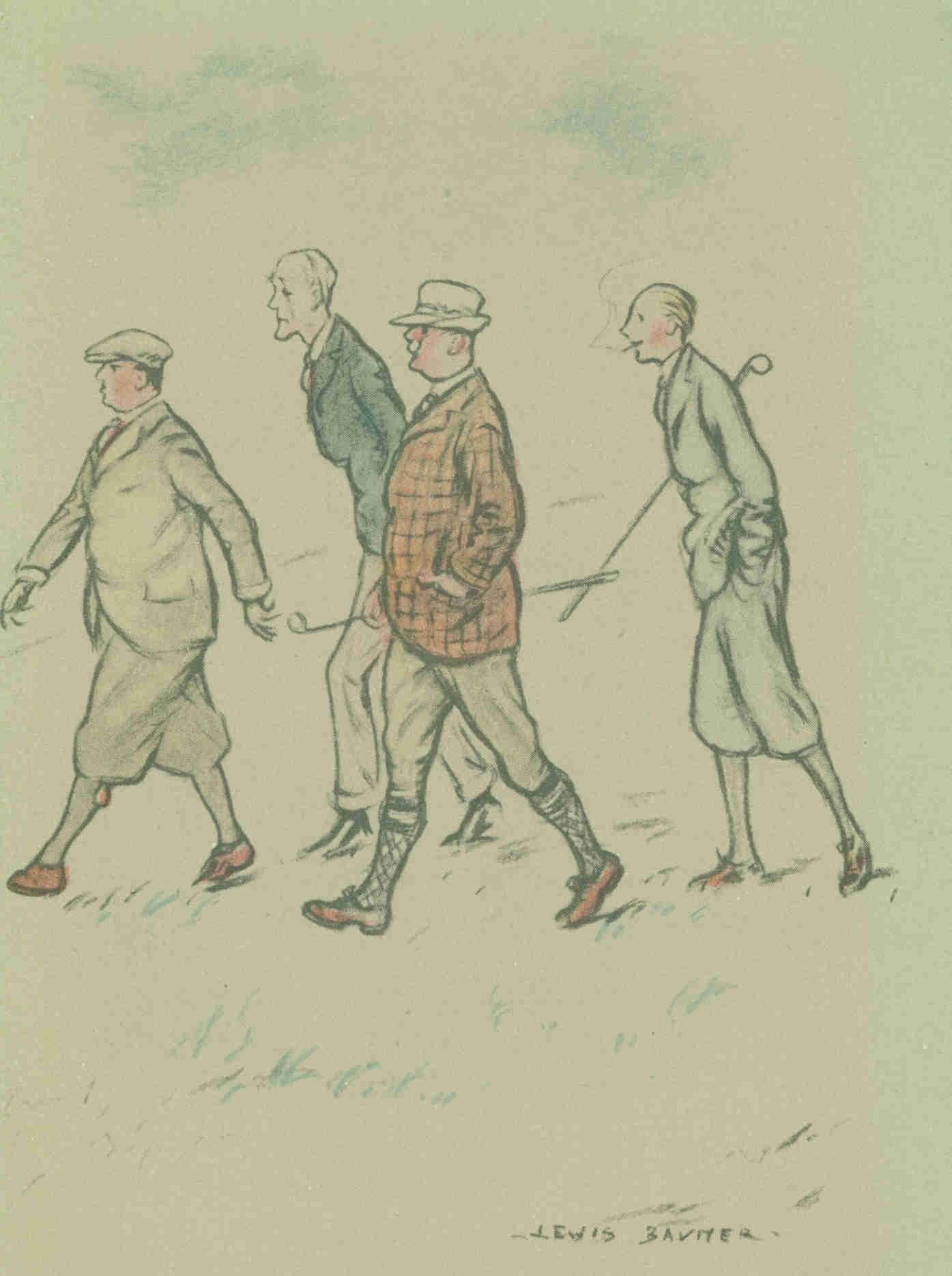
“They are a fairly representative group.”
Observe this foursome setting out to battle from the clubhouse of the Upper Gumbtree Golf Course, conveniently situated within three-quarters of an hour of three London termini, and only fifteen miles by road from Hyde Park Corner. They are a fairly representative group.
First, Sir Percy Tutt. Sir Percy is said to be very successful in Lombard Street. He is a little man of about fifty-five, with an aggressive manner and toes very much turned out. He has taken up golf comparatively late in life, and wears plus-fours, red “flashes” on his garters, and brogues with tongues resembling leather beards. Like most beginners, he is at present entirely obsessed with the length of his drive. The fact that there are other things to do after the tee-shot means nothing to him: his sole aim is to show these young fellows that when it comes to hard knocks and straight hitting middle age can hold its own with the best of them. It is not advisable to attempt a conversation with him when walking up to the ball, because he is measuring the length of his drive, and if you speak to him you will cause him to lose count. He reckons each stride as one yard, but as he throws his feet out in a lateral rather than a forward direction it is doubtful if this computation is correct. Anyhow, if you leave him alone and let him play the game in his own way he will ultimately arrive at his ball and announce, with simple pride:
“Two hundred and sixty-seven yards! Not so bad, with the wind against me—what?”
After that he misses the ball entirely with his mashie. But this does not distress him in the least: he is not interested in what he calls “hockey shots”: he is reserving himself for the next tee. Otherwise he is a perfectly normal citizen.
Mr. Yesmilud is a K.C., in baggy flannel trousers. He brings to bear upon the game what is easily recognizable as the legal mind. He likes things done in proper and standardized form. He drives from an india-rubber tee, with a red tassel attached to it. He only plays a stroke after prolonged meditation and a couple of practice swings, and the swings are based upon a carefully thought out dynamic formula. On the green he can best be described as broody. The fact that he has survived to the age of sixty-three speaks volumes either for the Christian forbearance of golfers as a class or of the deterrent effect of capital punishment.
The third player, Colonel Damyer, would be a happier man if he had lived in the time of Joshua; for with that commanding personality as his partner he might possibly have been able to compel the sun to stand still over Gibeon and the moon over the valley of Ajalon. Orpheus with his lute might also have been useful, to keep the animal kingdom quiet; for Colonel Damyer is one of those people who is very easily put off his stroke. When he straddles over the ball no caddie must breathe, no dog bark, no bird cheep. If they do, all the world hears about it. That is practically all that need be said about Colonel Damyer: the rest is mere fire and brimstone. It is hardly necessary to add that in the smoking-room in the Club there is a certain armchair which is his by right, and which none would ever presume to occupy in his presence, and only a few audacious spirits in his absence.
As for the fourth player, young Skyte, his golf requires little description. He simply walks up to the ball and gives it a furious blow. If it flies straight, as it sometimes does, he grasps his putter and strolls after it, whistling. Otherwise he takes his niblick, which the caddie has been holding ready for him, and with a cheery farewell to his partner disappears into the undergrowth, rejoining the cavalcade with or without the ball, but with his equanimity quite undisturbed in either case, at the next tee. He will be a fine golfer some day, for he possesses the right temperament.
There is not the slightest need to describe the game itself, because one match of this kind is very like another match of this kind. It is sufficient to note with regard to this foursome that:
Its progress throughout the round was impeded by a disgracefully slow three-ball in front.
It was repeatedly driven into by an unprincipled pair of thrusters behind.
The caddies were all either decrepit, or inattentive, or in imperfect control of their diaphragms.
Each side would have won the match but for a stymie laid it by the other.
The respective partners spent the first nine holes apologizing to one another; the last nine glaring, and muttering to themselves.
The last hole was the most sensational. From the tee Sir Percy Tutt achieved, by his own computation, a drive of two hundred and seventy-five yards at a hole which was marked on the card as two hundred and forty yards long. This still left to his partner, Colonel Damyer, an approach shot of some eighty yards.
Unnerved by a rending hiccup from his caddie, Colonel Damyer topped the ball into the bunker guarding the green.
His partner not only got the ball out but laid it almost dead, and pretended he had done it on purpose. Score, as yet, three strokes.
From the same tee Mr. Yesmilud, after a prolonged period of cogitation, sliced into the rough, discovering too late that he had used his Number Two spoon and the Vardon grip instead of his Dreadnought driver and the Duncan stance.
Young Skyte played a perfectly preposterous shot out of the rough over a plantation of tall trees, and landed upon the green within two feet of the pin.
His partner, Mr. Yesmilud, after prostrating himself upon various parts of the green with one eye closed, and having ascertained the direction of the wind with a silk handkerchief, missed the putt.
Colonel Damyer, with a putt of about the same length for a half and the match, missed his.
The result is a halved game. Putters are handed back to caddies, and the post-mortem begins.
“I averaged two hundred and seventeen yards for the eighteen holes,” announces Sir Percy Tutt. “Not so bad, considering the soft ground. I think I’ll play with a ‘Trufli Special’ next time, though. More run.”
“If you could keep those infernal trousers of yours from flapping in the breeze, Yesmilud,” says Colonel Damyer, “it might be possible to putt.”
Mr. Yesmilud takes up the solo part in the quartette.
“If you had only kept on the fairway at the second hole, partner,” he sighs, unburdening himself of a grievance which he has been conscientiously suppressing for nearly two hours, “the result might have been different. That was where we threw our victory away!”
“Sorry!” replies young Skyte, cheerfully. “We had rotten luck all along, really. If your drive to this last hole had only been about a hundred yards longer, and about fifty yards straighter, we should have done it in one. Now, what about a short, sharp, refreshing——”
“Fore!”
An exasperated yell comes floating down the course, and a ball bumps upon the green, missing Colonel Damyer’s left ear by about four inches. Fortunately, the incident deprives him of his breath.
The quartette, thus admonished, leave the green and disappear into the clubhouse, whither we need not follow them further. If you do not play golf you will not have read as far as this, and if you do you will know exactly where they are gone.
A big barn of a church in an English seaport town. The entire building is crammed with men—men in their Sunday clothes—men who appear to live on the sea or by the sea or for the sea—sailors of every grade; ’longshoremen, mechanics, firemen, dock-hands, fitters; and comparative laymen who saw wood or heat rivets. Anyhow, it is an audience composed entirely of men who work for a living—and what prouder designation could any assembly desire?
It is just after three o’clock on Sunday afternoon, and all are present as members of a certain Brotherhood, gathered, firstly, for the transaction of routine business, secondly, to listen to a discourse from an invited guest.
At the present moment the guest is sitting nervously on the edge of a chair in the vestry, undergoing instruction as to procedure.
“This Brotherhood of ours,” explains the chairman, “has branches all over the country, chiefly in the big industrial centres. Anybody can join, and any time he doesn’t like it he can get out. We are non-political, non-sectarian, and we aren’t subsidized or financed either by Trade Unions or employers of labour: we just run ourselves. We meet every second Sunday afternoon in a borrowed church. We sing a hymn or two, and read a chapter, after which we transact any necessary business. After that we listen to our invited speaker. We invite all sorts—we had a Bolshie last time, and a Freethinker the time before, and the Bishop of London the time before that, and we had poor old Bottomley once—but mainly they are just men who are known to have done something, or written something, or seen something, and who feel like coming and telling us about it. They can say anything they like: we want to hear every side. No one takes offence, and there are no reporters. We can’t afford to pay any fee, beyond bare travelling expenses, but we don’t often get a refusal. The very best seem to like coming to us, and they seem to give us their best. Half-an-hour is about the usual, but I expect you will know when they want you to stop. Not that they’ll interrupt. I suppose you won’t mind a few questions at the end, though? If you’ve said anything they disagree with, naturally they like to get back at you a bit: it keeps the keen ones from interrupting, too. The questions will be handed up on slips of paper, and you’ll get a chance to study them for a few minutes during the vote of thanks. Now, sir, if you’re ready, we’ll go and face the music.”
The committee and their guest pass through the door and mount the rostrum, half pulpit, half platform. A thousand husky male voices are uplifted in a hymn—one of the few real, rampant war-songs of militant Christianity—“Onward, Christian Soldiers!”, no less. Someone hands the visitor an open hymn-book, and he takes cover behind it, gratefully. He is feeling a little dazed, which is not altogether surprising.
There are faces everywhere—in front, on either side, and even behind him—faces bearded and faces shaven, not always surmounting collars. Some of them are not too prosperous, for the spectre of post-war unemployment stalks abroad in the land. There are more faces above him; the three-sided gallery is full to overflowing, and hangs low: by stretching out a hand he could exchange greetings with half-a-dozen total strangers. . . .
“Onward, then, ye people;
Join our happy throng——”
The last verse!—and he finds himself tongue-tied already, for a definite reason. Until ten minutes ago he had not been greatly concerned with the text of his discourse. He would be sure to think of something, he had decided in the train. An expression of thanks for the honour implied by the invitation; a humorous story or two; and a few words about thrift, and loyalty, and self-discipline, would about meet the bill. Now his vague complacency is gone—vanished. This is not an audience, he has suddenly realized, to be patronized or taken lightly.
The hymn ends, and everyone sits down, excepting an odd hundred round the walls who have nowhere to sit. An elderly committee-man advances to the front of the platform and reads a chapter of the Old Testament—something full-blooded and stimulating about Nehemiah, with his sword in one hand and his trowel in the other. Then the chairman takes charge.
“Before we get to our speaker,” he says, “we have some ordinary business to attend to. First of all there is a blind Brother, Joe Potter, who would like to come here regularly, if some one will undertake to bring him along. That would make seven blind men altogether—and a jolly good record! Joe lives at 28 Pleasant Row. Who will take on the job? No use offering unless you can be regular!”
A dozen hands shoot up.
“Jack Lane, you live nearest to Joe: you’ll do best. That’s settled, then. I’ll tell Joe you’ll call for him next time, about a quarter to three. Thank you, Jack! Now, the Boot Fund. It’s been a baddish winter, as you know, and to cut a long story short, we shall require another fifteen pound.”
He goes into some detail now, and the interior economy of the Boot Fund is laid bare. There is a suggestion of a discerning and businesslike fairy godmother about the whole business. Thus:
A parent, we will say, in need of a pair of boots for a pair of small and restless feet, brings the owner of the feet to the Brotherhood, and the feet are fitted with boots almost without question. But only as a loan. The boots are the property of the Brotherhood; they are stamped with the name of the Brotherhood, and must be returned when no longer required. Thus due economy is observed, while the sensitive are relieved of the dread stigma of accepted charity. What is more, the Brotherhood, who are essentially men of the world, maintain a painfully complete understanding with the pawnbrokers of the town on this subject; and woe betide the parent or guardian who attempts to transmute the boots of the Brotherhood into easy money.
Assuredly, it is the poor that help the poor. Of their own initiative, and from their own slender resources, the Brotherhood have contrived that not one child in this town shall go ill-shod all through this long winter, bad times or no. And this was the audience which the speaker of the afternoon had proposed to regale with a couple of pointless yarns and an exhortation to self-respect!
The chairman is introducing him now. He hears his name mentioned—his record as a soldier and pioneer—and a few words of appreciation at his coming. Then comes the summons.
He rises to his feet. His whole audience rise with him, applauding hospitably. Then, suddenly, they subside, and he finds himself alone in a sea of upturned faces. Crumpled up in the palm of his hand are certain rough notes of what he had vaguely thought of saying. Thank God, no one knows what!
There is an appreciable interval of expectant silence, while he recasts his thoughts. He is a sincere man, which means that he is not a ready speaker. Presently he begins—haltingly, after the manner of Englishmen of his caste.
“This is my first encounter with your—er—organization. I had no real knowledge of its nature until five minutes ago; and now that the knowledge has been revealed to me—well, it has rather taken the wind out of my sails!” He smiles, disarmingly. “You see, you invited me down here to give you a ‘message,’ if I had one; and you have started off by giving one to me. This!”
With a dumb, expressive gesture he indicates the teeming, virile audience—the Boot Fund—Joe Potter—everything.
“You make me feel very proud,” he continues presently—“and—very humble too. You understand what I mean—proud to be your guest, humble when I see so much done, with so little fuss, by men who might well be excused for doing nothing. And that brings me to my message—my text—or whatever you prefer to call it. I may say that, whatever it is, it has only just occurred to me!” He smiles again. “When I came in here ten minutes ago I hadn’t the vaguest idea what to say: now, since I have looked into your faces, I know. It’s this. What—what a tremendous national responsibility rests upon people like us—like you and me—and how little other people realize the fact!”
Here is something unexpected. There is a sudden stir, and a ripple passes over the sea of faces.
“I am a soldier; many of you are or have been soldiers or sailors. All of you are in a sense soldiers, accustomed to carry out the ideas and the orders of other people, whether in a shipyard, or in a factory, or on a barrack-square. And the point to observe is this. It does not matter in the least whether these orders and ideas are good or bad—and we know that they are frequently rotten——”
There is a sudden murmur of appreciation.
“Our job is simply to carry those orders out, to make those ideas work, somehow. And somehow we do it—so regularly that people pay us the compliment of taking what we do as a matter of course. And here’s something that explains why. The main strength of our country lies, and always has lain, in our men-at-arms—our Other Ranks, as we call them—whether military or industrial. As a nation we have seldom been wisely directed or well led in all our history: most of our successes, whether in war or peace, have been ‘soldiers’ battles.’ And for that, I repeat, the credit mainly belongs to the men like you and me—the men who feel that the ship must be kept going somehow, whatever may be happening on the bridge or quarter-deck, or for that matter among the malcontents in the foc’s’le—the men who keep on trying, whatever the politicians, or the profiteers, or the doctrinaires, or the agitators may be after. We grumble and grouse, of course, and tell one another we are fed up—and usually we are—but we carry on. We expect no thanks, and we don’t get any; but the ship goes forward, and that is all we care about. Win or lose, sink or swim, in good times or in bad, the ship—the cause—the job—and not ourselves! That’s the stuff! So long as that spirit endures—and I have living, vigorous proof before my eyes at this very moment that it does—our country, this England, about which we say so little and feel so much, is all right.” His voice shakes, oddly. “Quite all right!” He pauses, to a sudden deep murmur of comprehension. Then:
“I hardly like to dig up war-stories at this date——”
Reassuring sounds are audible. It is only the people who were not in the War, or of it, who regard the topic as antiquated.
“Well, here is one, which illustrates the spirit I have been trying to describe. It isn’t a story at all, really: it’s just a memory that sticks—of a man whom I met in the spring of ’seventeen. He had just been fished out of the sea, with thirty or forty others, somewhere off the north-west coast of Ireland. His ship, a fair-sized ocean-going freighter, bound for the United States, had been torpedoed at sight a few hours previously. Luckily a destroyer came up at the right moment, sent the submarine to the bottom, and rescued the survivors of the freighter’s crew.
“I talked a good deal to this man. He was a ship’s fireman, and this was his fourth consecutive attempt in five weeks to complete a voyage across the Atlantic. Four times he had shipped, and four times his ship had been sunk or disabled. And here he was, homeward bound once more, prepared without any fuss, or boasting, or self-pity, to sign on for a fifth trip—to take a fifth chance below the water-line, of death by shock, or drowning, or escaping steam, as the merest matter of routine. He said nothing about glory, or the Fatherland, or his ancestors, or the flag, as many equally brave men of other races and other times might have done. He cursed the Hun a bit, borrowed a dry shirt, and went back to his job. He was just one of the people whom we take for granted—and are not disappointed!
“I often wonder what became of him. I hope he came through, but I doubt it. He never even told me his name; but to this day, whenever I travel on the ocean, and I see a man with a swab of cotton waste round his neck snatching a mouthful of fresh air at a porthole or the top of an engine-room ladder, I take off my hat to him—in memory of my unknown friend, and of the lesson he taught me.”
Ten minutes later the visitor sits down, with no very clear idea of what he has been saying; because, for the first time in an intermittent and agonizing career as a public speaker, Inspiration has marked him for her own and borne him aloft to heights where men do not hesitate or measure their words, or stop to wonder whether they are making fools of themselves or not, but simply speak that which is within them. He knows he has spoken for his full half-hour, to an audience which asked for more. His last and clearest impression is of having been permitted, by acclamation, to offer his travelling expenses as a very humble contribution to the Boot Fund.
Lastly, he realizes that although he is sitting down, everyone else is standing up. The chairman explains.
“They always stand, sir, when the speaker rises to speak: that is politeness. But if they do it again when he sits down—well, that’s different. It means that he has got them.” He offers a hand, on behalf of the audience. “Now, before we finish up with The King, will you answer questions?”
“I’ll try.”
But to-day there is only one question. It is not even passed up in the usual written form: it is asked from under the gallery, by one of the odd hundred who could not find a seat.
“Could you kindly tell the members present the name of that torpedoed ship, sir—the one you was telling us about?”
“Certainly. The Obispo, of the Omega Steam Packet Company, outward bound for New York.”
“And the fireman, sir—the man you say you hoped came through? The man you lent that dry shirt to?”
There is a hum of quickened interest. Here is the human touch.
“I never said I lent him the shirt,” protests the visitor, colouring.
“But you did, sir. I’ve got it on now: And I came through all right, as you hoped. Do you want the shirt back, sir; because my old woman——?”
There is a great roar of laughter.
“Keep it, please!” shouts the donor, confusedly.
The chairman rises.
“That,” he announces with a solemn twinkle in his eye, “makes our guest eligible for life-membership of the Brotherhood, doesn’t it? Those in favour? Carried unanimously!”
At the end of his day the average urban citizen, having partaken of his evening meal, turns his thoughts towards recreation.
You may re-create your natural energies in various ways—by repose, by exercise, or by simple relaxation, according to your calling and disposition. If your case calls for repose, you appropriate the sofa and frankly turn your face to the wall; if for exercise (which may be physical or mental), you play billiards or bridge or mah-jong, or tackle a psycho-analytical novel. But our average urban citizen craves for none of these things. They are not for him: all he desires is to relax. Relaxation being a rare and difficult accomplishment, he contents himself as often as not with something entirely different—artificial distraction. And for him, night after night, hard-working comedians paint their noses red, and devoted young women paint their eyelids blue, and saxophone players stifle their humanitarian instincts, all the world over.
The particular form of distraction with which we are here concerned has many names, for it flourishes all over the globe. In London they call it a revue, because the idea was originally borrowed from Paris; in Paris, where labels change with modes, and sometimes without them, they now call it a spectacle; and in New York, where they are rather shy of French phrases—partly from fear of mispronouncing them, and partly from patriotic pride in the language of Lincoln and William Jennings Bryan—they call it a girl-and-music show, or, in homelier phrase, a girlie-girlie show. What they call it in Central Africa I do not know; but it does not matter, because for all practical purposes the essential elements of the offering are fixed and immutable.
The curious thing about these entertainments is that no one ever admits that he goes to them. They are provided for a lower stratum of the community, and the average citizen tolerates them because he is a broad-minded person. Just that. The object of his altruism is a fabulous animal called the Tired Business Man. This exhausted toiler, he admits, cannot be expected to cope successfully after a strenuous day with classical music or serious drama: hence girlie-girlie. New York is particularly solicitous towards commercial prostration. For the moderately tired there are after-dinner entertainments lasting until eleven o’clock or so, but for those who are absolutely down and out cabaret shows and supper-clubs are provided which keep open until breakfast-time.
Of what ingredients are these revivifying mixtures composed, and to what extent do they vary in the three great capitals of the world? How far, for instance, would a Parisian spectacle resuscitate a commercial traveller from Brooklyn or Newcastle-on-Tyne? The answer is, considerably.
But first of all there is something to consider quite as important as the actual composition of the dish, and that is the manner in which it is served. And here New York, spectacular New York, must be awarded pride of place. Most of her theatres are comparatively new, well-designed, and properly ventilated. In London we are inclined to ponderous Victorianism in our scheme of theatrical architecture and upholstery, while the line of sight to the stage is not always what it should be. In Paris, on the other hand, the interiors of the sprightlier places of entertainment present the appearance of having been cut out of cardboard and decorated by a child with a box of toy water-colours during a wet afternoon in the nursery. One lives in constant fear that the proscenium arch will buckle, or that the bottom of a crowded loge will drop out, occupants and all. Moreover, the French have not yet been told about ventilation. They are the foremost intellectual nation of Christendom, but convection currents mean no more to them than Prohibition.
In lavish New York, too, the last word is spoken in the matter of scenery, costumes, and lighting. Real silks, real brocade, real water in the fountain: nothing is omitted that can add to the illusion of the senses. In one of the big Broadway revues to-day there is a song-scene depicting life in a California orange-grove, in the course of which the auditorium is actually sprayed, from some mysterious source, with the perfume of real oranges. The effect is singularly akin to that which has been produced nightly by an older, cheaper, and less romantic process in the pit at Drury Lane since the days of Nell Gwynn; but no matter; New York is thrilled and comes in its thousands to sniff.
But apart from differences of expenditure on the setting, one revue, as already noted, is very like another, and the resemblance is heightened by the fact that under conditions of modern transportation it is now possible, the moment a new idea, or playlet, or lighting effect is exploited in one capital, to swoop down upon it and convey it instanter to the other two, before anyone has the presence of mind to say anything about the law of copyright, or even shout “Stop thief!”
Still, the foundations of a building are not the most conspicuous feature of its architecture: it is the superficial excrescences which strike the eye.
First, the personnel of the entertainment—the human factor. Taking the ladies first, as both duty and inclination direct, we are at once conscious of differences in national viewpoint. In the age-long struggle between youth and experience which the theatrical profession always presents to us, the outcome seems to vary with the nationality of the combatants. In America, that land of exultant youth, the ingénue scores all along the line. The supply of attractive and competent young actresses in New York to-day is amazing. They always look their parts; usually they play them brilliantly; and they appear to do so by instinct. In Paris, one may almost say, no actress is considered sufficiently experienced to play an ingénue until she is approaching forty; an American girl would consider herself lucky if she were permitted to go on doing so after she was twenty-one, so abundant is the supply. In England, with our national passion for compromise, we employ ladies who combine within their own persons a happy blend of past achievement and future promise. Let us leave it at that, adding as a postscript that most mournful of human reflections: Si jeunesse savait; si vieillesse pouvait!
The truth is, revue acting is a very difficult business. It calls, or should call, for enormous versatility. In London, fortunately, no one seems to know this, or regret it. If there is one thing that an Englishman appreciates it is consistency. He loathes things that alter his routine or unsettle his convictions. He detests surprises, especially in politics and the drama. As a nation we prefer character to ability in our politicians—apparently because we cannot have both—and personality to resource in our actors—especially revue actors. If Mr. George Robey were to appear before the public to-day minus his eyebrows, or Mr. Harry Tate minus his moustache, both would forthwith be dragged from their pedestals and consigned to that limbo which already contains the Admirable Crichton, Bottom the Weaver, and some of our more versatile statesmen.
New York is more catholic and exigent, because New York is a cosmopolitan city. Every nationality in the world is to be found there, and they all go to the theatre. Consequently New York audiences cherish a passion for what we call dialect comedians. Most of the successful revue and vaudeville actors in America are foreigners, or behave as such. The Irish comedian, the “Dutchman”—German or Scandinavian—the Italian, or “Wop,” the negro, and the Jew—more especially the Jew—they all have their appeal and their public, and some of them draw enormous salaries. The highest-paid actor in America to-day is a young Jew who has conceived the brilliant notion of blacking his face and so appearing as a Jew and a negro simultaneously.
In France there is a different tale to tell. A Parisian revue actor has to be versatile or perish. Personality counts for little. No one in the audience knows or cares who he is or what he looks like in private life, for the French stage maintains the sensible custom of living within its own boundaries; so your enjoyment of Hamlet’s soliloquy, we will say, is not marred by the knowledge that Hamlet opened your church bazaar last week, and is an indifferent eighteen at Wimbledon Park Golf Club.
No, the French actor keeps himself to himself, with the result that he is usually able to spring an illusion on you. He is an artist first and foremost. By donning a wig and adding a smear of grease-paint to his mobile features he can successively personate a gendarme, a concierge, a vieux marcheur, a conscript, an apache, and Mr. Lloyd George, all in the space of a single evening’s entertainment, without permitting you so much as a glimpse of his own personality. Unless you study the programme carefully you will imagine that a different actor is playing each part—as indeed he is.
Speaking of Mr. Lloyd George, it is interesting to note the status of the politician in modern revue. Political references and travesties have been a standard feature of such entertainments since the days of Aristophanes. But to-day these languish, except in France. In England the law of libel is a stumbling-block, while in America no politician is sufficiently well known by sight to be worth putting on the stage—with the exception of the President, whose personality is rightly sacrosanct. If you wish to pillory celebrities upon the American stage you bring on a couple of millionaires—say John D. Rockefeller and Henry Ford. Even these are lightly handled.
But in France they take their politics very seriously. Every French butcher’s boy possesses an intimate knowledge of his country’s affairs. No political allusion “gets past” him, and if he is not regaled at least once during the evening with the spectacle of an unpopular statesman trapped in some ridiculous, embarrassing, or scandalous situation, he feels justly aggrieved. He is deeply versed in foreign affairs too. He knows that Mr. Lloyd George, as perpetual Prime Minister and Dictator of England, is responsible, ex officio, for the present depreciation of the franc, the complications in the Ruhr district, and the poor quality of last year’s champagne crop. Besides, Mr. Lloyd George is an easy person to caricature, which makes the French revue actor loth to let go of him.
It is a quaint custom, to employ a frothy revue as a vehicle for conveying stern reproof to errant neighbours. Time was when the reproof was administered with more pungency than decorum; but since the War things have altered. France’s attitude now is one of pained but dignified remonstrance. Thus:
The curtain rises upon Tableau Twenty-seven—a distant view of the Eiffel Tower, we will say; though the interior of a Citroën garage will do equally well. They do not strain after adventitious scenic effect in France. That pathetic pair of nuisances, the compère and commère, come mincing on for the twenty-seventh time. Having greeted one another with unconvincing expressions of pleased surprise, they let fall certain incomprehensible twitterings on the subject of la situation internationale. This paves the way for the entrance of two well-nourished and incredibly voluble ladies of middle age. One of these represents Marianne, the symbolic figure of the Third Republic; the other, from the fact that she wears a brass helmet on the back of her head and carries a shield and trident, the former displaying a Union Jack upside down, we adjudge to be Britannia.
The pair plunge forthwith into a profound and interminable debate upon foreign politics—a sort of Blue Book thrown into dialogue form. Speech is answered by speech, and that by counter-speech, each of which begins “Écoutez, madame!” and proceeds like the rattling of hail until breathlessness intervenes. It is quite impossible to understand what either lady is talking about, but it is obvious that Britannia is getting the worst of it. The result is a foregone conclusion. Marianne produces a flag and waves it; the expressions “la patrie” and “enfants de la gloire” are discernible; the claque at the back of the parterre gets its cue and comes to business. There is a crash of brass and a roar of applause; Britannia, realizing the hopelessness of her position, very handsomely admits that she has been in the wrong from the start, and promises to be good in future. Thereupon the two ladies solemnly shake hands, and back off into the wings just in time to avoid being swept into the orchestra by Tableau Twenty-eight—a pair of whirlwind dancers or a troupe of performing seals. That is how international differences are settled on the French stage. It seems as good a way as any.
French revue is unique in another respect. It acknowledges the presence in Paris of foreign visitors, and even caters for their tastes; whereas in London and New York we ignore both them and their feelings. At a Parisian revue portions of the programme are printed in English—an English which is joy in itself. (Such as: La vie du bonheur, ’Appiness Life; and Toutes les Femmes, The All Womens.) Moreover, scenes of British and American home life are presented for the comfort and solace of exiled Englishmen, not forgetting those good Americans who have decided to controvert tradition by going to Paris before they die—usually a long time before they die—and not after. No Parisian revue is ever quite complete without a bevy of damsels dressed as cowboys picking cotton in North Dakota to the music of a jazz band. As for British requirements, I still cherish a tattered pre-war programme of a spectacle at the old Folies Marigny, whereof a prominent item was “Le Lovestory de Sir Walter Scoott.” The scene, I remember, was laid by the waters of a tropical lake, where Scoott himself, attired à la Harry Lauder, sang an incomprehensible ditty to the air of The Bonny Banks of Loch Lomond. He was supported, I shall always rejoice to recall, by a chorus of “Higlanders and Barmales.” (The latter proved to be barmaids.) Do we present French national heroes in this erudite and reverent fashion in London or New York? I fear not.
Probably the weakest feature of modern revue is its music. Whoever made its laws, most of its songs are awful. They come chiefly from New York, for the simple reason that most of the spare pocket-money of the world is at present accumulated in that city; with the inevitable result that the world’s music-makers—mainly members of that gifted and enterprising race which, to be just, has made some of the greatest of the world’s music in its time—have automatically mobilised round Times Square, and are busily employed in giving the public what it wants—and deserves. Unfortunately these talented immigrants, besides supplying the music, insist on keeping the business in the family by writing the lyrics as well; and though few of us can tell good music from bad, some of us are sufficiently sophisticated to wince a little when the English language is maltreated. It would be interesting to capture some half-dozen of our greatest modern lyric-writers—gentlemen who are profoundly convinced that “lady” rhymes with “baby,” and “chance” with “pants”—and lock them up for half-an-hour in the same room with the shade of W. S. Gilbert, and contemplate the awful result when the master had finished with them.
As for dancing, the most ancient and elemental of all expressions of joie de vivre, the best individual dancers come from vigorous young America, though if you are looking for technical virtuosity you must award the palm to some of the numerous troupes of exiled Russians which infest our stage to-day. But in teamwork the English girl is unsurpassed. She is not always beautiful, but she knows her business, which is more than can be said for her sister the chorister. She goes all over the world—to Paris, New York, Buenos Aires, Vienna—hard-working, self-respecting, and uncompromisingly British. She travels in a troupe of eight, or sixteen, or twenty, and she triumphs by reason of the absolute precision of her movements. (A British sergeant-major once defined the game of golf as “ ’Ockey at the ’alt”: in the same spirit one might compare a troupe of English dancing girls to a smart little half-platoon of Grenadier Guards doing “physical jerks at the double.”) Even in Paris, whenever the curtain rises upon a palace, or a fairy grotto, or an enchanted staircase, a moment always arrives when the languid local houris draw to either side of the stage to permit of the entrance of a single unbroken line of damsels uniformly arrayed, who from the fact that they have evidently stipulated for a certain irreducible minimum of apparel and are all keeping step, are quite certainly an imported and not a native attraction. Down the glittering staircase they march, sixteen arms swinging as one, rousing even sophisticated Parisians to enthusiasm by their collective vigour and obvious joy in their work. The chances are that they all come from Manchester, the grimiest city in England and the headquarters of the greatest dancing school in the world.
Lastly, the fascinating and unfathomable problem of Humour. What is a joke? What joke is there in existence which can be relied upon to make any given individual laugh? Why will an American roar at a jest which leaves an Englishman cold and a Frenchman politely contemptuous; and vice versa? Nobody knows. All we can do is to classify individual reactions.
French humour is the simplest to deal with. A Frenchman once said, very truly, that England is the land of a thousand religions and one sauce. One might reply with equal accuracy, that France is the land of a thousand sauces and one joke. That is all about French humour.
British humour is like everything British: it must stand the test of time to gain acceptance. Our jokes are like our locomotives and motor-cars: we take infinite pains over their design, material, and construction, and we expect them to last a lifetime. Usually we are not disappointed.
In America they take the opposite view. America cherishes a theory that it is useless and wasteful to put too much material into any mechanical contrivance—and what else is a joke but that?—because the design will be obsolete long before the material has worn out. So America has given us the rapid-fire topical jest and the Ford car.
That is the essential difference between our two nations. In America, after a thing has lasted for a certain space of time—be it a law, a jest, or the kitchen stove—it is adjudged to be out of date and goes to the scrap-heap, at a moment in its existence when we in England would just be beginning to award it that measure of toleration and respect due to an institution which has justified its existence and proved its worth.
Thus it is with our national—or rather, popular—sense of humour. For generations English music-hall audiences have been nourished upon a carefully standardized diet of jests and ditties based upon the following unvarying formula:
Alcoholic poisoning.
Human deformity (e.g. policemen’s feet).
Conjugal infelicity; with which is incorporated mothers-in-law.
Entomology (e.g. seaside lodging-houses; gorgonzola cheese).
Exaggerated metaphor (e.g. “Giddy kipper”; “Saucy whelk”).
Personal violence (pulling a chair from under somebody, or throwing a custard pie at him).
The only important addition to the dietary in recent years has been a song about a shortage of bananas.
In America to-day the chief topic of conversation, and consequently the chief subject for mirth, is Prohibition. Heaven knows why men should joke because the world, or a portion of it, has been made safe for hypocrisy; but probably thinking Americans laugh to-day, Democritus-like, lest they should weep. In other directions the usual fertile field of American humour seems to be undergoing a temporary drought: Federal competition has withered it up. Even Ford car stories have little chance now.
Still, in any case humour is no laughing matter. Humour is a serious and essential factor in human life. With sleep, it is probably God’s greatest gift to man: an unfailing supply of both has saved many a hard-driven craft from foundering. And like most of God’s gifts, it adapts itself uncannily to a man’s existing personality, so that no two persons ever see a humorous situation in quite the same light—which is just as it should be. Moreover, it causes every man to imagine that he possesses a sense of humour while his neighbour does not, a reflection which is a tonic in itself.
Above all, an adequate supply of humour is essential to human moral. During the War, whenever men had time to rest, their moral was sedulously reinforced by two agencies—agencies far apart in name but working more closely than either of them realized—Church and Stage. Faith and Fun, if you like; or better still, God and Laughter. Faith in God turned the wheels of the machine, but Laughter, also of God, lubricated them. And in these stark and difficult days of national convalescence it would perhaps be well for us to cast our thoughts back to the simple and primitive lesson of those most instructive years, which is that Laughter can help us not only to enjoy life, but to endure it.
Dulce est desipere in loco. To be able to talk nonsense—real, human, helpful, refreshing nonsense—at the right moment, is a rare and most precious accomplishment; and it calls for two rather unexpected gifts—genuine brains and a certain seriousness of character. Witness Lewis Carroll, to take a classic instance. The man who can bring honest mirth to the face of the world for five minutes a day in our present era of disgruntlement has deserved well of the republic. Charlie Chaplin—Grock—Leslie Henson—Al Jolson—we salute you!
Misspelled words and printer errors have been corrected. Where multiple spellings occur, majority use has been employed.
Punctuation has been maintained except where obvious printer errors occur.
Illustrations have been relocated due to using a non-page layout.
[The end of The Shallow End by John Hay]