* A Distributed Proofreaders Canada eBook *
This eBook is made available at no cost and with very few restrictions. These restrictions apply only if (1) you make a change in the eBook (other than alteration for different display devices), or (2) you are making commercial use of the eBook. If either of these conditions applies, please contact a https://www.fadedpage.com administrator before proceeding. Thousands more FREE eBooks are available at https://www.fadedpage.com.
This work is in the Canadian public domain, but may be under copyright in some countries. If you live outside Canada, check your country's copyright laws. IF THE BOOK IS UNDER COPYRIGHT IN YOUR COUNTRY, DO NOT DOWNLOAD OR REDISTRIBUTE THIS FILE.
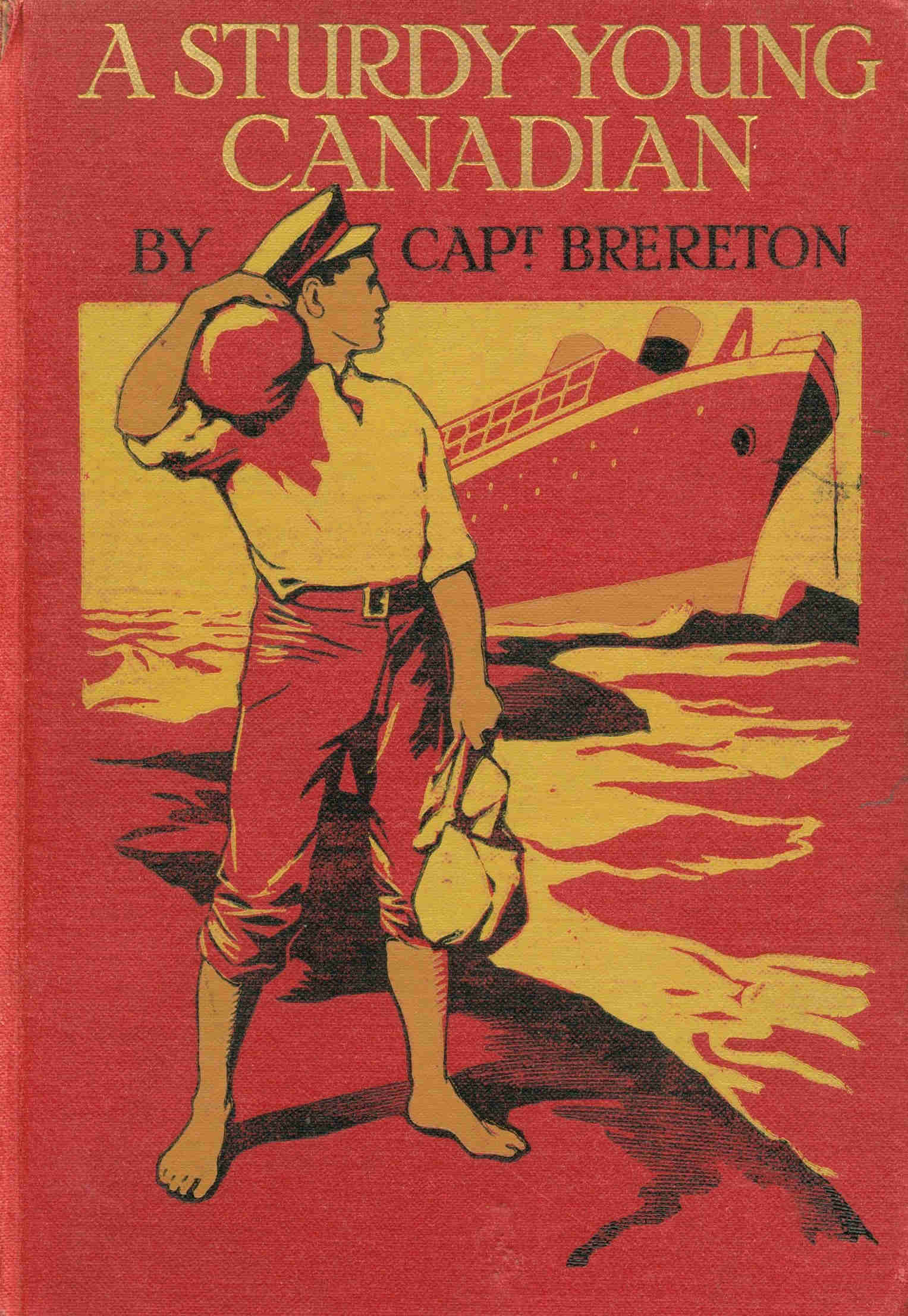
Title: A Sturdy Young Canadian
Date of first publication: 1915
Author: Frederick Sadleir Brereton (1872-1957)
Illustrator: Charles M. Sheldon (1866-1928)
Date first posted: Sept 16, 2025
Date last updated: Sept 16, 2025
Faded Page eBook #20250912
This eBook was produced by: Al Haines, John Routh & the online Distributed Proofreaders Canada team at https://www.pgdpcanada.net
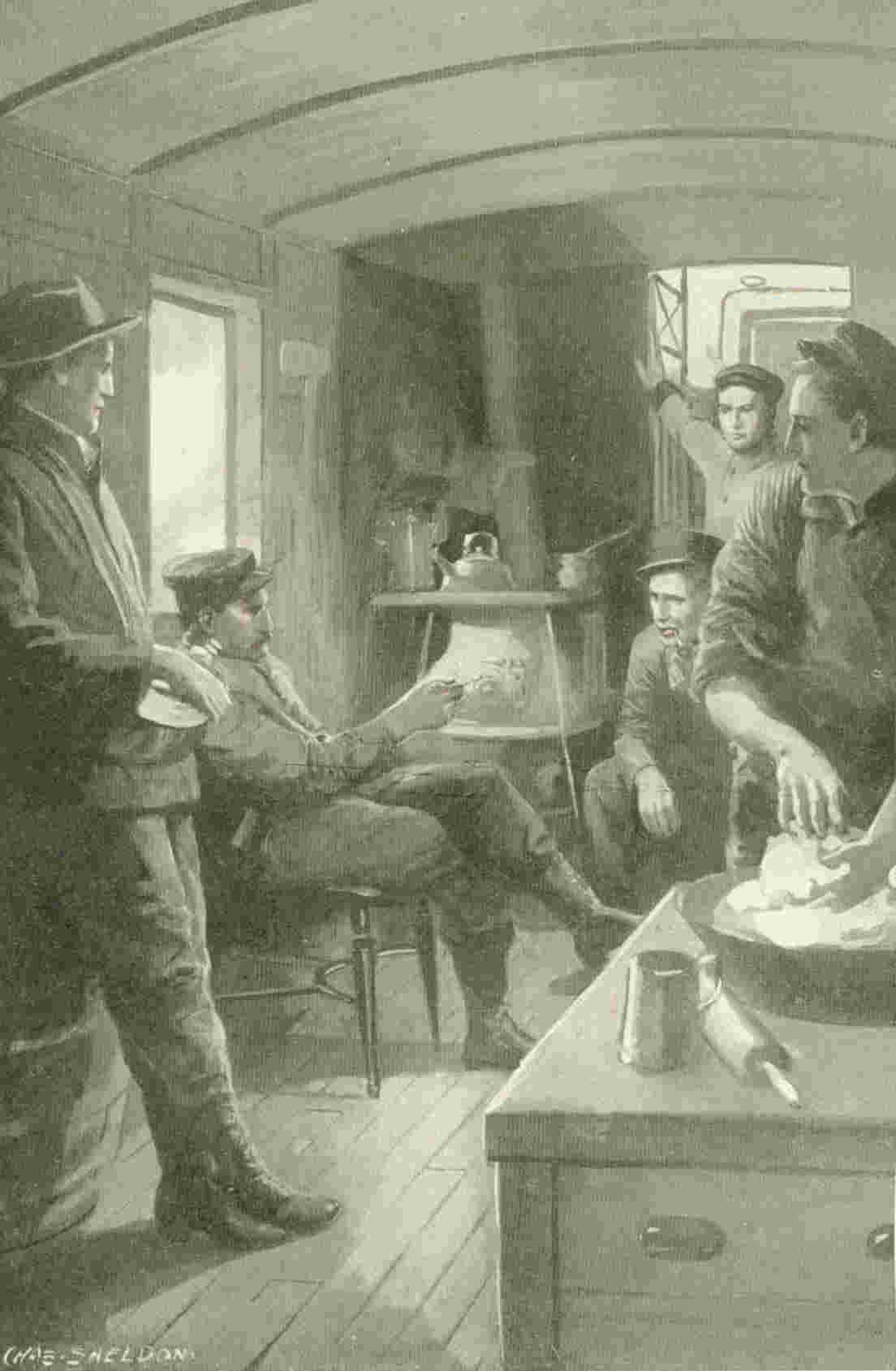
GEORGE AND HIS MATES SNOWED UP IN THE FREIGHT CABOOSE
By CAPTAIN BRERETON
With Wellington in Spain: A Story of the Peninsula. 6s.
Kidnapped by Moors: A Story of Morocco. 6s.
The Hero of Panama: A Tale of the Great Canal. 6s.
The Great Aeroplane: A Thrilling Tale of Adventure. 6s.
A Hero of Sedan: A Tale of the Franco-Prussian War. 6s.
How Canada was Won: A Tale of Wolfe and Quebec. 6s.
With Wolseley to Kumasi: The First Ashanti War. 6s.
Roger the Bold: A Tale of the Conquest of Mexico. 6s.
The Great Airship. 5s.
A Boy of the Dominion: A Tale of Canadian Immigration. 5s.
Under the Chinese Dragon: A Tale of Mongolia. 5s.
Indian and Scout: A Tale of the Gold Rush to California. 5s.
John Bargreave’s Gold: Adventure in the Caribbean. 5s.
Roughriders of the Pampas: Ranch Life in South America. 5s.
With Roberts to Candahar: Third Afghan War. 5s.
A Hero of Lucknow: A Tale of the Indian Mutiny. 5s.
Jones of the 64th: Battles of Assaye and Laswaree. 5s.
Tom Stapleton, the Boy Scout. 3s. 6d.
A Soldier of Japan: A Tale of the Russo-Japanese War. 3s. 6d.
With Shield and Assegai: A Tale of the Zulu War. 3s. 6d.
Under the Spangled Banner: The Spanish-American War. 3s. 6d.
With the Dyaks of Borneo: A Tale of the Head Hunters. 3s. 6d.
A Knight of St. John: A Tale of the Siege of Malta. 3s. 6d.
Foes of the Red Cockade: The French Revolution. 3s. 6d.
In the King’s Service: Cromwell’s Invasion of Ireland. 3s. 6d.
In the Grip of the Mullah: Adventure in Somaliland. 3s. 6d.
With Rifle and Bayonet: A Story of the Boer War. 3s. 6d.
One of the Fighting Scouts: Guerrilla Warfare in South Africa. 3s. 6d.
The Dragon of Pekin: A Story of the Boxer Revolt. 3s. 6d.
A Gallant Grenadier: A Story of the Crimean War. 3s. 6d.
LONDON: BLACKIE & SON, Ltd., 50 OLD BAILEY, E.C.
A Sturdy
Young Canadian
BY
CAPTAIN F. S. BRERETON
Author of “With Wellington in Spain”
“The Great Airship” “Kidnapped by Moors”
“The Hero of Panama” &c. &c.
Illustrated by Charles M. Sheldon
BLACKIE AND SON LIMITED
LONDON GLASGOW AND BOMBAY
1915
| CONTENTS | |
| I. | George Instone’s Bad Luck |
| II. | Ike Lawley’s Hold-up |
| III. | Repairing Damages |
| IV. | Aboard a Locomotive |
| V. | A Record Snowstorm |
| VI. | In Great Difficulty |
| VII. | Winter Quarters |
| VIII. | Señor Enrico Gonvalezaro |
| IX. | Hike Entertains the Party |
| X. | Snowploughs in Action |
| XI. | The Shushanna Goldfields |
| XII. | A Capsized Freighter |
| XIII. | George Saves the Cargo |
| XIV. | Fritz, George, and Scotty |
| XV. | “Diamondfield” Bill |
| XVI. | The Sheriff’s Posse |
| XVII. | A Thorough Scoundrel |
| XVIII. | The Partners Prosper |
| XIX. | A Hazardous Calling |
| XX. | Run to Earth |
| XXI. | Simple Justice |
| Illustrations | |
| 1. | George and his Mates snowed up in the Freight Caboose |
| 2. | George Instone is “held up”, but his Pluck brings him out on Top |
| 3. | “George realized that Tom had been shaken out of the window, and that he was alone on the runaway engine” |
| 4. | George Instone and Scotty lower themselves from the Wrecked Vessel |
| 5. | George and Scotty hear the Robbers outside their Shack |
| 6. | George Instone explaining his Scheme for Sluices to work his Gold Claim |
A Sturdy Young Canadian
“Fact is, you can’t make a silk purse out o’ a sow’s ear, and that’s all there is to it, lad,” observed Carl Ossler, as he leaned against the doorpost of the shack (hut) and sucked at a pipe which had seen better days. “You can’t no more expect to take a city man, what was born and raised inside city limits, and make a success of him on the land than you can take a tarnation muskeg (swamp) and turn it slick away into wheat-raising land.”
“But—but it oughtn’t to have been muskeg,” said George somewhat dismally. “It was advertised as first-class land, as well-drained, fenced, and improved property, and Dad bought it as such.”
“In course; and I ain’t saying as he didn’t,” replied Carl, though there was an ugly frown on his face as he did so. He looked keenly at his youthful companion from beneath a pair of shaggy eyebrows, withdrew his pipe, inspected it critically and with some amount of affection. For Carl was an inveterate smoker, and carried about his person, whether on the farm or within the shack, an aroma of strong tobacco to which his wife had long since become resigned, but which other more delicate nostrils found at times somewhat overpowering. Then, as if to gain time, he sought for a match in the pocket of his somewhat tattered and frayed waistcoat, struck it on the seat of his trousers, and slowly sucked in the flame.
Carl Ossler was a queer-looking fellow. His name would have led you to the belief that he was a foreigner, and so he had been at one time, for Carl had, years before, cut himself adrift from his kith and kin, had wrenched up the many stakes which exist to tie every man to his homeland, and had become one of the mighty and ever-increasing army of immigrants who enter the Dominion of Canada. Tales of promise, of a free country, of free grants of land, of high wages and fine living, had attracted him, and he had set out. But that was years ago. In the process of time Carl had become a typical Canadian, a Westerner, and had also suffered many a disillusionment. Not that he had not found Canada filled with opportunities. He had discovered there the land of freedom indeed, the country where a poor man—a working man—is welcomed with widespread arms, and where social distinctions do not exist to keep him irrevocably chained down. Carl had, in a measure, made good, and was now the possessor of a fine property not far from Calgary, close up by the Rocky Mountains, with a house upon it which was infinitely superior to the shack which had first of all accommodated his family. In fact, though a working man when he first arrived in the Dominion, and still one too, as a person could easily see for himself by the simple process of inspecting his horny hands, Carl was, nevertheless, a man of some wealth and position, who could claim acquaintance with the best in the neighbourhood, and whose advice was sought by the most prominent people in that part of the country. But Carl had met with difficulties; he had run heavily up against snags, and more than once had with difficulty saved his barque from foundering.
For the rest, Carl was tall, and big, and bony. A little bent about the shoulders, clean-shaved every Saturday evening, and a scrubby individual when the week had gone round. He was dressed in a blue shirt which had seen better days, and which had sadly lost its colour. No collar nor tie troubled his sunburned neck, while his nether limbs were clad in a pair of corduroy breeches which had seen many a day’s work, and which had needed Mrs. Carl’s industrious needle on frequent occasions. A broad-brimmed hat sheltered a massive head covered thickly with fair-yellow curls, while a fine face, one which showed determination, acuteness, kindness, and consideration, was set off by a pair of excessively blue eyes which flinched at nothing.
“I ain’t saying as Mr. Instone didn’t buy it as good fenced land, land what’d been improved,” he repeated, when he had set his pipe going again to his satisfaction, though, to speak the truth, he was actually paying far more attention to the young fellow before him than to his beloved pipe. But then, in his own way, Carl was a diplomatist. Appearing to centre his interest on his pipe gave him an opportunity to watch, unobserved, the face of his companion. And George Instone was a young fellow who was quite worth inspection. For he, too, was a typical Canadian. Born and raised in Toronto, he was one of Canada’s big boys, or, rather, young men, for he was more than seventeen years of age, and wellnigh six feet in height. But he was no weed. Even the most critical could not call him that. He was broad shouldered and powerful, though a little fine drawn, for he had been growing fast. His trousers showed that, for they hardly reached his ankles, while his arms protruded quite a long way through the sleeves of his somewhat dilapidated jacket. Round his waist was a belt which was hardly more than half long enough for Carl, lean though he was, while the remainder of his equipment was completed by a black shirt, such as is worn by mechanics and engineers in Canada, by a cravat of the same hue, and by a squash hat which had had many a battering. But, as in the case of Carl, it was the face which attracted.
“He’s just the manliest, likeliest, good-lookingest young fellow around here,” Mrs. Carl had often remarked since the coming, a year ago, of the Instones. “That George’ll make a man, he will, and a fine one at that. Pity is his father’s so weak and ailing, for what with his ill health and the thing he’s bought for a farm, why, George’ll have the world up against him before many months have gone.”
George was manly, without shadow of doubt. Also he was possessed of quite tolerable looks. Not a hair as yet graced his lip or chin, but that was no disadvantage in a land where clean shaving is the rule rather than the exception. He was dark, was possessed of a somewhat prominent nose and forehead, and when he smiled displayed a set of white teeth which did credit to the country of his origin. And as a rule George was a smiling, happy, contented, and plucky fellow. Just now, however, the world was up against him, to use Mrs. Carl’s expression, and George was undoubtedly downcast. Not tearful, though. Young fellows of George’s age are not generally that, whatever the trouble. But he was despondent, and for the while at least his face had lost its smile. He, too, leaned against the wall of the shack, glancing now and again at Carl, but more often staring out across the broad acres which were his—his by right of descent from his father—broad acres of muskeg, useless for any sort of purpose.
“I kin understand the whole of the proposition,” said Carl at last, when he had sucked thoughtfully at his pipe for some few moments. “You’re hit hard, young fellow; but there’s this to console you. You ain’t the only one as has been taken in and swindled.”
“More’s the pity,” George interjected tartly. “Father was fooled as well as swindled.”
“Which only follows up what I was a-saying. You can’t make a farmer—speaking generally you’ll understand—out of a man that’s been born and raised in city limits. It’s clear up agin common sense. But, bless you, you can’t no more preach that and have folks believe than you can keep down them skunks that prey on the city feller. Them real-estate men are the curse of this country.”
So saying Carl sucked hard again at his pipe, and, finding the weed had gone out, beat the bowl irritably against his boot heel. He was in a bad temper; you could see that clearly. His forehead was seamed and furrowed, his eyebrows drawn down, and his mouth set firmly. Carl at that precise moment looked as if he would bite.
“They’re the curse of the country, them real-estate men,” he asserted angrily; “the cause of the downfall of many a poor fellow.”
“But—but surely they are not all alike?” George asked.
“All? Not by a long way. It’s the same with farmers, tinkers, tailors—any sort of fellers. There’s a sight of ’em as is real, honest, hard-working folks; but there’s others, too, as is scoundrels. And the real-estate bunch has got a whole crowd of wrong ’uns with ’em. It’s like this, George. This here’s a new country, and there’s thousands of acres to be had. Those acres can be had pretty nigh free in most cases, so as people can come out and take up a holding without paying out the little capital they’ve got. That lets ’em use what they’ve saved to work their land, and in time, when the acres begin to get under cultivation, and gets paying money to the settler, why, he can set by a bit to square the Government for his grant. What’s more, a newcomer, one, you understand, who has been long enough in the country to know something about it—for a man’s a fool to settle right down when he’s a stranger—a newcomer wanting a free grant can set to work and fix on his own location.”
“Then why is there need for the land agent?” asked George.
“Well, there’s folks who want to sell their land, and agents is wanted for that. But, when all’s said and done, there ain’t the need for the hosts of fellers as calls themselves real-estate men. And it’s like this all along the road. Land’s cheap in Canada, speaking generally. So men with a little capital invest in that land, and, since they mostly know the country, they buy where people are gathering, where a railway’s likely to come, or where a town’s about to spring up. Not that they always buy outright. They ain’t got the dollars. They pay so much down, and then set to work to advertise for buyers, calling their land the finest in the Dominion, first-class farm land if it’s outside a city’s limits, and first-class building land, even if it’s four or five mile outside a settlement that’s got no more than a couple of thousand inhabitants. That place’ll be a city in their advertisements, and the chaps who buy believe, often enough, that they’re buying something that’s bound to increase rapidly in value. That is when they buy without seein’, and that’s often enough the case.”
“Like Father,” observed George. “He heard of this farm when in Toronto, and bought. It was too far to run over and see it.”
“Sure. Two thousand miles if it’s an inch, and a costly journey at that. So he got swindled. The rascal as called this a farm ought to ha’ been tomahawked,” declared Carl, with some feeling. “But there ain’t no getting after him. He’s gone, after swindling and ruining a whole bunch of simple fellers. The thing is this: What are you going to do now? What move are you figuring?”
George took a long look round at his possessions—some forty acres of useless muskeg—and forbore to reply to Carl. For at the moment he had no plans. One could hardly blame him either, though starvation almost stared him in the face. For he had gone through an exceedingly troublesome time. As the reader will have gathered, Mr. Instone had been swindled, a common enough proceeding in the Dominion in connection with the purchase of land. Possessed of some means, for he had saved steadily, he had decided to throw up his position in Toronto and come west, for he was assured that thereby his health would be benefited. And George recollected with bitterness their good spirits when leaving Toronto. Then had come the awakening. Their high hopes, their plans for the future, had been shattered by the discovery that the forty acres bought in Toronto—forty acres of land said to be fenced and drained and in full bearing—were composed of swamp and rock and sedges almost without exception. Indeed, the shack, described by the rascally land agent as a commodious and modern dwelling, occupied almost the only dry and firm spot on the holding. Then had followed the downfall. Efforts to bring the swindler to book had failed, as they almost invariably do. Then Mr. Instone’s health had broken down entirely. But for a year George had stood by him, working on Carl’s neighbouring farm and earning their sole means of sustenance. Now it was over. The late owner of the swamp lay in his narrow grave, his troubles ended for ever. George had to think of the future.
“Well, you ain’t answered,” said Carl, sucking by force of habit at his empty pipe, and scowling because the soothing smoke was not to be coaxed from it. “I kin see as it’s a conundrum in a way, ’cos you ain’t meant for sitting down. You’re one o’ the go-aheads, George, and you’ll be figuring to get clear away from this here ranch and farm and try your luck elsewhere. Well, I ain’t saying as that isn’t wise. A young feller has to carve his own way in the world, and he ain’t as likely to do it quick ’way out in the country as he will in the towns. There’s hardships he kin put up with as don’t come pleasant to a man o’ my age, and he jest makes light of difficulties and misfortunes. So I’m kinder expecting as you’ll hike it off to some o’ the cities. But you ain’t got no call to do so. You kin stay right on here, and sence you’re a good lad, and has learned a deal of things, why, you kin ask fer forty dollars a month besides yer lodging and keep.”
“You’d be offended if I declined?” asked George, for Carl was a good friend, and he feared to hurt his feelings.
“Offended ’cos a young feller has got the grit and push to strike out for hisself! Here!” called Carl gruffly.
“Sorry. But I wouldn’t do that for anything.”
“And ain’t likely to do so neither. I’ll say right here what I’d do ef I was in your shoes,” said Carl, stepping away from the shack and surveying the surroundings. Indeed, he looked so long and so intently at those forty acres of miserable swamp that George’s thoughts returned promptly to the scoundrel who had swindled his father so outrageously.
“You’d follow that man up?” he asked, astonished, for had not Mr. Instone lost the last of his savings in a similar attempt?
“I’d be right down crazy,” asserted Carl vehemently. “Jest leave him out altogether, boy. Get him outer yer head right now at this instant, ’cos he ain’t never likely to be useful to you. I don’t say as you mayn’t, one o’ these days, drop across him, for though Canady’s big, men hits up agin one another most unexpectedly. Ef you do, don’t holler. Jest fix tight onter him and see as he don’t get outer sight till he’s paid up handsome. It ain’t likely, I say, but ef it happens, why, you’ve got the papers, and you remember the feller.”
“Well,” said George bitterly. “A smooth-spoken, jovial individual.”
“They mostly is,” observed Carl dryly. “Fine clothes that’s cost wellnigh thirty dollars, a clean collar, and a tie to make ’em handsome, and hot air (talk)—my! you can’t jest get in a word edgeways. Their holdings is mostly hot air too, though they keeps a few good things for clients as insists on investigating. But jest you drop him from this moment and get down to business. Now you was asking whether I’d be offended if you was to quit the farm.”
“And you were going to tell me what you’d do under the same circumstances,” said George, nodding.
“Then I’d quit, I would, right now, and look for a job in a busier part, where there was more things doing.”
“But—but how?” asked George, rather dismally. This, in fact, was the very question which most troubled him.
“How? It ain’t hard. You kin find a job.”
“When I get to it. But I’m here, out in the country, and I’ve not a cent,” said George desperately. “See here. Empty! I paid the last away for the funeral.”
He dragged at the pockets of his trousers, turning them inside out, and then repeated the process with the pockets in his other garments. “Dead broke,” he said bitterly, “like the poor old father.”
“Fine!” declared Carl, much to his astonishment. “See here, boy, you ain’t got nothing to lose now, save yer good name. But you’ve got everything to make, and one o’ these fine days, when the clouds has lifted, you’ll be able to turn round and say: ‘I made this here out of nothing, nothing but the fine health and strength which the good God gave me, and hard work and determination.’ When you’ve made good, George, you’ll be prouder for the fact that this day’s seen you with empty pockets. Now, I’ll tell you. You’ll want a job, and you ain’t got a cent right now. Then you kin put in a week’s work on the farm, and so earn ten dollars. By then I’ll have set to and made enquiries. You’ll make west, eh? That’s where things is moving. The Pacific coast’s the place fer young fellers.”
George lapsed into silence for the next few seconds, and again took to viewing his useless property. Young though he was he could see that there was common sense in what Carl had said, for in the country, without capital with which to buy a holding, and with the very limited experience of farming which he then possessed, he could not expect to advance his fortunes very rapidly. At the most he might earn some fifty dollars (ten pounds) a month—not a great wage as things are in Canada—and it would take years to save an adequate sum with which to start a business of his own. But in a city, where pay was higher and where there would undoubtedly be greater opportunities, he might do far better for himself. In any case he could not be poorer. His empty pockets were strong evidence of that fact, while, as Carl had said so truthfully, if he made good—and George was fully determined that if hard work and honest dealing would help, as undoubtedly they would, he would certainly make a success of his life—then he would have the happiness of turning round one day and congratulating himself on the fact that he had virtually started as a pauper, and had made his way simply by his own strength and determination.
“I’ll do it!” he exclaimed.
“What? Work here for me, lad? I’d be glad. Or make west to the Pacific coast?”
“Make west, Carl. But I’ll have to work more than a week to earn the transport money. When I’ve got that, and a little in hand, then I’ll set out.”
“Then the first thing to do is to sell off what there is in the shack, and the few tools outside,” said the practical Carl. “See here, George, I’ll take the tools, and I dare say the missus’ll want some of the things inside. We’ll get Mike Davis to value the things. He’s due out on the farm to-morrow or next day, and seeing that he’s an auctioneer, why, he’ll be able to do what we wants. Then I’d hand over the rest of the things to him, and let him run them into Calgary on his rig (cart) and sell ’em. They’ll fetch a better price in the city, and the money you get’ll be a little nest-egg with which to set out. Say now, how’s that?”
“Fine. And I’ll do it.”
Now that George was face to face with the future, and had had the opportunity of discussing it with such a wise head as Carl, he felt infinitely better and happier. The old smile returned to his face very soon, and that very evening, when, having accompanied Carl back to his house, he entered the parlour, Mrs. Ossler held up her hands in amazement.
“What have you been a-doin’ with the lad, Carl?” she called out gaily, shaking George’s hand warmly. “Glad you’ve come, George; but what’s this man o’ mine been a-sayin’? Why, I declare, if you ain’t smilin’ all over yer face, and looking better’n I ever saw. Welcome, lad; and sence you’ve come along to work, jest get in right now as chore boy (general work). There’s coals wanted for the kitchen stove, and chips’ll come in handy by early mornin’. Time was when I did most of them things; but a body’s gettin’ old these days, and it’s good to have a lively young feller around to lend a help.”
Mrs. Ossler was just a type of the Canadian woman to be met with the length and breadth of the Dominion. Very womanly, proud of her house, her husband, and children, she was a marvel at management, for there are few servants in Canada. The entire household work of a house has to be done by the wife, and she is busy and about from early dawn, cooking for the family and often enough for the hands on the ranch or farm, cleaning the rooms, and tidying up, besides seeing to the clothing of the children. Not that she does not receive help. There is scarce a house in the Dominion where the man does not see to the fires, and if the wife is up at dawn, then the husband or one of the boys is about before the light has come, getting the stoves going, cutting wood, and drawing water where necessary. That now became George’s work, and being accustomed to it, for he had done that and everything besides at the shack, even to cooking, he made light of it. In addition he had his work on the farm, and no sooner were the fires going than there was milking to be done. Then, when the milk had been carried to the dairy and poured into the refrigerator, George made his way in to breakfast. And what a meal he could eat! for the sharp morning air on the foothills of the Rocky Mountains gave him a tremendous appetite. Cups of steaming coffee disappeared rapidly, while each one of the hands—of whom there were four—tackled an enormous plate of mush (porridge). After that Mrs. Carl always had a dish of bacon or of meat for the men, and sometimes, too, a dish of trout caught by her husband that same morning in the stream which bubbled down through the centre of the farm.
See George, then, content after breakfast, issue forth for further work, dressed in the customary suit of overalls adopted by workmen up and down the Dominion. Perhaps there was carting to be done, perhaps Carl gave orders for some ploughing, while on occasion there were fences to be mended, or the huge stacks of hay to be cut and bundled and pressed ready for transport to the railway.
“And you may jest as well take ’em in, lad,” said Carl, when more than a week had passed since George came back to the farm. “You had better put Pat and Sassy Sue in the cart, ’cos they always runs well together, and don’t ferget to take yer beddin’. A gun (revolver), too, ain’t a bad thing to lift along with you, ’cos there’s bad men about these hills, and hold-ups (robberies) ain’t altogether unknown—not as they’re common. In the fust place, the farm is so out o’ the way that precious few hoboes (tramps) comes this way; and then what travellers there are ain’t always rolling in wealth. Still, there has been hold-ups, so you look lively, and hike off with that gun that’s hanging in the parlour. Don’t ferget that you’ve to call on the auctioneer and draw your dollars, and keep your tongue quiet about it.”
“I’ll take a look round for a job too, Carl,” said George. “There may be something suitable to be had, and it’d be foolish to waste the opportunity a visit to Calgary is likely to give.”
It was a crisp, early morning when George set out for his destination. Pat and Sassy Sue, the two draught horses usually employed for haulage purposes, were hitched to the four-wheeler farm cart, and from the first streak of dawn George and one of the hands had been busy swinging bales of hay on to it till they were piled high in the air. Then the roll of bedding, which no Canadian goes without on such a journey, was tossed up on to the front, and, with a crack of his whip and a shout of farewell to the Osslers, George set the horses in motion. And though he kept very wideawake throughout the day, for this was almost his first experience of transporting goods to Calgary, and he felt the responsibility, not a single suspicious person did he see. At noon he pulled his horses up outside a roadside shack, watered the beasts, and gave them a feed, while he himself entered the shack to ask for a meal.
“In course, stranger,” was his greeting. “Sit right down. You’ve come handy at the right moment, for we was ready ourselves. You’ll be from Carl Ossler’s farm?”
“Yes,” admitted George, taking his seat, for such is the custom, wayfarers of George’s class being always welcome to a meal and even to a night’s rest. “I’m taking hay into the railway depot.”
“And you’ll be young George Instone, I’ll bet, son of the one as was swindled?”
George nodded. It did not surprise him to discover that he was known, for in such small communities there are few matters which do not soon become public property, however scattered the homesteads may be.
“Then it ain’t no use fer me to tell you what I think of them thieves of real-estate men,” grunted the farmer. “You’ve been bit. So was I. There’s a sight of men about as has paid dear for stuff that those ruffians sold, stuff that wasn’t worth buying; and there’s a sight of people away out of Canady as ain’t got no more satisfaction for their money than a piece of paper. Their block of land ain’t of no use whatever.”
It was late in the evening when George drove his team into Calgary, and, remembering the instructions which Carl had given him, made direct for the freight yard of the railway. Pulling in alongside the freight cars, which stood empty in a siding, he asked an employee which one was reserved for the hay he had brought. Then he unhitched Pat and Sassy Sue, and, taking them over to an open shed, tied them up there, watering and feeding them promptly. Later on he groomed them, and covered them with blankets, for the nights were getting cold. It was nine in the evening when he himself obtained a meal at a little café frequented by railway men. Then, as he needed exercise, he went for a sharp walk through the city, and, turning north, was soon clambering the heights which overlook the business portions of Calgary, where the houses of the richer inhabitants are situated. It was perhaps half an hour later, when returning down the hill, that George was suddenly startled by an individual who sprang from a hollow beside the road and accosted him abruptly:
“Hands up!” he heard. “If yer move I’ll put daylight through yer. Hands up! Now, where’s your stuff? I want every penny of it.”
That hold-up of which Carl had spoken had come, come most unexpectedly, and right in the heart of the city. George found himself facing a masked individual who looked wonderfully forbidding and burly beneath the rays flung by an electric arc lamp dangling a great distance away, and, worse than all, discovered that a plated revolver was grinning directly at him.
“Hands up!” the ruffian repeated. “No hankey. There ain’t no time fer delay in this matter.”
As George Instone looked into the grinning mouth of that plated revolver which was held presented at him, and from the muzzle to the masked face of the ruffian who had accosted him in the dark street in Calgary, consternation at first took hold of him. And then, so rapidly do our thoughts chase through our minds, and so swiftly is the human being capable of forming plans and resolutions, he found himself with hands stretched over his head, apparently yielding to the superior force of this rascal, yet restraining himself with an effort from suddenly launching himself at the robber.
“Why not?” he asked himself. “He’s no bigger than I am, and one leap will get me close to him. I could knock his weapon up, and then——”
“Turn round!” commanded the man. “What’s yer work? Where’s yer dollars?”
George turned. To have resolutions is one thing, to carry them out beneath the grinning muzzle of a loaded revolver another, altogether and entirely another. For George knew, as others know in the Dominion, that footpads and robbers are not possessed of over nice feelings. Out there they are usually desperate men—many of them with a long score of misdeeds already to answer for, and with life sentences awaiting them. In any case they have a particularly evil reputation, and shoot on the smallest provocation. So it is not to be wondered at that George turned.
“I’m a farm hand,” he said.
“Ah! Been selling stuff down at the yard?”
“No. I only reached in to-night.”
“Where’s yer dollars?”
“I’ve five dollars on me, that’s all. It’s in my purse, in the right-hand hip pocket.”
He felt the muzzle of the revolver touch his neck, and its cold chill sent a shiver down his spine. Then the man’s fingers groped at his pocket, and he felt his purse being dragged out into the open.
“You kin hop right now,” said the robber. “You was going down to the depot. Then cut, and don’t you look back, my son, or I’ll send a bullet after you. And mind this, git right off to yer bed, and don’t stand talking to the cops and other fellers. Hear that? Then git! Ike Lawley ain’t the feller to play with.”
George at once faced down the hill, and strode away rapidly. Nor did he venture to look behind him. A glance round would certainly have brought a bullet, and he had sense enough to know that that bullet would strike him.
“It’s Ike Lawley, the desperado,” he told himself, hardly repressing a shiver. “The fellow who has infested the cities this side of the Rockies for the past six months. The ruffian who is wanted for three cold-blooded murders. And he’s got my dollars.”
That stung. George was a careful fellow, for his had been a life of struggle just recently, and dollars meant much to him. What right had Ike to relieve him of them?
“None; and I’m not going to hike right off and leave him with them,” said George stubbornly. “Why did he order me to make direct back to the depot and not get talking? Simply because he means to hold up others. That’s it. My five dollars are nothing to him. He’ll wait for someone else, and as the spot he chose is good—for I didn’t see him till he jumped out of the ditch—why, he’ll be waiting there certain.”
George was not the lad to let the grass grow once he had come to a decision, and no sooner had he reached the foot of the hill, and judged himself to be beyond Ike’s view, for the electric lights were spread far apart, than he took to his heels and raced along till he reached the car line. The ding-dong of a tramcar bell reached his ear, and running again he reached the stopping-point just in time to leap upon the vehicle. It sped on into the city, so that within a few minutes he was back at the depot.
“With just ten cents left to pay for my car fare out again and home,” he told himself, fumbling in his pocket. “Lucky I had a few loose coins in another pocket. Now for the gun which Carl loaned me.”
It was somewhat big and antiquated, and had been honest Carl’s companion for many a year. Not that such a weapon is necessary throughout the Dominion, for the country has become wonderfully settled. Still, out in the open some weapon of defence may be advisable at times, while weapons are habitually carried during the night by railway servants engaged in freight yards and depots.
George strapped the weapon round his waist, pulled the brim of his slouch hat down over his eyes, and turned his coat collar upward. That was all the disguise he could think of in case of his suddenly being accosted by the ruffianly Ike Lawley.
“Got to chance it,” he thought. “If he’s moved down the hill he’ll jump out again just as unexpectedly. Well, I’ll give him the revolver instead of dollars. Now for a car back to the place I came from.”
For a moment he wondered whether he ought to apply to the police, and had he met an officer on his way to the car line he would undoubtedly have given immediate information. But there did not happen to be a single person about, while delay was obviously a thing to be avoided. George reached the car line, signalled for the vehicle to stop, and leaped on.
“Going home, sonny?” asked the motorman, a lively fellow.
“Yes,” said George, fibbing for the moment.
“Where do you live then? Up west?”
George nodded. Then, so that he should not be asked more awkward questions, he promptly dived into the body of the vehicle and mingled with the passengers. It was some ten minutes later when he commenced to clamber up the hill to the spot where he had been accosted.
“Three hundred yards farther up, I guess,” he told himself, “and just to the right of the sidewalk. That fellow was hiding in a ditch, and as this is on a hill it is likely enough that the ditch runs clear down to the bottom. Good! I’ll leave the path and enter.”
He was on the point of slipping into it when he observed two figures on the sidewalk in advance of him. They had just come down a side street and turned up the hill.
“Likely victims,” thought George. “I’ll hurry.”
He dived into the ditch promptly, finding that it was almost dry. Perhaps a little water had descended during the day, and as it happened that this part of the city of Calgary was not yet paved, save for its sidewalks, the bottom of the ditch was covered with soft earth, and not cemented, as, no doubt, would be the case later on as this part developed. It was therefore quite silently that he clambered up the hill, his feet not making the smallest noise as he went. He had occasion, too, to congratulate himself on this fact a little later, for he had scrambled over only a few yards when he heard a sharp command and then the crack of a revolver.
“Ike,” he thought, while his pulses suddenly thudded and his heart beat against his ribs. George had hardly ever experienced such excitement before. True, the meeting he had already had with Ike had not been too pleasant—and we wish to portray our hero in the truest of colours, and to do so must mention the fact that George did not find that meeting altogether to his liking. To commence with, there was that uncanny feeling produced by the plated muzzle of the revolver when thrust in his face. Then the top of his scalp was decidedly interested in the matter. It was positively sore now, and George had the distinct impression that, had his head been bare and the light a strong one, Ike would have been entertained by the vision of his, George’s, hair rising. What wonder, too? The robber had pounced upon him quite unawares, and his manner had been so threatening. However, George’s sensations now were decidedly different. This was pure excitement from which he was suffering, though very inconvenient. His breath came in gasps, which he vainly struggled to silence, while it made scrambling along the ditch difficult. Then his heart thumped so heavily against his ribs that it positively shook him. With an effort he forced himself to be calmer. Then, racing on till he judged he had gone far enough, he lifted his head cautiously above the edge of the ditch.
Phew! So that was the situation! Ike was not the only ruffian abroad in Calgary that evening. He had a friend, an accomplice, who, no doubt, had hidden himself in the ditch also. And fortune had favoured the two rascals, for they had held up two sets of people. There were the two whom George had seen walking in advance, and three others who had been coming in the opposite direction. It was from one of these, too, that Ike and his rascally companion had met with opposition, for a man lay stretched out on the sidewalk near his companions, his head downhill, and his legs mingled with the feet of the others. George lifted his head cautiously, his revolver gripped in his right hand, and his left on the edge of the ditch. And very rapidly he took in the whole situation. Ike stood with his back to him, swinging slowly from side to side, his elbows tucked into his body, and his two hands gripping revolvers. Directly in front of him were the lady and gentleman who had been ascending the hill, the former supported on one arm of her companion, and obviously on the point of tumbling, while the man himself held his free arm over his head. A little higher was the prostrate figure of the one who had been shot, with two burly men standing over him, their hands in both cases being elevated. As for Ike’s accomplice, the rogue had tucked his own weapon into the pocket at his hip, and was carefully going through the clothes of his victims. George took steady aim at Ike.
“Can’t do it,” he told himself, with a feeling of dismay. “He’s a rascal; but I can’t shoot a man in the back in cold blood. I’ll have to shout or do something.”
“Out with it, me livelies, out with dollars and everything. It ain’t no use to hide ’em up,” Ike’s companion began cheerily, addressing the two men he was then searching, “ ’cos we ain’t likely to miss nothing, and ructions’ll sure bring trouble. Ho, ho! This here’s one of the city bosses. Ike, this here’s Andrew Shere, storekeeper, hotel owner, boss of the moving pictures. What’s this? A roll of ’em, Ike! A whole roll of bills, and twentys, every one of ’em!”
Not a word came from the unhappy victims of these two footpads, though the lady was now sobbing. It made George grind his teeth.
“Got to do something,” he told himself desperately. “But, supposing there’s shooting, that lady might be injured. I know. I’ll hold ’em up myself. Wait till they’ve gone through the pockets of these people, and then make after them.”
But Ike and his friend were in no hurry. They had chosen an excellent site for this attempt, and knew it to be almost deserted at this hour of night. Police patrols were few and far between, while the steepness of the hill kept people from promenading in that direction. But there were always people visiting friends in that part of the city, and seeing that all the best houses were there, and the most prosperous individuals lived in them, why, the citizens they might accost when returning from some convivial little evening would probably be birds who were worth plucking.
“Stripped him as clean as ever he stripped one o’ the jays he’s sold stuff to in the city,” chuckled Ike’s companion, when he had finished going through the pockets of Andrew Shere. “Taken five hundred and forty cool dollars from him, a pin that was in his tie, and that’s pure diamond or I’m a Dutchman, and a ring with a stone in it big enough for the foundations of one of his hotels. Say, Ike, this is a haul! We’ve struck it rich with a vengeance.”
“Get in at it,” growled the other, swinging still, and turning his weapons now on one of the groups and then on the other. “You ain’t got no call to drop that right arm, sir. One’s enough to support the lady, ain’t it? Then keep the other up or I’ll drop you and her, so that’s all there is to it.”
“Ho, ho!” came again from his accomplice, and this time his tones were even more joyful. “Why, bless us, it we didn’t come out on jest the right sort of evening. This here’s John Hill, railway boss, the chap who’s come away west to inspect the far side of the Rockies. I seed in the papers that he was coming. Now you ain’t got no call to get fidgety, John Hill. This here’s the pocket in which you carry dollars in bill form, and—why—here’s a shooter!”
He brought it out from the hip pocket of the second victim, inspected the weapon without the smallest trace of hurry, and transferred it to his own pocket. Then, rapidly completing his search, he stepped downhill to the gentleman and lady.
“Been through the pockets of the man he’s shot,” thought George. “Wonder whether he’ll be brute enough to search the lady.”
In his eagerness he raised his head rather high above the edge of the ditch, and in moving his left hand along it set a stone rolling. Instantly Ike turned round, and though George ducked swiftly it was evident that the ruffian’s suspicions were aroused.
“Joe,” he called sharply, “see if there’s anyone in the ditch behind. I’ll cover these fellers. If it’s a cop, shoot straight off. You don’t need to ask any fancy questions.”
George crouched low in the ditch, the brim of his hat pulled well over his face, and his hands hidden. But the one gripping the revolver pointed that weapon upward, the muzzle just protruding from beneath the flap of his coat.
“Mayn’t see me,” he thought. “It’s dark in here, and with face and hands covered I may escape. If not, I’ll shoot. Ah! He’s looking down.”
It was an extremely uncomfortable position for George, and we tell the truth when we say that he found it difficult to decide whether to remain as he was or to chance everything by suddenly leaping from the ditch. There was the fear, too—an awkward feeling—that the rascal staring into the depths of the ditch might fire downward just to save himself the trouble of clambering into it. And, as it happened, that was his intention.
“Don’t see a thing. Guess it’s empty,” he grumbled, stuffing the rolls of bills he had just filched from the pockets of his last victim into a capacious sack carried beneath his coat. “But there ain’t nothing like making sartin, and sence it’ll only cost a bullet, and there’s bills here to pay for heaps more of ’em—why——”
“Hold! Guess you’d better quit firing,” said Ike, sharply. “There’s been one shot already, and you can never say as a patrolman ain’t heard it. If he has, he’ll fetch another cop, ’cos they ain’t fond of meeting Ike Lawley when by their selves, and that’d just fix us. Get finished with the search, Joe. Then we can get a move on.”
They were really the coolest of ruffians, and evidently accustomed to such proceedings. For Ike never altered his position, save for the time when he had swung round suddenly. He still covered the two groups of Calgary citizens, sweeping his two weapons round first upon one and then upon the other, using the muzzles indeed as if they were the nozzles of a couple of hoses, and he directing water first in one and then in the other direction. As for Joe, he was a short, lightly-built rascal, and pocketing the weapon with which he had been about to probe the depths of the ditch, he leaped back on to the sidewalk, and again approached the lady and gentleman.
“Plucked as clean as a chicken,” he grinned, running his hands through the pockets of the latter. “He ain’t never been poorer. Now, ma’am, we comes to you. Rings fust, I’m thinking.”
He seized the hand of the lady roughly, and endeavoured to tear off her gloves. And then it was that the struggle which George had been anticipating commenced with a vengeance. For the gentleman suddenly let go of his burden, and, springing at the rascal Joe, gripped him by the collar. At once the two became locked together and went staggering across the sidewalk, edging downhill as they struggled. It was obvious, too, that Joe was likely to have the worst of the argument, for he was small, as we have said, and his opponent larger. He lifted Joe as if he were a boy, and swung him from side to side. Then he brought him down with a bump, the robber’s rubber-covered shoes thudding heavily against the sidewalk. As for Ike, probably he had never faced a similar situation. For his weapons were useless. He could not fire at Joe’s antagonist for fear of hitting his own friend; while he dared not remove his weapons from the two men standing a little higher up the hill, those who had already been relieved of their valuables. He edged a little downhill, his eyes fixed on the men above, but darting sudden glances over his shoulder.
“Jest let me see one o’ you wink as much as an eye, and, bosses or no bosses, I’ll drill yer,” he growled.
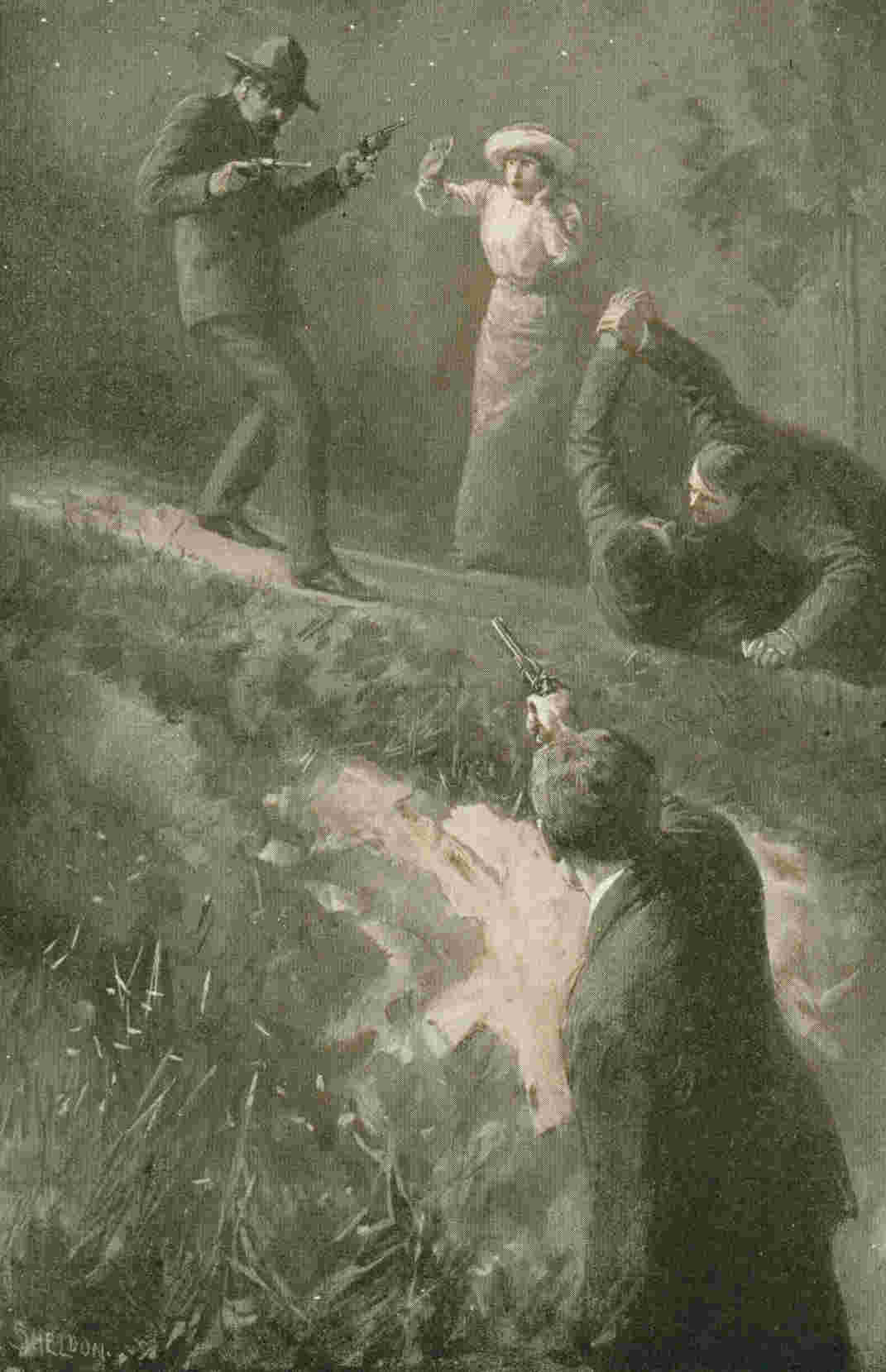
GEORGE INSTONE IS “HELD UP”, BUT HIS PLUCK BRINGS HIM OUT ON TOP
“Hold him, Joe. Give him a shake, and get a grip of yer shooter. I’ve got these here chaps, and you ain’t got no call to fear anyone else.”
But there was George, and our hero had no intention of looking on only. He had his own five dollars to recover and a duty also to perform. The knowledge that earlier action would have been rashness, and would have seen him shot like a rabbit, had alone kept him crouching at the bottom of the ditch. But he was never more determined to bring Ike to justice, and now seemed to be the opportunity. With a bound he leaped out of the ditch on to the sidewalk. Then, just as Ike heard him and swung round with his weapons, George gave him a terrific buffet. His left fist flew out, and, striking Ike on the cheek, sent that worthy flying. A second later George had his weapon levelled at him as he lay on the sidewalk.
“Move an eyelid,” he called harshly, unconsciously mimicking the robber, “move a finger, and I’ll drill you. Now, sir, kindly secure this fellow. Ah! Reach out for a gun, will you?”
Back went the trigger and the hammer of his weapon rose. George sighted it on Ike’s body and made ready to fire; for he knew well enough that he had a desperate man to deal with. Indeed, Ike was the class of man who would have dared anything to escape capture, well knowing that once he was apprehended his chances of escape were not worth considering. But George’s revolver staring at him restrained the movement he had attempted. He lay on his back on the sidewalk, his arms outstretched, his two revolvers just within reach of him, but lying opposite his knees where George’s lusty blow had caused him to drop them.
“Now, sir,” said the latter, addressing the gentlemen who had been held up by the two footpads, but keeping his eyes on Ike all the while; “kindly hasten and secure this fellow. Keep to the far side, so that I can fire at him at any moment, and kick those weapons out of his reach.”
Had both of these worthy citizens been as cool and circumspect as George, matters might have gone smoothly for the whole party, and Ike would certainly have been secured within the minute. But one was too upset by excitement to follow the instructions given. He came down the sidewalk, crossing between George and the prostrate robber, and in an instant the latter had taken advantage of the situation. Meanwhile Joe and the other citizen fought for the mastery, the man who had gripped him retaining the little rascal in such a position that Joe was helpless. He could not free a hand to seek for his revolver, and without that Joe was as good as captured.
With weapons he and Ike were capable of intimidating a carload of people, and Ike promptly proceeded to make use of such powers of persuasion. With a swing he brought his arms downwards, and instantly fixed his fingers on his weapons. Then, not attempting to rise, but merely lifting his head to aim, he fired direct at our hero, for by then the incautious citizen had crossed, and there was a clear path for the bullet. As for George, he felt as if he had been struck by a hammer. He received a terrific blow on the chest which doubled him up like a rabbit and sent him sprawling across the sidewalk and into the ditch, where he tumbled headlong. But, to his own amazement, he was still cool and collected, though horribly winded. He gasped for air, struggling all the while to rise, and still gripping his weapon. Ike, too, had made the most of the situation. He had scrambled to his feet, and was now backing uphill, away from his victims.
“Hands up!” George heard him calling. “You two fools as come to hold me when that young chap chipped into this business, you two just move, that’s all I’m wanting. You know what you’ll get, and I ain’t so sure as I won’t put a bullet into you now jest for punishment. Anyways, you can expect to hear again from Ike Lawley, you two bosses, Andrew Shere and John Hill. Not as I’ll hold you up. But I’ll write yer, and you’ll have need to answer. Then you’ll have a bank at your back, and will be able to draw the cash I shall want for your safety. Jest you speak to the cops about it, too, and put the ’tecks on me, sure, there’s nothing I like better. But, you two, it won’t be specially healthy for you.”
He was staring at Joe now, wondering whether he would desert his friend or go to his assistance. For Joe’s affairs had not progressed in the last few seconds. Indeed but a little more than a minute could have passed since George had leaped from the ditch, and yet see what a great deal had happened. Ike had been worsted. For a while, just a few brief seconds, he had been as near being a captive as ever he would be without being actually taken. And then suddenly, most unexpectedly, he had again become master of the situation. Joe, however, had been sadly battered. The man who had so pluckily fastened upon him had the little robber by the two wrists, and held him as if in a vice. Ike sighted one of his weapons on him.
“Couldn’t be done,” he said, coolly enough, squinting along the sights. “They’re moving about too much. Guess I’d better go to him.”
Slowly he began to descend the hill, his weapon still turned on the two citizens he commanded. Then he halted again and levelled a weapon at Joe’s antagonist. The lady screamed, while someone called loudly in the distance. Ike gave vent to an exclamation of annoyance and would have pulled his trigger promptly, had not the man then gripping Joe seen his intentions and swung the little robber round between himself and Ike’s weapon.
“Hi, police!” someone called in the distance, while a shrill whistle was blown from the doorstep of one of Calgary’s fascinating bungalows quite close at hand, and within sight of the hold-up.
“Then there ain’t nothing more for it,” growled Ike, glaring around him.
For the moment the ruffian considered the advisability of abandoning his comrade, for, after all, Joe was a fool to have allowed himself to get into such a situation. Then, seeing that he could hear no one approaching, and that it would be easy enough to lose themselves in the darkness, the rascal went steadily downhill towards Joe’s lusty antagonist, his intentions written clearly on his scowling face.
Meanwhile George had been puffing and blowing heavily. Doubtless those near at hand took the sounds and his struggles for death movements. Ike smiled grimly, for he had seen men flop down before beneath his bullets and kick and flounder for a while.
“Dead as mutton,” he told himself. “It’s that young fool of a cuss as I relieved of five dollars. At least I guess it is, though there ain’t no saying for certain. But he won’t want five dollars nor five cents after this. He’s drilled through as sure as ever.”
But if George were drilled through, then he was an extremely lively fellow after such an occurrence. Now that his breath was returning he felt actually as strong as ever, though there was a terrible sharp pain in his side, a stabbing pain as if a sword were being driven into him.
“Can’t help it,” he said to himself angrily. “If it does hurt a bit I’ve got to get a move on. Ah! That’s better. I don’t gasp now. I’ll still fix that fellow Ike Lawley or get killed in trying.”
He was on his knees in an instant, and by then Ike was quite close to his victim, while Joe was calling to his comrade.
“Shoot the fool!” he shouted. “Shoot him, Ike, and let’s quit. There’s people coming, and I can hear a cop running up the hill towards us. Put your gun to his head and blow the fool’s brains out!”
“Stop!” shrieked the unhappy lady, the centre all this while of the situation. “Stop; he is my husband!”
But what cared Ike or Joe for husbands or for women or for children? They were rogues of the worst description, and Canada possesses a few of them. And the Dominion is no stranger to shooting incidents, to hold-ups and deeds of violence, though for the most part the country is wonderfully settled, and people can lead as tranquil a life as anywhere else. The two footpads were, as we have said, desperate fellows, with a price on their heads, and one murder more, one additional shooting outrage, made no particular difference to them. Ike seemed to be unmoved by the thought of the deed he was contemplating, unless, indeed, he were just a little amused. For he was grinning as he descended towards his comrade, a wolfish grin, while every now and again he swung round to threaten the men above him.
“In a moment or two he’ll have reached Joe,” thought George, “and then the brute will murder that fine fellow. Well, he won’t, ’cos I’m here. That’s better, for I’ve got my breath and am steadier.”
He lifted his weapon and shouted “Ike!” Instantly the robber stopped and swung round.
“Hands up!” shouted George, still stooping below the edge of the ditch. Two sharp reports rang out instantly, while a couple of bullets swept over his head. Not that Ike had aimed at him. He couldn’t see our hero yet, though he guessed that the one he imagined to be lying dead in the ditch was the cause of this new interruption.
“Raise a hair and I’ll shoot it,” he growled, watching intently and warily. Then George did a clever thing, and marvelled afterwards that the idea should have come to him at such a moment. He pitched his broad-brimmed hat on to the very edge of the ditch and hurried downhill at his fastest pace, his body bent almost double. Crash! Bang! Two more shots rang out, and the bullets thudded into the far side of the ditch some five yards above George’s new position. As for the hat, it performed the most curious evolution. It rose suddenly, spun round like a teetotum, and then hopped a foot downward along the edge of the ditch. Indeed its movements were so natural, as if George’s head had been within it, and he only grazed by the bullets which Ike’s sure aim had certainly sent through it, that the rascal instantly opened fire once more at the very top of the hat, all that was now visible to him. George raised his head sharply. Levelling his own weapon he fired swiftly at Ike, but not so swiftly that the other did not see him. Indeed the two shots rang out simultaneously, and again George experienced a most unpleasant and painful sensation.
“Hit! Bang through the arm this time,” he told himself, while everything about him became suddenly blurred. Indeed a misty film seemed to have become stretched between himself and the other participators in this adventure. He could see Joe still gripped by the plucky fellow who had seized him, the two staggering this way and that and steadily descending the sharp incline. He could hear the shouts and oaths of the helpless robber. Then there was the lady, now rushing to help her husband, her hat awry, her skirt blowing in the wind, her voice frightened and penetrating. Higher up the hill were the two whom Ike had designated bosses. They were coming towards him, stepping swiftly along the sidewalk, their arms no longer raised above their heads, the sign and symbol of all who are the victims of a hold-up.
“Rummy that,” thought George dully. It really didn’t seem to matter very much to him what anyone was doing. Even Ike didn’t concern him very much just now, though to be sure he was wondering how that individual was faring. But it was so difficult to see through that mist, and, besides, try as he would, his legs were so strangely unsteady that he had no time to be looking about him. George celebrated the occasion, and marked the end of this sensational conflict, by falling backward and sliding unconscious into the ditch which he had but just quitted. As for Ike, he lay on his face, his fingers still gripping both of those terrible weapons.
“Dead!” declared Andrew Shere, bending over him. “Let’s look at the other fellow. John Hill, that stranger deserves our best thanks for his most plucky action. But I have doubts that he’s alive. You go down and help with that other rascal while I get into the ditch.”
Whistles were sounding in all directions then, and the usually sedate and select district of Calgary was already in a ferment. There were men and women on the balconies of the majority of the houses within sight and sound of the occurrence, while people were running along the sidewalk. Then a motor horn sounded, strong electric headlamps lit up the scene, while a powerful police car dashed up the hill from the business part of the city. They do things well in Canada. The municipalities have the latest of everything, and their police and fire appliances seem to be worth copying. Here was a sample of up-to-dateness. The car came to a standstill opposite the scene of the conflict, and half a dozen men tumbled out of it.
“Two down,” said one in uniform, who seemed to be in command. “Boys, lift them into the nearest house, and, Doctor, take a look at them. Hallo! What’s this? I was called upon on the ’phone and told that two were killed. Why, here’s another.”
The second individual, styled a boss by Ike, was at that moment dragging George’s limp figure from the ditch into which he had tumbled.
“Huh! Dead?” asked the police official, coming forward instantly. “Who is he?”
“Don’t know, officer,” came the answer. “But he’s the plucky fellow who saved our lives and the whole situation. He shot Ike there and then went down himself. Is he dead? Can’t say. Let the doctor come along immediately.”
Thus ended George’s first attempt to break away from the peace and quietness of the country.
“Recover! Certainly, my dear sir, certainly. The fellow’s as hard as nails, and young, Mr. John Hill—young, let me remind you. He has the constitution of an ox and the robustness of an elephant. Die! Pooh; he’ll live to make Canada proud of him!”
George heard it all vaguely. He had the idea that the words referred to himself, and was just a little pleased. After all, it was nice to hear that he would live, for at the age of seventeen life is, perhaps, dearer than when more years have been added and troubles have come along. It was amusing, too, even gratifying, to learn that he had the constitution of an ox and the robustness of an elephant, if elephants may be said to possess such a thing. But, really, it didn’t matter very much. George was very sleepy, very comfortable, and quite inclined to leave matters as they were and enjoy present comforts. He sighed, then yawned, and, rolling over, attempted to gather the bedclothes about him. It was then that his troubles commenced.
“Can’t,” he grumbled. “Here! who’s holding my arm? and someone’s digging something into my side. Shut up, will you!”
“A little delirious, perhaps,” said an anxious voice. “That wound is enough to account for it, eh, Doctor?”
“Fiddlesticks! Delirious! no. Just dreaming. But look at that, Mr. Hill. I ask you, did you ever see such a sight before? Saved his life, sir. Saved his life, and will make him the most unpunctual fellow in the Dominion. He’ll get into trouble, he will. He’ll be fired from every job he accepts. Ha, ha! He’ll perhaps take a job on your railway and then all the trains’ll be late, the passengers will be inconvenienced, and the manager will be discharged. Mr. Hill, this is a very serious matter.”
He was a very jovial fellow, whoever was talking, and George managed just to open one eye—the other was beneath the bedclothes and so he didn’t bother with it—and stared hard at the man. He was short, at least George thought so, but he himself was so deliciously sleepy that he wasn’t certain, and then again the fellow who had been hanging on to his arm, and the other idiot who had been poking him in the ribs, much to his discomfort, had ceased their practical joking. Yes, the fellow outside the bed looked short, and round, and fat, yes, very plump, and seemed to have a very red face. It reminded George of Carl’s. He was laughing, too. Seemed to be laughing all the while, and intensely pleased with himself. Why? Was he the practical joker? George glared at the man.
“Better give it up,” he grumbled threateningly, though really he couldn’t bother to do more than grumble. But wait.
“Decent-looking chap,” thought George, managing to prop his heavy eyelid open again. “Who is he? Ah! Ike!”
It was the first time for quite a while that his thoughts had returned to Ike Lawley, the hold-up, the footpad, the terror of the Calgary district; the rascal who had committed three brutal murders, and now had more to answer for. Yes; Ike had been masked, and that would hide his face. The clean-shaven fellow with the red, smiling face, the stout, little fellow standing outside the bed, who had had the audacity to torment our hero, must be Ike.
“Suppose he’s got me as well as those dollars,” George mumbled. “But it don’t matter, for I seem to be pretty comfortable, and then he don’t look very dangerous. Wonder whether I hurt him? Carl always did advise me to practise shooting, and said that I couldn’t hit a haystack even if I tried. So I suppose I missed. Well, I ain’t sorry, for Ike, now that he’s got rid of his mask, isn’t a bad-looking fellow. Heigho!”
“Sleepy. The shock affects him,” said the stout little man. “He’ll be better and more like himself in a couple of days. But that thing’s worth preserving, Mr. Hill. It saved his life; even if it will make him late for the rest of his existence. Ha, ha! That’s a joke we’ll have to reserve for him when he’s better.”
The other man laughed; rather an irritating laugh George thought it. He managed to elevate that refractory eyelid again, and glared at the second individual who had the temerity to enter his room. He was tall, clean-shaven, it appeared, and really he looked quite decent. But so did Ike; quite respectable, even gentlemanly, as if he belonged to some profession. And he, too, was laughing, while he leaned over Ike’s shoulder and inspected something which shone in the sunlight. Yes, sunlight!
“Crikey!” exclaimed George, a little more animated. “Sunlight now! Why, it was half-past ten, perhaps, when that shindy finished. I had to return to the freight yard, and spread my bed in the freight car. It’s morning, then? There are the horses to water and feed, and that hay to be loaded. Carl’ll be after me if I’m not slippy. Here, you let go! None of yer monkey tricks for me! I’ve had enough of yer teasing.”
The stout little man had placed a plump finger on George’s wrist, and at that precise moment had poised himself beside the bed, his head a little on one side, his eyes half-closed. He looked like a bird; very wise, very thoughtful, full of understanding. George shook his hand off roughly.
“Here! Leave go, Ike!” he tried to shout. Then, following the train of thought which had swept across his brain, he threw the clothes off with the only arm which seemed to be unfettered, and endeavoured to rise.
“There’s those hosses,” he told the two. “They ought to have been fed and watered at dawn. Let go, will you? I’ve had enough of this fooling!”
The little man giggled. “Lie down,” he said kindly, and George was lost in amazement now, for the voice was not Ike’s. He propped that lid open again.
“And this fellow’s short,” he told himself aloud. “Ike was tall. It was Joe who was short; but this one’s stout, fat—as fat as a bullock.”
“Ho, ho, ho!” came from the second man. Looking up, George saw him laughing uproariously, while the stout one was pretending to scowl, and was actually shaking his fist at him.
“John Hill, John Hill,” he said sternly, “you’re incorrigible! First you whine and plead with me to come here, when I have told you time and again that there is no actual need; and then, when I have reassured you, you make the worst of my misfortunes. You laugh and ridicule me. Now, perhaps, you will be satisfied. ’Pon my word, the young ruffian shows fight. He’s ready for another encounter.”
That set them both laughing, and brought our hero to a sitting position. He was wideawake now—quite active, in fact—but bewildered.
“Please explain,” he said curtly. Indeed, George was quite irritable. His sleep had been disturbed, and someone had said something about lateness. Well, he was late, for the sun was shining strongly upon him and flooding the room. He ought to have been up and about hours ago. But here was something else that was strange. The room was wonderful. It reminded him of the home in Toronto, only it was larger, more magnificent, better furnished, and evidently part of a house of huge proportions. He squinted round.
“I say,” he began.
“Then don’t,” snapped the stout man abruptly. “Lie down and sleep. Your horses have been attended to, and the hay loaded. You’ve got to rest, my friend, and Mr. John Hill will take charge of you.”
“Who’s he?” demanded George suspiciously, eyeing the second individual, and rather liking his looks.
“Oh, who’s he? Well, a railway servant,” laughed the stout man. “The fellow who carries so many dollars about with him that Ike Lawley gladly holds him up. That’s John Hill.”
There was more merry laughter, in which both joined, though the second man pushed the stout one promptly aside.
“Don’t listen to him, George,” he said. “This is Dr. Cramer, a noted wag, one who’s never serious. The wonder is that he ever has a single patient. But he’s fixed you up.”
“Why? Am I ill, then?” asked George, surprised. “I feel as fit as a fiddle, but frightfully sleepy. Who says I’m ill?”
He glared at the doctor, sending that stout and merry individual into another peal of laughter.
“No one,” he managed to reply at last. “But let’s be serious. Lad, you’ve been hurt in that business with Ike Lawley. The ruffian sent a bullet through your arm, and if it hadn’t been for this he’d have drilled a hole clear through your body.”
He held up a shining object, and, inspecting it narrowly through eyes which were not more than half-open, George discovered it to be a watch—his own watch. The thing was badly damaged, dented deeply, and had lost a portion of the outer case.
“Father’s,” he murmured. “Kept splendid time. Descended to him from his father, who brought it out from England. Eighteen-carat gold, sir; jewelled, and all the rest of it.”
“Then it’s fit for a museum now, lad,” laughed the doctor, “though you’ll no doubt miss it, and be sorry for the damage done. But it saved your life. Ike’s bullet struck it, and stopped short. Here it is, embedded in the works. The two ribs lying beneath the watch were broken.”
Slowly the whole affair began to dawn on George. He felt about his waist with the one hand that was free, and discovered that bandages were about him. Yes, there was a decidedly tight feeling about his chest, and now that he had sat up for a few moments he began to cough, and there was a little faintly bloodstained matter on his lips. As to the other arm, it was tied up fast at a right angle. The elbow was firmly secured, and——
“It’s in a splint,” he cried, beginning to get brighter.
“Broken, like the watch,” said Mr. Hill. “But lie down, lad. As to the watch, we’ll see what can be done. If new works can be put in, and the case repaired, why, it shall be attended to; if not, then you shall have another just as good, though it can hardly have the same sentimental value. But I’ll not have Dr. Cramer prophesying continual unpunctuality in the case of any of my friends. There, lie down, George. Don’t listen to the doctor.”
It was really all very pleasant and nice, and George didn’t mind if he did obey the order. For it was an order. Mr. Hill meant what he said, and very obediently George lay on his back. He hadn’t to use any effort to close his eyes, for they shut of themselves. The lids were so desperately heavy that it would have required a strong man to hold them up. So George made the best of a bad matter, and gave in. It wasn’t like him to give up a struggle; but, then, things seemed all right.
“Hosses fed and watered, and Carl’s hay loaded,” he mumbled. “Then a chap may as well sleep.”
“Just shock,” he heard a fat voice say, while someone giggled aimlessly. But it reassured George. “Let him rest. In a week we’ll have him about and kicking. There’ll be a court case, eh, Mr. Hill? And he’ll be wanted. Well, he’s in your hands now. Ring me up on the ’phone if you’re worried.”
When our hero next opened his eyes the sun was low in the heavens and wonderfully bright. It flooded the broad acres of wonderful wheat-growing land which stretch for nine hundred and more solid miles between Winnipeg and Calgary in an east-and-west direction, and for hundreds more miles to the north of the Canadian-American frontier. Could one see all that land, who could fail to be impressed with the possibilities of the Dominion? And who, travelling southward over the frontier, and sitting for hour after hour in an American train, could fail to wonder and admire at nature’s provision for future generations? For the North American continent is vast—so huge that a description of it fails to do more, perhaps, than merely interest the reader. To appreciate to the full the vastness of the open spaces, still untenanted, still vacant and waiting, one must visit the Dominion or America for oneself, and there see all that is spread before one. All? That is impossible. A man might live his life out there and never see more than a proportion of the country. Let him, however, board the train at Quebec and travel on during day and night for a solid week, till he comes to Vancouver, and he may have some idea, remembering that he might, were the railway tracks laid, commence a similar journey from New Orleans, in America, and travel north for a similar number of days, and still have miles of solid land to cover.
That sun flooding George’s room was the same which had attracted his attention on the previous occasion when he awoke; but it, too, like the traveller, had sped along in the interval. It heralded another day, and all over those thousands of miles men and beasts obeyed its summons. From city homes, from shacks, from the rough shelters of lumbermen and hunters, and from the lean-to’s attached to many a farmhouse, men and cattle issued into the open; the city man to hasten to his office, the farmer to his crops, the lumberman to again set the woods ringing with his axe. Hunters, no doubt, cleared up their camp, stamped out the fire with which they had cooked their morning meal—for fires start easily in Eastern and Western Canada, and carelessness leads to terrible loss of timber—and took the trail for mountain or river. Thousands of reapers were working already, without a doubt, while in a host of places men of the Dominion, hardy settlers who had come to carve out wealth for themselves, were already engaged in clearing their virgin land of roots, tearing them out by sheer force, thanks to the aid which engineering science has given. Yes, on many a quarter-section there could by now be heard the blast of dynamite and the thud, thud of the donkey engines used to haul at the tree roots. And what bonfires blazed out there in the wilds! Stacks of roots fifty feet in height shed their heat broadcast, for in that way does the settler rid himself of useless lumber, of wood which, in the older countries of Europe, would be gratefully received in many a house and cottage.
“Hallo!” said George.
“Hallo yourself!” someone answered.
“Good morning, Mr. Instone!” a pleasant voice chimed in. It was a musical voice, a lady’s voice, and set George blushing.
“I say,” he began, and then sat up. No, he didn’t cough. George, you see, had the constitution of an ox and the robustness of an elephant. Oxen don’t make much of fractured ribs, and why should our hero?
“You’ll do,” said Dr. Cramer cheerily, for he it was. “He’ll get along nicely now, Mrs. Hill. Let us get the dressing done and he’ll be more comfortable.”
Comfortable. George was that, quite. “Thanks!” he said. “I’m all right. But I suppose I’d better get up and dress if——”
He looked towards the lady. “Oh, you’ve mistaken the doctor!” smiled Mrs. Hill. “You are to have your wounds dressed, and I am here to help. I’m your nurse, you know, and you’ll have to be very good and obedient. Now, Doctor.”
George submitted. He was bright, and had his full wits about him now, and fully understood the whole situation.
“What about Ike Lawley?” he asked, when the dressing of his wounds was in process. “We fired at the same moment, I think. Then, somehow, I couldn’t see him. Things were blurred. There wasn’t anyone else to fire at. And how about Joe, the other rascal?”
Dr. Cramer chuckled. “Joe’s a sore man,” he laughed. “He’s in the jail at this moment waiting for your evidence. Ike’ll never work a hold-up again. He’s gone to the great beyond, lad. Your bullet struck him square between the eyes, and he’ll cease now from being a terror to the district of Calgary.”
“Ah!” gasped George. It made him feel queer to learn that he had killed a man. It was disagreeable information. It left a nasty taste in his mouth. The doctor looked up sharply, and then nodded secretly in Mrs. Hill’s direction.
“And a good riddance, say I and every other good citizen of Calgary, and every wayfarer and every farmer in the district,” he said cheerily, proceeding without pause with his work. “There. That hurt? Of course it don’t. Ike’s bullet struck the outside bone of the forearm, and chipped a piece out of it as big as a walnut. Talking of Ike reminds me you’ve no cause to fret because you killed him, lad. Someone had to do it some day, and the sooner the better. If he hadn’t been shot out there on the hill, he’d have killed other people, and some day, as I’ve said, someone would have had to hang the rascal. So there it is. He was a ruffian and a murderer, and the man—for you’re a man, George, ain’t you——?”
“Certainly,” declared Mrs. Hill sharply. “It requires a man to do what he did.”
“Ma’am,” said the doctor, smiling and probing, at which George winced, “you’ll make the boy conceited. Besides, I was asking him the question.”
“As if you could expect him to answer,” replied the lady indignantly.
“Please be careful,” the doctor cautioned her severely. “You’re moving the arm, and at the moment I’m performing a somewhat delicate operation. Yes, as I was saying, when Mrs. Hill interrupted——”
“Really, Doctor,” protested the lady, laughing nevertheless.
“Yes, really. There, George, that don’t hurt, does it? No! Certainly not! Give him a drink of water, Mrs. Hill. That’s better, lad, eh? A wounded arm’s always a little tender, and you stood it well. But, dear me, I was saying something. Oh yes, about Ike! There are hosts of people, quite peaceful fellows I do assure you, quiet, well-conducted citizens, fathers of families, responsible individuals, you understand, who would willingly have shot Ike Lawley at sight, and been glad of the opportunity. You don’t quite appreciate the situation, Mrs. Hill.”
“I? I don’t. Why——” began the lady, for it was hard to tell when this jovial doctor was serious and when merely teasing. “It’s George you’re speaking to,” she said severely.
“George. Oh yes, of course! But George is a sensible fellow. He thinks like the rest. He ain’t grieving because it was his bullet that struck Ike and laid him low. George is a sensible fellow, I say. The townsmen ain’t grieving either, Mrs. Hill. They’re just marvelling how he came to be there, that’s all, and shouting his name. Young fellow, do you know that the Calgary papers, rivals, of course, are fighting hard to see which one can expend most ink in delineating your name, outlining your long career, and imagining your story. You see, the reporters have been busy, desperately busy,” chuckled the doctor. “We’ve had a stream of ’em outside this residence; haven’t we, Mrs. Hill?”
“A perfect nuisance,” admitted the lady. “Yesterday they rang and rang at the bell till John posted a notice on the door prohibiting their repeating the nuisance. Even then he had to send to the police to ask them to post a patrolman outside. Those reporters are impossible, and, really, how they have managed to get their information I don’t know. The paper this morning is full.”
“Of hot air, yes,” giggled Dr. Cramer. “Of nonsense, of moonshine, Mrs. Hill. George, do you know that you are an interesting youth from the wilds of Ontario, or somewhere near. There’s a little doubt about the exact place you sprang from. You were in this city purely by chance.”
“That’s true,” said George promptly, the first word the garrulous doctor had allowed him to utter.
“True. Hear him, Mrs. Hill. The reporters have actually managed to get something accurate in their descriptions. But,” added the doctor quizzingly, “there’s a doubt, too, about your movements in the city, what you were here for, and so on. However, seeing that you held up Ike and his friend, the chances are that those movements and intentions of yours were not suspicious. As to how you came to be on the hill, well, there are various suppositions. One authority affirms that you were looking for a home. Of course, it was dark at the time, but no matter. You had money in your pocket, and Ike would have taken it. You hid up when you saw him, and then—well, Ike had reason to be sorry.”
“He took five dollars from me,” cried George, beginning to laugh, for there was no stopping the doctor, and, besides, the description of what was being written in the papers was entertaining. To think that he—simple, plain George Instone—was the lion of Calgary!
“Five dollars!” cried Dr. Cramer, beginning to replace the bandages with which the arm had been swathed. “There, a little higher, please, Mrs. Hill. Comfortable, lad? Good! Five dollars only. Then some of those reporters got off the line rather badly, for, I tell you, you had gone up the hill into Calgary’s swell quarter to inspect a house and to buy it. You had the cash.”
“Wish I had,” grinned George.
“But you had, according to those reporters, and that’s what sent you into the ditch. The rival fellows don’t allow that at all. They know the whole story. Somehow they’ve gathered it by staring in at this window. George—for they have that much of your name—George is a hand on Carl Ossler’s farm. It required a Sherlock Holmes to work up that clue, but they did it. You see, there was a farm rig down at the freight yard, with Carl’s name painted on it, and there were two horses in the lean-to near by. There was no one attending to them yesterday morning, though a young fellow had driven in and unhitched them the night before. Ergo, young fellow must be you, the one who had tackled Ike, and you must be Carl Ossler’s hand. That set those reporters going with a vengeance,” laughed the doctor. “They’ve drafted out a fairy story this morning that paints you in the brightest colours. George, I tell you, you’re the popular hero at this moment.”
It was all fun on the part of Dr. Cramer, and, putting aside his usual levity, for the man was the best of fellows and a most excellent practitioner, it was done with a purpose.
“Boy looked blue when I came to tell him how he’d killed Ike,” he confided in Mrs. Hill, when they had left our hero to himself. “Young chaps don’t take kindly to killing their fellows, nor do older men. But youngsters feel it even if done in self-defence. So I yarned to him.”
“Yarned! To be sure you did,” was the laughing answer.
“A true yarn, ma’am. Those reporters are paid for their work by the line, and they have to find something. Besides, these are rival papers, excellent papers, too, ma’am, and naturally each one is ambitious to beat the other. Now, keep him quiet, and don’t let him get out of bed. If he kicks—well—oh, just tell him you’ll send for me, and that he’ll have to put up with more yarning!”
A week later George was about, and a most interesting invalid he made. Ike’s astonishing downfall at the hands of a youth had not been forgotten, while the whole subject of the hold-up was revived by the approaching trial of Joe, his confederate, and by the fact that our hero was out and about for the first time, and was therefore able to give his tale. Indeed, much to his indignation, Dr. Cramer had kept him indoors till this date.
“Don’t worry me if you do scowl,” he laughed. “Calgary’s a cold place at times, and the Arctic winds come down over these plains with a nip that catches even a hale man. A man who is sick, or who, like you, has a damaged lung, goes down quick under it.”
For the first time, then, the inhabitants of Calgary heard George’s true story, and very soon the people living over a wide and scattered neighbourhood knew how he had first of all been held up by Ike Lawley, and how he had promptly returned single-handed to attack this desperate outlaw.
“It was downright the maddest and the pluckiest thing you could have done,” said John Hill, when he heard it. “George, the fellow might have drilled you through with a bullet before you could raise a finger. Remember, he was an expert, and he had this advantage, he had had heaps of experience. Why, it’s not two years since he clambered on a train running out of Medicine Hat late one night. Of course the passengers were in their sleeping bunks, and there were only the coloured porter and the conductor to be considered. He held ’em up, covered them with his shooters, and compelled them to go from berth to berth, intimidating the startled passengers. He made a clean sweep of every purse, compelling the coloured porter to do the searching, and then signalled by the air cord to the engineer and dropped off the cars. That was Ike Lawley.”
Even the judge at the trial congratulated George, and what with one thing and another, and John Hill’s obvious admiration for our hero, it was a wonder he was not spoiled. Carl Ossler and his wife, too, joined in the general adulation.
“I told you so,” declared the latter one morning when the news at length reached them, for outlying farms go a week and more, even in fine weather, without receiving papers or letters. “I told you so, Carl,” she repeated, clattering the pans on the stove in her kitchen. “I said George was a proper young fellow, one as would go high. And there he is.”
Carl couldn’t remember the exact conversation nor the occasion when his wife had delivered herself of this important prophecy. But, then, it was Mrs. Carl who did most of the talking, and Carl didn’t always give her words great attention. As to going high, well, George had made a start.
“But you ain’t through by a heap,” honest Carl told him when he drove in to visit the young fellow, “not by a heap, and don’t you get thinking it either. ’Cos why? Well, I’ll tell yer, and you bear this in mind: Carl Ossler’s had his own experience and life to teach him. Now, look you here; guess the chap who feels that he’s got there falls off his perch one day and comes down a cropper. That is, if he allows as he’s satisfied at your kind of age. You might say right now to yourself, here I am, well known after this hold-up, likely to jump into a good billet, and due to receive the thousand dollars the Mayor of Calgary offered this year back for the capture or shooting of Ike Lawley. Well, now, dollars melt. A fellow can’t live on air, and so has to spend ’em. And no one, no one in Canady, that’s what I’m meaning, is going to support a chap, even if he’s acted brave, if he’s settled down to loafing. So don’t you get suffering from swelled head, young George, or some chap’ll come along with bigger boots than you can carry, and’ll hoof you badly. And, once you’re fit, and has drawed that money, don’t you keep it by you. Jest look round and make a small ’vestment. Buy a plot o’ land in the city limits, lend it out on a mortgage, or do something like that that’s sensible. Then take yer coat off and work. By the way, the Missus sends her love to yer.”
But George required rest before he could carry out the last of Carl’s recommendations, for his arm was not yet firmly set, though his chest was now free of bandages. He went therefore out to the farm again, where the Osslers housed him, and where Carl paid him a nominal wage for the little work he could attempt. It was six weeks later when Dr. Cramer declared him to be sound.
“As a bell,” he laughed, slapping him on the back. “And grown bigger and stouter, George. How’s the watch?”
Our hero showed it with pride. It was an exact replica of the other, a gift from Mr. John Hill; while George’s banking account, the first he had ever possessed, was in a surprisingly healthy condition. To commence with, there were the thousand dollars (two hundred pounds) which he had received from the authorities of Calgary. Then the citizens of the place and outside people had responded to an appeal made jointly by the papers of the city. A subscription list had been opened, wherein subscriptions were limited to a quarter of a dollar, and George was in due course presented with a sum which swelled his banking account wonderfully.
“What’ll you do with it?” asked Dr. Cramer, who had become his fast friend by now. “Buy an automobile, eh, and take your friends out in it? Or take a trip to London, England? That’s it. Spend every cent, boy, and find yourself with perhaps the five dollars with which you entered Calgary some weeks ago.”
He was merely quizzing. It was the jovial doctor’s way of making gentle thrusts at his friends and patients, and of reading a lesson. Often enough he roused, for the moment only, the ire of those whom he was bantering. But George knew him well.
“I’ll erect a statue to Ike Lawley and Joe,” he said, very seriously.
“You’ll what?” demanded the doctor hotly. “You’ll—of all the young idiots I ever—Huh! You had me there, boy, had me badly. Hoist me with my own sort of banter. But, seriously—you know I can be serious at times—what’ll you do now?”
“Invest the greater portion,” answered George, recollecting Carl’s advice.
“Then take the advice of one who knows Calgary. Buy a lot up here on the hill. Not at an inflated price, and at the call of any of the land agents here. I’ll give you the name of an honest firm, for, of course, there are plenty of them. Then buy, and forget that you’ve property in Calgary. I suppose you’ll work?”
“Yes,” said George promptly. “Mr. Hill has offered me a job on the railroad. I shall take it for a while, and then go out to the coast. Steady work is a good thing, but I want to get experience in all sorts of ways, for I don’t mean to be a workman always.”
Of course the doctor had to banter him, and ask him whether he had serious intentions of becoming a financier, of building a railway of his own, of becoming one of Canada’s millionaires. But, then, it was only Dr. Cramer, and made little difference to George’s intentions. For the lad was like many another Canadian-born youngster, like the Englishman becomes when he has been in the Dominion for some little while: he had ambitions, and had the fullest intention of working his way up. After all, though there are huge numbers in the North American continent who are content to work for a salary all their lives, and who shirk the responsibility that comes to men who would go ahead, there are an even greater number who are ever struggling to force their way upward, who snatch at every opportunity, and who, supposing them to have commenced their business life in one particular line, or to have entered one of the many professions, are ready to enter some altogether different sphere if it happens to present brighter prospects. Thus the physician sometimes becomes a mining magnate, or even a storekeeper. The dentist is found as the boss of a ranch, while a lawyer may be come across working as an engineer, having forsaken his own profession and studied the other.
There is another side, too, to life in North America which is worth noting. In this land of democrats, where the salesman, the farm hand, the train conductor, and the city boss are all of even standing, and where a man’s position in life is what he makes it, and is judged by his own character and not by the possession of dollars, poverty and misfortune is no crime. For misfortunes come to the best and most careful; and thus it happens that a man may walk proudly erect, conscious of no disgrace even though he were wealthy a week before and is now ruined. It is the man that counts and is mostly taken notice of in North America. Contrast the position with that in Europe, and particularly in England. Poverty is a byword; to fall from wealth to neediness often enough brings stigma and sneering in its train, while true democracy is conspicuous by its absence.
But George had no idea of such things. All he knew and had firmly determined on was that he meant some day to “make good”, as they say in America, and he was not too proud to take up any job that might offer.
“Then you’ll go as a fireman,” said Mr. Hill. “It’s hard work, of course, but the pay is good, and it’ll lead to something better. I’ve arranged that you shall fire for Tom Grant, one of our freight engineers (engine-drivers), and a lad who came in his earlier days from England. You’ll work well together, and you’ll find him a most excellent fellow.”
George pulled on his overalls on the following morning, and took up his peaked cap and his tin dinner box. Very gratefully did he thank the Hills for all their kindness, promising to call occasionally when he was in Calgary. Then he walked down to the depot, looked out for No. 9, Tom Grant’s engine, and went swarming up on to the footplate.
“Ho! So it’s you, eh? Guess you’re George Instone.”
A big, hard, horny hand was put out to greet George as he clambered to the footplate of No. 9 engine. Tom Grant, for he it was, the engineer in charge of this freight locomotive, pulled off his right glove—for men have manners in the North American continent as well as elsewhere—and gave George a grip which nearly made him hallo.
“Yes,” he said, feeling a little strange in his new surroundings, for our hero had never stepped upon the footplate of a locomotive before, and what with the person of Tom Grant—not so forbidding after all—the cab of the engine, levers, taps, gauges, bars, and steam pipes, he had a deal to attract and divert his attention. But, naturally enough, Tom was the first consideration. George took him in with a long, frank, open-eyed inspection.
“Yes, sir,” he said.
“No ‘sir’ for me,” he was told promptly. “And I’m Tom, just simple Tom, I guess; raised, too, in the old country, and precious proud of it. You’re George. Well, now, George, you’ve got to get in hard and do what’s wanted; and though it isn’t my usual job to teach a fireman his work, for I’ve plenty of things to see to myself, yet, as Mr. Hill’s asked me to help you as a special favour, and he and I have been friends this many a year, why, I’ll do my best. And mark this, lad, I don’t swear at my firemen. There are engineers on this and most every other railroad who cuss terrible at their mates. Well, I don’t, that’s all, for once I, too, was a fireman. Get a hold of that shovel.”
By then our young friend had had a chance to glance round, and having noted a shovel thrust into a mass of coal which was sliding down from the foot of the tender, from beneath a movable wooden gate, he gripped it promptly.
“Where’re your gloves?” asked Tom.
“Haven’t any. Never could get myself to wear them on the farm, and didn’t think I’d want them here.”
But the engineer had no doubts as to what were his fireman’s requirements.
“You hop right off the footplate and get along to that small shack yonder,” he commanded, pointing to a small, wooden house near the edge of the freight yard. “That’s Tony Simpkin’s store. He was a railroad man himself once, and happened to get in the way of a locomotive. He came off worst, as you may guess, and had to look round for some job that would support him. Well, Tony was always a fine fellow, and we sent the hat round, found him a little capital, and built the shack for him from lumber given us by the railway company. It wasn’t much to do,” added Tom lamely, as if he were diffident about mentioning any act of kindness that he may have had a share in, “but it served, guess it did. Tony made the most of it, and in no time he sent the sparks flying. There ain’t a railroad man that don’t take his meals there when he’s in the yard; and if it’s a bootlace, a pair of braces, overalls, a shirt, a razor, or anything, why, Tony has it, at rock-bottom price and the best you can find in the country.”
It was a magnificent recommendation, and George at once ran off to the store, where he purchased a pair of strong leather gloves for just under a dollar. Not the sort of glove one wears when dressed in one’s Sunday clothing, but a pair of strong, gauntletted affairs, with straps and buckles. Indeed, the number of such articles sold in Canada and America must be huge, for labourers wear them, farm hands are never without them, while there is hardly a task in which men are engaged, other than fine work, clerking, and the professions, where the wearing of gloves has not been adopted. George slipped them on and ran back to the engine.
“Likely young fellow. Clean-looking,” reflected Tom, as he saw George returning. “Reminds me of England. Well, he comes with a good reputation, and if we get a hold-up on the line—a thing that isn’t very likely, seeing that we’re the freight train, and don’t handle very valuable goods—why, George’ll be an addition.” “Say,” he called, “we’ll have to get a move on at once. We’ve a heap of switching to do, and unless we get along out of the yard in good time we shall be hung up on the line for the passenger train. Get a hold of that shovel, lad. Now lift the latch of the furnace door. Don’t look in too much at first, for the fire is white hot, and is apt to temporarily blind one. Now shovel coal in, not all in one heap, but spread round, and flung well up to the front of the firebox if necessary. That’s the ticket. Guess you’ll get the hang of the business before long. Shut the furnace door now, and clean up the footplate.”
Tom wasn’t proud. Indeed, he was rather like Dr. Cramer, a jovial, laughing fellow, and, as he had said, and as report on the railroad spoke of him, he was good to his men, didn’t abuse and swear at them, and generally tended to make their lives and his own the happier for his merriness and moderation. Now he bustled about, showing George his new duties in the pleasantest manner. Also, as the minutes went on, our hero had a better chance to gather some idea of his mate’s personal appearance. Tom wasn’t tall; he wasn’t short either. He was of middle age almost, somewhere between the thirties and forties, and tending to stoutness. But he could work, work hard nevertheless, as George was to discover before the day was out, and all hands were called for unloading the freight train. His face was clean-shaven, decidedly good-tempered and smiling, and yet not wanting in the firmness necessary to a post where a man may encounter unexpected danger at any moment, and may have to meet some sudden emergency. For railroads in the Dominion, though wonderfully good, are not always of the smoothness of billiard tables. Then, again, freight cars are of extraordinary size and weight, and the rails themselves, perhaps, not so firmly secured as those in Old England. Be that as it may, Tom had strength of character written about his chin and eyes and mouth which there was no mistaking. For the rest, he was dressed in a suit of light-blue overalls which had seen better days, and which were cut loose to accommodate his growing person, while a small, round, squash hat, fitted with a wide ventilator at the front, sat jauntily on his head. Finally, Tom was smoking a Havana cigar. Fancy that! An engine-driver smoking a cigar. But then, the man out west who works on the roads or in the fields smokes cigars almost habitually, and why shouldn’t Tom? He earned enough, to be sure, though his living expenses were in proportion. But Tom Grant earned one hundred and fifty dollars a month—some four hundred pounds a year—and surely the man was entitled to spend a matter of fivepence on a cigar.
“Have one?” he asked George. “No. Don’t smoke? All the better, for you’ll get rich fast. Drink, lad?”
“No,” replied our hero.
“Same here; that is, never on duty. And take note of this: the railway man that drinks goes under sooner than the stuff he’s in charge of. A man may indulge once, and have a smash; but that would be exceptional. More often the very fact that he had a liking for spirits would be known, for there are ‘spotters’ about every depot, and that chap would be fired right off. So you’re on the proper side, George. Now we’ve got to fill up with coal, and then get tidied down for the switching. The coal chute lies over there, and we’ll have to switch for it. Climb down on to the steps of the tender and drop off when I slow. Then run to the switch and throw her over. And remember this, when you’ve moved a switch lever over, lock it always, and if it has to be returned to its old position, see that it is, for the next train along may come a smasher.”
George began to like his new job from the very commencement, and sprang from the engine as Tom slowed her down. There was a switch some few yards farther on, a heavy metal post fitted with a red disk at the top, and with a folding lever some twenty inches from the ground. George ran to it in front of the engine—which Tom pulled up—and pulling at the lever threw the switch over, locking the post by dropping a pin which he had previously removed back into slots cut for it. Then he clambered aboard the engine as the engineer sent it past him, and at the latter’s directions clambered over the wooden gate barring the end of the tender right up on to the coal still remaining. By then the locomotive was running along beside a large, rough, wooden building, under which rails ran up at a steep angle and then descended on the far side.
“Number 5,” a voice called out; and Tom slowly backed his engine till the tender was opposite one of the many wooden doors on the upper face of the building.
“Look out!” the same voice shouted. “Now pull her down.”
George gripped a chain dangling from the door and pulled hard. It opened from the top, swung downward, and then jerked into the full-open position, forming a species of chute down which rushed a torrent of coal, directed by the chute straight into the tender. At the same moment Tom sent his locomotive very slowly ahead, distributing the coal along the length of the tender.
“Shove her up,” he told George, referring to the chute, “and see that you don’t get swept from the tender as I go ahead. That’s the way. Now come down on to the footplate and clean up. Most days you’ll have to do all this as we switch and pick up the various cars we have to take up the line with us. But as this is the first day out we’ll take the matter gently.”
George descended at once to the footplate and shovelled the coal which had poured through the wooden gate back into the tender, feeding a portion of it to the fire. Then, taking a length of hose pipe coiled round the handrail of the cab, he thrust it on to a nozzle, turned the handle of the valve, and directed a stream of water over the coal in the tender, finishing the job by washing the footplate clean.
By then his face was as black as that of a sweep, and his clothes not much better. But he had had the sense to buy black overalls, and since his shirt was of the same colour, his cap and tie also, he had nothing much to fear. Tom watched his fireman critically, a smile on his face.
“Don’t mind work, that’s clear,” he told himself, “and has shovelled before. So he has jest now got to learn about the firing and so forth.” “See here, George,” he called out, when our hero had made his footplate tidy, “here’s the water gauge, and it’s your job to see that the boiler’s always got enough water. That’s the point I always like to keep her up to, and when she begins to run down you must fill her. Of course I’m speaking of switching time mostly. When we’re on the road she’ll be taking in water most of the time, and you’ll be hard at work firing, particularly if the grade be an up one. See, you can turn the gauge easily, and as it is now I can see it from my side of the cab, and so make certain. Now here’s how you fill her. Turn that lever running down your side of the cab; that clears the injector. Now open this valve. Hear that? The injector’s feeding the boiler, and if you watch the gauge you’ll see the line rising. Don’t forget that no water means a bust, and that’s usually a sky-high business.”
Yes, it was all very interesting, and George really enjoyed his first day’s work. Not that he had nearly completed it yet. They were only just commencing, and he had yet to learn a deal about the locomotive. For instance, his duties in the yard when “switching”, as it is termed—that is, crossing over points from one set of rails to another—were different from those which he would have out in the open, that is, different in a measure. But it was quite a time before the freight train was made up and Tom headed the locomotive on its final destination. By then George had been introduced to the train crew, for each train on the American continent has its own number and its separate crew. Here, on No. 9, there were Tom Grant, whom we have already introduced, engineer, in charge of the hauling of the train, and George, his fireman. Then there was Charlie Kennedy, the conductor, responsible for the freight cars and for their contents, and occupying a caboose attached to the rear of the train. George entered it with Tom just before they left the depot and was given a hearty welcome, the sort of welcome one expects out there.
“Glad to meet you, George,” sang out Charlie. “This here’s Frank Eland, one o’ my brakesmen. But we calls him Hike, ’cos I guess he’s always hiking off from his job as soon as we pull in at the depot. But then—well, there’s an excuse, Tom, eh?”
Tom Grant, standing in the doorway of the caboose, filling it very thoroughly, grinned widely.
“Guess you were like that one day, Charlie, boy,” he laughed.
“Guess I was,” came the smiling rejoinder. “That there Hike’s got a good job, and has stuck to it this ten years. He’s saved money, Tom, and blest if he ain’t gone and buyed a home down there ways outside the depot. And what fer do you think, George? I’ll tell yer. Hike’s got a wife there, ain’t you, Hike? as nice a little woman as ever belonged to a railway man.”
The individual to whom our hero had just been introduced flushed a little perhaps, though he was somewhat used to Charlie’s ways, for the latter, being a widower, made his home with him. The occupants of the caboose were indeed a very happy family, as George could realize when the third of the little group was introduced. It was Hiram King.
“The lankiest feller on the road,” said Charlie, laughing widely. “Where’s Tiny? That’s what we calls him, young feller. Tiny. Just that. And it fits him to a T. Why, here he comes. Say, Tiny, shake hands with our new mate. This is George Instone, Tom’s new fireman, the chap as held up Ike Lawley. And jest you mind it, me lad. George ain’t too bashful to hold you up also. You git coming along here late to yer work agin, my lad, and I’ll send him off after yer.”
A tall, lanky, rather dilapidated young fellow of some twenty-four years of age had just clambered into the caboose and gripped our hero’s hand. At once George felt he would like him, just as he felt about the rest of the train crew. As to the caboose, it was a long car, fitted with a round stove just at its central part, and with a table and chairs at one end. There were half a dozen bunks built at the other end along the walls of the car, with hair cushions on them, while Charlie and his comrades had their bedding rolled up at the end of each bunk.
“And mighty comfortable we can be right here,” said that worthy, noticing the new fireman looking round. “You’ll come to know the caboose, for on winter nights sometimes we gets hung up in a drift, and there’s no moving the train fer love or money. Then it’s a case of look to yerself, and hang on as best you can till the snow melts and lets you out. That’s when Tom’s allowed to come along to the caboose. He ain’t at other times, and only then when he behaves hisself, I guess. You’ll come too, if you prove a good mate, and we’ll fix a brew of tea that’d keep a Arctic winter out, it would, and fry a steak that brings wolves howlin’ round about us. Don’t it, Tom, now, boy?”
The latter grinned. “Always were the same, Charlie,” he said. “But good times you boys can give us, and I’ll allow that the brews of tea here and the steaks you cook are just splendid. That reminds me, George, you’ll have to do cook for us. We mess together up at the northern depot, and do as we like down here. I go home, of course, and you’ll be able to fix yourself at a workman’s hotel. If we get stranded out in the open, and come along to the caboose, as Charlie talks of, then you’ve still the engine to look to. She has to be kept in steam all the time; and if the snow’s deep, and it looks like a long wait, why, you will have to use judgment. For it don’t do to run out of coal, though water isn’t so important. You see, there’s plenty of snow about, and you merely have to shovel it up on to the tender and then throw it into the tank. But let’s get a bite of lunch, boys, and then pull out of the depot.”
They left the three in the caboose, Tom explaining that the brakesman on the train helped with the switching at the various places they went to, and unloaded the cars—all hands, indeed, helping with that operation.
“You come along with me this morning for a bite, George,” he said. “We’ll have to be slippy, but that don’t matter, for we shall find everything ready for us. You see, as a general rule, unless there’s a deal of switching, as there has been this morning, we pull right out of the depot, and take a bite from the dinners we carry with us. But when there’s a heap of work down here, and it has gotten late before we’re ready to go, then I goes home.”
“But,” asked George, “you say that you don’t usually, but that on this occasion you will find all in readiness. How’s that?”
“Table laid, tea steaming on the hob, plates and chairs set for us.”
“Us? Two of us?”
“Guess so,” came Tom’s laughing rejoinder. “You see, there’s some good in being engineer. You have the steam whistle to operate, and my wife jest knows the tune of mine better than any other to be heard about the yard. I reckon, too, that each engineer who has a home, and most of them have, has his own code of signals. So I toot out a signal. One of ’em, a long one just as I’m leaving, means: ‘Goodbye, old girl! Back to-morrow.’ Two of ’em says: ‘Stand by. Want food. Delayed in the yard and so coming home for a bite. Get the tea ready.’ And those same two, followed by two more long blasts, mean: ‘Look out for two mighty hungry fellows, old woman.’ ”
Tom laughed uproariously at the end of his little tale, while George was vastly tickled. Now he understood why it was that there was at times so much unnecessary blowing. Not that it was of constant occurrence. But it was queer to hear the whistle of a stationary engine being tooted when there was no intention of moving. But George had a heap to learn yet, and was, in any case, vastly entertained by his instructors. He accompanied Tom to his home then, a home all his own, with fine rooms, well furnished, and with a nice big garden. For a man out west likes to own a home, and high wages, comparatively speaking, and the power to pay by degrees give him the opportunity. In any case Tom had his, and there George was introduced to his wife and family, a somewhat alarming proceeding, seeing that a pack of youngsters immediately seized upon our hero, and, taking him for a youngster like themselves, insisted on some violent romping. Half an hour later they were back on the footplate, the whistle was tooted, George threw coal into the firebox, and they were off.
“That’s your side of the cab,” said Tom, pointing to the left-hand, where there was a raised platform beside the boiler, with a seat at one end, and a roof extending right over it. At the side was a long, wide-open window, along which, however, panels of glass could be drawn when the weather was very inclement. “Just see that the boiler has water, and get hold of that folding lever at the end. Lift it horizontally. That’s the way. Now work it to and fro. That lever turns the firebars and clears the ashes and clinker away. They drop into the ashpan, and you’ll have to get to know how to work it. We’ll do that the first stop. Put on that injector, and watch the road ahead of us. This trip out is a pull pretty near all the way, and by the time we get in you’ll be tired of shovelling. I’m not going to talk to you about steam gauges and pressures just now; you’ll learn that in a trip or two, and for the moment I can watch that part of the business. But we work at about 170 lb. pressure, a little lower than the big passenger locomotives.”
This was George’s first introduction to the cab of any locomotive, as we have said, and he found it wonderfully interesting. Keeping his eyes on the road ahead, he found that he frequently had to have recourse to firing, throwing coals through the furnace door almost every minute, and often using the lever to clear his firebars. The injector he had set going, and now merely had to watch the gauge to make sure that the boiler was getting sufficient water. For the rest, he was instructed to watch the top of the funnel to make sure that his fire was drawing properly, while every now and again he cleaned up the footplate or used the hose to drown the coal dust which would otherwise have flown into the cab and almost blinded them. It was half an hour later when they pulled into a wayside depot, switched a number of times, dropping a car here and picking up another elsewhere, and finally pulling up with the tail-end cars opposite the shed attached to the depot.
“All right, Tom!” called out Charlie, as he passed them. “There’s precious little stuff to lift here, and not more’n we and the depot staff can handle. You kin stay right there till we signal.”
Tom had already instructed George, when in the freight yard, to sit on the seat in his cab and watch for those signals, for the trains being so very long often and a locomotive not being exactly a silent machine, for exhaust steam makes a prodigious noise, the voice is utterly useless. But the brakesmen are experts. A wave of the hands means go ahead; fully outstretched, stop altogether. One arm whirled round and round, right away; pull out of the depot. Now, however, when Charlie and his men were unloading, George had no need to be there, and at Tom’s nod clambered from the footplate. Then he was instructed how to open the ashpan.
“It gets filled with ashes and clinker, and of course, if too full, obstructs the air draught,” the engineer informed him. “So it has to be emptied, and that’s where you come in. This tank here, under your part of the cab, is an air reservoir. I’ve one on my side, and both are filled by a steam-driven pump over yonder, which works automatically and keeps up the pressure. All you want to know just now is that that air is used for braking the locomotive and the train. And it allows you to open your ashpan. Here we are. Here’s a valve. We turn that. It passes air down to that cylinder just behind the pan. There’s a piston in it, and it is thrust out or pulled in according to the direction in which you turn this second air valve. There it goes; it’s opening. Hop up there and get that iron bar you’ll find your side of the cab.”
George was down in time to find a mass of flaming ashes and clinker piled between the rails and beneath the ashpan, and was instructed to pull it away with the bar, and to thrust the latter upward into the pan, for clinker was likely to stick there. Then he operated the valves again, and the air closed his ashpan. By then it was time to be off. Hike was waving vigorously down by the depot shed, while Tiny was on top of the cars, about halfway down the length of the train, running along the narrow platform built along it. Indeed, it is a common sight to see a freight train running at a fair rate and men passing along the top from one end to the other. Hike proved this within a short while, within five minutes of their pulling out of the depot, and George’s reporting to Tom that Charlie had safely boarded the car. This was a matter to be watched for carefully—for Charlie was getting stiff and had lost some of his activity; besides, he was stouter than he had been, and leaping upon the step of a rapidly-moving caboose is not always the easiest of operations. Then Hike appeared at the far end of the tender, having made his way over the cars.
“You can run right away through Panton,” he told Tom. “Charlie’s got word that there ain’t nothing for us to pick up, and since there’s nothing to drop, there’s no need to stop. Panton’s a poor sort of a place. They’ll never do much with it till they strike water. Well, George, how’s firing?”
“Fine. I like it.”
“Nothing like railroading,” declared the contented Hike. “Wages might be better, of course, but so they might be always.”
The day passed pleasantly enough for George, though before it ended he was glad that he had secured those gloves. For railroad shovelling is different from that on terra firma, if one may so express it. Dust and grit fill everything, and shovelling is almost continuous. By then, too, he was becoming acquainted with his duties, so much so that Tom had scarcely to bother with him.
“You’ll do, George,” he told him, “and if you make as good a cook as you do a fireman, why, I shan’t complain. Ever done cooking?”
“Often. Did the work of our house all the time Father was ill. I had to.”
“He was swindled, I heard. That it, eh?”
“Disgracefully.”
“Old tale,” said Tom laconically. “Always hearing it. It would do some of those real-estate fellows a power of good to be put right away firing on an engine. They’d at least earn an honest living. Ha! There’s our destination. You can quit firing, lad, for we’ll do no more to-night. We’ll just pull in and switch the cars into a siding. Then you and I’ll quit the engine.”
“And just leave her till morning, Tom?”
“Yes. But there’s a night watchman on duty all the time, and he takes over from us. It’s his job to keep the fire going and take a look at the water gauge. It’s got dark quickly, lad. Lucky I set that headlight going.”
The latter was a dynamo fitted to all locomotives in North America, and located on the top of the boiler, just in front of the funnel. There was a big lamp in front of it, and the dynamo itself was connected to a turbine driven by steam. The one on the engine on which George was riding was already flinging a bright light right ahead. Then, too, just behind the funnel was another fitting strange to people who live in England. It was a big brass bell, to which a long cord was attached. George’s duties included the ringing of this when running into and out of a depot, for many of the latter are placed on the highroads, and few of the crossings are fenced, bridges being quite the exception. Also, when switching, the bell was required, so that what with one thing and another he had plenty to occupy his attention.
A little later he and Tom crossed from the locomotive to the shack by the side of the track, which was composed of an old railroad car shorn of its wheels and fitted with a stove and a couple of beds. There was water laid on in rear, and a little cooking range. Thither George betook himself, and that evening Tom and he and the night watchman, for he messed with them, were regaled with a sumptuous repast, for Tom had provided a thick and luscious steak, which filled the cabin with a delightful and savoury aroma.
“Tea, fried potatoes, boiled sweet corn, and steak,” announced George triumphantly. “Preserve or cheese to follow.”
“You’re a trump,” cried Tom, for he liked a good meal as well as anyone, and had earned it. “Say, Peter, this George’ll do fine, eh?”
The watchman nodded. He was rather different from the other men, somewhat silent and taciturn. But the nod was sharp and vehement. “Fine,” he said shortly.
“And we’ll pass our final opinion in the morning,” smiled Tom, “when he’s fixed up breakfast. There’s a dish of trout waiting in the cupboard, George, for we’ve heaps of good friends about. Sometimes a piece of venison’ll be sent down, or the leg of a sheep; even bear’s been handed to us. Then there’s fish and apples and what not. You bet we ain’t altogether forgotten. So to-morrow you see what sort of a shape you can make with trout, trout that wants a heap of beating, I don’t care in what other country you catch them.”
They sat round the stove after dinner, when George had washed up—a hateful operation which no man likes—and Tom and Peter smoked. Charlie and Hank and Tim dropped in for a chat, and then lights were turned out. George bedded down with his mate aboard the locomotive, merely pulling off his overalls and coat and breeches, and we speak the truth when we say that he slept soundly. Nor did he regret his choice of a job. Some weeks passed indeed, disturbed by only the smallest incidents. But it was when the winter was upon them that something occurred to break the monotony—if monotony can be applied to work which is congenial—and when George found himself face to face of a sudden with one of those adventures which are liable to befall any who earn their daily bread on the great railroads.
It was snowing hard, and a fierce gale was sweeping in from the north, covering the foothills of the Rocky Mountains with a coating of white which would remain for many a long week now. The summits of a thousand peaks had been so clad for many a day. Indeed, in the height of summer that is one of their chief beauties and attractions, and anyone who has gazed from a distance or from near at hand at this mighty overwhelming range will have been entranced by the rocky, rugged heights, the unending line of peaks and ridges, the canyons and the gullies, all overshadowed by those numerous white-capped summits.
But it was the turn of the foothills and the plains now. Across those nine hundred and odd miles of rolling plainland, stretching again for mile on mile to the north and south, and howling over the huge stretches of the big lakes of Canada, Lake Huron, Lake Superior, and many another (vast inland seas upon which steamers of large size constantly ply), a violent tempest raged, sweeping clouds of blinding snow before it, uprooting trees, even tearing roofs from barns and houses, and driving all whose work allowed of it into the warmth and shelter of their homes. But the railroad man is a public servant, and it is a point of honour with him to keep running whatever the weather, whatever and however great may be the difficulties.
When Tom Grant pushed over the throttle lever of his locomotive on this particular morning, and jerked at his whistle, thereby signalling to his wife that he was under way, the wind rushed up against the face of the engine with such force that it almost arrested its progress.
“Dirty weather,” said Tom thoughtfully. “We’re in for a doing, George. Just slide those windows across your side of the cab. I’ve shut mine, all but a little, so as to allow me to push my head out and see that all’s clear. But there has to be a lot of guesswork on such days, and one has to rely more than ever on the depot agents (stationmasters) to keep the line clear. Even then cattle will stray on to the line, just as they do on other days, and they have to take their chances, for I defy an engineer to see the poor beasts. Fire her, lad. This wind makes pulling all the harder.”
Yes, it was a terribly rough day, and excessively cold. Even though George was hard at work all the while throwing coal into the furnace, cleaning up his footplate, clearing the firebars, and generally seeing to the duties which were particularly his, he could not help shivering now and again. The thick, black, woollen waistcoat which he had adopted for wintry days, with its enormous collar hanging outside his coat, was by no means too warm, and he was glad to follow Tom’s advice and pull to the windows of the cab. As to the long, upright windows at the front of the cab, they might just as well not have existed, for the snow was caked thick on them, obscuring the view entirely. The engine, too, was a sight to behold. It was a mass of white, with the snow blown into drifts of fancy shape in every angle and possible crevice. From the top of one of these the funnel emerged, vomiting volumes of black smoke at the moment. Steam whistling from the escape valve played about a hummock of snow piled over the dome, and, melting some of it, caused it to trickle down and form huge icicles. As for the lower parts of the locomotive, from the very front to the rear of the tender huge icicles clung to every edge, their front faces opaque and smothered with snow.
“Beastly day! Why, yes,” reflected George. “Shall we make it?” he called out to Tom.
“You bet you,” came the laconic answer. “If there wasn’t a chance I wouldn’t set out. At this blessed minute I should be blowing to the missus, saying: ‘Look out. On strike. Coming home for dinner.’ But we’re going to get through. All the same, George, a cosy stove in a warm room, with one’s coat and boots off, and the latest paper, would be jolly on a day like this.”
They would indeed, and could our hero have peeped into the thousands of homes located over the plains he would have seen many a picture such as Tom conjured up so eloquently. Railroad men might face this gale, but the ordinary individual was stormbound, and glad to feel that he was so. Stoves were singing their own particular tune in many a home, whether shack or of more pretentious appearance, while the family gathered about it, piling more wood with which to feed the flames, and wallowing in the warmth. For in Canada, when the cold weather comes, and snow is falling, people take to their houses and remain there, just as ducks plunge into water. Then, often enough, when frost follows snow, and the thermometer is down to forty degrees below zero, the farmer and his hand, the road worker, and many another whose task takes them as a rule out-of-doors stay abed, or loll in the house, or perhaps set about papering or beautifying the interior. But the railroad man issues forth. The road calls him. His duty is not alone to the company which he serves, and which pays him his wages, but to the great public, the travellers, the men and women who seek to pass from one point to another, and who, because of the almost unfailing regularity of such journeys in these modern days, expect punctuality in some degree even under almost impossible conditions.
“We’ve just got to get through,” said Tom, jerking his throttle a little wider open, and causing the locomotive to grumble loudly, and to puff so strongly that even the gale failed to drown the sound. “You see, we’ve stuff aboard for folks right up there, ninety miles from us, and I reckon some of ’em’s put things off so long—a pretty common practice with a good lot of us—that the winter’s on them before they’ve got in their stores. Farmers have to think of the winter, and to remember that sometimes a gale, or blizzard as we call it, will blow for a week on end, and then the frost’ll come so as it’s so cold a man, that is a farmer, don’t dare to move out. Bless you, I’ve driven a rig on such a day, with the thermometer way down below zero. And you’ve got to be careful.”
“Why?” asked George, for he had never had such an experience.
“Why! That’s easy. You get out on such a day, with a wind blowing that’d cut you into two pieces. If you’re not wrapped right up to the eyes, and with lots of things underneath, you’ll be frostbitten to a certainty. People out here get to learn that. And another thing, they know that the looser the clothing is the better a fellow feels. You’ll want wellnigh a dozen coats and breeches and thick woollen stockings, with a fur cap and coat over all. You’ll have big, rubber boots on your feet, big enough for two of your size, and like as not your wife will have placed in the rig a hot sandbag, or even a charcoal stove, and you’ll sit right over it, right plumb over it, lad, and be thankful after a while that you’ve got it. Gloves, big fur ones, and a flap that’ll cover your face all but the eyes, finish the picture; and there you are, not too sure still that you’ll miss a frostbite.”
“But what about the horses?” asked George. “Surely they feel the cold?”
“Why, yes, of course. But they’re a different proposition, you see. They’re hardened. Coming along towards the fall they’ll get their winter coats, and thick ’uns they are too. Then they ain’t too much coddled, seeing that they’re wanted at any time. So they’re stabled in a barn that’s got many a hole between the timbers. Fires ain’t lighted for the beasts, lad, and they don’t seem to want ’em. They’ll eat and drink as heartily as in summer, and seem glad at times to get out for a breather. But supposing one of them went wrong on the trail, or the rig broke, or even the harness smashed up and became useless, then the chap on that outfit might jest as well give things up. He’d be pretty sure a dead man. But I’m yarning. Gee! we’re doing some! This old engine’s game for a fight like this and seems to like it.”
Constantly firing and watching the top of the smoke stack to see that the furnace was working well, George kept steam in his boiler in a manner which pleased his mate wonderfully. Then, every few moments, he would thrust his face round the edge of the cab and take a look along the line. Not that he could see much, for the snowflakes whirled violently from the north, and he was lucky if he could even see so far as the front of the locomotive. The track ahead was one maze of white, one huge blur. For all that he could see, it was not in existence. But Tom’s serene face reassured him.
“It’s there, right enough,” he smiled easily. “At least it was yesterday, and seeing that the blizzard set in just as soon as we reached up at the depot last night, it stands to reason that no one’s been out since and rooted up the rails. No, I ain’t afraid of that, lad; I ain’t afraid even of a head-on collision with another train, because at such times everyone’s extra careful. Cattle are the only things that are likely to suffer, and there again a careful farmer will have driven them in, that is, if he’s been wise to this storm coming.”
All that day they drove their train upward, for the grade going out was constantly against them, and what with the load they were hauling—a huge one often enough in Canada, where some of the freight cars, when tailed end on end behind the locomotive, cover as much as a quarter of a mile—and the strong gale blowing in their teeth, it was as much as they could do at times to surmount some of the higher ridges. A spray of snow was constantly cast aside from the cowcatcher in front of the locomotive, while on occasion, when entering a canyon, where the rocky walls came in close together, there were drifts into which the engine plunged silently, but with crushing force, bursting the snowbanks asunder and flinging the masses of white over the cab of the engine and on to the footplate. At such times George was busy clearing the snow away, and firing, always firing; while Tom was coaxing his engine, closing his throttle when the coupled wheels of the locomotive got on to some extra slippery spot and whirled and raced round, opening his sand shoot to correct that slipping, and then giving more steam as the engine slowed and threatened to stop.
Late at night, when the depot was almost shut down, and few expected their arrival, they pulled in at their destination, sidetracked the cars, drove the engine to its accustomed resting spot, and then dived into their cabin.
Peter had already a huge fire blazing in the stove. Indeed, that latter rumbled and shook till the cabin rocked in sympathy. But it was not too warm in there for the engineer and his fireman. They crouched close to it for a while, warming their numbed fingers, turning their bodies this way and that, and slowly thawing under the heat. Then George betook himself to the kitchen, and that night turned out a dinner which was a triumph. The smoking-hot tea, the piled-up mashed potatoes, the grilled mutton cutlets he provided set Tom’s mouth watering.
“Of all the trumps you’re one, George,” he called out. “And to think that I, once a sedate student in London, meant for one of the very genteel professions, should come to have such luck, and to find myself in a place such as this is. Well, I don’t grumble. I earn a decent wage, and I’m a free man, fighting my own battle. Put another of those cutlets on my plate; that first one was merely a mouthful. Now, George, we’ll turn in early; and, Peter, boy, jest you be careful to keep the fire going on board the engine, and right here, and don’t get lost in the blizzard.”
“Lost!” ejaculated George. “Why, the engine’s only a matter of fifty yards away, and a dead straight line along the rails from us.”
“All the same, I’ve known a watchman lose his way and get frozen up till he was as stiff as a board and as dead as a sheep in the morning,” said Tom seriously. “I have, sure. You don’t know what it’s like till you try it. But guess Peter’s been too long at this game not to know how to move. ’Sides, he’s a hunter.”
“A hunter!” exclaimed George, astonished. Whoever heard of a night watchman being able to indulge in sport? Certainly not in England, that is, beyond a day here and there.
Peter grinned. He didn’t say much at any time, and wasn’t going to commit himself now. Tom must do that. But certainly, now that George came to look at him more closely, he noticed something a little unusual about this lanky, somewhat unkempt fellow. He had the very silence and taciturnity of the backwoodsman, the trapper and hunter, and when he walked it was with a long, easy stride, into which he seemed to throw not the smallest energy. Yet it was a stride which taxed the powers of other people. George had noticed that before, but forgotten the matter. But perhaps it was Peter’s face which was the chief characteristic. It was sunburned to the last degree—another somewhat curious feature, seeing that he was a night watchman, and the sun does not shine in the dark hours, and however bright the moon may be it does not burn nor blister. Then Peter’s eyes were deepset, and his gaze always concentrated, while he had the habit of constantly casting a look this way and that, a penetrating look which took in everything.
Tom laughed. “You’ll get wise to these things before long,” he said. “We’re not slaves out in this country, lad, and if a man earns good money and needs a change, why, he takes it, and the companies allow for that matter. A man may ‘lay off’, as we term it, and a relief man will be put in his place. Of course, if times are pressing he ain’t allowed to go. But they ain’t always that, and seeing that Peter likes hunting and fishing, why, he lays off here and there, and we get venison and bear steaks in consequence. As to fishing, why, there’s not a fellow in it with Peter. Ask ’em way up in the town. It’s said that he’ll catch ’em anywhere, and I did hear—only I ain’t a going to say that it’s true, mind you—I did hear that if you just filled a tub with water and left it a while Peter’d come along and hoist a fish out of it.”
Tom’s smoke that night was a most contented one. He lay back in an easy chair, for even the comfort of an engineer must be studied, with his stockinged feet on the table, and a cup of steaming tea beside him. He wasn’t in a chatty mood, and it wouldn’t have mattered had he been so, for George was between the blankets already, worn out by a hard day’s shovelling, while Peter was, as ever, buried in his own thoughts, gazing aimlessly at the red-hot sides of the stove, listening, perhaps, to the storm still raging. Then he went out into the gale, while Tom let his pipe settle on the table, and drowsed off comfortably. The following day found them running back to Calgary, driven this time by the storm, the furnace hardly blazing, and the steam gauge showing but low pressure.
“Don’t want it yet awhile,” said Tom, stretching out of the cab to get a view. “But there are numbers of drifts, and as we come to the narrower parts we shall have to rush ’em. Besides, there’s the air. It’s a day like this that one wants to feel sure that the brakes are right and working fine.”
He referred to the system they have on the American continent of braking the wheels of railroad cars and tramcars, and it will suffice if we say that compressed air is used for this purpose, the mere movement of a small lever applying the shoe brakes all along the train and thus arresting its progress, while so delicate is the adjustment of the mechanism that, even with that heavy freight train, Tom could bring it gently to a rest at any point, or stop it so abruptly that George would be thrown against the boiler, and that merely by the turn of a wrist. As to the tramcars, the comfort and convenience of the motorman is studied, together with the safety of the passengers. He is provided with a seat, and there is no need for him to use all his strength to push at a clumsy and out-of-date brake lever. He, too, controls that simple air device, arresting the car with precision, niceness, and an ease which is positively amazing after the efforts of those who drive in old England. However, that may be altered in time; and at the moment we are considering George Instone and his mate, Tom Grant, aboard the freighter.
Half an hour later, having burst its way through a drift of large proportions, which almost completely stopped the train, the freighter began to descend the steepest grade that side of Calgary.
“You fire up a bit,” commanded Tom. “It’s slippery to-day, and the snow blowing over the tracks makes the wheels skid. I shall want my brakes nearly all the time, and that’ll call for steam and air.”
George could feel rather than hear them grinding. The huge locomotive steadied itself on the tracks and ran down at reduced pace. Then of a sudden it shot forward, so violently, indeed, that he wondered whether the tender had parted from the cars. No; they were there still. He could see them through the blinding snowflakes.
“Then she’s got on to a skiddy part and we’re sliding,” he thought. “That’ll be all right. Tom’ll get the better of her directly, and will pull her up. Crikey, she’s moving!”
They were now on the steepest portion of the grade, and plunging downward rapidly. He looked across at Tom. That individual’s usually serene and smiling countenance was clouded. George could see that easily, even though the snow, driven by a violent, following wind, was whirling into the cab and all about them. Tom was worried.
“Brakes ain’t acting,” he called out; “or, rather, she’s taken the bit between her teeth and started a slide. I’m bound to work the brake shoes loose and get the wheels running. Ah, that’s better! Feel her hold back?”
George shouted “Yes,” and then looked keenly at Tom. For though for one brief moment the wheels of the locomotive seemed to have obtained a grip of the frozen rails, and the pace had suddenly lessened, yet once again they were shooting down the grade, sliding bodily, with an easy, smooth motion altogether foreign to a freight locomotive. George was accustomed to a jolting, rumbling progression, to the violent swaying of the engine, and to many a harsh bump and bang as they crossed some part where the track was ill-laid and rough, or where switches existed. But this was entirely different. It was like being on a sleigh and rushing down over virgin snow, silently, without a jar, glissading to the bottom.
“She’s off again,” shouted Tom, and this time there was more than trouble to be read in his face. He was alarmed, not for his own safety, for Tom was the sort of man who would stick to his engine whatever happened, indeed, he had done so already in a head-on collision. But he was alarmed for the general safety of the freighter and her crew.
“That air isn’t a bit of use,” he shouted, beckoning to George. “Guess we’re in for a mess, lad. I can’t stop her. She’s got out of hand, and no brakes nor air will control her. Fact is, the rails are all ice, and when you lock the wheels, which is easily done with the merest trace of air, seeing there’s nothing to hold ’em—no rail friction, you understand—why, then she takes charge, and becomes merely a sleigh, and a heavy one at that. Guess we’re doing forty.”
They were plunging downward at quite that number of miles an hour—at least that was our hero’s opinion, and he had had some experience. Not that he could judge the pace by the landscape sweeping past them. No; for on every hand was a white, whirling blanket, snowflakes filling the near horizon and blotting everything out but the objects immediately adjacent to them—the cab of the engine, the figures of the two men upon whom the whole safety of the freighter depended, the end of the boiler with its many levers and gauges, and the furnace door with the glow of the fire within streaming out through the airholes with which it was perforated.
“Fifty,” shouted Tom, a few minutes later, during which the pace had sensibly increased. “Say, lad, this is likely to be a bad business. In a little while, if I don’t get her in hand, and she goes faster, it’ll be a case of leaving the rails. Then there’ll be a mess-up. But you’ve no call to be in it. Charlie and the boys behind will have tumbled to the situation already, and they’ll be looking out at this moment for a drift into which they can jump. You get away back on to the end of the tender and do the same if I don’t get control within ten minutes.”
“And you?” asked George steadily. He wasn’t scared at all. Looking at him swiftly Tom could see that his fireman wasn’t even nervous, though, undoubtedly, he was concerned at the predicament in which they found themselves.
“Good for you, lad!” he cried. “But, all the same, this is going to be a bad business, and there’s no use for more than one of us to be mixed up in it. You hop right off. She’s a runaway. There’s no chance now of getting her under control, and so that’s all there is to it. But my job’s here. You hook it.”
“So’s my job here,” George shouted back at him; and his face was quite flushed with indignation. “If you stick to the engine, so do I. Besides, you’re married, and I’m not. This locomotive doesn’t want a driver now. Let me handle her for you.”
It was Tom’s turn to show surprise, not to mention indignation.
“What! Be ordered off my own job,” he gasped, while his face took on a tense expression. “Be told to quit my own locomotive just because there’s a mix-up before us. Look here, young George Instone, you’ve got to learn something yet. I’m game, always was, and take pride in it.”
“So’m I,” George bellowed back at him, brushing the snowflakes from his face the better to see his mate. “I know you meant it kindly, just as I did, but I’m not the one to funk. My job’s here, with you, and I stay, even if it’s to be broken and smashed into a jelly.”
Tom’s eyes gleamed. The brave fellow stretched out a gloved hand and clapped it on George’s shoulder.
“You deserve a proper hiding, mate,” he cried, though there was a smile in his eyes. “And if ever you ask me to leave my engine again when there’s trouble ahead, why, blest if I won’t give it to you. But I like your pluck. Just get a grip of that handrail and hang on tight. This sort of thing can’t go on much longer.”
He pulled the sliding windows at the side of the cab open and seated himself on the edge, a position nearly always taken by the engineer in fine weather and when switching. For from that point of vantage, where he is to some extent overhanging the outside limits of locomotive and cars, he is able to get a view ahead and astern, and when coupling up to cars can adjust the movement of his engine so as to make the junction with the smallest shock possible.
“And that’s important too,” Tom had explained more than once to George. “You see, you’ll be bringing down carloads of sheep in skeleton trucks, those that have the sides fenced with bars only. Well, the sheep are on two decks, so as to carry a heap of ’em, and packed fairly tight. If you bump ’em badly some’ll fall, and, sure as eggs, by the time the journey’s done they have been trampled to death by the others.”
In the vain attempt, then, to arrest the freighter, Tom seated himself on the edge of the cab window, one hand on the brake lever, the other gripping the iron gutter above the window. Vainly, too, did he endeavour to pierce the blinding white mist all about him. As for George, he stood on the footplate, leaning hard against the heaving tender, waiting for the “mix-up”, as Tom called it, which must surely come. He wasn’t exactly frightened, as we have said, and in fact was somewhat interested. For the locomotive’s smooth descent was amazing. It was coursing over the tracks as if they did not exist. There was no longer the grinding roar and rattle of wheels against the steel rails. Merely silence, smoothness, a glissade which would have been delightful under different circumstances. Outside he could now hear the gale howling, though now and again steam sizzling from the escape valve drowned it. Behind him the tender rocked and rolled and swayed with the weight of coal and water in it. The rattle of its wheels was gone, for it too was glissading. As for the freight cars, doubtless they were behind, sliding swiftly down the same ice-coated rails; but you could not tell it. They might have been miles behind. They might even have broken loose soon after this steep descent was commenced and be now lying wrecked, broken into matchwood and already being covered by that all-enveloping curtain of snow, those gleaming white flakes for ever falling, for ever whirling before the gale that was bearing them down from the north.
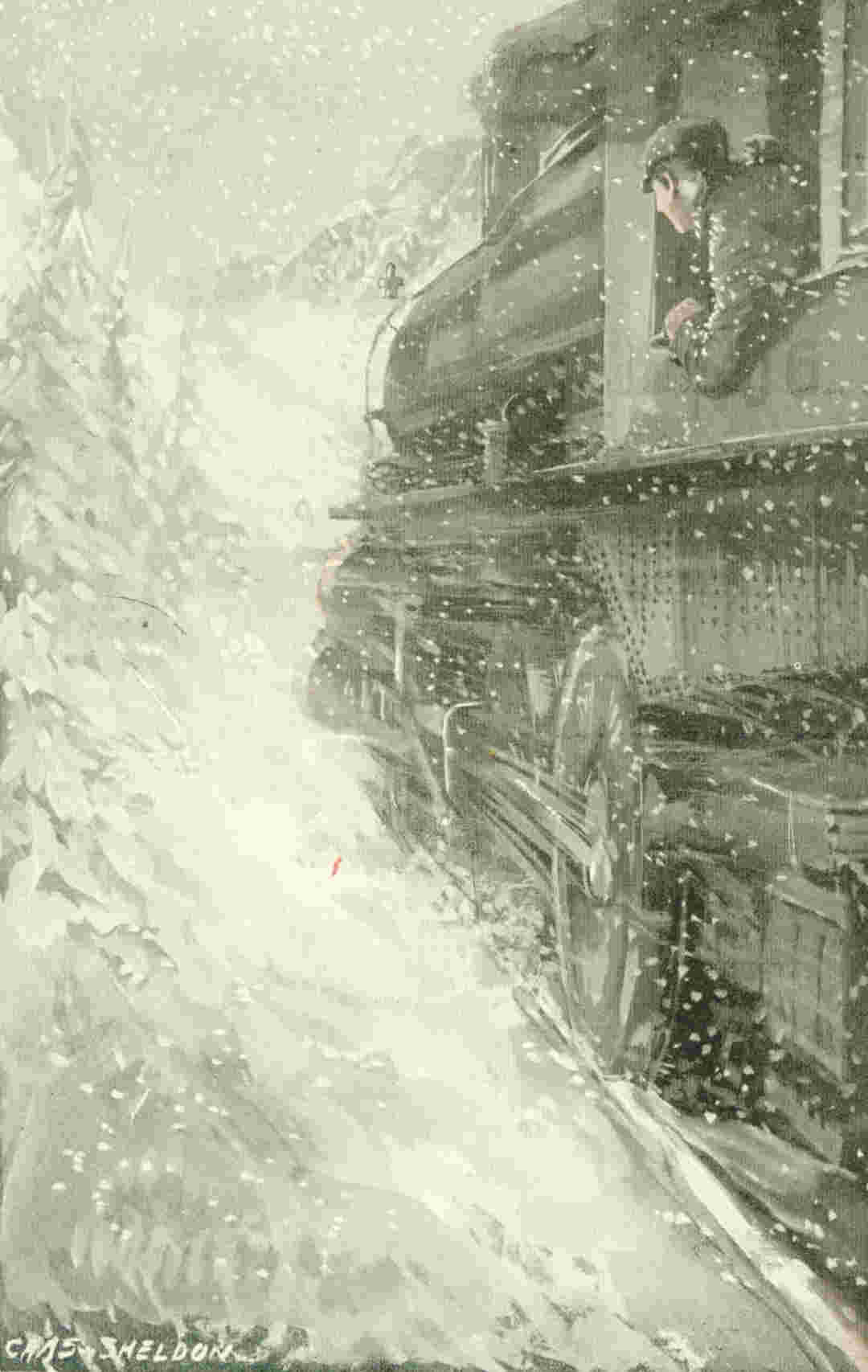
“GEORGE REALIZED THAT TOM HAD BEEN SHAKEN OUT OF THE WINDOW, AND THAT HE WAS ALONE ON THE RUNAWAY ENGINE”
Bang! It was the first sound other than the roar of the gale and the shriek of escaping steam which had reached our hero’s ear for a while. The engine bumped badly, swayed horribly to one side till it was canted at an angle, and then rushed on again smoothly, sliding again as before, completely out of hand. George caught for one brief moment a glimpse of a huge tree which was being tossed outwards, cannoned away by the locomotive, and at once realized what had happened.
“Tree blown across the line!” he bellowed, not turning his head towards Tom. “Jolly nearly threw us off the rails. But she’s on ’em safe enough, and, gee! ain’t she moving. Say, Tom, suppose there’s no upgrade to slow us?”
There was no answer, and, thinking that his mate had failed to hear, he stretched round the edge of the cab and shouted. Then he looked towards the seat which Tom had been occupying. It was empty. Snowflakes were whirling in through the window which he had opened, but Tom was not to be seen. He wasn’t in the cab at all. There was no sign of him. George clambered up and thrust his head through the window. No. His mate wasn’t anywhere outside, and, to be sure, it would be madness to attempt to clamber along the rail which led to the front of the locomotive. In a flash he realized that Tom had been shaken out of the window by that terrific bump, and that he was alone on the engine.
“Gone!” he gasped. “Thrown out by our collision with that tree. Then it’s up to me to face the music.”
George did face the situation, and with a promptness and decision which did him credit. Not that he could do much, or anything at all. Had it been possible to arrest the runaway freighter he could have done so perhaps, for by now his education had advanced considerably, and many a time did the good-tempered Tom allow his fireman to do some of the switching, to run the locomotive about in the freight yard and couple up the numerous cars, while more than once he had driven out on the open tracks. Here, however, it was a different matter. If Tom could not succeed, there was little chance of his doing so, for his mate was accounted one of the best engineers attached to that company. Still, he could try, and at once placed his hand on the air-brake lever. Bah! He might as well have turned steam into his cylinders and tried to increase the pace of the runaway. As to attempting anything else, why, Tom, had done that. He had reversed his engine, and had even had the coupled wheels spinning in the opposite direction. But ice is a tricky and dangerous material at the best of times, and here, coating the rails, it was worse than tricky; it was dangerous, it and the snow, and the two had made a combination which was too much for any freighter.
“Just got to hang on and wait for things to happen,” George told himself. “She’s going awfully fast, and it wouldn’t surprise me if she suddenly left the rails. Hum! That’d be awkward, for we’re on a high bank just here and would roll clear down to the bottom. Lower down it wouldn’t be much better, for there we enter the canyon, and there’d be rock walls to plunge into. Wonder where Tom is, and if he’s killed.”
The engine swerved again violently, and only then did George know his position accurately, for on this downgrade there was but one curve, and they had just taken it.
“Didn’t expect her to get round,” he told himself. “Then we’re lower than I thought and past the bank. There’s that canyon pretty handy.”
There was something more, for of a sudden the freighter began to behave quite differently. Something seemed to be holding her in front, though what it was George could only guess.
“Snowdrift right across the track,” he said. “She’ll push her way through it. Nothing’s big enough nor strong enough to hold her.”
But now the engine rolled and pitched, though undoubtedly her pace was diminished. Then she seemed of a sudden to rise in the air as if something had lifted her bodily, and as if she were leaving the rails. But it was only a momentary movement. She came down again with a horrible bang and jar which almost threw George to his knees, and then plunged onward. But only for a while. For again there was that curious feeling of something holding her, while beneath the footplate there came a grinding, crushing sound as if something were driving the tender hard up against her. No one could mistake that symptom. The whole weight of the freight cars was pressing down upon the locomotive, for no brakes were at the wheels to arrest them, while something in front was holding up the engine, arresting its mad plunge down the grade. The very condition, in fact, had been produced which made railroad braking so delicate and uncertain an affair before Westinghouse produced his vacuum brake, or other continuous systems were invented. For with these modern apparatus every wheel on a train is braked and every car so arrested. It is not the locomotive alone which slows and acts as a buffer against which the weight and impetus of the cars is taken. Such a system has the danger that in sudden stops the weight of the trucks behind piles them up and lifts them from the rails, sometimes even crushing some of the weaker members. And here was such a situation. George looked more than ever anxious.
“Regular bust-up,” he thought. “Something’s got to go, and it seems to me it’ll be the engine.”
But no. The locomotive bounded and bumped and swayed horribly, and finally shook herself to a standstill, flinging George flat upon the footplate and nearly shaking him out between the tender and the end of the cab. Before that, however, he was conscious of a tremendous commotion behind him. He couldn’t see what was happening, though it was only midday, he judged, and the light was fairly strong considering weather conditions. But he could hear, and even in spite of the deadening effect of snow and the cushioning of the banks which lay in all directions, the crash and bang of breaking cars told a tale there was no mistaking.
Slowly George picked himself up from the footplate and looked giddily about him. Then he clambered down from the tender and groped his way along the side of what had been a freighter. It was wrecked from end to end. Only the locomotive and the tender had kept the rails, and they were rapidly being swallowed up in the snow which fell to add to the drift into which they had plunged headlong, burying themselves deeply. Indeed, the drift had done for them what Tom’s air brakes had been helpless to accomplish. It had arrested and brought the freighter to a standstill. But that sudden though comparatively gradual halting had wrecked the cars. They lay in all directions, some outside the tracks, some partly across it, while the caboose was pitched up on the last of all as if it had clambered there to take a look along the train and see what was happening. Worse than all, perhaps, it was empty, a mere shell now, broken and fractured, while George was alone, alone in that blizzard, with four comrades somewhere behind him freezing to death in the snowstorm still blowing mercilessly.
George Instone may be excused if he hesitated and looked about him in some bewilderment on the occasion of that train wreck—looked about him, indeed, till the very impossibility of seeing anything but whirling snowflakes compelled him to realize the uselessness of such a proceeding. It was, in fact, only by creeping along by the rails and peering hard through the mist that he was able to discover roughly what had happened. This he knew, however: the freighter was wrecked from end to end, save the engine and its tender, and the caboose, which was always pulled in rear of all, still had its hind wheels on the tracks, while its forward end was perched above the next car in advance of it. Then it was badly broken and empty, while the car which supported it in that strange position had sat down upon the rails, its two sets of bogie wheels crushed into its interior—for all the world as if it were a hen which had crouched protectingly over its chicken.
George raised a gloved hand to his head and rubbed that member thoughtfully.
“A regular mix-up. Tracks blocked front and rear. Crew gone entirely, and likely enough—certain, I should say—to be frozen to death if help doesn’t come shortly. Where’s it to come from? How?”
How indeed? None but a madman could expect it with that terrible blizzard blowing, though doubtless, when some hours had passed, and the freighter failed to put in an appearance, the depot agent down below would realize that something had happened.
“That is, if the wires aren’t down and so stopping the telegrams,” thought George, holding himself backward as he returned to the engine, for the wind threatened to blow him flat on his face. “If he’s heard that we left the depot above he’ll guess that we’re snowed up. But he can’t help. There won’t be a locomotive handy, and one will have to be sent up from the depot. Even then it’ll have bigger drifts to face, for this storm is out of the ordinary. Guess Tom would have done better to have waited. But then that’s not his business. It’s the duty of the depot men to say when a train shall halt because of the weather. What’s to be done?”
“Tom’s lost on the line. Your mate will freeze to death if you don’t help him. There’s Charlie, too, and Hank and Tiny, all looking to you.”
Those were the thoughts which raced through his mind as he fought his way back to the engine. He clambered aboard stiffly, for the cold was seizing upon his joints and muscles, and threw the furnace door open. Steam was screaming from the valve outside the cab, and the gauge showed a good pressure. George shovelled in coal till smoke gushed from the funnel, and swung the door of the furnace to with an angry jar. Then he stood stockstill, looking fixedly at the water gauge. But he wasn’t watching the water line, nor was he wondering whether the boiler had sufficient water; those matters were second nature now, and always a mere glance was sufficient. He did not even see the gauge, but his mind’s eye was fixed upon those lost comrades—upon them and an idea gradually gathering in his shaken head.
“Why not?” he asked. “The company won’t complain—can’t if they tried. I’ll chance wrecking the locomotive. Let’s see. How’s the coupling of that last coach?”
He was off the footplate in a moment and battling his way back against the storm. Crossing directly behind the tender he soon felt the couplings. The car nearest the tender had been entirely tossed aside, and was lying ten feet away from the track, sprawling on its back, its useless bogies with their wheels staring up at the sky for all the world like a dead horse lying out in the open. The drawbar had been torn from it, and now hung to the coupling of the tender.
“Might foul the wheels and give me an upset,” thought George swiftly. “Got to clear it away, though it won’t be an easy job.”
He was hot all over before he had finished, for though the couplings over there are of most clever and simple design, and self-acting, they require great strength to handle when out of the correct position, and the drawbar itself was a ponderous forging. However, George persevered and won the battle. Then he fought his way back still farther, minutely inspecting the condition of the wreck. The car immediately behind that which had been tossed aside lay partly on the rails and partly off them. Immediately in rear a round dozen had been rolled over, the tail one of all fouling the tracks, its end lying right across them. Then came a break, for another dozen or more cars had been entirely wrecked and derailed, being tossed clear of the tracks altogether. Finally, there came the one which had sat down over its wheels as if it were a hen, and which supported the wrecked caboose, the home of the lost Charlie and his brakesmen. George counted them all on his fingers.
“Rail blocked badly in three places,” he told himself, “and number one is a bad enough business. If I get through it I’ll easily manage the next; but the last car of all, with the caboose on top of it, is a fixer. Wonder whether I’d better rush at ’em, or take it easily?”
He decided, in the first case at any rate, to run his tender back very slowly, for a rush might derail it also; or, what was likely enough, the crash and the strain might tear the rails up and so make return along the track utterly impossible. For that was the idea which had crossed George’s mind.
“There’s nothing else for it,” he told himself over and over again. “If Tom and the others are to be saved from freezing to death I shall have to make along the line to them. If I try it afoot I’m helpless, and shall meet just the same danger without doing good to them. The engine must go with me.”
It had to be done, and there was no use in delaying. He clambered into the cab again, mounted to Tom’s seat, and sat well outside the window, facing the wind and storm, with the snow whirling about him. Then, having seen that the engine was set to reverse, he pulled the starting lever. Bizz! Round went the wheels, while the locomotive snorted. Buzz! He gave her more steam and she roared, while the coupled drivers whirled helplessly. The locomotive was fast. It looked as if the case was hopeless. But George was not beaten yet. He clambered down from the cab to the footplate and seized his shovel. Then, desperately working with his whole might and main—for time was of the utmost importance considering the freezing state of the weather—he shovelled coal on to the track on either side, throwing it through the windows of the cab so as to get it as near the driving wheels as possible. A minute later he was down beside the engine, shovel still in hand, where he at once proceeded to throw the coal between the rails and the rims which were to ride over them.
“Try ’em again,” he thought, as he clambered back to the footplate. “Wish I had some sand aboard, or it were possible to get at the dirt alongside the track. But it might. I’ll try it if she don’t get under way this time.”
Back went the throttle lever with a jerk, and once more the wheels buzzed. Reaching out of the cab window George saw that the coal was making but slight impression. But the engine and its tender behind had moved, perhaps only six inches. However, that was better than nothing. The next time would be more successful. And so it proved, for our hero plunged his shovel into the snow and swung it aside angrily, as if he resented its being there, as indeed he did. Then he threw shovelfuls of dirt under the wheels of the engine, casting a great deal over the tracks immediately in rear, the direction in which he wished to move. Racing round to the other side from behind the tender he did the same thing, returning by the same road. Indeed, to attempt to make round by the front of the locomotive was impossible, for there a mighty and impenetrable wall of snow blocked the path. It was piled up almost double the height of the engine, compressed into a hard mass by the force of the impact and the weight of the huge body driven into it. It surrounded the front of the machine entirely, covering the cowcatcher, the wide front platform, the lamp and its dynamo, and even overshadowing the funnel. More than that, when George got the locomotive to move, which he did on his next attempt, he brought away more than a ton of the white material hanging to the front platform. As for the sides, they were more or less free, though the same snow wall rose up steeply where it had been cut into. As George judged it in the stress and hurry of the moment, the engine of the freighter had contrived to thrust its way twenty-five feet and more into an enormous drift—that is, into the largest and heaviest part of it, for behind it tailed off in a gentle slope which had at first offered some obstruction to the body rushing down into it. Thus was the comparatively gradual arrest of the runaway explained, though that arrest had been sufficiently sudden to wreck the freight cars.
Bizz! The wheels whizzed again and flung ice and snow from the tracks. Sparks were whirled away from the rims of the drivers. But they gripped just a little, for the locomotive moved two feet this time, and halted only for a second. Then George gave her more steam, and of a sudden the buzz of the wheels ended. They had got a grip of the slippery rails, for the moment at least, and the tender was being backed up the line towards the first of the wrecked cars which fouled the track. George leaned from the cab anxiously. Judging the distance as well as he could, he pushed his lever back when he thought he was close to the wreck.
Whew! The crackling and roar and jolt rather scared him, while the engine and tender came to a stop. Not abruptly, but slowly, as if uncertain of their driver’s intentions. George opened his throttle wide.
“Got to have it some way,” he said recklessly. “If I take her back gently she’s stopped. I’ve got to chance it. And one thing’s in our favour, the tender is bung full of water, with ample coal aboard, and heavy in consequence. That’ll help her to hold to the rails. Here goes for the mix-up.”
Again those wheels whirled. But they had cleared the rails of ice by now and gripped nicely. The engine and tender got under way at once, and, forced backward by the pressure of steam in the cylinders, closed with the obstructing car from which it had recoiled a moment or so before, struck it a terrific buffet which nearly shook George from the window of the cab, and then slid backward. It had cleared the obstruction. Climbing down when he had shut off steam, he found that the wrecked car had been tossed a couple of yards to one side and turned on its back, while the end which the tender had struck had been shattered.
“Then we’ll try our luck with the next. I ain’t afraid of it. But, crikey! that last one has it.”
Five minutes later he had swept the second obstruction aside, receiving no injury himself, so far as he could ascertain, save that the tender was badly dented. Also, George was shaken somewhat severely, for you cannot indulge in collisions with such heavy material and escape damage entirely.
“Bang a hole clear through the tank of the tender if I’m not careful,” he thought. “Well, no matter, for there’s snow all round, and a hole can be repaired. By the way, wonder whether Charlie left food in the caboose. Better hunt for it, in case I get safely through; for if the tender and engine don’t get smashed, that caboose is sure to get knocked to pieces.”
It was a wise enough proceeding, and a search in the tilted caboose and a climb into its shattered interior showed George quite a grocery store in one of the two cupboards with which it was fitted. There was meat, too, the whole side of a sheep, in fact—a gift from some friend at the northern depot, where sheep were grazed and meat therefore cheap in consequence. Very rapidly he clambered out of the caboose with what he had found and transferred it to the nearest car, which lay on its side near the track. Nor was it a difficult matter to find a hole battered at one end through which he could throw the stuff and so keep it secure from the snow. Also, if he could manage to remove the obstruction still remaining on the tracks—the worst of them all by a great deal—he would, if he returned in safety, be able to lay his hand easily on the provisions.
“Now for it,” he said, as he clambered up on to the footplate, for he had halted the engine quite close to the stranded caboose. “I’ll give the whole thing a gentle push first—a steady push so as to get it moving. Wish this snow would stop, for it makes the job all guesswork.”
Very slowly and gently he backed down on to the car squatting flat on the rails above its hidden bogies and supporting the forward end of the caboose. He heard the couplings jangle and grate and felt the tender slowing. Then he opened his throttle wide, sending the coupled wheels spinning. That was all. The wreck didn’t move. The locomotive was up to its old game of slipping, for the wheels wouldn’t bite. But there was a cure for that, and he set about it instantly, for he knew from his own feelings how Tom and the others must be faring—that is, if they were still alive. It was horribly cold. That tearing wind was piercing, though the fact of snow being thickly mingled with it made it perhaps a little less chilly and penetrating. Still, a blizzard is no joke, and it wants hard work or a hot fire to allow a man to get warm in spite of it.
Less than five minutes later George had the rails covered with dirt and was back in the cab, when again he repeated the same movement. Backing slowly, he got firm contact with the wreck, and before his engine was entirely stopped, and so as to take advantage to the full of its weight and momentum, he sent steam into his cylinders, jerking the lever open in a manner which would have called forth Tom’s shrillest condemnation. But what did that matter? Wasn’t he fighting for Tom’s life? What was the value of a locomotive beside it?
“Hang the locomotive!” thought our hero, very desperate by now. “Huh! Get on with it.”
There was a crunching sound behind, while the tender shook and rattled considerably. Then, to George’s horror, the tail end began to lift, slowly at first, and then with a jerk upward. It came down with a sickening jar a moment later, while the whole concern halted, the wheels of the locomotive spinning and casting streaks of sparks into the snow-laden air. He banged his throttle to with an angry exclamation and climbed down.
“Off the tracks for a dollar!” he said harshly. “All up with it!”
But the tender didn’t happen to have behaved so badly, and deserved better of him. It still sat on its wheels, though the dent behind, situated rather high up, as it happened, had now become a hole through which water was pouring. As for the wreck, it had been shunted solidly backward, while the caboose had tilted on to one side considerably, as if it were tired of its former position, and could rest a little easier as it now was. The sight, gathered as best George could through the storm, raised his spirits considerably. He went back to the footplate, scattering dirt on the track again on his way. Then he ran the engine forward a few feet, stopped, and reversed her.
“This time she’s got to move,” he told himself. “I’ll kick that stuff out of the way. I don’t believe the tender will mind it, for she’s awfully heavy, and I remember now that that car sitting on the tracks is empty. The caboose is the heaviest of the two, and since she, too, is empty, there’s not much in the job.”
He jagged the throttle lever back again, got the locomotive moving, and then ran her at the obstruction, clinging hard to his seat in the window of the cab as he judged the collision to be imminent. The shaking he received was once more terrific, and it was a wonder that the tender and engine together did not leave the rails, or at least tear the track to pieces. But both kept steadily to the rails, while by the crash behind something big had happened. George stopped his machine and went to investigate, finding that the caboose had rolled right over, and, slipping from the supporting car, had crashed to the ground beside the track, where, happening to find an incline, it had continued rolling. It was well out of the way in any case, while the car which had lain beneath it was concertinaed, and driven back along the road, the rear end having swung round at a right angle in the course of the movement. As an obstruction it was nothing now compared with what it had been, though there are few engineers who would willingly have charged it as George was doing, that is to say, were they situated where modern appliances were to be had for the asking, and where the wrecking derrick could be rushed to the scene of the wreck. Otherwise, no doubt, they would have attempted what George was trying. Up he went to the cab again, and when he hit that obstruction again it was with a bang and a thump which meant business. The tender sent the relic of the wreck flying, and proceeded backward, carrying a portion of the broken end of the car wedged on to it. Then George sounded the whistle, sending out a triumphant blast.
“Tom’ll hear it,” he thought; “that is, if he’s still alive. Now let’s think. He fell about a quarter of a mile back, as well as I can judge it. Well, I’ll go very easily, blowing most of the while, and keeping a bright lookout on his side. It’s still the driving side, so that makes matters all the easier. Gee! I do believe the storm’s lifting.”
Slowly he ran back along the line, keeping his whistle blowing. But though he peered into the white haze about him, no sign of the lost engineer did he discover. But perhaps he had made a mistake, and had not yet gone far enough. To make sure of the matter, and seeing that Charlie and his friends were somewhere in the rear, he gave steam to his engine again, and sent her rolling upward. He was beginning to believe that the quest was hopeless, though the snow was now far less blinding, when he fancied he heard a hail in answer to the whistle of the engine. At once he halted and blew loudly. Yes, someone was shouting.
“Must be uphill, from the direction of the wind,” common sense told him. “The gale brings the sound down. More steam. Get on with it.”
Boom! went the whistle, that curious, deep-throated, baying sound peculiar to the alarm sounds in Northern America. Then a distinct shout answered. It was still higher up, and George again gave steam to the locomotive. Then he braked and crept up the grade very slowly. It was some two minutes later when he thought he observed an object to one side of the track, and therefore stopped abruptly, his hand on the whistle lever, which sent its alarm echoing through the snowflakes.
“Hi, Tom!” someone shouted. “That you and the engine?”
George climbed down into the snow.
“Tom’s lost. The cars are wrecked,” he said shortly. “Why, it’s Hike!”
“Sure enough, and Tiny with me. We’ve got Charlie here, but he’s done in, and we ain’t able to carry him farther.”
“Come on to the engine,” shouted George. “I’ll help carry him there. What happened? How is he? Has he been damaged in jumping?”
“That and the cold have got him,” Hike gasped, for the effort of lifting the stout and big figure of the conductor on board the locomotive was one not to be sneered at. However, by dint of one clambering up first and hauling, and the others pushing from below, he was raised to the footplate at last. Then George cleared the seat on his side of the cab away, throwing it out of the window, and Charlie’s unconscious figure was laid at full length on the raised floor, right alongside the boiler.
“It’ll help to warm him,” said George, getting to the driving side again, “You fellows had best rub his limbs and look to him for a little. I’m searching for Tom, and I’m sure that I’ve run past him. Hike, there’s been an awful mix-up.”
“Guess so. How? What happened? Here, where’s the train?” demanded the usually contented Hike, starting up above the figure of Charlie the conductor, and shouting across at our hero. “Where’s the freight cars, man? They was this side of the engine, sure, or I’ve gone crazy over this business. Then how have you got round ’em?”
“All wrecked,” George told him smoothly. “Bashed to pieces. The greater number left the rails; the rest of ’em I shunted.”
“Shunted! Where? How? There ain’t no sidings down this grade, and no switches.”
George waved his hand. He wanted to concentrate his attention on the finding of his mate, and what did it matter about the cars?
“Look out for Tom,” he bellowed. “I’ve bashed the cars, I tell you. Those that lay across the rails were in the way. I fixed ’em. I just ran into ’em with the tender, and they’re not much better than matchwood. Keep an eye out for Tom, do you hear? Hang the cars and the whole freight train!”
Hike’s eyebrows were elevated. This was something new in railroading, and he had surely had some considerable experience.
“This here chap’s gone crazy, I do believe,” he muttered, peering through the snow at George. “No, he ain’t. He ain’t scared even. He’s all business.”
Boom! went the whistle, baying loudly. George let the engine run slowly down the track, and this time the brakes held her.
“Hi! Look up!” shouted Hike, who was peering from the other side of the cab. “Stop her, George; there’s a tree right there across the track, and it’ll wreck us.”
The brakes ground against the wheels, and the locomotive stopped abruptly. George crossed to the other side of the cab and joined his comrades. Then, much to their surprise, he shouted loudly and jubilantly:
“The very thing I ought to have hunted for. We’ve been into it already, Hike. The shock threw Tom out of the window, and this is where we shall find him—somewhere about here; lower down, most likely, for we were doing nearly sixty miles an hour at the moment.”
He felt more excited at that moment than ever before, and went tumbling out of the cab briskly. Hike joined him an instant later, and Tiny swarmed down after him. For, recollect, the footplate of an engine is not close to the ground. It is elevated some six feet above it, and clambering to it very often means quite a deal of exercise.
“He was thrown out of the cab window when the engine jolted after striking the tree,” said George. “Look at the cowcatcher and the front of the locomotive and you will see what a bump we gave it.”
“Smashed into matchwood,” agreed Hike, inspecting the damage, for the jolting as George drove back along the track, and those series of collisions he had engineered with the trucks lying across the rails, had shaken off the mass of snow which had previously been clinging to the front platform of the engine. The cowcatcher was indeed a wreck. Made of wood, in the form of an inverted V, and braced with huge iron forgings, it had been crumpled up as if made of paper, and in amongst the numerous strong bars of wood were branches from the fallen tree against which it had struck. As for the back of the tender, it was a sorry sight.
“Have to go into dock,” said Hike crisply, “that is, when we get back; but guess that’s a time ahead, for it ain’t given over snowing, and if I know anything about weather conditions hereabouts, why, it ain’t going to yet. Even then we’re not out of the mess, for there will be drifts all along the line, and it will take days to clear them. Say, George, you smashed the freight trucks up, you say?”
“Knocked ’em out of the way, them and the caboose.”
Hike whistled, a shrill whistle of astonishment, for the feat filled him with amazement. “Gee!” he cried; “there’ll be an enquiry, sure, and if you ain’t fired (dismissed), you’ll be lucky.”
“Don’t care!” declared George. “It was a case of your lives or keeping a few trucks whole, and I chose the latter. Are you sorry?”
Hike gripped his hand. “It was a tarnation plucky thing to do,” he said generously, “and I’m the last to blame you, for if you hadn’t come along, guess Charlie and Tiny and yours truly would have been frozen to death. As it is, Charlie’s already feeling better. The heat of the boiler is bringing him round. Then, too, he was shaken by the toss he got when we jumped from the caboose. Tell you, that was an affair. We more than half expected that you and Tom’d do the same, for the freighter was a runaway right enough, only Tom’s a demon for sticking. Say, he fell hereabouts?”
They had been searching up and down the side of the track meanwhile, Tiny by himself, and George and Hike together, peering through the snowflakes, prodding here and there in the drifts, for George had brought his fireman’s shovel with him, and struggling to find some trace of the lost engineer. Presently a shout from Tiny brought them all together.
“That’s something,” he cried jubilantly, holding up Tom’s ventilated cap. “It may have blown off, of course, or been shaken off before he fell. But it’s evidence to be followed. There it is, just as it lay, only it was covered with snow. I kicked it up accidentally.”
“And it lay on the very edge of the bank, then,” said Hike, shielding his eyes and beating the snow from his cap and coat. “My idea is that he fell on the very edge of the bank and rolled down it. That’s where we’ve got to seek.”
They scrambled downward at once, and presently were attracted to a mound at the foot of the bank, over which the flakes were settling deeper every minute. It was Tom, apparently asleep, though there was no waking him. But he moved his limbs when disturbed, and mumbled something.
“Knocked out,” said Hike at once. “The snow saved his fall a whole heap, but he’s badly shaken and half-frozen. Let’s look. This plaguey snow makes it hard to do much, but as far as I can see there’s no sign of frostbite. Heave him up on to the engine, and let us get a move on. Say, George, you get in and drive. Tiny and I will look to the two sick members of the party.”
They dragged the robust and heavy figure of the damaged engineer up on to the footplate, and, having thrown the driver’s seat on to the coals on the tender, laid Tom down in the cab on the opposite side to that occupied by Charlie. As to the latter, they found him sitting up, looking very sleepy and somewhat astonished, but not inclined to take any active part in the proceedings, a change which was remarkable in one accustomed to rule the going and the coming of the freighter and the management of the cars—all, in fact, save the actual hauling and shunting. There Tom was supreme, and the offices of engineer and conductor never clashed, a fortunate arrangement which made for the smooth management of all that concerned the freighter.
Once Tom was laid down beside the boiler George took his seat in the window of the cab, while Hike attended to the unconscious engineer.
“Don’t think he’s damaged,” he told George, after running his hands over Tom’s limbs. “He’s breathing quietly enough, and it looks to me as if the shock and the jar had made him dead sleepy, that and the cold, for a fellow gets dreadfully drowsy when he’s exposed in the open and gets the cold all over his body. I’ve had a turn myself, and as near went out as winking. Send her ahead, lad, and say——”
“Eh?” our hero shouted back at him, for the steam was shrieking from the valve overhead, while the furnace was roaring, a roar which almost drowned the sound of the tempest.
“Didn’t you say right now that you’d shifted the caboose?”
“Aye, sure.”
“Where was she, then?”
“Perched up on top of the last car, which was smashed down on the rails, with the bogies driven right into her. It was a proper mix-up.”
“And you shifted the lot?” gasped Hike.
“You bet you,” was George’s abrupt answer. He jerked the throttle lever over, gave steam to his cylinders, and set the locomotive in motion down the track. Then he tried his brakes. They were acting splendidly, and no doubt the absence of all that weight behind was responsible for the change in their condition. But Hike had not finished asking questions yet.
“How’d you do it?” he shouted, kneeling over Tom and rubbing his arms and legs with his gloved hands.
“Bumped ’em, I tell you. Barged the tender at ’em. Shifted ’em like ninepins.”
“And wrecked the caboose, eh, George?”
“You may guess so. Pitched if off the top of the car and sent it rolling. It’s fit for firewood.”
There was a troubled look about Hike’s somewhat dirty face when next he turned it to the young fireman. “Then we’re done,” he called, and there was a nervous catch in his voice. “We’re done, George. This here blizzard’ll have us yet; ’cos how are we to live? It’ll be three or four days before a relief party gets to us, for this is the worst do I’ve ever seen since I started railroading. Chaps can’t live without grub.”
To his astonishment, not to say anger, the fireman grinned. George’s distinctly dirty face expanded into a wide grin, while that young fellow nonchalantly pulled once more at his lever. Hike shouted at him:
“You might jest as well run her again full tilt into the drift that you say stopped her and wrecked the cars. It’ll be a short way out of the business, and I tell you I’d prefer it to slow starvation; so’d Tiny, you bet.”
That lanky individual stretched round from the far side of the boiler and stared at the two. There was already a hungry look in his eyes. His thin face was drawn, and he was moistening his lips with a dry tongue, as a wolf might do when seeking vainly for food. “What’s that?” he gasped. “I overheard a bit. Caboose wrecked and the grub gone? How long will it be before we get out of this mess?”
“Days,” Hike shouted back at him. “This here George don’t seem to care.”
Together they glared at the fireman, who merely smiled back at them. Then he burst into uproarious laughter. For what did our hero care? Had he not won a great battle that day? Had he not struggled against huge difficulties, and that all alone, and was not Tom Grant already beginning to move, even to open his eyes? He had risked all. Dismissal did not frighten him in the least, and he felt sure that an impartial investigation would exonerate him of blame, and even praise the seeming recklessness with which he had completed the wreck of the cars, and had endangered the tender and locomotive, not to mention that portion of the permanent way. As to the future, why, what did he care? He let merriment take hold of him. He got rid of that terrible feeling of tenseness which had assailed him ever since, in a burst of laughter which did him good, which acted as a safety valve does to a boiler. He let off steam, in fact, steam which brought Hike and Tiny to the point of exasperation.
“If I don’t hammer him, gee!” the former shouted, doubling his gloved hands into two ponderous fists. “If the fellow ain’t a blamed fool, Tiny. Laughs when anyone can see that we’re harder up against it now than ever before. George, are you gone stark, staring mad?”
“You jest wait a bit till we get back to the wreck,” laughed our hero. “There’s still coal on the tender, and if there ain’t food, why, there’s that. So who’s going to grumble?”
The engine snorted, the steam blew out from the valve above with a contented whistle, while the locomotive rolled onward to the scene of the wreck. Even if the party were not out of danger, which was undoubtedly the fact, for there they were, snowed in right away in the open, with no shelter but the cab of the engine and with the prospect of no relief for days to come. Who cared? The knowledge that there was food awaiting them made little difference to the young fireman. What pleased him best was the thought that he had won through, and had surmounted no ordinary difficulty.
“It was worth it,” he breathed, smiling down at the irate Hike. “Tom’s safe and sound, and with him the rest of the party. That’s what I set out for, and that’s what I care about. Let the future take care of itself. I ain’t worrying.”
In spite of the irate Hike’s prophecy the snowstorm which had been raging now for two whole days began to subside even as George Instone drove his battered locomotive down the track, back to the scene of the wrecked freighter. He himself had noticed that the flakes were not falling quite as fast some half an hour before, while now they were considerably lessened. A fellow could see some little distance. But, my! wasn’t the wind cold!
“Going to freeze hard,” shouted Hike resentfully, for he was still angered at the unseemly hilarity of the fireman. “Pull in slow there, and let’s see what you’ve been a-doin’ with our caboose and the rest of ’em. Say. Gee! This is going to be worse than a firin’ matter. It’ll mean a court case, and guess George Instone’ll be put in the jug for quite a tidy bit; eh, Tiny?”
The latter grunted. “So it will,” he answered. “But it’d be a shame, it would, for there’s few that would have dared it. Just fancy throwing the company’s freight cars about and breaking ’em up cold-blooded as you might term it. But don’t you forget, Hike, he did it for a purpose.”
“Guess he did,” the latter admitted warmly. For Hike had a noble heart. He was like many another on the railroad.
“And when you chaps have done talking perhaps you’ll let me get in a word or two,” George shouted at them, beginning now to close his throttle, for they were now running through the scene of the disaster. “Did you say, Hike, that there was food aboard the caboose?”
“Food, man!” the very mention of it inflamed the brakesman. “Why, the cupboard had just been filled with the usual week’s supply, and old Nolly Sturt had sent us half a sheep. He’s a good boy, and don’t forget how we stood by once when he was sending down a bunch of valuable hosses. Food, man! Enough to keep the whole crew of us against the day the relief party comes with the wrecker.”
“Then don’t you worry,” came George’s consoling answer; “ ’cos I’ve got it. You ain’t the only one that likes a meal, Hike, and thinks of food in such cases. I went into the caboose before butting into it.”
“You did?” came from the brakesmen in a loud bellow.
“Guess so.”
“And hiked it out?” demanded Tiny eagerly, his cheeks more sunken still, if that were possible. “You hiked it out, George? Got the whole of it, the sheep and all, eh? You don’t say it?”
“Every atom. Even a coffee-pot, a big box of matches, tins of condensed milk, and a kettle and pans to cook with. Ho, ho! You fellows were getting quite angry.”
There was perspiration on Hike’s forehead, but it was not induced by worry, or even by hard work. It was genuine relief which brought those beads there, and set them tumbling down the sides of his red nose on to his shaven lip. He swallowed as a man does who has escaped from some great danger, and breathed hard while he stared at the engineer. Then he spoke up, and it was the old Hike once more, generous and smiling.
“You’ll get promotion,” he shouted. “Guess they’ll tack twenty dollars a month on to your pay, and put you straight off on a passenger. And you’ve saved our lives, George. There’s not a doubt about it. First by coming back and barging everything out of the way to get there. And then by having the gumption to think of food for the whole party. Let’s see how you did it.”
By then the locomotive, guided by the young fireman, had slipped gently down into the mouth of the huge, wedge-shaped opening it had previously driven into the snowdrift, where George brought it to a standstill. Hike and Tiny leaped out at once, and commenced an inspection, while our hero attended to his engine, going round to the rear of the tender to wedge a piece of sacking in the hole which had been driven into the tank.
“It’s high up, and so we haven’t lost much water,” he thought. “That sack will prevent more splashing out as we run, not that we’re likely to get under weigh for quite a time. That sets a fellow thinking. What am I to do? Keep the fire going, or let it out? That’d mean freezing, and getting something burst. There’s coal enough aboard the tender to keep a small head of steam in for five or six days, I should say, and with all this snow about there’s no question of having enough water. Let’s see.”
He clambered on to the footplate again, and swung the furnace door open. He had purposely done little firing since he had battered the wrecked cars aside, for he was running light, and once he had finished the upward run the rest was on a down grade, that same down grade which had wrecked the freighter. He was still pondering the question when someone called him. It was Tom. He was sitting up beside the boiler, holding his head in his two hands, looking about him sleepily. Then he slowly clambered to his feet, George helping him, and stared out of the cab window. Suddenly he remembered.
“Gosh! We ran into a tree right across the tracks,” he exclaimed, clenching his fists. “I was shaken clear out of the window, and then knew nothing more till this minute. Say, George, where are we? She was a runaway. You didn’t get her in hand surely? It was impossible for sure. Then—then where are we? How am I here? Where’s the train? Why, gee! if that isn’t a wreck!”
“It’s a long story, and you shall hear it later on. Sit down and rest,” said George. “We’ve got to think of a lot of things, and make ready for the night; for we’re snowed in, and it’s freezing harder every minute. You sit down, Tom. You’re all right, and a rest and the warmth of the boiler will do you a world of good.”
Very obediently, for he was badly shaken and felt weak and helpless, the engineer did as he was recommended, while Hike and Tiny called George down from the footplate.
“You’ve been at work, you have,” said the former. “There’s signs right here, all about the wreck, that show you’ve been thinking and moving. What with the coal and the dirt spread on the tracks, and not altogether covered yet by the falling snow, that and the cars you bumped into, there’s a tale any railroadman can read. Tiny and I have been taking a close look, and we’re just struck all of a heap, as you might say. But—see here, George, what’s next?”
“Got to make some sort of arrangement for the night,” came the prompt answer. “It’ll be dark in two hours, and the snow may commence again at any moment. If the engine was facing the other way I wouldn’t worry, for then the cab would protect us, and we could find enough sacking in the wrecked cars to cover in the back part that is open. But that’s the part that faces the wind, and it’s awfully cutting. We want a shack of sorts. I suggest one of the freight cars. Let’s look at the caboose.”
“Right! There’s not a doubt but that we must make some sort of a shelter. And if the caboose ain’t broken to matchwood, why, it might do. Only I suspect it’ll fall to pieces when we touch it. Tiny and I saw it at the bottom of the bank. You shifted it finely.”
They went off at once on a tour of inspection, and though amongst the overturned cars there were many which would afford quite excellent shelter, the caboose, after all, and much to George’s surprise, was found to offer the best haven. For the tender had not struck it. It had wrecked that car upon which the caboose had been piled, and had rolled the latter off it. And it happened that the shelving bank had helped. For the caboose had rolled over completely, and now sat on its broken wheels, almost level, squeezed out of shape, but hole proof. Clambering into it, they found the stove still in place, though the jar had torn the smokepipe adrift. The bunks were still there, the bedding tossed into a corner and the whole of the interior disarranged, while the walls slanted in the most extraordinary manner.
“Lucky we thought to throw the hot coals out of the stove before jumping,” said Hike. “They’d have set the thing afire, and the whole train too, most likely. Lend a hand, Tiny. Get that smokestack put up, while I pull coals out of the locker. Say, George, where’s the grub you took so nicely from us?”
There was laughter now at the mention of the supplies, and our hero went off at once to collect them. Then he spread the mattresses on the bunks in the caboose, and laid out the bedding. There was enough there for five persons, for spare blankets were always carried. By then Tiny had the smokestack in place, for, though shaken out of position, it had not been damaged. He thrust paper into the stove at once, hacked some chips from the nearest of the wrecked cars, and piled coals from the locker on them. Soon flames were bursting from the top of the stack, while half an hour sufficed to heat the interior nicely.
“Time to get Charlie and Tom,” said Hike. “They’ll be wondering whether we’ve deserted them altogether. It won’t take long before we have a feed, and already I’ve got coffee ready. Come along and lend a hand with them.”
They returned to the engine at once, and soon had their two damaged comrades sheltered in the caboose. George banked up his engine fire when there, and saw that the boiler was well filled with water. When he returned to the caboose he found the party very animated, Tom and Charlie having sufficiently recovered. Charlie called loudly to him.
“Shake hands, brother,” he said earnestly, trying to rise from his seat. “This here’s a do that’s got to be reported to the associated brotherhood of railway men. You’ve done fine.”
“Fine!” echoed Tom just as heartily, even more so, perhaps, for was not George his own pupil. “And don’t get scared that there’ll be trouble about the cars you jumped aside and the damage to the tender. Hike’s being telling us all about it, and I swear there was never such a thing before. They’ll have fits at first up at the main office, for, of course, the whole affair’ll have to be reported. Then there’ll be an enquiry. But they can’t hurt you; rather the reverse. And if the yarn gets out to the papers, why, it wouldn’t surprise me if there was quite a story made of it. Let’s eat, boys, and take a sleep. I’m not there with the whole yarn yet, and I’m too stiff and knocked about to go inspecting the wreck. To-morrow we’ll get talking, and then we shall learn the whole of the story. But say, George, what’ll you do with the engine? Remember, I’m a sick man, and off duty. You have to fix what’s to happen.”
“Then I shall keep the fire banked and use as little coal as possible. I’d let the fire out were it not for the cold. Some of the steam pipes and water connections would certainly get damaged by bursting, and then we’d be unable to move when the wreckers arrive. I reckon we’ve enough coal to last a full week, banked as she is now, and that’ll allow a little to spare for the stove here in the caboose.”
“That needn’t worry you, mate,” laughed Hike. “While there’s a wreck close handy there’s wood and to spare, and most of it’s useless now for any other purpose. Now, boys, here’s dinner and supper all rolled into one, and, like George there, I’ve fixed it so as provisions will last for six days. We’ve got to go careful, of course, but there’s enough to satisfy every one of us. There’s flour and stuff, too, in one of the freight cars. I know that, for I was the one to take the consignment, and to-morrow we’ll hunt it up and make bread. This oven here is a champion for that. I’ve done it often.”
The reader may open his eyes at such a suggestion. But then one wants to meet the railwayman on his own particular work, and in a country such as Canada, to realize what he has to be capable of. For there the runs are often very long, and a man working with the crew of, say, a freight train, leaves his own home early in the morning, and pulls in late at night at his distant destination. The cost of keeping rooms there would, in time, rob him of the better part of his wages, and therefore the companies often enough provide a discarded car, or a shelter of some sort, fitted on occasion with beds or bunks. There the crew, other than those who occupy the caboose, can get free quarters, and, since a cook also is a luxury, they learn to fend for themselves. Indeed, as we have shown, George was quite an expert.
“Tiptop,” as Tom had often declared when the savoury smell of some frizzling steak came from the tiny kitchen attached to the stranded car and pervaded every corner. “His cooking jest makes a chap eat, and blest if I ain’t gettin’ as fat as butter with it.”
What jolly times, too, the crews have in those shelters! There, when the night has drawn in and the dinner or supper is finished, gather often enough the whole crew, while cronies from the town tumble in to chat and gossip and smoke. There would be impromptu concerts on occasion in Tom’s quarters, when the lanky Tiny would take the stage armed with a mandolin. Who, before, could have accused him of being sentimental? Who would have thought that beneath Tiny’s somewhat narrow chest there beat a heart that longed for adventure and glory? Yet so it was. Under the stirring strains of that mandolin he would wax extremely warlike, and would shout songs of ringing victory at his comrades. Or, perhaps, the mood changing, he would warble some sentimental ditty to them, while one could almost declare that tears filled his eyes. But perhaps that may have been the tobacco smoke, for there were times in Tom’s shelter—for he was extremely popular—when every inch of room was taken, and when the haze in the ill-lit room made a man choke, so thick was it.
Tom, too, could sing a song and spin a yarn with the best, while, it being a rule that each one in turn must entertain the company, George had even had to mount the platform—the latter being represented by a soap box—and there face the footlights and the music. As for Hike, he was always prepared to give the audience an exhibition step dance, which never failed to draw forth howls of hearty applause. Peter, however, Peter the watchman and hunter, was never drawn.
“He don’t talk much,” Tom was always fond of explaining, accompanying the words with a knowing wink. “Peter don’t talk. He thinks a heap, and just does huntin’ and fishin’. Don’t you disturb him, ’cos, if you do, this outfit here’ll not get the taste of venison, bear, and trout that we’ve got used to.”
Yes, they were a merry, hard-working, sober set of fellows, highly intelligent, and unusually well-educated for the most part.
And here they were once more gathered in the caboose, bereft for the moment of those cronies who were wont to call on them. Moreover, they were in a quandary, but infinitely better off than they might have been. Hike had actually found one of their lamps undamaged, and a spare glass for it, so that the interior of the caboose looked quite cheerful. Indeed it both looked and was unduly warm and cheerful as the darkness came and evening advanced, for once more the drooping wind began to howl about them, while snowflakes again whirled over the wrecked freighter.
“Going to be a dirty night,” George reported, when he had fought his way to and from the engine, where he had again banked up his fire, throwing on sufficient fuel to last till morning. “Shouldn’t wonder if by morning we were right under the snow. If it’s much deeper I shall have a job, for walking to the engine is hard work even now.”
“Then you’ll have to make yourself a pair of skis or snowshoes,” said Hike. “I’ll lend a hand, and since I ain’t over ready for bed yet, why, let’s see what we can do in the matter. I’ll bring one of the railway lanterns with me, and you fetch along the axe. Gee! Wait a moment. Why, I remember now. Ain’t a chap stupid on these sort of parties? There’s snowshoes and skis and all the rest aboard, going down to the depot below us. Yer see, George, there’s a post road there to the nearest settlement, twenty-two miles out, and a kind of half-breed Indian, Pete they call him, makes the trip twice in the week. If it’s snowing, and the top is soft, he takes shoes. If there’s been a frost, he jest gets skis on to his feet, and, gee, how he do move with ’em! You bring that axe all the same. We’ve got to find the car first, and then break into it.”
Charlie called them back just as they were going, for this experienced conductor had also a suggestion.
“Hike, you jest worry me,” he said, with a lame smile, for Charlie was feeling the results of this adventure. “You quit talking about huntin’ for a car that’s got certain goods in it. Should ha’ thought a chap as had been on the road this many years, and is always a-preaching about it, would ha’ thought to look at the lading bills. They’re right here, in my pocket, and you ain’t got to do more than ax for ’em.”
Hike was abashed. He seized the papers from his senior, and soon had the required information. Then he and George sallied out into the snowstorm, and, battling their way to the wrecked cars, found the one they sought for, after some little trouble. Then George cut his way in through the wooden side, using his axe without hesitation, for the car was badly wrecked, and soon had the articles they wanted. Each donned a pair of snowshoes at once, for the walk even over that short distance had been a hard struggle. Then, shouldering a pair of skis apiece, together with sticks, they returned to the caboose. Another journey provided them with a mass of firewood.
“Better get in as much as we can, and make ourselves comfy,” Hike said, looking about him. “This wind’s not so violent as it was this morning, and the snow’s falling more directly downward. Looks to me as if we were in for a very heavy fall, the kind of thing we look for at this time. It’ll be bad for us, George.”
“Why? Don’t follow.”
“Well, it’s like this. Our run is on a side track, as you might say, for we’re off the main line, and the chances are that there’s at least one other train snowed up. If it’s on the main line, as is bound to be the case, they’ll go to her first, specially if she’s a passenger. You may say right here that that’s what will happen, for trains are like ships. The passengers has first call when there’s danger, and a rescue is wanted. The crew has to stand by as a point of honour. Well now, supposing there is a snow-up on the main line, where are we? Fifty miles from the junction, with deep snow all the way up, and more snow falling. Seems to me we shall have to think things out carefully.”
George lay in his bunk that evening—for they all turned in just after seven o’clock—thinking out the situation. It was still snowing, the flakes falling thickly, and common sense caused him to support Hike’s argument. They were on a side line, and their rescue must come last of all. It might come the following day; it might be delayed a week and more, depending on the weather and on the difficulties to be met with down below, between them and the junction. For the line upon which George had taken service, leading to Calgary, was one of a kind to be met with commonly in this difficult country. It penetrated the foothills of the Rocky Mountains, often taking advantage of narrow canyons and gullies, and following the valleys. As a consequence it was prone to be covered by drifts, for a blizzard often enough filled one of the canyons almost to the top, there being, practically speaking, no outlet.
It was one of these into which the locomotive had run that morning, and its size was amazing. He fell asleep at last, worn out by his strenuous efforts, but happy and quite unconcerned about the future. For he had comrades with him, and company makes a man cheerful and lessens the size of dangers. At an early hour he was out of the caboose, fighting his way again to the engine, his feet now supported on snowshoes. Stirring his fire, which was still glowing, he banked it again, and saw that the boiler had ample water. Indeed the gauge showed her to have but little steam, so that the water he had run in on the previous evening was not nearly expended. Returning to the caboose, he broke up the firewood, brought more from the nearest wrecked car, and then stoked up the stove, setting it roaring. It was getting time for breakfast, and, as Hike still snored, he set about the task himself. Taking the kettle to the door, he filled it with snow, doing the same with the frypan. Then he cut rashers of bacon and thick slabs of bread, and very soon had both frying. When Tom opened his eyes and looked out of his bunk the tiny table was spread, and the odour of frizzling bacon caused him to sit upright with a jerk. And once more he was Tom Grant the engineer, smiling and happy, and, but for stiffness in one arm and about the shoulders, quite hale and hearty. Charlie had benefited too by a long night’s rest, while nothing ailed Tiny. The lanky fellow tumbled out of his bunk, scenting breakfast, and fixed his deepset eyes on the dishes.
“And now we’ll get in with the whole story,” said Tom, when he had satisfied his appetite. “There isn’t anything to be done outside with this snow falling. You’ve seen to the engine, you say, George, and so we may as well make the most of the situation and rest, for there’s a hard time yet before us. Now, mate, you start off. We were a runaway. That’s what I know. But, gee! I didn’t think to tell the boys,” he cried, his face suddenly flushing. “See here, Charlie, and tell me what you think of it. We were scuttling down the grade fit to beat the band, the whole train out of hand entirely; and, of course, I knew that we were in for a bad mix-up. Well, I’ve been that way before. Once, some years ago, on the main line too, I was coming down a grade when the plaguey brakes wouldn’t act at all. Something had gone wrong with the air that time. It wasn’t a question of snow, or ice, or of wheels skidding and slipping. It was just air, or lack of it. Well, then, it was looking every bit like a bad wreck, and guess my fireman thought so. When I’d done struggling to hold her, and looked round, he wasn’t in the cab. He’d hiked off without a word. He was a deserter.”
“Huh!” grunted Charlie, pulling contemptuously at his pipe. “I’ve seed that sort of thing myself.”
“Well, I didn’t altogether blame him,” went on Tom. “Only I’d have thought better of him if he’d stood by and waited for orders. Now, young George, just you sit down where you are. The fire aboard the engine’s right. You’ve said so, and there’s wood in abundance right here. So there’s no call for you to make a move, is there?”
Our hero was at that moment attempting to bolt from the company, looking flushed and heated. But Tom nipped the movement in the bud, while Charlie and the rest of the crew stared at George, the former smoking thoughtfully now. He looked keenly at the young fireman, the lad who, as he understood—for he wasn’t yet fully acquainted with the whole business, and, like Tom, was waiting to hear the story—had saved the whole situation. Had George funked? Had he, too, turned his back on his mate and quitted the engine at a critical moment? Charlie withdrew his pipe, and stuffed at the weed with the stump of a very grimy finger. The end of that same finger had disappeared years before in a trifling train wreck, and all feeling had gone from the remainder. Thus it had become an excellent instrument with which to stuff weed back into his pipe, and if the weed were rather hot, what mattered? He didn’t feel it, and it didn’t disturb his comfort.
“Get on,” he said to Tom sharply. “Your mate, away back some years ago, was a deserter. You ain’t going to tell me that the fireman here played a scurvy game on you.”
Tom laughed. It was a treat to hear his merry voice again. He pointed to George a round, fat finger. “Don’t he look bad, too?” he laughed. “You’d say, from the look of my mate, that it was he that had heaved me out of the cab window. Ha, ha! Charlie, you ought to have known better. But I’ll tell you when you’ve done interrupting.”
“Interrupting, eh? Here!” grumbled Charlie.
“Well, you fix on to your pipe again. And, by the way, how’s ’bacca?”
Hike produced a big bag from the cupboard. “Plenty,” he cried triumphantly.
“Then my mind is easier. Now, I was talking about mates. You fellows will smile when you hear the story. I told this George to hike.”
“Ah,” grunted Charlie, blowing a huge cloud of smoke at the stove, “you told him to hike it?”
“I did. He got angry—wild, in fact. Then—and this is the cream of the story—he just rounded on me, reminded me that I’d got a missus and children, and had the brass to tell me to quit myself, to quit my own engine!”
Charlie contemplated his pipe now quite closely. His hands were rather inclined to shake, while his breath could be heard as he sucked it in deeply.
“Huh!” he finally grunted. It meant a deal in the case of the conductor.
“Yes,” repeated Tom, and his tones were indignant. “Had the brass to bid me to quit my job—the locomotive I’m paid to stand by. Say, boys, I felt like punching his head, and, I tell you, he looked as if he’d punch mine in a jiffy. There were we, rushing down the grade, bound for a wreck, and us snarling at one another. The end of it was we agreed to stand by together. But I haven’t forgotten, eh, George! A good mate is what a man wants, and then he don’t want anything better.”
They were done with the subject, and George breathed more freely. Then they turned to discussing the remainder of the adventure, and piece by piece the two elder men were made acquainted by Hike and Tiny with the course of George’s action.
“It’s one of the finest tales you’ll hear on the railroad,” said Charlie, when they had finished, gripping our hero’s hand. “You’ve done well, lad, and this crew’s proud of you.”
“And wouldn’t have been here to be proud of anything at all,” Tom reminded them, “had it not been for the fireman. You think, boys; we’d be back there beside the track, frozen as stiff and hard as the tiebars (sleepers), and wouldn’t be sitting here in the warmth enjoying a smoke. It was well done all through, though I’m glad I wasn’t there to see him barging into the wreck and sending it aside. Flesh and blood wouldn’t stand it, for a man who has a job on board an engine gets to look at the whole machine as a sort of child. He can’t bear to have it damaged, and all the while he’s patting it here and smoothing it there, as you might say, oiling careful whenever he thinks it’s needed, taking up the big-end bearings when they get to thump, and looking all the while to the well-being of the machine he’s in charge of. Then to have to break it up deliberately is a hard job. Putting aside the danger of collisions—and it isn’t small—it would go hard against the grain to smash a fine tender to pieces as if it were a toy, and to risk a locomotive that’s capable of doing what this one can. George, you’d make a good engineer if you were older. But I doubt your waiting to rise to the post. You’ll be off on some other job; most likely as one of the railway directors. I’m serious, lad,” he added, seeing our hero flush. “There are some men who get a real good job and stick to it. There are others who improve all the while, and who show from their youth that they can take responsibility on their shoulders. Every man can’t do that. Those who can, stand a chance of coming to the top. You want to, eh?”
“I mean to,” came the emphatic answer.
“Then here’s good luck. Shake hands. Now, mates, I’m for a sleep. There’s nothing else to do, only to wait for a rescue party. If it goes on like this, snowing, I’ll have to dig out a yarn for you fellows. I’ve been like this before now; and, gee! it was a precious close business.”
“Say, Tom,” began Charlie on the following morning, when inspection of the weather outside proved that snow was still falling; “say, boy, we’re here again for a whole day, ain’t we?”
“You bet. Fixed tight. Nothing doing,” answered Tom from his bunk, where he was lounging. “Things will be quiet all over the country.”
Throughout central Canada, indeed, the snowstorm we speak of had reduced matters to a standstill. The blizzard was one of exceptional severity—quite phenomenal, in fact; and being followed as it was by a steady and very heavy fall of snow it kept nearly everyone within doors, save for those, like the railroad men, whom duty called upon to issue forth to struggle for the lives of stranded comrades or cattle.
George had been up at early dawn, for he was indefatigable in his attention to his duties, and had fought his way to the engine. He found it almost completely snowed under, merely the funnel and boiler appearing, for the heat melted the snow, while the cab, the tender, and the coals on it were very thickly covered. It had taken him an hour to clear the footplate and get at his fuel, when he discovered that his fire was burning nicely. He had become an expert at banking the furnace now, and knew to a nicety how much coal to throw on, and how long the blaze would last. Then, having seen that all was well, for the lives of the party might yet depend on the locomotive, and more than all on its ability to make steam and use it, he returned to the caboose, bringing with him the sack of flour and baking-powder which Hike had previously mentioned. The latter, still a grimy person, for the cold weather made washing almost an impossibility, at once set to work, and at that moment was kneading his dough in a large enamelled basin. As for Tiny, he watched the proceedings. He wasn’t a cook, and, in fact, was of little use as anything but as a brakesman. But he could play the mandolin, as we have stated, and one of his greatest consolations at the moment was that the instrument was safe and sound, undamaged by the wreck and by George’s unceremonious treatment of the caboose.
Hours of waiting, then, had to be faced, and since men cannot sleep always, and hardly so early in the morning, Charlie turned again to his old comrade.
“You was saying last night, Tom, as you could fix us with a yarn about a time similar to this,” he said, using the stump of his damaged finger to ram a new charge into the bowl of his pipe. “Well, seems to me that the time has come for you to do something fer yer living. The railway company don’t pay engineer’s wages to a man jest to ’low him to sit and smoke and eat, and then sleep when he feels inclined to. It expects work from that chap. Well, Tom Grant, that’s the position you stand in. You’re idling, and seeing that I have to make a full report of this here business, why, in course I shall put down in black and white that the engineer was the idlest of the party. Huh!”
He smiled. Tiny looked up from his beloved mandolin, twanged a string or two, and swung his lanky form from his bunk. Hike gave a final punch to the dough and looked vastly interested, while George drew his stool nearer. It was certainly and undoubtedly the time for a yarn. Things were slow. As Tom had said, there was nothing doing. As for the engineer, he smiled. He couldn’t help that. It was seldom that George had seen him otherwise. Of course he had had an illustration two days before, and once earlier on, when at a particularly ill-laid switch the engine had become derailed. Then the peace-loving, smiling Tom had become a venomous person. Words of wrath had issued from his mouth, and he had leaped from the cab window of his engine swiftly so as to see for himself if any damage had resulted to the machine he took such a pride in. But that was now a forgotten incident. The air within the caboose was warm and balmy. Breakfast had been a particularly appetizing meal, and this was a rest day, a day of enforced idleness, not altogether uncongenial to a man who worked every day of the week for the year round, often including Sunday.
“Well,” he said at last, when he had surveyed the company critically, “it wasn’t here in Canada, and the folks I was with were fine fellows.”
Charlie coughed and fidgeted. He wasn’t so very brilliant himself, and, besides, the heat of the caboose made him a little drowsy. Still, comparisons were not always pleasant. Did Tom mean to insinuate that his old comrades were better than present company? He shifted his seat a little and coughed. “Of course,” he began, but Hike stopped him. He was cutting his dough into shape for the loaves he intended to bake, and looked up in the midst of the operation.
“Charlie, you leave him alone,” he said. “I know Tom and you ought to. He always begins like that just to get up an argument and a bit of a shindy. He’s a dandy story teller if he’s let alone. Tom, you fire in now without any further palaver.”
Tom had to, and showed no unwillingness. For, as we have said, and as other folks often asserted, he was the prince of good fellows, and stuffed full of interesting experiences. But, then, that is so often found to be the case with men on the North American continent. They have not always been there. They have frequently travelled far and seen many strange peoples and countries. Tom was amongst them. His yarn, no doubt, would show that clearly.
“It was way down in South America,” he told them, settling himself for the yarn, “and my mates were really fine fellows, fine. And you’d have hardly expected snow there, now, would you? But they have it at times, sometimes fierce blizzards, and just at the place I’m going to speak of they were more common than elsewhere. For the line I was on then ran steadily upward to a tremendous height, something like fifteen thousand feet, and the pull was terrific. One locomotive might haul five cars perhaps. A longer train had to be supplied with two locomotives. However, that’s neither here nor there, but you can realize that at that elevation snow was not altogether uncommon.”
Charlie grunted. He knew. So did Hike. They had not worked on the railroad for so long without knowing.
“You’ll guess, too, that things are not so settled down there as they are here in this country. For instance, there are always revolutions of some sort. Governors or presidents come and go rather often. Some are shot, some assassinated with daggers, a few bolt for their lives, while there are a small number who manage to survive and continue to hold office. In any case there is a considerable amount of unrest, and, to add to it, Indians now and again take a hand in the game and show the half-breeds and the descendants of the early Spanish settlers that they are not altogether dead or sleeping. I’m mentioning all these,” said Tom, “as they come into the story, and I’ll introduce to your notice right now Señor Enrico Gonvalezaro, president for the time being of that country, a nice enough fellow if he’d lived all his life in a city, but useless when it came to roughing it on the railroad.”
“Ha!” ejaculated Charlie. “Kid gloves, eyeglass, and that sort.”
“Well, not exactly. Chicken hearted, that’s all. But he must have had some gumption in him, for there he was, president of that little bunch of people, and mighty pleased with the position he’d managed to climb to. Of course there was a revolution. It seems that Señor Enrico—I can’t give you the whole name every time, being such a jawbreaker—it seems that he had a notion to annex the next State, and the president there wasn’t above agreeing to the deal if a discussion showed that all points were favourable. But the difficulty was to arrange that meeting. At last it was decided that the two should each take train from opposite directions over the pass at the top of the climb I’ve already mentioned. They were to meet on the frontier line which ran across the pass, and were to get in and talk the matter over. I was called on to drive Señor Enrico, and as there was a revolution on at the time, for hosts of the hot-blooded Spaniards were not anxious to be joined up with the neighbouring State, trouble was to be expected. I was offered a handsome sum for the work, and at once accepted. Now I’ll pass over the run up to the top of the climb,” said Tom, swinging his legs over the side of the caboose. “It was just ordinary.”
“No ructions?” asked Hike, standing near the stove in the oven of which he had his bread baking. “Those fellows down there are rather fond of sniping, I’ve heard, and a locomotive and a man in it make a tempting shot for a rifle.”
“Just ordinary,” repeated Tom. “Those rascals weren’t going to frighten Señor Enrico too early. But you must let me tell my yarn in my own way.”
“Certainly,” declared Charlie, looking sternly at his brakesman. “You leave Tom alone, Hike. You are too fond of putting a word in.”
If glances could have damaged, Charlie would have been sorry. But Hike really meant nothing serious by his scowl. It was merely this, he and his chief were for ever sparring. “You sit quiet,” said Hike severely. “Tom recognizes a travelled man when he meets him. I’ve been in South America too, and I know something about the people. You get on then in your own way, Tom. Those rascals weren’t going to frighten Señor what’s-his-name too soon.”
“Señor Enrico Gonvalezaro,” grumbled the engineer. “Why they can’t give fellows down there names that a man can put his tongue to easily is what beats me hollow. Look at mine. Short and sweet. Can’t forget it, and it takes only a moment to write. Look at Señor Enrico Gonvalezaro. It’s a whole big mouthful. But there he was, aboard a private car, rigged up finely for his particular comfort, and behind it a luncheon car and a brake van. That brings me to the crew. There was Jem Hendy, my fireman, a chap as thin as a rake and as long as a pole, with arms and legs that seemed to stretch in all directions. He was something like Tiny, only thinner and longer.”
That individual looked up suddenly and flushed. After all, the idea that he was thin and lanky didn’t fall in entirely with his romantic and warlike aspirations. He twanged a string of his mandolin loudly.
“Jest so,” smiled Tom, “and we got to know Jem as ‘Spider’. So there was Spider first, and you’ll hear more of him. Then there was Adam Cheap, the conductor, all three of us from England in our younger days. Adam was stout and heavy, just like Charlie here, and had once been a butcher. He was a sort of quarrelsome fellow.”
It was the peaceful Charlie’s turn to look up suddenly, and his eye glinted. But Tom only laughed, for he was a wag and loved nothing better than to poke fun at his comrades. Three of them had had a turn now, and George was wondering when his would come.
“In addition, there were two native brakesmen, four soldiers, the most curious fellows you could set eyes on in a long day’s railroading, and one of the president’s officials, called Señor Alvero. He didn’t seem to have a Christian name before it, so that’s something. There’s less to worry with when telling the story. Now you’ve got the bunch of us, myself, engineer, Spider as fireman, Adam the conductor, and his two native brakesmen, making the crew of the train, while our passengers consisted of Señor Enrico, Señor Alvero, and four scallywags known as soldiers. That bunch, sirs, reached the foot of the pass high up there on the mountains to find a blizzard blowing, a blizzard which came near to killing the whole party and yet saved our lives if you can get the hang of my meaning.”
“Nearly killed you, and yet saved your lives!” exclaimed Charlie. This was a little incomprehensible to the conductor. “You’re fooling,” he said severely. “You quit that, Tom Grant. You’re out to tell us a yarn, a true yarn, ’cos we don’t cotton to fairy stories. What do yer mean?”
“What I’ve said. That blizzard nearly killed us, and yet saved us in the end. It’s a true story I’m telling.”
Hike banged the door of the oven open. “Quit fooling,” he shouted, for up till then he had been listening with the greatest interest. “How could a thing nearly kill and still be the means of saving life? The idea’s absurd. But I can imagine that the blizzard was enough to do some damage. Look at this one. We might be out there, frozen stiff, instead of in here baking bread and listening to you fooling.”
But you couldn’t easily rouse Tom. He smiled sweetly upon the puzzled and irate Hike and Charlie. “You’ll know soon,” he said. “I’ll get along. There was a blizzard, a fierce one, and it struck us at the entrance to the pass, before we’d reached the divide, where we were to meet with the other president. That blizzard had started up perhaps three hours before, and was as it were a special one all confined to the canyon over which the pass ran. There was deep snow already, and we hadn’t gone three miles before we were brought to a dead stop by a drift as high as the engine. We were then three miles from the divide where we were to have pulled up.”
“And couldn’t move on?” asked Hike.
“Not a foot. There was a mountain of snow, you might say, right bang in front of us.”
“Then you could back out,” suggested Charlie, his pipe in air, his attention concentrated, for the conductor loved a yarn, and anything to do with the railroad, which had commanded so much of his service, deserved the most careful hearing. “You got her started down the grade, eh? and backed her out of the canyon?”
“I might have, only something always does turn up at such a time to add to one’s difficulties. Look at us here. A runaway; then a snowdrift and a wreck, to say nothing of all the rest of the business. There was that something with us. We’d run off the line, and one of the rails had spread. We were fixed tight, and the president had to grin and bear it. But we had food enough for the whole party, and a lunch car with all the apparatus for cooking. The end of it was we bedded down in the brake van, that is to say, the crew did. The soldiers turned in with the conductor and the two waiters aboard the luncher, fellows I forgot to mention, and I guess the two fellows with the long names settled down on the sofas in their saloon. That’s how we spent the night. The next morning we were hard up against worse trouble.”
“Ha! Indians,” cried Hike.
“You’ve got it. Indians, cusses who’d been hired to wipe the party out, and who’d have done it the night before but for the blizzard. That’s why I said the storm saved our lives, though the drift and going off the line might have wrecked us badly and killed the whole party; for it seems that there was a conspiracy afoot to defeat the proposals of Señor Enrico what’s-his-name, and the easiest way to do that and stop the plans of the president of the adjoining State was to kill ’em both off. Half measures ain’t popular in parts of South America,” Tom explained. “They don’t believe in talking soft, and chatting things over. A dead man is a safe man, from their point of view, because then he can’t do anyone harm, and if he has a scheme, it is washed out with him. You see, the fellow who is made president immediately afterwards is sure to have a different plan altogether. First, because he’s wise to the fact that the man before him wasn’t popular, and had irritated the people with his new-fangled ideas, and then because, on principle, each new president seems to have to show the folks what he’s made of. He’s got to suggest something new and fine. If it doesn’t take, that fellow goes down quickly. He’s shot or knifed, or thrown aside somehow, and another man is chosen. Oh yes,” smiled Tom, “it’s a queer place to live in, where there’s plenty doing, and where even the people seem to prefer unrest and bothers to good, ordered, and settled government. But I was saying that they’d fixed an arrangement to get rid of both presidents, and it was to be done in style. Rails were lifted on either side of the divide, half a mile from the halting place, and if we’d gone on there would have been a mix-up.”
“There would, you bet,” asserted Charlie. “A fine one. Cars off the line. People killed and all the rest of it. Those villains didn’t mind about the train crew, of course. They’re nothing.”
“Nothing,” agreed Tom. “But there wasn’t to be any mistake in carrying out the business. Those Indian skunks had been hired to pull up the rails, and then to lie in wait and murder the whole party, those, at least, who escaped the mix-up. That’s why I say the blizzard saved us.”
“But they were round you next morning, those Indian skunks, and you were fast,” cried Tiny, the very first words he had spoken, while Tom cleared his throat.
“You bet you,” he answered, in the manner characteristic of the Canadian; “a hundred of them, and if it hadn’t been for Spider they would have been into the cars before our bunch was awake. He saw them when he went along to fire his engine, and came back at the double. Spider doubling was a sight worth watching, for what with his legs flying wide and his long arms he was like nothing I’ve ever seen. However, he warned us, and then there was a hullabaloo.”
“How? Why? What did the Indians do?”
The questions were shot at the engineer from all sides.
“Do! You’ll hear. They were armed with rifles, and gave us a taste of what they intended. But, of course, Señor Enrico being their chief aim, they riddled the saloon in the very first place. Then they turned their guns on the luncher and the car in rear, where we had been sleeping, and in the first five minutes killed those four soldiers and two of the luncheon-car attendants. That left our crew, one attendant, and the two fellows in the saloon. Bullets were still coming thick too, for your South American, as I’ve said already, believes in making sure, and where one bullet might be enough, he pours in a broadside, and keeps at it. It was a tight place, and looked as if it would see the end of us.”
“But didn’t,” Hike broke in breathlessly, for really this was something quite out of the ordinary when referred to railroading. It was just as unusual as had been George’s movements immediately after the runaway freighter had plunged into the snowdrift.
“Well, I’m here. Ain’t I big enough to be seen?” asked Tom quizzingly. “That’s proof that one at least of the party got out safely. But it was a tight place.”
“You bet,” Charlie agreed, “and I’m wondering what you fellows did. Caved in? Lifted a flag?”
“Eh?” demanded Tom sharply.
“Well, you had as good an excuse as ever men had. There were a hundred of those Indians.”
“More or less. Rather more I think. But we didn’t hoist a white flag, and for two reasons. In the first place, those sort of people don’t take notice of one. It’s kill with them, all the time, and no quarter. They’ve no idea of chivalry, or that sort of thing. The greater the odds they can bring against you the better, that’s all. So we didn’t ask for a truce, and didn’t want to. We set to fight the whole bunch of the rascals.”
Tom looked stern. Tiny leaned forward eagerly, while Hike actually forgot his loaves, then baking.
“You took ’em on. Bravo!” gurgled Charlie. “It was more than ten to one, and that is odds enough. Besides, you weren’t armed. How’d you dodge ’em?”
“We didn’t dodge,” said Tom sturdily. “They asked for a rumpus, and we gave it to them, hot and strong too, with mustard in it.”
That set George smiling. Vindictiveness on the part of Tom was surely such an unusual thing that it amused him to hear his mate’s words. But Tom was serious. At the recollection of that battle his face became sterner, and there was even a scowl between the eyes.
“Tell us all about it,” George said eagerly. “You fought the whole band.”
“And licked them handsomely, lad. Drove ’em from the field. Sent them howling. And this is how we did it. It was Spider who first put us wise to the movement. Bullets were coming through the cars all this time, you must understand, for the Indians never ceased firing. And after the first five minutes, when the four soldiers did their best by shooting from the windows of the luncheon car, not a shot was sent back in return. The poor chaps were dead, while the attendant there who had so far escaped had run back to our car and was shivering in a corner. As for the President, Señor Enrico so-and-so, he was grovelling on the floor, clutching at the fellow with him. Beauties, I can tell you,” said Tom dryly. “But I mentioned Spider. He and I and Adam and the two native fellows were lying flat on the floor of the car, wondering what next would happen, and listening to the bullets chipping their way through the woodwork. You’d hear a click, then the report of the rifle, and immediately see a new window, just a little round hole, you know, bored clean through the wall of the car, and again right opposite through the other, a hole with a ragged edge, which didn’t matter so long as the bullet that caused it didn’t happen to hit you on its way. Then there would be a hole through you also. Yes, it was unpleasant, awfully unpleasant.
“ ‘They’ll riddle us,’ Spider told me, as if I didn’t see that as well as he. ‘They’re lowering their aim now, and getting nearer the floor. Tom,’ he says, ‘how’d it be to get right through the boards? The snow has covered us well above the top of the bogies, and if we could get beneath the cars we should have cover.’
“Well, it was a brilliant idea,” said Tom. “Spider got an axe, for they’re always carried in a small compartment in every car, so as to be handy in case of a mix-up, and went to work at the floor. I ran forward into the luncheon car on an errand, and Adam came with me. It took us but a little while to get hold of the rifles of the men who had been killed, together with a heap of ammunition. Then we dodged the bullets and got back. Adam had had one through the calf of his leg by then, which made him holler for the moment. And I’d come in for quite a peppering. Boys, you look at that. It made me mad for a while.”
Tom bared his arm, and showed four scars quite close together at the front and back.
“No; not four separate bullets,” he explained. “Merely one of them, sent by a rascally Indian, which struck against a bit of metal in the wall of the car, split asunder, and went in four pieces through my arm. But I hardly felt it at the time. When we got back to the brake van Spider had a hole big enough to pass us, and in a jiffy he and Adam and myself, with one of the native brakesmen, were through. The other funked, and sat shivering beside the luncheon-car attendant. What the two señors were doing all this time I can’t guess. But they were funking also, and that’s all there is to it.”
“So you got right under the car?” asked Charlie. “And the snow all round gave you protection? That was a good move, about the only one you could make, and that Spider was a fine chap to think of it. How’d you get on?”
“Fine,” said Tom, filling the bowl of his pipe in preparation for a smoke. “Fine. We beat the snow down where we dropped, for the drift lay under the cars, pushing it away from us against the side. Then we made holes big enough to see through. By then the Indians thought they had finished their business, for not a shot had come from the train for some while. They were rushing in as I looked out, shouting and whooping, their big knives drawn, for bullets ain’t enough for those bloodthirsty fellows. Two of them—leaders, I guess—were within twenty yards at that very moment. But Spider and I took aim at them at once, and sent them rolling into the snow. You should have heard the screech the others gave,” said Tom, looking up from his pipe and smiling at his friends. “It just curdled your blood. The whole hundred or more of them gave a shout that made the canyon ring, and then blazed away at the train till riddled wasn’t the word for it. You could hear the glass in the windows of the luncher and the saloon smashing, while all along there was that queer little zip that told of a bullet perforating the wooden sides. Then some of their shots struck the iron struts and braces of the cars, and the scream they gave wasn’t too pleasant. I can tell you, boys, it was a tight little affair altogether.”
Charlie nodded. He could understand that. “Tight, you bet,” he agreed. As for Hike, he was listening breathlessly. As we have intimated, if there was anything in this world, outside his own little home, which the active Hike cared for, it was a tale of the road—some yarn in which the loyalty and bravery of a train crew was demonstrated.
“Reckon the company ought to have rewarded you,” he blurted out.
“So they ought,” agreed Tom, with a wag of his head. “But we wasn’t out yet, mind you; and when we got into shooting, and had bowled over a round dozen of those varmint, the others got kind of desperate. They’d meant to wipe us out the night before, and there was never any saying when a relief party might reach us. You see, we didn’t know what they knew, namely, that the president coming up on the far side to meet Señor Enrico Gon—Oh bother! how on earth can a fellow put his tongue to such a name?—to meet our señor had had warning of the little conspiracy to wipe the two parties out. And from that day to this I’ve never been rightly clear as to whether he couldn’t send us word or whether he wouldn’t. Presidents in that country come and go, as I’ve told you, and, like the people generally, they ain’t too fond of one another. One man dead is often enough a rival out of the way. Be that as it may, those Indians knew that they had been balked of their prey from the other side, and had, so far, failed with us. They’d got to do something, and those shots of ours, and our killing some of them, made the others desperate. They set to work to wipe us out in the latest and most scientific manner.”
Tom licked his lips. It was dry work talking, and he cast an eye at the coffee-pot. Then, stretching out, he gripped the handle, took a cup from the table—for he sat near it—and poured himself out a cup of the still-hot beverage. Then he set the cup down and sighed a sigh of satisfaction. Meanwhile his companions waited for him to proceed, fidgeting at the delay, each one of them showing the keenest interest in the proceedings. George was standing now. Tiny was gripping the side of his bunk and breathing deeply. Charlie had even forgotten to smoke, while all memory of the bread he was baking had fled from Hike’s mind.
“In the most scientific manner,” repeated Tom. “They’re trackers, those fellows, and can creep anywhere. So, seeing that we’d taken cover behind the snow under the car, they began to tunnel their way through the snow towards us. You couldn’t often see ’em. Suddenly a fellow would pop up through the white coating all round and bang would go a rifle. Ten to one, too, it’d hit just on the lower lip of the car, where the steel girder runs lengthwise, and then wasn’t there a row! It got trying after a while—very.”
“You bet,” grunted Charlie sympathetically.
“Spider was the next to get wounded. A bullet punched a beautifully neat round hole through one of his ears, and I tell you Spider shouted. And it made him angry—extra angry. He’d been fuming all the time at what he termed the insolence of the natives. Now he got red-hot, and sat up there under the car, blood streaming down the side of his face on to his coat, shaking his fist at the enemy. Some of them were within thirty yards of us by then, so you can reckon it was warm work.
“ ‘We ain’t going to stay here longer,’ called Spider all of a sudden. ‘We’re going on along the train. The tender will give us better cover. Besides, if we dodge about it’ll put their aim out.’
“It did too, boys, and there were never natives more astonished. We gave ’em a volley from beneath the freight car at the rear end of the train, and our next shots were from beneath the saloon. Then we crawled on under the tender. But we didn’t stop the rascals. They’d got to earn their pay, and they meant shooting the whole bunch of us.”
“Ah!” ejaculated Charlie, fumbling with his pipe. “They’d got wise to this little movement of yours, and countered it?”
“They did; and precious soon, whenever we sent in a shot, a dozen would answer it. Still, the snow round the cars protected us a heap, while we’d been fairly lucky in hitting the enemy. Not that you could always tell a successful shot. Sometimes a man would give a yell and disappear; and when a few minutes passed without a shot coming from his direction, you could take it for granted that he’d been rubbed out. At others you couldn’t say for certain. In any case they were getting bolder and drawing closer. In a little while they’d be following us under the cars, and then it would be all up with us. But Spider was a crafty sort of fellow himself, and had an eye for country. He’d been peering out a heap, and soon he called us all about him.
“ ‘Look away to your right, almost abreast of the engine!’ he suddenly exclaimed. ‘That ground is high, and runs up swiftly. Supposing we tunnel our way there and get to the top?’
“ ‘Why?’ asks Adam, who was a dense sort of a fellow. You see, he was the conductor of our train, and somehow—hum!”
Tom coughed and glanced across at Charlie, winking at George as he did so. “Well,” he continued, “I ain’t drawing comparisons. There are conductors and conductors, and, of course, present company’s always excepted.”
“You git on with that yarn, young feller,” cried Charlie severely, signs of displeasure on his face. “There’s engineers, too, and engineers, and some as I know could do with a little teaching. But Adam asked why. What then? We’re thinking of this yarn of yours and not of ourselves.”
“Oh yes! Just so. And Adam asked why. Spider tells him quick, too, sharp-like, for he didn’t think much of the conductor. ‘ ’Cos we’ll be above the hounds,’ he said angrily. ‘Then we’ll see ’em in their burrows and can fire down.’
“It was a fine scheme, and we took it up at once, tunnelling our way right out to the rise. There was a sort of hollow on the top of the rock, and in a jiffy we’d made a little fort of it. Then we cautiously opened places for our rifles, and there, sure enough, down beneath us, were the long gullies those varmints were crawling along. You could see their dark figures and aim easily. So aim we did, and set ’em howling. They stood it for a while and then bolted.”
“And you escaped?” asked Hike, his arms akimbo.
“Not yet. They surrounded our mound and rushed at it. But the snow was deep, and that took their pace off. Besides, the rock rose steeply. So we had a chance, and gave ’em what for, I can tell you. Indeed we gave them a severe lesson, so much so that they drew off, and an hour later there was not a sign of them. Then we went back to the train, roused those two señors from the trance into which fear had driven ’em, and cooked a dinner that was worth eating. It was a near call, boys, and I’m glad it isn’t to be repeated.”
Tom took to his pipe, Charlie busily rammed the weed home into his own, while Tiny mopped his brow. Hike stood still for some while, his eyes glued on the far end of the caboose, lost in thought. But Tom roused him.
“Say, Hike,” he called, “ain’t you forgotten the bread you’ve got baking?”
There came a yell of anguish from the brakesman. He had, in fact, forgotten all about it. Instantly he rushed to the stove and threw the oven door open. And it was with a growl of anger that he withdrew the somewhat blackened results of his forgetfulness.
“That comes of yarning,” he cried. “But, gee! Tom, it was worth it.”
The third day of enforced idleness within the caboose found George and his friends fretting somewhat; for even when companions are genial and good-tempered, and when everyone has settled down to make the best of a bad matter, time still drags heavily to men accustomed to active work, and forced now to twiddle their thumbs and do nothing. Even Tiny’s mandolin and his most sentimental songs failed to enliven the proceedings, though that master of music, realizing his failure, changed the tune to one of the most martial, and sang of wars, of honour and glory.
“It isn’t any good, and that’s all there is to it,” declared Tom on the morning of the third day, stretching his arms in the centre of the caboose and yawning widely. “The thing was a bit of a joke up to yesterday, and I, and Charlie too, were not sorry for the rest, for I can tell you, boys, it’s no joke to be thrown out of the cab of an engine when going at something like sixty miles an hour, even if there happens to be snow on the ground to act as a cushion. Now I’m feeling like work, and yet can’t get at it. You see, work’s a sort of habit. A man becomes used to it, and he’s thrown out of gear if he can’t get it. Say, George, what’s the report?”
Our hero had again been out to his engine to bank his fire and see that all was well with the locomotive, and had just come in at the door of the caboose, where he stood kicking the snow from his feet and brushing it from his clothing.
“Sky clear, Tom. Stopped snowing during the night, and looks as if we’d now have fine weather. But there’s a heap of snow everywhere, and, though I’m not used to these things, I should say that it will take a long time to clear the track.”
“You bet, lad. But you have to see a plough at work to know what can be done. Our people run rotary ploughs, you must understand, so that there’s no case of the usual one where the snow bulks up in front and gets packed so firmly that the locomotive is stopped. The new idea hurls it to one side, and will tackle quite large drifts. But reckon this time it will be a case of digging. Seems to me, boys, we might make an effort to clear things ourselves.”
The idea caught on at once, and an hour later found the party hard at work treading a path to the locomotive, for that had to be done first to enable them to get to the work. Then they mustered all the implements they could find.
“Just two shovels!” said Charlie. “You might as well bring along toothpicks. Still, we may as well have a turn to clear the sides of the engine. Later on we’ll try the front.”
They took it in turns after that, and when evening came again had made some impression. But it was only an impression. Fighting his way on snowshoes into the canyon at the mouth of which they had been stopped, George, accompanied by Hike, made a close inspection.
“We’re just playing with it,” the latter reported when they had returned to the caboose, and when he and our hero were finishing supper. “That canyon’s chock full, and it’ll want a gang and a snow plough to free us. ’Way back up the rise, at the mouth of the next cut, there’s another huge wall of snow; so, boys, we’re fast here till folks come along and fetch us.”
“Then how’s grub?” Tom demanded.
“Enough to last four more days. After that we’ll have to live on one another,” grinned Hike. “Charlie there would feed the company for a month, you’d say. We could put him in cold storage outside the caboose, for it’s freezing hard, and then I guess there’d be no anxiety.”
The suggestion brought a roar from the company, though the conductor hardly seemed to see the fun as his friends did. But he laughed all the same, and shook a fist at his brakesman. “You’ll get into trouble, you will,” he said threateningly; “and if it comes to killing one of the company, and putting him into the ice chest, why, it’ll be Hike. He’s in good condition—fat and tender and young. People don’t choose old stuff like me if they can help it. Thank ye, George. I’ll have a second cup of coffee and a bit more o’ that mutton. But speaking of short commons reminds me. We could hunt, Tom. There’s bound to be deer and what-not about, and the cold will have driven ’em down into the foothills. We’ve got snowshoes, and there’s a couple of rifles in the caboose, ’cos Hike and I always carries them. You see, boys, we like a little hunting ourselves at times, and we two has been off before now after grizzly.”
Hike smiled. The mention of hunting evidently reminded him of one episode at least, and quick as a flash Tom was upon him. He laid down his half-empty cup of coffee, laid his knife and fork on his plate, for the meal was finished, and stretched across to his bunk for his faithful pipe.
“All right, Hike!” he called out. “You smiled, and that means something. You were thinking, maybe, of a little hunting jaunt that would interest the company. That being so, you’ll just get through with that hunk of bread and set to with the tale. In a sort of place like this a man has to make himself interesting, and it’s up to you to entertain the party this very evening. Now then, fire away. It’s hunting I take it?”
“With Charlie and Peter, watchman up there at the northern depot; and the tale somehow pans in with this very time here, and with the yarn you gave us yesterday. You see, there was snow, and it was snow that was the first cause of all the trouble.”
“So there was trouble then, Hike?” asked George, settling himself on the edge of the bunk, and deferring the distasteful job of washing up the dishes till sometime later. “There was trouble, and you and Charlie and Peter were in it?”
“Bang up to the neck,” was Hike’s expressive answer, “and lucky to come out of it alive. Reckon it was one of the most extraordinary things that could have happened.”
“Hear, hear!” Charlie cried. “Agreed. Hike ain’t saying a word more than the truth. It was the last trip I took. You see, boys,” he added, as if apologetically, “I ain’t quite as young and active as I was, and this here huntin’ in the Rockies is hunting, you bet. It’s hard work, and wants youth and strength and energy.”
“But you went, and so that’s all we care about,” answered Tom. “Only I can see what you mean. I ain’t so active myself, worse luck! and a man when he gets past forty or thereabouts can’t expect to be the same as a young ’un. Now, Hike, we’re all fixed and ready. You just get in at the tale.”
Thus ordered to proceed, the jovial brakesman folded his hands together across his knee and leaned back near the stove, his eyes fixed upon the stackpipe running up through the ceiling.
“You know Peter, all of you,” he said, “and you’ve heard how he’s a hunter. Well, I should say that he’s the best guide and hunter for a long way round, and knows the Rockies thereabouts and farther afield just as if they was a map. That mayn’t sound anything to the average sort of fellow, ’cos you’ve got to get right close up to the range to know what it means. Then you can understand. For what with peaks and summits everywhere, hundreds of gullies and canyons all looking much the same, and valleys running this way and that close beside the mountains, a newcomer, and indeed a fellow that’s been used to the place all his life, gets mixed up and bothered. You have to climb not once but often, and be amongst those peaks and canyons to be able to know ’em by heart; and there’s few besides Peter who can say as they know ’em.”
“Not as Peter says anything,” Charlie laughed.
“Jest what I was thinking,” Tom smiled. “He’s just the most silent fellow I ever dropped on.”
“All that,” agreed Charlie, with a nod. “Silent and watching. Hike’s right. Peter’s a better hunter than he is a watchman, which is rather queer, seeing that his job is night watchman up at the depot. He’s a hunter fust. You get on, Hike, boy.”
“Then I’ll commence by saying that it was early in the fall, when the Indian summer was in full swing, and the weather just lovely. We three, being kinder in need of a holiday, decided to lay off for a week and leave the freighter to other people. So we packed up our grub, filling a sugar box with it, took our kits and guns, and set off on Miles Tenant’s lumber cart. He’s got a mill way up there in one of the canyons, the loneliest place that ever you came across, and that was to be our headquarters. You see, he had a shack close up beside his own in which he used to house his hands. But the mill was wellnigh shut down just then, so there was room in plenty. Well, I ain’t going to tell about our journey. It was much like many another. We rode on the cart or walked beside it, and late the same evening that we set out we reached the shack Miles had lent us. Next morning we were away up the gully, climbing the nearest mountain in search of deer and bear, and having fair fortune.”
Charlie nodded. “Fair,” he said, “and plenty of hard work. Gee! climbing mountains is harder than hard labour.”
“Tried it, the real stuff?” Tom asked dryly.
“Eh?” demanded Charlie.
“Why, hard labour, the stuff they give convicts.”
There was loud laughter as the conductor waxed indignant for the moment.
“Tom Grant,” he said severely, “you’ll get into trouble yet, and don’t you forget that it’s the conductor that makes the reports when there’s a bust-up. It ain’t my fault if you’ve got a fireman that’s inclined to be reckless. That merely points to the fact that his chief’s reckless too. That’s sad, Tom. The folks way up at the central office at Calgary’ll get axing awkward questions, and when they appeal to me, why, yes, I’ll have to admit that Tom Grant ought to have muzzled that young fireman.”
There was more laughter at that, good-natured laughter, for this was all fun. Angry words seldom passed between the members of the crew of the freighter. As to George, he was flustered by Charlie’s words, and looked at Tom in the most forlorn manner. However, Tom was not impressed. He merely wedged a new charge into his pipe, lit the weed, and, crossing his feet, lolled back comfortably.
“I’m going to make a report myself that’ll startle the folks,” he grinned.
“Hey?” asked Charlie.
“I’m going to say that Charlie’s to blame for the whole business.”
“How’s that?” demanded Hike, smiling and winking.
“Easy. He’s in charge of the train, ain’t he, and it’s the weight of the train that told on us and made us a runaway. Well, he should have known what was going to happen, and should have lightened the train. Yes, Charlie, boy, you’ll be right up against it.”
When the laughter had died down again, and the company had settled themselves once more for his story, Hike went on with it, his eyes still upon the smokestack.
“It was the third day out,” he said, “and we’d climbed to our right, way up the side of one of the highest of the mountains. We’d heard that bear had been seen, and we was anxious to have a shot at the mountain goats that are to be found up above the timber line. So it meant climbing, and that’s where Charlie found out what he’s been telling you.”
“Gee!” came from the conductor. “It was hard work. I nearly gave up, the climb was that steep and difficult.”
“But we stuck it out, and that very afternoon, just about two o’clock, found us above timber line, eating the bread and cooked bacon we’d brought with us, and just having a rest before going on with our hunting. Of course Peter was watching all the time. He don’t sit down to eat nor to rest like an ordinary being. And if he do happen to answer a question put to him, which ain’t always, he’s looking elsewhere than at the fellow who’s been speaking; he’s watching the country round. Well, watching brought a warning from him.”
“It’s going to storm,” he says. “It’d be best to return immediately.”
“Well, you can guess we were disappointed. But we knew Peter well enough not to make a bobbery and go against his advice. So as soon as we’d smoked we turned to climb down the mountain. And don’t you fellows get thinking that coming down’s easier than climbing. It ain’t,” said Hike emphatically, whereat Charlie nodded his head vigorously.
“It ain’t,” he supported his brakesman by saying: “There were slides to cross, rock slides, and they ain’t half so pleasant descending as when you’re going up. They ain’t, Hike.”
“They’re wuss than at any other time,” the brakesman proceeded, “and that plaguey mountain was covered with rock slides, steep slopes, heaps steeper than the roofs of houses, running sheer down for two thousand feet and more, with never a tree nor a rock to give a holding. A fellow had to dig his feet into the rock slide edgeways, and trust to not slipping. Then there were huge masses of rock to be crossed when we’d got past the slides; so that what with one thing and another the time slipped by and still found us high up on the mountain. By then the sky was black, and it was hard to see even out in the open. Presently the wind set in and whirled about through the timber, bringing snowflakes with it. At last it set in snowing harder than I have ever seen it save on this here occasion. We were right up against a nasty business.”
“Bang up,” said Charlie.
“And even Peter was bothered. You could see him peering this way and that, but never saying nothing. Perhaps half an hour later, when the ground was all white and the snowflakes were blowing round so that a man could barely see a yard in front of him, Peter came to a stop.
“ ‘It’s no use, boys,’ he says. ‘We’ve got to camp, and out here that won’t be pleasant. We could, of course, but this is a blizzard and we’ll be wellnigh frozen.’
“ ‘Then what’s to be done?’ we asked, of course.
“ ‘Find shelter,’ he says. ‘There’s a place I know of not so far away, but it’s difficult to get at it.’ ”
“It was!” Charlie suddenly exclaimed.
“Gee! you bet,” said Hike sympathetically. “As much as I could manage. Charlie was dead beat when we got there, and if it hadn’t been for Peter, guess we’d have died out there in the open. But, as I’ve said, he knew those parts like the pages of a book, and led us off across the side of the mountain till we reached a gully. Crossing that was a nightmare. The wind howled, and the gusts wellnigh swept us away. It was a case of hanging on with teeth and eyebrows. But Peter seemed to know every foot, and soon he had us at the foot of a rocky bluff.
“ ‘There’s a cave way up there,’ he said. ‘Sling yer rifles, for it wants climbing.’
“We slung ’em, and got ready. Then up we went, and I don’t want another experience like it. For what with the howling wind tearing one away from the face of the rock, and the snow lashing into one’s face, it was mighty skeary work, while the rock itself was a difficult climb even on a fine day and in a good light. Presently we could hear water pouring over the rocks near us, and thudding down below, and it was a sickening sound, I tell you fellows. For it let you know about how far you’d have to fall before hitting. It was a big distance by the sound, and big enough when, later on, one could get a look at it. But Peter didn’t seem to mind. He went up and up without halting, save that now and again he looked round to see that we were coming. Then, at last, when we were dead beat, we reached a ledge and crawled along it into what seemed to be a cave. In any case it was shelter. The wind was headed off somehow, and the snow didn’t reach us.
“ ‘You two sit right down here,’ says Peter. ‘I’ll get some firing.’
“Even now I don’t rightly know where he hit upon it,” said Hike. “But he’d been in that cave before, he told us, and knew the locality. Reckon there was timber on the far side, the opposite from which we had climbed, and it was easier to get at. In any case he was back in half an hour with a huge bundle tied over his shoulder, and in a jiffy we had a blaze going.”
“Mighty pleased we were with it, too,” cried Charlie, who was following the brakesman’s yarn attentively. “We were wellnigh perished with cold, and that blaze just put the heart in us. Then we remembered that we were hungry.”
Hike grinned. “Yes,” he said. “Hungry wasn’t the word. We were ravenous, for climbing is hard work. But there wasn’t a crust between us, and so we had to make the most of the business. Reckon we huddled over the fire till we got sleepy. Then Peter threw a log or two on, for he’d been out again for a second supply, and presently we were snoring. It was the following morning when the fun commenced, and things got lively.”
“Ah!” said Tom. “Then you hadn’t got to the end of the business?”
“Not by a heap!” cried Charlie. “We now come to the real business.”
“The hunting part of it,” smiled Hike. “You see, boys, we wasn’t the only critters that thought that cave would be interesting when a blizzard was blowing. But I’d best tell you more about the place. It was just a deep hole in a red-sand rock formation, and way above it was a stream, pouring out over a lip of hard rock, and shooting away into the open. It was that which we had heard, and when we crawled to the edge of the cave and looked out, there it was crashing on to the rocks two hundred feet below us. As for the place we’d come up in the darkness, with that storm blowing, it made a chap shiver. You see, the snow had stopped falling by then, and the storm was over, for it wasn’t such a severe one as this. Away to the left the rocky edge of the cave broadened, and a track led clear away into the timber. It was by that path that Peter had secured firing for us, and no doubt we would leave the place that way. But, as I’ve said already, there was other critters.”
“Men?” asked George eagerly.
“Or beasts?” Tom demanded; “ ’cos you started the yarn by talking about grizzlies.”
Hike nodded. “You’re there, first time, Tom,” he said. “It was grizzlies, and I should say that the fire we had built had kept ’em huddled at the far end of the cave during the night. In the morning they could see us, and suddenly ran out at us.”
George started. Here was a situation which demanded courage, and he wondered what Charlie and Hike and Peter had done under the circumstances. As for the conductor, he grinned, knowing what was coming, and rubbed his hands together. Tiny stretched his fingers to the stove and waited, while Tom sat up suddenly.
“You were armed. You had rifles,” he said.
“So have you—right here in the caboose,” Charlie told him. “Right here. Now, imagine the door to open and a couple of grizzlies to enter. Do you get me? Where’s the use of rifles?”
“Ah! It was like that, then?” Tom asked huskily.
“You bet. Those grizzlies didn’t ring no bell to say that they were coming, and they don’t wear boots that would make a sound to tell one. They just came with a rush at us, and the next moment Charlie was flying.”
You could see the conductor give a little shiver. He edged nearer the stove, as if the recollection of that unpleasant incident made him chilly.
“Flying,” he growled; “clear right out through the opening of that cave. Gee! It was a business!”
“You see,” Hike explained, “he was the biggest of the party, and he happened to be right in the entrance. In any case he was in the way, and those bears were scared. One of them just dashed at him, clawed hold of his shoulders, and in a winking they were out, tumbling over the face of the cliff just like the water. The other passed within a foot of me and Peter, and ran a few yards along the ledge. Then it turned, rose on its hind feet, and roared at us. A minute later it was returning, its mouth open, its fangs showing, snarling like a cat that’s lost its kittens and means to make someone pay for it. It was nasty, boys, and I’ll admit that I didn’t half like it. But Peter is always ready for anything when hunting. Quick as a flash he’d jumped back to where our rifles were standing.
“ ‘Get yer gun,’ he calls, short-like. ‘If I don’t bring him down, you put in a shot. Aim for his neck, just below the head. It ain’t no use firing at that, for a bullet is likely to glance off, and only make him madder.’
“Well, it was the longest speech I’d heard Peter make,” said Hike, with a grin; “and you may bet that I was quick to follow what he’d ordered. All the time that grizzly was getting nearer. And he didn’t mean to give us any chances, for instead of getting up again on his hind legs and roaring at us, he ran in snarling, so that a fellow couldn’t get a clear shot at him. Peter fired instantly, but the bear didn’t take no notice. Then I drew a bead, and might jest as well have thrown a bean at him. He just gave a sort of whimper, and then a roar of anger. Click went Peter’s lock, for he had a magazine repeater. Up went his gun again, and then that grizzly gave a roar that was sufficient to startle. Before I could get in a second shot he was close to the watchman and had gripped hold of him. There he was on the ledge, within two feet of the edge over which Charlie had tumbled, gripping Peter with his feet, kind of hugging him, and snarling and snapping like an angry dog. It was terrific!”
“Terrific! you bet,” Tom agreed. “A grizzly’s a demon when he’s roused, and once he gets to hugging, why—it’s a case with any fellow.”
“It was nigh that for Peter. You must realize that they wasn’t standing still all the while. Peter was reaching hard for his hunting knife, for his gun had fallen, while the grizzly was just clawing at his back, stripping the hunting sack he wore there to pieces. In fact, if the watchman hadn’t had that sack right there his back would have been torn to ribbons. As to his knife, he couldn’t reach it, for that grizzly seemed to know just what he was after, and squeezed him so tight he couldn’t do much more than move a finger. They staggered like that to and fro, and once I thought they’d be over the ledge. Then they banged into the wall of the cave and rolled over. Peter’d be on top for a moment perhaps, and then the grizzly, flattening the poor chap he gripped till you’d think every bone would be broken; for a grizzly’s a big, heavy beast, and it’s no joke to have one rolling on you. As for me, boys, I was dodging this way and that, waiting to get in a shot, but afraid lest I should hit Peter. Then I thought of the right movement.”
“Hah!” gasped Tom. “I knew that sort of thing couldn’t go on for ever. What did you do?”
“Drew my knife, got a grip of the grizzly’s fur, and then plunged the blade home. But that was all. The wound caused him to roar again, and in a moment he had thrown me off, and was standing up over Peter, snarling like a demon. Peter lay there stunned, I guess, or so badly winded he was useless. You see, he’d been badly squeezed and rolled on, and that’s enough to lay a man out any time. There he was, anyhow, lying like a log, his face on the floor of the cave, and blood streaming from his nose. For the moment, at any rate, he was useless.”
“And in danger,” reflected Tom. “That brute was likely enough to forget all about you and turn on Peter, particularly when he scented blood. That makes ’em worse than demons. You got a shot in then?”
“I didn’t,” Hike corrected swiftly. “I’d got my gun up to my shoulder again, and was just going to put in a shot, when the brute dropped down and took our watchman up in one of his fore paws as if he were a mere baby. Then he stood snarling at me and edging towards the exit. Things were getting desperate.”
“Getting!” ejaculated Tiny. “I’d have said that they was that away back earlier. Well, the grizzly picked Peter up like a kid. Then what happened? You was there. You didn’t funk, Hike.”
It was a deliberate statement, one to which the company agreed on the instant—Charlie with great emphasis.
“This here’s the point where I come into the yarn,” he declared gleefully.
“You?” shouted Tom. “Why, Charlie, boy, you was done for—for a while, at least. You’d gone out over the edge of that cave like a rock. How in thunder did you come along at that moment?”
Charlie waved the interruption aside impatiently. “You do get interfering,” he declared acidly. “Who said as I wasn’t ’way down there below the lip of the cave, with that grizzly that had taken so quick a fancy to me? No one, Tom Grant; and you may quit thinking that I could have got back to the cave so soon, even if the tumble was nothing, which, seeing the distance there was between the cave and the rocks below, is simply tomfoolery. I said as it was at this moment that I come into the story.”
“Jest so. And I say that that’s impossible,” repeated Tom obstinately.
“Impossible! Here, you’re misunderstanding my meaning. I ain’t saying that I got back to the cave and entered it just then. That was impossible, sure. I’m trying to explain, and it seems to me that the rest of the company understands my meaning—I’m trying to tell you that at this moment I enter into the telling of the yarn, ’cos, you see, Hike’s apt to ferget parts of it. Now, Hike, boy, you step down fer the moment and let me take the stage. Peter’s told me all about it. Boys, there was that grizzly with the watchman in his arms, and Peter wasn’t entirely unconscious. He’d somehow got one eye open, and just a trifle of his wits about him. And he sees the grizzly make a rush for the ledge leading from the cave, evidently with the idea of getting off into the timber. It was a desperate fix, ’cos, you see, once out of the place, there’d be precious little use in following. Then, recollect, Hike were, as you might say, the last of the party. I was down there, keeping company with the other grizzly, and Peter was a prisoner. So it was up to Hike to do something. He didn’t funk, not he. He jest drew his knife again, dropped his rifle, and went in at that baar, went in to close quarters. I reckon, too, that the first dig he gave must have hurt badly. For the grizzly dropped Peter all of sudden and made a rush at Hike, knocking him down on the very edge of the cave and setting to maul him. Young feller, show that leg of yours. Friends, that’s what Hike got for standing by a comrade when in danger.”
The bashful hero was forced to pull up the leg of his trouser, and there, across the front and the calf could be seen a number of white lines, one or more still a little livid. They were scars resulting from the claws of a bear—claws which can be terrible. Tom got up and inspected them closely.
“Old scars,” he said. “Healed this two years. Hike, how comes it that you’ve never let on about this business? Peter one don’t expect to hear much from, and it isn’t so very often that Charlie gets gassing; but you—well, you’re a talker most times. How’s it that you’ve kept silent?”
“How’s it he’s never said a word about this part of the business?” demanded Charlie significantly, elevating his bushy eyebrows. “I’ll answer the whole batch of questions. It’s ’cos Hike didn’t funk, and he knows it. It’s because he’s sometimes a bashful sort o’ feller, that’s it, and—no, no, lad, you ain’t a-goin’ ter frighten me, and it’s no use yer scowling and makin’ faces; ’sides, you ain’t so jolly handsome when all’s said and done that you can afford to screw yer features sideways. Now, Tom, I’ll tell yer the truth of the whole business. There was Hike, lying right on the edge of the lip, and there was the baar a-trying to shove him over, snarling and snapping and mauling. Hike could ha’ got to his feet and hiked. That ain’t a joke; it’s my meaning he could ha’ cleared. Peter swears it. But he wouldn’t. He just closed with that grizzly and fought him with his knife, plunging the blade in, dodging those paws, rolling till he was wellnigh over the ledge, and then back agin.
“It lasted a good five minutes, and if you was to strip this here critter of a brakesman you’d find his back scarred too, as well as his arms, ’sides a few rips at the back of his scalp. Hike had to lay off for a full month after that, so that few people got to learn that he’d been damaged. He jest made the excuse that he was going for a holiday. That’s where he’s artful. But Peter had one eye open, and saw the whole business, and that’s how it is that I’m able to chip into this here story. Hike stuck to the baar, and the baar stuck to him, till there was a precious fine mess-up, and it looked as if our friend would get the worst of the business. Then of a sudden he made a lucky stroke, and the grizzly sat back, snarling, his head slowly swinging from side to side, his mouth wide open. Blood was dribbling from between his teeth, and there was air whistling from the last thrust Hike had given. Boys, that was a sick baar, but not a dead one, and ef Hike had been soft the grizzly was still capable of winding up the victor. But Hike meant business, you bet, and he managed to climb to his feet somehow. There was his rifle away over by Peter, and he staggered to it. Remember, he’d been badly mauled, and had been fighting hard for five minutes. At such times a man’s winded, and aiming isn’t over easy. But he managed to lift the rifle to his shoulder, and, getting back so that he could face the baar, finished him with a bullet through the shoulders. Then Hike made a fool of hisself. He jest went right off and fainted.”
Charlie was positively grinning. He turned upon his flushed and shamefaced brakesman and laughed loudly. But a moment later he had seized him by the hand. The rest of the company, too, joined in with their congratulations.
“You’re a brick, Hike,” he cried, “and you saved that situation. Peter don’t say much, but he reckons that he owes one chap on this outfit his life. That man’s Hike. As to fainting, the wonder is you didn’t go down before. Eh, boys?”
“A wonder,” Tom admitted; “and Hike behaved finely. Now, Charlie, we come to you, for guess Peter and Hike were soon lively again, and able to get moving. You’d gone out over the edge of the cave like a rock, together with one of the grizzlies. Jest fit yerself back into the yarn. You’re here, right now, so we know you pulled out safely. But how? It ain’t every chap that can fall over a sort of precipice and get out with his life, putting aside the question of the grizzly.”
“That’s jest it,” grinned Charlie. “If I’d gone alone yours truly wouldn’t at this moment be conductor of a train—leastwise, I ought to say, conductor aboard a train that don’t no longer exist, that’s been wantonly wrecked by a fireman as hasn’t been taught better.”
“Stop fooling,” growled Tom. “And how in thunder could a grizzly bear make any difference to a man tumbling over a precipice?”
“It’s just like that blizzard of yours,” laughed Charlie, “that blizzard which saved your lives and then nearly took ’em. Well, that grizzly saved my life right enough. Yer see, he was heaviest, though you mayn’t believe it. It was him that struck the rocks first, while I came bounce on top of him. He formed a sort of cushion, and, barring being shaken, I was as well as ever, but scared; gee! how scared I was! It was half an hour or more before I managed to clamber back to the cave, where I found Peter and Hike just beginning to get lively. Guess, too, they were just joyful when they saw me. Then I set to work, for the others were sick men. I built a fire, cut off some bear steak, and fed those fellows. Late that night we staggered back to our hunting shack, bringing some bear meat and the hides of both grizzlies, for, of course, the one who had assisted my tumble was killed in the action. Now, boys, lights out, and let’s get a sleep. To-morrow there may be something doing.”
It was on the morrow, in fact, that George and his friends first gained tidings of an approaching rescue party.
There was a bright sun streaming down upon the forlorn-looking and snow-covered caboose on the morning following Hike’s tale of the grizzlies. It fell upon a spreading white landscape which was not without its picturesqueness, for here and there objects cropped up through the snow, seeming to emphasize the general lack of colour. For instance, there was the funnel of the locomotive, from which a thin stream of grey smoke issued, and the edge of the cabin, while the escape valve and whistle could be seen, all intensely black against such a background. Then there were the odd-shaped mounds, all that could be detected of the broken and overturned cars. But farther afield there were mountains, stretching away as far as the eye could reach, wind-swept and brown here and there, glistening and blue with streaming ice in other directions. But the sun was the most glorious thing of all.
“Makes it feel good to be alive,” said Tom cheerily, popping his head out of the caboose. “Snow’ll be melting to-day, boys, and that gang’ll be arriving. See here, George, when breakfast’s done, and we set in again at digging, you’d best get a head of steam in the engine. Then we can signal to the folks way down the line. Of course, they’ll have heard by now that we left the depot way up north, for even if the wires are down in this direction they’ll be sound elsewhere. So they’ll expect us to be dead, or near it, and that’ll make ’em anxious. So we’ll signal, and keep at it. Then it’d pay us to make a sort of plough out of the timbers of the wrecked coaches, and get in clearing the track ourselves. Not that we’ll ever get through the canyon. But we’ll be able to do something, and in any case it’s better than being idle.”
“Sure,” agreed Charlie. “Now, Hike and George, you two see that we get an extra special breakfast.”
Trudging along the path which they had trodden down on the previous day, the crew of the freighter soon found themselves at their stranded engine, when Tom at once gave full instructions.
“That cowcatcher’s badly damaged,” he said, “but we can do something with it. You get your furnace burning up, George, while Hike and I and Tiny uncouple these bent staybars. We’ll put ’em in the fire one by one, and do something to straighten them. Then we’ll build them up with timbers from the wrecked cars. Charlie, you know where the tools are kept, and there should be all we want for a rough job of this sort.”
Working hard all the while, they finally got the staybars uncoupled and heated. The handling of such heavy bars was no easy matter, particularly when they were hot. But gloves helped wonderfully, while a chain which Charlie produced came in very handy. Wrapping one end round a bar, and slinging it from the roof of the cab, they were able to hoist each bar in turn on to the tender. Then it was thrust into the furnace. As soon as the bent part was heated, the bar was lowered to the ground, where Charlie and Hike seized it and dragged it along on a species of sleigh constructed for the purpose. Then it was laid along the frame of one of the bogies from the nearest wrecked car, and beaten with George’s coal hammer, Hike using the back of an axe for the same purpose. Thus were the bars finally bent back into position.
“Then we’ll fix ’em right away,” said Tom, “and Charlie and Tiny can get to at the drift. It’s frozen hard now, and that snow’s packed so close and stiff there’ll be no moving it. Charlie, boy, you want to clear the front face, so’s we can get in at it with our plough. Boys, wasn’t that a whistle?”
They listened attentively, while Tom clambered into the cab of the engine and pulled the lever of his own whistle.
“You listen now,” he said. “There. If that isn’t an answer! But it’s a long way off.”
“Two miles,” said Hike with decision.
“More,” declared Charlie. “This here canyon keeps the sound in. Those boys are at the far end, and they’ve business before them. Gee! I’d like to watch the face of the chief traffic superintendent when he sees what a mess George has made of the freighter. Sparks won’t be in it!”
To tell the truth, our hero was none too comfortable about the matter himself. Before, when he was desperate, the consequences of his action counted little. He had a definite object before him, and that was the saving of the lives of comrades. But now that they were secure, and the need for action was no longer so apparent, he viewed those tumbled cars and the shattered end of the tender with something approaching concern.
“They’re bound to fire me,” he told himself, and admitted his views to Tom. “Still, I’d do it again; that is, if there were the same reason.”
“And I’m the last to blame you,” came his mate’s answer. “Still, I’m bound to add that railway companies have no conscience. What is more, they have to look at everything from the point of view of all their employees. If, on consideration, they feel that failure to reprimand in this case will encourage others to destroy the company’s property recklessly in the future, why, out you’ll go, or even meet with prosecution. But it won’t come to that. People generally will know that you did the right thing, and needed courage to do it. That’ll stop any sort of unpleasant action. As to getting fired, George, why, if it comes to that, you know you did your duty, so there it is. And it isn’t as if you’re a pauper. Besides, from what you’ve told me, you don’t in any case intend to stick to the railroad, and small blame to you. You can easily pick up another job, and leave that when you’ve got experience. Mind you, lad,” he went on severely, “I’m not advocating continual change, or even a single one. But you’re different. You struck oil, as we say out here, right at the commencement, and you’ve got together a nice little capital which you have invested. Then, if you wish to, get into other jobs, and so find experience. It’ll all come in handy one of these days when you want to settle. Now, catch hold of that beam. It’s real hard work boring these tiebars.”
It was dark by the time they had constructed the plough for their locomotive, when they were forced to return to the caboose. By then they had no doubt that a relief party was approaching, for the signals sent them were closer.
“But still two miles off, and held up by a drift same as this one,” said Charlie. “They’ll have a freight train behind ’em, and will be loading snow into it. That’s their difficulty. It isn’t a case of simply throwing the snow on one side, for that would block the track worse than ever. Out here, on this bank, the plough would throw it aside in a jiffy, and there are hollows which won’t hurt filling. This canyon’s the teaser.”
Early the following morning they were at work again, and commenced proceedings by attaching their plough to the rear of the tender. Then Tom ran his locomotive backward, till nearly a mile of track had been cleared behind them.
“See why?” he asked George.
“Can’t say that I do, unless you want to be able to back right up there, and let the relief party approach the wreck.”
“You’ve got it. There’ll be a wrecking derrick with the relief party, and they’ll want to get that abreast of the tumbled cars. Then you’ll see, lad. It’s a sight to see a wrecker get to business.”
“Now, all hands to the plough, and let’s get it in the place of the cowcatcher,” shouted Charlie jubilantly, when the track in rear was clear. “Say, Tom, the bosses’ll see that we haven’t been entirely idle. That drift in front’ll be a difficulty though, and I doubt that you’ll move it. Tiny and I have made things a little easier perhaps, for we’ve cut away the frozen face, and thrown some of the snow from the top aside. But you go easy, Tom, or you’ll have the engine clear off the line, and then there’ll be more trouble fer you to answer. I ain’t so sure as you won’t get fired, boy, when the superintendent gets to looking into the report I’m sending.”
They were always at it, those two, and were never done with their sparring. But, then, that was the rule with various members of the party, and only went to prove the excellent feeling existing amongst them. They dragged their improvised plough to the front of the locomotive, and finally braced it into position. Then Tom gripped his throttle lever.
“We’ve got to risk something,” he said, “and this thing wants a little figuring. You see, George, if I go easy, and just run gently into the drift, I simply compress the snow, and make things as bad as they were before. On the other hand, if I give her steam, and go hard at it, I may throw the locomotive off the line. What would you do?”
“Risk it. You can’t make matters much worse, and if we go off, why, we aren’t entirely beaten even then, are we?”
“Why, no. There’s frogs aboard the tender and the caboose, and we have to use ’em every now and again, for engines will get off a track here and there, where points don’t happen to have been properly closed, or where damage has been done by some other freighter. You see, it isn’t as if this were a main line. It isn’t, and I don’t suppose it’s quite as carefully inspected as the main tracks are, though, of course, great care is taken. Yes, we’ll risk it. Charlie, there, you and the boys get right out of the way. We’re going to try a smasher.”
“And quite right,” sang out the conductor. “Half measures ain’t no use here. Go baldheaded for it is my motto.”
How Tom could send his locomotive baldheaded for a snowdrift was an expression wanting explanation. But, then, so were many others of the conductor’s. He had a flow of language which was oftentimes most amusing, if somewhat slangy, and in moments of excitement he was particularly prone to indulge in expressions such as the one just mentioned. Tom waved him aside, told George to hold tight, and opened his throttle. It was quite nice to hear the engine snort, and the steam hiss in the cylinders. Then the wheels whizzed round, got a grip of the cleared rails, and sent the locomotive forward. Tom jerked his throttle still wider.
“Look out for sparks,” he cried over his shoulder.
Crash! The plough met the bottom of the drift, and the force of the impact sent a shudder through the engine. She stopped abruptly, but only for one second. Those eighty odd tons of metal wanted something out of the usual to withstand them, and the drift which had been capable of doing so some days before, and which Charlie’s cunning work had now weakened, gave up the struggle instantly. It burst asunder, shot in two huge waves to either side, and then subsided. But if it could not withstand the blow driven into its vitals, it could still be revenged for such quick defeat, and did so by derailing the locomotive. George felt a severe bump, and then a series of thuds. Tom jerked his lever over and applied the air brake, bringing the locomotive to a rest promptly. He was out of the window of the cab in an instant, and when George climbed down from the footplate the engineer was inspecting the damage.
“Not so bad as it might have been,” he reported. “Pilot wheels off in front, and the front driver. I’ve known ’em all off. Charlie, boy, you’d best get along with that kind of sleigh we made and fetch up the frogs from the caboose. George and I’ll heave ours off the tender and be putting them in position. This job won’t take us more than an hour, I think, so we ought to be going again very shortly.”
Frogs are steel castings somewhat similar in shape to a small pig trough, and constructed of such a shape that when laid on the ground, across the sleepers and close to the wheels, the grooves cast on the outer surface—for the frogs are placed in an inverted position—direct the flanges of the derailed wheels, and run them up on to the track again. That is, if the operation is successfully conducted. The first thing, then, to be done was to bring the frogs to the scene of action, and seeing that each one is of great weight, as much, indeed, as a man can comfortably carry, it was some little while before Charlie and his mates returned with the pair located in the caboose. By then Tom and George had tumbled their own pair from the tender, letting them thud to the ground. Then, at Tom’s order, our hero had scrambled under the locomotive, where he was able to draw in the frogs Tom handed to him, and lever them into position. A couple of steel pegs, such as are used for pinning rails on to sleepers, were driven in through slots cast for that purpose in the frogs, and the instruments thus secured in position. By then Charlie was back, and George scrambled out from beneath the wheels of the locomotive to find Hike already dragging one of the huge castings toward the front of the engine. At last they were ready, when Tom clambered into the cab and called to them to stand aside. Then he gave steam to his cylinders, causing the driving wheels to buzz round, sending out a cloud of sparks.
“Stop!” shouted Charlie. “Now, Hike, pile in dirt with that shovel.”
The operation took but a moment, when Tom again opened his throttle. The wheels gripped the rail on this occasion, and the whole engine moved backward. But it is not always a simple matter to bring a derailed locomotive back on to the tracks, and on this occasion, though the front drivers ran up the frogs placed behind either side wheel, and went back on to the rails with a great clank, the pilot wheels on either side jumped the tracks, the front one of all remaining on one side, while the rear ones were on the opposite. Their position was, in fact, worse than before, though the whole had been improved by the change in the condition of the front drivers.
“If you don’t succeed at first, try, try again,” sang Tom, not in the least disconcerted. “Now, George, lad, you’ll have to get in under the engine again and spring those steel pegs out before you can move the frogs. Take a crowbar with you, for pegs take a deal of shifting.”
See our hero, then, beneath that ponderous mass of metal, his body hidden entirely, his blackened face now and again appearing, while one could hear his laboured breathing as he struggled with the bar to prise those steel pins up. Finally he succeeded, when the frogs were dragged out and applied to the wheels of the pilot. It was then, with a bang and a bump, that Tom sent the engine backward and drew the errant wheels into position.
“Say, Charlie,” he sang out, leaning out of the cab window eagerly, “tell us about the track. You wait. I’ll run her back a little, so that you can see. Now, any damage?”
Charlie waved his arms. “Nary any. You git in there, Tom. You ain’t doing the work you promised. You send that engine of yours along, and gently does it this time. A strong push’ll be better than a heavy battering, though I allow that that was the only thing that would shift the first part of the drift. Get touch with it, as you might say, and then give steam to your engine.”
Tom needed no instruction, for he was a wise hand, and had used a plough before. Cautiously approaching the remainder of the drift, he let his engine run gently into it. Then he pulled his lever and sent the locomotive forward till the snow rose up in front and actually reached the height of the smokestack. It looked as if the same difficulty was to be again met with, and that an impenetrable drift would be fashioned. But once more Tom pulled his throttle lever, sending the whole machine bounding forward. A second later the mass of snow burst asunder, its fringes flying into dust, which were carried back into the cab of the engine, while the main portions were tossed aside into the deep snow lining the track. And now that he had got going Tom did not touch his lever.
“We’ve got under the stuff as it were,” he shouted to George, “and there’s less chance of derailing the engine than when bumping into these drifts. How on earth you didn’t derail when battering those cars is more than I can guess. But there it is. You can never say what will happen. Gee! Ain’t she shifting the stuff?”
That same night, when the crew of the wrecked freighter gave up their labours and retired to their caboose, but half a mile separated them from the relief party, and, seeing that they were already running out of meat, George and Hike took lanterns, and, donning their snowshoes, made a journey through the canyon. They were greeted at the far end with shouts of delight, mingled with astonishment.
“You come right in here,” cried the superintendent of the line, when the news was brought to him. “Now, boys, we know that your crew left the depot along up there on the night of the blizzard, or, rather, when it had been blowing a day and a night. Then there was silence. Folks down here hadn’t seen or heard you, which ain’t wonderful, seeing that the tracks north and south and east and west have been stopped altogether. And, of course, the main tracks were the first that needed our attention. Being, as you may say, run through a cleaner country, that is, over plain land, there were few drifts to be dealt with, for there are no canyons to catch the snow, so that the ploughs soon made a job of the business. Then we came this way, and, I tell you, they are scared way down in Calgary, for they reckoned you’d be starved by the time we got to you. Well, boys, all well?”
“Well and happy,” Hike told him. “But the train is wrecked, all but the engine. We’ve come over to get some meat. Barring that we have plenty of provisions.”
Scenting a yarn, the superintendent called for coffee, and made them sit down. Then he ordered Hike to tell him everything. “If there’s a wreck, of course I’ll have to wire back for the wrecker,” he said. “We didn’t allow for that, for we just thought it would be a case where you would be snowed in tight, with no accidents. How’d it happen? Snowdrift?”
“Runaway,” Hike told him, and then proceeded to narrate the story. The superintendent eyed George closely when Hike told of the buffeting of the cars lying in the way of the engine. Indeed, he whistled loudly.
“My, that’s some!” he cried. “Let’s see—George Instone. Why, you’ll be the chap who held up those robbers?”
“The same,” cried Hike.
“And I don’t know that this business isn’t the pluckier of the two,” the superintendent said. “Mind you, I don’t say that they’ll think of that up at the central office. Deliberate damage to property is something out of the ordinary. But let’s leave that to them. It was fine, lad! So you just butted those cars aside, and one of ’em was squatting right on the rails, with its wheels driven in, and the caboose leaning on the top of it. You must have caught it a clout to shift it.”
“Certainly,” George acknowledged. “You see, it wasn’t any use playing. My mate was lying up the line, and every moment he was getting more frozen. I went for those cars meaning to shift ’em.”
They stayed an hour with the relief party, and then made their way back, carrying a joint of beef and some tobacco with them. Then on the following day they again continued their labours. It was evening when the two parties met halfway along the canyon, the men cheering wildly. For this snow-up had been unique in many ways. It had been of long duration, and might easily have resulted in the death of the whole crew of the freighter. Then it had been associated with a wreck of the whole train, and, by a series of accidents, which had culminated in a young fireman being found in sole command of an extremely hazardous situation. The manner in which George had handled it called for the approval of all the relief party.
“I ain’t saying that the folks up at the office’ll think as well as we do,” the superintendent again stated. “But we know, and everyone here knows, that this business would ha’ meant four funerals if it hadn’t been for George Instone. Now, boys, to-morrow the wrecker’ll be with us, and we’ll be able to reassemble the freighter. Of course, those cars that are smashed altogether we’ll merely empty of their contents, lift their bogies from ’em, and leave them till later. The rest we’ll put back on the tracks, and then haul ’em to Calgary. Reckon that snowplough of yours did good business, and without it we should still have been in the canyon.”
That day, for the first time, George had an opportunity of witnessing the action of a rotary snowplough, and marvelled as he saw it whizzing round, hurling the snow some three yards or more on either hand and clear of the tracks. The following day he saw the wrecker at work, another illustration of the clever manner in which man has harnessed the power of steam and forced it to help him. Overturned cars were dragged near enough to the tracks, if too far distant where they lay, and lifted by means of steel ropes placed round them—lifted sheer from the ground—swung round, and, where undamaged, dropped on to the tracks. Quite a number of the cars, in fact, were so little damaged that they were worth repairing, and soon there was a string of them secured together waiting to be hauled out of the way. But those which George had attacked were but twisted ruins of cars, useless but for firewood.
The engine was at last coupled up to the relics of the freighter, and, the wrecker having gone ahead down the line with the whole of the relief party, Tom sent his locomotive ahead and pushed the cars before him. They hauled in late to the depot that evening, heralding their arrival with much tooting.
“That’ll tell the missus that we’re coming,” laughed Tom. “Of course she’ll have heard long ago that we’re safe, so she’ll be expecting us.”
“Us!” said George, for he had his own quarters.
“Us,” repeated Tom, with emphasis. “You’re coming right along, George, and a refusal won’t be expected, for the missus has something to thank you for. Don’t you forget that but for you I wouldn’t be blowing this whistle, giving two toots at the end. You’d have been the driver, mayhap, and the blast you’d have sent out would have been to tell the missus that she was to make ready for a funeral.”
“Wanted at the chief office,” they told George on the following day, “you and Tom and the crew of the freighter. My! there’s fireworks up there. They’re mad at what’s happened.”
But, as it turned out, our hero came in for no reprimand, though he was informed in strictly business words that his conduct had been irregular, even if called for.
“It’s just as Tom and the superintendent told you, my dear fellow,” Mr. Hill told him that evening, for George, faithful to a promise, often called on his old friends. “Companies have no soul, lad, and though individually the officers may think well of your act—and, indeed, I happen to know that they are enthusiastic—still, their reports to Winnipeg, or wherever they may be sent, have to give explanations. They would be censured themselves if they did not take action in a case of this sort; and though you may be even commended for a portion of the work you have done, the fact that you deliberately damaged cars may some day come up against you. Now, I advise that you go to Vancouver and get work there. You’ve no need to worry, for that investment you made here is already worth more than you paid for it. The plot you bought happens to be next to that owned by one of our wealthiest citizens, and on a corner. It commands a fine view, too, of the city, and already, acting as I have done for you, I have refused a good price. Our friend here needs that plot and must have it. We won’t hurry, and we won’t be anxious to sell. You go off, lad, and forget all about it. Send me your address, and one of these days, when the time has arrived, I’ll write to you for your consent. There, get along to Vancouver, the show city of the Canadian Pacific.”
George handed in his resignation the very next morning, and left the railway service at the termination of a week, making three more trips to the northern depot. Then he drew his cheque and bade farewell to his comrades.
“I’ll be downright sorry,” Tom told him as he gripped his hand. “And if ever you want to do a little firing again you come right along, lad. But you won’t, I can tell that somehow. You’ve got the right sort of grit, George, and steadiness besides. Keep away from liquor, for it’s a curse in any place, and out here as much as elsewhere. You peg along, boy, and one of these days I’ll be able to say: ‘That young fellow fired for me some time ago and there started his fortunes.’ Good luck, lad! Write a line when you’re able.”
Saying farewell to Charlie and to Hike and Tiny was quite a business, for always as he started to leave them one or other had something else to say. But at length George was away, and boarding the tourist cars of the railway was hauled up the steep climb into the heart of the Rocky Mountains. Halting at Banff, the Canadian Switzerland, a most charming resort, where are wonderful hot springs, to say nothing of glorious scenery, he went on the next day over the divide from Alberta into British Columbia. Then he was whisked down through Glacier into the plains beneath, and so to Vancouver.
“Going to the Shushanna?” he was asked by a travelling acquaintance.
“Where’s that?” he asked.
“Why, not know? It’s way up north in Alaska.”
“But—but,” said George, “what about it?”
“What about it, man? Why, it’s the latest goldfield. Klondike ain’t in it. This Shushanna’s a place where folks are making whole fortunes. It’s the richest find that’s been made for a whole while, and guess every man as can is off there. It’s a place for a young man. You get to know more about it, old hoss, and you’ll be off in a winking.”
George made full enquiries. “It ain’t too late yet,” he was told. “A matter of three weeks more and Nome’ll be closed to all vessels. You slip right up now and you’ll get in right enough. Then dog teams’ll take you to the diggin’s. Is there gold there? Why, sure. It’s a regular El Dorado.”
“Then I’m going,” our hero told himself. “It’ll be more experience, and I might manage to find some gold. But the first thing is to discover how I’m to get there. I’ll work my way. What’s this? Hands wanted aboard a steel freighter bound for Nome. That’s the ticket.”
It was just what he was seeking, and straightway George applied for a post aboard the freighter. The very next morning, in fact, he stood on the deck watching as the ship steamed slowly through the narrows past the point on which stands the magnificent Stanley Park, with its monster trees, a relic of the forest which once covered the ground where the smiling and prosperous city of Vancouver now rests, and out into the channel between the mainland and Vancouver Island. He was under way, off to a land where adventures were certainly abundant.
“This here Shushanna’s rich, sure,” declared Scotty Turner, an acquaintance whom George had made aboard the freighter. “There’s been twelve square miles of country proved to be gold-bearing, and hundreds of folks has already made their piles. I’m going up like the rest of them.”
Scotty Turner was a quaint individual, and but for the fact that his berth happened to be precisely opposite George’s, in the fo’c’sle of the freighter, it is possible that our hero would not have entered so soon into conversation with him. For Scotty was not entirely prepossessing. About twenty-two years of age, he looked some ten years older, while the generally dilapidated condition of his clothing, his slouching gait, and the seediness of his appearance made of him an individual one was somewhat inclined to fight shy of. But, then, George had discovered long ere now that workmen must not be too critical of their fellow workmen, while often enough a warm heart and an honest, upright character were concealed by an appearance which might fit that of an habitual criminal. It was Carl Ossler who had first discussed the matter with him.
“It’s a true thing,” he had said, with decision. “I tell you there are hands that come along in springtime asking for work that you’d say was saints, or near ’em, they’re that smooth-spoken and clean-looking. Time was when I believed in such chaps at sight. But I don’t now, George, so there! There’s no saying because a man’s fair to look at that therefore he’s honest. And because a man happens to have been born with a bullety head, a squint eye, or a harelip it don’t prove that he ain’t got the ideas and ways of other good, honest people. You put that in yer pipe, boy, and get to and smoke it.”
It was, perhaps, one of the best pieces of advice that could have been given, for in new countries, where development is in rapid progress and men hasten from all parts to snatch any prizes that are to be had, every class, every nationality almost, is represented, and amongst the thousands of workers are individuals whose appearance is certainly repulsive, brutal even, the reverse of prepossessing. Yet they are not for that reason to be avoided. George had found that out by now on the railroad. Scotty was another example.
“Dirty-looking, untidy, ragged almost,” he thought. “But looks you straight in the eye, is a sober fellow, and don’t swear and use the horrible words that some do. Scotty’s a good fellow.” “So you’re off to Shushanna?” he asked, for he lay in his bunk resting, having just come off the watch to which he had been allotted. As a matter of fact, he and Scotty had been told off to the same, so that they had, as it were, been thrown together.
“Am I going to Shushanna! Should say so, George,” came the answer, while Scotty leaned up on his elbow to stare at our hero. “And I’ll tell you why. Things ashore have gone scurvily for me, scurvily.”
George expressed surprise. “What were you working at?” he asked.
“One of the finest little businesses that you ever saw,” came the answer. “Say, look here, I’ll tell you all about it. We came over from England a matter of five years ago—father and I—and settled way over near Vancouver. Then father died all of a sudden, and I was left to face the world.”
“Like me,” George told him.
“I had to look round to earn my own living,” said Scotty, “and got a job right off in a store down near the water. Well, I worked hard, you bet, and saved money, and presently went into partnership with a man with whom I was friendly. Then, of a sudden, I took ill and went to hospital. George, I’ll tell you before that I was a fat, well-nourished fellow, and not so bad looking. But that illness and the trouble I had on coming out of hospital almost killed me. For that partner of mine robbed me, robbed me of my share of the business. I was a pauper at once, and had again to turn to and find a job, while all my savings had vanished. Beware of partners, George. This Canada is full of cases much like mine, where young fellows have been ruined. But that’s the story. That’s why I’ve settled to get to Shushanna, for there I may have the fortune to strike gold and recover my savings. As to the name Scotty, why, father came from north of the border, and was a Scotsman born. I suppose I inherited the term from him. Now tell me about yourself. You don’t look a wreck same as I do, and you’re lucky.”
In a few words George told him of his own fortunes, and soon found that his new friend was staring at him.
“So you’re George Instone!” he said at last. “I recollect the name now, for the whole yarn has been in the papers. You’re the chap who shot down that outlaw, ain’t you, and later on bashed the railway company’s trucks about as if they were skittles?”
“The very same,” laughed George. “At your service.”
“Then you’re the other side of the picture. You’re the lucky party, as I’ve said, and I the unlucky. And you’re just going up to the goldfields to try your fortune?”
“Certainly; and to get experience,” said George. “I saw a notice up asking for hands on this freighter, and at once offered, stipulating that I should not have to return.”
“Same here; and you were wise to mention that. You see,” Scotty explained, “this hulk’s filled with potatoes mostly, just raw potatoes in bulk, and has been chartered by a party in Vancouver that’s a little knowing. He remembers the days of the Klondike rush and the condition of Dawson city. And, I’ll tell you, he made more dollars in those days by using his wits than he could have made by digging gold. Yes, sir, for he realized that while men struggle for wealth they must eat, and food’s needed. Well, Dawson city then wasn’t provisioned to feed the hundreds that had crowded into the goldfields, and the party I’ve mentioned realized that as soon as the cold weather came, and Dawson city was cut off almost entirely from the coast, there’d be a mad rush for victuals. He borrowed money, chartered an old hulk, and sent her up—rushed her up the coast, you may say—just in time to get the foodstuffs with which she was laden into the city. Then the winter came, and that stuff sold at a figure that was worth a fortune. If I had the cash now, George, I’d do the same, and come back in the springtime with sufficient to reopen that little business.”
“But surely it’s hardly a nice sort of thing,” said George. “It practically means driving people to the point of starvation and then selling them food at prohibitory figures.”
“Not a bit, sir, not a bit. You’ve forgotten one thing. The thousands of men at the diggings—for they are mostly men—are making money during the spring and summer, and spending little of it as a general rule. They have dollars in plenty, and, if they liked, could easily arrange to victual themselves—at least some of them could. But they can’t spare a minute from their digging, so when winter comes they’ve dollars but little food. Then it’s a fair exchange. The man who has been spending during the summer buying provisions gets what he can for them; and seeing that the demand is huge, and the supply comparatively small, why, he’d be a fool if he didn’t make as much as people would pay him. Besides, don’t forget that you are dealing with miners. Exorbitant charges and driving people to the point of starvation would soon lead to men loosing off their guns and taking the food for nothing. Now I’m off to sleep. What with my late illness, and the hard work expected here aboard, I’m as tired as a dog. Good night, George!”
Scotty improved vastly on acquaintance, and he and our hero soon made fast friends with another of the temporary crew of the steel freighter. He was a German, out from the Fatherland some three years, and enthusiastic in his love of Canada.
As to the work on board, it consisted mostly in cleaning, for as yet there was no freight to be dealt with.
“We’ll have to unload when we get to port, and that’s why extra hands were asked for,” said Scotty. “It’ll take a week perhaps, and then the ship will steam off. Otherwise she’d be caught in the ice, for the ports up in Alaska are icebound somewhere in November. But there’ll still be work for us. Those potatoes have to be put in store, and distributed here and there, for one store wouldn’t hold ’em all. After that we’ll join a party and strike for the diggings, where there’ll be plenty anxious to engage us.”
“But surely you’ll dig for yourself!” George exclaimed.
“Certain; when I’ve got the dollars to buy an outfit and keep myself in food. You see, beggars can’t be choosers, George; and, besides, talking of experience, it isn’t a bad plan to start in right at the bottom. Eh, Fritz?”
“Right, fo’ sure!” that worthy exclaimed, rubbing his big, broad hands together and smiling. Fritz Glashmann was a young man somewhere about Scotty’s age, tall, and broad, and tending to fatness. He was a regular Teuton, inasmuch as he was excessively fair, while his hair was cropped short all over his head and stood up in every direction. With his hat off, Fritz wore an expression of constant amazement; with it on, he was the mildest-looking fellow imaginable.
“Right, fo’ sure!” he repeated. “Ven ve come up over ze wasser to zis Nome, we make fo’ ze goldfield. Zen ve vork, how ve vork! till ve have ze dollar. Yah! Ve start right in at ze bottom, and zen—ah, you shall see!”
Again he rubbed those big, strong hands and smiled. Scotty winked at George promptly.
“Fritz’ll be a good man to have with us,” he laughed. “You can see that he’s as strong as a horse, just as you are, and so will make up for my weakness. But I ain’t so sick a man as I was—that is, since I met you, George. Somehow you seem to have put heart into me, for I was down when we left Vancouver. You’ll see, we’ll make a success of this visit.”
But the crew of the steel ship had to endure much before they reached the goldfields of the Yukon, and once again George was to learn what are the hardships attached to the life of workmen. He had been in a mix-up, as Tom termed it, a mix-up on the railroad. It began to look soon as if he would be in one aboard this freighter, for it was already late October, and the weather along the western coast of Canada and Alaska is notoriously treacherous. Winds and big seas are to be expected in the fall, and soon a gale was rolling the freighter badly. The motion quickly took the courage out of the three young fellows who had, as it were, banded themselves together. They had been lively enough for the first three days of the trip; now they felt flaccid, and soon were positively seasick. Then one of the crew attached to the galley accosted them where they lay helpless in their bunks.
“You chaps has just got to make a fight for it,” he told them, setting down a steaming can of soup between them. “I’ve brought along a half-gallon of soup and a few biscuits, and you boys must take ’em. That soup’s got pepper enough in it for a whole mess; and Charlie—that’s our chef—has poured some hot sauce stuff into it that’ll give it a fine flavour. Now, you, George Instone.”
Our hero obediently sat up and gulped down a cupful of the fluid. It was hot with a vengeance, and the pepper bit at his throat and stomach. It was almost painful in its action, then comforting. It seemed to warm him right through, though a moment before, and for hours past, he had been wretchedly cold and shivering.
“Take another,” the man commanded in a voice there was no denying. “Now, bite one of them rusks. I’ll be back in a moment, when I’ve seen the others. You, Fritz, you ain’t dead. Heave up! Now, open your mouth. How’s that for hot and tasty?”
The unfortunate German had been even more utterly miserable than our hero, and presented a face as long as a fiddle as he sat up. Indeed all his fatness seemed to have vanished, while he looked woebegone and miserable. But he obediently swallowed the cup of soup held to his lips, while a moment later the colour had come to his sunken cheeks.
“It’ll make yer handsome,” said the jovial fellow who had come to their aid; “and I’ll tell you boys something. When I fust went to sea there wasn’t no soup for me—not likely! There was a boatswain aboard the ship that had his own ideas of curing sickness; and after three days, maybe, he fetches me out of my bunk right up on deck and draws a pail of sea water. ‘Here, swallow this,’ he shouts. ‘Then you’ll have a cut of fat pork and a biscuit to follow. You ain’t aboard this ship to skulk, my lively, so down with it.’ Well, it cured me right enough, and got my stomach in order. That’s what I’m doing with you. More, eh, Fritz? Why, you’re fatter already. Now, Scotty, you’ve been on the sick list, I know, and I don’t wish to be rough with you. But you try a cupful of this stuff—it’ll warm you to the very marrow.”
That wonderful soup proved, in fact, the salvation of the party; for though the wind continued to blow, and indeed increased in violence, heaping the sea into huge waves, all three were soon able to return to their work and even to eat heartily. They joined their watch that evening and remained on deck without a falter, feeling warm and cheerful again—quite different individuals from what had been the case in the morning.
“All the same,” Scotty acknowledged, as they slid down to their bunks, “all the same, mates, I shan’t be sorry when this gale blows itself out and lets us steam on quietly. For though a fellow feels all right now, the constant movement makes sleep almost out of the question. It’ll be a case of tying ourselves in our bunks this time, and that ain’t pleasant.”
For a little while George remained on deck watching the huge waves surging past as the steamer dug her nose into them and pushed her way onward. Then he, too, dived below, and was soon between the blankets. Tired out with all that he had lately gone through, it was not long before he fell asleep, and remained so for some considerable time in spite of the pitching and tossing of the vessel. It was towards morning when a sudden and more violent movement threw him out of his bunk, stunning him for the moment. Then he regained consciousness and sat up on his elbow. The fo’c’sle was in total darkness, and the floor sloped at an exceedingly steep angle. Indeed, what with the shock he had received by being thrown from his bunk, the darkness, and the position the ship lay in, George was considerably confused, and found it difficult to say exactly where he was at that instant. He felt in either direction with his hands, and then heard someone calling. It was Fritz.
“Mein frens,” he shouted, “ze men zey hab all rushed to ze deck. Ze ship she sinking.”
Then a familiar voice replied. It was Scotty’s, and it was strangely cool and collected.
“Say, George,” he called, “you got thrown from your bunk. I saw it, for the lights were going then. Immediately afterwards they went out and left us in darkness. Boy, this is the end of gold diggings and everything. This ship is turning turtle, and if you were to rush now for the deck you wouldn’t make it, for the hatches are under water.”
“Turning turtle! Capsizing!” exclaimed our hero, stunned by the information.
“Sure. Almost turned over. I know that well enough, though it’s as black as your hat here, for I lashed myself in my bunk last night, and wasn’t asleep when the thing happened. I’d noticed, though, that the ship had got a bad list somewhile before that, and reckoned there was something very wrong, for most of the hands were called up on deck, and there was a deal of shouting. Then, all of a sudden, a big sea seemed to strike her. She sheered to one side, and rolled horribly. But she didn’t recover. Something was holding her, and, instead of returning to an even keel and rolling the other way, she just wallowed, and I could feel the waves striking at her. There were screams too, and then silence. It was at that big roll that you were thrown out of your berth. Boys, this is the last call for us as well as for the rest of the fellows. Guess they’ve been thrown off the deck into the water.”
George made no answer for some little while, for, to speak the truth, he was still dazed and giddy; for that toss from his bunk had carried him heavily against the upright supporting the opposite tier of bunks, and his head had struck the iron post with a bang. He felt sick again, while his ear sang loudly. He lay therefore quietly in his bunk, or rather on the inside portion of it, for the mattress now stood upright, and endeavoured to think out the situation.
“Evidently nearly turned over,” he told himself, “and escape cut off from the interior. That means that as soon as the ship is filled with water we shall go down with her. That’s unpleasant.”
He wasn’t frightened, and had no inclination to cry out, nor to scramble from his bunk and struggle for release. He was not too dazed not to be able to understand indeed that escape was out of the question, for, as Scotty had said, the freighter had turned over so far that her hatches were under water, and the companion ladders were already submerged. No doubt her keel was clear of the sea, and if it were light outside—a fact of which he was uncertain—then it must be clearly visible. From wondering vaguely what was the actual condition of affairs and what was going to happen, George fell into a restless slumber, and it was not till some four hours later that he awakened to find Scotty shouting at him, while his own position in the bunk had again become precarious.
“That did it,” he heard Scotty cry. “That last wave fixed the business. Do you hear, George?”
“Eh? What’s that? I’ve been fast asleep. Where are we? What’s happened? I dreamed that I had been thrown out of my bunk and that the steamer had turned over. Here! This is funny. My bunk seems to have got on the wrong side of my body.”
A hoarse laugh came from Scotty, while Fritz groaned from some place near at hand.
“Nevaire more shall I zee ze vaterland,” he cried dismally. “See ship she vill sinck, and we shall be swallowed.”
“And that’ll be the end of it all,” said Scotty harshly. Misfortune seemed to have hardened the young fellow, and made of him an utterly reckless individual. Indeed, George could actually hear him chuckling. As for himself, he was still considerably bewildered.
“Tell me all about it,” he asked. “The steamer has turned over, eh? and we are prisoners in the fo’c’sle.”
“As well off, and better perhaps than the others,” Scotty told him. “You’ve been knocked about, George, and that accounts for you’re not knowing. But you’re right. The ship rolled badly and I guess that all those potatoes we’re carrying in bulk rolled with her. She couldn’t get back, and looked like foundering. Then, all of a sudden, she was driven right over, and that’s how she’s floating now, keel upward. Guess we’re about the only living people in her.”
“What’s likely to happen to her now?” our hero asked after a while.
“Well, that’s more than I can say. She’s floating all right now, for you can feel her lift to the waves, and as this fo’c’sle is high and dry, why, she ain’t filled with water. But I suppose she will soon, and then she’ll go down solid.”
“Ah!” said George thoughtfully, still unscared by the prospect. Indeed, where was the use in being scared? The catastrophe had happened so suddenly, and was so completely disastrous, that it stunned his nerves and numbed his feelings. He wasn’t bitter and reckless as was Scotty; he was merely indifferent, inclined to sleep, and quite resigned to whatever might happen. But then George had had a severe blow upon the head, and still felt sick and giddy. It was surely not like him to lie there, half in and half out of a capsized bunk, waiting for death to come to him, not struggling, not fighting, making not the smallest effort. No. That was not George, nor Scotty for the matter of that. Both were fighters, young fellows determined to make their way in the world, and left to do so entirely alone at a very young age. Sleep was what our hero wanted, and once more he dozed off. It was a little later when he awoke feeling wonderfully fresher.
“Say, Scotty,” he called out, “there’s one thing.”
“Heaps of things,” came the caustic answer.
“But I’m referring to one in particular. It’s the air. It feels quite fresh and nice in here. How’s that? It ought to be stuffy. We ought by now to have consumed a good part of the oxygen in this part of the ship. Look here, I’m hungry.”
The very mention of food seemed to enliven Scotty, and rob him of the bitter mood which had assailed him.
“Don’t mention grub,” he cried. “There’s none here. We’ll have to get in and chew blankets. As to air, why yes, it is fresh. Now that’s curious, for I reckon it is ten hours almost since we capsized. You see, you’ve been fast asleep and snoring.”
“Ten hours. Then there’s some explanation for this freshness of the air,” George answered. “She’s not kicking about so violently as she was, and so I shall explore. Crikey! The floor—no, it’s the roof I’m standing on, isn’t it?”
“Sure. The floor’s overhead. Everything’s topsy-turvy.”
“Then the ceiling is lying at a steep angle. It’s hard to walk on. This fo’c’sle is sticking right up out of the water, or almost out of it, and that’s why air reaches us. Say, Scotty.”
“Eh? I’m here, boy.”
“If air can get into the fo’c’sle, surely we can get out.”
“Gee whiz!” That brought the grumbling Scotty out of his bunk in a jiffy. His friend couldn’t see him, but he could hear his deep, sharp breathing, while Fritz was grunting hard beside him, grunting with excitement.
“Never thought of that,” cried Scotty. “Why, sure, if air gets in, a chap ought to be able to get out. We’ll come along and take a look round with you, George. But go easy. You might suddenly tumble through a hatch, and find yourself in a worse situation than now. Look here, why’s this ship pitched up at this angle?”
They stood in the darkness close together, Fritz’s stentorian breathing and deep grunts breaking the silence. Then George felt for and struck a match.
“Why not get a lamp?” he asked.
“What! And burn up our stock of air. Oh, but I forgot! We’re getting fresh air in, ain’t we? That makes a difference,” said Scotty. “Yes, we’ll have a lamp if we can find one, for a light makes it easier for a fellow to think. Let’s see. Yes, there were always lamps hung on the bulkhead near the entrance to the fo’c’sle. One moment, George. Strike another of those matches.”
They searched with the aid of another tiny flame, and soon came upon a good-sized sea lantern, the glass of which was undamaged simply because it was protected by a surrounding wire mesh. George set the wick afire, and soon the quarters which they occupied were flooded with light. They hung the lantern to a ring bolt let into the floor, now their roof, for the ship was inverted, and sat themselves down to discuss the situation. For George had meanwhile discovered the cause of that fresh air which constantly reached them.
“There’s a well just aft of the fo’c’sle,” he reminded his friends, “and when going on deck we had to pass through a doorway, and then cross some ten feet of deck, when we climbed a ladder to one that was higher. Well, that strip of deck is partly out of water. I went to the door of the fo’c’sle and investigated the matter. You can even see subdued daylight, though the waves washing in cut it off at times completely. But when it gets calmer I believe it will be possible to take to the water and swim as far as the edge of the deck. Then one will have to dive under it, when we ought to be clear of the vessel. As to why she’s like this, and why she doesn’t sink, I can’t offer an explanation.”
“Nor I. Only a guess,” said Scotty. “Fact is, this steel hull has her engines right aft, so as to give heaps of uninterrupted room for a cargo, and, bearing in mind that those potatoes shifted and caused her to turn turtle, you can see that the same violent movement which threw them to one side might easily toss them backward. Well, I reckon it was like this. She rolled so far, and the cargo went with her. She couldn’t get back because of the weight lying to one side, and would have foundered if her hatches had been open. But she probably threw every living soul from her deck, and then lay wallowing. Suddenly there comes a bigger wave, and pitches her farther over. The potatoes shift again, and with a bang she rolls clear, keel upward. At the same time she pitched badly. I remember that distinctly. She threw her head right into the air, and I thought she was just going to sink tail first. That movement must have thrown the bulk of her cargo aft, and that, combined with the weight of her engines, keeps her in this position.”
“Likely enough,” George agreed. “The question now is, How long will the imprisoned air now sustaining her keep her above water? It won’t last for ever, that is clear enough, so we must make preparations for leaving. The next important question relates to food.”
“And that should be easier,” cried Scotty. “Why, the crew’s galley is attached to the rear end of the fo’c’sle, and mayn’t even be flooded. Let’s make a search.”
The idea sent them off in a hurry, to find the galley door jammed fast. This they burst open, calling the lusty Fritz to their aid. The interior they discovered in the wildest confusion, for provisions, saucepans, implements of every description had been tossed into a heap on the floor, once the roof, of the galley. Still, there was food there, and that most acceptable. They sat down at once, in fact, and made a hearty meal, while Scotty discovered an alcohol stove, and promised his friends a hot meal later on if only he could find the necessary spirit. An hour later George informed his friends that he proposed to inspect the outside of their prison.
“It’s getting calmer every minute,” he said, “and there’s little danger in it. The only thing that frightens me is lest I should not be able to return, for I shall have to guess where to dive, and where to pass beneath the rail. By the way, we must get a dodge to tell us how the vessel is riding. I mean, to give us warning that she is sinking. How’s it to be done? A line scratched on the paintwork might do, eh?”
“The very ticket,” cried Scotty, while the somewhat ponderous Fritz grunted. “You get along, George, and we’ll fix the mark. If you don’t return soon I’ll come out to look for you. Now, let’s see exactly what you are up to. You get through the door of the fo’c’sle and drop into water at once. Then you swim across just there where the deck is showing. Then you dive beneath the rail and gain the open. Good. That’s all clear. As for guessing the place to re-enter, look for the line of ports. Back of them is all cargo. The crew’s quarters run right down under the fo’c’sle, or, rather, seeing that she’s upside down, right up I should have said, above the fo’c’sle. So long, George; you take care of yourself. My! It’s cold, this water.”
Our hero stripped his clothing off at once, and, clambering through the door of the fo’c’sle, dropped into the water. By then the ship was rolling very little. She simply wallowed slowly from side to side, the deadweight of her cargo undoubtedly steadying her. As to her position in the water, it seemed to be unchanged. George swam quickly beneath the narrow corner of deck left exposed till he gained the opposite bulwark. Then he saw what actually was happening. The rail there was sunk deep in water, and the strip of deck which he had been following was almost submerged. Indeed, he himself dared hardly breathe for a moment. Then the vessel rocked slowly back, and gradually the rail lifted out of the water, while the deck space exposed over his head increased in size wonderfully. There was no need to dive, in fact, and here was explained the mystery of the fresh air which constantly reached the fo’c’sle. At once George swam out through the gap, which slowly closed again behind him. Then, for the first time since the catastrophe, he was able to inspect the vessel. She lay, as we have explained, keel upward. But the stern end of that keel was submerged and invisible, together with her screws and her rudder. The keel line, in fact, ran upward from the level of the water at quite a steep angle, and, having carefully studied the condition, George came to the conclusion that a little loss of air, or the additional weight of water creeping into the stern of the vessel would throw her nose still more steeply out of the water. In fact, before the ship sank, the fo’c’sle was likely to be elevated out of the water. Then it might be expected to sink back again, as the deadweight of the vessel increased, when, finally, it would be dragged completely under.
“In any case we seem to be pretty well off,” he told himself. “We’ve got quarters that give us protection, and which should not act as a trap. That reminds me. The hawse holes enter the fo’c’sle right forward, and now, instead of being high overhead, are under water. But they’ll lift soon, and then, if she were sinking, we ought to be able to escape through them. Doesn’t she look strange as she is?”
The sight he witnessed was, indeed, a queer and a most awe-inspiring one, for it showed him for the first time in his life what was the power of the ocean. Then George had seen but few ships, and never one in dry dock. Here, then, was presented to him the complete underworks of a ship, usually left to the imagination of most people. He gazed at the mighty keel, the almost flat bottom of the hulk, green with weed in many cases, and slimy after months of immersion. Then he inspected the plates of which the ship was constructed. He was still wondering at what he saw, swimming about the head of the overturned ship as he did so, for the swell to which the sea had now subsided did not trouble him, when a shout suddenly fell on his ears and startled him considerably. But it was only Scotty after all. He was shaking his fist at our hero as he swam round the prow of the vessel.
“A fine start you’ve given us,” he gasped. “We’d begun to imagine that all sorts of things had happened. What are you doing? Looking round, eh? Any sign of the crew?”
“None. We’re the last on the vessel, unless there are men down in the engine room, which is likely enough. But they will be dead, poor fellows! No sign of land, Scotty, and nothing to be done but to get back into the fo’c’sle and make the most of matters. We’ve little to grumble at, at any rate, and so long as the food lasts and the ship floats we ought to be happy.”
But that was just the critical question which none of them could answer. How long would that overturned ship continue above the water? And what would be the position of George and his friends supposing she suddenly dived beneath the surface?
“Guess it would be a case with us,” said Scotty, as he thought out the situation, swimming as he did so in a circle round our hero. “Ships do go down like that, I’ve heard. But then we’ve no choice in the matter. If we chose we could, I suppose, swim right aft and clamber up on the bottom of the vessel, camping out there till she sank or till some other ship sighted us. Gee, man! let’s rig a flag out there. Then if some ship does come along, and sends a boat, they won’t miss the fellows down below. Ain’t that the very ticket?”
It was so obviously the plan to be followed that the two at once dived under the rail of the vessel and entered their quarters, much to the relief of Fritz. Then they tore away a portion of one of the bunks, attached a strip of white shirt to it, and a bottle taken from the galley. In the latter was a note written in pencil, describing their position. Then George and Scotty sallied out again, and swimming to the stern of the vessel had no difficulty in mounting on to it and making their way right forward. And there, just at the bows, they thrust the iron stake taken from the bunk into the mouth of one of the many underwater drain pipes with which many modern vessels are fitted.
“She’ll hold like that, and attract attention,” said George, inspecting the signal with some amount of pride. “Now, Scotty, we’ll get a move on, for it’s chilly enough up here. I ain’t going to return along the ship. Here’s for a high dive.”
He plunged directly from the vessel, entering the water neatly. Scotty followed almost at once, when once more they dived and entered their quarters. That evening the lamp burned brightly, while Scotty had even a fire going in the galley, having managed to unship the stove and invert it. Round that they all crouched, talking in low voices and eating a hot supper. Then they turned in in the darkness, worried just a little by the thought that the hulk might yet treat them falsely and dive beneath the waters. Thus we will leave them for the moment: darkness about the unfortunate vessel, and dense darkness within the fo’c’sle. There, unconcerned now, for he was asleep, lay George Instone, victim again of a mix-up.
Two days precisely after George and Scotty had ventured out from the fo’c’sle of the capsized steel freighter, and discovered their true position, a suspicious bumping took them posthaste to the hawse holes, now free of water. For the position of the water-logged vessel had changed considerably. No doubt her heavy load of potatoes had tended to settle aft, while some of the air imprisoned down below had been absorbed, or had managed to find an outlet. In any case, she now rode at a much steeper angle, almost perpendicular in fact, while the fo’c’sle was elevated from the water.
“And not sinking either,” exclaimed Scotty jubilantly, the previous evening before they turned in upon the mattresses now laid upon the fo’c’sle bulkhead. Indeed the trio were leading a strange life. Everything, if not topsy-turvy, was almost so. For see the strange conditions surrounding them. They lay down to sleep close to the door which had previously given access to their quarters, and which was now almost horizontal. Above them were the tiers of bunks, clambering upward to the prow of the vessel, so that were they to occupy them they would be standing erect instead of being stretched on their backs. And, in addition, their means of exit was now no longer a door, but a hawse hole, to which they climbed by way of the bunks, turning them into a species of ladder. Outside no smooth deck awaited them, but the steep, sloping bows of the capsized ship, with her bowsprit sticking abruptly into the air, and now carrying their signal of distress, a signal which none had seen, for few ships ply those northern waters.
“Not sinking a bit,” repeated Scotty, whereat Fritz smiled broadly. The big German had become quite reconciled to the situation, and was even enjoying it. “Not sinking, and not likely to. So we’ve only to lie in here and wait. Sooner or later someone will sight us.”
“Let’s hope so,” said George. “But there’s always the chance that we may be carried out into the Pacific by currents setting that way, and that would be awkward. Anyway we’ve food in plenty, and water. Without that we should be in a terrible predicament.”
That bumping on the early morning of the third day brought George and his friend bounding from their mattresses. They stood for a while on the bulkhead, waiting for another shock, staring up at the hawse holes above, through which the rays of a wintry sun streamed. Then by common consent they took to the bunks and clambered upward.
“Land!” shouted Scotty, putting his head into the open. “Hooray! Land, my boys!”
George found himself staring out upon a somewhat low-lying and bleak rocky coast, on which breakers were dashing, sending spray into the air. Not that the sea was rough. It had calmed down wonderfully. But still there was sufficient swell to cause those breakers, and he regarded them with some amount of awe.
“Make it hard work to get ashore,” he told his friends. “See here, Scotty, this ship is driving in, and that bumping must have been caused by the sunken stern striking against rock. If her sides were pierced, the air which now keeps her up would find an outlet, and she’d sink, perhaps in deep water. We’d better make preparations for a removal.”
They slid back into the quarters which had proved, after all, such a pleasant haven, and set to work to pack what food there was. There were some bread sacks in the galley, and into these they threw tinned provisions, biscuit, tea, and condensed milk. Then George tied a saucepan, a kettle, and a frypan together, and, adding a coffee-pot, for they were well provided with coffee, threw them into another sack.
“Better take some spare clothing and blankets,” he said. “It may be cold ashore, though so far the weather has been splendid, and, indeed, this fall is exceptionally mild. But ashore it will certainly be cold at night, and it may take us quite a while to reach a town or settlement. Anyone got an idea as to where we are?”
Scotty shook his head. The ponderous Fritz rubbed his big hands together.
“There she goes again,” cried Scotty, as another more violent bump almost shook them from their feet. “The sooner we’re out of this fo’c’sle the better. But let’s take grub, so that we can breakfast. It may be ages before we have a chance of eating. And that reminds me. Supposing we have to take to the water, what then will happen to our provisions? The tinned ones will sink. The bread, tea, and coffee will be ruined.”
In the end they selected a large barrel from the galley, which had once contained sugar and was now almost empty. Throwing their sacks into it, together with a blanket apiece and a thick coat—for the crew of the freighter had left so hurriedly that their clothing was still about the fo’c’sle—they closed the lid and hoisted the barrel to their hawse hole.
“Done!” cried George, with an exclamation of disgust. “She won’t go through.”
Scotty and Fritz made frantic efforts to force the barrel into the open. Then they desisted, for it was obviously too big.
“Got to drop it through the door in the bulkhead,” said George. “Let’s get a line fastened to it. Then drop it out into the water. I’ll climb down and swim round with the line. You two can get out on to the bows and fling me a rope, to which I’ll make the line fast. Then I’ll return the way I came. By the way, if there’s another barrel about we might as well fill it with dry clothing, and strip some of our own off, for this is going to be a wet landing.”
Working very rapidly, for there was never any saying what might happen, and an occasional bump warned them that the ship was still close to the rocks, the three soon discovered a bread tin of large size in the galley. This they filled with undergarments, pairs of trousers, and coats taken from the lockers once owned by the lost crew of the steel freighter.
“Poor chaps won’t want ’em, and wouldn’t object, I’m sure,” said Scotty. “They’ll come in handy, and it was a good idea of yours, George. Being wet through in the summer is one thing. In the fall it’s altogether different. Now if only we can get safely to the land we shall be sure of warmth and comfort. Talking of warmth, we’ve packed matches, haven’t we?”
George nodded. “Lots. Look here,” he said; “can we all swim?”
Fritz shook his head decidedly. “No, I’se not. But, no mattaire,” he said. “I’se not feared of de wasser. You see. You get me one barrel same as those, and I reach land right, same as you two.”
In any case, even if he could swim, he was not likely to be an encumbrance or to funk the business before them. His idea of a float of some sort, too, was excellent, and it again set all hands searching. Finally a seaman’s chest was selected, for it shut tight, and had every appearance of being airtight. Making it fast to the line which George had secured, it and the two other articles were dropped through the door of the fo’c’sle, now forming its floor, and splashed heavily into the sea. Then our hero followed, and, taking the line between his teeth, slowly towed the objects round to the bows of the vessel. Scotty and Fritz were ready for him, and soon the line had been hoisted above. Then George followed, walking up the rounded bows with the help of the rope dropped down to him. Drying himself with a towel, he wrapped a heavy coat round his shoulders, straddled the bow plate, and ate heartily of tinned tongue and biscuit, to which a cup of steaming coffee was soon added. An hour later there was an ominously heavy bumping, while the ship had approached the low-lying shore closer. She was within some four hundred yards, so close, in fact, that rocks just submerged were now visible. It was apparent, in fact, that she would soon be stranded.
“We’ll have to decide soon whether to stick to her still longer or to swim for it,” said George, looking about him somewhat anxiously. “You see, even though Fritz can’t swim, we ought to be able to get over the distance, for we shall each of us have a support to hold to. But I rather think we shall do well to remain here for a little while longer. To commence with, the ship might get into a sort of hole and remain there, for she is drifting inshore so slowly that one can guess that the current is not a strong one. The danger is, of course, that she may sink suddenly, or may hit a rock and roll over. I vote for standing by for a while.”
“And I,” echoed Scotty. “But, in a little while, when we’re nearer, it might be well for Fritz to leave her. Then, if she plays any games we shan’t have to be worried looking after him.”
Another hour passed, an anxious hour, for more than once the capsized steamer narrowly missed a submerged rock which might have ended her career for ever. But she seemed to be steered by some invisible hand, and undoubtedly the current bearing her was deflected from the rocks and made an instant impression on her course. Thus they neared the shore steadily, but with extreme slowness, till there were but some two hundred yards between them and the breakers. It was then that George pointed with some excitement.
“Look there!” he called out; “there’s a sort of rocky ridge in front of us, and calm water beyond. That would make landing easy. Fritz, do you feel that you could attempt it?”
The burly German nodded. “Easy,” he said, and his tones were positively gay. “Not able to swim, yo know, boys, but tried, yes, offen. You see, I’se hold to the sea chest and push her along. Yo no cause to worry.”
“Then off you go,” said Scotty. “George and I’ll be after you pretty soon, but we ain’t anxious to be in a hurry. I’ll tell you why, boy. There are boats attached to the derricks along the side of this steamer, and some of ’em might break away when she goes ashore. We’d be lucky if we could get hold of one, for then we could sail along the coast and soon find a settlement. You hop off, Fritz, and if you’re in trouble we’ll come after you.”
They lowered him gently to the water, and watched as he gripped the sea chest prepared for him, holding to the stout rope bound round it, and slowly kicked his way through the water. Soon he reached the ridge and clambered upon it. Then he carried the chest across, and was swimming across the smooth patch of water within a minute.
“He’s safe,” exclaimed George, with a sigh of relief. “Now we can look to ourselves. Hold on, Scotty!”
There was another bump, not a heavy one, but a bump from a different position. Hitherto it had been the tail end of the vessel, that portion most deeply submerged, which had struck rock, and no doubt the propeller and the rudder were already smashed to fragments. But this shock came from a point somewhere near the surface, and careful inspection of their surroundings allowed them to surmise that the keel had come in contact with a projection from one of the many surrounding reefs. The obstruction had caused the ship to turn, and now she was slowly drifting in with her keel facing the shore and the fo’c’sle deck looking seaward. Then followed a gentle knocking of the tail end. She twisted again, swinging right round. A moment or so later there was a crash, and the sound of rending plates. The submerged stern came to a sudden halt, while the bows, riding clear of the water, were pushed upward to a considerable height. Then they fell sideways. In fact, in the most extraordinary way, and no doubt due entirely to the rocky obstructions which surrounded her, the steel hulk, till then inverted and standing indeed almost vertical in the water, once more changed her position. She was still floating propeller downward, but now her position was not so upright, while, if anything, the keel was below and her bows inclined forward. Gradually, too, she dragged nearer the shore, till a sudden jar arrested her progress.
“Stern grounded,” said George. “It’s low tide, Scotty, and if she gets pierced just here the incoming tide will cover her. Ah, she’s moving again!”
Once more she dragged forward, her broken stern acting as a species of anchor, and gradually the bows dropped downward. An hour later she lay in a species of rocky dock, her stern invisible, but more than half her deck now exposed and glistening in the sunlight. She had righted, in fact, and lay there a helpless wreck, likely to be covered by water as the tide made in and that rocky hollow was filled to overflowing.
“Not likely she’d float, eh?” asked George, staring along the decks. “One wonders, though, for she still has air in her. Her hatches are all wedged down, and if that bang she got didn’t pierce her plates, why, she should float as well as ever. I’ve a suspicion myself that the stern is rising a little.”
Scotty stared hard and long before he answered, and then shook his head vigorously.
“Don’t matter if she is rising,” he said at last; “she’s a hopeless wreck. But she’s right way up, and that’s an advantage, for if she lifts we may have the luck to secure a boat, that is, if they ain’t all torn away by now, which is more than likely. Let’s wait a little longer. Fritz is ashore, and has a fire going already, so we needn’t hurry.”
The minutes dragged slowly, and made but little difference to their position. True, they were nearer that reef cutting across their front, while the steamer lay now on a less-inclined plane, rather more of her deck showing. More than that, it was apparent that her submerged stern had risen, and was no longer dragging on the bottom. But of boats there were none, only bent derricks and broken ropes showed where they had been hanging. For the rest the saturated deck was clear, everything having been washed away from it. Then the bows gently collided with the ridge, allowing George and Scotty to lower themselves by their rope directly on to it.
“And so we leave her,” said the former. “She’s a complete wreck, and may go clear to the bottom here, or be carried out again by the current. Let’s take our traps and go ashore. Then we’ll make our way to the highest hill we can see and look out for the smoke of some settlement. If we can’t see one, then we’d better strike along the coast, for we should soon get lost in the interior. Come along, Scotty; we’ve got to swim through this smooth water.”
They drew their barrels on to the reef and transferred them to the stretch of smooth sea beyond. Ten minutes later they were seated before the blazing wood fire which Fritz had started, warming themselves and slowly drying. Meanwhile the German had opened their store of provisions and was busily cooking.
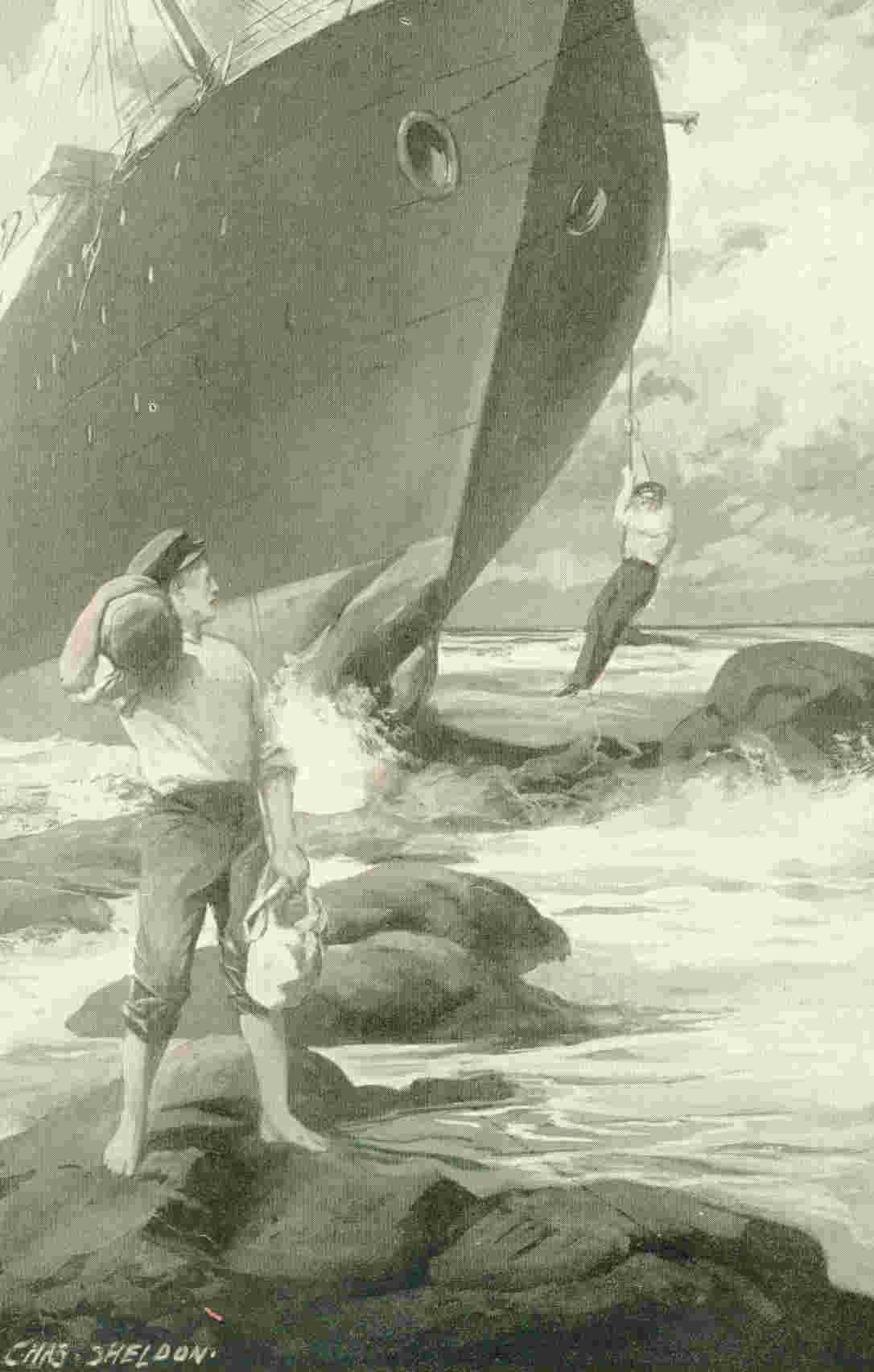
GEORGE INSTONE AND SCOTTY LOWER THEMSELVES FROM THE WRECKED VESSEL
“Now to find a settlement of some sort,” cried our hero, when the meal was finished and they felt rested, for the day had been excessively trying and anxious. “This shore looks as if it were flat for miles on either hand, and it seems to me that we shall have to strike quite a distance inland to get a suitable hill. The question then arises: shall we carry our grub with us?”
“Sure,” declared Scotty emphatically. “You see, it’ll be a weight, and we’d get along quicker without it; but if we left it here we might not want to return but go directly onward. Let’s select what we want in the way of clothing, take all the provisions, and then get a move on.”
Shouldering their belongings, therefore, and tying a shirt to a stunted tree growing on the shore opposite the wreck, the three set out across a flat country which looked dry and arid. Here and there, however, they crossed small streams, wading through the water, and that evening arrived at the top of a considerable elevation. Mountains had been visible in the distance throughout their journey, and now a rocky, inhospitable country came into view, broken by many hills, and stretching away to the mountains. It was Fritz who gave a shout and pointed.
“Smoke!” he cried joyfully. “Houses. Yes, mein friends, houses. Men. Peoples.”
“Rest, food, and lodging,” smiled Scotty, “but too far away to be reached this evening. We’ve got to camp, boys, and to-morrow we’ll take the trail for that settlement. Why, you can see the ocean from here, and the wreck.”
“And she doesn’t seem to have altered her position,” exclaimed George thoughtfully. “I’m wondering whether she could be salvaged. It isn’t likely, though. But those potatoes would be valuable.”
“Worth three times the price paid for ’em down in Vancouver,” said Scotty. “But they ain’t ours to take, George, and, besides, if you lifted the hatches of that steamer I reckon she’d go to the bottom. No, boys, our road lies to Shushanna, to the gold diggings. It’s gold we’re after, not potatoes.”
Selecting a sheltered spot, for an evening breeze had arisen and swept coldly across the hill, they lit a huge fire, for wood was abundant, much of it strewing the ground and being dry and suitable. Then they cooked their food, and having chatted for a while fell asleep wrapped in their blankets. The following afternoon they reached the settlement they had sighted, where their appearance caused some excitement. Questions were hurled at them about the capsized steamer, and at once the telegraph was set going.
“It will be the first information received in Vancouver,” said the solitary policeman, who, with the mayor of the settlement, had accosted our friends. “There will be sore hearts, too, for the people who chartered the freighter will have lost heavily, not to mention the wives and children of the poor fellows who have lost their lives. Of course I shall send a report of the condition of the wreck, and that will be the end of it. From your description, and from my own knowledge of the coast down there where she was washed in, she must be in a hopeless condition, and the first storm that comes along will batter her to pieces. So you young fellows are going on to Shushanna! There are great times there. How far is it from here! Well, one day’s journey, but the roads are easy and the gradients light. Now, I must send that telegram, and later on—that is, as soon as it is light to-morrow—I will go down and inspect the wreck.”
The following day George directed the mayor and the policeman down to the coast, and, striking a little to the left, where a boat was available, rowed out to the wreck. Long before then she had been visible, and it was evident that the force of wind and tide had changed her position considerably. There seemed also to have been forces at work within the hull, for, on coming alongside and clambering on board, our hero discovered her decks clear of water from end to end, though right aft the sea was just washing aboard her. The net result of the combined action of wind and sea, and perhaps of the air imprisoned within the ship, or perhaps of her natural buoyancy, was to lift her from her previously almost submerged condition and float her so high that the incoming tide had drifted her on to a ledge of rock and had let her remain there.
“A hopeless wreck but position altered, I take it,” said the mayor, closely inspecting the ship. “Those rocks have pierced her in twenty places, and even if a high tide lifted her she would sink the instant she got into deep water. So you fellows were imprisoned in the fo’c’sle. We’ll go aboard and investigate. Perhaps there are some of the bodies of the crew aboard, in which case we shall have to see to their burial.”
Clambering aboard by means of the same rope by which Scotty and our hero had descended, the latter showed his two companions where he and his friends had first been imprisoned. Then he led them across the waist up on to the main deck, and so to the engine hatchway. They found that the bridge and deckhouse had completely disappeared.
“Torn clear away when she capsized,” said the mayor. “The engine-room hatch is wide open, and no doubt the space below was flooded. There is no going down there now, and I should say that the flooding of this after end, combined with the weight of the engines, sent her stern down, and so saved your lives. Got a cargo of potatoes aboard, eh? Pity they’ll be a loss. They’d have sold well up at Shushanna. Now they’ll just lie here and rot, till a gale breaks the vessel up and scatters them. There’ll be potatoes for the picking then all along this coast.”
George thought a great deal about the matter on his way back to the settlement, and finally asked the mayor a very pertinent question.
“What is done with wrecks of this sort?” he asked.
“What’s done? That’s asking,” was the answer he received, while the police official scratched his head. “Why, now, if that ship had come right clear ashore, and there was a settlement handy, seems to me people would go aboard and help themselves. You see, this is an out-of-the-way sort of place, and provisions are valuable. You can’t, therefore, expect to see people let them go to waste, though, of course, the taking of them isn’t exactly right. Then, too, you’ve got to remember that the captain and officers and crew have been washed away, so that there’s no one to mind her, for you three are not exactly crew. You took on temporarily only. But, speaking generally, an agent is sent to inspect the wreck, and then, if she’s a hopeless case like this, she’s offered for sale by auction, and a thing worth thousands of dollars one day is knocked down for a mere handful the next.”
“Then if I were to buy her, I could take her cargo out and tranship it to Shushanna,” said George.
“Why, stranger, you ain’t serious?” demanded the mayor, staring at our hero, for in the ragged garments in which he had been forced to come ashore, and his generally dishevelled condition after such an adventure, George did not look as if he could buy a new hat, much less a stranded steamer. He smiled at the question, and at the serious, not to say astonished, face of the man who had spoken.
“Certainly I am,” he said. “But I should have to make a number of enquiries here at first. I want to know, for instance, whether carts can be hired here, and, if so, at what rate. Then I shall want men to help me; finally, I shall need a store in which to place the potatoes, supposing I get them to Shushanna.”
Once more the policeman scratched his head thoughtfully, and looked at George with some amazement. Then, of a sudden, he brought a broad palm with a smack down upon his thigh.
“Why, thunder!” he exclaimed; “it’s the very ticket, and I’ll help you. A young chap who could think of such a thing is worth encouraging, for it means a heap of hard work. There are lots of fellows who would want to get right clear away from a hulk like that, which had nearly proved their coffin, and would never wish to see her again. They wouldn’t think of the cargo inside, and of what might be done with it. Not that I’m sure that you’d make a profit. That’s for you to work out. But this is certain, the man who chartered that ship, and the people who owned her, have insured to the full value of the vessel and her contents. It is therefore the insurance people who will sell her and make the best of the matter. Now, you’re on the spot, and you say you will buy.”
“If the price is low enough,” said George cautiously. “It depends on that and on the cost of labour and transportation.”
“Then I can say again that we’ll help all we can. See here: the fall’s right on us, and round about here there’s nothing doing. At this time of the year things shut down in this corner of the world, and people go to sleep, as you might say, till spring breaks in again. So there’s farmers and storekeepers and what-not with carts to let, and hosses that’s eating their heads off. There’s hands, too, hanging about the streets and farms with nothing to do, and wages ain’t anything like what they are way back at Vancouver. As to a store, there’s a bit of a shack I know you could rent up near the diggings. In course there’s claims in all directions, so you’d want to locate somewhere near the centre. If you had time you could build for yourselves, but seems to me that’s out of the question. But with that shack, and the potatoes put under ground just to keep the frost away from ’em, you wouldn’t want any better storage. Then you could go to work and jest wait till those potatoes was wanted.”
George talked the matter over carefully with Scotty, and arranged to lend his friend sufficient money to become his partner. As to getting the necessary funds himself, he felt that he would have little difficulty, that is, supposing the helpless wreck and her cargo sold for a mere song, as the policeman had suggested. He had merely to telegraph to Mr. Hill, who would advance the money on the strength of the security of the plot of ground he owned in Calgary.
“You’re getting a real trader,” laughed Scotty, when they had fully talked the matter over, “and I’m bound to say that this here’s a fine opportunity. You may say that one man’s misfortune is another’s gain—ain’t that it? Just like one man’s meat being another’s poison. Here’s a ship capsized, and our poor mates washed away and drowned. Here’s a man all alive to what’s wanted in the goldfields, simply ’cos he’s been there before and has made a pile; here he is scheming to get in provisions before the fall sets in with a vengeance. But the wind and sea beats him. He loses the profits he hoped and fully expected to make. The insurance people, who took his premiums, make the biggest loss of all, while all the time there the stuff is, so far from a port that salvage of the cargo ain’t worth the trouble of most people, while the ship’s a certain and complete wreck. It’s just there that we come in; that is, if we can. It wants working out, and you can’t do anything till you know what is being done by the insurance people. As to loaning me money, boy, why, that’s handsome. I’ll come in with you, taking a third. Fritz won’t, so he says, but will work for us at a wage. All we’ve got to do now is to wait for the agent.”
They took rooms in a farmhouse just outside the settlement, and waited as patiently as they could. Then one day there arrived two agents appointed by the insurance company. At once they sent for George, and asked for a detailed description of all that had happened, congratulating him and his friends warmly on their fortunate escape. Then they went aboard the vessel and inspected her.
“Hopeless,” they both agreed. “Holed in more than twenty places, and high and dry. Of course, if her cargo were dumped she’d float higher. But the water would enter just as soon as you cleared the cargo, so you wouldn’t be much better off.
“Well, she’s a wreck, and that’s all there is to be said. We’ll have to try to sell her, though there’s not a ship-breaker, or one of those men in the regular business of buying wrecks, who’d make an offer for her. She’s too far away from labour in the first place, and then the cargo’s only potatoes. Worse than all, we’re almost at the commencement of November, and precious soon the wreck will be broken up by the storms which rage along this coast. Well, we’ll get back to the settlement. Thanks, Mr. Instone, for directing us aboard.”
They returned to the settlement upon the rig which they had hired, and at once went to the mayor’s office. Then a proclamation was made, and as many people as possible called together.
“It’s an auction sale,” said the mayor. “These gentlemen have to sell the wreck down on the coast there, which most of you have seen. He’ll ask you now for offers.”
There were smiles upon the faces of the men who had gathered. For it was obvious to them all that the position of the wreck was hopeless. As to the cargo, potatoes to them were valueless, seeing that they had plenty in their barns, while none of them gave a thought to Shushanna. In fact, this community was essentially different from Calgary or from Vancouver. The people were slower by a great deal, leading a more or less pastoral existence. They lacked, in fact, the energy required to seize upon such an opportunity, and the sort of courage that is called for in such cases.
“Buy that thar wreck,” one exclaimed, laughing loudly, “why, it’s sure certain to drop to pieces within a week, and, come next spring, there won’t be a plate left of her, not a cent, sirree.”
“What offers, gentlemen?” called the agent, now assuming the post of auctioneer. “Come, here’s a wreck at your doors.”
“Right clear in the sea, that’ll drop to pieces while you’re talking,” laughed another of his audience. “Say, sir, you make a gift of that thar wreck to us folks here, and you won’t be hurting yerself any.”
George stepped forward at once and offered a hundred dollars.
“A hundred dollars bid me,” shouted the auctioneer triumphantly; and then, aside to his friend: “It’s a sporting offer and I’m sorry for the youngster. Now, gentlemen, any advance on one hundred dollars? One hundred dollars. Going, going. Gentlemen, a whole wreck, filled to the hatches with potatoes, going for just one hundred dollars. Going. For the last time, going. Gentlemen, Mr. George Instone is the owner of the wreck lying down below us.”
There were ironical cheers from the crowd, while our hero flushed red at the prominence into which he had so suddenly stepped. But he was by no means flustered. One hundred dollars a year ago would have seemed an immense amount to him, but, thanks to his gallantry at Calgary, it was now a small item. Then he reflected, thanks to the advice Mr. Hill had given him, and according to his last report, that investment he had made in the city had more than doubled itself. Investments in city plots, when well chosen and purchased at the right moment, have the habit of more than doubling themselves out in the west of Canada, and George had not been unusually lucky. There it was, and he had not been wonderfully reckless in expending one hundred dollars. Indeed, he had that sum in his pocket at the moment. It remained to be seen if the cost of getting at the cargo aboard the stranded wreck would ruin him and his partner, or make rich men of them.
“All depends on the weather,” said Scotty, a little nervous now that the transaction was completed. “If it blows up, we make a dead loss, or, rather, you do. If the weather holds steady, then it remains to be seen how we can get at those potatoes.”
George nodded curtly. “Where there’s a will there’s a way,” he smiled, though his face was stern and determined. “I can’t control the weather, and if it storms, why, there’s an end of the matter. But I can organize the work, and put my own back into it. That’s what I’m about to do now. So, give me fine weather for a week, and I’ll clear that hulk from top to bottom.”
A little nervousness was natural enough, for this was our hero’s first venture into commerce. Then, too, the odds against success were large enough when one came to consider them carefully.
“That chap’s chucked his money into the gutter,” was the ironical expression used by one of the men at the village club that evening.
“He ain’t,” came emphatically from the policeman. “Boys, that George Instone’s got the grit to pull out fine in this matter. What’s more, you chaps right here’ll have cause to thank him. You watch. To-morrow you’ll hear, and a week from this you’ll be wishing you had had the gumption yerselves to look into the matter.”
The next day, indeed, the settlement was thrown into a flutter. Idle men, anxious to earn wages, ran to inspect the notice posted before the mayor’s doorway:
“Wanted at once, twenty hands, to unload the wrecked steamer. Apply on board. Wages, two dollars daily, free food and quarters. Wanted, also, forty carts and teams. Liberal pay for instant service.”
“That lad knows how to get a move on,” declared the mayor, as he watched the people running to see the notice. “Blest if he ain’t properly stirred up this village. Right here I’m going to do my best to make this affair run smooth for him.” “Boys,” he called out, “here’s a real good chance for you.”
George had indeed got a move on, and, even as the mayor posted that notice, he was aboard his purchase, making plans for the immediate future.
“I had a good chance to inspect the ship when I brought those agents down,” George told Scotty the previous evening, when he had written out his notices and returned with the mayor’s promise that they should be posted in the early morning, “and I think our chances of success are better than ever. For at low tide water has poured out of the engine room through holes pierced in the plates by rocks, and the incoming tide has lifted the ship before the sea has had time to again fill the stern portion. As a result, she has steadily floated inward, and while she has become more than ever a complete wreck, for our purpose she is in a better position.”
Scotty, too, was bound to admit that fact when he and George clambered aboard that early morning.
“Why, this is something,” he cried, standing on the deck of the fo’c’sle and looking about him. “She’s shifted in a heap, and if you were to throw out a sort of bridge you’d be able to reach her without the need of a boat. Why, this is something.”
The wreck had, in fact, moved considerably nearer the shore, and, as we have hinted, had been floated into a far more favourable position. For instance, she now lay on that ledge of rock, between which and the shore lay a pool of calm water to which the Pacific breakers could not reach, save, of course, in very stormy weather. Then each tide had sent her steadily inward, till her bows overhung that stretch of water, and actually reached within fifty feet of the shore. Her centre and after parts were piled up on a ledge of irregular rock, which had pierced her plates in all directions, so that each receding tide saw streams of water pouring from her.
“I’m going to throw out a bridge, as you suggest,” George told his friend instantly. “I figured on that when I was here, and saw how we could contrive to get through with the work quickly. See here, Scotty, it would never do to have our hands going and returning to the settlement daily, for it is some distance away, and that would mean their arriving late every morning. So I thought of the fo’c’sle. I rummaged in it and in the galley. There’s a storeroom near it which we never opened, and there are provisions sufficient to feed a whole crew of men for days together, while the bunks in the fo’c’sle will give them sleeping accommodation.”
Scotty whistled, and at once dived down below to inspect what our hero had mentioned.
“It’s right good,” he declared; “and, what’s more, the men when they come won’t have a chance to be scared. They can see for themselves that the wreck is fast on the rocks, and so long as it don’t blow they’ll realize that there’s no danger in staying aboard. Then, having them right here means they’ll work early and late.”
“You bet!” George agreed, using the expression common to Canadians. “I’ve offered two dollars a man per day. That’s fifty cents higher than the local wage, and ought to tempt them, particularly when they consider that they will be fed and housed free in addition.”
“But—hold on. That’ll cost something, won’t it?” cried Scotty, amazed at the proposition. Be it remembered, George’s friend was somewhat impecunious, having met with misfortune. Also, he had not much of a head for organization. “That’ll soon run through your dollars, eh?” he asked, his manner crestfallen.
“It won’t cost a penny extra. Why should it?” asked George. “The ship is ours, and everything in it. Well, there’s food in that storeroom, and we own it, the room too, the fo’c’sle and the bunks, the ship plates, her engines, and cargo. Where’s the extra expense come in? We are employing the things we have bought and paid for, things that will be destroyed within a month if left here. By using them we attract labour, which is absolutely essential to us, and we get that labour from early dawn to nightfall. How’s that?”
“Spanking! You’ve a head, George. What next? You get your men here by offering a bigger wage than the local one, though you know things are dull at the settlement. You make things attractive by giving beds and food free in addition. Then—well, what then?”
“We can expect those twenty hands very shortly. Last night I met one of the biggest farmers, and he promised to send down a load of lumber this morning, just as soon as it was possible. Now we’ll put our men at work right away to build a wooden bridge from the wreck to the shore, supporting it on trestles. We’ve tools here in abundance, for that I also looked into, and the men are used to that sort of work on the farms about. Besides, in a settlement such as the one over yonder, every fellow learns to be handy. So they’ll build that bridge and secure sides a couple of feet deep to it, making the bridge some three feet wide. Of course, it will slope upward from the shore, and this end will be fixed close to one of the hatches. Now, see what happens. That same farmer sends us down a gasoline engine he uses for odds and ends of purposes on his farm, and we make it fast near the hatchway. Then we use it for hoisting our potatoes, which are tumbled on to the bridge and guided by the sides, and, kept rolling by the steepness of the slope, simply roll away shorewards.”
“Gee, whizz! this is going some,” Scotty shouted, gripping George’s hand in his enthusiasm. “This is moving. Them potatoes gets ashore, and there the men shy ’em into the carts. Then they’re taken clear off to the goldfields.”
“Wait. You’re going too fast, and you’ve missed an item. First, the potatoes don’t need handling once we’ve hoisted them from the hold and tumbled them on to our wooden chute or bridge. You see, it’s built upon trestles, and it’ll run ashore at such a height and in such a position that a cart can be driven beneath it. There the cart waits till it is filled, when it drives on and is replaced by another. I have asked for forty carts, and believe I shall want a hundred. I’m paying four dollars a day for them, including the team and the driver, and allowing three days for the trip up and one for the return—for that’s what the mayor advised when I consulted him—I shall have the road covered with carts going and returning. When we’ve no more left to fill we’ll pile potatoes on the deck, or send ’em ashore, for then if it blows up we can still load them. Now, Scotty, your job is to make a road for those carts right up to the water. Some of the hands are sure to be accustomed to roadmaking, and there are plenty of bushes around which you can cut down and lay on the ground for the wheels to ride on. I’ll fix things here in the fo’c’sle and get the galley in order. It’s a wreck after that capsize, and after the raid we made on it.”
Scotty went about his work with his mind in a whirl. This business was, in fact, altogether beyond him, and we speak the truth when we say that, alone, he had not the courage and firmness to undertake such a matter. The expenditure frightened him; the vastness of the undertaking made him nervous.
“We’ve got to bustle,” George told him. “As to expense, of course it’s big, and will get larger the longer we are about it. You see, the potatoes themselves cost us a mere nothing. It may happen that the ship has floated up so high that big seas will not reach her, in which case we shall be able to sell her engines and fittings when the spring is with us; and I should imagine that the copper aboard is worth a great deal more than the hundred dollars with which we have parted. So there’s one comfort for you. As to the labour, well, twenty men at two dollars a day each will cost two hundred and forty by the time the week is ended. Forty carts will run us into one hundred and sixty dollars. Say five hundred dollars by the time we have paid for the lumber and the hire of the gasoline motor. Well, I’ve sent for more than that amount, and I calculate that forty carts loaded with potatoes will be worth twenty-five dollars apiece, about one thousand total, that is, right here, on the coast. Up in the goldfields they will easily fetch double that amount, while, later on, when the winter has come, and there is no getting provisions in, why, you can calculate on a much higher figure.”
Scotty gasped. “George, you ought to have been a merchant,” he cried. “I can follow your arguments easily, though how you thought them out beats me. But I can easily see, too, that a man who figures things carefully, as you seem to have done, can take risks that seem huge to other fellows. Why, the expense for labour and for haulage is nothing to the value of the goods when you’ve done with them. As to the ship, why, if she holds right here on the rocks, and we can clear her of her engines and brasses, why, there’s additional profit. Seems to me that it might be worth our while, once we’ve decided whether she’s fast or not, to spend the winter here ourselves. There’s not likely to be much doing up at the goldfields, and down here we could be working in spite of snow or other bad weather. We’d be down below, you see, and so not exposed. Come spring we would go up to the diggings and set to at it. How’s that?”
“Wants discussion, and depends on what the first storm does to the wreck,” George answered. But the scheme had great attractions, and, more than that, for young fellows determined to make the most of every opportunity, and to advance in the world, it offered such promising results that it was worth the closest scrutiny. However, the arrival of a cart piled with lumber, and of another filled with hands, put a stop to all chatting.
“We’ve got to get in at it at once,” George cried out. “Those other carts will be arriving at noon. I didn’t order them earlier, as they are useless till we get at the potatoes. Now, chaps, come aboard and take a look round. This here’s the fo’c’sle, where I and my chums spent those days when the ship lay bottom upward. You can see for yourself that she is hard and fast on the rocks, so that there is no danger. Even if it storms I fancy we shall be able to stay aboard. But, of course, you folks would be able to go ashore at once if you wished to. Now, one of you had better act as cook. There’s a storeroom down below, for which I have the keys, and I’ll dish out what is wanted. You’ll feed well here, boys, so as to make you fit for the work. There’ll be plenty for all, and heaps of variety. Then we’ll divide into parties. There are twenty of you in all, and with one appointed as cook that leaves nineteen. But our mate, Fritz, has just arrived, so we’ve got the original number. You take ten of them, Scotty, and let ’em go ashore with axes and make that road. The others had best help get the gasoline engine aboard first of all, and then set to at the bridge we’ve decided to build. Now, let us get moving.”
It had already been agreed that Fritz should travel to the goldfields with the first consignment of potatoes, and, as the policeman was going also, George felt sure that he would easily arrange for the hire of the shack of which he had spoken. Then Fritz was to settle down, and was to dig a trench into which to pile the potatoes, it having been agreed that each teamster as he arrived should help with his labour.
“You don’t want to go so very deep neither,” the genial policeman had told them. “Of course it freezes like thunder ’way up there at Shushanna. But, then, with a foot of earth over the top, and heaps of straw or hay, or even bushes, piled on, the frost won’t get at ’em. It’s thieves you’ll have to be most careful of, so I tell you.”
The men who had come down to the coast to help our young friends seemed to enter into their work with wonderful zest and keenness.
“I likes to see young chaps making a start out for theirselves,” one of them told his companions. “You see, these here boys have taken a sporting risk, and they know that without us they are bound to fail, for, see, time’s of importance. Well, they’ve offered good wages right off, and they say they’ll feed us handsome. Well, we’ll do our best, eh, lads? If they do all that they’ve promised, seems to me we ought to follow suit, and give ’em real value for their money. As to our wages, you needn’t have any fears. Seems the young feller George got on to the telegraph, and dollars soon reached him. He’s going to pay up every night; so there. This is a straight proposition.”
Breaking off from work for half an hour, some little time after the arrival of the hands, George regaled them with breakfast, which the man selected as cook prepared for the whole party.
“You’ll have started from the settlement early,” George told them, “and will need a meal. Let us have breakfast now, and, if the grub’s to your fancy, we’ll repeat it later.”
Food aboard even a freight ship is nowadays far superior to that supplied some few years ago. And, indeed, out west, off the coast of Canada, good pay and good food are necessary to attract the necessary labour. Our hero had therefore discovered excellent stores in the room adjacent to the galley, and abundance of them.
“Enough to feed this gang for two weeks, and still leave enough to stock a shack for the winter or to keep us well provided aboard here,” he told himself. “Liberality will pay with these fellows.”
The discovery of a keg of tobacco aboard was another advantage, and that very evening he issued some to each man, the gift being accepted with enthusiasm. As to the work, it progressed with amazing swiftness. The whole ship being his and Scotty’s, they had no hesitation in using everything freely, taking bolts and nails and fittings of various descriptions from the stores room, and providing their men with tools in abundance. Scotty soon had his gang hard at work laying a road, filling in bad hollows with rock and stone, and soft spots near the water line with brushwood covered with earth and gravel.
George meanwhile directed the gang dealing with the gasoline engine, and had it aboard after some difficulty. Then he selected a foreman from amongst the hands, and gave him directions as to the building of the wooden bridge. It was to be merely a rough affair of boards, commencing at a selected spot and ending at another where Scotty was filling in the hollows and making a firm foundation for the wheels of the carts. That latter point, too, was above high-water mark. By noon the work was almost completed, for but a short length of road had to be made. That liberated Scotty’s gang, and they and the others worked at the bridge with tremendous energy. In fact, hardly had the men risen from their dinner, a meal which they pronounced excellent, when the last touches were given, and the gasoline engine set going. It had been bolted to the deck, close to the hatchway, which was now wide open. A belt ran from it to the nearest capstan, usually driven by steam, and from that a steel rope ran over a pulley at the end of one of the loading yards and dropped into the interior of the stranded vessel. A sling was attached to this end, with a large square box fastened to it, while numbers of wooden spades lay below ready for the workmen.
“We’ll be able to get in at the unloading directly, chaps,” George called to them. “Carts are beginning to arrive now, while the air down below is sweet and wholesome. I’ve had all the hatches off, so as to make sure of that. Now, let’s see how long it takes to get our first load off. I’m going to time it.”
Everyone was interested in the work, and the men entered into the scheme with a good-tempered eagerness which promised much for the success of the whole undertaking. A dozen lusty fellows down in the hold threw potatoes into the box, while two operated the engine and the derrick. Then up came the first load, heralded by cheers from all who beheld it. The box swung outward, dipped, and struck the edge of the wooden bridge. Then two men tipped it, and with a deep roar the load of potatoes rolled out and went speeding downward across the water. They fell into the cart, waiting beneath the far end, with a roar which was most inspiring.
“Moving some,” said Scotty hoarsely, coming to George’s side, and winking at him while he mopped his perspiring brow. “Moving some, I tell you! This here concern’s the finest thing I’ve seen since I was a shaver. George, it beats me how you’ve figured the thing out! But you have; anyone can see that. And you’ve got these chaps just as interested as you are. Gee! Blest if you won’t make my fortune.”
Why, the hardships through which they had passed, the cheerful companionship of a hopeful and plucky fellow like our hero, had already done the untidy Scotty good. He looked stronger, healthier, happier. There were lines of determination about his face now which had replaced those of depression. His step was more active, while there was a brightness about this man, hitherto a sick man, which augured well for the future. As to George, he was in his element. His coat off, his sleeves rolled to the elbow, and a pair of overalls discovered in the fo’c’sle about his limbs, he looked and was a typical workman. Directing the movements of the gang generally, lending a hand here, and pushing with a lusty shoulder there, he was the life and soul of the movement. He seemed to think of everything and everyone, too. There was food even for the teamsters as they arrived with their carts, and provisions to take with them on their journey. There was hot tea and coffee going all day long down at the caboose, and a man who felt tired could rest without an eagle eye falling on him and a foreman jotting his name down in a book. Those men, in fact, were working under ideal conditions, and they put their strength into the task in a manner which made the results most satisfactory to all parties.
When night came twenty-five carts had been filled with potatoes, while the remainder were to arrive at dawn on the following morning.
“You see, it wouldn’t have done to have the whole forty here to-day,” said George, as he and Scotty sat amongst the men now resting in the fo’c’sle. “We’re paying four dollars a day for each turnout, and to have them down here waiting, and we unable to fill the carts, would be sheer waste of money. To-morrow we’ll have the remaining fifteen carts filled, and I’ve called for another twenty, though there’s some doubt about getting them. But farmers right out of the settlement are sending in their teams, so we may be lucky.”
“If not, then you’ll have to rest the men and wait, I suppose,” Scotty murmured; “unless, of course, you roll the potatoes ashore and leave them there. But that means handling them twice over.”
“I’ve got other work for the men,” George told him. “I’ve been down into the engine room to-day, and, of course, everything is slimy and wet after the soaking the place has had. But there’s only one place through which the water enters, and to-morrow, immediately the tide is out, I’m going to set to work to fill in that hole. I’m sending also for a mechanic to help me, for, of course, that work aboard the freight engine gave me some knowledge of machinery. We’ll haul down the dynamo and clean it. Then we’ll go over the rest of the machinery. I’ve a notion that we could get one of the boilers going, and with the steam from that we ought to be able to run a dynamo. That’ll be useful to us later on, supposing we are able to stay aboard. Now, chaps, who’s got a voice, and can sing? The mates I had last, way up there north of Calgary, were fellows for a concert. Wish I could play a mandolin like one of them. But I can’t. However, I can give you a yarn if you like; it’s about three of my mates who went hunting for grizzly.”
Straightway he gave them Hike’s story, while one of the gang followed with a recitation. Then a second came forward with a song, proving to have an excellent voice. Indeed, that night the fo’c’sle rang loudly to the voices of the gang employed by our hero and his friends, each one voting that he was glad that he had taken the job offered. Then they clambered into their bunks, and soon loud snores told that they were sleeping.
When six days had ended, the work of unloading the hulk was almost completed, and, it being voted that they had now transported sufficient potatoes to the neighbourhood of the goldfields, George bade farewell to the hands, thanking them for their services, and presenting them with another keg of tobacco. The mechanic he kept on, while the remainder of the potatoes he sold to a neighbouring farmer. In all, a hundred loads had been sent up country, while there were, perhaps, a dozen left, which half a day’s work cleared out of the vessel, the payment for them going towards the original cost of purchase. News had come, too, from Fritz that the loads were stored away as George had directed, while the renting of the shack had been an easy matter.
“Then we’ve just got to sit still and wait for the first storm,” said Scotty, stretching himself in a bunk and sighing. He had worked very hard that week, and looked wonderfully well in consequence. “That is, I don’t suppose you’ll sit still, George,” he laughed. “I never did meet a fellow like you to bustle. You’ll be getting at the machinery?”
“Certainly. Since we plugged that hole and mopped the engine room out, the place has been fit to work in. Then the dynamo wasn’t badly damaged, and the light it gives is a huge convenience. One of the boilers is sufficient to give steam, and there’s more coal than we could use if we stayed here for a year nearly. But the steam will give us the use of the deck engines, and with them we’ll get every bit of machinery we can unbolt hoisted out of the vessel. No, sir, this isn’t the time to rest. We’ve got to keep the move on.”
George, indeed, worked himself almost to a standstill, and, let it be understood, it was not greed, the wish for gain, which kept him labouring. It was the desire, the determination, to succeed in what he had undertaken, the fixed purpose he had set himself of making good, as they say out in North America. Nor can a man in a new country, such as Canada, demonstrate the fact of his having made good, of his success, so surely as when he has risen from comparative poverty to wealth. Dollars do not spell comfort alone, the power to purchase this or that, the right to the ownership of houses, automobiles, yachts, and ranches. They show a man’s independence, they show his position in the world, and when it is known broadcast that he commenced his life’s struggle with empty pockets, and was always a hard worker and a thinker, and made his dollars by those two means, why, then, those same dollars demonstrate to all and sundry that that particular man has achieved something, he has made a success of his life; he has, in fact, done what every fresh-minded Canadian hopes for, he has made good.
It was that desire which kept George going, and very soon Scotty had caught the infection very badly from him. The two young fellows came to be well known in the neighbouring settlement, and highly spoken of. The fruits of their labour, too, were often enough in evidence; for though the winter had now come, and snows were on the ground, people frequently sleighed down to the coast and gazed at the wreck of the freighter. Not a few came aboard, for a couple of storms had proved her to be firmly secured.
“You just picked hold of a prize, and that’s the long and the short of it,” the mayor told them, when taking tea in the fo’c’sle. “But there’s a thing that beats me. Folks say that the ship’s solid. Well, so she seems. But you’ve taken all her cargo out, and her engines too, if I’ve been informed rightly. That’s made her lighter. How is it that she don’t get swept away with the weight of the waves washing on her?”
Scotty smiled. “You don’t know this here George, sir,” he said. “He’s always scheming, and the chap he worked with before coming here seems to have taught him finely. George asked himself and me that same question. You see, the water would pour into the hulk every tide that came in, and pour out again, so that she’d be empty and full alternately. That didn’t matter so much so long as the engines were still aboard and the sea calm; but the first wind we had made her rock badly, for it came at mid high-water. Big holes were banged in her sides, and we had to slip ashore for fear of what might happen. Next day we plugged every hole we could find, and let a sort of hatch into the largest. That lets her fill, and keeps her full even when the tide has run out. Loss of the contents is made good by opening the hatch at high water, while the weight keeps her dead steady. If I was a seafaring man, or used to salvage work, I’d like to wager that I’d bring the hulk off the rocks safely. But she ain’t worth the labour to us. Guess we shall have taken all that is valuable out of her by the time spring reaches us.”
Long before this he and our hero, together with the mechanic they had kept at work with them, had stretched a stout steel hawser from the mast of the hulk to one of her anchors, which latter they had carried to the top of a mass of rock some distance from the water’s edge ashore. On this they had swung a cradle, secured to a running pulley wheel, controlling the latter by means of an endless rope. In the cradle they had placed every piece of machinery they could obtain from the engine room, removing the engines piecemeal, and running each portion ashore in the manner indicated. There, too, they had built a rough storeroom from lumber supplied by an adjacent mill, the owner of which had hauled the logs on sleighs, for snow lay deep now over the country. Already they had a valuable store of such objects—cylinder covers, whole cylinders, pistons and their rods, crank shafts, and a hundred other portions—all in very good condition. Then, too, they had removed hundreds of pounds’ weight of bronze and brass fittings, the mere metal alone being sufficient to pay them for their investment and the work they had done, and leave a most handsome margin in addition.
“We shall simply have to wait till the thaws come, and until the roads have dried a little,” George said, when he and Scotty were diligently making an inventory of the parts they had brought ashore. “Then we’ll hire those carts again—such as are needed—and will send off the whole consignment to the nearest port. It will pay us to send them direct to the building yards at Vancouver or Seattle, where we shall get the highest prices for them; and by then—long before, in fact—we shall have realized some of our stock of potatoes.”
George had, indeed, proved quite a capable business person, and the spring, when it came, found him quite a well-to-do individual, for Fritz had got rid of all the potatoes; not at famine prices, for that none of the friends desired, but at a handsome profit. Then a junk dealer, hearing of their exploits, had rushed in by the very first steamer, and, having inspected the contents of their storehouse, had made an offer for everything within it.
“We will accept,” said George, when he had discussed the matter with Scotty. “On payment of the amount offered you may take possession. It will suit us well,” he told his chum a little later. “Now we are free to go to the goldfields without delaying, and early arrival there is very important. For there is bound to be a rush, and those who arrive first will have a better chance of selecting claims that are valuable. Of course we’ll stake our own claims—eh, Scotty? No need to go as hired workmen.”
Scotty laughed outright. “Not for me,” he cried. “Why, George, I’m heaps better off already than I could have been at my business, even if it had done extra well for a dozen years. You and I have got together a little fortune, and we’d be fools to tie ourselves to anyone. Guess we’ll stake claims and see what’s doing.”
The snow had barely more than melted, and the roads were only just possible, when the two set out on a cart which they had bought, together with a good team of horses.
“It’s bound to come in handy up there,” Scotty had said. “There’ll be hauling to do there, and we might get together a little transport business. Can’t have too many strings—eh, George?”
That cart was packed, too, with an assortment of provisions, for they had cleared the hulk of everything of value. They left her an empty shell in fact—filled only with salt water—and made their way to the famous Shushanna goldfields with the feeling that none could have done better.
There have been many gold rushes in the North American continent, and at this day mining for a variety of metals is an enormous industry both in Canada and the United States of America; while in Mexico and in South America also pick and shovel are hard at work, and in numerous places expensive plants have been laid down with which to treat ores wrenched from the sides or the hearts of mountains. Alaska, too, has seen its gold rush; while the northwest territory of Canada produced perhaps the greatest find of all, the goldfields of Klondike having proved almost more productive than others.
Shushanna is not far distant, and thither thousands were trending in the early spring of the year which saw George and Scotty driving their cart from the coast line. Not that they met many people on the road, for the rush had hardly yet commenced. Numbers who had gone up during the previous summer had wintered on the goldfields; the rest—the thousands attracted by the tales of the riches they had found—were even then preparing to set off, merely waiting to hear that the roads were again clear of snow and ice, and conditions favourable.
“We shall be amongst the first there,” said George, as he sat in the front of the cart with Scotty, “and if Fritz has done as we asked, and kept his eyes open, it is likely enough that we shall have our claim pegged out long before the new prospectors come up. But, of course, we have got to remember that Fritz has no experience of mining, while work in the winter is almost nil, and opportunities of prospecting less even.”
“Our chum has had to deal with those potatoes too,” Scotty reminded our hero. “From the reports he sent down he has been able to get rid of every bushel, and though we haven’t yet heard the exact sum he has made, I should guess it will be excellent. Well, George, we’ve no need to worry. We are early on the ground, or shall be when we get there, and even if we don’t find a good claim we shall at least have experience.”
Fritz was overjoyed to see his two friends when they at length reached the shack. He came rushing out to them, a bearded giant now—for shaving was too much trouble to the German—and seized each by the hand. He would, in fact, have embraced them had either of the young fellows shown themselves to be willing.
“Just you keep right off now, boy,” Scotty warned him, eyeing the excited Teuton askance and with obvious suspicion. “I ain’t used to such notions, and guess George ain’t either. Well, lad, how’s things been moving? and what about a claim and those potatoes?”
Residence in the goldfields during those winter months had at least done something for the German: he had picked up the language wonderfully and had become completely Americanized. But that was altogether different to smothering natural feelings, and it was quite a while before he gave over wringing the hands of his friends. He was filled with enthusiasm too, and most anxious to communicate his news to them.
“You see that,” he told them that night, when the door of the shack was closed and the stove within roaring. Fritz went to one corner of the room, lifted a floorboard, and drew out an enormous sack. Shaking it, he invited them to listen to its contents rattling.
“Gold—nuggets!” he explained; “and there’s dollars in another I’ve got in the opposite corner. Boys, that’s the pay for the potatoes.”
“What! all that!” exclaimed Scotty, awed by the amount he guessed must be in the sack. “But you ain’t sold at famine prices, eh? That ain’t what we wanted.”
“I’ve sold at the same prices as the stores asked,” Fritz told them, his countenance beaming. “Yo see, yo boys, people along up here was that busy in the early fall that they didn’t give a thought to provisions. It’s been the same tale before, and we’ve had it repeated. Well, they got to know about the potatoes, and I sold ’em at ordinary store rates right from the beginning. But not a great deal were wanted. It was two months ago, when every other sort of foodstuff had been bought out and eaten, that they remembered your potatoes. Then there was fierce competition to get ’em, and the price went a deal higher. You may say that it was controlled by the demand, and men’d come right here with a sleigh, driving hard to beat others that was on the same journey. They had dollars in plenty, or gold dust and nuggets, and they didn’t wait to bargain. ‘We’ll give you right now so much fer a load,’ they’d say, and, of course, I sold promptly. But, coming on the end of this month, when the store was reduced considerably and food badly wanted, I had to think of myself and you folks. I stopped selling then, till they came down and threatened.”
“Ah!” exclaimed George; “that’s what I feared. The wonder is they didn’t clear you out of the money you had already gathered.”
But Fritz shook his head vigorously. “Not like that up here,” he told his friends. “Of course they’ve had bullies. But they went down before the winter set in, and those men were different. But they meant having the potatoes.”
“You bet!” cried Scotty. “And when miners mean a thing there ain’t no use going against them. This seems to have been a queer kind of proposition. You had food for sale, or, rather, you had food and didn’t want to sell any more of it; they had dollars or gold dust in plenty, and price wasn’t an object. They just wanted your food and meant getting it. You’d have been a fool to hold up against them. Hungry miners are desperate fellows to deal with.”
Fritz smiled sweetly. “That’s what I told ’em,” he said. “Then I agreed to sell by the pound, weighing the potatoes out to them. They was dear, very dear; but again the price was what those miners made it. And there’s the result, boys. Dollars in plenty. More’n you’ll make by mining.”
Fritz had indeed conducted his work with honesty and acumen; and when the value of the gold had been appraised, and the sack of dollars counted, it was found that the purchase of the stranded steamer had been even more profitable than either George or Scotty had imagined.
“Of course we’ll have to bank all this stuff,” said George, when he had carefully made calculations on a piece of paper. “It wouldn’t do to leave it here, for fear of a robbery. And I must say, Scotty, that Fritz has behaved very handsomely. He must be sorry now that he did not become a partner in this venture. But, in any case, I fancy we shall wish to give him a handsome percentage. Roughly speaking, this is our position. We have expended just over a thousand dollars in the purchase of the ship and in wages and transportation. Against that the sale of the potatoes has brought in over fifteen thousand dollars, of which we received two thousand in the early winter, Fritz having sent it down by sleigh to us. Then the machinery and junk removed from the ship netted a cool thousand dollars, so that we have some fifteen thousand dollars to divide. That’s a very nice position, and it seems to me that we might with advantage turn a portion of it to good account by running a store here. There are three of us to work any claims we may peg out, and that is really more than sufficient. Two will be ample, while the third could be in the store.”
“And we could take it in turns, eh?” cried Scotty eagerly, for since the purchase of the ship he gave a ready ear to George’s schemes for the future.
“Sure,” agreed Fritz, the mixture of his acquired American drawl and his still prominent German accent being most amusing. “We could take it week and week about, and it would be a sort of rest. As to a claim—well, this shack is within easy distance of good ground, and, as we haven’t any mining tools or plant to speak of, I guess you’ll want to do just mere gold washing. That’s to be had within a mile, with water in abundance, and tales of finds higher up that make it worth while pegging out claims along the river. You see, I haven’t done much of that sort of work during the winter. Everything’s been snowed in, and surface work shut down entirely. But some of the miners have been tunnelling into the ground, and snow hasn’t made much difference to them. I worked here and there for a few days at a time, and got to know something. Boys, we could peg a claim along on the higher ground, and with that money you’ve got we could fix a plant that would wash the dirt down for us. But that would require the labour of all three, and a man or more in addition. In the end we might not do half as well as by combining a washing claim with this store you’ve mentioned.”
They sat late into the night going very thoroughly into the matter, George diligently putting figures down all the while and calculating closely. Then he spoke quietly to his companions, putting the figures before them.
“Seems to me that one of us must leave the diggings at once,” he said. “Now, this is my proposition. We’ll wait two days or more, just to give the horse a thorough rest before another journey, and in that time we can prospect the country Fritz has mentioned and peg out our three claims, making formal entries in the local office. Then one of us had best go to the coast and catch the first steamer to Vancouver. There the money banked at the coast can be spent in purchasing supplies for a store, and rushed on a returning steamer. There will be some difficulty in getting them up country, but with one of us to force matters along things should go quickly. Meanwhile the two who stay here can get in a load or so of timber, and build a shop front out on the shack. We shall want more room for the store, and the time taken in buying the necessary stuff couldn’t be used better up here than by making full preparations. How’s that, boys?”
“The very ticket!” cried Scotty enthusiastically. “Of course you’ll go to the coast, George. You’ve the head for those sort of matters. Fritz and I will look to things here, and by the time you return we’ll have matters fixed beautifully.”
Three days later our hero clambered aboard the cart, having in the meanwhile gone with his friends to the spot Fritz had spoken of and pegged claims out. It was at the head of a narrow canyon, into which a stream—now flowing in full volume, for the snows were melting fast—fell with a roar from a point some yards higher. And in the course of ages it had deposited a huge mass of material at the foot of the fall, and for very many yards down below it, where the canyon happened to be wider. Across this wide patch the water made its way by many devious paths, in some places—now that there was abundance—flooding the flats altogether. Then it gathered into a single stream again, and went roaring through a narrowed channel. Dipping their pannikins in the sand and gravel deposited in the widened parts, George and his friends washed the material freely, and were rewarded by the discovery of many minute shining grains.
“Gold!” cried the excited Scotty.
“Sure!” Fritz chimed in. “Certain!”
“Looks like it,” admitted George. “But, not being a miner, I’m not altogether certain. Supposing we collect all we can get, and then consult the nearest neighbour. Now shake all you get into my hat. Let’s separate and each search and wash for himself. It’s wet here, boys, and that reminds me to add to our list of stores wanted plenty of rubber boots. That’ll mean dry feet for those who are working.”
The result of two hours’ work in that upper portion of the narrow canyon was most inspiring, for Fritz appeared with quite a supply of glittering grains, while Scotty danced towards his friends with a find which set him shouting. “This here Shushanna’s become famous already for nuggets,” he cried. “Well, ain’t that one? Seems to me like it. I pulled a rock over, and there it was, right in between it and the one just below it.”
That evening their neighbour assured the three that they had discovered gold.
“ ’T’aint likely as it’s anything else, boys,” he said, handling the dust and the nugget, and inspecting both through a magnifying glass. “That’s the real article, you bet, and you fellers is on the right line, that’s sartin. Well, so am I, so are hundreds of others, and I guess there’ll be thousands soon. It ain’t always the man who chooses his claim carefully who makes money. I’ve known a lad just settle down and peg out the first place he came to. Well, it was chock with nuggets. Guess it was clear in the line of the old river bed, before rising ground had deflected it. That boy cleared with a whole pile, and he’s got a house now out west of Vancouver that’s worth having. So long, you boys. There’s heaps here for everyone.”
The following day, therefore, the three friends pegged out their separate claims, going across to the claims office to register them.
“We pay a few dollars down at once,” Scotty explained, as he emerged from the office, “and within a week we learn whether the claims are in order. Then guess there’s a small amount more to pay and we can set to at the work. Now, George, you can get right off, feeling that we’ve done all that’s necessary about the gold digging. It’s up to you to fix the buying of stores, and against your return we’ll have the shack converted. The wood’s already on order and will be delivered to-morrow.”
They shouted a farewell to our hero, and watched him drive off down through the tail end of the gully where was already quite a considerable mining camp. It was growing daily, too, for folks were now arriving at the diggings all feverish with haste to get to work and try their fortunes. As to the camp itself, it consisted of one ragged street, boasting already of half a dozen saloons where liquor was sold and where men could gamble. There was one small store, a butcher’s shop, and a number of shacks and shanties. Here and there, too, were tents—all that covered some of the miners. George whipped up his horse, and sent the heavy rig clattering down the street, the wheels jangling as they fell into and climbed out of the many ruts existing.
“That’s one o’ the newcomers,” said a miner who was lolling outside a liquor store. “Him as made a pile on them potatoes.”
His companion, a short, narrow-chested individual, dressed in the customary mining costume—to wit, a red shirt and a brilliant handkerchief about the neck, a sombrero hat, and corduroy trousers—watched George’s departing figure with some interest. He was possessed of a clean-shaven, pallid face, with deep lines drawn down it, while the narrow eyes, the pursed-up lips, and their drooping corners gave one the impression that he was bad-tempered. Tony, for that was his name, regarded George’s figure and his retreating cart with perhaps more interest than the occasion required, and, excusing himself, left his companion. Ten minutes later he had leaped upon a horse and was galloping down the dirt road after him.
“So that’s George Instone, ah!” he was muttering to himself. “The chap that did that deal away on the coast with the capsized steamer. And he and his mates loaded their potatoes to the camp here, and cleared a whole pile out of the miners. He ain’t banked that stuff, I’ll lay. Then he’s got it right there with him. This is a do for the chap who can lay him by the heels. I’m the man for it.”
The man kicked the flanks of his horse and rummaged in a pocket. A little later he produced a beard, and, seeing that his revolver was loose in its holster, and at his right hip, where he could easily reach it, he galloped down upon our unsuspecting hero. Not that George was altogether unmindful of the wealth he carried. One experience with hold-ups had taught him a lesson, and he had taken full precautions. In the first place, like Tony, he was armed. And then the sacks piled at the end of his cart, and cautiously covered with odds and ends of his own personal clothing, merely contained pebbles. The actual gold and dollars swung in a bucket such as is carried beneath every wagon. Hearing galloping hoofs behind him, he turned to inspect the stranger, and, unsuspecting still, for it was broad daylight, and the man made no effort to mask his coming, George looked to his front again and drove on steadily. Then a shot rang out of a sudden, and a bullet sang past his head, showing that the intentions of the pursuing stranger were none too pleasant. As for our hero, he tumbled backward from the high seat he was occupying, and fell heavily into the cart. A minute later Tony was beside the horses, and, gripping the reins, pulled them up promptly.
“Ho, ho! So that made short work of Mister George Instone,” he laughed, riding up to the side of the cart and peering in. “Bowled him out first shot, as clean as a whistle. He don’t want no more, that’s sartin, so the gun can go back where it come from. Now fer that stuff.”
He seized upon the sacks with joy and cut them open, giving vent to many an exclamation of disgust and anger as he saw what the contents were.
“Just pebbles,” he said, muttering loudly. “Well, that stunt’s been played before, and people taken in by it. But I ain’t the man to get a hold-up and then ride off without looking into the sacks I’m taking. Guess there’s some in his pockets. Hallo, Jim,” he suddenly called out, as a man rode out on to the road ahead and came galloping up to the cart. “Thought you was never coming. Yer see, we arranged for you to gallop ’way down the road, so as to make escape fer this fellow out of the question. But there warn’t a sight of you, so I went slick and bowled him over. He and his mates has tried the usual. Jest put up pebbles in the sacks that you’d think had gold and dollars. But the right stuff’s here somewheres. You git down and take a look with me.”
Leaping from their mounts, the two robbers contented themselves with letting the reins drop to the ground, for all horses in that part of the world are trained to stand patiently with the reins dangling before them. Then they commenced an investigation of the contents of the cart, thrusting George this way and that as they did so. Nor was there a doubt that the lad was helpless. Let us explain at once. That bullet which Tony had sent hurtling at him had struck the back of the cart, and, glancing from a forging built into the woodwork, had ricocheted past his head, contriving to give him an ugly blow in passing. It had also inflicted a scalp wound, from which blood had flowed freely. Jim, Tony’s companion, made no doubt that the owner of the cart was killed outright.
“It’s the kind of shot that’ll never be made by me,” he remarked enviously. “I never was no use at shootin’ from a horse, and never shall be. Say, Tony, boy, when’s those other chaps coming up this way? Did you hear any?”
“A month from this. You can’t expect them earlier, for they’re at work somewhere on the road. You see,” explained the rascally Tony, “chaps who come along up to the diggin’s have often enough dollars about ’em. For they’ve got to live, and they’ve got to buy tools. Well, the mates are tending to ’em. Soon, when gold’s been dug, and things is humming ’way up here, why, guess they’ll join in with us. But where’s this stuff? Gee! if that fellow George Instone was still alive I’d know in a jiffy.”
Neither of them thought to inspect the contents of that pail, for George was no fool, and, as we have said, had taken full precautions. Not only had he selected a large pail to carry both gold and dollars, but he had then filled the pail to the top with water. It was splashing over when Tony went on his knees and stared beneath the cart.
“There ain’t a sign nowhere,” he said furiously. “There don’t seem to be nothing neither that could hold it. There’s just a pail beneath, but that’s——”
“A pail,” shouted Jim. “Why, that’s it, sure.”
“Then you climb in under and see fer yerself,” his companion in rascality answered sourly. “A pail don’t hold both gold and water.”
It was a statement to which Jim was perforce compelled to acquiesce, though to make thoroughly certain he stretched beneath the cart and attempted to tilt the pail. But here again George and his friends had been artful. They had secured the receptacle, in which their wealth was carried, high up and so close to the bottom boards of the cart that there was no tilting it. Jim merely ejected more water from it, and that was all. He came from under the cart a moment later, his face red with his exertions, his false beard awry, for like his accomplice he was disguised.
“Not a sign of the tarnation stuff,” he gasped. “You’re sure as they put it aboard this cart?”
Tony shook his head dejectedly. “Not sure, but almost sartin,” he said. “You see, it’s like this. I knew, and all the folks way up at the camp knew well enough, that this here George Instone and his mates had made a pile and hadn’t banked it. Well, it was pretty likely as they’d take the fust chance to send the stuff down to the bank, so as to get it out of harm’s way. This here’s their fust trip down, and this George is—or was, till I put an end to his business—he was head of the party. So it was likely enough that he takes the money right down to the bank.”
“Likely enough, but wrong. He ain’t got it,” exclaimed Jim angrily. “So we’ve had our ride for nothing, and guess this George Instone might yet have been living. Well, better luck next time.”
“To-night, you bet,” growled Tony. “To-night, Jim, and I’ll tell you why. This George ain’t got the gold. But his friends have. Where? At their shack. Where’s that? Why, way out in a lonely part, where no one else’s living, though there’ll sure be a camp there this summer. What’s to prevent our going right back there and holding them up come the evening?”
It was a proposition to which Jim listened with undoubted pleasure. He could follow Tony’s arguments easily, and could see that there was truth in them.
“If the gold and stuff ain’t here, it’s at the shack sure,” he agreed, “ ’cos they ain’t got another cart in which to pack it. And that shack’s lonely, as you’ve said. Yes, this evening’s the time to get moving with it. Then we’ve got to fix how to deal with the cart here and this fellow.”
For a while the two stared at George’s helpless figure and at the cart. And no doubt there was difficulty in deciding exactly how to get rid of what was incriminating evidence, not that they need have much trouble with our hero.
“It’s the plaguey cart,” said Tony, still staring hard at it. “This here feller we kin just drop into a ditch where he’ll be found perhaps a month hence. Well, that won’t trouble us any, and most likely we’ll be operating elsewhere. But the cart’s the thing. Ha! I’ve got it. Who’s to say as it was us who held him up and shot this George Instone? No one. ’Sides, there ain’t a sheriff this way. He’s over the other side of the canyon, and it’ll take a few hours to fetch him. So we kin jest ride off back to the camp, only p’r’aps it’d be better not to ride right in till the evening’s coming.”
They flung themselves into their saddles and sat for a while still further discussing the matter. Then, with a glance backward at the cart, they cantered off and were soon lost in the distance. It was then that George raised his head and looked cautiously about him. He sat up in the cart, held his hands to his head, and groaned. That wasn’t very like our hero, but then he happened to have a splitting headache.
“I do seem to have the most wretched luck going,” he grumbled. “If there are rascals within a hundred miles, it’s I who always seem to run up against them. And I wonder what’s happened, and—— Ah! what about our gold and dollars?”
He had not been conscious all the time, we must remind the reader, for that blow on the head and his sudden tumble backward had shaken the senses completely out of him. However, he was not so badly hurt, and even while Tony and Jim were discussing the situation George was actually listening. But listening to a tale when one’s head is clear is one thing; to attempt the same with one’s brain throbbing and banging is an altogether different matter. As George sat up, then, he was merely conscious of the fact that he had been shot from behind, and that two robbers had attempted to deprive him of his valuables. He was not sure whether they had succeeded, and by no means aware of the plans they had formed for that evening. Holding his head still, for it throbbed badly, he clambered out of the back of the cart with difficulty, and crawled beneath it. It was with a sigh of relief that he realized that the robbers had been outwitted. Then, mastering the nausea which still assailed him, he clambered to the driving seat, collected the reins, and, turning his horse, drove slowly back to the shack.
“Must rest for a day or two,” he told them. “One of you fellows get to work and dress the wound in my scalp while the other unharnesses the horse. Eh? Was the gold stolen! Look for yourself, Fritz. You’ll find it in the pail, where we first put it, and, if you’ll be advised by me, you’ll leave it there till I set off once more to bank it.”
Very gently did Fritz and Scotty deal with their injured comrade, for George was the life and soul of the party, and they were exceedingly fond of him. Scotty took upon himself the task of dressing the wound which our hero had received, and soon made quite a fair job of it. Then he persuaded George to go to his bunk.
“It’ll help to make your head clearer,” he told him. “In the morning you’ll feel more like yourself, and at the end of the week you’ll be able to start your journey. I shall ride part of the way with you next time, boy. It’s too much to ask a fellow to guard all that stuff single-handed.”
As for Fritz, he led the horse round to the lean-to, where it was stabled, watered, and fed, and then returned to the shack. He left the cart just outside the stable, merely taking the precaution to peep into the bucket and to refill it with water before returning.
“All well,” he told them, smiling broadly, and rubbing his ponderous hands together. “If robbers held you up on the road, George, and failed to discover the stuff, surely they’d miss it if they made the attempt right here.”
That was a matter which needed to be tested, and, indeed, recollecting Tony’s plans and his conversation with the rascal Jim, it was not by any means certain that they would fail to discover the gold they were after on their second attempt, which was to take place that very evening. They might hit upon the crafty hiding place which our young friends had selected. On the other hand, they might be baffled. But this was certain enough: if they came—and neither Tony nor Jim had the slightest doubt about the matter—they were likely enough to do serious mischief to George and his companions. Tony had already shown a callous indifference where the life of a fellow being was concerned. He was not likely to be more conscientious when Scotty and the genial and fat Fritz came under the muzzle of his revolver.
“Comfortable?” asked Scotty, going to George’s side just before turning in himself. “Got everything you want, old chap? That’s good! Call me any time you like. Say, boy, are you feeling better?”
“Heaps,” our hero told him sleepily. “Good night, and thanks!”
“Good night!” echoed Scotty. “You get right off to sleep. I’m turning in now, and Fritz’ll be back in a moment. He’s jest gone to see to the hoss.”
There was silence within the hut, and almost complete darkness, save where a thin streak of red issued from the stove. Outside there was a small moon, which barely lit the shack and its surroundings. Indeed, it hardly showed the figures of two men as they rode silently towards the stable and dropped from their saddles. They were Tony and Jim, bearded again, and, so disguised, determined to succeed in their mission.
“This time we get the whole lot of the stuff,” whispered Tony hoarsely in his companion’s ear. “And, see here, Jim, don’t you be too skeary about shootin’. If there’s a man in sight, let drive with yer iron. It’s the best and quickest way to end a business.”
They dropped their reins over the heads of their animals, leaving the ends trailing on the ground. Then they stepped softly towards the shack, where lay George and Scotty. Somewhere outside was the ponderous Fritz, unconscious, like his comrades, of the approach of danger.
“Dark inside, mate, and not a sound. Them fellers is fast asleep, and jest in nice condition for a capture,” Tony whispered to his accomplice Jim, as they crept close to the shack in which lay George and Scotty, the former wounded that morning by the same ruffianly Tony, and stiff and sore after his tumble into the cart, while Scotty lay in the depths of slumber, without thought of the danger then so close to him. For danger there was, and it may be said of most mining camps, even in these days when law and order is far more apparent than some years ago, that still there are robberies with violence, still there are brawls and quarrels, while it is by no means an unheard-of thing for rowdy miners, inflamed by their potations, to burst into the streets and hold up some camp, shooting to right and left, scaring the more timid of the dwellers. Fir Canyon, then—for that was the name by which the little camp adjacent to George’s quarters was known—was but a sample of such places. Though its population, numbering some two hundred then, and likely to be swelled to five times that figure within a month—for prospectors were hastening to the celebrated Shushanna goldfields—was composed for the most part of peaceful individuals, rough, hard-working men, whose lives had been spent in travelling from one mining camp to another, always eagerly on the lookout for a rich find; yet there were ruffians amongst them. Tony was one; Jim an accomplice of almost equal rascality.
“Two as I shall keep an eye on,” Sheriff Macwhirter, over at the Honey Bay Camp, had said, some three weeks earlier, when visiting Fir Canyon. “There ain’t no record with them, of course, and there’s no saying that they’re wrong ’uns. But they don’t look like miners to me, all the same, and it wouldn’t surprise me if there was trouble with them. They’re saloon birds, and ain’t too fond of hard work.”
A sheriff may have his suspicions. But then, in a country such as George was then inhabiting, suspicion is of little use. There must be facts to work on, and so far the wily Tony and Jim had provided none calling for their arrest, nor even for a warning.
“It’s like this,” Tony had told his companion a few days before George’s arrival. “That thar sheriff don’t have no particular love for us, and you kin see it easy. We ain’t got no lots staked, and don’t look as if we meant to get in and dig. But he don’t know nothing about us, and won’t till there’s a haul to be had, when we’ll make direct for it.”
Here, then, was the opportunity for which the two rascals had waited. It was known at Fir Canyon that George and his friends had done very well during the winter, and that the proceeds of the potatoes they had hurried to the diggings and the sale of the contents of the wreck had brought in a small fortune. That, coupled with the strong suspicion that they had not yet banked the money, made Tony’s mouth water. Here was a chance. He determined to rid our hero of his belongings, and we have learned how he failed in the first attempt, and how near he came to killing George Instone.
“Wish I could see right in there,” growled Tony, now close to the wall of the shack and staring through a chink beside one of the windows. Indeed, there were many of those chinks, for the shack was merely composed of logs, with rough frame windows built into them, and despite Fritz’s efforts to close all openings during the winter, many still existed to let the cold air in and allow curious persons to stare into the interior.
“Jest see the red glow of the stove,” Tony whispered, “but nothing else. Now, see here, Jim, this nut should be an easy one to crack. We goes to the door, knocks loudly, and calls for shelter. We’re stranded miners making for the diggings, and don’t know where we’ve got to. That’ll fetch ’em.”
“Sure. They’ll open,” growled his comrade.
“Then we shoot.”
“Shoot?” demanded Jim, for, to speak the truth, he was not quite the same reckless and desperate rascal as was Tony. “Shoot right off, eh? Why——”
“Jest that. Shoot right off. Where’s the risk? This here shack’s a good ways from Fir Canyon Camp, and people are all abed by nows. Who’s going to be up listening? Who’s likely to hear? No one! Don’t you get skeared, Jim. You jest let in with yer shooter, ’cos then there won’t be no opposition. Here’s the door. Now stand beside it to the right. I’m here at the left. I knock loud, and then we wait for ’em.”
The ruffian dragged his somewhat unwilling comrade to the door of the shack, pulled his revolver from his pocket, and straightway knocked heavily upon the door.
“Open,” he called loudly, rapping on the shingle door with the handle of his weapon. “Open there. We’re cold and half-frozen.”
“And jest itching to get our fingers on them dollars,” whispered Jim hoarsely, grinning in the darkness, for now his scruples had left him. Indeed, he had but few, and one may even say that they were not of the customary nature. Jim thought little of shooting a man. Murder did not trouble him, and his conscience was not apt to keep him sleepless at night, tossing this way and that, a prey to remorse. No. It was fear of the consequences which made him hold back—fear of Sheriff Macwhirter and his posse, of the swift lynch law of the miners.
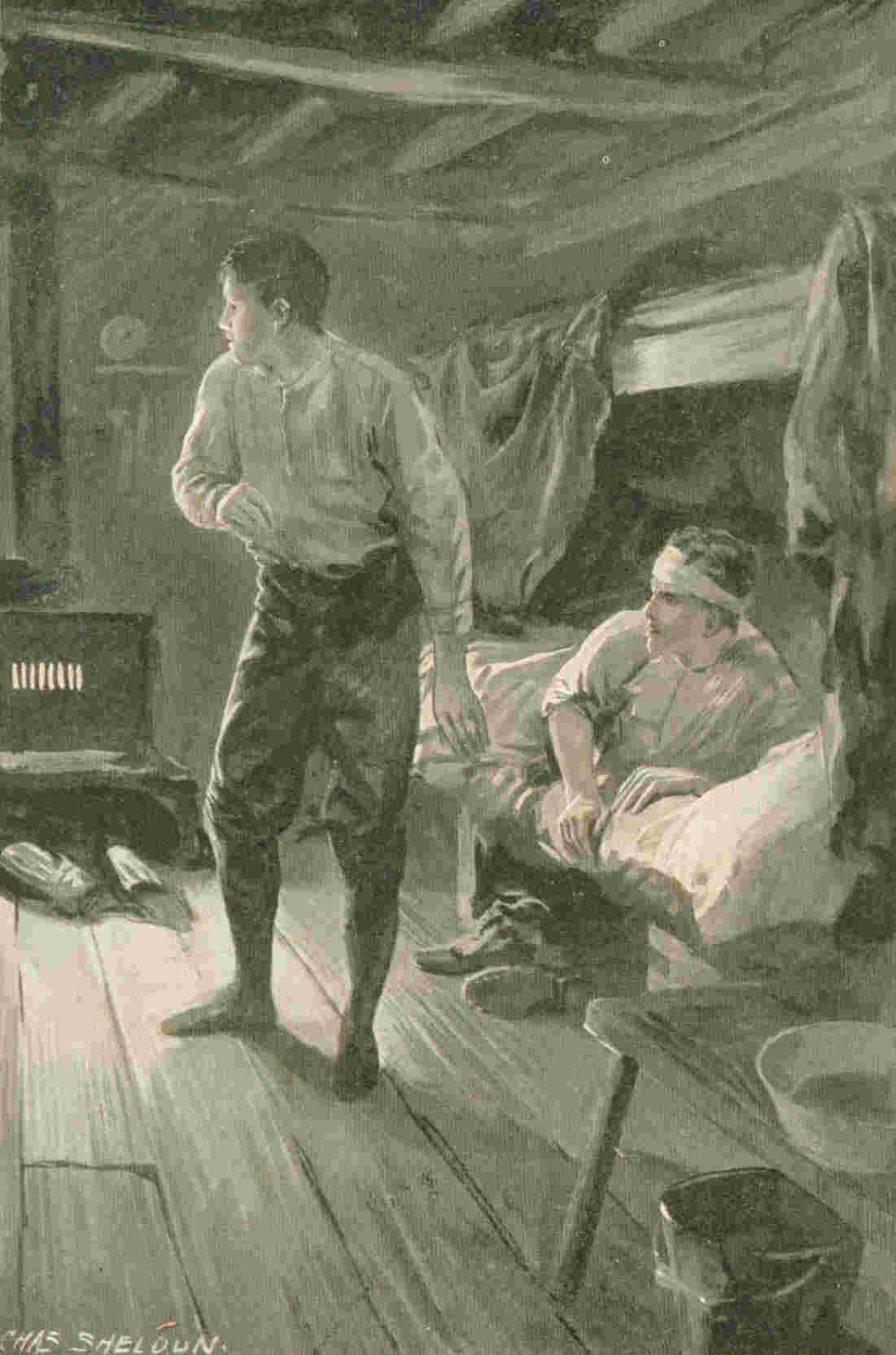
GEORGE AND SCOTTY HEAR THE ROBBERS OUTSIDE THEIR SHACK
Ah! There was a sound from within. Someone was stirring. “Who’s there?” called Scotty sleepily. “That you, Fritz?”
“Sure,” came the subdued answer. “You’ve barred the door, and here’s people who’ve got stranded and want shelter.”
Scotty dropped from his wooden bunk in a moment, for a tier of bunks was erected at the far side of the shack close to the stove, and consisted of two stories, both with rough boards nailed across the supporting timbers, to act as beds for the sleepers, and thickly covered with hay cut from the adjacent hillside. He stepped across to the door and felt for the bar. It was not in position. The door could easily be opened by anyone outside, and—and there was whispering.
“You ready?” he heard someone say in low tones. “The moment he swings it open let go with yer gun.”
“Hist!” came from the lower bunk, and, turning at once, Scotty made out George’s figure, for his eyes were accustomed to the darkness within, and the faint light given by the stove aided him. Indeed, the very age and decrepit condition of that stove was something to be thankful for, though, since his arrival at the shack, Scotty had more than once grumbled about it. For age and much warping of the cast-iron walls had produced chinks, chinks as large almost as those existing in the walls of the log-built hut, and through these the fire within gleamed dully, faintly illuminating the room. There was George, sitting up on his elbow, whispering:
“Hist, man! Hist, Scotty!”
Scotty crept across to him, while someone without rapped loudly on the door.
“Open! Open!” they called. “We’re making for the diggings and have got stranded. We want food and shelter. Open, mates; here’s Fritz waiting to be let in also.”
By then Scotty was beside our hero, kneeling on the rough floor of the shack.
“Close the bar,” said George, slipping his legs over the edge of the bunk. “Slide it quietly into its place. Tell ’em that you’ll open, and that will account for the noise. Quick, man. Something tells me that that fellow calling is the beauty who held me up to-day.”
Scotty sprang at once to carry out the instructions given him. With a quick step he reached the door and fumbled for the bar which closed it.
“Hallo!” he called. “Stranded, eh? Right. I’ll open.”
“Now, git ready,” growled Tony, standing back a pace, his weapon levelled in readiness. Indeed, nothing stopped this rascal. The thought of murder, cold-blooded murder, made him smile grimly. The door shook. There was the grating of a moving bar, and then—silence. Tony stepped to the door and pushed. It held firmly. He called, and there was no answer.
“Hi, there!” he shouted angrily; “are you a going to keep us outside all night, freezing in this cold? Open!”
“Wait! What’s that? People coming, eh?”
The more timid Jim suddenly gripped the arm of his companion. He had heard a step, and crouched close to the wall of the shack as it reached his ear again.
“Hear it?” he demanded hoarsely. “Someone moving. Someone close, I’ll swear.”
“Hist! I heard,” came from Tony. “You stay right here, as still as you can, and if them fools open, jest shoot. I’ll just prospect, and if there’s someone prowling around, why, he’ll pay fer it.”
Within the shack Scotty and George were now close to the door, the latter armed with a revolver, for the trio possessed one between them, while Scotty had seized an axe. They, too, heard those approaching steps, and, knowing that Fritz was still outside, guessed that he must be the one coming. George sprang to the window at once, threw it a few inches open, and called loudly:
“Look out there, Fritz,” he shouted. “There’s hold-ups just round the shack. Keep away. We’re right here and can look after ourselves.”
The sharp report of a revolver answered his words, while a bullet sped through the window, breaking the glass and covering George with debris. Crack! It sounded again, and those within the shack held their breath. For there came a scream, a scream of pain twice repeated, and then loud, plaintive groaning.
“Fritz,” gasped Scotty. “The brutes have shot him.”
“Fritz, sure enough,” George agreed with him in a whisper. “Lie on the floor, Scotty. Those fellows will start shooting through the door and window. Here, this way. Up in the far corner.”
Gripping Scotty by the sleeve, George dragged him across the floor of the shack, their stockinged feet making no sound whatever. Nor were they any too quick in changing their positions. For Tony meant business, and, as we have said, had little fear of the consequences, seeing that the shack was so far from Fir Canyon Camp. He ran across to the bulky figure which he had suddenly espied coming toward the shack, and at which he had fired on the instant, and kicked the prostrate individual. By then those plaintive groanings had ceased, and Fritz, for he it was, lay as if dead. Indeed, the robber thought that he was certainly placed hors de combat.
“Bowled him out fust time,” he growled, leaning over his victim. “That makes two of the fools, for one of ’em was done in this very morning. So there’s one left. Well, he won’t stand between me and the dollars, not if I know it.”
He shot the empty cartridges out of his weapon at once and slid fresh ones into place. Then he stepped swiftly back to the door of the shack, where stood Jim, waiting and listening.
“Well?” he asked.
“Not a sound. Not a move.”
“Ah! Then you’ll jest blaze in right here through the door. Give ’em three or four shots, but wait till you hear me fire. I’m going round to the window, and in a jiffy you can expect me to be in. I’ll open the door then, and we’ll rouse those dollars and git. Jest wait a jiffy, boy.”
Jim kneeled close to the door, his mouth set. Tony strolled round towards the window. As for Scotty and our hero, they lay flat, George with his weapon in readiness, and presented at the door. Not that he had heard that last whispered conversation between the robbers, nor knew how many there were of them. This he guessed, however, they had something to do with the man who had galloped up behind him that morning, and who had deliberately shot him from that direction.
“Must be a band of ’em,” he whispered to Scotty. “They’ve got the idea that we haven’t yet banked the money we got for our winter’s work, and they mean to have it. Yes. That’s how the matter stands, for, recollect, the stuff we put in the pail wasn’t taken. They missed it altogether. So, naturally enough, they took it for granted that we had it here in the shack. That’s what they are after. Well, a man defends himself, and if people attack him they do so at their own risk. Hah! That’s through the door. I’ll wait a bit, for the flash of my shooter would tell them our true position.”
There came the sudden crack of a revolver, but near to the door, showing that Jim had not altogether obeyed his orders.
“Didn’t I tell yer to wait,” they heard Tony shout from outside the window. “I ain’t quite there yet. But you’ve done it now, so go ahead.”
Crack! the weapon went again, and an instant later a long streak of flame shot through the window, illuminating it for an instant, and showing a dark, bearded face beyond. It was the man who had galloped up behind George and who had shot him in such rascally fashion. In a moment our hero recognized him. Then darkness covered the scene, and left the window, the far wall of the shack, the face of this ruffian a mere blank. As for the bullets fired into the place, those sent by Jim ripped through the shingles on the door and perforated the side boards of the bunks. The one discharged from Tony’s pistol thudded into the wood just above Scotty’s head, and caused that young fellow to duck with celerity. George slowly elevated his own weapon, and held it ready to aim at the window. There were sounds there as if someone were climbing.
“Hist!” he whispered of a sudden to Scotty. “That fellow’s trying to get in. Creep round near the door and be ready to strike the chap outside if he tries to burst it in. I’ll get across to the window. There. Listen. He’s on the sill.”
Rough boots treading heavily on timber, and the crackle of splintered glass falling from the broken window to the floor of the shack, reached George’s ear plainly, and told him that the robber he had seen must already be half within the building. He bent double at once, and crept across towards him, running the gauntlet of Jim’s shots as he passed behind the door. Then he stopped and listened. Yes, those boots were scratching the inside wall of the shack. The man was within already, and near the floor. George took his chances in both hands on the instant, and, darting forward, gripped the figure he could now see, gripped hard at the man and dragged him down from his position. A second later the loud report of a weapon close beside him showed the hand in which this robber carried his revolver, and at once, George shifted his grip and seized the arm just above the elbow. Then commenced a struggle which taxed his energies to the fullest. For, recollect, George had been wounded and insensible that morning, and was by no means recovered. His head still throbbed and buzzed, while he felt sick and giddy. But, still, there was within him a fund of energy and strength to be called on in an emergency, while determination and courage were virtues in which he had never yet been lacking. Tony, therefore, had no mean adversary to deal with, and for five minutes at least had the worst of the encounter. Then fortune favoured him. They had been rolling this way and that, struggling fiercely, the one to hold his enemy, the other to break free, crashing into the walls of the shack, thudding into the side of the bunks, and once even falling across the top of the old stove, an incident which brought a growl of anguish from Tony. Then, as they backed towards the door, something tripped our hero. Something caught his feet and knocked them from beneath him, so that in a moment he was down and Tony upon him. Then followed a flash, a loud report, and immediately afterwards the thud of feet on the floor. The door was torn open, the glimmer of a small moon could be seen outside, and then there was just silence.
George sat up bewildered. He wasn’t wounded by that last shot, of that he was sure. He was merely shaken, and trembling after that struggle, while his unlucky head thumped and banged and throbbed till he could hardly think. Yes, that same injured head had proved his undoing, for as he fell he had bumped it against the floor, and for just one brief moment unconsciousness had followed.
“Scotty,” he called. But there was no answer.
“Scotty,” he called still louder. Then, getting no answer, he climbed to his feet, the movement costing him no little effort, and stumbled across the floor towards the corner beyond the bunks, where the little table they possessed was placed. Searching for a match he lifted the glass chimney of the oil lamp and set the wick flaring. Then, with his head in a whirl, still banging and thumping, he staggered back across the floor of the shack, the lamp held in one trembling hand before him.
“Scotty. Dead! No, wounded.”
His chum lay near the door, his head against the wall of the shack, his eyes twinkling.
“Scotty,” gasped George, and only then did he really realize his liking for this good fellow. As for his friend, he smiled.
“Hallo!” he called. “That was a near one, eh? Don’t I wish I had been able to help you.”
“But—what happened?” demanded George. “And where are those fellow?”
“What happened! Where are they! Well, as to what happened. You collared that one over by the window.”
“Yes, and gripped his pistol arm as soon as the flash showed the right direction.”
“That’s where I got it,” grinned Scotty. “That bullet winged me nicely. Don’t you get worried, George, for there’s nothing in it. If there was, I wouldn’t be so lively. That bullet plugged me clear through the thigh, and if I’d been standing would have brought me down with a bump. But I happened to be stretched right here, waiting for the fellow who was firing through the door. And here you find me. Reckon, too, I was the cause of your trouble. You see, you two rolled this way and that, blowing and grunting, and struggling for the mastery. It was terrific, and not being able to see clearly made it all the more terrific. Once you rolled right over the stove, and, I tell you, I thought you’d both get burned. But it was the other who halloed, and, gee! didn’t he fight after that! Later, you came rolling this way, and somehow my legs got mixed up in the business. Over you both went, and in a jiffy the fellow had broken clear. There was a bang as he fired his gun, and then he was out through the door and into the open.”
“Then he’s gone, escaped,” cried George, trying to stand steadily and hold the lamp so that the light did not flicker. Scotty regarded him closely, and then called to him loudly.
“See here, George, boy,” he said cheerily. “Reckon you’re done up after that tussle, and since it’s up to you to do what’s necessary for me, and for poor old Fritz, you’d best take something that’ll steady you. I know you won’t never touch spirits when you’re well; but you ain’t well now, so hop right over to the cupboard. Now, no fooling, and saying you won’t and that sort. You’ve jest got to, so there’s the end of the business.”
George wasn’t a believer in stimulants as a general rule, but he realized just as well as the jovial Scotty did that he was badly shaken. More than that, he could see that action was required by someone, and seeing that his two friends were damaged, why, he must of necessity face the task whatever it might be. Besides, there was Fritz.
“Poor old Fritz!” he murmured. “All right, Scotty! I’ll do as you say. I can’t deny that I am badly shaken, and like this I am worse than useless. I’ll get some water boiling and make coffee when it’s ready. One moment. I don’t feel that I have the strength left to even reach the cupboard.”
To look at him one would not have been surprised if George had suddenly tumbled to the floor of the shack and lain there insensible. He was pallid now, something distinctly unusual with him, for he generally boasted of a brilliant complexion. Then his limbs were shaking more than ever, while a cold perspiration moistened his forehead. He leaned against the shack wall unsteadily, the hand gripping the lamp swaying badly, while his eyes were half-closed and dreamy. Scotty shouted at him, and his tones were commanding.
“You ain’t done as I told yer,” he cried angrily. “Didn’t I say as you was to go right off and put that lamp down, and then get yerself a nip of spirit? Do yer think I’m a-goin’ to lie here and see you falling about and chancing setting the place on fire! Not me! You stir yer stumps, young George Instone, or there’s going to be real bad trouble.”
That woke George up and made him pull himself together. He started, nearly fell headlong, and then, without protest, stumbled across to the table. At any other time it was hardly likely that he would have put up with such an address from Scotty, good friends though they were. But now he was so feeble, so helpless, so wanting in strength and determination that he was like a sick child, and anyone could command him. Such docility was an eye-opener to his friend, and set Scotty smiling grimly.
“He’d jest take me by the collar and punch me,” he thought. “That is, if I gave him that sorter lip when he was fit. But he’s dead done, and if he ain’t bustled will just fall right down and faint. Well, he ain’t going to do that while I’m behind him.” “You jest get in and open that thar cupboard,” he shouted at the docile George. “And let me tell you, young chap, you’ve been a heap o’ time over the job already. That’s it. You’ve got the door open. There’s the bottle right in front of you. Pull the cork, boy. Take that glass right near you. Now pour the spirit in. No, no. You’re playing, boy; you’re fooling. That ain’t enough for a fainting gal let alone a hulkin’ feller same as you are. You fill up hot and strong. Mind yer, I ain’t the one to make you on usual occasions. But this ain’t no usual occasion. It’s almost life and death, for work’s wanted. Now, back with yer head. Swallow!”
Scotty was himself a teetotaller, but he was no bigot, and, in addition, just now he was desperate. For from outside the shack he could catch the sound of groaning. Fritz was there, without a doubt, badly injured, while he, too, Scotty, needed attention. He watched George, therefore, like a hawk, and saw the colour mount to his face once more within a minute of swallowing that spirit. He saw the sturdy young fellow shake himself and shiver. And then he watched as our hero’s face relaxed, and he smiled.
“You’re a bully; that’s you,” he told his chum. “You’d drive a fellow even when he was next door to dying. All right, you wait till next time, till you’re so done up that you just want to lie down and care about nothing. That’s the time when I shall prod you and goad you into action. But I feel better, Scotty. You wait a bit. Give me five minutes and I’ll have you lifted on to the bunk. Then I’ll take the lamp and get along to Fritz.”
But it required more than five minutes to make a man of our hero again and to revive his strength; and, much to his annoyance, when he attempted to stand once more, for he had been seated meanwhile on the table, he found his legs failing him. His knees knocked together badly, while his breath came swiftly. Scotty gasped with dismay and sat up on his elbow.
“Say, George,” he called, “you ain’t fit yet, and won’t be till you’ve laid down for a while. Jest get on to the bunk and let your head fall back on the pillow. In ten minutes, maybe, you’ll be better. Then, I guess, you’ll be able to stand and set about things.”
It was useless to struggle, to shake his head, and to attempt indignation. Even when he was a sick man George was no fool, and he could realize that, at the moment, he was still helpless. It was therefore with a good grace that he obediently struggled across to the bunk, fell over the side board, and almost instantly was sunk in slumber.
“Let him lie there for a while,” thought Scotty, his eyes wide open with thought, Fritz’s groans still in his ears. “George ain’t worth nothing to us just now, but I’ve heard that ten minutes’ sleep even will make a man fit for work when he’s been exhausted. Gee! I do believe I’ll be able to haul myself along, and, anyway, the bone of the thigh ain’t broken.”
It was more than ten minutes later when he shouted at our hero and failed to waken him, though he bellowed his name. George merely snored an answer. Even when Scotty became positively frantic, and, groping his way across the floor, shouted from a point much nearer, George merely stirred a little, rolled his head on the pillow, groaned somewhat dismally, and then snored, snored loudly, till Scotty was roused to desperation. He was wondering what he was to do, and how he could manage to awake his exhausted comrade, when a voice broke on his ear; it was a deep, bass voice, and came from the doorway. Turning, Scotty shouted with joy, for a tall, broad-shouldered miner stood there looking into the shack with amazement written on his features.
“Well,” he said, or rather gasped, “this here’s been a sort of mix-up. What’s amiss, boy? Why, you’re wounded!”
He was in the shack now, and beside the unlucky Scotty. Picking him up as if he were a child he laid him on the upper bunk, tucked the pillow beneath his head, and then began to cross-examine him.
“Anyone can tell as there’s been trouble here,” he said. “What’s it been? A bust up between pards, or outlaws breaking in? Where’s the third feller, the German?”
“Outside,” Scotty told him. “Hurt, too. He wants to be brought in here and attended to. But my friend is hurt and dead done after a fight with one of the fellows. They’ve been after our dollars, and there were two of them at least.”
It was a little incoherent, but the stranger managed to get Scotty’s meaning. Not that this tall miner was exactly a stranger. He was the man they had consulted with reference to their claims, and the dust they had washed from them. Bill Somerville he was called by official parties; but in the diggings, and by hundreds of his mates, he was known simply as “Diamondfield Bill”, having gained that sobriquet from some adventure in South Africa, where he had first started his mining career. Huge in proportions, Diamondfield Bill was the very essence of gentleness and kindness, and at once set about doing all he could for George and his friends.
“I’d been down to Fir Canyon Camp,” he told Scotty. “You see, there’s new boys coming along up most of the time, and I was anxious to get a mate from amongst them. Well, riding back, I hears shots, and since this here’s the only shack within miles of Fir Canyon Camp, and shots ain’t usual o’ nightfall, I came right over. You’re comfortable, eh, boy? Then I’ll get out and take a look round for this Fritz feller. Where is he, anyway?”
Scotty told him at once.
“Round there on the same side of the window. You’ll hear his groaning if you stand still out outside. I’m afraid he’s badly injured.”
Bill took the lamp from the table, reaching it in one long stride, and then hurried from the door.
“This here means a sheriff and a posse,” he growled. “These boys have been knocked about badly, and the rogues who have been in the business ain’t been too careful with ’em. Seems to me I might know who’s had a hand in it, and, to-morrer, if they ain’t down in Fir Canyon Camp, why, they’re the men we shall be after. First thing, though, is to see to the fellers who have been hurt. Now, where is this Fritz?”
A groan reached his ear, and advancing with the lamp held high he presently came upon the ponderous German. Fritz lay on his side, doubled up, and with his knees drawn up almost to his chin, the posture sometimes assumed by people when in pain. Groans escaped him, and when the huge Bill leaned down and brought his lamp nearer he saw that the wounded man’s eyes were half-opened and the eyelids moving. But the pupils were closely contracted, and the brows above drawn down.
“Hit somewhere’s,” Bill told himself, kneeling beside Fritz, “and in pain, though one would say by his colour that he ain’t dangerously hurt.” “Well, mate,” he asked, gently enough, “where’s the trouble? Something’s hurting, eh?”
Fritz groaned and opened his eyes wide. Then he pointed to his hip, and, searching there, Bill discovered that his clothes were wet with blood. More than that he could not discover then and there, save that no limbs were broken.
“You catch a hold o’ my neck,” he told the ponderous German. “I’ll take you into that shack in a mere jiffy. Say, that’s right, boy. Right ’way over my shoulder with your arm. Up we go, and the lamp with us.”
Fritz might be a ponderous fellow, running to fat, and weighing heavily, but Bill was a man of fine physique, immense in stature and in strength. He bent above the wounded man, gripped him with one arm, slid the other beneath him, and clutched the lamp with the fingers of that hand. Then, with a heave, he had the German off the ground, and, carrying him like a child, took him with giant strides right into the shack.
“You just move over a little,” he told Scotty. “That’s the way. Now we have room for him. Your mate’s hurt, but not badly, I should imagine. I’ll get right in and see what’s the matter.”
It became evident in a little while that Diamondfield Bill was no ordinary person, and indeed when George and his friends got to know him better they found that he could speak as a cultivated individual, and that there were many sides to his character. Bill had not always been a simple miner, whether of diamonds or of gold.
“Yer see,” he explained to Scotty, who watched him in open-eyed amazement, “yer see, boy, way back thar in New York city I was once a student. Yes, sir, a student. One who attended the hospitals, and for a while I practised medicine out here in Canada. Then the gold-digging fever got hold of me and I began to wander. First I’d be here, where there was a gold rush, then I’d be off to South Africa or Peru, or some such place, till medicine came second with me and mining first. But I haven’t forgotten, no, siree. I can still do work with some of the best; ’cos, you see, I read a heap, and, besides, in the mining camp there’s seldom a surgeon. So I’m often enough miner and surgeon and nurse all together. Ha! This Fritz wants a painkiller before anything. Yes, sir, a painkiller.”
Those huge hands of his, shapely enough, too, when one examined them, had supple, steady, and dexterous fingers. They groped in an inside pocket and produced a little metal case, somewhat similar to that in which cigarettes are carried. The lid sprang open at a touch of one of the strong fingers, disclosing within a tiny syringe, with numerous glass tubes alongside, in which were round tabloids for injection beneath the skin when dissolved in water. Scotty watched as the fingers picked out one of the glass tubes and extracted a tabloid from it. He saw the syringe opened and the tiny round thing dropped in, water following. Then, when all was ready, the huge Bill sought for Fritz’s arm and lifted it gently. Baring the forearm, he picked up the skin between forefinger and thumb of the left hand and inserted his sterilized needle. Then a steady pressure on the plunger of the syringe, the withdrawal of the needle, and the gentle replacing of the arm followed.
“He’ll feel better in ten minutes,” said Bill. “Now, young Scotty, let’s see what those rogues did for you. Gee! You’ve caught it. Right through the thigh, and missed the bone by a bare inch, and the arteries as well. You’re lucky, young feller-me-lad, so I tell you.”
Once more the big hand sought in a capacious inner pocket, withdrawing an enormous leather wallet. Then Bill went for water and placed a kettle on the stove, filled to the brim with it. While he busied himself with his preparations, removing Scotty’s clothing, he chatted in low tones with that young fellow.
“You can get right in with the yarn,” he said, lifting the lamp to take a close view of our hero, who still lay slumbering. Bill felt his pulse and nodded significantly at Scotty.
“Dead beat, you said, eh? Well he’s just dead asleep, with a good steady pulse that’s as soft as a young lady’s. You get in with that yarn. This young George is hurt and has been bandaged. How’d that come about? Go along, lad, I’m tired of asking.”
Scotty plunged into the yarn at once, telling how George had been set upon that morning, how he had been shot from behind, and how he had made his way back to the shack with their dollars. Then he told of their awakening that night, and of the voices they had heard outside. Meanwhile Bill was far from idle. Those strong and dexterous fingers produced dressings from the leather case, and sought for another within the same capacious pocket.
“It wants a big man, same as me, to carry all this,” laughed the miner. “There’s never any saying when tools of some sort won’t be wanted, and for that reason I go about laden. Ha! There’s the instruments. Don’t you be afraid, boy, for I ain’t going to make mincemeat of you. I’m not even going to hurt. Just you get on with the yarn. Let’s see. You heard voices outside, and you guessed that they didn’t belong to decent sort o’ people. Well, then, you were up against something. What did you do? Steady! Don’t move! Ah, that’s right! No probing necessary, for that bullet went clear through, and from the look of the entrance wound no cloth or material has been carried in along with the bullet. Yes, sir, you were right clear up against it. Then?”
It was an excellent means of keeping Scotty employed while his wound was being dressed, and made that operation seem but a small one. Indeed, in a very few minutes—so it appeared to the somewhat nervous chum whom George had so fortunately fallen in with—the wound was covered, and the bandages already fastened. By then Fritz lay with eyes wide open, staring at the huge Bill. His pupils were no longer contracted, while across his fat face had spread an air of contentment.
“Hallo!” he called.
“Hallo yerself!” laughed Bill. “So you’re feeling easier, eh, boy? Well, a little dig with that simple needle does a whole heap for a man in pain, and makes his outlook on this world all the brighter. You could jest let me take a closer look at that wound, eh?”
The ponderous German nodded, and stretched out a hand to grip the stranger’s.
“You’ve done a whole heap fer me,” he told him, gratefully. “I was coming back to the shack from ’way over by the stables, when all of a sudden there was a flash and a loud report. I felt as if a horse had kicked me, and fell down instantly. After that the pain was so severe that I couldn’t even think. But—but, who fired? What happened here? Where’s George and Scotty?”
“The last right here alongside you, tied up and trussed like a chicken,” smiled Bill urbanely. “George is ’way up top, sleeping as though he’d never had a rest this last week. So they’re all right, and it’s you who need attention. As to the pain, guess you were hit on the top of the hip bone, and I’ve known men hit there before who were speechless with pain. Let’s see, boy, and jest lie still. I’m a man who doesn’t do to be disturbed, and I’m going right now to give you the whole yarn—how you were fired at, how George up there fought with one of the ruffians who wanted your dollars, and how this Scotty boy came in for one of the bullets. You lie still. Here we go.”
He was a master of his art, and soon had Fritz quite comfortable. Then he went across to the stove, and soon had food and coffee ready. The dawn was breaking, and the first streaks of light glancing into the shack, when Bill rose to wish his friends good morning.
“You’re all finely fixed till to-night,” he told them. “I’ll send one of the boys over here to tend to you, and somewhere this evening I’ll be back to see how things are going. So long, boys!”
It was at that moment that George sat up in his bunk and stared at this stranger. Then he recognized him.
“Hallo, Bill!” he called, for there are no formalities on the goldfields. A man is introduced as Bill, if that be his name, and he is plain Bill forthwith.
“Hallo, Bill!” he called. “What’s doing?”
That caused the huge miner, who was surgeon and nurse and many another thing all rolled together, to laugh loudly.
“What’s doing? Why, heaps, boy. You lads have come in for a little too much attention from some rogues I’ve had an eye on this last few days. You lie still—that’s orders—till I come back this evening. I’ve fixed you fine, and there ain’t any need for any one of you to be stirring.”
“Then, what’ll you do?” asked George, suddenly remembering all that had happened, and leaning over the edge of the bunk in his eagerness. “You’ve fixed Scotty and Fritz, you say, and they’re not badly hurt.”
“No, siree. Not badly. They’ll be wanting crutches this next week or two. Then they’ll be as fit as ever. For me, I’m going ’way down to Fir Canyon to rouse the boys, and then ride over to Sheriff Macwhirter. This business will call for a sheriff’s posse, and before we’ve done with those rascals I’m hoping there will be some shooting. You see, boys, ruffians ain’t wanted in any diggin’s. Wherever there is gold to be found, men of that sort will come along with the idea of preying on their more industrious fellows. Well, they’re a danger to all, and when they hold up a young bunch same as you are, why then, there’s got to be a racket. So I’m off to fetch the boys, and hunt those fellows.”
George was half out of his bunk by then, feeling, too, wonderfully better; for he had had a splendid and most refreshing sleep, and that wound of his wasn’t, after all, so very serious. It had damaged the scalp, that was all, and the jar had stunned him. But that was yesterday, and George had one of those robust natures which quickly recovered. Leading the outdoor life he followed, working hard, and eating and drinking healthily, he was a fine specimen of humanity. Then he had heaps of courage, and not a little love of adventure. This sheriff’s posse interested him not a little. “I’m coming,” he said, hopping to the floor. “If anyone joins a force to follow those rascals, surely it should be me. I’m ready.”
Bill looked him closely up and down, and seized him by the elbow; then, taking him to the door, where the light was stronger, he inspected him closely.
“You’ll do,” he said crisply. “First, though, we’ll dress that wound, and then take breakfast. Then we’ll be off. Of course, if anyone has to ride after those rascals it’s George Instone.”
They gulped down a hearty breakfast, and went out to the stable. Ten minutes later the two were cantering off for Fir Canyon, where the sheriff’s posse would be assembled, and where the road would be taken.
“We’ll have to track those rascals from the door of the shack,” Bill told our hero. “Then, when we get on their trail, just you look out for ructions.”
There was excitement in the camp at Fir Canyon on that early morning when Bill and George drew rein opposite the post office. Men came running from shacks and houses, from tents and lean-to structures. And all waved eagerly to the huge Bill, and smiled at him.
“Say, what’s amiss?” asked one, a lean, lanky miner, slouching up to the spot where they had drawn rein and slipped from their saddles. “You, Bill, you’ve something to tell us.”
“I’ve something to ask,” came the sharp answer. “There was two here known as Tony and Jim. T’other names I ain’t acquainted with. Are they here still? that’s my question.”
“Jim and Tony! Ho! Ah!” said the lanky fellow, by name Stephen; “I ain’t entirely surprised that you’re axing about them fellers, ’cos they don’t hold a healthy reputation. There’s Pete. He’d know more about ’em than we chaps. Say, Pete,” he called, as a bull-necked, bearded fellow strode up to the party, “you should know ef Jim and Tony was here now, and where they was last night and yesterday. Ain’t that the question, Bill?”
“You bet. Where were Tony and Jim yesterday and last night? Where are they now? That’s the ticket, Pete. You can answer.”
“You’re wrong,” the bull-necked Pete responded, turning the quid he was chewing into the other cheek. “How’s a man to say where’s two others if he ain’t with ’em? You kin answer that, big Bill? Then you’re clever. I tell you, them two scallywags—I calls ’em that, fer I can’t find any use fer ’em—them two went off on hossback yesterday morning, and I seed one of ’em ride out in the wake of this here young feller. You’ll be George, eh?” he asked, addressing our hero, “George Instone, him as bought the wreck way down there on the coast, and made a small pile on it. Ah, I thought so! And I guess Tony knowed it, for why else did he go galloping away down the dirt road so soon as you’d quitted Fir Canyon? Jim went off at most the same time, and struck off to the right, as if he’d no business with his partner. That’s the last I seed of them two, for they wasn’t back last night, and didn’t sleep in their beds in the rooming house where we all three are living. This very mornin’ they ain’t here. What’s the racket?”
“There’s been cold-blooded murder attempted,” said Bill abruptly. “Say, Orville, you’re the postmaster. Have you got that wire strung through yet to the far side of the canyon.”
A thin, wizened little man, with prominent nose and sharp features, had just joined the group, and was at that moment busily adjusting his spectacles. He differed from the crowd of miners now assembled as chalk differs from cheese, and his whole appearance—his dress, his pallid face, his stooping shoulders, and his whole want of robustness—spoke of a trader, of a shopkeeper rather than of a rough miner. He was, in fact, the postmaster. He blinked his eyes at Bill, and lisped an answer.
“Why, yes. Sure,” he said; “through nigh a week ago. And you not know, Bill; you who are so often sought for? What of it?”
Bill stood over the little man till he almost swamped him. He took him gently by the shoulder, and directed him towards the door of his office.
“You git right in there, Orville,” he cried, just a trace of excitement in his voice, “and ring Macwhirter. Tell him that I’m waiting at this end of the line, and that we’re forming a posse here to help him capture some criminals. Now, hop! There ain’t time to waste here talking.”
He almost pushed the little man into his office, and would not be satisfied till he saw him at the telephone instrument. Yes, a telephone instrument out there in the wilds! But then in Canada and the United States they do not look upon the telephone as a luxury. It is a necessity, and to be found even thirty and forty miles away from the railway in what one would imagine was a deserted wilderness. A minute later Bill was at the instrument himself, and George could hear his big voice talking to the sheriff on the far side of the canyon. Then Bill came out of the office smiling.
“He’s one to get a move on,” he told the assembled people, for by now the whole population had gathered. “Macwhirter’s sending men out to bar the upper end of the canyon, while he’s ’phoning right and left to get the neighbouring sheriffs to look out for those two fellers. Boys, we’ve got to get moving. It thawed hard last night, and with the thaws we’ve been having this last week the ground is soft and will carry traces. Here’s Slick Steve and Hiram, both of them good trackers, and if I’m not mistaking matters they’ll lead this party.”
While he was speaking a couple of men had stepped forward. They were entirely dissimilar, inasmuch as one was young, hardly older than George, and the other, Hiram to wit, considerably older. But both were slightly built, active, and alert. Indeed, they wore that same appearance which George had noted in Peter, the night watchman up at the northern depot where Tom and he had so often rested together. Like Peter, too, they were rather given to silence.
“You kin count on us, Bill,” said Hiram, the elder. “We kin get the loan of hosses; and if we kin be of help, which it seems you think, fer you’ve called fer us, why, Slick Pete and me’s on fer this business.”
“Then we’ve merely to call for others,” said Bill. “See here, boys. Ten to twenty won’t be too many, and I guess there’s that number of horses to be had. Those who can come had better step right here on to the porch of the post office. We’ll get Orville to take their names down, and then we’ll fix to start in ten minutes. Don’t forget it’s cold at night, you boys, and bring warm things with you. Food and water too’ll be handy. I ain’t mentioning other things like guns, ’cos you fellows will realize that this isn’t going to be exactly a picnic, and if you’ve seen Tony and Jim you’ll know that shooting’s likely. Now, lad,” he said to George, “we’ll get in here at the store and get Silas to fix us each with a bag of food. We’ve coats with us, and a blanket across our saddles. Then you’ve a gun and ammunition. I reminded you of that before we started. As to your horse—well, he looks a good one. Now, you rest here while I go along to a friend I’ve got and have a chat with him. He’ll send his wife and daughter ’way out to the shack as soon as we’ve started; and then, if we don’t happen to get back to-night—why, your friends’ll be well cared for.”
Some few minutes later all their preparations were completed, and about twenty men were gathered in front of the post office. They were a picturesque-looking crowd, and very determined. Dressed in mining kit for the most part, they were mounted on excellent horses, and managed them as men do who have ridden often. Bill was greeted with a cheer as he came amongst them.
“We’ll be off, boys,” he sang out as he swung himself into his saddle. “We’ll go right back to the shack where these fellers held up those three youngsters, and there we’ll get on their tracks, Of course, you’ve all heard the yarn by now, so there’s no need to repeat it. Slick Steve and Hiram had best get ’way on ahead, for they’re the boys to lead us. Chaps, don’t forget this: the sheriff’s orders are to capture those men and take them to the lock-up. But if they show fight, and it’s more than certain that they will, why——”
“You kin trust us,” called out one of the men. “Bill, we don’t want no teaching, and none of us is asking to have a bullet drilling a hole through us. No, sir, not even if there is a good man along with this bunch who knows as well how to handle a gun as how to heal the wounds that’s made by them. Git up thar! (this to his horse). Bill, ef Jim and Tony jest do much more’n lift an eyelid, we’ll give ’em miners’ law. And ef we catch ’em, as we mean to do, and there’s proof positive, why, sheriff or no sheriff, I don’t say as the law’ll be much troubled with them.”
There was a significant nod from his fellows, and indeed George himself knew enough of the miners he had come to live amongst to be sure that they were quite capable of taking the law into their own hands. Sheriffs might be important individuals, but rascals in that out-of-the-way part of the world needed severe handling, for the law was apt to be slow, and legal quibbles often enough left a man who ought to hang idling for month after month in prison. That wasn’t justice. It didn’t deter the evildoer. It rather encouraged those who preyed upon the steady and the hard worker; therefore miners’ swift justice was a deterrent, and the miners themselves knew it.
Shaking their bridles the party cantered out of Fir Canyon Camp and took the muddy road for the shack where Scotty and Fritz were lying. Slick Steve and Hiram were already ahead, and George noticed that they rode some distance from one another, seemingly looking at nothing. But no sooner had they arrived at the shack than they became exceedingly busy. Both leaped from their horses, and, leaving the animals standing untended, walked slowly round the place. Bill and his party were cantering up to the place when the two trackers vaulted lightly into their saddles.
“This here’s easy,” Hiram called out. “Reckon a gal could follow in these parts. It’ll be when they git into the mountains that tracking’ll be difficult. You kin bring the boys along, Bill, and they ain’t likely to be wanted this yet awhile, fer Tony and Jim’s been gone this five hours.”
“Five hours! Then they have a big start. But no,” reflected Bill aloud. “It was night-time, and a man can’t go fast in a country such as this is.”
“Right and wrong,” Hiram answered. “But there was a small moon last night, and that would help them. But they didn’t go in no hurry. Seems to me, from the look of things along here and away the line they took, they jest walked their hosses. They didn’t p’r’aps take into account the fact that folks would be wanting to follow. Mayhap they stopped fer a bit of a sleep, and most likely they’ll have pulled in somewhere’s to eat. We’d best take matters easy ourselves, Bill, ’cos Sheriff Macwhirter will have stopped the country far out ahead of them two rascals, and they’ll not get so far that we shan’t easy be able to come up with ’em.”
With the two trackers in advance, and Bill and his party riding in rear, the sheriff’s posse made their way at a gentle gait up the canyon. Five miles beyond they were met by the sheriff, a big fellow like Bill, sunburned and hardened by exposure. Then a dozen more men joined the posse, and at the sheriff’s order set off again in the wake of the trackers. Resting here and there—for the road led upward, and at times was most difficult—the little force had gained the centre of a mountainous country before two in the afternoon. It was then that Slick Steve drew the attention of all to signals being sent them from some high ground in the distance.
“There’s smoke ’way over there,” he said shortly, almost gruffly, as if it hurt him to speak. “It started ten minutes ago, then stopped suddenly. Now it’s going up again. Guess it’s a signal.”
“Some of the people I telephoned to have seen our men,” cried the sheriff, sliding from his saddle. “They’ve turned ’em back, and that’s to let us know what’s happened. Now, boys, if we can get the same sort of signal from either side, why, we know that our birds are right here in the hollow between the mountains. We’ll lay off here for a while and eat. That’ll give time for things to get moving, and we know that our men can’t break ’way back here behind us. Bill, we’ll jest get a fire going to answer the boys ’way up there and so let ’em know that we’re in position.”
At once the men dropped from their tired horses, and, loosening the girths and letting the reins drop to the ground, left the beasts to eat what they could find.
“There’ll be plenty for them too,” observed Bill, sitting on a convenient rock and searching in the gunny sack in which he had stored food. “It’s warm up here in the heart of the mountains—that is, right ’way down in this hollow—and there are tender young grass shoots beside all the rocks and under the thin layers of snow still left. But up there above it’s too cold yet, and at night a man, and a beast too, if he’s accustomed to a stable, wants some sort of blanket. Now, lad, set down and eat. The boys has got a kettle mounted already, and soon we’ll have coffee.”
George watched as one of the party took a huge kettle from his saddle and filled it at a neighbouring stream, for many a torrent brawled down through the gully by which they had gained this huge basin amidst the heights all around. Looking about him, too, our hero could realize that if Jim and Tony were still within that rocky circle their capture was almost certain. For there were men right ahead guarding the way out in that direction, and in all probability men also to right and left. With their own party blocking the gully by which the robbers had entered the trap it seemed more than probable that that evening would see their capture.
“Suppose you’ll round them up?” he asked Bill. “Locate them wherever they happen to be, and then surround them.”
“Just so, lad. But it won’t be all easy sailing, so you just remember that. Jailbirds of this sort aren’t easily taken. For it’s like this: Tony and his mate are wanted for something else; you may say that for sure. Mind you, Sheriff Macwhirter don’t know anything against them at this very moment; but, then, he hasn’t any records. But once we get them, and take them down country where there happens to be a record office, why, then, they’ll maybe have photographs, or fingerprint cards, or something to associate them with the criminal gallery. Even if they haven’t, the attempt they have made on you down there on the dirt road and last night at the shack is sufficient to bring them a life term of imprisonment. Not as I think they’ll get to the Courts, lad,” Bill added seriously. “You see, men away here suspect Courts. There’s too much jangling and mixing up of words done there, and there’s never any saying when some legal quibble that no one else happens to have thought of won’t be raised by counsel for the prisoner. Then the man may get off, and that discourages honest folks like the boys here. They’re out not alone to make a capture but to read a lesson; for, with men of this stamp shooting right and left and carrying on, men’s lives in the camps—honest men’s, I mean—are endangered; and since they have their wives and children with them too, often enough, why, your miner ain’t too anxious to take prisoners for the law to deal with ’em. You’ll see. Miners are a rough class, but honest enough, and straight as a die in such matters.”
Half an hour later the water in the huge kettle suspended over the wood fire which Hiram had set going was boiling merrily, and at once a tin of coffee was emptied into it, Slick Steve stirring the contents with a ramrod. Then men unfastened the enamelled cups which all carried slung to their saddles and dipped them in the kettle, one of their number making a round of the posse with a tin of condensed milk, while another brought a paper bag filled with sugar. George found himself inspecting his comrades with an interest which was well deserved. For the posse consisted of young men for the most part—sturdy, well-grown fellows in the pink of condition, sunburned and hardened by the outdoor life they habitually led. They were dressed in corduroy breeches for the most part, tucked into high, laced boots, such as are generally worn by miners. Their shirts were of every hue, and for the most part cut with a collar, the points of which rose up under the chins. A handkerchief of some brilliant hue was tied about the neck, descending over the shoulders in a broad triangle, while their coats were fashioned of every sort of material, for the most part worn and frayed and patched in many directions. Wristlets of leather and artfully stitched were worn by a number, while the hats on their heads would have furnished a dozen different patterns for a clothing store. For the rest, each had a belt about his waist—for braces are seldom worn—and carried attached to it a revolver holster, in which lay the weapon with which he intended to persuade Tony and Jim that rascality would not be permitted in the neighbourhood.
As to the horses, they were of a fine stamp, as we have already said, and the gear upon them was worth inspection. For the saddles were of American manufacture, and carried in front a horn to which, on the ranches, a lasso dangled. The cantle rose up high and steeply behind, while the leatherwork was embellished with hunting and fishing scenes, all deeply embossed in the leather.
Perhaps an hour after the party had slid from their animals, Hiram announced that another signal was about to rise. No one else in the party had as yet seen anything to attract attention, save Slick Steve perhaps; and since he said nothing, there was no guessing what he knew. But Hiram pointed away to the left, and beckoned to Sheriff Macwhirter.
“The boys ’way up there has seen them men,” he said shortly. “They’ll be sending up their signals in a jiffy.”
The sheriff at once rose and stared in the direction in which Hiram had pointed. His furrowed brows, and the shake he gave to his head, showed that he himself had seen nothing.
“Don’t you feel out with yourself?” Bill sang out merrily, laughing at the sheriff’s obvious perplexity. “If you can’t see what Hiram and Slick Steve see, why, that don’t say that you’re blind. Say, boys,” he called to the two trackers, “you can see men ’way up there, eh?”
“You bet,” came from Hiram. “Ten of them. They just showed up on the top of the ridge. But I can’t see Tony nor Jim, and it ain’t likely. If they’ve caught a sight of the fellers way up on the ridge, and knows that they’ve been sighted themselves, why, they’ll have gone to ground. Just you folks keep yer eyes screwed way up there yonder, and things’ll come clear in a little.”
“Ginger! That Hiram could most likely see the eyes of a fly perched up there,” grumbled one of the party, when he too had stared at the ridge for some minutes. “There’s nary a sign of a man.”
“Then you can’t see smoke, hey?” Hiram asked abruptly.
“Nary a sign,” answered the man, shaking his head vigorously. “Not so much as a man’d send up ef he happened to be smoking, and that in course he wouldn’t do jest now, eh?”
“Then you turn yer noodle this way. Now follow the line of my arm. Ain’t that smoke? Ain’t that more’n a man’d send up who happened to be pullin’ at a pipe? As to smoking, reckon a feller who tried that jest now would be about the most tarnation fool as was ever invented. This here ain’t a time for playing. But say, Kit, you ain’t failed to see that smoke?”
There was a grin on Hiram’s weather-beaten and dried-up features as he turned to the one who had spoken. He laughed outright when the man shook his head and, like the sheriff, looked troubled and disappointed. Then Bill gave vent to a cry, and so distracted attention from him.
“Right, Hiram,” he said. “I’ve got it. Smoke, sure enough. That’s your signal, Sheriff?”
“Mount,” came the sharp command. “Now, boys, we’ve got to be wary; for if we leave this gully open them fellows may make a bolt, and turn back on their tracks. So some of us has got to remain behind, and when the night comes they’ve got to get way back into the mouth of the canyon. There they’ll find that Tom Steele has rid up with a couple of automobile lanterns. I ’phoned for ’em this morning, and Hank Thessler, him who’s got a motor, promised sure he’d drive right up through Fir Canyon Camp to-day, and come on up to the top of the gully. With his two lamps in position, sweeping all across the gully, no one should be able to get through. See here, we want a dozen men to watch the place and hold them fellers up if they try to break back. Mike Hardy, you’ll take the lead, seeing that you’re a deputy sheriff. Choose your own men and let us be hiking.”
With the posse now divided George accompanied one half away to the left, and presently found himself on the side of a hill, following a track which was barely wide enough to accommodate a horse, and which at times crossed parts of the mountainside where a false step or a stumble would have meant destruction. The posse was, in fact, strung out in Indian file, and continued climbing in that order for two hours at least. Then they reached a hollow, where grass and bushes grew, and where the sheriff at once commanded a halt.
“Here’s where we dismount and get in at the business afoot, boys,” he sang out. “Say, Bill, you’d keep on in one party, eh, or separate?”
For a while the big miner stood looking about him, gazing up at the rocks above. Then he turned and gazed into the gully or basin lying at their feet.
“You’ve men way up there, Sheriff,” he said at length, “and they’ll hold this Tony and Jim from going over the divide. And you can say that you’ve men all round blocking every outlet. That being the case, seems to me that we want to climb slick up and then divide into two parties. You see, it’s Indian fashion all the time. While we’re way down below, that Tony and his friend can see us easy, and remain hidden themselves. But put us above ’em, and the thing is changed. It’s we who then look down and easily spot ’em. We could shoot down into them, too, which is a great advantage. If I was you, Sheriff, I’d climb sheer up and then commence the real business. But every mother’s son here had best keep a clear eye open; fer, if I know Tony and Jim, once they see that they’re cornered they’ll hide up in some bit of a cave or hollow, and most likely pile rocks in front to make a barricade. We might stumble on such a place before we expected, and then there’d be someone sorry for himself. One or more of the boys would be drilled by their bullets and sent rolling.”
The advice was without a doubt good, and Hiram endorsed it instantly.
“This here Bill has been in a muss same as this afore,” he told the assembled posse. “And he’s too fly a bird to be taken in easy. An Injun wouldn’t never track a foe same as we’ve got to do just here. He’d strike clear for the top of the ridge, and then commence operations. ’Cos, as Bill says, then it’s him as has all the advantage. A man looking down from the top of a ridge sees the fust move and gets wise to what his enemy’s doing. That’s where we want to be, Sheriff, and a climb sheer up’ll save trouble and bullets.”
Without further argument, therefore, for it was obvious that the course advised was the best, the posse turned up the hill, leaving their horses in the care of two of their number.
“You kin form camp and get things shipshape and ready fer the evening,” Bill called back to them in his stentorian bass voice as he was leaving. “We’ll be hungry and tired when we come in, and if we’re kept waiting, why, it won’t be pleasant. So, boys, you get things fixed and ready.”
Up they went, scrambling across rocks and rough places, using hands and feet in many parts, and then finding paths which were far easier. Hiram and Slick Steve still led, and every now and again they halted the whole party and lay down to watch.
“It’s like this, Sheriff,” said Hiram on one of these occasions, speaking in a troubled voice: “we ain’t seen those birds yet, and our boys way up yonder don’t see ’em at this moment. They’ve spotted us, for I watched ’em signal when we started off up the mountain, and you may stake your davy that Tony and Jim has seed us too. Now, ef they move out of hidin’—for in course they’re hid up somewheres—why, the boys above sights ’em at once. Ef they don’t, and we go up with a rush and without looking, why, we might jest drop right in on them and have a dozen bullets into us afore you could speak. That’s why I’m taking time to get a good look in before walking into trouble.”
But nothing occurred for a while to disturb the upward climb of the posse, and in a little time they were within some five hundred feet of the ridge whereon another posse was watching. Not that their friends were directly above them. They were some distance away along the ridge, from which point, no doubt, they could keep an eye on a wide sweep of the mountain. Then, suddenly looking back down the hill and to his left, George caught sight of an object which set his pulses bouncing. It was someone’s head thrust upward from a hollow no doubt, but from a hollow invisible from where he stood, a head which disappeared the very next instant.
“Stop,” he called.
“Eh?” asked Bill, panting from the climb, and coming to a halt beside him. “You’ve seen something, eh, boy? Where? What was it? Tony?”
“One of them, I’m sure. Look away over there. The mountainside appears to be quite smooth. But there must be a hollow, for I saw a head raised. It went down the very next second.”
Bill called softly to the sheriff and to Hiram, and soon the whole party was seated on the side of the mountain staring at the point to which George had drawn their attention. But though they watched for a good five minutes nothing appeared to strengthen the belief that the men they were searching for were there.
“Don’t see no hollow, nor no sign of Tony and Jim,” said Hiram at length, shaking his head. “In course I ain’t a-goin’ to say as they ain’t there, ’cos, on this mountainside a man can find clefts that would easily hide him. Then that point’s on almost a level with us here, and seeing’s hard in consequence. But it don’t look to me as if they was there. Seems that George here has made an error.”
“Then I’m positive,” declared our hero, “and to prove that I’m right I’ll make along there now and clamber above the point. If there is no hollow I’ll wave. How’s that?”
“There won’t be no harm in it anyways,” the sheriff declared. “See here, we’re all blowing hard from the climb, and a rest won’t do us no harm. You git, young George, and if you’re right, why, we’ll be along after you in a jiffy. Now, lad, you go careful. If them chaps are there they’ll be watching the posse, so you might escape notice. On the other hand, they might sight you from the first, and then you’d be in a mess. Go lively, then, and sing out if you want help.”
George felt positive still that he had seen a man’s head, though he could not blame Hiram and the others for showing doubt on the matter. For it was only a momentary glimpse that he had caught, and then even he himself must needs admit that the side of the mountain to which he was about to clamber had every appearance of being smooth and bare of hollows and depressions. However, he was determined to test the question, and at once left the posse. Clambering upward at a rapid rate, for he was in first-class condition after his hard winter’s work, and the wound and his adventures of the previous day did not seem to hamper him in the slightest, he turned along the side of the mountain when he judged himself to be well above the point where the head had appeared. Tracking then along the side, he soon went on hands and knees, and, discovering a ledge, slowly crawled along it.
“Just as I suspected,” he told himself after a while. “The mountainside looks smooth, and one couldn’t even see this ledge. Yet here it is, and there are plenty of hollows big enough to hide Tony and Jim and a dozen men besides. Ah!”
He lay flat and watched. A dark point had suddenly risen some fifty or more feet below him, and a little farther on. It got bigger, it developed gradually, as more could be seen, until it was undoubtedly the top of a man’s head. Up it came still higher, till the face was visible. Then a second appeared beside it. It was without doubt the two men for whom they were seeking, Tony and Jim, to wit, the scoundrels who would have murdered George if they had been able. Not that they were bearded now. That, George had learned, was merely a disguise, while it must be remembered that when Jim came upon the scene along the dirt road, where Tony had shot our hero from behind, he was totally unconscious and thereby unable to see anyone. But this he knew. The two men below, whose faces were now visible to him from his position above them, were two men known as Tony and as Jim in Fir Canyon Camp, men whom he had met casually during his one visit to that location. He had merely caught a glimpse of them, and one, Tony, had caused him to wonder somewhat. He had seen him somewhere else, of that he was sure. But where and when he was by no means certain.
In any case they were there, within easy reach, and he had but to call to Bill and to the sheriff, and the posse would be around the two rascals. George sat up on his ledge, turned back towards his comrades, and waved vigorously. A second later a weapon cracked down below him and a bullet fled past his head, followed instantly by two others. At once George dropped back into shelter.
“A little too near to be pleasant,” he told himself, “I’ll have to build up a shelter for myself, and in any case I’ve to keep those men from moving. Ah! They’re out of sight, and if I cannot see them from above how much more invisible will they be from below? Wait. Ah! they’re watching the posse. They’re going to make a run for it.”
For a little while the two heads had disappeared, and though George peered over the edge of the sheltering ledge, and stared at the spot where they had first bobbed up, he could see no sign of them. Then of a sudden they came into view, the two faces turned toward the posse. Shouts were coming from that direction, while the men, hitherto lying down and resting on the side of the mountain, were now on their feet, calling loudly to George and waving to him. The sight undoubtedly scared the two ruffians hiding below. No doubt they had hoped to escape notice altogether, and to creep from their hiding place so soon as the sheriff and his men had passed. But now that they were discovered they had to choose between making a stand and fighting the whole party, or of bolting away from their cover. Of a sudden they chose the latter. As George watched they sprang into full view and turned to run down the side of the mountain. Instantly he raised his weapon, and, aiming at one of the men, pulled his trigger.
“Got him!” he cried, while a yell of encouragement came from the posse. “Don’t know which one, but there was a howl, and one of them is limping. Ah! I must have aimed too high. Well, this’ll drive ’em to cover and keep them from running.”
He realized that if the men got away down the side of the mountain they might evade the posse, for from the position he had gained he could see that a path led downward directly from their hiding place; whereas Bill’s party had gained their present position only after great struggling and after following a devious route. It was urgent, therefore, that the rascals should be driven to ground again, and forced to take shelter in the hollow. Then it could be surrounded. Aiming a little higher, George rapidly emptied the five remaining chambers of his weapon. And the shots he sent must have gone remarkably near to Tony and Jim, for they ducked and skipped this way and that, and finally dived back again into shelter.
“That’ll teach ’em to be cautious,” thought George, reloading rapidly. “Now I’ve got to let ’em see that to rise and shoot at the members of the posse will get ’em into trouble. Ah! One of them is rising now and peering along the side of the mountain. He’s lifting his revolver, and, yes, that’s Bill he is about to aim at.”
Taking a deliberate aim at the outlaw’s head, he again pressed his trigger. And Tony, for he it was who was about to fire at Bill, must have been a considerably astonished individual, for George’s bullet crashed against the rock just behind his head and covered him with splinters.
“Thunder!” the rascal shouted, turning round with an oath and firing swiftly at George. “Why, that’s the young hound I thought we’d killed way out on the dirt road. Jim, you’ve seen him?”
Jim wasn’t the same reckless and confident individual that Tony was, and his answer came in tones hardly remarkable for firmness.
“Seen him, sure!” he cried. “It’s the same one, or his brother. See here, Tony, let’s put our hands up. There’s no use in waiting to be drilled by a hundred bullets. If a young chap same as he is can shoot and mean business, why, what’ll we get from the others?”
Tony turned upon him a face seamed by lines of anger. The man was positively scowling, and looked as if he would attack his own confederate. Indeed he half-raised his weapon. Then he spoke swiftly and in grim earnestness.
“You’re a chicken-livered cur!” he cried; “and you kin put yer hands up right now if you wish, and git out into the open. But you’ll be drilled all the same, let me tell you. Sheriff or no sheriff present, them miners won’t stand for the sort of thing that we have been doing, and ef you throw yer arms up right now you’ll be as dead as a herring in another instant. Get back to back with me, man,” he shouted a second later, seeing that Jim wavered. “We ain’t done by a long way yet, ’cos no one can get right down at us. We kin build up a few rocks to give us shelter—the very thing we couldn’t do before for fear of attracting their notice—and then, if one of that posse tries to creep in or rush us, why, gee, it’s they who’ll get the drilling! Turn, man, and let me jest take a shot at that young fool up above us.”
“Hooray!” came in stentorian tones from Bill, wildly waving now along on the side of the mountain. “Keep them down, boy, and wait till we’re with you. Say, what amount of cover can you get where you are located?”
George put one hand to his mouth and bawled back an answer, telling his friends to be very cautious. Then he stooped suddenly and lay flat on the ledge, for Tony had cut the very edge away with a bullet. Indeed George was half-blinded with dust, and if that missile had gone but a little higher it would have struck him.
“But didn’t,” he smiled, for he was by no means frightened. “That for you, Master Tony.”
He sighted his weapon for the outlaw, who was again bobbing out of his shelter, and had the satisfaction of seeing him bob down just as suddenly. Then, still covering their hiding place, he built a loose rock wall about him, so as to form a shelter, and thus awaited the coming of his comrades.
“This here’s going to be a tight little business for the lot of us,” growled Sheriff Macwhirter, when he had crawled along the narrow ledge which George occupied and had stretched himself beside our hero. “I’ve been out after chaps same as these before, and there’s no use wondering whether they’ll shoot. This Tony and Jim know what they’ve got to expect, and they’ll wipe every one of us out if they’re able. This ain’t no rushing game. We’ve got to fool these fellows.”
“Fool them! Ah, that’ll want doing!” cried Bill, from the position he had taken up just beyond our hero. “Tony ain’t the sort of fellow to be easily fooled, Sheriff. But, as you say, rushing isn’t to be thought of. Now, if there were a few boulders on this side of the mountain, a man could creep from one to another and so get nearer. But there are none. It’s just a clear surface, with a few hollows. Guess the one they have managed to discover is deep and gives them fine cover. Hi, there, Dave,” he bawled, “you ain’t a-going to do it like that! Get back into cover.”
A short, active figure had suddenly darted out from the cover which each one of the posse had naturally, and as a matter of course, selected as he drew near the scene of the engagement, and had made a rush along the side of the mountain with the obvious intention of storming the lair of the robbers. Instantly shots rang out, and though George peeped over the edge of his own barricade, expecting to see either Tony or Jim, he was disappointed. They were both entirely hidden, while rocks had risen up at the edge of their hollow, protecting them completely, and allowing them to fire at their pursuers with no great danger. However, a storm of shots sent across the hollow put an end to Tony’s efforts, and Dave, the plucky fellow who had attempted a rush, was enabled to creep back under cover.
“It was jest warm while it lasted,” he told the sheriff with a grin, as he came crawling along the ledge. “The villain had jest got the range of me, and a little higher, mates, would have just done the trick fer ’em. See that, boys. That Tony chap’ll have to put up a dollar fer repairs when once we get back to Fir Canyon.”
Grinning widely still, he lifted a leg and drew their attention to the heel of his boot. It was shot away in one corner, and clearly showed the neat, gouging effect of a bullet.
“It was a plucky thing to try, but jest madness,” the sheriff told him severely. “Boys, this here George has done well fer us, and now that we’ve got these rascals located and run to earth, so to speak, why, we want to bring about their capture with as little damage to ourselves as possible.”
“What? Capture, you said, I guess?” exclaimed Dave hotly.
“Capture, boy, yes. Don’t let’s have any mistake about my meaning.”
“Then jest you listen here,” cried the heated Dave. “I ain’t going to stand fer any man shooting at me, not at all, sir, sheriff or no sheriff, and no offence, Mr. Macwhirter. If a man draws a bead on me he has to stand for the racket. So here’s due notice. Ef I get the drop on that villain I’ll lay him out, as sure as my name’s Davy Marter.”
It looked for a moment as if there might easily be a quarrel, or as if the sheriff would order the hot-headed Dave to leave the scene of this struggle. But he was by no means inexperienced, and had not been acting in his official capacity in the neighbourhood of goldfields for nothing. Sheriff Macwhirter knew his miner thoroughly, like a well-read book, and could humour him accordingly.
He smiled sweetly at Dave. “You do get hot, lad,” he said. “Who’s saying that you are to be shot at fer nothing? Who’s saying that you won’t put in a shot when the opportunity comes? I ain’t. But this I know; neither you nor none of the other boys here would ever draw a bead on a man who was down and out, as you might say, and who stood there in the open, his hands over his head, calling to be taken. There, Dave, you creep way down the mountain and kinder outflank them.”
“Sheriff!” said George, who had listened to the late conversation with some amusement, and who meanwhile had sent an occasional shot at the rocks about the hollow.
“Aye, lad.”
“I’ve been thinking that there may be a way of driving those rascals to surrender. You see, it’s getting late.”
“Sure; and that’s why I’m worried. Ef we had one of them lamps ’way up here, and could fix it to cover that hollow, why, there wouldn’t be no creeping out at night and slipping away down the mountain. But we ain’t, and it’s too far to send for one of them; at least, too far to send and have it back right here by nightfall. Reckon we’ve a bare hour before it’ll be dark; then there’s no saying what’ll happen.”
“But the idea of that lamp’s good,” reflected Bill. “See here, Sheriff, I’ll slip off to one of the boys who’ve been lining the ridge. They’ve been in position these last five hours, and have had time to rest. One of them could get round into the gully quicker than we could, and could bring a lamp with him. But what was this thing that you hit on, George? Sheriff, this is the young man who bought up that wreck way down at the coast and made a nice little pile out of it. Well, he was pretty slick to do that, seeing a good profit when others wouldn’t offer a dollar for the whole concern. It’s as like as not that he’ll have fixed on something here that’ll be a real help to us. You fire away, George. What’s this you’ve been thinking?”
“Just this. There’s a smooth slope all the way from this ledge down to that hollow, and though we can’t see to shoot into it, and indeed would, I guess, have to be more directly over them, yet we could reach them with other things than bullets. Why shouldn’t we roll rocks in their direction? Some may easily cross the hollow and knock their breastwork away, while a few might drive them out altogether.”
“Shucks!” shouted the sheriff; “if that ain’t cute!”
“It’s the very ticket!” cried Bill enthusiastically. “See here; we’ll try it.” He gripped a rock too large for even the lusty George to manipulate, and, kneeling up, sent it hurtling at the hollow. He was back, however, on the ledge and under cover in a second, for a shot had rung out from below, and a bullet had narrowly missed him.
“Mean business as much as we do,” he laughed. “Gee, that rock idea’s the very ticket!”
The boulder he had selected had, in fact, considerably startled the holders of the little fortress down below; for it had bounded swiftly down the hill, leaping and bumping over the rough surfaces. Then it had struck against a rather larger obstruction, and, flying high, had finally crashed into the very centre of the hollow, breaking through the buttress of stones which Tony and Jim had erected. Instantly a yell came from the members of the posse, while bullets sped towards the lair occupied by the outlaws. For that sudden breaking of their defences had exposed their heads for just a few seconds, and the miners took full advantage of the opportunity. There came a scream from down below, a scream of pain. Then a figure rose into full view, the arms stretched to their full extent overhead, and one hand gripping a revolver. Smoke and flame spurted from it an instant later, while a bullet hissed its way upward. Then Jim, for he it was, gave vent to another yell of anguish, dropped his weapon, and, twisting round, fell backward against the lower edge of the hollow. Nor did his movements end there. For a few seconds perhaps he lay in full view of the members of the posse, his helpless figure straddling the edge of the hollow. Then, writhing and twisting horribly, he slid from his position, overbalanced, and, dropping on to the steep side of the mountain, went sliding down, rolling a little here and there, pitching head forward as rocky obstructions snatched at his clothing, and finally doubling up into the appearance of a ball and rushing downward. His body disappeared finally in a whirl of dust and rocky debris, slashing down to destruction at the foot of the mountain. Sheriff Macwhirter lifted his hat as if by force of habit.
“Dead as a rabbit!” he said solemnly. “That’s justice. George, we’ve to thank you for ridding us of one of those villains. No, lad, there’s no need for you to get white and sallow at the thought that your idea did it. Bill heaved the boulder, and if he hadn’t I would have, or any others of the posse. We’re all out to support law and order, and our duty is to bring criminals to book without allowing them to perpetrate further mischief. That’s what you’ve tried. Well, that is duty, and a man ain’t got no cause to get skeared when he’s jest gone and done his duty. Guess the boys’ll thank you later on. Here, lad, get a hold of another rock and heave. I’ll cover the movement with my shooter.”
George did as he was told on the instant. It had made him feel sick and even faint to watch that helpless body sliding and twisting down the side of the mountain, and remorse had seized him for a moment. For was it not his idea which had ended in Jim’s undoing? But Sheriff Macwhirter had a deeper knowledge of human beings and of men’s feelings than others, perhaps, gave him credit for, and took instant means to distract our hero’s attention. Calling upon him to heave another rock was an excellent means, and it acted wonderfully.
“That ain’t so good,” said the sheriff, watching the rock as it bounded down and leaped right over the hollow. “You get in with others. Don’t give that scoundrel Tony time to think, and no chance of shooting. Let him see as he’s cornered. Gee! Listen to the boys howling. Reckon they’re jest watching you, boy, so see that you put enough powder behind them rocks and send ’em straight and handy.”
One after another George sent boulders rolling downward, while the sheriff punctuated the thuds of the falling rocks with occasional shots, for Tony was no coward. Indeed, already he had commenced the building up of his demolished barricade, and choosing larger rocks this time, and buttressing them with others, he had soon constructed a wall which defied the efforts of George and others who had now joined him in tossing rocks down toward the hollow. Now and again, it is true, one would thud against Tony’s barricade and send a portion of it flying. But, invariably, hands stretched up from the bottom of the hollow and filled the gap, while not so much as a hair of the outlaw’s head became visible. Bullets in abundance were sent howling at those busy hands, but without result so far as the members of the posse could see.
“We’ve just got to be patient,” the sheriff told Bill when he rejoined them, having meanwhile sent one of the party higher up on the ridge away to fetch a lantern. “That Tony’s got grit, and there’s no use saying he hasn’t. He’s in as hard a case as any man well could be. But he’s not beaten, and don’t feel it. Cunning on our part and plenty of patience are the only ways of beating the rascal.”
“And watching,” Bill reminded him. “It’s getting dusk already, and in a matter of fifteen minutes a man won’t be able to see the hollow from this distance. But it won’t do, I reckon, to draw in closer. We’ve just got to lie as still as possible and listen. If there’s a move down below we’ll have to let in hard with our guns. Till there is we’ll have to lie, as I’ve said, just patient and listening.”
“And hoping that Tony won’t attempt a move right at first. If he’ll just put it off, say, for three hours, why, by then we’ll have that lantern. Say, Bill, it’d be as well to send a couple of the boys way down the mountain to bring up provisions.”
It was obvious already that the posse was doomed to pass the night on the side of the mountain, and as they had left their horses down below, and provisions were there in plenty, three of the men were at once dispatched to bring up supplies, as well as a few blankets.
“There won’t be one apiece, boys,” the sheriff said, gathering half the posse about him. “Reckon we’ll divide forces, and let one half sleep while the other watches, and the same when we’re feeding. When it comes to sleeping, we’ll select the widest part of this ledge, and you, lads, can turn in three and four together.”
As the dusk gathered, anxiety amongst the posse increased, for all feared that their efforts might easily be thrown away and the discovery made, once darkness had fallen, that the rascal Tony had escaped. There are some, perhaps, who will wonder why Sheriff Macwhirter and Bill did not lead a rush upon the hollow hiding the robber, and in actual warfare no doubt such a course would have been pursued. But the posse was dealing with something rather different. In the first place, Tony and men of the same kidney were what is known as first-class “gun” men. They could be relied upon to shoot swiftly and straight, and the smallest exposure would certainly bring a bullet. Again, this ruffian had six bullets at least to discharge, and now that Jim had gone he had secured that unlucky individual’s weapon also, making twelve shots in all. Tony could hit a mark holding his weapon with either hand, and that without difficulty, so that those who attempted a rush would certainly come in for trouble.
“I’m not a-goin’ ter be in a violent hurry and jest have to go back to the camp carrying some of our own dead,” Sheriff Macwhirter had muttered to Bill and George earlier, when the two robbers had been located. “It’s like this, boys: we’ve time, heaps of time. It don’t make a cent of difference to us whether we take these men to-day or to-morrer or next day. Now do it?”
“Not a bit of difference. We’ve any amount of time, and the boys are volunteers,” Bill agreed. “It would be foolish to risk their lives just because you were in a hurry. Of course there are times when other tactics are called for, and when we’d rush the hollow. Then guess you’d tell off half your men to cover the advance and pepper Tony as the others rushed in. Even then there’d be lives lost, fer Tony’s an artful scoundrel. He’s ’way down there in the hollow, with rocks all round covering his body, and holes between through which he can see; so that long before a man could reach him he’d drill him with a bullet, while the covering fire of our own men wouldn’t be of any use. No, Sheriff, you’ve taken the right line. We don’t want to be burying some of these brave miners, and I’m not anxious to have wounds to attend to. That reminds me, young George. How’s that head of yours?”
George had entirely forgotten about it in the excitement of the chase, and said so. “I’m fit,” he told Bill, with a laugh. “Thanks all the same!”
“Then you’ll get in amongst the first and sleep. Those men will be back with our grub before very long, and when you’ve eaten you’ll just lay down and take a nap, so there, young feller-me-lad.”
It was already dark when the rattle of stones down the side of the mountain told of the coming of the party sent to get food and blankets. A horse, too, could be heard farther down, scrambling up the steep way, and before very long the men with the food and blankets joined their watching comrades, while the one who had been sent for the lamp rode his horse right up to the ledge. In the darkness one could hardly see him, but George knew the voice. It was that of a young fellow from a neighbouring camp who was known for his fearless riding.
“Welcome to you, lad!” Bill shouted. “But guess you’ve risked something to come way up here with the hoss. We left ours down below, for the road had got so steep that many of the beasts wouldn’t face it. You’ve got the lamp, eh?”
“Yep, and as to the ride, why, Victor—that’s my hoss, Bill—he don’t make a continental of it. You see, he was raised right here in these mountains, and he’d as soon go clear straight up over ’em as right round. He just slid from the top down to the gully. That lamp’s going there, and if you was to come along the ridge a little you’d see it.”
He spoke easily enough, but the feat this young fellow had accomplished had been no light one. His horse might have been raised there, as he said so airily, but, for all that, sliding down the mountainside was a precarious task for a man, let alone a horse. But the chief point was that he had brought the lamp, a self-contained automobile searchlight, and very soon George could detect the odour of acetylene gas escaping from the generator. There was a cheer as Bill set a flaring match to the jet, while many an anxious eye was cast toward the hollow. But Sheriff Macwhirter was a wary individual who had dealt with criminals for many a year now.
“Jest you be careful, you boys,” he called out softly. “That thar Tony’s got his eye on the lamp, you may be sartin, and the first chance he gets he’ll put a bullet through it and into the man who’s operating it. See here, let’s make a sort of barricade so as to protect it. You, Mike, you’re a good man with a lamp, or should be, and had best handle this one. You jest lie flat on the ridge, and Bert and Kit’d better be right beside you, with others of the boys near at hand. Now the instant you’ve got that lamp going you fellers had best be ready to shoot so as to drive that rascal into his hollow.”
George waited there in the darkness with impatience. He found it trying work peering in the direction of the hollow, wondering what was passing there, and whether at any moment he would have need to fire his weapon. He, like the rest of his comrades, held his revolver in his hand all the while, for who could say what movement Tony would attempt. Not George, certainly, nor even the experienced Sheriff Macwhirter.
“He’s like the rest of these here scallywags,” he growled; “sharp as a needle, and looking out always to outwit the people sent to take him. Of course one expects that, and wouldn’t grumble as a rule. But ’way out here what with the difficulty of the country, the many hiding places it provides, and the fact that the frontier is so near, why, a man can slip away mighty easy. Hah! They’ve got the lamp turned on. Didn’t I tell yer that Tony would be watching?”
Mike had, in fact, hardly swung the flaring lamp round and swept the bright beam down over the hollow when a rain of bullets flew towards it, each report of Tony’s revolver being preceded by a bright flash. That he could shoot, too, was evident, even if it had not been so before. For those missiles struck the rocks built round the lamp, and one even hit the brass casing. However, no damage was done either to Mike or to the instrument, and, a storm of shots from the watching posse having driven the outlaw down into his shelter again, silence again settled down upon the mountainside. Men crouched behind cover in the darkness behind that blinding beam, while others crawled to them with food and water. Then blankets were brought, and half the party prepared to lie down and sleep. George rolled himself into a huge blanket with two of his comrades, and closed his eyes, obedient to Bill’s peremptory order. But though he wooed sleep, he never felt more wakeful in all his life. He raised his head after an hour, and, gently throwing the blanket off, crept to the edge of the ledge again. The lamp was still projecting a brilliant beam down over the mountainside and across the hollow in which Tony had taken refuge. While behind it, hidden in the impenetrable darkness which was made all the more dense by comparison with the light right in front, lay the men on duty, revolvers in hand, their eyes never straying from the hollow.
“He ain’t moved, and guess he’s sleeping or feeding,” one of the men whispered to our hero. “But I don’t reckon as he’ll stay there all night, for he knows as we’ll stick to him. Ef I war in that thar villain’s shoes I’d hike, and mighty quick with it. Then I’d make fer the frontier, and once across that I’d know I’d have a show fer liberty. Guess Tony’s jest waitin’ and watchin’.”
Another hour passed and found George still wideawake, still too excited to attempt slumber. Men were yawning about him by then; not that the posse was unmindful of its duty. But the night air has a strange effect on men who have been leading an active day, and many of the miners had done that with a vengeance. Since early morning they had covered many miles, and part of that had been done on foot and up the side of a mountain. It was not to be wondered at, then, that they were inclined for slumber, and that now and then they stretched their jaws in capacious yawns. That they were wideawake, however, was evident enough, for once a hand suddenly appeared above the stone barricade which Tony had built about the hollow, and instantly, with startling suddenness, half a dozen shots rang out, while the hand was instantly withdrawn.
“Jest kinder seein’ what’s doing,” growled the man next to George. “He’s figured, of course, that there’s men here watching all the time, but he ain’t exactly sartin. For he can’t see. The light blinds him, and right here behind the lamp it’ll be as black as yer hat fer that rascal Tony. Them shots’ll have let him see how matters are with us, and now it’s up to him to make the next move. I shall be surprised ef he lies still all night and waits ter fight it out in the morning. Ef he does, then we’ll have him sure, fer what with rolling rocks down on him, and shooting whenever there’s a chance, and mayhap creeping in ourselves with a sack of hay or something of that sort held in front fer shelter, why, guess Tony’ll have his work cut out. Seems, too, that he’s likely enough to have run short of water by now, and when the sun gets up he’ll find that trying.”
“Supposing he made a sudden dash?” asked George. “He’d be out of that hollow in a jiffy and away down the mountain.”
“Then it’s up to Mike and his friends to swing their lamp and not get flustered. If they turns it on him, Tony’ll have a job to get out of its way, and ef it only shows him for a bare half-minute, why, boy, there won’t be no more runnin’ and no more holding-up fer Tony.”
Once more silence settled down upon the watchers, while not a sound came from the hollow. Staring down upon it, George could see the boulders which the robber had built about his retreat more clearly almost than in daytime. They were thrown into sharp relief by the brilliant beam cast by the acetylene lamp, while deep shadows were thrown beyond them. Of Tony there was not a sign, and though George looked closely and for long, not once in the following half-hour did he catch sight of even so much as a finger. Yet the rascal was not sleeping. Could the members of the sheriff’s posse have looked right into the hollow they would have seen the ruffian seated at his ease at the very bottom, slowly chewing a plug of tobacco. Now and again he would rise and peep through a crevice left between two of the boulders, and would then return to his former position. It was a little later, when George found his eyelids drooping and his head nodding, and suddenly awakened to discover that he had actually fallen asleep, there was a stir in the direction of the hollow. A hand once more appeared, and a dozen shots were instantly directed at it. Tony merely chuckled.
“They’ll be getting used to the idea that I’m held fast right here,” he laughed recklessly. “Well, this here’s the time when I begin to stir ’em up and give ’em fits. Now, let’s get things in order. This crevice jest allows me to see that lamp without being seen myself, and without being half-blinded by the beam. That’s good. Now I slip off my coat and put a boulder in it. It’ll roll fast like that, and in two seconds it’ll be ’way down the mountain. Now, boys, look lively.”
There was actually a grin on his face as he wrapped the boulder in his coat and prepared for action. Holding the bundle he had just prepared, in his left hand, and gripping his revolver, he wedged himself against the side of the hollow, his face turned up the mountainside toward the ledge where the members of the posse were hiding. His eye went once more to that convenient crevice, and the muzzle of his weapon followed. Then he kicked one boot against the loose material at the bottom of his lair, and the instant after raised his bundle, till it was clearly visible to the watchers. The next second he had tossed it backward, over his shoulder, letting it crash on to the mountainside and sweep down it. Instantly there came a storm of bullets from George and his comrades. Flashes punctuated the darkness, while a succession of sharp reports rang out. It was Sheriff Macwhirter who shouted a loud command instantly.
“Swing that thar lamp, Mike,” he bellowed. “You can focus on to him easy enough. He’s way down there, just below the hollow.”
Two hands gripped the instrument at once, and promptly the direction of the brilliant beam was changed. It was swept from the hollow to the side of the mountain below, and quickly fell upon and held to a swiftly moving body. Was that Tony sliding down at the risk of his neck, or was it——
From the hollow there came one single, vicious flash, followed by a sharp report. Then George heard a sound which was ominous. It was as if a metallic drum had been suddenly struck by a stick and broken. It was followed, too, by the tinkling of broken glass, and by a grunt of anger on the part of Mike. As for the strong beam of light flooding the mountainside just an instant earlier, and following that sliding figure, it went out abruptly, leaving the hollow, the mountainside, and the watching posse in dense and Stygian darkness. Bill shouted. Sheriff Macwhirter sprang to his feet and issued a swift order.
“Shoot, boys,” he bellowed. “Shoot at the hollow. That cuss has jest played a low-down trick on us. Send yer bullets there and keep him from moving. Ah, that is the sort of ticket to stop him!”
But had it? Had those sweeping bullets sent across the hollow, smashing against the boulders with which Tony had surrounded the place, kept the rascal to his lair? It was impossible to say at the moment, and since shooting made it difficult to hear other sounds the sheriff at once ordered his men to cease fire. Ten minutes later, however, he and the rest of the posse knew well what had happened. For, suddenly, from the ridge above them came taunting laughter.
“Boys,” they heard someone calling, and it was Tony’s voice, “Sheriff Macwhirter and you boys of Fir Canyon, ahoy!”
A growl escaped the sheriff. Bill muttered deeply beneath his breath, while George was conscious of a feeling of annoyance. As for the men, they growled angrily at their want of fortune, and, turning their heads, stared up at the ridge above them. Not that they could see even so much as the nearest rock, for after that brilliant beam of light into which they had been staring the surrounding parts were densely dark. Men blinked and muttered angrily as they waited and listened. Sheriff Macwhirter actually drew trigger in his anger and disappointment. And then loud laughter once again floated down towards them.
“Ha, ha, ha!” they heard, and ground their teeth with vexation. “Ho, ho! A sheriff and a posse fooled by Tony, and all so simply. Boys, you kin expect to hear from me again, but not jest for the moment. And I’ve a message fer that George Instone. See here, George, you’ve been clever. I ain’t rightly sure now where you’d put them dollars and gold. You’d hid ’em, fer sure, and hid ’em safely. But don’t you think that Tony’ll ferget. It was you, boy, as found out where me and Jim was hidin’, so that’s one more up agin you. Jim can’t say a word hisself, seeing that he’s smashed to chips down there at the foot of the mountain. But I kin. You look out fer lightnin’, young George Instone.”
There came another reckless laugh, loud and prolonged, which echoed down the mountainside and grated on the ears of Tony’s listeners. Then a boulder rattled its way downward, taking a small slide of loose stones with it. It was a signal to the posse that Tony had moved again. He was gone, in fact, had crossed the ridge, and was free to make for the frontier.
The misfortune they had suffered and the need there was for instant action brought the sheriff and his party, both watchers and sleepers, together instantly.
“It won’t do to stay right here, boys,” the sheriff said at once. “We’ve got to get after that fellow. The boys at the top of the ridge away there to our right will, of course, have heard the shooting and seen that light go out. Ten to one they’ll be following by now, and we’ll want to join hands with them. But we’ve got to think, eh? Without hosses we’re useless.”
“You bet,” cried Bill. “Seems to me we’d best leave the boys way up there on the ridge to get moving, while we crawl down to our camp. The horses will have had a rest, and then, once we reach them, we can somehow get down the mountain. From there it’s downhill all the way through the gully, so that by morning we should be in the open.”
“Why not send someone ahead for the other lamp,” George called out boldly. He was rather diffident about giving advice when miners were assembled together, for they were by no means dull individuals. But the idea seemed a good one, and since it had occurred to him, and, apparently, not to his comrades, why, it was clearly his duty to divulge it. Bill clapped him on the back at once.
“Good for you, George! We’ll do that, eh, Sheriff?”
“Sure. Whar’s that boy as brought the one up here. Is he still with this outfit?”
“Right here,” came from the darkness.
“And your hoss?”
“He’s been waitin’ on the ridge, Sheriff, kinder bedded down with me. Leastwise, he’s been standin’ there with me leanin’ right up against him. He’d kinder fancy a slide down the mountain again. He’s fond of slidin’.”
“Then you quit, lad. Get hold of that lamp as soon as you can, and bring it back to us. It’ll make a whole heap of difference in the pace we kin make, and might jest allow us to come up with that rascal. But, boy, don’t you get and kill yerself going down jest for the sake of a robber.”
There was a laugh and a clatter of shoes. Then a voice calling gently.
“Git up, old hoss,” George heard, and a moment later the sound of falling rocks and sliding debris.
“Then we’ll move,” cried the sheriff. “Hiram, you and Slick Steve had best lead the way, and we folks’ll follow as swiftly as possible.”
Groping in the darkness, sliding and stumbling on the steep mountainside, the posse retraced its footsteps, half-smothered anger at their want of success keeping the hot-blooded miners muttering and growling. Down below they mounted their horses, and soon after were cheered by the sight of a brilliant light coming toward them. It stopped some five hundred yards away, while the beam was lowered so that it did not blind the eyes of those who were approaching. Then the bearer of the lamp headed the procession, and, aided wonderfully by the light, the sheriff put his posse into swifter motion. They cantered down to the gully, rounded the end of the canyon, and struck off along the edge of the foothills.
“He’ll be somewheres round about here,” the sheriff said, halting his party, “and since he’ll see this lamp of ours ten miles away, and’ll know we’re following, why, we’d best shut it off. Dismount, boys, and rest your hosses. You’d best, all of you, stretch out on the ground and get a sleep. Me and Bill’ll keep awake and listen. We’re nearly sure to hear our own boys moving, and it’s jest possible that we might do the same with Tony—only it ain’t very likely. Reckon that chap’s real artful, and he’ll not give us a help if he knows it.”
There was no doubt but that the wisest thing was to rest the posse. For what else could they do? If they put out the lamp, movement became almost impossible, while every step they took might be merely taking them away from the quarry they were chasing.
“We’ve got to wait till morning, till Hiram and Slick can get on his tracks,” said the sheriff. “Then we’ll ride hard, and if Tony’s still afoot, why, we stand a chance to get him. But he’ll make for the first ranch or farm that he can spy, and if there’s a horse on it—and in course there will be—then he’ll make free to take it and will ride fer the frontier. Well, Bill, ef he crosses, I go too. Our neighbours ain’t sich bad fellers that they’d object, and when it’s a case of riding a mile or so over what’s an imaginary line to capture a criminal, why, who’s to say that he’s taken in Alaska or Canada? Not me, boy; not the neighbouring sheriff. He’ll have been blind that time. He won’t have seen. It’ll be Tony’s misfortune.”
Pipes were set going by the two, and George, raising his head to look at them, saw the two bowls glowing. He could hear the sheriff and Bill chatting in low voices, and wondered what they thought of the chances of catching Tony. Then his eyes closed. He rolled a little nearer the man who shared his blanket. His head fell backward, and a moment later he was asleep, worn out by a day of strenuous excitement. Dawn, however, found them in the saddle, while hardly had they mounted, having snatched a bite of food before doing so, when a man galloped up to the party. He was one of the posse who had sat on the ridge that night, and who had gone in search of Tony.
“ ’Tain’t no use, Sheriff,” he cried, as he threw a leg over the horn of his saddle and slid to the ground. “That thar chap’s done us in badly. He’s gone.”
“Gone!” shouted Sheriff Macwhirter angrily. “Already!”
“Slick off last night. He crossed the ridge and slipped along ’way out in front of us. We’d left our hosses down at the foot of the mountain, and guess that rascal kinder heard ’em. Well, he was wise to the fact that they was there, and, gee! ef he didn’t get there before us and take one of ’em. We picked up his tracks at the first streak of light and followed. He jest galloped hard for the border, and by now he’ll be over.”
There was blank dismay and huge disappointment written on the faces of the whole party, and Sheriff Macwhirter positively ground his teeth with rage. Diamondfield Bill stamped up and down the temporary camp formed by the posse, glaring in every direction.
“It’s a piece of real bad luck,” he told them all, as he frowned. “Tony’s got clear, and, of course, he’s not likely to worry us down at Fir Canyon this year. But the fact that he’s known, and has now more up against him, will make him even more desperate, so it’ll be bad for those he holds up in future. Well, boys, no good crying over spilt milk, eh? You can’t always expect to catch fellows such as Tony, and I must admit to some feeling of admiration for his craftiness. But next time he gives us a call this way we’ll be up to all his games, I guess, and will catch him nicely.”
It was an hour later when the members of the posse pulled their saddle girths tight, and swung themselves stiffly into their saddles. Then, parting, they made their way home, George accompanying the party which had issued from Fir Canyon Camp.
“Wretched luck all through,” he told himself. “But one at least has been killed. Now what makes me think that I have met this rascal Tony before?”
He bent his head and pondered, till Bill rode up beside him and chaffed him.
“Just thinking of might-have-beens. Gee, lad, you can’t always succeed; and you take my word for it, one of these days Tony’ll be nabbed. Who can guess? P’r’aps it’ll be you who’ll take him.”
“Hardly likely, Bill; but if he comes my way I’ll do my best. Guess I’m hungry and tired, eh?”
“You bet, lad. We’ve had a hard time of it, and I’ll be glad to get into my bed. Well, better luck next time we go out man hunting.”
Little did George imagine that he would actually run across the murderer Tony again. Indeed, he hardly gave the matter another thought, for those were strenuous days at Fir Canyon Camp, and there was work to be done. It was a treat, indeed, to be done with ruffians, and to settle down to the task which had brought him and his friends, Scotty and Fritz, to the gold diggings. Yet Tony did not forget.
“There’s that George Instone,” he growled, as he cantered over the border and disappeared from justice. “I can forgive them others—the sheriff, and Diamondfield Bill, and the rest of the bunch of ’em—but not George Instone. It was him who fooled me over them dollars. Even now I believe that they was in that bucket all the while. Then he jest put in his spoke again when Jim and me went to the shack to look for it again. I ain’t forgetting, either, that it was George who found our hollow and brought the whole boiling down on us. Yes, George Instone, I’ll shoot you first chance, you bet.”
Why did the name hang in his mind? Why did he so often find himself referring back to it? “George Instone—Instone. Queer. Where did I ever meet that name before?” Tony asked himself often. “Well, no matter; but when I run up against him himself, look out, George Instone.”
George found Fritz and Scotty progressing wonderfully well when at length he returned to the shack where he had left them after the attack made upon them by the rascally Jim and Tony.
“I’m that glad to hear that one of the villains is done for,” said Scotty, as he gripped his friend’s hand. “And I wish we could have heard as that Tony had been killed too. But there’s one thing certain—he ain’t likely to bother us here. How have we been doing! Why, fine!”
“Fine!” echoed Fritz. “The ladies they come and look after us. They boil broth, and make the beds, and see us comfortable. Guess we might have been worse off.”
The trio had, indeed, much to be thankful for. Out in the goldfields, where life is strenuous, and where the gilt of civilization has ceased to exist—for stress of circumstances wipes it away altogether—there is perhaps to be found more genuine humanity and kindness than anywhere else. For the need for helping others exists often enough, and help is not to be purchased at any price. It is at such time that the real kindness of heart of the American peoples is to be discovered, and George and his friends had much to thank their friends for.
“You haven’t anything to worry about, and we don’t want thanks,” said the two women who had come over to aid the wounded men. “It’s just a pleasure and a pleasant duty. But you two’ll have to do just as you’re told, and so’ll George, if he don’t get better precious soon.”
Our hero, however, was one of the hard, healthy sort, and made light of his injuries. Indeed, the ride he had taken with the sheriff’s posse, the excitement and the adventure he had gone through, seemed to have done him good rather than otherwise, and so Bill informed him, for that lusty and honest fellow did not forget his patients. Indeed, the more George saw of him the better he liked the huge miner. For on every hand there were calls for a doctor. And whereas Bill might have earned huge fees—for your miner is willing and ready to pay even more than wealthy town dwellers—yet Bill made no charge.
“It’s just a pleasure,” he told George. “You see, being a trained surgeon, and having a great liking for it, the fact that these people call me in and want my help and advice is in a way a compliment, besides keeping my hand in. Then I haven’t any need to charge. Lad, I’ve made my pile long ago, and if I was like some of them I’d be back in the cities, lolling and slacking, smoking a heap perhaps, and maybe drinking—not that I’m given to that sort of thing, for to me it’s a fool’s game. A man just ruins his health, and, instead of feeling better, gets worse every week, till, what with one thing and another, he has to fly to the bottle to rouse his spirits and get some sort of courage into his idle carcass. Not for me, thank you. I like an active life, and that’s why I come to the diggings. But I allow myself a change of air now and again, and for that reason, I guess, you can find me one day ’way up here in Shushanna, and next year back in Nevada. Or it’s a call from Australia that gets me, or Mexico, perhaps, or even ’way over in Russia. I’m just a roamer, that’s all.”
“Not of the rolling-stone variety, then?” laughed George.
“Gee! no. Where’s a man getting ahead then? A rolling stone don’t gather moss. Everyone knows that. But what makes a fellow feel fine, hold his chin up, as you might say, and swell his chest out. It’s independence, George—independence which he’s won for himself. Not by speculating. No, sir. But by hard work—by using his wits and his muscles. Then he feels that he can face his fellow men—feels that he’s right. Knows that he’s made good, and what more can he want?”
“Nothing,” reflected George. Indeed, Bill was but giving vent to his very own ideas and feelings. It wasn’t so much the dollars which he could or would make which attracted our hero. No. He recollected that day when he had turned his pockets inside out and had found them empty. Had he been a rolling stone? Had he gathered no moss?
“I’ve done really awfully well. Awfully well, and that without boasting. And I’ve made it by hard work and using my wits,” he told himself. “Well, that’s what Bill’s saying. It does, too, make a chap feel as if he could keep his chin up and look straight at his fellow beings.”
“You’ll do now, you will,” the big miner told him, when he had dressed his wound. “You say that you’re going right down country to buy stores. Opening a store right here, eh, lad?”
“We’re figuring to enlarge the shack. Fritz and Scotty were to have set to work to build out the front, while I was to go down country. But Tony has altered all that now, for these two mates of mine can’t work. I’ll have to see whether I can’t hire labour; only that’s wellnigh impossible, for every man who comes to the diggings now, comes in a huge hurry, and just throws himself into the work. You’d think that there wasn’t enough ground for everyone.”
“You would,” Bill agreed, with a laugh. “Gee! When there’s a whole twelve square miles of gold-producing ground already proved, and the chances that there’s twenty and more others. But it’s all in human nature. Each one is for himself, and can’t give a hand to others, unless there happens to be sickness, or a case such as we’ve just had, where the sheriff calls for folks to join the posse and hunt down a wrong ’un. No, lads, you won’t get hired help hereabouts. But, say, you know me, eh?”
There came a vigorous nod from all three. Fritz, from his elevated bunk above; Scotty, wagging his head with energy from that on the lower tier.
“You bet,” he said.
“Just say so, sir,” the German cried enthusiastically.
“Rather! A little,” was George’s addition to the exclamations Bill’s question gave rise to.
“Huh! Then see here; I’ve a proposition. I’ve been in many a mining venture, and, as I’ve said, I’ve made good. Here, in Shushanna, what with the stuff I cleared last summer and fall, and what I handled in the winter, and the rest that I’m likely to hit on this spring and coming summer, I shall have made a whole pile. But I haven’t done full justice to my claim; for, you see, folks so often want to call me off for doctoring. But I’ve never yet had an interest in a store. Now, if you boys see fit, I’ll come right in with you—and I’ll do more. I’ll lay this proposition before you. Let us lump our four claims together, and run the store in addition. We shall have to hire labour, of course; but by the time we get the shack ready, and George has the stores right here, why, there’ll be folks, maybe, who’ll be glad to get employment—employment for which they’ll receive high wages. It’ll keep us all busy, boys, and it’ll make dollars.”
It needed but a few moments’ conversation on the part of the three young partners to come to an agreement with the honest Bill. It was clear that he was thoroughly to be trusted, and as he could be relied upon to work, and was a most friendly fellow, why, the proposition was most attractive.
“We’ll be glad to fall in with the arrangement, Bill,” George told him. “Now, let’s discuss the question of the amount we should put into the venture. I ought to explain that Fritz was not a partner over that deal with the stranded ship. He was our hired servant, as you might say. But we have allowed him what I hope is a handsome sum for his services.”
“Right! Certainly!” the German cried enthusiastically.
“But he hasn’t enough to come in with us on this venture. However, Scotty and I have agreed to lend him the necessary sum, so that all we have to do now is to decide what it shall be.”
It was half an hour later when Bill rose to depart. By then all the details of their coming venture had been thoroughly discussed, and George was to leave the shack on the following day to bank their money and make purchases.
“Not forgetting drugs of every description,” Bill told him. “Here’s a list, lad, and you can add other suggestions which the wholesale druggist may make. There’s a big business to be done with them, and since we’ll buy only what is first-class I shall have the satisfaction of knowing that my patients are getting what I would wish. Now, George, you’ll just take these dressings along with you, and you’ll be careful to dress that wound every night. Get to bed early, boy, and eat lightly. Head injuries need care in their treatment.”
The following morning found George in his rig once more, the swinging pail beneath still being filled with gold dust and dollars.
“It’s done well for us so far, and should do again,” laughed Fritz. “Just fancy Tony and Jim taking all the trouble to break into this shack when the stuff was there outside waiting for them!”
Whipping his horse up, George took the dirt road through Fir Canyon Camp, and passed out into the open. He had an abundant supply of provisions with him, warm blankets for the night, and a rifle as well as a revolver. Four days later he reached the coast port for which he was making; and, having banked his money and received a receipt, he straightway went off to one of the biggest wholesale stores in the place. There he was greeted with enthusiasm, for so far business had been slack. But the manager informed him that, the ice having broken, the first shipment of new goods had been received, and were ready for instant delivery.
“And, of course, they’re comparatively cheap,” he said. “In a while, when the rush gets to its height, prices will soar, and you will have to pay heavily for what you want. Take my advice, Mr. Instone, and buy to your fullest limit. We shall be glad to allow you credit to a reasonable amount, for Diamondfield Bill is well known to us. Besides, are you not the Mr. Instone who retrieved the contents of that wreck?”
“I am,” George acknowledged.
“Then, of course, we shall be all the happier to accommodate you.”
The end of it was that our hero purchased exactly three times the quantity of goods he had intended to buy, and left an order for more, which were to come on by the next steamer. Amongst the things he secured were four large carts, with teams to haul them.
“Lucky I met those men in town yesterday,” he told the manager. “They worked for me aboard that stranded steamer, and happened to be looking for jobs which would take them to the diggings. I’ve hired them to look after the teams, and have promised them work as soon as we arrive at Fir Canyon.”
The carts and their teams and drivers made quite a cavalcade by the time they had gained the road, and attracted quite a lot of attention; for, though goods in abundance had been hauled to the diggings before, no one had ever ventured to take the quantity which George had purchased. For this was only a portion of the whole, he having arranged with his teamsters that they were to return for a second load. Pushing along steadily, and now and again having to halt because of one or other of the wagons sticking in some mudhole, George and his men finally reached the shack. There they found Bill hard at work in his shirt sleeves, with two men beside him, while Scotty lay on a heap of hay outside, looking on at the building operations.
“Say, how’s that, George?” sang out the high-spirited Bill, as the cavalcade came into speaking distance. “I found these boys lying idle ’way over at the camp. You see, they’ve had this or that ailment, and weren’t quite fit for the hard work of digging. So I wouldn’t have any refusal. They just had to work for us, and there’s the result. Fine, eh?”
“Fine. The store is almost finished. Why, Bill, you and your friends must have worked as hard as any diggers.”
But that was Bill’s secret. Once he had got his men there he had caused them to take quite a huge amount of interest in the erection of the store, so much so that it was now ready almost for occupation. Indeed, a day’s work on the part of the teamsters, who were forced to give that time to their horses after such a journey, completed the job, and the firm of Bill, George, Scotty, and Fritz entered into occupation.
“We’ve shelves to fix, and a-hundred-and-one other matters to arrange,” said Bill, who was the life and soul of the undertaking, though much was left to our hero. “Guess none of us have run a store before, and the first thing to remember is that order and method are necessary. It don’t do, when there’s a rush on, and folks crowding into the store to buy this and that, to hand a pound of soap to a woman who asks for a pound of sugar, or a packet of blacklead to a man shouting for tobacco. No, siree, that makes ’em just mad, and they’re apt to come right in behind the counter and help themselves. So order’s what’s wanted, and then one to learn the whole business.”
In the end it was agreed that Scotty should be left in charge, and Fritz was to help him as soon as he was able. Both young fellows were already wonderfully recovered, and little ailed Scotty but stiffness of his leg. Fritz, however, would have to go carefully for a while, and must not attempt weight-lifting or great exertion.
“But guess they’ll manage well,” said Bill. “We can leave them to it with one of the hired men, while we two and the other men go ’way up to the diggings. I’ve been thinking of our claims, George, and it seems to me that we should do well to make use of water power if possible. No, I don’t mean what you think; not at all.”
“That we should wash the dirt down with it, eh?” asked George.
“Just so. You see, there don’t happen to be any dirt to wash down, for our claims are pegged in the bottom of the canyon, in the dirt that’s come down in past ages. It’s right there, and what we have to do is to get it into the cradle. But there’s a big stream coming over the fall, and it seems to me that you and I might put our heads together and harness that fall, making it rock our cradles and deliver water to them.”
They went out to the neck in the narrow canyon on the following morning, and thoroughly inspected its surroundings. Nor at first was it clear how they could possibly contrive to harness the fall. It came tumbling over a ledge some fifty feet above the spreading bottom where George and Scotty and Fritz had pegged their claims—claims now allowed and duly paid for by them—and, burrowing its way along a deep channel, poured past Bill’s claim, now joined with that of the three young fellows, and tore down the canyon. Bill stroked his chin reflectively.
“Don’t seem altogether clear,” he said. “It’s dirt we want in our cradles, and how is that fall there to help us? We can, of course, fix a trough, just to dip into it and run water down to us, just as much as we want. But beyond that I don’t figure how it’s to be done.”
George walked away from the splashing fall, along the deep channel which the water filled, overflowing here and there, and forming pools on the flats on either side. Then he turned and looked back at the fall. It seemed much higher, and on retracing his footsteps he was surprised to find that there was a considerable rise. In other words, the ground fell steeply from the fall to the end of their conjoined claims.
“Might do as we did with the potatoes,” he said, thinking aloud.
“Eh? Like you did with the potatoes! What in thunder have they got to do with gold dust? This here’s a mining proposition, young fellow, a mining proposition, and potatoes don’t come into it at all.”
“But—wait, Bill. When we bought up that stranded steamer, and got to look round and figure how we were to get the cargo ashore, we had a somewhat similar proposition. Once the potatoes were hauled on to the deck, they were well above the point where our carts were to wait for them. So we built a bridge—a kind of trough, you know—and dropped them into that. They travelled downhill by their own weight, and rolled into the carts.”
“Ah! That’s common enough. I grant that it was a smart manœuvre, and worked well, saving a whole heap of labour. But—but, see here, George, how in thunder could it work here?”
Our hero did not answer for the moment. Bill was an expert miner, and he himself but a novice. But it is often enough the newcomer and the novice who see, not exactly flaws in the method of the working of old hands, but, being new to everything, see other and sometimes better methods of saving labour and gaining the same end sooner, and with, perhaps, greater profit. George stood back again from the fall, and trudged down beside its channel, Bill following him with a cynical smile on his handsome face.
“I don’t want to discourage a youngster,” he said at last. “But—but, well, what is the scheme?”
“You come right down here,” George answered, beckoning to him. “Now, face the fall. There’s quite a rise from this point to its foot, isn’t there?”
“Sure. We’re two hundred feet away at least, and there’s a fall of fifteen feet perhaps. Well?”
“Well, that’s what I wanted you to see. That fall should be of use. It’s a steady one, eh?”
“You bet. Steady as you could find.”
“And therefore extends all the way; I mean, can be made use of at any point between this and the fall. Now, supposing we build a sluice right from the foot of the fall?”
“Huh! Yes. Get on.”
“Making it in lengths, so that we can add piece after piece. Then we build a huge cradle. Not the sort of thing operated, as a rule, by partners; but a gigantic one.”
“Wait. Guess you’ll find that hard to work, youngster.”
“Shan’t work it ourselves,” said George crisply.
“Eh? You won’t work it yourselves? Why——”
“The fall’ll do it, Bill. We’ll rig up a wheel, the ordinary sort of water wheel, and make it drive the rocker. There’s no difficulty about that.”
“No, no. Sure, none at all. Well, then?”
“Our sluice carries water from the foot of the fall and is trestled along the ground. We could easily run cross sluices, into which we could deflect the water. Now, see what will happen. We throw the dirt into the sluices and the water carries it down to the rocker. There will be no need to be constantly changing the position of the latter, for the dirt is brought to it by the sluice, and is not thrown directly into it.”
“Thunder!” Bill shouted, banging one broad fist on another. “Let’s get ’way back to the fall. Now, lad,” he said, as soon as they had reached the foot of the latter, where the stream, plunging from overhead, fell with a crash on to its rocky bed, “you jest get in and explain the whole business again, starting from the very beginning. I’m no fool; and just because I have been mining all these years, and doing it by well-understood and customary methods, I’ll not turn down your suggestions just for the want of a little patient investigation. You start a sluice right here? You make a long, three-sided box—a trough, in fact—and carry it away from the fall on trestles.”
“Just so. Only, on second thoughts, I’d be inclined to make the sluice cut right across the fall, running from one side of the canyon to the other. From it others will lead down the length of the canyon, and water can be turned into each one as required, or into all at one and the same time. Of course they will run into a single one again right below there, and at the end of that the cradle will be fixed. It simply means this: you can employ as many sluices as you have men, and those men can commence by throwing the dirt into them right here at the foot of the fall. That is all the handling the dirt will require, for the stream of water will at once carry it down to the rocker, where the gold dust will be caught. As the dirt is dug away up here, the men will merely shift farther away from the fall.”
Bill stepped from side to side, his ponderous figure bent this way and that, his head craned forward, his frank blue eyes peering at every object. He surveyed his surroundings carefully and thoughtfully, as a man does who contemplates a big move, but whose natural caution prevents his taking the plunge till he has investigated every side of the question. He trudged off down beside the stream, measuring the ground. He lifted his hand high above his head, and stepped out distances. Then he came back to George, his face beaming.
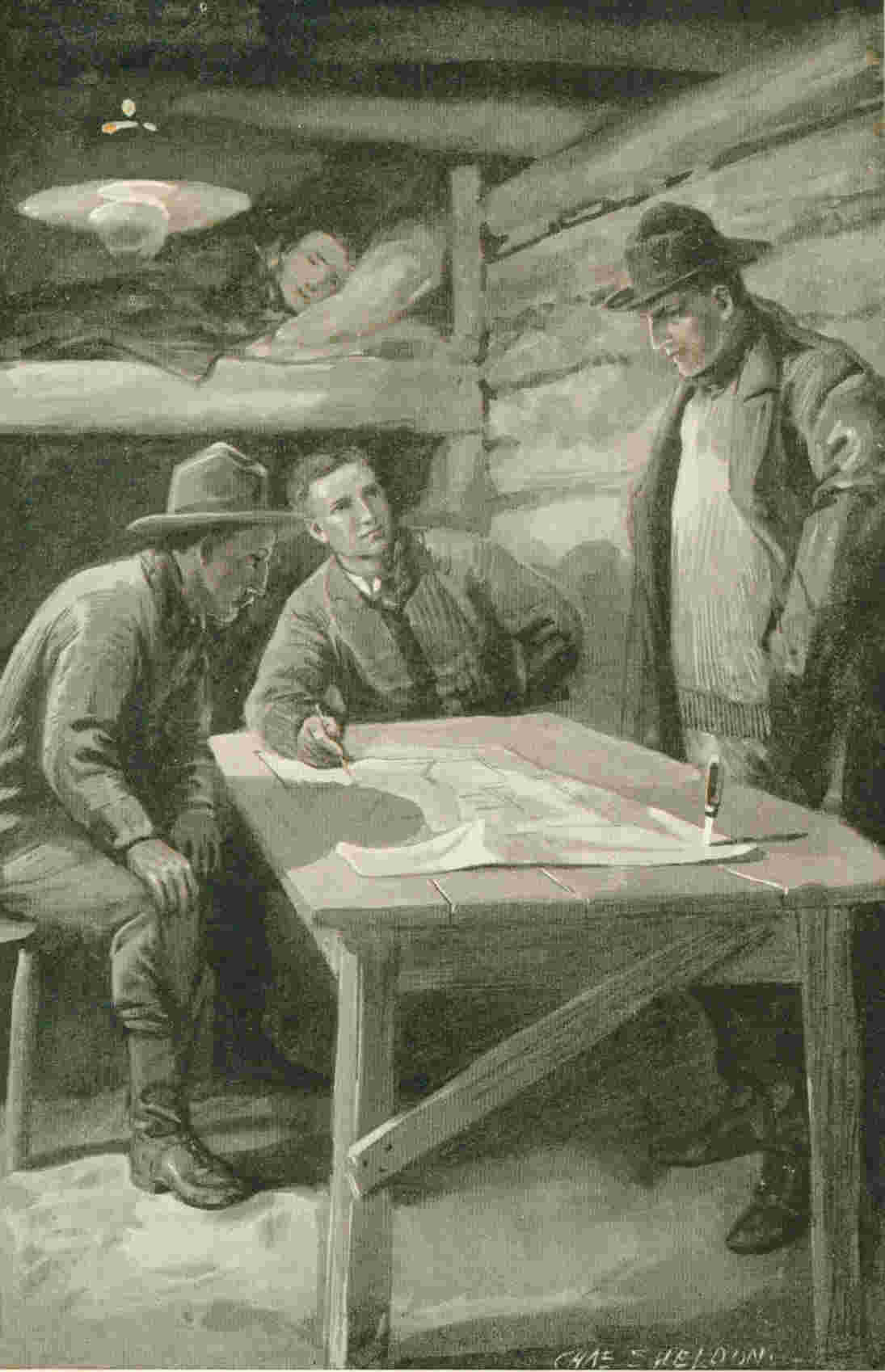
GEORGE INSTONE EXPLAINING HIS SCHEME FOR SLUICES TO WORK THE GOLD CLAIM
“I can see how a young chap like you set in and made money where others were prepared to let that wreck be battered to pieces without an effort. This idea of yours is good, George—thundering good; and the time we shall spend in rigging up the sluices will soon be repaid. It’s lucky, too, about the lumber. We ordered too much for the alterations to the store, and I was just wondering whether the mill would allow us for the stuff we haven’t used. But it’ll come in handy now. We can build our sluices ’way back there at the shack and get everything ready. Then we can cart them down here and set them up. Those boys will be back from the coast before very long, and it wouldn’t surprise me if we were almost ready against the day they return.”
That night the lamp in the shack hung directly over the heads of Bill and George, who sat at the rough log table. Scotty hovered over them, hopping from one side to the other, while Fritz asked numerous questions from his bunk just behind. A huge piece of coarse paper was nailed on the flat top of the table, and thereon the two amateur engineers were sketching the plans of their new undertaking. Far into the night they worked, and when at length they put the lamp out—having meanwhile thrown wood on to the fire in the stove, for the nights were still very cold—and clambered into their bunks their ideas were complete, and they were ready for work on the morrow. The following morning found them erecting rough trestles, while for two days after that there was the clatter of hammers and the sound of lumber being sawn. By then the teamsters hired by George had arrived with their loads; and, having employed the next day in packing and arranging the new supply of stores and resting their horses, they piled their troughs on to the carts and made for their claims in the bottom of the canyon.
Three days later they had all in position, and were free then to complete the fixing of the water wheel which was to rock their cradle. All hands were required for this; and since to have erected it at the fall would have meant that the power developed would have to be transmitted over a great distance—for the cradle was situated right at the foot of the last claim—the stream down there was deflected for a while, a pit dug and faced with logs, and the wheel erected over it. A crank was attached to one side, and the end of this to the cradle.
“Fine!” repeated Bill, for perhaps the fiftieth time, as the bank deflecting the stream was knocked away and the water sent down on to the wheel. “Fine, George! There’s power enough there to rock the cradle when filled to the brim. And ain’t it a cradle just?”
The latter was indeed enormous, and drew shouts of laughter from many a miner. News of the doings up at the neck of the canyon had come to Fir Canyon Camp and to other neighbouring camps by now, and curiosity brought groups of miners to look on at the proceedings. There were cynical smiles on many a face, coarse expressions of disapproval from others, and loud, ribald laughter from not a few.
“I should ha’ thought that Diamondfield Bill was too old at the game o’ mining to take to new-fangled notions of this sort,” declared one cross-grained individual. “Guess he’s struck on these youngsters anyway, and can’t get clear of ’em.”
“Dunno. You wait,” said his comrade, sucking hard at a dirty pipe and tossing it aside a moment later to be replaced by a cigar of best Havana brand. “Dunno, Orville. Bill’s a queer cuss, he is, I guess. I’ve knowed him take on strange stunts and come out top with ’em. He’s a clever chap is our Bill (Doc, as heaps calls him), and he ain’t the sorter man to take on with a queer notion ef there ain’t something good in it.”
Not a few might have been inclined to allow their disapproval to become irritating to the partners working at the foot of the fall. But Diamondfield Bill was not a man to be trifled with. Besides, he held, as it were, a more or less semi-official position. He was one of those individuals of whom there were very few, and who were of the greatest value to such a community as existed on the Shushanna goldfields. Therefore, putting aside Bill’s obvious capabilities to look well after himself, a man who picked a quarrel with him picked one with all his fellows. Laughter, therefore, was the end of the criticism from all sides. Men went off to their own claims, and for a time the matter was forgotten. Meanwhile George and Bill and the gang with them worked very hard. At the end of the week they had their sluices erected and connected to the cradle, the latter being rocked without intermission by the water wheel. But, as yet, no test had been made of the whole combined apparatus. It was therefore an exciting moment when Bill and George made ready to open the sluices which would pass water into the main channels leading down to the rocker. There were six of those channels, commencing at the cross trough running right beneath the fall, and always overflowing with water; and those six, separated and spread out all across the width of the bed of the canyon, gradually converged till they became one, which finally ended in the rocker.
“Go!” shouted Bill. “Open them up, and you boys get in at digging.”
Instantly the hired hands began to throw dirt into the channels nearest them; while George pulled up, one after another, the sluice gates admitting water to each channel. Then, like the rest, he took his spade and thrust it into the soft sand and gravel, throwing it in heaps into the nearest wooden channel.
Two hours later he called to the men to stop work, shut the water out of the channels, and went down to the rocker with Bill.
“This’ll tell us for certain how the thing is likely to work,” said the latter, shaking with excitement; for, like many big men, Bill was susceptible to quite small matters. You might fire a gun at him, and he remained as cool as an icicle. You might watch him when engaged as a member of a posse, when a bullet might come at any moment; Bill was invariably debonair and gay and light hearted. In his own particular field, too—that field which he may be said to have abandoned as a source of livelihood, though it brought relief and happiness to many poor people—in the field of medicine and surgery, the big, blonde Bill was cool and collected, by no means an alarmist, and certainly a first-rate operator. But still he was susceptible to some influences. Here was one. The huge, ponderous fellow was positively shivering as he and George reached the rocker.
“You—you look into it, George,” he gasped.
Our hero pulled the rough wooden lever which slipped the crank rod out of position, and so brought the cradle to a rest. Meanwhile the volumes of dirty water—thick with earth and sand and gravel—which had been sweeping down to and through the huge rocker had ceased altogether. The channels were empty save for dirty sediment, while the last of the water was already draining out of the perforated plate at the end of the rocker. George looked at Bill slyly, smiled a little, and plunged his two hands deep into the sandy deposit left in the well of the rocker. Bill had by then spread a piece of newspaper on the grass near at hand, and on to this George threw the handfuls he had extracted. He spread them out with his fingers, stood aside to allow the rays of the sun to strike upon them, and then sounded a note of triumph. As for Bill, he positively danced. Producing a huge magnifying glass he inspected the shining grains mingled with the sand, took a handful and stepped to the stream, and finally returned with eyes which were shining. Gripping George’s toil-hardened hand he wrung it till that young fellow hollered.
“I say!” George shouted, holding his aching fingers.
“So do I. I say that you’re a cute young feller, and that this here trick of yours is calculated to bring us a fortune. Mind, I don’t care so much about the actual dollars. I’m not like some of these fellows who think of them by day and dream all night about the fortunes they hope to make. But this gold here—and there’s heaps of it—this gold spells success. This bag of tricks that you invented has proved to be the very ticket. It means that we’ll be able to wash every foot of dirt in our claims, and that so quickly that if we wanted we should be ready to take up other claims before the season closes. What’s more, it proves what we’ve suspected. The canyon just here, where the water pours into it, is chock full of gold dust washed down from higher places. Seems to me it’s likely enough that the gold-bearing dirt extends downwards for many feet, instead of being a top layer only, as is so often the case. If that’s so, why, there’s work right here for months to come, and no need to think of moving. No need to fear that our claims will be worked out as I suggested.”
The sample of gold dust which they had obtained after but two hours’ work was, as a matter of fact, most encouraging, and set other miners thinking. Men who had scoffed and jeered were peculiarly silent that evening, and drew hard and somewhat vengefully at their pipes as they sat in their shacks or on the rough timber benches in the saloons, which, as in most mining camps, already existed in numbers at Fir Canyon. For the clean-up at the end of the day showed sufficient dust to pay for the lumber and the labour employed in making the bag of tricks which George’s fertile brain had invented, and had left a handsome margin over. Bill and George examined their gains narrowly by the aid of a magnifying glass that night, and told the jubilant Scotty and Fritz of their good fortune.
“Seems to me as I shall be setting up as a sort of retired feller come the end of this season,” laughed Scotty. “You’ll be finding me down at Vancouver driving my own automobile, living up there in one of them fine houses on Shaughnessy heights, giving parties and dinners and dances. Ho!”
“And you two ain’t the only fellows to get a move on,” Fritz sang out from the armchair which he now occupied, for that had been one of George’s first purchases. “Stores, like everything else, have to be commenced in a small and gradual way—that is, speaking generally, I guess. Well, we’ve started selling. There’ve been a dozen folks in here to-day, and they were mighty pleased at the class of stuff we have for sale. Prices don’t seem to worry mining people so long as they can get just what they want, and the stuff we have brought up seems to be just the ticket. Shouldn’t wonder if Scotty and I cleaned up almost as much as you fellows by the end of the season.”
Those were busy days indeed for the quartet who had entered into partnership, busy and therefore happy days. For Bill and George were on their claims at daybreak, with the hired hands, while Scotty threw open the door of the store just as soon as they had left, that being an intimation to one and all that he was ready for selling. Nor did the folks in Fir Canyon Camp fail to take full advantage of the store. True, there were others already there. But Bill and George and their friends had used considerable thought and discretion in the selection of the goods they proposed to purchase, and Bill’s experience of goldfields in general had been of the greatest service. It followed therefore, that they were able to compete with their rivals easily, and as the camp was already extending, and newcomers were even building shacks closely adjacent to their store, trade soon became brisk to say the least of it.
“Showing that George here was right to take risks and order treble the amount of stuff we agreed on,” said Scotty, rubbing his hands together with delight. “Why, we shall be running short of things soon, and I’m now arranging to send down for another shipment.”
Matters were going so smoothly at the diggings, in fact, that our hero was able to break away from the working of the claims for a while, and once more take the road for the coast. Making the team ropes fast to the backs of the carts he set off without any assistance, and reached his destination without difficulty. Then he set to work to discover where help was to be obtained, and had the good fortune to hire three Scandinavians, fresh from their own country. With their help he loaded his carts with the new goods he had purchased, and once more took the road for the diggings, arriving there before his partners expected him.
“Hardly had time to miss you even, boy,” Bill told him cheerily. “You see, we’ve now been clear over our claims, and have washed up the topdressing. Then we went ’way back to the fall and started taking out the dirt till we got to the six-foot level. My, it’s rich! There’s nuggets there, same as other miners are finding. Shushanna’s famous for nuggets, boy, and we’ve a share of them. That is, we shall have when the work’s ended. We’re hardly commencing yet awhile.”
That year at the diggings proved, indeed, to be one of the most fortunate for George and his friends, and for many another miner. Rich finds were made, and numbers went from the diggings with their pockets filled to overflowing. They had secured their gold for the most part by ordinary methods, and had without doubt left large quantities behind. In the case of our friends, however, they had been thorough and systematic, and, as a result, their claims cleared up most handsomely. When the first snows fell each and all of them were rich, without fear for to-morrow.
“So that ends a season’s work. Well, boys, what next?” asked the huge and good-natured Bill, settling himself opposite the stove at the back of the store at Fir Canyon, and spreading his legs out on a bench adjacent. “We’ve done well. The ‘fall’ claims, as ours have got to be called, have made quite a sensation, and if we want we can set to work at them again next spring. What are you lads figuring to do during the winter?”
Fritz had no hesitation as to his own plans. His broad smile, his healthy cheeks, his active movements showed that he had long since recovered from the injury the rascal Tony had inflicted, and that the mountain air of Shushanna agreed wonderfully with him.
“I shall stay right here,” he said at once, with a promptness there was no mistaking. “I’ve sent ’way back to Germany for my two brothers, and they’ll be here before the ice closes the road from the coast or keeps shipping away. I sent money home for their passage, and more for the old folks. Gee! how they must wonder! Fritz able to send dollars and dollars and not miss them! The same Fritz who, a year ago, had few to call his own!”
“It’s been just wonderful,” said Bill. “And this George started the movement. No use shaking your head, George. We all know.”
“You bet!” Scotty broke in earnestly. “George is a mover. I got to know that almost at once when we shipped aboard that steel freighter, and it didn’t want the storm and her capsizing to tell me that I had chummed up with a fellow who couldn’t stay still, but who was always working and thinking. See what it led to. Like Fritz, I was penniless when we left Vancouver. When we were washed up on the coast I was almost in a worse state, for I had lost what few belongings I had. Then see how he got a move on. Bought the ship. Gee! that made me laugh at first. Bought a whole, big ship, that was a wreck, and for which other folks wouldn’t give so much as a dime, a ten-cent piece. Bill, that move was the commencement of our fortunes. As to what we’re going to do. Well, trading suits me. I had a store in Vancouver before I went to the hospital and was robbed by my partner. I’ll stay right here for a while, and one of these days return and open up in Vancouver.”
“Then I think you’re wise,” came Bill’s thoughtful answer. “Of course Shushanna goldfields won’t last for ever. Claims will get worked out, and presently—not at once, mind you, but presently—all the gold to be easily recovered will have been gained, and the fields will become deserted. Fir Canyon will be a camp of the dead. There’ll be no folks there to trade with you, and this shack, like the rest, will be useless. Till then, boys, there’s a fine trade to be done, and Scotty and Fritz will stick to it. Now you, George, the restless one of the party.”
“I like that,” shouted our hero indignantly. “Talk of a pot calling the kettle black. If ever there were a restless fellow it is you, Bill. But I shall move on.”
“Told you so,” roared Bill triumphantly. “This youth, the pattern of all that is steady and sedate, manages to put in one season in one locality. He then moves on. Dear, dear, George, you’ll be the death of me!”
“Well, I’m going, that’s all,” repeated George stubbornly. “I’ve made enough money this year to last me almost a lifetime, and I want to see other sides of life in this fine country. I’ve tried farming, then railway work, later salvaging the cargo of a steamer, now it’s gold mining and storekeeping. Well, I’ll try one other, and then settle down. Talk of being restless. Why, Bill, you are for ever moving.”
“One of the pleasant little luxuries I allow myself, boy. Why shouldn’t I? I, too, have made a comfortable fortune, and work only because it is good for a man to work, and because I can see where I can help my fellows. Change amuses me. I meet other individuals, and find interest in new scenes and new peoples. Call it restlessness if you will. Then I admit that I am that. I, too, shall leave these diggin’s.”
“For America?”
“For the newest gold fields. For some spot where there is no winter. I shall make for California. There a man can rely upon warm weather, without snow and ice, and for the most of the time on a nice warm sun. Winter gives me the shivers. Like many big men I feel cold sooner and more keenly even than do small fellows. But you, George, you’ll move on?”
“Certainly. Somewhere. I don’t know where quite. Probably I shall return to Vancouver.”
“Then why not try your hand again at thief-catching? It will mean excitement, and will give you an insight into another side of life. See here, boy, you took part in the chase of Jim and Tony, and did handsomely.”
“You bet,” from Scotty, as he sucked at his pipe.
“Gee!” from Fritz, who was a great admirer of our hero.
“Did handsomely. Then why not go regularly into the business? Join the police down at Vancouver.”
“The police! Become a bobby! Stand at the street crossings and direct traffic,” exclaimed George, aghast, for where could there be experience to be gained or excitement to be met with in such occupation?
“No, no,” shouted Bill, stretching his legs and dropping them to the wooden floor of the shack with a bang. “Join the detective force. See here, boy. There are men employed the year round at Vancouver and coast ports searching to find smugglers.”
“Smugglers!” cried all three listeners.
“Aye, smugglers, you bet. Opium smugglers. Men who make a traffic in passing the drug into Canada for the use of the numerous Chinese there. Or even who make a small fortune by sneaking Chinese in themselves.”
“But,” began George, “sneaking Chinese in! Why——”
“Just so. You see, China and Japan are near enough to Canada and the Pacific coast of America to make it worth the while of the natives of those countries to cross. It’s a fourteen days’ trip from Japan, for example, and once a man has landed he finds he is in a country where he can earn two or three dollars a day wages, treble the amount he can get—and more even—in his own country. Ain’t that a fine attraction? Can you wonder that Japs and Chinese pour over to the Pacific coast?”
“Then where the need to sneak them in at the ports?” George asked.
“Just this. Your Chinese or Jap will work for just half the wages a white man will take, and will work for double the hours. So he comes into severe competition with the white man. To limit that competition the Government charges a head tax on all imported natives, amounting to five hundred dollars (one hundred pounds). Now, if a rascal can sneak natives in for nothing, and find work for them at once, he can claim a portion of their wages, and also a sum down from each man. Yes, there are many scoundrels at that game, besides those who smuggle opium, and the police have many an exciting time with them. Now, lad, what do you say to joining that branch of the police? It will occupy the winter months, and as the spring comes along you can be looking round for something more permanent.”
George promised to think the matter over and tell Bill his decision in the morning. It was already late, and those evenings up at the diggings always found him tired and sleepy and ready for his bunk. For work at the “fall” claims progressed without intermission, and every day and all day long the water swirling into the topmost trough carried down volumes of gold-bearing sand and earth. A good night’s sleep, however, and a sharp walk on the following morning enabled him to approach Bill’s proposition with a clear brain.
“It is not as if I wanted to be for ever changing,” George told himself; “that cannot be good for anyone. But I am young yet to get into a settled job; and then again, like everyone else, I hope when I settle down to become my own master and have my own business. That means that one must be able to select a business, and to enable one to do that, experience of the country and of the people is absolutely necessary. Once bit, twice shy, is an old adage, and having been ruined once with Father I am not anxious to make another plunge and be ruined a second time. No, I’ll not be in a violent hurry.”
Canada and North America generally are certainly the countries for successful young men, and prosperity is abundant. But then, as George said, a newcomer should not be in a hurry. It is better for one who aims at his own independence, and who seeks for a business for himself, first of all to obtain work and labour for some other individual while he looks well about him and gets to know his surroundings. Otherwise ruin is apt to follow. For, where there are numerous well-intentioned people, there are also many rascals, like the real-estate agent who had robbed George’s father so heartlessly. Our hero, therefore, was by no means wanting in judgment when he decided to work at this and at that till the time had arrived when he felt sure that he had gained the necessary experience of the people.
“Yes; I’ll go down to Vancouver,” he told himself, “and there join the police, that is, if they will have me. Now, we’ll see if Bill has anything else to suggest.”
The huge miner, who was also a doctor and capital fellow all rolled into one, certainly had many suggestions.
“You’re choosing right, boy,” he said, with emphasis. “You’re full young for settling down yet, and there’s really no need for you to stop up here in the diggings. In the first place, you have made a whole pile. Then your share in the claims and in the store will bring you in quite a handsome income; or you can sell outright to Scotty and Fritz, or to some others. That’s what I shall offer them. They can do as they like; draw a salary themselves for managing the store and the claims, and then share out the profits after all expenses are paid, or buy me out altogether. In any case, you’ve enough to bank against the day when you wish to buy a business, enough and to spare. Put it aside. Forget all about it, and just set in and work for your living as if you hadn’t a dollar. As to getting you a post with the police force, why, I fancy I can give you a letter of introduction which will settle that for you nicely.”
Those were very busy days as the fall set in; for George had numbers of matters to attend to. But at length they were all completed, and, having bidden adieu to Scotty and Fritz, and to many other friends amongst the miners and their families at Fir Canyon, he took the road with Bill, and drove down to the coast. They caught the last steamer for Vancouver, and presently arrived at that charming city, where the hum and the roar and rush of life positively startled them after the peaceful, if bustling, days at the diggings. Nor did Bill forget his promise. A personal call on his part on one of the officials produced a letter addressed to our hero, requesting his presence at the office. Straightway he put on his hat and obeyed the summons.
A tall, slight man, with silvery-grey hair and clean-shaven face, greeted him with a pleasant smile, and with a piercing gaze which seemed to penetrate through him.
“Sit down, Mr. Instone,” he said crisply. “The Mr. Instone who was engaged in that affair at Calgary, eh?”
“Yes, certainly. Bill has told you, perhaps,” admitted our hero.
“Not at all, not at all. Guess we know something about most people, Mr. Instone. For instance, you were first of all robbed by a real-estate man located in Winnipeg. He disappeared almost as soon as you and your father left the east. Then you saw that little matter through at Calgary and went on the railway. I think there was something about a train wreck, eh? and something, too, in addition, which rather tickled the fancy of the people, if it didn’t exactly suit the officials of the railway company.”
He was laughing outright, and, though George was flushed at the mention of that episode, for even now, though he would always do the same, the very temerity of his action startled him, he could not help but join in the laughter.
“Yes, sir,” he admitted. “It was hard on the railway folks; but it meant men’s lives, and I took the risk of displeasing the authorities.”
“In fact, you took responsibility on your shoulders—very young shoulders, Mr. Instone. However, it is a young, active, pushing, and astute man whom I am in search of. You can take responsibility, I know. Believe me, it is the capacity to do that which helps men enormously. That you can succeed, too, is evidenced by the fact that you salvaged the cargo aboard that steamer and finally did well at Shushanna. Yes, my dear sir, I know a great deal, thanks in part to your big friend Bill, who is an old acquaintance. And, as I said, I want a young man who has the push and energy which you seem to possess. I want a close investigator.”
“A policeman, sir?”
“Certainly. But not a uniformed man. I want a species of detective, who will be almost unknown to the other men of our force, and who will not be afraid to undertake a dangerous investigation.”
George’s face shone with anticipation. “I’m ready to try, at least,” he said.
“And I hope you’ll succeed. Let me put the facts before you. Guess they are a little out of the ordinary. A few months ago the illicit trade in opium and in the smuggling of natives into the port of Vancouver became more noticeable. Our fellows, as a rule, are wonderfully successful in discovering such frauds, though I imagine that for every one discovered half a dozen attempts are successful. That will give you an idea of the amount of smuggling that is done. Well, now, our men are baffled. Since the spring came but an odd case here and there has been found out. Others have succeeded; that we know. Yet who it is who engineers these attempts, who it is who is at the back of the whole rascally business, we have no notion. That, George Instone, is the work I have for you. It will be dangerous work. It will need constant watching. It will call for a vast amount of energy. And, should your investigations lead to anything, apprehension of the criminals or criminal will mean the use of firearms on either side. Now, sir, that is the tale. Does it unnerve you?”
George smiled. “When do I start, please, and what are the wages paid?” he asked, in the most business-like manner.
“You start at once. Wages the same as those paid to the rest of the staff, and special allowances, which I will discuss with you presently. Now, see here, lad, you must keep to yourself. Get some other work if you like. Pretend to be anything but what you are to be. Shun the men of the force, though you must know them all by sight, and must carry a concealed badge, by which they and the uniformed police can at once identify you. Then make use of information I may be able to send you, and get on the tracks of these rascals. Realize, too, that you are a secret agent. It is because I know that all my force are known to the men undertaking these smuggling frauds, and who therefore are able to throw dust in their eyes, that I have been seeking a man of intelligence, of strength of purpose and courage, who will be unknown to the ruffians, and who will therefore have nothing to hinder him.”
George bade farewell to the official a little later, and went off to the simple room which he had hired together with Bill. Then he saw the latter off by the train for Seattle, and thence to San Francisco, returning at once to his room. He was unknown in Vancouver, and therefore felt that he needed no disguise. But, nevertheless, the task set him was by no means simple.
“I’ve to have some excuse for going aboard every ship arriving from Japan and those parts,” he said, “and that excuse must be a real good one. It must not be by means of a police permit, for that would defeat my object. Then how?”
The end of it was that he thereupon put on his hat and strolled down to the basin where the bigger boats put in, discovering one of them just steaming in round the wooded acres of Stanley Park.
“Where does she come from?” he asked a bystander.
“Yokohama. Overdue a day, I guess. Waitin’ for folks?”
“No. Just curiosity. But I’d like to get aboard a ship like that and take a look over her.”
“Then you’ll need to go to the office. Visitors ain’t allowed anyhow.”
When George attempted to make his way up the gangway he found that his informant had been correct. A Japanese quartermaster sent him to the rightabout promptly.
“Yo’s ain’t allow on de boat,” he cried in shrill tones of anger, for so many people had made the attempt. “Yo’s hab to hab a ticket, white one, velly good; or yo’s hab to be polis, or someting same, yes, or sell de oder tings. You bet, yes. Go way quick, plenty, if yo please.”
“Sell things. What?” demanded George; but the irate little man sent him down the gangway without deigning to give an answer. On the quay, however, George made good use of his eyes. There were four individuals with trays suspended over their shoulders, and metal badges on their caps bearing the words: “Licensed Hawker”.
“Make much at that, Charlie?” he asked one of the men, a young fellow somewhere about his own age, and making use of the familiar terms often heard in the West.
“Jest a living, that’s all,” came the answer. It was spoken in sad, spiritless tones, and immediately gave our hero an idea.
“I’m looking for something like this myself,” he said. “How does one get a licence?”
The hawker looked him over sharply. He was a sad-featured young man, and looked delicate and half-starved.
“How does one set up and get a licence? Why, easy. The question is, How does one make a living? Mind you, I’ll be honest. I’m just living, as I’ve said. But a chap who happens to have a few dollars to spare and can buy attractive goods, why, he can do well. See here, I’ll trade my goods and licence. How much?”
They bargained for quite ten minutes, for it would not have done for George to pay a big price. At the end of that period he was the possessor of the badge, the tray and its contents, and full information as to where to make his purchases. Fortunately, too, his clothes were old mining ones, with many a stain on them, and so he did not look too respectable to fill this new position. Slinging the tray at once, he marched up the gangway, the official form bearing his name and his licence number resting in his pocket. It was George Sprocket, then, who boarded the steamer in the person of our hero.
“Hallo! Who you?” demanded the same quartermaster, though he did not recognize our hero, for the hawker’s cap transformed him. “Ho, hawker! Yo sell de little tings. Good! Yo got no whisky; no wine; no spirit? Good! Yo go board. Me see you little later.”
The latter was just a hint to our hero not to forget the man who could, if he wished, bar his entry on a future occasion. The real George Sprocket had intimated to our hero that he would need to present a small fee to the Japanese who guarded the top of the gangway.
Meanwhile all the passengers had left the steamer, and there remained merely the crew. George went amongst them peddling his goods, selling at a price which was likely to make him popular.
“Yo cheap, yo,” one of the dusky little firemen told him. “S’pose yo come back later wid oder goods. Den buy all, heap, yes, eberyting.”
Taking care to ascertain what class of articles was required, George soon left the vessel, and, crossing the quay, strode off to the quarter where nickel stores existed, and where he would be able to purchase the goods needed to fill his tray. At the same time he sought for a lodging in that neighbourhood, and soon had secured one, a humble affair, but neat and tidy, and kept by respectable people.
“Now who’s the man most likely to know what goes on aboard a steamer such as that one?” he asked himself that evening, when he had again visited the ship and had returned to the new room he had taken. Not that George had forgotten his superior’s orders to use the greatest caution. He had left his badge and tray behind him when first he had found the new room, had dived into a narrow street, and then leapt on a street car. And finally he had reached the rooms which he and Bill had been occupying together. It was dark when he sallied out again with his bag and made for the other lodgings.
“Who’s most likely to know?” he asked himself again, thinking deeply. “Not the captain, nor the officers. Ah! That quartermaster fellow.”
The thought that it might be he became after a while almost a certainty. For this quartermaster was in charge of the gangway. He had been there on George’s first arrival. He had been in the same position when he first went aboard as a hawker, and there he still stood on his second visit early the next morning. Moreover, the greedy little fellow had not hesitated to repeat that hint, and to hold out his hand in a suggestive manner.
George had handed him a dollar.
“Tanks! Yo generous. But, say, boy, yo want tings from here, from de ship? Cheap tobacco; cheap, velly cheap spirit, whisky, heh? Yo come to me, to Shono, quartermaster. Me fix yo fine. Yo see. Shono friend to lot people.”
No doubt he was a little rascal, and the very fact that he had offered to sell spirit to George, spirit at a very low cost, which must be smuggled ashore on his tray, was proof positive that the little ruffian was not too honest.
“Just the sort of man. I’m informed that opium is smuggled over in almost every ship, of course unknown to the officers. The customs people and the police search high and low, but without success; and yet, later on, they learn that opium has actually come ashore. Now, how am I to watch that little fellow?”
He sat late into the night cogitating deeply, and finally fell asleep in his chair, having failed to solve the difficulty. But the next morning found our hero with at least a suggestion. He breakfasted at a little café, bought an old slouch hat and a suit of much-worn clothing at a junk shop near at hand, and, having added a suit of frayed overalls to his kit, he sallied forth and made for the quayside. Men were wanted to act as stevedores, that he knew, and felt sure that he would have no difficulty in obtaining a post. Nor was he disappointed. In ten minutes, in fact, he was hard at work with a barrow, wheeling boxes from the deck of the vessel to the wooden slipway rigged from her side down to the quay, and down which those same boxes were projected. But George did not work with his hands alone. He used his eyes and his wits, and watched every movement of that little quartermaster who rejoiced in the name of Shono.
“Taking it easy at the gangway, passing the few people who wish to come aboard or leave the vessel,” he thought. “Who’s that man who has crossed the gangway three times in the last hour?”
George stared hard after the figure of the one he referred to. It was that of a white man, dressed somewhat like a clerk, and wearing an ill-kempt beard and moustache. At a guess the fellow was fifty years of age, slouching and untidy, and looked exactly what he no doubt was, namely, a clerk.
“From some office,” thought George. “Some office having business over in Japan, and perhaps goods aboard here. I’ll watch him. Why does he want to whisper to Shono on each occasion when he crosses the gangway?”
There might be nothing in it; and yet, on the other hand, here might be a clue. He knew well from his superior that opium was smuggled across from China or Japan on almost every ship, and he had learned that there was someone new to the police who was engineering the smuggling. Could this seedy, down-at-heels clerk be the man?
“I’ll just watch him, that’s all,” said George. “He’s just come aboard again, and I saw him whisper again to Shono as he passed. I’ll wait till he goes ashore and then go after him.”
Meanwhile a complaint of thirst allowed our hero to leave the gang and go below to search for water. He found it at a tap down in the waist of the ship, and thrust his lips beneath the stream pouring from the faucet. But his eyes all the while were fixed upon that seedy individual. He stood at the door of the crew’s quarters, notebook in hand, apparently inspecting a number of cases and checking them carefully. But, as a matter of fact, he was talking quietly all the while with another Japanese, not with Shono, but with one of the same rank, namely, a quartermaster.
George satisfied his thirst, wiped his mouth with his sleeve, in true stevedore fashion, and then slouched past the two men, who were now deep in conversation.
“All light!” he heard the Jap say as he passed. “De stuff dere, safe and sound, and yo come to-mollow. When? Night?”
“No. Morning. When all the folks are about. But, see here, you’ve to work the packing. Here are your cases, and if—— Shucks! where are you coming to, man?”
The seedy individual happened to step backward just as George was passing, and bumped heavily into him. It was the very first he had seen of the stevedore, for he had been so engaged in conversation that he had not noticed his surroundings. Now he started and swore beneath his breath.
“Where’re you coming to?” he demanded roughly. “Look where you’re going!”
But George made no answer. He shuffled on, leaving the seedy individual the impression that he had been drinking. The man raised his shoulders, smothered his sudden anger with a smile, and patted the Jap on the shoulder.
“Jest shows how careful a man has to be,” he said. “Now he might ha’ heard.”
“No, no. Not hear,” the little man beside him answered at once. “Me sure. He only stevedore. They stupid.”
That, too, was evidently the opinion of the seedy individual, for he gazed at George’s receding figure with something of pity in his looks.
“Guess you’re right. Them chaps is the lowest,” he said aloud. “But, jest you remember. You’ve got the cases here, duly labelled. To-night you heave overboard the dope that’s in ’em and pack the other stuff. To-morrow, in broad daylight, we carry the stuff ashore and get it passed under these labels.”
He pointed to the huge printed label nailed to the case near at hand, bearing the words, “Japanese toys”, and nodded to the quartermaster. Then he turned and made his way to the gangway. Tramping across it he exchanged a few whispered words with Shono, and then went shambling across the quay. Two minutes later he was followed by a tall, broad shouldered, slovenly fellow, with cap pulled down over his eyes, collar half turned up, and a generally neglected air about him. It was George. He had pulled off his overalls, made those small but necessary changes in his appearance, and was at that very moment affixing a false moustache to his lips. Groping in an inner pocket as he shambled after the bearded man he pulled out a tiny mirror and took a hasty view of his features.
“My!” he exclaimed beneath his breath. “Not half handsome, eh? Well, it’ll do. A moustache doesn’t seem to suit my particular style of beauty. Now, where’s this fellow going? Up Main Street, eh? Now to the right, along Hastings Street. That leads to slummy quarters after a while, just the sort of place a rascal would make for.”
Slouching along the pavements, looking into shop windows whenever the man he was following stopped, George at length boarded the same car with him, and travelled out half a mile from the centre of the city. He got off the car when the man alighted, and turned in the opposite direction, looking at the numbers of the houses as if uncertain of his whereabouts. But no sooner had the man turned down from the main street than George ran to the corner.
“Gone into the third house down the block,” he told himself. “A rooming house, where he has lodgings, no doubt. Next thing is to find out his name and more about him.”
He lounged about for more than an hour, wandering up and down the street till he saw the fellow he was after emerge and walk briskly away. No longer did he shamble as before, while his step was active and entirely different from that he had affected on the quay. He reached the corner, boarded a car, and was whisked away toward the city. Instantly George crossed the road and rang the bell.
“Charlie gone?” he asked, using that name at a hazard. “I was to call for him at two, but guess I’m late.”
“Charlie! Oh yes, Mr. Ramsby,” came the answer. “Didn’t know he was Charlie, though, for his initial is J.”
“John,” said George promptly, smiling as he did so. “But we call him Charlie, you know. He’s here?”
“No. Left two minutes ago.”
“Huh!” grunted our hero. “But he’s left a note?”
“A note! Well, he may have done. Step in, Mr——, er.”
“Stanley,” said George. “Mr. Stanley. But he’s sure to have left a note, and I shall get to know where to meet him in the city, so you won’t have to remember the name. I’ll tell him I called. Thanks, ma’am, I’ll step in and look for the note.”
He was ushered into a room, and the landlady closed the door behind him. At once George set to work to search for papers or for letters, anything, in fact, which would give him some clue to the identity of this suspicious stranger. Opening a valise he found a pocket in the lid, and therein a bundle of letters.
“Ha! Something here at last. Let’s see. One from Japan, unstamped, though, and evidently brought over by that quartermaster. Yes, it’s on Chinese paper, and a Chinese brush has printed those letters. Here’s a find! What’s in it?”
He opened the long envelope at once, hastily read the contents, and then pocketed the letter.
“Expect a consignment of opium,” he had read. “Shono and another will hand it over to you. This is to inform you that Ho No, Shin Nin, Pe Toe, and Hang Chow will cross in the vessel which follows. For their admission to Canada my draft for two hundred dollars will be honoured.”
“Proof positive of his complicity in the work of smuggling opium and natives,” chuckled George. “Now, what’s in the others?”
He was glancing through them, and was so engaged that he had neither eyes nor ears for anything else, when, suddenly the door of the room was flung open and a figure bounded in. It was the man he was following, the man he suspected, the rascal to whom that incriminating letter was addressed. It was the same individual who had whispered to Shono aboard the vessel down at the docks. But how altered! For now he was no longer the seedy, down-at-heels clerk whom George had followed, but a brisk, alert individual, with blazing eyes and mouth which showed determination. He stood at the door one moment, staring hard at the intruder. Then, with a bellow of indignant rage he threw himself upon our hero.
Locked in a close embrace, George and the man whom he had been following, and whom he suspected of complicity in the smuggling of opium, struggled for some two minutes, each endeavouring to get a master grip or to throw his opponent.
“Robber! Thief!” shouted the man, doing his utmost to clutch George by the throat. “I’ll call the police! I’ll hand you over to them! Stop struggling or I’ll shoot you dead where you stand!”
No doubt he would have carried out his threat, but George held his arms tight to his side, for he had thrown them round the figure of the man, pinioning his hands. Then he strained every fibre in his body and lifted the man, lifted him a foot from the ground, swung him a little, and finally dashed him to the floor. But the attempt did him but little good. The man was up in a moment, and leaping backward made a dive for his hip pocket, where no doubt he carried his revolver. It was one of those moments when hesitation is fatal, and when instant action alone suffices to save a man’s life. George did not hesitate. Quick as a flash he was after the man, and, getting within reach of him, struck out with his right fist. Nor was the blow wasted. For just as the rascal was drawing his weapon George’s knuckles landed on the point of his chin and sent his head backward. It did more than that, however, for our hero had put all his weight into the stroke, and sending it home he knocked his adversary backward, causing him to fall to the floor with a crash which could be heard even outside the house.
Instantly George looked about him, seized the remaining letters of the bundle he had been examining, and darted from the room. He was out of the front door within a second, and racing up the street had the good fortune to find a car just halted at the corner. Leaping aboard it he was whisked away even before the man he had struck had recovered his footing.
“Well, of all the ruffians,” the fellow gasped as he sat on a chair and held his buzzing head between his hands. “Ah, that you, Mrs. Murphy?”
The landlady stood in the doorway of the apartment, her hands held high above her head, consternation written on her somewhat expansive features.
“My!” was all that she could gasp. “You’re hurt?”
“Hurt! Gee! The fellow knocked me down with a hammer. Look at my head. It feels as big as a whole pumpkin. How’d you let him in?”
The man glared indignantly at his landlady, and then sank his head once more in his hands. His brain was whirling after that terrific blow. His eyes were filled with stars, while he felt sick and weak after his struggle.
“How’d he come to be here?” he asked fiercely.
“Why. Well, I——”
“You let him in, eh?” demanded the man angrily, cutting the woman short in her halting explanation. “Suppose he said he knew me? Suppose he just wanted to leave a note.”
“You’ve got it there. Said he’d an appointment with you, but guessed he was late. Asked to come in to see if you had left a note for him. Who was he? A robber? Surely not. He looked a nice young fellow.”
“Huh! All young fellows look nice to people like you,” growled the ruffian. “Guess he was a robber, Mrs. Murphy, and seems to me he was searching my grips for dollar bills. But I don’t keep ’em here now, ma’am. Not here, I can tell you. So he’s been disappointed. Wait till I see him again. Then I’ll teach him.”
Not for an instant did he appear to have suspected the real nature of George’s visit; nor did he think to look into the pocket from which our hero had extracted the packet of letters. He just took it for granted that this had been a common attempt at robbery, and, growling at its recollection, and still holding his head, he pushed his way past his landlady and went to his bed, there to sleep off the headache George’s blow had caused him.
Meanwhile our hero had been whisked on into the city, and, arrived there, had made his way to his rooms. Disengaging the moustache which had disguised him, he regarded himself very closely in his looking-glass for some few moments.
“No. He wouldn’t know me again, particularly if I change my clothing,” he told himself. “The thing that bothers me, however, is this. Does that fellow suspect what I am after? Does he realize that he is being watched and followed?”
He sat thinking the matter out for quite a while, and then decided to set a watch on the house he had so lately entered. Recollecting that he owned a hawker’s licence, he slung the tray around his neck again, pulled his dilapidated cap over his eyes, and once more returned to the scene of his late encounter. It was perhaps an hour later when he boldly knocked at the very door from which he had fled so hurriedly a little earlier.
“Scissors, knives, and knick-knacks, ma’am?” he ventured, as Mrs. Murphy came to the door. “Cheap things of every description. Now, ma’am.”
“Be off with you!” cried the lady angrily, looking at everyone who came near her house now with suspicion. “Be off with you. I’ve had enough trouble to-day already with unknown callers.”
But George, like the race to which he appeared to belong, was not to be driven away easily. He launched forth into a long and eloquent description of the virtues and cheapness of the wares he peddled, and held Mrs. Murphy spellbound. She even condescended to look at his scissors, and asked their price. Just at that moment the door of the room George had entered opened, and the man he had been following came out.
“Who’s that?” he growled, and our hero could have sworn that he knew the voice. “You ain’t inviting more folks to enter, Mrs. Murphy?”
“Why, no. But—why, he’s only a hawker. He’s no robber. Besides, you didn’t lose anything, eh?” she asked sharply, for she resented being blamed for that episode.
“Lose anything? Not me. I’ve gained—gained a head that feels like a whole pumpkin, I can tell you,” grumbled the man, smiling sardonically. “Next time it’ll be the other way. Well, so long! As it’s only a pedlar this time, it don’t matter, Mrs. Murphy; but don’t you let other folks into my room. I haven’t any friends in the city, so that’ll be a guide for you. Now, I’m going.”
He pushed his way past George, not deigning to give him another look, and went off up the street. As to our hero, he hastily concluded a bargain with the unsuspecting Mrs. Murphy and hobbled away from the door. The man he had so recently struggled with was at that moment entering a car, and pursuit looked out of the question. But things are possible over in Canada which would baffle a detective perhaps in England. George still had his badge of office concealed beneath his coat, and determined at once to make the first use of it. He hailed an automobile just then passing, and though the driver looked vastly astonished he pulled in to the curb. Then our hero lifted the lapel of his jacket and showed his star of office.
“I’m following a criminal,” he whispered swiftly, “and I’m sorry to trouble you; but he’s boarded that car ahead, and will be away before I can get near him unless you will take me on.”
“Step right in. Glad always to help an officer,” came the swift answer.
A moment later the car was bounding along the street, while George, sunk in the back part, and kneeling on the floor, rapidly changed his appearance.
“Getting to be a kind of lightning-change artiste,” he smiled. “Still, I guess it’s necessary. That fellow is bright enough, for all his shambling, seedy ways, and though he may think now that I was merely a common robber, his late adventure will make him suspicious of other people. In any case, he’d know me as a hawker. Well, I was ready for that.”
Our hero had, indeed, thought the whole affair out very thoroughly, and had taken steps to provide himself with more than one form of disguise. Clothes, of course, he could not easily change, though he could alter their appearance. The mere turning of his jacket inside out made a wonderful alteration, for it was lined with thick cloth, and looked, if anything, rather better inverted than it did in the more correct position. Then a beard and moustache converted him into a man of forty years of age, instead of a mere stripling. Indeed, when the driver of the automobile turned round a few minutes later, to ask directions of his self-invited fare, he was considerably astounded.
“Here,” he called loudly, “who are you? I——”
George smiled, showing his teeth, which were strangely like those belonging to the hawker.
“It’s all right,” he laughed. “I’m the same man, only different. I’ve been dressing up a little. Now, please follow that car ahead, and when I call, let me get out instantly.”
“You bet,” was the only answer the driver attempted, and, at once speeding up his automobile, he raced after the car which bore the man George was watching. It was not till it reached the heart of the city that the seedy, bearded individual alighted, when at once George called gently to the driver.
“Thank you very much for your help!” he said. “Please stop opposite that shop, and then drive on immediately I have alighted.”
Stepping briskly out of the car, he crossed the pavement to the window of the shop and gazed into it. But the goods displayed within did not attract his attention. He was watching the figures reflected in the glass, and chiefly that of the man he was after. He was looking about him warily, peering at passers-by, and particularly at the people lounging on the pavement. Perhaps a minute later he appeared to be satisfied that no one was watching him, when he strode across the street, and, having walked some little distance along it, dived into a doorway. A minute later George was entering the same place.
“This will be his office,” he thought, “the place where he receives the opium he smuggles in—or, rather, the opium others smuggle in for him. Where’s he gone? Ah! taken the elevator.”
He waited till the elevator descended again, when he at once accosted the youth in charge.
“Say,” he said, “I’m seeking for a friend whose offices are here, and just now missed him as he entered. What floor, please?”
“Fifth, No. 509,” came the sharp answer, for liftmen in Canada seem to be almost too busy to answer questions. “Step in.”
George did, and was whisked to the fifth floor. There he alighted, and walked along a wide corridor till he came to a glazed door labelled 509. All the way along he had passed similar doors, with numbers upon them, and the names of those who rented them. But Number 509 had no name upon it, while the one next door had a notice attached, indicating that it was empty and was to let.
“Apply in basement for the key,” he read.
“Might get some information if I could get in there,” he thought. “Let’s try.”
He turned the handle softly, and to his delight found that the door opened. He was inside the office in an instant, and softly closed the door. Then he looked about him. The place was empty, save for old newspapers and dust scattered about, and consisted of one single room. A panelled wall separated it on either side from adjacent offices, while a big window admitted light. There was a steam radiator in one corner, and a telephone instrument stood on the floor waiting for the desk of some business man to accommodate it. George went to the window and slowly prised it open, so as to enable him to look out.
“Nothing to be done there,” he told himself at once, for the wall outside was innocent of projections, and would give no foothold. “Window’s out of the question. Hallo! A ventilator in each panelled wall. Where does that lead to? And how am I to reach it?”
He stood gazing up at a large, square opening overhead, screened by a metal grid, and scratched his head reflectively.
“Leads perhaps into the air shaft,” he thought. “Perhaps into the next room. I can only guess, for the thing’s too high to be reached. No; no, it isn’t. I know how to do it.”
Once more he opened the door softly, and, creeping into the corridor, sought for a chair which he had seen standing there. He was back with it very soon, and placed it silently against the wall. Standing on the seat he could just reach the ventilator. But George was not the lad to be easily beaten, and his fertile brain had soon discovered a means to climb even higher. He propped the chair against the wall, and gently clambered on to the back, managing to get his fingers firmly caught in the metal grid. Then, working very silently, he pulled the grid open and inserted his head. Immediately a thin streak of light rewarded him for his efforts.
“Opens into the next office. Just the thing for me. But the grid in there is shut. Now, how on earth am I to get it open without that fellow hearing?”
It was the hardest conundrum of all, and caused our hero a large amount of tribulation. He thought of all sorts of measures, and abandoned them. He even considered the advisability of going down into the street and hiring a boy to bring up a note and deliver it at No. 509. Then he decided to hammer on the door himself, and dart back into the empty office.
“It’ll make him wonder, that’s the worst of it all,” he told himself. “But what else am I to do? I must see into that other office, and if there is anyone with the man I suspect, I must listen to their conversation.”
It was, indeed, a dilemma, but not one altogether too difficult to be overcome. Perhaps our hero’s plan for settling it, too, was as good a one as could be devised under the circumstances. But good fortune was undoubtedly with him on this occasion. It was just by the merest coincidence—a fortunate one, to be sure—that just as he turned the handle of the door to carry out his project he heard the elevator stop and discharge a passenger. Popping his head out through the doorway he peeped at the man coming down the corridor, and then instantly closed the door and flew to the chair.
“My word!” he gasped. “This is luck. I must be ready for them. Ah, there he’s knocking! That’s the handle of the door turning. Very well; there goes a push at the opposite ventilator.”
He stretched his arm into the channel leading from the ventilator in the empty office to the one adjacent and firmly pushed at the metal grid. It swung open on its hinge, grating noisily; at least to George the noise it gave out was terrible. It threatened to ruin all his plans, and, he felt sure, must be heard by the man he was following. But no. He could hear voices now.
“Shono,” he said. “I caught a glimpse of the little rascal coming along the corridor. Wonder whether he’s brought opium with him?”
He clambered still higher, till his head was well within the opening. In that position he was just able to look into the office which Shono, the quartermaster, who was wont to guard the gangway aboard the vessel he had boarded, was just entering. George could see the top of the little fellow’s head, now bare, for he had removed his cap, and opposite him was that of the man he was following. More than half the face was visible also, smiling and debonair now, not glaring and fierce, as it had been so lately, when he and George were locked together.
“Ha, Shono, well met!” he heard. “So you’ve come ashore to keep the appointment. Now, how have you been getting on with the work? Finished, eh?”
“Finish! Yes, velly nearly. All ready to-night. To-mollow yo come for de boxes. Stuff in dere. To-night I bring anoder load on shore.”
They went towards a table in the centre of the room—not that George could see at first. Then, with a start and a half-suppressed exclamation of delight, he found himself watching the whole scene without any great difficulty; for there was a mirror high up on the wall opposite, and by looking into that he caught the reflection of Shono and his fellow conspirator, of the table towards which they were walking, and, indeed, of the whole contents of the room. At that very moment the diminutive Shono was dragging sundry paper parcels from the depths of his clothing, and was placing them one after another on the table with an audible bump.
“Heavy stuff. Opium, most likely,” George thought, gripping hard at the ventilator to retain his somewhat precarious position. “Wonder to me is that the customs officials ever passed that Shono.”
“Ho, ho, ho! Dat clever,” he heard the Jap laughing, while he strutted across the room. “I tell you, de officer he say to me: ‘Yo go shore now, Jap?’ Me answer: ‘Yes, yo bet. Me go. Yo come too. Hab refreshment.’ Den he say: ‘Hab anyting, yo Jap?’ Me smile. ‘No likely.’ Den he nod. ‘All light; yo go. Not hab refreshment, thanks. Not time. Some day later.’ ”
“And the fool passed you without suspecting. Why, soon there won’t be any need to have those cases, Shono,” the other man laughed, seating himself at the table and beginning to tear the paper from one of the parcels. “If the customs boys are so easy with you, why, you might as well bring it all ashore in your pockets. But guess the other way’s safer and quicker. So you’ve got the better part of the stuff packed already; and the rest will be finished this evening. Where was it all hidden, Shono? You boys are so clever you beat the police every time, and me too, for the matter of that. Why, last week, when a steamer came in bringing stuff for me, a whole bunch of detectives went aboard and sent the crew to their quarters. Then they searched high and low; but there wasn’t anything to be found, not even when they turned the crew out of their quarters and searched there also.”
Shono giggled. George could see the little ruffian sniggering, and watched his reflection in the glass. It was plainly to be seen, too, that the little Japanese was consumed with conceit because of his success in this matter. He laughed outright as he strutted across the floor, and finally brought up in front of the man who had addressed him.
“How dat managed?” he asked, with a grin. “Simple. Simple’s walkin’. Yo see, yo, Mr. White Man. Japanese velly clever fellow. What he do then when de police search the ship? Ho, ho! He hab the stuff right on him. He searched fust off, yo see. Dat all velly good and fine and excellent. Yes, fine. Noting found. Course not. Noting dere to find just then. Den he sent to quarters. Stuff dere, Massa, right dere, under the blankets. Jap take um and put into clothing. Jap smile while police search de ship. Then crew ordered out of quarters. Noting dere. All gone. Police velly angry.”
His hearer roared with laughing. “Fooled ’em nicely,” he cried. “That ain’t difficult either, it seems. But supposing they were to search you all at the end of their trip? How then?”
The Japanese immovable face was seamed for one instant by an inscrutable smile.
“S’pose dat. Well, Jap hab plenty place to hide. Empty beam in old day, when dere wooden ship. But now dat all steel, dey hab to look out for oder places. Engine room velly fine. Dere lots ob little places where de stuff go easy and not found. Dis trip all de stuff hidden behind de clocks. No one know, save the crew. De police come aboard and look round. Dey open the cases ob the clocks. Noting dere. Not noting. Velly satisfactory.”
He had the quaintest way imaginable of expressing himself, and even George found it difficult to abstain from laughing; for Shono really cut a ridiculous figure as he strutted across the room, passing to and fro in front of the rascal who employed him. As for the latter, he shouted with laughter, and made his office ring. Then, suddenly recollecting the danger of the enterprise in which he was engaged, he looked startled, and gazed about him. But the expression of his face changed a moment later, and, watching his reflection in the mirror, George saw that he was smiling. Where had George seen that smile before, and of whom did the man’s voice remind him?
“Who?” he asked himself. “I feel positive that I have met him before, but where and when, how long ago, is beyond me. But there’s one thing certain: I’ve got to a spot where the rascals tell their secrets, and this very day I’ve learned of hiding places which the police have never suspected. More than that; I’m sure I have dropped upon the very man who is engineering these frauds upon the revenue authorities and upon the port police. The question now is, How am I to act? It is clear that not only is Shono a party to the frauds, but that every man aboard, with the exception, of course, of the officers, is implicated in these acts of smuggling. Will it be better to apprehend these two now, or wait till to-morrow morning, when the cases are to be brought ashore?”
He let the fingers of his right hand swing down upon the butt of the hidden revolver he carried, while still his eyes were fixed upon that mirror hanging opposite. He watched listlessly as Shono bent over the table, and his accomplice and chief slowly tore the paper from the heavy if small parcels which he had brought with him. That paper, too, adhered, as if the material it covered was sticky. It came away in large flakes, and George noticed that some was stained, as if the contents had melted. Then he was rewarded by seeing one entirely stripped, and by assuring himself that it was of a dark-brownish colour.
“Hum! And the smell is characteristic,” he told himself. “That’s opium, for sure, and those rolls on the table must be of considerable value. There’s evidence there, in fact, sufficient to incriminate these people.”
Once more he wondered whether he ought to at once take steps to have Shono and his companion arrested, or whether it would be better to wait, so as to prove the complicity of the whole crew of the vessel. He had gathered from the Japanese quartermaster that they were all a party to this smuggling, and, no doubt, if the crime could be brought home to them it would be the surest and completest way of putting a summary end to such affairs. On the other hand, there might be some hitch, and this chief, this rascal who undoubtedly had instigated the acts of smuggling, and who provided the market for the opium imported, might become suspicious, and escape. It was a trifling dilemma, but yet of some importance, and the thoroughgoing George lent his full wits to it. And all the while, as he puzzled his brains, he retained his grip of the grilled opening of the ventilator, and held his eyes riveted to the mirror hanging to the wall opposite. Shono was strutting to and fro again, while the other man was slowly and laboriously picking the paper from the balls of opium which the little Japanese had brought ashore with him. It was a long and a tiresome job, and perhaps took ten minutes. But at last it was done.
“Twenty pounds of it, if there’s an ounce,” sniggered the white man. “Twenty pounds; and aboard you’ve got wellnigh a hundred. That’ll be enough to settle every Chinese in this country, and still spare a heap for those across the border. As to getting it into America, why, that’s as simple as walking. I drive an automobile, my son. I’m a wealthy man travelling through the country, and that car, believe me, has a gasoline tank that’s a fine puzzle. Anyway, it’s puzzled Uncle Sam’s customs officers this many a time. Then, too, they get mixed as to my identity. Know what identity means, eh, Shono?”
“Know velly well. It means that you’s the same man, but you isn’t.”
“Ha, ha!” laughed the one who had addressed him. “That’s a new sorter way of defining the word ‘identity’. But there it is. I cross the frontier as I am, bearded, and you’d perhaps say handsome, eh?”
He smirked at his companion, and then grinned widely. Shono smiled his sympathy too.
“Course. Handsome. Velly,” he said with decision.
“That’s this side. Over there I’ve a different sort of beauty.”
“Eh?” asked Shono.
“Jest look.”
The Japanese looked, his face expressionless now. And George looked also. Let us describe the act more completely. George stared hard, as if his eyes would leap from their sockets; for the man addressing Shono had swept his hand across his face, and, lo! as if he had performed a conjuring trick, his appearance was entirely altered. The face was clean-shaven now, seamed with many a line, a rascal’s face—the face of none other than Tony!
“Tony!” gasped our hero, recognizing the ruffian at once. “The fellow who nearly killed me up at Fir Canyon! Can it really be he? Yes; without a doubt. And he’s the ringleader in this smuggling!”
But, wait; there was more to attract George’s attention and hold his eyes riveted on that mirror. A moment before he had been staring at the reflected face of Tony. Now he was watching the villain’s eyes. They suddenly took on a startled appearance. They actually bulged from his head, while there was not the smallest doubt that they were fixed upon the reflection of the ventilator. To be explicit, Tony, suddenly looking up at Shono, had happened to glance into the mirror. There he saw the reflection of the ventilator behind him, and framed within it, as it were, a face—that of George Instone. Yes, that of George Instone, the youth who had outwitted him up at the Shushanna goldfields. There could be no doubt about it; for our hero was not good at the wearing of disguises, and finding that the exertion of hanging to that ventilator had constantly disturbed the false beard and moustache he wore, and that they were sadly in his way, he had removed them. It was, then, George Instone whom Tony saw. With a bellow of rage the villain leaped to his feet and dashed to the door of his office.
George heard the door of the adjacent office torn open, and feet in the corridor outside. He heard his own name repeated in threatening tones, followed by the sound of a stumble. Then Tony’s door went to with a bang, while the feet of that ruffian resounded close outside the empty office. Instantly our hero dropped to the floor, and racing across it jammed the back of the chair, which he had borrowed from the corridor, beneath the handle of the door, which now alone stood between him and the ruffian he had followed.
“Open! Open at once! Guess I’m going to shoot you!” he heard Tony growling. Not that the rascal lifted his voice too high. He was fearful of alarming the tenants of the neighbouring offices. Still, George could hear, and knew what to expect if once his barricade were broken open. He cast one glance at the window, and then, remembering that it was useless, drew his revolver and stepped across to the corner where the telephone was resting. Very quietly he spoke into it.
“Give me the police headquarters at once, please,” he demanded.
“What number, please?”
“Listen,” said our hero abruptly, his voice pitched in an anxious key. “I am a police officer, and this is a matter of life and death. Give me the police headquarters instantly. I haven’t the number.”
There was silence for a moment, save for a slight buzzing in the instrument. Then there came a loud bang at the door of the office. The handle was turned, and the ruffian outside put all his weight against it. George watched as the chair moved a little and tilted on to its two foremost legs. It creaked, and the timbers bent as if they would break, while it shifted again just a little. But that little was sufficient to enable Tony to thrust a hand into the office. George could see the fingers worming their way in through the narrow crevice, bending this way and that, coming farther and farther in, seeking for the chair which was jammed beneath the handle of the door.
Bizz! went the telephone instrument. “What number did you say?” he heard, and ground his teeth with vexation; for this was no trifling matter. It was distinctly a matter of life and death, and a second’s delay might mean his entire undoing.
“I asked for police headquarters,” he said fiercely. “This is a matter of life and death. Give me the number at once, please.”
Bizz! went the instrument. Bizz, bizz, burr! “Hallo!” he heard, while at the same time he noticed that the fingers insinuating themselves into the office were already close to the back of the chair.
“Hallo! Who’s that?”
“George Instone. That the chief?”
“Yes. Huh! George, eh?”
“Yes. Quick! Send along to Royalty Buildings, fifth floor, No. 509, and next door. I’ve tracked the opium smugglers, and they are attacking me now. Quick!”
“Royalty buildings, 509. Yes. At once,” he heard, and promptly dropped the instrument to the floor with a clatter, for these fingers were now on the back of the chair. The villain outside lurched heavily against it, using all his weight and strength, and once more the chair grated along the boarded floor, while the chink widened, allowing Tony’s wrist to enter.
“He’ll be in before help can reach me,” thought George. “I’ve got to look after myself.”
Springing to his feet, for he had been kneeling in the corner, he rushed across to the door and struck Tony’s exposed fingers with the butt of his weapon. Instantly they were withdrawn, and, taking advantage of that, George banged the door to, and wedged the chair into position. But the action, quick as it was, did not help him much, for Tony again lurched against the door, and finding now that the latch held it, for George retained his hold of the handle, the villain promptly abandoned the attempt to enter the room in that way, and without a moment’s hesitation smashed the glass let into the door, using his revolver for that purpose. With a rapid, sweeping movement, he cleared away all the sharp-pointed pieces of glass, and then thrust head and shoulders into the office.
“Hands up!” cried George, covering him with his weapon. “Hands up! I have you covered, and the building is surrounded by now. Surrender!”
But Tony was too practised a rascal to give in easily, and soon showed George that he was capable of giving an infinity of trouble. He just glanced at our hero, and then withdrew his head with the rapidity of lightning. A second later there came the sharp snap of his revolver, and a bullet perforated the door and flew within an inch of the young fellow who was endeavouring to secure him. Then a hand darted in through the space left by the broken glass, the chair was flung aside, and the door thrown open. George could hardly believe his eyes. Tony was in the office now, his weapon presented, his eyes blazing with malignity.
“I told you that I’d shoot first chance, George Instone,” he snapped. “Here’s the first chance.”
For one second our hero found himself looking into the muzzle of Tony’s weapon, and to the end of his life he will recollect and be inclined to shiver at that somewhat trying experience. For that muzzle looked as big as a cannon’s mouth, and the face behind the weapon had the appearance of that of a demon. Then the trigger fell just as he was raising his own weapon. It fell with a snap. There was no report, no smoke nor flame, and no bullet spurted from the revolver. The cartridge had missed fire, or had already been exploded. Whatever the reason, it had for the moment saved George’s life. He was conscious of a feeling of elation. He felt as if a huge load had been cut away from his shoulders, and as if fortune had been very kind to him. Unconsciously almost he heard shouts in the corridor outside, the opening of doors and startled exclamations, followed by the sound of many feet. Then swiftly he pulled his own trigger just at the identical moment when Tony, recovering from the surprise of the misfire, and having given vent to a growl of annoyance, pulled his also. The two reports rang out together and were followed by a thud on the office floor. But it was not George who had fallen. It was Tony. He tumbled backward, rolled over and over, and then struggled to sit up on his elbow; while George staggered back against the shattered door, his smoking weapon still presented at the outlaw.
“Don’t attempt to reach out for your revolver,” he gasped. “I’ll shoot you dead if you attempt it. Surrender! You’re cornered.”
He heard, faintly enough, more steps in the corridor, the call of excited individuals, and more opening of doors. Then the rush of the elevator came to his ears, followed by the jerk and jar of its stopping. A minute later two uniformed policeman entered the office, and in their wake the white-haired chief.
“There’s—there’s another of them,” gasped George, feeling faint and helpless. “There’s a Jap. Arrest him and prevent his return to the ship.”
“This’ll be your man, then,” someone said, and a third constable put in an appearance, dragging the cowed Shono with him. “Lucky some of us got the order to come up by the stairway. I met this little fellow bolting down at his fastest speed and stopped him. Why, who’s this?”
He stared at our hero, for he was still unknown to the police force of the town, and indeed to the private-clothes members engaged on secret enquiries.
“This,” answered the chief, indicating George, “this is George Instone, a young fellow put on to detective work quite recently by me, and ordered to hold himself aloof from the force generally. Thank you, sir! That is brandy, eh? Now, George, sit down and take a sip. You’re hit. Where? Shoulder, eh? Well, we’ll soon fix that. One of you gentlemen kindly oblige by ringing up the nearest surgeon. There are some who have their offices right here in the Royalty Building.”
They sat our hero down on the chair and waited for the arrival of a surgeon. Then, when his hurt had been attended to, they devoted their attentions to Tony, who now lay flat, his face a dusky white colour, his lips bloodless, his appearance desperate.
“Dying,” said the surgeon. “Hit through the lungs. He’s bleeding internally, and nothing can save him. This young fellow is merely hit through the shoulder, and as the shooting took place at such close quarters the bullet has gone right through. There’s nothing dangerous in it, and at the moment the worst he suffers from is shock. He’s doing fine. He’ll be better in a little.”
Once more he bent over Tony; felt his pulse, and shook his head.
“Eh?” asked the dying man, for his eyes were half-opened. “What’s amiss? I’m hit, ain’t I?” he gasped breathlessly.
“Yes. Hard hit.”
“And dying?”
“And dying,” repeated the surgeon sympathetically.
“Ah, I thought as much! I feel it. Where’s George Instone?”
Our hero was helped to his feet, and the chair was taken over close to Tony, where he again occupied it.
“George is here,” said the chief, gently, for all the harm had gone out of the one-time villain.
The half-shut eyes opened wider, and for a while the dying man stared at George closely, his breath coming in jerks and gasps as he did so. “You’re George Instone, then?” he whispered at last.
“Yes. That’s my name.”
“And you was up at Fir Canyon.”
“Yes again. I’m the man.”
“Then reckon this is simple justice. You’re George Instone, the one I shot at ’way up in the Shushanna goldfields, the one I would have killed and robbed. I was Tony, then. But before, months before, I was——”
He gave a great gasp. The eyes closed, and the head, which in his efforts to look at George the outlaw had lifted slightly, fell backward on to the floor.
“Gone!” said the chief of police.
“Not yet, sir,” a constable corrected him, kneeling beside the dying man and feeling his pulse. “Still beating. Shall I give him a little spirit?”
At a nod from his chief he lifted the glass containing spirit to the robber’s lips and poured a few drops between them. Tony opened his eyes again and looked about him, wondering. Then he caught sight of our hero, and that revived his flagging memory.
“I was saying,” he whispered feebly. “What was I saying?”
“You was telling us that you were Tony up at Shushanna. Before that, months before, you were someone else, eh? Who? Tell us, man, while you can.”
The kindly officer lifted Tony’s head and supported it on his arm. He turned the head so that the eyes might fall on our hero without any effort, and again whispered encouragement into the ear of the dying man.
“You’ve wronged him,” he said. “Repair the wrong now while you can.”
Tony’s eyes opened wide now, while he made an obvious effort. Then he spoke, and those about him had to strain their ears to hear him.
“I was Tony ’way up there in the goldfields,” he said; “but before, long before, I was a real-estate agent ’way down in Winnipeg. This George will be the son of the man I sold forty acres of worthless swamp to. I robbed him. I acted as a rascal for the first time in my life, and only because I was short of funds and driven by necessity. But it brought me bad luck. It preyed on my mind. It drove me to desperation and the highway business. It brought me to this. If I’ve been a rascal I’ve had my punishment. George, this is real justice.”
There was sorrow in the voice, sorrow and real contrition. The words gripped at our hero’s heart, making him feel sad and sorry for this wretched individual. Who could say? Perhaps some sudden need, some unwonted temptation, had caused him to sell his father that worthless swamp, and so bring about his death. Whatever the cause, Tony had regretted it, and perhaps had atoned for the act. In any case it was a bygone, and Tony was dying. George kneeled beside the outlaw and took his hand. “I forgive,” he whispered. “You have suffered and are sorry. I forgive.”
Very slowly the officer lowered the figure of the outlaw to the floor, and, seeking for his cap, laid it over his face. Then, at a sign from the chief, he took George’s arm and led him from the office.
“He’s gone,” whispered the chief, as they entered the police automobile. “Now, George, we’ll have the rest of your evidence. The men are following in a little while with the contents of the other office, and since a rumour may get down to the ship, why, guess the sooner you can give us your full information the better it will be.”
By the time they reached headquarters our hero felt wonderfully recovered, and at once handed over the packet of letters he had obtained, together with the evidence he had gathered. It was clear that the whole crew of the ship he had boarded were implicated in the smuggling, and that the fraud was of far greater magnitude than had been suspected. It was evident, too, that our hero had used the utmost dash and discretion.
“You’ve done handsomely,” the chief told him, “and have shown results almost before you were officially appointed. You must tell me how you did it when there is time. For the moment we have to think of a wholesale capture. I’ve sent an officer to search Tony’s lodgings, and now I’m leading a party to the ship. The exposure of this affair will be of huge value to us.”
There is little more to tell the reader. That very evening the police had secured the whole consignment of opium aboard the vessel George had boarded, and had arrested the ringleaders amongst the crew. Then they had obtained documentary evidence at Tony’s lodgings which enabled them to lay a trap for the conspirators working on the far side of the Pacific. Two weeks later, indeed, they apprehended a number of coolies about to be smuggled into the Dominion, and through the consuls in China and Japan put a summary end, for the time being at least, to the frauds which had been practised.
George remained with the force for three years, finding the life congenial if sometimes rather exciting. Meanwhile he had invested his savings in Vancouver and elsewhere. When at length Scotty and Fritz returned from the diggings the three opened up a large store business in the heart of Vancouver, and were joined in their enterprise by Diamondfield Bill. To-day you can see their several names over a handsome building which they have erected, and anyone on that part of the Pacific coast will be able to give you something of their history. And if you see a young, nice-looking fellow bustling along the streets, bear in mind that it may be George Instone. Not that he is the only hustler out in Vancouver, for there one can meet them at every turn. Still, there is something remarkable and likely to attract your attention in our hero. Perhaps it is the poise of his head, and his general air of alertness. Or maybe it is a trifling tenseness about the lips, the general air of a man who has met danger and responsibility and met them cheerfully and successfully. In any case, should you happen to pass a sturdy young man, looking happy and prosperous, arm in arm with a huge fellow with the appearance of a miner, and followed, perhaps, by two others who go by the names of Scotty and Fritz, why, that is George Instone, the lad who started life, one may fairly say, with empty pockets, and who by sheer force of character, by pluck and endurance and honest endeavour, won his way upward and made good. George had succeeded beyond his wildest dreams. Yet he had done only a little better than many young fellows have done out in the Dominion. There is room there for all, room and to spare, that is for the hustler and the honest, clever worker. Should you happen to make the trip yourself, and seek fortune in Canada, why, look out for our hero, and as you work and strive and shoulder disappointment and worry and responsibility, just remember his struggles and recollect that others may make good in the Dominion besides George Instone.
PRINTED IN GREAT BRITAIN
At the Villafield Press, Glasgow, Scotland
Misspelled words and printer errors have been corrected. Where multiple spellings occur, majority use has been employed.
Punctuation has been maintained except where obvious printer errors occur.
When nested quoting was encountered, nested double quotes were changed to single quotes.
[The end of A Sturdy Young Canadian by Frederick Sadleir Brereton]